SB 1117: Accessory dwelling units and junior accessory dwelling units.
- Session Year: 2025-2026
- House: Senate
- Latest Version Date: 2026-09-29
Current Status:
Passed
(2026-09-29: Chaptered by Secretary of State. Chapter 809, Statutes of 2026.)
Introduced
In Committee
Awaiting First Chamber Vote
Passed First Chamber
In Committee
Awaiting Second Chamber Vote
Passed Second Chamber
Enacted
Existing law, the Planning and Zoning Law, among other things, provides for the creation by ordinance, or by ministerial approval if the local agency has not adopted an ordinance, of an accessory dwelling unit (ADU) in accordance with specified standards and conditions. Existing law requires fees charged for the construction of ADUs to be determined in accordance with specified provisions of the Mitigation Fee Act. Existing law prohibits a local agency, special district, or water corporation from imposing any impact fee upon the development of an ADU that has 750 square feet of interior livable space or less, and requires any impact fees charged for an ADU that has more than 750 square feet of interior livable space to be charged proportionately in relation to the square footage of the primary dwelling unit.
This bill would require the charge for certain accessory dwelling units to be based only on the area in excess of 750 square feet of interior livable space. By changing the duties of local agencies with regard to calculating fees for ADUs, the bill would impose a state-mandated local program.
The bill would include findings that changes proposed by this bill address a matter of statewide concern rather than a municipal affair and, therefore, apply to all cities, including charter cities.
The California Constitution requires the state to reimburse local agencies and school districts for certain costs mandated by the state. Statutory provisions establish procedures for making that reimbursement.
This bill would provide that no reimbursement is required by this act for a specified reason.
Existing law, the Planning and Zoning Law, among other things, provides for the creation by ordinance, or by ministerial approval if the local agency has not adopted an ordinance, of an accessory dwelling unit (ADU) in accordance with specified standards and conditions. Existing law requires fees charged for the construction of ADUs to be determined in accordance with specified provisions of the Mitigation Fee Act. Existing law prohibits a local agency, special district, or water corporation from imposing any impact fee upon the development of an ADU that has 750 square feet of interior livable space or less, and requires any impact fees charged for an ADU that has more than 750 square feet of interior livable space to be charged proportionately in relation to the square footage of the primary dwelling unit.
This bill would additionally require the charge for certain accessory dwelling units to be based only on the area in excess of 750 square feet of interior livable space. By changing the duties of local agencies with regard to calculating fees for ADUs, the bill would impose a state-mandated local program.
The bill would include findings that changes proposed by this bill address a matter of statewide concern rather than a municipal affair and, therefore, apply to all cities, including charter cities.
The California Constitution requires the state to reimburse local agencies and school districts for certain costs mandated by the state. Statutory provisions establish procedures for making that reimbursement.
This bill would provide that no reimbursement is required by this act for a specified reason.
Existing law, the Planning and Zoning Law, among other things, provides for the creation by ordinance, or by ministerial approval if the local agency has not adopted an ordinance, of an accessory dwelling unit (ADU) in accordance with specified standards and conditions. Existing law requires fees charged for the construction of ADUs to be determined in accordance with specified provisions of the Mitigation Fee Act. Existing law prohibits a local agency, special district, or water corporation from imposing any impact fee upon the development of an ADU that has 750 square feet of interior livable space or less, and requires any impact fees charged for an ADU that has more than 750 square feet of interior livable space to be charged proportionately in relation to the square footage of the primary dwelling unit.
This bill would additionally require the charge to be based only on the area in excess of 750 square feet of interior livable space. By changing the duties of local agencies with regard to calculating fees for ADUs, the bill would impose a state-mandated local program.
The bill would include findings that changes proposed by this bill address a matter of statewide concern rather than a municipal affair and, therefore, apply to all cities, including charter cities.
The California Constitution requires the state to reimburse local agencies and school districts for certain costs mandated by the state. Statutory provisions establish procedures for making that reimbursement.
This bill would provide that no reimbursement is required by this act for a specified reason.
(a)Fees charged for the construction of accessory dwelling units or junior accessory dwelling units shall be determined in accordance with Chapter 5 (commencing with Section 66000) and Chapter 7 (commencing with Section 66012).
(b)An accessory dwelling unit or junior accessory dwelling unit shall not be considered by a local agency, special district, or water corporation to be a new residential use for purposes of calculating connection fees or capacity charges for utilities, including water and sewer service, unless the unit was constructed with a new single-family dwelling.
(c)(1)(A)A local agency, special district, or water corporation shall not impose any impact fee upon the development of an accessory dwelling unit that has 750 square feet of interior livable space or less or a junior accessory dwelling unit that has 500 square feet of interior livable space or less.
(B)For up to two accessory dwelling units on a lot, any impact fees charged for an accessory dwelling unit that has more than 750 square feet of interior livable space shall be charged proportionately in relation to the square footage of the primary dwelling unit, and only on the area in excess of 750 square feet of interior livable space.
(C)For properties with more than two accessory dwelling units on a lot, any impact fees charged for an accessory dwelling unit that has more than 750 square feet of interior livable space shall be charged proportionately in relation to the square footage of the primary dwelling unit.
(2)For purposes of this subdivision, impact fee has the same meaning as the term fee is defined in subdivision (b) of Section 66000, except that it also includes fees specified in Section 66477. Impact fee does not include any connection fee or capacity charge charged by a local agency, special district, or water corporation.
(3)For the purposes of this section and Section 17620 of the Education Code, an accessory dwelling unit or junior accessory dwelling unit that contains less than 500 square feet of interior livable space shall, for the purpose of subparagraph (C) of paragraph (1) of subdivision (a) of Section 17620 of the Education Code, be considered other residential construction that does not increase assessable space by 500 square feet.
(d)For an accessory dwelling unit or a junior accessory dwelling unit described in paragraph (1) of subdivision (a) of Section 66323, a local agency, special district, or water corporation shall not require the applicant to install a new or separate utility connection directly between the unit and the utility or impose a related connection fee or capacity charge, unless the unit was constructed with a new single-family dwelling, or upon separate conveyance of the accessory dwelling unit pursuant to Section 66342.
(e)For an accessory dwelling unit that is not described in paragraph (1) of subdivision (a) of Section 66323, a local agency, special district, or water corporation may require a new or separate utility connection directly between the accessory dwelling unit and the utility. Consistent with Section 66013, the connection may be subject to a connection fee or capacity charge that shall be proportionate to the burden of the proposed accessory dwelling unit, based upon either its square feet or the number of its drainage fixture unit (DFU) values, as defined in the Uniform Plumbing Code adopted and published by the International Association of Plumbing and Mechanical Officials, upon the water or sewer system. This fee or charge shall not exceed the reasonable cost of providing this service.
SEC. 2.The Legislature finds and declares that ensuring housing is a matter of statewide concern and is not a municipal affair as that term is used in Section 5 of Article XI of the California Constitution. Therefore, Section 1 of this act amending Section 66311.5 of the Government Code applies to all cities, including charter cities.
SEC. 3.No reimbursement is required by this act pursuant to Section 6 of Article XIIIB of the California Constitution because a local agency or school district has the authority to levy service charges, fees, or assessments sufficient to pay for the program or level of service mandated by this act, within the meaning of Section 17556 of the Government Code.
(a)Fees charged for the construction of accessory dwelling units or junior accessory dwelling units shall be determined in accordance with Chapter 5 (commencing with Section 66000) and Chapter 7 (commencing with Section 66012).
(b)An accessory dwelling unit or junior accessory dwelling unit shall not be considered by a local agency, special district, or water corporation to be a new residential use for purposes of calculating connection fees or capacity charges for utilities, including water and sewer service, unless the unit was constructed with a new single-family dwelling.
(c)(1)(A)A local agency, special district, or water corporation shall not impose any impact fee upon the development of an accessory dwelling unit that has 750 square feet of interior livable space or less or a junior accessory dwelling unit that has 500 square feet of interior livable space or less. Any
(B)For up to two accessory dwelling units on a lot, any impact fees charged for an accessory dwelling unit that has more than 750 square feet of interior livable space shall be charged proportionately in relation to the square footage of the primary dwelling unit, and only on the area in excess of 750 square feet of interior livable space.
(C)For properties with more than two accessory dwelling units on a lot, any impact fees charged for an accessory dwelling unit that has more than 750 square feet of interior livable space shall be charged proportionately in relation to the square footage of the primary dwelling unit.
(2)For purposes of this subdivision, impact fee has the same meaning as the term fee is defined in subdivision (b) of Section 66000, except that it also includes fees specified in Section 66477. Impact fee does not include any connection fee or capacity charge charged by a local agency, special district, or water corporation.
(3)For the purposes of this section and Section 17620 of the Education Code, an accessory dwelling unit or junior accessory dwelling unit that contains less than 500 square feet of interior livable space shall, for the purpose of subparagraph (C) of paragraph (1) of subdivision (a) of Section 17620 of the Education Code, be considered other residential construction that does not increase assessable space by 500 square feet.
(d)For an accessory dwelling unit or a junior accessory dwelling unit described in paragraph (1) of subdivision (a) of Section 66323, a local agency, special district, or water corporation shall not require the applicant to install a new or separate utility connection directly between the unit and the utility or impose a related connection fee or capacity charge, unless the unit was constructed with a new single-family dwelling, or upon separate conveyance of the accessory dwelling unit pursuant to Section 66342.
(e)For an accessory dwelling unit that is not described in paragraph (1) of subdivision (a) of Section 66323, a local agency, special district, or water corporation may require a new or separate utility connection directly between the accessory dwelling unit and the utility. Consistent with Section 66013, the connection may be subject to a connection fee or capacity charge that shall be proportionate to the burden of the proposed accessory dwelling unit, based upon either its square feet or the number of its drainage fixture unit (DFU) values, as defined in the Uniform Plumbing Code adopted and published by the International Association of Plumbing and Mechanical Officials, upon the water or sewer system. This fee or charge shall not exceed the reasonable cost of providing this service.
SEC. 2.The Legislature finds and declares that ensuring housing of is a matter of statewide concern and is not a municipal affair as that term is used in Section 5 of Article XI of the California Constitution. Therefore, Section 1 of this act amending Section 66311.5 of the Government Code applies to all cities, including charter cities.
SEC. 3.No reimbursement is required by this act pursuant to Section 6 of Article XIIIB of the California Constitution because a local agency or school district has the authority to levy service charges, fees, or assessments sufficient to pay for the program or level of service mandated by this act, within the meaning of Section 17556 of the Government Code.
REVISIONS: HeadingLine 2.(a)Fees charged for the construction of accessory dwelling units or junior accessory dwelling units shall be determined in accordance with Chapter 5 (commencing with Section 66000) and Chapter 7 (commencing with Section 66012).
(b)An accessory dwelling unit or junior accessory dwelling unit shall not be considered by a local agency, special district, or water corporation to be a new residential use for purposes of calculating connection fees or capacity charges for utilities, including water and sewer service, unless the unit was constructed with a new single-family dwelling.
(c)(1)A local agency, special district, or water corporation shall not impose any impact fee upon the development of an accessory dwelling unit that has 750 square feet of interior livable space or less or a junior accessory dwelling unit that has 500 square feet of interior livable space or less. Any impact fees charged for an accessory dwelling unit that has more than 750 square feet of interior livable space shall be charged proportionately in relation to the square footage of the primary dwelling unit. unit, and only on the area in excess of 750 square feet of interior livable space.
(2)For purposes of this subdivision, impact fee has the same meaning as the term fee is defined in subdivision (b) of Section 66000, except that it also includes fees specified in Section 66477. Impact fee does not include any connection fee or capacity charge charged by a local agency, special district, or water corporation.
(3)For the purposes of this section and Section 17620 of the Education Code, an accessory dwelling unit or junior accessory dwelling unit that contains less than 500 square feet of interior livable space shall, for the purpose of subparagraph (C) of paragraph (1) of subdivision (a) of Section 17620 of the Education Code, be considered other residential construction that does not increase assessable space by 500 square feet.
(d)For an accessory dwelling unit or a junior accessory dwelling unit described in paragraph (1) of subdivision (a) of Section 66323, a local agency, special district, or water corporation shall not require the applicant to install a new or separate utility connection directly between the unit and the utility or impose a related connection fee or capacity charge, unless the unit was constructed with a new single-family dwelling, or upon separate conveyance of the accessory dwelling unit pursuant to Section 66342.
(e)For an accessory dwelling unit that is not described in paragraph (1) of subdivision (a) of Section 66323, a local agency, special district, or water corporation may require a new or separate utility connection directly between the accessory dwelling unit and the utility. Consistent with Section 66013, the connection may be subject to a connection fee or capacity charge that shall be proportionate to the burden of the proposed accessory dwelling unit, based upon either its square feet or the number of its drainage fixture unit (DFU) values, as defined in the Uniform Plumbing Code adopted and published by the International Association of Plumbing and Mechanical Officials, upon the water or sewer system. This fee or charge shall not exceed the reasonable cost of providing this service.
SEC. 2.The Legislature finds and declares that ensuring housing of is a matter of statewide concern and is not a municipal affair as that term is used in Section 5 of Article XI of the California Constitution. Therefore, Section 1 of this act amending Section 66311.5 of the Government Code applies to all cities, including charter cities.
SEC. 3.No reimbursement is required by this act pursuant to Section 6 of Article XIIIB of the California Constitution because a local agency or school district has the authority to levy service charges, fees, or assessments sufficient to pay for the program or level of service mandated by this act, within the meaning of Section 17556 of the Government Code.
|
Date
|
Status
|
|---|---|
| Sep 29, 2026 | Chaptered by Secretary of State. Chapter 809, Statutes of 2026. |
| Sep 29, 2026 | Approved by the Governor. |
| Aug 30, 2026 | Enrolled and presented to the Governor at 6 p.m. |
| Aug 25, 2026 | Assembly amendments concurred in. (Ayes 38. Noes 0. Page 5738.) Ordered to engrossing and enrolling. |
| Aug 25, 2026 | Assembly amendments concurred in. (Ayes 38. Noes 0.) Ordered to engrossing and enrolling. |
| Aug 20, 2026 | In Senate. Concurrence in Assembly amendments pending. |
| Aug 20, 2026 | Read third time. Passed. (Ayes 70. Noes 0. Page 6298.) Ordered to the Senate. |
| Aug 20, 2026 | Read third time. Passed. Ordered to the Senate. |
| Aug 6, 2026 | Read second time. Ordered to third reading. |
| Aug 5, 2026 | From committee: Do pass. (Ayes 13. Noes 0.) (August 5). |
| Aug 5, 2026 | Coauthors revised. |
| Jul 8, 2026 | Read second time and amended. Re-referred to Com. on APPR. |
| Jul 8, 2026 | From committee: Do pass as amended and re-refer to Com. on APPR. (Ayes 8. Noes 0.) (July 1). |
| Jun 10, 2026 | From committee: Do pass and re-refer to Com. on L. GOV. (Ayes 10. Noes 0.) (June 10). Re-referred to Com. on L. GOV. |
| May 26, 2026 | Referred to Coms. on H. & C.D. and L. GOV. |
| May 19, 2026 | In Assembly. Read first time. Held at Desk. |
| May 18, 2026 | Read third time. Passed. (Ayes 37. Noes 0. Page 4316.) Ordered to the Assembly. |
| May 18, 2026 | Read third time. Passed. (Ayes 37. Noes 0.) Ordered to the Assembly. |
| May 5, 2026 | Read second time. Ordered to third reading. |
| May 4, 2026 | From committee: Be ordered to second reading pursuant to Senate Rule 28.8. |
| Apr 24, 2026 | Set for hearing May 4. |
| Apr 22, 2026 | From committee: Do pass and re-refer to Com. on APPR. (Ayes 7. Noes 0. Page 4014.) (April 22). Re-referred to Com. on APPR. |
| Apr 22, 2026 | From committee: Do pass and re-refer to Com. on APPR. (Ayes 7. Noes 0.) (April 22). Re-referred to Com. on APPR. |
| Apr 9, 2026 | Set for hearing April 22. |
| Apr 8, 2026 | From committee: Do pass and re-refer to Com. on L. GOV. (Ayes 10. Noes 0. Page 3756.) (April 7). Re-referred to Com. on L. GOV. |
| Apr 8, 2026 | From committee: Do pass and re-refer to Com. on L. GOV. (Ayes 10. Noes 0.) (April 7). Re-referred to Com. on L. GOV. |
| Mar 17, 2026 | Set for hearing April 7. |
| Feb 26, 2026 | Referred to Coms. on HOUSING and L. GOV. |
| Feb 18, 2026 | From printer. May be acted upon on or after March 20. |
| Feb 17, 2026 | Introduced. Read first time. To Com. on RLS. for assignment. To print. |
|
Date
|
Description
|
Location
|
Votes
|
|
|---|---|---|---|---|
| Aug 25, 2026 | Unfinished Business SB1117 Cervantes et al. Concurrence | Senate Floor |
Passed |
|
| Aug 20, 2026 | SB 1117 Cervantes Senate Third Reading By Quirk-Silva | Assembly Floor |
Passed |
|
| Aug 5, 2026 | Do pass. | Assembly Standing Committee on Appropriations |
Passed |
|
| Jul 1, 2026 | Do pass as amended and be re-referred to the Committee on [Appropriations] | Assembly Standing Committee on Local Government |
Passed |
|
| Jun 10, 2026 | Do pass and be re-referred to the Committee on [Local Government] | Assembly Standing Committee on Housing and Community Development |
Passed |
|
| May 18, 2026 | Senate 3rd Reading SB1117 Cervantes | Senate Floor |
Passed |
|
| Apr 22, 2026 | Do pass, but first be re-referred to the Committee on [Appropriations] | Senate Standing Committee on Local Government |
Passed |
|
| Apr 7, 2026 | Do pass, but first be re-referred to the Committee on [Local Government] | Senate Standing Committee on Housing |
Passed |
This list shows positions taken on this bill by organizations on the date displayed, which is linked to the original source.
Positions by individuals are not included.
|
Organization
|
Position
|
Date
|
|---|---|---|
| Abundant Housing Los Angeles | ** Support | |
| Apartment Association of Greater Los Angeles | ** Support | |
| Apartment Association Of Orange County | ** Support | |
| Berkeley Property Owner's Association | ** Support | |
| California Apartment Association | ** Support | |
| California Association Of Recreation & Park Districts | ** Against | |
| California Fire Chiefs Association | ** Against | |
| California Rental Housing Association | ** Support | |
| California Special Districts Association | ** Against | |
| California State Association Of Counties | ** Against | |
| California YIMBY | ** Support | |
| Califronia Fire Chiefs Association – Unless Amended | ** Against | |
| CAMARILLO; CITY OF | ** Against | |
| Capitol Business Alliance | ** Support | |
| Casita Coalition | ** Support | |
| Circulate Planning & Policy | ** Support | |
| City of Belmont | ** Against | |
| City of Buena Park | ** Against | |
| City Of Burbank | ** Against | |
| City of Citrus Heights | ** Against | |
| City of Foster City | ** Against | |
| City Of Garden Grove | ** Against | |
| City of Glendora | ** Against | |
| City of Lakewood CA | ** Against | |
| City of La Verne | ** Against | |
| City of Los Alamitos | ** Against | |
| City of Milpitas | ** Against | |
| City of Montclair | ** Against | |
| City of Morgan Hill | ** Against | |
| city of paramount | ** Against | |
| City of Pico Rivera | ** Against | |
| City of Redondo Beach | ** Against | |
| City of Redwood City | ** Against | |
| City of San Marcos | ** Against | |
| City of Thousand Oaks | ** Against | |
| City of Torrance | ** Against | |
| City Of Visalia | ** Against | |
| City of Vista | ** Against | |
| city of yorba linda | ** Against | |
| Dirt to Keys | ** Support | |
| East Bay for Everyone | ** Support | |
| East Bay Leadership Council | ** Support | |
| East Bay Rental Housing Association | ** Support | |
| East Bay YIMBY | ** Support | |
| Eastern Municipal Water District | ** Against | |
| Eastside Housing for All | ** Support | |
| Eden Housing | ** Support | |
| Elevate California | ** Support | |
| Equitable Land Use Alliance | ** Against | |
| Everybody's Long Beach | ** Support | |
| Faith and Housing Coalition | ** Support | |
| Families and Homes San Jose | ** Against | |
| Fire Districts Association Of California | ** Against | |
| Fires Districts Association of California – Unless Amended | ** Against | |
| Grow the Richmond | ** Support | |
| Holos Communities | ** Support | |
| Inner City Law Center | ** Support | |
| League Of California Cities | ** Against | |
| Marin County Council of Mayors and Councilmembers | ** Against | |
| Mountain View YIMBY | ** Support | |
| Napa-Solano for Everyone | ** Support | |
| Neighborhood Partnership Housing Services INC | ** Support | |
| Neighbors for a Better San Diego | ** Against | |
| Nor Cal Rental Property Association | ** Support | |
| Northern Neighbors Sf | ** Support | |
| North Valley Property Owners Association | ** Support | |
| North Valley Rental Property Association | ** Support | |
| Orange County Sanitation District | ** Against | |
| Peninsula for Everyone | ** Support | |
| Rural County Representatives of California | ** Against | |
| San Francisco Yimby | ** Support | |
| San Jose Yimby | ** Support | |
| San Mateo Forward | ** Support | |
| Santa Barbara Apartment Association, Inc. Dba Santa Barbara Rental Property Association | ** Support | |
| Santa Barbara Rental Property Association | ** Support | |
| Santa Cruz Yimby | ** Support | |
| Santa Rosa Yimby | ** Support | |
| Shasta County Board of Supervisors | ** Support | |
| Small Property Owners of San Francisco Institute | ** Support | |
| South Bay Cities Council of Governments | ** Against | |
| South Bay Yimby | ** Support | |
| Southern California Obtainable Housing | ** Support | |
| Southern California Rental Housing Association | ** Support | |
| South Pasadena Residents for Responsible Growth | ** Support | |
| Student Homes Coalition | ** Support | |
| The Two Hundred for Homeownership | ** Support | |
| Town of Apple Valley | ** Against | |
| Unidosus | ** Support | |
| Ventura County YIMBY | ** Support | |
| Yes! in Redwood City | ** Support | |
| Yimby Action | ** Support | |
| YIMBY Los Angeles | ** Support | |
| Yimby Monterey Peninsula | ** Support | |
| Yimby SLO | ** Support | |
| Zillow Group | ** Support |
SENATE RULES COMMITTEE Office of Senate Floor Analyses (916) 651-4171 | SB 1117 |
UNFINISHED BUSINESS
Bill No: SB 1117
Author: Cervantes (D), et al.
Amended: 7/8/26
Vote: 21
SENATE HOUSING COMMITTEE: 10-0, 4/7/26
AYES: Arreguín, Seyarto, Cabaldon, Caballero, Cortese, Durazo, Gonzalez, Grayson, Ochoa Bogh, Padilla
SENATE LOCAL GOVERNMENT COMMITTEE: 7-0, 4/22/26
AYES: Durazo, Choi, Arreguín, Ashby, Cervantes, Laird, Seyarto
SENATE APPROPRIATIONS COMMITTEE: Senate Rule 28.8
SENATE FLOOR: 37-0, 5/18/26
AYES: Allen, Alvarado-Gil, Archuleta, Arreguín, Ashby, Blakespear, Cabaldon, Caballero, Cervantes, Choi, Cortese, Dahle, Durazo, Gonzalez, Grayson, Grove, Hurtado, Jones, Laird, Limón, McGuire, McNerney, Menjivar, Ochoa Bogh, Pérez, Reyes, Richardson, Rubio, Seyarto, Smallwood-Cuevas, Stern, Strickland, Umberg, Valladares, Wahab, Weber Pierson, Wiener
NO VOTE RECORDED: Becker, Niello, Padilla
ASSEMBLY FLOOR: 70-0, 8/20/26 - See last page for vote
SUBJECT: Accessory dwelling units and junior accessory dwelling units
SOURCE: California Yimby
DIGEST:
This bill provides that impact fees charged for certain accessory dwelling units (ADUS) that exceed 750 square feet in size may only be charged on the total square footage that exceeds 750 square feet of interior livable space, instead of the entirety of the ADU
Assembly Amendments
- narrow this bill to only apply the revised impact fee calculation to properties that contain two ADUs or less.
ANALYSIS:
Existing law:
- Defines an ADU as an attached or a detached residential dwelling unit that provides complete independent living facilities for one or more persons and is located on a lot with a proposed or existing primary residence. It must include permanent provisions for living, sleeping, eating, cooking, and sanitation on the same parcel as the single-family or multifamily dwelling is or will be situated on.
- Limits development fees that local agencies can apply to ADUs and Junior ADU (JADU)s in the following ways:
- Probits local agencies, special districts, and water corporations, from treating an ADU or Junior ADU (JADU) as a new residential use for the purposes of calculating connection fees or capacity charges for utilities, unless the unit is constructed with a new single-family dwelling.
- Prohibits local agencies, special districts, and water corporations from imposing impact fees on an ADU or JADU that contains less than 750 square feet or 500 square feet of interior livable space respectively.
- Provides that for an ADU that exceeds 750 square feet of interior livable space, impact fees shall be charge proportionately in relation to the square footage of the primary dwelling unit.
- Prohibits local agencies, special districts, and water corporations from requiring a separate utility connection or imposing a connection fee or capacity charge on an ADU or JADU that is built within the space of an existing single-family dwelling, or within the space of an existing accessory structure, unless the ADU or JADU is conveyed separate from the existing single-family dwelling.
This bill:
- Provides that for up to two ADUs on a lot, any impact fees charged for an ADU that has more than 750 square feet of interior livable space shall be charged proportionately in relation to the square footage of the primary dwelling unit, and only on the area in excess of 750 square feet of interior livable space.
- Specifies that for properties with more than two ADUs on a lot, any impact fees charged for an ADU that has more than 750 square feet of interior livable space shall be charged proportionately in relation to the square footage of the primary dwelling unit.
Background
ADUs/JADUs. ADUs, also known as mother-in-law units or granny flats, are additional living spaces that have a separate kitchen, bathroom, and exterior access independent of the primary residence; ADUs may be attached or detached from the primary residence. A JADU is a unit of up to 500 square feet within the primary residence. ADU/JADU law has evolved over the years to lower barriers to ADU development which has resulted in a surge in ADUs built in California. SB 1069 (Wieckowski, Chapter 720, Statutes of 2016) and AB 2299 (Bloom, Chapter 735, Statutes of 2016), permitted ADUs by-right on all residentially zoned parcels in the state. By permitting an ADU as a second unit on all single-family lots, these laws effectively doubled their allowed density. According to HCD, between 2016-2023, the number of ADUs permitted annually in the state grew from 1,336 to 26,924, a 20-fold increase. In 2023, ADUs comprised more than 21% of all homes permitted statewide.
Comments
- Author’s Statement. “California’s housing crisis continues to limit homeownership opportunities and increase housing costs. Housing experts estimate a shortage of between 840,000 and 3.5 million housing units in the Golden State. Because they expand housing supply while enabling homeowners to increase the capacity of their homes and build home equity, ADUs are a key component of the state’s housing strategy. For many first-time and middle-class homeowners, the ability to build an ADU can build intergenerational housing and wealth. Senate Bill 1117 will help reduce impact fees for homeowners in California by clarifying existing ADU law to ensure local governments assess impact fees only on the portion of an ADU exceeding 750 square feet. By aligning the fee calculations in statute with the intent of the Legislature, the bill promotes consistent statewide implementation, reduces unnecessary cost burdens on homeowners, and supports continued ADU construction as a pathway to increasing sustainable homeownership in California.”
- Impact fees. Local governments can charge a variety of fees to a development. These fees, commonly known as impact fees or mitigation fees, go toward infrastructure development (such as adding lanes to roads or supporting additional traffic) or other public benefits (such as new parks, schools, or affordable housing). In the wake of the passage of Proposition 13 in 1978 and the resulting loss of significant property tax revenue, local governments have also turned to development fees as a means to generate revenue. Given that California cities have tightly restricted funding sources, fees are one of the few ways cities can pay for the indirect costs of growth. The Mitigation Fee Act requires local officials, when establishing, increasing, or imposing a fee as a condition of approving a development project, to make a number of determinations including to: identify the purpose of the fee; identify the use of the fee, including the public facilities that the fee will finance; determine a reasonable relationship between the use of the fee and the development; and determine a reasonable relationship between the public facility’s need and the development. Local agencies must also produce an annual report on developer and other fees.
- ADU Impact fee relief. The state enacted numerous laws over the last decade streamlining local development approvals for a variety of housing types, including ADUS, duplexes and large affordable developments. None of the various housing streamlining laws can match the 20-fold increase achieved by the recent reforms to ADU Law noted in the background. One notable difference between ADUs and other streamlining laws is that ADUs are entirely exempt from local impact fees if they are less than 750 square feet in size. ADUs that exceed 750 square feet are charged a reduced fee that is calculated based in proportion to the size of the primary dwelling unit local on the same parcel. For example, an ADU that will be half the size of the primary dwelling unit will have an impact fee rate that is 1/2 the normal impact fee that would be charged for a new primary dwelling built on the same site.
- Deductions. This bill builds on the existing proportionality calculation and allows developers that build larger ADUs to deduct 750 square feet from the chargeable size of the ADU when they calculate the impact fee. Under existing law, a 1,000 square foot ADU is charged a proportionally reduced rate on the full 1,000 square feet of the ADU. Under this bill, the same 1,000 square foot ADU will only pay the proportionally reduced rate on 250 square feet. Much as a tax deduction can reduce an individual’s total taxable income, this bill effectively reduces the total “chargeable” square feet of an ADU that can be assessed by a local government.
FISCAL EFFECT: Appropriation: No Fiscal Com.: Yes Local: Yes
According to the Assembly Appropriations Committee:
No state costs. One-time and ongoing administrative costs to cities and counties, as well as foregone revenues of an unknown amount, but potentially in the high hundreds of thousands of dollars or more statewide due to impact fee losses to the extent property owners build ADUs exceeding 750 square feet. The magnitude of the revenue losses would vary depending on the dollar amount of the fees and the square footage of the newly built ADUs. The administrative costs and revenue losses are not reimbursable by the state.
SUPPORT: (Verified 8/20/26)
California Yimby (Sponsor)
Apartment Association of Greater Los Angeles
Apartment Association of Orange County
Berkeley Property Owner's Association
California Apartment Association
California Rental Housing Association
Circulate Planning & Policy
Dirt to Keys
East Bay for Everyone
East Bay Leadership Council
East Bay Rental Housing Association
East Bay Yimby
Eden Housing
Elevate California
Grow the Richmond
Holos Communities
Mountain View Yimby
Napa-solano for Everyone
Nor Cal Rental Property Association
North Valley Property Owners Association
Northern Neighbors Sf
Peninsula for Everyone
San Francisco Yimby
San Jose Yimby
San Mateo Forward
Santa Barbara Apartment Association, INC. Dba Santa Barbara Rental Property Association
Santa Cruz Yimby
Santa Rosa Yimby
Shasta County Board of Supervisors
Small Property Owners of San Francisco Institute
South Bay Yimby
South Pasadena Residents for Responsible Growth
Southern California Rental Housing Association
Student Homes Coalition
The Two Hundred for Homeownership
Unidosus
Ventura County Yimby
Yes! in Redwood City
Yimby Action
Yimby Los Angeles
Yimby Monterey Peninsula
Yimby Slo
Zillow Group
OPPOSITION: (Verified 8/20/26)
California Association of Recreation & Park Districts
California Fire Chiefs Association
California Special Districts Association
California State Association of Counties
City of Belmont
City of Buena Park
City of Burbank
City of Foster City
City of Garden Grove
City of Glendora
City of LA Verne
City of Lakewood CA
City of Los Alamitos
City of Milpitas
City of Montclair
City of Paramount
City of Pico Rivera
City of Redondo Beach
City of Redwood City
City of Thousand Oaks
City of Torrance
City of Visalia
City of Vista
City of Yorba Linda
Equitable Land Use Alliance
Families and Homes San Jose
Fire Districts Association of California
League of California Cities
Marin County Council of Mayors and Councilmembers
Neighbors for a Better San Diego
Orange County Sanitation District
Rural County Representatives of California
South Bay Cities Council of Governments
Town of Apple Valley
ARGUMENTS IN SUPPORT: According to this bill’s sponsor, California YIMBY, California is currently facing a significant housing shortage, which has driven up costs and limited opportunities for both renters and potential homeowners. ADUs are one of the most effective solutions for quickly and cost-effectively adding homes. These small units offer relatively affordable rental options, support multigenerational living arrangements, and enable homeowners to earn rental income, helping to offset rising housing costs and mortgage payments. SB 1117 clarifies and strengthens the existing ADU law by ensuring local governments assess impact fees only on the portion of an ADU exceeding 750 square feet.
ARGUMENTS IN OPPOSITION: A coalition of local government associations oppose this bill, they argue that SB 1117 completely disregards the Mitigation Fee Act (MFA), which strictly regulates how local agencies impose impact fees. Under the MFA, impact fees must be limited to the specific service and may cover only the cost of providing that service. Arbitrarily capping these fees would prevent the development of the public improvements and services necessary to meet the needs of residents living in the newly constructed ADU.
ASSEMBLY FLOOR: 70-9, 8/20/26
Ayes: Addis, Ahrens, Alanis, Alvarez, Arambula, Ávila Farías, Bains, Bauer-Kahan, Bennett, Berman, Boerner, Bonta, Bryan, Calderon, Caloza, Carrillo, Castillo, Connolly, DeMaio, Dixon, Elhawary, Ellis, Flora, Fong, Gabriel, Garcia, Gipson, Jeff Gonzalez, Mark González, Hadwick, Haney, Harabedian, Hart, Hoover, Irwin, Jackson, Johnson, Kalra, Krell, Lackey, Lee, Lowenthal, Macedo, McKinnor, Nguyen, Ortega, Pacheco, Papan, Patterson, Pellerin, Petrie-Norris, Quirk-Silva, Ramos, Celeste Rodriguez, Michelle Rodriguez, Rogers, Sanchez, Schiavo, Schultz, Sharp-Collins, Solache, Soria, Stefani, Ta, Valencia, Wallis, Ward, Wicks, Zbur, Rivas
No Vote Recorded: Aguiar-Curry, Chen, Davies, Muratsuchi, Patel, Ransom, Blanca Rubio, Tangipa, Wilson
Prepared by: Hank Brady / HOUSING / (916) 651-4124
8/20/26 13:46:10
**** END ****
SENATE THIRD READING
STR Bill Id:SB 1117
Author:(Cervantes)
As Amended Ver:July 8, 2026
Majority vote
SUMMARY
Provides that impact fees charged for certain accessory dwelling units (ADUS) that exceed 750 square feet in size may only be charged on the total square footage that exceeds 750 square feet of interior livable space, instead of the entirety of the ADU.
Major Provisions
- Provides that for up to two ADUs on a lot, any impact fees charged for an ADU that has more than 750 square feet of interior livable space shall be charged proportionately in relation to the square footage of the primary dwelling unit, and only on the area in excess of 750 square feet of interior livable space.
- Specifies that for properties with more than two ADUs on a lot, any impact fees charged for an ADU that has more than 750 square feet of interior livable space shall be charged proportionately in relation to the square footage of the primary dwelling unit.
COMMENTS
Impact Fees and Exactions: Impact fees are a type of development fee imposed to offset the public costs of new infrastructure incurred by the larger community. In the wake of the passage of Proposition 13 in 1978 and the loss of significant property tax revenue, local governments have turned to development fees as a means to generate revenue. Given that California cities have tightly restricted funding sources, fees are one of the few ways cities can pay for the indirect costs of growth. The Mitigation Fee Act requires local officials, when establishing, increasing, or imposing a fee as a condition of approving a development project, to make a number of determinations including to: identify the purpose of the fee; identify the use of the fee, including the public facilities that the fee will finance; determine a reasonable relationship between the use of the fee and the development; and determine a reasonable relationship between the public facility’s need and the development. Local agencies must also produce an annual report on development and other fees.
While impact fees are vital for maintaining local government revenues and ensuring municipal infrastructure is developed and maintained, they can add costs to housing development projects. According to the UC Berkeley Terner Center for Housing Innovation, between 2008 and 2015, California fees rose 2.5%, while the national average decreased by 1.2%.[1] Development fees can comprise 17% of the total development costs of new housing, and in California in 2015, impact fees were nearly three times the national average.[2] More recently, the Terner Center found that, on average, development impact fees added $19,806 per unit to affordable housing developments receiving Low Income Housing Tax Credits.[3]
ADUs: Recently, there has been a national trend to allow for more "gentle density," e.g., ADUs, duplexes, fourplexes, townhomes, and other moderately dense developments that were common before the imposition of zoning. In 2016, SB 1069 (Wieckowski), Chapter 720, and AB 2299 (Bloom) Chapter 735, permitted ADUs by right on all residentially-zoned parcels in the state. SB 1211 (Skinner), Chapter 296, Statutes of 2024 furthered the trend towards gentle density by increasing the number of allowable ADUs on multifamily properties. By allowing attached, detached, and junior accessory dwelling unit (JADUs) on all residential lots, these laws, among others, facilitated the construction of missing middle housing in exclusionary single-family neighborhoods.[4] Since then, various pieces of legislation have been passed to establish statewide standards regarding ADU setbacks, height limits, square footage requirements, and other land use controls, regardless of the underlying zoning district. As a result, ADUs are now required to be reviewed within 60 days by local governments in a streamlined and ministerial fashion.
Taken as a whole, ADU and JADU Laws have established a fast, predictable, uniform, and enforceable process for the approval of ADUs statewide. These laws have transformed these units from being less than 1% of new construction before 2017 to now being approximately 20%.[5] The number of ADUs and JADUs is expected to continue growing as the ADU construction and financing industry matures, which will help meet the market feasibility that is estimated to be approximately 1.8 million units in California.[6] With thousands of ADUs being added every year, ADUs have already become an important part of the state's stock of new housing, with a growth potential that is not subject to the state's funding allocations.
ADU Impact Fee Relief: The state enacted numerous laws over the last decade streamlining local development approvals for a variety of housing types, including ADUS, duplexes, and large affordable housing and mixed-income developments. None of the various housing streamlining laws can match the 20-fold increase achieved by the recent reforms to ADU Law noted above. One notable difference between ADUs and other streamlining laws is that ADUs are entirely exempt from local impact fees if they are less than 750 square feet in size. ADUs that exceed 750 square feet are charged a reduced fee that is calculated based in proportion to the size of the primary dwelling unit located on the same parcel. For example, an ADU that will be half the size of the primary dwelling unit will have an impact fee rate that is ½ the normal impact fee that would be charged for a new primary dwelling built on the same site.
This Bill: This bill builds on the existing proportionality calculation in ADU Law and allows developers who build larger ADUs to deduct 750 square feet from the chargeable size of the ADU when they calculate the impact fee for up to two ADUs on a lot. For properties with more than two ADUs on a lot, any impact fees charged for an ADU that has more than 750 square feet of interior livable space shall be charged proportionately in relation to the square footage of the primary dwelling.
Under existing law, a 1,000 square foot ADU is charged a proportionally reduced rate on the full 1,000 square feet of the ADU. Under this bill, for properties with up to two ADUs, the same 1,000 square foot ADU will only pay the proportionally reduced rate on 250 square feet. Much as a tax deduction can reduce an individual’s total taxable income, this bill effectively reduces the total "chargeable" square feet of an ADU that can be assessed by a local government.
According to the Author
"California's housing crisis continues to limit homeownership opportunities and increase housing costs. Housing experts estimate a shortage of between 840,000 and 3.5 million housing units in the Golden State. Because they expand housing supply while enabling homeowners to increase the capacity of their homes and build home equity, ADUs are a key component of the state’s housing strategy. For many first-time and middle-class homeowners, the ability to build an ADU can build intergenerational housing and wealth. Senate Bill 1117 will help reduce impact fees for homeowners in California by clarifying existing ADU law to ensure local governments assess impact fees only on the portion of an ADU exceeding 750 square feet. By aligning the fee calculations in statute with the intent of the Legislature, the bill promotes consistent statewide implementation, reduces unnecessary cost burdens on homeowners, and supports continued ADU construction as a pathway to increasing sustainable homeownership in California."
Arguments in Support
California [Yes In My Back Yard] (YIMBY), the bill sponsor, writes in support: "The current interpretation of state law in some jurisdictions has resulted in an arbitrary "fee cliff." While ADUs of 750 square feet or smaller are exempt from most local impact fees, homeowners who construct slightly larger units often face impact fees that apply to the full square footage of the ADU, including the first 750 square feet that would typically be exempt. In communities where fees range from $10 to $30 per square foot, this can lead to a sudden increase in project costs by thousands of dollars. For many homeowners, these unexpected expenses make constructing an ADU financially unfeasible.
SB 1117 clarifies and strengthens the existing ADU law by ensuring local governments assess impact fees only on the portion of an ADU exceeding 750 square feet. By aligning the fee calculations in law with the intent of the Legislature, the bill promotes consistent statewide implementation, reduces unnecessary cost burdens on homeowners, and supports continued ADU permitting as a pathway to increasing sustainable homeownership in California."
Arguments in Opposition
The League of California Cities, California Special Districts Association, California Association of Recreation and Park Districts, California State Association of Counties, and Rural County Representatives of California write in opposition: "SB 1117 completely disregards the Mitigation Fee Act (MFA), which strictly regulates how local agencies impose impact fees. Under the MFA, impact fees must be limited to the specific service and may cover only the cost of providing that service. Arbitrarily capping these fees would prevent the development of the public improvements and services necessary to meet the needs of residents living in the newly constructed ADU. Further, the inability to ensure that the applicable fees will generate sufficient funding to construct the necessary facilities within a reasonable timeframe may make it more difficult to rely on those fee mechanisms as mitigation for environmental impacts, thereby encouraging legal challenges and consequent delays.
Development impact fees—grounded in required nexus studies rather than set arbitrarily—serve as a critical, and in some cases the only, funding source for local governments with limited revenue options. Nexus studies require evidence-based reasoning to validate the proposed fees and cover the reasonable cost of providing the service, which local governments must complete before adopting impact fees under the Mitigation Fee Act. Without these funds, many jurisdictions lack the ability to build essential public facilities."
FISCAL COMMENTS
According to the Assembly Committee on Appropriations: No state costs. One-time and ongoing administrative costs to cities and counties, as well as foregone revenues of an unknown amount, but potentially in the high hundreds of thousands of dollars or more statewide due to impact fee losses to the extent property owners build ADUs exceeding 750 square feet. The magnitude of the revenue losses would vary depending on the dollar amount of the fees and the square footage of the newly built ADUs. The administrative costs and revenue losses are not reimbursable by the state.
VOTES
SENATE FLOOR: 37-0-3
YES: Allen, Alvarado-Gil, Archuleta, Arreguín, Ashby, Blakespear, Cabaldon, Caballero, Cervantes, Choi, Cortese, Dahle, Durazo, Gonzalez, Grayson, Grove, Hurtado, Jones, Laird, Limón, McGuire, McNerney, Menjivar, Ochoa Bogh, Pérez, Reyes, Richardson, Rubio, Seyarto, Smallwood-Cuevas, Stern, Strickland, Umberg, Valladares, Wahab, Weber Pierson, Wiener
ABS, ABST OR NV: Becker, Niello, Padilla
ASM HOUSING AND COMMUNITY DEVELOPMENT: 10-0-2
YES: Haney, Patterson, Ávila Farías, Caloza, Ward, Kalra, Lee, Quirk-Silva, Ta, Wicks
ABS, ABST OR NV: Tangipa, Wilson
ASM LOCAL GOVERNMENT: 8-0-2
YES: Carrillo, Ta, Johnson, Pacheco, Ransom, Blanca Rubio, Stefani, Ward
ABS, ABST OR NV: Ramos, Wilson
ASM APPROPRIATIONS: 13-0-2
YES: Wicks, Hoover, Arambula, Calderon, Caloza, Dixon, Fong, Mark González, Krell, Pacheco, Pellerin, Solache, Ta
ABS, ABST OR NV: Sharp-Collins, Tangipa
UPDATED
VERSION: July 8, 2026
CONSULTANT: Dori Ganetsos / H. & C.D. / (916) 319-2085 FN: 0003370
Sarah Mawhorter, David Garcia and Hayley Raetz, It All Adds Up: The Cost of Housing Development Fees in Seven California Cities, Terner Center for Housing Innovation, March
2018, https://ternercenter.berkeley.edu/research-and-policy/it-all-adds-up-development-fees ↑
IBID. ↑
Carolina Reid, Leslye Corsiglia, and Ben Metcalf, Assessing the Cost of Impact Fees on Affordable Housing: An Analysis of Low-Income Housing Tax Credit Projects in California, January 2026. ↑
https://www.hcd.ca.gov/sites/default/files/docs/policy-and-research/adu-handbook-update.pdf ↑
Per HCDs “APR Dashboard” https://www.hcd.ca.gov/planning-and-community-development/housing-open-data-tools/housing-element-implementation-and-apr-dashboard. Complete data for 2023 will be made available by June 30, 2024. This statistic relies on data pulled on May 28, 2024. ↑
Monkonnen et al, 2020, One to Four: The Market Potential of Fourplexes in California’s Single-Family Neighborhoods, UCLA Working Paper Series: https://www.lewis.ucla.edu/research/market-potential-fourplexes/ ↑
Date of Hearing: August 5, 2026
ASSEMBLY COMMITTEE ON APPROPRIATIONS
Buffy Wicks, Chair
SBPCA Bill Id:SB 1117
Author:(Cervantes) – As Amended Ver:July 8, 2026
Policy Committee: | Housing and Community Development | Vote: | 10 - 0 |
Local Government | 8 - 0 | ||
|
|
Urgency: No State Mandated Local Program: Yes Reimbursable: No
SUMMARY:
For up to two accessory dwelling units (ADUs) per lot, this bill requires impact fees assessed on an ADU that exceeds 750 square feet to be charged only on the total square footage that exceeds 750 square feet, rather than proportional to the square footage of the primary unit.
FISCAL EFFECT:
No state costs. One-time and ongoing administrative costs to cities and counties, as well as foregone revenues of an unknown amount, but potentially in the high hundreds of thousands of dollars or more statewide due to impact fee losses to the extent property owners build ADUs exceeding 750 square feet. The magnitude of the revenue losses would vary depending on the dollar amount of the fees and the square footage of the newly built ADUs. The administrative costs and revenue losses are not reimbursable by the state.
COMMENTS:
- Purpose. According to the author:
California’s housing crisis continues to limit homeownership opportunities and increase housing costs. Because they expand housing supply while enabling homeowners to increase the capacity of their homes and build home equity, ADUs are a key component of the state’s housing strategy. For many first-time and middle-class homeowners, the ability to build an ADU can build intergenerational housing and wealth. [This bill] will help reduce impact fees for homeowners in California by clarifying existing ADU law to ensure local governments assess impact fees only on the portion of an ADU exceeding 750 square feet.
This bill is sponsored by California YIMBY and is supported by a wide array of affordable housing advocates.
- Background. The Mitigation Fee Act governs the impact fees (also referred to as mitigation fees or developer fees) a local agency may levy on a development project to mitigate the impacts of a project on the surrounding community. Existing law prohibits impact fees on ADUs under 750 square feet. For ADUs greater than 750 square feet, impact fees must be proportional to the square footage of the primary unit. In addition, an ADU smaller than 500 square feet may not be considered residential construction for the purposes of school impact fees. Public utilities cannot require a new connection and cannot charge connection fees or capacity charges for an ADU on a lot with an existing or proposed single-family home that is either contained within the primary dwelling or converted from an existing accessory structure.
According to HCD, between 2016 and 2023, the number of ADUs permitted annually in the state grew from 1,336 to nearly 27,000, a 20-fold increase. In 2023, ADUs comprised more than 21% of all homes permitted statewide. Some housing advocates attribute the success of ADUs to the above fee limitations.
This bill limits local impact fees on a larger ADUs by requiring a local government to assess an impact fee on only the portion of the ADU that exceeds 750 square feet, for up to two ADUs per lot.
- Support and Opposition. This bill is sponsored by California YIMBY and is supported by a wide array of affordable housing advocates. The sponsor notes that “homeowners who construct slightly larger ADUs often face impact fees that apply to the full square footage of the ADU.” The sponsor asserts, for many homeowners, “these unexpected expenses make constructing an ADU financially unfeasible.”
This bill is opposed by city, county, and special district associations, and numerous local agencies. They assert, “The need for infrastructure and public services does not go away if fees are reduced, and local governments have limited general fund cash to cover upfront costs of these essential public goods to support livable, equitable, and thriving communities.” Local agencies further note that sharply reducing impact fees, “shifts a greater share of the cost of serving new development onto existing residents.”
- Opposed Unless Amended. The California Fire Chiefs Association (CalChiefs) and the Fire Districts Association of California (FDAC) are opposed unless amended asserting that fire impact fees are one of the limited tools available to ensure that stations, apparatus, equipment, and other capital infrastructure keep pace with new development. CalChiefs and FDAC are suggesting amendments to exempt impact fees that support fire, public safety, and emergency service infrastructure, similar to the treatment provided for those fees in SB 937 (Wiener), Chapter 290, Statutes of 2024. The author’s office and CalChiefs and FDAC indicate conversations are ongoing.
Analysis Prepared by: Jennifer Swenson / APPR. / (916) 319-2081
Date of Hearing: July 1, 2026
ASSEMBLY COMMITTEE ON LOCAL GOVERNMENT
Juan Carrillo, Chair
SBPCA Bill Id:SB 1117
Author:(Cervantes) – As Introduced Ver:February 17, 2026
SENATE VOTE: 37-0
SUBJECT: Accessory dwelling units and junior accessory dwelling units
SUMMARY: Provides that any impact fees charged for an accessory dwelling unit (ADU) that has more than 750 square feet of interior livable space shall be charged only on the area in excess of 750 square feet of interior livable space, instead of the entirety of the ADU. Specifically, this bill:
- Provides that any impact fees charged for an ADU that has more than 750 square feet of interior livable space shall be charged only on the area in excess of 750 square feet of interior livable space, instead of the entirety of the ADU.
- Finds and declares that ensuring housing of is a matter of statewide concern and is not a municipal affair as that term is used in Section 5 of Article XI of the California Constitution. Therefore, this bill applies to all cities, including charter cities
- Provides that no reimbursement is required by this bill pursuant to Section 6 of Article XIII B of the California Constitution because a local agency or school district has the authority to levy service charges, fees, or assessments sufficient to pay for the program or level of service mandated by this bill, within the meaning of Section 17556 of the Government Code.
EXISTING LAW:
- Defines an ADU as an attached or detached residential dwelling unit that provides complete independent living facilities for one or more persons and is located on a lot with a proposed or existing primary residence. ADUs must include permanent provisions for living, sleeping, eating, cooking, and sanitation on the same parcel as the single-family or multifamily dwelling is or will be situated on. [Government Code (GOV) § 66313]
- Requires a local agency to ministerially approve, within specified timelines, an application for a building permit within a residential or mixed-use zone to create one or more ADUs that meet all state and local requirements, as follows:
- On lots with an existing or proposed single-family dwelling, the local agency must allow one detached ADU, one conversion ADU, and one junior ADU (JADU).
- On lots with an existing multifamily dwelling, no more than 8 detached ADUs, provided that the number of detached ADUs does not exceed the number of existing dwellings on the lot. Additionally, lots with an existing multifamily dwelling are allowed to have at least one, and up to 25% of the existing number of multifamily dwelling conversion ADUs.
- On lots with a proposed multifamily dwelling; no more than two detached ADUs. (GOV § 66323).
- Provides that a local agency is limited in its ability to establish local development standards that differ from specified standards established in state law for issues such as density, height, square footage, and setbacks. (GOV §§ 66314, 66319)
- Prohibits a local agency, special district, or water corporation from imposing any impact fee upon the development of an ADU that has 750 square feet of interior livable space or less or a junior accessory dwelling unit that has 500 square feet of interior livable space or less. Any impact fees charged for an accessory dwelling unit that has more than 750 square feet of interior livable space shall be charged proportionately in relation to the square footage of the primary dwelling unit.
- Establishes the Mitigation Fee Act, which governs fees local agencies may levy on development projects. (GOV §§ 66000-66025)
- Requires a local agency, in any action establishing, increasing, or imposing a fee as a condition of approval of a development project by a local agency, to do all of the following: [GOV § 66001(a)]
- Identify the purpose of the fee;
- Identify the use to which the fee is to be put. If the use is financing public facilities, the facilities shall be identified. That identification may, but need not, be made by reference to a capital improvement plan, may be made in applicable general or specific plan requirements, or may be made in other public documents that identify the public facilities for which the fee is charged;
- Determine how there is a reasonable relationship between the fee’s use and the type of development project on which the fee is imposed; and,
- Determine how there is a reasonable relationship between the need for the public facility and the type of development project on which the fee is imposed.
- Requires a local agency, in any action imposing a fee as a condition of approval of a development project by a local agency, to determine how there is a reasonable relationship between the amount of the fee and the cost of the public facility or portion of the public facility attributable to the development on which the fee is imposed. [GOV § 66001(b)]
- Prohibits a local agency that imposes any fees or charges on a residential development for the construction of public improvements or facilities from requiring the payment of those fees or charges until the date of the final inspection, or the date the certificate of occupancy is issued, whichever occurs first, with specified exceptions. [GOV § 66007(a)]
- Authorizes the local agency to require the payment of fees or charges outlined in 4), above, at an earlier time if either of the following conditions is met: [GOV § 66007(b)(1)]
- The local agency determines that the fees or charges will be collected for public improvements or facilities for which an account has been established and funds appropriate and for which the local agency has adopted a proposed constructions schedule or plan before final inspection or issuance of the certificate of occupancy; or,
- The fees or charges are to reimburse the local agency for expenditures previously made.
FISCAL EFFECT: According to the Senate Appropriations Committee, pursuant to Senate Rule 28.8, negligible state costs.
COMMENTS:
- Author’s Statement. According to the author, “California’s housing shortage continues to limit homeownership opportunities and drive-up housing costs across the state. Housing experts estimate a shortage of between 840,000 and 3.5 million housing units in the Golden State. ADUs are a key component of the state’s housing strategy because they expand housing supply while enabling homeowners to generate rental income, offset mortgage costs, and further build home equity. For many first-time and moderate-income homeowners, the ability to construct an ADU can improve mortgage qualifications, increase long-term financial stability, and build intergenerational housing and wealth. Senate Bill 1117 will help reduce impact fees for homeowners in California. Specifically, SB 1117 clarifies and strengthens the existing ADU law by ensuring local governments assess impact fees only on the portion of an ADU exceeding 750 square feet. By aligning the fee calculations in law with the intent of the Legislature, the bill promotes consistent statewide implementation, reduces unnecessary cost burdens on homeowners, and supports continued ADU permitting as a pathway to increasing sustainable homeownership in California.”
- A Short History on ADUs and Junior ADUs (JADUs). The Legislature has long identified ADUs, also known as second units, in-law apartments, or “granny flats,” as a valuable form of housing for family members, students, the elderly, in-home health care providers, the disabled, and others, at below-market prices within existing neighborhoods. In 1982, the Legislature first provided a framework for local governments to enact ordinances that permit the construction of ADUs, while preserving local government flexibility to regulate the units as necessary. When fewer ADUs than anticipated were developed, the Legislature significantly amended ADU law to address some of the barriers property owners encountered while trying to develop them (AB 1866, Wright, 2002).
Legislators have enacted a flurry of changes to ADU laws in recent years. Beginning in 2016, the Legislature revised ADU laws to address some of the barriers to ADU creation that local governments had adopted (SB 1069, Wieckowski and AB 2299, Bloom). These changes prohibited local ordinances from banning ADUs and required a local agency to, among other provisions:- Designate areas within the jurisdiction where ADUs may be permitted.
- Permit ADUs that do not exceed various zoning requirements set in statute, such as minimum lot sizes and distances from property lines (“setbacks”).
- Limit parking to one space per ADU.
- Approve or disapprove an application for an ADU ministerially without discretionary review if the local government does not have an ADU ordinance when it receives a permit application.
- Approve building permits to create an ADU ministerially if the ADU is within an existing residence, has independent exterior access, and meets certain fire safety requirements.
These bills also limited the cases when local agencies could require new utility connections for water and sewer, and limited those fees to be proportionate to the burden created by the ADU. AB 2408 (Thurmond, 2016) also allowed local agencies to adopt an ordinance regulating JADUs, which are smaller ADUs under 500 square feet, are contained entirely within an existing single-family residence, and may or may not have separate sanitation facilities. In 2017, the Legislature clarified portions of the law (SB 229, Wieckowski and AB 494, Bloom).
In 2019, the Legislature expanded on many aspects of ADU law through three bills: SB 13 (Wieckowski), AB 68 (Ting), and AB 881 (Bloom). The most significant provisions of these bills:
- Require local governments to allow ADUs to be at least 800 square feet.
- Require local governments to allow one ADU and one JADU on a single-family parcel.
- Allow up to two detached units on the same site as an existing or proposed multifamily dwelling and the ministerial creation of multiple ADUs within the portions of existing multifamily buildings, as specified.
- Exempt ADUs under 750 square feet from impact fees and require impact fees for larger ADUs to be proportional to the square footage of the primary unit.
- Give HCD enforcement authority over ADU ordinances.
Next, in 2022, the Legislature made further changes to many aspects of ADU law through two bills: SB 897 (Wieckowski) and AB 2221 (Quirk-Silva). The most significant provisions of these bills:
- Increase the minimum height for ADUs to 16 feet for most ADUs.
- Require a permitting agency to approve or deny an application for an ADU or JADU within 60 days of receiving it. If a permitting agency denies an application, it must return in writing a full set of comments on how the application can be remedied.
In 2023, the Legislature permanently prohibited local governments from requiring owner-occupancy for ADUs (AB 976, Ting) and authorized local governments to adopt ordinances that permit property owners to sell or otherwise convey their ADU separately from the primary residence (AB 1033, Ting).
Most recently, SB 477 (Committee on Housing, 2024) was chaptered as an urgency measure to relocate and renumber ADU statutes to make them clearer and more readable. SB 1211 (Skinner), Chapter 296. Statutes of 2024, increased the allowable number of detached ADUs on a lot with an existing multifamily dwelling from no more than two to eight, provided that the number of ADUs does not exceed the number of existing units on the lot, and up to 2 detached ADUs on a lot with a proposed multifamily dwelling. AB 2533 (Carrillo, 2024) extended and expanded an existing ADU amnesty program. In 2025, AB 1154 (Carrillo) removed owner occupancy requirements from JADUs, if the JADU has sanitation facilities that are separate from the existing structure.
- The Mitigation Fee Act. When approving development projects, cities and counties can require the applicants to mitigate the project's effects by paying fees – known as impact fees, mitigation fees, or developer fees. Impact fees stem from a straightforward principle: new developments should pay for the impact that they have on the community and the burden they impose on public services. Prior to establishing, increasing, or imposing a fee as a condition of approving a development project, the Mitigation Fee Act requires local officials to:
- Identify the fee's purpose.
- Identify the fee's use, including the public facilities to be financed.
- Determine a reasonable relationship between the fee's use and the development.
- Determine a reasonable relationship between the public facility's need and the development.
- Determine a reasonable relationship between the amount of the fee and the cost of the public facility or portion of the public facility attributable to the development on which the fee is imposed.
The developer is typically required to pay multiple impact fees, each corresponding to different public services or infrastructure needs that the development will affect, such as roadways, schools, water and sewer infrastructure, public facilities, affordable housing, and parks.
- “Essential Nexus” and “Rough Proportionality.” The U.S. Supreme Court and the California Supreme Court issued a series of decisions in the 1980s and 1990s that affected the scope and application of impact fees. In its 1987 Nollan decision, the U.S. Supreme Court said there must be an "essential nexus" between a project's impacts and the conditions for approval. In the 1994 Dolan decision, the U.S. Supreme Court opined that conditions placed on development must have a "rough proportionality" to a project's impacts.
In the 1996 Ehrlich decision, the California Supreme Court distinguished between "legislatively enacted" conditions that apply to all projects and "ad hoc" conditions imposed on a project-by-project basis. Ehrlich applied the "essential nexus" test from Nollan and the "rough proportionality" test from Dolan to "ad hoc" conditions. The Court did not apply the Nollan and Dolan tests to the conditions that were "legislatively enacted." In the 2024 U.S. Supreme Court decision Sheetz vs. County of El Dorado, the Supreme Court opined that that the U.S. Constitution does not distinguish between legislatively enacted and ad-hoc conditions.
As a result of these decisions and the Mitigation Fee Act, local agencies must conduct a nexus study to ensure that any proposed impact fees meet these legal tests. Other requirements in the Mitigation Fee Act ensure that impact fees are appropriately levied and spent, including that a local agency must:
- Hold at least one open and public meeting prior to levying a new fee or increasing an existing one.
- Deposit and spend the fees within five years of collecting them.
- Refund fees or make specific findings on when and how the fees will be spent for construction, if the fees are not spent within five years of collection.
If a local agency levies an impact fee to fund a capital improvement associated with a development, it must deposit the fees with any other fees for that improvement in a separate account or fund. Any person may request an independent audit of how the impact fees have been collected and spent, including an assessment of whether the fees exceed the amount reasonably necessary to cover the costs of the stated projects or services.
- Impact Fee Uses. Different jurisdictions charge and use impact fees differently. The Department of Housing and Community Development’s 2019 report on Residential Impact Fees in California: Current Practices and Policy Considerations to Improve Implementation of Fees Governed by the Mitigation Fee Act describes: “Our case studies display a variance in fee revenue indicative of the breadth of ways in which localities rely on impact fees to fund public services… Fremont collected the highest amount of fee revenue among the case studies… primarily driven by its prioritization of a high level of service for parkland and facilities… Roseville depends on impact fees to fund development-related infrastructure like transportation and utilities… Riverside County rel[ies] on revenue to fund a variety of services, including parks, transportation, fire, and library improvements… Oakland prioritizes affordable housing fees… Los Angeles also recently implemented affordable housing fees… parks are a priority for Los Angeles, and the city asks development to support new parks within a certain radius of the project in order to maintain existing levels of service.”
- Impact fees under ADU law. ADU law reduces the impact fees that ADUs may be subject to in a variety of ways. ADUs under 750 square feet are exempt from impact fees and impact fees imposed on larger ADUs must be proportional to the square footage of the primary unit. JADUs under 500 square feet also cannot be charged impact fees. An ADU or JADU that is smaller than 500 square feet also cannot be considered residential construction for the purposes of school impact fees. Public utilities cannot require a new connection and cannot charge connection fees or capacity charges for an ADU or JADU on a lot with an existing or proposed single-family home that is either:
- Contained within the primary dwelling.
- Converted from an existing accessory structure.
As a result of the Legislature’s actions on ADUs, annual permits for ADUs have increased 20-fold from 2016 to 2023. Specifically, according to HCD, between 2016-2023, the number of ADUs permitted annually in the state grew from 1,336 to 26,924, a 20-fold increase. In 2023, ADUs comprised more than 21% of all homes permitted statewide.
Some housing advocates attribute the success of ADUs to the fee limitations that are a unique feature among other housing laws. CA YIMBY wants the Legislature to further reduce fees on ADUs.
- Bill Summary. This bill builds on the existing proportionality calculation in ADU Law and allows developers who build larger ADUs to deduct 750 square feet from the chargeable size of the ADU when they calculate the impact fee.
This bill is sponsored by California YIMBY - Policy Considerations. As mentioned above, SB 1211 (Skinner) Chapter 296, Statutes of 2024, increased the allowable number of detached ADUs on a lot with an existing multifamily dwelling from no more than two to eight, provided that the number of ADUs does not exceed the number of existing units on the lot, and up to 2 detached ADUs on a lot with a proposed multifamily dwelling. The Committee may wish to consider if this bill will have an impact on local agencies and their duty to provide adequate infrastructure and public services to their jurisdictions.
- Committee Amendments. In order to address the policy consideration above, the Committee may wish to consider the following amendment:
GOV 66311.5…(c) (1) (A) A local agency, special district, or water corporation shall not impose any impact fee upon the development of an accessory dwelling unit that has 750 square feet of interior livable space or less or a junior accessory dwelling unit that has 500 square feet of interior livable space or less.
(B) For up to two accessory dwelling units on a lot, Aany impact fees charged for an accessory dwelling unit that has more than 750 square feet of interior livable space shall be charged proportionately in relation to the square footage of the primary dwelling unit, and only on the area in excess of 750 square feet of interior livable space.
(C) For properties with more than two accessory dwelling units on a lot, any impact fees charged for an accessory dwelling unit that has more than 750 square feet of interior livable space shall be charged proportionately in relation to the square footage of the primary dwelling unit.
(2) For purposes…
- Related Legislation. AB 956 (Quirk-Silva) requires local agencies to ministerially approve two detached, new construction ADUs on a lot with an existing or proposed single-family dwelling. This bill is pending in Senate Local Government Committee.
- Arguments in Support. California YIMBY, the sponsor of the bill, writes in support, “California is currently facing a significant housing shortage, which has driven up costs and limited opportunities for both renters and potential homeowners. Accessory Dwelling Units (ADUs) have emerged as one of the most effective solutions for quickly and cost-effectively adding homes. These small units offer relatively affordable rental options, support multigenerational living arrangements, and enable homeowners to earn rental income, helping to offset rising housing costs and mortgage payments.
“However, the current interpretation of state law in some jurisdictions has resulted in an arbitrary ‘fee cliff.’ While ADUs of 750 square feet or smaller are exempt from most local impact fees, homeowners who construct slightly larger units often face impact fees that apply to the full square footage of the ADU, including the first 750 square feet that would typically be exempt. In communities where fees range from $10 to $30 per square foot, this can lead to a sudden increase in project costs by thousands of dollars. For many homeowners, these unexpected expenses make constructing an ADU financially unfeasible.
“SB 1117 clarifies and strengthens the existing ADU law by ensuring local governments assess impact fees only on the portion of an ADU exceeding 750 square feet. By aligning the fee calculations in law with the intent of the Legislature, the bill promotes consistent statewide implementation, reduces unnecessary cost burdens on homeowners, and supports continued ADU permitting as a pathway to increasing sustainable homeownership in California.”
- Arguments in Opposition. The League of California Cities, California Special Districts Association, California Association of Recreation and Park Districts, California State Association of Counties, and Rural County Representatives of California write in opposition to the bill, “SB 1117 completely disregards the Mitigation Fee Act (MFA), which strictly regulates how local agencies impose impact fees. Under the MFA, impact fees must be limited to the specific service and may cover only the cost of providing that service. Arbitrarily capping these fees would prevent the development of the public improvements and services necessary to meet the needs of residents living in the newly constructed ADU. Further, the inability to ensure that the applicable fees will generate sufficient funding to construct the necessary facilities within a reasonable timeframe may make it more difficult to rely on those fee mechanisms as mitigation for environmental impacts, thereby encouraging legal challenges and consequent delays.
“Data reported by cities and counties in their Annual Progress Reports (APR) provided to the Department of Housing and Community Development (HCD) demonstrate the potential fiscal impact of SB 1117. Over the past 3 years, cities and counties have reported to HCD that an average of 28,000 ADU’s have been constructed each year. Under this bill, our coalition has found that impact fees, assuming a hypothetical 1,000 square foot ADU, would be reduced from $2,500 under current proportionality calculations to $625, which is a $1,875 decrease per ADU. Assuming that ADU construction holds steady at the current average of 28,000 units per year, local governments statewide could experience mitigation fee reduction of up to $52 million annually. A reduction of fees of this magnitude is concerning given that the goal of ADU’s is to increase population density. If this bill is passed, there is a very strong potential that local governments will not be able to provide the level public services and utilities that increased populations require and expect in their communities.”
- Double-Referral. This bill is double-referred to the Assembly Housing and Community Development Committee, where it passed on a 10-0 vote on June 10, 2026.
REGISTERED SUPPORT / OPPOSITION:
Support
California Yimby- SPONSOR
Abundant Housing Los Angeles
Apartment Association of Greater Los Angeles
Apartment Association of Orange County
Berkeley Property Owner's Association
California Apartment Association
California Rental Housing Association
Capitol Business Alliance
Casita Coalition
Circulate Planning & Policy
Dirt to Keys
East Bay Rental Housing Association
East Bay Yimby
Eastside Housing for All
Eden Housing
Elevate California
Everybody's Long Beach
Faith and Housing Coalition
Grow the Richmond
Inner City Law Center
Mountain View Yimby
Napa-solano for Everyone
Neighborhood Partnership Housing Services INC
Nor Cal Rental Property Association
North Valley Property Owners Association
North Valley Rental Property Association
Northern Neighbors
Northern Neighbors Sf
Peninsula for Everyone
San Francisco Yimby
San Jose Yimby
San Mateo Forward
Santa Barbara Rental Property Association
Santa Cruz Yimby
Santa Rosa Yimby
Shasta County Board of Supervisors
Small Property Owners of San Francisco Institute
South Bay Yimby
Southern California Obtainable Housing
Southern California Rental Housing Association
Student Homes Coalition
The Two Hundred for Homeownership
Ventura County Yimby
Yes! in Redwood City
Yimby Action
Yimby Los Angeles
Yimby Monterey Peninsula
Yimby Slo
Zillow Group
Opposition
Buena Park; City of
California Association of Recreation & Park Districts
Califronia Fire Chiefs Association – Unless Amended
California Special Districts Association
California State Association of Counties (CSAC)
Camarillo; City of
City of Belmont
City of Buena Park
City of Citrus Heights
City of Foster City
City of Lakewood CA
City of Morgan Hill
City of Redwood City
City of San Marcos
City of Thousand Oaks
Eastern Municipal Water District
Fires Districts Association of California – Unless Amended
League of California Cities
Marin County Council of Mayors and Councilmembers
Rural County Representatives of California (RCRC)
Analysis Prepared by: Linda Rios / L. GOV. / (916) 319-3958
Date of Hearing: June 10, 2026
ASSEMBLY COMMITTEE ON HOUSING AND COMMUNITY DEVELOPMENT
Matt Haney, Chair
SBPCA Bill Id:SB 1117
Author:(Cervantes) – As Introduced Ver:February 17, 2026
SENATE VOTE: 37-0
SUBJECT: Accessory dwelling units and junior accessory dwelling units
SUMMARY: Provides that impact fees that are assessed on accessory dwelling units (ADUS) that exceed 750 square feet in size may only be charged on the total square footage that exceeds 750 square feet of interior livable space, not the entirety of the ADU.
EXISTING LAW:
- Defines an ADU as an attached or detached residential dwelling unit that provides complete independent living facilities for one or more persons and is located on a lot with an existing or proposed primary residence. ADUs must include permanent provisions for living, sleeping, eating, cooking, and sanitation on the same parcel as the single-family or multifamily dwelling is or will be situated on. (Government Code (GOV) 66313)
- Limits development fees that local agencies can apply to ADUs and JADUS in the following ways:
- Probits local agencies, special districts, and water corporations from treating an ADU or Junior ADU (JADU) as a new residential use for the purposes of calculating connection fees or capacity charges for utilities, unless the unit is constructed with a new single-family dwelling;
- Prohibits local agencies, special districts, and water corporations from imposing impact fees on an ADU or JADU that contains less than 750 square feet or 500 square feet of interior livable space respectively;
- Provides that for an ADU that exceeds 750 square feet of interior livable space, impact fees shall be charged proportionately in relation to the square footage of the primary dwelling unit; and
- Prohibits local agencies, special districts, and water corporations from requiring a separate utility connection or imposing a connection fee or capacity charge on an ADU or JADU that is built within the space of an existing single-family dwelling, or within the space of an existing accessory structure, unless the ADU or JADU is conveyed separate from the existing single-family dwelling. (GOV 66311.5)
FISCAL EFFECT: Unknown.
COMMENTS:
Author’s Statement: According to the author, “California’s housing crisis continues to limit homeownership opportunities and increase housing costs. Housing experts estimate a shortage of between 840,000 and 3.5 million housing units in the Golden State. Because they expand housing supply while enabling homeowners to increase the capacity of their homes and build home equity, ADUs are a key component of the state’s housing strategy. For many first-time and middle-class homeowners, the ability to build an ADU can build intergenerational housing and wealth. Senate Bill 1117 will help reduce impact fees for homeowners in California by clarifying existing ADU law to ensure local governments assess impact fees only on the portion of an ADU exceeding 750 square feet. By aligning the fee calculations in statute with the intent of the Legislature, the bill promotes consistent statewide implementation, reduces unnecessary cost burdens on homeowners, and supports continued ADU construction as a pathway to increasing sustainable homeownership in California.”
Impact Fees and Exactions: Impact fees are a type of development fee imposed to offset the public costs of new infrastructure incurred by the larger community. In the wake of the passage of Proposition 13 in 1978 and the loss of significant property tax revenue, local governments have turned to development fees as a means to generate revenue. Given that California cities have tightly restricted funding sources, fees are one of the few ways cities can pay for the indirect costs of growth. The Mitigation Fee Act requires local officials, when establishing, increasing, or imposing a fee as a condition of approving a development project, to make a number of determinations including to: identify the purpose of the fee; identify the use of the fee, including the public facilities that the fee will finance; determine a reasonable relationship between the use of the fee and the development; and determine a reasonable relationship between the public facility’s need and the development. Local agencies must also produce an annual report on development and other fees.
While impact fees are vital for maintaining local government revenues and ensuring municipal infrastructure is developed and maintained, they can add costs to housing development projects. According to the UC Berkeley Terner Center for Housing Innovation, between 2008 and 2015, California fees rose 2.5%, while the national average decreased by 1.2%.[1] Development fees can comprise 17% of the total development costs of new housing, and in California in 2015, impact fees were nearly three times the national average.[2] More recently, the Terner Center found that, on average, development impact fees added $19,806 per unit to affordable housing developments receiving Low Income Housing Tax Credits.[3]
ADUs: Recently, there has been a national trend to allow for more “gentle density,” e.g., ADUs, duplexes, fourplexes, townhomes, and other moderately dense developments that were common before the imposition of zoning. In 2016, SB 1069 (Wieckowski), Chapter 720, and AB 2299 (Bloom) Chapter 735, permitted ADUs by right on all residentially-zoned parcels in the state. SB 1211 (Skinner), Chapter 296, Statutes of 2024 furthered the trend towards gentle density by increasing the number of allowable ADUs on multifamily properties. By allowing attached, detached, and JADUs on all residential lots, these laws, among others, facilitated the construction of missing middle housing in exclusionary single-family neighborhoods.[4] Since then, various pieces of legislation have been passed to establish statewide standards regarding ADU setbacks, height limits, square footage requirements, and other land use controls, regardless of the underlying zoning district. As a result, ADUs are now required to be reviewed within 60 days by local governments in a streamlined and ministerial fashion.
Taken as a whole, ADU and JADU Laws have established a fast, predictable, uniform, and enforceable process for the approval of ADUs statewide. These laws have transformed these units from being less than 1% of new construction before 2017 to now being approximately 20%.[5] The number of ADUs and JADUs is expected to continue growing as the ADU construction and financing industry matures, which will help meet the market feasibility that is estimated to be approximately 1.8 million units in California.[6] With thousands of ADUs being added every year, ADUs have already become an important part of the state’s stock of new housing, with a growth potential that is not subject to the state’s funding allocations.
ADU Impact Fee Relief: The state enacted numerous laws over the last decade streamlining local development approvals for a variety of housing types, including ADUS, duplexes, and large affordable housing and mixed-income developments. None of the various housing streamlining laws can match the 20-fold increase achieved by the recent reforms to ADU Law noted above. One notable difference between ADUs and other streamlining laws is that ADUs are entirely exempt from local impact fees if they are less than 750 square feet in size. ADUs that exceed 750 square feet are charged a reduced fee that is calculated based in proportion to the size of the primary dwelling unit located on the same parcel. For example, an ADU that will be half the size of the primary dwelling unit will have an impact fee rate that is ½ the normal impact fee that would be charged for a new primary dwelling built on the same site.
This Bill: This bill builds on the existing proportionality calculation in ADU Law and allows developers who build larger ADUs to deduct 750 square feet from the chargeable size of the ADU when they calculate the impact fee. Under existing law, a 1,000 square foot ADU is charged a proportionally reduced rate on the full 1,000 square feet of the ADU. Under this bill, the same 1,000 square foot ADU will only pay the proportionally reduced rate on 250 square feet. Much as a tax deduction can reduce an individual’s total taxable income, this bill effectively reduces the total “chargeable” square feet of an ADU that can be assessed by a local government.
Arguments in Support: California YIMBY, the bill sponsor, writes in support: “The current interpretation of state law in some jurisdictions has resulted in an arbitrary “fee cliff.” While ADUs of 750 square feet or smaller are exempt from most local impact fees, homeowners who construct slightly larger units often face impact fees that apply to the full square footage of the ADU, including the first 750 square feet that would typically be exempt. In communities where fees range from $10 to $30 per square foot, this can lead to a sudden increase in project costs by thousands of dollars. For many homeowners, these unexpected expenses make constructing an ADU financially unfeasible.
SB 1117 clarifies and strengthens the existing ADU law by ensuring local governments assess impact fees only on the portion of an ADU exceeding 750 square feet. By aligning the fee calculations in law with the intent of the Legislature, the bill promotes consistent statewide implementation, reduces unnecessary cost burdens on homeowners, and supports continued ADU permitting as a pathway to increasing sustainable homeownership in California.”
Arguments in Opposition: The League of California Cities, California Special Districts Association, California Association of Recreation and Park Districts, California State Association of Counties, and Rural County Representatives of California write in opposition: “
SB 1117 completely disregards the Mitigation Fee Act (MFA), which strictly regulates how local agencies impose impact fees. Under the MFA, impact fees must be limited to the specific service and may cover only the cost of providing that service. Arbitrarily capping these fees would prevent the development of the public improvements and services necessary to meet the needs of residents living in the newly constructed ADU. Further, the inability to ensure that the applicable fees will generate sufficient funding to construct the necessary facilities within a reasonable timeframe may make it more difficult to rely on those fee mechanisms as mitigation for environmental impacts, thereby encouraging legal challenges and consequent delays.
Development impact fees—grounded in required nexus studies rather than set arbitrarily—serve as a critical, and in some cases the only, funding source for local governments with limited revenue options. Nexus studies require evidence-based reasoning to validate the proposed fees and cover the reasonable cost of providing the service, which local governments must complete before adopting impact fees under the Mitigation Fee Act. Without these funds, many jurisdictions lack the ability to build essential public facilities.”
Double-Referred: This bill was also referred to the Assembly Committee on Local Government where it will be heard should it pass out of this Committee.
REGISTERED SUPPORT / OPPOSITION:
Support
California YIMBY (Sponsor)
Apartment Association of Greater Los Angeles
Apartment Association of Orange County
Berkeley Property Owner's Association
California Apartment Association
California Rental Housing Association
Capitol Business Alliance
East Bay Rental Housing Association
East Bay YIMBY
Elevate California
Grow the Richmond
Mountain View YIMBY
Napa-Solano for Everyone
Nor Cal Rental Property Association
North Valley Property Owners Association
Northern Neighbors Sf
Peninsula for Everyone
San Francisco YIMBY
San Jose YIMBY
San Mateo Forward
Santa Barbara Rental Property Association
Santa Cruz YIMBY
Santa Rosa YIMBY
Small Property Owners of San Francisco Institute
South Bay YIMBY
Southern California Rental Housing Association
Ventura County YIMBY
Yes! in Redwood City
YIMBY Action
YIMBY Los Angeles
YIMBY Monterey Peninsula
YIMBY SLO
Zillow Group
Opposition
California Association of Recreation & Park Districts
California Special Districts Association
California State Association of Counties
City of Lakewood CA
City of Thousand Oaks
League of California Cities
Marin County Council of Mayors and Councilmembers
Rural County Representatives of California
Oppose Unless Amended
California Fire Chiefs Association
Fire Districts Association of California
Analysis Prepared by: Dori Ganetsos / H. & C.D. / (916) 319-2085
Sarah Mawhorter, David Garcia and Hayley Raetz, It All Adds Up: The Cost of Housing Development Fees in Seven California Cities, Terner Center for Housing Innovation, March
2018, https://ternercenter.berkeley.edu/research-and-policy/it-all-adds-up-development-fees ↑
IBID. ↑
Carolina Reid, Leslye Corsiglia, and Ben Metcalf, Assessing the Cost of Impact Fees on Affordable Housing: An Analysis of Low-Income Housing Tax Credit Projects in California, January 2026. ↑
https://www.hcd.ca.gov/sites/default/files/docs/policy-and-research/adu-handbook-update.pdf ↑
Per HCDs “APR Dashboard” https://www.hcd.ca.gov/planning-and-community-development/housing-open-data-tools/housing-element-implementation-and-apr-dashboard. Complete data for 2023 will be made available by June 30, 2024. This statistic relies on data pulled on May 28, 2024. ↑
Monkonnen et al, 2020, One to Four: The Market Potential of Fourplexes in California’s Single-Family Neighborhoods, UCLA Working Paper Series: https://www.lewis.ucla.edu/research/market-potential-fourplexes/ ↑
SENATE RULES COMMITTEE Office of Senate Floor Analyses (916) 651-4171 | SB 1117 |
THIRD READING
Bill No: SB 1117
Author: Cervantes (D)
Introduced: 2/17/26
Vote: 21
SENATE HOUSING COMMITTEE: 10-0, 4/7/26
AYES: Arreguín, Seyarto, Cabaldon, Caballero, Cortese, Durazo, Gonzalez, Grayson, Ochoa Bogh, Padilla
SENATE LOCAL GOVERNMENT COMMITTEE: 7-0, 4/22/26
AYES: Durazo, Choi, Arreguín, Ashby, Cervantes, Laird, Seyarto
SENATE APPROPRIATIONS COMMITTEE: Senate Rule 28.8
SUBJECT: Accessory dwelling units and junior accessory dwelling units
SOURCE: California YIMBY
DIGEST:
This bill provides that impact fees that are assessed on accessory dwelling units (ADUS) that exceed 750 square feet in size may only be charged on the total square footage that exceeds 750 square feet, not the entirety of the accessory dwelling unit (ADU).
ANALYSIS:
Existing law:
- Defines an ADU as an attached or a detached residential dwelling unit that provides complete independent living facilities for one or more persons and is located on a lot with a proposed or existing primary residence. It must include permanent provisions for living, sleeping, eating, cooking, and sanitation on the same parcel as the single-family or multifamily dwelling is or will be situated on.
- Limits development fees that local agencies can apply to ADUs and JADUS in the following ways:
- Probits local agencies, special districts, and water corporations, from treating an ADU or Junior ADU (JADU) as a new residential use for the purposes of calculating connection fees or capacity charges for utilities, unless the unit is constructed with a new single-family dwelling.
- Prohibits local agencies, special districts, and water corporations from imposing impact fees on an ADU or JADU that contains less than 750 square feet or 500 square feet of interior livable space respectively.
- Provides that for an ADU that exceeds 750 square feet of interior livable space, impact fees shall be charge proportionately in relation to the square footage of the primary dwelling unit.
- Prohibits local agencies, special districts, and water corporations from requiring a separate utility connection or imposing a connection fee or capacity charge on an ADU or JADU that is built within the space of an existing single-family dwelling, or within the space of an existing accessory structure, unless the ADU or JADU is conveyed separate from the existing single-family dwelling.
This bill provides that impact fees that are assessed on ADUS that exceed 750 square feet in size may only be charged on the total square footage that exceeds 750 square feet, not the entirety of the ADU.
Background
ADUs/JADUs. ADUs, also known as mother-in-law units or granny flats, are additional living spaces that have a separate kitchen, bathroom, and exterior access independent of the primary residence; ADUs may be attached or detached from the primary residence. A JADU is a unit of up to 500 square feet within the primary residence. ADU/JADU law has evolved over the years to lower barriers to ADU development which has resulted in a surge in ADUs built in California. SB 1069 (Wieckowski, Chapter 720, Statutes of 2016) and AB 2299 (Bloom, Chapter 735, Statutes of 2016), permitted ADUs by-right on all residentially zoned parcels in the state. By permitting an ADU as a second unit on all single-family lots, these laws effectively doubled their allowed density. According to HCD, between 2016-2023, the number of ADUs permitted annually in the state grew from 1,336 to 26,924, a 20-fold increase. In 2023, ADUs comprised more than 21% of all homes permitted statewide.
Comments
- Author’s Statement. “California’s housing crisis continues to limit homeownership opportunities and increase housing costs. Housing experts estimate a shortage of between 840,000 and 3.5 million housing units in the Golden State. Because they expand housing supply while enabling homeowners to increase the capacity of their homes and build home equity, ADUs are a key component of the state’s housing strategy. For many first-time and middle-class homeowners, the ability to build an ADU can build intergenerational housing and wealth. Senate Bill 1117 will help reduce impact fees for homeowners in California by clarifying existing ADU law to ensure local governments assess impact fees only on the portion of an ADU exceeding 750 square feet. By aligning the fee calculations in statute with the intent of the Legislature, the bill promotes consistent statewide implementation, reduces unnecessary cost burdens on homeowners, and supports continued ADU construction as a pathway to increasing sustainable homeownership in California.”
- Impact fees. Local governments can charge a variety of fees to a development. These fees, commonly known as impact fees or mitigation fees, go toward infrastructure development (such as adding lanes to roads or supporting additional traffic) or other public benefits (such as new parks, schools, or affordable housing). In the wake of the passage of Proposition 13 in 1978 and the resulting loss of significant property tax revenue, local governments have also turned to development fees as a means to generate revenue. Given that California cities have tightly restricted funding sources, fees are one of the few ways cities can pay for the indirect costs of growth. The Mitigation Fee Act requires local officials, when establishing, increasing, or imposing a fee as a condition of approving a development project, to make a number of determinations including to: identify the purpose of the fee; identify the use of the fee, including the public facilities that the fee will finance; determine a reasonable relationship between the use of the fee and the development; and determine a reasonable relationship between the public facility’s need and the development. Local agencies must also produce an annual report on developer and other fees.
- ADU Impact fee relief. The state enacted numerous laws over the last decade streamlining local development approvals for a variety of housing types, including ADUS, duplexes and large affordable developments. None of the various housing streamlining laws can match the 20-fold increase achieved by the recent reforms to ADU Law noted in the background. One notable difference between ADUs and other streamlining laws is that ADUs are entirely exempt from local impact fees if they are less than 750 square feet in size. ADUs that exceed 750 square feet are charged a reduced fee that is calculated based in proportion to the size of the primary dwelling unit local on the same parcel. For example, an ADU that will be half the size of the primary dwelling unit will have an impact fee rate that is 1/2 the normal impact fee that would be charged for a new primary dwelling built on the same site.
- Deductions. This bill builds on the existing proportionality calculation and allows developers that build larger ADUs to deduct 750 square feet from the chargeable size of the ADU when they calculate the impact fee. Under existing law, a 1,000 square foot ADU is charged a proportionally reduced rate on the full 1,000 square feet of the ADU. Under this bill, the same 1,000 square foot ADU will only pay the proportionally reduced rate on 250 square feet. Much as a tax deduction can reduce an individual’s total taxable income, this bill effectively reduces the total “chargeable” square feet of an ADU that can be assessed by a local government.
FISCAL EFFECT: Appropriation: No Fiscal Com.: Yes Local: Yes
SUPPORT: (Verified 5/4/26)
California YIMBY (Sponsor)
Apartment Association of Greater Los Angeles
Apartment Association of Orange County
Berkeley Property Owner's Association
California Apartment Association
California Rental Housing Association
Circulate Planning & Policy
Dirt to Keys
East Bay for Everyone
East Bay Leadership Council
East Bay Rental Housing Association
Eden Housing
Elevate California
Holos Communities
Nor Cal Rental Property Association
North Valley Property Owners Association
Santa Barbara Apartment Association, INC. Dba Santa Barbara Rental Property Association
Small Property Owners of San Francisco Institute
South Pasadena Residents for Responsible Growth
Southern California Rental Housing Association
Student Homes Coalition
The Two Hundred for Homeownership
Unidosus
Zillow Group
OPPOSITION: (Verified 5/4/26)
California Association of Recreation & Park Districts
California Fire Chiefs Association
California Special Districts Association
California State Association of Counties
City of Belmont
City of Foster City
City of Glendora
City of LA Verne
City of Paramount
City of Pico Rivera
City of Redwood City
Equitable Land Use Alliance
Families and Homes San Jose
Fire Districts Association of California
League of California Cities
Neighbors for a Better San Diego
Rural County Representatives of California
South Bay Cities Council of Governments
Prepared by: Hank Brady / HOUSING / (916) 651-4124
5/5/26 15:55:43
**** END ****
SENATE COMMITTEE ON LOCAL GOVERNMENT
Senator María Elena Durazo, Chair
2025 - 2026 Regular
Bill No: | SB 1117 | Hearing Date: | 4/22/26 |
Author: | Cervantes | Fiscal: | Yes |
Version: | 2/17/26 | Consultant: | Favorini-Csorba |
Accessory dwelling units and junior accessory dwelling units
Requires local agencies to charge impact fees for an accessory dwelling unit or junior accessory dwelling unit only on the area of the project greater than 750 square feet.
Background
Mitigation Fee Act. When approving development projects, counties and cities can require the applicants to mitigate the project’s effects by paying fees—known as mitigation fees, impact fees, or developer fees. The California courts have upheld impact fees for sidewalks, parks, school construction, and many other public purposes.
When establishing, increasing, or imposing a fee as a condition of approving a development project, the Mitigation Fee Act requires local officials to:
- Identify the fee’s purpose;
- Identify the fee’s use, including the public facilities to be financed;
- Determine a reasonable relationship between the fee’s use and the development; and
- Determine a reasonable relationship between the public facility’s need and the development.
When imposing a fee as a condition of approving a development project, the Mitigation Fee Act also requires local officials to determine a reasonable relationship between the fee’s amount and the cost of the public facility. In its 1987 Nollan decision, the U.S. Supreme Court said there must be an “essential nexus” between a project's impacts and the conditions for approval. In the 1994 Dolan decision, the U.S. Supreme Court said that conditions on development must have a “rough proportionality” to a project's impacts.
As a result of these decisions and the Mitigation Fee Act, local agencies must conduct a nexus study to ensure any proposed impact fees meet these legal tests. Other requirements in the Mitigation Fee Act ensure that impact fees are appropriately levied and spent, including that a local agency must:
- Hold at least one open and public meeting prior to levying a new fee or increasing an existing one;
- If it decides to adopt capital improvement plans, indicate the approximate location, size, time of availability, and estimates of cost for all facilities or improvements to be financed with the fees;
- Deposit and spend the fees within five years of collecting them; and
- Refund fees or make specific findings on when and how the fees will be spent for construction, if the fees are not spent within five years of collection.
If a local agency levies an impact fee to fund a capital improvement associated with a development, it must deposit the fees with any other fees for that improvement in a separate account or fund. Any person may request an independent audit of how the impact fees have been collected and spent, including an assessment of whether the fees exceed the amount reasonably necessary to cover the costs of the stated projects or services.
Accessory Dwelling Units. The Legislature has long identified accessory dwelling units (ADUs), also known as second units, in-law apartments, or “granny flats,” as a valuable form of housing for family members, students, the elderly, in-home health care providers, the disabled, and others, at below-market prices within existing neighborhoods. In 1982, the Legislature first provided a framework for local governments to enact ordinances that permit the construction of ADUs, while preserving local government flexibility to regulate the units as necessary. When fewer ADUs than anticipated were developed, the Legislature significantly amended ADU law to address some of the barriers property owners encountered while trying to develop them (AB 1866, Wright, 2002).
Legislators have enacted a flurry of changes to ADU laws in recent years. Beginning in 2016, the Legislature revised ADU laws to address some of the barriers to ADU creation that local governments had adopted (SB 1069, Wieckowski and AB 2299, Bloom). These changes prohibited local ordinances from banning ADUs and required a local agency to, among other provisions:
- Designate areas within the jurisdiction where ADUs may be permitted;
- Permit ADUs that do not exceed various zoning requirements set in statute, such as minimum lot sizes and distances from property lines (“setbacks”);
- Limit parking to one space per ADU;
- Approve or disapprove an application for an ADU ministerially without discretionary review if the local government does not have an ADU ordinance when it receives a permit application; and
- Approve building permits to create an ADU ministerially if the ADU is within an existing residence, has independent exterior access, and meets certain fire safety requirements.
AB 2408 (Thurmond, 2016) also allowed local agencies to adopt an ordinance regulating Junior ADUs (JADUs), which are smaller ADUs under 500 square feet, are contained entirely within an existing single-family residence, and may or may not have separate sanitation facilities.
In 2019, the Legislature expanded on many aspects of ADU law through three bills: SB 13 (Wieckowski), AB 68 (Ting), and AB 881 (Bloom). The most significant provisions of these bills:
- Require local governments to allow ADUs to be at least 800 square feet, even if local standards would otherwise reduce the unit size below that threshold;
- Prohibit local governments from imposing square footage limitations on ADUs of 850 square feet, or 1,000 square feet for an ADU that provides more than one bedroom;
- Require local governments to allow one ADU and one JADU on a single-family parcel;
- Allow up to two detached units on the same site as an existing or proposed multifamily dwelling and the ministerial creation of multiple ADUs within the portions of existing multifamily buildings, as specified; and
- Gave the Department of Housing and Community Development (HCD) enforcement authority over ADU ordinances.
Other legislation followed to further remove barriers to ADU law, including SB 1211 (Skinner, 2024), which allowed up to eight detached ADUs on a lot with an existing multifamily building.
Impact fees under ADU law. ADU law reduces the impact fees that ADUs may be subject to in a variety of ways. ADUs under 750 square feet are exempt from impact fees and impact fees imposed on larger ADUs must be proportional to the square footage of the primary unit. JADUs under 500 square feet also cannot be charged impact fees. An ADU or JADU that is smaller than 500 square feet also cannot be considered residential construction for the purposes of school impact fees. Public utilities cannot require a new connection and cannot charge connection fees or capacity charges for an ADU or JADU on a lot with an existing or proposed single-family home that is either:
- Contained within the primary dwelling; or
- Converted from an existing accessory structure.
As a result of the Legislature’s actions on ADUs, annual permits for ADUs have increase 20-fold from 2016 to 2023. Specifically, according to HCD, between 2016-2023, the number of ADUs permitted annually in the state grew from 1,336 to 26,924, a 20-fold increase. In 2023, ADUs comprised more than 21% of all homes permitted statewide.
Some housing advocates attribute the success of ADUs to the fee limitations that are a unique feature among other housing laws. CA YIMBY wants the Legislature to further reduce fees on ADUs.
Proposed Law
Senate Bill 1117 requires local agencies to charge impact fees for an ADU or JADU only on the area of the ADU or JADU greater than 750 square feet and to use that as the basis for calculating the fee in proportion to the area of the primary dwelling.
Comments
1. Purpose of the bill. According to the author, “California’s housing crisis continues to limit homeownership opportunities and increase housing costs. Housing experts estimate a shortage of between 840,000 and 3.5 million housing units in the Golden State. Because they expand housing supply while enabling homeowners to increase the capacity of their homes and build home equity, ADUs are a key component of the state’s housing strategy. For many first-time and middle-class homeowners, the ability to build an ADU can build intergenerational housing and wealth. Senate Bill 1117 will help reduce impact fees for homeowners in California by clarifying existing ADU law to ensure local governments assess impact fees only on the portion of an ADU exceeding 750 square feet. By aligning the fee calculations in statute with the intent of the Legislature, the bill promotes consistent statewide implementation, reduces unnecessary cost burdens on homeowners, and supports continued ADU construction as a pathway to increasing sustainable homeownership in California.”
2. The rich get richer. The fee provisions of ADU law include an unusual quirk: the larger the primary dwelling is, the lower the impact fees for an ADU or JADU. This outcome results from the existing requirement that local agencies calculate their ADU fees proportionately, based on the relative size of the ADU or JADU to the primary dwelling. This inequity carries through SB 1117, which further cuts impact fees for ADUs and JADUs. Currently, ADUs that exceed 750 square feet, or JADUs that exceed 500 square feet, must pay fees on the full square footage of the unit. The per square foot fees are reduced in proportion to the size of the dwelling. SB 1117 reduces the basis for calculating the square footage, so that property owners developing an ADU only pay the proportionally lower fees on even less square footage. For example, under SB 1117, a homeowner who owns a 1,000 square foot house and wants to build a 1,000 square foot ADU will pay 25% of the fees that a comparably-sized single family home must pay; a homeowner who owns a home three times larger who wants to build the same ADU will pay only 8.3% of the fees of the single family home.
These fee reductions may encourage the development of ADUs, but it is unclear whether these fees cuts will meaningfully increase housing affordability. SB 1117 contains no mechanism to ensure that a tenant renting an ADU or JADU benefits from the fee reductions: the benefit can accrue entirely to the property owner, who may then rent the unit out at market rate, pocketing the fee reductions. Because ADU law allows up to eight ADUs on a lot with an existing multifamily building, apartment building owners may also disproportionately benefit. Moreover, the bill’s benefits come at a cost to the public at large. Local agencies can’t shift the cost of the fees onto other types of development for fear of violating the rough proportionality requirement that the Constitution and Mitigation Fee Act imposes on impact fees. To absorb the fee reductions mandated by the bill, local agencies will have to either cut their investments in infrastructure or find money in their general fund to fill up the gap. To reduce the burden on public coffers and ensure the bill’s benefits are more equitably distributed, the Committee may wish to consider amending SB 1117 to:
- Revise or repeal the proportionality requirement while retaining the bill’s requirement that local agencies only impose fees on the square footage above 750 square feet;
- Limit the fee benefits that can accrue to owners of multifamily properties.
3. Charter city. The California Constitution allows cities that adopt charters to control their own “municipal affairs.” In all other matters, charter cities must follow the general, statewide laws. Because the Constitution doesn’t define “municipal affairs,” the courts determine whether a topic is a municipal affair or whether it’s an issue of statewide concern. SB 1117 says that it applies to all cities, including charter cities. To support this assertion, the bill includes a legislative finding and declaration that ensuring housing of is a matter of statewide concern. Because there appears to be a typo in these findings, the Committee may wish to consider amending SB 1117 to refine the bill’s findings.
4. Mandate. The California Constitution requires the state to reimburse local governments for the costs of new or expanded state mandated local programs. Because SB 1117 adds to the duties of local officials when calculating fees, Legislative Counsel says the bill imposes a new state mandate. SB 1117 disclaims the state’s responsibility for providing reimbursement by citing local governments’ authority to charge for the costs of implementing the bill’s provisions.
5. Incoming! The Senate Rules Committee has ordered a double referral of SB 1117: first to the Committee on Housing, which approved the bill at its April 7th hearing on a vote of 10-0, and second to the Committee on Local Government.
Support and Opposition
(4/17/2026)
Support: California Yimby (Sponsor)
Apartment Association of Greater Los Angeles
Apartment Association of Orange County
Berkeley Property Owner's Association
California Apartment Association
California Rental Housing Association
Circulate Planning & Policy
Dirt to Keys
East Bay Leadership Council
East Bay Rental Housing Association
Elevate California
Holos Communities
Nor Cal Rental Property Association
North Valley Property Owners Association
Santa Barbara Apartment Association, INC. Dba Santa Barbara Rental Property Association
Small Property Owners of San Francisco Institute
South Pasadena Residents for Responsible Growth
Southern California Rental Housing Association
Student Homes Coalition
The Two Hundred for Homeownership
Unidosus
Zillow Group
Opposition: California Association of Recreation & Park Districts
California Fire Chiefs Association
California Special Districts Association
California State Association of Counties (CSAC)
City of Belmont
City of LA Verne
City of Paramount
City of Pico Rivera
Equitable Land Use Alliance (ELUA)
Families and Homes San Jose
Fire Districts Association of California
League of California Cities
Neighbors for a Better San Diego
Rural County Representatives of California (RCRC)
-- END --
SENATE COMMITTEE ON HOUSING
Senator Jesse Arreguín, Chair
2025 - 2026 Regular
Bill No: SB 1117 Hearing Date: 4/7/2026
Author: | Cervantes | ||
Version: | 2/17/2026 Introduced | ||
Urgency: | No | Fiscal: | Yes |
Consultant: | Hank Brady | ||
SUBJECT: Accessory dwelling units and junior accessory dwelling units.
DIGEST: this bill provides that impact fees that are assessed on ADUS that exceed 750 square feet in size may only be charged on the total square footage that exceeds 750 square feet, not the entirety of the ADU.
ANALYSIS:
Existing law:
- Defines an ADU as an attached or a detached residential dwelling unit that provides complete independent living facilities for one or more persons and is located on a lot with a proposed or existing primary residence. It must include permanent provisions for living, sleeping, eating, cooking, and sanitation on the same parcel as the single-family or multifamily dwelling is or will be situated on.
- Defines a Junior ADU (JADU) as a unit that is no more than 500 square feet in size and contained entirely within a single-family residence. A JADU may include separate sanitation facilities or may share sanitation facilities with the existing structure.
- Requires a local agency to ministerially approve an application to develop one attached or one detached ADU and up to one JADU on a lot with an existing or proposed single-family dwelling.
- Prohibits a local agency from imposing a maximum square footage requirement of 850 square feet for an ADU or 1,000 square feet for an ADU that includes more than one bedroom.
- Prohibits a local agency from imposing any standard that does not permit an ADU with at least 800 square feet of interior livable space provided that four-foot side and rear yard setbacks are possible on the lot.
- Authorizes local agencies to adopt an ADU ordinance that, among other provisions limits the size of detached ADUS to no more and 1,200 square feet.
- Limits development fees that local agencies can apply to ADUs and JADUS in the following ways:
- Probits local agencies, special districts, and water corporations, from treating an ADU or JADU as a new residential use for the purposes of calculating connection fees or capacity charges for utilities, unless the unit is constructed with a new single-family dwelling.
- Prohibits local agencies, special districts, and water corporations from imposing impact fees on an ADU or JADU that contains less than 750 square feet or 500 square feet of interior livable space respectively.
- Provides that for an ADU that exceeds 750 square feet of interior livable space, impact fees shall be charge proportionately in relation to the square footage of the primary dwelling unit.
- Prohibits local agencies, special districts, and water corporations from requiring a separate utility connection or imposing a connection fee or capacity charge on an ADU or JADU that is built within the space of an existing single-family dwelling, or within the space of an existing accessory structure, unless the ADU or JADU is conveyed separate from the existing single-family dwelling.
This bill: provides that impact fees that are assessed on ADUS that exceed 750 square feet in size may only be charged on the total square footage that exceeds 750 square feet, not the entirety of the ADU.
Background
ADUs/JADUs. ADUs, also known as mother-in-law units or granny flats, are additional living spaces that have a separate kitchen, bathroom, and exterior access independent of the primary residence; ADUs may be attached or detached from the primary residence. A JADU is a unit of up to 500 square feet within the primary residence. ADU/JADU law has evolved over the years to lower barriers to ADU development which has resulted in a surge in ADUs built in California. SB 1069 (Wieckowski, Chapter 720, Statutes of 2016) and AB 2299 (Bloom, Chapter 735, Statutes of 2016), permitted ADUs by-right on all residentially zoned parcels in the state. By permitting an ADU as a second unit on all single-family lots, these laws effectively doubled their allowed density. According to HCD, between 2016-2023, the number of ADUs permitted annually in the state grew from 1,336 to 26,924, a 20-fold increase. In 2023, ADUs comprised more than 21% of all homes permitted statewide.
Comments
- Author’s Statement. “California’s housing crisis continues to limit homeownership opportunities and increase housing costs. Housing experts estimate a shortage of between 840,000 and 3.5 million housing units in the Golden State. Because they expand housing supply while enabling homeowners to increase the capacity of their homes and build home equity, ADUs are a key component of the state’s housing strategy. For many first-time and middle-class homeowners, the ability to build an ADU can build intergenerational housing and wealth. Senate Bill 1117 will help reduce impact fees for homeowners in California by clarifying existing ADU law to ensure local governments assess impact fees only on the portion of an ADU exceeding 750 square feet. By aligning the fee calculations in statute with the intent of the Legislature, the bill promotes consistent statewide implementation, reduces unnecessary cost burdens on homeowners, and supports continued ADU construction as a pathway to increasing sustainable homeownership in California.”
- Impact fees. Local governments can charge a variety of fees to a development. These fees, commonly known as impact fees or mitigation fees, go toward infrastructure development (such as adding lanes to roads or supporting additional traffic) or other public benefits (such as new parks, schools, or affordable housing). In the wake of the passage of Proposition 13 in 1978 and the resulting loss of significant property tax revenue, local governments have also turned to development fees as a means to generate revenue. Given that California cities have tightly restricted funding sources, fees are one of the few ways cities can pay for the indirect costs of growth. The Mitigation Fee Act requires local officials, when establishing, increasing, or imposing a fee as a condition of approving a development project, to make a number of determinations including to: identify the purpose of the fee; identify the use of the fee, including the public facilities that the fee will finance; determine a reasonable relationship between the use of the fee and the development; and determine a reasonable relationship between the public facility’s need and the development. Local agencies must also produce an annual report on developer and other fees.
- ADU Impact fee relief. The state enacted numerous laws over the last decade streamlining local development approvals for a variety of housing types, including ADUS, duplexes and large affordable developments. None of the various housing streamlining laws can match the 20-fold increase achieved by the recent reforms to ADU Law noted in the background. One notable difference between ADUs and other streamlining laws is that ADUs are entirely exempt from local impact fees if they are less than 750 square feet in size. ADUs that exceed 750 square feet are charged a reduced fee that is calculated based in proportion to the size of the primary dwelling unit local on the same parcel. For example, an ADU that will be half the size of the primary dwelling unit will have an impact fee rate that is 1/2 the normal impact fee that would be charged for a new primary dwelling built on the same site.
For ADUs built in existing neighborhoods on parcels that already have a primary dwelling unit, the property owner or the developer can make a good faith argument that the “impact” to public infrastructure associated with residential uses on the parcel is largely offset by the impact fees, the years of property tax revenue paid by the existing residential unit, or both. This argument is less salient for undeveloped parcels. ADU Law partially acknowledges this by not fully extending the same fee waivers for connection and capacity charges to ADUs that are built alongside entirely new single-family dwellings.
- Deductions. This bill builds on the existing proportionality calculation and allows developers that build larger ADUs to deduct 750 square feet from the chargeable size of the ADU when they calculate the impact fee. Under existing law, a 1,000 square foot ADU is charged a proportionally reduced rate on the full 1,000 square feet of the ADU. Under this bill, the same 1,000 square foot ADU will only pay the proportionally reduced rate on 250 square feet. Much as a tax deduction can reduce an individual’s total taxable income, this bill effectively reduces the total “chargeable” square feet of an ADU that can be assessed by a local government.
The table below provides three examples of how ADU impact fees are calculated today, and how they will be calculated if this bill takes effect.
ADU: 1,000 square feet Primary dwelling unit: 2,000 square feet Standard impact fee: $10/square foot Proportional ADU impact fee rate: ((1000/2000) $10) = $5/square foot | |
Existing Law | SB 1117 |
|
(750) X ($5) = $3,750
|
Scenario 2 ADU: 1,000 square feet Primary dwelling unit: 1,000 square feet Standard impact fee: $10/square foot Proportional ADU impact fee rate: ((1000/1000) $10) = $10/square foot | |
Existing Law | SB 1117 |
|
(750) X ($10) = $7,500
|
Scenario 3 ADU: 1,000 square feet Primary dwelling unit: 3,000 square feet Standard impact fee: $10/square foot Proportional ADU impact fee rate: ((1000/3000) $10) = $3.33/square foot | |
Existing Law | SB 1117 |
|
(750) X ($3.33) = $2498
|
The existing proportional impact fee calculation creates a regressive fee structure where the same size ADU is charged less if the existing primary dwelling unit is larger. The fee deduction created by this bill does not remedy the existing calculation, but it will mitigate the existing imbalance by benefiting owners of small properties seeking to add an ADU the most (see Scenario 2).
- Double-referral. This bill was also referred to the Local Government Committee.
Related/Prior Legislation
AB 894 (Friedman, Chapter 749, Statutes of 2023) — required local agencies to allow developments to count underutilized and shared parking spaces toward a parking requirement imposed by the agency, under specified conditions.
AB 976 (Ting, Chapter 751, Statutes of 2023) — removed the "sunrise" provision of SB 13, and thus permanently removed the ability for local governments to require owner-occupancy of the units on a parcel with an ADU.
AB 2097 (Friedman, Chapter 459, Statutes of 2022) — prohibited public agencies from imposing minimum automobile parking requirements on specified residential, commercial and other developments located within one-half mile of public transit.
SB 13 (Wieckowski, Chapter 653, Statutes of 2019) and AB 881 (Bloom, Chapter 659, Statutes of 2019) — eliminated, for five years, the potential for local agencies to place owner-occupancy requirements on the units.
AB 879 (Grayson, Chapter 374, Statutes of 2017) — directed HCD to complete a study evaluating the reasonableness of local fees charged to new developments, as defined.
SB 1069 (Wieckowski, Chapter 720, Statutes of 2016) and AB 2299 (Bloom, Chapter 735, Statutes of 2016) —required a local government to ministerially approve ADUs if the unit complies with certain parking requirements, the maximum allowable size of an attached ADU, and setback requirements. Also allowed a local government to require owner-occupancy of the units on a parcel with an ADU.
FISCAL EFFECT: Appropriation: Fiscal Com.: Local:
POSITIONS: (Communicated to the committee before noon on Wednesday, April 1st, 2026).
SUPPORT:
California YIMBY (Sponsor)
Apartment Association of Greater Los Angeles
Apartment Association of Orange County
Berkeley Property Owner's Association
California Rental Housing Association
California Yimby
Circulate Planning & Policy
Dirt to Keys
East Bay Rental Housing Association
Elevate California
Nor Cal Rental Property Association
North Valley Property Owners Association
Santa Barbara Apartment Association, INC. Dba Santa Barbara Rental Property Association
Small Property Owners of San Francisco Institute
South Pasadena Residents for Responsible Growth
Southern California Rental Housing Association
The Two Hundred for Homeownership
OPPOSITION:
California Association of Recreation & Park Districts
California Special Districts Association
California State Association of Counties (CSAC)
City of Pico Rivera
Equitable Land Use Alliance (ELUA)
Families and Homes San Jose
League of California Cities
-- END --
Discussed in Hearing
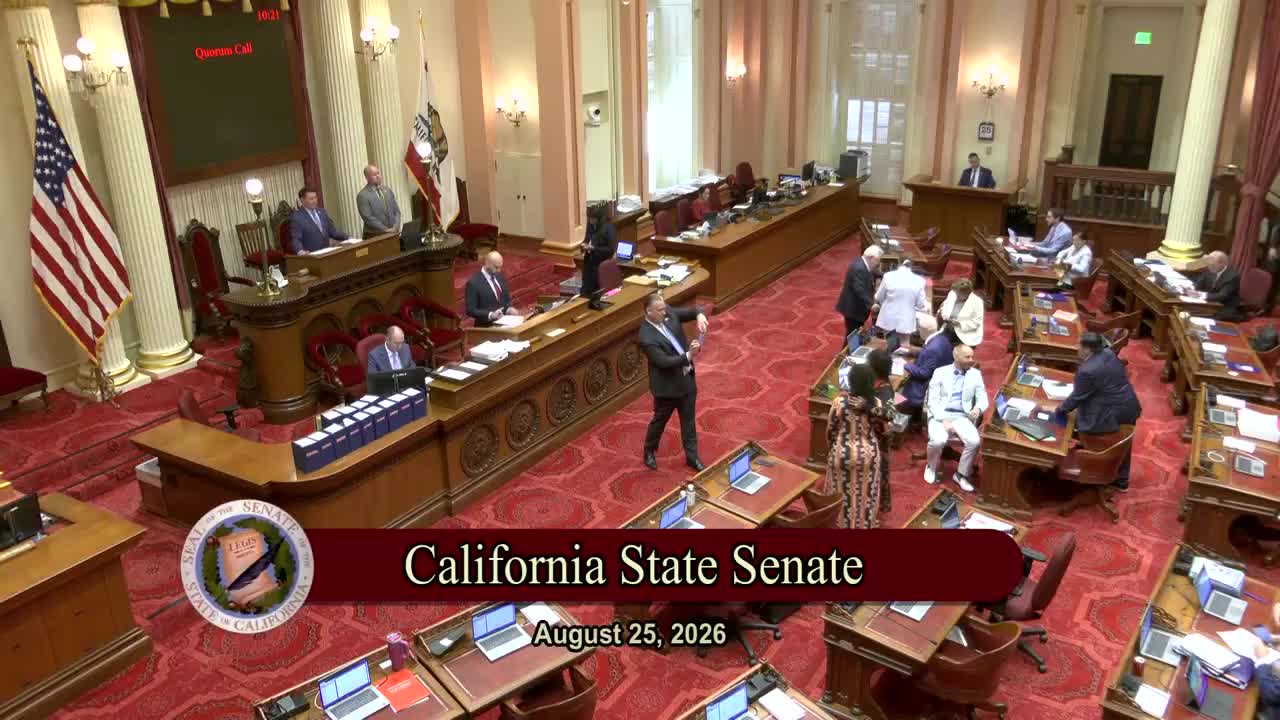 2MIN
Senate Floor
 1MIN
Assembly Floor
 8MIN
Assembly Standing Committee on Appropriations
 13MIN
Assembly Standing Committee on Local Government
 31MIN
Assembly Standing Committee on Housing and Community Development
 2MIN
Senate Floor
 13MIN
Senate Standing Committee on Local Government
 28MIN
Senate Standing Committee on Housing
Bill Author

Bill Co-Author(s):
