SB 1125: Water Rate Assistance Program.
- Session Year: 2025-2026
- House: Senate
- Latest Version Date: 2026-08-28
Current Status:
In Progress
(2026-09-30: In Senate. Consideration of Governor's veto pending.)
Introduced
In Committee
Awaiting First Chamber Vote
Passed First Chamber
In Committee
Awaiting Second Chamber Vote
Passed Second Chamber
Enacted
Existing law requires the State Water Resources Control Board to develop a plan for the funding and implementation of the Low-Income Water Rate Assistance Program. Existing law requires the plan to include, among other things, a description of the method for collecting moneys to support and implement the program and a description of the method for determining the amount of moneys that may need to be collected from water ratepayers to fund the program.
This bill would establish the Water Rate Assistance Program. As part of the program, the bill would establish the Water Rate Assistance Fund in the State Treasury, available upon appropriation by the Legislature, to provide water affordability assistance for residential water services to low-income residential ratepayers, as specified. The bill would establish separate implementation procedures depending on whether the state board determines that the Legislature appropriated enough moneys from the fund for a partial implementation of the program or a statewide implementation of the program. The bill would require the state board to take various actions in administering the fund, including, among other things, tracking and managing revenue in the fund separately from all other revenue. The bill would require the state board, in consultation with relevant agencies and after a public hearing, to adopt guidelines for implementation of the program and to adopt and submit a report to the Legislature or post the report on its internet website, as specified. The bill would require the guidelines to include minimum requirements for eligible systems, including the ability to confirm eligibility for enrollment through a request for self-certification of eligibility under penalty of perjury. By expanding the crime of perjury, the bill would impose a state-mandated local program. The bill would require the state board to take various actions in administering the program, including, but not limited to, providing guidance, oversight, and funding for low-income rate assistance for residential ratepayers of eligible systems. The bill would authorize the Attorney General, at the request of the state board, to bring an action in state court to restrain the use of any method, act, or practice in violation of these provisions, except as provided. The bill would make the implementation of all of these provisions contingent upon an appropriation by the Legislature.
The California Constitution requires the state to reimburse local agencies and school districts for certain costs mandated by the state. Statutory provisions establish procedures for making that reimbursement.
This bill would provide that no reimbursement is required by this act for a specified reason.
Existing law requires the State Water Resources Control Board to develop a plan for the funding and implementation of the Low-Income Water Rate Assistance Program. Existing law requires the plan to include, among other things, a description of the method for collecting moneys to support and implement the program and a description of the method for determining the amount of moneys that may need to be collected from water ratepayers to fund the program.
This bill would establish the Water Rate Assistance Program. As part of the program, the bill would establish the Water Rate Assistance Fund in the State Treasury, available upon appropriation by the Legislature, to provide water affordability assistance for residential water services to low-income residential ratepayers, as specified. The bill establishes would establish separate implementation procedures depending on whether the state board determines that the Legislature appropriated enough moneys from the fund for a partial implementation of the program or a statewide implementation of the program. The bill would require the state board to take various actions in administering the fund, including, among other things, tracking and managing revenue in the fund separately from all other revenue. The bill would require the state board, in consultation with relevant agencies and after a public hearing, to adopt guidelines for implementation of the program and to adopt and submit a report to the Legislature or post the report on its internet website, as specified. The bill would require the guidelines to include minimum requirements for eligible systems, including the ability to confirm eligibility for enrollment through a request for self-certification of eligibility under penalty of perjury. By expanding the crime of perjury, the bill would impose a state-mandated local program. The bill would require the state board to take various actions in administering the program, including, but not limited to, providing guidance, oversight, and funding for low-income rate assistance for residential ratepayers of eligible systems. The bill would authorize the Attorney General, at the request of the state board, to bring an action in state court to restrain the use of any method, act, or practice in violation of these provisions, except as provided. The bill would make the implementation of all of these provisions contingent upon an appropriation by the Legislature.
The California Constitution requires the state to reimburse local agencies and school districts for certain costs mandated by the state. Statutory provisions establish procedures for making that reimbursement.
This bill would provide that no reimbursement is required by this act for a specified reason.
Existing law requires the State Water Resources Control Board to develop a plan for the funding and implementation of the Low-Income Water Rate Assistance Program. Existing law requires the plan to include, among other things, a description of the method for collecting moneys to support and implement the program and a description of the method for determining the amount of moneys that may need to be collected from water ratepayers to fund the program.
This bill would establish the Water Rate Assistance Program. As part of the program, the bill would establish the Water Rate Assistance Fund in the State Treasury, available upon appropriation by the Legislature, to provide water affordability assistance for residential water services to low-income residential ratepayers, as specified. The bill establishes separate implementation procedures depending on whether the state board determines that the Legislature appropriated enough moneys from the fund for a partial implementation of the program or a statewide implementation of the program. The bill would require the state board to take various actions in administering the fund, including, among other things, tracking and managing revenue in the fund separately from all other revenue. The bill would require the state board, in consultation with relevant agencies and after a public hearing, to adopt guidelines for implementation of the program and to adopt an annual report to be posted on the state boards internet website identifying how the fund has performed, and submit a report to the Legislature or post the report on its internet website, as specified. The bill would require the guidelines to include minimum requirements for eligible systems, including the ability to confirm eligibility for enrollment through a request for self-certification of eligibility under penalty of perjury. By expanding the crime of perjury, the bill would impose a state-mandated local program. The bill would require the state board to take various actions in administering the program, including, but not limited to, providing guidance, oversight, and funding for low-income rate assistance for residential ratepayers of eligible systems. The bill would authorize the Attorney General, at the request of the state board, to bring an action in state court to restrain the use of any method, act, or practice in violation of these provisions, except as provided. The bill would make the implementation of all of these provisions contingent upon an appropriation by the Legislature.
The California Constitution requires the state to reimburse local agencies and school districts for certain costs mandated by the state. Statutory provisions establish procedures for making that reimbursement.
This bill would provide that no reimbursement is required by this act for a specified reason.
Existing law requires the State Water Resources Control Board to develop a plan for the funding and implementation of the Low-Income Water Rate Assistance Program. Existing law requires the plan to include, among other things, a description of the method for collecting moneys to support and implement the program and a description of the method for determining the amount of moneys that may need to be collected from water ratepayers to fund the program.
This bill would establish the Water Rate Assistance Program. As part of the program, the bill would establish the Water Rate Assistance Fund in the State Treasury, available upon appropriation by the Legislature, to provide water affordability assistance for residential water services to low-income residential ratepayers, as specified. The bill would require the state board to take various actions in administering the fund, including, among other things, tracking and managing revenue in the fund separately from all other revenue. The bill would require the state board, in consultation with relevant agencies and after a public hearing, to adopt guidelines for implementation of the program and to adopt an annual report to be posted on the state boards internet website identifying how the fund has performed, as specified. The bill would require the guidelines to include minimum requirements for eligible systems, including the ability to confirm eligibility for enrollment through a request for self-certification of eligibility under penalty of perjury. By expanding the crime of perjury, the bill would impose a state-mandated local program. The bill would require the state board to take various actions in administering the program, including, but not limited to, providing guidance, oversight, and funding for low-income rate assistance for residential ratepayers of eligible systems. The bill would authorize the Attorney General, at the request of the state board, to bring an action in state court to restrain the use of any method, act, or practice in violation of these provisions, except as provided. The bill would make the implementation of all of these provisions contingent upon an appropriation by the Legislature.
The California Constitution requires the state to reimburse local agencies and school districts for certain costs mandated by the state. Statutory provisions establish procedures for making that reimbursement.
This bill would provide that no reimbursement is required by this act for a specified reason.
The California Safe Drinking Water Act provides for the operation of public water systems and imposes on the State Water Resources Control Board various responsibilities and duties relating to the regulation of drinking water to protect public health. Existing law establishes the Safe and Affordable Drinking Water Fund in the State Treasury to help water systems provide an adequate and affordable supply of safe drinking water in both the near and long terms. Existing law requires the state board to annually adopt a fund expenditure plan, as provided, and requires expenditures from the fund to be consistent with the fund expenditure plan. Existing law requires the state board to base the fund expenditure plan on data and analysis drawn from a specified drinking water needs assessment. This bill would require the board to, on or before May 1, 2027, and on or before May 1 of each year thereafter, develop a drinking water needs assessment, as specified. The bill would require the assessment to include an analysis of the funds necessary to make water service affordable for customers of community water systems with fewer than 3,000 service connections and would require this analysis to be updated at least every 3 years.The California Safe Drinking Water Act provides for the operation of public water systems and imposes on the State Water Resources Control Board various responsibilities and duties relating to the regulation of drinking water to protect public health. Existing law establishes the Safe and Affordable Drinking Water Fund in the State Treasury to help water systems provide an adequate and affordable supply of safe drinking water in both the near and long terms. Existing law requires the state board to annually adopt a fund expenditure plan, as provided, and requires expenditures from the fund to be consistent with the fund expenditure plan. Existing law requires the state board to base the fund expenditure plan on data and analysis drawn from a specified drinking water needs assessment.
This bill would require the board to, on or before May 1, 2027, and on or before May 1 of each year thereafter, develop a drinking water needs assessment, as specified. The bill would require the assessment to include an analysis of the funds necessary to make water service affordable for customers of community water systems with fewer than 3,000 service connections and would require this analysis to be updated at least every 3 years.
(a)The Legislature finds and declares all of the following:
(1)Existing state law declares that it is the established policy of the state that every human being has the right to safe, clean, affordable, and accessible water adequate for human consumption, cooking, and sanitary purposes.
(2)In 2015, the Legislature passed Assembly Bill 401 (Chapter 662 of the Statutes of 2015) that required the State Water Resources Control Board to develop a plan, informed by the public and the State Board of Equalization, for a statewide low-income rate assistance for water.
(3)In 2020, the state board released a report pursuant to Assembly Bill 401 (Chapter 662 of the Statutes of 2015), which is entitled Recommendations for Implementation of a Statewide Low-Income Water Rate Assistance Program, that found that it would take over one hundred forty million dollars ($140,000,000) annually to create a low-income water rate assistance program.
(4)The cost of water has continued to rise, outpacing the rate of inflation and putting too many California families at risk of water shutoffs.
(5)Climate change adds additional cost pressure to water and sewer systems, which increasingly must invest in climate resilience.
(6)While many public water systems offer some form of bill assistance to a limited number of customers, Proposition 218, as approved by the voters at the November 5, 1996, statewide general election, limits their ability to fully fund those programs.
(7)California must continue to lead the nation by establishing statewide low-income rate assistance for water and sewer and, by doing so, help to ensure universal access to essential services.
(8)Due to the urgent need to improve water affordability, it is appropriate to begin implementing a low-income rate assistance program as soon as enough funding for partial implementation is available, as long as partial implementation is an interim step toward statewide implementation, that the state shall work toward achieving within the next five years.
(b)It is the intent of the Legislature that funding for a water affordability program be progressive, not create affordability challenges for ratepayers, and be durable.
116931.For purposes of this chapter, the following definitions apply:
(a)Community water system has the same meaning as defined in Section 116275.
(b)Effective date means the date that the state board gives public notice pursuant to paragraph (2) of subdivision (c) of Section 116932.
(c)Eligible system means a community water system, or a participating tribal water system.
(d)Fund means the Water Rate Assistance Fund created pursuant to Section 116932.
(e)Local water rate assistance program means a drinking water low-income rate assistance program that is established, funded, and administered by a community water system to provide water rate assistance to its eligible low-income ratepayers. Local water rate assistance programs may be funded through any funding a community water system has available to provide water rate assistance to its ratepayers, provided it does not use any funding derived from a fee or charge levied pursuant to Article XIII D of the California Constitution.
(f)Low-income means an annual household income that is no greater than 200 percent of the federal poverty guideline level and consistent with the guidelines established for the California Alternative Rates for Energy (CARE) program pursuant to subdivision (a) of Section 739.1 of the Public Utilities Code.
(g)Minimum implementation amount means an amount of money determined by the state board that is sufficient to allow the state board to administer the program with at least three years of ratepayer assistance for the systems selected pursuant to subdivision (e) of Section 116932, including all reasonable costs associated with the administration of this chapter.
(h)Program means the Water Rate Assistance Program established pursuant to this chapter.
(i)Relevant agencies means those agencies that have a role, through data collection, regulation, or enforcement, in providing services, oversight, and assistance to public water systems and low-income ratepayers.
(j)Residential ratepayer means a resident of a single-family or multifamily residence who receives a bill for residential water.
(k)State board means the State Water Resources Control Board.
116932.(a)The Water Rate Assistance Fund is hereby established in the State Treasury to provide water affordability assistance for residential water services to low-income residential ratepayers. Moneys in the fund shall be available, upon appropriation by the Legislature, to the state board to provide, in consultation with relevant agencies, direct water bill assistance to low-income residential ratepayers served by eligible systems.
(b)The program shall be entirely funded by the fund or other available state or federal funding.
(c)(1)The state board shall, upon appropriation by the Legislature of a minimum implementation amount, expend moneys from the fund for reasonable costs associated with the administration of this chapter.
(2)Within 30 days after a determination by the state board that a minimum implementation amount has been appropriated from the fund by the Legislature to the state board, the state board shall provide public notice of that determination.
(3)Within 30 days after a determination by the state board that the Legislature appropriated from the fund a sufficient amount for statewide implementation of the program, the state board shall provide public notice of that determination.
(4)The state board shall begin distributing ratepayer assistance within three years of the effective date.
(5)Commencing three years from the effective date, funds for the reasonable costs associated with the administration of this chapter shall not exceed 10 percent of the average annual budget for implementation of the program. Reasonable costs associated with the administration of this chapter includes relevant agencies administrative costs associated with this chapter. The state board shall pay eligible systems for reasonable costs associated with the administration of this chapter, including contracting with third-party providers pursuant to paragraph (3) of subdivision (d) of Section 116933, which shall not count toward the 10-percent limitation.
(6)Commencing four years from the effective date, a minimum of 80 percent of future expenditures from the fund shall be directly applied to residential ratepayer accounts.
(d)The state board may undertake any of the following actions to implement this chapter:
(1)Provide for the deposit of any of the following moneys into the fund:
(A)Federal or state funding.
(B)Voluntary contributions, including, but not limited to, gifts, grants, or bequests.
(C)Any previously distributed funds returned to the fund pursuant to the provision adopted pursuant to paragraph (7) of subdivision (b) of Section 116934 or a process developed pursuant to paragraph (10) of subdivision (b) of Section 116934.
(2)Enter into funding agreements with the federal government, local or state agencies, private entities, or nonprofit organizations.
(3)(A)Develop data systems necessary to receive customer enrollment information from the California Public Utilities Commission and other relevant state and federal entities.
(B)Notwithstanding any other law, procurement of data systems pursuant to this paragraph shall not be subject to the California Department of Technology procurement pathway, including, but not limited to, Chapter 3 (commencing with Section 12100) of Part 2 of Division 2 of the Public Contract Code, Sections 11545 and 11546 of the Government Code, and processes established in the Statewide Information Management Manual and the State Administrative Manual.
(4)Take additional action as necessary and appropriate for adequate administration and operation of the fund and provision of direct residential water bill assistance.
(e)If the state board determines that the fund contains a minimum implementation amount pursuant to paragraph (2) of subdivision (c), but that the fund does not contain enough moneys for statewide implementation of the program, this chapter shall be implemented as follows:
(1)The state board shall solicit applications from eligible systems to participate in the program.
(2)If sufficient funding is available, the state board shall select all eligible systems that applied to participate in the program pursuant to paragraph (1).
(3)If sufficient funding is not available to select all eligible systems that applied to participate in the program pursuant to paragraph (1), the state board shall select for participation in the program a representative sample of eligible systems that applied considering geography, number of connections, and service to disadvantaged and severely disadvantaged communities.
(4)Systems that have been identified by the state board as having a history of waste, fraud, or abuse of moneys shall not be prioritized for the program until the state board or the Attorney General determines that the prior behavior of the system has been addressed.
(5)Participation by eligible systems shall be voluntary unless the state board determines that sufficient funding is available pursuant to paragraph (3) of subdivision (c).
(6)Nothing in this chapter shall require statewide implementation unless the state board determines that sufficient funding is available pursuant to paragraph (3) of subdivision (c).
(7)Upon a subsequent appropriation of moneys to the state board from the fund that is greater than the minimum implementation amount, the state board is authorized to expand the program to additional eligible systems.
116933.The state board shall do all of the following in administering the fund:
(a)Track and manage revenue in the fund separately from all other revenue.
(b)Develop and implement a process for the state board to disburse program funds to eligible systems for direct application to the systems low-income residential ratepayer accounts, including controls to prevent fraud, waste, and abuse.
(c)Manage and maintain fund balances in conjunction with the Controller, the Treasurer, the California State Auditors Office, and the Department of Finance, as appropriate.
(d)(1)Expend, upon appropriation by the Legislature of a minimum implementation amount, moneys in the fund for grants, contracts, or services to provide benefits to eligible residential ratepayers.
(2)Services may include technical assistance to eligible systems serving fewer than 3,300 connections to administer the application of funds to low-income residential ratepayer accounts, including initial startup costs.
(3)The state board shall identify and contract with one or more third-party providers, for the purpose of providing assistance to eligible systems with customer enrollment and disenrollment, to the extent authorized by Section 19130 of the Government Code. The scope of work for a third-party provider shall include, but not be limited to, the receipt of California Alternate Rates for Energy (CARE) enrollment data pursuant to the mechanism established pursuant to subdivision (a) of Section 116936, the receipt of information from eligible systems, the creation of eligible customer lists to be provided to eligible systems, call center services, internet-based enrollments, document intake and processing, and provision of notices to eligible customers of enrollment into the program and an opportunity for a customer to opt out of the program.
(e)Establish a process for contracted third-party providers or other entities responsible for enrollment to regularly confirm the eligibility of recipients, based upon income eligibility pursuant to subdivision (f) of Section 116931.
116934.(a)Within two years from the effective date, the state board, in consultation with relevant agencies and after a public hearing, shall adopt guidelines for implementation of the program.
(b)The guidelines shall include, at minimum, all of the following:
(1)(A)Direction to eligible systems to automatically enroll households in the program if the residential ratepayers household is a utility customer enrolled in the California Alternate Rates for Energy (CARE) program established pursuant to Section 739.1 of the Public Utilities Code.
(B)To the extent federally allowable, a process to enroll other households if available information shows that any member of the residential ratepayers household is a current enrollee in, or recipient of, CalWORKs, Tribal Temporary Assistance for Needy Families, CalFresh, general assistance, Medi-Cal, Cash Assistance Program for Immigrants, Supplemental Security Income or the State Supplementary Payment Program, or the California Special Supplemental Nutrition Program for Women, Infants, and Children.
(2)Eligibility criteria for enrollment into the program for customers not automatically enrolled shall ensure customers satisfy the definition of low-income.
(3)Minimum requirements for eligible systems to be applied once the Legislature appropriates to the state board enough moneys from the fund for statewide implementation of the program, including all of the following:
(A)Participation in the statewide program.
(B)A process for enrollment into the program for households that meet the eligibility criteria pursuant to paragraph (2).
(C)The ability to confirm eligibility for enrollment through a request for self-certification of eligibility under penalty of perjury.
(D)A process for eligible systems, at their sole discretion, to elect whether and the extent to which they will rely on third-party providers for the services within the scope of work set forth in paragraph (3) of subdivision (d) of Section 116933, or instead elect to perform one or more of these services itself.
(E)A process for eligible systems to share information with third-party providers, to the extent necessary for third-party providers to provide the services elected by the eligible system pursuant to subparagraph (D).
(4)A process for the state board to provide funding to eligible systems for application to eligible low-income residential ratepayer accounts. Funding shall be provided to eligible systems on, at minimum, an annual basis.
(5)Consistent with Article XIII D of the California Constitution, guidance to eligible systems regarding payment of reasonable costs for administration of the program. Reasonable costs for administration shall include, but are not limited to, the following:
(A)Staff costs to implement the program.
(B)Changes to billing systems needed to provide bill credits.
(C)Communication materials to customers about the program.
(6)(A)A process for eligible systems to provide a flat bill credit to low-income residential ratepayers of no less than twenty dollars ($20) per month. The state board shall update the flat bill credit annually to reflect changes in the Consumer Price Index.
(B)A process for eligible systems to opt to instead provide a bill credit to low-income residential ratepayers of 20 percent of the total water charges for a volume of water similar to that identified in Section 10609.4 of the Water Code, if this bill credit would be higher than the flat bill credit developed by the state board pursuant to subparagraph (A).
(7)A provision to audit eligible systems receiving funds under this chapter regarding the receipt and distribution of those funds. An eligible system shall repay to the state board any moneys distributed from the fund disallowed in an audit, except those moneys that have been applied to customer accounts. An eligible system shall preserve and make available, upon request from the state board or the state boards designee, all records pertaining to the receipt and distribution of moneys from the fund three years after receipt of those moneys.
(8)Parameters and options for providing funding to eligible systems that bill exclusively or partially on the property tax roll.
(9)A process for exemption of eligible systems from providing low-income rate assistance upon determination by the state board that the system does not have eligible residential ratepayers. Exemptions shall be reviewed periodically to determine whether any residential ratepayers of the eligible system have become eligible for assistance.
(10)A process for eligible systems to return funds to the state if needed.
(11)A requirement that the state board provide an eligible system with no fewer than 180 days notice before the first day that the system will be required to provide water rate assistance pursuant to this chapter.
(12)The state board shall develop baseline and measurable metrics to evaluate the performance and success of the program.
(c)The state board shall hold at least three public workshops throughout the state on the draft guidelines, and shall provide at least 45 days for public comment on the draft.
116935.(a)The state board shall, in consultation with relevant agencies and after a public hearing, adopt, and submit to the Legislature, in compliance with Section 9795 of the Government Code, a report four years from the effective date. Every three years after the submission of the initial report to the Legislature, the state board shall adopt, and post on its internet website, a subsequent report.
(b)The report shall contain all of the following:
(1)A report of expenditures from the fund, including how many households were served, and estimated expenditures.
(2)An estimate of the number of households eligible for assistance. The estimate shall not be based on a household-by-household evaluation.
(3)An evaluation of available relevant information regarding any household-level water affordability issues that remain after application of bill assistance.
(4)A description of methods to include public participation and efforts to encourage enrollment in the program.
(5)An estimate of the anticipated funding needs for statewide implementation of the program.
(6)Recommendations regarding future implementation of the program.
(7)Progress toward meeting baseline and measurable metrics developed pursuant to paragraph (12) of subdivision (b) of Section 116934 to evaluate the performance and success of the program.
(c)The state board shall, to the extent feasible, rely on existing data collected pursuant to Section 116530.
116936.(a)Within 450 days of the effective date, the Public Utilities Commission shall establish a mechanism for electrical corporations and gas corporations to regularly share data that includes customer names and account addresses with the third-party providers regarding the utility customers enrolled in, or eligible to be enrolled in, the California Alternate Rates for Energy (CARE) program established pursuant to Section 739.1 of the Public Utilities Code. Electrical corporations and gas corporations shall regularly share that data with third-party providers through the mechanism.
(b)(1)The state board and third-party providers may enter into agreements with local publicly owned electric utilities and local publicly owned gas utilities, including, but not limited to, municipal utility districts, irrigation districts, and state entities administering the federal programs identified in subparagraph (B) of paragraph (1) of subdivision (b) of Section 116934 for the purpose of regularly sharing data that includes customer names and account addresses with the third-party provider regarding utility customers enrolled in, or eligible to be enrolled in, affordability programs benefiting low-income residential ratepayers and for the purpose of the report pursuant to Section 116935.
(2)The agreements may authorize third-party providers to provide data pursuant to this subdivision to eligible systems for the sole purpose of assisting with the administration of the program.
(c)Data shared pursuant to subdivision (a) or (b) is subject to Section 7927.410 of the Government Code and the Information Practices Act of 1977 (Chapter 1 (commencing with Section 1798) of Title 1.8 of Part 4 of Division 3 of the Civil Code).
(d)Data shared pursuant to subdivision (a) or (b) shall not be considered a disclosure under Section 1798.83 of the Civil Code.
116937.(a)Chapter 3.5 (commencing with Section 11340) of Part 1 of Division 3 of Title 2 of the Government Code does not apply to any guidelines developed by the state board pursuant to this chapter.
(b)(1)Notwithstanding Section 11019 of the Government Code, the state board shall, to the extent permissible, make advance payments to eligible systems for direct residential water bill assistance, for related administrative costs, and to implement the purposes of this chapter.
(2)Before distribution of an advance payment, eligible systems shall provide to the state board an estimate of the anticipated administrative costs, the number of households enrolled in the program, and their expected bill credits.
(3)The state board shall have discretion regarding the terms and conditions that apply to advance payment; however, the state board shall not require an eligible system to provide a bill credit in advance of the state board providing the eligible system the funds to cover the portion of the water bill that the credit is designed to cover for the customer. Eligible systems shall not be required by any provision of this chapter to advance funds or extend credit to cover the cost of the direct bill credits.
(c)An eligible system shall provide a full accounting of its expenditures related to implementation and administration of the program on an annual basis and as requested by the state board.
(d)An eligible system shall not be required to establish or maintain the administrative infrastructure, including staff, changes to billing systems, or other reasonable actions necessary to comply with this chapter, unless the fund has sufficient funds therein to comply with paragraph (1) of subdivision (b), and a distribution for reasonable administrative costs has been provided to the eligible system.
116938.The state board shall do all of the following in administering the program:
(a)Provide guidance, oversight, and funding for low-income rate assistance for residential ratepayers of eligible systems.
(b)Coordinate with the Public Utilities Commission, to the extent reasonable and consistent with this chapter and related policy goals, to align criteria between all existing water rate assistance programs offered by investor-owned utilities, and to ensure timely processing of payments to investor-owned utilities.
(c)For an eligible system that is not regulated by the Public Utilities Commission, consult with relevant agencies on options to provide oversight of the eligible systems application of program funds to the systems low-income residential ratepayer accounts pursuant to this chapter to ensure effectiveness and prevent fraud, waste, and abuse.
(d)Coordinate with other relevant state agencies and resolve disputes as necessary.
(e)Consider identifying alternative entities to distribute and track benefits if the state board determines that an eligible system is incapable of applying program funds to residential ratepayers of the system pursuant to this chapter.
116939.(a)This chapter does not prohibit an eligible system from administering a local water rate assistance program that is in addition to, or on top of, or different from, the assistance provided through the program. Local water rate assistance programs are administered independently and separately from the program without oversight from the state board.
(b)(1)An eligible system that offers assistance through a local water rate assistance program that is in addition to the assistance provided through the program to the qualifying ratepayers served by the program shall still receive funds from the program for the eligible portion of the assistance.
(2)An eligible system with a local water rate assistance program may request that the state board allocate the funds from the program to an existing local water rate assistance program by entering into a memorandum of understanding with the state board that describes the parameters, eligibility criteria, and enrollment of the local water rate assistance program. Notwithstanding paragraphs (2) to (10), inclusive, of subdivision (b) of Section 116934, an eligible system may customize its local water rate assistance program through a memorandum of understanding with the state board as long as comparable benefits will be offered to the systems low-income residential ratepayers.
116940.(a)Within two years from the public notice given pursuant to paragraph (3) of subdivision (c) of Section 116932, all nontribal community water systems shall begin providing water rate assistance to residential ratepayers in compliance with the minimum requirements specified in subdivision (c) of Section 116932. A tribal water system may offer water rate assistance. Eligible systems shall continue to provide water rate assistance to low-income residential ratepayers as long as there is sufficient state or federal funding available to provide water rate assistance and fund eligible systems for reasonable costs for administration of the program.
(b)If the state board has not met the deadline in subdivision (a) of Section 116934 for the adoption of program implementation guidelines within two years from the effective date, the deadline in subdivision (a) of this section shall be delayed by the total number of additional days the state board takes to adopt program implementation guidelines to the first date that is the beginning of an eligible systems billing cycle.
116941.(a)The Attorney General, at the request of the state board, may bring an action in state court to restrain, by temporary or permanent injunction, the use of any method, act, or practice declared in this chapter to be unlawful, including nonparticipation by a public water system within the program.
(b)The state board shall not request an action nor shall the Attorney General bring an action against an eligible system for failing to meet the requirements of Sections 116938 and 116940, as long as the eligible system makes a good faith effort to implement this chapter or the eligible system has been notified that it does not need to comply with this chapter.
116942.Implementation of this chapter is contingent upon an appropriation by the Legislature for its purposes.
SEC. 2.No reimbursement is required by this act pursuant to Section 6 of Article XIIIB of the California Constitution because the only costs that may be incurred by a local agency or school district will be incurred because this act creates a new crime or infraction, eliminates a crime or infraction, or changes the penalty for a crime or infraction, within the meaning of Section 17556 of the Government Code, or changes the definition of a crime within the meaning of Section 6 of Article XIIIB of the California Constitution.
(a)The Legislature finds and declares all of the following:
(1)Existing state law declares that it is the established policy of the state that every human being has the right to safe, clean, affordable, and accessible water adequate for human consumption, cooking, and sanitary purposes.
(2)In 2015, the Legislature passed Assembly Bill 401 (Chapter 662 of the Statutes of 2015) that required the State Water Resources Control Board to develop a plan, informed by the public and the State Board of Equalization, for a statewide low-income rate assistance for water.
(3)In 2020, the state board released a report pursuant to Assembly Bill 401 (Chapter 662 of the Statutes of 2015), which is entitled Recommendations for Implementation of a Statewide Low-Income Water Rate Assistance Program, that found that it would take over one hundred forty million dollars ($140,000,000) annually to create a low-income water rate assistance program.
(4)The cost of water has continued to rise, outpacing the rate of inflation and putting too many California families at risk of water shutoffs.
(5)Climate change adds additional cost pressure to water and sewer systems, which increasingly must invest in climate resilience.
(6)While many public water systems offer some form of bill assistance to a limited number of customers, Proposition 218, as approved by the voters at the November 5, 1996, statewide general election, limits their ability to fully fund those programs.
(7)California must continue to lead the nation by establishing statewide low-income rate assistance for water and sewer and, by doing so, help to ensure universal access to essential services.
(8)Due to the urgent need to improve water affordability, it is appropriate to begin implementing a low-income rate assistance program as soon as enough funding for partial implementation is available, as long as partial implementation is an interim step toward statewide implementation, that the state shall work toward achieving within the next five years.
(b)It is the intent of the Legislature that funding for a water affordability program be progressive, not create affordability challenges for ratepayers, and be durable.
116931.For purposes of this chapter, the following definitions apply:
(a)Community water system has the same meaning as defined in Section 116275.
(b)Effective date means the date that the state board gives public notice pursuant to paragraph (2) of subdivision (c) of Section 116932.
(c)Eligible system means a community water system, or a participating tribal water system.
(d)Fund means the Water Rate Assistance Fund created pursuant to Section 116932.
(e)Local water rate assistance program means a drinking water low-income rate assistance program that is established, funded, and administered by a community water system to provide water rate assistance to its eligible low-income ratepayers. Local water rate assistance programs may be funded through any funding a community water system has available to provide water rate assistance to its ratepayers, provided it does not use any funding derived from a fee or charge levied pursuant to Article XIII D of the California Constitution.
(f)Low-income means an annual household income that is no greater than 200 percent of the federal poverty guideline level and consistent with the guidelines established for the California Alternative Rates for Energy (CARE) program pursuant to subdivision (a) of Section 739.1 of the Public Utilities Code.
(g)Minimum implementation amount means an amount of money determined by the state board that is sufficient to allow the state board to administer the program with at least three years of ratepayer assistance for the systems selected pursuant to subdivision (e) of Section 116932, including all reasonable costs associated with the administration of this chapter.
(h)Program means the Water Rate Assistance Program established pursuant to this chapter.
(i)Relevant agencies means those agencies that have a role, through data collection, regulation, or enforcement, in providing services, oversight, and assistance to public water systems and low-income ratepayers.
(j)Residential ratepayer means a resident of a single-family or multifamily residence who receives a bill for residential water.
(k)State board means the State Water Resources Control Board.
116932.(a)The Water Rate Assistance Fund is hereby established in the State Treasury to provide water affordability assistance for residential water services to low-income residential ratepayers. Moneys in the fund shall be available, upon appropriation by the Legislature, to the state board to provide, in consultation with relevant agencies, direct water bill assistance to low-income residential ratepayers served by eligible systems.
(b)The program shall be entirely funded by the fund or other available state or federal funding.
(c)(1)The state board shall, upon appropriation by the Legislature of a minimum implementation amount, expend moneys from the fund for reasonable costs associated with the administration of this chapter.
(2)Within 30 days after a determination by the state board that a minimum implementation amount has been appropriated from the fund by the Legislature to the state board, the state board shall provide public notice of that determination.
(3)Within 30 days after a determination by the state board that the Legislature appropriated from the fund a sufficient amount for statewide implementation of the program, the state board shall provide public notice of that determination.
(4)The state board shall begin distributing ratepayer assistance within three years of the effective date.
(5)Commencing three years from the effective date, funds for the reasonable costs associated with the administration of this chapter shall not exceed 10 percent of the average annual budget for implementation of the program. Reasonable costs associated with the administration of this chapter includes relevant agencies administrative costs associated with this chapter. The state board shall pay eligible systems for reasonable costs associated with the administration of this chapter, including contracting with third-party providers pursuant to paragraph (3) of subdivision (d) of Section 116933, which shall not count toward the 10-percent limitation.
(6)Commencing four years from the effective date, a minimum of 80 percent of total future expenditures from the fund shall be directly applied to residential ratepayer accounts.
(d)The state board may undertake any of the following actions to implement this chapter:
(1)Provide for the deposit of any of the following moneys into the fund:
(A)Federal or state funding.
(B)Voluntary contributions, including, but not limited to, gifts, grants, or bequests.
(C)Any previously distributed funds returned to the fund pursuant to the provision adopted pursuant to paragraph (7) of subdivision (b) of Section 116934 or a process developed pursuant to paragraph (10) of subdivision (b) of Section 116934.
(2)Enter into funding agreements with the federal government, local or state agencies, private entities, or nonprofit organizations.
(3)(A)Develop data systems necessary to receive customer enrollment information from the California Public Utilities Commission and other relevant state and federal entities.
(B)Notwithstanding any other law, procurement of data systems pursuant to this paragraph shall not be subject to the California Department of Technology procurement pathway, including, but not limited to, Chapter 3 (commencing with Section 12100) of Part 2 of Division 2 of the Public Contract Code, Sections 11545 and 11546 of the Government Code, and processes established in the Statewide Information Management Manual and the State Administrative Manual.
(4)Take additional action as necessary and appropriate for adequate administration and operation of the fund and provision of direct residential water bill assistance.
(e)If the state board determines that the fund contains a minimum implementation amount pursuant to paragraph (2) of subdivision (c), but that the fund does not contain enough moneys for statewide implementation of the program, this chapter shall be implemented as follows:
(1)The state board shall solicit applications from eligible systems to participate in the program.
(2)If sufficient funding is available, the state board shall select all eligible systems that applied to participate in the program pursuant to paragraph (1).
(3)If sufficient funding is not available to select all eligible systems that applied to participate in the program pursuant to paragraph (1), the state board shall select for participation in the program a representative sample of eligible systems that applied considering geography, number of connections, and service to disadvantaged and severely disadvantaged communities.
(4)Systems that have been identified by the state board as having a history of waste, fraud, or abuse of moneys shall not be prioritized for the program until the state board or the Attorney General determines that the prior behavior of the system has been addressed.
(5)Participation by eligible systems shall be voluntary unless the state board determines that sufficient funding is available pursuant to paragraph (3) of subdivision (c).
(6)Nothing in this chapter shall require statewide implementation unless the state board determines that sufficient funding is available pursuant to paragraph (3) of subdivision (c).
(7)Upon a subsequent appropriation of moneys to the state board from the fund that is greater than the minimum implementation amount, the state board is authorized to expand the program to additional eligible systems.
116933.The state board shall do all of the following in administering the fund:
(a)Track and manage revenue in the fund separately from all other revenue.
(b)Develop and implement a process for the state board to disburse program funds to eligible systems for direct application to the systems low-income residential ratepayer accounts, including controls to prevent fraud, waste, and abuse.
(c)Manage and maintain fund balances in conjunction with the Controller, the Treasurer, the California State Auditors Office, and the Department of Finance, as appropriate.
(d)(1)Expend, upon appropriation by the Legislature of a minimum implementation amount, moneys in the fund for grants, contracts, or services to provide benefits to eligible residential ratepayers.
(2)Services may include technical assistance to eligible systems serving fewer than 3,300 connections to administer the application of funds to low-income residential ratepayer accounts, including initial startup costs.
(3)The state board shall identify and contract with one or more third-party providers, for the purpose of providing assistance to eligible systems with customer enrollment and disenrollment, to the extent authorized by Section 19130 of the Government Code. The scope of work for a third-party provider shall include, but not be limited to, the receipt of California Alternate Rates for Energy (CARE) enrollment data pursuant to the mechanism established pursuant to subdivision (a) of Section 116936, the receipt of information from eligible systems, the creation of eligible customer lists to be provided to eligible systems, call center services, internet-based enrollments, document intake and processing, and provision of notices to eligible customers of enrollment into the program and an opportunity for a customer to opt out of the program.
(e)Establish a process for contracted third-party providers or other entities responsible for enrollment to regularly confirm the eligibility of recipients, based upon income eligibility pursuant to subdivision (f) of Section 116931.
116934.(a)Within two years from the effective date, the state board, in consultation with relevant agencies and after a public hearing, shall adopt guidelines for implementation of the program.
(b)The guidelines shall include, at minimum, all of the following:
(1)(A)Direction to eligible systems to automatically enroll households in the program if the residential ratepayers household is a utility customer enrolled in the California Alternate Rates for Energy (CARE) program established pursuant to Section 739.1 of the Public Utilities Code.
(B)To the extent federally allowable, a process to enroll other households if available information shows that any member of the residential ratepayers household is a current enrollee in, or recipient of, CalWORKs, Tribal Temporary Assistance for Needy Families, CalFresh, general assistance, Medi-Cal, Cash Assistance Program for Immigrants, Supplemental Security Income or the State Supplementary Payment Program, or the California Special Supplemental Nutrition Program for Women, Infants, and Children.
(2)Eligibility criteria for enrollment into the program for customers not automatically enrolled shall ensure customers satisfy the definition of low-income.
(3)Minimum requirements for eligible systems to be applied once the Legislature appropriates to the state board enough moneys from the fund for statewide implementation of the program, including all of the following:
(A)Participation in the statewide program.
(B)A process for enrollment into the program for households that meet the eligibility criteria pursuant to paragraph (2).
(C)The ability to confirm eligibility for enrollment through a request for self-certification of eligibility under penalty of perjury.
(D)A process for eligible systems, at their sole discretion, to elect whether and the extent to which they will rely on third-party providers for the services within the scope of work set forth in paragraph (3) of subdivision (d) of Section 116933, or instead elect to perform one or more of these services itself.
(E)A process for eligible systems to share information with third-party providers, to the extent necessary for third-party providers to provide the services elected by the eligible system pursuant to subparagraph (D).
(4)A process for the state board to provide funding to eligible systems for application to eligible low-income residential ratepayer accounts. Funding shall be provided to eligible systems on, at minimum, an annual basis.
(5)Consistent with Article XIII D of the California Constitution, guidance to eligible systems regarding payment of reasonable costs for administration of the program. Reasonable costs for administration shall include, but are not limited to, the following:
(A)Staff costs to implement the program.
(B)Changes to billing systems needed to provide bill credits.
(C)Communication materials to customers about the program.
(6)(A)A process for eligible systems to provide a flat bill credit to low-income residential ratepayers of no less than twenty dollars ($20) per month. The state board shall update the flat bill credit annually to reflect changes in the Consumer Price Index.
(B)A process for eligible systems to opt to instead provide a bill credit to low-income residential ratepayers of 20 percent of the total water charges for a volume of water similar to that identified in Section 10609.4 of the Water Code, if this bill credit would be higher than the flat bill credit developed by the state board pursuant to subparagraph (A).
(7)A provision to audit eligible systems receiving funds under this chapter regarding the receipt and distribution of those funds. An eligible system shall repay to the state board any moneys distributed from the fund disallowed in an audit, except those moneys that have been applied to customer accounts. An eligible system shall preserve and make available, upon request from the state board or the state boards designee, all records pertaining to the receipt and distribution of moneys from the fund three years after receipt of those moneys.
(8)Parameters and options for providing funding to eligible systems that bill exclusively or partially on the property tax roll.
(9)A process for exemption of eligible systems from providing low-income rate assistance upon determination by the state board that the system does not have eligible residential ratepayers. Exemptions shall be reviewed periodically to determine whether any residential ratepayers of the eligible system have become eligible for assistance.
(10)A process for eligible systems to return funds to the state if needed.
(11)A requirement that the state board provide an eligible system with no fewer than 180 days notice before the first day that the system will be required to provide water rate assistance pursuant to this chapter.
(12)The state board shall develop baseline and measurable metrics to evaluate the performance and success of the program.
(c)The state board shall hold at least three public workshops throughout the state on the draft guidelines, and shall provide at least 45 days for public comment on the draft.
116935.(a)The state board shall, in consultation with relevant agencies and after a public hearing, adopt, and submit to the Legislature, in compliance with Section 9795 of the Government Code, a report four years from the effective date. Every three years after the submission of the initial report to the Legislature, the state board shall adopt, and post on its internet website, a subsequent report.
(b)The report shall contain all of the following:
(1)A report of expenditures from the fund, including how many households were served, and estimated expenditures.
(2)An estimate of the number of households eligible for assistance. The estimate shall not be based on a household-by-household evaluation.
(3)An evaluation of available relevant information regarding any household-level water affordability issues that remain after application of bill assistance.
(4)A description of methods to include public participation and efforts to encourage enrollment in the program.
(5)An estimate of the anticipated funding needs for statewide implementation of the program.
(6)Recommendations regarding future implementation of the program.
(7)Progress toward meeting baseline and measurable metrics developed pursuant to paragraph (12) of subdivision (b) of Section 116934 to evaluate the performance and success of the program.
(c)The state board shall, to the extent feasible, rely on existing data collected pursuant to Section 116530.
116936.(a)Within 450 days of the effective date, the Public Utilities Commission shall establish a mechanism for electrical corporations and gas corporations to regularly share data that includes customer names and account addresses with the third-party providers regarding the utility customers enrolled in, or eligible to be enrolled in, the California Alternate Rates for Energy (CARE) program established pursuant to Section 739.1 of the Public Utilities Code. Electrical corporations and gas corporations shall regularly share that data with third-party providers through the mechanism.
(b)(1)The state board and third-party providers may enter into agreements with local publicly owned electric utilities and local publicly owned gas utilities, including, but not limited to, municipal utility districts, irrigation districts, and state entities administering the federal programs identified in subparagraph (B) of paragraph (1) of subdivision (b) of Section 116934 for the purpose of regularly sharing data that includes customer names and account addresses with the third-party provider regarding utility customers enrolled in, or eligible to be enrolled in, affordability programs benefiting low-income residential ratepayers and for the purpose of the report pursuant to Section 116935.
(2)The agreements may authorize third-party providers to provide data pursuant to this subdivision to eligible systems for the sole purpose of assisting with the administration of the program.
(c)Data shared pursuant to subdivision (a) or (b) is subject to Section 7927.410 of the Government Code and the Information Practices Act of 1977 (Chapter 1 (commencing with Section 1798) of Title 1.8 of Part 4 of Division 3 of the Civil Code).
(d)Data shared pursuant to subdivision (a) or (b) shall not be considered a disclosure under Section 1798.83 of the Civil Code.
116937.(a)Chapter 3.5 (commencing with Section 11340) of Part 1 of Division 3 of Title 2 of the Government Code does not apply to any guidelines developed by the state board pursuant to this chapter.
(b)(1)Notwithstanding Section 11019 of the Government Code, the state board shall, to the extent permissible, make advance payments to eligible systems for direct residential water bill assistance, for related administrative costs, and to implement the purposes of this chapter.
(2)Before distribution of an advance payment, eligible systems shall provide to the state board an estimate of the anticipated administrative costs, the number of households enrolled in the program, and their expected bill credits.
(3)The state board shall have discretion regarding the terms and conditions that apply to advance payment; however, the state board shall not require an eligible system to provide a bill credit in advance of the state board providing the eligible system the funds to cover the portion of the water bill that the credit is designed to cover for the customer. Eligible systems shall not be required by any provision of this chapter to advance funds or extend credit to cover the cost of the direct bill credits.
(c)An eligible system shall provide a full accounting of its expenditures related to implementation and administration of the program on an annual basis and as requested by the state board.
(d)An eligible system shall not be required to establish or maintain the administrative infrastructure, including staff, changes to billing systems, or other reasonable actions necessary to comply with this chapter, unless the fund has sufficient funds therein to comply with paragraph (1) of subdivision (b), and a distribution for reasonable administrative costs has been provided to the eligible system.
116938.The state board shall do all of the following in administering the program:
(a)Provide guidance, oversight, and funding for low-income rate assistance for residential ratepayers of eligible systems.
(b)Coordinate with the Public Utilities Commission, to the extent reasonable and consistent with this chapter and related policy goals, to align criteria between all existing water rate assistance programs offered by investor-owned utilities, and to ensure timely processing of payments to investor-owned utilities.
(c)For an eligible system that is not regulated by the Public Utilities Commission, consult with relevant agencies on options to provide oversight of the eligible systems application of program funds to the systems low-income residential ratepayer accounts pursuant to this chapter to ensure effectiveness and prevent fraud, waste, and abuse.
(d)Coordinate with other relevant state agencies and resolve disputes as necessary.
(e)Consider identifying alternative entities to distribute and track benefits if the state board determines that an eligible system is incapable of applying program funds to residential ratepayers of the system pursuant to this chapter.
116939.(a)This chapter does not prohibit an eligible system from administering a local water rate assistance program that is in addition to, or on top of, or different from, the assistance provided through the program. Local water rate assistance programs are administered independently and separately from the program without oversight from the state board.
(b)(1)An eligible system that offers assistance through a local water rate assistance program that is in addition to the assistance provided through the program to the qualifying ratepayers served by the program shall still receive funds from the program for the eligible portion of the assistance.
(2)An eligible system with a local water rate assistance program may request that the state board allocate the funds from the program to an existing local water rate assistance program by entering into a memorandum of understanding with the state board that describes the parameters, eligibility criteria, and enrollment of the local water rate assistance program. Notwithstanding paragraphs (2) to (10), inclusive, of subdivision (b) of Section 116934, an eligible system may customize its local water rate assistance program through a memorandum of understanding with the state board as long as comparable benefits will be offered to the systems low-income residential ratepayers.
116940.(a)Within two years from the public notice given pursuant to paragraph (3) of subdivision (c) of Section 116932, all nontribal community water systems shall begin providing water rate assistance to residential ratepayers in compliance with the minimum requirements specified in subdivision (c) of Section 116932. A tribal water system may offer water rate assistance. Eligible systems shall continue to provide water rate assistance to low-income residential ratepayers as long as there is sufficient state or federal funding available to provide water rate assistance and fund eligible systems for reasonable costs for administration of the program.
(b)If the state board has not met the deadline in subdivision (a) of Section 116934 for the adoption of program implementation guidelines within two years from the effective date, the deadline in subdivision (a) of this section shall be delayed by the total number of additional days the state board takes to adopt program implementation guidelines to the first date that is the beginning of an eligible systems billing cycle.
116941.(a)The Attorney General, at the request of the state board, may bring an action in state court to restrain, by temporary or permanent injunction, the use of any method, act, or practice declared in this chapter to be unlawful, including nonparticipation by a public water system within the program.
(b)The state board shall not request an action nor shall the Attorney General bring an action against an eligible system for failing to meet the requirements of Sections 116938 and 116940, as long as the eligible system makes a good faith effort to implement this chapter or the eligible system has been notified that it does not need to comply with this chapter.
116942.Implementation of this chapter is contingent upon an appropriation by the Legislature for its purposes.
SEC. 2.No reimbursement is required by this act pursuant to Section 6 of Article XIIIB of the California Constitution because the only costs that may be incurred by a local agency or school district will be incurred because this act creates a new crime or infraction, eliminates a crime or infraction, or changes the penalty for a crime or infraction, within the meaning of Section 17556 of the Government Code, or changes the definition of a crime within the meaning of Section 6 of Article XIIIB of the California Constitution.
(a)The Legislature finds and declares all of the following:
(1)Existing state law declares that it is the established policy of the state that every human being has the right to safe, clean, affordable, and accessible water adequate for human consumption, cooking, and sanitary purposes.
(2)In 2015, the Legislature passed Assembly Bill 401 (Chapter 662 of the Statutes of 2015) that required the State Water Resources Control Board to develop a plan, informed by the public and the State Board of Equalization, for a statewide low-income rate assistance for water.
(3)In 2020, the state board released a report pursuant to Assembly Bill 401 (Chapter 662 of the Statutes of 2015), which is entitled Recommendations for Implementation of a Statewide Low-Income Water Rate Assistance Program, that found that it would take over one hundred forty million dollars ($140,000,000) annually to create a low-income water rate assistance program.
(4)The cost of water has continued to rise, outpacing the rate of inflation and putting too many California families at risk of water shutoffs.
(5)Climate change adds additional cost pressure to water and sewer systems, which increasingly must invest in climate resilience.
(6)While many public water systems offer some form of bill assistance to a limited number of customers, Proposition 218, as approved by the voters at the November 5, 1996, statewide general election, limits their ability to fully fund those programs.
(7)California must continue to lead the nation by establishing statewide low-income rate assistance for water and sewer and, by doing so, help to ensure universal access to essential services.
(8)Due to the urgent need to improve water affordability, it is appropriate to begin implementing a low-income rate assistance program as soon as enough funding for partial implementation is available, as long as partial implementation is an interim step toward statewide implementation, that the state shall work toward achieving within the next five years.
(b)It is the intent of the Legislature that funding for a water affordability program be progressive, not create affordability challenges for ratepayers, and be durable.
116931.For purposes of this chapter, the following definitions apply:
(a)Community water system has the same meaning as defined in Section 116275.
(b)Effective date means the effective date of the appropriation described in Section 116942. the date that the state board gives public notice pursuant to paragraph (2) of subdivision (c) of Section 116932.
(c)Eligible system means a community water system, or a participating tribal water system.
(d)Fund means the Water Rate Assistance Fund created pursuant to Section 116932.
(e)Local water rate assistance program means a drinking water low-income rate assistance program that is established, funded, and administered by a community water system to provide water rate assistance to its eligible low-income ratepayers. Local water rate assistance programs may be funded through any funding a community water system has available to provide water rate assistance to its ratepayers, provided it does not use any funding derived from a fee or charge levied pursuant to Article XIII D of the California Constitution.
(f)Low-income means an annual household income that is no greater than 200 percent of the federal poverty guideline level and consistent with the guidelines established for the California Alternative Rates for Energy (CARE) program pursuant to subdivision (a) of Section 739.1 of the Public Utilities Code.
(g)Minimum implementation amount means an amount of money determined by the state board that is sufficient to allow the state board to administer the program with at least three years of ratepayer assistance for the systems selected pursuant to subdivision (e) of Section 116932, including all reasonable costs associated with the administration of this chapter.
(g)(h)Program means the Water Rate Assistance Program established pursuant to this chapter.
(h)(i)Relevant agencies means those agencies that have a role, through data collection, regulation, or enforcement, in providing services, oversight, and assistance to public water systems and low-income ratepayers.
(i)(j)Residential ratepayer means a resident of a single-family or multifamily residence who receives a bill for residential water.
(j)(k)State board means the State Water Resources Control Board.
116932.(a)The Water Rate Assistance Fund is hereby established in the State Treasury to provide water affordability assistance for residential water services to low-income residential ratepayers. Moneys in the fund shall be available available, upon appropriation by the Legislature Legislature, to the state board to provide, in consultation with relevant agencies, direct water bill assistance to low-income residential ratepayers served by eligible systems.
(b)The program shall be entirely funded by the fund or other available state or federal funding.
(c)(1)The state board shall, upon appropriation by the Legislature, Legislature of a minimum implementation amount, expend moneys from the fund for reasonable costs associated with the administration of this chapter.
(2)Within 30 days after a determination by the state board that a minimum implementation amount has been appropriated from the fund by the Legislature to the state board, the state board shall provide public notice of that determination.
(3)Within 30 days after a determination by the state board that the Legislature appropriated from the fund a sufficient amount for statewide implementation of the program, the state board shall provide public notice of that determination.
(4)The state board shall begin distributing ratepayer assistance within three years of the effective date.
(2)(5)Commencing 450 days after three years from the effective date, funds for the reasonable costs associated with the administration of this chapter shall not exceed 10 percent of the average annual deposits into the fund. budget for implementation of the program. Reasonable costs associated with the administration of this chapter includes relevant agencies administrative costs associated with this chapter. The state board shall pay eligible systems for reasonable costs associated with the administration of this chapter, which shall not count toward the 10-percent limitation.
(3)(6)Commencing 730 days after four years from the effective date, a minimum of 80 percent of total expenditures from the fund shall be directly applied to residential ratepayer accounts.
(d)The state board may undertake any of the following actions to implement this chapter:
(1)Provide for the deposit of any of the following moneys into the fund:
(A)Federal or state funding.
(B)Voluntary contributions, including, but not limited to, gifts, grants, or bequests.
(C)Any previously distributed funds returned to the fund pursuant to the provision adopted pursuant to paragraph (7) of subdivision (b) of Section 116934 or a process developed pursuant to paragraph (10) of subdivision (b) of Section 116934.
(2)Enter into funding agreements with the federal government, local or state agencies, private entities, or nonprofit organizations.
(3)(A)Develop data systems necessary to receive customer enrollment information from the California Public Utilities Commission and other relevant state and federal entities.
(B)Notwithstanding any other law, procurement of data systems pursuant to this paragraph shall not be subject to the California Department of Technology procurement pathway, including, but not limited to, Chapter 3 (commencing with Section 12100) of Part 2 of Division 2 of the Public Contract Code, Sections 11545 and 11546 of the Government Code, and processes established in the Statewide Information Management Manual and the State Administrative Manual.
(3)(4)Take additional action as necessary and appropriate for adequate administration and operation of the fund and provision of direct residential water bill assistance.
(e)If the state board determines that the fund contains a minimum implementation amount pursuant to paragraph (2) of subdivision (c), but that the fund does not contain enough moneys for statewide implementation of the program, this chapter shall be implemented as follows:
(1)The state board shall solicit applications from eligible systems to participate in the program.
(2)If sufficient funding is available, the state board shall select all eligible systems that applied to participate in the program pursuant to paragraph (1).
(3)If sufficient funding is not available to select all eligible systems that applied to participate in the program pursuant to paragraph (1), the state board shall select for participation in the program a representative sample of eligible systems that applied considering geography, number of connections, and service to disadvantaged and severely disadvantaged communities.
(4)Systems that have been identified by the state board as having a history of waste, fraud, or abuse of moneys shall not be prioritized for the program until the state board or the Attorney General determines that the prior behavior of the system has been addressed.
(5)Participation by eligible systems shall be voluntary unless the state board determines that sufficient funding is available pursuant to paragraph (3) of subdivision (c).
(6)Nothing in this chapter shall require statewide implementation unless the state board determines that sufficient funding is available pursuant to paragraph (3) of subdivision (c).
(7)Upon a subsequent appropriation of moneys to the state board from the fund that is greater than the minimum implementation amount, the state board is authorized to expand the program to additional eligible systems.
116933.The state board shall do all of the following in administering the fund:
(a)Track and manage revenue in the fund separately from all other revenue.
(b)Develop and implement a process for the state board to disburse program funds to eligible systems for direct application to the systems low-income residential ratepayer accounts, including controls to prevent fraud, waste, and abuse.
(c)Manage and maintain fund balances in conjunction with the Controller, the Treasurer, the California State Auditors Office, and the Department of Finance, as appropriate.
(d)(1)Expend, upon appropriation by the Legislature, Legislature of a minimum implementation amount, moneys in the fund for grants, contracts, or services to provide benefits to eligible residential ratepayers.
(2)Services may include technical assistance to eligible systems serving fewer than 3,300 connections to administer the application of funds to low-income residential ratepayer accounts, including initial startup costs.
(3)The state board shall identify and contract with one or more third-party providers, for the purpose of providing assistance to eligible systems with customer enrollment and disenrollment, to the extent authorized by Section 19130 of the Government Code. The scope of work for a third-party provider shall include, but not be limited to, the receipt of California Alternate Rates for Energy (CARE) enrollment data pursuant to the mechanism established pursuant to subdivision (a) of Section 116936, the receipt of information from eligible systems, the creation of eligible customer lists to be provided to eligible systems, call center services, internet-based enrollments, document intake and processing, and provision of notices to eligible customers of enrollment into the program and an opportunity for a customer to opt out of the program.
(e)Establish a process for contracted third-party providers or other entities responsible for enrollment to regularly confirm the eligibility of recipients, based upon income eligibility pursuant to subdivision (f) of Section 116931.
116934.(a)Within 365 days of two years from the effective date, the state board, in consultation with relevant agencies and after a public hearing, shall adopt guidelines for implementation of the program.
(b)The guidelines shall include, at minimum, all of the following:
(1)(A)Direction to eligible systems to automatically enroll households in the program if the residential ratepayers household is a utility customer enrolled in the California Alternate Rates for Energy (CARE) program established pursuant to Section 739.1 of the Public Utilities Code.
(B)A To the extent federally allowable, a process to enroll other households if available information shows that any member of the residential ratepayers household is a current enrollee in, or recipient of, CalWORKs, Tribal Temporary Assistance for Needy Families, CalFresh, general assistance, Medi-Cal, Cash Assistance Program for Immigrants, Supplemental Security Income or the State Supplementary Payment Program, or the California Special Supplemental Nutrition Program for Women, Infants, and Children.
(2)Eligibility criteria for enrollment into the program for customers not automatically enrolled shall ensure customers satisfy the definition of low-income.
(3)Minimum requirements for eligible systems, systems to be applied once the Legislature appropriates to the state board enough moneys from the fund for statewide implementation of the program, including all of the following:
(A)Participation in the statewide program.
(B)A process for enrollment into the program for households that meet the eligibility criteria pursuant to paragraph (2).
(C)The ability to confirm eligibility for enrollment through a request for self-certification of eligibility under penalty of perjury.
(D)A process for eligible systems, at their sole discretion, to elect whether and the extent to which they will rely on third-party providers for the services within the scope of work set forth in paragraph (3) of subdivision (d) of Section 116933, or instead elect to perform one or more of these services itself.
(E)A process for eligible systems to share information with third-party providers, to the extent necessary for third-party providers to provide the services elected by the eligible system pursuant to subparagraph (D).
(4)A process for the state board to provide funding to eligible systems for application to eligible low-income residential ratepayer accounts. Funding shall be provided to eligible systems on, at minimum, an annual basis.
(5)Consistent with Article XIII D of the California Constitution, guidance to eligible systems regarding payment of reasonable costs for administration of the program. Reasonable costs for administration shall include, but are not limited to, the following:
(A)Staff costs to implement the program.
(B)Changes to billing systems needed to provide bill credits.
(C)Communication materials to customers about the program.
(6)(A)A process for eligible systems to provide a flat bill credit to low-income residential ratepayers of no less than twenty dollars ($20) per month. The state board shall update the flat bill credit annually to reflect changes in the Consumer Price Index.
(B)A process for eligible systems to opt to instead provide a bill credit to low-income residential ratepayers of 20 percent of the total water charges for a volume of water similar to that identified in Section 10609.4 of the Water Code, if this bill credit would be higher than the flat bill credit developed by the state board pursuant to subparagraph (A).
(7)A provision to audit eligible systems receiving funds under this chapter regarding the receipt and distribution of those funds. An eligible system shall repay to the state board any moneys distributed from the fund disallowed in an audit, except those moneys that have been applied to customer accounts. An eligible system shall preserve and make available, upon request from the state board or the state boards designee, all records pertaining to the receipt and distribution of moneys from the fund three years after receipt of those moneys.
(8)Parameters and options for providing funding to eligible systems that bill exclusively or partially on the property tax roll.
(9)A process for exemption of eligible systems from providing low-income rate assistance upon determination by the state board that the system does not have eligible residential ratepayers. Exemptions shall be reviewed periodically to determine whether any residential ratepayers of the eligible system have become eligible for assistance.
(10)A process for eligible systems to return funds to the state if needed.
(11)(A)In the event that full funding is not immediately available, a process for determining how funding and implementation will be prioritized among eligible systems.(B)If an eligible system does not receive funding as part of the prioritization process, the eligible system shall not be required to comply with this chapter. The state board shall provide notice to eligible systems if they are not required to comply with this chapter.(12)(11)A requirement that the state board provide an eligible system with no fewer than 180 days notice before the first day that the system will be required to provide water rate assistance pursuant to this chapter.
(12)The state board shall develop baseline and measurable metrics to evaluate the performance and success of the program.
(c)The state board shall hold at least three public workshops throughout the state on the draft guidelines, and shall provide at least 45 days for public comment on the draft.
116935.(a)The state board shall, in consultation with relevant agencies and after a public hearing, adopt an annual adopt, and submit to the Legislature, in compliance with Section 9795 of the Government Code, a report to be posted on the state boards internet website identifying how the fund has performed. four years from the effective date. Every three years after the submission of the initial report to the Legislature, the state board shall adopt, and post on its internet website, a subsequent report.
(b)The annual report shall contain all of the following:
(1)A report of expenditures from the fund for the prior fiscal year, fund, including how many households were served, and estimated expenditures for the current fiscal year. expenditures.
(2)An estimate of the number of households eligible for assistance. The estimate shall not be based on a household-by-household evaluation.
(3)An evaluation of available relevant information regarding any household-level water affordability issues that remain after application of bill assistance.
(4)A description of methods to include public participation and efforts to encourage enrollment in the program.
(5)An estimate of the anticipated funding needs for the next fiscal year. statewide implementation of the program.
(6)Recommendations regarding future implementation of the program.
(7)Progress toward meeting baseline and measurable metrics developed pursuant to paragraph (12) of subdivision (b) of Section 116934 to evaluate the performance and success of the program.
(c)The state board shall, to the extent feasible, rely on existing data collected pursuant to Section 116530.
116936.(a)Within 450 days of the effective date, the Public Utilities Commission shall establish a mechanism for electrical corporations and gas corporations to regularly share data that includes customer names and account addresses with the third-party providers regarding the utility customers enrolled in, or eligible to be enrolled in, the California Alternate Rates for Energy (CARE) program established pursuant to Section 739.1 of the Public Utilities Code. Electrical corporations and gas corporations shall regularly share that data with third-party providers through the mechanism.
(b)(1)The state board and third-party providers may enter into agreements with local publicly owned electric utilities and local publicly owned gas utilities, including, but not limited to, municipal utility districts and districts, irrigation districts, and state entities administering the federal programs identified in subparagraph (B) of paragraph (1) of subdivision (b) of Section 116934 for the purpose of regularly sharing data that includes customer names and account addresses with the third-party provider regarding utility customers enrolled in, or eligible to be enrolled in, affordability programs benefiting low-income residential ratepayers. ratepayers and for the purpose of the report pursuant to Section 116935.
(2)The agreements may authorize third-party providers to provide data pursuant to this subdivision to eligible systems for the sole purpose of assisting with the administration of the program.
(c)Data shared pursuant to subdivision (a) or (b) is subject to Section 7927.410 of the Government Code and the Information Practices Act of 1977 (Chapter 1 (commencing with Section 1798) of Title 1.8 of Part 4 of Division 3 of the Civil Code).
(d)Data shared pursuant to subdivision (a) or (b) shall not be considered a disclosure under Section 1798.83 of the Civil Code.
116937.(a)Chapter 3.5 (commencing with Section 11340) of Part 1 of Division 3 of Title 2 of the Government Code does not apply to any guidelines developed by the state board pursuant to this chapter.
(b)(1)Notwithstanding Section 11019 of the Government Code, the state board shall, to the extent permissible, make advance payments to eligible systems for direct residential water bill assistance, for related administrative costs, and to implement the purposes of this chapter.
(2)Before distribution of an advance payment, eligible systems shall provide to the state board an estimate of the anticipated administrative costs, the number of households enrolled in the program, and their expected bill credits.
(3)The state board shall have discretion regarding the terms and conditions that apply to advance payment; however, the state board shall not require an eligible system to provide a bill credit in advance of the state board providing the eligible system the funds to cover the portion of the water bill that the credit is designed to cover for the customer. Eligible systems shall not be required by any provision of this chapter to advance funds or extend credit to cover the cost of the direct bill credits.
(c)An eligible system shall provide a full accounting of its expenditures related to implementation and administration of the program on an annual basis and as requested by the state board.
(d)An eligible system shall not be required to establish or maintain the administrative infrastructure, including staff, changes to billing systems, or other reasonable actions necessary to comply with this chapter, unless the fund has sufficient funds therein to comply with paragraph (1) of subdivision (b), and a distribution for reasonable administrative costs has been provided to the eligible system.
116938.The state board shall do all of the following in administering the program:
(a)Provide guidance, oversight, and funding for low-income rate assistance for residential ratepayers of eligible systems.
(b)Coordinate with the Public Utilities Commission, to the extent reasonable and consistent with this chapter and related policy goals, to align criteria between all existing water rate assistance programs offered by investor-owned utilities, and to ensure timely processing of payments to investor-owned utilities.
(c)For an eligible system that is not regulated by the Public Utilities Commission, consult with relevant agencies on options to provide oversight of the eligible systems application of program funds to the systems low-income residential ratepayer accounts pursuant to this chapter to ensure effectiveness and prevent fraud, waste, and abuse.
(d)Coordinate with other relevant state agencies and resolve disputes as necessary.
(e)Consider identifying alternative entities to distribute and track benefits if the state board determines that an eligible system is incapable of applying program funds to residential ratepayers of the system pursuant to this chapter.
116939.(a)This chapter does not prohibit an eligible system from administering a local water rate assistance program that is in addition to, or on top of, or different from, the assistance provided through the program. Local water rate assistance programs are administered independently and separately from the program without oversight from the state board.
(b)(1)An eligible system that offers assistance through a local water rate assistance program that is in addition to the assistance provided through the program to the qualifying ratepayers served by the program shall still receive funds from the program for the eligible portion of the assistance.
(2)An eligible system with a local water rate assistance program may request that the state board allocate the funds from the program to an existing local water rate assistance program by entering into a memorandum of understanding with the state board that describes the parameters, eligibility criteria, and enrollment of the local water rate assistance program. Notwithstanding paragraphs (2) to (11), (10), inclusive, of subdivision (b) of Section 116934, an eligible system may customize its local water rate assistance program through a memorandum of understanding with the state board as long as comparable benefits will be offered to the systems low-income residential ratepayers.
116940.(a)Within 730 days of the effective date, or by any other date set by the state board based on a process for prioritization among eligible systems established pursuant to paragraph (11) of subdivision (b) of Section 116934, two years from the public notice given pursuant to paragraph (3) of subdivision (c) of Section 116932, all nontribal community water systems shall begin providing water rate assistance to residential ratepayers in compliance with the minimum requirements specified in subdivision (c) of Section 116932. A tribal water system may offer water rate assistance. Eligible systems shall continue to provide water rate assistance to low-income residential ratepayers as long as there is sufficient state or federal funding available to provide water rate assistance and fund eligible systems for reasonable costs for administration of the program.
(b)If the state board has not met the deadline in subdivision (a) of Section 116934 for the adoption of program implementation guidelines within 365 days of two years from the effective date, the deadline in subdivision (a) of this section shall be delayed by the total number of additional days the state board takes to adopt program implementation guidelines to the first date that is the beginning of an eligible systems billing cycle.
116941.(a)The Attorney General, at the request of the state board, may bring an action in state court to restrain, by temporary or permanent injunction, the use of any method, act, or practice declared in this chapter to be unlawful, including nonparticipation by a public water system within the program.
(b)The state board shall not request an action nor shall the Attorney General bring an action against an eligible system for failing to meet the requirements of Sections 116938 and 116940, as long as the eligible system makes a good faith effort to implement this chapter or the eligible system has been notified that they do it does not need to comply with this chapter pursuant to subparagraph (B) of paragraph (11) of subdivision (b) of Section 116934. chapter.
116942.Implementation of this chapter is contingent upon an appropriation by the Legislature for its purposes.
SEC. 2.No reimbursement is required by this act pursuant to Section 6 of Article XIIIB of the California Constitution because the only costs that may be incurred by a local agency or school district will be incurred because this act creates a new crime or infraction, eliminates a crime or infraction, or changes the penalty for a crime or infraction, within the meaning of Section 17556 of the Government Code, or changes the definition of a crime within the meaning of Section 6 of Article XIIIB of the California Constitution.
(a)The Legislature finds and declares all of the following:
(1)Existing state law declares that it is the established policy of the state that every human being has the right to safe, clean, affordable, and accessible water adequate for human consumption, cooking, and sanitary purposes.
(2)In 2015, the Legislature passed Assembly Bill 401 (Chapter 662 of the Statutes of 2015) that required the State Water Resources Control Board to develop a plan, informed by the public and the State Board of Equalization, for a statewide low-income rate assistance for water.
(3)In 2020, the state board released a report pursuant to Assembly Bill 401 (Chapter 662 of the Statutes of 2015), which is entitled Recommendations for Implementation of a Statewide Low-Income Water Rate Assistance Program, that found that it would take over one hundred forty million dollars ($140,000,000) annually to create a low-income water rate assistance program.
(4)The cost of water has continued to rise, outpacing the rate of inflation and putting too many California families at risk of water shutoffs.
(5)Climate change adds additional cost pressure to water and sewer systems, which increasingly must invest in climate resilience.
(6)While many public water systems offer some form of bill assistance to a limited number of customers, Proposition 218, as approved by the voters at the November 5, 1996, statewide general election, limits their ability to fully fund those programs.
(7)California must continue to lead the nation by establishing statewide low-income rate assistance for water and sewer and, by doing so, help to ensure universal access to essential services.
(b)It is the intent of the Legislature that funding for a water affordability program be progressive, not create affordability challenges for ratepayers, and be durable.
116931.For purposes of this chapter, the following definitions apply:
(a)Community water system has the same meaning as defined in Section 116275.
(b)Effective date means the effective date of the appropriation described in Section 116942.
(c)Eligible system means a community water system, or a participating tribal water system.
(d)Fund means the Water Rate Assistance Fund created pursuant to Section 116932.
(e)Local water rate assistance program means a drinking water low-income rate assistance program that is established, funded, and administered by a community water system to provide water rate assistance to its eligible low-income ratepayers. Local water rate assistance programs may be funded through any funding a community water system has available to provide water rate assistance to its ratepayers, provided it does not use any funding derived from a fee or charge levied pursuant to Article XIII D of the California Constitution.
(f)Low-income means an annual household income that is no greater than 200 percent of the federal poverty guideline level and consistent with the guidelines established for the California Alternative Rates for Energy (CARE) program pursuant to subdivision (a) of Section 739.1 of the Public Utilities Code.
(g)Program means the Water Rate Assistance Program established pursuant to this chapter.
(h)Relevant agencies means those agencies that have a role, through data collection, regulation, or enforcement, in providing services, oversight, and assistance to public water systems and low-income ratepayers.
(i)Residential ratepayer means a resident of a single-family or multifamily residence who receives a bill for residential water.
(j)State board means the State Water Resources Control Board.
116932.(a)The Water Rate Assistance Fund is hereby established in the State Treasury to provide water affordability assistance for residential water services to low-income residential ratepayers. Moneys in the fund shall be available upon appropriation by the Legislature to the state board to provide, in consultation with relevant agencies, direct water bill assistance to low-income residential ratepayers served by eligible systems.
(b)The program shall be entirely funded by the fund or other available state or federal funding.
(c)(1)The state board shall, upon appropriation by the Legislature, expend moneys from the fund for reasonable costs associated with the administration of this chapter.
(2)Commencing 365 450 days after the effective date, funds for the reasonable costs associated with the administration of this chapter shall not exceed 10 percent of the average annual deposits into the fund. Reasonable costs associated with the administration of this chapter includes relevant agencies administrative costs associated with this chapter. The state board shall pay eligible systems for reasonable costs associated with the administration of this chapter, which shall not count toward the 10-percent limitation.
(3)Commencing 450 730 days after the effective date, a minimum of 80 percent of total expenditures from the fund shall be directly applied to residential ratepayer accounts.
(d)The state board may undertake any of the following actions to implement this chapter:
(1)Provide for the deposit of any of the following moneys into the fund:
(A)Federal or state funding.
(B)Voluntary contributions, including, but not limited to, gifts, grants, or bequests.
(C)Any previously distributed funds returned to the fund pursuant to a process developed pursuant to paragraph (10) of subdivision (b) of Section 116934.
(2)Enter into funding agreements with the federal government, local or state agencies, private entities, or nonprofit organizations.
(3)Take additional action as necessary and appropriate for adequate administration and operation of the fund and provision of direct residential water bill assistance.
116933.The state board shall do all of the following in administering the fund:
(a)Track and manage revenue in the fund separately from all other revenue.
(b)Develop and implement a process for the state board to disburse program funds to eligible systems for direct application to the systems low-income residential ratepayer accounts, including controls to prevent fraud, waste, and abuse.
(c)Manage and maintain fund balances in conjunction with the Controller, the Treasurer, the California State Auditors Office, and the Department of Finance, as appropriate.
(d)(1)Expend, upon appropriation by the Legislature, moneys in the fund for grants, contracts, or services to provide benefits to eligible residential ratepayers.
(2)Services may include technical assistance to eligible systems serving fewer than 3,300 connections to administer the application of funds to low-income residential ratepayer accounts, including initial startup costs.
(3)The state board shall identify and contract with one or more third-party providers, for the purpose of providing assistance to eligible systems with customer enrollment and disenrollment, to the extent authorized by Section 19130 of the Government Code. The scope of work for a third-party provider shall include, but not be limited to, the receipt of California Alternate Rates for Energy (CARE) enrollment data pursuant to the mechanism established pursuant to subdivision (a) of Section 116936, the receipt of information from eligible systems, the creation of eligible customer lists to be provided to eligible systems, call center services, internet-based enrollments, document intake and processing, and provision of notices to eligible customers of enrollment into the program and an opportunity for a customer to opt out of the program.
(e)Establish a process for contracted third-party providers or other entities responsible for enrollment to regularly confirm the eligibility of recipients, based upon income eligibility pursuant to subdivision (f) of Section 116931.
116934.(a)Within 270 365 days of the effective date, the state board, in consultation with relevant agencies and after a public hearing, shall adopt guidelines for implementation of the program.
(b)The guidelines shall include, at minimum, all of the following:
(1)(A)Direction to eligible systems to automatically enroll households in the program if the residential ratepayers household is a utility customer enrolled in the California Alternate Rates for Energy (CARE) program established pursuant to Section 739.1 of the Public Utilities Code.
(B)A process to enroll other households if available information shows that any member of the residential ratepayers household is a current enrollee in, or recipient of, CalWORKs, CalFresh, general assistance, Medi-Cal, Supplemental Security Income or the State Supplementary Payment Program, or the California Special Supplemental Nutrition Program for Women, Infants, and Children.
(2)Eligibility criteria for enrollment into the program for customers not automatically enrolled shall ensure customers satisfy the definition of low-income.
(3)Minimum requirements for eligible systems, including all of the following:
(A)Participation in the statewide program.
(B)A process for enrollment into the program for households that meet the eligibility criteria pursuant to paragraph (2).
(C)The ability to confirm eligibility for enrollment through a request for self-certification of eligibility under penalty of perjury.
(D)A process for eligible systems, at their sole discretion, to elect whether and the extent to which they will rely on third-party providers for the services within the scope of work set forth in paragraph (3) of subdivision (d) of Section 116933, or instead elect to perform one or more of these services itself.
(E)A process for eligible systems to share information with third-party providers, to the extent necessary for third-party providers to provide the services elected by the eligible system pursuant to subparagraph (D).
(4)A process for the state board to provide funding to eligible systems for application to eligible low-income residential ratepayer accounts. Funding shall be provided to eligible systems on, at minimum, an annual basis.
(5)Consistent with Article XIII D of the California Constitution, guidance to eligible systems regarding payment of reasonable costs for administration of the program. Reasonable costs for administration shall include, but are not limited to, the following:
(A)Staff costs to implement the program.
(B)Changes to billing systems needed to provide bill credits.
(C)Communication materials to customers about the program.
(6)(A)A process for eligible systems to provide a flat bill credit to low-income residential ratepayers of no less than twenty dollars ($20) per month. The state board shall update the flat bill credit annually to reflect changes in the Consumer Price Index.
(B)A process for eligible systems to opt to instead provide a bill credit to low-income residential ratepayers of 20 percent of the total water charges for a volume of water similar to that identified in Section 10609.4 of the Water Code, if this bill credit would be higher than the flat bill credit developed by the state board pursuant to subparagraph (A).
(7)A provision to audit eligible systems receiving funds under this chapter regarding the receipt and distribution of those funds.
(8)Parameters and options for providing funding to eligible systems that bill exclusively or partially on the property tax roll.
(9)A process for exemption of eligible systems from providing low-income rate assistance upon determination by the state board that the system does not have eligible residential ratepayers. Exemptions shall be reviewed periodically to determine whether any residential ratepayers of the eligible system have become eligible for assistance.
(10)A process for eligible systems to return funds to the state if needed.
(11)(A)In the event that full funding is not immediately available, a process for determining how funding and implementation will be prioritized among eligible systems.
(B)If an eligible system does not receive funding as part of the prioritization process, the eligible system shall not be required to comply with this chapter. The state board shall provide notice to eligible systems if they are not required to comply with this chapter.
(12)A requirement that the state board provide an eligible system with no fewer than 180 days notice before the first day that the system will be required to provide water rate assistance pursuant to this chapter.
(c)The state board shall hold at least three public workshops throughout the state on the draft guidelines, and shall provide at least 45 days for public comment on the draft.
116935.(a)The state board shall, in consultation with relevant agencies and after a public hearing, adopt an annual report to be posted on the state boards internet website identifying how the fund has performed.
(b)The annual report shall contain all of the following:
(1)A report of expenditures from the fund for the prior fiscal year, including how many households were served, and estimated expenditures for the current fiscal year.
(2)An estimate of the number of households eligible for assistance. The estimate shall not be based on a household-by-household evaluation.
(3)An evaluation of available relevant information regarding any household-level water affordability issues that remain after application of bill assistance.
(4)A description of methods to include public participation and efforts to encourage enrollment in the program.
(5)An estimate of the anticipated funding needs for the next fiscal year.
(c)The state board shall, to the extent feasible, rely on existing data collected pursuant to Section 116530.
116936.(a)Within 365 450 days of the effective date, the Public Utilities Commission shall establish a mechanism for electrical corporations and gas corporations to regularly share data that includes customer names and account addresses with the third-party providers regarding the utility customers enrolled in, or eligible to be enrolled in, the California Alternate Rates for Energy (CARE) program established pursuant to Section 739.1 of the Public Utilities Code. Electrical corporations and gas corporations shall regularly share that data with third-party providers through the mechanism.
(b)(1)The state board and third-party providers may enter into agreements with local publicly owned electric utilities and local publicly owned gas utilities, including, but not limited to, municipal utility districts and irrigation districts, for the purpose of regularly sharing data that includes customer names and account addresses with the third-party provider regarding utility customers enrolled in, or eligible to be enrolled in, affordability programs benefiting low-income residential ratepayers.
(2)The agreements may authorize third-party providers to provide data pursuant to this subdivision to eligible systems for the sole purpose of assisting with the administration of the program.
(c)Data shared pursuant to subdivision (a) or (b) is subject to Section 7927.410 of the Government Code and the Information Practices Act of 1977 (Chapter 1 (commencing with Section 1798) of Title 1.8 of Part 4 of Division 3 of the Civil Code).
(d)Data shared pursuant to subdivision (a) or (b) shall not be considered a disclosure under Section 1798.83 of the Civil Code.
116937.(a)Chapter 3.5 (commencing with Section 11340) of Part 1 of Division 3 of Title 2 of the Government Code does not apply to any guidelines developed by the state board pursuant to this chapter.
(b)(1)Notwithstanding Section 11019 of the Government Code, the state board shall, to the extent permissible, make advance payments to eligible systems for direct residential water bill assistance, for related administrative costs, and to implement the purposes of this chapter.
(2)Before distribution of an advance payment, eligible systems shall provide to the state board an estimate of the anticipated administrative costs, the number of households enrolled in the program, and their expected bill credits.
(3)The state board shall have discretion regarding the terms and conditions that apply to advance payment; however, the state board shall not require an eligible system to provide a bill credit in advance of the state board providing the eligible system the funds to cover the portion of the water bill that the credit is designed to cover for the customer. Eligible systems shall not be required by any provision of this chapter to advance funds or extend credit to cover the cost of the direct bill credits.
(c)An eligible system shall provide a full accounting of its expenditures on an annual basis and as requested by the state board.
(d)An eligible system shall not be required to establish or maintain the administrative infrastructure, including staff, changes to billing systems, or other reasonable actions necessary to comply with this chapter, unless the fund has sufficient funds therein to comply with paragraph (1) of subdivision (b), and a distribution for reasonable administrative costs has been provided to the eligible system.
116938.The state board shall do all of the following in administering the program:
(a)Provide guidance, oversight, and funding for low-income rate assistance for residential ratepayers of eligible systems.
(b)Coordinate with the Public Utilities Commission, to the extent reasonable and consistent with this chapter and related policy goals, to align criteria between all existing water rate assistance programs offered by investor-owned utilities, and to ensure timely processing of payments to investor-owned utilities.
(c)For an eligible system that is not regulated by the Public Utilities Commission, consult with relevant agencies on options to provide oversight of the eligible systems application of program funds to the systems low-income residential ratepayer accounts pursuant to this chapter to ensure effectiveness and prevent fraud, waste, and abuse.
(d)Coordinate with other relevant state agencies and resolve disputes as necessary.
(e)Consider identifying alternative entities to distribute and track benefits if the state board determines that an eligible system is incapable of applying program funds to residential ratepayers of the system pursuant to this chapter.
116939.(a)This chapter does not prohibit an eligible system from administering a local water rate assistance program that is in addition to, or on top of, or different from, the assistance provided through the program. Local water rate assistance programs are administered independently and separately from the program without oversight from the state board.
(b)(1)An eligible system that offers assistance through a local water rate assistance program that is in addition to the assistance provided through the program to the qualifying ratepayers served by the program shall still receive funds from the program for the eligible portion of the assistance.
(2)An eligible system with a local water rate assistance program may request that the state board allocate the funds from the program to an existing local water rate assistance program by entering into a memorandum of understanding with the state board that describes the parameters, eligibility criteria, and enrollment of the local water rate assistance program. Notwithstanding paragraphs (2) to (11), inclusive, of subdivision (b) of Section 116934, an eligible system may customize its local water rate assistance program through a memorandum of understanding with the state board as long as comparable benefits will be offered to the systems low-income residential ratepayers.
116940.(a)Within 450 730 days of the effective date, or by any other date set by the state board based on a process for prioritization among eligible systems established pursuant to paragraph (11) of subdivision (b) of Section 116934, all nontribal community water systems shall begin providing water rate assistance to residential ratepayers in compliance with the minimum requirements specified in subdivision (c) of Section 116932. A tribal water system may offer water rate assistance. Eligible systems shall continue to provide water rate assistance to low-income residential ratepayers as long as there is sufficient state or federal funding available to provide water rate assistance and fund eligible systems for reasonable costs for administration of the program.
(b)If the state board has not met the deadline in subdivision (a) of Section 116934 for the adoption of program implementation guidelines within 270 365 days of the effective date, the deadline in subdivision (a) of this section shall be delayed by the total number of additional days the state board takes to adopt program implementation guidelines to the first date that is the beginning of an eligible systems billing cycle.
116941.(a)The Attorney General, at the request of the state board, may bring an action in state court to restrain, by temporary or permanent injunction, the use of any method, act, or practice declared in this chapter to be unlawful, including nonparticipation by a public water system within the program.
(b)The state board shall not request an action nor shall the Attorney General bring an action against an eligible system for failing to meet the requirements of Sections 116938 and 116940, as long as the eligible system makes a good faith effort to implement this chapter or the eligible system has been notified that they do not need to comply with this chapter pursuant to subparagraph (B) of paragraph (11) of subdivision (b) of Section 116934.
116942.Implementation of this chapter is contingent upon an appropriation by the Legislature for its purposes.
SEC. 2.No reimbursement is required by this act pursuant to Section 6 of Article XIIIB of the California Constitution because the only costs that may be incurred by a local agency or school district will be incurred because this act creates a new crime or infraction, eliminates a crime or infraction, or changes the penalty for a crime or infraction, within the meaning of Section 17556 of the Government Code, or changes the definition of a crime within the meaning of Section 6 of Article XIIIB of the California Constitution.
REVISIONS: HeadingLine 3.(a)The Legislature finds and declares all of the following:
(1)Existing state law declares that it is the established policy of the state that every human being has the right to safe, clean, affordable, and accessible water adequate for human consumption, cooking, and sanitary purposes.
(2)In 2015, the Legislature passed Assembly Bill 401 (Chapter 662 of the Statutes of 2015) that required the State Water Resources Control Board to develop a plan, informed by the public and the State Board of Equalization, for a statewide low-income rate assistance for water.
(3)In 2020, the state board released a report pursuant to Assembly Bill 401 (Chapter 662 of the Statutes of 2015), which is entitled Recommendations for Implementation of a Statewide Low-Income Water Rate Assistance Program, that found that it would take over one hundred forty million dollars ($140,000,000) annually to create a low-income water rate assistance program.
(4)The cost of water has continued to rise, outpacing the rate of inflation and putting too many California families at risk of water shutoffs.
(5)Climate change adds additional cost pressure to water and sewer systems, which increasingly must invest in climate resilience.
(6)While many public water systems offer some form of bill assistance to a limited number of customers, Proposition 218, as approved by the voters at the November 5, 1996, statewide general election, limits their ability to fully fund those programs.
(7)California must continue to lead the nation by establishing statewide low-income rate assistance for water and sewer and, by doing so, help to ensure universal access to essential services.
(b)It is the intent of the Legislature that funding for a water affordability program be progressive, not create affordability challenges for ratepayers, and be durable.
116931.For purposes of this chapter, the following definitions apply:
(a)Community water system has the same meaning as defined in Section 116275.
(b)Effective date means the effective date of the appropriation described in Section 116942.
(c)Eligible system means a community water system, or a participating tribal water system.
(d)Fund means the Water Rate Assistance Fund created pursuant to Section 116932.
(e)Local water rate assistance program means a drinking water low-income rate assistance program that is established, funded, and administered by a community water system to provide water rate assistance to its eligible low-income ratepayers. Local water rate assistance programs may be funded through any funding a community water system has available to provide water rate assistance to its ratepayers, provided it does not use any funding derived from a fee or charge levied pursuant to Article XIII D of the California Constitution.
(f)Low-income means an annual household income that is no greater than 200 percent of the federal poverty guideline level and consistent with the guidelines established for the California Alternative Rates for Energy (CARE) program pursuant to subdivision (a) of Section 739.1 of the Public Utilities Code.
(g)Program means the Water Rate Assistance Program established pursuant to this chapter.
(h)Relevant agencies means those agencies that have a role, through data collection, regulation, or enforcement, in providing services, oversight, and assistance to public water systems and low-income ratepayers.
(i)Residential ratepayer means a resident of a single-family or multifamily residence who receives a bill for residential water.
(j)State board means the State Water Resources Control Board.
116932.(a)The Water Rate Assistance Fund is hereby established in the State Treasury to provide water affordability assistance for residential water services to low-income residential ratepayers. Moneys in the fund shall be available upon appropriation by the Legislature to the state board to provide, in consultation with relevant agencies, direct water bill assistance to low-income residential ratepayers served by eligible systems.
(b)The program shall be entirely funded by the fund or other available state or federal funding.
(c)(1)The state board shall, upon appropriation by the Legislature, expend moneys from the fund for reasonable costs associated with the administration of this chapter.
(2)Commencing 365 days after the effective date, funds for the reasonable costs associated with the administration of this chapter shall not exceed 10 percent of the average annual deposits into the fund. Reasonable costs associated with the administration of this chapter includes relevant agencies administrative costs associated with this chapter. The state board shall pay eligible systems for reasonable costs associated with the administration of this chapter, which shall not count toward the 10-percent limitation.
(3)Commencing 450 days after the effective date, a minimum of 80 percent of total expenditures from the fund shall be directly applied to residential ratepayer accounts.
(d)The state board may undertake any of the following actions to implement this chapter:
(1)Provide for the deposit of any of the following moneys into the fund:
(A)Federal or state funding.
(B)Voluntary contributions, including, but not limited to, gifts, grants, or bequests.
(C)Any previously distributed funds returned to the fund pursuant to a process developed pursuant to paragraph (10) of subdivision (b) of Section 116934.
(2)Enter into funding agreements with the federal government, local or state agencies, private entities, or nonprofit organizations.
(3)Take additional action as necessary and appropriate for adequate administration and operation of the fund and provision of direct residential water bill assistance.
116933.The state board shall do all of the following in administering the fund:
(a)Track and manage revenue in the fund separately from all other revenue.
(b)Develop and implement a process for the state board to disburse program funds to eligible systems for direct application to the systems low-income residential ratepayer accounts, including controls to prevent fraud, waste, and abuse.
(c)Manage and maintain fund balances in conjunction with the Controller, the Treasurer, the California State Auditors Office, and the Department of Finance, as appropriate.
(d)(1)Expend, upon appropriation by the Legislature, moneys in the fund for grants, contracts, or services to provide benefits to eligible residential ratepayers.
(2)Services may include technical assistance to eligible systems serving fewer than 3,300 connections to administer the application of funds to low-income residential ratepayer accounts, including initial startup costs.
(3)The state board shall identify and contract with one or more third-party providers, to the extent authorized by Section 19130 of the Government Code. The scope of work for a third-party provider shall include, but not be limited to, the receipt of California Alternate Rates for Energy (CARE) enrollment data pursuant to the mechanism established pursuant to subdivision (a) of Section 116936, the receipt of information from eligible systems, the creation of eligible customer lists to be provided to eligible systems, call center services, internet-based enrollments, document intake and processing, and provision of notices to eligible customers of enrollment into the program and an opportunity for a customer to opt out of the program.
(e)Establish a process for contracted third-party providers or other entities responsible for enrollment to regularly confirm the eligibility of recipients, based upon income eligibility pursuant to subdivision (f) of Section 116931.
116934.(a)Within 270 days of the effective date, the state board, in consultation with relevant agencies and after a public hearing, shall adopt guidelines for implementation of the program.
(b)The guidelines shall include, at minimum, all of the following:
(1)(A)Direction to eligible systems to automatically enroll households in the program if the residential ratepayers household is a utility customer enrolled in the California Alternate Rates for Energy (CARE) program established pursuant to Section 739.1 of the Public Utilities Code.
(B)A process to enroll other households if available information shows that any member of the residential ratepayers household is a current enrollee in, or recipient of, CalWORKs, CalFresh, general assistance, Medi-Cal, Supplemental Security Income or the State Supplementary Payment Program, or the California Special Supplemental Nutrition Program for Women, Infants, and Children.
(2)Eligibility criteria for enrollment into the program for customers not automatically enrolled shall ensure customers satisfy the definition of low-income.
(3)Minimum requirements for eligible systems, including all of the following:
(A)Participation in the statewide program.
(B)A process for enrollment into the program for households that meet the eligibility criteria pursuant to paragraph (2).
(C)The ability to confirm eligibility for enrollment through a request for self-certification of eligibility under penalty of perjury.
(D)A process for eligible systems, at their sole discretion, to elect whether and the extent to which they will rely on third-party providers for the services within the scope of work set forth in paragraph (3) of subdivision (d) of Section 116933, or instead elect to perform one or more of these services itself.
(E)A process for eligible systems to share information with third-party providers, to the extent necessary for third-party providers to provide the services elected by the eligible system pursuant to subparagraph (D).
(4)A process for the state board to provide funding to eligible systems for application to eligible low-income residential ratepayer accounts. Funding shall be provided to eligible systems on, at minimum, an annual basis.
(5)Consistent with Article XIII D of the California Constitution, guidance to eligible systems regarding payment of reasonable costs for administration of the program. Reasonable costs for administration shall include, but are not limited to, the following:
(A)Staff costs to implement the program.
(B)Changes to billing systems needed to provide bill credits.
(C)Communication materials to customers about the program.
(6)(A)A process for eligible systems to provide a flat bill credit to low-income residential ratepayers of no less than twenty dollars ($20.00) ($20) per month. The state board shall update the flat bill credit annually to reflect changes in the Consumer Price Index.
(B)A process for eligible systems to opt to instead provide a bill credit to low-income residential ratepayers of 20 percent of the total water charges for a volume of water similar to that identified in Section 10609.4 of the Water Code, if this bill credit would be higher than the flat bill credit developed by the state board pursuant to subparagraph (A).
(7)A provision to audit eligible systems receiving funds under this chapter regarding the receipt and distribution of those funds.
(8)Parameters and options for providing funding to eligible systems that bill exclusively or partially on the property tax roll.
(9)A process for exemption of eligible systems from providing low-income rate assistance upon determination by the state board that the system does not have eligible residential ratepayers. Exemptions shall be reviewed periodically to determine whether any residential ratepayers of the eligible system have become eligible for assistance.
(10)A process for eligible systems to return funds to the state if needed.
(11)(A)In the event that full funding is not immediately available, a process for determining how implementation will be prioritized among eligible systems.
(B)If an eligible system does not receive funding as part of the prioritization process, the eligible system shall not be required to comply with this chapter. The state board shall provide notice to eligible systems if they are not required to comply with this chapter.
(12)A requirement that the state board provide an eligible system with no fewer than 180 days notice before the first day that the system will be required to provide water rate assistance pursuant to this chapter.
(c)The state board shall hold at least three public workshops throughout the state on the draft guidelines, and shall provide at least 45 days for public comment on the draft.
116935.(a)The state board shall, in consultation with relevant agencies and after a public hearing, adopt an annual report to be posted on the state boards internet website identifying how the fund has performed.
(b)The annual report shall contain all of the following:
(1)A report of expenditures from the fund for the prior fiscal year, including how many households were served, and estimated expenditures for the current fiscal year.
(2)An estimate of the number of households eligible for assistance. The estimate shall not be based on a household-by-household evaluation.
(3)An evaluation of available relevant information regarding any household-level water affordability issues that remain after application of bill assistance.
(4)A description of methods to include public participation and efforts to encourage enrollment in the program.
(5)An estimate of the anticipated funding needs for the next fiscal year.
(c)The state board shall, to the extent feasible, rely on existing data collected pursuant to Section 116530.
116936.(a)Within 365 days of the effective date, the Public Utilities Commission shall establish a mechanism for electrical corporations and gas corporations to regularly share data that includes customer names and account addresses with the third-party providers regarding the utility customers enrolled in, or eligible to be enrolled in, the California Alternate Rates for Energy (CARE) program established pursuant to Section 739.1 of the Public Utilities Code. Electrical corporations and gas corporations shall regularly share that data with third-party providers through the mechanism.
(b)(1)The state board and third-party providers may enter into agreements with local publicly owned electric utilities and local publicly owned gas utilities, including, but not limited to, municipal utility districts and irrigation districts, for the purpose of regularly sharing data that includes customer names and account addresses with the third-party provider regarding utility customers enrolled in, or eligible to be enrolled in, affordability programs benefiting low-income residential ratepayers.
(2)The agreements may authorize third-party providers to provide data pursuant to this subdivision to eligible systems for the sole purpose of assisting with the administration of the program.
(c)Data shared pursuant to subdivision (a) or (b) is subject to Section 7927.410 of the Government Code and the Information Practices Act of 1977 (Chapter 1 (commencing with Section 1798) of Title 1.8 of Part 4 of Division 3 of the Civil Code).
(d)Data shared pursuant to subdivision (a) or (b) shall not be considered a disclosure under Section 1798.83 of the Civil Code.
116937.(a)Chapter 3.5 (commencing with Section 11340) of Part 1 of Division 3 of Title 2 of the Government Code does not apply to any guidelines developed by the state board pursuant to this chapter.
(b)(1)Notwithstanding Section 11019 of the Government Code, the state board shall, to the extent permissible, make advance payments to eligible systems for direct residential water bill assistance, for related administrative costs, and to implement the purposes of this chapter.
(2)Before distribution of an advance payment, eligible systems shall provide to the state board an estimate of the anticipated administrative costs, the number of households enrolled in the program program, and their expected bill credits.
(3)The state board shall have discretion regarding the terms and conditions that apply to advance payment. payment; however, the state board shall not require an eligible system to provide a bill credit in advance of the state board providing the eligible system the funds to cover the portion of the water bill that the credit is designed to cover for the customer. Eligible systems shall not be required by any provision of this chapter to advance funds or extend credit to cover the cost of the direct bill credits.
(c)An eligible system shall provide a full accounting of its expenditures on an annual basis and as requested by the state board.
(d)The state board, in consultation with the Public Utilities Commission, may authorize up to 5 percent of program funding to establish pilot projects that include expenditures that improve residential water or wastewater affordability for low-income residential households through installation of water efficiency measures or assistance programs that otherwise improve residential water or wastewater affordability in mobilehome parks, multifamily housing, or other households that do not directly pay a residential water or wastewater bill.(d)An eligible system shall not be required to establish or maintain the administrative infrastructure, including staff, changes to billing systems, or other reasonable actions necessary to comply with this chapter, unless the fund has sufficient funds therein to comply with paragraph (1) of subdivision (b), and a distribution for reasonable administrative costs has been provided to the eligible system.
116938.The state board shall do all of the following in administering the program:
(a)Provide guidance, oversight, and funding for low-income rate assistance for residential ratepayers of eligible systems.
(b)Coordinate with the Public Utilities Commission, to the extent reasonable and consistent with this chapter and related policy goals, to align criteria between all existing water rate assistance programs offered by investor-owned utilities, and to ensure timely processing of payments to investor-owned utilities.
(c)For an eligible system that is not regulated by the Public Utilities Commission, consult with relevant agencies on options to provide oversight of the eligible systems application of program funds to the systems low-income residential ratepayer accounts pursuant to this chapter to ensure effectiveness and prevent fraud, waste, and abuse.
(d)Coordinate with other relevant state agencies and resolve disputes as necessary.
(e)Consider identifying alternative entities to distribute and track benefits if the state board determines that an eligible system is incapable of applying program funds to residential ratepayers of the system pursuant to this chapter.
116939.(a)This chapter does not prohibit an eligible system from administering a local water rate assistance program that is in addition to, or on top of, or different from, the assistance provided through the program. Local water rate assistance programs are administered independently and separately from the program without oversight from the state board.
(b)(1)An eligible system that offers assistance through a local water rate assistance program that is in addition to the assistance provided through the program to the qualifying ratepayers served by the program shall still receive funds from the program for the eligible portion of the assistance.
(2)An eligible system with a local water rate assistance program may request that the state board allocate the funds from the program to an existing local water rate assistance program by entering into a memorandum of understanding with the state board that describes the parameters, eligibility criteria, and enrollment of the local water rate assistance program. Notwithstanding paragraphs (2) to (11), inclusive, of subdivision (b) of Section 116934, an eligible system may customize its local water rate assistance program through a memorandum of understanding with the state board as long as comparable benefits will be offered to the systems low-income residential ratepayers.
116940.(a)Within 450 days of the effective date, or by any other date set by the state board based on a process for prioritization among eligible systems established pursuant to paragraph (11) of subdivision (b) of Section 116934, all nontribal community water systems shall begin providing water rate assistance to residential ratepayers in compliance with the minimum requirements specified in subdivision (c) of Section 116932. A tribal water system may offer water rate assistance. Eligible systems shall continue to provide water rate assistance to low-income residential ratepayers as long as there is sufficient state or federal funding available to provide water rate assistance and fund eligible systems for reasonable costs for administration of the program.
(b)If the state board has not met the deadline in subdivision (a) of Section 116934 for the adoption of program implementation guidelines within 270 days of the effective date, the deadline in subdivision (a) of this section shall be delayed by the total number of additional days the state board takes to adopt program implementation guidelines to the first date that is the beginning of an eligible systems billing cycle.
116941.(a)The Attorney General, at the request of the state board, may bring an action in state court to restrain, by temporary or permanent injunction, the use of any method, act, or practice declared in this chapter to be unlawful, including nonparticipation by a public water system within the program.
(b)The state board shall not request an action nor shall the Attorney General bring an action against an eligible system for failing to meet the requirements of Sections 116938 and 116940, as long as the eligible system makes a good faith effort to implement this chapter or the eligible system has been notified that they do not need to comply with this chapter pursuant to subparagraph (B) of paragraph (11) of subdivision (b) of Section 116934.
116942.Implementation of this chapter is contingent upon an appropriation by the Legislature for its purposes.
SEC. 2.No reimbursement is required by this act pursuant to Section 6 of Article XIIIB of the California Constitution because the only costs that may be incurred by a local agency or school district will be incurred because this act creates a new crime or infraction, eliminates a crime or infraction, or changes the penalty for a crime or infraction, within the meaning of Section 17556 of the Government Code, or changes the definition of a crime within the meaning of Section 6 of Article XIIIB of the California Constitution.
(a)The Legislature finds and declares all of the following:
(1)Existing state law declares that it is the established policy of the state that every human being has the right to safe, clean, affordable, and accessible water adequate for human consumption, cooking, and sanitary purposes.
(2)In 2015, the Legislature passed Assembly Bill 401 (Chapter 662 of the Statutes of 2015) that required the State Water Resources Control Board to develop a plan, informed by the public and the State Board of Equalization, for a statewide low-income rate assistance for water.
(3)In 2020, the state board released a report pursuant to Assembly Bill 401 (Chapter 662 of the Statutes of 2015), which is entitled Recommendations for Implementation of a Statewide Low-Income Water Rate Assistance Program, that found that it would take over one hundred forty million dollars ($140,000,000) annually to create a low-income water rate assistance program.
(4)The cost of water has continued to rise, outpacing the rate of inflation and putting too many California families at risk of water shutoffs.
(5)Climate change adds additional cost pressure to water and sewer systems, which increasingly must invest in climate resilience.
(6)While many public water systems offer some form of bill assistance to a limited number of customers, Proposition 218, as approved by the voters at the November 5, 1996, statewide general election, limits their ability to fully fund those programs.
(7)California must continue to lead the nation by establishing statewide low-income rate assistance for water and sewer and, by doing so, help to ensure universal access to essential services.
(b)It is the intent of the Legislature that funding for a water affordability program be progressive, not create affordability challenges for ratepayers, and be durable.
116931.For purposes of this chapter, the following definitions apply:
(a)Community water system has the same meaning as defined in Section 116275.
(b)Effective date means the effective date of the appropriation described in Section 116942.
(c)Eligible system means a community water system, or a participating tribal water system.
(d)Fund means the Water Rate Assistance Fund created pursuant to Section 116932.
(e)Local water rate assistance program means a drinking water low-income rate assistance program that is established, funded, and administered by a community water system to provide water rate assistance to its eligible low-income ratepayers. Local water rate assistance programs may be funded through any funding a community water system has available to provide water rate assistance to its ratepayers, provided it does not use any funding derived from a fee or charge levied pursuant to Article XIII D of the California Constitution.
(f)Low-income means an annual household income that is no greater than 200 percent of the federal poverty guideline level and consistent with the guidelines established for the California Alternative Rates for Energy (CARE) program pursuant to subdivision (a) of Section 739.1 of the Public Utilities Code.
(g)Program means the Water Rate Assistance Program established pursuant to this chapter.
(h)Relevant agencies means those agencies that have a role, through data collection, regulation, or enforcement, in providing services, oversight, and assistance to public water systems and low-income ratepayers.
(i)Residential ratepayer means a resident of a single-family or multifamily residence who receives a bill for residential water.
(j)State board means the State Water Resources Control Board.
116932.(a)The Water Rate Assistance Fund is hereby established in the State Treasury to provide water affordability assistance for residential water services to low-income residential ratepayers. Moneys in the fund shall be available upon appropriation by the Legislature to the state board to provide, in consultation with relevant agencies, direct water bill assistance to low-income residential ratepayers served by eligible systems.
(b)The program shall be entirely funded by the fund or other available state or federal funding.
(c)(1)The state board shall, upon appropriation by the Legislature, expend moneys from the fund for reasonable costs associated with the administration of this chapter.
(2)Commencing 365 days after the effective date, funds for the reasonable costs associated with the administration of this chapter shall not exceed 10 percent of the average annual deposits into the fund. Reasonable costs associated with the administration of this chapter includes relevant agencies administrative costs associated with this chapter. The state board shall pay eligible systems for reasonable costs associated with the administration of this chapter, which shall not count toward the 10-percent limitation.
(3)Commencing 450 days after the effective date, a minimum of 80 percent of total expenditures from the fund shall be directly applied to residential ratepayer accounts.
(d)The state board may undertake any of the following actions to implement this chapter:
(1)Provide for the deposit of any of the following moneys into the fund:
(A)Federal or state funding.
(B)Voluntary contributions, including, but not limited to, gifts, grants, or bequests.
(C)Any previously distributed funds returned to the fund pursuant to a process developed pursuant to paragraph (10) of subdivision (b) of Section 116934.
(2)Enter into funding agreements with the federal government, local or state agencies, private entities, or nonprofit organizations.
(3)Take additional action as necessary and appropriate for adequate administration and operation of the fund and provision of direct residential water bill assistance.
116933.The state board shall do all of the following in administering the fund:
(a)Track and manage revenue in the fund separately from all other revenue.
(b)Develop and implement a process for the state board to disburse program funds to eligible systems for direct application to the systems low-income residential ratepayer accounts, including controls to prevent fraud, waste, and abuse.
(c)Manage and maintain fund balances in conjunction with the Controller, the Treasurer, the California State Auditors Office, and the Department of Finance, as appropriate.
(d)(1)Expend, upon appropriation by the Legislature, moneys in the fund for grants, contracts, or services to provide benefits to eligible residential ratepayers.
(2)Services may include technical assistance to eligible systems serving fewer than 3,300 connections to administer the application of funds to low-income residential ratepayer accounts, including initial startup costs.
(3)The state board shall identify and contract with one or more third-party providers, to the extent authorized by Section 19130 of the Government Code. The scope of work for a third-party provider shall include, but not be limited to, the receipt of California Alternate Rates for Energy (CARE) enrollment data pursuant to the mechanism established pursuant to subdivision (a) of Section 116936, the receipt of information from eligible systems, the creation of eligible customer lists to be provided to eligible systems, call center services, internet-based enrollments, document intake and processing, and provision of notices to eligible customers of enrollment into the program and an opportunity for a customer to opt out of the program.
(e)Establish a process for contracted third-party providers or other entities responsible for enrollment to regularly confirm the eligibility of recipients, based upon income eligibility pursuant to subdivision (f) of Section 116931.
116934.(a)Within 270 days of the effective date, the state board, in consultation with relevant agencies and after a public hearing, shall adopt guidelines for implementation of the program.
(b)The guidelines shall include, at minimum, all of the following:
(1)(A)Direction to eligible systems to automatically enroll households in the program if the residential ratepayers household is a utility customer enrolled in the California Alternate Rates for Energy (CARE) program established pursuant to Section 739.1 of the Public Utilities Code.
(B)A process to enroll other households if available information shows that any member of the residential ratepayers household is a current enrollee in, or recipient of, CalWORKs, CalFresh, general assistance, Medi-Cal, Supplemental Security Income or the State Supplementary Payment Program, or the California Special Supplemental Nutrition Program for Women, Infants, and Children.
(2)Eligibility criteria for enrollment into the program for customers not automatically enrolled shall ensure customers satisfy the definition of low-income.
(3)Minimum requirements for eligible systems, including all of the following:
(A)Participation in the statewide program.
(B)A process for enrollment into the program for households that meet the eligibility criteria pursuant to paragraph (2).
(C)The ability to confirm eligibility for enrollment through a request for self-certification of eligibility under penalty of perjury.
(D)A process for eligible systems, at their sole discretion, to elect whether and the extent to which they will rely on third-party providers for the services within the scope of work set forth in paragraph (3) of subdivision (d) of Section 116933, or instead elect to perform one or more of these services itself.
(E)A process for eligible systems to share information with third-party providers, to the extent necessary for third-party providers to provide the services elected by the eligible system pursuant to subparagraph (D).
(4)A process for the state board to provide funding to eligible systems for application to eligible low-income residential ratepayer accounts. Funding shall be provided to eligible systems on, at minimum, an annual basis.
(5)Consistent with Article XIII D of the California Constitution, guidance to eligible systems regarding payment of reasonable costs for administration of the program. Reasonable costs for administration shall include, but are not limited to, the following:
(A)Staff costs to implement the program.
(B)Changes to billing systems needed to provide bill credits.
(C)Communication materials to customers about the program.
(6)(A)A process for eligible systems to provide a flat bill credit to low-income residential ratepayers of no less than twenty dollars ($20.00) per month. The state board shall update the flat bill credit annually to reflect changes in the Consumer Price Index.
(B)A process for eligible systems to opt to instead provide a bill credit to low-income residential ratepayers of 20 percent of the total water charges for a volume of water similar to that identified in Section 10609.4 of the Water Code, if this bill credit would be higher than the flat bill credit developed by the state board pursuant to subparagraph (A).
(7)A provision to audit eligible systems receiving funds under this chapter regarding the receipt and distribution of those funds.
(8)Parameters and options for providing funding to eligible systems that bill exclusively or partially on the property tax roll.
(9)A process for exemption of eligible systems from providing low-income rate assistance upon determination by the state board that the system does not have eligible residential ratepayers. Exemptions shall be reviewed periodically to determine whether any residential ratepayers of the eligible system have become eligible for assistance.
(10)A process for eligible systems to return funds to the state if needed.
(11)(A)In the event that full funding is not immediately available, a process for determining how implementation will be prioritized among eligible systems.
(B)If an eligible system does not receive funding as part of the prioritization process, the eligible system shall not be required to comply with this chapter. The state board shall provide notice to eligible systems if they are not required to comply with this chapter.
(c)The state board shall hold at least three public workshops throughout the state on the draft guidelines, and shall provide at least 45 days for public comment on the draft.
116935.(a)The state board shall, in consultation with relevant agencies and after a public hearing, adopt an annual report to be posted on the state boards internet website identifying how the fund has performed.
(b)The annual report shall contain all of the following:
(1)A report of expenditures from the fund for the prior fiscal year, including how many households were served, and estimated expenditures for the current fiscal year.
(2)An estimate of the number of households eligible for assistance. The estimate shall not be based on a household-by-household evaluation.
(3)An evaluation of available relevant information regarding any household-level water affordability issues that remain after application of bill assistance.
(4)A description of methods to include public participation and efforts to encourage enrollment in the program.
(5)An estimate of the anticipated funding needs for the next fiscal year.
(c)The state board shall, to the extent feasible, rely on existing data collected pursuant to Section 116530.
116936.(a)Within 365 days of the effective date, the Public Utilities Commission shall establish a mechanism for electrical corporations and gas corporations to regularly share data that includes customer names and account addresses with the third-party providers regarding the utility customers enrolled in, or eligible to be enrolled in, the California Alternate Rates for Energy (CARE) program established pursuant to Section 739.1 of the Public Utilities Code. Electrical corporations and gas corporations shall regularly share that data with third-party providers through the mechanism.
(b)(1)The state board and third-party providers may enter into agreements with local publicly owned electric utilities and local publicly owned gas utilities, including, but not limited to, municipal utility districts and irrigation districts, for the purpose of regularly sharing data that includes customer names and account addresses with the third-party provider regarding utility customers enrolled in, or eligible to be enrolled in, affordability programs benefiting low-income residential ratepayers.
(2)The agreements may authorize third-party providers to provide data pursuant to this subdivision to eligible systems for the sole purpose of assisting with the administration of the program.
(c)Data shared pursuant to subdivision (a) or (b) is subject to Section 7927.410 of the Government Code and the Information Practices Act of 1977 (Chapter 1 (commencing with Section 1798) of Title 1.8 of Part 4 of Division 3 of the Civil Code).
(d)Data shared pursuant to subdivision (a) or (b) shall not be considered a disclosure under Section 1798.83 of the Civil Code.
116937.(a)Chapter 3.5 (commencing with Section 11340) of Part 1 of Division 3 of Title 2 of the Government Code does not apply to any guidelines developed by the state board pursuant to this chapter.
(b)(1)Notwithstanding Section 11019 of the Government Code, the state board shall, to the extent permissible, make advance payments to eligible systems for direct residential water bill assistance, for related administrative costs, and to implement the purposes of this chapter.
(2)Before distribution of an advance payment, eligible systems shall provide to the state board an estimate of the number of households enrolled in the program and their expected bill credits.
(3)The state board shall have discretion regarding the terms and conditions that apply to advance payment.
(c)An eligible system shall provide a full accounting of its expenditures on an annual basis and as requested by the state board.
(d)The state board, in consultation with the Public Utilities Commission, may authorize up to 5 percent of program funding to establish pilot projects that include expenditures that improve residential water or wastewater affordability for low-income residential households through installation of water efficiency measures or assistance programs that otherwise improve residential water or wastewater affordability in mobilehome parks, multifamily housing, or other households that do not directly pay a residential water or wastewater bill.
116938.The state board shall do all of the following in administering the program:
(a)Provide guidance, oversight, and funding for low-income rate assistance for residential ratepayers of eligible systems.
(b)Coordinate with the Public Utilities Commission, to the extent reasonable and consistent with this chapter and related policy goals, to align criteria between all existing water rate assistance programs offered by investor-owned utilities, and to ensure timely processing of payments to investor-owned utilities.
(c)For an eligible system that is not regulated by the Public Utilities Commission, consult with relevant agencies on options to provide oversight of the eligible systems application of program funds to the systems low-income residential ratepayer accounts pursuant to this chapter to ensure effectiveness and prevent fraud, waste, and abuse.
(d)Coordinate with other relevant state agencies and resolve disputes as necessary.
(e)Consider identifying alternative entities to distribute and track benefits if the state board determines that an eligible system is incapable of applying program funds to residential ratepayers of the system pursuant to this chapter.
116939.(a)This chapter does not prohibit an eligible system from administering a local water rate assistance program that is in addition to, or on top of, or different from, the assistance provided through the program. Local water rate assistance programs are administered independently and separately from the program without oversight from the state board.
(b)(1)An eligible system that offers assistance through a local water rate assistance program that is in addition to the assistance provided through the program to the qualifying ratepayers served by the program shall still receive funds from the program for the eligible portion of the assistance.
(2)An eligible system with a local water rate assistance program may request that the state board allocate the funds from the program to an existing local water rate assistance program by entering into a memorandum of understanding with the state board that describes the parameters, eligibility criteria, and enrollment of the local water rate assistance program. Notwithstanding paragraphs (2) to (11), inclusive, of subdivision (b) of Section 116934, an eligible system may customize its local water rate assistance program through a memorandum of understanding with the state board as long as comparable benefits will be offered to the systems low-income residential ratepayers.
116940.(a)Within 450 days of the effective date, or by any other date set by the state board based on a process for prioritization among eligible systems established pursuant to paragraph (11) of subdivision (b) of Section 116934, all nontribal community water systems shall begin providing water rate assistance to residential ratepayers in compliance with the minimum requirements specified in subdivision (c) of Section 116932. A tribal water system may offer water rate assistance. Eligible systems shall continue to provide water rate assistance to low-income residential ratepayers as long as there is sufficient state or federal funding available to provide water rate assistance and fund eligible systems for reasonable costs for administration of the program.
(b)If the state board has not met the deadline in subdivision (a) of Section 116934 for the adoption of program implementation guidelines within 270 days of the effective date, the deadline in subdivision (a) of this section shall be delayed by the total number of additional days the state board takes to adopt program implementation guidelines to the first date that is the beginning of an eligible systems billing cycle.
116941.(a)The Attorney General, at the request of the state board, may bring an action in state court to restrain, by temporary or permanent injunction, the use of any method, act, or practice declared in this chapter to be unlawful, including nonparticipation by a public water system within the program.
(b)The state board shall not request an action nor shall the Attorney General bring an action against an eligible system for failing to meet the requirements of Sections 116938 and 116940, as long as the eligible system makes a good faith effort to implement this chapter or the eligible system has been notified that they do not need to comply with this chapter pursuant to subparagraph (B) of paragraph (11) of subdivision (b) of Section 116934.
116942.Implementation of this chapter is contingent upon an appropriation by the Legislature for its purposes.
SEC. 2.No reimbursement is required by this act pursuant to Section 6 of Article XIIIB of the California Constitution because the only costs that may be incurred by a local agency or school district will be incurred because this act creates a new crime or infraction, eliminates a crime or infraction, or changes the penalty for a crime or infraction, within the meaning of Section 17556 of the Government Code, or changes the definition of a crime within the meaning of Section 6 of Article XIIIB of the California Constitution.
SECTION 1.Section 116772 of the Health and Safety Code is amended to read:116772.(a)(1)By January 1, 2021, the board, in consultation with local health officers and other relevant stakeholders, shall use available data to make available a map of aquifers that are at high risk of containing contaminants that exceed safe drinking water standards that are used or likely to be used as a source of drinking water for a state small water system or a domestic well. The board shall update the map annually based on new and relevant data.(2)The board shall make the map of high-risk areas, as well as the data used to make the map, publicly accessible on its internet website in a manner that complies with the Information Practices Act of 1977 (Chapter 1 (commencing with Section 1798) of Title 1.8 of Part 4 of Division 3 of the Civil Code). The board shall notify local health officers and county planning agencies of high-risk areas within their jurisdictions.(b)(1)By January 1, 2021, a local health officer or other relevant local agency shall provide to the board all results of, and data associated with, water quality testing performed by a laboratory that has accreditation or certification pursuant to Article 3 (commencing with Section 100825) of Chapter 4 of Part 1 of Division 101 for a state small water system or domestic well that was collected after January 1, 2014, and that is in the possession of the local health officer or other relevant local agency.(2)By January 1, 2022, and by January 1 of each year thereafter, all results of, and data associated with, water quality testing performed by a laboratory that has accreditation or certification pursuant to Article 3 (commencing with Section 100825) of Chapter 4 of Part 1 of Division 101 for a state small water system or domestic well that is submitted to a local health officer or other relevant local agency shall also be submitted directly to the board in electronic format.(c)(1)On or before May 1, 2027, and on or before May 1 of each year thereafter, the board, in consultation with the advisory group established pursuant to Section 116768.5 and appropriate stakeholders, shall develop a drinking water needs assessment.(2)The assessment pursuant to paragraph (1) shall include an analysis of the funds necessary to make water service affordable for customers of community water systems with fewer than 3,000 service connections.(3)The analysis described paragraph (2) shall be updated at least every three years.(a)(1)By January 1, 2021, the board, in consultation with local health officers and other relevant stakeholders, shall use available data to make available a map of aquifers that are at high risk of containing contaminants that exceed safe drinking water standards that are used or likely to be used as a source of drinking water for a state small water system or a domestic well. The board shall update the map annually based on new and relevant data.
(2)The board shall make the map of high-risk areas, as well as the data used to make the map, publicly accessible on its internet website in a manner that complies with the Information Practices Act of 1977 (Chapter 1 (commencing with Section 1798) of Title 1.8 of Part 4 of Division 3 of the Civil Code). The board shall notify local health officers and county planning agencies of high-risk areas within their jurisdictions.
(b)(1)By January 1, 2021, a local health officer or other relevant local agency shall provide to the board all results of, and data associated with, water quality testing performed by a laboratory that has accreditation or certification pursuant to Article 3 (commencing with Section 100825) of Chapter 4 of Part 1 of Division 101 for a state small water system or domestic well that was collected after January 1, 2014, and that is in the possession of the local health officer or other relevant local agency.
(2)By January 1, 2022, and by January 1 of each year thereafter, all results of, and data associated with, water quality testing performed by a laboratory that has accreditation or certification pursuant to Article 3 (commencing with Section 100825) of Chapter 4 of Part 1 of Division 101 for a state small water system or domestic well that is submitted to a local health officer or other relevant local agency shall also be submitted directly to the board in electronic format.
(c)(1)On or before May 1, 2027, and on or before May 1 of each year thereafter, the board, in consultation with the advisory group established pursuant to Section 116768.5 and appropriate stakeholders, shall develop a drinking water needs assessment.
(2)The assessment pursuant to paragraph (1) shall include an analysis of the funds necessary to make water service affordable for customers of community water systems with fewer than 3,000 service connections.
(3)The analysis described paragraph (2) shall be updated at least every three years.
|
Date
|
Status
|
|---|---|
| Sep 30, 2026 | In Senate. Consideration of Governor's veto pending. |
| Sep 30, 2026 | Vetoed by the Governor. |
| Aug 31, 2026 | Enrolled and presented to the Governor at 6 p.m. |
| Aug 26, 2026 | Assembly amendments concurred in. (Ayes 31. Noes 9. Page 5915.) Ordered to engrossing and enrolling. |
| Aug 26, 2026 | Assembly amendments concurred in. (Ayes 31. Noes 9.) Ordered to engrossing and enrolling. |
| Aug 25, 2026 | In Senate. Concurrence in Assembly amendments pending. |
| Aug 25, 2026 | Read third time. Passed. (Ayes 62. Noes 10. Page 6473.) Ordered to the Senate. |
| Aug 25, 2026 | Read third time. Passed. Ordered to the Senate. |
| Aug 19, 2026 | Ordered to third reading. |
| Aug 19, 2026 | Read third time and amended. |
| Aug 17, 2026 | Read second time. Ordered to third reading. |
| Aug 13, 2026 | Read second time and amended. Ordered to second reading. |
| Aug 13, 2026 | From committee: Do pass as amended. (Ayes 11. Noes 1.) (August 13). |
| Aug 13, 2026 | Assembly Rule 63 suspended. |
| Aug 5, 2026 | August 5 set for first hearing. Placed on suspense file. |
| Jun 25, 2026 | Coauthors revised. |
| Jun 25, 2026 | From committee: Do pass and re-refer to Com. on APPR. (Ayes 13. Noes 1.) (June 24). Re-referred to Com. on APPR. |
| Jun 17, 2026 | From committee: Do pass and re-refer to Com. on U. & E. (Ayes 5. Noes 1.) (June 16). Re-referred to Com. on U. & E. |
| Jun 9, 2026 | From committee with author's amendments. Read second time and amended. Re-referred to Com. on E.S & T.M. |
| Jun 4, 2026 | Referred to Coms. on E.S & T.M. and U. & E. |
| May 27, 2026 | In Assembly. Read first time. Held at Desk. |
| May 27, 2026 | Read third time. Passed. (Ayes 30. Noes 9. Page 4499.) Ordered to the Assembly. |
| May 27, 2026 | Read third time. Passed. (Ayes 30. Noes 9.) Ordered to the Assembly. |
| May 18, 2026 | Read second time. Ordered to third reading. |
| May 14, 2026 | From committee: Do pass as amended. (Ayes 6. Noes 1. Page 4265.) (May 14). |
| May 14, 2026 | Read second time and amended. Ordered to second reading. |
| May 14, 2026 | From committee: Do pass as amended. (Ayes 6. Noes 1.) (May 14). |
| May 8, 2026 | Set for hearing May 14. |
| May 4, 2026 | May 4 hearing: Placed on APPR. suspense file. |
| Apr 24, 2026 | Set for hearing May 4. |
| Apr 22, 2026 | From committee: Do pass and re-refer to Com. on APPR. (Ayes 14. Noes 1. Page 3974.) (April 21). Re-referred to Com. on APPR. |
| Apr 22, 2026 | From committee: Do pass and re-refer to Com. on APPR. (Ayes 14. Noes 1.) (April 21). Re-referred to Com. on APPR. |
| Apr 16, 2026 | Set for hearing April 21. |
| Apr 15, 2026 | Re-referred to Com. on E., U & C. |
| Apr 8, 2026 | From committee: Do pass and re-refer to Com. on RLS. (Ayes 5. Noes 1. Page 3792.) (April 8). Re-referred to Com. on RLS. |
| Apr 8, 2026 | From committee: Do pass and re-refer to Com. on RLS. (Ayes 5. Noes 1.) (April 8). Re-referred to Com. on RLS. |
| Mar 25, 2026 | From committee with author's amendments. Read second time and amended. Re-referred to Com. on E.Q. |
| Mar 10, 2026 | Set for hearing April 8. |
| Feb 26, 2026 | Referred to Com. on E.Q. |
| Feb 18, 2026 | From printer. May be acted upon on or after March 20. |
| Feb 17, 2026 | Introduced. Read first time. To Com. on RLS. for assignment. To print. |
|
Date
|
Description
|
Location
|
Votes
|
|
|---|---|---|---|---|
| Aug 26, 2026 | Unfinished Business SB1125 Menjivar et al. Concurrence | Senate Floor |
Passed |
|
| Aug 25, 2026 | SB 1125 Menjivar Senate Third Reading By Celeste Rodriguez | Assembly Floor |
Passed |
|
| Aug 13, 2026 | Do pass as amended. | Assembly Standing Committee on Appropriations |
Passed |
|
| Jun 24, 2026 | Do pass and be re-referred to the Committee on [Appropriations] | Assembly Standing Committee on Utilities and Energy |
Passed |
|
| Jun 16, 2026 | Do pass and be re-referred to the Committee on [Utilities and Energy] | Assembly Standing Committee on Environmental Safety and Toxic Materials |
Passed |
|
| May 27, 2026 | Senate 3rd Reading SB1125 Menjivar et al. | Senate Floor |
Passed |
|
| May 14, 2026 | Do pass as amended | Senate Standing Committee on Appropriations |
Passed |
|
| May 4, 2026 | Placed on suspense file | Senate Standing Committee on Appropriations |
Passed |
|
| Apr 21, 2026 | Do pass, but first be re-referred to the Committee on [Appropriations] | Senate Standing Committee on Energy, Utilities and Communications |
Passed |
|
| Apr 8, 2026 | Do pass, but first be re-referred to the Committee on [Rules] | Senate Standing Committee on Environmental Quality |
Passed |
This list shows positions taken on this bill by organizations on the date displayed, which is linked to the original source.
Positions by individuals are not included.
|
Organization
|
Position
|
Date
|
|---|---|---|
| Allensworth Progressive Association | ** Support | |
| Alliance of Californians for Community Empowerment (ACCE) Action | ** Support | |
| Asian Pacific Environmental Network Action | ** Support | |
| Association Of California Water Agencies | ** Support | |
| Bryan Osorio, Councilmember, City of Delano | ** Support | |
| California Coastkeeper Alliance | ** Support | |
| California Environmental Justice Alliance | ** Support | |
| California Environmental Voters | ** Support | |
| California Municipal Utilities Association | ** Support | |
| California National Organization For Women | ** Support | |
| California Special Districts Association | ** Support | |
| California State Association Of Counties | ** Support | |
| California Water Association | ** Support | |
| Calleguas Municipal Water District | ** Support | |
| Center For Environmental Health | ** Support | |
| Center on Race, Poverty, & the Environment | ** Support | |
| Central California Environmental Justice Network | ** Support | |
| City Of Burbank | ** Support | |
| City Of Delano | ** Support | |
| City of Farmersville | ** Support | |
| City of Lindsay | ** Support | |
| City of Roseville | ** Support | |
| City Of Sacramento | ** Support | |
| City of Sacramento Department of Utilities | ** Support | |
| City of Thousand Oaks | ** Support | |
| City of Tulare | ** Support | |
| cleanearth4kids.org | ** Support | |
| Clean Water Action | ** Support | |
| Clean Water Action (Co-source) | ** Support | |
| Community Water Center | ** Support | |
| Community Water Center (Co-source) | ** Support | |
| Councilmember Bryan Osorio, City of Delano | ** Support | |
| Councilmember Caity Maple, City of Sacramento District 5 | ** Support | |
| Councilmember Gregorio Gomez, City of Farmersville | ** Support | |
| councilmember jose sigala, city of tulare | ** Support | |
| Courage California | ** Support | |
| Denise Kadara, President, Allensworth Progressive Association | ** Support | |
| Destiny Rodriguez, Vice President, State Center Community College District | ** Support | |
| East Bay Municipal Utility District | ** Support | |
| Eddie Valero, Supervisor, Tulare County District 4 | ** Support | |
| El Dorado Irrigation District | ** Support | |
| Environmental Defense Fund | ** Support | |
| Erin Brockovich, Inc. | ** Support | |
| Friends Committee On Legislation Of California | ** Support | |
| Friends of the River | ** Support | |
| Governor | ** Against | |
| Gregorio Gomez - Councilmember, Farmersville | ** Support | |
| Gregorio Gomez, Councilmember, Farmersville | ** Support | |
| Integrated Resource Management | ** Support | |
| Irene Cacho, Le Grand Resident, Safer Advisory Group | ** Support | |
| Irvine Ranch Water District | ** Support | |
| Joe Soria, Mayor Pro Tem, City of Lindsay | ** Support | |
| Jose Sigala, Councilmember, City of Tulare | ** Support | |
| Kari Quintana, Trustee, Sultana Community Services District Board | ** Support | |
| Lamont Public Utility District | ** Support | |
| Leadership Council Action | ** Support | |
| Leadership Counsel Action | ** Support | |
| Leadership Counsel for Justice and Accountability | ** Support | |
| Leadership Counsel for Justice and Accountability (Co-source) | ** Support | |
| Los Angeles Alliance for a New Economy | ** Support | |
| Los Angeles Alliance for a New Economy (LAANE) | ** Support | |
| Los Angeles Waterkeeper | ** Support | |
| Lutheran Office of Public Policy – California | ** Support | |
| Lutheran Office Of Public Policy - California | ** Support | |
| Mayor Krista Bernasconi, City of Roseville | ** Support | |
| Mayor Pro Tem Joe Soria, City of Lindsay | ** Support | |
| Medical Advocates for Healthy Air | ** Support | |
| Metropolitan Water District Of Southern California | ** Support | |
| Mono Lake Committee | ** Support | |
| Mountain Counties Water Resources Association | ** Support | |
| Municipal Water District Of Orange County | ** Support | |
| Physicians for Social Responsibility - Los Angeles | ** Support | |
| Planning And Conservation League | ** Support | |
| Rancho California Water District | ** Support | |
| Regional Water Authority | ** Support | |
| Restore the Delta | ** Support | |
| SAFER Advisory Group | ** Support | |
| San Diego County Water Authority | ** Support | |
| San Francisco Public Utilities Commission | ** Support | |
| San Joaquin Valley Water Collaborative Action Program | ** Support | |
| Sierra Club California | ** Support | |
| State Center Community College District | ** Support | |
| Sultana Community Services District Board | ** Support | |
| Supervisor Eddie Valero, Tulare County District 4 | ** Support | |
| Sustainable Conservation | ** Support | |
| The Nature Conservancy | ** Support | |
| The Unidos Network | ** Support | |
| Tim Prado, President of Board, Lamont Public Utility District | ** Support | |
| Union Of Concerned Scientists | ** Support | |
| Wholly H2O | ** Support |
SENATE RULES COMMITTEE Office of Senate Floor Analyses (916) 651-4171 | SB 1125 |
VETO
Bill No: SB 1125
Author: Menjivar (D), et al.
Enrolled: 8/28/26
Vote: 27
SENATE ENVIRONMENTAL QUALITY COMMITTEE: 5-1, 4/8/26
AYES: Blakespear, Allen, Gonzalez, Hurtado, Menjivar
NOES: Valladares
NO VOTE RECORDED: Dahle
SENATE ENERGY, U. & C. COMMITTEE: 14-1, 4/21/26
AYES: Allen, Archuleta, Arreguín, Becker, Caballero, Dahle, Gonzalez, Hurtado, McNerney, Reyes, Richardson, Rubio, Stern, Wahab
NOES: Strickland
NO VOTE RECORDED: Ochoa Bogh, Grove
SENATE APPROPRIATIONS COMMITTEE: 6-1, 5/14/26
AYES: Cervantes, Cabaldon, Dahle, Grayson, Richardson, Wahab
NOES: Seyarto
SENATE FLOOR: 30-9, 5/27/26
AYES: Allen, Archuleta, Arreguín, Ashby, Becker, Blakespear, Cabaldon, Caballero, Cervantes, Cortese, Durazo, Gonzalez, Grayson, Hurtado, Laird, Limón, McGuire, McNerney, Menjivar, Padilla, Pérez, Reyes, Richardson, Rubio, Smallwood-Cuevas, Stern, Umberg, Wahab, Weber Pierson, Wiener
NOES: Alvarado-Gil, Choi, Grove, Jones, Niello, Ochoa Bogh, Seyarto, Strickland, Valladares
NO VOTE RECORDED: Dahle
SENATE FLOOR: 31-9, 8/26/26
AYES: Allen, Archuleta, Arreguín, Ashby, Becker, Blakespear, Cabaldon, Caballero, Cervantes, Cortese, Dahle, Durazo, Gonzalez, Grayson, Hurtado, Laird, Limón, McGuire, McNerney, Menjivar, Padilla, Pérez, Reyes, Richardson, Rubio, Smallwood-Cuevas, Stern, Umberg, Wahab, Weber Pierson, Wiener
NOES: Alvarado-Gil, Choi, Grove, Jones, Niello, Ochoa Bogh, Seyarto, Strickland, Valladares
ASSEMBLY FLOOR: 62-10, 8/25/26 - See last page for vote
SUBJECT: Water Rate Assistance Program
SOURCE: Clean Water Action
Community Water Center
Leadership Counsel for Justice and Accountability
DIGEST:
This bill establishes a statewide water rate assistance program for low-income residential ratepayers and requires the State Water Resources Control Board (State Water Board) to implement and administer the Program upon appropriation by the Legislature.
Assembly Amendments
establish a minimum implementation amount for the program and modify the effective date based on the appropriation of that amount; expand implementation timelines; authorize the development of necessary data systems for customer enrollment; establish a selection process based on the sufficiency of funding; require the State Water Board to contract with third-party providers for the purpose of providing assistance with customer enrollment; add enrollment authorizations for additional assistance programs; require metric development; and make changes to the reporting requirements.
ANALYSIS:
Existing federal law authorizes, pursuant to the federal Safe Drinking Water Act (SDWA), the United States Environmental Protection Agency (U.S. EPA) to set standards for drinking water quality and to oversee the states, localities, and water suppliers who implement those standards. (42 United States Code (USC) § 300(f) et seq.)
Existing state law:
- Establishes the California SDWA and requires the State Water Board to maintain a drinking water program to protect public health. (Health & Safety Code (HSC) § 116270 et seq.)
- Establishes as the policy of the state that every human being has the right to safe, clean, affordable, and accessible water adequate for human consumption, cooking, and sanitary purposes. (Water Code (WC) § 106.3)
- Requires the State Water Board, by January 1, 2018, to develop a plan for the funding and implementation of the Low-Income Water Rate Assistance Program, as prescribed. Requires the State Water Board, by February 1, 2018, to report to the Legislature on its findings regarding the feasibility, financial stability, and desired structure of the program, including recommendations for legislative action that may need to be taken. (WC § 189.5)
This bill:
- Establishes the Water Rate Assistance Fund (Fund) in the State Treasury to provide water affordability assistance for residential water services to low-income residential ratepayers and requires the moneys in the Fund be available upon appropriation by the Legislature to the State Water Board to provide, in consultation with relevant agencies, direct water bill assistance to low-income residential ratepayers served by eligible systems.
- Requires the State Water Board to, upon appropriation by the Legislature of a minimum implementation amount, as defined, expend moneys from the Fund for reasonable costs associated with the administration of the Program, as specified.
- Requires the State Water Board to provide public notice within 30 days after a determination that a minimum implementation amount has been appropriated by the Legislature and makes the date of public notice the effective date. Requires the State Water Board to begin distributing ratepayer assistance within three years of the effective date.
- Establishes an implementation process that takes effect if the State Water Board determines that the Fund contains a minimum implementation amount, but does not contain enough moneys for statewide implementation of the Program.
- Requires the State Water Board to do all of the following in administering the Fund, among other requirements:
- Track and manage revenue in the fund separately from all other revenue and maintain fund balances in conjunction with the Controller, Treasurer, State Auditor’s office and the Department of Finance, as appropriate;
- Develop and implement a process for the State Water Board to disburse program funds to eligible systems for direct application to the system’s low-income residential ratepayer accounts, including controls to prevent fraud, waste, and abuse;
- Expend, upon appropriation by the Legislature of a minimum implementation amount, moneys in the Fund for grants, contracts, or services to provide benefits to eligible residential ratepayers; and
- Identify and contract with third-party providers for the purpose of providing assistance to eligible systems with customer enrollment and establish a process for third-party providers to regularly confirm the eligibility of recipients.
- Requires the State Water Board to, in consultation with relevant agencies, after a public hearing, and within two years of the effective date, as defined, adopt guidelines, as specified, for implementation of the Program.
- Requires the State Water Board to adopt, and submit to the Legislature, a report four years from the effective date, and a subsequent report every three years thereafter, that reports the expenditures from the fund, number of eligible households, evaluation of remaining affordability issues, methods for public participation and efforts to encourage enrollment; estimates of anticipated funding needs; recommendations regarding future implementation of the program; and evaluation of the performance and success of the program.
- Requires the California Public Utilities Commission (CPUC) to establish a mechanism for electrical and gas corporations to share data with third-party providers for enrollment purposes and authorizes the State Water Board and third-party providers to enter into agreements with utilities for the purpose of data sharing for enrollment.
- Requires the State Water Board, to the extent permissible, to make advance payments to eligible systems and require eligible systems to provide the State Water Board an estimate of administrative costs, households enrolled, and expected bill credits.
- Requires the State Water Board to provide guidance, oversight, and funding; coordinate with the CPUC, coordinate and consult with relevant agencies on options to provide oversight to ensure effectiveness and prevent fraud, waste, and abuse; and consider identifying alternative entities to distribute and track benefits if an eligible system is incapable of applying program funds.
- Provides that this bill does not prohibit an eligible system from administering a local water rate assistance program that is in addition to, or on top of, or different from, the assistance provided through the Program.
- Requires all nontribal community water systems to, within two years of public notice, begin providing water rate assistance to residential ratepayers in compliance with the minimum requirements specified in this bill.
- Authorizes a tribal water system to offer water rate assistance.
- Requires eligible systems to continue to provide water rate assistance to low-income residential ratepayers as long as there is sufficient state or federal funding.
- Authorizes the Attorney General, at the request of the State Water Board, to bring an action in state court to restrain, by temporary or permanent injunction, the use of any method, act, or practice declared by this bill to be unlawful, including nonparticipation by a public water system with the program.
- Provides that implementation of the provisions of this bill is contingent upon an appropriation by the Legislature for its purposes.
- Makes related findings and declarations.
Background
- Human right to water. In 2012, California became the first state to enact a Human Right to Water law, AB 685 (Eng, Chapter 524, Statutes of 2012). Public policy continues to focus on the right of every human being to have safe, clean, affordable, and accessible water adequate for human consumption, cooking, and sanitation. Water supply, contaminants, costs of treatment and distribution systems, affordability to ratepayers, the number and nature of small public water systems, especially in disadvantaged communities, and many other factors will continue to challenge progress in ensuring the Human Right to Water.
- The growing water affordability challenge. AB 401 (Dodd, Chapter 662, Statutes of 2015) required the State Water Board, in collaboration with the State Board of Equalization and relevant stakeholders, to develop a plan for funding and implementing a Low-Income Water Rate Assistance Program. According to the State Water Board’s February 2020 report to the Legislature, Recommendations for Implementation of a Statewide Low-Income Water Rate Assistance (SB 401 Report), while drinking water is a basic human need, California households
“…find it increasingly difficult to satisfy this need as the retail cost of water has risen substantially over the last decade and is expected to rise significantly over the coming years…adjusting for inflation, the average Californian household paid around 45% more per month for drinking water service in 2015 than in 2007.”
“The burden of rapidly rising drinking water costs falls disproportionately on the 13 million Californians living in low-income households, many of whom have seen their incomes stagnate during the same period. The high and rising costs of other basic needs for California residents, including housing, food, and other utility services, means that cost increases for any single need, such as water, can force families to make difficult and risky tradeoffs which could harm their health and welfare. Expenditures to meet basic water needs are expected to continue to rise rapidly due to the need for water systems to replace aging infrastructure, meet treatment standards, diversify supplies, and maintain a well-trained workforce.”
The SB 401 Report recommends the creation of a statewide water rate assistance program funded through taxes on personal income, business income, and bottled water, as most water systems cannot fund low-income assistance programs. The State Water Board estimates the first-year cost for the recommended program, including administrative costs, at $606 million.
This bill will be the third proposal to establish a statewide water rate assistance program since the SB 401 Report.
Comments
- Purpose of Bill. According to the author, “Affordability is top of mind for everyone, and people are struggling to make ends meet and pay for their day to day expenses. Approximately 1.6 million households or 1 in 8 Californians have household water debt. Unlike in the energy space, there is no statewide assistance for families who are falling behind on their water bills. SB 1125 will establish, upon appropriation, the foundation for the first-ever statewide low-income water rate assistance program that will provide direct bill credits on water bills to put money directly back into Californian’s pockets and honor their human right to affordable water.”
FISCAL EFFECT: Appropriation: No Fiscal Com.: Yes Local: Yes
According to the Assembly Appropriations Committee:
- Very significant ongoing cost pressures, potentially in the hundreds of millions of dollars annually (Fund) to provide funding for water rate assistance. The State Water Board may use up to 10% of the average annual deposits into the Fund to administer the WRAP. This bill does not identify a source of funding and requires an appropriation by the Legislature for the program to be enacted. In 2020, the State Water Board estimated that a low-income WRAP would cost the state roughly $140 million annually (in 2020 dollars). And according to the State Water Board, based on more recent estimates, providing ratepayer assistance at a level of $20 per month for one-quarter of California’s 13 million households would require approximately $780 million in annual funding, assuming costs remain stable.
The author and sponsors note this bill is a companion measure to AB 2739 (Soria) of the current legislative session. AB 2739 establishes the Water Affordability and System Stabilization Trust as a charitable trust to generate ongoing funding for, among other things, the Fund proposed in this bill. While AB 2739 creates a trust, it does not allocate or identify resources to fund the trust principal.
2) Ongoing costs of up to $17 million annually and one-time costs of at least $1 million (Fund) for the State Water Board to develop, implement, administer, and oversee the WRAP. Specific tasks include, among other things, tracking eligibility; disbursing funds; developing guidelines, policies, and procedures (including for prioritization); reporting; administrative and programmatic support; processing water system data; enforcing and auditing eligible systems’ attestations; one-time data system improvements; managing contracts with various parties; coordinating public outreach and workshops, ongoing information technology support; and developing fraud control and prevention measures. Absent sufficient initial and ongoing funding, costs not covered by the Fund would likely require an appropriation from the General Fund.
3) The Department of Justice anticipates ongoing General Fund costs of an unknown but potentially significant amount for enforcement-related workload.
4) To the extent the AG, at the request of the State Water Board, brings an action to restrain a practice declared in this bill to be unlawful – including nonparticipation by a public water system – the bill may result in cost pressures of an unknown amount to the state-funded trial courts due to additional workload (Trial Court Trust Fund, General Fund). Actual costs will depend on the number of cases filed and the amount of court time needed to resolve each case. It generally costs approximately $1,000 to operate a courtroom for one hour. Although courts are not funded on the basis of workload, increased pressure on the Trial Court Trust Fund may create a demand for increased funding for courts from the General Fund. The state budget provides annual General Fund backfills to the Trial Court Trust Fund to offset revenue reductions, totaling approximately $117.3 million in 2025-26.
5) The CPUC anticipates minor and absorbable costs.
SUPPORT: (Verified 10/2/26)
Clean Water Action (co-source)
Community Water Center (co-source)
Leadership Counsel for Justice and Accountability (co-source)
Association of California Water Agencies
California Coastkeeper Alliance
California Environmental Justice Alliance
California Municipal Utilities Association
California State Association of Counties
Center for Environmental Health
Central California Environmental Justice Network
City of Burbank
City of Thousand Oaks
Cleanearth4kids.org
East Bay Municipal Utility District
Environmental Defense Fund
Friends Committee on Legislation of California
Leadership Counsel Action
Los Angeles Alliance for a New Economy
Los Angeles Waterkeeper
Lutheran Office of Public Policy - California
Medical Advocates for Healthy Air
Mono Lake Committee
Physicians for Social Responsibility - Los Angeles
Rancho California Water District
Sierra Club California
The Unidos Network
Union of Concerned Scientists
OPPOSITION: (Verified 10/2/26)
None received
GOVERNOR'S VETO MESSAGE:
I am returning Senate Bill 1125 without my signature.
This bill establishes the Water Rate Assistance Program, administered by the State Water Resources Control Board (Water Board), and creates the Water Rate Assistance Fund to provide direct water bill assistance to low-income residential ratepayers.
Ensuring access to safe and affordable drinking water in California has been a top priority of my Administration over the last eight years. We have made tremendous progress in bringing clean, affordable drinking water to California’s most disadvantaged communities – over one million people who lacked this most basic need now have it thanks to this work. That said, much more work remains, and I deeply appreciate the intent behind this proposal. But by creating a permanent program without identifying a sustainable, ongoing funding source, this bill – as well as AB 2739 – misses the mark. I encourage the Legislature to revisit this issue next year as part of the annual budget process, in order to balance the funding needed to support a proposal of this nature with other fiscal considerations.
For these reasons, I cannot sign this bill.
ASSEMBLY FLOOR: 62-10, 8/25/26
AYES: Addis, Aguiar-Curry, Ahrens, Alanis, Alvarez, Arambula, Ávila Farías, Bains, Bauer-Kahan, Bennett, Berman, Boerner, Bonta, Bryan, Calderon, Caloza, Carrillo, Connolly, Davies, Elhawary, Fong, Gabriel, Garcia, Gipson, Jeff Gonzalez, Mark González, Haney, Harabedian, Hart, Irwin, Jackson, Kalra, Krell, Lee, Lowenthal, Muratsuchi, Nguyen, Ortega, Pacheco, Papan, Patel, Pellerin, Petrie-Norris, Quirk-Silva, Ramos, Ransom, Celeste Rodriguez, Michelle Rodriguez, Rogers, Blanca Rubio, Schiavo, Schultz, Sharp-Collins, Solache, Soria, Stefani, Valencia, Ward, Wicks, Wilson, Zbur, Rivas
NOES: DeMaio, Dixon, Ellis, Hadwick, Johnson, Lackey, Macedo, Patterson, Sanchez, Tangipa
NO VOTE RECORDED: Castillo, Chen, Flora, Hoover, McKinnor, Ta, Wallis
Prepared by: Taylor McKie / E.Q. / (916) 651-4108
10/2/26 11:31:34
**** END ****
SENATE RULES COMMITTEE Office of Senate Floor Analyses (916) 651-4171 | SB 1125 |
UNFINISHED BUSINESS
Bill No: SB 1125
Author: Menjivar (D), et al.
Amended: 8/19/26
Vote: 21
SENATE ENVIRONMENTAL QUALITY COMMITTEE: 5-1, 4/8/26
AYES: Blakespear, Allen, Gonzalez, Hurtado, Menjivar
NOES: Valladares
NO VOTE RECORDED: Dahle
SENATE ENERGY, U. & C. COMMITTEE: 14-1, 4/21/26
AYES: Allen, Archuleta, Arreguín, Becker, Caballero, Dahle, Gonzalez, Hurtado, McNerney, Reyes, Richardson, Rubio, Stern, Wahab
NOES: Strickland
NO VOTE RECORDED: Ochoa Bogh, Grove
SENATE APPROPRIATIONS COMMITTEE: 6-1, 5/14/26
AYES: Cervantes, Cabaldon, Dahle, Grayson, Richardson, Wahab
NOES: Seyarto
SENATE FLOOR: 30-9, 5/27/26
AYES: Allen, Archuleta, Arreguín, Ashby, Becker, Blakespear, Cabaldon, Caballero, Cervantes, Cortese, Durazo, Gonzalez, Grayson, Hurtado, Laird, Limón, McGuire, McNerney, Menjivar, Padilla, Pérez, Reyes, Richardson, Rubio, Smallwood-Cuevas, Stern, Umberg, Wahab, Weber Pierson, Wiener
NOES: Alvarado-Gil, Choi, Grove, Jones, Niello, Ochoa Bogh, Seyarto, Strickland, Valladares
NO VOTE RECORDED: Dahle
ASSEMBLY FLOOR: 62-10, 8/25/26 - See last page for vote
SUBJECT: Water Rate Assistance Program
Community Water Center
Leadership Counsel for Justice and Accountability
DIGEST:
This bill establishes a statewide water rate assistance program for low-income residential ratepayers and requires the State Water Resources Control Board (State Water Board) to implement and administer the Program upon appropriation by the Legislature.
Assembly Amendments
establish a minimum implementation amount for the program and modify the effective date based on the appropriation of that amount; expand implementation timelines; authorize the development of necessary data systems for customer enrollment; establish a selection process based on the sufficiency of funding; require the State Water Board to contract with third-party providers for the purpose of providing assistance with customer enrollment; add enrollment authorizations for additional assistance programs; require metric development; and make changes to the reporting requirements.
ANALYSIS:
Existing federal law:
- Authorizes, pursuant to the federal Safe Drinking Water Act (SDWA), the United States Environmental Protection Agency (U.S. EPA) to set standards for drinking water quality and to oversee the states, localities, and water suppliers who implement those standards. (42 United States Code (USC) § 300(f) et seq.)
Existing state law:
- Establishes the California SDWA and requires the State Water Board to maintain a drinking water program to protect public health. (Health & Safety Code (HSC) § 116270 et seq.)
- Establishes as the policy of the state that every human being has the right to safe, clean, affordable, and accessible water adequate for human consumption, cooking, and sanitary purposes. (Water Code § 106.3)
- Requires the State Water Board, by January 1, 2018, to develop a plan for the funding and implementation of the Low-Income Water Rate Assistance Program, as prescribed. Requires the State Water Board, by February 1, 2018, to report to the Legislature on its findings regarding the feasibility, financial stability, and desired structure of the program, including recommendations for legislative action that may need to be taken. (Water Code § 189.5)
This bill:
- Establishes the Water Rate Assistance Fund (Fund) in the State Treasury to provide water affordability assistance for residential water services to low-income residential ratepayers and requires the moneys in the Fund be available upon appropriation by the Legislature to the State Water Board to provide, in consultation with relevant agencies, direct water bill assistance to low-income residential ratepayers served by eligible systems.
- Requires the State Water Board to, upon appropriation by the Legislature of a minimum implementation amount, as defined, expend moneys from the Fund for reasonable costs associated with the administration of the Program, as specified.
- Requires the State Water Board to provide public notice within 30 days after a determination that a minimum implementation amount has been appropriated by the Legislature and makes the date of public notice the effective date. Requires the State Water Board to begin distributing ratepayer assistance within three years of the effective date.
- Establishes an implementation process that takes effect if the State Water Board determines that the Fund contains a minimum implementation amount, but does not contain enough moneys for statewide implementation of the Program.
- Requires the State Water Board to do all of the following in administering the Fund, among other requirements:
- Track and manage revenue in the fund separately from all other revenue and maintain fund balances in conjunction with the Controller, Treasurer, State Auditor’s office and the Department of Finance, as appropriate;
- Develop and implement a process for the State Water Board to disburse program funds to eligible systems for direct application to the system’s low-income residential ratepayer accounts, including controls to prevent fraud, waste, and abuse;
- Expend, upon appropriation by the Legislature of a minimum implementation amount, moneys in the Fund for grants, contracts, or services to provide benefits to eligible residential ratepayers; and
- Identify and contract with third-party providers for the purpose of providing assistance to eligible systems with customer enrollment and establish a process for third-party providers to regularly confirm the eligibility of recipients.
- Requires the State Water Board to, in consultation with relevant agencies, after a public hearing, and within two years of the effective date, as defined, adopt guidelines, as specified, for implementation of the Program.
- Requires the State Water Board to adopt, and submit to the Legislature, a report four years from the effective date, and a subsequent report every three years thereafter, that reports the expenditures from the fund, number of eligible households, evaluation of remaining affordability issues, methods for public participation and efforts to encourage enrollment; estimates of anticipated funding needs; recommendations regarding future implementation of the program; and evaluation of the performance and success of the program.
- Requires the California Public Utilities Commission (CPUC) to establish a mechanism for electrical and gas corporations to share data with third-party providers for enrollment purposes and authorizes the State Water Board and third-party providers to enter into agreements with utilities for the purpose of data sharing for enrollment.
- Requires the State Water Board, to the extent permissible, to make advance payments to eligible systems and require eligible systems to provide the State Water Board an estimate of administrative costs, households enrolled, and expected bill credits.
- Requires the State Water Board to provide guidance, oversight, and funding; coordinate with the CPUC, coordinate and consult with relevant agencies on options to provide oversight to ensure effectiveness and prevent fraud, waste, and abuse; and consider identifying alternative entities to distribute and track benefits if an eligible system is incapable of applying program funds.
- Provides that this bill does not prohibit an eligible system from administering a local water rate assistance program that is in addition to, or on top of, or different from, the assistance provided through the Program.
- Requires all nontribal community water systems to, within two years of public notice, begin providing water rate assistance to residential ratepayers in compliance with the minimum requirements specified in this bill.
- Authorizes a tribal water system to offer water rate assistance.
- Requires eligible systems to continue to provide water rate assistance to low-income residential ratepayers as long as there is sufficient state or federal funding.
- Authorizes the Attorney General, at the request of the State Water Board, to bring an action in state court to restrain, by temporary or permanent injunction, the use of any method, act, or practice declared by this bill to be unlawful, including nonparticipation by a public water system with the program.
- Provides that implementation of the provisions of this bill is contingent upon an appropriation by the Legislature for its purposes.
- Makes related findings and declarations.
Background
- Human right to water. In 2012, California became the first state to enact a Human Right to Water law, AB 685 (Eng, Chapter 524, Statutes of 2012). Public policy continues to focus on the right of every human being to have safe, clean, affordable, and accessible water adequate for human consumption, cooking, and sanitation. Water supply, contaminants, costs of treatment and distribution systems, affordability to ratepayers, the number and nature of small public water systems, especially in disadvantaged communities, and many other factors will continue to challenge progress in ensuring the Human Right to Water.
- The growing water affordability challenge. AB 401 (Dodd, Chapter 662, Statutes of 2015) required the State Water Board, in collaboration with the State Board of Equalization and relevant stakeholders, to develop a plan for funding and implementing a Low-Income Water Rate Assistance Program. According to the State Water Board’s February 2020 report to the Legislature, Recommendations for Implementation of a Statewide Low-Income Water Rate Assistance (SB 401 Report), while drinking water is a basic human need, California households
“…find it increasingly difficult to satisfy this need as the retail cost of water has risen substantially over the last decade and is expected to rise significantly over the coming years…adjusting for inflation, the average Californian household paid around 45% more per month for drinking water service in 2015 than in 2007.”
“The burden of rapidly rising drinking water costs falls disproportionately on the 13 million Californians living in low-income households, many of whom have seen their incomes stagnate during the same period. The high and rising costs of other basic needs for California residents, including housing, food, and other utility services, means that cost increases for any single need, such as water, can force families to make difficult and risky tradeoffs which could harm their health and welfare. Expenditures to meet basic water needs are expected to continue to rise rapidly due to the need for water systems to replace aging infrastructure, meet treatment standards, diversify supplies, and maintain a well-trained workforce.”
The SB 401 Report recommends the creation of a statewide water rate assistance program funded through taxes on personal income, business income, and bottled water, as most water systems cannot fund low-income assistance programs. The State Water Board estimates the first-year cost for the recommended program, including administrative costs, at $606 million.
This bill will be the third proposal to establish a statewide water rate assistance program since the SB 401 Report.
Comments
Purpose of Bill. According to the author, “Affordability is top of mind for everyone, and people are struggling to make ends meet and pay for their day to day expenses. Approximately 1.6 million households or 1 in 8 Californians have household water debt. Unlike in the energy space, there is no statewide assistance for families who are falling behind on their water bills. SB 1125 will establish, upon appropriation, the foundation for the first-ever statewide low-income water rate assistance program that will provide direct bill credits on water bills to put money directly back into Californian’s pockets and honor their human right to affordable water.”
FISCAL EFFECT: Appropriation: No Fiscal Com.: Yes Local: Yes
According to the Assembly Appropriations Committee:
- Very significant ongoing cost pressures, potentially in the hundreds of millions of dollars annually (Fund) to provide funding for water rate assistance. The State Water Board may use up to 10% of the average annual deposits into the Fund to administer the WRAP. This bill does not identify a source of funding and requires an appropriation by the Legislature for the program to be enacted. In 2020, the State Water Board estimated that a low-income WRAP would cost the state roughly $140 million annually (in 2020 dollars). And according to the State Water Board, based on more recent estimates, providing ratepayer assistance at a level of $20 per month for one-quarter of California’s 13 million households would require approximately $780 million in annual funding, assuming costs remain stable.
The author and sponsors note this bill is a companion measure to AB 2739 (Soria) of the current legislative session. AB 2739 establishes the Water Affordability and System Stabilization Trust as a charitable trust to generate ongoing funding for, among other things, the Fund proposed in this bill. While AB 2739 creates a trust, it does not allocate or identify resources to fund the trust principal.
2) Ongoing costs of up to $17 million annually and one-time costs of at least $1 million (Fund) for the State Water Board to develop, implement, administer, and oversee the WRAP. Specific tasks include, among other things, tracking eligibility; disbursing funds; developing guidelines, policies, and procedures (including for prioritization); reporting; administrative and programmatic support; processing water system data; enforcing and auditing eligible systems’ attestations; one-time data system improvements; managing contracts with various parties; coordinating public outreach and workshops, ongoing information technology support; and developing fraud control and prevention measures. Absent sufficient initial and ongoing funding, costs not covered by the Fund would likely require an appropriation from the General Fund.
3) The Department of Justice anticipates ongoing General Fund costs of an unknown but potentially significant amount for enforcement-related workload.
4) To the extent the AG, at the request of the State Water Board, brings an action to restrain a practice declared in this bill to be unlawful – including nonparticipation by a public water system – the bill may result in cost pressures of an unknown amount to the state-funded trial courts due to additional workload (Trial Court Trust Fund, General Fund). Actual costs will depend on the number of cases filed and the amount of court time needed to resolve each case. It generally costs approximately $1,000 to operate a courtroom for one hour. Although courts are not funded on the basis of workload, increased pressure on the Trial Court Trust Fund may create a demand for increased funding for courts from the General Fund. The state budget provides annual General Fund backfills to the Trial Court Trust Fund to offset revenue reductions, totaling approximately $117.3 million in 2025-26.
5) The CPUC anticipates minor and absorbable costs.
SUPPORT: (Verified 8/25/26)
Clean Water Action (Co-source)
Community Water Center (Co-source)
Leadership Counsel for Justice and Accountability (Co-source)
Association of California Water Agencies
California Coastkeeper Alliance
California Environmental Justice Alliance
California Municipal Utilities Association
California State Association of Counties
Center for Environmental Health
Central California Environmental Justice Network
City of Burbank
City of Thousand Oaks
Cleanearth4kids.org
East Bay Municipal Utility District
Environmental Defense Fund
Friends Committee on Legislation of California
Leadership Counsel Action
Los Angeles Alliance for a New Economy
Los Angeles Waterkeeper
Lutheran Office of Public Policy - California
Medical Advocates for Healthy Air
Mono Lake Committee
Physicians for Social Responsibility - Los Angeles
Rancho California Water District
Sierra Club California
The Unidos Network
Union of Concerned Scientists
OPPOSITION: (Verified 8/25/26)
ASSEMBLY FLOOR: 62-10 8/25/26
AYES: Addis, Aguiar-Curry, Ahrens, Alanis, Alvarez, Arambula, Ávila Farías, Bains, Bauer-Kahan, Bennett, Berman, Boerner, Bonta, Bryan, Calderon, Caloza, Carrillo, Connolly, Davies, Elhawary, Fong, Gabriel, Garcia, Gipson, Jeff Gonzalez, Mark González, Haney, Harabedian, Hart, Irwin, Jackson, Kalra, Krell, Lee, Lowenthal, Muratsuchi, Nguyen, Ortega, Pacheco, Papan, Patel, Pellerin, Petrie-Norris, Quirk-Silva, Ramos, Ransom, Celeste Rodriguez, Michelle Rodriguez, Rogers, Blanca Rubio, Schiavo, Schultz, Sharp-Collins, Solache, Soria, Stefani, Valencia, Ward, Wicks, Wilson, Zbur, Rivas
NOES: DeMaio, Dixon, Ellis, Hadwick, Johnson, Lackey, Macedo, Patterson, Sanchez, Tangipa
NO VOTE RECORDED: Castillo, Chen, Flora, Hoover, McKinnor, Ta, Wallis
Prepared by: Taylor McKie / E.Q. / (916) 651-4108
9/22/26 16:00:56
SENATE RULES COMMITTEE Office of Senate Floor Analyses (916) 651-4171 | SB 1125 |
UNFINISHED BUSINESS
Bill No: SB 1125
Author: Menjivar (D), et al.
Amended: 8/19/26
Vote: 21
SENATE ENVIRONMENTAL QUALITY COMMITTEE: 5-1, 4/8/26
AYES: Blakespear, Allen, Gonzalez, Hurtado, Menjivar
NOES: Valladares
NO VOTE RECORDED: Dahle
SENATE ENERGY, U. & C. COMMITTEE: 14-1, 4/21/26
AYES: Allen, Archuleta, Arreguín, Becker, Caballero, Dahle, Gonzalez, Hurtado, McNerney, Reyes, Richardson, Rubio, Stern, Wahab
NOES: Strickland
NO VOTE RECORDED: Ochoa Bogh, Grove
SENATE APPROPRIATIONS COMMITTEE: 6-1, 5/14/26
AYES: Cervantes, Cabaldon, Dahle, Grayson, Richardson, Wahab
NOES: Seyarto
SENATE FLOOR: 30-9, 5/27/26
AYES: Allen, Archuleta, Arreguín, Ashby, Becker, Blakespear, Cabaldon, Caballero, Cervantes, Cortese, Durazo, Gonzalez, Grayson, Hurtado, Laird, Limón, McGuire, McNerney, Menjivar, Padilla, Pérez, Reyes, Richardson, Rubio, Smallwood-Cuevas, Stern, Umberg, Wahab, Weber Pierson, Wiener
NOES: Alvarado-Gil, Choi, Grove, Jones, Niello, Ochoa Bogh, Seyarto, Strickland, Valladares
NO VOTE RECORDED: Dahle
ASSEMBLY FLOOR: Passed, 8/25/26
SUBJECT: Water Rate Assistance Program
Community Water Center
Leadership Counsel for Justice and Accountability
DIGEST:
This bill establishes a statewide water rate assistance program for low-income residential ratepayers and requires the State Water Resources Control Board (State Water Board) to implement and administer the Program upon appropriation by the Legislature.
Assembly Amendments
establish a minimum implementation amount for the program and modify the effective date based on the appropriation of that amount; expand implementation timelines; authorize the development of necessary data systems for customer enrollment; establish a selection process based on the sufficiency of funding; require the State Water Board to contract with third-party providers for the purpose of providing assistance with customer enrollment; add enrollment authorizations for additional assistance programs; require metric development; and make changes to the reporting requirements.
ANALYSIS:
Existing federal law:
- Authorizes, pursuant to the federal Safe Drinking Water Act (SDWA), the United States Environmental Protection Agency (U.S. EPA) to set standards for drinking water quality and to oversee the states, localities, and water suppliers who implement those standards. (42 United States Code (USC) § 300(f) et seq.)
Existing state law:
- Establishes the California SDWA and requires the State Water Board to maintain a drinking water program to protect public health. (Health & Safety Code (HSC) § 116270 et seq.)
- Establishes as the policy of the state that every human being has the right to safe, clean, affordable, and accessible water adequate for human consumption, cooking, and sanitary purposes. (Water Code § 106.3)
- Requires the State Water Board, by January 1, 2018, to develop a plan for the funding and implementation of the Low-Income Water Rate Assistance Program, as prescribed. Requires the State Water Board, by February 1, 2018, to report to the Legislature on its findings regarding the feasibility, financial stability, and desired structure of the program, including recommendations for legislative action that may need to be taken. (Water Code § 189.5)
This bill:
- Establishes the Water Rate Assistance Fund (Fund) in the State Treasury to provide water affordability assistance for residential water services to low-income residential ratepayers and requires the moneys in the Fund be available upon appropriation by the Legislature to the State Water Board to provide, in consultation with relevant agencies, direct water bill assistance to low-income residential ratepayers served by eligible systems.
- Requires the State Water Board to, upon appropriation by the Legislature of a minimum implementation amount, as defined, expend moneys from the Fund for reasonable costs associated with the administration of the Program, as specified.
- Requires the State Water Board to provide public notice within 30 days after a determination that a minimum implementation amount has been appropriated by the Legislature and makes the date of public notice the effective date. Requires the State Water Board to begin distributing ratepayer assistance within three years of the effective date.
- Establishes an implementation process that takes effect if the State Water Board determines that the Fund contains a minimum implementation amount, but does not contain enough moneys for statewide implementation of the Program.
- Requires the State Water Board to do all of the following in administering the Fund, among other requirements:
- Track and manage revenue in the fund separately from all other revenue and maintain fund balances in conjunction with the Controller, Treasurer, State Auditor’s office and the Department of Finance, as appropriate;
- Develop and implement a process for the State Water Board to disburse program funds to eligible systems for direct application to the system’s low-income residential ratepayer accounts, including controls to prevent fraud, waste, and abuse;
- Expend, upon appropriation by the Legislature of a minimum implementation amount, moneys in the Fund for grants, contracts, or services to provide benefits to eligible residential ratepayers; and
- Identify and contract with third-party providers for the purpose of providing assistance to eligible systems with customer enrollment and establish a process for third-party providers to regularly confirm the eligibility of recipients.
- Requires the State Water Board to, in consultation with relevant agencies, after a public hearing, and within two years of the effective date, as defined, adopt guidelines, as specified, for implementation of the Program.
- Requires the State Water Board to adopt, and submit to the Legislature, a report four years from the effective date, and a subsequent report every three years thereafter, that reports the expenditures from the fund, number of eligible households, evaluation of remaining affordability issues, methods for public participation and efforts to encourage enrollment; estimates of anticipated funding needs; recommendations regarding future implementation of the program; and evaluation of the performance and success of the program.
- Requires the California Public Utilities Commission (CPUC) to establish a mechanism for electrical and gas corporations to share data with third-party providers for enrollment purposes and authorizes the State Water Board and third-party providers to enter into agreements with utilities for the purpose of data sharing for enrollment.
- Requires the State Water Board, to the extent permissible, to make advance payments to eligible systems and require eligible systems to provide the State Water Board an estimate of administrative costs, households enrolled, and expected bill credits.
- Requires the State Water Board to provide guidance, oversight, and funding; coordinate with the CPUC, coordinate and consult with relevant agencies on options to provide oversight to ensure effectiveness and prevent fraud, waste, and abuse; and consider identifying alternative entities to distribute and track benefits if an eligible system is incapable of applying program funds.
- Provides that this bill does not prohibit an eligible system from administering a local water rate assistance program that is in addition to, or on top of, or different from, the assistance provided through the Program.
- Requires all nontribal community water systems to, within two years of public notice, begin providing water rate assistance to residential ratepayers in compliance with the minimum requirements specified in this bill.
- Authorizes a tribal water system to offer water rate assistance.
- Requires eligible systems to continue to provide water rate assistance to low-income residential ratepayers as long as there is sufficient state or federal funding.
- Authorizes the Attorney General, at the request of the State Water Board, to bring an action in state court to restrain, by temporary or permanent injunction, the use of any method, act, or practice declared by this bill to be unlawful, including nonparticipation by a public water system with the program.
- Provides that implementation of the provisions of this bill is contingent upon an appropriation by the Legislature for its purposes.
- Makes related findings and declarations.
Background
- Human right to water. In 2012, California became the first state to enact a Human Right to Water law, AB 685 (Eng, Chapter 524, Statutes of 2012). Public policy continues to focus on the right of every human being to have safe, clean, affordable, and accessible water adequate for human consumption, cooking, and sanitation. Water supply, contaminants, costs of treatment and distribution systems, affordability to ratepayers, the number and nature of small public water systems, especially in disadvantaged communities, and many other factors will continue to challenge progress in ensuring the Human Right to Water.
- The growing water affordability challenge. AB 401 (Dodd, Chapter 662, Statutes of 2015) required the State Water Board, in collaboration with the State Board of Equalization and relevant stakeholders, to develop a plan for funding and implementing a Low-Income Water Rate Assistance Program. According to the State Water Board’s February 2020 report to the Legislature, Recommendations for Implementation of a Statewide Low-Income Water Rate Assistance (SB 401 Report), while drinking water is a basic human need, California households
“…find it increasingly difficult to satisfy this need as the retail cost of water has risen substantially over the last decade and is expected to rise significantly over the coming years…adjusting for inflation, the average Californian household paid around 45% more per month for drinking water service in 2015 than in 2007.”
“The burden of rapidly rising drinking water costs falls disproportionately on the 13 million Californians living in low-income households, many of whom have seen their incomes stagnate during the same period. The high and rising costs of other basic needs for California residents, including housing, food, and other utility services, means that cost increases for any single need, such as water, can force families to make difficult and risky tradeoffs which could harm their health and welfare. Expenditures to meet basic water needs are expected to continue to rise rapidly due to the need for water systems to replace aging infrastructure, meet treatment standards, diversify supplies, and maintain a well-trained workforce.”
The SB 401 Report recommends the creation of a statewide water rate assistance program funded through taxes on personal income, business income, and bottled water, as most water systems cannot fund low-income assistance programs. The State Water Board estimates the first-year cost for the recommended program, including administrative costs, at $606 million.
This bill will be the third proposal to establish a statewide water rate assistance program since the SB 401 Report.
Comments
Purpose of Bill. According to the author, “Affordability is top of mind for everyone, and people are struggling to make ends meet and pay for their day to day expenses. Approximately 1.6 million households or 1 in 8 Californians have household water debt. Unlike in the energy space, there is no statewide assistance for families who are falling behind on their water bills. SB 1125 will establish, upon appropriation, the foundation for the first-ever statewide low-income water rate assistance program that will provide direct bill credits on water bills to put money directly back into Californian’s pockets and honor their human right to affordable water.”
FISCAL EFFECT: Appropriation: No Fiscal Com.: Yes Local: Yes
According to the Assembly Appropriations Committee:
- Very significant ongoing cost pressures, potentially in the hundreds of millions of dollars annually (Fund) to provide funding for water rate assistance. The State Water Board may use up to 10% of the average annual deposits into the Fund to administer the WRAP. This bill does not identify a source of funding and requires an appropriation by the Legislature for the program to be enacted. In 2020, the State Water Board estimated that a low-income WRAP would cost the state roughly $140 million annually (in 2020 dollars). And according to the State Water Board, based on more recent estimates, providing ratepayer assistance at a level of $20 per month for one-quarter of California’s 13 million households would require approximately $780 million in annual funding, assuming costs remain stable.
The author and sponsors note this bill is a companion measure to AB 2739 (Soria) of the current legislative session. AB 2739 establishes the Water Affordability and System Stabilization Trust as a charitable trust to generate ongoing funding for, among other things, the Fund proposed in this bill. While AB 2739 creates a trust, it does not allocate or identify resources to fund the trust principal.
2) Ongoing costs of up to $17 million annually and one-time costs of at least $1 million (Fund) for the State Water Board to develop, implement, administer, and oversee the WRAP. Specific tasks include, among other things, tracking eligibility; disbursing funds; developing guidelines, policies, and procedures (including for prioritization); reporting; administrative and programmatic support; processing water system data; enforcing and auditing eligible systems’ attestations; one-time data system improvements; managing contracts with various parties; coordinating public outreach and workshops, ongoing information technology support; and developing fraud control and prevention measures. Absent sufficient initial and ongoing funding, costs not covered by the Fund would likely require an appropriation from the General Fund.
3) The Department of Justice anticipates ongoing General Fund costs of an unknown but potentially significant amount for enforcement-related workload.
4) To the extent the AG, at the request of the State Water Board, brings an action to restrain a practice declared in this bill to be unlawful – including nonparticipation by a public water system – the bill may result in cost pressures of an unknown amount to the state-funded trial courts due to additional workload (Trial Court Trust Fund, General Fund). Actual costs will depend on the number of cases filed and the amount of court time needed to resolve each case. It generally costs approximately $1,000 to operate a courtroom for one hour. Although courts are not funded on the basis of workload, increased pressure on the Trial Court Trust Fund may create a demand for increased funding for courts from the General Fund. The state budget provides annual General Fund backfills to the Trial Court Trust Fund to offset revenue reductions, totaling approximately $117.3 million in 2025-26.
5) The CPUC anticipates minor and absorbable costs.
SUPPORT: (Verified 8/25/2026)
Clean Water Action (Co-source)
Community Water Center (Co-source)
Leadership Counsel for Justice and Accountability (Co-source)
Association of California Water Agencies
California Coastkeeper Alliance
California Environmental Justice Alliance
California Municipal Utilities Association
California State Association of Counties
Center for Environmental Health
Central California Environmental Justice Network
City of Burbank
City of Thousand Oaks
Cleanearth4kids.org
East Bay Municipal Utility District
Environmental Defense Fund
Friends Committee on Legislation of California
Leadership Counsel Action
Los Angeles Alliance for a New Economy
Los Angeles Waterkeeper
Lutheran Office of Public Policy - California
Medical Advocates for Healthy Air
Mono Lake Committee
Physicians for Social Responsibility - Los Angeles
Rancho California Water District
Sierra Club California
The Unidos Network
Union of Concerned Scientists
OPPOSITION: (Verified 8/25/2026)
Prepared by: Taylor McKie / E.Q. / (916) 651-4108
8/25/26 16:13:48
SENATE THIRD READING
STR Bill Id:SB 1125
Author:(Menjivar)
As Amended Ver:August 19, 2026
Majority vote
SUMMARY
Establishes a statewide program (Program) to provide water rate assistance to low-income residential ratepayers; and, requires the State Water Resources Control Board (State Water Board) to implement and administer the Program upon the appropriation of funding by the Legislature.
Major Provisions
- Makes legislative findings about the human right to safe, clean, affordable, and accessible water and declares that it is the intent of the Legislature that funding for a water affordability program be progressive, not create affordability challenges for ratepayers, and be durable.
- Creates the Water Rate Assistance Fund (Fund) in the State Treasury to provide water affordability assistance for residential water services to low-income residential ratepayers. Requires that moneys in the Fund be available upon appropriation by the Legislature to the State Water Board to provide, in consultation with relevant agencies, direct water bill assistance to low-income residential ratepayers served by eligible systems.
- Requires the State Water Board to, upon appropriation by the Legislature of a minimum implementation amount, as defined, expend moneys from the Fund for reasonable costs associated with the administration of the Program.
- Establishes an implementation process that takes effect if the State Water Board determines that the Fund contains a minimum implementation amount, but does not contain enough moneys for statewide implementation of the Program.
- Requires the State Water Board to do all of the following in administering the Fund, among other requirements:
- Develop and implement a process for the State Water Board to disburse program funds to eligible systems for direct application to the system’s low-income residential ratepayer accounts, including controls to prevent fraud, waste, and abuse; and,
- Expend, upon appropriation by the Legislature of a minimum implementation amount, moneys in the Fund for grants, contracts, or services to provide benefits to eligible residential ratepayers.
- Requires the State Water Board to identify and contract with one or more third-party providers for the purpose of providing assistance to eligible systems with customer enrollment and disenrollment, to the extent authorized by government contracting law.
- Requires the State Water Board to, in consultation with relevant agencies, after a public hearing, and within two years of the effective date, as defined, adopt guidelines, as specified, for implementation of the Program.
- Provides that this bill does not prohibit an eligible system from administering a local water rate assistance program that is in addition to, or on top of, or different from, the assistance provided through the Program.
- Requires all nontribal community water systems to, within two years of public notice, begin providing water rate assistance to residential ratepayers in compliance with the minimum requirements specified in this bill.
- Authorizes a tribal water system to offer water rate assistance.
- Requires eligible systems to continue to provide water rate assistance to low-income residential ratepayers as long as there is sufficient state or federal funding.
- Authorizes the Attorney General, at the request of the State Water Board, to bring an action in state court to restrain, by temporary or permanent injunction, the use of any method, act, or practice declared by this bill to be unlawful, including nonparticipation by a public water system with the Program.
- Provides that implementation of the provisions of this bill is contingent upon an appropriation by the Legislature for its purposes.
COMMENTS
Increasing water affordability challenge: Drinking water is a basic human need; however, according to the State Water Board's February 2020 Report, "Recommendations for Implementation of a Statewide Low-Income Water Rate Assistance Program" (2020 report), California households find it increasingly difficult to fulfill this need because the retail cost of water has risen substantially over the last decade and is expected to continue to escalate. The 2020 Report notes that, adjusting for inflation, the average California household paid around 45% more per month for drinking water service in 2015 than in 2007. Additional data presented in the State Water Board's December 2025, "California Safe Drinking Water Plan 2025" (2025 Safe Drinking Water Plan) states that, "Between 2019 and 2022 the average cost of drinking water increased by over 60 percent across water systems of all sizes."
The State Water Board summarizes, "Water is becoming more expensive. California’s growing economy and population create continued demand for water. Meanwhile, drought and water leaks tighten available supplies. In addition, pipes and aging infrastructure result in expensive repairs or replacements. These conditions contribute to higher costs. The result is that more low-income households have unaffordable drinking water."
Low-Income Water Rate Assistance Program report: To better understand and address drinking water affordability, Assembly Bill (AB) 401 (Dodd, Chapter 662, Statutes of 2015) required the State Water Board, in collaboration with the State Board of Equalization and relevant stakeholders, to develop a plan for funding and implementing a low-income water rate assistance program. AB 401 also required the State Water Board to submit a report to the Legislature by February 1, 2018, with its findings regarding the feasibility, financial stability, and desired structure of the program, including any recommendations for legislative action that may need to be taken. In response, the State Water Board published the 2020 Report, mentioned previously, but no statewide low-income water rate assistance program has been adopted to date.
The State Water Board, in the 2020 Report, recommends components of a successful statewide program to help low-income households afford drinking water, including identifying potential program recipients, mechanisms for delivering assistance to low-income households, and possible funding sources to implement a low-income rate assistance program. The recommendations outlined in the report reflect discussions with public interest groups and stakeholders. For qualifying customers, the program recommended by the State Water Board will support bill discounts, crisis assistance, and a tax credit for renters who pay for their water indirectly through rent.
2025 Safe Drinking Water Plan recommendation: The 2025 Safe Drinking Water Plan summarizes the concerns about, and recommendation to remedy, issues surrounding the cost of water in California as, "Over the past decades, the cost of drinking water, adjusted for inflation, has been on the rise and this trend is expected to continue. To address the issue of affordability, there is a need for a statewide rate assistance program, increased funding availability, and an increase in water partnerships to address these [technical, managerial, and financial capacity] challenges in the short and long term."
Statewide versus local programs: The 2020 Report details why a statewide program, rather than solely individual or local programs, is necessary. According to the 2020 Report:
"There are financial obstacles to providing a rate assistance program to water users at the system level. Many of the approximately 2,900 individual [community water systems] cannot operate standalone rate assistance programs because they lack an adequate rate base to support benefit expenditures… Using 200% of the federal poverty level (FPL) as the baseline eligibility criteria for [low income water rate assistance] programs would mean that—for many large systems—more than 50% of their customers would be eligible for assistance. The problem is even more extreme for many smaller systems. To operate individual low-income rate assistance programs, these systems would likely have to impose outsized burdens on higher-income households. Even then, publicly-owned systems would be legally prevented from imposing water rates on non-eligible customers that exceed the cost of serving those customers.
Due to the impracticality of a comprehensive low-income rate assistance program at the system level, the [State Water] Board envisions a statewide program with benefits distributed through water bills, crisis assistance for water ratepayers, and a renter's water credit for residents who pay for their water indirectly through rent."
This bill: This bill establishes a statewide Program to provide water rate assistance to low-income residential ratepayers, and requires the State Water Board to implement and administer the Program upon the appropriation of a minimum implementation amount of funding by the Legislature. To fund the Program, SB 1125 creates the Fund in the State Treasury and requires that moneys in the Fund be available upon appropriation by the Legislature to the State Water Board to provide, in consultation with relevant agencies, direct water bill assistance to low-income residential ratepayers served by eligible systems.
To implement the Program, SB 1125 requires the State Water Board to, in consultation with relevant agencies, and after a public hearing, adopt detailed guidelines, including, among many other specifications, ratepayer eligibility criteria; minimum requirements for eligible systems; a process for the State Water Board to provide funding to eligible systems for application to eligible low-income residential ratepayer accounts; a process for eligible systems to provide a flat bill credit to low-income residential ratepayers of no less than $20 per month or to instead provide a bill credit to low-income residential ratepayers of 20% of the total water charges, as specified; and, separate implementation procedures if the State Water Board determines that the Legislature only appropriated enough moneys from the Fund for partial implementation of the Program.
This bill explicitly does not prohibit an eligible system from administering a local water rate assistance program that is in addition to, or on top of, or different from, the assistance provided through the Program, and requires that an eligible system that offers a local water rate assistance program that is in addition to the assistance provided through the Program still receives funds from the Program for the eligible portion of the assistance.
Funding for this bill: Regarding programmatic funding, the sponsors of SB 1125 argue, "While prior iterations of SB 1125 have failed, SB 1125 is unique for two reasons: it has broad support in the water community, and public water systems have proposed a funding source. This provides a path to implementation. Even if funding isn't approved, having the program framework in statute means that the Legislature is committed to utility affordability and will work with us to fully fund the program."
According to the Author
"Affordability is top of mind for everyone and people are struggling to make ends meet and pay for their day to day expenses. Approximately 1.6 million households or 1 in 8 Californians have household water debt. Unlike in the energy space, there is no statewide assistance for families who are falling behind on their water bills. SB 1125 will establish, upon appropriation, the foundation for the first-ever statewide low-income water rate assistance program that will provide direct bill credits on water bills to put money directly back into Californian's pockets and honor their human right to affordable water."
Arguments in Support
Several dozen environmental justice, environmental, and public health organizations; water agencies and associations; California cities; and, others write in support of the bill:
"The Human Right to Water, enacted in California in 2012, calls for water to be safe, clean, affordable, and accessible. Yet water rate increases regularly outpace inflation; drinking water services increased by 45% between 2007 and 2015, and a 2025 trade article found that water and sewer bills for a typical U.S. household have increased 24% over the past 5 years. Meanwhile, public water systems are hindered in their attempt to assist their low-income ratepayers by the limitations of Proposition 218. For example, in 2024 courts overturned a low-income rate assistance program enacted by the Los Angeles Department of Water and Power.
At the individual system level, most public water systems face legal and financial barriers to establishing robust affordability programs. Only about half of California households are served by a public water system that offers low-income rate assistance, and those programs that do exist suffer from limited funding and low enrollment. These programs tend to be offered by the largest and most affluent of California’s public water systems. Further, large systems, like the Los Angeles Department of Water and Power, have faced significant legal challenges jeopardizing the very existence of their local affordability program, and hundreds of small water systems that serve California households lack the resources and capacity to even consider implementing an affordability program. The problem is particularly acute where the majority of households in a community are low-income. Without outside resources, these systems have no options for helping their customers. We need to address this severe gap in our social safety net.
We believe that SB 1125 is a vital step toward lowering utility costs, promoting water equity and ensuring that all Californians, regardless of income, have access to affordable water services."
Arguments in Opposition
None on file.
FISCAL COMMENTS
According to the Assembly Appropriations Committee analysis, enactment of this bill could result in very significant ongoing cost pressures, potentially in the hundreds of millions of dollars annually to provide funding for water rate assistance; ongoing costs of up to $17 million annually and one-time costs of at least $1 million for the State Water Board to develop, implement, administer, and oversee the Program; ongoing General Fund costs of an unknown but potentially significant amount for enforcement-related workload for the Department of Justice; potential cost pressures of an unknown amount to the state-funded trial courts due to additional workload; and, minor and absorbable costs to the California Public Utilities Commission.
VOTES
SENATE FLOOR: 30-9-1
YES: Allen, Archuleta, Arreguín, Ashby, Becker, Blakespear, Cabaldon, Caballero, Cervantes, Cortese, Durazo, Gonzalez, Grayson, Hurtado, Laird, Limón, McGuire, McNerney, Menjivar, Padilla, Pérez, Reyes, Richardson, Rubio, Smallwood-Cuevas, Stern, Umberg, Wahab, Weber Pierson, Wiener
NO: Alvarado-Gil, Choi, Grove, Jones, Niello, Ochoa Bogh, Seyarto, Strickland, Valladares
ABS, ABST OR NV: Dahle
ASM ENVIRONMENTAL SAFETY AND TOXIC MATERIALS: 5-1-1
YES: Connolly, Bauer-Kahan, Lee, McKinnor, Papan
NO: Ellis
ABS, ABST OR NV: Castillo
ASM UTILITIES AND ENERGY: 13-1-4
YES: Petrie-Norris, Boerner, Calderon, Davies, Mark González, Harabedian, Hart, Irwin, Kalra, Papan, Rogers, Schiavo, Schultz
NO: Ta
ABS, ABST OR NV: Patterson, Chen, Wallis, Zbur
ASM APPROPRIATIONS: 11-1-3
YES: Wicks, Arambula, Calderon, Caloza, Fong, Mark González, Krell, Pacheco, Pellerin, Sharp-Collins, Solache
NO: Tangipa
ABS, ABST OR NV: Hoover, Dixon, Ta
UPDATED
VERSION: August 19, 2026
CONSULTANT: Shannon McKinney / E.S. & T.M. / (916) 319-3965 FN: 0003803
SENATE THIRD READING
STR Bill Id:SB 1125
Author:(Menjivar)
As Amended Ver:August 13, 2026
Majority vote
SUMMARY
Establishes a statewide program (Program) to provide water rate assistance to low-income residential ratepayers; and, requires the State Water Resources Control Board (State Water Board) to implement and administer the Program upon the appropriation of funding by the Legislature.
Major Provisions
- Makes legislative findings about the human right to safe, clean, affordable, and accessible water and declares that it is the intent of the Legislature that funding for a water affordability program be progressive, not create affordability challenges for ratepayers, and be durable.
- Creates the Water Rate Assistance Fund (Fund) in the State Treasury to provide water affordability assistance for residential water services to low-income residential ratepayers. Requires that moneys in the Fund be available upon appropriation by the Legislature to the State Water Board to provide, in consultation with relevant agencies, direct water bill assistance to low-income residential ratepayers served by eligible systems.
- Requires the State Water Board to, upon appropriation by the Legislature of a minimum implementation amount, as defined, expend moneys from the Fund for reasonable costs associated with the administration of the Program.
- Establishes an implementation process that takes effect if the State Water Board determines that the Fund contains a minimum implementation amount, but does not contain enough moneys for statewide implementation of the Program.
- Requires the State Water Board to do all of the following in administering the Fund, among other requirements:
- Develop and implement a process for the State Water Board to disburse program funds to eligible systems for direct application to the system's low-income residential ratepayer accounts, including controls to prevent fraud, waste, and abuse; and,
- Expend, upon appropriation by the Legislature of a minimum implementation amount, moneys in the Fund for grants, contracts, or services to provide benefits to eligible residential ratepayers.
- Requires the State Water Board to identify and contract with one or more third-party providers for the purpose of providing assistance to eligible systems with customer enrollment and disenrollment, to the extent authorized by government contracting law.
- Requires the State Water Board to, in consultation with relevant agencies, after a public hearing, and within two years of the effective date, as defined, adopt guidelines, as specified, for implementation of the Program.
- Provides that this bill does not prohibit an eligible system from administering a local water rate assistance program that is in addition to, or on top of, or different from, the assistance provided through the Program.
- Requires all nontribal community water systems to, within two years of public notice, begin providing water rate assistance to residential ratepayers in compliance with the minimum requirements specified in this bill.
- Authorizes a tribal water system to offer water rate assistance.
- Requires eligible systems to continue to provide water rate assistance to low-income residential ratepayers as long as there is sufficient state or federal funding.
- Authorizes the Attorney General, at the request of the State Water Board, to bring an action in state court to restrain, by temporary or permanent injunction, the use of any method, act, or practice declared by this bill to be unlawful, including nonparticipation by a public water system with the Program.
- Provides that implementation of the provisions of this bill is contingent upon an appropriation by the Legislature for its purposes.
COMMENTS
Increasing water affordability challenge: Drinking water is a basic human need; however, according to the State Water Board's February 2020 Report, "Recommendations for Implementation of a Statewide Low-Income Water Rate Assistance Program" (2020 report), California households find it increasingly difficult to fulfill this need because the retail cost of water has risen substantially over the last decade and is expected to continue to escalate. The 2020 Report notes that, adjusting for inflation, the average California household paid around 45% more per month for drinking water service in 2015 than in 2007. Additional data presented in the State Water Board's December 2025, "California Safe Drinking Water Plan 2025" (2025 Safe Drinking Water Plan) states that, "Between 2019 and 2022 the average cost of drinking water increased by over 60% across water systems of all sizes."
The State Water Board summarizes, "Water is becoming more expensive. California's growing economy and population create continued demand for water. Meanwhile, drought and water leaks tighten available supplies. In addition, pipes and aging infrastructure result in expensive repairs or replacements. These conditions contribute to higher costs. The result is that more low-income households have unaffordable drinking water."
Low-Income Water Rate Assistance Program report: To better understand and address drinking water affordability, Assembly Bill (AB) 401 (Dodd) Chapter 662, Statutes of 2015 required the State Water Board, in collaboration with the State Board of Equalization and relevant stakeholders, to develop a plan for funding and implementing a low-income water rate assistance program. AB 401 also required the State Water Board to submit a report to the Legislature by February 1, 2018, with its findings regarding the feasibility, financial stability, and desired structure of the program, including any recommendations for legislative action that may need to be taken. In response, the State Water Board published the 2020 Report, mentioned previously, but no statewide low-income water rate assistance program has been adopted to date.
The State Water Board, in the 2020 Report, recommends components of a successful statewide program to help low-income households afford drinking water, including identifying potential program recipients, mechanisms for delivering assistance to low-income households, and possible funding sources to implement a low-income rate assistance program. The recommendations outlined in the report reflect discussions with public interest groups and stakeholders. For qualifying customers, the program recommended by the State Water Board will support bill discounts, crisis assistance, and a tax credit for renters who pay for their water indirectly through rent.
2025 Safe Drinking Water Plan recommendation: The 2025 Safe Drinking Water Plan summarizes the concerns about, and recommendation to remedy, issues surrounding the cost of water in California as, "Over the past decades, the cost of drinking water, adjusted for inflation, has been on the rise and this trend is expected to continue. To address the issue of affordability, there is a need for a statewide rate assistance program, increased funding availability, and an increase in water partnerships to address these [technical, managerial, and financial capacity] challenges in the short and long term."
Statewide versus local programs: The 2020 Report details why a statewide program, rather than solely individual or local programs, is necessary. According to the 2020 Report:
"There are financial obstacles to providing a rate assistance program to water users at the system level. Many of the approximately 2,900 individual [community water systems] cannot operate standalone rate assistance programs because they lack an adequate rate base to support benefit expenditures… Using 200% of the federal poverty level (FPL) as the baseline eligibility criteria for [low income water rate assistance] programs would mean that—for many large systems—more than 50% of their customers would be eligible for assistance. The problem is even more extreme for many smaller systems. To operate individual low-income rate assistance programs, these systems would likely have to impose outsized burdens on higher-income households. Even then, publicly-owned systems would be legally prevented from imposing water rates on non-eligible customers that exceed the cost of serving those customers.
Due to the impracticality of a comprehensive low-income rate assistance program at the system level, the [State Water] Board envisions a statewide program with benefits distributed through water bills, crisis assistance for water ratepayers, and a renter's water credit for residents who pay for their water indirectly through rent."
This bill: This bill establishes a statewide Program to provide water rate assistance to low-income residential ratepayers, and requires the State Water Board to implement and administer the Program upon the appropriation of a minimum implementation amount of funding by the Legislature. To fund the Program, this bill creates the Fund in the State Treasury and requires that moneys in the Fund be available upon appropriation by the Legislature to the State Water Board to provide, in consultation with relevant agencies, direct water bill assistance to low-income residential ratepayers served by eligible systems.
To implement the Program, this bill requires the State Water Board to, in consultation with relevant agencies, and after a public hearing, adopt detailed guidelines, including, among many other specifications, ratepayer eligibility criteria; minimum requirements for eligible systems; a process for the State Water Board to provide funding to eligible systems for application to eligible low-income residential ratepayer accounts; a process for eligible systems to provide a flat bill credit to low-income residential ratepayers of no less than $20 per month or to instead provide a bill credit to low-income residential ratepayers of 20% of the total water charges, as specified; and, separate implementation procedures if the State Water Board determines that the Legislature only appropriated enough moneys from the Fund for partial implementation of the Program.
This bill explicitly does not prohibit an eligible system from administering a local water rate assistance program that is in addition to, or on top of, or different from, the assistance provided through the Program, and requires that an eligible system that offers a local water rate assistance program that is in addition to the assistance provided through the Program still receives funds from the Program for the eligible portion of the assistance.
Funding for this bill: Regarding programmatic funding, the sponsors of this bill argue, "While prior iterations of this bill failed, this bill is unique for two reasons: it has broad support in the water community, and public water systems have proposed a funding source. This provides a path to implementation. Even if funding isn't approved, having the program framework in statute means that the Legislature is committed to utility affordability and will work with us to fully fund the program."
According to the Author
"Affordability is top of mind for everyone and people are struggling to make ends meet and pay for their day to day expenses. Approximately 1.6 million households or 1 in 8 Californians have household water debt. Unlike in the energy space, there is no statewide assistance for families who are falling behind on their water bills. SB 1125 will establish, upon appropriation, the foundation for the first-ever statewide low-income water rate assistance program that will provide direct bill credits on water bills to put money directly back into Californian's pockets and honor their human right to affordable water."
Arguments in Support
Several dozen environmental justice, environmental, and public health organizations; water agencies and associations; California cities; and, others write in support of the bill:
"The Human Right to Water, enacted in California in 2012, calls for water to be safe, clean, affordable, and accessible. Yet water rate increases regularly outpace inflation; drinking water services increased by 45% between 2007 and 2015, and a 2025 trade article found that water and sewer bills for a typical U.S. household have increased 24% over the past 5 years. Meanwhile, public water systems are hindered in their attempt to assist their low-income ratepayers by the limitations of Proposition 218. For example, in 2024 courts overturned a low-income rate assistance program enacted by the Los Angeles Department of Water and Power.
At the individual system level, most public water systems face legal and financial barriers to establishing robust affordability programs. Only about half of California households are served by a public water system that offers low-income rate assistance, and those programs that do exist suffer from limited funding and low enrollment. These programs tend to be offered by the largest and most affluent of California's public water systems. Further, large systems, like the Los Angeles Department of Water and Power, have faced significant legal challenges jeopardizing the very existence of their local affordability program, and hundreds of small water systems that serve California households lack the resources and capacity to even consider implementing an affordability program. The problem is particularly acute where the majority of households in a community are low-income. Without outside resources, these systems have no options for helping their customers. We need to address this severe gap in our social safety net.
We believe that SB 1125 is a vital step toward lowering utility costs, promoting water equity and ensuring that all Californians, regardless of income, have access to affordable water services."
Arguments in Opposition
None on file.
FISCAL COMMENTS
According to the Assembly Appropriations Committee analysis, enactment of this bill could result in very significant ongoing cost pressures, potentially in the hundreds of millions of dollars annually to provide funding for water rate assistance; ongoing costs of up to $17 million annually and one-time costs of at least $1 million for the State Water Board to develop, implement, administer, and oversee the Program; ongoing General Fund costs of an unknown but potentially significant amount for enforcement-related workload for the Department of Justice; potential cost pressures of an unknown amount to the state-funded trial courts due to additional workload; and, minor and absorbable costs to the California Public Utilities Commission.
VOTES
SENATE FLOOR: 30-9-1
YES: Allen, Archuleta, Arreguín, Ashby, Becker, Blakespear, Cabaldon, Caballero, Cervantes, Cortese, Durazo, Gonzalez, Grayson, Hurtado, Laird, Limón, McGuire, McNerney, Menjivar, Padilla, Pérez, Reyes, Richardson, Rubio, Smallwood-Cuevas, Stern, Umberg, Wahab, Weber Pierson, Wiener
NO: Alvarado-Gil, Choi, Grove, Jones, Niello, Ochoa Bogh, Seyarto, Strickland, Valladares
ABS, ABST OR NV: Dahle
ASM ENVIRONMENTAL SAFETY AND TOXIC MATERIALS: 5-1-1
YES: Connolly, Bauer-Kahan, Lee, McKinnor, Papan
NO: Ellis
ABS, ABST OR NV: Castillo
ASM UTILITIES AND ENERGY: 13-1-4
YES: Petrie-Norris, Boerner, Calderon, Davies, Mark González, Harabedian, Hart, Irwin, Kalra, Papan, Rogers, Schiavo, Schultz
NO: Ta
ABS, ABST OR NV: Patterson, Chen, Wallis, Zbur
ASM APPROPRIATIONS: 11-1-3
YES: Wicks, Arambula, Calderon, Caloza, Fong, Mark González, Krell, Pacheco, Pellerin, Sharp-Collins, Solache
NO: Tangipa
ABS, ABST OR NV: Hoover, Dixon, Ta
UPDATED
VERSION: August 13, 2026
CONSULTANT: Shannon McKinney / E.S. & T.M. / (916) 319-3965 FN: 0003646
Date of Hearing: August 5, 2026
ASSEMBLY COMMITTEE ON APPROPRIATIONS
Buffy Wicks, Chair
SBPCA Bill Id:SB 1125
Author:(Menjivar) – As Amended Ver:June 9, 2026
Policy Committee: | Environmental Safety and Toxic Materials | Vote: | 5 - 1 |
Utilities and Energy | 13 - 1 | ||
|
|
Urgency: No State Mandated Local Program: Yes Reimbursable: No
SUMMARY:
This bill establishes a statewide program to provide water rate assistance (WRAP) to low-income residential ratepayers and requires the State Water Resources Control Board (State Water Board) to implement and administer the WRAP upon appropriation of funding by the Legislature.
Specifically, this bill, among other things:
- Establishes the Water Rate Assistance Fund (Fund) in the State Treasury to provide water affordability assistance for residential water services to low-income residential ratepayers; requires moneys in the Fund be available upon appropriation to the State Water Board to provide direct water bill assistance to low-income residential ratepayers served by eligible systems, as defined; requires the State Water Board to expend monies from the Fund for reasonable costs associated with the administration of this bill; prohibits, commencing 450 days after the effective date of the bill, funds for the State Water Board’s administrative costs from exceeding 10% of the average annual deposits into the Fund, as specified; and requires a minimum of 80% of total expenditures from the Fund be directly applied to residential ratepayer accounts commencing 730 days after the bill’s effective date.
- Specifies numerous requirements for the State Water Board in administering the Fund, including identifying and contracting with one or more third-party providers for the purpose of providing assistance to eligible systems with customer enrollment and disenrollment, as specified.
- Requires the State Water Board to adopt guidelines for implementation of the WRAP within 365 days of the bill’s effective date and specifies numerous requirements for these guidelines, including enrollment processes and procedures, minimum requirements for eligible systems, a process for the State Water Board to provide funding for eligible systems for application to ratepayer accounts, guidance to eligible systems regarding payment of reasonable costs for administration of the program, a process for eligible systems to provide a flat bill credit to low-income residential ratepayers of no less than $20 per month and 20% of total water charges if the bill credit is higher than $20, a provision to audit eligible systems receiving funds, a process for exemption of eligible systems from providing rate assistance, a process for determining how funding and implementation will be prioritized if full funding for the WRAP is not immediately available, and notice and public workshop requirements.
- Requires the State Water Board to publish an annual report that identifies how the Fund has performed and that contains additional specified information.
- Requires the California Public Utilities Commission (CPUC) to establish a mechanism for electrical and gas corporations to share specified customer data with third-party providers regarding enrollment in certain rate assistance programs within 450 days of the enactment of the bill.
- Requires the State Water Board to make advance payments to eligible systems for direct water bill assistance, as specified; outlines numerous other requirements for the State Water Board in administering the WRAP; and includes provisions related to eligible systems that offer assistance through a local WRAP.
- Requires all nontribal community water systems to begin providing water rate assistance to ratepayers within 730 days of the effective date of the bill and allows for delay if the State Water Board does not meet a specified deadline.
- Authorizes the Attorney General (AG), at the request of the State Water Board, to bring an action in state court to restrain the use of any method, act, or practice declared in this bill to be unlawful and prohibits the State Water Board from requesting an action or the AG from bringing an action against an eligible system for failing to meet specified requirements under certain conditions.
- Makes implementation of the bill contingent upon appropriation.
FISCAL EFFECT:
1) Very significant ongoing cost pressures, potentially in the hundreds of millions of dollars annually (Fund) to provide funding for water rate assistance. The State Water Board may use up to 10% of the average annual deposits into the Fund to administer the WRAP. This bill does not identify a source of funding and requires an appropriation by the Legislature for the program to be enacted. In 2020, the State Water Board estimated that a low-income WRAP would cost the state roughly $140 million annually (in 2020 dollars). And according to the State Water Board, based on more recent estimates, providing ratepayer assistance at a level of $20 per month for one-quarter of California’s 13 million households would require approximately $780 million in annual funding, assuming costs remain stable.
The author and sponsors note this bill is a companion measure to AB 2739 (Soria) of the current legislative session. AB 2739 establishes the Water Affordability and System Stabilization Trust as a charitable trust to generate ongoing funding for, among other things, the Fund proposed in this bill. While AB 2739 creates a trust, it does not allocate or identify resources to fund the trust principal.
2) Ongoing costs of up to $17 million annually and one-time costs of at least $1 million (Fund) for the State Water Board to develop, implement, administer, and oversee the WRAP. Specific tasks include, among other things, tracking eligibility; disbursing funds; developing guidelines, policies, and procedures (including for prioritization); reporting; administrative and programmatic support; processing water system data; enforcing and auditing eligible systems’ attestations; one-time data system improvements; managing contracts with various parties; coordinating public outreach and workshops, ongoing information technology support; and developing fraud control and prevention measures. Absent sufficient initial and ongoing funding, costs not covered by the Fund would likely require an appropriation from the General Fund.
3) The Department of Justice anticipates ongoing General Fund costs of an unknown but potentially significant amount for enforcement-related workload.
4) To the extent the AG, at the request of the State Water Board, brings an action to restrain a practice declared in this bill to be unlawful – including nonparticipation by a public water system – the bill may result in cost pressures of an unknown amount to the state-funded trial courts due to additional workload (Trial Court Trust Fund, General Fund). Actual costs will depend on the number of cases filed and the amount of court time needed to resolve each case. It generally costs approximately $1,000 to operate a courtroom for one hour. Although courts are not funded on the basis of workload, increased pressure on the Trial Court Trust Fund may create a demand for increased funding for courts from the General Fund. The state budget provides annual General Fund backfills to the Trial Court Trust Fund to offset revenue reductions, totaling approximately $117.3 million in 2025-26.
5) The CPUC anticipates minor and absorbable costs.
COMMENTS:
1) Purpose. According to the author:
Approximately 1.6 million households or 1 in 8 Californians have household water debt. Unlike in the energy space, there is no statewide assistance for families who are falling behind on their water bills. SB 1125 will establish, upon appropriation, the foundation for the first-ever statewide low-income water rate assistance program that will provide direct bill credits on water bills to put money directly back into Californian’s pockets and honor their human right to affordable water.
2) Background. California residents are served by various types of water utilities or water systems, including publicly owned utilities, investor-owned utilities, and small community water systems. Most of California's residential water customers are served by cities, special districts, and mutual water companies. Water utilities and systems are governed by city councils, or other local governing bodies, which set their own water rates; however, most of these agencies are subject to Proposition 218 (enacted in 1996) that sets state constitutional and statutory requirements that ensure water rates are directly tied to the cost of service. Supporters of this bill note that in 2024, courts overturned a low-income rate assistance program enacted by the Los Angeles Department of Water and Power. As a result, water agencies generally are not able to increase rates to fund low-income rate relief programs for customers and oftentimes also face challenges relying on rate revenue to fund water conveyance, storage, and treatment infrastructure.
A 2020 State Water Board report to the Legislature required by SB 401 (Dodd), Chapter 662, Statutes of 2015, found that, adjusting for inflation, the average California household paid around 45% more per month for drinking water service in 2015 than in 2007. The 2020 report also recommends the creation of a statewide WRAP as most water systems are unable to fund low-income assistance programs. The water affordability outlook does not appear to have improved much since 2020. According to the State Water Board’s 2025 Needs Assessment, there was a steady increase in drinking water rates across the state from 2020 to 2023, and the affordability challenge is even more acute in poorer communities.
Writing in support, a broad coalition of environmental and environmental justice organizations, water agencies, local governments, and other organizations argue that the human right to water, enacted in California in 2012, calls for water to be safe, clean, affordable, and accessible. Yet water rates continue to increase and regularly outpace inflation. Only about one-half of the state’s households are served by a public water system that offers low-income rate assistance and the programs that do exist often face limited funding and low enrollment. The coalition writes, “We believe that SB 1125 is a vital step toward lowering utility costs, promoting water equity and ensuring that all Californians, regardless of income, have access to affordable water services.”
There is no opposition registered against this bill. For a summary of prior legislation and attempts to establish a statewide WRAP, see the Assembly Environmental Safety and Toxic Materials Committee’s analysis of this bill. The bill sponsors argue:
While prior iterations of SB 1125 have failed, SB 1125 is unique for two reasons: it has broad support in the water community, and public water systems have proposed a funding source [AB 2739]. This provides a path to implementation. Even if funding isn’t approved, having the program framework in statute means that the Legislature is committed to utility affordability and will work with us to fully fund the program.
Analysis Prepared by: Nikita Koraddi / APPR. / (916) 319-2081
Date of Hearing: June 24, 2026
ASSEMBLY COMMITTEE ON UTILITIES AND ENERGY
Cottie Petrie-Norris, Chair
SBPCA Bill Id:SB 1125
Author:(Menjivar) – As Amended Ver:June 9, 2026
SENATE VOTE: 30-9
SUBJECT: Water Rate Assistance Program
SUMMARY: Establishes a statewide program to provide water rate assistance to low-income residential ratepayers; and requires the State Water Resources Control Board (State Water Board) to implement and administer the Program upon the appropriation of funding by the Legislature. Specifically, this bill:
Defines:
- "Effective date" as the effective date of the appropriation by the Legislature to fund the Program.
- "Eligible system" as a community water system, or a participating tribal water system.
- "Low-income" as an annual household income that is no greater than 200% of the federal poverty guideline level and consistent with the guidelines established for the California Alternative Rates for Energy (CARE) program.
Implementation Contingent Upon Appropriation:
- Provides that implementation of the provisions of this bill is contingent upon an appropriation by the Legislature for its purposes.
Water Rate Assistance Fund:
- Creates the Water Rate Assistance Fund (Fund) in the State Treasury to provide water affordability assistance for residential water services to low-income residential ratepayers. Requires that moneys in the Fund be available upon appropriation by the Legislature to the State Water Board to provide, in consultation with relevant agencies, direct water bill assistance to low-income residential ratepayers served by eligible systems. Requires the State Water Board to, upon appropriation by the Legislature, expend moneys from the Fund for reasonable costs associated with the administration of the Program.
- Prohibits, commencing 450 days after the effective date, funds for the reasonable costs associated with the administration of the Program, including relevant agencies’ administrative costs, from exceeding 10% of the average annual deposits into the Fund.
- Requires the State Water Board to pay eligible systems for reasonable costs associated with the administration of the Program, which shall not count toward the 10% limitation.
- Requires, commencing 730 days after the effective date, a minimum of 80% of total expenditures from the Fund to be directly applied to residential ratepayer accounts.
- Authorizes the State Water Board to undertake the following actions, among others, to administer the Fund:
- Provide for the deposit of any of the following moneys into the Fund: federal or state funding; voluntary contributions, including, but not limited to, gifts, grants, or bequests; and any previously distributed funds returned to the Fund pursuant to the defined process; and
- Enter into funding agreements with the federal government, local or state agencies, private entities, or nonprofit organizations.
- Requires the State Water Board to do all of the following in administering the Fund, among other requirements:
- Develop and implement a process for the State Water Board to disburse program funds to eligible systems for direct application to the system’s low-income residential ratepayer accounts, including controls to prevent fraud, waste, and abuse; and
- Expend, upon appropriation by the Legislature, moneys in the Fund for grants, contracts, or services to provide benefits to eligible residential ratepayers.
- Provides that services may include technical assistance to eligible systems serving fewer than 3,300 connections to administer the application of funds to low-income residential ratepayer accounts, including initial startup costs.
Third-Party Providers and Eligibility Process:
- Requires the State Water Board to identify and contract with one or more third-party providers for the purpose of providing assistance to eligible systems with customer enrollment and disenrollment, to the extent authorized by government contracting law.
- Provides that the scope of work for a third-party provider shall include, but not be limited to, the receipt of CARE enrollment data, as provided; the receipt of information from eligible systems; the creation of eligible customer lists to be provided to eligible systems; call center services; internet-based enrollments; document intake and processing; and, provision of notices to eligible customers of enrollment into the program and an opportunity for them to opt out of the program.
- Requires the State Water Board to establish a process for contracted third-party providers or other entities responsible for enrollment to regularly confirm the eligibility of recipients, based upon income eligibility pursuant to this bill.
Program Guidelines:
- Requires the State Water Board to, in consultation with relevant agencies, after a public hearing, and within 365 days of the effective date, adopt guidelines for implementation of the Program.
- Requires that the Program guidelines include, at minimum, all of the following requirements, among others:
- Direction to eligible systems to automatically enroll households in the Program if the residential ratepayer’s household is a utility customer enrolled in the CARE program.
- A process to enroll, as specified, other households if available information shows that any member of the residential ratepayer’s household is a current enrollee in, or recipient of, CalWORKs, CalFresh, general assistance, Medi-Cal, Supplemental Security Income or the State Supplementary Payment Program, or the California Special Supplemental Nutrition Program for Women, Infants, and Children.
- Minimum requirements for eligible systems, including all of the following, among others:
- Participation in the statewide Program;
- A process for enrollment into the Program for households that meet the eligibility criteria established pursuant to this bill;
- The ability to confirm eligibility for enrollment through a request for self-certification of eligibility under penalty of perjury;
- A process for eligible systems, at their sole discretion, to elect whether and the extent to which they will rely on third-party providers for the eligibility and enrollment services within the scope of work set forth in this bill, or instead elect to perform one or more of these services itself; and
- A process for eligible systems to share information with third-party providers, to the extent necessary for third-party providers to provide the services elected by the eligible system.
- A process for the State Water Board to provide, as specified, funding to eligible systems for application to eligible low-income residential ratepayer accounts.
- Guidance to eligible systems regarding payment of reasonable costs for administration of the program, which include, but are not limited to, staff costs to implement the program; changes to billing systems needed to provide bill credits; and communication materials to customers about the program.
- A process for eligible systems to provide a flat bill credit to low-income residential ratepayers of no less than $20 per month. Requires the State Water Board to update the flat bill credit annually to reflect changes in the Consumer Price Index.
- A process for eligible systems to opt to instead provide a bill credit to low-income residential ratepayers of 20% of the total water charges for a volume of water similar to that identified in sustainable water use and demand reduction law, as specified, if this bill credit would be higher than the flat bill credit developed by the State Water Board pursuant to the provision above.
- A provision to audit eligible systems receiving funds under this bill regarding the receipt and distribution of those funds.
- A process for determining how funding and implementation will be prioritized among eligible systems, in the event that full funding is not immediately available.
- Provides that if an eligible system does not receive funding as part of the prioritization process, the eligible system shall not be required to comply with the provisions of this bill. Requires the State Water Board to provide notice to eligible systems if they are not required to comply with this bill.
- Requires the State Water Board to hold at least three public workshops throughout the state on the draft guidelines, and to provide at least 45 days for public comment on the draft.
Annual Report:
- Requires the State Water Board to, in consultation with relevant agencies and after a public hearing, adopt an annual report to be posted on the State Water Board’s internet website identifying how the fund has performed, as specified.
Eligibility data transfer:
- Requires, within 450 days of the effective date, the California Public Utilities Commission (CPUC) to establish a mechanism for electrical corporations and gas corporations to regularly share data that includes customer names and account addresses with the third-party providers regarding the utility customers enrolled in, or eligible to be enrolled in, the CARE program. Requires electrical corporations and gas corporations to regularly share that data with third-party providers through the mechanism.
- Authorizes the State Water Board and third-party providers to enter into agreements, as specified, with local publicly owned electric utilities and local publicly owned gas utilities, including, but not limited to, municipal utility districts and irrigation districts, for the purpose of regularly sharing specified data with the third-party provider regarding utility customers enrolled in, or eligible to be enrolled in, affordability programs benefiting low-income residential ratepayers.
Administrative Details:
- Provides that administrative regulations and rulemaking law do not apply to guidelines developed by the State Water Board pursuant to this bill.
- Requires the State Water Board to, to the extent permissible and as specified, make advance payments to eligible systems for direct residential water bill assistance, for related administrative costs, and to implement the purposes of this bill.
- Requires an eligible system to provide a full accounting of its expenditures on an annual basis and as requested by the State Water Board.
- Provides that an eligible system shall not be required to establish or maintain the administrative infrastructure, including staff, changes to billing systems, or other reasonable actions necessary to comply with this bill, unless the Fund has sufficient funds therein to comply, and a distribution for reasonable administrative costs has been provided to the eligible system.
Administrative requirements:
- Requires the State Water Board to do all of the following, among other requirements, in administering the program:
- Provide guidance, oversight, and funding for low-income rate assistance for residential ratepayers of eligible systems;
- Coordinate with the CPUC, to the extent reasonable and as specified, to align criteria between all existing water rate assistance programs offered by investor-owned utilities, and to ensure timely processing of payments to investor-owned utilities;
- For an eligible system that is not regulated by the CPUC, consult with relevant agencies on options to provide oversight of the eligible system’s application of Program funds to the system’s low-income residential ratepayer accounts pursuant to this bill to ensure effectiveness and prevent fraud, waste, and abuse; and
- Consider identifying alternative entities to distribute and track benefits if the State Water Board determines that an eligible system is incapable of applying program funds to residential ratepayers of the system pursuant to this bill.
Local water rate assistance programs:
- Provides that this bill does not prohibit an eligible system from administering a local water rate assistance program that is in addition to, or on top of, or different from, the assistance provided through the Program. Provides that local water rate assistance programs are administered independently and separately from the Program without oversight from the State Water Board.
- Requires that an eligible system that offers assistance through a local water rate assistance program that is in addition to the assistance provided through the Program to qualifying ratepayers still receives funds from the Program for the eligible portion of the assistance.
Community Water System Implementation:
- Requires all nontribal community water systems to, within 730 days of the effective date, or by any other date set by the State Water Board based on a process for prioritization among eligible systems, begin providing water rate assistance to residential ratepayers in compliance with the minimum requirements specified in this bill.
- Authorizes a tribal water system to offer water rate assistance.
- Requires eligible systems to continue to provide water rate assistance to low-income residential ratepayers as long as there is sufficient state or federal funding available to provide water rate assistance and fund eligible systems for reasonable costs for administration of the Program.
Enforcement:
- Authorizes the Attorney General, at the request of the State Water Board, to bring an action in state court to restrain, by temporary or permanent injunction, the use of any method, act, or practice declared by this bill to be unlawful, including nonparticipation by a public water system with the Program.
- Prohibits the State Water Board from requesting an action, and the Attorney General from bringing an action, against an eligible system for failing to meet the requirements of this bill, as long as the eligible system makes a good faith effort to implement the provisions of this bill or the eligible system has been notified that they do not need to comply with the requirements of this bill because the Program hasn't been fully funded.
EXISTING LAW:
- Declares as established policy of the state that every human being has the right to safe, clean, affordable, and accessible water adequate for human consumption, cooking, and sanitary purposes. (Water Code § 106.3)
- Requires the State Water Board, by January 1, 2018, to develop a plan for the funding and implementation of a Low-Income Water Rate Assistance Program, as specified. (Water Code § 189.5(b))
- Requires the State Water Board, by February 1, 2018, to report to the Legislature on its findings regarding the feasibility, financial stability, and desired structure of a Low-Income Water Rate Assistance Program, including recommendations for needed legislative action. (WC § 189.5 (e))
- Establishes the California Safe Drinking Water Act to provide for the operation of public water systems and imposes on the State Water Board various responsibilities and duties relating to the regulation of drinking water to protect public health. (Health & Safety Code §§ 116270 – 116755)
- Establishes the Safe and Affordable Drinking Water Fund in the State Treasury to help water systems provide an adequate and affordable supply of safe drinking water in both the near and long term. (Health & Safety Code §116766)
- Requires the CPUC to continue, as specified, the CARE program of assistance to low-income electricity and gas customers with annual household incomes less than 200% of the federal poverty guideline levels. (Public Utilities Code § 739.1)
- Declares that access to an adequate supply of healthful water is a basic necessity of human life, and that it shall be made available to all residents of California at an affordable cost. (Public Utilities Code § 739.8 (a))
- Requires the CPUC to consider, and authorizes it to implement, programs to provide rate relief for low-income ratepayers. (Public Utilities Code § 739.8 (b))
- Provides that the California CPUC has regulatory authority over public utilities, including water investor-owned utilities (IOUs). Defines “public utility” to include every water corporation and sewer system corporation where the service is performed for, or the commodity delivered to, the public or any portion thereof. (California Constitution Article XII and Public Utilities Code § 2701)
FISCAL EFFECT: According to the Senate Committee on Appropriations, this measure could result in very significant ongoing cost pressures, potentially in the hundreds of millions of dollars annually, to provide water bill assistance through the Water Rate Assistance Fund. Of that amount, up to 10 percent could be used by the State Water Board to administer the program. The bill could also result in ongoing costs of up to $17 million annually and one-time costs of at least $1 million for the State Water Board to develop, implement, administer, and oversee the program. In addition, to the extent the Attorney General, at the request of the State Water Board, brings actions to enforce the program's requirements, the bill could result in unknown, potentially significant cost pressures on the state-funded trial courts due to additional workload.
BACKGROUND:
Human Right to Water – AB 685 (Eng, Chapter 524, Statutes of 2012) established California as the first state to enact a Human Right to Water law. Public policy continues to be focused on the right of every human being to have safe, clean, affordable, and accessible water adequate for human consumption, cooking, and sanitation. However, challenges such as the need for an adequate supply of water suitable for drinking, the costs of constructing and maintaining treatment and distribution systems, and the number and nature of small public water systems – especially those in economically disadvantaged communities – among others continue to plague the State’s progress in achieving this human right.[1]
Regulation of California’s Drinking Water Systems – The State Water Board has primary responsibility for regulating the state’s drinking water quality.[2] It works together with the CPUC or local agencies that regulate water utilities. More specifically, the CPUC regulates water IOUs to ensure that ratepayers have access to safe and reliable water utility infrastructure and services. Water POUs are governed by local boards, not the CPUC, in addition to the State Water Board. To distinguish and outline the responsibilities between these governing bodies, the State Water Board has entered into a memorandum of understanding with the CPUC;[3] for many of these responsibilities, though, the State Water Board and CPUC work in consultation with one another. The following describes in greater detail the various groups with regulatory oversight of California’s drinking water systems:
- State Water Resources Control Board (State Water Board): Specifically, the State Water Board has general authority with regard to water quality and drinking water functions, and administers provisions relating to public water systems and regulation of drinking water to protect public health. These include establishing drinking water standards, maximum contaminant levels in drinking water, and permitting public water systems. The State Water Board oversees approximately 7,500 public water systems, which are also overseen by either the CPUC or local boards.[4]
- CPUC: The CPUC Water Division regulates over 100 water and sewer IOUs providing water service to about 16% of California’s residents with annual water and wastewater revenues totaling $1.4 billion.[5] Approximately 95% of those residents are served by nine large water utilities each serving more than 10,000 connections. The majority of the CPUC-regulated water utilities (92) have service connections of 2,000 or less, and 87 of those have service connections of 500 or less. As with other IOUs, the CPUC regulates the customer rates assessed by water utilities under its jurisdiction, ensuring that costs are just and reasonable.
- Water POUs: The majority of California’s water customers (more than 80%) are served by cities, water districts, and mutual water companies, which are governed by local boards. These utilities are not regulated by the CPUC, but are instead governed by the city council or other local governing bodies, which set their own rates. Like IOUs, these utilities can also vary greatly in size of their customer base, from the Los Angeles Department of Water and Power, which owns and maintains over 700,000 water meters and service connections,[6] to the City of Ukiah’s water system that serves approximately 6,000 customers.[7]
- Public Water Systems: Existing law stipulates that a public water system (PWS) provides water for human consumption to 15 or more connections or serves 25 or more people daily for at least 60 days out of the year.[8] These systems can include not only large city or regional water suppliers, but also small housing communities, businesses, schools, and hospitals. A public water system is not necessarily a public entity, and most are privately owned. Approximately 92% of PWS serve less than 1,000 connections.[9] The State Water Board has primary responsibility for regulating all PWS, but other state agencies can also regulate certain aspects of specific classes of water systems: 1) the CPUC for IOUs, 2) the Division of Corporations for mutual water companies, and 3) the Department of Housing and Community Development for mobile home parks.
In summary, the existence of numerous state and local agencies makes the allocation and management of the state’s water resources complex. According to a 2018 report published by the Public Policy Institute on “Allocating California’s Water, “California’s system for allocating water prevents it from meeting the state’s diverse needs, especially in times of scarcity. It is fragmented, inconsistent, and lacking in transparency and clear lines of authority.”
The Growing Cost of Drinking Water– Access to safe drinking water is a basic human need; however, the cost of water service has increased substantially across California. According to the State Water Board, the average California household paid approximately 45% more per month for drinking water service in 2015 than in 2007, after adjusting for inflation. The State Water Board has also reported that average water costs increased by approximately 35% between 2012 and 2017 across all sizes of water systems.[10] More recent data from the State Water Board indicates that the average cost of drinking water increased by more than 60% between 2019 and 2022 across water systems of all sizes. In 2022, the average statewide monthly charge for 6 hundred cubic feet (HCF) of water was $69. Based on that level of usage, customers of small drinking water systems paid an average of $74 per month, compared to $42 per month for customers of large water systems. Unfortunately, many economically disadvantaged communities rely on small water systems, and the higher rates often associated with those systems have raised concerns regarding the affordability of drinking water for low-income households.
Existing Water Utility Assistance Programs –The CPUC has authorized the largest nine water utilities to offer low-income rate assistance programs similar in concept to those provided to electricity customers through the California Alternate Rates for Energy (CARE) program. However, each program varies in terms of the amount of assistance provided to low-income customers and the method by which surcharges to cover the cost of the program are collected from non-participating ratepayers. All nine Class A water utilities, one Class B utility, and one Class C utility offer discounts on their monthly bills for qualifying low-income customers.[11] Water utilities have been transitioning the unique names of their low-income assistance programs to the uniform name Customer Assistance Program (CAP) pursuant to the CPUC’s direction. Discounts and surcharges supporting these programs are reviewed in each utility’s general rate case proceeding.
State Water Board Water Affordability Report– AB 401 (Dodd, Chapter 662, Statutes of 2015) required the State Water Board, in collaboration with the State Board of Equalization and relevant stakeholders, to develop a plan for funding and implementing a statewide low-income water rate assistance program and to report its findings to the Legislature. The report was required to evaluate the feasibility, financial stability, and desired structure of such a program, and to include any recommendations for legislative action. In 2020, the State Water Board published Recommendations for Implementation of a Statewide Low-Income Water Rate Assistance Program, which examined options for establishing a statewide assistance program for low-income water customers.
Statewide Versus Local Assistance Programs– In its 2020 report, the State Water Board found that existing water rate assistance programs reach only a limited share of eligible households. The report noted that while some community water systems offer rate assistance, many programs have limited funding and enrollment, and fewer than 20 percent of low-income residents served by community water systems receive assistance. The report also found that many water systems, particularly smaller systems, may lack a sufficient customer base to support a standalone assistance program. Based on these findings, the State Water Board recommended creation of a statewide low-income water rate assistance program and identified progressive funding sources as a means of supporting the program without increasing affordability challenges for low-income households.
COMMENTS:
- Author’s Statement. According to the Author, “Affordability is top of mind for everyone, and people are struggling to make ends meet and pay for their day-to-day expenses. Approximately 1.6 million households, or 1 in 8 Californians, have household water debt. Unlike in the energy space, there is no statewide assistance for families who are falling behind on their water bills. SB 1125 will establish, upon appropriation, the foundation for the first-ever statewide low-income water rate assistance program that will provide direct bill credits on water bills to put money directly back into Californians’ pockets and honor their human right to affordable water.
- Propositions 218 and 26. Publicly owned water utilities face legal constraints on their ability to fund low-income water rate assistance programs through water rates. Proposition 218, approved by voters in 1996, requires that revenues derived from property-related fees and charges not exceed the cost of providing the service for which the fees are imposed. Proposition 26, approved by voters in 2010, requires local governments to demonstrate that fees and charges do not exceed the reasonable costs of the governmental activity for which they are imposed and bear a fair or reasonable relationship to the benefits received or burdens imposed by the payor. As such, publicly owned water utilities may face limitations in using water rate revenues to subsidize assistance for other customers. According to the State Water Board's 2020 report, many existing local water rate assistance programs rely on alternative funding sources, such as lease revenues or voluntary contributions, which may be limited and insufficient to support broader affordability efforts. The report identified these funding constraints as a challenge for individual water systems seeking to provide affordability assistance and cited them as one factor supporting consideration of a statewide program.
- Focus on Direct Bill Assistance. The State Water Board's 2020 report identified three approaches to addressing water affordability: direct bill assistance, assistance for customers with past-due water bills, and assistance for households that do not receive a direct water bill. SB 1125 focuses on direct bill assistance by requiring eligible systems to provide low-income residential ratepayers with either a monthly bill credit of at least $20, adjusted annually for inflation, or a bill credit equal to 20 percent of eligible water charges when that amount would provide a greater benefit. According to the bill's sponsors, reducing monthly water bills may make water service more affordable for low-income households and reduce water bill debt and service disconnections. The sponsors also note that the bill incorporates recommendations found in the 2020 report, including eligibility at or below 200% of the federal poverty level, delivery of assistance through water bill credits, enrollment through CARE data matching and self-certification, and protections governing the sharing of customer information. Sponsors further assert that, while the report also discussed arrearage assistance and assistance for households that do not receive a direct water bill, SB 1125 prioritizes direct bill assistance as an initial step toward implementing a statewide affordability program.
- California Alternate Rates for Energy (CARE) Program. The CARE program provides discounted electric and natural gas rates to eligible low-income households served by investor-owned utilities. Households enrolled in CARE receive a 30-35% discount on their electric bill, or 20% if they receive electric service from an electrical corporation with fewer than 100,000 customers, and a 20% discount on their natural gas bill. CARE is funded through a rate surcharge paid by all other utility customers, both residential and non-residential. To support enrollment in the Water Rate Assistance Program, SB 1125 requires the CPUC to establish a mechanism for IOUs to regularly share customer names and account addresses for households enrolled in, or eligible to be enrolled in, CARE with third-party providers administering the program.
- Guidelines. This measure also requires the State Water Board's guidelines to direct eligible systems to automatically enroll households in the program if the residential ratepayer's household is enrolled in CARE. The State Water Board, in consultation with relevant agencies and following a public hearing, must adopt implementation guidelines within 365 days of the bill's effective date. Recognizing the administrative and coordination requirements associated with establishing the data-sharing and enrollment processes required by the bill, SB 1125 provides a 450-day period before these provisions become operative.
- Program Funding Remains Unresolved. While support for improving water affordability is widespread, this bill does not identify a dedicated funding source for the Water Rate Assistance Program. Supporters of the bill note that AB 2739 (Soria) proposes a potential funding mechanism through the creation of the Water Affordability and System Stabilization Trust, with a portion of trust revenues directed to the Water Rate Assistance Fund established by this bill if both measures are enacted. However, the proposed trust has not yet been funded, and AB 2739 is currently awaiting a hearing in the Senate Committee on Natural Resources and Water on June 23, 2026.
The absence of an identified funding source was also a key factor in Governor Newsom's 2022 veto of SB 222 (Dodd), a similar measure that would have established a statewide low-income water rate assistance program. In his veto message, the Governor cited the lack of a sustainable, ongoing funding source and expressed concern that establishing a permanent statewide assistance program without identified funding could create significant General Fund pressures. Whether a sustainable and ongoing funding source can be secured remains a critical question for implementation of the program.
- Program Evaluation. SB 1125 would establish a new statewide water affordability assistance program and require annual reporting on program expenditures, enrollment, and funding needs. Given the anticipated public investment and the scale of the program, the author may wish to consider requiring a periodic performance evaluation of the program. At a minimum, the evaluation could include aggregated eligibility and enrollment rates by system size and region. Such information could help the Legislature evaluate the program's effectiveness in reaching eligible households and help guide future policy and programmatic changes.
- Prior Legislation.
AB 532 (Ransom, 2025) would have authorized a public urban retail water supplier to provide water rate assistance to its ratepayers, as specified. Status: Held in Senate Appropriations Committee.
SB 350 (Durazo, 2025) would have established the Water Rate Assistance Program, administered by the State Water Board, to provide rate assistance for drinking water and wastewater services to low-income residential ratepayers. Status: Held in Senate Appropriations Committee.
SB 1255 (Durazo, 2024) would have required retail water suppliers that serve over 3,300 residential connections to establish a water rate assistance program to provide assistance to eligible ratepayers for their water and wastewater bills. Status: Held in Assembly Appropriations Committee.
SB 222 (Dodd, 2021). Would have required the State Water Board to develop and administer a statewide water rate assistance program to provide rate assistance to low-income residential ratepayers of a community water system or wastewater system. Status: Vetoed by Governor Gavin Newsom.
AB 217 (E. Garcia, 2019). Would have created the Safe Drinking Water for All Act, which would have established the Safe and Affordable Drinking Water Fund to provide a source of funding for safe drinking water for all Californians, and long-term sustainability of drinking water systems. Would have imposed several fees on agricultural activities and a charge on retail water systems that together would have provided the source of revenue to the Fund. Status: Subsequently amended into another subject.
SB 200 (Monning) Establishes the Safe and Affordable Drinking Water Fund (SADW Fund) to help water systems provide an adequate and affordable supply of safe drinking water in both the near and the long terms. Transfers to the SADW Fund annually, until June 30, 2030, 5% of the proceeds of the Greenhouse Gas Reduction Fund, up to $130 million. Status: Chapter 120, Statutes of 2019.
AB 401 (Dodd ) Requires the State Water Board to develop a plan for funding and implementation of a statewide Low-Income Water Rate Assistance Program. Status: Chapter 662, Statutes of 2015.
AB 685 (Eng). Establishes as policy of the state that every human being has the right to clean, affordable, and accessible water adequate for human consumption, cooking, and sanitary purposes and requires relevant state agencies to consider this policy when revising, adopting, or establishing policies, regulations, and grant criteria pertinent to the human uses of water. Status: Chapter 524, Statutes of 2012.
REGISTERED SUPPORT / OPPOSITION:
Support
Alliance of Californians for Community Empowerment (ACCE) Action
Asian Pacific Environmental Network Action
Association of California Water Agencies
Association of California Water Agencies (ACWA)
Bryan Osorio, Councilmember, City of Delano
California Coastkeeper Alliance
California Environmental Justice Alliance
California Environmental Voters
California Municipal Utilities Association
California National Organization for Women
California Special Districts Association
California State Association of Counties (CSAC)
California Water Association
Calleguas Municipal Water District
Center for Environmental Health
Center on Race, Poverty, & the Environment
Central California Environmental Justice Network
City of Roseville
City of Sacramento
City of Thousand Oaks
Clean Water Action
Cleanearth4kids.org
Community Water Center
Courage California
Denise Kadara, President, Allensworth Progressive Association
Destiny Rodriguez, Vice President, State Center Community College District
East Bay Municipal Utility District
Eddie Valero, Supervisor, Tulare County District 4
El Dorado Irrigation District
Environmental Defense Fund
Erin Brockovich, INC.
Friends Committee on Legislation of California
Friends of the River
Gregorio Gomez - Councilmember, Farmersville
Integrated Resource Management
Irene Cacho, Le Grand Resident, Safer Advisory Group
Irvine Ranch Water District
Joe Soria, Mayor Pro Tem, City of Lindsay
Jose Sigala, Councilmember, City of Tulare
Kari Quintana, Trustee, Sultana Community Services District Board
Leadership Counsel Action
Los Angeles Alliance for a New Economy (LAANE)
Los Angeles Waterkeeper
Lutheran Office of Public Policy - California
Medical Advocates for Healthy Air
Metropolitan Water District of Southern California
Mono Lake Committee
Mountain Counties Water Resources Association
Municipal Water District of Orange County
Physicians for Social Responsibility - Los Angeles
Planning and Conservation League
Rancho California Water District
Regional Water Authority
Restore the Delta
San Diego County Water Authority
San Francisco Public Utilities Commission
Sierra Club California
Sustainable Conservation
The Nature Conservancy
The Unidos Network
Tim Prado, President of Board, Lamont Public Utility District
Union of Concerned Scientists
Wholly H2o
Opposition
None on file.
Analysis Prepared by: Lina V. Malova / U. & E. / (916) 319-2083
State Water Resources Control Board, “Report to the Legislature in Compliance with the Health and Safety Code Section 116365”; September 2021 ↑
Ibid ↑
CPUC; “Memorandum of Understanding Between the State Water Resources Control Board and the California Public Utilities Commission Regarding the Regulation of Public Water Systems”; https://www.cpuc.ca.gov/-/media/cpuc-website/divisions/news-and-outreach/documents/news-office/mous/12920-signed-mou-between-cpuc-and-swrcb.pdf?sc_lang=en&hash=9E9654130F6F54CDAC0E3751845F896D ↑
https://www.waterboards.ca.gov/drinking_water/certlic/drinkingwater/waterpartnership.html ↑
CPUC, “Water Division”; https://www.cpuc.ca.gov/about-cpuc/divisions/water-division ↑
LADWP, “Provision of Water Service for Single-Family Residential Dwelling Units” December 2018 ↑
The Ukiah Daily, “Improving Ukiah water system’ has been a massive project’ https://www.ukiahdailyjournal.com/2021/05/12/improving-ukiah-water-supply-system-has-been-a-massive-project/ ↑
HSC § 116275 ↑
https://www.waterboards.ca.gov/drinking_water/certlic/drinkingwater/waterpartnership.html ↑
Ranges between 23 to 40%. State Water Resources Control Board, Pg VIII; “Safe Drinking Water Plan for California.” September 2021 ↑
Class A Utilities having more than 10,000 service connections, Class B Utilities having between 2,000 service connections and 10,000 service connections, Class C Utilities having between 500 service connections and 2,000 service connections. ↑
Date of Hearing: June 16, 2026
ASSEMBLY COMMITTEE ON ENVIRONMENTAL SAFETY AND TOXIC MATERIALS
Damon Connolly, Chair
SBPCA Bill Id:SB 1125
Author:(Menjivar) – As Amended Ver:June 9, 2026
SENATE VOTE: 30-9
SUBJECT: Water Rate Assistance Program
SUMMARY: Establishes a statewide program (Program) to provide water rate assistance to low-income residential ratepayers; and, requires the State Water Resources Control Board (State Water Board) to implement and administer the Program upon the appropriation of funding by the Legislature. Specifically, this bill:
General provisions:
- Makes legislative findings about the human right to safe, clean, affordable, and accessible water and declares that it is the intent of the Legislature that funding for a water affordability program be progressive, not create affordability challenges for ratepayers, and be durable.
- Defines "effective date" as the effective date of the appropriation by the Legislature to fund the Program.
- Defines "eligible system" as a community water system, or a participating tribal water system.
- Defines "low-income" as an annual household income that is no greater than 200% of the federal poverty guideline level and consistent with the guidelines established for the California Alternative Rates for Energy (CARE) program.
Water Rate Assistance Fund:
- Creates the Water Rate Assistance Fund (Fund) in the State Treasury to provide water affordability assistance for residential water services to low-income residential ratepayers. Requires that moneys in the Fund be available upon appropriation by the Legislature to the State Water Board to provide, in consultation with relevant agencies, direct water bill assistance to low-income residential ratepayers served by eligible systems. Requires the State Water Board to, upon appropriation by the Legislature, expend moneys from the Fund for reasonable costs associated with the administration of the Program.
- Prohibits, commencing 450 days after the effective date, funds for the reasonable costs associated with the administration of the Program, including relevant agencies’ administrative costs, from exceeding 10% of the average annual deposits into the Fund.
- Requires the State Water Board to pay eligible systems for reasonable costs associated with the administration of the Program, which shall not count toward the 10% limitation.
- Requires, commencing 730 days after the effective date, a minimum of 80% of total expenditures from the Fund to be directly applied to residential ratepayer accounts.
- Authorizes the State Water Board to undertake the following actions, among others, to administer the Fund:
- Provide for the deposit of any of the following moneys into the Fund: federal or state funding; voluntary contributions, including, but not limited to, gifts, grants, or bequests; and, any previously distributed funds returned to the Fund pursuant to the defined process; and,
- Enter into funding agreements with the federal government, local or state agencies, private entities, or nonprofit organizations.
- Requires the State Water Board to do all of the following in administering the Fund, among other requirements:
- Develop and implement a process for the State Water Board to disburse program funds to eligible systems for direct application to the system’s low-income residential ratepayer accounts, including controls to prevent fraud, waste, and abuse; and,
- Expend, upon appropriation by the Legislature, moneys in the Fund for grants, contracts, or services to provide benefits to eligible residential ratepayers.
- Provides that services may include technical assistance to eligible systems serving fewer than 3,300 connections to administer the application of funds to low-income residential ratepayer accounts, including initial startup costs.
Third-party providers and eligibility process:
- Requires the State Water Board to identify and contract with one or more third-party providers for the purpose of providing assistance to eligible systems with customer enrollment and disenrollment, to the extent authorized by government contracting law.
- Provides that the scope of work for a third-party provider shall include, but not be limited to, the receipt of CARE enrollment data, as provided; the receipt of information from eligible systems; the creation of eligible customer lists to be provided to eligible systems; call center services; internet-based enrollments; document intake and processing; and, provision of notices to eligible customers of enrollment into the program and an opportunity for them to opt out of the program.
- Requires the State Water Board to establish a process for contracted third-party providers or other entities responsible for enrollment to regularly confirm the eligibility of recipients, based upon income eligibility pursuant to this bill.
Program guidelines:
- Requires the State Water Board to, in consultation with relevant agencies, after a public hearing, and within 365 days of the effective date, adopt guidelines for implementation of the Program.
- Requires that the Program guidelines include, at minimum, all of the following requirements, among others:
- Direction to eligible systems to automatically enroll households in the Program if the residential ratepayer’s household is a utility customer enrolled in the CARE program.
- A process to enroll, as specified, other households if available information shows that any member of the residential ratepayer’s household is a current enrollee in, or recipient of, CalWORKs, CalFresh, general assistance, Medi-Cal, Supplemental Security Income or the State Supplementary Payment Program, or the California Special Supplemental Nutrition Program for Women, Infants, and Children.
- Minimum requirements for eligible systems, including all of the following, among others:
- Participation in the statewide Program;
- A process for enrollment into the Program for households that meet the eligibility criteria established pursuant to this bill;
- The ability to confirm eligibility for enrollment through a request for self-certification of eligibility under penalty of perjury;
- A process for eligible systems, at their sole discretion, to elect whether and the extent to which they will rely on third-party providers for the eligibility and enrollment services within the scope of work set forth in this bill, or instead elect to perform one or more of these services itself; and,
- A process for eligible systems to share information with third-party providers, to the extent necessary for third-party providers to provide the services elected by the eligible system.
- A process for the State Water Board to provide, as specified, funding to eligible systems for application to eligible low-income residential ratepayer accounts.
- Guidance to eligible systems regarding payment of reasonable costs for administration of the program, which include, but are not limited to, staff costs to implement the program; changes to billing systems needed to provide bill credits; and, communication materials to customers about the program.
- A process for eligible systems to provide a flat bill credit to low-income residential ratepayers of no less than $20 per month. Requires the State Water Board to update the flat bill credit annually to reflect changes in the Consumer Price Index.
- A process for eligible systems to opt to instead provide a bill credit to low-income residential ratepayers of 20% of the total water charges for a volume of water similar to that identified in sustainable water use and demand reduction law, as specified, if this bill credit would be higher than the flat bill credit developed by State Water Board pursuant to the provision above.
- A provision to audit eligible systems receiving funds under this bill regarding the receipt and distribution of those funds.
- A process for determining how funding and implementation will be prioritized among eligible systems, in the event that full funding is not immediately available.
- Provides that if an eligible system does not receive funding as part of the prioritization process, the eligible system shall not be required to comply with the provisions of this bill. Requires the State Water Board to provide notice to eligible systems if they are not required to comply with this bill.
- Requires the State Water Board to hold at least three public workshops throughout the state on the draft guidelines, and to provide at least 45 days for public comment on the draft.
Annual report:
- Requires the State Water Board to, in consultation with relevant agencies and after a public hearing, adopt an annual report to be posted on the State Water Board’s internet website identifying how the fund has performed, as specified.
Eligibility data transfer:
- Requires, within 450 days of the effective date, the California Public Utilities Commission (CPUC) to establish a mechanism for electrical corporations and gas corporations to regularly share data that includes customer names and account addresses with the third-party providers regarding the utility customers enrolled in, or eligible to be enrolled in, the CARE program. Requires electrical corporations and gas corporations to regularly share that data with third-party providers through the mechanism.
- Authorizes the State Water Board and third-party providers to enter into agreements, as specified, with local publicly owned electric utilities and local publicly owned gas utilities, including, but not limited to, municipal utility districts and irrigation districts, for the purpose of regularly sharing specified data with the third-party provider regarding utility customers enrolled in, or eligible to be enrolled in, affordability programs benefiting low-income residential ratepayers.
Administrative details:
- Provides that administrative regulations and rulemaking law do not apply to guidelines developed by the State Water Board pursuant to this bill.
- Requires the State Water Board to, to the extent permissible and as specified, make advance payments to eligible systems for direct residential water bill assistance, for related administrative costs, and to implement the purposes of this bill.
- Requires an eligible system to provide a full accounting of its expenditures on an annual basis and as requested by the State Water Board.
- Provides that an eligible system shall not be required to establish or maintain the administrative infrastructure, including staff, changes to billing systems, or other reasonable actions necessary to comply with this bill, unless the Fund has sufficient funds therein to comply, and a distribution for reasonable administrative costs has been provided to the eligible system.
Administrative requirements:
- Requires the State Water Board to do all of the following, among other requirements, in administering the program:
- Provide guidance, oversight, and funding for low-income rate assistance for residential ratepayers of eligible systems;
- Coordinate with the CPUC, to the extent reasonable and as specified, to align criteria between all existing water rate assistance programs offered by investor-owned utilities, and to ensure timely processing of payments to investor-owned utilities;
- For an eligible system that is not regulated by the CPUC, consult with relevant agencies on options to provide oversight of the eligible system’s application of Program funds to the system’s low-income residential ratepayer accounts pursuant to this bill to ensure effectiveness and prevent fraud, waste, and abuse; and,
- Consider identifying alternative entities to distribute and track benefits if the State Water Board determines that an eligible system is incapable of applying program funds to residential ratepayers of the system pursuant to this bill.
Local water rate assistance programs:
- Provides that this bill does not prohibit an eligible system from administering a local water rate assistance program that is in addition to, or on top of, or different from, the assistance provided through the Program. Provides that local water rate assistance programs are administered independently and separately from the Program without oversight from the State Water Board.
- Requires that an eligible system that offers assistance through a local water rate assistance program that is in addition to the assistance provided through the Program to qualifying ratepayers still receives funds from the Program for the eligible portion of the assistance.
Community water system implementation:
- Requires all nontribal community water systems to, within 730 days of the effective date, or by any other date set by the State Water Board based on a process for prioritization among eligible systems, begin providing water rate assistance to residential ratepayers in compliance with the minimum requirements specified in this bill.
- Authorizes a tribal water system to offer water rate assistance.
- Requires eligible systems to continue to provide water rate assistance to low-income residential ratepayers as long as there is sufficient state or federal funding available to provide water rate assistance and fund eligible systems for reasonable costs for administration of the Program.
Enforcement:
- Authorizes the Attorney General, at the request of the State Water Board, to bring an action in state court to restrain, by temporary or permanent injunction, the use of any method, act, or practice declared by this bill to be unlawful, including nonparticipation by a public water system with the Program.
- Prohibits the State Water Board from requesting an action, and the Attorney General from bringing an action, against an eligible system for failing to meet the requirements of this bill, as long as the eligible system makes a good faith effort to implement the provisions of this bill or the eligible system has been notified that they do not need to comply with the requirements of this bill because the Program hasn't been fully funded.
Implementation upon appropriation:
- Provides that implementation of the provisions of this bill is contingent upon an appropriation by the Legislature for its purposes.
EXISTING LAW:
- Declares as established policy of the state that every human being has the right to safe, clean, affordable, and accessible water adequate for human consumption, cooking, and sanitary purposes. (Water Code (WC) § 106.3)
- Requires the State Water Board, by January 1, 2018, to develop a plan for the funding and implementation of a Low-Income Water Rate Assistance Program, as specified. (WC § 189.5(b))
- Requires the State Water Board, by February 1, 2018, to report to the Legislature on its findings regarding the feasibility, financial stability, and desired structure of a Low-Income Water Rate Assistance Program, including recommendations for needed legislative action. (WC § 189.5 (e))
- Establishes the California Safe Drinking Water Act to provide for the operation of public water systems and imposes on the State Water Board various responsibilities and duties relating to the regulation of drinking water to protect public health. (Health & Safety Code (HSC) §§ 116270 – 116755)
- Requires the CPUC to continue, as specified, the CARE program of assistance to low-income electricity and gas customers with annual household incomes less than 200% of the federal poverty guideline levels. (Public Utilities Code (PUC) § 739.1)
- Declares that access to an adequate supply of healthful water is a basic necessity of human life, and that it shall be made available to all residents of California at an affordable cost. (PUC § 739.8 (a))
- Requires the CPUC to consider, and authorizes it to implement, programs to provide rate relief for low-income ratepayers. (PUC § 739.8 (b))
FISCAL EFFECT: Unknown.
COMMENTS:
Need for the bill: According to the author, "Affordability is top of mind for everyone and people are struggling to make ends meet and pay for their day to day expenses. Approximately 1.6 million households or 1 in 8 Californians have household water debt. Unlike in the energy space, there is no statewide assistance for families who are falling behind on their water bills. SB 1125 will establish, upon appropriation, the foundation for the first-ever statewide low-income water rate assistance program that will provide direct bill credits on water bills to put money directly back into Californian’s pockets and honor their human right to affordable water."
Human right to water: By enacting AB 685 (Eng, Chapter 524, Statutes of 2012), California became the first state with a Human Right to Water law. AB 685 establishes state policy that every human being has the right to safe, clean, affordable, and accessible water adequate for human consumption, cooking, and sanitation. It also requires all relevant state agencies to consider this state policy when revising, adopting, or establishing policies, regulations, and grant criteria. However, according to the State Water Board, "Water is becoming more expensive. California’s growing economy and population create continued demand for water. Meanwhile, drought and water leaks tighten available supplies. In addition, pipes and aging infrastructure result in expensive repairs or replacements. These conditions contribute to higher costs. The result is that more low-income households have unaffordable drinking water." These factors, along with many others, such as costs of treatment systems; climate change; and, the number and nature of small public water systems, continue to challenge the State’s progress in implementing the Human Right to Water, especially in disadvantaged communities.
Increasing water affordability challenge: Drinking water is a basic human need; however, according to the State Water Board’s February 2020 Report, "Recommendations for Implementation of a Statewide Low-Income Water Rate Assistance Program" (2020 report), California households find it increasingly difficult to fulfill this need because the retail cost of water has risen substantially over the last decade and is expected to continue to escalate. The 2020 Report notes that, adjusting for inflation, the average California household paid around 45% more per month for drinking water service in 2015 than in 2007.
Additional data presented in the State Water Board’s December 2025, "California Safe Drinking Water Plan 2025" (2025 Safe Drinking Water Plan) states that, "Between 2019 and 2022 the average cost of drinking water increased by over 60 percent across water systems of all sizes. In 2022, the average statewide monthly customer charge for 6 hundred cubic feet (HCF) is $69. Based on this average volume of usage, small drinking water systems charge on average $74 a month compared to large water systems averaging $42 per month. Many economically disadvantaged communities are served by small water systems. As a result, water affordability has become a significant issue among residents in these communities. According to the 2024 SAFER Affordability Assessment, approximately 3% (94) of community water systems face high drinking water affordability burden, 10% (311) may be experiencing medium affordability burden, and 50% (1,588) are likely facing low affordability burden…"
The 2020 Report explains that the high and rising costs of other basic needs for California residents, including housing, food, and other utility services, means that cost increases for any single need, such as water, can force families to make difficult and risky tradeoffs that could harm their health and welfare. The 2020 Report says that when families are unable to pay their bills, these trade-offs include skipping meals and going hungry, delaying or avoiding medical treatment, risking eviction, or facing potential disconnection for electric, gas, or water services. Unfortunately, expenditures to meet basic water needs are expected to continue to rise rapidly due to the need for water systems to replace aging infrastructure, meet treatment standards, diversify supplies, and maintain a well-trained workforce, among other reasons. Given the staggering rise of costs across sectors since the referenced report was produced, coupled with data from the 2025 Safe Drinking Water Plan, it can be assumed that water affordability has and will continue to worsen.
Low-Income Water Rate Assistance Program report: To better understand and address drinking water affordability, AB 401 (Dodd, Chapter 662, Statutes of 2015) required the State Water Board, in collaboration with the State Board of Equalization and relevant stakeholders, to develop a plan for funding and implementing a low-income water rate assistance program. AB 401 also required the State Water Board to submit a report to the Legislature by February 1, 2018, with its findings regarding the feasibility, financial stability, and desired structure of the program, including any recommendations for legislative action that may need to be taken. In response, the State Water Board published the 2020 Report, mentioned previously, but no statewide low-income water rate assistance program has been adopted to date.
The State Water Board, in the 2020 Report, further argues in support of the need for a statewide low-income water rate assistance program as follows:
"…Providing all low-income households with financial assistance to help pay their water bills is a small, but important, way the state can support the provision of basic necessities for all Californians. There are at least four additional rationales for supporting the development of a Water Rate Assistance Program in California:
- The devastating health and livelihood impacts people experience when water is unaffordable,
- The rapidly rising retail cost of drinking water,
- The general absence of robust low-income rate assistance or affordability programs for water, despite the availability of comparable programs for other utility needs, and
- The inability of many individual water systems to self-fund a rate assistance program."
The State Water Board, in the 2020 Report, recommends components of a successful program to help low-income households afford drinking water, including identifying potential program recipients, mechanisms for delivering assistance to low-income households, and possible funding sources to implement a low-income rate assistance program. The recommendations outlined in the report reflect discussions with public interest groups and stakeholders. For qualifying customers, the program recommended by the State Water Board will support bill discounts, crisis assistance, and a tax credit for renters who pay for their water indirectly through rent.
2025 Safe Drinking Water Plan recommendation: The 2025 Safe Drinking Water Plan summarizes the concerns about, and recommendation to remedy, issues surrounding the cost of water in California as, "Over the past decades, the cost of drinking water, adjusted for inflation, has been on the rise and this trend is expected to continue. To address the issue of affordability, there is a need for a statewide rate assistance program, increased funding availability, and an increase in water partnerships to address these [technical, managerial, and financial capacity] challenges in the short and long term."
Statewide versus local programs: The 2020 Report details why a statewide program, rather than solely individual or local programs, is necessary. According to the 2020 Report:
"Only about half of California’s population is served by a community water system (CWS) offering some form of rate assistance program, and most of these existing programs have low levels of enrollment and limited financial resources. As a result, less than 20% of the state’s low income population served by CWSs currently receives benefits from a low-income rate assistance program.
There are financial obstacles to providing a rate assistance program to water users at the system level. Many of the approximately 2,900 individual CWS cannot operate standalone rate assistance programs because they lack an adequate rate base to support benefit expenditures… Using 200% of the federal poverty level (FPL) as the baseline eligibility criteria for [low income water rate assistance] programs would mean that—for many large systems—more than 50% of their customers would be eligible for assistance. The problem is even more extreme for many smaller systems. To operate individual low-income rate assistance programs, these systems would likely have to impose outsized burdens on higher-income households. Even then, publicly-owned systems would be legally prevented from imposing water rates on non-eligible customers that exceed the cost of serving those customers.
Due to the impracticality of a comprehensive low-income rate assistance program at the system level, the [State Water] Board envisions a statewide program with benefits distributed through water bills, crisis assistance for water ratepayers, and a renter’s water credit for residents who pay for their water indirectly through rent.
The [State Water] Board recommends the use of progressive revenue sources (i.e., taxes) for most of the program cost to avoid burdening the very state residents the program seeks to serve. For example, taxes on personal and business income would provide progressive revenues. To balance potential volatility of these sources, the [State Water] Board also recommends taxes on bottled water, which should generate more stable revenue and have a direct nexus to water use."
CPUC-regulated water utilities low-income assistance programs: Some low-income water rate assistance programs are already operating throughout the state. According to the California Water Association, which represents regulated water utilities, in December 2005, the CPUC adopted a Water Action Plan setting forth its policy objectives to assist low-income ratepayers struggling with payments for basic monthly water service. Currently, there are nine Class A water utilities under the CPUC’s jurisdiction, each of which has an individualized low-income rate assistance program. These programs were established on a case-by-case basis, without standardization, as part of the utility’s General Rate Case. Each program differs in its availability of monthly discounts and recovery of costs. Customers are made aware of the low-income programs through various means, including bill inserts, public participation hearings, and company websites. The majority of low-income customers have been automatically enrolled into these existing low-income rate assistance programs through the CPUC-authorized quarterly customer data exchange between water and energy utilities. Customers who receive automatic enrollment are sent notices by the utilities of their enrollment with an option to opt out of the low-income program. Permanent low-income rate assistance allows investments in infrastructure to occur, alleviating pressure on rates.
Public water agencies are restricted in assisting low-income customers with water bills: The Public Policy Institute of California (PPIC) explains in its 2021 Water Affordability in California fact sheet that while private water utilities have been able to subsidize the bills of low-income customers, in contrast, public agencies have been constrained since the 1996 passage of Proposition 218—a constitutional amendment that requires a tight connection between water rates and cost of service. To launch or expand assistance programs, these agencies need to use non-rate revenue (e.g., property taxes) or seek approval of new taxes by two-thirds of local voters. PPIC points out that as an alternative, the State Water Board recommended a statewide low-income water rate assistance program to benefit about 4.7 million households at a cost of about $600 million annually in its 2020 Report. The State Water Board also recommended a statewide low-income water rate assistance program in its 2025 Safe Drinking Water Plan.
This bill: This bill establishes a statewide program (Program) to provide water rate assistance to low-income residential ratepayers, and requires the State Water Board to implement and administer the Program upon the appropriation of funding by the Legislature. To fund the Program, SB 1125 creates the Water Rate Assistance Fund in the State Treasury and requires that moneys in the Fund be available upon appropriation by the Legislature to the State Water Board to provide, in consultation with relevant agencies, direct water bill assistance to low-income residential ratepayers served by eligible systems.
To implement the Program, SB 1125 requires the State Water Board to, in consultation with relevant agencies, after a public hearing, and within 365 days of the effective date (after appropriation), adopt detailed guidelines, including, among many other specifications, ratepayer eligibility criteria; minimum requirements for eligible systems; a process for the State Water Board to provide funding to eligible systems for application to eligible low-income residential ratepayer accounts; a process for eligible systems to provide a flat bill credit to low-income residential ratepayers of no less than $20 per month or to instead provide a bill credit to low-income residential ratepayers of 20% of the total water charges, as specified; and, a process for determining how funding and implementation will be prioritized among eligible systems if full funding is not immediately available.
SB 1125 also requires the State Water Board to identify and contract with one or more third-party providers for the purpose of providing assistance to eligible systems with customer enrollment and disenrollment; to, in consultation with relevant agencies and after a public hearing, adopt an annual report to be posted on the State Water Board’s internet website identifying how the fund has performed; and, provide guidance, oversight, and funding for low-income rate assistance for residential ratepayers of eligible systems. This bill explicitly does not prohibit an eligible system from administering a local water rate assistance program that is in addition to, or on top of, or different from, the assistance provided through the Program and requires that an eligible system that offers a local water rate assistance program that is in addition to the assistance provided through the Program still receives funds from the Program for the eligible portion of the assistance.
How does the Program align with the 2020 Report recommendations? Clean Water Action, one of the sponsors of SB 1125, notes that the 2020 Report recommended three avenues to address affordability: direct credits on customers' bills, crisis assistance for past due bills, and assistance to users who do not receive a direct water bill. SB 1125 focuses on the first option, direct credits on customers' bills (i.e. discounts), because, Clean Water Action argues, this is the area of both the greatest need and the greatest potential benefit. They note that while the cost of implementing a direct credit program is considerable, if we can reduce water bills upfront and make bills more affordable for customers, we can reduce debt, which benefits both customers and water systems. The Leadership Counsel for Justice and Accountability, another co-sponsor of the bill, argues that assistance to ratepayers also helps to maintain access to water and reduce disconnections. As to the other two recommendations, while Clean Water Action also supports both approaches, they note that the state provided nearly $1 billion in arrearage assistance in 2021-2023 (crisis assistance), and it made only a temporary impact on water bill debt; and, as far as assistance to non-ratepayers, they argue that it makes more sense to start with assistance to ratepayers; assistance for non-ratepayers is more difficult to quantify; and, such a program would significantly increase the cost of the bill.
Clean Water Action asserts that additional provisions of SB 1125 respond to the 2020 Report recommendations, including: using the recommended income cutoff for eligibility (200% of the federal poverty level, which, in 2020, included 34% of Californians—roughly 13 million people); delivery of the benefit via the water bill rather than through other mechanisms (e.g., CalFresh), enrollment using CARE customer lists and self-certification, and inclusion of data privacy protections regarding CARE data sharing.
The CARE financial assistance program helps qualifying customers lower their monthly energy (electric and natural gas) bills. Eligibility for CARE is determined by household income versus household size; eligibility for other public assistance programs, such as Medicaid / Medi-Cal, the Women, Infants, and Children Program (WIC), or the Supplemental Nutrition Assistance Program (SNAP. i.e. food stamps); and, other factors determining that a household is low-income and in need of assistance.
SB 222 veto: SB 222 (Dodd, 2021), similar to SB 1125, would have required the State Water Board to develop and administer a statewide program to provide rate assistance to low-income residential ratepayers of a community water system or wastewater system. SB 222 did not have an identified funding source. Governor Gavin Newsom vetoed SB 222 on September 28, 2022, and submitted the following veto message:
"This bill establishes a Water Rate Assistance Program and Water Rate Assistance Fund to provide water affordability assistance for drinking and wastewater services to low-income ratepayers. The State Water Resources Control Board would be required to administer the program, and community water systems and wastewater systems would be subsequently required to provide rate assistance to residential ratepayers. This is a permanent program that would not be implemented or initiated until funding is provided. At this time, there is no sustainable, ongoing funding identified.
Lowering costs and making sure that Californians have access to safe and affordable drinking water is a top priority of this administration. The last two budgets have provided billions in rebates, debt relief, assistance grants, and free support services. For water costs alone, the 2021-22 Budget provided $1 billion to the State Water Board for the California Water and Wastewater Arrearage Payment Program, which cleared unpaid water and wastewater debts resulting from the pandemic. This year, our 2022-23 budget added an additional $200 million to the Low-Income Household Water Assistance Program at the Department of Community Services and Development. These are programs that were both approved and funded by the Legislature.
I commend the author and stakeholders for their work during this Legislative session to craft a vision for such a program. However, this bill does not have any funding identified, and because it is an ongoing program that would require all community water systems and wastewater systems to participate, signing this policy would result in significant General Fund pressures in the billions of dollars to continuously provide such assistance."
Funding for this bill and AB 2739 (Soria): While support for water affordability appears to be universal across stakeholders, SB 1125 has no identified funding source to support the Program established by the bill. That said, the bill sponsors and water agencies have been working for years to identify an appropriate funding source to support a low-income water rate assistance program. This year, the Irvine Ranch Water District and Rancho California Water District co-sponsored AB 2739 (Soria), which establishes the Water Affordability and System Stabilization Trust (Trust Fund) as a charitable trust to generate ongoing funding for the Community Water Affordability Program, administered by the Department of Water Resources, and the Water Rate Assistance Fund, administered by the State Water Board. AB 2739 requires that half of the income generated by the Trust Fund be transferred to the Water Rate Assistance Fund that is established by SB 1125, should both bills be enacted. The Trust Fund is currently unfunded.
AB 2739 was referred to the Senate Committees on Natural Resources and Water and on Environmental Quality, and is supported by a range of stakeholders, including water agencies and associations, clean water advocates, and several California cities and city councilmembers.
Regarding programmatic funding, the sponsors of SB 1125 argue, "While prior iterations of SB 1125 have failed, SB 1125 is unique for two reasons: it has broad support in the water community, and public water systems have proposed a funding source [i.e. AB 2739]. This provides a path to implementation. Even if funding isn’t approved, having the program framework in statute means that the Legislature is committed to utility affordability and will work with us to fully fund the program."
Substantial costs for a statewide program: While the Assembly Appropriations Committee has not yet analyzed SB 1125, the Senate Appropriations Committee indicated that should this bill be enacted, costs to implement the provisions of the bill could potentially include, among other costs, hundreds of millions of dollars annually to provide funding for ratepayer assistance, and ongoing costs of up to $17 million annually for the State Water Board to develop, implement, administer, and oversee the Program.
Enforcement provisions: This bill authorizes the Attorney General, at the request of the State Water Board, to bring an action in state court to restrain, by temporary or permanent injunction, the use of any method, act, or practice declared by this bill to be unlawful, including nonparticipation by a public water system with the Program. It also prohibits the State Water Board from requesting an action, and the Attorney General from bringing an action, against an eligible system for failing to meet the requirements of this bill, as long as the eligible system makes a good faith effort to implement the provisions of this bill or the eligible system has been notified that they do not need to comply with the requirements of this bill because the Program hasn't been fully funded.
Arguments in support: Several dozen environmental justice, environmental, and public health organizations; water agencies and associations; California cities and others, write in support of the bill:
"The Human Right to Water, enacted in California in 2012, calls for water to be safe, clean, affordable, and accessible. Yet water rate increases regularly outpace inflation; drinking water services increased by 45% between 2007 and 2015, and a 2025 trade article found that water and sewer bills for a typical U.S. household have increased 24% over the past 5 years. Meanwhile, public water systems are hindered in their attempt to assist their low-income ratepayers by the limitations of Proposition 218. For example, in 2024 courts overturned a low-income rate assistance program enacted by the Los Angeles Department of Water and Power.
At the individual system level, most public water systems face legal and financial barriers to establishing robust affordability programs. Only about half of California households are served by a public water system that offers low-income rate assistance, and those programs that do exist suffer from limited funding and low enrollment. These programs tend to be offered by the largest and most affluent of California’s public water systems. Further, large systems, like the Los Angeles Department of Water and Power, have faced significant legal challenges jeopardizing the very existence of their local affordability program, and hundreds of small water systems that serve California households lack the resources and capacity to even consider implementing an affordability program. The problem is particularly acute where the majority of households in a community are low-income. Without outside resources, these systems have no options for helping their customers. We need to address this severe gap in our social safety net.
We believe that SB 1125 is a vital step toward lowering utility costs, promoting water equity and ensuring that all Californians, regardless of income, have access to affordable water services."
Arguments in opposition: None on file.
Related legislation:
- AB 532 (Ransom, 2025). Would have authorized a public urban retail water supplier to provide water rate assistance to its ratepayers, as specified. AB 532 was held on the suspense file in the Senate Appropriations Committee.
- SB 350 (Durazo, 2025). Would have established the Water Rate Assistance Program, administered by the State Water Board, to provide rate assistance for drinking water and wastewater services to low-income residential ratepayers. SB 350 was held on the suspense file in the Senate Appropriations Committee.
- SB 1255 (Durazo, 2024). Would have required retail water suppliers that serve over 3,300 residential connections to establish a water rate assistance program to provide assistance to eligible ratepayers for their water and wastewater bills. SB 1255 was held on the suspense file in the Assembly Appropriations Committee.
- SB 222 (Dodd, 2021). Would have required the State Water Board to develop and administer a statewide water rate assistance program to provide rate assistance to low-income residential ratepayers of a community water system or wastewater system. SB 222 was vetoed by Governor Gavin Newsom.
- AB 217 (E. Garcia, 2019). Would have created the Safe Drinking Water for All Act, which would have established the Safe and Affordable Drinking Water Fund to provide a source of funding for safe drinking water for all Californians, and long-term sustainability of drinking water systems. Would have imposed several fees on agricultural activities and a charge on retail water systems that together would have provided the source of revenue to the Fund. AB 217 was subsequently amended into another subject.
- SB 200 (Monning, Chapter 120, Statutes of 2019). Establishes the Safe and Affordable Drinking Water Fund (SADW Fund) to help water systems provide an adequate and affordable supply of safe drinking water in both the near and the long terms. Transfers to the SADW Fund annually, until June 30, 2030, 5% of the proceeds of the Greenhouse Gas Reduction Fund, up to $130 million.
- AB 401 (Dodd, Chapter 662, Statutes of 2015). Requires the State Water Board to develop a plan for funding and implementation of a statewide Low-Income Water Rate Assistance Program.
- AB 685 (Eng, Chapter 524, Statutes of 2012). Establishes as policy of the state that every human being has the right to clean, affordable, and accessible water adequate for human consumption, cooking, and sanitary purposes and requires relevant state agencies to consider this policy when revising, adopting, or establishing policies, regulations, and grant criteria pertinent to the human uses of water.
Double referral: Should SB 1125 pass the Assembly Committee on Environmental Safety and Toxic Materials, it will be referred to the Assembly Committee on Utilities and Energy.
REGISTERED SUPPORT / OPPOSITION:
Support
Clean Water Action (Co-sponsor)
Community Water Center (Co-sponsor)
Leadership Council Action (Co-sponsor)
Allensworth Progressive Association
Alliance of Californians for Community Empowerment Action
Asian Pacific Environmental Network Action
Association of California Water Agencies
Bryan Osorio, Councilmember, City of Delano
California Coastkeeper Alliance
California Environmental Justice Alliance
California Environmental Voters
California Municipal Utilities Association
California National Organization for Women
California State Association of Counties
California Water Association
Center for Environmental Health
Center on Race, Poverty & the Environment
Central California Environmental Justice Network
City of Burbank
City of Delano
City of Farmersville
City of Lindsay
City of Roseville
City of Sacramento
City of Sacramento Department of Utilities
City of Tulare
Cleanearth4kids.org
Courage California
East Bay Municipal Utility District
El Dorado Irrigation District
Environmental Defense Fund
Erin Brockovich, INC.
Friends Committee on Legislation of California
Friends of the River
Integrated Resource Management
Irvine Ranch Water District
Lamont Public Utility District
Los Angeles Alliance for a New Economy
Los Angeles Waterkeeper
Lutheran Office of Public Policy California
Medical Advocates for Healthy Air
Metropolitan Water District of Southern California
Mono Lake Committee
Mountain Counties Water Resources Association
Municipal Water District of Orange County
Physicians for Social Responsibility - Los Angeles
Planning and Conservation League
Rancho California Water District
Regional Water Authority
Restore the Delta
Safer Advisory Group
San Diego County Water Authority
San Francisco Public Utilities Commission
San Joaquin Valley Water Collaborative Action Program
Sierra Club California
The Nature Conservancy
The Unidos Network
Union of Concerned Scientists
Wholly H2O
Individuals:
Bryan Osorio, Councilmember, City of Delano
Destiny Rodriguez, Vice President, State Center Community College District
Eddie Valero, Supervisor, Tulare County District 4
Gregorio Gomez, Councilmember, Farmersville
Irene Cacho, Le Grand Resident, Safer Advisory Group
Joe Soria, Mayor Pro Tem, City of Lindsay
Jose Sigala, Councilmember, City of Tulare
Kari Quintana, Trustee, Sultana Community Services District Board
Tim Prado, President of Board, Lamont Public Utility District
Opposition
None on file.
Analysis Prepared by: Shannon McKinney / E.S. & T.M. / (916) 319-3965
Date of Hearing:
ASSEMBLY COMMITTEE ON ENVIRONMENTAL SAFETY AND TOXIC MATERIALS
Damon Connolly, Chair
SBPCA Bill Id:SB 1125
Author:(Menjivar) – As Amended Ver:June 9, 2026
SENATE VOTE: 30-9
SUBJECT: Water Rate Assistance Program
SUMMARY: Establishes a statewide program (Program) to provide water rate assistance to low-income residential ratepayers; and, requires the State Water Resources Control Board (State Water Board) to implement and administer the Program upon the appropriation of funding by the Legislature. Specifically, this bill:
General provisions:
- Makes legislative findings about the human right to safe, clean, affordable, and accessible water and declares that it is the intent of the Legislature that funding for a water affordability program be progressive, not create affordability challenges for ratepayers, and be durable.
- Defines "effective date" as the effective date of the appropriation by the Legislature to fund the Program.
- Defines "eligible system" as a community water system, or a participating tribal water system.
- Defines "low-income" as an annual household income that is no greater than 200% of the federal poverty guideline level and consistent with the guidelines established for the California Alternative Rates for Energy (CARE) program.
Water Rate Assistance Fund:
- Creates the Water Rate Assistance Fund (Fund) in the State Treasury to provide water affordability assistance for residential water services to low-income residential ratepayers. Requires that moneys in the Fund be available upon appropriation by the Legislature to the State Water Board to provide, in consultation with relevant agencies, direct water bill assistance to low-income residential ratepayers served by eligible systems. Requires the State Water Board to, upon appropriation by the Legislature, expend moneys from the Fund for reasonable costs associated with the administration of the Program.
- Prohibits, commencing 450 days after the effective date, funds for the reasonable costs associated with the administration of the Program, including relevant agencies’ administrative costs, from exceeding 10% of the average annual deposits into the Fund.
- Requires the State Water Board to pay eligible systems for reasonable costs associated with the administration of the Program, which shall not count toward the 10% limitation.
- Requires, commencing 730 days after the effective date, a minimum of 80% of total expenditures from the Fund to be directly applied to residential ratepayer accounts.
- Authorizes the State Water Board to undertake the following actions, among others, to administer the Fund:
- Provide for the deposit of any of the following moneys into the Fund: federal or state funding; voluntary contributions, including, but not limited to, gifts, grants, or bequests; and, any previously distributed funds returned to the Fund pursuant to the defined process; and,
- Enter into funding agreements with the federal government, local or state agencies, private entities, or nonprofit organizations.
- Requires the State Water Board to do all of the following in administering the Fund, among other requirements:
- Develop and implement a process for the State Water Board to disburse program funds to eligible systems for direct application to the system’s low-income residential ratepayer accounts, including controls to prevent fraud, waste, and abuse; and,
- Expend, upon appropriation by the Legislature, moneys in the Fund for grants, contracts, or services to provide benefits to eligible residential ratepayers.
- Provides that services may include technical assistance to eligible systems serving fewer than 3,300 connections to administer the application of funds to low-income residential ratepayer accounts, including initial startup costs.
Third-party providers and eligibility process:
- Requires the State Water Board to identify and contract with one or more third-party providers for the purpose of providing assistance to eligible systems with customer enrollment and disenrollment, to the extent authorized by government contracting law.
- Provides that the scope of work for a third-party provider shall include, but not be limited to, the receipt of CARE enrollment data, as provided; the receipt of information from eligible systems; the creation of eligible customer lists to be provided to eligible systems; call center services; internet-based enrollments; document intake and processing; and, provision of notices to eligible customers of enrollment into the program and an opportunity for them to opt out of the program.
- Requires the State Water Board to establish a process for contracted third-party providers or other entities responsible for enrollment to regularly confirm the eligibility of recipients, based upon income eligibility pursuant to this bill.
Program guidelines:
- Requires the State Water Board to, in consultation with relevant agencies, after a public hearing, and within 365 days of the effective date, adopt guidelines for implementation of the Program.
- Requires that the Program guidelines include, at minimum, all of the following requirements, among others:
- Direction to eligible systems to automatically enroll households in the Program if the residential ratepayer’s household is a utility customer enrolled in the CARE program.
- A process to enroll, as specified, other households if available information shows that any member of the residential ratepayer’s household is a current enrollee in, or recipient of, CalWORKs, CalFresh, general assistance, Medi-Cal, Supplemental Security Income or the State Supplementary Payment Program, or the California Special Supplemental Nutrition Program for Women, Infants, and Children.
- Minimum requirements for eligible systems, including all of the following, among others:
- Participation in the statewide Program;
- A process for enrollment into the Program for households that meet the eligibility criteria established pursuant to this bill;
- The ability to confirm eligibility for enrollment through a request for self-certification of eligibility under penalty of perjury;
- A process for eligible systems, at their sole discretion, to elect whether and the extent to which they will rely on third-party providers for the eligibility and enrollment services within the scope of work set forth in this bill, or instead elect to perform one or more of these services itself; and,
- A process for eligible systems to share information with third-party providers, to the extent necessary for third-party providers to provide the services elected by the eligible system.
- A process for the State Water Board to provide, as specified, funding to eligible systems for application to eligible low-income residential ratepayer accounts.
- Guidance to eligible systems regarding payment of reasonable costs for administration of the program, which include, but are not limited to, staff costs to implement the program; changes to billing systems needed to provide bill credits; and, communication materials to customers about the program.
- A process for eligible systems to provide a flat bill credit to low-income residential ratepayers of no less than $20 per month. Requires the State Water Board to update the flat bill credit annually to reflect changes in the Consumer Price Index.
- A process for eligible systems to opt to instead provide a bill credit to low-income residential ratepayers of 20% of the total water charges for a volume of water similar to that identified in sustainable water use and demand reduction law, as specified, if this bill credit would be higher than the flat bill credit developed by State Water Board pursuant to the provision above.
- A provision to audit eligible systems receiving funds under this bill regarding the receipt and distribution of those funds.
- A process for determining how funding and implementation will be prioritized among eligible systems, in the event that full funding is not immediately available.
- Provides that if an eligible system does not receive funding as part of the prioritization process, the eligible system shall not be required to comply with the provisions of this bill. Requires the State Water Board to provide notice to eligible systems if they are not required to comply with this bill.
- Requires the State Water Board to hold at least three public workshops throughout the state on the draft guidelines, and to provide at least 45 days for public comment on the draft.
Annual report:
- Requires the State Water Board to, in consultation with relevant agencies and after a public hearing, adopt an annual report to be posted on the State Water Board’s internet website identifying how the fund has performed, as specified.
Eligibility data transfer:
- Requires, within 450 days of the effective date, the California Public Utilities Commission (CPUC) to establish a mechanism for electrical corporations and gas corporations to regularly share data that includes customer names and account addresses with the third-party providers regarding the utility customers enrolled in, or eligible to be enrolled in, the CARE program. Requires electrical corporations and gas corporations to regularly share that data with third-party providers through the mechanism.
- Authorizes the State Water Board and third-party providers to enter into agreements, as specified, with local publicly owned electric utilities and local publicly owned gas utilities, including, but not limited to, municipal utility districts and irrigation districts, for the purpose of regularly sharing specified data with the third-party provider regarding utility customers enrolled in, or eligible to be enrolled in, affordability programs benefiting low-income residential ratepayers.
Administrative details:
- Provides that administrative regulations and rulemaking law do not apply to guidelines developed by the State Water Board pursuant to this bill.
- Requires the State Water Board to, to the extent permissible and as specified, make advance payments to eligible systems for direct residential water bill assistance, for related administrative costs, and to implement the purposes of this bill.
- Requires an eligible system to provide a full accounting of its expenditures on an annual basis and as requested by the State Water Board.
- Provides that an eligible system shall not be required to establish or maintain the administrative infrastructure, including staff, changes to billing systems, or other reasonable actions necessary to comply with this bill, unless the Fund has sufficient funds therein to comply, and a distribution for reasonable administrative costs has been provided to the eligible system.
Administrative requirements:
- Requires the State Water Board to do all of the following, among other requirements, in administering the program:
- Provide guidance, oversight, and funding for low-income rate assistance for residential ratepayers of eligible systems;
- Coordinate with the CPUC, to the extent reasonable and as specified, to align criteria between all existing water rate assistance programs offered by investor-owned utilities, and to ensure timely processing of payments to investor-owned utilities;
- For an eligible system that is not regulated by the CPUC, consult with relevant agencies on options to provide oversight of the eligible system’s application of Program funds to the system’s low-income residential ratepayer accounts pursuant to this bill to ensure effectiveness and prevent fraud, waste, and abuse; and,
- Consider identifying alternative entities to distribute and track benefits if the State Water Board determines that an eligible system is incapable of applying program funds to residential ratepayers of the system pursuant to this bill.
Local water rate assistance programs:
- Provides that this bill does not prohibit an eligible system from administering a local water rate assistance program that is in addition to, or on top of, or different from, the assistance provided through the Program. Provides that local water rate assistance programs are administered independently and separately from the Program without oversight from the State Water Board.
- Requires that an eligible system that offers assistance through a local water rate assistance program that is in addition to the assistance provided through the Program to qualifying ratepayers still receives funds from the Program for the eligible portion of the assistance.
Community water system implementation:
- Requires all nontribal community water systems to, within 730 days of the effective date, or by any other date set by the State Water Board based on a process for prioritization among eligible systems, begin providing water rate assistance to residential ratepayers in compliance with the minimum requirements specified in this bill.
- Authorizes a tribal water system to offer water rate assistance.
- Requires eligible systems to continue to provide water rate assistance to low-income residential ratepayers as long as there is sufficient state or federal funding available to provide water rate assistance and fund eligible systems for reasonable costs for administration of the Program.
Enforcement:
- Authorizes the Attorney General, at the request of the State Water Board, to bring an action in state court to restrain, by temporary or permanent injunction, the use of any method, act, or practice declared by this bill to be unlawful, including nonparticipation by a public water system with the Program.
- Prohibits the State Water Board from requesting an action, and the Attorney General from bringing an action, against an eligible system for failing to meet the requirements of this bill, as long as the eligible system makes a good faith effort to implement the provisions of this bill or the eligible system has been notified that they do not need to comply with the requirements of this bill because the Program hasn't been fully funded.
Implementation upon appropriation:
- Provides that implementation of the provisions of this bill is contingent upon an appropriation by the Legislature for its purposes.
EXISTING LAW:
- Declares as established policy of the state that every human being has the right to safe, clean, affordable, and accessible water adequate for human consumption, cooking, and sanitary purposes. (Water Code (WC) § 106.3)
- Requires the State Water Board, by January 1, 2018, to develop a plan for the funding and implementation of a Low-Income Water Rate Assistance Program, as specified. (WC § 189.5(b))
- Requires the State Water Board, by February 1, 2018, to report to the Legislature on its findings regarding the feasibility, financial stability, and desired structure of a Low-Income Water Rate Assistance Program, including recommendations for needed legislative action. (WC § 189.5 (e))
- Establishes the California Safe Drinking Water Act to provide for the operation of public water systems and imposes on the State Water Board various responsibilities and duties relating to the regulation of drinking water to protect public health. (Health & Safety Code (HSC) §§ 116270 – 116755)
- Requires the CPUC to continue, as specified, the CARE program of assistance to low-income electricity and gas customers with annual household incomes less than 200% of the federal poverty guideline levels. (Public Utilities Code (PUC) § 739.1)
- Declares that access to an adequate supply of healthful water is a basic necessity of human life, and that it shall be made available to all residents of California at an affordable cost. (PUC § 739.8 (a))
- Requires the CPUC to consider, and authorizes it to implement, programs to provide rate relief for low-income ratepayers. (PUC § 739.8 (b))
FISCAL EFFECT: Unknown.
COMMENTS:
Need for the bill: According to the author, "Affordability is top of mind for everyone and people are struggling to make ends meet and pay for their day to day expenses. Approximately 1.6 million households or 1 in 8 Californians have household water debt. Unlike in the energy space, there is no statewide assistance for families who are falling behind on their water bills. SB 1125 will establish, upon appropriation, the foundation for the first-ever statewide low-income water rate assistance program that will provide direct bill credits on water bills to put money directly back into Californian’s pockets and honor their human right to affordable water."
Human right to water: By enacting AB 685 (Eng, Chapter 524, Statutes of 2012), California became the first state with a Human Right to Water law. AB 685 establishes state policy that every human being has the right to safe, clean, affordable, and accessible water adequate for human consumption, cooking, and sanitation. It also requires all relevant state agencies to consider this state policy when revising, adopting, or establishing policies, regulations, and grant criteria. However, according to the State Water Board, "Water is becoming more expensive. California’s growing economy and population create continued demand for water. Meanwhile, drought and water leaks tighten available supplies. In addition, pipes and aging infrastructure result in expensive repairs or replacements. These conditions contribute to higher costs. The result is that more low-income households have unaffordable drinking water." These factors, along with many others, such as costs of treatment systems; climate change; and, the number and nature of small public water systems, continue to challenge the State’s progress in implementing the Human Right to Water, especially in disadvantaged communities.
Increasing water affordability challenge: Drinking water is a basic human need; however, according to the State Water Board’s February 2020 Report, "Recommendations for Implementation of a Statewide Low-Income Water Rate Assistance Program" (2020 report), California households find it increasingly difficult to fulfill this need because the retail cost of water has risen substantially over the last decade and is expected to continue to escalate. The 2020 Report notes that, adjusting for inflation, the average California household paid around 45% more per month for drinking water service in 2015 than in 2007.
Additional data presented in the State Water Board’s December 2025, "California Safe Drinking Water Plan 2025" (2025 Safe Drinking Water Plan) states that, "Between 2019 and 2022 the average cost of drinking water increased by over 60 percent across water systems of all sizes. In 2022, the average statewide monthly customer charge for 6 hundred cubic feet (HCF) is $69. Based on this average volume of usage, small drinking water systems charge on average $74 a month compared to large water systems averaging $42 per month. Many economically disadvantaged communities are served by small water systems. As a result, water affordability has become a significant issue among residents in these communities. According to the 2024 SAFER Affordability Assessment, approximately 3% (94) of community water systems face high drinking water affordability burden, 10% (311) may be experiencing medium affordability burden, and 50% (1,588) are likely facing low affordability burden…"
The 2020 Report explains that the high and rising costs of other basic needs for California residents, including housing, food, and other utility services, means that cost increases for any single need, such as water, can force families to make difficult and risky tradeoffs that could harm their health and welfare. The 2020 Report says that when families are unable to pay their bills, these trade-offs include skipping meals and going hungry, delaying or avoiding medical treatment, risking eviction, or facing potential disconnection for electric, gas, or water services. Unfortunately, expenditures to meet basic water needs are expected to continue to rise rapidly due to the need for water systems to replace aging infrastructure, meet treatment standards, diversify supplies, and maintain a well-trained workforce, among other reasons. Given the staggering rise of costs across sectors since the referenced report was produced, coupled with data from the 2025 Safe Drinking Water Plan, it can be assumed that water affordability has and will continue to worsen.
Low-Income Water Rate Assistance Program report: To better understand and address drinking water affordability, AB 401 (Dodd, Chapter 662, Statutes of 2015) required the State Water Board, in collaboration with the State Board of Equalization and relevant stakeholders, to develop a plan for funding and implementing a low-income water rate assistance program. AB 401 also required the State Water Board to submit a report to the Legislature by February 1, 2018, with its findings regarding the feasibility, financial stability, and desired structure of the program, including any recommendations for legislative action that may need to be taken. In response, the State Water Board published the 2020 Report, mentioned previously, but no statewide low-income water rate assistance program has been adopted to date.
The State Water Board, in the 2020 Report, further argues in support of the need for a statewide low-income water rate assistance program as follows:
"…Providing all low-income households with financial assistance to help pay their water bills is a small, but important, way the state can support the provision of basic necessities for all Californians. There are at least four additional rationales for supporting the development of a Water Rate Assistance Program in California:
- The devastating health and livelihood impacts people experience when water is unaffordable,
- The rapidly rising retail cost of drinking water,
- The general absence of robust low-income rate assistance or affordability programs for water, despite the availability of comparable programs for other utility needs, and
- The inability of many individual water systems to self-fund a rate assistance program."
The State Water Board, in the 2020 Report, recommends components of a successful program to help low-income households afford drinking water, including identifying potential program recipients, mechanisms for delivering assistance to low-income households, and possible funding sources to implement a low-income rate assistance program. The recommendations outlined in the report reflect discussions with public interest groups and stakeholders. For qualifying customers, the program recommended by the State Water Board will support bill discounts, crisis assistance, and a tax credit for renters who pay for their water indirectly through rent.
2025 Safe Drinking Water Plan recommendation: The 2025 Safe Drinking Water Plan summarizes the concerns about, and recommendation to remedy, issues surrounding the cost of water in California as, "Over the past decades, the cost of drinking water, adjusted for inflation, has been on the rise and this trend is expected to continue. To address the issue of affordability, there is a need for a statewide rate assistance program, increased funding availability, and an increase in water partnerships to address these [technical, managerial, and financial capacity] challenges in the short and long term."
Statewide versus local programs: The 2020 Report details why a statewide program, rather than solely individual or local programs, is necessary. According to the 2020 Report:
"Only about half of California’s population is served by a community water system (CWS) offering some form of rate assistance program, and most of these existing programs have low levels of enrollment and limited financial resources. As a result, less than 20% of the state’s low income population served by CWSs currently receives benefits from a low-income rate assistance program.
There are financial obstacles to providing a rate assistance program to water users at the system level. Many of the approximately 2,900 individual CWS cannot operate standalone rate assistance programs because they lack an adequate rate base to support benefit expenditures… Using 200% of the federal poverty level (FPL) as the baseline eligibility criteria for [low income water rate assistance] programs would mean that—for many large systems—more than 50% of their customers would be eligible for assistance. The problem is even more extreme for many smaller systems. To operate individual low-income rate assistance programs, these systems would likely have to impose outsized burdens on higher-income households. Even then, publicly-owned systems would be legally prevented from imposing water rates on non-eligible customers that exceed the cost of serving those customers.
Due to the impracticality of a comprehensive low-income rate assistance program at the system level, the [State Water] Board envisions a statewide program with benefits distributed through water bills, crisis assistance for water ratepayers, and a renter’s water credit for residents who pay for their water indirectly through rent.
The [State Water] Board recommends the use of progressive revenue sources (i.e., taxes) for most of the program cost to avoid burdening the very state residents the program seeks to serve. For example, taxes on personal and business income would provide progressive revenues. To balance potential volatility of these sources, the [State Water] Board also recommends taxes on bottled water, which should generate more stable revenue and have a direct nexus to water use."
CPUC-regulated water utilities low-income assistance programs: Some low-income water rate assistance programs are already operating throughout the state. According to the California Water Association, which represents regulated water utilities, in December 2005, the CPUC adopted a Water Action Plan setting forth its policy objectives to assist low-income ratepayers struggling with payments for basic monthly water service. Currently, there are nine Class A water utilities under the CPUC’s jurisdiction, each of which has an individualized low-income rate assistance program. These programs were established on a case-by-case basis, without standardization, as part of the utility’s General Rate Case. Each program differs in its availability of monthly discounts and recovery of costs. Customers are made aware of the low-income programs through various means, including bill inserts, public participation hearings, and company websites. The majority of low-income customers have been automatically enrolled into these existing low-income rate assistance programs through the CPUC-authorized quarterly customer data exchange between water and energy utilities. Customers who receive automatic enrollment are sent notices by the utilities of their enrollment with an option to opt out of the low-income program. Permanent low-income rate assistance allows investments in infrastructure to occur, alleviating pressure on rates.
Public water agencies are restricted in assisting low-income customers with water bills: The Public Policy Institute of California (PPIC) explains in its 2021 Water Affordability in California fact sheet that while private water utilities have been able to subsidize the bills of low-income customers, in contrast, public agencies have been constrained since the 1996 passage of Proposition 218—a constitutional amendment that requires a tight connection between water rates and cost of service. To launch or expand assistance programs, these agencies need to use non-rate revenue (e.g., property taxes) or seek approval of new taxes by two-thirds of local voters. PPIC points out that as an alternative, the State Water Board recommended a statewide low-income water rate assistance program to benefit about 4.7 million households at a cost of about $600 million annually in its 2020 Report. The State Water Board also recommended a statewide low-income water rate assistance program in its 2025 Safe Drinking Water Plan.
This bill: This bill establishes a statewide program (Program) to provide water rate assistance to low-income residential ratepayers, and requires the State Water Board to implement and administer the Program upon the appropriation of funding by the Legislature. To fund the Program, SB 1125 creates the Water Rate Assistance Fund in the State Treasury and requires that moneys in the Fund be available upon appropriation by the Legislature to the State Water Board to provide, in consultation with relevant agencies, direct water bill assistance to low-income residential ratepayers served by eligible systems.
To implement the Program, SB 1125 requires the State Water Board to, in consultation with relevant agencies, after a public hearing, and within 365 days of the effective date (after appropriation), adopt detailed guidelines, including, among many other specifications, ratepayer eligibility criteria; minimum requirements for eligible systems; a process for the State Water Board to provide funding to eligible systems for application to eligible low-income residential ratepayer accounts; a process for eligible systems to provide a flat bill credit to low-income residential ratepayers of no less than $20 per month or to instead provide a bill credit to low-income residential ratepayers of 20% of the total water charges, as specified; and, a process for determining how funding and implementation will be prioritized among eligible systems if full funding is not immediately available.
SB 1125 also requires the State Water Board to identify and contract with one or more third-party providers for the purpose of providing assistance to eligible systems with customer enrollment and disenrollment; to, in consultation with relevant agencies and after a public hearing, adopt an annual report to be posted on the State Water Board’s internet website identifying how the fund has performed; and, provide guidance, oversight, and funding for low-income rate assistance for residential ratepayers of eligible systems. This bill explicitly does not prohibit an eligible system from administering a local water rate assistance program that is in addition to, or on top of, or different from, the assistance provided through the Program and requires that an eligible system that offers a local water rate assistance program that is in addition to the assistance provided through the Program still receives funds from the Program for the eligible portion of the assistance.
How does the Program align with the 2020 Report recommendations? Clean Water Action, one of the sponsors of SB 1125, notes that the 2020 Report recommended three avenues to address affordability: direct credits on customers' bills, crisis assistance for past due bills, and assistance to users who do not receive a direct water bill. SB 1125 focuses on the first option, direct credits on customers' bills (i.e. discounts), because, Clean Water Action argues, this is the area of both the greatest need and the greatest potential benefit. They note that while the cost of implementing a direct credit program is considerable, if we can reduce water bills upfront and make bills more affordable for customers, we can reduce debt, which benefits both customers and water systems. The Leadership Counsel for Justice and Accountability, another co-sponsor of the bill, argues that assistance to ratepayers also helps to maintain access to water and reduce disconnections. As to the other two recommendations, while Clean Water Action also supports both approaches, they note that the state provided nearly $1 billion in arrearage assistance in 2021-2023 (crisis assistance), and it made only a temporary impact on water bill debt; and, as far as assistance to non-ratepayers, they argue that it makes more sense to start with assistance to ratepayers; assistance for non-ratepayers is more difficult to quantify; and, such a program would significantly increase the cost of the bill.
Clean Water Action asserts that additional provisions of SB 1125 respond to the 2020 Report recommendations, including: using the recommended income cutoff for eligibility (200% of the federal poverty level, which, in 2020, included 34% of Californians—roughly 13 million people); delivery of the benefit via the water bill rather than through other mechanisms (e.g., CalFresh), enrollment using CARE customer lists and self-certification, and inclusion of data privacy protections regarding CARE data sharing.
The CARE financial assistance program helps qualifying customers lower their monthly energy (electric and natural gas) bills. Eligibility for CARE is determined by household income versus household size; eligibility for other public assistance programs, such as Medicaid / Medi-Cal, the Women, Infants, and Children Program (WIC), or the Supplemental Nutrition Assistance Program (SNAP. i.e. food stamps); and, other factors determining that a household is low-income and in need of assistance.
SB 222 veto: SB 222 (Dodd, 2021), similar to SB 1125, would have required the State Water Board to develop and administer a statewide program to provide rate assistance to low-income residential ratepayers of a community water system or wastewater system. SB 222 did not have an identified funding source. Governor Gavin Newsom vetoed SB 222 on September 28, 2022, and submitted the following veto message:
"This bill establishes a Water Rate Assistance Program and Water Rate Assistance Fund to provide water affordability assistance for drinking and wastewater services to low-income ratepayers. The State Water Resources Control Board would be required to administer the program, and community water systems and wastewater systems would be subsequently required to provide rate assistance to residential ratepayers. This is a permanent program that would not be implemented or initiated until funding is provided. At this time, there is no sustainable, ongoing funding identified.
Lowering costs and making sure that Californians have access to safe and affordable drinking water is a top priority of this administration. The last two budgets have provided billions in rebates, debt relief, assistance grants, and free support services. For water costs alone, the 2021-22 Budget provided $1 billion to the State Water Board for the California Water and Wastewater Arrearage Payment Program, which cleared unpaid water and wastewater debts resulting from the pandemic. This year, our 2022-23 budget added an additional $200 million to the Low-Income Household Water Assistance Program at the Department of Community Services and Development. These are programs that were both approved and funded by the Legislature.
I commend the author and stakeholders for their work during this Legislative session to craft a vision for such a program. However, this bill does not have any funding identified, and because it is an ongoing program that would require all community water systems and wastewater systems to participate, signing this policy would result in significant General Fund pressures in the billions of dollars to continuously provide such assistance."
Funding for this bill and AB 2739 (Soria): While support for water affordability appears to be universal across stakeholders, SB 1125 has no identified funding source to support the Program established by the bill. That said, the bill sponsors and water agencies have been working for years to identify an appropriate funding source to support a low-income water rate assistance program. This year, the Irvine Ranch Water District and Rancho California Water District co-sponsored AB 2739 (Soria), which establishes the Water Affordability and System Stabilization Trust (Trust Fund) as a charitable trust to generate ongoing funding for the Community Water Affordability Program, administered by the Department of Water Resources, and the Water Rate Assistance Fund, administered by the State Water Board. AB 2739 requires that half of the income generated by the Trust Fund be transferred to the Water Rate Assistance Fund that is established by SB 1125, should both bills be enacted. The Trust Fund is currently unfunded.
AB 2739 was referred to the Senate Committees on Natural Resources and Water and on Environmental Quality, and is supported by a range of stakeholders, including water agencies and associations, clean water advocates, and several California cities and city councilmembers.
Regarding programmatic funding, the sponsors of SB 1125 argue, "While prior iterations of SB 1125 have failed, SB 1125 is unique for two reasons: it has broad support in the water community, and public water systems have proposed a funding source [i.e. AB 2739]. This provides a path to implementation. Even if funding isn’t approved, having the program framework in statute means that the Legislature is committed to utility affordability and will work with us to fully fund the program."
Substantial costs for a statewide program: While the Assembly Appropriations Committee has not yet analyzed SB 1125, the Senate Appropriations Committee indicated that should this bill be enacted, costs to implement the provisions of the bill could potentially include, among other costs, hundreds of millions of dollars annually to provide funding for ratepayer assistance, and ongoing costs of up to $17 million annually for the State Water Board to develop, implement, administer, and oversee the Program.
Enforcement provisions: This bill authorizes the Attorney General, at the request of the State Water Board, to bring an action in state court to restrain, by temporary or permanent injunction, the use of any method, act, or practice declared by this bill to be unlawful, including nonparticipation by a public water system with the Program. It also prohibits the State Water Board from requesting an action, and the Attorney General from bringing an action, against an eligible system for failing to meet the requirements of this bill, as long as the eligible system makes a good faith effort to implement the provisions of this bill or the eligible system has been notified that they do not need to comply with the requirements of this bill because the Program hasn't been fully funded.
Arguments in support: Several dozen environmental justice, environmental, and public health organizations; water agencies and associations; California cities and others, write in support of the bill:
"The Human Right to Water, enacted in California in 2012, calls for water to be safe, clean, affordable, and accessible. Yet water rate increases regularly outpace inflation; drinking water services increased by 45% between 2007 and 2015, and a 2025 trade article found that water and sewer bills for a typical U.S. household have increased 24% over the past 5 years. Meanwhile, public water systems are hindered in their attempt to assist their low-income ratepayers by the limitations of Proposition 218. For example, in 2024 courts overturned a low-income rate assistance program enacted by the Los Angeles Department of Water and Power.
At the individual system level, most public water systems face legal and financial barriers to establishing robust affordability programs. Only about half of California households are served by a public water system that offers low-income rate assistance, and those programs that do exist suffer from limited funding and low enrollment. These programs tend to be offered by the largest and most affluent of California’s public water systems. Further, large systems, like the Los Angeles Department of Water and Power, have faced significant legal challenges jeopardizing the very existence of their local affordability program, and hundreds of small water systems that serve California households lack the resources and capacity to even consider implementing an affordability program. The problem is particularly acute where the majority of households in a community are low-income. Without outside resources, these systems have no options for helping their customers. We need to address this severe gap in our social safety net.
We believe that SB 1125 is a vital step toward lowering utility costs, promoting water equity and ensuring that all Californians, regardless of income, have access to affordable water services."
Arguments in opposition: None on file.
Related legislation:
- AB 532 (Ransom, 2025). Would have authorized a public urban retail water supplier to provide water rate assistance to its ratepayers, as specified. AB 532 was held on the suspense file in the Senate Appropriations Committee.
- SB 350 (Durazo, 2025). Would have established the Water Rate Assistance Program, administered by the State Water Board, to provide rate assistance for drinking water and wastewater services to low-income residential ratepayers. SB 350 was held on the suspense file in the Senate Appropriations Committee.
- SB 1255 (Durazo, 2024). Would have required retail water suppliers that serve over 3,300 residential connections to establish a water rate assistance program to provide assistance to eligible ratepayers for their water and wastewater bills. SB 1255 was held on the suspense file in the Assembly Appropriations Committee.
- SB 222 (Dodd, 2021). Would have required the State Water Board to develop and administer a statewide water rate assistance program to provide rate assistance to low-income residential ratepayers of a community water system or wastewater system. SB 222 was vetoed by Governor Gavin Newsom.
- AB 217 (E. Garcia, 2019). Would have created the Safe Drinking Water for All Act, which would have established the Safe and Affordable Drinking Water Fund to provide a source of funding for safe drinking water for all Californians, and long-term sustainability of drinking water systems. Would have imposed several fees on agricultural activities and a charge on retail water systems that together would have provided the source of revenue to the Fund. AB 217 was subsequently amended into another subject.
- SB 200 (Monning, Chapter 120, Statutes of 2019). Establishes the Safe and Affordable Drinking Water Fund (SADW Fund) to help water systems provide an adequate and affordable supply of safe drinking water in both the near and the long terms. Transfers to the SADW Fund annually, until June 30, 2030, 5% of the proceeds of the Greenhouse Gas Reduction Fund, up to $130 million.
- AB 401 (Dodd, Chapter 662, Statutes of 2015). Requires the State Water Board to develop a plan for funding and implementation of a statewide Low-Income Water Rate Assistance Program.
- AB 685 (Eng, Chapter 524, Statutes of 2012). Establishes as policy of the state that every human being has the right to clean, affordable, and accessible water adequate for human consumption, cooking, and sanitary purposes and requires relevant state agencies to consider this policy when revising, adopting, or establishing policies, regulations, and grant criteria pertinent to the human uses of water.
Double referral: Should SB 1125 pass the Assembly Committee on Environmental Safety and Toxic Materials, it will be referred to the Assembly Committee on Utilities and Energy.
REGISTERED SUPPORT / OPPOSITION:
Support
Clean Water Action (Co-sponsor)
Community Water Center (Co-sponsor)
Leadership Council Action (Co-sponsor)
Allensworth Progressive Association
Alliance of Californians for Community Empowerment Action
Asian Pacific Environmental Network Action
Association of California Water Agencies
Bryan Osorio, Councilmember, City of Delano
California Coastkeeper Alliance
California Environmental Justice Alliance
California Environmental Voters
California Municipal Utilities Association
California National Organization for Women
California State Association of Counties
California Water Association
Center for Environmental Health
Center on Race, Poverty & the Environment
Central California Environmental Justice Network
City of Burbank
City of Delano
City of Farmersville
City of Lindsay
City of Roseville
City of Sacramento
City of Sacramento Department of Utilities
City of Tulare
Cleanearth4kids.org
Courage California
East Bay Municipal Utility District
El Dorado Irrigation District
Environmental Defense Fund
Erin Brockovich, INC.
Friends Committee on Legislation of California
Friends of the River
Integrated Resource Management
Irvine Ranch Water District
Lamont Public Utility District
Los Angeles Alliance for a New Economy
Los Angeles Waterkeeper
Lutheran Office of Public Policy California
Medical Advocates for Healthy Air
Metropolitan Water District of Southern California
Mono Lake Committee
Mountain Counties Water Resources Association
Municipal Water District of Orange County
Physicians for Social Responsibility - Los Angeles
Planning and Conservation League
Rancho California Water District
Regional Water Authority
Restore the Delta
Safer Advisory Group
San Diego County Water Authority
San Francisco Public Utilities Commission
San Joaquin Valley Water Collaborative Action Program
Sierra Club California
The Nature Conservancy
The Unidos Network
Union of Concerned Scientists
Wholly H2O
Individuals:
Bryan Osorio, Councilmember, City of Delano
Destiny Rodriguez, Vice President, State Center Community College District
Eddie Valero, Supervisor, Tulare County District 4
Gregorio Gomez, Councilmember, Farmersville
Irene Cacho, Le Grand Resident, Safer Advisory Group
Joe Soria, Mayor Pro Tem, City of Lindsay
Jose Sigala, Councilmember, City of Tulare
Kari Quintana, Trustee, Sultana Community Services District Board
Tim Prado, President of Board, Lamont Public Utility District
Opposition
None on file.
Analysis Prepared by: Shannon McKinney / E.S. & T.M. / (916) 319-3965
SENATE RULES COMMITTEE Office of Senate Floor Analyses (916) 651-4171 | SB 1125 |
THIRD READING
Bill No: SB 1125
Author: Menjivar (D), et al.
Amended: 5/14/26
Vote: 21
SENATE ENVIRONMENTAL QUALITY COMMITTEE: 5-1, 4/8/26
AYES: Blakespear, Allen, Gonzalez, Hurtado, Menjivar
NOES: Valladares
NO VOTE RECORDED: Dahle
SENATE ENERGY, U. & C. COMMITTEE: 14-1, 4/21/26
AYES: Allen, Archuleta, Arreguín, Becker, Caballero, Dahle, Gonzalez, Hurtado, McNerney, Reyes, Richardson, Rubio, Stern, Wahab
NOES: Strickland
NO VOTE RECORDED: Ochoa Bogh, Grove
SENATE APPROPRIATIONS COMMITTEE: 6-1, 5/14/26
AYES: Cervantes, Cabaldon, Dahle, Grayson, Richardson, Wahab
NOES: Seyarto
SUBJECT: Water Rate Assistance Program
SOURCE: Clean Water Action
Community Water Center
Leadership Counsel for Justice and Accountability
DIGEST:
This bill establishes a Water Rate Assistance Program, administered by the State Water Resources Control Board (State Water Board), to provide rate assistance for drinking water services to low-income residents.
ANALYSIS:
Existing federal law authorizes, pursuant to the federal Safe Drinking Water Act (SDWA), the United States Environmental Protection Agency (U.S. EPA) to set standards for drinking water quality and to oversee the states, localities, and water suppliers who implement those standards. (42 United States Code (USC) § 300(f) et seq.)
Existing state law:
- Establishes the California SDWA and requires the State Water Board to maintain a drinking water program to protect public health. (Health & Safety Code (HSC) § 116270 et seq.)
- Establishes as the policy of the state that every human being has the right to safe, clean, affordable, and accessible water adequate for human consumption, cooking, and sanitary purposes. (Water Code § 106.3)
- Requires the State Water Board, by January 1, 2018, to develop a plan for the funding and implementation of the Low-Income Water Rate Assistance Program, as prescribed. Requires the State Water Board, by February 1, 2018, to report to the Legislature on its findings regarding the feasibility, financial stability, and desired structure of the program, including recommendations for legislative action that may need to be taken. (Water Code § 189.5)
This bill:
- Establishes the Water Rate Assistance Fund (Fund) in the State Treasury to provide water affordability assistance for residential water services to low-income residential ratepayers.
- Requires the Water Rate Assistance Program (Program) to be entirely funded by the Water Rate Assistance Fund or other available state or federal funding.
- Requires the State Water Board to expend monies from the fund for reasonable costs associated with the administration of Program and Fund not to exceed 10% of the average annual deposits into the fund.
- Requires a minimum of 80% of total expenditures from the fund to be directly applied to residential ratepayer accounts commencing 450 days after the enactment of these provisions.
- Authorizes the State Water Board to undertake specified actions to deposit monies into the Fund for the implementation of these provisions.
- Requires the State Water Board, in administering the Fund, to do all of the following:
- Track and manage revenue in the Fund separately for all other revenue;
- Develop and implement a process for the State Water Board to disburse funds to eligible systems;
- Manage and maintain fund balances in conjunction with the Controller, Treasurer, State Auditor’s Office, and the Department of Finance;
- Expend monies in the fund, upon appropriation by the Legislature, for grants, contracts, or services to provide benefits to eligible residential ratepayers; and
- Establish a process for contracted third-party providers or other entities to confirm the eligibility of recipients.
- Requires the State Water Board to adopt guidelines for implementation of the Program within 270 days of the effective date and requires the guidelines to include at least all of the following:
- Direction to eligible systems to automatically enroll households in the program if the ratepayer’s household is enrolled in specified rate assistance or benefit programs;
- Eligibility criteria for enrollment into the program;
- Minimum requirements for eligible systems;
- A process for the State Water Board to provide funding to eligible systems for application to eligible ratepayer accounts;
- Guidance to eligible systems regarding payment of reasonable costs for administration of the program;
- A process for eligible systems to provide a flat bill credit to ratepayers of no less than $20.00 per month and 20% of total water charges if the bill credit is higher than $20;
- A provision to audit eligible systems receiving funds;
- Parameters and options for providing funding to eligible systems that bill exclusively or partially on the property tax roll;
- A process for exemption of eligible systems from providing rate assistance upon a specified determination by the State Water Board;
- A process for eligible systems to return funds to the state;
- A process for determining how implementation will be prioritized if full funding for the Program is not immediately available; and
- A requirement that the State Water Board provide an eligible system with no fewer than 180 days’ notice before the first day that the system will be required to provide water rate assistance.
- Requires the State Water Board to hold at least three public workshops on the draft guidelines and provide at least 45 days for public comment.
- Requires the State Water Board to publish an annual report that identifies how the fund has performed and contains all of the following:
- A report of expenditures from the fund for the prior fiscal year;
- An estimate of the number of households eligible for assistance;
- An evaluation of available relevant information regarding water affordability issues remaining after bill assistance;
- A description of methods to include public participation and encourage enrollment; and
- An estimate of the anticipated funding needs for the next fiscal year.
- Requires the State Water Board to rely on existing data collected from technical reports submitted by public water systems, pursuant to HSC § 116530, for the development of the annual report.
- Requires the CPUC to establish a mechanism for electrical and gas corporations to share specified customer data with third-party providers regarding enrollment in specified rate assistance programs within 365 days of the enactment of these provisions.
- Authorizes the State Water Board and third-party providers to enter into specified agreements with local publicly owned utilities for the purpose of sharing specified customer data eligible for the rate assistance program.
- Requires the State Water Board to make advance payments to eligible systems for direct water bill assistance and requires eligible systems to provide an estimate of the anticipated administrative costs, the number of households enrolled in the program, and the expected bill credits prior to an advance payment.
- Requires the State Water Board to have discretion regarding the terms and conditions that apply to advance payment but prohibits the State Water Board from requiring an eligible system to provide a bill credit without the sufficient funds provided by the State Water Board for that bill credit.
- Requires an eligible system to provide a full accounting of its expenditures on an annual basis.
- Precludes an eligible system from establishing or maintaining administrative infrastructure, changes to billing systems, or other reasonable actions necessary to comply with the provisions of this bill, unless the eligible system has been provided sufficient funds through advance payments for water bill assistance and administrative costs.
- Requires the State Water Board to do all of the following in administering the program:
- Provide guidance, oversight, and funding for low-income rate assistance for ratepayers of eligible systems;
- Coordinate with the CPUC to align criteria between all water rate assistance programs offered by investor-owned utilities;
- Consult with relevant agencies on options to provide oversight of the eligible system’s application of program funds to ratepayer accounts;
- Coordinate with relevant state agencies and resolve disputes as necessary; and
- Consider identifying alternative entities to distribute and track benefits if an eligible system is incapable of applying program funds.
- Provides that the provisions of this bill do not prohibit an eligible system from administering a local water rate assistance program in addition to the assistance provided through the Program.
- Provides that an eligible system that offers assistance through a local water rate assistance program shall still receive funds from the Program and authorizes an eligible system to request that the State Water Board allocate funds from the Program to a local program by entering a memorandum of understanding.
- Requires all nontrivial community water systems to begin providing water rate assistance to ratepayers within 450 days of the enactment of these provisions and allows for delay if the State Water Board does not meet a specified deadline.
- Authorizes the Attorney General, at the request of the State Water Board, to bring an action to restrain the use of any method, act, or practices declared in these provisions to be unlawful.
- Prohibits the State Water Board from requesting an action or the Attorney General from bringing an action against an eligible system for failing to meet specified requirements under specified conditions.
Background
- Human right to water. In 2012, California became the first state to enact a Human Right to Water law, AB 685 (Eng, Chapter 524, Statutes of 2012). Public policy continues to focus on the right of every human being to have safe, clean, affordable, and accessible water adequate for human consumption, cooking, and sanitation. Water supply, contaminants, costs of treatment and distribution systems, affordability to ratepayers, the number and nature of small public water systems, especially in disadvantaged communities, and many other factors will continue to challenge progress in ensuring the Human Right to Water.
- The growing water affordability challenge. AB 401 (Dodd, Chapter 662, Statutes of 2015) required the State Water Board, in collaboration with the State Board of Equalization and relevant stakeholders, to develop a plan for funding and implementing a Low-Income Water Rate Assistance Program. According to the State Water Board’s February 2020 report to the Legislature, Recommendations for Implementation of a Statewide Low-Income Water Rate Assistance (SB 401 Report), while drinking water is a basic human need, California households
“…find it increasingly difficult to satisfy this need as the retail cost of water has risen substantially over the last decade and is expected to rise significantly over the coming years…adjusting for inflation, the average Californian household paid around 45% more per month for drinking water service in 2015 than in 2007.”
“The burden of rapidly rising drinking water costs falls disproportionately on the 13 million Californians living in low-income households, many of whom have seen their incomes stagnate during the same period. The high and rising costs of other basic needs for California residents, including housing, food, and other utility services, means that cost increases for any single need, such as water, can force families to make difficult and risky tradeoffs which could harm their health and welfare. Expenditures to meet basic water needs are expected to continue to rise rapidly due to the need for water systems to replace aging infrastructure, meet treatment standards, diversify supplies, and maintain a well-trained workforce.”
The SB 401 Report recommends the creation of a statewide water rate assistance program funded through taxes on personal income, business income, and bottled water, as most water systems cannot fund low-income assistance programs. The State Water Board estimates the first-year cost for the recommended program, including administrative costs, at $606 million.
This bill will be the third proposal to establish a statewide water rate assistance program since the SB 401 Report.
- This looks familiar… This bill is largely modeled after SB 350 (Durazo, 2025), which followed SB 222 (Dodd, 2021). There are a few notable differences between SB 350 and SB 1125. SB 350 included rate assistance for residential water and wastewater services, whereas SB 1125 only includes rate assistance for residential water services. In addition to guidelines that describe a process to provide a bill credit of 20% or more, SB 1125 also includes a process for providing a flat bill credit of $20 or more. The guidelines described in SB 1125 include a process to enroll households that are beneficiaries of other statewide assistance programs outside of CARE, whereas SB 350 directed automatic enrollment based on participation in other statewide assistance programs. SB 1125 also exempts water systems from complying with the proposed provisions if they do not receive funding if a prioritization process is implemented and ensures that water systems receive sufficient funds before administering the program or providing rate assistance. SB 350 was ultimately held on suspense in Senate Appropriations and SB 222 was vetoed by the Governor due to its significant fiscal impact.
Comments
- Purpose of Bill. According to the author, “Affordability is top of mind for everyone, and people are struggling to make ends meet and pay for their day to day expenses. Approximately 1.6 million households or 1 in 8 Californians have household water debt. Unlike in the energy space, there is no statewide assistance for families who are falling behind on their water bills. SB 1125 will establish, upon appropriation, the foundation for the first-ever statewide low-income water rate assistance program that will provide direct bill credits on water bills to put money directly back into Californian’s pockets and honor their human right to affordable water.”
- Potential challenges for implementation. Establishing a state-wide rate assistance program under the proposed provisions would implicate nearly 3,000 community water systems. While the guidelines developed by the State Water Board for the program will support each water system in its implementation, there are still administrative, oversight, and contracting duties that could prove overly burdensome given the scale of the program. A successful water rate assistance program would need to strike a balance with the administrative burdens between the State Water Board and individual water systems. Additionally, the information required to determine eligibility based on participation in other statewide assistance programs may not be accessible to the State Water Board or participating water systems. There are additional considerations around data sharing and privacy for this information, especially if third-party contractors are sought out to support implementation.
Further, while this bill focuses mainly on providing direct water bill assistance, cutting down costs to a quarter of the original estimated costs, implementing a state-wide rate assistance program is still extremely expensive. This program is estimated to cost $141 million annually. As proposed in this bill, the administration of the program would begin upon appropriation, but should still consider the administrative costs of implementing the guidelines and fund in the State Treasury as well as ongoing costs associated with sustaining the program. Without an established funding mechanism, the fate of SB 1125 may reflect that of its predecessors. Nonetheless, the author and sponsors would like the opportunity to continue to craft the program as AB 2739 (Soria, 2026) is being considered as a funding mechanism for the implementation of this program.
FISCAL EFFECT: Appropriation: No Fiscal Com.: Yes Local: Yes
According to the Senate Appropriations Committee, “Very significant ongoing cost pressures, potentially in the hundreds of millions of dollars annually (Water Rate Assistance Fund) to provide funding for ratepayer assistance. Of that amount, up to 10% could be used by the State Water Board to administer the Low-Income Water Rate Assistance Program. Ongoing costs of up to $17 million annually and one-time costs of at least $1 million (Water Rate Assistance Fund or other fund) for the State Water Board to develop, implement, administer, and oversee the water rate assistance program. Staff notes that, as currently written, this bill would require State Water Board costs to be capped at no more than ten percent of the average annual deposits into the Water Rate Assistance Fund for program administration. To the extent that the Attorney General, at the request of the State Water Board, brings an action in to restrain a practice declared in this bill to be unlawful—including nonparticipation by a public water system—unknown, potentially significant cost pressures to the state-funded trial courts due to additional workload (Trial Court Trust Fund, General Fund).”
SUPPORT: (Verified 5/14/2026)
Clean Water Action (co-source)
Community Water Center (co-source)
Leadership Counsel for Justice and Accountability (co-source)
California Coastkeeper Alliance
California Environmental Justice Alliance
California Municipal Utilities Association
Center for Environmental Health
Central California Environmental Justice Network
City of Burbank
Cleanearth4kids.org
East Bay Municipal Utility District
Environmental Defense Fund
Friends Committee on Legislation of California
Leadership Counsel Action
Los Angeles Alliance for a New Economy
Los Angeles Waterkeeper
Lutheran Office of Public Policy - California
Medical Advocates for Healthy Air
Mono Lake Committee
Physicians for Social Responsibility - Los Angeles
Rancho California Water District
Sierra Club California
The Unidos Network
Union of Concerned Scientists
OPPOSITION: (Verified 5/14/2026)
None received
Prepared by: Taylor McKie / E.Q. / (916) 651-4108
5/18/26 15:21:08
**** END ****
SENATE COMMITTEE ON
Senator Sabrina Cervantes, Chair
2025 - 2026 Regular Session
SB 1125 (Menjivar) - Water Rate Assistance Program
Version: | Policy Vote: |
Urgency: | Mandate: |
Hearing Date: | Consultant: |
Bill Summary:
This bill would establish, upon an appropriation by the Legislature, a water rate assistance program to provide rate assistance to low-income residents.
*********** ANALYSIS ADDENDUM – SUSPENSE FILE ***********
The following information is revised to reflect amendments
adopted by the committee on May 14, 2026
Fiscal Impact:
- Very significant ongoing cost pressures, potentially in the hundreds of millions of dollars annually (Water Rate Assistance Fund) to provide funding for ratepayer assistance. Of that amount, up to 10% could be used by the State Water Board to administer the Low-Income Water Rate Assistance Program.
- Ongoing costs of up to $17 million annually and one-time costs of at least $1 million (Water Rate Assistance Fund or other fund) for the State Water Board to develop, implement, administer, and oversee the water rate assistance program. Staff notes that, as currently written, this bill would require State Water Board costs to be capped at no more than ten percent of the average annual deposits into the Water Rate Assistance Fund for program administration.
- To the extent that the Attorney General, at the request of the State Water Board, brings an action in to restrain a practice declared in this bill to be unlawful—including nonparticipation by a public water system—unknown, potentially significant cost pressures to the state-funded trial courts due to additional workload (Trial Court Trust Fund, General Fund).
Author Amendments:
Author amendments would remove the pilot program provisions, add a requirement for180-day notice by State Water Board to eligible water systems before start of program, and clarify Section 116937 related to State Water Board's advanced payment option to eligible water systems.
-- END --
SENATE COMMITTEE ON
Senator Sabrina Cervantes, Chair
2025 - 2026 Regular Session
SB 1125 (Menjivar) - Water Rate Assistance Program
Version: | Policy Vote: |
Urgency: | Mandate: |
Hearing Date: | Consultant: |
Bill Summary:
This bill would establish a water rate assistance program, upon appropriation by the Legislature, to provide rate assistance to low-income residents.
Fiscal Impact:
- Very significant ongoing cost pressures, potentially in the hundreds of millions of dollars annually (Water Rate Assistance Fund) to provide funding for ratepayer assistance. Of that amount, up to 10% could be used by the State Water Board to administer the Low-Income Water Rate Assistance Program.
- The State Water Board estimates ongoing costs of at least $17 million annually and one-time costs of at least $1 million (Water Rate Assistance Fund or other fund) to develop, implement, administer, and oversee the water rate assistance program. Staff notes that, as currently written, this bill would require State Water Board costs to be capped at no more than ten percent of the average annual deposits into the Water Rate Assistance Fund for program administration.
- To the extent that the Attorney General, at the request of the State Water Board, brings an action in to restrain a practice declared in this bill to be unlawful—including nonparticipation by a public water system—unknown, potentially significant cost pressures to the state-funded trial courts due to additional workload (Trial Court Trust Fund, General Fund).
Background:
Water utilities. California residents are served by various types of water utilities or water systems, including publicly owned utilities (POU), investor-owned utilities (IOU), and small community water systems. The majority of California’s residential water customers are served by POUs, which are operated and governed by cities, special districts, and mutual water companies. As established by Proposition 218 (1996), the majority of these utilities are subject to state constitutional and statutory requirements that ensure water rates are restricted to cost-of-service. As a result, these water utilities are limited in their ability to increase rates on customers in order to fund programs or provide rate relief to other customers. These limitations are not imposed on the CPUC-regulated utilities whose rates are set by the CPUC which has jurisdiction over water companies, or privately owned water utilities (also known as IOUs).
Water IOUs provide water service to about 16% of California’s residents. Approximately 95% of those residents are served by nine large water IOUs, each serving more than 10,000 service connection. Known as Class A water utilities, combined, the nine largest utilities serve nearly 1.2 million customers. However, the majority of the CPUC-regulated water utilities (92) have service connections of 2,000 or less, and 87 of those have service connections of 500 or less. As with other IOUs, the CPUC regulates the rates of the water utilities under its jurisdiction. Under existing law, the CPUC generally has authority over the regulation of utility services and rates to assure that California residents have access to safe and reliable utility infrastructure and services from IOUs, including water companies, at just and reasonable rates. In comparison, the SWRCB has regulatory authority over the quality of the state’s water resources and drinking water, including the authority to adopt regulations to address contaminant levels.
CPUC-regulated water utilities’ low-income assistance programs. The CPUC has authorized the largest nine water IOUs to offer low-income rate assistance programs similar in concept to those provided to electricity customers through California Alternate Rates for Energy (CARE). However, each program varies in terms of the amount of the assistance provided to customers and the collection of the surcharge from non-participating customers to cover the cost of the program. All nine Class A water utilities, one Class B in a few districts, and one Class C water utility offer discounts on their monthly bills for qualifying low-income customers. Water utilities have been slowly transitioning the unique names of their low-income assistance programs to the uniform name Customer Assistance Program pursuant to CPUC Decision (D.) 20-08-047. Discounts and surcharges supporting the programs are reviewed in each utility’s general rate case.
SB 401 (Dodd, Chapter 662, Statutes of 2015) required report on funding a statewide low-income rate assistance program. SB 401 required the SWRCB, in collaboration with the State Board of Equalization and stakeholders, to develop a plan for the funding and implementation of a new program to provide water rate relief for low-income ratepayers by January 1, 2018 and provide a corresponding report to the Legislature by February 1, 2018. In February 2020, the SWRCB released its final recommendations to implement a statewide low-income water rate assistance program. The SWRCB recommends the creation of a statewide Water Rate Assistance Program funded through taxes on personal income, business income, and bottled water, as most water systems are not able to fund low-income assistance programs via their rates. For qualifying customers, the program recommended by the SWRCB will support bill discounts, crisis assistance, and a tax credit for renters who pay for their water indirectly through rent. These bill discounts are modeled on the low-income assistance program for customers of CPUC-regulated energy utilities, and the crisis assistance is modeled on the federal energy crisis program known as Low Income Heating and Assistance Program (LIHEAP), administered by CSD in California. The SWRCB estimates the first-year cost for the recommended program, including administrative costs, at $606 million. Roughly $140 million would be for direct bill credits to approximately 1.766 million households.
Proposition 218 and 26. As noted above, non-CPUC regulated water utilities are subject to differing constraints on their ability to collect rates for rate relief from one customer to another. Specifically, as acknowledged by the SB 401 report: “[Proposition 218 and Proposition 26]…These substantive restrictions on ratemaking by publicly owned water systems prevent subsidization of one customer’s water rates by another and would pose serious, if not fatal, obstacles to publicly owned water systems funding individual W-LIRA [water low-income rate assistance] programs from water rates and charges. As a result, publicly owned water systems instead fund existing W-LIRA programs from revenues derived from sources other than water rates and charges, such as lease revenues or voluntary donations. These non-rate revenue options are limited and considered insufficient to sustainably fund W-LIRA programs throughout the state.”
Recent efforts to provide water utility assistance. There has been a number of recent actions by the state and federal governments to provide one-time funding, especially to address impacts from COVID-19 pandemic. Most notably, the Legislature and Governor approved one billion dollars in funding to help address water utility debt relief caused by the COVID-19 pandemic. Rental Assistance enacted by the Legislature in response to COVID-19 crisis provides flexibility to apply assistance towards both rent and utilities. However, it seems reasonable to assume that given the arrears on rent and the desire to prevent evictions, most eligible renters will apply the majority (if not all) of the rental assistance towards the debt owed on their rent. In December 2020, Congress passed and the President signed the COVID relief bill that provides limited one-time relief for water utilities and ratepayers. Specifically, $638 million was appropriated nationwide for emergency low-income drinking and wastewater assistance with California receiving approximately $60-70 million given the state’s share of the national population. CSD is administering the program for the state. Additionally, existing safety-net programs provide assistance for utility service. CalFresh participants, funded via the federal Supplemental Nutrition Assistance Program (SNAP) are also eligible for utility assistance allowance that can range from $130 to over $400, according to the program’s website. This assistance can be used towards any utility service: water, energy, sewer, etc.
Proposed Law:
This bill would:
- Establish the Water Rate Assistance Program and establish the Water Rate Assistance Fund in the State Treasury, available upon appropriation by the Legislature, to provide water affordability assistance for residential water services to low-income residential ratepayers, as specified.
- Require the SWRCB to take various actions in administering the fund, including, among other things, tracking and managing revenue in the fund separately from all other revenue.
- Require the SWRCB in consultation with relevant agencies and after a public hearing, to adopt guidelines for implementation of the program and to adopt an annual report to be posted on the SWRCB’s internet website identifying how the fund has performed, as specified.
- Require the guidelines to include minimum requirements for eligible systems, including the ability to confirm eligibility for enrollment through a request for self-certification of eligibility under penalty of perjury.
- Require the CPUC to establish a mechanism for electrical corporations and gas corporations to regularly share data that includes customer names and account addresses with third-party providers regarding enrollment in the California Alternate Rates for Energy (CARE) low-income assistance program.
- Impose a state-mandated local program by expanding the crime of perjury.
- Require the SWRCB to take various actions in administering the program, including, but not limited to, providing guidance, oversight, and funding for low-income rate assistance for residential ratepayers of eligible systems.
- Authorize the Attorney General, at the request of the SWRCB, to bring an action in state court to restrain the use of any method, act, or practice in violation of these provisions, except as provided.
- Make the implementation of all of these provisions contingent upon an appropriation by the Legislature.
Related Legislation:
SB 350 (Durazo) of 2025, the Water Rate Assistance Program and the Water Rate Assistance Fund in the State Treasury, available upon appropriation by the Legislature, would have provided water affordability assistance, for both drinking water and wastewater services, to low-income residential ratepayers. The bill was held on Suspense in this committee.
SB 1255 (Durazo) of 2024, would have required qualified systems, defined as any retail water supplier that serves over 3,300 residential connections, to begin providing water rate assistance to low-income residential ratepayers by July 1, 2027. The bill was held on Suspense in the Assembly Appropriations Committee.
SB 222 (Dodd) of 2022, would have required the SWRCB to develop and administer a statewide Water Rate Assistance Program to provide rate assistance to low-income residential ratepayers of a community water system or wastewater system. The bill was vetoed.
SB 91 (Committee on Budget, Chapter 2, Statutes of 2021) this trailer bill extended the moratorium on evictions for non-payment of rent due to COVID-19 financial hardship, subject to numerous conditions from January 31, 2021, to June 30, 2021. It also contains an appropriation of federal funds and statutory changes necessary to implement a rental assistance program as part of the 2020 Budget Act.
AB 3088 (Chiu, Chapter 37, Statutes of 2020), a set of temporary measures designed to prevent widespread loss of housing through evictions and foreclosures resulting from the economic impacts of the COVID-19 pandemic. These provisions are set to expire on January 31, 2021.
SB 998 (Dodd, Chapter 891, Statutes of 2018) required all public water systems (with more than 200 connections) to have a written policy on discontinuation of residential water service, provide that policy in multiple languages, include provisions for not shutting off water for certain customers that meet specified criteria, prohibit the shutoff of water service until the bill has been delinquent for 60 days, and cap the reconnection fees for restoring water service.
SB 401 (Dodd, Chapter 662, Statutes of 2015) required the SWRCB, in collaboration with the State Board of Equalization and stakeholders, to develop a plan for the funding and implementation of a new program to provide water rate relief for low-income ratepayers by January 1, 2018, and provide a corresponding report to the Legislature by February 1, 2018.
SB 200 (Monning, Chapter 120, Statutes of 2019) established the Safe and Affordable Drinking Water Fund (SADWF) to help water systems provide an adequate and affordable supply of safe drinking water in both the near and the long term. Beginning in fiscal year 2020-21 and until June 30, 2030, it annually transfers to the SADWF five percent of the proceeds of the Greenhouse Gas Reduction Fund up to $130 million. It further requires the SWRCB to adopt a fund implementation plan and requires expenditures of the fund to be consistent with the plan.
Staff Comments:
This bill does not identify a specific source of funding for the ambitious goals of this program and explicitly requires an appropriation by the Legislature for the program to be enacted. As noted in the SB 401 report, a low-income rate assistance program would require roughly $140 million annually for drinking water assistance (in pre-COVID dollars). Additionally, the author may wish to consider removing water efficiency related efforts could be funded from climate and/or drought related funding given that identifying a sustainable funding source for the ongoing low-income water assistance continues to be a hurdle.
-- END --
SENATE COMMITTEE ON ENERGY, UTILITIES AND COMMUNICATIONS
Senator Benjamin Allen, Chair
2025 - 2026 Regular
Bill No: Hearing Date: 4/21/2026
Author: | |||
Version: | Amended | ||
Urgency: | Fiscal: | ||
Consultant: | |||
SUBJECT:
DIGEST: This bill establishes a water rate assistance program, upon appropriation by the Legislature, to provide rate assistance to low-income residents.
ANALYSIS:
Existing law:
- Establishes the California Public Utilities Commission (CPUC) with regulatory authority over public utilities, including water corporations, electrical corporations, and natural gas corporations. (Article 12 of the California Constitution)
- Requires the State Water Resources Control Board (SWRCB) to develop a plan for the funding and implementation of the Low-Income Water Rate Assistance Program. Requires the plan to include, among other things, a description of the method for collecting moneys to support and implement the program and a description of the method for determining the amount of moneys that may need to be collected from water ratepayers to fund the program. (Water Code §189.5)
- Establishes the California Safe Drinking Water Act, requires the SWRCB to administer provisions relating to the regulation of drinking water to protect public health. (Health and Safety Code §§116270 – 116755)
- Declares it to be the established policy of the state that every human being has the right to safe, clean, affordable, and accessible water adequate for human consumption, cooking, and sanitary purposes. (Water Code §106.3)
- Requires the SWRCB, by January 1, 2018, to develop a plan for the funding and implementation of the Low-Income Water Rate Assistance Program, as prescribed. Requires the SWRCB, by February 1, 2018, to report to the Legislature on its findings regarding the feasibility, financial stability, and desired structure of the program, including any recommendations for any needed legislative action. Requires the plan to include, among other things, a description of the method for collecting moneys to support and implement the program and a description of the method for determining the amount of moneys that may need to be collected from water ratepayers to fund the program. (Water Code §189.5)
- Requires the CPUC to consider programs to provide rate relief for low-income ratepayers of water corporations. (Public Utilities Code §739.8)
- Establishes the Department of Community Services and Development (CSD) as a department within the California Health and Human Services Agency, and tasks CSD with implementing several types of federal assistance to help low-income households meet their energy needs. (Government Code §§12085-12091 and 16366.1-16367.8)
This bill:
- Establishes the Water Rate Assistance Program and establishes the Water Rate Assistance Fund in the State Treasury, available upon appropriation by the Legislature, to provide water affordability assistance for residential water services to low-income residential ratepayers, as specified.
- Requires the SWRCB to take various actions in administering the fund, including, among other things, tracking and managing revenue in the fund separately from all other revenue.
- Requires the SWRCB in consultation with relevant agencies and after a public hearing, to adopt guidelines for implementation of the program and to adopt an annual report to be posted on the SWRCB’s internet website identifying how the fund has performed, as specified.
- Requires the guidelines to include minimum requirements for eligible systems, including the ability to confirm eligibility for enrollment through a request for self-certification of eligibility under penalty of perjury.
- Requires the CPUC to establish a mechanism for electrical corporations and gas corporations to regularly share data that includes customer names and account addresses with third-party providers regarding enrollment in the California Alternate Rates for Energy (CARE) low-income assistance program.
- Imposes a state-mandated local program by expanding the crime of perjury.
- Requires the SWRCB to take various actions in administering the program, including, but not limited to, providing guidance, oversight, and funding for low-income rate assistance for residential ratepayers of eligible systems.
- Authorizes the Attorney General, at the request of the SWRCB, to bring an action in state court to restrain the use of any method, act, or practice in violation of these provisions, except as provided.
- Makes the implementation of all of these provisions contingent upon an appropriation by the Legislature.
Background
Water utilities. California residents are served by various types of water utilities or water systems, including publicly owned utilities (POU), investor-owned utilities (IOU), and small community water systems. The majority of California’s residential water customers are served by POUs, which are operated and governed by cities and special districts. As established by Proposition 218 (1996), the majority of these utilities are subject to state constitutional and statutory requirements that ensure water rates are restricted to cost-of-service. As a result, these water utilities are limited in their ability to increase rates on customers in order to fund programs or provide rate relief to other customers. These limitations are not imposed on the CPUC-regulated utilities whose rates are set by the CPUC which has jurisdiction over water corporations, or privately owned water utilities (also known as IOUs).
Water IOUs provide water service to about 16% of California’s residents. Approximately 95% of those residents are served by nine large water IOUs, each serving more than 10,000 service connections. Known as Class A water utilities, combined, the nine largest utilities serve nearly 1.2 million customers. However, the majority of the CPUC-regulated water utilities (92) have service connections of 2,000 or less, and 87 of those have service connections of 500 or less. As with other IOUs, the CPUC regulates the rates of the water utilities under its jurisdiction. Under existing law, the CPUC generally has authority over the regulation of utility services and rates to assure that California residents have access to safe and reliable utility infrastructure and services from IOUs, including water companies, at just and reasonable rates. In comparison, the SWRCB has regulatory authority over the quality of the state’s water resources and drinking water, including the authority to adopt regulations to address contaminant levels.
CPUC-regulated water utilities’ low-income assistance programs. The CPUC has authorized the largest nine water IOUs to offer low-income rate assistance programs similar in concept to those provided to electricity customers through CARE. However, each program varies in terms of the amount of the assistance provided to customers and the collection of the surcharge from non-participating customers to cover the cost of the program. All nine Class A water utilities, one Class B in a few districts, and one Class C water utility offer discounts on their monthly bills for qualifying low-income customers. Water utilities have been slowly transitioning the unique names of their low-income assistance programs to the uniform name Customer Assistance Program pursuant to CPUC Decision (D.) 20-08-047. Discounts and surcharges supporting the programs are reviewed in each utility’s general rate case.
SB 401 (Dodd, Chapter 662, Statutes of 2015) required report on funding a statewide low-income rate assistance program. SB 401 required the SWRCB, in collaboration with the State Board of Equalization and stakeholders, to develop a plan for the funding and implementation of a new program to provide water rate relief for low-income ratepayers by January 1, 2018 and provide a corresponding report to the Legislature by February 1, 2018. In February 2020, the SWRCB released its final recommendations to implement a statewide low-income water rate assistance program. The SWRCB recommends the creation of a statewide Water Rate Assistance Program funded through taxes on personal income, business income, and bottled water, as most water systems are not able to fund low-income assistance programs via their rates. For qualifying customers, the program recommended by the SWRCB will support bill discounts, crisis assistance, and a tax credit for renters who pay for their water indirectly through rent. These bill discounts are modeled on the low-income assistance program for customers of CPUC-regulated energy utilities, and the crisis assistance is modeled on the federal energy crisis program known as Low Income Heating and Assistance Program, administered by CSD in California. The SWRCB estimates the first-year cost for the recommended program, including administrative costs, at $606 million. Roughly $140 million would be for direct bill credits to approximately 1.766 million households.
Proposition 218 and 26. As noted above, POU water utilities are subject to differing constraints on their ability to collect rates for rate relief from one customer to another. Specifically, as acknowledged by the SB 401 report: “[Proposition 218 and Proposition 26]…These substantive restrictions on ratemaking by publicly owned water systems prevent subsidization of one customer’s water rates by another and would pose serious, if not fatal, obstacles to publicly owned water systems funding individual W-LIRA [water low-income rate assistance] programs from water rates and charges. As a result, publicly owned water systems instead fund existing W-LIRA programs from revenues derived from sources other than water rates and charges, such as lease revenues or voluntary donations. These non-rate revenue options are limited and considered insufficient to sustainably fund W-LIRA programs throughout the state.”
Recent efforts to provide water utility assistance. There have been a number of recent actions by the state and federal governments to provide one-time funding, especially to address impacts from COVID-19 pandemic. Most notably, the Legislature and Governor approved one billion dollars in funding to help address water utility debt relief caused by the COVID-19 pandemic. Rental Assistance enacted by the Legislature in response to COVID-19 crisis provides flexibility to apply assistance towards both rent and utilities. However, it seems reasonable to assume that given the arrears on rent and the desire to prevent evictions, most eligible renters will apply the majority (if not all) of the rental assistance towards the debt owed on their rent. In December 2020, Congress passed and the President signed the COVID relief bill that provides limited one-time relief for water utilities and ratepayers. Specifically, $638 million was appropriated nationwide for emergency low-income drinking and wastewater assistance with California receiving approximately $60-70 million given the state’s share of the national population. CSD is administering the program for the state. Additionally, existing safety-net programs provide assistance for utility service. CalFresh participants, funded via the federal Supplemental Nutrition Assistance Program are also eligible for utility assistance allowance that can range from $130 to over $400, according to the program’s website. This assistance can be used towards any utility service: water, energy, sewer, etc.
Comments
SB 1125. This bill would establish the Water Rate Assistance Program, and Fund, upon appropriation by the Legislature, administered by the SWRCB to help provide water affordability assistance for drinking water to low-income residential ratepayers. Specifically, this bill proposes the program to fund, upon appropriation of the Legislature:
- Direct water bill assistance for eligible low-income residential household, including a $20 per month flat bill credit or 20% bill credit.
- Administration of the water bill assistance, including contracting with a third-party, relevant agencies, and the SWRCB (up to 10%).
- Water efficiency measures for low-income households (up to 5% of program funding).
- Technical assistance for small water systems, serving fewer than 3,000 connections.
This bill requires SWRCB to adopt guidelines to implement the program, instead of regulations adopted by the Office of Administrative Law. This bill requires eligible water systems to automatically enroll households in the program if they meet specified criteria, including enrollment in existing safety-net programs or for energy investor-owned utility customers the CARE low-income assistance programs and defines “low-income households” to be those meeting 200% or less of federal poverty income guidelines.
This bill requires that within a year of the effective date the CPUC would establish a mechanism for electrical and gas corporations to regularly share data with SWRCB regarding utility customers enrolled in rate assistance programs and authorizes SWRCB to enter into agreements for data sharing with local publicly owned electric and gas utilities. Other provisions of this bill include authorization for up to 10% of unknown amount of moneys towards administrative purposes and guidelines to implement the program.
Need for this bill. The author states:
Affordability is top of mind for everyone and people are struggling to make ends meet and pay for their day to day expenses. Approximately 1.6 million households or 1 in 8 Californians have household water debt. Unlike in the energy space, there is no statewide assistance for families who are falling behind on their water bills. SB 1125 will establish, upon appropriation, the foundation for the first-ever statewide low-income water rate assistance program that will provide direct bill credits on water bills to put money directly back into Californian’s pockets and honor their human right to affordable water.
Where’s the funding? As noted by the author and sponsors, this bill does not identify a specific source of funding for the ambitious goals of this program and explicitly requires an appropriation by the Legislature for the program to be enacted. Nonetheless, the author and sponsors would like the opportunity to continue to craft the program in the hopes that funding source(s) may materialize. As noted in the SB 401 report, a low-income rate assistance program would require roughly $140 million annually for drinking water assistance (in pre-COVID dollars). Additionally, the author may wish to consider removing water efficiency related efforts could be funded from climate and/or drought related funding given that identifying a sustainable funding source for the ongoing low-income water assistance continues to be a hurdle.
Administration of the program is more complex. Unlike the energy and water IOUs who administer low-income assistance directly on customers’ utility bills through the billing, this bill has the SWRCB provide the direct utility bill assistance (likely via a third-party contractor) through the eligible water system directly onto the customer’s water bill. With thousands of water systems across the state (each of varying sizes and capacity), this level of administration adds much more complexity to providing utility bill assistance than a utility operating the assistance via their own billing system.
Enforcement provisions. This bill provides that the Attorney General, at the request of the SWRCB, may bring an action in state court to restrain a practice declared in this bill to be unlawful, including nonparticipation by a public water system. This bill also prohibits the SWRCB from requesting an action by the Attorney General as long as the qualified system makes a good faith effort to implement this bill. The author may wish to consider whether removing reference to the Attorney General action could still achieve the goals of this bill.
Dual referral. This bill passed out of the Senate Environmental Quality Committee on April 8, 2026, with a vote of 5-1.
Prior/Related Legislation
SB 350 (Durazo) of 2025, the Water Rate Assistance Program and the Water Rate Assistance Fund in the State Treasury, available upon appropriation by the Legislature, would have provided water affordability assistance, for both drinking water and wastewater services, to low-income residential ratepayers. The bill was held in the Senate Appropriations Committee.
SB 1255 (Durazo) of 2024, would have required qualified systems, defined as any retail water supplier that serves over 3,300 residential connections, to begin providing water rate assistance to low-income residential ratepayers by July 1, 2027. The bill was held in the Assembly Appropriations Committee.
SB 222 (Dodd) of 2022, would have required the SWRCB to develop and administer a statewide Water Rate Assistance Program to provide rate assistance to low-income residential ratepayers of a community water system or wastewater system. The bill was vetoed.
SB 91 (Committee on Budget, Chapter 2, Statutes of 2021) this trailer bill extended the moratorium on evictions for non-payment of rent due to COVID-19 financial hardship, subject to numerous conditions from January 31, 2021, to June 30, 2021. It also contains an appropriation of federal funds and statutory changes necessary to implement a rental assistance program as part of the 2020 Budget Act.
AB 3088 (Chiu, Chapter 37, Statutes of 2020), a set of temporary measures designed to prevent widespread loss of housing through evictions and foreclosures resulting from the economic impacts of the COVID-19 pandemic. These provisions are set to expire on January 31, 2021.
SB 998 (Dodd, Chapter 891, Statutes of 2018) required all public water systems (with more than 200 connections) to have a written policy on discontinuation of residential water service, provide that policy in multiple languages, include provisions for not shutting off water for certain customers that meet specified criteria, prohibit the shutoff of water service until the bill has been delinquent for 60 days, and cap the reconnection fees for restoring water service.
SB 401 (Dodd, Chapter 662, Statutes of 2015) required the SWRCB, in collaboration with the State Board of Equalization and stakeholders, to develop a plan for the funding and implementation of a new program to provide water rate relief for low-income ratepayers by January 1, 2018, and provide a corresponding report to the Legislature by February 1, 2018.
SB 200 (Monning, Chapter 120, Statutes of 2019) established the Safe and Affordable Drinking Water Fund (SADWF) to help water systems provide an adequate and affordable supply of safe drinking water in both the near and the long term. Beginning in fiscal year 2020-21 and until June 30, 2030, it annually transfers to the SADWF five percent of the proceeds of the Greenhouse Gas Reduction Fund up to $130 million. It further requires the SWRCB to adopt a fund implementation plan and requires expenditures of the fund to be consistent with the plan.
FISCAL EFFECT: Appropriation: Fiscal Com.: Local:
SUPPORT:
Clean Water Action (Co-Sponsor)
Community Water Center (Co-Sponsor)
Leadership Counsel Action (Co-Sponsor)
Supervisor Eddie Valero, Tulare County District 4
Mayor Krista Bernasconi, City of Roseville
Mayor Pro Tem Joe Soria, City of Lindsay
Councilmember Bryan Osorio, City of Delano
Councilmember Caity Maple, City of Sacramento District 5
Councilmember Gregorio Gomez, City of Farmersville
Councilmember Jose Sigala, City of Tulare
Allensworth Progressive Association
Alliance of Californians for Community Empowerment Action
Asian Pacific Environmental Network Action
California Coastkeeper Alliance
California Environmental Justice Alliance
California Environmental Voters
Center for Environmental Health
Center on Race, Poverty, & the Environment
Central California Environmental Justice Network
CleanEarth4kids.org
Courage California
Environmental Defense Fund
Erin Brockovich, Inc.
Friends Committee on Legislation of California
Integrated Resource Management
Irvine Ranch Water District
Lamont Public Utility District
Los Angeles Alliance for a New Economy
Los Angeles Waterkeeper
Lutheran Office of Public Policy - California
Medical Advocates for Healthy Air
Mono Lake Committee
Physicians for Social Responsibility - Los Angeles
Planning and Conservation League
Rancho California Water District
Regional Water Authority
SAFER Advisory Group
Sierra Club California
State Center Community College District
Sultana Community Services District Board
UNIDOS Network
Union of Concerned Scientists
Wholly H2O
OPPOSITION:
None received
ARGUMENTS IN SUPPORT: Clean Water Action, Community Water Center, and Leadership Counsel Action, the sponsors of this bill, state:
SB 1125 would establish a first in the nation statewide Low-Income Water Rate Assistance Program to bring down utility costs and help to ensure that all Californians can access drinking water services regardless of income. The Human Right to Water, enacted in California in 2012, calls for water to be safe, clean, affordable, and accessible. Yet water and sewer rate increases regularly outpace inflation; drinking water services increased by 45% between 2007 and 2015, and a 2025 trade article found that water and sewer bills for a typical U.S. household have increased 24% over the past 5 years. Meanwhile, public water systems are hindered in their attempt to assist their low-income ratepayers by the limitations of Proposition 218. For example, in 2024 courts overturned a low-income rate assistance program enacted by the Los Angeles Department of Water and Power. …SB 1125 is a vital step towards lowering utility costs, promoting water equity and ensuring that all Californians, regardless of income, have access to affordable water services. We urge your support for this important legislation.
-- END --
SENATE COMMITTEE ON ENERGY, UTILITIES AND COMMUNICATIONS
Senator Benjamin Allen, Chair
2025 - 2026 Regular
Bill No: Hearing Date: 4/21/2026
Author: | |||
Version: | Amended | ||
Urgency: | Fiscal: | ||
Consultant: | |||
SUBJECT:
DIGEST: This bill establishes a water rate assistance program, upon appropriation by the Legislature, to provide rate assistance to low-income residents.
ANALYSIS:
Existing law:
- Establishes the California Public Utilities Commission (CPUC) with regulatory authority over public utilities, including water corporations, electrical corporations, and natural gas corporations. (Article 12 of the California Constitution)
- Requires the State Water Resources Control Board (SWRCB) to develop a plan for the funding and implementation of the Low-Income Water Rate Assistance Program. Requires the plan to include, among other things, a description of the method for collecting moneys to support and implement the program and a description of the method for determining the amount of moneys that may need to be collected from water ratepayers to fund the program. (Water Code §189.5)
- Establishes the California Safe Drinking Water Act, requires the SWRCB to administer provisions relating to the regulation of drinking water to protect public health. (Health and Safety Code §§116270 – 116755)
- Declares it to be the established policy of the state that every human being has the right to safe, clean, affordable, and accessible water adequate for human consumption, cooking, and sanitary purposes. (Water Code §106.3)
- Requires the SWRCB, by January 1, 2018, to develop a plan for the funding and implementation of the Low-Income Water Rate Assistance Program, as prescribed. Requires the SWRCB, by February 1, 2018, to report to the Legislature on its findings regarding the feasibility, financial stability, and desired structure of the program, including any recommendations for any needed legislative action. Requires the plan to include, among other things, a description of the method for collecting moneys to support and implement the program and a description of the method for determining the amount of moneys that may need to be collected from water ratepayers to fund the program. (Water Code §189.5)
- Requires the CPUC to consider programs to provide rate relief for low-income ratepayers of water corporations. (Public Utilities Code §739.8)
- Establishes the Department of Community Services and Development (CSD) as a department within the California Health and Human Services Agency, and tasks CSD with implementing several types of federal assistance to help low-income households meet their energy needs. (Government Code §§12085-12091 and 16366.1-16367.8)
This bill:
- Establishes the Water Rate Assistance Program and establishes the Water Rate Assistance Fund in the State Treasury, available upon appropriation by the Legislature, to provide water affordability assistance for residential water services to low-income residential ratepayers, as specified.
- Requires the SWRCB to take various actions in administering the fund, including, among other things, tracking and managing revenue in the fund separately from all other revenue.
- Requires the SWRCB in consultation with relevant agencies and after a public hearing, to adopt guidelines for implementation of the program and to adopt an annual report to be posted on the SWRCB’s internet website identifying how the fund has performed, as specified.
- Requires the guidelines to include minimum requirements for eligible systems, including the ability to confirm eligibility for enrollment through a request for self-certification of eligibility under penalty of perjury.
- Requires the CPUC to establish a mechanism for electrical corporations and gas corporations to regularly share data that includes customer names and account addresses with third-party providers regarding enrollment in the California Alternate Rates for Energy (CARE) low-income assistance program.
- Imposes a state-mandated local program by expanding the crime of perjury.
- Requires the SWRCB to take various actions in administering the program, including, but not limited to, providing guidance, oversight, and funding for low-income rate assistance for residential ratepayers of eligible systems.
- Authorizes the Attorney General, at the request of the SWRCB, to bring an action in state court to restrain the use of any method, act, or practice in violation of these provisions, except as provided.
- Makes the implementation of all of these provisions contingent upon an appropriation by the Legislature.
Background
Water utilities. California residents are served by various types of water utilities or water systems, including publicly owned utilities (POU), investor-owned utilities (IOU), and small community water systems. The majority of California’s residential water customers are served by POUs, which are operated and governed by cities and special districts. As established by Proposition 218 (1996), the majority of these utilities are subject to state constitutional and statutory requirements that ensure water rates are restricted to cost-of-service. As a result, these water utilities are limited in their ability to increase rates on customers in order to fund programs or provide rate relief to other customers. These limitations are not imposed on the CPUC-regulated utilities whose rates are set by the CPUC which has jurisdiction over water corporations, or privately owned water utilities (also known as IOUs).
Water IOUs provide water service to about 16% of California’s residents. Approximately 95% of those residents are served by nine large water IOUs, each serving more than 10,000 service connections. Known as Class A water utilities, combined, the nine largest utilities serve nearly 1.2 million customers. However, the majority of the CPUC-regulated water utilities (92) have service connections of 2,000 or less, and 87 of those have service connections of 500 or less. As with other IOUs, the CPUC regulates the rates of the water utilities under its jurisdiction. Under existing law, the CPUC generally has authority over the regulation of utility services and rates to assure that California residents have access to safe and reliable utility infrastructure and services from IOUs, including water companies, at just and reasonable rates. In comparison, the SWRCB has regulatory authority over the quality of the state’s water resources and drinking water, including the authority to adopt regulations to address contaminant levels.
CPUC-regulated water utilities’ low-income assistance programs. The CPUC has authorized the largest nine water IOUs to offer low-income rate assistance programs similar in concept to those provided to electricity customers through CARE. However, each program varies in terms of the amount of the assistance provided to customers and the collection of the surcharge from non-participating customers to cover the cost of the program. All nine Class A water utilities, one Class B in a few districts, and one Class C water utility offer discounts on their monthly bills for qualifying low-income customers. Water utilities have been slowly transitioning the unique names of their low-income assistance programs to the uniform name Customer Assistance Program pursuant to CPUC Decision (D.) 20-08-047. Discounts and surcharges supporting the programs are reviewed in each utility’s general rate case.
SB 401 (Dodd, Chapter 662, Statutes of 2015) required report on funding a statewide low-income rate assistance program. SB 401 required the SWRCB, in collaboration with the State Board of Equalization and stakeholders, to develop a plan for the funding and implementation of a new program to provide water rate relief for low-income ratepayers by January 1, 2018 and provide a corresponding report to the Legislature by February 1, 2018. In February 2020, the SWRCB released its final recommendations to implement a statewide low-income water rate assistance program. The SWRCB recommends the creation of a statewide Water Rate Assistance Program funded through taxes on personal income, business income, and bottled water, as most water systems are not able to fund low-income assistance programs via their rates. For qualifying customers, the program recommended by the SWRCB will support bill discounts, crisis assistance, and a tax credit for renters who pay for their water indirectly through rent. These bill discounts are modeled on the low-income assistance program for customers of CPUC-regulated energy utilities, and the crisis assistance is modeled on the federal energy crisis program known as Low Income Heating and Assistance Program, administered by CSD in California. The SWRCB estimates the first-year cost for the recommended program, including administrative costs, at $606 million. Roughly $140 million would be for direct bill credits to approximately 1.766 million households.
Proposition 218 and 26. As noted above, POU water utilities are subject to differing constraints on their ability to collect rates for rate relief from one customer to another. Specifically, as acknowledged by the SB 401 report: “[Proposition 218 and Proposition 26]…These substantive restrictions on ratemaking by publicly owned water systems prevent subsidization of one customer’s water rates by another and would pose serious, if not fatal, obstacles to publicly owned water systems funding individual W-LIRA [water low-income rate assistance] programs from water rates and charges. As a result, publicly owned water systems instead fund existing W-LIRA programs from revenues derived from sources other than water rates and charges, such as lease revenues or voluntary donations. These non-rate revenue options are limited and considered insufficient to sustainably fund W-LIRA programs throughout the state.”
Recent efforts to provide water utility assistance. There have been a number of recent actions by the state and federal governments to provide one-time funding, especially to address impacts from COVID-19 pandemic. Most notably, the Legislature and Governor approved one billion dollars in funding to help address water utility debt relief caused by the COVID-19 pandemic. Rental Assistance enacted by the Legislature in response to COVID-19 crisis provides flexibility to apply assistance towards both rent and utilities. However, it seems reasonable to assume that given the arrears on rent and the desire to prevent evictions, most eligible renters will apply the majority (if not all) of the rental assistance towards the debt owed on their rent. In December 2020, Congress passed and the President signed the COVID relief bill that provides limited one-time relief for water utilities and ratepayers. Specifically, $638 million was appropriated nationwide for emergency low-income drinking and wastewater assistance with California receiving approximately $60-70 million given the state’s share of the national population. CSD is administering the program for the state. Additionally, existing safety-net programs provide assistance for utility service. CalFresh participants, funded via the federal Supplemental Nutrition Assistance Program are also eligible for utility assistance allowance that can range from $130 to over $400, according to the program’s website. This assistance can be used towards any utility service: water, energy, sewer, etc.
Comments
SB 1125. This bill would establish the Water Rate Assistance Program, and Fund, upon appropriation by the Legislature, administered by the SWRCB to help provide water affordability assistance for drinking water to low-income residential ratepayers. Specifically, this bill proposes the program to fund, upon appropriation of the Legislature:
- Direct water bill assistance for eligible low-income residential household, including a $20 per month flat bill credit or 20% bill credit.
- Administration of the water bill assistance, including contracting with a third-party, relevant agencies, and the SWRCB (up to 10%).
- Water efficiency measures for low-income households (up to 5% of program funding).
- Technical assistance for small water systems, serving fewer than 3,000 connections.
This bill requires SWRCB to adopt guidelines to implement the program, instead of regulations adopted by the Office of Administrative Law. This bill requires eligible water systems to automatically enroll households in the program if they meet specified criteria, including enrollment in existing safety-net programs or for energy investor-owned utility customers the CARE low-income assistance programs and defines “low-income households” to be those meeting 200% or less of federal poverty income guidelines.
This bill requires that within a year of the effective date the CPUC would establish a mechanism for electrical and gas corporations to regularly share data with SWRCB regarding utility customers enrolled in rate assistance programs and authorizes SWRCB to enter into agreements for data sharing with local publicly owned electric and gas utilities. Other provisions of this bill include authorization for up to 10% of unknown amount of moneys towards administrative purposes and guidelines to implement the program.
Need for this bill. The author states:
Access to clean, safe, and affordable water is a fundamental human right, yet rising water rates are forcing families to choose between paying for essential services or risking their health and wellbeing. With water rates rising by over 24% in the last five years alone, many low-income households are burdened with overdue balances, while water shutoffs continue to impact communities across our state. SB 350 will provide direct financial relief to low-income customers, ensuring that they can maintain access to this vital resource. By utilizing existing data from public utility programs, this bill offers a streamlined approach to enrollment and ensures funding transparency, limiting administrative costs so that more resources go directly to consumers. It is time for California to take action to alleviate the disproportionate impact of rising water rates on our most vulnerable communities. This author’s office has stated their priority is establishing a long-term, sustainable low-income water rate assistance program.
Where’s the funding? As noted by the author and sponsors, this bill does not identify a specific source of funding for the ambitious goals of this program and explicitly requires an appropriation by the Legislature for the program to be enacted. Nonetheless, the author and sponsors would like the opportunity to continue to craft the program in the hopes that funding source(s) may materialize. As noted in the SB 401 report, a low-income rate assistance program would require roughly $140 million annually for drinking water assistance (in pre-COVID dollars). Additionally, the author may wish to consider removing water efficiency related efforts which as the opponents note could be funded from climate and/or drought related funding given that identifying a sustainable funding source for the ongoing low-income water assistance continues to be a hurdle.
Administration of the program is more complex. Unlike the energy and water IOUs who administer low-income assistance directly on customers’ utility bills through the billing, this bill has the SWRCB provide the direct utility bill assistance (likely via a third-party contractor) through the eligible water system directly onto the customer’s water bill. With thousands of water systems across the state (each of varying sizes and capacity), this level of administration adds much more complexity to providing utility bill assistance than a utility operating the assistance via their own billing system.
Enforcement provisions. This bill provides that the Attorney General, at the request of the SWRCB, may bring an action in state court to restrain a practice declared in this bill to be unlawful, including nonparticipation by a public water system. This bill also prohibits the SWRCB from requesting an action by the Attorney General as long as the qualified system makes a good faith effort to implement this bill. The author may wish to consider whether removing reference to the Attorney General action could still achieve the goals of this bill.
Dual referral. This bill passed out of the Senate Environmental Quality Committee on April 8, 2026, with a vote of 5-1.
Prior/Related Legislation
SB 350 (Durazo) of 2025, the Water Rate Assistance Program and the Water Rate Assistance Fund in the State Treasury, available upon appropriation by the Legislature, would have provided water affordability assistance, for both drinking water and wastewater services, to low-income residential ratepayers. The bill was held in the Senate Appropriations Committee.
SB 1255 (Durazo) of 2024, would have required qualified systems, defined as any retail water supplier that serves over 3,300 residential connections, to begin providing water rate assistance to low-income residential ratepayers by July 1, 2027. The bill was held in the Assembly Appropriations Committee.
SB 222 (Dodd) of 2022, would have required the SWRCB to develop and administer a statewide Water Rate Assistance Program to provide rate assistance to low-income residential ratepayers of a community water system or wastewater system. The bill was vetoed.
SB 91 (Committee on Budget, Chapter 2, Statutes of 2021) this trailer bill extended the moratorium on evictions for non-payment of rent due to COVID-19 financial hardship, subject to numerous conditions from January 31, 2021, to June 30, 2021. It also contains an appropriation of federal funds and statutory changes necessary to implement a rental assistance program as part of the 2020 Budget Act.
AB 3088 (Chiu, Chapter 37, Statutes of 2020), a set of temporary measures designed to prevent widespread loss of housing through evictions and foreclosures resulting from the economic impacts of the COVID-19 pandemic. These provisions are set to expire on January 31, 2021.
SB 998 (Dodd, Chapter 891, Statutes of 2018) required all public water systems (with more than 200 connections) to have a written policy on discontinuation of residential water service, provide that policy in multiple languages, include provisions for not shutting off water for certain customers that meet specified criteria, prohibit the shutoff of water service until the bill has been delinquent for 60 days, and cap the reconnection fees for restoring water service.
SB 401 (Dodd, Chapter 662, Statutes of 2015) required the SWRCB, in collaboration with the State Board of Equalization and stakeholders, to develop a plan for the funding and implementation of a new program to provide water rate relief for low-income ratepayers by January 1, 2018, and provide a corresponding report to the Legislature by February 1, 2018.
SB 200 (Monning, Chapter 120, Statutes of 2019) established the Safe and Affordable Drinking Water Fund (SADWF) to help water systems provide an adequate and affordable supply of safe drinking water in both the near and the long term. Beginning in fiscal year 2020-21 and until June 30, 2030, it annually transfers to the SADWF five percent of the proceeds of the Greenhouse Gas Reduction Fund up to $130 million. It further requires the SWRCB to adopt a fund implementation plan and requires expenditures of the fund to be consistent with the plan.
FISCAL EFFECT: Appropriation: Fiscal Com.: Local:
SUPPORT:
Clean Water Action (Co-Sponsor)
Community Water Center (Co-Sponsor)
Leadership Counsel Action (Co-Sponsor)
Supervisor Eddie Valero, Tulare County District 4
Mayor Krista Bernasconi, City of Roseville
Mayor Pro Tem Joe Soria, City of Lindsay
Councilmember Bryan Osorio, City of Delano
Councilmember Caity Maple, City of Sacramento District 5
Councilmember Gregorio Gomez, City of Farmersville
Councilmember Jose Sigala, City of Tulare
Allensworth Progressive Association
Alliance of Californians for Community Empowerment Action
Asian Pacific Environmental Network Action
California Coastkeeper Alliance
California Environmental Justice Alliance
California Environmental Voters
Center for Environmental Health
Center on Race, Poverty, & the Environment
Central California Environmental Justice Network
CleanEarth4kids.org
Courage California
Environmental Defense Fund
Erin Brockovich, Inc.
Friends Committee on Legislation of California
Integrated Resource Management
Irvine Ranch Water District
Lamont Public Utility District
Los Angeles Alliance for a New Economy
Los Angeles Waterkeeper
Lutheran Office of Public Policy - California
Medical Advocates for Healthy Air
Mono Lake Committee
Physicians for Social Responsibility - Los Angeles
Planning and Conservation League
Rancho California Water District
Regional Water Authority
SAFER Advisory Group
Sierra Club California
State Center Community College District
Sultana Community Services District Board
UNIDOS Network
Union of Concerned Scientists
Wholly H2O
OPPOSITION:
None received
ARGUMENTS IN SUPPORT: Clean Water Action, Community Water Center, and Leadership Counsel Action, the sponsors of this bill, state:
SB 1125 would establish a first in the nation statewide Low-Income Water Rate Assistance Program to bring down utility costs and help to ensure that all Californians can access drinking water services regardless of income. The Human Right to Water, enacted in California in 2012, calls for water to be safe, clean, affordable, and accessible. Yet water and sewer rate increases regularly outpace inflation; drinking water services increased by 45% between 2007 and 2015, and a 2025 trade article found that water and sewer bills for a typical U.S. household have increased 24% over the past 5 years. Meanwhile, public water systems are hindered in their attempt to assist their low-income ratepayers by the limitations of Proposition 218. For example, in 2024 courts overturned a low-income rate assistance program enacted by the Los Angeles Department of Water and Power. …SB 1125 is a vital step towards lowering utility costs, promoting water equity and ensuring that all Californians, regardless of income, have access to affordable water services. We urge your support for this important legislation.
-- END --
SENATE COMMITTEE ON ENVIRONMENTAL QUALITY
Senator Blakespear, Chair
2025 - 2026 Regular
Bill No: SB 1125
Author: | Menjivar | ||
Version: | 2/17/2026 | Hearing Date: | 4/8/2026 |
Urgency: | No | Fiscal: | Yes |
Consultant: | Taylor McKie | ||
SUBJECT: Public water systems: drinking water needs assessment
DIGEST: This bill would establish the Water Rate Assistance Program, administered by the State Water Resources Control Board (State Water Board), to provide rate assistance for drinking water services to low-income residential ratepayers.
ANALYSIS:
Existing federal law:
- Authorizes, pursuant to the federal Safe Drinking Water Act (SDWA), the United States Environmental Protection Agency (U.S. EPA) to set standards for drinking water quality and to oversee the states, localities, and water suppliers who implement those standards. (42 United States Code (USC) § 300(f) et seq.)
Existing state law:
- Establishes the California SDWA and requires the State Water Board to maintain a drinking water program to protect public health. (Health & Safety Code (HSC) § 116270 et seq.)
- Establishes as the policy of the state that every human being has the right to safe, clean, affordable, and accessible water adequate for human consumption, cooking, and sanitary purposes. (Water Code § 106.3)
- Requires the State Water Board, by January 1, 2018, to develop a plan for the funding and implementation of the Low-Income Water Rate Assistance Program, as prescribed. Requires the State Water Board, by February 1, 2018, to report to the Legislature on its findings regarding the feasibility, financial stability, and desired structure of the program, including recommendations for legislative action that may need to be taken. (Water Code § 189.5)
- Establishes the California Public Utilities Commission (CPUC) regulatory authority over privately owned utilities, including water corporations. (California Constitution Article XII)
- Establishes the Department of Community Services and Development (CSD) as a department within the California Health and Human Services Agency, and tasks CSD with implementing several types of federal assistance to help low-income households meet their energy needs. (Government Code §§ 12085-12091 and 16366.1-16367.8)
- Requires the CPUC to consider programs to provide rate relief for low-income ratepayers of water corporations. (Public Utilities Code §739.8)
This bill:
- Establishes the Water Rate Assistance Fund (Fund) in the State Treasury to provide water affordability assistance for residential water services to low-income residential ratepayers.
- Requires the Water Rate Assistance Program (Program) to be entirely funded by the Water Rate Assistance Fund or other available state or federal funding.
- Requires the State Water Board to expend monies from the fund for reasonable costs associated with the administration of Program and Fund not to exceed 10% of the average annual deposits into the fund.
- Requires a minimum of 80% of total expenditures from the fund to be directly applied to residential ratepayer accounts commencing 450 days after the enactment of these provisions.
- Authorizes the State Water Board to undertake specified actions to deposit monies into the Fund for the implementation of these provisions.
- Requires the State Water Board, in administering the Fund, to do all of the following:
- Track and manage revenue in the Fund separately for all other revenue;
- Develop and implement a process for the State Water Board to disburse funds to eligible systems;
- Manage and maintain fund balances in conjunction with the Controller, Treasurer, State Auditor’s Office, and the Department of Finance;
- Expend monies in the fund, upon appropriation by the Legislature, for grants, contracts, or services to provide benefits to eligible residential ratepayers; and
- Establish a process for contracted third-party providers or other entities to confirm the eligibility of recipients.
- Requires the State Water Board to adopt guidelines for implementation of the Program within 270 days of the effective date and requires the guidelines to include at least all of the following:
- Direction to eligible systems to automatically enroll households in the program if the ratepayer’s household is enrolled in specified rate assistance or benefit programs;
- Eligibility criteria for enrollment into the program;
- Minimum requirements for eligible systems;
- A process for the State Water Board to provide funding to eligible systems for application to eligible ratepayer accounts;
- Guidance to eligible systems regarding payment of reasonable costs for administration of the program;
- A process for eligible systems to provide a flat bill credit to ratepayers of no less than $20.00 per month and 20% of total water charges if the bill credit is higher than $20;
- A provision to audit eligible systems receiving funds;
- Parameters and options for providing funding to eligible systems that bill exclusively or partially on the property tax roll;
- A process for exemption of eligible systems from providing rate assistance upon a specified determination by the State Water Board;
- A process for eligible systems to return funds to the state; and
- A process for determining how implementation will be prioritized if full funding for the Program is not immediately available.
- Requires the State Water Board to hold at least three public workshops on the draft guidelines and provide at least 45 days for public comment.
- Requires the State Water Board to publish an annual report that identifies how the fund has performed and contains all of the following:
- A report of expenditures from the fund for the prior fiscal year;
- An estimate of the number of households eligible for assistance;
- An evaluation of available relevant information regarding water affordability issues remaining after bill assistance;
- A description of methods to include public participation and encourage enrollment; and
- An estimate of the anticipated funding needs for the next fiscal year.
- Requires the State Water Board to rely on existing data collected from technical reports submitted by public water systems, pursuant to HSC § 116530, for the development of the annual report.
- Requires the CPUC to establish a mechanism for electrical and gas corporations to share specified customer data with third-party providers regarding enrollment in specified rate assistance programs within 365 days of the enactment of these provisions.
- Authorizes the State Water Board and third-party providers to enter into specified agreements with local publicly owned utilities for the purpose of sharing specified customer data eligible for the rate assistance program.
- Requires the State Water Board to make advance payments to eligible systems for direct water bill assistance.
- Requires an eligible system to provide a full accounting of its expenditures on an annual basis.
- Authorizes the State Water Board to authorize up to 5% of the program funding to establish pilot projects that improve water or wastewater affordability.
- Requires the State Water Board to do all of the following in administering the program:
- Provide guidance, oversight, and funding for low-income rate assistance for ratepayers of eligible systems;
- Coordinate with the CPUC to align criteria between all water rate assistance programs offered by investor-owned utilities;
- Consult with relevant agencies on options to provide oversight of the eligible system’s application of program funds to ratepayer accounts;
- Coordinate with relevant state agencies and resolve disputes as necessary; and
- Consider identifying alternative entities to distribute and track benefits if an eligible system is incapable of applying program funds.
- Provides that the provisions of this bill do not prohibit an eligible system from administering a local water rate assistance program in addition to the assistance provided through the Program.
- Provides that an eligible system that offers assistance through a local water rate assistance program shall still receive funds from the Program and authorizes an eligible system to request that the State Water Board allocate funds from the Program to a local program by entering a memorandum of understanding.
- Requires all nontrivial community water systems to begin providing water rate assistance to ratepayers within 450 days of the enactment of these provisions and allows for delay if the State Water Board does not meet a specified deadline.
- Authorizes the Attorney General, at the request of the State Water Board, to bring an action to restrain the use of any method, act, or practices declared in these provisions to be unlawful.
- Prohibits the State Water Board from requesting an action or the Attorney General from bringing an action against an eligible system for failing to meet specified requirements under specified conditions.
Background
- California’s drinking water program. The federal SDWA was enacted in 1974 to protect public health by regulating drinking water. California has enacted its own safe drinking water act to implement the federal law and establish state standards under the state SDWA. Senate Bill 861 (Committee on Budget and Fiscal Review, Chapter 35, Statutes of 2014) transferred the drinking water program from the California Department of Public Health to the State Water Board effective July 1, 2014, creating the new Division of Drinking Water within the State Water Board and made other statutory changes to create efficiencies and adoption and administration of the drinking water program.
The State Water Board directly enforces the federal SDWA for all large water systems (those with 200 or more service connections), including those water systems regulated under the CPUC, Division of Corporations, or Department of Housing and Community Development (DHCD). For small water systems (those with less than 200 connections), local health departments can be delegated to have regulatory authority as the local primacy agency. Along with the regulation of drinking water, the State Water Board and the Regional Water Quality Control Boards (Regional Water Boards) are responsible for protecting the waters of the state, including drinking water sources, both surface water and groundwater supplies.
- Human right to water. In 2012, California became the first state to enact a Human Right to Water law, AB 685 (Eng, Chapter 524, Statutes of 2012). Public policy continues to focus on the right of every human being to have safe, clean, affordable, and accessible water adequate for human consumption, cooking, and sanitation. Water supply, contaminants, costs of treatment and distribution systems, affordability to ratepayers, the number and nature of small public water systems, especially in disadvantaged communities, and many other factors will continue to challenge progress in ensuring the Human Right to Water.
- Water utilities. California residents are served by various types of water utilities or water systems, including publicly owned utilities, investor-owned utilities, and small community water systems.
- Publicly owned water utilities. The majority of California's residential water customers are served by cities, special districts, and mutual water companies. These utilities are governed by the city council, or other local governing body, which set their own water rates. As established by Proposition 218 (1996), the majority of these utilities are subject to state constitutional and statutory requirements that ensure water rates are directly tied to the cost-of-service. As a result, these utilities are currently not able to increase rates in order to fund low-income rate relief programs for customers.
- CPUC-regulated water utilities. The CPUC has jurisdiction over water companies that provide water service to about 16% of California's residents with annual water and wastewater revenues totaling about $1.4 billion. Approximately 95% of those residents are served by nine large water utilities, each serving more than 10,000 service connections. Combined, the nine largest utilities serve approximately 1.175 million customers. However, the majority of the CPUC-regulated water utilities (92) have service connections of 2,000 or less, and 87 of those have service connections of 500 or less. As with other investor-owned utilities, the CPUC regulates rates of the water utilities under its jurisdiction, as well as rules regarding discontinuation of service due to nonpayment.
- The growing water affordability challenge. AB 401 (Dodd, Chapter 662, Statutes of 2015) required the State Water Board, in collaboration with the State Board of Equalization and relevant stakeholders, to develop a plan for funding and implementing a Low-Income Water Rate Assistance Program. According to the State Water Board’s February 2020 report to the Legislature, Recommendations for Implementation of a Statewide Low-Income Water Rate Assistance (SB 401 Report), while drinking water is a basic human need, California households
“…find it increasingly difficult to satisfy this need as the retail cost of water has risen substantially over the last decade and is expected to rise significantly over the coming years…adjusting for inflation, the average Californian household paid around 45% more per month for drinking water service in 2015 than in 2007.”
“The burden of rapidly rising drinking water costs falls disproportionately on the 13 million Californians living in low-income households, many of whom have seen their incomes stagnate during the same period. The high and rising costs of other basic needs for California residents, including housing, food, and other utility services, means that cost increases for any single need, such as water, can force families to make difficult and risky tradeoffs which could harm their health and welfare. Expenditures to meet basic water needs are expected to continue to rise rapidly due to the need for water systems to replace aging infrastructure, meet treatment standards, diversify supplies, and maintain a well-trained workforce.”
The report further finds that “…Only about half of California’s population is served by a community water system (CWS) offering some form of rate assistance program, and most of these existing programs have low levels of enrollment and limited financial resources. As a result, less than 20% of the state’s low-income population served by CWSs currently receives benefits from a low-income rate assistance program.”
The SB 401 Report recommends the creation of a statewide water rate assistance program funded through taxes on personal income, business income, and bottled water, as most water systems are not able to fund low-income assistance programs. For qualifying customers, the program recommended by the State Water Board will support bill discounts, crisis assistance, and a tax credit for renters who pay for their water indirectly through rent. These bill discounts are modeled on the low-income assistance program for customers of CPUC-regulated energy utilities, and the crisis assistance is modeled on the federal energy crisis program known as the Low-Income Heating and Assistance Program (LIHEAP), administered by CSD in California. The State Water Board estimates the first-year cost for the recommended program, including administrative costs, at $606 million. This bill will be the third proposal to establish a statewide water rate assistance program since the SB 401 Report.
- CPUC-regulated water utilities low-income assistance program. The CPUC has authorized the largest nine water utilities to offer low-income rate assistance programs similar in concept to those provided to electricity customers through California Alternate Rates for Energy (CARE). However, each program varies in terms of the amount of assistance provided to low-income customers and the collection of the surcharge from non-participating ratepayers cover the cost of the program. Discounts and surcharges supporting the programs are reviewed in each utility’s general rate cases.
- Proposition 218. As noted above, non-CPUC-regulated water utilities are subject to differing constraints on their ability to collect rates for rate relief from one customer to another. Specifically, as acknowledged by the SB 401 (Dodd, Chapter 662, Statutes of 2015) report:
“Funding individual water low-income rate assistance (W-LIRA) programs at the system level without violating constitutional restrictions would likely be infeasible for publicly owned water systems. Systems could impose special taxes, but those measures would need to be submitted to the local electorates and approved by a two-thirds majority. Among systems with high eligibility burdens, there may be significant local resistance to approving such taxes.”
“Alternatively, systems would almost certainly face legal challenges to recovering W-LIRA expenses from water rates and charges. Article XIIID of the California Constitution, added by Proposition 218 in 1996, requires, among other things, that the revenues derived from property-related fees and charges not exceed the funds required to provide the property-related service. Most importantly for purposes of W-LIRA funding, Proposition 218 also requires that property-related fees and charges not exceed the proportional cost of service attributable to the property. In addition, the service for which a fee or charge is imposed must be immediately available to the property owner, rather than for future or potential use.”
“The systems bear the burden of proving compliance with these cost-of-service requirements. Proposition 26, adopted in 2010, places the burden on local governments for proving by a preponderance of evidence that the amount of a fee or charge is “no more than necessary to cover the reasonable costs of the governmental activity, and that the manner in which those costs are allocated to a payor bear a fair or reasonable relationship to the payor’s burdens on, or benefits from, the governmental activity.”
“These substantive restrictions on ratemaking by publicly owned water systems prevent subsidization of one customer’s water rates by another and would pose serious, if not fatal, obstacles to publicly owned water systems funding individual W-LIRA programs from water rates and charges. As a result, publicly owned water systems instead fund existing W-LIRA programs from revenues derived from sources other than water rates and charges, such as lease revenues or voluntary donations. These non-rate revenue options are limited and considered insufficient to sustainably fund W-LIRA programs throughout the state.”
- CSD programs for low-income assistance. CSD administers three low-income energy assistance programs: the federal Low-Income Home Energy Assistance Program (LIHEAP) and Weatherization Assistance Program, and the state-funded Low-Income Weatherization Program (LIWP). Each of the three weatherization programs administered by CSD provides energy efficiency services to eligible low-income households, both homeowners and renters, by installing a range of weatherization upgrades to reduce energy usage, improve resident comfort, and provide monetary savings to the residents. In addition, the CSD-administered, Greenhouse Gas Reduction Fund (GGRF)-funded LIWP funds the installation of rooftop solar photovoltaic systems and solar water heaters in low-income single-family and multi-family households located within disadvantaged communities. In the case of LIHEAP, CSD provides one-time energy utility bill assistance for low-income customers in need of crisis support. CSD reports that it contracts with a network of private, nonprofit, and local government community-based organizations to provide for the local administration of grant programs and delivery of service to eligible low-income households.
In December 2020, Congress passed and the President signed the COVID-19 pandemic relief bill which included $638 million for emergency low-income drinking and wastewater assistance. This created the Low Income Household Water Assistance Program (LIHWAP), which was administered by CSD in California. LIHWAP offered assistance to help low-income households pay residential water and sewer bills. The program sunset on March 31, 2024, and the remaining funds were distributed to beneficiaries shortly after the program ended.
- This looks familiar… This bill is largely modeled after SB 350 (Durazo, 2025), which followed SB 222 (Dodd, 2021). There are a few notable differences between SB 350 and SB 1125. SB 350 included rate assistance for residential water and wastewater services, whereas SB 1125 only includes rate assistance for residential water services. In addition to guidelines that describe a process to provide a bill credit of 20% or more, SB 1125 also includes a process for providing a flat bill credit of $20 or more. The guidelines described in SB 1125 include a process to enroll households that are beneficiaries of other statewide assistance programs outside of CARE, whereas SB 350 directed automatic enrollment based on participation in other statewide assistance programs. SB 1125 also exempts water systems from complying with the proposed provisions if they do not receive funding if a prioritization process is implemented. SB 350 was ultimately held on suspense in Senate Appropriations and SB 222 was vetoed by the Governor due to its significant fiscal impact.
Comments
- Purpose of Bill. According to the author, “Affordability is top of mind for everyone, and people are struggling to make ends meet and pay for their day to day expenses. Approximately 1.6 million households or 1 in 8 Californians have household water debt. Unlike in the energy space, there is no statewide assistance for families who are falling behind on their water bills. SB 1125 will establish, upon appropriation, the foundation for the first-ever statewide low-income water rate assistance program that will provide direct bill credits on water bills to put money directly back into Californian’s pockets and honor their human right to affordable water.”
- Tapping into source funds. SB 222 was vetoed during a time when the state budget was able to supply an additional $200 million for the Low-Income Household Water Assistance Program (LIHWAP). Because LIHWAP sunset in March 2024, there is now no state-administered water rate assistance program for non-CPUC regulated utilities. SB 1125 would re-establish a program that could perhaps serve as a pot with guidelines for future allocations. Earlier versions of SB 222 also included water bill credits for renters and water crisis assistance, which, according to the SB 401 Report, would require about $600 million annually.[1] Later versions of SB 222, SB 350, and now this bill seem to focus mainly on providing direct water bill assistance, which is estimated to cost $141 million annually, about a quarter of the original proposed program cost and less than the amount appropriated by the state into the federally-initiated LIHWAP.
As proposed in this bill, the administration of the program would begin upon appropriation, but should still consider the administrative costs of implementing the guidelines and fund in the State Treasury as well as ongoing costs associated with sustaining the program. Without an established funding mechanism, the fate of SB 1125 may reflect that of its predecessors. Nonetheless, the author and sponsors would like the opportunity to continue to craft the program as other state elected members are currently developing a funding mechanism.
Though the proposed fund intends to accept individual deposits from the federal or state government and voluntary contributions, it would be beneficial to consider sources of continuous appropriation. The SB 401 Report suggests a tax on soda and bottled water as a potential source of revenue, and this could be a consideration if there is a need for continuous appropriation, or even just for start-up costs. A tax on soda or bottled water must also consider areas in California where households are dependent on bottled water due to poor tap water quality and purchasing water creates additional financial burdens. Many of these households are more likely to face burdensome utility rates and are in need of rate assistance. Taxes on soda or bottled water could be applied in specific places like restaurants. A source of revenue may also come from any entity that bottles beverages within the state. California hosts one-fifth of the nation’s bottled water facilities, the majority of which use public supplies for most of their water.[2] California has 2,327 bottled water facilities, 2,893 breweries, and 3,363 wineries, all of which use public water supplies, and a small additional tax on these sources may generate enough revenue to support the proposed water rate assistance program.
The proposed bill may also consider approaches to promote and encourage the creation of non-rate revenues, especially for municipally-owned utilities. Some local utilities have developed in-house programs to fund low-income rate assistance. Sweetwater Authority, a publicly-owned utility serving parts of San Diego County, generates $500,000/year for its low-income rate assistance program by leasing out its water tanks to telecommunications companies.[3] The state may provide guidance or facilitate knowledge sharing alongside the creation of the fund, which could be beneficial to agencies low on the priority list. Going forward, the author should continue to consider funding mechanisms and sources that would be best suited to fund the program.
- Potential challenges for implementation. Establishing a state-wide rate assistance program under the proposed provisions would implicate nearly 3,000 community water systems. While the guidelines developed by the State Water Board for the program will support each water system in its implementation, there are still administrative, oversight, and contracting duties that could prove overly burdensome given the scale of the program. A successful water rate assistance program would need to strike a balance with the administrative burdens between the State Water Board and individual water systems. Additionally, the information required to determine eligibility based on participation in other statewide assistance programs may not be accessible to the State Water Board or participating water systems. There are additional considerations around data sharing and privacy for this information, especially if third-party contractors are sought out to support implementation.
- Capacity development. The federal Safe Drinking Water Act requires states to incorporate technical, managerial, and financial (TMF) capacity into public water operations to ensure that public water systems have long-term sustainability and can maintain compliance with drinking water laws and regulations. The State Water Board is developing an updated Capacity Development Strategy to improve the performance of public water systems in the state.[4] The capacity of public water systems will be an important consideration when establishing sustainable rate assistance programs, and it will be crucial to understand the outstanding operational needs of public water systems. Insights into the TMF needs and costs that would inform the development of a rate assistance program could arise as the State Water Board continues to work on its Capacity Development Strategy, however this may take more time than what is provided within this legislative session. The author is encouraged to consider developing a rate assistance program once TMF needs, opportunities, and challenges are identified.
DOUBLE REFERRAL:
If this measure is approved by the Senate Environmental Quality Committee, the do pass motion must include the action to re-refer the bill to the Senate Rules Committee, where it will be referred to the Senate Energy, Utilities, and Communications Committee.
Related/Prior Legislation
SB 350 (Durazo, 2025) would have established a Water Rate Assistance Program to provide affordability assistance for residential water and wastewater services to low-income residential ratepayers. SB 350 was held in the Senate Appropriations Committee.
AB 532 (Ransom, 2025) would have authorized public urban retail water suppliers to provide water rate assistance to its ratepayers and required the water suppliers to include related information in their annual reports. AB 532 was held in the Senate Appropriations Committee.
SB 1255 (Durazo, 2024) would require the State Water Board to update a needs analysis of the state’s public water systems to include an assessment of the funds necessary to provide a 20% discount for low-income households served by specified community water systems and for those systems to meet a specified affordability threshold. This bill was held in the Assembly Committee on Appropriations.
AB 1188 (Laird, Chapter 680, Statutes of 2022) authorizes the State Water Board to provide reduced or 0% financing to further the purposes of the Safe Drinking Water State Revolving Fund Law of 1997 and grant funding or principal forgiveness to certain water systems.
SB 222 (Dodd, 2021) would establish the Water Rate Assistance Program, with an unknown source of funding, administered by the Community Services Development Department (CSD) in consultation with the State Water Board, to help provide water affordability assistance, for both drinking water and wastewater services, to low-income ratepayers. SB 222 was vetoed by the Governor due to its significant fiscal impact.
SB 200 (Monning, Chapter 120, Statutes of 2019) established the Safe and Affordable Drinking Water Fund (SADWF) to help water systems provide an adequate and affordable supply of safe drinking water in both the near and the long term. Beginning in fiscal year 2020-21 and until June 30, 2030, it annually transfers to the SADWF five percent of the proceeds of the GGRF up to $130 million. It further requires the State Water Board to adopt a fund implementation plan and requires expenditures of the fund to be consistent with the plan.
SB 998 (Dodd, Chapter 891, Statutes of 2018) required all public water systems (with more than 200 connections) to have a written policy on discontinuation of residential water service, provide that policy in multiple languages, include provisions for not shutting off water for certain customers that meet specified criteria, prohibit the shutoff of water service until the bill has been delinquent for 60 days, and cap the reconnection fees for restoring water service.
SB 401 (Dodd, Chapter 662, Statutes of 2015) required the State Water Board, in collaboration with the State Board of Equalization and stakeholders, to develop a plan for the funding and implementation of a new program to provide water rate relief for low-income ratepayers by January 1, 2018, and provide a corresponding report to the Legislature by February 1, 2018.
AB 685 (Eng, Chapter 524, Statutes of 2012) declared that it is the established policy of the state that every human being has the right to safe, clean, affordable, and accessible water adequate for human consumption, cooking, and sanitary purposes.
SOURCE:
Clean Water Action
Community Water Center
Leadership Counsel for Justice and Accountability
SUPPORT:
California Coastkeeper Alliance
California Environmental Justice Alliance
California Municipal Utilities Association
Center for Environmental Health
Central California Environmental Justice Network
Clean Water Action
Cleanearth4kids.org
Community Water Center
Environmental Defense Fund
Friends Committee on Legislation of California
Leadership Counsel Action
Los Angeles Alliance for a New Economy
Los Angeles Waterkeeper
Lutheran Office of Public Policy – California
Medical Advocates for Healthy Air
Mono Lake Committee
Physicians for Social Responsibility - Los Angeles
Rancho California Water District
Sierra Club California
The Unidos Network
Union of Concerned Scientists
OPPOSITION:
None received
-- END --
Pierce, G., et. al. (2020). Recommendations for Implementation of a Statewide Low-Income Water Rate Assistance Program. ↑
USGS Vizlab. (2021). Water bottling across the U.S. ↑
Fulcher, A. (2024). Program offers low income aid. ↑
State Water Board. (2022). California Capacity Development Strategy for Public Water Systems. ↑
Discussed in Hearing
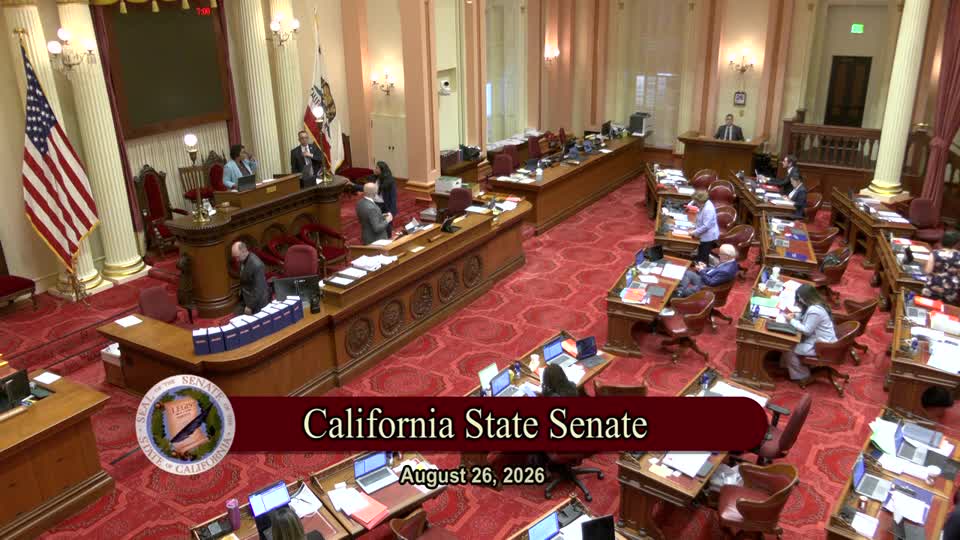 1MIN
Senate Floor
 1MIN
Assembly Floor
 4MIN
Assembly Standing Committee on Utilities and Energy
 13MIN
Assembly Standing Committee on Environmental Safety and Toxic Materials
 1MIN
Senate Floor
 17MIN
Senate Standing Committee on Energy, Utilities and Communications
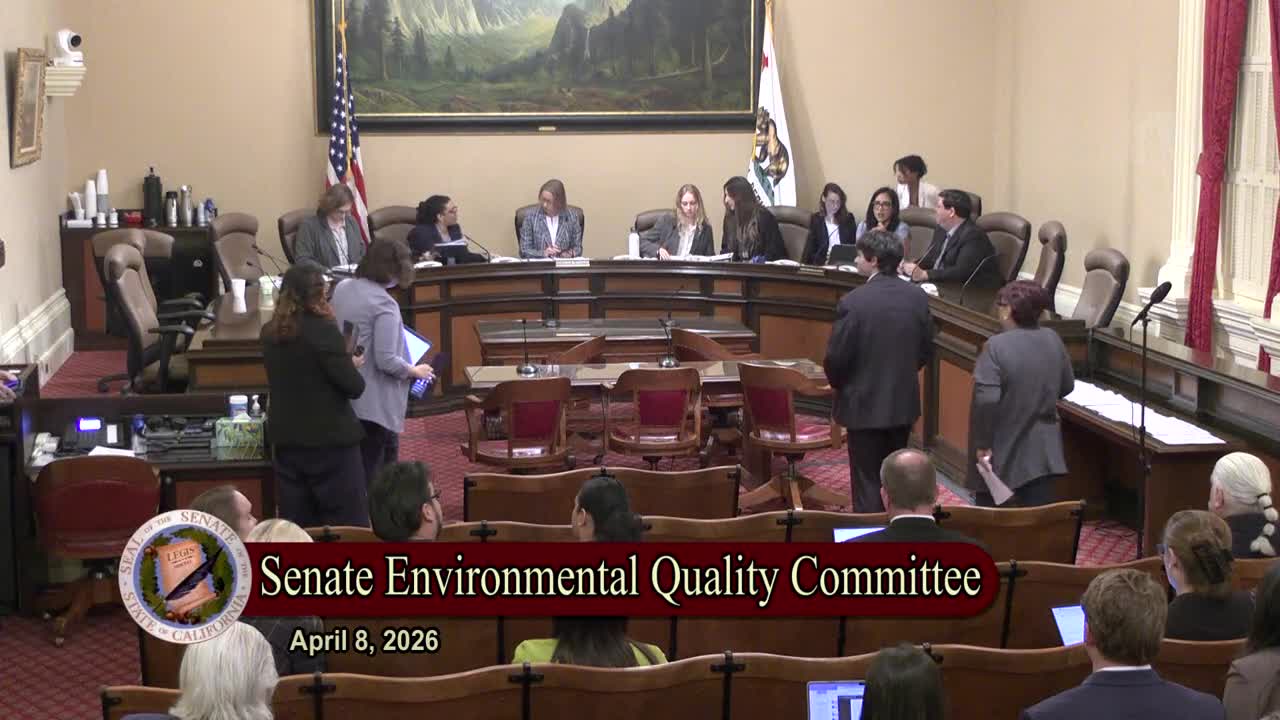 14MIN
Senate Standing Committee on Environmental Quality
Bill Author