SB 1135: California Wildlife Coexistence Act.
- Session Year: 2025-2026
- House: Senate
- Latest Version Date: 2026-09-29
Current Status:
Passed
(2026-09-29: Chaptered by Secretary of State. Chapter 820, Statutes of 2026.)
Introduced
In Committee
Awaiting First Chamber Vote
Passed First Chamber
In Committee
Awaiting Second Chamber Vote
Passed Second Chamber
Enacted
Existing law establishes the Department of Fish and Wildlife in the Natural Resources Agency. Under existing law, the department has jurisdiction over the conservation, protection, and management of fish, wildlife, native plants, and habitat necessary for biologically sustainable populations of those species.
This bill would require the department, upon appropriation by the Legislature, to establish the Wildlife Coexistence Program to manage and promote wildlife coexistence by conducting specified activities, including maintaining a statewide wildlife incident reporting tool. The bill would rename the Wolf-Livestock Compensation Pilot Program to the California Wolf-Livestock Coexistence and Compensation Program and would require the department, upon appropriation by the Legislature, to establish the program to provide resources to eligible participants for purposes relating to wolves and livestock. The bill would authorize the department, upon appropriation by the Legislature, including the cost for implementation, to provide resources to wildlife coexistence partners, as defined, to support efforts required for the Wildlife Coexistence Program and the California Wolf-Livestock Coexistence and Compensation Program. The bill would require the department, upon appropriation by the Legislature, to establish the Wildlife Coexistence Technical Advisory Committee to provide technical guidance, public input, and programmatic recommendations related to the departments wildlife coexistence efforts. The bill would require the department, on or before July 1, 2028, to include specified information on its internet website, as provided.
The California Endangered Species Act prohibits the taking of an endangered or threatened species, except as specified. Under existing law, it is also unlawful to permit or allow any dog to pursue any big game mammal during the closed season on that mammal, to pursue any fully protected, rare, or endangered mammal at any time, to pursue any bear or bobcat at any time, or to pursue any mammal in a game refuge or ecological reserve if hunting within that refuge or ecological reserve is unlawful.
This bill would provide that, notwithstanding those prohibitions, the pursuit of wolves by dogs that are guarding or protecting livestock or crops on property owned, leased, or rented by the owner of the dogs, is not prohibited if the dogs are maintained with, and remain in reasonable proximity to, the livestock or crops being guarded or protected.
Existing law establishes the Department of Fish and Wildlife in the Natural Resources Agency. Under existing law, the department has jurisdiction over the conservation, protection, and management of fish, wildlife, native plants, and habitat necessary for biologically sustainable populations of those species.
This bill would require the department, upon appropriation by the Legislature, to establish the Wildlife Coexistence Program to manage and promote wildlife coexistence by conducting specified activities, including maintaining a statewide wildlife incident reporting tool. The bill would rename the Wolf-Livestock Compensation Pilot Program to the Wolf-Livestock Coexistence and Compensation Program and would require the department, upon appropriation by the Legislature, to establish the program to provide resources to eligible participants for purposes relating to wolves and livestock. The bill would authorize the department, upon appropriation by the Legislature, including the cost for implementation, to provide resources to wildlife coexistence partners, as defined, to support efforts required for the Wildlife Coexistence Program and the Wolf-Livestock Coexistence and Compensation Program. The bill would require the department, upon appropriation by the Legislature, to establish the Wildlife Coexistence Technical Advisory Committee to provide technical guidance, public input, and programmatic recommendations related to the departments wildlife coexistence efforts. The bill would require the department, on or before July 1, 2028, to include specified information on its internet website, as provided.
Existing law establishes the Department of Fish and Wildlife in the Natural Resources Agency. Under existing law, the department has jurisdiction over the conservation, protection, and management of fish, wildlife, native plants, and habitat necessary for biologically sustainable populations of those species.
This bill would require the department, upon appropriation by the Legislature, to establish the Wildlife Coexistence Program to manage and promote wildlife coexistence by conducting specified activities, including maintaining a statewide wildlife incident reporting tool. The bill would rename the California Wolf-Livestock Compensation Pilot Program to the Wolf-Livestock Coexistence and Compensation Program and would require the department, upon appropriation by the Legislature, to establish the program to provide resources to eligible participants for purposes relating to wolves and livestock. The bill would authorize the department, upon appropriation by the Legislature, including the cost for implementation, to provide resources to wildlife coexistence partners, as defined, to support efforts required for the Wildlife Coexistence Program and the Wolf-Livestock Coexistence and Compensation Program. The bill would require the department, upon appropriation by the Legislature, to establish the Wildlife Coexistence Technical Advisory Committee to provide technical guidance, public input, and programmatic recommendations related to the departments wildlife coexistence efforts. The bill would require the department, on or before July 1, 2028, to include specified information on its internet website, as provided.
Existing law establishes the Department of Fish and Wildlife in the Natural Resources Agency. Under existing law, the department has jurisdiction over the conservation, protection, and management of fish, wildlife, native plants, and habitat necessary for biologically sustainable populations of those species.
This bill would state the intent of the Legislature to reestablish and enact a statewide program to manage and promote human and wildlife coexistence. require the department, upon appropriation by the Legislature, to establish the Wildlife Coexistence Program to manage and promote wildlife coexistence by conducting specified activities, including maintaining a statewide wildlife incident reporting tool. The bill would rename the California Wolf-Livestock Compensation Pilot Program to the Wolf-Livestock Coexistence and Compensation Program and would require the department, upon appropriation by the Legislature, to establish the program to provide resources to eligible participants for purposes relating to wolves and livestock. The bill would authorize the department, upon appropriation by the Legislature, including the cost for implementation, to provide resources to wildlife coexistence partners, as defined, to support efforts required for the Wildlife Coexistence Program and the Wolf-Livestock Coexistence and Compensation Program. The bill would require the department, upon appropriation by the Legislature, to establish the Wildlife Coexistence Technical Advisory Committee to provide technical guidance, public input, and programmatic recommendations related to the departments wildlife coexistence efforts. The bill would require the department, on or before July 1, 2028, to include specified information on its internet website, as provided.
Existing law establishes the Department of Fish and Wildlife in the Natural Resources Agency. Under existing law, the department has jurisdiction over the conservation, protection, and management of fish, wildlife, native plants, and habitat necessary for biologically sustainable populations of those species.
This bill would state the intent of the Legislature to reestablish and enact a statewide program to manage and promote human and wildlife coexistence.
No person or public agency shall import into this state, export out of this state, or take, possess, purchase, or sell within this state, any species, or any part or product thereof, that the commission determines to be an endangered species or a threatened species, or attempt any of those acts, except as otherwise provided in this chapter, the Native Plant Protection Act (Chapter 10 (commencing with Section 1900) of Division 2), the California Desert Native Plants Act (Division 23 (commencing with Section 80001) of the Food and Agricultural Code), or Section 3960.7.
SEC. 2.Chapter 14 (commencing with Section 2960) is added to Division 3 of the Fish and Game Code, to read:14.California Wildlife Coexistence Act1.General Provisions2960.This chapter shall be known, and may be cited, as the California Wildlife Coexistence Act.
2961.It is the policy of the state that the management of wildlife shall include an emphasis on the safe coexistence of humans and wildlife through department-led efforts to reduce, minimize, and mitigate conflicts. These efforts shall also seek to align with the states conservation, public safety, environmental planning, and climate adaptation goals and to be accomplished through coordination and cooperation between the department and wildlife coexistence partners.
2962.For purposes of this chapter, wildlife coexistence partners means local, state, and federal agencies, nonprofit organizations, federally recognized tribes, non-federally recognized California Native American tribes included on the contact list maintained by the Native American Heritage Commission, other entities, and academic programs.
2963.The department may adopt regulations to avoid or minimize human-wildlife conflict or to implement the provisions of this chapter.
2.The Wildlife Coexistence Program2965.Upon appropriation by the Legislature, the department shall establish the Wildlife Coexistence Program to manage and promote wildlife coexistence by conducting all of the following activities:
(a)Managing, tracking, and responding to wildlife calls, reports, and incident responses related to human-wildlife conflict, depredation, animal welfare, and wildlife health issues.
(b)Avoiding, minimizing, and mitigating conflicts between humans and wildlife by proactively and continuously implementing best practices that emphasize effective, economically and logistically feasible, and ecologically appropriate nonlethal conflict resolution solutions developed using best available science and indigenous knowledge.
(c)Investigating, documenting, and analyzing reported human-wildlife incidents, including, but not limited to, depredation, perceived or actual human-wildlife conflicts, animal welfare, and wildlife health issues.
(d)Maintaining a statewide wildlife incident reporting tool.
(e)Consistent with existing law, supporting community-based efforts in coordination with wildlife coexistence partners and providing technical assistance, resources, and recommendations.
(f)Conducting ongoing public outreach and education.
(g)Implementing the provisions of this chapter.
2966.Upon appropriation by the Legislature, including the cost for implementation, the department may provide resources to wildlife coexistence partners to support efforts required for the Wildlife Coexistence Program pursuant to Section 2965 and the California Wolf-Livestock Coexistence and Compensation Program pursuant to Section 2970.
2967.On or before July 1, 2028, the department shall include on its internet website, accessible to the public, all of the following information:
(a)The annual number, general locations, and species involved in reported human-wildlife conflicts and department responses pursuant to Section 2965.
(b)An inventory of known types of proactive wildlife coexistence activities available to the department within each region and statewide, including community-based and tribal efforts.
(c)Descriptions of resources provided pursuant to Section 2966, including recipients, regions, and dollar amounts.
(d)Depredation permits issued by species, damage type, and regions.
(e)The outcomes of the California Wolf-Livestock Coexistence and Compensation Program pursuant to Section 2970, including a list of any resources funded by activity, county, and wolf pack.
(f)The department shall update this information each year on or before January 31.
3.The California Wolf-Livestock Coexistence and Compensation Program2970.(a)The Wolf-Livestock Compensation Pilot Program established pursuant to the annual Budget Act of 2021 shall be renamed the California Wolf-Livestock Coexistence and Compensation Program.
(b)Upon appropriation by the Legislature, including the cost for implementation, the department shall establish the California Wolf-Livestock Coexistence and Compensation Program to provide resources to eligible participants for all of the following:
(1)Providing equipment, information, and resources for practices used to proactively and nonlethally deter wolf attacks on livestock.
(2)Compensation for confirmed or probable losses of livestock verified by the department to have been caused by wolves.
(3)Compensation for indirect impacts on livestock from the presence of wolves.
(c)(1)At least 50 percent of the funds appropriated to the program shall be used for purposes of paragraph (1) of subdivision (b).
(2)If the balance of funds for the program falls below one million dollars ($1,000,000), at least 25 percent of the funds appropriated to the program shall be used for purposes of paragraph (1) of subdivision (b).
(3)If the balance falls below one hundred thousand dollars ($100,000), funds appropriated to the program are not required to, but may, be used for purposes of paragraph (1) of subdivision (b).
(d)(1)To be eligible for any resources from the program for the purposes of paragraphs (2) and (3) of subdivision (b), a participant within an area defined by the department as pack territory or an area of wolf activity shall have adopted, implemented, and documented, as practicable, proper and ongoing deployment of proactive, nonlethal conflict reduction measures approved by the department.
(2)Outside an area identified by the department as pack territory or an area of wolf activity, a participant is eligible for program resources for up to two confirmed or probable losses within any 12-month period. Eligibility for compensation for subsequent losses is contingent upon the participant adopting, implementing, and documenting, as practicable, proper and ongoing deployment of proactive, nonlethal conflict reduction measures approved by the department.
(e)In determining eligibility for the program for purposes of subdivision (d), the department shall consider all relevant factors relating to the practicability of adopting, implementing, and documenting proper and ongoing deployment of proactive, nonlethal conflict reduction measures approved by the department, including, but not limited to, the following:
(1)The availability of funds appropriated pursuant to paragraph (1) of subdivision (b).
(2)The costs to a participant of implementing proactive, nonlethal conflict reduction measures.
(3)The extent that routine agricultural practices and animal husbandry practices, or alterations in those practices undertaken in response to the presence of wolves, may represent adequate proactive, nonlethal conflict reduction measures.
(4)The extent that a permittee or lessee is contractually approved to implement certain proactive, nonlethal conflict reduction measures.
(5)The extent that a participant had sufficient time to implement proactive, nonlethal conflict reduction measures before suffering additional losses.
(6)Whether terrain conditions exist that would impede the effectiveness of proactive, nonlethal conflict reduction measures.
4.The Wildlife Coexistence Technical Advisory Committee2975.(a)Upon appropriation by the Legislature, the department shall establish the Wildlife Coexistence Technical Advisory Committee to provide technical guidance, public input, and programmatic recommendations related to the departments wildlife coexistence efforts.
(b)The advisory committee shall advise the department on all of the following:
(1)Best available science, indigenous knowledge, and management practices for reducing human-wildlife conflict.
(2)Development, implementation, and evaluation of wildlife coexistence programs.
(3)Program metrics, data collection standards, and reporting practices.
(4)Equity and geographic balance in program design, resource allocation, and funding distribution.
(5)Opportunities for coordination and collaboration with wildlife coexistence partners.
(c)The advisory committee shall consist of no fewer than 11 and no more than 15 members, appointed by the director, representing expertise or experience in one or more of the following areas, with no more than two people from each category:
(1)Public safety.
(2)Wildlife biology or ecology.
(3)Human-wildlife conflict mitigation or coexistence practices.
(4)Tribal natural resource management or indigenous knowledge.
(5)Conservation or environmental interests.
(6)Rural community.
(7)Agricultural interests.
(8)Animal behavior or veterinary science.
(9)Land management or wildlife connectivity.
(10)Urban community or local government interests.
(11)Wildlife rehabilitation.
(d)Members shall serve three-year terms and may be reappointed. Initial appointments may include shorter terms to ensure staggering.
(e)Members of the advisory committee shall serve without compensation.
(f)The advisory committee shall meet at least twice per year, or more frequently at the request of the department.
(g)The department shall consider, but is not required to adopt, recommendations made by the advisory committee.
SEC. 3.Section 3960.7 is added to the Fish and Game Code, to read:3960.7.Notwithstanding Section 3960, the pursuit of wolves by dogs that are guarding or protecting livestock or crops on property owned, leased, or rented by the owner of the dogs, is not prohibited if the dogs are maintained with, and remain in reasonable proximity to, the livestock or crops being guarded or protected.
No person or public agency shall import into this state, export out of this state, or take, possess, purchase, or sell within this state, any species, or any part or product thereof, that the commission determines to be an endangered species or a threatened species, or attempt any of those acts, except as otherwise provided in this chapter, the Native Plant Protection Act (Chapter 10 (commencing with Section 1900) of this code), or Division 2), the California Desert Native Plants Act (Division 23 (commencing with Section 80001) of the Food and Agricultural Code). Code), or Section 3960.7.
SECTION 1.SEC. 2.Chapter 14 (commencing with Section 2960) is added to Division 3 of the Fish and Game Code, to read:14.California Wildlife Coexistence Act1.General Provisions2960.This chapter shall be known, and may be cited, as the California Wildlife Coexistence Act.
2961.It is the policy of the state that the management of wildlife shall include an emphasis on the safe coexistence of humans and wildlife through department-led efforts to reduce, minimize, and mitigate conflicts. These efforts shall also seek to align with the states conservation, public safety, environmental planning, and climate adaptation goals and to be accomplished through coordination and cooperation between the department and wildlife coexistence partners.
2962.For purposes of this chapter, wildlife coexistence partners means local, state, and federal agencies, nonprofit organizations, federally recognized tribes, non-federally recognized California Native American tribes included on the contact list maintained by the Native American Heritage Commission, other entities, and academic programs.
2963.The department may adopt regulations to avoid or minimize human-wildlife conflict or to implement the provisions of this chapter.
2.The Wildlife Coexistence Program2963.2965.Upon appropriation by the Legislature, the department shall establish the Wildlife Coexistence Program to manage and promote wildlife coexistence by conducting all of the following activities:
(a)Managing, tracking, and responding to wildlife conflict calls, reports, and incident responses. responses related to human-wildlife conflict, depredation, animal welfare, and wildlife health issues.
(b)Avoiding, minimizing, and mitigating conflicts between humans and wildlife by proactively and continuously implementing best practices that emphasize effective effective, economically and logistically feasible, and ecologically appropriate nonlethal conflict resolution solutions developed using best available science and indigenous knowledge.
(c)Investigating, documenting, and analyzing reported human-wildlife incidents, including, but not limited to, depredation, perceived or actual human-wildlife conflicts, animal welfare, and wildlife health issues.
(d)Maintaining a statewide wildlife incident reporting tool.
(e)Consistent with existing law, supporting community-based efforts in coordination with wildlife coexistence partners and providing technical assistance, resources, and recommendations.
(f)Conducting ongoing public outreach and education.
(g)Implementing the provisions of this chapter.
2964.2966.Upon appropriation by the Legislature, including the cost for implementation, the department may provide resources to wildlife coexistence partners to support efforts required for the Wildlife Coexistence Program pursuant to Section 2963 2965 and the California Wolf-Livestock Coexistence and Compensation Program pursuant to Section 2966. 2970.
2965.2967.On or before July 1, 2028, the department shall include on its internet website, accessible to the public, all of the following: following information:
(a)The annual number, general locations, and species involved in reported human-wildlife conflicts and department responses pursuant to Section 2963. 2965.
(b)An inventory of known types of proactive wildlife coexistence activities available to the department within each region and statewide, including community-based and tribal efforts.
(c)Descriptions of resources provided pursuant to Section 2964, 2966, including recipients, regions, and dollar amounts.
(d)Depredation permits issued by species species, damage type, and regions.
(e)The outcomes of the California Wolf-Livestock Coexistence and Compensation Program pursuant to Section 2966, 2970, including a list of any resources funded by activity, county, and wolf pack.
(f)The department shall update this information each year on or before January 31.
3.The California Wolf-Livestock Coexistence and Compensation Program2966.2970.(a)The Wolf-Livestock Compensation Pilot Program established pursuant to the annual Budget Act of 2021 shall be renamed the California Wolf-Livestock Coexistence and Compensation Program.
(b)Upon appropriation by the Legislature, including the cost for implementation, the department shall establish the California Wolf-Livestock Coexistence and Compensation Program to provide resources to eligible participants for all of the following:
(1)Providing equipment, information, and resources for practices used to proactively and nonlethally deter wolf attacks on livestock.
(2)Compensation for confirmed or probable losses of livestock verified by the department to have been caused by wolves.
(3)Compensation for indirect impacts on livestock from the presence of wolves.
(c)(1)At least 50 percent of the funds appropriated to the program shall be used for purposes of paragraph (1) of subdivision (b).
(2)If the balance of funds for the program falls below one million dollars ($1,000,000), at least 25 percent of the funds appropriated to the program shall be used for purposes of paragraph (1) of subdivision (b).
(3)If the balance falls below one hundred thousand dollars ($100,000), funds appropriated to the program are not required to, but may, be used for purposes of paragraph (1) of subdivision (b).
(d)(1)To be eligible for any resources from the program for the purposes of paragraphs (2) and (3) of subdivision (b), a participant within an area defined by the department as pack territory or an area of wolf activity shall have adopted, implemented, and documented, as practicable, proper and ongoing deployment of proactive, nonlethal conflict reduction measures approved by the department.
(2)Outside an area identified by the department as pack territory or an area of wolf activity, a participant is eligible for program resources for up to two confirmed or probable losses within any 12-month period. Eligibility for compensation for subsequent losses is contingent upon the participant adopting, implementing, and documenting, as practicable, proper and ongoing deployment of proactive, nonlethal conflict reduction measures approved by the department.
(e)In determining eligibility for the program for purposes of subdivision (d), the department shall consider all relevant factors relating to the practicability of adopting, implementing, and documenting proper and ongoing deployment of proactive, nonlethal conflict reduction measures approved by the department, including, but not limited to, the following:
(1)The availability of funds appropriated pursuant to paragraph (1) of subdivision (b).
(2)The costs to a participant of implementing proactive, nonlethal conflict reduction measures.
(3)The extent that routine agricultural practices and animal husbandry practices, or alterations in those practices undertaken in response to the presence of wolves, may represent adequate proactive, nonlethal conflict reduction measures.
(4)The extent that a permittee or lessee is contractually approved to implement certain proactive, nonlethal conflict reduction measures.
(5)The extent that a participant had sufficient time to implement proactive, nonlethal conflict reduction measures before suffering additional losses.
(6)Whether terrain conditions exist that would impede the effectiveness of proactive, nonlethal conflict reduction measures.
4.The Wildlife Coexistence Technical Advisory Committee2967.2975.(a)Upon appropriation by the Legislature, the department shall establish the Wildlife Coexistence Technical Advisory Committee to provide technical guidance, public input, and programmatic recommendations related to the departments wildlife coexistence efforts.
(b)The advisory committee shall advise the department on all of the following:
(1)Best available science, indigenous knowledge, and management practices for reducing human-wildlife conflict.
(2)Development, implementation, and evaluation of wildlife coexistence programs.
(3)Program metrics, data collection standards, and reporting practices.
(4)Equity and geographic balance in program design design, resource allocation, and funding distribution.
(5)Opportunities for coordination and collaboration with wildlife coexistence partners.
(c)The advisory committee shall consist of no fewer than 11 and no more than 15 members, appointed by the director, representing expertise or experience in one or more of the following areas, with no more than two people from each category:
(1)Public safety.
(1)(2)Wildlife biology or ecology.
(2)(3)Human-wildlife conflict mitigation or coexistence practices.
(3)(4)Tribal natural resource management. management or indigenous knowledge.
(4)(5)Conservation or environmental science. interests.
(5)(6)Rural community.
(6)(7)Agricultural interests.
(7)(8)Animal behavior or veterinary science.
(8)(9)Land management. management or wildlife connectivity.
(9)(10)Urban community. community or local government interests.
(11)Wildlife rehabilitation.
(d)Members shall serve three-year terms and may be reappointed. Initial appointments may include shorter terms to ensure staggering.
(e)Members of the advisory committee shall serve without compensation.
(f)The advisory committee shall meet at least twice per year, or more frequently at the request of the department.
(g)The department shall consider, but is not required to adopt, recommendations made by the advisory committee.
SEC. 3.Section 3960.7 is added to the Fish and Game Code, to read:3960.7.Notwithstanding Section 3960, the pursuit of wolves by dogs that are guarding or protecting livestock or crops on property owned, leased, or rented by the owner of the dogs, is not prohibited if the dogs are maintained with, and remain in reasonable proximity to, the livestock or crops being guarded or protected.
This chapter shall be known, and may be cited, as the California Wildlife Coexistence Act.
2961.It is the policy of the state that the management of wildlife shall include an emphasis on the coexistence of humans and wildlife through department-led efforts to reduce, minimize, and mitigate conflicts. These efforts shall also seek to align with the states conservation, public safety, environmental planning, and climate adaptation goals and to be accomplished through coordination and cooperation between the department and wildlife coexistence partners.
2962.For purposes of this chapter, wildlife coexistence partners means local, state, and federal agencies, nonprofit organizations, federally recognized tribes, non-federally recognized California Native American tribes included on the contact list maintained by the Native American Heritage Commission, other entities, and academic programs.
2.The Wildlife Coexistence Program2963.Upon appropriation by the Legislature, the department shall establish the Wildlife Coexistence Program to manage and promote wildlife coexistence by conducting all of the following activities:
(a)Managing, tracking, and responding to wildlife conflict calls, reports, and incident responses.
(b)Avoiding, minimizing, and mitigating conflicts between humans and wildlife by proactively and continuously implementing best practices that emphasize effective and ecologically appropriate nonlethal conflict resolution solutions developed using best available science and indigenous knowledge.
(c)Investigating, documenting, and analyzing reported human-wildlife incidents, including, but not limited to, depredation, perceived or actual human-wildlife conflicts, and wildlife health issues.
(d)Maintaining a statewide wildlife incident reporting tool.
(e)Consistent with existing law, supporting community-based efforts in coordination with wildlife coexistence partners and providing technical assistance, resources, and recommendations.
(f)Conducting ongoing public outreach and education.
(g)Implementing the provisions of this chapter.
2964.Upon appropriation by the Legislature, including the cost for implementation, the department may provide resources to wildlife coexistence partners to support efforts required for the Wildlife Coexistence Program pursuant to Section 2963 and the Wolf-Livestock Coexistence and Compensation Program pursuant to Section 2966.
2965.On or before July 1, 2028, the department shall include on its internet website, accessible to the public, all of the following:
(a)The annual number, general locations, and species involved in reported human-wildlife conflicts and department responses pursuant to Section 2963.
(b)An inventory of known types of proactive wildlife coexistence activities within each region and statewide, including community-based and tribal efforts.
(c)Descriptions of resources provided pursuant to Section 2964, including recipients, regions, and dollar amounts.
(d)Depredation permits issued by species and regions.
(e)The outcomes of the Wolf-Livestock Coexistence and Compensation Program pursuant to Section 2966, including a list of any resources funded by activity, county, and wolf pack.
3.The Wolf-Livestock Coexistence and Compensation Program2966.(a)The Wolf-Livestock Compensation Pilot Program established pursuant to the annual Budget Act of 2021 shall be renamed the Wolf-Livestock Coexistence and Compensation Program.
(b)Upon appropriation by the Legislature, including the cost for implementation, the department shall establish the Wolf-Livestock Coexistence and Compensation Program to provide resources to eligible participants for all of the following:
(1)Providing equipment, information, and resources for practices used to proactively and nonlethally deter wolf attacks on livestock.
(2)Compensation for confirmed or probable losses of livestock verified by the department to have been caused by wolves.
(3)Compensation for indirect impacts on livestock from the presence of wolves.
(c)(1)At least 50 percent of the funds appropriated to the program shall be used for purposes of paragraph (1) of subdivision (b).
(2)If the balance of funds for the program falls below one million dollars ($1,000,000), at least 25 percent of the funds appropriated to the program shall be used for purposes of paragraph (1) of subdivision (b).
(3)If the balance falls below one hundred thousand dollars ($100,000), funds appropriated to the program are not required to, but may be, may, be used for purposes of paragraph (1) of subdivision (b).
(d)(1)To be eligible for any resources from the program for the purposes of paragraphs (2) and (3) of subdivision (b), a participant within an area defined by the department as pack territory or an area of wolf activity shall have adopted, implemented, and documented, as practicable, proper and ongoing deployment of proactive, nonlethal conflict reduction measures approved by the department.
(2)Outside an area identified by the department as pack territory or an area of wolf activity, a participant is eligible for program resources for up to two confirmed or probable losses within any 12-month period. Eligibility for compensation for subsequent losses is contingent upon the participant adopting, implementing, and documenting, as practicable, proper and ongoing deployment of proactive, nonlethal conflict reduction measures approved by the department.
(e)In determining eligibility for the program for purposes of subdivision (d), the department shall consider all relevant factors relating to the practicability of adopting, implementing, and documenting proper and ongoing deployment of proactive, nonlethal conflict reduction measures approved by the department, including, but not limited to, the following:
(1)The availability of funds appropriated pursuant to paragraph (1) of subdivision (b).
(2)The costs to a participant of implementing proactive, nonlethal conflict reduction measures.
(3)The extent that routine agricultural practices and animal husbandry practices, or alterations in those practices undertaken in response to the presence of wolves, may represent adequate proactive, nonlethal conflict reduction measures.
(4)The extent that a permittee or lessee is contractually approved to implement certain proactive, nonlethal conflict reduction measures.
(5)The extent that a participant had sufficient time to implement proactive, nonlethal conflict reduction measures before suffering additional losses.
(6)Whether terrain conditions exist that would impede the effectiveness of proactive, nonlethal conflict reduction measures.
4.The Wildlife Coexistence Technical Advisory Committee2967.(a)Upon appropriation by the Legislature, the department shall establish the Wildlife Coexistence Technical Advisory Committee to provide technical guidance, public input, and programmatic recommendations related to the departments wildlife coexistence efforts.
(b)The advisory committee shall advise the department on all of the following:
(1)Best available science, indigenous knowledge, and management practices for reducing human-wildlife conflict.
(2)Development, implementation, and evaluation of coexistence programs.
(3)Program metrics, data collection standards, and reporting practices.
(4)Equity and geographic balance in program design and funding distribution.
(5)Opportunities for coordination with wildlife coexistence partners.
(c)The advisory committee shall consist of no fewer than 11 and no more than 15 members, appointed by the director, representing expertise or experience in one or more of the following areas, with no more than two people from each category:
(1)Wildlife biology or ecology.
(2)Human-wildlife conflict mitigation or coexistence practices.
(3)Tribal natural resource management.
(4)Conservation or environmental science.
(5)Rural community.
(6)Agricultural interests.
(7)Animal behavior or veterinary science.
(8)Land management.
(9)Urban community.
(d)Members shall serve three-year terms and may be reappointed. Initial appointments may include shorter terms to ensure staggering.
(e)Members of the advisory committee shall serve without compensation.
(f)The advisory committee shall meet at least twice per year, or more frequently at the request of the department.
(g)The department shall consider, but is not required to adopt, recommendations made by the advisory committee.
This chapter shall be known, and may be cited, as the California Wildlife Coexistence Act.
2961.It is the policy of the state that the management of wildlife shall include an emphasis on the coexistence of humans and wildlife through department-led efforts to reduce, minimize, and mitigate conflicts. These efforts shall also seek to align with the states conservation, public safety, environmental planning, and climate adaptation goals and to be accomplished through coordination and cooperation between the department and wildlife coexistence partners.
2962.For purposes of this chapter, wildlife coexistence partners means local, state, and federal agencies, nonprofit organizations, federally recognized tribes, non-federally recognized California Native American tribes included on the contact list maintained by the Native American Heritage Commission, other entities, and academic programs.
2.The Wildlife Coexistence Program2963.Upon appropriation by the Legislature, the department shall establish the Wildlife Coexistence Program to manage and promote wildlife coexistence by conducting all of the following activities:
(a)Managing, tracking, and responding to wildlife conflict calls, reports, and incident responses.
(b)Avoiding, minimizing, and mitigating conflicts between humans and wildlife by proactively and continuously implementing best practices that emphasize effective and ecologically appropriate nonlethal conflict resolution solutions developed using best available science and indigenous knowledge.
(c)Investigating, documenting, and analyzing reported human-wildlife incidents, including, but not limited to, depredation, perceived or actual human-wildlife conflicts, and wildlife health issues.
(d)Maintaining a statewide wildlife incident reporting tool.
(e)Consistent with existing law, supporting community-based efforts in coordination with wildlife coexistence partners and providing technical assistance, resources, and recommendations.
(f)Conducting ongoing public outreach and education.
(g)Implementing the provisions of this chapter.
2964.Upon appropriation by the Legislature, including the cost for implementation, the department may provide resources to wildlife coexistence partners to support efforts required for the Wildlife Coexistence Program pursuant to Section 2963 and the Wolf-Livestock Coexistence and Compensation Program pursuant to Section 2966.
2965.On or before July 1, 2028, the department shall include on its internet website, accessible to the public, all of the following:
(a)The annual number, general locations, and species involved in reported human-wildlife conflicts and department responses pursuant to Section 2963.
(b)An inventory of known types of proactive wildlife coexistence activities within each region and statewide, including community-based and tribal efforts.
(c)Descriptions of resources provided pursuant to Section 2964, including recipients, regions, and dollar amounts.
(d)Depredation permits issued by species and regions.
(e)The outcomes of the Wolf-Livestock Coexistence and Compensation Program pursuant to Section 2966, including a list of any resources funded by activity, county, and wolf pack.
3.The Wolf-Livestock Coexistence and Compensation Program2966.(a)The California Wolf-Livestock Compensation Pilot Program established pursuant to the annual Budget Act of 2021 shall be renamed the Wolf-Livestock Coexistence and Compensation Program.
(b)Upon appropriation by the Legislature, including the cost for implementation, the department shall establish the Wolf-Livestock Coexistence and Compensation Program to provide resources to eligible participants for all of the following:
(1)Providing equipment and information on equipment, information, and resources for practices used to proactively and nonlethally deter wolf attacks on livestock.
(2)Compensation for confirmed or provable probable losses of livestock verified by the department to have been caused by wolves.
(3)Compensation for indirect impacts on livestock from the presence of wolves.
(c)(1)At least 50 percent of the funds appropriated to the program shall be used for purposes of paragraph (1) of subdivision (b).
(2)If the balance of funds for the program falls below one million dollars ($1,000,000), at least 25 percent of the funds appropriated to the program shall be used for purposes of paragraph (1) of subdivision (b).
(3)If the balance falls below one hundred thousand dollars ($100,000), funds appropriated to the program are not required to, but may be, used for purposes of paragraph (1) of subdivision (b).
(d)(1)To be eligible for any resources from the program for the purposes of paragraphs (2) and (3) of subdivision (b), a participant within an area defined by the department as pack territory or an area of wolf activity shall have adopted, implemented, and documented documented, as practicable, proper and ongoing deployment of proactive, nonlethal conflict reduction measures approved by the department.
(2)Outside an area identified by the department as pack territory or an area of wolf activity, a participant is eligible for program resources for up to two confirmed or probable losses within any 12-month period. Eligibility for compensation for subsequent losses is contingent upon the participant adopting, implementing, and documenting, as practicable, proper and ongoing deployment of proactive, nonlethal conflict reduction measures approved by the department.
(e)In determining eligibility for the program for purposes of subdivision (d), the department shall consider all relevant factors relating to the practicability of adopting, implementing, and documenting proper and ongoing deployment of proactive, nonlethal conflict reduction measures approved by the department, including, but not limited to, the following:
(1)The availability of funds appropriated pursuant to paragraph (1) of subdivision (b).
(2)The costs to a participant of implementing proactive, nonlethal conflict reduction measures.
(3)The extent that routine agricultural practices and animal husbandry practices, or alterations in those practices undertaken in response to the presence of wolves, may represent adequate proactive, nonlethal conflict reduction measures.
(4)The extent that a permittee or lessee is contractually approved to implement certain proactive, nonlethal conflict reduction measures.
(5)The extent that a participant had sufficient time to implement proactive, nonlethal conflict reduction measures before suffering additional losses.
(6)Whether terrain conditions exist that would impede the effectiveness of proactive, nonlethal conflict reduction measures.
4.The Wildlife Coexistence Technical Advisory Committee2967.(a)Upon appropriation by the Legislature, the department shall establish the Wildlife Coexistence Technical Advisory Committee to provide technical guidance, public input, and programmatic recommendations related to the departments wildlife coexistence efforts.
(b)The advisory committee shall advise the department on all of the following:
(1)Best available science, indigenous knowledge, and management practices for reducing human-wildlife conflict.
(2)Development, implementation, and evaluation of coexistence programs.
(3)Program metrics, data collection standards, and reporting practices.
(4)Equity and geographic balance in program design and funding distribution.
(5)Opportunities for coordination with wildlife coexistence partners.
(c)The advisory committee shall consist of no fewer than 11 and no more than 15 members, appointed by the director, representing expertise or experience in one or more of the following areas, with no more than two people from each category:
(1)Wildlife biology or ecology.
(2)Human-wildlife conflict mitigation or coexistence practices.
(3)Tribal natural resource management.
(4)Conservation or environmental science.
(5)Rural community or agricultural community.
(6)Agricultural interests.
(6)(7)Animal behavior or veterinary science.
(7)(8)Land management.
(8)(9)Urban community.
(d)Members shall serve three-year terms and may be reappointed. Initial appointments may include shorter terms to ensure staggering.
(e)Members of the advisory committee shall serve without compensation.
(f)The advisory committee shall meet at least twice per year, or more frequently at the request of the department.
(g)The department shall consider, but is not required to adopt, recommendations made by the advisory committee.
This chapter shall be known, and may be cited, as the California Wildlife Coexistence Act.
2961.It is the policy of the state that the management of wildlife shall include an emphasis on the coexistence of humans and wildlife through department-led efforts to reduce, minimize, and mitigate conflicts. These efforts shall also seek to align with the states conservation, public safety, environmental planning, and climate adaptation goals and to be accomplished through coordination and cooperation between the department and wildlife coexistence partners.
2962.For purposes of this chapter, wildlife coexistence partners means local, state, and federal agencies, nonprofit organizations, federally recognized tribes, non-federally recognized California Native American tribes included on the contact list maintained by the Native American Heritage Commission, other entities, and academic programs.
2.The Wildlife Coexistence Program2963.Upon appropriation by the Legislature, the department shall establish the Wildlife Coexistence Program to manage and promote wildlife coexistence by conducting all of the following activities:
(a)Managing, tracking, and responding to wildlife conflict calls, reports, and incident responses.
(b)Avoiding, minimizing, and mitigating conflicts between humans and wildlife by proactively and continuously implementing best practices that emphasize effective and ecologically appropriate nonlethal conflict resolution solutions developed using best available science and indigenous knowledge.
(c)Investigating, documenting, and analyzing reported human-wildlife incidents, including, but not limited to, depredation, perceived or actual human-wildlife conflicts, and wildlife health issues.
(d)Maintaining a statewide wildlife incident reporting tool.
(e)Consistent with existing law, supporting community-based efforts in coordination with wildlife coexistence partners and providing technical assistance, resources, and recommendations.
(f)Conducting ongoing public outreach and education.
(g)Implementing the provisions of this chapter.
2964.Upon appropriation by the Legislature, including the cost for implementation, the department may provide resources to wildlife coexistence partners to support efforts required for the Wildlife Coexistence Program pursuant to Section 2963 and the Wolf-Livestock Coexistence and Compensation Program pursuant to Section 2966.
2965.On or before July 1, 2028, the department shall include on its internet website, accessible to the public, all of the following:
(a)The annual number, general locations, and species involved in reported human-wildlife conflicts and department responses pursuant to Section 2963.
(b)An inventory of known types of proactive wildlife coexistence activities within each region and statewide, including community-based and tribal efforts.
(c)Descriptions of resources provided pursuant to Section 2964, including recipients, regions, and dollar amounts.
(d)Depredation permits issued by species and regions.
(e)The outcomes of the Wolf-Livestock Coexistence and Compensation Program pursuant to Section 2966, including a list of any resources funded by activity, county, and wolf pack.
3.The Wolf-Livestock Coexistence and Compensation Program2966.(a)The California Wolf-Livestock Compensation Pilot Program established pursuant to the annual Budget Act of 2021 shall be renamed the Wolf-Livestock Coexistence and Compensation Program.
(b)Upon appropriation by the Legislature, including the cost for implementation, the department shall establish the Wolf-Livestock Coexistence and Compensation Program to provide resources to eligible participants for all of the following:
(1)Providing equipment and information on practices used to proactively and nonlethally deter wolf attacks on livestock.
(2)Compensation for confirmed or provable losses of livestock verified by the department to have been caused by wolves.
(3)Compensation for indirect impacts on livestock from the presence of wolves.
(c)At least 50 percent of the funds appropriated to the program shall be used for purposes of paragraph (1) of subdivision (b).
(d)To be eligible for any resources from the program for the purposes of paragraphs (2) and (3) of subdivision (b), a participant shall have adopted, implemented, and documented proper and ongoing deployment of proactive, nonlethal conflict reduction measures approved by the department.
4.The Wildlife Coexistence Technical Advisory Committee2967.(a)Upon appropriation by the Legislature, the department shall establish the Wildlife Coexistence Technical Advisory Committee to provide technical guidance, public input, and programmatic recommendations related to the departments wildlife coexistence efforts.
(b)The advisory committee shall advise the department on all of the following:
(1)Best available science, indigenous knowledge, and management practices for reducing human-wildlife conflict.
(2)Development, implementation, and evaluation of coexistence programs.
(3)Program metrics, data collection standards, and reporting practices.
(4)Equity and geographic balance in program design and funding distribution.
(5)Opportunities for coordination with wildlife coexistence partners.
(c)The advisory committee shall consist of no fewer than 11 and no more than 15 members, appointed by the director, representing expertise or experience in one or more of the following areas, with no more than two people from each category:
(1)Wildlife biology or ecology.
(2)Human-wildlife conflict mitigation or coexistence practices.
(3)Tribal natural resource management.
(4)Conservation or environmental science.
(5)Rural community or agricultural interests.
(6)Animal behavior or veterinary science.
(7)Land management.
(8)Urban community.
(d)Members shall serve three-year terms and may be reappointed. Initial appointments may include shorter terms to ensure staggering.
(e)Members of the advisory committee shall serve without compensation.
(f)The advisory committee shall meet at least twice per year, or more frequently at the request of the department.
(g)The department shall consider, but is not required to adopt, recommendations made by the advisory committee.
SECTION 1.Chapter 8.5 (commencing with Section 1810) is added to Division 2 of the Fish and Game Code, to read:8.5.Wildlife Coexistence1810.It is the intent of the Legislature to reestablish and enact a statewide program to manage and promote human and wildlife coexistence.It is the intent of the Legislature to reestablish and enact a statewide program to manage and promote human and wildlife coexistence.
|
Date
|
Status
|
|---|---|
| Sep 29, 2026 | Chaptered by Secretary of State. Chapter 820, Statutes of 2026. |
| Sep 29, 2026 | Approved by the Governor. |
| Aug 31, 2026 | Enrolled and presented to the Governor at 6 p.m. |
| Aug 26, 2026 | Assembly amendments concurred in. (Ayes 31. Noes 9. Page 5853.) Ordered to engrossing and enrolling. |
| Aug 26, 2026 | Assembly amendments concurred in. (Ayes 31. Noes 9.) Ordered to engrossing and enrolling. |
| Aug 19, 2026 | In Senate. Concurrence in Assembly amendments pending. |
| Aug 19, 2026 | Read third time. Passed. (Ayes 58. Noes 17. Page 6269.) Ordered to the Senate. |
| Aug 19, 2026 | Read third time. Passed. Ordered to the Senate. |
| Aug 17, 2026 | Read second time. Ordered to third reading. |
| Aug 13, 2026 | Read second time and amended. Ordered to second reading. |
| Aug 13, 2026 | From committee: Do pass as amended. (Ayes 11. Noes 4.) (August 13). |
| Aug 13, 2026 | Assembly Rule 63 suspended. |
| Aug 5, 2026 | August 5 set for first hearing. Placed on suspense file. |
| Jun 30, 2026 | From committee: Do pass and re-refer to Com. on APPR. (Ayes 8. Noes 2.) (June 30). Re-referred to Com. on APPR. |
| Jun 3, 2026 | From committee with author's amendments. Read second time and amended. Re-referred to Com. on W., P., & W. |
| Jun 1, 2026 | Referred to Com. on W., P., & W. |
| May 22, 2026 | In Assembly. Read first time. Held at Desk. |
| May 22, 2026 | Read third time. Passed. (Ayes 29. Noes 2. Page 4416.) Ordered to the Assembly. |
| May 22, 2026 | Read third time. Passed. (Ayes 29. Noes 2.) Ordered to the Assembly. |
| May 19, 2026 | Read second time. Ordered to third reading. |
| May 18, 2026 | Ordered to second reading. |
| May 18, 2026 | Read third time and amended. |
| May 14, 2026 | From committee: Do pass. (Ayes 6. Noes 1. Page 4266.) (May 14). |
| May 14, 2026 | Read second time. Ordered to third reading. |
| May 14, 2026 | From committee: Do pass. (Ayes 6. Noes 1.) (May 14). |
| May 8, 2026 | Set for hearing May 14. |
| Apr 27, 2026 | April 27 hearing: Placed on APPR. suspense file. |
| Apr 17, 2026 | Set for hearing April 27. |
| Apr 14, 2026 | From committee: Do pass and re-refer to Com. on APPR. (Ayes 5. Noes 1. Page 3870.) (April 14). Re-referred to Com. on APPR. |
| Apr 14, 2026 | From committee: Do pass and re-refer to Com. on APPR. (Ayes 5. Noes 1.) (April 14). Re-referred to Com. on APPR. |
| Apr 9, 2026 | Set for hearing April 14. |
| Apr 8, 2026 | Re-referred to Com. on N.R. & W. |
| Mar 23, 2026 | From committee with author's amendments. Read second time and amended. Re-referred to Com. on RLS. |
| Feb 26, 2026 | Referred to Com. on RLS. |
| Feb 18, 2026 | From printer. May be acted upon on or after March 20. |
| Feb 17, 2026 | Introduced. Read first time. To Com. on RLS. for assignment. To print. |
|
Date
|
Description
|
Location
|
Votes
|
|
|---|---|---|---|---|
| Aug 26, 2026 | Unfinished Business SB1135 Blakespear et al. Concurrence | Senate Floor |
Passed |
|
| Aug 19, 2026 | SB 1135 Blakespear Senate Third Reading By Rogers | Assembly Floor |
Passed |
|
| Aug 13, 2026 | Do pass as amended. | Assembly Standing Committee on Appropriations |
Passed |
|
| Jun 30, 2026 | Do pass and be re-referred to the Committee on [Appropriations] | Assembly Standing Committee on Water, Parks, and Wildlife |
Passed |
|
| May 22, 2026 | Senate 3rd Reading SB1135 Blakespear | Senate Floor |
Passed |
|
| May 14, 2026 | Do pass | Senate Standing Committee on Appropriations |
Passed |
|
| Apr 27, 2026 | Placed on suspense file | Senate Standing Committee on Appropriations |
Passed |
|
| Apr 14, 2026 | Do pass, but first be re-referred to the Committee on [Appropriations] | Senate Standing Committee on Natural Resources and Water |
Passed |
This list shows positions taken on this bill by organizations on the date displayed, which is linked to the original source.
Positions by individuals are not included.
|
Organization
|
Position
|
Date
|
|---|---|---|
| American River Conservancy | ** Support | |
| American River Conservancy | ** Support | |
| Animal Legal Defense Fund | ** Support | |
| Animal Legal Defense Fund | ** Support | |
| Animal Welfare Institute | ** Support | |
| Animal Welfare Institute | ** Support | |
| Audubon California | ** Support | |
| Audubon California | ** Support | |
| Brooke Laine, El Dorado County Supervisor, District 5 | ** Support | |
| California Association Of Zoos And Aquariums | ** Support | |
| California Association Of Zoos And Aquariums | ** Support | |
| California Cattlemen’s Association | ** Against | |
| California Farm Bureau | ** Against | |
| California Native Plant Society | ** Support | |
| California Native Plant Society, Alta Bates Chapter | ** Support | |
| California Native Plant Society, Alta Bates Chapter | ** Support | |
| California Native Plant Society, Alta Peak Chapter | ** Support | |
| california rifle & pistol association | ** Against | |
| california rifle & pistol association | ** Against | |
| California State Association Of Counties | ** Support | |
| California State Association Of Counties | ** Support | |
| California Wolf Foundation | ** Support | |
| California Wolf Foundation | ** Support | |
| Center For Biological Diversity | ** Support | |
| Center For Biological Diversity | ** Support | |
| Center For Environmental Health | ** Support | |
| Center For Environmental Health | ** Support | |
| Citizens for Los Angeles Wildlife | ** Support | |
| Citizens for Los Angeles Wildlife | ** Support | |
| cleanearth4kids.org | ** Support | |
| cleanearth4kids.org | ** Support | |
| County of Nevada | ** Support | |
| County of Nevada | ** Support | |
| County Of Placer | ** Support | |
| County Of Placer | ** Support | |
| Defenders Of Wildlife | ** Support | |
| Defenders Of Wildlife | ** Support | |
| Eastern Sierra Land Trust | ** Support | |
| Eastern Sierra Land Trust | ** Support | |
| Endangered Habitats League | ** Support | |
| Endangered Habitats League | ** Support | |
| Environmental Center of San Diego | ** Support | |
| Environmental Center of San Diego | ** Support | |
| Environmental Protection Information Center | ** Support | |
| Environmental Protection Information Center | ** Support | |
| Feather River Land Trust | ** Support | |
| Feather River Land Trust | ** Support | |
| Friends of Rose Creek | ** Support | |
| Friends of Rose Creek | ** Support | |
| Humane World for Animals | ** Support | |
| Humane World for Animals | ** Support | |
| In Defense of Animals | ** Support | |
| In Defense of Animals | ** Support | |
| Los Cerritos Wetlands Land Trust | ** Support | |
| Los Cerritos Wetlands Land Trust | ** Support | |
| Los Padres ForestWatch | ** Support | |
| Los Padres ForestWatch | ** Support | |
| Mid Peninsula Regional Open Space District | ** Support | |
| Mid Peninsula Regional Open Space District | ** Support | |
| Mountain Lion Foundation | ** Support | |
| Mountain Lion Foundation | ** Support | |
| National Parks Conservation Association | ** Support | |
| National Parks Conservation Association | ** Support | |
| National Wildlife Federation | ** Support | |
| National Wildlife Federation | ** Support | |
| National Wildlife Federation (co-sponsor) | ** Support | |
| Natural Resources Defense Council | ** Support | |
| Natural Resources Defense Council | ** Support | |
| NRDC | ** Support | |
| Occidental Arts and Ecology Center | ** Support | |
| Occidental Arts and Ecology Center | ** Support | |
| Office of Kat Taylor | ** Support | |
| Office of Kat Taylor | ** Support | |
| Oswit Land Trust | ** Support | |
| Oswit Land Trust | ** Support | |
| Pacific Forest Trust | ** Support | |
| Pacific Forest Trust | ** Support | |
| Placer Land Trust | ** Support | |
| Placer Land Trust | ** Support | |
| Project Coyote | ** Support | |
| Project Coyote | ** Support | |
| Resource Renewal Institute | ** Support | |
| Resource Renewal Institute | ** Support | |
| San Diego Humane Society - Project Wildlife | ** Support | |
| San Diego Humane Society/ Project Wildlife | ** Support | |
| San Diego Humane Society/ Project Wildlife | ** Support | |
| San Diego Zoo Wildlife Alliance | ** Support | |
| San Diego Zoo Wildlife Alliance | ** Support | |
| Shasta County Board of Supervisors | ** Against | |
| Shasta County Board of Supervisors | ** Against | |
| Sierra Business Council | ** Support | |
| Sierra Business Council | ** Support | |
| Sierra Consortium | ** Support | |
| Sierra County Land Trust | ** Support | |
| Sierra County Land Trust | ** Support | |
| Sierra Foothill Conservancy | ** Support | |
| Sierra Foothill Conservancy | ** Support | |
| Sierra Nevada Alliance | ** Support | |
| Sierra Nevada Alliance | ** Support | |
| Social Compassion In Legislation | ** Support | |
| Social Compassion In Legislation | ** Support | |
| Team Wolf | ** Support | |
| Team Wolf | ** Support | |
| The Honorable Brooke Laine, Supervisor, District 5, County of El Dorado | ** Support | |
| The Honorable Brooke Laine, Supervisor, District 5, County of El Dorado | ** Support | |
| The Nature Conservancy | ** Support | |
| The Nature Conservancy | ** Support | |
| The Wildlife Crossing Fund | ** Support | |
| The Wildlife Crossing Fund | ** Support | |
| Truckee Donner Land Trust | ** Support | |
| Truckee Donner Land Trust | ** Support | |
| Urban Wildlife Research Project | ** Support | |
| Urban Wildlife Research Project | ** Support | |
| Western Watersheds Project | ** Support | |
| Western Watersheds Project | ** Support | |
| Wholly H2O | ** Support | |
| Wholly H2O | ** Support | |
| WildFutures | ** Support | |
| Wildlife Conservation Network | ** Support | |
| Wildlife Conservation Network | ** Support | |
| Women for Wolves | ** Support | |
| Women for Wolves | ** Support |
SENATE RULES COMMITTEE Office of Senate Floor Analyses (916) 651-4171 | SB 1135 |
UNFINISHED BUSINESS
Bill No: SB 1135
Author: Blakespear (D), et al.
Amended: 8/13/26
Vote: 21
SENATE NATURAL RES. & WATER COMMITTEE: 5-1, 4/14/26
AYES: Becker, Allen, Cabaldon, Cortese, Stern
NOES: Seyarto
NO VOTE RECORDED: Grove
SENATE APPROPRIATIONS COMMITTEE: 6-1, 5/14/26
AYES: Cervantes, Cabaldon, Dahle, Grayson, Richardson, Wahab
NOES: Seyarto
SENATE FLOOR: 29-2, 5/22/26
AYES: Archuleta, Arreguín, Ashby, Blakespear, Cabaldon, Caballero, Cervantes, Cortese, Dahle, Durazo, Gonzalez, Grayson, Jones, Laird, Limón, McGuire, McNerney, Menjivar, Ochoa Bogh, Pérez, Reyes, Richardson, Rubio, Smallwood-Cuevas, Umberg, Valladares, Wahab, Weber Pierson, Wiener
NOES: Seyarto, Strickland
NO VOTE RECORDED: Allen, Alvarado-Gil, Becker, Choi, Grove, Hurtado, Niello, Padilla, Stern
ASSEMBLY FLOOR: 58-17, 8/19/26 - See last page for vote
SUBJECT: California Wildlife Coexistence Act
SOURCE: Defenders of Wildlife
National Wildlife Federation
DIGEST:
This bill establishes the California Wildlife Coexistence Act, establishes state policy requiring an emphasis on the safe coexistence of humans and wildlife in the management of wildlife, and requires the California Department of Fish and Wildlife (department), upon appropriation, to establish a Wildlife Coexistence Program, the Wolf-Livestock Coexistence and Compensation Program, and the Wildlife Coexistence Technical Advisory Committee to perform certain duties to support coexistence, as provided, among other provisions.
Assembly Amendments
authorize the department to adopt regulations to avoid or minimize human-wildlife conflict; authorizes the pursuit of wolves by dogs guarding livestock or crops; and additional minor and conforming changes.
ANALYSIS: Existing law:
- Establishes the department in the California Natural Resources Agency. States that the department’s mission “is to manage California’s diverse fish, wildlife, and plant resources, and the habitats upon which they depend, for their ecological value and for their use and enjoyment by the public,” and provides that its core programs include biodiversity conservation, enforcement, and hunting, fishing, and public use, among others. (Fish and Game Code (FGC) §712.1).
- Authorizes the department to take for scientific, propagation, public health or safety, the prevention or relief of suffering, or law enforcement purposes, fish, amphibians, reptiles, mammals, birds, or any other plant or animal, as specified (FGC §1001).
- Makes it unlawful to take a bird, mammal, fish, reptile, or amphibian except as provided in the Fish and Game Code or in a regulation adopted pursuant to the code, as provided (FGC §2000).
- Requires the department in certain circumstances to issue permits to take particular animals due to depredation, as provided (FGC §§4150 et seq.).
This bill:
- Establishes the California Wildlife Coexistence Act (act).
- Establishes the state policy that the management of wildlife shall include an emphasis on the safe coexistence of humans and wildlife through department-led efforts to reduce, minimize, and mitigate conflicts. Requires these efforts to also seek to align with the state’s conservation and other goals, and to be accomplished through coordination and cooperation between the department and wildlife coexistence partners, as provided.
- Authorizes the department to adopt regulations to avoid or minimize human-wildlife conflict or to implement this act, as specified.
- Requires the department, upon appropriation by the Legislature, to establish:
- The Wildlife Coexistence Program (coexistence program) to manage and promote wildlife coexistence.
- The Wolf-Livestock Coexistence and Compensation Program (renamed Wolf-Livestock Compensation Pilot Program) (compensation program) to provide resources to eligible participants.
- The Wildlife Coexistence Technical Advisory Committee (advisory committee) to provide technical guidance, public input and programmatic recommendations related to the department’s wildlife coexistence efforts.
- Requires the coexistence program to conduct activities such as managing, tracking, and responding to wildlife conflict calls, reports, and incident responses related to human-wildlife conflict, depredation, animal welfare, and wildlife health issues; avoiding, minimizing, and mitigating conflicts between humans and wildlife proactively; and continuously implementing best practices, among other provisions, as provided.
- Requires the compensation program to provide resources to eligible participants for providing equipment, information and resources on practices used to proactively and nonlethally deter wolf attacks on livestock (at least 50% of funds, except when the balance of funds is less than $1,000,000, as provided); compensation for confirmed or probable losses of livestock verified by the department to have been caused by wolves; and compensation for indirect impacts on livestock from the presence of wolves, among others.
- To be eligible for loss or indirect impact compensation, requires a participant to have adopted, implemented, and documented, as practicable, proper and ongoing deployment of proactive nonlethal conflict reduction measures in a department-defined area of wolf activity or pack territory. Additionally, participants outside an area of wolf activity or pack territory are eligible to receive compensation for two losses per 12-month period, as provided.
- Requires the department to consider all relevant factors in evaluating eligibility for compensation program participation, as provided.
- Authorizes the department, upon appropriation by the Legislature, to provide resources to wildlife coexistence partners to support efforts required for the coexistence program and the compensation program including the costs of implementation.
- Requires the advisory committee to advise the department on multiple topics, including best available science, and indigenous knowledge, among others.
- Requires the advisory committee to consist of between 11 and 15 members, appointed by the department director, representing expertise or experience in one or more areas, such as wildlife biology or ecology, public safety, and animal behavior or veterinary science, among others, with no more than two people from each category.
- Requires members of the advisory committee to serve three-year terms, authorize reappointments and that initial appointments may include shorter terms to ensure staggering of terms. Requires members of the advisory committee to serve without compensation, and to meet at least twice per year, as provided. Requires the department to consider, but not adopt, recommendations made by the advisory committee.
- Authorizes the pursuit of wolves by dogs that are guarding or protecting livestock or crops on property owned, leased, or rented by the owner of the dogs if the dogs are maintained with and in reasonable proximity to the livestock or crops, as provided.
- Defines “wildlife coexistence partners” to mean local, state, and federal agencies, nonprofit organizations, federally recognized tribes, non-federally recognized California Native American tribes included on the contact list maintained by the Native American Heritage Commission, other entities, and academic programs.
- Requires the department to include on a publicly accessible location on its internet website all of the following on or before July 1, 2028 with annual updates on or before each January 31:
- The annual number, general locations, and species involved in reported human-wildlife conflicts and department responses pursuant to the coexistence program.
- An inventory of known types of proactive wildlife coexistence activities available within each region and statewide, including community-based and tribal efforts.
- Descriptions of resources provided pursuant to the compensation program, including recipients, regions, and dollar amounts.
- Depredation permits issued by species, damage type, and regions.
- The outcomes of the compensation program including a list of any resources funded by activity, county, and wolf pack.
[NOTE: For additional background information on this bill, please see the Senate Natural Resources and Water Committee’s analysis]
FISCAL EFFECT: Appropriation: No Fiscal Com.: Yes Local: No
According to the Assembly Appropriations Committee:
CDFW estimates costs of approximately $28.1 million in FY 2027–28 and $23.2 million in FY 2028–29 and ongoing for 83 permanent positions (environmental scientists and specialists, fish and wildlife technicians, supervising laboratory assistants, veterinarians, fish and game wardens, fish and game lieutenant supervisors, warden pilots, research scientists, attorneys, information officers, interpreters, information technology supervisors, various analysts, and personnel specialists), 14 limited-term fish and wildlife scientific aid positions, 46 vehicles, and equipment (such as live traps, animal transport crates, wildlife health and disease surveillance supplies, and diagnostic testing).
Tasks include, among other things, conducting wildlife incident responses; developing and providing subject matter expertise, technical assistance, and consultation; developing and using tools to reduce human–wildlife conflict; and conducting investigations, enforcement actions, public education, outreach, research, data management, health and disease surveillance, genetic and forensic interpretation of samples, validation of scientifically defensible results, and evaluation of measurable performance objectives.
CDFW notes its estimate does not include additional costs associated with providing eligible participants (through the [compensation program]) with equipment and information on practices used to proactively and nonlethally deter wolf attacks on livestock, compensation for confirmed or provable losses of livestock verified by CDFW to have been caused by wolves, and compensation for indirect impacts on livestock from the presence of wolves. The Appropriations Committee notes CDFW's existing [compensation program] – which this bill codifies – received $3 million in FY 2021–22, $600,00 in FY 2024–25, and $2 million in FY 2025–26.
CDFW further notes its current wildlife health lab facility is over 50 years old, lacks adequate space to perform the lab's functions, and limits the CDFW's capacity to provide wildlife care. Utilizing one-time funding provided in FY 2022–23, CDFW has started evaluating existing and ongoing needs. However, CDFW has not yet finalized the costs associated with upgrading or establishing an appropriate wildlife care facility – which may be necessary should this bill go into effect.
Until recently, the CDFW maintained a [HWC] program, which helped communities develop tools and provided statewide support for human-wildlife conflict management. The program received one-time funding in the 2021 budget; however, most of the limited-term positions created for the program were eliminated in 2024. The author of this bill, along with dozens of organizations, have submitted a request for $48.8 million in FY 2026–27 to establish and sustain a Wildlife Coexistence Program and fund a comprehensive Wolf-Livestock Coexistence and Compensation Program at CDFW. However, the FY 2026–27 budget includes only $1 million in one-time funding (Fish and Game Preservation Fund) to allow CDFW to use existing Environmental License Plate Fund moneys to fund temporary resources to support its Coexisting with Wildlife Initiative, which CDFW argues will allow for proactive mitigation of human-wildlife conflict and foster safe coexistence with native wildlife in California.
CDFW has experienced longstanding budget challenges despite repeated efforts over many years to address them. CDFW's service-based budgeting (SBB) analysis for FY 2023–24 indicates CDFW (including its species and habitat conservation program, where most of the tasks associated with human-wildlife coexistence are likely to be located) is funded for only one-third of its mandated program work. The SBB effort highlights the degree to which CDFW operates with significant gaps between what is required to achieve its mandated mission and the level at which it is currently funded.
SUPPORT: (Verified 8/14/26)
Defenders of Wildlife (co-source)
National Wildlife Federation (co-source)
American River Conservancy
Animal Legal Defense Fund
Animal Welfare Institute
Audubon California
California Association of Zoos and Aquariums
California Native Plant Society, Alta Bates Chapter
California State Association of Counties
California Wolf Foundation
Center for Biological Diversity
Center for Environmental Health
Citizens for Los Angeles Wildlife
CleanEarth4Kids.org
County of Nevada
County of Placer
Eastern Sierra Land Trust
Endangered Habitats League
Environmental Center of San Diego
Environmental Protection Information Center
Feather River Land Trust
Friends of Rose Creek
Humane World for Animals
In Defense of Animals
Los Cerritos Wetlands Land Trust
Los Padres ForestWatch
Mid Peninsula Regional Open Space District
Mountain Lion Foundation
National Parks Conservation Association
Natural Resources Defense Council
Occidental Arts and Ecology Center
Office of Kat Taylor
Oswit Land Trust
Pacific Forest Trust
Placer Land Trust
Project Coyote
Resource Renewal Institute
San Diego Humane Society/ Project Wildlife
San Diego Zoo Wildlife Alliance
Sierra Business Council
Sierra County Land Trust
Sierra Foothill Conservancy
Sierra Nevada Alliance
Social Compassion in Legislation
Team Wolf
The Honorable Brooke Laine, Supervisor, District 5, County of El Dorado
The Nature Conservancy
The Wildlife Crossing Fund
Truckee Donner Land Trust
Urban Wildlife Research Project
Western Watersheds Project
Wholly H2O
WildFutures
Wildlife Conservation Network
Women for Wolves
OPPOSITION: (Verified 8/14/26)
California Rifle & Pistol Association
Shasta County Board of Supervisors
ARGUMENTS IN SUPPORT: According to the author, “Californians are seeing more wildlife entering our communities in search of food, water and habitat. These encounters can threaten public safety, damage property and physically harm both people and wildlife. We know that proactive, non-lethal strategies, such as increasing public education and improving waste management, can prevent or temper these encounters. SB 1135 takes a practical, science-based approach by establishing a statewide Wildlife Coexistence Program that gives communities the tools they need to help prevent conflict before it happens. This bill will protect residents, support our agricultural communities and ensure California leads with smart, humane wildlife management.”
ARGUMENTS IN OPPOSITION: The County of Shasta, writing in opposition, notes that the goals of the bill are “well-intentioned,” but that “the bill creates substantial statewide responsibilities and makes them entirely dependent on future funding. Many rural counties are already experiencing growing wildlife-related challenges, particularly involving wolves, mountain lions, and other large predators, and this bill offers no guaranteed or sustainable funding to meet the requirements it imposes or the increased expectations of reporting and coordination.”
“Shasta County’s livestock producers already face significant pressure from expanding wolf activity.” The County also argues that centralizing authority at the state level leaves “counties with [a] limited role in shaping policy despite being most directly affected by human-wildlife conflicts and livestock losses.”
ASSEMBLY FLOOR: 58-17, 8/19/26
AYES: Addis, Aguiar-Curry, Ahrens, Alvarez, Arambula, Ávila Farías, Bains, Bauer-Kahan, Bennett, Berman, Boerner, Bonta, Bryan, Calderon, Caloza, Carrillo, Connolly, Elhawary, Fong, Gabriel, Garcia, Gipson, Jeff Gonzalez, Mark González, Haney, Harabedian, Hart, Irwin, Jackson, Kalra, Krell, Lee, Lowenthal, McKinnor, Muratsuchi, Nguyen, Ortega, Pacheco, Papan, Patel, Pellerin, Petrie-Norris, Quirk-Silva, Ramos, Ransom, Celeste Rodriguez, Michelle Rodriguez, Rogers, Schiavo, Schultz, Sharp-Collins, Solache, Stefani, Ward, Wicks, Wilson, Zbur, Rivas
NOES: Alanis, Chen, Davies, DeMaio, Dixon, Ellis, Flora, Hadwick, Hoover, Johnson, Lackey, Macedo, Patterson, Sanchez, Ta, Tangipa, Wallis
NO VOTE RECORDED: Castillo, Blanca Rubio, Soria, Valencia
Prepared by: Katharine Moore / N.R. & W. / (916) 651-4116
8/19/26 15:09:10
**** END ****
SENATE RULES COMMITTEE Office of Senate Floor Analyses (916) 651-4171 | SB 1135 |
UNFINISHED BUSINESS
Bill No: SB 1135
Author: Blakespear (D), et al.
Amended: 8/13/26
Vote: 21
SENATE NATURAL RES. & WATER COMMITTEE: 5-1, 4/14/26
AYES: Becker, Allen, Cabaldon, Cortese, Stern
NOES: Seyarto
NO VOTE RECORDED: Grove
SENATE APPROPRIATIONS COMMITTEE: 6-1, 5/14/26
AYES: Cervantes, Cabaldon, Dahle, Grayson, Richardson, Wahab
NOES: Seyarto
SENATE FLOOR: 29-2, 5/22/26
AYES: Archuleta, Arreguín, Ashby, Blakespear, Cabaldon, Caballero, Cervantes, Cortese, Dahle, Durazo, Gonzalez, Grayson, Jones, Laird, Limón, McGuire, McNerney, Menjivar, Ochoa Bogh, Pérez, Reyes, Richardson, Rubio, Smallwood-Cuevas, Umberg, Valladares, Wahab, Weber Pierson, Wiener
NOES: Seyarto, Strickland
NO VOTE RECORDED: Allen, Alvarado-Gil, Becker, Choi, Grove, Hurtado, Niello, Padilla, Stern
ASSEMBLY FLOOR: 58-17, 8/19/26 - See last page for vote
SUBJECT: California Wildlife Coexistence Act
SOURCE: Defenders of Wildlife
National Wildlife Federation
DIGEST:
This bill establishes the California Wildlife Coexistence Act, establishes state policy requiring an emphasis on the safe coexistence of humans and wildlife in the management of wildlife, and requires the California Department of Fish and Wildlife (department), upon appropriation, to establish a Wildlife Coexistence Program, the Wolf-Livestock Coexistence and Compensation Program, and the Wildlife Coexistence Technical Advisory Committee to perform certain duties to support coexistence, as provided, among other provisions.
Assembly Amendments
authorize the department to adopt regulations to avoid or minimize human-wildlife conflict; authorizes the pursuit of wolves by dogs guarding livestock or crops; and additional minor and conforming changes.
ANALYSIS:
Existing law:
- Establishes the department in the California Natural Resources Agency. States that the department’s mission “is to manage California’s diverse fish, wildlife, and plant resources, and the habitats upon which they depend, for their ecological value and for their use and enjoyment by the public,” and provides that its core programs include biodiversity conservation, enforcement, and hunting, fishing, and public use, among others. (Fish and Game Code (FGC) §712.1).
- Authorizes the department to take for scientific, propagation, public health or safety, the prevention or relief of suffering, or law enforcement purposes, fish, amphibians, reptiles, mammals, birds, or any other plant or animal, as specified (FGC §1001).
- Makes it unlawful to take a bird, mammal, fish, reptile, or amphibian except as provided in the Fish and Game Code or in a regulation adopted pursuant to the code, as provided (FGC §2000).
- Requires the department in certain circumstances to issue permits to take particular animals due to depredation, as provided (FGC §§4150 et seq.).
This bill:
- Establishes the California Wildlife Coexistence Act (act).
- Establishes the state policy that the management of wildlife shall include an emphasis on the safe coexistence of humans and wildlife through department-led efforts to reduce, minimize, and mitigate conflicts. Requires these efforts to also seek to align with the state’s conservation and other goals, and to be accomplished through coordination and cooperation between the department and wildlife coexistence partners, as provided.
- Authorizes the department to adopt regulations to avoid or minimize human-wildlife conflict or to implement this act, as specified.
- Requires the department, upon appropriation by the Legislature, to establish:
- The Wildlife Coexistence Program (coexistence program) to manage and promote wildlife coexistence.
- The Wolf-Livestock Coexistence and Compensation Program (renamed Wolf-Livestock Compensation Pilot Program) (compensation program) to provide resources to eligible participants.
- The Wildlife Coexistence Technical Advisory Committee (advisory committee) to provide technical guidance, public input and programmatic recommendations related to the department’s wildlife coexistence efforts.
- Requires the coexistence program to conduct activities such as managing, tracking, and responding to wildlife conflict calls, reports, and incident responses related to human-wildlife conflict, depredation, animal welfare, and wildlife health issues; avoiding, minimizing, and mitigating conflicts between humans and wildlife proactively; and continuously implementing best practices, among other provisions, as provided.
- Requires the compensation program to provide resources to eligible participants for providing equipment, information and resources on practices used to proactively and nonlethally deter wolf attacks on livestock (at least 50% of funds, except when the balance of funds is less than $1,000,000, as provided); compensation for confirmed or probable losses of livestock verified by the department to have been caused by wolves; and compensation for indirect impacts on livestock from the presence of wolves, among others.
- To be eligible for loss or indirect impact compensation, requires a participant to have adopted, implemented, and documented, as practicable, proper and ongoing deployment of proactive nonlethal conflict reduction measures in a department-defined area of wolf activity or pack territory. Additionally, participants outside an area of wolf activity or pack territory are eligible to receive compensation for two losses per 12-month period, as provided.
- Requires the department to consider all relevant factors in evaluating eligibility for compensation program participation, as provided.
- Authorizes the department, upon appropriation by the Legislature, to provide resources to wildlife coexistence partners to support efforts required for the coexistence program and the compensation program including the costs of implementation.
- Requires the advisory committee to advise the department on multiple topics, including best available science, and indigenous knowledge, among others.
- Requires the advisory committee to consist of between 11 and 15 members, appointed by the department director, representing expertise or experience in one or more areas, such as wildlife biology or ecology, public safety, and animal behavior or veterinary science, among others, with no more than two people from each category.
- Requires members of the advisory committee to serve three-year terms, authorize reappointments and that initial appointments may include shorter terms to ensure staggering of terms. Requires members of the advisory committee to serve without compensation, and to meet at least twice per year, as provided. Requires the department to consider, but not adopt, recommendations made by the advisory committee.
- Authorizes the pursuit of wolves by dogs that are guarding or protecting livestock or crops on property owned, leased, or rented by the owner of the dogs if the dogs are maintained with and in reasonable proximity to the livestock or crops, as provided.
- Defines “wildlife coexistence partners” to mean local, state, and federal agencies, nonprofit organizations, federally recognized tribes, non-federally recognized California Native American tribes included on the contact list maintained by the Native American Heritage Commission, other entities, and academic programs.
- Requires the department to include on a publicly accessible location on its internet website all of the following on or before July 1, 2028 with annual updates on or before each January 31:
- The annual number, general locations, and species involved in reported human-wildlife conflicts and department responses pursuant to the coexistence program.
- An inventory of known types of proactive wildlife coexistence activities available within each region and statewide, including community-based and tribal efforts.
- Descriptions of resources provided pursuant to the compensation program, including recipients, regions, and dollar amounts.
- Depredation permits issued by species, damage type, and regions.
- The outcomes of the compensation program including a list of any resources funded by activity, county, and wolf pack.
[NOTE: For additional background information on this bill, please see the Senate Natural Resources and Water Committee’s analysis]
FISCAL EFFECT: Appropriation: No Fiscal Com.: Yes Local: No
According to the Assembly Appropriations Committee:
CDFW estimates costs of approximately $28.1 million in FY 2027–28 and $23.2 million in FY 2028–29 and ongoing for 83 permanent positions (environmental scientists and specialists, fish and wildlife technicians, supervising laboratory assistants, veterinarians, fish and game wardens, fish and game lieutenant supervisors, warden pilots, research scientists, attorneys, information officers, interpreters, information technology supervisors, various analysts, and personnel specialists), 14 limited-term fish and wildlife scientific aid positions, 46 vehicles, and equipment (such as live traps, animal transport crates, wildlife health and disease surveillance supplies, and diagnostic testing).
Tasks include, among other things, conducting wildlife incident responses; developing and providing subject matter expertise, technical assistance, and consultation; developing and using tools to reduce human–wildlife conflict; and conducting investigations, enforcement actions, public education, outreach, research, data management, health and disease surveillance, genetic and forensic interpretation of samples, validation of scientifically defensible results, and evaluation of measurable performance objectives.
CDFW notes its estimate does not include additional costs associated with providing eligible participants (through the [compensation program]) with equipment and information on practices used to proactively and nonlethally deter wolf attacks on livestock, compensation for confirmed or provable losses of livestock verified by CDFW to have been caused by wolves, and compensation for indirect impacts on livestock from the presence of wolves. The Appropriations Committee notes CDFW's existing [compensation program] – which this bill codifies – received $3 million in FY 2021–22, $600,00 in FY 2024–25, and $2 million in FY 2025–26.
CDFW further notes its current wildlife health lab facility is over 50 years old, lacks adequate space to perform the lab's functions, and limits the CDFW's capacity to provide wildlife care. Utilizing one-time funding provided in FY 2022–23, CDFW has started evaluating existing and ongoing needs. However, CDFW has not yet finalized the costs associated with upgrading or establishing an appropriate wildlife care facility – which may be necessary should this bill go into effect.
Until recently, the CDFW maintained a [HWC] program, which helped communities develop tools and provided statewide support for human-wildlife conflict management. The program received one-time funding in the 2021 budget; however, most of the limited-term positions created for the program were eliminated in 2024. The author of this bill, along with dozens of organizations, have submitted a request for $48.8 million in FY 2026–27 to establish and sustain a Wildlife Coexistence Program and fund a comprehensive Wolf-Livestock Coexistence and Compensation Program at CDFW. However, the FY 2026–27 budget includes only $1 million in one-time funding (Fish and Game Preservation Fund) to allow CDFW to use existing Environmental License Plate Fund moneys to fund temporary resources to support its Coexisting with Wildlife Initiative, which CDFW argues will allow for proactive mitigation of human-wildlife conflict and foster safe coexistence with native wildlife in California.
CDFW has experienced longstanding budget challenges despite repeated efforts over many years to address them. CDFW's service-based budgeting (SBB) analysis for FY 2023–24 indicates CDFW (including its species and habitat conservation program, where most of the tasks associated with human-wildlife coexistence are likely to be located) is funded for only one-third of its mandated program work. The SBB effort highlights the degree to which CDFW operates with significant gaps between what is required to achieve its mandated mission and the level at which it is currently funded.
SUPPORT: (Verified 8/14/26)
Defenders of Wildlife (co-sponsor)
National Wildlife Federation (co-sponsor)
American River Conservancy
Animal Legal Defense Fund
Animal Welfare Institute
Audubon California
California Association of Zoos and Aquariums
California Native Plant Society, Alta Bates Chapter
California State Association of Counties
California Wolf Foundation
Center for Biological Diversity
Center for Environmental Health
Citizens for Los Angeles Wildlife
CleanEarth4Kids.org
County of Nevada
County of Placer
Eastern Sierra Land Trust
Endangered Habitats League
Environmental Center of San Diego
Environmental Protection Information Center
Feather River Land Trust
Friends of Rose Creek
Humane World for Animals
In Defense of Animals
Los Cerritos Wetlands Land Trust
Los Padres ForestWatch
Mid Peninsula Regional Open Space District
Mountain Lion Foundation
National Parks Conservation Association
Natural Resources Defense Council
Occidental Arts and Ecology Center
Office of Kat Taylor
Oswit Land Trust
Pacific Forest Trust
Placer Land Trust
Project Coyote
Resource Renewal Institute
San Diego Humane Society/ Project Wildlife
San Diego Zoo Wildlife Alliance
Sierra Business Council
Sierra County Land Trust
Sierra Foothill Conservancy
Sierra Nevada Alliance
Social Compassion in Legislation
Team Wolf
The Honorable Brooke Laine, Supervisor, District 5, County of El Dorado
The Nature Conservancy
The Wildlife Crossing Fund
Truckee Donner Land Trust
Urban Wildlife Research Project
Western Watersheds Project
Wholly H2O
WildFutures
Wildlife Conservation Network
Women for Wolves
OPPOSITION: (Verified 8/14/26)
California Rifle & Pistol Association
Shasta County Board of Supervisors
ARGUMENTS IN SUPPORT: According to the author, “Californians are seeing more wildlife entering our communities in search of food, water and habitat. These encounters can threaten public safety, damage property and physically harm both people and wildlife. We know that proactive, non-lethal strategies, such as increasing public education and improving waste management, can prevent or temper these encounters. SB 1135 takes a practical, science-based approach by establishing a statewide Wildlife Coexistence Program that gives communities the tools they need to help prevent conflict before it happens. This bill will protect residents, support our agricultural communities and ensure California leads with smart, humane wildlife management.”
ARGUMENTS IN OPPOSITION: The County of Shasta, writing in opposition, notes that the goals of the bill are “well-intentioned,” but that “the bill creates substantial statewide responsibilities and makes them entirely dependent on future funding. Many rural counties are already experiencing growing wildlife-related challenges, particularly involving wolves, mountain lions, and other large predators, and this bill offers no guaranteed or sustainable funding to meet the requirements it imposes or the increased expectations of reporting and coordination.”
“Shasta County’s livestock producers already face significant pressure from expanding wolf activity.” The County also argues that centralizing authority at the state level leaves “counties with [a] limited role in shaping policy despite being most directly affected by human-wildlife conflicts and livestock losses.”
ASSEMBLY FLOOR: 58-17, 8/19/26
AYES: Addis, Aguiar-Curry, Ahrens, Alvarez, Arambula, Ávila Farías, Bains, Bauer-Kahan, Bennett, Berman, Boerner, Bonta, Bryan, Calderon, Caloza, Carrillo, Connolly, Elhawary, Fong, Gabriel, Garcia, Gipson, Jeff Gonzalez, Mark González, Haney, Harabedian, Hart, Irwin, Jackson, Kalra, Krell, Lee, Lowenthal, McKinnor, Muratsuchi, Nguyen, Ortega, Pacheco, Papan, Patel, Pellerin, Petrie-Norris, Quirk-Silva, Ramos, Ransom, Celeste Rodriguez, Michelle Rodriguez, Rogers, Schiavo, Schultz, Sharp-Collins, Solache, Stefani, Ward, Wicks, Wilson, Zbur, Rivas
NOES: Alanis, Chen, Davies, DeMaio, Dixon, Ellis, Flora, Hadwick, Hoover, Johnson, Lackey, Macedo, Patterson, Sanchez, Ta, Tangipa, Wallis
NO VOTE RECORDED: Castillo, Blanca Rubio, Soria, Valencia
Prepared by: Katharine Moore / N.R. & W. / (916) 651-4116
8/19/26 15:19:02
**** END ****
SENATE THIRD READING
STR Bill Id:SB 1135
Author:(Blakespear)
As Amended Ver:August 13, 2026
Majority vote
SUMMARY
Establishes the California Wildlife Coexistence Act.
Major Provisions
- Establishes the state policy that the management of wildlife shall include an emphasis on the safe coexistence of humans and wildlife through California Department of Fish and Wildlife (CDFW)-led efforts to reduce, minimize, and mitigate conflicts. Requires that these efforts also align with the state's conservation and other goals and be accomplished through coordination and cooperation between CDFW and wildlife coexistence partners. Authorizes CDFW to adopt regulations to minimize human-wildlife conflict (HWC) and implement this bill.
- Requires CDFW, upon appropriation by the Legislature, to establish:
- The Wildlife Coexistence Program (coexistence program) to manage and promote wildlife coexistence;
- The Wolf-Livestock Coexistence and Compensation Program (renamed from the Wolf-Livestock Compensation Pilot Program) (compensation program) to provide resources to eligible participants; and
- The Wildlife Coexistence Technical Advisory Committee (advisory committee) to provide technical guidance, public input and programmatic recommendations related to CDFW's wildlife coexistence efforts.
- Requires the coexistence program to conduct activities such as managing, tracking, and responding to wildlife conflict and health issues; avoiding, minimizing, and mitigating conflicts with effective, feasible, and appropriate measures; investigating and analyzing conflicts, maintaining a conflict reporting tool, supporting community-based efforts and providing assistance and resources; and conducting public outreach and education.
- Requires the compensation program to provide resources to eligible participants for providing equipment, information, and resources on practices used to proactively and nonlethally deter wolf attacks on livestock (scales the appropriation for this purpose based on the balance for the fund); compensation for confirmed or probable losses of livestock verified by CDFW to have been caused by wolves; and compensation for indirect impacts on livestock from the presence of wolves.
- Requires a participant in the compensation program to have adopted, implemented, and documented, as practicable, proper and ongoing deployment of proactive nonlethal conflict reduction measures in a CDFW-defined area of wolf activity or pack territory to be eligible for compensation for livestock loss or indirect impacts. Authorizes participants outside an area of wolf activity or pack territory to be eligible for compensation for two losses per 12-month period.
- Requires CDFW to consider all relevant factors in evaluating eligibility for compensation program participation.
- Requires the advisory committee to provide technical guidance, programmatic analysis, scientific and Indigenous knowledge, public input, coordination, and programmatic suggestions for CDFW's coexistence efforts.
- Requires the advisory committee to consist of 11 to 15 members, appointed by the director of CDFW, representing expertise or experience in one or more areas (e.g., public safety, wildlife biology or ecology, agricultural interests, land management, urban communities) with no more than two members from each category.
- Requires members of the advisory committee to serve three-year terms and to serve without compensation.
- Requires the advisory committee to meet at least twice per year.
- Requires CDFW to consider, but not necessarily adopt, recommendations made by the advisory committee.
- Requires CDFW to include on a publicly accessible location on its internet website all of the following information on or before July 1, 2028, and update annually thereafter:
- The annual number, general locations, and species involved in reported human-wildlife conflicts and CDFW responses pursuant to the coexistence program;
- An inventory of known types of proactive wildlife coexistence activities available to CDFW within each region and statewide, including community-based and tribal efforts;
- Descriptions of resources provided pursuant to the compensation program, including recipients, regions, and dollar amounts;
- Depredation permits issued by species, damage type, and regions; and
- The outcomes of the compensation program including a list of any resources funded by activity, county, and wolf pack.
- Authorizes CDFW, upon appropriation by the Legislature, to provide resources to wildlife coexistence partners to support efforts required for the coexistence program and the compensation program including the costs of implementation.
- Defines "wildlife coexistence partners" to mean local, state, and federal agencies, nonprofit organizations, federally recognized tribes, non-federally recognized California Native American tribes included on the contact list maintained by the Native American Heritage Commission, other entities, and academic programs.
- Allows livestock and crop guardian dogs to pursue wolves if the dog remains in reasonable proximity to the livestock or crops.
COMMENTS
HWC is a growing concern and is most prevalent in regions where human activities have significantly altered the natural landscape. In California, one of the most ecologically diverse states in the U.S., this issue is amplified by a substantial human population, which has more than doubled since 1972. Human encroachment on wildlife habitats for purposes such as resource extraction, energy development, housing development, and recreation ultimately reduces habitat quality, increases sensory pollution, and creates resource competition. It is likely not coincidental that human animals come into the most conflict with other large predators, such as wolves, mountain lions, bears, and coyotes, due to competition over similar resources (e.g., land, water). As humans continue to expand their own range, the competition over finite resources will escalate. The conflict between humans and predators is a state- and species-wide phenomenon, with incidents ranging from black bears breaking into cabins in Lake Tahoe to mountain lions wandering into suburban backyards in Los Angeles. Now that gray wolves have returned to the state, ranchers are facing decades-old battles to protect cattle from the powerful pack hunters.
CDFW manages several initiatives to inform HWC prevention and mitigation, including maintaining a Wildlife Incident Reporting database as a tool for reporting HWC; maintaining a Wildlife Health Laboratory to investigate, monitor, and manage wildlife population health issues; and updating the State Wildlife Action Plan, which serves as a blueprint for preserving the state's wildlife by examining the health of wildlife and prescribing actions for conservation while addressing the needs of a growing human population. Until recently, CDFW maintained an HWC program. The program was staffed using one-time funds ($5 million) from a 2022–23 Drought Resilience and Response Budget Change Proposal to respond to increases in HWC due to the drought. The program functioned as "first responder" for helping communities develop tools and providing state-wide support for HWC management. Most of the positions for the HWC program were limited term and, under budget constraints, were lost in 2024—further straining CDFW. The previous year, CDFW received $7 million for HWC response equipment such as fence flagging to protect livestock from wolves and wildlife traps.
Once extirpated from California, gray wolves have returned to California and are estimated to be 50–70 in number. Livestock depredation has been a central source of conflict as wolves recolonize rural areas. Over the past decade, California has investigated 274 reported wolf-livestock incidents, of which 128 were confirmed as wolf depredation. To address rancher concerns, the state has implemented a variety of conflict-mitigation and compensation efforts. In 2021, CDFW launched a three-pronged pilot program that reimbursed ranchers for livestock killed by wolves, compensated them for indirect losses such as reduced pregnancy rates and weight loss in herds, and paid for nonlethal deterrents like fencing, range riders, and alarm systems. CDFW currently compensates only for confirmed direct livestock losses due to the high demand for compensation. The wolf compensation program has been funded as follows: $3 million in fiscal year (FY) 2021–22, $0.6 million in FY2024–25, and $2 million in FY2025–26. In May 2025, Shasta County joined several other Northern California counties in declaring local states of emergency related to wolf impacts on ranching communities. More recently, in June 2025, CDFW launched a new pilot program focused on reducing wolf-livestock conflict in Siskiyou County and the Sierra Valley—areas with relatively high depredation rates.
According to the Author
"Californians are seeing more wildlife entering our communities in search of food, water and habitat. These encounters can threaten public safety, damage property and physically harm both people and wildlife. We know that proactive, non-lethal strategies, such as increasing public education and improving waste management, can prevent or temper these encounters. [This bill] takes a practical, science-based approach by establishing a statewide Wildlife Coexistence Program that gives communities the tools they need to help prevent conflict before it happens. This bill will protect residents, support our agricultural communities and ensure California leads with smart, humane wildlife management."
Arguments in Support
A coalition of supporters write in support of this bill to "reinstate and expand the state's successful [HWC] program." They note that proactive coexistence strategies are more important and needed now more than ever considering the 31% increase in HWC reports and a 58% increase in field contacts over the last five years, without CDFW staffing to meet the need. They note that the compensation program will ensure "that impacted communities will receive important non-lethal deterrence and financial support as wolves continue their successful return to California." Further, they note that the coexistence program will restore crucial specialists "to serve as trusted messengers to de-escalate community concerns, provide accurate behavior-based information, and guide landowners through practical solutions such as secure enclosures, attractant management, or non-lethal mitigation tools." Finally, they note the value of having all these resources under one program, which will provide a centralized location for resources and lower the cost for the public and the state.
Arguments in Opposition
Among others in opposition, the Shasta County Board of Supervisors states that while the goals of the bill are well-intentioned, "the bill creates substantial statewide responsibilities and makes them entirely dependent on future funding." The county argues that many rural counties are already experiencing growing wildlife-related challenges, particularly involving wolves and other large predators, and "this bill offers no guaranteed or sustainable funding to meet the requirements it imposes or the increased expectations of reporting and coordination."
FISCAL COMMENTS
According to the Assembly Appropriations Committee, this bill has the following fiscal impact:
CDFW estimates costs of approximately $28.1 million in FY 2027–28 and $23.2 million in FY 2028–29 and ongoing for 83 permanent positions (environmental scientists and specialists, fish and wildlife technicians, supervising laboratory assistants, veterinarians, fish and game wardens, fish and game lieutenant supervisors, warden pilots, research scientists, attorneys, information officers, interpreters, information technology supervisors, various analysts, and personnel specialists), 14 limited-term fish and wildlife scientific aid positions, 46 vehicles, and equipment (such as live traps, animal transport crates, wildlife health and disease surveillance supplies, and diagnostic testing).
Tasks include, among other things, conducting wildlife incident responses; developing and providing subject matter expertise, technical assistance, and consultation; developing and using tools to reduce human–wildlife conflict; and conducting investigations, enforcement actions, public education, outreach, research, data management, health and disease surveillance, genetic and forensic interpretation of samples, validation of scientifically defensible results, and evaluation of measurable performance objectives.
CDFW notes its estimate does not include additional costs associated with providing eligible participants (through the [compensation program]) with equipment and information on practices used to proactively and nonlethally deter wolf attacks on livestock, compensation for confirmed or provable losses of livestock verified by CDFW to have been caused by wolves, and compensation for indirect impacts on livestock from the presence of wolves. The Appropriations Committee notes CDFW's existing [compensation program] – which this bill codifies – received $3 million in FY 2021–22, $600,00 in FY 2024–25, and $2 million in FY 2025–26.
CDFW further notes its current wildlife health lab facility is over 50 years old, lacks adequate space to perform the lab's functions, and limits the CDFW's capacity to provide wildlife care. Utilizing one-time funding provided in FY 2022–23, CDFW has started evaluating existing and ongoing needs. However, CDFW has not yet finalized the costs associated with upgrading or establishing an appropriate wildlife care facility – which may be necessary should this bill go into effect.
Until recently, the CDFW maintained a [HWC] program, which helped communities develop tools and provided statewide support for human-wildlife conflict management. The program received one-time funding in the 2021 budget; however, most of the limited-term positions created for the program were eliminated in 2024. The author of this bill, along with dozens of organizations, have submitted a request for $48.8 million in FY 2026–27 to establish and sustain a Wildlife Coexistence Program and fund a comprehensive Wolf-Livestock Coexistence and Compensation Program at CDFW. However, the FY 2026–27 budget includes only $1 million in one-time funding (Fish and Game Preservation Fund) to allow CDFW to use existing Environmental License Plate Fund moneys to fund temporary resources to support its Coexisting with Wildlife Initiative, which CDFW argues will allow for proactive mitigation of human-wildlife conflict and foster safe coexistence with native wildlife in California.
CDFW has experienced longstanding budget challenges despite repeated efforts over many years to address them. CDFW's service-based budgeting (SBB) analysis for FY 2023–24 indicates CDFW (including its species and habitat conservation program, where most of the tasks associated with human-wildlife coexistence are likely to be located) is funded for only one-third of its mandated program work. The SBB effort highlights the degree to which CDFW operates with significant gaps between what is required to achieve its mandated mission and the level at which it is currently funded.
VOTES
SENATE FLOOR: 29-2-9
YES: Archuleta, Arreguín, Ashby, Blakespear, Cabaldon, Caballero, Cervantes, Cortese, Dahle, Durazo, Gonzalez, Grayson, Jones, Laird, Limón, McGuire, McNerney, Menjivar, Ochoa Bogh, Pérez, Reyes, Richardson, Rubio, Smallwood-Cuevas, Umberg, Valladares, Wahab, Weber Pierson, Wiener
NO: Seyarto, Strickland
ABS, ABST OR NV: Allen, Alvarado-Gil, Becker, Choi, Grove, Hurtado, Niello, Padilla, Stern
ASM WATER, PARKS, AND WILDLIFE: 8-2-3
YES: Papan, Alvarez, Ávila Farías, Bennett, Boerner, Caloza, Hart, Rogers
NO: Alanis, Hadwick
ABS, ABST OR NV: Jeff Gonzalez, Bains, Celeste Rodriguez
ASM APPROPRIATIONS: 11-4-0
YES: Wicks, Arambula, Calderon, Caloza, Fong, Mark González, Krell, Pacheco, Pellerin, Sharp-Collins, Solache
NO: Hoover, Dixon, Ta, Tangipa
UPDATED
VERSION: August 13, 2026
CONSULTANT: Stephanie Mitchell / W., P., & W. / (916) 319-2096 FN: 0003643
Date of Hearing: August 5, 2026
ASSEMBLY COMMITTEE ON APPROPRIATIONS
Buffy Wicks, Chair
SBPCA Bill Id:SB 1135
Author:(Blakespear) – As Amended Ver:June 3, 2026
Policy Committee: | Water, Parks and Wildlife | Vote: | 8 - 2 |
|
| ||
|
|
Urgency: No State Mandated Local Program: No Reimbursable: No
SUMMARY:
This bill requires the California Department of Fish and Wildlife (CDFW) to establish the Wildlife Coexistence Program, the Wolf-Livestock Coexistence and Compensation Program, and the Wildlife Coexistence Technical Advisory Committee.
Specifically, this bill, among other things:
- Declares it is the policy of the state that the management of wildlife shall include an emphasis on the coexistence of humans and wildlife through CDFW-led efforts to reduce, minimize, and mitigate conflicts, as specified.
- Requires CDFW, upon appropriation, to establish the Wildlife Coexistence Program to manage and promote wildlife coexistence by conducting numerous specified activities.
- Authorizes CDFW, upon appropriation, including the cost for implementation, to provide resources to wildlife coexistence partners to support efforts required for the Wildlife Coexistence Program and the Wolf-Livestock Coexistence and Compensation Program.
- Renames the California Wolf-Livestock Compensation Pilot Program established pursuant to the Budget Act of 2021 the Wolf-Livestock Coexistence and Compensation Program and requires CDFW, upon appropriation, including the cost for implementation, to establish the Wolf-Livestock Coexistence and Compensation Program to provide resources to eligible participants for various specified purposes.
- Requires CDFW, upon appropriation, to establish the Wildlife Coexistence Technical Advisory Committee to provide technical guidance, public input, and programmatic recommendations related to the department’s wildlife coexistence efforts; specifies the topics the advisory committee must advise CDFW on as well as requirements related to committee membership, term limits, and meeting frequency; provides that members of the advisory committee shall serve without compensation; and requires CDFW to consider the advisory committee’s recommendations.
- Requires CDFW to post specified information on its website by July 1, 2028.
FISCAL EFFECT:
CDFW estimates costs of approximately $28.1 million in fiscal year (FY) 2027-28 and $23.2 million in FY 2028-29 and ongoing for 83 permanent positions (environmental scientists and specialists, fish and wildlife technicians, supervising laboratory assistants, veterinarians, fish and game wardens, fish and game lieutenant supervisors, warden pilots, research scientists, attorneys, information officers, interpreters, information technology supervisors, various analysts, and personnel specialists), 14 limited-term fish and wildlife scientific aid positions, 46 vehicles, and equipment (such as live traps, animal transport crates, wildlife health and disease surveillance supplies, and diagnostic testing).
Tasks include, among other things, conducting wildlife incident responses; developing and providing subject matter expertise, technical assistance, and consultation; developing and using tools to reduce human–wildlife conflict; and conducting investigations, enforcement actions, public education, outreach, research, data management, health and disease surveillance, genetic and forensic interpretation of samples, validation of scientifically defensible results, and evaluation of measurable performance objectives.
CDFW notes its estimate does not include additional costs associated with providing eligible participants (through the California Wolf-Livestock Compensation Pilot Program) with equipment and information on practices used to proactively and nonlethally deter wolf attacks on livestock, compensation for confirmed or provable losses of livestock verified by the department to have been caused by wolves, and compensation for indirect impacts on livestock from the presence of wolves. The committee notes CDFW’s existing Wolf-Livestock Compensation Pilot Program – which this bill codifies – received $3 million in FY 2021-22, $600,00 in FY 2024-25, and $2 million in FY 2025-26.
CDFW further notes its current wildlife health lab facility is over 50 years old, lacks adequate space to perform the lab’s functions, and limits the department’s capacity to provide wildlife care. Utilizing one-time funding provided in FY 2022-23, CDFW has started evaluating existing and ongoing needs. However, the department has not yet finalized the costs associated with upgrading or establishing an appropriate wildlife care facility – which may be necessary should this bill go into effect.
Until recently, the department maintained a human-wildlife conflict program, which helped communities develop tools and provided statewide support for human-wildlife conflict management. The program received one-time funding in the 2021 budget; however, most of the limited-term positions created for the program were eliminated in 2024. The author of this bill, along with dozens of organizations, have submitted a request for $48.8 million in FY 2026-27 to establish and sustain a Wildlife Coexistence Program and fund a comprehensive Wolf-Livestock Coexistence and Compensation Program at CDFW. However, the FY 2026-27 budget includes only $1 million in one-time funding (Fish and Game Preservation Fund) to allow CDFW to use existing Environmental License Plate Fund moneys to fund temporary resources to support its Coexisting with Wildlife Initiative, which the department argues will allow for proactive mitigation of human-wildlife conflict and foster safe coexistence with native wildlife in California.
CDFW has experienced longstanding budget challenges despite repeated efforts over many years to address them. The department’s service-based budgeting (SBB) analysis for FY 2023-24 indicates the department (including its species and habitat conservation program, where most of the tasks associated with human-wildlife coexistence are likely to be located) is funded for only one-third of its mandated program work. The SBB effort highlights the degree to which CDFW operates with significant gaps between what is required to achieve its mandated mission and the level at which it is currently funded.
COMMENTS:
1) Purpose. According to the author:
Californians are seeing more wildlife entering our communities in search of food, water and habitat. These encounters can threaten public safety, damage property and physically harm both people and wildlife. We know that proactive, non-lethal strategies, such as increasing public education and improving waste management, can prevent or temper these encounters. [This bill] takes a practical, science-based approach by establishing a statewide Wildlife Coexistence Program that gives communities the tools they need to help prevent conflict before it happens. This bill will protect residents, support our agricultural communities and ensure California leads with smart, humane wildlife management.
2) Background. Human-wildlife conflict can occur when humans encounter or interact with wild animals in an unwanted or unsafe way. In California, habitat loss and a changing climate have increased the frequency and type of human-wildlife conflicts reported to CDFW. It has become more common for people to be "living with wildlife" as communities grow along the urban-wildland interface and wildlife look for limited resources such as food, water, and habitat. CDFW serves a unique role as the lead state agency addressing public safety wildlife issues in California and helping to proactively address human-wildlife interactions that may escalate to perceived or actual human-wildlife conflict, including depredation events (like wildlife damage to agriculture, livestock, infrastructure, or private property) and potential or imminent threats to human health and safety. For a detailed discussion of CDFW’s coexistence tools and efforts to date – including its interim and limited-term human-wildlife conflict and wolf management and compensation programs – please see the Assembly Water, Parks, and Wildlife Committee’s analysis of this bill.
Writing in support, a large coalition of organizations argues this bill reinstates and expands the state's successful human-wildlife conflict program to respond to wildlife conflicts by tracking incidents and handling calls; prevent and reduce conflicts using nonlethal, science-based, and indigenous-informed strategies; investigate and analyze incidents, including depredation and wildlife health issues; maintain a statewide reporting system for wildlife incidents; support community efforts with technical assistance and resources; and conduct public outreach and education. The coalition also supports the codification of CDFW’s wolf management program, ensuring impacted communities receive non-lethal deterrence and financial support as wolves continue their successful return to California.
Among others in opposition, the Shasta County Board of Supervisors states that while the goals of the bill are well-intentioned, “the bill creates substantial statewide responsibilities and makes them entirely dependent on future funding.” The county argues that many rural counties are already experiencing growing wildlife-related challenges, particularly involving wolves and other large predators, and “this bill offers no guaranteed or sustainable funding to meet the requirements it imposes or the increased expectations of reporting and coordination.”
3) Related Legislation. SB 1305 (Richardson) of the current legislative session requires CDFW to develop a roadmap for the possible reintroduction of the grizzly bear into the state. SB 1305 is pending in this committee.
SB 1397 (Alvarado-Gil) of the current legislative session requires CDFW to maintain, enhance, and expand its human-mountain lion conflicts program. SB 1397 is pending in this committee.
Analysis Prepared by: Nikita Koraddi / APPR. / (916) 319-2081
Date of Hearing: June 30, 2026
ASSEMBLY COMMITTEE ON WATER, PARKS, AND WILDLIFE
Diane Papan, Chair
SBPCA Bill Id:SB 1135
Author:(Blakespear) – As Amended Ver:June 3, 2026
SENATE VOTE: 29-2
SUBJECT: California Wildlife Coexistence Act
SUMMARY: Establishes the California Wildlife Coexistence Act. Specifically, this bill:
- Establishes the state policy that the management of wildlife shall include an emphasis on the coexistence of humans and wildlife through California Department of Fish and Wildlife (CDFW)-led efforts to reduce, minimize, and mitigate conflicts. Requires that these efforts also align with the state’s conservation and other goals, and be accomplished through coordination and cooperation between CDFW and wildlife coexistence partners.
- Requires CDFW, upon appropriation by the Legislature, to establish:
- The Wildlife Coexistence Program (coexistence program) to manage and promote wildlife coexistence;
- The Wolf-Livestock Coexistence and Compensation Program (renamed from the Wolf-Livestock Compensation Pilot Program) (compensation program) to provide resources to eligible participants; and
- The Wildlife Coexistence Technical Advisory Committee (advisory committee) to provide technical guidance, public input and programmatic recommendations related to CDFW’s wildlife coexistence efforts.
- Requires the coexistence program to conduct activities such as managing, tracking, and responding to wildlife conflict; avoiding, minimizing, and mitigating conflicts with effective and appropriate measures; investigate and analyze conflicts, maintain a conflict reporting tool, support community-based efforts and provide assistance and resources; and conduct public outreach and education.
- Requires the compensation program to provide resources to eligible participants for providing equipment, information, and resources on practices used to proactively and nonlethally deter wolf attacks on livestock (scales the appropriation for this purpose based on the balance for the fund); compensation for confirmed or probable losses of livestock verified by CDFW to have been caused by wolves; and compensation for indirect impacts on livestock from the presence of wolves.
- Requires a participant in the compensation program to have adopted, implemented, and documented, as practicable, proper and ongoing deployment of proactive nonlethal conflict reduction measures in a CDFW-defined area of wolf activity or pack territory in order to be eligible for compensation for livestock loss or indirect impacts. Authorizes participants outside an area of wolf activity or pack territory to be eligible for compensation for two losses per 12-month period.
- Requires CDFW to consider all relevant factors in evaluating eligibility for compensation program participation.
- Requires the advisory committee to provide technical guidance, programmatic analysis, scientific and Indigenous knowledge, public input, coordination, and programmatic suggestions for CDFW’s coexistence efforts.
- Requires the advisory committee to consist of 11 to 15 members, appointed by the director of CDFW, representing expertise or experience in one or more areas (e.g., wildlife biology or ecology, agricultural interests, land management, urban communities) with no more than two members from each category.
- Requires members of the advisory committee to serve three-year terms and to serve without compensation.
- Requires the advisory committee to meet at least twice per year.
- Requires CDFW to consider, but not adopt, recommendations made by the advisory committee.
- Requires CDFW to include on a publicly accessible location on its internet website all of the following on or before July 1, 2028:
- The annual number, general locations, and species involved in reported human-wildlife conflicts and CDFW responses pursuant to the coexistence program;
- An inventory of known types of proactive wildlife coexistence activities within each region and statewide, including community-based and tribal efforts;
- Descriptions of resources provided pursuant to the compensation program, including recipients, regions, and dollar amounts;
- Depredation permits issued by species and regions; and
- The outcomes of the compensation program including a list of any resources funded by activity, county, and wolf pack.
- Authorizes CDFW, upon appropriation by the Legislature, to provide resources to wildlife coexistence partners to support efforts required for the coexistence program and the compensation program including the costs of implementation.
- Defines “wildlife coexistence partners” to mean local, state, and federal agencies, nonprofit organizations, federally recognized tribes, non-federally recognized California Native American tribes included on the contact list maintained by the Native American Heritage Commission, other entities, and academic programs.
EXISTING LAW:
- Provides CDFW jurisdiction over the conservation, protection, and management of fish, wildlife, native plants, and habitat necessary for biologically sustainable populations of those species [Fish and Game Code (FGC) § 1802].
- Declares that it is a policy of the state to encourage the preservation, conservation, and maintenance of wildlife resources under the jurisdiction and influence of the state (FGC § 1801). This policy should meet the following objectives:
- To maintain sufficient populations of all species of wildlife and the habitat necessary to achieve the objectives stated in subdivisions (b), (c), and (d).
- To provide for the beneficial use and enjoyment of wildlife by all citizens of the state.
- To perpetuate all species of wildlife for their intrinsic and ecological values, as well as for their direct benefits to all persons.
- To provide for aesthetic, educational, and nonappropriative uses of the various wildlife species.
- To maintain diversified recreational uses of wildlife, including the sport of hunting, as proper uses of certain designated species of wildlife, subject to regulations consistent with the maintenance of healthy, viable wildlife resources, public safety, and a quality outdoor experience.
- To provide for economic contributions to the citizens of the state, through the recognition that wildlife is a renewable resource of the land by which economic return can accrue to the citizens of the state, individually and collectively, through regulated management. Such management shall be consistent with the maintenance of healthy and thriving wildlife resources and the public ownership status of the wildlife resources.
- To alleviate economic losses or public health or safety problems caused by wildlife to the people of the state either individually or collectively. Such resolution shall be in a manner designed to bring the problem within tolerable limits consistent with economic and public health considerations and the objectives stated in (a), (b) and (c).
- Authorizes CDFW to take for scientific, propagation, public health or safety, the prevention or relief of suffering, or law enforcement purposes, fish, amphibians, reptiles, mammals, birds, or any other plant or animal, as specified (FGC § 1001).
- Makes it unlawful to take a bird, mammal, fish, reptile, or amphibian except as provided in the Fish and Game Code or in a regulation adopted pursuant to the code (FGC § 2000).
- Permits a landowner or tenant of property that is being damaged or destroyed or in danger of being damaged or destroyed by certain animals, to apply to CDFW for a permit to kill the animal, subject to certain limitations (FGC § 4181 and 14 California Code of Regulations § 401).
- Allows CDFW to allocate federal funds and donations to pay for the Wolf-Livestock Compensation Pilot Program (FGC § 1501.6).
FISCAL EFFECT: Unknown. This bill is keyed fiscal.
COMMENTS:
- Purpose of this bill. According to the author, “Californians are seeing more wildlife entering our communities in search of food, water and habitat. These encounters can threaten public safety, damage property and physically harm both people and wildlife. We know that proactive, non-lethal strategies, such as increasing public education and improving waste management, can prevent or temper these encounters. [This bill] takes a practical, science-based approach by establishing a statewide Wildlife Coexistence Program that gives communities the tools they need to help prevent conflict before it happens. This bill will protect residents, support our agricultural communities and ensure California leads with smart, humane wildlife management.”
- Background. Human-wildlife conflict (HWC) is a growing concern and is most prevalent in regions where human activities have significantly altered the natural landscape. In California, one of the most ecologically diverse states in the U.S., this issue is amplified by a substantial human population, which has more than doubled since 1972. Human encroachment on wildlife habitats for purposes such as resource extraction, energy development, housing development, and recreation ultimately reduces habitat quality, increases sensory pollution, and creates resource competition. It is likely not coincidental that human animals come into the most conflict with other large predators, such as wolves, mountain lions, bears, and coyotes, due to competition over similar resources (e.g., land, water). As humans continue to expand their own range, the competition over finite resources will escalate. The conflict between humans and predators is a state- and species-wide phenomenon, with incidents ranging from black bears breaking into cabins in Lake Tahoe to mountain lions wandering into suburban backyards in Los Angeles. Now that gray wolves have returned to the state, ranchers are facing decades-old battles to protect cattle from the powerful pack hunters.
The methods for preventing and responding to HWC are simple to write but are more
contentious to implement. As with most issues, proposed solutions range in cost, effectiveness, and controversy. With a collection of tools (e.g., conflict tracking, locking trash cans, hazing, constructing wildlife crossings), reducing and controlling HWC is possible. Yet, research consistently indicates that human tolerance is often the key factor influencing the persistence of HWC. Whether increasing acceptance for animals’ presence or decreasing tolerance of conflict actions, human behavior will likely be more difficult to change than animal behavior. Indeed, changing human attitudes can take decades, if they change at all. For example, beavers were eliminated from much of their range by the late 1800s due to unregulated trapping and habitat loss. The loss of beavers had serious repercussions on wetland and riparian ecosystem health, and efforts to return North America’s largest rodent to California was not without controversy because of potential damage the beavers could cause. Yet, in recent years, beaver restoration has been promoted across the state eventually leading to the establishment of CDFW’s Beaver Restoration Program and beavers have been further protected from lethal repercussions of nuisance behavior. Additionally, CDFW awarded grant funding to the Occidental Arts and Ecology Center to design and launch the first-ever California Beaver Coexistence Training and Support Program, featuring the California Beaver Help Desk. Ideally, California can find a route to human-wildlife coexistence before realizing the environmental tragedy of destroying the state’s native wildlife.
CDFW coexistence tools. CDFW manages several initiatives to inform HWC prevention and mitigation, including maintaining a Wildlife Incident Reporting (WIR) database as a tool for reporting HWC. WIR allows the public to submit a report that is assigned for review by a CDFW staff member. The public can use WIR for any wildlife species in California. These reports can range from a simple observation to verifiable conflict behavior. The reports that require a response (sick/injured wildlife or animal causing property damage) are assigned to a CDFW wildlife biologist or wildlife officer for investigation.
CDFW maintains the Wildlife Health Laboratory to investigate, monitor, and manage wildlife population health issues in California. This includes activities like disease surveillance, genetics research, wildlife rehabilitation, and HWC. The Wildlife Health Laboratory staff help coordinate helicopter captures to mark, radio-collar, and disease test key species. Animal health, distribution, and abundance are critical factors in understanding HWC and identifying potential conflict zones. Most recently, CDFW has deployed helicopters to capture deer, elk, and wolves. CDFW also maintains a Wildlife Forensic Laboratory, which is responsible for performing genetic analyses on wildlife samples collected from public safety wildlife incidences to help identify the specific animal involved.
State HWC efforts are governed by law, regulation, and California’s State Wildlife Action Plan (SWAP). SWAP is intended to be a blueprint for preserving the state’s wildlife by examining the health of wildlife and prescribing actions for conservation while addressing the needs of a growing human population. Every ten years CDFW, with input from subject matter experts and stakeholders, updates SWAP; the most recent iteration was finalized in 2025.
Until recently, CDFW maintained an HWC program. The program was staffed using one-time funds ($5 million) from a 2022-23 Drought Resilience and Response Budget Change Proposal to respond to increases in HWC due to the drought. The program functioned as “first responder” for helping communities develop tools and providing state-wide support for HWC management. Most of the positions for the HWC program were limited term and, under budget constraints, were lost in 2024—further straining CDFW. The previous year, CDFW received $7 million for HWC response equipment such as fence flagging to protect livestock from wolves and wildlife traps.
Finally, individuals may apply for depredation permits from CDFW, which allow a property owner or tenant to take an elk, bear, bobcat, beaver, wild pigs, deer, wild turkeys, or gray squirrels that are damaging or destroying, or immediately threatening to damage or destroy, land or property. Upon satisfactory evidence of the damage or destruction, actual or immediately threatened, CDFW issues a time-sensitive, revocable permit for the taking of that animal. Depredation permits are generated and issued through the WIR system after agency staff determine that the legal and biological criteria have been met. Not all wildlife conflicts result in a depredation permit, and even when a permit is issued, it does not always result in the taking of an animal. The state prioritizes nonlethal conflict-prevention tools and permits to lethally remove an animal are generally considered only after multiple attempts at nonlethal management have been unsuccessful.
Compensation program. Once extirpated from California, gray wolves have returned to California and are estimated to be 50–70 in number. Livestock depredation has been a central source of conflict as wolves recolonize rural areas. Over the past decade, California has investigated 274 reported wolf-livestock incidents, of which 128 were confirmed as wolf depredation. To address rancher concerns, the state has implemented a variety of conflict-mitigation and compensation efforts. In 2021, CDFW launched a three-pronged pilot program that reimbursed ranchers for livestock killed by wolves, compensated them for indirect losses such as reduced pregnancy rates and weight loss in herds, and paid for nonlethal deterrents like fencing, range riders, and alarm systems. CDFW currently compensates only for confirmed direct livestock losses due to the high demand for compensation. The wolf compensation program has been funded as follows: $3 million in FY2021–22, $0.6 million in FY2024–25, and $2 million in FY2025–26. In May 2025, Shasta County joined several other Northern California counties in declaring local states of emergency related to wolf impacts on ranching communities. More recently, in June 2025, CDFW launched a new pilot program focused on reducing wolf-livestock conflict in Siskiyou County and the Sierra Valley—areas with relatively high depredation rates.
- Arguments in support. A coalition of supporters write in support of this bill to “reinstate and expand the state’s successful [HWC] program.” They note that proactive coexistence strategies are more important and more needed than ever considering the 31% increase in HWC reports and a 58% increase in field contacts over the last five years, without CDFW staffing to meet the need. They note that the compensation program will ensure “that impacted communities will receive important non-lethal deterrence and financial support as wolves continue their successful return to California.” Further, they note that the coexistence program will restore crucial specialists “to serve as trusted messengers to de-escalate community concerns, provide accurate behavior-based information, and guide landowners through practical solutions such as secure enclosures, attractant management, or non-lethal mitigation tools.” Finally, they note the value of having all these resources under one program, which will provide a centralized location for resources and lower the cost for the public and the state.
- Arguments in opposition. The California Rifle and Pistol Association (CRPA) writes in opposition to this bill because they believe the prioritization of non-lethal approaches neglects traditional approaches like hunting and would delay species removal, which would put property and the public at risk. Further CRPA contends that the creation of the wildlife coexistence program will divert CDFW resources from other underfunded wildlife programs in CDFW.
- Related legislation. SB 1305 (Richardson) of the current legislative session would require CDFW to develop a roadmap for the possible reintroduction of the grizzly bear into the state based upon specified considerations, among other provisions. SB 1305 is set for hearing in this Committee.
SB 1397 (Alvarado-Gil) of the current legislative session would require CDFW to maintain, enhance, and expand its human-mountain lion conflicts program in order to protect public health and safety, among other provisions. SB 1397 is set for hearing in this Committee.
AB 1024 (Harabedian) of 2025 would have required CDFW to develop a regional plan to address issues related to bears and would have required CDFW to tag and track any bear that entered a residential neighborhood in the San Gabriel Valley. AB 1024 was held in the Assembly Appropriations Committee.
AB 1038 (Hadwick) of 2025 would have required the Fish and Game Commission (Commission) to establish a pursue season during which a person could allow dogs to pursue a bear and authorizes the Commission to establish a bear hunting season during which a person may allow dogs to pursue a bear. AB 1038 was held in this Committee.
SB 818 (Alvarado-Gil) of 2025 would have authorized a pilot program in El Dorado County to allow a mountain lion pursuit season with dogs; however, this version of AB 818 failed passage in the Senate Natural Resources and Water Committee. SB 818 was subsequently amended to increase CDFW assistance in El Dorado County to reduce mountain lion-human conflict. SB 818 was held in the Senate Appropriations Committee.
AB 2196 (Connolly), Chapter 705, Statutes of 2024, codifies the beaver restoration program at CDFW.
ACR 145 (Patterson), Chapter 32, Resolutions of 2024, declared 2024 as the year to Coexist with Wildlife, California.
AB 2344 (Friedman), Chapter 964, Statutes of 2022, requires the California Department of Transportation, in consultation with CDFW, to take actions to address wildlife connectivity needs related to the state highway system such as identify areas with high collision rates and implement projects to improve connectivity.
SB 170 (Skinner), Chapter 240, Statutes of 2021, appropriated $3 million for a wolf conflict compensation program to allocate funds to pay for the deterrence of wolf presence near livestock, the impacts of wolf presence on livestock, and for verified loss of livestock for participating ranchers.
REGISTERED SUPPORT / OPPOSITION:
Support
Defenders of Wildlife (co-sponsor)
National Wildlife Federation (co-sponsor)
American River Conservancy
Animal Legal Defense Fund
Animal Welfare Institute
Audobon California
Audubon California
Brooke Laine, El Dorado County Supervisor, District 5
California Association of Zoos & Aquariums
California Native Plant Society
California Native Plant Society, Alta Peak Chapter
California State Association of Counties
California Wolf Foundation
Center for Biological Diversity
Center for Environmental Health
Citizens for Los Angeles Wildlife
Cleanearth4kids.org
Endangered Habitats League
Environmental Center of San Diego
Environmental Information Protection Center
Friends of Rose Creek
Humane World for Animals
In Defense of Animals
Los Cerritos Wetlands Land Trust
Los Padres Forestwatch
Midpeninsula Regional Open Space District
Mountain Lion Foundation
National Parks Conservation Association
NRDC
Occidental Arts and Ecology Center
Oswit Land Trust
Pacific Forest Trust
Project Coyote
Resource Renewal Institute
San Diego Humane Society - Project Wildlife
San Diego Zoo Wildlife Alliance
Sierra Consortium
Social Compassion in Legislation
The Nature Conservancy
The Office of Kat Taylor
The Wildlife Crossing Fund
Western Watersheds Project
Wholly H2O
Wildfutures
Wildlife Conservation Network
Women for Wolves
Opposition
California Rifle and Pistol Association, INC.
Analysis Prepared by: Stephanie Mitchell / W., P., & W. / (916) 319-2096
SENATE RULES COMMITTEE Office of Senate Floor Analyses (916) 651-4171 | SB 1135 |
THIRD READING
Bill No: SB 1135
Author: Blakespear (D)
Amended: 5/18/26
Vote: 21
SENATE NATURAL RES. & WATER COMMITTEE: 5-1, 4/14/26
AYES: Becker, Allen, Cabaldon, Cortese, Stern
NOES: Seyarto
NO VOTE RECORDED: Grove
SENATE APPROPRIATIONS COMMITTEE: 6-1, 5/14/26
AYES: Cervantes, Cabaldon, Dahle, Grayson, Richardson, Wahab
NOES: Seyarto
SUBJECT: California Wildlife Coexistence Act
SOURCE: Defenders of Wildlife
National Wildlife Federation
DIGEST:
This bill establishes the California Wildlife Coexistence Act, establishes state policy requiring an emphasis on the coexistence of humans and wildlife in the management of wildlife, and requires the California Department of Fish and Wildlife (department), upon appropriation, to establish a Wildlife Coexistence Program, the Wolf-Livestock Coexistence and Compensation Program, and the Wildlife Coexistence Technical Advisory Committee to perform certain duties to support coexistence, as provided, among other provisions.
Senate floor amendments of 5/18/26 provide for compensation for probable – instead of provable - losses of livestock to wolves; further specify how funds in the compensation program are allocated in certain circumstances; require the department to define areas within the state as pack territory or an area of wolf activity; specify that compensation outside these areas is limited to two confirmed or probable losses in a 12-month period; and provide additional eligibility criteria for the department to take into consideration in order to provide compensation, as specified.
ANALYSIS: Existing law:
- Establishes the department in the California Natural Resources Agency. States that the department’s mission “is to manage California’s diverse fish, wildlife, and plant resources, and the habitats upon which they depend, for their ecological value and for their use and enjoyment by the public,” and provides that its core programs include biodiversity conservation, enforcement, and hunting, fishing, and public use, among others. (Fish and Game Code (FGC) §712.1).
- Authorizes the department to take for scientific, propagation, public health or safety, the prevention or relief of suffering, or law enforcement purposes, fish, amphibians, reptiles, mammals, birds, or any other plant or animal, as specified (FGC §1001).
- Makes it unlawful to take a bird, mammal, fish, reptile, or amphibian except as provided in the Fish and Game Code or in a regulation adopted pursuant to the code, as provided (FGC §2000).
- Requires the department in certain circumstances to issue permits to take particular animals due to depredation, as provided (FGC §§4150 et seq.).
This bill:
- Establishes the California Wildlife Coexistence Act (act).
- Establishes the state policy that the management of wildlife shall include an emphasis on the coexistence of humans and wildlife through department-led efforts to reduce, minimize, and mitigate conflicts. Requires these efforts to also seek to align with the state’s conservation and other goals, and to be accomplished through coordination and cooperation between the department and wildlife coexistence partners, as provided.
- Requires the department, upon appropriation by the Legislature, to establish:
- The Wildlife Coexistence Program (coexistence program) to manage and promote wildlife coexistence.
- The Wolf-Livestock Coexistence and Compensation Program (renamed Wolf-Livestock Compensation Pilot Program) (compensation program) to provide resources to eligible participants.
- The Wildlife Coexistence Technical Advisory Committee (advisory committee) to provide technical guidance, public input and programmatic recommendations related to the department’s wildlife coexistence efforts.
- Requires the coexistence program to conduct activities such as managing, tracking, and responding to wildlife conflict calls, reports, and incident responses; avoiding, minimizing, and mitigating conflicts between humans and wildlife proactively; and continuously implementing best practices, among other provisions, as provided.
- Requires the compensation program to provide resources to eligible participants for providing equipment, information and resources on practices used to proactively and nonlethally deter wolf attacks on livestock (at least 50% of funds, except when the balance of funds is less than $1,000,000, as provided); compensation for confirmed or probable losses of livestock verified by the department to have been caused by wolves; and compensation for indirect impacts on livestock from the presence of wolves, among others.
- To be eligible for loss or indirect impact compensation, requires a participant to have adopted, implemented, and documented, as practicable, proper and ongoing deployment of proactive nonlethal conflict reduction measures in a department-defined area of wolf activity or pack territory. Additionally, participants outside an area of wolf activity or pack territory are eligible to receive compensation for two losses per 12-month period, as provided.
- Requires the department to consider all relevant factors in evaluating eligibility for compensation program participation, as provided.
- Authorizes the department, upon appropriation by the Legislature, to provide resources to wildlife coexistence partners to support efforts required for the coexistence program and the compensation program including the costs of implementation.
- Requires the advisory committee to advise the department on multiple topics, including best available science, and indigenous knowledge, among others.
- Requires the advisory committee to consist of between 11 and 15 members, appointed by the department director, representing expertise or experience in one or more areas, such as wildlife biology or ecology, and animal behavior or veterinary science, among others, with no more than two people from each category.
- Requires members of the advisory committee to serve three-year terms, authorize reappointments and that initial appointments may include shorter terms to ensure staggering of terms. Requires members of the advisory committee to serve without compensation, and to meet at least twice per year, as provided. Requires the department to consider, but not adopt, recommendations made by the advisory committee.
- Defines “wildlife coexistence partners” to mean local, state, and federal agencies, nonprofit organizations, federally recognized tribes, non-federally recognized California Native American tribes included on the contact list maintained by the Native American Heritage Commission, other entities, and academic programs.
- Requires the department to include on a publicly accessible location on its internet website all of the following on or before July 1, 2028:
- The annual number, general locations, and species involved in reported human-wildlife conflicts and department responses pursuant to the coexistence program.
- An inventory of known types of proactive wildlife coexistence activities within each region and statewide, including community-based and tribal efforts.
- Descriptions of resources provided pursuant to the compensation program, including recipients, regions, and dollar amounts.
- Depredation permits issued by species and regions.
- The outcomes of the compensation program including a list of any resources funded by activity, county, and wolf pack.
[NOTE: For additional background information on this bill, please see the Senate Natural Resources and Water Committee’s analysis]
FISCAL EFFECT: Appropriation: No Fiscal Com.: Yes Local: No
According to the Senate Appropriations Committee:
- CDFW estimates ongoing costs of about $28.2 million in the first year and $23.2 million annually thereafter (General Fund) for 83 positions to provide wildlife incident responses, subject matter expertise, technical assistance, development and use of innovate tools to reduce human-wildlife conflict, investigations and enforcement, issuance of grants, research, evaluation of measurable performance objectives, and otherwise implement the provisions of this bill.
SUPPORT: (Verified 5/19/26)
Defenders of Wildlife (co-sponsor)
National Wildlife Federation (co-sponsor)
American River Conservancy
Animal Legal Defense Fund
Animal Welfare Institute
Audubon California
California Association of Zoos and Aquariums
California Native Plant Society, Alta Bates Chapter
California State Association of Counties
California Wolf Foundation
Center for Biological Diversity
Center for Environmental Health
Citizens for Los Angeles Wildlife
CleanEarth4Kids.org
Endangered Habitats League
Environmental Center of San Diego
Environmental Protection Information Center
Friends of Rose Creek
Humane World for Animals
In Defense of Animals
Los Cerritos Wetlands Land Trust
Los Padres ForestWatch
Mountain Lion Foundation
National Parks Conservation Association
Natural Resources Defense Council
Occidental Arts and Ecology Center
Office of Kat Taylor
Oswit Land Trust
Pacific Forest Trust
Project Coyote
Resource Renewal Institute
San Diego Humane Society/ Project Wildlife
Team Wolf
The Wildlife Crossing Fund
Urban Wildlife Research Project
Western Watersheds Project
Wholly H2O
WildFutures
Wildlife Conservation Network
Women for Wolves
OPPOSITION: (Verified 5/19/26)
None received
ARGUMENTS IN SUPPORT: According to the author, “Californians are seeing more wildlife entering our communities in search of food, water and habitat. These encounters can threaten public safety, damage property and physically harm both people and wildlife. We know that proactive, non-lethal strategies, such as increasing public education and improving waste management, can prevent or temper these encounters. SB 1135 takes a practical, science-based approach by establishing a statewide Wildlife Coexistence Program that gives communities the tools they need to help prevent conflict before it happens. This bill will protect residents, support our agricultural communities and ensure California leads with smart, humane wildlife management.”
Prepared by: Katharine Moore / N.R. & W. / (916) 651-4116
5/19/26 17:12:28
**** END ****
SENATE RULES COMMITTEE Office of Senate Floor Analyses (916) 651-4171 | SB 1135 |
THIRD READING
Bill No: SB 1135
Author: Blakespear (D)
Amended: 3/23/26
Vote: 21
SENATE NATURAL RES. & WATER COMMITTEE: 5-1, 4/14/26
AYES: Becker, Allen, Cabaldon, Cortese, Stern
NOES: Seyarto
NO VOTE RECORDED: Grove
SENATE APPROPRIATIONS COMMITTEE: 6-1, 5/14/26
AYES: Cervantes, Cabaldon, Dahle, Grayson, Richardson, Wahab
NOES: Seyarto
SUBJECT: California Wildlife Coexistence Act
SOURCE: Defenders of Wildlife
National Wildlife Federation
DIGEST:
This bill establishes the California Wildlife Coexistence Act, establishes state policy requiring an emphasis on the coexistence of humans and wildlife in the management of wildlife, and requires the California Department of Fish and Wildlife, upon appropriation, to establish a Wildlife Coexistence Program, the Wolf-Livestock Coexistence and Compensation Program, and the Wildlife Coexistence Technical Advisory Committee to perform certain duties to support coexistence, as provided, among other provisions.
ANALYSIS:
Existing law:
- Establishes the department in the California Natural Resources Agency. States that the department’s mission “is to manage California’s diverse fish, wildlife, and plant resources, and the habitats upon which they depend, for their ecological value and for their use and enjoyment by the public,” and provides that its core programs include biodiversity conservation, enforcement, and hunting, fishing, and public use, among others. (Fish and Game Code (FGC) §712.1).
- Authorizes the department to take for scientific, propagation, public health or safety, the prevention or relief of suffering, or law enforcement purposes, fish, amphibians, reptiles, mammals, birds, or any other plant or animal, as specified (FGC §1001).
- Makes it unlawful to take a bird, mammal, fish, reptile, or amphibian except as provided in the Fish and Game Code or in a regulation adopted pursuant to the code, as provided (FGC §2000).
- Requires the department in certain circumstances to issue permits to take particular animals due to depredation, as provided (FGC §§4150 et seq.).
This bill:
- Establishes the California Wildlife Coexistence Act (act).
- Establishes the state policy that the management of wildlife shall include an emphasis on the coexistence of humans and wildlife through department-led efforts to reduce, minimize, and mitigate conflicts. Require these efforts to also seek to align with the state’s conservation and other goals, and to be accomplished through coordination and cooperation between the department and wildlife coexistence partners, as provided.
- Requires the department, upon appropriation by the Legislature, to establish:
- The Wildlife Coexistence Program (coexistence program) to manage and promote wildlife coexistence.
- The Wolf-Livestock Coexistence and Compensation Program (renamed California Wolf-Livestock Compensation Pilot Program) (compensation program) to provide resources to eligible participants.
- The Wildlife Coexistence Technical Advisory Committee (advisory committee) to provide technical guidance, public input and programmatic recommendations related to the department’s wildlife coexistence efforts.
- Requires the coexistence program to conduct activities such as managing, tracking, and responding to wildlife conflict calls, reports, and incident responses; and avoiding, minimizing, and mitigating conflicts between humans and wildlife proactively and continuously implementation best practices, among other provisions, as provided.
- Requires the compensation program to provide resources to eligible participants for providing equipment and information on practices used to proactively and nonlethally deter wolf attacks on livestock (at least 50% of funds); compensation for confirmed or provable losses of livestock verified by the department to have been caused by wolves; and compensation for indirect impacts on livestock from the presence of wolves, among others.
- Authorizes the department, upon appropriation by the Legislature, to provide resources to wildlife coexistence partners to support efforts required for the coexistence program and the compensation program including the costs of implementation.
- Requires the advisory committee to advise the department on multiple topics, including best available science, and indigenous knowledge, among others.
- Requires the advisory committee to consist of between 11 and 15 members, appointed by the department director, representing expertise or experience in one or more areas, such as wildlife biology or ecology, and animal behavior or veterinary science, among others, with no more than two people from each category.
- Requires members of the advisory committee to serve three-year terms, authorize reappointments and that initial appointments may include shorter terms to ensure staggering of terms. Requires members of the advisory committee to serve without compensation, and to meet at least twice per year, as provided. Requires the department to consider, but not adopt, recommendations made by the advisory committee.
- Defines “wildlife coexistence partners” to mean local, state, and federal agencies, nonprofit organizations, federally recognized tribes, non-federally recognized California Native American tribes included on the contact list maintained by the Native American Heritage Commission, other entities, and academic programs.
- Requires the department to include on a publicly accessible location on its internet website all of the following on or before July 1, 2028:
- The annual number, general locations, and species involved in reported human-wildlife conflicts and department responses pursuant to the coexistence program.
- An inventory of known types of proactive wildlife coexistence activities within each region and statewide, including community-based and tribal efforts.
- Descriptions of resources provided pursuant to the compensation program, including recipients, regions, and dollar amounts.
- Depredation permits issued by species and regions.
- The outcomes of the compensation program including a list of any resources funded by activity, county, and wolf pack.
[NOTE: For additional background information on this bill, please see the Senate Natural Resources and Water Committee’s analysis]
FISCAL EFFECT: Appropriation: No Fiscal Com.: Yes Local: No
According to the Senate Appropriations Committee:
- CDFW estimates ongoing costs of about $28.2 million in the first year and $23.2 million annually thereafter (General Fund) for 83 positions to provide wildlife incident responses, subject matter expertise, technical assistance, development and use of innovate tools to reduce human-wildlife conflict, investigations and enforcement, issuance of grants, research, evaluation of measurable performance objectives, and otherwise implement the provisions of this bill.
SUPPORT: (Verified 5/14/26)
Defenders of Wildlife (co-sponsor)
National Wildlife Federation (co-sponsor)
American River Conservancy
Animal Legal Defense Fund
Animal Welfare Institute
Audubon California
California Association of Zoos and Aquariums
California Native Plant Society, Alta Bates Chapter
California State Association of Counties
California Wolf Foundation
Center for Biological Diversity
Center for Environmental Health
Citizens for Los Angeles Wildlife
CleanEarth4Kids.org
Endangered Habitats League
Environmental Center of San Diego
Environmental Protection Information Center
Friends of Rose Creek
Humane World for Animals
In Defense of Animals
Los Cerritos Wetlands Land Trust
Los Padres ForestWatch
Mountain Lion Foundation
National Parks Conservation Association
Natural Resources Defense Council
Occidental Arts and Ecology Center
Office of Kat Taylor
Oswit Land Trust
Pacific Forest Trust
Project Coyote
Resource Renewal Institute
San Diego Humane Society/ Project Wildlife
Team Wolf
The Wildlife Crossing Fund
Urban Wildlife Research Project
Western Watersheds Project
Wholly H2O
WildFutures
Wildlife Conservation Network
Women for Wolves
OPPOSITION: (Verified 5/14/26)
California Cattlemen’s Association
California Farm Bureau
ARGUMENTS IN SUPPORT: According to the author, “Californians are seeing more wildlife entering our communities in search of food, water and habitat. These encounters can threaten public safety, damage property and physically harm both people and wildlife. We know that proactive, non-lethal strategies, such as increasing public education and improving waste management, can prevent or temper these encounters. SB 1135 takes a practical, science-based approach by establishing a statewide Wildlife Coexistence Program that gives communities the tools they need to help prevent conflict before it happens. This bill will protect residents, support our agricultural communities and ensure California leads with smart, humane wildlife management.”
ARGUMENTS IN OPPOSITION: The California Farm Bureau, taking an “oppose unless amended” position, seeks changes to the makeup of the proposed Technical Advisory Committee to have increased rural representation, and multiple changes to the Wolf-Livestock Coexistence and Compensation Program, including the prioritization of direct loss compensation if funding is limited, improved wolf tracking and location information availability, and additional non-lethal (i.e. hazing) options for wolves.
They further write “SB 1135 offers a real change to codify critically needed guardrails and changes to wolf management in California.”
The California Cattlemen’s Association, also taking an “oppose unless amended” position, seeks similar changes focused on the Wolf-Livestock Coexistence and Compensation Program and an appropriate role for non-lethal deterrence measures, including the practicality of those requirements.
Prepared by: Katharine Moore / N.R. & W. / (916) 651-4116
5/14/26 16:49:16
**** END ****
SENATE COMMITTEE ON
Senator Sabrina Cervantes, Chair
2025 - 2026 Regular Session
SB 1135 (Blakespear) - California Wildlife Coexistence Act
Version: | Policy Vote: |
Urgency: | Mandate: |
Hearing Date: | Consultant: |
Bill Summary:
This bill would establish the California Wildlife Coexistence Act, establish state policy requiring an emphasis on the coexistence of humans and wildlife in the management of wildlife, and require the California Department of Fish and Wildlife (CDFW), upon appropriation, to establish a Wildlife Coexistence Program, the Wolf-Livestock Coexistence and Compensation Program, and the Wildlife Coexistence Technical Advisory Committee to perform certain duties to support coexistence, as provided, among other provisions.
Fiscal Impact:
- CDFW estimates ongoing costs of about $28.2 million in the first year and $23.2 million annually thereafter (General Fund) for 83 positions to provide wildlife incident responses, subject matter expertise, technical assistance, development and use of innovate tools to reduce human-wildlife conflict, investigations and enforcement, issuance of grants, research, evaluation of measurable performance objectives, and otherwise implement the provisions of this bill.
Background:
California is a biodiversity hotspot, and millions of acres in the state are ideal habitat for wildlife. Wildlife often share this habitat with humans, livestock, and other domestic animals. Increasing habitat fragmentation, the impacts of climate change (including drought, extreme heat, and wildfire), increasing human population in wildlife habitat, and, in some instances, changes in wildlife species and population in wildlife habitat, are all factors in observations of increased conflict, particularly with predators. Predators are fundamental to ecosystem health. Predators will seek prey, and if wildlife prey decreases in abundance for whatever reason, their focus may shift to readily-available and un- or lightly-protected livestock or domestic animal prey.
CDFW has developed online reporting tools to assist those impacted by wildlife. There are online resources providing information about coexisting with wildlife. Data from the department’s Wildlife Incident Report (WIR) online tool show the top five species reported from 2017 – 2025 are bears, mountain lions, wild pigs, coyotes, and bobcats. Of these WIR reports, about 53% are depredation reports and 17% represent potential human conflict. In 2020, the department received 4,300 reports in WIR concerning human-wildlife conflict. This increased to 6,500 in 2025, and that number is believed to be only a fraction of the true number of incidents that occurred. Reports of human-wildlife conflict are increasing over time. Hotspots of conflict are not always rural locations: Los Angeles, San Diego, Contra Costa, and Santa Clara counties were 4 of the top 5 counties for incidents (El Dorado County was second). Appropriate conflict reduction methods may vary considerably by species and circumstances.
Proposed Law:
This bill would:
- Establish the California Wildlife Coexistence Act (act).
- Establish the state policy that the management of wildlife shall include an emphasis on the coexistence of humans and wildlife through department-led efforts to reduce, minimize, and mitigate conflicts. Require these efforts to also seek to align with the state’s conservation and other goals, and to be accomplished through coordination and cooperation between the department and wildlife coexistence partners, as provided.
- Require the department, upon appropriation by the Legislature, to establish:
- the Wildlife Coexistence Program (coexistence program) to manage and promote wildlife coexistence.
- the Wolf-Livestock Coexistence and Compensation Program (renamed California Wolf-Livestock Compensation Pilot Program) (compensation program) to provide resources to eligible participants.
- the Wildlife Coexistence Technical Advisory Committee (advisory committee) to provide technical guidance, public input and programmatic recommendations related to the department’s wildlife coexistence efforts.
- Require the coexistence program to conduct all of the following:
- Managing, tracking, and responding to wildlife conflict calls, reports, and incident responses.
- Avoiding, minimizing, and mitigating conflicts between humans and wildlife by proactively and continuously implementing best practices that emphasize effective and ecologically appropriate nonlethal conflict resolution solutions developed using best available science and indigenous knowledge.
- Investigating, documenting, and analyzing reported human-wildlife incidents, including, but not limited to, depredation, perceived or actual human-wildlife conflicts, and wildlife health issues.
- Maintaining a statewide wildlife incident reporting tool.
- Supporting community-based efforts in coordination with wildlife coexistence partners and providing technical assistance, resources, and recommendations, as provided.
- Conducting ongoing public outreach and education and implementing the act.
- Require the compensation program to provide resources to eligible participants for all of the following, including the cost for implementation:
- Providing equipment and information on practices used to proactively and nonlethally deter wolf attacks on livestock. Require at least 50% of appropriate funds to be used for this purpose, as provided.
- Compensation for confirmed or provable losses of livestock verified by the department to have been caused by wolves.
- Compensation for indirect impacts on livestock from the presence of wolves.
- Eligibility for any program resources for (b) and (c) require a participant to have adopted, implemented, and documented proper and ongoing deployment of proactive, nonlethal conflict reduction measures, as provided.
- Authorize the department, upon appropriation by the Legislature, to provide resources to wildlife coexistence partners to support efforts required for the coexistence program and the compensation program including the costs of implementation.
- Require the advisory committee to advise the department on all of the following:
- Best available science, indigenous knowledge, and management practices for reducing human-wildlife conflict; development, implementation, and evaluation of coexistence programs; program metrics, data collection standards, and reporting practices; equity and geographic balance in program design and funding distribution; and opportunities for coordination with wildlife coexistence partners.
- Require the advisory committee to consist of between 11 and 15 members, appointed by the department director, representing expertise or experience in one or more of the following areas, with no more than two people from each category:
- Wildlife biology or ecology; human-wildlife conflict mitigation or coexistence practices; Tribal natural resource management; conservation or environmental science; rural community or agricultural interests; animal behavior or veterinary science; land management; and urban community.
- Require members of the advisory committee to serve three-year terms, authorize reappointments and that initial appointments may include shorter terms to ensure staggering of terms. Require members of the advisory committee to serve without compensation, and to meet at least twice per year, as provided. Require the department to consider, but not adopt, recommendations made by the advisory committee.
- Define “wildlife coexistence partners” to mean local, state, and federal agencies, nonprofit organizations, federally recognized tribes, non-federally recognized California Native American tribes included on the contact list maintained by the Native American Heritage Commission, other entities, and academic programs.
- Require the department to include on a publicly accessible location on its internet website all of the following on or before July 1, 2028:
- The annual number, general locations, and species involved in reported human-wildlife conflicts and department responses pursuant to the coexistence program.
- An inventory of known types of proactive wildlife coexistence activities within each region and statewide, including community-based and tribal efforts.
- Descriptions of resources provided pursuant to the compensation program, including recipients, regions, and dollar amounts.
- Depredation permits issued by species and regions.
- The outcomes of the compensation program including a list of any resources funded by activity, county, and wolf pack.
Related Legislation:
SB 1397 (Alvarado-Gil, 2026) would require the department to maintain, enhance, and expand its human-mountain lion conflicts program in order to protect public health and safety, among other provisions.
SB 1305 (Richardson, 2026) would require the department to develop a roadmap for the possible reintroduction of grizzly bear into the state based upon specified considerations, among other provisions.
SB 818 (Alvardo-Gil, 2025) would have required the department to maintain, enhance, and expand its human-mountain lion conflicts program in El Dorado County and required the department to continue and expand its scientific research efforts to evaluate how to deter mountain lions, as provided, among other provisions. (This bill was held on the suspense file in this committee.)
ACR 145 (Patterson, Chapter 32, Resolutions of 2024) declared 2024 as the year to Coexist with Wildlife, California.
Staff Comments:
CDFW cost estimate. In order to implement this bill, CDFW estimates it would need 83 positions and $28,159,000 General Fund in FY 2027-28 and $23,198,000 in FY 2028-29 ongoing, including: 32 Environmental Scientists, four Senior Environmental Specialists, six Senior Environmental Scientist Supervisors, one Fish and Wildlife Technician, one Supervising Laboratory Assistant, one Veterinarian (General), one Supervising Veterinarian (General), 15 Fish and Game Wardens, three Fish and Game Lieutenant Supervisors, one Warden Pilot, eight Research Scientist Staff, one Attorney IV, two Attorney III, one Information Officer I (Specialist), one Interpreter II, one Information Technology Supervisor I, one Analyst I, one Analyst II, one Associate Accounting Analyst, one Personnel Specialist, and 14 Fish and Wildlife Scientific Aid positions (temporary help), 46 vehicles and the purchase of equipment (e.g., live traps, animal transport crates, wildlife health and disease surveillance supplies, diagnostic testing).
CDFW notes that Section 2966 of this bill would require the department to provide equipment to deter wolf-livestock conflict and compensation for wolf-livestock conflict to eligible livestock producers. Ongoing funds to CDFW would be necessary for it to provide that equipment and compensation; those funds are not specifically identified in the department’s cost analysis.
Recent budget letters. The author submitted a budget letter earlier this year to establish and sustain a Wildlife Coexistence Program and fund a comprehensive Wolf-Livestock Coexistence and Compensation Program at the department. The budget letter sought $48.8 million in this effort. A companion budget letter submitted by thirty advocacy organizations made the same request. These budget letter submittals are a complementary effort to this legislation. Collectively they demonstrate substantial support for addressing human-wildlife coexistence. These letters recognize and seek to address and mitigate for the department’s fiscal challenges.
CDFW fiscal challenges. The department has longstanding budget concerns which have persisted despite repeated efforts over multiple decades to address them. When the state has significant fiscal concerns – as it does now – ensuring consistent and sustained funding for the department is particularly challenging. Recently, at legislative direction, the department undertook a “service-based” budgeting effort to identify the personnel needed to perform the services required by its mandates. The department’s services were separated into eight general programs for analysis. In 2021, the initial results of this effort were released and revealed that the department’s funding was inadequate to meet its “mission” service level. The “Species & Habitat Conservation” program – where most of the tasks associated with human wildlife coexistence are likely to be located – only had about 1/3 of the mission service level resources. The Newsom Administration proposed, and the Legislature approved, significant one-time General Fund moneys to support the department’s activities in the near-term. Some progress in addressing the gaps in service were subsequently made, although this was offset, at least in part, by new mandates.
Unfortunately, a recent update (for fiscal year 2024/2025) shows that the Species & Habitat Conservation program resources remain at about 35% overall, with a 5-year average of about 33%, although the trend is positive from fiscal year 2020/2021 (27%).
This highlights the importance of ensuring to the extent possible that the department receives ongoing and sustained funding for the program proposed by this bill where, again, multiple panelists at the AWPW hearing emphasized the importance of consistent efforts to address human wildlife coexistence. The budget letters submitted earlier and noted above seek to provide foundational funding for the proposed programs. Further, there is an ongoing role for legislative oversight to ensure that the programs are maintained. Human wildlife coexistence, given development patterns in the state, will likely continue to require the department’s attention into the future.
Potential benefits and some cost savings could come from having stable program funding. Successful conflict prevention needs resources, including dedicated personnel in the community, time, adaptive management to meet local needs, and a variety of both technical and social tools to facilitate it. The department’s inconsistent and fluctuating funding has undermined the progress it had made in being responsive to community incident reports, participating in community outreach, and developing trust in the community.
In contrast to the successful efforts in the Lake Tahoe area to reduce human-bear conflict, the reintroduction of gray wolves into the state has resulted in a less positive outcome thus far. There were increasing livestock losses as the packs disbursed across the state. Due in part to the absence of wild prey, the Beyem Seyo pack became habituated to livestock depredation. The department’s reactive and ultimately unsuccessful response to break the wolves’ habit was estimated to cost in excess of two million dollars. Four wolves in the pack were eventually killed. A more proactive approach could have saved money, livestock, and wolves, and resulted in human-wildlife coexistence, rather than conflict.
-- END --
SENATE COMMITTEE ON NATURAL RESOURCES AND WATER
Senator Josh Becker, Chair
2025 - 2026 Regular
Bill No: SB Hearing Date: April 14, 2026
Author: | |||
Version: | Amended | ||
Urgency: | Fiscal: | ||
Consultant: | |||
Subject: California Wildlife Coexistence Act
SUMMARY
This bill would establish the California Wildlife Coexistence Act, establish state policy requiring an emphasis on the coexistence of humans and wildlife in the management of wildlife, and require the California Department of Fish and Wildlife, upon appropriation, to establish a Wildlife Coexistence Program, the Wolf-Livestock Coexistence and Compensation Program, and the Wildlife Coexistence Technical Advisory Committee to perform certain duties to support coexistence, as provided, among other provisions.
BACKGROUND AND EXISTING LAW
The California Department of Fish and Wildlife (department). The department is the state’s trustee agency for the state’s fish and wildlife. The department’s mission statement is “to manage California’s diverse fish, wildlife, and plant resources, and the habitats upon which they depend, for their ecological values and for their use and enjoyment by the public.” In general, the department implements and enforces the regulations set by the California Fish and Game Commission (commission), as well as providing biological data and expertise to inform the commission’s decision-making process.
Successful wildlife conservation of native species depends upon sustainable ecosystem functions and processes which themselves depend upon ecological conditions, and are all constantly in flux. Adaptive management in the context of conservation takes advantage of new data to reinforce what methods work and respond when a method is not working. One of the department’s conservation challenges is to seek ways to balance the needs of the state’s large human population with conservation of wildlife and maintaining habitat and ecosystem function. Increasingly, humans and wildlife live in close vicinity to each other, and do not always co-exist successfully for multiple reasons which are often exacerbated by limited department resources (discussed further below).
Recent Assembly Water, Parks, and Wildlife Committee informational hearing on human-wildlife conflict. On January 27, 2026, the Assembly Water, Parks, and Wildlife Committee convened an informational hearing on Human-Wildlife Conflict (AWPW hearing). The AWPW hearing addressed recent increases in and high profile examples of human-wildlife conflict, and explored methods to reduce the conflict.
California is a biodiversity hotspot, and millions of acres in the state are ideal habitat for wildlife. Wildlife often share this habitat with humans, livestock, and other domestic animals. Increasing habitat fragmentation, the impacts of climate change (including drought, extreme heat, and wildfire), increasing human population in wildlife habitat, and, in some instances, changes in wildlife species and population in wildlife habitat, are all factors in observations of increased conflict, particularly with predators. Predators are fundamental to ecosystem health. Predators will seek prey, and if wildlife prey decreases in abundance for whatever reason, their focus may shift to readily-available and un- or lightly-protected livestock or domestic animal prey.
The department has developed online reporting tools to assist those impacted by wildlife. There are online resources providing information about coexisting with wildlife. Data from the department’s Wildlife Incident Report (WIR) online tool show the top five species reported from 2017 – 2025 are bears, mountain lions, wild pigs, coyotes, and bobcats.[1] Of these WIR reports, about 53% are depredation reports and 17% represent potential human conflict. In 2020, the department received 4,300 reports in WIR concerning human-wildlife conflict. This increased to 6,500 in 2025, and that number is believed to be only a fraction of the true number of incidents that occurred. Reports of human-wildlife conflict are increasing over time. Hotspots of conflict are not always rural locations: Los Angeles, San Diego, Contra Costa, and Santa Clara counties were 4 of the top 5 counties for incidents (El Dorado County was second).[2] Appropriate conflict reduction methods may vary considerably by species and circumstances.
Multiple panelists at the AWPW hearing noted that relatively simple steps – such as garbage management in Lake Tahoe to reduce bear interaction with humans – can substantially reduce conflicts. They also noted how important scientific research is, for example, to developing and evaluating non-lethal wildlife hazing techniques, and the best methods to perform public outreach and education and to build trust and awareness in the community. Proactive steps, such as improved husbandry or the use of guardian dogs, to prevent habituation by a predator when it is investigating livestock are essential. Successful conflict prevention needs resources, including dedicated personnel in the community, time, adaptive management to meet local needs, and a variety of both technical and social tools to facilitate it. The department’s inconsistent and fluctuating funding has undermined the progress it had made in being responsive to community incident reports, participating in community outreach, and developing trust in the community.
In contrast to the successful efforts in the Lake Tahoe area to reduce human-bear conflict, the reintroduction of gray wolves into the state has resulted in a less positive outcome thus far. There were increasing livestock losses as the packs disbursed across the state. Due in part to the absence of wild prey, the Beyem Seyo pack became habituated to livestock depredation. The department’s reactive and ultimately unsuccessful response to break the wolves’ habit was estimated to cost in excess of two million dollars. Four wolves in the pack were eventually killed. A more proactive approach could have saved money, livestock, and wolves, and resulted in human-wildlife coexistence, rather than conflict.
Wolf Conflict Compensation Pilot Program.
In 2021, the Legislature appropriated three million dollars to the department for a wolf conflict compensation pilot program as the wolf population in the state increased. From late 2021 through early 2024, approximately 64% of the moneys were used to fund non-lethal deterrence measures via grants, 32% were used for “pay for presence,” and 4% for direct losses.[3] In 2024, after these monies were exhausted, an additional $600,000 was appropriate for direct losses only. In 2025, an additional two million dollars was appropriated, and the department initiated an evaluation of the existing program with stakeholders in February 2026 to assess whether any changes were warranted. Of note, the bulk of the moneys in the first appropriation was used to help fund proactive deterrence and direct loss payments were relatively small.
Existing law:
- Establishes the department in the California Natural Resources Agency. States that the department’s mission “is to manage California’s diverse fish, wildlife, and plant resources, and the habitats upon which they depend, for their ecological value and for their use and enjoyment by the public,” and provides that its core programs include biodiversity conservation, enforcement, and hunting, fishing, and public use, among others. (Fish and Game Code (FGC) §712.1).
- Authorizes the department to take for scientific, propagation, public health or safety, the prevention or relief of suffering, or law enforcement purposes, fish, amphibians, reptiles, mammals, birds, or any other plant or animal, as specified (FGC §1001).
- Makes it unlawful to take a bird, mammal, fish, reptile, or amphibian except as provided in the Fish and Game Code or in a regulation adopted pursuant to the code, as provided (FGC §2000).
- Requires the department in certain circumstances to issue permits to take particular animals due to depredation, as provided (FGC §§4150 et seq.).
PROPOSED LAW
This bill would:
Establish the California Wildlife Coexistence Act (act).
Establish the state policy that the management of wildlife shall include an emphasis on the coexistence of humans and wildlife through department-led efforts to reduce, minimize, and mitigate conflicts. Require these efforts to also seek to align with the state’s conservation and other goals, and to be accomplished through coordination and cooperation between the department and wildlife coexistence partners, as provided.
Require the department, upon appropriation by the Legislature, to establish:
the Wildlife Coexistence Program (coexistence program) to manage and promote wildlife coexistence.
the Wolf-Livestock Coexistence and Compensation Program (renamed California Wolf-Livestock Compensation Pilot Program) (compensation program) to provide resources to eligible participants.
the Wildlife Coexistence Technical Advisory Committee (advisory committee) to provide technical guidance, public input and programmatic recommendations related to the department’s wildlife coexistence efforts.
Require the coexistence program to conduct all of the following:
Managing, tracking, and responding to wildlife conflict calls, reports, and incident responses.
Avoiding, minimizing, and mitigating conflicts between humans and wildlife by proactively and continuously implementing best practices that emphasize effective and ecologically appropriate nonlethal conflict resolution solutions developed using best available science and indigenous knowledge.
Investigating, documenting, and analyzing reported human-wildlife incidents, including, but not limited to, depredation, perceived or actual human-wildlife conflicts, and wildlife health issues.
Maintaining a statewide wildlife incident reporting tool.
Supporting community-based efforts in coordination with wildlife coexistence partners and providing technical assistance, resources, and recommendations, as provided.
Conducting ongoing public outreach and education and implementing the act.
Require the compensation program to provide resources to eligible participants for all of the following, including the cost for implementation:
Providing equipment and information on practices used to proactively and nonlethally deter wolf attacks on livestock. Require at least 50% of appropriate funds to be used for this purpose, as provided.
Compensation for confirmed or provable losses of livestock verified by the department to have been caused by wolves.
Compensation for indirect impacts on livestock from the presence of wolves.
Eligibility for any program resources for (b) and (c) require a participant to have adopted, implemented, and documented proper and ongoing deployment of proactive, nonlethal conflict reduction measures, as provided.
Authorize the department, upon appropriation by the Legislature, to provide resources to wildlife coexistence partners to support efforts required for the coexistence program and the compensation program including the costs of implementation.
Require the advisory committee to advise the department on all of the following:
Best available science, indigenous knowledge, and management practices for reducing human-wildlife conflict; development, implementation, and evaluation of coexistence programs; program metrics, data collection standards, and reporting practices; equity and geographic balance in program design and funding distribution; and opportunities for coordination with wildlife coexistence partners.
Require the advisory committee to consist of between 11 and 15 members, appointed by the department director, representing expertise or experience in one or more of the following areas, with no more than two people from each category:
Wildlife biology or ecology; human-wildlife conflict mitigation or coexistence practices; Tribal natural resource management; conservation or environmental science; rural community or agricultural interests; animal behavior or veterinary science; land management; and urban community.
Require members of the advisory committee to serve three-year terms, authorize reappointments and that initial appointments may include shorter terms to ensure staggering of terms. Require members of the advisory committee to serve without compensation, and to meet at least twice per year, as provided. Require the department to consider, but not adopt, recommendations made by the advisory committee.
Define “wildlife coexistence partners” to mean local, state, and federal agencies, nonprofit organizations, federally recognized tribes, non-federally recognized California Native American tribes included on the contact list maintained by the Native American Heritage Commission, other entities, and academic programs.
Require the department to include on a publicly accessible location on its internet website all of the following on or before July 1, 2028:
The annual number, general locations, and species involved in reported human-wildlife conflicts and department responses pursuant to the coexistence program.
An inventory of known types of proactive wildlife coexistence activities within each region and statewide, including community-based and tribal efforts.
Descriptions of resources provided pursuant to the compensation program, including recipients, regions, and dollar amounts.
Depredation permits issued by species and regions.
The outcomes of the compensation program including a list of any resources funded by activity, county, and wolf pack.
ARGUMENTS IN SUPPORT
According to the author, “Californians are seeing more wildlife entering our communities in search of food, water and habitat. These encounters can threaten public safety, damage property and physically harm both people and wildlife. We know that proactive, non-lethal strategies, such as increasing public education and improving waste management, can prevent or temper these encounters. SB 1135 takes a practical, science-based approach by establishing a statewide Wildlife Coexistence Program that gives communities the tools they need to help prevent conflict before it happens. This bill will protect residents, support our agricultural communities and ensure California leads with smart, humane wildlife management.”
ARGUMENTS IN OPPOSITION
The California Farm Bureau, taking an “oppose unless amended” position, seeks changes to the makeup of the proposed Technical Advisory Committee to have increased rural representation, and multiple changes to the Wolf-Livestock Coexistence and Compensation Program, including the prioritization of direct loss compensation if funding is limited, improved wolf tracking and location information availability, and additional non-lethal (i.e. hazing) options for wolves.
The California Cattlemen’s Association, also taking an “oppose unless amended” position, also seeks similar changes focused on the Wolf-Livestock Coexistence and Compensation Program and an appropriate role for non-lethal deterrence measures, including the practicality of those requirements.
The California Farm Bureau further writes “SB 1135 offers a real change to codify critically needed guardrails and changes to wolf management in California. We remain encouraged that the author will continue to work with us to find a solution.”
COMMENTS
Appropriate framework. This bill seeks to create an appropriate framework for the department to promote human wildlife coexistence by creating a program to address the root causes (so far as possible), creating a program to provide compensation for wolf depredation if efforts are undertaken to minimize those events, and creating a technical advisory committee of experts to help guide the department to develop evidence-based programs. Importantly, this collective effort, if consistent and sustained, may help to promote communication and interaction to develop and build the relationships to more effectively and efficiently address the human side of coexistence. Multiple panelists at the AWPW human-wildlife conflict hearing noted the importance of this component.
Multiple bills highlight the importance of this topic. This bill is one of at least three bills seeking to proactively address human-wildlife conflict this legislative year.
Recent budget letters. The author submitted a budget letter earlier this year to establish and sustain a Wildlife Coexistence Program and fund a comprehensive Wolf-Livestock Coexistence and Compensation Program at the department. The budget letter sought $48.8 million in this effort. A companion budget letter submitted by thirty advocacy organizations made the same request. These budget letter submittals are a complementary effort to this legislation. Collectively they demonstrate substantial support for addressing human-wildlife coexistence. These letters recognize and seek to address and mitigate for the department’s fiscal challenges (discussed below).
Underfunded and overmandated. The department has longstanding budget concerns which have persisted despite repeated efforts over multiple decades to address them. When the state has significant fiscal concerns – as it does now – ensuring consistent and sustained funding for the department is particularly challenging. Recently, at legislative direction, the department undertook a “service-based” budgeting effort to identify the personnel needed to perform the services required by its mandates. The department’s services were separated into eight general programs for analysis. In 2021, the initial results of this effort were released and revealed that the department’s funding was inadequate to meet its “mission” service level. The “Species & Habitat Conservation” program – where most of the tasks associated with human wildlife coexistence are likely to be located – only had about 1/3 of the mission service level resources. The Newsom Administration proposed, and the Legislature approved, significant one-time General Fund moneys to support the department’s activities in the near-term. Some progress in addressing the gaps in service were subsequently made, although this was offset, at least in part, by new mandates.
Unfortunately, a recent update (for fiscal year 2024/2025) shows that the Species & Habitat Conservation program resources remain at about 35% overall, with a 5-year average of about 33%, although the trend is positive from fiscal year 2020/2021 (27%).
This highlights the importance of ensuring to the extent possible that the department receives ongoing and sustained funding for the program proposed by this bill where, again, multiple panelists at the AWPW hearing emphasized the importance of consistent efforts to address human wildlife coexistence. The budget letters submitted earlier and noted above seek to provide foundational funding for the proposed programs. Further, there is an ongoing role for legislative oversight to ensure that the programs are maintained. Human wildlife coexistence, given development patterns in the state, will likely continue to require the department’s attention into the future.
Recent related legislation
SB 1397 (Alvarado-Gil, 2026) would require the department to maintain, enhance, and expand its human-mountain lion conflicts program in order to protect public health and safety, among other provisions. (This bill is pending before this Committee.)
SB 1305 (Richardson, 2026) would require the department to develop a roadmap for the possible reintroduction of grizzly bear into the state based upon specified considerations, among other provisions. (This bill is pending before the Senate Appropriations Committee.)
SB 818 (Alvardo-Gil, 2025) would have required the department to maintain, enhance, and expand its human-mountain lion conflicts program in El Dorado County and required the department to continue and expand its scientific research efforts to evaluate how to deter mountain lions, as provided, among other provisions. (This bill was held on the suspense file in the Senate Appropriations Committee.)
ACR 145 (Patterson, Chapter 32, Resolutions of 2024) declared 2024 as the year to Coexist with Wildlife, California.
SUGGESTED AMENDMENTS: none
SUPPORT
Defenders of Wildlife (co-sponsor)
National Wildlife Federation (co-sponsor)
American River Conservancy
Animal Legal Defense Fund
Audubon California
California Association of Zoos and Aquariums
California Native Plant Society, Alta Bates Chapter
California State Association of Counties
California Wolf Foundation
Center for Biological Diversity
Center for Environmental Health
Citizens for Los Angeles Wildlife (CLAW)
CleanEarth4Kids.org
Endangered Habitats League
Environmental Center of San Diego
Environmental Protection Information Center
Friends of Rose Creek
Humane World for Animals
In Defense of Animals
Los Cerritos Wetlands Land Trust
Los Padres ForestWatch
Mountain Lion Foundation
National Parks Conservation Association
Natural Resources Defense Council
Oswit Land Trust
Project Coyote
Resource Renewal Institute
San Diego Humane Society/ Project Wildlife
The Wildlife Crossing Fund
Western Watersheds Project
Wholly H2O
WildFutures
Wildlife Conservation Network
Women for Wolves
OPPOSITION
California Cattlemen’s Association (unless amended)
California Farm Bureau (unless amended)
-- END --

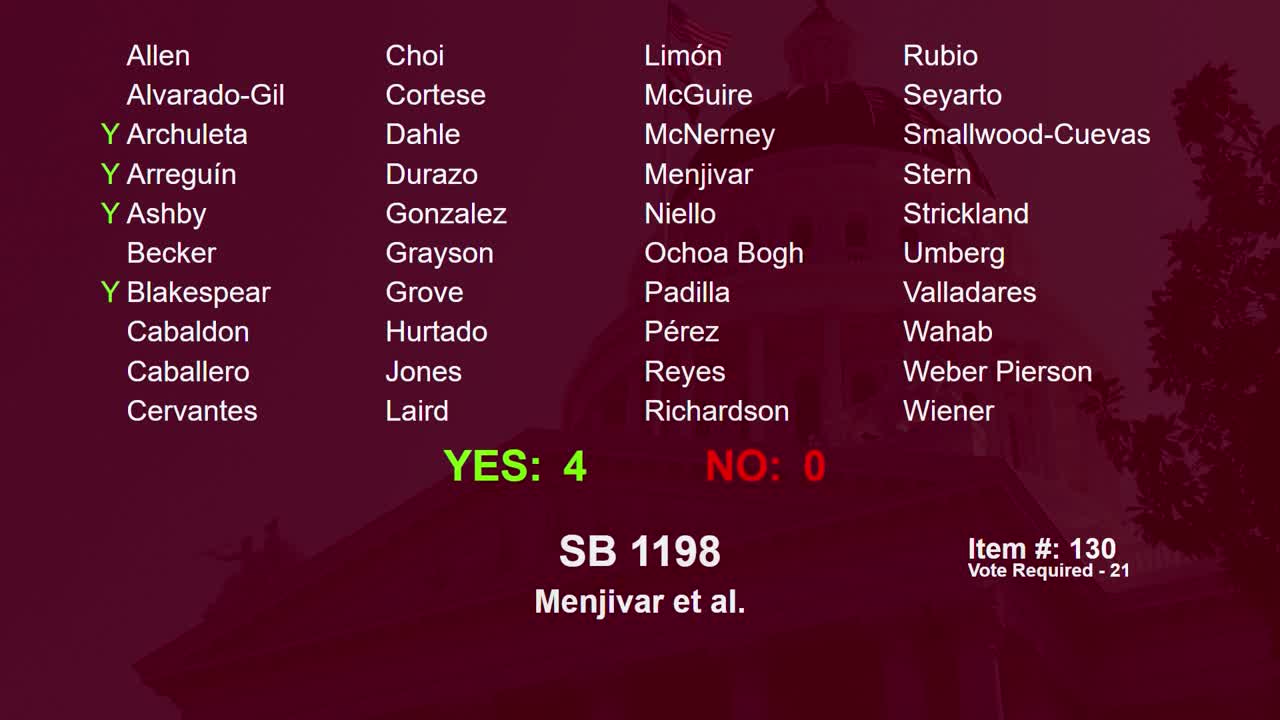
Bill Author

Bill Co-Author(s):