SB 1138: Load-serving entities: resource adequacy requirements.
- Session Year: 2025-2026
- House: Senate
- Latest Version Date: 2026-06-15
Current Status:
In Progress
(2026-08-13: August 13 hearing: Held in committee and under submission.)
Introduced
In Committee
Awaiting First Chamber Vote
Passed First Chamber
In Committee
Awaiting Second Chamber Vote
Passed Second Chamber
Enacted
Existing law vests the Public Utilities Commission with regulatory authority over public utilities, including electrical corporations. Existing law requires the commission, in consultation with the Independent System Operator, to establish resource adequacy requirements for all load-serving entities, as provided. Existing law defines load-serving entity, for that purpose, as an electrical corporation, electric service provider, or community choice aggregator. Existing law requires each load-serving entity to be subject to the same requirements for resource adequacy, the renewables portfolio standard program, and the integrated resource planning process that apply to electrical corporations, as provided.
This bill would require the commission to authorize a load-serving entity to elect to demonstrate compliance with resource adequacy requirements by selling to, or otherwise making transactions with, another load-serving entity to meet entity, and would require those transactions to not represent more than 25% of its a load-serving entitys compliance obligations with contracts that are and be of a short-term duration, and duration. The bill would require the commission to authorize those transactions to be denominated in the same unit of time used to denominate resource adequacy compliance requirements. The bill would authorize the commission to suspend or adjust that authority of a load-serving entity to sell to, or otherwise make transactions with, another load-serving entity, as specified.
Under existing law, a violation of the Public Utilities Act or any order, decision, rule, direction, demand, or requirement of the commission is a crime.
Because the above provisions would be a part of the act, and because a violation of a commission action implementing the above prohibition would be a crime, the bill would impose a state-mandated local program.
The California Constitution requires the state to reimburse local agencies and school districts for certain costs mandated by the state. Statutory provisions establish procedures for making that reimbursement.
This bill would provide that no reimbursement is required by this act for a specified reason.
Existing law vests the Public Utilities Commission with regulatory authority over public utilities, including electrical corporations. Existing law requires the commission, in consultation with the Independent System Operator, to establish resource adequacy requirements for all load-serving entities, as provided. Existing law defines load-serving entity, for that purpose, as an electrical corporation, electric service provider, or community choice aggregator. Existing law requires each load serving load-serving entity to be subject to the same requirements for resource adequacy, the renewables portfolio standard program, and the integrated resource planning process that apply to electrical corporations, as provided.
This bill would require the commission to permit authorize a load-serving entity to demonstrate compliance with resource adequacy requirements by selling to, or otherwise making transactions with, another load-serving entity to meet not more than 25% of its compliance obligation, on a short-term basis, obligations with contracts that are of a short-term duration, and to permit authorize those transactions to be denominated in the same unit of time used to denominate resource adequacy compliance requirements. The bill would authorize the commission to suspend or adjust that authority of a load-serving entity to sell to, or otherwise make transactions with, another load-serving entity, as specified.
Under existing law, a violation of the Public Utilities Act or any order, decision, rule, direction, demand, or requirement of the commission is a crime.
Because the above provisions would be a part of the act, and because a violation of a commission action implementing the above prohibition would be a crime, the bill would impose a state-mandated local program.
The California Constitution requires the state to reimburse local agencies and school districts for certain costs mandated by the state. Statutory provisions establish procedures for making that reimbursement.
This bill would provide that no reimbursement is required by this act for a specified reason.
Existing law vests the Public Utilities Commission with regulatory authority over public utilities, including electrical corporations. Existing law requires the commission, in consultation with the Independent System Operator, to establish resource adequacy requirements for all load-serving entities, as provided. Existing law defines load-serving entity, for that purpose, as an electrical corporation, electric service provider, or community choice aggregator. Existing law requires each load serving to be subject to the same requirements for resource adequacy, the renewables portfolio standard program, and the integrated resource planning process that apply to electrical corporations, as provided.
This bill would require the commission to permit a load-serving entity to demonstrate compliance with resource adequacy requirements by selling to, or otherwise making transactions with, another load-serving entity to meet not more than 25% of its compliance obligation, on a short-term basis, and to permit those transactions to be denominated in the same unit of time used to denominate resource adequacy compliance requirements.
Under existing law, a violation of the Public Utilities Act or any order, decision, rule, direction, demand, or requirement of the commission is a crime.
Because the above provisions would be a part of the act, and because a violation of a commission action implementing the above prohibition would be a crime, the bill would impose a state-mandated local program.
The California Constitution requires the state to reimburse local agencies and school districts for certain costs mandated by the state. Statutory provisions establish procedures for making that reimbursement.
This bill would provide that no reimbursement is required by this act for a specified reason.
(a)The commission, in consultation with the Independent System Operator, shall establish resource adequacy requirements for all load-serving entities.
(b)In establishing resource adequacy requirements, the commission shall ensure the reliability of electrical service in California while advancing, to the extent possible, the states goals for clean energy, reducing air pollution, and reducing emissions of greenhouse gases. The resource adequacy program shall achieve all of the following objectives:
(1)Facilitate the development of new generating, nongenerating, and hybrid capacity and the retention of existing generating, nongenerating, and hybrid capacity that is economical and needed for reliability and to achieve the state policy specified in Section 454.53.
(2)Establish new, or maintain existing, demand response products and tariffs that facilitate the economical dispatch and use of demand response that can either meet or reduce an electrical corporations resource adequacy requirements, as determined by the commission.
(3)Equitably allocate the cost of generating capacity and demand response in a manner that prevents the shifting of costs between customer classes.
(4)Minimize enforcement requirements and costs.
(5)Consideration of mitigation measures, if the commission determines they are needed, to reduce costs to ratepayers.
(6)Maximize the ability of community choice aggregators to determine the generation resources used to serve their customers.
(c)Each load-serving entity shall maintain physical generating capacity and electrical demand response adequate to meet its load requirements, including, but not limited to, peak demand and planning and operating reserves. The generating capacity or electrical demand response shall be deliverable to locations and at times as may be necessary to maintain electrical service system reliability, local area reliability, and flexibility.
(d)Each load-serving entity shall, at a minimum, meet the most recent minimum planning reserve and reliability criteria approved by the board of directors of the Western Systems Coordinating Council or the Western Electricity Coordinating Council.
(e)(1)The commission shall implement and enforce the resource adequacy requirements established in accordance with this section in a nondiscriminatory manner. Each load-serving entity shall be subject to the same requirements for resource adequacy, the renewables portfolio standard program, and the integrated resource planning process pursuant to Section 454.52 that apply to electrical corporations pursuant to this section, or are otherwise required by law or by order or decision of the commission. The commission shall exercise its enforcement powers to ensure compliance by all load-serving entities.
(2)Notwithstanding subdivision (c), the commission shall authorize a load-serving entity to elect to demonstrate compliance with resource adequacy requirements by selling to, or otherwise making transactions with, another load-serving entity to meet entity. Those transactions shall not represent more than 25 percent of its a load-serving entitys resource adequacy compliance obligation with contracts that are and shall be of a short-term duration. The commission shall authorize those transactions to be denominated in the same unit of time used to denominate resource adequacy compliance requirements. The commission may suspend or adjust the authority of a load-serving entity to sell to, or otherwise make transactions with, another load-serving entity if the commission demonstrates the use of these transactions prevents the electrical system from meeting the planning reserve margin established by the commission.
(f)(1)The commission shall require sufficient information, including, but not limited to, anticipated load, actual load, and measures undertaken by a load-serving entity to ensure resource adequacy, to be reported to enable the commission to determine compliance with the resource adequacy requirements established by the commission.
(2)The commission shall calculate and publish annually on its internet website, in a new report or as part of another report, the percentage of each load-serving entitys local and system resource adequacy requirements from the previous calendar year that was met with capacity from eligible renewable energy resources pursuant to the California Renewables Portfolio Standard Program (Article 16 (commencing with Section 399.11)), other zero-carbon resources, including large hydroelectric and nuclear resources, or energy storage resources. In determining the percentage of each load-serving entitys resource adequacy requirements, the commission shall include all directly owned or contracted resources and each load-serving entitys allocation of any centrally procured resources or allocation of resources pursuant to any other mechanism that involves an assignment or allocation of resources purchased or owned by a single buyer, and shall exclude any share of a load-serving entitys resources that were allocated to another load-serving entity.
(g)An electrical corporations costs of meeting or reducing resource adequacy requirements, including, but not limited to, the costs associated with system reliability, local area reliability, or flexible resource adequacy, that are determined to be reasonable by the commission, or are otherwise recoverable under a procurement plan approved by the commission pursuant to Section 454.5, shall be fully recoverable from those customers on whose behalf the costs are incurred, as determined by the commission, at the time the commitment to incur the cost is made, on a fully nonbypassable basis, as determined by the commission. The commission shall exclude any amounts authorized to be recovered pursuant to Section 366.2 when authorizing the amount of costs to be recovered from customers of a community choice aggregator or from customers that purchase electricity through a direct transaction pursuant to this subdivision.
(h)The commission shall determine and authorize the most efficient and equitable means for achieving all of the following:
(1)Meeting the objectives of this section.
(2)Ensuring that investment is made in new generating capacity.
(3)Ensuring that existing generating capacity that is economical is retained to ensure reliability.
(4)Ensuring that the resource adequacy program can reasonably maintain a standard measure of reliability, such as a one-day-in-10-year loss-of-load expectation or a similarly robust reliability metric adopted by the commission, and use it for planning purposes.
(5)Ensuring that the cost of generating capacity and demand response is allocated equitably.
(6)Ensuring that community choice aggregators can determine the generation resources used to serve their customers.
(7)Ensuring that investments are made in new and existing demand response resources that are cost effective and help to achieve electrical grid reliability and the states goals for reducing emissions of greenhouse gases.
(8)Minimizing the need for backstop procurement by the Independent System Operator.
(i)In making the determination pursuant to subdivision (h), the commission may consider a centralized resource adequacy mechanism among other options.
(j)The commission shall ensure appropriate valuation of both supply and load modifying demand response resources. The commission, in an existing or new proceeding, shall establish a mechanism to value load modifying demand response resources, including, but not limited to, the ability of demand response resources to help meet distribution needs and transmission system needs and to help reduce a load-serving entitys resource adequacy obligation pursuant to this section. In determining this value, the commission shall consider how these resources further the states electrical grid reliability and the states goals for reducing emissions of greenhouse gases. The commission, Energy Commission, and Independent System Operator shall coordinate to jointly ensure that changes in demand caused by load modifying demand response are expeditiously and comprehensively reflected in the Energy Commissions Integrated Energy Policy Report forecast and in planning proceedings and associated analyses, and shall encourage reflection of these changes in demand in the operation of the electrical grid.
(k)For purposes of this section, load-serving entity means an electrical corporation, electric service provider, or community choice aggregator. Load-serving entity does not include any of the following:
(1)A local publicly owned electric utility.
(2)The State Water Resources Development System commonly known as the State Water Project.
(3)Customer generation located on the customers site or providing electrical service through arrangements authorized by Section 218, if the customer generation, or the load it serves, meets one of the following criteria:
(A)It takes standby service from the electrical corporation on a commission-approved rate schedule that provides for adequate backup planning and operating reserves for the standby customer class.
(B)It is not physically interconnected to the electrical transmission or distribution grid, so that, if the customer generation fails, backup electricity is not supplied from the electrical grid.
(C)There is physical assurance that the load served by the customer generation will be curtailed concurrently and commensurately with an outage of the customer generation.
SEC. 2.No reimbursement is required by this act pursuant to Section 6 of Article XIIIB of the California Constitution because the only costs that may be incurred by a local agency or school district will be incurred because this act creates a new crime or infraction, eliminates a crime or infraction, or changes the penalty for a crime or infraction, within the meaning of Section 17556 of the Government Code, or changes the definition of a crime within the meaning of Section 6 of Article XIIIB of the California Constitution.
(a)The commission, in consultation with the Independent System Operator, shall establish resource adequacy requirements for all load-serving entities.
(b)In establishing resource adequacy requirements, the commission shall ensure the reliability of electrical service in California while advancing, to the extent possible, the states goals for clean energy, reducing air pollution, and reducing emissions of greenhouse gases. The resource adequacy program shall achieve all of the following objectives:
(1)Facilitate the development of new generating, nongenerating, and hybrid capacity and the retention of existing generating, nongenerating, and hybrid capacity that is economical and needed for reliability and to achieve the state policy specified in Section 454.53.
(2)Establish new, or maintain existing, demand response products and tariffs that facilitate the economical dispatch and use of demand response that can either meet or reduce an electrical corporations resource adequacy requirements, as determined by the commission.
(3)Equitably allocate the cost of generating capacity and demand response in a manner that prevents the shifting of costs between customer classes.
(4)Minimize enforcement requirements and costs.
(5)Consideration of mitigation measures, if the commission determines they are needed, to reduce costs to ratepayers.
(6)Maximize the ability of community choice aggregators to determine the generation resources used to serve their customers.
(c)Each load-serving entity shall maintain physical generating capacity and electrical demand response adequate to meet its load requirements, including, but not limited to, peak demand and planning and operating reserves. The generating capacity or electrical demand response shall be deliverable to locations and at times as may be necessary to maintain electrical service system reliability, local area reliability, and flexibility.
(d)Each load-serving entity shall, at a minimum, meet the most recent minimum planning reserve and reliability criteria approved by the board of directors of the Western Systems Coordinating Council or the Western Electricity Coordinating Council.
(e)(1)The commission shall implement and enforce the resource adequacy requirements established in accordance with this section in a nondiscriminatory manner. Each load-serving entity shall be subject to the same requirements for resource adequacy, the renewables portfolio standard program, and the integrated resource planning process pursuant to Section 454.52 that apply to electrical corporations pursuant to this section, or are otherwise required by law or by order or decision of the commission. The commission shall exercise its enforcement powers to ensure compliance by all load-serving entities.
(2)Notwithstanding subdivision (c), the commission shall permit authorize a load-serving entity to demonstrate compliance with resource adequacy requirements by selling to, or otherwise making transactions with, another load-serving entity to meet not more than 25 percent of its compliance obligation, on a short-term basis, and obligation with contracts that are of a short-term duration. The commission shall permit authorize those transactions to be denominated in the same unit of time used to denominate resource adequacy compliance requirements. The commission may suspend or adjust the authority of a load-serving entity to sell to, or otherwise make transactions with, another load-serving entity if the commission demonstrates the use of these transactions prevents the electrical system from meeting the planning reserve margin established by the commission.
(f)(1)The commission shall require sufficient information, including, but not limited to, anticipated load, actual load, and measures undertaken by a load-serving entity to ensure resource adequacy, to be reported to enable the commission to determine compliance with the resource adequacy requirements established by the commission.
(2)The commission shall calculate and publish annually on its internet website, in a new report or as part of another report, the percentage of each load-serving entitys local and system resource adequacy requirements from the previous calendar year that was met with capacity from eligible renewable energy resources pursuant to the California Renewables Portfolio Standard Program (Article 16 (commencing with Section 399.11)), other zero-carbon resources, including large hydroelectric and nuclear resources, or energy storage resources. In determining the percentage of each load-serving entitys resource adequacy requirements, the commission shall include all directly owned or contracted resources and each load-serving entitys allocation of any centrally procured resources or allocation of resources pursuant to any other mechanism that involves an assignment or allocation of resources purchased or owned by a single buyer, and shall exclude any share of a load-serving entitys resources that were allocated to another load-serving entity.
(g)An electrical corporations costs of meeting or reducing resource adequacy requirements, including, but not limited to, the costs associated with system reliability, local area reliability, or flexible resource adequacy, that are determined to be reasonable by the commission, or are otherwise recoverable under a procurement plan approved by the commission pursuant to Section 454.5, shall be fully recoverable from those customers on whose behalf the costs are incurred, as determined by the commission, at the time the commitment to incur the cost is made, on a fully nonbypassable basis, as determined by the commission. The commission shall exclude any amounts authorized to be recovered pursuant to Section 366.2 when authorizing the amount of costs to be recovered from customers of a community choice aggregator or from customers that purchase electricity through a direct transaction pursuant to this subdivision.
(h)The commission shall determine and authorize the most efficient and equitable means for achieving all of the following:
(1)Meeting the objectives of this section.
(2)Ensuring that investment is made in new generating capacity.
(3)Ensuring that existing generating capacity that is economical is retained to ensure reliability.
(4)Ensuring that the resource adequacy program can reasonably maintain a standard measure of reliability, such as a one-day-in-10-year loss-of-load expectation or a similarly robust reliability metric adopted by the commission, and use it for planning purposes.
(5)Ensuring that the cost of generating capacity and demand response is allocated equitably.
(6)Ensuring that community choice aggregators can determine the generation resources used to serve their customers.
(7)Ensuring that investments are made in new and existing demand response resources that are cost effective and help to achieve electrical grid reliability and the states goals for reducing emissions of greenhouse gases.
(8)Minimizing the need for backstop procurement by the Independent System Operator.
(i)In making the determination pursuant to subdivision (h), the commission may consider a centralized resource adequacy mechanism among other options.
(j)The commission shall ensure appropriate valuation of both supply and load modifying demand response resources. The commission, in an existing or new proceeding, shall establish a mechanism to value load modifying demand response resources, including, but not limited to, the ability of demand response resources to help meet distribution needs and transmission system needs and to help reduce a load-serving entitys resource adequacy obligation pursuant to this section. In determining this value, the commission shall consider how these resources further the states electrical grid reliability and the states goals for reducing emissions of greenhouse gases. The commission, Energy Commission, and Independent System Operator shall coordinate to jointly ensure that changes in demand caused by load modifying demand response are expeditiously and comprehensively reflected in the Energy Commissions Integrated Energy Policy Report forecast and in planning proceedings and associated analyses, and shall encourage reflection of these changes in demand in the operation of the electrical grid.
(k)For purposes of this section, load-serving entity means an electrical corporation, electric service provider, or community choice aggregator. Load-serving entity does not include any of the following:
(1)A local publicly owned electric utility.
(2)The State Water Resources Development System commonly known as the State Water Project.
(3)Customer generation located on the customers site or providing electrical service through arrangements authorized by Section 218, if the customer generation, or the load it serves, meets one of the following criteria:
(A)It takes standby service from the electrical corporation on a commission-approved rate schedule that provides for adequate backup planning and operating reserves for the standby customer class.
(B)It is not physically interconnected to the electrical transmission or distribution grid, so that, if the customer generation fails, backup electricity is not supplied from the electrical grid.
(C)There is physical assurance that the load served by the customer generation will be curtailed concurrently and commensurately with an outage of the customer generation.
SEC. 2.No reimbursement is required by this act pursuant to Section 6 of Article XIIIB of the California Constitution because the only costs that may be incurred by a local agency or school district will be incurred because this act creates a new crime or infraction, eliminates a crime or infraction, or changes the penalty for a crime or infraction, within the meaning of Section 17556 of the Government Code, or changes the definition of a crime within the meaning of Section 6 of Article XIIIB of the California Constitution.
(a)The commission, in consultation with the Independent System Operator, shall establish resource adequacy requirements for all load-serving entities.
(b)In establishing resource adequacy requirements, the commission shall ensure the reliability of electrical service in California while advancing, to the extent possible, the states goals for clean energy, reducing air pollution, and reducing emissions of greenhouse gases. The resource adequacy program shall achieve all of the following objectives:
(1)Facilitate the development of new generating, nongenerating, and hybrid capacity and the retention of existing generating, nongenerating, and hybrid capacity that is economical and needed for reliability and to achieve the state policy specified in Section 454.53.
(2)Establish new, or maintain existing, demand response products and tariffs that facilitate the economical dispatch and use of demand response that can either meet or reduce an electrical corporations resource adequacy requirements, as determined by the commission.
(3)Equitably allocate the cost of generating capacity and demand response in a manner that prevents the shifting of costs between customer classes.
(4)Minimize enforcement requirements and costs.
(5)Consideration of mitigation measures, if the commission determines they are needed, to reduce costs to ratepayers.
(6)Maximize the ability of community choice aggregators to determine the generation resources used to serve their customers.
(c)Each load-serving entity shall maintain physical generating capacity and electrical demand response adequate to meet its load requirements, including, but not limited to, peak demand and planning and operating reserves. The generating capacity or electrical demand response shall be deliverable to locations and at times as may be necessary to maintain electrical service system reliability, local area reliability, and flexibility.
(d)Each load-serving entity shall, at a minimum, meet the most recent minimum planning reserve and reliability criteria approved by the board of directors of the Western Systems Coordinating Council or the Western Electricity Coordinating Council.
(e)(1)The commission shall implement and enforce the resource adequacy requirements established in accordance with this section in a nondiscriminatory manner. Each load-serving entity shall be subject to the same requirements for resource adequacy, the renewables portfolio standard program, and the integrated resource planning process pursuant to Section 454.52 that apply to electrical corporations pursuant to this section, or are otherwise required by law or by order or decision of the commission. The commission shall exercise its enforcement powers to ensure compliance by all load-serving entities.
(2)Notwithstanding subdivision (c), the commission shall permit a load-serving entity to demonstrate compliance with resource adequacy requirements by selling to, or otherwise making transactions with, another load-serving entity to meet not more than 25 percent of its compliance obligation, on a short-term basis, and shall permit those transactions to be denominated in the same unit of time used to denominate resource adequacy compliance requirements.
(f)(1)The commission shall require sufficient information, including, but not limited to, anticipated load, actual load, and measures undertaken by a load-serving entity to ensure resource adequacy, to be reported to enable the commission to determine compliance with the resource adequacy requirements established by the commission.
(2)The commission shall calculate and publish annually on its internet website, in a new report or as part of another report, the percentage of each load-serving entitys local and system resource adequacy requirements from the previous calendar year that was met with capacity from eligible renewable energy resources pursuant to the California Renewables Portfolio Standard Program (Article 16 (commencing with Section 399.11)), other zero-carbon resources, including large hydroelectric and nuclear resources, or energy storage resources. In determining the percentage of each load-serving entitys resource adequacy requirements, the commission shall include all directly owned or contracted resources and each load-serving entitys allocation of any centrally procured resources or allocation of resources pursuant to any other mechanism that involves an assignment or allocation of resources purchased or owned by a single buyer, and shall exclude any share of a load-serving entitys resources that were allocated to another load-serving entity.
(g)An electrical corporations costs of meeting or reducing resource adequacy requirements, including, but not limited to, the costs associated with system reliability, local area reliability, or flexible resource adequacy, that are determined to be reasonable by the commission, or are otherwise recoverable under a procurement plan approved by the commission pursuant to Section 454.5, shall be fully recoverable from those customers on whose behalf the costs are incurred, as determined by the commission, at the time the commitment to incur the cost is made, on a fully nonbypassable basis, as determined by the commission. The commission shall exclude any amounts authorized to be recovered pursuant to Section 366.2 when authorizing the amount of costs to be recovered from customers of a community choice aggregator or from customers that purchase electricity through a direct transaction pursuant to this subdivision.
(h)The commission shall determine and authorize the most efficient and equitable means for achieving all of the following:
(1)Meeting the objectives of this section.
(2)Ensuring that investment is made in new generating capacity.
(3)Ensuring that existing generating capacity that is economical is retained to ensure reliability.
(4)Ensuring that the resource adequacy program can reasonably maintain a standard measure of reliability, such as a one-day-in-10-year loss-of-load expectation or a similarly robust reliability metric adopted by the commission, and use it for planning purposes.
(5)Ensuring that the cost of generating capacity and demand response is allocated equitably.
(6)Ensuring that community choice aggregators can determine the generation resources used to serve their customers.
(7)Ensuring that investments are made in new and existing demand response resources that are cost effective and help to achieve electrical grid reliability and the states goals for reducing emissions of greenhouse gases.
(8)Minimizing the need for backstop procurement by the Independent System Operator.
(i)In making the determination pursuant to subdivision (h), the commission may consider a centralized resource adequacy mechanism among other options.
(j)The commission shall ensure appropriate valuation of both supply and load modifying demand response resources. The commission, in an existing or new proceeding, shall establish a mechanism to value load modifying demand response resources, including, but not limited to, the ability of demand response resources to help meet distribution needs and transmission system needs and to help reduce a load-serving entitys resource adequacy obligation pursuant to this section. In determining this value, the commission shall consider how these resources further the states electrical grid reliability and the states goals for reducing emissions of greenhouse gases. The commission, Energy Commission, and Independent System Operator shall coordinate to jointly ensure that changes in demand caused by load modifying demand response are expeditiously and comprehensively reflected in the Energy Commissions Integrated Energy Policy Report forecast and in planning proceedings and associated analyses, and shall encourage reflection of these changes in demand in the operation of the electrical grid.
(k)For purposes of this section, load-serving entity means an electrical corporation, electric service provider, or community choice aggregator. Load-serving entity does not include any of the following:
(1)A local publicly owned electric utility.
(2)The State Water Resources Development System commonly known as the State Water Project.
(3)Customer generation located on the customers site or providing electric electrical service through arrangements authorized by Section 218, if the customer generation, or the load it serves, meets one of the following criteria:
(A)It takes standby service from the electrical corporation on a commission-approved rate schedule that provides for adequate backup planning and operating reserves for the standby customer class.
(B)It is not physically interconnected to the electrical transmission or distribution grid, so that, if the customer generation fails, backup electricity is not supplied from the electrical grid.
(C)There is physical assurance that the load served by the customer generation will be curtailed concurrently and commensurately with an outage of the customer generation.
SEC. 2.No reimbursement is required by this act pursuant to Section 6 of Article XIIIB of the California Constitution because the only costs that may be incurred by a local agency or school district will be incurred because this act creates a new crime or infraction, eliminates a crime or infraction, or changes the penalty for a crime or infraction, within the meaning of Section 17556 of the Government Code, or changes the definition of a crime within the meaning of Section 6 of Article XIIIB of the California Constitution.
|
Date
|
Status
|
|---|---|
| Aug 13, 2026 | August 13 hearing: Held in committee and under submission. |
| Aug 5, 2026 | August 5 set for first hearing. Placed on suspense file. |
| Jun 15, 2026 | Read second time and amended. Re-referred to Com. on APPR. |
| Jun 11, 2026 | From committee: Do pass as amended and re-refer to Com. on APPR. with recommendation: To consent calendar. (Ayes 18. Noes 0.) (June 10). |
| May 26, 2026 | Referred to Com. on U. & E. |
| May 20, 2026 | In Assembly. Read first time. Held at Desk. |
| May 19, 2026 | Read third time. Passed. (Ayes 31. Noes 0. Page 4347.) Ordered to the Assembly. |
| May 19, 2026 | Read third time. Passed. (Ayes 31. Noes 0.) Ordered to the Assembly. |
| May 14, 2026 | From committee: Do pass. (Ayes 5. Noes 0. Page 4266.) (May 14). |
| May 14, 2026 | Read second time. Ordered to third reading. |
| May 14, 2026 | From committee: Do pass. (Ayes 5. Noes 0.) (May 14). |
| May 8, 2026 | Set for hearing May 14. |
| Apr 27, 2026 | April 27 hearing: Placed on APPR. suspense file. |
| Apr 17, 2026 | Set for hearing April 27. |
| Apr 16, 2026 | April 20 hearing postponed by committee. |
| Apr 14, 2026 | Set for hearing April 20. |
| Apr 9, 2026 | Read second time and amended. Re-referred to Com. on APPR. |
| Apr 8, 2026 | From committee: Do pass as amended and re-refer to Com. on APPR. (Ayes 13. Noes 0. Page 3756.) (April 7). |
| Apr 8, 2026 | From committee: Do pass as amended and re-refer to Com. on APPR. (Ayes 13. Noes 0.) (April 7). |
| Mar 25, 2026 | Set for hearing April 7. |
| Feb 26, 2026 | Referred to Com. on E., U & C. |
| Feb 19, 2026 | From printer. May be acted upon on or after March 21. |
| Feb 18, 2026 | Introduced. Read first time. To Com. on RLS. for assignment. To print. |
|
Date
|
Description
|
Location
|
Votes
|
|
|---|---|---|---|---|
| Jun 10, 2026 | Do pass as amended, and be re-referred to the Committee on [Appropriations] with recommendation: To Consent Calendar | Assembly Standing Committee on Utilities and Energy |
Passed |
|
| May 19, 2026 | Senate 3rd Reading SB1138 Padilla et al. | Senate Floor |
Passed |
|
| May 14, 2026 | Do pass | Senate Standing Committee on Appropriations |
Passed |
|
| Apr 27, 2026 | Placed on suspense file | Senate Standing Committee on Appropriations |
Passed |
|
| Apr 7, 2026 | Do pass as amended, but first amend, and re-refer to the Committee on [Appropriations] | Senate Standing Committee on Energy, Utilities and Communications |
Passed |
This list shows positions taken on this bill by organizations on the date displayed, which is linked to the original source.
Positions by individuals are not included.
|
Organization
|
Position
|
Date
|
|---|---|---|
| Ava Community Energy | ** Support | |
| Ava Community Energy Authority | ** Support | |
| California Choice Energy Authority | ** Support | |
| California Choice Energy Authority (CALCHOICE) | ** Support | |
| California Coalition of Large Energy Users | ** Support | |
| California Community Choice Association | ** Support | |
| California State Association of Counties (CSAC) | ** Support | |
| Central Coast Community Energy | ** Support | |
| Chris Lopez | ** Support | |
| City of Belmont | ** Support | |
| City of Concord | ** Support | |
| City of Rancho Mirage | ** Support | |
| City of San Luis Obispo | ** Support | |
| City Of San Mateo | ** Support | |
| City Of Seaside | ** Support | |
| City of Walnut Creek | ** Support | |
| Clean Energy Alliance | ** Support | |
| Clean Power Alliance | ** Support | |
| County of Monterey | ** Support | |
| League Of California Cities | ** Support | |
| Local Government Climate Policy Alliance (LGCPA) | ** Support | |
| Luis A. Alejo | ** Support | |
| Marin Clean Energy | ** Support | |
| Marin Clean Energy (MCE) | ** Support | |
| Marin County Board of Supervisors | ** Support | |
| Orange County Power Authority | ** Support | |
| Peninsula Clean Energy | ** Support | |
| Pioneer Community Energy | ** Support | |
| San Diego Community Power | ** Support | |
| San Francisco Public Utilities Commission | ** Support | |
| San Jose Clean Energy | ** Support | |
| Silicon Valley Clean Energy | ** Support | |
| Sonoma Clean Power | ** Support | |
| The Climate Reality Project, California State Coalition | ** Support | |
| The Climate Reality Project, Los Angeles Chapter | ** Support | |
| The Climate Reality Project Orange County Chapter | ** Support | |
| The Climate Reality Project, Sacramento Chapter | ** Support | |
| The Climate Reality Project San Diego Chapter | ** Support | |
| The Climate Reality Project, San Fernando Valley CA Chapter | ** Support | |
| Town of Hillsborough | ** Support | |
| Valley Clean Energy Alliance | ** Support |
Date of Hearing: August 5, 2026
ASSEMBLY COMMITTEE ON APPROPRIATIONS
Buffy Wicks, Chair
SBPCA Bill Id:SB 1138
Author:(Padilla) – As Amended Ver:June 15, 2026
Policy Committee: | Utilities and Energy | Vote: | 18 - 0 |
|
| ||
|
|
Urgency: No State Mandated Local Program: Yes Reimbursable: No
SUMMARY:
This bill authorizes a load-serving entity (LSE), such as an electrical investor-owned utility (IOU) or a community choice aggregator (CCA), to demonstrate compliance with resource adequacy (RA) requirements by transacting with another LSE to meet the LSE’s RA compliance obligation.
More specifically, this bill directs the California Public Utilities Commission (CPUC) to authorize an LSE to demonstrate compliance with RA requirements by selling to, or otherwise making transactions with, another LSE to meet not more than 25% of the LSE’s RA compliance obligation with short-term contracts. The bill empowers the CPUC to suspend or adjust such authorization if the CPUC demonstrates the use of these transactions prevents the electrical system from meeting the planning reserve margin established by the CPUC.
FISCAL EFFECT:
This bill requires the CPUC to establish an hourly RA compliance obligation trading mechanism. This will entail significant analytical, administrative and regulatory work. Implementation costs will be significant, likely in the millions of dollars.
For its part, the CPUC estimates it will require $8.6 million (Public Utilities Commission Utilities Reimbursement Account) for seven positions split between the Energy Division and the Information Technology Division, and a contract with an external vendor to build a dedicated software platform, as follows:
- Energy Division—$654,000 annually: three regulatory analysts ($218,000 annually each) to track hourly load obligation trading, support monthly RA compliance reviews, oversee IOU use of the compliance product, support the development and implementation of any modifications to true up mechanisms, such as the power charge indifference amount (PCIA), manage a trading software platform contract and oversee technical changes to existing tools and templates.
- Information Technology Division—$1.2 million for two years, then $824,000 annually: two permanent IT specialists ($412,000 annually each) and two limited-term IT specialists ($188,000 annually for two years only) to support development, operation and maintenance of a platform to collect and validate trades across LSEs.
- External Vendor—$4.2 million one time: contract to design, build and host a dedicated software platform to collect and validate trades across load-serving entities.
COMMENTS:
Statute defines an LSE as any IOU, electric service provider (ESP) or CCA serving end-use electricity customers in the state. Through its RA program, the CPUC requires each LSE it regulates to demonstrate the LSE has secured from electric resource providers sufficient quantities of electricity to meet anticipated demand for electricity, which is known as RA capacity. Traditionally, the RA program has required each LSE to demonstrate its RA capacity as it applies to a given month, or series of months. More recently, however, the CPUC has required each LSE to demonstrate its RA capacity on an hourly basis, which the CPUC terms “slice of day” and contends better reflects existing and emerging conditions.
Under the RA program, LSEs may trade RA capacity products, such as commitments from physical electricity generating resources, to meet monthly RA obligations. However, LSEs may not trade RA obligations, nor may they do so on an hourly basis.
The CPUC has several times considered allowing hourly RA capacity trading within the slice-of-day RA framework. Each time, it has rejected such trading, finding, among other things, such hourly trading would increase exposure to RA shortfalls, would not necessarily lead to savings and might increase costs.
The California Community Choice Association (CalCCA), which has formally requested the CPUC to allow hourly RA obligation trading, contends the current restriction on hourly RA obligation trading creates a “mismatch” that “forces LSEs to purchase more RA than they need to meet their obligations, creating artificial market scarcity and unnecessarily driving up RA demand (and prices)…These unnecessary costs fall directly on California ratepayers, totaling tens of millions of dollars annually.” A long list of other supporters—many of them CCAs—make similar arguments.
There is no opposition formally registered against this bill. Nonetheless, the CPUC expresses “significant concerns” with the bill and notes it continues to consider authorization of hourly obligation trading.
Analysis Prepared by: Jay Dickenson / APPR. / (916) 319-2081
Date of Hearing: June 10, 2026
ASSEMBLY COMMITTEE ON UTILITIES AND ENERGY
Cottie Petrie-Norris, Chair
SBPCA Bill Id:SB 1138
Author:(Padilla) – As Amended Ver:April 9, 2026
SENATE VOTE: 31-0
SUBJECT: Load-serving entities: resource adequacy requirements
SUMMARY: Requires the California Public Utilities Commission (CPUC) to authorize load-serving entities (LSEs) to meet not more than 25% of their resource adequacy (RA) requirements by trading energy capacity with other LSEs.
EXISTING LAW:
- Requires the CPUC, in consultation with the California Independent System Operator (CAISO), to establish RA requirements for all LSEs and requires the CPUC in establishing those requirements to ensure the reliability of electrical service in California. Requires the RA program to facilitate the development of new generating, non-generating, hybrid capacity and retention of existing generating, non-generating, and hybrid capacity that is economical and needed for reliability. Defines LSE, for the purpose of the RA program, as an electrical corporation, electric service provider (ESP), or community choice aggregator (CCA). (Public Utilities Code § 380)
- Requires the CAISO, as a nonprofit, public benefit corporation, to conduct its operations consistent with applicable state and federal laws and consistent with the interests of the people of the state. (Public Utilities Code § 345.5)
- Requires CAISO to perform a review following a major outage that affects at least 10% of customers of the entity providing the local distribution service, as provided. (Public Utilities Code § 349)
- Requires retail sellers, beginning January 1, 2021, to count at least 65% of their procurement toward Renewables Portfolio Standard (RPS) requirements from contracts of 10 years or more in duration or in ownership agreements for eligible resources. (Public Utilities Code § 399.13 (b))
- Requires the CPUC to adopt a process for LSEs to file integrated resource plans that include ensuring system and local reliability on a short-term, midterm, and long-term basis. (Public Utilities Code § 454.52)
- Prohibits an LSE or local publicly owned electric utility (POU) from entering into a long-term contract unless any baseload generation supplied under the long-term contract complies with the greenhouse gas emission performance standard established by the CPUC or California Energy Commission, as applicable. (Public Utilities Code § 8341)
FISCAL EFFECT: According to the Senate Committee on Appropriations, the CPUC estimates this bill will result in approximately $8.6 million (ratepayer funds) in annual, ongoing costs to implement.
BACKGROUND:
California’s RA Program – Following the 2000–2001 California electricity crisis, the Legislature adopted reforms to reduce the risk of capacity shortfalls, reliability events, including rotating shortages, and insufficient procurement of generating capacity. AB 380 (Núñez, Chapter 367, Statutes of 2005) established the state’s RA program and added Public Utilities Code Section 380, which directs the CPUC to establish procurement requirements and compliance rules for all LSEs, while the CAISO evaluates system and local reliability needs and determines if procured resources are sufficient to maintain grid reliability.[1]
LSEs – entities that supply electricity to customers – must purchase more power capacity than they expect to need (a “reserve margin”) for the busiest time (“peak demand”), so there's always a buffer of extra resources ready if demand spikes or something goes wrong. The RA program is the compliance and enforcement program to ensure this adequate supply is always maintained. LSEs demonstrate compliance through annual and monthly filings, showing that their capacity is deliverable to areas with reliability needs. Resources are compensated for being available to provide electricity when called upon, namely during times of system stress, rather than for the actual production of energy. This is the core concept in the RA program of “deliverability.”
Separately, the CEC develops electricity demand forecasts through the Integrated Energy Policy Report (IEPR), which establishes the demand assumptions used across state energy planning.[2] The CPUC uses these forecasts in its Integrated Resource Planning (IRP) process to identify long-term resource needs and in the RA program to set near-term capacity requirements.
RA Requirements and Compliance – The current RA program consists of system, local, and flexible requirements for each month of a compliance year. System requirements are determined for each LSE based on the CEC’s IEPR electricity forecast plus an 18% planning reserve margin established by the CPUC.[3] Local requirements are based on annual studies conducted by the CAISO to ensure sufficient capacity is available in transmission-constrained areas under reliability scenarios, including a one-in-ten-year weather assumption and N-1-1 contingency conditions.[4] Flexible RA requirements are based on an annual study by the CAISO that identifies the largest three-hour ramp in each month and are intended to ensure sufficient flexible capacity is available to run the system reliably.[5]
In October, LSEs must demonstrate that they have procured 90% of their system RA obligations for the five summer months (May-September) of the following year. They must also show 100% of their local requirements, and 90% of their flexible requirements for each month of the compliance year. There is an additional monthly reporting requirement for RA, where LSEs must demonstrate they have procured 100% of their monthly compliance across system and flexible RA obligations.
Slice-of-Day Framework – The CPUC is shifting the RA program away from a monthly peak approach and toward a slice-of-day (SOD) framework that evaluates if sufficient capacity is available in each hour of need. In 2021, the CPUC determined that this approach better reflects evolving grid conditions, including increased renewable penetration, shifting load profiles, and the growing role of energy storage.[6] Implementation began in 2023, with 2024 serving as a test year and 2025 as the first compliance year.[7] Under SOD, LSEs must demonstrate they have procured sufficient capacity to meet hourly demand plus a planning reserve margin (approximately 17%), evaluated for each hour of the most stressed day in each month.
RA Hourly Trading – The CPUC has repeatedly engaged with, but consistently declined to authorize, hourly peer-to-peer (LSE-to-LSE) RA capacity trading under the SOD framework. As far back as 2022, the CPUC signaled openness, noting “if transactability and inefficiency concerns arise once the new 24-hour framework is implemented, the Commission may consider proposals to include hourly obligation trading.”[8] The California Community Choice Association (CalCCA) subsequently proposed a mechanism whereby LSEs could trade hourly capacity obligations with one another, arguing it would deliver over $180 million in annual ratepayer savings by aligning RA obligations more precisely with actual resource availability.[9]
The proposed mechanism works like a brokered auction: an intermediary announces prices, LSEs with surplus RA capacity in specific hours offer to sell and LSEs that are short in those same hours bid, and the broker matches them — effectively letting one LSE “take on” another's hourly obligation in exchange for payment, so that no LSE has to buy extra capacity from the external market just to cover a gap in a single hour. The excess arises not from LSEs hoarding but from the structural mismatch of the SOD framework itself: because each LSE's load shape and resource portfolio are different, a utility with lots of solar will naturally be long in midday hours but short in evening hours, while another with more thermal or storage capacity might be the opposite. It is not that anyone has spare peak capacity to give away; rather, it is that different LSEs have different peak hours depending on their specific load curves.
In June 2025, the CPUC rejected the CalCCA proposal, citing the need for further analysis.[10] Rather than authorizing trading, the CPUC directed Energy Division staff to prepare a report on SOD transactability, which was released in February 2026.[11] The report concluded that California's first year of binding SOD RA compliance showed no material transactability problems – all LSEs successfully met their hourly obligations by the month-ahead deadline – and therefore the CPUC recommended against implementing hourly load obligation trading, citing limited demonstrated need, uncertain cost savings, and added administrative complexity.
On June 1, 2026, the CPUC issued a Proposed Decision which again rejected the CalCCA SOD transactability proposal, upholding the conclusions from the February staff report.[12] The Proposed Decision flags five unresolved issues in CalCCA's proposal: departing load calculation rate impacts, IOU competitive inequities, CAISO coordination, interaction with the CPUC’s new procurement framework,[13] and proof that cost savings would deliver a net benefit to all load. The CPUC noted that these issues would need to be worked out before further consideration, concluding: “the Commission will continue to monitor the RA market and compliance filings as the SOD framework matures. Reconsideration of any hourly obligation trading proposal would need to demonstrate not only that transactability issues exist under the current RA framework, but also that the proposed mechanism would address the outstanding issues outlined above.”[14]
COMMENTS:
- Author’s Statement. According to the author, “California ratepayers face rapidly rising costs, but rather than prioritizing efficiency and giving our load-serving entities (LSEs) such as IOUs, CCAs, and ESPs the tools needed to reduce costs, our regulators force them to overspend. For example, California’s current Resource Adequacy program requires LSEs to buy energy capacity for the month even when they may only need one hour to meet their compliance requirement. This forces utilities to purchase far more energy capacity than they need – costs that are then passed to ratepayers. SB 1138 saves ratepayers millions on unnecessary costs by requiring the PUC to update its rules and allow for transactions on an hourly basis, thereby limiting unnecessary purchases and reducing artificial market scarcity.”
- Purpose of Bill. California's current RA program only allows LSEs to trade capacity on a monthly basis, but under the new SOD framework, compliance obligations are assessed hourly — a mismatch that CCAs argue forces over-procurement and drives up costs. This bill would allow LSEs to fulfill up to 25% of their RA obligations through hourly trades of excess capacity among LSEs, a mechanism CCAs argue would reduce costs by better aligning trading with hourly compliance requirements. The CPUC has resisted this approach many times, as detailed in the background, finding insufficient evidence of need and citing implementation risks outweighing potential benefits. The issue of hourly trading remains actively debated at the CPUC and is a topic in a pending Proposed Decision, where the CPUC notes at least five issues that would need to be resolved before trading could be considered. This bill requires the CPUC to authorize these trades but includes a safety valve allowing the CPUC to adjust or eliminate the trading allowance if it threatens planning reserve margins (i.e., system RA).
- Need for clarification. While this bill grants broad authority to implement the RA trading sought by the CCAs, it lacks implementation details. Two clarifying amendments are recommended to prevent unintended consequences: 1) confirming that LSE participation in RA peer-to-peer trading is voluntary; and 2) that the 25% cap applies to peer-to-peer transactions, not the broader RA program. The author and sponsors have confirmed this is their intent. Therefore, the committee recommends adopting minor amendments to accomplish this clarification.
- Related Legislation.
AB 2266 (Schultz) requires the CPUC, by January 1, 2030, to use a single, uniform capacity valuation method when setting the RA and resource procurement obligations of each LSE and to initiate a process to consolidate LSE compliance reporting across the RA, Integrated Resource Plan (IRP), and Renewables Portfolio Standard (RPS) programs into a single reporting framework. Status: pending hearing in the Senate Committee on Energy, Utilities, and Communications.
SB 913 (Becker) proposes several changes to the RA program to authorize and expand the use of aggregated distributed energy resources. Status: set for hearing on June 24, 2026, in this committee.
- Prior Legislation.
AB 2368 (Petrie-Norris) made various changes to the RA program and integrated resources plans at the CPUC to address challenges with electricity supply reliability. Status: Chapter 713, Statutes of 2024.
SB 1158 (Becker), among its provisions, required the CPUC as part of the RA program to require every LSE to annually report information regarding the sources of electricity and the emissions of greenhouse gases associated with those sources of electricity for RA requirements. Status: Chapter 367, Statutes of 2022.
SB 1136 (Hertzberg) revised an existing statute that required the CPUC, in consultation with the CAISO, to establish RA requirements for the state’s LSEs. Status: Chapter 851, Statutes of 2018.
AB 380 (Nuñez) codified the CPUC’s authority to establish RA standards for electric utilities and other LSEs. Status: Chapter 367, Statutes of 2005.
REGISTERED SUPPORT / OPPOSITION:
Support
Ava Community Energy
Ava Community Energy Authority
California Choice Energy Authority (CALCHOICE)
California Coalition of Large Energy Users
California Community Choice Association
California State Association of Counties (CSAC)
City of Rancho Mirage
City of San Mateo
Clean Energy Alliance
County of Monterey
League of California Cities
Local Government Climate Policy Alliance (LGCPA)
Marin Clean Energy (MCE)
Marin County Board of Supervisors
Orange County Power Authority
Peninsula Clean Energy
Pioneer Community Energy
San Diego Community Power
San Francisco Public Utilities Commission
San Jose Clean Energy
Silicon Valley Clean Energy
Sonoma Clean Power
The Climate Reality Project Orange County Chapter
The Climate Reality Project San Diego Chapter
The Climate Reality Project, California State Coalition
The Climate Reality Project, Los Angeles Chapter
The Climate Reality Project, Sacramento Chapter
The Climate Reality Project, San Fernando Valley CA Chapter
Town of Hillsborough
Valley Clean Energy Alliance
Opposition
None on file.
Analysis Prepared by: Laura Shybut / U. & E. / (916) 319-2083
Public Utilities Code § 380 (a) (1) ↑
Public Utilities Code § 25302 ↑
pg. 5, CPUC, “2026 Resource Adequacy and Slice of Day Guide,” September 23, 2025, https://www.cpuc.ca.gov/-/media/cpuc-website/divisions/energy-division/documents/resource-adequacy-homepage/resource-adequacy-compliance-materials/guides-and-resources/2026-ra-slice-of-day-filing-guide.pdf ↑
N-1-1 Contingency: A sequence of events consisting of the initial loss of a single generator or transmission component (Primary Contingency), followed by system adjustments, followed by another loss of a single generator, or transmission component (Secondary Contingency). ↑
CPUC; “2026 Resource Adequacy and Slice of Day Guide”; pp. 9 (Table 1); Issued September 23, 2025 ↑
CPUC, Decision Requiring Procurement to Address Mid-Term Reliability (2023–2026), Decision 21-06-035; Adopted June 24, 2021; https://docs.cpuc.ca.gov/PublishedDocs/Published/G000/M389/K603/389603637.PDF ↑
CPUC, Decision Adopting Local Capacity Obligations for 2024–2026, Flexible Capacity Obligations for 2024, and Reform Track Framework, Decision 23-06-029; Adopted June 29, 2023; https://docs.cpuc.ca.gov/PublishedDocs/Published/G000/M511/K140/511140071.PDF ↑
Pg. 97, D. 22-06-050; https://docs.cpuc.ca.gov/PublishedDocs/Published/G000/M488/K540/488540633.PDF ↑
Andrew Mills, “Effective Mechanisms for Slice-of-Day RA Trading,” April 24, 2025; https://cal-cca.org/wp-content/uploads/2025/04/4.24.25_Effective-Mechanisms-for-Slice-of-Day-RA-Trading.pdf ↑
Pg. 87, D. 25-06-048; https://docs.cpuc.ca.gov/PublishedDocs/Published/G000/M571/K237/571237404.PDF ↑
Draghi, Z. and Gannon, J., et al., Report on Transactability within the Slice of Day Resource Adequacy Framework, February 2026, https://docs.cpuc.ca.gov/PublishedDocs/Efile/G000/M599/K960/599960179.PDF ↑
June 1, 2026 Proposed Decision, Decision Adopting Local Capacity Obligations for 2027-2029, Flexible Capacity Obligations for 2027, and Program Refinements, R. 25-10-003; https://docs.cpuc.ca.gov/PublishedDocs/Efile/G000/M608/K058/608058096.PDF ↑
RCPPP = Reliable and Clean Power Procurement Program ↑
Pg. 124, June 1, 2026 Proposed Decision, Decision Adopting Local Capacity Obligations for 2027-2029, Flexible Capacity Obligations for 2027, and Program Refinements, R. 25-10-003; https://docs.cpuc.ca.gov/PublishedDocs/Efile/G000/M608/K058/608058096.PDF ↑
SENATE RULES COMMITTEE Office of Senate Floor Analyses (916) 651-4171 | SB 1138 |
THIRD READING
Bill No: SB 1138
Author: Padilla (D), et al.
Amended: 4/9/26
Vote: 21
SENATE ENERGY, U. & C. COMMITTEE: 13-0, 4/7/26
AYES: Allen, Archuleta, Arreguín, Becker, Caballero, Gonzalez, Hurtado, McNerney, Reyes, Richardson, Rubio, Stern, Wahab
NO VOTE RECORDED: Ochoa Bogh, Dahle, Grove, Strickland
SENATE APPROPRIATIONS COMMITTEE: 5-0, 5/14/26
AYES: Cervantes, Cabaldon, Grayson, Richardson, Wahab
NO VOTE RECORDED: Seyarto, Dahle
SUBJECT: Load-serving entities: resource adequacy requirements
SOURCE: California Community Choice Association
DIGEST:
This bill requires the California Public Utilities Commission (CPUC) to authorize load-serving entities (LSEs) to satisfy 25% of their resource adequacy (RA) requirements by trading energy capacity with other LSEs.
ANALYSIS:
Existing law:
- Establishes and vests the CPUC with regulatory authority over public utilities, including electrical corporations. (Article XII of the California Constitution)
- Requires the California Independent System Operator (CAISO), as a nonprofit, public benefit corporation, to conduct its operations consistent with applicable state and federal laws and consistent with the interests of the people of the state. (Public Utilities Code §345.5)
- Requires CAISO to perform a review following a major outage that affects at least 10% of customers of the entity providing the local distribution service, as provided. (Public Utilities Code §349)
- Requires the CPUC, in consultation with the CAISO, to establish resource adequacy (RA) requirements for all LSEs and requires the CPUC in establishing those requirements to ensure the reliability of electrical service in California. Requires the RA program to facilitate the development of new generating, non-generating, hybrid capacity and retention of existing generating, non-generating, and hybrid capacity that is economical and needed for reliability. Defines LSE, for the purpose of the RA program, as an electrical corporation, electric service provider (ESP), or community choice aggregator (CCA). (Public Utilities Code §380)
This bill:
- Requires the CPUC to authorize an LSE to demonstrate compliance with RA requirements by selling to, or otherwise making transactions with, another LSE to meet not more than 25% of its compliance obligations with contracts that are of a short-term duration, and to authorize those transactions to be denominated in the same unit of time used to denominate RA compliance requirement.
- Authorizes the CPUC to suspend or adjust the authority of a LSE to sell to, or otherwise make transactions with, another LSE, if the CPUC demonstrates the use of these transactions prevents the electrical system from meeting the planning reserve margin.
Background
Resource adequacy (RA). Following the California energy crisis of 2000-01, the California Legislature enacted legislation to prevent future incidents of widespread blackouts and rolling brownouts due to lack of electric generating capacity. Among the reforms adopted in response to the crisis was the adoption of Public Utilities Code §380 as an effort to better ensure reliability of electricity supply. The statute directs the CPUC, in consultation with the CAISO, to establish RA requirements for all LSEs, including electric investor-owned utilities (IOUs), ESPs, and was since updated to include CCAs, which did not exist at the time of the crisis.
The current RA program consists of system, local, and flexible requirements for each month of a compliance year, in the form of planning reserve margins. There are two types of filings: Annual filings (filed on or around October 31st) and Monthly filings (filed 45 calendar days prior to the compliance month). For monthly filings, LSEs must demonstrate they have procured 100% of their monthly System and Flexible RA obligation. For annual filings, in October of each year, LSEs must demonstrate that they have procured 90% of their system RA obligations for the five summer months (May-September) of the following year, as well as 100% of their local requirements, and 90% of their flexible requirements for each month of the coming compliance year. The CPUC has adopted changes to the RA program in recent years, including increasing the planning reserve margin from 15% to 17% by 2024 for all LSEs and in the case of electric IOUs upwards of 20-22% effective planning reserve margin. The CPUC also adopted a multi-year local capacity RA requirement. The CAISO conducts a Local Capacity Technical Analysis to identify the minimum local resource capacity required in each local area to meet energy needs using a 1-in-10 weather year and N-1-1(emergency) contingency. The CPUC also assesses penalties on the LSEs who fail to satisfy their RA obligations, including limiting the expansion of CCAs if they are deficient in their RA requirements.
Slice-of-Day Framework. The CPUC is also amid a significant change to the RA program by implementing a slice-of-day framework that assesses the hourly use of resources. CPUC has been developing the slice-of-day structure for a few years and in 2025 implemented the first year of the slice-of-day framework. CPUC adopted a 17% planning reserve margin for the slice-of-day framework, consistent with previous planning reserve margins. to procure enough RA to meet load obligations in each hour rather than monthly. Under the slice-of-day framework, LSEs receive a 24-hour obligation for each of the 12 months of the year.
Comments
Need for this bill. According to the author:
California ratepayers face rapidly rising costs, but rather than prioritizing efficiency and giving our load-serving entities (LSEs) such as IOUs, CCAs, and ESPs the tools needed to reduce costs, our regulators force them to overspend. For example, California’s current RA program requires LSEs to buy energy capacity for the month even when they may only need one hour to meet their compliance requirement. This forces utilities to purchase far more energy capacity than they need – costs that are then passed to ratepayers. SB 1138 saves ratepayers millions on unnecessary costs by requiring the CPUC to update their rules and allow for transactions on an hourly basis, thereby limiting unnecessary purchases and reducing artificial market scarcity.
CCA’s proposal for load obligation trading for RA compliance. California Community Choice Association (CalCCA) and its member CCAs have for several years requested changes to RA program to allow for multi-LSE trading of hourly compliance requirements. The CPUC has generally rebuked these requests often citing the pending changes to the RA program from the implementation of the new slice-of-day framework, the added complexity, and administrative challenges of authorizing hourly trades. The RA program does allow for bilateral trade among LSEs. However, the CCAs believe hourly trading transactions among several LSEs would help reduce costs for all. They state that while LSEs can buy and sell RA products for the whole month, their obligations are unique to each hour and their ability to trade capacity should also allow for hourly trades. They allege that the current monthly capacity trades create a mismatch that forces LSEs to purchase more RA than they need to meet their obligations which can create artificial scarcity that drives up costs.
CPUC report on transactability. In response to the CCA’s request for the hourly trading structure, the CPUC said it would evaluate the impacts of such a framework after the first year of the slice-of-day framework. Earlier this year, the CPUC issued a report evaluating this option, Report on Transactability within the Slice-of-Day Resource Adequacy Framework.[1] The CPUC found limited evidence of need, uncertain magnitude of benefits, and heightened implementation risks. As such, the CPUC staff concluded that the potential gains do not outweigh the added complexity and risk of unintended consequences. The staff recommended continued monitoring of market performance as the slice-of-day framework matures. However, the CCAs take issue with the CPUC’s evaluation. They submitted comments in response to the report critical of the CPUC staff report’s focus on ability rather than the costs to comply. They state that the report materially understates the avoided excess procurement and associated cost-savings that could be realized by load obligation trading. Admittedly, these issues are actively being debated by parties within Track 1 of the CPUC RA proceeding (R. 25-10-003).
This bill authorizes LSEs to fulfill 25% of their RA compliance obligations with hourly trades of excess capacity among LSEs. The CCAs note the 25% is not based on a specific data point, rather they view this as an amount that they believe would be reasonable to provide affordability benefits while minimizing risks to reliability. Recent committee amendments provide the CPUC with authority to adjust or eliminate the trading provision if the CPUC demonstrates the use of the trading authority prevents the system from meeting the planning reserve margins.
Related/Prior Legislation
SB 913 (Becker) of 2026, proposes several changes to the RA program in order to authorize and expand the use of aggregated distributed energy resources. The bill is pending in the Senate.
AB 2368 (Petrie-Norris, Chapter 713, Statutes of 2024) made various changes to the RA program and integrated resources plan (IRP) at the CPUC to address challenges with electricity supply reliability.
AB 1373 (E. Garcia, Chapter Statutes of 2023) made numerous changes to electricity policy, most notably, authorized the Department of Water Resources (DWR) to serve as a central procurement entity to procure energy resources to help the state meet its renewable and zero-carbon energy resources and reliability goals. The bill also included numerous related and additional provisions.
AB 205 (Committee on Budget, Chapter 61, Statutes of 2022) authorized the DWR to contract for, purchase, finance or otherwise secure electrical generation to create additional capacity during extreme energy grid events and established the Strategic Reliability Reserve to fund these actions.
SB 1158 (Becker, Chapter 367, Statutes of 2022) among its provisions, required the CPUC as part of the RA program to require every LSEs to annually report information regarding the sources of electricity and the emissions of greenhouse gases associated with those sources of electricity for RA requirements.
SB 1136 (Hertzberg, Chapter 851, Statutes of 2018) revised existing statute that required the CPUC, in consultation with the CAISO, to establish RA requirements for the state’s LSEs.
SB 618 (Bradford, Chapter 431, Statutes of 2017) required, explicitly, the IRPs of all LSEs to contribute to a diverse and balanced portfolio of resources needed to ensure a reliable electricity supply, meet certain environmental goals, and prevent cost shifting among LSEs.
SB 350 (De León, Chapter 737, Statutes of 2015), among other things, increased the RPS and directed the CPUC to develop a process by which LSEs submit IRPs to the CPUC for review or for certification.
SB 1414 (Wolk, Chapter 627, Statutes of 2014) required utilities and regulators to include demand response in resource adequacy plans.
AB 380 (Nuñez, Chapter 367, Statutes of 2005) codified the CPUC’s authority to establish RA standards for electric utilities and other LSEs.
FISCAL EFFECT: Appropriation: No Fiscal Com.: Yes Local: Yes
According to the Senate Appropriations Committee, the CPUC estimates ongoing costs of about $8.6 million annually (ratepayer funds) for seven positions, contracts, and operational funds to support implementation and administration of a new hourly load trading mechanism within the existing Slice of Day compliance framework and otherwise implement the provisions of this bill.
SUPPORT: (Verified 5/14/26)
California Community Choice Association (Source)
Luis A. Alejo, Monterey County Supervisor, District 1
Chris Lopez, Monterey County Supervisor, District 3
Ava Community Energy
California Coalition of Large Energy Users
California Choice Energy Authority
Central Coast Community Energy
City of Belmont
City of Buena Park
City of Concord
City of Rancho Mirage
City of San Luis Obispo
City of San Mateo
City of Seaside
City of Walnut Creek
Clean Energy Alliance
Clean Power Alliance
County of Marin
County of Monterey
Desert Community Energy
Local Government Climate Policy Alliance
Marin Clean Energy
Orange County Power Authority
Peninsula Clean Energy
Pioneer Community Energy
San Diego Community Power
San Francisco Public Utilities Commission
San Jose Clean Energy
Silicon Valley Clean Energy
Sonoma Clean Power
Town of Hillsborough
Valley Clean Energy Alliance
OPPOSITION: (Verified 5/14/26)
None received
ARGUMENTS IN SUPPORT: According to the California Community Choice Association:
Today’s RA rules make it difficult for CCAs to allocate resources efficiently, resulting in unnecessary costs and administrative hurdles. By allowing hourly transactions, CCAs can better match supply to local demand, reduce over-procurement, and protect customers from inflated electricity costs. The system becomes more transparent, predictable, and fair. These reforms could save tens of millions of dollars each year while maintaining reliability and supporting California’s clean energy goals.
Prepared by: Nidia Bautista / E., U. & C. / (916) 651-4107
5/16/26 10:34:20
**** END ****
SENATE COMMITTEE ON
Senator Sabrina Cervantes, Chair
2025 - 2026 Regular Session
SB 1138 (Padilla) - Load-serving entities: resource adequacy requirements
Version: | Policy Vote: |
Urgency: | Mandate: |
Hearing Date: | Consultant: |
Bill Summary:
This bill would require the California Public Utilities Commission (CPUC) to allow load-serving entities (LSEs) to satisfy 25 percent of their resource adequacy (RA) requirements by trading energy capacity with other LSEs, as provided. It would also allow the CPUC to suspend or adjust the authority an LSE to sell to, or otherwise make transactions with, another LSE if the CPUC demonstrates the use of these transactions prevents the electrical system from meeting the planning reserve margin, as specified.
Fiscal Impact:
- The CPUC estimates ongoing costs of about $8.6 million annually (ratepayer funds) for seven positions, contracts, and operational funds to support implementation and administration of a new hourly load trading mechanism within the existing Slice of Day compliance framework and otherwise implement the provisions of this bill.
Background:
Resource adequacy (RA). Following the California energy crisis of 2000-01, the California Legislature enacted legislation to prevent future incidents of widespread blackouts and rolling brownouts due to lack of electric generating capacity. Among the reforms adopted in response to the crisis was the adoption of Public Utilities Code §380 as an effort to better ensure reliability of electric supply. The statute directs the CPUC, in consultation with the CAISO, to establish RA requirements for all LSEs, including electric investor-owned utilities (IOUs), ESPs, and now includes CCAs, which did not exist at the time of the crisis.
The current RA program consists of system, local, and flexible requirements for each month of a compliance year. There are two types of filings: Annual filings (filed on or around October 31st) and Monthly filings (filed 45 calendar days prior to the compliance month). For the monthly filings, LSEs must demonstrate they have procured 100% of their monthly System and Flexible RA obligation. For the Annual filings, in October of each year, LSEs must demonstrate that they have procured 90% of their system RA obligations for the five summer months (May-September) of the following year, as well as 100% of their local requirements, and 90% of their flexible requirements for each month of the coming compliance year. The CPUC has adopted changes to RA program in recent years, including increasing the planning reserve margin from 15% to 17% by 2024 for all LSEs and in the case of electric IOUs upwards of 20-22% effective planning reserve margin. The CPUC has required a multi-year local capacity RA requirement and adopted local capacity requirements for the upcoming three years. The CAISO conducts a Local Capacity Technical Analysis to identify the minimum local resource capacity required in each local area to meet energy needs used a 1-in-10 weather year and N-1-1(emergency) contingency. The CPUC also assesses penalties on the LSEs who fail to satisfy their RA obligations, including limiting the expansion of CCAs if they are deficient in their RA requirements.
Slice-of-Day Framework. The CPUC is also amid a significant change to the RA program by implementing a slice-of-day framework that assesses the hourly use of resources. The CPUC has been developing the slice-of-day structure for a few years and in 2025 implemented the first year of the slice-of-day framework. The CPUC adopted a 17% planning reserve margin for the slice-of-day framework, consistent with previous planning reserve margins. to procure enough RA to meet load obligations in each hour rather than monthly. Under the slice-of-day framework, LSEs receive a 24-hour obligation for each of the 12 months of the year.
Proposed Law:
This bill would require the CPUC to authorize an LSE to demonstrate compliance with RA requirements by selling to, or otherwise making transactions with, another LSE to meet not more than 25% of its compliance obligations with contracts that are of a short-term duration, and to authorize those transactions to be denominated in the same unit of time used to denominate resource adequacy compliance requirements. It would also authorize the CPUC to suspend or adjust that authority of a load-serving entity to sell to, or otherwise make transactions with, another load-serving entity, as specified.
Related Legislation:
SB 913 (Becker) of 2026, proposes several changes to the RA program in order to authorize and expand the use of aggregated distributed energy resources.
AB 2368 (Petrie-Norris, Chapter 713, Statutes of 2024) made various changes to the RA program and integrated resources plan (IRP) at the CPUC in order to address challenges with electricity supply reliability.
AB 1373 (E. Garcia, Chapter Statutes of 2023) made numerous changes to electricity policy, most notably, authorized the Department of Water Resources (DWR) to serve as a central procurement entity to procure energy resources in order to help the state meet its renewable and zero-carbon energy resources and reliability goals. The bill also included numerous related and additional provisions.
AB 205 (Committee on Budget, Chapter 61, Statutes of 2022) authorized the DWR to contract for, purchase, finance or otherwise secure electrical generation to create additional capacity during extreme energy grid events, and established the Strategic Reliability Reserve to fund these actions.
SB 1158 (Becker, Chapter 367, Statutes of 2022) among its provisions, required the CPUC as part of the RA program to require every LSEs to annually report information regarding the sources of electricity and the emissions of greenhouse gases associated with those sources of electricity for RA requirements.
SB 1136 (Hertzberg, Chapter 851, Statutes of 2018) revised existing statute that required the CPUC, in consultation with the CAISO, to establish RA requirements for the state’s LSEs.
SB 618 (Bradford, Chapter 431, Statutes of 2017) required, explicitly, the IRPs of all LSEs to contribute to a diverse and balanced portfolio of resources needed to ensure a reliable electricity supply, meet certain environmental goals, and prevent cost shifting among LSEs.
SB 350 (De León, Chapter 737, Statutes of 2015), among other things, increased the RPS and directed the CPUC to develop a process by which LSEs submit IRPs to the CPUC for review or for certification.
SB 1414 (Wolk, Chapter 627, Statutes of 2014) required utilities and regulators to include demand response in resource adequacy plans.
AB 380 (Nuñez, Chapter 367, Statutes of 2005) codified the CPUC’s authority to establish RA standards for electric utilities and other LSEs.
Staff Comments: The CPUC notes that this bill would introduce a new product type – the transfer of RA compliance obligations themselves, rather than physical capacity products – that does not currently exist in the RA program. It further notes that the Commission is actively evaluating this same mechanism in its current proceeding, R.25-10-003. The CPUC Energy Division issued a Report on Transactability within the Slice of Day Resource (February 2025) wherein the analysis that found no structural barrier to LSEs meeting hourly RA requirements using existing market trading mechanisms, and concluded that potential costs savings are uncertain and may not translate to ratepayer savings. Additionally, the CPUC notes that hourly load obligation trading is a complex program design question that the Commission is better positioned to implement through rulemaking, allowing additional flexibility to consider and refine rules over time.
-- END --
SENATE COMMITTEE ON ENERGY, UTILITIES AND COMMUNICATIONS
Senator Benjamin Allen, Chair
2025 - 2026 Regular
Bill No: Hearing Date: 4/7/2026
Author: | |||
Version: | Introduced | ||
Urgency: | Fiscal: | ||
Consultant: | |||
SUBJECT:
DIGEST: This bill requires the California Public Utilities Commission (CPUC) to allow load-serving entities (LSEs) to satisfy 25% of their resource adequacy (RA) requirements by trading energy capacity with other LSEs.
ANALYSIS:
Existing law:
- Establishes and vests the CPUC with regulatory authority over public utilities, including electrical corporations. (Article XII of the California Constitution)
- Requires the California Independent System Operator (CAISO), as a nonprofit, public benefit corporation, to conduct its operations consistent with applicable state and federal laws and consistent with the interests of the people of the state. (Public Utilities Code §345.5)
- Requires the CAISO to ensure the efficient use and reliable operation of the transmission grid, as provided. (Public Utilities Code §345)
- Requires the CAISO to perform a review following a major outage that affects at least 10% of customers of the entity providing the local distribution service, as provided. (Public Utilities Code §349)
- Requires the CPUC, in consultation with the CAISO, to establish RA requirements for all LSEs and requires the CPUC in establishing those requirements to ensure the reliability of electrical service in California. Requires the RA program to facilitate the development of new generating, nongenerating, hybrid capacity and retention of existing generating, nongenerating, and hybrid capacity that is economical and needed for reliability. (Public Utilities Code §380)
- Defines LSE, for that purpose, as an electrical corporation, electric service provider (ESP), or community choice aggregator (CCA). (Public Utilities Code §380)
This bill requires the CPUC to permit an LSE to demonstrate compliance with RA requirements by selling to, or otherwise making transactions with, another LSE to meet not more than 25% of its compliance obligation, on a short-term basis, and to permit those transactions to be denominated in the same unit of time used to denominate resource adequacy compliance requirements.
Background
Resource adequacy (RA). Following the California energy crisis of 2000-01, the California Legislature enacted legislation to prevent future incidents of widespread blackouts and rolling brownouts due to lack of electric generating capacity. Among the reforms adopted in response to the crisis was the adoption of Public Utilities Code §380 as an effort to better ensure reliability of electric supply. The statute directs the CPUC, in consultation with the CAISO, to establish RA requirements for all LSEs, including electric investor-owned utilities (IOUs), ESPs, and now includes CCAs, which did not exist at the time of the crisis.
The current RA program consists of system, local, and flexible requirements for each month of a compliance year. There are two types of filings: Annual filings (filed on or around October 31st) and Monthly filings (filed 45 calendar days prior to the compliance month). For the monthly filings, LSEs must demonstrate they have procured 100% of their monthly System and Flexible RA obligation. For the Annual filings, in October of each year, LSEs must demonstrate that they have procured 90% of their system RA obligations for the five summer months (May-September) of the following year, as well as 100% of their local requirements, and 90% of their flexible requirements for each month of the coming compliance year. The CPUC has adopted changes to RA program in recent years, including increasing the planning reserve margin from 15% to 17% by 2024 for all LSEs and in the case of electric IOUs upwards of 20-22% effective planning reserve margin. The CPUC has required a multi-year local capacity RA requirement and adopted local capacity requirements for the upcoming three years. The CAISO conducts a Local Capacity Technical Analysis to identify the minimum local resource capacity required in each local area to meet energy needs used a 1-in-10 weather year and N-1-1(emergency) contingency. The CPUC also assesses penalties on the LSEs who fail to satisfy their RA obligations, including limiting the expansion of CCAs if they are deficient in their RA requirements.
Slice-of-Day Framework. The CPUC is also amid a significant change to the RA program by implementing a slice-of-day framework that assesses the hourly use of resources. The CPUC has been developing the slice-of-day structure for a few years and in 2025 implemented the first year of the slice-of-day framework. The CPUC adopted a 17% planning reserve margin for the slice-of-day framework, consistent with previous planning reserve margins. to procure enough RA to meet load obligations in each hour rather than monthly. Under the slice-of-day framework, LSEs receive a 24-hour obligation for each of the 12 months of the year.
Comments
Need for this bill. According to the author:
California ratepayers face rapidly rising costs, but rather than prioritizing efficiency and giving our load-serving entities (LSEs) such as IOUs, CCAs, and ESPs the tools needed to reduce costs, our regulators force them to overspend. For example, California’s current RA program requires LSEs to buy energy capacity for the month even when they may only need one hour to meet their compliance requirement. This forces utilities to purchase far more energy capacity than they need – costs that are then passed to ratepayers. SB 1138 saves ratepayers millions on unnecessary costs by requiring the CPUC to update their rules and allow for transactions on an hourly basis, thereby limiting unnecessary purchases and reducing artificial market scarcity.
CCA’s proposal for load obligation trading for RA compliance. California Community Choice Association (CalCCA) and its member CCAs have for several years requested changes at the CPUC to the RA program to allow for multi-LSE trading of hourly compliance requirements. The CPUC has generally rebuked these requests often citing the pending changes to the RA program from the implementation of the new slice-of-day framework, the added complexity, and administrative challenges of authorizing hourly trades. The RA program does allow for bilateral trade among LSEs. However, the CCAs believe hourly trading transactions among several LSEs would help reduce costs for all. They state that while LSEs can buy and sell RA products for the whole month, even though the obligations are unique to each hour. They allege that such a mismatch forces LSEs to purchase more RA than they need to meet their obligations which can create artificial scarcity that can drive up costs.
CPUC report on transactability. In response to the CCA’s request for trading structure, the CPUC said it would evaluate the impacts of such a framework after the first year of the slice-of-day framework. This past month, the CPUC issued a report, Report on Transactability within the Slice-of-Day Resource Adequacy Framework. The CPUC found that the limited evidence of need, uncertain magnitude of benefits, and heightened implementation risks, the staff concluded that the potential gains do not outweigh the added complexity and risk of unintended consequences. As such the staff recommended continued monitoring of market performance as the slice-of-day framework matures. However, the CCAs take issue with the CPUC’s evaluation. They submitted comments in response to the report critical of the CPUC staff report’s focus on ability rather than the costs to comply. They state that the report materially understates the avoided excess procurement and associated cost-savings that could be realized by load obligation trading.
Need for amendments. The CCAs’ desire for trading among LSEs within the RA program has long been demonstrated. However, the CPUC has raised concerns about the approach, most especially the added complexity to the RA program. The CPUC’s recent report on transactability also raises concerns about implementation risks. Though CCAs generally disagree with the report’s findings, the need for some regulatory discretion seems important, particularly if the trading permitted by this bill results in undermining the RA program. The legislature may not wish to have to author a new bill to provide the CPUC with the needed ability to respond to unintended conditions. In this regard, the author and committee may wish to amend this bill to afford the CPUC with the authority to adjust or eliminate the trading permitted by this bill within the RA program if it finds the trading undermines the reliability of the electrical system.
Prior/Related Legislation
SB 913 (Becker) of 2026, proposes several changes to the RA program in order to authorize and expand the use of aggregated distributed energy resources. The bill is scheduled to be heard by this committee on Tuesday, April 7th.
AB 2368 (Petrie-Norris, Chapter 713, Statutes of 2024) made various changes to the RA program and integrated resources plan (IRP) at the CPUC in order to address challenges with electricity supply reliability.
AB 1373 (E. Garcia, Chapter Statutes of 2023) made numerous changes to electricity policy, most notably, authorized the Department of Water Resources (DWR) to serve as a central procurement entity to procure energy resources in order to help the state meet its renewable and zero-carbon energy resources and reliability goals. The bill also included numerous related and additional provisions.
AB 205 (Committee on Budget, Chapter 61, Statutes of 2022) authorized the DWR to contract for, purchase, finance or otherwise secure electrical generation to create additional capacity during extreme energy grid events, and established the Strategic Reliability Reserve to fund these actions.
SB 1158 (Becker, Chapter 367, Statutes of 2022) among its provisions, required the CPUC as part of the RA program to require every LSEs to annually report information regarding the sources of electricity and the emissions of greenhouse gases associated with those sources of electricity for RA requirements.
SB 1136 (Hertzberg, Chapter 851, Statutes of 2018) revised existing statute that required the CPUC, in consultation with the CAISO, to establish RA requirements for the state’s LSEs.
SB 618 (Bradford, Chapter 431, Statutes of 2017) required, explicitly, the IRPs of all LSEs to contribute to a diverse and balanced portfolio of resources needed to ensure a reliable electricity supply, meet certain environmental goals, and prevent cost shifting among LSEs.
SB 350 (De León, Chapter 737, Statutes of 2015), among other things, increased the RPS and directed the CPUC to develop a process by which LSEs submit IRPs to the CPUC for review or for certification.
SB 1414 (Wolk, Chapter 627, Statutes of 2014) required utilities and regulators to include demand response in resource adequacy plans.
AB 380 (Nuñez, Chapter 367, Statutes of 2005) codified the CPUC’s authority to establish RA standards for electric utilities and other LSEs.
FISCAL EFFECT: Appropriation: Fiscal Com.: Local:
SUPPORT:
California Community Choice Association (Sponsor)
Luis A. Alejo, Monterey County Supervisor, District 1
Chris Lopez, Monterey County Supervisor, District 3
California Choice Energy Authority
Central Coast Community Energy
City of Belmont
City of Concord
City of Rancho Mirage
City of San Luis Obispo
City of Seaside
City of Walnut Creek
Clean Power Alliance
Marin Clean Energy
Orange County Power Authority
Peninsula Clean Energy
Pioneer Community Energy
San Diego Community Power
San Francisco Public Utilities Commission
San Jose Clean Energy
Silicon Valley Clean Energy
Sonoma Clean Power
Town of Hillsborough
Valley Clean Energy Alliance
OPPOSITION:
None received
ARGUMENTS IN SUPPORT: According to the California Community Choice Association:
Today’s RA rules make it difficult for CCAs to allocate resources efficiently, resulting in unnecessary costs and administrative hurdles. By allowing hourly transactions, CCAs can better match supply to local demand, reduce over-procurement, and protect customers from inflated electricity costs. The system becomes more transparent, predictable, and fair. These reforms could save tens of millions of dollars each year while maintaining reliability and supporting California’s clean energy goals.
-- END --
Discussed in Hearing
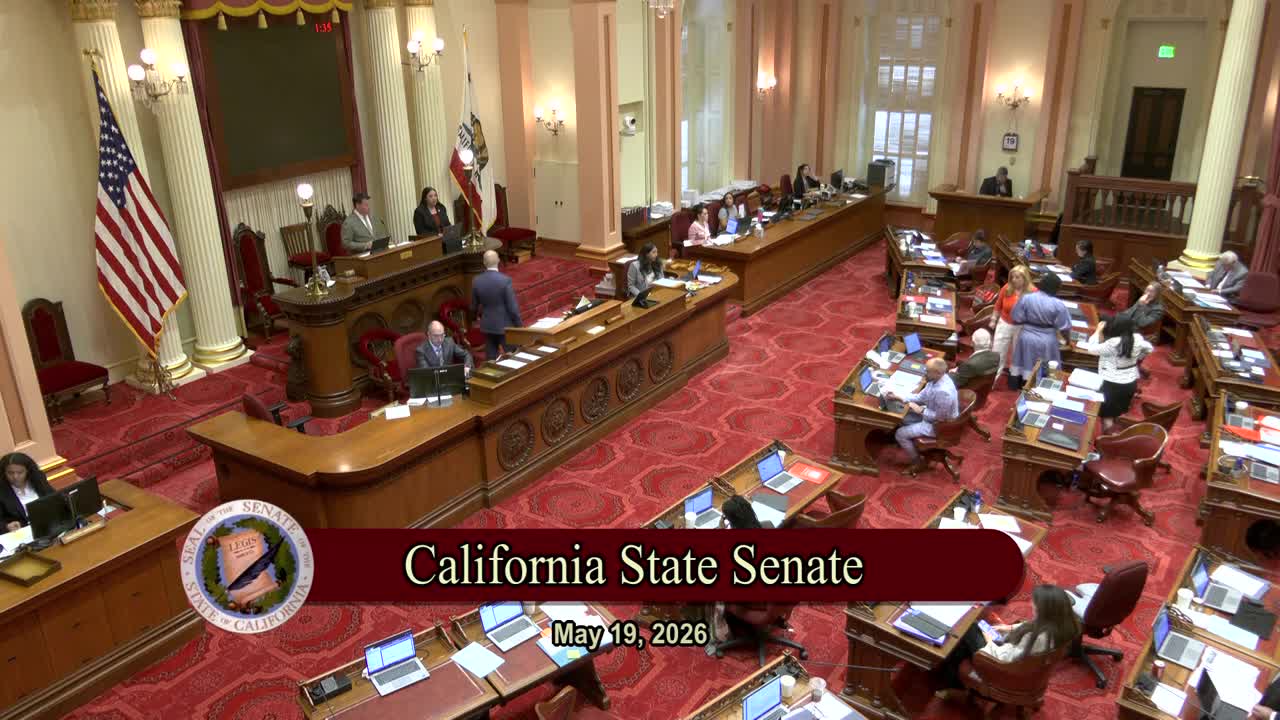 3MIN
Senate Floor
 21MIN
Senate Standing Committee on Energy, Utilities and Communications
Bill Author