SB 1145: California Environmental Quality Act: surplus land disposal requirements: exemption.
- Session Year: 2025-2026
- House: Senate
- Latest Version Date: 2026-04-28
Current Status:
In Progress
(2026-05-26: Referred to Coms. on L. GOV. and NAT. RES.)
Introduced
In Committee
Awaiting First Chamber Vote
Passed First Chamber
In Committee
Awaiting Second Chamber Vote
Passed Second Chamber
Enacted
Existing law requires a local agency to declare land either surplus land or exempt surplus land, as supported by written findings, before the local agency may take any action to dispose of it consistent with an agencys policies or procedures and defines terms for these purposes. Existing law generally requires a local agency, before disposing or negotiating to dispose of surplus land, to provide a written notice of the availability of the surplus land to specified entities and housing sponsors. Under existing law, land declared by an agency of the state or any local agency as exempt surplus land is not subject to these requirements.
The Planning and Zoning Law requires cities and counties to prepare, adopt, and amend general plans and elements of those general plans, as specified. After the legislative body has adopted all or part of a general plan, the law requires the planning agency to provide by April 1 of each year an annual report to specified entities that includes certain information, including the status of the plan and progress of its implementation.
This bill would exempt land that was or will be conveyed by the federal government to a local reuse authority in accordance with a military base closure and realignment, as specified, from these requirements. requirements if certain conditions are met. The bill would require a local reuse authority, if it is a city or county, to include specified information relating to the development of residential units on conveyed land as part of their annual report relating to their general plan. Because the bill would impose new duties on a local agency, this bill would impose a state-mandated local program. The bill would also limit the time to bring an action to challenge the application of this exemption to within 90 days after the local reuse authoritys approval of a disposition and development agreement, purchase and sale agreement, or similar agreement regarding the disposition of all or any portion of the land by the local reuse authority and not at the time of each subsequent conveyance or phased conveyance of the land.
The California Environmental Quality Act (CEQA) requires a lead agency, as defined, to prepare, or cause to be prepared, and certify the completion of an environmental impact report on a project that it proposes to carry out or approve that may have a significant effect on the environment or to adopt a negative declaration if it finds that the project will not have that effect. CEQA also requires a lead agency to prepare a mitigated negative declaration for a project that may have a significant effect on the environment if revisions in the project would avoid or mitigate that effect and there is no substantial evidence that the project, as revised, would have a significant effect on the environment.
This bill would provide that specified environmental review documents satisfy the requirements of CEQA for any project within the portion of the Concord Naval Weapons Station included within the boundaries of the area plan for the Concord Community Reuse Project, as provided, that satisfies specified conditions, including a requirement that the project applicant has negotiated a project labor agreement, as defined, for the project. The bill would further provide that a subsequent environmental impact review prepared for a project that otherwise meets certain specified conditions is not required to include any discussion of alternatives to the project or the growth-inducing impacts of the project. is consistent with the area plan land use map and has the same land use types and locations for those land use types as adopted in the area plan reviewed in those specified environmental review documents. The bill would further provide that any additional land use types or location of land use types that are not the same as those adopted in the area plan reviewed in the specified environmental documents would be a project subject to subsequent review pursuant to CEQA, and would not be required to conduct redundant analysis to what was adopted in the CRP area plan reviewed in the specified environmental documents, as provided. To the extent the bill imposes new duties on local agencies, the bill would impose a state-mandated local program. The bill would make its provisions severable.
This bill would make legislative findings and declarations as to the necessity of a special statute for the City of Concord.
The California Constitution requires the state to reimburse local agencies and school districts for certain costs mandated by the state. Statutory provisions establish procedures for making that reimbursement.This bill would provide that no reimbursement is required by this act for a specified reason.The California Constitution requires the state to reimburse local agencies and school districts for certain costs mandated by the state. Statutory provisions establish procedures for making that reimbursement.
This bill would provide that, if the Commission on State Mandates determines that the bill contains costs mandated by the state, reimbursement for those costs shall be made pursuant to the statutory provisions noted above.
Existing law requires a local agency to declare land either surplus land or exempt surplus land, as supported by written findings, before the local agency may take any action to dispose of it consistent with an agencys policies or procedures and defines terms for these purposes. Existing law generally requires a local agency, before disposing or negotiating to dispose of surplus land, to provide a written notice of the availability of the surplus land to specified entities and housing sponsors. Under existing law, land declared by an agency of the state or any local agency as exempt surplus land is not subject to these requirements.
This bill would exempt land that was or will be conveyed by the federal government to a local reuse authority in accordance with a military base closure and realignment, as specified, from these requirements. The bill would also limit the time to bring an action to challenge the application of this exemption to within 90 days after the local reuse authoritys approval of a disposition and development agreement, purchase and sale agreement, or similar agreement regarding the disposition of all or any portion of the land by the local reuse authority and not at the time of each subsequent conveyance or phased conveyance of the land.
The California Environmental Quality Act (CEQA) requires a lead agency, as defined, to prepare, or cause to be prepared, and certify the completion of an environmental impact report on a project that it proposes to carry out or approve that may have a significant effect on the environment or to adopt a negative declaration if it finds that the project will not have that effect. CEQA also requires a lead agency to prepare a mitigated negative declaration for a project that may have a significant effect on the environment if revisions in the project would avoid or mitigate that effect and there is no substantial evidence that the project, as revised, would have a significant effect on the environment.
This bill would provide that specified environmental review documents satisfy the requirements of CEQA for any project within the portion of the Concord Naval Weapons Station included within the boundaries of the area plan for the Concord Community Reuse Project, as provided, that meets satisfies specified conditions, including a requirement that the project applicant has negotiated a project labor agreement, as defined, for the project. The bill would further provide that a subsequent environmental impact review prepared for a project that otherwise meets certain specified conditions is not required to include any discussion of alternatives to the project or the growth-inducing impacts of the project. To the extent the bill imposes new duties on local agencies, the bill would impose a state-mandated local program. The bill would make its provisions severable.
This bill would make legislative findings and declarations as to the necessity of a special statute for the City of Concord.
The California Constitution requires the state to reimburse local agencies and school districts for certain costs mandated by the state. Statutory provisions establish procedures for making that reimbursement.
This bill would provide that no reimbursement is required by this act for a specified reason.
Existing law requires a local agency to declare land either surplus land or exempt surplus land, as supported by written findings, before the local agency may take any action to dispose of it consistent with an agencys policies or procedures and defines terms for these purposes. Existing law generally requires a local agency, before disposing or negotiating to dispose of surplus land, to provide a written notice of the availability of the surplus land to specified entities and housing sponsors. Under existing law, land declared by an agency of the state or any local agency as exempt surplus land is not subject to these requirements.
This bill would exempt land that was or will be conveyed by the federal government to a local reuse authority in accordance with a military base closure and realignment, as specified, from these requirements. The bill would also limit the time to bring an action to challenge the application of this exemption to within 90 days after the local reuse authoritys approval of a disposition and development agreement, purchase and sale agreement, or similar agreement regarding the disposition of all or any portion of the land by the local reuse authority and not at the time of each subsequent conveyance or phased conveyance of the land.
The California Environmental Quality Act (CEQA) requires a lead agency, as defined, to prepare, or cause to be prepared, and certify the completion of an environmental impact report on a project that it proposes to carry out or approve that may have a significant effect on the environment or to adopt a negative declaration if it finds that the project will not have that effect. CEQA also requires a lead agency to prepare a mitigated negative declaration for a project that may have a significant effect on the environment if revisions in the project would avoid or mitigate that effect and there is no substantial evidence that the project, as revised, would have a significant effect on the environment.
This bill would provide that specified environmental review documents satisfy the requirements of CEQA for any project within the portion of the Concord Naval Weapons Station included within the boundaries of the area plan for the Concord Community Reuse Project, as provided, that meets specified conditions, including a requirement that the project applicant has negotiated a project labor agreement, as defined, for the project. To the extent the bill imposes new duties on local agencies, the bill would impose a state-mandated local program.
This bill would make legislative findings and declarations as to the necessity of a special statute for the City of Concord.
The California Constitution requires the state to reimburse local agencies and school districts for certain costs mandated by the state. Statutory provisions establish procedures for making that reimbursement.
This bill would provide that no reimbursement is required by this act for a specified reason.
Existing law requires the Strategic Growth Council to develop and administer the Affordable Housing and Sustainable Communities Program to reduce greenhouse gas emissions through projects that implement land use, housing, transportation, and agricultural land preservation practices to support infill and compact development and that support other related and coordinated public policy objectives. Existing law requires the council to develop guidelines and selection criteria for the implementation of the program, as specified.This bill would make nonsubstantive changes to the latter provision.Existing law requires the Strategic Growth Council to develop and administer the Affordable Housing and Sustainable Communities Program to reduce greenhouse gas emissions through projects that implement land use, housing, transportation, and agricultural land preservation practices to support infill and compact development and that support other related and coordinated public policy objectives. Existing law requires the council to develop guidelines and selection criteria for the implementation of the program, as specified.
This bill would make nonsubstantive changes to the latter provision.
The Legislature finds and declares all of the following:
(a)The Defense Authorization Amendments and Base Closure and Realignment Act (Public Law 100-526) and the Defense Base Closure and Realignment Act of 1990 (Public Law 101-510) establish a comprehensive federal framework governing the closure, realignment, and disposal of military installations and related real property.
(b)The federal base closure and realignment disposition process is designed to mitigate the economic impacts of base closures by promoting timely economic redevelopment, private investment, job creation, and replacement of lost military employment at former military installations, including through economic development conveyances and related federally authorized disposition mechanisms.
(c)The federal base closure and realignment disposition process requires legally binding negotiations with homeless assistance providers, including the preparation, submission, and implementation of a homeless assistance submission approved by the United States Department of Housing and Urban Development, as a condition of the federal disposition of former military base property.
(d)The application of the Surplus Land Act (Article 8 (commencing with Section 54220) of Chapter 5 of Part 1 of Division 2 of Title 5 of the Government Code) to real property acquired by a local agency pursuant to the federal base closure and realignment disposition process would require compliance with a duplicative and potentially conflicting state law disposition framework after completion of federally mandated negotiations, approvals, and reuse planning, and would interfere with, and poses an obstacle to, the objectives of the United States Congress in disposing of federal military base property, including objectives related to homeless assistance, economic development, and job creation.
(e)Established in 1942, the Concord Naval Weapons Station is a former military base that was placed on the Base Realignment and Closure list in 2005.
(f)The United States Navy declared approximately 4,972 acres of property at the Concord Naval Weapons Station to be surplus to the needs of the federal government, in accordance with the Defense Base Closure and Realignment Act of 1990.
(g)The United States Navy intends to convey through an economic development conveyance approximately 2,350 acres of the Concord Naval Weapons Station to the City of Concord as the designated local redevelopment authority for redevelopment for the purpose of short- and long-term job generation.
(h)The environmental impacts of the proposed reuse of the former Concord Naval Weapons Station have been analyzed through an environmental impact statement prepared by the United States Navy pursuant to the National Environmental Policy Act of 1969 (42 U.S.C. Sec. 4321 et seq.) and an environmental impact report certified by the City of Concord pursuant to the California Environmental Quality Act (commencing with Section 21000 of the Public Resources Code).
(i)In 2010, after a multiyear process with substantial public input, the City of Concord adopted a three-phase reuse plan for the Concord Naval Weapons Station, and after that the City of Concord adopted the Concord Reuse Project Area Plan to incorporate the reuse plan policies and goals into the citys general plan and adopted an addendum to the previously certified environmental impact report.
(j)The Concord Reuse Project Area Plan anticipates no fewer than 10,000 housing units with 25 percent of units affordable to lower income households, up to 6,100,000 square feet of commercial building space, community facilities such as school sites, neighborhood parks, and sports facilities, as well as approximately 2,500 acres of open space.
(k)As California continues to grapple with a shortage of new housing, the state has an interest in facilitating the building of new homes, not just for the housing, but for the jobs and economic development that such projects bring to a region.
(l)It is the intent of the Legislature to enact measures to facilitate the creation of housing and community development that the Concord Reuse Project Area Plan envisions, that will be an economic driver, not just for the City of Concord, but for the greater East Bay region of California.
SEC. 2.Section 54222.3.3 is added to the Government Code, to read:54222.3.3.(a)This article shall not apply to the disposal of all or any portion of land that was or will be conveyed by the federal government to a local reuse authority in accordance with the Defense Authorization Amendments and Base Closure and Realignment Act (Public Law 100-526), the Defense Base Closure and Realignment Act of 1990 (Public Law 101-510), or any successor federal law governing military base closure and realignment. realignment if both of the following conditions are met:
(1)Before disposition of the land by the local reuse authority, the local reuse authority shall enter into a disposition and development agreement, purchase and sale agreement, or similar agreement with the recipient providing that at least 25 percent of the aggregate residential units developed on the land conveyed will be restricted to lower income households with an affordable housing cost, as defined in Section 50052.5 of the Health and Safety Code, for a minimum of 45 years or affordable rent, as defined in Section 50053 of the Health and Safety Code, for a minimum of 55 years.
(2)Before disposition of the land by the local agency reuse authority, the recipient of the land shall be subject to a project labor agreement, as defined in Section 2500 of the Public Contract Code.
(b)Beginning on January 1, 2032, and every five years thereafter, the local agency shall report to the Department of Housing and Community Development and the relevant policy committees of the Legislature both of the following:
(1)Whether the agreement required pursuant to paragraph (1) requires that at least 25 percent of the aggregate residential units developed on the land conveyed be restricted to lower income households as required in paragraph (1) of subdivision (a).
(2)Wether the recipient of the land is subject to a project labor agreement as required by paragraph (2) of subdivision (a).
(c)If the local reuse authority is a city or county, the local agency shall include in its annual report, required pursuant to paragraph (2) of subdivision (a) of Section 65400, the status of development of residential units on the former military base, including the total number of residential units that have been permitted and what percentage of those residential units are restricted for persons and families of low- or moderate-income or lower income households.
(d)The local reuse authority shall notify the Department of Housing and Community Development and the relevant policy committees of the Legislature within 30 days of amending, in a manner that would modify the affordability requirements of paragraph (1) of subdivision (a), a disposition and development agreement, purchase and sale agreement, or similar agreement regarding the disposition of all or any portion of the land by the local reuse authority that formed the basis for the application of this section to a disposition of land by a local reuse authority.
(b)(e)An action challenging the applicability of this section to any land shall be brought within 90 days after the local reuse authoritys approval of a disposition and development agreement, purchase and sale agreement, or similar agreement regarding the disposition of all or any portion of the land by the local reuse authority and not at the time of each subsequent conveyance or phased conveyance of the land.
SEC. 3.Chapter 6.8 (commencing with Section 21189.60) is added to Division 13 of the Public Resources Code, to read:6.8.Concord Community Reuse Project21189.60.For purposes of this chapter, the following definitions apply:
(a)Applicant means a public or private entity or its affiliates, or a person or entity that proposes a project in the plan area, along with its successors, heirs, and assignees.(b)(a)City means the City of Concord.
(c)(b)CNWS means the Concord Naval Weapons Station.
(d) CNWS environmental review documents means and refers to the following:(1)The Final Environmental Impact Statement for the Disposal and Reuse of the Former Naval Weapons Station Seal Beach, Detachment Concord, prepared by the U.S. Department of the Navy issued in August 2017.(2)The Final Environmental Impact Report for the Concord Community Reuse Project Plan prepared by the city (State Clearinghouse No. 2007052094) certified in February 2010.(3)The Final Environmental Impact Report Addendum and Initial Study of Environmental Significance for the Concord Reuse Project Area Plan approved in January 2012.(e)(c)Concord Community Reuse Project means the Concord Community Reuse Project, approved by the city on February 23, 2010, that established the planning process for civilian use of the former CNWS.
(f)(d)CRP area plan means the area plan for the Concord Community Reuse Project adopted and incorporated into the citys 2030 general plan in 2012, that covers the inland portion of the former CNWS, the North Concord/Martinez Bay Area Rapid Transit Station, and the Diablo Creek Golf Course.
(g)(e)Plan area means the approximately 5,000-acre inland portion of the CNWS included within the boundaries of the CRP area plan.
(h)Plan documents means the Concord Community Reuse Project and the CRP area plan.(i)Project labor agreement means the same as defined in paragraph (1) of subdivision (b) of Section 2500 of the Public Contract Code.21189.61.(a)Notwithstanding Section 21166, the CNWS environmental review documents shall be conclusively presumed to satisfy the requirements of this division for any project within the plan area that satisfies the following conditions:(1)The project does not involve an expansion of the geographic boundaries of the plan area.(2)The project does not increase the total number of residential units within the plan area by more than 25 percent of the units identified in the CRP area plan as of 2012.(3)The project does not increase the square footage of commercial space within the plan area by more than 25 percent of the commercial space identified in the CRP area plan as of 2012.(4)The project will not result in any reduction of the aggregate 25 percent affordability requirement for the plan area.(5)The project applicant has negotiated a project labor agreement for the project.(6)The project is subject to legally binding agreements with local homeless service providers.(b)For purposes of this section, a project within the plan area shall include, without limitation, all of the following:(1)Revisions to the plan documents.(2)Approval and revision of a specific plan covering all or a portion of the plan area.(3)Approval of a disposition and development agreement for conveyance of property within the plan area to developers.(4)Approval of entitlements, permits, and other approvals for development within the plan area, including, but not limited to, subdivision map approvals, design approvals, affordable housing plans and agreements, tree removal permits, development agreements, improvement agreements, and assessment and financing districts.(c)Notwithstanding Section 21166, if a project within the plan area satisfies the requirements in paragraphs (1), (4), (5), and (6) of subdivision (a), and proposes to increase the number of residential units or square footage of commercial space in excess of 25 percent, any subsequent environmental impact review prepared for that project shall not be required to include any discussion of alternatives to the project or the growth-inducing impacts of the project.21189.61.(a)The Final Environmental Impact Report for the Concord Community Reuse Project Plan and Addendum shall be conclusively presumed to satisfy the requirements of this division for any project within the plan area that is consistent with the CRP area plan land use map and has the same land use types and locations for those land use types, as adopted in the CRP area plan reviewed in the Final Environmental Impact Report for the Concord Community Reuse Project Plan and Addendum.
(b)Any additional land use types or location of land use types that are not the same as those adopted in the CRP area plan reviewed in the Final Environmental Impact Report for the Concord Community Reuse Project Plan and Addendum shall be a project subject to subsequent review pursuant to this division, provided that, notwithstanding subdivisions (b) and (c) of Section 21166, any required subsequent review shall tier off existing environmental review in the citys general plan and shall not be required to conduct redundant analysis to what was adopted in the CRP area plan reviewed in the Final Environmental Impact Report for the Concord Community Reuse Project Plan and Addendum.
21189.62.The provisions of this chapter are severable. If any provision of this chapter or its application is held invalid, that invalidity shall not affect other provisions or applications that can be given effect without the invalid provision or application.
SEC. 4.The Legislature finds and declares that a special statute is necessary and that a general statute cannot be made applicable within the meaning of Section 16 of Article IV of the California Constitution because of the unique circumstances, described in Section 1 of this act, in the City of Concord.
SEC. 5.No reimbursement is required by this act pursuant to Section 6 of Article XIIIB of the California Constitution because a local agency or school district has the authority to levy service charges, fees, or assessments sufficient to pay for the program or level of service mandated by this act, within the meaning of Section 17556 of the Government Code.SEC. 5.If the Commission on State Mandates determines that this act contains costs mandated by the state, reimbursement to local agencies and school districts for those costs shall be made pursuant to Part 7 (commencing with Section 17500) of Division 4 of Title 2 of the Government Code.
The Legislature finds and declares all of the following:
(a)The Defense Authorization Amendments and Base Closure and Realignment Act (Public Law 100-526) and the Defense Base Closure and Realignment Act of 1990 (Public Law 101-510) establish a comprehensive federal framework governing the closure, realignment, and disposal of military installations and related real property.
(b)The federal base closure and realignment disposition process is designed to mitigate the economic impacts of base closures by promoting timely economic redevelopment, private investment, job creation, and replacement of lost military employment at former military installations, including through economic development conveyances and related federally authorized disposition mechanisms.
(c)The federal base closure and realignment disposition process requires legally binding negotiations with homeless assistance providers, including the preparation, submission, and implementation of a homeless assistance submission approved by the United States Department of Housing and Urban Development, as a condition of the federal disposition of former military base property.
(d)The application of the Surplus Land Act (Article 8 (commencing with Section 54220) of Chapter 5 of Part 1 of Division 2 of Title 5 of the Government Code) to real property acquired by a local agency pursuant to the federal base closure and realignment disposition process would require compliance with a duplicative and potentially conflicting state law disposition framework after completion of federally mandated negotiations, approvals, and reuse planning, and would interfere with, and poses an obstacle to, the objectives of the United States Congress in disposing of federal military base property, including objectives related to homeless assistance, economic development, and job creation.
(c)(e)Established in 1942, the Concord Naval Weapons Station is a former military base that was placed on the Base Realignment and Closure list in 2005.
(d)(f)The Navy declared approximately 4,972 acres of property at the Concord Naval Weapons Station to be surplus to the needs of the federal government, in accordance with the Defense Base Closure and Realignment Act of 1990.
(e)(g)The Navy intends to convey through an economic development conveyance approximately 2,350 acres of the Concord Naval Weapons Station to the City of Concord as the designated local redevelopment authority for redevelopment for the purpose of short- and long-term job generation.
(f)(h)The environmental impacts of the proposed reuse of the former Concord Naval Weapons Station have been analyzed through an environmental impact statement prepared by the Navy pursuant to the National Environmental Policy Act of 1969 (42 U.S.C. Sec. 4321 et seq.) and an environmental impact report certified by the City of Concord pursuant to the California Environmental Quality Act (commencing with Section 21000 of the Public Resources Code).
(g)(i)In 2010, after a multiyear process with substantial public input, the City of Concord adopted a three-phase reuse plan for the Concord Naval Weapons Station, and after that the City of Concord adopted the Concord Reuse Project Area Plan to incorporate the reuse plan policies and goals into the citys general plan and adopted an addendum to the previously certified environmental impact report.
(h)(j)The Concord Reuse Project Area Plan anticipates no fewer than 10,000 housing units with 25 percent of units affordable to lower income households, up to 6,100,000 square feet of commercial building space, community facilities such as school sites, neighborhood parks, and sports facilities, as well as approximately 2,500 acres of open space.
(i)(k)As California continues to grapple with a shortage of new housing, the state has an interest in facilitating the building of new homes, not just for the housing, but for the jobs and economic development that such projects bring to a region.
(j)(l)It is the intent of the Legislature to enact measures to facilitate the creation of housing and community development that the Concord Reuse Project Area Plan envisions, that will be an economic driver, not just for the City of Concord, but for the greater East Bay region of California.
SEC. 2.Section 54222.3.3 is added to the Government Code, to read:54222.3.3.(a)This article shall not apply to the disposal of all or any portion of land that was or will be conveyed by the federal government to a local reuse authority in accordance with the Defense Authorization Amendments and Base Closure and Realignment Act (Public Law 100-526), the Defense Base Closure and Realignment Act of 1990 (Public Law 101-510), or any successor federal law governing military base closure and realignment.
(b)An action challenging the applicability of this section to any land shall be brought within 90 days after the local reuse authoritys approval of a disposition and development agreement, purchase and sale agreement, or similar agreement regarding the disposition of all or any portion of the land by the local reuse authority and not at the time of each subsequent conveyance or phased conveyance of the land.
SEC. 3.Chapter 6.8 (commencing with Section 21189.60) is added to Division 13 of the Public Resources Code, to read:6.8.Concord Community Reuse Project21189.60.For purposes of this chapter, the following definitions apply:
(a)Applicant means a public or private entity or its affiliates, or a person or entity that proposes a project in the plan area, along with its successors, heirs, and assignees.
(b)City means the City of Concord.
(c)CNWS means the Concord Naval Weapons Station.
(d)CNWS environmental review documents means and refers to the following:
(1)The Final Environmental Impact Statement for the Disposal and Reuse of the Former Naval Weapons Station Seal Beach, Detachment Concord, prepared by the U.S. Department of the Navy issued in August 2017.
(2)The Final Environmental Impact Report for the Concord Community Reuse Project Plan prepared by the city (State Clearinghouse No. 2007052094) certified in February 2010.
(3)The Final Environmental Impact Report Addendum and Initial Study of Environmental Significance for the Concord Reuse Project Area Plan approved in January 2012.
(e)Concord Community Reuse Project means the Concord Community Reuse Project, approved by the city on February 23, 2010, that established the planning process for civilian use of the former CNWS.
(f)CRP area plan means the area plan for the Concord Community Reuse Project adopted and incorporated into the citys 2030 general plan in 2012, that covers the inland portion of the former CNWS, the North Concord/Martinez Bay Area Rapid Transit Station, and the Diablo Creek Golf Course.
(g)Plan area means the approximately 5,000-acre inland portion of the CNWS included within the boundaries of the CRP area plan.
(h)Plan documents means the Concord Community Reuse Project and the CRP area plan.
(i)Project labor agreement means the same as defined in paragraph (1) of subdivision (b) of Section 2500 of the Public Contract Code.
21189.61.(a)Notwithstanding Section 21166, the CNWS environmental review documents shall be conclusively presumed to satisfy the requirements of this division for any project within the plan area that satisfies the following conditions:
(1)The project does not involve an expansion of the geographic boundaries of the plan area.
(2)The project does not increase the total number of residential units within the plan area by more than ____ 25 percent of the units identified in the CRP area plan as of ____. 2012.
(3)The project does not increase the square footage of commercial space within the plan area by more than ____ 25 percent of the commercial space identified in the CRP area plan as of ____. 2012.
(4)The project will not result in any reduction of the aggregate 25 percent affordability requirement for the plan area.
(5)The project applicant has negotiated a project labor agreement for the project.
(6)The project is subject to legally binding agreements with local homeless service providers.
(b)For purposes of this section, a project within the plan area shall include, without limitation, all of the following:
(1)Revisions to the plan documents.
(2)Approval and revision of a specific plan covering all or a portion of the plan area.
(3)Approval of a disposition and development agreement for conveyance of property within the plan area to developers.
(4)Approval of entitlements, permits, and other approvals for development within the plan area, including, but not limited to, subdivision map approvals, design approvals, affordable housing plans and agreements, tree removal permits, development agreements, improvement agreements, and assessment and financing districts.
(c)Notwithstanding Section 21166, if a project within the plan area satisfies the requirements in paragraphs (1), (4), (5), and (6) of subdivision (a), and proposes to increase the number of residential units or square footage of commercial space in excess of 25 percent, any subsequent environmental impact review prepared for that project shall not be required to include any discussion of alternatives to the project or the growth-inducing impacts of the project.
21189.62.The provisions of this chapter are severable. If any provision of this chapter or its application is held invalid, that invalidity shall not affect other provisions or applications that can be given effect without the invalid provision or application.
SEC. 4.The Legislature finds and declares that a special statute is necessary and that a general statute cannot be made applicable within the meaning of Section 16 of Article IV of the California Constitution because of the unique circumstances, described in Section 1 of this act, in the City of Concord.
SEC. 5.No reimbursement is required by this act pursuant to Section 6 of Article XIIIB of the California Constitution because a local agency or school district has the authority to levy service charges, fees, or assessments sufficient to pay for the program or level of service mandated by this act, within the meaning of Section 17556 of the Government Code.
The Legislature finds and declares all of the following:
(a)The Defense Authorization Amendments and Base Closure and Realignment Act (Public Law 100-526) and the Defense Base Closure and Realignment Act of 1990 (Public Law 101-510) establish a comprehensive federal framework governing the closure, realignment, and disposal of military installations and related real property.
(b)The federal base closure and realignment process is designed to mitigate the economic impacts of base closures by promoting timely economic redevelopment, private investment, job creation, and replacement of lost military employment at former military installations, including through economic development conveyances and related federally authorized disposition mechanisms.
(c)Established in 1942, the Concord Naval Weapons Station is a former military base that was placed on the Base Realignment and Closure list in 2005.
(d)The Navy declared approximately 4,972 acres of property at the Concord Naval Weapons Station to be surplus to the needs of the federal government, in accordance with the Defense Base Closure and Realignment Act of 1990.
(e)The Navy intends to convey through an economic development conveyance approximately 2,350 acres of the Concord Naval Weapons Station to the City of Concord as the designated local redevelopment authority for redevelopment for the purpose of short- and long-term job generation.
(f)The environmental impacts of the proposed reuse of the former Concord Naval Weapons Station have been analyzed through an environmental impact statement prepared by the Navy pursuant to the National Environmental Policy Act of 1969 (42 U.S.C. Sec. 4321 et seq.) and an environmental impact report certified by the City of Concord pursuant to the California Environmental Quality Act (commencing with Section 21000 of the Public Resources Code).
(g)In 2010, after a multiyear process with substantial public input, the City of Concord adopted a three-phase reuse plan for the Concord Naval Weapons Station, and after that the City of Concord adopted the Concord Reuse Project Area Plan to incorporate the reuse plan policies and goals into the citys general plan and adopted an addendum to the previously certified environmental impact report.
(h)The Concord Reuse Project Area Plan anticipates no fewer than 10,000 housing units with 25 percent of units affordable to lower income households, up to 6,100,000 square feet of commercial building space, community facilities such as school sites, neighborhood parks, and sports facilities, as well as approximately 2,500 acres of open space.
(i)As California continues to grapple with a shortage of new housing, the state has an interest in facilitating the building of new homes, not just for the housing, but for the jobs and economic development that such projects bring to a region.
(j)It is the intent of the Legislature to enact measures to facilitate the creation of housing and community development that the Concord Reuse Project Area Plan envisions, that will be an economic driver, not just for the City of Concord, but for the greater East Bay region of California.
SEC. 2.Section 54222.3.3 is added to the Government Code, to read:54222.3.3.(a)This article shall not apply to the disposal of all or any portion of land that was or will be conveyed by the federal government to a local reuse authority in accordance with the Defense Authorization Amendments and Base Closure and Realignment Act (Public Law 100-526), the Defense Base Closure and Realignment Act of 1990 (Public Law 101-510), or any successor federal law governing military base closure and realignment.
(b)An action challenging the applicability of this section to any land shall be brought within 90 days after the local reuse authoritys approval of a disposition and development agreement, purchase and sale agreement, or similar agreement regarding the disposition of all or any portion of the land by the local reuse authority and not at the time of each subsequent conveyance or phased conveyance of the land.
SEC. 3.Chapter 6.8 (commencing with Section 21189.60) is added to Division 13 of the Public Resources Code, to read:6.8.Concord Community Reuse Project21189.60.For purposes of this chapter, the following definitions apply:
(a)Applicant means a public or private entity or its affiliates, or a person or entity that proposes a project in the plan area, along with its successors, heirs, and assignees.
(b)City means the City of Concord.
(c)CNWS means the Concord Naval Weapons Station.
(d)CNWS environmental review documents means and refers to the following:
(1)The Final Environmental Impact Statement for the Disposal and Reuse of the Former Naval Weapons Station Seal Beach, Detachment Concord, prepared by the U.S. Department of the Navy issued in August 2017.
(2)The Final Environmental Impact Report for the Concord Community Reuse Project Plan prepared by the city (State Clearinghouse No. 2007052094) certified in February 2010.
(3)The Final Environmental Impact Report Addendum and Initial Study of Environmental Significance for the Concord Reuse Project Area Plan approved in January 2012.
(e)Concord Community Reuse Project means the Concord Community Reuse Project, approved by the city on February 23, 2010, that established the planning process for civilian use of the former CNWS.
(f)CRP area plan means the area plan for the Concord Community Reuse Project adopted and incorporated into the citys 2030 general plan in 2012, that covers the inland portion of the former CNWS, the North Concord/Martinez Bay Area Rapid Transit Station, and the Diablo Creek Golf Course.
(g)Plan area means the approximately 5,000-acre inland portion of the CNWS included within the boundaries of the CRP area plan.
(h)Plan documents means the Concord Community Reuse Project and the CRP area plan.
(i)Project labor agreement means the same as defined in paragraph (1) of subdivision (b) of Section 2500 of the Public Contract Code.
21189.61.(a)Notwithstanding Section 21166, the CNWS environmental review documents shall be conclusively presumed to satisfy the requirements of this division for any project within the plan area that satisfies the following conditions:
(1)The project does not involve an expansion of the geographic boundaries of the plan area.
(2)The project does not increase the total number of residential units within the plan area by more than ____ percent of the units identified in the CRP area plan as of ____.
(3)The project does not increase the square footage of commercial space within the plan area by more than ____ percent of the commercial space identified in the CRP area plan as of ____.
(4)The project will not result in any reduction of the aggregate 25 percent affordability requirement for the plan area.
(5)The project applicant has negotiated a project labor agreement for the project.
(6)The project is subject to legally binding agreements with local homeless service providers.
(b)For purposes of this section, a project within the plan area shall include, without limitation, all of the following:
(1)Revisions to the plan documents.
(2)Approval and revision of a specific plan covering all or a portion of the plan area.
(3)Approval of a disposition and development agreement for conveyance of property within the plan area to developers.
(4)Approval of entitlements, permits, and other approvals for development within the plan area, including, but not limited to, subdivision map approvals, design approvals, affordable housing plans and agreements, tree removal permits, development agreements, improvement agreements, and assessment and financing districts.
SEC. 4.The Legislature finds and declares that a special statute is necessary and that a general statute cannot be made applicable within the meaning of Section 16 of Article IV of the California Constitution because of the unique circumstances, described in Section 1 of this act, in the City of Concord.
SEC. 5.No reimbursement is required by this act pursuant to Section 6 of Article XIIIB of the California Constitution because a local agency or school district has the authority to levy service charges, fees, or assessments sufficient to pay for the program or level of service mandated by this act, within the meaning of Section 17556 of the Government Code.
SECTION 1.Section 75215 of the Public Resources Code is amended to read:75215.(a)Before awarding funds under the program, the council, in coordination with the member agencies and departments of the council, the State Air Resources Board, and other state entities, as needed, shall develop guidelines and selection criteria for the implementation of the program.(b)Before the adoption of the guidelines and the selection criteria, the council shall conduct at least two public workshops to receive and consider public comments. One workshop shall be held at a location in northern California and one workshop shall be held at a location in southern California.(c)The council shall publish the draft guidelines and selection criteria on its internet website at least 30 days before the public meetings.(d)In adopting the guidelines and selection criteria, the council shall consider the comments from local governments, regional agencies, and other stakeholders. The council shall conduct outreach to disadvantaged communities to encourage comments on the draft guidelines from those communities.(e)The council shall adopt guidelines or selection criteria that include both affordable housing rental units and owner-occupied affordable housing units.(f)Program guidelines may be revised by the council to reflect changes in program focus or need. Outreach to stakeholders shall be conducted pursuant to subdivisions (a), (b), and (c) before the council adopts changes to the guidelines.(g)Upon the adoption of the guidelines and selection criteria, the council shall, pursuant to Section 9795 of the Government Code, submit copies of the guidelines to the fiscal and appropriate policy committees of the Legislature.(h)Chapter 3.5 (commencing with Section 11340) of Part 1 of Division 3 of Title 2 of the Government Code does not apply to the development and adoption of the guidelines and selection criteria pursuant to this section.(a)Prior to Before awarding funds under the program, the council, in coordination with the member agencies and departments of the council, the State Air Resources Board, and other state entities, as needed, shall develop guidelines and selection criteria for the implementation of the program.
(b)Prior to Before the adoption of the guidelines and the selection criteria, the council shall conduct at least two public workshops to receive and consider public comments. One workshop shall be held at a location in northern California and one workshop shall be held at a location in southern California.
(c)The council shall publish the draft guidelines and selection criteria on its internet website at least 30 days prior to before the public meetings.
(d)In adopting the guidelines and selection criteria, the council shall consider the comments from local governments, regional agencies, and other stakeholders. The council shall conduct outreach to disadvantaged communities to encourage comments on the draft guidelines from those communities.
(e)The council shall adopt guidelines or selection criteria that include both affordable housing rental units and owner-occupied affordable housing units.
(f)Program guidelines may be revised by the council to reflect changes in program focus or need. Outreach to stakeholders shall be conducted, conducted pursuant to subdivisions (a), (b), and (c) before the council adopts changes to the guidelines.
(g)Upon the adoption of the guidelines and selection criteria, the council shall, pursuant to Section 9795 of the Government Code, submit copies of the guidelines to the fiscal and appropriate policy committees of the Legislature.
(h)Chapter 3.5 (commencing with Section 11340) of Part 1 of Division 3 of Title 2 of the Government Code does not apply to the development and adoption of the guidelines and selection criteria pursuant to this section.
|
Date
|
Status
|
|---|---|
| May 26, 2026 | Referred to Coms. on L. GOV. and NAT. RES. |
| May 20, 2026 | In Assembly. Read first time. Held at Desk. |
| May 19, 2026 | Read third time. Passed. (Ayes 39. Noes 0. Page 4361.) Ordered to the Assembly. |
| May 19, 2026 | Read third time. Passed. (Ayes 39. Noes 0.) Ordered to the Assembly. |
| May 14, 2026 | From committee: Do pass. (Ayes 7. Noes 0. Page 4266.) (May 14). |
| May 14, 2026 | From committee: Do pass. (Ayes 7. Noes 0.) (May 14). |
| May 14, 2026 | Read second time. Ordered to third reading. |
| May 12, 2026 | Set for hearing May 14. |
| May 11, 2026 | May 11 hearing: Placed on APPR. suspense file. |
| May 4, 2026 | Set for hearing May 11. |
| Apr 28, 2026 | Read second time and amended. Re-referred to Com. on APPR. |
| Apr 27, 2026 | From committee: Do pass as amended and re-refer to Com. on APPR. (Ayes 7. Noes 0. Page 4009.) (April 22). |
| Apr 27, 2026 | From committee: Do pass as amended and re-refer to Com. on APPR. (Ayes 7. Noes 0.) (April 22). |
| Apr 17, 2026 | Set for hearing April 22. |
| Apr 15, 2026 | From committee: Do pass and re-refer to Com. on E.Q. (Ayes 7. Noes 0. Page 3904.) (April 15). Re-referred to Com. on E.Q. |
| Apr 15, 2026 | From committee: Do pass and re-refer to Com. on E.Q. (Ayes 7. Noes 0.) (April 15). Re-referred to Com. on E.Q. |
| Apr 9, 2026 | Set for hearing April 15. |
| Apr 8, 2026 | From committee with author's amendments. Read second time and amended. Re-referred to Com. on L. GOV. |
| Apr 8, 2026 | Re-referred to Coms. on L. GOV. and E.Q. |
| Mar 23, 2026 | From committee with author's amendments. Read second time and amended. Re-referred to Com. on RLS. |
| Feb 26, 2026 | Referred to Com. on RLS. |
| Feb 19, 2026 | From printer. May be acted upon on or after March 21. |
| Feb 18, 2026 | Introduced. Read first time. To Com. on RLS. for assignment. To print. |
|
Date
|
Description
|
Location
|
Votes
|
|
|---|---|---|---|---|
| May 19, 2026 | Senate 3rd Reading SB1145 Grayson | Senate Floor |
Passed |
|
| May 14, 2026 | Do pass | Senate Standing Committee on Appropriations |
Passed |
|
| May 11, 2026 | Placed on suspense file | Senate Standing Committee on Appropriations |
Passed |
|
| Apr 22, 2026 | Do pass as amended, but first amend, and re-refer to the Committee on [Appropriations] | Senate Standing Committee on Environmental Quality |
Passed |
|
| Apr 15, 2026 | Do pass, but first be re-referred to the Committee on [Environmental Quality] | Senate Standing Committee on Local Government |
Passed |
This list shows positions taken on this bill by organizations on the date displayed, which is linked to the original source.
Positions by individuals are not included.
|
Organization
|
Position
|
Date
|
|---|---|---|
| City of Concord | ** Support | |
| Contra Costa Building and Construction Trades Council | ** Support | |
| Contra Costa County | ** Support | |
| District Council Of Iron Workers Of The State Of California And Vicinity | ** Support | |
| East Bay Housing Organizations | ** Against | |
| Nonprofit Housing Association of Northern California | ** Against | |
| Public Interest Law Project | ** Against | |
| San Diego Housing Federation | ** Against | |
| Smart, Sheet Metal Workers' Local Union No. 104 | ** Support | |
| Western Electrical Contractors Association | ** Against |
SENATE RULES COMMITTEE Office of Senate Floor Analyses (916) 651-4171 | SB 1145 |
THIRD READING
Bill No: SB 1145
Author: Grayson (D)
Amended: 4/28/26
Vote: 21
SENATE LOCAL GOVERNMENT COMMITTEE: 7-0, 4/15/26
AYES: Durazo, Choi, Arreguín, Ashby, Cervantes, Laird, Seyarto
SENATE ENVIRONMENTAL QUALITY COMMITTEE: 7-0, 4/22/26
AYES: Blakespear, Valladares, Allen, Dahle, Gonzalez, Hurtado, Menjivar
SENATE APPROPRIATIONS COMMITTEE: 7-0, 5/14/26
AYES: Cervantes, Seyarto, Cabaldon, Dahle, Grayson, Richardson, Wahab
SUBJECT: California Environmental Quality Act: surplus land disposal requirements: exemption
SOURCE: Author
DIGEST:
This bill excludes from the Surplus Land Act (SLA) dispositions for military base reuse projects and streamlines environmental review for the Concord Community Reuse Project.
ANALYSIS:
Existing law:
- Establishes procedures for the disposal of publicly-owned land that is surplus to the needs of local agencies, under the SLA. The SLA:
- Requires local officials that want to dispose of public property to declare that the land is no longer needed for the agency’s use in a public meeting and declare the land either “surplus land” or “exempt surplus land.”
- Provides that “agency’s use” includes land that is being used, or is planned to be used pursuant to a written plan adopted by the local agency or will be disposed of to support agency work or operations, and excludes land for agency’s use from the SLA.
- Requires local agencies to follow the procedures laid out in the SLA before surplus land can be sold, including, but not limited, to send a written notice of availability to various public agencies and nonprofit groups, referred to as “housing sponsors,” notifying them that land is available.
- Negotiates in good faith for 90 days with housing sponsors that respond.
- Allows the local agency to dispose of the property on the private market if agreement is not reached with a housing sponsor.
- Requires that, if a property sold as surplus is not sold to a housing sponsor, but housing is developed on it later, 15% of the units must be sold or rented at an affordable cost to lower income households.
- Requires local agencies to notify the Department of Housing and Community Development (HCD) prior to agreeing to terms for the disposition of surplus land.
- Imposes penalties of 30% of the disposition value of the land for a first violation and 50% of the disposition value for any subsequent violation for selling land in violation of the SLA.
- Establishes an enforcement process, which provides, among other things, that a local agency cannot be liable for a penalty if it is not notified by HCD that it is in violation of the act.
- Allows private enforcement of the SLA by affordable housing developers, housing organizations, individuals that would have been eligible to apply for residency in affordable housing, a beneficially interested person or entity, and HCD.
- Designates certain types of land as “exempt surplus land” and provides that the entirety of the SLA does not apply to exempt surplus land.
- Allows HCD to develop guidelines to implement the penalty provisions of the SLA and provides that those guidelines are not subject to the Administrative Procedures Act.
- Requires under the California Environmental Quality Act (CEQA) a lead agency to determine whether a project is exempt from CEQA, or if it must do an initial study to determine if a project will have significant effects on the environment. If a project has no effect on the environment or effects that can be mitigated, the lead agency prepares a negative declaration (ND) or mitigated ND (MND). If the project will have significant impacts, the lead agency prepares an environmental impact report (EIR) to evaluate and propose mitigation measures for any effects on the environment, including impacts or likely impacts to land, air, water, minerals, flora, fauna, ambient noise, and historic or aesthetic significance.
This bill:
- Amends the SLA as follows:
- Provides that the SLA does not apply to the disposal of all or any portion of land that was or will be conveyed by the federal government to a local reuse authority in accordance with the federal laws, or their successors, governing military base closure and realignment, provided the following conditions are met:
- Before disposition of the land by the local reuse authority, the local reuse authority enters into a disposition and development agreement, purchase and sale agreement, or similar agreement with the recipient providing that at least 25 percent of the aggregate residential units developed on the land conveyed will be restricted to lower income households, as specified.
- Before disposition of the land by the local agency reuse authority, the recipient of the land is subject to a project labor agreement, as defined.
- Requires, beginning on January 1, 2032, and every five years thereafter, the local agency to report to HCD and the relevant policy committees of the Legislature, whether the disposition and development agreement requires that at least 25 percent of the aggregate residential units developed on the land conveyed be restricted to lower income households and whether the recipient of the land is subject to a project labor agreement.
- Requires, if the local reuse authority is a city or county, the local agency shall include in its annual report to HCD under existing law the status of development of residential units on the former military base, including the total number of residential units that have been permitted and what percentage of those residential units are restricted for persons and families of low- or moderate-income or lower income households.
- Requires the local reuse authority to notify HCD and the relevant policy committees of the Legislature within 30 days of amending a disposition and development agreement, purchase and sale agreement, or similar agreement regarding the disposition of all or any portion of the land by the local reuse authority to modify the affordability requirements.
- Requires any action challenging the applicability of this exclusion to be brought within 90 days of the local reuse authority’s approval of a disposition and development agreement, purchase and sale agreement, or similar agreement regarding the disposition of all or any portion of the land by the local reuse authority, and not at the time of each subsequent conveyance or phased conveyance of the land.
- Provides that the SLA does not apply to the disposal of all or any portion of land that was or will be conveyed by the federal government to a local reuse authority in accordance with the federal laws, or their successors, governing military base closure and realignment, provided the following conditions are met:
- Modifies CEQA compliance for the Concord Community Reuse Project as follows:
- Provides that the Final EIR for the Concord Community Reuse Project Plan and Addendum shall be conclusively presumed to satisfy the requirements of this division for any project within the plan area that is consistent with the Community Reuse Project area plan land use map and has the same land use types and locations for those land use types, as adopted in the CRP area plan reviewed in the Final EIR for the Concord Community Reuse Project Plan and Addendum.
- Specifies that any additional land use types or location of land use types that are not the same as those adopted in the Concord Community Reuse Project area plan reviewed in the Final EIR for the Concord Community Reuse Project Plan and Addendum shall be a project subject to subsequent review under CEQA, provided that any required subsequent review shall tier off existing environmental review in the city’s general plan and shall not be required to conduct redundant analysis to what was adopted in the Concord Community Reuse Project area plan reviewed in the Final EIR for the Concord Community Reuse Project Plan and Addendum.
- Includes a severability clause and makes findings and declarations to support its purposes.
Background
Military base reuse. The end of the Cold War forced the Department of Defense to adjust to new geopolitical realities. Through several rounds of the Base Realignment and Closure process, federal officials closed or realigned nearly three dozen military bases in California. Upon their closure, the Department of Defense along with local agencies designated local reuse authorities to guide the future use of the base. In one case, an entirely new state entity was created to guide the development of Ford Ord. In other cases, like the Mare Island Naval Shipyard in the City of Vallejo, the city took responsibility for repurposing the base. These former bases have become homes to higher education institutions like California State University, Monterey Bay, and others serve important affordable housing purposes, like the Bay Public Works Center on Alameda Island.
These reuse projects are often complex. They involve dispositions phased over several years or decades that transfer land from the federal government to the local reuse authority, and then often to a master developer. The sites often require cleanup of environmental hazards and significant investment in infrastructure to support future development.
Concord Community Reuse Project. Located in the City of Concord, the Concord Naval Weapons Station (CNWS) was established by the Navy in the 1940s during World War II. Comprising 5,028 acres, the Inland Area of the base was deactivated in 1997, and in 2006, the Department of Defense selected the City of Concord to act as the local reuse authority for CNWS in 2006. In 2007, the Navy declared the property surplus to begin the process of transfer to the City of Concord. Closure of CNWS spurred the City and community to contemplate the reuse of the property. In 2012, the City adopted the Concord Reuse Project Area Plan, with the vision of a transit-oriented, mixed use community, termed the Concord Community Reuse Project. The adopted Area Plan provides for over 12,000 housing units, 25% of which must be affordable for low-income households, and over 6 million square feet of commercial and employment-generating space of all types.
On March 19, 2024, the City of Concord approved a term sheet with master developer BCUS Acquisitions LLC (Brookfield) for development of the CNWS site. The term sheet sets forth the parameters for negotiating a disposition and development agreement (DDA) and a development agreement between the City and Brookfield governing the transfer of property to Brookfield and the land use approvals for the site. The term sheet requires a variety of public benefits, including:
- Affordable housing. The project sets a 25% affordable housing goal. Brookfield will provide infrastructure and building pads valued at an estimated $146 million to accommodate 3,068 low-income units. Additionally, Brookfield will contribute $50 million directly toward affordable housing projects;
- Community facilities. Brookfield will donate land for a Veterans Hall (4 acres), homeless housing (4 acres), a Food Bank expansion (10 acres), and future schools (55 acres). Brookfield will also provide $65 million for a Campus District Community Center/Library and up to $10 million for fire stations;
- Parks and open space. Brookfield will donate 886 acres of developed parks and trails, contribute $100 million for a Tournament Sports Park, and fund the phased restoration of the Mount Diablo Creek corridor.
The term sheet also provides for a Project Labor Agreement (PLA) with the Contra Costa Building and Construction Trades and the Nor Cal Carpenters Union and includes provisions prioritizing local hiring and business opportunities.
The author wants to address barriers to the successful completion of the Concord Community Reuse Project.
Comments
- Purpose of this bill. According to the author, “SB 1145 provides specified streamlining procedures under the California Environmental Quality Act (CEQA) and the federal base closure and realignment disposition process for qualifying projects within the area of the Concord Reuse Project Area Plan (Area Plan), supporting implementation of a long-planned, transit-oriented reuse of a portion of the former Concord Naval Weapons Station (CNWS) with housing, job-creating facilities, open space, and environmental improvements.
“In 2005, the United States Navy identified approximately 4,972 acres of the former Inland Area of the CNWS as surplus to the needs of the federal government, in accordance with the Defense Base Closure and Realignment Act of 1990. The City of Concord (City) is the Local Reuse Authority (LRA) for the base closure process. The LRA has executed legally binding agreements approved by the U.S. Department of Housing and Urban Development to provide four sites totaling 16 acres for permanently supportive housing and 10 acres for local Food Bank expansion within the former CNWS.
“In 2010, after a multi-year process with substantial public input, the City certified an Environmental Impact Report (EIR) (State Clearinghouse # 2007052094) under CEQA and adopted the CNWS Reuse Plan. In 2012, the City adopted an Addendum to the EIR and approved the Area Plan, incorporating the Reuse Plan’s policies and goals into the City’s General Plan and establishing a land use plan that would transform former naval weapons storage facilities into a mixed-use, transit-oriented, and sustainable community. The Navy completed National Environmental Policy Act (NEPA) environmental review of the disposal and reuse based on the Area Plan and issued a Record of Decision in 2017.
“The Area Plan provides for the development of more than 10,000 housing units and requires 25 percent of units to be affordable to lower income households. The Area Plan also provides for up to approximately 6.1 million square feet of commercial space, community facilities such as school sites, neighborhood parks, and sports facilities, as well as extensive open space.
“Although redevelopment of the CNWS has undergone nearly two decades of land use planning and substantial environmental review under both CEQA and NEPA, as well as the federal base closure and realignment disposition process, implementation of the Area Plan will require multiple future discretionary development approvals over many years. Without procedural streamlining, the risk of serial CEQA litigation and administrative record delays will create uncertainty that undermines the timely delivery of housing, jobs, infrastructure, and planned environmental and economic benefits to the City of Concord and the East Bay region.”
- Watchmen. Until 2020, the SLA was largely toothless. AB 1486 (Ting, Chapter 664, Statutes of 2019) rewrote the SLA to include many of the provisions in the SLA today. The 2019 amendments to the SLA were intended to increase the supply of housing affordable to lower-income Californians by giving affordable housing developers the first right of refusal on surplus local properties and by imposing affordability requirements on surplus land that later had market-rate housing built on it. The amendments also established an oversight role for HCD and penalties to ensure that local agencies were following the law.
Two provisions of SB 1145 could limit the ability of HCD and others to ensure that the project adheres to the affordability requirements over the lifetime of the project:
- First, SB 1145 proposes to exclude from the SLA military base land that was transferred to a local agency through the BRAC process. Because HCD has no authority to review lands that are excluded from the SLA, the bill prevents HCD from requiring review of dispositions as they occur.
- Second, this bill provides that lawsuits challenging whether a disposition was excluded from the SLA to be filed within 90 days of the local agency approving a DDA. This means that it would be more difficult to challenge individual dispositions of land for military base reuse if they didn’t follow the requirements of the law.
As a result, some affordable housing advocates are concerned that under SB 1145 there would be no opportunity to apply the SLA to military base reuse projects to achieve the affordable housing goals of that law.
- How much accountability is enough? The City of Concord and others are concerned that in the case of the Concord Community Reuse Project, which provides for affordability commensurate with the requirements of the SLA along with other public benefits, the SLA jeopardizes the ability of the project to be completed, resulting in the loss of those benefits. Specifically, because the CNWS site will be transferred piecemeal from the Navy to the City, and then to the master developer, each transfer of property introduces the possibility that the SLA will require that property to be sold to an affordable housing developer, instead of to the intended master developer that is coordinating development of the larger site and investing in the costly infrastructure for the project. To attempt to balance the interests of oversight of the project to ensure it delivers affordable housing, but not impose requirements that could jeopardize the project (which would result in no affordable housing), SB 1145 requires annual reporting on housing progress at the site and reporting to the Legislature and HCD every five years regarding whether the project continues to include an affordability requirement and project labor agreement requirement. The bill also requires notification to HCD and the Legislature if the affordability requirements for the project are modified.
FISCAL EFFECT: Appropriation: No Fiscal Com.: Yes Local: Yes
According to the Senate Appropriations Committee:
- The Department of Housing and Community Development (HCD) estimates costs could be in the hundreds of thousands of dollars. Specific workload would include updating the APR form and related technical assistance materials, providing technical assistance, developing one-time enhancements to the HCD Connect database and existing related reports, and responding to new report requests. Based on previous similar bills that required new information to be reported on the APR, HCD’s one-time costs may be in the range of approximately $100,000 to update APR forms and make necessary IT changes to account for the new data, and ongoing costs could be in the range of $200,000 for staff resources to manage the other workload. Staff notes that costs directly attributable to this bill would likely be lower in the near term since it is intended to apply to a base closure in the City of Concord, and could also be lower than these estimates to the extent that multiple APR-related bills are enacted. See Staff Comments. (General Fund)
- Unknown, likely minor local costs for a local reuse authority to include additional information in its APR about development of residential units on land conveyed to the local authority by the federal government. These costs are not state-reimbursable because local agencies have general authority to charge and adjust planning and permitting fees to cover their administrative expenses associated with new planning mandates. (local funds)
SUPPORT: (Verified 5/15/26)
City of Concord
Contra Costa Building and Construction Trades Council
Contra Costa County
District Council of Iron Workers of the State of California and Vicinity
East Bay Leadership Council
North Coast States Carpenters Union
Smart, Sheet Metal Workers' Local Union No. 104
OPPOSITION: (Verified 5/15/26)
East Bay Housing Organizations
Nonprofit Housing Association of Northern California
Public Interest Law Project
San Diego Housing Federation
Western Electrical Contractors Association
Prepared by: Anton Favorini-Csorba / L. GOV. / (916) 651-4119
5/16/26 10:38:44
**** END ****
SENATE COMMITTEE ON
Senator Sabrina Cervantes, Chair
2025 - 2026 Regular Session
SB 1145 (Grayson) - California Environmental Quality Act: surplus land disposal requirements: exemption
Version: | Policy Vote: |
Urgency: | Mandate: |
Hearing Date: | Consultant: |
Bill Summary:
AB 1145 would exempt the disposal of land that is conveyed from the federal government to a local reuse authority under specified federal laws governing military base closure and realignment from the requirements of the Surplus Land Act (SLA) under specified circumstances. The bill would also require a local agency to include the number of units permitted on this property and the percentage of homes restricted to low and moderate income families or lower income households in its annual progress report (APR), as specified.
Fiscal Impact:
- The Department of Housing and Community Development (HCD) estimates costs could be in the hundreds of thousands of dollars. Specific workload would include updating the APR form and related technical assistance materials, providing technical assistance, developing one-time enhancements to the HCD Connect database and existing related reports, and responding to new report requests. Based on previous similar bills that required new information to be reported on the APR, HCD’s one-time costs may be in the range of approximately $100,000 to update APR forms and make necessary IT changes to account for the new data, and ongoing costs could be in the range of $200,000 for staff resources to manage the other workload. Staff notes that costs directly attributable to this bill would likely be lower in the near term since it is intended to apply to a base closure in the City of Concord, and could also be lower than these estimates to the extent that multiple APR-related bills are enacted. See Staff Comments. (General Fund)
- Unknown, likely minor local costs for a local reuse authority to include additional information in its APR about development of residential units on land conveyed to the local authority by the federal government. These costs are not state-reimbursable because local agencies have general authority to charge and adjust planning and permitting fees to cover their administrative expenses associated with new planning mandates. (local funds)
Background:
Existing law, the Surplus Land Act, requires local agencies to compile an inventory of all lands under the agency’s control that are in excess of its foreseeable needs at the end of each calendar year, and to include specified information related to surplus lands in annual progress reports to HCD. Existing law prescribes a process for disposing of surplus property that is no longer necessary for a local agency’s use to certain entities for preferred purposes prior to offering the land on the open market. Existing law requires any local agency disposing of surplus land to first offer it for sale or lease for the purpose of developing low- and moderate-income housing. Prior to disposing of surplus property, the local agency must send a written offer to sell or lease the property to specified entities, such as housing authorities, affordable housing developers, specified parks and recreation entities, school districts, and transportation entities, depending on the proposed use of the land. An interested agency must notify the disposing agency in writing of its intent to purchase the land within 60 days. An entity proposing to use the surplus land for development of low- and moderate-income housing must agree to designate at least 25% of the units as lower-income.
Existing law designates certain types of land as “exempt surplus land” that may be disposed of without following the general requirements of the SLA. A local agency must take a formal action in a regular public meeting to declare that land is surplus, and not necessary for the agency’s use, and to declare the land as either “surplus land” or “exempt surplus land,” as supported by written findings, before the agency can take an action to dispose of the property.
Existing law requires HCD to make educational resources and materials to inform local agencies of their obligations under the SLA, and requires the department to maintain an up-to-date listing of all notices of availability of local surplus properties on its website. Existing law requires a local agency, prior to agreeing to the terms for the disposition of surplus land, to provide specified information about its disposition process to HCD, which must provide written findings within 30 days that note any process violations that have occurred. The local agency would have 60 days to correct the violations or adopt a resolution with findings explaining why the process is not in violation. A local agency that disposes of land in violation of the SLA is liable for a penalty of 30% of the final sale price for a first violation and 50% for subsequent violations. HCD is also authorized to notify the Attorney General of local Surplus Land Act violations.
Located in the City of Concord, the Concord Naval Weapons Station (CNWS) was established by the Navy in the 1940s during World War II. Comprising 5,028 acres, the Inland Area of the base was deactivated in 1997, and in 2006, the Department of Defense selected the City of Concord to act as the local reuse authority for CNWS in 2006. In 2007, the Navy declared the property surplus to begin the process of transfer to the City of Concord. Closure of CNWS spurred the City and community to contemplate the reuse of the property. In 2012, the City adopted the Concord Reuse Project Area Plan, with the vision of a transit-oriented, mixed use community, termed the Concord Community Reuse Project. The adopted Area Plan provides for over 12,000 housing units, 25% of which must be affordable for low-income households, and over 6 million square feet of commercial and employment-generating space of all types.
On March 19, 2024, the City of Concord approved a term sheet with master developer BCUS Acquisitions LLC (Brookfield) for development of the CNWS site. The term sheet sets forth the parameters for negotiating a disposition and development agreement (DDA) and a development agreement between the City and Brookfield governing the transfer of property to Brookfield and the land use approvals for the site. The term sheet requires a variety of public benefits, including:
- Affordable housing. The project sets a 25% affordable housing goal. Brookfield will provide infrastructure and building pads valued at an estimated $146 million to accommodate 3,068 low-income units. Additionally, Brookfield will contribute $50 million directly toward affordable housing projects;
- Community facilities. Brookfield will donate land for a Veterans Hall (4 acres), homeless housing (4 acres), a Food Bank expansion (10 acres), and future schools (55 acres). Brookfield will also provide $65 million for a Campus District Community Center/Library and up to $10 million for fire stations;
- Parks and open space. Brookfield will donate 886 acres of developed parks and trails, contribute $100 million for a Tournament Sports Park, and fund the phased restoration of the Mount Diablo Creek corridor.
The term sheet also provides for a Project Labor Agreement (PLA) with the Contra Costa Building and Construction Trades and the Nor Cal Carpenters Union and includes provisions prioritizing local hiring and business opportunities.
Proposed Law:
SB 1145 would provide an exemption from the SLA for lands conveyed by the federal government to a local reuse authority pursuant to federal military base closure and realignment laws under certain conditions. Specifically, this bill would:
- Specify that the SLA does not apply to the disposal of land that is conveyed by the federal government to a local reuse authority pursuant to specified federal law governing military base closure and realignment if both of the following conditions are met:
- The local reuse authority enters into a specified agreement with a recipient providing that at least 25 percent of the aggregate residential units developed on the land will be restricted to lower income households with an affordable housing cost for a minimum of 45 years, or affordable rent for 55 years.
- The recipient of the land is subject to a project labor agreement (PLA), as specified.
- Require the local agency, beginning on January 1, 2032 and every five years thereafter, to report to HCD and the Legislature whether the agreement requires at least 25 percent of residential units developed on the land are restricted to lower income households, and whether the recipient is subject to a PLA, as specified.
- Require the local reuse authority, if it is a city or county, to include information on its APR regarding the status of development of residential units on the former military base, including the number of residential units permitted and the percentage of those that are restricted for persons and families of low- or moderate-income or lower income households.
- Require the local reuse authority to notify HCD and the Legislature within 30 days of amending a specified agreement in a manner that would modify the affordability requirements for residential units developed on former military base lands.
- Require any action challenging the applicability of this SLA exclusion to be brought within 90 days of the local reuse authority’s approval of a specified disposition agreement regarding the disposition of any or all of the land by the local reuse authority, and not at the time of each subsequent conveyance or phased conveyance of the land.
- Specify that the Final Environmental Impact Report for the Concord Community Reuse Project (CRP) Plan and Addendum shall be conclusively presumed to satisfy the requirements of this division for any project within the plan area that is consistent with the plan and has the same land use types, and locations for those land use types, as adopted in the Final Environmental Impact Report for the Concord Community Reuse Project Plan and Addendum.
- Specify that any additional land use types or location of land use types that are not the same as those adopted in the CRP area plan reviewed in the specified environmental impact report for the CRP plan and addendum shall be a project subject to subsequent review, provided that any such review shall tier off existing environmental review in the city’s general plan and shall not be required to conduct redundant analysis to what was adopted in the SRP area plan, as specified.
Related Legislation:
SB 719 (Min), which died without a hearing in the Assembly Local Government Committee in 2021, would have authorized a local agency to declare specified land comprising the former Tustin Marine Corps Air Station as “exempt land” under the Surplus Land Act under specified conditions. The bill required the local agency to include the number of units permitted on this property and the percentage of homes restricted to low and moderate income families or lower income households in its annual progress report (APR) to HCD on its general plan.
Staff Comments:
HCD estimates that total costs to implement this bill, combined with several others, would be in the hundreds of thousands of dollars. Based on the projected fiscal impacts provided for several bills last year that added new requirements to the APR, staff estimates that HCD may incur staff workload costs in the range of $100,000 to coordinate with the local reuse authority, review documentation supporting exempt status of certain lands, review information submitted on the APR each year, and monitor compliance with affordability requirements. HCD also previously estimated one-time costs of approximately $100,000 to make changes to the APR form and make IT changes to the HCD Connect database to accommodate new data elements. HCD notes that there are multiple bills pending in the Legislature that would revise the information that local agencies incorporate into their APRs, including this bill, all of which would create ongoing staff workload for HCD’s Data and Innovation Unit for new data collection and coordination with local agencies, as well as one-time costs to make changes to the APR form and IT systems. Any ongoing staffing needs and one-time resources necessary for database and form updates should be sufficient to accommodate the workload associated with all of those bills. As such, staff notes that the costs directly attributable to this bill would likely only represent a portion of the one-time and ongoing costs noted above if multiple bills are enacted that require workload associated with new APR requirements.
For context, SB 719 (Min, 2021) was a similar bill pertaining to the designation of certain lands comprising the former Tustin Marine Corps Air Station as “exempt land” under the SLA, and required the local reuse authority to report specified information on its APR. for that bill, HCD estimated that it would have incurred total costs of approximately $87,000 annually for 0.5 PY of staff time to review documentation supporting exempt status, review APRs each year, monitor local compliance plans, and update Surplus Land Act guidelines. Staff estimates that the costs to implement and administer the provisions of SB 1145 would be of a similar magnitude in the near term. To the extent additional local reuse authorities would be exempted from the SLA in the future, HCD would likely incur additional annual oversight costs.
-- END --
SENATE COMMITTEE ON ENVIRONMENTAL QUALITY
Senator Blakespear, Chair
2025 - 2026 Regular
Bill No: SB 1145
Author: | Grayson | ||
Version: | 4/8/2026 | Hearing Date: | 4/22/2026 |
Urgency: | No | Fiscal: | Yes |
Consultant: | Brynn Cook | ||
SUBJECT: California Environmental Quality Act: surplus land disposal requirements: exemption
DIGEST: This bill specifies that certain environmental review documents shall satisfy the requirements of the California Environmental Quality Act (CEQA) for any projects (meaning any changes to planning documents or specific projects) within the 5,000-acre identified in the Concord Reuse Project Area Plan, among other changes to law related to the project.
ANALYSIS:
Existing law:
- Requires under CEQA that a lead agency determines whether a project is exempt from CEQA, or if it must do an initial study to determine if a project will have significant effects on the environment. If a project has no effect on the environment or effects that can be mitigated, the lead agency prepares a negative declaration (ND) or mitigated ND (MND). If the project will have significant impacts, the lead agency prepares an environmental impact report (EIR) to evaluate and propose mitigation measures for any effects on the environment, including impacts or likely impacts to land, air, water, minerals, flora, fauna, ambient noise, and historic or aesthetic significance. (Public Resources Code (PRC) §§21000 et seq.)
- Specifies that when an EIR has been prepared for a project under CEQA, no subsequent or supplemental environmental impact report shall be required by the lead agency or by any responsible agency, unless one or more of the following events occurs:
- Substantial changes are proposed in the project which will require major revisions of the environmental impact report;
- Substantial changes occur with respect to the circumstances under which the project is being undertaken which will require major revisions in the environmental impact report; or
- New information, which was not known and could not have been known at the time the environmental impact report was certified as complete, becomes available. (PRC § 21166).
- Establishes and defines a Programmatic EIR (PEIR) in the CEQA guidelines as an EIR which may be prepared for a series of actions that can be characterized as one large project and are related either:
- Geographically;
- As logical parts in the chain of contemplated actions;
- In connection with issuance of rules, regulations, plans, or other general criteria to govern the conduct of a continuing program; or
- As individual activities carried out under the same authorizing statutory or regulatory authority and having generally similar environmental effects which can be mitigated in similar ways. (California Code of Regulations (CCR) § 15168 (CEQA Guidelines))
- Establishes tiered CEQA review. When an EIR has been certified for a General Plan or a Specific Plan, the CEQA analysis of later projects can be limited to those significant effects that “are peculiar to the parcel or to the project” and that either were not addressed as significant effects in the plan’s EIR or that new information shows will be more significant than when the plan’s EIR was certified. (PRC§ 21083.3, CEQA Guidelines § 15183.)
This bill:
- Specifies that an existing programmatic EIR for Concord Community Reuse Project Plan, an Environmental Impact Statement (EIS) under the National Environmental Protection Act (NEPA), and an initial study (the first step of CEQA review) for a related area plan, satisfy the requirements of CEQA for any project within the portion of the Concord Reuse Project Area Plan, if the project:
- Does not involve an expansion of the geographic boundaries beyond the area plan;
- Does not increase the total number of residential units within the plan area by more than 25% of the units identified in the area plan as of 2012;
- Does not increase the square footage of commercial space within the plan area by more than 25% of the commercial space identified in the area plan as of 2012;
- Will not result in any reduction of the aggregate 25% affordability requirement for the land covered by the area plan;
- Has negotiated a project labor agreement (PLA) for the project; and
- Is subject to legally binding agreements with local homeless service providers.
- Specifies that ‘project’ means:
- Revisions to the plan documents;
- Approval and revision of a specific plan covering all or a portion of the plan area;
- Approval of a disposition and development agreement for conveyance of property within the plan area to developers; and
- Approval of entitlements, permits, and other approvals for development within the plan area, including, but not limited to, subdivision map approvals, design approvals, affordable housing plans and agreements, tree removal permits, development agreements, improvement agreements, and assessment and financing districts.
- Specifies that if a project within the plan area satisfies the requirements listed above except that the plan increases the number of residential units or square footage of commercial space by more than 25 percent, any subsequent EIR does not need to include an analysis of alternatives or growth-inducing impacts of the project.
- Provides that the Surplus Land Act (SLA) does not apply to the disposal of all or any portion of land that was or will be conveyed by the federal government to a local reuse authority in accordance with the federal laws, or their successors, governing military base closure and realignment. The bill requires any action challenging the applicability of this exclusion to be brought within 90 days of the local reuse authority’s approval of a disposition and development agreement, purchase and sale agreement, or similar agreement regarding the disposition of all or any portion of the land by the local reuse authority, and not at the time of each subsequent conveyance or phased conveyance of the land.
Background
- The A, B, C’s of CEQA. CEQA is designed to (a) make government agencies and the public aware of the environmental impacts of a proposed project, (b) ensure the public can take part in the review process, and (c) identify and implement measures to mitigate or eliminate any negative impact the project may have on the environment. CEQA is enforced by civil lawsuits that can challenge any project’s environmental review. Nonprofits, private individuals, public agencies, advocacy groups, and other organizations can all file lawsuits under CEQA.
- Environmental review under CEQA. Under CEQA, projects (unless they have a specific exemption) must undergo environmental analysis. This process starts with an initial study which determines what level of further environmental review is needed for a given project. If a project has no significant effects on the environment, or if those effects can be fully mitigated, the project can move forward with a negative declaration (ND) or mitigated negative declaration (MND). If the initial study finds that the project has potential significant effects on the environment, then a full EIR is required. An EIR provides a more thorough environmental review of a proposed project, analyzing the significant direct and indirect environmental impacts of a proposed project on water quality, transportation, air quality and greenhouse gas emissions, terrestrial and aquatic biological resources, surface and subsurface hydrology, land use and agricultural resources, aesthetics, geology and soils, recreation, public services and utilities such as water supply and wastewater disposal, and cultural resources, among other factors.
The EIR also includes proposed mitigation measures for any significant effects that it identifies. It also requires a consideration of alternatives to the proposed project, and a consideration of growth-inducing impacts. These elements may be especially important for contextual planning of projects and plans:- Alternatives to the project include a ‘no project’ alternative, that considers the impacts if the project wasn’t built at all, and a range of reasonable alternatives to the project that achieve the same outcome in different ways.
- Growth inducing impacts. Typically, the growth inducing potential of a project would be considered significant if it fosters growth or a population concentration above what is assumed in local and regional land use plans or in projections made by regional planning. Significant growth impacts could also occur if the project provides infrastructure or service capacity to accommodate growth levels beyond those permitted by local plans and/or policies
- What is a Program EIR? Some projects that are similar or constitute a sequence of events may be grouped together under an umbrella EIR called a Program EIR (PEIR). The CEQA guidelines specify that a Program EIR may be useful and appropriate for projects that are related geographically, as logical parts in a chain of actions, are connected to a set of rules, regulations, are plans related to a single program, or are a set of activities.
Program EIRs can be used in two ways. A PEIR can be so comprehensive and detailed that it covers every environmental consideration that could come up for all the projects nested under the program: for these types of PEIRs, no further project-specific EIRs are needed. However, even if a PEIR cannot cover all environmental considerations for the projects that fall under its purview, the PEIR can still be used to cover environmental review for some aspects of those projects. In this case, the PEIR will be used in conjunction with a project-specific EIR that provides additional, site-specific analysis that was not included in the PEIR.
- Tiered CEQA for planning documents: CEQA also allows tiering off of planning documents. The Planning and Zoning Law requires every county and city to adopt a general plan that sets out planned uses for all of the areas covered by the plans: local governments may adopt more granular specific plans or community plans. A brief description of these plans includes:
- General plans. A general plan must include specified mandatory “elements,” including land use, circulation, conservation, open space, noise, safety, and housing. A general plan provides a long-term vision for the community’s growth, and includes goals, policies, and maps to guide decision making on zoning and particular projects. Cities’ and counties’ major land use decisions—including most zoning ordinances and other aspects of development permitting— must be consistent with their general plans. In this way, the general plan is a blueprint for future development.
- Specific plans. Local agencies may also adopt specific plans that provide for the systematic implementation of a general plan in a particular area. Specific plans are an optional way to provide for the implementation of the general plan for all or a portion of a community. Specific plans are often appropriate for larger infill development opportunities. They allow a community to determine the mix of uses, densities and development standards that are suitable to the site or sites but that may not be applicable to the jurisdiction as a whole.
- Community plans. Community plans address specific geographic areas of a city and build upon the more general citywide policies established in the general plan with policy recommendations that apply to the community and neighborhood level. Community plans provide the level of information and community-specific detail that is needed in order to review and assess proposed public and private development projects. While the community plan addresses community needs, its policies and recommendations must be consistent with the general plan, other community and resource plans, and citywide policies. Community plans also address other aspects of land use planning that are unique to their areas, such as mobility, community facilities, and urban design features and guidelines.
CEQA allows tiering review off these existing documents: for example, a specific project, like a sports arena project that is already considered in a higher-level planning document (such as a specific plan), need only consider the aspects of the specific project that “are peculiar to the parcel or to the project” and that either were not addressed as significant effects in the plan’s EIR or that new information shows will be more significant than when the plan’s EIR was certified. Likewise, aspects of projects already considered in a broader General Plan don’t need to be re-reviewed in a more granular planning document, like a specific plan. Only the aspects of the project that are unique and have not yet been considered in the higher level plan would need to be evaluated in further environmental review (PRC§ 21083.3, CEQA Guidelines § 15183)
- NEPA and CEQA. When projects have both a state and federal decision-making component, they are subject to both CEQA and NEPA (CEQA provides environmental review for projects by California public agencies, while NEPA ensures that federal agencies consider the environmental impacts of decisions they make). CEQA and NEPA can act in concert to ensure that there is robust environmental review baked into decision making. CEQA and NEPA follow different frameworks that make them distinct. Included among these differences is that NEPA does not require mitigation measures for significant impacts identified in environmental analysis, and the threshold for standing under CEQA is very low (and therefore more accessible to residents), compared to the standing required to bring a lawsuit under NEPA.
- Concord Community Reuse Project. Located in the City of Concord, the Concord Naval Weapons Station (CNWS) was established by the Navy in the 1940s during World War II. Comprising 5,028 acres, the Inland Area of the base was deactivated in 1997, and in 2006, the Department of Defense selected the City of Concord to act as the local reuse authority for CNWS. In 2007, the Navy declared the property surplus to begin the process of transfer to the City of Concord. Closure of CNWS spurred the City and community to contemplate the reuse of the property. In 2012, the City adopted the Concord Reuse Project Area Plan, with the vision of a transit-oriented, mixed-use community, termed the Concord Community Reuse Project. The adopted Area Plan provides for over 12,000 housing units, 25% of which must be affordable for low-income households, and over 6 million square feet of commercial and employment-generating space of all types.
On March 19, 2024, the City of Concord approved a term sheet with master developer BCUS Acquisitions LLC (Brookfield) for development of the CNWS site. The term sheet sets forth the parameters for negotiating a disposition and development agreement (DDA) and a development agreement between the City and Brookfield governing the transfer of property to Brookfield and the land use approvals for the site. The term sheet requires a variety of public benefits, including:
- Affordable housing. The project sets a 25% affordable housing goal. Brookfield will provide infrastructure and building pads valued at an estimated $146 million to accommodate 3,068 low-income units. Additionally, Brookfield will contribute $50 million directly toward affordable housing projects;
- Community facilities. Brookfield will donate land for a Veterans Hall (4 acres), homeless housing (4 acres), a Food Bank expansion (10 acres), and future schools (55 acres). Brookfield will also provide $65 million for a Campus District Community Center/Library and up to $10 million for fire stations;
- Parks and open space. Brookfield will donate 886 acres of developed parks and trails, contribute $100 million for a Tournament Sports Park, and fund the phased restoration of the Mount Diablo Creek corridor.
The term sheet also provides for a Project Labor Agreement (PLA) with the Contra Costa Building and Construction Trades and the Nor Cal Carpenters Union and includes provisions prioritizing local hiring and business opportunities
- Environmental Review Documents for CNWS. The Concord Community Reuse Project and the steps leading up to its planning have undergone environmental review under CEQA. This includes:
- An EIR under CEQA for the Concord Community Reuse Project Plan prepared by the city (State Clearinghouse No. 2007052094) certified in February 2010;
- An EIS under NEPA for the Disposal and Reuse of the Former Naval Weapons Station Seal Beach, Detachment Concord, prepared by the U.S. Department of the Navy issued in August 2017;
- An addendum to the EIR for the Concord Community Reuse Project Plan approved in January 2012; and
- A Concord Reuse Project Area Plan added to Concord’s General Plan and approved in January 2012.
Comments
- Purpose of Bill. According to the author, “SB 1145 provides specified streamlining procedures under the California Environmental Quality Act (CEQA) and the federal base closure and realignment disposition process for qualifying projects within the area of the Concord Reuse Project Area Plan (Area Plan), supporting implementation of a long-planned, transit-oriented reuse of a portion of the former Concord Naval Weapons Station (CNWS) with housing, job-creating facilities, open space, and environmental improvements.
In 2010, after a multi-year process with substantial public input, the City certified an Environmental Impact Report (EIR) (State Clearinghouse # 2007052094) under CEQA and adopted the CNWS Reuse Plan. In 2012, the City adopted an Addendum to the EIR and approved the Area Plan, incorporating the Reuse Plan’s policies and goals into the City’s General Plan and establishing a land use plan that would transform former naval weapons storage facilities into a mixed-use, transit-oriented, and sustainable community. The Navy completed National Environmental Policy Act (NEPA) environmental review of the disposal and reuse based on the Area Plan and issued a Record of Decision in 2017. The Area Plan provides for the development of more than 10,000 housing units and requires 25 percent of units to be affordable to lower income households. The Area Plan also provides for up to approximately 6.1 million square feet of commercial space, community facilities such as school sites, neighborhood parks, and sports facilities, as well as extensive open space.”
- What environmental review has the Concord Community Reuse Project undergone, exactly? SB 1145 proposes that a number of existing environmental review documents for the Concord Reuse Project provide sufficient environmental review, so long as the project meets certain criteria, including that the total amount of commercial and residential areas don’t change by more than 25%. What environmental review has been completed for this project so far?
- An EIR for the Concord Community Reuse Project Plan prepared by the city (State Clearinghouse No. 2007052094) certified in February 2010 and its addendum in 2012. However, according to the lead agency’s description of the Redevelopment Plan: “the (plan) does not present a precise plan or establish specific projects for the redevelopment, rehabilitation, and revitalization of any area within the Project Area, nor does the Redevelopment Plan present specific proposals. Instead, the Redevelopment Plan presents a process and a basic framework within which specific plans will be presented, specific projects will be established, and specific solutions will be proposed, and provides certain tools to the Redevelopment Agency to fashion, develop, and proceed with such specific plans, projects, and solutions.”
The EIR for this project plan may be analogous to a program EIR: while the outlines of planning have been considered (e.g. how much land should be allocated to different zoning), many further decisions are needed to “fill in” the outline and framework of the redevelopment plan.
- An EIS for the Disposal and Reuse of the Former Naval Weapons Station Seal Beach, Detachment Concord, prepared by the U.S. Department of the Navy issued in August 2017. The EIS examines the potential human and natural environmental consequences of the proposed action and any impacts associated with the reasonably foreseeable reuse of the property, and considers, from a 30,000 foot view, two alternatives for land use: a no action alternative, and an alternative where disposal of the surplus property and reused in accordance with the Concord Reuse Project Area Plan as adopted by the City of Concord. As discussed in the background, EIS’s are conducted through NEPA: while they offer important environmental insights, they are not equivalent to EIRs and comparing EIS and EIRs can be apples to oranges. Importantly, EIS’s do not require mitigation measures.
- An initial study (the first step of the CEQA process) for the Concord Reuse Project Area Plan approved in January 2012. The Area Plan reflects the Reuse Plan's goals and concepts developed with the community, but converts them into policies and standards for land use, transportation, environmental protection, labor agreements, affordable housing, and public safety. To organize all this information, the Area Plan consists of three books describing the overarching vision and standards, detailed policies, and a climate action plan. While this level of detail seems to address many of the concerns on granular planning information, SB 1145 does not specify that the environmental review for the entire plan shall constitute environmental review. Instead, it references only the initial study for the plan, the first step of the environmental review process.
- An EIS for the Disposal and Reuse of the Former Naval Weapons Station Seal Beach, Detachment Concord, prepared by the U.S. Department of the Navy issued in August 2017. The EIS examines the potential human and natural environmental consequences of the proposed action and any impacts associated with the reasonably foreseeable reuse of the property, and considers, from a 30,000 foot view, two alternatives for land use: a no action alternative, and an alternative where disposal of the surplus property and reused in accordance with the Concord Reuse Project Area Plan as adopted by the City of Concord. As discussed in the background, EIS’s are conducted through NEPA: while they offer important environmental insights, they are not equivalent to EIRs and comparing EIS and EIRs can be apples to oranges. Importantly, EIS’s do not require mitigation measures.
The environmental review that has already been conducted for the CNWS is therefore equivalent to planning-stage environmental review, and under normal circumstances, more environmental review would be anticipated on the numerous discretionary choices that are still needed to ‘fill in’ the details outlined in the planning stage.
- What if the plan changes dramatically? SB 1145 specifies that the planning-level environmental review in the Concord Community Reuse Project Plan, or the initial study of the Concord Reuse Project Area Plan (Area Plan) that was adopted into Concord’s General Plan satisfies the requirements of CEQA, and no further environmental review is needed for projects in the plan area (so long as the footprint of residential/commercial sites doesn’t change by more than 25%). However, SB 1145 defines ‘projects’ in this case to mean any changes to the plan as well as entitlements for specific projects. While those changes to the plan cannot shift the amount of residential or commercial use by more than 25%, all other changes to the plan seem to be left on the table.
By specifying that an existing EIR for a planning document satisfies the requirements of CEQA even if the plan changes substantially, this bill in essence creates a CEQA exemption for any development in the entire area covered in the footprint of the plan, so long as the project does not cause the amount of housing or commercial space to change by more than 25%. This could open the door to projects differing significantly from what was proposed in the existing planning documents.
More could be added to the project, without review. For instance, if the lead agency chose to add oil and gas drilling or heavy industrial use to the plan, those changes would not need to be contemplated in further CEQA review. Conversely, many of the desirable features of the proposed project could be removed as well. The author’s statement highlights several key benefits provided by the Area Plan, including 25% of housing designated as affordable, 886 acres of dedicated parks, recreations and trails space, 10 acres for future food bank expansion, 4 acres for a veteran’s hall, and restoration of the Mount Diablo Creek Corridor and trail creation.
Further clarity and guardrails are needed to ensure that any further CEQA exemptions for the project area are in line with the existing planning documents (and their environmental review).
To ensure that future CEQA exemptions contemplated in SB 1145 only apply to projects that align with the existing planning documents’ environmental review, the author and committee may wish to strike the current parameters regarding CEQA exemptions on future projects and instead specify that:
The Final Environmental Impact Report for the Concord Community Reuse Project Plan and Addendum shall be conclusively presumed to satisfy the requirements of this division for any project within the plan area that is consistent with the plan and has the same land use types, and locations for those land use types, as adopted in the Final Environmental Impact Report for the Concord Community Reuse Project Plan and Addendum.
- And if it does change by more than 25%..... SB 1145 further provides that if there are projects or changes to the Area Plan that would change the allocation of residential and commercial use by more than 25%, the new plan or projects still wouldn’t have to go through a full EIR. Instead, the project could move forward with an abbreviated version of an EIR that does not include consideration of alternatives to the proposed project, or of growth-inducing impacts.
Considering project alternatives and growth-inducing impact are important for planning stages of a document. For example, considering alternatives for a housing development on a parcel of land can be an important consideration (is this really the best place to put this development? Is this development needed to comply with existing planning documents for this area?) but the implications of that consideration are much more far-reaching when contemplating questions in a planning document (should an area be designated industrial or housing? How much land should be allocated to each use?).
Taking out project alternatives and growth inducing impacts for EIRs on planning documents for CNWS could limit important planning decisions for those projects that deviate significantly from the existing planning documents (changing the land use type, or location of that land use type from existing plans).
To retain important environmental review considerations for any projects that have different land use categories or different locations for existing land use categories than what was contemplated in the existing FEIR for the Concord Community Reuse Project Plan, the author and committee may wish to remove this provision.
Related/Prior Legislation
SB 1227 (Wiener, 2024) would have created a CEQA exemption for businesses in a designated area of downtown San Francisco until January 1, 2035.
SOURCE:
Author
SUPPORT:
City of Concord
Contra Costa Building and Construction Trades Council
Contra Costa County
District Council of Iron Workers of the State of California and Vicinity
Smart, Sheet Metal Workers' Local Union No. 104
OPPOSITION:
East Bay Housing Organizations
Nonprofit Housing Association of Northern California
Public Interest Law Project
San Diego Housing Federation
Western Electrical Contractors Association
-- END --
SENATE COMMITTEE ON LOCAL GOVERNMENT
Senator María Elena Durazo, Chair
2025 - 2026 Regular
Bill No: | SB 1145 | Hearing Date: | 4/15/26 |
Author: | Grayson | Fiscal: | Yes |
Version: | 4/8/26 | Consultant: | Favorini-Csorba |
California Environmental Quality Act: surplus land disposal requirements: exemption
Excludes from the Surplus Land Act dispositions for military base reuse projects and streamlines environmental review for the Concord Community Reuse Project.
Background
Surplus Land Act. Public agencies are major landlords in some communities, owning significant pieces of real estate. When properties become surplus to an agency’s needs, public officials want to sell the land to recoup their investments. The Surplus Land Act (SLA) spells out the steps local agencies must follow when they want to dispose of land. It requires local governments to give a “first right of refusal” to other governments and nonprofit housing developers, and to negotiate in good faith with them to try to come to agreement. This means that local agencies must open their properties up to affordable housing developers first, even if they have a different purpose in mind for the property.
Before local officials can dispose of property, they must declare that the land is no longer needed for the agency’s use in a public meeting and declare the land either “surplus land” or “exempt surplus land.” Land that is being used for an agency’s use is not subject to the SLA. “Agency’s use” includes land that is being used, or is planned to be used pursuant to a written plan adopted by the local agency or will be disposed of to support agency work or operations.
The SLA designates a lengthy list of types of land that are “exempt surplus land,” such as land that is being transferred to another public entity or an Indian Tribe, or land that is subject to a valid legal restriction that prohibits residential uses on the property. Statute provides that the entirety of the SLA does not apply to disposals of exempt surplus land. All other surplus land must follow the procedures laid out in the SLA before a local agency can sell it.
SLA process. Before agencies can enter into negotiations to dispose of surplus land, they must send a written notice of availability to various public agencies and nonprofit groups, referred to as “housing sponsors,” notifying them that land is available for the following purposes:
- Low- and moderate-income housing;
- Park and recreation, and open space;
- School facilities; or
- Infill opportunity zones or transit village plans.
Housing sponsors can notify the Department of Housing and Community Development (HCD) if they are interested in acquiring surplus land to develop affordable housing. HCD maintains a list of notices of availability on its website.
If another agency or housing sponsor wants to buy or lease the surplus land for one of these purposes, it must tell the disposing agency within 60 days. The agency and the housing sponsor then have an additional 90 days to negotiate a mutually satisfactory price and terms in good faith. If they cannot agree, the agency that owns the surplus land can sell the land on the private market. If surplus land is not sold to an affordable housing developer, but housing is developed on it later, 15 percent of the units must be sold or rented at an affordable cost to lower income households.
Local agencies that dispose of surplus land in violation of the SLA face penalties totaling 30 percent of the sales price, or fair market value of the sale or lease, of land disposed of in violation of the SLA for a first violation, and 50 percent for subsequent violations. These penalty revenues must be deposited in a local housing trust fund.
Recent SLA revisions. Two bills chaptered in 2023, SB 747 (Caballero) and AB 480 (Ting), made significant changes to the SLA. Collectively, the bills attempted to strike a balance between ensuring comprehensive coverage of dispositions, while enacting exemptions and other changes that would streamline the process for local governments. Specifically, SB 747 and AB 480:
- Define “dispose” in the law to include leases of longer than 15 years that are entered into on or after January 1, 2024, but exclude leases of shorter than 15 years and leases where no development or demolition will occur;
- Apply penalties to leases that violate the SLA, but provide that penalties don’t apply to non-substantive violations of the SLA;
- Add numerous categories of exempt surplus land, such as properties of smaller than one-half acre, specified mixed-use developments and developments on larger sites that include affordability requirements, airport land, and others;
- Authorize disposal of certain categories of exempt surplus land without a public hearing, as long as specified notice is provided;
- Establish additional types of activities that explicitly qualify as “agency’s use”; and
- Extend provisions that allow projects with an exclusive negotiating agreement in place to follow a previous version of the SLA.
HCD’s guidelines for the SLA adopted after the chaptering of these bills require agencies proposing to use an exemption to file a notice of exemption with HCD that HCD reviews within 30 days of receipt.
Military base reuse. The end of the Cold War forced the Department of Defense to adjust to new geopolitical realities. Through several rounds of the Base Realignment and Closure (BRAC) process, federal officials closed or realigned nearly three dozen military bases in California. Upon their closure, the Department of Defense along with local agencies designated local reuse authorities to guide the future use of the base. In one case, an entirely new state entity was created to guide the development of Ford Ord. In other cases, like the Mare Island Naval Shipyard in the City of Vallejo, the city took responsibility for repurposing the base. These former bases have become homes to higher education institutions like California State University, Monterey Bay, and others serve important affordable housing purposes, like the Bay Public Works Center on Alameda Island.
These reuse projects are often complex. They involve dispositions phased over several years or decades that transfer land from the federal government to the local reuse authority, and then often to a master developer. The sites often require cleanup of environmental hazards and significant investment in infrastructure to support future development.
The recent SLA changes included an exemption for the disposition of properties associated with the former Alameda Naval Air Station and the Fleet Industrial Supply Center, which was formally closed in 1998. To qualify for the exemption, a disposition must meet the following conditions:
- At least 25% of the residential units developed shall be restricted to lower income households, as specified;
- Before disposition of the surplus land, the agency adopts written findings that the land is exempt surplus land;
- Before disposition of the surplus land, the recipient has negotiated a project labor agreement, as specified, and any succeeding ordinance, resolution, or policy, regardless of the length of the agreement between the local agency and the recipient; and
- The local agency includes in their Annual Progress Report to HCD the status of development of residential units on the former military base, including the total number of residential units that have been permitted and what percentage of those residential units are restricted for lower income households; and
- Other criteria related to the size of the disposition are met.
Violations of this exemption are specifically subject to the penalties in the SLA and, as an exemption, must go through the process of HCD review for exemptions.
Concord Community Reuse Project. Located in the City of Concord, the Concord Naval Weapons Station (CNWS) was established by the Navy in the 1940s during World War II. Comprising 5,028 acres, the Inland Area of the base was deactivated in 1997, and in 2006, the Department of Defense selected the City of Concord to act as the local reuse authority for CNWS in 2006. In 2007, the Navy declared the property surplus to begin the process of transfer to the City of Concord. Closure of CNWS spurred the City and community to contemplate the reuse of the property. In 2012, the City adopted the Concord Reuse Project Area Plan, with the vision of a transit-oriented, mixed use community, termed the Concord Community Reuse Project. The adopted Area Plan provides for over 12,000 housing units, 25% of which must be affordable for low-income households, and over 6 million square feet of commercial and employment-generating space of all types.
On March 19, 2024, the City of Concord approved a term sheet with master developer BCUS Acquisitions LLC (Brookfield) for development of the CNWS site. The term sheet sets forth the parameters for negotiating a disposition and development agreement (DDA) and a development agreement between the City and Brookfield governing the transfer of property to Brookfield and the land use approvals for the site. The term sheet requires a variety of public benefits, including:
- Affordable housing. The project sets a 25% affordable housing goal. Brookfield will provide infrastructure and building pads valued at an estimated $146 million to accommodate 3,068 low-income units. Additionally, Brookfield will contribute $50 million directly toward affordable housing projects;
- Community facilities. Brookfield will donate land for a Veterans Hall (4 acres), homeless housing (4 acres), a Food Bank expansion (10 acres), and future schools (55 acres). Brookfield will also provide $65 million for a Campus District Community Center/Library and up to $10 million for fire stations;
- Parks and open space. Brookfield will donate 886 acres of developed parks and trails, contribute $100 million for a Tournament Sports Park, and fund the phased restoration of the Mount Diablo Creek corridor.
The term sheet also provides for a Project Labor Agreement (PLA) with the Contra Costa Building and Construction Trades and the Nor Cal Carpenters Union and includes provisions prioritizing local hiring and business opportunities.
The author wants to address barriers to the successful completion of the Concord Community Reuse Project.
Proposed Law
Senate Bill 1145 provides that the SLA does not apply to the disposal of all or any portion of land that was or will be conveyed by the federal government to a local reuse authority in accordance with the federal laws, or their successors, governing military base closure and realignment. The bill requires any action challenging the applicability of this exclusion to be brought within 90 days of the local reuse authority’s approval of a DDA, purchase and sale agreement, or similar agreement regarding the disposition of all or any portion of the land by the local reuse authority, and not at the time of each subsequent conveyance or phased conveyance of the land.
SB 1145 also provides that specified environmental review documents satisfy the requirements of the California Environmental Quality Act (CEQA) for any project within the portion of the Concord Reuse Project Area Plan, as provided, that satisfies specified conditions, including that the project:
- Does not involve an expansion of the geographic boundaries beyond the area plan;
- Does not increase the total number of residential units within the plan area by more than 25% of the units identified in the area plan as of 2012;
- Does not increase the square footage of commercial space within the plan area by more than 25% of the commercial space identified in the area plan as of 2012;
- Will not result in any reduction of the aggregate 25% affordability requirement for the land covered by the area plan;
- Has negotiated a PLA for the project; and
- Is subject to legally binding agreements with local homeless service providers.
The bill also provides that a subsequent environmental impact review prepared for a project that otherwise meets the requirements for the plan area, affordability, a PLA, and agreements with homeless service providers is not required to include any discussion of alternatives to the project or the growth-inducing impacts of the project.
SB 1145 includes a severability clause pertaining to the CEQA changes, defines its terms and includes findings and declarations to support its purposes.
Comments
1. Purpose of the bill. According to the author, “SB 1145 provides specified streamlining procedures under the California Environmental Quality Act (CEQA) and the federal base closure and realignment disposition process for qualifying projects within the area of the Concord Reuse Project Area Plan (Area Plan), supporting implementation of a long-planned, transit-oriented reuse of a portion of the former Concord Naval Weapons Station (CNWS) with housing, job-creating facilities, open space, and environmental improvements.
“In 2005, the United States Navy identified approximately 4,972 acres of the former Inland Area of the CNWS as surplus to the needs of the federal government, in accordance with the Defense Base Closure and Realignment Act of 1990. The City of Concord (City) is the Local Reuse Authority (LRA) for the base closure process. The LRA has executed legally binding agreements approved by the U.S. Department of Housing and Urban Development to provide four sites totaling 16 acres for permanently supportive housing and 10 acres for local Food Bank expansion within the former CNWS.
“In 2010, after a multi-year process with substantial public input, the City certified an Environmental Impact Report (EIR) (State Clearinghouse # 2007052094) under CEQA and adopted the CNWS Reuse Plan. In 2012, the City adopted an Addendum to the EIR and approved the Area Plan, incorporating the Reuse Plan’s policies and goals into the City’s General Plan and establishing a land use plan that would transform former naval weapons storage facilities into a mixed-use, transit-oriented, and sustainable community. The Navy completed National Environmental Policy Act (NEPA) environmental review of the disposal and reuse based on the Area Plan and issued a Record of Decision in 2017.
“The Area Plan provides for the development of more than 10,000 housing units and requires 25 percent of units to be affordable to lower income households. The Area Plan also provides for up to approximately 6.1 million square feet of commercial space, community facilities such as school sites, neighborhood parks, and sports facilities, as well as extensive open space.
“Although redevelopment of the CNWS has undergone nearly two decades of land use planning and substantial environmental review under both CEQA and NEPA, as well as the federal base closure and realignment disposition process, implementation of the Area Plan will require multiple future discretionary development approvals over many years. Without procedural streamlining, the risk of serial CEQA litigation and administrative record delays will create uncertainty that undermines the timely delivery of housing, jobs, infrastructure, and planned environmental and economic benefits to the City of Concord and the East Bay region.”
2. Watchmen. Until 2020, the SLA was largely toothless. AB 1486 (Ting, 2019) rewrote the SLA to include many of the provisions in the SLA today. The 2019 amendments to the SLA were intended to increase the supply of housing affordable to lower-income Californians by giving affordable housing developers the first right of refusal on surplus local properties and by imposing affordability requirements on surplus land that later had market-rate housing built on it. The amendments also established an oversight role for HCD and penalties to ensure that local agencies were following the law.
Two provisions of SB 1145 could limit the ability of HCD and others to ensure that the project adheres to the affordability requirements over the lifetime of the project:
- First, SB 1145 proposes to exclude from the SLA military base land that was transferred to a local agency through the BRAC process. Because HCD has no authority to review lands that are excluded from the SLA, the bill prevents HCD from requiring review of dispositions as they occur.
- Second, the bill provides that lawsuits challenging whether a disposition was excluded from the SLA to be filed within 90 days of the local agency approving a DDA. This means that it would be more difficult to challenge individual dispositions of land for military base reuse if they didn’t follow the requirements of the law.
As a result, some affordable housing advocates are concerned that under SB 1145 there would be no opportunity to apply the SLA to military base reuse projects to achieve the affordable housing goals of that law. However, the City of Concord and others are concerned that in the case of the Concord Community Reuse Project, which provides for affordability commensurate with the requirements of the SLA along with other public benefits, the SLA jeopardizes the ability of the project to be completed, resulting in the loss of those benefits. Specifically, because the CNWS site will be transferred piecemeal from the Navy to the City, and then to the master developer, each transfer of property introduces the possibility that the SLA will require that property to be sold to an affordable housing developer, instead of to the intended master developer that is coordinating development of the larger site and investing in the costly infrastructure for the project.
To ensure accountability without subjecting the Concord Community Reuse Project to requirements that could render the project infeasible, the Committee may wish to consider amending SB 1145 to:
- Specify that the exclusion only applies to land that is a part of a reuse project where affordability and labor standards are met; and
- Additional oversight mechanisms, such as to require regular reporting to HCD and the Legislature on the progress of affordable development at the site.
3. Related legislation. The Legislature is considering several measures to amend the SLA, including:
- SB 1317 (Arreguin), which exempts from the SLA land owned by a local agency that is located within both a business improvement district and a disadvantaged community. SB 1317 is pending in the Senate Local Government Committee.
- AB 1895 (Hadwick), which exempts from the SLA land that is unsuitable for housing development due to the presence of one or more specified characteristics. AB 1895 is pending in the Assembly Local Government Committee;
- AB 2139 (Garcia), which exempts from the SLA land owned by the City of Ontario that is located within the sports and entertainment district commonly known as Ontario Sports Empire, as specified. AB 2139 is pending in the Assembly Local Government Committee;
- AB 2498 (Chen), which provides that option agreements constitute a valid legal restriction for the purpose of the existing SLA exemption for such restrictions. AB 2498 is pending in the Assembly Local Government Committee;
- AB 2512 (Valencia), which requires, if an exemption is granted to the City of Anaheim for the disposition of surplus land involving the sale or lease of Angel Stadium to the Los Angeles Angels, that any materials refer to that team as the Anaheim Angels. AB 2512 is pending in the Assembly Local Government Committee;
- AB 2525 (Ward), which exempts from the SLA lands that comprise Mission Bay Park, as defined and located within the City of San Diego. AB 2525 is pending in the Assembly Local Government Committee; and
In addition, SB 719 (Min, 2021) would have exempted certain land comprising the former Tustin Marine Corps Air Station to be exempt surplus land if specified requirements are met. SB 719 was never heard in the Assembly Local Government Committee.
4. Special legislation. The California Constitution prohibits special legislation when a general law can apply (Article IV, §16). SB 1145 finds and declares that legislation that applies only to the City of Concord is needed due to the unique circumstances regarding the Concord Reuse Project Area Plan.
5. Mandate. The California Constitution requires the state to reimburse local governments for the costs of new or expanded state mandated local programs. Because SB 1145 imposes new duties on local officials, Legislative Counsel says that it imposes a new state mandate. SB 1145 disclaims the state’s responsibility for providing reimbursement by citing local governments’ authority to charge for the costs of implementing the bill’s provisions.
6. Coming and going. The Senate Rules Committee has ordered a double referral SB 1145: first to the Committee on Local Government to hear issues related to the SLA, and then to the Committee on Environmental Quality.
Support and Opposition
(4/10/2026)
Support: City of Concord
Contra Costa Building and Construction Trades Council
Contra Costa County
District Council of Iron Workers of the State of California and Vicinity
Opposition: East Bay Housing Organizations
Nonprofit Housing Association of Northern California
Public Interest Law Project
San Diego Housing Federation
Western Electrical Contractors Association
-- END --
Discussed in Hearing
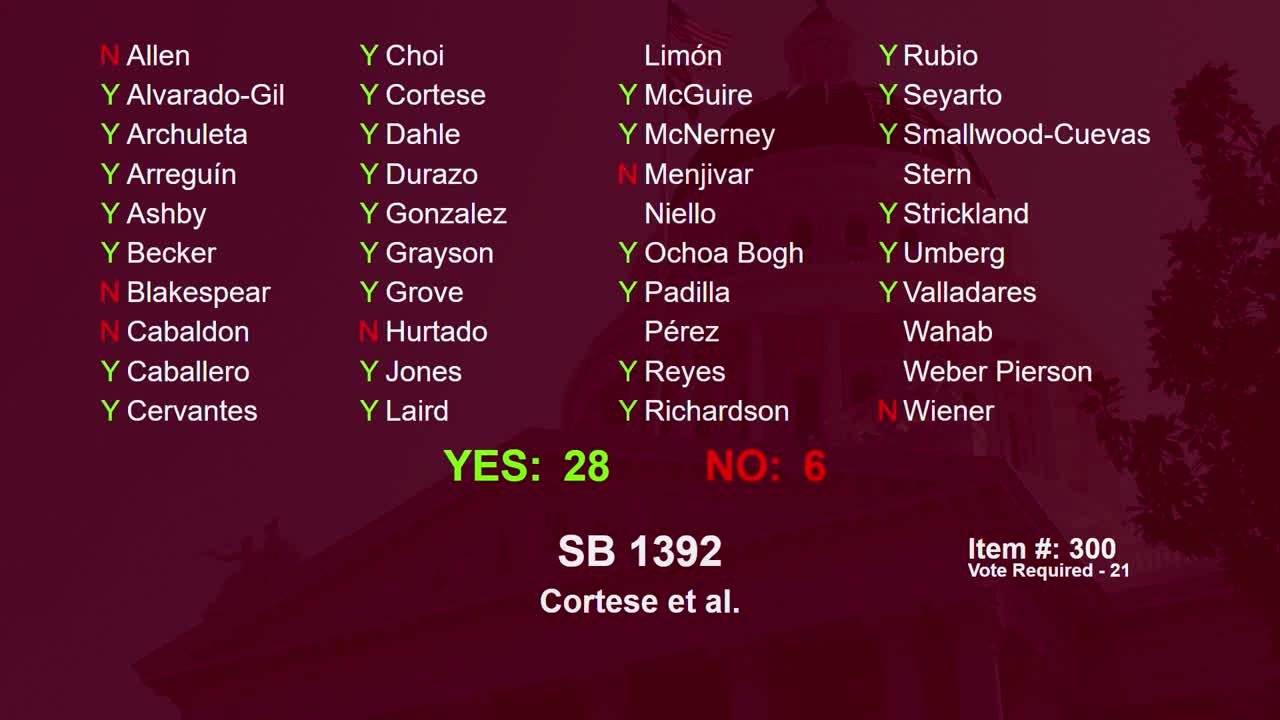 1MIN
Senate Floor
 14MIN
Senate Standing Committee on Environmental Quality
 21MIN
Senate Standing Committee on Local Government
Bill Author

Bill Co-Author(s):