SB 1159: Artificial intelligence: transparency and governance.
- Session Year: 2025-2026
- House: Senate
- Latest Version Date: 2026-09-30
Current Status:
Passed
(2026-09-30: Chaptered by Secretary of State. Chapter 863, Statutes of 2026.)
Introduced
In Committee
Awaiting First Chamber Vote
Passed First Chamber
In Committee
Awaiting Second Chamber Vote
Passed Second Chamber
Enacted
The California Constitution provides that people have the right of access to information concerning the conduct of the peoples business. Various provisions of existing law, including the California Public Records Act, the Legislative Open Records Act, the Bagley-Keene Open Meeting Act, and the Ralph M. Brown Act, provide, with some exceptions, for public access to government records and meetings of government bodies. Among those acts, the California Public Records Act defines person to include any natural person, corporation, partnership, limited liability company, firm, or association.
Existing law, the Administrative Procedure Act, governs, among other things, the procedures for the adoption, amendment, or repeal of regulations by state agencies and for the review of those regulatory actions by the Office of Administrative Law.
Existing law, the California Environmental Quality Act (CEQA), requires a lead agency, as defined, to prepare, or cause to be prepared, and certify the completion of an environmental impact report on a project that it proposes to carry out or approve that may have a significant effect on the environment or to adopt a negative declaration if it finds that the project will not have that effect. CEQA defines person to include any person, firm, association, organization, partnership, business, trust, corporation, limited liability company, company, district, county, city and county, city, town, and, among other things, the state.
Existing law, the California Coastal Act of 1976, establishes the California Coastal Commission and prescribes procedures for the preparation, approval, and certification of local coastal programs that regulate development in the coastal zone, as defined, in jurisdictions that have a certified local coastal program.
This bill would specify that, for purposes of the California Public Records Act, the Bagley-Keene Open Meeting Act, the Ralph M. Brown Act, the Legislative Open Records Act, the Administrative Procedure Act, the California Coastal Act of 1976, and CEQA, person, interested person, participant, member of the public, as applicable, and any other similar terms under each act referring to those who may engage with governmental agencies, do not include artificial intelligence, as defined, systems, autonomous agents, or robots, whether physical or digital. The bill would authorize governmental agencies to use a disclosure verification tool to determine if artificial intelligence is present. The bill would make findings and declarations related to these provisions.
The bill would prohibit a person from knowingly using artificial intelligence to falsely represent that a natural person appeared before, submitted information to, or otherwise engaged with a governmental agency.
The California Constitution requires local agencies, for the purpose of ensuring public access to the meetings of public bodies and the writings of public officials and agencies, to comply with a statutory enactment that amends or enacts laws relating to public records or open meetings and contains findings demonstrating that the enactment furthers the constitutional requirements relating to this purpose.
This bill would make legislative findings to that effect.
The California Constitution provides that people have the right of access to information concerning the conduct of the peoples business. Various provisions of existing law, including the California Public Records Act, the Legislative Open Records Act, the Bagley-Keene Open Meeting Act, and the Ralph M. Brown Act, provide, with some exceptions, for public access to government records and meetings of government bodies. Among those acts, the California Public Records Act defines person to include any natural person, corporation, partnership, limited liability company, firm, or association.
Existing law, the Administrative Procedure Act, governs, among other things, the procedures for the adoption, amendment, or repeal of regulations by state agencies and for the review of those regulatory actions by the Office of Administrative Law.
Existing law, the California Environmental Quality Act (CEQA), requires a lead agency, as defined, to prepare, or cause to be prepared, and certify the completion of an environmental impact report on a project that it proposes to carry out or approve that may have a significant effect on the environment or to adopt a negative declaration if it finds that the project will not have that effect. CEQA defines person to include any person, firm, association, organization, partnership, business, trust, corporation, limited liability company, company, district, county, city and county, city, town, and, among other things, the state.
Existing law, the California Coastal Act of 1976, establishes the California Coastal Commission and prescribes procedures for the preparation, approval, and certification of local coastal programs that regulate development in the coastal zone, as defined, in jurisdictions that have a certified local coastal program.
This bill would specify that, for purposes of the California Public Records Act, the Bagley-Keene Open Meeting Act, the Ralph M. Brown Act, the Legislative Open Records Act, the Administrative Procedure Act, the California Coastal Act of 1976, and CEQA, person, interested person, participant, member of the public, as applicable, and any other similar terms under each act referring to those who may engage with governmental agencies, do not include artificial intelligence, as defined, systems, autonomous agents, or robots, whether physical or digital. The bill would authorize governmental agencies to use an artificial intelligence detection a disclosure verification tool to determine if artificial intelligence is present. The bill would make findings and declarations related to these provisions.
The bill would prohibit a person from knowingly using artificial intelligence to falsely represent that a natural person appeared before, submitted information to, or otherwise engaged with a governmental agency.
The California Constitution requires local agencies, for the purpose of ensuring public access to the meetings of public bodies and the writings of public officials and agencies, to comply with a statutory enactment that amends or enacts laws relating to public records or open meetings and contains findings demonstrating that the enactment furthers the constitutional requirements relating to this purpose.
This bill would make legislative findings to that effect.
The California Constitution provides that people have the right of access to information concerning the conduct of the peoples business. Various provisions of existing law, including the California Public Records Act, the Legislative Open Records Act, the Bagley-Keene Open Meeting Act, and the Ralph M. Brown Act, provide, with some exceptions, for public access to government records and meetings of government bodies. Among those acts, the California Public Records Act defines person to include any natural person, corporation, partnership, limited liability company, firm, or association.
Existing law, the Political Reform Act of 1974, imposes various requirements and limitations with respect to the conduct of public officials, campaign expenditures and disclosures, political advertisements, lobbying, the ballot pamphlet, and other aspects of political reform. The act defines person to mean an individual, proprietorship, firm, partnership, joint venture, syndicate, business trust, company, corporation, limited liability company, association, committee, and any other organization or group of persons acting in concert.Existing law, the Administrative Procedure Act, governs, among other things, the procedures for the adoption, amendment, or repeal of regulations by state agencies and for the review of those regulatory actions by the Office of Administrative Law.
Existing law, the California Environmental Quality Act (CEQA), requires a lead agency, as defined, to prepare, or cause to be prepared, and certify the completion of an environmental impact report on a project that it proposes to carry out or approve that may have a significant effect on the environment or to adopt a negative declaration if it finds that the project will not have that effect. CEQA defines person to include any person, firm, association, organization, partnership, business, trust, corporation, limited liability company, company, district, county, city and county, city, town, and, among other things, the state.
Existing law, the California Coastal Act of 1976, establishes the California Coastal Commission and prescribes procedures for the preparation, approval, and certification of local coastal programs that regulate development in the coastal zone, as defined, in jurisdictions that have a certified local coastal program.
This bill would specify that, for purposes of the California Public Records Act, the Bagley-Keene Open Meeting Act, the Ralph M. Brown Act, the Political Reform Act of 1974, Legislative Open Records Act, the Administrative Procedure Act, the California Coastal Act of 1976, and CEQA, person, interested person, participant, member of the public, as applicable, and any other similar terms under each act referring to those who may engage with governmental agencies, do not include artificial intelligence, as defined, systems, autonomous agents, robots, or other nonhuman entities, or robots, whether physical or digital. The bill would authorize governmental agencies to use an artificial intelligence detection tool to determine if artificial intelligence is present. The bill would make findings and declarations related to these provisions.
The California Constitution requires local agencies, for the purpose of ensuring public access to the meetings of public bodies and the writings of public officials and agencies, to comply with a statutory enactment that amends or enacts laws relating to public records or open meetings and contains findings demonstrating that the enactment furthers the constitutional requirements relating to this purpose.
This bill would make legislative findings to that effect.
The California Constitution provides that people have the right of access to information concerning the conduct of the peoples business. Various provisions of existing law, including the California Public Records Act, the Bagley-Keene Open Meeting Act, and the Ralph M. Brown Act, provide, with some exceptions, for public access to government records and meetings of government bodies. Among those acts, the California Public Records Act defines person to include any natural person, corporation, partnership, limited liability company, firm, or association.
Existing law, the Political Reform Act of 1974, imposes various requirements and limitations with respect to the conduct of public officials, campaign expenditures and disclosures, political advertisements, lobbying, the ballot pamphlet, and other aspects of political reform. The act defines person to mean an individual, proprietorship, firm, partnership, joint venture, syndicate, business trust, company, corporation, limited liability company, association, committee, and any other organization or group of persons acting in concert.
Existing law, the Administrative Procedure Act, governs, among other things, the procedures for the adoption, amendment, or repeal of regulations by state agencies and for the review of those regulatory actions by the Office of Administrative Law.
Existing law, the California Environmental Quality Act (CEQA), requires a lead agency, as defined, to prepare, or cause to be prepared, and certify the completion of an environmental impact report on a project that it proposes to carry out or approve that may have a significant effect on the environment or to adopt a negative declaration if it finds that the project will not have that effect. CEQA defines person to include any person, firm, association, organization, partnership, business, trust, corporation, limited liability company, company, district, county, city and county, city, town, and, among other things, the state.
This bill would specify that, for purposes of the California Public Records Act, the Bagley-Keene Open Meeting Act, the Ralph M. Brown Act, the Political Reform Act of 1974, the Administrative Procedure Act, and CEQA, person, interested person, participant, member of the public, as applicable, and any other similar terms under each act referring to those who may engage with governmental agencies, do not include artificial intelligence, as defined, systems, autonomous agents, robots, or other nonhuman entities, whether physical or digital. The bill would make findings and declarations related to these provisions.
The California Constitution requires local agencies, for the purpose of ensuring public access to the meetings of public bodies and the writings of public officials and agencies, to comply with a statutory enactment that amends or enacts laws relating to public records or open meetings and contains findings demonstrating that the enactment furthers the constitutional requirements relating to this purpose.
This bill would make legislative findings to that effect.
(a)(1)Subdivision (b) of Section 3 of Article 1 of the California Constitution establishes that the people have the right of access to information concerning the conduct of the peoples business. Californias transparency and governance laws, including the Administrative Procedure Act (Chapter 3.5 (commencing with Section 11340), Chapter 4 (commencing with Section 11370), Chapter 4.5 (commencing with Section 11400), and Chapter 5 (commencing with Section 11500) of Part 1 of Division 3 of Title 2 of the Government Code), the Bagley-Keene Open Meeting Act (Article 9 (commencing with Section 11120) of Chapter 1 of Part 1 of Division 3 of Title 2 of the Government Code), the California Environmental Quality Act (Division 13 (commencing with Section 21000) of the Public Resources Code), the California Coastal Act of 1976 (Division 20 (commencing with Section 30000) of the Public Resources Code), the California Public Records Act (Division 10 (commencing with Section 7920.000) of Title 1 of the Government Code), the Legislative Open Records Act (Article 3.5 (commencing with Section 9070) of Chapter 1.5 of Part 1 of Division 2 of Title 2 of the Government Code), and the Ralph M. Brown Act (Chapter 9 (commencing with Section 54950) of Part 1 of Division 2 of Title 5 of the Government Code), implement this constitutional mandate by enabling natural persons to participate in and observe governmental processes.
(2)Artificial intelligence (AI) systems can now be programmed to automatically and continuously engage with governmental processes at scales and speeds that far exceed human capacity. AI systems have the ability to submit thousands or millions of automated public records requests, generate mass public comments on proposed regulations, file automated petitions for rulemaking, or otherwise flood governmental agencies with interactions that simulate human participation but lack genuine human deliberation or judgment.
(3)Automated mass engagement would overwhelm government agencies, divert limited public resources from serving actual constituents, drown out genuine human participation, and transform deliberative processes into meaningless exchanges with machines. Public comment periods would become ineffective if agencies must process thousands of AI-generated submissions, and the administrative burden would undermine the purpose of Californias transparency laws. This threat is not theoretical. In the United Kingdom, AI-powered platforms have already enabled automated generation of planning objections, prompting warnings from experts that such systems will overwhelm public agencies.
(4)Californias transparency and governance laws referenced in paragraph (1) presuppose participants who possess consciousness, moral agency, deliberative judgment, and membership in the political community. AI systems, regardless of their sophistication, lack these essential attributes of personhood. Consistent with the United States Patent and Trademark Offices November 2025 guidance recognizing that AI systems are tools to support human activity rather than independent actors, and with the European Unions AI Act adopted in 2024 protecting the fundamental rights of natural persons, California law maintains the distinction between human beings and artificial intelligence.
(b)Therefore, it is the intent of the Legislature to clarify that, for purposes of Californias transparency and governance laws referenced in subdivision (a), the terms person, interested person, member of the public, and any other similar terms referring to those who may engage with governmental agencies under those laws, refer to natural persons and legally recognized entities capable of genuine participation in democratic governance, not AI systems that could be programmed to simulate participation at scales that would overwhelm governmental processes.
(c)The changes made by this act are not to be construed to imply that the terms person, interested person, participant, member of the public, and any other similar terms as used in any law other than those laws referenced in subdivision (a) include artificial intelligence systems, autonomous agents, robots, or other nonhuman entities, whether physical or digital.
SEC. 2.Section 7920.520 of the Government Code is amended to read:7920.520.(a)As used in this division, person includes any natural person, corporation, partnership, limited liability company, firm, or association.
(b)(1)Person, interested person, member of the public, and any other similar terms referring to those who may engage with governmental agencies under this division do not include artificial intelligence systems, autonomous agents, robots, or other nonhuman entities, whether physical or digital.
(2)For purposes of this subdivision, the following definitions apply:
(A)Artificial intelligence means an engineered or machine-based system that varies in its level of autonomy and that can, for explicit or implicit objectives, infer from the input it receives how to generate outputs that can influence physical or virtual environments.
(B)Assistive technology means an item, piece of equipment, or product system, whether acquired commercially, modified, or customized, that is used to increase, maintain, or improve functional capabilities of individuals with disabilities and any service that directly assists an individual with a disability in the selection, acquisition, or use of the item, equipment, or product system.
(3)A public agency may use a disclosure verification tool that meets the criteria described in Section 22757.2 of the Business and Professions Code to determine if artificial intelligence is present.
(4)This section does not prohibit a natural person from using artificial intelligence, autonomous agents, or robots to facilitate the persons own engagement with a governmental agency, including through the use of assistive technologies, provided the volume and frequency of the engagement are reasonably consistent with ordinary participation by a natural person.
SEC. 3.Section 8319 is added to the Government Code, to read:8319.(a)A person shall not knowingly use artificial intelligence to falsely represent that a natural person appeared before, submitted information to, or otherwise engaged with a governmental agency.
(b)For purposes of this section, artificial intelligence means an engineered or machine-based system that varies in its level of autonomy and that can, for explicit or implicit objectives, infer from the input it receives how to generate outputs that can influence physical or virtual environments.
SEC. 4.Section 9072 of the Government Code is amended to read:9072.As used in this article:
(a)Person includes any natural person, corporation, partnership, limited liability company, firm, or association.
(1)Person and any other similar terms referring to those who may engage with governmental agencies under this article do not include artificial intelligence systems, autonomous agents, or robots, whether physical or digital.
(2)For purposes of this subdivision, the following definitions apply:
(A)Artificial intelligence means an engineered or machine-based system that varies in its level of autonomy and that can, for explicit or implicit objectives, infer from the input it receives how to generate outputs that can influence physical or virtual environments.
(B)Assistive technology means an item, piece of equipment, or product system, whether acquired commercially, modified, or customized, that is used to increase, maintain, or improve functional capabilities of individuals with disabilities and any service that directly assists an individual with a disability in the selection, acquisition, or use of the item, equipment, or product system.
(3)The appropriate Rules Committee of each house of the Legislature and the Joint Rules Committee may use a disclosure verification tool that meets the criteria described in Section 22757.2 of the Business and Professions Code to determine if artificial intelligence is present.
(4)This section does not prohibit a natural person from using artificial intelligence, autonomous agents, or robots to facilitate the persons own engagement with a governmental agency, including through the use of assistive technologies, provided the volume and frequency of the engagement are reasonably consistent with ordinary participation by a natural person.
(b)Legislature includes any Member of the Legislature, any legislative officer, any standing, joint, or select committee or subcommittee of the Senate and Assembly, and any other agency or employee of the Legislature.
(c)Legislative records means any writing prepared on or after December 2, 1974, which contains information relating to the conduct of the publics business prepared, owned, used, or retained by the Legislature.
(d)Writing means handwriting, typewriting, printing, photostating, photographing, and every other means of recording upon any form of communication or representation, including letters, words, pictures, sounds, or symbols, or combination thereof, and all papers, maps, magnetic or paper tapes, photographic films and prints, magnetic or punched cards, discs, drums, and other documents.
SEC. 5.Section 11121.5 is added to the Government Code, to read:11121.5.(a)As used in this article, person, interested person, participant, member of the public, and any other similar terms referring to those who may engage with governmental agencies under this chapter do not include artificial intelligence systems, autonomous agents, or robots, whether physical or digital.
(b)For purposes of this section, the following definitions apply:
(1)Artificial intelligence means an engineered or machine-based system that varies in its level of autonomy and that can, for explicit or implicit objectives, infer from the input it receives how to generate outputs that can influence physical or virtual environments.
(2)Assistive technology means an item, piece of equipment, or product system, whether acquired commercially, modified, or customized, that is used to increase, maintain, or improve functional capabilities of individuals with disabilities and any service that directly assists an individual with a disability in the selection, acquisition, or use of the item, equipment, or product system.
(c)A state body may use a disclosure verification tool that meets the criteria described in Section 22757.2 of the Business and Professions Code to determine if artificial intelligence is present.
(d)This section does not prohibit a natural person from using artificial intelligence, autonomous agents, or robots to facilitate the persons own engagement with a governmental agency, including through the use of assistive technologies, provided the volume and frequency of the engagement are reasonably consistent with ordinary participation by a natural person.
SEC. 6.Section 11342.575 is added to the Government Code, to read:11342.575.(a)Person, interested person, member of the public, and any other similar terms referring to those who may engage with governmental agencies under this chapter do not include artificial intelligence systems, autonomous agents, or robots, whether physical or digital.
(b)For purposes of this section, the following definitions apply:
(1)Artificial intelligence means an engineered or machine-based system that varies in its level of autonomy and that can, for explicit or implicit objectives, infer from the input it receives how to generate outputs that can influence physical or virtual environments.
(2)Assistive technology means an item, piece of equipment, or product system, whether acquired commercially, modified, or customized, that is used to increase, maintain, or improve functional capabilities of individuals with disabilities and any service that directly assists an individual with a disability in the selection, acquisition, or use of the item, equipment, or product system.
(c)An agency may use a disclosure verification tool that meets the criteria described in Section 22757.2 of the Business and Professions Code to determine if artificial intelligence is present.
(d)This section does not prohibit a natural person from using artificial intelligence, autonomous agents, or robots to facilitate the persons own engagement with a governmental agency, including through the use of assistive technologies, provided the volume and frequency of the engagement are reasonably consistent with ordinary participation by a natural person.
SEC. 7.Section 11370.1.5 is added to the Government Code, to read:11370.1.5.(a)As used in this chapter, person and any other similar terms referring to those who may engage with governmental agencies under this chapter do not include artificial intelligence systems, autonomous agents, or robots, whether physical or digital.
(b)For purposes of this section, the following definitions apply:
(1)Artificial intelligence means an engineered or machine-based system that varies in its level of autonomy and that can, for explicit or implicit objectives, infer from the input it receives how to generate outputs that can influence physical or virtual environments.
(2)Assistive technology means an item, piece of equipment, or product system, whether acquired commercially, modified, or customized, that is used to increase, maintain, or improve functional capabilities of individuals with disabilities and any service that directly assists an individual with a disability in the selection, acquisition, or use of the item, equipment, or product system.
(c)The Office of Administrative Hearings may use a disclosure verification tool that meets the criteria described in Section 22757.2 of the Business and Professions Code to determine if artificial intelligence is present.
(d)This section does not prohibit a natural person from using artificial intelligence, autonomous agents, or robots to facilitate the persons own engagement with a governmental agency, including through the use of assistive technologies, provided the volume and frequency of the engagement are reasonably consistent with ordinary participation by a natural person.
SEC. 8.Section 11405.70 of the Government Code is amended to read:11405.70.(a)Person includes an individual, partnership, corporation, governmental subdivision or unit of a governmental subdivision, or public or private organization or entity of any character.
(b)(1)Person, interested person, participant, member of the public, and any other similar terms referring to those who may engage with governmental agencies under this chapter do not include artificial intelligence systems, autonomous agents, or robots, whether physical or digital.
(2)For purposes of this subdivision, the following definitions apply:
(A)Artificial intelligence means an engineered or machine-based system that varies in its level of autonomy and that can, for explicit or implicit objectives, infer from the input it receives how to generate outputs that can influence physical or virtual environments.
(B)Assistive technology means an item, piece of equipment, or product system, whether acquired commercially, modified, or customized, that is used to increase, maintain, or improve functional capabilities of individuals with disabilities and any service that directly assists an individual with a disability in the selection, acquisition, or use of the item, equipment, or product system.
(3)An agency may use a disclosure verification tool that meets the criteria described in Section 22757.2 of the Business and Professions Code to determine if artificial intelligence is present.
(4)This section does not prohibit a natural person from using artificial intelligence, autonomous agents, or robots to facilitate the persons own engagement with a governmental agency, including through the use of assistive technologies, provided the volume and frequency of the engagement are reasonably consistent with ordinary participation by a natural person.
SEC. 9.Section 11500 of the Government Code is amended to read:11500.In this chapter unless the context or subject matter otherwise requires:
(a)Agency includes the state boards, commissions, and officers to which this chapter is made applicable by law, except that wherever the word agency alone is used the power to act may be delegated by the agency, and wherever the words agency itself are used the power to act shall not be delegated unless the statutes relating to the particular agency authorize the delegation of the agencys power to hear and decide.
(b)Party includes the agency, the respondent, and any person, other than an officer or an employee of the agency in their official capacity, who has been allowed to appear or participate in the proceeding.
(c)(1)Person, participant, and any other similar terms referring to those who may engage with governmental agencies under this chapter do not include artificial intelligence systems, autonomous agents, or robots, whether physical or digital.
(2)For purposes of this subdivision, the following definitions apply:
(A)Artificial intelligence means an engineered or machine-based system that varies in its level of autonomy and that can, for explicit or implicit objectives, infer from the input it receives how to generate outputs that can influence physical or virtual environments.
(B)This section does not prohibit a natural person from using artificial intelligence, autonomous agents, or robots to facilitate the persons own engagement with a governmental agency, including through the use of assistive technologies, provided the volume and frequency of the engagement are reasonably consistent with ordinary participation by a natural person.
(3)An agency may use a disclosure verification tool that meets the criteria described in Section 22757.2 of the Business and Professions Code to determine if artificial intelligence is present.
(4)This section does not prohibit a natural person from using artificial intelligence, autonomous agents, or robots to facilitate the persons own engagement with a governmental agency, including through the use of assistive technologies, provided the volume and frequency of the engagement are reasonably consistent with ordinary participation by a natural person.
(d)Respondent means any person against whom an accusation or District Statement of Reduction in Force is filed pursuant to Section 11503 or against whom a statement of issues is filed pursuant to Section 11504.
(e)Administrative law judge means an individual qualified under Section 11502.
(f)Agency member means any person who is a member of any agency to which this chapter is applicable and includes any person who themselves constitute an agency.
SEC. 10.Section 54951.5 is added to the Government Code, to read:54951.5.(a)As used in this chapter, person, interested person, participant, member of the public, and any other similar terms referring to those who may engage with governmental agencies under this chapter do not include artificial intelligence systems, autonomous agents, or robots, whether physical or digital.
(b)For purposes of this section, the following definitions apply:
(1)Artificial intelligence means an engineered or machine-based system that varies in its level of autonomy and that can, for explicit or implicit objectives, infer from the input it receives how to generate outputs that can influence physical or virtual environments.
(2)Assistive technology means an item, piece of equipment, or product system, whether acquired commercially, modified, or customized, that is used to increase, maintain, or improve functional capabilities of individuals with disabilities and any service that directly assists an individual with a disability in the selection, acquisition, or use of the item, equipment, or product system.
(c)A local agency may use a disclosure verification tool that meets the criteria described in Section 22757.2 of the Business and Professions Code to determine if artificial intelligence is present.
(d)This section does not prohibit a natural person from using artificial intelligence, autonomous agents, or robots to facilitate the persons own engagement with a governmental agency, including through the use of assistive technologies, provided the volume and frequency of the engagement are reasonably consistent with ordinary participation by a natural person.
SEC. 11.Section 21066 of the Public Resources Code is amended to read:21066.(a)Person includes any person, firm, association, organization, partnership, business, trust, corporation, limited liability company, company, district, county, city and county, city, town, the state, and any of the agencies and political subdivisions of those entities, and, to the extent permitted by federal law, the United States, or any of its agencies or political subdivisions.
(b)(1)Person, interested person, member of the public, and any other similar terms referring to those who may engage with governmental agencies under this division do not include artificial intelligence systems, autonomous agents, or robots, whether physical or digital.
(2)For purposes of this subdivision, the following definitions apply:
(A)Artificial intelligence means an engineered or machine-based system that varies in its level of autonomy and that can, for explicit or implicit objectives, infer from the input it receives how to generate outputs that can influence physical or virtual environments.
(B)Assistive technology means an item, piece of equipment, or product system, whether acquired commercially, modified, or customized, that is used to increase, maintain, or improve functional capabilities of individuals with disabilities and any service that directly assists an individual with a disability in the selection, acquisition, or use of the item, equipment, or product system.
(3)A public agency may use a verification detection tool that meets the criteria described in Section 22757.2 of the Business and Professions Code to determine if artificial intelligence is present.
(4)This section does not prohibit a natural person from using artificial intelligence, autonomous agents, or robots to facilitate the persons own engagement with a governmental agency, including through the use of assistive technologies, provided the volume and frequency of the engagement are reasonably consistent with ordinary participation by a natural person.
SEC. 12.Section 30111 of the Public Resources Code is amended to read:30111.(a)Person means any individual, organization, partnership, limited liability company, or other business association or corporation, including any utility, and any federal, state, local government, or special district or an agency thereof.
(1)Person and any other similar terms referring to those who may engage with governmental agencies under this division do not include artificial intelligence systems, autonomous agents, or robots, whether physical or digital.
(2)For purposes of this section, the following definitions apply:
(A)Artificial intelligence means an engineered or machine-based system that varies in its level of autonomy and that can, for explicit or implicit objectives, infer from the input it receives how to generate outputs that can influence physical or virtual environments.
(B)Assistive technology means an item, piece of equipment, or product system, whether acquired commercially, modified, or customized, that is used to increase, maintain, or improve functional capabilities of individuals with disabilities and any service that directly assists an individual with a disability in the selection, acquisition, or use of the item, equipment, or product system.
(b)An agency may use a disclosure verification tool that meets the criteria described in Section 22757.2 of the Business and Professions Code to determine if artificial intelligence is present.
(c)This section does not prohibit a natural person from using artificial intelligence, autonomous agents, or robots to facilitate the persons own engagement with a governmental agency, including through the use of assistive technologies, provided the volume and frequency of the engagement are reasonably consistent with ordinary participation by a natural person.
SEC. 13.The Legislature finds and declares that Section 2 of this act, which amends Section 7920.520 of the Government Code, and Section 9 of this act, which adds Section 54951.5 to the Government Code, further, within the meaning of paragraph (7) of subdivision (b) of Section 3 of Article I of the California Constitution, the purposes of that constitutional section as it relates to the right of public access to the meetings of local public bodies or the writings of local public officials and local agencies. Pursuant to paragraph (7) of subdivision (b) of Section 3 of Article I of the California Constitution, the Legislature makes the following findings:
The clarification made by this act serves the public interest by preserving the integrity and functionality of Californias democratic institutions, preventing automated systems from displacing genuine human participation, protecting public resources from being consumed by responding to machine-generated requests, and ensuring that governmental decisions remain responsive to the people of California.
(a)(1)Subdivision (b) of Section 3 of Article 1 of the California Constitution establishes that the people have the right of access to information concerning the conduct of the peoples business. Californias transparency and governance laws, including the Administrative Procedure Act (Chapter 3.5 (commencing with Section 11340), Chapter 4 (commencing with Section 11370), Chapter 4.5 (commencing with Section 11400), and Chapter 5 (commencing with Section 11500) of Part 1 of Division 3 of Title 2 of the Government Code), the Bagley-Keene Open Meeting Act (Article 9 (commencing with Section 11120) of Chapter 1 of Part 1 of Division 3 of Title 2 of the Government Code), the California Environmental Quality Act (Division 13 (commencing with Section 21000) of the Public Resources Code), the California Coastal Act of 1976 (Division 20 (commencing with Section 30000) of the Public Resources Code), the California Public Records Act (Division 10 (commencing with Section 7920.000) of Title 1 of the Government Code), the Legislative Open Records Act (Article 3.5 (commencing with Section 9070) of Chapter 1.5 of Part 1 of Division 2 of Title 2 of the Government Code), and the Ralph M. Brown Act (Chapter 9 (commencing with Section 54950) of Part 1 of Division 2 of Title 5 of the Government Code), implement this constitutional mandate by enabling natural persons to participate in and observe governmental processes.
(2)Artificial intelligence (AI) systems can now be programmed to automatically and continuously engage with governmental processes at scales and speeds that far exceed human capacity. AI systems have the ability to submit thousands or millions of automated public records requests, generate mass public comments on proposed regulations, file automated petitions for rulemaking, or otherwise flood governmental agencies with interactions that simulate human participation but lack genuine human deliberation or judgment.
(3)Automated mass engagement would overwhelm government agencies, divert limited public resources from serving actual constituents, drown out genuine human participation, and transform deliberative processes into meaningless exchanges with machines. Public comment periods would become ineffective if agencies must process thousands of AI-generated submissions, and the administrative burden would undermine the purpose of Californias transparency laws. This threat is not theoretical. In the United Kingdom, AI-powered platforms have already enabled automated generation of planning objections, prompting warnings from experts that such systems will overwhelm public agencies.
(4)Californias transparency and governance laws referenced in paragraph (1) presuppose participants who possess consciousness, moral agency, deliberative judgment, and membership in the political community. AI systems, regardless of their sophistication, lack these essential attributes of personhood. Consistent with the United States Patent and Trademark Offices November 2025 guidance recognizing that AI systems are tools to support human activity rather than independent actors, and with the European Unions AI Act adopted in 2024 protecting the fundamental rights of natural persons, California law maintains the distinction between human beings and artificial intelligence.
(b)Therefore, it is the intent of the Legislature to clarify that, for purposes of Californias transparency and governance laws referenced in subdivision (a), the terms person, interested person, member of the public, and any other similar terms referring to those who may engage with governmental agencies under those laws, refer to natural persons and legally recognized entities capable of genuine participation in democratic governance, not AI systems that could be programmed to simulate participation at scales that would overwhelm governmental processes.
(c)The changes made by this act are not to be construed to imply that the terms person, interested person, participant, member of the public, and any other similar terms as used in any law other than those laws referenced in subdivision (a) include artificial intelligence systems, autonomous agents, robots, or other nonhuman entities, whether physical or digital.
SEC. 2.Section 7920.520 of the Government Code is amended to read:7920.520.(a)As used in this division, person includes any natural person, corporation, partnership, limited liability company, firm, or association.
(b)(1)Person, interested person, member of the public, and any other similar terms referring to those who may engage with governmental agencies under this division do not include artificial intelligence systems, autonomous agents, robots, or other nonhuman entities, whether physical or digital.
(2)For purposes of this subdivision, the following definitions apply: artificial
(A)Artificial intelligence means an engineered or machine-based system that varies in its level of autonomy and that can, for explicit or implicit objectives, infer from the input it receives how to generate outputs that can influence physical or virtual environments.
(B)Assistive technology means an item, piece of equipment, or product system, whether acquired commercially, modified, or customized, that is used to increase, maintain, or improve functional capabilities of individuals with disabilities and any service that directly assists an individual with a disability in the selection, acquisition, or use of the item, equipment, or product system.
(3)A public agency may use an artificial intelligence detection a disclosure verification tool that meets the criteria described in Section 22757.2 of the Business and Professions Code to determine if artificial intelligence is present.
(4)This section does not prohibit a natural person from using artificial intelligence, autonomous agents, or robots to facilitate the persons own engagement with a governmental agency, including through the use of assistive technologies, provided the volume and frequency of the engagement are reasonably consistent with ordinary participation by a natural person.
SEC. 3.Section 8319 is added to the Government Code, to read:8319.(a)A person shall not knowingly use artificial intelligence to falsely represent that a natural person appeared before, submitted information to, or otherwise engaged with a governmental agency.
(b)For purposes of this section, artificial intelligence means an engineered or machine-based system that varies in its level of autonomy and that can, for explicit or implicit objectives, infer from the input it receives how to generate outputs that can influence physical or virtual environments.
SEC. 3.SEC. 4.Section 9072 of the Government Code is amended to read:9072.As used in this article:
(a)Person includes any natural person, corporation, partnership, limited liability company, firm, or association.
(1)Person and any other similar terms referring to those who may engage with governmental agencies under this article do not include artificial intelligence systems, autonomous agents, or robots, whether physical or digital.
(2)For purposes of this subdivision, the following definitions apply: artificial
(A)Artificial intelligence means an engineered or machine-based system that varies in its level of autonomy and that can, for explicit or implicit objectives, infer from the input it receives how to generate outputs that can influence physical or virtual environments.
(B)Assistive technology means an item, piece of equipment, or product system, whether acquired commercially, modified, or customized, that is used to increase, maintain, or improve functional capabilities of individuals with disabilities and any service that directly assists an individual with a disability in the selection, acquisition, or use of the item, equipment, or product system.
(3)The appropriate Rules Committee of each house of the Legislature and the Joint Rules Committee may use an artificial intelligence detection a disclosure verification tool that meets the criteria described in Section 22757.2 of the Business and Professions Code to determine if artificial intelligence is present.
(4)This section does not prohibit a natural person from using artificial intelligence, autonomous agents, or robots to facilitate the persons own engagement with a governmental agency, including through the use of assistive technologies, provided the volume and frequency of the engagement are reasonably consistent with ordinary participation by a natural person.
(b)Legislature includes any Member of the Legislature, any legislative officer, any standing, joint, or select committee or subcommittee of the Senate and Assembly, and any other agency or employee of the Legislature.
(c)Legislative records means any writing prepared on or after December 2, 1974, which contains information relating to the conduct of the publics business prepared, owned, used, or retained by the Legislature.
(d)Writing means handwriting, typewriting, printing, photostating, photographing, and every other means of recording upon any form of communication or representation, including letters, words, pictures, sounds, or symbols, or combination thereof, and all papers, maps, magnetic or paper tapes, photographic films and prints, magnetic or punched cards, discs, drums, and other documents.
SEC. 4.SEC. 5.Section 11121.5 is added to the Government Code, to read:11121.5.(a)As used in this article, person, interested person, participant, member of the public, and any other similar terms referring to those who may engage with governmental agencies under this chapter do not include artificial intelligence systems, autonomous agents, or robots, whether physical or digital.
(b)For purposes of this section, the following definitions apply: artificial
(1)Artificial intelligence means an engineered or machine-based system that varies in its level of autonomy and that can, for explicit or implicit objectives, infer from the input it receives how to generate outputs that can influence physical or virtual environments.
(2)Assistive technology means an item, piece of equipment, or product system, whether acquired commercially, modified, or customized, that is used to increase, maintain, or improve functional capabilities of individuals with disabilities and any service that directly assists an individual with a disability in the selection, acquisition, or use of the item, equipment, or product system.
(c)A state body may use an artificial intelligence detection a disclosure verification tool that meets the criteria described in Section 22757.2 of the Business and Professions Code to determine if artificial intelligence is present.
(d)This section does not prohibit a natural person from using artificial intelligence, autonomous agents, or robots to facilitate the persons own engagement with a governmental agency, including through the use of assistive technologies, provided the volume and frequency of the engagement are reasonably consistent with ordinary participation by a natural person.
SEC. 5.SEC. 6.Section 11342.575 is added to the Government Code, to read:11342.575.(a)Person, interested person, member of the public, and any other similar terms referring to those who may engage with governmental agencies under this chapter do not include artificial intelligence systems, autonomous agents, or robots, whether physical or digital.
(b)For purposes of this section, the following definitions apply: artificial
(1)Artificial intelligence means an engineered or machine-based system that varies in its level of autonomy and that can, for explicit or implicit objectives, infer from the input it receives how to generate outputs that can influence physical or virtual environments.
(2)Assistive technology means an item, piece of equipment, or product system, whether acquired commercially, modified, or customized, that is used to increase, maintain, or improve functional capabilities of individuals with disabilities and any service that directly assists an individual with a disability in the selection, acquisition, or use of the item, equipment, or product system.
(c)An agency may use an artificial intelligence detection a disclosure verification tool that meets the criteria described in Section 22757.2 of the Business and Professions Code to determine if artificial intelligence is present.
(d)This section does not prohibit a natural person from using artificial intelligence, autonomous agents, or robots to facilitate the persons own engagement with a governmental agency, including through the use of assistive technologies, provided the volume and frequency of the engagement are reasonably consistent with ordinary participation by a natural person.
SEC. 6.SEC. 7.Section 11370.1.5 is added to the Government Code, to read:11370.1.5.(a)As used in this chapter, person and any other similar terms referring to those who may engage with governmental agencies under this chapter do not include artificial intelligence systems, autonomous agents, or robots, whether physical or digital.
(b)For purposes of this section, the following definitions apply: artificial
(1)Artificial intelligence means an engineered or machine-based system that varies in its level of autonomy and that can, for explicit or implicit objectives, infer from the input it receives how to generate outputs that can influence physical or virtual environments.
(2)Assistive technology means an item, piece of equipment, or product system, whether acquired commercially, modified, or customized, that is used to increase, maintain, or improve functional capabilities of individuals with disabilities and any service that directly assists an individual with a disability in the selection, acquisition, or use of the item, equipment, or product system.
(c)The Office of Administrative Hearings may use an artificial intelligence detection a disclosure verification tool that meets the criteria described in Section 22757.2 of the Business and Professions Code to determine if artificial intelligence is present.
(d)This section does not prohibit a natural person from using artificial intelligence, autonomous agents, or robots to facilitate the persons own engagement with a governmental agency, including through the use of assistive technologies, provided the volume and frequency of the engagement are reasonably consistent with ordinary participation by a natural person.
SEC. 7.SEC. 8.Section 11405.70 of the Government Code is amended to read:11405.70.(a)Person includes an individual, partnership, corporation, governmental subdivision or unit of a governmental subdivision, or public or private organization or entity of any character.
(b)(1)Person, interested person, participant, member of the public, and any other similar terms referring to those who may engage with governmental agencies under this chapter do not include artificial intelligence systems, autonomous agents, or robots, whether physical or digital.
(2)For purposes of this subdivision, the following definitions apply: artificial
(A)Artificial intelligence means an engineered or machine-based system that varies in its level of autonomy and that can, for explicit or implicit objectives, infer from the input it receives how to generate outputs that can influence physical or virtual environments.
(B)Assistive technology means an item, piece of equipment, or product system, whether acquired commercially, modified, or customized, that is used to increase, maintain, or improve functional capabilities of individuals with disabilities and any service that directly assists an individual with a disability in the selection, acquisition, or use of the item, equipment, or product system.
(3)An agency may use an artificial intelligence detection a disclosure verification tool that meets the criteria described in Section 22757.2 of the Business and Professions Code to determine if artificial intelligence is present.
(4)This section does not prohibit a natural person from using artificial intelligence, autonomous agents, or robots to facilitate the persons own engagement with a governmental agency, including through the use of assistive technologies, provided the volume and frequency of the engagement are reasonably consistent with ordinary participation by a natural person.
SEC. 8.SEC. 9.Section 11500 of the Government Code is amended to read:11500.In this chapter unless the context or subject matter otherwise requires:
(a)Agency includes the state boards, commissions, and officers to which this chapter is made applicable by law, except that wherever the word agency alone is used the power to act may be delegated by the agency, and wherever the words agency itself are used the power to act shall not be delegated unless the statutes relating to the particular agency authorize the delegation of the agencys power to hear and decide.
(b)Party includes the agency, the respondent, and any person, other than an officer or an employee of the agency in their official capacity, who has been allowed to appear or participate in the proceeding.
(c)(1)Person, participant, and any other similar terms referring to those who may engage with governmental agencies under this chapter do not include artificial intelligence systems, autonomous agents, or robots, whether physical or digital.
(2)For purposes of this subdivision, the following definitions apply: artificial
(A)Artificial intelligence means an engineered or machine-based system that varies in its level of autonomy and that can, for explicit or implicit objectives, infer from the input it receives how to generate outputs that can influence physical or virtual environments.
(B)This section does not prohibit a natural person from using artificial intelligence, autonomous agents, or robots to facilitate the persons own engagement with a governmental agency, including through the use of assistive technologies, provided the volume and frequency of the engagement are reasonably consistent with ordinary participation by a natural person.
(3)An agency may use an artificial intelligence detection a disclosure verification tool that meets the criteria described in Section 22757.2 of the Business and Professions Code to determine if artificial intelligence is present.
(4)This section does not prohibit a natural person from using artificial intelligence, autonomous agents, or robots to facilitate the persons own engagement with a governmental agency, including through the use of assistive technologies, provided the volume and frequency of the engagement are reasonably consistent with ordinary participation by a natural person.
(d)Respondent means any person against whom an accusation or District Statement of Reduction in Force is filed pursuant to Section 11503 or against whom a statement of issues is filed pursuant to Section 11504.
(e)Administrative law judge means an individual qualified under Section 11502.
(f)Agency member means any person who is a member of any agency to which this chapter is applicable and includes any person who themselves constitute an agency.
SEC. 9.SEC. 10.Section 54951.5 is added to the Government Code, to read:54951.5.(a)As used in this chapter, person, interested person, participant, member of the public, and any other similar terms referring to those who may engage with governmental agencies under this chapter do not include artificial intelligence systems, autonomous agents, or robots, whether physical or digital.
(b)For purposes of this section, the following definitions apply: artificial
(1)Artificial intelligence means an engineered or machine-based system that varies in its level of autonomy and that can, for explicit or implicit objectives, infer from the input it receives how to generate outputs that can influence physical or virtual environments.
(2)Assistive technology means an item, piece of equipment, or product system, whether acquired commercially, modified, or customized, that is used to increase, maintain, or improve functional capabilities of individuals with disabilities and any service that directly assists an individual with a disability in the selection, acquisition, or use of the item, equipment, or product system.
(c)A local agency may use an artificial intelligence detection a disclosure verification tool that meets the criteria described in Section 22757.2 of the Business and Professions Code to determine if artificial intelligence is present.
(d)This section does not prohibit a natural person from using artificial intelligence, autonomous agents, or robots to facilitate the persons own engagement with a governmental agency, including through the use of assistive technologies, provided the volume and frequency of the engagement are reasonably consistent with ordinary participation by a natural person.
SEC. 10.SEC. 11.Section 21066 of the Public Resources Code is amended to read:21066.(a)Person includes any person, firm, association, organization, partnership, business, trust, corporation, limited liability company, company, district, county, city and county, city, town, the state, and any of the agencies and political subdivisions of those entities, and, to the extent permitted by federal law, the United States, or any of its agencies or political subdivisions.
(b)(1)Person, interested person, member of the public, and any other similar terms referring to those who may engage with governmental agencies under this division do not include artificial intelligence systems, autonomous agents, or robots, whether physical or digital.
(2)For purposes of this subdivision, the following definitions apply: artificial
(A)Artificial intelligence means an engineered or machine-based system that varies in its level of autonomy and that can, for explicit or implicit objectives, infer from the input it receives how to generate outputs that can influence physical or virtual environments.
(B)Assistive technology means an item, piece of equipment, or product system, whether acquired commercially, modified, or customized, that is used to increase, maintain, or improve functional capabilities of individuals with disabilities and any service that directly assists an individual with a disability in the selection, acquisition, or use of the item, equipment, or product system.
(3)A public agency may use an artificial intelligence detection a verification detection tool that meets the criteria described in Section 22757.2 of the Business and Professions Code to determine if artificial intelligence is present.
(4)This section does not prohibit a natural person from using artificial intelligence, autonomous agents, or robots to facilitate the persons own engagement with a governmental agency, including through the use of assistive technologies, provided the volume and frequency of the engagement are reasonably consistent with ordinary participation by a natural person.
SEC. 11.SEC. 12.Section 30111 of the Public Resources Code is amended to read:30111.(a)Person means any individual, organization, partnership, limited liability company, or other business association or corporation, including any utility, and any federal, state, local government, or special district or an agency thereof.
(1)Person and any other similar terms referring to those who may engage with governmental agencies under this division do not include artificial intelligence systems, autonomous agents, or robots, whether physical or digital.
(2)For purposes of this section, the following definitions apply: artificial
(A)Artificial intelligence means an engineered or machine-based system that varies in its level of autonomy and that can, for explicit or implicit objectives, infer from the input it receives how to generate outputs that can influence physical or virtual environments.
(B)Assistive technology means an item, piece of equipment, or product system, whether acquired commercially, modified, or customized, that is used to increase, maintain, or improve functional capabilities of individuals with disabilities and any service that directly assists an individual with a disability in the selection, acquisition, or use of the item, equipment, or product system.
(b)An agency may use an artificial intelligence detection a disclosure verification tool that meets the criteria described in Section 22757.2 of the Business and Professions Code to determine if artificial intelligence is present.
(c)This section does not prohibit a natural person from using artificial intelligence, autonomous agents, or robots to facilitate the persons own engagement with a governmental agency, including through the use of assistive technologies, provided the volume and frequency of the engagement are reasonably consistent with ordinary participation by a natural person.
SEC. 12.SEC. 13.The Legislature finds and declares that Section 2 of this act, which amends Section 7920.520 of the Government Code, and Section 8 9 of this act, which adds Section 54951.5 to the Government Code, further, within the meaning of paragraph (7) of subdivision (b) of Section 3 of Article I of the California Constitution, the purposes of that constitutional section as it relates to the right of public access to the meetings of local public bodies or the writings of local public officials and local agencies. Pursuant to paragraph (7) of subdivision (b) of Section 3 of Article I of the California Constitution, the Legislature makes the following findings:
The clarification made by this act serves the public interest by preserving the integrity and functionality of Californias democratic institutions, preventing automated systems from displacing genuine human participation, protecting public resources from being consumed by responding to machine-generated requests, and ensuring that governmental decisions remain responsive to the people of California.
(a)(1)Subdivision (b) of Section 3 of Article 1 of the California Constitution establishes that the people have the right of access to information concerning the conduct of the peoples business. Californias transparency and governance laws, including the Administrative Procedure Act (Chapter 3.5 (commencing with Section 11340) 11340), Chapter 4 (commencing with Section 11370), Chapter 4.5 (commencing with Section 11400), and Chapter 5 (commencing with Section 11500) of Part 1 of Division 3 of Title 2 of the Government Code), the Bagley-Keene Open Meeting Act (Article 9 (commencing with Section 11120) of Chapter 1 of Part 1 of Division 3 of Title 2 of the Government Code), the California Environmental Quality Act (Division 13 (commencing with Section 21000) of the Public Resources Code), the California Coastal Act of 1976 (Division 20 (commencing with Section 30000) of the Public Resources Code), the California Public Records Act (Division 10 (commencing with Section 7920.000) of Title 1 of the Government Code), the Political Reform Act of 1974 (Title 9 (commencing with Section 81000) Legislative Open Records Act (Article 3.5 (commencing with Section 9070) of Chapter 1.5 of Part 1 of Division 2 of Title 2 of the Government Code), and the Ralph M. Brown Act (Chapter 9 (commencing with Section 54950) of Part 1 of Division 2 of Title 5 of the Government Code), implement this constitutional mandate by enabling natural persons to participate in and observe governmental processes.
(2)Artificial intelligence (AI) systems can now be programmed to automatically and continuously engage with governmental processes at scales and speeds that far exceed human capacity. AI systems have the ability to submit thousands or millions of automated public records requests, generate mass public comments on proposed regulations, file automated petitions for rulemaking, or otherwise flood governmental agencies with interactions that simulate human participation but lack genuine human deliberation or judgment.
(3)Automated mass engagement would overwhelm government agencies, divert limited public resources from serving actual constituents, drown out genuine human participation, and transform deliberative processes into meaningless exchanges with machines. Public comment periods would become ineffective if agencies must process thousands of AI-generated submissions, and the administrative burden would undermine the purpose of Californias transparency laws. This threat is not theoretical. In the United Kingdom, AI-powered platforms have already enabled automated generation of planning objections, prompting warnings from experts that such systems will overwhelm public agencies.
(4)Californias transparency and governance laws referenced in paragraph (1) presuppose participants who possess consciousness, moral agency, deliberative judgment, and membership in the political community. AI systems, regardless of their sophistication, lack these essential attributes of personhood. Consistent with the United States Patent and Trademark Offices November 2025 guidance recognizing that AI systems are tools to support human activity rather than independent actors, and with the European Unions AI Act adopted in 2024 protecting the fundamental rights of natural persons, California law maintains the distinction between human beings and artificial intelligence.
(b)Therefore, it is the intent of the Legislature to clarify that, for purposes of Californias transparency and governance laws referenced in subdivision (a), the terms person, interested person, member of the public, and any other similar terms referring to those who may engage with governmental agencies under those laws, refer to natural persons and legally recognized entities capable of genuine participation in democratic governance, not AI systems that could be programmed to simulate participation at scales that would overwhelm governmental processes.
(c)The changes made by this act are not to be construed to imply that the terms person, interested person, participant, member of the public, and any other similar terms as used in any law other than those laws referenced in subdivision (a) include artificial intelligence systems, autonomous agents, robots, or other nonhuman entities, whether physical or digital.
SEC. 2.Section 7920.520 of the Government Code is amended to read:7920.520.(a)As used in this division, person includes any natural person, corporation, partnership, limited liability company, firm, or association.
(b)(1)Person, interested person, member of the public, and any other similar terms referring to those who may engage with governmental agencies under this division do not include artificial intelligence systems, autonomous agents, robots, or other nonhuman entities, whether physical or digital.
(2)For purposes of this subdivision, artificial intelligence means an engineered or machine-based system that varies in its level of autonomy and that can, for explicit or implicit objectives, infer from the input it receives how to generate outputs that can influence physical or virtual environments.
(3)A public agency may use an artificial intelligence detection tool that meets the criteria described in Section 22757.2 of the Business and Professions Code to determine if artificial intelligence is present.
SEC. 3.Section 9072 of the Government Code is amended to read:9072.As used in this article:
(a)Person includes any natural person, corporation, partnership, limited liability company, firm, or association.
(1)Person and any other similar terms referring to those who may engage with governmental agencies under this article do not include artificial intelligence systems, autonomous agents, or robots, whether physical or digital.
(2)For purposes of this subdivision, artificial intelligence means an engineered or machine-based system that varies in its level of autonomy and that can, for explicit or implicit objectives, infer from the input it receives how to generate outputs that can influence physical or virtual environments.
(3)The appropriate Rules Committee of each house of the Legislature and the Joint Rules Committee may use an artificial intelligence detection tool that meets the criteria described in Section 22757.2 of the Business and Professions Code to determine if artificial intelligence is present.
(b)Legislature includes any Member of the Legislature, any legislative officer, any standing, joint, or select committee or subcommittee of the Senate and Assembly, and any other agency or employee of the Legislature.
(c)Legislative records means any writing prepared on or after December 2, 1974, which contains information relating to the conduct of the publics business prepared, owned, used, or retained by the Legislature.
(d)Writing means handwriting, typewriting, printing, photostating, photographing, and every other means of recording upon any form of communication or representation, including letters, words, pictures, sounds, or symbols, or combination thereof, and all papers, maps, magnetic or paper tapes, photographic films and prints, magnetic or punched cards, discs, drums, and other documents.
SEC. 3.SEC. 4.Section 11121.5 is added to the Government Code, to read:11121.5.(a)As used in this article, person, interested person, participant, member member of the public, and any other similar terms referring to those who may engage with governmental agencies under this chapter do not include artificial intelligence systems, autonomous agents, robots, or other nonhuman entities, or robots, whether physical or digital.
(b)For purposes of this section, artificial intelligence means an engineered or machine-based system that varies in its level of autonomy and that can, for explicit or implicit objectives, infer from the input it receives how to generate outputs that can influence physical or virtual environments.
(c)A state body may use an artificial intelligence detection tool that meets the criteria described in Section 22757.2 of the Business and Professions Code to determine if artificial intelligence is present.
SEC. 4.SEC. 5.Section 11342.575 is added to the Government Code, to read:11342.575.(a)Person, interested person, member of the public, and any other similar terms referring to those who may engage with governmental agencies under this chapter do not include artificial intelligence systems, autonomous agents, robots, or other nonhuman entities, or robots, whether physical or digital.
(b)For purposes of this section, artificial intelligence means an engineered or machine-based system that varies in its level of autonomy and that can, for explicit or implicit objectives, infer from the input it receives how to generate outputs that can influence physical or virtual environments.
(c)An agency may use an artificial intelligence detection tool that meets the criteria described in Section 22757.2 of the Business and Professions Code to determine if artificial intelligence is present.
SEC. 5.SEC. 6.Section 11370.1.5 is added to the Government Code, to read:11370.1.5.(a)As used in this chapter, person and any other similar terms referring to those who may engage with governmental agencies under this chapter do not include artificial intelligence systems, autonomous agents, robots, or other nonhuman entities, or robots, whether physical or digital.
(b)For purposes of this section, artificial intelligence means an engineered or machine-based system that varies in its level of autonomy and that can, for explicit or implicit objectives, infer from the input it receives how to generate outputs that can influence physical or virtual environments.
(c)The Office of Administrative Hearings may use an artificial intelligence detection tool that meets the criteria described in Section 22757.2 of the Business and Professions Code to determine if artificial intelligence is present.
SEC. 6.SEC. 7.Section 11405.70 of the Government Code is amended to read:11405.70.(a)Person includes an individual, partnership, corporation, governmental subdivision or unit of a governmental subdivision, or public or private organization or entity of any character.
(b)(1)Person, interested person, participant, member member of the public, and any other similar terms referring to those who may engage with governmental agencies under this chapter do not include artificial intelligence systems, autonomous agents, robots, or other nonhuman entities, or robots, whether physical or digital.
(2)For purposes of this subdivision, artificial intelligence means an engineered or machine-based system that varies in its level of autonomy and that can, for explicit or implicit objectives, infer from the input it receives how to generate outputs that can influence physical or virtual environments.
(3)An agency may use an artificial intelligence detection tool that meets the criteria described in Section 22757.2 of the Business and Professions Code to determine if artificial intelligence is present.
SEC. 7.SEC. 8.Section 11500 of the Government Code is amended to read:11500.In this chapter unless the context or subject matter otherwise requires:
(a)Agency includes the state boards, commissions, and officers to which this chapter is made applicable by law, except that wherever the word agency alone is used the power to act may be delegated by the agency, and wherever the words agency itself are used the power to act shall not be delegated unless the statutes relating to the particular agency authorize the delegation of the agencys power to hear and decide.
(b)Party includes the agency, the respondent, and any person, other than an officer or an employee of the agency in their official capacity, who has been allowed to appear or participate in the proceeding.
(c)(1)Person, participant, and any other similar terms referring to those who may engage with governmental agencies under this chapter do not include artificial intelligence systems, autonomous agents, robots, or other nonhuman entities, or robots, whether physical or digital.
(2)For purposes of this subdivision, artificial intelligence means an engineered or machine-based system that varies in its level of autonomy and that can, for explicit or implicit objectives, infer from the input it receives how to generate outputs that can influence physical or virtual environments.
(3)An agency may use an artificial intelligence detection tool that meets the criteria described in Section 22757.2 of the Business and Professions Code to determine if artificial intelligence is present.
(d)Respondent means any person against whom an accusation or District Statement of Reduction in Force is filed pursuant to Section 11503 or against whom a statement of issues is filed pursuant to Section 11504.
(e)Administrative law judge means an individual qualified under Section 11502.
(f)Agency member means any person who is a member of any agency to which this chapter is applicable and includes any person who themselves constitute an agency.
SEC. 8.SEC. 9.Section 54951.5 is added to the Government Code, to read:54951.5.(a)As used in this chapter, person, interested person, participant, member of the public, and any other similar terms referring to those who may engage with governmental agencies under this chapter do not include artificial intelligence systems, autonomous agents, robots, or other nonhuman entities, or robots, whether physical or digital.
(b)For purposes of this section, artificial intelligence means an engineered or machine-based system that varies in its level of autonomy and that can, for explicit or implicit objectives, infer from the input it receives how to generate outputs that can influence physical or virtual environments.
(c)A local agency may use an artificial intelligence detection tool that meets the criteria described in Section 22757.2 of the Business and Professions Code to determine if artificial intelligence is present.
SEC. 9.Section 82047 of the Government Code is amended to read:82047.(a)Person means an individual, proprietorship, firm, partnership, joint venture, syndicate, business trust, company, corporation, limited liability company, association, committee, and any other organization or group of persons acting in concert.(b)(1)Person, interested person, participant, member of the public, and any similar terms referring to those who may engage with governmental agencies under this title do not include artificial intelligence systems, autonomous agents, robots, or other nonhuman entities, whether physical or digital.(2)For purposes of this subdivision, artificial intelligence means an engineered or machine-based system that varies in its level of autonomy and that can, for explicit or implicit objectives, infer from the input it receives how to generate outputs that can influence physical or virtual environments.SEC. 10.Section 21066 of the Public Resources Code is amended to read:21066.(a)Person includes any person, firm, association, organization, partnership, business, trust, corporation, limited liability company, company, district, county, city and county, city, town, the state, and any of the agencies and political subdivisions of those entities, and, to the extent permitted by federal law, the United States, or any of its agencies or political subdivisions.
(b)(1)Person, interested interested person, member member of the public, and any other similar terms referring to those who may engage with governmental agencies under this division do not include artificial intelligence systems, autonomous agents, robots, or other nonhuman entities, or robots, whether physical or digital.
(2)For purposes of this subdivision, artificial intelligence means an engineered or machine-based system that varies in its level of autonomy and that can, for explicit or implicit objectives, infer from the input it receives how to generate outputs that can influence physical or virtual environments.
(3)A public agency may use an artificial intelligence detection tool that meets the criteria described in Section 22757.2 of the Business and Professions Code to determine if artificial intelligence is present.
SEC. 11.Section 30111 of the Public Resources Code is amended to read:30111.(a)Person means any individual, organization, partnership, limited liability company, or other business association or corporation, including any utility, and any federal, state, local government, or special district or an agency thereof.
(1)Person and any other similar terms referring to those who may engage with governmental agencies under this division do not include artificial intelligence systems, autonomous agents, or robots, whether physical or digital.
(2)For purposes of this section, artificial intelligence means an engineered or machine-based system that varies in its level of autonomy and that can, for explicit or implicit objectives, infer from the input it receives how to generate outputs that can influence physical or virtual environments.
(b)An agency may use an artificial intelligence detection tool that meets the criteria described in Section 22757.2 of the Business and Professions Code to determine if artificial intelligence is present.
SEC. 11.SEC. 12.The Legislature finds and declares that Section 2 of this act, which amends Section 7920.520 of the Government Code, and Section 8 of this act, which adds Section 54951.5 to the Government Code, further, within the meaning of paragraph (7) of subdivision (b) of Section 3 of Article I of the California Constitution, the purposes of that constitutional section as it relates to the right of public access to the meetings of local public bodies or the writings of local public officials and local agencies. Pursuant to paragraph (7) of subdivision (b) of Section 3 of Article I of the California Constitution, the Legislature makes the following findings:
The clarification made by this act serves the public interest by preserving the integrity and functionality of Californias democratic institutions, preventing automated systems from displacing genuine human participation, protecting public resources from being consumed by responding to machine-generated requests, and ensuring that governmental decisions remain responsive to the people of California.
(a)(1)Subdivision (b) of Section 3 of Article 1 of the California Constitution establishes that the people have the right of access to information concerning the conduct of the peoples business. Californias transparency and governance laws, including the Administrative Procedure Act (Chapter 3.5 (commencing with Section 11340) Chapter 4 (commencing with Section 11370), Chapter 4.5 (commencing with Section 11400), and Chapter 5 (commencing with Section 11500) of Part 1 of Division 3 of Title 2 of the Government Code), the Bagley-Keene Open Meeting Act (Article 9 (commencing with Section 11120) of Chapter 1 of Part 1 of Division 3 of Title 2 of the Government Code), the California Environmental Quality Act (Division 13 (commencing with Section 21000) of the Public Resources Code), the California Public Records Act (Division 10 (commencing with Section 7920.000) of Title 1 of the Government Code), the Political Reform Act of 1974 (Title 9 (commencing with Section 81000) of the Government Code), and the Ralph M. Brown Act (Chapter 9 (commencing with Section 54950) of Part 1 of Division 2 of Title 5 of the Government Code), implement this constitutional mandate by enabling natural persons to participate in and observe governmental processes.
(2)Artificial intelligence (AI) systems can now be programmed to automatically and continuously engage with governmental processes at scales and speeds that far exceed human capacity. AI systems have the ability to submit thousands or millions of automated public records requests, generate mass public comments on proposed regulations, file automated petitions for rulemaking, or otherwise flood governmental agencies with interactions that simulate human participation but lack genuine human deliberation or judgment.
(3)Automated mass engagement would overwhelm government agencies, divert limited public resources from serving actual constituents, drown out genuine human participation, and transform deliberative processes into meaningless exchanges with machines. Public comment periods would become ineffective if agencies must process thousands of AI-generated submissions, and the administrative burden would undermine the purpose of Californias transparency laws. This threat is not theoretical. In the United Kingdom, AI-powered platforms have already enabled automated generation of planning objections, prompting warnings from experts that such systems will overwhelm public agencies.
(4)Californias transparency and governance laws referenced in paragraph (1) presuppose participants who possess consciousness, moral agency, deliberative judgment, and membership in the political community. AI systems, regardless of their sophistication, lack these essential attributes of personhood. Consistent with the United States Patent and Trademark Offices November 2025 guidance recognizing that AI systems are tools to support human activity rather than independent actors, and with the European Unions AI Act adopted in 2024 protecting the fundamental rights of natural persons, California law maintains the distinction between human beings and artificial intelligence.
(b)Therefore, it is the intent of the Legislature to clarify that, for purposes of Californias transparency and governance laws referenced in subdivision (a), the terms person, interested person, member of the public, and any other similar terms referring to those who may engage with governmental agencies under those laws, refer to natural persons and legally recognized entities capable of genuine participation in democratic governance, not AI systems that could be programmed to simulate participation at scales that would overwhelm governmental processes.
(c)The changes made by this act are not to be construed to imply that the terms person, interested person, participant, member of the public, and any other similar terms as used in any law other than those laws referenced in subdivision (a) include artificial intelligence systems, autonomous agents, robots, or other nonhuman entities, whether physical or digital.
SEC. 2.Section 17.5 is added to the Government Code, to read:17.5.(a)For purposes of all of the following acts, the terms person, interested person, participant, member of the public, as applicable, and any other similar terms under each act referring to those who may engage with governmental agencies, do not include artificial intelligence systems, autonomous agents, robots, or other nonhuman entities, whether physical or digital:(1)The California Public Records Act (Division 10 (commencing with Section 7920.000) of Title 1).(2)The Bagley-Keene Open Meeting Act (Article 9 (commencing with Section 11120) of Chapter 1 of Part 1 of Division 3 of Title 2).(3)The Administrative Procedure Act (Chapter 3.5 (commencing with Section 11340) Chapter 4 (commencing with Section 11370), Chapter 4.5 (commencing with Section 11400), and Chapter 5 (commencing with Section 11500) of Part 1 of Division 3 of Title 2).(4)The Ralph M. Brown Act (Chapter 9 (commencing with Section 54950) of Part 1 of Division 2 of Title 5).(5)The Political Reform Act of 1974 (Title 9 (commencing with Section 81000)).(6)The California Environmental Quality Act (Division 13 (commencing with Section 21000) of the Public Resources Code).(b)For purposes of this section, artificial intelligence means an engineered or machine-based system that varies in its level of autonomy and that can, for explicit or implicit objectives, infer from the input it receives how to generate outputs that can influence physical or virtual environments.SEC. 2.Section 7920.520 of the Government Code is amended to read:7920.520.(a)As used in this division, person includes any natural person, corporation, partnership, limited liability company, firm, or association.
(b)(1)Person, interested person, member of the public, and any other similar terms referring to those who may engage with governmental agencies under this division do not include artificial intelligence systems, autonomous agents, robots, or other nonhuman entities, whether physical or digital.
(2)For purposes of this subdivision, artificial intelligence means an engineered or machine-based system that varies in its level of autonomy and that can, for explicit or implicit objectives, infer from the input it receives how to generate outputs that can influence physical or virtual environments.
SEC. 3.Section 11121.5 is added to the Government Code, to read:11121.5.(a)As used in this article, person, interested person, participant, member of the public, and any other similar terms referring to those who may engage with governmental agencies under this chapter do not include artificial intelligence systems, autonomous agents, robots, or other nonhuman entities, whether physical or digital.
(b)For purposes of this section, artificial intelligence means an engineered or machine-based system that varies in its level of autonomy and that can, for explicit or implicit objectives, infer from the input it receives how to generate outputs that can influence physical or virtual environments.
SEC. 4.Section 11342.575 is added to the Government Code, to read:11342.575.(a)Person, interested person, member of the public, and any other similar terms referring to those who may engage with governmental agencies under this chapter do not include artificial intelligence systems, autonomous agents, robots, or other nonhuman entities, whether physical or digital.
(b)For purposes of this section, artificial intelligence means an engineered or machine-based system that varies in its level of autonomy and that can, for explicit or implicit objectives, infer from the input it receives how to generate outputs that can influence physical or virtual environments.
SEC. 5.Section 11370.1.5 is added to the Government Code, to read:11370.1.5.(a)As used in this chapter, person and any other similar terms referring to those who may engage with governmental agencies under this chapter do not include artificial intelligence systems, autonomous agents, robots, or other nonhuman entities, whether physical or digital.
(b)For purposes of this section, artificial intelligence means an engineered or machine-based system that varies in its level of autonomy and that can, for explicit or implicit objectives, infer from the input it receives how to generate outputs that can influence physical or virtual environments.
SEC. 6.Section 11405.70 of the Government Code is amended to read:11405.70.(a)Person includes an individual, partnership, corporation, governmental subdivision or unit of a governmental subdivision, or public or private organization or entity of any character.
(b)(1)Person, interested person, participant, member of the public, and any other similar terms referring to those who may engage with governmental agencies under this chapter do not include artificial intelligence systems, autonomous agents, robots, or other nonhuman entities, whether physical or digital.
(2)For purposes of this subdivision, artificial intelligence means an engineered or machine-based system that varies in its level of autonomy and that can, for explicit or implicit objectives, infer from the input it receives how to generate outputs that can influence physical or virtual environments.
SEC. 7.Section 11500 of the Government Code is amended to read:11500.In this chapter unless the context or subject matter otherwise requires:
(a)Agency includes the state boards, commissions, and officers to which this chapter is made applicable by law, except that wherever the word agency alone is used the power to act may be delegated by the agency, and wherever the words agency itself are used the power to act shall not be delegated unless the statutes relating to the particular agency authorize the delegation of the agencys power to hear and decide.
(b)Party includes the agency, the respondent, and any person, other than an officer or an employee of the agency in his or her their official capacity, who has been allowed to appear or participate in the proceeding.
(c)(1)Person, participant, and any other similar terms referring to those who may engage with governmental agencies under this chapter do not include artificial intelligence systems, autonomous agents, robots, or other nonhuman entities, whether physical or digital.
(2)For purposes of this subdivision, artificial intelligence means an engineered or machine-based system that varies in its level of autonomy and that can, for explicit or implicit objectives, infer from the input it receives how to generate outputs that can influence physical or virtual environments.
(c)(d)Respondent means any person against whom an accusation or District Statement of Reduction in Force is filed pursuant to Section 11503 or against whom a statement of issues is filed pursuant to Section 11504.
(d)(e)Administrative law judge means an individual qualified under Section 11502.
(e)(f)Agency member means any person who is a member of any agency to which this chapter is applicable and includes any person who himself or herself constitutes themselves constitute an agency.
SEC. 8.Section 54951.5 is added to the Government Code, to read:54951.5.(a)As used in this chapter, person, interested person, participant, member of the public, and any other similar terms referring to those who may engage with governmental agencies under this chapter do not include artificial intelligence systems, autonomous agents, robots, or other nonhuman entities, whether physical or digital.
(b)For purposes of this section, artificial intelligence means an engineered or machine-based system that varies in its level of autonomy and that can, for explicit or implicit objectives, infer from the input it receives how to generate outputs that can influence physical or virtual environments.
SEC. 9.Section 82047 of the Government Code is amended to read:82047.(a)Person means an individual, proprietorship, firm, partnership, joint venture, syndicate, business trust, company, corporation, limited liability company, association, committee, and any other organization or group of persons acting in concert.
(b)(1)Person, interested person, participant, member of the public, and any similar terms referring to those who may engage with governmental agencies under this title do not include artificial intelligence systems, autonomous agents, robots, or other nonhuman entities, whether physical or digital.
(2)For purposes of this subdivision, artificial intelligence means an engineered or machine-based system that varies in its level of autonomy and that can, for explicit or implicit objectives, infer from the input it receives how to generate outputs that can influence physical or virtual environments.
SEC. 10.Section 21066 of the Public Resources Code is amended to read:21066.(a)Person includes any person, firm, association, organization, partnership, business, trust, corporation, limited liability company, company, district, county, city and county, city, town, the state, and any of the agencies and political subdivisions of those entities, and, to the extent permitted by federal law, the United States, or any of its agencies or political subdivisions.
(b)(1)Person, interested person, member of the public, and any other similar terms referring to those who may engage with governmental agencies under this division do not include artificial intelligence systems, autonomous agents, robots, or other nonhuman entities, whether physical or digital.
(2)For purposes of this subdivision, artificial intelligence means an engineered or machine-based system that varies in its level of autonomy and that can, for explicit or implicit objectives, infer from the input it receives how to generate outputs that can influence physical or virtual environments.
SEC. 3.SEC. 11.The Legislature finds and declares that Section 2 of this act, which adds Section 17.5 to amends Section 7920.520 of the Government Code, furthers, and Section 8 of this act, which adds Section 54951.5 to the Government Code, further, within the meaning of paragraph (7) of subdivision (b) of Section 3 of Article I of the California Constitution, the purposes of that constitutional section as it relates to the right of public access to the meetings of local public bodies or the writings of local public officials and local agencies. Pursuant to paragraph (7) of subdivision (b) of Section 3 of Article I of the California Constitution, the Legislature makes the following findings:
The clarification made by this act serves the public interest by preserving the integrity and functionality of Californias democratic institutions, preventing automated systems from displacing genuine human participation, protecting public resources from being consumed by responding to machine-generated requests, and ensuring that governmental decisions remain responsive to the people of California.
(a)(1)Subdivision (b) of Section 3 of Article 1 of the California Constitution establishes that the people have the right of access to information concerning the conduct of the peoples business. Californias transparency and governance laws, including the Administrative Procedure Act (Chapter 3.5 (commencing with Section 11340) Chapter 4 (commencing with Section 11370), Chapter 4.5 (commencing with Section 11400), and Chapter 5 (commencing with Section 11500) of Part 1 of Division 3 of Title 2 of the Government Code), the Bagley-Keene Open Meeting Act (Article 9 (commencing with Section 11120) of Chapter 1 of Part 1 of Division 3 of Title 2 of the Government Code), the California Environmental Quality Act (Division 13 (commencing with Section 21000) of the Public Resources Code), the California Public Records Act (Division 10 (commencing with Section 7920.000) of Title 1 of the Government Code), the Political Reform Act of 1974 (Title 9 (commencing with Section 81000) of the Government Code), and the Ralph M. Brown Act (Chapter 9 (commencing with Section 54950) of Part 1 of Division 2 of Title 5 of the Government Code), implement this constitutional mandate by enabling natural persons to participate in and observe governmental processes.
(2)Artificial intelligence (AI) systems can now be programmed to automatically and continuously engage with governmental processes at scales and speeds that far exceed human capacity. AI systems have the ability to submit thousands or millions of automated public records requests, generate mass public comments on proposed regulations, file automated petitions for rulemaking, or otherwise flood governmental agencies with interactions that simulate human participation but lack genuine human deliberation or judgment.
(3)Automated mass engagement would overwhelm government agencies, divert limited public resources from serving actual constituents, drown out genuine human participation, and transform deliberative processes into meaningless exchanges with machines. Public comment periods would become ineffective if agencies must process thousands of AI-generated submissions, and the administrative burden would undermine the purpose of Californias transparency laws. This threat is not theoretical. In the United Kingdom, AI-powered platforms have already enabled automated generation of planning objections, prompting warnings from experts that such systems will overwhelm public agencies.
(4)Californias transparency and governance laws referenced in paragraph (1) presuppose participants who possess consciousness, moral agency, deliberative judgment, and membership in the political community. AI systems, regardless of their sophistication, lack these essential attributes of personhood. Consistent with the United States Patent and Trademark Offices November 2025 guidance recognizing that AI systems are tools to support human activity rather than independent actors, and with the European Unions AI Act adopted in 2024 protecting the fundamental rights of natural persons, California law maintains the distinction between human beings and artificial intelligence.
(b)Therefore, it is the intent of the Legislature to clarify that, for purposes of Californias transparency and governance laws referenced in subdivision (a), the terms person, interested person, member of the public, and any other similar terms referring to those who may engage with governmental agencies under those laws, refer to natural persons and legally recognized entities capable of genuine participation in democratic governance, not AI systems that could be programmed to simulate participation at scales that would overwhelm governmental processes.
SEC. 2.Section 17.5 is added to the Government Code, to read:17.5.(a)For purposes of all of the following acts, the terms person, interested person, participant, member of the public, as applicable, and any other similar terms under each act referring to those who may engage with governmental agencies, do not include artificial intelligence systems, autonomous agents, robots, or other nonhuman entities, whether physical or digital:
(1)The California Public Records Act (Division 10 (commencing with Section 7920.000) of Title 1).
(2)The Bagley-Keene Open Meeting Act (Article 9 (commencing with Section 11120) of Chapter 1 of Part 1 of Division 3 of Title 2).
(3)The Administrative Procedure Act (Chapter 3.5 (commencing with Section 11340) Chapter 4 (commencing with Section 11370), Chapter 4.5 (commencing with Section 11400), and Chapter 5 (commencing with Section 11500) of Part 1 of Division 3 of Title 2).
(4)The Ralph M. Brown Act (Chapter 9 (commencing with Section 54950) of Part 1 of Division 2 of Title 5).
(5)The Political Reform Act of 1974 (Title 9 (commencing with Section 81000)).
(6)The California Environmental Quality Act (Division 13 (commencing with Section 21000) of the Public Resources Code).
(b)For purposes of this section, artificial intelligence means an engineered or machine-based system that varies in its level of autonomy and that can, for explicit or implicit objectives, infer from the input it receives how to generate outputs that can influence physical or virtual environments.
SEC. 3.The Legislature finds and declares that Section 2 of this act, which adds Section 17.5 to the Government Code, furthers, within the meaning of paragraph (7) of subdivision (b) of Section 3 of Article I of the California Constitution, the purposes of that constitutional section as it relates to the right of public access to the meetings of local public bodies or the writings of local public officials and local agencies. Pursuant to paragraph (7) of subdivision (b) of Section 3 of Article I of the California Constitution, the Legislature makes the following findings:
The clarification made by this act serves the public interest by preserving the integrity and functionality of Californias democratic institutions, preventing automated systems from displacing genuine human participation, protecting public resources from being consumed by responding to machine-generated requests, and ensuring that governmental decisions remain responsive to the people of California.
|
Date
|
Status
|
|---|---|
| Sep 30, 2026 | Chaptered by Secretary of State. Chapter 863, Statutes of 2026. |
| Sep 30, 2026 | Approved by the Governor. |
| Aug 28, 2026 | Enrolled and presented to the Governor at 11 a.m. |
| Aug 20, 2026 | Assembly amendments concurred in. (Ayes 37. Noes 0. Page 5578.) Ordered to engrossing and enrolling. |
| Aug 20, 2026 | Assembly amendments concurred in. (Ayes 37. Noes 0.) Ordered to engrossing and enrolling. |
| Aug 13, 2026 | In Senate. Concurrence in Assembly amendments pending. |
| Aug 13, 2026 | Read third time. Passed. (Ayes 74. Noes 0. Page 6148.) Ordered to the Senate. |
| Aug 13, 2026 | Read third time. Passed. Ordered to the Senate. |
| Jul 2, 2026 | Read second time. Ordered to third reading. |
| Jul 1, 2026 | From committee: Do pass. (Ayes 12. Noes 0.) (June 30). |
| Jun 25, 2026 | Read second time and amended. Re-referred to Com. on JUD. |
| Jun 24, 2026 | From committee: Do pass as amended and re-refer to Com. on JUD. (Ayes 15. Noes 0.) (June 23). |
| Jun 9, 2026 | From committee with author's amendments. Read second time and amended. Re-referred to Com. on P. & C.P. |
| May 18, 2026 | Referred to Coms. on P. & C.P. and JUD. |
| May 4, 2026 | In Assembly. Read first time. Held at Desk. |
| May 4, 2026 | Read third time. Passed. (Ayes 38. Noes 0. Page 4129.) Ordered to the Assembly. |
| May 4, 2026 | Read third time. Passed. (Ayes 38. Noes 0.) Ordered to the Assembly. |
| Apr 8, 2026 | Read second time. Ordered to third reading. |
| Apr 7, 2026 | Ordered to second reading. |
| Apr 7, 2026 | Withdrawn from committee. |
| Apr 7, 2026 | From committee: Do pass and re-refer to Com. on APPR. (Ayes 9. Noes 0. Page 3742.) (April 6). Re-referred to Com. on APPR. |
| Apr 7, 2026 | From committee: Do pass and re-refer to Com. on APPR. (Ayes 9. Noes 0.) (April 6). Re-referred to Com. on APPR. |
| Mar 27, 2026 | Set for hearing April 6. |
| Mar 25, 2026 | Read second time and amended. Re-referred to Com. on P., D.T., & C.P. |
| Mar 24, 2026 | From committee: Do pass as amended and re-refer to Com. on P., D.T., & C.P. (Ayes 12. Noes 0. Page 3659.) (March 24). |
| Mar 24, 2026 | From committee: Do pass as amended and re-refer to Com. on P., D.T., & C.P. (Ayes 12. Noes 0.) (March 24). |
| Mar 16, 2026 | Set for hearing March 24. |
| Mar 4, 2026 | Referred to Coms. on JUD. and P., D.T., & C.P. |
| Feb 19, 2026 | From printer. May be acted upon on or after March 21. |
| Feb 18, 2026 | Introduced. Read first time. To Com. on RLS. for assignment. To print. |
|
Date
|
Description
|
Location
|
Votes
|
|
|---|---|---|---|---|
| Aug 20, 2026 | Unfinished Business SB1159 Cabaldon et al. Concurrence | Senate Floor |
Passed |
|
| Aug 13, 2026 | SB 1159 Cabaldon Senate Third Reading By Lowenthal | Assembly Floor |
Passed |
|
| Jun 30, 2026 | Do pass. | Assembly Standing Committee on Judiciary |
Passed |
|
| Jun 23, 2026 | Do pass as amended and be re-referred to the Committee on [Judiciary] | Assembly Standing Committee on Privacy and Consumer Protection |
Passed |
|
| May 4, 2026 | Senate 3rd Reading SB1159 Cabaldon et al. | Senate Floor |
Passed |
|
| Apr 6, 2026 | Do pass, but first be re-referred to the Committee on [Appropriations] | Senate Standing Committee on Privacy, Digital Technologies, and Consumer Protection |
Passed |
|
| Mar 24, 2026 | Do pass as amended, but first amend, and re-refer to the Committee on [Privacy, Digital Technologies, and Consumer Protection] | Senate Standing Committee on Judiciary |
Passed |
This list shows positions taken on this bill by organizations on the date displayed, which is linked to the original source.
Positions by individuals are not included.
|
Organization
|
Position
|
Date
|
|---|---|---|
| Active San Gabriel Valley | ** Support | |
| ACT Now Bay Area | ** Support | |
| Bay Area Air Quality Management District | ** Support | |
| Big City Mayors | ** Support | |
| Brea; City of | ** Support | |
| Building Decarbonization Action Fund | ** Support | |
| CalCities | ** Support | |
| California Acupuncture Board | ** Support | |
| California Association Of Councils Of Governments | ** Support | |
| California Association Of Nonprofits | ** Support | |
| California Association Of Recreation & Park Districts | ** Support | |
| California Big City Mayors Coalition | ** Support | |
| California Coastal Commission | ** Support | |
| California Municipal Clerks Association (CMCA) | ** Support | |
| California Police Chiefs Association | ** Support | |
| California Special Districts Association | ** Support | |
| California State Association of Counties (CSAC) | ** Support | |
| California YIMBY | ** Support | |
| Center for Ai and Digital Policy (CAIDP) | ** Support | |
| CFT – a Union of Educators & Classified Professionals, AFT, AFL-CIO | ** Support | |
| Chamber Of Progress | ** Support | |
| Chino Hills; City of | ** Support | |
| Circulate Planning & Policy | ** Support | |
| Cities Association of Santa Clara County | ** Support | |
| City of Bakersfield | ** Support | |
| City Of Beaumont | ** Support | |
| City of Belmont | ** Support | |
| city of carlsbad | ** Support | |
| City of Chino Hills | ** Support | |
| City of Corona | ** Support | |
| City Of Desert Hot Springs | ** Support | |
| City of El Cerrito | ** Support | |
| City of Glendora | ** Support | |
| City Of Merced | ** Support | |
| City of Moorpark | ** Support | |
| City of Newport Beach | ** Support | |
| City Of Placentia | ** Support | |
| City of Rancho Cucamonga | ** Support | |
| City of Redwood City | ** Support | |
| City of Riverside | ** Support | |
| City of San Jose | ** Support | |
| City Of San Mateo | ** Support | |
| City of Stanton | ** Support | |
| City of Thousand Oaks | ** Support | |
| City Of Westminster | ** Support | |
| Climate Action Campaign | ** Support | |
| Contra Costa County | ** Support | |
| County Of Mariposa | ** Support | |
| County of Napa | ** Support | |
| county of sacramento | ** Support | |
| County of Ventura | ** Support | |
| County of Yolo | ** Support | |
| Dental Board of California | ** Support | |
| First Amendment Coalition | ** Against | |
| Fresno County Board of Supervisors | ** Support | |
| Greenbelt Alliance | ** Support | |
| League Of California Cities | ** Support | |
| Live Oak United Church of Christ | ** Support | |
| Marin County Council of Mayors and Councilmembers | ** Support | |
| Mariposa; County of | ** Support | |
| Natural Resources Defense Council | ** Support | |
| NRDC | ** Support | |
| Oakland Privacy | ** Against | |
| Orange County Employees Association | ** Support | |
| Physicians for Social Responsibility - San Francisco Bay | ** Support | |
| Riverside; City of | ** Support | |
| Rural County Representatives of California (RCRC) | ** Support | |
| Shasta County Board of Supervisors | ** Support | |
| Sierra Club California | ** Support | |
| Sonoma County Mayors' and Councilmembers' Association | ** Support | |
| Streets for All | ** Support | |
| Techequity Action | ** Support | |
| Urban Counties of California (UCC) | ** Support | |
| USGBC California | ** Support | |
| Western Riverside Council Of Governments | ** Support | |
| Western Riverside Council of Governments (WRCOG) | ** Support | |
| Westminster; City of | ** Support |
SENATE RULES COMMITTEE Office of Senate Floor Analyses (916) 651-4171 | SB 1159 |
UNFINISHED BUSINESS
Bill No: SB 1159
Author: Cabaldon (D), et al.
Amended: 6/25/26
Vote: 21
SENATE JUDICIARY COMMITTEE: 12-0, 3/24/26
AYES: Umberg, Niello, Allen, Caballero, Durazo, Laird, Reyes, Stern, Valladares, Wahab, Weber Pierson, Wiener
NO VOTE RECORDED: Ashby
SENATE PRIV., DIGITAL TECH. & CONS. PROT. COMMITTEE: 9-0, 4/6/26
AYES: Cabaldon, Jones, Gonzalez, McNerney, Ochoa Bogh, Padilla, Reyes, Umberg, Wiener
SENATE FLOOR: 38-0, 5/4/26
AYES: Allen, Alvarado-Gil, Archuleta, Arreguín, Ashby, Becker, Blakespear, Cabaldon, Caballero, Cervantes, Choi, Cortese, Durazo, Gonzalez, Grayson, Grove, Hurtado, Jones, Laird, Limón, McGuire, McNerney, Menjivar, Niello, Ochoa Bogh, Padilla, Pérez, Reyes, Richardson, Rubio, Smallwood-Cuevas, Stern, Strickland, Umberg, Valladares, Wahab, Weber Pierson, Wiener
NO VOTE RECORDED: Dahle, Seyarto
ASSEMBLY FLOOR: 74-0, 8/13/26 - See last page for vote
SUBJECT: Artificial intelligence: transparency and governance
SOURCE: Author
DIGEST:
This bill provides that for the purposes of the California Public Records Act, the Bagley-Keene Open Meeting Act, the Ralph M. Brown Act, the California Environmental Quality Act, the Administrative Procedure Act, the Legislative Open Records Act, and the California Coastal Act of 1976, the terms “person,” “interested person,” “participant,” “member of the public,” as applicable, and any other similar terms under each act referring to those who may engage with governmental agencies, do not include artificial intelligence (AI) systems, autonomous agents, robots, or other nonhuman entities, whether physical or digital.
Assembly Amendments of 6/25/26
remove the Political Reform Act from the bill’s provisions, include the Legislative Open Records Act and the California Coastal Act of 1976, add additional definitions, and prohibits a person from knowingly using artificial intelligence to falsely represent that a natural person appeared before, submitted information to, or otherwise engaged with a governmental agency.
ANALYSIS: Existing law:
- Provides, pursuant to the California Constitution, that the people have the right of access to information concerning the conduct of the people’s business, and, therefore, the meetings of public bodies and the writings of public officials and agencies are required to be open to public scrutiny. (Cal. const. art. I, § 3(b)(1).)
- Governs the disclosure of information collected and maintained by public agencies pursuant to the California Public Records Act (CPRA). (Government [Gov.] Code §§ 7920.000 et seq.)
- Establishes the Bagley-Keene Open Meeting Act (Bagley-Keene), which requires state bodies to conduct their business in open public meetings, except as provided by the Act, and establishes requirements and procedures for such meetings. (Gov. Code § 11120 et seq.)[1]
- Establishes the Ralph M. Brown Act (Brown Act), which secures public access to the meetings of public commissions, boards, councils, and agencies in the state. (Gov. Code §§ 54950 et seq.)
- Requires lead agencies with the principal responsibility for carrying out or approving a proposed discretionary project to prepare a negative declaration, mitigated declaration, or environmental impact report (EIR) for this action, unless the project is exempt from the California Environmental Quality Act (CEQA includes various statutory exemptions, as well as categorical exemptions in the CEQA Guidelines). (Public Resources [Pub. Res.] Code §§ 21100 et seq.)[2]
- The Administrative Procedure Act (APA) governs the adoption, amendment, or repeal of regulations by state agencies and for the review of those regulatory actions by the Office of Administrative Law. (Gov. Code §§ 11340 et seq.)
- Establishes the California Coastal Act of 1976 which provides for the planning and regulation of development within the coastal zone. (Pub. Res. Code §§ 30000 et seq.)
- Establishes the Legislative Open Records Act (LORA) which governs the public disclosure of legislative records. (Gov. Code §§ 9071 et seq.)
This bill:
- Provides that for the purposes of the CPRA, Bagley-Keene, Brown Act, CEQA, APA, LORA, and the California Coastal Act of 1976, the terms “person,” “interested person,” “participant,” “member of the public,” as applicable, and any other similar terms under each act referring to those who may engage with governmental agencies, do not include artificial intelligence systems, autonomous agents, robots, or other nonhuman entities, whether physical or digital.
- Defines various terms for these purposes.
- States it is the intent of the Legislature to clarify that, for purposes of California’s transparency and governance laws [referenced in 1), above], the terms “person,” “interested person,” “member of the public,” and any other similar terms referring to those who may engage with governmental agencies under those laws, refer to natural persons and legally recognized entities capable of genuine participation in democratic governance, not AI systems that could be programmed to simulate participation at scales that would overwhelm governmental processes.
- Prohibits a person from knowingly using artificial intelligence to falsely represent that a natural person appeared before, submitted information to, or otherwise engaged with a governmental agency.
- Specifies that these provisions do not prohibit a natural person from using artificial intelligence, autonomous agents, or robots to facilitate the person’s own engagement with a governmental agency, including through the use of assistive technologies, provided the volume and frequency of the engagement are reasonably consistent with ordinary participation by a natural person.
Comments
The author points to a recent situation that necessitates the need for this bill. In 2025, the South Coast Air Quality Management District Board (SCAQMDB) voted on proposed regulations to place fees on natural gas-powered water heaters and furnaces with the goal of encouraging a shift toward electric appliances.[3] SCAQMDB received tens of thousands of emails regarding the pending air quality rules, with at least 20,000 of them being generated by an AI-powered platform CiviClick.[4] According to an L.A. Times story, “ [w]hen staffers at the air district reached out to a small sample of people to verify their comments, at least three said they had not written to the agency and were not aware of any such messages, records show[.]”[5] Some commenters allege that these AI-generated comments led to the SCAQMDB voting down the proposed regulations.
This bill seeks to ensure that state and local governments can continue to meet their obligations to the public under California’s transparency laws and public participation statutes by not being overwhelmed by AI-generated requests, comments, petitions, or other communications. The author argues this will ensure that limited public resources are not diverted from serving the people of California. This bill states that AI systems lack the essential attributes of personhood. To bolster this conclusion, the author points to the fact that the Federal Circuit has found that only natural persons can be named as inventors on patent applications and that that AI systems are not natural persons.[6] In this vein, the Patent and Trademark Office has issued guidance that states: “AI systems, including generative AI and other computational models, are instruments used by human inventors. They are analogous to laboratory equipment, computer software, research databases, or any other tool that assists in the inventive process.”[7]
FISCAL EFFECT: Appropriation: No Fiscal Com.: No Local: No
ACT Now Bay Area
Active San Gabriel Valley
Bay Area Air Quality Management District
Big City Mayors
Brea; City of
Building Decarbonization Action Fund
California Acupuncture Board
California Association of Councils of Governments
California Association of Nonprofits
California Association of Recreation & Park Districts
California Big City Mayors Coalition
California Coastal Commission
California Municipal Clerks Association (CMCA)
California Police Chiefs Association
California Special Districts Association
California State Association of Counties (CSAC)
California Yimby
Center for Ai and Digital Policy (CAIDP)
CFT – a Union of Educators & Classified Professionals, Aft, AFL-CIO
Chamber of Progress
Circulate Planning & Policy
Cities Association of Santa Clara County
City of Bakersfield
City of Beaumont
City of Belmont
City of Carlsbad
City of Chino Hills
City of Corona
City of Desert Hot Springs
City of El Cerrito
City of Glendora
City of Merced
City of Moorpark
City of Newport Beach
City of Placentia
City of Rancho Cucamonga
City of Redwood City
City of Riverside
City of San Jose
City of San Mateo
City of Stanton
City of Thousand Oaks
Climate Action Campaign
Contra Costa County
County of Mariposa
County of Napa
County of Sacramento
County of Ventura
City of Westminster
County of Yolo
Dental Board of California
Fresno County Board of Supervisors
Greenbelt Alliance
League of California Cities
Marin County Council of Mayors and Councilmembers
NRDC
Orange County Employees Association
Physicians for Social Responsibility - San Francisco Bay
Rural County Representatives of California (RCRC)
Shasta County Board of Supervisors
Sierra Club California
Sonoma County Mayors' and Councilmembers' Association
Streets for All
TechEquity Action
Urban Counties of California (UCC)
USGBC California
Western Riverside Council of Governments
OPPOSITION: (Verified 8/13/26)
First Amendment Coalition
Oakland Privacy
ARGUMENTS IN SUPPORT: The author writes:
AI slop drowns out the voices of genuine human citizens trying to make their voices heard. SB 1159 puts an end to the intentional corruption of public engagement guarantees by those using AI agents to overwhelm public agencies, divert attention from real constituents, and strip public discourse of any meaning at all.
AI swarming has emerged as a real problem. Recently, the Los Angeles Times reported at least 20,000 public comments generated by AI may have convinced Southern California’s top air pollution authority to scrap a plan to phase out gas-powered appliances. The Times confirmed a public affairs consultant used a company that bills itself as an “AI-powered grassroots advocacy platform” to send the messages. The same playbook is being used to target the Bay Area air district, where a Chronicle investigation found that the residents who had comments submitted under their names never submitted anything. "This was forged," one San Pablo resident told the Chronicle. "I never wrote the letter." In the United Kingdom, an AI service called Objector.ai is generating similar concerns about swarming government with infinite objections (“AI-powered nimbyism could grind UK planning system to a halt, experts warn”, The Guardian).
The Rural County Representatives of California, California State Association of Counites, Urban Counties of California, and the League of California Cities write in support stating:
[…] California’s open meeting and open governance laws are intended to not only allow the public to observe deliberations about issues that will affect their communities, but to participate as well. Local agencies accept public comment on matters both on the agenda and off. Technology has been a powerful tool to make public participation more accessible than ever, as agendas and the time and location of public meetings are posted online. Those unable to comment or observe in person are able to follow along online or submit written comments via email or web portal.
However, emerging AI and Large Language Model (LLM) tools have now made it easier than ever for bad actors to misrepresent public opinion in governance decisions. According to reporting from multiple outlets, in June 2025 a political consultant used AI tools to generate twenty thousand emails to the South Coast Air Quality Management District regarding a regulatory proposal before the board. The AI generated emails purported to be from members of the public in South Coast AQMD’s jurisdiction, but during an audit by air district staffers many said that they were not aware of signing onto any such messages. In an interview with a trade publication, the political consultant behind the advocacy effort bragged about how the volume “left the South Coast AQMD staff reeling.”
Automated engagement tools have the capacity to overwhelm government agencies, crowd out the voices of actual members of the public, and undermine the intent of California’s transparent governance laws. Clarifying how these laws apply in the context of emerging technologies, particularly distinguishing between authentic public input and activity generated at scale by artificial intelligence systems, represents an important step toward protecting meaningful public participation, open governance, and critical staff resources for local agencies. With thoughtful refinement, SB 1159 will help address these challenges in a way that is both effective and implementable as technology continues to evolve quickly. […]”
ARGUMENTS IN OPPOSITION: The First Amendment Coalition writes in opposition stating:
[…] SB 1159 would modify the definition of a person to exclude artificial intelligence in our public records and public meetings laws. As we understand the goal, this legislation is designed to give governmental bodies additional tools to ignore public participation that they believe emanates from AI programs. […]
It is not clear how an elected or appointed body would make a determination about whether AI was used and in order to do so accurately they would likely need to interrogate records requesters and members of the public, which raises serious chilling concerns. Under the Brown Act, for example, individuals are not compelled to disclose their names or addresses to make a public comment and can do so under an alias if they so desire. Similarly, people, including those who fear retaliation of different kinds, often feel the need to submit records requests anonymously. We are concerned that a municipality or other public agency can declare a person or entity is an AI and therefore it is unnecessary to fulfill a records request or list a public comment in the record.
When it comes to public records requests, especially if one is filing them with multiple agencies to track how many agencies in California are doing a particular thing in order to assemble the necessary facts to advocate for policy change, a person or group may wish to use an AI tool to draft a request or to file the request, just as public agencies have been investing in AI tools to streamline their work. SB 1159 runs the risk of deterring important statewide research using public records by reporters, advocates, think tanks or academic researchers who may find value in an AI tool. SB 1159 is unnecessary especially as to the California Public Records Act, which already allows governmental agencies to deem requests over broad or too burdensome, and to work with requesters to target or narrow a request. The problems potentially presented by AI ,including fraudulent bulk emails and high volume public records requests, all have their analog equivalents and existing tools to address them. […]
ASSEMBLY FLOOR: 74-0 8/13/26
AYES: Addis, Aguiar-Curry, Ahrens, Alanis, Arambula, Ávila Farías, Bains, Bauer-Kahan, Bennett, Boerner, Bryan, Calderon, Caloza, Carrillo, Castillo, Chen, Connolly, Davies, DeMaio, Dixon, Elhawary, Ellis, Flora, Fong, Gabriel, Garcia, Gipson, Jeff Gonzalez, Mark González, Hadwick, Haney, Harabedian, Hart, Hoover, Irwin, Jackson, Johnson, Kalra, Krell, Lackey, Lee, Lowenthal, Macedo, McKinnor, Muratsuchi, Nguyen, Ortega, Pacheco, Papan, Patel, Patterson, Pellerin, Quirk-Silva, Ramos, Ransom, Celeste Rodriguez, Michelle Rodriguez, Rogers, Blanca Rubio, Sanchez, Schiavo, Sharp-Collins, Solache, Soria, Stefani, Ta, Tangipa, Valencia, Wallis, Ward, Wicks, Wilson, Zbur, Rivas
NO VOTE RECORDED: Alvarez, Berman, Bonta, Petrie-Norris, Schultz
Prepared by: Amanda Mattson / JUD. / (916) 651-4113
8/14/26 17:04:34
**** END ****
All further references are to the Public Resources Code unless otherwise indicated. ↑
Bill Handel, 20,000 AI-Written Email Stopped A Law, iHeartRadio, (Feb. 17, 2026), available at https://kfiam640.iheart.com/content/2026-02-17-bill-handel-20000-ai-written-emails-stopped-a-law/. ↑
Hayley Smith, Southern California air board rejected pollution rules after flood of comments from AI-powered platform, L.A. Times, (Feb. 17, 2026), available at https://www.latimes.com/environment/story/2026-02-17/ai-powered-campaign-may-have-killed-key-vote-on-air-quality. ↑
Ibid. ↑
See Thaler v. Vidal 43 F.4th 1207 (Fed. Cir. 2022). ↑
U.S. Patent and Trademark Off., Revised Inventorship Guidance for AI-Assisted Inventions, 90 FR 54636, available at https://www.federalregister.gov/documents/2025/11/28/2025-21457/revised-inventorship-guidance-for-ai-assisted-inventions. ↑
SENATE THIRD READING
STR Bill Id:SB 1159
Author:(Cabaldon)
As Amended Ver:June 25, 2026
Majority vote
SUMMARY
Seeks to address artificial intelligence (AI)-facilitated government fraud by prohibiting individuals from knowingly using AI to falsely represent that a natural person engaged with a government agency, and by clarifying that "person" does not include artificial intelligence systems, automated agents, or robots for purposes of public engagement with government.
Major Provisions
- Clarifies that, for purposes of various forms of public engagement with government agencies, "person" does not include an AI system, autonomous agent, or robot. Provides that this clarification does not prohibit a natural person from using artificial intelligence, autonomous agents, or robots to facilitate the person's own engagement with a governmental agency, including through the use of assistive technologies, provided the volume and frequency of the engagement are reasonably consistent with ordinary participation by a natural person.
- Prohibits a person from knowingly using artificial intelligence to falsely represent that a natural person appeared before, submitted information to, or otherwise engaged with a governmental agency.
COMMENTS
Background. California law guarantees broad public access to government through public records laws, open meeting laws, and agency rulemaking procedures. These laws generally allow a "person" to request records, submit comments, appear at hearings, or otherwise participate in governmental decision making. Over the past few years, the development of artificial intelligence (AI) – and especially generative AI – has facilitated public participation by helping individuals draft comments, prepare testimony, and request information from government agencies. These tools are especially valuable for Californians who face barriers to participation, including individuals with disabilities. At the same time, AI can also be used to generate public engagement at a scale and speed far beyond ordinary human participation. Recent reports have raised concerns that AI-generated comments, objections, or records requests could be used to overwhelm agencies, misrepresent the views of real people, and distort the public record.
What this bill would do. This bill prohibits individuals from using AI to falsely represent that a natural person has engaged with a government agency, and clarifies that for purposes of public engagement with government, "person" does not include artificial intelligence systems, automated agents, or robots. In doing so, the bill seeks to grant government agencies a tool to combat fraudulent participation.
Analysis. The development of GenAI is creating exciting opportunities to grow California's economy and improve the lives of its residents. GenAI can generate compelling text, images and audio in an instant – but with novel technologies come novel safety concerns. In 2025, California's South Coast Air Quality Management District was flooded with what appeared to be more than 20,000 AI-generated public comments opposing proposed air quality rules that would have phased out gas-powered appliances. In the United Kingdom, an AI service called Objector.ai is driving similar concerns about overwhelming AI-generated objections to new housing development.
This bill would clarify that, for purposes of various forms of public engagement with government agencies, "person" does not include an AI system, autonomous agent, or robot. Recognizing that agencies may find it difficult to distinguish between genuine and artificial participation, the bill explicitly allows agencies to use AI detection tools developed pursuant to the AI Transparency Act.
No government agencies currently treat AI, autonomous agents, or robots as people, and as a result, it is not immediately obvious that changing the definition of "person" to exclude AI will empower government agencies to combat fraud. To the extent this bill does affect Californians' ability to request information and participate in government proceedings, it is important to distinguish between "good" uses of AI – for example, to facilitate participation by individuals with disabilities – and fraudulent uses. To make this distinction, this bill clarifies that excluding AI from the definition of "person" does not "prohibit a natural person from using artificial intelligence, autonomous agents, or robots to facilitate the person's own engagement with a governmental agency, including through the use of assistive technologies, provided the volume and frequency of the engagement are reasonably consistent with ordinary participation by a natural person."
According to the Author
"AI slop drowns out the voices of genuine human citizens trying to make their voices heard. SB 1159 puts an end to the intentional corruption of public engagement guarantees by those using AI agents to overwhelm public agencies, divert attention from real constituents, and strip public discourse of any meaning at all."
"AI swarming has emerged as a real problem. Recently, the Los Angeles Times reported that at least 20,000 public comments generated by AI may have convinced Southern California's top air pollution authority to scrap a plan to phase out gas-powered appliances. The Times confirmed a public affairs consultant used a company that bills itself as an "AI-powered grassroots advocacy platform" to send the messages. The same playbook is being used to target the Bay Area air district, where a Chronicle investigation found that the residents who had comments submitted under their names never submitted anything. "This was forged," one San Pablo resident told the Chronicle. "I never wrote the letter." In the United Kingdom, an AI service called Objector.ai is generating similar concerns about swarming government with infinite objections ("AI-powered nimbyism could grind UK planning system to a halt, experts warn", The Guardian)."
Arguments in Support
A coalition of associations representing cities and counties, including CalCities and the California State Association of Counties, writes:
Automated engagement tools have the capacity to overwhelm government agencies, crowd out the voices of actual members of the public, and undermine the intent of California's transparent governance laws. Clarifying how these laws apply in the context of emerging technologies, particularly distinguishing between authentic public input and activity generated at scale by artificial intelligence systems, represents an important step toward protecting meaningful public participation, open governance, and critical staff resources for local agencies. Recent amendments, like allowing a disclosure verification tool, helped refine SB 1159 to address these challenges in a way that is both effective and implementable as technology continues to evolve quickly.
Arguments in Opposition
First Amendment Coalition writes:
When it comes to public records requests, especially if one is filing them with multiple agencies to track how many agencies in California are doing a particular thing in order to assemble the necessary facts to advocate for policy change, a person or group may wish to use an AI tool to draft a request or to file the request, just as public agencies have been investing in AI tools to streamline their work. SB 1159 runs the risk of deterring important statewide research using public records by reporters, advocates, think tanks or academic researchers who may find value in an AI tool. SB 1159 is unnecessary especially as to the California Public Records Act, which already allows governmental agencies to deem requests over broad or too burdensome, and to work with requesters to target or narrow a request. The problems potentially presented by AI, including fraudulent bulk emails and high volume public records requests, all have their analog equivalents and existing tools to address them.
FISCAL COMMENTS
As currently in print, this bill is keyed nonfiscal.
VOTES
SENATE FLOOR: 38-0-2
YES: Allen, Alvarado-Gil, Archuleta, Arreguín, Ashby, Becker, Blakespear, Cabaldon, Caballero, Cervantes, Choi, Cortese, Durazo, Gonzalez, Grayson, Grove, Hurtado, Jones, Laird, Limón, McGuire, McNerney, Menjivar, Niello, Ochoa Bogh, Padilla, Pérez, Reyes, Richardson, Rubio, Smallwood-Cuevas, Stern, Strickland, Umberg, Valladares, Wahab, Weber Pierson, Wiener
ABS, ABST OR NV: Dahle, Seyarto
ASM PRIVACY AND CONSUMER PROTECTION: 15-0-0
YES: Bauer-Kahan, Macedo, Bryan, DeMaio, Hoover, Irwin, Lowenthal, McKinnor, Ortega, Patterson, Pellerin, Petrie-Norris, Ward, Wicks, Wilson
ASM JUDICIARY: 12-0-0
YES: Kalra, Macedo, Bauer-Kahan, Bryan, Connolly, Dixon, Harabedian, Pacheco, Papan, Sanchez, Stefani, Zbur
UPDATED
VERSION: June 25, 2026
CONSULTANT: Slater Sharp / P. & C.P. / (916) 319-2200 FN: 0003282
Date of Hearing: June 30, 2026
ASSEMBLY COMMITTEE ON JUDICIARY
Ash Kalra, Chair
SBPCA Bill Id:SB 1159
Author:(Cabaldon) – As Amended Ver:June 25, 2026
SENATE VOTE: 38-0
SUBJECT: ARTIFICIAL INTELLIGENCE: TRANSPARENCY AND GOVERNANCE
SYNOPSIS
With significant advancements in generative artificial intelligence (GenAI) technology, distinguishing between human-generated and machine-generated content has become increasingly challenging. GenAI technologies, which can produce highly realistic synthetic media and documents, pose substantial risks related to misinformation, fraud, and privacy violations. The unchecked spread of AI-generated content and documents can have serious implications for society and democracy. GenAI has recently been used to flood local governments with public comments and requests, creating a backlog that can grind the gears of government to a halt. This bill would clarify, for the purposes of California’s transparency and governance laws, that a “person,” “interested person,” “member of the public,” and any other similar terms referring to those who may engage with governmental agencies, refer to natural persons.
This bill is supported by numerous cities, counties, and local government association groups, as well as technology-reform organizations. The bill is opposed by the First Amendment Coalition and Oakland Privacy. The Assembly Committee on Privacy and Consumer Protection voted unanimously to pass the bill out of committee.
SUMMARY: Provides that for the purposes of specified governance and transparency acts, the terms “person,” “interested person,” “participant,” “member of the public,” as applicable, and any other similar terms under each act referring to those who may engage with governmental agencies, do not include artificial intelligence (AI) systems, autonomous agents, robots, or other nonhuman entities, whether physical or digital. Specifically, this bill:
- In each of the following code sections, clarifies that “person,” “interested person,” “member of the public,” and any other similar terms referring to those who may engage with governmental agencies do not include artificial intelligence systems, autonomous agents, or robots, whether physical or digital:
- The Administrative Procedures Act;
- The California Public Records Act;
- The Legislative Open Records Act;
- The Bagley-Keene Open Meeting Act;
- The Ralph M. Brown Act;
- The California Environmental Quality Act;
- The California Coastal Act.
- In each of the code sections listed above:
- Defines the terms:
- “Artificial intelligence” as an engineered or machine-based system that varies in its level of autonomy and that can, for explicit or implicit objectives, infer from the input it receives how to generate outputs that can influence physical or virtual environments.
- “Assistive technology” as an item, piece of equipment, or product system, whether acquired commercially, modified, or customized, that is used to increase, maintain, or improve functional capabilities of individuals with disabilities and any service that directly assists an individual with a disability in the selection, acquisition, or use of the item, equipment, or product system.
- Provides that an agency may use a disclosure verification tool that meets the criteria described in Section 22757.2 of the Business and Professions Code to determine if artificial intelligence is present.
- Clarifies that a natural person is not prohibited from using artificial intelligence, autonomous agents, or robots to facilitate the person’s own engagement with a governmental agency, including through the use of assistive technologies, provided the volume and frequency of the engagement are reasonably consistent with ordinary participation by a natural person.
- Prohibits a person from knowingly using artificial intelligence to falsely represent that a natural person appeared before, submitted information to, or otherwise engaged with a governmental agency.
- Makes various findings and declarations.
EXISTING LAW:
- Provides, pursuant to the California Constitution, that the people have the right of access to information concerning the conduct of the people’s business, and, therefore, the meetings of public bodies and the writings of public officials and agencies are required to be open to public scrutiny. (Cal. const. art. I, sec. 3(b)(1).)
- Provides that it is unlawful for any person to use a bot to communicate or interact with another person in California online, with the intent to mislead the other person about its artificial identity for the purpose of knowingly deceiving the person about the content of the communication in order to incentivize a purchase or sale of goods or services in a commercial transaction or to influence a vote in an election. (Business and Professions Code Section 17941.)
- Requires, under the AI Transparency Act, beginning August 2, 2026, a creator of a GenAI system to additionally create and make freely available an AI detection tool that can be used to assess whether digital content was created or altered by a creator’s GenAI system. (Business and Professions Code Section 22757.1 et seq.)
- Governs the disclosure of information collected and maintained by public agencies pursuant to the California Public Records Act (CPRA). (Government Code Section 7920.000 et seq.)
- Establishes the Administrative Procedure Act (APA), which governs the adoption, amendment, or repeal of regulations by state agencies and for the review of those regulatory actions by the Office of Administrative Law. (Government Code Section 11340 et seq.)
- Establishes the Bagley-Keene Open Meeting Act (Bagley-Keene), which requires state bodies to conduct their business in open public meetings, except as provided by the Act, and establishes requirements and procedures for such meetings. (Government Code Section 11120 et seq.)
- Establishes the Ralph M. Brown Act (Brown Act), which secures public access to the meetings of public commissions, boards, councils, and agencies in the state. (Government Code Section 54950 et seq.)
- Establishes the Political Reform Act of 1974 (PRA), which creates the Fair Political Practices Commission and makes it responsible for the impartial, effective administration and implementation of the PRA. (Government Code Section 81000 et seq.)
- Requires lead agencies with the principal responsibility for carrying out or approving a proposed discretionary project to prepare a negative declaration, mitigated declaration, or environmental impact report (EIR) for this action, unless the project is exempt from the California Environmental Quality Act (CEQA includes various statutory exemptions, as well as categorical exemptions in the CEQA Guidelines). (Public Resources Code Section 21100 et seq.)
- Establishes the California Coastal Act of 1976, which protects the ecological balance of the coastal zone and prevents its deterioration and destruction. (Public Resources Code Section 30000 et seq.)
- Defines “assistive technology” to mean any item, piece of equipment, or product system, whether acquired commercially, modified, or customized, that is used to increase, maintain, or improve functional capabilities of individuals with disabilities, and any service that directly assists an individual with a disability in the selection, acquisition, or use of the item, equipment, or product system. (Welfare & Institutions Code Section 19461.)
FISCAL EFFECT: As currently in print this bill is keyed non-fiscal.
COMMENTS: With significant advancements in generative artificial intelligence (GenAI) technology, distinguishing between human-generated and machine-generated content has become increasingly challenging. GenAI technologies, which can produce highly realistic synthetic media and documents, pose substantial risks related to misinformation, fraud, and privacy violations. The unchecked spread of AI-generated content and documents can have serious implications for society and democracy. GenAI has recently been used to flood local governments with public comments and requests, creating a backlog that can grind the gears of government to a halt. According to the author:
AI slop drowns out the voices of genuine human citizens trying to make their voices heard. SB 1159 puts an end to the intentional corruption of public engagement guarantees by those using AI agents to overwhelm public agencies, divert attention from real constituents, and strip public discourse of any meaning at all.
Generative Artificial Intelligence vs. Predictive Artificial Intelligence. The development of GenAI offers significant potential to enhance California’s economy and improve residents' lives by rapidly generating text, images, and audio. However, these advancements come with new concerns. Artificial intelligence, broadly speaking, involves computers mimicking human intelligence through algorithms that process various inputs into outputs, such as text or video. Predictive AI uses specific datasets to make recommendations, while GenAI utilizes vast datasets to produce detailed content. For instance, when a streaming service suggests a TV show to a viewer, the recommendation is produced by predictive AI that has been trained on the viewing habits of the service’s users. Conversely, when a service like ChatGPT generates text in clear, concise paragraphs, it uses generative AI that has been trained on the written contents of the internet. ChatGPT is an example of an open-sourced tool, meaning it is accessible to the public. Researchers and developers can also access its code and parameters. This accessibility increases transparency, but it has downsides: when a tool’s code and parameters can be easily accessed, they can be easily altered, and open-source tools have the potential to be used for nefarious purposes. The author writes:
AI systems can now autonomously engage in governmental processes at scales and speeds that far exceed human capacity, submitting infinite automated records requests, generating mass public comments, filing automated petitions, or using real-time video to impersonate participants on platforms like Zoom. This overwhelms agencies, diverts public resources, crowds out genuine human voices, and undermines deliberative processes.
In June 2025, the South Coast Air Quality Management District (AQMD) was flooded with more than 20,000 AI-generated public comments opposing proposed air quality rules that would have phased out gas-powered appliances. [(Hayley Smith, Southern California air board rejected pollution rules after flood of comments from AI-powered platform, L.A. Times (Feb. 17, 2026) available at: https://www.latimes.com/environment/story/2026-02-17/ai-powered-campaign-may-have-killed-key-vote-on-air-quality.)] Agency insiders confirmed the volume of comments almost certainly influenced the Board’s decision to scrap the rules. When the AQMD’s cybersecurity team investigated, at least three of the contacted commenters said they had no knowledge of any messages submitted in their name. Similar AI-powered campaigns have been used to support a gas pipeline in North Carolina and are currently targeting air quality rules in the Bay Area. […] In the United Kingdom, an AI service called Objector.ai is generating similar concerns about swarming government with infinite objections. [(Aisha Down & Robert Booth, AI-powered nimbyism could grind UK planning system to a halt, experts warn, The Guardian (Nov. 9, 2025) available at: https://www.theguardian.com/politics/2025/nov/09/ai-powered-nimbyism-could-grind-uk-planning-system-to-a-halt-experts-warn.)]
This bill would clarify, for the purposes of California’s transparency and governance laws, that a “person,” “interested person,” “member of the public,” and any other similar terms referring to those who may engage with governmental agencies, refer to natural persons. The bill clarifies that none of the aforementioned terms should be construed to include artificial intelligence systems, autonomous agents, robots, or other nonhuman entities, whether physical or digital. Additionally, the bill makes it explicitly unlawful for a person to knowingly use artificial intelligence to falsely represent that a natural person engaged with a government agency. If a public agency believes artificial intelligence is being used in this manner, they may use an AI detection tool, as referenced in the AI Transparency Act, to determine if AI is present.
The author amended the bill in the Assembly Committee on Privacy and Consumer Protection to provide clarification regarding the use of AI by a natural person. The bill, as in print, now includes language that affirms the ability of an individual to use artificial intelligence, autonomous agents, or robots to facilitate their own engagement with a government agency, including using assistive technologies. Therefore, if a person, whether due to a medical condition or any other reason, needs assistance to draft a public comment, for example, they would be allowed to do so under this bill. However, the bill specifies the volume and frequency of the engagement must be reasonably consistent with the ordinary participation of a natural person.
ARGUMENTS IN SUPPORT: This bill is supported by numerous cities, counties, and local government associations, as well as technology-reform groups. A coalition of Rural County Representatives of California (RCRC), California State Association of Counites (CSAC), Urban Counties of California (UCC), California Municipal Clerks Association (CMCA), California Association of Councils of Governments (CALCOG), and the League of California Cities (Cal Cities) write in support:
California’s open meeting and open governance laws are intended to not only allow the public to observe deliberations about issues that will affect their communities, but to participate as well. Local agencies accept public comment on matters both on the agenda and off. Technology has been a powerful tool to make public participation more accessible than ever, as agendas and the time and location of public meetings are posted online. Those unable to comment or observe in person are able to follow along online or submit written comments via email or web portal.
However, emerging AI and Large Language Model (LLM) tools have now made it easier than ever for bad actors to misrepresent public opinion in governance decisions. According to reporting from multiple outlets, in June 2025 a political consultant used AI tools to generate twenty thousand emails to the South Coast Air Quality Management District regarding a regulatory proposal before the board. The AI generated emails purported to be from members of the public in South Coast AQMD’s jurisdiction, but during an audit by air district staffers many said that they were not aware of signing onto any such messages. In an interview with a trade publication, the political consultant behind the advocacy effort bragged about how the volume “left the South Coast AQMD staff reeling.” This is just one example of an emerging trend that poses real concerns for the quality of civic discourse
Automated engagement tools have the capacity to overwhelm government agencies, crowd out the voices of actual members of the public, and undermine the intent of California’s transparent governance laws. Clarifying how these laws apply in the context of emerging technologies, particularly distinguishing between authentic public input and activity generated at scale by artificial intelligence systems, represents an important step toward protecting meaningful public participation, open governance, and critical staff resources for local agencies. With thoughtful refinement, SB 1159 will help address these challenges in a way that is both effective and implementable as technology continues to evolve quickly.
The Chamber of Progress writes in support:
SB 1159 establishes a clear and targeted safeguard to ensure that automated systems are not treated as “members of the public” in civic processes such as public comment, public records requests, and open meetings. As AI tools become more capable, this clarification helps prevent the risk of large-scale, automated submissions that could overwhelm government processes and crowd out genuine public input. By reinforcing that civic participation is fundamentally human, the bill protects the integrity of democratic engagement.
At the same time, SB 1159 appropriately supports continued innovation. It does not restrict the development or use of AI technologies, nor does it limit individuals from using these tools to inform or enhance their participation. Instead, it sets a reasonable boundary to prevent misuse while ensuring that AI remains a tool that amplifies, rather than replaces, human voices in government.
ARGUMENTS IN OPPOSITION: The bill is opposed by the First Amendment Coalition and Oakland Privacy. The First Amendment Coalition writes in opposition:
According to the author’s statements, the problem giving rise to this bill to address recent events, including in 2025 South Coast Air Quality Management District was apparently “flooded more than 20,000 AI-generated public comments opposing proposed air quality rules that would have phased out gas-powered appliances,” according to the author fact sheet. “Agency insiders confirmed the volume of comments almost certainly influenced the Board’s decision to scrap the rules. When the AQMD’s cybersecurity team investigated, at least three of the contacted commenters said they had no knowledge of any messages submitted in their name.”
While no one condones fraudulent behavior, if that’s what occurred, we don’t understand why SB 1159 is needed to solve that stated problem. Our transparency laws mandate openness and a chance to provide comments on important government decisionmaking, but these laws don’t mandate agencies listen or act on these views. Our elected and appointed officials who sit on boards and the professional staff who work for our public institutions are, as demonstrated by the example, well equipped to assess the veracity and provenance of any public comment and act accordingly. Also, as we understand this example, the fraudulent activity would still be initiated by humans using the non-human tech tool.
It is not clear how an elected or appointed body would make a determination about whether AI was used and in order to do so accurately they would likely need to interrogate records requesters and members of the public, which raises serious chilling concerns. Under the Brown Act, for example, individuals are not compelled to disclose their names or addresses to make a public comment and can do so under an alias if they so desire. Similarly, people, including those who fear retaliation of different kinds, often feel the need to submit records requests anonymously. We are concerned that a municipality or other public agency can declare a person or entity is an AI and therefore it is unnecessary to fulfill a records request or list a public comment in the record.
Oakland Privacy writes in opposition:
So if it is problematic for privacy and anonymity rights for public bodies to “verify the humanness” of public comments, and it is, then we are left merely with public officials opinionating without any specific criteria, besides possibly the volume, that public comments are machine-generated in order to not pay attention to materials that they are not, in fact, required to pay attention to in the first place. Or invading people’s privacy and anonymity in unpermitted ways to make the determination required by this bill.
Senate Bill 1159 is not limited to written and oral public comments issued in administrative rule-making proceedings and to legislators debating various legislative proposals. The bill also proposes to amend the California Public Records Act, CEQA and the Political Reform Act with regard to more extensive rights granted to members of the public in the interest of governmental transparency.
While we can’t say exactly what the author’s intentions are in changing the language in CEQA and the Political Reform Act, we would not want to see CEQA appeals rejected for “being an AI”. We can speak authoritatively to the California Public Records Act as we are frequent users of the Act. The CPRA is not a mere right to be “heard”. It is a fundamental right to access documents and to inquire about the details of “the people’s business” as carried out by local and state governments.
Frequent (human) filers of public records requests in California will universally share the troubles they’ve had getting records they are clearly entitled to under the law and the ridiculous reasons often proffered for denials. Assembly Bill 1159 creates a new one. The municipality can declare that you are an AI and therefore it is unnecessary to fulfill your request. An entreaty as to why they think you are an AI can, and likely will, go unanswered and even if it is not unanswered, the bill provides no standards for how and why this opinion is issued. This leaves the only remedy available to be a writ of mandate in superior court. This is an option the majority of requesters can only exercise at significant time and expense, if at all. In practice, this is a reduction of rights Californians have had for 58 years.
REGISTERED SUPPORT / OPPOSITION:
Support
ACT Now Bay Area
Active San Gabriel Valley
Bay Area Air Quality Management District
Brea; City of
Building Decarbonization Action Fund
California Acupuncture Board
California Association of Councils of Governments
California Association of Nonprofits
California Association of Recreation & Park Districts
California Big City Mayors Coalition
California Municipal Clerks Association (CMCA)
California Police Chiefs Association
California Special Districts Association
California State Association of Counties (CSAC)
California YIMBY
Center for Ai and Digital Policy (CAIDP)
CFT – a Union of Educators & Classified Professionals, AFT, AFL-CIO
Chamber of Progress
Chino Hills; City of
Circulate Planning & Policy
Cities Association of Santa Clara County
City of Bakersfield
City of Beaumont
City of Belmont
City of Carlsbad
City of Corona
City of Desert Hot Springs
City of El Cerrito
City of Glendora
City of Merced
City of Rancho Cucamonga
City of Redwood City
City of San Jose
City of San Mateo
City of Thousand Oaks
Climate Action Campaign
Contra Costa County
County of Napa
County of Yolo
Dental Board of California
Fresno County Board of Supervisors
Greenbelt Alliance
League of California Cities
Marin County Council of Mayors and Councilmembers
Mariposa; County of
Newport Beach; City of
NRDC
Orange County Employees Association
Physicians for Social Responsibility - San Francisco Bay
Placentia; City of
Riverside; City of
Rural County Representatives of California (RCRC)
Sacramento; County of
Shasta County Board of Supervisors
Sierra Club California
Sonoma County Mayors' and Councilmembers' Association
Stanton; City of
Streets for All
Techequity Action
Urban Counties of California (UCC)
Usgbc California
Western Riverside Council of Governments (WRCOG)
Westminster; City of
Opposition
First Amendment Coalition
Oakland Privacy
Analysis Prepared by: Griff Ryan-Roberts / JUD. / (916) 319-2334
Date of Hearing: June 23, 2026
ASSEMBLY COMMITTEE ON PRIVACY AND CONSUMER PROTECTION
Rebecca Bauer-Kahan, Chair
SBPCA Bill Id:SB 1159
Author:(Cabaldon) – As Amended Ver:June 9, 2026
PROPOSED AMENDMENTS
SENATE VOTE: 38-0
SUBJECT: Artificial intelligence: transparency and governance
SYNOPSIS
California law guarantees broad public access to government through public records laws, open meeting laws, and agency rulemaking procedures. These laws generally allow a “person” to request records, submit comments, appear at hearings, or otherwise participate in governmental decisionmaking. Over the past few years, the development of artificial intelligence (AI) – and especially generative AI – has facilitated public participation by helping individuals draft comments, prepare testimony, or request information from government agencies. These tools may be especially valuable for individuals who face barriers to participation, including people with disabilities. At the same time, AI can also be used to generate public engagement at a scale and speed far beyond ordinary human participation. Recent reports have raised concerns that AI-generated comments, objections, or records requests could be used to overwhelm agencies, misrepresent the views of real people, and distort the public record.
SB 1159 clarifies that for purposes of public engagement with government, “person” does not include artificial intelligence systems, automated agents, or robots. In doing so, the bill seeks to grant government agencies a tool to combat fraudulent participation. The bill is supported by a wide variety of local governments, and is opposed by Oakland Privacy and First Amendment Coalition on the grounds that it erects barriers to public participation without meaningfully addressing the issue of fraud.
Proposed Committee amendments, described in Comment #4, would narrow the bill by expressly preserving a natural person’s ability to use AI to facilitate their own engagement, making it unlawful to falsely represent that a natural person engaged with government, and making conforming changes to align with the AI Transparency Act. If passed by this Committee, the bill will next be referred to the Judiciary Committee.
EXISTING LAW:
- Defines “person” to include any natural person, corporation, partnership, limited liability company, firm, or association for purposes of both the following:
- The California Public Records Act. (Gov. Code § 7920.520.)
- The Legislative Open Records Act. (Gov. Code § 9072.)
- Pursuant to the California Public Record Act, requires each agency to, upon a request for a copy of records, within 10 days from receipt of the request, determine whether the request, in whole or in part, seeks copies of disclosable public records in the possession of the agency, and to promptly notify the person making the request of the determination and the reasons therefor, except as specified. (Gov. Code § 7922.535.)
- Pursuant to the California Legislative Records Act, requires that all requests to inspect any legislative record be made to the appropriate Rules Committee of each house of the Legislature or the Joint Rules Committee, that such committees shall be responsible for making all legislative records available for inspection, and that such legislative records shall be made available for inspection promptly and without unnecessary delay, except as specified. (Gov. Code § 9074.)
- Pursuant to the Bagley-Keene Open Meeting Act, provides that it is the public policy of this state that public agencies exist to aid in the conduct of the people’s business and the proceedings of public agencies be conducted openly so that the public may remain informed. (Gov. Code § 11120.)
- Pursuant to the Administrative Procedures Act, requires state agencies to allow for public comment as follows:
- If a public hearing is held, both oral and written statements, arguments, or contentions, shall be permitted.
- If a public hearing is not scheduled, the state agency shall afford any interested person or his or her duly authorized representative, the opportunity to present statements, arguments or contentions in writing. (Gov. Code § 11342.575.)
- Pursuant to the Ralph M. Brown act, provides that for local agencies, every agenda for regular meetings shall provide an opportunity for members of the public to directly address the legislative body on any item of interest to the public. (Gov. Code § 54954.3.)
- For purposes of the California Environmental Quality Act:
- Defines “person” to include any person, firm, association, organization, partnership, business, trust, corporation, limited liability company, company, district, county, city and county, city, town, the state, and any of the agencies and political subdivisions of those entities, and, to the extent permitted by federal law, the United States, or any of its agencies or political subdivisions. (Pub. Res. Code § 21066.)
- Requires a lead agency to consider comments it receives on a draft environmental impact report, proposed negative declaration, or proposed mitigated negative declaration if those comments are received within the public review period. (Pub. Res. Code § 21091.)
- For purposes of the California Coastal Act:
- Defines “person” to mean any individual, organization, partnership, limited liability company, or other business association or corporation, including any utility, and any federal, state, local government, or special district or an agency thereof. (Pub. Res. Code § 30111.)
- Provides that during the preparation, approval, certification, and amendment of any local coastal program, the public, as well as all affected governmental agencies, including special districts, shall be provided maximum opportunities to participate. (Pub. Res. Code § 30503.)
- Under the AI Transparency Act, beginning August 2, 2026, requires a creator of a GenAI system to additionally create and make freely available an AI detection tool that can be used to assess whether digital content was created or altered by a creator’s GenAI system. (Bus. & Prof. Code § 22757.1 et seq.)
- Defines “assistive technology” to mean any item, piece of equipment, or product system, whether acquired commercially, modified, or customized, that is used to increase, maintain, or improve functional capabilities of individuals with disabilities, and any service that directly assists an individual with a disability in the selection, acquisition, or use of the item, equipment, or product system. (Welf. & Inst. Code § 19461.)
- Provides that it is unlawful for any person to use a bot to communicate or interact with another person in California online, with the intent to mislead the other person about its artificial identity for the purpose of knowingly deceiving the person about the content of the communication in order to incentivize a purchase or sale of goods or services in a commercial transaction or to influence a vote in an election. (Bus. & Prof. Code § 17941.)
THIS BILL:
- In each of the following code sections, clarifies that “person,” “interested person,” “member of the public,” and any other similar terms referring to those who may engage with governmental agencies do not include artificial intelligence systems, autonomous agents, or robots, whether physical or digital:
- The California Public Records Act.
- The Legislative Open Records Act.
- The Bagley-Keene Open Meeting Act.
- The Ralph M. Brown Act.
- The California Environmental Quality Act.
- The California Coastal Act.
- In each of the code sections listed above:
- Defines “artificial intelligence” to mean an engineered or machine-based system that varies in its level of autonomy and that can, for explicit or implicit objectives, infer from the input it receives how to generate outputs that can influence physical or virtual environments.
- Provides that an agency may use an artificial intelligence detection tool that meets the criteria described in Section 22757.2 of the Business and Professions Code to determine if artificial intelligence is present.
- Makes various findings and declarations.
COMMENTS:
- Author’s statement. According to the author:
AI slop drowns out the voices of genuine human citizens trying to make their voices heard. SB 1159 puts an end to the intentional corruption of public engagement guarantees by those using AI agents to overwhelm public agencies, divert attention from real constituents, and strip public discourse of any meaning at all.
AI swarming has emerged as a real problem. Recently, the Los Angeles Times reported that at least 20,000 public comments generated by AI may have convinced Southern California’s top air pollution authority to scrap a plan to phase out gas-powered appliances. The Times confirmed a public affairs consultant used a company that bills itself as an “AI-powered grassroots advocacy platform” to send the messages. The same playbook is being used to target the Bay Area air district, where a Chronicle investigation found that the residents who had comments submitted under their names never submitted anything. "This was forged," one San Pablo resident told the Chronicle. "I never wrote the letter." In the United Kingdom, an AI service called Objector.ai is generating similar concerns about swarming government with infinite objections (“AI-powered nimbyism could grind UK planning system to a halt, experts warn”, The Guardian).
- Background. AI and GenAI. The development of GenAI is creating exciting opportunities to grow California’s economy and improve the lives of its residents. GenAI can generate compelling text, images and audio in an instant – but with novel technologies come novel safety concerns.
In brief, AI is the mimicking of human intelligence by artificial systems such as computers. AI uses algorithms – sets of rules – to transform inputs into outputs. Inputs and outputs can be anything a computer can process: numbers, text, audio, video, or movement. AI is not fundamentally different from other computer functions; its novelty lies in its application. Unlike traditional computer functions, AI can accomplish tasks that are normally performed by humans. AI that is trained on small, specific datasets to make recommendations and predictions is sometimes referred to as “predictive AI.” This differentiates it from GenAI, which is trained on massive datasets in order to produce detailed text and images. When Netflix suggests a TV show to a viewer, that recommendation is produced by predictive AI that has been trained on the viewing habits of Netflix users. When ChatGPT generates text in clear, concise paragraphs, it uses GenAI that has been trained on the written contents of the internet.
Deepfakes and Disinformation. Image manipulation and video doctoring have existed for nearly as long as photography and recording equipment, but they have historically required great effort and talent. In the past few years, the rapid development of GenAI has drastically reduced those barriers to entry, allowing a vast quantity of convincing, but ultimately fake, content to be generated in an instant. The creation of imagery, video, and audio by GenAI has the potential to change the world by automating repetitive tasks and fostering creativity. When employed by bad actors, however, these capabilities have the potential to destroy lives and destabilize societies.
Scams. GenAI-powered speech and video is driving a new era in scamming. These AI tools are often trained on publicly available data, and as a result, the more data a target has online, the easier it is to develop a passable imitation of them or their loved ones. This is especially true of wealthy clients, whose public appearances, including speeches, are often widely available on the internet.[1] For example, a complicated scam utilizing both deepfake video and false audio was recently performed in Hong Kong. A multinational company lost $25.6 million after employees were fooled by deepfake technology, with one incident involving a digitally recreated version of its chief financial officer ordering money transfers in a video conference call. Everyone present on the video call, except the victim, was a fake representation of real people. The scammers applied deepfake technology to turn publicly available video and other footage into convincing versions of the meeting’s participants.[2]
In December 2024, the FBI issued a public service announcement warning about the potential dangers posed by GenAI.[3] Among the concerns highlighted was the technology’s ability to significantly lower the barrier for producing counterfeit documents, such as fake IDs, passports, and other fraudulent government-issued identification, which could greatly facilitate identity theft. Additionally, GenAI enables the creation of entirely fictitious profiles on social media and dating platforms, which can be used to exploit individuals both financially and emotionally.
Elections. Deepfake technology is being used around the world to spread disinformation and propaganda. This has already been observed in Slovakia, where deepfake audio influenced an election in 2023:
Days before a pivotal election in Slovakia to determine who would lead the country, a damning audio recording spread online in which one of the top candidates seemingly boasted about how he’d rigged the election. And if that wasn’t bad enough, his voice could be heard on another recording talking about raising the cost of beer. The recordings immediately went viral on social media, and the candidate, who is pro-NATO and aligned with Western interests, was defeated in September by an opponent who supported closer ties to Moscow and Russian President Vladimir Putin.[4]
Similar deepfakes surfaced in the United States ahead of the 2024 presidential election. In July 2024, Elon Musk shared a video featuring an AI-generated voice clone of then-Vice President Kamala Harris, in which the fabricated voice claimed she was a “diversity hire” due to being a woman of color and that she “did not know the first thing about running a country.”[5] Although Musk admitted two days after posting that the video was intended as satire, the potential impact of such content on political campaigns remains a serious concern. In 2023, the Legislature enacted a trio of bills aimed at addressing elections deepfakes: AB 2655 (Berman, Ch. 261, Stats. 2024), which imposes removal and disclosure obligations on large online platforms during the four months leading up to an election; AB 2839 (Pellerin, Ch. 262, Stats. 2024), which prohibits the distribution of election materials containing certain types of deceptively altered digital content; and AB 2355 (Carillo, Ch. 260, Stats. 2024), which requires AI-altered campaign materials to include clear disclosures. The first two bills, however, have been blocked from being enacted by legal proceedings.
Fraudulent government engagement. The author points to several recent incidents involving AI-enabled fraudulent engagement with government to justify this bill. In 2025, the South Coast Air Quality Management District was flooded with what appeared to be more than 20,000 AI-generated public comments opposing proposed air quality rules that would have phased out gas-powered appliances:
The opposition appeared overwhelming: Tens of thousands of emails poured into Southern California’s top air pollution authority as its board weighed a June proposal to phase out gas-powered appliances. But in reality, many of the messages that may have swayed the powerful regulatory agency to scrap the plan were generated by a platform that is powered by artificial intelligence.
[. . .]
When staffers at the air district reached out to a small sample of people to verify their comments, at least three said they had not written to the agency and were not aware of any such messages, records show.
But the email onslaught almost certainly influenced the board’s June decision, according to agency insiders, who noted that the number of public comments typically submitted on agenda items can be counted on one hand.[6]
In the United Kingdom, an AI service called Objector.ai is driving similar concerns about overwhelming AI-generated objections to new housing development:
The government’s plan to use artificial intelligence to accelerate planning for new homes may be about to hit an unexpected roadblock: AI-powered nimbyism.
A new service called Objector is offering “policy-backed objections in minutes” to people who are upset about planning applications near their homes.
It uses generative AI to scan planning applications and check for grounds for objection, ranking these as “high”, “medium” or “low” impact. It then automatically creates objection letters, AI-written speeches to deliver to the planning committees, and even AI-generated videos to “influence councillors”.
Kent residents Hannah and Paul George designed the system after estimating they spent hundreds of hours attempting to navigate the planning process when they opposed plans to convert a building near their home into a mosque.[7]
AI Transparency Act. Seeking to enact a comprehensive content provenance framework to ensure transparency around the rapid online proliferation of AI-generated content, the Legislature passed SB 942 (Becker, Stats. 2024, Ch. 291). The law applies to “covered providers” – developers of publicly-accessible GenAI systems with over one million monthly users – requiring them to provide a free, publicly accessible tool that allows users to detect whether audio, image, or video content was generated or altered by their systems. The bill permits visible disclosures and requires latent, machine-detectable provenance data to be embedded into content generated by these providers’ GenAI systems.
While SB 942 focused primarily on developers of large GenAI systems, AB 853 (Wicks, Stats. 2025, Ch. 674) imposed disclosure requirements on large online platforms and manufacturers of devices capable of capturing digital content (e.g. digital cameras.) Together, these bills effectively require GenAI developers to disclose that content generated by their systems is “fake” beginning in mid-2026, recording device manufacturers to disclose that content captured by their devices is “real” beginning in early 2028, and large online platforms to prominently disclose this provenance data to users beginning in early 2027.
- What this bill would do. This bill would clarify that, for purposes of various forms of public engagement with government agencies, “person” does not include an AI system, autonomous agent, or robot. According to the author, the bill was introduced to address concerns that AI systems capable of facilitating fraudulent engagement at scale could soon overwhelm government processes:
AI systems can now autonomously engage in governmental processes at scales and speeds that far exceed human capacity, submitting infinite automated records requests, generating mass public comments, filing automated petitions, or using real-time video to impersonate participants on platforms like Zoom. This overwhelms agencies, diverts public resources, crowds out genuine human voices, and undermines deliberative processes.
Recognizing that agencies may find it difficult to distinguish between genuine and artificial participation, the bill explicitly allows agencies to use AI detection tools developed pursuant to the AI Transparency Act.
The bill is supported by a wide array of cities and counties. A coalition consisting of the Rural County Representatives of California, California State Association of Counties, Urban Counties of California, California Municipal Clerks Association, California Association of Councils of Governments, and League of California Cities writes the following in support:
Emerging AI and Large Language Model (LLM) tools have now made it easier than ever for bad actors to misrepresent public opinion in governance decisions. According to reporting from multiple outlets, in June 2025 a political consultant used AI tools to generate twenty thousand emails to the South Coast Air Quality Management District regarding a regulatory proposal before the board. The AI generated emails purported to be from members of the public in South Coast AQMD’s jurisdiction, but during an audit by air district staffers many said that they were not aware of signing onto any such messages. In an interview with a trade publication, the political consultant behind the advocacy effort bragged about how the volume “left the South Coast AQMD staff reeling.” This is just one example of an emerging trend that poses real concerns for the quality of civic discourse.
On the other hand, the bill is opposed by Oakland Privacy and First Amendment Coalition due to fears that the bill may inadvertently stifle public participation in government proceedings. Oakland Privacy writes in opposition:
There is potentially some privacy harm in the determination of what public comments have human origin and which do not, which it seems from the bill language is a determination that would be made by public officials without any clear criteria. As mentioned above, bulk email comments in the thousands, tens of thousands, and millions, can and are submitted by advocates on pressing matters. They may be quite legitimate, or as described above, they may be fraudulent whether through analog fraud or AI fraud. It is not entirely clear how an elected or appointed body would make that determination, and in order to do so accurately they would likely need to violate the privacy rights of the commenting parties. Under the Brown Act, for example, individuals are not compelled to disclose their names or addresses to make a public comment and can do so under an alias if they so desire…
The First Amendment Coalition concurs, writing the following:
It is not clear how an elected or appointed body would make a determination about whether AI was used and in order to do so accurately they would likely need to interrogate records requesters and members of the public, which raises serious chilling concerns . . . We are concerned that a municipality or other public agency can declare a person or entity is an AI and therefore it is unnecessary to fulfill a records request or list a public comment in the record.
- Committee amendments. No government agencies currently treat AI, autonomous agents, or robots as people, and as a result, it is not entirely clear what effect this bill will have. To the extent SB 1159 does alter individuals’ ability to request information and participate in government proceedings, it is important to distinguish between “good” uses of AI – for example, to facilitate participation by an individual who would have otherwise lacked the ability to engage due to a disability – and bad, fraudulent uses. To enable this distinction, the author has agreed to amend the bill in the following ways.
Amendment 1 adds the following provision to each section clarifying that individuals can use AI to facilitate their own engagement with government agencies, including through the use of assistive technologies, as that term is defined in Welf. & Inst. Code § 19461:
- This section does not prohibit a natural person from using artificial intelligence, autonomous agents, or robots to facilitate the person’s own engagement with a governmental agency, including through the use of assistive technologies, provided the volume and frequency of the engagement are reasonably consistent with ordinary participation by a natural person.
- For purposes of this section, “assistive technology” means an item, piece of equipment, or product system, whether acquired commercially, modified, or customized, that is used to increase, maintain, or improve functional capabilities of individuals with disabilities and any service that directly assists an individual with a disability in the selection, acquisition, or use of the item, equipment, or product system.
Amendment 2 adds the following standalone provision clarifying that fraudulent use of AI is illegal with respect to all forms of government participation:
- It is unlawful for a person to knowingly use artificial intelligence to falsely represent that a natural person appeared before, submitted information to, or otherwise engaged with a governmental agency.
- For purposes of this section, “artificial intelligence” means an engineered or machine-based system that varies in its level of autonomy and that can, for explicit or implicit objectives, infer from the input it receives how to generate outputs that can influence physical or virtual environments.
Amendment 3 aligns terminology with SB 1000 (Becker), which seeks to amend the AI Transparency Act prior to that law going into effect this August:
(c) A state body may use an artificial intelligence detection a disclosure verification tool that meets the criteria described in Section 22757.2 of the Business and Professions Code to determine if artificial intelligence is present.
ARGUMENTS IN SUPPORT: A coalition of associations representing cities and counties, including CalCities and the California State Association of Counties, writes in support:
Automated engagement tools have the capacity to overwhelm government agencies, crowd out the voices of actual members of the public, and undermine the intent of California’s transparent governance laws. Clarifying how these laws apply in the context of emerging technologies, particularly distinguishing between authentic public input and activity generated at scale by artificial intelligence systems, represents an important step toward protecting meaningful public participation, open governance, and critical staff resources for local agencies. With thoughtful refinement, SB 1159 will help address these challenges in a way that is both effective and implementable as technology continues to evolve quickly.
ARGUMENTS IN OPPOSITION: First Amendment Coalition writes in opposition:
When it comes to public records requests, especially if one is filing them with multiple agencies to track how many agencies in California are doing a particular thing in order to assemble the necessary facts to advocate for policy change, a person or group may wish to use an AI tool to draft a request or to file the request, just as public agencies have been investing in AI tools to streamline their work. SB 1159 runs the risk of deterring important statewide research using public records by reporters, advocates, think tanks or academic researchers who may find value in an AI tool. SB 1159 is unnecessary especially as to the California Public Records Act, which already allows governmental agencies to deem requests over broad or too burdensome, and to work with requesters to target or narrow a request. The problems potentially presented by AI, including fraudulent bulk emails and high volume public records requests, all have their analog equivalents and existing tools to address them.
Oakland Privacy writes in opposition:
The California Public Records Act already contains language to allow governmental agencies to defray requests they consider “over-broad” or “burdensome” and to relay back to those requesters a request to target or narrow that request. That language is a perfectly adequate solution to the problem the author is trying to solve and it already exists in statute. Public agencies in California already have the ability to label requests as over-broad and not to respond, just as city clerks for years have dealt with City Hall gadflies who come by every day asking for printouts or to speak on every single item in public comment. Not all problems are new, some have existed for time immemorial.
REGISTERED SUPPORT / OPPOSITION:
Support
Bay Area Air Quality Management District
California Acupuncture Board
California Association of Councils of Governments
California Association of Recreation & Park Districts
California Big City Mayors Coalition
California Municipal Clerks Association (CMCA)
California Police Chiefs Association
California Special Districts Association
California State Association of Counties (CSAC)
California Yimby
Center for Ai and Digital Policy (CAIDP)
Cft – a Union of Educators & Classified Professionals, Aft, Afl-cio
Chamber of Progress
City of Bakersfield
City of Beaumont
City of Carlsbad
City of Corona
City of El Cerrito
City of Merced
City of Rancho Cucamonga
City of Thousand Oaks
Contra Costa County
Dental Board of California
Fresno County Board of Supervisors
League of California Cities
Marin County Council of Mayors and Councilmembers
Riverside; City of
Rural County Representatives of California (RCRC)
Streets for All
Urban Counties of California (UCC)
Opposition
First Amendment Coalition
Oakland Privacy
Analysis Prepared by: Slater Sharp / P. & C.P. / (916) 319-2200
Emily Flitter and Stacy Cowley, "Voice Deepfakes Are Coming for Your Bank Balance", New York Times (Aug. 30, 2023), www.nytimes.com/2023/08/30/business/voice-deepfakes-bank-scams.html. ↑
Harvey Kong, "‘Everyone looked real’: multinational firm’s Hong Kong office loses HK$200 million after scammers stage deepfake video meeting," South China Morning Post (Feb. 4, 2024), www.scmp.com/news/hong-kong/law-and-crime/article/3250851/everyone-looked-real-multinational-firms-hong-kong-office-loses-hk200-million-after-scammers-stage. ↑
Department of Justice Federal Bureau of Investigations, “Criminals Use Generative Artificial Intelligence to Facilitate Financial Fraud” (Dec. 3, 2024) , https://www.ic3.gov/PSA/2024/PSA241203. ↑
Curt Devine, Donie O'Sullivan, Sean Lyngass, "A fake recording of a candidate saying he’d rigged the election went viral. Experts say it’s only the beginning," CNN (Feb. 1, 2024), www.cnn.com/2024/02/01/politics/election-deepfake-threats-invs/index.html. ↑
Ken Bensinger, “Elon Musk Shares Manipulated Harris Video, in Seeming Violation of X’s Policies”, The New York Times (July 27, 2024), https://www.nytimes.com/2024/07/27/us/politics/elon-musk-kamala-harris-deepfake.html. ↑
Hayley Smith, “Southern California air board rejected pollution rules after flood of comments from AI-powered platform,” Los Angeles Times, (Feb. 17, 2026), https://www.latimes.com/environment/story/2026-02-17/ai-powered-campaign-may-have-killed-key-vote-on-air-quality. ↑
Aisha Down and Robert Booth, “AI-powered nimbyism could grind UK planning system to a halt, experts warn,” The Guardian, (Nov. 9, 2025), https://www.theguardian.com/politics/2025/nov/09/ai-powered-nimbyism-could-grind-uk-planning-system-to-a-halt-experts-warn. ↑
SENATE RULES COMMITTEE Office of Senate Floor Analyses (916) 651-4171 | SB 1159 |
THIRD READING
Bill No: SB 1159
Author: Cabaldon (D), et al.
Amended: 3/25/26
Vote: 21
SENATE JUDICIARY COMMITTEE: 12-0, 3/24/26
AYES: Umberg, Niello, Allen, Caballero, Durazo, Laird, Reyes, Stern, Valladares, Wahab, Weber Pierson, Wiener
NO VOTE RECORDED: Ashby
SENATE PRIV., DIGITAL TECH. & CONS. PROT. COMMITTEE: 9-0, 4/6/26
AYES: Cabaldon, Jones, Gonzalez, McNerney, Ochoa Bogh, Padilla, Reyes, Umberg, Wiener
SUBJECT: Artificial intelligence: transparency and governance
SOURCE: Author
DIGEST:
This bill provides that for the purposes of the California Public Records Act, the Bagley-Keene Open Meeting Act, the Ralph M. Brown Act, the California Environmental Quality Act, the Administrative Procedure Act, and the Political Reform Act of 1974, the terms “person,” “interested person,” “participant,” “member of the public,” as applicable, and any other similar terms under each act referring to those who may engage with governmental agencies, do not include artificial intelligence (AI) systems, autonomous agents, robots, or other nonhuman entities, whether physical or digital.
ANALYSIS: Existing law:
- Provides, pursuant to the California Constitution, that the people have the right of access to information concerning the conduct of the people’s business, and, therefore, the meetings of public bodies and the writings of public officials and agencies are required to be open to public scrutiny. (California Constitution, Article I, § 3(b)(1).)
- Governs the disclosure of information collected and maintained by public agencies pursuant to the California Public Records Act (CPRA). (Government (Gov.) Code §§ 7920.000 et seq.)
- Establishes the Bagley-Keene Open Meeting Act (Bagley-Keene), which requires state bodies to conduct their business in open public meetings, except as provided by the Act, and establishes requirements and procedures for such meetings. (Gov. Code § 11120 et seq.)[1]
- Establishes the Ralph M. Brown Act (Brown Act), which secures public access to the meetings of public commissions, boards, councils, and agencies in the state. (Gov. Code §§ 54950 et seq.)
- Requires lead agencies with the principal responsibility for carrying out or approving a proposed discretionary project to prepare a negative declaration, mitigated declaration, or environmental impact report (EIR) for this action, unless the project is exempt from the California Environmental Quality Act (CEQA includes various statutory exemptions, as well as categorical exemptions in the CEQA Guidelines). (Public Resources Code §§ 21100 et seq.)[2]
- The Administrative Procedure Act (APA) governs the adoption, amendment, or repeal of regulations by state agencies and for the review of those regulatory actions by the Office of Administrative Law. (Gov. Code §§ 11340 et seq.)
- Establishes the Political Reform Act of 1974 (PRA), which creates the Fair Political Practices Commission and makes it responsible for the impartial, effective administration and implementation of the PRA. (Gov. Code §§ 81000 et seq.)
This bill:
- Provides that for the purposes of the CPRA, Bagley-Keene, Brown Act, CEQA, APA, and the PRA, the terms “person,” “interested person,” “participant,” “member of the public,” as applicable, and any other similar terms under each act referring to those who may engage with governmental agencies, do not include artificial intelligence systems, autonomous agents, robots, or other nonhuman entities, whether physical or digital.
- Defines “artificial intelligence” to mean an engineered or machine-based system that varies in its level of autonomy and that can, for explicit or implicit objectives, infer from the input it receives how to generate outputs that can influence physical or virtual environments.
- Makes various legislative findings and declarations.
Comments
The author points to a recent situation that necessitates the need for this bill. In 2025, the South Coast Air Quality Management District Board (SCAQMDB) voted on proposed regulations to place fees on natural gas-powered water heaters and furnaces with the goal of encouraging a shift toward electric appliances. SCAQMDB received tens of thousands of emails regarding the pending air quality rules, with at least 20,000 of them being generated by an AI-powered platform CiviClick. According to an L.A. Times story, “ [w]hen staffers at the air district reached out to a small sample of people to verify their comments, at least three said they had not written to the agency and were not aware of any such messages, records show[.]” Some commenters allege that these AI-generated comments led to the SCAQMDB voting down the proposed regulations.
This bill seeks to ensure that state and local governments can continue to meet their obligations to the public under California’s transparency laws and public participation statutes by not being overwhelmed by AI-generated requests, comments, petitions, or other communications. The author argues this will ensure that limited public resources are not diverted from serving the people of California. The bill states that AI systems lack the essential attributes of personhood. To bolster this conclusion, the author points to the fact that the Federal Circuit has found that only natural persons can be named as inventors on patent applications and that that AI systems are not natural persons. In this vein, the Patent and Trademark Office has issued guidance that states: “AI systems, including generative AI and other computational models, are instruments used by human inventors. They are analogous to laboratory equipment, computer software, research databases, or any other tool that assists in the inventive process.”
FISCAL EFFECT: Appropriation: No Fiscal Com.: No Local: No
SUPPORT: (Verified 4/8/26)
ACT Now Bay Area
Active San Gabriel Valley
Building Decarbonization Action Fund
California Association of Nonprofits
California Municipal Clerks Association
California Special Districts Association
California State Association of Counties
California YIMBY
CFT – a Union of Educators & Classified Professionals, AFT, AFL-CIO
Chamber of Progress
Circulate Planning & Policy
City of Newport Beach
City of Placentia
City of San Jose
City of Stanton
City of Westminster
Climate Action Campaign
Contra Costa County
County of Napa
County of Sacramento
County of Yolo
League of California Cities
Natural Resources Defense Council
Physicians for Social Responsibility - San Francisco Bay
Rural County Representatives of California
Sierra Club California
Streets for All
TechEquity Action
U.S. Green Building Council California
Urban Counties of California
OPPOSITION: (Verified 4/8/26)
Oakland Privacy
1 individual
ARGUMENTS IN SUPPORT: The author writes:
AI slop drowns out the voices of genuine human citizens trying to make their voices heard. SB 1159 puts an end to the intentional corruption of public engagement guarantees by those using AI agents to overwhelm public agencies, divert attention from real constituents, and strip public discourse of any meaning at all.
AI swarming has emerged as a real problem. Recently, the Los Angeles Times reported at least 20,000 public comments generated by AI may have convinced Southern California’s top air pollution authority to scrap a plan to phase out gas-powered appliances. The Times confirmed a public affairs consultant used a company that bills itself as an “AI-powered grassroots advocacy platform” to send the messages. The same playbook is being used to target the Bay Area air district, where a Chronicle investigation found that the residents who had comments submitted under their names never submitted anything. "This was forged," one San Pablo resident told the Chronicle. "I never wrote the letter." In the United Kingdom, an AI service called Objector.ai is generating similar concerns about swarming government with infinite objections (“AI-powered nimbyism could grind UK planning system to a halt, experts warn”, The Guardian).
The Rural County Representatives of California, California State Association of Counites, Urban Counties of California, and the League of California Cities write in support stating:
[…] California’s open meeting and open governance laws are intended to not only allow the public to observe deliberations about issues that will affect their communities, but to participate as well. Local agencies accept public comment on matters both on the agenda and off. Technology has been a powerful tool to make public participation more accessible than ever, as agendas and the time and location of public meetings are posted online. Those unable to comment or observe in person are able to follow along online or submit written comments via email or web portal.
However, emerging AI and Large Language Model (LLM) tools have now made it easier than ever for bad actors to misrepresent public opinion in governance decisions. According to reporting from multiple outlets, in June 2025 a political consultant used AI tools to generate twenty thousand emails to the South Coast Air Quality Management District regarding a regulatory proposal before the board. The AI generated emails purported to be from members of the public in South Coast AQMD’s jurisdiction, but during an audit by air district staffers many said that they were not aware of signing onto any such messages. In an interview with a trade publication, the political consultant behind the advocacy effort bragged about how the volume “left the South Coast AQMD staff reeling.”
Automated engagement tools have the capacity to overwhelm government agencies, crowd out the voices of actual members of the public, and undermine the intent of California’s transparent governance laws. Clarifying how these laws apply in the context of emerging technologies, particularly distinguishing between authentic public input and activity generated at scale by artificial intelligence systems, represents an important step toward protecting meaningful public participation, open governance, and critical staff resources for local agencies. With thoughtful refinement, SB 1159 will help address these challenges in a way that is both effective and implementable as technology continues to evolve quickly. […]”
ARGUMENTS IN OPPOSITION: Oakland Privacy writes in opposition stating:
[…]The current language in the bill sweeps extremely broadly beyond the particular situation described – that of a large volume of automated comments in an administrative proceeding, but we will discuss our concerns in that context before turning to the other components of the bill.
One of the hallmarks of California’s venerable open government law is that individuals who give public comment at public meetings do not have to vet themselves in any way. They do not have to identify themselves, they do not have to live in the jurisdiction in question, and they do not need to verify their identity in any fashion or form if they choose not to do so. […]
In short, we don’t think that the advent of artificial intelligence renders California’s governmental transparency legal structure moot and in need of serious revision. The problems potentially presented by AI, including fraudulent bulk emails, lengthy Zoom public comment sessions, and high volume public records requests all have their analog equivalents and existing tools to address them. They are not, like most things, perfect, and the author knows as well as anyone that it can be exhausting to be a public servant, but they have on the whole served California well for the past 70+ years.
We do not think Californians should have to worry that the newest response to
speech that the government doesn’t like is “you’re not human, you’re an AI”.
Click here to enter text.
Prepared by: Amanda Mattson / JUD. / (916) 651-4113
4/8/26 16:35:54
SENATE PRIVACY, DIGITAL TECHNOLOGIES, AND CONSUMER PROTECTION COMMITTEE
Senator Christopher Cabaldon, Chair
2025-2026 Regular Session
Bill No: SB 1159 (Author: Cabaldon)
Version: March 25, 2026
Hearing Date: April 6, 2026
Fiscal: No
Urgency: No
Consultant: CK
SUBJECT
Artificial intelligence: transparency and governance.
DIGEST
This bill clarifies that, for purposes of specified transparency and governance laws, terms such as “person,” “interested person,” “member of the public,” and other similar terms do not include AI systems, autonomous agents, robots, or other nonhuman entities, whether physical or digital.
EXECUTIVE SUMMARY
California prides itself on open, transparent government that allows for vigorous public participation and oversight. This is borne out by the intricate network of transparency and governance laws that are intended to carry out the mandate found in the state’s Constitution, which states that “the people have the right of access to information concerning the conduct of the people’s business.” These laws include the California Public Records Act, the Bagley-Keene Open Meeting Act, the Ralph M. Brown Act, the Administrative Procedure Act, the California Environmental Quality Act, and the Political Reform Act of 1974.
These laws provide myriad methods to engage with and oversee the work of governmental bodies, including public comment periods and records requests. However, concerns have arisen that breakthroughs in agentic AI may subvert the principles underlying these laws by allowing any individual to click a button and overwhelm our current systems, flooding government offices with requests and creating a sea of public comments that threatens to drown out the voices of actual Californians.
This bill responds by making clear that various terms in these laws, such as “person” or “member of the public,” referring to those who may engage with governmental agencies under those laws, refer to natural persons and legally recognized entities capable of genuine participation in democratic governance, not AI systems that could be programmed to simulate participation at scales that would overwhelm governmental processes. This bill is author-sponsored. It is supported by a broad coalition of government entities and advocacy groups. Oakland Privacy is in opposition. The bill passed out of the Senate Judiciary Committee on a 12 to 0 vote.
PROPOSED CHANGES TO THE LAW
Existing law:
- Provides, pursuant to the California Constitution, that the people have the right of access to information concerning the conduct of the people’s business, and, therefore, the meetings of public bodies and the writings of public officials and agencies are required to be open to public scrutiny. (Cal. const. art. I, § 3(b)(1).)
- Governs the disclosure of information collected and maintained by public agencies pursuant to the California Public Records Act (CPRA). (Gov. Code §§ 7920.000 et seq.)
- Establishes the Bagley-Keene Open Meeting Act (Bagley-Keene), which requires state bodies to conduct their business in open public meetings, except as provided, and establishes requirements and procedures for such meetings. (Gov. Code § 11120 et seq.)
- Establishes the Ralph M. Brown Act (Brown Act), which secures public access to the meetings of public commissions, boards, councils, and agencies in the state. (Gov. Code §§ 54950 et seq.)
- Establishes the California Environmental Quality Act (CEQA) that, generally, requires a public agency to prepare, or cause to be prepared, and to certify the completion of, an environmental impact report on a project that it proposes to carry out or approve that may have a significant effect on the environment or to adopt a negative declaration if it finds that the project will not have significant effects. Authorizes an action or proceeding to attack, review, set aside, void, or annul the acts or decisions of a public agency on the grounds of noncompliance with CEQA, as provided. (Pub. Res. Code § 21100 et seq.)
- Establishes the Administrative Procedure Act (APA), which governs the adoption, amendment, or repeal of regulations by state agencies and for the review of those regulatory actions by the Office of Administrative Law. (Gov. Code §§ 11340 et seq.)
- Establishes the Political Reform Act of 1974 (PRA), which creates the Fair Political Practices Commission and makes it responsible for the impartial, effective administration and implementation of the PRA. (Gov. Code §§ 81000 et seq.)
This bill:
- Provides that for the purposes of the CPRA, Bagley-Keene, Brown Act, CEQA, APA, and the PRA, the terms “person,” “interested person,” “participant,” “member of the public,” as applicable, and any other similar terms under each act referring to those who may engage with governmental agencies, do not include AI systems, autonomous agents, robots, or other nonhuman entities, whether physical or digital.
- Defines “artificial intelligence” to mean an engineered or machine-based system that varies in its level of autonomy and that can, for explicit or implicit objectives, infer from the input it receives how to generate outputs that can influence physical or virtual environments.
- States relevant findings and makes clear that the changes made hereby are not to be construed to imply that the terms “person,” “interested person,” “participant,” “member of the public,” and any other similar terms as used in any law other than those laws referenced above include AI systems, autonomous agents, robots, or other nonhuman entities, whether physical or digital.
COMMENTS
- An AI agent goes to Washington
Democratic governments have long guaranteed citizens transparency, access to the government and its decision-making processes, and the ability to scrutinize power. Public records laws let anyone demand government documents. Public comment periods on proposed legislation, ordinances, and other regulations invite ordinary people to weigh in before laws and rules take effect. These mechanisms were designed for a world where making requests and writing comments took time, effort, and human attention. That world is changing as society enters the “Agentic AI age.”
Modern AI agents are software systems that can be assigned tasks, break them into steps, and carry out those steps autonomously. These agents can be provided a series of tools and Internet access to accomplish their assignments, which might include browsing websites, filling out forms, generating text and submitting it, and interacting with other agents and people, all without pausing for human review:
Rewind a few years, and large language models and generative artificial intelligence were barely on the public radar, let alone a catalyst for changing how we work and perform everyday tasks.
Today, attention has shifted to the next evolution of generative AI: AI agents or agentic AI, a new breed of AI systems that are semi- or fully autonomous and thus able to perceive, reason, and act on their own. Different from the now familiar chatbots that field questions and solve problems, this emerging class of AI integrates with other software systems to complete tasks independently or with minimal human supervision.
“The agentic AI age is already here. We have agents deployed at scale in the economy to perform all kinds of tasks,” said Sinan Aral, a professor of management, IT, and marketing at MIT Sloan.
Nvidia CEO Jensen Huang, in his keynote address at the 2025 Consumer Electronics Show, said that enterprise AI agents would create a “multi-trillion-dollar opportunity” for many industries, from medicine to software engineering.[1]
Despite these opportunities and the potential beneficial uses throughout society, concerns have arisen that AI agents may upend the traditional ways in which the public engages with their government and change the arithmetic of civic participation in a fundamental way.
For instance, a single motivated person might file dozens of public records requests in a year and a well-resourced advocacy group might file hundreds. Generally, each request legally obligates a government entity to search its files, redact sensitive material, and respond within a statutory deadline. This work can take staff hours or days. An AI agent, given a target and a set of topics, could file thousands of requests in an afternoon. Because most public records laws have no mechanism to distinguish a human requester from an automated one, agencies could be legally required to treat each submission the same. This could bury staff in a sea of requests, and just as importantly, could interfere with legitimate requests, such as from journalists and researchers. The tool designed to create transparency could be weaponized to produce paralysis.
Public comment periods face a similar vulnerability. For instance, many governmental entities propose new rules or regulations and typically open a public-comment period during which any member of the public can submit a comment that the agency is legally required to read and consider before finalizing the rule. If AI agents can generate exponentially more than any human can, the legal and administrative burden of processing them would be immense, and the signal-to-noise ratio for genuine public sentiment collapses entirely.
These concerns are not theoretical, as revealed by one recent incident:
The opposition appeared overwhelming: Tens of thousands of emails poured into Southern California’s top air pollution authority as its board weighed a June proposal to phase out gas-powered appliances. But in reality, many of the messages that may have swayed the powerful regulatory agency to scrap the plan were generated by a platform that is powered by artificial intelligence.
Public records requests reviewed by The Times and corroborated by staff members at the South Coast Air Quality Management District confirm that more than 20,000 public comments submitted in opposition to last year’s proposal were generated by a Washington, D.C.-based company called CiviClick, which bills itself as “the first and best AI-powered grassroots advocacy platform.”
A Southern California-based public affairs consultant, Matt Klink, has taken credit for using CiviClick to wage the opposition campaign, including in a sponsored article on the website Campaigns and Elections. The campaign “left the staff of the Southern California Air Quality Management District (SCAQMD) reeling,” the article says.…
For years, companies have employed bots or orchestrated fake “astroturf” campaigns to create the appearance of grassroots opinion on an issue, but the introduction of AI technology could make it even harder for elected officials to engage in earnest with the public.
“What we’re seeing with AI is absolutely the next step in digital astroturfing,” said Samuel Woolley, a researcher at the University of Pittsburgh who studies disinformation and the use of emerging technology in politics.[2]
However, the problem is not new, as AI bots flooded the system almost a decade ago when the federal government was dealing with net neutrality regulations:
In 2017, during a Federal Communications Commission (FCC) public comment period, bots flooded the agency with more than a million comments from fake constituents calling for the repeal of net neutrality rules. Regulators uncovered this covert attempt to subvert the policy process, but only because hundreds of thousands of the comments were uncannily similar. In the six years since, artificial intelligence (AI) tools have only grown more sophisticated, and similar efforts to deceive policymakers promise to become increasingly difficult to detect and prevent. This troubling risk and its implications for participatory government call for urgent action.
The practice of open and responsive government is integral to the American tradition. Underlying it is the principle that the public should have ample access to information and opportunity to weigh in on important policy decisions. New technologies, from the invention of the telegraph to the explosion of social media, have produced new pathways for public democratic engagement. Yet these same technologies often create new tools that can be used to misrepresent public opinion and distort policymaking. AI is no exception.
As with prior technological revolutions, developments in AI hold promise: in time, they could enhance government’s ability to understand what the public wants and to help citizens participate in policy decisions. In particular, automated summation and analysis could be deployed to augment officials’ capacity to digest public feedback. But these potential benefits can only be realized alongside guardrails to ensure that AI systems are accurate and fit for the purposes at hand, to prevent system biases from reflecting sociohistorical inequities and diminishing the voices of specific communities, and to mitigate the effects when such outcomes occur.[3]
Agentic AI has only exacerbated the problem, which is ultimately structural. These government systems were not designed with volume attacks in mind because volume attacks were not possible at scale by private actors. Authentication requirements are minimal in many of these situations and the legal frameworks themselves, enshrined in statutes like the Administrative Procedure Act and the Public Records Act, assume that the challenge of participation is getting people to engage, not filtering out synthetic engagement. As stated in the bill’s findings: “California’s transparency and governance laws . . . presuppose participants who possess consciousness, moral agency, deliberative judgment, and membership in the political community. AI systems, regardless of their sophistication, lack these essential attributes of personhood.”
Governments are beginning to grapple with this, but slowly. Some agencies are exploring verification requirements, CAPTCHA systems, or flagging submissions that arrive in statistically improbable patterns. For now, the mismatch between the speed of AI agents and the pace of bureaucratic and legislative reform leaves a significant gap. The machinery of public participation was built for humans. It has not yet been rebuilt for a world where humans are optional.
- Robots need not apply
This bill addresses these issues simply by making clear that for California’s governance and transparency laws, namely the California Public Records Act, the Bagley-Keene Open Meeting Act, the Ralph M. Brown Act, the Political Reform Act of 1974, the Administrative Procedure Act, and CEQA, terms such as “person,” “interested person,” “participant,” “member of the public,” and other similar terms, as applicable, do not include AI systems, autonomous agents, robots, or other nonhuman entities, whether physical or digital. The bill includes a series of findings and declarations supporting this approach. To avoid any misinterpretation, the bill makes clear that these changes are not to be construed to imply that the use of such terms in any other law include AI systems, autonomous agents, robots, or other nonhuman entities.
According to the author:
SB 1159 advances a simple but urgent principle: California's transparency and governance laws were written for people, and they should work for people. As artificial intelligence systems grow more capable of mimicking human participation at scales no human could match, we must be clear that automated systems are not the "persons" our democratic institutions were designed to serve.
California's Constitution guarantees the people the right to access information about the conduct of their government's business. But that guarantee cuts both ways; it also depends on the government remaining capable of meaningfully responding to the public. When an agency is flooded with thousands or millions of AI-generated comments, records requests, or petitions, it cannot do that. AI-generated submissions divert limited public resources, drown out genuine human voices, and compromise the deliberative processes our laws were designed to protect.
We have already seen this happen. In 2025, the South Coast Air Quality Management District received more than 20,000 AI-generated public comments opposing air quality rules, comments that agency insiders say almost certainly influenced the Board's decision to scrap those rules. Some of the people whose names were used were unaware that anyone had submitted messages in their name. This is not public participation. It is digital astroturfing at a scale that our existing laws were never designed to address. SB 1159 ensures those voices are not drowned out by a flood of machine-generated noise and that California's transparency laws continue to serve the people for whom they were written.
- Stakeholder positions
A coalition of groups representing local governments, including the League of California Cities and the California State Association of Counties, explain the need for the bill:
California’s open meeting and open governance laws are intended to not only allow the public to observe deliberations about issues that will affect their communities, but to participate as well. Local agencies accept public comment on matters both on the agenda and off. Technology has been a powerful tool to make public participation more accessible than ever, as agendas and the time and location of public meetings are posted online. Those unable to comment or observe in person are able to follow along online or submit written comments via email or web portal.
However, emerging AI and Large Language Model (LLM) tools have now made it easier than ever for bad actors to misrepresent public opinion in governance decisions. . . . Automated engagement tools have the capacity to overwhelm government agencies, crowd out the voices of actual members of the public, and undermine the intent of California’s transparent governance laws. Clarifying how these laws apply in the context of emerging technologies, particularly distinguishing between authentic public input and activity generated at scale by artificial intelligence systems, represents an important step toward protecting meaningful public participation, open governance, and critical staff resources for local agencies.
CalNonprofits writes in support:
AI systems can now autonomously engage in governmental processes at scales and speeds that far exceed human capacity. These systems can submit infinite automated public records requests, generate mass public comments on proposed regulations, file automated petitions for rulemaking, or otherwise flood governmental agencies with interactions that simulate human participation. . . .
As technology advances, government bodies need to update and adapt to how they view civic engagement. SB 1159 preserves the integrity and functionality of California's democratic institutions by preventing automated systems from displacing genuine human participation, protecting public resources from being consumed by responding to machine-generated requests, and ensuring that governmental decisions remain responsive to the people of California.
Oakland Privacy writes in opposition:
In short, we don’t think that the advent of artificial intelligence renders California’s governmental transparency legal structure moot and in need of serious revision. The problems potentially presented by AI, including fraudulent bulk emails, lengthy Zoom public comment sessions, and high volume public records requests all have their analog equivalents and existing tools to address them. They are not, like most things, perfect, and the author knows as well as anyone that it can be exhausting to be a public servant, but they have on the whole served California well for the past 70+ years.
We do not think Californians should have to worry that the newest response to speech that the government doesn’t like is “you’re not human, you’re an AI”.
SUPPORT
California Special Districts Association
California State Association of Counties
California YIMBY
CalNonprofits
CFT – a Union of Educators & Classified Professionals, AFT, AFL-CIO
Chamber of Progress
City of Placentia
City of San Jose
City of Stanton
City of Westminster
County of Napa
County of Sacramento
County of Yolo
League of California Cities
Rural County Representatives of California
Streets for All
TechEquity Action
Urban Counties of California
OPPOSITION
Oakland Privacy
1 Individual
RELATED LEGISLATION
AB 410 (Wilson, 2025) requires that bots disclose their identity before autonomously interacting with a person, respond truthfully to any query about their identity, and otherwise refrain from misrepresenting themselves as human. AB 410 is currently in the Senate Appropriations Committee.
SB 1001 (Hertzberg, Ch. 892, Stats. 2018) prohibits a person from using a bot to communicate or interact with another person in California online with intent to mislead the other person about its artificial identity for the purpose of knowingly deceiving the person about the content of the communication in order to incentivize a purchase or sale of goods or services in a commercial transaction or to influence a vote in an election. “Bot” is defined as an automated online account where all or substantially all of the actions or posts of that account are not the result of a person.
PRIOR VOTES:
Senate Judiciary Committee (Ayes 12, Noes 0)
**************
Beth Stackpole, Agentic AI, explained (February 18, 2026) MIT Management Sloan School, https://mitsloan.mit.edu/ideas-made-to-matter/agentic-ai-explained. All internet citations are current as of March 28, 2026. ↑
Hayley Smith, Southern California air board rejected pollution rules after flood of comments from AI-powered platform (Februrary 17, 2026) Los Angeles Times, https://www.latimes.com/environment/story/2026-02-17/ai-powered-campaign-may-have-killed-key-vote-on-air-quality. ↑
Mekela Panditharatne & Daniel Weiner, Artificial Intelligence, Participatory Democracy, and Responsive Government (November 3, 2023) Brennan Center for Justice, https://www.brennancenter.org/our-work/research-reports/artificial-intelligence-participatory-democracy-and-responsive-government. ↑
Senator Thomas Umberg, Chair
2025-2026 Regular Session
Bill No: SB 1159 (Author:Cabaldon)
Version: February 18, 2026
Hearing Date: March 24, 2026
Fiscal: No
Urgency: No
Consultant: AM
SUBJECT
Artificial intelligence: transparency and governance
DIGEST
This bill provides that for the purposes of the California Public Records Act, the Bagley-Keene Open Meeting Act, the Ralph M. Brown Act, the California Environmental Quality Act, the Administrative Procedure Act, and the Political Reform Act of 1974, the terms “person,” “interested person,” “participant,” “member of the public,” as applicable, and any other similar terms under each act referring to those who may engage with governmental agencies, do not include artificial intelligence (AI) systems, autonomous agents, robots, or other nonhuman entities, whether physical or digital.
EXECUTIVE SUMMARY
California has various public participation and transparency laws that are designed to ensure that the public can interact with the government and provide comments on pending issues related to the adoption of regulations, planning and zoning decisions, and actions by state agencies and local governments. Additionally, the California Public Records Act governs access to public documents held by government agencies. With the rise of AI-systems that can generate thousands of requests and comments, these public participation laws may be undermined by overwhelming state and local agencies with AI-generated requests and responses that drown out the voices of the actual public. This bill seeks to address this issue. The bill is author sponsored. The bill is supported by local governments, environmental and environmental justice groups, and CalNonprofits. There is one individual in opposition. Should this bill pass out of this Committee, it will next be heard in the Senate Privacy, Digital Technologies, and Consumer Protection Committee.
PROPOSED CHANGES TO THE LAW
Existing law:
- Provides, pursuant to the California Constitution, that the people have the right of access to information concerning the conduct of the people’s business, and, therefore, the meetings of public bodies and the writings of public officials and agencies are required to be open to public scrutiny. (Cal. const. art. I, § 3(b)(1).)
- Governs the disclosure of information collected and maintained by public agencies pursuant to the California Public Records Act (CPRA). (Gov. Code §§ 7920.000 et seq.)
- Establishes the Bagley-Keene Open Meeting Act (Bagley-Keene), which requires state bodies to conduct their business in open public meetings, except as provided by the Act, and establishes requirements and procedures for such meetings. (Gov. Code § 11120 et seq.)[1]
- Establishes the Ralph M. Brown Act (Brown Act), which secures public access to the meetings of public commissions, boards, councils, and agencies in the state. (Gov. Code §§ 54950 et seq.)
- Requires lead agencies with the principal responsibility for carrying out or approving a proposed discretionary project to prepare a negative declaration, mitigated declaration, or environmental impact report (EIR) for this action, unless the project is exempt from the California Environmental Quality Act (CEQA includes various statutory exemptions, as well as categorical exemptions in the CEQA Guidelines). (Pub. Res. Code §§ 21100 et seq.)[2]
- The Administrative Procedure Act (APA) governs the adoption, amendment, or repeal of regulations by state agencies and for the review of those regulatory actions by the Office of Administrative Law. (Gov. Code §§ 11340 et seq.)
- Establishes the Political Reform Act of 1974 (PRA), which creates the Fair Political Practices Commission and makes it responsible for the impartial, effective administration and implementation of the PRA. (Gov. Code §§ 81000 et seq.)
This bill:
- Provides that for the purposes of the CPRA, Bagley-Keene, Brown Act, CEQA, APA, and the PRA, the terms “person,” “interested person,” “participant,” “member of the public,” as applicable, and any other similar terms under each act referring to those who may engage with governmental agencies, do not include artificial intelligence systems, autonomous agents, robots, or other nonhuman entities, whether physical or digital.
- Defines “artificial intelligence” to mean an engineered or machine-based system that varies in its level of autonomy and that can, for explicit or implicit objectives, infer from the input it receives how to generate outputs that can influence physical or virtual environments.
- Makes the following findings listed below.
- Artificial intelligence (AI) systems can now be programmed to automatically and continuously engage with governmental processes at scales and speeds that far exceed human capacity. AI systems have the ability to submit thousands or millions of automated public records requests, generate mass public comments on proposed regulations, file automated petitions for rulemaking, or otherwise flood governmental agencies with interactions that simulate human participation but lack genuine human deliberation or judgment.
- Automated mass engagement would overwhelm government agencies, divert limited public resources from serving actual constituents, drown out genuine human participation, and transform deliberative processes into meaningless exchanges with machines. Public comment periods would become ineffective if agencies must process thousands of AI-generated submissions, and the administrative burden would undermine the purpose of California’s transparency laws. This threat is not theoretical. In the United Kingdom, AI-powered platforms have already enabled automated generation of planning objections, prompting warnings from experts that such systems will overwhelm public agencies.
- California’s transparency and governance laws [referenced in 1), above,] presuppose participants who possess consciousness, moral agency, deliberative judgment, and membership in the political community. AI systems, regardless of their sophistication, lack these essential attributes of personhood. Consistent with the United States Patent and Trademark Office’s November 2025 guidance recognizing that AI systems are tools to support human activity rather than independent actors, and with the European Union’s AI Act adopted in 2024 protecting the fundamental rights of natural persons, California law maintains the distinction between human beings and artificial intelligence.
- The bill serves the public interest by preserving the integrity and functionality of California’s democratic institutions, preventing automated systems from displacing genuine human participation, protecting public resources from being consumed by responding to machine-generated requests, and ensuring that governmental decisions remain responsive to the people of California.
- States it is the intent of the Legislature to clarify that, for purposes of California’s transparency and governance laws [referenced in 1), above], the terms “person,” “interested person,” “member of the public,” and any other similar terms referring to those who may engage with governmental agencies under those laws, refer to natural persons and legally recognized entities capable of genuine participation in democratic governance, not AI systems that could be programmed to simulate participation at scales that would overwhelm governmental processes.
COMMENTS
- Stated need for the bill
The author writes:
AI slop drowns out the voices of genuine human citizens trying to make their voices heard. SB 1159 puts an end to the intentional corruption of public engagement guarantees by those using AI agents to overwhelm public agencies, divert attention from real constituents, and strip public discourse of any meaning at all.
AI swarming has emerged as a real problem. Recently, the Los Angeles Times reported at least 20,000 public comments generated by AI may have convinced Southern California’s top air pollution authority to scrap a plan to phase out gas-powered appliances. The Times confirmed a public affairs consultant used a company that bills itself as an “AI-powered grassroots advocacy platform” to send the messages. The same playbook is being used to target the Bay Area air district, where a Chronicle investigation found that the residents who had comments submitted under their names never submitted anything. "This was forged," one San Pablo resident told the Chronicle. "I never wrote the letter." In the United Kingdom, an AI service called Objector.ai is generating similar concerns about swarming government with infinite objections (“AI-powered nimbyism could grind UK planning system to a halt, experts warn”, The Guardian).
- This bill seeks to ensure California’s transparency laws continue to provide for public participation
The author points to a recent situation that necessitates the need for this bill. In 2025, the South Coast Air Quality Management District Board (SCAQMDB) voted on proposed regulations to place fees on natural gas-powered water heaters and furnaces with the goal of encouraging a shift toward electric appliances.[3] SCAQMDB received tens of thousands of emails regarding the pending air quality rules, with at least 20,000 of them being generated by an AI-powered platform CiviClick.[4] According to an L.A. Times story, “ [w]hen staffers at the air district reached out to a small sample of people to verify their comments, at least three said they had not written to the agency and were not aware of any such messages, records show[.]”[5] Some commenters allege that these AI-generated comments led to the SCAQMDB voting down the proposed regulations.
This bill seeks to ensure that state and local governments can continue to meet their obligations to the public under California’s transparency laws and public participation statutes by not being overwhelmed by AI-generated requests, comments, petitions, or other communications. The author argues this will ensure that limited public resources are not diverted from serving the people of California. The bill states that AI systems lack the essential attributes of personhood. To bolster this conclusion, the author points to the fact that the Federal Circuit has found that only natural persons can be named as inventors on patent applications and that that AI systems are not natural persons.[6] In this vein, the Patent and Trademark Office has issued guidance that states: “AI systems, including generative AI and other computational models, are instruments used by human inventors. They are analogous to laboratory equipment, computer software, research databases, or any other tool that assists in the inventive process.”[7]
- Proposed Amendments[8]
In order to avoid an amendment by reference issue, the author has agreed to amend the bill to amend each separate act (the CPRA, Bagley-Keene, Brown Act, APA, PRA, and CEQA) instead of adding a general section to the Government Code.
Additionally, in order to clarify and avoid any implication that “person” in other statutes does include an AI system, agent, etc., the author has agreed to amend Section 1 of the bill to state:
(c) The changes made by this act are not to be construed to imply that the terms “person,” “interested person,” “participant,” “member of the public,” and any other similar terms as used in any law other than those laws referenced in subdivision (a) include artificial intelligence systems, autonomous agents, robots, or other nonhuman entities, whether physical or digital.
- Statements in support
The Rural County Representatives of California, California State Association of Counites, Urban Counties of California, and the League of California Cities write in support stating:
[…] California’s open meeting and open governance laws are intended to not only allow the public to observe deliberations about issues that will affect their communities, but to participate as well. Local agencies accept public comment on matters both on the agenda and off. Technology has been a powerful tool to make public participation more accessible than ever, as agendas and the time and location of public meetings are posted online. Those unable to comment or observe in person are able to follow along online or submit written comments via email or web portal.
However, emerging AI and Large Language Model (LLM) tools have now made it easier than ever for bad actors to misrepresent public opinion in governance decisions. According to reporting from multiple outlets, in June 2025 a political consultant used AI tools to generate twenty thousand emails to the South Coast Air Quality Management District regarding a regulatory proposal before the board. The AI generated emails purported to be from members of the public in South Coast AQMD’s jurisdiction, but during an audit by air district staffers many said that they were not aware of signing onto any such messages. In an interview with a trade publication, the political consultant behind the advocacy effort bragged about how the volume “left the South Coast AQMD staff reeling.”
Automated engagement tools have the capacity to overwhelm government agencies, crowd out the voices of actual members of the public, and undermine the intent of California’s transparent governance laws. Clarifying how these laws apply in the context of emerging technologies, particularly distinguishing between authentic public input and activity generated at scale by artificial intelligence systems, represents an important step toward protecting meaningful public participation, open governance, and critical staff resources for local agencies. With thoughtful refinement, SB 1159 will help address these challenges in a way that is both effective and implementable as technology continues to evolve quickly. […]”
SUPPORT
ACT Now Bay Area
Active San Gabriel Valley
Building Decarbonization Coalition
California Association of Nonprofits
California State Association of Counties (CSAC)
California YIMBY
CFT – a Union of Educators & Classified Professionals, AFT, AFL-CIO
City of Placentia
City of San Jose
City of Stanton
Climate Action Campaign
League of California Cities
Live Oak United Church of Christ
NRDC
Physicians for Social Responsibility - San Francisco Bay
Rural County Representatives of California
Sierra Club California
Streets for All
Urban Counties of California
USGBC California
OPPOSITION
One individual
RELATED LEGISLATION
Pending Legislation: None known.
Prior Legislation: None known.
**************
All further references are to the Public Resources Code unless otherwise indicated. ↑
Bill Handel, 20,000 AI-Written Email Stopped A Law, iHeartRadio, (Feb. 17, 2026), available at https://kfiam640.iheart.com/content/2026-02-17-bill-handel-20000-ai-written-emails-stopped-a-law/. ↑
Hayley Smith, Southern California air board rejected pollution rules after flood of comments from AI-powered platform, L.A. Times, (Feb. 17, 2026), available at https://www.latimes.com/environment/story/2026-02-17/ai-powered-campaign-may-have-killed-key-vote-on-air-quality. ↑
Ibid. ↑
See Thaler v. Vidal 43 F.4th 1207 (Fed. Cir. 2022). ↑
U.S. Patent and Trademark Off., Revised Inventorship Guidance for AI-Assisted Inventions, 90 FR 54636, available at https://www.federalregister.gov/documents/2025/11/28/2025-21457/revised-inventorship-guidance-for-ai-assisted-inventions. ↑
The amendments may include nonsubstantive changes as identified by Legislative Counsel and the addition of coauthors. ↑
Discussed in Hearing
 2MIN
Senate Floor
 2MIN
Assembly Floor
 9MIN
Assembly Standing Committee on Judiciary
 25MIN
Assembly Standing Committee on Privacy and Consumer Protection
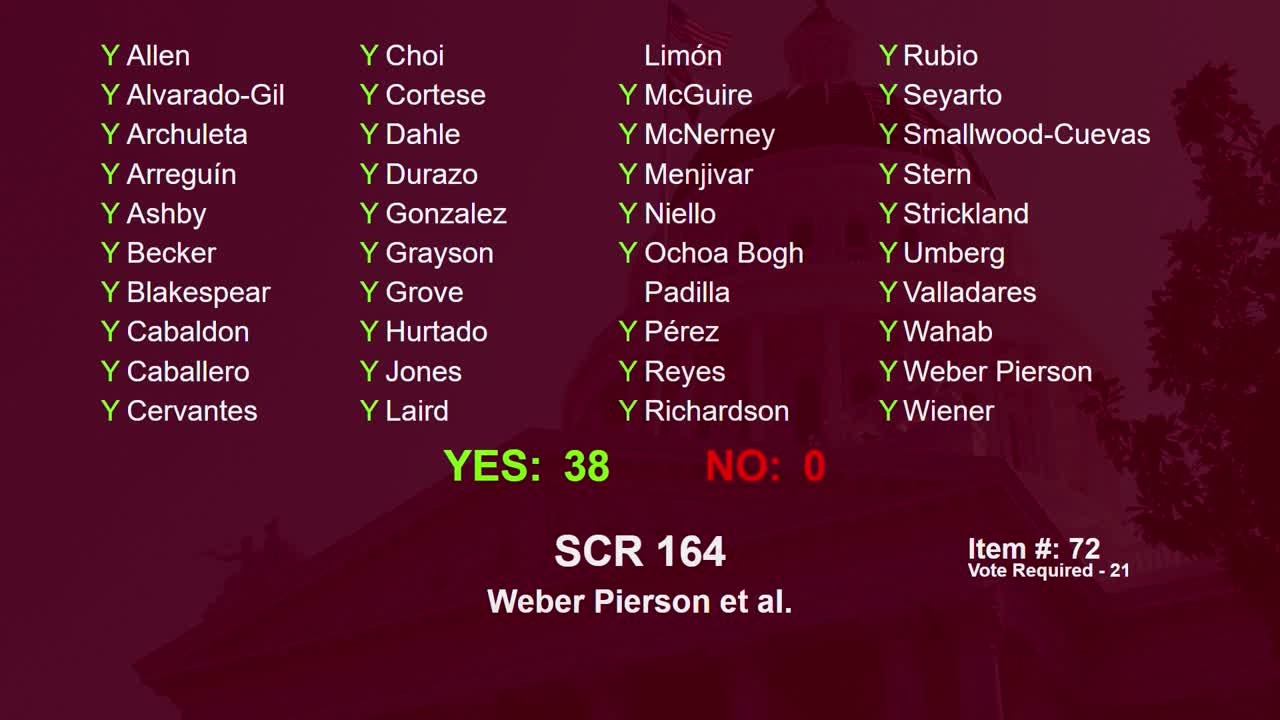 2MIN
Senate Floor
 22MIN
Senate Standing Committee on Privacy, Digital Technologies, and Consumer Protection
 21MIN
Senate Standing Committee on Judiciary
Bill Author