SB 1168: Data centers: rate structures.
- Session Year: 2025-2026
- House: Senate
- Latest Version Date: 2026-09-21
Current Status:
Passed
(2026-09-21: Chaptered by Secretary of State. Chapter 440, Statutes of 2026.)
Introduced
In Committee
Awaiting First Chamber Vote
Passed First Chamber
In Committee
Awaiting Second Chamber Vote
Passed Second Chamber
Enacted
Existing law vests the Public Utilities Commission with regulatory authority over public utilities. Existing law authorizes the commission to fix the rates and charges for every public utility and requires that those rates and charges be just and reasonable.
This bill would require the commission to assess opportunities for rate structures to ensure data centers pay a reasonable share of their costs associated with transmission and distribution needs, ensure that data centers pay for their proportionate share of load increases and procurements needed to reliably serve their loads while maintaining consistency with the applicable integrated resource planning requirements, and alleviate cost pressures on residential ratepayers.
Existing law vests the Public Utilities Commission with regulatory authority over public utilities. Existing law authorizes the commission to fix the rates and charges for every public utility and requires that those rates and charges be just and reasonable.
This bill would require the commission to assess opportunities for rate structures to ensure data centers pay a reasonable share of their costs associated with transmission and distribution needs, identify mechanisms to ensure that data centers pay for their proportionate share of load increases and procurements needed to reliably serve their loads using nonemitting resources, while maintaining consistency with the applicable integrated resource planning requirements, and structure rates to alleviate cost pressures on residential ratepayers.
Existing law vests the Public Utilities Commission (PUC) with regulatory authority over public utilities, including gas corporations and electrical corporations, while local publicly owned electric utilities are under the direction of their governing boards. Existing law establishes a surcharge on all natural gas consumed in the state to fund certain low-income assistance programs, cost-effective energy efficiency and conservation activities, and public interest research and development. Under existing law, the surcharge is in addition to any other charges for natural gas sold or transported for consumption, as defined, in this state. Existing law exempts from the surcharge gas customers within the service territories of municipalities, districts, or public agencies that offer specified services or programs, as specified. Under existing law, a violation of the Public Utilities Act, or any order, decision, rule, direction, demand, or requirement of the PUC, is a crime. utilities. Existing law authorizes the commission to fix the rates and charges for every public utility and requires that those rates and charges be just and reasonable.
The Energy Resources Surcharge Law imposes a surcharge on consumers for the consumption of electricity purchased from an electric utility, which includes an electrical corporation and local publicly owned electric utility, at a rate annually fixed by the State Energy Resources Conservation and Development Commission (Energy Commission), not to exceed a surcharge rate cap of $0.0003 per kilowatthour. Existing law requires electric utilities to collect the surcharge from consumers, and requires electric utilities, and any consumers who have not had the surcharge collected by an electric utility, to file a return with specified information. Under existing law, a violation of the Energy Resources Surcharge Law is a crime.This bill would impose surcharges, on and after January 1, 2027, on natural gas consumed by a data center, as defined, or a person that consumes natural gas to produce electricity primarily for a data center, at an unspecified rate, and on electricity consumed by a data center that is purchased from an electric utility, which includes an electrical corporation and local publicly owned electric utility, at an unspecified rate, and would require the Energy Commission to fix the rate for both surcharges at a public meeting in each November for each calendar year starting the following January. The bill would specify that the above-described surcharges apply to persons that meet specified criteria, including, among other things, that during any single month beginning January 1, 2027, the person purchased natural gas from a gas corporation, or electricity from an electric utility, that was wholly or partially consumed by a data center. The bill would require a gas corporation and electric utility to collect the applicable surcharge from each data center, except as provided. The bill would authorize a person to apply to a gas corporation or electric utility, as applicable, for an exemption from a surcharge, as specified. require the commission to assess opportunities for rate structures to ensure data centers pay a reasonable share of their costs associated with transmission and distribution needs, identify mechanisms to ensure that data centers pay for their proportionate share of load increases and procurements needed to reliably serve their loads using nonemitting resources, and structure rates to alleviate cost pressures on residential ratepayers.
Because certain provisions of this bill would be part of the Public Utilities Act or implemented through a PUC action, and other provisions of the bill would be enforced pursuant to the Energy Resources Surcharge Law, the violation of which would be a crime, the bill would impose a state-mandated local program. Additionally, by imposing new duties on local publicly owned electric utilities, the bill would impose a state-mandated local program.This bill would require all revenues, interest, and penalties derived from the above-described surcharges to be deposited into the Data Center Excess Energy Usage Surcharge Fund, which the bill would create in the State Treasury. The bill would continuously appropriate moneys in the fund collected from local publicly owned electric utility territory to the Energy Commission for apportionment to local publicly owned electric utilities, and moneys in the fund collected from electrical corporation territory to the PUC for apportionment to electrical corporations, to fund wildfire-related costs included in rates, as provided.The bill would require the California Department of Tax and Fee Administration to administer the taxes imposed by the above-described provisions pursuant to the Fee Collection Procedures Law, the violation of which is a crime. By expanding the application of the Fee Collection Procedures Law, the bill would impose a state-mandated local program.The California Constitution requires the state to reimburse local agencies and school districts for certain costs mandated by the state. Statutory provisions establish procedures for making that reimbursement.This bill would provide that no reimbursement is required by this act for specified reasons.This bill would include a change in state statute that would result in a taxpayer paying a higher tax within the meaning of Section 3 of Article XIIIA of the California Constitution, and thus would require for passage the approval of 2/3 of the membership of each house of the Legislature.Existing law vests the Public Utilities Commission (PUC) with regulatory authority over public utilities, including gas corporations and electrical corporations, while local publicly owned electric utilities are under the direction of their governing boards. Existing law establishes a surcharge on all natural gas consumed in the state to fund certain low-income assistance programs, cost-effective energy efficiency and conservation activities, and public interest research and development. Under existing law, the surcharge is in addition to any other charges for natural gas sold or transported for consumption, as defined, in this state. Existing law exempts from the surcharge gas customers within the service territories of municipalities, districts, or public agencies that offer specified services or programs, as specified. Under existing law, a violation of the Public Utilities Act, or any order, decision, rule, direction, demand, or requirement of the PUC, is a crime.
The Energy Resources Surcharge Law imposes a surcharge on consumers for the consumption of electricity purchased from an electric utility, which includes an electrical corporation and local publicly owned electric utility, at a rate annually fixed by the State Energy Resources Conservation and Development Commission (Energy Commission), not to exceed a surcharge rate cap of $0.0003 per kilowatthour. Existing law requires electric utilities to collect the surcharge from consumers, and requires electric utilities, and any consumers who have not had the surcharge collected by an electric utility, to file a return with specified information. Under existing law, a violation of the Energy Resources Surcharge Law is a crime.
This bill would impose surcharges, on and after January 1, 2027, on natural gas consumed by a data center, as defined, or a person that consumes natural gas to produce electricity primarily for a data center, at an unspecified rate, and on electricity consumed by a data center that is purchased from an electric utility, which includes an electrical corporation and local publicly owned electric utility, at an unspecified rate. rate, and would require the Energy Commission to fix the rate for both surcharges at a public meeting in each November for each calendar year starting the following January. The bill would specify that the above-described surcharges apply to persons that meet specified criteria, including, among other things, that during any single month beginning January 1, 2027, the person purchased natural gas from a gas corporation, or electricity from an electric utility, that was wholly or partially consumed by a data center. The bill would require a gas corporation and electric utility to collect the applicable surcharge from each data center, except as provided. The bill would authorize a person to apply to a gas corporation or electric utility, as applicable, for an exemption from a surcharge, as specified.
Because certain provisions of this bill would be part of the Public Utilities Act or implemented through a PUC action, and other provisions of the bill would be enforced pursuant to the Energy Resources Surcharge Law, the violation of which would be a crime, the bill would impose a state-mandated local program. Additionally, by imposing new duties on local publicly owned electric utilities, the bill would impose a state-mandated local program.
This bill would require all revenues, interest, and penalties derived from the above-described surcharges to be deposited into the Data Center Excess Energy Usage Surcharge Fund, which the bill would create in the State Treasury. The bill would continuously appropriate moneys in the fund collected from local publicly owned electric utility territory to the Energy Commission to establish a Low-Income Rate Assistance Program Account, for apportionment to local publicly owned electric utilities, and moneys in the fund collected from electrical corporation territory to the Public Utilities Commission to establish a Low-Income Rate Assistance Program, PUC for apportionment to electrical corporations, to fund wildfire-related costs included in rates, as provided.
The bill would require the California Department of Tax and Fee Administration to administer the taxes imposed by the above-described provisions pursuant to the Fee Collection Procedures Law, the violation of which is a crime. By expanding the application of the Fee Collection Procedures Law, the bill would impose a state-mandated local program.
The California Constitution requires the state to reimburse local agencies and school districts for certain costs mandated by the state. Statutory provisions establish procedures for making that reimbursement.
This bill would provide that no reimbursement is required by this act for specified reasons.
This bill would include a change in state statute that would result in a taxpayer paying a higher tax within the meaning of Section 3 of Article XIIIA of the California Constitution, and thus would require for passage the approval of 2/3 of the membership of each house of the Legislature.
Existing law vests the Public Utilities Commission (PUC) with regulatory authority over public utilities, including gas corporations and electrical corporations, while local publicly owned electric utilities are under the direction of their governing boards. Existing law establishes a surcharge on all natural gas consumed in the state to fund certain low-income assistance programs, cost-effective energy efficiency and conservation activities, and public interest research and development. Under existing law, the surcharge is in addition to any other charges for natural gas sold or transported for consumption, as defined, in this state. Existing law exempts from the surcharge gas customers within the service territories of municipalities, districts, or public agencies that offer specified services or programs, as specified. Under existing law, a violation of the Public Utilities Act, or any order, decision, rule, direction, demand, or requirement of the PUC, is a crime.
The Energy Resources Surcharge Law imposes a surcharge on consumers for the consumption of electricity purchased from an electric utility, which includes an electrical corporation and local publicly owned electric utility, at a rate annually fixed by the State Energy Resources Conservation and Development Commission (Energy Commission), not to exceed a surcharge rate cap of $0.0003 per kilowatthour. Existing law requires electric utilities to collect the surcharge from consumers, and requires electric utilities, and any consumers who have not had the surcharge collected by an electric utility, to file a return with specified information. Under existing law, a violation of the Energy Resources Surcharge Law is a crime.
This bill would impose surcharges, on and after January 1, 2027, on natural gas consumed by a data center, as defined, or a person that consumes natural gas to produce electricity primarily for a data center, at an unspecified rate, and on electricity consumed by a data center that is purchased from an electric utility, which includes an electrical corporation and local publicly owned electric utility, at an unspecified rate. The bill would specify that the above-described surcharges apply to persons that meet specified criteria, including, among other things, that during any single month beginning January 1, 2027, the person purchased natural gas from a gas corporation, or electricity from an electric utility, that was wholly or partially consumed by a data center. The bill would require a gas corporation and electric utility to collect the applicable surcharge from each data center, except as provided. The bill would authorize a person to apply to a gas corporation or electric utility, as applicable, for an exemption from a surcharge, as specified.
Because certain provisions of this bill would be part of the Public Utilities Act or implemented through a PUC action, and other provisions of the bill would be enforced pursuant to the Energy Resources Surcharge Law, the violation of which would be a crime, the bill would impose a state-mandated local program. Additionally, by imposing new duties on local publicly owned electric utilities, the bill would impose a state-mandated local program.
This bill would require all revenues, interest, and penalties derived from the above-described surcharges to be deposited into the Data Center Excess Energy Usage Surcharge Fund, which the bill would create in the State Treasury. The bill would continuously appropriate moneys in the fund collected from local publicly owned electric utility territory to the Energy Commission to establish a Low-Income Rate Assistance Program Account, and moneys in the fund collected from electrical corporation territory to the Public Utilities Commission to establish a Low-Income Rate Assistance Program, as provided.
The bill would require the California Department of Tax and Fee Administration to administer the taxes imposed by the above-described provisions pursuant to the Fee Collection Procedures Law, the violation of which is a crime. By expanding the application of the Fee Collection Procedures Law, the bill would impose a state-mandated local program.
The California Constitution requires the state to reimburse local agencies and school districts for certain costs mandated by the state. Statutory provisions establish procedures for making that reimbursement.
This bill would provide that no reimbursement is required by this act for specified reasons.
This bill would include a change in state statute that would result in a taxpayer paying a higher tax within the meaning of Section 3 of Article XIIIA of the California Constitution, and thus would require for passage the approval of 2/3 of the membership of each house of the Legislature.
The Legislature finds and declares all of the following:
(a)Data centers energy use is rapidly increasing across the nation. In California, the Independent System Operator expects energy use to grow by 2.3 gigawatts by 2030. The Pacific Gas and Electric Company alone had about 2,300 megawatts of applications for data center capacity in 2024.
(b)Demands for energy by data centers are growing at the same time as energy prices for Californians are also growing at an unprecedented rate due to factors such as wildfire risk, extreme heat, and the states transition to clean energy.
(c)In order to facilitate data center growth in California while simultaneously retaining reasonable electricity and natural gas rates for all Californians, it is critical to ensure that data centers are contributing back to rate stabilization for all by helping pay down the largest driver of utility rates.
SEC. 2.Article 10.5 (commencing with Section 901) is added to Chapter 4 of Part 1 of Division 1 of the Public Utilities Code, to read:10.5.Data Centers901.As part of a new or existing proceeding, the commission shall assess opportunities for rate structures to do all of the following:
(a)Ensure data centers pay their reasonable share of costs associated with transmission and distribution needs, regardless of whether the data centers interconnect at the transmission or distribution level.
(b)Ensure data centers pay for their proportionate share of load increases and procurements needed to reliably serve their loads while maintaining consistency with the applicable integrated resource planning requirements.
(c)Alleviate cost pressures on residential ratepayers, including, but not limited to, customers enrolled in the California Alternate Rates for Energy program described in Section 739.1 and the Family Electric Rate Assistance program described in Section 739.12.
The Legislature finds and declares all of the following:
(a)Data centers energy use is rapidly increasing across the nation. In California, the Independent System Operator expects energy use to grow by 2.3 gigawatts by 2030. The Pacific Gas and Electric Company alone had about 2,300 megawatts of applications for data center capacity in 2024.
(b)Demands for energy by data centers are growing at the same time as energy prices for Californians are also growing at an unprecedented rate due to factors such as wildfire risk, extreme heat, and the states transition to clean energy.
(c)According to the Public Advocates Office of the Public Utilities Commission, wildfire costs are one of the biggest drivers of utility rates, making up between 10 percent to 24 percent of total investor-owned utility revenue requirements.(d)(c)In order to facilitate data center growth in California while simultaneously retaining reasonable electricity and natural gas rates for all Californians, it is critical to ensure that data centers are contributing back to rate stabilization for all by helping pay down the largest driver of utility rates.
SEC. 2.Article 10.5 (commencing with Section 901) is added to Chapter 4 of Part 1 of Division 1 of the Public Utilities Code, to read:10.5.Data Centers901.As part of a new or existing proceeding, the commission shall assess opportunities for rate structures to do all of the following:
(a)Ensure data centers pay their reasonable share of costs associated with transmission and distribution needs, regardless of whether the data centers interconnect at the transmission or distribution level.
(b)Identify mechanisms to ensure that Ensure data centers pay for their proportionate share of load increases and procurements needed to reliably serve their loads using nonemitting resources. while maintaining consistency with the applicable integrated resource planning requirements.
(c)Structure rates to alleviate Alleviate cost pressures on residential ratepayers, including, but not limited to, customers enrolled in the California Alternate Rates for Energy program described in Section 739.1 and the Family Electric Rate Assistance program described in Section 739.12.
The Legislature finds and declares all of the following:
(a)Data centers energy use is rapidly increasing across the nation. In California, the Independent System Operator expects energy use to grow by 2.3 gigawatts by 2030. The Pacific Gas and Electric Company alone had about 2,300 megawatts of applications for data center capacity in 2024.
(b)Demands for energy by data centers are growing at the same time as energy prices for Californians are also growing at an unprecedented rate due to factors such as wildfire risk, extreme heat, and the states transition to clean energy.
(c)According to the Public Advocates Office of the Public Utilities Commission, wildfire costs are one of the biggest drivers of utility rates, making up between 10 percent to 24 percent of total investor-owned utility revenue requirements.
(d)In order to facilitate data center growth in California while simultaneously retaining reasonable electricity and natural gas rates for all Californians, it is critical to ensure that data centers are contributing back to rate stabilization for all by helping pay down the largest driver of utility rates.
SEC. 2.Article 10.5 (commencing with Section 901) is added to Chapter 4 of Part 1 of Division 1 of the Public Utilities Code, to read:10.5.Data Center Excess Natural Gas Usage Surcharge Law Centers901.This As part shall be known, and may be cited, as the Data Center Excess Natural Gas Usage Surcharge Law. of a new or existing proceeding, the commission shall assess opportunities for rate structures to do all of the following:
(a)Ensure data centers pay their reasonable share of costs associated with transmission and distribution needs, regardless of whether the data centers interconnect at the transmission or distribution level.
(b)Identify mechanisms to ensure that data centers pay for their proportionate share of load increases and procurements needed to reliably serve their loads using nonemitting resources.
(c)Structure rates to alleviate cost pressures on residential ratepayers, including, but not limited to, customers enrolled in the California Alternate Rates for Energy program described in Section 739.1 and the Family Electric Rate Assistance program described in Section 739.12.
All matter omitted in this version of the bill appears in the bill as amended in the Senate, April 6, 2026. (JR11)The Legislature finds and declares all of the following:
(a)Data centers energy use is rapidly increasing across the nation. In California, the Independent System Operator expects energy use to grow by 2.3 gigawatts by 2030. The Pacific Gas and Electric Company alone had about 2,300 megawatts of applications for data center capacity in 2024.
(b)Demands for energy by data centers are growing at the same time as energy prices for Californians are also growing at an unprecedented rate due to factors such as wildfire risk, extreme heat, and the states transition to clean energy.
(c)The California Alternative Rates for Energy (CARE) program and the Family Electric Rate Assistance (FERA) program in California help over 1,400,000 Californians afford their electricity bills. These programs are currently subsidized by all ratepayers.(c)According to the Public Advocates Office of the Public Utilities Commission, wildfire costs are one of the biggest drivers of utility rates, making up between 10 percent to 24 percent of total investor-owned utility revenue requirements.
(d)In order to facilitate data center growth in California while simultaneously retaining reasonable electricity and natural gas rates for all Californians, it is critical to ensure that data centers are contributing back to rate stabilization for all, and particularly for low-income customers. all by helping pay down the largest driver of utility rates.
SEC. 2.Article 10.5 (commencing with Section 901) is added to Chapter 4 of Part 1 of Division 1 of the Public Utilities Code, to read:10.5.Data Center Excess Natural Gas Usage Surcharge Law901.This part shall be known, and may be cited, as the Data Center Excess Natural Gas Usage Surcharge Law.
902.For purposes of the surcharge imposed by this article, Article 10 (commencing with Section 890) shall apply, except as otherwise provided, including that references to State Board of Equalization are replaced by California Department of Tax and Fee Administration.
903.For purposes of this article, both of the following definitions apply:
(a)Data center means a facility that primarily contains electronic equipment used to process, store, and transmit digital information, which may be either of the following:
(1)A freestanding structure.
(2)A facility within a larger structure that uses environmental control equipment to maintain the proper conditions for the operation of electronic equipment. equipment used to process, store, and transmit digital information.
(b)Department means the California Department of Tax and Fee Administration.
904.(a)(1)On and after January 1, 2027, a surcharge is hereby imposed on all natural gas consumed by a data center in this state, or a person that consumes natural gas to produce electricity primarily for a data center, at a rate of $____ per therm. therm, or at the rate determined pursuant to paragraph (2).
(2)The Energy Commission shall fix the rate at a public meeting in each November for each calendar year starting the following January.
(b)Except as specified in Section 898, a public utility gas corporation shall collect the surcharge imposed pursuant to subdivision (a) from any data center consuming natural gas in this state that, or person that consumes natural gas to produce electricity primarily for a data center in this state who, receives gas service from the public utility gas corporation. The duty to collect the surcharge shall commence with the beginning of the first regular billing period applicable to that data center or person that starts on or after January 1, 2027.
(c)Except as specified in Section 898, every data center or person consuming natural gas in this state that has been transported by an interstate pipeline shall be liable for the surcharge imposed pursuant to subdivision (a). The duty to remit the surcharge shall commence on January 1, 2027.
(d)The surcharge imposed pursuant to subdivision (a) shall be in addition to any other charges for natural gas sold or transported for consumption in this state. The surcharge imposed pursuant to this article shall be identified as a separate line item on the bill of a data center provided by a public utility gas corporation.
(e)The surcharge imposed pursuant to subdivision (a) shall apply to persons who meet all both of the following criteria:
(1)During any single month, beginning January 1, 2027, the person purchased natural gas from a public utility gas corporation that was wholly or partially consumed by a data center.(2)The persons consumption of natural gas in the current or previous calendar year has increased by more than ___ therms since the 2021 calendar year.(3)(2)The person does not primarily use the natural gas for the manufacture of tangible personal property, as defined in Section 6016 of the Revenue and Taxation Code.
(f)(1)Every data center consuming natural gas from a public utility gas corporation, or person that consumes natural gas to produce electricity primarily for a data center, is liable for the surcharge. This liability is not extinguished until the surcharge has been paid to this state, except that payment to a public utility gas corporation under this article is sufficient to relieve the consumer from further liability for the surcharge. The surcharge required to be collected by the public utility gas corporation, and any amount unreturned to a data center a person that consumes natural gas to produce electricity primarily for a data center that is not a surcharge but was collected from the data center as a surcharge, constitutes debts owed by the public utility gas corporation to the state.
(2)Any amounts collected by a public utility gas corporation from a consumer on account of the purchase of natural gas, the consumption of which is subject to the surcharge, shall be applied proportionately between the liability of the data center on account of the purchase of the natural gas and the liability of the data center for the surcharge.
(g)A person may apply to a public utility gas corporation for an exemption from the surcharge. The utility public utility gas corporation shall not grant an exemption if the person does not meet the criteria in paragraph (3) (2) of subdivision (e), or is not otherwise exempt from the surcharge imposed pursuant to Article 10 (commencing with Section 890). A public utility gas corporation or data center or person that consumes natural gas to produce electricity primarily for a data center may submit a request, including a statement showing the facts and basis for the claim, to the department to issue a ruling as to the applicability of the exemption. Pending issuance of the ruling by the department, the public utility gas corporation shall not be required to collect the surcharge from the claimant.
(h)A public utility gas corporation is relieved from liability to collect the surcharge insofar as the base upon which the surcharge is imposed is represented by accounts that have been found to be worthless and charged off in accordance with generally accepted accounting principles. If the public utility gas corporation has previously paid the amount of the surcharge it may, under regulations prescribed by the department, take as a deduction on its return the amount found to be worthless and charged off. If any such accounts are thereafter collected in whole or in part, the surcharge so collected shall be paid with the first return filed after such collection. The department may, by regulation, promulgate such other rules with respect to uncollected or worthless accounts as it shall deem necessary to the fair and efficient administration of this article.
(i)Notwithstanding any other law, persons subject to the jurisdiction of the commission are not required to obtain any authorization from the commission to comply with this part.
(j)Every public utility gas corporation selling natural gas for consumption in this state shall register with the department, in a form prescribed by the department, under the same name that it collects the surcharge imposed by Article 10 (commencing with Section 890).
905.(a)The department shall administer and collect the taxes imposed by this part pursuant to the Fee Collection Procedures Law (Part 30 (commencing with Section 55001) of Division 2 of the Revenue and Taxation Code). For purposes of this article, the references in the Fee Collection Procedures Law to fee shall include the surcharges imposed by this article, and references to feepayer shall mean any person liable for the payment of the surcharges imposed under this article and collected pursuant to that law. The department may prescribe, adopt, and enforce rules and regulations, including emergency regulations as necessary, relating to the administration and enforcement of this article, including, but not limited to, collections, reporting, refunds, and appeals.
(b)The surcharges imposed by this article and the amounts thereof required to be collected are due quarterly on or before the last day of the month next succeeding each calendar quarter.
(c)Amounts due, for which a billing for the natural gas is issued by a public utility gas corporation to the consumer before the close of a calendar quarter, are payable when due.
906.All revenues, interest, and penalties derived from the surcharge imposed pursuant to this article shall be deposited into the Data Center Excess Energy Usage Surcharge Fund, established pursuant to Section 40225 of the Revenue and Taxation Code, less payments for refunds and reimbursement to the department for expenses incurred in the administration and collection of the surcharge.
SEC. 3.Part 19.1 (commencing with Section 40220) is added to Division 2 of the Revenue and Taxation Code, to read:19.1.Data Center Excess Electricity Usage Surcharge Law40220.This part shall be known, and may be cited, as the Data Center Excess Electricity Usage Surcharge Law.
40221.For purposes of the surcharge imposed by this part, Part 19 (commencing with Section 40001) shall apply, except as otherwise provided.
40222.For purposes of this part, both all of the following definitions apply:
(a)Data center means a facility that primarily contains electronic equipment used to process, store, and transmit digital information, which may be either of the following:
(1)A freestanding structure.
(2)A facility within a larger structure, that uses environmental control equipment to maintain the proper conditions for the operation of electronic equipment. equipment used to process, store, and transmit digital information.
(b)Energy Commission means the State Energy Resources Conservation and Development Commission.
(c)Local publicly owned electric utility has the same meaning as defined in Section 224.3 of the Public Utilities Code.
40223.(a)(1)(A)On and after January 1, 2027, a surcharge is hereby imposed on electricity consumed by a data center in this state and that is purchased from an electric utility, or the United States or an agency thereof, at the rate of ____ per kilowatthour. kilowatthour, or at the rate determined pursuant to subparagraph (B).
(B)The Energy Commission shall fix the rate at a public meeting in each November for each calendar year starting the following January.
(2)The surcharge imposed by paragraph (1) shall apply to persons who meet all both of the following criteria:
(A)During any single month, beginning January 1, 2027, the person purchased electricity from an electric utility that was wholly or partially consumed by a data center with a total facility capacity of 20 megawatts or greater.
(B)The persons consumption of electricity in the current or previous calendar year has increased by more than 25,000 kilowatthours since the 2021 calendar year.(C)(B)The person does not primarily use electricity for the manufacture of tangible personal property, as defined in Section 6016.
(b)Every data center consuming electricity in this state purchased from an electric utility, or the United States or an agency thereof, is liable for the surcharge. This liability is not extinguished until the surcharge has been paid to this state, except that payment to an electric utility registered under this part is sufficient to relieve the consumer from further liability for the surcharge.
(c)(1)Every electric utility selling electricity to data centers in this state shall collect the surcharge from each data center, other than a data center that is an electric utility, at the time it collects its billings from the data center for the electricity sold or provided. The duty to collect the surcharge from a data center shall commence with the beginning of the first regular billing period applicable to that person that starts on or after January 1, 2027.
(2)A person may apply to an electric utility for an exemption from the surcharge. The utility shall not grant an exemption if the data center does not meet the criteria in subparagraph (C) (B) of paragraph (2) of subdivision (a), or Chapter 3 (commencing with Section 40041) of Part 19. An electric utility or a data center may submit a request, including a statement showing the facts and basis for the claim, to the department to issue a ruling as to the applicability of the exemption. Pending issuance of the ruling by the department, the electric utility shall not be required to collect the surcharge from the claimant.
(d)The surcharge required to be collected by the electric utility from the consumer shall be added to the charges to the data center for the electricity sold. The amount of the surcharge may be stated separately. If the electric utility does not separately state the amount of the surcharge, the electric utility shall include on the billing a notice to the effect that the charges include energy resources surcharge computed at (applicable rate) mill per kilowatthour.
(e)The surcharge required to be collected by the electric utility, and any amount unreturned to a data center that is not a surcharge but was collected from the data center as a surcharge, constitutes debts owed by the electric utility to this state.
(f)Any amounts collected by an electric utility from a consumer on account of the purchase electricity, of the consumption of which is subject to the surcharge, shall be applied proportionately between the liability of the data center on account of the purchase of the electricity and the liability of the consumer for the surcharge.
(g)An electric utility is relieved from liability to collect the surcharge insofar as the base upon which the surcharge is imposed is represented by accounts that have been found to be worthless and charged off in accordance with generally accepted accounting principles. If the electric utility has previously paid the amount of the surcharge it may, under regulations prescribed by the department, take as a deduction on its return the amount found to be worthless and charged off. If any such accounts are thereafter collected in whole or in part, the surcharge so collected shall be paid with the first return filed after such collection. The department may, by regulation, promulgate such other rules with respect to uncollected or worthless accounts as it shall deem necessary to the fair and efficient administration of this part.
(h)Notwithstanding any other law, persons subject to the jurisdiction of the Public Utilities Commission are not required to obtain any authorization from the commission to comply with this part.
(i)Every electric utility selling electricity for consumption in this state shall register with the department, in a form prescribed by the department, under the same name that the electric utility collects the surcharge imposed by Part 19 (commencing with Section 40001).
40224.(a)The department shall administer and collect the taxes imposed by this part pursuant to the Fee Collection Procedures Law (Part 30 (commencing with Section 55001)). For purposes of this part, the references in the Fee Collection Procedures Law to fee shall include the surcharges imposed by this part, and references to feepayer shall mean any person liable for the payment of the surcharges imposed under this part and collected pursuant to that law. The department may prescribe, adopt, and enforce rules and regulations, including emergency regulations as necessary, relating to the administration and enforcement of this part, including, but not limited to, collections, reporting, refunds, and appeals.
(b)The surcharges imposed by this part and the amounts thereof required to be collected by electric utilities are due quarterly on or before the last day of the month next succeeding each calendar quarter.
(c)Amounts due, for which a billing for the electricity is issued by an electric utility to the consumer before the close of a calendar quarter, are payable when due.
40225.(a)All revenues, interest, and penalties derived from the surcharge imposed pursuant to this part and Article 10.5 (commencing with Section 901) of Chapter 4 of Part 1 of Division 1 of the Public Utilities Code, consistent with Section 906 of the Public Utilities Code, shall be deposited into the Data Center Excess Energy Usage Surcharge Fund, which is hereby created in the State Treasury, less payments for refunds and reimbursement to the department for expenses incurred in the administration and collection of the surcharge.
(b)Notwithstanding Section 13340 of the Government Code, all moneys in the Data Center Excess Energy Usage Surcharge Fund are continuously appropriated without regard to fiscal year as follows:
(1)Revenues collected from local publicly owned electric utility territory under this part or Article 10.5 (commencing with Section 901) of Chapter 4 of Part 1 of Division 1 of the Public Utilities Code are continuously appropriated to the Energy Commission to establish a Low-Income Rate Assistance Program Account at the Energy Commission for apportionment to local publicly owned electric utilities to buy down the cost of low-income rate assistance programs offered by those local publicly owned electric utilities. fund wildfire-related costs included in rates.
(2)Revenues collected from electrical corporation territory under this part or Article 10.5 (commencing with Section 901) of Chapter 4 of Part 1 of Division 1 of the Public Utilities Code are continuously appropriated to the Public Utilities Commission to establish a Low-Income Rate Assistance Program for apportionment to the electrical corporations to buy down the cost of providing California Alternate Rates for Energy (CARE) program and Family Electric Rate Assistance (FERA) program benefits to their ratepayers. fund wildfire-related costs included in rates.
SEC. 4.No reimbursement is required by this act pursuant to Section 6 of Article XIIIB of the California Constitution because a local agency or school district has the authority to levy service charges, fees, or assessments sufficient to pay for the program or level of service mandated by this act or because costs that may be incurred by a local agency or school district will be incurred because this act creates a new crime or infraction, eliminates a crime or infraction, or changes the penalty for a crime or infraction, within the meaning of Section 17556 of the Government Code, or changes the definition of a crime within the meaning of Section 6 of Article XIIIB of the California Constitution.
The Legislature finds and declares all of the following:
(a)Data centers energy use is rapidly increasing across the nation. In California, the Independent System Operator expects energy use to grow by 2.3 gigawatts by 2030. The Pacific Gas and Electric Company alone had about 2,300 megawatts of applications for data center capacity in 2024.
(b)Demands for energy by data centers are growing at the same time as energy prices for Californians are also growing at an unprecedented rate due to factors such as wildfire risk, extreme heat, and the states transition to clean energy.
(c)The California Alternative Rates for Energy (CARE) program and the Family Electric Rate Assistance (FERA) program in California help over 1,400,000 Californians afford their electricity bills. These programs are currently subsidized by all ratepayers.
(d)In order to facilitate data center growth in California while simultaneously retaining reasonable electricity and natural gas rates for all Californians, it is critical to ensure that data centers are contributing back to rate stabilization for all, and particularly for low-income customers.
SEC. 2.Article 10.5 (commencing with Section 901) is added to Chapter 4 of Part 1 of Division 1 of the Public Utilities Code, to read:10.5.Data Center Excess Natural Gas Usage Surcharge Law901.This part shall be known, and may be cited, as the Data Center Excess Natural Gas Usage Surcharge Law.
902.For purposes of the surcharge imposed by this article, Article 10 (commencing with Section 890) shall apply, except as otherwise provided, including that references to State Board of Equalization are replaced by California Department of Tax and Fee Administration.
903.For purposes of this article, both of the following definitions apply:
(a)Data center means a facility that primarily contains electronic equipment used to process, store, and transmit digital information, which may be either of the following:
(1)A freestanding structure.
(2)A facility within a larger structure that uses environmental control equipment to maintain the proper conditions for the operation of electronic equipment.
(b)Department means the California Department of Tax and Fee Administration.
904.(a)On and after January 1, 2027, a surcharge is hereby imposed on all natural gas consumed by a data center in this state, or a person that consumes natural gas to produce electricity primarily for a data center, at a rate of $____ per therm.
(b)Except as specified in Section 898, a public utility gas corporation shall collect the surcharge imposed pursuant to subdivision (a) from any data center consuming natural gas in this state that, or person that consumes natural gas to produce electricity primarily for a data center in this state who, receives gas service from the public utility gas corporation. The duty to collect the surcharge shall commence with the beginning of the first regular billing period applicable to that data center or person that starts on or after January 1, 2027.
(c)Except as specified in Section 898, every data center or person consuming natural gas in this state that has been transported by an interstate pipeline shall be liable for the surcharge imposed pursuant to subdivision (a). The duty to remit the surcharge shall commence on January 1, 2027.
(d)The surcharge imposed pursuant to subdivision (a) shall be in addition to any other charges for natural gas sold or transported for consumption in this state. The surcharge imposed pursuant to this article shall be identified as a separate line item on the bill of a data center provided by a public utility gas corporation.
(e)The surcharge imposed pursuant to subdivision (a) shall apply to persons who meet all of the following criteria:
(1)During any single month, beginning January 1, 2027, the person purchased natural gas from a public utility gas corporation that was wholly or partially consumed by a data center.
(2)The persons consumption of natural gas in the current or previous calendar year has increased by more than ___ therms since the 2021 calendar year.
(3)The person does not primarily use the natural gas for the manufacture of tangible personal property, as defined in Section 6016 of the Revenue and Taxation Code.
(f)(1)Every data center consuming natural gas from a public utility gas corporation, or person that consumes natural gas to produce electricity primarily for a data center, is liable for the surcharge. This liability is not extinguished until the surcharge has been paid to this state, except that payment to a public utility gas corporation under this article is sufficient to relieve the consumer from further liability for the surcharge. The surcharge required to be collected by the public utility gas corporation, and any amount unreturned to a data center a person that consumes natural gas to produce electricity primarily for a data center that is not a surcharge but was collected from the data center as a surcharge, constitutes debts owed by the public utility gas corporation to the state.
(2)Any amounts collected by a public utility gas corporation from a consumer on account of the purchase of natural gas, the consumption of which is subject to the surcharge, shall be applied proportionately between the liability of the data center on account of the purchase of the natural gas and the liability of the data center for the surcharge.
(g)A person may apply to a public utility gas corporation for an exemption from the surcharge. The utility shall not grant an exemption if the person does not meet the criteria in paragraph (3) of subdivision (e), or is not otherwise exempt from the surcharge imposed pursuant to Article 10 (commencing with Section 890). A public utility gas corporation or data center or person that consumes natural gas to produce electricity primarily for a data center may submit a request, including a statement showing the facts and basis for the claim, to the department to issue a ruling as to the applicability of the exemption. Pending issuance of the ruling by the department, the public utility corporation shall not be required to collect the surcharge from the claimant.
(h)A public utility gas corporation is relieved from liability to collect the surcharge insofar as the base upon which the surcharge is imposed is represented by accounts that have been found to be worthless and charged off in accordance with generally accepted accounting principles. If the public utility gas corporation has previously paid the amount of the surcharge it may, under regulations prescribed by the department, take as a deduction on its return the amount found to be worthless and charged off. If any such accounts are thereafter collected in whole or in part, the surcharge so collected shall be paid with the first return filed after such collection. The department may, by regulation, promulgate such other rules with respect to uncollected or worthless accounts as it shall deem necessary to the fair and efficient administration of this article.
(i)Notwithstanding any other law, persons subject to the jurisdiction of the commission are not required to obtain any authorization from the commission to comply with this part.
(j)Every public utility gas corporation selling natural gas for consumption in this state shall register with the department, in a form prescribed by the department, under the same name that it collects the surcharge imposed by Article 10 (commencing with Section 890).
905.(a)The department shall administer and collect the taxes imposed by this part pursuant to the Fee Collection Procedures Law (Part 30 (commencing with Section 55001) of Division 2 of the Revenue and Taxation Code). For purposes of this article, the references in the Fee Collection Procedures Law to fee shall include the surcharges imposed by this article, and references to feepayer shall mean any person liable for the payment of the surcharges imposed under this article and collected pursuant to that law. The department may prescribe, adopt, and enforce rules and regulations, including emergency regulations as necessary, relating to the administration and enforcement of this article, including, but not limited to, collections, reporting, refunds, and appeals.
(b)The surcharges imposed by this article and the amounts thereof required to be collected are due quarterly on or before the last day of the month next succeeding each calendar quarter.
(c)Amounts due, for which a billing for the natural gas is issued by a public utility gas corporation to the consumer before the close of a calendar quarter, are payable when due.
906.All revenues, interest, and penalties derived from the surcharge imposed pursuant to this article shall be deposited into the Data Center Excess Energy Usage Surcharge Fund, established pursuant to Section 40225 of the Revenue and Taxation Code, less payments for refunds and reimbursement to the department for expenses incurred in the administration and collection of the surcharge.
SEC. 3.Part 19.1 (commencing with Section 40220) is added to Division 2 of the Revenue and Taxation Code, to read:19.1.Data Center Excess Electricity Usage Surcharge Law40220.This part shall be known, and may be cited, as the Data Center Excess Electricity Usage Surcharge Law.
40221.For purposes of the surcharge imposed by this part, Part 19 (commencing with Section 40001) shall apply, except as otherwise provided.
40222.For purposes of this part, both of the following definitions apply:
(a)Data center means a facility that primarily contains electronic equipment used to process, store, and transmit digital information, which may be either of the following:
(1)A freestanding structure.
(2)A facility within a larger structure, that uses environmental control equipment to maintain the proper conditions for the operation of electronic equipment.
(b)Energy Commission means the State Energy Resources Conservation and Development Commission.
40223.(a)(1)On and after January 1, 2027, a surcharge is hereby imposed on electricity consumed by a data center in this state and that is purchased from an electric utility, or the United States or an agency thereof, at the rate of ____ per kilowatthour.
(2)The surcharge imposed by paragraph (1) shall apply to persons who meet all of the following criteria:
(A)During any single month, beginning January 1, 2027, the person purchased electricity from an electric utility that was wholly or partially consumed by a data center with a total facility capacity of 20 megawatts or greater.
(B)The persons consumption of electricity in the current or previous calendar year has increased by more than 25,000 kilowatthours since the 2021 calendar year.
(C)The person does not primarily use electricity for the manufacture of tangible personal property, as defined in Section 6016.
(b)Every data center consuming electricity in this state purchased from an electric utility, or the United States or an agency thereof, is liable for the surcharge. This liability is not extinguished until the surcharge has been paid to this state, except that payment to an electric utility registered under this part is sufficient to relieve the consumer from further liability for the surcharge.
(c)(1)Every electric utility selling electricity to data centers in this state shall collect the surcharge from each data center, other than a data center that is an electric utility, at the time it collects its billings from the data center for the electricity sold or provided. The duty to collect the surcharge from a data center shall commence with the beginning of the first regular billing period applicable to that person that starts on or after January 1, 2027.
(2)A person may apply to an electric utility for an exemption from the surcharge. The utility shall not grant an exemption if the data center does not meet the criteria in subparagraph (C) of paragraph (2) of subdivision (a), or Chapter 3 (commencing with Section 40041) of Part 19. An electric utility or a data center may submit a request, including a statement showing the facts and basis for the claim, to the department to issue a ruling as to the applicability of the exemption. Pending issuance of the ruling by the department, the electric utility shall not be required to collect the surcharge from the claimant.
(d)The surcharge required to be collected by the electric utility from the consumer shall be added to the charges to the data center for the electricity sold. The amount of the surcharge may be stated separately. If the electric utility does not separately state the amount of the surcharge, the electric utility shall include on the billing a notice to the effect that the charges include energy resources surcharge computed at (applicable rate) mill per kilowatthour.
(e)The surcharge required to be collected by the electric utility, and any amount unreturned to a data center that is not a surcharge but was collected from the data center as a surcharge, constitutes debts owed by the electric utility to this state.
(f)Any amounts collected by an electric utility from a consumer on account of the purchase electricity, of the consumption of which is subject to the surcharge, shall be applied proportionately between the liability of the data center on account of the purchase of the electricity and the liability of the consumer for the surcharge.
(g)An electric utility is relieved from liability to collect the surcharge insofar as the base upon which the surcharge is imposed is represented by accounts that have been found to be worthless and charged off in accordance with generally accepted accounting principles. If the electric utility has previously paid the amount of the surcharge it may, under regulations prescribed by the department, take as a deduction on its return the amount found to be worthless and charged off. If any such accounts are thereafter collected in whole or in part, the surcharge so collected shall be paid with the first return filed after such collection. The department may, by regulation, promulgate such other rules with respect to uncollected or worthless accounts as it shall deem necessary to the fair and efficient administration of this part.
(h)Notwithstanding any other law, persons subject to the jurisdiction of the Public Utilities Commission are not required to obtain any authorization from the commission to comply with this part.
(i)Every electric utility selling electricity for consumption in this state shall register with the department, in a form prescribed by the department, under the same name that the electric utility collects the surcharge imposed by Part 19 (commencing with Section 40001).
40224.(a)The department shall administer and collect the taxes imposed by this part pursuant to the Fee Collection Procedures Law (Part 30 (commencing with Section 55001)). For purposes of this part, the references in the Fee Collection Procedures Law to fee shall include the surcharges imposed by this part, and references to feepayer shall mean any person liable for the payment of the surcharges imposed under this part and collected pursuant to that law. The department may prescribe, adopt, and enforce rules and regulations, including emergency regulations as necessary, relating to the administration and enforcement of this part, including, but not limited to, collections, reporting, refunds, and appeals.
(b)The surcharges imposed by this part and the amounts thereof required to be collected by electric utilities are due quarterly on or before the last day of the month next succeeding each calendar quarter.
(c)Amounts due, for which a billing for the electricity is issued by an electric utility to the consumer before the close of a calendar quarter, are payable when due.
40225.(a)All revenues, interest, and penalties derived from the surcharge imposed pursuant to this part and Article 10.5 (commencing with Section 901) of Chapter 4 of Part 1 of Division 1 of the Public Utilities Code, consistent with Section 906 of the Public Utilities Code, shall be deposited into the Data Center Excess Energy Usage Surcharge Fund, which is hereby created in the State Treasury, less payments for refunds and reimbursement to the department for expenses incurred in the administration and collection of the surcharge.
(b)Notwithstanding Section 13340 of the Government Code, all moneys in the Data Center Excess Energy Usage Surcharge Fund are continuously appropriated without regard to fiscal year as follows:
(1)Revenues collected from local publicly owned electric utility territory under this part or Article 10.5 (commencing with Section 901) of Chapter 4 of Part 1 of Division 1 of the Public Utilities Code are continuously appropriated to the Energy Commission to establish a Low-Income Rate Assistance Program Account at the Energy Commission for apportionment to local publicly owned electric utilities to buy down the cost of low-income rate assistance programs offered by those local publicly owned electric utilities.
(2)Revenues collected from electrical corporation territory under this part or Article 10.5 (commencing with Section 901) of Chapter 4 of Part 1 of Division 1 of the Public Utilities Code are continuously appropriated to the Public Utilities Commission to establish a Low-Income Rate Assistance Program for apportionment to the electrical corporations to buy down the cost of providing California Alternate Rates for Energy (CARE) program and Family Electric Rate Assistance (FERA) program benefits to their ratepayers.
SEC. 4.No reimbursement is required by this act pursuant to Section 6 of Article XIIIB of the California Constitution because a local agency or school district has the authority to levy service charges, fees, or assessments sufficient to pay for the program or level of service mandated by this act or because costs that may be incurred by a local agency or school district will be incurred because this act creates a new crime or infraction, eliminates a crime or infraction, or changes the penalty for a crime or infraction, within the meaning of Section 17556 of the Government Code, or changes the definition of a crime within the meaning of Section 6 of Article XIIIB of the California Constitution.
|
Date
|
Status
|
|---|---|
| Sep 21, 2026 | Chaptered by Secretary of State. Chapter 440, Statutes of 2026. |
| Sep 21, 2026 | Approved by the Governor. |
| Sep 8, 2026 | Enrolled and presented to the Governor at 4 p.m. |
| Aug 30, 2026 | Assembly amendments concurred in. (Ayes 39. Noes 0. Page 6149.) Ordered to engrossing and enrolling. |
| Aug 30, 2026 | Assembly amendments concurred in. (Ayes 38. Noes 0.) Ordered to engrossing and enrolling. |
| Aug 28, 2026 | In Senate. Concurrence in Assembly amendments pending. |
| Aug 28, 2026 | Read third time. Passed. (Ayes 78. Noes 0. Page 6775.) Ordered to the Senate. |
| Aug 28, 2026 | Read third time. Passed. Ordered to the Senate. |
| Aug 13, 2026 | Ordered to third reading. |
| Aug 13, 2026 | From consent calendar on motion of Assembly Member Flora. |
| Aug 6, 2026 | Read second time. Ordered to consent calendar. |
| Aug 5, 2026 | From committee: Do pass. Ordered to consent calendar. (Ayes 15. Noes 0.) (August 5). |
| Jun 25, 2026 | From committee: Do pass and re-refer to Com. on APPR. with recommendation: To consent calendar. (Ayes 18. Noes 0.) (June 24). Re-referred to Com. on APPR. |
| Jun 15, 2026 | From committee with author's amendments. Read second time and amended. Re-referred to Com. on U. & E. |
| Jun 4, 2026 | Referred to Com. on U. & E. |
| May 27, 2026 | In Assembly. Read first time. Held at Desk. |
| May 27, 2026 | Read third time. Passed. (Ayes 30. Noes 9. Page 4492.) Ordered to the Assembly. |
| May 27, 2026 | Read third time. Passed. (Ayes 30. Noes 9.) Ordered to the Assembly. |
| May 14, 2026 | From committee: Do pass. (Ayes 5. Noes 2. Page 4267.) (May 14). |
| May 14, 2026 | Read second time. Ordered to third reading. |
| May 14, 2026 | From committee: Do pass. (Ayes 5. Noes 2.) (May 14). |
| May 12, 2026 | Set for hearing May 14. |
| May 11, 2026 | May 11 hearing: Placed on APPR. suspense file. |
| May 4, 2026 | Set for hearing May 11. |
| Apr 23, 2026 | Re-referred to Com. on APPR. |
| Apr 23, 2026 | Withdrawn from committee. |
| Apr 22, 2026 | From committee with author's amendments. Read second time and amended. Re-referred to Com. on REV. & TAX. |
| Apr 14, 2026 | From committee: Do pass and re-refer to Com. on REV. & TAX. (Ayes 13. Noes 4. Page 3842.) (April 13). Re-referred to Com. on REV. & TAX. |
| Apr 14, 2026 | From committee: Do pass and re-refer to Com. on REV. & TAX. (Ayes 13. Noes 4.) (April 13). Re-referred to Com. on REV. & TAX. |
| Apr 6, 2026 | From committee with author's amendments. Read second time and amended. Re-referred to Com. on E., U & C. |
| Apr 2, 2026 | Set for hearing April 13. |
| Feb 26, 2026 | Referred to Coms. on E., U & C. and REV. & TAX. |
| Feb 19, 2026 | From printer. May be acted upon on or after March 21. |
| Feb 18, 2026 | Introduced. Read first time. To Com. on RLS. for assignment. To print. |
|
Date
|
Description
|
Location
|
Votes
|
|
|---|---|---|---|---|
| Aug 30, 2026 | Unfinished Business SB1168 McNerney et al. Concurrence | Senate Floor |
Passed |
|
| Aug 28, 2026 | SB 1168 McNerney Senate Third Reading By Rogers | Assembly Floor |
Passed |
|
| Aug 5, 2026 | Do pass. To Consent Calendar. | Assembly Standing Committee on Appropriations |
Passed |
|
| Jun 24, 2026 | Do pass and be re-referred to the Committee on [Appropriations] with recommendation: To Consent Calendar | Assembly Standing Committee on Utilities and Energy |
Passed |
|
| May 27, 2026 | Senate 3rd Reading SB1168 McNerney et al. | Senate Floor |
Passed |
|
| May 14, 2026 | Do pass | Senate Standing Committee on Appropriations |
Passed |
|
| May 11, 2026 | Placed on suspense file | Senate Standing Committee on Appropriations |
Passed |
|
| Apr 13, 2026 | Do pass, but first be re-referred to the Committee on [Revenue and Taxation] | Senate Standing Committee on Energy, Utilities and Communications |
Passed |
This list shows positions taken on this bill by organizations on the date displayed, which is linked to the original source.
Positions by individuals are not included.
|
Organization
|
Position
|
Date
|
|---|---|---|
| An individual | ** Support | |
| Associated General Contractors, California Chapters | ** Against | |
| Ava Community Energy | ** Support | |
| Bay Area Council | ** Against | |
| Building Owners and Managers Association of California | ** Against | |
| CalAsian Chamber of Commerce | ** Against | |
| CalBroadband, unless amended | ** Against | |
| California African American Chamber Of Commerce | ** Against | |
| California Business Properties Association | ** Against | |
| California Chamber Of Commerce | ** Against | |
| California Hispanic Chambers Of Commerce | ** Against | |
| California State Association Of Electrical Workers | ** Against | |
| California State Pipe Trades Council | ** Against | |
| California Taxpayers Association | ** Against | |
| City of Berkeley | ** Support | |
| Climate Action California | ** Support | |
| Ctia - The Wireless Association | ** Against | |
| CTIA - the Wireless Association, unless amended | ** Against | |
| Data Center Coalition | ** Against | |
| Naiop California | ** Against | |
| Pacific Gas And Electric Company | ** Against | |
| San Diego Gas and Electric Company | ** Against | |
| Southern California Edison | ** Against | |
| Southern California Gas Company | ** Against | |
| Techca | ** Against | |
| Technet | ** Against | |
| The Utility Reform Network | ** Support | |
| Union Of Concerned Scientists | ** Support | |
| Us Telecom - the Broadband Association | ** Against | |
| US Telecom - the Broadband Association, unless amended | ** Against |
SENATE RULES COMMITTEE Office of Senate Floor Analyses (916) 651-4171 | SB 1168 |
UNFINISHED BUSINESS
Bill No: SB 1168
Author: McNerney (D), et al.
Amended: 6/15/26
Vote: 21
SENATE ENERGY, U. & C. COMMITTEE: 13-4, 4/13/26
AYES: Allen, Archuleta, Arreguín, Becker, Caballero, Gonzalez, Hurtado, McNerney, Reyes, Richardson, Rubio, Stern, Wahab
NOES: Ochoa Bogh, Dahle, Grove, Strickland
SENATE APPROPRIATIONS COMMITTEE: 5-2, 5/14/26
AYES: Cervantes, Cabaldon, Grayson, Richardson, Wahab
NOES: Seyarto, Dahle
SENATE FLOOR: 30-9, 5/27/26
AYES: Allen, Archuleta, Arreguín, Ashby, Becker, Blakespear, Cabaldon, Caballero, Cervantes, Cortese, Durazo, Gonzalez, Grayson, Hurtado, Laird, Limón, McGuire, McNerney, Menjivar, Padilla, Pérez, Reyes, Richardson, Rubio, Smallwood-Cuevas, Stern, Umberg, Wahab, Weber Pierson, Wiener
NOES: Alvarado-Gil, Choi, Grove, Jones, Niello, Ochoa Bogh, Seyarto, Strickland, Valladares
NO VOTE RECORDED: Dahle
ASSEMBLY FLOOR: Passed, 8/28/26
SUBJECT: Data centers: rate structures
SOURCE: Author
DIGEST:
This bill requires the California Public Utilities Commission (CPUC) to assess opportunities for rate structures to address specified rate impacts associated with data centers.
Assembly Amendments
require the CPUC to assess opportunities to reliably meet data center electricity demands while ensuring consistency with utilities’ integrated resource plans (IRPs) instead of requiring the CPUC to assess the ability to meet these new demands using zero-emissions electricity resources.
ANALYSIS:
- Authorizes the CPUC to fix rates, establish rules, examine records, issue subpoenas, administer oaths, take testimony, punish for contempt, and prescribe a uniform system of accounts for all public utilities under its jurisdiction. (California Constitution, Article XII, §6)
- Authorizes the CPUC to supervise and regulate every public utility in the state and do all things necessary and convenient in the exercise of such power. (Public Utilities Code §701)
- Defines a “public utility” includes every common carrier, toll bridge corporation, pipeline corporation, gas corporation, electrical corporation, telephone corporation, telegraph corporation, water corporation, sewer system corporation, and heat corporation, where the service is performed for, or the commodity is delivered to, the public or a portion of the public. (Public Utilities Code §216)
- Defines an electrical corporation as every corporation or person owning, controlling, operating, or managing any electric plant for compensation within this state, except where electricity is generated on or distributed by the producer through private property solely for its own use or the use of its tenants and not for sale or transmission to others. (Public Utilities Code §218)
- Requires all utility charges for products, commodities, and services to be just and reasonable. Existing law requires every public utility to maintain adequate, efficient, just, and reasonable service, equipment, and facilities, including telephone facilities, to promote health, safety, and comfort. (Public Utilities Code §451)
- Requires the CPUC to establish and maintain a program to provide discounted electrical and gas corporation rates for households with incomes up to 200% of the federal poverty level (FPL). Existing law specifies that this program shall be named the California Alternate Rates for Energy (CARE) program. (Public Utilities Code §739.1)
- Requires the CPUC to establish and maintain a program to provide discounted electrical rates for households with incomes between 200% and 250% of the FPL. Existing law specifies that this program shall be named the Family Electric Rate Assistance (FERA) program. (Public Utilities Code §739.12)
- Authorizes the CPUC to assess the extent to which new data center loads may result in cost-shifts to other electrical corporation customers. Existing law requires this assessment to identify opportunities to prevent or mitigate any substantial cost shifts. Existing law requires the CPUC to publish the assessment and submit it to the relevant policy committees of the Legislature by January 1, 2027. (Public Utilities Code §913.22)
This bill requires the CPUC to assess opportunities to do all the following as part of a new or existing proceeding:
- Ensure data centers pay their reasonable share of costs associated with transmission and distribution needs, regardless of how data centers interconnect with the electrical grid.
- Ensure that data centers pay for their proportionate share of load increases and procurements needed to reliably serve their loads while maintaining consistency with utilities’ IRPs.
- Alleviate cost pressures on residential ratepayers, including, but not limited to, customers enrolled in the CARE and FERA programs.
Background
Unmanaged data center growth in other states has led to concerns about their energy impacts. Data centers have long existed in California to store and transport data necessary for a variety of internet-based services, including telecommunications systems, cloud computing, streaming video, software development, and electronic file storage. The rapid growth of certain services, including cloud-based computing and artificial intelligence (AI) has led to substantial data center growth. Certain states have experienced an unusual amount of this growth without a regulatory framework in place to ensure that costs associated with building new transmission and distribution, adding new generation, and securing sufficient reliability resources do not impact other ratepayers. Pennsylvania – New Jersey – Maryland Interconnection (PJM) operates the largest regional grid in the United States. In January 2026, data from PJM indicated that 40% of its expected increased electricity demand will come from data centers. With this increase in load, PJM has seen record high costs in certain electricity markets, substantial new transmission costs, and challenges in procuring adequate resources to ensure that it can reliably meet peak electricity demands. Consumers in four states within PJM territory paid over $4 billion in 2024 for transmission projects serving data centers.
Data centers are growing in California, but they may not be the most significant driver of future load growth. California has experienced load growth associated with data center expansion; however, this growth has been more gradual than the increased demand experienced by some other states. The California Energy Commission (CEC), CPUC and California Independent System Operator (CAISO) have all projected varying increases in load from data centers. In forecasts focusing on near term demand, the CEC has shown that CAISO may experience a 1.8 gigawatt (GW) load growth from data centers by 2030. However, the CEC’s energy demand forecast covering 2025 through 2045 indicates that vehicle electrification will be the largest driver of peak electricity demand in the state by 2045. While data centers are expected to increase peak electricity demand by 4.7 GW by 2045, electric vehicles (EVs) may contribute approximately 8.2 GW to peak demand. Serving these future loads will necessarily require additional resources. To address these needs, the CPUC has ordered utilities under its jurisdiction to collectively procure six GW of new zero emissions energy resources by 2032. This six GW procurement is intended to cover near-term load growth and account for delays in delivering previously planned renewable resources, including off-shore wind resources.
The CPUC is in the process of considering proposals to address rate impacts from utility costs, including those associated with data centers and wildfires. This bill requires the CPUC to assess certain rate impacts associated with data centers and opportunities for rate structures to limit the extent to which other ratepayers are impacted by data center energy costs. The CPUC is in the process of considering rate changes to address costs of new electrical loads, including data center loads. In November 2024, Pacific Gas & Electric (PG&E) filed an application at the CPUC to establish a new electric rule for retail electricity customers seeking interconnection at the transmission level. (Application 24-11-007). According to PG&E’s filings, data centers were 67% of the 34 transmission interconnection applications that PG&E received between 2023 and November 2024. In July 2025, the CPUC issued an initial decision (D. 25-07-039) that approved an interim PG&E electric rule for data centers that pre-pay the cost of interconnection. On April 9, 2026, the CPUC started the process to open a rulemaking on the California Advanced Electric Rate Design. As part of this proceeding the CPUC intends to explore opportunities to address affordability challenges associated with wildfire costs and rapid load growth, including load from data centers. The proposed decision indicates that the CPUC intends to publish a staff proposal on residential rate reform as part of this proceeding in the 3rd Quarter of 2026.
Related/Prior Legislation
SB 886 (Padilla, 2026) requires the CPUC to establish a specified rate structure, including an electrical corporation tariff, for data centers with a peak capacity of 25 MW or greater that request a new transmission interconnection. The bill is pending in the Assembly.
SB 978 (Pérez, 2026) would have required the CPUC to create a special rate structure for large data centers prevent cost shifts to other customers. The bill would have established labor requirements for the construction of facilities subject to the bill. The bill would have expanded existing CPUC reporting requirements to include a specified assessment about data center impacts to renewable procurement goals. The bill was held by the Senate Appropriations Committee.
AB 2383 (Zbur, 2026) requires the CPUC to establish a new electricity rate class for transmission-interconnected data centers by January 1, 2028. The bill specifies tariff requirements that must be included in this rate structure to address specified new utility costs stemming from data centers’ transmission, distribution, and electric generation demands. The bill is pending before the full Senate.
AB 1577 (Bauer-Kahan, 2026) requires the owner of a data center to submit specified information regarding the data center’s energy consumption and operation to the CEC and local permitting agencies. This bill also sets limitations on the ability of the CEC and local agencies to disclose information submitted by data centers and requires the CEC report on load impacts of data centers in the Integrated Energy Policy Report. The bill is pending before the full Senate.
SB 57 (Padilla, Chapter 647, Statutes of 2025) authorized the CPUC to assess the extent to which electrical corporation costs for new loads from data centers result in cost shifts to other electrical corporation customers. The bill also required the CPUC to publish and submit a report regarding its assessment to the relevant legislative policy committees by January 1, 2027.
AB 222 (Bauer-Kahan, 2025) would have required the CPUC to assess the extent to which electrical corporation costs for serving data centers result in cost shifts to other customers. The bill also would have required the CEC to establish a process for data centers to submit specified energy efficiency data to the CEC, and it required the CEC to assess data centers’ energy consumption. The bill was held by the Senate Appropriations Committee.
FISCAL EFFECT: Appropriation: No Fiscal Com.: Yes Local: No
According to the Assembly Appropriations Committee, the CPUC will incur significant costs to assess opportunities for rate structures applicable to data centers. The CPUC estimates costs of $224,000 (Public Utilities Commission Utilities Reimbursement Account) annually for a regulatory analyst to conduct this work. The bill’s requirement is finite—when CPUC has completed its assessment, it will have complied with the work the bill explicitly requires. Nonetheless, the CPUC contends the analyst needs be a permanent position and describes the following as ongoing work as a result of this bill: coordination with procurement planning teams to ensure data center interconnection and tariff structure design are consistent with applicable procurement requirements and evaluation of data center tariff cost and rate impacts to ensure they continue to meet statutory goals and adjust them, if needed.
SUPPORT: (Verified 8/24/26)
City of Berkeley
Climate Action California
The Utility Reform Network
Union of Concerned Scientists
An Individual
OPPOSITION: (Verified 8/24/26)
None received
ARGUMENTS IN SUPPORT: According to the author:
Californians pay the second-highest utility prices in the country, and rates are expected to soar even higher because of the rapid growth of data centers around the state. Data center owners and their customers should bear the high costs associated with data centers, not California ratepayers. SB 1168 will ensure data centers pay their fair share by covering the costs of rate assistance programs for California families and low-income residents.
Prepared by: Sarah Smith / E., U. & C. / (916) 651-4107
8/28/26 11:49:41
**** END ****
SENATE THIRD READING
STR Bill Id:SB 1168
Author:(McNerney)
As Amended Ver:June 15, 2026
Majority vote
SUMMARY
This bill requires the California Public Utilities Commission (CPUC) to assess opportunities for rate structures to address specified rate impacts associated with data centers, including paying a reasonable share of costs associated with transmission and distribution needs, paying for a proportionate share of load increases and procurement needs, and alleviating cost pressures on residential ratepayers.
Major Provisions
COMMENTS
The rapid expansion of data centers has introduced a fast-growing and geographically concentrated source of electricity demand in California. Data centers are characterized by high, sometimes continuous (24/7) loads with often relatively limited demand flexibility, placing sustained pressure on transmission and distribution infrastructure. Recent analyses by the California Energy Commission indicate that data center electricity consumption is increasing, with projections suggesting significant growth in demand over the next decade. This growth may require large-scale infrastructure upgrades. In the 2024-2025 Draft Transmission Plan, the California Independent System Operator (CAISO) identified billions of dollars in transmission upgrades needed over the next decade to serve anticipated load growth, in part driven by new data centers. Particularly, the clustering of data centers in specific regions (like the Bay Area) can strain local transmission capacity and necessitate costly upgrades for new service lines. Just how utilities, regulators, and tech companies will meet this unsatiated demand is uncertain. New resources must be procured, and new transmission is likely needed to serve this load, all at cost to either ratepayers or the tech companies themselves.
In California, action is underway by the CPUC to address costs of new electrical loads, including data centers. On April 9, 2026, the CPUC opened a rulemaking on the California Advanced Electric Rate Design. As part of this proceeding, the CPUC intends to explore opportunities to address affordability challenges associated with wildfire costs and rapid load growth, including load from data centers. Specifically, this proceeding, in coordination with the assessment required by SB 57 (Padilla), Chapter 647, Statutes of 2025, will consider issues such as stranded costs and cost shifts for new and emerging large loads with a focus on data centers. The order instituting rulemaking indicates that the CPUC intends to publish a staff proposal on residential rate reform as part of this proceeding in the 3rd Quarter of 2026. Additionally, the CPUC recently approved interim implementation of PG&E′s Electric Rule 30, which establishes a new tariff for large loads interconnecting on the transmission grid. The decision requires new transmission-level customers to be responsible for the initial costs of all transmission facilities, rather than those costs being borne by ratepayers and was sought by PG&E to address an influx of customers requesting this type of service. In June 2026, the Federal Energy Regulatory Commission ordered all six regional grid operators to justify or reform tariffs for data centers and other large energy users as they relate to interconnection and transmission costs. Under the orders, each operator and its transmission owners have 60 days to either justify why their current tariffs remain just and reasonable, or to file tariff changes.
Additionally, there are already emerging, supported paths (or opportunities) available to help fairly allocate the costs of serving data centers. This includes recommendations from the California Public Advocates Office to ensure data centers pay the cost of interconnection, pay minimum demand charges, and be faced with early termination fees to protect against stranded assets. These principles were also echoed in a recent report from the Little Hoover Commission and Lawrence Berkeley National Laboratory. Therefore, it is likely that these options need to be implemented in rate structures for data centers, and then potentially, further assessed to ensure the desired outcome has been achieved. This bill largely directs the CPUC to examine topics already extensively discussed as it relates to data center rate structures and ratepayer protections.
According to the Author
According to the author, ″Californians pay the second-highest utility prices in the country, and rates are expected to soar even higher because of the rapid growth of data centers around the state. Data center owners and their customers should bear the high costs associated with data centers, not California ratepayers. SB 1168 will task the CPUC with assessing methods to ensure data centers pay their fair share for interconnection, excess usage, and new loads required to serve their demands.″
Arguments in Support
Ava Community Energy, writing in support of the bill, states ″As data center demand continues to grow, evaluating rate structures that appropriately allocate transmission, distribution, and procurement costs can help ensure these new large loads bear the costs of serving their demand rather than shifting those costs onto existing residential customers.″ Moreover, they write that this bill ″supports a more equitable and sustainable approach to integrating large new loads into California′s energy system.″
Arguments in Opposition
None on file
FISCAL COMMENTS
According to the Assembly Committee on Appropriations, the CPUC estimates annually costs of $224,000 for the completion of the report.
VOTES
SENATE FLOOR: 30-9-1
YES: Allen, Archuleta, Arreguín, Ashby, Becker, Blakespear, Cabaldon, Caballero, Cervantes, Cortese, Durazo, Gonzalez, Grayson, Hurtado, Laird, Limón, McGuire, McNerney, Menjivar, Padilla, Pérez, Reyes, Richardson, Rubio, Smallwood-Cuevas, Stern, Umberg, Wahab, Weber Pierson, Wiener
NO: Alvarado-Gil, Choi, Grove, Jones, Niello, Ochoa Bogh, Seyarto, Strickland, Valladares
ABS, ABST OR NV: Dahle
ASM UTILITIES AND ENERGY: 18-0-0
YES: Petrie-Norris, Patterson, Boerner, Calderon, Chen, Davies, Mark González, Harabedian, Hart, Irwin, Kalra, Papan, Rogers, Schiavo, Schultz, Ta, Wallis, Zbur
ASM APPROPRIATIONS: 15-0-0
YES: Wicks, Hoover, Arambula, Calderon, Caloza, Dixon, Fong, Mark González, Krell, Pacheco, Pellerin, Sharp-Collins, Solache, Ta, Tangipa
UPDATED
VERSION: June 15, 2026
CONSULTANT: Alexa Cohill-Milanick / U. & E. / (916) 319-2083 FN: 0003456
Date of Hearing: August 5, 2026
ASSEMBLY COMMITTEE ON APPROPRIATIONS
Buffy Wicks, Chair
SBPCA Bill Id:SB 1168
Author:(McNerney) – As Amended Ver:June 15, 2026
Policy Committee: | Utilities and Energy | Vote: | 18 - 0 |
|
| ||
|
|
Urgency: No State Mandated Local Program: No Reimbursable: No
SUMMARY:
This bill directs the California Public Utilities Commission (CPUC) to assess opportunities for rate structures applicable to data centers.
Specifically, this bill directs the CPUC to assess rate structures that (a) ensure data centers pay their reasonable share of costs associated with transmission and distribution needs, regardless of whether the data centers interconnect at the transmission level or distribution level, (b) ensure data centers pay for their proportionate share of electrical load increases and procurements needed to reliably serve their loads while maintaining consistency with the applicable resource procurement plans requirements and (c) alleviate cost pressures on residential ratepayers.
FISCAL EFFECT:
The CPUC will incur significant costs to assess opportunities for rate structures applicable to data centers. The CPUC estimates costs of $224,000 (Public Utilities Commission Utilities Reimbursement Account) annually for a regulatory analyst to conduct this work. The bill’s requirement is finite—when CPUC has completed its assessment, it will have complied with the work the bill explicitly requires. Nonetheless, the CPUC contends the analyst needs be a permanent position and describes the following as ongoing work as a result of this bill: coordination with procurement planning teams to ensure data center interconnection and tariff structure design are consistent with applicable procurement requirements and evaluation of data center tariff cost and rate impacts to ensure they continue to meet statutory goals and adjust them, if needed.
COMMENTS:
Data centers—facilities that house servers, storage devices and other computer-related infrastructure—are, by their nature, energy intensive: it takes a great deal of electricity to power such large concentrations of electronic equipment. California is home to many data centers, especially in and near the Silicon Valley region of Santa Clara County. Many expect data center development, and the associated demand for electricity, to continue and accelerate as the AI industry grows.
This bill directs the CPUC to assess opportunities for rate structures applicable to data centers. Under existing practice, the CPUC generally considers costs for serving new large loads (such as factories, office buildings and housing developments) under “tariffs,” specifically “Electric Rule 15” and “Electric Rule 16,” where the requesting customer typically pays the incremental costs of interconnection. As part of this consideration, the CPUC generally seeks to minimize the shifting of costs from the requesting customer to other customers or customer classes, though the law does not explicitly require that the CPUC do so.
Historically, these CPUC rules have governed interconnection of customers at the distribution level, that is, at level that draws relatively less electricity than that carried by electricity transmission lines. Many utilities, including and especially Pacific Gas and Electric (PG&E), report an increase in requests for new service at the transmission level.
The CPUC recently and only partially approved, on an interim basis, a proposal by PG&E for any customer seeking transmission-level services, provided the customer agrees to pay for necessary transmission infrastructure work upfront. The CPUC further reports it will determine terms and cost allocation in a future decision.
More recently, in April of this year, the CPUC opened a rulemaking on the California Advanced Electric Rate Design to explore opportunities to address affordability challenges associated with wildfire costs and rapid load growth, including load from data centers. The proceeding, along with the assessment required by SB 57 (Padilla), Chapter 647, Statutes of 2025, will consider issues such as stranded costs and cost shifts for new and emerging large loads, with a focus on data centers.
Despite these ongoing efforts, the author contends state law must “task the CPUC with assessing methods to ensure data centers pay their fair share.”
The Legislature is considering, or has considered, several bills related to data centers. Bills actively under consideration in the current legislative session include AB 1577 (Bauer-Kahan), AB 2383 (Zbur), AB (Papan) and AB 2619 (Papan), each of which is pending consideration in the Senate Committee on Appropriations, and SB 887 (Padilla), which is pending consideration in this committee.
Analysis Prepared by: Jay Dickenson / APPR. / (916) 319-2081
Date of Hearing: June 24, 2026
ASSEMBLY COMMITTEE ON UTILITIES AND ENERGY
Cottie Petrie-Norris, Chair
SBPCA Bill Id:SB 1168
Author:(McNerney) – As Amended Ver:June 15, 2026
SENATE VOTE: 30-9
SUBJECT: Data centers: rate structures
SUMMARY: Requires the California Public Utilities Commission (CPUC) to assess opportunities for rate structures to address specified rate impacts associated with data centers, including paying a reasonable share of costs associated with transmission and distribution needs, paying for a proportionate share of load increases and procurement needs, and alleviating cost pressures on residential ratepayers.
EXISTING LAW:
- Requires that all rates for any service or product charged by an electrical corporation be just and reasonable. (Public Utilities Code § 451)
- Requires the CPUC to ensure that rates are sufficient to enable IOUs to recover a just and reasonable amount of revenue from residential customers as a class, while observing the principle that electricity and gas services are necessities, for which a low, affordable rate is desirable, and while observing the principle that conservation is desirable in order to maintain an affordable bill. (Public Utilities Code § 739)
- Requires the CPUC to establish rates using cost allocation principles that fairly and reasonably assign to different customer classes the costs of providing service to those customer classes, consistent with the policies of affordability and conservation. (Public Utilities Code § 739.6)
- Authorizes the CPUC to require a public utility to correct any rates, practices, equipment, or behavior that is unjust, unreasonable, unsafe, improper, inadequate, or insufficient. (Public Utilities Code § 761)
- Defines an electrical corporation as every corporation or person owning, controlling, operating, or managing any electric plant for compensation within this state, except where electricity is generated on or distributed by the producer through private property solely for its own use or the use of its tenants and not for sale or transmission to others. (Public Utilities Code § 218)
- Establishes a policy to source 100% of all in-state retail electricity sales from zero-carbon and renewable resources by December 31, 2045. Existing law requires the CPUC, CEC and the California Air Resources Board (CARB) to incorporate this policy into all relevant plans. (Public Utilities Code § 454.53)
- Authorizes the CPUC to assess the extent to which electrical corporation costs for new loads from data centers result in cost shifts to other electrical corporation customers. (Public Utilities Code § 913.22)
- Requires the CPUC to establish and maintain a program to provide discounted electrical and gas corporation rates for households with incomes up to 200% of the federal poverty level (FPL). Existing law specifies that this program shall be named the California Alternate Rates for Energy (CARE) program. (Public Utilities Code § 739.1)
- Requires the CPUC to establish and maintain a program to provide discounted electrical rates for households with incomes between 200% and 250% of the FPL. Existing law specifies that this program shall be named the Family Electric Rate Assistance (FERA) program. (Public Utilities Code § 739.12)
FISCAL EFFECT: According to the Senate Appropriations Committee, the CPUC estimates ongoing costs between $536,000 and $754,000 annually to conduct the assessments required in the bill.
BACKGROUND:
Data center growth – In 2025, global data generation surpassed 175 zettabytes (trillions of gigabytes).[1] This scale of data reflects the rapid growth of connected devices, AI-driven queries, and cloud-based services that depend on data centers for real-time processing and storage.
As shown in Figure 1,[2] U.S. data center annual energy use prior to 2016 was relatively stable at about 60 TWh. Despite the construction of new data centers to serve the rise of cloud-based online services, such as Netflix, increases in efficiency kept this growth consumption relatively flat. However, starting in 2017, electricity consumption accelerated nationwide primarily due to AI computing. By 2024, data centers were 4.7% of total U.S energy consumption. By 2030, data centers are predicted to use 11.8% of forecasted U.S. electricity.[3]
Figure 1. Total U.S. data center electricity use from 2017-2030.

The rapid expansion of data centers has introduced a fast-growing and geographically concentrated source of electricity demand in California.[4] Data centers are characterized by high, sometimes continuous (24/7) loads with often relatively limited demand flexibility, placing sustained pressure on transmission and distribution infrastructure. Recent analyses by the CEC indicate that data center electricity consumption is increasing, with projections suggesting significant growth in demand over the next decade.[5] This growth may require large-scale infrastructure upgrades. In the 2024-2025 Draft Transmission Plan, the California Independent System Operator (CAISO) identified billions of dollars in transmission upgrades needed over the next decade to serve anticipated load growth,[6] in part driven by new data centers. Particularly, the clustering of data centers in specific regions (like the Bay Area [7]) can strain local transmission capacity and necessitate costly upgrades for new service lines. Just how utilities, regulators, and tech companies will meet this unsatiated demand is uncertain. New resources must be procured, and new transmission is likely needed to serve this load, all at cost to either ratepayers or the tech companies themselves.
The CPUC is in the process of considering rate changes to address costs of new electrical loads, including data centers. On April 9, 2026, the CPUC opened a rulemaking on the California Advanced Electric Rate Design.[8] As part of this proceeding, the CPUC intends to explore opportunities to address affordability challenges associated with wildfire costs and rapid load growth, including load from data centers. Specifically, this proceeding, in coordination with the assessment required by SB 57 (Padilla, Chapter 647, Statutes of 2025), will consider issues such as stranded costs and cost shifts for new and emerging large loads with a focus on data centers. The order instituting rulemaking indicates that the CPUC intends to publish a staff proposal on residential rate reform as part of this proceeding in the 3rd Quarter of 2026.
In June 2026, FERC ordered all six regional grid operators[9] to justify or reform tariffs for data centers and other large energy users as they relate to interconnection and transmission costs.[10] Under the orders, each operator and its transmission owners have 60 days to either justify why their current tariffs remain just and reasonable, or to file tariff changes that address the issues identified by FERC, including the following:
- Develop efficient transmission service applications and study processes, including consideration of alternative transmission technologies.
- Prevent cost shifting and require transparency into transmission costs.
- Accommodate co-location agreements and behind-the-meter generation.
- Provide new transmission services for flexible large loads.
- Develop a process to study generating facilities that serve electrically proximate large loads and co-located loads.
This order represents the first significant federal regulatory response to the concerns from data center load growth. The timelines put in place by the order are quick – 60 days for justification or filing of tariffs and just 30 days to submit an information report. Therefore, within the coming months there is likely to be a flurry of new information on how entities across the U.S. are responding to the challenges posed by data center energy demand.
COMMENTS:
- Author’s statement. According to the author, “Californians pay the second-highest utility prices in the country, and rates are expected to soar even higher because of the rapid growth of data centers around the state. Data center owners and their customers should bear the high costs associated with data centers, not California ratepayers. SB 1168 will task the CPUC with assessing methods to ensure data centers pay their fair share for interconnection, excess usage, and new loads required to serve their demands.”
- Purpose of the bill. The goal of this bill is to ensure that the CPUC is considering the impact of data centers on electric rates and ultimately trying to achieve a promised, but potentially uncertain, downward pressure on rates from these large, energy intensive customers. The emergence of extensive data center electricity load marks a rare opportunity for the CPUC to reassess existing rate design and customer protections. The promise of data center energy consumption is alluring: that increased electricity sales from data centers will cover all the new costs to serve those data centers and may even offset existing system costs to the benefit of existing customers. As previously mentioned, the work of assessing this possibility is already underway at the CPUC,[11] which will partly be addressed by the forthcoming SB 57 (Padilla, Chapter 647, Statutes of 2025) report at the start of next year.
However, there are already emerging, supported paths (or opportunities) available to help fairly allocate the costs of serving data centers. This includes recommendations from the California Public Advocate’s Office (PAO) to ensure data centers pay the cost of interconnection, pay minimum demand charges, and be faced with early termination fees to protect against stranded assets.[12] These principles were also echoed in a recent report from the Little Hoover Commission[13] and Lawrence Berkeley National Laboratory.[14] Therefore, it is likely that these options need to be implemented in rate structures for data centers, and then potentially, further assessed to ensure the desired outcome has been achieved. This bill largely directs the CPUC to examine topics already extensively discussed as it relates to data center rate structures and ratepayer protections.
- Related Legislation.
AB 1577 (Bauer-Kahan) requires data centers to report monthly energy usage and efficiency information to the California Energy Commission (CEC). The CEC must integrate this data into the 2029 Integrated Energy Policy Report (IEPR) and annually publish the data in an anonymized and aggregated format for the public. Additionally, data centers must submit similar energy and efficiency information to local agencies when requesting authorization to construct or operate a data center. Status: set for hearing in the Senate Energy, Utilities, and Communications Committee on June 24th.
AB 2383 (Zbur) requires the CPUC to establish a retail electricity classification for large energy use facilities, defined as facilities connected under a retail transmission tariff and broadly meet the definition of a data center. Additionally, electrical corporations must submit to the CPUC for approval a tariff that covers the provisions of transmission, distribution, and generation, as applicable for large energy use facilities. Load serving entities providing generation service must all meet the same tariff requirements. Status: set for hearing in the Senate Energy, Utilities, and Communications Committee on June 30th.
AB 2469 (Papan) prohibits a local agency from approving construction of a new, or expansion of an existing, data center unless an applicant for a data center project provides the local agency with detailed information regarding the data center′s water use and meets other requirements related to workforce and infrastructure for the data center. Status: set for hearing in the Senate Natural Resources and Water Committee on June 23rd.
AB 2619 (Papan) requires data center developers to provide information on water use to water suppliers and local governments prior to being issued a business license and upon renewal of a business license, and requires urban water suppliers to consider data center demand in water shortage planning. Status: set for hearing in the Senate Natural Resources and Water Committee on June 23rd.
SB 886 (Padilla) requires the CPUC to establish an electrical corporation tariff that addresses costs associated with interconnection, transmission and distribution, and generation services for data center customers that interconnect at the transmission level and have peak electricity demands of at least 25 MW. Status: set for hearing in this Committee on June 24th.
SB 887 (Padilla) provides that the California Environmental Quality Act (CEQA) applies to data center projects, as defined. Adds data center projects meeting specified conditions and geothermal projects to existing streamlining provisions for Environmental Leadership Development Projects (ELDPs). Status: set for hearing in this committee on June 24th.
SB 978 (Pérez) requires the CPUC to establish a special rate structure for data centers taking transmission level electrical service with an estimated peak demand of at least 75 megawatts, as specified. This bill requires a contractor who enters a contract to perform work on a data center facility to abide by specified public works requirements and use a skilled and trained workforce. Status: held in the Senate Appropriations Committee.
- Prior Legislation.
AB 222 (Bauer-Kahan, 2025) required the CEC to collect and analyze data center energy consumption trends and include those findings in the 2027 IEPR. This bill also required the CPUC to determine if data center loads resulted in cost shifts to other customers and to submit an assessment to the Legislature. Status: Held in the Senate Appropriations Committee.
AB 93 (Papan, 2025) required a data center operator to provide its estimated or actual water use to its water supplier as a condition of obtaining or renewing a business license issued by a city or county. Status: Vetoed
SB 57 (Padilla) authorizes the CPUC to assess the extent to which utility costs associated with new loads from data centers result in cost shifts to other utility customers and generate a report to the Legislature by January 1, 2027. This assessment may include costs associated with growing load demand, consideration of stranded asset costs, and mechanisms to prevent or mitigate cost shifts to ratepayers. Status: Chapter 647, Statutes of 2025.
REGISTERED SUPPORT / OPPOSITION:
Support
Ava Community Energy
Union of Concerned Scientists
Opposition
None on file.
Other
California Chamber of Commerce
Edison International and Affiliates, Including Southern California Edison
Pacific Gas and Electric Company
San Diego Gas and Electric Company
Silicon Valley Leadership Group (SVLG)
Southern California Gas Company
Analysis Prepared by: Alexa Cohill-Milanick / U. & E. / (916) 319-2083
Armstrong, Global Data Creation is About to Explode, Statista, https://www.statista.com/chart/17727/global-data-creation-forecasts/ ↑
Smith, Sarah et al. "United States Data Center Energy Usage Report: 2025 Update." June 2026, Lawrence Berkeley National Laboratory, Berkeley, California. https://escholarship.org/uc/item/33m6w3x0 ↑
Smith, Sarah, et al. Ibid. ↑
Smith, et al. Ibid ↑
Slide 8-9: Data Center Demand Growth, from CEC 2025 IEPR Forecast, https://www.energy.ca.gov/sites/default/files/2026-01/2026-01-05_DAWG_Mtg_Slides-Combined_ada.pdf ↑
2024-2025 Transmission Plan, CAISO ↑
Slide 20: Data Center Projection Pipeline, from PG&E 2024 Investor Update, https://s21.q4cdn.com/673114418/files/doc_events/2024/06/1/2024-Investor-Update-Presentation_Final.pdf ↑
R 26-04-009 ↑
PJM Interconnection, Midcontinent Independent System Operator, Southwest Poer Pool, California Independent System Operator, ISO New England, New York Independent System Operator ↑
FERC Launchs Aggressive Targeted Action to Speed Large Load Integration, https://www.ferc.gov/news-events/news/ferc-launches-aggressive-targeted-action-speed-large-load-integration ↑
R 26-04-009 ↑
Hieta, K. and Rodriquez, E., How Will Data Center Growth Impact California Ratepayers?, 2025, https://www.publicadvocates.cpuc.ca.gov/press-room/commentary/251027-how-will-data-center-growth-impact-california-ratepayers ↑
Data Centers and California Electricity Policy, Little Hoover Commission, 2026, https://lhc.ca.gov/report/data-centers-and-california-electricity-costs/ ↑
Satchwell et al., Electricity Rate Designs for Large Loads: Evolving Practices and Opportunities, 2025, https://emp.lbl.gov/publications/electricity-rate-designs-large-loads ↑
SENATE RULES COMMITTEE Office of Senate Floor Analyses (916) 651-4171 | SB 1168 |
THIRD READING
Bill No: SB 1168
Author: McNerney (D), et al.
Amended: 4/22/26
Vote: 21
SENATE ENERGY, U. & C. COMMITTEE: 13-4, 4/13/26
AYES: Allen, Archuleta, Arreguín, Becker, Caballero, Gonzalez, Hurtado, McNerney, Reyes, Richardson, Rubio, Stern, Wahab
NOES: Ochoa Bogh, Dahle, Grove, Strickland
SENATE APPROPRIATIONS COMMITTEE: 5-2, 5/14/26
AYES: Cervantes, Cabaldon, Grayson, Richardson, Wahab
NOES: Seyarto, Dahle
SUBJECT: Data centers: rate structures
SOURCE: Author
DIGEST:
This bill requires the California Public Utilities Commission (CPUC) to assess opportunities for rate structures to address specified rate impacts associated with data centers.
ANALYSIS:
- Authorizes the CPUC to fix rates, establish rules, examine records, issue subpoenas, administer oaths, take testimony, punish for contempt, and prescribe a uniform system of accounts for all public utilities under its jurisdiction. (California Constitution, Article XII, §6)
- Authorizes the CPUC to supervise and regulate every public utility in the state and do all things necessary and convenient in the exercise of such power. (Public Utilities Code §701)
- Defines a “public utility” includes every common carrier, toll bridge corporation, pipeline corporation, gas corporation, electrical corporation, telephone corporation, telegraph corporation, water corporation, sewer system corporation, and heat corporation, where the service is performed for, or the commodity is delivered to, the public or a portion of the public. (Public Utilities Code §216)
- Defines an electrical corporation as every corporation or person owning, controlling, operating, or managing any electric plant for compensation within this state, except where electricity is generated on or distributed by the producer through private property solely for its own use or the use of its tenants and not for sale or transmission to others. (Public Utilities Code §218)
- Requires all utility charges for products, commodities, and services to be just and reasonable. Existing law requires every public utility to maintain adequate, efficient, just, and reasonable service, equipment, and facilities, including telephone facilities, to promote health, safety, and comfort. (Public Utilities Code §451)
- Requires the CPUC to establish and maintain a program to provide discounted electrical and gas corporation rates for households with incomes up to 200% of the federal poverty level (FPL). Existing law specifies that this program shall be named the California Alternate Rates for Energy (CARE) program. (Public Utilities Code §739.1)
- Requires the CPUC to establish and maintain a program to provide discounted electrical rates for households with incomes between 200% and 250% of the FPL. Existing law specifies that this program shall be named the Family Electric Rate Assistance (FERA) program. (Public Utilities Code §739.12)
- Authorizes the CPUC to assess the extent to which new data center loads may result in cost-shifts to other electrical corporation customers. Existing law requires this assessment to identify opportunities to prevent or mitigate any substantial cost shifts. Existing law requires the CPUC to publish the assessment and submit it to the relevant policy committees of the Legislature by January 1, 2027. (Public Utilities Code §913.22)
This bill requires the CPUC to assess the following as part of a new or existing proceeding:
- Opportunities for rate structures to ensure data centers pay their reasonable share of costs associated with transmission and distribution needs, regardless of how data centers interconnect with the electrical grid.
- Mechanisms to ensure that data centers pay for their proportionate share of load increases and procurements needed to reliably serve their loads using non-emitting resources.
- Rate structures to alleviate cost pressures on residential ratepayers, including, but not limited to, customers enrolled in the CARE and FERA programs.
Background
Unmanaged data center growth in other states has led to concerns about their energy impacts. Data centers have long existed in California to store and transport data necessary for a variety of internet-based services, including telecommunications systems, cloud computing, streaming video, software development, and electronic file storage. The rapid growth of certain services, including cloud-based computing and artificial intelligence (AI) has led to substantial data center growth. Certain states have experienced an unusual amount of this growth without a regulatory framework in place to ensure that costs associated with building new transmission and distribution, adding new generation, and securing sufficient reliability resources do not impact other ratepayers. Pennsylvania – New Jersey – Maryland Interconnection (PJM) operates the largest regional grid in the United States. In January 2026, data from PJM indicated that 40% of its expected increased electricity demand will come from data centers. With this increase in load, PJM has seen record high costs in certain electricity markets, substantial new transmission costs, and challenges in procuring adequate resources to ensure that it can reliably meet peak electricity demands. Consumers in four states within PJM territory paid over $4 billion in 2024 for transmission projects serving data centers.
Data centers are growing in California, but they may not be the most significant driver of future load growth. California has experienced load growth associated with data center expansion; however, this growth has been more gradual than the increased demand experienced by some other states. The CEC, CPUC and California Independent System Operator (CAISO) have all projected varying increases in load from data centers. In forecasts focusing on near term demand, the CEC has shown that CAISO may experience a 1.8 gigawatt (GW) load growth from data centers by 2030. However, the CEC’s energy demand forecast covering 2025 through 2045 indicates that vehicle electrification will be the largest driver of peak electricity demand in the state by 2045. While data centers are expected to increase peak electricity demand by 4.7 GW by 2045, electric vehicles (EVs) may contribute approximately 8.2 GW to peak demand. Serving these future loads will necessarily require additional resources. To address these needs, the CPUC has ordered utilities under its jurisdiction to collectively procure 6 GW of new zero emissions energy resources by 2032. This 6 GW procurement is intended to cover near-term load growth and account for delays in delivering previously planned renewable resources, including off-shore wind resources.
The CPUC is in the process of considering proposals to address rate impacts from utility costs, including those associated with data centers and wildfires. This bill requires the CPUC to assess certain rate impacts associated with data centers and opportunities for rate structures to limit the extent to which other ratepayers are impacted by data center energy costs. The CPUC is in the process of considering rate changes to address costs of new electrical loads, including data center loads. In November 2024, PG&E filed an application at the CPUC to establish a new electric rule for retail electricity customers seeking interconnection at the transmission level. (Application 24-11-007). According to PG&E’s filings, data centers were 67% of the 34 transmission interconnection applications that PG&E received between 2023 and November 2024. In July 2025, the CPUC issued an initial decision (D. 25-07-039) that approved an interim PG&E electric rule for data centers that pre-pay the cost of interconnection. On April 9, 2026, the CPUC started the process to open a rulemaking on the California Advanced Electric Rate Design. As part of this proceeding the CPUC intends to explore opportunities to address affordability challenges associated with wildfire costs and rapid load growth, including load from data centers. The proposed decision indicates that the CPUC intends to publish a staff proposal on residential rate reform as part of this proceeding in the 3rd Quarter of 2026.
Related/Prior Legislation
SB 886 (Padilla) of 2026, requires the CPUC to establish a specified rate structure, including an electrical corporation tariff, for data centers with a peak capacity of 25 MW or greater that request a new transmission interconnection. The bill is pending in the Senate.
SB 978 (Pérez) of 2026, would have required the CPUC to create a special rate structure for large data centers prevent cost shifts to other customers. The bill would have established labor requirements for the construction of facilities subject to the bill. The bill would have expanded existing CPUC reporting requirements to include a specified assessment about data center impacts to renewable procurement goals. The bill was held by the Senate Appropriations Committee.
SB 57 (Padilla, Chapter 647, Statutes of 2025) authorized the CPUC to assess the extent to which electrical corporation costs for new loads from data centers result in cost shifts to other electrical corporation customers. The bill also required the CPUC to publish and submit a report regarding its assessment to the relevant legislative policy committees by January 1, 2027.
AB 222 (Bauer-Kahan) of 2025, would have required the CPUC to assess the extent to which electrical corporation costs for serving data centers result in cost shifts to other customers. The bill also required the CEC to establish a process for data centers to submit specified energy efficiency data to the CEC, and it required the CEC to assess data centers’ energy consumption. The bill was held by the Senate Appropriations Committee.
FISCAL EFFECT: Appropriation: No Fiscal Com.: Yes Local: No
According to the Senate Appropriations Committee, the CPUC estimates ongoing costs of between $536,000 and $754,000 annually (ratepayer funds) to assess, as part of a new or existing proceeding, opportunities for rate structures applicable to data centers.
SUPPORT: (Verified 5/27/26)
Ava Community Energy
Climate Action California
The Utility Reform Network
An Individual
OPPOSITION: (Verified 5/27/26)
California Chamber of Commerce
California Taxpayers Association
CTIA - the Wireless Association
Pacific Gas and Electric Company
San Diego Gas and Electric Company
Southern California Edison
Southern California Gas Company
Us Telecom - the Broadband Association
ARGUMENTS IN SUPPORT: According to the author:
Californians pay the second-highest utility prices in the country, and rates are expected to soar even higher because of the rapid growth of data centers around the state. Data center owners and their customers should bear the high costs associated with data centers, not California ratepayers. SB 1168 will ensure data centers pay their fair share by covering the costs of rate assistance programs for California families and low-income residents.
ARGUMENTS IN OPPOSITION: Opponents argue that this bill is unnecessary and unfairly targets data centers instead of applying broadly to other large load customers. In opposition, the California Chamber of Commerce states:
SB 1168 should not create a separate resource-procurement standard for a particular customer class. Requiring a particular class of end-use customers to pay for procurement “using nonemitting resources” risks blurring the line between customer cost responsibility and statewide procurement policy. The CPUC already has tools to ensure large loads pay for costs they cause, including interconnection-related costs, transmission and distribution upgrades, demand charges, standby charges where appropriate, and other rate-design mechanisms.
Prepared by: Sarah Smith / E., U. & C. / (916) 651-4107
5/27/26 13:53:20
**** END ****
SENATE RULES COMMITTEE Office of Senate Floor Analyses (916) 651-4171 | SB 1168 |
THIRD READING
Bill No: SB 1168
Author: McNerney (D), et al.
Amended: 4/22/26
Vote: 21
SENATE ENERGY, U. & C. COMMITTEE: 13-4, 4/13/26
AYES: Allen, Archuleta, Arreguín, Becker, Caballero, Gonzalez, Hurtado, McNerney, Reyes, Richardson, Rubio, Stern, Wahab
NOES: Ochoa Bogh, Dahle, Grove, Strickland
SENATE APPROPRIATIONS COMMITTEE: 5-2, 5/14/26
AYES: Cervantes, Cabaldon, Grayson, Richardson, Wahab
NOES: Seyarto, Dahle
SUBJECT: Data centers: rate structures
SOURCE: Author
DIGEST:
This bill requires the California Public Utilities Commission (CPUC) to assess opportunities for rate structures to address specified rate impacts associated with data centers.
ANALYSIS:
- Authorizes the CPUC to fix rates, establish rules, examine records, issue subpoenas, administer oaths, take testimony, punish for contempt, and prescribe a uniform system of accounts for all public utilities under its jurisdiction. (California Constitution, Article XII, §6)
- Authorizes the CPUC to supervise and regulate every public utility in the state and do all things necessary and convenient in the exercise of such power. (Public Utilities Code §701)
- Defines a “public utility” includes every common carrier, toll bridge corporation, pipeline corporation, gas corporation, electrical corporation, telephone corporation, telegraph corporation, water corporation, sewer system corporation, and heat corporation, where the service is performed for, or the commodity is delivered to, the public or a portion of the public. (Public Utilities Code §216)
- Defines an electrical corporation as every corporation or person owning, controlling, operating, or managing any electric plant for compensation within this state, except where electricity is generated on or distributed by the producer through private property solely for its own use or the use of its tenants and not for sale or transmission to others. (Public Utilities Code §218)
- Requires all utility charges for products, commodities, and services to be just and reasonable. Existing law requires every public utility to maintain adequate, efficient, just, and reasonable service, equipment, and facilities, including telephone facilities, to promote health, safety, and comfort. (Public Utilities Code §451)
- Requires the CPUC to establish and maintain a program to provide discounted electrical and gas corporation rates for households with incomes up to 200% of the federal poverty level (FPL). Existing law specifies that this program shall be named the California Alternate Rates for Energy (CARE) program. (Public Utilities Code §739.1)
- Requires the CPUC to establish and maintain a program to provide discounted electrical rates for households with incomes between 200% and 250% of the FPL. Existing law specifies that this program shall be named the Family Electric Rate Assistance (FERA) program. (Public Utilities Code §739.12)
- Authorizes the CPUC to assess the extent to which new data center loads may result in cost-shifts to other electrical corporation customers. Existing law requires this assessment to identify opportunities to prevent or mitigate any substantial cost shifts. Existing law requires the CPUC to publish the assessment and submit it to the relevant policy committees of the Legislature by January 1, 2027. (Public Utilities Code §913.22)
This bill requires the CPUC to assess the following as part of a new or existing proceeding:
- Opportunities for rate structures to ensure data centers pay their reasonable share of costs associated with transmission and distribution needs, regardless of how data centers interconnect with the electrical grid.
- Mechanisms to ensure that data centers pay for their proportionate share of load increases and procurements needed to reliably serve their loads using non-emitting resources.
- Rate structures to alleviate cost pressures on residential ratepayers, including, but not limited to, customers enrolled in the CARE and FERA programs.
Background
Unmanaged data center growth in other states has led to concerns about their energy impacts. Data centers have long existed in California to store and transport data necessary for a variety of internet-based services, including telecommunications systems, cloud computing, streaming video, software development, and electronic file storage. The rapid growth of certain services, including cloud-based computing and artificial intelligence (AI) has led to substantial data center growth. Certain states have experienced an unusual amount of this growth without a regulatory framework in place to ensure that costs associated with building new transmission and distribution, adding new generation, and securing sufficient reliability resources do not impact other ratepayers. Pennsylvania – New Jersey – Maryland Interconnection (PJM) operates the largest regional grid in the United States. In January 2026, data from PJM indicated that 40% of its expected increased electricity demand will come from data centers. With this increase in load, PJM has seen record high costs in certain electricity markets, substantial new transmission costs, and challenges in procuring adequate resources to ensure that it can reliably meet peak electricity demands. Consumers in four states within PJM territory paid over $4 billion in 2024 for transmission projects serving data centers.
Data centers are growing in California, but they may not be the most significant driver of future load growth. California has experienced load growth associated with data center expansion; however, this growth has been more gradual than the increased demand experienced by some other states. The CEC, CPUC and California Independent System Operator (CAISO) have all projected varying increases in load from data centers. In forecasts focusing on near term demand, the CEC has shown that CAISO may experience a 1.8 gigawatt (GW) load growth from data centers by 2030. However, the CEC’s energy demand forecast covering 2025 through 2045 indicates that vehicle electrification will be the largest driver of peak electricity demand in the state by 2045. While data centers are expected to increase peak electricity demand by 4.7 GW by 2045, electric vehicles (EVs) may contribute approximately 8.2 GW to peak demand. Serving these future loads will necessarily require additional resources. To address these needs, the CPUC has ordered utilities under its jurisdiction to collectively procure 6 GW of new zero emissions energy resources by 2032. This 6 GW procurement is intended to cover near-term load growth and account for delays in delivering previously planned renewable resources, including off-shore wind resources.
The CPUC is in the process of considering proposals to address rate impacts from utility costs, including those associated with data centers and wildfires. This bill requires the CPUC to assess certain rate impacts associated with data centers and opportunities for rate structures to limit the extent to which other ratepayers are impacted by data center energy costs. The CPUC is in the process of considering rate changes to address costs of new electrical loads, including data center loads. In November 2024, PG&E filed an application at the CPUC to establish a new electric rule for retail electricity customers seeking interconnection at the transmission level. (Application 24-11-007). According to PG&E’s filings, data centers were 67% of the 34 transmission interconnection applications that PG&E received between 2023 and November 2024. In July 2025, the CPUC issued an initial decision (D. 25-07-039) that approved an interim PG&E electric rule for data centers that pre-pay the cost of interconnection. On April 9, 2026, the CPUC started the process to open a rulemaking on the California Advanced Electric Rate Design. As part of this proceeding the CPUC intends to explore opportunities to address affordability challenges associated with wildfire costs and rapid load growth, including load from data centers. The proposed decision indicates that the CPUC intends to publish a staff proposal on residential rate reform as part of this proceeding in the 3rd Quarter of 2026.
Related/Prior Legislation
SB 886 (Padilla) of 2026, requires the CPUC to establish a specified rate structure, including an electrical corporation tariff, for data centers with a peak capacity of 25 MW or greater that request a new transmission interconnection. The bill is pending in the Senate.
SB 978 (Pérez) of 2026, would have required the CPUC to create a special rate structure for large data centers prevent cost shifts to other customers. The bill would have established labor requirements for the construction of facilities subject to the bill. The bill would have expanded existing CPUC reporting requirements to include a specified assessment about data center impacts to renewable procurement goals. The bill was held by the Senate Appropriations Committee.
SB 57 (Padilla, Chapter 647, Statutes of 2025) authorized the CPUC to assess the extent to which electrical corporation costs for new loads from data centers result in cost shifts to other electrical corporation customers. The bill also required the CPUC to publish and submit a report regarding its assessment to the relevant legislative policy committees by January 1, 2027.
AB 222 (Bauer-Kahan) of 2025, would have required the CPUC to assess the extent to which electrical corporation costs for serving data centers result in cost shifts to other customers. The bill also required the CEC to establish a process for data centers to submit specified energy efficiency data to the CEC, and it required the CEC to assess data centers’ energy consumption. The bill was held by the Senate Appropriations Committee.
FISCAL EFFECT: Appropriation: No Fiscal Com.: Yes Local: No
According to the Senate Appropriations Committee, the CPUC estimates ongoing costs of between $536,000 and $754,000 annually (ratepayer funds) to assess, as part of a new or existing proceeding, opportunities for rate structures applicable to data centers.
SUPPORT: (Verified 5/14/26)
Ava Community Energy
Climate Action California
The Utility Reform Network
An Individual
OPPOSITION: (Verified 5/14/26)
Associated General Contractors, California Chapters
California Chamber of Commerce
California Taxpayers Association
CTIA - the Wireless Association
Pacific Gas and Electric Company
San Diego Gas and Electric Company
Southern California Edison
Southern California Gas Company
Us Telecom - the Broadband Association
ARGUMENTS IN SUPPORT: According to the author:
Californians pay the second-highest utility prices in the country, and rates are expected to soar even higher because of the rapid growth of data centers around the state. Data center owners and their customers should bear the high costs associated with data centers, not California ratepayers. SB 1168 will ensure data centers pay their fair share by covering the costs of rate assistance programs for California families and low-income residents.
ARGUMENTS IN OPPOSITION: Opponents argue that this bill is unnecessary and unfairly targets data centers instead of applying broadly to other large load customers. In opposition, the California Chamber of Commerce states:
SB 1168 should not create a separate resource-procurement standard for a particular customer class. Requiring a particular class of end-use customers to pay for procurement “using nonemitting resources” risks blurring the line between customer cost responsibility and statewide procurement policy. The CPUC already has tools to ensure large loads pay for costs they cause, including interconnection-related costs, transmission and distribution upgrades, demand charges, standby charges where appropriate, and other rate-design mechanisms.
Prepared by: Sarah Smith / E., U. & C. / (916) 651-4107
5/22/26 16:25:14
**** END ****
SENATE RULES COMMITTEE Office of Senate Floor Analyses (916) 651-4171 | SB 1168 |
THIRD READING
Bill No: SB 1168
Author: McNerney (D), et al.
Amended: 4/22/26
Vote: 21
SENATE ENERGY, U. & C. COMMITTEE: 13-4, 4/13/26
AYES: Allen, Archuleta, Arreguín, Becker, Caballero, Gonzalez, Hurtado, McNerney, Reyes, Richardson, Rubio, Stern, Wahab
NOES: Ochoa Bogh, Dahle, Grove, Strickland
SENATE APPROPRIATIONS COMMITTEE: 5-2, 5/14/26
AYES: Cervantes, Cabaldon, Grayson, Richardson, Wahab
NOES: Seyarto, Dahle
SUBJECT: Data centers: rate structures
SOURCE: Author
DIGEST:
This bill requires the California Public Utilities Commission (CPUC) to assess opportunities for rate structures to address specified rate impacts associated with data centers.
ANALYSIS:
- Authorizes the CPUC to fix rates, establish rules, examine records, issue subpoenas, administer oaths, take testimony, punish for contempt, and prescribe a uniform system of accounts for all public utilities under its jurisdiction. (California Constitution, Article XII, §6)
- Authorizes the CPUC to supervise and regulate every public utility in the state and do all things necessary and convenient in the exercise of such power. (Public Utilities Code §701)
- Defines a “public utility” includes every common carrier, toll bridge corporation, pipeline corporation, gas corporation, electrical corporation, telephone corporation, telegraph corporation, water corporation, sewer system corporation, and heat corporation, where the service is performed for, or the commodity is delivered to, the public or a portion of the public. (Public Utilities Code §216)
- Defines an electrical corporation as every corporation or person owning, controlling, operating, or managing any electric plant for compensation within this state, except where electricity is generated on or distributed by the producer through private property solely for its own use or the use of its tenants and not for sale or transmission to others. (Public Utilities Code §218)
- Requires all utility charges for products, commodities, and services to be just and reasonable. Existing law requires every public utility to maintain adequate, efficient, just, and reasonable service, equipment, and facilities, including telephone facilities, to promote health, safety, and comfort. (Public Utilities Code §451)
- Requires the CPUC to establish and maintain a program to provide discounted electrical and gas corporation rates for households with incomes up to 200% of the federal poverty level (FPL). Existing law specifies that this program shall be named the California Alternate Rates for Energy (CARE) program. (Public Utilities Code §739.1)
- Requires the CPUC to establish and maintain a program to provide discounted electrical rates for households with incomes between 200% and 250% of the FPL. Existing law specifies that this program shall be named the Family Electric Rate Assistance (FERA) program. (Public Utilities Code §739.12)
- Authorizes the CPUC to assess the extent to which new data center loads may result in cost-shifts to other electrical corporation customers. Existing law requires this assessment to identify opportunities to prevent or mitigate any substantial cost shifts. Existing law requires the CPUC to publish the assessment and submit it to the relevant policy committees of the Legislature by January 1, 2027. (Public Utilities Code §913.22)
This bill requires the CPUC to assess the following as part of a new or existing proceeding:
- Opportunities for rate structures to ensure data centers pay their reasonable share of costs associated with transmission and distribution needs, regardless of how data centers interconnect with the electrical grid.
- Mechanisms to ensure that data centers pay for their proportionate share of load increases and procurements needed to reliably serve their loads using non-emitting resources.
- Rate structures to alleviate cost pressures on residential ratepayers, including, but not limited to, customers enrolled in the CARE and FERA programs.
Background
Unmanaged data center growth in other states has led to concerns about their energy impacts. Data centers have long existed in California to store and transport data necessary for a variety of internet-based services, including telecommunications systems, cloud computing, streaming video, software development, and electronic file storage. The rapid growth of certain services, including cloud-based computing and artificial intelligence (AI) has led to substantial data center growth. Certain states have experienced an unusual amount of this growth without a regulatory framework in place to ensure that costs associated with building new transmission and distribution, adding new generation, and securing sufficient reliability resources do not impact other ratepayers. Pennsylvania – New Jersey – Maryland Interconnection (PJM) operates the largest regional grid in the United States. In January 2026, data from PJM indicated that 40% of its expected increased electricity demand will come from data centers. With this increase in load, PJM has seen record high costs in certain electricity markets, substantial new transmission costs, and challenges in procuring adequate resources to ensure that it can reliably meet peak electricity demands. Consumers in four states within PJM territory paid over $4 billion in 2024 for transmission projects serving data centers.
Data centers are growing in California, but they may not be the most significant driver of future load growth. California has experienced load growth associated with data center expansion; however, this growth has been more gradual than the increased demand experienced by some other states. The CEC, CPUC and California Independent System Operator (CAISO) have all projected varying increases in load from data centers. In forecasts focusing on near term demand, the CEC has shown that CAISO may experience a 1.8 gigawatt (GW) load growth from data centers by 2030. However, the CEC’s energy demand forecast covering 2025 through 2045 indicates that vehicle electrification will be the largest driver of peak electricity demand in the state by 2045. While data centers are expected to increase peak electricity demand by 4.7 GW by 2045, electric vehicles (EVs) may contribute approximately 8.2 GW to peak demand. Serving these future loads will necessarily require additional resources. To address these needs, the CPUC has ordered utilities under its jurisdiction to collectively procure 6 GW of new zero emissions energy resources by 2032. This 6 GW procurement is intended to cover near-term load growth and account for delays in delivering previously planned renewable resources, including off-shore wind resources.
The CPUC is in the process of considering proposals to address rate impacts from utility costs, including those associated with data centers and wildfires. This bill requires the CPUC to assess certain rate impacts associated with data centers and opportunities for rate structures to limit the extent to which other ratepayers are impacted by data center energy costs. The CPUC is in the process of considering rate changes to address costs of new electrical loads, including data center loads. In November 2024, PG&E filed an application at the CPUC to establish a new electric rule for retail electricity customers seeking interconnection at the transmission level. (Application 24-11-007). According to PG&E’s filings, data centers were 67% of the 34 transmission interconnection applications that PG&E received between 2023 and November 2024. In July 2025, the CPUC issued an initial decision (D. 25-07-039) that approved an interim PG&E electric rule for data centers that pre-pay the cost of interconnection. On April 9, 2026, the CPUC started the process to open a rulemaking on the California Advanced Electric Rate Design. As part of this proceeding the CPUC intends to explore opportunities to address affordability challenges associated with wildfire costs and rapid load growth, including load from data centers. The proposed decision indicates that the CPUC intends to publish a staff proposal on residential rate reform as part of this proceeding in the 3rd Quarter of 2026.
Related/Prior Legislation
SB 886 (Padilla) of 2026, requires the CPUC to establish a specified rate structure, including an electrical corporation tariff, for data centers with a peak capacity of 25 MW or greater that request a new transmission interconnection. The bill is pending in the Senate.
SB 978 (Pérez) of 2026, would have required the CPUC to create a special rate structure for large data centers prevent cost shifts to other customers. The bill would have established labor requirements for the construction of facilities subject to the bill. The bill would have expanded existing CPUC reporting requirements to include a specified assessment about data center impacts to renewable procurement goals. The bill was held by the Senate Appropriations Committee.
SB 57 (Padilla, Chapter 647, Statutes of 2025) authorized the CPUC to assess the extent to which electrical corporation costs for new loads from data centers result in cost shifts to other electrical corporation customers. The bill also required the CPUC to publish and submit a report regarding its assessment to the relevant legislative policy committees by January 1, 2027.
AB 222 (Bauer-Kahan) of 2025, would have required the CPUC to assess the extent to which electrical corporation costs for serving data centers result in cost shifts to other customers. The bill also required the CEC to establish a process for data centers to submit specified energy efficiency data to the CEC, and it required the CEC to assess data centers’ energy consumption. The bill was held by the Senate Appropriations Committee.
FISCAL EFFECT: Appropriation: No Fiscal Com.: Yes Local: No
According to the Senate Appropriations Committee, the CPUC estimates ongoing costs of between $536,000 and $754,000 annually (ratepayer funds) to assess, as part of a new or existing proceeding, opportunities for rate structures applicable to data centers.
SUPPORT: (Verified 5/14/26)
Ava Community Energy
Climate Action California
The Utility Reform Network
An Individual
OPPOSITION: (Verified 5/14/26)
Associated General Contractors, California Chapters
Bay Area Council
Building Owners and Managers Association of California
CalAsian Chamber of Commerce
California African American Chamber of Commerce
California Business Properties Association
California Chamber of Commerce
California Hispanic Chambers of Commerce
California Taxpayers Association
CTIA - the Wireless Association
NAIOP California
Pacific Gas and Electric Company
San Diego Gas and Electric Company
Southern California Edison
Southern California Gas Company
TechCa
TechNet
Us Telecom - the Broadband Association
ARGUMENTS IN SUPPORT: According to the author:
Californians pay the second-highest utility prices in the country, and rates are expected to soar even higher because of the rapid growth of data centers around the state. Data center owners and their customers should bear the high costs associated with data centers, not California ratepayers. SB 1168 will ensure data centers pay their fair share by covering the costs of rate assistance programs for California families and low-income residents.
ARGUMENTS IN OPPOSITION: Opponents argue that this bill is unnecessary and unfairly targets data centers instead of applying broadly to other large load customers. In opposition, the California Chamber of Commerce states:
SB 1168 should not create a separate resource-procurement standard for a particular customer class. Requiring a particular class of end-use customers to pay for procurement “using nonemitting resources” risks blurring the line between customer cost responsibility and statewide procurement policy. The CPUC already has tools to ensure large loads pay for costs they cause, including interconnection-related costs, transmission and distribution upgrades, demand charges, standby charges where appropriate, and other rate-design mechanisms.
Prepared by: Sarah Smith / E., U. & C. / (916) 651-4107
5/16/26 10:39:20
**** END ****
SENATE COMMITTEE ON
Senator Sabrina Cervantes, Chair
2025 - 2026 Regular Session
SB 1168 (McNerney) - Data centers: rate structures
Version: | Policy Vote: |
Urgency: | Mandate: |
Hearing Date: | Consultant: |
Bill Summary:
This bill would require the California Public Utilities Commission (CPUC) to assess opportunities for rate structures to (1) ensure data centers pay a reasonable share of their costs associated with transmission and distribution needs, (2) identify mechanisms to ensure that data centers pay for their proportionate share of load increases and procurements needed to reliably serve their loads using non-emitting resources, and (3) structure rates to alleviate cost pressures on residential ratepayers.
Fiscal Impact:
- The CPUC estimates ongoing costs of between $536,000 and $754,000 annually (ratepayer funds) to assess, as part of a new or existing proceeding, opportunities for rate structures applicable to data centers.
Background:
Unmanaged data center growth in other states has led to concerns about their energy impacts. Data centers have long existed in California to store and transport data necessary for a variety of internet-based services, including telecommunications systems, cloud computing, streaming video, software development, and electronic file storage. The rapid growth of certain services, including cloud-based computing and artificial intelligence has led to substantial data center growth. Certain states have experienced an unusual amount of this growth without a regulatory framework in place to ensure that costs associated with building new transmission and distribution, adding new generation, and securing sufficient reliability resources do not impact other ratepayers. Pennsylvania – New Jersey – Maryland Interconnection (PJM) operates the largest regional grid in the United States. In January 2026, data from PJM indicated that 40% of its expected increased electricity demand will come from data centers. With this increase in load, PJM has seen record high costs in certain electricity markets, substantial new transmission costs, and challenges in procuring adequate resources to ensure that it can reliably meet peak electricity demands. Consumers in four states within PJM territory paid over $4 billion in 2024 alone for transmission projects serving data centers.
California has experienced load growth associated with data center expansion; however, this growth has been more gradual than the increased demand experienced by some other states. The CEC, CPUC and California Independent System Operator (CAISO) have all projected varying increases in load from data centers. In forecasts focusing on near term demand, the CEC has shown that CAISO may experience a 1.8 gigawatt (GW) load growth from data centers by 2030. However, the CEC’s energy demand forecast covering 2025 through 2045 indicates that vehicle electrification will be the largest driver of peak electricity demand in the state by 2045. While data centers are expected to increase peak electricity demand by 4.7 GW by 2045, electric vehicles (EVs) may contribute approximately 8.2 GW to peak demand. Regardless of the sector contributing to the largest share of future energy costs, serving these future loads will necessarily require additional resources. To address these needs, the CPUC has ordered utilities under its jurisdiction to collectively procure 6 GW of new zero emissions energy resources by 2032. This 6 GW procurement is intended to cover near-term load growth and account for delays in delivering previously planned renewable resources, including off-shore wind resources.
The CPUC is in the process of considering proposals to address rate impacts from utility costs, including those associated with data centers and wildfires. In addition to ordering new procurements to serve future load growth, the CPUC is also considering new tariffs and rate structures to prevent large loads from unduly burdening other ratepayers. In November 2024, PG&E filed an application at the CPUC to establish a new electric rule for retail electricity customers seeking interconnection at the transmission level. (Application 24-11-007). According to PG&E’s filings, data centers were 67% of the 34 transmission interconnection applications that PG&E received between 2023 and November 2024. In July 2025, the CPUC issued an initial decision (D. 25-07-039) that approved an interim PG&E electric rule for data centers that pre-pay the cost of interconnection. On April 9, 2026, the CPUC started the process to open a rulemaking on the California Advanced Electric Rate Design. As part of this proceeding the CPUC intends to explore opportunities to address affordability challenges associated with wildfire costs and rapid load growth, including load from data centers. The proposed decision indicates that the CPUC intends to publish a staff proposal on residential rate reform as part of this proceeding in the 3rd Quarter of 2026.
Proposed Law:
This bill would require the CPUC, as part of a new or existing proceeding, to assess opportunities for rate structures to do the following:
- Ensure that data centers pay a reasonable share of costs associated with transmission and distribution costs, regardless of whether they are interconnected at the transmission or distribution level.
- Identify mechanisms to ensure that data centers pay for their proportionate share of load increases and procurements needed to reliably serve those loads with non-emitting resources.
- Structure rates to alleviate cost pressures on residential ratepayers, including customers enrolled in the California Alternate Rates for Energy (CARE) or Family Electric Rate Assistance (FERA) programs.
Related Legislation:
SB 886 (Padilla) of 2026 would require the CPUC to establish a specified electrical corporation tariff that addresses costs associated with transmission, distribution, and generation services for data centers with a peak capacity of 25 MW or greater that request a new transmission interconnection. The bill would require this tariff to include a reasonable share of the costs relating to wildfire mitigation, wildfire liability, electrification and environmental programs, and other costs typically collected from distribution-level ratepayers.
SB 887 (Padilla) of 2026 would establish certain permitting permissions for data centers that meet specified criteria.
SB 978 (Pérez) of 2026 would require the CPUC to create a special rate structure for certain large energy users with capacities of at least 75 MW to prevent cost shifts to other customers. The bill would also establish labor requirements for the construction of facilities subject to the bill. The bill would expand existing CPUC reporting requirements about large loads to include a specified assessment about increased load impacts to renewable procurement goals.
SB 57 (Padilla, Chapter 647, Statutes of 2025) authorized the CPUC to assess the extent to which electrical corporation costs for new loads from data centers result in cost shifts to other electrical corporation customers. The bill also required the CPUC to publish and submit a report regarding its assessment to the relevant legislative policy committees by January 1, 2027.
AB 222 (Bauer-Kahan) of 2025, would have required the CPUC to assess the extent to which electrical corporation costs for serving data centers result in cost shifts to other customers. The bill also required the CEC to establish a process for data centers to submit specified energy efficiency data to the CEC, and it required the CEC to assess data centers’ energy consumption. The bill was held by on suspense in this committee.
-- END --
SENATE COMMITTEE ON ENERGY, UTILITIES AND COMMUNICATIONS
Senator Benjamin Allen, Chair
2025 - 2026 Regular
Bill No: Hearing Date: 4/13/2026
Author: | |||
Version: | Amended | ||
Urgency: | Fiscal: | ||
Consultant: | |||
SUBJECT:
DIGEST: This bill establishes taxes on certain data centers’ energy consumption to fund utility wildfire costs generally included in utility rates. Specifically, this bill establishes a tax on data centers’ electricity consumption as a per-kilowatt-hour (kWh) surcharge on electricity used by those data centers with an electricity demand of 20 megawatts (MW) or greater. This bill also establishes a tax on data centers’ natural gas consumption as a per-therm surcharge on gas used by all data centers. This bill requires the California Energy Commission (CEC) to annually establish the tax rate for both the electricity and natural gas surcharges. This bill requires electricity and natural gas utilities to collect the surcharge from data centers and remit those moneys to the California Department of Tax and Fee Administration (CDTFA) for the purpose of funding electric utilities’ wildfire costs.
ANALYSIS:
Existing law:
- Authorizes the California Public Utilities Commission (CPUC) to fix rates, establish rules, examine records, issue subpoenas, administer oaths, take testimony, punish for contempt, and prescribe a uniform system of accounts for all public utilities under its jurisdiction. (California Constitution, Article XII, §6)
- Authorizes the CPUC to supervise and regulate every public utility in the state and do all things necessary and convenient in the exercise of such power. (Public Utilities Code §701)
- Defines a “public utility” includes every common carrier, toll bridge corporation, pipeline corporation, gas corporation, electrical corporation, telephone corporation, telegraph corporation, water corporation, sewer system corporation, and heat corporation, where the service is performed for, or the commodity is delivered to, the public or a portion of the public. (Public Utilities Code §216)
- Defines an electrical corporation as every corporation or person owning, controlling, operating, or managing any electric plant for compensation within this state, except where electricity is generated on or distributed by the producer through private property solely for its own use or the use of its tenants and not for sale or transmission to others. (Public Utilities Code §218)
- Defines a “gas corporation” as every corporation or person that owns, controls, operates or manages any gas plant for compensation within this state. Existing law exempts entities using landfill gas under certain narrow circumstances from the definition of a “gas corporation.” Existing law also exempts entities that make and use gas through private property solely for self-use or tenant use from the definition of a “gas corporation.” (Public Utilities Code §222)
- Requires all utility charges for products, commodities, and services to be just and reasonable. Existing law requires every public utility to maintain adequate, efficient, just, and reasonable service, equipment, and facilities, including telephone facilities, to promote health, safety, and comfort. (Public Utilities Code §451)
- Authorizes the CPUC to assess the extent to which new data center loads may result in cost-shifts to other electrical corporation customers. Existing law requires this assessment to identify opportunities to prevent or mitigate any substantial cost shifts. Existing law requires the CPUC to publish the assessment and submit it to the relevant policy committees of the Legislature by January 1, 2027. (Public Utilities Code §913.22)
- Establishes the Natural Gas Surcharge to help fund low-income rate assistance programs, low-income energy efficiency and weatherization programs, and research and development activities. Existing law requires every person consuming natural gas in-state to pay this surcharge, and it requires the CPUC to annually establish the surcharge rate for each customer class of each gas utility. Existing law specifies that a customer receiving gas through an interstate gas pipeline must pay the same surcharge rate as the customer would pay if the customer received service from the gas corporation in whose service territory the customer is located. Under existing law, each gas utility must collect the surcharge as a separate line item on a customer’s bill. Existing law requires the State Board of Equalization to administer the collection of the surcharge from gas utilities. (Public Utilities Code §890 et. seq.)
- Establishes the Energy Resources Surcharge Law, which assesses a tax on in-state electricity consumption at ($0.0003) per kWh. Existing law requires the CEC to set the surcharge on an annual basis in a public meeting each November. Existing law requires every retail electricity provider to collect the surcharge on customer bills. Revenues from the Energy Resources Surcharge are deposited into the Energy Resources Program Account (ERPA) within the General Fund to support the administrative functions of the CEC. Funds from the ERPA are subject to appropriation by the Legislature in the Budget Act. (Revenue and Taxation Code §40001 et. seq.)
- Defines “tangible personal property” for the purposes of sales and use tax law as personal property that can be seen, weighed, measured, felt, touched or perceived by the senses in any other way. Tangible personal property generally includes any leased fixtures if the lessor can remove the fixtures upon breach or termination of the lease. Tangible personal property does not include telephone or electrical lines or any electrical poles, towers, and conduits supplying power. (Revenue and Taxation Code §6016-6016.5)
This bill:
- Defines a “data center” as facility that primarily contains electronic equipment used to process, store, and transmit digital information, which may be either of the following: a freestanding structure or a facility within a larger structure that uses environmental control equipment to maintain the proper conditions for the operation of electronic equipment used to process, store, and transmit digital information.
- Establishes two separate taxes on data centers’ energy use:
- An unspecified surcharge gas consumed by a data center located in the state or a person that consumes natural gas to produce electricity primarily for a data center. This bill requires the surcharge to apply to the volumetric use of gas on a per-therm basis, and it imposes the surcharge as of January 1, 2027.
- An unspecified surcharge on electricity consumed by a data center with a capacity of at least 20 MW located in the state. This bill requires the surcharge to apply to the volumetric use of electricity on a per-kWh basis, and it imposes the surcharge as of January 1, 2027.
- Requires the CEC to annually set the data center gas and electricity surcharge rates each November for the next calendar year.
- Clarifies that the gas surcharge collected pursuant to this bill is in addition to any other charges assessed for natural gas consumption, and it must be identified as a separate line item on the gas utility bill. The electricity surcharge established by this bill is not required to be identified as a separate line item under this bill.
- Establishes certain liability and accounting requirements for collecting and remitting the surcharges established by this bill.
- Authorizes certain data centers to obtain exemptions from this bill’s surcharges if the data center uses electricity or natural gas for manufacturing tangible personal property or is exempt from the existing natural gas or energy resources surcharge.
- Specifies that gas and electrical corporations are not required to obtain approval from the CPUC before collecting the surcharges required by this bill.
- Requires every gas and electric utility in the state to register with CDTFA for the purpose of remitting surcharge the surcharge revenue to CDTFA. This bill requires utilities to remit surcharge revenue to CDTFA on a quarterly basis.
- Establishes CDTFA as the agency responsible for administering and collecting the tax revenue generated by the surcharges imposed by this bill.
- Establishes the Data Center Excess Energy Use Surcharge Fund in the Treasury and requires all surcharge revenue from this bill to be deposited into this fund. This bill specifies that CDTFA expenses for administering the surcharge will be covered by revenues from the surcharges.
- Continuously appropriates funds from the Data Center Excess Energy Use Surcharge Fund for the following purposes:
- Revenues collected within local, electric publicly owned utility (POU) service territories are continuously appropriated to the CEC, and the CEC must apportion the funds to POUs to cover wildfire costs generally recovered in rates.
- Revenues collected within electrical corporation territories are continuously appropriated to the CPUC, and the CPUC must apportion the funds to electrical corporations to fund wildfire costs generally recovered in rates.
Background
Unmanaged data center growth in other states has led to concerns about their energy impacts. Data centers have long existed in California to store and transport data necessary for a variety of internet-based services, including telecommunications systems, cloud computing, streaming video, software development, and electronic file storage. The rapid growth of certain services, including cloud-based computing and artificial intelligence (AI) has led to substantial data center growth. Certain states have experienced an unusual amount of this growth without a regulatory framework in place to ensure that costs associated with building new transmission and distribution, adding new generation, and securing sufficient reliability resources do not impact other ratepayers. Pennsylvania – New Jersey – Maryland Interconnection (PJM) operates the largest regional grid in the United States. In January 2026, data from PJM indicated that 40% of its expected increased electricity demand will come from data centers. With this increase in load, PJM has seen record high costs in certain electricity markets, substantial new transmission costs, and challenges in procuring adequate resources to ensure that it can reliably meet peak electricity demands. Consumers in four states within PJM territory paid over $4 billion in 2024 alone for transmission projects serving data centers.
Data centers are growing in California, but they may not be the most significant driver of future load growth. California has experienced load growth associated with data center expansion; however, this growth has been more gradual than the increased demand experienced by some other states. The CEC, CPUC and California Independent System Operator (CAISO) have all projected varying increases in load from data centers. In forecasts focusing on near term demand, the CEC has shown that CAISO may experience a 1.8 gigawatt (GW) load growth from data centers by 2030. However, the CEC’s energy demand forecast covering 2025 through 2045 indicates that vehicle electrification will be the largest driver of peak electricity demand in the state by 2045. While data centers are expected to increase peak electricity demand by 4.7 GW by 2045, electric vehicles (EVs) may contribute approximately 8.2 GW to peak demand. Regardless of the sector contributing to the largest share of future energy costs, serving these future loads will necessarily require additional resources. To address these needs, the CPUC has ordered utilities under its jurisdiction to collectively procure 6 GW of new zero emissions energy resources by 2032. This 6 GW procurement is intended to cover near-term load growth and account for delays in delivering previously planned renewable resources, including off-shore wind resources.
Bill attempts to offset ratepayer costs associated with rising utility wildfire costs. This bill requires data centers to pay an unspecified surcharge on electrical and gas consumption to fund utility costs for wildfire mitigation that are generally included in rates. Wildfire-related utility costs may cover a range of different mitigation efforts, including, but not limited to, vegetation management, infrastructure hardening, and infrastructure reconstruction and recovery following wildfires. Rate increases from utilities’ wildfire mitigation efforts have increased in recent years. According to the CPUC Public Advocate’s Office (PAO), wildfire costs may comprise between 10% to 24% of a utility’s total revenue requirements for the state’s three largest investor-owned utilities (IOUs). A 2024 report from the PAO indicates that wildfire related costs in Pacific Gas & Electric (PG&E) territory increased by 117% between January 2023 and April 2024.
This bill is aimed at obtaining revenues from data centers to limit rate impacts of utility wildfire mitigation costs on other customers. Generally, wildfire costs approved for rate recovery by the CPUC are collected from ratepayers across the different rate classes. Rate design for each utility’s rate classes are intended to ensure that rates for each type of ratepayer cover their reasonable share of utility costs, including those for wildfire. Data centers are generally included in the commercial and industrial rate classes and pay rates structured to reflect costs that the CPUC determines are just and reasonable for those types of ratepayers. However, increasing utility costs associated with wildfires, new infrastructure needs, and increasing loads from large energy consumers, including data centers, has raised concerns that existing rate structures may not be sufficient to address cost shifts within rate classes and between rate classes.
Bill would create a new precedent for assessing surcharges on a specific type of energy consumer. While this bill contains provisions that are substantially similar to requirements for collecting the Natural Gas Surcharge and the Energy Resources Surcharge, this bill would establish surcharges that differ from those surcharges by assessing a tax on a single type of ratepayer to offset costs that are included in rates. Unlike the existing surcharges, this bill does not specify a specific surcharge rate or a maximum surcharge rate. Instead, this bill would require the CEC to set the surcharges on an annual basis for the forthcoming calendar year. Currently, the CEC does not oversee utility rates or wildfire safety issues. It is unclear if the CEC would be able to accurately assess a surcharge to address rates set by the CPUC and POUs’ local boards.
The CPUC is in the process of considering proposals to address rate impacts from utility costs, including those associated with data centers and wildfires. In addition to ordering new procurements to serve future load growth, the CPUC is also considering new tariffs and rate structures to prevent large loads from unduly burdening other ratepayers. In November 2024, PG&E filed an application at the CPUC to establish a new electric rule for retail electricity customers seeking interconnection at the transmission level. (Application 24-11-007). According to PG&E’s filings, data centers were 67% of the 34 transmission interconnection applications that PG&E received between 2023 and November 2024. In July 2025, the CPUC issued an initial decision (D. 25-07-039) that approved an interim PG&E electric rule for data centers that pre-pay the cost of interconnection. On April 9, 2026, the CPUC started the process to open a rulemaking on the California Advanced Electric Rate Design. As part of this proceeding the CPUC intends to explore opportunities to address affordability challenges associated with wildfire costs and rapid load growth, including load from data centers. The proposed decision indicates that the CPUC intends to publish a staff proposal on residential rate reform as part of this proceeding in the 3rd Quarter of 2026.
Bill may pose concerns about cost shifts between utilities. Wildfire costs vary widely between utilities. While some utilities have proportionately very high wildfire risks, other utilities may have little to no wildfire risks. Generally, electrical utilities have much higher wildfire risks than gas utilities due to maintaining high voltage lines in areas of the state prone to wildfires. Data centers are not necessarily located in electrical utility service territories with the highest wildfire risks. As a result, the majority of revenue from surcharges on data centers’ energy consumption may come from utility service territories that do not have high wildfire expenses in their rate structures. For example, a substantial number of data centers exist in the City of Santa Clara, which is not located in a Tier 2 or Tier 3 fire threat area. Data centers in the City of Santa Clara are electric customers of Silicon Valley Power, a local POU; however, they may also be gas customers of a PG&E. This bill requires revenues collected in POU territory to be used for POU wildfire rates, and it requires revenues collected from IOU territory to be used for IOU wildfire rates; however, this bill does not clarify how surcharge revenues are handled when a data center is a customer of both an IOU and a POU. Additionally, this bill requires utilities to collect the surcharge on the basis of volumetric rates to fund costs that are generally associated with transmission and distribution infrastructure. As a result, community choice aggregators (CCAs) may need to collect surcharge revenues from data centers on their volumetric electric rates while those revenues are ultimately used to pay for wildfire costs associated with the IOU transmission and distribution infrastructure serving CCA customers. This bill also does not clarify whether revenues collected within a specific utility service territory will be returned to offset costs for that specific utility. To the extent that POUs remit surcharge revenues that are used to offset wildfire costs of other POUs, this bill may result in cross-subsidization of other utilities.
Scope of facilities impacted by the bill may have unintended consequences. This bill would require every data center in the state that receives natural gas service to pay the gas surcharge established by this bill. This bill also establishes an electricity surcharge on electricity consumption by data centers with capacities of at least 20 MW or greater. As a result, the surcharges established by this bill do not apply to the same data centers. Some smaller data centers that receive natural gas service but have lower electrical loads will not pay the electricity surcharge established by this bill. Additionally, this bill’s definition of a data center potentially encompasses many different types of facilities, including the telecommunications system, research labs, academic facilities, and facilities operated by federal, state and local agencies. Assessing the surcharges on these facilities may result in cost shifts to other taxpayer and ratepayer funded services.
Need for Amendments. This bill establishes a framework for taxing data centers’ energy consumption to pay for wildfire costs generally collected in rates; however, the bill’s surcharge framework may result in cross-subsidization between utilities and may result in certain critical facilities paying surcharges that do not reflect their true cost to electrical or gas system. Additionally, the CPUC is already in the process of considering changes to rate design to address the extent to which wildfire costs and costs to serve new large loads can be structured to alleviate rate pressures for ratepayers. For these reasons, the author and committee may wish to amend this bill to do the following:
- Delete the current contents of this bill.
- Instead require the CPUC, as part of a new or existing proceeding, to assess opportunities for rate structures to do the following:
- Ensure that data centers pay a reasonable share of costs associated with transmission and distribution costs, regardless of whether they are interconnected at the transmission or distribution level.
- Identify mechanisms to ensure that data centers pay for their proportionate share of load increases and procurements needed to reliably serve those loads with non-emitting resources.
- Structure rates to alleviate cost pressures on residential ratepayers, including customers enrolled in the California Alternate Rates for Energy (CARE) or Family Electric Rate Assistance (FERA) programs.
Dual Referral. Should this bill be approved by this committee, it will be re-referred to the Senate Revenue and Taxation Committee.
Prior/Related Legislation
SB 886 (Padilla) of 2026, requires the CPUC to establish a specified electrical corporation tariff that addresses costs associated with transmission, distribution, and generation services for data centers with a peak capacity of 25 MW or greater that request a new transmission interconnection. The bill requires this tariff to include a reasonable share of the costs relating to wildfire mitigation, wildfire liability, electrification and environmental programs, and other costs typically collected from distribution-level ratepayers. The bill is pending in the Senate Appropriations Committee.
SB 887 (Padilla) of 2026, establishes certain permitting permissions for data centers that meet specified criteria. These criteria include provisions similar to the requirements for the tariff specified in this bill. The bill is pending in this committee.
SB 978 (Pérez) of 2026, requires the CPUC to create a special rate structure for certain large energy users with capacities of at least 75 MW to prevent cost shifts to other customers. The bill would also establish labor requirements for the construction of facilities subject to the bill. The bill would expand existing CPUC reporting requirements about large loads to include a specified assessment about increased load impacts to renewable procurement goals. The bill is pending in the Senate Labor, Public Employment and Retirement Committee.
SB 57 (Padilla, Chapter 647, Statutes of 2025) authorized the CPUC to assess the extent to which electrical corporation costs for new loads from data centers result in cost shifts to other electrical corporation customers. The bill also required the CPUC to publish and submit a report regarding its assessment to the relevant legislative policy committees by January 1, 2027.
AB 222 (Bauer-Kahan) of 2025, would have required the CPUC to assess the extent to which electrical corporation costs for serving data centers result in cost shifts to other customers. The bill also required the CEC to establish a process for data centers to submit specified energy efficiency data to the CEC, and it required the CEC to assess data centers’ energy consumption. The bill was held by the Senate Appropriations Committee.
FISCAL EFFECT: Appropriation: Fiscal Com.: Local:
SUPPORT:
Climate Action California
The Utility Reform Network
An Individual
OPPOSITION:
Associated General Contractors, California Chapters
Bay Area Council
Building Owners and Managers Association of California
CalAsian Chamber of Commerce
California African American Chamber of Commerce
CalBroadband, unless amended
California Business Properties Association
California Chamber of Commerce
California Hispanic Chambers of Commerce
California State Association of Electrical Workers
California State Pipe Trades Council
California Taxpayers Association
CTIA - the Wireless Association, unless amended
Data Center Coalition
NAIOP California
Pacific Gas and Electric Company
San Diego Gas and Electric Company
Southern California Edison
Southern California Gas Company
TechCa
TechNet
US Telecom - the Broadband Association, unless amended
ARGUMENTS IN SUPPORT: According to the author:
Californians pay the second-highest utility prices in the country, and rates are expected to soar even higher because of the rapid growth of data centers around the state. Data center owners and their customers should bear the high costs associated with data centers, not California ratepayers. SB 1168 will ensure data centers pay their fair share by covering the costs of rate assistance programs for California families and low-income residents.
ARGUMENTS IN OPPOSITION: In opposition, the California State Association of Electrical Workers and the California State Pipe Trades Council state:
…the bill would disincentivize data centers from locating in California. Data centers use a massive amount of electricity. Increased electricity consumption spreads the cost of the electric grid across more kWh, so the average rates for all customers will go down. This has already been seen with transportation electrification. A 2024 NRDC/Synapse analysis found that electric vehicles have already put downward pressure on rates by bringing in $2 billion in revenue above the cost to upgrade the grid to accommodate EV charging. And, as rates go down due to increased electricity from EVs, data centers, etc., more customers will electrify, creating a positive cycle of electrification and continued downward pressure on rates.
-- END --
Discussed in Hearing
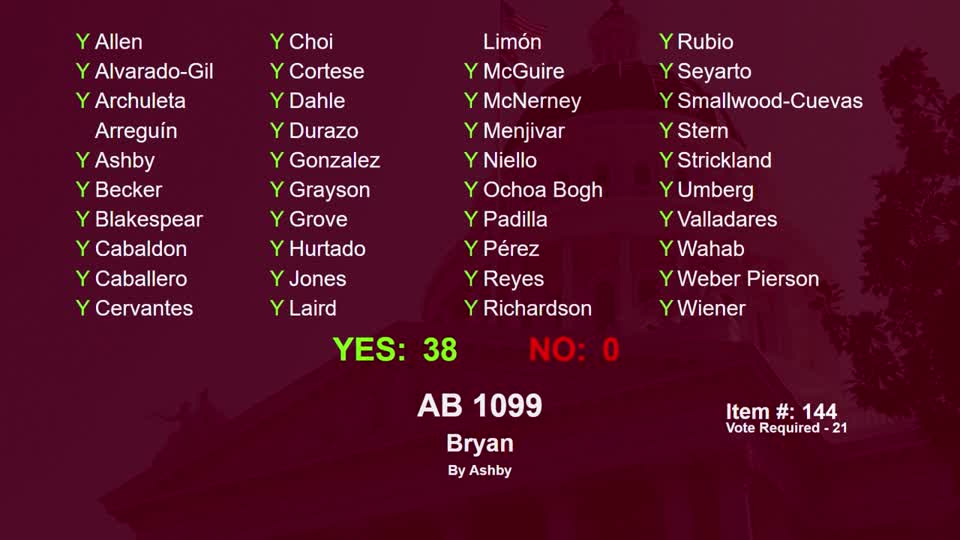 2MIN
Senate Floor
 3MIN
Assembly Floor
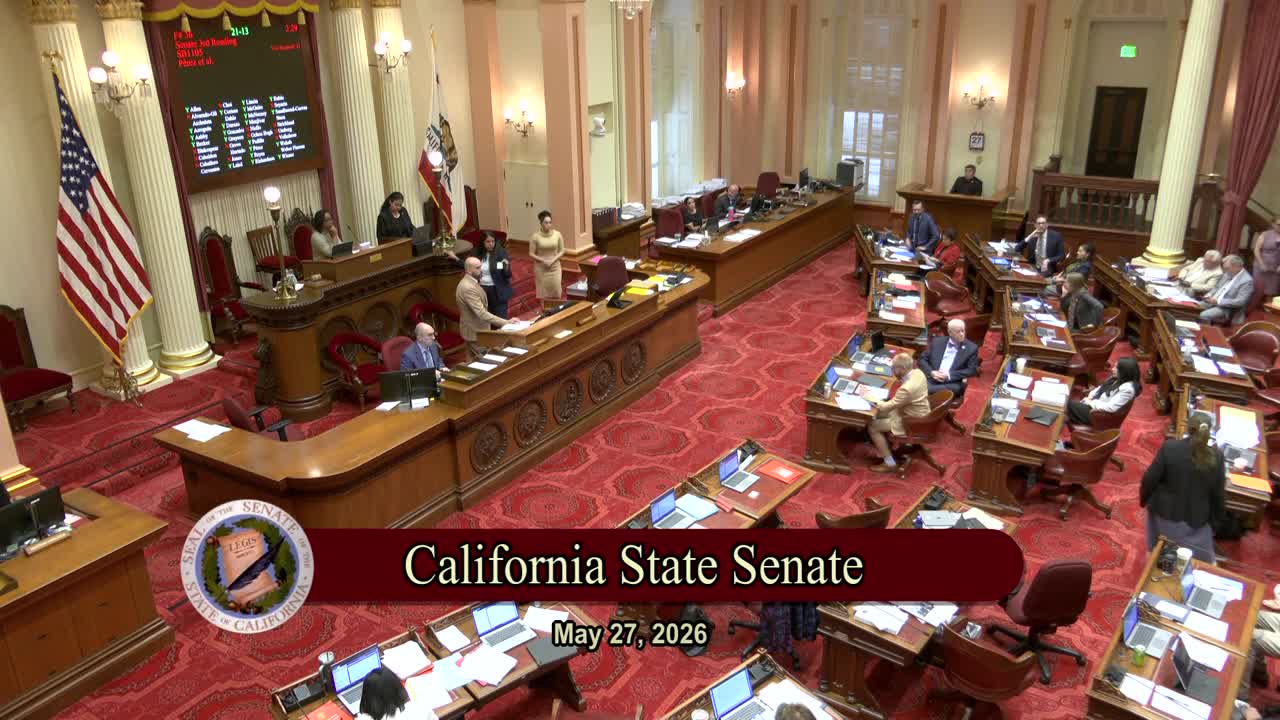 14SEC
Senate Floor
 4MIN
Senate Standing Committee on Energy, Utilities and Communications
Bill Author
Bill Co-Author(s):