SB 1190: Child welfare: transport escort services.
- Session Year: 2025-2026
- House: Senate
- Latest Version Date: 2026-09-30
Current Status:
Passed
(2026-09-30: Chaptered by Secretary of State. Chapter 1015, Statutes of 2026.)
Introduced
In Committee
Awaiting First Chamber Vote
Passed First Chamber
In Committee
Awaiting Second Chamber Vote
Passed Second Chamber
Enacted
(1)Existing law prohibits a transport escort service from accompanying or transporting a minor to any residential facility or institution located outside the state, unless the person or persons transporting or accompanying the minor are trustline-registered childcare providers. Existing law also requires every transport escort service that accompanies or transports a minor who is a resident of California to any residential facility or institution located outside the state to first provide the minors parents, custodial parent, or legal guardian with specified information, including, among others things, a description of the childcare provider trustline registry. Existing law makes a violation of these provisions a misdemeanor.
This bill, the Safe Passage for Youth Act, would expand those provisions relating to transport escort services to apply when accompanying or transporting a minor, without regard to whether the destination is an out-of-state residential facility or institution. The bill would revise the definition of a transport escort service and also make these provisions inapplicable to the transport of minors by a transportation network company, minors in the care of a community care facility, or an individual providing private childcare, casual babysitting, or domestic nanny services, if certain conditions are met. The bill would also require a transport escort service accompanying or transporting a minor to an out-of-state facility to provide the minors parents with specified information, including an explanation of how a parent may obtain more information about the childcare provider trustline registry. By expanding the scope of a crime, the bill would impose a state-mandated local program.
The bill would also impose various additional requirements and restrictions on transport escort services, including, among other things, a requirement that they maintain written policies governing the safety and welfare of minors and a prohibition on using behavioral restraints unless it is necessary to prevent imminent, serious physical harm and less restrictive alternatives are not available. The bill would authorize the Attorney General to bring an action in superior court to enforce these provisions if a transport escort service engages in repeated or egregious violations of any of the above provisions.
(2)Existing law, the Private Investigator Act, provides for the license and regulation of private investigators, as provided. The act defines private investigator to mean a person who engages in business or accepts employment to furnish any person to protect persons or investigation for the purposes of obtaining information, as specified.
Under this bill, a private investigator license issued under the act would not constitute or confer a permit to operate as a transport escort service. Under the bill, a transport escort service would not be required to hold a private investigator license under the act solely by reason of transporting or accompanying a minor.
(3)The California Constitution requires the state to reimburse local agencies and school districts for certain costs mandated by the state. Statutory provisions establish procedures for making that reimbursement.
This bill would provide that no reimbursement is required by this act for a specified reason.
(1)Existing law prohibits a transport escort service from accompanying or transporting a minor to any residential facility or institution located outside the state, unless the person or persons transporting or accompanying the minor are trustline-registered childcare providers. Existing law also requires every transport escort service that accompanies or transports a minor who is a resident of California to any residential facility or institution located outside the state to first provide the minors parents, custodial parent, or legal guardian with specified information, including, among others things, a description of the childcare provider trustline registry. Existing law makes a violation of these provisions a misdemeanor.
This bill, the Safe Passage for Youth Act, would expand those provisions relating to transport escort services to apply when accompanying or transporting a minor, without regard to whether the destination is an out-of-state residential facility or institution. The bill would revise the definition of a transport escort service and also make these provisions inapplicable to the transport of minors by a transportation network company, minors in the care of a community care facility, or an individual providing private childcare, casual babysitting, or domestic nanny services, if certain conditions are met. The bill would also require a transport escort service accompanying or transporting a minor to an out-of-state facility to provide the minors parents with specified information, including an explanation of how a parent may obtain more information about the childcare provider trustline registry. By expanding the scope of a crime, the bill would impose a state-mandated local program.
The bill would also impose various additional requirements and restrictions on transport escort services, including, among other things, a requirement that they maintain written policies governing the safety and welfare of minors and a prohibition on using behavioral restraints unless it is necessary to prevent imminent, serious physical harm and less restrictive alternatives are not available. The bill would authorize the Attorney General to bring an action in superior court to enforce these provisions if a transport escort service engages in repeated or egregious violations of any of the above provisions. The bill would require a transport escort service that does not operate as a charter-party carrier of passengers to comply with certain requirements applicable to transportation services incidental to the operation of a youth camp, and would authorize the Public Utilities Commission to enforce a violation of this provision and the above-described requirements and restrictions, as specified.
(2)Existing law, the Private Investigator Act, provides for the license and regulation of private investigators, as provided. The act defines private investigator to mean a person who engages in business or accepts employment to furnish any person to protect persons or investigation for the purposes of obtaining information, as specified.
Under this bill, a private investigator license issued under the act would not constitute or confer a permit to operate as a transport escort service or a charter-party carrier of passengers and would not be construed as exempting a transport escort service from certain requirements applicable to transportation services incidental to the operation of a youth camp. service. Under the bill, a transport escort service would not be required to hold a private investigator license under the act solely by reason of transporting or accompanying a minor.
(3)The California Constitution requires the state to reimburse local agencies and school districts for certain costs mandated by the state. Statutory provisions establish procedures for making that reimbursement.
This bill would provide that no reimbursement is required by this act for a specified reason.
(1)Existing law prohibits a transport escort service from accompanying or transporting a minor to any residential facility or institution located outside the state, unless the person or persons transporting or accompanying the minor are trustline-registered childcare providers. Existing law also requires every transport escort service that accompanies or transports a minor who is a resident of California to any residential facility or institution located outside the state to first provide the minors parents, custodial parent, or legal guardian with specified information, including, among others things, a description of the childcare provider trustline registry. Existing law makes a violation of these provisions a misdemeanor.
This bill, the Safe Passage for Youth Act, would expand those provisions relating to transport escort services to apply when accompanying or transporting a minor, without regard to whether the destination is an out-of-state residential facility or institution. The bill would revise the definition of a transport escort service and also make these provisions inapplicable to the transport of minors by an individual providing private childcare, casual babysitting, or domestic nanny services, if certain conditions are met. By expanding the scope of a crime, this the bill would impose a state-mandated local program.
The bill would also impose various additional requirements and restrictions on transport escort services, including, among other things, a requirement that they maintain written policies governing the safety and welfare of minors and a prohibition on using behavioral restraints unless it is necessary to prevent imminent, serious physical harm and less restrictive alternatives are not available. The bill would authorize the Attorney General to bring an action in superior court to enforce these provisions if a transport escort service engages in repeated or egregious violations of any of the above provisions. The bill would require a transport escort service that does not operate as a charter-party carrier of passengers to comply with certain requirements applicable to transportation services incidental to the operation of a youth camp, and would authorize the Public Utilities Commission to enforce a violation of this provision and the above-described requirements and restrictions, as specified.
(2)The Passenger Charter-party Carriers Act places charter-party carriers of passengers under the jurisdiction and control of the Public Utilities Commission. The act defines a charter-party carrier of passengers to mean every person that is engaged in the transportation of persons by motor vehicle for compensation, whether in common or contract carriage, over any public highway, subject to certain exceptions. The act prohibits a charter-party carrier of passengers from engaging in transportation services without obtaining a specified certificate or permit, as appropriate, from the commission, and requires each application for a certificate or permit to be accompanied by a specified filing fee. The act authorizes the commission to cancel, revoke, or suspend a permit or certificate upon specified grounds. A violation of the act, a permit or certificate issued pursuant to the act, or an order or direction of the commission adopted pursuant to the act is a crime.This bill would prohibit a transport escort service from operating in the state without a charter-party carrier of passengers permit issued by the commission. Because a violation of the requirement to obtain a permit would be a crime, the bill would impose a state-mandated local program.(3)(2)Existing law, the Private Investigator Act, provides for the license and regulation of private investigators, as provided. The act defines private investigator to mean a person who engages in business or accepts employment to furnish any person to protect persons or investigation for the purposes of obtaining information, as specified.
Under this bill, a private investigator license issued under the act would not constitute or confer a permit to operate as a transport escort service or a charter-party carrier of passengers and would not be construed as authorizing the holder to operate as a transport escort services, as provided. exempting a transport escort service from certain requirements applicable to transportation services incidental to the operation of a youth camp. Under the bill, a person permitted to operate a transport escort service would not be required to hold a private investigator license under the act solely by reason of transporting or accompanying a minor.
(4)(3)The California Constitution requires the state to reimburse local agencies and school districts for certain costs mandated by the state. Statutory provisions establish procedures for making that reimbursement.
This bill would provide that no reimbursement is required by this act for a specified reason.
(1)Existing law prohibits a transport escort service from accompanying or transporting a minor to any residential facility or institution located outside the state, unless the person or persons transporting or accompanying the minor are trustline-registered childcare providers. Existing law also requires every transport escort service that accompanies or transports a minor who is a resident of California to any residential facility or institution located outside the state to first provide the minors parents, custodial parent, or legal guardian with specified information, including, among others things, a description of the childcare provider trustline registry. Existing law makes a violation of these provisions a misdemeanor.
This bill, the Safe Passage for Youth Act, would expand those provisions relating to transport escort services to apply when accompanying or transporting a minor, without regard to whether the destination is an out-of-state residential facility or institution. The bill would revise the definition of a transport escort service and also make these provisions inapplicable to the transport of minors by an individual providing private childcare, casual babysitting, or domestic nanny services, if certain conditions are met. By expanding the scope of a crime, this bill would impose a state-mandated local program.
The bill would also impose various additional requirements and restrictions on transport escort services, including, among other things, a requirement that they maintain written policies governing the safety and welfare of minors and a prohibition on using behavioral restraints unless it is necessary to prevent imminent, serious physical harm and less restrictive alternatives are not available. The bill would authorize the Attorney General to bring an action in superior court to enforce these provisions if a transport escort service engages in repeated or egregious violations of any of the above provisions.
(2)The Passenger Charter-party Carriers Act places charter-party carriers of passengers under the jurisdiction and control of the Public Utilities Commission. The act defines a charter-party carrier of passengers to mean every person that is engaged in the transportation of persons by motor vehicle for compensation, whether in common or contract carriage, over any public highway, subject to certain exceptions. The act prohibits a charter-party carrier of passengers from engaging in transportation services without obtaining a specified certificate or permit, as appropriate, from the commission, and requires each application for a certificate or permit to be accompanied by a specified filing fee. The act authorizes the commission to cancel, revoke, or suspend a permit or certificate upon specified grounds. A violation of the act, a permit or certificate issued pursuant to the act, or an order or direction of the commission adopted pursuant to the act is a crime.
This bill would prohibit a transport escort service from operating in the state without a charter-party carrier of passengers permit issued by the commission. Because a violation of the requirement to obtain a permit would be a crime, the bill would impose a state-mandated local program.
(3)Existing law, the Private Investigator Act, provides for the license and regulation of private investigators, as provided. The act defines private investigator to mean a person who engages in business or accepts employment to furnish any person to protect persons or investigation for the purposes of obtaining information, as specified.
Under this bill, a private investigator license issued under the act would not constitute or confer a permit to operate as a transport escort service and would not be construed as authorizing the holder to operate as a transport escort services, as provided. Under the bill, a person permitted to operate a transport escort service would not be required to hold a private investigator license under the act solely by reason of transporting or accompanying a minor.
(4)The California Constitution requires the state to reimburse local agencies and school districts for certain costs mandated by the state. Statutory provisions establish procedures for making that reimbursement.
This bill would provide that no reimbursement is required by this act for a specified reason.
Existing law, the California Community Care Facilities Act, provides for the licensure and regulation of community care facilities, including a variety of facilities providing care and services to children, such as childrens crisis residential programs and short-term residential therapeutic programs, by the State Department of Social Services.This bill, the Safe Passage for Youth Act, would require the department to license and regulate youth transportation companies operating in California. The bill would require the department to establish application requirements and criteria for licensure and to conduct criminal background checks of applicants, and certain other individuals, as specified. The bill would authorize the department to establish a reasonable licensing fee that is no more than the amount necessary to cover the cost of administering and enforcing the act. The bill would, except as specified, prohibit a youth transportation company from operating in California without a license and impose various requirements and restrictions on youth transportation companies licensed pursuant to these provisions, including, among other things, a requirement that they maintain written policies governing the safety and welfare of minors and a prohibition on using restraints unless it is necessary to prevent imminent, serious physical harm and less restrictive alternatives are not available. The bill would authorize the department to review, suspend, or revoke a license under certain circumstances and authorize the Attorney General to bring an action in superior court to enforce the provisions of the act if a youth transportation company fails to obtain licensure as required or engages in repeated or egregious violations of the act.Existing law, the California Community Care Facilities Act, provides for the licensure and regulation of community care facilities, including a variety of facilities providing care and services to children, such as childrens crisis residential programs and short-term residential therapeutic programs, by the State Department of Social Services.
This bill, the Safe Passage for Youth Act, would require the department to license and regulate youth transportation companies operating in California. The bill would require the department to establish application requirements and criteria for licensure and to conduct criminal background checks of applicants, and certain other individuals, as specified. The bill would authorize the department to establish a reasonable licensing fee that is no more than the amount necessary to cover the cost of administering and enforcing the act. The bill would, except as specified, prohibit a youth transportation company from operating in California without a license and impose various requirements and restrictions on youth transportation companies licensed pursuant to these provisions, including, among other things, a requirement that they maintain written policies governing the safety and welfare of minors and a prohibition on using restraints unless it is necessary to prevent imminent, serious physical harm and less restrictive alternatives are not available. The bill would authorize the department to review, suspend, or revoke a license under certain circumstances and authorize the Attorney General to bring an action in superior court to enforce the provisions of the act if a youth transportation company fails to obtain licensure as required or engages in repeated or egregious violations of the act.
Existing law, the California Community Care Facilities Act, provides for the licensure and regulation of community care facilities, including a variety of facilities providing care and services to children, such as childrens crisis residential programs and short-term residential therapeutic programs, by the State Department of Social Services.
This bill, the Safe Passage for Youth Act, would require the department to license and regulate youth transportation companies operating in California. The bill would require the department to establish application requirements and criteria for licensure and to conduct criminal background checks of applicants, and certain other individuals, as specified. The bill would authorize the department to establish a reasonable licensing fee that is no more than the amount necessary to cover the cost of administering and enforcing the act. The bill would, except as specified, prohibit a youth transportation company from operating in California without a license and impose various requirements and restrictions on youth transportation companies licensed pursuant to these provisions, including, among other things, a requirement that they maintain written policies governing the safety and welfare of minors and a prohibition on using restraints unless it is necessary to prevent imminent, serious physical harm and less restrictive alternatives are not available. The bill would authorize the department to review, suspend, or revoke a license under certain circumstances and authorize the Attorney General to bring an action in superior court to enforce the provisions of the act if a youth transportation company fails to obtain licensure as required or engages in repeated or egregious violations of the act.
Existing law, commonly known as the Continuum of Care Reform, states the intent of the Legislature to improve Californias child welfare system and its outcomes by, among other things, increasing the use of home-based family care and creating faster paths to permanency resulting in shorter durations of involvement in the child welfare and juvenile justice systems.Existing law, the California Community Care Facilities Act, provides for the licensing and regulation of community care facilities, including a childrens crisis residential program, by the State Department of Social Services. A violation of provisions relating to these facilities is a misdemeanor. Existing law defines a childrens crisis residential program to mean a facility licensed as a short-term residential therapeutic program and approved by the State Department of Health Care Services, or a county mental health plan, to operate a childrens crisis residential mental health program to serve children experiencing mental health crises as an alternative to psychiatric hospitalization.This bill would state the intent of the Legislature to enact legislation regarding transportation services transporting minors from their home to a residential care facility or a short-term residential therapeutic program.Existing law, commonly known as the Continuum of Care Reform, states the intent of the Legislature to improve Californias child welfare system and its outcomes by, among other things, increasing the use of home-based family care and creating faster paths to permanency resulting in shorter durations of involvement in the child welfare and juvenile justice systems.
Existing law, the California Community Care Facilities Act, provides for the licensing and regulation of community care facilities, including a childrens crisis residential program, by the State Department of Social Services. A violation of provisions relating to these facilities is a misdemeanor. Existing law defines a childrens crisis residential program to mean a facility licensed as a short-term residential therapeutic program and approved by the State Department of Health Care Services, or a county mental health plan, to operate a childrens crisis residential mental health program to serve children experiencing mental health crises as an alternative to psychiatric hospitalization.
This bill would state the intent of the Legislature to enact legislation regarding transportation services transporting minors from their home to a residential care facility or a short-term residential therapeutic program.
This act shall be known, and may be cited, as the Safe Passage for Youth Act.
SEC. 2.Section 7539.2 is added to the Business and Professions Code, to read:7539.2.(a)A private investigator license or registration issued pursuant to this chapter does not constitute or confer a permit to operate as a transport escort service.
(b)Nothing in this chapter shall be construed to require a transport escort service, as defined in Section 1596.653 of the Health and Safety Code, to hold a private investigator license or registration under this chapter solely by reason of transporting or accompanying a minor. A transport escort service that performs investigative functions subject to licensure under this chapter shall obtain a private investigator license or registration as required by this chapter for those functions.
SEC. 3.Section 1596.653 of the Health and Safety Code is amended to read:1596.653.(a)It is the intent of the Legislature to protect the well-being of California children by regulating private individuals and companies that transport or accompany minors.
(b)As used in this section:
(1)Minor means any person under 18 years of age.
(2)Transport escort service means any person, partnership, association, corporation, or private entity that engages in, advertises for, or holds itself out as providing, the transportation of minor passengers for compensation to a residential facility or institution or a youth residential program located in this state.
(c)Every transport escort service that accompanies or transports a minor who is a resident of California to a residential facility, youth residential program, or institution located outside the state shall first provide the minors parents, custodial parent, or legal guardian with all of the following:
(1)A description of the childcare provider trustline registry established pursuant to this chapter that provides criminal history checks on childcare providers.
(2)An explanation of how a parent may obtain more information about the childcare provider trustline registry.
(3)A statement that a transport escort service is prohibited by law from transporting or accompanying a minor unless the person or persons transporting the minor are trustline registered childcare providers.
(4)An explanation of how the parent may verify the trustline registration of a person employed or contracted by the transport escort service.
(d)A transport escort service shall not transport or accompany a minor without obtaining the written permission of the minors parents, custodial parent, or legal guardian.
(e)If the minor is transported to a facility located outside the state, the transport escort service shall verify in writing that the minors parents, custodial parent, or legal guardian has received the information required under subdivision (c).
(f)A transport escort service shall not accompany or transport a minor unless every person employed or contracted by the transport escort service to accompany or transport the minor is a trustline-registered childcare provider.
(g)A minor, parent, or legal guardian claiming to be aggrieved by a violation of this section by a transport escort service may bring a civil action for injunctive relief or damages, or both.
(h)In addition to the remedy provided in subdivision (g), a violation of this section may be prosecuted as a misdemeanor punishable by a fine of not less than five hundred dollars ($500) or more than five thousand dollars ($5,000) as to each person with respect to whom a violation occurs, or imprisonment in a county jail for not more than six months.
(i)This section does not apply to the following:
(1)The transport of minors by any governmental agency or employee.
(2)The transport of minors under the jurisdiction of the juvenile court.
(3)The transport of minors by family members or relatives.
(4)Transportation network companies.
(5)The transport of minors in their care by a community care facility as defined in Section 1502.
(6)The transport of minors by an individual providing private childcare, casual babysitting, or domestic nanny services, if all of the following criteria are satisfied:
(A)The childcare arrangement is limited to the care of the children of one family in addition to the providers own children.
(B)The services are irregular, intermittent, or casual in nature, or are performed by an individual whose primary commercial vocation is not the specialized transit or custodial escort of minors.
(C)Any transportation provided to the minor is occasional and strictly incidental to general caregiving responsibilities.
(D)The transit is executed with the prior written or verbal consent of the parent or legal guardian, and does not utilize physical restraints, mechanical restraints, or any security personnel or third-party contractors operating for compensation.
(j)Nothing in this section shall limit any claim for damages or the issuance of any injunction that a parent or child may assert against a transport escort service pursuant to any other state or federal law or regulation.
SEC. 4.Section 1596.69 is added to the Health and Safety Code, immediately following Section 1596.68, to read:1596.69.A transport escort service, as defined in Section 1596.653, shall do all of the following:
(a)Possess authorization to operate as a charter-party carrier of passengers as defined in Section 5360 of the Public Utilities Code.
(b)Ensure that all individuals involved in transporting minors complete training that addresses, at a minimum, all of the following:
(1)First aid and cardiopulmonary resuscitation (CPR) training and certification.
(2)Duties imposed under the Child Abuse and Neglect Reporting Act (Article 2.5 (commencing with Section 11164) of Chapter 2 of Title 1 of Part 4 of the Penal Code).
(3)Behavioral deescalation techniques.
(4)Safe transportation practices.
(c)Prior to transporting a minor, obtain written consent from the parent or legal guardian of the child and maintain documentation that written consent was obtained, including a signed acknowledgment that all provider safety, supervision, and program protections apply exclusively within the state of California. The documentation shall include authorization for transportation, identification of the destination, and contact information for the transport escort service.
(d)Maintain written policies governing the safety and welfare of minors during transport. The policies shall address, at a minimum, access to food and water, access to restroom facilities, lodging when overnight transport occurs, and procedures for delays or itinerary changes.
SEC. 5.Section 1596.691 is added to the Health and Safety Code, immediately following Section 1596.69, to read:1596.691.A transport escort service, as defined in Section 1596.653, shall not do either of the following:
(a)Use any of the following during transport:
(1)Blindfolds.
(2)Hoods.
(3)A device to obstruct a minors vision.
(4)(A)Except as described in subparagraph (B), behavioral restraints, as defined in Section 1180.1.
(B)Behavioral restraints may be used while transporting a minor if it is necessary to prevent imminent, serious physical harm and less restrictive alternatives are not available. Restraints shall not be used pursuant to this subparagraph as a punishment, for staff convenience, or as a substitute for supervision of minors, and shall comply with the human rights and safety criteria established under Section 1180.4.
(b)Pick up a minor for transport between the hours of 9:00 p.m. and 6:00 a.m.
SEC. 6.Section 1596.692 is added to the Health and Safety Code, immediately following Section 1596.691, to read:1596.692.The Attorney General may bring an action in superior court to enforce Sections 1596.653, 1596.69, and 1596.691 if a transport escort service engages in repeated or egregious violations of the conduct standards in Sections 1596.69 and 1596.691. The Attorney General may seek the recovery of civil penalties, and shall be entitled to specific performance, injunctive relief, and other equitable remedies a court deems appropriate for enforcement of this chapter, including, but not limited to, an order prohibiting the company from operating within the state. The Attorney General shall be entitled to recover attorneys fees and costs incurred in remedying each violation.
SEC. 7.Section 5353 of the Public Utilities Code is amended to read:5353.This chapter does not apply to any of the following:
(a)Transportation service rendered wholly within the corporate limits of a single city or city and county and licensed or regulated by ordinance.
(b)Transportation of school pupils conducted by or under contract with the governing board of any school district entered into pursuant to the Education Code.
(c)Common carrier transportation services between fixed termini or over a regular route that are subject to authorization pursuant to Article 2 (commencing with Section 1031) of Chapter 5 of Part 1 of Division 1.
(d)Transportation services occasionally afforded for farm employees moving to and from farms on which employed when the transportation is performed by the employer in an owned or leased vehicle, or by a nonprofit agricultural cooperative association organized and acting within the scope of its powers under Chapter 1 (commencing with Section 54001) of Division 20 of the Food and Agricultural Code, and without any requirement for the payment of compensation for those transportation services by the employees.
(e)Transportation service rendered by a publicly owned transit system.
(f)Passenger vehicles carrying passengers on a noncommercial enterprise basis.
(g)Taxicab transportation service licensed and regulated by a city or county, by ordinance or resolution, rendered in vehicles designed for carrying not more than eight persons excluding the driver.
(h)Transportation of persons between home and work locations or of persons having a common work-related trip purpose in a vehicle having a seating capacity of 15 passengers or less, including the driver, which are used for the purpose of ridesharing, as defined in Section 522 of the Vehicle Code, when the ridesharing is incidental to another purpose of the driver. This exemption also applies to a vehicle having a seating capacity of more than 15 passengers if the driver files with the commission evidence of liability insurance protection in the same amount and in the same manner as required for a passenger stage corporation, and the vehicle undergoes and passes an annual safety inspection by the Department of the California Highway Patrol. The insurance filing shall be accompanied by a one-time filing fee of seventy-five dollars ($75). This exemption does not apply if the primary purpose for the transportation of those persons is to make a profit. Profit, as used in this subdivision, does not include the recovery of the actual costs incurred in owning and operating a vanpool vehicle, as defined in Section 668 of the Vehicle Code.
(i)Vehicles used exclusively to provide medical transportation, including vehicles employed to transport developmentally disabled persons for regional centers established pursuant to Chapter 5 (commencing with Section 4620) of Division 4.5 of the Welfare and Institutions Code.
(j)Transportation services rendered solely within the Lake Tahoe Basin, comprising that area included within the Tahoe Regional Planning Compact as set forth in Section 66801 of the Government Code, when the operator of the services has obtained any permit required from the Tahoe Basin Transportation Authority or the City of South Lake Tahoe, or both.
(k)Subject to Section 34507.6 of the Vehicle Code, transportation service provided by the operator of an automobile rental business in vehicles owned or leased by that operator, without charge other than as may be included in the automobile rental charges, to carry its customers to or from its office or facility where rental vehicles are furnished or returned after the rental period.
(l)Subject to Section 34507.6 of the Vehicle Code, transportation service provided by the operator of a hotel, motel, or other place of temporary lodging in vehicles owned or leased by that operator, without charge other than as may be included in the charges for lodging, between the lodging facility and an air, rail, water, or bus passenger terminal or between the lodging facility and any place of entertainment or commercial attraction, including, but not limited to, facilities providing snow skiing. Nothing in this subdivision authorizes the operator of a hotel, motel, or other place of temporary lodging to provide any round trip sightseeing service without a permit, as required by subdivision (c) of Section 5384.
(m)(1)Transportation of hot air balloon ride passengers in a balloon chase vehicle from the balloon landing site back to the original takeoff site, provided that the balloon ride was conducted by a balloonist who meets all of the following conditions:
(A)Does not fly more than a total of 30 passenger rides for compensation annually.
(B)Does not provide any preflight ground transportation services in their vehicles.
(C)In providing return transportation to the launch site from landing does not drive more than 300 miles annually.
(D)Files with the commission an exemption declaration and proof of vehicle insurance, as prescribed by the commission, certifying that the operator qualifies for the exemption and will maintain minimum insurance on each vehicle of one hundred thousand dollars ($100,000) for injury or death of one person, three hundred thousand dollars ($300,000) for injury or death of two or more persons and one hundred thousand dollars ($100,000) for damage to property.
(2)Nothing in this subdivision authorizes the operator of a commercial balloon operation to provide any round trip sightseeing service without a permit, as required by subdivision (c) of Section 5384.
(n)(1)Transportation services incidental to operation of a youth camp that are provided by either a nonprofit organization that qualifies for tax exemption under Section 501(c)(3) of the Internal Revenue Code or an organization that operates an organized camp, as defined in Section 18897 of the Health and Safety Code, serving youth 18 years of age or younger.
(2)A transportation service described in paragraph (1) shall comply with all of the following requirements:
(A)Register as a private carrier with the Department of Motor Vehicles pursuant to Division 14.86 (commencing with Section 34680) of the Vehicle Code.
(B)Participate in a pull notice system for employers of drivers as prescribed in Section 1808.1 of the Vehicle Code.
(C)Ensure compliance with the annual bus terminal inspection required by subdivision (c) of Section 34501 of the Vehicle Code.
(D)Obtain the following minimum amounts of general liability insurance coverage for vehicles that are used to transport youth:
(i)A minimum of five hundred thousand dollars ($500,000) general liability insurance coverage for passenger vehicles designed to carry up to eight passengers. For organized camps, as defined in Section 18897 of the Health and Safety Code, an additional two hundred fifty thousand dollars ($250,000) general umbrella policy that covers vehicles.
(ii)A minimum of one million dollars ($1,000,000) general liability insurance coverage for vehicles designed to carry up to 15 passengers. For organized camps, as defined in Section 18897 of the Health and Safety Code, an additional five hundred thousand dollars ($500,000) general umbrella policy that covers vehicles.
(iii)A minimum of one million five hundred thousand dollars ($1,500,000) general liability insurance coverage for vehicles designed to carry more than 15 passengers, and an additional three million five hundred thousand dollars ($3,500,000) general umbrella liability insurance policy that covers vehicles.
SEC. 8.No reimbursement is required by this act pursuant to Section 6 of Article XIIIB of the California Constitution because the only costs that may be incurred by a local agency or school district will be incurred because this act creates a new crime or infraction, eliminates a crime or infraction, or changes the penalty for a crime or infraction, within the meaning of Section 17556 of the Government Code, or changes the definition of a crime within the meaning of Section 6 of Article XIIIB of the California Constitution.
This act shall be known, and may be cited, as the Safe Passage for Youth Act.
SEC. 2.Section 7539.2 is added to the Business and Professions Code, to read:7539.2.(a)A private investigator license or registration issued pursuant to this chapter does not constitute or confer a permit to operate as a transport escort service or as a charter-party carrier of passengers, as defined in Section 5360 of the Public Utilities Code, and shall not be construed as exempting a transport escort service from complying with the requirements of subdivision (n) of Section 5353 of the Public Utilities Code. service.
(b)Nothing in this chapter shall be construed to require a transport escort service, as defined in Section 1596.653 of the Health and Safety Code, to hold a private investigator license or registration under this chapter solely by reason of transporting or accompanying a minor. A transport escort service that performs investigative functions subject to licensure under this chapter shall obtain a private investigator license or registration as required by this chapter for those functions.
SEC. 3.Section 1596.653 of the Health and Safety Code is amended to read:1596.653.(a)It is the intent of the Legislature to protect the well-being of California children by regulating private individuals and companies that transport or accompany minors.
(b)As used in this section:
(1)Department means the State Department of Social Services.(2)(1)Minor means any person under 18 years of age.
(3)(2)Transport escort service means any person, partnership, association, corporation, or private entity that engages in, advertises for, or holds itself out as providing, the transportation of minor passengers for compensation, where the prearranged transit includes or results in an overnight stay away from the minors primary residence. compensation to a residential facility or institution or a youth residential program located in this state.
(c)Every transport escort service that accompanies or transports a minor who is a resident of California to a residential facility, youth residential program, or institution located outside the state shall first provide the minors parents, custodial parent, or legal guardian with all of the following:
(1)A description of the childcare provider trustline registry established pursuant to this chapter that provides criminal history checks on childcare providers.
(2)An explanation of how a parent may obtain more information about the childcare provider trustline registry.
(3)A statement that a transport escort service is prohibited by law from transporting or accompanying a minor unless the person or persons transporting the minor are trustline registered childcare providers.
(4)An explanation of how the parent may verify the trustline registration of a person employed or contracted by the transport escort service.
(5)An explanation of the minors right to make a complaint to a child protective agency concerning abusive treatment by the transport escort service.(d)A transport escort service shall not transport or accompany a minor without obtaining the written permission of the minors parents, custodial parent, or legal guardian.
(e)The If the minor is transported to a facility located outside the state, the transport escort service shall verify in writing that the minors parents, custodial parent, or legal guardian has received the information required under subdivision (c).
(f)A transport escort service shall not accompany or transport a minor unless every person employed or contracted by the transport escort service to accompany or transport the minor is a trustline-registered childcare provider.
(g)A minor, parent, or legal guardian claiming to be aggrieved by a violation of this section by a transport escort service may bring a civil action for injunctive relief or damages, or both.
(h)In addition to the remedy provided in subdivision (g), a violation of this section may be prosecuted as a misdemeanor punishable by a fine of not less than five hundred dollars ($500) or more than five thousand dollars ($5,000) as to each person with respect to whom a violation occurs, or imprisonment in a county jail for not more than six months. The department may refer violations of this section to the Attorney General for civil enforcement pursuant to Section 1596.692.
(i)This section does not apply to the following:
(1)The transport of minors by any governmental agency or employee.
(2)The transport of minors under the jurisdiction of the juvenile court.
(3)The transport of minors by family members or relatives.
(4)Transportation network companies.
(5)The transport of minors in their care by a community care facility as defined in Section 1502.
(4)(6)The transport of minors by an individual providing private childcare, casual babysitting, or domestic nanny services, if all of the following criteria are satisfied:
(A)The childcare arrangement is limited to the care of the children of one family in addition to the providers own children.
(B)The services are irregular, intermittent, or casual in nature, or are performed by an individual whose primary commercial vocation is not the specialized transit or custodial escort of minors.
(C)Any transportation provided to the minor is occasional and strictly incidental to general caregiving responsibilities.
(D)The transit is executed with the prior written or verbal consent of the parent or legal guardian, and does not utilize physical restraints, mechanical restraints, or any security personnel or third-party contractors operating for compensation.
(j)Nothing in this section shall limit any claim for damages or the issuance of any injunction that a parent or child may assert against a transport escort service pursuant to any other state or federal law or regulation.
SEC. 4.Section 1596.69 is added to the Health and Safety Code, immediately following Section 1596.68, to read:1596.69.A transport escort service, as defined in Section 1596.653, shall do all of the following:
(a)Enroll all drivers in the pull-notice system established by Section 1808.1 of the Vehicle Code in order to monitor driver records.(a)Possess authorization to operate as a charter-party carrier of passengers as defined in Section 5360 of the Public Utilities Code.
(b)Ensure that all individuals involved in transporting minors complete training that addresses, at a minimum, all of the following:
(1)First aid and cardiopulmonary resuscitation (CPR) training and certification.
(2)Duties imposed under the Child Abuse and Neglect Reporting Act (Article 2.5 (commencing with Section 11164) of Chapter 2 of Title 1 of Part 4 of the Penal Code).
(3)Behavioral deescalation techniques.
(4)Safe transportation practices.
(c)Prior to transporting a minor, obtain written consent from the parent or legal guardian of the child and maintain documentation that written consent was obtained, including a signed acknowledgment that all provider safety, supervision, and program protections apply exclusively within the state of California. The documentation shall include authorization for transportation, identification of the destination, and contact information for the transport escort service.
(d)Document incidents occurring during transportation including, but not limited to, injuries, medical emergencies, use of physical restraints, and behavioral incidents, and maintain incident reports. A youth escort service shall submit a copy of all incident reports to the department within 24 hours of the incident occurring and shall provide each parent or guardian a copy of an incident report relating to their child within 24 hours of the incident involving their child occurring.(e)(d)Maintain written policies governing the safety and welfare of minors during transport. The policies shall address, at a minimum, access to food and water, access to restroom facilities, lodging when overnight transport occurs, and procedures for delays or itinerary changes.
(f)If the transport escort service does not operate as a charter-party carrier of passengers, as defined in Section 5360 of the Public Utilities Code, comply with paragraph (3) of subdivision (n) of Section 5353 of the Public Utilities Code.SEC. 5.Section 1596.691 is added to the Health and Safety Code, immediately following Section 1596.69, to read:1596.691.A transport escort service, as defined in Section 1596.653, shall not do either of the following:
(a)Use any of the following during transport:
(1)Blindfolds.
(2)Hoods.
(3)A device to obstruct a minors vision.
(4)(A)Except as described in subparagraph (B), behavioral restraints, as defined in Section 1180.1.
(B)Behavioral restraints may be used while transporting a minor if it is necessary to prevent imminent, serious physical harm and less restrictive alternatives are not available. Restraints shall not be used pursuant to this subparagraph as a punishment, for staff convenience, or as a substitute for supervision of minors, and shall comply with the human rights and safety criteria established under Section 1180.4.
(b)Pick up a minor for transport between the hours of 9:00 p.m. and 6:00 a.m.
SEC. 6.Section 1596.692 is added to the Health and Safety Code, immediately following Section 1596.691, to read:1596.692.The Attorney General may bring an action in superior court to enforce Sections 1596.653, 1596.69, and 1596.691 if a transport escort service engages in repeated or egregious violations of the conduct standards in Sections 1596.69 and 1596.691. The Attorney General may seek the recovery of civil penalties, and shall be entitled to specific performance, injunctive relief, and other equitable remedies a court deems appropriate for enforcement of this chapter, including, but not limited to, an order prohibiting the company from operating within the state. The Attorney General shall be entitled to recover attorneys fees and costs incurred in remedying each violation.
SEC. 7.Section 5353 of the Public Utilities Code is amended to read:5353.This chapter does not apply to any of the following:
(a)Transportation service rendered wholly within the corporate limits of a single city or city and county and licensed or regulated by ordinance.
(b)Transportation of school pupils conducted by or under contract with the governing board of any school district entered into pursuant to the Education Code.
(c)Common carrier transportation services between fixed termini or over a regular route that are subject to authorization pursuant to Article 2 (commencing with Section 1031) of Chapter 5 of Part 1 of Division 1.
(d)Transportation services occasionally afforded for farm employees moving to and from farms on which employed when the transportation is performed by the employer in an owned or leased vehicle, or by a nonprofit agricultural cooperative association organized and acting within the scope of its powers under Chapter 1 (commencing with Section 54001) of Division 20 of the Food and Agricultural Code, and without any requirement for the payment of compensation for those transportation services by the employees.
(e)Transportation service rendered by a publicly owned transit system.
(f)Passenger vehicles carrying passengers on a noncommercial enterprise basis.
(g)Taxicab transportation service licensed and regulated by a city or county, by ordinance or resolution, rendered in vehicles designed for carrying not more than eight persons excluding the driver.
(h)Transportation of persons between home and work locations or of persons having a common work-related trip purpose in a vehicle having a seating capacity of 15 passengers or less, including the driver, which are used for the purpose of ridesharing, as defined in Section 522 of the Vehicle Code, when the ridesharing is incidental to another purpose of the driver. This exemption also applies to a vehicle having a seating capacity of more than 15 passengers if the driver files with the commission evidence of liability insurance protection in the same amount and in the same manner as required for a passenger stage corporation, and the vehicle undergoes and passes an annual safety inspection by the Department of the California Highway Patrol. The insurance filing shall be accompanied by a one-time filing fee of seventy-five dollars ($75). This exemption does not apply if the primary purpose for the transportation of those persons is to make a profit. Profit, as used in this subdivision, does not include the recovery of the actual costs incurred in owning and operating a vanpool vehicle, as defined in Section 668 of the Vehicle Code.
(i)Vehicles used exclusively to provide medical transportation, including vehicles employed to transport developmentally disabled persons for regional centers established pursuant to Chapter 5 (commencing with Section 4620) of Division 4.5 of the Welfare and Institutions Code.
(j)Transportation services rendered solely within the Lake Tahoe Basin, comprising that area included within the Tahoe Regional Planning Compact as set forth in Section 66801 of the Government Code, when the operator of the services has obtained any permit required from the Tahoe Basin Transportation Authority or the City of South Lake Tahoe, or both.
(k)Subject to Section 34507.6 of the Vehicle Code, transportation service provided by the operator of an automobile rental business in vehicles owned or leased by that operator, without charge other than as may be included in the automobile rental charges, to carry its customers to or from its office or facility where rental vehicles are furnished or returned after the rental period.
(l)Subject to Section 34507.6 of the Vehicle Code, transportation service provided by the operator of a hotel, motel, or other place of temporary lodging in vehicles owned or leased by that operator, without charge other than as may be included in the charges for lodging, between the lodging facility and an air, rail, water, or bus passenger terminal or between the lodging facility and any place of entertainment or commercial attraction, including, but not limited to, facilities providing snow skiing. Nothing in this subdivision authorizes the operator of a hotel, motel, or other place of temporary lodging to provide any round trip sightseeing service without a permit, as required by subdivision (c) of Section 5384.
(m)(1)Transportation of hot air balloon ride passengers in a balloon chase vehicle from the balloon landing site back to the original takeoff site, provided that the balloon ride was conducted by a balloonist who meets all of the following conditions:
(A)Does not fly more than a total of 30 passenger rides for compensation annually.
(B)Does not provide any preflight ground transportation services in their vehicles.
(C)In providing return transportation to the launch site from landing does not drive more than 300 miles annually.
(D)Files with the commission an exemption declaration and proof of vehicle insurance, as prescribed by the commission, certifying that the operator qualifies for the exemption and will maintain minimum insurance on each vehicle of one hundred thousand dollars ($100,000) for injury or death of one person, three hundred thousand dollars ($300,000) for injury or death of two or more persons and one hundred thousand dollars ($100,000) for damage to property.
(2)Nothing in this subdivision authorizes the operator of a commercial balloon operation to provide any round trip sightseeing service without a permit, as required by subdivision (c) of Section 5384.
(n)(1)Transportation services incidental to operation of a youth camp that are provided by either a nonprofit organization that qualifies for tax exemption under Section 501(c)(3) of the Internal Revenue Code or an organization that operates an organized camp, as defined in Section 18897 of the Health and Safety Code, serving youth 18 years of age or younger.
(2)A transportation service described in paragraph (1) shall comply with all of the following requirements:
(A)Register as a private carrier with the commission pursuant to Section 4005. Department of Motor Vehicles pursuant to Division 14.86 (commencing with Section 34680) of the Vehicle Code.
(B)Participate in a pull notice system for employers of drivers as prescribed in Section 1808.1 of the Vehicle Code.
(C)Ensure compliance with the annual bus terminal inspection required by subdivision (c) of Section 34501 of the Vehicle Code.
(D)Obtain the following minimum amounts of general liability insurance coverage for vehicles that are used to transport youth:
(i)A minimum of five hundred thousand dollars ($500,000) general liability insurance coverage for passenger vehicles designed to carry up to eight passengers. For organized camps, as defined in Section 18897 of the Health and Safety Code, an additional two hundred fifty thousand dollars ($250,000) general umbrella policy that covers vehicles.
(ii)A minimum of one million dollars ($1,000,000) general liability insurance coverage for vehicles designed to carry up to 15 passengers. For organized camps, as defined in Section 18897 of the Health and Safety Code, an additional five hundred thousand dollars ($500,000) general umbrella policy that covers vehicles.
(iii)A minimum of one million five hundred thousand dollars ($1,500,000) general liability insurance coverage for vehicles designed to carry more than 15 passengers, and an additional three million five hundred thousand dollars ($3,500,000) general umbrella liability insurance policy that covers vehicles.
(3)(A)A transport escort service, as defined in Section 1596.653 of the Health and Safety Code, that does not operate as a charter-party carrier of passengers and complies with paragraph (2) and Sections 1596.653, 1596.69, and 1596.691 of the Health and Safety Code.(B)A transport escort service that does not comply with subparagraph (A), as applicable, shall be subject to all remedies, penalties, enforcement actions, and other powers otherwise authorized by this chapter.SEC. 8.No reimbursement is required by this act pursuant to Section 6 of Article XIIIB of the California Constitution because the only costs that may be incurred by a local agency or school district will be incurred because this act creates a new crime or infraction, eliminates a crime or infraction, or changes the penalty for a crime or infraction, within the meaning of Section 17556 of the Government Code, or changes the definition of a crime within the meaning of Section 6 of Article XIIIB of the California Constitution.
This act shall be known, and may be cited, as the Safe Passage for Youth Act.
SEC. 2.Section 7539.2 is added to the Business and Professions Code, to read:7539.2.(a)A private investigator license or registration issued pursuant to this chapter does not constitute or confer a permit to operate as a transport escort service under Section 5380 of the Public Utilities Code, or as a charter-party carrier of passengers, as defined in Section 5360 of the Public Utilities Code, and shall not be construed as authorizing the holder to operate as a transport escort service without a permit issued pursuant to that section. exempting a transport escort service from complying with the requirements of subdivision (n) of Section 5353 of the Public Utilities Code.
(b)Nothing in this chapter shall be construed to require a person permitted to operate as a transport escort service under Section 5380 of the Public Utilities Code transport escort service, as defined in Section 1596.653 of the Health and Safety Code, to hold a private investigator license or registration under this chapter solely by reason of transporting or accompanying a minor. A transport escort service that performs investigative functions subject to licensure under this chapter shall obtain a private investigator license or registration as required by this chapter for those functions.
SEC. 3.Section 1596.653 of the Health and Safety Code is amended to read:1596.653.(a)It is the intent of the Legislature to protect the well-being of California children by regulating private individuals and companies that transport or accompany minors.
(b)As used in this section:
(1)Department means the State Department of Social Services.
(2)Minor means any person under 18 years of age.
(1)(3)Transport escort service means any person, partnership, association, corporation, or private entity that engages in, advertises for, or holds itself out as providing, the transportation of minor passengers for compensation, where the prearranged transit includes or results in an overnight stay away from the minors primary residence.
(2)Minor means any person under the age of 18 years.(3)Department means the State Department of Social Services.(c)Every transport escort service that accompanies or transports a minor who is a resident of California shall first provide the minors parents, custodial parent, or legal guardian with all of the following:
(1)A description of the childcare provider trustline registry established pursuant to this chapter that provides criminal history checks on childcare providers.
(2)An explanation of how a parent may obtain more information about the childcare provider trustline registry.
(3)A statement that a transport escort service is prohibited by law from transporting or accompanying a minor unless the person or persons transporting the minor are trustline registered childcare providers.
(4)An explanation of how the parent may verify the trustline registration of the transport escort service.
(5)An explanation of the minors right to make a complaint to a child protective agency concerning abusive treatment by the transport escort service.
(d)A transport escort service shall not transport or accompany a minor without obtaining the written permission of the minors parents, custodial parent, or legal guardian.
(e)The transport escort service shall verify in writing that the minors parents, custodial parent, or legal guardian has received the information required under subdivision (c).
(f)A transport escort service shall not accompany or transport a minor unless every person employed or contracted by the transport escort service to accompany or transport the minor is a trustline-registered childcare provider.
(g)A minor, parent, or legal guardian claiming to be aggrieved by a violation of this section by a transport escort service may bring a civil action for injunctive relief or damages, or both.
(h)In addition to the remedy provided in subdivision (g), a violation of this section may be prosecuted as a misdemeanor punishable by a fine of not less than five hundred dollars ($500) or more than five thousand dollars ($5,000) as to each person with respect to whom a violation occurs, or imprisonment in a county jail for not more than six months. The department may refer violations of this section to the Attorney General for civil enforcement pursuant to Section 1596.692.
(i)This section does not apply to the following:
(1)The transport of minors by any governmental agency or employee.
(2)The transport of minors under the jurisdiction of the juvenile court.
(3)The transport of minors by family members or relatives.
(4)The transport of minors by an individual providing private childcare, casual babysitting, or domestic nanny services, if all the of the following criteria are satisfied:
(A)The childcare arrangement is limited to the care of the children of one family in addition to the providers own children.
(B)The services are irregular, intermittent, or casual in nature, or are performed by an individual whose primary commercial vocation is not the specialized transit or custodial escort of minors.
(C)Any transportation provided to the minor is occasional and strictly incidental to general caregiving responsibilities.
(D)The transit is executed with the prior written or verbal consent of the parent or legal guardian, and does not utilize physical restraints, mechanical restraints, or any security personnel or third-party contractors operating for compensation.
(j)Nothing in this section shall limit any claim for damages or the issuance of any injunction that a parent or child may assert against a transport escort service pursuant to any other state or federal law or regulation.
SEC. 4.Section 1596.69 is added to the Health and Safety Code, to read:SEC. 4.Section 1596.69 is added to the Health and Safety Code, immediately following Section 1596.68, to read:1596.69.A transport escort service, as defined in Section 1596.653, shall do all of the following:
(a)Enroll all drivers in the pull-notice system established by Section 1808.1 of the Vehicle Code in order to monitor driver records.
(b)Ensure that all individuals involved in transporting minors completes complete training that addresses, at a minimum, all of the following:
(1)First aid and cardiopulmonary resuscitation (CPR) training and certification.
(2)Duties imposed under the Child Abuse and Neglect Reporting Act (Article 2.5 (commencing with Section 11164) of Chapter 2 of Title 1 of Part 4 of the Penal Code).
(3)Behavioral deescalation techniques.
(4)Safe transportation practices.
(c)Prior to transporting a minor, obtain written consent from the parent or legal guardian of the child and maintain documentation that written consent was obtained, including a signed acknowledgment that all provider safety, supervision, and program protections apply exclusively within the state of California. The documentation shall include authorization for transportation, identification of the destination, and contact information for the transport escort service.
(d)Document incidents occurring during transportation including, but not limited to, injuries, medical emergencies, use of physical restraints, and behavioral incidents, and maintain incident reports. A youth escort service shall submit a copy of all incident reports to the department within 24 hours of the incident occurring and shall provide each parent or guardian a copy of an incident report relating to their child within 24 hours of the incident involving their child occurring.
(e)Maintain written policies governing the safety and welfare of minors during transport. The policies shall address, at a minimum, access to food and water, access to restroom facilities, lodging when overnight transport occurs, and procedures for delays or itinerary changes.
(f)If the transport escort service does not operate as a charter-party carrier of passengers, as defined in Section 5360 of the Public Utilities Code, comply with paragraph (3) of subdivision (n) of Section 5353 of the Public Utilities Code.
SEC. 5.Section 1596.691 is added to the Health and Safety Code, to read:1596.691.(a)SEC. 5.Section 1596.691 is added to the Health and Safety Code, immediately following Section 1596.69, to read:1596.691.A transport escort service, as defined in Section 1596.653, shall not do either of the following:
(b)(a)Use any of the following during transport:
(1)Blindfolds.
(2)Hoods.
(3)A device to obstruct a minors vision.
(4)(A)Except as described in subparagraph (B), behavioral restraints, as defined in Section 1180.1.
(B)Behavioral restraints may be used while transporting a minor if it is necessary to prevent imminent, serious physical harm and less restrictive alternatives are not available. Restraints shall not be used pursuant to this subparagraph as a punishment, for staff convenience, or as a substitute for supervision of minors, and shall comply with the human rights and safety criteria established under Section 1180.4.
(c)(b)Pick up a minor for transport between the hours of 9:00 p.m. and 6:00 a.m.
SEC. 6.Section 1596.692 is added to the Health and Safety Code, to read:SEC. 6.Section 1596.692 is added to the Health and Safety Code, immediately following Section 1596.691, to read:1596.692.The Attorney General may bring an action in superior court to enforce the provisions of Sections 1596.653, 1596.69, and 1596.691 if a transport escort service engages in repeated or egregious violations of the conduct standards in Sections 1596.69 and 1596.691. The Attorney General may seek the recovery of civil penalties, and shall be entitled to specific performance, injunctive relief, and other equitable remedies a court deems appropriate for enforcement of this chapter, including, but not limited to, an order prohibiting the company from operating within the state. The Attorney General shall be entitled to recover attorneys fees and costs incurred in remedying each violation.
SEC. 7.Section 5380 is added to the Public Utilities Code, immediately following Section 5379.5, to read:5380.(a)For purposes of this section, transport escort service has the same meaning as defined in Section 1596.653 of the Health and Safety Code.(b)A transport escort service shall not operate in the state without a charter-party carrier of passengers permit issued by the commission pursuant to this section, designating the permittee as a transport escort service.SEC. 7.Section 5353 of the Public Utilities Code is amended to read:5353.This chapter does not apply to any of the following:
(a)Transportation service rendered wholly within the corporate limits of a single city or city and county and licensed or regulated by ordinance.
(b)Transportation of school pupils conducted by or under contract with the governing board of any school district entered into pursuant to the Education Code.
(c)Common carrier transportation services between fixed termini or over a regular route that are subject to authorization pursuant to Article 2 (commencing with Section 1031) of Chapter 5 of Part 1 of Division 1.
(d)Transportation services occasionally afforded for farm employees moving to and from farms on which employed when the transportation is performed by the employer in an owned or leased vehicle, or by a nonprofit agricultural cooperative association organized and acting within the scope of its powers under Chapter 1 (commencing with Section 54001) of Division 20 of the Food and Agricultural Code, and without any requirement for the payment of compensation therefor for those transportation services by the employees.
(e)Transportation service rendered by a publicly owned transit system.
(f)Passenger vehicles carrying passengers on a noncommercial enterprise basis.
(g)Taxicab transportation service licensed and regulated by a city or county, by ordinance or resolution, rendered in vehicles designed for carrying not more than eight persons excluding the driver.
(h)Transportation of persons between home and work locations or of persons having a common work-related trip purpose in a vehicle having a seating capacity of 15 passengers or less, including the driver, which are used for the purpose of ridesharing, as defined in Section 522 of the Vehicle Code, when the ridesharing is incidental to another purpose of the driver. This exemption also applies to a vehicle having a seating capacity of more than 15 passengers if the driver files with the commission evidence of liability insurance protection in the same amount and in the same manner as required for a passenger stage corporation, and the vehicle undergoes and passes an annual safety inspection by the Department of the California Highway Patrol. The insurance filing shall be accompanied by a one-time filing fee of seventy-five dollars ($75). This exemption does not apply if the primary purpose for the transportation of those persons is to make a profit. Profit, as used in this subdivision, does not include the recovery of the actual costs incurred in owning and operating a vanpool vehicle, as defined in Section 668 of the Vehicle Code.
(i)Vehicles used exclusively to provide medical transportation, including vehicles employed to transport developmentally disabled persons for regional centers established pursuant to Chapter 5 (commencing with Section 4620) of Division 4.5 of the Welfare and Institutions Code.
(j)Transportation services rendered solely within the Lake Tahoe Basin, comprising that area included within the Tahoe Regional Planning Compact as set forth in Section 66801 of the Government Code, when the operator of the services has obtained any permit required from the Tahoe Basin Transportation Authority or the City of South Lake Tahoe, or both.
(k)Subject to Section 34507.6 of the Vehicle Code, transportation service provided by the operator of an automobile rental business in vehicles owned or leased by that operator, without charge other than as may be included in the automobile rental charges, to carry its customers to or from its office or facility where rental vehicles are furnished or returned after the rental period.
(l)Subject to Section 34507.6 of the Vehicle Code, transportation service provided by the operator of a hotel, motel, or other place of temporary lodging in vehicles owned or leased by that operator, without charge other than as may be included in the charges for lodging, between the lodging facility and an air, rail, water, or bus passenger terminal or between the lodging facility and any place of entertainment or commercial attraction, including, but not limited to, facilities providing snow skiing. Nothing in this subdivision authorizes the operator of a hotel, motel, or other place of temporary lodging to provide any round trip sightseeing service without a permit, as required by subdivision (c) of Section 5384.
(m)(1)Transportation of hot air balloon ride passengers in a balloon chase vehicle from the balloon landing site back to the original takeoff site, provided that the balloon ride was conducted by a balloonist who meets all of the following conditions:
(A)Does not fly more than a total of 30 passenger rides for compensation annually.
(B)Does not provide any preflight ground transportation services in their vehicles.
(C)In providing return transportation to the launch site from landing does not drive more than 300 miles annually.
(D)Files with the commission an exemption declaration and proof of vehicle insurance, as prescribed by the commission, certifying that the operator qualifies for the exemption and will maintain minimum insurance on each vehicle of one hundred thousand dollars ($100,000) for injury or death of one person, three hundred thousand dollars ($300,000) for injury or death of two or more persons and one hundred thousand dollars ($100,000) for damage to property.
(2)Nothing in this subdivision authorizes the operator of a commercial balloon operation to provide any round trip sightseeing service without a permit, as required by subdivision (c) of Section 5384.
(n)(1)Transportation services incidental to operation of a youth camp that are provided by either a nonprofit organization that qualifies for tax exemption under Section 501(c)(3) of the Internal Revenue Code or an organization that operates an organized camp, as defined in Section 18897 of the Health and Safety Code, serving youth 18 years of age or younger.
(2)Any A transportation service described in paragraph (1) shall comply with all of the following requirements:
(A)Register as a private carrier with the commission pursuant to Section 4005.
(B)Participate in a pull notice system for employers of drivers as prescribed in Section 1808.1 of the Vehicle Code.
(C)Ensure compliance with the annual bus terminal inspection required by subdivision (c) of Section 34501 of the Vehicle Code.
(D)Obtain the following minimum amounts of general liability insurance coverage for vehicles that are used to transport youth:
(i)A minimum of five hundred thousand dollars ($500,000) general liability insurance coverage for passenger vehicles designed to carry up to eight passengers. For organized camps, as defined in Section 18897 of the Health and Safety Code, an additional two hundred fifty thousand dollars ($250,000) general umbrella policy that covers vehicles.
(ii)A minimum of one million dollars ($1,000,000) general liability insurance coverage for vehicles designed to carry up to 15 passengers. For organized camps, as defined in Section 18897 of the Health and Safety Code, an additional five hundred thousand dollars ($500,000) general umbrella policy that covers vehicles.
(iii)A minimum of one million five hundred thousand dollars ($1,500,000) general liability insurance coverage for vehicles designed to carry more than 15 passengers, and an additional three million five hundred thousand dollars ($3,500,000) general umbrella liability insurance policy that covers vehicles.
(3)(A)A transport escort service, as defined in Section 1596.653 of the Health and Safety Code, that does not operate as a charter-party carrier of passengers and complies with paragraph (2) and Sections 1596.653, 1596.69, and 1596.691 of the Health and Safety Code.
(B)A transport escort service that does not comply with subparagraph (A), as applicable, shall be subject to all remedies, penalties, enforcement actions, and other powers otherwise authorized by this chapter.
SEC. 8.No reimbursement is required by this act pursuant to Section 6 of Article XIIIB of the California Constitution because the only costs that may be incurred by a local agency or school district will be incurred because this act creates a new crime or infraction, eliminates a crime or infraction, or changes the penalty for a crime or infraction, within the meaning of Section 17556 of the Government Code, or changes the definition of a crime within the meaning of Section 6 of Article XIIIB of the California Constitution.
This act shall be known, and may be cited, as the Safe Passage for Youth Act.
SEC. 2.Section 7539.2 is added to the Business and Professions Code, to read:7539.2.(a)A private investigator license or registration issued pursuant to this chapter does not constitute or confer a permit to operate as a transport escort service under Section 5380 of the Public Utilities Code, and shall not be construed as authorizing the holder to operate as a transport escort service without a permit issued pursuant to that section.
(b)Nothing in this chapter shall be construed to require a person permitted to operate as a transport escort service under Section 5380 of the Public Utilities Code to hold a private investigator license or registration under this chapter solely by reason of transporting or accompanying a minor. A transport escort service that performs investigative functions subject to licensure under this chapter shall obtain a private investigator license or registration as required by this chapter for those functions.
SEC. 3.Section 1596.653 of the Health and Safety Code is amended to read:1596.653.(a)It is the intent of the Legislature to protect the well-being of California children by regulating private individuals and companies that transport or accompany minors to out-of-state residential facilities or institutions. minors.
(b)As used in this section:
(1)Transport escort service means any person, partnership, association, or corporation that accepts financial compensation or other consideration to accompany or transport minors who are residents of California to any residential facility or institution located outside the state. corporation, or private entity that engages in, advertises for, or holds itself out as providing, the transportation of minor passengers for compensation, where the prearranged transit includes or results in an overnight stay away from the minors primary residence.
(2)Minor means any person under the age of 18 years.
(3)Department means the State Department of Social Services.
(c)Every transport escort service that accompanies or transports a minor who is a resident of California to any residential facility or institution located outside the state, shall first provide the minors parents, custodial parent, or legal guardian with all of the following:
(1)A description of the child care childcare provider trustline registry established pursuant to this chapter that provides criminal history checks on child care childcare providers.
(2)An explanation of how a parent may obtain more information about the child care childcare provider trustline registry.
(3)A statement that a transport escort service is prohibited by law from transporting or accompanying a minor unless the person or persons transporting the minor are trustline registered child care childcare providers.
(4)An explanation of how the parent may verify the trustline registration of the transport escort service.
(5)An explanation of the minors right to make a complaint to a child protective agency concerning abusive treatment by the transport escort service.
(d)A transport escort service shall not transport or accompany a minor without obtaining the written permission of the minors parents, custodial parent, or legal guardian.
(e)The transport escort service shall verify in writing that the minors parents, custodial parent, or legal guardian has received the information required under subdivision (c).
(f)A transport escort service shall not accompany or transport a minor to any residential facility or institution located outside the state, unless the person or persons transporting or accompanying the minor are trustline registered child care providers. unless every person employed or contracted by the transport escort service to accompany or transport the minor is a trustline-registered childcare provider.
(g)A minor, parent, or legal guardian claiming to be aggrieved by a violation of this section by a transport escort service may bring a civil action for injunctive relief or damages, or both.
(h)In addition to the remedy provided in subdivision (g), a violation of this section may be prosecuted as a misdemeanor punishable by a fine of not less than five hundred dollars ($500) or more than five thousand dollars ($5,000) as to each person with respect to whom a violation occurs, or imprisonment in a county jail for not more than six months. The department may refer violations of this section to the Attorney General for civil enforcement pursuant to Section 1596.692.
(i)This section does not apply to the following:
(1)The transport of minors by any governmental agency or employee.
(2)The transport of minors under the jurisdiction of the juvenile court.
(3)The transport of minors by family members or relatives.
(4)The transport of minors by an individual providing private childcare, casual babysitting, or domestic nanny services, if all the of the following criteria are satisfied:
(A)The childcare arrangement is limited to the care of the children of one family in addition to the providers own children.
(B)The services are irregular, intermittent, or casual in nature, or are performed by an individual whose primary commercial vocation is not the specialized transit or custodial escort of minors.
(C)Any transportation provided to the minor is occasional and strictly incidental to general caregiving responsibilities.
(D)The transit is executed with the prior written or verbal consent of the parent or legal guardian, and does not utilize physical restraints, mechanical restraints, or any security personnel or third-party contractors operating for compensation.
(j)Nothing in this section shall limit any claim for damages or the issuance of any injunction that a parent or child may assert against a transport escort service pursuant to any other state or federal law or regulation.
SEC. 4.Section 1596.69 is added to the Health and Safety Code, to read:1596.69.A transport escort service, as defined in Section 1596.653, shall do all of the following:
(a)Enroll all drivers in the pull-notice system established by Section 1808.1 of the Vehicle Code in order to monitor driver records.
(b)Ensure that all individuals involved in transporting minors completes training that addresses, at a minimum, all of the following:
(1)First aid and cardiopulmonary resuscitation (CPR) training and certification.
(2)Duties imposed under the Child Abuse and Neglect Reporting Act (Article 2.5 (commencing with Section 11164) of Chapter 2 of Title 1 of Part 4 of the Penal Code).
(3)Behavioral deescalation techniques.
(4)Safe transportation practices.
(c)Prior to transporting a minor, obtain written consent from the parent or legal guardian of the child and maintain documentation that written consent was obtained, including a signed acknowledgment that all provider safety, supervision, and program protections apply exclusively within the state of California. The documentation shall include authorization for transportation, identification of the destination, and contact information for the transport escort service.
(d)Document incidents occurring during transportation including, but not limited to, injuries, medical emergencies, use of physical restraints, and behavioral incidents, and maintain incident reports. A youth escort service shall submit a copy of all incident reports to the department within 24 hours of the incident occurring and shall provide each parent or guardian a copy of an incident report relating to their child within 24 hours of the incident involving their child occurring.
(e)Maintain written policies governing the safety and welfare of minors during transport. The policies shall address, at a minimum, access to food and water, access to restroom facilities, lodging when overnight transport occurs, and procedures for delays or itinerary changes.
SEC. 5.Section 1596.691 is added to the Health and Safety Code, to read:1596.691.(a)A transport escort service, as defined in Section 1596.653, shall not do either of the following:
(b)Use any of the following during transport:
(1)Blindfolds.
(2)Hoods.
(3)A device to obstruct a minors vision.
(4)(A)Except as described in subparagraph (B), behavioral restraints, as defined in Section 1180.1.
(B)Behavioral restraints may be used while transporting a minor if it is necessary to prevent imminent, serious physical harm and less restrictive alternatives are not available. Restraints shall not be used pursuant to this subparagraph as a punishment, for staff convenience, or as a substitute for supervision of minors, and shall comply with the human rights and safety criteria established under Section 1180.4.
(c)Pick up a minor for transport between the hours of 9:00 p.m. and 6:00 a.m.
SEC. 6.Section 1596.692 is added to the Health and Safety Code, to read:1596.692.The Attorney General may bring an action in superior court to enforce the provisions of Sections 1596.653, 1596.69, and 1596.691 if a transport escort service engages in repeated or egregious violations of the conduct standards in Sections 1596.69 and 1596.691. The Attorney General may seek the recovery of civil penalties, and shall be entitled to specific performance, injunctive relief, and other equitable remedies a court deems appropriate for enforcement of this chapter, including, but not limited to, an order prohibiting the company from operating within the state. The Attorney General shall be entitled to recover attorneys fees and costs incurred in remedying each violation.
SEC. 7.Section 5380 is added to the Public Utilities Code, immediately following Section 5379.5, to read:5380.(a)For purposes of this section, transport escort service has the same meaning as defined in Section 1596.653 of the Health and Safety Code.
(b)A transport escort service shall not operate in the state without a charter-party carrier of passengers permit issued by the commission pursuant to this section, designating the permittee as a transport escort service.
SEC. 8.No reimbursement is required by this act pursuant to Section 6 of Article XIIIB of the California Constitution because the only costs that may be incurred by a local agency or school district will be incurred because this act creates a new crime or infraction, eliminates a crime or infraction, or changes the penalty for a crime or infraction, within the meaning of Section 17556 of the Government Code, or changes the definition of a crime within the meaning of Section 6 of Article XIIIB of the California Constitution.
SECTION 1.Chapter 7 (commencing with Section 1696) is added to Division 2 of the Health and Safety Code, to read:7.Safe Passage for Youth Act1696.The purpose of this chapter is to establish standards governing private youth transportation companies that transport minors to residential treatment programs or similar facilities in order to ensure safety, transparency, and appropriate oversight.1696.1.For the purposes of this chapter, the following terms have the following meanings:(a)Department means the State Department of Social Services.(b)Minor means an individual younger than 18 years of age.(c)Youth transportation company means a business entity that transports a minor to a residential treatment program, therapeutic boarding school, wilderness program, behavioral modification program, or other residential youth placement.1696.2.(a)The department shall license and regulation youth transportation companies operating in California.(b)In licensing and regulating youth transportation companies, the department shall do both of the following:(1)Establish application requirements and criteria for licensure necessary to ensure that youth transportation companies satisfy minimum safety and operational standards.(2)Conduct criminal background checks of applicants and other individuals, consistent with the requirements of Section 1596.871.(c)In licensing and regulating youth transportation companies, the department may do all of the following:(1)Establish operational standards.(2)Investigate complaints and potential violations of operational standards.(3)Issue administrative citations and impose administrative penalties and civil fines.(4)Refer cases to the Attorney General for a civil enforcement action pursuant to Section 1696.7.(d)The department may establish a reasonable licensing fee that is no more than the amount necessary to cover the cost of administering and enforcing this chapter.1696.3.(a)Except as described in subdivision (b), a youth transportation company shall not operate in California without a license pursuant to this chapter.(b)All of the following are exempt from the licensure requirement in subdivision (a):(1)County child welfare agencies and their employees, including, but not limited to, child protective services workers.(2)Licensed child daycare facilities transporting children in their care.(3)Nonemergency medical transportation providers otherwise operating in compliance with state law.(4)Emergency ambulance providers.(5)Law enforcement and juvenile justice entities transporting individuals in their custody.(6)Parents, legal guardians, or family members transporting a minor.1696.4.(a)The department may review, suspend, or revoke a license under any of the following circumstances:(1)The licensee is the subject of a criminal investigation related to the transportation of minors.(2)Law enforcement reports indicate conduct that may endanger the safety or welfare of minors.(3)The department receives credible complaints regarding abuse, neglect, or unlawful conduct during the transportation of minors.(4)The licensee fails to comply with program requirements established by the department.(b)The department may coordinate with law enforcement agencies and other state or local authorities when investigating potential violations of law or operational standards.1696.5.A youth transportation company licensed pursuant to this chapter shall do all of the following:(a)Enroll all drivers in the pull-notice system established by Section 1808.1 of the Vehicle Code in order to monitor driver records.(b)Ensure that all individuals involved in transporting minors completes training that addresses, at a minimum, all of the following:(1)First aid and cardiopulmonary resuscitation (CPR) training and certification.(2)Duties imposed under the Child Abuse and Neglect Reporting Act (Article 2.5 (commencing with Section 11164) of Chapter 2 of Title 1 of Part 4 of the Penal Code).(3)Behavioral deescalation techniques.(4)Safe transportation practices.(c)Prior to transporting a minor, obtain written consent from the parent or legal guardian of the child and maintain documentation that written consent was obtained. The documentation shall include authorization for transportation, identification of the destination facility or program, and contact information for the youth transportation company.(d)Document incidents occurring during transportation including, but not limited to, injuries, medical emergencies, use of physical restraints, and significant behavioral incidents, and maintain incident reports. A youth transportation company shall submit a copy of all incident reports to the department within 24 hours of the incident occurring and shall provide each parent or guardian a copy of an incident report relating to their child within 24 hours of the incident involving their child occurring.(e)Maintain written policies governing the safety and welfare of minors during transport. The policies shall address, at a minimum, access to food and water, access to restroom facilities, lodging when overnight transport occurs, and procedures for delays or itinerary changes.1696.6.A youth transportation company licensed pursuant to this chapter shall not do either of the following:(a)Use any of the following during transport:(1)Blindfolds.(2)Hoods.(3)A device to obstruct a minors vision.(4)(A)Except as described in subparagraph (B), mechanical restraints, including, but not limited to, handcuffs, chains, irons, and straight jackets, or physical restraints.(B)Restraints may be used while transporting a minor if it is necessary to prevent imminent, serious physical harm and less restrictive alternatives are not available. Restraints shall not be used pursuant to this subparagraph as a punishment, for staff convenience, or as a substitute for supervision of minors.(b)Pick up a minor for transport between the hours of 9:00 p.m. and 6:00 a.m..1696.7.The Attorney General may bring an action in superior court to enforce the provisions of this chapter if a youth transportation company fails to obtain licensure in compliance with this chapter or engages in repeated or egregious violations of this chapter. The Attorney General may seek the recovery of civil penalties, and shall be entitled to specific performance, injunctive relief, and other equitable remedies a court deems appropriate for enforcement of this chapter, including, but not limited to, an order prohibiting the company from operating within the state. The Attorney General shall be entitled to recover attorneys fees and costs incurred in remedying each violation.The purpose of this chapter is to establish standards governing private youth transportation companies that transport minors to residential treatment programs or similar facilities in order to ensure safety, transparency, and appropriate oversight.
1696.1.For the purposes of this chapter, the following terms have the following meanings:
(a)Department means the State Department of Social Services.
(b)Minor means an individual younger than 18 years of age.
(c)Youth transportation company means a business entity that transports a minor to a residential treatment program, therapeutic boarding school, wilderness program, behavioral modification program, or other residential youth placement.
1696.2.(a)The department shall license and regulation youth transportation companies operating in California.
(b)In licensing and regulating youth transportation companies, the department shall do both of the following:
(1)Establish application requirements and criteria for licensure necessary to ensure that youth transportation companies satisfy minimum safety and operational standards.
(2)Conduct criminal background checks of applicants and other individuals, consistent with the requirements of Section 1596.871.
(c)In licensing and regulating youth transportation companies, the department may do all of the following:
(1)Establish operational standards.
(2)Investigate complaints and potential violations of operational standards.
(3)Issue administrative citations and impose administrative penalties and civil fines.
(4)Refer cases to the Attorney General for a civil enforcement action pursuant to Section 1696.7.
(d)The department may establish a reasonable licensing fee that is no more than the amount necessary to cover the cost of administering and enforcing this chapter.
1696.3.(a)Except as described in subdivision (b), a youth transportation company shall not operate in California without a license pursuant to this chapter.
(b)All of the following are exempt from the licensure requirement in subdivision (a):
(1)County child welfare agencies and their employees, including, but not limited to, child protective services workers.
(2)Licensed child daycare facilities transporting children in their care.
(3)Nonemergency medical transportation providers otherwise operating in compliance with state law.
(4)Emergency ambulance providers.
(5)Law enforcement and juvenile justice entities transporting individuals in their custody.
(6)Parents, legal guardians, or family members transporting a minor.
1696.4.(a)The department may review, suspend, or revoke a license under any of the following circumstances:
(1)The licensee is the subject of a criminal investigation related to the transportation of minors.
(2)Law enforcement reports indicate conduct that may endanger the safety or welfare of minors.
(3)The department receives credible complaints regarding abuse, neglect, or unlawful conduct during the transportation of minors.
(4)The licensee fails to comply with program requirements established by the department.
(b)The department may coordinate with law enforcement agencies and other state or local authorities when investigating potential violations of law or operational standards.
1696.5.A youth transportation company licensed pursuant to this chapter shall do all of the following:
(a)Enroll all drivers in the pull-notice system established by Section 1808.1 of the Vehicle Code in order to monitor driver records.
(b)Ensure that all individuals involved in transporting minors completes training that addresses, at a minimum, all of the following:
(1)First aid and cardiopulmonary resuscitation (CPR) training and certification.
(2)Duties imposed under the Child Abuse and Neglect Reporting Act (Article 2.5 (commencing with Section 11164) of Chapter 2 of Title 1 of Part 4 of the Penal Code).
(3)Behavioral deescalation techniques.
(4)Safe transportation practices.
(c)Prior to transporting a minor, obtain written consent from the parent or legal guardian of the child and maintain documentation that written consent was obtained. The documentation shall include authorization for transportation, identification of the destination facility or program, and contact information for the youth transportation company.
(d)Document incidents occurring during transportation including, but not limited to, injuries, medical emergencies, use of physical restraints, and significant behavioral incidents, and maintain incident reports and make those reports available to the parents or legal guardians upon request. reports. A youth transportation company shall submit a copy of all incident reports to the department within 24 hours of the incident occurring and shall provide each parent or guardian a copy of an incident report relating to their child within 24 hours of the incident involving their child occurring.
(e)Maintain written policies governing the safety and welfare of minors during transport. The policies shall address, at a minimum, access to food and water, access to restroom facilities, lodging when overnight transport occurs, and procedures for delays or itinerary changes.
1696.6.A youth transportation company licensed pursuant to this chapter shall not do either of the following:
(a)Use any of the following during transport:
(1)Blindfolds.
(2)Hoods.
(3)A device to obstruct a minors vision.
(4)(A)Except as described in subparagraph (B), mechanical restraints, including, but not limited to, handcuffs, chains, irons, and straight jackets, or physical restraints.
(B)Restraints may be used while transporting a minor if it is necessary to prevent imminent, serious physical harm and less restrictive alternatives are not available. Restraints shall not be used pursuant to this subparagraph as a punishment, for staff convenience, or as a substitute for supervision of minors.
(b)Pick up a minor for transport between the hours of 9:00 p.m. and 6:00 a.m..
1696.7.The Attorney General may bring an action in superior court to enforce the provisions of this chapter if a youth transportation company fails to obtain licensure in compliance with this chapter or engages in repeated or egregious violations of this chapter. The Attorney General may seek the recovery of civil penalties, and shall be entitled to specific performance, injunctive relief, and other equitable remedies a court deems appropriate for enforcement of this chapter, including, but not limited to, an order prohibiting the company from operating within the state. The Attorney General shall be entitled to recover attorneys fees and costs incurred in remedying each violation.
The purpose of this chapter is to establish standards governing private youth transportation companies that transport minors to residential treatment programs or similar facilities in order to ensure safety, transparency, and appropriate oversight.
1696.1.For the purposes of this chapter, the following terms have the following meanings:
(a)Department means the State Department of Social Services.
(b)Minor means an individual younger than 18 years of age.
(c)Youth transportation company means a business entity that transports a minor to a residential treatment program, therapeutic boarding school, wilderness program, behavioral modification program, or other residential youth placement.
1696.2.(a)The department shall license and regulation youth transportation companies operating in California.
(b)In licensing and regulating youth transportation companies, the department shall do both of the following:
(1)Establish application requirements and criteria for licensure necessary to ensure that youth transportation companies satisfy minimum safety and operational standards.
(2)Conduct criminal background checks of applicants and other individuals, consistent with the requirements of Section 1596.871.
(c)In licensing and regulating youth transportation companies, the department may do all of the following:
(1)Establish operational standards.
(2)Investigate complaints and potential violations of operational standards.
(3)Issue administrative citations and impose administrative penalties and civil fines.
(4)Refer cases to the Attorney General for a civil enforcement action pursuant to Section 1696.7.
(d)The department may establish a reasonable licensing fee that is no more than the amount necessary to cover the cost of administering and enforcing this chapter.
1696.3.(a)Except as described in subdivision (b), a youth transportation company shall not operate in California without a license pursuant to this chapter.
(b)All of the following are exempt from the licensure requirement in subdivision (a):
(1)County child welfare agencies and their employees, including, but not limited to, child protective services workers.
(2)Licensed child daycare facilities transporting children in their care.
(3)Nonemergency medical transportation providers otherwise operating in compliance with state law.
(4)Emergency ambulance providers.
(5)Law enforcement and juvenile justice entities transporting individuals in their custody.
(6)Parents, legal guardians, or family members transporting a minor.
1696.4.(a)The department may review, suspend, or revoke a license under any of the following circumstances:
(1)The licensee is the subject of a criminal investigation related to the transportation of minors.
(2)Law enforcement reports indicate conduct that may endanger the safety or welfare of minors.
(3)The department receives credible complaints regarding abuse, neglect, or unlawful conduct during the transportation of minors.
(4)The licensee fails to comply with program requirements established by the department.
(b)The department may coordinate with law enforcement agencies and other state or local authorities when investigating potential violations of law or operational standards.
1696.5.A youth transportation company licensed pursuant to this chapter shall do all of the following:
(a)Enroll all drivers in the pull-notice system established by Section 1808.1 of the Vehicle Code in order to monitor driver records.
(b)Ensure that all individuals involved in transporting minors completes training that addresses, at a minimum, all of the following:
(1)First aid and cardiopulmonary resuscitation (CPR) training and certification.
(2)Duties imposed under the Child Abuse and Neglect Reporting Act (Article 2.5 (commencing with Section 11164) of Chapter 2 of Title 1 of Part 4 of the Penal Code).
(3)Behavioral deescalation techniques.
(4)Safe transportation practices.
(c)Prior to transporting a minor, obtain written consent from the parent or legal guardian of the child and maintain documentation that written consent was obtained. The documentation shall include authorization for transportation, identification of the destination facility or program, and contact information for the youth transportation company.
(d)Document incidents occurring during transportation including, but not limited to, injuries, medical emergencies, use of physical restraints, and significant behavioral incidents, and maintain incident reports and make those reports available to the parents or legal guardians upon request.
(e)Maintain written policies governing the safety and welfare of minors during transport. The policies shall address, at a minimum, access to food and water, access to restroom facilities, lodging when overnight transport occurs, and procedures for delays or itinerary changes.
1696.6.A youth transportation company licensed pursuant to this chapter shall not do either of the following:
(a)Use any of the following during transport:
(1)Blindfolds.
(2)Hoods.
(3)A device to obstruct a minors vision.
(4)(A)Except as described in subparagraph (B), mechanical restraints, including, but not limited to, handcuffs, chains, irons, and straight jackets, or physical restraints.
(B)Restraints may be used while transporting a minor if it is necessary to prevent imminent, serious physical harm and less restrictive alternatives are not available. Restraints shall not be used pursuant to this subparagraph as a punishment, for staff convenience, or as a substitute for supervision of minors.
(b)Pick up a minor for transport between the hours of 9:00 p.m. and 6:00 a.m..
1696.7.The Attorney General may bring an action in superior court to enforce the provisions of this chapter if a youth transportation company fails to obtain licensure in compliance with this chapter or engages in repeated or egregious violations of this chapter. The Attorney General may seek the recovery of civil penalties, and shall be entitled to specific performance, injunctive relief, and other equitable remedies a court deems appropriate for enforcement of this chapter, including, but not limited to, an order prohibiting the company from operating within the state. The Attorney General shall be entitled to recover attorneys fees and costs incurred in remedying each violation.
SECTION 1.It is the intent of the Legislature to enact legislation regarding transportation services transporting minors from their home to a residential care facility or a short-term residential therapeutic program.It is the intent of the Legislature to enact legislation regarding transportation services transporting minors from their home to a residential care facility or a short-term residential therapeutic program.
|
Date
|
Status
|
|---|---|
| Sep 30, 2026 | Chaptered by Secretary of State. Chapter 1015, Statutes of 2026. |
| Sep 30, 2026 | Approved by the Governor. |
| Sep 3, 2026 | Enrolled and presented to the Governor at 3 p.m. |
| Aug 27, 2026 | Assembly amendments concurred in. (Ayes 40. Noes 0. Page 6022.) Ordered to engrossing and enrolling. |
| Aug 27, 2026 | Assembly amendments concurred in. (Ayes 39. Noes 0.) Ordered to engrossing and enrolling. |
| Aug 25, 2026 | In Senate. Concurrence in Assembly amendments pending. |
| Aug 25, 2026 | Read third time. Passed. (Ayes 77. Noes 0. Page 6498.) Ordered to the Senate. |
| Aug 25, 2026 | Read third time. Passed. Ordered to the Senate. |
| Aug 17, 2026 | Read second time. Ordered to third reading. |
| Aug 13, 2026 | Read second time and amended. Ordered to second reading. |
| Aug 13, 2026 | From committee: Do pass as amended. (Ayes 11. Noes 0.) (August 13). |
| Aug 13, 2026 | Assembly Rule 63 suspended. |
| Aug 5, 2026 | August 5 set for first hearing. Placed on suspense file. |
| Jul 2, 2026 | From committee: Do pass as amended and re-refer to Com. on APPR. (Ayes 9. Noes 0.) (July 1). |
| Jul 2, 2026 | Read second time and amended. Re-referred to Com. on APPR. |
| Jul 1, 2026 | From committee: Do pass and re-refer to Com. on C. & C. (Ayes 7. Noes 0.) (June 30). Re-referred to Com. on C. & C. |
| Jun 25, 2026 | Assembly Rule 56 suspended. |
| Jun 23, 2026 | From committee with author's amendments. Read second time and amended. Re-referred to Com. on HUM. S. |
| Jun 16, 2026 | June 16 set for first hearing canceled at the request of author. |
| Jun 1, 2026 | Referred to Coms. on HUM. S. and PUB. S. |
| May 22, 2026 | In Assembly. Read first time. Held at Desk. |
| May 22, 2026 | Read third time. Passed. (Ayes 33. Noes 0. Page 4419.) Ordered to the Assembly. |
| May 22, 2026 | Read third time. Passed. (Ayes 33. Noes 0.) Ordered to the Assembly. |
| May 20, 2026 | Ordered to special consent calendar. |
| May 14, 2026 | From committee: Do pass. (Ayes 7. Noes 0. Page 4268.) (May 14). |
| May 14, 2026 | Read second time. Ordered to third reading. |
| May 14, 2026 | From committee: Do pass. (Ayes 7. Noes 0.) (May 14). |
| May 8, 2026 | Set for hearing May 14. |
| May 4, 2026 | May 4 hearing: Placed on APPR. suspense file. |
| Apr 24, 2026 | Set for hearing May 4. |
| Apr 22, 2026 | From committee: Do pass and re-refer to Com. on APPR. with recommendation: To consent calendar. (Ayes 6. Noes 0. Page 3983.) (April 21). Re-referred to Com. on APPR. |
| Apr 22, 2026 | From committee: Do pass and re-refer to Com. on APPR. with recommendation: To consent calendar. (Ayes 6. Noes 0.) (April 21). Re-referred to Com. on APPR. |
| Apr 20, 2026 | From committee: Do pass and re-refer to Com. on PUB. S. (Ayes 4. Noes 0. Page 3955.) (April 20). Re-referred to Com. on PUB. S. |
| Apr 20, 2026 | From committee: Do pass and re-refer to Com. on PUB. S. (Ayes 4. Noes 0.) (April 20). Re-referred to Com. on PUB. S. |
| Apr 14, 2026 | Set for hearing April 21 in PUB. S. pending receipt. |
| Apr 13, 2026 | From committee with author's amendments. Read second time and amended. Re-referred to Com. on HUMAN S. |
| Apr 9, 2026 | Set for hearing April 20. |
| Apr 8, 2026 | Re-referred to Coms. on HUMAN S. and PUB. S. |
| Mar 25, 2026 | From committee with author's amendments. Read second time and amended. Re-referred to Com. on RLS. |
| Mar 4, 2026 | Referred to Com. on RLS. |
| Feb 20, 2026 | From printer. May be acted upon on or after March 22. |
| Feb 19, 2026 | Introduced. Read first time. To Com. on RLS. for assignment. To print. |
|
Date
|
Description
|
Location
|
Votes
|
|
|---|---|---|---|---|
| Aug 27, 2026 | Unfinished Business SB1190 Grove et al. Concurrence | Senate Floor |
Passed |
|
| Aug 25, 2026 | SB 1190 Grove Senate Third Reading By Jeff Gonzalez | Assembly Floor |
Passed |
|
| Aug 13, 2026 | Do pass as amended. | Assembly Standing Committee on Appropriations |
Passed |
|
| Jul 1, 2026 | Do pass as amended and be re-referred to the Committee on [Appropriations] | Assembly Standing Committee on Communications and Conveyance |
Passed |
|
| Jun 30, 2026 | Do pass and be re-referred to the Committee on [Communications and Conveyance] | Assembly Standing Committee on Human Services |
Passed |
|
| May 22, 2026 | Special Consent SB1190 Grove | Senate Floor |
Passed |
|
| May 14, 2026 | Do pass | Senate Standing Committee on Appropriations |
Passed |
|
| May 4, 2026 | Placed on suspense file | Senate Standing Committee on Appropriations |
Passed |
|
| Apr 21, 2026 | Do pass, but first be re-referred to the Committee on [Appropriations] with the recommendation: To Consent Calendar | Senate Standing Committee on Public Safety |
Passed |
|
| Apr 20, 2026 | Do pass, but first be re-referred to the Committee on [Public Safety] | Senate Standing Committee on Human Services |
Passed |
This list shows positions taken on this bill by organizations on the date displayed, which is linked to the original source.
Positions by individuals are not included.
|
Organization
|
Position
|
Date
|
|---|---|---|
| 11:11 Media | ** Support | |
| 11:11 Media Impact | ** Support | |
| 11:11 Media Impact (Sponsor) | ** Support | |
| California Public Defenders Association | ** Support | |
| City of Artesia, California | ** Support | |
| City Of Beverly Hills | ** Support | |
| Courage California | ** Support | |
| Disability Rights California | ** Support | |
| Educate. Advocate. | ** Support | |
| Institutional Child Abuse Prevention & Advocacy Network | ** Support | |
| LatinoJustice PRLDEF | ** Support | |
| Lives in The Balance | ** Support | |
| Orange County United Way | ** Support | |
| Unsilenced | ** Support | |
| Youth Law Center | ** Support |
SENATE RULES COMMITTEE Office of Senate Floor Analyses (916) 651-4171 | SB 1190 |
UNFINISHED BUSINESS
Bill No: SB 1190
Author: Grove (R), et al.
Amended: 8/13/26
Vote: 21
SENATE HUMAN SERVICES COMMITTEE: 4-0, 4/20/26
AYES: Becker, Niello, Laird, Weber Pierson
NO VOTE RECORDED: Pérez
SENATE PUBLIC SAFETY COMMITTEE: 6-0, 4/21/26
AYES: Arreguín, Seyarto, Caballero, Cortese, Pérez, Wiener
SENATE APPROPRIATIONS COMMITTEE: 7-0, 5/14/26
AYES: Cervantes, Seyarto, Cabaldon, Dahle, Grayson, Richardson, Wahab
SENATE FLOOR: 33-0, 5/22/26
AYES: Archuleta, Arreguín, Ashby, Blakespear, Cabaldon, Caballero, Cervantes, Choi, Cortese, Dahle, Durazo, Gonzalez, Grayson, Grove, Jones, Laird, Limón, McGuire, McNerney, Menjivar, Ochoa Bogh, Pérez, Reyes, Richardson, Rubio, Seyarto, Smallwood-Cuevas, Strickland, Umberg, Valladares, Wahab, Weber Pierson, Wiener
NO VOTE RECORDED: Allen, Alvarado-Gil, Becker, Hurtado, Niello, Padilla, Stern
ASSEMBLY FLOOR: Passed, 8/25/26
SUBJECT: Child welfare: transport escort services
SOURCE: 11:11 Media Impact
DIGEST:
This bill 1) revises California's regulation of transport escort services, and 2) establishes conditions of operation and prohibits specified restraint practices and nighttime pickups.
Assembly Amendments
: revise and recast the provisions of the bill.
ANALYSIS:
Existing law:
- Establishes the “California Community Care Facilities Act” (CCFA) and requires CDSS to administer and license community care facilities providing nonmedical services, including adult residential facilities and short term residential therapeutic programs (STRTPs), among others. (Health and Safety Code Section [HSC] 1500 et seq.)
- Provides that it is the policy of the state to facilitate the proper placement of every child in residential care facilities where the placement is in the best interests of the child. A county may require placement or licensing agencies, or both placement and licensing agencies, to actively seek out-of-home care facilities capable of meeting the varied needs of the child. Provides that in placing children in out-of-home care, particular attention should be given to the individual child’s needs, the ability of the facility to meet those needs, the needs of other children in the facility, the licensing requirements of the facility as determined by the licensing agency, and the impact of the placement on the family reunification plan. (HSC 1501.1(a))
- Defines “behavioral restraint” to mean a “mechanical restraint” or “physical restraint” used as an intervention when a person presents an immediate danger to self or to others. It does not include restraints used for medical purposes. (HSC 11801.1(a))
- Defines “mechanical restraint” as the use of a mechanical device, material, or equipment attached or adjacent to the person’s body that he or she cannot easily remove and that restricts the freedom of movement of all or part of a person’s body or restricts normal access to the person’s body, and that is used as a behavioral restraint. (HSC 11801.1(d))
- Defines “physical restraint” as the use of a manual hold to restrict freedom of movement of all or part of a person’s body, or to restrict normal access to the person’s body, and that is used as a behavioral restraint. “Physical restraint” is staff-to-person physical contact in which the person unwillingly participates. “Physical restraint” does not include briefly holding a person without undue force in order to calm or comfort, or physical contact intended to gently assist a person in performing tasks or to guide or assist a person from one area to another. (HSC 11801.11(d))
- Requires the development of technical assistance and training programs for specified health facilities to reduce or eliminate the use of seclusion and behavioral restraints in those facilities that utilize them. (HSC 1180.3)
- Provides that the Secretary of California Health and Human Services (Secretary) or their designee shall take steps to establish a system of mandatory, consistent, timely, and publicly accessible data collection regarding the use of seclusion and behavioral restraints in all specified facilities that utilize seclusion and behavioral restraints. The Secretary shall develop a mechanism for making this information, as it becomes available, publicly available on the internet. For data currently being collected, implementation shall be done as soon as it reasonably can be achieved within existing resources. As new reporting requirements are developed and result in additional data becoming available, this additional data shall be included in the data publicly available on the internet. (HSC 1180.3)
This bill:
- Expands the legislative intent to protect the well-being of California children by regulating private individuals and companies that transport or accompany minors, to apply to all minors regardless of where they are being transported.
- Revises the definition of a "transport escort service" to apply to the transportation of minors to a residential facility, institution, or "youth residential program" located in this state, instead of applying to the transport of minors who are residents of California to any residential facility or institution located out of the state.
- Includes a "youth residential program" in the requirement for every transport escort service that accompanies or transports a minor who is a resident of California to a residential facility, or institution located outside the state to first provide the minor's parents, custodial parent, or legal guardian (parent) with specified information. Requires the transport escort service to verify in writing that the minor's parent has received this information.
- Strikes the requirement for an explanation of the minor's right to make a complaint to a child protective agency concerning abusive treatment by the transport escort service to be provided to the minor's parent.
- Prohibits a transport escort service from accompanying or transporting a minor unless every person employed or contracted by the transport escort service to accompany or transport the minor is a TrustLine-registered childcare provider.
- Specifies that violations of these provisions may be prosecuted as a misdemeanor punishable by a fine of not less $500 or more than $5,000 as to each person with respect to whom a violation occurs, or imprisonment in a county jail for not more than six months do not apply to the following:
- Transportation network companies;
- The transport of minors in their care by a community care facility, as defined; or,
- The transport of minors by an individual providing private childcare, casual babysitting, or domestic nanny services, if specified criteria are satisfied:
- Requires a transport escort service to do all of the following:
- Possess authorization to operate as a charter-party carrier of passengers, as defined.
- Ensure that all individuals involved in transporting minors complete training that addresses specified elements.
- Obtain written consent from the parent of the child prior to transporting a minor, and maintain documentation that written consent was obtained, including a signed acknowledgment that all provider safety, supervision, and program protections apply exclusively within the state of California. Requires the documentation to include authorization for transportation, identification of the destination, and contact information for the transport escort service.
- Maintain written policies governing the safety and welfare of minors during transport. Requires the policies to address, at a minimum, access to food and water, access to restroom facilities, lodging when overnight transport occurs, and procedures for delays or itinerary changes.
- Prohibits a transport escort service, from doing either of the following:
- Use any of the following during transport: blindfolds, hoods, a device to obstruct a minor's vision, and except as described, behavioral restraints, as defined. Behavioral restraints may be used while transporting a minor if it is necessary to prevent imminent, serious physical harm and less restrictive alternatives are not available. Restraints shall not be used as a punishment, for staff convenience, or as a substitute for supervision of minors, and shall comply with the established human rights and safety criteria
- Pick up a minor for transport between the hours of 9:00 p.m. and 6:00 a.m.
- Specifies that a private investigator license or registration does not constitute or confer a permit to operate as a transport escort service. Provides that nothing in these provisions shall be construed to require a transport escort service, as defined, to hold a private investigator license or registration solely by reason of transporting or accompanying a minor.
- Requires a transport escort service that performs investigative functions subject to licensure to obtain a private investigator license or registration as required for those functions.
- Authorizes the Attorney General (AG) to bring an action in superior court to enforce these provisions if a transport escort service engages in repeated or egregious violations of the conduct standards.
- Requires transportation services incidental to operation of a youth camp that are provided by either a nonprofit organization or an organization that operates an organized camp, as defined, serving youth 18 years of age or younger to register as a private carrier with the Department of Motor Vehicles.
Background
Author Statement. According to the author, “SB 1190 addresses a gap in California law by establishing oversight for private companies that transport minors to residential treatment and behavioral programs. These companies often serve vulnerable youth but currently operate with little to no statewide regulation, leading to reports of traumatic and, in some cases, cruel practices during transport. SB 1190 creates a commonsense framework requiring licensing, background checks, training, and clear safety standards. This bill ensures that when a child is being transported to receive care, that process is safe, accountable, and not a source of further harm.”
The Troubled Teen Industry The so-called “troubled teen industry” includes a range of youth residential programs designed to address emotional, behavioral, or substance abuse issues. These programs include such things as boot camps, secured group homes, therapeutic boarding schools, conversion therapy, and wilderness therapy. These programs are estimated to have between 120,00–200,00 youth residing in them and many are located in Utah. In 2021, California prohibited sending youth, including foster children, to out-of-state for-profit treatment centers after reports of rampant abuse. However, families who private pay are still able to send their children to these out-of-state facilities, which are a billion-dollar industry.
This bill focuses on how youth are transported to these facilities, which often uses the tactic of “gooning” where men show up under cover of darkness, forcing youth into a vehicle, and taking them to facilities against their will. Parents often hire transport services to stage kidnappings of their children, violently extracting them from their homes, often in the middle of the night, to take them to facilities. Two states have passed laws regulating this practice.
In 2021, Oregon passed Senate Bill 710 . The bill establishes regulations and clarifications about types of restraints and holds that can be used on children at residential facilities as well as regulations regarding the use of involuntary seclusion. It also contains provisions regarding secure transportation service providers. Specifically, the bill provided that a person or organization that makes a referral or recommendation related to the use of a secure transportation services provider to transport a child to a school, agency, organization or program must provide a specified written referral disclosure if the child to be transferred is a resident of this state or if the school, agency, organization or program to which the secure transportation services provider will deliver the child is located in this state. The bill further provides that the referral disclosure must state “ORS 418.215 requires a secure transportation services provider that transports children to or from a school, agency, organization or program along a route that begins or ends in Oregon to be licensed by the Department of Human Services.”
In 2025, Maryland passed HB 497 , the Preventing Abduction in Youth Transport Act of 2025. This law provides that when a youth is transported to a residential child care program, the youth transportation company may not use specified restraints. These include visual impairment, such as blindfolds and hoods; mechanical restraints, such as handcuffs, chains, irons, straitjackets, cloth restraints, leather restraints, plastic restraints, or other similar items; or physical restraints, including holds, or other use of physical force to restrict free movement. Such physical restraints are only allowed to prevent imminent serious physical harm to a child or others as long as there are no less restrictive alternatives. The law further provides that physical restraints may not be used as punishment, for convenience, or as a substitute for staff supervision. For youth transportation companies not under contact with the Department of Human Services, when the final intended destination is a residential child care program, a youth transportation company may not pick up a child for transport to a residential child care program between the hours of 9 p.m. and 6 a.m.
This bill seeks to follow in the lead of these states and provide rules to ensure proper treatment of young people who are transported to residential treatment facilities.
Related/Prior Legislation
SB 1043 (Grove, Chapter 628, Statutes of 2024) requires facilities operating STRTPs to provide specified information to a child subject to seclusion or behavioral restraints, their parent, foster parent, guardian, or tribal representative, and CDSS. Requires CDSS to review all reported incidents involving the use of seclusion or behavioral restraints and investigate any incidents that indicate a potential health and safety concern or licensing violation. Requires CDSS to display data that is specific to STRTPs on its website regarding the use of seclusion or behavioral restraints.
FISCAL EFFECT: Appropriation: No Fiscal Com.: Yes Local: Yes
According to the Assembly Appropriations Committee:
- The CPUC estimates total costs of $1.8 million (PUC Transportation Reimbursement Account) including $403,000 in ongoing costs for two additional analysts and $1.4 million in one-time contracting and IT system modification costs. The CPUC would be responsible for issuing a charter-party carrier permit with a new transport escort service designation and identifying companies it already regulates that would now become subject to this new designation. The CPUC would also be required to conduct a rulemaking to define the application process, permit designation, documentation standards, and enforcement and compliance framework left unspecified in the bill.
- CDSS estimates ongoing General Fund costs of approximately $80 million annually for additional staff to administer the anticipated significant influx of trustline registry applications due to the broad scope of transit providers, including Transportation Network Companies, included in the bill, and to receive incident reports from transit escort services and make determinations regarding referrals to the AG for civil enforcement, based on criteria unspecified in the bill.
- Cost pressures (Trial Court Trust Fund, General Fund) of an unknown, potentially significant amount to the courts to adjudicate any additional filings by the AG for violations of the bill’s provisions. Actual costs will depend on the number of cases filed and the amount of court time needed to resolve each case. It generally costs approximately $1,000 to operate a courtroom for one hour. Although courts are not funded on the basis of workload, increased pressure on the Trial Court Trust Fund may create a demand for increased funding for courts from the General Fund. The state budget provides annual General Fund backfills to the Trial Court Trust Fund to offset revenue reductions. This backfill was $117.3 million in 2025-26.
- The Department of Justice indicates minor costs for enforcement activities.
SUPPORT: (Verified 8/25/26)
11:11 Media Impact (Source)
City of Artesia, California
Courage California
Educate. Advocate.
Institutional Child Abuse Prevention & Advocacy Network
Latinojustice Prldef
Lives in the Balance
Orange County United Way
Unsilenced
OPPOSITION: (Verified 8/25/26)
None received
Prepared by: Heather Hopkins / HUMAN S. / (916) 651-1524
8/25/26 16:00:16
**** END ****
SENATE THIRD READING
STR Bill Id:SB 1190
Author:(Grove)
As Amended Ver:August 13, 2026
Majority vote
SUMMARY
Revises California's regulation of transport escort services. Establishes conditions of operation and prohibits specified restraint practices and nighttime pickups.
Major Provisions
- Expands the legislative intent to protect the well-being of California children by regulating private individuals and companies that transport or accompany minors, to apply to all minors regardless of where they are being transported.
- Revises the definition of a "transport escort service" to apply to the transportation of minors to a residential facility, institution, or "youth residential program" located in this state, instead of applying to the transport of minors who are residents of California to any residential facility or institution located out of the state.
- Includes a "youth residential program" in the requirement for every transport escort service that accompanies or transports a minor who is a resident of California to a residential facility, or institution located outside the state to first provide the minor's parents, custodial parent, or legal guardian (parent) with specified information. Requires the transport escort service to verify in writing that the minor's parent has received this information.
- Strikes the requirement for an explanation of the minor's right to make a complaint to a child protective agency concerning abusive treatment by the transport escort service to be provided to the minor's parent.
- Prohibits a transport escort service from accompanying or transporting a minor unless every person employed or contracted by the transport escort service to accompany or transport the minor is a TrustLine-registered childcare provider.
- Specifies that violations of these provisions may be prosecuted as a misdemeanor punishable by a fine of not less $500 or more than $5,000 as to each person with respect to whom a violation occurs, or imprisonment in a county jail for not more than six months do not apply to the following:
- Transportation network companies;
- The transport of minors in their care by a community care facility, as defined; or,
- The transport of minors by an individual providing private childcare, casual babysitting, or domestic nanny services, if specified criteria are satisfied:
- Requires a transport escort service to do all of the following:
- Possess authorization to operate as a charter-party carrier of passengers, as defined.
- Ensure that all individuals involved in transporting minors complete training that addresses specified elements.
- Obtain written consent from the parent of the child prior to transporting a minor, and maintain documentation that written consent was obtained, including a signed acknowledgment that all provider safety, supervision, and program protections apply exclusively within the state of California. Requires the documentation to include authorization for transportation, identification of the destination, and contact information for the transport escort service.
- Maintain written policies governing the safety and welfare of minors during transport. Requires the policies to address, at a minimum, access to food and water, access to restroom facilities, lodging when overnight transport occurs, and procedures for delays or itinerary changes.
- Prohibits a transport escort service, from doing either of the following:
- Use any of the following during transport: blindfolds, hoods, a device to obstruct a minor's vision, and except as described, behavioral restraints, as defined. Behavioral restraints may be used while transporting a minor if it is necessary to prevent imminent, serious physical harm and less restrictive alternatives are not available. Restraints shall not be used as a punishment, for staff convenience, or as a substitute for supervision of minors, and shall comply with the established human rights and safety criteria
- Pick up a minor for transport between the hours of 9:00 p.m. and 6:00 a.m.
- Specifies that a private investigator license or registration does not constitute or confer a permit to operate as a transport escort service. Provides that nothing in these provisions shall be construed to require a transport escort service, as defined, to hold a private investigator license or registration solely by reason of transporting or accompanying a minor.
- Requires a transport escort service that performs investigative functions subject to licensure to obtain a private investigator license or registration as required for those functions.
- Authorizes the Attorney General (AG) to bring an action in superior court to enforce these provisions if a transport escort service engages in repeated or egregious violations of the conduct standards.
- Requires transportation services incidental to operation of a youth camp that are provided by either a nonprofit organization or an organization that operates an organized camp, as defined, serving youth 18 years of age or younger to register as a private carrier with the Department of Motor Vehicles.
COMMENTS
The Troubled Teen Industry (TTI). Each year, tens of thousands of adolescents in the United States are sent to private residential facilities variously called wilderness programs, therapeutic boarding schools, behavioral modification programs, boot camps, and faith-based treatment centers that promise to address a broad range of unwanted behaviors, from substance use and depression to defiance, sexual identity, and poor academic performance. These facilities exist in a largely unregulated space that advocates and researchers refer to as the TTI. The United States (U.S.) Government Accountability Office found in 2007 that in the prior 17 years there had been thousands of allegations of abuse in these settings and warned that it could identify no single federal agency or other entity collecting comprehensive nationwide data on the industry.[1] Versions of federal legislation to create national safety standards have been introduced in Congress nine times since 2008, and none have passed the Senate.
Over the past two decades, many of these facilities have been eliminated from the state. In 2016, licensing requirements for private alternative boarding schools were enacted, imposing nonprofit status, voluntary admission, and restraint prohibition requirements that TTI-type operators were unwilling or unable to meet. The result is that facilities commonly associated with the TTI are now concentrated in states with less regulatory oversight, primarily Utah, Idaho, Montana, and other western states with land suitable for wilderness programming. California youth are still being sent to these programs and are being transported across state lines to get there.
Transport Escort Companies: How They Operate and Why They Are Unregulated. For a parent who has either decided, or has been persuaded, that their child needs immediate placement in a residential program, the logistics of getting the child can present a problem. Adolescents who are aware of where they are being sent frequently resist. Many of these facilities respond to this problem by using a transport escort company, which is a private business hired by the parent to physically retrieve the minor from the home, often without prior notice to the child, and transport them to the destination facility. These companies charge fees ranging from $2,000 to $4,000 per transport, are contracted directly with parents, and describe their services as an extension of parental authority.
Parents who hire these companies frequently believe the escorts are employees or agents of the destination facility. In reality, transport escort companies are independent businesses operating under contracts with parents that temporarily transfer specified parental decision-making authority, including authority to physically restrain the minor and authorize medical attention, to the transport company. Once transport is underway, the minor has no access to the destination facility's staff, no ability to call anyone without the escort's permission, and no independent adult to whom they can report concerning conduct.
Since 2000, state law has required that transport escort services transporting California minors to out-of-state facilities register their personnel through the TrustLine background check system administered by CDSS and obtain written parental consent prior to transport. This statute only covers out-of-state transport, and does not impose operational standards or training requirements, and does not provide any agency with enforcement authority.
The TrustLine Registry is a background check system for in-home childcare providers administered by CDSS. Established by statute in 1992 and expanded over subsequent years, TrustLine allows parents to verify that a childcare provider has been screened by both the California Department of Justice and the Federal Bureau of Investigation through Live Scan fingerprinting. A TrustLine-registered provider has passed a criminal history check covering both California records and national criminal databases, and has been cleared of any disqualifying offenses under the childcare provider eligibility standards.
When the Legislature first addressed transport escort services in 2000, it chose TrustLine as the background check provider, requiring that all individuals transporting California minors to out-of-state residential facilities be TrustLine-registered childcare providers. At the time, TrustLine was the only CDSS-administered background check registry available. West Shield Adolescent Services, Inc., cites TrustLine registration among its credentials alongside its PI license, even as its PI license is the actual legal basis on which it operates.
According to the Author
"[This bill] addresses a gap in California law by establishing oversight for private companies that transport minors to residential treatment and behavioral programs. These companies often serve vulnerable youth but currently operate with little to no statewide regulation, leading to reports of traumatic and, in some cases, cruel practice during transport. [This bill] creates a commonsense framework requiring licensing, background checks, training, and clear safety standards. This bill ensures that when a child is being transported to receive care, that process is safe, accountable, and not a source of further harm."
Arguments in Support
The sponsor, 11:11 Media writes, "[This bill[ is a practical and long overdue response to this problem. It creates a licensing and oversight framework for private youth transportation companies in California, including minimum safety standards, background checks, training requirements, parental consent, and complaint investigations. Just as importantly, it prohibits some of the most harmful transport practices, including blindfolds, hoods, nighttime pickups, and the use of restraints except in the narrow circumstance of imminent, serious physical harm when no less restrictive alternative is available."
Arguments in Opposition
None on file.
FISCAL COMMENTS
According to the Assembly Appropriations Committee on August 13, 2026:
- One-time and ongoing costs to the CPUC (PUC Transportation Reimbursement Account) of an unknown amount, likely in the hundreds of thousands of dollars annually, related to issuing charter-party carrier permits to additional transport escort services.
- Ongoing General Fund costs to CDSS for additional [TrustLine] registry applications are likely minor and absorbable.
VOTES
SENATE FLOOR: 33-0-7
YES: Archuleta, Arreguín, Ashby, Blakespear, Cabaldon, Caballero, Cervantes, Choi, Cortese, Dahle, Durazo, Gonzalez, Grayson, Grove, Jones, Laird, Limón, McGuire, McNerney, Menjivar, Ochoa Bogh, Pérez, Reyes, Richardson, Rubio, Seyarto, Smallwood-Cuevas, Strickland, Umberg, Valladares, Wahab, Weber Pierson, Wiener
ABS, ABST OR NV: Allen, Alvarado-Gil, Becker, Hurtado, Niello, Padilla, Stern
ASM HUMAN SERVICES: 7-0-0
YES: Lee, Tangipa, Calderon, Elhawary, Jackson, Celeste Rodriguez, Sanchez
ASM COMMUNICATIONS AND CONVEYANCE: 9-0-0
YES: Boerner, Hoover, Bonta, Caloza, Castillo, Krell, Lowenthal, Rogers, Blanca Rubio
ASM APPROPRIATIONS: 11-0-4
YES: Wicks, Arambula, Calderon, Caloza, Fong, Mark González, Krell, Pacheco, Pellerin, Sharp-Collins, Solache
ABS, ABST OR NV: Hoover, Dixon, Ta, Tangipa
UPDATED
VERSION: August 13, 2026
CONSULTANT: Jessica Langtry / HUM. S. / (916) 319-2089 FN: 0003666
https://www.gao.gov/products/gao-08-146t ↑
Date of Hearing: August 5, 2026
ASSEMBLY COMMITTEE ON APPROPRIATIONS
Buffy Wicks, Chair
SBPCA Bill Id:SB 1190
Author:(Grove) – As Amended Ver:July 2, 2026
Policy Committee: | Human Services | Vote: | 7 - 0 |
Communications and Conveyance | 9 - 0 | ||
|
|
Urgency: No State Mandated Local Program: Yes Reimbursable: No
SUMMARY:
This bill revises and expands existing law governing “transport escort services,” which transport minor passengers for compensation to out-of-state residential facilities or institutions.
Specifically, this bill:
- Revises the definition of “transport escort service” to also include a private entity, in addition to a person, partnership, association, or corporation, that engages in, advertises for, or holds itself out as providing transportation of minor passengers for compensation, where the prearranged transit includes or results in an oversight stay away from the minor’s primary residence, rather than transport to only a residential facility or institution located outside the state.
- Prohibits a transport escort service from transporting or accompanying a minor, unless every person employed or contracted by the transport escort service to accompany or transport the minor is trustline-registered (background checked), rather than only the persons transporting or accompanying the minor.
- Exempts from the bill’s provisions the transport of minors by an individual providing private childcare, casual babysitting, or domestic nanny services, as specified, in addition to existing law exemptions for transport by government agencies or family members or the transport of minors under the jurisdiction of the juvenile court.
- Requires a transport escort service to take various administrative actions, including (a) enrolling drivers in the pull-notice system established by the Department of Motor Vehicles, (b) ensuring training of individuals involved in transporting minors, (c) obtaining written consent and supporting documentation from the parent or legal guardian of the child, (d) documenting incidents during transport and providing a copy of the incident report within 24-hours to the California Department of Social Services (CDSS) and each parent of guardian of the involved child, and (e) maintaining written policies governing the safety and welfare of minors during transport.
- Requires a transport escort service that does not operate as a charter-party carrier of passengers to comply with certain requirements applicable to transportation services incidental to the operation of a youth camp and authorizes the California Public Utilities Commission (CPUC) to enforce a violation of this provision.
- Prohibits a transport escort service from using blindfolds, hoods, or a device to obstruct a minor’s vision during transport, and additionally prohibits the use of behavioral restraints, except to prevent serious physical harm, and the pickup of a minor between the hours of 9:00 p.m. and 6:00 a.m.
- Authorizes the Attorney General (AG) to bring an action in superior court to enforce the provisions of the bill and seek civil penalties and other court remedies, including an order prohibiting the company from operating within the state, and specifies the AG is entitled to recover attorney’s fees and costs incurred in remedying each violation.
- Specifies that a private investigator license or registration does not constitute or confer authority to operate as a transport escort service or as a charter-party carrier of passengers.
FISCAL EFFECT:
- The CPUC estimates total costs of $1.8 million (PUC Transportation Reimbursement Account) including $403,000 in ongoing costs for two additional analysts and $1.4 million in one-time contracting and IT system modification costs. The CPUC would be responsible for issuing a charter-party carrier permit with a new transport escort service designation and identifying companies it already regulates that would now become subject to this new designation. The CPUC would also be required to conduct a rulemaking to define the application process, permit designation, documentation standards, and enforcement and compliance framework left unspecified in the bill.
- CDSS estimates ongoing General Fund costs of approximately $80 million annually for additional staff to administer the anticipated significant influx of trustline registry applications due to the broad scope of transit providers, including Transportation Network Companies, included in the bill, and to receive incident reports from transit escort services and make determinations regarding referrals to the AG for civil enforcement, based on criteria unspecified in the bill.
- Cost pressures (Trial Court Trust Fund, General Fund) of an unknown, potentially significant amount to the courts to adjudicate any additional filings by the AG for violations of the bill’s provisions. Actual costs will depend on the number of cases filed and the amount of court time needed to resolve each case. It generally costs approximately $1,000 to operate a courtroom for one hour. Although courts are not funded on the basis of workload, increased pressure on the Trial Court Trust Fund may create a demand for increased funding for courts from the General Fund. The state budget provides annual General Fund backfills to the Trial Court Trust Fund to offset revenue reductions. This backfill was $117.3 million in 2025-26.
- The Department of Justice indicates minor costs for enforcement activities.
COMMENTS:
- Purpose. According to the author:
[This bill] addresses a gap in California law by establishing oversight for private companies that transport minors to residential treatment and behavioral programs. These companies often serve vulnerable youth but currently operate with little to no statewide regulation, leading to reports of traumatic and, in some cases, cruel practice during transport. [This bill] creates a commonsense framework requiring licensing, background checks, training, and clear safety standards. This bill ensures that when a child is being transported to receive care, that process is safe, accountable, and not a source of further harm.
- Background. Transport escort services are private companies that transport minors for compensation to out-of-state residential treatment and behavioral programs, such as boot camps, therapeutic boarding schools, conversion therapy, wilderness therapy, and faith-based treatment centers that proclaim to address a broad range of unwanted behaviors, from substance use and depression to defiance, sexual identity, and poor academic performance. In 2021, California prohibited sending youth, including foster children, to out-of-state for-profit treatment centers after reports of rampant abuse. However, families who “private pay” may send their children to these out-of-state facilities.
When transportation to a program is an issue, including when a child resists, parents and facilities may hire a private transport escort service to transport a child to their destination. In some cases, these companies are run by licensed private investigators who fall outside the CPUC’s passenger charter-party carrier requirements that normally apply to for-hire passenger carriers.
Existing law prohibits a transport escort service from accompanying or transporting a minor to any residential facility or institution located outside the state, unless the person or persons transporting or accompanying the minor are trustline-registered. Trustline is a criminal background check system administered by CDSS for in-home childcare providers which may also be used for other service providers needing background checks. Existing law also requires every transport escort service that accompanies or transports a minor who is a resident of California to a facility located outside the state to first provide the minor’s parents or legal guardian with specified information, including, among other things, a description of the trustline registry. Existing law makes a violation of these provisions a misdemeanor and allows an aggrieved party to bring a civil action for injunctive relief or damages, or both.
The Passenger Charter-party Carriers’ Act places charter-party carriers of passengers, defined as every person engaged in the transportation of persons by motor vehicle for compensation over any public highway, under the jurisdiction and control of the CPUC. The act prohibits a charter-party carrier of passengers from engaging in transportation services without a permit from the CPUC and requires each application for a permit to be accompanied by a specified filing fee. A violation of the act or a permit issued pursuant to the act is a crime.
Existing law, the Private Investigator Act, administered and enforced by the Bureau of Security and Investigative Services within the Department of Consumer Affairs, provides for the license and regulation of private investigators (PIs) and authorizes licensed PIs to conduct investigations, locate persons, and gather information. Transport of minors by a PI is not regulated by the CPUC.
Amid documented instances of abusive tactics by some transport escort companies, including the use of physical restraints, child advocates assert transport escort companies, which operate with little to no oversight, create serious risks to the safety and well-being of vulnerable youth.
This bill expands the definition of a transport escort service to apply to all prearranged, compensated transit of a minor involving an overnight stay away from home, without regard to destination, prohibits the use of restraints, and prohibits a private investigator from operating as a transport escort service without obtaining a permit issued pursuant to the Passenger Charter-party Carriers’ Act.
Analysis Prepared by: Jennifer Swenson / APPR. / (916) 319-2081
Date of Hearing: July 1, 2026
ASSEMBLY COMMITTEE ON COMMUNICATIONS AND CONVEYANCE
Tasha Boerner, Chair
SBPCA Bill Id:SB 1190
Author:(Grove) – As Amended Ver:June 23, 2026
SENATE VOTE: 33-0
SUBJECT: Child welfare: transport escort services
SUMMARY: This bill establishes the Safe Passage for Youth Act, which in part imposes revisions and additional provisions on transport escort services. Additionally, this bill prohibits a transport escort service from operating in the state without a charter-party carrier of passengers permit issued by the CPUC. Specifically, this bill:
- Revises the definition of “transport escort service” to mean a person, partnership, or corporation, or private entity that engages in, advertises for, or holds itself out as providing, the transportation of minor passengers for compensation, where the prearranged transit includes or results in an oversight stay away from the minor’s primary residence.
- Requires a transport escort service to first provide the minor’s parents, custodial parent, or legal guardian with specified information, as provided.
- Prohibits a transport escort service from transporting or accompanying a minor, except as provided.
- Exempts specified scenario from the applicability of this bill, as provided, including transport by governmental agencies, under the jurisdiction of the juvenile court, by family members or relatives, and childcare.
- Requires a transport escort service to take various actions, including enrolling drivers in the pull-notice system established by the Department of Motor Vehicles, ensure training of individuals involved in transporting minors, and documenting specified incidents.
- Prohibits a transport escort service from taking specified actions including using blindfolds, hoods, or devices to obstruct a minor’s vision. Additionally, this bill prohibits the use of restrains, except as provided, and pickup of a minor between the hours of 9:00PM and 6:00AM.
- Authorizes the Attorney General to bring an action in Superior Court to enforce the provisions of the bill and seek civil penalties.
- Prohibits a transport escort service from operating in the state without a charter-party carrier of passenger permits issued by the California Public Utilities Commission (CPUC).
- Specifies that a private investigator license or registration does not constitute or confer authority to operate as a transport escort service.
EXISTING LAW:
- States the intent of the Legislature to protect the well-being of California children by regulating private individuals and companies that transport or accompany minors to out of state residential facilties or instiutions. (Health and Safety Code (HSC) § 1596.653)
- Defines a transport escort service to mean any person, partnership, association, or corporation that accepts financial compensation or other consideration to accompany or transport minors who are residents of California to any residential facility or institution located outside the state. (HSC § 1596.653)
- Requires a transport escort service that accompanies or transport a minor who is a resident of California to first take specified action, and prohibits a transport escort service from engaging in the act as provided. (HSC § 1596.653)
- Establishes the “Passenger Charter-Party Carriers’ Act” (Public Utilities Code (PUC) § 5351 et. seq.)
FISCAL EFFECT: Unknown. This bill has been substantially amended since its most recent fiscal analysis, but it is keyed fiscal by the Legislative Counsel and will proceed to the Appropriations Committee should it pass this committee.
COMMENTS:
- Double referral and committee jurisdiction. This bill was first heard in the Assembly Committee on Human Services. Accordingly, this analysis will primarily focus on matters pertaining to the jurisdiction of the Communications & Conveyance Committee, including the Passenger Charter-Party Carriers’ Act and associated considerations.
- Author’s statement. “SB 1190 addresses a gap in California law by establishing oversight for private companies that transport minors to residential treatment and behavioral programs. These companies often serve vulnerable youth but currently operate with little to no statewide regulation, leading to reports of traumatic and, in some cases, cruel practices during transport. SB 1190 creates a commonsense framework requiring licensing, background checks, training, and clear safety standards. This bill ensures that when a child is being transported to receive care, that process is safe, accountable, and not a source of further harm.”
- What’s the problem? This bill purports to address gaps in the law that results in lax oversight of private companies that transport minors to residential treatment and behavioral programs, known as the so-called “troubled teen industry”. The industry includes a range of youth residential programs designed to address emotional, behavioral, or substance abuse issues. These programs include such things as boot camps, secured group homes, therapeutic boarding schools, conversion therapy, and wilderness therapy. These programs are estimated to have between 120,000–200,000 youth residing in them[1] and many are located in Utah. In 2021, California prohibited sending youth, including foster children, to out-of-state for-profit treatment centers after reports of rampant abuse.[2] However, families who private pay are still able to send their children to these out-of-state facilities, which are a billion-dollar industry.
This bill focuses on how youth are transported to these facilities, which often uses the tactic of “gooning” where men show up under cover of darkness, forcing youth into a vehicle, and taking them to facilities against their will.[3] Parents often hire transport services to stage kidnappings of their children, violently extracting them from their homes, often in the middle of the night, to take them to facilities. Two states have passed laws regulating this practice, Oregon[4] and Maryland[5]. This bill seeks to follow in the lead of these states and provide rules to ensure proper treatment of young people who are transported to residential treatment facilities.
- Does the Passenger Charter-Party Carriers’ Act apply? This bill places requirements on transport escort services, which transport minors for compensation. With limited exemptions, the Passenger Charter-Party Carriers Act (“the Act”) already applies broadly to every person engaged in the transportation of persons by motor vehicle for compensation over any public highway in this state, including minors. Under existing law, these carriers are required to operate on a pre-arranged basis within the state, whereas out-of-state (ie; interstate) transport is not covered. Existing law specifies the permitting requirements including insurance, documentation, vehicle inspection, and enforcement. It is possible that transport escort services are already covered by the Act, at least to the extent those rides originate and end at location within the state.
On the other hand, transport escort services could arguably fall within existing specified exemptions to the Act. For example, medical transport is excluded from the Act, although this typically applies to ambulances. Transportation services incidental to operation of a youth camp are also exempt. It is conceivable that the type of transport offered by a transport escort service could fall into either category, especially the youth camp exemption, since camps usually involve some level of overnight accommodation. Nonetheless, the existing youth camp exemption includes several qualifying factors such as being registered as a non-profit under Section 501(c)(3) of the Internal Revenue Code or being an organization that operates as an organized camp, as authorized in the Health and Safety Code. For organizations and carriers that fall under that exemption, while they are not technically covered by the provisions of the Act, the exemption specifies alternative compliance requirements including registering with the CPUC and DMV, and obtaining specified levels of liability insurance.
In summary, it is possible that a transport escort service is already covered by the Act, in which case the CPUC would already have the authority to oversee and enforce requirements on these carriers. On the other hand, it is conceivable that a transport escort service might be construed as incidental to youth camps that are explicitly exempt from the Act. In either case, the Act would provide some level of oversight into these carriers. However, in order to ensure that transport escort services are more explicitly covered by the Act, the committee may wish to amend this bill to make the regulatory requirements explicitly clear.
- What regulatory requirements and remedies does the Charter Party Carriers Act include? The Act gives the CPUC broad authority to regulate every charter-party carrier of passengers in the state, and do all things which are necessary and convenient in the exercise of such power and jurisdiction. Assuming that some transport escort carriers are indeed charter-party carriers, various regulatory requirements would apply. For example, existing law requires a carrier to document the name of at least passenger, keep records, be subject to vehicle inspections, and obtain minimum levels of liability insurance. Such oversight could help address the issues identified by the author. Additionally, the Act makes carriers who violate the Act guilty of a misdemeanor, subject to fines, and even imprisonment in county jail. Additionally, the Act authorizes peace offers to arrest a person for operation as a charter-party carrier without authorization or a permit. Lastly, and importantly, the Act authorizes the Attorney General, a district attorney, or a city attorney to prosecute violations of the Act.
However, as was previously stated, it is possible that a transport escort service could argue that they fall under an existing exemption. To the extent that they would fall under the youth camp exemption, the committee may wish to amend this bill to bolster the incentives for carriers that fail to comply with the alternative compliance requirements.
- Similar/related legislation.
- SB 523 (Lara), Chapter 612, Statutes of 2016, created two new licensed facility categories within the California Community Care Facilities Act: “private alternative boarding schools,” defined as licensed group homes providing residential care in combination with academic instruction and therapeutic services, and “private alternative outdoor programs,” defined as licensed programs providing behavioral-based services in an outdoor living setting. Both categories are required to be nonprofit, may admit youth only with voluntary parental consent, and are prohibited from using restraints.
- AB 705 (Aroner), Chapter 354, Statutes of 2000, established licensing and bonding requirements for transport escort services. Required that all transport personnel register with the TrustLine registry maintained at CDSS.
- Committee amendments. The committee may wish to consider adopting the following amendments:
- Revise the sections relating to the Business and Professions Code, to conform with the proper sections in the Public Utilities Code.
- Strike the addition of Section 5380 of the Public Utilities Code.
- Revise Section 5353 of the Public Utilities Code, to clarify regulatory requirements for a transport escort service under the Public Utilities Code.
REGISTERED SUPPORT / OPPOSITION:
Support
None on file.
Opposition
None on file.
Analysis Prepared by: Emilio Perez / C. & C. / (916) 319-2637
https://www.americanbar.org/groups/litigation/resources/newsletters/childrens-rights/five-facts-about-troubled-teen-industry/ ↑
https://imprintnews.org/special-series/far-from-home ↑
https://apnews.com/article/charles-dickens-94038022dc9af71dd9f73158cd53e945 ↑
https://legiscan.com/OR/bill/SB710/2021 ↑
https://legiscan.com/MD/bill/HB497/2025 ↑
Date of Hearing: June 30, 2026
ASSEMBLY COMMITTEE ON HUMAN SERVICES
Alex Lee, Chair
SBPCA Bill Id:SB 1190
Author:(Grove) – As Amended Ver:June 23, 2026
SENATE VOTE: 33-0
SUBJECT: Child welfare: transport escort services
SUMMARY: Expands and restructures California’s regulation of transport escort services by broadening the definition to cover all compensated prearranged transit of minors involving an overnight stay, regardless of destination. Requires transport escort services to obtain a charter-party carrier (TCP) of passengers permit from the California Public Utilities Commission (CPUC). Establishes training, consent, incident reporting, and operational safety requirements as conditions of operation, and prohibits specified restraint practices and nighttime pickups. Specifically, this bill:
- Revises the definition of a “transport escort service” to mean any person, partnership, association, corporation, or private entity that engages in, advertises for, or holds itself out as providing, the transportation of minor passengers for compensation, where the prearranged transit includes or results in an overnight stay away from the minor’s primary residence, instead of only applying to minors who are residents of California being transported to any residential facility or institution located outside of the state.
- Requires transport escort services to obtain a TCP permit from the CPUC designating the permittee as a transport escort service and prohibits operation in California without such a permit.
- Requires transport escort services to enroll all drivers in the pull-notice system used to monitor driver records, ensure all transport personnel complete training in first aid and CPR, mandatory child abuse reporting duties, behavioral de-escalation techniques, safe transportation practices, and obtain written parental consent prior to transport, documenting authorization, destination, and contact information for the service.
- Requires transport escort services to document all incidents occurring during transport, including injuries, medical emergencies, restraint use, and behavioral incidents, and to submit incident reports to the California Department of Social Services (CDSS) within 24 hours, and provide copies to parents or guardians within 24 hours.
- Requires transport escort services to maintain written policies governing the safety and welfare of minors during transport, addressing access to food, water, and restroom facilities, lodging during overnight transport, and procedures for delays or itinerary changes.
- Prohibits transport escort services from using blindfolds, hoods, vision-obstructing devices, or behavioral restraints during transport, except that behavioral restraints may be used when necessary to prevent imminent serious physical harm and less restrictive alternatives are not available, subject to the human rights and safety criteria established for behavioral restraints under existing law.
- Prohibits transport escort services from picking up a minor for transport between the hours of 9:00 p.m. and 6:00 a.m.
- Authorizes the Attorney General to bring a civil action in superior court against a transport escort service that engages in repeated or egregious violations of the operational and prohibited-practice standards, and entitles the Attorney General to civil penalties, injunctive relief, specific performance, an order prohibiting operation within the state, and attorney’s fees and costs.
- Specifies that a private investigator (PI) license or registration does not constitute or confer a permit to operate as a transport escort service and shall not be construed as authorizing the holder to operate as a transport escort service without a permit issued pursuant to provisions related to charter-party carriers of passengers.
- Clarifies that nothing shall be construed to require a person permitted to operate as a transport escort service to hold a PI license or registration solely by reason of transporting or accompanying a minor. Requires that a transport escort service that performs investigative functions, subject to licensure, obtain a PI license or registration as required.
- Expands legislative intent to protect the well-being of California children by regulating private individuals and companies that transport or accompany them by including all minors, instead of just those being transported to out-of-state residential facilities or institutions.
EXISTING LAW:
- Defines a “transport escort service” as any person, partnership, association, or corporation accepting financial compensation to accompany or transport California resident minors to any residential facility or institution located outside the state, and requires such services to provide parents with specified information about the TrustLine background check registry, obtain written parental consent prior to transport, and ensure that all transport personnel are TrustLine-registered childcare providers. Provides for civil action by a minor, parent, or guardian, and misdemeanor prosecution, for violations, with fines of $500 to $5,000 per person per violation. (Health and Safety Code [HSC] § 1596.653)
- Establishes the TrustLine registry as a system for background checks on in-home childcare providers, administered by CDSS, through which providers are screened by the Department of Justice and the Federal Bureau of Investigation. (HSC §§ 1596.60–1596.68)
- Licenses charter-party carriers of passengers which are carriers whose vehicles are chartered for the exclusive use of an individual or group and requires permit holders to meet specified safety, insurance, and operational standards. (Public Utilities Code §§ 5351–5420)
- Licenses PIs and investigation companies through the Bureau of Security and Investigative Services within the Department of Consumer Affairs, and authorizes licensed PIs to conduct investigations, locate persons, and gather information. (Business and Professions Code §§ 7512–1539)
- Requires community care facilities for children, including short-term residential therapeutic programs and private alternative boarding schools, to be licensed by CDSS, and establishes health and safety, programming, staffing, and restraint standards as conditions of licensure. (HSC § 1502 et seq.)
- Defines “behavioral restraints” and establishes human rights and safety criteria governing their use in licensed residential care settings, including requirements that restraints be used only to prevent imminent serious physical harm and not as punishment, for staff convenience, or as a substitute for supervision. (HSC §§ 1180.1, 1180.4)
FISCAL EFFECT: According to the Senate Committee on Appropriations on a prior version of the bill:
- Unknown ongoing General Fund costs, likely hundreds of thousands, for the CDSS for state administration.
- The Department of Justice indicates no significant fiscal impact for enforcement activities.
- Unknown, potential cost pressures to the courts related to additional enforcement mechanisms provided in this measure (Trial Court Trust Fund, General Fund). While the courts are not funded on a workload basis, an increase in workload could result in delayed court services and would put pressure on the General Fund to fund additional staff and resources.
COMMENTS: This analysis only discusses policy issues germane to the Assembly Committee on Human Services.
Background: The Troubled Teen Industry (TTI). Each year, tens of thousands of adolescents in the United States are sent to private residential facilities variously called wilderness programs, therapeutic boarding schools, behavioral modification programs, boot camps, and faith-based treatment centers that promise to address a broad range of unwanted behaviors, from substance use and depression to defiance, sexual identity, and poor academic performance. These facilities exist in a largely unregulated space that advocates and researchers refer to as the TTI. The United States (U.S.) Government Accountability Office found in 2007 that in the prior 17 years there had been thousands of allegations of abuse in these settings and warned that it could identify no single federal agency or other entity collecting comprehensive nationwide data on the industry.[1] Versions of federal legislation to create national safety standards have been introduced in Congress nine times since 2008, and none have passed the Senate.
These facilities do not fit neatly into a single regulatory category. In California, residential programs for youth that provide care and treatment in conjunction with academic instruction may be licensed by CDSS as private alternative boarding schools or private alternative outdoor programs under the California Community Care Facilities Act. Licensed facilities must meet health and safety, staffing, and programming requirements and are subject to ongoing oversight by the CDSS’ Community Care Licensing division. But many facilities operating under the TTI umbrella are not licensed by the state. Some operate as private schools claiming religious or educational exemptions from state licensing requirements; some are structured as nonprofits with religious affiliations that allow them to operate outside the licensing framework; and some carry accreditation from voluntary industry bodies that carry no legal weight under California law. Teen Challenge, a faith-based network with more than a thousand centers nationally, has facilities that serve youth sent by courts, parents, and probation departments, have received tens of millions of dollars in state and federal grants, and have been praised by multiple U.S. presidents, yet they operate without state residential care licensure in most jurisdictions and under a religious exemption framework that effectively removes them from government oversight.
Over the past two decades, many of these facilities have been eliminated from the state. In 2016, licensing requirements for private alternative boarding schools were enacted, imposing nonprofit status, voluntary admission, and restraint prohibition requirements that TTI-type operators were unwilling or unable to meet. The result is that facilities commonly associated with the TTI are now concentrated in states with less regulatory oversight, primarily Utah, Idaho, Montana, and other western states with land suitable for wilderness programming. California youth are still being sent to these programs and are being transported across state lines to get there.
Transport Escort Companies: How They Operate and Why They Are Unregulated. For a parent who has either decided, or has been persuaded, that their child needs immediate placement in a residential program, the logistics of getting the child can present a problem. Adolescents who are aware of where they are being sent frequently resist. Many of these facilities respond to this problem by using a transport escort company, which is a private business hired by the parent to physically retrieve the minor from the home, often without prior notice to the child, and transport them to the destination facility. These companies charge fees ranging from $2,000 to $4,000 per transport, are contracted directly with parents, and describe their services as an extension of parental authority.
Companies routinely arrive at a minor’s home between 2:00 a.m. and 5:00 a.m. when the minor is disoriented, resistance is reduced, and neighbors are unlikely to intervene. Paris Hilton, whose 11:11 Media is the sponsor of this bill, has described being removed from her home at 16 years of age by two large men who handcuffed her in the middle of the night, refused to answer her questions, and drove her to a program in Utah. Emma Burris, a Florida teenager whose story was documented in a 2023 investigation by The New Yorker[2], was woken at 3:00 a.m. by a transport agent who was six and a half feet tall, wearing a shirt reading “Juvenile Transport Agent” while her parents stood silently in the doorway. The agent drove her away from her home, merged onto the highway, and transported her to a residential faith-based program where she would remain for over a year. In the agent’s notes, he recorded that Emma “voiced that she was confused as to why her mom was sending her away.”
Parents who hire these companies frequently believe the escorts are employees or agents of the destination facility. In reality, transport escort companies are independent businesses operating under contracts with parents that temporarily transfer specified parental decision-making authority, including authority to physically restrain the minor and authorize medical attention, to the transport company. Once transport is underway, the minor has no access to the destination facility’s staff, no ability to call anyone without the escort’s permission, and no independent adult to whom they can report concerning conduct.
One of California’s transport escort companies is West Shield Adolescent Services, Inc., headquartered in Huntington Beach. West Shield describes itself as having transported more than 14,000 adolescents over 30 years of operation and markets its services in Los Angeles, Sacramento, and San Francisco. Its founder holds a California PI license issued by the Bureau of Security and Investigative Services. By characterizing their work as private investigation, locating individuals and executing transfers pursuant to parental authority, these companies have argued they fall outside the DMV’s commercial driver licensing framework and outside the CPUC’s TCP requirements that normally apply to for-hire passenger carriers. The transport of the minor is treated as incidental to the investigative and custodial function, not as an independent commercial transportation service that would make them subject to CPUC regulation. This means that companies are moving minors across California and across state lines, sometimes under physical restraint, with just a PI license that confers no authority over transportation safety, training standards for the drivers, or child welfare obligations during the ride.
Since 2000, state law has required that transport escort services transporting California minors to out-of-state facilities register their personnel through the TrustLine background check system administered by CDSS and obtain written parental consent prior to transport. This statute only covers only out-of-state transport, and does not impose operational standards or training requirements, and does not provide any agency with enforcement authority. In its 25 years on the books, there is no documented history of enforcement. A company transporting a minor from Los Angeles to a residential program in Humboldt County faces no requirements under existing law. A company transporting a minor from Sacramento to a Utah wilderness camp faces only the TrustLine background check requirement, with enforcement left to private civil action by the minor or parent.
In October 2022, two children in Santa Cruz County were physically removed from their home by a private transport company under a family court order for placement at a reunification therapy camp.[3] Video of the encounter prompted outrage and a subsequent bill, AB 1019 (Pellerin of 2023), to address the regulatory gap for transport companies in court-ordered custody cases.
Documented Harms Inflicted by Transport Escort Companies. Transport escort companies routinely use physical restraints when minors resist. A 2015 peer-reviewed study published in the American University Law Review characterized the youth transport sector as “unregulated” and documented the use of handcuffs, zip ties, physical holds, and other restraints as standard practice when adolescents physically resist transport. The study noted that such use of force is legally permitted only through a loophole created by parents delegating their authority to third-party corporations via power-of-attorney instruments, with no independent regulatory check on the manner or proportionality of force used. Research published in the Journal of Adolescent Health identified “forced transport” as a distinct category of adverse experience associated with increased psychological harm at program admission, separate from the subsequent treatment program experience.[4]
A published California case involving a transport escort company directly involves West Shield. In West Shield Investigations & Security Consultants v. Superior Court (Eymil), 82 Cal.App.4th 935 (2000)[5], the Court of Appeal considered claims arising from West Shield’s transport of Charleen Eymil, 16 years of age, to a wilderness program in New Mexico. According to Eymil, West Shield employees removed her from her high school by misrepresenting themselves to school personnel as detectives working for Santa Clara County Child Protective Services, displaying handcuffs and suggesting they were carrying firearms. She was not told where she was being taken as she was escorted to the airport. En route to the facility, she alleged she was forced to strip, remove her acrylic nails, change into program clothing, and sleep in a cold sleeping bag.
Research involving 105 adolescents transported to outdoor behavioral health programs found that youth who were transported using threat, intimidation, or physical force reported significantly higher levels of perceived coercion and angry emotion at program admission compared to youth who were transported voluntarily, and that these factors were associated with worse short-term therapeutic outcomes. A 2022 KUER 90.1, NPR Utah report on Utah-based transport companies described the experience as feeling “like being kidnapped,” based on interviews with families and adolescents, and documented the use of physical restraint by two-person escort teams arriving at homes before dawn.[6]
Other States. Oregon enacted SB 710 (Gelser, et al.) Chapter 672, Statutes of 2021, which brought “secure transportation services providers,” defined as companies transporting children on Oregon highways along routes beginning or ending in the state to or from schools, agencies, or programs within the licensing jurisdiction of the Oregon Department of Human Services as child-caring agencies. The Oregon approach was destination-tied, and incorporated the transport function into the existing residential care licensing framework. Maryland enacted HB 497 (Stewart, et al.), Chapter 343, Statutes of 2025, titled the Preventing Abduction in Youth Transport Act and signed by Governor Wes Moore, which prohibits transport companies serving residential behavioral treatment programs from using restraints except to prevent imminent serious physical harm, and prohibits nighttime pickups between 9:00 p.m. and 6:00 a.m. Maryland’s law focuses on the conduct-of-transport standards but did not establish a permitting structure. Utah enacted registration requirements for transport escort companies as part of its Office of Licensing rules in 2022, requiring TrustLine-equivalent background checks and proof of insurance as conditions of registration, but did not impose operational standards on the transport itself.
This Bill. Recent amendments taken by the Author address the absence of regulation by establishing a framework applicable to the transport function itself. Rather than attempting to regulate these companies through the residential care licensing system, which is facility-based, this bill routes company-level permitting through the CPUC, which already licenses for-hire passenger carriers, while using the child-specific conduct standards in the Health and Safety Code alongside existing TrustLine requirements. The bill expands the definition of “transport escort service” to cover all prearranged compensated transit of minors involving an overnight stay, to include in-state transports, and clarifies that a PI license does not confer the right to operate as a transport escort service which addresses companies like West Shield that have evaded carrier regulation.
The prohibition on nighttime pickups addresses the practice of forcibly removing kids in the middle of the night. The prohibition on behavioral restraints cross-references the existing statutory definition of behavioral restraints and the human rights criteria applicable in licensed residential care settings, and applies the same standards to the transit phase that existing law already applies inside licensed facilities. The training requirements ensure that anyone performing a transport has baseline competencies in child safety and mandatory reporting obligations. The incident reporting requirements create a paper trail, making it possible for regulatory agencies and the Attorney General to identify patterns of conduct that would require enforcement action.
The TrustLine Registry is a background check system for in-home childcare providers administered by CDSS. Established by statute in 1992 and expanded over subsequent years, TrustLine allows parents to verify that a childcare provider has been screened by both the California Department of Justice and the Federal Bureau of Investigation through Live Scan fingerprinting. A TrustLine-registered provider has passed a criminal history check covering both California records and national criminal databases, and has been cleared of any disqualifying offenses under the childcare provider eligibility standards.
When the Legislature first addressed transport escort services in 2000, it chose TrustLine as the background check provider, requiring that all individuals transporting California minors to out-of-state residential facilities be TrustLine-registered childcare providers. At the time, TrustLine was the only CDSS-administered background check registry available. West Shield Adolescent Services, Inc., cites TrustLine registration among its credentials alongside its PI license, even as its PI license is the actual legal basis on which it operates.
This bill retains and expands the TrustLine requirement, extending it from out-of-state transport only to all transport escort service operations and requiring that all individuals employed or contracted by the service be TrustLine-registered, not only those assigned to a specific transport. The bill also links TrustLine compliance to the new PUC charter-party carrier permit by requiring proof of TrustLine registration as a permit condition, creating agency enforcement for noncompliance with the background check requirement.
Author’s Statement: According to the Author, “[This bill] addresses a gap in California law by establishing oversight for private companies that transport minors to residential treatment and behavioral programs. These companies often serve vulnerable youth but currently operate with little to no statewide regulation, leading to reports of traumatic and, in some cases, cruel practice during transport. [This bill] creates a commonsense framework requiring licensing, background checks, training, and clear safety standards. This bill ensures that when a child is being transported to receive care, that process is safe, accountable, and not a source of further harm.”
Equity Implications: The provisions of this bill seek to create a licensing and regulation scheme that will protect the health and safety of youth being transported without the benefit of a known and trusted adult. Young people transported by escort companies are among the most vulnerable in any interaction with a private service provider. They are minors traveling without a parent, guardian, or other trusted adult, they have not consented to the transport and frequently do not know their destination, and they have no independent means of reporting mistreatment or seeking help during transit. The absence of any licensing or operational standards for the companies conducting these transports has harmed thousands of youth, which falls disproportionately on youth who are already in crisis and whose families are often in distress and therefore susceptible to trusting unvetted providers. Establishing a licensing and conduct framework for transport escort services can bring the transit of these minors into alignment with California’s broader commitment to the safety and dignity of vulnerable youth, ensuring that a youth does not experience additional harm.
Double referral: Should this bill pass out of this Committee, it will be referred to the Assembly Committee on Communications and Conveyance.
Arguments in Support: 11:11 Media, the sponsor of this bill states, “[This bill] is a practical and long overdue response to this problem. It creates a licensing and oversight framework for private youth transportation companies in California, including minimum safety standards,
background checks, training requirements, parental consent, and complaint investigations. Just as
importantly, it prohibits some of the most harmful transport practices, including blindfolds, hoods, nighttime pickups, and the use of restraints except in the narrow circumstance of imminent, serious physical harm when no less restrictive alternative is available.”
Arguments in Opposition: None on file.
RELATED AND PRIOR LEGISLATION:
AB 1019 (Pellerin) of 2023, see comments above.
SB 523 (Lara), Chapter 612, Statutes of 2016, created two new licensed facility categories within the California Community Care Facilities Act: “private alternative boarding schools,” defined as licensed group homes providing residential care in combination with academic instruction and therapeutic services, and “private alternative outdoor programs,” defined as licensed programs providing behavioral-based services in an outdoor living setting. Both categories are required to be nonprofit, may admit youth only with voluntary parental consent, and are prohibited from using restraints.
AB 705 (Aroner), Chapter 354, Statutes of 2000, established licensing and bonding requirements for transport escort services. Required that all transport personnel register with the TrustLine registry maintained at CDSS.
REGISTERED SUPPORT / OPPOSITION:
Support
11:11 Media Impact (Sponsor)
City of Artesia
City of Beverly Hills
Opposition
None on file.
Analysis Prepared by: Jessica Langtry / HUM. S. / (916) 319-2089
https://www.gao.gov/products/gao-08-146t ↑
https://www.newyorker.com/magazine/2021/10/18/the-shadow-penal-system-for-struggling-kids?_sp=40e9039c-e874-44b7-9158-a6fbb15db9a5.1780442706904 ↑
https://www.ksbw.com/article/santa-cruz-county-wants-the-state-to-regulate-youth-transport-companies-after-viral-video-raised-concerns/42725465 ↑
https://www.researchgate.net/publication/285150380_Kidnapping_incorporated_The_unregulated_youth-transportation_industry_and_the_potential_for_abuse ↑
https://law.justia.com/cases/california/court-of-appeal/4th/82/935.html ↑
https://www.researchgate.net/publication/285150380_Kidnapping_incorporated_The_unregulated_youth-transportation_industry_and_the_potential_for_abuse ↑
SENATE RULES COMMITTEE Office of Senate Floor Analyses (916) 651-4171 | SB 1190 |
THIRD READING
Bill No: SB 1190
Author: Grove (R)
Amended: 4/13/26
Vote: 21
SENATE HUMAN SERVICES COMMITTEE: 4-0, 4/20/26
AYES: Becker, Niello, Laird, Weber Pierson
NO VOTE RECORDED: Pérez
SENATE PUBLIC SAFETY COMMITTEE: 6-0, 4/21/26
AYES: Arreguín, Seyarto, Caballero, Cortese, Pérez, Wiener
SENATE APPROPRIATIONS COMMITTEE: 7-0, 5/14/26
AYES: Cervantes, Seyarto, Cabaldon, Dahle, Grayson, Richardson, Wahab
SUBJECT: Safe Passage for Youth Act
SOURCE: 11:11 Media Impact
DIGEST:
This bill (1) establishes standards governing private youth transportation companies that transport minors to residential treatment programs or similar facilities to ensure safety, transparency, and appropriate oversight; (2) requires the California Department of Social Services (CDSS) to license and regulate youth transportation companies in California.
ANALYSIS:
Existing Law:
- Establishes the “California Community Care Facilities Act” (CCFA) and requires CDSS to administer and license community care facilities providing nonmedical services, including adult residential facilities and short term residential therapeutic programs (STRTPs), among others. (Health and Safety Code [HSC] § 1500 et seq.)
- Provides that it is the policy of the state to facilitate the proper placement of every child in residential care facilities where the placement is in the best interests of the child. A county may require placement or licensing agencies, or both placement and licensing agencies, to actively seek out-of-home care facilities capable of meeting the varied needs of the child. Provides that in placing children in out-of-home care, particular attention should be given to the individual child’s needs, the ability of the facility to meet those needs, the needs of other children in the facility, the licensing requirements of the facility as determined by the licensing agency, and the impact of the placement on the family reunification plan. (HSC § 1501.1(a))
- Requires the development of technical assistance and training programs for specified health facilities to reduce or eliminate the use of seclusion and behavioral restraints in those facilities that utilize them. (HSC § 1180.3)
- Provides that the Secretary of California Health and Human Services (Secretary) or their designee shall take steps to establish a system of mandatory, consistent, timely, and publicly accessible data collection regarding the use of seclusion and behavioral restraints in all specified facilities that utilize seclusion and behavioral restraints. The Secretary shall develop a mechanism for making this information, as it becomes available, publicly available on the internet. For data currently being collected, implementation shall be done as soon as it reasonably can be achieved within existing resources. As new reporting requirements are developed and result in additional data becoming available, this additional data shall be included in the data publicly available on the internet. (HSC § 1180.3)
This bill:
- Provides that the purpose of the Safe Passage for Youth act is to establish standards governing private youth transportation companies that transport minors to residential treatment programs or similar facilities in order to ensure safety, transparency, and appropriate oversight.
- Defines “youth transportation company” as a business entity that transports a minor to a residential treatment program, therapeutic boarding school, wilderness program, behavioral modification program, or other residential youth placement.
- Requires CDSS to license and regulate youth transportation companies operating in California and do all of the following:
- Establish application requirements and criteria for licensure necessary to ensure that youth transportation companies satisfy minimum safety and operational standards.
- Conduct criminal background checks of applicants and other individuals.
- Provides that, in licensing and regulating youth transportation companies, CDSS may do all of the following: establish operational standards; investigate complaints and potential violations of operational standards; issue administrative citations and impose administrative penalties and civil fines; and refer cases to the Attorney General for a civil enforcement action.
- Allows CDSS to establish a reasonable licensing fee that is no more than the amount necessary to cover the cost of administering and enforcing this chapter.
- Provides that a youth transportation company shall not operate in California without a license pursuant to this chapter.
- Exempts from the licensure requirement, all of the following:
- County child welfare agencies and their employees, including, but not limited to, child protective services workers.
- Licensed child daycare facilities transporting children in their care.
- Nonemergency medical transportation providers otherwise operating in compliance with state law.
- Emergency ambulance providers.
- Law enforcement and juvenile justice entities transporting individuals in their custody.
- Parents, legal guardians, or family members transporting a minor.
- Provides CDSS may review, suspend, or revoke a license, as specified.
- Provides CDSS may coordinate with law enforcement agencies and other state or local authorities when investigating potential violations of law or operational standards.
- Requires a youth transportation company licensed pursuant to this chapter do all of the following:
- Enroll all drivers in the pull-notice system established by Section 1808.1 of the Vehicle Code in order to monitor driver records.
- Ensure that all individuals involved in transporting minors completes training that addresses, at a minimum, all of the following:
- First aid and cardiopulmonary resuscitation (CPR) training and certification.
- Duties imposed under the Child Abuse and Neglect Reporting Act (Article 2.5 (commencing with Section 11164) of Chapter 2 of Title 1 of Part 4 of the Penal Code).
- Behavioral de-escalation techniques.
- Safe transportation practices.
- Prior to transporting a minor, obtain written consent from the parent or legal guardian of the child and maintain documentation that written consent was obtained. The documentation shall include authorization for transportation, identification of the destination facility or program, and contact information for the youth transportation company.
- Document incidents occurring during transportation including, but not limited to, injuries, medical emergencies, use of physical restraints, and significant behavioral incidents, and maintain incident reports.
- Requires the youth transportation company to submit a copy of all incident reports to CDSS within 24 hours of the incident.
- Requires the youth transportation company to submit a copy of an incident report to a parent within 24 hours of an incident involving their child.
- Maintain written policies governing the safety and welfare of minors during transport. The policies shall address, at a minimum, access to food and water, access to restroom facilities, lodging when overnight transport occurs, and procedures for delays or itinerary changes.
- Prohibits a youth transportation company licensed pursuant to this chapter from doing either of the following:
- Use any of the following during transport: blindfolds; hoods; a device to obstruct a minor’s vision, or mechanical restraints.
- Pick up a minor for transport between the hours of 9:00 p.m. and 6:00 a.m.
- Provides the Attorney General may bring an action in superior court to enforce the provisions of this chapter if a youth transportation company fails to obtain licensure in compliance with this chapter or engages in repeated or egregious violations of this chapter. The Attorney General may seek the recovery of civil penalties, and shall be entitled to specific performance, injunctive relief, and other equitable remedies a court deems appropriate for enforcement of this chapter, including, but not limited to, an order prohibiting the company from operating within the state. The Attorney General shall be entitled to recover attorney’s fees and costs incurred in remedying each violation.
Background
Author Statement. According to the author, “SB 1190 addresses a gap in California law by establishing oversight for private companies that transport minors to residential treatment and behavioral programs. These companies often serve vulnerable youth but currently operate with little to no statewide regulation, leading to reports of traumatic and, in some cases, cruel practices during transport. SB 1190 creates a commonsense framework requiring licensing, background checks, training, and clear safety standards. This bill ensures that when a child is being transported to receive care, that process is safe, accountable, and not a source of further harm.”
The Troubled Teen Industry The so-called “troubled teen industry” includes a range of youth residential programs designed to address emotional, behavioral, or substance abuse issues. These programs include such things as boot camps, secured group homes, therapeutic boarding schools, conversion therapy, and wilderness therapy. These programs are estimated to have between 120,00–200,00 youth residing in them and many are located in Utah. In 2021, California prohibited sending youth, including foster children, to out-of-state for-profit treatment centers after reports of rampant abuse.2 However, families who private pay are still able to send their children to these out-of-state facilities, which are a billion-dollar industry.
This bill focuses on how youth are transported to these facilities, which often uses the tactic of “gooning” where men show up under cover of darkness, forcing youth into a vehicle, and taking them to facilities against their will. Parents often hire transport services to stage kidnappings of their children, violently extracting them from their homes, often in the middle of the night, to take them to facilities. Two states have passed laws regulating this practice. In 2021, Oregon passed Senate Bill 7104 which establishes regulations and clarifications about types of restraints and holds that can be used on children at residential facilities as well as regulations regarding the use of involuntary seclusion. It also contains provisions regarding secure transportation service providers. In 2025, Maryland passed HB 4975, the Preventing Abduction in Youth Transport Act of 2025. This law provides that when a youth is transported to a residential childcare program, the youth transportation company may not use specified restraints. These include visual impairment, such as blindfolds and hoods; mechanical restraints, such as handcuffs, chains, irons, straitjackets, cloth restraints, leather restraints, plastic restraints, or other similar items; or physical restraints, including holds, or other use of physical force to restrict free movement. This bill seeks to follow in the lead of these states and provide rules to ensure proper treatment of young people who are transported to residential treatment facilities.
Related/Prior Legislation
SB 1043 (Grove, Chapter 628, Statutes of 2024) requires facilities operating STRTPs to provide specified information to a child subject to seclusion or behavioral restraints, their parent, foster parent, guardian, or tribal representative, and CDSS. Requires CDSS to review all reported incidents involving the use of seclusion or behavioral restraints and investigate any incidents that indicate a potential health and safety concern or licensing violation. Requires CDSS to display data that is specific to STRTPs on its website regarding the use of seclusion or behavioral restraints.
FISCAL EFFECT: Appropriation: No Fiscal Com.: Yes Local: No
According to the Senate Appropriations Committee:
- Unknown ongoing General Fund costs, likely hundreds of thousands, for the CDSS for state administration.
- The Department of Justice indicates no significant fiscal impact for enforcement activities.
- Unknown, potential cost pressures to the courts related to additional enforcement mechanisms provided in this measure (Trial Court Trust Fund, General Fund). While the courts are not funded on a workload basis, an increase in workload could result in delayed court services and would put pressure on the General Fund to fund additional staff and resources.
SUPPORT: (5/14/26)
11:11 Media Impact (Sponsor)
City of Artesia, California
Courage California
Educate. Advocate.
Institutional Child Abuse Prevention & Advocacy Network
Latinojustice Prldef
Lives in the Balance
Orange County United Way
Unsilenced
OPPOSITION: (5/14/26)
None received
Prepared by: Heather Hopkins / HUMAN S. / (916) 651-1524
5/16/26 10:41:44
**** END ****
SENATE COMMITTEE ON
Senator Sabrina Cervantes, Chair
2025 - 2026 Regular Session
SB 1190 (Grove) - Safe Passage for Youth Act
Version: | Policy Vote: |
Urgency: | Mandate: |
Hearing Date: | Consultant: |
Bill Summary:
SB 1190 would require the California Department of Social Services (CDSS) to license and regulate youth transportation companies, as defined.
Fiscal Impact:
- Unknown ongoing General Fund costs, likely hundreds of thousands, for the CDSS for state administration.
- The Department of Justice indicates no significant fiscal impact for enforcement activities.
- Unknown, potential cost pressures to the courts related to additional enforcement mechanisms provided in this measure (Trial Court Trust Fund, General Fund). While the courts are not funded on a workload basis, an increase in workload could result in delayed court services and would put pressure on the General Fund to fund additional staff and resources.
Background:
Current law provides that CDSS is responsible for licensing various facilities that serve as residential programs for children. These facilities include, but are not limited to:
- Community Treatment Facility (CTF): A CTF provides mental health treatment services to children in a group setting and has the capacity to provide secure containment.
- Short-Term Residential Therapeutic Program (STRTP): An STRTP is a residential facility that provides an integrated program of specialized and intensive care and supervision, services and supports, treatment, and short-term, 24-hour care and supervision to children that is trauma-informed.
- Children’s Crisis Residential Program: These programs are licensed as a STRTP and approved by the Department of Health Care Services, or a county mental health plan to which the State Department of Health Care Services has delegated approval authority, to operate a children’s crisis residential mental health program to serve children experiencing mental health crises as an alternative to psychiatric hospitalization.
- Private Alternative Boarding School: These programs provide youth with 24-hour residential care and supervision, that, in addition to providing educational services to youth, provides, or holds itself out as providing, behavioral-based services to youth with social, emotional, or behavioral issues.
Proposed Law:
Specific provisions of the bill would:
- Define “youth transportation company” to mean a business entity that transports a minor to a residential treatment program, therapeutic boarding school, wilderness program, behavioral modification program, or other residential youth placement.
- Require CDSS to license and regulate youth transportation companies operating in California and permit specified entities to be exempt from licensure.
- Allow CDSS to review, suspend, or revoke a license under specified circumstances.
- Impose requirements and limitations on youth transportation companies, as specified.
- Provide that the Attorney General may bring an action in superior court if a youth transportation company fails to obtain licensure or engages in repeated or egregious violations; provide that the Attorney General may seek the recovery of civil penalties, and be entitled to specific performance, injunctive relief, and other equitable remedies a court deems appropriate, including, but not limited to, an order prohibiting the company from operating within the state; and provide that the Attorney General is entitled to recover attorney’s fees and costs incurred in remedying each violation.
-- END --
SENATE COMMITTEE ON PUBLIC SAFETY
Senator Jesse Arreguín, Chair
2025 - 2026 Regular
Bill No: SB 1190 Hearing Date: April 21, 2026
Author: | Grove | ||
Version: | April 13, 2026 | ||
Urgency: | No | Fiscal: | Yes |
Consultant: | SJ | ||
Subject: Safe Passage for Youth Act
HISTORY
Source: 11:11 Media
Prior Legislation: AB 878 (Gipson), Ch. 660, Stats. of 2017
AB 1997 (Stone), Ch. 612, Stats. of 2016
AB 403 (Stone), Ch. 773, Stats. of 2015
SB 1013 (Com. on Budget and Fiscal Rev.), Ch. 35, Stats. of 2012
Support: California Public Defenders Association; Courage California; Educate. Advocate.; LatinoJustice PRLDEF; Lives in the Balance; Orange County United Way; Unsilenced; (if amended) Disability Rights California; Youth Law Center; 7 individuals
Opposition: None known
PURPOSE
The purpose of this bill is to require the Department of Social Services (CDSS) to license and regulate youth transportation companies operating in the state; require CDSS to establish application requirements and criteria for licensure as well as conduct criminal background checks of applicants, and certain other individuals, as specified; prohibit a youth transportation company from operating in the state without a license; and impose various requirements and restrictions on licensed youth transportation companies.
Existing law establishes the State Department of Social Services (CDSS). (Welf. & Inst. Code, § 10550.)
Existing law requires the Department of Justice (DOJ) to provide to CDSS, pursuant to state or federal law authorizing the department to receive state or federal summary criminal history information, and authorizes DOJ to provide to any other entity authorized by state or federal law to receive state or federal summary criminal history information, subsequent state or federal arrest or disposition notification to assist in fulfilling employment, licensing, or certification duties, or the duties of approving relative caregivers, nonrelative extended family members, and resource families upon the arrest or disposition of any person whose fingerprints are maintained on file at the DOJ or FBI as the result of an application for licensing, employment, certification, or approval. Authorizes DOJ to submit fingerprints to the FBI where the fingerprints will be retained for the purpose of being searched by future submissions to the FBI, including latent fingerprint searches. Authorizes DOJ to search latent print images against all retained fingerprint submissions. (Pen. Code, § 11105.2, subd. (a).)
Existing law authorizes a human resource agency or an employer to request from DOJ records of all convictions or any arrest pending adjudication involving the specified offenses of a person who applies for a license, employment, or volunteer position, in which they would have supervisory or disciplinary power over a minor or any person under their care. Requires DOJ to furnish the information to the requesting employer and also send a copy of the information to the applicant. (Pen. Code, § 11105.3, subd. (a).)
Existing law requires a request for records to include the applicant’s fingerprints, which may be taken by the requester, and any other data specified by DOJ. Requires DOJ to forward requests received for federal criminal offender record information to the FBI to be searched for any record of arrests or convictions. (Pen. Code, § 11105.3, subd. (b).)
Existing law requires the agency or employer to notify the parents or guardians of any minor who will be supervised or disciplined by the employee or volunteer when a criminal convictions request reveals that a prospective employee or volunteer has been convicted of a violation or attempted violation of any sex offense requiring sex offender registration, except as specified; assault with intent to commit specified crimes, including sex offenses; statutory rape; child abuse and endangerment; inflicting cruel or inhuman corporal punishment on a child resulting in an injury; or willfully inflicts corporal injury resulting in a traumatic condition upon a victim, and where the agency or employer hires the prospective employee or volunteer. (Pen. Code, § 11105.3, subd. (c).)
Existing law requires DOJ to secure any criminal record of a person to determine whether the person has ever been convicted of nonconsensual touching of another, a sex offense against a minor, or of any felony that requires sex offender registration, or whether the person has been convicted or incarcerated within the last 10 years for child abuse and endangerment, inflicting cruel or inhuman corporal punishment on a child resulting in an injury, elder or dependent adult
abuse, or theft, robbery, burglary, or any felony. Requires DOJ to provide a subsequent arrest notification, if both of the following conditions are met:
- An employer of the person requests the determination and submits fingerprints of the person to the DOJ. Provides that “employer” includes, but is not limited to, an in-home supportive services recipient; an aged or disabled adult who is ineligible for benefits, who receives care, as specified; any recipient of personal care services under the Medi-Cal program; and any public authority or nonprofit consortium, as described.
- The person is unlicensed and provides nonmedical domestic or personal care to an aged or disabled adult in the adult’s own home.
(Welf. & Inst. Code, § 15660, subd. (a).)
Existing law requires DOJ to notify the employer if it is found that the person has ever been convicted of the above specified offenses. Requires DOJ to notify the employer if no criminal record information has been recorded. (Welf. & Inst. Code, § 15660, subd. (b).)
Existing law requires an individual to obtain either a criminal record clearance or a criminal record exemption from CDSS before the person’s initial presence in a child day care facility, as specified. (Health & Saf. Code, §§ 1596.871 et seq.)
Existing law defines “short-term residential therapeutic program” (STRTP) to mean a residential facility operated by a public agency or private organization and licensed by CDSS that provides an integrated program of specialized and intensive care and supervision, services and supports, treatment, and short-term, 24-hour care and supervision to children that is trauma-informed, as defined in standards and regulations adopted by the department. Requires that the care and supervision provided by an STRTP is nonmedical, except as otherwise permitted by law. (Health & Saf. Code, § 1502, subd. (a)(18).)
Existing law defines “private alternative boarding school” to mean a group home licensed by CDSS to operate a program to provide youth with 24-hour residential care and supervision, that, in addition to providing educational services to youth, provides, or holds itself out as providing, behavioral-based services to youth with social, emotional, or behavioral issues. Requires that the care and supervision provided by a private alternative boarding school is nonmedical, except as otherwise permitted by law. (Health & Saf. Code, § 1502, subd. (a)(19).)
Existing law defines “private alternative outdoor program” to mean a group home licensed by CDSS to operate a program to provide youth with 24-hour residential care and supervision, that provides, or holds itself out as providing, behavioral-based services in an outdoor living setting to youth with social, emotional, or behavioral issues. Requires that the care and supervision provided by a private alternative outdoor program is nonmedical, except as otherwise permitted by law. (Health & Saf. Code, § 1502, subd. (a)(20).)
Existing law establishes the Child Abuse and Neglect Reporting Act (CANRA) which is generally intended to protect children from abuse and neglect with a focus on the needs of the victim. (Pen. Code, § 11164.)
Existing law requires any mandated reporter who has knowledge of or observes a child, their professional capacity or within the scope of their employment whom they know or reasonably suspect has been the victim of child abuse or neglect, to report it as specified, to any police or sheriff's department, a county probation department if designated by the county to receive mandated reports, or the county welfare department. (Pen. Code, §§ 11166, subd. (a), 11165.9.)
This bill provides that its provisions are intended to establish standards governing private youth transportation companies that transport minors to residential treatment programs or similar facilities in order to ensure safety, transparency, and appropriate oversight.
This bill includes the following definitions:
- “Department” means the State Department of Social Services.
- “Minor” means an individual younger than 18 years of age.
- “Youth transportation company” means a business entity that transports a minor to a residential treatment program, therapeutic boarding school, wilderness program, behavioral modification program, or other residential youth placement.
This bill requires CDSS to license and regulation youth transportation companies operating in California.
This bill requires CDSS to do both of the following in licensing and regulating youth transportation companies:
- Establish application requirements and criteria for licensure necessary to ensure that youth transportation companies satisfy minimum safety and operational standards.
- Conduct criminal background checks of applicants and other individuals, as specified.
This bill authorizes CDSS to all of the following in licensing and regulating youth transportation companies:
- Establish operational standards.
- Investigate complaints and potential violations of operational standards.
- Issue administrative citations and impose administrative penalties and civil fines.
- Refer cases to the Attorney General for a civil enforcement action.
This bill authorizes CDSS to establish a reasonable licensing fee that is no more than the amount necessary to cover the cost of administering and enforcing the provisions of this bill.
This bill prohibits youth transportation company from operating in California without a license.
This bill exempts the following from the licensure requirement:
- County child welfare agencies and their employees, including, but not limited to, child protective services workers.
- Licensed child daycare facilities transporting children in their care.
- Nonemergency medical transportation providers otherwise operating in compliance with state law.
- Emergency ambulance providers.
- Law enforcement and juvenile justice entities transporting individuals in their custody.
- Parents, legal guardians, or family members transporting a minor.
This bill authorizes CDSS to review, suspend, or revoke a license under any of the following circumstances:
- The licensee is the subject of a criminal investigation related to the transportation of minors.
- Law enforcement reports indicate conduct that may endanger the safety or welfare of minors.
- CDSS receives credible complaints regarding abuse, neglect, or unlawful conduct during the transportation of minors.
- The licensee fails to comply with program requirements established by the department.
This bill authorizes CDSS to coordinate with law enforcement agencies and other state or local authorities when investigating potential violations of law or operational standards.
This bill requires a licensed youth transportation company pursuant to do all of the following:
- Enroll all drivers in the pull-notice system in order to monitor driver records.
- Ensure that all individuals involved in transporting minors completes training that addresses, at a minimum, all of the following:
- First aid and CPR training and certification.
- Duties imposed under the Child Abuse and Neglect Reporting Act.
- Behavioral deescalation techniques.
- Safe transportation practices.
- Prior to transporting a minor, obtain written consent from the parent or legal guardian of the child and maintain documentation that written consent was obtained.
- Document incidents occurring during transportation including, but not limited to, injuries, medical emergencies, use of physical restraints, and significant behavioral incidents, and maintain incident reports.
- Maintain written policies governing the safety and welfare of minors during transport, as specified.
This bill prohibits a licensed youth transportation company from doing either of the following:
- Use any of the following during transport:
- Blindfolds.
- Hoods.
- A device to obstruct a minor’s vision.
- Mechanical restraints, including, but not limited to, handcuffs, chains, irons, and straight jackets, or physical restraints, unless necessary to prevent imminent, serious physical harm and less restrictive alternatives are not available. Prohibits restraints from being used pursuant to this subparagraph as a punishment, for staff convenience, or as a substitute for supervision of minors.
- Pick up a minor for transport between the hours of 9:00 p.m. and 6:00 a.m.
This bill authorizes the Attorney General to bring an action in superior court to enforce the provisions of this bill if a youth transportation company fails to obtain licensure or engages in repeated or egregious violations of the provisions of this bill.
COMMENTS
- Need For This Bill
According to the author:
SB 1190 addresses a gap in California law by establishing oversight for private companies that transport minors to residential treatment and behavioral programs. These companies often serve vulnerable youth but currently operate with little to no statewide regulation, leading to reports of traumatic and, in some cases, cruel practices during transport. SB 1190 creates a commonsense framework requiring licensing, background checks, training, and clear safety standards. This bill ensures that when a child is being transported to receive care, that process is safe, accountable, and not a source of further harm.
- Private Transportation Companies Transporting Youth
The continuum of care within the state’s child welfare system provides a variety of placement options for youth who cannot safely remain in their homes. Those placements include STRTPs, foster family agencies, transitional shelter care facilities, transitional housing placement providers, group homes, community crisis homes, private alternative boarding school, and private alternative outdoor program, among others.
Private companies that transport youth to and from residential placements for youth have increasingly come under scrutiny for their treatment of the youth who they are transporting. (See Chris Hagel, Santa Cruz County wants the state to regulate youth transport companies after viral video raised concerns (Jan. 31, 2023) <https://www.ksbw.com/article/santa-cruz-county-wants-the-state-to-regulate-youth-transport-companies-after-viral-video-raised-concerns/42725465>.) One particularly troubling practice referred to as “gooning” occurs when “[b]rawny men show up under the cover of darkness and force a teenager into a vehicle, taking them against their will to a boarding school, foster home or treatment center.” (Associated Press, Calls for regulation hope to get a handle on troubled teen transporters (Sept. 27, 2022) <https://www.kuer.org/race-religion-social-justice/2022-09-27/calls-for-regulation-hope-to-get-a-handle-on-troubled-teen-transporters>.) Youth are often restrained with zip ties or handcuffs, and blindfolded or hooded. (Ibid.)
This bill requires CDSS to license and regulate youth transportation companies operating in the state, prohibits a youth transportation company from operating in the state without a license, and imposes various requirements and restrictions on licensed youth transportation companies. Specifically, this bill prohibits the use of blindfolds, hood, or physical restraints, unless necessary to prevent imminent, serious physical harm and only if less restrictive alternatives are not available. This bill also prohibits picking up a minor for transport between 9:00 p.m. and 6:00 a.m.
- Background Checks
Existing law requires DOJ to provide state or federal summary criminal history information to CDSS pursuant to state or federal law authorizing the department to receive that information. (Pen. Code, § 11105.2, subd. (a).) Existing law also requires a variety of individuals operating in the health and human services fields to underground a fingerprint criminal background check. For example, as a condition of issuing licenses, permits, or certificates of approval for persons to operate or provide direct care services in a childcare center or family childcare home, applicants must submit to a fingerprint background check to obtain a criminal record clearance. (Health & Saf. Code, § 1596.871.)
This bill requires CDSS to license and regulate youth transportation companies operating in the state. As part of the licensing and regulation, the bill requires CDSS to conduct criminal background checks of applicants and other individuals, consistent with the requirements of Health and Safety Code section 1593.871. Section 1593.871 requires CDSS, before (and if applicable, subsequent to) issuing a license or special permit to any person to operate or manage a day care facility, to secure from an appropriate law enforcement agency a criminal record to determine whether the applicant has ever been convicted of a crime other than an infraction or arrested for any registerable sex offense, assault with a deadly weapon, assault of a child under eight years of age resulting in the death of the child, willfully inflicting corporal injury resulting in a traumatic condition upon a victim, or child endangerment. This requirement also applies to adults responsible for administration or direct supervision of staff; any person, other than a child, residing in the facility; any person who provides care and supervision to the children; and any staff person, volunteer, or employee who has contact with the children, among others. (Ibid.)
- Argument in Support
The California Public Defenders Association writes:
SB 1190 addresses a gap in California law by establishing oversight for private companies that transport minors to residential treatment and behavioral programs. These companies often serve vulnerable youth but currently operate with little to no statewide regulation, leading to reports of traumatic and, in some cases, cruel practices during transport. SB 1190 creates a commonsense framework requiring licensing, background checks, training, and clear safety standards. This bill ensures that when a child is being transported to receive care, that process is safe, accountable, and not a source of further harm. transporting children at night, the use of unnecessary restraints, and isolation without clear safety standards, training requirements, or reporting mechanisms.
SB 1190 addresses these gaps by requiring the California Department of Social Services to license and oversee youth transportation companies, set safety and operational standards, conduct background checks, and ensure training for drivers and staff in first aid, child abuse reporting, and behavioral de-escalation. The bill also requires parental consent, incident reporting, and written safety policies, while prohibiting unsafe practices such as blindfolding, the use of unnecessary restraints, and late-night pickups.
SB 1190 ensures that vulnerable minors are transported safely, transparently, and with accountability.
-- END --
SENATE COMMITTEE ON HUMAN SERVICES
Senator Becker, Chair
2025 - 2026 Regular
Bill No: | SB 1190 | ||
Author: | Grove | ||
Version: | April 13, 2026 | Hearing Date: | April 20, 2026 |
Urgency: | No | Fiscal: | Yes |
Consultant: | Heather Hopkins | ||
Subject: Safe Passage for Youth Act
SUMMARY
This bill establishes standards governing private youth transportation companies that transport minors to residential treatment programs or similar facilities to ensure safety, transparency, and appropriate oversight. This bill requires the California Department of Social Services (CDSS) to license and regulate youth transportation companies in California.
ABSTRACT
Existing Law:
- Establishes the “California Community Care Facilities Act” (CCFA) and requires CDSS to administer and license community care facilities providing nonmedical services, including adult residential facilities and short term residential therapeutic programs (STRTPs), among others. (Health and Safety Code [HSC] 1500 et seq.)
- Provides that it is the policy of the state to facilitate the proper placement of every child in residential care facilities where the placement is in the best interests of the child. A county may require placement or licensing agencies, or both placement and licensing agencies, to actively seek out-of-home care facilities capable of meeting the varied needs of the child. Provides that in placing children in out-of-home care, particular attention should be given to the individual child’s needs, the ability of the facility to meet those needs, the needs of other children in the facility, the licensing requirements of the facility as determined by the licensing agency, and the impact of the placement on the family reunification plan. (HSC 1501.1(a))
- Defines “community care facility” as any facility, place, or building that is maintained and operated to provide nonmedical residential care, day treatment, adult daycare, or foster family agency services for children, adults, or children and adults, including, but not limited to, the physically handicapped, mentally impaired, incompetent persons, and abused or neglected children. (HSC 1502(a))
- Defines “residential facility” as any family home, group care facility, or similar facility determined by the department, for 24-hour nonmedical care of persons in need of personal services, supervision, or assistance essential for sustaining the activities of daily living or for the protection of the individual. (HSC 1502(a)(1))
- Defines “community treatment facility” as any residential facility that provides mental health treatment services to children in a group setting and that has the capacity to provide secure containment. (HSC 1502(a)(8)(A))
- Defines a STRTP as a residential facility operated by a public agency or private organization and licensed by CDSS that provides an integrated program of specialized and intensive care and supervision, services and supports, treatment, and short-term, 24-hour care and supervision to children. Further, requires the care and supervision provided by a STRTP be nonmedical, except as otherwise permitted, as specified. (HSC 1502(a)(18))
- Defines “private alternative boarding school” as a group home licensed by CDSS to operate a program to provide youth with 24-hour residential care and supervision, that, in addition to providing educational services to youth, provides, or holds itself out as providing, behavioral-based services to youth with social, emotional, or behavioral issues. The care and supervision provided by a private alternative boarding school shall be nonmedical, except as otherwise permitted by law. (HSC 1502(a)(19))
- Defines “private alternative outdoor program” as a group home licensed by CDSS to operate a program to provide youth with 24-hour residential care and supervision, that provides, or holds itself out as providing, behavioral-based services in an outdoor living setting to youth with social, emotional, or behavioral issues. The care and supervision provided by a private alternative outdoor program shall be nonmedical, except as otherwise permitted by law. (HSC 1502(a)(19))
- Defines “children’s crisis residential program” as a facility licensed by the department as a short-term residential therapeutic program and approved by the State Department of Health Care Services, or a county mental health plan to which the State Department of Health Care Services has delegated approval authority, to operate a children’s crisis residential mental health program to serve children experiencing mental health crises as an alternative to psychiatric hospitalization. (HSC 1502(a)(21))
- Defines “behavioral restraint” to mean a “mechanical restraint” or “physical restraint” used as an intervention when a person presents an immediate danger to self or to others. It does not include restraints used for medical purposes. (HSC 11801.1(a))
- Defines “mechanical restraint” as the use of a mechanical device, material, or equipment attached or adjacent to the person’s body that he or she cannot easily remove and that restricts the freedom of movement of all or part of a person’s body or restricts normal access to the person’s body, and that is used as a behavioral restraint. (HSC 11801.1(d))
- Defines “physical restraint” as the use of a manual hold to restrict freedom of movement of all or part of a person’s body, or to restrict normal access to the person’s body, and that is used as a behavioral restraint. “Physical restraint” is staff-to-person physical contact in which the person unwillingly participates. “Physical restraint” does not include briefly holding a person without undue force in order to calm or comfort, or physical contact intended to gently assist a person in performing tasks or to guide or assist a person from one area to another. (HSC 11801.11(d))
- Requires the development of technical assistance and training programs for specified health facilities to reduce or eliminate the use of seclusion and behavioral restraints in those facilities that utilize them. (HSC 1180.3)
- Provides that the Secretary of California Health and Human Services (Secretary) or their designee shall take steps to establish a system of mandatory, consistent, timely, and publicly accessible data collection regarding the use of seclusion and behavioral restraints in all specified facilities that utilize seclusion and behavioral restraints. The Secretary shall develop a mechanism for making this information, as it becomes available, publicly available on the internet. For data currently being collected, implementation shall be done as soon as it reasonably can be achieved within existing resources. As new reporting requirements are developed and result in additional data becoming available, this additional data shall be included in the data publicly available on the internet. (HSC 1180.3)
This Bill:
- Provides that the purpose of the Safe Passage for Youth act is to establish standards governing private youth transportation companies that transport minors to residential treatment programs or similar facilities in order to ensure safety, transparency, and appropriate oversight.
- Defines “youth transportation company” as a business entity that transports a minor to a residential treatment program, therapeutic boarding school, wilderness program, behavioral modification program, or other residential youth placement.
- Requires CDSS to license and regulate youth transportation companies operating in California and do all of the following:
- Establish application requirements and criteria for licensure necessary to ensure that youth transportation companies satisfy minimum safety and operational standards.
- Conduct criminal background checks of applicants and other individuals.
- Provides that, in licensing and regulating youth transportation companies, CDSS may do all of the following:
- Establish operational standards.
- Investigate complaints and potential violations of operational standards.
- Issue administrative citations and impose administrative penalties and civil fines.
- Refer cases to the Attorney General for a civil enforcement action.
- Allows CDSS to establish a reasonable licensing fee that is no more than the amount necessary to cover the cost of administering and enforcing this chapter.
- Provides that a youth transportation company shall not operate in California without a license pursuant to this chapter.
- Exempts from the licensure requirement, all of the following:
- County child welfare agencies and their employees, including, but not limited to, child protective services workers.
- Licensed child daycare facilities transporting children in their care.
- Nonemergency medical transportation providers otherwise operating in compliance with state law.
- Emergency ambulance providers.
- Law enforcement and juvenile justice entities transporting individuals in their custody.
- Parents, legal guardians, or family members transporting a minor.
- Provides CDSS may review, suspend, or revoke a license under any of the following circumstances:
- The licensee is the subject of a criminal investigation related to the transportation of minors.
- Law enforcement reports indicate conduct that may endanger the safety or welfare of minors.
- CDSS receives credible complaints regarding abuse, neglect, or unlawful conduct during the transportation of minors.
- The licensee fails to comply with program requirements established by CDSS.
- Provides CDSS may coordinate with law enforcement agencies and other state or local authorities when investigating potential violations of law or operational standards.
- Requires a youth transportation company licensed pursuant to this chapter do all of the following:
- Enroll all drivers in the pull-notice system established by Section 1808.1 of the Vehicle Code in order to monitor driver records.
- Ensure that all individuals involved in transporting minors completes training that addresses, at a minimum, all of the following:
- First aid and cardiopulmonary resuscitation (CPR) training and certification.
- Duties imposed under the Child Abuse and Neglect Reporting Act (Article 2.5 (commencing with Section 11164) of Chapter 2 of Title 1 of Part 4 of the Penal Code).
- Behavioral de-escalation techniques.
- Safe transportation practices.
- Prior to transporting a minor, obtain written consent from the parent or legal guardian of the child and maintain documentation that written consent was obtained. The documentation shall include authorization for transportation, identification of the destination facility or program, and contact information for the youth transportation company.
- Document incidents occurring during transportation including, but not limited to, injuries, medical emergencies, use of physical restraints, and significant behavioral incidents, and maintain incident reports.
- Requires the youth transportation company to submit a copy of all incident reports to CDSS within 24 hours of the incident.
- Requires the youth transportation company to submit a copy of an incident report to a parent within 24 hours of an incident involving their child.
- Maintain written policies governing the safety and welfare of minors during transport. The policies shall address, at a minimum, access to food and water, access to restroom facilities, lodging when overnight transport occurs, and procedures for delays or itinerary changes.
- Prohibits a youth transportation company licensed pursuant to this chapter from doing either of the following:
- Use any of the following during transport:
- Blindfolds.
- Hoods.
- A device to obstruct a minor’s vision.
- Mechanical restraints, including, but not limited to, handcuffs, chains, irons, and straight jackets, or physical restraints.
- Restraints may be used while transporting a minor if it is necessary to prevent imminent, serious physical harm and less restrictive alternatives are not available. Restraints shall not be used pursuant to this subparagraph as a punishment, for staff convenience, or as a substitute for supervision of minors.
- Pick up a minor for transport between the hours of 9:00 p.m. and 6:00 a.m.
- Use any of the following during transport:
- Provides the Attorney General may bring an action in superior court to enforce the provisions of this chapter if a youth transportation company fails to obtain licensure in compliance with this chapter or engages in repeated or egregious violations of this chapter. The Attorney General may seek the recovery of civil penalties, and shall be entitled to specific performance, injunctive relief, and other equitable remedies a court deems appropriate for enforcement of this chapter, including, but not limited to, an order prohibiting the company from operating within the state. The Attorney General shall be entitled to recover attorney’s fees and costs incurred in remedying each violation.
FISCAL IMPACT
This bill has not yet been analyzed by a fiscal committee.
BACKGROUND AND DISCUSSION
Purpose of the Bill:
According to the author, “SB 1190 addresses a gap in California law by establishing oversight for private companies that transport minors to residential treatment and behavioral programs. These companies often serve vulnerable youth but currently operate with little to no statewide regulation, leading to reports of traumatic and, in some cases, cruel practices during transport. SB 1190 creates a commonsense framework requiring licensing, background checks, training, and clear safety standards. This bill ensures that when a child is being transported to receive care, that process is safe, accountable, and not a source of further harm.”
The Troubled Teen Industry
The so-called “troubled teen industry” includes a range of youth residential programs designed to address emotional, behavioral, or substance abuse issues. These programs include such things as boot camps, secured group homes, therapeutic boarding schools, conversion therapy, and wilderness therapy. These programs are estimated to have between 120,00–200,00 youth residing in them[1] and many are located in Utah. In 2021, California prohibited sending youth, including foster children, to out-of-state for-profit treatment centers after reports of rampant abuse.[2] However, families who private pay are still able to send their children to these out-of-state facilities, which are a billion-dollar industry.
This bill focuses on how youth are transported to these facilities, which often uses the tactic of “gooning” where men show up under cover of darkness, forcing youth into a vehicle, and taking them to facilities against their will.[3] Parents often hire transport services to stage kidnappings of their children, violently extracting them from their homes, often in the middle of the night, to take them to facilities. Two states have passed laws regulating this practice.
In 2021, Oregon passed Senate Bill 710[4]. The bill establishes regulations and clarifications about types of restraints and holds that can be used on children at residential facilities as well as regulations regarding the use of involuntary seclusion. It also contains provisions regarding secure transportation service providers. Specifically, the bill provided that a person or organization that makes a referral or recommendation related to the use of a secure transportation services provider to transport a child to a school, agency, organization or program must provide a specified written referral disclosure if the child to be transferred is a resident of this state or if the school, agency, organization or program to which the secure transportation services provider will deliver the child is located in this state. The bill further provides that the referral disclosure must state “ORS 418.215 requires a secure transportation services provider that transports children to or from a school, agency, organization or program along a route that begins or ends in Oregon to be licensed by the Department of Human Services.”
In 2025, Maryland passed HB 497[5], the Preventing Abduction in Youth Transport Act of 2025. This law provides that when a youth is transported to a residential child care program, the youth transportation company may not use specified restraints. These include visual impairment, such as blindfolds and hoods; mechanical restraints, such as handcuffs, chains, irons, straitjackets, cloth restraints, leather restraints, plastic restraints, or other similar items; or physical restraints, including holds, or other use of physical force to restrict free movement. Such physical restraints are only allowed to prevent imminent serious physical harm to a child or others as long as there are no less restrictive alternatives. The law further provides that physical restraints may not be used as punishment, for convenience, or as a substitute for staff supervision. For youth transportation companies not under contact with the Department of Human Services, when the final intended destination is a residential child care program, a youth transportation company may not pick up a child for transport to a residential child care program between the hours of 9 p.m. and 6 a.m.
This bill seeks to follow in the lead of these states and provide rules to ensure proper treatment of young people who are transported to residential treatment facilities.
Related/Prior Legislation:
SB 1043 (Grove, Chapter 628, Statutes of 2024) requires facilities operating STRTPs to provide specified information to a child subject to seclusion or behavioral restraints, their parent, foster parent, guardian, or tribal representative, and CDSS. Requires CDSS to review all reported incidents involving the use of seclusion or behavioral restraints and investigate any incidents that indicate a potential health and safety concern or licensing violation. Requires CDSS to display data that is specific to STRTPs on its website regarding the use of seclusion or behavioral restraints.
COMMENTS
The troubled teen industry operates across the country, with many locations in Utah. The private transportation companies that transport youth to these programs are largely unregulated. This bill establishes licensing and a regulatory framework for how these vulnerable youth can be transported to these facilities. This bill is narrowly focused on private transportation companies, and excludes counties, law enforcement, and parents, among others, from its provisions. It additionally contains a reporting requirement to ensure both the state, via CDSS, and parents are aware, within 24 hours of any incident reports involving the treatment of a youth. This reporting will provide concrete data to CDSS, the department tasked with regulating the transportation companies, regarding how youth are being treated.
POSITIONS
Support:
11:11 Media Impact (Sponsor)
Courage California
Educate. Advocate.
LatinoJustice PRLDEF
Lives in the Balance
Orange County United Way
Unsilenced
Oppose:
None Received
-- END --
https://www.americanbar.org/groups/litigation/resources/newsletters/childrens-rights/five-facts-about-troubled-teen-industry/ ↑
https://imprintnews.org/special-series/far-from-home ↑
https://apnews.com/article/charles-dickens-94038022dc9af71dd9f73158cd53e945 ↑
https://legiscan.com/OR/bill/SB710/2021 ↑
https://legiscan.com/MD/bill/HB497/2025 ↑
Discussed in Hearing
 1MIN
Senate Floor
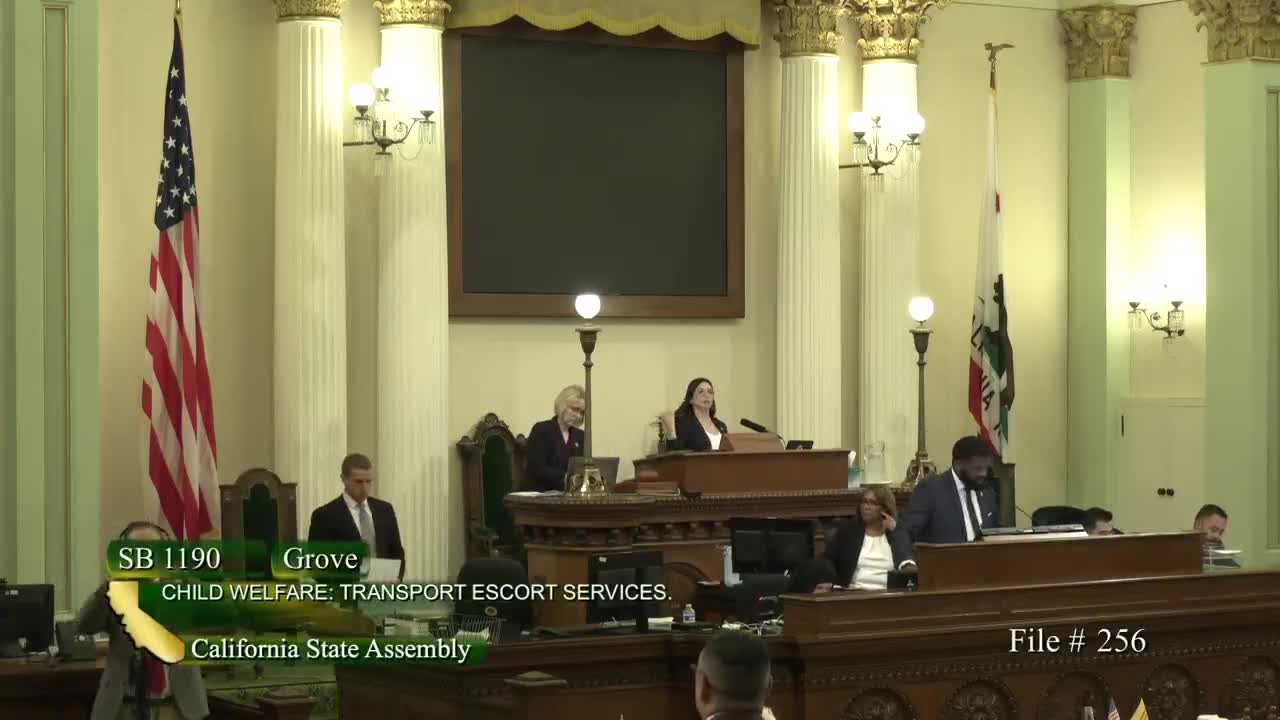 3MIN
Assembly Floor
 11MIN
Assembly Standing Committee on Communications and Conveyance
 9MIN
Assembly Standing Committee on Human Services
 15MIN
Senate Standing Committee on Human Services
Bill Author