SB 1194: Immigration Legal Fellowship Project.
- Session Year: 2025-2026
- House: Senate
- Latest Version Date: 2026-08-20
Current Status:
In Progress
(2026-09-27: In Senate. Consideration of Governor's veto pending.)
Introduced
In Committee
Awaiting First Chamber Vote
Passed First Chamber
In Committee
Awaiting Second Chamber Vote
Passed Second Chamber
Enacted
Existing law requires the State Department of Social Services, subject to an appropriation, to provide grants to qualified nonprofit organizations through contracts, in order to provide certain immigration-related legal services to persons residing in, or formerly residing in, the state. Under existing law, those grants are aimed at obtaining certain immigration remedies and benefits, assisting with the naturalization process and an appeal arising from the process, or providing legal training and technical assistance.
This bill would establish the Immigration Legal Fellowship Project within the department for the purpose of expanding access to high-quality immigration legal services by supporting legal fellowships for qualified individuals who provide immigration legal services under the grant programs described above. The bill would require the department to award grants or enter into contracts with nonprofit entities to operate legal fellowships that include specified components, including, among other things, the recruitment, placement, coordination, and hosting of legal fellows. The bill would authorize the department to establish eligibility criteria, application requirements, and funding priorities for the program. The bill would require the department to include specified information relating to the use of funds appropriated for the purposes of the project in reports and updates provided to the Legislature regarding other immigration-related programs. The bill would provide that the implementation of these provisions is contingent on an appropriation for these purposes.
Existing law requires the State Department of Social Services, subject to an appropriation, to provide grants to qualified nonprofit organizations through contracts, in order to provide certain immigration-related legal services to persons residing in, or formerly residing in, the state. Under existing law, those grants are aimed at obtaining certain immigration remedies and benefits, assisting with the naturalization process and an appeal arising from the process, or providing legal training and technical assistance.
This bill would state the intent of the Legislature to enact legislation to establish the Immigration Legal Fellowship Program within the State Department of Social Services to expand access to high-quality immigration legal services, including removal defense, by supporting the placement of qualified legal fellows in rural and underserved regions of California. establish the Immigration Legal Fellowship Project within the department for the purpose of expanding access to high-quality immigration legal services by supporting legal fellowships for qualified individuals who provide immigration legal services under the grant programs described above. The bill would require the department to award grants or enter into contracts with nonprofit entities to operate legal fellowships that include specified components, including, among other things, the recruitment, placement, coordination, and hosting of legal fellows. The bill would authorize the department to establish eligibility criteria, application requirements, and funding priorities for the program. The bill would require the department to include specified information relating to the use of funds appropriated for the purposes of the project in reports and updates provided to the Legislature regarding other immigration-related programs. The bill would provide that the implementation of these provisions is contingent on an appropriation for these purposes.
Existing law requires the State Department of Social Services, subject to an appropriation, to provide grants to qualified nonprofit organizations through contracts, in order to provide certain immigration-related legal services to persons residing in, or formerly residing in, the state. Under existing law, those grants are aimed at obtaining certain immigration remedies and benefits, assisting with the naturalization process and an appeal arising from the process, or providing legal training and technical assistance.
This bill would state the intent of the Legislature to enact legislation to establish the Immigration Legal Fellowship Program within the State Department of Social Services to expand access to high-quality immigration legal services, including removal defense, by supporting the placement of qualified legal fellows in rural and underserved regions of California.
(a)The Immigration Legal Fellowship Project is hereby established within the State Department of Social Services for the purpose of expanding access to high-quality immigration legal services, including, but not limited to, removal defense, in rural and underserved regions of California.
(b)The department shall administer the project to support legal fellowships for qualified individuals who provide immigration legal services pursuant to this chapter, including, but not limited to, representation in removal proceedings, affirmative immigration relief, and related legal services provided pursuant to this chapter.
(c)The department shall award grants or enter into contracts with nonprofit entities to operate legal fellowships, which shall include, at a minimum, all of the following components:
(1)Recruitment, placement, coordination, and hosting of legal fellows.
(2)Training, mentorship, and supervision of legal fellows.
(3)Technical assistance and programmatic support necessary to ensure the effective delivery of legal services by legal fellows.
(d)For purposes of administering this project, the department may establish eligibility criteria, application requirements, and funding priorities, including, but not limited to, criteria specific to serving rural and underserved communities.
(e)The department shall include information on the use of funds appropriated for the purposes of this section in reports or updates provided to the Legislature regarding the departments immigration programs, including, at a minimum:
(1)The number of fellowships funded.
(2)The geographic regions served.
(3)The types of legal services provided and in what language or languages.
(4)The timeline of implementation and administration of this section.
(5)The identification of further barriers and challenges to the delivery and provision of legal services described in subdivision (b).
(f)This section shall not be construed to limit the authority of the department to administer other immigration-related programs authorized under this chapter.
(g)Implementation of this section is contingent upon an appropriation by the Legislature for these purposes.
(h)For the purposes of this section, the following terms have the following meanings:
(1)Nonprofit entity means an entity that meets the requirements set forth either in Section 501(c)(3) or 501(c)(5) of the Internal Revenue Code or in Section 23701 of the Revenue and Taxation Code and that meets the requirements in subdivision (a) of Section 13301.
(2)Qualified individual means a licensed attorney or a recent law school graduate.
SECTION 1.(a)The Legislature finds and declares all of the following:(1)California is home to the largest immigrant population in the nation, and access to competent immigration legal representation is a critical determinant of fairness, due process, family stability, and community well-being.(2)Immigrants facing removal proceedings who are represented by qualified legal counsel are significantly more likely to obtain lawful relief, remain united with their families, and avoid unnecessary detention, yet access to such representation remains uneven across the state.(3)Rural regions and other underserved communities in California experience persistent shortages of immigration legal service providers due to geographic isolation, limited nonprofit legal infrastructure, workforce recruitment challenges, and insufficient long-term funding stability.(4)The Legislature has previously invested in immigration legal services, including removal defense, through programs administered by the State Department of Social Services pursuant to Chapter 5.6 (commencing with Section 13300) of Part 3 of Division 9 of the Welfare and Institutions Code. These investments have demonstrated measurable benefits but have not fully addressed workforce capacity gaps in rural and underserved areas.(5)Building and sustaining a qualified immigration legal workforce requires intentional investment in training, mentorship, and placement of attorneys and other authorized legal representatives in communities that have historically lacked adequate access to services.(6)Fellowship-based service delivery models have proven effective in expanding legal capacity, strengthening local nonprofit organizations, and improving continuity of services while maintaining accountability and programmatic oversight.(b)It is therefore the intent of the Legislature to enact legislation to establish the Immigration Legal Fellowship Program within the State Department of Social Services to expand access to high-quality immigration legal services, including removal defense, by supporting the placement of qualified legal fellows in rural and underserved regions of California. REVISIONS: HeadingLine 4.(a)The Legislature finds and declares all of the following:
(1)California is home to the largest immigrant population in the nation, and access to competent immigration legal representation is a critical determinant of fairness, due process, family stability, and community well-being.
(2)Immigrants facing removal proceedings who are represented by qualified legal counsel are significantly more likely to obtain lawful relief, remain united with their families, and avoid unnecessary detention, yet access to such representation remains uneven across the state.
(3)Rural regions and other underserved communities in California experience persistent shortages of immigration legal service providers due to geographic isolation, limited nonprofit legal infrastructure, workforce recruitment challenges, and insufficient long-term funding stability.
(4)The Legislature has previously invested in immigration legal services, including removal defense, through programs administered by the State Department of Social Services pursuant to Chapter 5.6 (commencing with Section 13300) of Part 3 of Division 9 of the Welfare and Institutions Code. These investments have demonstrated measurable benefits but have not fully addressed workforce capacity gaps in rural and underserved areas.
(5)Building and sustaining a qualified immigration legal workforce requires intentional investment in training, mentorship, and placement of attorneys and other authorized legal representatives in communities that have historically lacked adequate access to services.
(6)Fellowship-based service delivery models have proven effective in expanding legal capacity, strengthening local nonprofit organizations, and improving continuity of services while maintaining accountability and programmatic oversight.
(b)It is therefore the intent of the Legislature to enact legislation to establish the Immigration Legal Fellowship Program within the State Department of Social Services to expand access to high-quality immigration legal services, including removal defense, by supporting the placement of qualified legal fellows in rural and underserved regions of California.
|
Date
|
Status
|
|---|---|
| Sep 27, 2026 | In Senate. Consideration of Governor's veto pending. |
| Sep 27, 2026 | Vetoed by the Governor. |
| Aug 24, 2026 | Enrolled and presented to the Governor at 3 p.m. |
| Aug 19, 2026 | In Senate. Ordered to engrossing and enrolling. |
| Aug 19, 2026 | Read third time. Passed. (Ayes 59. Noes 12. Page 6266.) Ordered to the Senate. |
| Aug 19, 2026 | Read third time. Passed. Ordered to the Senate. |
| Aug 13, 2026 | Read second time. Ordered to third reading. |
| Aug 13, 2026 | From committee: Do pass. (Ayes 11. Noes 3.) (August 13). |
| Aug 13, 2026 | Assembly Rule 63 suspended. |
| Aug 5, 2026 | August 5 set for first hearing. Placed on suspense file. |
| Jun 23, 2026 | Coauthors revised. |
| Jun 23, 2026 | From committee: Do pass and re-refer to Com. on APPR. (Ayes 9. Noes 3.) (June 23). Re-referred to Com. on APPR. |
| Jun 17, 2026 | From committee: Do pass and re-refer to Com. on JUD. (Ayes 6. Noes 1.) (June 16). Re-referred to Com. on JUD. |
| Jun 1, 2026 | Referred to Coms. on HUM. S. and JUD. |
| May 20, 2026 | In Assembly. Read first time. Held at Desk. |
| May 19, 2026 | Read third time. Passed. (Ayes 30. Noes 9. Page 4355.) Ordered to the Assembly. |
| May 19, 2026 | Read third time. Passed. (Ayes 30. Noes 9.) Ordered to the Assembly. |
| May 14, 2026 | From committee: Do pass. (Ayes 5. Noes 2. Page 4268.) (May 14). |
| May 14, 2026 | Read second time. Ordered to third reading. |
| May 14, 2026 | From committee: Do pass. (Ayes 5. Noes 2.) (May 14). |
| May 8, 2026 | Set for hearing May 14. |
| May 4, 2026 | May 4 hearing: Placed on APPR. suspense file. |
| Apr 24, 2026 | Set for hearing May 4. |
| Apr 21, 2026 | From committee: Do pass and re-refer to Com. on APPR. (Ayes 3. Noes 1. Page 3955.) (April 20). Re-referred to Com. on APPR. |
| Apr 21, 2026 | From committee: Do pass and re-refer to Com. on APPR. (Ayes 3. Noes 1.) (April 20). Re-referred to Com. on APPR. |
| Apr 15, 2026 | From committee: Do pass and re-refer to Com. on HUMAN S. (Ayes 11. Noes 1. Page 3869.) (April 14). Re-referred to Com. on HUMAN S. |
| Apr 15, 2026 | From committee: Do pass and re-refer to Com. on HUMAN S. (Ayes 11. Noes 1.) (April 14). Re-referred to Com. on HUMAN S. |
| Apr 10, 2026 | Set for hearing April 20 in HUMAN S. pending receipt. |
| Apr 9, 2026 | Set for hearing April 14. |
| Apr 8, 2026 | Re-referred to Coms. on JUD. and HUMAN S. |
| Apr 8, 2026 | Withdrawn from committee. |
| Apr 8, 2026 | Re-referred to Coms. on HUMAN S. and JUD. |
| Mar 24, 2026 | From committee with author's amendments. Read second time and amended. Re-referred to Com. on RLS. |
| Mar 4, 2026 | Referred to Com. on RLS. |
| Feb 20, 2026 | From printer. May be acted upon on or after March 22. |
| Feb 19, 2026 | Introduced. Read first time. To Com. on RLS. for assignment. To print. |
|
Date
|
Description
|
Location
|
Votes
|
|
|---|---|---|---|---|
| Aug 19, 2026 | SB 1194 Caballero Senate Third Reading By Bonta | Assembly Floor |
Passed |
|
| Aug 13, 2026 | Do pass. | Assembly Standing Committee on Appropriations |
Passed |
|
| Jun 23, 2026 | Do pass and be re-referred to the Committee on [Appropriations] | Assembly Standing Committee on Judiciary |
Passed |
|
| Jun 16, 2026 | Do pass and be re-referred to the Committee on [Judiciary] | Assembly Standing Committee on Human Services |
Passed |
|
| May 19, 2026 | Senate 3rd Reading SB1194 Caballero et al. | Senate Floor |
Passed |
|
| May 14, 2026 | Do pass | Senate Standing Committee on Appropriations |
Passed |
|
| May 4, 2026 | Placed on suspense file | Senate Standing Committee on Appropriations |
Passed |
|
| Apr 20, 2026 | Do pass, but first be re-referred to the Committee on [Appropriations] | Senate Standing Committee on Human Services |
Passed |
|
| Apr 14, 2026 | Do pass, but first be re-referred to the Committee on [Human Services] | Senate Standing Committee on Judiciary |
Passed |
This list shows positions taken on this bill by organizations on the date displayed, which is linked to the original source.
Positions by individuals are not included.
|
Organization
|
Position
|
Date
|
|---|---|---|
| Aclu California Action | ** Support | |
| Asian Americans Advancing Justice Southern California | ** Support | |
| Attorney General Rob Bonta | ** Support | |
| California Academy of Child and Adolescent Psychiatry | ** Support | |
| California ChangeLawyers | ** Support | |
| California Change Lawyers | ** Support | |
| California Collaborative for Immigrant Justice | ** Support | |
| California Department of Justice | ** Support | |
| California Department of Justice (Co-Sponsor) | ** Support | |
| California Department of Justice (Sponsor) | ** Support | |
| California Immigrant Policy Center | ** Support | |
| California Immigration Project | ** Support | |
| Center for Gender & Refugee Studies-California | ** Support | |
| Central Valley Immigrant Integration Collaborative | ** Support | |
| centro binacional para el desarrollo indigena oaxaqueno | ** Support | |
| Centro Binacional Para El Desarrollo Indigena Oaxaqueño (CBDIO) | ** Support | |
| Centro La Familia Advocacy Services, Inc. | ** Support | |
| Coalition for Humane Immigrant Rights | ** Support | |
| Community Action Board of Santa Cruz County | ** Support | |
| Education and Leadership Foundation | ** Support | |
| Immigrant Defense Advocates | ** Support | |
| Immigrant Defense Advocates (sponsor) | ** Support | |
| Immigrant Legal Defense | ** Support | |
| Immigrant Legal Resource Center | ** Support | |
| Imperial Valley Equity and Justice | ** Support | |
| Jewish Family Service of San Diego | ** Support | |
| Monterey County Supervisor | ** Support | |
| Monterey County Supervisor Wendy Root Askew | ** Support | |
| Moreno Institute | ** Support | |
| Oasis Legal Services | ** Support | |
| San Bernardino Community Service Center, Inc. | ** Support | |
| San Bernardino Community Service Center, INC | ** Support | |
| Santa Barbara County Immigrant Legal Defense Center | ** Support | |
| Santa Clara County Office Of Education | ** Support | |
| Santa Cruz County Board of Supervisors | ** Support | |
| Santa Cruz County Office Of Education | ** Support | |
| Santa Cruz County Superintendent of Schools | ** Support | |
| SB County Immigrant Legal Defense Center | ** Support | |
| Thai Community Development Center | ** Support | |
| Vera Institute Of Justice | ** Support | |
| Watsonville Law Center | ** Support | |
| Wendy Root Askew, Supervisor, Monterey County | ** Support |
SENATE RULES COMMITTEE Office of Senate Floor Analyses (916) 651-4171 | SB 1194 |
VETO
Bill No: SB 1194
Author: Caballero (D), et al.
Enrolled: 8/20/26
Vote: 27
SENATE JUDICIARY COMMITTEE: 11-1, 4/14/26
AYES: Umberg, Allen, Ashby, Caballero, Durazo, McNerney, Reyes, Stern, Wahab, Weber Pierson, Wiener
NOES: Niello
NO VOTE RECORDED: Valladares
SENATE HUMAN SERVICES COMMITTEE: 3-1, 4/20/26
AYES: Becker, Laird, Weber Pierson
NOES: Niello
NO VOTE RECORDED: Pérez
SENATE APPROPRIATIONS COMMITTEE: 5-2, 5/14/26
AYES: Cervantes, Cabaldon, Grayson, Richardson, Wahab
NOES: Seyarto, Dahle
SENATE FLOOR: 30-9, 5/19/26
AYES: Allen, Archuleta, Arreguín, Ashby, Becker, Blakespear, Cabaldon, Caballero, Cervantes, Cortese, Durazo, Gonzalez, Grayson, Hurtado, Laird, Limón, McGuire, McNerney, Menjivar, Padilla, Pérez, Reyes, Richardson, Rubio, Smallwood-Cuevas, Stern, Umberg, Wahab, Weber Pierson, Wiener
NOES: Alvarado-Gil, Choi, Dahle, Grove, Jones, Ochoa Bogh, Seyarto, Strickland, Valladares
NO VOTE RECORDED: Niello
ASSEMBLY FLOOR: 59-12, 8/19/26 - See last page for vote
SUBJECT: Immigration Legal Fellowship Project
SOURCE: Attorney General Rob Bonta
Immigrant Defense Advocates
DIGEST:
This bill establishes the Immigration Legal Fellowship Project (ILFP) within the Department of Social Services (DSS) for the purpose of expanding access to high-quality immigration legal services, including, but not limited to, removal defense, in rural and underserved regions of California.
ANALYSIS: Existing law requires DSS, subject to an appropriation, to provide grants to qualified nonprofit organizations through contracts, in order to provide certain immigration-related legal services to persons residing in, or formerly residing in, the state. The grants are aimed at obtaining certain immigration remedies and benefits, assisting with the naturalization process and an appeal arising from the process, or providing legal training and technical assistance. (Welfare and Institutions (Welf & Inst.) Code §§ 13300-13310.)
This bill:
- Establishes the ILFP within DSS for the purpose of expanding access to high-quality immigration legal services, including, but not limited to, removal defense, in rural and underserved regions of California.
- Provides that DSS shall administer the ILFP to support legal fellowships for qualified individuals, as defined, who provide immigration legal services, including, but not limited to, representation in removal proceedings, affirmative immigration relief, and related legal services.
- Provides that DSS shall award grants or enter into contracts with nonprofit entities to operate legal fellowships, which shall include, at a minimum, all of the following components: (a) recruitment, placement, coordination, and hosting of legal fellows; (b) training, mentorship, and supervision of legal fellows; and (c) technical assistance and programmatic support necessary to ensure the effective delivery of legal services by legal fellows.
- Provides that for purposes of administering the ILFP, DSS may establish eligibility criteria, application requirements, and funding priorities, including, but not limited to, criteria specific to serving rural and underserved communities.
- Specifies that DSS shall include information on the use of funds appropriated for the ILFP in reports or updates provided to the Legislature regarding DSS immigration programs, as specified.
- Provides that the law regarding the ILFP shall not be construed to limit the authority of DSS to administer other immigration-related programs, as specified.
- Specifies that implementation of the ILFP is contingent upon an appropriation by the Legislature.
- Defines “nonprofit entity” as an entity that meets the requirements of Section 501(c)(3) or 501(c)(5) of the Internal Revenue Code or in Section 23701 of the Revenue and Taxation Code and that meets the requirements in subdivision Welfare and Institutions Code section 13301.
- Defines “qualified individual” as a licensed attorney or a recent law school graduate.
Comments
According to the author:
Many of the communities most affected by immigration enforcement, especially in rural and underserved regions of California, have too few trained and too little removal defense capacity to meet the need, particularly when the lack can result in family separation, detention, and deportation. SB 1194 builds on a model California has already tested successfully. The five-year pilot of the Immigration Legal Fellowship Project demonstrated that a state-supported fellowship can expand access to immigration legal services by recruiting and training early-career attorneys, placing them with trusted legal service organizations, and building long-term legal infrastructure in communities that have historically been left behind. Over the last five years, the pilot program supported 19 fellows at 13 nonprofit organizations, expanded services across 39 counties, and provided more than 2,500 legal services all while strengthening local legal capacity and workforce development in these communities.
Just as important, the pilot did more than help individual clients—it strengthened organizations and created a durable workforce pipeline. Host organizations increased their capacity, some became newly eligible for removal defense funding, and many fellows have remained in public service roles. This bill is not only about immediate representation; it is also about building a sustainable statewide system of due process support where it is needed most. SB 1194 makes the Immigration Legal Fellowship a permanent program within the California Department of Social Services to ensure access to immigration legal services in our most underserved communities continues to grow.
A coalition of groups committed to supporting immigrant rights, including the bill sponsor Immigrant Defense Advocates, writes the following in support of codifying the five year pilot project:
Immigration court proceedings carry life-altering consequences—family separation, loss of livelihood, and forced return to danger—yet immigrants in removal proceedings are not guaranteed an attorney. This creates a severe access-to-justice gap, particularly in rural regions of California where there are fewer nonprofit legal service providers and fewer attorneys trained to handle complex deportation defense.
California has taken important steps to invest in immigration legal services. But even with dedicated state funding, a persistent obstacle remains: capacity. Many of the regions with the highest need—such as parts of the Central Valley, Central Coast, and Inland Empire—have historically had too few organizations with the staffing, training structures, and program infrastructure necessary to provide representation at scale. In other words, funding alone cannot solve the problem if communities lack organizations equipped to deliver the services.
ILFP was designed to solve this structural problem by building sustainable legal capacity where it is most needed. The Fellowship pairs early-career attorneys with experienced mentor organizations for intensive training and ongoing technical assistance, while placing Fellows with host organizations serving rural and underserved communities. This model strengthens both the attorney pipeline and the organizational infrastructure needed for long-term community-based representation.
The Fellowship approach also creates statewide benefits: strengthening rural legal capacity reduces pressure on already-overextended providers in larger metro areas, builds regional partnerships, and establishes a continuum of services between organizations near immigration courts, those near detention facilities, and those located farther away but serving communities affected by aggressive immigration enforcement. The first large scale raid against California’s immigrant community in 2025, “Operation Return to Sender”, took place in the Central Valley, where the 3-day operation terrorized the community leading to 78 arrests. Workforce attendance in orchards plummeted immediately. Some farms reported that 75% of their workers stayed home out of fear. A Stanford University study later found that these raids led to over 81,000 lost school days in the region as parents kept children home for safety.
Placing the Fellowship into statute is essential to ensure stable, predictable support for underserved communities and to preserve the institutional structure that makes this model effective. Codification will also help California remain prepared to respond to shifting federal policies and any future immigration reform—by ensuring that trained attorneys and capable host organizations exist across the state, not only in major urban centers.
The ILFP pilot was in effect between 2021 and 2025. According to the fellowship organizations, 19 fellows were places with 13 host organizations. They provided 2,545 legal services. The host organizations built the experience required to become eligible for state immigration removal defense funding. A high percentage of the fellows continued public service work after their fellowship ended. This bill would codify the ILFP program.
FISCAL EFFECT: Appropriation: No Fiscal Com.: Yes Local: No
According to the Senate Appropriation Committee: Unknown General Fund cost pressures, potentially ranging from $7 million to $8 million to fund each cohort, based on the experience of the existing immigration fellowship program administered by the California Department of Social Services (CDSS).
SUPPORT: (Verified 10/7/26)
Attorney General Rob Bonta (source)
Immigrant Defense Advocates (source)
ACLU California Action
Asian Americans Advancing Justice Southern California
California Academy of Child and Adolescent Psychiatry
California ChangeLawyers
California Collaborative for Immigrant Justice
California Immigrant Policy Center
California Immigration Project
Center for Gender & Refugee Studies-California
Central Valley Immigrant Integration Collaborative
Centro Binacional para el Desarrollo Indígena Oaxaqueño
Centro La Familia Advocacy Services, Inc.
Coalition for Humane Immigrant Rights
Community Action Board of Santa Cruz County
Education and Leadership Foundation
Immigrant Legal Defense
Immigrant Legal Resource Center
Imperial Valley Equity and Justice
Jewish Family Service of San Diego
Monterey County Supervisor Wendy Root Askew
Moreno Institute
Oasis Legal Services
San Bernardino Community Service Center, Inc.
Santa Cruz County Office of Education
SB County Immigrant Legal Defense Center
Thai Community Development Center
Vera Institute of Justice
Watsonville Law Center
OPPOSITION: (Verified 10/7/26)
None received
GOVERNOR'S VETO MESSAGE:
I am returning Senate Bill 1194 without my signature.
This bill establishes the Immigration Legal Fellowship Project (ILFP) within the California Department of Social Services (CDSS).
I share the author's commitment to ensure California maintains the capacity to provide legal representation for vulnerable immigrant communities as arrests and detentions rise. To that end, this year's budget doubled the state funding provided to immigration-related legal services - allocating nearly $150 million dollars dedicated to this important work - and included $7.5 million for ILFP, the very project envisioned by this bill. This allocation also includes the flexibility to fund additional fellows to meet regional needs and provides $34.3 million in direct allocations to nonprofit organizations that provide immigration services. As such, this bill, which creates an unfunded program on top of this work, is duplicative and unnecessary.
For these reasons, I cannot sign this bill.
ASSEMBLY FLOOR: 59-12, 8/19/26
AYES: Addis, Aguiar-Curry, Ahrens, Alvarez, Arambula, Ávila Farías, Bains, Bauer-Kahan, Bennett, Berman, Boerner, Bonta, Bryan, Calderon, Caloza, Carrillo, Connolly, Elhawary, Fong, Gabriel, Garcia, Gipson, Mark González, Haney, Harabedian, Hart, Irwin, Jackson, Kalra, Krell, Lee, Lowenthal, McKinnor, Muratsuchi, Nguyen, Ortega, Pacheco, Papan, Patel, Pellerin, Petrie-Norris, Quirk-Silva, Ramos, Ransom, Celeste Rodriguez, Michelle Rodriguez, Rogers, Schiavo, Schultz, Sharp-Collins, Solache, Soria, Stefani, Valencia, Ward, Wicks, Wilson, Zbur, Rivas
NOES: Chen, DeMaio, Dixon, Ellis, Flora, Hadwick, Johnson, Lackey, Macedo, Patterson, Sanchez, Tangipa
NO VOTE RECORDED: Alanis, Castillo, Davies, Jeff Gonzalez, Hoover, Blanca Rubio, Ta, Wallis
Prepared by: Margie Estrada / JUD. / (916) 651-4113
10/12/26 14:35:10
**** END ****
SENATE THIRD READING
STR Bill Id:SB 1194
Author:(Caballero)
As Amended Ver:March 24, 2026
Majority vote
SUMMARY
Establishes the Immigration Legal Fellowship Project (ILFP) as a permanent program.
Major Provisions
- Establishes the ILFP within the California Department of Social Services (CDSS) for the purpose of expanding access to high-quality immigration legal services, including, but not limited to, removal defense, in rural and underserved regions of California.
- Provides that CDSS shall administer the ILFP to support legal fellowships for qualified individuals, as defined, who provide immigration legal services, including, but not limited to, representation in removal proceedings, affirmative immigration relief, and related legal services.
- Provides that CDSS shall award grants or enter into contracts with nonprofit entities to operate legal fellowships, which shall include, at a minimum, all of the following components:
- Recruitment, placement, coordination, and hosting of legal fellows;
- Training, mentorship, and supervision of legal fellows; and,
- Technical assistance and programmatic support necessary to ensure the effective delivery of legal services by legal fellows.
- Provides that for purposes of administering the ILFP, CDSS may establish eligibility criteria, application requirements, and funding priorities, including, but not limited to, criteria specific to serving rural and underserved communities.
- Specifies that CDSS shall include information on the use of funds appropriated for the ILFP in reports or updates provided to the Legislature regarding CDSS immigration programs, including identification of further barriers and challenges to the delivery and provision of legal services.
- Provides that the law regarding the ILFP shall not be construed to limit the authority of CDSS to administer other immigration-related programs authorized to be provided as services for undocumented persons.
- Specifies that implementation of the ILFP is contingent upon an appropriation by the Legislature.
- Defines "nonprofit entity: as an entity that meets specified requirements in existing law that require an organization must be a federally tax-exempt charity or labor union, hold California state tax-exempt status, and possess at least three years of documented experience in specialized immigration removal defense to qualify for state-funded legal services.
- Defines "qualified individual" as a licensed attorney or a recent law school graduate.
COMMENTS
Background: Immigration Legal Fellowship Project. The Budget Act of 2019 appropriated $4.7 million and authorized CDSS to create the first state-funded immigration legal fellowship. The fellowship formally launched in 2021 as a two-year pilot program to train and mentor an initial cohort of 10 legal fellows. As the program progressed, the fellowship structure was extended to feature three-year capacity-building programs to provide stability for the fellows and the host organizations they serve.
The ILFP was established to increase the number of removal defense attorneys and the capacity of nonprofit organizations to provide removal defense services in California's Central Coast and Central Valley. ILFP provides legal fellows the opportunity to be trained and mentored by the premier immigrant rights organizations in the state, while being housed in rural communities with the highest unmet need for services. The program was designed to provide recent law school graduates with the opportunity to be hosted in organizations located in rural regions, while still enjoying the benefits of being trained by established removal defense organizations.
The ILFP is designed to expand access to counsel in rural regions of the state to support vulnerable populations such as agricultural workers and to increase the number of qualified immigration attorneys to assist California residents in need of immigration-related legal services.
A Final Service Delivery Report issued in May 2024 by CDSS found that the program successfully increased access to legal representation for immigrants facing deportation, strengthened the capacity of participating nonprofits, and helped establish sustainable removal defense programs in rural regions. Fellows provided a wide range of legal services, including consultations, court representation, bond hearings, appeals, and services for unaccompanied minors. Key outcomes included:
- All ten fellows completed the three-year fellowship.
- Nine fellows remained working in the target regions after the program.
- Eight fellows continued employment with their host organizations.
- Nine fellows passed the Bar Exam, and one pursued Department of Justice accreditation.
- Host organizations strengthened infrastructure, secured additional funding, and transitioned to independent removal defense practices.
This bill would make this a permanent program.
Equity Implications: Despite the dramatic need for legal representation among immigrants in general and unaccompanied migrant children in particular, the United States lacks enough free and low-cost immigration attorneys to meet that need.[1] Children, detained immigrants, asylum seekers, and people with limited English proficiency often face additional barriers in immigration proceedings. Legal representation can help these groups understand their rights, communicate effectively with authorities, and avoid errors that could lead to deportation or the loss of legal protection. This bill may help encourage attorneys to become trained in immigration proceedings and help increase the number of available attorneys.
According to the Author
"Many of the communities most affected by immigration enforcement, especially in rural and under served regions in California, have too few trained and too little removal defense capacity to meet the need, particularly when the lack can result in family separation, detention, and deportation. [This bill] builds on a model California has already tested successfully. The five-year pilot of the Immigration Legal Fellowship Project demonstrated that a state-supported fellowship can expand access to immigration legal services by recruiting and training early career attorneys, placing them with trusted legal service organizations, and building long-term legal infrastructure in communities that have historically been left behind. Over the last five years, the pilot program supported 19 fellows, 13 nonprofit organizations, expanded services across 39 counties, and provided more than 2,500 legal services all while strengthening local legal capacity and workforce development in these communities.
"Just as important, the pilot did more than help individual clients-- it strengthened organizations and created a durable workforce pipeline. Host organizations increased their capacity, some became newly eligible for removal defense funding, and many fellows remained in public service roles. This bill is not only about immediate representation; it is also about building a sustainable statewide system of due process support where it is needed the most."
Arguments in Support
A coalition of groups committed to supporting immigrant rights, including the bill sponsor Immigrant Defense Advocates, writes the following in support of codifying the five-year pilot project:
"Immigration court proceedings carry life-altering consequences—family separation, loss of livelihood, and forced return to danger—yet immigrants in removal proceedings are not guaranteed an attorney. This creates a severe access-to-justice gap, particularly in rural regions of California where there are fewer nonprofit legal service providers and fewer attorneys trained to handle complex deportation defense.
"California has taken important steps to invest in immigration legal services. But even with dedicated state funding, a persistent obstacle remains: capacity. Many of the regions with the highest need—such as parts of the Central Valley, Central Coast, and Inland Empire—have historically had too few organizations with the staffing, training structures, and program infrastructure necessary to provide representation at scale. In other words, funding alone cannot solve the problem if communities lack organizations equipped to deliver the services.
"ILFP was designed to solve this structural problem by building sustainable legal capacity where it is most needed. The Fellowship pairs early-career attorneys with experienced mentor organizations for intensive training and ongoing technical assistance, while placing Fellows with host organizations serving rural and underserved communities. This model strengthens both the attorney pipeline and the organizational infrastructure needed for long-term community-based representation.
"The Fellowship approach also creates statewide benefits: strengthening rural legal capacity reduces pressure on already-overextended providers in larger metro areas, builds regional partnerships, and establishes a continuum of services between organizations near immigration courts, those near detention facilities, and those located farther away but serving communities affected by aggressive immigration enforcement. The first large scale raid against California’s immigrant community in 2025, “Operation Return to Sender”, took place in the Central Valley, where the 3-day operation terrorized the community leading to 78 arrests. Workforce attendance in orchards plummeted immediately. Some farms reported that 75% of their workers stayed home out of fear. A Stanford University study later found that these raids led to over 81,000 lost school days in the region as parents kept children home for safety.
"Placing the Fellowship into statute is essential to ensure stable, predictable support for underserved communities and to preserve the institutional structure that makes this model effective. Codification will also help California remain prepared to respond to shifting federal policies and any future immigration reform—by ensuring that trained attorneys and capable host organizations exist across the state, not only in major urban centers."
Arguments in Opposition
None on file.
FISCAL COMMENTS
According to the Assembly Appropriations Committee on August 13, 2026, CDSS estimates, based on current project operations, ongoing General Fund costs of approximately $4 million for each two-year service term of eight fellows.
The Immigration Legal Fellowship Project received a $7.5 million General Fund allocation in the 2026 budget act to support an additional fellowship cohort through June 30, 2029.
VOTES
SENATE FLOOR: 30-9-1
YES: Allen, Archuleta, Arreguín, Ashby, Becker, Blakespear, Cabaldon, Caballero, Cervantes, Cortese, Durazo, Gonzalez, Grayson, Hurtado, Laird, Limón, McGuire, McNerney, Menjivar, Padilla, Pérez, Reyes, Richardson, Rubio, Smallwood-Cuevas, Stern, Umberg, Wahab, Weber Pierson, Wiener
NO: Alvarado-Gil, Choi, Dahle, Grove, Jones, Ochoa Bogh, Seyarto, Strickland, Valladares
ABS, ABST OR NV: Niello
ASM HUMAN SERVICES: 6-1-0
YES: Lee, Calderon, Alanis, Elhawary, Jackson, Celeste Rodriguez
NO: Tangipa
ASM JUDICIARY: 9-3-0
YES: Kalra, Bauer-Kahan, Bryan, Connolly, Harabedian, Pacheco, Papan, Stefani, Zbur
NO: Macedo, Dixon, Sanchez
ASM APPROPRIATIONS: 11-3-1
YES: Wicks, Arambula, Calderon, Caloza, Fong, Mark González, Krell, Pacheco, Pellerin, Sharp-Collins, Solache
NO: Dixon, Ta, Tangipa
ABS, ABST OR NV: Hoover
UPDATED
VERSION: March 24, 2026
CONSULTANT: Alexandria Smith / HUM. S. / (916) 319-2089 FN: 0003488
Assessing Access to Legal Representation for Unaccompanied Migrant Children: National, State, and County-Level Analysis of Free- and Low-Cost Attorney Prevalence in Relation to Children’s Locations. Journal on Migration and Human Security. dx.doi.org/10.1177/23315024251339778 ↑
Date of Hearing: August 5, 2026
ASSEMBLY COMMITTEE ON APPROPRIATIONS
Buffy Wicks, Chair
SBPCA Bill Id:SB 1194
Author:(Caballero) – As Amended Ver:March 24, 2026
Policy Committee: | Human Services | Vote: | 6 - 1 |
Judiciary | 9 - 3 | ||
|
|
Urgency: No State Mandated Local Program: No Reimbursable: No
SUMMARY:
This bill places in statute the Immigration Legal Fellowship Project established in the Budget Act of 2019 and administered by the California Department of Social Services (CDSS).
Specifically, this bill:
- Upon appropriation by the Legislature, establishes in statute the Immigration Legal Fellowship Project within CDSS to expand access to high-quality immigration legal services in rural and underserved regions of California.
- Requires CDSS to administer the project to support legal fellowships for qualified individuals who provide immigration legal services pursuant to existing law, including, but not limited to, representation in removal proceedings, affirmative immigration relief, and related legal services provided pursuant to this bill.
- Requires CDSS to award grants or enter into contracts with nonprofit entities to operate legal fellowships, which must include, at a minimum, recruitment, placement, coordination, hosting, training, mentorship, and supervision of legal fellows; and provide technical assistance and programmatic support necessary to ensure the effective delivery of legal services.
- Authorizes CDSS to establish eligibility criteria, application requirements, and funding priorities for purposes of administering this project, including, but not limited to, criteria specific to serving rural and underserved communities.
- Requires CDSS to include information on the use of funds appropriated for this program in reports or updates to the Legislature regarding CDSS’s immigration programs, including, at a minimum and among other information, the number of fellowships funded, the geographic regions served, and the types of legal services provided.
FISCAL EFFECT:
CDSS estimates, based on current project operations, ongoing General Fund costs of approximately $4 million for each two-year service term of eight fellows.
The Immigration Legal Fellowship Project received a $7.5 million General Fund allocation in the 2026 budget act to support an additional fellowship cohort through June 30, 2029.
COMMENTS:
- Purpose. According to the author:
Many of the communities most affected by immigrant enforcement, especially in rural and underserved regions of California, have too few trained and too little removal defense capacity to meet the need, particularly when the lack can result in family separation, detention, and deportation. [This bill] builds on a model California has already tested successfully. The five-year pilot of the Immigration Legal Fellowship Project demonstrated that a state-supported fellowship can expand access to immigration legal services by recruiting and training early career attorneys, placing them with trusted legal service organizations, and building long-term legal infrastructure in communities that have historically been left behind.
This bill is sponsored by Immigrant Defense Advocates and the Office of Attorney General Rob Bonta and has extensive support from immigration legal service providers, nonprofit providers, civil rights advocates, and immigrant rights groups. The bill has no registered opposition.
- Background. In 2019, the Legislature granted CDSS $4.7 million dollars to establish the Immigration Legal Fellowship Project. The project aims to increase the number of removal defense attorneys and the capacity of nonprofit organizations to provide removal defense services in rural and underserved communities. During the first two years, the fellowship focuses on training, including immigration-specific legal knowledge, court practices, legal writing, and various other complex topics. The fellows co-counsel cases alongside their assigned mentor attorneys and begin representing clients directly. During the third year, fellows are integrated within the host organization focusing on individual caseloads with access to removal defense resources.
The 2019 $4.7 million budget allocation supported the first two years of the project, which received an additional $10 million General Fund in fiscal year 2022-23 to support the third year of the first fellowship cohort and to establish a second cohort. The Budget Act of 2026 provides a $7.5 million allocation, available until June 30, 2029, to continue the project. This bill places the fellowship project into statute, establishing it as an ongoing program.
- Related Legislation. AB 1261 (Bonta), Chapter 665, Statutes of 2025, required the state to provide legal representation for unaccompanied undocumented minors in federal immigration proceedings, or related state proceedings, in California.
Analysis Prepared by: Jennifer Swenson / APPR. / (916) 319-2081
Date of Hearing: June 23, 2026
ASSEMBLY COMMITTEE ON JUDICIARY
Ash Kalra, Chair
SBPCA Bill Id:SB 1194
Author:(Caballero) – As Amended Ver:March 24, 2026
SENATE VOTE: 30-9
SUBJECT: IMMIGRATION LEGAL FELLOWSHIP PROJECT
SYNOPSIS
In 2019, the Legislature granted the California Department of Social Services $4.7 million dollars to establish the Immigration Legal Fellowship Project (ILFP). The mission of the ILFP was to grow the availability of effective immigration legal services, including removal defense services, in California’s rural communities which historically suffer from a lack of access to legal services. The one-time budget grant provided funding for ten fellows to complete a three-year program, during which they learned from highly-trained immigration attorneys and built connections with other community-based service providers. This bill would codify the program under the Department of Social Services, including providing guidelines on which nonprofits may qualify for grant funding, upon appropriation by the Legislature, consistent with guidelines in existing law.
This bill is sponsored by Immigrant Defense Advocates and the Office of Attorney General Rob Bonta. It enjoys widespread support among immigration legal service providers, nonprofit providers, civil rights advocates, and immigrant rights advocates. There is no known opposition. This bill was previously approved by the Committee on Human Services 6-1.
SUMMARY: Codifies the Immigrant Legal Fellowship Project within the State Department of Social Services. Specifically, this bill:
- Establishes the Immigration Legal Fellowship Project within the State Department of Social Services (CDSS or department) for the purpose of expanding access to high-quality immigration legal services, including, but not limited to, removal defense, in rural and underserved regions of California.
- Requires the department to administer the project to support legal fellowships for qualified individuals who provide immigration legal services pursuant to existing law, including, but not limited to, representation in removal proceedings, affirmative immigration relief, and related legal services provided pursuant to this chapter.
- Requires the department to award grants or enter into contracts with nonprofit entities to operate legal fellowships, which shall include, at a minimum, all of the following components:
- Recruitment, placement, coordination, and hosting of legal fellows;
- Training, mentorship, and supervision of legal fellows;
- Technical assistance and programmatic support necessary to ensure the effective delivery of legal services by legal fellows.
- Authorizes the department to establish eligibility criteria, application requirements, and funding priorities for purposes of administering this project, including, but not limited to, criteria specific to serving rural and underserved communities.
- Requires the department to include information on the use of funds appropriated for the purposes of this section in reports or updates provided to the Legislature regarding the department’s immigration programs, including, at a minimum:
- The number of fellowships funded;
- The geographic regions served;
- The types of legal services provided and in what language or languages;
- The timeline of implementation and administration of this section;
- The identification of further barriers and challenges to the delivery and provision of legal services.
- Prohibits the provisions from being construed to limit the authority of the department to administer other immigration-related programs authorized under the chapter.
- Makes implementation contingent upon an appropriation by the Legislature for these purposes.
EXISTING LAW:
- Directs the Department of Social Services, subject to the availability of funding from the annual Budget Act, to contract with qualified nonprofit legal services organizations to provide legal services to unaccompanied undocumented minors who are transferred to the care and custody of the federal Office of Refugee Resettlement and who are present in this state, for the sole purpose of providing legal representation to unaccompanied undocumented minors who are in the physical custody of the federal Office of Refugee Resettlement or who are residing with a family member or other sponsor. (Welfare and Institutions Code Section 13300 (a) – (b).)
- Defines “legal services” to include culturally and linguistically appropriate services provided by attorneys, paralegals, interpreters and other support staff for state court proceedings, federal immigration proceedings, and any appeals arising from those proceedings. (Welfare and Institutions Code Section 13300 (d).)
- Requires that contracts awarded pursuant to this section be executed only with nonprofit legal services organizations that meet all of the following requirements:
- Have at least three years of experience handling asylum, T-Visa, U-Visa, or special immigrant juvenile status case and have represented at least 25 individuals in these matters;
- Have experience in representing individuals in removal proceedings and asylum applications;
- Have conducted trainings on these issues for practitioners beyond their staff;
- Have experience guiding and supervising the work of attorneys whom themselves do not regularly participate in this area of the law but nevertheless work pro bono on the specified types of cases;
- Are accredited by the Board of Immigration Appeals under the United States Department of Justice’s Executive Office for Immigration Review or meet the requirements to receive funding from the Trust Fund Program administered by the State Bar of California. (Welfare and Institutions Code Section 13301 (a).)
- Requires the state to provide legal counsel to every immigrant youth in the State of California, subject to the availability of state funding. (Welfare and Institutions Code Section 13300.5 (a).)
FISCAL EFFECT: As currently in print this bill is keyed fiscal.
COMMENTS: California is home to over 10 million immigrants from all over the world, accounting for nearly a quarter of the United States’ total immigrant population. (U.S. Immigrant Population by State and County, Migration Policy Institute available at: https://www.migrationpolicy.org/programs/data-hub/charts/us-immigrant-population-state-and-county.) These numbers include naturalized citizens, legal permanent residents (green card holders), various types of legal nonimmigrants (such as students on work visas), refugees and asylum seekers, and undocumented immigrants.
Demand for immigration-related services is chronically high, and each individual type of matter often requires highly specialized knowledge from experienced immigration attorneys. Cases pending before immigration court in California have increased from 78,718 in 2012 to over 355,706 in 2026, for a total increase of more than 350% in just over one decade. (Immigration Court Backlog, TRAC Immigration available at: https://trac.syr.edu/phptools/immigration/backlog/.) Despite having similarly austere consequences as criminal proceedings, including potential deportation and removal, parties before immigration court are not entitled to government-appointed counsel in the event they cannot afford legal representation. Last year, the Legislature enacted AB 1261 (Bonta) Chap. 665, Stats. 2025 which established a statutory guarantee that all undocumented unaccompanied minors would receive a state-provided attorney, pending the availability of funding. However, as the state faces budget difficulties making the dedication of the necessary funding increasingly trying, demand remains high. The pressure to provide effective legal services then shifts to nonprofit legal services organizations. Fortunately for many Californians, the state has no shortage of nonprofit legal services organizations willing to engage in the intellectually and emotionally challenging work of immigration representation. By and large, however, these nonprofits are based out of more populated urban areas of the state, while rural communities struggle to access legal services.
The Immigration Legal Fellowship Program. As part of the Legislature’s efforts to bolster availability of immigration services in these high-need rural areas, the Budget Act of 2019 included $4.7 million to fund the Immigration Legal Fellowship Program (ILFP) under the Department of Social Services (Department or CDSS). As described by the Department, “[t]he Immigration Legal Fellowship Project (ILFP) aims to increase the number of removal defense attorneys and the capacity of nonprofit organizations to provide removal defense services in California’s Central Coast and Central Valley.” (Other Programs and Projects, California Department of Social Services available at: https://cdss.ca.gov/inforesources/immigration/other-projects.) The ILFP provided fellowship placement and funding for three years, between 2020 – 2023. As detailed in the Department’s Final Service Delivery Report, issued in May 2024, all ten fellows selected completed their three-year program with host organizations in underserved communities. The fellows received intensive training on the intricacies of immigration law and procedure under highly experienced immigration attorneys, and the host organizations were supported with development training leading to long-term sustainable removal defense programs. At the conclusion of the three years, all but one fellow remained in the areas targeted by the program. Eight fellows were hired by their host nonprofit, nine passed the Bar exam, and one applied for full accreditation from the Department of Justice. During their time in the program, the fellows managed removal defense cases, conducted intakes and consultations, established partnerships with other community service providers, and led monthly in-office triage clinics resulting in consultations for community members in removal proceedings.
Considering the ILFP only received a one-time grant, these statistics reflect significant and lasting positive impacts by not only increasing the availability of immediately-available immigration legal resources in areas of the state with high-demand, but also bolstering the roster of well-trained immigration attorneys.
According to the author:
Many of the communities most affected by immigrant enforcement, especially in rural and underserved regions of California, have too few trained and too little removal defense capacity to meet the need, particularly when the lack can result in family separation, detention, and deportation. SB 1194 builds on a model California has already tested successfully. The five-year pilot of the Immigration Legal Fellowship Project demonstrated that a state-supported fellowship can expand access to immigration legal services by recruiting and training early career attorneys, placing them with trusted legal service organizations, and building long-term legal infrastructure in communities that have historically been left behind. Over the last five years, the pilot program supported 19 fellows, 13 nonprofit organizations, expanded services across 39 counties, and provided more than 2,500 legal services all while strengthening local legal capacity and workforce development in these communities.
Just as important, the pilot did more than help individual clients—it strengthened organizations and created a durable workforce pipeline. Host organizations increased their capacity, some became newly eligible for removal defense funding, and many fellows remained in public service roles. This bill is not only about immediate representation; it is also about building a sustainable statewide system of due process support where it is needed the most
This bill would codify the Immigration Legal Fellowship Program, including guidelines on which nonprofits would be eligible to receive grant funding consistent with the existing framework under the One California program.
The Legislature has taken innumerable steps to protect California’s vulnerable population in the wake of both Trump Administrations, many of which have, understandably, tested the boundaries of constitutionality. In the midst of all of these efforts, nonprofits and community-based organizations throughout the state have engaged in the grueling work of engaging with those same immigrant communities on the ground, responding quickly to distress calls, and selflessly working countless hours to defend those in greatest need. It is undeniable that one of the most effective tools in the State’s arsenal is propping up those organizations that have built networks and trust among the state’s immigrant communities, and permanently codifying the ILFP seems a commonsense way to continue to do so.
ARGUMENTS IN SUPPORT: This bill is sponsored by Immigrant Defense Advocates and the California Department of Justice Office of Attorney General Rob Bonta. It enjoys widespread support among immigration legal service providers, nonprofit providers, civil rights advocates, and immigrant rights advocates. In support of their measure, Immigrant Defense Advocates submits:
Immigration court proceedings carry life-altering consequences—family separation, loss of livelihood, and forced return to danger—yet immigrants in removal proceedings are not guaranteed an attorney. This creates a severe access-to-justice gap, particularly in rural regions of California where there are fewer nonprofit legal service providers and fewer attorneys trained to handle complex deportation defense.
California has taken important steps to invest in immigration legal services. But even with dedicated state funding, a persistent obstacle remains: capacity. Many of the regions with the highest need—such as parts of the Central Valley, Central Coast, and Inland Empire—have historically had too few organizations with the staffing, training structures, and program infrastructure necessary to provide representation at scale. In other words, funding alone cannot solve the problem if communities lack organizations equipped to deliver the services.
ILFP was designed to solve this structural problem by building sustainable legal capacity where it is most needed. The Fellowship pairs early-career attorneys with experienced mentor organizations for intensive training and ongoing technical assistance, while placing Fellows with host organizations serving rural and underserved communities. This model strengthens both the attorney pipeline and the organizational infrastructure needed for long-term community-based representation.
The Fellowship approach also creates statewide benefits: strengthening rural legal capacity reduces pressure on already-overextended providers in larger metro areas, builds regional partnerships, and establishes a continuum of services between organizations near immigration courts, those near detention facilities, and those located farther away but serving communities affected by aggressive immigration enforcement. The first large-scale raid against California’s immigrant community in 2025, “Operation Return to Sender”, took place in the Central Valley, where the 3-day operation terrorized the community leading to 78 arrests. Workforce attendance in orchards plummeted immediately. Some farms reported that 75% of their workers stayed home out of fear. A Stanford University study later found that these raids led to over 81,000 lost school days in the region as parents kept children home for safety.
Placing the Fellowship into statute is essential to ensure stable, predictable support for underserved communities and to preserve the institutional structure that makes this model effective. Codification will also help California remain prepared to respond to shifting federal policies and any future immigration reform—by ensuring that trained attorneys and capable host organizations exist across the state, not only in major urban centers.
REGISTERED SUPPORT / OPPOSITION:
Support
Immigrant Defense Advocates (co-sponsor)
California Department of Justice (co-sponsor)
ACLU California Action
Asian Americans Advancing Justice - California
Asian Americans Advancing Justice Southern California
California Academy of Child and Adolescent Psychiatry
California Change Lawyers
California Collaborative for Immigrant Justice
California Immigrant Policy Center
California Immigration Project
Center for Gender & Refugee Studies–California
Central Valley Immigrant Integration Collaborative
Centro Binacional Para El Desarrollo Indigena Oaxaqueño (CBDIO)
Centro LA Familia Advocacy Services
Coalition for Humane Immigrant Rights (CHIRLA)
Community Action Board
Community Action Board of Santa Cruz County
Education and Leadership Foundation
Immigrant Legal Defense
Immigrant Legal Resource Center
Imperial Valley Equity & Justice Coalition
Jewish Family Service of San Diego
Monterey County Supervisor
Moreno Institute
Oasis Legal Services
San Bernardino Community Service Center, Inc.
Santa Barbara County Immigrant Legal Defense Center
Santa Clara County Office of Education
Santa Cruz County Board of Supervisors
Santa Cruz County Superintendent of Schools
Thai Community Development Center
The Immigrant Legal Resource Center
Vera Institute of Justice
Watsonville Law Center
Wendy Root Askew, Supervisor, Monterey County
Opposition
None on file
Analysis Prepared by: Manuela Boucher-de la Cadena / JUD. / (916) 319-2334
Date of Hearing: June 16, 2026
ASSEMBLY COMMITTEE ON HUMAN SERVICES
Alex Lee, Chair
SBPCA Bill Id:SB 1194
Author:(Caballero) – As Amended Ver:March 24, 2026
SENATE VOTE: 30-9
SUBJECT: Immigration Legal Fellowship Project
SUMMARY: Establishes the Immigration Legal Fellowship Project (ILFP) as a permanent program. Specifically, this bill:
- Establishes the ILFP within the California Department of Social Services (CDSS) for the purpose of expanding access to high-quality immigration legal services, including, but not limited to, removal defense, in rural and underserved regions of California.
- Provides that CDSS shall administer the ILFP to support legal fellowships for qualified individuals, as defined, who provide immigration legal services, including, but not limited to, representation in removal proceedings, affirmative immigration relief, and related legal services.
- Provides that CDSS shall award grants or enter into contracts with nonprofit entities to operate legal fellowships, which shall include, at a minimum, all of the following components:
- Recruitment, placement, coordination, and hosting of legal fellows;
- Training, mentorship, and supervision of legal fellows; and,
- Technical assistance and programmatic support necessary to ensure the effective delivery of legal services by legal fellows.
- Provides that for purposes of administering the ILFP, CDSS may establish eligibility criteria, application requirements, and funding priorities, including, but not limited to, criteria specific to serving rural and underserved communities.
- Specifies that CDSS shall include information on the use of funds appropriated for the ILFP in reports or updates provided to the Legislature regarding CDSS immigration programs, including identification of further barriers and challenges to the delivery and provision of legal services.
- Provides that the law regarding the ILFP shall not be construed to limit the authority of CDSS to administer other immigration-related programs authorized to be provided as services for undocumented persons.
- Specifies that implementation of the ILFP is contingent upon an appropriation by the Legislature.
- Defines “nonprofit entity” as an entity that meets specified requirements in existing law that require an organization must be a federally tax-exempt charity or labor union, hold California state tax-exempt status, and possess at least three years of documented experience in specialized immigration removal defense to qualify for state-funded legal services.
- Defines “qualified individual” as a licensed attorney or a recent law school graduate.
EXISTING LAW:
- Requires CDSS to provide grants, subject to the availability of funding from the annual Budget Act, for the purpose of providing one or more of the following services:
- Services to persons residing in, or formerly residing in, California, including, but not limited to, any of the following:
- Services to assist with the application process for initial or renewal requests of deferred action under the Deferred Action for Childhood Arrivals policy with the United States Citizenship and Immigration Services;
- Services to obtain other immigration remedies and benefits; or,
- Services to assist with the naturalization process and an appeal arising from the process.
- Services to provide legal training and technical assistance;
- Prohibits funds available for grants from being used to provide legal services to an individual who has been convicted of, or who is currently appealing a conviction for, a violent felony, or a serious felony, as defined. (Welfare and Institutions Code [WIC] § 133003)
- Defines “legal services” to include culturally and linguistically appropriate services provided by attorneys, paralegals, interpreters, and other support staff for state court proceedings, federal immigration proceedings, and any appeals arising from those proceedings. (WIC § 13300 (d))
FISCAL EFFECT: According to the Senate Committee on Appropriations on the March 24, 2026, version of the bill , “Unknown General Fund cost pressures, potentially ranging from $7 million to $8 million to fund each cohort, based on the experience of the existing immigration fellowship program administered by the California Department of Social Services (CDSS).”
COMMENTS:
Background: Immigration Legal Fellowship Project. The Budget Act of 2019 appropriated $4.7 million and authorized CDSS to create the first state-funded immigration legal fellowship. The fellowship formally launched in 2021 as a two-year pilot program to train and mentor an initial cohort of 10 legal fellows. As the program progressed, the fellowship structure was extended to feature three-year capacity-building programs to provide stability for the fellows and the host organizations they serve.
The ILFP was established to increase the number of removal defense attorneys and the capacity of nonprofit organizations to provide removal defense services in California’s Central Coast and Central Valley. ILFP provides legal fellows the opportunity to be trained and mentored by the premier immigrant rights organizations in the state, while being housed in rural communities with the highest unmet need for services. The program was designed to provide recent law school graduates with the opportunity to be hosted in organizations located in rural regions, while still enjoying the benefits of being trained by established removal defense organizations.
The ILFP is designed to expand access to counsel in rural regions of the state to support vulnerable populations such as agricultural workers and to increase the number of qualified immigration attorneys to assist California residents in need of immigration-related legal services.
A Final Service Delivery Report issued in May 2024 by CDSS found that the program successfully increased access to legal representation for immigrants facing deportation, strengthened the capacity of participating nonprofits, and helped establish sustainable removal defense programs in rural regions. Fellows provided a wide range of legal services, including consultations, court representation, bond hearings, appeals, and services for unaccompanied minors. Key outcomes included:
- All ten fellows completed the three-year fellowship.
- Nine fellows remained working in the target regions after the program.
- Eight fellows continued employment with their host organizations.
- Nine fellows passed the Bar Exam, and one pursued Department of Justice accreditation.
- Host organizations strengthened infrastructure, secured additional funding, and transitioned to independent removal defense practices.
This bill would make this a permanent program.
Author’s Statement: According to the Author, “Many of the communities most affected by immigration enforcement, especially in rural and under served regions in California, have too few trained and too little removal defense capacity to meet the need, particularly when the lack can result in family separation, detention, and deportation. [This bill] builds on a model California has already tested successfully. The five-year pilot of the Immigration Legal Fellowship Project demonstrated that a state-supported fellowship can expand access to immigration legal services by recruiting and training early career attorneys, placing them with trusted legal service organizations, and building long-term legal infrastructure in communities that have historically been left behind. Over the last five years, the pilot program supported 19 fellows, 13 nonprofit organizations, expanded services across 39 counties, and provided more than 2,500 legal services all while strengthening local legal capacity and workforce development in these communities.
Just as important, the pilot did more than help individual clients-- it strengthened organizations and created a durable workforce pipeline. Host organizations increased their capacity, some became newly eligible for removal defense funding, and many fellows remained in public service roles. This bill is not only about immediate representation; it is also about building a sustainable statewide system of due process support where it is needed the most.”
Equity Implications: Despite the dramatic need for legal representation among immigrants in general and unaccompanied migrant children in particular, the United States lacks enough free and low-cost immigration attorneys to meet that need.[1] Children, detained immigrants, asylum seekers, and people with limited English proficiency often face additional barriers in immigration proceedings. Legal representation can help these groups understand their rights, communicate effectively with authorities, and avoid errors that could lead to deportation or the loss of legal protection. This bill may help encourage attorneys to become trained in immigration proceedings and help increase the number of available attorneys.
Double referral: Should this bill pass out of this Committee, it will be referred to the Assembly Committee on Judiciary.
RELATED AND PRIOR LEGISLATION:
AB 1261 (Bonta), Chapter 665, Statutes of 2025, required the state to provide legal representation for unaccompanied undocumented minors in federal immigration proceedings, or related state proceedings, in California.
AB 120 (Committee on Budget), Chapter 43, Statutes of 2023, removed the requirement that contracts provide for legal services to unaccompanied minors on a fee-per-case basis and instead required CDSS to determine the funding method. Allowed grants to be used to provide immigration benefits and authorizes CDSS to approve a nonprofit legal service organization to receive a grant if it has at least three years of experience and has conducted trainings on immigration issues for persons beyond its staff.
AB 135 (Committee on Budget ), Chapter 85, Statutes of 2021, among other things, established the Enhanced Services for Asylees and Vulnerable Noncitizens program to provide for persons granted asylum or who are eligible to receive refugee cash assistance and services as victims of crime, authorized CDSS to reallocate returned or declined funds among eligible counties and qualified nonprofit organizations for refugee social services programs, and repealed the July 1, 2022, sunset date for the rapid response program within CDSS.
AB 2642 (Levine), Chapter 103, Statutes of 2018, provided, in an effort to ensure that unaccompanied minors are able to apply for Special Immigrant Juvenile Status immigration relief, that a nonprofit charitable corporation not incorporated in this state may be appointed as the guardian of a minor if specified requirements are met, which included that (1) the nonprofit charitable corporation is licensed by this state to provide care for minors; (2) the nonprofit charitable corporation is contracted by the federal Department of Health and Human Services, Office of Refugee Resettlement to provide care and custody of the minor; and, (3) the petition for guardianship is filed in connection with a petition to make the necessary findings regarding special immigrant juvenile status.
SB 89 (Committee on Budget and Fiscal Review), Chapter 24, Statutes of 2017, funded legal services for immigration defense.
Arguments in Support: A coalition of groups committed to supporting immigrant rights, including the bill sponsor Immigrant Defense Advocates, writes the following in support of codifying the five-year pilot project:
“Immigration court proceedings carry life-altering consequences—family separation, loss of livelihood, and forced return to danger—yet immigrants in removal proceedings are not guaranteed an attorney. This creates a severe access-to-justice gap, particularly in rural regions of California where there are fewer nonprofit legal service providers and fewer attorneys trained to handle complex deportation defense.
“California has taken important steps to invest in immigration legal services. But even with dedicated state funding, a persistent obstacle remains: capacity. Many of the regions with the highest need—such as parts of the Central Valley, Central Coast, and Inland Empire—have historically had too few organizations with the staffing, training structures, and program infrastructure necessary to provide representation at scale. In other words, funding alone cannot solve the problem if communities lack organizations equipped to deliver the services.
“ILFP was designed to solve this structural problem by building sustainable legal capacity where it is most needed. The Fellowship pairs early-career attorneys with experienced mentor organizations for intensive training and ongoing technical assistance, while placing Fellows with host organizations serving rural and underserved communities. This model strengthens both the attorney pipeline and the organizational infrastructure needed for long-term community-based representation.
“The Fellowship approach also creates statewide benefits: strengthening rural legal capacity reduces pressure on already-overextended providers in larger metro areas, builds regional partnerships, and establishes a continuum of services between organizations near immigration courts, those near detention facilities, and those located farther away but serving communities affected by aggressive immigration enforcement. The first large scale raid against California’s immigrant community in 2025, “Operation Return to Sender”, took place in the Central Valley, where the 3-day operation terrorized the community leading to 78 arrests. Workforce attendance in orchards plummeted immediately. Some farms reported that 75% of their workers stayed home out of fear. A Stanford University study later found that these raids led to over 81,000 lost school days in the region as parents kept children home for safety.
“Placing the Fellowship into statute is essential to ensure stable, predictable support for underserved communities and to preserve the institutional structure that makes this model effective. Codification will also help California remain prepared to respond to shifting federal policies and any future immigration reform—by ensuring that trained attorneys and capable host organizations exist across the state, not only in major urban centers.”
Arguments in Opposition: None on file.
REGISTERED SUPPORT / OPPOSITION:
Support
Immigrant Defense Advocates (Sponsor)
Asian Americans Advancing Justice - California
Asian Americans Advancing Justice Southern California
California Academy of Child and Adolescent Psychiatry
California Change Lawyers
California Collaborative for Immigrant Justice
California Department of Justice
California Immigration Project
Center for Gender & Refugee Studies–California
Central Valley Immigrant Integration Collaborative
Centro Binacional para el Desarrollo Indigena Oaxaqueño (CBDIO)
Centro LA Familia Advocacy Services
Coalition for Humane Immigrant Rights (CHIRLA)
Community Action Board
Community Action Board of Santa Cruz County
Education and Leadership Foundation
Immigrant Legal Defense
Immigrant Legal Resource Center
Imperial Valley Equity & Justice Coalition
Jewish Family Service of San Diego
Monterey County Supervisor Wendy Root Askew
Moreno Institute
Oasis Legal Services
San Bernardino Community Service Center, INC
Santa Barbara County Immigrant Legal Defense Center
Santa Clara County Office of Education
Santa Cruz County Board of Supervisors
Thai Community Development Center
Vera Institute of Justice
Watsonville Law Center
Opposition
None on file.
Analysis Prepared by: Alexandria Smith / HUM. S. / (916) 319-2089
Assessing Access to Legal Representation for Unaccompanied Migrant Children: National, State, and County-Level Analysis of Free- and Low-Cost Attorney Prevalence in Relation to Children’s Locations. Journal on Migration and Human Security. dx.doi.org/10.1177/23315024251339778 ↑
SENATE RULES COMMITTEE Office of Senate Floor Analyses (916) 651-4171 | SB 1194 |
THIRD READING
Bill No: SB 1194
Author: Caballero (D), et al.
Amended: 3/24/26
Vote: 21
SENATE JUDICIARY COMMITTEE: 11-1, 4/14/26
AYES: Umberg, Allen, Ashby, Caballero, Durazo, McNerney, Reyes, Stern, Wahab, Weber Pierson, Wiener
NOES: Niello
NO VOTE RECORDED: Valladares
SENATE HUMAN SERVICES COMMITTEE: 3-1, 4/20/26
AYES: Becker, Laird, Weber Pierson
NOES: Niello
NO VOTE RECORDED: Pérez
SENATE APPROPRIATIONS COMMITTEE: 5-2, 5/14/26
AYES: Cervantes, Cabaldon, Grayson, Richardson, Wahab
NOES: Seyarto, Dahle
SUBJECT: Immigration Legal Fellowship Project
SOURCE: Attorney General Rob Bonta
Immigrant Defense Advocates
DIGEST:
This bill establishes the Immigration Legal Fellowship Project (ILFP) within the Department of Social Services (DSS) for the purpose of expanding access to high-quality immigration legal services, including, but not limited to, removal defense, in rural and underserved regions of California.
ANALYSIS:
Existing law requires DSS, subject to an appropriation, to provide grants to qualified nonprofit organizations through contracts, in order to provide certain immigration-related legal services to persons residing in, or formerly residing in, the state. The grants are aimed at obtaining certain immigration remedies and benefits, assisting with the naturalization process and an appeal arising from the process, or providing legal training and technical assistance. (Welfare and Institutions (Welf & Inst.) Code §§ 13300-13310.)
This bill:
- Establishes the ILFP within DSS for the purpose of expanding access to high-quality immigration legal services, including, but not limited to, removal defense, in rural and underserved regions of California.
- Provides that DSS shall administer the ILFP to support legal fellowships for qualified individuals, as defined, who provide immigration legal services, including, but not limited to, representation in removal proceedings, affirmative immigration relief, and related legal services.
- Provides that DSS shall award grants or enter into contracts with nonprofit entities to operate legal fellowships, which shall include, at a minimum, all of the following components: (a) recruitment, placement, coordination, and hosting of legal fellows; (b) training, mentorship, and supervision of legal fellows; and (c) technical assistance and programmatic support necessary to ensure the effective delivery of legal services by legal fellows.
- Provides that for purposes of administering the ILFP, DSS may establish eligibility criteria, application requirements, and funding priorities, including, but not limited to, criteria specific to serving rural and underserved communities.
- Specifies that DSS shall include information on the use of funds appropriated for the ILFP in reports or updates provided to the Legislature regarding DSS immigration programs, as specified.
- Provides that the law regarding the ILFP shall not be construed to limit the authority of DSS to administer other immigration-related programs, as specified.
- Specifies that implementation of the ILFP is contingent upon an appropriation by the Legislature.
- Defines “nonprofit entity” as an entity that meets the requirements of Section 501(c)(3) or 501(c)(5) of the Internal Revenue Code or in Section 23701 of the Revenue and Taxation Code and that meets the requirements in subdivision Welfare and Institutions Code section 13301.
- Defines “qualified individual” as a licensed attorney or a recent law school graduate.
Comments
According to the author:
Many of the communities most affected by immigration enforcement, especially in rural and underserved regions of California, have too few trained and too little removal defense capacity to meet the need, particularly when the lack can result in family separation, detention, and deportation. SB 1194 builds on a model California has already tested successfully. The five-year pilot of the Immigration Legal Fellowship Project demonstrated that a state-supported fellowship can expand access to immigration legal services by recruiting and training early-career attorneys, placing them with trusted legal service organizations, and building long-term legal infrastructure in communities that have historically been left behind. Over the last five years, the pilot program supported 19 fellows at 13 nonprofit organizations, expanded services across 39 counties, and provided more than 2,500 legal services all while strengthening local legal capacity and workforce development in these communities.
Just as important, the pilot did more than help individual clients—it strengthened organizations and created a durable workforce pipeline. Host organizations increased their capacity, some became newly eligible for removal defense funding, and many fellows have remained in public service roles. This bill is not only about immediate representation; it is also about building a sustainable statewide system of due process support where it is needed most. SB 1194 makes the Immigration Legal Fellowship a permanent program within the California Department of Social Services to ensure access to immigration legal services in our most underserved communities continues to grow.
A coalition of groups committed to supporting immigrant rights, including the bill sponsor Immigrant Defense Advocates, writes the following in support of codifying the five year pilot project:
Immigration court proceedings carry life-altering consequences—family separation, loss of livelihood, and forced return to danger—yet immigrants in removal proceedings are not guaranteed an attorney. This creates a severe access-to-justice gap, particularly in rural regions of California where there are fewer nonprofit legal service providers and fewer attorneys trained to handle complex deportation defense.
California has taken important steps to invest in immigration legal services. But even with dedicated state funding, a persistent obstacle remains: capacity. Many of the regions with the highest need—such as parts of the Central Valley, Central Coast, and Inland Empire—have historically had too few organizations with the staffing, training structures, and program infrastructure necessary to provide representation at scale. In other words, funding alone cannot solve the problem if communities lack organizations equipped to deliver the services.
ILFP was designed to solve this structural problem by building sustainable legal capacity where it is most needed. The Fellowship pairs early-career attorneys with experienced mentor organizations for intensive training and ongoing technical assistance, while placing Fellows with host organizations serving rural and underserved communities. This model strengthens both the attorney pipeline and the organizational infrastructure needed for long-term community-based representation.
The Fellowship approach also creates statewide benefits: strengthening rural legal capacity reduces pressure on already-overextended providers in larger metro areas, builds regional partnerships, and establishes a continuum of services between organizations near immigration courts, those near detention facilities, and those located farther away but serving communities affected by aggressive immigration enforcement. The first large scale raid against California’s immigrant community in 2025, “Operation Return to Sender”, took place in the Central Valley, where the 3-day operation terrorized the community leading to 78 arrests. Workforce attendance in orchards plummeted immediately. Some farms reported that 75% of their workers stayed home out of fear. A Stanford University study later found that these raids led to over 81,000 lost school days in the region as parents kept children home for safety.
Placing the Fellowship into statute is essential to ensure stable, predictable support for underserved communities and to preserve the institutional structure that makes this model effective. Codification will also help California remain prepared to respond to shifting federal policies and any future immigration reform—by ensuring that trained attorneys and capable host organizations exist across the state, not only in major urban centers.
The ILFP pilot was in effect between 2021 and 2025. According to the fellowship organizations, 19 fellows were places with 13 host organizations. They provided 2,545 legal services. The host organizations built the experience required to become eligible for state immigration removal defense funding. A high percentage of the fellows continued public service work after their fellowship ended. This bill would codify the ILFP program.
FISCAL EFFECT: Appropriation: No Fiscal Com.: Yes Local: No
According to the Senate Appropriation Committee: Unknown General Fund cost pressures, potentially ranging from $7 million to $8 million to fund each cohort, based on the experience of the existing immigration fellowship program administered by the California Department of Social Services (CDSS).
SUPPORT: (Verified 5/16/26)
Attorney General Rob Bonta (sponsor)
Immigrant Defense Advocates (sponsor)
ACLU California Action
Asian Americans Advancing Justice Southern California
California ChangeLawyers
California Collaborative for Immigrant Justice
California Immigrant Policy Center
California Immigration Project
Center for Gender & Refugee Studies-California
Central Valley Immigrant Integration Collaborative
Centro Binacional para el Desarrollo Indígena Oaxaqueño
Centro La Familia Advocacy Services, Inc.
Coalition for Humane Immigrant Rights
Community Action Board of Santa Cruz County
Education and Leadership Foundation
Immigrant Legal Defense
Immigrant Legal Resource Center
Imperial Valley Equity and Justice
Jewish Family Service of San Diego
Monterey County Supervisor Wendy Root Askew
Moreno Institute
Oasis Legal Services
San Bernardino Community Service Center, Inc.
Santa Cruz County Office of Education
SB County Immigrant Legal Defense Center
Thai Community Development Center
Vera Institute of Justice
Watsonville Law Center
OPPOSITION: (Verified 5/16/26)
None received
Prepared by: Margie Estrada / JUD. / (916) 651-4113
5/17/26 13:42:56
**** END ****
SENATE COMMITTEE ON
Senator Sabrina Cervantes, Chair
2025 - 2026 Regular Session
SB 1194 (Caballero) - Immigration Legal Fellowship Project
Version: | Policy Vote: |
Urgency: | Mandate: |
Hearing Date: | Consultant: |
Bill Summary:
SB 1194 would establish the Immigration Legal Fellowship Project.
Fiscal Impact:
Unknown General Fund cost pressures, potentially ranging from
$7 million to $8 million to fund each cohort, based on the experience of the existing immigration fellowship program administered by the California Department of Social Services (CDSS).
Background:
The Budget Act of 2019 appropriated funding and authorized the CDSS to create the first state-funded immigration legal fellowship. The fellowship program aims to increase the number of removal defense attorneys and the capacity of nonprofit organizations to provide removal defense services in California’s Central Coast and Central Valley. The program received $4.7 million General Fund in 2019-20 to support the first two years of the first fellowship cohort. The project received $10 million General Fund in 2022-23 to support a third year of the first fellowship cohort and to establish a second fellowship cohort.
According to CDSS, these fellowships provide intensive removal defense training and mentoring, as well as practical experience serving rural communities. During the first two years, the legal fellowship focuses on training, including immigration-specific legal knowledge, court practices, legal writing, and various other complex topics. The fellows co-counsel cases alongside their assigned mentor attorneys and begin representing clients directly. During the third year, fellows are integrated within the host organization focusing on individual caseloads with access to removal defense resources and sustaining the implemented services in the communities.
Proposed Law:
Specific provisions of the bill would:
- Establish the Immigration Legal Fellowship Project within the CDSS; and require CDSS to administer the project to support legal fellowships for qualified individuals who provide immigration legal services, including, but not limited to, representation in removal proceedings, affirmative immigration relief, and related legal services, as specified.
- Require CDSS to award grants or enter into contracts with nonprofit entities to operate legal fellowships, as specified.
- Make implementation contingent upon an appropriation by the Legislature.
- Require CDSS to include information on the use of funds appropriated for these purposes in reports or updates provided to the Legislature regarding the department’s immigration programs, as specified.
-- END --
SENATE COMMITTEE ON HUMAN SERVICES
Senator Becker, Chair
2025 - 2026 Regular
Bill No: | SB 1194 | ||
Author: | Caballero | ||
Version: | March 24, 2026 | Hearing Date: | April 20, 2026 |
Urgency: | No | Fiscal: | Yes |
Consultant: | Heather Hopkins | ||
Subject: Immigration Legal Fellowship Project
SUMMARY
This bill creates the Immigration Legal Fellowship Project for purposes of providing high-quality immigration legal services, including, but not limited to, removal defense, in rural and underserved regions of California.
ABSTRACT
Existing Law:
- Requires CDSS, subject to the availability of funding from the annual Budget Act, to contract with qualified nonprofit legal services organizations to provide legal services to unaccompanied undocumented minors who are transferred to the care and custody of the federal Office of Refugee Resettlement and who are present in this state, for the sole purpose of providing legal representation to unaccompanied undocumented minors who are in the physical custody of the federal Office of Refugee Resettlement or who are residing with a family member or other sponsor. (Welfare and Institutions Code (WIC) 13300(a), 13300(b))
- Defines “legal services” to include culturally and linguistically appropriate services provided by attorneys, paralegals, interpreters and other support staff for state court proceedings, federal immigration proceedings, and any appeals arising from those proceedings. (WIC 13300 (d))
This Bill:
- Creates the Immigration Legal Fellowship Project to expand access to high-quality immigration legal services, including, but not limited to, removal defense, in rural and underserved regions of California.
- Requires CDSS to administer the project to support legal fellowships for qualified individuals who provide immigration legal services, including, but not limited to, representation in removal proceedings, affirmative immigration relief, and related legal services provided pursuant to this chapter.
- Provides that CDSS shall award grants or enter into contracts with nonprofit entities to operate legal fellowships, which shall include, at a minimum, all of the following components:
- Recruitment, placement, coordination, and hosting of legal fellows.
- Training, mentorship, and supervision of legal fellows.
- Technical assistance and programmatic support necessary to ensure the effective delivery of legal services by legal fellows.
- Provides that CDSS may establish eligibility criteria, application requirements, and funding priorities, including, but not limited to, criteria specific to serving rural and underserved communities.
- Requires CDSS to include information on the use of funds appropriated for the purposes of this section in reports or updates provided to the Legislature regarding, at a minimum:
- The number of fellowships funded.
- The geographic regions served.
- The types of legal services provided and in what language or languages.
- The timeline of implementation and administration of this section.
- The identification of further barriers and challenges to the delivery and provision of legal services.
- Provides that this program does not limit the authority of CDSS to administer other immigration-related programs.
- Provides that implementation of this section is contingent upon an appropriation by the Legislature for these purposes.
- Defines “nonprofit entity” as an entity that meets the requirements set forth either in Section 501(c)(3) or 501(c)(5) of the Internal Revenue Code or in Section 23701 of the Revenue and Taxation Code and that meets the requirements in subdivision (a) of Section 13301.
- Defines “qualified individual” as a licensed attorney or a recent law school graduate.
FISCAL IMPACT
This bill has not yet been analyzed by a fiscal committee.
BACKGROUND AND DISCUSSION
Purpose of the Bill:
According to the author, “Many of the communities most affected by immigration enforcement, especially in rural and underserved regions of California, have too few trained and too little removal defense capacity to meet the need, particularly when the lack can result in family separation, detention, and deportation. SB 1194 builds on a model California has already tested successfully. The five-year pilot of the Immigration Legal Fellowship Project demonstrated that a state-supported fellowship can expand access to immigration legal services by recruiting and training early-career attorneys, placing them with trusted legal service organizations, and building long-term legal infrastructure in communities that have historically been left behind. Over the last five years, the pilot program supported 19 fellows at 13 nonprofit organizations, expanded services across 39 counties, and provided more than 2,500 legal services all while strengthening local legal capacity and workforce development in these communities.
“Just as important, the pilot did more than help individual clients—it strengthened organizations and created a durable workforce pipeline. Host organizations increased their capacity, some became newly eligible for removal defense funding, and many fellows have remained in public service roles. This bill is not only about immediate representation; it is also about building a sustainable statewide system of due process support where it is needed most. SB 1194 makes the Immigration Legal Fellowship a permanent program within the California Department of Social Services to ensure access to immigration legal services in our most underserved communities continues to grow.”
Immigration Legal Fellowship Project
The Budget Act of 2019 appropriated 4.7 million dollars and authorized CDSS to create the Immigration Legal Fellowship Project, the first state-funded immigration legal fellowship. The Budget Act of 2020 included $30 million for legal services programs for immigrants. The Immigration Legal Fellowship Project consisted of two cohorts of fellows. The first cohort began December 1, 2020 and ended December 31, 2023 and operated with 10 fellows. Cohort One handled 2,021 cases including immigration court appeals, writs of habeas corpus, bond hearings, and legal consultations. Cohort Two is currently operating with eight fellows in six organizations. The second cohort ends in September of this year.
In May 2024, a Final Service Delivery Report was completed regarding the first cohort project and described the following program outcomes:
- Coordinating organizations recruited and placed ten fellows in underserved communities. Fellows were trained on the intricacies of immigration law and procedure and established a continuous remote supervision model using highly experienced immigration attorneys.
- Host organizations were supported with organizational development training and established long-term sustainable removal defense programs.
- Two host organizations received funding for the first time within CDSS. A total of four organizations applied and received additional removal defense funding through a competitive application process.
- Host organizations transitioned to independent removal defense practices post-fellowship and established infrastructure for sustainable legal practice.
- Ten fellows completed the full three years of the program.
- Nine of the ten fellows remained in the targeted regions.
- There is a high retention rate among the fellows at their host organization. Eight of the ten fellows continued their employment in the nonprofit.
- Nine of the ten fellows passed the bar exam, and one fellow applied for full accreditation from the Department of Justice.
This bill seeks to make permanent the Immigration Legal Fellowship Project.
Related/Prior Legislation:
AB 1261 (Bonta, Chapter 665, Statutes of 2025) requires the state to provide legal representation for unaccompanied undocumented minors in federal immigration proceedings, or related state proceedings, in California.
AB 120 (Committee on Budget, Chapter 43, Statutes of 2023) removes the requirement that contracts provide for legal services to unaccompanied minors on a fee-per-case basis and instead requires CDSS to determine the funding method. Allows grants to be used to provide immigration benefits and authorizes CDSS to approve a nonprofit legal service organization to receive a grant if it has at least three years of experience and has conducted trainings on immigration issues for persons beyond its staff.
AB 135 (Assembly Budget Committee, Chapter 85, Statutes of 2021) among other things, establishes the Enhanced Services for Asylees and Vulnerable Noncitizens program to provide for persons granted asylum or who are eligible to receive refugee cash assistance and services as victims of crime, authorizes CDSS to reallocate returned or declined funds among eligible counties and qualified nonprofit organizations for refugee social services programs, and repeals the July 1, 2022 sunset date for the rapid response program within CDSS.
AB 2642 (Levine, Chapter 103, Statutes of 2018) provides, in an effort to ensure that unaccompanied minors are able to apply for Special Immigrant Juvenile Status immigration relief, that a nonprofit charitable corporation not incorporated in this state may be appointed as the guardian of a minor if specified requirements are met, which include that (1) the nonprofit charitable corporation is licensed by this state to provide care for minors; (2) the nonprofit charitable corporation is contracted by the federal Department of Health and Human Services, Office of Refugee Resettlement to provide care and custody of the minor; and (3) the petition for guardianship is filed in connection with a petition to make the necessary findings regarding special immigrant juvenile status.
COMMENTS
Immigration proceedings are complex and potentially life-altering and those involved are not guaranteed the right to an attorney. The Immigration Legal Fellowship Project has provided high-quality legal representation to underserved areas of California. A January 2025 narrative report regarding the Immigration Legal Fellowship Project’s working from July 1, 2025 to December 31, 2025 highlights the ongoing need for this program, writing, in part:
“The greatest challenge encountered during this period undoubtedly continues to be the extreme anti-immigrant environment under the current administration and the policy changes making it increasingly difficult to represent clients. Fellows have consulted with and offered representation to several people who had viable claims for relief, but who instead, elected to accept deportation because they could not endure detention. Detention conditions, particularly in the newly opened facility in California City, are abhorrent. Having access to clients has also been complicated. One Fellow drove to California City to visit a client only to be told that attorneys now had to schedule client visits in advance because the facility was short-staffed and could not accommodate unscheduled attorney visits. In another case, an indigenous man from Mexico with viable asylum claim chose deportation even after a Fellow communicated to him that they were willing to provide pro bono representation and to work on a release strategy including a habeas petition…
The constant firing of immigration judges has also been challenging for Fellows and their clients. Fellows have been preparing with their clients for individual court hearings only to learn that the immigration judge assigned to their case has been fired and the hearing is to be reset. Fellows then need to prepare again with the clients and submit additional evidence on a case-by-case basis. Additionally, the Department of Homeland Security (“DHS”) continues to take a highly adversarial position on all cases making it even more difficult to win bond and removal cases before the immigration court and appeals before the Board of Immigration Appeals. For example, DHS opposed a Fellow’s motion to terminate based on her client’s pending U visa. The Fellow, however, was successful in getting the motion granted, even over DHS’s objection. Furthermore, DHS has been zealously filing last minute motions to pretermit asylum claims claiming clients should be removed to a third country based on Asylum Cooperative Agreement (ACA) the United States has entered with other countries. These ACA motions to pretermit are novel issues and Fellows along with their Mentor Attorney and Lead Fellowship Trainer continue to meet and strategize on arguments to best defend against these motions.
While Fellows continue their work, they also must keep informed of ICE’s arrest tactics. Under these hostile enforcement times, many clients are deciding not to fight their case because they are fearful for their safety, their life, and that of family-members.”
As immigration and ICE actions continue to remain in the headlines, providing legal representation to those navigating a complex immigration system is paramount. This bill proposes to do this by making a very successful pilot program permanent.
POSITIONS
Support:
California Department of Justice (Sponsor)
ACLU California Action
California Change Lawyers
California Collaborative for Immigrant Justice
California Immigrant Policy Center
Center for Gender & Refugee Studies – California
Central Valley Immigrant Integration Collaborative
Centro Binacional Para El Desarrollo Indigena Oaxaqueño (CBDIO)
Centro LA Familia Advocacy Services
Immigrant Defense Advocates
Immigrant Legal Defense
Immigrant Legal Resource Center
Imperial Valley Equity & Justice Coalition
Jewish Family Service of San Diego
Moreno Institute
Oasis Legal Services
San Bernardino Community Service Center, INC
Santa Barbara County Immigrant Legal Defense Center
Santa Clara County Office of Education
Santa Cruz County Superintendent of Schools
Thai Community Development Center
Vera Institute of Justice
Watsonville Law Center
Wendy Root Askew, Supervisor, Monterey County
Oppose:
None Received
-- END --
Senator Thomas Umberg, Chair
2025-2026 Regular Session
Bill No: SB 1194 (Author:Caballero)
Version: March 24, 2026
Hearing Date: April 14, 2026
Fiscal: Yes
Urgency: No
Consultant: ME
SUBJECT
Immigration Legal Fellowship Project
DIGEST
This bill establishes the Immigration Legal Fellowship Project (ILFP) within the Department of Social Services (DSS) for the purpose of expanding access to high-quality immigration legal services, including, but not limited to, removal defense, in rural and underserved regions of California.
EXECUTIVE SUMMARY
The Trump administration has aggressively targeted immigrants for removal from this country. Although immigration proceedings can result in detention and removal, immigrants are not entitled to government funded legal representation because immigration proceedings are civil. California has created programs to provide immigration legal services to immigrants. For the past five years the state has funded a five-year pilot of the ILFP. The ILFP has expanded access to immigration legal services by recruiting and training early-career attorneys, placing them with trusted legal service organizations, and building long-term legal infrastructure in communities that have historically been underserved.
This bill establishes the ILFP within DSS for the purpose of expanding access to high-quality immigration legal services, including, but not limited to, removal defense, in rural and underserved regions of California.
The bill is sponsored by Immigrant Defense Advocates and supported by organizations that support immigrant rights. There is no timely opposition to this bill. If this bill passes out of this Committee it will then be referred to the Senate Committee on Human Services.
PROPOSED CHANGES TO THE LAW
Existing law:
- Requires DSS, subject to an appropriation, to provide grants to qualified nonprofit organizations through contracts, in order to provide certain immigration-related legal services to persons residing in, or formerly residing in, the state. The grants are aimed at obtaining certain immigration remedies and benefits, assisting with the naturalization process and an appeal arising from the process, or providing legal training and technical assistance. (Welf & Inst. Code §§ 13300-13310.)
This bill:
- Establishes the Immigration Legal Fellowship Project (ILFP) within the Department of Social Services (DSS) for the purpose of expanding access to high-quality immigration legal services, including, but not limited to, removal defense, in rural and underserved regions of California.
- Provides that DSS shall administer the ILFP to support legal fellowships for qualified individuals, as defined, who provide immigration legal services, including, but not limited to, representation in removal proceedings, affirmative immigration relief, and related legal services.
- Provides that DSS shall award grants or enter into contracts with nonprofit entities to operate legal fellowships, which shall include, at a minimum, all of the following components: (a) recruitment, placement, coordination, and hosting of legal fellows; (b) training, mentorship, and supervision of legal fellows; and (c) technical assistance and programmatic support necessary to ensure the effective delivery of legal services by legal fellows.
- Provides that for purposes of administering the ILFP, DSS may establish eligibility criteria, application requirements, and funding priorities, including, but not limited to, criteria specific to serving rural and underserved communities.
- Specifies that DSS shall include information on the use of funds appropriated for the ILFP in reports or updates provided to the Legislature regarding DSS immigration programs, as specified.
- Provides that the law regarding the ILFP shall not be construed to limit the authority of DSS to administer other immigration-related programs, as specified.
- Specifies that implementation of the ILFP is contingent upon an appropriation by the Legislature.
- Defines “nonprofit entity” as an entity that meets the requirements of Section 501(c)(3) or 501(c)(5) of the Internal Revenue Code or in Section 23701 of the Revenue and Taxation Code and that meets the requirements in subdivision Welfare and Institutions Code section 13301.
- Defines “qualified individual” as a licensed attorney or a recent law school graduate.
COMMENTS
- Stated need for establishing the Immigration Legal Fellowship Project
According to the author:
Many of the communities most affected by immigration enforcement, especially in rural and underserved regions of California, have too few trained and too little removal defense capacity to meet the need, particularly when the lack can result in family separation, detention, and deportation. SB 1194 builds on a model California has already tested successfully. The five-year pilot of the Immigration Legal Fellowship Project demonstrated that a state-supported fellowship can expand access to immigration legal services by recruiting and training early-career attorneys, placing them with trusted legal service organizations, and building long-term legal infrastructure in communities that have historically been left behind. Over the last five years, the pilot program supported 19 fellows at 13 nonprofit organizations, expanded services across 39 counties, and provided more than 2,500 legal services all while strengthening local legal capacity and workforce development in these communities.
Just as important, the pilot did more than help individual clients—it strengthened organizations and created a durable workforce pipeline. Host organizations increased their capacity, some became newly eligible for removal defense funding, and many fellows have remained in public service roles. This bill is not only about immediate representation; it is also about building a sustainable statewide system of due process support where it is needed most. SB 1194 makes the Immigration Legal Fellowship a permanent program within the California Department of Social Services to ensure access to immigration legal services in our most underserved communities continues to grow.
- Codifies a 5-year pilot project that has proven successful in aiding rural and underserved communities with immigration defense
A coalition of groups committed to supporting immigrant rights, including the bill sponsor Immigrant Defense Advocates, writes the following in support of codifying the five year pilot project:
Immigration court proceedings carry life-altering consequences—family separation, loss of livelihood, and forced return to danger—yet immigrants in removal proceedings are not guaranteed an attorney. This creates a severe access-to-justice gap, particularly in rural regions of California where there are fewer nonprofit legal service providers and fewer attorneys trained to handle complex deportation defense.
California has taken important steps to invest in immigration legal services. But even with dedicated state funding, a persistent obstacle remains: capacity. Many of the regions with the highest need—such as parts of the Central Valley, Central Coast, and Inland Empire—have historically had too few organizations with the staffing, training structures, and program infrastructure necessary to provide representation at scale. In other words, funding alone cannot solve the problem if communities lack organizations equipped to deliver the services.
ILFP was designed to solve this structural problem by building sustainable legal capacity where it is most needed. The Fellowship pairs early-career attorneys with experienced mentor organizations for intensive training and ongoing technical assistance, while placing Fellows with host organizations serving rural and underserved communities. This model strengthens both the attorney pipeline and the organizational infrastructure needed for long-term community-based representation.
The Fellowship approach also creates statewide benefits: strengthening rural legal capacity reduces pressure on already-overextended providers in larger metro areas, builds regional partnerships, and establishes a continuum of services between organizations near immigration courts, those near detention facilities, and those located farther away but serving communities affected by aggressive immigration enforcement. The first large scale raid against California’s immigrant community in 2025, “Operation Return to Sender”, took place in the Central Valley, where the 3-day operation terrorized the community leading to 78 arrests. Workforce attendance in orchards plummeted immediately. Some farms reported that 75% of their workers stayed home out of fear. A Stanford University study later found that these raids led to over 81,000 lost school days in the region as parents kept children home for safety.
Placing the Fellowship into statute is essential to ensure stable, predictable support for underserved communities and to preserve the institutional structure that makes this model effective. Codification will also help California remain prepared to respond to shifting federal policies and any future immigration reform—by ensuring that trained attorneys and capable host organizations exist across the state, not only in major urban centers.
The ILFP pilot was in effect between 2021 and 2025. According to the fellowship organizations, 19 fellows were places with 13 host organizations. They provided 2,545 legal services. The host organizations built the experience required to become eligible for state immigration removal defense funding. A high percentage of the fellows continued public service work after their fellowship ended. This bill would codify the ILFP program.
SUPPORT
Immigrant Defense Advocates (sponsor)
California ChangeLawyers
Center for Gender & Refugee Studies-California
Central Valley Immigrant Integration Collaborative
Centro Binacional para el Desarrollo Indígena Oaxaqueño
Centro La Familia Advocacy Services, Inc.
Immigrant Legal Defense
Immigrant Legal Resource Center
Imperial Valley Equity and Justice
Jewish Family Service of San Diego
Monterey County Supervisor Wendy Root Askew
Moreno Institute
Oasis Legal Services
San Bernardino Community Service Center, Inc.
Santa Cruz County Office of Education
SB County Immigrant Legal Defense Center
Thai Community Development Center
Vera Institute of Justice
Watsonville Law Center
OPPOSITION
None known
RELATED LEGISLATION
Pending Legislation: None known.
Prior Legislation: SB 89 (Committee on Budget, Ch. 24, Stats. 2017) funded legal services for immigration defense.
**************
Discussed in Hearing
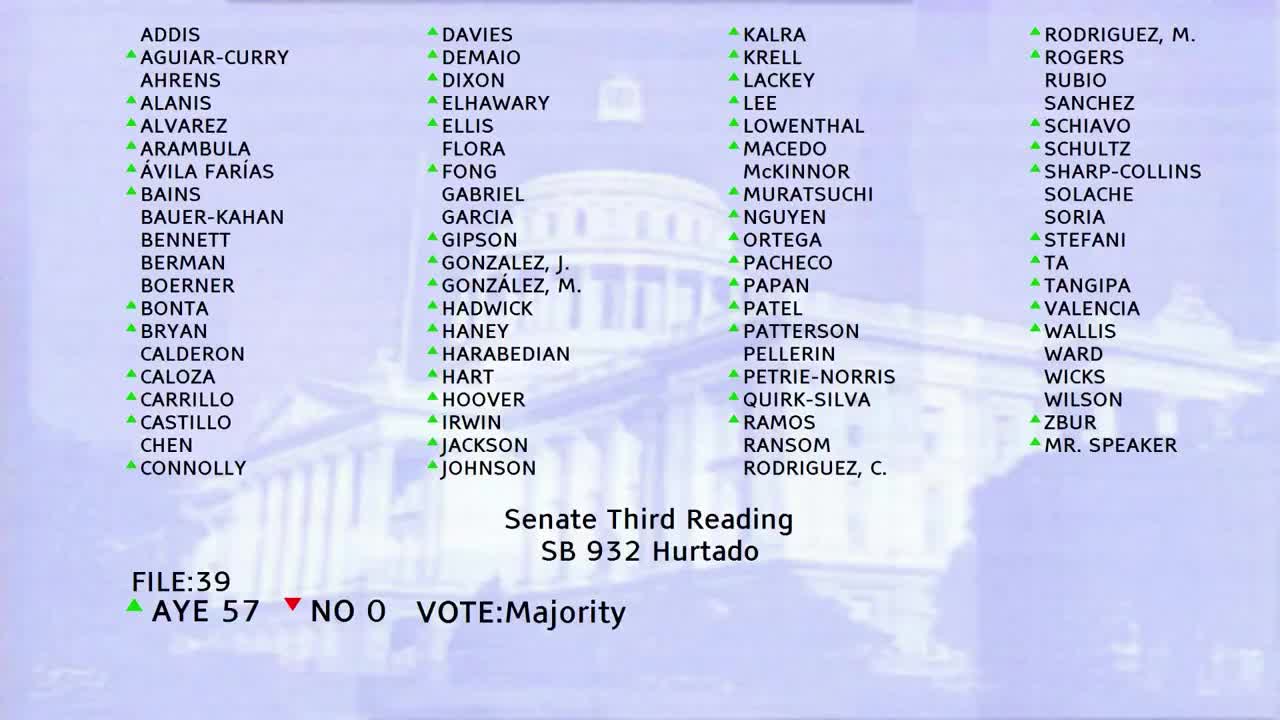 1MIN
Assembly Floor
 8MIN
Assembly Standing Committee on Judiciary
 9MIN
Assembly Standing Committee on Human Services
 2MIN
Senate Floor
 9MIN
Senate Standing Committee on Human Services
 11MIN
Senate Standing Committee on Judiciary
Bill Author