SB 1208: Money laundering: digital assets.
- Session Year: 2025-2026
- House: Senate
- Latest Version Date: 2026-09-27
Current Status:
Passed
(2026-09-27: Chaptered by Secretary of State. Chapter 483, Statutes of 2026.)
Introduced
In Committee
Awaiting First Chamber Vote
Passed First Chamber
In Committee
Awaiting Second Chamber Vote
Passed Second Chamber
Enacted
Existing law makes it a crime to engage in money laundering, defined as conducting a transaction involving a monetary instrument of specified value through a financial institution with the specific intent to promote or facilitate criminal activity or knowing that the monetary instrument represents the proceeds of or is derived from the proceeds of criminal activity. Existing law establishes the Restitution Fund, a continuously appropriated fund in the State Treasury, to provide funding to compensate victims of crime.
This bill would, until January 1, 2032, expand the crime of money laundering to include conducting a transaction involving a monetary instrument of specified value using digital assets, as defined. The bill would make other technical, nonsubstantive changes, as provided. By expanding the scope of a crime, this bill would impose a state-mandated local program.
Existing law, the California Control of Profits of Organized Crime Act, establishes a procedure for the forfeiture of property and proceeds acquired through a pattern of criminal profiteering activity, as defined, upon the conviction of the underlying criminal offense, including money laundering, and requires the prosecuting agency to file a petition of forfeiture in conjunction with certain criminal proceedings. Existing law authorizes any person claiming an interest in property or proceeds subject to forfeiture to file with the superior court in which the forfeiture action is pending a verified claim stating their interest in the property or proceeds, as specified.
This bill would, until January 1, 2032, authorize a law enforcement officer or prosecuting agency, as defined, to obtain a search warrant to seize digital assets or wallets, accounts, or similar things containing digital assets (collectively digital assets) upon a showing of probable cause that the digital assets contain proceeds of a crime or proceeds traceable to a crime or have been used to facilitate a crime. The bill would require the search warrant to specify any centralized exchanges, custodians of digital assets, addresses, or other locations from which the digital assets will be seized, to describe how the warrant will be served, and to specify the amount of digital assets to be seized, as specified. The bill would authorize, within 180 days of any seizure, a prosecuting agency to initiate a special proceeding to forfeit the seized digital assets, including providing notice to all readily ascertainable potential owners of the digital assets and anyone with a known security interest. The bill would require any person with a claim to the seized digital assets to file a verified claim under penalty of perjury and supported by admissible evidence within 30 days of the date of service of the notice from the prosecuting agency, as specified. By expanding the crime of perjury, the bill would impose a state-mandated local program. The bill would provide a process for a court to adjudicate and resolve these verified claims, as specified. The bill would require the court, after all the claims are resolved, to issue a final judgment forfeiting the remaining digital assets and would provide a process for a prosecuting agency to distribute the remaining digital assets to victims, as specified. The bill would require any digital assets not distributed to victims to be kept in the custody of law enforcement or prosecuting agency for a maximum of 3 years, after which the forfeited assets would be deposited into the Restitution Fund for the purpose of providing victim services.
By expanding the revenue sources of a continuously appropriated fund, and by expanding the purposes for which moneys in a continuously appropriated fund may be used, the bill would make an appropriation.
The California Constitution requires the state to reimburse local agencies and school districts for certain costs mandated by the state. Statutory provisions establish procedures for making that reimbursement.
This bill would provide that no reimbursement is required by this act for a specified reason.
Existing law makes it a crime to engage in money laundering, defined as conducting a transaction involving a monetary instrument of specified value through a financial institution with the specific intent to promote or facilitate criminal activity or knowing that the monetary instrument represents the proceeds of or is derived from the proceeds of criminal activity. Existing law establishes the Restitution Fund, a continuously appropriated fund in the State Treasury, to provide funding to compensate victims of crime.
This bill would, until January 1, 2032, expand the crime of money laundering to include conducting a transaction involving a monetary instrument of specified value using digital financial assets, as described. assets, as defined. The bill would make other technical, nonsubstantive changes, as provided. By expanding the scope of a crime, this bill would impose a state-mandated local program.
Existing law, the California Control of Profits of Organized Crime Act, establishes a procedure for the forfeiture of property and proceeds acquired through a pattern of criminal profiteering activity, as defined, upon the conviction of the underlying criminal offense, including money laundering, and requires the prosecuting agency to file a petition of forfeiture in conjunction with certain criminal proceedings. Existing law authorizes any person claiming an interest in property or proceeds subject to forfeiture to file with the superior court in which the forfeiture action is pending a verified claim stating their interest in the property or proceeds, as specified.
This bill would, until January 1, 2032, authorize a law enforcement officer or prosecuting agency, as defined, to obtain a search warrant to seize digital financial assets or wallets, accounts, or similar things containing digital financial assets (collectively digital financial assets (collectively digital assets) upon a showing of probable cause that the digital financial assets contain proceeds of a crime or proceeds traceable to a crime or have been used to facilitate a crime. The bill would require the search warrant to specify any centralized exchanges, custodians of digital assets, addresses, or other locations from which the digital financial assets will be seized, to describe how the warrant will be served, and to specify the amount of digital financial assets to be seized, as specified. The bill would authorize, within 180 days of any seizure, a prosecuting agency to initiate a special proceeding to forfeit the seized digital financial assets, including providing notice to all readily ascertainable potential owners of the digital financial assets and anyone with a known security interest. The bill would require any person with a claim to the seized digital financial assets to file a verified claim under penalty of perjury and supported by admissible evidence within 30 days of the date of service of the notice from the prosecuting agency, as specified. By expanding the crime of perjury, the bill would impose a state-mandated local program. The bill would provide a process for a court to adjudicate and resolve these verified claims, as specified. The bill would require the court, after all the claims are resolved, to issue a final judgment forfeiting the remaining digital financial assets and would provide a process for a prosecuting agency to distribute the remaining digital assets to victims, as specified. The bill would require any digital financial assets not distributed to victims to be kept in the custody of law enforcement or prosecuting agency for a maximum of 3 years, after which the forfeited assets would be deposited into the Restitution Fund for the purpose of providing victim services.
By expanding the revenue sources of a continuously appropriated fund, and by expanding the purposes for which moneys in a continuously appropriated fund may be used, the bill would make an appropriation.
The California Constitution requires the state to reimburse local agencies and school districts for certain costs mandated by the state. Statutory provisions establish procedures for making that reimbursement.
This bill would provide that no reimbursement is required by this act for a specified reason.
Existing law makes it a crime to engage in money laundering, defined as conducting a transaction involving a monetary instrument of specified value through a financial institution with the specific intent to promote or facilitate criminal activity or knowing that the monetary instrument represents the proceeds of or is derived from the proceeds of criminal activity. Existing law establishes the Restitution Fund, a continuously appropriated fund in the State Treasury, to provide funding to compensate victims of crime.
This bill would would, until January 1, 2032, expand the crime of money laundering to include conducting a transaction involving a monetary instrument of specified value using digital financial assets, as described. The bill would make other technical, nonsubstantive changes, as provided. By expanding the scope of a crime, this bill would impose a state-mandated local program.
Existing law, the California Control of Profits of Organized Crime Act, establishes a procedure for the forfeiture of property and proceeds acquired through a pattern of criminal profiteering activity, as defined, upon the conviction of the underlying criminal offense, including money laundering, and requires the prosecuting agency to file a petition of forfeiture in conjunction with certain criminal proceedings. Existing law authorizes any person claiming an interest in property or proceeds subject to forfeiture to file with the superior court in which the forfeiture action is pending a verified claim stating their interest in the property or proceeds, as specified.
This bill would would, until January 1, 2032, authorize a law enforcement officer or prosecuting agency, as defined, to obtain a search warrant to seize digital financial assets or wallets, accounts, or similar things containing digital financial assets (collectively digital financial assets) upon a showing of probable cause that the digital financial assets contain proceeds of a crime or proceeds traceable to a crime or have been used to facilitate a crime. The bill would require the search warrant to specify any centralized exchanges, addresses, or other locations from which the digital financial assets will be seized, to describe how the warrant will be served, and to specify the amount of digital financial assets to be seized, as specified. The bill would authorize, within 180 days of any seizure, a prosecuting agency to initiate a special proceeding to forfeit the seized digital financial assets, including providing notice to all readily ascertainable potential owners of the digital financial assets and anyone with a known security interest. The bill would require any person with a claim to the seized digital financial assets to file a verified claim under penalty of perjury and supported by admissible evidence within 30 days of the date of service of the notice from the prosecuting agency, as specified. By expanding the crime of perjury, the bill would impose a state-mandated local program. The bill would provide a process for a court to adjudicate and resolve these verified claims, as specified. The bill would require the court, after all the claims are resolved, to issue a final judgment forfeiting the remaining digital financial assets and would provide a process for a prosecuting agency to distribute the remaining digital assets to victims, as specified. The bill would require any digital financial assets not distributed to victims to be kept in the custody of law enforcement or prosecuting agency for a maximum of 3 years, after which the forfeited assets would be deposited into the Restitution Fund for the purpose of providing victim services.
By expanding the revenue sources of a continuously appropriated fund, and by expanding the purposes for which moneys in a continuously appropriated fund may be used, the bill would make an appropriation.
The California Constitution requires the state to reimburse local agencies and school districts for certain costs mandated by the state. Statutory provisions establish procedures for making that reimbursement.
This bill would provide that no reimbursement is required by this act for a specified reason.
Existing law makes it a crime to engage in money laundering, defined as conducting a transaction involving a monetary instrument of specified value through a financial institution with the specific intent to promote or facilitate criminal activity or knowing that the monetary instrument represents the proceeds of or is derived from the proceeds of criminal activity. Existing law establishes the Restitution Fund, a continuously appropriated fund in the State Treasury, to provide funding to compensate victims of crime.
This bill would expand the crime of money laundering to include conducting a transaction involving a monetary instrument of specified value using digital financial assets, as described. The bill would make other technical, nonsubstantive changes, as provided. By expanding the scope of a crime, this bill would impose a state-mandated local program.
Existing law, the California Control of Profits of Organized Crime Act, establishes a procedure for the forfeiture of property and proceeds acquired through a pattern of criminal profiteering activity, as defined, upon the conviction of the underlying criminal offense, including money laundering, and requires the prosecuting agency to file a petition of forfeiture in conjunction with certain criminal proceedings. Existing law authorizes any person claiming an interest in property or proceeds subject to forfeiture to file with the superior court in which the forfeiture action is pending a verified claim stating their interest in the property or proceeds, as specified.
This bill would authorize a law enforcement officer or prosecuting agency, as defined, to obtain a search warrant to seize digital financial assets or wallets, accounts, or similar things containing digital financial assets (collectively digital financial assets) upon a showing of probable cause that the digital financial assets contain proceeds of a crime or proceeds traceable to a crime or have been used to facilitate a crime. The bill would require the search warrant to specify any centralized exchanges, addresses, or other locations from which the digital financial assets will be seized, to describe how the warrant will be served, and to specify the amount of digital financial assets to be seized, as specified. The bill would authorize, within 180 days of any seizure, a prosecuting agency to initiate a special proceeding to forfeit the seized digital financial assets, including providing notice to all readily ascertainable potential owners of the digital financial assets and anyone with a known security interest. The bill would require any person with a claim to the seized digital financial assets to file a verified claim under penalty of perjury and supported by admissible evidence within 30 days of receiving the date of service of the notice from the prosecuting agency, as specified. By expanding the crime of perjury, the bill would impose a state-mandated local program. The bill would provide a process for a court to adjudicate and resolve these verified claims, as specified. The bill would require the court, after all the claims are resolved, to issue a final judgment forfeiting the remaining digital financial assets and would provide a process for a prosecuting agency to distribute the remaining digital assets to victims, as specified. The bill would require any digital financial assets not distributed to victims to be kept in the custody of law enforcement or prosecuting agency for a maximum of 3 years, after which the forfeited assets would be deposited into the Restitution Fund for the purpose of providing victim services.
By expanding the revenue sources of a continuously appropriated fund, and by expanding the purposes for which moneys in a continuously appropriated fund may be used, the bill would make an appropriation.
The California Constitution requires the state to reimburse local agencies and school districts for certain costs mandated by the state. Statutory provisions establish procedures for making that reimbursement.
This bill would provide that no reimbursement is required by this act for a specified reason.
Existing law makes it a crime to engage in money laundering, defined as conducting a transaction involving a monetary instrument of specified value through a financial institution with the specific intent to promote or facilitate criminal activity or knowing that the monetary instrument represents the proceeds of or is derived from the proceeds of criminal activity.
This bill would expand the crime of money laundering to include conducting a transaction involving a monetary instrument of specified value using digital financial assets, as described. The bill would make other technical, nonsubstantive changes, as provided. By expanding the scope of a crime, this bill would impose a state-mandated local program.
Existing law, the California Control of Profits of Organized Crime Act, establishes a procedure for the forfeiture of property and proceeds acquired through a pattern of criminal profiteering activity, as defined, upon the conviction of the underlying criminal offense, including money laundering, and requires the prosecuting agency to file a petition of forfeiture in conjunction with certain criminal proceedings. Existing law authorizes any person claiming an interest in property or proceeds subject to forfeiture to file with the superior court in which the forfeiture action is pending a verified claim stating their interest in the property or proceeds, as specified.
This bill would authorize a law enforcement officer or prosecuting agency, as defined, to obtain a search warrant to seize digital financial assets or wallets, accounts, or similar things containing digital financial assets (collectively digital financial assets) upon a showing of probable cause that the digital financial assets contain proceeds of a crime or proceeds traceable to a crime or have been used to facilitate a crime. The bill would require the search warrant to specify any centralized exchanges, addresses, or other locations from which the digital financial assets will be seized, to describe how the warrant will be served, and to specify the amount of digital financial assets to be seized, as specified. The bill would authorize, within 180 days of any seizure, a prosecuting agency to initiate a special proceeding to forfeit the seized digital financial assets, including providing notice to all readily ascertainable potential owners of the digital financial assets and anyone with a known security interest. The bill would require any person with a claim to the seized digital financial assets to file a verified claim under penalty of perjury and supported by admissible evidence within 30 days of receiving notice from the prosecuting agency, as specified. By expanding the crime of perjury, the bill would impose a state-mandated local program. The bill would provide a process for a court to adjudicate and resolve these verified claims, as specified. The bill would require the court, after all the claims are resolved, to issue a final judgment forfeiting the remaining digital financial assets and would provide a process for a prosecuting agency to distribute the remaining digital assets to victims, as specified.
The California Constitution requires the state to reimburse local agencies and school districts for certain costs mandated by the state. Statutory provisions establish procedures for making that reimbursement.
This bill would provide that no reimbursement is required by this act for a specified reason.
Existing law makes it a crime to engage in money laundering, defined as conducting a transaction involving a monetary instrument of specified value through a financial institution with the specific intent to promote or facilitate criminal activity or knowing that the monetary instrument represents the proceeds of or is derived from the proceeds of criminal activity.
This bill would expand money laundering to include conducting a transaction involving a monetary instrument of specified value using digital financial assets, as described. The bill would make other technical, nonsubstantive changes, as provided. By expanding the scope of a crime, this bill would impose a state-mandated local program.
The California Constitution requires the state to reimburse local agencies and school districts for certain costs mandated by the state. Statutory provisions establish procedures for making that reimbursement.
This bill would provide that no reimbursement is required by this act for a specified reason.
The Legislature finds and declares all of the following:
(a)The global accessibility and transferability of digital assets present unique challenges to law enforcement, particularly in their effort to combat online frauds targeting Californians.
(b)Existing asset forfeiture laws require California state and local law enforcement to locate a suspect, charge them with a crime, and obtain a conviction before forfeiture can occur.
(c)Transnational criminal organizations are targeting California residents with sophisticated internet scams using cryptocurrency to steal and launder the fraud proceeds.
(d)Transnational criminal organizations often operate from countries with limited diplomatic cooperation and are protected by government corruption. Many organizations engage in human trafficking so that the person committing the scam is actually the victim of the criminal enterprise. Given all of these challenges, California state and local law enforcement have limited ability to identify the individual perpetrator, extradite them, and obtain a criminal conviction. However, these organizations can be disrupted by seizing traceable proceeds of fraud and other funds they use in laundering the proceeds of fraud. Other funds may include legitimate funds and proceeds of other crimes, such as drug trafficking.
(e)Existing state laws need to be updated to combat the devastating consequences of this new and emerging threat.
(f)It is the intent of the Legislature to enable state and local law enforcement to return seized cryptocurrency to Californians and victims in other states who are victims of fraud, deny cryptocurrency to perpetrators and organizations committing fraud, and disrupt their ability to use cryptocurrency for money laundering.
SEC. 2.Section 186.9 of the Penal Code is amended to read:186.9.As used in this chapter:
(a)Conducts includes, but is not limited to, initiating, concluding, or participating in conducting, initiating, or concluding a transaction.
(b)Financial institution means, when located or doing business in this state, any national bank or banking association, state bank or banking association, commercial bank or trust company organized under the laws of the United States or any state, any private bank, industrial savings bank, savings bank or thrift institution, savings and loan association, or building and loan association organized under the laws of the United States or any state, any insured institution as defined in Section 401 of the National Housing Act (12 U.S.C. Sec. 1724(a)), any credit union organized under the laws of the United States or any state, any national banking association or corporation acting under Chapter 6 (commencing with Section 601) of Title 12 of the United States Code, any agency, agent or branch of a foreign bank, any currency dealer or exchange, any person or business engaged primarily in the cashing of checks, any person or business who regularly engages in the issuing, selling, or redeeming of travelers checks, money orders, or similar instruments, any broker or dealer in securities registered or required to be registered with the Securities and Exchange Commission under the Securities Exchange Act of 1934 or with the Commissioner of Financial Protection and Innovation under Part 3 (commencing with Section 25200) of Division 1 of Title 4 of the Corporations Code, any licensed transmitter of funds or other person or business regularly engaged in transmitting funds to a foreign nation for others, any investment banker or investment company, any insurer, any dealer in gold, silver, or platinum bullion or coins, diamonds, emeralds, rubies, or sapphires, any pawnbroker, any telegraph company, any person or business regularly engaged in the delivery, transmittal, or holding of mail or packages, any person or business that conducts a transaction involving the transfer of title to any real property, vehicle, vessel, or aircraft, any personal property broker, any person or business acting as a real property securities dealer within the meaning of Section 10237 of the Business and Professions Code, whether licensed to do so or not, any person or business acting within the meaning and scope of subdivisions (d) and (e) of Section 10131 and Section 10131.1 of the Business and Professions Code, whether licensed to do so or not, any person or business regularly engaged in gaming within the meaning and scope of Section 330, any person or business regularly engaged in pool selling or bookmaking within the meaning and scope of Section 337a, any person or business regularly engaged in horse racing whether licensed to do so or not under the Business and Professions Code, any person or business engaged in the operation of a gambling ship within the meaning and scope of Section 11317, any person or business engaged in controlled gambling within the meaning and scope of subdivision (e) of Section 19805 of the Business and Professions Code, whether registered to do so or not, and any person or business defined as a bank, financial agency, or financial institution by Section 5312 of Title 31 of the United States Code or Section 103.11 of Title 31 of the Code of Federal Regulations and any successor provisions thereto.
(c)Transaction includes the deposit, withdrawal, transfer, bailment, loan, pledge, payment, or exchange of currency, or a monetary instrument, as defined by subdivision (d), or the electronic, wire, magnetic, or manual transfer of funds between accounts by, through, or to, a financial institution as defined by subdivision (b).
(d)Monetary instrument means United States currency and coin; the currency, coin, and foreign bank drafts of any foreign country; payment warrants issued by the United States, this state, or any city, county, or city and county of this state or any other political subdivision thereof; any bank check, cashiers check, travelers check, or money order; any personal check, stock, investment security, or negotiable instrument in bearer form or otherwise in a form in which title thereto passes upon delivery; gold, silver, or platinum bullion or coins; and diamonds, emeralds, rubies, or sapphires. Except for foreign bank drafts and federal, state, county, or city warrants, monetary instrument does not include personal checks made payable to the order of a named party which have not been endorsed or which bear restrictive endorsements, and also does not include personal checks which have been endorsed by the named party and deposited by the named party into the named partys account with a financial institution.
(e)Criminal activity means a criminal offense punishable under the laws of this state by death, imprisonment in the state prison, or imprisonment pursuant to subdivision (h) of Section 1170 or from a criminal offense committed in another jurisdiction punishable under the laws of that jurisdiction by death or imprisonment for a term exceeding one year.
(f)Foreign bank draft means a bank draft or check issued or made out by a foreign bank, savings and loan, casa de cambio, credit union, currency dealer or exchanger, check cashing business, money transmitter, insurance company, investment or private bank, or any other foreign financial institution that provides similar financial services, on an account in the name of the foreign bank or foreign financial institution held at a bank or other financial institution located in the United States or a territory of the United States.
(g)Digital asset means any digital representation of value which is recorded on a cryptographically secured distributed ledger or other similar technology.
(h)This section shall remain in effect only until January 1, 2032, and as of that date is repealed.
SEC. 3.Section 186.9 is added to the Penal Code, to read:186.9.As used in this chapter:
(a)Conducts includes, but is not limited to, initiating, concluding, or participating in conducting, initiating, or concluding a transaction.
(b)Financial institution means, when located or doing business in this state, any national bank or banking association, state bank or banking association, commercial bank or trust company organized under the laws of the United States or any state, any private bank, industrial savings bank, savings bank or thrift institution, savings and loan association, or building and loan association organized under the laws of the United States or any state, any insured institution as defined in Section 401 of the National Housing Act (12 U.S.C. Sec. 1724(a)), any credit union organized under the laws of the United States or any state, any national banking association or corporation acting under Chapter 6 (commencing with Section 601) of Title 12 of the United States Code, any agency, agent or branch of a foreign bank, any currency dealer or exchange, any person or business engaged primarily in the cashing of checks, any person or business who regularly engages in the issuing, selling, or redeeming of travelers checks, money orders, or similar instruments, any broker or dealer in securities registered or required to be registered with the Securities and Exchange Commission under the Securities Exchange Act of 1934 or with the Commissioner of Financial Protection and Innovation under Part 3 (commencing with Section 25200) of Division 1 of Title 4 of the Corporations Code, any licensed transmitter of funds or other person or business regularly engaged in transmitting funds to a foreign nation for others, any investment banker or investment company, any insurer, any dealer in gold, silver, or platinum bullion or coins, diamonds, emeralds, rubies, or sapphires, any pawnbroker, any telegraph company, any person or business regularly engaged in the delivery, transmittal, or holding of mail or packages, any person or business that conducts a transaction involving the transfer of title to any real property, vehicle, vessel, or aircraft, any personal property broker, any person or business acting as a real property securities dealer within the meaning of Section 10237 of the Business and Professions Code, whether licensed to do so or not, any person or business acting within the meaning and scope of subdivisions (d) and (e) of Section 10131 and Section 10131.1 of the Business and Professions Code, whether licensed to do so or not, any person or business regularly engaged in gaming within the meaning and scope of Section 330, any person or business regularly engaged in pool selling or bookmaking within the meaning and scope of Section 337a, any person or business regularly engaged in horse racing whether licensed to do so or not under the Business and Professions Code, any person or business engaged in the operation of a gambling ship within the meaning and scope of Section 11317, any person or business engaged in controlled gambling within the meaning and scope of subdivision (e) of Section 19805 of the Business and Professions Code, whether registered to do so or not, and any person or business defined as a bank, financial agency, or financial institution by Section 5312 of Title 31 of the United States Code or Section 103.11 of Title 31 of the Code of Federal Regulations and any successor provisions thereto.
(c)Transaction includes the deposit, withdrawal, transfer, bailment, loan, pledge, payment, or exchange of currency, or a monetary instrument, as defined by subdivision (d), or the electronic, wire, magnetic, or manual transfer of funds between accounts by, through, or to, a financial institution as defined by subdivision (b).
(d)Monetary instrument means United States currency and coin; the currency, coin, and foreign bank drafts of any foreign country; payment warrants issued by the United States, this state, or any city, county, or city and county of this state or any other political subdivision thereof; any bank check, cashiers check, travelers check, or money order; any personal check, stock, investment security, or negotiable instrument in bearer form or otherwise in a form in which title thereto passes upon delivery; gold, silver, or platinum bullion or coins; and diamonds, emeralds, rubies, or sapphires. Except for foreign bank drafts and federal, state, county, or city warrants, monetary instrument does not include personal checks made payable to the order of a named party which have not been endorsed or which bear restrictive endorsements, and also does not include personal checks which have been endorsed by the named party and deposited by the named party into the named partys account with a financial institution.
(e)Criminal activity means a criminal offense punishable under the laws of this state by death, imprisonment in the state prison, or imprisonment pursuant to subdivision (h) of Section 1170 or from a criminal offense committed in another jurisdiction punishable under the laws of that jurisdiction by death or imprisonment for a term exceeding one year.
(f)Foreign bank draft means a bank draft or check issued or made out by a foreign bank, savings and loan, casa de cambio, credit union, currency dealer or exchanger, check cashing business, money transmitter, insurance company, investment or private bank, or any other foreign financial institution that provides similar financial services, on an account in the name of the foreign bank or foreign financial institution held at a bank or other financial institution located in the United States or a territory of the United States.
(g)This section shall become operative on January 1, 2032.
SEC. 4.Section 186.10 of the Penal Code is amended to read:186.10.(a)(1)Any person who conducts or attempts to conduct a transaction or more than one transaction within a seven-day period involving a monetary instrument or instruments or digital assets of a total value exceeding five thousand dollars ($5,000), or a total value exceeding twenty-five thousand dollars ($25,000) within a 30-day period, through one or more financial institutions, or using any digital asset, either with the specific intent to promote, manage, establish, carry on, or facilitate the promotion, management, establishment, or carrying on of any criminal activity, or knowing that the monetary instrument or digital asset represents the proceeds of, or is derived directly or indirectly from the proceeds of, criminal activity, is guilty of the crime of money laundering. The aggregation periods do not create an obligation for financial institutions to record, report, create, or implement tracking systems or otherwise monitor transactions involving monetary instruments in any time period. In consideration of the constitutional right to counsel afforded by the Sixth Amendment to the United States Constitution and Section 15 of Article I of the California Constitution, when a case involves an attorney who accepts a fee for representing a client in a criminal investigation or proceeding, the prosecution shall additionally be required to prove that the monetary instrument was accepted by the attorney with the intent to disguise or aid in disguising the source of the funds or the nature of the criminal activity.
(2)A violation of this section shall be punished by imprisonment in a county jail for not more than one year or pursuant to subdivision (h) of Section 1170, by a fine of not more than two hundred fifty thousand dollars ($250,000) or twice the value of the property transacted, whichever is greater, or by both that imprisonment and fine. However, for a second or subsequent conviction for a violation of this section, the maximum fine that may be imposed is five hundred thousand dollars ($500,000) or five times the value of the property transacted, whichever is greater.
(b)Notwithstanding any other law, for purposes of this section, each individual transaction conducted in excess of five thousand dollars ($5,000), each series of transactions conducted within a seven-day period that total in excess of five thousand dollars ($5,000), or each series of transactions conducted within a 30-day period that total in excess of twenty-five thousand dollars ($25,000), shall constitute a separate, punishable offense.
(c)(1)Any person who is punished under subdivision (a) by imprisonment pursuant to subdivision (h) of Section 1170 shall also be subject to an additional term of imprisonment pursuant to subdivision (h) of Section 1170 as follows:
(A)If the value of the transaction or transactions exceeds fifty thousand dollars ($50,000) but is less than one hundred fifty thousand dollars ($150,000), the court, in addition to and consecutive to the felony punishment otherwise imposed pursuant to this section, shall impose an additional term of imprisonment of one year.
(B)If the value of the transaction or transactions exceeds one hundred fifty thousand dollars ($150,000) but is less than one million dollars ($1,000,000), the court, in addition to and consecutive to the felony punishment otherwise imposed pursuant to this section, shall impose an additional term of imprisonment of two years.
(C)If the value of the transaction or transactions exceeds one million dollars ($1,000,000), but is less than two million five hundred thousand dollars ($2,500,000), the court, in addition to and consecutive to the felony punishment otherwise imposed pursuant to this section, shall impose an additional term of imprisonment of three years.
(D)If the value of the transaction or transactions exceeds two million five hundred thousand dollars ($2,500,000), the court, in addition to and consecutive to the felony punishment otherwise prescribed by this section, shall impose an additional term of imprisonment of four years.
(2)(A)An additional term of imprisonment as provided for in this subdivision shall not be imposed unless the facts of a transaction or transactions, or attempted transaction or transactions, of a value described in paragraph (1), are charged in the accusatory pleading, and are either admitted to by the defendant or are found to be true by the trier of fact.
(B)An additional term of imprisonment as provided for in this subdivision may be imposed with respect to an accusatory pleading charging multiple violations of this section, regardless of whether any single violation charged in that pleading involves a transaction or attempted transaction of a value covered by paragraph (1), if the violations charged in that pleading arise from a common scheme or plan and the aggregate value of the alleged transactions or attempted transactions is of a value covered by paragraph (1).
(d)All pleadings under this section shall remain subject to the rules of joinder and severance stated in Section 954.
(e)This section shall remain in effect only until January 1, 2032, and as of that date is repealed.
SEC. 5.Section 186.10 is added to the Penal Code, to read:186.10.(a)Any person who conducts or attempts to conduct a transaction or more than one transaction within a seven-day period involving a monetary instrument or instruments of a total value exceeding five thousand dollars ($5,000), or a total value exceeding twenty-five thousand dollars ($25,000) within a 30-day period, through one or more financial institutions (1) with the specific intent to promote, manage, establish, carry on, or facilitate the promotion, management, establishment, or carrying on of any criminal activity, or (2) knowing that the monetary instrument represents the proceeds of, or is derived directly or indirectly from the proceeds of, criminal activity, is guilty of the crime of money laundering. The aggregation periods do not create an obligation for financial institutions to record, report, create, or implement tracking systems or otherwise monitor transactions involving monetary instruments in any time period. In consideration of the constitutional right to counsel afforded by the Sixth Amendment to the United States Constitution and Section 15 of Article I of the California Constitution, when a case involves an attorney who accepts a fee for representing a client in a criminal investigation or proceeding, the prosecution shall additionally be required to prove that the monetary instrument was accepted by the attorney with the intent to disguise or aid in disguising the source of the funds or the nature of the criminal activity.
A violation of this section shall be punished by imprisonment in a county jail for not more than one year or pursuant to subdivision (h) of Section 1170, by a fine of not more than two hundred fifty thousand dollars ($250,000) or twice the value of the property transacted, whichever is greater, or by both that imprisonment and fine. However, for a second or subsequent conviction for a violation of this section, the maximum fine that may be imposed is five hundred thousand dollars ($500,000) or five times the value of the property transacted, whichever is greater.
(b)Notwithstanding any other law, for purposes of this section, each individual transaction conducted in excess of five thousand dollars ($5,000), each series of transactions conducted within a seven-day period that total in excess of five thousand dollars ($5,000), or each series of transactions conducted within a 30-day period that total in excess of twenty-five thousand dollars ($25,000), shall constitute a separate, punishable offense.
(c)(1)Any person who is punished under subdivision (a) by imprisonment pursuant to subdivision (h) of Section 1170 shall also be subject to an additional term of imprisonment pursuant to subdivision (h) of Section 1170 as follows:
(A)If the value of the transaction or transactions exceeds fifty thousand dollars ($50,000) but is less than one hundred fifty thousand dollars ($150,000), the court, in addition to and consecutive to the felony punishment otherwise imposed pursuant to this section, shall impose an additional term of imprisonment of one year.
(B)If the value of the transaction or transactions exceeds one hundred fifty thousand dollars ($150,000) but is less than one million dollars ($1,000,000), the court, in addition to and consecutive to the felony punishment otherwise imposed pursuant to this section, shall impose an additional term of imprisonment of two years.
(C)If the value of the transaction or transactions exceeds one million dollars ($1,000,000), but is less than two million five hundred thousand dollars ($2,500,000), the court, in addition to and consecutive to the felony punishment otherwise imposed pursuant to this section, shall impose an additional term of imprisonment of three years.
(D)If the value of the transaction or transactions exceeds two million five hundred thousand dollars ($2,500,000), the court, in addition to and consecutive to the felony punishment otherwise prescribed by this section, shall impose an additional term of imprisonment of four years.
(2)(A)An additional term of imprisonment as provided for in this subdivision shall not be imposed unless the facts of a transaction or transactions, or attempted transaction or transactions, of a value described in paragraph (1), are charged in the accusatory pleading, and are either admitted to by the defendant or are found to be true by the trier of fact.
(B)An additional term of imprisonment as provided for in this subdivision may be imposed with respect to an accusatory pleading charging multiple violations of this section, regardless of whether any single violation charged in that pleading involves a transaction or attempted transaction of a value covered by paragraph (1), if the violations charged in that pleading arise from a common scheme or plan and the aggregate value of the alleged transactions or attempted transactions is of a value covered by paragraph (1).
(d)All pleadings under this section shall remain subject to the rules of joinder and severance stated in Section 954.
(e)This section shall become operative on January 1, 2032.
SEC. 6.Section 186.13 is added to the Penal Code, to read:186.13.(a)Notwithstanding Section 1524, a law enforcement officer or prosecuting agency, as defined, may obtain a search warrant to seize digital assets or wallets, accounts, or similar things containing digital assets (collectively digital assets), upon a showing of probable cause that the digital assets meet any of the following:
(1)Contain or have contained the proceeds of a crime or proceeds traceable to a violation of Section 211, 484, 496, 518, 530.5, or 532, or any crime that is listed in subdivision (c) of Section 803.
(2)Have been used to facilitate a violation of Section 211, 484, 496, 518, 530.5, or 532, or any crime that is listed in subdivision (c) of Section 803.
(3)Contain or have contained digital assets involved in money laundering in violation of Section 186.10, or traceable to such property.
(b)The search warrant application shall specify any centralized exchanges, custodians of digital assets, addresses, or other locations from which digital assets will be seized. The affidavit shall describe how the warrant will be served, such as delivery to a known law enforcement portal of a person engaged in business activity related to digital assets. The search warrant shall specify the amount of digital assets to be seized from each location, subject to all of the following:
(1)The search warrant may authorize seizure of either of the following:
(A)All digital assets involved in money laundering in violation of Section 186.10, and any digital assets traceable to such property.
(B)Digital assets up to the amount of proceeds received, the amount of digital assets used to facilitate crime, or the amount of digital assets traceable to crime.
(2)The search warrant may authorize seizure of digital assets related to crimes and victims in other jurisdictions so long as jurisdiction relating to a California crime is established.
(3)The search warrant may authorize seizure of substitute digital assets if the target no longer has control of the relevant digital assets.
(c)A law enforcement officer or prosecuting agency may send a written request to freeze digital assets to allow time to pursue a search warrant pursuant to this section. A person or group of persons receiving such a request shall freeze the relevant digital assets for 10 calendar days from receipt of the request, if the person or group of persons is capable of complying with the request. The person or group of persons may, but is not required to, notify the possessor of the digital assets that they have been frozen at the request of a California law enforcement agency.
(d)The court shall issue a warrant where jurisdiction is established and probable cause appears in the affidavit. Upon issuance of the search warrant, law enforcement shall execute the search warrant by taking the digital assets into law enforcement custody for safekeeping or taking other actions that are necessary to prevent the property from being transferred or dissipated.
(e)(1)Within 180 days of any seizure conducted pursuant to subdivision (a), a prosecuting agency may initiate a special proceeding of a criminal nature by applying to the court on behalf of the people of the State of California to forfeit the seized digital assets as described in this section. The prosecuting agency shall have the initial burden of establishing by a preponderance of the evidence as shown in a declaration attached to the application, that the seized property falls within subdivision (a). The court shall summarily dismiss the application if it does not establish that the property falls within subdivision (a).
(2)Unless the period is extended by a court upon a showing of good cause, if no such proceeding is initiated within 180 days of a seizure and no other law prohibits the return, the seized digital assets shall be returned to the party from whom they were seized unless prohibited by law.
(3)If a special proceeding is initiated, the prosecuting agency shall make efforts reasonably calculated to provide notice to all readily ascertainable potential owners of the digital assets and anyone with a known security interest. Each person noticed has 30 days to file a verified claim. The 30-day period begins on the date of service. The court shall not extend the time for filing a claim unless a potential claimant files a request for extension of time, including a declaration showing good cause for the extension.
(4)For a special proceeding initiated pursuant to this section, the court shall be required to make a finding on the record that establishes by a preponderance of the evidence, the courts jurisdiction over the property at issue.
(f)(1)A verified claim shall be filed under penalty of perjury and supported by admissible evidence. The claimant bears the burden by a preponderance of the evidence to show that the seized digital assets belong to the claimant and were obtained by legitimate means.
(2)If the claimant is a natural person, the verified claim shall set forth the true name, date of birth, nationality, occupation, physical address, telephone number, and email address of the claimant. The claim shall include a photograph of a national identity document or an identity document issued by a state or territory of the United States, and a picture of the claimant.
(3)If the claimant is a legal entity recognized by California law, the verified claim shall set forth the legal entitys registered name and business address, as well as the telephone number and email address of its authorized representative.
(4)The claim shall respond to all allegations in the petition for forfeiture and be supported by declarations, exhibits, and any other evidence upon which the claimant intends to rely.
(5)All evidence and arguments not included in the initial claim are forfeited, absent a good cause finding by the court.
(g)Upon filing of a claim, unless it is denied as plainly without merit, the court shall give the prosecuting agency time to file a response with any additional evidence and argument related to the claim. The court may adjudicate the claim based on the affidavit in support of the warrant, the verified claim and any evidence submitted by the claimant, and the response with any additional evidence submitted by the prosecuting agency. The court shall file an order adjudicating the claim or set a hearing on the claim.
(h)(1)If the court sets a hearing, the parties may conduct discovery in accordance with the Code of Civil Procedure to the extent permitted by the court.
(2)The court shall issue any orders as they deem necessary to expedite the process and focus litigation and discovery on issues that will help the court resolve the claim.
(3)At any time prior to or during the hearing, if the court determines that they have received sufficient information to resolve the disputed issues raised by the claim, the court may halt proceedings and issue an order resolving the validity of the claim on the courts own motion. Otherwise, the court shall issue an order resolving the claim at the conclusion of the hearing.
(i)After all claims are resolved, the court shall issue a final judgment forfeiting the remaining digital assets. The judgment may be reviewed only by a writ of mandate from the court of appeal. Unless the court of appeal issues a stay, after 30 days ownership the forfeited digital assets shall immediately transfer to the prosecuting agency for distribution to the victims pursuant to subdivision (j). Unless proceedings are stayed, the prosecuting agency shall distribute the digital assets as soon as practical. The governments interest in distribution to victims pursuant to this section shall take precedence over individual claims based on constructive trust or other civil claims that individual victims may assert.
(j)(1)The seized digital assets shall be used to compensate victims of the crimes or fraud schemes underlying an action pursuant to this section, pro rata, up to the value of their actual loss, and victims of similar or related crimes or frauds.
(2)If the prosecuting agency determines it is appropriate and not unduly burdensome, the prosecuting agency may establish a claims procedure to include victims whose cases were not used to establish the crimes or fraud schemes in the underlying action pursuant to this section.
(A)The agency shall make efforts reasonably calculated to identify and provide notice to additional victims of the crimes or fraud schemes underlying the action and inform them of the procedure to file a claim.
(B)After the expiration of the claims period, the prosecuting agency shall grant or deny each claim and determine the amount of each victims loss for approved claims.
(C)Once all additional claims are adjudicated, the prosecuting agency shall distribute the seized digital assets to those victims whose cases were used as part of the action and those additional victims whose claims are approved on a pro rata basis up to the amount of their actual loss.
(3)If a prosecuting agency determines that a claims procedure to identify additional victims is inappropriate or impractical, the prosecuting agency shall still be required to return funds to all victims whose cases were used as part of this action on a pro rata basis up to the amount of their actual loss.
(4)Any digital assets not distributed to victims as set forth in this section shall be kept in the custody of the law enforcement or prosecuting agency for a maximum of three years, upon which time the forfeited assets shall be deposited into the Restitution Fund exclusively for the purpose of providing victim services.
(k)A special proceeding pursuant to paragraph (1) of subdivision (e) may be filed in any county where any victim of the underlying crimes or fraud schemes resides or in any county where any portion of the crimes or underlying fraud schemes occurred. The action may be prosecuted by a prosecuting agency. For purposes of this section, a prosecuting agency is a city attorney, district attorney, or the Attorney General.
(l)Service of process may be made as follows:
(1)Email service may be made to the email address associated with the seized account.
(2)Mail service may be made to the address associated with the seized account.
(3)Upon a showing that none of the listed methods of service are possible or practical, the court shall permit service by publication or by such other means as the court deems sufficient, including blockchain service.
(m)The court, in making any of its orders under this section, shall seek to protect the legitimately acquired interests of any innocent third persons, including family, as defined in subdivision (c) of Section 6650 of the Family Code, who were not involved in the commission of any criminal activity.
(n)(1)Beginning July 1, 2028, and annually thereafter, a prosecuting agency or the law enforcement agency of a law enforcement officer that seeks to remit seized digital property to victims pursuant to this section shall report to the Department of Justice, in a manner and format determined by the department, all of the following information related to search warrants and property seized pursuant to this section:
(A)The number of requests for remission filed and granted by a court.
(B)The type and quantity of property that the prosecuting agency seeks to remit to victims.
(C)The number of verified claims filed pursuant to subdivision (f) and the outcome of those claims.
(D)The number of victims compensated for their loss through the seizure of the property, the type and quantity of property remitted to victims, and at what percentage compared to the actual loss suffered by the victim.
(2)On or before January 1, 2029, and annually thereafter, the Department of Justice shall report the information provided pursuant to paragraph (1) to the Legislature and publish it on its internet website. A report submitted pursuant to this paragraph shall be submitted in compliance with Section 9795 of the Government Code.
(o)This section shall remain in effect only until January 1, 2032, and as of that date is repealed.
SEC. 7.No reimbursement is required by this act pursuant to Section 6 of Article XIIIB of the California Constitution because the only costs that may be incurred by a local agency or school district will be incurred because this act creates a new crime or infraction, eliminates a crime or infraction, or changes the penalty for a crime or infraction, within the meaning of Section 17556 of the Government Code, or changes the definition of a crime within the meaning of Section 6 of Article XIIIB of the California Constitution.
The Legislature finds and declares all of the following:
(a)The global accessibility and transferability of digital financial assets present unique challenges to law enforcement, particularly in their effort to combat online frauds targeting Californians.
(b)Existing asset forfeiture laws require California state and local law enforcement to locate a suspect, charge them with a crime, and obtain a conviction before forfeiture can occur.
(c)Transnational criminal organizations are targeting California residents with sophisticated internet scams using cryptocurrency to steal and launder the fraud proceeds.
(d)Transnational criminal organizations often operate from countries with limited diplomatic cooperation and are protected by government corruption. Many organizations engage in human trafficking so that the person committing the scam is actually the victim of the criminal enterprise. Given all of these challenges, California state and local law enforcement have limited ability to identify the individual perpetrator, extradite them, and obtain a criminal conviction. However, these organizations can be disrupted by seizing traceable proceeds of fraud and other funds they use in laundering the proceeds of fraud. Other funds may include legitimate funds and proceeds of other crimes, such as drug trafficking.
(e)Existing state laws need to be updated to combat the devastating consequences of this new and emerging threat.
(f)It is the intent of the Legislature to enable state and local law enforcement to return seized cryptocurrency to Californians and victims in other states who are victims of fraud, deny cryptocurrency to perpetrators and organizations committing fraud, and disrupt their ability to use cryptocurrency for money laundering.
SEC. 2.Section 186.9 of the Penal Code is amended to read:186.9.As used in this chapter:
(a)Conducts includes, but is not limited to, initiating, concluding, or participating in conducting, initiating, or concluding a transaction.
(b)Financial institution means, when located or doing business in this state, any national bank or banking association, state bank or banking association, commercial bank or trust company organized under the laws of the United States or any state, any private bank, industrial savings bank, savings bank or thrift institution, savings and loan association, or building and loan association organized under the laws of the United States or any state, any insured institution as defined in Section 401 of the National Housing Act (12 U.S.C. Sec. 1724(a)), any credit union organized under the laws of the United States or any state, any national banking association or corporation acting under Chapter 6 (commencing with Section 601) of Title 12 of the United States Code, any agency, agent or branch of a foreign bank, any currency dealer or exchange, any person or business engaged primarily in the cashing of checks, any person or business who regularly engages in the issuing, selling, or redeeming of travelers checks, money orders, or similar instruments, any broker or dealer in securities registered or required to be registered with the Securities and Exchange Commission under the Securities Exchange Act of 1934 or with the Commissioner of Financial Protection and Innovation under Part 3 (commencing with Section 25200) of Division 1 of Title 4 of the Corporations Code, any licensed transmitter of funds or other person or business regularly engaged in transmitting funds to a foreign nation for others, any investment banker or investment company, any insurer, any dealer in gold, silver, or platinum bullion or coins, diamonds, emeralds, rubies, or sapphires, any pawnbroker, any telegraph company, any person or business regularly engaged in the delivery, transmittal, or holding of mail or packages, any person or business that conducts a transaction involving the transfer of title to any real property, vehicle, vessel, or aircraft, any personal property broker, any person or business acting as a real property securities dealer within the meaning of Section 10237 of the Business and Professions Code, whether licensed to do so or not, any person or business acting within the meaning and scope of subdivisions (d) and (e) of Section 10131 and Section 10131.1 of the Business and Professions Code, whether licensed to do so or not, any person or business regularly engaged in gaming within the meaning and scope of Section 330, any person or business regularly engaged in pool selling or bookmaking within the meaning and scope of Section 337a, any person or business regularly engaged in horse racing whether licensed to do so or not under the Business and Professions Code, any person or business engaged in the operation of a gambling ship within the meaning and scope of Section 11317, any person or business engaged in controlled gambling within the meaning and scope of subdivision (e) of Section 19805 of the Business and Professions Code, whether registered to do so or not, and any person or business defined as a bank, financial agency, or financial institution by Section 5312 of Title 31 of the United States Code or Section 103.11 of Title 31 of the Code of Federal Regulations and any successor provisions thereto.
(c)Transaction includes the deposit, withdrawal, transfer, bailment, loan, pledge, payment, or exchange of currency, or a monetary instrument, as defined by subdivision (d), or the electronic, wire, magnetic, or manual transfer of funds between accounts by, through, or to, a financial institution as defined by subdivision (b).
(d)Monetary instrument means United States currency and coin; the currency, coin, and foreign bank drafts of any foreign country; payment warrants issued by the United States, this state, or any city, county, or city and county of this state or any other political subdivision thereof; any bank check, cashiers check, travelers check, or money order; any personal check, stock, investment security, or negotiable instrument in bearer form or otherwise in a form in which title thereto passes upon delivery; gold, silver, or platinum bullion or coins; and diamonds, emeralds, rubies, or sapphires. Except for foreign bank drafts and federal, state, county, or city warrants, monetary instrument does not include personal checks made payable to the order of a named party which have not been endorsed or which bear restrictive endorsements, and also does not include personal checks which have been endorsed by the named party and deposited by the named party into the named partys account with a financial institution.
(e)Criminal activity means a criminal offense punishable under the laws of this state by death, imprisonment in the state prison, or imprisonment pursuant to subdivision (h) of Section 1170 or from a criminal offense committed in another jurisdiction punishable under the laws of that jurisdiction by death or imprisonment for a term exceeding one year.
(f)Foreign bank draft means a bank draft or check issued or made out by a foreign bank, savings and loan, casa de cambio, credit union, currency dealer or exchanger, check cashing business, money transmitter, insurance company, investment or private bank, or any other foreign financial institution that provides similar financial services, on an account in the name of the foreign bank or foreign financial institution held at a bank or other financial institution located in the United States or a territory of the United States.
(g)Digital asset means any digital representation of value which is recorded on a cryptographically secured distributed ledger or other similar technology.
(h)This section shall remain in effect only until January 1, 2032, and as of that date is repealed.
SEC. 3.Section 186.9 is added to the Penal Code, to read:186.9.As used in this chapter:
(a)Conducts includes, but is not limited to, initiating, concluding, or participating in conducting, initiating, or concluding a transaction.
(b)Financial institution means, when located or doing business in this state, any national bank or banking association, state bank or banking association, commercial bank or trust company organized under the laws of the United States or any state, any private bank, industrial savings bank, savings bank or thrift institution, savings and loan association, or building and loan association organized under the laws of the United States or any state, any insured institution as defined in Section 401 of the National Housing Act (12 U.S.C. Sec. 1724(a)), any credit union organized under the laws of the United States or any state, any national banking association or corporation acting under Chapter 6 (commencing with Section 601) of Title 12 of the United States Code, any agency, agent or branch of a foreign bank, any currency dealer or exchange, any person or business engaged primarily in the cashing of checks, any person or business who regularly engages in the issuing, selling, or redeeming of travelers checks, money orders, or similar instruments, any broker or dealer in securities registered or required to be registered with the Securities and Exchange Commission under the Securities Exchange Act of 1934 or with the Commissioner of Financial Protection and Innovation under Part 3 (commencing with Section 25200) of Division 1 of Title 4 of the Corporations Code, any licensed transmitter of funds or other person or business regularly engaged in transmitting funds to a foreign nation for others, any investment banker or investment company, any insurer, any dealer in gold, silver, or platinum bullion or coins, diamonds, emeralds, rubies, or sapphires, any pawnbroker, any telegraph company, any person or business regularly engaged in the delivery, transmittal, or holding of mail or packages, any person or business that conducts a transaction involving the transfer of title to any real property, vehicle, vessel, or aircraft, any personal property broker, any person or business acting as a real property securities dealer within the meaning of Section 10237 of the Business and Professions Code, whether licensed to do so or not, any person or business acting within the meaning and scope of subdivisions (d) and (e) of Section 10131 and Section 10131.1 of the Business and Professions Code, whether licensed to do so or not, any person or business regularly engaged in gaming within the meaning and scope of Section 330, any person or business regularly engaged in pool selling or bookmaking within the meaning and scope of Section 337a, any person or business regularly engaged in horse racing whether licensed to do so or not under the Business and Professions Code, any person or business engaged in the operation of a gambling ship within the meaning and scope of Section 11317, any person or business engaged in controlled gambling within the meaning and scope of subdivision (e) of Section 19805 of the Business and Professions Code, whether registered to do so or not, and any person or business defined as a bank, financial agency, or financial institution by Section 5312 of Title 31 of the United States Code or Section 103.11 of Title 31 of the Code of Federal Regulations and any successor provisions thereto.
(c)Transaction includes the deposit, withdrawal, transfer, bailment, loan, pledge, payment, or exchange of currency, or a monetary instrument, as defined by subdivision (d), or the electronic, wire, magnetic, or manual transfer of funds between accounts by, through, or to, a financial institution as defined by subdivision (b).
(d)Monetary instrument means United States currency and coin; the currency, coin, and foreign bank drafts of any foreign country; payment warrants issued by the United States, this state, or any city, county, or city and county of this state or any other political subdivision thereof; any bank check, cashiers check, travelers check, or money order; any personal check, stock, investment security, or negotiable instrument in bearer form or otherwise in a form in which title thereto passes upon delivery; gold, silver, or platinum bullion or coins; and diamonds, emeralds, rubies, or sapphires. Except for foreign bank drafts and federal, state, county, or city warrants, monetary instrument does not include personal checks made payable to the order of a named party which have not been endorsed or which bear restrictive endorsements, and also does not include personal checks which have been endorsed by the named party and deposited by the named party into the named partys account with a financial institution.
(e)Criminal activity means a criminal offense punishable under the laws of this state by death, imprisonment in the state prison, or imprisonment pursuant to subdivision (h) of Section 1170 or from a criminal offense committed in another jurisdiction punishable under the laws of that jurisdiction by death or imprisonment for a term exceeding one year.
(f)Foreign bank draft means a bank draft or check issued or made out by a foreign bank, savings and loan, casa de cambio, credit union, currency dealer or exchanger, check cashing business, money transmitter, insurance company, investment or private bank, or any other foreign financial institution that provides similar financial services, on an account in the name of the foreign bank or foreign financial institution held at a bank or other financial institution located in the United States or a territory of the United States.
(g)This section shall become operative on January 1, 2032.
SEC. 2.SEC. 4.Section 186.10 of the Penal Code is amended to read:186.10.(a)(1)Any person who conducts or attempts to conduct a transaction or more than one transaction within a seven-day period involving a monetary instrument or instruments or digital assets of a total value exceeding five thousand dollars ($5,000), or a total value exceeding twenty-five thousand dollars ($25,000) within a 30-day period, through one or more financial institutions, or using any digital financial asset as defined in Section 3102 of the Financial Code, asset, either with the specific intent to promote, manage, establish, carry on, or facilitate the promotion, management, establishment, or carrying on of any criminal activity, or knowing that the monetary instrument or digital asset represents the proceeds of, or is derived directly or indirectly from the proceeds of, criminal activity, is guilty of the crime of money laundering. The aggregation periods do not create an obligation for financial institutions to record, report, create, or implement tracking systems or otherwise monitor transactions involving monetary instruments in any time period. In consideration of the constitutional right to counsel afforded by the Sixth Amendment to the United States Constitution and Section 15 of Article I of the California Constitution, when a case involves an attorney who accepts a fee for representing a client in a criminal investigation or proceeding, the prosecution shall additionally be required to prove that the monetary instrument was accepted by the attorney with the intent to disguise or aid in disguising the source of the funds or the nature of the criminal activity.
(2)A violation of this section shall be punished by imprisonment in a county jail for not more than one year or pursuant to subdivision (h) of Section 1170, by a fine of not more than two hundred fifty thousand dollars ($250,000) or twice the value of the property transacted, whichever is greater, or by both that imprisonment and fine. However, for a second or subsequent conviction for a violation of this section, the maximum fine that may be imposed is five hundred thousand dollars ($500,000) or five times the value of the property transacted, whichever is greater.
(b)Notwithstanding any other law, for purposes of this section, each individual transaction conducted in excess of five thousand dollars ($5,000), each series of transactions conducted within a seven-day period that total in excess of five thousand dollars ($5,000), or each series of transactions conducted within a 30-day period that total in excess of twenty-five thousand dollars ($25,000), shall constitute a separate, punishable offense.
(c)(1)Any person who is punished under subdivision (a) by imprisonment pursuant to subdivision (h) of Section 1170 shall also be subject to an additional term of imprisonment pursuant to subdivision (h) of Section 1170 as follows:
(A)If the value of the transaction or transactions exceeds fifty thousand dollars ($50,000) but is less than one hundred fifty thousand dollars ($150,000), the court, in addition to and consecutive to the felony punishment otherwise imposed pursuant to this section, shall impose an additional term of imprisonment of one year.
(B)If the value of the transaction or transactions exceeds one hundred fifty thousand dollars ($150,000) but is less than one million dollars ($1,000,000), the court, in addition to and consecutive to the felony punishment otherwise imposed pursuant to this section, shall impose an additional term of imprisonment of two years.
(C)If the value of the transaction or transactions exceeds one million dollars ($1,000,000), but is less than two million five hundred thousand dollars ($2,500,000), the court, in addition to and consecutive to the felony punishment otherwise imposed pursuant to this section, shall impose an additional term of imprisonment of three years.
(D)If the value of the transaction or transactions exceeds two million five hundred thousand dollars ($2,500,000), the court, in addition to and consecutive to the felony punishment otherwise prescribed by this section, shall impose an additional term of imprisonment of four years.
(2)(A)An additional term of imprisonment as provided for in this subdivision shall not be imposed unless the facts of a transaction or transactions, or attempted transaction or transactions, of a value described in paragraph (1), are charged in the accusatory pleading, and are either admitted to by the defendant or are found to be true by the trier of fact.
(B)An additional term of imprisonment as provided for in this subdivision may be imposed with respect to an accusatory pleading charging multiple violations of this section, regardless of whether any single violation charged in that pleading involves a transaction or attempted transaction of a value covered by paragraph (1), if the violations charged in that pleading arise from a common scheme or plan and the aggregate value of the alleged transactions or attempted transactions is of a value covered by paragraph (1).
(d)All pleadings under this section shall remain subject to the rules of joinder and severance stated in Section 954.
(e)This section shall remain in effect only until January 1, 2032, and as of that date is repealed.
SEC. 3.SEC. 5.Section 186.10 is added to the Penal Code, to read:186.10.(a)Any person who conducts or attempts to conduct a transaction or more than one transaction within a seven-day period involving a monetary instrument or instruments of a total value exceeding five thousand dollars ($5,000), or a total value exceeding twenty-five thousand dollars ($25,000) within a 30-day period, through one or more financial institutions (1) with the specific intent to promote, manage, establish, carry on, or facilitate the promotion, management, establishment, or carrying on of any criminal activity, or (2) knowing that the monetary instrument represents the proceeds of, or is derived directly or indirectly from the proceeds of, criminal activity, is guilty of the crime of money laundering. The aggregation periods do not create an obligation for financial institutions to record, report, create, or implement tracking systems or otherwise monitor transactions involving monetary instruments in any time period. In consideration of the constitutional right to counsel afforded by the Sixth Amendment to the United States Constitution and Section 15 of Article I of the California Constitution, when a case involves an attorney who accepts a fee for representing a client in a criminal investigation or proceeding, the prosecution shall additionally be required to prove that the monetary instrument was accepted by the attorney with the intent to disguise or aid in disguising the source of the funds or the nature of the criminal activity.
A violation of this section shall be punished by imprisonment in a county jail for not more than one year or pursuant to subdivision (h) of Section 1170, by a fine of not more than two hundred fifty thousand dollars ($250,000) or twice the value of the property transacted, whichever is greater, or by both that imprisonment and fine. However, for a second or subsequent conviction for a violation of this section, the maximum fine that may be imposed is five hundred thousand dollars ($500,000) or five times the value of the property transacted, whichever is greater.
(b)Notwithstanding any other law, for purposes of this section, each individual transaction conducted in excess of five thousand dollars ($5,000), each series of transactions conducted within a seven-day period that total in excess of five thousand dollars ($5,000), or each series of transactions conducted within a 30-day period that total in excess of twenty-five thousand dollars ($25,000), shall constitute a separate, punishable offense.
(c)(1)Any person who is punished under subdivision (a) by imprisonment pursuant to subdivision (h) of Section 1170 shall also be subject to an additional term of imprisonment pursuant to subdivision (h) of Section 1170 as follows:
(A)If the value of the transaction or transactions exceeds fifty thousand dollars ($50,000) but is less than one hundred fifty thousand dollars ($150,000), the court, in addition to and consecutive to the felony punishment otherwise imposed pursuant to this section, shall impose an additional term of imprisonment of one year.
(B)If the value of the transaction or transactions exceeds one hundred fifty thousand dollars ($150,000) but is less than one million dollars ($1,000,000), the court, in addition to and consecutive to the felony punishment otherwise imposed pursuant to this section, shall impose an additional term of imprisonment of two years.
(C)If the value of the transaction or transactions exceeds one million dollars ($1,000,000), but is less than two million five hundred thousand dollars ($2,500,000), the court, in addition to and consecutive to the felony punishment otherwise imposed pursuant to this section, shall impose an additional term of imprisonment of three years.
(D)If the value of the transaction or transactions exceeds two million five hundred thousand dollars ($2,500,000), the court, in addition to and consecutive to the felony punishment otherwise prescribed by this section, shall impose an additional term of imprisonment of four years.
(2)(A)An additional term of imprisonment as provided for in this subdivision shall not be imposed unless the facts of a transaction or transactions, or attempted transaction or transactions, of a value described in paragraph (1), are charged in the accusatory pleading, and are either admitted to by the defendant or are found to be true by the trier of fact.
(B)An additional term of imprisonment as provided for in this subdivision may be imposed with respect to an accusatory pleading charging multiple violations of this section, regardless of whether any single violation charged in that pleading involves a transaction or attempted transaction of a value covered by paragraph (1), if the violations charged in that pleading arise from a common scheme or plan and the aggregate value of the alleged transactions or attempted transactions is of a value covered by paragraph (1).
(d)All pleadings under this section shall remain subject to the rules of joinder and severance stated in Section 954.
(e)This section shall become operative on January 1, 2032.
SEC. 4.SEC. 6.Section 186.13 is added to the Penal Code, to read:186.13.(a)Notwithstanding Section 1524, a law enforcement officer or prosecuting agency, as defined, may obtain a search warrant to seize digital financial assets or wallets, accounts, or similar things containing digital financial assets (collectively digital financial assets), assets (collectively digital assets), upon a showing of probable cause that the digital financial assets meet any of the following:
(1)Contain or have contained the proceeds of a crime or proceeds traceable to a violation of Section 211, 484, 496, 518, 530.5, or 532, or any crime that is listed in subdivision (c) of Section 803.
(2)Have been used to facilitate a violation of Section 211, 484, 496, 518, 530.5, or 532, or any crime that is listed in subdivision (c) of Section 803.
(3)Contain or have contained digital financial assets involved in money laundering in violation of Section 186.10, or traceable to such property.
(b)The search warrant application shall specify any centralized exchanges, custodians of digital assets, addresses, or other locations from which digital financial assets will be seized. The affidavit shall describe how the warrant will be served, such as delivery to a known law enforcement portal of a centralized exchange, digital financial assets issuer, or by some other method. person engaged in business activity related to digital assets. The search warrant shall specify the amount of digital financial assets to be seized from each location, subject to all of the following:
(1)The search warrant may authorize seizure of either of the following:
(A)All digital financial assets involved in money laundering in violation of Section 186.10, and any digital financial assets traceable to such property.
(B)Digital financial assets up to the amount of proceeds received, the amount of digital financial assets used to facilitate crime, or the amount of digital financial assets traceable to crime.
(2)The search warrant may authorize seizure of digital financial assets related to crimes and victims in other jurisdictions so long as jurisdiction relating to a California crime is established.
(3)The search warrant may authorize seizure of substitute digital financial assets if the target no longer has control of the relevant digital financial assets.
(c)A law enforcement officer or prosecuting agency may send a written request to freeze digital financial assets to allow time to pursue a search warrant pursuant to this section. A centralized exchange, digital financial assets issuer, or other party person or group of persons receiving such a request shall freeze the relevant digital financial assets for 10 calendar days from receipt of the request. The centralized exchange, digital financial assets issuer, or other party may, request, if the person or group of persons is capable of complying with the request. The person or group of persons may, but is not required to, notify the possessor of the digital financial assets that they have been frozen at the request of a California law enforcement agency.
(d)The court shall issue a warrant where jurisdiction is established and probable cause appears in the affidavit. Upon issuance of the search warrant, law enforcement shall execute the search warrant by taking the digital financial assets into law enforcement custody for safekeeping or taking other actions that are necessary to prevent the property from being transferred or dissipated.
(e)(1)Within 180 days of any seizure conducted pursuant to subdivision (a), a prosecuting agency may initiate a special proceeding of a criminal nature by applying to the court on behalf of the people of the State of California to forfeit the seized digital financial assets as described in this section. The prosecuting agency shall have the initial burden of establishing by a preponderance of the evidence as shown in a declaration attached to the application, that the seized property falls within subdivision (a). The court shall summarily dismiss the application if it does not establish that the property falls within subdivision (a).
(2)Unless the period is extended by a court upon a showing of good cause, if no such proceeding is initiated within 180 days of a seizure and no other law prohibits the return, the seized digital financial assets shall be returned to the party from whom they were seized unless prohibited by law.
(3)If a special proceeding is initiated, the prosecuting agency shall make efforts reasonably calculated to provide notice to all readily ascertainable potential owners of the digital financial assets and anyone with a known security interest. Each person noticed has 30 days to file a verified claim. The 30-day period begins on the date of service. The court shall not extend the time for filing a claim unless a potential claimant files a request for extension of time, including a declaration showing good cause for the extension.
(4)For a special proceeding initiated pursuant to this section, the court shall be required to make a finding on the record that establishes by a preponderance of the evidence, the courts jurisdiction over the property at issue.
(f)(1)A verified claim shall be filed under penalty of perjury and supported by admissible evidence. The claimant bears the burden by a preponderance of the evidence to show that the seized digital financial assets belong to the claimant and were obtained by legitimate means.
(2)If the claimant is a natural person, the verified claim shall set forth the true name, date of birth, nationality, occupation, physical address, telephone number, and email address of the claimant. The claim shall include a photograph of a national identity document or an identity document issued by a state or territory of the United States, and a picture of the claimant.
(3)If the claimant is a legal entity recognized by California law, the verified claim shall set forth the legal entitys registered name and business address, as well as the telephone number and email address of its authorized representative.
(4)The claim shall respond to all allegations in the petition for forfeiture and be supported by declarations, exhibits, and any other evidence upon which the claimant intends to rely.
(5)All evidence and arguments not included in the initial claim are forfeited, absent a good cause finding by the court.
(g)Upon filing of a claim, unless it is denied as plainly without merit, the court shall give the prosecuting agency time to file a response with any additional evidence and argument related to the claim. The court may adjudicate the claim based on the affidavit in support of the warrant, the verified claim and any evidence submitted by the claimant, and the response with any additional evidence submitted by the prosecuting agency. The court shall file an order adjudicating the claim or set a hearing on the claim.
(h)(1)If the court sets a hearing, the parties may conduct discovery in accordance with the Code of Civil Procedure to the extent permitted by the court.
(2)The court shall issue any orders as they deem necessary to expedite the process and focus litigation and discovery on issues that will help the court resolve the claim.
(3)At any time prior to or during the hearing, if the court determines that they have received sufficient information to resolve the disputed issues raised by the claim, the court may halt proceedings and issue an order resolving the validity of the claim on the courts own motion. Otherwise, the court shall issue an order resolving the claim at the conclusion of the hearing.
(i)After all claims are resolved, the court shall issue a final judgment forfeiting the remaining digital financial assets. The judgment may be reviewed only by a writ of mandate from the court of appeal. Unless the court of appeal issues a stay, after 30 days ownership the forfeited digital financial assets shall immediately transfer to the prosecuting agency for distribution to the victims pursuant to subdivision (j). Unless proceedings are stayed, the prosecuting agency shall distribute the digital financial assets as soon as practical. The governments interest in distribution to victims pursuant to this section shall take precedence over individual claims based on constructive trust or other civil claims that individual victims may assert.
(j)(1)The seized digital financial assets shall be used to compensate victims of the crimes or fraud schemes underlying an action pursuant to this section, pro rata, up to the value of their actual loss, and victims of similar or related crimes or frauds.
(2)If the prosecuting agency determines it is appropriate and not unduly burdensome, the prosecuting agency may establish a claims procedure to include victims whose cases were not used to establish the crimes or fraud schemes in the underlying action pursuant to this section.
(A)The agency shall make efforts reasonably calculated to identify and provide notice to additional victims of the crimes or fraud schemes underlying the action and inform them of the procedure to file a claim.
(B)After the expiration of the claims period, the prosecuting agency shall grant or deny each claim and determine the amount of each victims loss for approved claims.
(C)Once all additional claims are adjudicated, the prosecuting agency shall distribute the seized digital financial assets to those victims whose cases were used as part of the action and those additional victims whose claims are approved on a pro rata basis up to the amount of their actual loss.
(3)If a prosecuting agency determines that a claims procedure to identify additional victims is inappropriate or impractical, the prosecuting agency shall still be required to return funds to all victims whose cases were used as part of this action on a pro rata basis up to the amount of their actual loss.
(4)Any digital financial assets not distributed to victims as set forth in this section shall be kept in the custody of the law enforcement or prosecuting agency for a maximum of three years, upon which time the forfeited assets shall be deposited into the Restitution Fund exclusively for the purpose of providing victim services.
(k)The intent of this statute is to permit jurisdiction to the maximum extent permissible under the United States Constitution and Section 410.10 of the Code of Civil Procedure. Jurisdiction extends to digital financial assets in any country when either of the following have been established:(1)The possessor received a digital financial asset traceable to a crime perpetrated against a victim who was residing in the State of California or was defrauded in the State of California.(2)The possessor is a member of a conspiracy to commit money laundering in violation of Section 186.10 and any member of the conspiracy received a digital financial asset traceable to a crime perpetrated against a victim who was residing in the State of California or defrauded while in the State of California. (l)(k)A special proceeding pursuant to paragraph (1) of subdivision (e) may be filed in any county where any victim of the underlying crimes or fraud schemes resides or in any county where any portion of the crimes or underlying fraud schemes occurred. The action may be prosecuted by a prosecuting agency. For purposes of this section, a prosecuting agency is a city attorney, district attorney, or the Attorney General.
(m)(l)Service of process may be made as follows:
(1)Email service may be made to the email address associated with the seized account.
(2)Mail service may be made to the address associated with the seized account.
(3)Upon a showing that none of the listed methods of service are possible or practical, the court shall permit service by publication or by such other means as the court deems sufficient, including blockchain service.
(n)(m)The court, in making any of its orders under this section, shall seek to protect the legitimately acquired interests of any innocent third persons, including family, as defined in subdivision (c) of Section 6650 of the Family Code, who were not involved in the commission of any criminal activity.
(o)(n)(1)Beginning July 1, 2028, and annually thereafter, a prosecuting agency or the law enforcement agency of a law enforcement officer that seeks a search warrant to seize property to remit seized digital property to victims pursuant to this section shall report to the Department of Justice, in a manner and format determined by the department, all of the following information related to search warrants and property seized pursuant to this section:
(A)The number of search warrant applications filed and the numbers of applications granted by a court, rejected by the court, and withdrawn by the agency. requests for remission filed and granted by a court.
(B)The number of times property was seized and the type and monetary value of the property seized. type and quantity of property that the prosecuting agency seeks to remit to victims.
(C)The number of verified claims filed pursuant to subdivision (f) and the outcome of those claims.
(D)The number of victims compensated for their loss through the seizure of the property property, the type and quantity of property remitted to victims, and at what percentage compared to the actual loss suffered by the victim.
(E)The number of criminal cases filed in connection with seized property and the outcome of those cases.(2)On or before January 1, 2029, and annually thereafter, the Department of Justice shall report the information provided pursuant to paragraph (1) to the Legislature and publish it on its internet website. A report submitted pursuant to this paragraph shall be submitted in compliance with Section 9795 of the Government Code.
(p)(o)This section shall remain in effect only until January 1, 2032, and as of that date is repealed.
SEC. 5.SEC. 7.No reimbursement is required by this act pursuant to Section 6 of Article XIIIB of the California Constitution because the only costs that may be incurred by a local agency or school district will be incurred because this act creates a new crime or infraction, eliminates a crime or infraction, or changes the penalty for a crime or infraction, within the meaning of Section 17556 of the Government Code, or changes the definition of a crime within the meaning of Section 6 of Article XIIIB of the California Constitution.
The Legislature finds and declares all of the following:
(a)The global accessibility and transferability of digital financial assets present unique challenges to law enforcement, particularly in their effort to combat online frauds targeting Californians.
(b)Existing asset forfeiture laws require California state and local law enforcement to locate a suspect, charge them with a crime, and obtain a conviction before forfeiture can occur.
(c)Transnational criminal organizations are targeting California residents with sophisticated internet scams using cryptocurrency to steal and launder the fraud proceeds.
(d)Transnational criminal organizations often operate from countries with limited diplomatic cooperation and are protected by government corruption. Many organizations engage in human trafficking so that the person committing the scam is actually the victim of the criminal enterprise. Given all of these challenges, California state and local law enforcement have limited ability to identify the individual perpetrator, extradite them, and obtain a criminal conviction. However, these organizations can be disrupted by seizing traceable proceeds of fraud and other funds they use in laundering the proceeds of fraud. Other funds may include legitimate funds and proceeds of other crimes, such as drug trafficking.
(e)Existing state laws need to be updated to combat the devastating consequences of this new and emerging threat.
(f)It is the intent of the Legislature to enable state and local law enforcement to return seized cryptocurrency to Californians and victims in other states who are victims of fraud, deny cryptocurrency to perpetrators and organizations committing fraud, and disrupt their ability to use cryptocurrency for money laundering.
SEC. 2.Section 186.10 of the Penal Code is amended to read:186.10.(a)(1)Any person who conducts or attempts to conduct a transaction or more than one transaction within a seven-day period involving a monetary instrument or instruments of a total value exceeding five thousand dollars ($5,000), or a total value exceeding twenty-five thousand dollars ($25,000) within a 30-day period, through one or more financial institutions, or using any digital financial asset as defined in Section 3102 of the Financial Code, either with the specific intent to promote, manage, establish, carry on, or facilitate the promotion, management, establishment, or carrying on of any criminal activity, or knowing that the monetary instrument represents the proceeds of, or is derived directly or indirectly from the proceeds of, criminal activity, is guilty of the crime of money laundering. The aggregation periods do not create an obligation for financial institutions to record, report, create, or implement tracking systems or otherwise monitor transactions involving monetary instruments in any time period. In consideration of the constitutional right to counsel afforded by the Sixth Amendment to the United States Constitution and Section 15 of Article I of the California Constitution, when a case involves an attorney who accepts a fee for representing a client in a criminal investigation or proceeding, the prosecution shall additionally be required to prove that the monetary instrument was accepted by the attorney with the intent to disguise or aid in disguising the source of the funds or the nature of the criminal activity.
(2)A violation of this section shall be punished by imprisonment in a county jail for not more than one year or pursuant to subdivision (h) of Section 1170, by a fine of not more than two hundred fifty thousand dollars ($250,000) or twice the value of the property transacted, whichever is greater, or by both that imprisonment and fine. However, for a second or subsequent conviction for a violation of this section, the maximum fine that may be imposed is five hundred thousand dollars ($500,000) or five times the value of the property transacted, whichever is greater.
(b)Notwithstanding any other law, for purposes of this section, each individual transaction conducted in excess of five thousand dollars ($5,000), each series of transactions conducted within a seven-day period that total in excess of five thousand dollars ($5,000), or each series of transactions conducted within a 30-day period that total in excess of twenty-five thousand dollars ($25,000), shall constitute a separate, punishable offense.
(c)(1)Any person who is punished under subdivision (a) by imprisonment pursuant to subdivision (h) of Section 1170 shall also be subject to an additional term of imprisonment pursuant to subdivision (h) of Section 1170 as follows:
(A)If the value of the transaction or transactions exceeds fifty thousand dollars ($50,000) but is less than one hundred fifty thousand dollars ($150,000), the court, in addition to and consecutive to the felony punishment otherwise imposed pursuant to this section, shall impose an additional term of imprisonment of one year.
(B)If the value of the transaction or transactions exceeds one hundred fifty thousand dollars ($150,000) but is less than one million dollars ($1,000,000), the court, in addition to and consecutive to the felony punishment otherwise imposed pursuant to this section, shall impose an additional term of imprisonment of two years.
(C)If the value of the transaction or transactions exceeds one million dollars ($1,000,000), but is less than two million five hundred thousand dollars ($2,500,000), the court, in addition to and consecutive to the felony punishment otherwise imposed pursuant to this section, shall impose an additional term of imprisonment of three years.
(D)If the value of the transaction or transactions exceeds two million five hundred thousand dollars ($2,500,000), the court, in addition to and consecutive to the felony punishment otherwise prescribed by this section, shall impose an additional term of imprisonment of four years.
(2)(A)An additional term of imprisonment as provided for in this subdivision shall not be imposed unless the facts of a transaction or transactions, or attempted transaction or transactions, of a value described in paragraph (1), are charged in the accusatory pleading, and are either admitted to by the defendant or are found to be true by the trier of fact.
(B)An additional term of imprisonment as provided for in this subdivision may be imposed with respect to an accusatory pleading charging multiple violations of this section, regardless of whether any single violation charged in that pleading involves a transaction or attempted transaction of a value covered by paragraph (1), if the violations charged in that pleading arise from a common scheme or plan and the aggregate value of the alleged transactions or attempted transactions is of a value covered by paragraph (1).
(d)All pleadings under this section shall remain subject to the rules of joinder and severance stated in Section 954.
(e)This section shall remain in effect only until January 1, 2032, and as of that date is repealed.
SEC. 3.Section 186.10 is added to the Penal Code, to read:186.10.(a)Any person who conducts or attempts to conduct a transaction or more than one transaction within a seven-day period involving a monetary instrument or instruments of a total value exceeding five thousand dollars ($5,000), or a total value exceeding twenty-five thousand dollars ($25,000) within a 30-day period, through one or more financial institutions (1) with the specific intent to promote, manage, establish, carry on, or facilitate the promotion, management, establishment, or carrying on of any criminal activity, or (2) knowing that the monetary instrument represents the proceeds of, or is derived directly or indirectly from the proceeds of, criminal activity, is guilty of the crime of money laundering. The aggregation periods do not create an obligation for financial institutions to record, report, create, or implement tracking systems or otherwise monitor transactions involving monetary instruments in any time period. In consideration of the constitutional right to counsel afforded by the Sixth Amendment to the United States Constitution and Section 15 of Article I of the California Constitution, when a case involves an attorney who accepts a fee for representing a client in a criminal investigation or proceeding, the prosecution shall additionally be required to prove that the monetary instrument was accepted by the attorney with the intent to disguise or aid in disguising the source of the funds or the nature of the criminal activity.
A violation of this section shall be punished by imprisonment in a county jail for not more than one year or pursuant to subdivision (h) of Section 1170, by a fine of not more than two hundred fifty thousand dollars ($250,000) or twice the value of the property transacted, whichever is greater, or by both that imprisonment and fine. However, for a second or subsequent conviction for a violation of this section, the maximum fine that may be imposed is five hundred thousand dollars ($500,000) or five times the value of the property transacted, whichever is greater.
(b)Notwithstanding any other law, for purposes of this section, each individual transaction conducted in excess of five thousand dollars ($5,000), each series of transactions conducted within a seven-day period that total in excess of five thousand dollars ($5,000), or each series of transactions conducted within a 30-day period that total in excess of twenty-five thousand dollars ($25,000), shall constitute a separate, punishable offense.
(c)(1)Any person who is punished under subdivision (a) by imprisonment pursuant to subdivision (h) of Section 1170 shall also be subject to an additional term of imprisonment pursuant to subdivision (h) of Section 1170 as follows:
(A)If the value of the transaction or transactions exceeds fifty thousand dollars ($50,000) but is less than one hundred fifty thousand dollars ($150,000), the court, in addition to and consecutive to the felony punishment otherwise imposed pursuant to this section, shall impose an additional term of imprisonment of one year.
(B)If the value of the transaction or transactions exceeds one hundred fifty thousand dollars ($150,000) but is less than one million dollars ($1,000,000), the court, in addition to and consecutive to the felony punishment otherwise imposed pursuant to this section, shall impose an additional term of imprisonment of two years.
(C)If the value of the transaction or transactions exceeds one million dollars ($1,000,000), but is less than two million five hundred thousand dollars ($2,500,000), the court, in addition to and consecutive to the felony punishment otherwise imposed pursuant to this section, shall impose an additional term of imprisonment of three years.
(D)If the value of the transaction or transactions exceeds two million five hundred thousand dollars ($2,500,000), the court, in addition to and consecutive to the felony punishment otherwise prescribed by this section, shall impose an additional term of imprisonment of four years.
(2)(A)An additional term of imprisonment as provided for in this subdivision shall not be imposed unless the facts of a transaction or transactions, or attempted transaction or transactions, of a value described in paragraph (1), are charged in the accusatory pleading, and are either admitted to by the defendant or are found to be true by the trier of fact.
(B)An additional term of imprisonment as provided for in this subdivision may be imposed with respect to an accusatory pleading charging multiple violations of this section, regardless of whether any single violation charged in that pleading involves a transaction or attempted transaction of a value covered by paragraph (1), if the violations charged in that pleading arise from a common scheme or plan and the aggregate value of the alleged transactions or attempted transactions is of a value covered by paragraph (1).
(d)All pleadings under this section shall remain subject to the rules of joinder and severance stated in Section 954.
(e)This section shall become operative on January 1, 2032.
SEC. 3.SEC. 4.Section 186.13 is added to the Penal Code, to read:186.13.(a)Notwithstanding Section 1524, a law enforcement officer or prosecuting agency, as defined, may obtain a search warrant to seize digital financial assets or wallets, accounts, or similar things containing digital financial assets (collectively digital financial assets), upon a showing of probable cause that the digital financial assets meet any of the following:
(1)Contain or have contained the proceeds of a crime or proceeds traceable to a violation of Section 211, 484, 496, 518, 530.5, or 532, or any crime that is listed in subdivision (c) of Section 803.
(2)Have been used to facilitate a violation of Section 211, 484, 496, 518, 530.5, or 532, or any crime that is listed in subdivision (c) of Section 803.
(3)Contain or have contained digital financial assets involved in money laundering in violation of Section 186.10, or traceable to such property.
(b)The search warrant application shall specify any centralized exchanges, addresses, or other locations from which digital financial assets will be seized. The affidavit shall describe how the warrant will be served, such as delivery to a known law enforcement portal of a centralized exchange, digital financial assets issuer, or by some other method. The search warrant shall specify the amount of digital financial assets to be seized from each location, subject to all of the following:
(1)The search warrant may authorize seizure of either of the following:
(A)All digital financial assets involved in money laundering in violation of Section 186.10, and any digital financial assets traceable to such property.
(B)Digital financial assets up to the amount of proceeds received, the amount of digital financial assets used to facilitate crime, or the amount of digital financial assets traceable to crime.
(2)The search warrant may authorize seizure of digital financial assets related to crimes and victims in other jurisdictions so long as jurisdiction relating to a California crime is established.
(3)The search warrant may authorize seizure of substitute digital financial assets if the target no longer has control of the relevant digital financial assets.
(c)A law enforcement officer or prosecuting agency may send a written request to freeze digital financial assets to allow time to pursue a search warrant pursuant to this section. A centralized exchange, digital financial assets issuer, or other party receiving such a request shall freeze the relevant digital financial assets for 10 calendar days from receipt of the request. The centralized exchange, digital financial assets issuer, or other party may, but is not required to, notify the possessor of the digital financial assets that they have been frozen at the request of a California law enforcement agency.
(d)The court shall issue a warrant where jurisdiction is established and probable cause appears in the affidavit. Upon issuance of the search warrant, law enforcement shall execute the search warrant by taking the digital financial assets into law enforcement custody for safekeeping or taking other actions that are necessary to prevent the property from being transferred or dissipated.
(e)(1)Within 180 days of any seizure conducted pursuant to subdivision (a), a prosecuting agency may initiate a special proceeding of a criminal nature by applying to the court on behalf of the people of the State of California to forfeit the seized digital financial assets as described in this section. The prosecuting agency shall have the initial burden of establishing by a preponderance of the evidence as shown in a declaration attached to the application, that the seized property falls within subdivision (a). The court shall summarily dismiss the application if it does not establish that the property falls within subdivision (a).
(2)Unless the period is extended by a court upon a showing of good cause, if no such proceeding is initiated within 180 days of a seizure and no other law prohibits the return, the seized digital financial assets shall be returned to the party from whom they were seized unless prohibited by law.
(3)If a special proceeding is initiated, the prosecuting agency shall make efforts reasonably calculated to provide notice to all readily ascertainable potential owners of the digital financial assets and anyone with a known security interest. Each person noticed has 30 days to file a verified claim. The 30-day period begins on the date of service. The court shall not extend the time for filing a claim unless a potential claimant files a request for extension of time, including a declaration showing good cause for the extension.
(4)For a special proceeding initiated pursuant to this section, the court shall be required to make a finding on the record that establishes by a preponderance of the evidence, the courts jurisdiction over the property at issue.
(f)(1)A verified claim shall be filed under penalty of perjury and supported by admissible evidence. The claimant bears the burden by a preponderance of the evidence to show that the seized digital financial assets belong to the claimant and were obtained by legitimate means.
(2)If the claimant is a natural person, the verified claim shall set forth the true name, date of birth, nationality, occupation, physical address, telephone number, and email address of the claimant. The claim shall include a photograph of a national identity document or an identity document issued by a state or territory of the United States, and a picture of the claimant.
(3)If the claimant is a legal entity recognized by California law, the verified claim shall set forth the legal entitys registered name and business address, as well as the telephone number and email address of its authorized representative.
(4)The claim shall respond to all allegations in the petition for forfeiture and be supported by declarations, exhibits, and any other evidence upon which the claimant intends to rely.
(5)All evidence and arguments not included in the initial claim are forfeited, absent a good cause finding by the court.
(g)Upon filing of a claim, unless it is denied as plainly without merit, the court shall give the prosecuting agency time to file a response with any additional evidence and argument related to the claim. The court may adjudicate the claim based on the affidavit in support of the warrant, the verified claim and any evidence submitted by the claimant, and the response with any additional evidence submitted by the prosecuting agency. The court shall file an order adjudicating the claim or set a hearing on the claim.
(h)(1)If the court sets a hearing, the parties may conduct discovery in accordance with the Code of Civil Procedure to the extent permitted by the court.
(2)The court shall issue any orders as they deem necessary to expedite the process and focus litigation and discovery on issues that will help the court resolve the claim.
(3)At any time prior to or during the hearing, if the court determines that they have received sufficient information to resolve the disputed issues raised by the claim, the court may halt proceedings and issue an order resolving the validity of the claim on the courts own motion. Otherwise, the court shall issue an order resolving the claim at the conclusion of the hearing.
(i)After all claims are resolved, the court shall issue a final judgment forfeiting the remaining digital financial assets. The judgment may be reviewed only by a writ of mandate from the court of appeal. Unless the court of appeal issues a stay, after 30 days ownership the forfeited digital financial assets shall immediately transfer to the prosecuting agency for distribution to the victims pursuant to subdivision (j). Unless proceedings are stayed, the prosecuting agency shall distribute the digital financial assets as soon as practical. The governments interest in distribution to victims pursuant to this section shall take precedence over individual claims based on constructive trust or other civil claims that individual victims may assert.
(j)(1)The seized digital financial assets shall be used to compensate victims of the crimes or fraud schemes underlying an action pursuant to this section, pro rata, up to the value of their actual loss, and victims of similar or related crimes or frauds.
(2)If the prosecuting agency determines it is appropriate and not unduly burdensome, the prosecuting agency may establish a claims procedure to include victims whose cases were not used to establish the crimes or fraud schemes in the underlying action pursuant to this section.
(A)The agency shall make efforts reasonably calculated to identify and provide notice to additional victims of the crimes or fraud schemes underlying the action and inform them of the procedure to file a claim.
(B)After the expiration of the claims period, the prosecuting agency shall grant or deny each claim and determine the amount of each victims loss for approved claims.
(C)Once all additional claims are adjudicated, the prosecuting agency shall distribute the seized digital financial assets to those victims whose cases were used as part of the action and those additional victims whose claims are approved on a pro rata basis up to the amount of their actual loss.
(3)If a prosecuting agency determines that a claims procedure to identify additional victims is inappropriate or impractical, the prosecuting agency shall still be required to return funds to all victims whose cases were used as part of this action on a pro rata basis up to the amount of their actual loss.
(4)Any digital financial assets not distributed to victims as set forth in this section shall be kept in the custody of the law enforcement or prosecuting agency for a maximum of three years, upon which time the forfeited assets shall be deposited into the Restitution Fund exclusively for the purpose of providing victim services.
(k)The intent of this statute is to permit jurisdiction to the maximum extent permissible under the United States Constitution and Section 410.10 of the Code of Civil Procedure. Jurisdiction extends to digital financial assets in any country when either of the following have been established:
(1)The possessor received a digital financial asset traceable to a crime perpetrated against a victim who was residing in the State of California or was defrauded in the State of California.
(2)The possessor is a member of a conspiracy to commit money laundering in violation of Section 186.10 and any member of the conspiracy received a digital financial asset traceable to a crime perpetrated against a victim who was residing in the State of California or defrauded while in the State of California.
(l)A special proceeding pursuant to paragraph (1) of subdivision (e) may be filed in any county where any victim of the underlying crimes or fraud schemes resides or in any county where any portion of the crimes or underlying fraud schemes occurred. The action may be prosecuted by a prosecuting agency. For purposes of this section, a prosecuting agency is a city attorney, district attorney, or the Attorney General.
(m)Service of process may be made as follows:
(1)Email service may be made to the email address associated with the seized account.
(2)Mail service may be made to the address associated with the seized account.
(3)Upon a showing that none of the listed methods of service are possible or practical, the court shall permit service by publication or by such other means as the court deems sufficient, including blockchain service.
(n)The court, in making any of its orders under this section, shall seek to protect the legitimately acquired interests of any innocent third persons, including family, as defined in subdivision (c) of Section 6650 of the Family Code, who were not involved in the commission of any criminal activity.
(o)(1)Beginning July 1, 2028, and annually thereafter, a prosecuting agency or the law enforcement agency of a law enforcement officer that seeks a search warrant to seize property pursuant to this section shall report to the Department of Justice, in a manner and format determined by the department, all of the following information related to search warrants and property seized pursuant to this section:
(A)The number of search warrant applications filed and the numbers of applications granted by a court, rejected by the court, and withdrawn by the agency.
(B)The number of times property was seized and the type and monetary value of the property seized.
(C)The number of verified claims filed pursuant to subdivision (f) and the outcome of those claims.
(D)The number of victims compensated for their loss through the seizure of the property and at what percentage compared to the actual loss suffered by the victim.
(E)The number of criminal cases filed in connection with seized property and the outcome of those cases.
(2)On or before January 1, 2029, and annually thereafter, the Department of Justice shall report the information provided pursuant to paragraph (1) to the Legislature and publish it on its internet website. A report submitted pursuant to this paragraph shall be submitted in compliance with Section 9795 of the Government Code.
(p)This section shall remain in effect only until January 1, 2032, and as of that date is repealed.
SEC. 4.SEC. 5.No reimbursement is required by this act pursuant to Section 6 of Article XIIIB of the California Constitution because the only costs that may be incurred by a local agency or school district will be incurred because this act creates a new crime or infraction, eliminates a crime or infraction, or changes the penalty for a crime or infraction, within the meaning of Section 17556 of the Government Code, or changes the definition of a crime within the meaning of Section 6 of Article XIIIB of the California Constitution.
The Legislature finds and declares all of the following:
(a)The global accessibility and transferability of digital financial assets present unique challenges to law enforcement, particularly in their effort to combat online frauds targeting Californians.
(b)Existing asset forfeiture laws require California state and local law enforcement to locate a suspect, charge them with a crime, and obtain a conviction before forfeiture can occur.
(c)Transnational criminal organizations are targeting California residents with sophisticated internet scams using cryptocurrency to steal and launder the fraud proceeds.
(d)Transnational criminal organizations often operate from countries with limited diplomatic cooperation and are protected by government corruption. Many organizations engage in human trafficking so that the person committing the scam is actually the victim of the criminal enterprise. Given all of these challenges, California state and local law enforcement have limited ability to identify the individual perpetrator, extradite them, and obtain a criminal conviction. However, these organizations can be disrupted by seizing traceable proceeds of fraud and other funds they use in laundering the proceeds of fraud. Other funds may include legitimate funds and proceeds of other crimes, such as drug trafficking.
(e)Existing state laws need to be updated to combat the devastating consequences of this new and emerging threat.
(f)It is the intent of the Legislature to enable state and local law enforcement to return seized cryptocurrency to Californians and victims in other states who are victims of fraud, deny cryptocurrency to perpetrators and organizations committing fraud, and disrupt their ability to use cryptocurrency for money laundering.
SEC. 2.Section 186.10 of the Penal Code is amended to read:186.10.(a)(1)Any person who conducts or attempts to conduct a transaction or more than one transaction within a seven-day period involving a monetary instrument or instruments of a total value exceeding five thousand dollars ($5,000), or a total value exceeding twenty-five thousand dollars ($25,000) within a 30-day period, through one or more financial institutions, or using any digital financial asset as defined in Section 3102 of the Financial Code, either with the specific intent to promote, manage, establish, carry on, or facilitate the promotion, management, establishment, or carrying on of any criminal activity, or knowing that the monetary instrument represents the proceeds of, or is derived directly or indirectly from the proceeds of, criminal activity, is guilty of the crime of money laundering. The aggregation periods do not create an obligation for financial institutions to record, report, create, or implement tracking systems or otherwise monitor transactions involving monetary instruments in any time period. In consideration of the constitutional right to counsel afforded by the Sixth Amendment to the United States Constitution and Section 15 of Article I of the California Constitution, when a case involves an attorney who accepts a fee for representing a client in a criminal investigation or proceeding, the prosecution shall additionally be required to prove that the monetary instrument was accepted by the attorney with the intent to disguise or aid in disguising the source of the funds or the nature of the criminal activity.
(2)A violation of this section shall be punished by imprisonment in a county jail for not more than one year or pursuant to subdivision (h) of Section 1170, by a fine of not more than two hundred fifty thousand dollars ($250,000) or twice the value of the property transacted, whichever is greater, or by both that imprisonment and fine. However, for a second or subsequent conviction for a violation of this section, the maximum fine that may be imposed is five hundred thousand dollars ($500,000) or five times the value of the property transacted, whichever is greater.
(b)Notwithstanding any other law, for purposes of this section, each individual transaction conducted in excess of five thousand dollars ($5,000), each series of transactions conducted within a seven-day period that total in excess of five thousand dollars ($5,000), or each series of transactions conducted within a 30-day period that total in excess of twenty-five thousand dollars ($25,000), shall constitute a separate, punishable offense.
(c)(1)Any person who is punished under subdivision (a) by imprisonment pursuant to subdivision (h) of Section 1170 shall also be subject to an additional term of imprisonment pursuant to subdivision (h) of Section 1170 as follows:
(A)If the value of the transaction or transactions exceeds fifty thousand dollars ($50,000) but is less than one hundred fifty thousand dollars ($150,000), the court, in addition to and consecutive to the felony punishment otherwise imposed pursuant to this section, shall impose an additional term of imprisonment of one year.
(B)If the value of the transaction or transactions exceeds one hundred fifty thousand dollars ($150,000) but is less than one million dollars ($1,000,000), the court, in addition to and consecutive to the felony punishment otherwise imposed pursuant to this section, shall impose an additional term of imprisonment of two years.
(C)If the value of the transaction or transactions exceeds one million dollars ($1,000,000), but is less than two million five hundred thousand dollars ($2,500,000), the court, in addition to and consecutive to the felony punishment otherwise imposed pursuant to this section, shall impose an additional term of imprisonment of three years.
(D)If the value of the transaction or transactions exceeds two million five hundred thousand dollars ($2,500,000), the court, in addition to and consecutive to the felony punishment otherwise prescribed by this section, shall impose an additional term of imprisonment of four years.
(2)(A)An additional term of imprisonment as provided for in this subdivision shall not be imposed unless the facts of a transaction or transactions, or attempted transaction or transactions, of a value described in paragraph (1), are charged in the accusatory pleading, and are either admitted to by the defendant or are found to be true by the trier of fact.
(B)An additional term of imprisonment as provided for in this subdivision may be imposed with respect to an accusatory pleading charging multiple violations of this section, regardless of whether any single violation charged in that pleading involves a transaction or attempted transaction of a value covered by paragraph (1), if the violations charged in that pleading arise from a common scheme or plan and the aggregate value of the alleged transactions or attempted transactions is of a value covered by paragraph (1).
(d)All pleadings under this section shall remain subject to the rules of joinder and severance stated in Section 954.
SEC. 3.Section 186.13 is added to the Penal Code, to read:186.13.(a)Notwithstanding Section 1524, a law enforcement officer or prosecuting agency, as defined, may obtain a search warrant to seize digital financial assets or wallets, accounts, or similar things containing digital financial assets (collectively digital financial assets), upon a showing of probable cause that the digital financial assets meet either any of the following:
(1)Contain or have contained the proceeds of a crime or proceeds traceable to a crime. violation of Section 211, 484, 496, 518, 530.5, or 532, or any crime that is listed in subdivision (c) of Section 803.
(2)Have been used to facilitate a crime. violation of Section 211, 484, 496, 518, 530.5, or 532, or any crime that is listed in subdivision (c) of Section 803.
(3)Contain or have contained digital financial assets involved in money laundering in violation of Section 186.10, or traceable to such property.
(b)The search warrant application shall specify any centralized exchanges, addresses, or other locations from which digital financial assets will be seized. The affidavit shall describe how the warrant will be served, such as delivery to a known law enforcement portal of a centralized exchange, digital financial assets issuer, or by some other method. The search warrant shall specify the amount of digital financial assets to be seized from each location, subject to all of the following:
(1)The search warrant may authorize seizure of either of the following:
(A)All digital financial assets where money laundering can be shown. involved in money laundering in violation of Section 186.10, and any digital financial assets traceable to such property.
(B)Digital financial assets up to the amount of proceeds received, the amount of digital financial assets used to facilitate crime, or the amount of digital financial assets traceable to crime, in other cases. crime.
(2)The search warrant may authorize seizure of digital financial assets related to crimes and victims in other jurisdictions so long as jurisdiction relating to a California crime is established.
(3)The search warrant may authorize seizure of substitute digital financial assets if the target disposed no longer has control of the relevant digital financial assets.
(c)A law enforcement officer or prosecuting agency may send a written request to freeze digital financial assets to allow time to pursue a search warrant pursuant to this section. A centralized exchange, digital financial assets issuer, or other party receiving such a request shall freeze the relevant digital financial assets for 10 calendar days from receipt of the request. The centralized exchange, digital financial assets issuer, or other party may, but is not required to, notify the possessor of the digital financial assets that they have been frozen at the request of a California law enforcement agency.
(d)The court shall issue a warrant where jurisdiction is established and probable cause appears in the affidavit. Upon issuance of the search warrant, law enforcement shall execute the search warrant by taking the digital financial assets into law enforcement custody for safekeeping or taking other actions that are necessary to prevent the property from being transferred or dissipated.
(e)(1)Within 180 days of any seizure conducted pursuant to subdivision (a), a prosecuting agency may initiate a special proceeding of a criminal nature by applying to the court on behalf of the people of the State of California to forfeit the seized digital financial assets as described in this section. The prosecuting agency shall have the initial burden of establishing by a preponderance of the evidence as shown in a declaration attached to the application, that the seized property falls within subdivision (a). The court shall summarily dismiss the application if it does not establish that the property falls within subdivision (a).
(2)Unless the period is extended by a court upon a showing of good cause, if no such proceeding is initiated within 180 days of a seizure and no other law prohibits the return, the seized digital financial assets may shall be returned to the party from whom it was seized. they were seized unless prohibited by law.
(3)If a special proceeding is initiated, the prosecuting agency shall make efforts reasonably calculated to provide notice to all readily ascertainable potential owners of the digital financial assets and anyone with a known security interest. Each person noticed has 30 days to file a verified claim. The 30-day period begins on the date of service. The court shall not extend the time for filing a claim without good cause. unless a potential claimant files a request for extension of time, including a declaration showing good cause for the extension.
(4)For a special proceeding initiated pursuant to this section, the court shall be required to make a finding on the record that establishes by a preponderance of the evidence, the courts jurisdiction over the property at issue.
(f)(1)A verified claim shall be filed under penalty of perjury and supported by admissible evidence. The claimant bears the burden by a preponderance of the evidence to show that the seized digital financial assets belong to the claimant and were obtained by legitimate means.
(2)The If the claimant is a natural person, the verified claim shall set forth the true name, date of birth, nationality, occupation, physical address, telephone number, and email address of the claimant. The claim shall include a photograph of a national identity document or an identity document issued by a state or territory of the United States, and a picture of the claimant.
(3)If the claimant is a legal entity recognized by California law, the verified claim shall set forth the legal entitys registered name and business address, as well as the telephone number and email address of its authorized representative.
(3)(4)The claim shall respond to all allegations in the petition for forfeiture and be supported by declarations, exhibits, and any other evidence upon which the claimant intends to rely.
(4)(5)All evidence and arguments not included in the initial claim are forfeited, absent a good cause finding by the court.
(g)Upon filing of a claim, unless it is denied as plainly without merit, the court shall give the prosecuting agency time to file a response with any additional evidence and argument related to the claim. The court shall may adjudicate the claim based on the affidavit in support of the warrant, the verified claim and any evidence submitted by the claimant, and the response with any additional evidence submitted by the prosecuting agency. The court shall file an order adjudicating the claim or set a hearing on the claim.
(h)(1)Any resolution of disputed issues of fact related to a claim shall be at a court hearing.(h)(1)If the court sets a hearing, the parties may conduct discovery in accordance with the Code of Civil Procedure to the extent permitted by the court.
(2)The court shall issue any orders as they deem necessary to expedite the process and focus litigation and discovery on issues that will help the court resolve the claim.
(3)At any time prior to or during the hearing, if the court determines that they have received sufficient information to resolve the disputed issues raised by the claim, the court may halt proceedings and issue an order resolving the validity of the claim on the courts own motion. Otherwise, the court shall issue an order resolving the claim at the conclusion of the hearing.
(i)After all claims are resolved, the court shall issue a final judgment forfeiting the remaining digital financial assets. The judgment is not appealable. Ownership of the forfeited digital financial assets shall immediately transfer to the prosecuting agency for distribution to the may be reviewed only by a writ of mandate from the court of appeal. Unless the court of appeal issues a stay, after 30 days ownership the forfeited digital financial assets shall immediately transfer to the prosecuting agency for distribution to the victims pursuant to subdivision (j). Unless proceedings are stayed, the prosecuting agency shall distribute the digital financial assets as soon as practical. The governments interest in distribution to victims pursuant to this section shall take precedence over individual claims based on constructive trust or other civil claims that individual victims may assert.
(j)(1)The seized digital financial assets shall be used to compensate victims of the crimes or fraud schemes underlying an action pursuant to this section, pro rata, up to the value of their actual loss, and victims of similar or related crimes or frauds.
(2)If the prosecuting agency determines it is appropriate and not unduly burdensome, the prosecuting agency may establish a claims procedure to include victims whose cases were not used to establish the crimes or fraud schemes in the underlying action pursuant to this section.
(A)The agency shall make efforts reasonably calculated to identify and provide notice to additional victims of the crimes or fraud schemes underlying the action and inform them of the procedure to file a claim.
(B)After the expiration of the claims period, the prosecuting agency shall grant or deny each claim and determine the amount of each victims loss for approved claims.
(C)Once all additional claims are adjudicated, the prosecuting agency shall distribute the seized digital financial assets to those victims whose cases were used as part of the action and those additional victims whose claims are approved on a pro rata basis up to the amount of their actual loss.
(3)If a prosecuting agency determines that a claims procedure to identify additional victims is inappropriate or impractical, the prosecuting agency shall still be required to return funds to all victims whose cases were used as part of this action on a pro rata basis up to the amount of their actual loss.
(4)Any digital financial assets not distributed to victims as set forth in this section shall be kept in the custody of the law enforcement or prosecuting agency for a maximum of three years, upon which time the forfeited assets shall be distributed to the General Fund of the state or a general fund of a local governmental entity, whichever prosecutes. deposited into the Restitution Fund exclusively for the purpose of providing victim services.
(k)The intent of this statute is to permit jurisdiction to the maximum extent permissible under the United States Constitution and Section 40.010 410.10 of the Code of Civil Procedure. Jurisdiction extends to digital financial assets in any country when either of the following have been established:
(1)The possessor received a digital financial asset traceable to a crime perpetrated against a victim who was residing in the State of California or was defrauded in the State of California.
(2)The possessor is a member of a conspiracy to commit money laundering in violation of Section 186.10 and any member of the conspiracy received a digital financial asset traceable to a crime perpetrated against a victim who was residing in the State of California or defrauded while in the State of California.
(l)A special proceeding pursuant to paragraph (1) of subdivision (e) may be filed in any county where any victim of the underlying crimes or fraud schemes resides or in any county where any portion of the crimes or underlying fraud schemes occurred. The action may be prosecuted by a prosecuting agency. For purposes of this section, a prosecuting agency is a city attorney, district attorney, or the Attorney General.
(m)Service of process may be made using one or more of the following methods: as follows:
(1)If funds are seized from an account at a centralized exchange, notice by one of the following methods shall be deemed to be sufficient notice:(A)(1)Email service may be made to the email address associated with the seized account.
(B)(2)Mail service may be made to the address associated with the seized account.
(C)Telephone service may be made to a telephone number associated with the seized account by sending a link to the documents in a text message.(2)If funds are seized from a blockchain address, blockchain service may be made by sending a link to the documents using the blockchain involved in the seizure.(3)Upon a showing that none of the listed methods of service are possible or practical, the court shall permit service by publication or in any by such other means provided by law. as the court deems sufficient, including blockchain service.
(n)The court, in making any of its orders under this section, shall seek to protect the legitimately acquired interests of any innocent third persons, including family, as defined in subdivision (c) of Section 6650 of the Family Code, who were not involved in the commission of any criminal activity.
SEC. 4.No reimbursement is required by this act pursuant to Section 6 of Article XIIIB of the California Constitution because the only costs that may be incurred by a local agency or school district will be incurred because this act creates a new crime or infraction, eliminates a crime or infraction, or changes the penalty for a crime or infraction, within the meaning of Section 17556 of the Government Code, or changes the definition of a crime within the meaning of Section 6 of Article XIIIB of the California Constitution.
The Legislature finds and declares all of the following:
(a)The global accessibility and transferability of digital financial assets present unique challenges to law enforcement, particularly in their effort to combat online frauds targeting Californians.
(b)Existing asset forfeiture laws require California state and local law enforcement to locate a suspect, charge them with a crime, and obtain a conviction before forfeiture can occur.
(c)Transnational criminal organizations are targeting California residents with sophisticated internet scams using cryptocurrency to steal and launder the fraud proceeds.
(d)Transnational criminal organizations often operate from countries with limited diplomatic cooperation and are protected by government corruption. Many organizations engage in human trafficking so that the person committing the scam is actually the victim of the criminal enterprise. Given all of these challenges, California state and local law enforcement have limited ability to identify the individual perpetrator, extradite them, and obtain a criminal conviction. However, these organizations can be disrupted by seizing traceable proceeds of fraud and other funds they use in laundering the proceeds of fraud. Other funds may include legitimate funds and proceeds of other crimes, such as drug trafficking.
(e)Existing state laws need to be updated to combat the devastating consequences of this new and emerging threat.
(f)It is the intent of the Legislature to enable state and local law enforcement to return seized cryptocurrency to Californians and victims in other states who are victims of fraud, deny cryptocurrency to perpetrators and organizations committing fraud, and disrupt their ability to use cryptocurrency for money laundering.
SEC. 2.Section 186.10 of the Penal Code is amended to read:186.10.(a)(1)Any person who conducts or attempts to conduct a transaction or more than one transaction within a seven-day period involving a monetary instrument or instruments of a total value exceeding five thousand dollars ($5,000), or a total value exceeding twenty-five thousand dollars ($25,000) within a 30-day period, through one or more financial institutions, or using any digital financial asset as defined in Section 3102 of the Financial Code, either with the specific intent to promote, manage, establish, carry on, or facilitate the promotion, management, establishment, or carrying on of any criminal activity, or knowing that the monetary instrument represents the proceeds of, or is derived directly or indirectly from the proceeds of, criminal activity, is guilty of the crime of money laundering. The aggregation periods do not create an obligation for financial institutions to record, report, create, or implement tracking systems or otherwise monitor transactions involving monetary instruments in any time period. In consideration of the constitutional right to counsel afforded by the Sixth Amendment to the United States Constitution and Section 15 of Article I of the California Constitution, when a case involves an attorney who accepts a fee for representing a client in a criminal investigation or proceeding, the prosecution shall additionally be required to prove that the monetary instrument was accepted by the attorney with the intent to disguise or aid in disguising the source of the funds or the nature of the criminal activity.
(2)A violation of this section shall be punished by imprisonment in a county jail for not more than one year or pursuant to subdivision (h) of Section 1170, by a fine of not more than two hundred fifty thousand dollars ($250,000) or twice the value of the property transacted, whichever is greater, or by both that imprisonment and fine. However, for a second or subsequent conviction for a violation of this section, the maximum fine that may be imposed is five hundred thousand dollars ($500,000) or five times the value of the property transacted, whichever is greater.
(b)Notwithstanding any other law, for purposes of this section, each individual transaction conducted in excess of five thousand dollars ($5,000), each series of transactions conducted within a seven-day period that total in excess of five thousand dollars ($5,000), or each series of transactions conducted within a 30-day period that total in excess of twenty-five thousand dollars ($25,000), shall constitute a separate, punishable offense.
(c)(1)Any person who is punished under subdivision (a) by imprisonment pursuant to subdivision (h) of Section 1170 shall also be subject to an additional term of imprisonment pursuant to subdivision (h) of Section 1170 as follows:
(A)If the value of the transaction or transactions exceeds fifty thousand dollars ($50,000) but is less than one hundred fifty thousand dollars ($150,000), the court, in addition to and consecutive to the felony punishment otherwise imposed pursuant to this section, shall impose an additional term of imprisonment of one year.
(B)If the value of the transaction or transactions exceeds one hundred fifty thousand dollars ($150,000) but is less than one million dollars ($1,000,000), the court, in addition to and consecutive to the felony punishment otherwise imposed pursuant to this section, shall impose an additional term of imprisonment of two years.
(C)If the value of the transaction or transactions exceeds one million dollars ($1,000,000), but is less than two million five hundred thousand dollars ($2,500,000), the court, in addition to and consecutive to the felony punishment otherwise imposed pursuant to this section, shall impose an additional term of imprisonment of three years.
(D)If the value of the transaction or transactions exceeds two million five hundred thousand dollars ($2,500,000), the court, in addition to and consecutive to the felony punishment otherwise prescribed by this section, shall impose an additional term of imprisonment of four years.
(2)(A)An additional term of imprisonment as provided for in this subdivision shall not be imposed unless the facts of a transaction or transactions, or attempted transaction or transactions, of a value described in paragraph (1), are charged in the accusatory pleading, and are either admitted to by the defendant or are found to be true by the trier of fact.
(B)An additional term of imprisonment as provided for in this subdivision may be imposed with respect to an accusatory pleading charging multiple violations of this section, regardless of whether any single violation charged in that pleading involves a transaction or attempted transaction of a value covered by paragraph (1), if the violations charged in that pleading arise from a common scheme or plan and the aggregate value of the alleged transactions or attempted transactions is of a value covered by paragraph (1).
(d)All pleadings under this section shall remain subject to the rules of joinder and severance stated in Section 954.
SEC. 3.Section 186.13 is added to the Penal Code, to read:186.13.(a)Notwithstanding Section 1524, a law enforcement officer or prosecuting agency, as defined, may obtain a search warrant to seize digital financial assets or wallets, accounts, or similar things containing digital financial assets (collectively digital financial assets), upon a showing of probable cause that the digital financial assets meet either of the following:
(1)Contain or have contained the proceeds of a crime or proceeds traceable to a crime.
(2)Have been used to facilitate a crime.
(b)The search warrant application shall specify any centralized exchanges, addresses, or other locations from which digital financial assets will be seized. The affidavit shall describe how the warrant will be served, such as delivery to a known law enforcement portal of a centralized exchange, digital financial assets issuer, or by some other method. The search warrant shall specify the amount of digital financial assets to be seized from each location, subject to all of the following:
(1)The search warrant may authorize seizure of either of the following:
(A)All digital financial assets where money laundering can be shown.
(B)Digital financial assets up to the amount of proceeds received, the amount of digital financial assets used to facilitate crime, or the amount of digital financial assets traceable to crime, in other cases.
(2)The search warrant may authorize seizure of digital financial assets related to crimes and victims in other jurisdictions so long as jurisdiction relating to a California crime is established.
(3)The search warrant may authorize seizure of substitute assets if the target disposed of the relevant digital financial assets.
(c)A law enforcement officer or prosecuting agency may send a written request to freeze digital financial assets to allow time to pursue a search warrant pursuant to this section. A centralized exchange, digital financial assets issuer, or other party receiving such a request shall freeze the relevant digital financial assets for 10 calendar days from receipt of the request. The centralized exchange, digital financial assets issuer, or other party may, but is not required to, notify the possessor of the digital financial assets that they have been frozen at the request of a California law enforcement agency.
(d)The court shall issue a warrant where jurisdiction is established and probable cause appears in the affidavit. Upon issuance of the search warrant, law enforcement shall execute the search warrant by taking the digital financial assets into law enforcement custody for safekeeping or taking other actions that are necessary to prevent the property from being transferred or dissipated.
(e)(1)Within 180 days of any seizure conducted pursuant to subdivision (a), a prosecuting agency may initiate a special proceeding of a criminal nature by applying to the court on behalf of the people of the State of California to forfeit the seized digital financial assets as described in this section.
(2)Unless the period is extended by a court upon a showing of good cause, if no such proceeding is initiated within 180 days of a seizure and no other law prohibits the return, the seized digital financial assets may be returned to the party from whom it was seized.
(3)If a special proceeding is initiated, the prosecuting agency shall make efforts reasonably calculated to provide notice to all readily ascertainable potential owners of the digital financial assets and anyone with a known security interest. Each person noticed has 30 days to file a verified claim. The 30-day period begins on the date of service. The court shall not extend the time for filing a claim without good cause.
(f)(1)A verified claim shall be filed under penalty of perjury and supported by admissible evidence. The claimant bears the burden by a preponderance of the evidence to show that the seized digital financial assets belong to the claimant and were obtained by legitimate means.
(2)The claim shall set forth the true name, date of birth, nationality, occupation, physical address, telephone number, and email address of the claimant. The claim shall include a photograph of a national identity document or an identity document issued by a state or territory of the United States, and a picture of the claimant.
(3)The claim shall respond to all allegations in the petition for forfeiture and be supported by declarations, exhibits, and any other evidence upon which the claimant intends to rely.
(4)All evidence and arguments not included in the initial claim are forfeited, absent a good cause finding by the court.
(g)Upon filing of a claim, unless it is denied as plainly without merit, the court shall give the prosecuting agency time to file a response with any additional evidence and argument related to the claim. The court shall adjudicate the claim based on the affidavit in support of the warrant, the verified claim and any evidence submitted by the claimant, and the response with any additional evidence submitted by the prosecuting agency. The court shall file an order adjudicating the claim or set a hearing on the claim.
(h)(1)Any resolution of disputed issues of fact related to a claim shall be at a court hearing.
(2)The court shall issue any orders as they deem necessary to expedite the process and focus litigation and discovery on issues that will help the court resolve the claim.
(3)At any time prior to or during the hearing, if the court determines that they have received sufficient information to resolve the disputed issues raised by the claim, the court may halt proceedings and issue an order resolving the validity of the claim on the courts own motion. Otherwise, the court shall issue an order resolving the claim at the conclusion of the hearing.
(i)After all claims are resolved, the court shall issue a final judgment forfeiting the remaining digital financial assets. The judgment is not appealable. Ownership of the forfeited digital financial assets shall immediately transfer to the prosecuting agency for distribution to the victims pursuant to subdivision (j). Unless proceedings are stayed, the prosecuting agency shall distribute the digital financial assets as soon as practical. The governments interest in distribution to victims pursuant to this section shall take precedence over individual claims based on constructive trust or other civil claims that individual victims may assert.
(j)(1)The seized digital financial assets shall be used to compensate victims of the crimes or fraud schemes underlying an action pursuant to this section, pro rata, up to the value of their actual loss, and victims of similar or related crimes or frauds.
(2)If the prosecuting agency determines it is appropriate and not unduly burdensome, the prosecuting agency may establish a claims procedure to include victims whose cases were not used to establish the crimes or fraud schemes in the underlying action pursuant to this section.
(A)The agency shall make efforts reasonably calculated to identify and provide notice to additional victims of the crimes or fraud schemes underlying the action and inform them of the procedure to file a claim.
(B)After the expiration of the claims period, the prosecuting agency shall grant or deny each claim and determine the amount of each victims loss for approved claims.
(C)Once all additional claims are adjudicated, the prosecuting agency shall distribute the seized digital financial assets to those victims whose cases were used as part of the action and those additional victims whose claims are approved on a pro rata basis up to the amount of their actual loss.
(3)If a prosecuting agency determines that a claims procedure to identify additional victims is inappropriate or impractical, the prosecuting agency shall still be required to return funds to all victims whose cases were used as part of this action on a pro rata basis up to the amount of their actual loss.
(4)Any digital financial assets not distributed to victims as set forth in this section shall be kept in the custody of the law enforcement or prosecuting agency for a maximum of three years. years, upon which time the forfeited assets shall be distributed to the General Fund of the state or a general fund of a local governmental entity, whichever prosecutes.
(k)The intent of this statute is to permit jurisdiction to the maximum extent permissible under the United States Constitution and Section 40.010 of the Code of Civil Procedure. Jurisdiction extends to digital financial assets in any country when either of the following have been established:
(1)The possessor received a digital financial asset traceable to a crime perpetrated against a victim who was residing in the State of California or was defrauded in the State of California.
(2)The possessor is a member of a conspiracy to commit money laundering in violation of Section 186.10 and any member of the conspiracy received a digital financial asset traceable to a crime perpetrated against a victim who was residing in the State of California or defrauded while in the State of California.
(l)A special proceeding pursuant to paragraph (1) of subdivision (e) may be filed in any county where any victim of the underlying crimes or fraud schemes resides or in any county where any portion of the crimes or underlying fraud schemes occurred. The action may be prosecuted by a prosecuting agency. For purposes of this section, a prosecuting agency is a city attorney, district attorney, or the Attorney General.
(m)Service of process may be made using one or more of the following methods:
(1)If funds are seized from an account at a centralized exchange, notice by one of the following methods shall be deemed to be sufficient notice:
(A)Email service may be made to the email address associated with the seized account.
(B)Mail service may be made to the address associated with the seized account.
(C)Telephone service may be made to a telephone number associated with the seized account by sending a link to the documents in a text message.
(2)If funds are seized from a blockchain address, blockchain service may be made by sending a link to the documents using the blockchain involved in the seizure.
(3)Upon a showing that none of the listed methods of service are possible or practical, the court shall permit service by publication or in any other means provided by law.
SEC. 4.No reimbursement is required by this act pursuant to Section 6 of Article XIIIB of the California Constitution because the only costs that may be incurred by a local agency or school district will be incurred because this act creates a new crime or infraction, eliminates a crime or infraction, or changes the penalty for a crime or infraction, within the meaning of Section 17556 of the Government Code, or changes the definition of a crime within the meaning of Section 6 of Article XIIIB of the California Constitution.
The Legislature finds and declares all of the following:
(a)The global accessibility and transferability of digital financial assets present unique challenges to law enforcement, particularly in their effort to combat online frauds targeting Californians.
(b)Existing asset forfeiture laws require California state and local law enforcement to locate a suspect, charge them with a crime, and obtain a conviction before forfeiture can occur.
(c)Transnational criminal organizations are targeting California residents with sophisticated internet scams using cryptocurrency to steal and launder the fraud proceeds.
(d)Transnational criminal organizations often operate from countries with limited diplomatic cooperation and are protected by government corruption. Many organizations engage in human trafficking so that the person committing the scam is actually the victim of the criminal enterprise. Given all of these challenges, California state and local law enforcement have limited ability to identify the individual perpetrator, extradite them, and obtain a criminal conviction. However, these organizations can be disrupted by seizing traceable proceeds of fraud and other funds they use in laundering the proceeds of fraud. Other funds may include legitimate funds and proceeds of other crimes, such as drug trafficking.
(e)Existing state laws need to be updated to combat the devastating consequences of this new and emerging threat.
(f)It is the intent of the Legislature to enable state and local law enforcement to return seized cryptocurrency to Californians and victims in other states who are victims of fraud, deny cryptocurrency to perpetrators and organizations committing fraud, and disrupt their ability to use cryptocurrency for money laundering.
SECTION 1.SEC. 2.Section 186.10 of the Penal Code is amended to read:186.10.(a)(1)Any person who conducts or attempts to conduct a transaction or more than one transaction within a seven-day period involving a monetary instrument or instruments of a total value exceeding five thousand dollars ($5,000), or a total value exceeding twenty-five thousand dollars ($25,000) within a 30-day period, through one or more financial institutions, or using any digital financial asset as defined in Section 3102 of the Financial Code, either with the specific intent to promote, manage, establish, carry on, or facilitate the promotion, management, establishment, or carrying on of any criminal activity, or knowing that the monetary instrument represents the proceeds of, or is derived directly or indirectly from the proceeds of, criminal activity, is guilty of the crime of money laundering. The aggregation periods do not create an obligation for financial institutions to record, report, create, or implement tracking systems or otherwise monitor transactions involving monetary instruments in any time period. In consideration of the constitutional right to counsel afforded by the Sixth Amendment to the United States Constitution and Section 15 of Article I of the California Constitution, when a case involves an attorney who accepts a fee for representing a client in a criminal investigation or proceeding, the prosecution shall additionally be required to prove that the monetary instrument was accepted by the attorney with the intent to disguise or aid in disguising the source of the funds or the nature of the criminal activity.
(2)A violation of this section shall be punished by imprisonment in a county jail for not more than one year or pursuant to subdivision (h) of Section 1170, by a fine of not more than two hundred fifty thousand dollars ($250,000) or twice the value of the property transacted, whichever is greater, or by both that imprisonment and fine. However, for a second or subsequent conviction for a violation of this section, the maximum fine that may be imposed is five hundred thousand dollars ($500,000) or five times the value of the property transacted, whichever is greater.
(b)Notwithstanding any other law, for purposes of this section, each individual transaction conducted in excess of five thousand dollars ($5,000), each series of transactions conducted within a seven-day period that total in excess of five thousand dollars ($5,000), or each series of transactions conducted within a 30-day period that total in excess of twenty-five thousand dollars ($25,000), shall constitute a separate, punishable offense.
(c)(1)Any person who is punished under subdivision (a) by imprisonment pursuant to subdivision (h) of Section 1170 shall also be subject to an additional term of imprisonment pursuant to subdivision (h) of Section 1170 as follows:
(A)If the value of the transaction or transactions exceeds fifty thousand dollars ($50,000) but is less than one hundred fifty thousand dollars ($150,000), the court, in addition to and consecutive to the felony punishment otherwise imposed pursuant to this section, shall impose an additional term of imprisonment of one year.
(B)If the value of the transaction or transactions exceeds one hundred fifty thousand dollars ($150,000) but is less than one million dollars ($1,000,000), the court, in addition to and consecutive to the felony punishment otherwise imposed pursuant to this section, shall impose an additional term of imprisonment of two years.
(C)If the value of the transaction or transactions exceeds one million dollars ($1,000,000), but is less than two million five hundred thousand dollars ($2,500,000), the court, in addition to and consecutive to the felony punishment otherwise imposed pursuant to this section, shall impose an additional term of imprisonment of three years.
(D)If the value of the transaction or transactions exceeds two million five hundred thousand dollars ($2,500,000), the court, in addition to and consecutive to the felony punishment otherwise prescribed by this section, shall impose an additional term of imprisonment of four years.
(2)(A)An additional term of imprisonment as provided for in this subdivision shall not be imposed unless the facts of a transaction or transactions, or attempted transaction or transactions, of a value described in paragraph (1), are charged in the accusatory pleading, and are either admitted to by the defendant or are found to be true by the trier of fact.
(B)An additional term of imprisonment as provided for in this subdivision may be imposed with respect to an accusatory pleading charging multiple violations of this section, regardless of whether any single violation charged in that pleading involves a transaction or attempted transaction of a value covered by paragraph (1), if the violations charged in that pleading arise from a common scheme or plan and the aggregate value of the alleged transactions or attempted transactions is of a value covered by paragraph (1).
(d)All pleadings under this section shall remain subject to the rules of joinder and severance stated in Section 954.
SEC. 3.Section 186.13 is added to the Penal Code, to read:186.13.(a)Notwithstanding Section 1524, a law enforcement officer or prosecuting agency, as defined, may obtain a search warrant to seize digital financial assets or wallets, accounts, or similar things containing digital financial assets (collectively digital financial assets), upon a showing of probable cause that the digital financial assets meet either of the following:
(1)Contain or have contained the proceeds of a crime or proceeds traceable to a crime.
(2)Have been used to facilitate a crime.
(b)The search warrant application shall specify any centralized exchanges, addresses, or other locations from which digital financial assets will be seized. The affidavit shall describe how the warrant will be served, such as delivery to a known law enforcement portal of a centralized exchange, digital financial assets issuer, or by some other method. The search warrant shall specify the amount of digital financial assets to be seized from each location, subject to all of the following:
(1)The search warrant may authorize seizure of either of the following:
(A)All digital financial assets where money laundering can be shown.
(B)Digital financial assets up to the amount of proceeds received, the amount of digital financial assets used to facilitate crime, or the amount of digital financial assets traceable to crime, in other cases.
(2)The search warrant may authorize seizure of digital financial assets related to crimes and victims in other jurisdictions so long as jurisdiction relating to a California crime is established.
(3)The search warrant may authorize seizure of substitute assets if the target disposed of the relevant digital financial assets.
(c)A law enforcement officer or prosecuting agency may send a written request to freeze digital financial assets to allow time to pursue a search warrant pursuant to this section. A centralized exchange, digital financial assets issuer, or other party receiving such a request shall freeze the relevant digital financial assets for 10 calendar days from receipt of the request. The centralized exchange, digital financial assets issuer, or other party may, but is not required to, notify the possessor of the digital financial assets that they have been frozen at the request of a California law enforcement agency.
(d)The court shall issue a warrant where jurisdiction is established and probable cause appears in the affidavit. Upon issuance of the search warrant, law enforcement shall execute the search warrant by taking the digital financial assets into law enforcement custody for safekeeping or taking other actions that are necessary to prevent the property from being transferred or dissipated.
(e)(1)Within 180 days of any seizure conducted pursuant to subdivision (a), a prosecuting agency may initiate a special proceeding of a criminal nature by applying to the court on behalf of the people of the State of California to forfeit the seized digital financial assets as described in this section.
(2)Unless the period is extended by a court upon a showing of good cause, if no such proceeding is initiated within 180 days of a seizure and no other law prohibits the return, the seized digital financial assets may be returned to the party from whom it was seized.
(3)If a special proceeding is initiated, the prosecuting agency shall make efforts reasonably calculated to provide notice to all readily ascertainable potential owners of the digital financial assets and anyone with a known security interest. Each person noticed has 30 days to file a verified claim. The 30-day period begins on the date of service. The court shall not extend the time for filing a claim without good cause.
(f)(1)A verified claim shall be filed under penalty of perjury and supported by admissible evidence. The claimant bears the burden by a preponderance of the evidence to show that the seized digital financial assets belong to the claimant and were obtained by legitimate means.
(2)The claim shall set forth the true name, date of birth, nationality, occupation, physical address, telephone number, and email address of the claimant. The claim shall include a photograph of a national identity document or an identity document issued by a state or territory of the United States, and a picture of the claimant.
(3)The claim shall respond to all allegations in the petition for forfeiture and be supported by declarations, exhibits, and any other evidence upon which the claimant intends to rely.
(4)All evidence and arguments not included in the initial claim are forfeited, absent a good cause finding by the court.
(g)Upon filing of a claim, unless it is denied as plainly without merit, the court shall give the prosecuting agency time to file a response with any additional evidence and argument related to the claim. The court shall adjudicate the claim based on the affidavit in support of the warrant, the verified claim and any evidence submitted by the claimant, and the response with any additional evidence submitted by the prosecuting agency. The court shall file an order adjudicating the claim or set a hearing on the claim.
(h)(1)Any resolution of disputed issues of fact related to a claim shall be at a court hearing.
(2)The court shall issue any orders as they deem necessary to expedite the process and focus litigation and discovery on issues that will help the court resolve the claim.
(3)At any time prior to or during the hearing, if the court determines that they have received sufficient information to resolve the disputed issues raised by the claim, the court may halt proceedings and issue an order resolving the validity of the claim on the courts own motion. Otherwise, the court shall issue an order resolving the claim at the conclusion of the hearing.
(i)After all claims are resolved, the court shall issue a final judgment forfeiting the remaining digital financial assets. The judgment is not appealable. Ownership of the forfeited digital financial assets shall immediately transfer to the prosecuting agency for distribution to the victims pursuant to subdivision (j). Unless proceedings are stayed, the prosecuting agency shall distribute the digital financial assets as soon as practical. The governments interest in distribution to victims pursuant to this section shall take precedence over individual claims based on constructive trust or other civil claims that individual victims may assert.
(j)(1)The seized digital financial assets shall be used to compensate victims of the crimes or fraud schemes underlying an action pursuant to this section, pro rata, up to the value of their actual loss, and victims of similar or related crimes or frauds.
(2)If the prosecuting agency determines it is appropriate and not unduly burdensome, the prosecuting agency may establish a claims procedure to include victims whose cases were not used to establish the crimes or fraud schemes in the underlying action pursuant to this section.
(A)The agency shall make efforts reasonably calculated to identify and provide notice to additional victims of the crimes or fraud schemes underlying the action and inform them of the procedure to file a claim.
(B)After the expiration of the claims period, the prosecuting agency shall grant or deny each claim and determine the amount of each victims loss for approved claims.
(C)Once all additional claims are adjudicated, the prosecuting agency shall distribute the seized digital financial assets to those victims whose cases were used as part of the action and those additional victims whose claims are approved on a pro rata basis up to the amount of their actual loss.
(3)If a prosecuting agency determines that a claims procedure to identify additional victims is inappropriate or impractical, the prosecuting agency shall still be required to return funds to all victims whose cases were used as part of this action on a pro rata basis up to the amount of their actual loss.
(4)Any digital financial assets not distributed to victims as set forth in this section shall be kept in the custody of the law enforcement or prosecuting agency for a maximum of three years.
(k)The intent of this statute is to permit jurisdiction to the maximum extent permissible under the United States Constitution and Section 40.010 of the Code of Civil Procedure. Jurisdiction extends to digital financial assets in any country when either of the following have been established:
(1)The possessor received a digital financial asset traceable to a crime perpetrated against a victim who was residing in the State of California or was defrauded in the State of California.
(2)The possessor is a member of a conspiracy to commit money laundering in violation of Section 186.10 and any member of the conspiracy received a digital financial asset traceable to a crime perpetrated against a victim who was residing in the State of California or defrauded while in the State of California.
(l)A special proceeding pursuant to paragraph (1) of subdivision (e) may be filed in any county where any victim of the underlying crimes or fraud schemes resides or in any county where any portion of the crimes or underlying fraud schemes occurred. The action may be prosecuted by a prosecuting agency. For purposes of this section, a prosecuting agency is a city attorney, district attorney, or the Attorney General.
(m)Service of process may be made using one or more of the following methods:
(1)If funds are seized from an account at a centralized exchange, notice by one of the following methods shall be deemed to be sufficient notice:
(A)Email service may be made to the email address associated with the seized account.
(B)Mail service may be made to the address associated with the seized account.
(C)Telephone service may be made to a telephone number associated with the seized account by sending a link to the documents in a text message.
(2)If funds are seized from a blockchain address, blockchain service may be made by sending a link to the documents using the blockchain involved in the seizure.
(3)Upon a showing that none of the listed methods of service are possible or practical, the court shall permit service by publication or in any other means provided by law.
SEC. 2.SEC. 4.No reimbursement is required by this act pursuant to Section 6 of Article XIIIB of the California Constitution because the only costs that may be incurred by a local agency or school district will be incurred because this act creates a new crime or infraction, eliminates a crime or infraction, or changes the penalty for a crime or infraction, within the meaning of Section 17556 of the Government Code, or changes the definition of a crime within the meaning of Section 6 of Article XIIIB of the California Constitution.
(a)(1)Any person who conducts or attempts to conduct a transaction or more than one transaction within a seven-day period involving a monetary instrument or instruments of a total value exceeding five thousand dollars ($5,000), or a total value exceeding twenty-five thousand dollars ($25,000) within a 30-day period, through one or more financial institutions (1) institutions, or using any digital financial asset as defined in Section 3102 of the Financial Code, either with the specific intent to promote, manage, establish, carry on, or facilitate the promotion, management, establishment, or carrying on of any criminal activity, or (2) knowing that the monetary instrument represents the proceeds of, or is derived directly or indirectly from the proceeds of, criminal activity, is guilty of the crime of money laundering. The aggregation periods do not create an obligation for financial institutions to record, report, create, or implement tracking systems or otherwise monitor transactions involving monetary instruments in any time period. In consideration of the constitutional right to counsel afforded by the Sixth Amendment to the United States Constitution and Section 15 of Article I of the California Constitution, when a case involves an attorney who accepts a fee for representing a client in a criminal investigation or proceeding, the prosecution shall additionally be required to prove that the monetary instrument was accepted by the attorney with the intent to disguise or aid in disguising the source of the funds or the nature of the criminal activity.
A(2)A violation of this section shall be punished by imprisonment in a county jail for not more than one year or pursuant to subdivision (h) of Section 1170, by a fine of not more than two hundred fifty thousand dollars ($250,000) or twice the value of the property transacted, whichever is greater, or by both that imprisonment and fine. However, for a second or subsequent conviction for a violation of this section, the maximum fine that may be imposed is five hundred thousand dollars ($500,000) or five times the value of the property transacted, whichever is greater.
(b)Notwithstanding any other law, for purposes of this section, each individual transaction conducted in excess of five thousand dollars ($5,000), each series of transactions conducted within a seven-day period that total in excess of five thousand dollars ($5,000), or each series of transactions conducted within a 30-day period that total in excess of twenty-five thousand dollars ($25,000), shall constitute a separate, punishable offense.
(c)(1)Any person who is punished under subdivision (a) by imprisonment pursuant to subdivision (h) of Section 1170 shall also be subject to an additional term of imprisonment pursuant to subdivision (h) of Section 1170 as follows:
(A)If the value of the transaction or transactions exceeds fifty thousand dollars ($50,000) but is less than one hundred fifty thousand dollars ($150,000), the court, in addition to and consecutive to the felony punishment otherwise imposed pursuant to this section, shall impose an additional term of imprisonment of one year.
(B)If the value of the transaction or transactions exceeds one hundred fifty thousand dollars ($150,000) but is less than one million dollars ($1,000,000), the court, in addition to and consecutive to the felony punishment otherwise imposed pursuant to this section, shall impose an additional term of imprisonment of two years.
(C)If the value of the transaction or transactions exceeds one million dollars ($1,000,000), but is less than two million five hundred thousand dollars ($2,500,000), the court, in addition to and consecutive to the felony punishment otherwise imposed pursuant to this section, shall impose an additional term of imprisonment of three years.
(D)If the value of the transaction or transactions exceeds two million five hundred thousand dollars ($2,500,000), the court, in addition to and consecutive to the felony punishment otherwise prescribed by this section, shall impose an additional term of imprisonment of four years.
(2)(A)An additional term of imprisonment as provided for in this subdivision shall not be imposed unless the facts of a transaction or transactions, or attempted transaction or transactions, of a value described in paragraph (1), are charged in the accusatory pleading, and are either admitted to by the defendant or are found to be true by the trier of fact.
(B)An additional term of imprisonment as provided for in this subdivision may be imposed with respect to an accusatory pleading charging multiple violations of this section, regardless of whether any single violation charged in that pleading involves a transaction or attempted transaction of a value covered by paragraph (1), if the violations charged in that pleading arise from a common scheme or plan and the aggregate value of the alleged transactions or attempted transactions is of a value covered by paragraph (1).
(d)All pleadings under this section shall remain subject to the rules of joinder and severance stated in Section 954.
SEC. 2.No reimbursement is required by this act pursuant to Section 6 of Article XIIIB of the California Constitution because the only costs that may be incurred by a local agency or school district will be incurred because this act creates a new crime or infraction, eliminates a crime or infraction, or changes the penalty for a crime or infraction, within the meaning of Section 17556 of the Government Code, or changes the definition of a crime within the meaning of Section 6 of Article XIIIB of the California Constitution.
|
Date
|
Status
|
|---|---|
| Sep 27, 2026 | Chaptered by Secretary of State. Chapter 483, Statutes of 2026. |
| Sep 27, 2026 | Approved by the Governor. |
| Sep 4, 2026 | Enrolled and presented to the Governor at 2 p.m. |
| Aug 28, 2026 | Assembly amendments concurred in. (Ayes 40. Noes 0. Page 6076.) Ordered to engrossing and enrolling. |
| Aug 28, 2026 | Assembly amendments concurred in. (Ayes 39. Noes 0.) Ordered to engrossing and enrolling. |
| Aug 27, 2026 | Ordered to special consent calendar. |
| Aug 25, 2026 | In Senate. Concurrence in Assembly amendments pending. |
| Aug 25, 2026 | Read third time. Passed. (Ayes 75. Noes 0. Page 6474.) Ordered to the Senate. |
| Aug 25, 2026 | Read third time. Passed. Ordered to the Senate. |
| Aug 20, 2026 | Ordered to third reading. |
| Aug 20, 2026 | Read third time and amended. |
| Aug 17, 2026 | Read second time. Ordered to third reading. |
| Aug 13, 2026 | Read second time and amended. Ordered to second reading. |
| Aug 13, 2026 | From committee: Do pass as amended. (Ayes 11. Noes 0.) (August 13). |
| Aug 13, 2026 | Assembly Rule 63 suspended. |
| Aug 5, 2026 | August 5 set for first hearing. Placed on suspense file. |
| Jul 2, 2026 | Read second time and amended. Re-referred to Com. on APPR. |
| Jul 1, 2026 | From committee: Do pass as amended and re-refer to Com. on APPR. (Ayes 9. Noes 0.) (June 30). |
| Jun 23, 2026 | June 23 set for second hearing canceled at the request of author. |
| Jun 9, 2026 | June 9 set for first hearing canceled at the request of author. |
| May 26, 2026 | Referred to Com. on PUB. S. |
| May 20, 2026 | In Assembly. Read first time. Held at Desk. |
| May 19, 2026 | Read third time. Passed. (Ayes 39. Noes 0. Page 4362.) Ordered to the Assembly. |
| May 19, 2026 | Read third time. Passed. (Ayes 39. Noes 0.) Ordered to the Assembly. |
| May 18, 2026 | Read second time. Ordered to third reading. |
| May 14, 2026 | From committee: Do pass as amended. (Ayes 7. Noes 0. Page 4269.) (May 14). |
| May 14, 2026 | Read second time and amended. Ordered to second reading. |
| May 14, 2026 | From committee: Do pass as amended. (Ayes 7. Noes 0.) (May 14). |
| May 8, 2026 | Set for hearing May 14. |
| May 4, 2026 | May 4 hearing: Placed on APPR. suspense file. |
| Apr 24, 2026 | Set for hearing May 4. |
| Apr 22, 2026 | From committee: Do pass and re-refer to Com. on APPR. (Ayes 6. Noes 0. Page 3983.) (April 21). Re-referred to Com. on APPR. |
| Apr 22, 2026 | From committee: Do pass and re-refer to Com. on APPR. (Ayes 6. Noes 0.) (April 21). Re-referred to Com. on APPR. |
| Apr 8, 2026 | Set for hearing April 21. |
| Apr 7, 2026 | April 14 set for second hearing canceled at the request of author. |
| Apr 6, 2026 | From committee with author's amendments. Read second time and amended. Re-referred to Com. on PUB. S. |
| Mar 27, 2026 | Set for hearing April 14. |
| Mar 26, 2026 | April 7 set for first hearing canceled at the request of author. |
| Mar 23, 2026 | Set for hearing April 7. |
| Mar 4, 2026 | Referred to Com. on PUB. S. |
| Feb 20, 2026 | From printer. May be acted upon on or after March 22. |
| Feb 19, 2026 | Introduced. Read first time. To Com. on RLS. for assignment. To print. |
|
Date
|
Description
|
Location
|
Votes
|
|
|---|---|---|---|---|
| Aug 28, 2026 | Special Consent SB1208 Grayson | Senate Floor |
Passed |
|
| Aug 25, 2026 | SB 1208 Grayson Senate Third Reading By Stefani | Assembly Floor |
Passed |
|
| Aug 13, 2026 | Do pass as amended. | Assembly Standing Committee on Appropriations |
Passed |
|
| Jun 30, 2026 | Do pass as amended and be re-referred to the Committee on [Appropriations] | Assembly Standing Committee on Public Safety |
Passed |
|
| May 19, 2026 | Senate 3rd Reading SB1208 Grayson | Senate Floor |
Passed |
|
| May 14, 2026 | Do pass as amended | Senate Standing Committee on Appropriations |
Passed |
|
| May 4, 2026 | Placed on suspense file | Senate Standing Committee on Appropriations |
Passed |
|
| Apr 21, 2026 | Do pass, but first be re-referred to the Committee on [Appropriations] | Senate Standing Committee on Public Safety |
Passed |
This list shows positions taken on this bill by organizations on the date displayed, which is linked to the original source.
Positions by individuals are not included.
|
Organization
|
Position
|
Date
|
|---|---|---|
| Aclu California Action | ** Against | |
| Arcadia Police Officers' Association | ** Support | |
| Attorney General Bonta | ** Support | |
| Brea Police Association | ** Support | |
| Burbank Police Officers' Association | ** Support | |
| California Association of School Police Chiefs | ** Support | |
| California Bankers Association | ** Support | |
| California Coalition of School Safety Professionals | ** Support | |
| California Community Banking Network | ** Support | |
| California Credit Union League | ** Support | |
| California Department of Justice | ** Support | |
| California District Attorneys Association | ** Support | |
| California Narcotic Officers' Association | ** Support | |
| California Police Chiefs Association | ** Support | |
| California Public Defenders Association | ** Against | |
| California Reserve Peace Officers Association | ** Support | |
| CLAREMONT POLICE OFFICERS ASSOCIATION | ** Support | |
| Corona Police Officers' Association | ** Support | |
| Culver City Police Officers' Association | ** Support | |
| Department of Justice | ** Support | |
| Fullerton Police Officers' Association | ** Support | |
| Judicial Council of California | ** Against | |
| Little Hoover Commission | ** Support | |
| Los Angeles County District Attorney'S Office | ** Support | |
| Los Angeles School Police Management Association | ** Support | |
| los angeles school police officers association | ** Support | |
| Murrieta Police Officers' Association | ** Support | |
| Newport Beach Police Association | ** Support | |
| Palos Verdes Police Officers' Association | ** Support | |
| Placer County Deputy Sheriffs' Association | ** Support | |
| Pomona Police Officers' Association | ** Support | |
| Riverside County District Attorney | ** Support | |
| Riverside County District Attorney's Office | ** Support | |
| Riverside Police Officers' Association | ** Support | |
| Riverside Sheriffs' Association | ** Support |
SENATE RULES COMMITTEE Office of Senate Floor Analyses (916) 651-4171 | SB 1208 |
UNFINISHED BUSINESS
Bill No: SB 1208
Author: Grayson (D)
Amended: 8/20/26
Vote: 27
SENATE PUBLIC SAFETY COMMITTEE: 6-0, 4/21/26
AYES: Arreguín, Seyarto, Caballero, Cortese, Pérez, Wiener
SENATE APPROPRIATIONS COMMITTEE: 7-0, 5/14/26
AYES: Cervantes, Seyarto, Cabaldon, Dahle, Grayson, Richardson, Wahab
SENATE FLOOR: 39-0, 5/19/26
AYES: Allen, Alvarado-Gil, Archuleta, Arreguín, Ashby, Becker, Blakespear, Cabaldon, Caballero, Cervantes, Choi, Cortese, Dahle, Durazo, Gonzalez, Grayson, Grove, Hurtado, Jones, Laird, Limón, McGuire, McNerney, Menjivar, Ochoa Bogh, Padilla, Pérez, Reyes, Richardson, Rubio, Seyarto, Smallwood-Cuevas, Stern, Strickland, Umberg, Valladares, Wahab, Weber Pierson, Wiener
NO VOTE RECORDED: Niello
ASSEMBLY FLOOR: Passed, 8/25/26
SUBJECT: Money laundering: digital assets
SOURCE: Department of Justice
DIGEST:
This bill, until January 1, 2032, expands the crime of money laundering to include digital assets, and establishes a process by which a law enforcement officer or prosecuting agency may seize digital assets that contain proceeds of a crime, are traceable to a crime, or have been used to facilitate a crime, as specified, for the purpose of returning those assets to a victim.
Assembly Amendments
applies this bill’s provisions to “digital assets,” as defined, rather than “digital financial assets”; limit the crimes for which related digital assets may be seized; require the prosecution to meet an initial evidentiary burden; establish a limited appeals process for resolved claims; require seized funds to revert to the Restitution Fund after a specified period; strikes an intent statement regarding jurisdiction; creates reporting requirements for local law enforcement and prosecuting agencies; sunsets this bill’s provisions in 2032.
ANALYSIS:
Existing law:
- The Digital Financial Assets Law (DFAW), generally governs the digital financial asset business activity of a person doing business in California or, wherever located, who engages in or holds itself out as engaging in the activity with, or on behalf of a resident, except for activity by several specified entities. (Financial (Fin.) Code, §§ 3101 et. seq.)
- Defines “digital financial asset” and “digital financial asset business activity” for the purposes of DFAW. (Fin. Code, § 3102, subds. (g), (i).)
- Provides that, beginning July 1, 2025, a person shall not engage in digital financial asset business activity, or hold itself out as being able to engage in digital financial asset business activity, with or on behalf of a resident of the state unless any of several specified conditions are true. (Fin. Code, § 3201; see id., §§ 3201-3225.)
- Defines “criminal profiteering” as an act committed or attempted or a threat made for financial gain or advantage, which act or threat may be charged as a crime under several specified criminal statutes, including as embezzlement, extortion, receiving stolen property, violation of laws governing corporate securities, money laundering, offenses relating to unauthorized access to computers, computers systems, or computer data, and several others. (Penal (Pen.) Code, §186.2)
- Provides that in any case in which a person is alleged to have been engaged in a pattern of criminal profiteering activity, as defined, upon a conviction of the underlying offense, the assets specified assets shall be subject to forfeiture upon proof of the profiteering activity. (Pen. Code, §186.3, subd. (a).)
- Sets forth requirements and procedures regarding a forfeiture action filed by the prosecution resulting from criminal profiteering crimes. (Pen. Code, §§ 186.4 – 186.8.)
- Provides that any person who conducts or attempts to conduct a transaction or more than one transaction within a seven-day period involving a monetary instrument or instruments of a total value exceeding $5,000, or a total value exceeding $25,000 within a 30-day period, through one or more financial institutions (1) with the specific intent to promote, manage, establish, carry on, or facilitate the promotion, management, establishment, or carrying on of any criminal activity, or (2) knowing that the monetary instrument represents the proceeds of, or is derived directly or indirectly from the proceeds of, criminal activity, is guilty of the crime of money laundering. (Pen. Code, § 186.10, subd. (a).)
- Provides that the aggregation periods do not create an obligation for financial institutions to record, report, create, or implement tracking systems or otherwise monitor transactions involving monetary instruments in any time period. (Ibid.)
- Provides that in consideration of the constitutional right to counsel afforded by the Sixth Amendment to the United States Constitution and Section 15 of Article I of the California Constitution, when a case involves an attorney who accepts a fee for representing a client in a criminal investigation or proceeding, the prosecution shall additionally be required to prove that the monetary instrument was accepted by the attorney with the intent to disguise or aid in disguising the source of the funds or the nature of the criminal activity. (Ibid.)
- Provides that a violation of this statute shall be punished by imprisonment in a county jail for not more than one year or as a realigned felony, by a fine of not more than $ 250,000 or twice the value of the property transacted, whichever is greater, or by both that imprisonment and fine. However, for a second or subsequent conviction for a violation of this section, the maximum fine that may be imposed is $500,000 or five times the value of the property transacted, whichever is greater. (Ibid.)
- Provides that, for the purposes of this statute, each individual transaction conducted in excess of $5,000, each series of transactions conducted within a seven-day period that total in excess of $5,000, or each series of transactions conducted within a 30-day period that total in excess of $25,000, shall constitute a separate, punishable offense. (Pen. Code, § 186.10, subd. (b).)
- Provides that in any instance where money laundering is punished as a felony, the defendant shall be subject to additional terms of imprisonment depending on the value of the transaction or transactions. (Pen. Code, § 186.10, subd. (c)(1).)
- Specifies that any additional term of imprisonment shall not be imposed unless the facts of a transaction or transactions, or attempted transaction or transactions, of the alleged value, are charged in the accusatory pleading, and are either admitted to by the defendant or are found to be true by the trier of fact. (Pen. Code, § 186.10, subd. (c)(2).
- Creates the Restitution Fund to facilitate the restitution of victims of crime who incur an economic loss as a result of the commission of a crime. (Pen. Code, § 1202.4; Gov. Code, §§ 13950 et. seq.)
This bill:
- Expands the crime of money laundering to include digital assets, but only until January 1, 2032.
- Defines “digital asset” as any digital representation of value which is recorded on a cryptographically secured distributed ledger or similar technology.
- Authorizes a law enforcement officer or public prosecutor to obtain a search warrant to seize digital assets or wallets, accounts, or similar things containing digital assets (collectively "digital assets") upon a showing of probable cause that the assets meet either of the following:
- Contain or have contained the proceeds of a crime or proceeds traceable to a specified crime.
- Have been used to facilitate a specified crime.
- Contain or have contained digital assets involved in money laundering or traceable to such property.
- States that the warrant application shall specify any centralized exchanges, custodians of digital assets, addresses, or other locations assets from which digital assets will be seized, and that the affidavit shall describe how the warrant will be served, such as delivery to a known law enforcement portal of a person engaged in business activity related to digital assets.
- Provides that the search warrant shall specify the amount of digital assets to be seized from each location, and that the search warrant may authorize seizure of either:
- All digital assets where money laundering can be shown or digital assets traceable to such property, or
- The amount of digital assets traceable to crime.
- Specifies that the search warrant may authorize seizure of digital assets related to crimes and victims in other jurisdictions so long as jurisdiction relating to a California crime is established.
- Authorizes a law enforcement officer to send a written request to freeze digital assets to allow time to pursue a search warrant pursuant to this bill, and requires a person or group of persons receiving such a request to freeze the relevant digital assets for ten calendar days from receipt of the request, if the person or group is capable of complying.
- Authorizes the centralized exchange, digital assets issuer, or other party to notify the possessor of the digital assets that they have been frozen at the request of a California law enforcement agency.
- Provides that the court shall issue a warrant where jurisdiction is established and probable cause appears in the affidavit.
- Requires law enforcement, upon issuance of the warrant, to execute the warrant by taking the digital assets into law enforcement custody for safekeeping or taking such other actions as are necessary to prevent the property from being transferred or dissipated.
- States that within 180 days of any seizure of digital assets conducted pursuant to a warrant, a public prosecutor may initiate a special proceeding of a criminal nature by applying to the court on behalf of the People of the State of California to forfeit the seized digital assets, but if no such proceeding is initiated, and no other law prohibits the return, the seized digital assets shall be returned to the party from whom they were seized, unless prohibited by law. The prosecuting agency shall have the initial burden of establishing by a preponderance of the evidence as shown in a declaration attached to the application, that the seized property falls within the crimes defined by the amended search warrant statute. The court shall summarily dismiss the application if it does not establish that the property falls within the crimes defined by the amended search warrant statute.
- Provides that if a special proceeding is initiated, the public prosecutor must make efforts reasonably calculated to provide notice to all readily ascertainable potential owners of such property, and anyone with a known security interest. Each person noticed has thirty days to file a verified claim. The thirty-day period begins on the date of service. The court shall not extend the time for filing a claim unless a potential claimant files a request for extension of time, including a declaration showing good cause for the extension. For a special proceeding, the court shall be required to make a finding on the record that establishes by a preponderance of the evidence the court's jurisdiction over the property at issue.
- States that a verified claim must be filed under penalty of perjury and supported by admissible evidence, and that the claimant bears the burden by a preponderance of the evidence to show that the seized digital assets belong to the claimant and were obtained by legitimate means.
- Establishes that if the claimant is a natural person the claim must include specified identifying information regarding the claimant, including a photograph of the claimant and of an identity document, as specified, and must respond to all allegations in the petition for forfeiture and be supported by the evidence upon which the claimant intends to rely. If the claimant is a legal entity recognized by California law, the verified claim shall set forth the legal entity’s registered name and business address, as well as the telephone number and email address of its authorized representative.
- Specifies that upon filing of a claim, unless it is denied as plainly without merit, the court shall give the prosecuting agency time to file a response with any additional evidence and argument related to the claim, and considering all relevant evidence, shall decide the claim and file an order resolving the claim or setting a hearing.
- States that any resolution of disputed issues related to a claim shall be at a court hearing, and that the court may halt proceedings at any time if it determines that it has sufficient information to resolve the claim and issue an ordering resolving the validity of the claim, as specified.
- Provides after all claims are resolved, the court shall issue a final judgement forfeiting the remaining digital assets. The judgment may be reviewed only by a writ of mandate from the court of appeal. Unless the court of appeal issues a stay, after 30 days ownership the forfeited digital assets shall immediately transfer to the prosecuting agency for distribution to the victims, as specified.
- Requires the seized funds to be used to compensate victims of the crimes or fraud schemes underlying an action pursuant to this bill, up to the value of their actual loss, and authorizes the prosecuting agency to establish a claims procedure to include victims whose cases were not used to establish the underlying crimes or fraud schemes, subject to specified requirements.
- States that if a prosecuting agency determines that a claims procedure to identify additional victims is inappropriate or impractical, the agency shall still be required to return funds to all victims whose cases were used as part of this action on a pro rata basis up to the amount of the actual loss.
- Establishes that any digital assets not distributed to victims as set forth above shall be kept in the custody of the law enforcement or prosecuting agency for a maximum of three years, upon which time the assets shall be deposited into the Restitution Fund exclusively for the purpose of providing victim services.
- Provides that a special proceeding to recover digital assets may be filed in any county where any victim of the underlying crimes or fraud schemes resides or in any county where any portion of the crimes or underlying fraud schemes occurred, and may be prosecuted by a City Attorney, District Attorney, or the Attorney General.
- Specifies the manner in which service of process may be made.
- Sunsets the forfeiture process outlined above on January 1, 2032.
- Requires, beginning July 1, 2028, and annually thereafter until 2032, a prosecuting agency or the law enforcement agency of a law enforcement officer that seeks a search warrant to seize property pursuant to this section to report to the Department of Justice specified information related to search warrants and property seized:
- Provides that on or before January 1, 2029, and annually thereafter until 2032, the Department of Justice shall report the information provided to the Legislature and publish it on its internet website.
- Includes legislative findings and declarations.
FISCAL EFFECT: Appropriation: Yes Fiscal Com.: Yes Local: Yes
According to the Assembly Appropriations Committee:
- Court cost pressures of an unknown, but potentially significant amount (Trial Court Trust Fund, General Fund). The Judicial Council identifies four sources of workload:
- Expanding the crime of money laundering would generate additional hearings, in a volume dependent on how often filings are brought.
- The bill's search warrant requirements would likely lead to additional warrants being submitted for judicial determination and would require additional time to review the jurisdictional questions the bill poses; the Judicial Council characterizes this as an unknown, potentially significant impact on judicial officer workload.
- The new civil asset forfeiture procedure would generate new hearings involving an unknown number of claimants.
- The Judicial Council states that under existing case law, each claimant could request a jury trial to establish a claim and recover the assets, and the Judicial Council states that depending on the total number of filings and the mix of bench and jury trials, the new forfeiture process could create significant impacts on court calendars at both the trial and appellate levels.
- Actual cost pressures will depend on the number of proceedings prosecuting agencies elect to bring and the complexity of each. Although courts are not funded on the basis of workload, increased pressure on the Trial Court Trust Fund (TCTF) may create a demand for increased funding for courts from the General Fund (GF). The state budget provides annual GF backfills to the TCTF to offset revenue reductions, totaling approximately $117.3 million in 2025-26.
- Costs of an unknown amount (GF) to the Department of Justice (DOJ) to develop the reporting manner and format, receive and compile submissions from prosecuting agencies and law enforcement agencies statewide beginning July 1, 2028, and prepare and publish an annual report to the Legislature on or before January 1, 2029, and annually thereafter through the repeal
SUPPORT: (Verified 8/25/26)
Department of Justice (source)
Arcadia Police Officers' Association
Brea Police Association
Burbank Police Officers' Association
California Association of School Police Chiefs
California Bankers Association
California Coalition of School Safety Professionals
California Community Banking Network
California Credit Union League
California District Attorneys Association
California Narcotic Officers' Association
California Police Chiefs Association
California Reserve Peace Officers Association
Claremont Police Officers Association
Corona Police Officers Association
Culver City Police Officers' Association
Fullerton Police Officers' Association
Little Hoover Commission
Los Angeles County District Attorney's Office
Los Angeles School Police Management Association
Los Angeles School Police Officers Association
Murrieta Police Officers' Association
Newport Beach Police Association
Palos Verdes Police Officers Association
Placer County Deputy Sheriffs' Association
Pomona Police Officers' Association
Riverside County District Attorney
Riverside Police Officers Association
Riverside Sheriffs' Association
OPPOSITION: (Verified 8/25/26)
California Public Defenders Association
Judicial Council of California
Prepared by: Alex Barnett / PUB. S. /
8/25/26 12:59:55
**** END ****
SENATE THIRD READING
STR Bill Id:SB 1208
Author:(Grayson)
As Amended Ver:August 20, 2026
2/3 vote
SUMMARY
Authorizes, until January 1, 2032, a law enforcement officer or prosecuting agency to obtain a search warrant to seize digital assets upon a showing of probable cause that the digital assets contain proceeds of a specified crime or proceeds traceable to a specified crime or have been used to facilitate a specified crime.
Major Provisions
- Expands the crime of money laundering to include digital assets, as defined, but only until January 1, 2032.
- Authorizes a law enforcement officer or public prosecutor to obtain a search warrant to seize digital assets or wallets, accounts, or similar things containing digital assets (collectively ″digital assets″) upon a showing of probable cause that the digital assets meet either of the following:
- Contain or have contained the proceeds of a crime or proceeds traceable to a defined crime.
- Have been used to facilitate a defined crime.
- Contain or have contained digital assets involved in money laundering or traceable to such property.
- States that the warrant application shall specify any centralized exchanges, custodians of digital assets, addresses, or other locations assets from which digital assets will be seized. The affidavit shall describe how the warrant will be served, such as delivery to a known law enforcement portal of a person engaged in business activity related to digital assets.
- Provides that the search warrant shall specify the amount of digital assets to be seized from each location, subject to the following:
- The search warrant may authorize seizure of either:
- All digital assets where money laundering can be shown or digital assets traceable to such property, or
- The amount of digital assets traceable to crime.
- The search warrant may authorize seizure of digital assets related to crimes and victims in other jurisdictions so long as jurisdiction relating to a California crime is established.
- The search warrant may authorize seizure of substitute assets if the target no longer has control of the relevant digital assets.
- The search warrant may authorize seizure of either:
- Authorizes a law enforcement officer to send a written request to freeze digital assets to allow time to pursue a search warrant pursuant to this bill, and requires a person or group of persons receiving such a request to freeze the relevant digital assets for ten calendar days from receipt of the request, if the person or group of persons is capable of complying with the request.
- Authorizes, but does not require, the person or group of persons to notify the possessor of the digital assets that they have been frozen at the request of a California law enforcement agency.
- Provides that the court shall issue a warrant where jurisdiction is established and probable cause appears in the affidavit.
- Requires law enforcement, upon issuance of the warrant, to execute the warrant by taking the digital assets into law enforcement custody for safekeeping or taking such other actions as are necessary to prevent the property from being transferred or dissipated.
- States that within 180 days of any seizure of digital assets conducted pursuant to a warrant, a public prosecutor may initiate a special proceeding of a criminal nature by applying to the court on behalf of the People of the State of California to forfeit the seized digital assets, but if no such proceeding is initiated, and no other law prohibits the return, the seized digital assets shall be returned to the party from whom they were seized, unless prohibited by law. The prosecuting agency shall have the initial burden of establishing by a preponderance of the evidence as shown in a declaration attached to the application, that the seized property falls within the crimes defined by the amended search warrant statute. The court shall summarily dismiss the application if it does not establish that the property falls within the crimes defined by the amended search warrant statute.
- Provides that if a special proceeding is initiated, the public prosecutor must make efforts reasonably calculated to provide notice to all readily ascertainable potential owners of such property, and anyone with a known security interest. Each person noticed has thirty days to file a verified claim. The thirty-day period begins on the date of service. The court shall not extend the time for filing a claim unless a potential claimant files a request for extension of time, including a declaration showing good cause for the extension. For a special proceeding, the court shall be required to make a finding on the record that establishes by a preponderance of the evidence the court′s jurisdiction over the property at issue.
- States that a verified claim must be filed under penalty of perjury and supported by admissible evidence, and that the claimant bears the burden by a preponderance of the evidence to show that the seized digital assets belong to the claimant and were obtained by legitimate means.
- Establishes that if the claimant is a natural person the claim must include specified identifying information regarding the claimant, including a photograph of the claimant and of an identity document, as specified, and must respond to all allegations in the petition for forfeiture and be supported by the evidence upon which the claimant intends to rely. If the claimant is a legal entity recognized by California law, the verified claim shall set forth the legal entity′s registered name and business address, as well as the telephone number and email address of its authorized representative.
- Provides that all evidence and arguments not included in the initial claim are forfeited, absent a finding of good cause by the court.
- States that if the court sets a hearing, the parties may conduct discovery in accordance with the Code of Civil Procedure to the extent permitted by the court.
- Specifies that upon filing of a claim, unless it is denied as plainly without merit, the court shall give the prosecuting agency time to file a response with any additional evidence and argument related to the claim, and considering all relevant evidence, shall decide the claim and file an order resolving the claim or setting a hearing.
- States that any resolution of disputed issues related to a claim shall be at a court hearing, and that the court may halt proceedings at any time if it determines that it has sufficient information to resolve the claim and issue an ordering resolving the validity of the claim, as specified.
- Provides after all claims are resolved, the court shall issue a final judgement forfeiting the remaining digital assets. The judgment may be reviewed only by a writ of mandate from the court of appeal. Unless the court of appeal issues a stay, after 30 days ownership the forfeited digital assets shall immediately transfer to the prosecuting agency for distribution to the victims, as specified.
- Specifies that the government′s interest in distribution to victims shall take precedence over individual claims based on constructive trust or other civil claims that individual victims may assert.
- Requires the seized funds to be used to compensate victims of the crimes or fraud schemes underlying an action pursuant to this bill, up to the value of their actual loss, and authorizes the prosecuting agency to establish a claims procedure to include victims whose cases were not used to establish the underlying crimes or fraud schemes, subject to the following requirements:
- The agency shall make efforts reasonably calculated to identify and provide notice to additional victims of the crimes or fraud schemes underlying the action and inform them of the procedure to file a claim.
- After the expiration of the claims period, the prosecuting agency shall grant or deny each claim and determine the amount of each victim′s loss for approved claims. Determinations are not subject to appeal or judicial review.
- Once all additional claims are adjudicated, the prosecuting agency must distribute the seized digital assets to those victims whose cases were used as part of the action and those additional victims whose claims are approved on a pro rata basis up to the amount of their actual loss.
- States that if a prosecuting agency determines that a claims procedure to identify additional victims is inappropriate or impractical, the agency shall still be required to return funds to all victims whose cases were used as part of this action on a pro rata basis up to the amount of the actual loss.
- Establishes that any digital assets not distributed to victims as set forth above shall be kept in the custody of the law enforcement or prosecuting agency for a maximum of three years, upon which time the assets shall be deposited into the Restitution Fund exclusively for the purpose of providing victim services.
- Provides that a special proceeding to recover digital assets may be filed in any county where any victim of the underlying crimes or fraud schemes resides or in any county where any portion of the crimes or underlying fraud schemes occurred, and may be prosecuted by a City Attorney, District Attorney, or the Attorney General.
- Specifies that service of process may be made as follows:
- If funds are seized from an account at a centralized exchange, notice by one of the following methods shall be deemed to be sufficient notice: email, mail, or telephone, as specified.
- If funds are seized from a blockchain address, blockchain service may be made by sending a link to the documents using the blockchain involved in the seizure.
- Upon a showing that none of the listed methods of service are possible or practical, the court shall permit service by publication, or in any other means provided by law.
- States that the court, in making any of its orders under this section, shall seek to protect the legitimately acquired interests of any innocent third persons, including family, who were not involved in the commission of any criminal activity.
- Establishes that beginning July 1, 2028, and annually thereafter, a prosecuting agency or the law enforcement agency of a law enforcement officer that seeks to remit seized digital property to victims, in a manner and format determined by the department, all of the following information related to search warrants and property seized:
- The number of requests for remission filed and granted by a court, rejected by the court, and withdrawn by the agency.
- The type and quantity of property that the prosecuting agency seeks to remit to victims.
- The number of verified claims filed pursuant to subdivision (f) and the outcome of those claims.
- The number of victims compensated for their loss through the seizure of the property, the type of property remitted to victims, and at what percentage compared to the actual loss suffered by the victim.
- Provides that on or before January 1, 2029, and annually thereafter, the Department of Justice shall report the information provided to the Legislature and publish it on its internet website. A report submitted pursuant to this paragraph shall be submitted, as defined.
- States that the DOJ reporting requirement shall remain in effect only until January 1, 2032, and as of that date is repealed.
- Replaces use of term ″digital financial asset″ with ″digital asset″ throughout the bill.
- Defines ″digital asset″ as any digital representation of value which is recorded on a cryptographically secured distributed ledger or other similar technology.
- Includes legislative findings and declarations.
COMMENTS
Practical Concerns: The challenges associated with prosecuting entities engaged in cryptocurrency scams could mean a civil asset forfeiture approach may be the only viable method of providing restitution to the victims of fraudulent schemes. Yet, even if this approach is a realistic one, there remain numerous practical and legal concerns.
The author seems to acknowledge the difficulty of securing a criminal conviction in cases involving digital assets due to the complex and transnational components common to these crimes. Similar difficulties almost assuredly will arise during the process of attempting to force forfeiture of digital assets. While certain exchanges and the tracking of assets will be relatively straightforward, like working with Binance or tracking certain activity on the blockchain, investigators nevertheless may face great difficulty in trying to access data on crypto exchanges. Even in the case of a cooperative exchange, out-of-state companies ultimately may prove obstinate or inaccessible. Counsel for these companies may caution against involvement. Internationally based companies could be entirely untouchable, particularly without cooperation or intervention from the federal government and California′s current relationship with the federal government remains understandably strained. It is unclear whether California courts even have the authority to exercise their power to force seizure or dispossession of digital assets that may be accessible but do not explicitly reside within California′s borders. If the primary purpose of the bill is to return assets to those from whom they have been stolen, then the volatility of digital assets may render many investigations unprofitable as certain assets may have significant value one day and no value the next. The ability to turn digital assets into hard currency and/or precious metals may create difficulties fully tracing the assets from victim to recovery. The complexity of certain investigations may create outsized financial and resource burdens, particularly on local agencies.
Given the practical challenges with recovering these assets, in combination with California′s jurisdictional limitations, an unusually great number of things may have to go right to achieve the bill′s desired outcomes.
According to the Author
″SB 1208 is an important bill in California′s fight against consumer fraud and scams. Criminal organizations, especially transnational organizations, use digital financial assets in their complex schemes to defraud Californians and to launder the proceeds from their criminal activities. Using blockchain analysis, law enforcement agencies can track the movement of digital financial assets and work with digital asset custodians to freeze funds. Existing state law, however, requires a criminal conviction to effect forfeiture of fraud proceeds, a hurdle that is nearly impossible to clear when the alleged criminal is located overseas in a jurisdiction that does not cooperate with U.S. law enforcement agencies.
″This bill helps to remedy the challenges posed by existing law in returning assets to scam victims. The bill establishes a process whereby California law enforcement agencies can issue a warrant to seize funds when they have reasonable cause and administer a fair process for the owner of the funds to show that the assets were not related to criminal activities. While more needs to be done from stopping these criminals from reaching Californians in the first place, this is a critical bill to improve the outcomes for victims of fraud and scams.″
Arguments in Support
According to the bill′s sponsor, California Department of Justice, ″Attorney General Bonta . . . urges your support for this legislation to enhance the ability of state and local law enforcement to combat the rapidly expanding scourge of cryptocurrency scams and, just as importantly, help return cryptocurrency (also known as ″digital financial assets″) to the victims of such fraud.
″′Pig butchering,′ a cryptocurrency scam wherein scammers manipulate and gain the trust of potential victims to induce them to transfer funds into fake cryptocurrency projects, has been estimated to result in over $75 billion dollars stolen and laundered via cryptocurrency from 2021 to 2024 nationwide.0F1 In 2025, 116,414 California victims reported over $3.67 billion lost to scams, ranking first among states for both number of victims and overall loss amount in the FBI′s annual Internet Crime Report.1F2 In short, cryptocurrency fraud is a serious threat to public safety that is only growing worse, and victims of crypto scams are far too often unable to recover their losses and be made whole again.
″Existing seizure laws require a criminal conviction for the forfeiture of fraud proceeds. When it comes to cryptocurrency scams, however, prosecutors are limited in their ability to identify individual perpetrators, extradite them, and obtain a criminal conviction because these scammers are often part of transnational criminal organizations located overseas, protected by government corruption, or both. In such cases when the perpetrators are effectively beyond the reach of state and local law enforcement, it is much more difficult to effectuate the legal seizure and remission of stolen assets back to the victims of the fraud if a criminal conviction is a precondition.
″To modernize the law for the cryptocurrency age, SB 1208 will provide statutory authority to CA prosecutors to initiate a special proceeding of a criminal nature to seize cryptocurrency wallets and exchange accounts being used to launder fraud proceeds. This provides prosecutors with a much-needed tool to seize and return digital financial assets to victims of cryptocurrency fraud that does not require a criminal conviction, which is difficult for the reasons previously described. At the same time, SB 1208 provides robust due process protections, including specific criteria for obtaining a search warrant and due process for claimants to file a verified claim for the return of the seized property.
″Existing law also needs to be updated to make it easier to facilitate the return of digital financial assets to victims of cryptocurrency fraud. To the extent that current law provides for the return of stolen cryptocurrency, prosecutors must do so by proving that one victim is the true owner of the specific cryptocurrency that was seized. However, commingling and money laundering can make it difficult to prove which specific victim is the owner of the cryptocurrency, particularly when investigating multi-victim fraud schemes and organized money laundering.
″To address this, SB 1208 provides a mechanism to return seized cryptocurrency to identifiable victims of crime based on proof of the crime and the loss to the victims, rather than requiring proof of ownership through commingling. The bill requires digital assets recovered from seized cryptocurrency accounts to be used to compensate victims of the crimes or fraud, on a pro rata basis, up to the amount of their actual loss, and victims of similar or related crimes or frauds.
″SB 1208 is urgently needed legislation that will help law enforcement to disrupt the operations of criminal groups and scammers committing crypto fraud and better enable prosecutors to legally seize and return digital financial assets to Californian victims. For these reasons, Attorney General Bonta requests your support for SB 1208 to strengthen protections against cryptocurrency fraud and help make victims of such fraud whole again.″
Arguments in Opposition
According to the California Public Defenders Association, ″The California Public Defenders Association (CPDA), a statewide organization of public defenders, private defense counsel, and investigators, regrets to inform you that we oppose Senate Bill 1208 (″SB 1208″) by Senator Grayson unless it is amended to provide guardrails to prevent the abuse of the money laundering statute against unbanked indigent individuals.
″Although the goal of combating transnational fraud and cryptocurrency-based money laundering is well intentioned, SB 1208 inadvertently creates a tool that will be misused against drug users and low level drug dealers and others who are unbanked and use cryptocurrency in place of cash resulting in more pretrial detention, greater disparity in plea bargaining and longer sentences.
FISCAL COMMENTS
According to the Assembly Appropriations Committee:
- Court cost pressures of an unknown, but potentially significant amount (Trial Court Trust Fund, General Fund). The Judicial Council identifies four sources of workload:
- Expanding the crime of money laundering would generate additional hearings, in a volume dependent on how often filings are brought.
- The bill′s search warrant requirements would likely lead to additional warrants being submitted for judicial determination and would require additional time to review the jurisdictional questions the bill poses; the Judicial Council characterizes this as an unknown, potentially significant impact on judicial officer workload.
- The new civil asset forfeiture procedure would generate new hearings involving an unknown number of claimants.
- The Judicial Council states that under existing case law, each claimant could request a jury trial to establish a claim and recover the assets, and the Judicial Council states that depending on the total number of filings and the mix of bench and jury trials, the new forfeiture process could create significant impacts on court calendars at both the trial and appellate levels.
Actual cost pressures will depend on the number of proceedings prosecuting agencies elect to bring and the complexity of each. Although courts are not funded on the basis of workload, increased pressure on the Trial Court Trust Fund (TCTF) may create a demand for increased funding for courts from the General Fund (GF). The state budget provides annual GF backfills to the TCTF to offset revenue reductions, totaling approximately $117.3 million in 2025-26.
- Costs of an unknown amount (GF) to the Department of Justice (DOJ) to develop the reporting manner and format, receive and compile submissions from prosecuting agencies and law enforcement agencies statewide beginning July 1, 2028, and prepare and publish an annual report to the Legislature on or before January 1, 2029, and annually thereafter through the repeal
VOTES
SENATE FLOOR: 39-0-1
YES: Allen, Alvarado-Gil, Archuleta, Arreguín, Ashby, Becker, Blakespear, Cabaldon, Caballero, Cervantes, Choi, Cortese, Dahle, Durazo, Gonzalez, Grayson, Grove, Hurtado, Jones, Laird, Limón, McGuire, McNerney, Menjivar, Ochoa Bogh, Padilla, Pérez, Reyes, Richardson, Rubio, Seyarto, Smallwood-Cuevas, Stern, Strickland, Umberg, Valladares, Wahab, Weber Pierson, Wiener
ABS, ABST OR NV: Niello
ASM PUBLIC SAFETY: 9-0-0
YES: Schultz, Alanis, Mark González, Haney, Harabedian, Lackey, Nguyen, Ramos, Sharp-Collins
ASM APPROPRIATIONS: 11-0-4
YES: Wicks, Arambula, Calderon, Caloza, Fong, Mark González, Krell, Pacheco, Pellerin, Sharp-Collins, Solache
ABS, ABST OR NV: Hoover, Dixon, Ta, Tangipa
UPDATED
VERSION: August 20, 2026
CONSULTANT: Dustin Weber / PUB. S. / (916) 319-3744 FN: 0003891
SENATE THIRD READING
STR Bill Id:SB 1208
Author:(Grayson)
As Amended Ver:August 13, 2026
2/3 vote
SUMMARY
Authorizes, until January 1, 2032, a law enforcement officer or prosecuting agency to obtain a search warrant to seize digital financial assets upon a showing of probable cause that the digital financial assets contain proceeds of a crime or proceeds traceable to a crime or have been used to facilitate a crime.
Major Provisions
- Expands the crime of money laundering to include digital financial assets, as defined, but only until January 1, 2032.
- Authorizes a law enforcement officer or public prosecutor to obtain a search warrant to seize digital financial assets or wallets, accounts, or similar things containing digital financial assets (collectively "digital financial assets") upon a showing of probable cause that the assets meet either of the following:
- Contain or have contained the proceeds of a crime or proceeds traceable to a defined crime.
- Have been used to facilitate a defined crime.
- Contain or have contained digital financial assets involved in money laundering or traceable to such property.
- States that the warrant application shall specify any centralized exchanges, addresses, or other locations assets from which digital financial assets will be seized. The affidavit shall describe how the warrant will be served, such as delivery to a known law enforcement portal of a centralized exchange, digital financial assets issuer, or via some other method.
- Provides that the search warrant shall specify the amount of digital financial assets to be seized from each location, subject to the following:
- The search warrant may authorize seizure of either:
- All digital financial assets where money laundering can be shown or digital financial assets traceable to such property, or
- The amount of digital financial assets traceable to crime.
- The search warrant may authorize seizure of digital financial assets related to crimes and victims in other jurisdictions so long as jurisdiction relating to a California crime is established.
- The search warrant may authorize seizure of substitute assets if the target no longer has control of the relevant digital financial assets.
- The search warrant may authorize seizure of either:
- Authorizes a law enforcement officer to send a written request to freeze digital financial assets to allow time to pursue a search warrant pursuant to this bill, and requires a centralized exchange, digital financial assets issuer, or other party receiving such a request to freeze the relevant digital financial assets for ten calendar days from receipt of the request.
- Authorizes the centralized exchange, digital financial assets issuer, or other party to notify the possessor of the digital financial assets that they have been frozen at the request of a California law enforcement agency.
- Provides that the court shall issue a warrant where jurisdiction is established and probable cause appears in the affidavit.
- Requires law enforcement, upon issuance of the warrant, to execute the warrant by taking the digital financial assets into law enforcement custody for safekeeping or taking such other actions as are necessary to prevent the property from being transferred or dissipated.
- States that within 180 days of any seizure of digital assets conducted pursuant to a warrant, a public prosecutor may initiate a special proceeding of a criminal nature by applying to the court on behalf of the People of the State of California to forfeit the seized digital financial assets, but if no such proceeding is initiated, and no other law prohibits the return, the seized digital financial assets shall be returned to the party from whom they were seized, unless prohibited by law. The prosecuting agency shall have the initial burden of establishing by a preponderance of the evidence as shown in a declaration attached to the application, that the seized property falls within the crimes defined by the amended search warrant statute. The court shall summarily dismiss the application if it does not establish that the property falls within the crimes defined by the amended search warrant statute.
- Provides that if a special proceeding is initiated, the public prosecutor must make efforts reasonably calculated to provide notice to all readily ascertainable potential owners of such property, and anyone with a known security interest. Each person noticed has thirty days to file a verified claim. The thirty-day period begins on the date of service. The court shall not extend the time for filing a claim unless a potential claimant files a request for extension of time, including a declaration showing good cause for the extension. For a special proceeding, the court shall be required to make a finding on the record that establishes by a preponderance of the evidence the court's jurisdiction over the property at issue.
- States that a verified claim must be filed under penalty of perjury and supported by admissible evidence, and that the claimant bears the burden by a preponderance of the evidence to show that the seized digital financial assets belong to the claimant and were obtained by legitimate means.
- Establishes that if the claimant is a natural person the claim must include specified identifying information regarding the claimant, including a photograph of the claimant and of an identity document, as specified, and must respond to all allegations in the petition for forfeiture and be supported by the evidence upon which the claimant intends to rely. If the claimant is a legal entity recognized by California law, the verified claim shall set forth the legal entity’s registered name and business address, as well as the telephone number and email address of its authorized representative.
- Provides that all evidence and arguments not included in the initial claim are forfeited, absent a finding of good cause by the court.
- States that if the court sets a hearing, the parties may conduct discovery in accordance with the Code of Civil Procedure to the extent permitted by the court.
- Specifies that upon filing of a claim, unless it is denied as plainly without merit, the court shall give the prosecuting agency time to file a response with any additional evidence and argument related to the claim, and considering all relevant evidence, shall decide the claim and file an order resolving the claim or setting a hearing.
- States that any resolution of disputed issues related to a claim shall be at a court hearing, and that the court may halt proceedings at any time if it determines that it has sufficient information to resolve the claim and issue an ordering resolving the validity of the claim, as specified.
- Provides after all claims are resolved, the court shall issue a final judgement forfeiting the remaining digital financial assets. The judgment may be reviewed only by a writ of mandate from the court of appeal. Unless the court of appeal issues a stay, after 30 days ownership the forfeited digital financial assets shall immediately transfer to the prosecuting agency for distribution to the victims, as specified.
- Specifies that the government's interest in distribution to victims shall take precedence over individual claims based on constructive trust or other civil claims that individual victims may assert.
- Requires the seized funds to be used to compensate victims of the crimes or fraud schemes underlying an action pursuant to this bill, up to the value of their actual loss, and authorizes the prosecuting agency to establish a claims procedure to include victims whose cases were not used to establish the underlying crimes or fraud schemes, subject to the following requirements:
- The agency shall make efforts reasonably calculated to identify and provide notice to additional victims of the crimes or fraud schemes underlying the action and inform them of the procedure to file a claim.
- After the expiration of the claims period, the prosecuting agency shall grant or deny each claim and determine the amount of each victim's loss for approved claims. Determinations are not subject to appeal or judicial review.
- Once all additional claims are adjudicated, the prosecuting agency must distribute the seized digital financial assets to those victims whose cases were used as part of the action and those additional victims whose claims are approved on a pro rata basis up to the amount of their actual loss.
- States that if a prosecuting agency determines that a claims procedure to identify additional victims is inappropriate or impractical, the agency shall still be required to return funds to all victims whose cases were used as part of this action on a pro rata basis up to the amount of the actual loss.
- Establishes that any digital financial assets not distributed to victims as set forth above shall be kept in the custody of the law enforcement or prosecuting agency for a maximum of three years, upon which time the assets shall be deposited into the Restitution Fund exclusively for the purpose of providing victim services.
- States that jurisdiction extends to digital financial assets in any country when either of the following have been established:
- The possessor received a digital financial asset traceable to a crime perpetrated against a victim who was residing in California or was defrauded in this state.
- The possessor is a member of a conspiracy to commit money laundering and any member of the conspiracy received a digital financial asset traceable to a crime perpetrated against a victim who was residing in California or defrauded while in this state.
- Provides that a special proceeding to recover digital financial assets may be filed in any county where any victim of the underlying crimes or fraud schemes resides or in any county where any portion of the crimes or underlying fraud schemes occurred, and may be prosecuted by a City Attorney, District Attorney, or the Attorney General.
- Specifies that service of process may be made as follows:
- If funds are seized from an account at a centralized exchange, notice by one of the following methods shall be deemed to be sufficient notice: email, mail, or telephone, as specified.
- If funds are seized from a blockchain address, blockchain service may be made by sending a link to the documents using the blockchain involved in the seizure.
- Upon a showing that none of the listed methods of service are possible or practical, the court shall permit service by publication, or in any other means provided by law.
- States that the court, in making any of its orders under this section, shall seek to protect the legitimately acquired interests of any innocent third persons, including family, who were not involved in the commission of any criminal activity.
- Establishes that beginning July 1, 2028, and annually thereafter, a prosecuting agency or the law enforcement agency of a law enforcement officer that seeks a search warrant to seize property pursuant to this section shall report to the Department of Justice, in a manner and format determined by the department, all of the following information related to search warrants and property seized:
- The number of search warrant applications filed and the numbers of applications granted by a court, rejected by the court, and withdrawn by the agency.
- The number of times property was seized and the type and monetary value of the property seized.
- The number of verified claims filed pursuant to subdivision (f) and the outcome of those claims.
- The number of victims compensated for their loss through the seizure of the property and at what percentage compared to the actual loss suffered by the victim.
- The number of criminal cases filed in connection with seized property and the outcome of those cases.
- Provides that on or before January 1, 2029, and annually thereafter, the Department of Justice shall report the information provided to the Legislature and publish it on its internet website. A report submitted pursuant to this paragraph shall be submitted, as defined.
- States that the DOJ reporting requirement shall remain in effect only until January 1, 2032, and as of that date is repealed.
- Includes legislative findings and declarations.
COMMENTS
Practical Concerns: The challenges associated with prosecuting entities engaged in cryptocurrency scams could mean a civil asset forfeiture approach may be the only viable method of providing restitution to the victims of fraudulent schemes. Yet, even if this approach is a realistic one, there remain numerous practical and legal concerns.
The author seems to acknowledge the difficulty of securing a criminal conviction in cases involving digital financial assets due to the complex and transnational components common to these crimes. Similar difficulties almost assuredly will arise during the process of attempting to force forfeiture of digital assets. While certain exchanges and the tracking of assets will be relatively straightforward, like working with Binance or tracking certain activity on the blockchain, investigators nevertheless may face great difficulty in trying to access data on crypto exchanges. Even in the case of a cooperative exchange, out-of-state companies ultimately may prove obstinate or inaccessible. Counsel for these companies may caution against involvement. Internationally based companies could be entirely untouchable, particularly without cooperation or intervention from the federal government and California’s current relationship with the federal government remains understandably strained. It is unclear whether California courts even have the authority to exercise their power to force seizure or dispossession of digital assets that may be accessible but do not explicitly reside within California's borders. If the primary purpose of the bill is to return assets to those from whom they have been stolen, then the volatility of digital financial assets may render many investigations unprofitable as certain assets may have significant value one day and no value the next. The ability to turn digital assets into hard currency and/or precious metals may create difficulties fully tracing the assets from victim to recovery. The complexity of certain investigations may create outsized financial and resource burdens, particularly on local agencies.
Given the practical challenges with recovering these assets, in combination with California’s jurisdictional limitations, an unusually great number of things may have to go right to achieve the bill’s desired outcomes.
According to the Author
"SB 1208 is an important bill in California's fight against consumer fraud and scams. Criminal organizations, especially transnational organizations, use digital financial assets in their complex schemes to defraud Californians and to launder the proceeds from their criminal activities. Using blockchain analysis, law enforcement agencies can track the movement of digital financial assets and work with digital asset custodians to freeze funds. Existing state law, however, requires a criminal conviction to effect forfeiture of fraud proceeds, a hurdle that is nearly impossible to clear when the alleged criminal is located overseas in a jurisdiction that does not cooperate with U.S. law enforcement agencies.
"This bill helps to remedy the challenges posed by existing law in returning assets to scam victims. The bill establishes a process whereby California law enforcement agencies can issue a warrant to seize funds when they have reasonable cause and administer a fair process for the owner of the funds to show that the assets were not related to criminal activities. While more needs to be done from stopping these criminals from reaching Californians in the first place, this is a critical bill to improve the outcomes for victims of fraud and scams."
Arguments in Support
According to the bill's sponsor, California Department of Justice, "Attorney General Bonta . . . urges your support for this legislation to enhance the ability of state and local law enforcement to combat the rapidly expanding scourge of cryptocurrency scams and, just as importantly, help return cryptocurrency (also known as "digital financial assets") to the victims of such fraud.
"'Pig butchering,' a cryptocurrency scam wherein scammers manipulate and gain the trust of potential victims to induce them to transfer funds into fake cryptocurrency projects, has been estimated to result in over $75 billion dollars stolen and laundered via cryptocurrency from 2021 to 2024 nationwide.0F1 In 2025, 116,414 California victims reported over $3.67 billion lost to scams, ranking first among states for both number of victims and overall loss amount in the FBI’s annual Internet Crime Report.1F2 In short, cryptocurrency fraud is a serious threat to public safety that is only growing worse, and victims of crypto scams are far too often unable to recover their losses and be made whole again.
"Existing seizure laws require a criminal conviction for the forfeiture of fraud proceeds. When it comes to cryptocurrency scams, however, prosecutors are limited in their ability to identify individual perpetrators, extradite them, and obtain a criminal conviction because these scammers are often part of transnational criminal organizations located overseas, protected by government corruption, or both. In such cases when the perpetrators are effectively beyond the reach of state and local law enforcement, it is much more difficult to effectuate the legal seizure and remission of stolen assets back to the victims of the fraud if a criminal conviction is a precondition.
"To modernize the law for the cryptocurrency age, SB 1208 will provide statutory authority to CA prosecutors to initiate a special proceeding of a criminal nature to seize cryptocurrency wallets and exchange accounts being used to launder fraud proceeds. This provides prosecutors with a much-needed tool to seize and return digital financial assets to victims of cryptocurrency fraud that does not require a criminal conviction, which is difficult for the reasons previously described. At the same time, SB 1208 provides robust due process protections, including specific criteria for obtaining a search warrant and due process for claimants to file a verified claim for the return of the seized property.
"Existing law also needs to be updated to make it easier to facilitate the return of digital financial assets to victims of cryptocurrency fraud. To the extent that current law provides for the return of stolen cryptocurrency, prosecutors must do so by proving that one victim is the true owner of the specific cryptocurrency that was seized. However, commingling and money laundering can make it difficult to prove which specific victim is the owner of the cryptocurrency, particularly when investigating multi-victim fraud schemes and organized money laundering.
"To address this, SB 1208 provides a mechanism to return seized cryptocurrency to identifiable victims of crime based on proof of the crime and the loss to the victims, rather than requiring proof of ownership through commingling. The bill requires digital assets recovered from seized cryptocurrency accounts to be used to compensate victims of the crimes or fraud, on a pro rata basis, up to the amount of their actual loss, and victims of similar or related crimes or frauds.
"SB 1208 is urgently needed legislation that will help law enforcement to disrupt the operations of criminal groups and scammers committing crypto fraud and better enable prosecutors to legally seize and return digital financial assets to Californian victims. For these reasons, Attorney General Bonta requests your support for SB 1208 to strengthen protections against cryptocurrency fraud and help make victims of such fraud whole again."
Arguments in Opposition
According to the California Public Defenders Association, "The California Public Defenders Association (CPDA), a statewide organization of public defenders, private defense counsel, and investigators, regrets to inform you that we oppose Senate Bill 1208 ("SB 1208") by Senator Grayson unless it is amended to provide guardrails to prevent the abuse of the money laundering statute against unbanked indigent individuals.
"Although the goal of combating transnational fraud and cryptocurrency-based money laundering is well intentioned, SB 1208 inadvertently creates a tool that will be misused against drug users and low level drug dealers and others who are unbanked and use cryptocurrency in place of cash resulting in more pretrial detention, greater disparity in plea bargaining and longer sentences.
FISCAL COMMENTS
According to the Assembly Appropriations Committee:
- Court cost pressures of an unknown, but potentially significant amount (Trial Court Trust Fund, General Fund). The Judicial Council identifies four sources of workload:
- Expanding the crime of money laundering would generate additional hearings, in a volume dependent on how often filings are brought.
- The bill's search warrant requirements would likely lead to additional warrants being submitted for judicial determination and would require additional time to review the jurisdictional questions the bill poses; the Judicial Council characterizes this as an unknown, potentially significant impact on judicial officer workload.
- The new civil asset forfeiture procedure would generate new hearings involving an unknown number of claimants.
- The Judicial Council states that under existing case law, each claimant could request a jury trial to establish a claim and recover the assets, and the Judicial Council states that depending on the total number of filings and the mix of bench and jury trials, the new forfeiture process could create significant impacts on court calendars at both the trial and appellate levels.
Actual cost pressures will depend on the number of proceedings prosecuting agencies elect to bring and the complexity of each. Although courts are not funded on the basis of workload, increased pressure on the Trial Court Trust Fund (TCTF) may create a demand for increased funding for courts from the General Fund (GF). The state budget provides annual GF backfills to the TCTF to offset revenue reductions, totaling approximately $117.3 million in 2025-26.
- Costs of an unknown amount (GF) to the Department of Justice (DOJ) to develop the reporting manner and format, receive and compile submissions from prosecuting agencies and law enforcement agencies statewide beginning July 1, 2028, and prepare and publish an annual report to the Legislature on or before January 1, 2029, and annually thereafter through the repeal
VOTES
SENATE FLOOR: 39-0-1
YES: Allen, Alvarado-Gil, Archuleta, Arreguín, Ashby, Becker, Blakespear, Cabaldon, Caballero, Cervantes, Choi, Cortese, Dahle, Durazo, Gonzalez, Grayson, Grove, Hurtado, Jones, Laird, Limón, McGuire, McNerney, Menjivar, Ochoa Bogh, Padilla, Pérez, Reyes, Richardson, Rubio, Seyarto, Smallwood-Cuevas, Stern, Strickland, Umberg, Valladares, Wahab, Weber Pierson, Wiener
ABS, ABST OR NV: Niello
ASM PUBLIC SAFETY: 9-0-0
YES: Schultz, Alanis, Mark González, Haney, Harabedian, Lackey, Nguyen, Ramos, Sharp-Collins
ASM APPROPRIATIONS: 11-0-4
YES: Wicks, Arambula, Calderon, Caloza, Fong, Mark González, Krell, Pacheco, Pellerin, Sharp-Collins, Solache
ABS, ABST OR NV: Hoover, Dixon, Ta, Tangipa
UPDATED
VERSION: August 13, 2026
CONSULTANT: Dustin Weber / PUB. S. / (916) 319-3744 FN: 0003556
Date of Hearing: August 5, 2026
ASSEMBLY COMMITTEE ON APPROPRIATIONS
Buffy Wicks, Chair
SBPCA Bill Id:SB 1208
Author:(Grayson) – As Amended Ver:July 2, 2026
Policy Committee: | Public Safety | Vote: | 9 - 0 |
|
| ||
|
|
Urgency: No State Mandated Local Program: Yes Reimbursable: No
SUMMARY:
This bill expands the crime of money laundering to reach transactions using digital financial assets and establishes a forfeiture process for digital financial assets connected to specified crimes.
More specifically, this bill:
- Amends the money laundering statute to reach transactions conducted using any digital financial asset, as defined in the Digital Financial Assets Law.
- Authorizes a law enforcement officer or prosecuting agency to obtain a search warrant to seize digital financial assets upon a showing of probable cause that the assets contain, have contained, or are traceable to the proceeds of specified crimes, were used to facilitate those crimes, or were involved in money laundering.
- Requires a centralized exchange, digital financial assets issuer, or other party receiving a written request from law enforcement to freeze the relevant assets for 10 calendar days to allow time to pursue a warrant.
- Authorizes a prosecuting agency, within 180 days of a seizure, to initiate a special proceeding of a criminal nature to forfeit the seized assets, and requires the agency to establish by a preponderance of the evidence that the property falls within the bill’s seizure provisions.
- Requires the court to make a finding on the record establishing jurisdiction over the property by a preponderance of the evidence, and requires notice to readily ascertainable potential owners, who have 30 days to file a verified claim.
- Places on the claimant the burden of showing by a preponderance of the evidence that the assets belong to the claimant and were obtained by legitimate means, and requires the claim to include specified identifying information and all evidence on which the claimant intends to rely.
- Requires forfeited assets to be distributed to victims pro rata up to the amount of actual loss, and requires assets not distributed to victims to be held for a maximum of three years and then deposited into the Restitution Fund exclusively for victim services.
- Defines a prosecuting agency as a city attorney, district attorney, or the Attorney General (AG), and extends jurisdiction to assets in any country where a California nexus is established.
FISCAL EFFECT:
- Court cost pressures of an unknown, but potentially significant amount (Trial Court Trust Fund, General Fund). The Judicial Council identifies four sources of workload:
- Expanding the crime of money laundering would generate additional hearings, in a volume dependent on how often filings are brought.
- The bill’s search warrant requirements would likely lead to additional warrants being submitted for judicial determination and would require additional time to review the jurisdictional questions the bill poses; the Judicial Council characterizes this as an unknown, potentially significant impact on judicial officer workload.
- The new civil asset forfeiture procedure would generate new hearings involving an unknown number of claimants.
- The Judicial Council states that under existing case law, each claimant could request a jury trial to establish a claim and recover the assets, and the Judicial Council states that depending on the total number of filings and the mix of bench and jury trials, the new forfeiture process could create significant impacts on court calendars at both the trial and appellate levels.
Actual cost pressures will depend on the number of proceedings prosecuting agencies elect to bring and the complexity of each. Although courts are not funded on the basis of workload, increased pressure on the Trial Court Trust Fund (TCTF) may create a demand for increased funding for courts from the General Fund (GF). The state budget provides annual GF backfills to the TCTF to offset revenue reductions, totaling approximately $117.3 million in 2025-26.
- No significant costs to the Department of Justice (DOJ), which is sponsoring this measure. According to DOJ, the workload under this bill is absorbable within existing capacity. DOJ states that most of the work involved in the seizure of assets is already authorized under existing law, and that the new element — returning property to victims — is not cost intensive and is expected to involve a relatively low number of proceedings. Notably, the department’s estimate reflects DOJ’s own anticipated activity and does not account for proceedings initiated by other prosecuting agencies.
COMMENTS:
- Purpose. According to the author:
SB 1208 is an important bill in California’s fight against consumer fraud and scams… Existing state law, however, requires a criminal conviction to effect forfeiture of fraud proceeds, a hurdle that is nearly impossible to clear when the alleged criminal is located overseas in a jurisdiction that does not cooperate with U.S. law enforcement agencies.
- Background. Existing law makes it a crime, punishable as a misdemeanor or felony, to conduct a transaction through a financial institution either with intent to facilitate criminal activity or knowing the funds are criminal proceeds, where the transaction exceeds $5,000, or where transactions within a seven-day period total more than $5,000 or within a 30-day period total more than $25,000. This bill extends the offense to transactions using a digital financial asset, as defined in the Digital Financial Assets Law, without altering the existing thresholds or penalties. According to the bill’s findings, transnational criminal organizations use cryptocurrency to defraud Californians and operate beyond the practical reach of state prosecution, and seizing traceable proceeds is offered as a means of disrupting those organizations without a conviction. The bill separates seizure from forfeiture. A warrant issued on probable cause allows law enforcement to take custody of digital financial assets, but custody alone does not transfer ownership. Within 180 days of a seizure, a prosecuting agency may initiate a special proceeding to forfeit the assets; if no proceeding is initiated, the assets must be returned. Forfeiture — the permanent transfer of ownership — occurs only through that proceeding, and only after any claims are resolved.
The forfeiture process operates without a criminal conviction. The Public Safety analysis characterizes the mechanism as functionally a civil asset forfeiture scheme, brought against the property rather than against a person, and notes that this departs from the direction of California law in this area. Forfeiture under the Control of Profits of Organized Crime Act requires conviction of the underlying offense, and SB 443 (Mitchell), Chapter 831, Statutes of 2016, imposed a conviction requirement on forfeiture in specified drug cases and raised the burden of proof. Because criminal profiteering is defined to include money laundering, receiving stolen property, and specified fraud offenses, the analysis observes that this bill could supply a route to forfeiture without conviction for conduct otherwise subject to that requirement.
The mechanics of the proceeding bear directly on court workload. The prosecuting agency must provide notice to readily ascertainable potential owners, and claimants have 30 days to file a verified claim. The claimant bears the burden of showing that the assets belong to the claimant and were obtained by legitimate means. Forfeited assets are distributed to victims on a pro rata basis rather than retained by the seizing agency, with assets undistributed after three years deposited into the Restitution Fund. The Public Safety analysis describes the process in full. That analysis also raises questions about the bill’s jurisdictional reach and identifies constitutional questions under the Fourth, Fifth, Sixth, Eighth, and Fourteenth Amendments. To the extent the bill is challenged in court, any defense costs would be borne by the Department of Justice. This bill was amended in the Assembly Committee on Public Safety. The committee analysis does not reflect those amendments. Certain questions about the scope and operation of the amended provisions remain open.
Analysis Prepared by: Shiran Zohar / APPR. / (916) 319-2081
Date of Hearing: June 30, 2026
Counsel: Dustin Weber
ASSEMBLY COMMITTEE ON PUBLIC SAFETY
Nick Schultz, Chair
SBPCA Bill Id:SB 1208
Author:(Grayson) – As Amended Ver:May 14, 2026
Authorizes a law enforcement officer or prosecuting agency to obtain a search warrant to seize digital financial assets upon a showing of probable cause that the digital financial assets contain proceeds of a crime or proceeds traceable to a crime or have been used to facilitate a crime. Specifically, this bill:
- Expands the crime of money laundering to include the use of digital financial assets, as defined.
- Authorizes a law enforcement officer or public prosecutor to obtain a search warrant to seize digital financial assets or wallets, accounts, or similar things containing digital financial assets (collectively “digital financial assets”) upon a showing of probable cause that the assets meet either of the following:
- Contain or have contained the proceeds of a crime or proceeds traceable to a crime.
- Have been used to facilitate a crime.
- States that the warrant application shall specify any centralized exchanges, addresses, or other locations assets from which digital financial assets will be seized. The affidavit shall describe how the warrant will be served, such as delivery to a known law enforcement portal of a centralized exchange, digital financial assets issuer, or via some other method.
- Provides that the search warrant shall specify the amount of digital financial assets to be seized from each location, subject to the following:
- The search warrant may authorize seizure of either:
- All digital financial assets where money laundering can be shown or digital financial assets up to the amount of proceeds received, the amount of digital financial assets used to facilitate crime, or
- The amount of digital financial assets traceable to crime in other cases.
- The search warrant may authorize seizure of digital financial assets related to crimes and victims in other jurisdictions so long as jurisdiction relating to a California crime is established.
- The search warrant may authorize seizure of substitute assets if the target disposed of the relevant digital financial assets.
- The search warrant may authorize seizure of either:
- Authorizes a law enforcement officer to send a written request to freeze digital financial assets to allow time to pursue a search warrant pursuant to this bill, and requires a centralized exchange, digital financial assets issuer, or other party receiving such a request to freeze the relevant digital financial assets for ten calendar days from receipt of the request.
- Authorizes the centralized exchange, digital financial assets issuer, or other party to notify the possessor of the digital financial assets that they have been frozen at the request of a California law enforcement agency.
- Provides that the court shall issue a warrant where jurisdiction is established and probable cause appears in the affidavit.
- Requires law enforcement, upon issuance of the warrant, to execute the warrant by taking the digital financial assets into law enforcement custody for safekeeping or taking such other actions as are necessary to prevent the property from being transferred or dissipated.
- States that within 180 days of any seizure of digital assets conducted pursuant to a warrant, a public prosecutor may initiate a special proceeding of a criminal nature by applying to the court on behalf of the People of the State of California to forfeit the seized digital financial assets, but if no such proceeding is initiated, and no other law prohibits the return, the seized digital financial assets may be returned to the party from whom it was seized, unless the period is extended by the court upon a showing of good cause.
- Provides that if a special proceeding is initiated, the public prosecutor must make efforts reasonably calculated to provide notice to all readily ascertainable potential owners of such property, and anyone with a known security interest. Each person noticed has thirty days to file a verified claim. The thirty-day period begins on the date of service. The court shall not extend the time for filing a claim without good cause.
- States that a verified claim must be filed under penalty of perjury and supported by admissible evidence, and that the claimant bears the burden by a preponderance of the evidence to show that the seized digital financial assets belong to the claimant and were obtained by legitimate means.
- Establishes that the claim must include specified identifying information regarding the claimant, including a photograph of the claimant and of an identity document, as specified, and must respond to all allegations in the petition for forfeiture and be supported by the evidence upon which the claimant intends to rely.
- Provides that all evidence and arguments not included in the initial claim are forfeited, absent a finding of good cause by the court.
- Specifies that upon filing of a claim, unless it is denied as plainly without merit, the court shall give the prosecuting agency time to file a response with any additional evidence and argument related to the claim, and considering all relevant evidence, shall decide the claim and file an order resolving the claim or setting a hearing.
- States that any resolution of disputed issues related to a claim shall be at a court hearing, and that the court may halt proceedings at any time if it determines that it has sufficient information to resolve the claim and issue an ordering resolving the validity of the claim, as specified.
- Provides after all claims are resolved, the court shall issue a final, unappealable judgement forfeiting the remaining digital financial assets, ownership of which shall immediately transfer to the prosecuting agency for distribution to the victims, as specified.
- Specifies that the government’s interest in distribution to victims shall take precedence over individual claims based on constructive trust or other civil claims that individual victims may assert.
- Requires the seized funds to be used to compensate victims of the crimes or fraud schemes underlying an action pursuant to this bill, up to the value of their actual loss, and authorizes the prosecuting agency to establish a claims procedure to include victims whose cases were not used to establish the underlying crimes or fraud schemes, subject to the following requirements:
- The agency shall make efforts reasonably calculated to identify and provide notice to additional victims of the crimes or fraud schemes underlying the action and inform them of the procedure to file a claim.
- After the expiration of the claims period, the prosecuting agency shall grant or deny each claim and determine the amount of each victim’s loss for approved claims. Determinations are not subject to appeal or judicial review.
- Once all additional claims are adjudicated, the prosecuting agency must distribute the seized digital financial assets to those victims whose cases were used as part of the action and those additional victims whose claims are approved on a pro rata basis up to the amount of their actual loss.
- States that if a prosecuting agency determines that a claims procedure to identify additional victims is inappropriate or impractical, the agency shall still be required to return funds to all victims whose cases were used as part of this action on a pro rata basis up to the amount of the actual loss.
- Establishes that any digital financial assets not distributed to victims as set forth above shall be kept in the custody of the law enforcement or prosecuting agency for a maximum of three years.
- States that jurisdiction extends to digital financial assets in any country when either of the following have been established:
- The possessor received a digital financial asset traceable to a crime perpetrated against a victim who was residing in California or was defrauded in this state.
- The possessor is a member of a conspiracy to commit money laundering and any member of the conspiracy received a digital financial asset traceable to a crime perpetrated against a victim who was residing in California or defrauded while in this state.
- Provides that a special proceeding to recover digital financial assets may be filed in any county where any victim of the underlying crimes or fraud schemes resides or in any county where any portion of the crimes or underlying fraud schemes occurred, and may be prosecuted by a City Attorney, District Attorney, or the Attorney General.
- Specifies that service of process may be made using one or more of the following methods:
- If funds are seized from an account at a centralized exchange, notice by one of the following methods shall be deemed to be sufficient notice: email, mail, or telephone, as specified.
- If funds are seized from a blockchain address, blockchain service may be made by sending a link to the documents using the blockchain involved in the seizure.
- Upon a showing that none of the listed methods of service are possible or practical, the court shall permit service by publication, or in any other means provided by law.
- Includes legislative findings and declarations.
EXISTING LAW:
- Governs the digital financial asset business activity of a person doing business in California or, wherever located, who engages in or holds itself out as engaging in the activity with, or on behalf of a resident, except for activity by several specified entities, and known as the Digital Financial Assets Law (DFAL). (Fin. Code, § 3101 et. seq.)
- Provides that, as of July 1, 2026, a person shall not engage in digital financial asset business activity, or hold itself out as being able to engage in digital financial asset business activity, with or on behalf of a resident of the state unless any of the following is true:
- The person is licensed in this state by the Department of Financial Protection and Innovation (DFPI).
- The person has submitted a timely application for a license and is awaiting a decision.
- The person is exempt from licensure, as provided. (Fin. Code, § 3201.)
- Authorizes the DFPI to take an enforcement measure, as defined, against a licensee or person that is not a licensee but has engaged, is engaging, or is about to engage in digital financial asset business activity with, or on behalf of, a resident, as specified. (Fin. Code, § 3403.)
- Authorizes the DFPI to assess civil penalties for digital financial asset business activity in violation of the DFAL, as provided. (Fin. Code, § 3407.)
- Authorizes a search warrant to be issued on specified grounds. (Pen. Code, § 1524.)
- States that in any case in which a person is alleged to have been engaged in a pattern of criminal profiteering activity, as defined, upon a conviction of the underlying offense, specified assets shall be subject to forfeiture upon proof of the profiteering activity. (Pen. Code, § 186.3, subd. (a).)
- Sets forth requirements and procedures regarding a forfeiture action filed by the prosecution resulting from criminal profiteering crimes. (Pen. Code, §§ 186.4-186.8.)
- Provides that any person who conducts or attempts to conduct a transaction or more than one transaction within a seven-day period involving a monetary instrument or instruments of a total value exceeding $5,000, or a total value exceeding $25,000 within a 30-day period, through one or more financial institutions (1) with the specific intent to promote, manage, establish, carry on, or facilitate the promotion, management, establishment, or carrying on of any criminal activity, or (2) knowing that the monetary instrument represents the proceeds of, or is derived directly or indirectly from the proceeds of, criminal activity, is guilty of the crime of money laundering. (Pen. Code, § 186.10, subd. (a).)
- States that in consideration of the constitutional right to counsel afforded by the Sixth Amendment to the United States Constitution and Section 15 of Article I of the California Constitution, when a case involves an attorney who accepts a fee for representing a client in a criminal investigation or proceeding, the prosecution shall additionally be required to prove that the monetary instrument was accepted by the attorney with the intent to disguise or aid in disguising the source of the funds or the nature of the criminal activity. (Pen. Code, § 186.10, subd. (a).)
- Punishes violations of the money laundering statute by imprisonment in a county jail for not more than one year or as a realigned felony punishable by imprisonment for 16 months, two years, or three years, by a fine of not more than $ 250,000 or twice the value of the property transacted, whichever is greater, or by both that imprisonment and fine. However, for a second or subsequent conviction for a violation of this section, the maximum fine that may be imposed is $500,000 or five times the value of the property transacted, whichever is greater. (Pen. Code, § 186.10, subd. (a).)
- Provides that, for the purposes of this statute, each individual transaction conducted in excess of $5,000, each series of transactions conducted within a seven-day period that total in excess of $5,000, or each series of transactions conducted within a 30-day period that total in excess of $25,000, shall constitute a separate, punishable offense. (Pen. Code, § 186.10, subd. (b).)
- States that in any instance where money laundering is punished as a felony, the defendant shall be subject to additional terms of imprisonment depending on the value of the transaction or transactions. (Pen. Code, § 186.10, subd. (c)(1).)
- Specifies that any additional term of imprisonment shall not be imposed unless the facts of a transaction or transactions, or attempted transaction or transactions, of the alleged value, are charged in the accusatory pleading, and are either admitted to by the defendant or are found to be true by the trier of fact. (Pen. Code, § 186.10, subd. (c)(2).
- Defines “blockchain technology” as a decentralized data system, in which the data stored is mathematically verifiable, that uses distributed ledgers or databases to store specialized data in the permanent order of transactions recorded. (Health & Saf. Code, § 103526.5.)
- Defines “digital financial asset” as a digital representation of value that is used as a medium of exchange, unit of account, or store of value, and that is not legal tender, whether or not denominated in legal tender, but does not include any of the following:
- A transaction in which a merchant grants, as part of an affinity or rewards program, value that cannot be taken from or exchanged with the merchant for legal tender, bank or credit union credit, or a digital financial asset.
- A digital representation of value issued by or on behalf of a publisher and used solely within an online game, game platform, or family of games sold by the same publisher or offered on the same game platform.
- A security registered with or exempt from registration with the United States Securities and Exchange Commission or a security qualified with or exempt from qualifications with the department. (Fin. Code, § 3102, subd. (g).)
- Defines “digital financial asset business activity” as any of the following:
- Exchanging, transferring, or storing a digital financial asset or engaging in digital financial asset administration, whether directly or through an agreement with a digital financial asset control services vendor.
- Holding electronic precious metals or electronic certificates representing interests in precious metals on behalf of another person or issuing shares or electronic certificates representing interests in precious metals.
- Exchanging one or more digital representations of value used within one or more online games, game platforms, or family of games for either of the following:
- A digital financial asset offered by or on behalf of the same publisher from which the original digital representation of value was received.
- Legal tender or bank or credit union credit outside the online game, game platform, or family of games offered by or on behalf of the same publisher from which the original digital representation of value was received. (Fin. Code, § 3102, subd. (i).)
- Defines a “search warrant” as a written order in the name of the people, signed by a magistrate, directed to a peace officer, commanding him or her to search for a person or persons, a thing or things, or personal property, and, in the case of a thing or things or personal property, bring the same before the magistrate. (Pen. Code, § 1523.)
- Defines “criminal profiteering” as an act committed or attempted or a threat made for financial gain or advantage, which act or threat may be charged as a crime under several specified criminal statutes, including as embezzlement, extortion, receiving stolen property, violation of laws governing corporate securities, money laundering, offenses relating to unauthorized access to computers, computers systems, or computer data, and several others. (Pen. Code, § 186.2)
- Defines “conduct” as including, but not being limited to, initiating, concluding, or participating in conducting, initiating, or concluding a transaction. (Pen. Code, § 186.9, subd. (a).)
- Defines “financial institution” to include, when located or doing business in this state, a national bank, state bank, savings and loan association, foreign bank, brokers or dealers in registerable securities, businesses dealing with money orders, investment bankers, insurers, gold or other specified mineral dealers, pawnbrokers, persons involved in transferring titles of real estate and certain other properties, and specified gambling establishments, among other things. (Pen. Code, § 186.9, subd. (b).)
- Defines “transaction” to include the deposit, withdrawal, transfer, bailment, loan, pledge, payment, or exchange of currency, or a monetary instrument, or the electronic, wire, magnetic, or manual transfer of funds between accounts by, through, or to, a financial institution. (Pen. Code, § 186.9, subd. (c).)
- Defines “monetary instrument” to include, among other things, United States currency or coin, bank check, cashier’s check, money order, stock, investment security, gold and other specified minerals. This definition does not include specified personal checks. (Pen. Code, § 186.9, subd. (d).)
FISCAL EFFECT:
Unknown
COMMENTS:
- Sponsor: California Department of Justice.
- Author's Statement: According to the author, “SB 1208 is an important bill in California’s fight against consumer fraud and scams. Criminal organizations, especially transnational organizations, use digital financial assets in their complex schemes to defraud Californians and to launder the proceeds from their criminal activities. Using blockchain analysis, law enforcement agencies can track the movement of digital financial assets and work with digital asset custodians to freeze funds. Existing state law, however, requires a criminal conviction to effect forfeiture of fraud proceeds, a hurdle that is nearly impossible to clear when the alleged criminal is located overseas in a jurisdiction that does not cooperate with U.S. law enforcement agencies.
“This bill helps to remedy the challenges posed by existing law in returning assets to scam victims. The bill establishes a process whereby California law enforcement agencies can issue a warrant to seize funds when they have reasonable cause and administer a fair process for the owner of the funds to show that the assets were not related to criminal activities. While more needs to be done from stopping these criminals from reaching Californians in the first place, this is a critical bill to improve the outcomes for victims of fraud and scams.”
- Effect of the Bill: SB 1208 would update the money laundering statute to include digital financial assets. It would additionally create a statutory framework to seize and force forfeiture of digital financial assets under specified conditions.
Between 2023 and 2024, the Legislature passed a trio of bills that together comprise California’s DFAL, which creates a robust licensing and enforcement framework for certain cryptocurrency activities. (AB 39 (Grayson), Ch. 792, Stats. 2023, SB 401 (Limon), Ch. 871, Stats. 2023, and AB 1934 (Grayson), Ch. 945, Stats. 2024, codified at Fin. Code, § 3101 et. seq.) A “digital financial asset” is generally a digital representation of value that is not issued or backed by a government or central bank, of which cryptocurrencies are a primary subset. (Fin. Code, § 3102, subd. (g).)[1] These assets are often stored in a digital ledger known as the “blockchain,” which California law defines as “a decentralized data system, in which the data stored is mathematically verifiable, that uses distributed ledgers or databases to store specialized data in the permanent order of transactions recorded.” (Health & Saf. Code, § 103526.5.)
Beginning July 1, 2026, the DFAL requires companies to be licensed by the DFPI or have applied for a license to engage in digital financial asset business activity, which refers to providing services that involve the exchange, transfer, storage or issuance of digital financial assets on behalf of others. (Fin. Code, §§ 3102, subd. (i), 3201, et. seq.) The DFAL imposes extensive obligations on licensees regarding consumer disclosures, cybersecurity and data protection requirements, and minimum capital and liquidity requirements to mitigate financial risk. (Fin. Code, § 3401 et. seq.) The law also contains specific consumer protection provisions for cryptocurrency kiosk operators, including transaction limits designed to deter money laundering. (Fin. Code, § 3901 et. seq.) “Crypto kiosks” are effectively ATMs that accept or dispense cash in exchange for cryptocurrency.[2]
Layered atop this background is SB 1208, which establishes a relatively comprehensive asset forfeiture process for digital financial assets. Under this process, a law enforcement or prosecuting agency may obtain a warrant following a showing of probable cause to seize digital financial assets. The scope of the warrant may include all digital assets where money laundering can be shown, assets up to the amount of proceeds received, the amount used to facilitate crime, or the amount traceable to a crime, or assets related to crimes and victims in other jurisdictions if jurisdiction related to California is established. Law enforcement or prosecuting agencies may send a request to have digital assets frozen pending the issuance of the search warrant permitting seizure, at which point the agency must execute the warrant and seize the assets. Within 180 days of this seizure, the prosecutor may initiate a forfeiture action regarding the seized assets, and the bill establishes a claim process whereby claimants may appeal to the court that the seized assets belong to the claimant and were obtained by legitimate means. After these claims are resolved at a court hearing, ownership of the forfeited assets transfers to the prosecuting agency, which is required to distribute the assets to victims of the crimes underlying the forfeiture action or other victims it identifies.
Because the forfeiture process proposed by this bill happens without a criminal conviction and permits the seizure of digital financial assets, it is functionally a civil asset forfeiture scheme. Various policy and legal concerns have been levied against civil asset forfeiture schemes. This is discussed in more detail below.
The author contends that more tools are needed to combat the increasing prevalence of crypto-related frauds, scams, and other similar financial crimes. Data suggests continued challenges exist to address digital financial crime. The Federal Bureau of Investigation’s (FBI) annual internet crimes report for 2024 states, “cryptocurrency has become an enticing means to cheat investors, launder proceeds, and engage in other illicit schemes.”[3] The FBI received nearly 150,000 crypto-related complaints that year, with total crypto-related losses totaling roughly $9.3 billion.[4] California ranked at the top of the list for most crypto-related complaints and financial losses of any state with 19,508 complaints and $1.4 billion in losses.[5] One scam, known as “pig butchering,” where scammers gain the trust of victims to induce them to transfer crypto funds into fake projects, resulted in over $75 billion in crypto assets stolen and laundered between 2021 and 2024, much of it flowing to criminal enterprises.[6]
SB 1208 adds digital financial assets to the statute prohibiting money laundering. This would seem to suggest the bill’s intent is geared towards addressing criminal activity, so it would seem natural for a criminal asset forfeiture framework to be part of the bill. Instead, SB 1208 creates what looks like a civil asset forfeiture scheme alongside, but not dependent on, a new criminal penalty. This hybrid of ideas finds some explanation in bill’s findings and declarations:
Transnational criminal organizations are targeting California residents with sophisticated internet scams using cryptocurrency to steal and launder the fraud proceeds [and] often operate from countries with limited diplomatic cooperation and are protected by government corruption. Given all of these challenges, California state and local law enforcement have limited ability to identify the individual perpetrator, extradite them, and obtain a criminal conviction. However, these organizations can be disrupted by seizing traceable proceeds of fraud and other funds they use in laundering the proceeds of fraud.
The findings and declarations section suggest there is little expectation that adding digital financial assets to the money laundering statute will lead to convictions of many of the criminal enterprises the forfeiture framework is aimed at dispossessing, but that a new civil forfeiture framework is nevertheless needed to at least disrupt these criminal enterprises. The Court has expressed concern where fines are employed “in a measure out of accord with the penal goals of retribution and deterrence.” (Harmelin v. Michigan (1991) 501 U.S. 957, at fn. 9.) Among other concerns, the ability to permanently dispossess unlimited values of digital financial assets with no serious effort made at securing a criminal conviction could invite judicial scrutiny. Between the forfeiture framework proposed in SB 1208 being decidedly civil in nature and the scheme arguably not even intending for forfeitures under the bill to have a retributive or deterrent effect because civil asset forfeiture is not aimed at people, SB 1208 may create interpretive uncertainty.
- Practical Concerns: Given the challenges associated with prosecuting entities engaged in cryptocurrency scams, a civil forfeiture approach may be the only viable method of providing restitution to the victims of fraudulent schemes. Yet, even if this approach is a realistic one, there remain numerous practical and legal concerns.
The author seems to acknowledge the difficulty of securing a criminal conviction in cases involving digital financial assets due to the complex and transnational components common to these crimes. Similar difficulties almost assuredly will arise during the process of attempting to force forfeiture of digital assets. While certain exchanges and the tracking of assets will be relatively straightforward, like working with Binance or tracking certain activity on the blockchain, investigators nevertheless may face great difficulty in trying to access data on crypto exchanges. Even in the case of a cooperative exchange, out-of-state companies ultimately may prove obstinate or inaccessible. Counsel for these companies may caution against involvement. Internationally based companies could be entirely untouchable, particularly without cooperation or intervention from the federal government and California’s current relationship with the federal government remains understandably strained. It is unclear whether California courts even have the authority to exercise their power to force seizure or dispossession of digital assets that may be accessible but do not explicitly reside within California’s borders. If the primary purpose of the bill is to return assets to those from whom they have been stolen, then the volatility of digital financial assets may render many investigations unprofitable as certain assets may have significant value one day and no value the next. The ability to turn digital assets into hard currency and/or precious metals may create difficulties fully tracing the assets from victim to recovery. The complexity of certain investigations may create outsized financial and resource burdens, particularly on local agencies.
Given the practical challenges with recovering these assets, in combination with California’s jurisdictional limitations, an unusually great number of things may have to go right to achieve the bill’s desired outcomes.
- Jurisdiction: The question of jurisdiction is foundational to a sovereign’s exercise of legal power or authority over a person or property.[7] The power of our courts to decide cases and issue orders, like warrants, is an essential element of jurisdiction.[8] Without clear jurisdiction California cannot exercise its authority to issue warrants that would seize digital financial assets. SB 1208 at least seems to acknowledge these challenges in the findings and declarations, including by stating an intent to “permit jurisdiction to the maximum extent permissible under the United States Constitution and Section 40.010 [sic] of the Code of Civil Procedure.” The uncertain legal questions around digital financial assets, arguably conflicting federal law on jurisdiction, and the potentially sprawling nature of these investigations means jurisdictional issues may provide another relatively burdensome hurdle to seizure and forfeiture of fraudulently acquired digital assets.
California courts have stated that “statutes imposing forfeitures are disfavored and are to be ‘strictly construed in favor of the persons against whom they are sought to be imposed.’” (People v. Superior Court (Plascencia) (2002) 103 Cal.App.4th 409, 418; see also People v. $28,500 United States Currency (1996) 51 Cal.App.4th 447, 462.) Standing to challenge forfeiture is a question of law that our courts have found includes jurisdictional challenges. (Plascencia, supra, at p. 425.) Where a jurisdictional issue is detachable from the merits of a case, the court is permitted to determine jurisdiction and is “free to hear evidence regarding jurisdiction and to rule on that issue prior to trial, resolving factual disputes where necessary. . . .” (Ibid.) “[D]isputed material facts will not preclude the trial court from evaluating for itself the merits of jurisdictional claims.” (Plascencia, supra, at p. 429; see also Roberts v. Corrothers (9th Cir. 1987) 812 F.2d 1173, 1177.)
A misleading or inaccurate description of the value of the disputed property in serving notice amounts to defective notice and thus, no jurisdiction for the court. (Cuevas v. Superior Court (2013) 221 Cal.App.4th 1312, 1328-29.) While our civil statutes permit a defendant to challenge jurisdiction at any stage of a civil case (Cal. Civ. Proc. Code, § 418.10) and our laws suggest certain jurisdictional challenges are valid at any stage of criminal proceedings (Pen. Codes, §§ 777-782), it is still debatable whether effective service may be rendered to non-US claimants under this framework. Even though the bill’s forfeiture framework is directed only at property, the forfeiture proceeding employed in SB 1208 is referred to as “a special proceeding of a criminal nature.” This is important both as a matter of how legal rights may be exercised but also because civil asset forfeiture is a civil proceeding that operates under the legal fiction that property is the guilty party, which tries to detach the inherent connection between persons and property. In other words, civil asset forfeiture authorizes dispossession of property without needing to link a person’s alleged criminal activity and the property’s alleged criminal activity. But in every California forfeiture scheme, including SB 1208, some sort of claims process for alleged owners is in place because it is really not possible in this context to delink property from an owner.
Property in our laws almost always assumes an owner. Regardless of whether that owner is an entity or person, ownership is foundational to how most property laws are made, understood, and administered. Imagine a dispute over a sale of property without competing owners or a dispute over property in a marriage dissolution without the couple. Yet, SB 1208 asks us to enshrine into law a mechanism that would allow state and local governments to take property, in this case digital financial assets, where that mechanism is evaluating only whether the property was involved in criminal activity. Admittedly, guardrails are present in SB 1208 that mandate some notice requirements, a claims process for alleged owners, and judicial oversight over the proceedings. But it is unclear whether this mechanism, even with the guardrails, is sufficiently protective of others who may have a lawful and innocent interest in the disputed assets.
Moreover, federal statute may give exclusive federal jurisdiction to federal courts for forfeiture of assets located outside the US, though arguably this jurisdiction “exclusive of the courts of the States” only attaches if the claim is brought under an act of Congress. (28 U.S.C. § 1355.) The US Supreme Court more than a century ago started holding that the Fourteenth Amendment restricts States’ ability to adjudicate cases involving conduct beyond their borders. (Fuld v. PLO (2025) 606 U.S. 1; see also, e.g., Baker v. Baker, Eccles & Co., 242 U. S. 394, 403 (1917). The Court in Fuld, which involved transnational jurisdictional issues noted, “[t]he Constitution confers upon the Federal Government—and it alone—both nationwide and extraterritorial authority. (Fuld, supra, at p. 11 [italics added].)
SB 1208 raises other questions. The bill provides that a warrant for digital financial assets may authorize seizure of “substitute assets,” but does not define this term or impose any requirement that there be some nexus between the substitute assets and the original target assets. Authorization to seize and disgorge substitute assets appears at least somewhat common in other forfeiture contexts like prosecuting drug rings, but forfeiture under state law in those cases generally requires an underlying conviction. SB 1208 does not require an underlying conviction. In the context of drug prosecutions, a boat used in the illegal smuggling of drugs may be logically substituted by an asset like a car. Substitute assets in the context of digital financial assets may not be so clear. Delineating the outer bounds of substitute assets in this context may be beneficial to ensure that only assets related to criminal activity are seized.
- Money Laundering: Money laundering describes the process of concealing the origin of money obtained from illicit activities to make the source of such funds appear legitimate.[9] California’s anti-money laundering statute, however, prohibits more than simply attempting to conceal the nature of ill-gotten assets. Our laws criminalize the act of conducting or attempting to conduct one or more financial transaction through a financial institution involving one or more monetary instruments with a value of at least $5,000 within a seven-day period (or $25,000 within a 30-day period) when the defendant either 1) has the specific intent to promote criminal activity or 2) knows that the funds are the proceeds of criminal activity. (Pen. Code, § 186.10.) Existing law defines “monetary instrument” as United States and foreign currency, checks, money orders, gold, silver, platinum, specified gemstones, stocks, bearer bonds, investment securities, and other types of financial assets. (Pen. Code, § 186.9, subd. (d).) The crime of money laundering is punishable as an alternate misdemeanor/felony, and the statute provides for several sentencing enhancements when the underlying crime is punished as a felony, and where the value of the transactions meets specified thresholds. (Pen. Code, § 186.10, subd. (c).)
SB 1208 expands section 186.10 of the Penal Code to include transactions or attempted transactions involving digital financial assets, as defined in the DFAL. Cryptocurrency transactions largely occur outside the traditional banking system and are traded on “cryptocurrency exchanges,” which act as a marketplace for digital assets similar to a stock exchange.[10] The bill’s inclusion of digital financial asset transactions into the money laundering statute, in conjunction with the noted volatility of digital financial assets, may raise concerns over the application and effectiveness of the statute’s tiered enhancement scheme. (Pen. Code, § 186.10., subd. (c).) Also, given the apparent focus on victim restitution in this bill, having a clear understanding of the precise values of these volatile assets at specific points in time could be important.
- Asset Forfeiture: Forfeiture is a legal process that government can use to seize and dispossess property connected with criminal activity.[11] Depending on certain factors, like the legal nature of the proceeding providing for forfeiture, the process is considered either civil forfeiture or criminal forfeiture.[12] Civil forfeiture proceedings are in rem, which means they are brought against the property, not a person.[13] Cash proceeds from a drug deal, for example, may be seized and forfeited in civil forfeiture proceedings if the government can show by the defined evidentiary standard that the property was involved in illicit activity. This makes obvious sense in the context of drugs as property interests cannot be established in contraband.
Supporters of asset forfeiture argue that this process allows law enforcement to disrupt criminal activity by restricting access to assets that may otherwise be used in crime, which would make those assets contraband.[14] Civil asset forfeiture has allowed the government to seize and keep cash, cars, real estate, and any other property suspected of being connected to criminal activity even if the owner is never convicted of a crime.[15] For this reason, civil forfeiture schemes have drawn sharp criticism, with critics arguing that these schemes incentivize policing for profit.[16] Importantly, however, SB 1208 does appear to focus returning recovered funds to victims over authorizing funds to go to the government. This helps moot the concern over policing for profit.
Criminal asset forfeiture proceedings, however, are in personam, which means they are brought against people.[17] They generally require an underlying criminal conviction, which requires meeting the beyond a reasonable doubt evidentiary standard before government can force forfeiture of property.[18] The property forfeited is generally limited to those assets that can be shown to have a connection to the underlying crime(s).[19] Here, the proceeding to force dispossession of property generally occurs only after a criminal conviction has been established.[20] While SB 1208 does attempt to legislate out the risk of creating perverse incentives by limiting where forfeited assets can be sent various concerns remain.
- Inconsistency with State Asset Forfeiture Frameworks: The California Control of Profits of Organized Crime Act (hereinafter CPOC) sets forth the asset forfeiture procedure for property and proceeds acquired through a pattern of criminal profiteering activity. (Pen. Code, §§ 186-186.8.) Under CPOC, the prosecuting agency can seek forfeiture of any property interest whether tangible (such as buildings, real property, and vehicles) or intangible (such as life insurance policies and shares of a company) acquired directly or indirectly through a pattern of criminal profiteering activity and all of the proceeds of a pattern of criminal profiteering activity, including all things of value that may have been received in exchange for the proceeds immediately derived from the pattern of criminal profiteering activity. (Pen. Code, § 186.3.) The forfeited assets are typically distributed to the State’s General Fund, and/or the local governmental entity, whichever prosecutes, and existing law provides little to no direction for the use of such funds. (Ibid.) The forfeiture process under CPOC clearly represents a criminal asset forfeiture scheme.
Changes to asset forfeiture in drug crimes were also made by SB 443 (Mitchell), Chapter 831, Statutes of 2016. SB 443 generally requires a prosecuting agency to seek or obtain a criminal conviction for defined drug crimes to secure forfeiture of related assets. (Health & Saf. Code, § 11471.2, subd. (b); cf. Health & Saf. Code, § 11471.2, subd. (c).) Additionally, SB 443 increased the burden of proof in forfeiture proceedings from a clear and convincing evidence standard to beyond a reasonable doubt standard. (Health & Saf. Code, § 11488.4, subd. (i)(1).) Like asset forfeiture in the context of certain crimes involving controlled substances, asset forfeiture in the context of criminal profiteering requires an underlying conviction to dispossess assets from individuals. (Pen. Code, § 186.3, subd. (a).)
Given the statutory requirements for underlying convictions required for asset forfeiture in other parts of California law like criminal profiteering activities and specified drug crimes, SB 1208 stands out as inconsistent with California’s approach to asset forfeiture. Furthermore, because criminal profiteering is defined to cover so many acts, including receiving stolen property (Pen. Code, § 186.2, subd. (a)(13)), false or fraudulent activities (Pen. Code, § 186.2, subd. (a)(21)), and notably, money laundering (Pen. Code, § 186.2, subd. (a)(22)), SB 1208 could effectively modify the requirements for securing criminal convictions to dispossess someone of assets for numerous criminal profiteering crimes beyond just money laundering.
- Constitutional Concerns: SB 1208 presents several constitutional concerns. This is due in part to the potential consequences arising from the bill, the lack of relative clarity in the law that guides the constitutional bounds of the issues stemming from this bill, and the existence of both standing alone and intersecting constitutional issues.
a) The Fourth Amendment: The Fourth Amendment of the United States Constitution provides that “the right of the people to be secure in their persons, houses, papers and effects, against unreasonable searches and seizures, shall not be violated, and no warrants shall issue, but upon probable cause, supported by oath of affirmation, and particularly describing the place to be searched, and the persons or things to be seized.” (U.S. Const., 4th Amend.) The Fourth Amendment protects people and extends to areas where an individual has a reasonable expectation of privacy. (Carpenter v. United States (2018) 585 U.S. 296.) States are required to comply with the Fourth Amendment because the Fourteenth Amendment’s Due Process Clause incorporates to the States the protections afforded by the Fourth Amendment. (Wolf v. Colorado (1949) 338 U.S. 25 [recognizing the rights against unreasonable search and seizure are implicit to our concept of liberty], Mapp v. Ohio (1961) 367 U.S. 643 [incorporating the Fourth Amendment to States.].) Pursuant to the Fourth Amendment’s protections against unreasonable searches and seizures, law enforcement generally must secure a warrant before conducting a search of private property. A seizure of property occurs whenever “there is some meaningful interference with an individual's possessory interests in that property.” (United States v. Jacobsen (1984) 466 U.S. 109, 113.)
California law states that when property is alleged to have been stolen or embezzled, law enforcement must retain custody of that property pending the disposition of any court proceedings. (Pen. Code, § 1407.) A search warrant requires probable cause that identifies or describes the person to be searched or property to be seized, and the particular facts supporting an underlying crime. (Pen. Code, § 1525.) SB 1208 authorizes seizure and subsequent forfeiture by simply establishing a probable nexus to “a crime.” In fact, because this bill’s forfeiture framework is effectively civil, a person really does not need to be involved in a crime at all. Just demonstrating that the property was likely involved in “a crime” is likely sufficient to dispossess a person of digital assets under this framework.
SB 1208 at least does appear to create an opportunity for an innocent owner to recover their property. This is certainly an important guardrail, but individual rights in the Constitution, including those rights contained in the Fourth Amendment, limit the powers of government and expressly protect individuals from government interference.[21] SB 1208 may offer an essential backstop to ensure lawful property owners are not ultimately dispossessed of their property, but this backstop is triggered only because government power will have been expanded and interference will have already occurred. Whether that interference is constitutionally justifiable is unclear.
b) The Fifth Amendment: The Fifth Amendment generally states that government may not take private property without just compensation. (U.S. Const., 5th Amend.) Known as the Takings Clause, States are required to compensate a property owner if property is taken. (Chicago, Burlington & Quincy Railroad Co. v. City of Chicago (1897) 166 U.S. 226.) The Takings Clause is implicated by SB 1208 because digital financial assets are property and the dispossession of this property authorized by the bill would be done by governmental agencies.
The Court has ruled that the Fifth Amendment generally does not require governments to compensate property owners for that property taken via asset forfeiture. (See Bennis v. Michigan (1996) 516 U.S. 442.) As noted by our Ninth Circuit Court of Appeals, however, this ruling was effectively overturned by the Civil Asset Forfeiture Reform Act (CAFRA), passed by Congress in 2000. (See 18 U.S.C. § 983(d)(1), United States v. Ferro (9th Cir. 2012) 681 F.3d 1105, 1112.) The court in Ferro wrote that “with this [law], Congress ensured that modern-day forfeiture differs from historical forfeiture, since the Supreme Court earlier noted a ‘long and unbroken line of cases’ which had previously held that, under certain historical forfeiture provisions, ‘an owner's interest in property may be forfeited by reason of the use to which the property is put even though the owner did not know that it was to be put to such use.’” (Ferro, supra, at p. 1112.) It is unlikely, though ultimately unclear, whether SB 1208 will encounter Fifth Amendment scrutiny.
Importantly, CAFRA appears to govern only federal forfeiture actions and does not preempt states from also regulating in this area. The federal Bank Secrecy Act (BSA), however, does preempt state regulation in certain areas. (See 12 U.S.C. §§ 1829b, 1951-1960, 31 U.S.C. §§ 5311-5314, 5316-5336.) Article VI of the Constitution states that federal law is the supreme law of the land and it is this provision that precludes state regulation in areas where preemption is clearly established. (U.S. Const., art. VI, cl. 2.) Congressional intent is the touchstone of a preemption analysis. (Wyeth v. Levine (2009) 555 U.S. 555, 565.) It is unlikely that statutory preemption would be an issue with SB 1208 as the BSA is generally focused on reporting requirements to identify money laundering, while SB 1208 is focused on expanding the assets subject to the money laundering statute and how those assets can be forfeited.
c) The Fourteenth Amendment: The Fourteenth Amendment prohibits States from depriving individuals of life, liberty, or property without due process of law. (U.S. Const., 14th Amend.) Under the Due Process Clause of the Fourteenth Amendment, States ordinarily may not seize real property before providing procedural due process protections like clear notice and a hearing before a neutral arbiter. (United States v. James Daniel Good Real Property (1993) 510 U.S. 43, 62.)
California law provides additional restrictions on how government can treat seized or forfeited property. When property is not alleged to have been stolen or embezzled by a person, but rather is just “property stolen or embezzled,” and the property is in the possession of law enforcement or the court, Penal Code sections 1409-1411 provide that the magistrate who has custody of the property “shall order it delivered to the owner upon satisfactory proof of ownership, and when reasonable notice and an opportunity to be heard have been given to the person from whom the property was taken.” (People v. Superior Court (McGraw) (1979) 100 Cal.App.3d 154, 156.))
SB 1208 undoubtedly establishes due process mechanisms, but the bill arguably creates a constitutionally suspect inversion of seizure and dispossession authority. In other words, requiring a person in possession of digital financial assets to prove they are the rightful and innocent owner of such assets before ever being convicted or even accused of a crime could invite constitutional scrutiny.
d) The Sixth Amendment: The Sixth Amendment, among other things, guarantees the right to competent, effective counsel. (U.S. Const., 6th Amend.) The Sixth Amendment usually grants defendants a fair opportunity to acquire their counsel of choice. (Powell v. Alabama (1932) 285 U.S. 29, 53.) Securing the assistance of counsel often requires fungible resources like money and assets. Thus, “the Sixth Amendment guarantees a defendant the right to be represented by an otherwise qualified attorney whom that defendant can afford to hire.” (Luis v. United States (2016) 586 U.S. 5, 12.) To this end, the Court held that the pretrial restraint of legitimate, untainted assets needed to retain counsel of choice violates the Sixth Amendment. (Ibid.) Critically, our courts have noted that claimants in civil forfeiture proceedings have both a statutory and a constitutional right to a jury trial on civil in rem forfeiture proceedings. (See, e.g., Health & Safety Code, § 11488.5, subd. (c)(2); Cal. Const., art. I, § 16; People v. One 1941 Chevrolet Coupe (1951) 37 Cal.2d 283, 300, Plascenia, supra, at p. 418.)
Certain investigations that lead to seizures and dispossessions authorized under SB 1208 could create conflict with this holding. Is SB 1208’s forfeiture proceeding legally sufficient given the requirements demanded by our Constitution and courts? Also, should the property acquired by the government under this bill lead to criminal charges that property may be required to be held if that property is needed by the criminal defendant to retain counsel of their choice for their defense. This hurdle could slow or halt what appears to be the primary intent of the bill—the return of lost assets to victims. Of course, some of these issues may be able to be sidestepped by simply not ever prosecuting those involved with the scams, even if all relevant laws and the facts of the investigation permit such a prosecution. But that approach could run into conflict with the US Supreme Court admonition in Harmelin that criminal fines should be in accord with the penal goals of deterrence and retribution. (Harmelin v. Michigan (1991) 501 U.S. 957, at fn. 9.)
e) The Eighth Amendment: The Eighth Amendment protects individuals against excessive fines, and cruel and unusual punishment. (U.S. Const., 8th Amend.) The Court incorporated the Excessive Fines Clause to the States in a case where the State of Indiana sought civil forfeiture of an individual’s SUV on the ground it had been used to transport contraband. (Timbs v. Indiana (2019) 586 U.S. 146.) While the Court remanded on the question of whether a vehicle valued at $42,000 was excessive relative to a criminal penalty with a maximum fine of $10,000, the Court reaffirmed that the Eighth Amendment limits the government’s power to extract payments, whether in cash or in kind, as punishment for some offense. (Id. at p. 151.) The Court also restated that in situations where governments stand to benefit “it makes sense to scrutinize governmental action more closely.” (Id. at p. 154.)
As previously mentioned, Congress passed CAFRA not just to abrogate the Court’s decision in Bennis, but to incorporate guidelines to review forfeitures for proportionality, which largely tracks Eighth Amendment Supreme Court precedent. (Ferro, supra, at p. 1112.) Under the law, “a court should compare the forfeiture to the ‘gravity of the offense,’ and the claimant then has the burden of establishing the forfeiture is ‘grossly disproportional’ to the offense.” (18 U.S.C. § 983(g)(2)-(3); see also Ferro, supra.) If the court establishes that the forfeiture is grossly disproportional to the offense, it must “reduce or eliminate the forfeiture as necessary to avoid a violation of the Excessive Fines Clause of the Eighth Amendment of the Constitution.” (Ibid.)
The asset forfeiture scheme authorized by SB 1208 thus could run into Eighth Amendment problems if the forfeitures result in a value grossly disproportionate to the penalties of an offense that ends up being prosecuted following the forfeiture. The slender reed upon which civil asset forfeiture rests can be problematic in various ways. Given the concerns, it is worth considering whether it is wise to reinstate a legal process that may be constitutionally dubious and is too often inherently inconsistent.
- Argument in Support: According to the bill’s sponsor, California Department of Justice, “Attorney General Bonta . . . urges your support for this legislation to enhance the ability of state and local law enforcement to combat the rapidly expanding scourge of cryptocurrency scams and, just as importantly, help return cryptocurrency (also known as “digital financial assets”) to the victims of such fraud.
“‘Pig butchering,’ a cryptocurrency scam wherein scammers manipulate and gain the trust of potential victims to induce them to transfer funds into fake cryptocurrency projects, has been estimated to result in over $75 billion dollars stolen and laundered via cryptocurrency from 2021 to 2024 nationwide.0F1 In 2025, 116,414 California victims reported over $3.67 billion lost to scams, ranking first among states for both number of victims and overall loss amount in the FBI’s annual Internet Crime Report.1F2 In short, cryptocurrency fraud is a serious threat to public safety that is only growing worse, and victims of crypto scams are far too often unable to recover their losses and be made whole again.
“Existing seizure laws require a criminal conviction for the forfeiture of fraud proceeds. When it comes to cryptocurrency scams, however, prosecutors are limited in their ability to identify individual perpetrators, extradite them, and obtain a criminal conviction because these scammers are often part of transnational criminal organizations located overseas, protected by government corruption, or both. In such cases when the perpetrators are effectively beyond the reach of state and local law enforcement, it is much more difficult to effectuate the legal seizure and remission of stolen assets back to the victims of the fraud if a criminal conviction is a precondition.
“To modernize the law for the cryptocurrency age, SB 1208 will provide statutory authority to CA prosecutors to initiate a special proceeding of a criminal nature to seize cryptocurrency wallets and exchange accounts being used to launder fraud proceeds. This provides prosecutors with a much-needed tool to seize and return digital financial assets to victims of cryptocurrency fraud that does not require a criminal conviction, which is difficult for the reasons previously described. At the same time, SB 1208 provides robust due process protections, including specific criteria for obtaining a search warrant and due process for claimants to file a verified claim for the return of the seized property.
“Existing law also needs to be updated to make it easier to facilitate the return of digital financial assets to victims of cryptocurrency fraud. To the extent that current law provides for the return of stolen cryptocurrency, prosecutors must do so by proving that one victim is the true owner of the specific cryptocurrency that was seized. However, commingling and money laundering can make it difficult to prove which specific victim is the owner of the cryptocurrency, particularly when investigating multi-victim fraud schemes and organized money laundering.
“To address this, SB 1208 provides a mechanism to return seized cryptocurrency to identifiable victims of crime based on proof of the crime and the loss to the victims, rather than requiring proof of ownership through commingling. The bill requires digital assets recovered from seized cryptocurrency accounts to be used to compensate victims of the crimes or fraud, on a pro rata basis, up to the amount of their actual loss, and victims of similar or related crimes or frauds.
“SB 1208 is urgently needed legislation that will help law enforcement to disrupt the operations of criminal groups and scammers committing crypto fraud and better enable prosecutors to legally seize and return digital financial assets to Californian victims. For these reasons, Attorney General Bonta requests your support for SB 1208 to strengthen protections against cryptocurrency fraud and help make victims of such fraud whole again.”
- Argument in Opposition: According to the California Public Defenders Association, “The California Public Defenders Association (CPDA), a statewide organization of public defenders, private defense counsel, and investigators, regrets to inform you that we oppose Senate Bill 1208 (“SB 1208”) by Senator Grayson unless it is amended to provide guardrails to prevent the abuse of the money laundering statute against unbanked indigent individuals.
“Although the goal of combating transnational fraud and cryptocurrency-based money laundering is well intentioned, SB 1208 inadvertently creates a tool that will be misused against drug users and low level drug dealers and others who are unbanked and use cryptocurrency in place of cash resulting in more pretrial detention, greater disparity in plea bargaining and longer sentences.
I. The Amended Bill and Its Stated Purpose
“As amended, SB 1208 does two things: it expands the crime of money laundering under Penal Code section 186.10 to cover transactions in digital financial assets, and it creates a new civil forfeiture mechanism in section 186.13 aimed at transnational criminal organizations. Our objection is solely to the section 186.10 amendment.
“The legislative findings state that the bill’s target is sophisticated transnational fraud – organized networks operating from countries beyond the reach of California courts, using cryptocurrency to launder proceeds of internet scams and human trafficking. That is a legitimate and serious problem. The problem is that the statutory mechanism chosen to address it reaches conduct far removed from that target and will disproportionately impact economically disadvantaged individuals who do not have access to the banking system and are increasingly using cryptocurrency instead of cash.
II. The Practical Problem: Section 186.10(b) as a Charging Leverage Tool
“The amended section 186.10(b) provides that each series of digital asset transactions within a seven-day period totaling over $5,000 – or over $25,000 within thirty days – constitutes a separate, punishable felony offense. For the transnational fraud operator this bill targets, that provision is appropriate and workable. For the street-level defendant who uses cryptocurrency as a payment substitute, it creates an additional felony charge that has nothing to do with concealment, layering, or the evasion of financial oversight.
“As public defenders, we represent individuals who are low-level drug dealers who may have made six cryptocurrency payments to a supplier over five days totaling $5,400. They are using cryptocurrency in place of cash. The cryptocurrency was transferred directly from them to their dealer. No financial institution was used. No concealment structure was employed. “There was no layering, no smurfing, no attempt to disguise the origin of funds. Under existing law, they would be charged with sales or possession for sales and face up to 5 years imprisonment. Under SB 1208, the prosecution could also charge them with money laundering and they would face an additional 4 years incarceration.
“This is not a theoretical concern. The separate-offense aggregation mechanism in section 186.10(b) functions in practice as a charging multiplier. A district attorney who can stack a money laundering count onto an existing drug charge has substantially increased bargaining leverage in plea negotiations, regardless of whether the facts would ever support a money laundering conviction at trial. Individuals facing additional felony exposure – particularly those with prior strikes or facing immigration consequences – resolve cases differently than individuals facing the underlying charge alone. The result is that marginal crypto use in an otherwise ordinary drug case becomes a vehicle for increased sentences.
“A parallel concern arises in cases involving sex work, particularly online platforms where digital payments are used for discretion or accessibility rather than concealment. The “knowing” prong of section 186.10(a) – which reaches conduct where the actor knows the funds represent the proceeds of criminal activity – can plausibly reach the ordinary receipt of payment for already-criminalized conduct, effectively layering a separate money laundering felony onto prosecuted conduct without any showing of the sophistication or concealment intent the statute was designed to reach.
III. The Proposed Amendment Addresses This Problem Without Undermining the Bill’s Purpose
Proposed SB 1208 Amendment – PC § 186.10, Subdivision (f)
Section 186.10 of the Penal Code is amended to add subdivision (f), to read:
186.10.
(f)(1) Notwithstanding subdivision (a), no person shall be prosecuted under this section solely on the basis of conducting or attempting to conduct a digital financial asset transaction, as defined in Section 3102 of the Financial Code, where all of the following conditions are met:
(A) The transaction or transactions were conducted by the person solely on their own behalf and not as a business, service, or intermediary for any third party; and
(B) The person did not receive direct financial compensation, fee, or other remuneration in exchange for conducting the transaction on behalf of another.
(2) This subdivision shall not apply where the prosecution establishes, by evidence independent of the transaction itself, that the person acted with the specific intent described in subdivision (a) or had actual knowledge that the digital financial asset directly and specifically represented the proceeds of criminal activity.
(3) For purposes of this subdivision, the aggregation of digital financial asset transactions to meet the threshold values set forth in subdivision (f)(1)(B) shall not be permitted unless the prosecution establishes by independent evidence that the transactions were conducted pursuant to a common scheme or plan to evade the thresholds of this section.
(4) Nothing in this subdivision shall be construed to:
(A) Provide a defense to any other criminal offense for which the underlying conduct may otherwise qualify;
(B) Immunize any person from civil forfeiture proceedings conducted pursuant to Chapter 8 (commencing with Section 186.2) where independent probable cause exists; or
(C) Limit the authority of any state or local agency to investigate suspected violations of this section or to seek records pursuant to lawful process.
“CPDA’s proposed amendment addresses this concern by adding subdivision (f) to section 186.10, establishing guardrails to prevent the unintended further criminalization of individuals making digital asset transactions solely on their own behalf and without intermediary compensation. The proposed amendment contains two essential limiting conditions: (A) the transactions must be conducted solely for the person’s own account and not as part of a business or intermediary service; and (B) the person must not have received compensation for conducting the transaction on behalf of another. In other words, the individual is using the cryptocurrency in place of cash or a credit card.
“Critically, these guardrails would not be available where the prosecution establishes by independent evidence that the person acted with the specific intent described in subdivision (a) or had actual knowledge that the digital assets directly and specifically represented criminal proceeds. Moreover, the proposed guardrails do not apply where aggregation is supported by independent evidence of a common scheme or plan to evade reporting thresholds. Finally, these guardrails do not provide a defense to any other criminal offense, immunize any person from civil forfeiture, or limit any agency’s investigative authority.
“The guardrails thus directly align the statute’s reach with its purpose. A transnational fraud operator moving hundreds of thousands of dollars in cryptocurrency through layered accounts does not benefit from the guardrails. A street-level drug user or dealer who used Bitcoin as a cash substitute in six small drug transactions over one week does. That distinction is exactly the one the Legislature should want to preserve with the purpose of the money laundering statute.
“For these reasons, on behalf of CPDA, we respectfully urge your “NO” vote when SB 1208 comes before you in the Assembly Public Safety Committee unless it is amended to address these issues.”
- Related Legislation:
- AB 2285 (Valencia) would regulate a bank or a credit union under the examination authority of the Department of Financial Protection and Innovation (DFPI) with respect to its provision of digital asset custody services, staking services, and digital asset transaction services, as those terms are defined, including by requiring certain disclosures to customers and requiring certain financial safety measures. AB 2285 is pending hearing in the Assembly Banking & Finance Committee.
- AB 2409 (Valencia) would prohibit a public officer and specified public employees, as those terms are defined, from issuing a meme coin, among other things. AB 2409 is pending referral in the Senate Rules Committee.
- Prior Legislation:
- SB 97 (Grayson), of the 2025-2026 Legislative Session, would have revised certain criteria of the DFAL to specify that a person who has submitted an application to engage in the business of digital financial assets is prohibited from engaging in that business until the person is licensed, among other things. SB 97 was ordered to the inactive file on the Assembly floor.
- AB 1029 (Valencia), Chapter 85, Statutes of 2025, expand the definition of “investment” for purposes of the Political Reform Act of 1974 to include a digital financial asset, and would specifically require public officials to disclose interests in their digital financial assets, as specified.
- AB 236 (Chen), of the 2025-2026 Legislative Session, would have prohibited the fee attached to an application to engage in digital financial asset business activities from exceeding $5,000. AB 236 was held in the Assembly Appropriations Committee.
- AB 1118 (Chen), of the 2025-2026 Legislative Session, would have would have allowed a search warrant for stolen or embezzled currency, as specified, to include an order for such
- AB 1934 (Grayson), Chapter 945, Statutes of 2024, required a licensee to also maintain, if applicable, a report maintained at least monthly that demonstrates compliance with conditions that authorize the licensee to exchange, transfer, or store a digital financial asset or engage in digital financial asset administration, as specified.
- SB 401 (Limon), Chapter 871, Statutes of 2023, provided for the regulation of digital financial asset transaction kiosks, as defined, by DFPI and would, among other things, prohibit an operator from accepting or dispensing more than $1,000 in a day from or to a customer via a digital financial asset transaction kiosk.
- AB 39 (Grayson), Chapter 792, Statutes of 2023, prohibited a person from engaging in digital financial asset business activity, or holding itself out as being able to engage in digital financial asset business activity, with or on behalf of a resident unless certain criteria are met, including the person is licensed with DFPI, as prescribed.
- AB 76 (Davies), of the 2023-2024 Legislative Session, would have modified the definition of “monetary instrument” to include “digital assets that use blockchain technology,” as specified. AB 76 was held in the Senate Appropriations Committee.
- AB 2269 (Grayson), of the 2021-2022 Legislative Session, would have created the DFAL, which would have prohibited a person from engaging in digital financial asset business activity, or holding itself out as being able to engage in digital financial asset business activity, with or on behalf of a resident unless any of certain criteria are met, including the person is licensed with the DFPI, as prescribed. AB 2269 was vetoed by the Governor.
- SB 443 (Mitchell), Chapter 831, Statutes of 2016, required, among other things, a prosecuting agency to seek or obtain a criminal conviction for the unlawful manufacture or cultivation of any controlled substance or its precursors prior to an entry of judgment for recovery of expenses of seizing, eradicating, destroying, or taking remedial action with respect to any controlled substance.
REGISTERED SUPPORT / OPPOSITION:
Support
California Department of Justice (Sponsor)
Arcadia Police Officers' Association
Brea Police Association
Burbank Police Officers' Association
California Association of School Police Chiefs
California Bankers Association
California Coalition of School Safety Professionals
California Community Banking Network
California Credit Union League
California District Attorneys Association
California Narcotic Officers' Association
California Police Chiefs Association
California Reserve Peace Officers Association
Claremont Police Officers Association
Corona Police Officers Association
Culver City Police Officers' Association
Fullerton Police Officers' Association
Little Hoover Commission
Los Angeles County District Attorney's Office
Los Angeles School Police Management Association
Los Angeles School Police Officers Association
Murrieta Police Officers' Association
Newport Beach Police Association
Palos Verdes Police Officers Association
Placer County Deputy Sheriffs' Association
Pomona Police Officers' Association
Riverside County District Attorney
Riverside Police Officers Association
Riverside Sheriffs' Association
Opposition
ACLU California Action
California Public Defenders Association
Analysis Prepared by: Dustin Weber / PUB. S. / (916) 319-3744
See also Cryptocurrency, Digital or Virtual Currency and Digital Assets 2025 Legislation (Sept. 11, 2025) National Conference of State Legislatures <https://www.ncsl.org/financial-services/cryptocurrency-digital-or-virtual-currency-and-digital-assets-2025-legislation> [as of June 3, 2026]. ↑
Your Bitcoin on Every Block: An Introduction to Cryptocurrency Kiosks (May 4, 2022) National Association of Attorneys General <https://www.naag.org/attorney-general-journal/your-bitcoin-on-every-block-an-introduction-to-cryptocurrency-kiosks/> [as of June 3, 2026]. ↑
Federal Bureau of Investigation: Internet Crime Report (2024) Federal Bureau of Investigation, Internet Crime Complaint Center, at p. 3 <https://www.ic3.gov/AnnualReport/Reports/2024_IC3Report.pdf> [as of June 1, 2026]. ↑
Id., at 35. ↑
Id., at pp. 39-40. ↑
Griffin et al., How Do Crypto Flows Finance Slavery? The Economics of Pig Butchering (Feb. 29, 2024) <https://papers.ssrn.com/sol3/papers.cfm?abstract_id=4742235> [as of June 1, 2026]. ↑
Jurisdiction, Cornell Law School Legal Information Institute <https://www.law.cornell.edu/wex/jurisdiction> [as of June 3, 2026]. ↑
Ibid. ↑
What is money laundering? United States Treasury Financial Crimes Enforcement Network <https://www.fincen.gov/what-money-laundering> [as of June 3, 2026]. ↑
Maheshwari, R. What are crypto exchanges and how do they work? (Nov. 5, 2024) Forbes <https://www.forbes.com/advisor/in/investing/cryptocurrency/what-is-a-crypto-exchange/> [as of June 1, 2026]. ↑
Civil forfeiture, Cornell Law School Legal Information Institute <https://www.law.cornell.edu/wex/civil_forfeiture> [as of June 3, 2026]. ↑
Ibid. ↑
Ibid. ↑
Ibid. ↑
Ibid. ↑
Ibid. ↑
Ibid. ↑
Ibid. ↑
Ibid. ↑
Ibid. ↑
Laurence H. Tribe. American Constitutional Law, 3rd ed., at p. 10 (2000). ↑
Date of Hearing: June 9, 2026
Counsel: Dustin Weber
ASSEMBLY COMMITTEE ON PUBLIC SAFETY
Nick Schultz, Chair
SBPCA Bill Id:SB 1208
Author:(Grayson) – As Amended Ver:May 14, 2026
SUMMARY:
Authorizes a law enforcement officer or prosecuting agency to obtain a search warrant to seize digital financial assets upon a showing of probable cause that the digital financial assets contain proceeds of a crime or proceeds traceable to a crime or have been used to facilitate a crime. Specifically, this bill:
- Expands the crime of money laundering to include the use of digital financial assets, as defined.
- Authorizes a law enforcement officer or public prosecutor to obtain a search warrant to seize digital financial assets or wallets, accounts, or similar things containing digital financial assets (collectively “digital financial assets”) upon a showing of probable cause that the assets meet either of the following:
- Contain or have contained the proceeds of a crime or proceeds traceable to a crime.
- Have been used to facilitate a crime.
- States that the warrant application shall specify any centralized exchanges, addresses, or other locations assets from which digital financial assets will be seized. The affidavit shall describe how the warrant will be served, such as delivery to a known law enforcement portal of a centralized exchange, digital financial assets issuer, or via some other method.
- Provides that the search warrant shall specify the amount of digital financial assets to be seized from each location, subject to the following:
- The search warrant may authorize seizure of either:
- All digital financial assets where money laundering can be shown or digital financial assets up to the amount of proceeds received, the amount of digital financial assets used to facilitate crime, or
- The amount of digital financial assets traceable to crime in other cases.
- The search warrant may authorize seizure of digital financial assets related to crimes and victims in other jurisdictions so long as jurisdiction relating to a California crime is established.
- The search warrant may authorize seizure of substitute assets if the target disposed of the relevant digital financial assets.
- The search warrant may authorize seizure of either:
- Authorizes a law enforcement officer to send a written request to freeze digital financial assets to allow time to pursue a search warrant pursuant to this bill, and requires a centralized exchange, digital financial assets issuer, or other party receiving such a request to freeze the relevant digital financial assets for ten calendar days from receipt of the request.
- Authorizes the centralized exchange, digital financial assets issuer, or other party to notify the possessor of the digital financial assets that they have been frozen at the request of a California law enforcement agency.
- Provides that the court shall issue a warrant where jurisdiction is established and probable cause appears in the affidavit.
- Requires law enforcement, upon issuance of the warrant, to execute the warrant by taking the digital financial assets into law enforcement custody for safekeeping or taking such other actions as are necessary to prevent the property from being transferred or dissipated.
- States that within 180 days of any seizure of digital assets conducted pursuant to a warrant, a public prosecutor may initiate a special proceeding of a criminal nature by applying to the court on behalf of the People of the State of California to forfeit the seized digital financial assets, but if no such proceeding is initiated, and no other law prohibits the return, the seized digital financial assets may be returned to the party from whom it was seized, unless the period is extended by the court upon a showing of good cause.
- Provides that if a special proceeding is initiated, the public prosecutor must make efforts reasonably calculated to provide notice to all readily ascertainable potential owners of such property, and anyone with a known security interest. Each person noticed has thirty days to file a verified claim. The thirty-day period begins on the date of service. The court shall not extend the time for filing a claim without good cause.
- States that a verified claim must be filed under penalty of perjury and supported by admissible evidence, and that the claimant bears the burden by a preponderance of the evidence to show that the seized digital financial assets belong to the claimant and were obtained by legitimate means.
- Establishes that the claim must include specified identifying information regarding the claimant, including a photograph of the claimant and of an identity document, as specified, and must respond to all allegations in the petition for forfeiture and be supported by the evidence upon which the claimant intends to rely.
- Provides that all evidence and arguments not included in the initial claim are forfeited, absent a finding of good cause by the court.
- Specifies that upon filing of a claim, unless it is denied as plainly without merit, the court shall give the prosecuting agency time to file a response with any additional evidence and argument related to the claim, and considering all relevant evidence, shall decide the claim and file an order resolving the claim or setting a hearing.
- States that any resolution of disputed issues related to a claim shall be at a court hearing, and that the court may halt proceedings at any time if it determines that it has sufficient information to resolve the claim and issue an ordering resolving the validity of the claim, as specified.
- Provides after all claims are resolved, the court shall issue a final, unappealable judgement forfeiting the remaining digital financial assets, ownership of which shall immediately transfer to the prosecuting agency for distribution to the victims, as specified.
- Specifies that the government’s interest in distribution to victims shall take precedence over individual claims based on constructive trust or other civil claims that individual victims may assert.
- Requires the seized funds to be used to compensate victims of the crimes or fraud schemes underlying an action pursuant to this bill, up to the value of their actual loss, and authorizes the prosecuting agency to establish a claims procedure to include victims whose cases were not used to establish the underlying crimes or fraud schemes, subject to the following requirements:
- The agency shall make efforts reasonably calculated to identify and provide notice to additional victims of the crimes or fraud schemes underlying the action and inform them of the procedure to file a claim.
- After the expiration of the claims period, the prosecuting agency shall grant or deny each claim and determine the amount of each victim’s loss for approved claims. Determinations are not subject to appeal or judicial review.
- Once all additional claims are adjudicated, the prosecuting agency must distribute the seized digital financial assets to those victims whose cases were used as part of the action and those additional victims whose claims are approved on a pro rata basis up to the amount of their actual loss.
- States that if a prosecuting agency determines that a claims procedure to identify additional victims is inappropriate or impractical, the agency shall still be required to return funds to all victims whose cases were used as part of this action on a pro rata basis up to the amount of the actual loss.
- Establishes that any digital financial assets not distributed to victims as set forth above shall be kept in the custody of the law enforcement or prosecuting agency for a maximum of three years.
- States that jurisdiction extends to digital financial assets in any country when either of the following have been established:
- The possessor received a digital financial asset traceable to a crime perpetrated against a victim who was residing in California or was defrauded in this state.
- The possessor is a member of a conspiracy to commit money laundering and any member of the conspiracy received a digital financial asset traceable to a crime perpetrated against a victim who was residing in California or defrauded while in this state.
- Provides that a special proceeding to recover digital financial assets may be filed in any county where any victim of the underlying crimes or fraud schemes resides or in any county where any portion of the crimes or underlying fraud schemes occurred, and may be prosecuted by a City Attorney, District Attorney, or the Attorney General.
- Specifies that service of process may be made using one or more of the following methods:
- If funds are seized from an account at a centralized exchange, notice by one of the following methods shall be deemed to be sufficient notice: email, mail, or telephone, as specified.
- If funds are seized from a blockchain address, blockchain service may be made by sending a link to the documents using the blockchain involved in the seizure.
- Upon a showing that none of the listed methods of service are possible or practical, the court shall permit service by publication, or in any other means provided by law.
- Includes legislative findings and declarations.
EXISTING LAW:
- Governs the digital financial asset business activity of a person doing business in California or, wherever located, who engages in or holds itself out as engaging in the activity with, or on behalf of a resident, except for activity by several specified entities, and known as the Digital Financial Assets Law (DFAL). (Fin. Code, § 3101 et. seq.)
- Provides that, as of July 1, 2026, a person shall not engage in digital financial asset business activity, or hold itself out as being able to engage in digital financial asset business activity, with or on behalf of a resident of the state unless any of the following is true:
- The person is licensed in this state by the Department of Financial Protection and Innovation (DFPI).
- The person has submitted a timely application for a license and is awaiting a decision.
- The person is exempt from licensure, as provided. (Fin. Code, § 3201.)
- Authorizes the DFPI to take an enforcement measure, as defined, against a licensee or person that is not a licensee but has engaged, is engaging, or is about to engage in digital financial asset business activity with, or on behalf of, a resident, as specified. (Fin. Code, § 3403.)
- Authorizes the DFPI to assess civil penalties for digital financial asset business activity in violation of the DFAL, as provided. (Fin. Code, § 3407.)
- Authorizes a search warrant to be issued on specified grounds. (Pen. Code, § 1524.)
- States that in any case in which a person is alleged to have been engaged in a pattern of criminal profiteering activity, as defined, upon a conviction of the underlying offense, specified assets shall be subject to forfeiture upon proof of the profiteering activity. (Pen. Code, § 186.3, subd. (a).)
- Sets forth requirements and procedures regarding a forfeiture action filed by the prosecution resulting from criminal profiteering crimes. (Pen. Code, §§ 186.4-186.8.)
- Provides that any person who conducts or attempts to conduct a transaction or more than one transaction within a seven-day period involving a monetary instrument or instruments of a total value exceeding $5,000, or a total value exceeding $25,000 within a 30-day period, through one or more financial institutions (1) with the specific intent to promote, manage, establish, carry on, or facilitate the promotion, management, establishment, or carrying on of any criminal activity, or (2) knowing that the monetary instrument represents the proceeds of, or is derived directly or indirectly from the proceeds of, criminal activity, is guilty of the crime of money laundering. (Pen. Code, § 186.10, subd. (a).)
- States that in consideration of the constitutional right to counsel afforded by the Sixth Amendment to the United States Constitution and Section 15 of Article I of the California Constitution, when a case involves an attorney who accepts a fee for representing a client in a criminal investigation or proceeding, the prosecution shall additionally be required to prove that the monetary instrument was accepted by the attorney with the intent to disguise or aid in disguising the source of the funds or the nature of the criminal activity. (Pen. Code, § 186.10, subd. (a).)
- Punishes violations of the money laundering statute by imprisonment in a county jail for not more than one year or as a realigned felony punishable by imprisonment for 16 months, two years, or three years, by a fine of not more than $ 250,000 or twice the value of the property transacted, whichever is greater, or by both that imprisonment and fine. However, for a second or subsequent conviction for a violation of this section, the maximum fine that may be imposed is $500,000 or five times the value of the property transacted, whichever is greater. (Pen. Code, § 186.10, subd. (a).)
- Provides that, for the purposes of this statute, each individual transaction conducted in excess of $5,000, each series of transactions conducted within a seven-day period that total in excess of $5,000, or each series of transactions conducted within a 30-day period that total in excess of $25,000, shall constitute a separate, punishable offense. (Pen. Code, § 186.10, subd. (b).)
- States that in any instance where money laundering is punished as a felony, the defendant shall be subject to additional terms of imprisonment depending on the value of the transaction or transactions. (Pen. Code, § 186.10, subd. (c)(1).)
- Specifies that any additional term of imprisonment shall not be imposed unless the facts of a transaction or transactions, or attempted transaction or transactions, of the alleged value, are charged in the accusatory pleading, and are either admitted to by the defendant or are found to be true by the trier of fact. (Pen. Code, § 186.10, subd. (c)(2).
- Defines “blockchain technology” as a decentralized data system, in which the data stored is mathematically verifiable, that uses distributed ledgers or databases to store specialized data in the permanent order of transactions recorded. (Health & Saf. Code, § 103526.5.)
- Defines “digital financial asset” as a digital representation of value that is used as a medium of exchange, unit of account, or store of value, and that is not legal tender, whether or not denominated in legal tender, but does not include any of the following:
- A transaction in which a merchant grants, as part of an affinity or rewards program, value that cannot be taken from or exchanged with the merchant for legal tender, bank or credit union credit, or a digital financial asset.
- A digital representation of value issued by or on behalf of a publisher and used solely within an online game, game platform, or family of games sold by the same publisher or offered on the same game platform.
- A security registered with or exempt from registration with the United States Securities and Exchange Commission or a security qualified with or exempt from qualifications with the department. (Fin. Code, § 3102, subd. (g).)
- Defines “digital financial asset business activity” as any of the following:
- Exchanging, transferring, or storing a digital financial asset or engaging in digital financial asset administration, whether directly or through an agreement with a digital financial asset control services vendor.
- Holding electronic precious metals or electronic certificates representing interests in precious metals on behalf of another person or issuing shares or electronic certificates representing interests in precious metals.
- Exchanging one or more digital representations of value used within one or more online games, game platforms, or family of games for either of the following:
- A digital financial asset offered by or on behalf of the same publisher from which the original digital representation of value was received.
- Legal tender or bank or credit union credit outside the online game, game platform, or family of games offered by or on behalf of the same publisher from which the original digital representation of value was received. (Fin. Code, § 3102, subd. (i).)
- Defines a “search warrant” as a written order in the name of the people, signed by a magistrate, directed to a peace officer, commanding him or her to search for a person or persons, a thing or things, or personal property, and, in the case of a thing or things or personal property, bring the same before the magistrate. (Pen. Code, § 1523.)
- Defines “criminal profiteering” as an act committed or attempted or a threat made for financial gain or advantage, which act or threat may be charged as a crime under several specified criminal statutes, including as embezzlement, extortion, receiving stolen property, violation of laws governing corporate securities, money laundering, offenses relating to unauthorized access to computers, computers systems, or computer data, and several others. (Pen. Code, § 186.2)
- Defines “conduct” as including, but not being limited to, initiating, concluding, or participating in conducting, initiating, or concluding a transaction. (Pen. Code, § 186.9, subd. (a).)
- Defines “financial institution” to include, when located or doing business in this state, a national bank, state bank, savings and loan association, foreign bank, brokers or dealers in registerable securities, businesses dealing with money orders, investment bankers, insurers, gold or other specified mineral dealers, pawnbrokers, persons involved in transferring titles of real estate and certain other properties, and specified gambling establishments, among other things. (Pen. Code, § 186.9, subd. (b).)
- Defines “transaction” to include the deposit, withdrawal, transfer, bailment, loan, pledge, payment, or exchange of currency, or a monetary instrument, or the electronic, wire, magnetic, or manual transfer of funds between accounts by, through, or to, a financial institution. (Pen. Code, § 186.9, subd. (c).)
- Defines “monetary instrument” to include, among other things, United States currency or coin, bank check, cashier’s check, money order, stock, investment security, gold and other specified minerals. This definition does not include specified personal checks. (Pen. Code, § 186.9, subd. (d).)
FISCAL EFFECT:
Unknown
COMMENTS:
- Sponsor: California Department of Justice.
- Author's Statement: According to the author, “SB 1208 is an important bill in California’s fight against consumer fraud and scams. Criminal organizations, especially transnational organizations, use digital financial assets in their complex schemes to defraud Californians and to launder the proceeds from their criminal activities. Using blockchain analysis, law enforcement agencies can track the movement of digital financial assets and work with digital asset custodians to freeze funds. Existing state law, however, requires a criminal conviction to effect forfeiture of fraud proceeds, a hurdle that is nearly impossible to clear when the alleged criminal is located overseas in a jurisdiction that does not cooperate with U.S. law enforcement agencies.
“This bill helps to remedy the challenges posed by existing law in returning assets to scam victims. The bill establishes a process whereby California law enforcement agencies can issue a warrant to seize funds when they have reasonable cause and administer a fair process for the owner of the funds to show that the assets were not related to criminal activities. While more needs to be done from stopping these criminals from reaching Californians in the first place, this is a critical bill to improve the outcomes for victims of fraud and scams.”
- Effect of the Bill: SB 1208 would update the money laundering statute to include digital financial assets. It would additionally create a statutory framework to seize and force forfeiture of digital financial assets under specified conditions.
Between 2023 and 2024, the Legislature passed a trio of bills that together comprise California’s DFAL, which creates a robust licensing and enforcement framework for certain cryptocurrency activities. (AB 39 (Grayson), Ch. 792, Stats. 2023, SB 401 (Limon), Ch. 871, Stats. 2023, and AB 1934 (Grayson), Ch. 945, Stats. 2024, codified at Fin. Code, § 3101 et. seq.) A “digital financial asset” is generally a digital representation of value that is not issued or backed by a government or central bank, of which cryptocurrencies are a primary subset. (Fin. Code, § 3102, subd. (g).)[1] These assets are often stored in a digital ledger known as the “blockchain,” which California law defines as “a decentralized data system, in which the data stored is mathematically verifiable, that uses distributed ledgers or databases to store specialized data in the permanent order of transactions recorded.” (Health & Saf. Code, § 103526.5.)
Beginning July 1, 2026, the DFAL requires companies to be licensed by the DFPI or have applied for a license to engage in digital financial asset business activity, which refers to providing services that involve the exchange, transfer, storage or issuance of digital financial assets on behalf of others. (Fin. Code, §§ 3102, subd. (i), 3201, et. seq.) The DFAL imposes extensive obligations on licensees regarding consumer disclosures, cybersecurity and data protection requirements, and minimum capital and liquidity requirements to mitigate financial risk. (Fin. Code, § 3401 et. seq.) The law also contains specific consumer protection provisions for cryptocurrency kiosk operators, including transaction limits designed to deter money laundering. (Fin. Code, § 3901 et. seq.) “Crypto kiosks” are effectively ATMs that accept or dispense cash in exchange for cryptocurrency.[2]
Layered atop this background is SB 1208, which establishes a relatively comprehensive asset forfeiture process for digital financial assets. Under this process, a law enforcement or prosecuting agency may obtain a search warrant to seize digital financial assets. The scope of the warrant may include all digital assets where money laundering can be shown, assets up to the amount of proceeds received, the amount used to facilitate crime, or the amount traceable to a crime, or assets related to crimes and victims in other jurisdictions as long as jurisdiction related to California is established. Law enforcement or prosecuting agencies may send a request to have digital assets frozen pending the issuance of the search warrant permitting seizure, at which point the agency must execute the warrant and seize the assets. Within 180 days of this seizure, the prosecutor may initiate a forfeiture action regarding the seized assets, and the bill establishes a claim process whereby claimants may appeal to the court that the seized assets belong to the claimant and were obtained by legitimate means. After these claims are resolved at a court hearing, ownership of the forfeited assets transfers to the prosecuting agency, which is required to distribute the assets to victims of the crimes underlying the forfeiture action or other victims it identifies.
Because the forfeiture process proposed by this bill happens without a criminal conviction and permits the seizure of digital financial assets upon a showing of probable cause, as opposed to the higher burden of beyond a reasonable doubt, it is functionally a civil asset forfeiture scheme. Various policy and legal concerns have been levied against civil asset forfeiture schemes. This is discussed in more detail below.
The author contends that more tools are needed to combat the increasing prevalence of crypto-related frauds, scams, and other similar financial crimes. Data suggests continued challenges exist to address digital financial crime. The Federal Bureau of Investigation’s (FBI) annual internet crimes report for 2024 states, “cryptocurrency has become an enticing means to cheat investors, launder proceeds, and engage in other illicit schemes.”[3] The FBI received nearly 150,000 crypto-related complaints that year, with total crypto-related losses totaling roughly $9.3 billion.[4] California ranked at the top of the list for most crypto-related complaints and financial losses of any state with 19,508 complaints and $1.4 billion in losses.[5] One scam, known as “pig butchering,” where scammers gain the trust of victims to induce them to transfer crypto funds into fake projects, resulted in over $75 billion in crypto assets stolen and laundered between 2021 and 2024, much of it flowing to criminal enterprises.[6]
SB 1208 adds digital financial assets to the statute prohibiting money laundering. This would seem to suggest the bill’s intent is geared towards addressing criminal activity, so it would seem natural for a criminal asset forfeiture framework to be part of the bill. Instead, SB 1208 creates what looks like a civil asset forfeiture scheme alongside a new criminal penalty. This hybrid of ideas finds some explanation in bill’s findings and declarations:
Transnational criminal organizations are targeting California residents with sophisticated internet scams using cryptocurrency to steal and launder the fraud proceeds [and] often operate from countries with limited diplomatic cooperation and are protected by government corruption. Given all of these challenges, California state and local law enforcement have limited ability to identify the individual perpetrator, extradite them, and obtain a criminal conviction. However, these organizations can be disrupted by seizing traceable proceeds of fraud and other funds they use in laundering the proceeds of fraud.
The findings and declarations section suggests there is little expectation that adding digital financial assets to the money laundering statute will lead to convictions of criminal enterprises, but that a new civil forfeiture framework is needed to disrupt these same criminal enterprises. The Court has expressed concern where fines are employed “in a measure out of accord with the penal goals of retribution and deterrence.” (Harmelin v. Michigan (1991) 501 U.S. 957, at fn. 9.) The ability to permanently dispossess unlimited values of digital financial assets with no serious effort made at securing a criminal conviction could invite judicial scrutiny.
While the forfeiture framework proposed in SB 1208 appears decidedly civil in nature, and apparently not explicitly intending for forfeitures under the bill to have a retributive or deterrent effect, the pairing of a new criminal penalty and a civil asset forfeiture scheme in the same bill could create interpretive uncertainty.
- Practical Concerns: Given the challenges associated with prosecuting entities engaged in cryptocurrency scams, a civil forfeiture approach may be the only viable method of providing restitution to the victims of fraudulent schemes. Yet, even if this approach is a realistic one, there remain numerous practical and legal concerns.
The author seems to acknowledge the difficulty of securing a criminal conviction in cases involving digital financial assets due to the complex and transnational components common to these crimes. Similar difficulties almost assuredly will arise during the process of attempting to force forfeiture of digital assets. While certain exchanges and the tracking of assets will be relatively straightforward, like working with Binance or tracking certain activity on the blockchain, investigators nevertheless may face great difficulty in trying to access data on crypto exchanges. Even in the case of a cooperative exchange, out-of-state companies ultimately may prove obstinate or inaccessible. Counsel for these companies may caution against involvement. Internationally based companies could be entirely untouchable, particularly without cooperation or intervention from the federal government and California’s current relationship with the federal government remains understandably strained. If the primary purpose of the bill is to return assets to those from whom they have been stolen, then the volatility of digital financial assets may render many investigations unprofitable as certain assets may have significant value one day and no value the next. The ability to turn digital assets into hard currency and/or precious metals may create difficulties fully tracing the assets from victim to recovery. The complexity of certain investigations may create outsized financial and resource burdens, particularly on local agencies.
Given the practical challenges with recovering these assets, in combination with California’s jurisdictional limitations, an unusually great number of things may have to go right to achieve the bill’s desired outcomes. The question of jurisdiction is foundational to a sovereign’s exercise of legal power or authority over a person or property.[7] The power of our courts to decide cases and issue orders, like warrants, is an essential element of jurisdiction.[8] Without clear jurisdiction California cannot properly exercise its authority to issue warrants to seize digital financial assets. SB 1208 at least seems to acknowledge these challenges in the findings and declarations and by stating an intent to “permit jurisdiction to the maximum extent permissible under the United States Constitution and Section 40.010 of the Code of Civil Procedure.” The potentially sprawling nature of these investigations means jurisdictional issues may provide another relatively burdensome hurdle to seizure and forfeiture of fraudulently acquired digital assets.
SB 1208 raises other questions. The bill provides that a warrant for digital financial assets may authorize seizure of “substitute assets,” but does not define this term or impose any requirement that there be some nexus between the substitute assets and the original target assets. Authorization to seize and disgorge substitute assets appears at least somewhat common in other forfeiture contexts like prosecuting drug rings, but forfeiture under state law in those cases generally requires an underlying conviction. SB 1208 does not require an underlying conviction. Furthermore, in the context of drug prosecutions a boat used in the illegal smuggling of drugs may be logically substituted by an asset like a car. Substitute assets in the context of digital financial assets may not be so clear. Delineating the outer bounds of substitute assets in this context may be beneficial to ensure that only assets related to criminal activity are seized.
- Money Laundering: Money laundering describes the process of concealing the origin of money obtained from illicit activities to make the source of such funds appear legitimate.[9] California’s anti-money laundering statute, however, prohibits more than simply attempting to conceal the nature of ill-gotten assets. Our laws criminalize the act of conducting or attempting to conduct one or more financial transaction through a financial institution involving one or more monetary instruments with a value of at least $5,000 within a seven-day period (or $25,000 within a 30-day period) when the defendant either 1) has the specific intent to promote criminal activity or 2) knows that the funds are the proceeds of criminal activity. (Pen. Code, § 186.10.) Existing law defines “monetary instrument” as United States and foreign currency, checks, money orders, gold, silver, platinum, specified gemstones, stocks, bearer bonds, investment securities, and other types of financial assets. (Pen. Code, § 186.9, subd. (d).) The crime of money laundering is punishable as an alternate misdemeanor/felony, and the statute provides for several sentencing enhancements when the underlying crime is punished as a felony, and where the value of the transactions meets specified thresholds. (Pen. Code, § 186.10, subd. (c).)
SB 1208 expands section 186.10 of the Penal Code to include transactions or attempted transactions involving digital financial assets, as defined in the DFAL. Cryptocurrency transactions largely occur outside the traditional banking system and are traded on “cryptocurrency exchanges,” which act as a marketplace for digital assets similar to a stock exchange.[10] The bill’s inclusion of digital financial asset transactions into the money laundering statute, in conjunction with the noted volatility of digital financial assets, may raise concerns over the application and effectiveness of the statute’s tiered enhancement scheme. (Pen. Code, § 186.10., subd. (c).) Also, given the apparent focus on victim restitution in this bill, having a clear understanding of the precise values of these volatile assets at specific points in time could be important.
- Asset Forfeiture: Forfeiture is a legal process that government can use to seize and dispossess property connected with criminal activity.[11] Depending on certain factors, like the legal nature of the proceeding providing for forfeiture, the process is considered either civil forfeiture or criminal forfeiture.[12] Civil forfeiture proceedings are in rem, which means they are brought against the property, not a person.[13] Cash proceeds from a drug deal, for example, may be seized and forfeited in civil forfeiture proceedings if the government can show by the defined evidentiary standard that the property was involved in illicit activity. This makes sense in the context of drugs as property interests cannot be established in contraband. Supporters of asset forfeiture argue that this process allows law enforcement to disrupt criminal activity by restricting access to assets that may otherwise be used in crime.[14] Civil asset forfeiture has allowed the government to seize and keep cash, cars, real estate, and any other property suspected of being connected to criminal activity even if the owner is never convicted of a crime.[15] For this reason, civil forfeiture schemes have drawn sharp criticism, with critics arguing that these schemes incentivize policing for profit.[16]
Criminal asset forfeiture proceedings, however, are in personam, which means they are brought against people.[17] They generally require an underlying criminal conviction, which requires meeting the beyond a reasonable doubt evidentiary standard before government can force forfeiture of property.[18] The property forfeited is generally limited to those assets that can be shown to have a connection to the underlying crime(s).[19] Here, the proceeding to force dispossession of property generally occurs only after a criminal conviction has been established.[20]
As mentioned, asset forfeiture is not without its critics not just due to the potentially perverse incentives created by civil asset forfeiture, but also due to the myriad constitutional concerns that intersect this process. While SB 1208 does attempt to legislate out the risk of creating perverse incentives by limiting where forfeited assets can be sent (e.g., General Funds, victims, but not law enforcement agencies) certain legal and practical concerns remain.
- Inconsistency with State Asset Forfeiture Frameworks: The California Control of Profits of Organized Crime Act (hereinafter CPOC) sets forth the asset forfeiture procedure for property and proceeds acquired through a pattern of criminal profiteering activity. (Pen. Code, §§ 186-186.8.) Under CPOC, the prosecuting agency can seek forfeiture of any property interest whether tangible (such as buildings, real property, and vehicles) or intangible (such as life insurance policies and shares of a company) acquired directly or indirectly through a pattern of criminal profiteering activity and all of the proceeds of a pattern of criminal profiteering activity, including all things of value that may have been received in exchange for the proceeds immediately derived from the pattern of criminal profiteering activity. (Pen. Code, § 186.3.) The forfeited assets are typically distributed to the State’s General Fund, and/or the local governmental entity, whichever prosecutes, and existing law provides little to no direction for the use of such funds. (Ibid.) In any CPOC case in which a person is alleged to have been engaged in a pattern of criminal profiteering activity, assets are subject to forfeiture when the defendant has been convicted of at least two offenses from a list of more than thirty that qualify for prosecution under the statute. (Pen. Code, § 186.3, subd. (a).) Thus, the forfeiture process under CPOC clearly represents a criminal asset forfeiture scheme.
Changes to asset forfeiture in drug crimes were also made by SB 443 (Mitchell), Chapter 831, Statutes of 2016. SB 443 generally requires a prosecuting agency to seek or obtain a criminal conviction for defined drug crimes to secure forfeiture of related assets. (Health & Saf. Code, § 11471.2, subd. (b); cf. Health & Saf. Code, § 11471.2, subd. (c).) Additionally, SB 443 increased the burden of proof in forfeiture proceedings from a clear and convincing evidence standard to beyond a reasonable doubt standard. (Health & Saf. Code, § 11488.4, subd. (i)(1).) Like asset forfeiture in the context of certain crimes involving controlled substances, asset forfeiture in the context of criminal profiteering requires an underlying conviction to dispossess assets from individuals. (Pen. Code, § 186.3, subd. (a).)
Given the statutory requirements for underlying convictions required for asset forfeiture in other parts of California law like criminal profiteering activities and specified drug crimes, SB 1208 stands out as inconsistent with California’s approach to asset forfeiture. Furthermore, because criminal profiteering is defined to cover so many acts, including receiving stolen property (Pen. Code, § 186.2, subd. (a)(13)), false or fraudulent activities (Pen. Code, § 186.2, subd. (a)(21)), and notably, money laundering (Pen. Code, § 186.2, subd. (a)(22)), SB 1208 would effectively rescind the requirements for securing criminal convictions to dispossess someone of assets for numerous criminal profiteering crimes beyond just money laundering.
- Constitutional Concerns: SB 1208 presents several constitutional concerns. This is due in part to the potential consequences arising from the bill, the lack of relative clarity in the law that guides the constitutional bounds of the issues stemming from this bill, and the existence of both standing alone and intersecting constitutional issues.
a) The Fourth Amendment: The Fourth Amendment of the United States Constitution provides that “the right of the people to be secure in their persons, houses, papers and effects, against unreasonable searches and seizures, shall not be violated, and no warrants shall issue, but upon probable cause, supported by oath of affirmation, and particularly describing the place to be searched, and the persons or things to be seized.” (U.S. Const., 4th Amend.) The Fourth Amendment protects people and extends to areas where an individual has a reasonable expectation of privacy. (Carpenter v. United States (2018) 585 U.S. 296.) States are required to comply with the Fourth Amendment because the Fourteenth Amendment’s Due Process Clause incorporates to the States the protections afforded by the Fourth Amendment. (Wolf v. Colorado (1949) 338 U.S. 25 [recognizing the rights against unreasonable search and seizure are implicit to our concept of liberty], Mapp v. Ohio (1961) 367 U.S. 643 [incorporating the Fourth Amendment to States.].) Pursuant to the Fourth Amendment’s protections against unreasonable searches and seizures, law enforcement generally must secure a warrant before conducting a search of private property. A seizure of property occurs whenever “there is some meaningful interference with an individual's possessory interests in that property.” (United States v. Jacobsen (1984) 466 U.S. 109, 113.)
California law states that when property is alleged to have been stolen or embezzled, law enforcement must retain custody of that property pending the disposition of any court proceedings. (Pen. Code, § 1407.)
A search warrant requires probable cause that identifies or describes the person to be searched or property to be seized, and the particular facts supporting an underlying crime. (Pen. Code, § 1525.) SB 1208 tactically attempts to legislate around California state law in this space by, among other things, setting up its civil forfeiture framework notwithstanding California’s search warrant statute. SB 1208 offers a metaphorical head nod at some intent to prosecute crime by including digital financial assets in the money laundering statute, but the civil forfeiture framework created by this bill requires no direct connection to a money laundering investigation or prosecution to secure a warrant to search, seize, and dispossess a person of digital property. Rather, simply establishing a probable nexus to “a crime” is sufficient to seize and dispossess someone of digital property. In fact, because this bill’s forfeiture framework is effectively civil, a person really need not be involved in a crime at all. Just demonstrating that the property was likely involved in “a crime” is likely sufficient to dispossess a person of digital assets under this framework.
SB 1208 at least does appear to create an opportunity for an innocent owner to recover their property. This is certainly an important guardrail, but individual rights in the Constitution, including those rights contained in the Fourth Amendment, limit the powers of government and expressly protect individuals from government interference.[21] SB 1208 may offer an essential backstop to ensure lawful property owners are not ultimately dispossessed of their property, but this backstop is triggered only because government power will have been expanded and interference will have already occurred. Whether that interference is constitutionally justifiable is unclear.
b) The Fifth Amendment: The Fifth Amendment generally states that government may not take private property without just compensation. (U.S. Const., 5th Amend.) Known as the Takings Clause, States are required to compensate a property owner if property is taken. (Chicago, Burlington & Quincy Railroad Co. v. City of Chicago (1897) 166 U.S. 226.) The Takings Clause is implicated by SB 1208 because digital financial assets are property and the dispossession of this property authorized by the bill would be done by governmental agencies.
The Court has ruled that the Fifth Amendment generally does not require governments to compensate property owners for that property taken via asset forfeiture. (See Bennis v. Michigan (1996) 516 U.S. 442.) As noted by our Ninth Circuit Court of Appeals, however, this ruling was effectively overturned by the Civil Asset Forfeiture Reform Act (CAFRA), passed by Congress in 2000. (See 18 U.S.C. § 983(d)(1), United States v. Ferro (9th Cir. 2012) 681 F.3d 1105, 1112.) The court in Ferro wrote that “with this [law], Congress ensured that modern-day forfeiture differs from historical forfeiture, since the Supreme Court earlier noted a ‘long and unbroken line of cases’ which had previously held that, under certain historical forfeiture provisions, ‘an owner's interest in property may be forfeited by reason of the use to which the property is put even though the owner did not know that it was to be put to such use.’” (Ferro, supra, at p. 1112.) It is unlikely, though ultimately unclear, whether SB 1208 will encounter Fifth Amendment scrutiny.
Importantly, CAFRA appears to govern only federal forfeiture actions and does not preempt states from also regulating in this area. The federal Bank Secrecy Act (BSA), however, does preempt state regulation in certain areas. (See 12 U.S.C. §§ 1829b, 1951-1960, 31 U.S.C. §§ 5311-5314, 5316-5336.) Article VI of the Constitution states that federal law is the supreme law of the land and it is this provision that precludes state regulation in areas where preemption is clearly established. (U.S. Const., art. VI, cl. 2.) Congressional intent is the touchstone of a preemption analysis. (Wyeth v. Levine (2009) 555 U.S. 555, 565.) It is unlikely that statutory preemption would be an issue with SB 1208 as the BSA is generally focused on reporting requirements to identify money laundering, while SB 1208 is focused on expanding the assets subject to the money laundering statute and how those assets can be forfeited.
c) The Fourteenth Amendment: The Fourteenth Amendment prohibits States from depriving individuals of life, liberty, or property without due process of law. (U.S. Const., 14th Amend.) Under the Due Process Clause of the Fourteenth Amendment, States ordinarily may not seize real property before providing procedural due process protections like notice and a hearing. (United States v. James Daniel Good Real Property (1993) 510 U.S. 43, 62.) States, however, are generally permitted to seize property subject to civil forfeiture when the property “could be removed, destroyed, or concealed before a forfeiture hearing.” (Calero-Toledo v. Pearson Yacht Leasing Co. (1974) 416 U. S. 663, 679-680.)
California law provides additional restrictions on how government can treat seized or forfeited property. When property is not alleged to have been stolen or embezzled by a person, but rather is just “property stolen or embezzled,” and the property is in the possession of law enforcement or the court, Penal Code sections 1409-1411 provide that the magistrate who has custody of the property “shall order it delivered to the owner upon satisfactory proof of ownership, and when reasonable notice and an opportunity to be heard have been given to the person from whom the property was taken.” (People v. Superior Court (McGraw) (1979) 100 Cal.App.3d 154, 156.))
SB 1208 undoubtedly establishes due process mechanisms, but the bill arguably creates a constitutionally suspect inversion of seizure and dispossession authority. In other words, requiring a person in possession of digital financial assets to prove they are the rightful and innocent owner of such assets before ever being convicted or even accused of a crime could invite constitutional scrutiny.
d) The Sixth Amendment: The Sixth Amendment, among other things, guarantees the right to competent, effective counsel. (U.S. Const., 6th Amend.) The Sixth Amendment usually grants defendants a fair opportunity to acquire their counsel of choice. (Powell v. Alabama (1932) 285 U.S. 29, 53.) Securing the assistance of counsel often requires fungible resources like money and assets. Thus, “the Sixth Amendment guarantees a defendant the right to be represented by an otherwise qualified attorney whom that defendant can afford to hire.” (Luis v. United States (2016) 586 U.S. 5, 12.) To this end, the Court held that the pretrial restraint of legitimate, untainted assets needed to retain counsel of choice violates the Sixth Amendment. (Ibid.)
Certain investigations that lead to seizures and dispossessions authorized under SB 1208 could create conflict with this holding. Should the property acquired by the government under this bill lead to criminal charges that property may be required to be held if that property is needed by the criminal defendant to retain counsel of their choice for their defense. This hurdle could slow or halt what appears to be the primary intent of the bill—the return of lost assets to victims. Of course, this issue can be sidestepped by simply not ever prosecuting those involved with the scams, even if all relevant laws and the facts of the investigation permit such a prosecution. If that is always to be the outcome though, why bother including digital financial assets in the money laundering statute?
An argument could be made that the framework established in SB 1208 obviates the need to consider the Luis Court’s decision because it is the guilty property that is seized and dispossessed, not property belonging to a guilty person. The Luis Court, however, engages in an illuminating discussion regarding how “tainted” property impacts ownership, and comparing their holding in this case to previous cases. (Luis, supra, at pp. 11-14.) The Court notes that tainted property, like a robber’s loot, creates an imperfect property interest in the defendant but that the loot ultimately belongs to the victim. (Id. at p. 13.) Untainted property rightfully belongs to the defendant. (Id. at p. 12.) The Court further writes that “title to property used to commit a crime (or otherwise ‘traceable’ to a crime) often passes to the Government at the instant the crime is planned or committed.” (Id. at p. 13.) It is important to acknowledge the underlying assumptions in the Court’s analysis. Regardless of whether assets subject to forfeiture are tainted by some connection to crime, or are untainted, there seems to be an assumption in the Court’s analysis that forfeited assets belong to someone. This is another reason the slender reed upon which civil asset forfeiture rests is problematic. Given these concerns, it is worth considering whether it is wise to continue employing a legal process that may be constitutionally dubious and is too often inherently inconsistent.
e) The Eighth Amendment: The Eighth Amendment protects individuals against excessive fines, and cruel and unusual punishment. (U.S. Const., 8th Amend.) The Court incorporated the Excessive Fines Clause to the States in a case where the State of Indiana sought civil forfeiture of an individual’s SUV on the ground it had been used to transport contraband. (Timbs v. Indiana (2019) 586 U.S. 146.) While the Court remanded on the question of whether a vehicle valued at $42,000 was excessive relative to a criminal penalty with a maximum fine of $10,000, the Court reaffirmed that the Eighth Amendment limits the government’s power to extract payments, whether in cash or in kind, as punishment for some offense. (Id. at p. 151.) The Court also restated that in situations where governments stand to benefit “it makes sense to scrutinize governmental action more closely.” (Id. at p. 154.)
As previously mentioned, Congress passed CAFRA not just to abrogate the Court’s decision in Bennis, but to incorporate guidelines to review forfeitures for proportionality, which largely tracks Eighth Amendment Supreme Court precedent. (Ferro, supra, at p. 1112.) Under the law, “a court should compare the forfeiture to the ‘gravity of the offense,’ and the claimant then has the burden of establishing the forfeiture is ‘grossly disproportional’ to the offense.” (18 U.S.C. § 983(g)(2)-(3); see also Ferro, supra.) If the court establishes that the forfeiture is grossly disproportional to the offense, it must “reduce or eliminate the forfeiture as necessary to avoid a violation of the Excessive Fines Clause of the Eighth Amendment of the Constitution.” (Ibid.)
The asset forfeiture scheme authorized by SB 1208 thus could run into Eighth Amendment problems if the forfeitures result in a value grossly disproportionate to the penalties of an offense that ends up being prosecuted following the forfeiture.
- Argument in Support: According to the bill’s sponsor, California Department of Justice, “Attorney General Bonta . . . urges your support for this legislation to enhance the ability of state and local law enforcement to combat the rapidly expanding scourge of cryptocurrency scams and, just as importantly, help return cryptocurrency (also known as “digital financial assets”) to the victims of such fraud.
“‘Pig butchering,’ a cryptocurrency scam wherein scammers manipulate and gain the trust of potential victims to induce them to transfer funds into fake cryptocurrency projects, has been estimated to result in over $75 billion dollars stolen and laundered via cryptocurrency from 2021 to 2024 nationwide.0F1 In 2025, 116,414 California victims reported over $3.67 billion lost to scams, ranking first among states for both number of victims and overall loss amount in the FBI’s annual Internet Crime Report.1F2 In short, cryptocurrency fraud is a serious threat to public safety that is only growing worse, and victims of crypto scams are far too often unable to recover their losses and be made whole again.
“Existing seizure laws require a criminal conviction for the forfeiture of fraud proceeds. When it comes to cryptocurrency scams, however, prosecutors are limited in their ability to identify individual perpetrators, extradite them, and obtain a criminal conviction because these scammers are often part of transnational criminal organizations located overseas, protected by government corruption, or both. In such cases when the perpetrators are effectively beyond the reach of state and local law enforcement, it is much more difficult to effectuate the legal seizure and remission of stolen assets back to the victims of the fraud if a criminal conviction is a precondition.
“To modernize the law for the cryptocurrency age, SB 1208 will provide statutory authority to CA prosecutors to initiate a special proceeding of a criminal nature to seize cryptocurrency wallets and exchange accounts being used to launder fraud proceeds. This provides prosecutors with a much-needed tool to seize and return digital financial assets to victims of cryptocurrency fraud that does not require a criminal conviction, which is difficult for the reasons previously described. At the same time, SB 1208 provides robust due process protections, including specific criteria for obtaining a search warrant and due process for claimants to file a verified claim for the return of the seized property.
“Existing law also needs to be updated to make it easier to facilitate the return of digital financial assets to victims of cryptocurrency fraud. To the extent that current law provides for the return of stolen cryptocurrency, prosecutors must do so by proving that one victim is the true owner of the specific cryptocurrency that was seized. However, commingling and money laundering can make it difficult to prove which specific victim is the owner of the cryptocurrency, particularly when investigating multi-victim fraud schemes and organized money laundering.
“To address this, SB 1208 provides a mechanism to return seized cryptocurrency to identifiable victims of crime based on proof of the crime and the loss to the victims, rather than requiring proof of ownership through commingling. The bill requires digital assets recovered from seized cryptocurrency accounts to be used to compensate victims of the crimes or fraud, on a pro rata basis, up to the amount of their actual loss, and victims of similar or related crimes or frauds.
“SB 1208 is urgently needed legislation that will help law enforcement to disrupt the operations of criminal groups and scammers committing crypto fraud and better enable prosecutors to legally seize and return digital financial assets to Californian victims. For these reasons, Attorney General Bonta requests your support for SB 1208 to strengthen protections against cryptocurrency fraud and help make victims of such fraud whole again.”
- Argument in Opposition: According to the California Public Defenders Association, “The California Public Defenders Association (CPDA), a statewide organization of public defenders, private defense counsel, and investigators, regrets to inform you that we oppose Senate Bill 1208 (“SB 1208”) by Senator Grayson unless it is amended to provide guardrails to prevent the abuse of the money laundering statute against unbanked indigent individuals.
“Although the goal of combating transnational fraud and cryptocurrency-based money laundering is well intentioned, SB 1208 inadvertently creates a tool that will be misused against drug users and low level drug dealers and others who are unbanked and use cryptocurrency in place of cash resulting in more pretrial detention, greater disparity in plea bargaining and longer sentences.
I. The Amended Bill and Its Stated Purpose
“As amended, SB 1208 does two things: it expands the crime of money laundering under Penal Code section 186.10 to cover transactions in digital financial assets, and it creates a new civil forfeiture mechanism in section 186.13 aimed at transnational criminal organizations. Our objection is solely to the section 186.10 amendment.
“The legislative findings state that the bill’s target is sophisticated transnational fraud – organized networks operating from countries beyond the reach of California courts, using cryptocurrency to launder proceeds of internet scams and human trafficking. That is a legitimate and serious problem. The problem is that the statutory mechanism chosen to address it reaches conduct far removed from that target and will disproportionately impact economically disadvantaged individuals who do not have access to the banking system and are increasingly using cryptocurrency instead of cash.
II. The Practical Problem: Section 186.10(b) as a Charging Leverage Tool
“The amended section 186.10(b) provides that each series of digital asset transactions within a seven-day period totaling over $5,000 – or over $25,000 within thirty days – constitutes a separate, punishable felony offense. For the transnational fraud operator this bill targets, that provision is appropriate and workable. For the street-level defendant who uses cryptocurrency as a payment substitute, it creates an additional felony charge that has nothing to do with concealment, layering, or the evasion of financial oversight.
“As public defenders, we represent individuals who are low-level drug dealers who may have made six cryptocurrency payments to a supplier over five days totaling $5,400. They are using cryptocurrency in place of cash. The cryptocurrency was transferred directly from them to their dealer. No financial institution was used. No concealment structure was employed. “There was no layering, no smurfing, no attempt to disguise the origin of funds. Under existing law, they would be charged with sales or possession for sales and face up to 5 years imprisonment. Under SB 1208, the prosecution could also charge them with money laundering and they would face an additional 4 years incarceration.
“This is not a theoretical concern. The separate-offense aggregation mechanism in section 186.10(b) functions in practice as a charging multiplier. A district attorney who can stack a money laundering count onto an existing drug charge has substantially increased bargaining leverage in plea negotiations, regardless of whether the facts would ever support a money laundering conviction at trial. Individuals facing additional felony exposure – particularly those with prior strikes or facing immigration consequences – resolve cases differently than individuals facing the underlying charge alone. The result is that marginal crypto use in an otherwise ordinary drug case becomes a vehicle for increased sentences.
“A parallel concern arises in cases involving sex work, particularly online platforms where digital payments are used for discretion or accessibility rather than concealment. The “knowing” prong of section 186.10(a) – which reaches conduct where the actor knows the funds represent the proceeds of criminal activity – can plausibly reach the ordinary receipt of payment for already-criminalized conduct, effectively layering a separate money laundering felony onto prosecuted conduct without any showing of the sophistication or concealment intent the statute was designed to reach.
III. The Proposed Amendment Addresses This Problem Without Undermining the Bill’s Purpose
Proposed SB 1208 Amendment – PC § 186.10, Subdivision (f)
Section 186.10 of the Penal Code is amended to add subdivision (f), to read:
186.10.
(f)(1) Notwithstanding subdivision (a), no person shall be prosecuted under this section solely on the basis of conducting or attempting to conduct a digital financial asset transaction, as defined in Section 3102 of the Financial Code, where all of the following conditions are met:
(A) The transaction or transactions were conducted by the person solely on their own behalf and not as a business, service, or intermediary for any third party; and
(B) The person did not receive direct financial compensation, fee, or other remuneration in exchange for conducting the transaction on behalf of another.
(2) This subdivision shall not apply where the prosecution establishes, by evidence independent of the transaction itself, that the person acted with the specific intent described in subdivision (a) or had actual knowledge that the digital financial asset directly and specifically represented the proceeds of criminal activity.
(3) For purposes of this subdivision, the aggregation of digital financial asset transactions to meet the threshold values set forth in subdivision (f)(1)(B) shall not be permitted unless the prosecution establishes by independent evidence that the transactions were conducted pursuant to a common scheme or plan to evade the thresholds of this section.
(4) Nothing in this subdivision shall be construed to:
(A) Provide a defense to any other criminal offense for which the underlying conduct may otherwise qualify;
(B) Immunize any person from civil forfeiture proceedings conducted pursuant to Chapter 8 (commencing with Section 186.2) where independent probable cause exists; or
(C) Limit the authority of any state or local agency to investigate suspected violations of this section or to seek records pursuant to lawful process.
“CPDA’s proposed amendment addresses this concern by adding subdivision (f) to section 186.10, establishing guardrails to prevent the unintended further criminalization of individuals making digital asset transactions solely on their own behalf and without intermediary compensation. The proposed amendment contains two essential limiting conditions: (A) the transactions must be conducted solely for the person’s own account and not as part of a business or intermediary service; and (B) the person must not have received compensation for conducting the transaction on behalf of another. In other words, the individual is using the cryptocurrency in place of cash or a credit card.
“Critically, these guardrails would not be available where the prosecution establishes by independent evidence that the person acted with the specific intent described in subdivision (a) or had actual knowledge that the digital assets directly and specifically represented criminal proceeds. Moreover, the proposed guardrails do not apply where aggregation is supported by independent evidence of a common scheme or plan to evade reporting thresholds. Finally, these guardrails do not provide a defense to any other criminal offense, immunize any person from civil forfeiture, or limit any agency’s investigative authority.
“The guardrails thus directly align the statute’s reach with its purpose. A transnational fraud operator moving hundreds of thousands of dollars in cryptocurrency through layered accounts does not benefit from the guardrails. A street-level drug user or dealer who used Bitcoin as a cash substitute in six small drug transactions over one week does. That distinction is exactly the one the Legislature should want to preserve with the purpose of the money laundering statute.
“For these reasons, on behalf of CPDA, we respectfully urge your “NO” vote when SB 1208 comes before you in the Assembly Public Safety Committee unless it is amended to address these issues.”
- Related Legislation:
- AB 2285 (Valencia) would regulate a bank or a credit union under the examination authority of the Department of Financial Protection and Innovation (DFPI) with respect to its provision of digital asset custody services, staking services, and digital asset transaction services, as those terms are defined, including by requiring certain disclosures to customers and requiring certain financial safety measures. AB 2285 is pending hearing in the Assembly Banking & Finance Committee.
- AB 2409 (Valencia) would prohibit a public officer and specified public employees, as those terms are defined, from issuing a meme coin, among other things. AB 2409 is pending referral in the Senate Rules Committee.
- Prior Legislation:
- SB 97 (Grayson), of the 2025-2026 Legislative Session, would have revised certain criteria of the DFAL to specify that a person who has submitted an application to engage in the business of digital financial assets is prohibited from engaging in that business until the person is licensed, among other things. SB 97 was ordered to the inactive file on the Assembly floor.
- AB 1029 (Valencia), Chapter 85, Statutes of 2025, expand the definition of “investment” for purposes of the Political Reform Act of 1974 to include a digital financial asset, and would specifically require public officials to disclose interests in their digital financial assets, as specified.
- AB 236 (Chen), of the 2025-2026 Legislative Session, would have prohibited the fee attached to an application to engage in digital financial asset business activities from exceeding $5,000. AB 236 was held in the Assembly Appropriations Committee.
- AB 1118 (Chen), of the 2025-2026 Legislative Session, would have would have allowed a search warrant for stolen or embezzled currency, as specified, to include an order for such
- AB 1934 (Grayson), Chapter 945, Statutes of 2024, required a licensee to also maintain, if applicable, a report maintained at least monthly that demonstrates compliance with conditions that authorize the licensee to exchange, transfer, or store a digital financial asset or engage in digital financial asset administration, as specified.
- SB 401 (Limon), Chapter 871, Statutes of 2023, provided for the regulation of digital financial asset transaction kiosks, as defined, by DFPI and would, among other things, prohibit an operator from accepting or dispensing more than $1,000 in a day from or to a customer via a digital financial asset transaction kiosk.
- AB 39 (Grayson), Chapter 792, Statutes of 2023, prohibited a person from engaging in digital financial asset business activity, or holding itself out as being able to engage in digital financial asset business activity, with or on behalf of a resident unless certain criteria are met, including the person is licensed with DFPI, as prescribed.
- AB 76 (Davies), of the 2023-2024 Legislative Session, would have modified the definition of “monetary instrument” to include “digital assets that use blockchain technology,” as specified. AB 76 was held in the Senate Appropriations Committee.
- AB 2269 (Grayson), of the 2021-2022 Legislative Session, would have created the DFAL, which would have prohibited a person from engaging in digital financial asset business activity, or holding itself out as being able to engage in digital financial asset business activity, with or on behalf of a resident unless any of certain criteria are met, including the person is licensed with the DFPI, as prescribed. AB 2269 was vetoed by the Governor.
- SB 443 (Mitchell), Chapter 831, Statutes of 2016, required, among other things, a prosecuting agency to seek or obtain a criminal conviction for the unlawful manufacture or cultivation of any controlled substance or its precursors prior to an entry of judgment for recovery of expenses of seizing, eradicating, destroying, or taking remedial action with respect to any controlled substance.
REGISTERED SUPPORT / OPPOSITION:
Support
California Department of Justice (Sponsor)
Arcadia Police Officers' Association
Brea Police Association
Burbank Police Officers' Association
California Association of School Police Chiefs
California Bankers Association
California Coalition of School Safety Professionals
California Community Banking Network
California Credit Union League
California District Attorneys Association
California Narcotic Officers' Association
California Police Chiefs Association
California Reserve Peace Officers Association
Claremont Police Officers Association
Corona Police Officers Association
Culver City Police Officers' Association
Fullerton Police Officers' Association
Little Hoover Commission
Los Angeles County District Attorney's Office
Los Angeles School Police Management Association
Los Angeles School Police Officers Association
Murrieta Police Officers' Association
Newport Beach Police Association
Palos Verdes Police Officers Association
Placer County Deputy Sheriffs' Assocation
Pomona Police Officers' Association
Riverside County District Attorney
Riverside Police Officers Association
Riverside Sheriffs' Association
Opposition
California Public Defenders Association
Analysis Prepared by: Dustin Weber / PUB. S. / (916) 319-3744
See also Cryptocurrency, Digital or Virtual Currency and Digital Assets 2025 Legislation (Sept. 11, 2025) National Conference of State Legislatures <https://www.ncsl.org/financial-services/cryptocurrency-digital-or-virtual-currency-and-digital-assets-2025-legislation> [as of June 3, 2026]. ↑
Your Bitcoin on Every Block: An Introduction to Cryptocurrency Kiosks (May 4, 2022) National Association of Attorneys General <https://www.naag.org/attorney-general-journal/your-bitcoin-on-every-block-an-introduction-to-cryptocurrency-kiosks/> [as of June 3, 2026]. ↑
Federal Bureau of Investigation: Internet Crime Report (2024) Federal Bureau of Investigation, Internet Crime Complaint Center, at p. 3 <https://www.ic3.gov/AnnualReport/Reports/2024_IC3Report.pdf> [as of June 1, 2026]. ↑
Id., at 35. ↑
Id., at pp. 39-40. ↑
Griffin et al., How Do Crypto Flows Finance Slavery? The Economics of Pig Butchering (Feb. 29, 2024) <https://papers.ssrn.com/sol3/papers.cfm?abstract_id=4742235> [as of June 1, 2026]. ↑
Jurisdiction, Cornell Law School Legal Information Institute <https://www.law.cornell.edu/wex/jurisdiction> [as of June 3, 2026]. ↑
Ibid. ↑
What is money laundering? United States Treasury Financial Crimes Enforcement Network <https://www.fincen.gov/what-money-laundering> [as of June 3, 2026]. ↑
Maheshwari, R. What are crypto exchanges and how do they work? (Nov. 5, 2024) Forbes <https://www.forbes.com/advisor/in/investing/cryptocurrency/what-is-a-crypto-exchange/> [as of June 1, 2026]. ↑
Civil forfeiture, Cornell Law School Legal Information Institute <https://www.law.cornell.edu/wex/civil_forfeiture> [as of June 3, 2026]. ↑
Ibid. ↑
Ibid. ↑
Ibid. ↑
Ibid. ↑
Ibid. ↑
Ibid. ↑
Ibid. ↑
Ibid. ↑
Ibid. ↑
Laurence H. Tribe. American Constitutional Law, 3rd ed., at p. 10 (2000). ↑
SENATE RULES COMMITTEE Office of Senate Floor Analyses (916) 651-4171 | SB 1208 |
THIRD READING
Bill No: SB 1208
Author: Grayson (D)
Amended: 5/14/26
Vote: 21
SENATE PUBLIC SAFETY COMMITTEE: 6-0, 4/21/26
AYES: Arreguín, Seyarto, Caballero, Cortese, Pérez, Wiener
SENATE APPROPRIATIONS COMMITTEE: 7-0, 5/14/26
AYES: Cervantes, Seyarto, Cabaldon, Dahle, Grayson, Richardson, Wahab
SUBJECT: Money laundering: digital financial assets
SOURCE: Department of Justice
DIGEST:
This bill expands the crime of money laundering to include transactions involving digital financial assets, as defined, and establishes a process for the forfeiture of digital financial assets that contain the proceeds of crime or that have been used to facilitate crime, as provided.
ANALYSIS:
Existing law:
- The Digital Financial Assets Law (DFAW), generally governs the digital financial asset business activity of a person doing business in California or, wherever located, who engages in or holds itself out as engaging in the activity with, or on behalf of a resident, except for activity by several specified entities. (Finance (Fin.) Code, §§ 3101 et. seq.)
- Defines “digital financial asset” and “digital financial asset business activity” for the purposes of DFAW. (Fin. Code, § 3102, subds. (g), (i).)
- Provides that, beginning July 1, 2025, a person shall not engage in digital financial asset business activity, or hold itself out as being able to engage in digital financial asset business activity, with or on behalf of a resident of the state unless any of the following is true:
- The person is licensed in this state by the Department of Financial Protection and Innovation (DFPI).
- The person has submitted a timely application for a license and is awaiting a decision.
- The person is exempt from licensure, as provided. (Fin. Code, § 3201; see id., §§ 3201-3225.)
- Authorizes the DFPI to take an enforcement measure, as defined, against a licensee or person that is not a licensee but has engaged, is engaging, or is about to engage in digital financial asset business activity with, or on behalf of, a resident in several specified instances. (Fin. Code, § 3403.)
- Defines “criminal profiteering” as an act committed or attempted or a threat made for financial gain or advantage, which act or threat may be charged as a crime under several specified criminal statutes, including as embezzlement, extortion, receiving stolen property, violation of laws governing corporate securities, money laundering, offenses relating to unauthorized access to computers, computers systems, or computer data, and several others. (Penal (Pen.) Code, §186.2)
- Provides that in any case in which a person is alleged to have been engaged in a pattern of criminal profiteering activity, as defined, upon a conviction of the underlying offense, the assets specified assets shall be subject to forfeiture upon proof of the profiteering activity. (Pen. Code, §186.3, subd. (a).)
- Sets forth requirements and procedures regarding a forfeiture action filed by the prosecution resulting from criminal profiteering crimes. (Pen. Code, §§ 186.4 – 186.8.)
- Provides that any person who conducts or attempts to conduct a transaction or more than one transaction within a seven-day period involving a monetary instrument or instruments of a total value exceeding $5,000, or a total value exceeding $25,000 within a 30-day period, through one or more financial institutions (1) with the specific intent to promote, manage, establish, carry on, or facilitate the promotion, management, establishment, or carrying on of any criminal activity, or (2) knowing that the monetary instrument represents the proceeds of, or is derived directly or indirectly from the proceeds of, criminal activity, is guilty of the crime of money laundering. (Pen. Code, § 186.10, subd. (a).)
- Provides that the aggregation periods do not create an obligation for financial institutions to record, report, create, or implement tracking systems or otherwise monitor transactions involving monetary instruments in any time period. (Ibid.)
- Provides that in consideration of the constitutional right to counsel afforded by the Sixth Amendment to the United States Constitution and Section 15 of Article I of the California Constitution, when a case involves an attorney who accepts a fee for representing a client in a criminal investigation or proceeding, the prosecution shall additionally be required to prove that the monetary instrument was accepted by the attorney with the intent to disguise or aid in disguising the source of the funds or the nature of the criminal activity. (Ibid.)
- Provides that a violation of this statute shall be punished by imprisonment in a county jail for not more than one year or as a realigned felony, by a fine of not more than $ 250,000 or twice the value of the property transacted, whichever is greater, or by both that imprisonment and fine. However, for a second or subsequent conviction for a violation of this section, the maximum fine that may be imposed is $500,000 or five times the value of the property transacted, whichever is greater. (Ibid.)
- Provides that, for the purposes of this statute, each individual transaction conducted in excess of $5,000, each series of transactions conducted within a seven-day period that total in excess of $5,000, or each series of transactions conducted within a 30-day period that total in excess of $25,000, shall constitute a separate, punishable offense. (Pen. Code, § 186.10, subd. (b).)
- Provides that in any instance where money laundering is punished as a felony, the defendant shall be subject to additional terms of imprisonment depending on the value of the transaction or transactions. (Pen. Code, § 186.10, subd. (c)(1).)
- Specifies that any additional term of imprisonment shall not be imposed unless the facts of a transaction or transactions, or attempted transaction or transactions, of the alleged value, are charged in the accusatory pleading, and are either admitted to by the defendant or are found to be true by the trier of fact. (Pen. Code, § 186.10, subd. (c)(2).
This bill:
- Expands the existing money laundering statute to include the use of digital financial assets, specifically providing that any person who conducts or attempts to conduct a transaction or more than one transaction within a seven-day period involving a monetary instrument or instruments of a total value exceeding $5,000, or a total value exceeding $25,000 within a 30-day period using any digital financial asset, either with the specific intent to promote, manage, establish, carry on, or facilitate the promotion, management, establishment, or carrying on of any criminal activity, or knowing that the monetary instrument represents the proceeds of, or is derived directly or indirectly from the proceeds of, criminal activity, is guilty of the crime of money laundering.
- Authorizes a law enforcement officer or public prosecutor to obtain a search warrant to seize digital financial assets or wallets, accounts, or similar things containing digital financial assets (collectively “digital financial assets”) upon a showing of probable cause that the assets either contain or have contained the proceeds of a crime, are traceable to a crime, or have been used to facilitate crime.
- Provides that the warrant application shall specify any centralized exchanges, addresses, or other locations assets from which digital financial assets will be seized. The affidavit shall describe how the warrant will be served, such as delivery to a known law enforcement portal of a centralized exchange, digital financial assets issuer, or via some other method. The search warrant shall specify the amount of digital financial assets to be seized from each location, subject to the following:
- The search warrant may authorize seizure of either all digital financial assets where money laundering can be shown or digital financial assets up to the amount of proceeds received, the amount of digital financial assets used to facilitate crime, or the amount of digital financial assets traceable to crime, in other cases.
- The search warrant may authorize seizure of digital financial assets related to crimes and victims in other jurisdictions so long as jurisdiction relating to a California crime is established.
- The search warrant may authorize seizure of substitute assets if the target disposed of the relevant digital financial assets.
- Authorizes a law enforcement officer to send a written request to freeze digital financial assets to allow time to pursue a search warrant pursuant to this bill, and requires a centralized exchange, digital financial assets issuer, or other party receiving such a request to freeze the relevant digital financial assets for ten calendar days from receipt of the request. The centralized exchange, digital financial assets issuer, or other party may, but is not required to, notify the possessor of the digital financial assets that they have been frozen at the request of a California law enforcement agency.
- Provides that the court shall issue a warrant where jurisdiction is established and probable cause appears in the affidavit. Upon issuance of the warrant, law enforcement shall execute the warrant by taking the digital financial assets into law enforcement custody for safekeeping or taking such other actions as are necessary to prevent the property from being transferred or dissipated.
- Provides that within 180 days of any seizure of digital assets conducted pursuant to a warrant, a public prosecutor may initiate a special proceeding of a criminal nature by applying to the court on behalf of the People of the State of California to forfeit the seized digital financial assets, but if no such proceeding is initiated, and no other law prohibits the return, the seized digital financial assets may be returned to the party from whom it was seized, unless the period is extended by the court upon a showing of good cause.
- Provides that if a special proceeding is initiated, the public prosecutor must make efforts reasonably calculated to provide notice to all readily ascertainable potential owners of such property, and anyone with a known security interest. Each person noticed has thirty days to file a verified claim to demonstrate that the funds were obtained by legitimate means. The thirty-day period begins on the date of service. The court shall not extend the time for filing a claim without good cause.
- Provides that any resolution of disputed issues related to a claim shall be at a court hearing, and that the court may halt proceedings at any time if it determines that it has sufficient information to resolve the claim and issue an ordering resolving the validity of the claim, as specified.
- Provides that after all claims are resolved, the court shall issue a final, unappealable judgement forfeiting the remaining digital financial assets, ownership of which shall immediately transfer to the prosecuting agency for distribution to the victims, as specified.
- Requires the seized funds to be used to compensate victims of the crimes or fraud schemes underlying an action pursuant to this bill, up to the value of their actual loss, and authorizes the prosecuting agency to establish a claims procedure to include victims whose cases were not used to establish the underlying crimes or fraud schemes, subject to specified requirements.
- Provides that any digital financial assets not distributed to victims as set forth above shall be kept in the custody of the law enforcement or prosecuting agency for a maximum of three years, upon which time the forfeited assets shall be distributed to the general fund of the jurisdiction that initiated the prosecution.
- Provides that a special proceeding to recover digital financial assets may be filed in any county where any victim of the underlying crimes or fraud schemes resides or in any county where any portion of the crimes or underlying fraud schemes occurred, and may be prosecuted by a City Attorney, District Attorney, or the Attorney General.
- Specifies that service of process may be made using one or more of the following methods:
- If funds are seized from an account at a centralized exchange, notice by one of the following methods shall be deemed to be sufficient notice: email, mail, or telephone, as specified.
- If funds are seized from a blockchain address, blockchain service may be made by sending a link to the documents using the blockchain involved in the seizure.
- Upon a showing that none of the listed methods of service are possible or practical, the court shall permit service by publication, or in any other means provided by law.
Comments
Forfeiture generally follows one of two legal routes: criminal or civil. While all forfeitures are technically triggered by illegal conduct, they are classified as civil or criminal based on the type of procedure which ends in confiscation of the subject property. The law typically uses the term “seizure” to refer to the taking and holding of evidence that may be associated with a crime to use those items as proof in a later criminal trial. Cash proceeds from a drug deal, for example, may be “seized” at the time of a criminal arrest. Criminal asset forfeiture, by contrast, is typically done after the trial has resulted in a conviction. Forfeiture refers to the process by which the cash proceeds are distributed to law enforcement and other entities within the jurisdiction. In civil forfeitures, the guilt or innocence of the property owner is irrelevant – it is enough that the property was involved in the unlawful behavior to which forfeiture attaches. Civil asset forfeiture has allowed the government to seize and keep cash, cars, real estate, and any other property suspected of being connected to criminal activity even if the owner is never convicted of a crime. For this reason, civil forfeiture schemes have drawn sharp criticism, with critics arguing that such schemes disproportionately impact the poor, violate various constitutional guarantees and the presumption of innocence, and incentivize law enforcement overreach and unjust enrichment.
The California Control of Profits of Organized Crime Act (hereinafter, “CPOC”) sets forth the asset forfeiture procedure for property and proceeds acquired through a pattern of criminal profiteering activity. Under CPOC, the prosecuting agency can seek forfeiture of any property interest whether tangible (such as buildings, real property, and vehicles) or intangible (such as life insurance policies and shares of a company) acquired directly or indirectly through a pattern of criminal profiteering activity and all of the proceeds of a pattern of criminal profiteering activity, including all things of value that may have been received in exchange for the proceeds immediately derived from the pattern of criminal profiteering activity. Typically, the forfeited assets are distributed to the State’s General Fund, and/or the local governmental entity, whichever prosecutes, and existing law provides little to no direction for the use of such funds.
This bill establishes a comprehensive asset forfeiture process – loosely modeled after CPOC – for digital financial assets that contain or have contained the proceeds of a crime or proceeds traceable to a crime or that have been used to facilitate crime. Under this process, a law enforcement or prosecuting agency may obtain a search warrant to seize digital financial assets, provided the search warrant application and affidavit include specified information. The scope of the warrant may include all digital assets where money laundering can be shown, assets up to the amount of proceeds received, the amount used to facilitate crime, or the amount traceable to a crime, or assets related to crimes and victims in other jurisdictions as long as jurisdiction related to California is established.
Under the bill, law enforcement or prosecuting agencies may send a request to have digital assets frozen pending the issuance of the search warrant permitting seizure, at which point the agency must execute the warrant and seize the assets. Within 180 days of this seizure, the prosecutor may initiate a forfeiture action regarding the seized assets, and the bill establishes a claim process whereby claimants may appeal to the court that the seized assets belong to the claimant and were obtained by legitimate means. After these claims are resolved at a court hearing, ownership of the forfeited assets transfers to the prosecuting agency, which is required to distribute the assets to victims of the crimes underlying the forfeiture action or other victims it identifies. The bill also specifies that a forfeiture action may be filed in any county where any victim resides or in any county where any portion of the underlying crimes occurred, and may be prosecuted by a city attorney, a district attorney, or the Attorney General. Finally, the bill specifies how service of process may be made upon a centralized cryptocurrency exchange or a blockchain address holding the seizable assets.
FISCAL EFFECT: Appropriation: No Fiscal Com.: Yes Local: Yes
According to the Senate Appropriations Committee:
Unknown court cost pressures to adjudicate money laundering offenses involving digital financial assets (Trial Court Trust Fund, General Fund).
Unknown incarceration costs to the Department of Corrections and Rehabilitation as money laundering is punishable as a felony. There may be few, if any, physical arrests due to the nature of digital financial fraud (General Fund).
SUPPORT: (Verified 5/14/26)
California Department of Justice (source)
Arcadia Police Officers' Association
Brea Police Association
Burbank Police Officers' Association
California Association of School Police Chiefs
California Bankers Association
California Coalition of School Safety Professionals
California Community Banking Network
California Credit Union League
California Narcotic Officers' Association
California Police Chiefs Association
California Reserve Peace Officers Association
Claremont Police Officers Association
Corona Police Officers Association
Culver City Police Officers' Association
Fullerton Police Officers' Association
Little Hoover Commission
Los Angeles School Police Management Association
Los Angeles School Police Officers Association
Murrieta Police Officers' Association
Newport Beach Police Association
Palos Verdes Police Officers Association
Placer County Deputy Sheriffs' Association
Pomona Police Officers' Association
Riverside County District Attorney
Riverside Police Officers Association
Riverside Sheriffs' Association
OPPOSITION: (Verified 5/14/26)
California Public Defenders Association
Prepared by: Alex Barnett / PUB. S. /
5/18/26 15:24:03
**** END ****
SENATE COMMITTEE ON
Senator Sabrina Cervantes, Chair
2025 - 2026 Regular Session
SB 1208 (Grayson) - Money laundering: digital financial assets
Version: | Policy Vote: |
Urgency: | Mandate: |
Hearing Date: | Consultant: |
Bill Summary:
SB 1208 would expand the crime of money laundering to include transactions involving digital financial assets and establish a process for the forfeiture of digital financial assets that contain the proceeds of crime or that have been used to facilitate a crime.
*********** ANALYSIS ADDENDUM – SUSPENSE FILE ***********
The following information is revised to reflect amendments
adopted by the committee on May 14, 2026
Fiscal Impact:
Unknown court cost pressures to adjudicate money laundering offenses involving digital financial assets (Trial Court Trust Fund, General Fund).
Unknown incarceration costs to the Department of Corrections and Rehabilitation as money laundering is punishable as a felony. There may be few, if any, physical arrests due to the nature of digital financial fraud (General Fund).
Committee Amendments:
Amend to specify that the digital financial assets transfer to the General Fund after three years.
-- END --
SENATE COMMITTEE ON
Senator Sabrina Cervantes, Chair
2025 - 2026 Regular Session
SB 1208 (Grayson) - Money laundering: digital financial assets
Version: | Policy Vote: |
Urgency: | Mandate: |
Hearing Date: | Consultant: |
Bill Summary:
SB 1208 would expand the crime of money laundering to include transactions involving digital financial assets and establish a process for the forfeiture of digital financial assets that contain the proceeds of crime or that have been used to facilitate a crime.
Fiscal Impact:
Unknown court cost pressures to adjudicate money laundering offenses involving digital financial assets (Trial Court Trust Fund, General Fund).
Unknown incarceration costs to the Department of Corrections and Rehabilitation as money laundering is punishable as a felony. There may be few, if any, physical arrests due to the nature of digital financial fraud (General Fund).
Background:
Since 2023, the Legislature passed a series of bills comprise California’s Digital Financial Asset Law (DFAL), which creates a licensing and enforcement framework for certain cryptocurrency activities. A “digital financial asset” is a digital representation of value that is not issued or backed by a government or central bank, and of which cryptocurrencies are a primary subset.
Beginning July 2026, the DFAL requires companies to be licensed by the Department of Financial Protection and Innovation (DFPI) or have applied for a license in order to engage in digital financial asset business activity, which refers to providing services that involve the exchange, transfer, storage or issuance of digital financial assets on behalf of others. Entities not licensed by the DFPI are prohibited from engaging in digital financial asset business activity, and DFAL authorizes the DFPI to conduct on-site or remote examinations of licensees, suspend licenses or impose stiff civil penalties on non-compliant licensees, and conduct specified enforcement actions against non-licensees who engage in digital financial asset business activity. The DFAL imposes extensive obligations on licensees regarding consumer disclosures, cybersecurity and data protection requirements, and minimum capital and liquidity requirements to mitigate financial risk. The law also contains specific consumer protection provisions for cryptocurrency kiosk operators, including transaction limits designed to deter money laundering.
Proposed Law:
Existing seizure laws require a criminal conviction for the forfeiture of fraud proceeds. Prosecutors are limited in their ability to identify individual perpetrators, extradite them and obtain a criminal conviction because scammers are often part of criminal organizations located overseas or protected by government corruption, or both. In such cases where the perpetrators are effectively beyond the reach of state and local law enforcement, it is much more difficult to effectuate the legal seizure and return of stolen funds back to the victims of the fraud if a criminal conviction is a precondition.
This bill will provide statutory authority to prosecutors to initiate a special proceeding to seize cryptocurrency wallets and exchange accounts being used to launder fraud proceedings. This provides prosecutors with a tool to seize and return digital financial assets to victims of cryptocurrency fraud that does not require a criminal conviction.
Staff Comments:
Money laundering may refer to the process by which criminals try to disguise illegally-gained financial assets in a manner such that the assets appear to come from a legal source. However, California’s anti-money laundering laws prohibit more than just trying to conceal the nature of ill-begotten assets. State laws prohibit certain transactions simply if a person knew the assets were derived from criminal activity or if they conducted the transaction with the intent to facilitate a criminal activity. Currently, state law specifies that US and foreign currency, checks, money orders, gold, emeralds, stocks, investment security, and other types of financial assets are “monetary instruments” and prohibits a person from laundering those items. This bill would include digital assets, as defined, into California’s anti-money laundering statutes.
The DFPI operates an online searchable Crypto Scam Tracker. Out of 579 crypto related scam complaints, 26 referenced money laundering. According to DFPI it is important to note that the vast majority of scammers use the threat or fear of fraudulent activity on consumers accounts, including mentioning fraudulent money laundering activity, as a way to instill fear into consumers, to facilitate a crypto-related scams. These complaints, therefore, are not predictive of an increase in actual money laundering cases, as proposed by this bill.
SENATE COMMITTEE ON PUBLIC SAFETY
Senator Jesse Arreguín, Chair
2025 - 2026 Regular
Bill No: SB 1208 Hearing Date: April 21, 2026
Author: | Grayson | ||
Version: | April 6, 2026 | ||
Urgency: | No | Fiscal: | Yes |
Consultant: | AB | ||
Subject: Money laundering: digital financial assets
HISTORY
Source: Department of Justice
Prior Legislation: AB 1934 (Grayson), Ch. 945, Stats. of 2024
SB 401 (Limon), Ch. 871, Stats. of 2023
AB 76 (Davies), died in Senate Appropriations, 2023
AB 39 (Grayson), Ch. 792, Stats. of 2023
AB 2269 (Grayson), vetoed, 2022
Support: Arcadia Police Officers' Association; Brea Police Association; Burbank Police Officers' Association; California Association of School Police Chiefs; California Coalition of School Safety Professionals; California Department of Justice; California Narcotic Officers' Association; California Police Chiefs Association; California Reserve Peace Officers Association; Claremont Police Officers Association; Corona Police Officers Association; Culver City Police Officers' Association; Fullerton Police Officers' Association; Los Angeles School Police Management Association; Los Angeles School Police Officers Association; Murrieta Police Officers' Association; Newport Beach Police Association; Palos Verdes Police Officers Association; Placer County Deputy Sheriffs' Association
Pomona Police Officers' Association; Riverside Police Officers Association
Riverside Sheriffs' Association
Opposition: California Public Defenders Association
PURPOSE
The purpose of this bill is to expand the crime of money laundering to include transactions involving digital financial assets, as defined, and to establish a process for the forfeiture of digital financial assets that contain the proceeds of crime or that have been used to facilitate crime, as provided.
Existing law, the Digital Financial Assets Law (DFAW), generally governs the digital financial asset business activity of a person doing business in California or, wherever located, who engages in or holds itself out as engaging in the activity with, or on behalf of a resident, except for activity by several specified entities. (Fin. Code, §§ 3101 et. seq.)
Existing law defines “digital financial asset” as a digital representation of value that is used as a medium of exchange, unit of account, or store of value, and that is not legal tender, whether or not denominated in legal tender, but does not include any of the following:
- A transaction in which a merchant grants, as part of an affinity or rewards program, value that cannot be taken from or exchanged with the merchant for legal tender, bank or credit union credit, or a digital financial asset.
- A digital representation of value issued by or on behalf of a publisher and used solely within an online game, game platform, or family of games sold by the same publisher or offered on the same game platform.
- A security registered with or exempt from registration with the United States Securities and Exchange Commission or a security qualified with or exempt from qualifications with the department. (Fin. Code, § 3102, subd. (g).)
Existing law defines “digital financial asset business activity” as any of the following:
- Exchanging, transferring, or storing a digital financial asset or engaging in digital financial asset administration, whether directly or through an agreement with a digital financial asset control services vendor.
- Holding electronic precious metals or electronic certificates representing interests in precious metals on behalf of another person or issuing shares or electronic certificates representing interests in precious metals.
- Exchanging one or more digital representations of value used within one or more online games, game platforms, or family of games for either of the following:
- A digital financial asset offered by or on behalf of the same publisher from which the original digital representation of value was received.
- Legal tender or bank or credit union credit outside the online game, game platform, or family of games offered by or on behalf of the same publisher from which the original digital representation of value was received. (Fin. Code, § 3102, subd. (i).)
Existing law provides that, beginning July 1, 2025, a person shall not engage in digital financial asset business activity, or hold itself out as being able to engage in digital financial asset business activity, with or on behalf of a resident of the state unless any of the following is true:
- The person is licensed in this state by the Department of Financial Protection and Innovation (DFPI).
- The person has submitted a timely application for a license and is awaiting a decision.
- The person is exempt from licensure, as provided. (Fin. Code, § 3201; see id., §§ 3201-3225.)
Existing law authorizes the DFPI to take an enforcement measure, as defined, against a licensee or person that is not a licensee but has engaged, is engaging, or is about to engage in digital financial asset business activity with, or on behalf of, a resident in several specified instances. (Fin. Code, § 3403.)
Existing law authorizes the DFPI to assess civil penalties against licensees and non-licensed persons who engage in digital financial asset business activity in violation of the DFAW, as provided. (Fin. Code, § 3407.)
Existing law defines a “search warrant” as a written order in the name of the people, signed by a magistrate, directed to a peace officer, commanding him or her to search for a person or persons, a thing or things, or personal property, and, in the case of a thing or things or personal property, bring the same before the magistrate. (Pen. Code, § 1523.)
Existing law authorized a search warrant to be issued on one of several specified grounds. (Pen. Code, § 1524.)
Existing law defines “criminal profiteering” as an act committed or attempted or a threat made for financial gain or advantage, which act or threat may be charged as a crime under several specified criminal statutes, including as embezzlement, extortion, receiving stolen property, violation of laws governing corporate securities, money laundering, offenses relating to unauthorized access to computers, computers systems, or computer data, and several others. (Pen. Code, §186.2)
Existing law provides that in any case in which a person is alleged to have been engaged in a pattern of criminal profiteering activity, as defined, upon a conviction of the underlying offense, the assets specified assets shall be subject to forfeiture upon proof of the profiteering activity. (Pen. Code, §186.3, subd. (a).)
Existing law sets forth requirements and procedures regarding a forfeiture action filed by the prosecution resulting from criminal profiteering crimes. (Pen. Code, §§ 186.4 – 186.8.)
Existing law, for the purpose of California’s criminal money laundering statute, defines the following terms:
- “Conduct” includes, but is not limited to, initiating, concluding, or participating in conducting, initiating, or concluding a transaction.
- “Financial institution” includes, when located or doing business in this state, a national bank, state bank, savings and loan association, foreign bank, brokers or dealers in registerable securities, businesses dealing with money orders, investment bankers, insurers, gold or other specified mineral dealers, pawnbrokers, persons involved in transferring titles of real estate and certain other properties, and specified gambling establishments, among other things. (Pen. Code, § 186.9.)
- “Transaction” includes the deposit, withdrawal, transfer, bailment, loan, pledge, payment, or exchange of currency, or a monetary instrument, or the electronic, wire, magnetic, or manual transfer of funds between accounts by, through, or to, a financial institution.
- “Monetary instrument” includes, among other things, any currency or coin, bank check, cashier’s check, money order, stock, investment security, gold and other specified minerals. This definition does not include specified personal checks.
- “Criminal activity” means a criminal offense punishable by death, state prison, imprisonment in county jail pursuant to criminal justice realignment, or an offense committed in another jurisdiction punishable by death or a term of imprisonment exceeding one year.
Existing law provides that Any person who conducts or attempts to conduct a transaction or more than one transaction within a seven-day period involving a monetary instrument or instruments of a total value exceeding $5,000, or a total value exceeding $25,000 within a 30-day period, through one or more financial institutions (1) with the specific intent to promote, manage, establish, carry on, or facilitate the promotion, management, establishment, or carrying on of any criminal activity, or (2) knowing that the monetary instrument represents the proceeds of, or is derived directly or indirectly from the proceeds of, criminal activity, is guilty of the crime of money laundering. (Pen. Code, § 186.10, subd. (a).)
Existing law provides that the aggregation periods do not create an obligation for financial institutions to record, report, create, or implement tracking systems or otherwise monitor transactions involving monetary instruments in any time period. (Ibid.)
Existing law provides that in consideration of the constitutional right to counsel afforded by the Sixth Amendment to the United States Constitution and Section 15 of Article I of the California Constitution, when a case involves an attorney who accepts a fee for representing a client in a criminal investigation or proceeding, the prosecution shall additionally be required to prove that the monetary instrument was accepted by the attorney with the intent to disguise or aid in disguising the source of the funds or the nature of the criminal activity. (Ibid.)
Existing law provides that a violation of this statute shall be punished by imprisonment in a county jail for not more than one year or as a realigned felony, by a fine of not more than $ 250,000 or twice the value of the property transacted, whichever is greater, or by both that imprisonment and fine. However, for a second or subsequent conviction for a violation of this section, the maximum fine that may be imposed is $500,000 or five times the value of the property transacted, whichever is greater. (Ibid.)
Existing law provides that, for the purposes of this statute, each individual transaction conducted in excess of $5,000, each series of transactions conducted within a seven-day period that total in excess of $5,000, or each series of transactions conducted within a 30-day period that total in excess of $25,000, shall constitute a separate, punishable offense. (Pen. Code, § 186.10, subd. (b).)
Existing law provides that in any instance where money laundering is punished as a felony, the defendant shall be subject to additional terms of imprisonment depending on the value of the transaction or transactions. (Pen. Code, § 186.10, subd. (c)(1).)
Existing law specifies that any additional term of imprisonment shall not be imposed unless the facts of a transaction or transactions, or attempted transaction or transactions, of the alleged value, are charged in the accusatory pleading, and are either admitted to by the defendant or are found to be true by the trier of fact. (Pen. Code, § 186.10, subd. (c)(2).
This bill expands the existing money laundering statute to include the use of digital financial assets, specifically providing that any person who conducts or attempts to conduct a transaction or more than one transaction within a seven-day period involving a monetary instrument or instruments of a total value exceeding $5,000, or a total value exceeding $25,000 within a 30-day period using any digital financial asset, either with the specific intent to promote, manage, establish, carry on, or facilitate the promotion, management, establishment, or carrying on of any criminal activity, or knowing that the monetary instrument represents the proceeds of, or is derived directly or indirectly from the proceeds of, criminal activity, is guilty of the crime of money laundering.
This bill authorizes a law enforcement officer or public prosecutor to obtain a search warrant to seize digital financial assets or wallets, accounts, or similar things containing digital financial assets (collectively “digital financial assets”) upon a showing of probable cause that the assets meet either of the following:
- Contain or have contained the proceeds of a crime or proceeds traceable to a crime.
- Have been used to facilitate crime.
This bill provides that the warrant application shall specify any centralized exchanges, addresses, or other locations assets from which digital financial assets will be seized. The affidavit shall describe how the warrant will be served, such as delivery to a known law enforcement portal of a centralized exchange, digital financial assets issuer, or via some other method. The search warrant shall specify the amount of digital financial assets to be seized from each location, subject to the following:
- The search warrant may authorize seizure of either all digital financial assets where money laundering can be shown or digital financial assets up to the amount of proceeds received, the amount of digital financial assets used to facilitate crime, or the amount of digital financial assets traceable to crime, in other cases.
- The search warrant may authorize seizure of digital financial assets related to crimes and victims in other jurisdictions so long as jurisdiction relating to a California crime is established.
- The search warrant may authorize seizure of substitute assets if the target disposed of the relevant digital financial assets.
This bill authorizes a law enforcement officer to send a written request to freeze digital financial assets to allow time to pursue a search warrant pursuant to this bill, and requires a centralized exchange, digital financial assets issuer, or other party receiving such a request to freeze the relevant digital financial assets for ten calendar days from receipt of the request. The centralized exchange, digital financial assets issuer, or other party may, but is not required to, notify the possessor of the digital financial assets that they have been frozen at the request of a California law enforcement agency.
This bill provides that the court shall issue a warrant where jurisdiction is established and probable cause appears in the affidavit. Upon issuance of the warrant, law enforcement shall execute the warrant by taking the digital financial assets into law enforcement custody for safekeeping or taking such other actions as are necessary to prevent the property from being transferred or dissipated.
This bill provides that within 180 days of any seizure of digital assets conducted pursuant to a warrant, a public prosecutor may initiate a special proceeding of a criminal nature by applying to the court on behalf of the People of the State of California to forfeit the seized digital financial assets, but if no such proceeding is initiated, and no other law prohibits the return, the seized digital financial assets may be returned to the party from whom it was seized, unless the period is extended by the court upon a showing of good cause.
This bill provides that if a special proceeding is initiated, the public prosecutor must make efforts reasonably calculated to provide notice to all readily ascertainable potential owners of such property, and anyone with a known security interest. Each person noticed has thirty days to file a verified claim. The thirty-day period begins on the date of service. The court shall not extend the time for filing a claim without good cause.
This bill provides that a verified claim must be filed under penalty of perjury and supported by admissible evidence. The claimant bears the burden by a preponderance of the evidence to show that the seized digital financial assets belong to the claimant and were obtained by legitimate means.
This bill provides that the claim must include specified identifying information regarding the claimant, including a photograph of the claimant and of an identity document, as specified, and must respond to all allegations in the petition for forfeiture and be supported by the evidence upon which the claimant intends to rely.
This bill provides that all evidence and arguments not included in the initial claim are forfeited, absent a finding of good cause by the court.
This bill specifies that upon filing of a claim, unless it is denied as plainly without merit, the court shall give the prosecuting agency time to file a response with any additional evidence and argument related to the claim, and, considering all relevant evidence, shall decide the claim and file an order resolving the claim or setting a hearing.
This bill provides that any resolution of disputed issues related to a claim shall be at a court hearing, and that the court may halt proceedings at any time if it determines that it has sufficient information to resolve the claim and issue an ordering resolving the validity of the claim, as specified.
This bill provides that after all claims are resolved, the court shall issue a final, unappealable judgement forfeiting the remaining digital financial assets, ownership of which shall immediately transfer to the prosecuting agency for distribution to the victims, as specified.
This bill specifies that the government’s interest in distribution to victims shall take precedence over individual claims based on constructive trust or other civil claims that individual victims may assert.
This bill requires the seized funds to be used to compensate victims of the crimes or fraud schemes underlying an action pursuant to this bill, up to the value of their actual loss, and authorizes the prosecuting agency to establish a claims procedure to include victims whose cases were not used to establish the underlying crimes or fraud schemes, subject to the following requirements:
- The agency shall make efforts reasonably calculated to identify and provide notice to additional victims of the crimes or fraud schemes underlying the action and inform them of the procedure to file a claim.
- After the expiration of the claims period, the prosecuting agency shall grant or deny each claim and determine the amount of each victim’s loss for approved claims. Determinations are not subject to appeal or judicial review.
- Once all additional claims are adjudicated, the prosecuting agency must distribute the seized digital financial assets to those victims whose cases were used as part of the action and those additional victims whose claims are approved on a pro rata basis up to the amount of their actual loss.
This bill provides that if a prosecuting agency determines that a claims procedure to identify additional victims is inappropriate or impractical, the agency shall still be required to return funds to all victims whose cases were used as part of this action on a pro rata basis up to the amount of the actual loss.
This bill provides that any digital financial assets not distributed to victims as set forth above shall be kept in the custody of the law enforcement or prosecuting agency for a maximum of three years.
This bill includes a statement of legislative intent that jurisdiction extends to digital financial assets in any country when either of the following have been established:
- The possessor received a digital financial asset traceable to a crime perpetrated against a victim who was residing in the State of California or was defrauded in the State of California.
- The possessor is a member of a conspiracy to commit money laundering and any member of the conspiracy received a digital financial asset traceable to a crime perpetrated against a victim who was residing in the State of California or defrauded while in the State of California.
This bill provides that a special proceeding to recover digital financial assets may be filed in any county where any victim of the underlying crimes or fraud schemes resides or in any county where any portion of the crimes or underlying fraud schemes occurred, and may be prosecuted by a City Attorney, District Attorney, or the Attorney General.
This bill specifies that service of process may be made using one or more of the following methods:
- If funds are seized from an account at a centralized exchange, notice by one of the following methods shall be deemed to be sufficient notice: email, mail, or telephone, as specified.
- If funds are seized from a blockchain address, blockchain service may be made by sending a link to the documents using the blockchain involved in the seizure.
- Upon a showing that none of the listed methods of service are possible or practical, the court shall permit service by publication, or in any other means provided by law.
This bill includes various legislative findings and declarations.
COMMENTS
- Need for This Bill
According to the author:
SB 1208 is an important bill in California’s fight against consumer fraud and scams. Criminal organizations, especially transnational organizations, use digital financial assets in their complex schemes to defraud Californians and to launder the proceeds from their criminal activities. Using blockchain analysis, law enforcement agencies can track the movement of digital financial assets and work with digital asset custodians to freeze funds. Existing state law, however, requires a criminal conviction to effect forfeiture of fraud proceeds, a hurdle that is nearly impossible to clear when the alleged criminal is located overseas in a jurisdiction that does not cooperate with U.S. law enforcement agencies.
- California’s Digital Financial Asset Law
The last 10 years has seen the explosive growth of so-called “cryptocurrencies” from a niche technology to a multi-billion dollar asset class, outpacing traditional regulatory frameworks and raising significant questions about how to adapt criminal and banking laws to address these new digital currencies. Accordingly, between 2023 and 2024, the Legislature passed a trio of bills that together comprise California’s Digital Financial Asset Law (DFAL), which creates a robust licensing and enforcement framework for certain cryptocurrency activities.[1] Broadly speaking, a “digital financial asset” is a digital representation of value that is not issued or backed by a government or central bank, and of which cryptocurrencies are a primary subset.[2]
Beginning July of 2026, the DFAL requires companies to be licensed by the Department of Financial Protection and Innovation (DFPI) or have applied for a license in order to engage in digital financial asset business activity, which refers to providing services that involve the exchange, transfer, storage or issuance of digital financial assets on behalf of others.[3] Entities not licensed by the DFPI are prohibited from engaging in digital financial asset business activity, and DFAL authorizes the DFPI to conduct on-site or remote examinations of licensees, suspend licenses or impose stiff civil penalties on non-compliant licensees, and conduct specified enforcement actions against non-licensees who engage in digital financial asset business activity.[4] The DFAL imposes extensive obligations on licensees regarding consumer disclosures, cybersecurity and data protection requirements, and minimum capital and liquidity requirements to mitigate financial risk. The law also contains specific consumer protection provisions for cryptocurrency kiosk operators, including transaction limits designed to deter money laundering.[5]
The author contends that more tools are needed to combat the increasing prevalence of crypto-related frauds, scams and other similar financial crimes. The statistics seems to bear this out: the FBI’s annual internet crimes report for 2024 underscores that “cryptocurrency has become an enticing means to cheat investors, launder proceeds, and engage in other illicit schemes,” and tallied nearly 150,000 crypto-related complaints that year, with total crypto-related losses totaling roughly $9.3 billion.[6] California ranked at the top of the list for most crypto-related complaints and financial losses of any state with 19,508 complaints and $1.4 billion in losses.[7] One specific scam, known as “pig butchering,” wherein scammers gain the trust of victims to induce them to transfer crypto funds into fake projects, resulted in over $75 billion in crypto assets stolen and laundered between 2021 and 2024, much of it flowing to criminal enterprises.[8] Accordingly, this bill seeks to establish new criminal penalties for nefarious conduct involving cryptocurrency and other digital financial assets by adapting two well-established legal frameworks: California’s money laundering and criminal profiteering statutes.
- Money Laundering
Generally, money laundering describes the process of illegally concealing the origin of money obtained from illicit activities to make the source of such funds appear legitimate. However, California’s anti-money laundering statute prohibits more than simply attempting to conceal the nature of ill-begotten assets. Penal Code section 186.10 criminalizes the act of conducting or attempting to conduct one or more financial transaction through a financial institution involving one or more monetary instruments with a value of at least $5,000 within a 7- day period (or $25,000 within a 30 day period) when the defendant either 1) has the specific intent to promote criminal activity or 2) knows that the funds are the proceeds of criminal activity. Existing law defines “monetary instrument” as United States and foreign currency, checks, money orders, gold, silver, platinum, specified gemstones, stocks, bearer bonds, investment securities, and other types of financial assets.[9] The crime of money laundering is punishable as an alternate misdemeanor/felony, and the statute provides for several sentencing enhancements when the underlying crime is punished as a felony and the value of the transactions meets specified thresholds.[10]
This bill expands section 186.10 to include transactions or attempted transactions involving digital financial assets, as defined in DFAL. The bill does not require that such transactions be attempted or completed through a financial institution, likely due to the fact that cryptocurrency transactions largely occur outside the traditional banking system and are instead traded on “cryptocurrency exchanges,” which act as a marketplace for digital assets, similar to a stock exchange.[11] The bill’s incorporation of digital financial asset transactions into the money laundering statute does raise a question regarding the application of the statute’s tiered enhancement scheme, which delineates the tiers based on the dollar value of assets transacted. Specifically, because the dollar value of a given cryptocurrency fluctuates based on several factors (market sentiment, supply and demand, etc.) and can experience significant volatility even over a short time period, how will the value of such assets be determined for the purposes of section 186.10’s sentencing enhancements. Should it be dollar value at the time of the transaction? Or dollar value at the time of the prosecution? Imagine a cryptocurrency transaction in which a quantity of 60 Coin X, valued at $60,000, is laundered and subject to prosecution under section 186.10, but at the time charges are filed, the value of 60 Coin X has reached $160,000, and at the date of conviction, the value of the assets totals $1.2 million. For the purposes of sentencing, has $60,000, $160,000, or $1.2 million been laundered?
- Forfeiture Actions for Digital Financial Assets
Forfeiture generally follows one of two legal routes: criminal or civil. While all forfeitures are technically triggered by illegal conduct, they are classified as civil or criminal based on the type of procedure which ends in confiscation of the subject property. The law typically uses the term “seizure” to refer to the taking and holding of evidence that may be associated with a crime to use those items as proof in a later criminal trial. Cash proceeds from a drug deal, for example, may be “seized” at the time of a criminal arrest. Criminal asset forfeiture, by contrast, is typically done after the trial has resulted in a conviction. Forfeiture refers to the process by which the cash proceeds are distributed to law enforcement and other entities within the jurisdiction. In civil forfeitures, the guilt or innocence of the property owner is irrelevant – it is enough that the property was involved in the unlawful behavior to which forfeiture attaches. Civil asset forfeiture has allowed the government to seize and keep cash, cars, real estate, and any other property suspected of being connected to criminal activity even if the owner is never convicted of a crime. For this reason, civil forfeiture schemes have drawn sharp criticism, with critics arguing that such schemes disproportionately impact the poor, violate various constitutional guarantees and the presumption of innocence, and incentivize law enforcement overreach and unjust enrichment.[12]
The California Control of Profits of Organized Crime Act (hereinafter, “CPOC”) sets forth the asset forfeiture procedure for property and proceeds acquired through a pattern of criminal profiteering activity.[13] Under CPOC, the prosecuting agency can seek forfeiture of any property interest whether tangible (such as buildings, real property, and vehicles) or intangible (such as life insurance policies and shares of a company) acquired directly or indirectly through a pattern of criminal profiteering activity and all of the proceeds of a pattern of criminal profiteering activity, including all things of value that may have been received in exchange for the proceeds immediately derived from the pattern of criminal profiteering activity.[14] Typically, the forfeited assets are distributed to the State’s General Fund, and/or the local governmental entity, whichever prosecutes, and existing law provides little to no direction for the use of such funds.[15]
In any CPOC case in which a person is alleged to have been engaged in a pattern of criminal profiteering activity, assets are subject to forfeiture when the defendant has been convicted of at least two offenses from a list of more than thirty that qualify for prosecution under the statute. Thus, the forfeiture process under CPOC represents a criminal asset forfeiture scheme, as opposed to civil asset forfeiture. This process additionally requires a forfeiture hearing to be held in conjunction with the trial of the underlying criminal offense, which is generally heard by the same court and/or jury hearing the criminal trial and requires the prosecutor to prove beyond a reasonable doubt that the defendant was engaged in criminal profiteering activity.[16] The CPOC process also allows parties claiming interest in the property or proceeds subject to forfeiture to submit a verified claim to the court stating an interest in the property, and if such claims are valid, allows these parties to receive a disbursement from the forfeiture proceeds.
This bill establishes a comprehensive asset forfeiture process – loosely modeled after CPOC – for digital financial assets that contain or have contained the proceeds of a crime or proceeds traceable to a crime or that have been used to facilitate crime. Under this process, a law enforcement or prosecuting agency may obtain a search warrant to seize digital financial assets, provided the search warrant application and affidavit include specified information. The scope of the warrant may include all digital assets where money laundering can be shown, assets up to the amount of proceeds received, the amount used to facilitate crime, or the amount traceable to a crime, or assets related to crimes and victims in other jurisdictions as long as jurisdiction related to California is established.
Under the bill, law enforcement or prosecuting agencies may send a request to have digital assets frozen pending the issuance of the search warrant permitting seizure, at which point the agency must execute the warrant and seize the assets. Within 180 days of this seizure, the prosecutor may initiate a forfeiture action regarding the seized assets, and the bill establishes a claim process whereby claimants may appeal to the court that the seized assets belong to the claimant and were obtained by legitimate means. After these claims are resolved at a court hearing, ownership of the forfeited assets transfers to the prosecuting agency, which is required to distribute the assets to victims of the crimes underlying the forfeiture action or other victims it identifies. The bill also specifies that a forfeiture action may be filed in any county where any victim resides or in any county where any portion of the underlying crimes occurred, and may be prosecuted by a city attorney, a district attorney, or the Attorney General. Finally, the bill specifies how service of process may be made upon a centralized cryptocurrency exchange or a blockchain address holding the seizable assets.
Because the forfeiture process proposed by this bill happens without a criminal conviction and permits the seizure of digital financial assets upon a showing of probable cause (as opposed to the much higher burden of beyond a reasonable doubt), it is functionally a civil asset forfeiture scheme. The bill’s findings and declaration provide a justification for such an approach:
Transnational criminal organizations are targeting California residents with sophisticated internet scams using cryptocurrency to steal and launder the fraud proceeds [and] often operate from countries with limited diplomatic cooperation and are protected by government corruption. Many organizations engage in human trafficking so that the person committing the scam is actually the victim of the criminal enterprise. Given all of these challenges, California state and local law enforcement have limited ability to identify the individual perpetrator, extradite them, and obtain a criminal conviction.
Given the challenges associated with prosecuting entities engaged in cryptocurrency frauds and scams, a civil forfeiture approach may indeed be the only method of providing restitution to the victims of such criminal enterprises. Nevertheless, the Committee should be mindful of the aforementioned criticism leveled at civil forfeiture schemes (see page 10, supra).
The bill raises several other questions that the author and Committee may wish to consider. First, the bill provides that a warrant for digital financial assets may authorize seizure of “substitute assets,” but does not define this term or impose any requirement that there be some nexus between the substitute assets and the original target assets. Such a requirement may be beneficial to ensure that only assets related to criminal activity are seized. Second, the bill provides that any digital financial assets not distributed to victims are to be kept in the custody of the law enforcement or prosecuting agency for a maximum of three years, but does not specify any further disposition of the assets. Should the bill specify the ultimate disposition of the funds, such as liquidation and distribution to the general fund of a local government, or that of the State? Finally, the bill provides that if the funds are seized form a blockchain address, “blockchain service” may be made by sending a link to the documents using the blockchain involved in the seizure. Although the term “blockchain” is well understood in the context of cryptocurrency transactions, it is not defined in this bill, and only once elsewhere in California statute.[17] Given the property interests at stake in this bill, and the importance of legally sound service of process procedures, including a definition of “blockchain,” even via cross-reference, may be beneficial.
- Prior Legislation
The provision of this bill incorporating digital financial assets into California’s anti-money laundering statute is similar to a past effort to enact such a regulation. AB 76 (Davies), introduced in 2023, would have modified the definition of “monetary instrument” for the purposes of section 186.10 to include “digital assets that use blockchain technology.” However, that measure was advanced prior to the enactment of DFAL, and therefore did not include definitional cross-references to that law. The construction advanced in this bill represents a much more statutorily efficient approach.
- Argument in Support
According to the California Police Chiefs Association:
Under current law, law enforcement agencies are increasingly encountering sophisticated criminal enterprises that exploit gaps in statute—particularly in the rapidly evolving area of digital assets. Transnational criminal organizations, including major drug cartels, are now leveraging cryptocurrency as a tool to move and conceal illicit proceeds at a scale and speed that traditional financial systems cannot match.
Recent analysis has shown that cartels such as the Sinaloa Cartel have experimented with and adopted cryptocurrency to launder proceeds from narcotics trafficking, using networks of crypto ATMs, peer-to-peer brokers, and exchanges to convert bulk cash into digital assets and move funds across borders with reduced detection. These organizations also use cryptocurrency to obfuscate financial trails, making it significantly more difficult for law enforcement to identify, trace, and interdict illicit proceeds. In some cases, cartel-linked money laundering schemes have relied on digital currencies as a “critical conduit” to move millions of dollars tied to organized crime.
At the same time, illicit cryptocurrency activity is growing globally, with billions of dollars flowing through criminal networks annually, underscoring the urgent need for modernized enforcement tools. SB 1208 represents a necessary and forward-looking response to these threats. By clarifying and strengthening statutory authorities related to digital assets, this bill will provide law enforcement with the tools needed to investigate, trace, and disrupt cryptocurrency-based money laundering and other financial crimes. Importantly, enhanced legal clarity will allow agencies to better leverage blockchain intelligence tools—capabilities that have proven essential in identifying criminal networks, tracing illicit funds across jurisdictions, and supporting successful prosecutions.
- Argument in Opposition
According to the California Public Defender’s Association:
While framed as a technical update, the bill materially expands money laundering liability in a way that risks overcriminalizing low-level conduct without meaningfully improving public safety. In practice, digital financial assets are increasingly used in informal, low-dollar transactions, particularly among “unbanked” or indigent individuals. According to an article in CalMatters, “1 in 4 Californians lacks full access to banks, studies say…..Being unbanked greatly impacts people of color and low-income families. Nearly 1 in 2 Black and Latino households in California is unbanked or underbanked, state officials said.” Additionally, the federal government has compounded the issue of being “unbanked” by systematically cancelling immigrants Social Security Numbers leaving them without access to their bank accounts or other assets in an effort to make them “self-deport”.
By extending money laundering statutes into this space, SB 1208 collapses the distinction between underlying offenses and secondary financial conduct, exposing individuals to additional felony liability for behavior that is already fully captured by existing criminal statutes. In other words, under SB 1208 an individual who sells one bag of heroin to a buyer and accepts digital currency could be charged with both the drug sales and money laundering. Similarly, a sex worker who accepts digital currency from a customer could be charged with both solicitation and money laundering.
Two common scenarios more fully illustrate this concern. First, in low-level narcotics cases, digital payments are often used simply as a substitute for cash. A series of modest transactions—none of which would independently justify a laundering charge—can now be aggregated to meet statutory thresholds, transforming routine conduct into a separate felony with enhancements. Second, in low-level prostitution cases, particularly those historically associated with online platforms, digital payments may be used for discretion or accessibility rather than concealment. SB 1208 allows ordinary receipt and transfer of funds in these contexts to be reframed as “facilitating” criminal activity, effectively layering additional charges onto already prosecuted conduct without requiring meaningful evidence of concealment or sophistication.
-- END --
AB 39 (Grayson) Ch. 792, Stats. of 2023, SB 401 (Limon) Ch. 871, Stats. of 2023, and AB 1934 (Grayson), Ch. 945, Stats. of 2024, codified at Fin. Code, §§ 3101 et. seq. ↑
These assets are often stored in a digital ledger known as the “blockchain,” which is a computerized database that uses a decentralized network (known as a “consensus mechanism”) to secure transaction records, control the creation of new assets, and verify the transfer of asset ownership. ↑
Fin. Code, §§ 3102, subd. (i), 3201, et. seq., ↑
Fin. Code, § 3401 et. seq. ↑
Fin. Code, §§ 3901 et. seq. “Crypto kiosks” are essentially ATMs that accept or dispense cash in exchange for cryptocurrency. ↑
“Federal Bureau of Investigation: Internet Crime Report 2024.” Federal Bureau of Investigation, Internet Crime Complaint Center. https://www.ic3.gov/AnnualReport/Reports/2024_IC3Report.pdf, pp. 3, 35-38. ↑
Ibid, pp.39-40 ↑
Griffin, John and Kevin Mei. “How Do Crypto Flows Finance Slavery? The Economics of Pig Butchering.” 28 March 2024. https://papers.ssrn.com/sol3/papers.cfm?abstract_id=4742235 ↑
Pen. Code, § 186.9, subd. (d). ↑
Pen. Code, § 186.10, subd. (c). ↑
“What are crypto exchanges and how do they work?” Forbes. 5 November 2024. https://www.forbes.com/advisor/in/investing/cryptocurrency/what-is-a-crypto-exchange/ ↑
“Civil asset forfeiture: Unfair, undemocratic, and un-American.” Southern Poverty Law Center. 30 October 2017. https://www.splcenter.org/resources/reports/civil-asset-forfeiture-unfair-undemocratic-and-un-american/ ; Forbes, Steve. “Policing For Profit: The Case Against Civil Asset Forfeiture.” Forbes. 25 February 2026. https://www.forbes.com/sites/steveforbes/2026/02/25/policing-for-profit-the-case-against-civil-asset-forfeiture/ ↑
Pen. Code, §§ 186-186.8. ↑
Pen. Code, § 186.3. ↑
Pen. Code, § 186.8. ↑
Pen. Code, § 186.5. ↑
Health and Safety Code, § 103526.5 defines “blockchain technology” as “a decentralized data system, in which the data stored is mathematically verifiable, that uses distributed ledgers or databases to store specialized data in the permanent order of transactions recorded.” ↑
Discussed in Hearing
 1MIN
Assembly Floor
 21MIN
Assembly Standing Committee on Public Safety
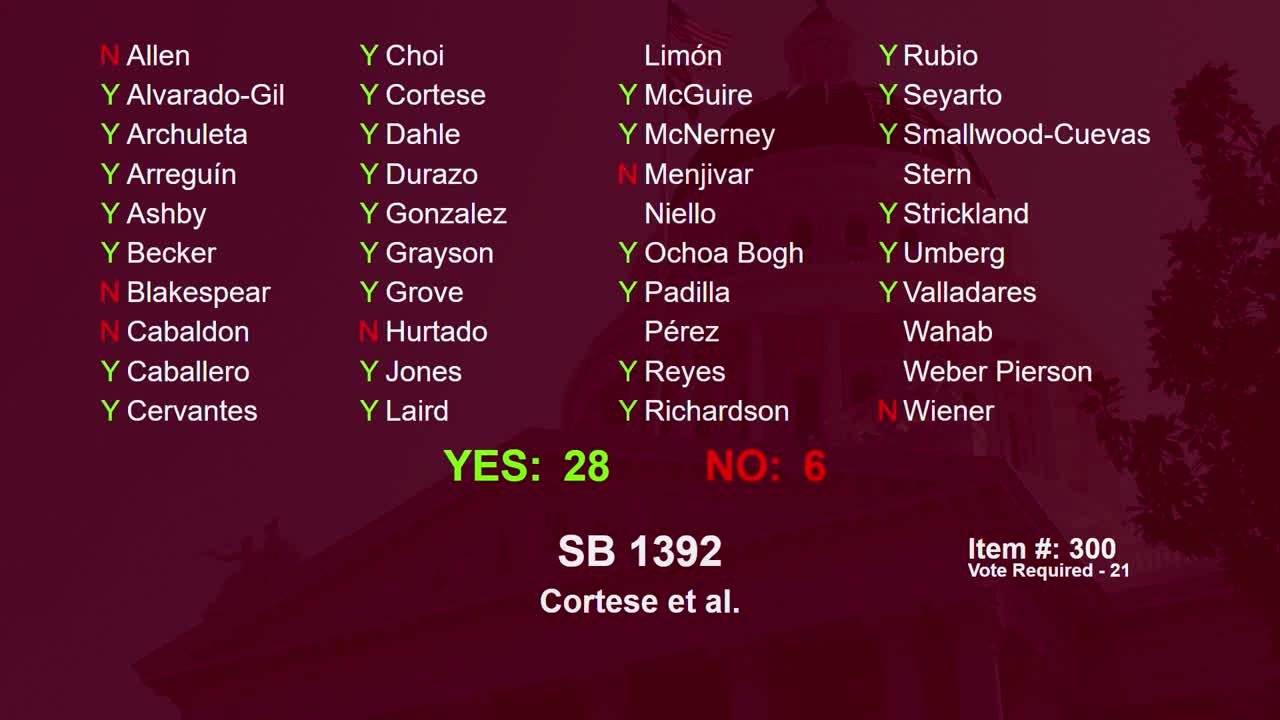 43SEC
Senate Floor
 11MIN
Senate Standing Committee on Public Safety
Bill Author

Bill Co-Author(s):