SB 1209: Insurance: examination of insurers.
- Session Year: 2025-2026
- House: Senate
- Latest Version Date: 2026-09-30
Current Status:
Passed
(2026-09-30: Chaptered by Secretary of State. Chapter 1017, Statutes of 2026.)
Introduced
In Committee
Awaiting First Chamber Vote
Passed First Chamber
In Committee
Awaiting Second Chamber Vote
Passed Second Chamber
Enacted
Existing law authorizes the Insurance Commissioner to conduct examinations of insurers whenever they deem it appropriate, or for admitted insurers, at least once every 5 years. Existing law requires the examiner in charge to file a verified written report of the examination with the department. Existing law requires the department to transmit that report to the company examined with a notice that the company has 30 days to make a written submission or rebuttal to any matters contained in the report. Existing law requires the commissioner, within 30 days of the end of the period allowed for the company to reply, to fully consider the report and any submissions and either adopt the report as filed, with modifications, or reject the report with an order to reopen the examination.
This bill would require an examined company to take corrective actions to remediate violations of specified laws and regulations identified in the report. The bill would require a company that fails to adopt the necessary corrective actions to be subject to a penalty. The bill would authorize the company to request an additional extension to comply in specified circumstances. The bill would require the commissioner, if the commissioner has reason to believe that a company has not complied with a recommendation in the report, to issue and serve an order to show cause on the company with a statement of the charges, its potential liability, and a notice of hearing. If the charges are found to be justified, the bill would require the commissioner to issue an order requiring the company to pay a specified penalty and to comply with and implement the recommendations contained in the report. The bill would require the hearing be held in compliance with the Administrative Procedure Act and would state that these powers would be additional to any other powers currently vested in the commissioner to enforce the provisions of this code.
Existing law authorizes the Insurance Commissioner to conduct examinations of insurers whenever they deem it appropriate, or for admitted insurers, at least once every 5 years. Existing law requires the examiner in charge to file a verified written report of the examination with the department. Existing law requires the department to transmit that report to the company examined with a notice that the company has 30 days to make a written submission or rebuttal to any matters contained in the report. Existing law requires the commissioner, within 30 days of the end of the period allowed for the company to reply, to fully consider the report and any submissions and either adopt the report as filed, with modifications, or reject the report with an order to reopen the examination.
This bill would require an examined company to comply with all of the recommendations take corrective actions to remediate violations of specified laws and regulations identified in the report. The bill would require a company that fails to adopt the necessary corrective actions to be subject to a penalty. The bill would authorize the company to request an additional extension to comply in specified circumstances. The bill would require the commissioner, if the commissioner has reason to believe that a company has not complied with a recommendation in the report, to issue and serve an order to show cause on the company with a statement of the charges, its potential liability, and a notice of hearing. If the charges are found to be justified, the bill would require the commissioner to issue an order requiring the company to pay a specified penalty and to comply with and implement the recommendations contained in the report. The bill would require the hearing be held in compliance with the Administrative Procedure Act and would state that these powers would be additional to any other powers currently vested in the commissioner to enforce the provisions of this code.
Existing law authorizes the Insurance Commissioner to conduct examinations of insurers whenever they deem it appropriate, or for admitted insurers, at least once every 5 years. Existing law requires the examiner in charge to file a verified written report of the examination with the department. Existing law requires the department to transmit that report to the company examined with a notice that the company has 30 days to make a written submission or rebuttal to any matters contained in the report. Existing law requires the commissioner, within 30 days of the end of the period allowed for the company to reply, to fully consider the report and any submissions and either adopt the report as filed, with modifications, or reject the report with an order to reopen the examination.
This bill would require an examined company to comply with all of the recommendations in the report. The bill would require the commissioner, if the commissioner has reason to believe that a company has not complied with a recommendation in the report, to issue and serve an order to show cause on the company with a statement of the charges, its potential liability, and a notice of hearing. If the charges are found to be justified, the bill would require the commissioner to issue an order requiring the company to pay a specified penalty and to comply with and implement the recommendations contained in the report. The bill would require the hearing be held in compliance with the Administrative Procedure Act and would state that these powers would be additional to any other powers currently vested in the commissioner to enforce the provisions of this code.
(a)No later than 60 days following completion of the examination, the examiner in charge shall file with the department a verified written report of the examination under oath. Upon receipt of the verified report, the department shall transmit the report to the company examined, together with a notice that the company has 30 days to make a written submission or rebuttal with respect to any matters contained in the examination report.
(b)Within 30 days of the end of the period allowed for the receipt of written submissions or rebuttals, the commissioner shall fully consider and review the report, together with any written submissions or rebuttals and any relevant portions of the examiners workpapers, and shall either adopt the report as filed or with modifications or corrections, or reject the report with directions to the examiners to reopen the examination for purposes of obtaining additional data, documentation, or information, and refiling pursuant to subdivision (a).
(c)(1)An examined company shall take corrective actions to remediate violations of applicable statutes, regulations, statutory accounting principles as referenced in Section 923, and other legally binding applicable rules identified in the report of examination or other operational report conducted by the commissioner or their designee. If the company fails to adopt the necessary corrective action in a timeframe agreed upon by the commissioner or their designee, the company shall be subject to a penalty of up to twenty thousand dollars ($20,000) for each failure to take corrective action.
(2)A company may request additional extensions of 30 calendar days or other greater extensions approved by the commissioner, for good cause, in order to comply. The commissioner or their designee may deny a request for extension of time if it is determined the request is not made in good faith or there has not been a good faith effort to comply. For purposes of this subdivision, good cause shall include circumstances beyond the companys control, a showing that the company has made a good faith effort to comply, or other factors agreed to by the commissioner.
(3)For purposes of this subdivision, a failure to take corrective action shall be determined per specific category of corrective action requested as described in the examination.
(4)For purposes of determining penalties to assess under this subdivision, if the company examined is licensed as an insurance agent or broker, other than a managing general agent as defined in Section 769.81, the commissioner shall consider, in addition to other factors, the proportionate nature of the violation or violations and the scale and complexity of the licensees operations.
(d)(1)If the commissioner has reason to believe that a company has violated subdivision (c), and that a proceeding by the commissioner would be in the interest of the public, the commissioner shall issue and serve upon that company an order to show cause containing a statement of the charges in that respect, a statement of that companys potential liability under this section, and a notice of a hearing for the purpose of determining whether the commissioner should issue an order to that company to pay the penalty imposed by this section and to comply with and implement the recommendations contained in the report. The notice of hearing shall include the time and place of the hearing and shall be heard no less than 30 days after service of the notice. If the charges are found to be justified, the commissioner shall issue, and serve on the company, an order requiring the company to pay the penalty imposed by this section and to comply with and implement the recommendations contained in the report. The hearing shall be conducted in accordance with the Administrative Procedure Act (Chapter 5 (commencing with Section 11500) of Part 1 of Division 3 of Title 2 of the Government Code), except that the hearings may be conducted by an administrative law judge in the departments administrative law bureau when the proceedings involve a common question of law or fact with another proceeding arising under other provisions that may be conducted by administrative law bureau administrative law judges. The commissioner and the appointed administrative law judge have all the powers granted under the Administrative Procedure Act.
(2)The company is entitled to have the proceedings and the order reviewed by means of any remedy provided by Section 12940 or the Administrative Procedure Act.
(e)The powers vested in the commissioner in this section are in addition to any other powers to enforce penalties, fines or forfeitures, and denials, suspensions, or revocations of licenses and certificates, authorized by law with respect to the methods, acts, and practices in violation of this code.
(f)(1)Nothing contained in this article shall be construed to limit the commissioners authority to terminate or suspend any examination in order to pursue other legal or regulatory action pursuant to the insurance laws of this state.
(2)If the commissioner terminates or suspends an examination that includes an examination of claims practices, the commissioner shall within 10 days of the termination or suspension transmit a copy of the complete examination file to the State Bureau of Audits. The State Auditor shall audit the file pursuant to Section 10527 of the Government Code to determine the propriety of the termination or suspension.
(a)No later than 60 days following completion of the examination, the examiner in charge shall file with the department a verified written report of the examination under oath. Upon receipt of the verified report, the department shall transmit the report to the company examined, together with a notice that the company has 30 days to make a written submission or rebuttal with respect to any matters contained in the examination report.
(b)Within 30 days of the end of the period allowed for the receipt of written submissions or rebuttals, the commissioner shall fully consider and review the report, together with any written submissions or rebuttals and any relevant portions of the examiners workpapers, and shall either adopt the report as filed or with modifications or corrections, or reject the report with directions to the examiners to reopen the examination for purposes of obtaining additional data, documentation, or information, and refiling pursuant to subdivision (a).
(c)(1)An examined company shall comply with all recommendations take corrective actions to remediate violations of applicable statutes, regulations, statutory accounting principles as referenced in Section 923, and other legally binding applicable rules identified in the report of examination or other operational report conducted by the commissioner or their designee. If the company fails to adopt any recommendation the necessary corrective action in a timeframe agreed upon by the commissioner or their designee, the company shall be fined subject to a penalty of up to twenty thousand dollars ($20,000) for each recommendation not followed. This penalty may be in addition to any other penalties provided by law. failure to take corrective action.
(2)A company may request additional extensions of 30 calendar days or other greater extensions approved by the commissioner, for good cause, in order to comply. The commissioner or their designee may deny a request for extension of time if it is determined the request is not made in good faith or there has not been a good faith effort to comply. For purposes of this subdivision, good cause shall include circumstances beyond the companys control, a showing that the company has made a good faith effort to comply, or other factors agreed to by the commissioner.
(3)For purposes of this subdivision, a failure to take corrective action shall be determined per specific category of corrective action requested as described in the examination.
(d)(1)If the commissioner has reason to believe that a company has violated subdivision (c), and that a proceeding by the commissioner would be in the interest of the public, the commissioner shall issue and serve upon that company an order to show cause containing a statement of the charges in that respect, a statement of that companys potential liability under this section, and a notice of a hearing for the purpose of determining whether the commissioner should issue an order to that company to pay the penalty imposed by this section and to comply with and implement the recommendations contained in the report. The notice of hearing shall include the time and place of the hearing and shall be heard no less than 30 days after service of the notice. If the charges are found to be justified, the commissioner shall issue, and serve on the company, an order requiring the company to pay the penalty imposed by this section and to comply with and implement the recommendations contained in the report. The hearing shall be conducted in accordance with the Administrative Procedure Act (Chapter 5 (commencing with Section 11500) of Part 1 of Division 3 of Title 2 of the Government Code), except that the hearings may be conducted by an administrative law judge in the departments administrative law bureau when the proceedings involve a common question of law or fact with another proceeding arising under other provisions that may be conducted by administrative law bureau administrative law judges. The commissioner and the appointed administrative law judge have all the powers granted under the Administrative Procedure Act.
(2)The company is entitled to have the proceedings and the order reviewed by means of any remedy provided by Section 12940 or the Administrative Procedure Act.
(e)The powers vested in the commissioner in this section are in addition to any other powers to enforce penalties, fines or forfeitures, and denials, suspensions, or revocations of licenses and certificates, authorized by law with respect to the methods, acts, and practices in violation of this code.
(f)(1)Nothing contained in this article shall be construed to limit the commissioners authority to terminate or suspend any examination in order to pursue other legal or regulatory action pursuant to the insurance laws of this state.
(2)If the commissioner terminates or suspends an examination that includes an examination of claims practices, the commissioner shall within 10 days of the termination or suspension transmit a copy of the complete examination file to the State Bureau of Audits. The State Auditor shall audit the file pursuant to Section 10527 of the Government Code to determine the propriety of the termination or suspension.
(a)No later than 60 days following completion of the examination, the examiner in charge shall file with the department a verified written report of the examination under oath. Upon receipt of the verified report, the department shall transmit the report to the company examined, together with a notice that the company has 30 days to make a written submission or rebuttal with respect to any matters contained in the examination report.
(b)Within 30 days of the end of the period allowed for the receipt of written submissions or rebuttals, the commissioner shall fully consider and review the report, together with any written submissions or rebuttals and any relevant portions of the examiners workpapers, and shall either adopt the report as filed or with modifications or corrections, or reject the report with directions to the examiners to reopen the examination for purposes of obtaining additional data, documentation, or information, and refiling pursuant to subdivision (a).
(c)An examined company shall comply with all recommendations in the report of examination or other operational report conducted by the commissioner or their designee. If the company fails to adopt any recommendation in a timeframe agreed upon by the commissioner or their designee, the company shall be fined up to twenty thousand dollars ($20,000) for each recommendation not followed. This penalty may be in addition to any other penalties provided by law.
(d)(1)If the commissioner has reason to believe that a company has violated subdivision (c), and that a proceeding by the commissioner would be in the interest of the public, the commissioner shall issue and serve upon that company an order to show cause containing a statement of the charges in that respect, a statement of that companys potential liability under this section, and a notice of a hearing for the purpose of determining whether the commissioner should issue an order to that company to pay the penalty imposed by this section and to comply with and implement the recommendations contained in the report. The notice of hearing shall include the time and place of the hearing and shall be heard no less than 30 days after service of the notice. If the charges are found to be justified, the commissioner shall issue, and serve on the company, an order requiring the company to pay the penalty imposed by this section and to comply with and implement the recommendations contained in the report. The hearing shall be conducted in accordance with the Administrative Procedure Act (Chapter 5 (commencing with Section 11500) of Part 1 of Division 3 of Title 2 of the Government Code), except that the hearings may be conducted by an administrative law judge in the departments administrative law bureau when the proceedings involve a common question of law or fact with another proceeding arising under other provisions that may be conducted by administrative law bureau administrative law judges. The commissioner and the appointed administrative law judge have all the powers granted under the Administrative Procedure Act.
(2)The company is entitled to have the proceedings and the order reviewed by means of any remedy provided by Section 12940 or the Administrative Procedure Act.
(e)The powers vested in the commissioner in this section are in addition to any other powers to enforce penalties, fines or forfeitures, and denials, suspensions, or revocations of licenses and certificates, authorized by law with respect to the methods, acts, and practices in violation of this code.
(c)(f)(1)Nothing contained in this article shall be construed to limit the commissioners authority to terminate or suspend any examination in order to pursue other legal or regulatory action pursuant to the insurance laws of this state.
(2)If the commissioner terminates or suspends an examination that includes an examination of claims practices, the commissioner shall within 10 days of the termination or suspension transmit a copy of the complete examination file to the State Bureau of Audits. The State Auditor shall audit the file pursuant to Section 10527 of the Government Code to determine the propriety of the termination or suspension.
|
Date
|
Status
|
|---|---|
| Sep 30, 2026 | Chaptered by Secretary of State. Chapter 1017, Statutes of 2026. |
| Sep 30, 2026 | Approved by the Governor. |
| Sep 4, 2026 | Enrolled and presented to the Governor at 2 p.m. |
| Aug 28, 2026 | Assembly amendments concurred in. (Ayes 31. Noes 0. Page 6089.) Ordered to engrossing and enrolling. |
| Aug 28, 2026 | Assembly amendments concurred in. (Ayes 31. Noes 0.) Ordered to engrossing and enrolling. |
| Aug 28, 2026 | In Senate. Concurrence in Assembly amendments pending. |
| Aug 27, 2026 | Read third time. Passed. (Ayes 64. Noes 11. Page 6706.) Ordered to the Senate. |
| Aug 27, 2026 | Read third time. Passed. Ordered to the Senate. |
| Aug 6, 2026 | Read second time. Ordered to third reading. |
| Aug 5, 2026 | From committee: Do pass. (Ayes 12. Noes 2.) (August 5). |
| Jun 17, 2026 | From committee: Do pass and re-refer to Com. on APPR. (Ayes 15. Noes 1.) (June 17). Re-referred to Com. on APPR. |
| Jun 10, 2026 | From committee with author's amendments. Read second time and amended. Re-referred to Com. on INS. |
| May 26, 2026 | Referred to Com. on INS. |
| May 20, 2026 | In Assembly. Read first time. Held at Desk. |
| May 19, 2026 | Read third time. Passed. (Ayes 30. Noes 8. Page 4359.) Ordered to the Assembly. |
| May 19, 2026 | Read third time. Passed. (Ayes 30. Noes 8.) Ordered to the Assembly. |
| May 18, 2026 | Read second time. Ordered to third reading. |
| May 14, 2026 | From committee: Do pass as amended. (Ayes 5. Noes 1. Page 4269.) (May 14). |
| May 14, 2026 | Read second time and amended. Ordered to second reading. |
| May 14, 2026 | From committee: Do pass as amended. (Ayes 5. Noes 1.) (May 14). |
| May 8, 2026 | Set for hearing May 14. |
| May 4, 2026 | May 4 hearing: Placed on APPR. suspense file. |
| Apr 24, 2026 | Set for hearing May 4. |
| Apr 23, 2026 | From committee: Do pass and re-refer to Com. on APPR. (Ayes 5. Noes 2. Page 4012.) (April 22). Re-referred to Com. on APPR. |
| Apr 23, 2026 | From committee: Do pass and re-refer to Com. on APPR. (Ayes 5. Noes 2.) (April 22). Re-referred to Com. on APPR. |
| Apr 10, 2026 | Set for hearing April 22. |
| Mar 4, 2026 | Referred to Com. on INS. |
| Feb 20, 2026 | From printer. May be acted upon on or after March 22. |
| Feb 19, 2026 | Introduced. Read first time. To Com. on RLS. for assignment. To print. |
|
Date
|
Description
|
Location
|
Votes
|
|
|---|---|---|---|---|
| Aug 28, 2026 | Unfinished Business SB1209 Allen Concurrence | Senate Floor |
Passed |
|
| Aug 27, 2026 | SB 1209 Allen Senate Third Reading By Calderon | Assembly Floor |
Passed |
|
| Aug 5, 2026 | Do pass. | Assembly Standing Committee on Appropriations |
Passed |
|
| Jun 17, 2026 | Do pass and be re-referred to the Committee on [Appropriations] | Assembly Standing Committee on Insurance |
Passed |
|
| May 19, 2026 | Senate 3rd Reading SB1209 Allen | Senate Floor |
Passed |
|
| May 14, 2026 | Do pass as amended | Senate Standing Committee on Appropriations |
Passed |
|
| May 4, 2026 | Placed on suspense file | Senate Standing Committee on Appropriations |
Passed |
|
| Apr 22, 2026 | Do pass, but first be re-referred to the Committee on [Appropriations] | Senate Standing Committee on Insurance |
Passed |
This list shows positions taken on this bill by organizations on the date displayed, which is linked to the original source.
Positions by individuals are not included.
|
Organization
|
Position
|
Date
|
|---|---|---|
| American Property Casualty Insurance Association | ** Against | |
| Association Of California Life And Health Insurance Companies | ** Against | |
| California Department of Insurance | ** Support | |
| California Land Title Association | ** Against | |
| Independent Insurance Agents and Brokers of California | ** Against | |
| Insurance Commissioner Ricardo Lara | ** Support | |
| Insurance Information Institute | ** Against | |
| National Association of Mutual Insurance Companies | ** Against | |
| Pacific Association Of Domestic Insurance Companies | ** Against | |
| Personal Insurance Federation Of California | ** Against |
SENATE RULES COMMITTEE Office of Senate Floor Analyses (916) 651-4171 | SB 1209 |
UNFINISHED BUSINESS
Bill No: SB 1209
Author: Allen (D)
Amended: 6/10/26
Vote: 21
SENATE INSURANCE COMMITTEE: 5-2, 4/22/26
AYES: Padilla, Becker, Menjivar, Richardson, Rubio
NOES: Niello, Jones
SENATE APPROPRIATIONS COMMITTEE: 5-1, 5/14/26
AYES: Cervantes, Cabaldon, Grayson, Richardson, Wahab
NOES: Dahle
NO VOTE RECORDED: Seyarto
SENATE FLOOR: 30-8, 5/19/26
AYES: Allen, Archuleta, Arreguín, Ashby, Becker, Blakespear, Cabaldon, Caballero, Cervantes, Cortese, Durazo, Gonzalez, Grayson, Hurtado, Laird, Limón, McGuire, McNerney, Menjivar, Padilla, Pérez, Reyes, Richardson, Rubio, Smallwood-Cuevas, Stern, Umberg, Wahab, Weber Pierson, Wiener
NOES: Alvarado-Gil, Choi, Dahle, Grove, Jones, Seyarto, Strickland, Valladares
NO VOTE RECORDED: Niello, Ochoa Bogh
ASSEMBLY FLOOR: Passed, 8/27/26
SUBJECT: Insurance: examination of insurers
SOURCE: Insurance Commissioner Ricardo Lara/California Department of Insurance
DIGEST:
This bill provides the Insurance Commissioner (Commissioner) with the authority to take action to compel insurance companies to correct violations of applicable statutes, regulations, statutory accounting principles, and other legally binding applicable rules identified in an examination report of an insurance company. This bill creates a hearing process for the Commissioner to evaluate an insurer’s non-compliance with these provisions and consider imposing related penalties.
Assembly Amendments
specify the considerations for penalty assessment of insurance agents and brokers by the Commissioner.
ANALYSIS:
Existing law:
- States that the Commissioner may conduct examinations of insurers at the Commissioner’s discretion, but must conduct an examination of every admitted insurer at least once every five years.
- Requires every company or person from whom information is sought, to provide to the examiners, timely, convenient, and free access to all books, records, accounts, papers, documents, and any or all computer or other recordings relating to the property, assets, business, and affairs of the company being examined. The Commissioner has the power to issue subpoenas, administer oaths, and examine under oath any person as to any matter pertinent to the examination.
- Specifies that within 60 days following completion of the examination, the examiner in charge shall file with the California Department of Insurance (CDI), a written report of the examination under oath. Upon receipt of the report, CDI must transmit the report to the company examined, together with a notice that the company has 30 days to make a written submission or rebuttal with respect to any matters contained in the examination report.
- States that within 30 days of the end of the allowed submissions or rebuttal period, the Commissioner will fully consider and review the report, together with any written submissions or rebuttals, and either adopt the report as filed or with modifications or corrections, or reject the report with directions to the examiners to reopen the examination for purposes of obtaining additional data, documentation, or information, and refiling.
This bill:
- Requires examined insurance companies to correct violations of applicable statutes, regulations, statutory accounting principles, and other legally binding applicable rules identified in an examination report.
- Allows a company to request a 30-day extension, or a longer extension approved by the Commissioner for good cause, to comply with remediation requirements.
- Authorizes the Commissioner or their designee to deny an extension request.
- If the Commissioner believes that a company has violated the provisions above, and a proceeding would be in the interest of the public, the Commissioner will issue and serve that company an order to show cause containing a statement of the charges, a statement of that company’s potential liability, and a notice of a hearing to determine whether the Commissioner should issue an order to pay the penalty imposed by these provisions and to comply with and implement the findings contained in the report.
- Specifies that the notice of hearing include the time and place of the hearing, which must occur 30 days after service of the notice.
- States that if the charges are found to be justified, the Commissioner must issue and serve the company an order requiring payment of the relevant penalty and compliance with and implementation of the findings contained in the report.
- Requires related hearings be conducted in accordance with the Administrative Procedure Act, except that the hearings may be conducted by an administrative law judge in CDI’s administrative law bureau, as specified.
Related/Prior Legislation
SB 1805 (Escutia, Chapter 997, Statutes of 2000). Required the Commissioner to make public all final market conduct reports relating to unfair claims practices.
AB 1680 (Calderon) of the current legislative session, would require the California FAIR Plan to comply with the recommendations of a report of examination or other operational report and would subject the FAIR Plan to certain fines and penalties associated with failing to adopt the report recommendations within a timeframe agreed upon by the Commissioner or their designee.
FISCAL EFFECT: Appropriation: No Fiscal Com.: Yes Local: No
According to the Assembly Appropriations Committee:
CDI reports costs of approximately $3,000 in fiscal year (FY) 2026-27, $87,000 in FY 2027-28, and $6,000 in FY 2028-29 and annually thereafter in enforcement workload to collect applicable penalties when a company fails to adopt a corrective action, partially offset by penalty revenue (Insurance Fund). Since this bill imposes a penalty for a violation of existing law identified in an IC report, rather than failing to adopt discretionary examination recommendations, it is reasonable that such enforcement costs are not significant. However, it is possible for this bill to result in higher costs to CDI on an ongoing basis, more similar to the costs CDI estimates for FY 2027-28, to the extent CDI must continue to take enforcement actions against non-compliant companies.
By vesting additional civil enforcement and penalty authority in the IC, for which appeals are adjudicated in superior court, this bill may result in ongoing cost pressures to the courts in additional workload. The magnitude of such cost pressures is likely minor, but is ultimately dependent on the disposition of such IC actions (General Fund or Trial Court Trust Fund).
SUPPORT: (Verified 8/25/26)
Insurance Commissioner Ricardo Lara / California Department of Insurance (source)
OPPOSITION: (Verified 8/25/26)
None received
ARGUMENTS IN SUPPORT:
Insurance Commissioner Ricardo Lara / California Department of Insurance, sponsor of thid bill, states:
“The Department of Insurance’s examinations routinely uncover operational deficiencies, compliance failures, and consumer‑protection risks within insurance companies. Yet under current law, insurers are not required to adopt corrective actions within any defined timeframe. This lack of a clear enforcement mechanism allows harmful practices to persist, undermines regulatory oversight, and leaves consumers exposed to avoidable harm.
SB 1209 provides the targeted authority needed to address this problem. The bill requires insurers to implement examination corrective actions within an agreed‑upon timeframe, establishes a formal order‑to‑show‑cause process, authorizes penalties of up to $20,000 for each failure to take corrective action, and allows insurers to request additional time to comply. These tools ensure that examination findings lead to real, timely corrective action rather than prolonged delays or incomplete remediation.
By creating a direct and enforceable pathway for compliance, SB 1209 strengthens consumer protections, promotes consistent industry standards, and reinforces the credibility of the Department’s oversight. Californians deserve an insurance market where identified problems are corrected swiftly—not left unresolved due to gaps in statutory authority.”
Prepared by: Brandon Seto / INS. / (916) 651-4110
8/27/26 15:12:14
**** END ****
SENATE THIRD READING
STR Bill Id:SB 1209
Author:(Allen)
As Amended Ver:June 10, 2026
Majority vote
SUMMARY
Requires an examined company to take corrective actions to remediate violations identified in the report of examination or other operational report conducted by the California Insurance Commissioner (IC) or their designee.
Major Provisions
- Provides that if the examined company fails to adopt the necessary corrective action in a timeframe agreed upon by the IC or their designee, the company shall be subject to a penalty of up to twenty thousand dollars ($20,000) for each failure to take corrective action.
- Allows an examined company to request additional extensions of 30 calendar days or more if approved by the IC, for good cause, in order to comply.
- Allows the IC or their designee to deny a request for extension of time if it is determined the request is not made in good faith or there has not been a good faith effort to comply.
- Defines "good cause" as circumstances beyond the company's control, a showing that the company has made a good faith effort to comply, or other factors agreed to by the IC.
- Provides that a failure to take corrective action shall be determined per specific category of corrective action requested as described in the examination.
- Specifies that for purposes of determining penalties (described above) if the company examined is licensed as an insurance agent or broker, the IC shall consider, in addition to other factors, the proportionate nature of the violation or violations and the scale and complexity of the licensee's operations.
- Provides that if the IC believes that a company has violated the provisions above, and that a proceeding would be in the interest of the public, the IC will issue and serve that company an order to show cause containing a statement of the charges, a statement of that company's potential liability, and a notice of a hearing to determine whether the IC should issue an order to pay the penalty imposed by these provisions and to comply with and implement the recommendations contained in the report.
- Specifies that the notice of hearing include the time and place of the hearing, which must occur 30 days after service of the notice.
- States that if the charges are found to be justified, the IC must issue and serve the company an order requiring payment of the relevant penalty and compliance with and implementation of the recommendations contained in the report.
- Requires that the hearing be conducted in accordance with the Administrative Procedure Act, except that the hearings may be conducted by an administrative law judge in the California Department of Insurance (CDI) administrative law bureau.
COMMENTS
Existing law authorizes the IC to conduct an examination, similar to an audit, of a licensed insurance company to evaluate the company's compliance with the Insurance Code and related regulations regarding rating, underwriting, and claim practices. The IC must conduct an examination of an admitted insurer at least once every five years. Within 60 days following completion of an examination, the examiner must file with CDI, under oath, a written report of the examination, which CDI must transmit to the company, along with a notice that the company has 30 days to submit a written rebuttal to any matter raised in the examination report. After the 30-day rebuttal period, the IC must either adopt the report as filed, with applicable modifications or corrections, or reject the report with directions to the examiner to reopen the examination for purposes of obtaining additional data, documentation, or information. This bill requires an insurance company to take corrective action to remediate a violation of law identified in an examination report or other operational report conducted by the IC, subjects a company that fails to adopt necessary corrective action in a timeframe agreed upon by the IC to a penalty of up to $20,000 for each failure, and specifies IC adjudication procedures to compel penalty payment and report compliance.
According to the Author
According to the Author, "Current law authorizes the Insurance Commissioner to conduct examinations of insurers to evaluate their market practices to verify that insurers operate fairly and in compliance with state law. These examinations often identify operational deficiencies and include findings and recommendations designed to protect consumers and improve company practices. The recommendations are intended to propose actions to remediate any violations of the law or to improve the financial health of an insurer to avoid potential default and risk to policyholders.
While most insurers voluntarily comply with actions proposed in the report, there is not a clear mechanism to require remediation of repeated violations. Current law does not provide a mechanism for an immediate form of enforcement for noncompliance. SB 1209 would allow the Insurance Commissioner to assess a fine up to $20,000 to an insurer for failing to address corrective actions proposed in an examination. The bill creates a formal hearing process for the Commissioner to determine whether to take an enforcement action and allows the insurer to appeal a decision to a court of law."
Arguments in Support
According to the Sponsor of the bill, Insurance Commissioner Ricardo Lara, "By creating a direct and enforceable pathway for compliance, SB 1209 strengthens consumer protections, promotes consistent industry standards, and reinforces the credibility of the Department's oversight. Californians deserve an insurance market where identified problems are corrected swiftly—not left unresolved due to gaps in statutory authority."
Arguments in Opposition
None on file.
FISCAL COMMENTS
According to the Assembly Appropriations Committee, CDI reports costs of approximately $3,000 in fiscal year (FY) 2026-27, $87,000 in FY 2027-28, and $6,000 in FY 2028-29 and annually thereafter in enforcement workload to collect applicable penalties when a company fails to adopt a corrective action, partially offset by penalty revenue (Insurance Fund). Since this bill imposes a penalty for a violation of existing law identified in an IC report, rather than failing to adopt discretionary examination recommendations, it is reasonable that such enforcement costs are not significant. However, it is possible for this bill to result in higher costs to CDI on an ongoing basis, more similar to the costs CDI estimates for FY 2027-28, to the extent CDI must continue to take enforcement actions against non-compliant companies.
By vesting additional civil enforcement and penalty authority in the IC, for which appeals are adjudicated in superior court, this bill may result in ongoing cost pressures to the courts in additional workload. The magnitude of such cost pressures is likely minor, but is ultimately dependent on the disposition of such IC actions (General Fund or Trial Court Trust Fund).
VOTES
SENATE FLOOR: 30-8-2
YES: Allen, Archuleta, Arreguín, Ashby, Becker, Blakespear, Cabaldon, Caballero, Cervantes, Cortese, Durazo, Gonzalez, Grayson, Hurtado, Laird, Limón, McGuire, McNerney, Menjivar, Padilla, Pérez, Reyes, Richardson, Rubio, Smallwood-Cuevas, Stern, Umberg, Wahab, Weber Pierson, Wiener
NO: Alvarado-Gil, Choi, Dahle, Grove, Jones, Seyarto, Strickland, Valladares
ABS, ABST OR NV: Niello, Ochoa Bogh
ASM INSURANCE: 15-1-1
YES: Calderon, Wallis, Addis, Papan, Ávila Farías, Berman, Chen, Gipson, Harabedian, Krell, Nguyen, Ortega, Petrie-Norris, Michelle Rodriguez, Valencia
NO: Hadwick
ABS, ABST OR NV: Ellis
ASM APPROPRIATIONS: 12-2-1
YES: Wicks, Hoover, Arambula, Calderon, Caloza, Fong, Mark González, Krell, Pacheco, Pellerin, Sharp-Collins, Solache
NO: Dixon, Tangipa
ABS, ABST OR NV: Ta
UPDATED
VERSION: June 10, 2026
CONSULTANT: Kathleen O'Malley / INS. / (916) 319-2086 FN: 0003362
Date of Hearing: August 5, 2026
ASSEMBLY COMMITTEE ON APPROPRIATIONS
Buffy Wicks, Chair
SBPCA Bill Id:SB 1209
Author:(Allen) – As Amended Ver:June 10, 2026
Policy Committee: | Insurance | Vote: | 15 - 1 |
|
| ||
|
|
Urgency: No State Mandated Local Program: No Reimbursable: No
SUMMARY:
This bill requires an insurance company to take corrective action to remediate a violation of law identified in an examination conducted by the Insurance Commissioner (IC).
Specifically, this bill:
- Requires an insurance company to take corrective action to remediate a violation of law or legally binding applicable rule identified in a report of examination or other operational report conducted by the IC, subjects a company that fails to adopt necessary corrective action in a timeframe agreed upon by the IC to a penalty of up to $20,000 for each failure, and authorizes a company to request an extension of 30 days or more to comply with the report.
- Requires the IC, if the IC has reason to believe a company has failed to implement report recommendations and pay the penalty, to issue and serve upon the company an order to show cause containing a statement of the charges, statement of the company’s potential liability, and notice of hearing.
- Requires the IC, if such charges against a company are found to be justified at a hearing, to issue an order requiring the company to pay the requisite penalty and comply with the corrective action identified in the examination report.
- Provides that the company is entitled to have the proceedings and order reviewed by a court of competent jurisdiction or a remedy specified in the Administrative Procedure Act.
FISCAL EFFECT:
- The Department of Insurance (CDI) reports costs of approximately $3,000 in fiscal year (FY) 2026-27, $87,000 in FY 2027-28, and $6,000 in FY 2028-29 and annually thereafter in enforcement workload to collect applicable penalties when a company fails to adopt a corrective action, partially offset by penalty revenue (Insurance Fund). Since this bill imposes a penalty for a violation of existing law identified in an IC report, rather than failing to adopt discretionary examination recommendations, it is reasonable that such enforcement costs are not significant. However, it is possible for this bill to result in higher costs to CDI on an ongoing basis, more similar to the costs CDI estimates for FY 2027-28, to the extent CDI must continue to take enforcement actions against non-compliant companies.
- By vesting additional civil enforcement and penalty authority in the IC, for which appeals are adjudicated in superior court, this bill may result in ongoing cost pressures to the courts in additional workload. The magnitude of such cost pressures is likely minor, but is ultimately dependent on the disposition of such IC actions (General Fund or Trial Court Trust Fund).
COMMENTS:
- Purpose. According to the author:
While most insurers voluntarily comply with actions proposed in [an examination] report, there is not a clear mechanism to require remediation of repeated violations. Current law does not provide a mechanism for an immediate form of enforcement for noncompliance. SB 1209 would allow the [IC] to assess a fine up to $20,000 to an insurer for failing to address corrective actions proposed in an examination. The bill creates a formal hearing process for the [IC] to determine whether to take an enforcement action and allows the insurer to appeal a decision to a court of law.
This bill is sponsored by IC Ricardo Lara.
- IC Examinations. Existing law authorizes the IC to conduct an examination, similar to an audit, of a licensed insurance company to evaluate the company’s compliance with the Insurance Code and related regulations regarding rating, underwriting, and claim practices. The IC must conduct an examination of an admitted insurer at least once every five years. Within 60 days following completion of an examination, the examiner must file with CDI, under oath, a written report of the examination, which CDI must transmit to the company, along with a notice that the company has 30 days to submit a written rebuttal to any matter raised in the examination report. After the 30-day rebuttal period, the IC must either adopt the report as filed, with applicable modifications or corrections, or reject the report with directions to the examiner to reopen the examination for purposes of obtaining additional data, documentation, or information. This bill requires an insurance company to take corrective action to remediate a violation of law identified in an examination report or other operational report conducted by the IC, subjects a company that fails to adopt necessary corrective action in a timeframe agreed upon by the IC to a penalty of up to $20,000 for each failure, and specifies IC adjudication procedures to compel penalty payment and report compliance.
- Related Legislation. AB 1680 (Calderon) requires the California FAIR Plan Association (FAIR Plan) to take action to correct a violation identified after an examination or other operational report conducted by the IC and imposes a fine of up to $20,000 for each violation if the FAIR Plan fails to take corrective action within the timeframe agreed upon by the IC. AB 1680 is pending hearing by the Senate Appropriations Committee.
Analysis Prepared by: Irene Ho / APPR. / (916) 319-2081
Date of Hearing: June 17, 2026
ASSEMBLY COMMITTEE ON INSURANCE
Lisa Calderon, Chair
SBPCA Bill Id:SB 1209
Author:(Allen) – As Amended Ver:June 10, 2026
SENATE VOTE: 30-8
SUBJECT: Insurance: examination of insurers
SUMMARY: Requires an examined company to take corrective actions to remediate violations identified in the report of examination or other operational report conducted by the California Insurance Commissioner (IC) or their designee. Specifically, this bill:
- Provides that if the examined company fails to adopt the necessary corrective action in a timeframe agreed upon by the IC or their designee, the company shall be subject to a penalty of up to twenty thousand dollars ($20,000) for each failure to take corrective action.
- Allows an examined company to request additional extensions of 30 calendar days or more if approved by the IC, for good cause, in order to comply.
- Allows the IC or their designee to deny a request for extension of time if it is determined the request is not made in good faith or there has not been a good faith effort to comply.
- Defines “good cause” as circumstances beyond the company’s control, a showing that the company has made a good faith effort to comply, or other factors agreed to by the IC.
- Provides that a failure to take corrective action shall be determined per specific category of corrective action requested as described in the examination.
- Specifies that for purposes of determining penalties (#1 above) if the company examined is licensed as an insurance agent or broker, the IC shall consider, in addition to other factors, the proportionate nature of the violation or violations and the scale and complexity of the licensee’s operations.
- Provides that if the IC believes that a company has violated the provisions above, and that a proceeding would be in the interest of the public, the IC will issue and serve that company an order to show cause containing a statement of the charges, a statement of that company’s potential liability, and a notice of a hearing to determine whether the IC should issue an order to pay the penalty imposed by these provisions and to comply with and implement the recommendations contained in the report.
- Specifies that the notice of hearing include the time and place of the hearing, which must occur 30 days after service of the notice.
- States that if the charges are found to be justified, the IC must issue and serve the company an order requiring payment of the relevant penalty and compliance with and implementation of the recommendations contained in the report.
- Requires that the hearing be conducted in accordance with the Administrative Procedure Act, except that the hearings may be conducted by an administrative law judge in the California Department of Insurance (CDI) administrative law bureau.
EXISTING LAW:
- States that the IC may conduct examinations of insurers at the IC’s discretion, but must conduct an examination of every admitted insurer at least once every five years. (Insurance Code, Section 730)
- Requires every company or person from whom information is sought, to provide to the examiners, timely, convenient, and free access to all books, records, accounts, papers, documents, and any or all computer or other recordings relating to the property, assets, business, and affairs of the company being examined. The IC has the power to issue subpoenas, administer oaths, and examine under oath any person as to any matter pertinent to the examination. (Insurance Code, Section 734)
- Specifies that within 60 days following completion of the examination, the examiner in charge shall file with CDI, a written report of the examination under oath. Upon receipt of the report, CDI must transmit the report to the company examined, together with a notice that the company has 30 days to make a written submission or rebuttal with respect to any matters contained in the examination report. (Insurance Code, Section 734.1)
- States that within 30 days of the end of the allowed submissions or rebuttal period, the IC will fully consider and review the report, together with any written submissions or rebuttals, and either adopt the report as filed or with modifications or corrections, or reject the report with directions to the examiners to reopen the examination for purposes of obtaining additional data, documentation, or information, and refiling. (Insurance Code, Section 734.1)
FISCAL EFFECT: Unknown
COMMENTS:
- Purpose of the bill: According to the Author, “Current law authorizes the Insurance Commissioner to conduct examinations of insurers to evaluate their market practices to verify that insurers operate fairly and in compliance with state law. These examinations often identify operational deficiencies and include findings and recommendations designed to protect consumers and improve company practices. The recommendations are intended to propose actions to remediate any violations of the law or to improve the financial health of an insurer to avoid potential default and risk to policyholders.
While most insurers voluntarily comply with actions proposed in the report, there is not a clear mechanism to require remediation of repeated violations. Current law does not provide a mechanism for an immediate form of enforcement for noncompliance. SB 1209 would allow the Insurance Commissioner to assess a fine up to $20,000 to an insurer for failing to address corrective actions proposed in an examination. The bill creates a formal hearing process for the Commissioner to determine whether to take an enforcement action and allows the insurer to appeal a decision to a court of law.”
- Background: This measure will allow CDI to issue a fine up to $20,000 for failing to take correction action as proposed in a market conduct examination report. Currently, the IC lacks the authority to require insurers to comply with any violations that stem from the market conduct exam.
CDI conducts examinations of licensed insurance companies to evaluate insurers' compliance with the California Insurance Code and the California Code of Regulations with respect to rating, underwriting, and claim practices. These are called market conduct examinations which are similar to an audit. Market conduct examination reports document the findings of the examiners. The reports identify any alleged violations of the Unfair Practices Act discovered during the examinations, and summarize actions taken by the insurers to correct alleged non-compliant practice.
- Related Legislation: AB 1680 (Calderon) This measure requires the Fair Access to Insurance Requirements (FAIR) Plan take actions to correct violations of applicable statutes, regulations, or rules identified by the IC after an examination or other operational report conducted by the IC, and requires the FAIR Plan be fined up to $20,000 for each violation if the FAIR Plan fails to take corrective action within the timeframe agreed upon with the IC.
Pending before the Senate Insurance Committee.
REGISTERED SUPPORT / OPPOSITION:
Support
Insurance Commissioner Ricardo Lara / California Department of Insurance
Opposition
None on file.
Analysis Prepared by: Kathleen O'Malley / INS. / (916) 319-2086
SENATE RULES COMMITTEE Office of Senate Floor Analyses (916) 651-4171 | SB 1209 |
THIRD READING
Bill No: SB 1209
Author: Allen (D)
Amended: 5/14/26
Vote: 21
SENATE INSURANCE COMMITTEE: 5-2, 4/22/26
AYES: Padilla, Becker, Menjivar, Richardson, Rubio
NOES: Niello, Jones
SENATE APPROPRIATIONS COMMITTEE: 5-1, 5/14/26
AYES: Cervantes, Cabaldon, Grayson, Richardson, Wahab
NOES: Dahle
NO VOTE RECORDED: Seyarto
SUBJECT: Insurance: examination of insurers
SOURCE: Insurance Commissioner Ricardo Lara/California Department of Insurance
DIGEST:
This bill provides the Insurance Commissioner (Commissioner) with the authority to take action to compel insurance companies to correct violations of applicable statutes, regulations, statutory accounting principles, and other legally binding applicable rules identified in an examination report of an insurance company. This bill creates a hearing process for the Commissioner to evaluate an insurer’s non-compliance with these provisions and consider imposing related penalties.
ANALYSIS:
Existing law:
- States that the Insurance Commissioner may conduct examinations of insurers at the Commissioner’s discretion, but must conduct an examination of every admitted insurer at least once every five years.
- Requires every company or person from whom information is sought, to provide to the examiners, timely, convenient, and free access to all books, records, accounts, papers, documents, and any or all computer or other recordings relating to the property, assets, business, and affairs of the company being examined. The Commissioner has the power to issue subpoenas, administer oaths, and examine under oath any person as to any matter pertinent to the examination.
- Specifies that within 60 days following completion of the examination, the examiner in charge shall file with the California Department of Insurance (CDI), a written report of the examination under oath. Upon receipt of the report, CDI must transmit the report to the company examined, together with a notice that the company has 30 days to make a written submission or rebuttal with respect to any matters contained in the examination report.
- States that within 30 days of the end of the allowed submissions or rebuttal period, the Commissioner will fully consider and review the report, together with any written submissions or rebuttals, and either adopt the report as filed or with modifications or corrections, or reject the report with directions to the examiners to reopen the examination for purposes of obtaining additional data, documentation, or information, and refiling.
This bill:
- Requires examined insurance companies to correct violations of applicable statutes, regulations, statutory accounting principles, and other legally binding applicable rules identified in an examination report.
- Allows a company to request a 30-day extension, or a longer extension approved by the Commissioner for good cause, to comply with remediation requirements.
- Authorizes the Commissioner or their designee to deny an extension request.
- If the Commissioner believes that a company has violated the provisions above, and that a proceeding would be in the interest of the public, the Commissioner will issue and serve that company an order to show cause containing a statement of the charges, a statement of that company’s potential liability, and a notice of a hearing to determine whether the Commissioner should issue an order to pay the penalty imposed by these provisions and to comply with and implement the recommendations contained in the report.
- Specifies that the notice of hearing include the time and place of the hearing, which must occur 30 days after service of the notice.
- States that if the charges are found to be justified, the Commissioner must issue and serve the company an order requiring payment of the relevant penalty and compliance with and implementation of the recommendations contained in the report.
- Requires that the hearing be conducted in accordance with the Administrative Procedure Act, except that the hearings may be conducted by an administrative law judge in CDI’s administrative law bureau, as specified.
Related/Prior Legislation
SB 1805 (Escutia, Chapter 997, Statutes of 2000). Required the Commissioner to make public all final market conduct reports relating to unfair claims practices.
AB 1680 (Calderon) of the current legislative session, would require the California FAIR Plan to comply with the recommendations of a report of examination or other operational report and would subject the FAIR Plan to certain fines and penalties associated with failing to adopt the report recommendations within a timeframe agreed upon by the Commissioner or their designee.
FISCAL EFFECT: Appropriation: No Fiscal Com.: Yes Local: No
According to the Senate Appropriations Committee:
Unknown potential increase in enforcement workload for CDI to address noncompliance with remediation requirements (Insurance Fund). It is possible that higher aggregate penalties may incentivize insurers to contest enforcement actions through the administrative hearing process rather than opting for immediate compliance, which may increase administrative and adjudicatory workload. The magnitude of this workload would depend on the number of violations identified in an examination and the specific penalties assessed. However, given that the bill mandates harsher penalties for violating existing law rather than failing to adopt discretionary exam recommendations, the overall impact on CDI’s enforcement activities may be absorbable.
SUPPORT: (Verified 5/15/26)
Insurance Commissioner Ricardo Lara/California Department of Insurance (source)
OPPOSITION: (Verified 5/15/26)
Independent Insurance Agents and Brokers of California
ARGUMENTS IN SUPPORT: As sponsor, Insurance Commissioner Ricardo Lara, states in support of a previous version of this bill:
“This bill ensures that corrective recommendations issued through financial and market conduct examinations are implemented promptly protecting consumers and strengthening the integrity of the insurance market.
The Department of Insurance’s examinations routinely uncover operational deficiencies, compliance failures, and consumer‑protection risks within insurance companies. Yet under current law, insurers are not required to adopt corrective recommendations within any defined timeframe. This lack of a clear enforcement mechanism allows harmful practices to persist, undermines regulatory oversight, and leaves consumers exposed to avoidable harm.
SB 1209 provides the targeted authority needed to address this problem. The bill requires insurers to implement examination recommendations within an agreed‑upon timeframe, establishes a formal order to show cause process, and authorizes penalties of up to $20,000 per violation for noncompliance. These tools ensure that examination findings lead to real, timely corrective action rather than prolonged delays or incomplete remediation.
By creating a direct and enforceable pathway for compliance, SB 1209 strengthens consumer protections, promotes consistent industry standards, and reinforces the credibility of the Department’s oversight. Californians deserve an insurance market where identified problems are corrected swiftly—not left unresolved due to gaps in statutory authority.”
ARGUMENTS IN OPPOSITION: The Independent Insurance Agents and Brokers of California state:
“While we support strong consumer protection and a well-regulated insurance market, SB 1209 would significantly expand the Insurance Commissioner’s investigatory, examination, and enforcement authority in ways that would affect not only insurers, but also agents and brokers. These changes risk destabilizing an already fragile insurance marketplace and negatively impacting the professionals who serve California policyholders every day. This bill would extend the Commissioner’s enhanced investigatory and enforcement authority beyond insurers to include agencies, brokerages, and individual licensees. This creates substantial uncertainty for licensees, who already operate under extensive regulatory obligations. The bill’s shift from collaborative oversight to prescriptive mandates may expose agents and brokers to penalties for disagreements over professional judgment rather than actual misconduct.
For decades, California has relied on a cooperative model between regulators, insurers, and licensees to address issues such as wildfire risk, market instability, and consumer complaints. SB 1209 shifts this dynamic toward more adversarial, mandatory enforcement—even in situations where dialogue and incremental correction would better serve consumers. Agents and brokers thrive in a system where corrective guidance is clear, collaborative, and consistent—not punitive or open to interpretation.”
Prepared by: Brandon Seto / INS. / (916) 651-4110
5/18/26 15:24:04
**** END ****
SENATE COMMITTEE ON
Senator Sabrina Cervantes, Chair
2025 - 2026 Regular Session
SB 1209 (Allen) - Insurance: examination of insurers
Version: | Policy Vote: |
Urgency: | Mandate: |
Hearing Date: | Consultant: |
Bill Summary:
SB 1209 requires insurance companies to comply with all recommendations included in an examination or operational report issued by the California Department of Insurance (CDI) following an examination and establishes a fine of up to $20,000 for each recommendation not adopted within an agreed-upon timeframe. SB 1209 also establishes a hearing process to adjudicate an insurer’s failure to comply with report recommendations and to determine the imposition of associated penalties, as specified.
*********** ANALYSIS ADDENDUM – SUSPENSE FILE ***********
The following information is revised to reflect amendments
adopted by the committee on May 14, 2026
Fiscal Impact:
Unknown potential increase in enforcement workload for CDI to address noncompliance with remediation requirements (Insurance Fund). It is possible that higher aggregate penalties may incentivize insurers to contest enforcement actions through the administrative hearing process rather than opting for immediate compliance, which may increase administrative and adjudicatory workload. The magnitude of this workload would depend on the number of violations identified in an examination and the specific penalties assessed. However, given that the bill mandates harsher penalties for violating existing law rather than failing to adopt discretionary exam recommendations, the overall impact on CDI’s enforcement activities may be absorbable.
Author Amendments:
- Strike the requirement for insurers to comply with all exam recommendations, and instead require examined companies to take corrective actions to remediate violations of applicable statutes, regulations, statutory accounting principles, and other legally binding applicable rules identified in an examination report.
- Authorize a company to request a 30-day extension, or a longer extension approved by the commissioner for good cause, to comply with remediation requirements.
- Authorize the commissioner or their designee to deny an extension request.
- Make conforming changes.
-- END --
SENATE COMMITTEE ON
Senator Sabrina Cervantes, Chair
2025 - 2026 Regular Session
SB 1209 (Allen) - Insurance: examination of insurers
Version: | Policy Vote: |
Urgency: | Mandate: |
Hearing Date: | Consultant: |
Bill Summary:
SB 1209 requires insurance companies to comply with all recommendations included in an examination or operational report issued by the California Department of Insurance (CDI) following an examination and establishes a fine of up to $20,000 for each recommendation not adopted within an agreed-upon timeframe. SB 1209 also establishes a hearing process to adjudicate an insurer’s failure to comply with report recommendations and to determine the imposition of associated penalties, as specified.
Fiscal Impact:
Unknown potential increase in enforcement workload for CDI to address noncompliance with examination report recommendations, which may be offset to some extent by penalty revenue (Insurance Fund). It is possible that higher aggregate penalties may incentivize insurers to contest enforcement actions through the administrative hearing process rather than opting for immediate compliance, which may increase administrative and adjudicatory workload. The magnitude of this workload would depend on the number of recommendations with which the insurer is noncompliant, and any additional penalties attached.
Background:
CDI is mandated to oversee the financial solvency and market conduct of all insurers licensed to do business in the state. To fulfill this regulatory duty, the Insurance Commissioner has broad authority to conduct examinations of insurance companies.
According to CDI’s website, its Field Examination Division conducts on-site financial examinations under the provisions of Section 730 of the California Insurance Code, which charges the Insurance Commissioner with the duty to examine the business affairs of every admitted insurer whenever deemed necessary to determine its financial condition and compliance with all applicable laws. Unless financial or other conditions warrant an immediate examination, domestic insurers are usually examined triennially. Foreign insurers are usually examined in accordance with the National Association of Insurance Commissioners (NAIC) Association Plan of Examination.
Proposed Law:
- Requires an examined company to comply with all recommendations in an examination or other operational report issued by the commissioner or their designee following an examination.
- Establishes a fine of up to $20,000 for each recommendation not adopted within a timeframe agreed upon by the commissioner or their designee. Clarifies that these fines may be imposed in addition to any other penalties provided under existing law.
- Authorizes the commissioner to issue an order to show cause if there is reason to believe a company has violated compliance requirements and a proceeding serves the public interest. Requires the order to show cause to contain a statement of the charges, the company’s potential liability, and a notice of hearing.
- Specifies that hearing notice must include the time and place of the proceeding and be served at least 30 days in advance.
- Requires the hearing to be conducted in accordance with the Administrative Procedure Act (APA), but allows an administrative law judge from CDI’s administrative law bureau to preside if the case involves common questions of law or fact with other CDI proceedings.
- Mandates the commissioner to issue a final order requiring both the payment of penalties and the implementation of report recommendations if the charges are found to be justified.
- Provides the company has the right to seek review of the proceedings and final orders through established remedies provided by Section 12940 of the Insurance Code or the APA.
-- END --
SENATE COMMITTEE ON INSURANCE
Senator Stephen Padilla, Chair
2025 - 2026 Regular
Bill No: SB 1209 Hearing Date: April 22, 2026
Author: | Allen | ||
Version: | February 19, 2026 Introduced | ||
Urgency: | No | Fiscal: | Yes |
Consultant: | Brandon Seto | ||
SUBJECT: Insurance: examination of insurers
DIGEST:
Provides the Insurance Commissioner (Commissioner) with the authority to require adoption of the Department of Insurance’s recommendations in a report examining an insurance company. Creates a hearing process for the Commissioner to evaluate an insurer’s non-compliance with a report’s recommendations and consider imposing related penalties.
ANALYSIS:
Existing law:
- States that the Insurance Commissioner may conduct examinations of insurers at the Commissioner’s discretion, but must conduct an examination of every admitted insurer at least once every five years.
- Requires every company or person from whom information is sought, to provide to the examiners, timely, convenient, and free access to all books, records, accounts, papers, documents, and any or all computer or other recordings relating to the property, assets, business, and affairs of the company being examined. The Commissioner has the power to issue subpoenas, administer oaths, and examine under oath any person as to any matter pertinent to the examination.
- Specifies that within 60 days following completion of the examination, the examiner in charge shall file with the California Department of Insurance (CDI), a written report of the examination under oath. Upon receipt of the report, CDI must transmit the report to the company examined, together with a notice that the company has 30 days to make a written submission or rebuttal with respect to any matters contained in the examination report.
- States that within 30 days of the end of the allowed submissions or rebuttal period, the Commissioner will fully consider and review the report, together with any written submissions or rebuttals, and either adopt the report as filed or with modifications or corrections, or reject the report with directions to the examiners to reopen the examination for purposes of obtaining additional data, documentation, or information, and refiling.
This bill:
- States that an examined company must comply with all recommendations in a report of examination or other operational report conducted by the Commissioner or their designee. Failure to adopt any recommendation in a timeframe agreed upon by the Commissioner or their designee will result in the company being fined up to $20,000 for each recommendation not followed, in addition to any other penalties provided by law.
- If the Commissioner believes that a company has violated the provisions above, and that a proceeding would be in the interest of the public, the Commissioner will issue and serve that company an order to show cause containing a statement of the charges, a statement of that company’s potential liability, and a notice of a hearing to determine whether the Commissioner should issue an order to pay the penalty imposed by these provisions and to comply with and implement the recommendations contained in the report.
- Specifies that the notice of hearing include the time and place of the hearing, which must occur 30 days after service of the notice.
- States that if the charges are found to be justified, the Commissioner must issue and serve the company an order requiring payment of the relevant penalty and compliance with and implementation of the recommendations contained in the report.
- Requires that the hearing be conducted in accordance with the Administrative Procedure Act, except that the hearings may be conducted by an administrative law judge in CDI’s administrative law bureau, as specified.
Background
According to the author:
“Current law authorizes the Insurance Commissioner to conduct examinations of insurers to evaluate their market practices to verify that insurers operate fairly and in compliance with state law. These examinations often identify operational deficiencies and include findings and recommendations designed to protect consumers and improve company practices. The recommendations are intended to propose actions to remediate any violations of the law or to improve the financial health of an insurer to avoid potential default and risk to policyholders.
While most insurers voluntarily comply with actions proposed in the report, there is not a clear mechanism to require remediation of violations. Current law does not provide a mechanism for an immediate form of enforcement for noncompliance.
SB 1209 would allow the Insurance Commissioner to assess a fine up to $20,000 to an insurer for failing to address corrective actions proposed in an examination. The bill creates a formal hearing process for the Commissioner to determine whether to take an enforcement action and allows the insurer to appeal a decision to a court of law.”
Related/Prior Legislation
SB 1805 (Escutia, Chapter 997, Statutes of 2000). Required the Commissioner to make public all final market conduct reports relating to unfair claims practices.
AB 1680 (Calderon). Would require the California FAIR Plan to comply with the recommendations of a report of examination or other operational report and would subject the FAIR Plan to certain fines and penalties associated with failing to adopt the report recommendations within a timeframe agreed upon by the Commissioner or their designee. Pending in Assembly Appropriations Committee.
ARGUMENTS IN SUPPORT:
Insurance Commissioner Ricardo Lara, sponsor of the bill, states:
“This bill ensures that corrective recommendations issued through financial and market conduct examinations are implemented promptly protecting consumers and strengthening the integrity of the insurance market.
The Department of Insurance’s examinations routinely uncover operational deficiencies, compliance failures, and consumer‑protection risks within insurance companies. Yet under current law, insurers are not required to adopt corrective recommendations within any defined timeframe. This lack of a clear enforcement mechanism allows harmful practices to persist, undermines regulatory oversight, and leaves consumers exposed to avoidable harm.
SB 1209 provides the targeted authority needed to address this problem. The bill requires insurers to implement examination recommendations within an agreed‑upon timeframe, establishes a formal order to show cause process, and authorizes penalties of up to $20,000 per violation for noncompliance. These tools ensure that examination findings lead to real, timely corrective action rather than prolonged delays or incomplete remediation.
By creating a direct and enforceable pathway for compliance, SB 1209 strengthens consumer protections, promotes consistent industry standards, and reinforces the credibility of the Department’s oversight. Californians deserve an insurance market where identified problems are corrected swiftly—not left unresolved due to gaps in statutory authority.”
ARGUMENTS IN OPPOSITION:
A coalition of associations representing insurers, as well as independent agents and brokers states:
“This bill changes ‘recommendations’ into mandates. The CDI has extensive enforcement authority under existing law. Recommendations and findings where no violation of statute or regulation is alleged must be grounded in law, statute or regulation, and may appropriately lead to corrective action. Recommendations or findings are areas where CDI may request changes, generally in discretionary business practices. These are areas where companies maintain some level of autonomy and may negotiate with their regulator which recommendations they will adopt and be held to, and which they either cannot or will not adopt (with justifications given to CDI). These recommendations are often advisory in nature and reflect an examiner’s perspective rather than the law.
CDI claims that they have insufficient authority and that this bill provides lacking enforcement mechanisms. However, under the California Code of Regulations Title 10 §2591.3, CDI has extensive authority over enforcing law, in statute or regulation, but a company cannot be mandated to comply with something that is not law. That is what this expansion does.
The effect of this change would create a pathway for binding rules that are not grounded in statute nor adopted through formal rulemaking. The Administrative Procedures Act (APA) has six requirements that a regulation must meet before it is approved; authority, reference, consistency, clarity, nonduplication, and necessity (California Government Code §11349.1). These requirements ensure that there is sufficient protection of law before a regulated entity can be subject to enforcement or penalization. SB 1209 curtails that process, removing the existing due process protections and will result in numerous “desk drawer” regulations that will likely vary examiner to examiner, disrupting any consistency, notice, and due process regulated entities currently have.”
SUPPORT:
Insurance Commissioner Ricardo Lara / California Department of Insurance (Sponsor)
OPPOSITION:
American Property Casualty Insurance Association
Association of California Life and Health Insurance Companies
California Land Title Association
Independent Insurance Agents and Brokers of California
Insurance Information Institute
National Association of Mutual Insurance Companies
Pacific Association of Domestic Insurance Companies
Personal Insurance Federation of California
-- END --
Discussed in Hearing
 1MIN
Senate Floor
 5MIN
Assembly Floor
 1MIN
Assembly Standing Committee on Appropriations
 7MIN
Assembly Standing Committee on Insurance
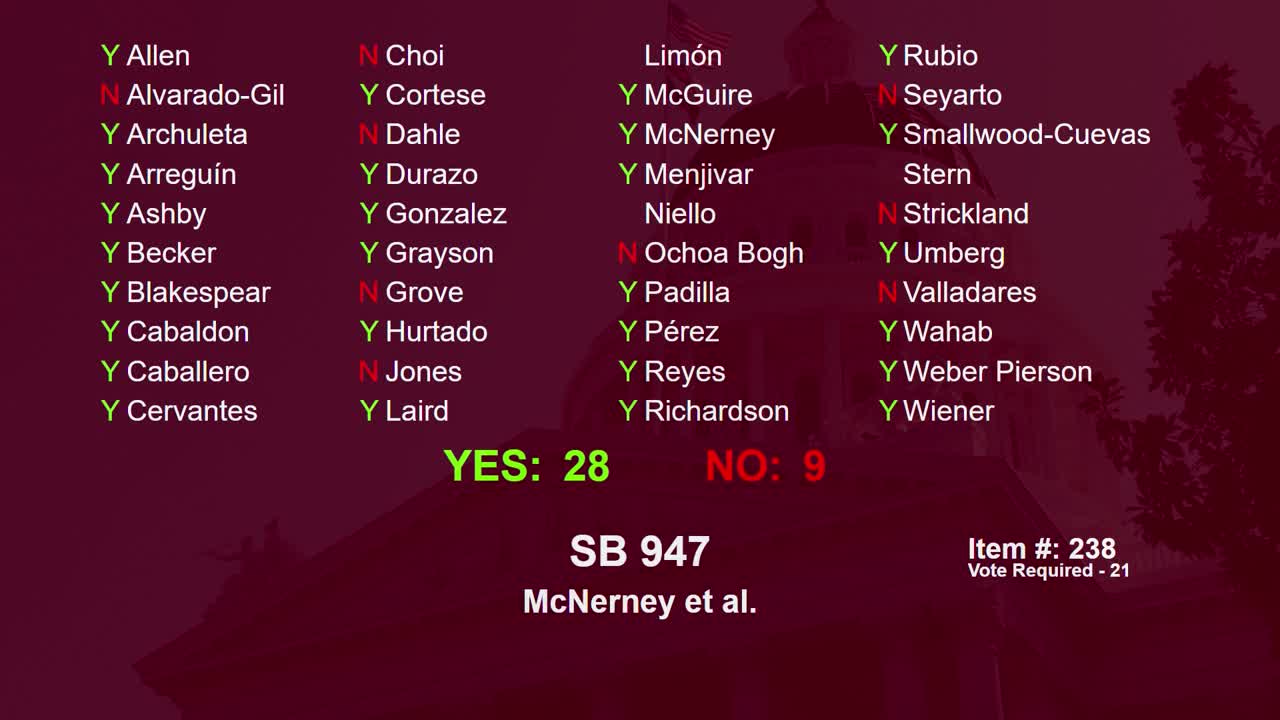 2MIN
Senate Floor
 37MIN
Senate Standing Committee on Insurance
Bill Author

Bill Co-Author(s):