SB 1211: Criminal procedure: postconviction investigation.
- Session Year: 2025-2026
- House: Senate
- Latest Version Date: 2026-09-18
Current Status:
Passed
(2026-09-18: Chaptered by Secretary of State. Chapter 325, Statutes of 2026.)
Introduced
In Committee
Awaiting First Chamber Vote
Passed First Chamber
In Committee
Awaiting Second Chamber Vote
Passed Second Chamber
Enacted
Existing law provides for the prosecution of crimes by the district attorney of each county. Existing law establishes procedures for litigating claims of factual innocence based on newly discovered evidence, including a motion for a new trial or a writ of habeas corpus.
This bill would, if the district attorney accepts a case for postconviction review, as defined, authorize the district attorney to file a notice with the court notifying the court of the intent to investigate a claim of factual innocence. The bill would, upon the filing of the above-described notice, deem the case to be treated as if it were an open case for the purposes of investigating a claim of factual innocence. The bill would provide the district attorney with the power to issue subpoenas, compel the production of document and testimony, and file necessary motions to investigate claims, as specified. The bill would also require all materials obtained by the district attorney to be subject to a protective order, as specified, and to be disclosed to the petitioner or the petitioners counsel within 60 days of the termination of the investigation.
Existing law provides for the prosecution of crimes by the district attorney of each county. Existing law establishes procedures for litigating claims of factual innocence based on newly discovered evidence, including a motion for a new trial or a writ of habeas corpus.
This bill would, if the district attorney accepts a case for postconviction review, require as defined, authorize the district attorney to file a notice with the court notifying the court of the intent to investigate a claim of factual innocence. The bill would, upon the filing of the above-described notice, deem the case to be treated as if it were an open case for the purposes of investigating a claim of factual innocence. The bill would provide the district attorney with the power to issue subpoenas, compel the production of document and testimony, and file necessary motions to investigate claims, as specified.
Existing law provides for the prosecution of crimes by the district attorney of each county. Existing law establishes procedures for litigating claims of factual innocence based on newly discovered evidence, including a motion for a new trial or a writ of habeas corpus.
This bill would, if the district attorney accepts a case for postconviction review, require the district attorney to file a notice with the court notifying the court of the intent to investigate a claim of factual innocence. The bill would, upon the filing of the above-described notice, deem the case to be treated as if it were an open case for the purposes of investigating a claim of factual innocence. The bill would provide the district attorney with the power to issue subpoenas, compel the production of document and testimony, and file necessary motions to investigate claims, as specified.
(a)(1)If the district attorney accepts a case for postconviction review, the district attorney may file a notice with the court notifying the court of intent to conduct a postconviction investigation of a claim of factual innocence.
(2)For purposes of this section, accepts a case for postconviction review means that a conviction integrity unit or other formally designated unit of a district attorneys office that is tasked solely with the investigation and review of postconviction claims of factual innocence, or, if no such unit exists, a district attorney or team assigned by the district attorneys office to conduct an independent postconviction investigation and review, has formally accepted for internal review a claim of factual innocence at the request or initiation of the petitioner alleging factual innocence.
(b)(1)Upon the filing of a notice described in subdivision (a), the case shall be treated as if it were an open case for the purposes of investigating a claim of factual innocence. The district attorney shall have the power to issue subpoenas and compel the production of documents and testimony in accordance with Section 1326, file motions necessary to investigate claims, including, but not limited to, motions for personnel records pursuant to Pitchess v. Superior Court (1974) 11 Cal.3d 531, motions for court-ordered appointment of counsel, and motions for removal of prisoners consistent with the district attorneys authority when initiating and conducting cases pursuant to Chapter 1 (commencing with Section 26500) of Part 3 of Division 2 of Title 3 of the Government Code and consistent with the criminal discovery process outlined in Chapter 10 (commencing with Section 1054) of Title 6.
(2)To the extent the district attorney seeks otherwise confidential materials relating to the petitioner, including, but not limited to, materials contained in the petitioners central file, institutional records, medical records, employment records, or school records, the district attorney shall obtain a written waiver from the petitioner or the petitioners counsel before the discovery is authorized.
(c)The authority granted under this section shall not be exercised if any direct appeal, habeas corpus proceeding, motion for new trial, or other collateral attack concerning the same conviction is pending in any state or federal court, unless the petitioner or petitioners counsel agrees to the exercise of that authority.
(d)All materials obtained pursuant to the powers conferred on the district attorney pursuant to this section shall be subject to a protective order issued by the court. The protective order shall ensure that the materials are used solely for purposes of the postconviction investigation or any proceedings in which the state seeks to vacate or modify the conviction or sentence, a request for a finding of factual innocence, or a state compensation proceeding, and shall prohibit disclosure except as authorized by the court upon a showing of good cause.
(e)If the district attorney learns, pursuant to the powers conferred on the district attorney pursuant to this section, of new, credible, and material evidence creating a reasonable likelihood that the petitioner did not commit an offense of which the petitioner was convicted, the district attorney shall promptly disclose that evidence to the court, and if the conviction was obtained in the district attorneys jurisdiction, promptly disclose that evidence to the petitioner unless the court authorizes delay.
(f)All materials obtained pursuant to this section shall be equally disclosed to the petitioner or the petitioners counsel within 60 days of the termination of the investigation.
(g)This section does not relieve a district attorneys obligation to seek to remedy a conviction upon a determination of factual innocence.
(h)A district attorney may implement written policies and procedures to ensure compliance with this section.
(a)(1)If the district attorney accepts a case for postconviction review, the district attorney may file a notice with the court notifying the court of intent to conduct a postconviction investigation of a claim of factual innocence.
(2)For purposes of this section, accepts a case for postconviction review means that a conviction integrity unit or other formally designated unit of a district attorneys office that is structurally independent from the trial, appellate, and habeas litigation divisions of the office, tasked solely with the investigation and review of postconviction claims of factual innocence, or, if no such unit exists, a district attorney or team assigned by the district attorneys office to conduct an independent postconviction investigation and review, has formally accepted for internal review a claim of factual innocence at the request or initiation of the petitioner alleging factual innocence.
(b)(1)Upon the filing of a notice described in subdivision (a), the case shall be treated as if it were an open case for the purposes of investigating a claim of factual innocence. The district attorney shall have the power to issue subpoenas and compel the production of documents and testimony in accordance with Section 1326, file motions necessary to investigate claims, including, but not limited to, motions for personnel records pursuant to Pitchess v. Superior Court (1974) 11 Cal.3d 531, motions for court-ordered appointment of counsel, and motions for removal of prisoners consistent with the district attorneys authority when initiating and conducting cases pursuant to Chapter 1 (commencing with Section 26500) of Part 3 of Division 2 of Title 3 of the Government Code and consistent with the criminal discovery process outlined in Chapter 10 (commencing with Section 1054) of Title 6.
(2)To the extent the district attorney seeks otherwise confidential materials relating to the petitioner, including, but not limited to, materials contained in the petitioners central file or file, institutional records, medical records, employment records, or school records, the district attorney shall obtain a written waiver from the petitioner or the petitioners counsel before the discovery is authorized.
(c)The authority granted under this section shall not be exercised if any direct appeal, habeas corpus proceeding, motion for new trial, or other collateral attack concerning the same conviction is pending in any state or federal court, unless the petitioner or petitioners counsel agrees to the exercise of that authority.
(d)All materials obtained pursuant to the powers conferred on the district attorney pursuant to this section shall be subject to a protective order issued by the court. The protective order shall ensure that the materials are used solely for purposes of the postconviction investigation or any proceedings in which the state seeks to vacate or modify the conviction or sentence, a request for a finding of factual innocence, or a state compensation proceeding, and shall prohibit disclosure except as authorized by the court upon a showing of good cause.
(e)If the district attorney learns, pursuant to the powers conferred on the district attorney pursuant to this section, of new, credible, and material evidence creating a reasonable likelihood that the petitioner did not commit an offense of which the petitioner was convicted, the district attorney shall promptly disclose that evidence to the court, and if the conviction was obtained in the district attorneys jurisdiction, promptly disclose that evidence to the petitioner unless the court authorizes delay.
(f)All materials obtained pursuant to this section shall be equally disclosed to the petitioner or the petitioners counsel within 60 days of the termination of the investigation.
(g)This section does not relieve a district attorneys obligation to seek to remedy a conviction upon a determination of factual innocence.
(h)A district attorney may implement written policies and procedures to ensure compliance with this section.
REVISIONS: HeadingLine 2.(a)(1)If the district attorney accepts a case for postconviction review, the district attorney shall may file a notice with the court notifying the court of intent to conduct a postconviction investigation of a claim of factual innocence.
(2)For purposes of this section, accepts a case for postconviction review means that a conviction integrity unit or other formally designated unit of a district attorneys office that is structurally independent from the trial, appellate, and habeas litigation divisions of the office, has formally accepted for internal review a claim of factual innocence at the request or initiation of the petitioner alleging factual innocence.
(b)(1)Upon the filing of a notice described in subdivision (a), the case shall be treated as if it were an open case for the purposes of investigating a claim of factual innocence. The district attorney shall have the power to issue subpoenas and compel the production of documents and testimony in accordance with Section 1326, file motions necessary to investigate claims, including, but not limited to, motions for personnel records pursuant to Pitchess v. Superior Court (1974) 11 Cal.3d 531, motions for court-ordered appointment of counsel, and motions for removal of prisoners consistent with the district attorneys authority when initiating and conducting cases pursuant to Chapter 1 (commencing with Section 26500) of Part 3 of Division 2 of Title 3 of the Government Code and consistent with the criminal discovery process outlined in Chapter 10 (commencing with Section 1054) of Title 6.
(2)To the extent the district attorney seeks otherwise confidential materials relating to the petitioner, including, but not limited to, materials contained in the petitioners central file or institutional records, the district attorney shall obtain a written waiver from the petitioner or the petitioners counsel before the discovery is authorized.
(c)The authority granted under this section shall not be exercised if any direct appeal, habeas corpus proceeding, motion for new trial, or other collateral attack concerning the same conviction is pending in any state or federal court, unless the petitioner or petitioners counsel agrees to the exercise of that authority.
(a)If the district attorney accepts a case for postconviction review, the district attorney shall file a notice with the court notifying the court of intent to conduct a postconviction investigation of a claim of factual innocence.
(b)Upon the filing of a notice described in subdivision (a), the case shall be treated as if it were an open case for the purposes of investigating a claim of factual innocence. The district attorney shall have the power to issue subpoenas and compel the production of documents and testimony in accordance with Section 1326, file motions necessary to investigate claims, including, but not limited to, motions for personnel records pursuant to Pitchess v. Superior Court (1974) 11 Cal.3d 531, motions for court-ordered appointment of counsel, and motions for removal of prisoners consistent with the district attorneys authority when initiating and conducting cases pursuant to Chapter 1 (commencing with Section 26500) of Part 3 of Division 2 of Title 3 of the Government Code and consistent with the criminal discovery process outlined in Chapter 10 (commencing with Section 1054) of Title 6.
|
Date
|
Status
|
|---|---|
| Sep 18, 2026 | Chaptered by Secretary of State. Chapter 325, Statutes of 2026. |
| Sep 18, 2026 | Approved by the Governor. |
| Aug 21, 2026 | Enrolled and presented to the Governor at 3 p.m. |
| Aug 18, 2026 | In Senate. Ordered to engrossing and enrolling. |
| Aug 17, 2026 | Read third time. Passed. (Ayes 74. Noes 0. Page 6203.) Ordered to the Senate. |
| Aug 17, 2026 | Read third time. Passed. Ordered to the Senate. |
| Jul 2, 2026 | Ordered to third reading. |
| Jul 2, 2026 | From consent calendar on motion of Assembly Member Garcia. |
| Jun 25, 2026 | Read second time. Ordered to consent calendar. |
| Jun 24, 2026 | From committee: Do pass. Ordered to consent calendar. (Ayes 9. Noes 0.) (June 23). |
| Jun 24, 2026 | Coauthors revised. |
| Jun 4, 2026 | Referred to Com. on PUB. S. |
| May 28, 2026 | In Assembly. Read first time. Held at Desk. |
| May 28, 2026 | Read third time. Passed. (Ayes 39. Noes 0. Page 4524.) Ordered to the Assembly. |
| May 28, 2026 | Read third time. Passed. (Ayes 39. Noes 0.) Ordered to the Assembly. |
| May 19, 2026 | Read second time. Ordered to third reading. |
| May 18, 2026 | Ordered to second reading. |
| May 18, 2026 | Read third time and amended. |
| Apr 20, 2026 | Ordered to third reading. |
| Apr 20, 2026 | From consent calendar on motion of Senator Gonzalez. |
| Apr 15, 2026 | Read second time. Ordered to consent calendar. |
| Apr 14, 2026 | From committee: Do pass. Ordered to consent calendar. (Ayes 6. Noes 0. Page 3872.) (April 14). |
| Apr 14, 2026 | From committee: Do pass. Ordered to consent calendar. (Ayes 6. Noes 0.) (April 14). |
| Apr 6, 2026 | From committee with author's amendments. Read second time and amended. Re-referred to Com. on PUB. S. |
| Mar 27, 2026 | Set for hearing April 14. |
| Mar 26, 2026 | April 7 set for first hearing canceled at the request of author. |
| Mar 23, 2026 | Set for hearing April 7. |
| Mar 4, 2026 | Referred to Com. on PUB. S. |
| Feb 20, 2026 | From printer. May be acted upon on or after March 22. |
| Feb 19, 2026 | Introduced. Read first time. To Com. on RLS. for assignment. To print. |
|
Date
|
Description
|
Location
|
Votes
|
|
|---|---|---|---|---|
| Aug 17, 2026 | SB 1211 Gonzalez Senate Third Reading By Schultz | Assembly Floor |
Passed |
|
| Jun 23, 2026 | Do pass. To Consent Calendar. | Assembly Standing Committee on Public Safety |
Passed |
|
| May 28, 2026 | Senate 3rd Reading SB1211 Gonzalez | Senate Floor |
Passed |
|
| Apr 14, 2026 | Do pass and be ordered to the Consent Calendar | Senate Standing Committee on Public Safety |
Passed |
This list shows positions taken on this bill by organizations on the date displayed, which is linked to the original source.
Positions by individuals are not included.
|
Organization
|
Position
|
Date
|
|---|---|---|
| California Association Of Licensed Investigators | ** Support | |
| California Civil Liberties Advocacy | ** Support | |
| California Public Defenders Association | ** Support | |
| Los Angeles County District Attorney'S Office | ** Support | |
| Los Angeles District Attorney's Office | ** Support | |
| San Quentin Skunkworks | ** Support |
SENATE THIRD READING
STR Bill Id:SB 1211
Author:(Gonzalez)
As Amended Ver:May 18, 2026
Majority vote
SUMMARY
Authorizes the district attorney to file a notice with the court notifying it of their intent to conduct a postconviction investigation of a claim of factual innocence, if the district attorney accepts a case for postconviction review.
Major Provisions
- States the phrase "accepts a case for postconviction review" means that a conviction integrity unit (CIU) or other formally designated unit of a district attorney's office tasked solely with the investigation and review of postconviction claims of factual innocence - or, if no such unit exists, a district attorney or team assigned by the district attorney's office to conduct an independent postconviction investigation and review - has formally accepted for internal review a claim of factual innocence at the request or initiation of the petitioner alleging factual innocence.
- Requires the case, after filing the notice described above, to be treated as if it were an open case for the purpose of investigating a claim of factual innocence.
- Specifies that the district attorney has the power to issue subpoenas and compel the production of documents and testimony, as provided, and file motions necessary to investigate claims, including for production of peace officer personnel records, and motions for court-ordered appointment of counsel, among others.
- Mandates the district attorney obtain a written waiver from the petitioner or petitioner's counsel before discovery may be authorized, to the extent the district attorney seeks otherwise confidential materials relating to the petitioner, including, but not limited to, materials contained in the petitioner's central file, institutional records, medical records, employment records, or school records.
- Prohibits the district attorney from being granted any authority to conduct a postconviction investigation if any direct appeal, habeas corpus proceeding, motion for new trial, or other collateral attack concerning the same conviction is pending in any state or federal court, unless the petitioner or petitioner's counsel agrees to the exercise of that authority.
- States that if the district attorney learns, pursuant to the powers conferred to the district attorney by this bill, of new, credible, and material evidence creating a reasonable likelihood that the petitioner did not commit an offense of which the petitioner was convicted, the district attorney must promptly disclose that evidence to the court, and if the conviction was obtained in the district attorney's jurisdiction, promptly disclose that evidence to the petitioner unless the court authorizes delay.
- Requires all materials obtained through the process specified in this bill to be equally disclosed to the petitioner or the petitioner's counsel within 60 days of the termination of the investigation.
- States the provisions of this bill do not relieve a district attorney of their obligation to remedy a conviction upon a determination of factual innocence.
- Authorizes the district attorney to implement written policies and procedures to ensure compliance with this section.
COMMENTS
According to the Author
"Conviction Integrity Units (CIUs), housed within District Attorney offices, are tasked with investigating post-conviction innocence claims, including the mishandling of evidence, constitutional violations, juror misconduct, and factual innocence. California has 297 recorded exonerations, and CIUs have, to date, exonerated 35 individuals since their formation. Factual innocence investigations are investigations of closed cases, which makes it difficult for CIUs to access the documents and evidence needed to conduct their research of the claim. These delays can prevent access to justice for incarcerated individuals serving prison time for a crime they did not commit. SB 1211 streamlines the processing of post-conviction claims of factual innocence by clarifying that CIUs within prosecutorial agencies may investigate these claims as if they were open cases."
Arguments in Support
According to Los Angeles District Attorney's Office: "Specifically, the wording of existing law hampers the work of our Justice Conviction Review Unit (JCRU) because JCRU only investigates cases in which an individual has already been convicted."
"Current law provides prosecutorial agencies such as ours with avenues to resources during the pendency of open cases but denies us the ability to access materials after a defendant has been convicted. This unavailability of important information hinders our Office's ability to perform a comprehensive investigation of a post-conviction claim of factual innocence."
"Under current statutes, unavailable resources include:
- Subpoenas Duces Tecum (SDTs): Prosecutorial agencies may not issue SDTs for production of documents because there are no pending court dates.
- Confidential Files (C-files): Prosecutorial agencies may not SDT C-Files from the California Depa1iment of Correction and Rehabilitation (CDCR). Under CDCR rules, our Office would have to pay for the production of the prison records of unrepresented claimants, of which there are many C-Files are often critical to our truth-finding defemination process, especially the confidential 1isk assessment report that may detail the inmate's version of the charged criminal conduct.
- Pitchess Motions: At present, the Los Angeles City Attorney is challenging our Office's ability to review information in a law enforcement officer's personnel file, arguing that the Pitchess motion filed by JCRU personnel on five cases under review is only available on open cases.
- Removal Orders: The Federal Bureau of Prisons refuses to honor removal orders served by our Office because there is no open and pending matter.
- Appointment of Counsel: Inmates who have filed a claim pro per and witnesses who may have a privilege may need the appointment of counsel. Some judges have been reluctant or have refused to appoint counsel without an open matter.
"SB 1211 would solve these unintended obstacles to investigating factual innocence claims by providing prosecutorial agencies with the jurisdictional authority to investigate post-conviction claims in the same manner that our Office has to investigate open cases. An exoneration occurs when a person who has been convicted of a crime is officially cleared after new evidence of innocence becomes available. Since our JCRU was formed, our Office has been able to exonerate 16 individuals. When individuals who have been exonerated through the more traditional habeas corpus litigation process are included in that calculation, our Office has exonerated a total of 159 individuals. These statistics demonstrate that our criminal justice system does not always work the way it was intended. Because people occasionally suffer criminal convictions, it is incumbent that prosecutorial agencies are empowered with as many resources as possible to investigate claims of actual innocence in order to reach a fair and appropriate outcome. Without the investigatory tools that are typically available for an open case, the truth-finding process of innocence claims is uru1ecessarily delayed and sometimes actually hindered."
"Our JCRU currently has 76 cases under review, and new claims for post-conviction review are received most every week. There is no legal or policy reason to unnecessarily hinder these post-conviction innocence claims."
Arguments in Opposition
None submitted.
FISCAL COMMENTS
Unknown. This bill was keyed non-fiscal by the Legislative Counsel.
VOTES
SENATE FLOOR: 39-0-1
YES: Allen, Alvarado-Gil, Archuleta, Arreguín, Ashby, Becker, Blakespear, Cabaldon, Caballero, Cervantes, Choi, Cortese, Durazo, Gonzalez, Grayson, Grove, Hurtado, Jones, Laird, Limón, McGuire, McNerney, Menjivar, Niello, Ochoa Bogh, Padilla, Pérez, Reyes, Richardson, Rubio, Seyarto, Smallwood-Cuevas, Stern, Strickland, Umberg, Valladares, Wahab, Weber Pierson, Wiener
ABS, ABST OR NV: Dahle
ASM PUBLIC SAFETY: 9-0-0
YES: Schultz, Alanis, Mark González, Haney, Harabedian, Lackey, Nguyen, Ramos, Sharp-Collins
UPDATED
VERSION: May 18, 2026
CONSULTANT: Kimberly Horiuchi / PUB. S. / (916) 319-3744 FN: 0003278
Date of Hearing: June 23, 2026
Counsel: Kimberly Horiuchi
ASSEMBLY COMMITTEE ON PUBLIC SAFETY
Nick Schultz, Chair
SBPCA Bill Id:SB 1211
Author:(Gonzalez) – As Amended Ver:May 18, 2026
SUMMARY: Authorizes the district attorney to file a notice with the court notifying it of their intent to conduct a postconviction investigation of a claim of factual innocence, if the district attorney accepts a case for postconviction review. Specifically, this bill:
- States the phrase “accepts a case for postconviction review” means that a conviction integrity unit (CIU) or other formally designated unit of a district attorney’s office tasked solely with the investigation and review of postconviction claims of factual innocence - or, if no such unit exists, a district attorney or team assigned by the district attorney’s office to conduct an independent postconviction investigation and review - has formally accepted for internal review a claim of factual innocence at the request or initiation of the petitioner alleging factual innocence.
- Requires the case, after filing the notice described above, to be treated as if it were an open case for the purpose of investigating a claim of factual innocence.
- Specifies that the district attorney has the power to issue subpoenas and compel the production of documents and testimony, as provided, and file motions necessary to investigate claims, including for production of peace officer personnel records, and motions for court-ordered appointment of counsel, among others.
- Mandates the district attorney obtain a written waiver from the petitioner or petitioner’s counsel before discovery may be authorized, to the extent the district attorney seeks otherwise confidential materials relating to the petitioner, including, but not limited to, materials contained in the petitioner’s central file, institutional records, medical records, employment records, or school records.
- Prohibits the district attorney from being granted any authority to conduct a postconviction investigation if any direct appeal, habeas corpus proceeding, motion for new trial, or other collateral attack concerning the same conviction is pending in any state or federal court, unless the petitioner or petitioner’s counsel agrees to the exercise of that authority.
- States that if the district attorney learns, pursuant to the powers conferred to the district attorney by this bill, of new, credible, and material evidence creating a reasonable likelihood that the petitioner did not commit an offense of which the petitioner was convicted, the district attorney must promptly disclose that evidence to the court, and if the conviction was obtained in the district attorney’s jurisdiction, promptly disclose that evidence to the petitioner unless the court authorizes delay.
- Requires all materials obtained through the process specified in this bill to be equally disclosed to the petitioner or the petitioner’s counsel within 60 days of the termination of the investigation.
- States the provisions of this bill do not relieve a district attorney of their obligation to remedy a conviction upon a determination of factual innocence.
- Authorizes the district attorney to implement written policies and procedures to ensure compliance with this section.
EXISTING LAW:
- Provides, in any case where a person has been arrested and no accusatory pleading has been filed, the person arrested may petition the law enforcement agency having jurisdiction over the offense to destroy its records of the arrest. Requires a copy of the petition to be served upon the prosecuting attorney of the county or city having jurisdiction over the offense. Requires the law enforcement agency having jurisdiction over the offense to seal its arrest records and the petition for relief for three years from the date of the arrest and thereafter destroy its arrest records and the petition, upon a determination that the person arrested is factually innocent. (Pen. Code, § 851.85, subd. (a).)
- Requires the law enforcement agency having jurisdiction over the offense to notify the Department of Justice (DOJ), and any law enforcement agency that arrested the petitioner or participated in the arrest of the petitioner for an offense for which the petitioner has been found factually innocent, of the sealing of the arrest records and the reason. Requires DOJ and any law enforcement agency so notified to seal their arrest records and the notice of sealing for three years from the date of the arrest, and thereafter destroy their records of the arrest and the notice of sealing. Requires the law enforcement agency having jurisdiction over the offense and the DOJ to request the destruction of any records of the arrest which they have given to any local, state, or federal agency or to any other person or entity. Requires each agency, person, or entity within California receiving the request to destroy its records of the arrest and the request, unless otherwise provided in this section. (Pen. Code, § 851.85, subd. (a).)
- Provides that after receiving a petition for relief, if the law enforcement agency and prosecuting attorney do not respond to the petition by accepting or denying the petition within 60 days after the running of the relevant statute of limitations or within 60 days after receipt of the petition in cases where the statute of limitations has previously lapsed, the petition is deemed to be denied. (Pen. Code, § 851.85, subd. (b).)
- Authorizes any judicial determination of factual innocence to be heard and determined upon declarations, affidavits, police reports, or any other evidence submitted by the parties which is material, relevant, and reliable. Prohibits a finding of factual innocence and an order for the sealing and destruction of records from being made unless the court finds that no reasonable cause exists to believe that the arrestee committed the offense for which the arrest was made. (Pen. Code, § 851.85, subd. (b).)
- Provides, in any court hearing to determine the factual innocence of a party, that the initial burden of proof rests with the petitioner to show that no reasonable cause exists to believe that the arrestee committed the offense for which the arrest was made. Provides that the burden of proof shifts to the respondent to show that a reasonable cause exists to believe that the petitioner committed the offense for which the arrest was made if the court finds that this showing of no reasonable cause has been made by the petitioner. (Pen. Code, § 851.85, subd. (b).)
- Requires the court, if it finds the arrestee to be factually innocent of the charges for which the arrest was made, to order the law enforcement agency having jurisdiction over the offense, the DOJ, and any law enforcement agency which arrested the petitioner or participated in the arrest of the petitioner for an offense for which the petitioner has been found factually innocent to seal their records of the arrest and the court order to seal and destroy the records, for three years from the date of the arrest and to then destroy their records of the arrest and the court order to seal and destroy those records. (Pen. Code, § 851.85, subd. (b).)
- Authorizes a defendant, in any case where a person has been arrested and an accusatory pleading has been filed, but where no conviction has occurred, to petition the court that dismissed the action for a finding that the defendant is factually innocent of the charges for which the arrest was made, at any time after dismissal of the action. Requires a copy of the petition to be served on the prosecuting attorney in which the accusatory pleading was filed at least 10 days prior to the hearing on the petitioner’s factual innocence. Authorizes the prosecuting attorney to present evidence to the court at the hearing. Requires the hearing to be conducted as provided above. Requires the court to grant relief if the court finds the petitioner to be factually innocent of the charges for which the arrest was made. (Pen. Code, § 851.85, subd. (c).)
- Authorizes the court, with the concurrence of the prosecuting attorney, to grant the relief described above, in any case where a person has been arrested and an accusatory pleading has been filed, but where no conviction has occurred, at the time of the dismissal of the accusatory pleading. (Pen. Code, § 851.85, subd. (d).)
- Authorizes the court, whenever any person is acquitted of a charge and it appears to the judge presiding at the trial at which the acquittal occurred that the defendant was factually innocent of the charge, to grant the relief described above. (Pen. Code, § 851.85, subd. (e).)
- Requires the law enforcement agency having jurisdiction over the offense or court, in any case where a person who has been arrested is granted relief, to issue a written declaration to the arrestee stating that it is the determination of the law enforcement agency having jurisdiction over the offense or court that the arrestee is factually innocent of the charges for which the person was arrested and that the arrestee is thereby exonerated. Provides that the arrest is deemed not to have occurred and the person may answer accordingly any question relating to its occurrence. (Pen. Code, § 851.85, subd. (f).)
- Authorizes the judge, whenever a person is acquitted of a charge and it appears to the judge presiding at the trial that the defendant was factually innocent of the charge, to order that the records in the case be sealed, including any record of arrest or detention, upon the written or oral motion of any party in the case or the court, and with notice to all parties to the case. Requires the court, if such an order is made, to give the defendant a copy of such order and inform the defendant that he may thereafter state that he was not arrested for such charge and that he was found innocent of such charge by the court. (Pen. Code, § 851.85.)
- Requires the judge, whenever a person is convicted of a charge and the conviction is set aside based upon a determination that the person was factually innocent of the charge, to order that the records in the case be sealed, including any record of arrest or detention, upon written or oral motion of any party in the case or the court, and with notice to all parties to the case. Requires the court, if such an order is made, to give the defendant a copy of that order and inform the defendant that the person may state they were not arrested for that charge and that they were not convicted of that charge, and that they were found innocent of that charge by the court. (Pen. Code, § 851.86.)
FISCAL EFFECT: Unknown.
COMMENTS:
- Sponsor: Los Angeles County District Attorney’s Office.
- Author's Statement: According to the author, “Conviction Integrity Units (CIUs), housed within District Attorney offices, are tasked with investigating post-conviction innocence claims, including the mishandling of evidence, constitutional violations, juror misconduct, and factual innocence. California has 297 recorded exonerations, and CIUs have, to date, exonerated 35 individuals since their formation. Factual innocence investigations are investigations of closed cases, which makes it difficult for CIUs to access the documents and evidence needed to conduct their research of the claim. These delays can prevent access to justice for incarcerated individuals serving prison time for a crime they did not commit. SB 1211 streamlines the processing of post-conviction claims of factual innocence by clarifying that CIUs within prosecutorial agencies may investigate these claims as if they were open cases.”
- History of CIUs: According to a Universidad de Puerto Rico journal article from 2023, conviction integrity efforts began in the mid-aughts in Orange County:
Conviction Integrity Units (hereafter CIUs) are specialized units within the office of local prosecutors whose sole focus is to review the claims of the wrongly convicted. The first CIU was established in Santa Ana, California in 2004, before being disbanded and then reassembled in 2008. Dallas, Texas has the longest-standing CIU, with its founding in 2007. It seems hardly a coincidence that just as CIUs were gaining traction and popularity, the American Bar Association took notice and amended the Model Rules (MR) by adopting MR 3.8(g) and (h), which, for the first time, enumerated a prosecutor’s ethical duties in the face of evidence of a possible wrongful conviction. This made it clear to prosecutors across the United States that seeking justice, not convictions, would always be the main priority. MR 3.8(g) compels the prosecutor to disclose any new evidence that could undermine the conviction and conduct appropriate investigations, and MR 3.8 (h) takes it a step further, compelling the prosecutor to remedy a conviction upon learning of convincing evidence that proves that said offense wasn’t committed. In a system where high conviction rates lead to promotions, and prosecutors are lauded for ‘winning’ cases, MR 3.8 helps shift the focus of the ministers of justice back to their main mission, the pursuit of justice.[1]
The journal article concluded that CIUs should be improved and meaningfully supported in district attorney offices.
CIUs have come a long way since the first one was founded in 2004, and they have a promising future in promulgating post-conviction justice. The close to twenty-year history of these units means that through critical analysis, some better practices can be established. One factor of importance that almost all CIUs follow is removing the original prosecutor from the CIU investigation to minimize bias. Another factor that contributes to CIU success is the involvement of an external advisory board that can add accountability, a fresh perspective, and much-needed resources to the CIUs. Innocence organizations have proven their efficacy in working alongside CIUs, with over half of 2022’s recorded exonerations coming as a product of collaboration between the two.
Progressive CIUs like those in Philadelphia County, PA, and Kings County, NY, are expanding the aperture of cases eligible for review, bringing a more comprehensive approach to the post-conviction process. As more counties develop CIUs, and as these CIUs broaden their standards of review, the future of post-conviction relief and exonerations of innocent individuals has never looked brighter.[2]
This bill seeks to arm district attorneys working in CIUs with more procedural tools to gather evidence regarding a person’s conviction. For instance, if there are concerns that a detective or officer may have misrepresented evidence or even lied about facts in the investigation, the prosecutor may need to access the peace officer’s personnel records to determine if any discipline resulted or has previously been imposed for questionable investigative conduct. This is not necessarily the type of evidence that would be otherwise publicly available; therefore, it is critical for the prosecutor re-investigating the case to receive subpoena power and access to information.
Penal Code section 832.7 generally pertains to access to peace officer personnel records. Peace officer personnel records include: (a) personal data, including marital status, family members, educational and employment history, home addresses, or similar information; (b) medical history; (c) election of employee benefits; (d) employee advancement, appraisal, or discipline; (e) complaints, or investigations of complaints, concerning an event or transaction in which he or she participated, or which they perceived, and pertaining to the manner in which he or she performed their duties; and (f) any other information the disclosure of which would constitute an unwarranted invasion of personal privacy. (Pen. Code, § 832.8, subd. (a)(1)-(6).) Penal Code section 832.7, subdivision (a) generally makes citizen complaints against a peace officer, and peace officer personnel records confidential. (Pen. Code, § 832.7, subd. (a).) This bill would prevent the district attorney from having to file what is known as a Pitchess motion to obtain those records. (See generally Warrick v. Superior Court [City of Los Angeles] (2005) 35 Cal.4th 1011.)
- Resentencing Programs: AB 145 (Committee on Budget), Chapter 80, Statutes of 2021, established collaborative county resentencing pilot which established a collaborative re-sentencing program between District Attorneys’ offices, community based organizations, and Public Defender offices. The purpose of the pilot program was to identify, investigate, and recommend the recall and resentencing of incarcerated persons. (See Pen. Code, § 1172.) The pilot term began on September 1, 2021, and ended on September 1, 2024. The counties chosen for this pilot program were: Los Angeles, Santa Clara, San Francisco, Contra Costa, Riverside, San Diego, Yolo, Merced, and Humboldt. (See AB 128 (Com. on Budget), Ch. 21, Stats. 2021.) The 2021-2022 Budget appropriated $18 million in General Funds over three years to these nine counties to engage in Prosecutor-Initiated Resentencing. (See AB 128 (Com. on Budget) Ch. 21, Stats. 2021.) The parameters of the pilot program did not place limits on what type of cases a participating district attorney’s office can consider for recall and resentencing.[3]
At the conclusion of the pilot program, RAND was contracted to determine the success of the program. RAND concluded that the program was largely successful creating more global solutions, it also stated more information is necessary to determine what affect prosecutor initiated resentencing (PIR) had on recidivism.
A key issue that needs to be examined is the experiences of individuals who have been resentenced when they return to the community—both in terms of recidivism and in terms of their reentry experiences. A critical step in monitoring the experiences of those resentenced and released under PIR is understanding the incidence of recidivism. Because the majority of individuals released under PIR have rejoined society over the second half of the pilot, we will produce additional reports focused on the recidivism experiences of these individuals. In particular, we will focus on convictions for new crimes over the three years following release.
More broadly, information on what happened to individuals who were resentenced and released—what type of support needs they had, what reentry services they received, and what made a difference in terms of whether they were successful following release and had a lower risk of reoffending—is important to examine to understand the context and full impact of the PIR pilot, as well as what could be improved in terms of ensuring that individuals received the support services they needed for successful reentry.[4]
As noted above, this bill attempts to solve for some of the barriers that exist when district attorney offices begin the process of investigating possible wrongful convictions.
- Argument in Support: According to Los Angeles District Attorney’s Office: “Specifically, the wording of existing law hampers the work of our Justice Conviction Review Unit (JCRU) because JCRU only investigates cases in which an individual has already been convicted.
Current law provides prosecutorial agencies such as ours with avenues to resources during the pendency of open cases but denies us the ability to access materials after a defendant has been convicted. This unavailability of important information hinders our Office's ability to perform a comprehensive investigation of a post-conviction claim of factual innocence.
“Under current statutes, unavailable resources include:
1. Subpoenas Duces Tecum (SDTs): Prosecutorial agencies may not issue SDTs for production of documents because there are no pending court dates.
- Confidential Files (C-files): Prosecutorial agencies may not SDT C-Files from the California Depa1iment of Correction and Rehabilitation (CDCR). Under CDCR rules, our Office would have to pay for the production of the prison records of unrepresented claimants, of which there are many C-Files are often critical to our truth-finding defemination process, especially the confidential 1isk assessment report that may detail the inmate's version of the charged criminal conduct.
- Pitchess Motions: At present, the Los Angeles City Attorney is challenging our Office's ability to review information in a law enforcement officer's personnel file, arguing that the Pitchess motion filed by JCRU personnel on five cases under review is only available on open cases.
- Removal Orders: The Federal Bureau of Prisons refuses to honor removal orders served by our Office because there is no open and pending matter.
- Appointment of Counsel: Inmates who have filed a claim pro per and witnesses who may have a privilege may need the appointment of counsel. Some judges have been reluctant or have refused to appoint counsel without an open matter.
“SB 1211 would solve these unintended obstacles to investigating factual innocence claims by providing prosecutorial agencies with the jurisdictional authority to investigate post-conviction claims in the same manner that our Office has to investigate open cases. An exoneration occurs when a person who has been convicted of a crime is officially cleared after new evidence of innocence becomes available. Since our JCRU was formed, our Office has been able to exonerate 16 individuals. When individuals who have been exonerated through the more traditional habeas corpus litigation process are included in that calculation, our Office has exonerated a total of 159 individuals. These statistics demonstrate that our criminal justice system does not always work the way it was intended. Because i people occasionally suffer criminal convictions, it is incumbent that prosecutorial agencies are empowered with as many resources as possible to investigate claims of actual innocence in order to reach a fair and appropriate outcome. Without the investigatory tools that are typically available for an open case, the truth-finding process of innocence claims is uru1ecessarily delayed and sometimes actually hindered.
“Our JCRU currently has 76 cases under review, and new claims for post-conviction review are received most every week. There is no legal or policy reason to unnecessarily hinder these post-conviction innocence claims.”
- Argument in Opposition: None submitted.
- Related Legislation: AB 1595 (Schultz) authorizes a petitioner for habeas corpus relief, in order to overcome a procedural bar to relief based on untimeliness or successiveness, to identify changes in law or new evidence that create a reasonable probability of a different result sufficient to undermine confidence in the outcome of the case. AB 1595 is pending in Senate Public Safety Committee.
- Prior Legislation:
- AB 1959 (Grayson), of the 2023-24 Legislative Session, would have established a pilot program for three district attorney offices, to be chosen by the Attorney General (AG), to establish Innocence Commissions to identify and reexamine cases involving allegations of factual innocence or wrongful conviction. AB 1959 was held on the Assembly Appropriations Committee suspense file.
- AB 3088 (Friedman), of the 2023-24 Legislative Session, requires a habeas corpus petition to be considered on the merits and not dismissed on grounds that it is untimely or successive if, the allegations in the petition taken as true, establish by a preponderance of evidence that at least one juror would not have convicted the petitioner in light of the new evidence. AB 3088 was held in the Senate Committee on Appropriations suspense file.
- SB 97 (Wiener), Chapter 381, Statutes of 2023, authorizes a broader basis for the prosecution of a writ of habeas corpus when new evidence is discovered after plea or trial, creates a presumption in favor of granting relief if the prosecution stipulates to a factual or legal basis for the relief, and provides for continuity of counsel on retrial.
- SB 467 (Wiener), Chapter 982, Statutes of 2022, permits a person to bring a habeas writ where a significant dispute has developed regarding expert medical, scientific, or forensic testimony that would have more likely than not changed the outcome of their trial, and expands the definition of false evidence for the purpose of a habeas writ.
REGISTERED SUPPORT / OPPOSITION:
Support
Los Angeles County District Attorney's Office (Sponsor)
California Association of Licensed Investigators
California Civil Liberties Advocacy
California Public Defenders Association
San Quentin Skunkworks
Opposition
None submitted.
Analysis Prepared by: Kimberly Horiuchi / PUB. S. / (916) 319-3744
Maron, “Commentary: Pursuing Justice with Conviction: A Critical Analysis of Conviction Integrity Units,” University of Puerto Rico, September 2024. ↑
Ibid. ↑
The legislature subsequently provided RAND with additional funding to conduct a three-year recidivism study beginning in January 2025 and a review of the pilot program’s success. ↑
Daivs, et al. “Evaluation of the California County Resentencing Pilot Program: Year 3 Finding,” RAND, 2025, p. 73. ↑
SENATE RULES COMMITTEE Office of Senate Floor Analyses (916) 651-4171 | SB 1211 |
THIRD READING
Bill No: SB 1211
Author: Gonzalez (D)
Amended: 5/18/26
Vote: 21
SENATE PUBLIC SAFETY COMMITTEE: 6-0, 4/14/26
AYES: Arreguín, Seyarto, Caballero, Cortese, Pérez, Wiener
SUBJECT: Criminal procedure: postconviction investigation
SOURCE: Los Angeles County District Attorney’s Office
DIGEST:
This bill outlines parameters for district attorney offices that accept cases for postconviction review related to innocence claims and enables those offices to have access to materials that they would not otherwise have access to because the case is closed.
Senate Floor Amendments of 5/18/26 expand application of the bill’s provisions to include district attorney offices that do not have formal conviction integrity units, subject all materials obtained by a district attorney to a protective order, and require a district attorney who discovers credible and material evidence of the petitioner’s innocence to disclose that evidence to the court as well as the petitioner if the conviction was obtained in the district attorney’s jurisdiction.
ANALYSIS:
Existing law:
- Provides, in any case where a person has been arrested and no accusatory pleading has been filed, the person arrested may petition the law enforcement agency having jurisdiction over the offense to destroy its records of the arrest. Requires a copy of the petition to be served upon the prosecuting attorney of the county or city having jurisdiction over the offense. Requires the law enforcement agency having jurisdiction over the offense to seal its arrest records and the petition for relief for three years from the date of the arrest and thereafter destroy its arrest records and the petition, upon a determination that the person arrested is factually innocent. (Penal (Pen.) Code, § 851.85, subd. (a).)
- Requires the law enforcement agency having jurisdiction over the offense to notify the Department of Justice (DOJ), and any law enforcement agency that arrested the petitioner or participated in the arrest of the petitioner for an offense for which the petitioner has been found factually innocent, of the sealing of the arrest records and the reason. Requires DOJ and any law enforcement agency so notified to seal their arrest records and the notice of sealing for three years from the date of the arrest, and thereafter destroy their records of the arrest and the notice of sealing. Requires the law enforcement agency having jurisdiction over the offense and the DOJ to request the destruction of any records of the arrest which they have given to any local, state, or federal agency or to any other person or entity. Requires each agency, person, or entity within California receiving the request to destroy its records of the arrest and the request, unless otherwise provided in this section. (Pen. Code, § 851.85, subd. (a).)
- Provides that after receiving a petition for relief, if the law enforcement agency and prosecuting attorney do not respond to the petition by accepting or denying the petition within 60 days after the running of the relevant statute of limitations or within 60 days after receipt of the petition in cases where the statute of limitations has previously lapsed, the petition is deemed to be denied. (Pen. Code, § 851.85, subd. (b).)
- Authorizes any judicial determination of factual innocence to be heard and determined upon declarations, affidavits, police reports, or any other evidence submitted by the parties which is material, relevant, and reliable. Prohibits a finding of factual innocence and an order for the sealing and destruction of records from being made unless the court finds that no reasonable cause exists to believe that the arrestee committed the offense for which the arrest was made. (Pen. Code, § 851.85, subd. (b).)
- Provides, in any court hearing to determine the factual innocence of a party, that the initial burden of proof rests with the petitioner to show that no reasonable cause exists to believe that the arrestee committed the offense for which the arrest was made. Provides that the burden of proof shifts to the respondent to show that a reasonable cause exists to believe that the petitioner committed the offense for which the arrest was made if the court finds that this showing of no reasonable cause has been made by the petitioner. (Pen. Code, § 851.85, subd. (b).)
- Requires the court, if it finds the arrestee to be factually innocent of the charges for which the arrest was made, to order the law enforcement agency having jurisdiction over the offense, the DOJ, and any law enforcement agency which arrested the petitioner or participated in the arrest of the petitioner for an offense for which the petitioner has been found factually innocent to seal their records of the arrest and the court order to seal and destroy the records, for three years from the date of the arrest and to then destroy their records of the arrest and the court order to seal and destroy those records. (Pen. Code, § 851.85, subd. (b).)
- Authorizes a defendant, in any case where a person has been arrested and an accusatory pleading has been filed, but where no conviction has occurred, to petition the court that dismissed the action for a finding that the defendant is factually innocent of the charges for which the arrest was made, at any time after dismissal of the action. Requires a copy of the petition to be served on the prosecuting attorney in which the accusatory pleading was filed at least 10 days prior to the hearing on the petitioner’s factual innocence. Authorizes the prosecuting attorney to present evidence to the court at the hearing. Requires the hearing to be conducted as provided above. Requires the court to grant relief if the court finds the petitioner to be factually innocent of the charges for which the arrest was made. (Pen. Code, § 851.85, subd. (c).)
- Authorizes the court, with the concurrence of the prosecuting attorney, to grant the relief described above, in any case where a person has been arrested and an accusatory pleading has been filed, but where no conviction has occurred, at the time of the dismissal of the accusatory pleading. (Pen. Code, § 851.85, subd. (d).)
- Authorizes the court, whenever any person is acquitted of a charge and it appears to the judge presiding at the trial at which the acquittal occurred that the defendant was factually innocent of the charge, to grant the relief described above. (Pen. Code, § 851.85, subd. (e).)
- Requires the law enforcement agency having jurisdiction over the offense or court, in any case where a person who has been arrested is granted relief, to issue a written declaration to the arrestee stating that it is the determination of the law enforcement agency having jurisdiction over the offense or court that the arrestee is factually innocent of the charges for which the person was arrested and that the arrestee is thereby exonerated. Provides that the arrest is deemed not to have occurred and the person may answer accordingly any question relating to its occurrence. (Pen. Code, § 851.85, subd. (f).)
- Authorizes the judge, whenever a person is acquitted of a charge and it appears to the judge presiding at the trial that the defendant was factually innocent of the charge, to order that the records in the case be sealed, including any record of arrest or detention, upon the written or oral motion of any party in the case or the court, and with notice to all parties to the case. Requires the court, if such an order is made, to give to the defendant a copy of such order and inform the defendant that he may thereafter state that he was not arrested for such charge and that he was found innocent of such charge by the court. (Pen. Code, § 851.85.)
- Requires the judge, whenever a person is convicted of a charge and the conviction is set aside based upon a determination that the person was factually innocent of the charge, to order that the records in the case be sealed, including any record of arrest or detention, upon written or oral motion of any party in the case or the court, and with notice to all parties to the case. Requires the court, if such an order is made, to give the defendant a copy of that order and inform the defendant that the person may state they were not arrested for that charge and that they were not convicted of that charge, and that they were found innocent of that charge by the court. (Pen. Code, § 851.86.)
This bill:
- Authorizes the district attorney to file a notice with the court notifying the court of intent to conduct a postconviction investigation of a claim of factual innocence, if the district attorney accepts a case for postconviction review.
- Provides that “accepts a case for postconviction review” means that a conviction integrity unit or other formally designated unit of a district attorney’s office that is structurally independent from the trial, appellate, and habeas litigation divisions of the office, has formally accepted for internal review a claim of factual innocence at the request or initiation of the petitioner alleging factual innocence.
- Requires the case, upon the filing of a notice described above, to be treated as if it were an open case for the purpose of investigating a claim of factual innocence. Specifies that the district attorney has the power to issue subpoenas and compel the production of documents and testimony, as provided, and file motions necessary to investigate claims, as provided.
- Requires the district attorney, to the extent the district attorney seeks otherwise confidential materials relating to the petitioner, to obtain a written waiver from the petitioner or the petitioner’s counsel before the discovery is authorized.
- Prohibits the authority granted by the provisions of this bill from being exercised if any direct appeal, habeas corpus proceeding, motion for new trial, or other collateral attack concerning the same conviction is pending in any state or federal court, unless the petitioner or petitioner’s counsel agrees to the exercise of that authority.
Background
A Conviction Integrity Unit (CIU) is a division of a prosecutor’s office that works to prevent, identify, and remedy false convictions. They are also called Conviction Review Units (CRUs). Their purpose is described as follows:
“Conviction Integrity Review” or, more expansively “Case Integrity Review” or “Post-Conviction Integrity Review” … were initially conceived (and as many still exist in their narrowest form) the focus was solely on actual innocence claims, often where the defendant was serving a life sentence or received the death penalty. Many of these earliest units operated internally … Where a claim was substantiated, the office’s response was generally limited to releasing that person from prison, and perhaps providing some monetary relief to the wrongfully convicted individual. (Fair and Just Prosecution, Conviction Integrity Units and Internal Accountability Mechanisms (Sept. 2017) <https://fairandjustprosecution.org/wp-content/uploads/2017/09/FJPBrief.ConvictionIntegrity.9.25.pdf .)
Several counties in the state have a district attorney office with a CIU, including Los Angeles, Santa Clara, Sacramento, San Diego, Contra Costa, among others. In 2023, Attorney General (AG) Bonta established the first-ever Post-Conviction Justice Unit (PCJU) within the Department of Justice. (https://oag.ca.gov/news/press-releases/attorney-general-bonta-establishes-first-ever-post-conviction-justice-unit)
The AG’s PCJU requires factual innocence in order to review a conviction. (https://oag.ca.gov/pcju/conviction) The PCJU generally requires that a request for conviction review is made in the county where the conviction was obtained. (Ibid.) The PCJU will only review cases after a referral has been made by another prosecution office or after a completed application has been submitted if the AG’s Office prosecuted the case. (Ibid.) The PCJU webpage provides:
PCJU is guided by California Rules of Professional Conduct, rule 3.8(f), which states that when a prosecutor knows of new, credible, and material evidence that shows a person was convicted of a crime they did not commit, the prosecutor must cause an investigation to determine whether somebody was wrongfully convicted. With this rule, PCJU will investigate cases where there is credible and material evidence currently available or can be reasonably obtained that shows a convicted person did not commit the crime for which they were convicted. A person does not need to fully investigate their case before applying for conviction review. (Ibid.)
This bill is designed to outline parameters for district attorney offices that accept cases for postconviction review and to enable these offices access to materials that they would not otherwise have access to because the case is closed.
First, this bill authorizes the district attorney to file a notice with the court notifying it of intent to conduct a postconviction investigation of a claim of factual innocence. “Accepts a case for postconviction review” is defined as a CIU or other formally designated unit of a district attorney’s office that is structurally independent from the trial, appellate, and habeas litigation divisions of the office, that has formally accepted a claim of factual innocence at the request or initiation of the petitioner alleging factual innocence for internal review.
This bill provides that after notice is filed, the case is treated as if it were an open case for the purpose of investigating a claim of factual innocence. This bill specifies that the district attorney has the power to issue subpoenas and compel the production of documents and testimony, file motions necessary to investigate claims, including, but not limited to, motions for personnel records pursuant to Pitchess v. Superior Court (1974) 11 Cal.3d 531, motions for court-ordered appointment of counsel, and motions for removal of incarcerated individuals consistent with the district attorney’s authority under existing law and consistent with the criminal discovery process.
This bill provides guardrails to protect confidential materials by requiring the district attorney to obtain a written waiver from the petitioner or the petitioner’s counsel before discovery is authorized if the district attorney is seeking otherwise confidential materials relating to the petitioner, including, but not limited to, materials contained in the petitioner’s central file or institutional records.
Finally, this bill limits its application if any direct appeal, habeas corpus proceeding, motion for new trial, or other collateral attack concerning the same conviction is pending in any state or federal court, unless the petitioner or petitioner’s counsel agrees to the exercise of that authority.
FISCAL EFFECT: Appropriation: No Fiscal Com.: No Local: No
SUPPORT: (Verified 5/18/26)
Los Angeles County District Attorney (source)
California Association of Licensed Investigators
California Civil Liberties Advocacy
San Quentin Skunkworks
OPPOSITION: (Verified 5/18/26)
None received
Prepared by: Stephanie Jordan / PUB. S. /
5/19/26 17:12:29
**** END ****
SENATE RULES COMMITTEE Office of Senate Floor Analyses (916) 651-4171 | SB 1211 |
THIRD READING
Bill No: SB 1211
Author: Gonzalez (D)
Amended: 4/6/26
Vote: 21
SENATE PUBLIC SAFETY COMMITTEE: 6-0, 4/14/26
AYES: Arreguín, Seyarto, Caballero, Cortese, Pérez, Wiener
SUBJECT: Criminal procedure: postconviction investigation
SOURCE: Los Angeles County District Attorney’s Office
DIGEST:
This bill outlines parameters for district attorney offices that accept cases for postconviction review related to innocence claims and enables those offices to have access to materials that they would not otherwise have access to because the case is closed.
ANALYSIS:
Existing law:
- Provides, in any case where a person has been arrested and no accusatory pleading has been filed, the person arrested may petition the law enforcement agency having jurisdiction over the offense to destroy its records of the arrest. Requires a copy of the petition to be served upon the prosecuting attorney of the county or city having jurisdiction over the offense. Requires the law enforcement agency having jurisdiction over the offense to seal its arrest records and the petition for relief for three years from the date of the arrest and thereafter destroy its arrest records and the petition, upon a determination that the person arrested is factually innocent. (Penal (Pen.) Code, § 851.85, subd. (a).)
- Requires the law enforcement agency having jurisdiction over the offense to notify the Department of Justice (DOJ), and any law enforcement agency that arrested the petitioner or participated in the arrest of the petitioner for an offense for which the petitioner has been found factually innocent, of the sealing of the arrest records and the reason. Requires DOJ and any law enforcement agency so notified to seal their arrest records and the notice of sealing for three years from the date of the arrest, and thereafter destroy their records of the arrest and the notice of sealing. Requires the law enforcement agency having jurisdiction over the offense and the DOJ to request the destruction of any records of the arrest which they have given to any local, state, or federal agency or to any other person or entity. Requires each agency, person, or entity within California receiving the request to destroy its records of the arrest and the request, unless otherwise provided in this section. (Pen. Code, § 851.85, subd. (a).)
- Provides that after receiving a petition for relief, if the law enforcement agency and prosecuting attorney do not respond to the petition by accepting or denying the petition within 60 days after the running of the relevant statute of limitations or within 60 days after receipt of the petition in cases where the statute of limitations has previously lapsed, the petition is deemed to be denied. (Pen. Code, § 851.85, subd. (b).)
- Authorizes any judicial determination of factual innocence to be heard and determined upon declarations, affidavits, police reports, or any other evidence submitted by the parties which is material, relevant, and reliable. Prohibits a finding of factual innocence and an order for the sealing and destruction of records from being made unless the court finds that no reasonable cause exists to believe that the arrestee committed the offense for which the arrest was made. (Pen. Code, § 851.85, subd. (b).)
- Provides, in any court hearing to determine the factual innocence of a party, that the initial burden of proof rests with the petitioner to show that no reasonable cause exists to believe that the arrestee committed the offense for which the arrest was made. Provides that the burden of proof shifts to the respondent to show that a reasonable cause exists to believe that the petitioner committed the offense for which the arrest was made if the court finds that this showing of no reasonable cause has been made by the petitioner. (Pen. Code, § 851.85, subd. (b).)
- Requires the court, if it finds the arrestee to be factually innocent of the charges for which the arrest was made, to order the law enforcement agency having jurisdiction over the offense, the DOJ, and any law enforcement agency which arrested the petitioner or participated in the arrest of the petitioner for an offense for which the petitioner has been found factually innocent to seal their records of the arrest and the court order to seal and destroy the records, for three years from the date of the arrest and to then destroy their records of the arrest and the court order to seal and destroy those records. (Pen. Code, § 851.85, subd. (b).)
- Authorizes a defendant, in any case where a person has been arrested and an accusatory pleading has been filed, but where no conviction has occurred, to petition the court that dismissed the action for a finding that the defendant is factually innocent of the charges for which the arrest was made, at any time after dismissal of the action. Requires a copy of the petition to be served on the prosecuting attorney in which the accusatory pleading was filed at least 10 days prior to the hearing on the petitioner’s factual innocence. Authorizes the prosecuting attorney to present evidence to the court at the hearing. Requires the hearing to be conducted as provided above. Requires the court to grant relief if the court finds the petitioner to be factually innocent of the charges for which the arrest was made. (Pen. Code, § 851.85, subd. (c).)
- Authorizes the court, with the concurrence of the prosecuting attorney, to grant the relief described above, in any case where a person has been arrested and an accusatory pleading has been filed, but where no conviction has occurred, at the time of the dismissal of the accusatory pleading. (Pen. Code, § 851.85, subd. (d).)
- Authorizes the court, whenever any person is acquitted of a charge and it appears to the judge presiding at the trial at which the acquittal occurred that the defendant was factually innocent of the charge, to grant the relief described above. (Pen. Code, § 851.85, subd. (e).)
- Requires the law enforcement agency having jurisdiction over the offense or court, in any case where a person who has been arrested is granted relief, to issue a written declaration to the arrestee stating that it is the determination of the law enforcement agency having jurisdiction over the offense or court that the arrestee is factually innocent of the charges for which the person was arrested and that the arrestee is thereby exonerated. Provides that the arrest is deemed not to have occurred and the person may answer accordingly any question relating to its occurrence. (Pen. Code, § 851.85, subd. (f).)
- Authorizes the judge, whenever a person is acquitted of a charge and it appears to the judge presiding at the trial that the defendant was factually innocent of the charge, to order that the records in the case be sealed, including any record of arrest or detention, upon the written or oral motion of any party in the case or the court, and with notice to all parties to the case. Requires the court, if such an order is made, to give to the defendant a copy of such order and inform the defendant that he may thereafter state that he was not arrested for such charge and that he was found innocent of such charge by the court. (Pen. Code, § 851.85.)
- Requires the judge, whenever a person is convicted of a charge and the conviction is set aside based upon a determination that the person was factually innocent of the charge, to order that the records in the case be sealed, including any record of arrest or detention, upon written or oral motion of any party in the case or the court, and with notice to all parties to the case. Requires the court, if such an order is made, to give the defendant a copy of that order and inform the defendant that the person may state they were not arrested for that charge and that they were not convicted of that charge, and that they were found innocent of that charge by the court. (Pen. Code, § 851.86.)
This bill:
- Authorizes the district attorney to file a notice with the court notifying the court of intent to conduct a postconviction investigation of a claim of factual innocence, if the district attorney accepts a case for postconviction review.
- Provides that “accepts a case for postconviction review” means that a conviction integrity unit or other formally designated unit of a district attorney’s office that is structurally independent from the trial, appellate, and habeas litigation divisions of the office, has formally accepted for internal review a claim of factual innocence at the request or initiation of the petitioner alleging factual innocence.
- Requires the case, upon the filing of a notice described above, to be treated as if it were an open case for the purpose of investigating a claim of factual innocence. Specifies that the district attorney has the power to issue subpoenas and compel the production of documents and testimony, as provided, and file motions necessary to investigate claims, as provided.
- Requires the district attorney, to the extent the district attorney seeks otherwise confidential materials relating to the petitioner, to obtain a written waiver from the petitioner or the petitioner’s counsel before the discovery is authorized.
- Prohibits the authority granted by the provisions of this bill from being exercised if any direct appeal, habeas corpus proceeding, motion for new trial, or other collateral attack concerning the same conviction is pending in any state or federal court, unless the petitioner or petitioner’s counsel agrees to the exercise of that authority.
Background
A Conviction Integrity Unit (CIU) is a division of a prosecutor’s office that works to prevent, identify, and remedy false convictions. They are also called Conviction Review Units (CRUs). Their purpose is described as follows:
“Conviction Integrity Review” or, more expansively “Case Integrity Review” or “Post-Conviction Integrity Review” … were initially conceived (and as many still exist in their narrowest form) the focus was solely on actual innocence claims, often where the defendant was serving a life sentence or received the death penalty. Many of these earliest units operated internally … Where a claim was substantiated, the office’s response was generally limited to releasing that person from prison, and perhaps providing some monetary relief to the wrongfully convicted individual. (Fair and Just Prosecution, Conviction Integrity Units and Internal Accountability Mechanisms (Sept. 2017) <https://fairandjustprosecution.org/wp-content/uploads/2017/09/FJPBrief.ConvictionIntegrity.9.25.pdf .)
Several counties in the state have a district attorney office with a CIU, including Los Angeles, Santa Clara, Sacramento, San Diego, Contra Costa, among others. In 2023, Attorney General (AG) Bonta established the first-ever Post-Conviction Justice Unit (PCJU) within the Department of Justice. (https://oag.ca.gov/news/press-releases/attorney-general-bonta-establishes-first-ever-post-conviction-justice-unit)
The AG’s PCJU requires factual innocence in order to review a conviction. (https://oag.ca.gov/pcju/conviction) The PCJU generally requires that a request for conviction review is made in the county where the conviction was obtained. (Ibid.) The PCJU will only review cases after a referral has been made by another prosecution office or after a completed application has been submitted if the AG’s Office prosecuted the case. (Ibid.) The PCJU webpage provides:
PCJU is guided by California Rules of Professional Conduct, rule 3.8(f), which states that when a prosecutor knows of new, credible, and material evidence that shows a person was convicted of a crime they did not commit, the prosecutor must cause an investigation to determine whether somebody was wrongfully convicted. With this rule, PCJU will investigate cases where there is credible and material evidence currently available or can be reasonably obtained that shows a convicted person did not commit the crime for which they were convicted. A person does not need to fully investigate their case before applying for conviction review. (Ibid.)
This bill is designed to outline parameters for district attorney offices that accept cases for postconviction review and to enable these offices access to materials that they would not otherwise have access to because the case is closed.
First, this bill authorizes the district attorney to file a notice with the court notifying it of intent to conduct a postconviction investigation of a claim of factual innocence. “Accepts a case for postconviction review” is defined as a CIU or other formally designated unit of a district attorney’s office that is structurally independent from the trial, appellate, and habeas litigation divisions of the office, that has formally accepted a claim of factual innocence at the request or initiation of the petitioner alleging factual innocence for internal review.
This bill provides that after notice is filed, the case is treated as if it were an open case for the purpose of investigating a claim of factual innocence. This bill specifies that the district attorney has the power to issue subpoenas and compel the production of documents and testimony, file motions necessary to investigate claims, including, but not limited to, motions for personnel records pursuant to Pitchess v. Superior Court (1974) 11 Cal.3d 531, motions for court-ordered appointment of counsel, and motions for removal of incarcerated individuals consistent with the district attorney’s authority under existing law and consistent with the criminal discovery process.
This bill provides guardrails to protect confidential materials by requiring the district attorney to obtain a written waiver from the petitioner or the petitioner’s counsel before discovery is authorized if the district attorney is seeking otherwise confidential materials relating to the petitioner, including, but not limited to, materials contained in the petitioner’s central file or institutional records.
Finally, this bill limits its application if any direct appeal, habeas corpus proceeding, motion for new trial, or other collateral attack concerning the same conviction is pending in any state or federal court, unless the petitioner or petitioner’s counsel agrees to the exercise of that authority.
FISCAL EFFECT: Appropriation: No Fiscal Com.: No Local: No
SUPPORT: (Verified 4/21/26)
Los Angeles County District Attorney (source)
California Civil Liberties Advocacy
OPPOSITION: (Verified 4/21/26)
None received
Prepared by: Stephanie Jordan / PUB. S. /
4/21/26 9:20:04
**** END ****
SENATE RULES COMMITTEE Office of Senate Floor Analyses (916) 651-4171 | SB 1211 |
THIRD READING
Bill No: SB 1211
Author: Gonzalez (D)
Amended: 4/6/26
Vote: 21
SENATE PUBLIC SAFETY COMMITTEE: 6-0, 4/14/26
AYES: Arreguín, Seyarto, Caballero, Cortese, Pérez, Wiener
SUBJECT: Criminal procedure: postconviction investigation
SOURCE: Los Angeles County District Attorney’s Office
DIGEST:
This bill outlines parameters for district attorney offices that accept cases for postconviction review related to innocence claims and enables those offices to have access to materials that they would not otherwise have access to because the case is closed.
ANALYSIS:
Existing law:
- Provides, in any case where a person has been arrested and no accusatory pleading has been filed, the person arrested may petition the law enforcement agency having jurisdiction over the offense to destroy its records of the arrest. Requires a copy of the petition to be served upon the prosecuting attorney of the county or city having jurisdiction over the offense. Requires the law enforcement agency having jurisdiction over the offense to seal its arrest records and the petition for relief for three years from the date of the arrest and thereafter destroy its arrest records and the petition, upon a determination that the person arrested is factually innocent. (Penal (Pen.) Code, § 851.85, subd. (a).)
- Requires the law enforcement agency having jurisdiction over the offense to notify the Department of Justice (DOJ), and any law enforcement agency that arrested the petitioner or participated in the arrest of the petitioner for an offense for which the petitioner has been found factually innocent, of the sealing of the arrest records and the reason. Requires DOJ and any law enforcement agency so notified to seal their arrest records and the notice of sealing for three years from the date of the arrest, and thereafter destroy their records of the arrest and the notice of sealing. Requires the law enforcement agency having jurisdiction over the offense and the DOJ to request the destruction of any records of the arrest which they have given to any local, state, or federal agency or to any other person or entity. Requires each agency, person, or entity within California receiving the request to destroy its records of the arrest and the request, unless otherwise provided in this section. (Pen. Code, § 851.85, subd. (a).)
- Provides that after receiving a petition for relief, if the law enforcement agency and prosecuting attorney do not respond to the petition by accepting or denying the petition within 60 days after the running of the relevant statute of limitations or within 60 days after receipt of the petition in cases where the statute of limitations has previously lapsed, the petition is deemed to be denied. (Pen. Code, § 851.85, subd. (b).)
- Authorizes any judicial determination of factual innocence to be heard and determined upon declarations, affidavits, police reports, or any other evidence submitted by the parties which is material, relevant, and reliable. Prohibits a finding of factual innocence and an order for the sealing and destruction of records from being made unless the court finds that no reasonable cause exists to believe that the arrestee committed the offense for which the arrest was made. (Pen. Code, § 851.85, subd. (b).)
- Provides, in any court hearing to determine the factual innocence of a party, that the initial burden of proof rests with the petitioner to show that no reasonable cause exists to believe that the arrestee committed the offense for which the arrest was made. Provides that the burden of proof shifts to the respondent to show that a reasonable cause exists to believe that the petitioner committed the offense for which the arrest was made if the court finds that this showing of no reasonable cause has been made by the petitioner. (Pen. Code, § 851.85, subd. (b).)
- Requires the court, if it finds the arrestee to be factually innocent of the charges for which the arrest was made, to order the law enforcement agency having jurisdiction over the offense, the DOJ, and any law enforcement agency which arrested the petitioner or participated in the arrest of the petitioner for an offense for which the petitioner has been found factually innocent to seal their records of the arrest and the court order to seal and destroy the records, for three years from the date of the arrest and to then destroy their records of the arrest and the court order to seal and destroy those records. (Pen. Code, § 851.85, subd. (b).)
- Authorizes a defendant, in any case where a person has been arrested and an accusatory pleading has been filed, but where no conviction has occurred, to petition the court that dismissed the action for a finding that the defendant is factually innocent of the charges for which the arrest was made, at any time after dismissal of the action. Requires a copy of the petition to be served on the prosecuting attorney in which the accusatory pleading was filed at least 10 days prior to the hearing on the petitioner’s factual innocence. Authorizes the prosecuting attorney to present evidence to the court at the hearing. Requires the hearing to be conducted as provided above. Requires the court to grant relief if the court finds the petitioner to be factually innocent of the charges for which the arrest was made. (Pen. Code, § 851.85, subd. (c).)
- Authorizes the court, with the concurrence of the prosecuting attorney, to grant the relief described above, in any case where a person has been arrested and an accusatory pleading has been filed, but where no conviction has occurred, at the time of the dismissal of the accusatory pleading. (Pen. Code, § 851.85, subd. (d).)
- Authorizes the court, whenever any person is acquitted of a charge and it appears to the judge presiding at the trial at which the acquittal occurred that the defendant was factually innocent of the charge, to grant the relief described above. (Pen. Code, § 851.85, subd. (e).)
- Requires the law enforcement agency having jurisdiction over the offense or court, in any case where a person who has been arrested is granted relief, to issue a written declaration to the arrestee stating that it is the determination of the law enforcement agency having jurisdiction over the offense or court that the arrestee is factually innocent of the charges for which the person was arrested and that the arrestee is thereby exonerated. Provides that the arrest is deemed not to have occurred and the person may answer accordingly any question relating to its occurrence. (Pen. Code, § 851.85, subd. (f).)
- Authorizes the judge, whenever a person is acquitted of a charge and it appears to the judge presiding at the trial that the defendant was factually innocent of the charge, to order that the records in the case be sealed, including any record of arrest or detention, upon the written or oral motion of any party in the case or the court, and with notice to all parties to the case. Requires the court, if such an order is made, to give to the defendant a copy of such order and inform the defendant that he may thereafter state that he was not arrested for such charge and that he was found innocent of such charge by the court. (Pen. Code, § 851.85.)
- Requires the judge, whenever a person is convicted of a charge and the conviction is set aside based upon a determination that the person was factually innocent of the charge, to order that the records in the case be sealed, including any record of arrest or detention, upon written or oral motion of any party in the case or the court, and with notice to all parties to the case. Requires the court, if such an order is made, to give the defendant a copy of that order and inform the defendant that the person may state they were not arrested for that charge and that they were not convicted of that charge, and that they were found innocent of that charge by the court. (Pen. Code, § 851.86.)
This bill:
- Authorizes the district attorney to file a notice with the court notifying the court of intent to conduct a postconviction investigation of a claim of factual innocence, if the district attorney accepts a case for postconviction review.
- Provides that “accepts a case for postconviction review” means that a conviction integrity unit or other formally designated unit of a district attorney’s office that is structurally independent from the trial, appellate, and habeas litigation divisions of the office, has formally accepted for internal review a claim of factual innocence at the request or initiation of the petitioner alleging factual innocence.
- Requires the case, upon the filing of a notice described above, to be treated as if it were an open case for the purpose of investigating a claim of factual innocence. Specifies that the district attorney has the power to issue subpoenas and compel the production of documents and testimony, as provided, and file motions necessary to investigate claims, as provided.
- Requires the district attorney, to the extent the district attorney seeks otherwise confidential materials relating to the petitioner, to obtain a written waiver from the petitioner or the petitioner’s counsel before the discovery is authorized.
- Prohibits the authority granted by the provisions of this bill from being exercised if any direct appeal, habeas corpus proceeding, motion for new trial, or other collateral attack concerning the same conviction is pending in any state or federal court, unless the petitioner or petitioner’s counsel agrees to the exercise of that authority.
Background
A Conviction Integrity Unit (CIU) is a division of a prosecutor’s office that works to prevent, identify, and remedy false convictions. They are also called Conviction Review Units (CRUs). Their purpose is described as follows:
“Conviction Integrity Review” or, more expansively “Case Integrity Review” or “Post-Conviction Integrity Review” … were initially conceived (and as many still exist in their narrowest form) the focus was solely on actual innocence claims, often where the defendant was serving a life sentence or received the death penalty. Many of these earliest units operated internally … Where a claim was substantiated, the office’s response was generally limited to releasing that person from prison, and perhaps providing some monetary relief to the wrongfully convicted individual. (Fair and Just Prosecution, Conviction Integrity Units and Internal Accountability Mechanisms (Sept. 2017) <https://fairandjustprosecution.org/wp-content/uploads/2017/09/FJPBrief.ConvictionIntegrity.9.25.pdf .)
Several counties in the state have a district attorney office with a CIU, including Los Angeles, Santa Clara, Sacramento, San Diego, Contra Costa, among others. In 2023, Attorney General (AG) Bonta established the first-ever Post-Conviction Justice Unit (PCJU) within the Department of Justice. (https://oag.ca.gov/news/press-releases/attorney-general-bonta-establishes-first-ever-post-conviction-justice-unit)
The AG’s PCJU requires factual innocence in order to review a conviction. (https://oag.ca.gov/pcju/conviction) The PCJU generally requires that a request for conviction review is made in the county where the conviction was obtained. (Ibid.) The PCJU will only review cases after a referral has been made by another prosecution office or after a completed application has been submitted if the AG’s Office prosecuted the case. (Ibid.) The PCJU webpage provides:
PCJU is guided by California Rules of Professional Conduct, rule 3.8(f), which states that when a prosecutor knows of new, credible, and material evidence that shows a person was convicted of a crime they did not commit, the prosecutor must cause an investigation to determine whether somebody was wrongfully convicted. With this rule, PCJU will investigate cases where there is credible and material evidence currently available or can be reasonably obtained that shows a convicted person did not commit the crime for which they were convicted. A person does not need to fully investigate their case before applying for conviction review. (Ibid.)
This bill is designed to outline parameters for district attorney offices that accept cases for postconviction review and to enable these offices access to materials that they would not otherwise have access to because the case is closed.
First, this bill authorizes the district attorney to file a notice with the court notifying it of intent to conduct a postconviction investigation of a claim of factual innocence. “Accepts a case for postconviction review” is defined as a CIU or other formally designated unit of a district attorney’s office that is structurally independent from the trial, appellate, and habeas litigation divisions of the office, that has formally accepted a claim of factual innocence at the request or initiation of the petitioner alleging factual innocence for internal review.
This bill provides that after notice is filed, the case is treated as if it were an open case for the purpose of investigating a claim of factual innocence. This bill specifies that the district attorney has the power to issue subpoenas and compel the production of documents and testimony, file motions necessary to investigate claims, including, but not limited to, motions for personnel records pursuant to Pitchess v. Superior Court (1974) 11 Cal.3d 531, motions for court-ordered appointment of counsel, and motions for removal of incarcerated individuals consistent with the district attorney’s authority under existing law and consistent with the criminal discovery process.
This bill provides guardrails to protect confidential materials by requiring the district attorney to obtain a written waiver from the petitioner or the petitioner’s counsel before discovery is authorized if the district attorney is seeking otherwise confidential materials relating to the petitioner, including, but not limited to, materials contained in the petitioner’s central file or institutional records.
Finally, this bill limits its application if any direct appeal, habeas corpus proceeding, motion for new trial, or other collateral attack concerning the same conviction is pending in any state or federal court, unless the petitioner or petitioner’s counsel agrees to the exercise of that authority.
FISCAL EFFECT: Appropriation: No Fiscal Com.: No Local: No
SUPPORT: (Verified 4/14/26)
Los Angeles County District Attorney (source)
California Civil Liberties Advocacy
San Quentin Skunkworks
OPPOSITION: (Verified 4/14/26)
None received
Prepared by: Stephanie Jordan / PUB. S. /
4/20/26 16:18:17
**** END ****
SENATE RULES COMMITTEE Office of Senate Floor Analyses (916) 651-4171 | SB 1211 |
CONSENT
Bill No: SB 1211
Author: Gonzalez (D)
Amended: 4/6/26
Vote: 21
SENATE PUBLIC SAFETY COMMITTEE: 6-0, 4/14/26
AYES: Arreguín, Seyarto, Caballero, Cortese, Pérez, Wiener
SUBJECT: Criminal procedure: postconviction investigation
SOURCE: Los Angeles County District Attorney’s Office
DIGEST:
This bill outlines parameters for district attorney offices that accept cases for postconviction review related to innocence claims and enables those offices to have access to materials that they would not otherwise have access to because the case is closed.
ANALYSIS:
Existing law:
- Provides, in any case where a person has been arrested and no accusatory pleading has been filed, the person arrested may petition the law enforcement agency having jurisdiction over the offense to destroy its records of the arrest. Requires a copy of the petition to be served upon the prosecuting attorney of the county or city having jurisdiction over the offense. Requires the law enforcement agency having jurisdiction over the offense to seal its arrest records and the petition for relief for three years from the date of the arrest and thereafter destroy its arrest records and the petition, upon a determination that the person arrested is factually innocent. (Penal (Pen.) Code, § 851.85, subd. (a).)
- Requires the law enforcement agency having jurisdiction over the offense to notify the Department of Justice (DOJ), and any law enforcement agency that arrested the petitioner or participated in the arrest of the petitioner for an offense for which the petitioner has been found factually innocent, of the sealing of the arrest records and the reason. Requires DOJ and any law enforcement agency so notified to seal their arrest records and the notice of sealing for three years from the date of the arrest, and thereafter destroy their records of the arrest and the notice of sealing. Requires the law enforcement agency having jurisdiction over the offense and the DOJ to request the destruction of any records of the arrest which they have given to any local, state, or federal agency or to any other person or entity. Requires each agency, person, or entity within California receiving the request to destroy its records of the arrest and the request, unless otherwise provided in this section. (Pen. Code, § 851.85, subd. (a).)
- Provides that after receiving a petition for relief, if the law enforcement agency and prosecuting attorney do not respond to the petition by accepting or denying the petition within 60 days after the running of the relevant statute of limitations or within 60 days after receipt of the petition in cases where the statute of limitations has previously lapsed, the petition is deemed to be denied. (Pen. Code, § 851.85, subd. (b).)
- Authorizes any judicial determination of factual innocence to be heard and determined upon declarations, affidavits, police reports, or any other evidence submitted by the parties which is material, relevant, and reliable. Prohibits a finding of factual innocence and an order for the sealing and destruction of records from being made unless the court finds that no reasonable cause exists to believe that the arrestee committed the offense for which the arrest was made. (Pen. Code, § 851.85, subd. (b).)
- Provides, in any court hearing to determine the factual innocence of a party, that the initial burden of proof rests with the petitioner to show that no reasonable cause exists to believe that the arrestee committed the offense for which the arrest was made. Provides that the burden of proof shifts to the respondent to show that a reasonable cause exists to believe that the petitioner committed the offense for which the arrest was made if the court finds that this showing of no reasonable cause has been made by the petitioner. (Pen. Code, § 851.85, subd. (b).)
- Requires the court, if it finds the arrestee to be factually innocent of the charges for which the arrest was made, to order the law enforcement agency having jurisdiction over the offense, the DOJ, and any law enforcement agency which arrested the petitioner or participated in the arrest of the petitioner for an offense for which the petitioner has been found factually innocent to seal their records of the arrest and the court order to seal and destroy the records, for three years from the date of the arrest and to then destroy their records of the arrest and the court order to seal and destroy those records. (Pen. Code, § 851.85, subd. (b).)
- Authorizes a defendant, in any case where a person has been arrested and an accusatory pleading has been filed, but where no conviction has occurred, to petition the court that dismissed the action for a finding that the defendant is factually innocent of the charges for which the arrest was made, at any time after dismissal of the action. Requires a copy of the petition to be served on the prosecuting attorney in which the accusatory pleading was filed at least 10 days prior to the hearing on the petitioner’s factual innocence. Authorizes the prosecuting attorney to present evidence to the court at the hearing. Requires the hearing to be conducted as provided above. Requires the court to grant relief if the court finds the petitioner to be factually innocent of the charges for which the arrest was made. (Pen. Code, § 851.85, subd. (c).)
- Authorizes the court, with the concurrence of the prosecuting attorney, to grant the relief described above, in any case where a person has been arrested and an accusatory pleading has been filed, but where no conviction has occurred, at the time of the dismissal of the accusatory pleading. (Pen. Code, § 851.85, subd. (d).)
- Authorizes the court, whenever any person is acquitted of a charge and it appears to the judge presiding at the trial at which the acquittal occurred that the defendant was factually innocent of the charge, to grant the relief described above. (Pen. Code, § 851.85, subd. (e).)
- Requires the law enforcement agency having jurisdiction over the offense or court, in any case where a person who has been arrested is granted relief, to issue a written declaration to the arrestee stating that it is the determination of the law enforcement agency having jurisdiction over the offense or court that the arrestee is factually innocent of the charges for which the person was arrested and that the arrestee is thereby exonerated. Provides that the arrest is deemed not to have occurred and the person may answer accordingly any question relating to its occurrence. (Pen. Code, § 851.85, subd. (f).)
- Authorizes the judge, whenever a person is acquitted of a charge and it appears to the judge presiding at the trial that the defendant was factually innocent of the charge, to order that the records in the case be sealed, including any record of arrest or detention, upon the written or oral motion of any party in the case or the court, and with notice to all parties to the case. Requires the court, if such an order is made, to give to the defendant a copy of such order and inform the defendant that he may thereafter state that he was not arrested for such charge and that he was found innocent of such charge by the court. (Pen. Code, § 851.85.)
- Requires the judge, whenever a person is convicted of a charge and the conviction is set aside based upon a determination that the person was factually innocent of the charge, to order that the records in the case be sealed, including any record of arrest or detention, upon written or oral motion of any party in the case or the court, and with notice to all parties to the case. Requires the court, if such an order is made, to give the defendant a copy of that order and inform the defendant that the person may state they were not arrested for that charge and that they were not convicted of that charge, and that they were found innocent of that charge by the court. (Pen. Code, § 851.86.)
This bill:
- Authorizes the district attorney to file a notice with the court notifying the court of intent to conduct a postconviction investigation of a claim of factual innocence, if the district attorney accepts a case for postconviction review.
- Provides that “accepts a case for postconviction review” means that a conviction integrity unit or other formally designated unit of a district attorney’s office that is structurally independent from the trial, appellate, and habeas litigation divisions of the office, has formally accepted for internal review a claim of factual innocence at the request or initiation of the petitioner alleging factual innocence.
- Requires the case, upon the filing of a notice described above, to be treated as if it were an open case for the purpose of investigating a claim of factual innocence. Specifies that the district attorney has the power to issue subpoenas and compel the production of documents and testimony, as provided, and file motions necessary to investigate claims, as provided.
- Requires the district attorney, to the extent the district attorney seeks otherwise confidential materials relating to the petitioner, to obtain a written waiver from the petitioner or the petitioner’s counsel before the discovery is authorized.
- Prohibits the authority granted by the provisions of this bill from being exercised if any direct appeal, habeas corpus proceeding, motion for new trial, or other collateral attack concerning the same conviction is pending in any state or federal court, unless the petitioner or petitioner’s counsel agrees to the exercise of that authority.
Background
A Conviction Integrity Unit (CIU) is a division of a prosecutor’s office that works to prevent, identify, and remedy false convictions. They are also called Conviction Review Units (CRUs). Their purpose is described as follows:
“Conviction Integrity Review” or, more expansively “Case Integrity Review” or “Post-Conviction Integrity Review” … were initially conceived (and as many still exist in their narrowest form) the focus was solely on actual innocence claims, often where the defendant was serving a life sentence or received the death penalty. Many of these earliest units operated internally … Where a claim was substantiated, the office’s response was generally limited to releasing that person from prison, and perhaps providing some monetary relief to the wrongfully convicted individual. (Fair and Just Prosecution, Conviction Integrity Units and Internal Accountability Mechanisms (Sept. 2017) <https://fairandjustprosecution.org/wp-content/uploads/2017/09/FJPBrief.ConvictionIntegrity.9.25.pdf .)
Several counties in the state have a district attorney office with a CIU, including Los Angeles, Santa Clara, Sacramento, San Diego, Contra Costa, among others. In 2023, Attorney General (AG) Bonta established the first-ever Post-Conviction Justice Unit (PCJU) within the Department of Justice. (https://oag.ca.gov/news/press-releases/attorney-general-bonta-establishes-first-ever-post-conviction-justice-unit)
The AG’s PCJU requires factual innocence in order to review a conviction. (https://oag.ca.gov/pcju/conviction) The PCJU generally requires that a request for conviction review is made in the county where the conviction was obtained. (Ibid.) The PCJU will only review cases after a referral has been made by another prosecution office or after a completed application has been submitted if the AG’s Office prosecuted the case. (Ibid.) The PCJU webpage provides:
PCJU is guided by California Rules of Professional Conduct, rule 3.8(f), which states that when a prosecutor knows of new, credible, and material evidence that shows a person was convicted of a crime they did not commit, the prosecutor must cause an investigation to determine whether somebody was wrongfully convicted. With this rule, PCJU will investigate cases where there is credible and material evidence currently available or can be reasonably obtained that shows a convicted person did not commit the crime for which they were convicted. A person does not need to fully investigate their case before applying for conviction review. (Ibid.)
This bill is designed to outline parameters for district attorney offices that accept cases for postconviction review and to enable these offices access to materials that they would not otherwise have access to because the case is closed.
First, this bill authorizes the district attorney to file a notice with the court notifying it of intent to conduct a postconviction investigation of a claim of factual innocence. “Accepts a case for postconviction review” is defined as a CIU or other formally designated unit of a district attorney’s office that is structurally independent from the trial, appellate, and habeas litigation divisions of the office, that has formally accepted a claim of factual innocence at the request or initiation of the petitioner alleging factual innocence for internal review.
This bill provides that after notice is filed, the case is treated as if it were an open case for the purpose of investigating a claim of factual innocence. This bill specifies that the district attorney has the power to issue subpoenas and compel the production of documents and testimony, file motions necessary to investigate claims, including, but not limited to, motions for personnel records pursuant to Pitchess v. Superior Court (1974) 11 Cal.3d 531, motions for court-ordered appointment of counsel, and motions for removal of incarcerated individuals consistent with the district attorney’s authority under existing law and consistent with the criminal discovery process.
This bill provides guardrails to protect confidential materials by requiring the district attorney to obtain a written waiver from the petitioner or the petitioner’s counsel before discovery is authorized if the district attorney is seeking otherwise confidential materials relating to the petitioner, including, but not limited to, materials contained in the petitioner’s central file or institutional records.
Finally, this bill limits its application if any direct appeal, habeas corpus proceeding, motion for new trial, or other collateral attack concerning the same conviction is pending in any state or federal court, unless the petitioner or petitioner’s counsel agrees to the exercise of that authority.
FISCAL EFFECT: Appropriation: No Fiscal Com.: No Local: No
SUPPORT: (Verified 4/14/26)
Los Angeles County District Attorney (source)
California Civil Liberties Advocacy
San Quentin Skunkworks
OPPOSITION: (Verified 4/14/26)
None received
Prepared by: Stephanie Jordan / PUB. S. /
4/15/26 19:55:20
**** END ****
SENATE COMMITTEE ON PUBLIC SAFETY
Senator Jesse Arreguín, Chair
2025 - 2026 Regular
Bill No: SB 1211 Hearing Date: April 14, 2026
Author: | Gonzalez | ||
Version: | April 6, 2026 | ||
Urgency: | No | Fiscal: | No |
Consultant: | SJ | ||
Subject: Criminal procedure: postconviction investigation
HISTORY
Source: Los Angeles County District Attorney
Prior Legislation: SB 78 (Glazer), Ch. 702, Stats. of 2023
SB 981 (Glazer), vetoed, 2022
SB 446 (Glazer), Ch. 490; Stats. of 2021
SB 269 (Bradford), Ch. 473, Stats. of 2019
SB 1134 (Leno), Ch. 785, Stats. of 2016
SB 1058 (Leno), Ch. 623, Stats. of 2014
SB 618 (Leno), Ch. 800, Stats. of 2013
AB 316 (Solorio), Ch. 432, Stats. of 2009
AB 2861 (Hannigan), Ch. 1172, Stats. of 1980
Support: California Civil Liberties Advocacy
Opposition: None known
PURPOSE
The purpose of this bill is to outline parameters for district attorney offices that accept cases for postconviction review related to innocence claims and to enable those offices to have access to materials that they would not otherwise have access to because the case is closed.
Existing law provides, in any case where a person has been arrested and no accusatory pleading has been filed, the person arrested may petition the law enforcement agency having jurisdiction over the offense to destroy its records of the arrest. Requires a copy of the petition to be served upon the prosecuting attorney of the county or city having jurisdiction over the offense. Requires the law enforcement agency having jurisdiction over the offense to seal its arrest records and the petition for relief for three years from the date of the arrest and thereafter destroy its arrest records and the petition, upon a determination that the person arrested is factually innocent. (Pen. Code, § 851.85, subd. (a).)
Existing law requires the law enforcement agency having jurisdiction over the offense to notify the Department of Justice (DOJ), and any law enforcement agency that arrested the petitioner or participated in the arrest of the petitioner for an offense for which the petitioner has been found factually innocent, of the sealing of the arrest records and the reason. Requires DOJ and any law enforcement agency so notified to seal their arrest records and the notice of sealing for three years from the date of the arrest, and thereafter destroy their records of the arrest and the notice of sealing. Requires the law enforcement agency having jurisdiction over the offense and the DOJ to request the destruction of any records of the arrest which they have given to any local, state, or federal agency or to any other person or entity. Requires each agency, person, or entity within California receiving the request to destroy its records of the arrest and the request, unless otherwise provided in this section. (Pen. Code, § 851.85, subd. (a).)
Existing law provides that after receiving a petition for relief, if the law enforcement agency and prosecuting attorney do not respond to the petition by accepting or denying the petition within 60 days after the running of the relevant statute of limitations or within 60 days after receipt of the petition in cases where the statute of limitations has previously lapsed, the petition is deemed to be denied. (Pen. Code, § 851.85, subd. (b).)
Existing law authorizes a petition to the superior court that would have had territorial jurisdiction over the matter in any case where the petition of an arrestee to the law enforcement agency to have an arrest record destroyed is denied. Requires a copy of the petition to be served on the law enforcement agency and the prosecuting attorney of the county or city having jurisdiction over the offense at least 10 days prior to the hearing. (Pen. Code, § 851.85, subd. (b).)
Existing law authorizes the prosecuting attorney and the law enforcement agency through the district attorney to present evidence to the court at the hearing. (Pen. Code, § 851.85, subd. (b).)
Existing law authorizes any judicial determination of factual innocence to be heard and determined upon declarations, affidavits, police reports, or any other evidence submitted by the parties which is material, relevant, and reliable. Prohibits a finding of factual innocence and an order for the sealing and destruction of records from being made unless the court finds that no reasonable cause exists to believe that the arrestee committed the offense for which the arrest was made. (Pen. Code, § 851.85, subd. (b).)
Existing law provides, in any court hearing to determine the factual innocence of a party, that the initial burden of proof rests with the petitioner to show that no reasonable cause exists to believe that the arrestee committed the offense for which the arrest was made. Provides that the burden of proof shifts to the respondent to show that a reasonable cause exists to believe that the petitioner committed the offense for which the arrest was made if the court finds that this showing of no reasonable cause has been made by the petitioner. (Pen. Code, § 851.85, subd. (b).)
Existing law requires the court, if it finds the arrestee to be factually innocent of the charges for which the arrest was made, to order the law enforcement agency having jurisdiction over the offense, the DOJ, and any law enforcement agency which arrested the petitioner or participated in the arrest of the petitioner for an offense for which the petitioner has been found factually innocent to seal their records of the arrest and the court order to seal and destroy the records, for three years from the date of the arrest and to then destroy their records of the arrest and the court order to seal and destroy those records. (Pen. Code, § 851.85, subd. (b).)
Existing law requires the court to order the law enforcement agency having jurisdiction over the offense and the DOJ to request the destruction of any records of the arrest which they have given to any local, state, or federal agency, person, or entity. Requires each state or local agency, person or entity within California receiving such a request to destroy its records of the arrest and the request to destroy the records, unless otherwise provided. (Pen. Code, § 851.85, subd. (b).)
Existing law authorizes a defendant, in any case where a person has been arrested and an accusatory pleading has been filed, but where no conviction has occurred, to petition the court that dismissed the action for a finding that the defendant is factually innocent of the charges for which the arrest was made, at any time after dismissal of the action. Requires a copy of the petition to be served on the prosecuting attorney in which the accusatory pleading was filed at least 10 days prior to the hearing on the petitioner’s factual innocence. Authorizes the prosecuting attorney to present evidence to the court at the hearing. Requires the hearing to be conducted as provided above. Requires the court to grant relief if the court finds the petitioner to be factually innocent of the charges for which the arrest was made. (Pen. Code, § 851.85, subd. (c).)
Existing law authorizes the court, with the concurrence of the prosecuting attorney, to grant the relief described above, in any case where a person has been arrested and an accusatory pleading has been filed, but where no conviction has occurred, at the time of the dismissal of the accusatory pleading. (Pen. Code, § 851.85, subd. (d).)
Existing law authorizes the court, whenever any person is acquitted of a charge and it appears to the judge presiding at the trial at which the acquittal occurred that the defendant was factually innocent of the charge, to grant the relief described above. (Pen. Code, § 851.85, subd. (e).)
Existing law requires the law enforcement agency having jurisdiction over the offense or court, in any case where a person who has been arrested is granted relief, to issue a written declaration to the arrestee stating that it is the determination of the law enforcement agency having jurisdiction over the offense or court that the arrestee is factually innocent of the charges for which the person was arrested and that the arrestee is thereby exonerated. Provides that the arrest is deemed not to have occurred and the person may answer accordingly any question relating to its occurrence. (Pen. Code, § 851.85, subd. (f).)
Existing law prohibits any finding that an arrestee is factually innocent from being admissible as evidence in any action, except that the finding is admissible as evidence at a hearing before the California Victim Compensation Board. (Pen. Code, § 851.85, subd. (i).)
Existing law prohibits records from being destroyed if the arrestee or a codefendant has filed a civil action against the peace officers or law enforcement jurisdiction which made the arrest or instituted the prosecution and if the agency which is the custodian of the records has received a certified copy of the complaint in the civil action, until the civil action has been resolved. Provides that the records are confidential and be available for inspection only by the court, jury, parties, counsel for the parties, and any other person authorized by the court. Requires the records to be sealed and destroyed immediately following the final resolution of the civil action. (Pen. Code, § 851.85, subd. (k).)
Existing law provides that petitions for relief under the above provisions may be filed up to two years from the date of the arrest or filing of the accusatory pleading, whichever is later. Provides that any time restrictions on filing for relief under this section may be waived upon a showing of good cause by the petitioner and in the absence of prejudice. (Pen. Code, § 851.85, subd. (l).)
Existing law authorizes the judge, whenever a person is acquitted of a charge and it appears to the judge presiding at the trial that the defendant was factually innocent of the charge, to order that the records in the case be sealed, including any record of arrest or detention, upon the written or oral motion of any party in the case or the court, and with notice to all parties to the case. Requires the court, if such an order is made, to give to the defendant a copy of such order and inform the defendant that he may thereafter state that he was not arrested for such charge and that he was found innocent of such charge by the court. (Pen. Code, § 851.85.)
Existing law requires the judge, whenever a person is convicted of a charge and the conviction is set aside based upon a determination that the person was factually innocent of the charge, to order that the records in the case be sealed, including any record of arrest or detention, upon written or oral motion of any party in the case or the court, and with notice to all parties to the case. Requires the court, if such an order is made, to give the defendant a copy of that order and inform the defendant that the person may state they were not arrested for that charge and that they were not convicted of that charge, and that they were found innocent of that charge by the court. (Pen. Code, § 851.86.)
This bill authorizes the district attorney to file a notice with the court notifying the court of intent to conduct a postconviction investigation of a claim of factual innocence, if the district attorney accepts a case for postconviction review.
This bill provides that “accepts a case for postconviction review” means that a conviction integrity unit or other formally designated unit of a district attorney’s office that is structurally independent from the trial, appellate, and habeas litigation divisions of the office, has formally accepted for internal review a claim of factual innocence at the request or initiation of the petitioner alleging factual innocence.
This bill requires the case, upon the filing of a notice described above, to be treated as if it were an open case for the purpose of investigating a claim of factual innocence. Specifies that the district attorney has the power to issue subpoenas and compel the production of documents and testimony, as provided, and file motions necessary to investigate claims, as provided.
This bill requires the district attorney, to the extent the district attorney seeks otherwise confidential materials relating to the petitioner, to obtain a written waiver from the petitioner or the petitioner’s counsel before the discovery is authorized.
This bill prohibits the authority granted by the provisions of this bill from being exercised if any direct appeal, habeas corpus proceeding, motion for new trial, or other collateral attack concerning the same conviction is pending in any state or federal court, unless the petitioner or petitioner’s counsel agrees to the exercise of that authority.
COMMENTS
- Need For This Bill
According to the author:
Conviction Integrity Units (CIUs), housed within District Attorney offices, are tasked with researching post-conviction innocence claims, including the mishandling of evidence, constitutional violations, juror misconduct, and factual innocence. California has 297 recorded exonerations, and CIUs have, to date, exonerated 35 individuals since their formation. Factual innocence investigations are investigations of closed cases, which makes it difficult for CIUs to access the documents and evidence needed to conduct their research of the claim. These delays can prevent access to justice for incarcerated individuals serving prison time for a crime they did not commit. SB 1211 streamlines the processing of post-conviction claims of factual innocence by clarifying that CIUs within prosecutorial agencies may investigate these claims as if they were open cases.
- Factual Innocence
Existing law provides a process for anyone who was arrested but not charged, or arrested and charged but not convicted to petition the court for a finding that the defendant is factually innocent of the charges for which the arrest was made. (Pen. Code, § 851.85, subds. (b), (c).) After the petition is filed, the court will hold a hearing on the matter, and the prosecuting attorney may present evidence at the hearing. (Pen. Code, § 851.85, subd. (b).) The court may consider declarations, affidavits, police reports, or any other evidence submitted by the parties which is material, relevant, and reliable to make a determination on factual innocence. (Ibid.) The court is prohibited from finding factual innocence unless it finds that no reasonable cause exists to believe that the arrestee committed the offense for which the arrest was made. (Pen. Code, § 851.85, subd. (b).)
The burden of proof rests initially with the petitioner to show that no reasonable cause exists to believe that they committed the offense for which the arrest was made. (Pen. Code, § 851.85, subd. (b).) The burden of proof then shifts to the respondent to show that a reasonable cause exists to believe that the petitioner committed the offense for which the arrest was made. (Ibid.)
If the court finds the arrestee to be factually innocent of the charges for which the arrest was made, it must order the law enforcement agency having jurisdiction over the offense, the DOJ, and any law enforcement agency which arrested the petitioner or participated in the arrest of the petitioner for an offense for which the petitioner has been found factually innocent to seal their arrest records and the court order to seal and destroy the records. (Ibid.) When three years from the date of arrest have passed, these entities must destroy the records of the arrest and the court order to seal and destroy the records. (Ibid.) The arrest is deemed not to have occurred, and the person may answer accordingly any question relating to its occurrence. (Pen. Code, § 851.85, subd. (f).)
Under existing law, the court is also authorized to grant the relief described above whenever a person is acquitted of a charge and it appears to the judge presiding at the trial at which the acquittal occurred that the defendant was factually innocent of the charge. (Pen. Code, § 851.85, subd. (e).)
- Conviction Integrity Units
A Conviction Integrity Unit (CIU) is a division of a prosecutor’s office that works to prevent, identify, and remedy false convictions. They are also called Conviction Review Units (CRUs). Their purpose is described as follows:
“Conviction Integrity Review” or, more expansively “Case Integrity Review” or “Post-Conviction Integrity Review” … were initially conceived (and as many still exist in their narrowest form) the focus was solely on actual innocence claims, often where the defendant was serving a life sentence or received the death penalty. Many of these earliest units operated internally … Where a claim was substantiated, the office’s response was generally limited to releasing that person from prison, and perhaps providing some monetary relief to the wrongfully convicted individual. (Fair and Just Prosecution, Conviction Integrity Units and Internal Accountability Mechanisms (Sept. 2017) <https://fairandjustprosecution.org/wp-content/uploads/2017/09/FJPBrief.ConvictionIntegrity.9.25.pdf>.)
Several counties in the state have a district attorney office with a CIU, including Los Angeles, Santa Clara, Sacramento, San Diego, Contra Costa, among others. In 2023, Attorney General Bonta established the first-ever Post-Conviction Justice Unit (PCJU) within the Department of Justice.[1]
The AG’s PCJU requires factual innocence in order to review a conviction.[2] The PCJU generally requires that a request for conviction review is made in the county where the conviction was obtained.[3] The PCJU will only review cases after a referral has been made by another prosecution office or after a completed application has been submitted if the AG’s Office prosecuted the case.[4] The PCJU webpage provides:
PCJU is guided by California Rules of Professional Conduct, rule 3.8(f), which states that when a prosecutor knows of new, credible, and material evidence that shows a person was convicted of a crime they did not commit, the prosecutor must cause an investigation to determine whether somebody was wrongfully convicted. With this rule, PCJU will investigate cases where there is credible and material evidence currently available or can be reasonably obtained that shows a convicted person did not commit the crime for which they were convicted. A person does not need to fully investigate their case before applying for conviction review.[5]
- Effect of This Bill
This bill is designed to outline parameters for district attorney offices that accept cases for postconviction review and to enable these offices access to materials that they would not otherwise have access to because the case is closed.
First, this bill authorizes the district attorney to file a notice with the court notifying it of intent to conduct a postconviction investigation of a claim of factual innocence. “Accepts a case for postconviction review” is defined as a CIU or other formally designated unit of a district attorney’s office that is structurally independent from the trial, appellate, and habeas litigation divisions of the office, that has formally accepted a claim of factual innocence at the request or initiation of the petitioner alleging factual innocence for internal review.
This bill provides that after notice is filed, the case is treated as if it were an open case for the purpose of investigating a claim of factual innocence. The bill specifies that the district attorney has the power to issue subpoenas and compel the production of documents and testimony, file motions necessary to investigate claims, including, but not limited to, motions for personnel records pursuant to Pitchess v. Superior Court (1974) 11 Cal.3d 531, motions for court-ordered appointment of counsel, and motions for removal of incarcerated individuals consistent with the district attorney’s authority under existing law and consistent with the criminal discovery process.
This bill provides guardrails to protect confidential materials by requiring the district attorney to obtain a written waiver from the petitioner or the petitioner’s counsel before discovery is authorized if the district attorney is seeking otherwise confidential materials relating to the petitioner, including, but not limited to, materials contained in the petitioner’s central file or institutional records.
Finally, this bill limits its application if any direct appeal, habeas corpus proceeding, motion for new trial, or other collateral attack concerning the same conviction is pending in any state or federal court, unless the petitioner or petitioner’s counsel agrees to the exercise of that authority.
- Argument in Support
The Los Angeles County District Attorney’s Office, the bill’s sponsor, writes:
The State of California has enacted several new statutory remedies for defendants who believe they were unjustly convicted and added new statutory responsibilities to prosecutorial agencies to review these claims. Unfortunately, current statutes unintentionally hinder the ability of prosecutorial agencies to perform the necessary investigations of innocence claims that are part of the post-conviction work.
…Current law provides prosecutorial agencies such as ours with avenues to resources during the pendency of open cases but denies us the ability to access materials after a defendant has been convicted. This unavailability of important information hinder our Office’s ability to perform a comprehensive investigation of a post-conviction factual claim of innocence.
…
SB 1211 would solve these unintended obstacles to investigating factual innocence claims by providing prosecutorial agencies with the jurisdictional authority to investigate post-conviction claims in the same manner that our Office has to investigate open cases.
…
…Without the investigatory tools that are typically available for an open case, the truth-finding process of innocence claims is unnecessarily delayed and sometimes actually hindered.
-- END --
Discussed in Hearing
View Older Hearings
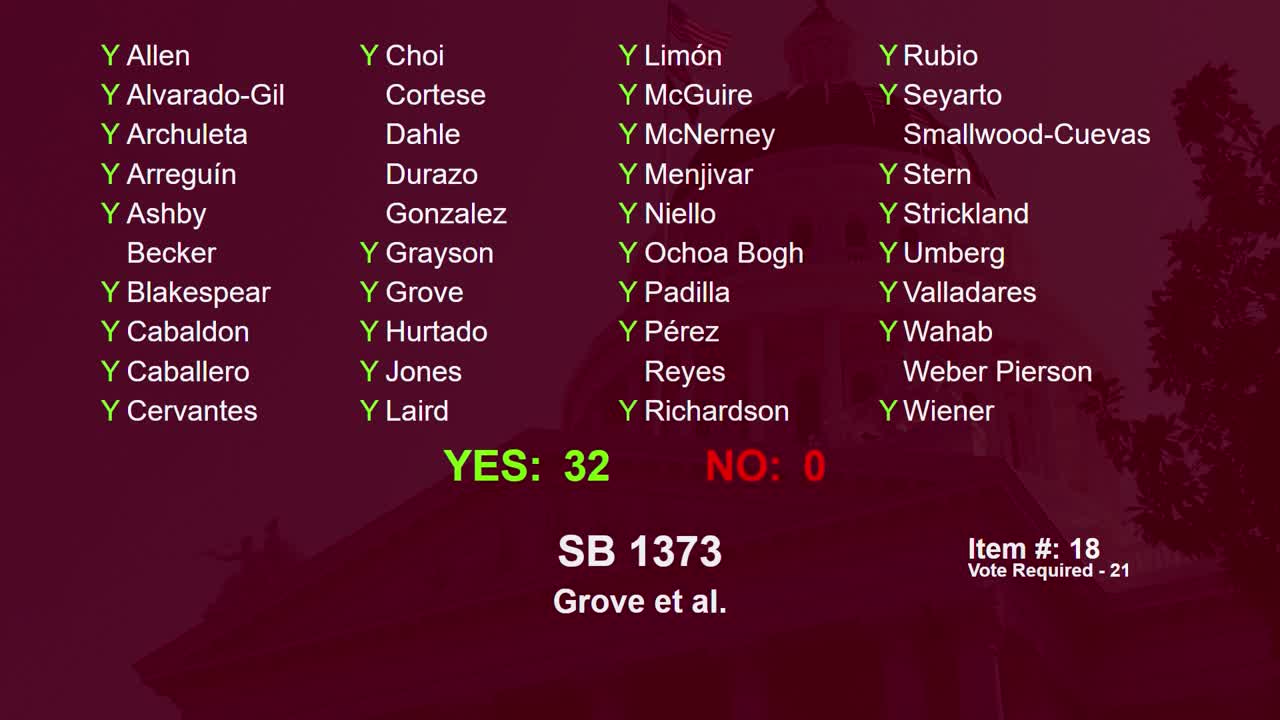
Bill Author

Bill Co-Author(s):