SB 1213: Zero- and near-zero-emission medium- and heavy-duty vehicles: incentives: transparency.
- Session Year: 2025-2026
- House: Senate
- Latest Version Date: 2026-09-20
Current Status:
Passed
(2026-09-20: Chaptered by Secretary of State. Chapter 349, Statutes of 2026.)
Introduced
In Committee
Awaiting First Chamber Vote
Passed First Chamber
In Committee
Awaiting Second Chamber Vote
Passed Second Chamber
Enacted
(1)Existing law establishes the California Clean Truck, Bus, and Off-Road Vehicle and Equipment Technology Program, to be administered by the State Air Resources Board in conjunction with the State Energy Resources Conservation and Development Commission (Energy Commission). The program funds eligible projects, including, among others, projects for technology development, demonstration, precommercial pilots, and early commercial deployments of zero- and near-zero-emission medium- and heavy-duty truck technology, including projects that help to facilitate clean goods movement corridors. Existing law establishes the Clean Transportation Program, administered by the Energy Commission, to provide, among other things, competitive grants and revolving loans to specified entities for those entities to develop and deploy innovative technologies that transform Californias fuel and vehicle types to help attain the states climate change policies.
This bill would require, within the California Clean Truck, Bus, and Off-Road Vehicle and Equipment Technology Program, the state board and the Energy Commission, beginning January 1, 2027, to condition the inclusion of any medium- or heavy-duty vehicle model in specified incentive programs, including the Clean Transportation Program, on the receipt of the pricing data specified below.
(2)Existing law establishes the state board as the state agency responsible for monitoring and regulating sources emitting greenhouse gases. The state board, in this capacity, administers the California Hybrid and Zero-Emission Truck and Bus Voucher Incentive Project (project) under which the agency issues a limited number of vouchers to incentivize the purchase and use of zero-emission commercial vehicles.
This bill would require the state board, in order to support the deployment of zero-emission heavy-duty vehicles through the project, to annually reevaluate the cap on the purchase of unredeemed state vouchers issued through the project, as specified. The bill would also require the state board to periodically reevaluate whether or not taxes should be included when determining the maximum share of vehicle cost incentivized through the project.
This bill, beginning January 1, 2027, would require a state agency administering any medium- or heavy-duty vehicle incentive program that receives funding from the Greenhouse Gas Reduction Fund, including, but not limited to, the project, and any program that receives funding through the California Clean Fuel Reward through the Low-Carbon Fuel Standard regulations, or through the Clean Transportation Program, to condition the inclusion of any medium- or heavy-duty vehicle model in that program upon certain transparency requirements. The bill would require these transparency requirements to include, among other things, the original equipment manufacturer providing the manufacturer suggested retail price for all zero-emission vehicle models offered for sale in California that may be funded by the above-described incentive programs and receipt by the administering agency of a final itemized purchase order, as provided.
This bill would require the state board, in coordination with the Energy Commission, to compile and make publicly available on its internet website in an aggregated format that anonymizes and protects the confidentiality of specified information, the data provided pursuant to these requirements. The bill would also authorize the state board to recover previously dispersed incentive funds that are found to have been dispersed based on data that was knowingly and intentionally misrepresented. The bill would require suspension of a vehicle models eligibility for the above-described incentive programs for failure to comply with the reporting requirements, following a notice and a reasonable opportunity to cure the failure to comply.
(3)Existing law establishes the Medium- and Heavy-Duty Zero-Emission Vehicle Fleet Purchasing Assistance Program within the Air Quality Improvement Program to make financing tools and nonfinancial supports available to operators of medium- and heavy-duty vehicle fleets to enable those operators to transition their fleets to zero-emission vehicles.
The bill would require the state board, on or before January 1, 2028, and in coordination with the Governors Office of Business and Economic Development and the California Infrastructure and Economic Development Bank, to explore alternative financing opportunities to encourage the deployment of zero-emission medium- and heavy-duty vehicles and report its findings regarding these alternative financing opportunities to the Legislature. The bill would require this report to include, but not be limited to, incentives with a specific focus on encouraging new entries into the market, spurring market competition, and prioritizing manufacturing within the state, an evaluation of ways to de-risk and scale up the participation of private investors in the market for affordable zero-emission medium- and heavy-duty vehicles, including used vehicles, and an exploration of increasing deployment and decreasing costs by retrofitting internal combustion medium- and heavy-duty vehicles to zero-emission.
(1)Existing law establishes the California Clean Truck, Bus, and Off-Road Vehicle and Equipment Technology Program, to be administered by the State Air Resources Board in conjunction with the State Energy Resources Conservation and Development Commission (Energy Commission). The program funds eligible projects, including, among others, projects for technology development, demonstration, precommercial pilots, and early commercial deployments of zero- and near-zero-emission medium- and heavy-duty truck technology, including projects that help to facilitate clean goods movement corridors. Existing law establishes the Clean Transportation Program, administered by the Energy Commission, to provide, among other things, competitive grants and revolving loans to specified entities for those entities to develop and deploy innovative technologies that transform Californias fuel and vehicle types to help attain the states climate change policies.
This bill would require, within the California Clean Truck, Bus, and Off-Road Vehicle and Equipment Technology Program, the state board and the Energy Commission, beginning January 1, 2027, to condition the inclusion of any medium- or heavy-duty vehicle model in specified incentive programs, including the Clean Transportation Program, on the receipt of the pricing data specified below.
(2)Existing law establishes the state board as the state agency responsible for monitoring and regulating sources emitting greenhouse gases. The state board, in this capacity, administers the California Hybrid and Zero-Emission Truck and Bus Voucher Incentive Project (project) under which the agency issues a limited number of vouchers to incentivize the purchase and use of zero-emission commercial vehicles.
This bill would require the state board, in order to support the deployment of zero-emission heavy-duty vehicles through the project, to annually reevaluate the cap on the purchase of unredeemed state vouchers issued through the project, as specified. The bill would also require the state board to periodically reevaluate whether or not taxes should be included when determining the maximum share of vehicle cost incentivized through the project.
This bill, beginning January 1, 2027, would require a state agency administering any medium- or heavy-duty vehicle incentive program that receives funding from the Greenhouse Gas Reduction Fund, including, but not limited to, the project, and any program that receives funding through the California Clean Fuel Reward through the Low-Carbon Fuel Standard regulations, or through the Clean Transportation Program, to condition the inclusion of any medium- or heavy-duty vehicle model in that program upon certain transparency requirements. The bill would require these transparency requirements to include, among other things, the original equipment manufacturer providing the manufacturer suggested retail price for all zero-emission vehicle models offered for sale in California that may be funded by the above-described incentive programs and receipt by the administering agency of a final itemized purchase order, as provided.
This bill would require the state board, in coordination with the Energy Commission, to compile and make publicly available on its internet website in a an aggregated format that anonymizes and protects the confidentiality of specified information, the data provided pursuant to these requirements. The bill would also authorize the state board to recover previously dispersed incentive funds that are found to be have been dispersed based on false data that was knowingly provided or through anticompetitive pricing or sales behavior, as provided. data that was knowingly and intentionally misrepresented. The bill would require immediate suspension of a vehicle models eligibility for the above-described incentive programs for failure to comply with the reporting requirements. requirements, following a notice and a reasonable opportunity to cure the failure to comply.
(3)Existing law establishes the Medium- and Heavy-Duty Zero-Emission Vehicle Fleet Purchasing Assistance Program within the Air Quality Improvement Program to make financing tools and nonfinancial supports available to operators of medium- and heavy-duty vehicle fleets to enable those operators to transition their fleets to zero-emission vehicles.
The bill would require the state board, on or before January 1, 2028, and in coordination with the Governors Office of Business and Economic Development and the California Infrastructure and Economic Development Bank, to explore alternative financing opportunities to encourage the deployment of zero-emission medium- and heavy-duty vehicles and report its findings regarding these alternative financing opportunities to the Legislature. The bill would require this report to include, but not be limited to, incentives with a specific focus on encouraging new entries into the market, spurring market competition, and prioritizing manufacturing within the state, an evaluation of ways to de-risk and scale up the participation of private investors in the market for affordable zero-emission medium- and heavy-duty vehicles, including used vehicles, and an exploration of increasing deployment and decreasing costs by retrofitting internal combustion trucks medium- and heavy-duty vehicles to zero-emission.
(1)Existing law establishes the California Clean Truck, Bus, and Off-Road Vehicle and Equipment Technology Program, to be administered by the State Air Resources Board in conjunction with the State Energy Resources Conservation and Development Commission (Energy Commission). The program funds eligible projects, including, among others, projects for technology development, demonstration, precommercial pilots, and early commercial deployments of zero- and near-zero-emission medium- and heavy-duty truck technology, including projects that help to facilitate clean goods movement corridors. Existing law establishes the Clean Transportation Program, administered by the Energy Commission, to provide, among other things, competitive grants and revolving loans to specified entities for those entities to develop and deploy innovative technologies that transform Californias fuel and vehicle types to help attain the states climate change policies.
This bill would require, within the California Clean Truck, Bus, and Off-Road Vehicle and Equipment Technology Program, the state board and the Energy Commission, beginning January 1, 2027, to condition the inclusion of any medium- or heavy-duty vehicle model in specified incentive programs, including the Clean Transportation Program, on the receipt of the pricing data specified below.
(2)Existing law establishes the state board as the state agency responsible for monitoring and regulating sources emitting greenhouse gases. The state board, in this capacity, administers the California Hybrid and Zero-Emission Truck and Bus Voucher Incentive Project (project) under which the agency issues a limited number of vouchers to incentivize the purchase and use of zero-emission commercial vehicles.
This bill would require the state board, in order to support the deployment of zero-emission heavy-duty vehicles through the Hybrid and Zero-Emission Truck and Bus Voucher Incentive Project, project, to annually reevaluate the cap on the purchase of unredeemed state vouchers issued through the project, as specified. The bill would also require the state board to periodically reevaluate whether or not taxes should be included when determining the maximum share of vehicle cost incentivized through the project.
This bill, beginning January 1, 2027, would require a state agency administering any medium- or heavy-duty vehicle incentive program that receives funding from the Greenhouse Gas Reduction Fund, including, but not limited to, the Hybrid and Zero-Emission Truck and Bus Voucher Incentive Project, project, and any program that receives funding through the California Clean Fuel Reward administered by the state board through the Low-Carbon Fuel Standard regulations, or through the Clean Transportation Program, to condition the inclusion of any medium- or heavy-duty vehicle model in that program upon certain transparency requirements. The bill would require these transparency requirements to include, among other things, the original equipment manufacturer providing the manufacturer suggested retail price for all zero-emission vehicle models offered for sale in California that may be funded by the above-described incentive programs and receipt by the administering agency of a final itemized purchase order, as provided.
This bill would require the state board, in coordination with the Energy Commission, to compile and make publicly available on its internet website in a format that anonymizes and protects the confidentiality of specified information, the data provided pursuant to these requirements. The bill would also authorize the state board to recover previously dispersed incentive funds that are found to be dispersed based on false data that was knowingly provided or through anticompetitive pricing or sales behavior, as provided. The bill would require immediate suspension of a vehicle models eligibility for the above-described incentive programs for failure to comply with the reporting requirements.
(3)Existing law establishes the Medium- and Heavy-Duty Zero-Emission Vehicle Fleet Purchasing Assistance Program within the Air Quality Improvement Program to make financing tools and nonfinancial supports available to operators of medium- and heavy-duty vehicle fleets to enable those operators to transition their fleets to zero-emission vehicles.
The bill would require the state board, on or before January 1, 2028, and in coordination with the Governors Office of Business and Economic Development and the California Infrastructure and Economic Development Bank, to explore alternative financing opportunities to encourage the deployment of zero-emission medium- and heavy-duty vehicles and report its findings regarding these alternative financing opportunities to the Legislature. The bill would require this report to include, but not be limited to, incentives with a specific focus on encouraging new entries into the market, spurring market competition, and prioritizing manufacturing within the state, and an evaluation of ways to de-risk and scale up the participation of private investors in the market for affordable zero-emission medium- and heavy-duty vehicles, including used vehicles. vehicles, and an exploration of increasing deployment and decreasing costs by retrofitting internal combustion trucks to zero-emission.
(1)Existing law establishes the California Clean Truck, Bus, and Off-Road Vehicle and Equipment Technology Program, to be administered by the State Air Resources Board in conjunction with the State Energy Resources Conservation and Development Commission (Energy Commission). The program funds eligible projects, including, among others, projects for technology development, demonstration, precommercial pilots, and early commercial deployments of zero- and near-zero-emission medium- and heavy-duty truck technology, including projects that help to facilitate clean goods movement corridors. Existing law establishes the Clean Transportation Program, administered by the Energy Commission, to provide, among other things, competitive grants and revolving loans to specified entities for those entities to develop and deploy innovative technologies that transform Californias fuel and vehicle types to help attain the states climate change policies.
This bill would require, within the California Clean Truck, Bus, and Off-Road Vehicle and Equipment Technology Program, the state board and the Energy Commission, beginning January 1, 2027, to condition the inclusion of any medium- or heavy-duty vehicle model in specified incentive programs, including the Clean Transportation Program, on the receipt of the pricing data specified below.
(2)Existing law establishes the state board as the state agency responsible for monitoring and regulating sources emitting greenhouse gases. The state board, in this capacity, administers the California Hybrid and Zero-Emission Truck and Bus Voucher Incentive Project under which the agency issues a limited number of vouchers to incentivize the purchase and use of zero-emission commercial vehicles.
This bill would require the state board, in order to support the deployment of zero-emission heavy-duty vehicles through the Hybrid and Zero-Emission Truck and Bus Voucher Incentive Project, to annually reevaluate the cap on the purchase of unredeemed state vouchers issued through the project, as specified, and allow for vouchers to be used to cover up to 90% of the total cost of the purchase of a vehicle, as provided. specified.
This bill, beginning January 1, 2027, would require a state agency administering any medium- or heavy-duty vehicle incentive program that receives funding from the Greenhouse Gas Reduction Fund, including, but not limited to, the Hybrid and Zero-Emission Truck and Bus Voucher Incentive Project, and any program that receives funding through the California Clean Fuel Reward administered by the state board through the Low-Carbon Fuel Standard regulations, or through the Clean Transportation Program, to condition the inclusion of any medium- or heavy-duty vehicle model in that program upon certain transparency requirements. The bill would require these transparency requirements to include, among other things, the original equipment manufacturer providing the manufacturer suggested retail price for all zero-emission vehicle models offered for sale in California that may be funded by the above-described incentive programs and receipt by the administering agency of a final itemized purchase order, as provided.
This bill would require the state board, in coordination with the Energy Commission, to compile and make publicly available on its internet website the data provided pursuant to these requirements. The bill would also authorize the state board to recover previously dispersed incentive funds that are found to be dispersed based on false data that was knowingly provided or through anticompetitive pricing or sales behavior, as provided. The bill would require immediate suspension of a vehicle models eligibility for the above-described incentive programs for failure to comply with the reporting requirements.
(3)Existing law establishes the Medium- and Heavy-Duty Zero-Emission Vehicle Fleet Purchasing Assistance Program within the Air Quality Improvement Program to make financing tools and nonfinancial supports available to operators of medium- and heavy-duty vehicle fleets to enable those operators to transition their fleets to zero-emission vehicles.
The bill would require the state board, on or before January 1, 2028, and in coordination with the Governors Office of Business and Economic Development and the California Infrastructure and Economic Development Bank, to explore alternative financing opportunities to encourage the deployment of zero-emission medium- and heavy-duty vehicles and report its findings regarding these alternative financing opportunities to the Legislature. The bill would require this report to include, but not be limited to, incentives with a specific focus on encouraging new entries into the market, spurring market competition, and prioritizing manufacturing within the state, and an evaluation of ways to de-risk and scale up the participation of private investors in the market for affordable zero-emission medium- and heavy-duty vehicles, including used vehicles.
(1)Existing law establishes the California Clean Truck, Bus, and Off-Road Vehicle and Equipment Technology Program, to be administered by the State Air Resources Board in conjunction with the State Energy Resources Conservation and Development Commission (Energy Commission). The program funds eligible projects, including, among others, projects for technology development, demonstration, precommercial pilots, and early commercial deployments of zero- and near-zero-emission medium- and heavy-duty truck technology, including projects that help to facilitate clean goods movement corridors. Existing law establishes the Clean Transportation Program, administered by the Energy Commission, to provide, among other things, competitive grants and revolving loans to specified entities for those entities to develop and deploy innovative technologies that transform Californias fuel and vehicle types to help attain the states climate change policies.
This bill would require, within the California Clean Truck, Bus, and Off-Road Vehicle and Equipment Technology Program, the state board and the Energy Commission, beginning January 1, 2027, to condition the inclusion of any medium- or heavy-duty vehicle model in specified incentive programs, including the Clean Transportation Program, on the receipt of the pricing data specified below.
(2)Existing law establishes the state board as the state agency responsible for monitoring and regulating sources emitting greenhouse gases. The state board, in this capacity, administers the California Hybrid and Zero-Emission Truck and Bus Voucher Incentive Project under which the agency issues a limited number of vouchers to incentivize the purchase and use of zero-emission commercial vehicles.
This bill would require the state board, in order to support the deployment of zero-emission heavy-duty vehicles through the Hybrid and Zero-Emission Truck and Bus Voucher Incentive Project, to annually reevaluate the cap on the purchase of unredeemed state vouchers issued through the project, as specified, and allow for vouchers to be used to cover up to 90% of the total cost of the purchase of a vehicle, as provided.
This bill, beginning January 1, 2027, would require a state agency administering any medium- or heavy-duty vehicle incentive program that receives funding from the Greenhouse Gas Reduction Fund, including, but not limited to, the Hybrid and Zero-Emission Truck and Bus Voucher Incentive Project, and any program that receives funding through the California Clean Fuel Reward administered by the state board through the Low-Carbon Fuel Standard regulations, or through the Clean Transportation Program, to condition the inclusion of any medium- or heavy-duty vehicle model in that program upon certain transparency requirements. The bill would require these transparency requirements to include, among other things, the original equipment manufacturer providing the manufacturer suggested retail price for all zero-emission vehicle models offered for sale in California that may be funded by the above-described incentive programs and receipt by the administering agency of a final itemized purchase order, as provided.
This bill would require the state board, in coordination with the Energy Commission, to compile and make publicly available on its internet website the data provided pursuant to these requirements. The bill would also authorize the state board to recover previously dispersed incentive funds that are found to be dispersed based on false data that was knowingly provided or through anticompetitive pricing or sales behavior, as provided. The bill would require immediate suspension of a vehicle models eligibility for the above-described incentive programs for failure to comply with the reporting requirements.
(3)Existing law establishes the Medium- and Heavy-Duty Zero-Emission Vehicle Fleet Purchasing Assistance Program within the Air Quality Improvement Program to make financing tools and nonfinancial supports available to operators of medium- and heavy-duty vehicle fleets to enable those operators to transition their fleets to zero-emission vehicles.
The bill would require the state board, on or before January 1, 2028, and in coordination with the Governors Office of Business and Economic Development and the Infrastructure and Economic Development Bank, to explore alternative financing opportunities to encourage the deployment of zero-emission medium- and heavy-duty vehicles and report its findings regarding these alternative financing opportunities to the Legislature. The bill would require this report to include, but not be limited to, incentives with a specific focus on encouraging new entries into the market, spurring market competition, and prioritizing manufacturing within the state, and an evaluation of ways to de-risk and scale up the participation of private investors in the market for affordable zero-emission medium- and heavy-duty vehicles, including used vehicles.
Existing law vests the Department of Transportation with full possession and control of the state highway system. Existing law authorizes the department to take various actions to notify the public that a state highway is closed or that its use is restricted.This bill would make nonsubstantive changes to the latter provision.Existing law vests the Department of Transportation with full possession and control of the state highway system. Existing law authorizes the department to take various actions to notify the public that a state highway is closed or that its use is restricted.
This bill would make nonsubstantive changes to the latter provision.
The Legislature finds and declares both of the following:
(a)Robust competition and fair pricing are essential to the successful deployment of zero-emission heavy-duty vehicles that are necessary to achieve Californias climate and public health goals.
(b)To ensure the integrity of the states climate programs, the receipt of state funding should be conditioned upon full pricing transparency.
SEC. 2.Section 39719.2 of the Health and Safety Code is amended to read:39719.2.(a)The California Clean Truck, Bus, and Off-Road Vehicle and Equipment Technology Program is hereby created, to be administered by the state board in conjunction with the State Energy Resources Conservation and Development Commission. The program, from moneys appropriated from the fund for the purposes of the program, shall fund development, demonstration, precommercial pilot, and early commercial deployment of zero- and near-zero-emission truck, bus, and off-road vehicle and equipment technologies. Priority shall be given to projects benefiting disadvantaged communities pursuant to the requirements of Sections 39711 and 39713.
(b)Projects eligible for funding pursuant to this section include, but are not limited to, the following:
(1)Technology development, demonstration, precommercial pilots, and early commercial deployments of zero- and near-zero-emission medium- and heavy-duty truck technology, including projects that help to facilitate clean goods movement corridors. This includes peer-to-peer truck sharing platform demonstration. Until December 31, 2021, no less than 20 percent of funding made available for purposes of this paragraph shall support early commercial deployment of existing zero- and near-zero-emission heavy-duty truck technology.
(2)Zero- and near-zero-emission bus technology development, demonstration, precommercial pilots, and early commercial deployments, including pilots of multiple vehicles at one site or region.
(3)Zero- and near-zero-emission off-road vehicle and equipment technology development, demonstration, precommercial pilots, and early commercial deployments, including vehicles and equipment in the port, agricultural, marine, construction, and rail sectors.
(4)Purchase incentives, which may include point-of-sale, for commercially available zero- and near-zero-emission truck, bus, and off-road vehicle and equipment technologies and fueling infrastructure to support early market deployments of alternative technologies and to increase manufacturer volumes and accelerate market acceptance.
(5)Projects that support greater commercial motor vehicle and equipment freight efficiency and greenhouse gas emissions reductions, including, but not limited to, advanced intelligent transportation systems, autonomous vehicles, grid integration and integrated storage solutions, charging management demonstration and analytics, and other freight information and operations technologies.
(c)The state board, in consultation with the State Energy Resources Conservation and Development Commission, shall develop guidance through the existing Air Quality Improvement Program funding plan process for the implementation of this section that is consistent with the California Global Warming Solutions Act of 2006 (Division 25.5 (commencing with Section 38500)) and this chapter.
(d)The guidance developed pursuant to subdivision (c) shall do all of the following:
(1)Outline performance criteria and metrics for deployment incentives. The goal shall be to design a simple and predictable structure that provides incentives for truck, bus, and off-road vehicle and equipment technologies that provide significant greenhouse gas reduction and air quality benefits.
(2)(A)Ensure that program investments are coordinated with funding programs developed pursuant to the California Alternative and Renewable Fuel, Vehicle Technology, Clean Air, and Carbon Reduction Act of 2007 (Chapter 8.9 (commencing with Section 44270) of Part 5).
(B)The State Energy Resources Conservation and Development Commission shall advise the state board on how to allocate money for vehicle charging infrastructure consistent with the commissions investment plan strategies on charging infrastructure.
(3)Promote projects that assist the state in reaching its climate goals beyond 2030, consistent with Section 38566.
(4)Promote investments in medium- and heavy-duty trucking, including, but not limited to, vocational trucks, short-haul and long-haul trucks, buses, and off-road vehicles and equipment, including, but not limited to, port equipment, agricultural equipment, marine equipment, and rail equipment.
(5)Implement purchase incentives for eligible technologies to increase the use of the cleanest vehicles in disadvantaged communities.
(6)Allow for remanufactured and retrofitted vehicles to qualify for purchase incentives if those vehicles meet warranty and emissions requirements, as determined by the state board.
(7)Establish a competitive process for the allocation of moneys for projects funded pursuant to this section.
(8)Leverage, to the maximum extent feasible, federal or private funding.
(9)Ensure that the results of emissions reductions or benefits can be measured or quantified.
(10)Ensure that activities undertaken pursuant to this section complement, and do not interfere with, efforts to achieve and maintain federal and state ambient air quality standards and to reduce toxic air contaminants.
(e)In evaluating potential projects to be funded pursuant to this section, the state board shall give priority to projects that demonstrate one or more of the following characteristics:
(1)Benefit disadvantaged communities pursuant to Sections 39711 and 39713 or communities with a community emissions reduction program implemented pursuant to Section 44391.2.
(2)The ability to leverage additional public and private funding.
(3)The potential for cobenefits or multiple-benefit attributes.
(4)The potential for the project to be replicated.
(5)Regional benefit, with focus on collaboration between multiple entities.
(6)Support for technologies with broad market and emissions reduction potential.
(7)Support for projects addressing technology and market barriers not addressed by other programs.
(8)Support for enabling technologies that benefit multiple technology pathways.
(f)In implementing this section, the state board, in consultation with the State Energy Resources Conservation and Development Commission, shall create an annual framework and plan. The framework and plan shall be developed with public input and may use existing investment plan processes and workshops as well as existing state and third-party research and technology roadmaps. The framework and plan shall do all of the following:
(1)Articulate an overarching vision for technology development, demonstration, precommercial pilot, and early commercial deployments, with a focus on moving technologies through the commercialization process.
(2)Outline technology categories and performance criteria for technologies and applications that may be considered for funding pursuant to this section. This shall include technologies for medium- and heavy-duty trucking, including, but not limited to, vocational trucks, short-haul and long-haul trucks, buses, and off-road vehicles and equipment, including, but not limited to, port equipment, agricultural equipment, construction equipment, marine equipment, and rail equipment.
(3)Describe the roles of the relevant agencies and the process for coordination.
(g)For purposes of this section, zero- and near-zero-emission means vehicles, fuels, and related technologies that reduce greenhouse gas emissions and improve air quality when compared with conventional or fully commercialized alternatives, as defined by the state board in consultation with the State Energy Resources Conservation and Development Commission. Zero- and near-zero-emission may include, but is not limited to, zero-emission technology, enabling technologies that provide a pathway to emissions reductions, advanced or alternative fuel engines for long-haul trucks, and hybrid or alternative fuel technologies for trucks and off-road equipment.
(h)(1)In addition to the requirements of Section 44258.4, commencing with the funding plan for the 201920 fiscal year of the Air Quality Improvement Program (Article 3 (commencing with Section 44274) of Chapter 8.9 of Part 5), the state board shall include a three-year investment strategy that includes the immediate fiscal year and a forecast of estimated funding needs for the subsequent two fiscal years for zero- and near-zero-emission heavy-duty vehicles and equipment commensurate with meeting the goals of this chapter and the goals of the state.
(2)The three-year investment strategy shall do all of the following:
(A)Describe the role of public investments in supporting the demonstration and deployment of advanced technologies.
(B)Provide an assessment of available funding and the investment needed.
(C)Provide a description of the state boards portfolio of investments.
(3)The state board, in consultation with the State Energy Resources Conservation and Development Commission, shall include in the investment strategy information related to milestones achieved by the states schoolbus incentive programs and the projected need for funding taking into consideration the states schoolbus inventory, turnover, and useful life.
(i)Beginning January 1, 2027, the state board and the State Energy Resources Conservation and Development Commission shall condition the inclusion of any medium- or heavy-duty vehicle model in any incentive program that receives funding from the Greenhouse Gas Reduction Fund, created pursuant to Section 16428.8 of the Government Code, including, but not limited to, the Hybrid and Zero-Emission Truck and Bus Voucher Incentive Project, and in any program that receives funding through the California Clean Fuel Reward through the Low-Carbon Fuel Standard regulations (Subarticle 7 (commencing with Section 95480) of Article 4 of Subchapter 10 of Chapter 1 of Division 3 of Title 17 of the California Code of Regulations) or through the Clean Transportation Program (Article 2 (commencing with Section 44272) of Chapter 8.9 of Part 5) on receipt of the pricing data specified in Section 43216.
SEC. 3.Section 43216 is added to the Health and Safety Code, immediately following Section 43215, to read:43216.(a)The state board, in order to support the deployment of zero-emission heavy-duty vehicles through the Hybrid and Zero-Emission Truck and Bus Voucher Incentive Project, shall annually reevaluate the cap on the purchase of unredeemed state vouchers issued through the Hybrid and Zero-Emission Truck and Bus Voucher Incentive Project with the goal of increasing the cap to the extent feasible to maximize the benefits of zero-emission vehicles deployed.
(b)An increase to the voucher cap may be provided on the purchase of electric medium- and heavy-duty vehicles that provide a direct and meaningful benefit to disadvantaged communities, as identified pursuant to Section 39711. The state board may establish criteria for determining the eligibility of an applicant and the required nexus between vehicle operation and community benefit.
(c)The state board shall periodically reevaluate whether or not taxes should be included when determining the maximum share of vehicle cost incentivized through the Hybrid and Zero-Emission Truck and Bus Voucher Incentive Project.
(d)The state board may consider the unique production, inventory, body-build, and deployment cycles of medium- and heavy-duty vehicles when establishing model-year eligibility requirements for vehicles participating in the Hybrid and Zero-Emission Truck and Bus Voucher Incentive Project.
SEC. 4.Section 43217 is added to the Health and Safety Code, immediately following Section 43216, to read:43217.(a)Beginning January 1, 2027, the state agency administering any medium- or heavy-duty vehicle incentive program that receives funding from the Greenhouse Gas Reduction Fund, created pursuant to Section 16428.8 of the Government Code, including, but not limited to, the Hybrid and Zero-Emission Truck and Bus Voucher Incentive Project, and any program that receives funding through the California Clean Fuel Reward through the Low-Carbon Fuel Standard regulations (Subarticle 7 (commencing with Section 95480) of Article 4 of Subchapter 10 of Chapter 1 of Division 3 of Title 17 of the California Code of Regulations) or through the Clean Transportation Program (Article 2 (commencing with Section 44272) of Chapter 8.9 of Part 5), shall condition the inclusion of any medium- or heavy-duty vehicle model in that program upon the following transparency requirements:
(1)The original equipment manufacturer shall provide the manufacturers suggested retail price for all zero-emission vehicle models offered for sale in California that may be funded by any incentive program described in this subdivision to the administering agency quarterly.
(2)Receipt by the administering agency of a final purchase order submitted through the incentive application process for each vehicle for which an incentive is sought that clearly lists the final base unit price of the vehicle, not including incentives, and itemizes any charges for warranty, taxes, fees, service agreements, or additional components not original to the vehicle.
(3)Receipt by the administering agency of vehicle make and model, model year, gross vehicle weight rating, body type, vehicle identification number, and nominal battery capacity.
(b)The state board, in coordination with the State Energy Resources Conservation and Development Commission, shall, every six months, compile and make the data provided pursuant to subdivision (a) publicly available on its internet website in an aggregated format that anonymizes buyers, protects the confidentiality of manufacturer and dealer transaction information. Any pricing data made publicly available pursuant to this subdivision shall be aggregated and presented at a level of aggregation sufficient to protect the confidentiality of manufacturer and dealer transaction information.
(c)(1)Failure to comply with the reporting requirements set forth in subdivision (a) shall result in suspension, following a notice and a reasonable opportunity to cure the failure to comply, of a vehicle models eligibility for state incentive programs.
(2)The state board may recover previously dispersed incentive funds that are found to have been dispersed based on data that was knowingly and intentionally misrepresented.
(3)The state board may coordinate with the Attorney General to investigate any violations of this section.
SEC. 5.Section 44274.16 is added to the Health and Safety Code, immediately following Section 44274.15, to read:44274.16.On or before January 1, 2028, the state board, in coordination with the Governors Office of Business and Economic Development and the California Infrastructure and Economic Development Bank, shall explore alternative financing opportunities to encourage the deployment of zero-emission medium- and heavy-duty vehicles and report its findings regarding these alternative financing opportunities to the Legislature. The state board may satisfy the reporting requirement established in this section by including the required information within the biennial report prepared pursuant to subdivision (d) of Section 44274. A report submitted in this manner shall be deemed to fully meet the requirements of this section. This report shall include, but not be limited to, all of the following:
(a)Incentives with a specific focus on encouraging new entries into the market, spurring market competition, and prioritizing manufacturing within the state.
(b)An evaluation of ways to de-risk and scale up the participation of private investors in the market for affordable zero-emission medium- and heavy-duty vehicles, including used vehicles.
(c)An evaluation of providing low-cost loans for zero-emission medium- and heavy-duty vehicles.
(d)An exploration of increasing deployment and decreasing costs by retrofitting internal combustion medium- and heavy-duty vehicles to zero-emission.
(e)An exploration of the development of residual value guarantees for zero-emission medium- and heavy-duty vehicles.
(f)Recommendations on improving market function to increase deployment and decrease costs.
(g)Other data sources, reporting mechanisms, and disclosures that could be used, including, but not limited to, of data that may be held or generated by the Department of Motor Vehicles, that would further achieve these goals and promote well-functioning markets and capital access for medium- and heavy-duty vehicles.
SEC. 6.The provisions of this act are severable. If any provision of this act or its application is held invalid, that invalidity shall not affect other provisions or applications that can be given effect without the invalid provision or application.
The Legislature finds and declares both of the following:
(a)Robust competition and fair pricing are essential to the successful deployment of zero-emission heavy-duty vehicles that are necessary to achieve Californias climate and public health goals.
(b)To ensure the integrity of the states climate programs, the receipt of state funding should be conditioned upon full pricing transparency.
SEC. 2.Section 39719.2 of the Health and Safety Code is amended to read:39719.2.(a)The California Clean Truck, Bus, and Off-Road Vehicle and Equipment Technology Program is hereby created, to be administered by the state board in conjunction with the State Energy Resources Conservation and Development Commission. The program, from moneys appropriated from the fund for the purposes of the program, shall fund development, demonstration, precommercial pilot, and early commercial deployment of zero- and near-zero-emission truck, bus, and off-road vehicle and equipment technologies. Priority shall be given to projects benefiting disadvantaged communities pursuant to the requirements of Sections 39711 and 39713.
(b)Projects eligible for funding pursuant to this section include, but are not limited to, the following:
(1)Technology development, demonstration, precommercial pilots, and early commercial deployments of zero- and near-zero-emission medium- and heavy-duty truck technology, including projects that help to facilitate clean goods movement corridors. This includes peer-to-peer truck sharing platform demonstration. Until December 31, 2021, no less than 20 percent of funding made available for purposes of this paragraph shall support early commercial deployment of existing zero- and near-zero-emission heavy-duty truck technology.
(2)Zero- and near-zero-emission bus technology development, demonstration, precommercial pilots, and early commercial deployments, including pilots of multiple vehicles at one site or region.
(3)Zero- and near-zero-emission off-road vehicle and equipment technology development, demonstration, precommercial pilots, and early commercial deployments, including vehicles and equipment in the port, agricultural, marine, construction, and rail sectors.
(4)Purchase incentives, which may include point-of-sale, for commercially available zero- and near-zero-emission truck, bus, and off-road vehicle and equipment technologies and fueling infrastructure to support early market deployments of alternative technologies and to increase manufacturer volumes and accelerate market acceptance.
(5)Projects that support greater commercial motor vehicle and equipment freight efficiency and greenhouse gas emissions reductions, including, but not limited to, advanced intelligent transportation systems, autonomous vehicles, grid integration and integrated storage solutions, charging management demonstration and analytics, and other freight information and operations technologies.
(c)The state board, in consultation with the State Energy Resources Conservation and Development Commission, shall develop guidance through the existing Air Quality Improvement Program funding plan process for the implementation of this section that is consistent with the California Global Warming Solutions Act of 2006 (Division 25.5 (commencing with Section 38500)) and this chapter.
(d)The guidance developed pursuant to subdivision (c) shall do all of the following:
(1)Outline performance criteria and metrics for deployment incentives. The goal shall be to design a simple and predictable structure that provides incentives for truck, bus, and off-road vehicle and equipment technologies that provide significant greenhouse gas reduction and air quality benefits.
(2)(A)Ensure that program investments are coordinated with funding programs developed pursuant to the California Alternative and Renewable Fuel, Vehicle Technology, Clean Air, and Carbon Reduction Act of 2007 (Chapter 8.9 (commencing with Section 44270) of Part 5).
(B)The State Energy Resources Conservation and Development Commission shall advise the state board on how to allocate money for vehicle charging infrastructure consistent with the commissions investment plan strategies on charging infrastructure.
(3)Promote projects that assist the state in reaching its climate goals beyond 2030, consistent with Section 38566.
(4)Promote investments in medium- and heavy-duty trucking, including, but not limited to, vocational trucks, short-haul and long-haul trucks, buses, and off-road vehicles and equipment, including, but not limited to, port equipment, agricultural equipment, marine equipment, and rail equipment.
(5)Implement purchase incentives for eligible technologies to increase the use of the cleanest vehicles in disadvantaged communities.
(6)Allow for remanufactured and retrofitted vehicles to qualify for purchase incentives if those vehicles meet warranty and emissions requirements, as determined by the state board.
(7)Establish a competitive process for the allocation of moneys for projects funded pursuant to this section.
(8)Leverage, to the maximum extent feasible, federal or private funding.
(9)Ensure that the results of emissions reductions or benefits can be measured or quantified.
(10)Ensure that activities undertaken pursuant to this section complement, and do not interfere with, efforts to achieve and maintain federal and state ambient air quality standards and to reduce toxic air contaminants.
(e)In evaluating potential projects to be funded pursuant to this section, the state board shall give priority to projects that demonstrate one or more of the following characteristics:
(1)Benefit disadvantaged communities pursuant to Sections 39711 and 39713 or communities with a community emissions reduction program implemented pursuant to Section 44391.2.
(2)The ability to leverage additional public and private funding.
(3)The potential for cobenefits or multiple-benefit attributes.
(4)The potential for the project to be replicated.
(5)Regional benefit, with focus on collaboration between multiple entities.
(6)Support for technologies with broad market and emissions reduction potential.
(7)Support for projects addressing technology and market barriers not addressed by other programs.
(8)Support for enabling technologies that benefit multiple technology pathways.
(f)In implementing this section, the state board, in consultation with the State Energy Resources Conservation and Development Commission, shall create an annual framework and plan. The framework and plan shall be developed with public input and may use existing investment plan processes and workshops as well as existing state and third-party research and technology roadmaps. The framework and plan shall do all of the following:
(1)Articulate an overarching vision for technology development, demonstration, precommercial pilot, and early commercial deployments, with a focus on moving technologies through the commercialization process.
(2)Outline technology categories and performance criteria for technologies and applications that may be considered for funding pursuant to this section. This shall include technologies for medium- and heavy-duty trucking, including, but not limited to, vocational trucks, short-haul and long-haul trucks, buses, and off-road vehicles and equipment, including, but not limited to, port equipment, agricultural equipment, construction equipment, marine equipment, and rail equipment.
(3)Describe the roles of the relevant agencies and the process for coordination.
(g)For purposes of this section, zero- and near-zero-emission means vehicles, fuels, and related technologies that reduce greenhouse gas emissions and improve air quality when compared with conventional or fully commercialized alternatives, as defined by the state board in consultation with the State Energy Resources Conservation and Development Commission. Zero- and near-zero-emission may include, but is not limited to, zero-emission technology, enabling technologies that provide a pathway to emissions reductions, advanced or alternative fuel engines for long-haul trucks, and hybrid or alternative fuel technologies for trucks and off-road equipment.
(h)(1)In addition to the requirements of Section 44258.4, commencing with the funding plan for the 201920 fiscal year of the Air Quality Improvement Program (Article 3 (commencing with Section 44274) of Chapter 8.9 of Part 5), the state board shall include a three-year investment strategy that includes the immediate fiscal year and a forecast of estimated funding needs for the subsequent two fiscal years for zero- and near-zero-emission heavy-duty vehicles and equipment commensurate with meeting the goals of this chapter and the goals of the state.
(2)The three-year investment strategy shall do all of the following:
(A)Describe the role of public investments in supporting the demonstration and deployment of advanced technologies.
(B)Provide an assessment of available funding and the investment needed.
(C)Provide a description of the state boards portfolio of investments.
(3)The state board, in consultation with the State Energy Resources Conservation and Development Commission, shall include in the investment strategy information related to milestones achieved by the states schoolbus incentive programs and the projected need for funding taking into consideration the states schoolbus inventory, turnover, and useful life.
(i)Beginning January 1, 2027, the state board and the State Energy Resources Conservation and Development Commission shall condition the inclusion of any medium- or heavy-duty vehicle model in any incentive program that receives funding from the Greenhouse Gas Reduction Fund, created pursuant to Section 16428.8 of the Government Code, including, but not limited to, the Hybrid and Zero-Emission Truck and Bus Voucher Incentive Project, and in any program that receives funding through the California Clean Fuel Reward through the Low-Carbon Fuel Standard regulations (Subarticle 7 (commencing with Section 95480) of Article 4 of Subchapter 10 of Chapter 1 of Division 3 of Title 17 of the California Code of Regulations) or through the Clean Transportation Program (Article 2 (commencing with Section 44272) of Chapter 8.9 of Part 5) on receipt of the pricing data specified in Section 43216.
SEC. 3.Section 43215 is added to the Health and Safety Code, to read:43215.SEC. 3.Section 43216 is added to the Health and Safety Code, immediately following Section 43215, to read:43216.(a)The state board, in order to support the deployment of zero-emission heavy-duty vehicles through the Hybrid and Zero-Emission Truck and Bus Voucher Incentive Project, shall annually reevaluate the cap on the purchase of unredeemed state vouchers issued through the Hybrid and Zero-Emission Truck and Bus Voucher Incentive Project with the goal of increasing the cap to the extent feasible to maximize the benefits of zero-emission vehicles deployed.
(b)An increase to the voucher cap shall may be provided on the purchase of electric medium- and heavy-duty vehicles that provide a direct and meaningful benefit to disadvantaged communities, as identified pursuant to Section 39711. The state board shall may establish criteria for determining the eligibility of an applicant and the required nexus between vehicle operation and community benefit.
(c)The state board shall periodically reevaluate whether or not taxes should be included when determining the maximum share of vehicle cost incentivized through the Hybrid and Zero-Emission Truck and Bus Voucher Incentive Project.
(d)The state board may consider the unique production, inventory, body-build, and deployment cycles of medium- and heavy-duty vehicles when establishing model-year eligibility requirements for vehicles participating in the Hybrid and Zero-Emission Truck and Bus Voucher Incentive Project.
SEC. 4.Section 43216 is added to the Health and Safety Code, to read:43216.SEC. 4.Section 43217 is added to the Health and Safety Code, immediately following Section 43216, to read:43217.(a)Beginning January 1, 2027, the state agency administering any medium- or heavy-duty vehicle incentive program that receives funding from the Greenhouse Gas Reduction Fund, created pursuant to Section 16428.8 of the Government Code, including, but not limited to, the Hybrid and Zero-Emission Truck and Bus Voucher Incentive Project, and any program that receives funding through the California Clean Fuel Reward through the Low-Carbon Fuel Standard regulations (Subarticle 7 (commencing with Section 95480) of Article 4 of Subchapter 10 of Chapter 1 of Division 3 of Title 17 of the California Code of Regulations) or through the Clean Transportation Program (Article 2 (commencing with Section 44272) of Chapter 8.9 of Part 5), shall condition the inclusion of any medium- or heavy-duty vehicle model in that program upon the following transparency requirements:
(1)The original equipment manufacturer shall provide the manufacturers suggested retail price for all zero-emission vehicle models offered for sale in California that may be funded by any incentive program described in this subdivision to the administering agency quarterly.
(2)Receipt by the administering agency of a final purchase order submitted through the incentive application process for each vehicle for which an incentive is sought that clearly lists the final base unit price of the vehicle, not including incentives, and itemizes any charges for warranty, taxes, fees, service agreements, or additional components not original to the vehicle.
(3)Receipt by the administering agency of any additional data needed to effectively track vehicle pricing behavior in the covered incentive programs, including, but not limited to, vehicle make and model, model year, gross vehicle weight rating, body type, vehicle identification number, and nominal battery capacity of any vehicle for which an incentive is sought. capacity.
(b)The state board, in coordination with the State Energy Resources Conservation and Development Commission, shall, every six months, compile and make the data provided pursuant to subdivision (a) publicly available on its internet website in an aggregated format that anonymizes buyers, protects the confidentiality of manufacturer and dealer transaction information, and includes pricing data shown by vehicle model for each model year in order to provide market certainty and facilitate oversight. information. Any pricing data made publicly available pursuant to this subdivision shall be aggregated and presented at a level of aggregation sufficient to protect the confidentiality of manufacturer and dealer transaction information.
(c)(1)Failure to comply with the reporting requirements set forth in subdivision (a) shall result in the immediate suspension suspension, following a notice and a reasonable opportunity to cure the failure to comply, of a vehicle models eligibility for state incentive programs.
(2)The state board may recover previously dispersed incentive funds that are found to be have been dispersed based on false data that was knowingly provided or through anticompetitive pricing or sales behavior. data that was knowingly and intentionally misrepresented.
(3)The state board may coordinate with the Attorney General to investigate any violations of this section.
SEC. 5.Section 44274.16 is added to the Health and Safety Code, immediately following Section 44274.15, to read:44274.16.On or before January 1, 2028, the state board, in coordination with the Governors Office of Business and Economic Development and the California Infrastructure and Economic Development Bank, shall explore alternative financing opportunities to encourage the deployment of zero-emission medium- and heavy-duty vehicles and report, consistent with Section 9795 of the Government Code, report its findings regarding these alternative financing opportunities to the Legislature. The state board may satisfy the reporting requirement established in this section by including the required information within the biennial report prepared pursuant to subdivision (d) of Section 44274. A report submitted in this manner shall be deemed to fully meet the requirements of this section. This report shall include, but not be limited to, all of the following:
(a)Incentives with a specific focus on encouraging new entries into the market, spurring market competition, and prioritizing manufacturing within the state.
(b)An evaluation of ways to de-risk and scale up the participation of private investors in the market for affordable zero-emission medium- and heavy-duty vehicles, including used vehicles.
(c)An evaluation of providing low-cost loans for zero-emission trucks. medium- and heavy-duty vehicles.
(d)An exploration of increasing deployment and decreasing costs by retrofitting internal combustion trucks medium- and heavy-duty vehicles to zero-emission.
(e)An exploration of the development of residual value guarantees for zero-emission trucks. medium- and heavy-duty vehicles.
(f)Recommendations on improving market function to increase deployment and decrease costs.
(g)Other data sources, reporting mechanisms, and disclosures that could be used, including, but not limited to, of data that may be held or generated by the Department of Motor Vehicles, that would further achieve these goals and promote well-functioning markets and capital access for medium- and heavy-duty vehicles.
SEC. 6.The provisions of this act are severable. If any provision of this act or its application is held invalid, that invalidity shall not affect other provisions or applications that can be given effect without the invalid provision or application.
The Legislature finds and declares both of the following:
(a)Robust competition and fair pricing are essential to the successful deployment of zero-emission heavy-duty vehicles that are necessary to achieve Californias climate and public health goals.
(b)To ensure the integrity of the states climate programs, the receipt of state funding should be conditioned upon full pricing transparency.
SEC. 2.Section 39719.2 of the Health and Safety Code is amended to read:39719.2.(a)The California Clean Truck, Bus, and Off-Road Vehicle and Equipment Technology Program is hereby created, to be administered by the state board in conjunction with the State Energy Resources Conservation and Development Commission. The program, from moneys appropriated from the fund for the purposes of the program, shall fund development, demonstration, precommercial pilot, and early commercial deployment of zero- and near-zero-emission truck, bus, and off-road vehicle and equipment technologies. Priority shall be given to projects benefiting disadvantaged communities pursuant to the requirements of Sections 39711 and 39713.
(b)Projects eligible for funding pursuant to this section include, but are not limited to, the following:
(1)Technology development, demonstration, precommercial pilots, and early commercial deployments of zero- and near-zero-emission medium- and heavy-duty truck technology, including projects that help to facilitate clean goods movement corridors. This includes peer-to-peer truck sharing platform demonstration. Until December 31, 2021, no less than 20 percent of funding made available for purposes of this paragraph shall support early commercial deployment of existing zero- and near-zero-emission heavy-duty truck technology.
(2)Zero- and near-zero-emission bus technology development, demonstration, precommercial pilots, and early commercial deployments, including pilots of multiple vehicles at one site or region.
(3)Zero- and near-zero-emission off-road vehicle and equipment technology development, demonstration, precommercial pilots, and early commercial deployments, including vehicles and equipment in the port, agricultural, marine, construction, and rail sectors.
(4)Purchase incentives, which may include point-of-sale, for commercially available zero- and near-zero-emission truck, bus, and off-road vehicle and equipment technologies and fueling infrastructure to support early market deployments of alternative technologies and to increase manufacturer volumes and accelerate market acceptance.
(5)Projects that support greater commercial motor vehicle and equipment freight efficiency and greenhouse gas emissions reductions, including, but not limited to, advanced intelligent transportation systems, autonomous vehicles, grid integration and integrated storage solutions, charging management demonstration and analytics, and other freight information and operations technologies.
(c)The state board, in consultation with the State Energy Resources Conservation and Development Commission, shall develop guidance through the existing Air Quality Improvement Program funding plan process for the implementation of this section that is consistent with the California Global Warming Solutions Act of 2006 (Division 25.5 (commencing with Section 38500)) and this chapter.
(d)The guidance developed pursuant to subdivision (c) shall do all of the following:
(1)Outline performance criteria and metrics for deployment incentives. The goal shall be to design a simple and predictable structure that provides incentives for truck, bus, and off-road vehicle and equipment technologies that provide significant greenhouse gas reduction and air quality benefits.
(2)(A)Ensure that program investments are coordinated with funding programs developed pursuant to the California Alternative and Renewable Fuel, Vehicle Technology, Clean Air, and Carbon Reduction Act of 2007 (Chapter 8.9 (commencing with Section 44270) of Part 5).
(B)The State Energy Resources Conservation and Development Commission shall advise the state board on how to allocate money for vehicle charging infrastructure consistent with the commissions investment plan strategies on charging infrastructure.
(3)Promote projects that assist the state in reaching its climate goals beyond 2030, consistent with Section 38566.
(4)Promote investments in medium- and heavy-duty trucking, including, but not limited to, vocational trucks, short-haul and long-haul trucks, buses, and off-road vehicles and equipment, including, but not limited to, port equipment, agricultural equipment, marine equipment, and rail equipment.
(5)Implement purchase incentives for eligible technologies to increase the use of the cleanest vehicles in disadvantaged communities.
(6)Allow for remanufactured and retrofitted vehicles to qualify for purchase incentives if those vehicles meet warranty and emissions requirements, as determined by the state board.
(7)Establish a competitive process for the allocation of moneys for projects funded pursuant to this section.
(8)Leverage, to the maximum extent feasible, federal or private funding.
(9)Ensure that the results of emissions reductions or benefits can be measured or quantified.
(10)Ensure that activities undertaken pursuant to this section complement, and do not interfere with, efforts to achieve and maintain federal and state ambient air quality standards and to reduce toxic air contaminants.
(e)In evaluating potential projects to be funded pursuant to this section, the state board shall give priority to projects that demonstrate one or more of the following characteristics:
(1)Benefit disadvantaged communities pursuant to Sections 39711 and 39713 or communities with a community emissions reduction program implemented pursuant to Section 44391.2.
(2)The ability to leverage additional public and private funding.
(3)The potential for cobenefits or multiple-benefit attributes.
(4)The potential for the project to be replicated.
(5)Regional benefit, with focus on collaboration between multiple entities.
(6)Support for technologies with broad market and emissions reduction potential.
(7)Support for projects addressing technology and market barriers not addressed by other programs.
(8)Support for enabling technologies that benefit multiple technology pathways.
(f)In implementing this section, the state board, in consultation with the State Energy Resources Conservation and Development Commission, shall create an annual framework and plan. The framework and plan shall be developed with public input and may use existing investment plan processes and workshops as well as existing state and third-party research and technology roadmaps. The framework and plan shall do all of the following:
(1)Articulate an overarching vision for technology development, demonstration, precommercial pilot, and early commercial deployments, with a focus on moving technologies through the commercialization process.
(2)Outline technology categories and performance criteria for technologies and applications that may be considered for funding pursuant to this section. This shall include technologies for medium- and heavy-duty trucking, including, but not limited to, vocational trucks, short-haul and long-haul trucks, buses, and off-road vehicles and equipment, including, but not limited to, port equipment, agricultural equipment, construction equipment, marine equipment, and rail equipment.
(3)Describe the roles of the relevant agencies and the process for coordination.
(g)For purposes of this section, zero- and near-zero-emission means vehicles, fuels, and related technologies that reduce greenhouse gas emissions and improve air quality when compared with conventional or fully commercialized alternatives, as defined by the state board in consultation with the State Energy Resources Conservation and Development Commission. Zero- and near-zero-emission may include, but is not limited to, zero-emission technology, enabling technologies that provide a pathway to emissions reductions, advanced or alternative fuel engines for long-haul trucks, and hybrid or alternative fuel technologies for trucks and off-road equipment.
(h)(1)In addition to the requirements of Section 44258.4, commencing with the funding plan for the 201920 fiscal year of the Air Quality Improvement Program (Article 3 (commencing with Section 44274) of Chapter 8.9 of Part 5), the state board shall include a three-year investment strategy that includes the immediate fiscal year and a forecast of estimated funding needs for the subsequent two fiscal years for zero- and near-zero-emission heavy-duty vehicles and equipment commensurate with meeting the goals of this chapter and the goals of the state.
(2)The three-year investment strategy shall do all of the following:
(A)Describe the role of public investments in supporting the demonstration and deployment of advanced technologies.
(B)Provide an assessment of available funding and the investment needed.
(C)Provide a description of the state boards portfolio of investments.
(3)The state board, in consultation with the State Energy Resources Conservation and Development Commission, shall include in the investment strategy information related to milestones achieved by the states schoolbus incentive programs and the projected need for funding taking into consideration the states schoolbus inventory, turnover, and useful life.
(i)Beginning January 1, 2027, the state board and the State Energy Resources Conservation and Development Commission shall condition the inclusion of any medium- or heavy-duty vehicle model in any incentive program that receives funding from the Greenhouse Gas Reduction Fund, created pursuant to Section 16428.8 of the Government Code, including, but not limited to, the Hybrid and Zero-Emission Truck and Bus Voucher Incentive Project, and in any program that receives funding through the California Clean Fuel Reward administered by the state board through the Low-Carbon Fuel Standard regulations (Subarticle 7 (commencing with Section 95480) of Article 4 of Subchapter 10 of Chapter 1 of Division 3 of Title 17 of the California Code of Regulations) or through the Clean Transportation Program (Article 2 (commencing with Section 44272) of Chapter 8.9 of Part 5) on receipt of the pricing data specified in Section 43216.
SEC. 3.Section 43215 is added to the Health and Safety Code, to read:43215.(a)The state board, in order to support the deployment of zero-emission heavy-duty vehicles through the Hybrid and Zero-Emission Truck and Bus Voucher Incentive Project, shall annually reevaluate the cap on the purchase of unredeemed state vouchers issued through the Hybrid and Zero-Emission Truck and Bus Voucher Incentive Project with the goal of increasing the cap to the extent feasible to maximize the benefits of zero-emission vehicles deployed.
(b)An increase to the voucher cap shall be provided on the purchase of electric medium- and heavy-duty vehicles that provide a direct and meaningful benefit to disadvantaged communities, as identified pursuant to Section 39711. The state board shall establish criteria for determining the eligibility of an applicant and the required nexus between vehicle operation and community benefit.
(c)The state board shall periodically reevaluate whether or not taxes should be included when determining the maximum share of vehicle cost incentivized through the Hybrid and Zero-Emission Truck and Bus Voucher Incentive Project.
SEC. 4.Section 43216 is added to the Health and Safety Code, to read:43216.(a)Beginning January 1, 2027, the state agency administering any medium- or heavy-duty vehicle incentive program that receives funding from the Greenhouse Gas Reduction Fund, created pursuant to Section 16428.8 of the Government Code, including, but not limited to, the Hybrid and Zero-Emission Truck and Bus Voucher Incentive Project, and any program that receives funding through the California Clean Fuel Reward administered by the state board through the Low-Carbon Fuel Standard regulations (Subarticle 7 (commencing with Section 95480) of Article 4 of Subchapter 10 of Chapter 1 of Division 3 of Title 17 of the California Code of Regulations) or through the Clean Transportation Program (Article 2 (commencing with Section 44272) of Chapter 8.9 of Part 5), shall condition the inclusion of any medium- or heavy-duty vehicle model in that program upon the following transparency requirements:
(1)The original equipment manufacturer shall provide the manufacturers suggested retail price for all zero-emission vehicle models offered for sale in California that may be funded by any incentive program described in this subdivision to the administering agency quarterly.
(2)Receipt by the administering agency of a final purchase order for each vehicle for which an incentive is sought that clearly lists the final base unit price of the vehicle, not including incentives, and itemizes any charges for warranty, taxes, fees, service agreements, or additional components not original to the vehicle.
(3)Receipt by the administering agency of any additional data needed to effectively track vehicle pricing behavior in the covered incentive programs, including, but not limited to, vehicle make and model, model year, gross vehicle weight rating, body type, vehicle identification number, and nominal battery capacity of any vehicle for which an incentive is sought.
(b)The state board, in coordination with the State Energy Resources Conservation and Development Commission, shall, every six months, compile and make the data provided pursuant to subdivision (a) publicly available on its internet website in an aggregated format that anonymizes buyers buyers, protects the confidentiality of manufacturer and dealer transaction information, and includes pricing data shown by vehicle model for each model year in order to provide market certainty and facilitate oversight.
(c)(1)Failure to comply with the reporting requirements set forth in subdivision (a) shall result in the immediate suspension of a vehicle models eligibility for state incentive programs.
(2)The state board may recover previously dispersed incentive funds that are found to be dispersed based on false data that was knowingly provided or through anticompetitive pricing or sales behavior.
(3)The state board may coordinate with the Attorney General to investigate any violations of this section.
SEC. 5.Section 44274.16 is added to the Health and Safety Code, immediately following Section 44274.15, to read:44274.16.On or before January 1, 2028, the state board, in coordination with the Governors Office of Business and Economic Development and the California Infrastructure and Economic Development Bank, shall explore alternative financing opportunities to encourage the deployment of zero-emission medium- and heavy-duty vehicles and report, consistent with Section 9795 of the Government Code, its findings regarding these alternative financing opportunities to the Legislature. This report shall include, but not be limited to, all of the following:
(a)Incentives with a specific focus on encouraging new entries into the market, spurring market competition, and prioritizing manufacturing within the state.
(b)An evaluation of ways to de-risk and scale up the participation of private investors in the market for affordable zero-emission medium- and heavy-duty vehicles, including used vehicles.
(c)An evaluation of providing low-cost loans for zero-emission trucks.
(d)An exploration of increasing deployment and decreasing costs by retrofitting internal combustion trucks to zero-emission.
(d)(e)An exploration of the development of residual value guarantees for zero-emission trucks.
(e)(f)Recommendations on improving market function to increase deployment and decrease costs.
(f)(g)Other data sources, reporting mechanisms, and disclosures that could be used, including, but not limited to, of data that may be held or generated by the Department of Motor Vehicles, that would further achieve these goals and promote well-functioning markets and capital access for medium- and heavy-duty vehicles.
SEC. 6.The provisions of this act are severable. If any provision of this act or its application is held invalid, that invalidity shall not affect other provisions or applications that can be given effect without the invalid provision or application.
The Legislature finds and declares both of the following:
(a)Robust competition and fair pricing are essential to the successful deployment of zero-emission heavy-duty vehicles that are necessary to achieve Californias climate and public health goals.
(b)To ensure the integrity of the states climate programs, the receipt of state funding should be conditioned upon full pricing transparency.
SEC. 2.Section 39719.2 of the Health and Safety Code is amended to read:39719.2.(a)The California Clean Truck, Bus, and Off-Road Vehicle and Equipment Technology Program is hereby created, to be administered by the state board in conjunction with the State Energy Resources Conservation and Development Commission. The program, from moneys appropriated from the fund for the purposes of the program, shall fund development, demonstration, precommercial pilot, and early commercial deployment of zero- and near-zero-emission truck, bus, and off-road vehicle and equipment technologies. Priority shall be given to projects benefiting disadvantaged communities pursuant to the requirements of Sections 39711 and 39713.
(b)Projects eligible for funding pursuant to this section include, but are not limited to, the following:
(1)Technology development, demonstration, precommercial pilots, and early commercial deployments of zero- and near-zero-emission medium- and heavy-duty truck technology, including projects that help to facilitate clean goods movement corridors. This includes peer-to-peer truck sharing platform demonstration. Until December 31, 2021, no less than 20 percent of funding made available for purposes of this paragraph shall support early commercial deployment of existing zero- and near-zero-emission heavy-duty truck technology.
(2)Zero- and near-zero-emission bus technology development, demonstration, precommercial pilots, and early commercial deployments, including pilots of multiple vehicles at one site or region.
(3)Zero- and near-zero-emission off-road vehicle and equipment technology development, demonstration, precommercial pilots, and early commercial deployments, including vehicles and equipment in the port, agricultural, marine, construction, and rail sectors.
(4)Purchase incentives, which may include point-of-sale, for commercially available zero- and near-zero-emission truck, bus, and off-road vehicle and equipment technologies and fueling infrastructure to support early market deployments of alternative technologies and to increase manufacturer volumes and accelerate market acceptance.
(5)Projects that support greater commercial motor vehicle and equipment freight efficiency and greenhouse gas emissions reductions, including, but not limited to, advanced intelligent transportation systems, autonomous vehicles, grid integration and integrated storage solutions, charging management demonstration and analytics, and other freight information and operations technologies.
(c)The state board, in consultation with the State Energy Resources Conservation and Development Commission, shall develop guidance through the existing Air Quality Improvement Program funding plan process for the implementation of this section that is consistent with the California Global Warming Solutions Act of 2006 (Division 25.5 (commencing with Section 38500)) and this chapter.
(d)The guidance developed pursuant to subdivision (c) shall do all of the following:
(1)Outline performance criteria and metrics for deployment incentives. The goal shall be to design a simple and predictable structure that provides incentives for truck, bus, and off-road vehicle and equipment technologies that provide significant greenhouse gas reduction and air quality benefits.
(2)(A)Ensure that program investments are coordinated with funding programs developed pursuant to the California Alternative and Renewable Fuel, Vehicle Technology, Clean Air, and Carbon Reduction Act of 2007 (Chapter 8.9 (commencing with Section 44270) of Part 5).
(B)The State Energy Resources Conservation and Development Commission shall advise the state board on how to allocate money for vehicle charging infrastructure consistent with the commissions investment plan strategies on charging infrastructure.
(3)Promote projects that assist the state in reaching its climate goals beyond 2030, consistent with Section 38566.
(4)Promote investments in medium- and heavy-duty trucking, including, but not limited to, vocational trucks, short-haul and long-haul trucks, buses, and off-road vehicles and equipment, including, but not limited to, port equipment, agricultural equipment, marine equipment, and rail equipment.
(5)Implement purchase incentives for eligible technologies to increase the use of the cleanest vehicles in disadvantaged communities.
(6)Allow for remanufactured and retrofitted vehicles to qualify for purchase incentives if those vehicles meet warranty and emissions requirements, as determined by the state board.
(7)Establish a competitive process for the allocation of moneys for projects funded pursuant to this section.
(8)Leverage, to the maximum extent feasible, federal or private funding.
(9)Ensure that the results of emissions reductions or benefits can be measured or quantified.
(10)Ensure that activities undertaken pursuant to this section complement, and do not interfere with, efforts to achieve and maintain federal and state ambient air quality standards and to reduce toxic air contaminants.
(e)In evaluating potential projects to be funded pursuant to this section, the state board shall give priority to projects that demonstrate one or more of the following characteristics:
(1)Benefit disadvantaged communities pursuant to Sections 39711 and 39713 or communities with a community emissions reduction program implemented pursuant to Section 44391.2.
(2)The ability to leverage additional public and private funding.
(3)The potential for cobenefits or multiple-benefit attributes.
(4)The potential for the project to be replicated.
(5)Regional benefit, with focus on collaboration between multiple entities.
(6)Support for technologies with broad market and emissions reduction potential.
(7)Support for projects addressing technology and market barriers not addressed by other programs.
(8)Support for enabling technologies that benefit multiple technology pathways.
(f)In implementing this section, the state board, in consultation with the State Energy Resources Conservation and Development Commission, shall create an annual framework and plan. The framework and plan shall be developed with public input and may use existing investment plan processes and workshops as well as existing state and third-party research and technology roadmaps. The framework and plan shall do all of the following:
(1)Articulate an overarching vision for technology development, demonstration, precommercial pilot, and early commercial deployments, with a focus on moving technologies through the commercialization process.
(2)Outline technology categories and performance criteria for technologies and applications that may be considered for funding pursuant to this section. This shall include technologies for medium- and heavy-duty trucking, including, but not limited to, vocational trucks, short-haul and long-haul trucks, buses, and off-road vehicles and equipment, including, but not limited to, port equipment, agricultural equipment, construction equipment, marine equipment, and rail equipment.
(3)Describe the roles of the relevant agencies and the process for coordination.
(g)For purposes of this section, zero- and near-zero-emission means vehicles, fuels, and related technologies that reduce greenhouse gas emissions and improve air quality when compared with conventional or fully commercialized alternatives, as defined by the state board in consultation with the State Energy Resources Conservation and Development Commission. Zero- and near-zero-emission may include, but is not limited to, zero-emission technology, enabling technologies that provide a pathway to emissions reductions, advanced or alternative fuel engines for long-haul trucks, and hybrid or alternative fuel technologies for trucks and off-road equipment.
(h)(1)In addition to the requirements of Section 44258.4, commencing with the funding plan for the 201920 fiscal year of the Air Quality Improvement Program (Article 3 (commencing with Section 44274) of Chapter 8.9 of Part 5), the state board shall include a three-year investment strategy that includes the immediate fiscal year and a forecast of estimated funding needs for the subsequent two fiscal years for zero- and near-zero-emission heavy-duty vehicles and equipment commensurate with meeting the goals of this chapter and the goals of the state.
(2)The three-year investment strategy shall do all of the following:
(A)Describe the role of public investments in supporting the demonstration and deployment of advanced technologies.
(B)Provide an assessment of available funding and the investment needed.
(C)Provide a description of the state boards portfolio of investments.
(3)The state board, in consultation with the State Energy Resources Conservation and Development Commission, shall include in the investment strategy information related to milestones achieved by the states schoolbus incentive programs and the projected need for funding taking into consideration the states schoolbus inventory, turnover, and useful life.
(i)Beginning January 1, 2027, the state board and the State Energy Resources Conservation and Development Commission shall condition the inclusion of any medium- or heavy-duty vehicle model in any incentive program that receives funding from the Greenhouse Gas Reduction Fund, created pursuant to Section 16428.8 of the Government Code, including, but not limited to, the Hybrid and Zero-Emission Truck and Bus Voucher Incentive Project, and in any program that receives funding through the California Clean Fuel Reward administered by the state board through the Low-Carbon Fuel Standard regulations (Subarticle 7 (commencing with Section 95480) of Article 4 of Subchapter 10 of Chapter 1 of Division 3 of Title 17 of the California Code of Regulations) or through the Clean Transportation Program (Article 2 (commencing with Section 44272) of Chapter 8.9 of Part 5) on receipt of the pricing data specified in Section 43216.
SEC. 3.Section 43215 is added to the Health and Safety Code, to read:43215.(a)The state board, in order to support the deployment of zero-emission heavy-duty vehicles through the Hybrid and Zero-Emission Truck and Bus Voucher Incentive Project, shall do both of the following: annually reevaluate the cap on the purchase of unredeemed state vouchers issued through the Hybrid and Zero-Emission Truck and Bus Voucher Incentive Project with the goal of increasing the cap to the extent feasible to maximize the benefits of zero-emission vehicles deployed.
(a)(1)Annually reevaluate the cap on the purchase of unredeemed state vouchers issued through the Hybrid and Zero-Emission Truck and Bus Voucher Incentive Project with the goal of increasing the cap to the extent feasible to maximize the benefits of zero-emission vehicles deployed.(2)(b)An increase to the voucher cap shall be provided on the purchase of electric medium- and heavy-duty vehicles that provide a direct and meaningful benefit to disadvantaged communities, as identified pursuant to Section 39711. The state board shall establish criteria for determining the eligibility of an applicant and the required nexus between vehicle operation and community benefit.
(b)Allow for vouchers to be used to cover up to 90 percent of the total cost of the purchase of a vehicle through the Hybrid and Zero-Emission Truck and Bus Voucher Incentive Project, including, but not limited to, taxes and delivery fees.SEC. 4.Section 43216 is added to the Health and Safety Code, to read:43216.(a)Beginning January 1, 2027, the state agency administering any medium- or heavy-duty vehicle incentive program that receives funding from the Greenhouse Gas Reduction Fund, created pursuant to Section 16428.8 of the Government Code, including, but not limited to, the Hybrid and Zero-Emission Truck and Bus Voucher Incentive Project, and any program that receives funding through the California Clean Fuel Reward administered by the state board through the Low-Carbon Fuel Standard regulations (Subarticle 7 (commencing with Section 95480) of Article 4 of Subchapter 10 of Chapter 1 of Division 3 of Title 17 of the California Code of Regulations) or through the Clean Transportation Program (Article 2 (commencing with Section 44272) of Chapter 8.9 of Part 5), shall condition the inclusion of any medium- or heavy-duty vehicle model in that program upon the following transparency requirements:
(1)The original equipment manufacturer shall provide the manufacturers suggested retail price for all zero-emission vehicle models offered for sale in California that may be funded by any incentive program described in this subdivision to the administering agency quarterly.
(2)Receipt by the administering agency of a final purchase order for each vehicle for which an incentive is sought that clearly lists the final base unit price of the vehicle, not including incentives, and itemizes any charges for warranty, taxes, fees, service agreements, or additional components not original to the vehicle.
(3)Receipt by the administering agency of any additional data needed to effectively track vehicle pricing behavior in the covered incentive programs, including, but not limited to, vehicle make and model, model year, gross vehicle weight rating, body type, vehicle identification number, and nominal battery capacity of any vehicle for which an incentive is sought.
(b)The state board, in coordination with the State Energy Resources Conservation and Development Commission, shall, every six months, compile and make the data provided pursuant to subdivision (a) publicly available on its internet website in an aggregated format that anonymizes buyers and includes pricing data shown by vehicle model for each model year in order to provide market certainty and facilitate oversight.
(c)(1)Failure to comply with the reporting requirements set forth in subdivision (a) shall result in the immediate suspension of a vehicle models eligibility for state incentive programs.
(2)The state board may recover previously dispersed incentive funds that are found to be dispersed based on false data that was knowingly provided or through anticompetitive pricing or sales behavior.
(3)The state board may coordinate with the Attorney General to investigate any violations of this section.
SEC. 5.Section 44274.16 is added to the Health and Safety Code, immediately following Section 44274.15, to read:44274.16.On or before January 1, 2028, the state board, in coordination with the Governors Office of Business and Economic Development and the California Infrastructure and Economic Development Bank, shall explore alternative financing opportunities to encourage the deployment of zero-emission medium- and heavy-duty vehicles and report, consistent with Section 9795 of the Government Code, its findings regarding these alternative financing opportunities to the Legislature. This report shall include, but not be limited to, all of the following:
(a)Incentives with a specific focus on encouraging new entries into the market, spurring market competition, and prioritizing manufacturing within the state.
(b)An evaluation of ways to de-risk and scale up the participation of private investors in the market for affordable zero-emission medium- and heavy-duty vehicles, including used vehicles.
(c)An evaluation of providing low-cost loans for zero-emission trucks.
(d)An exploration of the development of residual value guarantees for zero-emission trucks.
(e)Recommendations on improving market function to increase deployment and decrease costs.
(f)Other data sources, reporting mechanisms, and disclosures that could be used, including, but not limited to, of data that may be held or generated by the Department of Motor Vehicles, that would further achieve these goals and promote well-functioning markets and capital access for medium- and heavy-duty vehicles.
SEC. 6.The provisions of this act are severable. If any provision of this act or its application is held invalid, that invalidity shall not affect other provisions or applications that can be given effect without the invalid provision or application.
The Legislature finds and declares both of the following:
(a)Robust competition and fair pricing are essential to the successful deployment of zero-emission heavy-duty vehicles that are necessary to achieve Californias climate and public health goals.
(b)To ensure the integrity of the states climate programs, the receipt of state funding should be conditioned upon full pricing transparency.
SEC. 2.Section 39719.2 of the Health and Safety Code is amended to read:39719.2.(a)The California Clean Truck, Bus, and Off-Road Vehicle and Equipment Technology Program is hereby created, to be administered by the state board in conjunction with the State Energy Resources Conservation and Development Commission. The program, from moneys appropriated from the fund for the purposes of the program, shall fund development, demonstration, precommercial pilot, and early commercial deployment of zero- and near-zero-emission truck, bus, and off-road vehicle and equipment technologies. Priority shall be given to projects benefiting disadvantaged communities pursuant to the requirements of Sections 39711 and 39713.
(b)Projects eligible for funding pursuant to this section include, but are not limited to, the following:
(1)Technology development, demonstration, precommercial pilots, and early commercial deployments of zero- and near-zero-emission medium- and heavy-duty truck technology, including projects that help to facilitate clean goods movement corridors. This includes peer-to-peer truck sharing platform demonstration. Until December 31, 2021, no less than 20 percent of funding made available for purposes of this paragraph shall support early commercial deployment of existing zero- and near-zero-emission heavy-duty truck technology.
(2)Zero- and near-zero-emission bus technology development, demonstration, precommercial pilots, and early commercial deployments, including pilots of multiple vehicles at one site or region.
(3)Zero- and near-zero-emission off-road vehicle and equipment technology development, demonstration, precommercial pilots, and early commercial deployments, including vehicles and equipment in the port, agricultural, marine, construction, and rail sectors.
(4)Purchase incentives, which may include point-of-sale, for commercially available zero- and near-zero-emission truck, bus, and off-road vehicle and equipment technologies and fueling infrastructure to support early market deployments of alternative technologies and to increase manufacturer volumes and accelerate market acceptance.
(5)Projects that support greater commercial motor vehicle and equipment freight efficiency and greenhouse gas emissions reductions, including, but not limited to, advanced intelligent transportation systems, autonomous vehicles, grid integration and integrated storage solutions, charging management demonstration and analytics, and other freight information and operations technologies.
(c)The state board, in consultation with the State Energy Resources Conservation and Development Commission, shall develop guidance through the existing Air Quality Improvement Program funding plan process for the implementation of this section that is consistent with the California Global Warming Solutions Act of 2006 (Division 25.5 (commencing with Section 38500)) and this chapter.
(d)The guidance developed pursuant to subdivision (c) shall do all of the following:
(1)Outline performance criteria and metrics for deployment incentives. The goal shall be to design a simple and predictable structure that provides incentives for truck, bus, and off-road vehicle and equipment technologies that provide significant greenhouse gas reduction and air quality benefits.
(2)(A)Ensure that program investments are coordinated with funding programs developed pursuant to the California Alternative and Renewable Fuel, Vehicle Technology, Clean Air, and Carbon Reduction Act of 2007 (Chapter 8.9 (commencing with Section 44270) of Part 5).
(B)The State Energy Resources Conservation and Development Commission shall advise the state board on how to allocate money for vehicle charging infrastructure consistent with the commissions investment plan strategies on charging infrastructure.
(3)Promote projects that assist the state in reaching its climate goals beyond 2030, consistent with Section 38566.
(4)Promote investments in medium- and heavy-duty trucking, including, but not limited to, vocational trucks, short-haul and long-haul trucks, buses, and off-road vehicles and equipment, including, but not limited to, port equipment, agricultural equipment, marine equipment, and rail equipment.
(5)Implement purchase incentives for eligible technologies to increase the use of the cleanest vehicles in disadvantaged communities.
(6)Allow for remanufactured and retrofitted vehicles to qualify for purchase incentives if those vehicles meet warranty and emissions requirements, as determined by the state board.
(7)Establish a competitive process for the allocation of moneys for projects funded pursuant to this section.
(8)Leverage, to the maximum extent feasible, federal or private funding.
(9)Ensure that the results of emissions reductions or benefits can be measured or quantified.
(10)Ensure that activities undertaken pursuant to this section complement, and do not interfere with, efforts to achieve and maintain federal and state ambient air quality standards and to reduce toxic air contaminants.
(e)In evaluating potential projects to be funded pursuant to this section, the state board shall give priority to projects that demonstrate one or more of the following characteristics:
(1)Benefit disadvantaged communities pursuant to Sections 39711 and 39713 or communities with a community emissions reduction program implemented pursuant to Section 44391.2.
(2)The ability to leverage additional public and private funding.
(3)The potential for cobenefits or multiple-benefit attributes.
(4)The potential for the project to be replicated.
(5)Regional benefit, with focus on collaboration between multiple entities.
(6)Support for technologies with broad market and emissions reduction potential.
(7)Support for projects addressing technology and market barriers not addressed by other programs.
(8)Support for enabling technologies that benefit multiple technology pathways.
(f)In implementing this section, the state board, in consultation with the State Energy Resources Conservation and Development Commission, shall create an annual framework and plan. The framework and plan shall be developed with public input and may use existing investment plan processes and workshops as well as existing state and third-party research and technology roadmaps. The framework and plan shall do all of the following:
(1)Articulate an overarching vision for technology development, demonstration, precommercial pilot, and early commercial deployments, with a focus on moving technologies through the commercialization process.
(2)Outline technology categories and performance criteria for technologies and applications that may be considered for funding pursuant to this section. This shall include technologies for medium- and heavy-duty trucking, including, but not limited to, vocational trucks, short-haul and long-haul trucks, buses, and off-road vehicles and equipment, including, but not limited to, port equipment, agricultural equipment, construction equipment, marine equipment, and rail equipment.
(3)Describe the roles of the relevant agencies and the process for coordination.
(g)For purposes of this section, zero- and near-zero-emission means vehicles, fuels, and related technologies that reduce greenhouse gas emissions and improve air quality when compared with conventional or fully commercialized alternatives, as defined by the state board in consultation with the State Energy Resources Conservation and Development Commission. Zero- and near-zero-emission may include, but is not limited to, zero-emission technology, enabling technologies that provide a pathway to emissions reductions, advanced or alternative fuel engines for long-haul trucks, and hybrid or alternative fuel technologies for trucks and off-road equipment.
(h)(1)In addition to the requirements of Section 44258.4, commencing with the funding plan for the 201920 fiscal year of the Air Quality Improvement Program (Article 3 (commencing with Section 44274) of Chapter 8.9 of Part 5), the state board shall include a three-year investment strategy that includes the immediate fiscal year and a forecast of estimated funding needs for the subsequent two fiscal years for zero- and near-zero-emission heavy-duty vehicles and equipment commensurate with meeting the goals of this chapter and the goals of the state.
(2)The three-year investment strategy shall do all of the following:
(A)Describe the role of public investments in supporting the demonstration and deployment of advanced technologies.
(B)Provide an assessment of available funding and the investment needed.
(C)Provide a description of the state boards portfolio of investments.
(3)The state board, in consultation with the State Energy Resources Conservation and Development Commission, shall include in the investment strategy information related to milestones achieved by the states schoolbus incentive programs and the projected need for funding taking into consideration the states schoolbus inventory, turnover, and useful life.
(i)Beginning January 1, 2027, the state board and the State Energy Resources Conservation and Development Commission shall condition the inclusion of any medium- or heavy-duty vehicle model in any incentive program that receives funding from the Greenhouse Gas Reduction Fund, created pursuant to Section 16428.8 of the Government Code, including, but not limited to, the Hybrid and Zero-Emission Truck and Bus Voucher Incentive Project, and in any program that receives funding through the California Clean Fuel Reward administered by the state board through the Low-Carbon Fuel Standard regulations (Subarticle 7 (commencing with Section 95480) of Article 4 of Subchapter 10 of Chapter 1 of Division 3 of Title 17 of the California Code of Regulations) or through the Clean Transportation Program (Article 2 (commencing with Section 44272) of Chapter 8.9 of Part 5) on receipt of the pricing data specified in Section 43216.
SEC. 3.Section 43215 is added to the Health and Safety Code, to read:43215.The state board, in order to support the deployment of zero-emission heavy-duty vehicles through the Hybrid and Zero-Emission Truck and Bus Voucher Incentive Project, shall do both of the following:
(a)(1)Annually reevaluate the cap on the purchase of unredeemed state vouchers issued through the Hybrid and Zero-Emission Truck and Bus Voucher Incentive Project with the goal of increasing the cap to the extent feasible to maximize the benefits of zero-emission vehicles deployed.
(2)An increase to the voucher cap shall be provided on the purchase of electric medium- and heavy-duty vehicles that provide a direct and meaningful benefit to disadvantaged communities, as identified pursuant to Section 39711. The state board shall establish criteria for determining the eligibility of an applicant and the required nexus between vehicle operation and community benefit.
(b)Allow for vouchers to be used to cover up to 90 percent of the total cost of the purchase of a vehicle through the Hybrid and Zero-Emission Truck and Bus Voucher Incentive Project, including, but not limited to, taxes and delivery fees.
SEC. 4.Section 43216 is added to the Health and Safety Code, to read:43216.(a)Beginning January 1, 2027, the state agency administering any medium- or heavy-duty vehicle incentive program that receives funding from the Greenhouse Gas Reduction Fund, created pursuant to Section 16428.8 of the Government Code, including, but not limited to, the Hybrid and Zero-Emission Truck and Bus Voucher Incentive Project, and any program that receives funding through the California Clean Fuel Reward administered by the state board through the Low-Carbon Fuel Standard regulations (Subarticle 7 (commencing with Section 95480) of Article 4 of Subchapter 10 of Chapter 1 of Division 3 of Title 17 of the California Code of Regulations) or through the Clean Transportation Program (Article 2 (commencing with Section 44272) of Chapter 8.9 of Part 5), shall condition the inclusion of any medium- or heavy-duty vehicle model in that program upon the following transparency requirements:
(1)The original equipment manufacturer shall provide the manufacturers suggested retail price for all zero-emission vehicle models offered for sale in California that may be funded by any incentive program described in this subdivision to the administering agency quarterly.
(2)Receipt by the administering agency of a final purchase order for each vehicle for which an incentive is sought that clearly lists the final base unit price of the vehicle, not including incentives, and itemizes any charges for warranty, taxes, fees, service agreements, or additional components not original to the vehicle.
(3)Receipt by the administering agency of any additional data needed to effectively track vehicle pricing behavior in the covered incentive programs, including, but not limited to, vehicle make and model, model year, gross vehicle weight rating, body type, vehicle identification number, and nominal battery capacity of any vehicle for which an incentive is sought.
(b)The state board, in coordination with the State Energy Resources Conservation and Development Commission, shall, every six months, compile and make the data provided pursuant to subdivision (a) publicly available on its internet website in an aggregated format that anonymizes buyers and includes pricing data shown by vehicle model for each model year in order to provide market certainty and facilitate oversight.
(c)(1)Failure to comply with the reporting requirements set forth in subdivision (a) shall result in the immediate suspension of a vehicle models eligibility for state incentive programs.
(2)The state board may recover previously dispersed incentive funds that are found to be dispersed based on false data that was knowingly provided or through anticompetitive pricing or sales behavior.
(3)The state board may coordinate with the Attorney General to investigate any violations of this section.
SEC. 5.Section 44274.16 is added to the Health and Safety Code, immediately following Section 44274.15, to read:44274.16.On or before January 1, 2028, the state board, in coordination with the Governors Office of Business and Economic Development and the Infrastructure and Economic Development Bank, shall explore alternative financing opportunities to encourage the deployment of zero-emission medium- and heavy-duty vehicles and report, consistent with Section 9795 of the Government Code, its findings regarding these alternative financing opportunities to the Legislature. This report shall include, but not be limited to, all of the following:
(a)Incentives with a specific focus on encouraging new entries into the market, spurring market competition, and prioritizing manufacturing within the state.
(b)An evaluation of ways to de-risk and scale up the participation of private investors in the market for affordable zero-emission medium- and heavy-duty vehicles, including used vehicles.
(c)An evaluation of providing low-cost loans for zero-emission trucks.
(d)An exploration of the development of residual value guarantees for zero-emission trucks.
(e)Recommendations on improving market function to increase deployment and decrease costs.
(f)Other data sources, reporting mechanisms, and disclosures that could be used, including, but not limited to, of data that may be held or generated by the Department of Motor Vehicles, that would further achieve these goals and promote well-functioning markets and capital access for medium- and heavy-duty vehicles.
SEC. 6.The provisions of this act are severable. If any provision of this act or its application is held invalid, that invalidity shall not affect other provisions or applications that can be given effect without the invalid provision or application.
SECTION 1.Section 125 of the Streets and Highways Code is amended to read:125.To notify the public that a state highway is closed or that its use is restricted, the department may do any of the following:(a)Erect suitable barriers or obstructions upon the highway.(b)Post warnings and notices of the condition of the highway.(c)Post signs for the direction of traffic upon the highway, or to or upon any other highway or detour open to public travel.(d)Place warning devices on the highway.(e)Assign a flagger to warn, detour, or direct traffic on the highway.To notify the public that a state highway is closed or that its use is restricted, the department may: may do any of the following:
(a)Erect suitable barriers or obstructions upon such the highway.
(b)Post warnings and notices of the condition of any such the highway.
(c)Post signs for the direction of traffic upon it, the highway, or to or upon any other highway or detour open to public travel.
(d)Place warning devices on such the highway.
(e)Assign a flagman flagger to warn, detour detour, or direct traffic on such the highway.
|
Date
|
Status
|
|---|---|
| Sep 20, 2026 | Chaptered by Secretary of State. Chapter 349, Statutes of 2026. |
| Sep 20, 2026 | Approved by the Governor. |
| Sep 8, 2026 | Enrolled and presented to the Governor at 4 p.m. |
| Aug 30, 2026 | Assembly amendments concurred in. (Ayes 40. Noes 0. Page 6135.) Ordered to engrossing and enrolling. |
| Aug 30, 2026 | Assembly amendments concurred in. (Ayes 40. Noes 0.) Ordered to engrossing and enrolling. |
| Aug 30, 2026 | Ordered to special consent calendar. |
| Aug 25, 2026 | In Senate. Concurrence in Assembly amendments pending. |
| Aug 25, 2026 | Read third time. Passed. (Ayes 76. Noes 0. Page 6474.) Ordered to the Senate. |
| Aug 25, 2026 | Read third time. Passed. Ordered to the Senate. |
| Aug 17, 2026 | Read second time. Ordered to third reading. |
| Aug 13, 2026 | Read second time and amended. Ordered to second reading. |
| Aug 13, 2026 | From committee: Do pass as amended. (Ayes 11. Noes 0.) (August 13). |
| Aug 13, 2026 | Assembly Rule 63 suspended. |
| Aug 5, 2026 | August 5 set for first hearing. Placed on suspense file. |
| Jul 1, 2026 | Read second time and amended. Re-referred to Com. on APPR. |
| Jun 30, 2026 | From committee: Do pass as amended and re-refer to Com. on APPR. (Ayes 12. Noes 0.) (June 29). |
| Jun 23, 2026 | From committee: Do pass and re-refer to Com. on NAT. RES. (Ayes 16. Noes 0.) (June 22). Re-referred to Com. on NAT. RES. |
| Jun 22, 2026 | Assembly Rule 56 suspended. |
| Jun 1, 2026 | Referred to Coms. on TRANS. and NAT. RES. |
| May 22, 2026 | In Assembly. Read first time. Held at Desk. |
| May 22, 2026 | Read third time. Passed. (Ayes 33. Noes 0. Page 4415.) Ordered to the Assembly. |
| May 22, 2026 | Read third time. Passed. (Ayes 33. Noes 0.) Ordered to the Assembly. |
| May 18, 2026 | Read second time. Ordered to third reading. |
| May 14, 2026 | From committee: Do pass as amended. (Ayes 7. Noes 0. Page 4269.) (May 14). |
| May 14, 2026 | Read second time and amended. Ordered to second reading. |
| May 14, 2026 | From committee: Do pass as amended. (Ayes 7. Noes 0.) (May 14). |
| May 8, 2026 | Set for hearing May 14. |
| May 4, 2026 | May 4 hearing: Placed on APPR. suspense file. |
| Apr 24, 2026 | Set for hearing May 4. |
| Apr 22, 2026 | From committee: Do pass and re-refer to Com. on APPR. with recommendation: To consent calendar. (Ayes 12. Noes 0. Page 3985.) (April 21). Re-referred to Com. on APPR. |
| Apr 22, 2026 | From committee: Do pass and re-refer to Com. on APPR. with recommendation: To consent calendar. (Ayes 12. Noes 0.) (April 21). Re-referred to Com. on APPR. |
| Apr 15, 2026 | From committee: Do pass and re-refer to Com. on TRANS. with recommendation: To consent calendar. (Ayes 7. Noes 0. Page 3900.) (April 15). Re-referred to Com. on TRANS. |
| Apr 15, 2026 | From committee: Do pass and re-refer to Com. on TRANS. with recommendation: To consent calendar. (Ayes 7. Noes 0.) (April 15). Re-referred to Com. on TRANS. |
| Apr 14, 2026 | Set for hearing April 21 in TRANS. pending receipt. |
| Apr 9, 2026 | Set for hearing April 15. |
| Apr 8, 2026 | Re-referred to Coms. on E.Q. and TRANS. |
| Mar 25, 2026 | From committee with author's amendments. Read second time and amended. Re-referred to Com. on RLS. |
| Mar 4, 2026 | Referred to Com. on RLS. |
| Feb 20, 2026 | From printer. May be acted upon on or after March 22. |
| Feb 19, 2026 | Introduced. Read first time. To Com. on RLS. for assignment. To print. |
|
Date
|
Description
|
Location
|
Votes
|
|
|---|---|---|---|---|
| Aug 30, 2026 | Unfinished Business SB1213 Reyes Special Consent Concurrence | Senate Floor |
Passed |
|
| Aug 25, 2026 | SB 1213 Reyes Senate Third Reading By Celeste Rodriguez | Assembly Floor |
Passed |
|
| Aug 13, 2026 | Do pass as amended. | Assembly Standing Committee on Appropriations |
Passed |
|
| Jun 29, 2026 | Do pass as amended and be re-referred to the Committee on [Appropriations] | Assembly Standing Committee on Natural Resources |
Passed |
|
| Jun 22, 2026 | Do pass and be re-referred to the Committee on [Natural Resources] | Assembly Standing Committee on Transportation |
Passed |
|
| May 22, 2026 | Senate 3rd Reading SB1213 Reyes | Senate Floor |
Passed |
|
| May 14, 2026 | Do pass as amended | Senate Standing Committee on Appropriations |
Passed |
|
| May 4, 2026 | Placed on suspense file | Senate Standing Committee on Appropriations |
Passed |
|
| Apr 21, 2026 | Do pass, but first be re-referred to the Committee on [Appropriations] with the recommendation: To Consent Calendar | Senate Standing Committee on Transportation |
Passed |
|
| Apr 15, 2026 | Do pass, but first be re-referred to the Committee on [Transportation] with the recommendation: To Consent Calendar | Senate Standing Committee on Environmental Quality |
Passed |
This list shows positions taken on this bill by organizations on the date displayed, which is linked to the original source.
Positions by individuals are not included.
|
Organization
|
Position
|
Date
|
|---|---|---|
| American Lung Association | ** Support | |
| APEN Action | ** Support | |
| California Council For Environmental And Economic Balance | ** Against | |
| California Environmental Voters | ** Support | |
| California Interfaith Power & Light | ** Support | |
| California Nurses for Environmental Health & Justice | ** Support | |
| Center For Biological Diversity | ** Support | |
| Center for Community Action and Environmental Justice (CCAEJ) | ** Support | |
| Central California Asthma Collaborative | ** Support | |
| Central California Asthma Collaborative (CCAC) | ** Support | |
| Ceres | ** Support | |
| Climate Action California | ** Support | |
| Coalition For Clean Air | ** Support | |
| Communities for a Better Environment | ** Support | |
| Daimler Truck | ** Against | |
| Daimler Truck North America | ** Against | |
| E2 | ** Support | |
| Earthjustice | ** Support | |
| Federation of American Scientists | ** Support | |
| Green Latinos | ** Support | |
| Greenlining Institute | ** Support | |
| Hexagon Purus | ** Against | |
| Humble Robotics | ** Support | |
| Hyundai Translead | ** Against | |
| Little Manila Rising | ** Support | |
| Los Angeles Business Council | ** Support | |
| Los Angeles Cleantech Incubator (LACI) | ** Support | |
| Medical Advocates for Healthy Air | ** Support | |
| Natural Resources Defense Council | ** Support | |
| Natural Resources Defense Council (NRDC) | ** Support | |
| Neighbors for Clean Air | ** Support | |
| Physicians for Social Responsibility - San Francisco Bay | ** Support | |
| Port of Long Beach | ** Support | |
| Regional Asthma Management and Prevention (RAMP) | ** Support | |
| Sierra Club | ** Support | |
| Sierra Club California | ** Support | |
| Smart Freight Centre | ** Support | |
| TEC Equipment | ** Against | |
| The Climate Center | ** Support | |
| Union Of Concerned Scientists | ** Support | |
| Volvo | ** Against |
SENATE RULES COMMITTEE Office of Senate Floor Analyses (916) 651-4171 | SB 1213 |
UNFINISHED BUSINESS
Bill No: SB 1213
Author: Reyes (D)
Amended: 8/13/26
Vote: 21
SENATE ENVIRONMENTAL QUALITY COMMITTEE: 7-0, 4/15/26
AYES: Blakespear, Valladares, Allen, Dahle, Gonzalez, Hurtado, Menjivar
SENATE TRANSPORTATION COMMITTEE: 12-0, 4/21/26
AYES: Cortese, Strickland, Archuleta, Arreguín, Blakespear, Dahle, Gonzalez, Grayson, Richardson, Seyarto, Valladares, Wiener
NO VOTE RECORDED: Menjivar
SENATE APPROPRIATIONS COMMITTEE: 7-0, 5/14/26
AYES: Cervantes, Seyarto, Cabaldon, Dahle, Grayson, Richardson, Wahab
SENATE FLOOR: 33-0, 5/22/26
AYES: Archuleta, Arreguín, Ashby, Blakespear, Cabaldon, Caballero, Cervantes, Choi, Cortese, Dahle, Durazo, Gonzalez, Grayson, Grove, Jones, Laird, Limón, McGuire, McNerney, Menjivar, Ochoa Bogh, Pérez, Reyes, Richardson, Rubio, Seyarto, Smallwood-Cuevas, Strickland, Umberg, Valladares, Wahab, Weber Pierson, Wiener
NO VOTE RECORDED: Allen, Alvarado-Gil, Becker, Hurtado, Niello, Padilla, Stern
ASSEMBLY FLOOR: Passed, 8/25/26
SUBJECT: Zero- and near-zero-emission medium- and heavy-duty vehicles: incentives: transparency
SOURCE: Author
DIGEST:
Makes the inclusion of any medium- and heavy-duty vehicle in specified incentive programs that the California Air Resources Board (CARB) and the California Energy Commission (CEC) administer conditioned on the original equipment manufacturer (OEM) complying with certain transparency requirements around vehicle pricing.
Assembly Amendments
expand CARB’s considerations and requirements in administering grant programs and make other technical and conforming changes.
ANALYSIS:
Existing law:
- Establishes the Air Resources Board (CARB) as the air pollution control agency in California and requires CARB, among other things, to control emissions from a wide array of mobile sources and coordinate, encourage, and review the efforts of all levels of government as they affect air quality. (Health and Safety Code (HSC) §39500 et seq.)
- Establishes the Greenhouse Gas Reduction Fund (GGRF) in the State Treasury, requires all monies, except for fines and penalties, collected pursuant to a market-based mechanism be deposited in the fund. (Government Code §16428.8)
- Establishes the Clean Truck, Bus, and Off-Road Vehicle and Equipment Technology Program to be administered by CARB in conjunction with the California Energy Commission (CEC) to fund development, demonstration, precommercial pilot, and early commercial deployment of zero- and near-zero-emission truck, bus, and off-road vehicle and equipment technologies through a number of incentive programs. (HSC §39719.2)
- Establishes the Alternative and Renewable Fuels and Vehicle Technology Program (known as the Clean Transportation Program, or CTP), administered by the California Energy Commission (CEC), to develop and deploy technologies and alternative and renewable fuels to help attain the state’s climate change policies, and provides funding for the CTP from miscellaneous vehicle-related charges including vehicle registration fees, boat registration fees, and special license identification fees. (HSC § 44272)
This bill:
- Makes findings and declarations regarding the value and importance of competition and transparency in California’s ZEV fleet.
- Establishes transparency requirements for ZEV incentives, including requiring the original equipment manufacturer (OEM) to provide the manufacturer’s suggested retail price (MSRP) for all ZEVs that may be funded by California ZEV incentives; a final purchase order for each vehicle that contains specified information; and any data needed to effectively track vehicle pricing behavior, as specified, to the administering agency quarterly.
- Requires all medium- and heavy-duty vehicle incentive programs that receive funding from GGRF, the California Clean Fuel Reward (funded through the Low-Carbon Fuel Standard), or the Clean Transportation Program to comply with the above transparency requirements.
- Requires CARB to, in coordination with the CEC, every 6 months, compile and make available publicly the above data, as specified.
- Establishes penalties for noncompliance, including immediate suspension of eligibility for state incentive programs, recovery of previously dispersed funds found to be based on false data or through anticompetitive pricing or sales behavior, and allowing CARB to coordinate with the Attorney General to investigate.
- Directs CARB to annually reevaluate the cap on the purchase of unredeemed state vouchers under HVIP with the goal of increasing the cap (to a maximum of 90% of the total purchase price) to maximize the benefits of ZEVs deployed, and to increase the cap on vehicles that provide a direct and meaningful benefit, as determined by CARB, to DACs.
- Requires CARB, on or before January 1, 2028, in coordination with the Governor’s Office of Business and Economic Development (GO-Biz) and the Infrastructure and Economic Development Bank (IBank) to explore alternative financing opportunities to encourage the deployment of medium- and heavy-duty ZEVs, and report those findings to the Legislature, as specified.
Background
California’s transportation emissions. The transportation sector has long relied on liquid petroleum fuels as the primary energy source for internal combustion engine (ICE) vehicles, including cars, trucks, locomotives, marine equipment, and aircraft. Combustion of fossil fuels in vehicles emits significant amounts of GHGs, criteria pollutants, and toxic air contaminants. In 2019, the transportation sector accounted for approximately 50% of statewide GHG emissions and thus was by far the single largest source of carbon pollution in the state. In addition, the transportation sector accounted for over 80% of statewide NOx emissions and 30% of fine particulate matter emissions, including toxic diesel particulate matter.
While we have made substantial progress over the past few decades, it is clear California must transition away from fossil fuels to zero-emission technologies with all possible speed and pursue policies that result in less driving, to meet its GHG and air quality targets.
The Hybrid and Zero-Emission Truck and Bus Voucher Incentive Project. HVIP accelerates the deployment of zero-emission and plug-in hybrid trucks and buses, and trucks equipped with electric power take off systems, in California. HVIP stimulates deployment of advanced clean commercial vehicles, with the goal of improving community health with immediate air pollution emission reductions, as well as reducing greenhouse gas emissions to help meet State climate goals, and yielding substantial economic benefits. In addition, HVIP provides increased incentives for small fleets domiciled in disadvantaged communities and meeting other requirements.
The complicated relationship between California and truck manufacturers. California occupies a unique position as the state with both the most ambitious vehicle emission standards and the state with the largest vehicle fleet. This has been particularly fraught in recent years, as actions taken by the federal government have repeatedly and significantly eroded California’s longstanding authority to set and enforce stricter-than-required vehicle emission standards.
- The Clean Truck Partnership and ensuing legal difficulties. Signed by manufacturers and CARB in July 2023, the Clean Truck Partnership was designed to align state and federal emissions standards while ensuring manufacturers continue advancing zero-emission vehicle technology. In the agreement, the manufacturers pledged to meet California’s Advanced Clean Trucks and Omnibus regulations regardless of federal legal outcomes, and to refrain from challenging California’s authority to set stricter emissions rules. CARB, in turn, agreed to revise certain heavy-duty engine standards and provide manufacturers with regulatory flexibility and longer lead times to comply with emissions rules.
However, after the Partnership had been established, the federal government changed and subsequently intervened. Under the current administration, the U.S. Department of Justice advised manufacturers that the Clean Truck Partnership was preempted by federal law, and the Federal Trade Commission asserted that the Clean Truck Partnership ran afoul of antitrust laws.
In August of 2025, plaintiffs Daimler Truck North America, International Motors, PACCAR, and Volvo Group North America filed a lawsuit against CARB alleging that California was attempting to require compliance with heavy-duty truck emissions standards that Congress recently preempted under the federal Clean Air Act.[1] In October of 2025, CARB filed a suit against the above plaintiffs, alleging that they violated the terms of the Clean Truck Partnership, and sought to compel companies to either uphold their commitments or compensate the state accordingly.[2] In November of 2025, a federal judge temporarily block California from enforcing the Clean Truck Partnership while the case proceeds.[3] - Truck Availability Analysis. After the Clean Truck Partnership was established but still under the Biden presidency, a separate dispute was unfolding. Based on consistent feedback CARB had been receiving in developing and amending regulations involving heavy-duty trucks, an investigation was launched into how OEMs were responding to said regulations. A report published by CARB in September of 2024 found that certain provisions intended to allow flexibility in OEMs’ compliance were instead being used to mislead dealers.[4] Specifically, CARB found that, “Through discussions with manufacturers, dealers, and fleets, it appears numerous manufacturers have begun to inform their customers they will be applying future requirements to purchase ZEVs before they can acquire combustion vehicles to each of their dealer or upfitters regardless of the types of vehicles they sell as ZEVs.” CARB emphasized that this was not required in the regulations, and that flexibility was in fact provided to avoid such situations.
Moreover (and most germanely to SB 1213), CARB reported investigations into pricing discrepancies between ZEV and ICE trucks between California and Europe. Despite largely the same major manufacturers operating in both jurisdictions, CARB found that ZEV heavy-duty tractors cost on average $88,828 more in California versus Europe (or $51,784 when accounting for all other incremental price differences).[5] Furthermore, in the 2021-2022 range CARB assessed, they found that California’s ZEV trucks increased by $86,512 at the same time that Europe’s ZEV trucks decreased by $12,641. Ultimately, CARB stated that, “There appear to be no clear reasons for this disparity between regions.”[6]
- The Clean Truck Partnership and ensuing legal difficulties. Signed by manufacturers and CARB in July 2023, the Clean Truck Partnership was designed to align state and federal emissions standards while ensuring manufacturers continue advancing zero-emission vehicle technology. In the agreement, the manufacturers pledged to meet California’s Advanced Clean Trucks and Omnibus regulations regardless of federal legal outcomes, and to refrain from challenging California’s authority to set stricter emissions rules. CARB, in turn, agreed to revise certain heavy-duty engine standards and provide manufacturers with regulatory flexibility and longer lead times to comply with emissions rules.
Comments
- Purpose of Bill. According to the author, “California is a leader in the deployment of clean medium and heavy-duty vehicles, both to meet our clean transportation goals and mitigate the detrimental public health impacts that pollutants such as PM2.5 and NOX have on our most vulnerable communities. To deploy these vehicles as quickly as possible, the state has invested in programs such as California’s Clean Truck and Bus Voucher Incentive Project (HVIP), which delivered more than $1 billion in funding to fleets statewide since its inception, supporting more than 11,600 clean vehicles statewide.
“Though these incentives were structured to reduce the cost of transitioning to cleaner transportation, recent research from the International Council on Clean Transportation found that the average price of electric trucks in the US has increased by 32% even as battery costs have declined and electric truck prices in the European Union have fallen by 27% over the same period. The rise in the sticker price of these trucks indicates that more needs to be done to ensure our state’s incentives to transition to cleaner fleets are transparent and competitive.
“SB 1213 maintains California’s leadership in the deployment of clean medium and heavy-duty vehicles (MHDV) by placing price transparency requirements on incentive programs. In addition, it increases the cap on the number of vehicles that can be covered through vouchers, and directs the state to explore alternative financing models by 2028. These alternative funding models are intended to help bring in more private capital to the space as well, decreasing the ultimate need for state funding, and moving the market to a time when financing for a zero emission truck will be as affordable and easy to get as any other loan.”
FISCAL EFFECT: Appropriation: No Fiscal Com.: Yes Local: No
According to the Assembly Appropriations Committee:
- CARB estimates costs of about $3.8 million in the first year and $2.5 million annually thereafter (GGRF and Cost of Implementation Account) for about 1,210 positions and contract funding to annually reevaluate the cap on the purchase of unredeemed state vouchers issued through HVIP and associated requirements; include transparency requirements for programs that receive GGRF funding (like HVIP, the Sustainable Heavy-Duty Initiatives for Future Technology program, the Innovative Small e-Fleet pilot program, the Zero-Emission School Bus and Infrastructure Program, and others); make necessary implementation manual revisions to include new data to be collected; conduct public engagement and coordinate with stakeholders; coordinate with third-party administrators to collect additional information from OEMs and, in cases where manufacturer suggested retail prices (MSRPs) are unavailable, identify and collect surrogate information; evaluate and anonymize data from OEMs and update vehicle model eligibility on an ongoing basis; and coordinate with GO-Biz and IBank on reporting requirements.
- GO-Biz estimates a one-time cost of approximately $78,000 annually (General Fund or special fund) to coordinate across agencies, perform research, collaborate with private sector stakeholders; and support other ad hoc report needs.
- IBank anticipates that consulting with ARB and GO-Biz on possible alternative funding opportunities for a report would result in minor and absorbable costs. However, if IBank is to perform more extensive work and research on the required report, IBank anticipates a one-time cost of approximately $68,000 (General Fund or special fund).
- CEC anticipates any costs would be minor and absorbable.
SUPPORT: (Verified 8/25/26)
American Lung Association
Apen Action
California Environmental Voters
California Interfaith Power & Light
California Nurses for Environmental Health & Justice
Center for Biological Diversity
Center for Community Action and Environmental Justice (CCAEJ)
Central California Asthma Collaborative (CCAC)
Ceres
Climate Action California
Coalition for Clean Air
Communities for a Better Environment
E2
Earthjustice
Federation of American Scientists
Green Latinos
Greenlining Institute
Humble Robotics
Little Manila Rising
Los Angeles Cleantech Incubator (LACI)
Medical Advocates for Healthy Air
Natural Resources Defense Council
Natural Resources Defense Council (NRDC)
Neighbors for Clean Air
Physicians for Social Responsibility - San Francisco Bay
Regional Asthma Management and Prevention (RAMP)
Sierra Club
Sierra Club California
Smart Freight Centre
The Climate Center
Union of Concerned Scientists
OPPOSITION: (Verified 8/25/26)
Prepared by: Heather Walters / E.Q. / (916) 651-4108
8/25/26 15:56:58
**** END ****
Truck OEMs Challenge Clean Truck Partnership in Federal Court. August 11, 2025. https://www.act-news.com/news/truck-oems-file-federal-lawsuit-against-carb-over-clean-truck-partnership/ ↑
CARB Takes Legal Action Against Truck OEMs in Clean Truck Dispute. October 29, 2025. https://www.act-news.com/news/carb-takes-legal-action-against-truck-oems-in-clean-truck-dispute/ ↑
Federal Court Pauses Enforcement of California’s Clean Truck Partnership. November 4, 2025 https://www.act-news.com/news/federal-court-pauses-enforcement-of-ctp/ ↑
https://ww2.arb.ca.gov/sites/default/files/2024-09/240925_actmemo_ADA_0.pdf ↑
Ibid ↑
Ibid ↑
SENATE THIRD READING
STR Bill Id:SB 1213
Author:(Reyes)
As Amended Ver:August 13, 2026
Majority vote
SUMMARY
Makes the inclusion of any medium- and heavy-duty vehicle in specified incentive programs that the California Air Resources Board (CARB) and the California Energy Commission (CEC) administer conditioned on the original equipment manufacturer (OEM) complying with certain transparency requirements around vehicle pricing.
Major Provisions
- Makes findings and declarations regarding the value and importance of competition and transparency in California's zero emission vehicle (ZEV) fleet.
- Establishes transparency requirements for ZEV incentives, including:
- The OEM must provide the manufacturer's suggested retail price (MSRP) for all ZEVs that may be funded by California ZEV incentives;
- A final purchase order submitted through the incentive application process for each vehicle for which an incentive is sought that clearly lists the final base unit price of the vehicle, not including incentives, and itemizes any charges for warranty, taxes, fees, service agreements, or additional components not original to the vehicle;
- Vehicle make and model, model year, gross vehicle weight rating, body type, vehicle identification number, and nominal battery capacity.
- Requires all medium- and heavy-duty vehicle incentive programs that receive funding from the Greenhouse Gas Reduction Fund (GGRF), the California Clean Fuel Reward (funded through the Low-Carbon Fuel Standard), or the Clean Transportation Program to comply with the above transparency requirements.
- Requires CARB to, in coordination with the CEC, every 6 months, compile and make available publicly the above data, as specified.
- States that any pricing data made publicly available shall be aggregated and presented at a level of aggregation sufficient to protect the confidentiality of manufacturer and dealer transaction information.
- Establishes penalties for noncompliance, including suspension of eligibility for state incentive programs, following a notice and a reasonable opportunity to cure the failure, recovery of previously dispersed funds found to be based on data that was knowingly and intentionally misrepresented, and allows CARB to coordinate with the Attorney General to investigate.
- Directs CARB to annually reevaluate the cap on the purchase of unredeemed state vouchers under Clean Truck and Bus Voucher Incentive Project (HVIP) with the goal of increasing the cap to maximize the benefits of ZEVs deployed, and may increase the cap on vehicles that provide a direct and meaningful benefit, as determined by CARB, to disadvantaged communities (DACs).
- Allows CARB to consider the unique production, inventory, body-build, and deployment cycles of medium- and heavy-duty vehicles when establishing model-year eligibility requirements for vehicles participating in HVIP.
- Requires CARB, on or before January 1, 2028, in coordination with the Governor’s Office of Business and Economic Development (GO-Biz) and the Infrastructure and Economic Development Bank (IBank) to explore alternative financing opportunities to encourage the deployment of medium- and heavy-duty ZEVs, and report those findings to the Legislature, as specified. CARB may satisfy the reporting requirement by including the information within the biennial report prepared pursuant to subdivision (d) of Section 44274 of the Health and Safety Code.
COMMENTS
Greenhouse gas emissions goals. The Legislature has set several goals to reduce greenhouse gas (GHG) emissions and address climate change. The Global Warming Solutions Act of 2006, AB 32 (Nuñez), Chapter 488, Statutes of 2006 and subsequent companion legislation SB 32 (Pavley), Chapter 249, Statutes of 2016, requires California to reduce statewide GHG emissions to 40% below the 1990 level by 2030. AB 1279 (Muratsuchi), Chapter 337, Statutes of 2022 establishes the policy of the state to achieve carbon neutrality as soon as possible, but no later than 2045. CARB is responsible for developing a Scoping Plan to detail how the state will achieve its GHG emissions reduction targets mandated by law.
Mobile source emissions. Mobile sources of air pollution are vehicles or equipment that can be moved from place to place and emit pollutants as they operate. These sources include on-road vehicles like cars, trucks, and buses, as well as non-road vehicles such as aircraft, construction equipment, and marine vessels. Mobile sources and the fossil fuels that power them are the largest contributors to the formation of ozone, GHG emissions, fine particulate matter (PM2.5), and toxic diesel particulate matter (DPM). Statewide, more than 21 million out of over 39 million Californians live in areas that exceed the federal ozone standards; within these areas, there are many low-income and disadvantaged communities that are exposed to not only ozone, but also particulate and toxic, pollutant levels significantly higher than the federal standards which have immediate and detrimental health effects. In California, mobile sources are responsible for approximately 80% of smog-forming nitrogen oxide (NOx) emissions. They also represent about 50% of GHG emissions when including emissions from fuel production, and more than 95% of toxic DPM emissions.
The National Ambient Air Quality Standard (NAAQS). The Clean Air Act of 1970 instructs the U.S. Environmental Protection Agency (US EPA) to set primary NAAQS to protect public health, and secondary NAAQS to protect plants, forests, crops and materials from damage due to exposure to six criteria air pollutants. These pollutants include: particulate matter, ozone, nitrogen oxides, sulfur oxides, carbon monoxide, and lead.
Federal law (42 United States Code 7409 and 7410) requires that all states attain the NAAQS and develop State Implementation Plans (SIP) for nonattainment areas to attain the NAAQS, and attainment areas to maintain attainment. Failure of a state to reach attainment of the NAAQS by the target date can trigger penalties, including withholding of federal highway funds.
State law (HSC 39602), requires CARB to develop SIP emission reduction strategies for cars, trucks, and other mobile sources to meet the requirements in the Clean Air Act. Local air districts are primarily responsible for controlling emissions from stationary sources such as factories and power plants. CARB coordinates closely with local air districts in the development of attainment plans which are then incorporated into the SIP.
Clean Truck and Bus Voucher Incentive Project. HVIP accelerates the deployment of zero-emission and plug-in hybrid trucks and buses, and trucks equipped with electric power take off systems, in California. HVIP stimulates deployment of advanced clean commercial vehicles, with the goal of improving community health with immediate air pollution emission reductions, as well as reducing greenhouse gas emissions to help meet State climate goals, and yielding substantial economic benefits. In addition, HVIP provides increased incentives for small fleets domiciled in disadvantaged communities and meeting other requirements.
The Clean Truck Partnership. California occupies a unique position as the state with both the most ambitious vehicle emission standards and the state with the largest vehicle fleet. This has been particularly fraught in recent years, as actions taken by the federal government have repeatedly and significantly eroded California's longstanding authority to set and enforce stricter-than-required vehicle emission standards.
Truck manufacturers and CARB signed the Clean Truck Partnership in July 2023 to align state and federal emissions standards while ensuring manufacturers continue advancing zero-emission vehicle technology. In the agreement, the manufacturers pledged to meet California's Advanced Clean Trucks and Omnibus regulations regardless of federal legal outcomes, and to refrain from challenging California's authority to set stricter emissions rules. In turn, CARB agreed to revise certain heavy-duty engine standards and provide manufacturers with regulatory flexibility and longer lead times to comply with emissions rules.
However, after the Partnership was established, the federal administration changed and subsequently intervened. Under the current administration, the U.S. Department of Justice advised manufacturers that federal law preempted the Clean Truck Partnership and the Federal Trade Commission asserted that the Clean Truck Partnership ran afoul of antitrust laws.
In August of 2025, plaintiffs Daimler Truck North America, International Motors, PACCAR, and Volvo Group North America filed a lawsuit against CARB alleging that California was attempting to require compliance with heavy-duty truck emissions standards that Congress recently preempted under the federal Clean Air Act. In October of 2025, CARB filed a suit against the above plaintiffs, alleging that they violated the terms of the Clean Truck Partnership, and sought to compel companies to either uphold their commitments or compensate the state accordingly. In November of 2025, a federal judge temporarily blocked California from enforcing the Clean Truck Partnership while the case proceeds.
Truck Availability Analysis. After the Clean Truck Partnership was established but still under the Biden administration, a separate dispute was unfolding. Based on consistent feedback CARB had been receiving in developing and amending regulations involving heavy-duty trucks, CARB directed staff to analyze how OEMs were responding to said regulations. A report CARB published in September of 2024 found that certain provisions intended to allow flexibility in OEMs' compliance were instead being used to mislead dealers. Specifically, CARB found that, "Through discussions with manufacturers, dealers, and fleets, it appears numerous manufacturers have begun to inform their customers they will be applying future requirements to purchase ZEVs before they can acquire combustion vehicles to each of their dealer or upfitters regardless of the types of vehicles they sell as ZEVs." CARB emphasized that this was not required in the regulations, and that flexibility was in fact provided to avoid such situations.
In addition, CARB investigations into pricing discrepancies between ZEV and ICE trucks in California and Europe found that ZEV heavy-duty tractors cost on average $88,828 more in California versus Europe (or $51,784 when accounting for all other incremental price differences). Furthermore, in the 2021-2022 range CARB assessed, they found that California's ZEV trucks increased by $86,512 while Europe's ZEV trucks decreased by $12,641. Ultimately, CARB stated that, "There appear to be no clear reasons for this disparity between regions."
Committee comments. For manufacturers who have no issue with meeting the proposed transparency requirements, there will be no change to the status quo under this bill. If a manufacturer were engaging in anticompetitive practices revealed through the transparency requirements, this bill would help instead direct state monies to manufacturers not participating in such activities. Ensuring that the manufacturers California directly supports through purchase incentives are the same manufacturers most willing to share pricing data may help reduce the price of zero-emission medium- and heavy-duty and help to develop the market even without a full suite of regulatory tools.
According to the Author
"California is a leader in the deployment of clean medium and heavy-duty vehicles, both to meet our clean transportation goals and mitigate the detrimental public health impacts that pollutants such as PM2.5 and NOX have on our most vulnerable communities. To deploy these vehicles as quickly as possible, the state has invested in programs such as California's Clean Truck and Bus Voucher Incentive Project (HVIP), which delivered more than $1 billion in funding to fleets statewide since its inception, supporting more than 11,600 clean vehicles statewide.
"Though these incentives were structured to reduce the cost of transitioning to cleaner transportation, recent research from the International Council on Clean Transportation found that the average price of electric trucks in the US has increased by 32% even as battery costs have declined and electric truck prices in the European Union have fallen by 27% over the same period. The rise in the sticker price of these trucks indicates that more needs to be done to ensure our state’s incentives to transition to cleaner fleets are transparent and competitive.
"SB 1213 maintains California's leadership in the deployment of clean medium and heavy-duty vehicles (MHDV) by placing price transparency requirements on incentive programs. In addition, it increases the cap on the number of vehicles that can be covered through vouchers, and directs the state to explore alternative financing models by 2028. These alternative funding models are intended to help bring in more private capital to the space as well, decreasing the ultimate need for state funding, and moving the market to a time when financing for a zero emission truck will be as affordable and easy to get as any other loan."
Arguments in Support
The Natural Resources Defense Council, the sponsors of this bill, state: "Recent research from the International Council on Clean Transportation (ICCT) sheds light on a troubling trend: The median price of class 8 battery-electric tractor trucks in the United States has increased 27 percent since 2020, even as battery costs have dropped. In contrast, in the European Union, similar tractor trucks fell in price by 32 percent over the same period. Despite significant declines in battery costs and rapid growth in zero‑emission truck deployment globally, prices for certain battery‑electric Class 8 trucks in the United States have risen sharply in recent years. In contrast, comparable vehicles in other markets with greater transparency and competitive pressure have seen substantial price declines.
"SB 1213 addresses this problem directly and constructively. By requiring greater disclosure of truck pricing information for vehicles receiving public incentives, the bill would give state agencies the tools they need to hold manufacturers accountable to selling electric trucks in California for the prices they offer abroad and ensure our state incentive dollars go as far as possible to provide air pollution relief for communities most impacted by diesel pollution."
Arguments in Opposition
A coalition of industry groups, including Volvo, state, "We appreciate the author's efforts to promote transparency and accountability regarding the expenditure of public funds. We agree that taxpayer-funded incentive programs should be subject to appropriate oversight and performance measurement. However, our principal concern with SB 1213 as currently drafted is not the underlying data collection — HVIP already requires manufacturers and dealers to report MSRP, transaction prices, and related program data as a condition of participation. Our concern centers on Section 43216(b)’s requirement that CARB
publicly post this pricing data every six months on its website, broken out by vehicle model and model year. While the bill specifies that this disclosure be aggregated and anonymized at the buyer level, public posting of model-level transaction pricing creates significant competitive exposure and the potential for market distortions that could deter HVIP participation and undermine program effectiveness.”
"We understand the Legislature's interest in confirming that public incentives are not artificially propping up commercial vehicle prices. This is a legitimate oversight objective, and we share it. The existing HVIP data — collected from manufacturers and dealers as part of current program administration — is well-suited to inform that analysis. The question is not whether this data should be used for oversight, but rather how the results of that analysis should be shared. We believe the appropriate path is a CARB analytical report to the Legislature that provides high-level findings on pricing trends and program performance, not a publicly posted database of pricing data by vehicle model and model year that could expose competitively sensitive commercial information and create unintended market distortions."
FISCAL COMMENTS
According to the Assembly Appropriations Committee:
- ARB estimates costs of about $3.8 million in the first year and $2.5 million annually thereafter (GGRF and Cost of Implementation Account) for about 1,210 positions and contract funding to annually reevaluate the cap on the purchase of unredeemed state vouchers issued through HVIP and associated requirements; include transparency requirements for programs that receive GGRF funding (like HVIP, the Sustainable Heavy-Duty Initiatives for Future Technology program, the Innovative Small e-Fleet pilot program, the Zero-Emission School Bus and Infrastructure Program, and others); make necessary implementation manual revisions to include new data to be collected; conduct public engagement and coordinate with stakeholders; coordinate with third-party administrators to collect additional information from OEMs and, in cases where manufacturer suggested retail prices (MSRPs) are unavailable, identify and collect surrogate information; evaluate and anonymize data from OEMs and update vehicle model eligibility on an ongoing basis; and coordinate with GO-Biz and IBank on reporting requirements.
- GO-Biz estimates a one-time cost of approximately $78,000 annually (General Fund or special fund) to coordinate across agencies, perform research, collaborate with private sector stakeholders; and support other ad hoc report needs.
- IBank anticipates that consulting with ARB and GO-Biz on possible alternative funding opportunities for a report would result in minor and absorbable costs. However, if IBank is to perform more extensive work and research on the required report, IBank anticipates a one-time cost of approximately $68,000 (General Fund or special fund).
- CEC anticipates any costs would be minor and absorbable.
VOTES
SENATE FLOOR: 33-0-7
YES: Archuleta, Arreguín, Ashby, Blakespear, Cabaldon, Caballero, Cervantes, Choi, Cortese, Dahle, Durazo, Gonzalez, Grayson, Grove, Jones, Laird, Limón, McGuire, McNerney, Menjivar, Ochoa Bogh, Pérez, Reyes, Richardson, Rubio, Seyarto, Smallwood-Cuevas, Strickland, Umberg, Valladares, Wahab, Weber Pierson, Wiener
ABS, ABST OR NV: Allen, Alvarado-Gil, Becker, Hurtado, Niello, Padilla, Stern
ASM TRANSPORTATION: 16-0-0
YES: Wilson, Davies, Ahrens, Ávila Farías, Carrillo, Elhawary, Harabedian, Hart, Hoover, Jackson, Lackey, Macedo, Papan, Ransom, Rogers, Ward
ASM NATURAL RESOURCES: 12-0-2
YES: Bryan, Alanis, Connolly, Garcia, Haney, Hoover, Kalra, Macedo, Pellerin, Schultz, Wicks, Zbur
ABS, ABST OR NV: Ellis, Muratsuchi
ASM APPROPRIATIONS: 11-0-4
YES: Wicks, Arambula, Calderon, Caloza, Fong, Mark González, Krell, Pacheco, Pellerin, Sharp-Collins, Solache
ABS, ABST OR NV: Hoover, Dixon, Ta, Tangipa
UPDATED
VERSION: August 13, 2026
CONSULTANT: Aaron Kurz / TRANS. / (916) 319-2093 FN: 0003675
Date of Hearing: August 5, 2026
ASSEMBLY COMMITTEE ON APPROPRIATIONS
Buffy Wicks, Chair
SBPCA Bill Id:SB 1213
Author:(Reyes) – As Amended Ver:July 1, 2026
Policy Committee: | Transportation | Vote: | 16 - 0 |
Natural Resources | 12 - 0 | ||
|
|
Urgency: No State Mandated Local Program: No Reimbursable: No
SUMMARY:
This bill requires the California Air Resources Board (ARB) and the California Energy Commission (CEC) to condition the inclusion of any medium- or heavy-duty vehicle model in specified incentive programs on the original equipment manufacturer (OEM) complying with certain transparency requirements around vehicle pricing.
More specifically, this bill, among other things:
1) Requires, beginning January 1, 2027, ARB and CEC to condition the inclusion of any medium- or heavy-duty vehicle model in any incentive program that receives funding from the Greenhouse Gas Reduction Fund (GGRF), including the Hybrid and Zero-Emission Truck and Bus Voucher Incentive Project (HVIP), and in any program that receives funding through the California Clean Fuel Reward (CCFR), through the Low-Carbon Fuel Standard (LCFS) regulations or through the Clean Transportation Program (CTP) on the receipt of specified pricing data.
2) Requires ARB to annually reevaluate the cap on the purchase of unredeemed state vouchers issued through HVIP with the goal of increasing the cap to the extent feasible to maximize the benefits of zero-emission vehicles deployed; requires that an increase to the voucher cap be provided on the purchase of electric medium- and heavy-duty vehicles that provide a direct and meaningful benefit to disadvantaged communities; requires ARB to establish criteria for determining the eligibility of an applicant and the required nexus between vehicle operation and community benefit; and requires ARB to periodically reevaluate whether or not taxes should be included when determining the maximum share of vehicle cost incentivized through HVIP.
3) Requires, beginning January 1, 2027, the state agency administering any medium- or heavy-duty vehicle incentive program that receives funding from the programs listed in item 1, above, to condition the inclusion of any medium- or heavy-duty vehicle model in that program upon specified transparency requirements; provides that failure to comply with reporting requirements shall result in the immediate suspension of a vehicle model’s eligibility for state incentive programs; authorizes ARB to recover previously dispersed incentive funds found to be dispersed based on false data that was knowingly provided or through anticompetitive pricing or sales behavior; and authorizes ARB to coordinate with the Attorney General to investigate any violations of this bill.
4) Requires ARB, in coordination with the CEC, every six months, to compile and make the data provided pursuant to item 3, above, publicly available on its website, as specified.
5) Requires, on or before January 1, 2028, ARB, in coordination with the Governor’s Office of Business and Economic Development (GO-Biz) and the California Infrastructure and Economic Development Bank (IBank), to explore alternative financing opportunities to encourage the deployment of zero-emission medium- and heavy-duty vehicles and report its findings to the Legislature, as specified.
6) Provides that the provisions of this bill are severable.
FISCAL EFFECT:
1) ARB estimates costs of about $3.8 million in the first year and $2.5 million annually thereafter (GGRF and Cost of Implementation Account) for about 12 positions and contract funding to annually reevaluate the cap on the purchase of unredeemed state vouchers issued through HVIP and associated requirements (see item 3, above); include transparency requirements for programs that receive GGRF funding (like HVIP, the Sustainable Heavy-Duty Initiatives for Future Technology program, the Innovative Small e-Fleet pilot program, the Zero-Emission School Bus and Infrastructure Program, and others); make necessary implementation manual revisions to include new data to be collected; conduct public engagement and coordinate with stakeholders; coordinate with third-party administrators to collect additional information from OEMs and, in cases where manufacturer suggested retail prices (MSRPs) are unavailable, identify and collect surrogate information; evaluate and anonymize data from OEMs and update vehicle model eligibility on an ongoing basis; and coordinate with GO-Biz and IBank on reporting requirements.
2) GO-Biz estimates a one-time cost of approximately $78,000 annually (General Fund or special fund) to coordinate across agencies, perform research, collaborate with private sector stakeholders; and support other ad hoc report needs.
3) IBank anticipates that consulting with ARB and GO-Biz on possible alternative funding opportunities for a report would result in minor and absorbable costs. However, if IBank is to perform more extensive work and research on the required report, IBank anticipates a one-time cost of approximately $68,000 (General Fund or special fund).
4) CEC anticipates any costs would be minor and absorbable.
COMMENTS:
1) Purpose. According to the author:
SB 1213 maintains California’s leadership in the deployment of clean medium and heavy-duty vehicles by placing price transparency requirements on incentive programs. In addition, it increases the cap on the number of vehicles that can be covered through vouchers and directs the state to explore alternative financing models by 2028. These alternative funding models are intended to help bring in more private capital to the space, as well as decreasing the ultimate need for state funding, and moving the market to a time when financing for a zero-emission truck will be as affordable and easy to get as any other loan.
2) Background. While trucks represent only 6% of the vehicles on California’s roads, they account for more than 35% of the state’s transportation-generated nitrogen oxide emissions and a quarter of the state’s on-road greenhouse gas emissions. The state funds numerous incentive programs to increase the deployment of zero-emission medium- and heavy-duty vehicles, including:
- HVIP – funded by cap-and-invest revenues through GGRF – offers point-of-sale incentives for eligible zero-emission vehicles on a first-come, first-served basis. The program surpassed $1 billion in voucher redemptions this year, supporting more than 2,000 fleets and enabling the deployment of over 11,000 clean vehicles.
- In May of this year, the Newsom administration announced applications are open for the CCFR rebate program for electric medium‑ and heavy‑duty trucks, with $250 million available this year and over $1 billion in total rebate funding expected through 2030.
- CEC’s CTP leverages public and private investments to accelerate the development of clean, efficient, low-carbon technologies to reduce greenhouse gas emissions and petroleum dependence. CTP provides about $95 million annually, totaling $286 million for fiscal years 2026–27 through 2028–29.
Writing in support of this bill, a coalition of organizations argues the heavy-duty electric truck sector operates without transparent pricing benchmarks or publicly accessible MSRPs. The coalition writes, “Transactions are heavily siloed, and essential cost data is frequently bound by non-disclosure agreements. This information asymmetry creates artificial market friction that harms community health goals and business operations alike.” Supporters generally assert clear price signals ensure public subsidies reduce acquisition costs, rather than inflating manufacturer profits.
Writing in an oppose-unless-amended position, a coalition of OEMs (such as Volvo and Daimler Truck) requests several amendments, including replacing the public pricing database requirement with an ARB analytical report to the Legislature every other year on HVIP pricing trends and program performance; ensuring any publicly available summary is sufficiently aggregated to protect the confidentiality of manufacturer and dealer transaction information; and focusing the public accountability framework on vehicle deployment outcomes, emissions reductions, and program performance — metrics that demonstrate the value of HVIP investment without compromising market integrity.
Analysis Prepared by: Nikita Koraddi / APPR. / (916) 319-2081
Date of Hearing: June 29, 2026
ASSEMBLY COMMITTEE ON NATURAL RESOURCES
Isaac G. Bryan, Chair
SBPCA Bill Id:SB 1213
Author:(Reyes) – As Amended Ver:May 14, 2026
SENATE VOTE: 33-0
SUBJECT: Zero- and near-zero-emission medium- and heavy-duty vehicles: incentives: transparency
SUMMARY: Makes the inclusion of any medium- and heavy-duty vehicle in specified incentive programs that the California Air Resources Board (ARB) and the California Energy Commission (CEC) administer conditioned on the original equipment manufacturer (OEM) complying with certain transparency requirements around vehicle pricing.
EXISTING LAW:
- Requires ARB, pursuant to California Global Warming Solutions Act of 2006 [AB 32 (Núñez), Chapter 488, Statutes of 2006], to adopt a statewide greenhouse gas (GHG) emissions limit equivalent to 1990 levels by 2020 and to reduce GHGs to 40% below 1990 levels by 2030 and to 85% below 1990 levels by 2045. (Health & Safety (HSC) Code 38500 et seq.)
- Establishes the California Clean Truck, Bus, and Off-Road Vehicle and Equipment Technology Program, administered by ARB in conjunction with the CEC, to fund development, demonstration, precommercial pilot, and early commercial deployment of zero- and near-zero-emission truck, bus, and off-road vehicle and equipment technologies. Requires priority to be given to projects benefiting disadvantaged communities. (HSC 39719.2)
- Establishes the Clean Transportation Program to be administered by the CEC to provide, upon appropriation by the Legislature, competitive grants, revolving loans, loan guarantees, loans, or other appropriate funding measures to various eligible entities to develop and deploy innovative technologies that transform California’s fuel and vehicle types to help attain the state’s climate change policies. (HSC 44272)
- Establishes the Medium- and Heavy-Duty Zero-Emission Vehicle Fleet Purchasing Assistance Program within ARB’s Air Quality Improvement Program to make financing tools and nonfinancial supports available to the operators of medium- and heavy-duty vehicle fleets to enable those operators to transition their fleets to zero-emission vehicles. (HSC 44274.11)
- Requires ARB to create, in coordination with other state agencies that administer programs similar to the program established in HSC 44274.11, a “one-stop shop” that provides information on ARB’s internet website to operators of medium- and heavy-duty fleets about all of the potential financing and grant options and other technical assistance available to help obtain financing for zero-emission medium- and heavy-duty vehicles. (HSC 44274.15)
- Establishes the California Clean Fuel Reward, to be administered by ARB through the Low-Carbon Fuel Standard (LCFS) regulations. (Title 17 California Code of Regulations 95480)
- Establishes the Greenhouse Gas Reduction Fund (GGRF) as the repository for all moneys collected by ARB from the auction or sale of allowances to be available for appropriation by the Legislature. (Government Code 16428.8)
THIS BILL:
- Finds and declares both of the following:
- Robust competition and fair pricing are essential to the successful deployment of zero-emission heavy-duty vehicles that are necessary to achieve California’s climate and public health goals; and,
- To ensure the integrity of the state’s climate programs, the receipt of state funding should be conditioned upon full pricing transparency.
- Requires, beginning January 1, 2027, ARB and CEC to condition the inclusion of any medium- or heavy-duty vehicle model in any incentive program that receives funding from the GGRF including, but not limited to, the Hybrid and Zero-Emission Truck and Bus Voucher Incentive Project (HVIP), and in any program that receives funding through the California Clean Fuel Reward administered by ARB through the LCFS or through the Clean Transportation Program on receipt of specified pricing data.
- Requires ARB, in order to support the deployment of zero-emission heavy-duty vehicles through the HVIP, to annually reevaluate the cap on the purchase of unredeemed state vouchers issued through the HVIP with the goal of increasing the cap to the extent feasible to maximize the benefits of zero-emission vehicles deployed.
- Requires an increase to the voucher cap to be provided on the purchase of electric medium- and heavy-duty vehicles that provide a direct and meaningful benefit to disadvantaged communities.
- Requires ARB to establish criteria for determining the eligibility of an applicant and the required nexus between vehicle operation and community benefit.
- Requires, beginning January 1, 2027, any state agency administering a medium- or heavy-duty vehicle incentive program that receives funding from the GGRF, including, but not limited to, the HVIP, and any program that receives funding through the California Clean Fuel Reward administered by ARB through the LCFS or through the Clean Transportation Program to condition the inclusion of any medium- or heavy-duty vehicle model in that program upon the following transparency requirements:
- The OEM provides on a quarterly basis the manufacturer’s suggested retail price for all zero-emission vehicle models offered for sale in California that may be funded by any incentive program to the administering agency;
- Receipt by the administering agency of a final purchase order for each vehicle for which an incentive is sought that clearly lists the final base unit price of the vehicle, not including incentives, and itemizes any charges for warranty, taxes, fees, service agreements, or additional components not original to the vehicle; and,
- Receipt by the administering agency of any additional data needed to effectively track vehicle pricing behavior in the covered incentive programs, including, but not limited to, vehicle make and model, model year, gross vehicle weight rating, body type, vehicle identification number, and nominal battery capacity of any vehicle for which an incentive is sought.
- Requires ARB, in coordination with the CEC, every six months, to compile and make the data provided publicly available on its internet website in an aggregated format that anonymizes buyers and includes pricing data shown by vehicle model for each model year in order to provide market certainty and facilitate oversight.
- Provides that failure to comply with the reporting requirements result in the immediate suspension of a vehicle model’s eligibility for state incentive programs.
- Authorizes ARB to recover previously dispersed incentive funds that are found to be dispersed based on false data that was knowingly provided or through anticompetitive pricing or sales behavior.
- Authorizes ARB to coordinate with the Attorney General to investigate any violations of this section.
- Requires, on or before January 1, 2028, ARB, in coordination with the Governor’s Office of Business and Economic Development (GO-Biz) and the California Infrastructure and Economic Development Bank (IBank), to explore alternative financing opportunities to encourage the deployment of zero-emission medium- and heavy-duty vehicles and report its findings regarding these alternative financing opportunities to the Legislature. Requires the report to include, but not be limited to, all of the following:
- Incentives with a specific focus on encouraging new entries into the market, spurring market competition, and prioritizing manufacturing within the state;
- An evaluation of ways to de-risk and scale up the participation of private investors in the market for affordable zero-emission medium- and heavy-duty vehicles, including used vehicles;
- An evaluation of providing low-cost loans for zero-emission trucks;
- An exploration of the development of residual value guarantees for zero-emission trucks;
- Recommendations on improving market function to increase deployment and decrease costs; and,
- Other data sources, reporting mechanisms, and disclosures that could be used, including, but not limited to, of data that may be held or generated by the Department of Motor Vehicles, that would further achieve these goals and promote well-functioning markets and capital access for medium- and heavy-duty vehicles.
- Provides that the provisions of this bill are severable.
FISCAL EFFECT: According to the Senate Appropriations Committee:
- ARB estimates ongoing costs of about $4.1 million in the first year and $2.8 million annually thereafter (GGRF and Cost of Implementation Account) to include transparency requirements for programs that receive GGRF funding, annually reevaluate fleet cap for vouchers in California’s Clean Truck and Bus Voucher Incentive Project, coordinate with GO-Biz and the IBank, and report to the Legislature, among other things.
- GO-Biz estimates ongoing costs of approximately $78,000 annually (General Fund or special fund) to coordinate across agencies, perform research, collaborate with private sector stakeholders to ensure opportunities address market needs would be accessible, and to support other ad hoc report needs.
- The IBank anticipates that consulting with ARB and GO-Biz on possible alternative funding opportunities for a report would result in minor and absorbable costs. However, if the IBank is expected to perform more extensive work and research on the report, the IBank would anticipate costs of approximately $68,000 (General Fund or special fund).
- The CEC anticipates any costs would be minor and absorbable.
COMMENTS:
- Air quality and climate goals. Traffic-heavy Los Angeles and parts of the San Joaquin Valley have among the worst air quality in the nation. They are identified as severe nonattainment areas that don’t meet federal Clean Air Act standards. Transportation-related pollutants in these regions also disproportionately impact disadvantaged neighborhoods and communities of color, contributing to respiratory diseases and premature deaths. Transitioning to zero-emission vehicles (ZEV) improves air quality by reducing pollution from internal combustion engines that continues to plague regions of the state with poor air quality and harm to public health. The transportation sector represents about 40% of California's total GHG emissions portfolio, and replacing traditional gas-powered vehicles with ZEVs is a significant part of California's effort to reduce air pollution and climate emissions.
While trucks represent only 6% of the vehicles on California’s roads, they account for more than 35% of the state’s transportation-generated nitrogen oxide emissions and a quarter of the state’s on-road GHGs. Under the rubric of California’s ambitious GHG reduction goals, the state is seeking to phase-out passenger combustion-engine cars by 2035. Governor Newsom’s ZEV Executive Order N-79-20 set the target to achieve 100% zero-emission medium- and heavy-duty vehicles in the state by 2045, and 100% zero-emission off-road vehicles and equipment operations by 2035.
- ZEV market penetration. Incentives are a powerful tool to make ZEVs of all model types more affordable and attractive to consumers and businesses. Trucking groups have long advocated for California to double down on incentive programs that help small businesses buy electric models and build more chargers.
According to the report Advanced Clean Trucks Credit Summary Through the 2023 Model Year, in 2023, manufacturers sold 116,483 vehicles in California of which 18,473 (15% of total sales) were ZEVs. Governor Newsom proclaimed that ZEV trucks now represent one out of every six new vehicles sold for services that include last-mile delivery, freight transportation, and school buses. ARB released data in September 2025 that show manufacturers sold 30,026 zero-emission trucks in 2024, a 7% increase over 2023. The medium-duty sector, which includes vehicles such as large pickup trucks and the electric Amazon delivery vans that have become common around the state, accounted for most of those sales.
- GGRF investments. California’s Climate Investments finance billions of cap-and-trade dollars into various environmental and clean energy programs, including several ZEV incentive programs. The California Clean Fuel Reward offers a per-vehicle reward designed to help reduce the upfront cost of buying or leasing new medium- and heavy-duty battery-electric vehicles for commercial use. The reward is applied at the time of sale, reducing the upfront cost boosting sales opportunities. Another is the Clean Transportation Program, which accelerates advancement and adoption of alternative fuel and advanced technology vehicles, including low-and zero-emission medium- and heavy-duty vehicles through annual investments of up to $100 million.
- Hybrid and Zero-Emission Truck and Bus Voucher Incentive Project. HVIP offers vouchers to eligible ZEVs on a first-come, first-served basis and are applied at the time of purchase. More than $1 billion in vouchers has been made available to zero-emission trucks and buses.
Pursuant to the most current HVIP Implementation Manual[1], effective September 30, 2025, each fleet/purchaser is limited to having 20 unredeemed truck vouchers requests at any given time. Exceptions apply for public school buses, which are limited to 30 total voucher requests per calendar year and public transit, which is limited to 50 total voucher requests per calendar year. Small businesses have a cap of 5 vouchers. Voucher values vary by vehicle type and fleet characteristics. Current incentive levels range from roughly $7,500 for smaller vehicles to as much as $420,000 for certain fuel-cell Class 8 trucks, with enhanced incentives for qualifying small fleets and certain priority populations. ARB reports that, as of September 2025, only about $900 million has been implemented through delivered vehicles because many vouchers remain outstanding while fleets wait for vehicle delivery.
SB 1213 requires ARB to annually reevaluate the cap on the purchase of unredeemed state vouchers issued with the goal of increasing the cap to the extent feasible to maximize the benefits of ZEVs deployed.
- Pricing competition. There are growing concerns around both vehicle pricing and competitive dynamics in California’s medium- and heavy-duty ZEV truck market.
While HVIP requires manufacturers and dealers to report manufacturer suggested retail price (MSRP), transaction prices, and related program data as a condition of participation, the Clean Air Coalition and other environmental organizations note that the state’s ZEV truck policy efforts are undermined by opaque and inconsistent truck pricing practices. Unlike the passenger vehicle market, the medium‑ and heavy‑duty truck sector lacks publicly available pricing information. Manufacturers generally do not publish their suggested retail prices, transactions are heavily negotiated, and pricing data is often shielded by nondisclosure agreements. This lack of visibility gives manufacturers significant control over price and limits accountability, especially when public dollars are involved. As a result, neither policymakers nor most buyers can clearly determine what trucks actually cost.
According to research from the International Council on Clean Transportation, the median price of Class 8 battery-electric tractor trucks in the United States has increased 27% since 2020, even as battery costs have dropped and demand for electric trucks has risen. In contrast, in the European Union, where markets have greater transparency and competitive pressure, tractor trucks fell in price by 32% over the same period.
California conservatively projects an annual funding need of $950 million per year over the next five years for its medium‑ and heavy‑duty truck incentives. The Natural Resources Defense Council reports that without addressing pricing transparency, the state risks spending big without getting the impact they’re aiming for.
This bill requires ARB to further compile and make those data provided by OEMs under this bill publicly available on its internet website in an aggregated format that anonymizes buyers and includes pricing data shown by vehicle model for each model year in order to provide market certainty and facilitate oversight.
- This bill. To ensure competition and fair pricing, SB 1213 requires ARB and CEC to condition inclusion of any medium- or heavy-duty vehicle model in any incentive program that receives funding from GGRF, including HVIP, Clean Fuel Reward, and the Clean Transportation Program, on receipt of pricing data from the OEM.
- Author’s statement:
SB 1213 maintains California’s leadership in the deployment of clean medium and heavy-duty vehicles by placing price transparency requirements on incentive programs. In addition, it increases the cap on the number of vehicles that can be covered through vouchers and directs the state to explore alternative financing models by 2028. These alternative funding models are intended to help bring in more private capital to the space, as well as decreasing the ultimate need for state funding, and moving the market to a time when financing for a zero-emission truck will be as affordable and easy to get as any other loan.
- Committee amendments. The committee may wish to considering amending the bill as follows:
- The California Clean Fuel Reward was established by ARB but is administered by Southern California Edison. Therefore, “administered by the state board” should be struck from HSC 39719.2 (h)(3)(i) and HSC 43216 (a).
- Amend 43215 to direct ARB to periodically revaluate whether or not taxes should be included when determining the maximum share of vehicle cost under HVIP.
- When ARB makes data publicly available on its internet website in an aggregated format that anonymizes buyers, ensure those shared data protect the confidentiality of manufacturer and dealer transaction information.
- Require the ARB, when coordinating with GO-Biz and IBank, to additionally report on the exploration of increasing deployment and decreasing costs by retrofitting internal combustion trucks to ZEV.
- Double referral. This bill was heard in the Assembly Transportation Committee on June 22 and approved 16-0.
REGISTERED SUPPORT / OPPOSITION:
Support
American Lung Association
Apen Action
California Environmental Voters
California Interfaith Power & Light
California Nurses for Environmental Health & Justice
Center for Biological Diversity
Center for Community Action and Environmental Justice
Central California Asthma Collaborative
Ceres
Climate Action California
Coalition for Clean Air
Communities for a Better Environment
E2
Earthjustice
Federation of American Scientists
Green Latinos
Greenlining Institute
Humble Robotics
Little Manila Rising
Los Angeles Business Council
Los Angeles Cleantech Incubator
Medical Advocates for Healthy Air
Natural Resources Defense Council
Neighbors for Clean Air
Physicians for Social Responsibility - San Francisco Bay
Port of Long Beach
Regional Asthma Management and Prevention
Sierra Club California
Smart Freight Centre
The Climate Center
Union of Concerned Scientists
Opposition
California Council for Environmental and Economic Balance
Daimler Truck North America
Hexagon Purus
Hyundai Translead
TEC Equipment
Volvo
Analysis Prepared by: Paige Brokaw / NAT. RES. /
Date of Hearing: June 22, 2026
ASSEMBLY COMMITTEE ON TRANSPORTATION
Lori D. Wilson, Chair
SBPCA Bill Id:SB 1213
Author:(Reyes) – As Amended Ver:May 14, 2026
SENATE VOTE: 33-0
SUBJECT: Zero- and near-zero-emission medium- and heavy-duty vehicles: incentives: transparency
SUMMARY: Makes the inclusion of any medium- and heavy-duty vehicle in specified incentive programs that the California Air Resources Board (CARB) and the California Energy Commission (CEC) administer conditioned on the original equipment manufacturer (OEM) complying with certain transparency requirements around vehicle pricing. Specifically, this bill:
- Makes findings and declarations regarding the value and importance of competition and transparency in California’s zero emission vehicle (ZEV) fleet.
- Establishes transparency requirements for ZEV incentives, including requiring the OEM to provide the manufacturer’s suggested retail price (MSRP) for all ZEVs that may be funded by California ZEV incentives; a final purchase order for each vehicle that contains specified information; and any data needed to effectively track vehicle pricing behavior, as specified, to the administering agency quarterly.
- Requires all medium- and heavy-duty vehicle incentive programs that receive funding from the Greenhouse Gas Reduction Fund (GGRF), the California Clean Fuel Reward (funded through the Low-Carbon Fuel Standard), or the Clean Transportation Program to comply with the above transparency requirements.
- Requires CARB to, in coordination with the CEC, every 6 months, compile and make available publicly the above data, as specified.
- Establishes penalties for noncompliance, including immediate suspension of eligibility for state incentive programs, recovery of previously dispersed funds found to be based on false data or through anticompetitive pricing or sales behavior, and allowing CARB to coordinate with the Attorney General to investigate.
- Directs CARB to annually reevaluate the cap on the purchase of unredeemed state vouchers under Clean Truck and Bus Voucher Incentive Project (HVIP) with the goal of increasing the cap to maximize the benefits of ZEVs deployed, and to increase the cap on vehicles that provide a direct and meaningful benefit, as determined by CARB, to disadvantaged communities (DACs).
- Requires CARB, on or before January 1, 2028, in coordination with the Governor’s Office of Business and Economic Development (GO-Biz) and the Infrastructure and Economic Development Bank (IBank) to explore alternative financing opportunities to encourage the deployment of medium- and heavy-duty ZEVs, and report those findings to the Legislature, as specified.
EXISTING LAW:
- Establishes the CARB as the air pollution control agency in California and requires CARB, among other things, to control emissions from a wide array of mobile sources and coordinate, encourage, and review the efforts of all levels of government as they affect air quality. (Health and Safety Code (HSC) 39500)
- Establishes the GGRF in the State Treasury, requires all monies, except for fines and penalties, collected pursuant to a market-based mechanism be deposited in the fund. (Government Code 16428.8)
- Establishes the Clean Truck, Bus, and Off-Road Vehicle and Equipment Technology Program that CARB in conjunction with the CEC to fund development, demonstration, precommercial pilot, and early commercial deployment of zero- and near-zero-emission truck, bus, and off-road vehicle and equipment technologies through a number of incentive programs. (HSC 39719.2)
- Establishes the Alternative and Renewable Fuels and Vehicle Technology Program (known as the Clean Transportation Program, or CTP), administered by the CEC, to develop and deploy technologies and alternative and renewable fuels to help attain the state’s climate change policies, and provides funding for the CTP from miscellaneous vehicle-related charges including vehicle registration fees, boat registration fees, and special license identification fees. (HSC 44272)
FISCAL EFFECT: According to the Senate Appropriations Committee:
- CARB estimates ongoing costs of about $4.1 million in the first year and $2.8 million annually thereafter (Greenhouse Gas Reduction Fund [GGRF] and Cost of Implementation Account [COIA]) to include transparency requirements for programs that receive GGRF funding, annually reevaluate fleet cap for vouchers in California’s Clean Truck and Bus Voucher Incentive Project (HVIP), coordinate with the Governor’s Office of Business and Economic Development (GO-Biz) and the Infrastructure and Economic Development Bank (IBank), and report to the Legislature, among other things.
- Go-Biz estimates ongoing costs of approximately $78,000 annually (General Fund or special fund) to coordinate across agencies, perform research, collaborate with private sector stakeholders to ensure opportunities address market needs would be accessible, and to support other ad hoc report needs.
- The IBank anticipates that consulting with CARB and GO-Biz on possible alternative funding opportunities for a report would result in minor and absorbable costs. However, if the IBank is expected to perform more extensive work and research on the report, the IBank would anticipate costs of approximately $68,000 (General Fund or special fund).
- The CEC anticipates any costs would be minor and absorbable.
COMMENTS: Greenhouse gas emissions goals. The Legislature has set several goals to reduce greenhouse gas (GHG) emissions and address climate change. The Global Warming Solutions Act of 2006, AB 32 (Nuñez), Chapter 488, Statutes of 2006 and subsequent companion legislation SB 32 (Pavley), Chapter 249, Statutes of 2016, requires California to reduce statewide GHG emissions to 40% below the 1990 level by 2030. AB 1279 (Muratsuchi), Chapter 337, Statutes of 2022 establishes the policy of the state to achieve carbon neutrality as soon as possible, but no later than 2045. CARB is responsible for developing a Scoping Plan to detail how the state will achieve its GHG emissions reduction targets mandated by law.
Mobile source emissions. Mobile sources of air pollution are vehicles or equipment that can be moved from place to place and emit pollutants as they operate. These sources include on-road vehicles like cars, trucks, and buses, as well as non-road vehicles such as aircraft, construction equipment, and marine vessels. Mobile sources and the fossil fuels that power them are the largest contributors to the formation of ozone, GHG emissions, fine particulate matter (PM2.5), and toxic diesel particulate matter (DPM). Statewide, more than 21 million out of over 39 million Californians live in areas that exceed the federal ozone standards; within these areas, there are many low-income and disadvantaged communities that are exposed to not only ozone, but also particulate and toxic, pollutant levels significantly higher than the federal standards which have immediate and detrimental health effects. In California, mobile sources are responsible for approximately 80% of smog-forming nitrogen oxide (NOx) emissions. They also represent about 50% of GHG emissions when including emissions from fuel production, and more than 95% of toxic DPM emissions.
The National Ambient Air Quality Standard (NAAQS). The Clean Air Act of 1970 instructs the U.S. Environmental Protection Agency (US EPA) to set primary NAAQS to protect public health, and secondary NAAQS to protect plants, forests, crops and materials from damage due to exposure to six criteria air pollutants. These pollutants include: particulate matter, ozone, nitrogen oxides, sulfur oxides, carbon monoxide, and lead.
Federal law (42 United States Code 7409 and 7410) requires that all states attain the NAAQS and develop State Implementation Plans (SIP) for nonattainment areas to attain the NAAQS, and attainment areas to maintain attainment. Failure of a state to reach attainment of the NAAQS by the target date can trigger penalties, including withholding of federal highway funds.
State law (HSC 39602), requires CARB to develop SIP emission reduction strategies for cars, trucks, and other mobile sources to meet the requirements in the Clean Air Act. Local air districts are primarily responsible for controlling emissions from stationary sources such as factories and power plants. CARB coordinates closely with local air districts in the development of attainment plans which are then incorporated into the SIP.
Clean Truck and Bus Voucher Incentive Project. HVIP accelerates the deployment of zero-emission and plug-in hybrid trucks and buses, and trucks equipped with electric power take off systems, in California. HVIP stimulates deployment of advanced clean commercial vehicles, with the goal of improving community health with immediate air pollution emission reductions, as well as reducing greenhouse gas emissions to help meet State climate goals, and yielding substantial economic benefits. In addition, HVIP provides increased incentives for small fleets domiciled in disadvantaged communities and meeting other requirements.
The Clean Truck Partnership. California occupies a unique position as the state with both the most ambitious vehicle emission standards and the state with the largest vehicle fleet. This has been particularly fraught in recent years, as actions taken by the federal government have repeatedly and significantly eroded California’s longstanding authority to set and enforce stricter-than-required vehicle emission standards.
Truck manufacturers and CARB signed the Clean Truck Partnership in July 2023 to align state and federal emissions standards while ensuring manufacturers continue advancing zero-emission vehicle technology. In the agreement, the manufacturers pledged to meet California’s Advanced Clean Trucks and Omnibus regulations regardless of federal legal outcomes, and to refrain from challenging California’s authority to set stricter emissions rules. In turn, CARB agreed to revise certain heavy-duty engine standards and provide manufacturers with regulatory flexibility and longer lead times to comply with emissions rules.
However, after the Partnership was established, the federal administration changed and subsequently intervened. Under the current administration, the U.S. Department of Justice advised manufacturers that federal law preempted the Clean Truck Partnership and the Federal Trade Commission asserted that the Clean Truck Partnership ran afoul of antitrust laws.
In August of 2025, plaintiffs Daimler Truck North America, International Motors, PACCAR, and Volvo Group North America filed a lawsuit against CARB alleging that California was attempting to require compliance with heavy-duty truck emissions standards that Congress recently preempted under the federal Clean Air Act. In October of 2025, CARB filed a suit against the above plaintiffs, alleging that they violated the terms of the Clean Truck Partnership, and sought to compel companies to either uphold their commitments or compensate the state accordingly. In November of 2025, a federal judge temporarily blocked California from enforcing the Clean Truck Partnership while the case proceeds.
Truck Availability Analysis. After the Clean Truck Partnership was established but still under the Biden administration, a separate dispute was unfolding. Based on consistent feedback CARB had been receiving in developing and amending regulations involving heavy-duty trucks, CARB directed staff to analyze how OEMs were responding to said regulations. A report CARB published in September of 2024 found that certain provisions intended to allow flexibility in OEMs’ compliance were instead being used to mislead dealers. Specifically, CARB found that, “Through discussions with manufacturers, dealers, and fleets, it appears numerous manufacturers have begun to inform their customers they will be applying future requirements to purchase ZEVs before they can acquire combustion vehicles to each of their dealer or upfitters regardless of the types of vehicles they sell as ZEVs.” CARB emphasized that this was not required in the regulations, and that flexibility was in fact provided to avoid such situations.
In addition, CARB investigations into pricing discrepancies between ZEV and ICE trucks in California and Europe found that ZEV heavy-duty tractors cost on average $88,828 more in California versus Europe (or $51,784 when accounting for all other incremental price differences). Furthermore, in the 2021-2022 range CARB assessed, they found that California’s ZEV trucks increased by $86,512 while Europe’s ZEV trucks decreased by $12,641. Ultimately, CARB stated that, “There appear to be no clear reasons for this disparity between regions.”
Committee comments. For manufacturers who have no issue with meeting the proposed transparency requirements, there will be no change to the status quo under this bill. If a manufacturer were engaging in anticompetitive practices revealed through the transparency requirements, this bill would help instead direct state monies to manufacturers not participating in such activities. Ensuring that the manufacturers California directly supports through purchase incentives are the same manufacturers most willing to share pricing data may help reduce the price of zero-emission medium- and heavy-duty and help to develop the market even without a full suite of regulatory tools.
According to the author, “California is a leader in the deployment of clean medium and heavy-duty vehicles, both to meet our clean transportation goals and mitigate the detrimental public health impacts that pollutants such as PM2.5 and NOX have on our most vulnerable communities. To deploy these vehicles as quickly as possible, the state has invested in programs such as California’s Clean Truck and Bus Voucher Incentive Project (HVIP), which delivered more than $1 billion in funding to fleets statewide since its inception, supporting more than 11,600 clean vehicles statewide.
“Though these incentives were structured to reduce the cost of transitioning to cleaner transportation, recent research from the International Council on Clean Transportation found that the average price of electric trucks in the US has increased by 32% even as battery costs have declined and electric truck prices in the European Union have fallen by 27% over the same period. The rise in the sticker price of these trucks indicates that more needs to be done to ensure our state’s incentives to transition to cleaner fleets are transparent and competitive.
“SB 1213 maintains California’s leadership in the deployment of clean medium and heavy-duty vehicles (MHDV) by placing price transparency requirements on incentive programs. In addition, it increases the cap on the number of vehicles that can be covered through vouchers, and directs the state to explore alternative financing models by 2028. These alternative funding models are intended to help bring in more private capital to the space as well, decreasing the ultimate need for state funding, and moving the market to a time when financing for a zero emission truck will be as affordable and easy to get as any other loan.”
Arguments in support. The Natural Resources Defense Council, the sponsors of this bill, state: “Recent research from the International Council on Clean Transportation (ICCT) sheds light on a troubling trend: The median price of class 8 battery-electric tractor trucks in the United States has increased 27 percent since 2020, even as battery costs have dropped. In contrast, in the European Union, similar tractor trucks fell in price by 32 percent over the same period. Despite significant declines in battery costs and rapid growth in zero‑emission truck deployment globally, prices for certain battery‑electric Class 8 trucks in the United States have risen sharply in recent years. In contrast, comparable vehicles in other markets with greater transparency and competitive pressure have seen substantial price declines.
“SB 1213 addresses this problem directly and constructively. By requiring greater disclosure of truck pricing information for vehicles receiving public incentives, the bill would give state agencies the tools they need to hold manufacturers accountable to selling electric trucks in California for the prices they offer abroad and ensure our state incentive dollars go as far as possible to provide air pollution relief for communities most impacted by diesel pollution.”
Arguments in opposition. A coalition of industry groups, including Volvo, state, “We appreciate the author’s efforts to promote transparency and accountability regarding the expenditure of public funds. We agree that taxpayer-funded incentive programs should be subject to appropriate oversight and performance measurement. However, our principal concern with SB 1213 as currently drafted is not the underlying data collection — HVIP already requires manufacturers and dealers to report MSRP, transaction prices, and related program data as a condition of participation. Our concern centers on Section 43216(b)’s requirement that CARB
publicly post this pricing data every six months on its website, broken out by vehicle model and model year. While the bill specifies that this disclosure be aggregated and anonymized at the buyer level, public posting of model-level transaction pricing creates significant competitive exposure and the potential for market distortions that could deter HVIP participation and undermine program effectiveness.”
“We understand the Legislature’s interest in confirming that public incentives are not artificially propping up commercial vehicle prices. This is a legitimate oversight objective, and we share it. The existing HVIP data — collected from manufacturers and dealers as part of current program administration — is well-suited to inform that analysis. The question is not whether this data should be used for oversight, but rather how the results of that analysis should be shared. We believe the appropriate path is a CARB analytical report to the Legislature that provides high-level findings on pricing trends and program performance, not a publicly posted database of pricing data by vehicle model and model year that could expose competitively sensitive commercial information and create unintended market distortions.”
Double referral. This bill is double referred to the Assembly Natural Resources Committee and will be heard by that Committee as it relates to issues under its jurisdiction.
Previous and related legislation. SB 1230 (Limón, Chapter 371, Statutes of 2022) harmonized the CCFR with other programs like HVIP and the Clean Vehicle Rebate Project (CVRP) by creating a single unified education and application portal. It aimed to transform these various incentives into standardized point-of-sale rebates to make them more accessible to low- and moderate-income Californians.
SB 726 (Gonzalez of 2021) sought to reassess and recast CTP funding priorities to emphasize equity and reduce air pollution in overburdened communities. SB 726 died on the Assembly floor.
REGISTERED SUPPORT / OPPOSITION:
Support
Natural Resources Defense Council (sponsor)
American Lung Association
Apen Action
California Environmental Voters
California Interfaith Power & Light
California Nurses for Environmental Health & Justice
Center for Biological Diversity
Center for Community Action and Environmental Justice
Central California Asthma Collaborative
Ceres
Climate Action California
Coalition for Clean Air
Communities for a Better Environment
E2
Earthjustice
Federation of American Scientists
Green Latinos
Greenlining Institute
Humble Robotics
Little Manila Rising
Los Angeles Business Council
Los Angeles Cleantech Incubator
Medical Advocates for Healthy Air
Neighbors for Clean Air
Port of Long Beach
Physicians for Social Responsibility - San Francisco Bay
Regional Asthma Management and Prevention
Sierra Club California
Smart Freight Centre
The Climate Center
Union of Concerned Scientists
Opposition
None on file
Oppose Unless Amended
California Council for Environmental and Economic Balance
Daimler Truck North America
Hexagon Purus
Hyundai Translead
TEC Equipment
Volvo
Analysis Prepared by: Aaron Kurz / TRANS. / (916) 319-2093
SENATE RULES COMMITTEE Office of Senate Floor Analyses (916) 651-4171 | SB 1213 |
THIRD READING
Bill No: SB 1213
Author: Reyes (D)
Amended: 5/14/26
Vote: 21
SENATE ENVIRONMENTAL QUALITY COMMITTEE: 7-0, 4/15/26
AYES: Blakespear, Valladares, Allen, Dahle, Gonzalez, Hurtado, Menjivar
SENATE TRANSPORTATION COMMITTEE: 12-0, 4/21/26
AYES: Cortese, Strickland, Archuleta, Arreguín, Blakespear, Dahle, Gonzalez, Grayson, Richardson, Seyarto, Valladares, Wiener
NO VOTE RECORDED: Menjivar
SENATE APPROPRIATIONS COMMITTEE: 7-0, 5/14/26
AYES: Cervantes, Seyarto, Cabaldon, Dahle, Grayson, Richardson, Wahab
SUBJECT: Zero- and near-zero-emission medium- and heavy-duty vehicles: incentives: transparency
SOURCE: Author
DIGEST:
This bill makes all medium- and heavy-duty vehicle incentives administered by the California Air Resources Board and the California Energy Commission contingent on specified transparency measures.
ANALYSIS:
Existing law:
- Establishes the Air Resources Board (CARB) as the air pollution control agency in California and requires CARB, among other things, to control emissions from a wide array of mobile sources and coordinate, encourage, and review the efforts of all levels of government as they affect air quality. (Health and Safety Code (HSC) §39500 et seq.)
- Establishes the Greenhouse Gas Reduction Fund (GGRF) in the State Treasury, requires all monies, except for fines and penalties, collected pursuant to a market-based mechanism be deposited in the fund. (Government Code §16428.8)
- Establishes the Clean Truck, Bus, and Off-Road Vehicle and Equipment Technology Program to be administered by CARB in conjunction with the California Energy Commission (CEC) to fund development, demonstration, precommercial pilot, and early commercial deployment of zero- and near-zero-emission truck, bus, and off-road vehicle and equipment technologies through a number of incentive programs. (HSC §39719.2)
- Establishes the Alternative and Renewable Fuels and Vehicle Technology Program (known as the Clean Transportation Program, or CTP), administered by the California Energy Commission (CEC), to develop and deploy technologies and alternative and renewable fuels to help attain the state’s climate change policies, and provides funding for the CTP from miscellaneous vehicle-related charges including vehicle registration fees, boat registration fees, and special license identification fees. (HSC § 44272)
This bill:
- Makes findings and declarations regarding the value and importance of competition and transparency in California’s ZEV fleet.
- Establishes transparency requirements for ZEV incentives, including requiring the original equipment manufacturer (OEM) to provide the manufacturer’s suggested retail price (MSRP) for all ZEVs that may be funded by California ZEV incentives; a final purchase order for each vehicle that contains specified information; and any data needed to effectively track vehicle pricing behavior, as specified, to the administering agency quarterly.
- Requires all medium- and heavy-duty vehicle incentive programs that receive funding from GGRF, the California Clean Fuel Reward (funded through the Low-Carbon Fuel Standard), or the Clean Transportation Program to comply with the above transparency requirements.
- Requires CARB to, in coordination with the CEC, every 6 months, compile and make available publicly the above data, as specified.
- Establishes penalties for noncompliance, including immediate suspension of eligibility for state incentive programs, recovery of previously dispersed funds found to be based on false data or through anticompetitive pricing or sales behavior, and allowing CARB to coordinate with the Attorney General to investigate.
- Directs CARB to annually reevaluate the cap on the purchase of unredeemed state vouchers under HVIP with the goal of increasing the cap to maximize the benefits of ZEVs deployed, and to increase the cap on vehicles that provide a direct and meaningful benefit, as determined by CARB, to DACs.
- Requires CARB, on or before January 1, 2028, in coordination with the Governor’s Office of Business and Economic Development (GO-Biz) and the Infrastructure and Economic Development Bank (IBank) to explore alternative financing opportunities to encourage the deployment of medium- and heavy-duty ZEVs, and report those findings to the Legislature, as specified.
Background
- California’s transportation emissions. The transportation sector has long relied on liquid petroleum fuels as the primary energy source for internal combustion engine (ICE) vehicles, including cars, trucks, locomotives, marine equipment, and aircraft. Combustion of fossil fuels in vehicles emits significant amounts of GHGs, criteria pollutants, and toxic air contaminants. In 2019, the transportation sector accounted for approximately 50% of statewide GHG emissions and thus was by far the single largest source of carbon pollution in the state. In addition, the transportation sector accounted for over 80% of statewide NOx emissions and 30% of fine particulate matter emissions, including toxic diesel particulate matter.
While we have made substantial progress over the past few decades, it is clear California must transition away from fossil fuels to zero-emission technologies with all possible speed and pursue policies that result in less driving, to meet its GHG and air quality targets. - The Hybrid and Zero-Emission Truck and Bus Voucher Incentive Project. HVIP accelerates the deployment of zero-emission and plug-in hybrid trucks and buses, and trucks equipped with electric power take off systems, in California. HVIP stimulates deployment of advanced clean commercial vehicles, with the goal of improving community health with immediate air pollution emission reductions, as well as reducing greenhouse gas emissions to help meet State climate goals, and yielding substantial economic benefits. In addition, HVIP provides increased incentives for small fleets domiciled in disadvantaged communities and meeting other requirements.
- The complicated relationship between California and truck manufacturers. California occupies a unique position as the state with both the most ambitious vehicle emission standards and the state with the largest vehicle fleet. This has been particularly fraught in recent years, as actions taken by the federal government have repeatedly and significantly eroded California’s longstanding authority to set and enforce stricter-than-required vehicle emission standards.
- The Clean Truck Partnership and ensuing legal difficulties. Signed by manufacturers and CARB in July 2023, the Clean Truck Partnership was designed to align state and federal emissions standards while ensuring manufacturers continue advancing zero-emission vehicle technology. In the agreement, the manufacturers pledged to meet California’s Advanced Clean Trucks and Omnibus regulations regardless of federal legal outcomes, and to refrain from challenging California’s authority to set stricter emissions rules. CARB, in turn, agreed to revise certain heavy-duty engine standards and provide manufacturers with regulatory flexibility and longer lead times to comply with emissions rules.
However, after the Partnership had been established, the federal government changed and subsequently intervened. Under the current administration, the U.S. Department of Justice advised manufacturers that the Clean Truck Partnership was preempted by federal law, and the Federal Trade Commission asserted that the Clean Truck Partnership ran afoul of antitrust laws.
In August of 2025, plaintiffs Daimler Truck North America, International Motors, PACCAR, and Volvo Group North America filed a lawsuit against CARB alleging that California was attempting to require compliance with heavy-duty truck emissions standards that Congress recently preempted under the federal Clean Air Act.[1] In October of 2025, CARB filed a suit against the above plaintiffs, alleging that they violated the terms of the Clean Truck Partnership, and sought to compel companies to either uphold their commitments or compensate the state accordingly.[2] In November of 2025, a federal judge temporarily block California from enforcing the Clean Truck Partnership while the case proceeds.[3] - Truck Availability Analysis. After the Clean Truck Partnership was established but still under the Biden presidency, a separate dispute was unfolding. Based on consistent feedback CARB had been receiving in developing and amending regulations involving heavy-duty trucks, an investigation was launched into how OEMs were responding to said regulations. A report published by CARB in September of 2024 found that certain provisions intended to allow flexibility in OEMs’ compliance were instead being used to mislead dealers.[4] Specifically, CARB found that, “Through discussions with manufacturers, dealers, and fleets, it appears numerous manufacturers have begun to inform their customers they will be applying future requirements to purchase ZEVs before they can acquire combustion vehicles to each of their dealer or upfitters regardless of the types of vehicles they sell as ZEVs.” CARB emphasized that this was not required in the regulations, and that flexibility was in fact provided to avoid such situations.
Moreover (and most germanely to SB 1213), CARB reported investigations into pricing discrepancies between ZEV and ICE trucks between California and Europe. Despite largely the same major manufacturers operating in both jurisdictions, CARB found that ZEV heavy-duty tractors cost on average $88,828 more in California versus Europe (or $51,784 when accounting for all other incremental price differences).[5] Furthermore, in the 2021-2022 range CARB assessed, they found that California’s ZEV trucks increased by $86,512 at the same time that Europe’s ZEV trucks decreased by $12,641. Ultimately, CARB stated that, “There appear to be no clear reasons for this disparity between regions.”[6]
- The Clean Truck Partnership and ensuing legal difficulties. Signed by manufacturers and CARB in July 2023, the Clean Truck Partnership was designed to align state and federal emissions standards while ensuring manufacturers continue advancing zero-emission vehicle technology. In the agreement, the manufacturers pledged to meet California’s Advanced Clean Trucks and Omnibus regulations regardless of federal legal outcomes, and to refrain from challenging California’s authority to set stricter emissions rules. CARB, in turn, agreed to revise certain heavy-duty engine standards and provide manufacturers with regulatory flexibility and longer lead times to comply with emissions rules.
Comments
- Purpose of Bill. According to the author, “California is a leader in the deployment of clean medium and heavy-duty vehicles, both to meet our clean transportation goals and mitigate the detrimental public health impacts that pollutants such as PM2.5 and NOX have on our most vulnerable communities. To deploy these vehicles as quickly as possible, the state has invested in programs such as California’s Clean Truck and Bus Voucher Incentive Project (HVIP), which delivered more than $1 billion in funding to fleets statewide since its inception, supporting more than 11,600 clean vehicles statewide.
“Though these incentives were structured to reduce the cost of transitioning to cleaner transportation, recent research from the International Council on Clean Transportation found that the average price of electric trucks in the US has increased by 32% even as battery costs have declined and electric truck prices in the European Union have fallen by 27% over the same period. The rise in the sticker price of these trucks indicates that more needs to be done to ensure our state’s incentives to transition to cleaner fleets are transparent and competitive.
“SB 1213 maintains California’s leadership in the deployment of clean medium and heavy-duty vehicles (MHDV) by placing price transparency requirements on incentive programs. In addition, it increases the cap on the number of vehicles that can be covered through vouchers, and directs the state to explore alternative financing models by 2028. These alternative funding models are intended to help bring in more private capital to the space as well, decreasing the ultimate need for state funding, and moving the market to a time when financing for a zero emission truck will be as affordable and easy to get as any other loan.” - Regulating frenemies. In writing about CARB’s Truck Availability Analysis, a blog post from the Natural Resources Defense Council described a possible explanation for the pattern of behavior the Analysis described:
Why would manufacturers do this? It’s a calculated move. By manipulating dealers, truck makers are manufacturing a crisis to delay or weaken the clean truck standards. In the short-term, some truck manufacturers may get a win by slowing down the need to invest and produce new technologies (together with investing and incentivizing dealers). They would continue to benefit from federal financial incentives without delivering on their promises for a swift transition to zero-emission vehicles. But in the mid- and long-term, it’s a losing strategy. Companies that focus on short-term profits and don’t make the shift to new technologies, get their lunch eaten.
This bill seems to be an effort to spur that competition; directing ZEV truck incentives only towards those manufacturers willing to disclose the required information will mean that fewer state resources will benefit manufacturers attempting to mislead the state. Particularly with the current paucity of regulatory tools CARB is able to use to reduce emissions from the transportation sector, attempting to accomplish as much as possible with our limited incentive dollars is a reasonable approach.
For manufacturers who have no issue with meeting the proposed transparency requirements, there will be no change to the status quo under this bill. If a manufacturer were to be engaging in anticompetitive practices that would be revealed through the transparency requirements, this bill would help instead direct state monies to other manufacturers not participating in such activities. Ensuring that the manufacturers California most directly supports through purchase incentives are the same manufacturers most willing to share pricing data may help drive zero-emission medium- and heavy-duty trucks down the cost curve, helping develop the market even without a full suite of regulatory tools.
FISCAL EFFECT: Appropriation: No Fiscal Com.: Yes Local: No
According to the Senate Appropriations Committee:
- CARB estimates ongoing costs of about $4.1 million in the first year and $2.8 million annually thereafter (Greenhouse Gas Reduction Fund [GGRF] and Cost of Implementation Account [COIA]) to include transparency requirements for programs that receive GGRF funding, annually reevaluate fleet cap for vouchers in California’s Clean Truck and Bus Voucher Incentive Project (HVIP), coordinate with the Governor’s Office of Business and Economic Development (GO-Biz) and the Infrastructure and Economic Development Bank (IBank), and report to the Legislature, among other things.
- Go-Biz estimates ongoing costs of approximately $78,000 annually (General Fund or special fund) to coordinate across agencies, perform research, collaborate with private sector stakeholders to ensure opportunities address market needs would be accessible, and to support other ad hoc report needs.
- The IBank anticipates that consulting with CARB and GO-Biz on possible alternative funding opportunities for a report would result in minor and absorbable costs. However, if the IBank is expected to perform more extensive work and research on the report, the IBank would anticipate costs of approximately $68,000 (General Fund or special fund).
- The CEC anticipates any costs would be minor and absorbable.
SUPPORT: (Verified 5/15/2026)
Apen Action
California Environmental Voters
Coalition for Clean Air
Federation of American Scientists
Natural Resources Defense Council
Sierra Club
OPPOSITION: (Verified 5/15/2026)
None received
Prepared by: Heather Walters / E.Q. / (916) 651-4108
5/18/26 15:24:04
**** END ****
Truck OEMs Challenge Clean Truck Partnership in Federal Court. August 11, 2025. https://www.act-news.com/news/truck-oems-file-federal-lawsuit-against-carb-over-clean-truck-partnership/ ↑
CARB Takes Legal Action Against Truck OEMs in Clean Truck Dispute. October 29, 2025. https://www.act-news.com/news/carb-takes-legal-action-against-truck-oems-in-clean-truck-dispute/ ↑
Federal Court Pauses Enforcement of California’s Clean Truck Partnership. November 4, 2025 https://www.act-news.com/news/federal-court-pauses-enforcement-of-ctp/ ↑
https://ww2.arb.ca.gov/sites/default/files/2024-09/240925_actmemo_ADA_0.pdf ↑
Ibid ↑
Ibid ↑
SENATE COMMITTEE ON
Senator Sabrina Cervantes, Chair
2025 - 2026 Regular Session
SB 1213 (Reyes) - Zero- and near-zero-emission medium- and heavy-duty vehicles: incentives: transparency
Version: | Policy Vote: |
Urgency: | Mandate: |
Hearing Date: | Consultant: |
Bill Summary:
:
This bill would make all medium- and heavy-duty vehicle incentives administered by the California Air Resources Board (CARB) and the California Energy Commission (CEC) contingent on specified transparency measures.
*********** ANALYSIS ADDENDUM – SUSPENSE FILE ***********
The following information is revised to reflect amendments
adopted by the committee on May 14, 2026
Fiscal Impact:
- CARB estimates ongoing costs of about $4.1 million in the first year and $2.8 million annually thereafter (Greenhouse Gas Reduction Fund [GGRF] and Cost of Implementation Account [COIA]) to include transparency requirements for programs that receive GGRF funding, annually reevaluate fleet cap for vouchers in California’s Clean Truck and Bus Voucher Incentive Project (HVIP), coordinate with the Governor’s Office of Business and Economic Development (GO-Biz) and the Infrastructure and Economic Development Bank (IBank), and report to the Legislature, among other things.
- Go-Biz estimates ongoing costs of approximately $78,000 annually (General Fund or special fund) to coordinate across agencies, perform research, collaborate with private sector stakeholders to ensure opportunities address market needs would be accessible, and to support other ad hoc report needs.
- The IBank anticipates that consulting with CARB and GO-Biz on possible alternative funding opportunities for a report would result in minor and absorbable costs. However, if the IBank is expected to perform more extensive work and research on the report, the IBank would anticipate costs of approximately $68,000 (General Fund or special fund).
- The CEC anticipates any costs would be minor and absorbable.
Author Amendments:
Author amendments would strike the provision allowing vouchers to be used to cover up to 90% of the total cost of the purchase of a vehicle.
-- END --
SENATE COMMITTEE ON
Senator Sabrina Cervantes, Chair
2025 - 2026 Regular Session
SB 1213 (Reyes) - Zero- and near-zero-emission medium- and heavy-duty vehicles: incentives: transparency
Version: | Policy Vote: |
Urgency: | Mandate: |
Hearing Date: | Consultant: |
Bill Summary:
This bill would make all medium- and heavy-duty vehicle incentives administered by the California Air Resources Board (CARB) and the California Energy Commission (CEC) contingent on specified transparency measures.
Fiscal Impact:
- CARB estimates ongoing costs of about $4.1 million in the first year and $2.8 million annually thereafter (Greenhouse Gas Reduction Fund [GGRF] and Cost of Implementation Account [COIA]) to include transparency requirements for programs that receive GGRF funding, annually reevaluate fleet cap for vouchers in California’s Clean Truck and Bus Voucher Incentive Project (HVIP), coordinate with the Governor’s Office of Business and Economic Development (GO-Biz) and the Infrastructure and Economic Development Bank (IBank), and report to the Legislature, among other things.
- Go-Biz estimates ongoing costs of approximately $78,000 annually (General Fund or special fund) to coordinate across agencies, perform research, collaborate with private sector stakeholders to ensure opportunities address market needs would be accessible, and to support other ad hoc report needs.
- The IBank anticipates that consulting with CARB and GO-Biz on possible alternative funding opportunities for a report would result in minor and absorbable costs. However, if the IBank is expected to perform more extensive work and research on the report, the IBank would anticipate costs of approximately $68,000 (General Fund or special fund).
- The CEC anticipates any costs would be minor and absorbable.
Background:
California’s transportation emissions. The transportation sector has long relied on liquid petroleum fuels as the primary energy source for internal combustion engine (ICE) vehicles, including cars, trucks, locomotives, marine equipment, and aircraft. Combustion of fossil fuels in vehicles emits significant amounts of GHGs, criteria pollutants, and toxic air contaminants. In 2019, the transportation sector accounted for approximately 50% of statewide GHG emissions and thus was by far the single largest source of carbon pollution in the state. In addition, the transportation sector accounted for over 80% of statewide NOx emissions and 30% of fine particulate matter emissions, including toxic diesel particulate matter.
While we have made substantial progress over the past few decades, it is clear California must transition away from fossil fuels to zero-emission technologies with all possible speed and pursue policies that result in less driving, to meet its GHG and air quality targets.
The Hybrid and Zero-Emission Truck and Bus Voucher Incentive Project. HVIP accelerates the deployment of zero-emission and plug-in hybrid trucks and buses, and trucks equipped with electric power take off systems, in California. HVIP stimulates deployment of advanced clean commercial vehicles, with the goal of improving community health with immediate air pollution emission reductions, as well as reducing greenhouse gas emissions to help meet State climate goals, and yielding substantial economic benefits. In addition, HVIP provides increased incentives for small fleets domiciled in disadvantaged communities and meeting other requirements.
The complicated relationship between California and truck manufacturers. California occupies a unique position as the state with both the most ambitious vehicle emission standards and the state with the largest vehicle fleet. This has been particularly fraught in recent years, as actions taken by the federal government have repeatedly and significantly eroded California’s longstanding authority to set and enforce stricter-than-required vehicle emission standards.
Proposed Law:
This bill would:
- Make findings and declarations regarding the value and importance of competition and transparency in California’s ZEV fleet.
- Establish transparency requirements for ZEV incentives, including requiring the original equipment manufacturer (OEM) to provide the manufacturer’s suggested retail price (MSRP) for all ZEVs that may be funded by California ZEV incentives; a final purchase order for each vehicle that contains specified information; and any data needed to effectively track vehicle pricing behavior, as specified, to the administering agency quarterly.
- Require all medium- and heavy-duty vehicle incentive programs that receive funding from GGRF, the California Clean Fuel Reward (funded through the Low-Carbon Fuel Standard), or the Clean Transportation Program to comply with the above transparency requirements.
- Require CARB to, in coordination with the CEC, every 6 months, compile and make available publicly the above data, as specified.
- Establish penalties for noncompliance, including immediate suspension of eligibility for state incentive programs, recovery of previously dispersed funds found to be based on false data or through anticompetitive pricing or sales behavior, and allowing CARB to coordinate with the Attorney General to investigate.
- Direct CARB to annually reevaluate the cap on the purchase of unredeemed state vouchers under HVIP with the goal of increasing the cap (to a maximum of 90% of the total purchase price) to maximize the benefits of ZEVs deployed, and to increase the cap on vehicles that provide a direct and meaningful benefit, as determined by CARB, to DACs.
- Require CARB, on or before January 1, 2028, in coordination with the Governor’s Office of Business and Economic Development (GO-Biz) and the Infrastructure and Economic Development Bank (IBank) to explore alternative financing opportunities to encourage the deployment of medium- and heavy-duty ZEVs, and report those findings to the Legislature, as specified.
Related Legislation:
SB 1230 (Limón, Chapter 371, Statutes of 2022) harmonized the CCFR with other programs like HVIP and the Clean Vehicle Rebate Project (CVRP) by creating a single unified education and application portal. It aimed to transform these various incentives into standardized point-of-sale rebates to make them more accessible to low- and moderate-income Californians.
SB 726 (Gonzalez, 2021) sought to reassess and recast CTP funding priorities to emphasize equity and reduce air pollution in overburdened communities. SB 726 died on the Assembly floor.
-- END --
SENATE COMMITTEE ON
Senator Sabrina Cervantes, Chair
2025 - 2026 Regular Session
SB 1213 (Reyes) - Zero- and near-zero-emission medium- and heavy-duty vehicles: incentives: transparency
Version: | Policy Vote: |
Urgency: | Mandate: |
Hearing Date: | Consultant: |
Bill Summary:
This bill would make all medium- and heavy-duty vehicle incentives administered by the California Air Resources Board (CARB) and the California Energy Commission (CEC) contingent on specified transparency measures.
Fiscal Impact:
- CARB estimates ongoing costs of about $706,000 annually (Greenhouse Gas Reduction Fund [GGRF]) to include transparency requirements for programs that receive GGRF funding, annually reevaluate fleet cap for vouchers in California’s Clean Truck and Bus Voucher Incentive Project (HVIP), coordinate with the Governor’s Office of Business and Economic Development (GO-Biz) and the Infrastructure and Economic Development Bank (I-Bank), and report to the Legislature, among other things.
- Go-Biz estimates ongoing costs of approximately $78,000 annually (General Fund or special fund) to coordinate across agencies, perform research, collaborate with private sector stakeholders to ensure opportunities address market needs would be accessible, and to support other ad hoc report needs.
- The I-Bank anticipates that consulting with CARB and GO-Biz on possible alternative funding opportunities for a report would result in minor and absorbable costs. However, if the IBank is expected to perform more extensive work and research on the report, the IBank would anticipate costs of approximately $68,000 (General Fund or special fund).
- The CEC anticipates any costs would be minor and absorbable.
Background:
California’s transportation emissions. The transportation sector has long relied on liquid petroleum fuels as the primary energy source for internal combustion engine (ICE) vehicles, including cars, trucks, locomotives, marine equipment, and aircraft. Combustion of fossil fuels in vehicles emits significant amounts of GHGs, criteria pollutants, and toxic air contaminants. In 2019, the transportation sector accounted for approximately 50% of statewide GHG emissions and thus was by far the single largest source of carbon pollution in the state. In addition, the transportation sector accounted for over 80% of statewide NOx emissions and 30% of fine particulate matter emissions, including toxic diesel particulate matter.
While we have made substantial progress over the past few decades, it is clear California must transition away from fossil fuels to zero-emission technologies with all possible speed and pursue policies that result in less driving, to meet its GHG and air quality targets.
The Hybrid and Zero-Emission Truck and Bus Voucher Incentive Project. HVIP accelerates the deployment of zero-emission and plug-in hybrid trucks and buses, and trucks equipped with electric power take off systems, in California. HVIP stimulates deployment of advanced clean commercial vehicles, with the goal of improving community health with immediate air pollution emission reductions, as well as reducing greenhouse gas emissions to help meet State climate goals, and yielding substantial economic benefits. In addition, HVIP provides increased incentives for small fleets domiciled in disadvantaged communities and meeting other requirements.
The complicated relationship between California and truck manufacturers. California occupies a unique position as the state with both the most ambitious vehicle emission standards and the state with the largest vehicle fleet. This has been particularly fraught in recent years, as actions taken by the federal government have repeatedly and significantly eroded California’s longstanding authority to set and enforce stricter-than-required vehicle emission standards.
Proposed Law:
This bill would:
- Make findings and declarations regarding the value and importance of competition and transparency in California’s ZEV fleet.
- Establish transparency requirements for ZEV incentives, including requiring the original equipment manufacturer (OEM) to provide the manufacturer’s suggested retail price (MSRP) for all ZEVs that may be funded by California ZEV incentives; a final purchase order for each vehicle that contains specified information; and any data needed to effectively track vehicle pricing behavior, as specified, to the administering agency quarterly.
- Require all medium- and heavy-duty vehicle incentive programs that receive funding from GGRF, the California Clean Fuel Reward (funded through the Low-Carbon Fuel Standard), or the Clean Transportation Program to comply with the above transparency requirements.
- Require CARB to, in coordination with the CEC, every 6 months, compile and make available publicly the above data, as specified.
- Establish penalties for noncompliance, including immediate suspension of eligibility for state incentive programs, recovery of previously dispersed funds found to be based on false data or through anticompetitive pricing or sales behavior, and allowing CARB to coordinate with the Attorney General to investigate.
- Direct CARB to annually reevaluate the cap on the purchase of unredeemed state vouchers under HVIP with the goal of increasing the cap (to a maximum of 90% of the total purchase price) to maximize the benefits of ZEVs deployed, and to increase the cap on vehicles that provide a direct and meaningful benefit, as determined by CARB, to DACs.
- Require CARB, on or before January 1, 2028, in coordination with the Governor’s Office of Business and Economic Development (GO-Biz) and the Infrastructure and Economic Development Bank (IBank) to explore alternative financing opportunities to encourage the deployment of medium- and heavy-duty ZEVs, and report those findings to the Legislature, as specified.
Related Legislation:
SB 1230 (Limón, Chapter 371, Statutes of 2022) harmonized the CCFR with other programs like HVIP and the Clean Vehicle Rebate Project (CVRP) by creating a single unified education and application portal. It aimed to transform these various incentives into standardized point-of-sale rebates to make them more accessible to low- and moderate-income Californians.
SB 726 (Gonzalez, 2021) sought to reassess and recast CTP funding priorities to emphasize equity and reduce air pollution in overburdened communities. SB 726 died on the Assembly floor.
-- END --
SENATE COMMITTEE ON TRANSPORTATION
Senator Dave Cortese, Chair
2025 - 2026 Regular
Bill No: Hearing Date: 4/21/2026
Author: | Reyes | ||
Version: | 3/25/2026 Amended | ||
Urgency: | No | Fiscal: | Yes |
Consultant: | Manny Leon | ||
SUBJECT:
DIGEST: This bill makes all medium- and heavy-duty vehicle incentive programs administered by the California Air Resources Board and the California Energy Commission contingent on specified transparency measures.
ANALYSIS:
Existing law:
- Establishes the Air Resources Board (CARB) as the air pollution control agency in California and requires CARB, among other things, to control emissions from a wide array of mobile sources and coordinate, encourage, and review the efforts of all levels of government as they affect air quality.
- Establishes the Greenhouse Gas Reduction Fund (GGRF) in the State Treasury, requires all monies, except for fines and penalties, collected pursuant to a market-based mechanism be deposited in the fund.
- Establishes the Clean Truck, Bus, and Off-Road Vehicle and Equipment Technology Program to be administered by CARB in conjunction with the California Energy Commission (CEC) to fund development, demonstration, precommercial pilot, and early commercial deployment of zero- and near-zero-emission truck, bus, and off-road vehicle and equipment technologies through a number of incentive programs.
- Establishes the Alternative and Renewable Fuels and Vehicle Technology Program (known as the Clean Transportation Program, or CTP), administered by CEC, to develop and deploy technologies and alternative and renewable fuels to help attain the state’s climate change policies, and provides funding for the CTP from miscellaneous vehicle-related charges including vehicle registration fees, boat registration fees, and special license identification fees.
This bill:
- Makes findings and declarations regarding the value and importance of competition and transparency in California’s zero-emission vehicles (ZEV) fleet.
- Establishes transparency requirements for ZEV incentives, including requiring the original equipment manufacturer (OEM) to provide the manufacturer’s suggested retail price (MSRP) for all ZEVs that may be funded by California ZEV incentives; a final purchase order for each vehicle that contains specified information; and any data needed to effectively track vehicle pricing behavior, as specified, to the administering agency quarterly.
- Requires all medium- and heavy-duty vehicle incentive programs that receive funding from GGRF, the California Clean Fuel Reward (funded through the Low-Carbon Fuel Standard), or the Clean Transportation Program to comply with the above transparency requirements.
- Requires CARB to, in coordination with the CEC, every 6 months, compile and make available publicly the above data, as specified.
- Establishes penalties for noncompliance, including immediate suspension of eligibility for state incentive programs, recovery of previously dispersed funds found to be based on false data or through anticompetitive pricing or sales behavior, and allowing CARB to coordinate with the Attorney General to investigate.
- Directs CARB to annually reevaluate the cap on the purchase of unredeemed state vouchers under the Hybrid and Zero-Emission Truck and Bus Voucher Incentive Project (HVIP) with the goal of increasing the cap (to a maximum of 90% of the total purchase price) to maximize the benefits of ZEVs deployed, and to increase the cap on vehicles that provide a direct and meaningful benefit, as determined by CARB, to disadvantaged communities, as specified.
- Requires CARB, on or before January 1, 2028, in coordination with the Governor’s Office of Business and Economic Development (GO-Biz) and the Infrastructure and Economic Development Bank (IBank) to explore alternative financing opportunities to encourage the deployment of medium- and heavy-duty ZEVs, and report those findings to the Legislature, as specified.
COMMENTS:
- Purpose of the bill. According to the author, "California is a leader in the deployment of clean medium and heavy-duty vehicles, both to meet our clean transportation goals and mitigate the detrimental public health impacts that pollutants such as PM2.5 and NOX have on our most vulnerable communities. To deploy these vehicles as quickly as possible, the state has invested in programs such as California’s Clean Truck and Bus Voucher Incentive Project (HVIP), which delivered more than $1 billion in funding to fleets statewide since its inception, supporting more than 11,600 clean vehicles statewide.
“Though these incentives were structured to reduce the cost of transitioning to cleaner transportation, recent research from the International Council on Clean Transportation found that the average price of electric trucks in the US has increased by 32% even as battery costs have declined and electric truck prices in the European Union have fallen by 27% over the same period. The rise in the sticker price of these trucks indicates that more needs to be done to ensure our state’s incentives to transition to cleaner fleets are transparent and competitive.
“SB 1213 maintains California’s leadership in the deployment of clean medium and heavy-duty vehicles (MHDV) by placing price transparency requirements on incentive programs. In addition, it increases the cap on the number of vehicles that can be covered through vouchers, and directs the state to explore alternative financing models by 2028. These alternative funding models are intended to help bring in more private capital to the space as well, decreasing the ultimate need for state funding, and moving the market to a time when financing for a zero-emission truck will be as affordable and easy to get as any other loan.” - California’s transportation emissions. The transportation sector has long relied on liquid petroleum fuels as the primary energy source for internal combustion engine (ICE) vehicles, including cars, trucks, locomotives, marine equipment, and aircraft. Combustion of fossil fuels in vehicles emits significant amounts of greenhouse gases (GHGs), criteria pollutants, and toxic air contaminants. In 2019, the transportation sector accounted for approximately 50% of statewide GHG emissions and thus was by far the single largest source of carbon pollution in the state. In addition, the transportation sector is also a significant contributor of statewide oxides of nitrogen (NOx) emissions and fine particulate matter emissions, including toxic diesel particulate matter.
- The Hybrid and Zero-Emission Truck and Bus Voucher Incentive Project. HVIP accelerates the deployment of zero-emission and plug-in hybrid trucks and buses, and trucks equipped with electric power take off systems, in California. HVIP stimulates deployment of advanced clean commercial vehicles, with the goal of improving community health with immediate air pollution emission reductions, as well as reducing GHG emissions to help meet State climate goals, and yielding substantial economic benefits. In addition, HVIP provides increased incentives for small fleets domiciled in disadvantaged communities and meeting other requirements.
- Truck Availability Analysis. After the Clean Truck Partnership was established but still under the Biden presidency, a separate dispute was unfolding. Based on consistent feedback CARB had been receiving in developing and amending regulations involving heavy-duty trucks, an investigation was launched into how OEMs were responding to said regulations. A report published by CARB in September of 2024 found that certain provisions intended to allow flexibility in OEMs’ compliance were instead being used to mislead dealers.[1] Specifically, CARB found that, “Through discussions with manufacturers, dealers, and fleets, it appears numerous manufacturers have begun to inform their customers they will be applying future requirements to purchase ZEVs before they can acquire combustion vehicles to each of their dealer or upfitters regardless of the types of vehicles they sell as ZEVs.” CARB emphasized that this was not required in the regulations, and that flexibility was in fact provided to avoid such situations.
Moreover, CARB reported investigations into pricing discrepancies between ZEV and ICE trucks between California and Europe. Despite largely the same major manufacturers operating in both jurisdictions, CARB found that ZEV heavy-duty tractors cost on average $88,828 more in California versus Europe (or $51,784 when accounting for all other incremental price differences).[2] Furthermore, in the 2021-2022 range CARB assessed, they found that California’s ZEV trucks increased by $86,512 at the same time that Europe’s ZEV trucks decreased by $12,641. Ultimately, CARB stated that, “There appear to be no clear reasons for this disparity between regions.”[3] - Meeting program goals. The provisions specified in this bill aim to provide certain policy tools to currently administered air quality incentive programs to ensure program goals will be achieved. For example, requiring greater transparency on clean medium- and heavy-duty vehicle prices is intended to provide additional clarity on prices to ensure program participants are paying a fair market rate for clean vehicles. Additionally, requiring CARB to reevaluate the HVIP program annually for unredeemed state vouchers will potentially allow the Board to maximize the number of vouchers that can be distributed to incentivize purchasing clean medium- and heavy-duty vehicles.
- Double referred. This bill was double referred to the Senate Environmental Quality Committee where it passed on a 7-0 vote on April 15, 2026.
Related/previous Legislation:
SB 1230 (Limón, Chapter 371, Statutes of 2022) – Harmonized the CCFR with other programs like HVIP and the Clean Vehicle Rebate Project (CVRP) by creating a single unified education and application portal. It aimed to transform these various incentives into standardized point-of-sale rebates to make them more accessible to low- and moderate-income Californians.
SB 726 (Gonzalez, 2021) – Sought to reassess and recast CTP funding priorities to emphasize equity and reduce air pollution in overburdened communities. SB 726 died on the Assembly floor.
FISCAL EFFECT: Appropriation: Fiscal Com.: Local:
POSITIONS: (Communicated to the committee before noon on Wednesday,
April 15, 2026.)
SUPPORT:
Apen Action
California Environmental Voters
Coalition for Clean Air
Federation of American Scientists
Natural Resources Defense Council
Natural Resources Defense Council (NRDC)
Sierra Club
OPPOSITION:
None received
-- END --
SENATE COMMITTEE ON ENVIRONMENTAL QUALITY
Senator Blakespear, Chair
2025 - 2026 Regular
Bill No: SB 1213
Author: | Reyes | ||
Version: | 3/25/2026 | Hearing Date: | 4/15/2026 |
Urgency: | No | Fiscal: | Yes |
Consultant: | Heather Walters | ||
SUBJECT: Zero- and near-zero-emission medium- and heavy-duty vehicles: incentives: transparency
DIGEST: This bill makes all medium- and heavy-duty vehicle incentives administered by the California Air Resources Board and the California Energy Commission contingent on specified transparency measures.
ANALYSIS:
Existing law:
- Establishes the Air Resources Board (CARB) as the air pollution control agency in California and requires CARB, among other things, to control emissions from a wide array of mobile sources and coordinate, encourage, and review the efforts of all levels of government as they affect air quality. (Health and Safety Code (HSC) §39500 et seq.)
- Establishes the Greenhouse Gas Reduction Fund (GGRF) in the State Treasury, requires all monies, except for fines and penalties, collected pursuant to a market-based mechanism be deposited in the fund. (Government Code §16428.8)
- Establishes the Clean Truck, Bus, and Off-Road Vehicle and Equipment Technology Program to be administered by CARB in conjunction with the California Energy Commission (CEC) to fund development, demonstration, precommercial pilot, and early commercial deployment of zero- and near-zero-emission truck, bus, and off-road vehicle and equipment technologies through a number of incentive programs. (HSC §39719.2)
- Establishes the Alternative and Renewable Fuels and Vehicle Technology Program (known as the Clean Transportation Program, or CTP), administered by the California Energy Commission (CEC), to develop and deploy technologies and alternative and renewable fuels to help attain the state’s climate change policies, and provides funding for the CTP from miscellaneous vehicle-related charges including vehicle registration fees, boat registration fees, and special license identification fees. (HSC § 44272)
This bill:
- Makes findings and declarations regarding the value and importance of competition and transparency in California’s ZEV fleet.
- Establishes transparency requirements for ZEV incentives, including requiring the original equipment manufacturer (OEM) to provide the manufacturer’s suggested retail price (MSRP) for all ZEVs that may be funded by California ZEV incentives; a final purchase order for each vehicle that contains specified information; and any data needed to effectively track vehicle pricing behavior, as specified, to the administering agency quarterly.
- Requires all medium- and heavy-duty vehicle incentive programs that receive funding from GGRF, the California Clean Fuel Reward (funded through the Low-Carbon Fuel Standard), or the Clean Transportation Program to comply with the above transparency requirements.
- Requires CARB to, in coordination with the CEC, every 6 months, compile and make available publicly the above data, as specified.
- Establishes penalties for noncompliance, including immediate suspension of eligibility for state incentive programs, recovery of previously dispersed funds found to be based on false data or through anticompetitive pricing or sales behavior, and allowing CARB to coordinate with the Attorney General to investigate.
- Directs CARB to annually reevaluate the cap on the purchase of unredeemed state vouchers under HVIP with the goal of increasing the cap (to a maximum of 90% of the total purchase price) to maximize the benefits of ZEVs deployed, and to increase the cap on vehicles that provide a direct and meaningful benefit, as determined by CARB, to DACs.
- Requires CARB, on or before January 1, 2028, in coordination with the Governor’s Office of Business and Economic Development (GO-Biz) and the Infrastructure and Economic Development Bank (IBank) to explore alternative financing opportunities to encourage the deployment of medium- and heavy-duty ZEVs, and report those findings to the Legislature, as specified.
Background
- California’s transportation emissions. The transportation sector has long relied on liquid petroleum fuels as the primary energy source for internal combustion engine (ICE) vehicles, including cars, trucks, locomotives, marine equipment, and aircraft. Combustion of fossil fuels in vehicles emits significant amounts of GHGs, criteria pollutants, and toxic air contaminants. In 2019, the transportation sector accounted for approximately 50% of statewide GHG emissions and thus was by far the single largest source of carbon pollution in the state. In addition, the transportation sector accounted for over 80% of statewide NOx emissions and 30% of fine particulate matter emissions, including toxic diesel particulate matter.
While we have made substantial progress over the past few decades, it is clear California must transition away from fossil fuels to zero-emission technologies with all possible speed and pursue policies that result in less driving, to meet its GHG and air quality targets. - The Hybrid and Zero-Emission Truck and Bus Voucher Incentive Project. HVIP accelerates the deployment of zero-emission and plug-in hybrid trucks and buses, and trucks equipped with electric power take off systems, in California. HVIP stimulates deployment of advanced clean commercial vehicles, with the goal of improving community health with immediate air pollution emission reductions, as well as reducing greenhouse gas emissions to help meet State climate goals, and yielding substantial economic benefits. In addition, HVIP provides increased incentives for small fleets domiciled in disadvantaged communities and meeting other requirements.
- The complicated relationship between California and truck manufacturers. California occupies a unique position as the state with both the most ambitious vehicle emission standards and the state with the largest vehicle fleet. This has been particularly fraught in recent years, as actions taken by the federal government have repeatedly and significantly eroded California’s longstanding authority to set and enforce stricter-than-required vehicle emission standards.
- The Clean Truck Partnership and ensuing legal difficulties. Signed by manufacturers and CARB in July 2023, the Clean Truck Partnership was designed to align state and federal emissions standards while ensuring manufacturers continue advancing zero-emission vehicle technology. In the agreement, the manufacturers pledged to meet California’s Advanced Clean Trucks and Omnibus regulations regardless of federal legal outcomes, and to refrain from challenging California’s authority to set stricter emissions rules. CARB, in turn, agreed to revise certain heavy-duty engine standards and provide manufacturers with regulatory flexibility and longer lead times to comply with emissions rules.
However, after the Partnership had been established, the federal government changed and subsequently intervened. Under the current administration, the U.S. Department of Justice advised manufacturers that the Clean Truck Partnership was preempted by federal law, and the Federal Trade Commission asserted that the Clean Truck Partnership ran afoul of antitrust laws.
In August of 2025, plaintiffs Daimler Truck North America, International Motors, PACCAR, and Volvo Group North America filed a lawsuit against CARB alleging that California was attempting to require compliance with heavy-duty truck emissions standards that Congress recently preempted under the federal Clean Air Act.[1] In October of 2025, CARB filed a suit against the above plaintiffs, alleging that they violated the terms of the Clean Truck Partnership, and sought to compel companies to either uphold their commitments or compensate the state accordingly.[2] In November of 2025, a federal judge temporarily block California from enforcing the Clean Truck Partnership while the case proceeds.[3] - Truck Availability Analysis. After the Clean Truck Partnership was established but still under the Biden presidency, a separate dispute was unfolding. Based on consistent feedback CARB had been receiving in developing and amending regulations involving heavy-duty trucks, an investigation was launched into how OEMs were responding to said regulations. A report published by CARB in September of 2024 found that certain provisions intended to allow flexibility in OEMs’ compliance were instead being used to mislead dealers.[4] Specifically, CARB found that, “Through discussions with manufacturers, dealers, and fleets, it appears numerous manufacturers have begun to inform their customers they will be applying future requirements to purchase ZEVs before they can acquire combustion vehicles to each of their dealer or upfitters regardless of the types of vehicles they sell as ZEVs.” CARB emphasized that this was not required in the regulations, and that flexibility was in fact provided to avoid such situations.
Moreover (and most germanely to SB 1213), CARB reported investigations into pricing discrepancies between ZEV and ICE trucks between California and Europe. Despite largely the same major manufacturers operating in both jurisdictions, CARB found that ZEV heavy-duty tractors cost on average $88,828 more in California versus Europe (or $51,784 when accounting for all other incremental price differences).[5] Furthermore, in the 2021-2022 range CARB assessed, they found that California’s ZEV trucks increased by $86,512 at the same time that Europe’s ZEV trucks decreased by $12,641. Ultimately, CARB stated that, “There appear to be no clear reasons for this disparity between regions.”[6]
- The Clean Truck Partnership and ensuing legal difficulties. Signed by manufacturers and CARB in July 2023, the Clean Truck Partnership was designed to align state and federal emissions standards while ensuring manufacturers continue advancing zero-emission vehicle technology. In the agreement, the manufacturers pledged to meet California’s Advanced Clean Trucks and Omnibus regulations regardless of federal legal outcomes, and to refrain from challenging California’s authority to set stricter emissions rules. CARB, in turn, agreed to revise certain heavy-duty engine standards and provide manufacturers with regulatory flexibility and longer lead times to comply with emissions rules.
Comments
- Purpose of Bill. According to the author, “California is a leader in the deployment of clean medium and heavy-duty vehicles, both to meet our clean transportation goals and mitigate the detrimental public health impacts that pollutants such as PM2.5 and NOX have on our most vulnerable communities. To deploy these vehicles as quickly as possible, the state has invested in programs such as California’s Clean Truck and Bus Voucher Incentive Project (HVIP), which delivered more than $1 billion in funding to fleets statewide since its inception, supporting more than 11,600 clean vehicles statewide.
“Though these incentives were structured to reduce the cost of transitioning to cleaner transportation, recent research from the International Council on Clean Transportation found that the average price of electric trucks in the US has increased by 32% even as battery costs have declined and electric truck prices in the European Union have fallen by 27% over the same period. The rise in the sticker price of these trucks indicates that more needs to be done to ensure our state’s incentives to transition to cleaner fleets are transparent and competitive.
“SB 1213 maintains California’s leadership in the deployment of clean medium and heavy-duty vehicles (MHDV) by placing price transparency requirements on incentive programs. In addition, it increases the cap on the number of vehicles that can be covered through vouchers, and directs the state to explore alternative financing models by 2028. These alternative funding models are intended to help bring in more private capital to the space as well, decreasing the ultimate need for state funding, and moving the market to a time when financing for a zero emission truck will be as affordable and easy to get as any other loan.” - Regulating frenemies. In writing about CARB’s Truck Availability Analysis, a blog post from the Natural Resources Defense Council described a possible explanation for the pattern of behavior the Analysis described:
Why would manufacturers do this? It’s a calculated move. By manipulating dealers, truck makers are manufacturing a crisis to delay or weaken the clean truck standards. In the short-term, some truck manufacturers may get a win by slowing down the need to invest and produce new technologies (together with investing and incentivizing dealers). They would continue to benefit from federal financial incentives without delivering on their promises for a swift transition to zero-emission vehicles. But in the mid- and long-term, it’s a losing strategy. Companies that focus on short-term profits and don’t make the shift to new technologies, get their lunch eaten.
This bill seems to be an effort to spur that competition; directing ZEV truck incentives only towards those manufacturers willing to disclose the required information will mean that fewer state resources will be benefit manufacturers attempting to mislead the state. Particularly with the current paucity of regulatory tools CARB is able to use to reduce emissions from the transportation sector, attempting to accomplish as much as possible with our limited incentive dollars is a reasonable approach.
For manufacturers who have no issue with meeting the proposed transparency requirements, there will be no change to the status quo under SB 1213. If a manufacturer were to be engaging in anticompetitive practices that would be revealed through the transparency requirements, this bill would help instead direct state monies to other manufacturers not participating in such activities. Ensuring that the manufacturers California most directly supports through purchase incentives are the same manufacturers most willing to share pricing data may help drive zero-emission medium- and heavy-duty trucks down the cost curve, helping develop the market even without a full suite of regulatory tools.
DOUBLE REFERRAL:
If this measure is approved by the Senate Environmental Quality Committee, the do pass motion must include the action to re-refer the bill to the Senate Transportation Committee.
Related/Prior Legislation
SB 1230 (Limón, Chapter 371, Statutes of 2022) harmonized the CCFR with other programs like HVIP and the Clean Vehicle Rebate Project (CVRP) by creating a single unified education and application portal. It aimed to transform these various incentives into standardized point-of-sale rebates to make them more accessible to low- and moderate-income Californians.
SB 726 (Gonzalez, 2021) sought to reassess and recast CTP funding priorities to emphasize equity and reduce air pollution in overburdened communities. SB 726 died on the Assembly floor.
SOURCE:
Author
SUPPORT:
Apen Action
California Environmental Voters
Coalition for Clean Air
Federation of American Scientists
Natural Resources Defense Council
Natural Resources Defense Council (NRDC)
Sierra Club
OPPOSITION:
None received
-- END --
Truck OEMs Challenge Clean Truck Partnership in Federal Court. August 11, 2025. https://www.act-news.com/news/truck-oems-file-federal-lawsuit-against-carb-over-clean-truck-partnership/ ↑
CARB Takes Legal Action Against Truck OEMs in Clean Truck Dispute. October 29, 2025. https://www.act-news.com/news/carb-takes-legal-action-against-truck-oems-in-clean-truck-dispute/ ↑
Federal Court Pauses Enforcement of California’s Clean Truck Partnership. November 4, 2025 https://www.act-news.com/news/federal-court-pauses-enforcement-of-ctp/ ↑
https://ww2.arb.ca.gov/sites/default/files/2024-09/240925_actmemo_ADA_0.pdf ↑
Ibid ↑
Ibid ↑
Discussed in Hearing
 2MIN
Assembly Floor
 10MIN
Assembly Standing Committee on Natural Resources
 11MIN
Assembly Standing Committee on Transportation
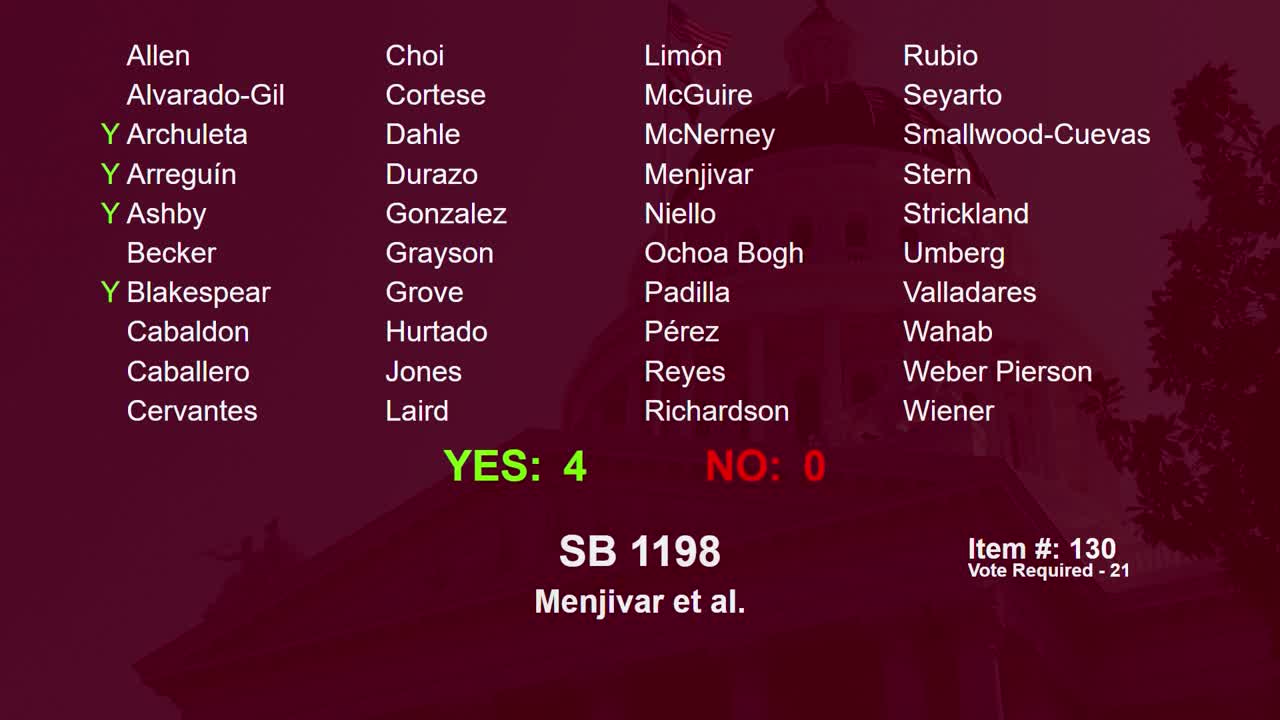 1MIN
Senate Floor
Bill Author

Bill Co-Author(s):