SB 1217: Nonconsensual Intimate Image Clearinghouse.
- Session Year: 2025-2026
- House: Senate
- Latest Version Date: 2026-04-23
Current Status:
In Progress
(2026-05-14: May 14 hearing: Held in committee and under submission.)
Introduced
In Committee
Awaiting First Chamber Vote
Passed First Chamber
In Committee
Awaiting Second Chamber Vote
Passed Second Chamber
Enacted
Existing law requires the Attorney General to establish and maintain various databases and information centers relating to the identification, apprehension, and prevention of crimes, including the Violent Crime Information Center and the Automated Firearms System, among others. Existing law requires a business that controls the collection of a consumers personal information to delete that information upon the request of the consumer and provides for administrative penalties if the business fails to act on the consumers request.
This bill would, beginning January 1, 2029, require the Department of Justice to establish the Nonconsensual Intimate Image Clearinghouse to allow individuals who were exploited in California to submit a request for the removal of nonconsensual intimate images from covered platforms. The bill would define nonconsensual intimate images to include an authentic intimate image depicting a person nude or engaging in sexual conduct distributed without consent, consent or an image digitally altered or generated by artificial intelligence realistically depicting a person nude or engaged in sexual conduct without consent, or an image created when the depicted person was a minor, if the individual is now an adult. consent. The bill would require the department to transmit verified identifiers of images to covered platforms and require those platforms to remove verified matches within 48 hours of receipt and to prevent the images from being uploaded again. The bill would require the department to enforce these provisions and would impose civil penalties for violations. The bill would require a peace officer in the investigation of a specified offense to advise a victim that they may make a request to the clearinghouse pursuant to these provisions and would require a peace officer to provide certain information to the clearinghouse, as specified.
By increasing duties for peace officers, this bill would impose a state-mandated local program.
The California Constitution requires the state to reimburse local agencies and school districts for certain costs mandated by the state. Statutory provisions establish procedures for making that reimbursement.
This bill would provide that, if the Commission on State Mandates determines that the bill contains costs mandated by the state, reimbursement for those costs shall be made pursuant to the statutory provisions noted above.
Existing law requires the Attorney General to establish and maintain various databases and information centers relating to the identification, apprehension, and prevention of crimes, including the Violent Crime Information Center and the Automated Firearms System, among others. Existing law requires a business that controls the collection of a consumers personal information to delete that information upon the request of the consumer and provides for administrative penalties if the business fails to act on the consumers request.
This bill would, beginning January 1, 2029, require the Department of Justice to establish the Nonconsensual Intimate Image Clearinghouse to allow individuals who were exploited in California to submit a request for the removal of nonconsensual intimate images from covered platforms. The bill would define nonconsensual intimate images to include an authentic intimate image distributed without consent, an image digitally altered or generated by artificial intelligence realistically depicting a person nude or engaged in sexual conduct without consent, or an image created when the depicted person was a minor, if the individual is now an adult. The bill would require the department to transmit verified identifiers of images to covered platforms and require those platforms to remove verified matches within 48 hours of receipt and to prevent the images from being uploaded again. The bill would require the department to enforce these provisions and would impose civil penalties for violations. The bill would require a peace officer in the investigation of a specified offense to advise a victim that they may make a request to the clearinghouse pursuant to these provisions and would require a peace officer to provide certain information to the clearinghouse, as specified.
By increasing duties for peace officers, this bill would impose a state-mandated local program.
The California Constitution requires the state to reimburse local agencies and school districts for certain costs mandated by the state. Statutory provisions establish procedures for making that reimbursement.
This bill would provide that, if the Commission on State Mandates determines that the bill contains costs mandated by the state, reimbursement for those costs shall be made pursuant to the statutory provisions noted above.
Existing law requires the Attorney General to establish and maintain the Violent Crime Information Center to assist in the identification and the apprehension of persons responsible for specific violent crimes and for the disappearance and exploitation of persons, particularly children and dependent adults. Existing law requires the Attorney General to establish an online, automated computer system designed to effect an immediate law enforcement response to reports of missing persons. Existing law also requires the Attorney General to establish a separate and confidential historic database relating to missing children and at-risk adults, for statistical and research purposes, as specified.This bill would state the intent of the Legislature to enact legislation authorizing the creation of a centralized clearinghouse for adults who are victims of online exploitation, abuse, or trafficking, as specified.Existing law requires the Attorney General to establish and maintain the Violent Crime Information Center to assist in the identification and the apprehension of persons responsible for specific violent crimes and for the disappearance and exploitation of persons, particularly children and dependent adults. Existing law requires the Attorney General to establish an online, automated computer system designed to effect an immediate law enforcement response to reports of missing persons. Existing law also requires the Attorney General to establish a separate and confidential historic database relating to missing children and at-risk adults, for statistical and research purposes, as specified.
This bill would state the intent of the Legislature to enact legislation authorizing the creation of a centralized clearinghouse for adults who are victims of online exploitation, abuse, or trafficking, as specified.
The Legislature finds and declares all of the following:
(a)Adult victims of human trafficking under Section 236.1 of the Penal Code often suffer persistent harm from nonconsensual intimate images distributed online as part of or resulting from their exploitation.
(b)Federal law under the TAKE IT DOWN Act requires covered online platforms to remove nonconsensual intimate visual depictions within 48 hours of valid notice, but victims frequently need assistance navigating these processes.
(c)The Department of Justice, the California Victim Compensation Board, and other state entities already support human trafficking survivors, but no dedicated mechanism exists for coordinated image removal assistance.
SEC. 2.Section 1708.87 is added to the Civil Code, to read:1708.87.(a)As used in this section, the following terms have the following meanings:
(1)Coercive production practices includes the use of pressure, threats, deception, or manipulation to force individuals to create, share, or permit the use of imagery against their will.
(2)Covered platform means an online service that makes user-generated content publicly available. Covered platform does not include a provider of broadband Internet access service, as defined in Section 3100.
(3)Department means the Department of Justice.
(4)Identifier means a method capable of uniquely identifying a nonconsensual intimate image and preventing its reupload and may include, but is not limited to, cryptographic hash values, perceptual hashes, or other digital fingerprinting methods.
(5)Large covered platform means a covered platform with 30,000,000 or more users.
(6)(A)Nonconsensual intimate image includes all of the following:
(A)(i)An authentic intimate image depicting a person nude or engaged in sexual conduct distributed without consent, including when an image is connected to human trafficking, fraud, sexual exploitation, or coercive production practices.
(B)(ii)An image digitally altered or generated by artificial intelligence realistically depicting a person nude or engaged in sexual conduct without consent.
(C)An image created when the depicted person was a minor, if the individual is now an adult.(B)Nonconsensual intimate image does not include images of minors.
(7)Nude has the same meaning as defined in Section 1708.86.
(8)Sexual conduct has the same meaning as defined in Section 1708.86.
(7)(9)Small covered platform means a covered platform with less than 30,000,000 users.
(b)The department shall establish and maintain the Nonconsensual Intimate Image Clearinghouse to allow individuals who were exploited in California to submit a request for the removal of nonconsensual intimate images from covered platforms. The department shall do all of the following:
(1)Maintain a secure internet portal to receive requests for the removal of nonconsensual intimate images. The request shall be secured using hashing or other data security techniques. The department may temporarily possess submitted information for the purpose of verification and identifier generation. The department shall not host, possess, or store nonconsensual intimate image content for any other purpose. The portal shall provide information on the verification and removal process and the status of a previous request.
(2)Verify the identify of the requesting individual.
(3)Verify that the images are nonconsensual intimate images.
(4)Transmit verified identifiers of images and associated metadata to covered platforms. The department may work with nonprofit entities for the purposes of this paragraph.
(5)Maintain a secure database of verified identifiers associated with verified nonconsensual images, but not the images.
(6)Maintain strict privacy and data security.
(c)A covered platform shall do all of the following:
(1)Accept verified notifications from the department and in the manner determined by the department.
(2)Search for matching identifiers of images within their systems.
(3)Remove verified matches within 48 hours of receipt.
(4)Prevent images with identical identifiers from being uploaded after removal.
(d)A covered platform that receives a verified identifier from the department pursuant to this section has received formal notice that the associated imagery has been verified as nonconsensual. A covered platform that acts to remove content in good faith reliance on verification made by the department is not otherwise liable.
(e)(1)A small covered platform that violates this section is subject to a civil penalty of two thousand five hundred dollars ($2,500) per violation. If the violation is determined to be intentional, it is subject to a civil penalty of seven thousand five hundred dollars ($7,500) per violation.
(2)A large covered platform that violates this section is subject to a civil penalty of up to fifty thousand dollars ($50,000) per violation. If the violation is determined to be malicious or knowing, it is subject to a civil penalty of up to two hundred fifty thousand dollars ($250,000) per violation.
(3)Each failure to remove a verified nonconsensual intimate image constitutes a separate violation of this section.
(4)This section does not create a private right of action. The department shall enforce this section.
(5)Civil penalties imposed pursuant to this section shall be deposited in the Nonconsensual Intimate Images Fund, which is hereby established within the State Treasury. Moneys in the fund shall be available, upon appropriation by the Legislature, to support ongoing operations of the Nonconsensual Intimate Image Clearinghouse.
(f)The departments verification process and any records therefrom, including verified identifiers generated by the clearinghouse, may be used in a proceeding, subject to the Evidence Code and local rules.
(g)This section shall become operative on January 1, 2029.
SEC. 3.Section 647.05 is added to the Penal Code, to read:647.05.(a)A peace officer investigating a violation of paragraph (4) of subdivision (j) of Section 647 shall inform the victim that they can report the presence of nonconsensual intimate images found on the internet to the Department of Justice pursuant to Section 1708.87 of the Civil Code.
(b)A peace officer who is able to verify possesses knowledge that a violation of paragraph (4) of subdivision (j) of Section 647 involves nonconsensual intimate images on the internet, as defined in Section 1708.87 of the Civil Code, shall provide that information to the Department of Justice, in a manner determined by the department.
(c)This section shall become operative on January 1, 2029.
SEC. 4.If the Commission on State Mandates determines that this act contains costs mandated by the state, reimbursement to local agencies and school districts for those costs shall be made pursuant to Part 7 (commencing with Section 17500) of Division 4 of Title 2 of the Government Code.
The Legislature finds and declares all of the following:
(a)Adult victims of human trafficking under Section 236.1 of the Penal Code often suffer persistent harm from nonconsensual intimate images distributed online as part of or resulting from their exploitation.
(b)Federal law under the TAKE IT DOWN Act requires covered online platforms to remove nonconsensual intimate visual depictions within 48 hours of valid notice, but victims frequently need assistance navigating these processes.
(c)The Department of Justice, the California Victim Compensation Board, and other state entities already support human trafficking survivors, but no dedicated mechanism exists for coordinated image removal assistance.
SEC. 2.Section 1708.87 is added to the Civil Code, to read:1708.87.(a)As used in this section, the following terms have the following meanings:
(1)Coercive production practices includes the use of pressure, threats, deception, or manipulation to force individuals to create, share, or permit the use of imagery against their will.
(2)Covered platform means an online service that makes content publicly available.
(3)Department means the Department of Justice.
(4)Identifier means a method capable of uniquely identifying a nonconsensual intimate image and preventing its reupload and may include, but is not limited to, cryptographic hash values, perceptual hashes, or other digital fingerprinting methods.
(5)Large covered platform means a covered platform with 30,000,000 or more users.
(6)Nonconsensual intimate image includes all of the following:
(A)An authentic intimate image distributed without consent, including when an image is connected to human trafficking, fraud, sexual exploitation, or coercive production practices.
(B)An image digitally altered or generated by artificial intelligence realistically depicting a person nude or engaged in sexual conduct without consent.
(C)An image created when the depicted person was a minor, if the individual is now an adult.
(7)Small covered platform means a covered platform with less than 30,000,000 users.
(b)The department shall establish and maintain the Nonconsensual Intimate Image Clearinghouse to allow individuals who were exploited in California to submit a request for the removal of nonconsensual intimate images from covered platforms. The department shall do all of the following:
(1)Maintain a secure internet portal to receive requests for the removal of nonconsensual intimate images. The request shall be secured using hashing or other data security techniques. The department may temporarily possess submitted information for the purpose of verification and identifier generation. The department shall not host, possess, or store nonconsensual intimate image content for any other purpose. The portal shall provide information on the verification and removal process and the status of a previous request.
(2)Verify the identify of the requesting individual.
(3)Verify that the images are nonconsensual intimate images.
(4)Transmit verified identifiers of images and associated metadata to covered platforms. The department may work with nonprofit entities for the purposes of this paragraph.
(5)Maintain a secure database of verified identifiers associated with verified nonconsensual images, but not the images.
(6)Maintain strict privacy and data security.
(c)A covered platform shall do all of the following:
(1)Accept verified notifications from the department and in the manner determined by the department.
(2)Search for matching identifiers of images within their systems.
(3)Remove verified matches within 48 hours of receipt.
(4)Prevent images with identical identifiers from being uploaded after removal.
(d)A covered platform that receives a verified identifier from the department pursuant to this section has received formal notice that the associated imagery has been verified as nonconsensual. A covered platform that acts to remove content in good faith reliance on verification made by the department is not otherwise liable.
(e)(1)A small covered platform that violates this section is subject to a civil penalty of two thousand five hundred dollars ($2,500) per violation. If the violation is determined to be intentional, it is subject to a civil penalty of seven thousand five hundred dollars ($7,500) per violation.
(2)A large covered platform that violates this section is subject to a civil penalty of up to fifty thousand dollars ($50,000) per violation. If the violation is determined to be malicious or knowing, it is subject to a civil penalty of up to two hundred fifty thousand dollars ($250,000) per violation.
(3)Each failure to remove a verified nonconsensual intimate image constitutes a separate violation of this section.
(4)This section does not create a private right of action. The department shall enforce this section.
(5)Civil penalties imposed pursuant to this section shall be deposited in the Nonconsensual Intimate Images Fund, which is hereby established within the State Treasury. Moneys in the fund shall be available, upon appropriation by the Legislature, to support ongoing operations of the Nonconsensual Intimate Image Clearinghouse.
(f)The departments verification process and any records therefrom, including verified identifiers generated by the clearinghouse, may be used in a proceeding, subject to the Evidence Code and local rules.
(g)This section shall become operative on January 1, 2029.
SEC. 3.Section 647.05 is added to the Penal Code, to read:647.05.(a)A peace officer investigating a violation of paragraph (4) of subdivision (j) of Section 647 shall inform the victim that they can report the presence of nonconsensual intimate images found on the internet to the Department of Justice pursuant to Section 1708.87 of the Civil Code.
(b)A peace officer who is able to verify that a violation of paragraph (4) of subdivision (j) of Section 647 involves nonconsensual intimate images on the internet, as defined in Section 1708.87 of the Civil Code, shall provide that information to the Department of Justice, in a manner determined by the department.
(c)This section shall become operative on January 1, 2029.
SEC. 4.If the Commission on State Mandates determines that this act contains costs mandated by the state, reimbursement to local agencies and school districts for those costs shall be made pursuant to Part 7 (commencing with Section 17500) of Division 4 of Title 2 of the Government Code.
SECTION 1.(a)It is the intent of the Legislature to enact legislation that would authorize the establishment and administration of a centralized clearinghouse for adults who are victims of online exploitation, abuse, or trafficking, and in accordance with existing law, appoint and fix the salaries of assistants, deputies, agents, experts, and other employees as may be necessary for the administration of the clearinghouse.(b)It is the intent of the Legislature to enact legislation that would authorize the adoption of rules, procedures, and protocols necessary to receive, process, and refer reports of adult exploitation, and to coordinate with law enforcement, service providers, and other entities consistent with the protection of victims privacy and safety.(a)It is the intent of the Legislature to enact legislation that would authorize the establishment and administration of a centralized clearinghouse for adults who are victims of online exploitation, abuse, or trafficking, and in accordance with existing law, appoint and fix the salaries of assistants, deputies, agents, experts, and other employees as may be necessary for the administration of the clearinghouse.
(b)It is the intent of the Legislature to enact legislation that would authorize the adoption of rules, procedures, and protocols necessary to receive, process, and refer reports of adult exploitation, and to coordinate with law enforcement, service providers, and other entities consistent with the protection of victims privacy and safety.
|
Date
|
Status
|
|---|---|
| May 14, 2026 | May 14 hearing: Held in committee and under submission. |
| May 12, 2026 | Set for hearing May 14. |
| May 11, 2026 | May 11 hearing: Placed on APPR. suspense file. |
| May 4, 2026 | Set for hearing May 11. |
| Apr 23, 2026 | Read second time and amended. Re-referred to Com. on APPR. |
| Apr 22, 2026 | From committee: Do pass as amended and re-refer to Com. on APPR. (Ayes 6. Noes 0. Page 3983.) (April 21). |
| Apr 22, 2026 | From committee: Do pass as amended and re-refer to Com. on APPR. (Ayes 6. Noes 0.) (April 21). |
| Apr 14, 2026 | From committee: Do pass and re-refer to Com. on PUB. S. (Ayes 9. Noes 0.) (April 13). Re-referred to Com. on PUB. S. |
| Apr 14, 2026 | From committee: Do pass and re-refer to Com. on PUB. S. (Ayes 9. Noes 0. Page 3843.) (April 13). Re-referred to Com. on PUB. S. |
| Apr 14, 2026 | Set for hearing April 21 in PUB. S. pending receipt. |
| Apr 9, 2026 | Set for hearing April 13. |
| Apr 8, 2026 | Re-referred to Coms. on P., D.T., & C.P. and PUB. S. |
| Apr 8, 2026 | Withdrawn from committee. |
| Apr 8, 2026 | Re-referred to Coms. on PUB. S. and P., D.T., & C.P. |
| Mar 24, 2026 | From committee with author's amendments. Read second time and amended. Re-referred to Com. on RLS. |
| Mar 4, 2026 | Referred to Com. on RLS. |
| Feb 20, 2026 | From printer. May be acted upon on or after March 22. |
| Feb 19, 2026 | Introduced. Read first time. To Com. on RLS. for assignment. To print. |
|
Date
|
Description
|
Location
|
Votes
|
|
|---|---|---|---|---|
| May 11, 2026 | Placed on suspense file | Senate Standing Committee on Appropriations |
Passed |
|
| Apr 21, 2026 | Do pass as amended, but first amend, and re-refer to the Committee on [Appropriations] | Senate Standing Committee on Public Safety |
Passed |
|
| Apr 13, 2026 | Do pass, but first be re-referred to the Committee on [Public Safety] | Senate Standing Committee on Privacy, Digital Technologies, and Consumer Protection |
Passed |
This list shows positions taken on this bill by organizations on the date displayed, which is linked to the original source.
Positions by individuals are not included.
|
Organization
|
Position
|
Date
|
|---|---|---|
| 3strands global foundation | ** Support | |
| 4 individuals | ** Support | |
| California District Attorneys Association | ** Support | |
| California Massage Therapy Council | ** Support | |
| California Survivor Coalition (sponsor) | ** Support | |
| Central Valley Justice Coalition | ** Support | |
| Chino Police Department | ** Support | |
| Church Without Walls | ** Support | |
| City Of McFarland | ** Support | |
| Community Action Partnership of Kern | ** Support | |
| County of Tulare | ** Support | |
| Crime Victim’s United | ** Support | |
| Crime Victims United | ** Support | |
| Empowerment Dess Perkins Foundation | ** Support | |
| Farmersville Police Department | ** Support | |
| Fresno County Board of Supervisors | ** Support | |
| Fresno County District Attorney’s Office | ** Support | |
| Fresno Police and Fire Chaplaincy | ** Support | |
| Fresno Police Department | ** Support | |
| Kern Coalition Against Human Trafficking | ** Support | |
| Kern County Sheriff’s Office | ** Support | |
| Love Never Fails | ** Support | |
| Merced County District Attorney Office | ** Support | |
| Monterey County District Attorney’s Office | ** Support | |
| Multiple Individuals | ** Support | |
| Riverside County Sheriff’s Office | ** Support | |
| San Diego County District Attorney’s Office | ** Support | |
| San Luis Obispo County District Attorney | ** Support | |
| Table Mountain Rancheria | ** Support | |
| The California Baptist Capitol Ministry | ** Support | |
| The Open Door Network | ** Support | |
| Treasures | ** Support | |
| Tulare County Child Abuse Prevention Council | ** Support | |
| Tulare County Probation Department | ** Support | |
| Woodlake Police Department | ** Support |
SENATE COMMITTEE ON
Senator Sabrina Cervantes, Chair
2025 - 2026 Regular Session
SB 1217 (Grove) - Nonconsensual Intimate Image Clearinghouse
Version: | Policy Vote: |
Urgency: | Mandate: |
Hearing Date: | Consultant: |
Bill Summary:
SB 1217 would require the Department of Justice (DOJ) to establish the Nonconsensual Intimate Image Clearinghouse (NIIC) to allow individuals who were exploited in California to submit a request for removal of nonconsensual intimate images from covered platforms.
Fiscal Impact:
Major costs, likely in the millions of dollars to establish and operate the NIIC.
Court costs for DOJ to enforce provisions and impose civil penalties for violations, potentially major penalty revenue.
State mandated local costs related to peace officers conducting investigations (General Fund).
Background:
Over the past decade, California has enacted a series of reforms to address image-based sexual abuse, including nonconsensual pornography, child sexual exploitation, and digitally altered deepfake content. Despite these efforts, major gaps remain in the current legal framework. Victims of nonconsensual sexual content, including child sexual abuse material often face daunting, opaque, or ineffective takedown procedures, while the platforms profiting from that content typically avoid accountability, citing user anonymity or lack of notice.
This bill enlists DOJ to create a portal for victims to send their nonconsensual intimate images for DOJ, after verification, to create identifiers, which may include cryptographic hashes or digital fingerprints. These identifiers are then sent to “covered platforms,” who must search their systems for matching identifiers and take down such images within 48 hours.
Proposed Law:
The DOJ, in establishing and maintaining the NIIC shall maintain a secure internet portal to receive requests for the removal of nonconsensual intimate images. The request shall be secured using hashing or other data security techniques. The DOJ may temporarily possess submitted information for the purpose of verification and identifier generation but shall not host, possess, or store nonconsensual intimate image content for any other purpose. The portal shall provide information on the verification and removal process and the status of a previous request. The DOJ shall:
(1) Verify the identity of the requesting individual.
(2) Verify that the images are nonconsensual intimate images.
(3) Transmit verified identifiers of images and associated metadata to covered platforms. The DOJ may work with nonprofit entities for the purposes of this paragraph.
(4) Maintain a secure database of verified identifiers associated with verified nonconsensual images, but not the images.
(5) Maintain strict privacy and data security.
Staff Comments:
This bill would require DOJ to transmit verified identifiers of images to covered platforms and require those platforms to remove verified matches within 48 hours of receipt and to prevent the images from being uploaded again. The bill would require DOJ to enforce these provisions and would impose civil penalties for violations.
The bill would require a peace officer in the investigation to advise a victim that they may make a request to the clearinghouse and would require a peace officer to provide certain information to the clearinghouse
Th bill subjects small covered platforms in violation to a penalty of $2,500 per violation, or, if intentional, $7,500 per violation and subjects large covered platforms (more than 30 million users) in violation to a penalty of up to $50,000 per violation, or, if malicious or knowing, up to $250,000 per violation.
Proposed Author Amendments:
The author will be proposing amendments to significantly reduce costs by deleting most references to DOJ, including the verification and database functions. This would move responsibility for hosting, possessing and securing nonconsensual intimate image content on the nonprofit, similar to how National Center for Missing and Exploited Children operates currently. The DOJ would continue to be responsible for civil enforcement, separate from clearinghouse operations. The amendments would not create a private right of action.
SENATE COMMITTEE ON PUBLIC SAFETY
Senator Jesse Arreguín, Chair
2025 - 2026 Regular
Bill No: SB 1217 Hearing Date: April 21, 2026
Author: | Grove | ||
Version: | March 24, 2026 | ||
Urgency: | No | Fiscal: | Yes |
Consultant: | ML | ||
Subject: Nonconsensual Intimate Image Clearinghouse
HISTORY
Source: California Survivor Coalition
Prior Legislation: SB 926 (Wahab), Ch. 289, Stats. of 2024
SB 1255 (Cannella), Ch. 863, Stats. of 2014
SB 255 (Cannella), Ch. 466, Stats. of 2013
Support: 3Strands Global Foundation; California District Attorneys Association; California Massage Therapy Council; Central Valley Justice Coalition; Chino Police Department; Church Without Walls; City of McFarland; Community Action Partnership of Kern; County of Tulare; Crime Victim’s United; emPOWERment Dess Perkins Foundation; Farmersville Police Department; Fresno County Board of Supervisors; Fresno County District Attorney’s Office; Fresno Police and Fire Chaplaincy; Fresno Police Department; Kern Coalition Against Human Trafficking; Kern County Sheriff’s Office; Love Never Fails; Merced County District Attorney Office; Monterey County District Attorney’s Office; Riverside County Sheriff’s Office; San Diego County District Attorney’s Office; San Luis Obispo County District Attorney; Table Mountain Rancheria; The California Baptist Capitol Ministry; The Open Door Network; Treasures; Tulare County Child Abuse Prevention Council; Tulare County Probation Department; Woodlake Police Department; Multiple Individuals
Opposition: None known
PURPOSE
The purpose of this bill is to establish a Nonconsensual Intimate Image Clearinghouse within the Department of Justice (DOJ) to allow individuals who were exploited in California to submit a request for the removal of nonconsensual intimate images from covered platforms, as specified; to require the DOJ to transmit verified images to covered platforms and require those platforms to remove verified matches; to require the DOJ to enforce these provisions with civil penalties against platforms for any violations; and to require a peace officer to advise a victim that they may make a request to the DOJ pursuant to these provisions and would require a peace officer to verify that the images in question are non-consensual if they possess that information.
Existing federal law, the TAKE IT DOWN Act, makes it a federal crime to knowingly share or threaten to share nonconsensual intimate images, including AI-generated images that depict real people, punishable by a fine or by imprisonment of up to two years if the image depicts an adult and three years if the image depicts a minor. (47 U.S.C. § 223, subd. (h).)
Existing federal law requires that covered platforms must establish a process whereby a person can notify the platform of an intimate visual depiction of the person published on the platform that was published without the consent of the individual. Requires the process to allow for the person depicted to submit a request for the covered platform to remove such intimate visual depiction. (47 U.S.C. § 223a, subds. (a)(1)(A)(i)-(ii).)
Existing federal law requires a covered platform to provide on the platform a clear and conspicuous notice, which may be provided through a clear and conspicuous link to another web page or disclosure, of the notice and removal process established that is easy to read, in plain language, and provides information regarding the responsibilities of the covered platform, including a description of how an individual can submit a notification and request for removal. (47 U.S.C. § 223a, subd. (a)(2).)
Existing federal law requires that upon receiving a valid removal request from an identifiable individual (or an authorized person acting on behalf of such individual) using the process described above, a covered platform must, within 48 hours, remove the intimate visual depiction and make reasonable efforts to identify and remove any known identical copies of such depiction. (47 U.S.C. § 223a, subd. (a)(3).)
Existing federal law makes violations of the above requirements by a covered platform an unfair or a deceptive act or practice under the Federal Trade Commission Act and the Federal Trade Commission may take enforcement action accordingly. (47 U.S.C. § 223a, subd. (a)(4).)
Existing federal law defines “covered platform” to mean a website, online service, online application, or mobile application that serves the public; and that primarily provides a forum for user-generated content, including messages, videos, images, games, and audio files; or for which it is in the regular course of trade or business of the website, online service, online application, or mobile application to publish, curate, host, or make available content of nonconsensual intimate visual depictions. Clarifies that “covered platform” does not include the following: a provider of broadband internet access service; a provider of electronic mail; or an online service, application, or website that consists primarily of content that is not user generated but is preselected by the provider of such online service, application, or website and for which any chat, comment, or interactive functionality is incidental to, directly related to, or dependent on the provision of the content described above. (47 U.S.C. § 223a, (note 3).)
Existing law makes it a misdemeanor for a person to intentionally distribute or cause to be distributed the image of the intimate body part or parts of another identifiable person, or an image of the person depicted engaged in an act of sexual intercourse, sodomy, oral copulation, sexual penetration, or masturbation in which the person depicted participates under circumstances in which the persons agree or understand that the image shall remain private, the person distributing the image knows or should know that distribution of the image will cause serious emotional distress, and the person depicted suffers that distress. (Pen. Code, § 647, subd. (j)(4)(A)(i).)
Existing law makes it a misdemeanor for a person to intentionally create and distribute or cause to be distributed any photo realistic image, digital image, electronic image, computer image, computer-generated image, or other pictorial representation of an intimate body part or parts of another identifiable person, or an image of the person depicted engaged in an act of sexual intercourse, sodomy, oral copulation, sexual penetration, or masturbation that was created in a manner that would cause a reasonable person to believe the image is an authentic image of the person depicted, under circumstances in which the person distributing the image knows or should know that distribution of the image will cause serious emotional distress, and the person depicted suffers that distress. Specifies that this offense does not apply to people who were under 18 years of age at the time the person committed the offense. (Pen. Code, § 647, subd. (j)(4)(A)(ii).)
Existing law states that the above crimes do not apply when:
- The distribution is made in the course of reporting an unlawful activity;
- The distribution is made in compliance with a subpoena or other court order for use in a legal proceeding;
- The distribution is made in the course of a lawful public proceeding;
- The distribution is related to a matter of public concern or public interest. Distribution is not a matter of public concern or public interest solely because the depicted individual is a public figure. (Pen. Code, § 647, subd. (j)(4)(D).)
This bill makes findings and declarations that adult victims of human trafficking often suffer harm from nonconsensual intimate images; that recent federal law creates a process for removing these images, but that victims need help navigating it; and that no mechanism exists in California for removal of such images.
This bill provides the following definitions:
- “Coercive production practices” includes the use of pressure, threats, deception, or manipulation to force individuals to create, share, or permit the use of imagery against their will.
- “Covered platform” means an online service that makes content publicly available.
- “Identifier” means a method capable of uniquely identifying a nonconsensual intimate image and preventing its reupload and may include, but is not limited to, cryptographic hash values, perceptual hashes, or other digital fingerprinting methods.
- “Nonconsensual intimate image” includes all of the following:
- An authentic intimate image distributed without consent, including when an image is connected to human trafficking, fraud, sexual exploitation, or coercive production practices.
- An image digitally altered or generated by artificial intelligence realistically depicting a person nude or engaged in sexual conduct without consent.
- An image created when the depicted person was a minor, if the individual is now an adult.
- “Large covered platform” means a covered platform with 30,000,000 or more users.
- “Small covered platform” means a covered platform with less than 30,000,000 users.
This bill requires the DOJ to establish and maintain the Nonconsensual Intimate Image Clearinghouse to allow individuals who were exploited in California to submit a request for the removal of nonconsensual intimate images from covered platforms.
This bill requires the DOJ to:
- Maintain a secure internet portal to receive requests for the removal of nonconsensual intimate images. The request must be secured using hashing or other data security techniques. The department may temporarily possess submitted information for the purpose of verification and identifier generation. The department may not host, possess, or store nonconsensual intimate image content for any other purpose. The portal must provide information on the verification and removal process and the status of a previous request.
- Verify the identity of the requesting individual.
- Verify that the images are nonconsensual intimate images.
- Transmit verified identifiers of images and associated metadata to covered platforms. The department may work with nonprofit entities for the purposes of this paragraph.
- Maintain a secure database of verified identifiers associated with verified nonconsensual images, but not the images.
- Maintain strict privacy and data security.
This bill requires covered platforms to do the following:
- Accept verified notifications from the department and in the manner determined by the department.
- Search for matching identifiers of images within their systems.
- Remove verified matches within 48 hours of receipt.
- Prevent images with identical identifiers from being uploaded after removal.
This bill provides that a covered platform that receives a verified identifier from the department pursuant to this section has received formal notice that the associated imagery has been verified as nonconsensual. Provides that a covered platform that acts to remove content in good faith reliance on verification made by the department is not otherwise liable.
This bill provides that a small covered platform that violates this section is subject to a civil penalty of $2,500 per violation. Provides that if the violation is determined to be intentional, it is subject to a civil penalty of $7,500 per violation.
This bill provides that a large covered platform that violates this section is subject to a civil penalty of up to $50,000 per violation. If the violation is determined to be malicious or knowing, it is subject to a civil penalty of up to 250,000 per violation.
This bill provides that each failure to remove a verified nonconsensual intimate image constitutes a separate violation of the provisions of this bill.
This bill clarifies that it does not create a private right of action. Requires that the DOJ will enforce the provisions of this bill.
This bill establishes the Nonconsensual Intimate Images Fund within the State Treasury. Requires that civil penalties imposed pursuant to the provisions of this bill be deposited in the Nonconsensual Intimate Images Fund. Requires that moneys in the fund be available, upon appropriation by the Legislature, to support ongoing operations of the Nonconsensual Intimate Image Clearinghouse.
This bill authorizes that the DOJ’s verification process and any resulting records, including verified identifiers generated by the clearinghouse, to be used in a proceeding, subject to the Evidence Code and local rules.
This bill provides that the above provisions become operative on January 1, 2029.
This bill requires that a peace officer investigating the illegal distribution of intimate images must inform the victim that they can report the presence of nonconsensual intimate images found on the internet to the DOJ pursuant to the above provisions.
This bill requires a peace officer who is able to verify that a crime of illegal distribution of intimate images involves nonconsensual intimate images on the internet, as defined above, must provide that information to the DOJ, in a manner determined by the department.
COMMENTS
- The Need For This Bill
The author writes:
Human trafficking survivors often endure long-lasting trauma from the persistent circulation of intimate images created through coercion, threats, deception, or manipulation. While federal law provides a framework for platforms to remove such content, victims frequently face significant barriers in navigating complex reporting processes. SB 1217 creates a secure, coordinated Nonconsensual Intimate Image Clearinghouse within the DOJ to verify requests, generate digital identifiers, and streamline notifications to covered platforms for timely removal. SB 1217 represents a thoughtful, victim-centered approach that complements federal efforts and empowers California to better protect survivors of exploitation and abuse.
- Existing Criminal Law Governing Revenge Porn
In 2013, California enacted a law to criminalize “revenge porn.” The law makes it a misdemeanor for a person to intentionally distribute an image that was intended to remain private of the intimate body parts of another or of the person depicted engaged in a sex act, if the person distributing the image knows or should know that distribution of the image will cause serious emotional distress and the person depicted suffers that distress. (Pen. Code, § 647, subd. (j)(4).) When the law was originally enacted, the law did not include “selfies,” however, the following year the law was changed to include these types of images. (See SB 255 (Cannella), Chapter 466, Statutes of 2013; SB 1255 (Cannella), Chapter 863, Statutes of 2014.)
Following the passage of these laws, major leaders in technology changed their policies to better address nonconsensual images on their platforms:
Reddit, which was a major platform used by NCDII [nonconsensual distribution of intimate images] perpetrators, was the first to ban nonconsensual nude images in early 2015. Twitter and Facebook soon followed suit. Later that year, Google announced it would honor requests to remove intimate images that were posted without permission, marking a change from their previous commitment to wholly unregulated search results. The same year, the Federal Trade Commission took steps to remove major “revenge porn” sites such as IsAnybodyDown, IsAnyoneUp and UGotPosted by charging their owners with extortion, theft, hacking, and identity theft. This effectively upended the business model of “revenge porn” websites.
(Said and McNealey, Nonconsensual Distribution of Intimate Images: Exploring the Role of Legal Attitudes in Victimization and Perpetration, Journal of Interpersonal Violence Vol. 38, Iss. 7-8 (Sept. 9, 2022) https://journals.sagepub.com/doi/full/10.1177/08862605221122834#body-ref-bibr8-08862605221122834 [as of Apr. 7, 2026].)
In 2024, SB 926 (Wahab), Chapter 289, Statutes of 2024, expanded the crime above to include distribution of AI-generated pornographic images. That bill made it a misdemeanor to create or distribute any photo realistic image, digital image, electronic image, computer image, computer-generated image, or other pictorial representation of an intimate body part or parts of another identifiable person or an image of the person depicted engaged in a sex act, if the person distributing the image knows or should know that distribution of the image will cause serious emotional distress, and the person depicted suffers that distress. (Pen. Code, § 647, subd. (j)(4)(A)(ii).)
- The Federal TAKE IT DOWN Act
In 2025, the TAKE IT DOWN Act, or the Tools to Address Known Exploitation by Immobilizing Technological Deepfakes On Websites and Networks Act, made it a federal crime to knowingly share or threaten to share nonconsensual intimate images, including AI-generated images that depict real people. (47 U.S.C. § 223, subd. (h).)
The Act further required that covered platforms must establish a process whereby a person can notify the platform of an intimate visual depiction of the person published on the platform that was published without the consent of the individual and submit a request for the covered platform to remove such intimate visual depiction. Platforms were required to establish this process within one year of the bill’s enactment. (47 U.S.C. § 223, subds. (a)(1)(A)(i)-(ii).)
A covered platform must provide a clear and conspicuous notice of the removal process above that is easy to read, in plain language, and provides information regarding the responsibilities of the covered platform, including a description of how an individual can submit a notification and request for removal. (47 U.S.C. § 223, subds. (a)(2).)
Upon receiving a valid removal request from an identifiable individual (or an authorized person acting on behalf of such individual) using the process described above, a covered platform must, within 48 hours, remove the intimate visual depiction and make reasonable efforts to identify and remove any known identical copies of such depiction. (47 U.S.C. § 223, subds. (a)(3).)
Violations by platforms of the above provisions are considered an unfair or a deceptive act or practice under the Federal Trade Commission Act, and the Federal Trade Commission may take enforcement action to enforce these provisions. (47 U.S.C. § 223, subds. (a)(4).)
- The Effect of This Bill
- The Nonconsensual Intimate Image Clearinghouse
This bill establishes a Nonconsensual Intimate Image Clearinghouse within the DOJ to allow individuals who were exploited in California to submit a request for the removal of nonconsensual intimate images from covered platforms. This bill is modeled after the federal TAKE IT DOWN Act, with some differences. Most significantly, this bill centralizes the notification and removal process within the DOJ, rather than requiring victims to notify each platform individually, making the process easier for victims to navigate.
This bill requires the DOJ to:
- Maintain a secure internet portal to receive requests for the removal of nonconsensual intimate images. The request must be secured using hashing or other data security techniques. The department may temporarily possess submitted information for the purpose of verification and identifier generation. The department may not host, possess, or store nonconsensual intimate image content for any other purpose. The portal must provide information on the verification and removal process and the status of a previous request.
- Verify the identity of the requesting individual.
- Verify that the images are nonconsensual intimate images.
- Transmit verified identifiers of images and associated metadata to covered platforms. The department may work with nonprofit entities for the purposes of this paragraph.
- Maintain a secure database of verified identifiers associated with verified nonconsensual images, but not the images.
- Maintain strict privacy and data security.
This bill requires covered platforms to do the following:
- Accept verified notifications from the department and in the manner determined by the department.
- Search for matching identifiers of images within their systems.
- Remove verified matches within 48 hours of receipt.
- Prevent images with identical identifiers from being uploaded after removal.
A small covered platform that violates this section is subject to a civil penalty of $2,500 per violation. If the violation is determined to be intentional, it is subject to a civil penalty of $7,500 per violation.
A large covered platform that violates this section is subject to a civil penalty of up to $50,000 per violation. If the violation is determined to be malicious or knowing, it is subject to a civil penalty of up to $250,000 per violation.
For purposes of this bill, a “covered platform” means an online service that makes content publicly available. “Small covered platform” means a covered platform with less than 30,000,000 users. “Large covered platform” means a covered platform with 30,000,000 or more users.
“Nonconsensual intimate image” includes all of the following:
- An authentic intimate image distributed without consent, including when an image is connected to human trafficking, fraud, sexual exploitation, or coercive production practices. “Coercive production practices” includes the use of pressure, threats, deception, or manipulation to force individuals to create, share, or permit the use of imagery against their will.
- An image digitally altered or generated by artificial intelligence realistically depicting a person nude or engaged in sexual conduct without consent.
- An image created when the depicted person was a minor, if the individual is now an adult.
Each failure to remove a verified nonconsensual intimate image constitutes a separate violation of the provisions of this bill. This bill does not create a private right of action. Rather, the DOJ will enforce the provisions of this bill.
- Police Officer Notification Regarding Nonconsensual Intimate Images
This bill further requires that a peace officer investigating the illegal creation or distribution of intimate images must inform the victim that they can report the presence of nonconsensual intimate images found on the internet to the DOJ pursuant to the above provisions. A peace officer who is able to verify that intimate images on the internet are nonconsensual, as defined above, as part of an investigation into the illegal creation or distribution of such images, must provide that information to the DOJ, in a manner determined by the department.
It is difficult to say how this verification provision will work in practice, because the process will be established in a manner determined by the DOJ. The bill says that peace officers “who are able to” verify must do so. What does it mean to be “able to”? The author may consider an amendment that would clarify that the peace officer is required to verify that the intimate images are nonconsensual if the officer possesses such knowledge. Such an amendment would provide clearer guidance to law enforcement.
- Amendments
The author has agreed to take amendments within the Privacy Committee’s jurisdiction. However, given the timing of the two hearings on this bill, the amendments will be taken in this Committee. The amendments do the following:
- Revise the definition of “covered platform” to mean “an online service that makes user-generated content publicly available” (emphasis added).
- Clarify that “covered platform” does not include providers of broadband internet services.
- Exclude intimate images depicting minors as being eligible for the Clearinghouse process. This amendment was made due to concerns regarding sending sexual content of minors over the internet to DOJ. Minors can still use the federal process to remove images from individual platforms.
- Clarify that an intimate image depicts a person nude or engaged in sexual conduct.
- Define the terms “nude” and “sexual conduct.”
- Argument in Support
California Survivor Coalition writes:
For survivors, the harm does not end when the trafficking ends. Nonconsensual intimate images are continuously reposted, reshared, and monetized across platforms…even years after prosecution. Survivors are retraumatized each time these images resurface, facing harassment, economic harm, and the enduring violation of knowing their exploitation remains publicly accessible.
While federal law under the TAKE IT DOWN Act requires platforms to remove NCII within 48 hours of valid notice, the burden of navigating that process remains entirely on the survivor. There is currently no centralized, trauma-informed system in California to assist victims in exercising this right. Survivors are left to repeatedly locate, document, and report their own abuse across countless platforms; an impossible and deeply harmful expectation.
SB 1217 directly addresses this gap by establishing a secure, state-administered clearinghouse within the DOJ. This system will allow survivors to submit verified requests for removal, after which the Department will authenticate the request, generate unique identifiers, and transmit them to covered platforms. Platforms will then be required to remove matching content within 48 hours and take reasonable steps to prevent its reupload.
This legislation is survivor-driven and solution-focused. It reflects what survivors have been asking for: a system that recognizes the ongoing nature of this harm and shifts the burden away from those who were exploited.
As one of our coalition members spearheading this effort, Mariah Reif, survivor of the federal GirlsDoPorn trafficking case in San Diego County, powerfully states:
“Current policy leaves survivors responsible for tracking and reporting their own online abuse, even after it has been verified and prosecuted. That means victims are effectively made responsible for stopping the spread of their own exploitation. Implementing an updated policy that hashes verified NCII and treats its redistribution as contraband would shift that burden off survivors and onto those who choose to recirculate verified abuse.”
-- END –
SENATE PRIVACY, DIGITAL TECHNOLOGIES, AND CONSUMER PROTECTION COMMITTEE
Senator Christopher Cabaldon, Chair
2025-2026 Regular Session
Bill No: SB 1217 (Author:Grove)
Version: March 24, 2026
Hearing Date: April 13, 2026
Fiscal: Yes
Urgency: No
Consultant: CK
SUBJECT
Nonconsensual Intimate Image Clearinghouse
DIGEST
This bill seeks to create a nonconsensual intimate image clearinghouse that allows victims to send such images to the California Department of Justice (DOJ) for them to verify and create “identifiers” that will then be sent to “covered platforms” who are required to take down any matching images within their systems.
EXECUTIVE SUMMARY
Over the past decade, California has enacted a series of reforms to address image-based sexual abuse, including nonconsensual pornography, child sexual exploitation, and digitally altered deepfake content. Despite these efforts, major gaps remain in the current legal framework. Victims of nonconsensual sexual content, including child sexual abuse material (CSAM), often face daunting, opaque, or ineffective takedown procedures, while the platforms profiting from that content typically avoid accountability, citing user anonymity or lack of notice.
At the federal level, the recently enacted Take It Down Act requires covered platforms to remove such content within 48 hours of notice. However, the author and sponsor argue that navigating the process with each platform where such images may appear is a daunting prospect, especially for traumatized victims.
This bill enlists DOJ to create a portal for victims to send their nonconsensual intimate images for DOJ, after verification, to create identifiers, which may include cryptographic hashes or digital fingerprints. These identifiers are then sent to “covered platforms,” who must search their systems for matching identifiers and take down such images within 48 hours. The bill is sponsored by California Survivor Coalition. It is supported by numerous advocacy groups and governmental entities, including Crime Victims United and the Fresno County District Attorney. No timely opposition has been received. Should the bill pass out of this Committee, it will next be heard by the Senate Public Safety Committee.
PROPOSED CHANGES TO THE LAW
Existing federal law:
- Establishes the Tools to Address Known Exploitation by Immobilizing Technological Deepfakes on Websites and Networks (TAKE IT DOWN) Act, which defines the following relevant terms:
- “Consent” means an affirmative, conscious, and voluntary authorization made by an individual free from force, fraud, duress, misrepresentation, or coercion.
- “Digital forgery” means any intimate digital depiction of an identifiable individual created through the use of software, machine learning, artificial intelligence, or any other computer-generated or technological means, or altering an authentic visual depiction, that, when viewed as a whole by a reasonable person, is indistinguishable from an authentic visual depiction of the individual.
- “Identifiable individual” means an individual who appears in whole or in part in an intimate visual depiction, and whose face, likeness, or other distinguishing characteristic (including a unique birthmark or other recognizable feature) is displayed in connection with such intimate visual depiction. (47 U.S.C. § 223(h)(1).)
- Makes it a crime for any person, in interstate or foreign commerce, to use an interactive computer service to knowingly publish an intimate visual depiction of an identifiable individual, including a digital forgery, as follows:
- If the person is not a minor, when the intimate visual depiction was obtained or created under circumstances in which the person knew or reasonably should have known that the identifiable individual had a reasonable expectation of privacy, the content depicted was not voluntarily exposed by the individual, the content depicted is not a matter of public concern, and the publication of the intimate visual depiction is intended to cause harm to the identifiable individual.
- If the person is a minor, when the depiction is posted with the intent to abuse, humiliate, harass, or degrade the minor, or to arouse or gratify the sexual desire of any person. (47 U.S.C. § 223(h)(2) & (3).)
- Requires, not later than May 19, 2026, a covered platform to establish a process whereby an identifiable individual, or an authorized person acting on their behalf, may notify the platform of an intimate visual depiction on the platform and request its removal, with information sufficient for the platform to identify the individual and to locate the intimate visual depiction in question.
- The platform must provide a clear and conspicuous notice of the removal process that is easy to read, in plain language, and provide information regarding the platform’s obligations, including how to submit a removal notice.
- Upon receiving a valid removal request, a covered platform shall, as soon as possible, but not later than 48 hours after receiving the request, remove the intimate visual depiction and make reasonable efforts to identify and remove any known identical copies of such depiction.
- A platform’s failure to remove an intimate visual depiction after receiving a valid request is treated as a violation of specified federal laws and may be enforced by the Federal Trade Commission. (47 U.S.C. 223a note.)
Existing state law:
- Provides that a depicted individual has a cause of action against a person who does either of the following:
- Creates and intentionally discloses sexually explicit material and the person knows or reasonably should have known the depicted individual in that material did not consent to its creation or disclosure.
- Intentionally discloses sexually explicit material that the person did not create, and the person knows the depicted individual in that material did not consent to the creation of the sexually explicit material. (Civ. Code § 1708.86(b).)
- Creates a private right of action against a person who intentionally distributes a photograph or recorded image of another that exposes that person’s intimate body parts, as defined, or shows the other person engaged in specified sexual acts, without that person’s consent, knowing that the other person had a reasonable expectation that the material would remain private, if specified conditions are met. (Civ. Code § 1708.85(a)-(c).)
- Requires a social platform, as defined, to provide a mechanism for a user in California to report to the platform material that the user reasonably believes is CSAM depicting an identifiable minor and to permanently block such reported material when there is a reasonable basis to believe that the reported material is CSAM; failure to comply with these requirements subjects a platform to liability in a civil action for actual damage and statutory damages, as specified. (Civ. Code, §§ 3273.66, 3273.67.)
- Criminalizes the following:
- Intentionally distributing or causing to be distributed the image of the intimate body part or parts of another identifiable person, or an image of the person depicted engaged in specified sexual acts when the person distributing the image knows or should know that the distribution of the image will cause serious emotional distress, and the person depicted suffers that distress and additional circumstances are established, such as there was an agreement to keep the material private, it was knowingly recorded without the authorization of the person depicted in a private space, or it was exfiltrated from the person depicted.
- Intentionally creating and distributing, or causing to be created or distributed, any photorealistic image, computer-generated image, or pictorial representation of an intimate body part or parts of another identifiable person, or image of them engaged in specified sexual acts, when the image was created in a manner that would cause a reasonable person to believe the image is an authentic image of the person depicted, under circumstances in which the person distributing the image knows or should know that distribution of the image will cause serious emotional distress, and the person depicted suffers that distress. (Pen. Code § 647(j)(4).)
This bill:
- Requires DOJ to establish and maintain the Nonconsensual Intimate Image Clearinghouse to allow individuals who were exploited in California to submit a request for the removal of nonconsensual intimate images from covered platforms.
- Requires DOJ, in connection with the above, to do all of the following:
- Maintain a secure internet portal to receive requests for the removal of nonconsensual intimate images. The request shall be secured using hashing or other data security techniques. DOJ may temporarily possess submitted information for the purpose of verification and identifier generation. The department shall not host, possess, or store nonconsensual intimate image content for any other purpose. The portal shall provide information on the verification and removal process and the status of a previous request.
- Verify the identity of the requesting individual.
- Verify that the images are nonconsensual intimate images.
- Transmit verified identifiers of images and associated metadata to covered platforms. The department may work with nonprofit entities for these purposes.
- Maintain a secure database of verified identifiers associated with verified nonconsensual images, but not the images.
- Maintain strict privacy and data security.
- Requires a covered platform to do all of the following:
- Accept verified notifications from DOJ and in the manner determined by the department.
- Search for matching identifiers of images within their systems.
- Remove verified matches within 48 hours of receipt.
- Prevent images with identical identifiers from being uploaded after removal.
- Provides that a covered platform that receives a verified identifier from DOJ pursuant hereto has received formal notice that the associated imagery has been verified as nonconsensual. A covered platform that acts to remove content in good faith reliance on verification made by the department is not otherwise liable.
- Subjects small covered platforms in violation to a civil penalty of $2,500 per violation, or, if intentional, $7,500 per violation.
- Subjects a large covered platform in violation to a civil penalty of up to $50,000 per violation, or, if malicious or knowing, up to $250,000 per violation.
- Provides DOJ enforcement authority and clarifies that the bill does not create a private right of action. Each failure to remove a verified nonconsensual intimate image constitutes a separate violation of this section.
- Provides that DOJ’s verification process and any records therefrom, including verified identifiers generated by the clearinghouse, may be used in a proceeding, subject to the Evidence Code and local rules.
- Requires a peace officer investigating a violation of Penal Code Section 647(j)(4) to inform the victim that they can report the presence of nonconsensual intimate images found on the internet to DOJ pursuant hereto. The officer must inform DOJ if they are able to verify the violation involves nonconsensual intimate images.
- Defines the relevant terms, including:
- “Covered platform” means an online service that makes content publicly available.
- “Identifier” means a method capable of uniquely identifying a nonconsensual intimate image and preventing its reupload and may include, but is not limited to, cryptographic hash values, perceptual hashes, or other digital fingerprinting methods.
- “Nonconsensual intimate image” includes all of the following:
- An authentic intimate image distributed without consent, including when an image is connected to human trafficking, fraud, sexual exploitation, or coercive production practices.
- An image digitally altered or generated by artificial intelligence realistically depicting a person nude or engaged in sexual conduct without consent.
- An image created when the depicted person was a minor, if the individual is now an adult.
- Becomes operative on January 1, 2029.
COMMENTS
The internet is full of CSAM, nonconsensual sexual images, and deepfake porn
CSAM was a problem before the advent of the internet, but the internet has led to a “dramatic increase” in CSAM, along with “the degree of violence and sadistic content depicted in CSAM.”[1] “CSAM is readily available through virtually every internet technology, including social networking platforms, file-sharing sites, gaming devices, and mobile apps.”[2] A significant amount of CSAM is exchanged through end-to-end encrypted technologies or on Dark Web sites like those on the Tor network.[3] In other cases, however, CSAM is available on supposedly legitimate pornography sites. After Nicholas Kristoff reported that Pornhub was hosting videos depicting minor sex trafficking victims,[4] Pornhub removed all of the content from the site that was uploaded by unverified community members—over 10 million of the 13.5 million videos on the site.[5]
The internet is also rife with nonconsensual sexual images of adults. Sometimes these images are of ex-partners, taken consensually at the time, but uploaded without consent and with the express purpose of getting revenge; for example, the “Is Anyone Up” website explicitly solicited revenge porn images.[6] Some images were taken consensually but obtained and posted nonconsensually, such as in 2014 when hackers stole private, intimate photos from the iCloud accounts of celebrities, including Jennifer Lawrence and Kate Upton, and posted the photos online.[7] Other images are created and posted all without the subject’s knowledge, much less consent.[8]
The availability of generative AI has made it even easier for an individual to create nonconsensual sexual images. Some of these images are made for use as pornography—such sexually explicit AI-generated images that “went viral on Twitter after jumping from 4chan and a specific Telegram group dedicated to abusive images of women.”[9] Some of these images are used to threaten, harass, and blackmail the persons depicted in the images. For example, the FBI is accusing an Ohio man of creating “pornographic deepfake videos of at least 10 people he was stalking and harassing,” including by threatening to “blackmail [them] using AI generated images of themselves having sex with their relatives.”[10] The man’s search history revealed that he had searched for ClothesOff,[11] which is one of many apps that openly offer to create AI-generated nude images from photos.
Facebook and Instagram have allowed these apps to advertise on their platforms, Google Play and Apple App stores have hosted these apps for download.[12] When a Twitter[13] user posts a photo, Grok, Elon Musk’s AI chatbot, will generate an image of the user without their clothes (naked or in just their underwear) in the comments upon request by another user.[14] The AI-generated image is public and viewable to the user and any of their followers.[15]
Children and teens are also victims of “undress” apps and deepfake porn generators—story[16] after story[17] has been written[18] about students[19] in middle and high schools[20] generating[21] fake nude and/or pornographic images[22] of their fellow students[23] and sharing the images with their friends.[24] Female and LGBTQ+ students are far more likely to be depicted in deepfaked nonconsensual imagery.[25] Major AI and tech companies have also facilitated the creation of massive amounts of AI-generated CSAM.[26] AI generative technologies “are also being employed to facilitate the grooming and sextortion of minor victims.”[27]
Regulatory response
In response to these issues, California passed AB 602 (Berman, Ch. 491, Stats. 2019), which provides a cause of action against a person who creates and intentionally discloses sexually explicit, nonconsensual deepfakes, as specified, and those who intentionally disclose them knowing they are nonconsensual. AB 621 (Bauer-Kahan, Ch. 673, Stats. 2025) updated the law to combat this troubling new trend of GenAI nudification and provided stronger enforcement mechanisms to incentivize compliance. It expanded the cause of action to include material depicting minors and extends liability to those knowingly facilitating or recklessly aiding or abetting the actionable conduct. It also took aim at “deepfake pornography services” whose primary purpose is to create these sexually explicit deepfakes.
However, once CSAM or nonconsensual intimate imagery is online, it can be virtually impossible to get it taken down. California now has laws requiring social media platforms to have reporting mechanisms for nonconsensual images and CSAM,[28] though it is unclear how responsive the platforms have been. In May 2025, Congress enacted the TAKE IT DOWN Act, which makes it illegal to knowingly publish or threaten to publish nonconsensual sexual images, and beginning in May 2026, requires a website or social media company to remove such material within 48 hours’ notice from a victim.[29] The TAKE IT DOWN Act was inspired in part by a teen whose classmates posted deepfake images of her to Snapchat, which Snapchat refused to take down for nearly a year.[30]
This bill seeks to enlist California’s DOJ in the effort to get these images taken down from the internet.
According to the author:
Human trafficking survivors often endure long-lasting trauma from the persistent circulation of intimate images created through coercion, threats, deception, or manipulation. While federal law provides a framework for platforms to remove such content, victims frequently face significant barriers in navigating complex reporting processes. SB 1217 creates a secure, coordinated Nonconsensual Intimate Image Clearinghouse within the Department of Justice to verify requests, generate digital identifiers, and streamline notifications to covered platforms for timely removal. SB 1217 represents a thoughtful, victim-centered approach that complements federal efforts and empowers California to better protect survivors of exploitation and abuse.
The bill requires, starting January 1, 2029, DOJ to establish and maintain the Nonconsensual Intimate Image Clearinghouse to allow individuals who were exploited in California to submit a request for the removal of nonconsensual intimate images from covered platforms. DOJ must maintain a secure internet portal to receive requests for the removal of such images. The request shall be secured using hashing or other data security techniques.
The process envisioned by the bill has victims actually transmit the intimate images to DOJ, who at least temporarily hosts the images. Upon receiving the image, DOJ must verify the identity of the individual and that the images are, in fact, nonconsensual intimate images. Then, DOJ must create “identifiers,” which may include some form of hashing or digital fingerprinting, for the images. DOJ must then send these identifiers to all “covered platforms” and maintain a database of identifiers and allow for the checking of status of a previous request.
DOJ then sends these identifiers and associated metadata to all “covered platforms.” The bill authorizes DOJ to work with nonprofits for this part of the process. Covered platforms are then required to receive them and search for matching identifiers within their systems. Similar to federal law, covered platforms must remove matches within 48 hours. A covered platform that receives a verified identifier from DOJ pursuant hereto has received formal notice that the associated imagery has been verified as nonconsensual.
The bill provides for civil penalties against platforms in violation based on size and whether the violation was intentional or malicious and knowing.
Concerns with the Clearinghouse and process
While enlisting a powerful ally for victims to take down such images online is a compelling goal, some concerns have been raised about the process and potential unintended consequences. First, a process by which victims are actually transmitting these intimate images may jeopardize their privacy and provide a ripe target for perpetrators looking to exfiltrate such images. Given that DOJ must maintain the images at least long enough to verify the individual submitting them, and presumably that the individual is in the image, and that it qualifies as a “nonconsensual intimate image,” heightens these privacy concerns.
For example, the National Center for Missing and Exploited Children (NCMEC) currently provides a free service that helps remove or stop the online sharing of such images of minors. The service creates a “hash” of the relevant image or video. But the image or video remains on the reporting party’s device and is not actually submitted as part of the process. Instead, the unique hash that was created is added to NCMEC’s hash list, which is then made available to online platforms who may scan their public or unencrypted services to detect, remove, and where appropriate, report those images or videos to NCMEC. NCMEC describes the technology in layman’s terms: “Think of a hash value like a digital fingerprint. Each image or video gets a unique hash value that distinguishes it from other images and videos.”[31]
In addition, it is not clear that DOJ has the technical capability to securely receive intimate images, potentially including CSAM, and create a hash or digital fingerprint. The author may wish to consider a different process for securing these identifiers.
Next, there is some concern with the breadth and clarity of some of the definitions within the bill. “Covered platform,” for instance, is broadly defined to include any online service that makes content publicly available. This may very well be every single website on the internet. That would mean DOJ must send these identifiers to every website and that every website would need to check its systems to avoid liability. In addition, the definition of “nonconsensual intimate image” includes all of the following:
- An authentic intimate image distributed without consent, including when an image is connected to human trafficking, fraud, sexual exploitation, or coercive production practices.
- An image digitally altered or generated by artificial intelligence realistically depicting a person nude or engaged in sexual conduct without consent.
- An image created when the depicted person was a minor, if the individual is now an adult.
The first category indicates the image must be “intimate,” but the bill does not define the term. The author may wish to include a definition to avoid capturing a much larger universe than intended. The final category only requires the image to be of a minor with no mention of consent or it needing to be intimate. Again, the author may wish to refine these definitions to more precisely target the images intended.
In response to these concerns, the author has agreed to amendments that do the following:
- Provide a definition for what an “intimate image” is.
- Remove application to images of minors.
- Refine the definition of “covered platform” to apply to online services that make user-generated content available to the public with certain exemptions.
The author has also agreed to continue to work with the Committee on the highlighted privacy and security concerns outlined above and to further refine the verification process envisioned by the bill.
Stakeholder positions
The California Survivor Coalition, the sponsor of this measure, writes:
While federal law under the TAKE IT DOWN Act requires platforms to remove NCII within 48 hours of valid notice, the burden of navigating that process remains entirely on the survivor. There is currently no centralized, trauma-informed system in California to assist victims in exercising this right. Survivors are left to repeatedly locate, document, and report their own abuse across countless platforms; an impossible and deeply harmful expectation.
SB 1217 directly addresses this gap by establishing a secure, state-administered clearinghouse within the Department of Justice. This system will allow survivors to submit verified requests for removal, after which the Department will authenticate the request, generate unique identifiers, and transmit them to covered platforms. Platforms will then be required to remove matching content within 48 hours and take reasonable steps to prevent its reupload.
Crime Victims United writes in support:
By shifting the burden away from victims and creating a coordinated enforcement mechanism, SB 1217 addresses the ongoing harm caused by the widespread distribution of exploitative images, including harassment, blackmail, and long-term emotional and economic damage. This measure strengthens accountability for online platforms while providing victims with meaningful tools to reclaim their safety and privacy.
SUPPORT
California Survivor Coalition (sponsor)
3strands Global Foundation
California Massage Therapy Council
Central Valley Justice Coalition
Chino Police Department
Church Without Walls
City of Mcfarland
Community Action Partnership of Kern
County of Tulare
Crime Victims United
Empowerment (Dess Perkins Foundation)
Farmersville Police Department
Fresno County Board of Supervisors
Fresno County District Attorneys Office
Fresno Police and Fire Chaplaincy
Fresno Police Department
Kern Coalition Against Human Trafficking
Kern County Sheriff’s Office
Riverside County Sheriff’s Office
San Luis Obispo County District Attorney
Table Mountain Rancheria
The California Baptist Capitol Ministry
Treasures
Tulare County Child Abuse Prevention Council
4 Individuals
OPPOSITION
None received
RELATED LEGISLATION
AB 392 (Dixon, 2025) requires the operator of a pornographic internet website, as defined, to obtain from its users a verification that sexually explicit material the user is uploading to the site does not include a depiction of a person who was a minor at the time the material was created, a person who did not consent to be in the material, or who did not consent to have the material uploaded, and establishes a rebuttable presumption that the failure to do so violates the operator’s duty of care, as specified. AB 392 was held in the Senate Appropriations Committee.
SB 981 (Wahab, Ch. 292, Stats. 2024) required social media platforms to provide a mechanism for reporting “sexually explicit digital identity theft,” essentially the posting of nonconsensual, sexual deepfakes; and requires platforms to timely respond and investigate and to remove instances of this material, as provided.
AB 1394 (Wick, Ch. 579, Stats. 2023) required social media platforms to provide a reporting mechanism for suspected child sexual abuse material and requires them to permanently block the material, as provided. It also prohibited platforms from knowingly facilitating, aiding, or abetting minor’s commercial sexual exploitation.
AB 602 (Berman, Ch. 491, Stats. 2019) See Executive Summary and Comment 2.
**************
U.S. Dept. of Justice, Child Sexual Abuse Material (2023) p. 5, available at https://www.justice.gov/d9/2023-06/child_sexual_abuse_material_2.pdf. All links in this analysis are current as of April 7, 2026. ↑
Id. at p. 2. ↑
Id.at pp. 4-5. ↑
Kristoff, The Children of Pornhub (Dec. 4, 2020) New York Times, https://www.nytimes.com/2020/12/04/opinion/sunday/pornhub-rape-trafficking.html. ↑
Valinsky, Pornhub removes a majority of its videos after investigation reveals child abuse (Dec. 15, 2020) CNN, https://edition.cnn.com/2020/12/15/business/pornhub-videos-removed/index.html. ↑
U.S District Attorney’s Office for the Central District of California, Press Release: Operator of ‘Revenge Porn’ Website Sentenced to 2 ½ Years in Federal Prison in Email Hacking Scheme to Obtain Nude Photos (Dec. 2, 2015) https://www.justice.gov/usao-cdca/pr/operator-revenge-porn-website-sentenced-2-years-federal-prison-email-hacking-scheme. ↑
Arthur, Naked celebrity hack: security experts focus on iCloud backup theory (Sept. 1, 2014) The Guardian, https://www.theguardian.com/technology/2014/sep/01/naked-celebrity-hack-icloud-backup-jennifer-lawrence. ↑
E.g., Hounsell, She was searching online for a receipt. She found a video of herself engaged in a sex act (Jan. 17, 2025) CBC, https://www.cbc.ca/news/canada/nova-scotia/intimate-partner-violence-sharing-intimate-images-1.7432723. ↑
Maiberg & Cole, AI-Generated Taylor Swift Porn Went Viral on Twitter. Here’s How It Got There (Jan. 25, 2024) 404 Media, https://www.404media.co/ai-generated-taylor-swift-porn-twitter/. ↑
Cole, A Deepfake Nightmare: Stalker Allegedly Made Sexual AI Images of Ex-Girlfriends and Their Families (Jun. 26, 2025) 404 Media, https://www.404media.co/deepfake-harassment-ohio-undress-clothoff-nudify-apps/. ↑
Ibid. ↑
Maiberg, Instagram Advertises Nonconsensual AI Nude Apps (Apr. 22, 2024) 404 Media, https://www.404media.co/instagram-advertises-nonconsensual-ai-nude-apps/; Maiberg, Google Bans Face Swap App for Inviting Users to Make Deepfake Porn (Apr. 2, 2024) 404 Media, https://www.404media.co/google-bans-face-swap-app-for-advertising-deepfakes-on-porn-sites/. ↑
Aka “X.” ↑
Shalabaieva, Elon Musk’s Grok AI Will ‘Remove Her Clothes” In Public, On X (May 6, 2025) 404 Media, https://www.404media.co/elon-musks-grok-ai-will-remove-her-clothes-in-public-on-x/. ↑
Ibid. ↑
Koebler & Maiberg, ‘What Was She Supposed to Report?:’ Police Report Shows How a High School Deepfake Nightmare Unfolded (Feb. 15, 2024) 404 Media, https://www.404media.co/what-was-she-supposed-to-report-police-report-shows-how-a-high-school-deepfake-nightmare-unfolded/. ↑
Reuters, Spanish prosecutor to probe AI-generated images of naked minors (Sept. 25, 2023) Reuters, https://www.reuters.com/world/europe/spanish-prosecutor-probe-ai-generated-images-naked-minors-2023-09-25/. ↑
Healey, Beverly Hills middle school rocked by AI-generated nude images of students (Feb. 26, 2024) Los Angeles Times, https://www.latimes.com/california/story/2024-02-26/beverly-hills-middle-school-is-the-latest-to-be-rocked-by-deepfake-scandal. ↑
Ciavaglia, Council Rock middle schooler investigated over alleged deepfake images of girls (Jun. 6, 2025) phillyburbs.com, https://www.phillyburbs.com/story/news/local/2025/06/06/council-rock-newtown-middle-school-deepfake-ai-technology-police-investigation-porn-bucks-county/84029305007/. ↑
Blume, L.A. school district probes inappropriate images shared at Fairfax High. More AI abuse? (Apr. 9, 2024) Los Angeles Times, https://www.latimes.com/california/story/2024-04-09/student-generated-inappropriate-ai-image-of-girls-at-fairfax-high. ↑
Haskell, Calabasas teen says classmate not disciplined for sharing real and fake images of her (Mar. 14, 2024) ABC 7 Eyewitness News, https://abc7.com/calabasas-high-school-student-accuses-classmate-sharing-real-and-fake-nude-photos/14521422/. ↑
McNicholas, New Jersey high school students accused of making AI-generated pornographic images of classmates (Nov. 2, 2023) CBS News, https://www.cbsnews.com/newyork/news/westfield-high-school-ai-pornographic-images-students/. ↑
Fry, Laguna Beach High School investigates ‘inappropriate’ AI-generated images of students (Apr. 2, 2025) Los Angeles Times, https://www.latimes.com/california/story/2024-04-02/laguna-beach-high-school-investigating-creation-of-ai-generated-images-of-students. ↑
Guardian staff, Sydney teenager allegedly used AI to create deepfake pornography of students (Jan. 8, 2025) The Guardian, https://www.theguardian.com/australia-news/2025/jan/09/sydney-high-school-ai-deepfake-porn-scandal-ntwnfb. ↑
Center for Democracy & Technology, In Deep Trouble: Surfacing Tech-Powered Sexual Harassment in K-12 Schools (Sept. 2024) p. 18, available at https://cdt.org/insights/report-in-deep-trouble-surfacing-tech-powered-sexual-harassment-in-k-12-schools/. ↑
E.g., Maiberg, Tech Companies Promise to Try to Do Something About All the AI CSAM They’re Enabling (Apr. 29, 2024) 404 Media, https://www.404media.co/tech-companies-promise-to-try-to-do-something-about-all-the-ai-csam-theyre-enabling/. ↑
Thoel. Stroebel, & Portnoff, Generative ML and CSAM: Implications and Mitigations (Jun. 24, 2023) Thorn & Stanford Internet Observatory, p. 8. ↑
See Bus. & Prof. Code, § 22671; Civ. Code, § 3273.66. ↑
Pub. L. No. 119-12 (May 19, 2025) 139 Stat. 55. ↑
Ortutay, President Trump signs Take It Down Act, addressing nonconsensual deepfakes. What is it? (May 20, 2025) AP News, https://apnews.com/article/take-it-down-deepfake-trump-melania-first-amendment-741a6e525e81e5e3d8843aac20de8615. ↑
Discussed in Hearing
 25MIN
Senate Standing Committee on Public Safety
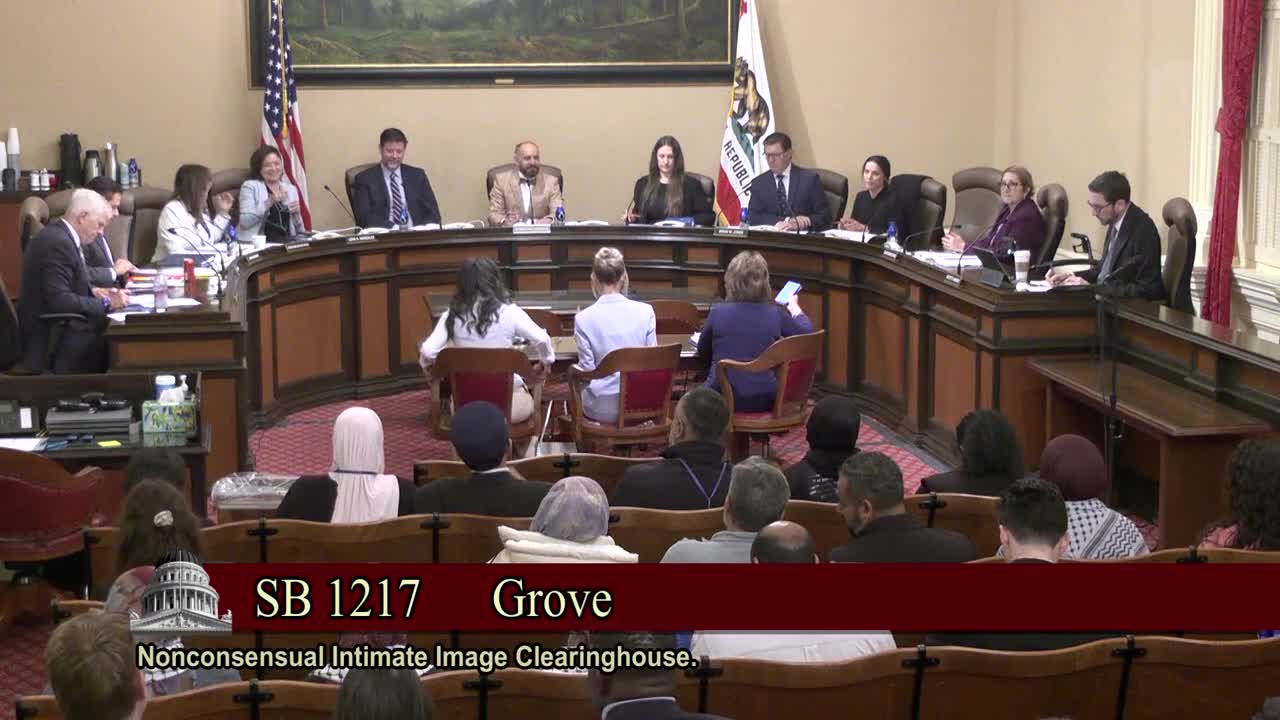 33MIN
Senate Standing Committee on Privacy, Digital Technologies, and Consumer Protection
Bill Author
Bill Co-Author(s):