SB 1227: Department of Industrial Relations: apprenticeship pilot program.
- Session Year: 2025-2026
- House: Senate
- Latest Version Date: 2026-09-18
Current Status:
Passed
(2026-09-18: Chaptered by Secretary of State. Chapter 326, Statutes of 2026.)
Introduced
In Committee
Awaiting First Chamber Vote
Passed First Chamber
In Committee
Awaiting Second Chamber Vote
Passed Second Chamber
Enacted
Existing law provides for the establishment of apprenticeship programs in various trades, to be approved by the Chief of the Division of Apprenticeship Standards within the Department of Industrial Relations in any trade in the state or in a city or trade area whenever the apprentice training needs justify the establishment.
This bill would require, on or before January 1, 2029, the Department of Industrial Relations (DIR) and the Department of Human Resources to partner with the bargaining units representing employees of DIR to design and develop an apprenticeship pilot program that addresses DIRs staffing challenges. The bill would require the design, development, and administration of the program to meet specified requirements, including being consistent with the constitutional merit principle applicable to civil service employment. The bill would require the program to meet specified requirements, including that the apprenticeship program classification pay scales be determined by the collective bargaining process. The bill would include related legislative findings and declarations.
Existing law provides for the establishment of apprenticeship programs in various trades, to be approved by the Chief of the Division of Apprenticeship Standards within the Department of Industrial Relations in any trade in the state or in a city or trade area whenever the apprentice training needs justify the establishment.
This bill would require, on or before January 1, 2028, 2029, the Department of Industrial Relations (DIR) and the Department of Human Resources to partner with the bargaining units representing employees of DIR to design and develop an apprenticeship pilot program that addresses DIRs staffing challenges. The bill would require the design, development, and administration of the program to meet specified requirements, including being consistent with the constitutional merit principle applicable to civil service employment. The bill would require the program to meet specified requirements, including that the apprenticeship program classification pay scales be determined by the collective bargaining process. The bill would include related legislative findings and declarations.
Existing law provides for the establishment of apprenticeship programs in various trades, to be approved by the Chief of the Division of Apprenticeship Standards within the Department of Industrial Relations in any trade in the state or in a city or trade area whenever the apprentice training needs justify the establishment.
This bill would require, on or before January 1, 2028, the Department of Industrial Relations (DIR) and the Department of Human Resources to partner with the bargaining units representing employees of DIR to design and develop an apprenticeship pilot program that addresses DIRs staffing challenges. The bill would require the design, development, and administration of the program to meet specified requirements, including being consistent with the constitutional merit principle applicable to civil service employment. The bill would require the program to meet specified requirements, including that the apprenticeship program classification pay scales be determined by the collective bargaining process. The bill would include related legislative findings and declarations.
Existing law provides for the establishment of apprenticeship programs in various trades, to be approved by the Chief of the Division of Apprenticeship Standards within the Department of Industrial Relations in any trade in the state or in a city or trade area whenever the apprentice training needs justify the establishment.
This bill would require, on or before January 1, 2028, the Department of Industrial Relations (DIR) and the Department of Human Resources to partner with the bargaining units representing employees of DIR to design and develop an apprenticeship pilot program that addresses DIRs staffing challenges. The bill would require the design, development, and administration of the program to meet specified requirements, including being consistent with the constitutional merit principle applicable to civil service employment. The bill would require the program to meet specified requirements, including that the apprenticeship program participants pay classification pay scales be determined by the collective bargaining process. The bill would include related legislative findings and declarations.
Existing law provides for the establishment of apprenticeship programs in various trades, to be approved by the Chief of the Division of Apprenticeship Standards within the Department of Industrial Relations in any trade in the state or in a city or trade area whenever the apprentice training needs justify the establishment.
This bill would require require, on or before January 1, 2028, the Department of Industrial Relations (DIR) and the Department of Human Resources to partner with the bargaining units representing employees of DIR to design and develop an apprenticeship pilot program that addresses DIRs staffing challenges. The bill would require the design, development, and administration of the program to meet specified requirements, including being consistent with the constitutional merit principle applicable to civil service employment. The bill would require the program to meet specified requirements, including that the apprenticeship program participants pay be determined by the collective bargaining process. The bill would include related legislative findings and declarations.
Existing law provides for the establishment of apprenticeship programs in various trades, to be approved by the Chief of the Division of Apprenticeship Standards within the Department of Industrial Relations in any trade in the state or in a city or trade area whenever the apprentice training needs justify the establishment.
This bill would require the Department of Industrial Relations (DIR) and the Department of Human Resources to partner with the bargaining units representing employees of DIR to design and develop an apprenticeship pilot program that addresses DIRs staffing challenges. The bill would require the design, development, and administration of the program to meet specified requirements, including being consistent with the constitutional merit principle applicable to civil service employment. The bill would include related legislative findings and declarations.
(a)The Legislature finds and declares all of the following:
(1)Staff shortages undermine the ability of the Department of Industrial Relations (DIR) to enforce labor law in California.
(2)In recent years, DIR has had vacancy rates in excess of 25 percent with hundreds of positions in its labor law enforcement divisions remaining vacant for extended periods.
(3)Recent investigations of DIR by the California State Auditor demonstrate the way inadequate staffing at the Division of Occupational Safety and Health and the Division of Labor Standards Enforcement weakens the states enforcement of Californias worker protections statutes, limiting DIRs investigative reach, and contributing to workload backlogs and long case processing timelines.
(4)Registered apprenticeship is a time-tested, skills- and merit-based means of developing and staffing workforces in numerous sectors of the economy.
(5)Registered apprenticeship programs can provide pathways to good paying jobs, providing family sustaining wages with competitive benefits and retirement packages.
(6)Apprenticeship has provided career pathways to middle-class jobs for members of historically marginalized communities.
(7)The State of California has historically used apprenticeship programs as means to staff civil service positions at the Department of Forestry and Fire Protection, the Department of Water Resources, the Department of Corrections and Rehabilitation, and the Department of Transportation.
(8)Courts have given a free hand to the Legislature to fashion laws relating to personnel administration for the best interests of the [s]tate, provided that these laws are consistent with the merit principle contained in the California Constitution, as discussed in California State Personnel Bd. v. California State Employees Assn., Local 1000, SEIU, AFL-CIO (2005) 36 Cal.4th 758, 767.
(b)Therefore, it is the intent of the Legislature to promote the interest of the state and Californias workers by supporting apprenticeship as a means to address longstanding staffing inadequacies at the Department of Industrial Relations.
SEC. 2.Chapter 11 (commencing with Section 19999.9) is added to Part 2.6 of Division 5 of Title 2 of the Government Code, to read:11.Department of Industrial Relations Apprenticeship Pilot Program19999.9.This chapter shall be known and may be cited as the Department of Industrial Relations Apprenticeship Pilot Program.
19999.91.For purposes of this chapter, both of the following definitions apply:
(a)Apprenticeship program or program means the apprenticeship pilot program or programs established pursuant to this chapter.
(b)Constitutional merit principle means the merit principle contained in subdivision (b) of Section 1 of Article VII of the California Constitution.
19999.92.(a)On or before January 1, 2029, the Department of Industrial Relations and the Department of Human Resources shall partner with the bargaining units representing employees of the Department of Industrial Relations to design and develop an apprenticeship program that addresses the Department of Industrial Relations staffing challenges for filling positions in civil service classifications.
(b)The design, development, and administration of the apprenticeship program shall meet all of the following requirements:
(1)Use the meet and confer process, collective bargaining, and joint apprenticeship committees in a manner that is consistent with the requirements of the Ralph C. Dills Act (Chapter 10.3 (commencing with Section 3512) of Division 4 of Title 1), the Shelley-Maloney Apprenticeship Labor Standards Act of 1939 (Chapter 4 (commencing with Section 3070) of Division 3 of the Labor Code), and the provisions of the Labor Code governing apprenticeship.
(2)Be consistent with the constitutional merit principle, including, but not limited to, both of the following:
(A)Selection for participation in an apprenticeship.
(B)Completion of an apprenticeship under the program.
(3)Notwithstanding subdivision (b) of Section 3517.8, be implemented subject to an agreement between the parties consistent with the Ralph C. Dills Act (Chapter 10.3 (commencing with Section 3512) of Division 4 of Title 1).
(c)Notwithstanding any other law or regulation, a joint apprenticeship committee operating under this section shall have all powers afforded to it by the Labor Code and the regulations pertaining to joint apprenticeship committees arising from the Labor Code.
(d)Consistent with the selection requirements of subparagraph (A) of paragraph (2) of subdivision (b), apprenticeship program candidates may include incumbent state employees and prospective state employees not yet employed in the civil service.
(e)The apprenticeship program shall meet all of the following requirements:
(1)Apprenticeship program classification pay scales shall be determined by the collective bargaining process.
(2)Apprenticeship program participants hired into a civil service apprenticeship classification consistent with the merit requirements of subparagraph (A) of paragraph (2) of subdivision (b) shall accrue state service for purposes of seniority credit pursuant to applicable bargaining agreements and shall accrue service credit for retirement benefits pursuant to the Public Employees Retirement Law (Part 3 (commencing with Section 20000)) for time employed in a civil service apprenticeship classification.
(3)Apprenticeship program participants who successfully complete an apprenticeship program pursuant to the merit requirements of subparagraph (B) of paragraph (2) of subdivision (b) shall be considered as qualified and eligible for appointment to the journey classification by way of an apprentice transfer.
(f)The apprenticeship program is intended to augment state capacity and improve recruitment and retention efforts for hard-to-fill job classifications and shall not displace incumbent workers employed in state service.
(g)This section shall not be construed to limit the jurisdiction or authority of the State Personnel Board with respect to the powers and authorities granted to it under the California Constitution.
(a)The Legislature finds and declares all of the following:
(1)Staff shortages undermine the ability of the Department of Industrial Relations (DIR) to enforce labor law in California.
(2)In recent years, DIR has had vacancy rates in excess of 25 percent with hundreds of positions in its labor law enforcement divisions remaining vacant for extended periods.
(3)Recent investigations of DIR by the California State Auditor demonstrate the way inadequate staffing at the Division of Occupational Safety and Health and the Division of Labor Standards Enforcement weakens the states enforcement of Californias worker protections statutes, limiting DIRs investigative reach, and contributing to workload backlogs and long case processing timelines.
(4)Registered apprenticeship is a time-tested, skills- and merit-based means of developing and staffing workforces in numerous sectors of the economy.
(5)Registered apprenticeship programs can provide pathways to good paying jobs, providing family sustaining wages with competitive benefits and retirement packages.
(6)Apprenticeship has provided career pathways to middle-class jobs for members of historically marginalized communities.
(7)The State of California has historically used apprenticeship programs as means to staff civil service positions at the Department of Forestry and Fire Protection, the Department of Water Resources, the Department of Corrections and Rehabilitation, and the Department of Transportation.
(8)Courts have given a free hand to the Legislature to fashion laws relating to personnel administration for the best interests of the [s]tate, provided that these laws are consistent with the merit principle contained in the California Constitution, as discussed in California State Personnel Bd. v. California State Employees Assn., Local 1000, SEIU, AFL-CIO (2005) 36 Cal.4th 758, 767.
(b)Therefore, it is the intent of the Legislature to promote the interest of the state and Californias workers by supporting apprenticeship as a means to address longstanding staffing inadequacies at the Department of Industrial Relations.
SEC. 2.Article 9 (commencing with Section 3150) is added to Chapter 4 of Division 3 of the Labor Code, to read:9.Department of Industrial Relations Apprenticeship Pilot ProgramSEC. 2.Chapter 11 (commencing with Section 19999.9) is added to Part 2.6 of Division 5 of Title 2 of the Government Code, to read:11.Department of Industrial Relations Apprenticeship Pilot Program3150.19999.9.This article chapter shall be known and may be cited as the Department of Industrial Relations Apprenticeship Pilot Program.
3151.19999.91.For purposes of this article, chapter, both of the following definitions apply:
(a)Apprenticeship program or program means the apprenticeship pilot program or programs established pursuant to this article. chapter.
(b)Constitutional merit principle means the merit principle contained in subdivision (b) of Section 1 of Article VII of the California Constitution.
(c)Department means the Department of Industrial Relations.3152.19999.92.(a)On or before January 1, 2028, the department 2029, the Department of Industrial Relations and the Department of Human Resources shall partner with the bargaining units representing employees of the department Department of Industrial Relations to design and develop an apprenticeship program that addresses the departments Department of Industrial Relations staffing challenges for filling positions in civil service classifications.
(b)The design, development, and administration of the apprenticeship program shall meet all of the following requirements:
(1)Use the meet and confer process, collective bargaining, and joint apprenticeship committees in a manner that is consistent with the requirements of the Ralph C. Dills Act (Chapter 10.3 (commencing with Section 3512) of Division 4 of Title 1 of the Government Code), 1), the Shelley-Maloney Apprenticeship Labor Standards Act of 1939 (Chapter 4 (commencing with Section 3070) of Division 3), 3 of the Labor Code), and the provisions of this code the Labor Code governing apprenticeship.
(2)Be consistent with the constitutional merit principle, including, but not limited to, both of the following:
(A)Selection for participation in an apprenticeship.
(B)Completion of an apprenticeship under the program.
(3)Notwithstanding subdivision (b) of Section 3517.8 of the Government Code, 3517.8, be implemented subject to an agreement between the parties consistent with the Ralph C. Dills Act (Chapter 10.3 (commencing with Section 3512) of Division 4 of Title 1 of the Government Code). 1).
(c)Notwithstanding any other law or regulation, a joint apprenticeship committee operating under this section shall have all powers afforded to it by this code the Labor Code and the regulations pertaining to joint apprenticeship committees arising from this code. the Labor Code.
(d)Consistent with the selection requirements of subparagraph (A) of paragraph (2) of subdivision (b), apprenticeship program candidates may include incumbent state employees and prospective state employees not yet employed in the civil service.
(e)The apprenticeship program shall meet all of the following requirements:
(1)Apprenticeship program classification pay scales shall be determined by the collective bargaining process.
(2)Apprenticeship program participants hired into a civil service apprenticeship classification consistent with the merit requirements of subparagraph (A) of paragraph (2) of subdivision (b) shall accrue state service for purposes of seniority credit pursuant to applicable bargaining agreements and shall accrue service credit for retirement benefits pursuant to the Public Employees Retirement Law (Part 3 (commencing with Section 20000) of Division 5 of Title 2 of the Government Code) 20000)) for time employed in a civil service apprenticeship classification.
(3)Apprenticeship program participants who successfully complete an apprenticeship program pursuant to the merit requirements of subparagraph (B) of paragraph (2) of subdivision (b) shall be considered as qualified and eligible for appointment to the journey classification by way of an apprentice transfer.
(f)The apprenticeship program is intended to augment state capacity and improve recruitment and retention efforts for hard-to-fill job classifications and shall not displace incumbent workers employed in state service.
(g)This section shall not be construed to limit the jurisdiction or authority of the State Personnel Board with respect to the powers and authorities granted to it under the California Constitution.
(a)The Legislature finds and declares all of the following:
(1)Staff shortages undermine the ability of the Department of Industrial Relations (DIR) to enforce labor law in California.
(2)In recent years, DIR has had vacancy rates in excess of 25 percent with hundreds of positions in its labor law enforcement divisions remaining vacant for extended periods.
(3)Recent investigations of DIR by the California State Auditor demonstrate the way inadequate staffing at the Division of Occupational Safety and Health and the Division of Labor Standards Enforcement weakens the states enforcement of Californias worker protections statutes, limiting DIRs investigative reach, and contributing to workload backlogs and long case processing timelines.
(4)Registered apprenticeship is a time-tested, skills- and merit-based means of developing and staffing workforces in numerous sectors of the economy.
(5)Registered apprenticeship programs can provide pathways to good paying jobs, providing family sustaining wages with competitive benefits and retirement packages.
(6)Apprenticeship has provided career pathways to middle-class jobs for members of historically marginalized communities.
(7)The State of California has historically used apprenticeship programs as means to staff civil service positions at the Department of Forestry and Fire Protection, the Department of Water Resources, the Department of Corrections and Rehabilitation, and the Department of Transportation.
(8)Courts have given a free hand to the Legislature to fashion laws relating to personnel administration for the best interests of the [s]tate, provided that these laws are consistent with the merit principle contained in the California Constitution, as discussed in California State Personnel Bd. v. California State Employees Assn., Local 1000, SEIU, AFL-CIO (2005) 36 Cal.4th 758, 767.
(b)Therefore, it is the intent of the Legislature to promote the interest of the state and Californias workers by supporting apprenticeship as a means to address longstanding staffing inadequacies at the Department of Industrial Relations.
SEC. 2.Article 9 (commencing with Section 3150) is added to Chapter 4 of Division 3 of the Labor Code, to read:9.Department of Industrial Relations Apprenticeship Pilot Program3150.This article shall be known and may be cited as the Department of Industrial Relations Apprenticeship Pilot Program.
3151.For purposes of this article, the following definitions apply:
(a)Apprenticeship program or program means the apprenticeship pilot program or programs established pursuant to this article article.
(b)CalHR means the Department of Human Resources.(c)(b)Constitutional merit principle means the merit principle contained in subdivision (b) of Section 1 of Article VII of the California Constitution.
(d)(c)Department means the Department of Industrial Relations.
3152.(a)On or before January 1, 2028, the department and CalHR the Department of Human Resources shall partner with the bargaining units representing employees of the department to design and develop an apprenticeship program that addresses the departments staffing challenges for filling positions in civil service classifications, including, but not limited to, industrial hygienist. classifications.
(b)The design, development, and administration of the apprenticeship program shall meet all of the following requirements:
(1)Use the meet and confer process, collective bargaining, and joint apprenticeship committees in a manner that is consistent with the requirements of the Ralph C. Dills Act (Chapter 10. 3 10.3 (commencing with Section 3512) of Division 4 of Title 1 of the Government Code), the Shelley-Maloney Apprenticeship Labor Standards Act of 1939 (Chapter 4 (commencing with Section 3070) of Division 3), and the provisions of this code governing apprenticeship.
(2)Be consistent with the constitutional merit principle, including, but not limited to, both of the following:
(A)Selection for participation in an apprenticeship, which shall be in accordance with court interpretations of the constitutional merit principle. apprenticeship.
(B)Completion of an apprenticeship under the program, which shall be merit-based in accordance with court interpretation of the constitutional merit principle. program.
(3)Notwithstanding subdivision (b) of Section 3517.8 of the Government Code, be implemented subject to an agreement between the department and the exclusive representative. between the parties consistent with the Ralph C. Dills Act (Chapter 10.3 (commencing with Section 3512) of Division 4 of Title 1 of the Government Code).
(c)Notwithstanding any other law or regulation, a joint apprenticeship committee operating under this section shall have all powers afforded to it by this code and the regulations pertaining to joint apprenticeship committees arising from this code.
(d)Consistent with the selection requirements of subparagraph (A) of paragraph (2) of subdivision (b), apprenticeship program candidates may include incumbent state employees and prospective state employees not yet employed in the civil service.
(e)The apprenticeship program shall meet all of the following requirements:
(1)Apprenticeship program classification pay scales shall be determined by the collective bargaining process.
(2)Apprenticeship program participants hired into a civil service apprenticeship classification consistent with the merit requirements of subparagraph (A) of paragraph (2) of subdivision (b) shall accrue state service for purposes of seniority credit pursuant to applicable bargaining agreements and shall accrue service credit for retirement benefits pursuant to the Public Employees Retirement Law (Part 3 (commencing with Section 20000) of Division 5 of Title 2 of the Government Code) for time employed in a civil service apprenticeship classification.
(3)Apprenticeship program participants who successfully complete an apprenticeship program pursuant to the merit requirements of subparagraph (B) of paragraph (2) of subdivision (b) shall be considered as qualified and eligible for appointment to the journey classification by way of an apprentice transfer.
(f)The apprenticeship program is intended to augment state capacity and improve recruitment and retention efforts for hard-to-fill job classifications and shall not displace incumbent workers employed in state service.
(g)This section shall not be construed to limit the jurisdiction or authority of the State Personnel Board with respect to the powers and authorities granted to it under the California Constitution.
(a)The Legislature finds and declares all of the following:
(1)Staff shortages undermine the ability of the Department of Industrial Relations (DIR) to enforce labor law in California.
(2)In recent years, DIR has had vacancy rates in excess of 25 percent with hundreds of positions in its labor law enforcement divisions remaining vacant for extended periods.
(3)Recent investigations of DIR by the California State Auditor demonstrate the way inadequate staffing at the Division of Occupational Safety and Health and the Division of Labor Standards Enforcement weakens the states enforcement of Californias worker protections statutes, limiting DIRs investigative reach, and contributing to workload backlogs and long case processing timelines.
(4)Registered apprenticeship is a time-tested, skills- and merit-based means of developing and staffing workforces in numerous sectors of the economy.
(5)Registered apprenticeship programs can provide pathways to good paying jobs, providing family sustaining wages with competitive benefits and retirement packages.
(6)Apprenticeship has provided career pathways to middle-class jobs for members of historically marginalized communities.
(7)The State of California has historically used apprenticeship programs as means to staff civil service positions at the Department of Forestry and Fire Protection, the Department of Water Resources, the Department of Corrections and Rehabilitation, and the Department of Transportation.
(8)Courts have given a free hand to the Legislature to fashion laws relating to personnel administration for the best interests of the [s]tate, provided that these laws are consistent with the merit principle contained in the California Constitution, as discussed in California State Personnel Bd. v. California State Employees Assn., Local 1000, SEIU, AFL-CIO (2005) 36 Cal.4th 758, 767.
(b)Therefore, it is the intent of the Legislature to promote the interest of the state and Californias workers by supporting apprenticeship as a means to address longstanding staffing inadequacies at the Department of Industrial Relations.
SEC. 2.Article 9 (commencing with Section 3150) is added to Chapter 4 of Division 3 of the Labor Code, to read:9.Department of Industrial Relations Apprenticeship Pilot Program3150.This article shall be known and may be cited as the Department of Industrial Relations Apprenticeship Pilot Program.
3151.For purposes of this article, the following definitions apply:
(a)Apprenticeship program or program means the apprenticeship pilot program or programs established pursuant to this article
(b)CalHR means the Department of Human Resources.
(c)Constitutional merit principle means the merit principle contained in subdivision (b) of Section 1 of Article VII of the California Constitution.
(d)Department means the Department of Industrial Relations.
3152.(a)On or before January 1, 2028, the department and CalHR shall partner with the bargaining units representing employees of the department to design and develop an apprenticeship program that addresses the departments staffing challenges for titles, filling positions in civil service classifications, including, but not limited to, industrial hygienists. hygienist.
(b)The design, development, and administration of the apprenticeship program shall meet all of the following requirements:
(1)Use the meet and confer process, collective bargaining, and joint apprenticeship committees in a manner that is consistent with the requirements of the Ralph C. Dills Act (Chapter 10. 3 (commencing with Section 3512) of Division 4 of Title 1 of the Government Code), the Shelley-Maloney Apprenticeship Labor Standards Act of 1939 (Chapter 4 (commencing with Section 3070) of Division 3), and the provisions of this code governing apprenticeship.
(2)Be consistent with the constitutional merit principle, including, but not limited to, both of the following:
(A)Selection for participation in an apprenticeship, which shall be in accordance with court interpretations of the constitutional merit principle.
(B)Completion of an apprenticeship under the program, which shall be merit-based in accordance with court interpretation of the constitutional merit principle.
(3)Notwithstanding subdivision (b) of Section 3517.8 of the Government Code, be implemented subject to an agreement between the department and the exclusive representative.
(c)Notwithstanding any other law or regulation, a joint apprenticeship committee operating under this section shall have all powers afforded to it by this code and the regulations pertaining to joint apprenticeship committees arising from this code.
(d)Consistent with the selection requirements of subparagraph (A) of paragraph (2) of subdivision (b), apprenticeship program candidates may include incumbent state employees and prospective state employees not yet employed in the civil service.
(e)The apprenticeship program shall meet all of the following requirements:
(1)Apprenticeship program participants pay classification pay scales shall be determined by the collective bargaining process.
(2)Apprenticeship program participants hired into a civil service apprenticeship classification consistent with the merit requirements of subparagraph (A) of paragraph (2) of subdivision (b) shall accrue full civil service credited time during the time employed in a civil service apprenticeship classification for purposes of retirement benefits and seniority. state service for purposes of seniority credit pursuant to applicable bargaining agreements and shall accrue service credit for retirement benefits pursuant to the Public Employees Retirement Law (Part 3 (commencing with Section 20000) of Division 5 of Title 2 of the Government Code) for time employed in a civil service apprenticeship classification.
(3)Apprenticeship program participants who successfully complete an apprenticeship program pursuant to the merit requirements of subparagraph (B) of paragraph (2) of subdivision (b) shall be considered as qualified and eligible for appointment to the journey classification by way of an apprentice transfer.
(f)The apprenticeship program is intended to augment state capacity and improve recruitment and retention efforts for hard-to-fill job classifications and shall not displace incumbent workers employed in state service.
(g)This section shall not be construed to limit the jurisdiction or authority of the State Personnel Board with respect to the powers and authorities granted to it under the California Constitution.
(a)The Legislature finds and declares all of the following:
(1)Staff shortages undermine the ability of the Department of Industrial Relations (DIR) to enforce labor law in California.
(2)In recent years, DIR has had vacancy rates in excess of 25 percent with hundreds of positions in its labor law enforcement divisions remaining vacant for extended periods.
(3)Recent investigations of DIR by the California State Auditor demonstrate the way inadequate staffing at the Division of Occupational Safety and Health and the Division of Labor Standards Enforcement weakens the states enforcement of Californias worker protections statutes, limiting DIRs investigative reach, and contributing to workload backlogs and long case processing timelines.
(4)Registered apprenticeship is a time-tested, skills- and merit-based means of developing and staffing workforces in numerous sectors of the economy.
(5)Registered apprenticeship programs can provide pathways to good paying jobs, providing family sustaining wages with competitive benefits and retirement packages.
(6)Apprenticeship has provided career pathways to middle-class jobs for members of historically marginalized communities.
(7)The State of California has historically used apprenticeship programs as means to staff civil service positions at the Department of Forestry and Fire Protection, the Department of Water Resources, the Department of Corrections and Rehabilitation, and the Department of Transportation.
(8)Courts have given a free hand to the Legislature to fashion laws relating to personnel administration for the best interests of the [s]tate, provided that these laws are consistent with the merit principle contained in the California Constitution, as discussed in California State Personnel Bd. v. California State Employees Assn., Local 1000, SEIU, AFL-CIO (2005) 36 Cal.4th 758, 767.
(b)Therefore, it is the intent of the Legislature to promote the interest of the state and Californias workers by supporting apprenticeship as a means to address longstanding staffing inadequacies at the Department of Industrial Relations.
SEC. 2.Article 9 (commencing with Section 3150) is added to Chapter 4 of Division 3 of the Labor Code, to read:9.Department of Industrial Relations Apprenticeship Pilot Program3150.This article shall be known and may be cited as the Department of Industrial Relations Apprenticeship Pilot Program.
3151.For purposes of this article, the following definitions apply:
(a)Apprenticeship program or program means the apprenticeship pilot program or programs established pursuant to this article
(b)CalHR means the Department of Human Resources.
(c)Constitutional merit principle means the merit principle contained in subdivision (b) of Section 1 of Article VII of the California Constitution.
(d)Department means the Department of Industrial Relations.
3152.(a)On or before _____, January 1, 2028, the department and CalHR shall partner with the bargaining units representing employees of the department to design and develop an apprenticeship program that addresses the departments staffing challenges. challenges for titles, including, but not limited to, industrial hygienists.
(b)The design, development, and administration of the apprenticeship program shall meet both all of the following requirements:
(1)Use the meet and confer process, collective bargaining, and joint apprenticeship committees in a manner that is consistent with the requirements of the Ralph C. Dills Act (Chapter 10. 3 (commencing with Section 3512) of Division 4 of Title 1 of the Government Code), the Shelley-Maloney Apprenticeship Labor Standards Act of 1939 (Chapter 4 (commencing with Section 3070) of Division 3), and the provisions of this code governing apprenticeship.
(2)Be consistent with the constitutional merit principle, including, but not limited to, both of the following:
(A)Selection for participation in an apprenticeship, which shall be in accordance with court interpretations of the constitutional merit principle.
(B)Completion of an apprenticeship under the program, which shall be merit-based in accordance with court interpretation of the constitutional merit principle.
(3)Notwithstanding subdivision (b) of Section 3517.8 of the Government Code, be implemented subject to an agreement between the department and the exclusive representative.
(c)Notwithstanding any other law or regulation, a joint apprenticeship committee operating under this section shall have all powers afforded to it by this code. code and the regulations pertaining to joint apprenticeship committees arising from this code.
(d)Consistent with the selection requirements of subparagraph (A) of paragraph (2) of subdivision (b), apprenticeship program candidates may include incumbent state employees and prospective state employees not yet employed in the civil service.
(e)The apprenticeship program shall meet all of the following requirements:
(1)Apprenticeship program participants pay shall be determined by the collective bargaining process.
(2)Apprenticeship program participants hired into a civil service apprenticeship classification consistent with the merit requirements of subparagraph (A) of paragraph (2) of subdivision (b) shall accrue full civil service credited time during the time employed in a civil service apprenticeship classification for purposes of retirement benefits and seniority.
(3)Apprenticeship program participants who successfully complete an apprenticeship program pursuant to the merit requirements of subparagraph (B) of paragraph (2) of subdivision (b) shall be considered as qualified and eligible for appointment to the journey classification by way of an apprentice transfer.
(f)The apprenticeship program is intended to augment state capacity and improve recruitment and retention efforts for hard-to-fill job classifications and shall not displace incumbent workers employed in state service.
(d)(g)This section shall not be construed to limit the jurisdiction or authority of the State Personnel Board with respect to the powers and authorities granted to it under the California Constitution.
(a)The Legislature finds and declares all of the following:
(1)Staff shortages undermine the ability of the Department of Industrial Relations (DIR) to enforce labor law in California.
(2)In recent years, DIR has had vacancy rates in excess of 25 percent with hundreds of positions in its labor law enforcement divisions remaining vacant for extended periods.
(3)Recent investigations of DIR by the California State Auditor demonstrate the way inadequate staffing at the Division of Occupational Safety and Health and the Division of Labor Standards Enforcement weakens the states enforcement of Californias worker protections statutes, limiting DIRs investigative reach, and contributing to workload backlogs and long case processing timelines.
(4)Registered apprenticeship is a time-tested, skills- and merit-based means of developing and staffing workforces in numerous sectors of the economy.
(5)Registered apprenticeship programs can provide pathways to good paying jobs, providing family sustaining wages with competitive benefits and retirement packages.
(6)Apprenticeship has provided career pathways to middle-class jobs for members of historically marginalized communities.
(7)The State of California has historically used apprenticeship programs as means to staff civil service positions at the Department of Forestry and Fire Protection, the Department of Water Resources, the Department of Corrections and Rehabilitation, and the Department of Transportation.
(8)Courts have given a free hand to the Legislature to fashion laws relating to personnel administration for the best interests of the [s]tate, provided that these laws are consistent with the merit principle contained in the California Constitution, as discussed in California State Personnel Bd. v. California State Employees Assn., Local 1000, SEIU, AFL-CIO (2005) 36 Cal.4th 758, 767.
(b)Therefore, it is the intent of the Legislature to promote the interest of the state and Californias workers by supporting apprenticeship as a means to address longstanding staffing inadequacies at the Department of Industrial Relations.
SEC. 2.Article 9 (commencing with Section 3150) is added to Chapter 4 of Division 3 of the Labor Code, to read:9.Department of Industrial Relations Apprenticeship Pilot Program3150.This article shall be known and may be cited as the Department of Industrial Relations Apprenticeship Pilot Program.
3151.For purposes of this article, the following definitions apply:
(a)Apprenticeship program or program means the apprenticeship pilot program or programs established pursuant to this article
(b)CalHR means the Department of Human Resources.
(c)Constitutional merit principle means the merit principle contained in subdivision (b) of Section 1 of Article VII of the California Constitution.
(d)Department means the Department of Industrial Relations.
3152.(a)On or before _____,the department and CalHR shall partner with the bargaining units representing employees of the department to design and develop an apprenticeship program that addresses the departments staffing challenges.
(b)The design, development, and administration of the apprenticeship program shall meet both of the following requirements:
(1)Use the meet and confer process, collective bargaining, and joint apprenticeship committees in a manner that is consistent with the requirements of the Ralph C. Dills Act (Chapter 10. 3 (commencing with Section 3512) of Division 4 of Title 1 of the Government Code), the Shelley-Maloney Apprenticeship Labor Standards Act of 1939 (Chapter 4 (commencing with Section 3070) of Division 3), and the provisions of this code governing apprenticeship.
(2)Be consistent with the constitutional merit principle, including, but not limited to, both of the following:
(A)Selection for participation in an apprenticeship, which shall be in accordance with court interpretations of the constitutional merit principle.
(B)Completion of an apprenticeship under the program, which shall be merit-based in accordance with court interpretation of the constitutional merit principle.
(c)Notwithstanding any other law or regulation, a joint apprenticeship committee operating under this section shall have all powers afforded to it by this code.
(d)This section shall not be construed to limit the jurisdiction or authority of the State Personnel Board with respect to the powers and authorities granted to it under the California Constitution.
|
Date
|
Status
|
|---|---|
| Sep 18, 2026 | Chaptered by Secretary of State. Chapter 326, Statutes of 2026. |
| Sep 18, 2026 | Approved by the Governor. |
| Sep 3, 2026 | Enrolled and presented to the Governor at 3 p.m. |
| Aug 27, 2026 | Assembly amendments concurred in. (Ayes 40. Noes 0. Page 5987.) Ordered to engrossing and enrolling. |
| Aug 27, 2026 | Assembly amendments concurred in. (Ayes 39. Noes 0.) Ordered to engrossing and enrolling. |
| Aug 26, 2026 | Ordered to special consent calendar. |
| Aug 24, 2026 | In Senate. Concurrence in Assembly amendments pending. |
| Aug 24, 2026 | Read third time. Passed. (Ayes 78. Noes 0. Page 6394.) Ordered to the Senate. |
| Aug 24, 2026 | Read third time. Passed. Ordered to the Senate. |
| Aug 20, 2026 | Ordered to third reading. |
| Aug 20, 2026 | Read third time and amended. |
| Aug 13, 2026 | Read second time. Ordered to third reading. |
| Aug 13, 2026 | From committee: Do pass. (Ayes 15. Noes 0.) (August 13). |
| Aug 13, 2026 | Assembly Rule 63 suspended. |
| Aug 5, 2026 | August 5 set for first hearing. Placed on suspense file. |
| Jun 25, 2026 | From committee: Do pass and re-refer to Com. on APPR. with recommendation: To consent calendar. (Ayes 7. Noes 0.) (June 24). Re-referred to Com. on APPR. |
| Jun 11, 2026 | Read second time and amended. Re-referred to Com. on L. & E. |
| Jun 10, 2026 | From committee: Do pass as amended and re-refer to Com. on L. & E. (Ayes 6. Noes 0.) (June 10). |
| Jun 1, 2026 | Referred to Coms. on P. E. & R. and L. & E. |
| May 20, 2026 | In Assembly. Read first time. Held at Desk. |
| May 19, 2026 | Read third time. Passed. (Ayes 38. Noes 0. Page 4347.) Ordered to the Assembly. |
| May 19, 2026 | Read third time. Passed. (Ayes 38. Noes 0.) Ordered to the Assembly. |
| May 14, 2026 | From committee: Do pass. (Ayes 6. Noes 0. Page 4270.) (May 14). |
| May 14, 2026 | From committee: Do pass. (Ayes 6. Noes 0.) (May 14). |
| May 14, 2026 | Read second time. Ordered to third reading. |
| May 8, 2026 | Set for hearing May 14. |
| May 4, 2026 | May 4 hearing: Placed on APPR. suspense file. |
| Apr 24, 2026 | Set for hearing May 4. |
| Apr 16, 2026 | Read second time and amended. Re-referred to Com. on APPR. |
| Apr 15, 2026 | From committee: Do pass as amended and re-refer to Com. on APPR. (Ayes 5. Noes 0. Page 3903.) (April 15). |
| Apr 15, 2026 | From committee: Do pass as amended and re-refer to Com. on APPR. (Ayes 5. Noes 0.) (April 15). |
| Apr 9, 2026 | Set for hearing April 15. |
| Apr 7, 2026 | From committee with author's amendments. Read second time and amended. Re-referred to Com. on L., P.E. & R. |
| Mar 4, 2026 | Referred to Com. on L., P.E. & R. |
| Feb 20, 2026 | From printer. May be acted upon on or after March 22. |
| Feb 19, 2026 | Introduced. Read first time. To Com. on RLS. for assignment. To print. |
|
Date
|
Description
|
Location
|
Votes
|
|
|---|---|---|---|---|
| Aug 27, 2026 | Special Consent SB1227 Durazo | Senate Floor |
Passed |
|
| Aug 24, 2026 | SB 1227 Durazo Senate Third Reading By Ortega | Assembly Floor |
Passed |
|
| Aug 13, 2026 | Do pass. | Assembly Standing Committee on Appropriations |
Passed |
|
| Jun 24, 2026 | Do pass and be re-referred to the Committee on [Appropriations] with recommendation: To Consent Calendar | Assembly Standing Committee on Labor and Employment |
Passed |
|
| Jun 10, 2026 | Do pass as amended and be re-referred to the Committee on [Labor and Employment] | Assembly Standing Committee on Public Employment and Retirement |
Passed |
|
| May 19, 2026 | Senate 3rd Reading SB1227 Durazo | Senate Floor |
Passed |
|
| May 14, 2026 | Do pass | Senate Standing Committee on Appropriations |
Passed |
|
| May 4, 2026 | Placed on suspense file | Senate Standing Committee on Appropriations |
Passed |
|
| Apr 15, 2026 | Do pass as amended, but first amend, and re-refer to the Committee on [Appropriations] | Senate Standing Committee on Labor, Public Employment and Retirement |
Passed |
This list shows positions taken on this bill by organizations on the date displayed, which is linked to the original source.
Positions by individuals are not included.
|
Organization
|
Position
|
Date
|
|---|---|---|
| Asian Pacific Environmental Network | ** Support | |
| California Association of Professional Scientists, UAW 1115 | ** Support | |
| California Association of Professional Scientists, UAW Local 1115 | ** Support | |
| California Attorneys Administrative Law Judges and Hearing Officers in State Employment | ** Support | |
| California Chamber Of Commerce | ** Support | |
| California Farmworker Coalition | ** Support | |
| California Federation of Labor Unions | ** Support | |
| California Nurses Association | ** Support | |
| California Rural Legal Assistance Foundation | ** Support | |
| CFT – A Union of Educators & Classified Professionals | ** Support | |
| ILWU Local 26 | ** Support | |
| Inland Empire Labor Council | ** Support | |
| National Cosh | ** Support | |
| national council for occupational safety and health | ** Support | |
| National Council on Occupational Safety and Health | ** Support | |
| Professional Engineers In California Government | ** Support | |
| Service Employees International Union, California | ** Support | |
| Service Employees International Union, Local 1000 | ** Support | |
| SMART, California State Legislative Board | ** Support | |
| SMART - Transportation Division | ** Support | |
| Southern California Coalition for Occupational Safety and Health | ** Support | |
| Southern California in Occupational Safety & Health | ** Support | |
| Sunflower Alliance | ** Support | |
| United Steelworkers District 12 | ** Support | |
| United Steelworkers Local, 675 | ** Support | |
| UNITED STEELWORKERS LOCAL 675 | ** Support | |
| Worksafe | ** Support |
SENATE RULES COMMITTEE Office of Senate Floor Analyses (916) 651-4171 | SB 1227 |
UNFINISHED BUSINESS
Bill No: SB 1227
Author: Durazo (D)
Amended: 8/20/26
Vote: 21
SENATE LABOR, PUB. EMP. & RET. COMMITTEE: 5-0, 4/15/26
AYES: Smallwood-Cuevas, Strickland, Cortese, Durazo, Laird
SENATE APPROPRIATIONS COMMITTEE: 6-0, 5/14/26
AYES: Cervantes, Cabaldon, Dahle, Grayson, Richardson, Wahab
NO VOTE RECORDED: Seyarto
SENATE FLOOR: 38-0, 5/19/26
AYES: Allen, Alvarado-Gil, Archuleta, Arreguín, Ashby, Becker, Blakespear, Cabaldon, Caballero, Cervantes, Choi, Cortese, Dahle, Durazo, Gonzalez, Grayson, Grove, Hurtado, Jones, Laird, Limón, McGuire, McNerney, Menjivar, Padilla, Pérez, Reyes, Richardson, Rubio, Seyarto, Smallwood-Cuevas, Stern, Strickland, Umberg, Valladares, Wahab, Weber Pierson, Wiener
NO VOTE RECORDED: Niello, Ochoa Bogh
ASSEMBLY FLOOR: Passed, 8/24/26
SUBJECT: Department of Industrial Relations: apprenticeship pilot program
SOURCE: Author
DIGEST:
This bill requires the Department of Industrial Relations (DIR) and the Department of Human Resources (CalHR) to partner with their respective bargaining units to design and develop an apprenticeship program, as specified, addressing DIR’s staffing challenges for filling civil service classification positions.
Assembly Amendments
place the bill’s provisions in the Government Code instead of the Labor Code and make corresponding changes to code section and chapter numbers.
ANALYSIS:
Existing law:
- Establishes the Division of Apprenticeship Standards (DAS) within the Department of Industrial Relations to oversee apprenticeship programs and requires the Chief of the Division (Chief) to perform various functions to promote the welfare of apprentices. (Labor Code §3070 et seq.)
2) Creates, within DAS, the Interagency Advisory Committee on Apprenticeship (IACA), which provides advice and guidance to the Administrator of Apprenticeship and Chief on the development and administration of standards governing preapprenticeship, certification, and on-the-job training and retraining programs outside the building and construction trades and firefighters. (Labor Code §3071.5)
3) Requires DAS to evaluate apprenticeship programs to ensure compliance with specified standards, including that all on-the-job training is properly supervised, that classroom instruction is provided, and that funds were properly obtained and expended. (Labor Code §3073.1)
4) Authorizes a joint apprenticeship committee, unilateral management or labor apprenticeship committee, or an individual employer to administer an apprenticeship program. The Chief may approve programs in any trade in the state or in a city or trade area, whenever the apprentice training needs justify the establishment. Where a collective bargaining agreement exists, a program shall be jointly sponsored unless either party to the agreement waives its right to representation in writing. (Labor Code §3075(a))
5) Defines “apprentice” to mean a person at least 16 years of age who has entered into a written agreement, or apprentice agreement, with an employer or program sponsor. The Chief shall approve the term of apprenticeship for each apprenticeable occupation, as specified. (Labor Code §3077)
6) Provides that the term of apprenticeship may be measured either through the completion of the industry standard for hours of on-the-job learning and related and supplemental instruction, attainment of competency, or a hybrid blend of the time-based and competency-based approaches, as specified, but that programs in the building and construction trades and for firefighters shall use the time-based approach. (Labor Code §3078.5)
7) Requires the local joint apprenticeship committee or the parties to a collective bargaining agreement, or the administrator where there is no collective bargaining agreement or joint committee to approve apprentice agreements. Every apprentice agreement shall be signed by the employer, or his or her agent, or by a program sponsor, as specified, and by the apprentice. (Labor Code §3079)
8) Provides that neither existing law nor approved apprentice agreements can operate to invalidate any apprenticeship provision in any collective bargaining agreement between employers and employees setting up higher apprenticeship standards. (Labor Code §3086)
9) Provides that acceptance of an application for entrance into an apprenticeship program shall not be predicated on the payment of any fee, but that reasonable costs for expense incurred may be charged after an applicant has been accepted into the program. (Labor Code §3091)
10) Allows apprenticeship sponsors to include local educational agencies (LEAs), institutions of higher education (IHEs), labor organizations, and nonprofits, and encourages alignment of apprenticeship programs with affirmative action and public sector workforce needs. (Labor Code §§3075, 3075.1)
- Creates the state civil service that includes every officer and employee of the state except a limited number of specified, exempted officers and employees. Existing law also requires that the state make “permanent appointment and promotion in the civil service under a general system based on merit ascertained by competitive examination.” Case law and custom refer to this provision as the merit principle and it governs the administration of the state’s civil service system. (California Constitution (CA CONST.) art. VII, §1 and §4)
- Creates the State Personnel Board (SPB) to enforce the civil service statutes and prescribe probationary periods and classifications, adopt other rules authorized by statute, and review disciplinary actions. (CA CONST. art. VII, §2 and §3)
- Establishes the State Civil Service Act to facilitate the operation of the Constitution’s merit principle for the state civil service. (Government Code §18500).
- Creates the California Department of Human Resources (CalHR) and vests it with the powers, duties, and authorities necessary to operate the state civil service system pursuant to Article VII of the California Constitution, the Government Code, the merit principle, and applicable rules duly adopted by the State Personnel Board (SPB). (Government Code (GC) § 18502)
- Requires SPB to establish minimum qualifications for determining the fitness and qualifications of employees for each class of position, including education, experience, knowledge, and abilities that each applicant is required to have to be considered eligible for a classification. CalHR may require applicants for examination or appointment to provide documentation as it deems necessary to establish the applicants’ qualifications. (GC §18931)
- Requires that an employee serve a probationary period under the following circumstances: (a) when the employee enters or is promoted in the state civil service by permanent appointment from an employment list, (b) upon reinstatement after a break in continuity of service resulting from a permanent separation, or (c) after any other type of appointment situation not specifically excepted from the probationary period requirement by statute or by board rule. (GC § 19171)
- Requires SPB to establish for each class the length of the probationary period but also provides that the probationary period that shall be served upon appointment shall be six months unless the board establishes a longer period of not more than one year. (GC § 19170)
This bill:
- Makes legislative findings and declarations, as specified.
- Establishes the Department of Industrial Relations Apprenticeship Pilot Program within the Government Code.
- Defines the following terms:
- “Apprenticeship program” or “program” means the apprenticeship pilot program or programs established pursuant to this bill.
- “Constitutional merit principle” means the merit principle contained in subdivision (b) of Section 1 of Article VII of the California Constitution.
- “Department” means the Department of Industrial Relations.
- Requires DIR and CalHR on or before January 1, 2029, to partner with the bargaining units representing DIR employees to design and develop an apprenticeship program that addresses the DIR’s staffing challenges for filling positions in civil service classifications.
- Requires the apprenticeship program’s design, development, and administration to meet the following requirements:
- Use the meet and confer process, collective bargaining, and joint apprenticeship committees in a manner that is consistent with the Ralph C. Dills Act, the Shelley-Maloney Apprenticeship Labor Standards Act of 1939, and provisions of the Labor Code governing apprenticeship.
- Be consistent with the constitutional merit principle, including, but not limited to, both of the following:
- Selection for participation in an apprenticeship, which shall be in accordance with court interpretations of the constitutional merit principle.
- Completion of an apprenticeship under the program, which shall be merit-based in accordance with court interpretation of the constitutional merit principle.
- Only be implemented subject to an agreement between DIR and its employees’ unions despite Government Code provisions that would otherwise permit DIR to impose its version of the program as its Last Best Final Offer.
- Grants a joint apprenticeship committee operating under this bill’s provisions all powers afforded to it by the Labor Code and the regulations pertaining to joint apprenticeship committees arising from the Labor Code notwithstanding any other law or regulation.
- Permits the apprenticeship program candidates to include incumbent state employees and prospective state employees not yet employed in the civil service consistent with the bill’s selection requirements regarding compliance with the merit principle.
- Requires the apprenticeship program to do the following:
- Determine apprenticeship program classification pay scales through the collective bargaining process.
- Provide for the accrual by participants of state service for purposes of seniority credit pursuant to applicable bargaining agreements and of service credit for retirement benefits pursuant to the Public Employees’ Retirement Law for time employed in a civil service apprenticeship classification.
- Consider participants who successfully complete an apprenticeship program as qualified and eligible for appointment to the journey classification by way of an apprentice transfer.
- Declares that the apprenticeship program is intended to augment state capacity and improve recruitment and retention efforts for hard-to-fill job classifications and shall not displace incumbent workers employed in state service.
- Prohibits anyone from construing the bill’s provisions as limiting SPB’s jurisdiction or authority with respect to the powers and authorities granted to it under the California Constitution.
Related/Prior Legislation
SB 75 (Smallwood-Cuevas, 2025) would have required the Department of Corrections and Rehabilitation (CDCR), in partnership with the Department of Industrial Relations (DIR) and recognized building and construction trades councils to establish the Pre-apprenticeship Pathways to Employment Pilot Program to provide incarcerated individuals with access to pre-apprenticeship training aligned with state-registered apprenticeships in the building and construction trades, no later than January 1, 2028. Governor Newsom vetoed the bill stating in part, “I encourage the Legislature to revisit this issue as part of next year's budget process, so that targeted investments in CDCR's rehabilitative programming can be considered in the context of ongoing work to assist the incarcerated population with reentry into the community.”
AB 291 (Gipson, 2025) would have established the Credentialed Educator Apprenticeships Act to require the Commission on Teacher Credentialing (CTC) and the Division of Apprenticeship Standards (DAS) to disseminate, approve, and monitor credentialed educator apprenticeship programs in California. The bill was held in the Senate Appropriations Committee.
AB 694 (Gipson, 2024) would have authorized the establishment of a Teacher Residency Apprenticeship Program to address shortages in the educator workforce, expand the pipeline into the teaching profession, and grow a diverse, local pathway into teaching. The bill was held in the Senate Appropriations Committee.
FISCAL EFFECT: Appropriation: No Fiscal Com.: Yes Local: No
According to the Assembly Appropriations Committee:
- “One-time General Fund costs of $950,000 and $900,000 ongoing annually for DIR to hire the additional staff necessary to implement and oversee expanded apprenticeship classifications.
- One-time General Fund costs of $173,000 and $166,000 ongoing annually for CalHR to hire one additional staff member to oversee creation and monitoring of the new apprenticeship classification.
SUPPORT: (Verified 8/24/26)
Asian Pacific Environmental Network
California Attorneys Administrative Law Judges and Hearing Officers in State Employment
California Chamber of Commerce
California Farmworker Coalition
California Federation of Labor Unions
California Nurses Association
California Rural Legal Assistance Foundation
California Association of Professional Scientists, UAW Local 1115
CFT – a Union of Educators & Classified Professionals
ILWU Local 26
Inland Empire Labor Council
National Council on Occupational Safety and Health
Professional Engineers in California Government
Service Employees International Union, California
Service Employees International Union, Local 1000
Smart - Transportation Division
Southern California Coalition for Occupational Safety and Health
Sunflower Alliance
United Steelworkers District 12
United Steelworkers Local 675
Worksafe
OPPOSITION: (Verified 8/24/26)
None received
ARGUMENTS IN SUPPORT:
According to a coalition of worker advocacy organizations and labor unions, including the California Rural Legal Assistance Foundation and the United Steelworkers:
“California’s system of labor law enforcement is foundational to protecting workers’ wages, health, and safety, and to ensuring a level playing field for responsible employers. Yet, as recognized in SB 1227, persistent staffing shortages-exceeding 25 percent vacancy rates in recent years-have significantly undermined DIR’s ability to fulfill its mission.
The crisis at the Division of Occupational Safety and Health (Cal/OSHA) underscores the urgency of action. As of November 1, 2025, 100 field inspector positions remain vacant–a 33 percent vacancy rate–and nine district offices report vacancy rates of 50 percent or higher. California has just one field inspector for every 99,000 workers, far fewer than peer states. These shortages delay enforcement: investigations into workplace complaints and accidents can take weeks or even months to initiate, leaving workers exposed to unsafe conditions. The consequences are clear–most complaints are handled through “letter investigations” rather than on-site inspections, citations in high-hazard industries are declining, and deterrence of unsafe practices is weakening.
The staffing crisis extends across DIR’s enforcement agencies. At the Division of Labor Standards Enforcement (DLSE), chronic understaffing has produced a backlog of tens of thousands of wage claims, with workers often waiting two years or longer for resolution. DLSE does not have adequate staff to process its rapidly growing caseload and needs hundreds of additional positions to address both existing backlogs and new claims. High vacancy rates across field offices, combined with low salaries and inefficient hiring processes, continue to hinder recruitment and retention. As a result, wage theft too often goes unremedied, weakening enforcement of core labor standards and denying workers timely justice.
SB 1227 offers a forward-looking, proven solution by leveraging registered apprenticeship to build a strong, qualified pipeline into these essential enforcement roles. Apprenticeship is a time-tested, skills-based training model that combines hands-on, on-the-job learning with structured instruction. It allows workers to progressively demonstrate competency through real world application–an approach that aligns squarely with California’s merit based civil service system.”
Prepared by: Glenn Miles / L., P.E. & R. / (916) 651-1556
8/24/26 16:41:33
**** END ****
SENATE THIRD READING
STR Bill Id:SB 1227
Author:(Durazo)
As Amended Ver:June 11, 2026
Majority vote
SUMMARY
Establishes the Department of Industrial Relations (DIR) Apprenticeship Pilot Program to, among other things, address shortages that undermine the department′s ability to enforce California labor law, among other provisions.
Major Provisions
- Require, on or before January 1, 2029, the DIR and the California Department of Human Resources (CalHR) to partner with bargaining units (BUs) representing DIR employees to design and develop an apprenticeship program that addresses the DIR′s staffing challenges for filling positions in civil service classifications.
- Require the design, development, and administration of the program to meet all of the following requirements:
- Use the meet and confer process, collective bargaining, and joint apprenticeship committees in a manner consistent with the state employer-employee relations act, i.e., Ralph C. Dills Act (commonly referred to as the ″Dills Act.″); the Shelley-Maloney Apprenticeship Labor Standards Act of 1939, and provisions of the Labor Code governing apprenticeships.
- Be consistent with the constitutional merit principle, including but not limited to: (i) selection for participation in an apprenticeship, and (ii) completion of an apprenticeship under the program.
- Be implemented subject to an agreement between the CalHR and the exclusive representative, notwithstanding an expired or new collective bargaining agreement or the parties to the agreement reaching an impasse, and program classification pay scales to be determined by the collective bargaining process.
- Program participants hired into a civil service apprenticeship classification consistent with the merit requirements must accrue state service for purposes of seniority credit pursuant to applicable bargaining agreements; service credit for retirement benefits pursuant to the Public Employees′ Retirement Law for time employed in a civil service apprenticeship classification, and those who successfully complete the program, as provided, to be considered as qualified and eligible for appointment to the journey classification by way of an apprentice transfer.
- Require a joint apprenticeship committee operating under these provisions to have all powers afforded to it pursuant to the Labor Code and regulations pertaining to such committees arising from the Labor Code.
- Authorize incumbent state employees and prospective employees not yet employed in the civil service to be included, subject to the prescribed selection for apprenticeship participation that must be in accordance with the constitutional merit principle.
- Establish that the program is intended to augment state capacity and improve recruitment and retention efforts for hard-to-fill job classifications and prohibit the displacement of
incumbent state employees.
- Expressly establish that the above-described provisions must not be construed to limit the jurisdiction or authority of the State Personnel Board with respect to the powers and authorities granted to it under the California Constitution.
COMMENTS
The DIR and Deficiency in Enforcing California Labor Laws Due to Staff Shortages. The Division of Occupational Safety and Health (Cal/OSHA) continues to suffer from significant understaffing and high turnover, particularly in its enforcement division. The Compliance Safety and Health Officer (CSHO) position (made up of Sanitary Engineers and Industrial Hygienists)—critical for conducting field investigations of worker complaints of health and safety violations-- has one of the highest vacancy rates across the division. As of February 2026, the Cal/OSHA had 91 vacant CSHO positions, a 32 percent vacancy rate. Among seven compliance offices in the state, this rate was even higher, at 50 percent. The ratio of CSHOs to workers in California is one inspector to every 98,000 workers. This ratio is much higher than in the neighboring states of Washington and Oregon, which have ratios of 1 to 32,000 workers and 1 to 23,000 workers, respectively. In sum, California employs approximately 10 CSHOs per million workers.
The Cal/OSHA′s staffing crisis has affected its ability to conduct inspections and effectively enforce the health and safety laws designed to protect workers. A 2022 annual evaluation of Cal/OSHA′s programs, conducted by the federal OSHA, found that the division is failing to proactively inspect workplaces and prevent work-related accidents. According to the evaluation, ″[The] Cal/OSHA cannot conduct planned inspections of high hazard employers at the national average[1]″ due to short staffing. Only 18.5 percent of Cal/OSHA′s inspections are programmed compared to a national average of 40 percent.[2] The lack of proactive inspections can contribute to dire outcomes for workers – from preventable injuries to death. Over 500 workers in California were killed on the job in 2022.[3]
A 2025 state audit of the Cal/OSHA found numerous operational issues at the division, stemming largely from understaffing. Among the audit′s findings were:
- Eighty-two percent of complaints were inspected via letter, without real consequences for uncompliant employers.
- When Cal/OSHA did conduct on-site inspections, its inspectors did not consistently document effective reviews of employers′ injury and illness prevention programs.
- When Cal/OSHA identified hazards and cited employers, it did not always document whether those employers had abated the hazards.
- Cal/OSHA often assessed employers less than the violations warranted, and often did not document a clear rationale for further reducing fines in post‑citation negotiations with employers.
The Office of the Labor Commissioner (LC) is another division within the DIR that suffers from high vacancy rates in key positions and delays in enforcing workers′ rights. Due to chronic understaffing and other issues, the process for the LC to resolve a worker′s wage claim is long and arduous. Wage claims can cover a number of issues, including unpaid overtime, missed meal and rest periods, or the failure to pay wages. The LC is statutorily required to determine whether a wage claim needs a hearing within 30 days of receiving the claim, has 90 days to hold a hearing from making that determination, and 15 days from the hearing to issue a decision.
However, workers′ claims generally take two years or longer to go through the adjudicatory process,[4] and there exists an enormous backlog of cases (47,000 in 2023-2024).[5] Due to this significant lag in resolution, workers who prevail in their cases are receiving pennies on the dollar compared to their claim amount - only 12 percent of workers using the LC′s enforcement process receive their full award.[6]
The State Civil Service (or Merit) System. Civil service systems, commonly referred to as ″merit systems,″ covering various public employees are typically found in statutes, local government ordinances or charters, or personnel rules of a public agency. These statutes or local provisions establish specific guidelines on, among other things, the processes of employing individuals in the civil service.
What are ″merit systems?″ To combat the ″spoils system″ that permeated most California civil service jobs prior to 1913 when most state jobs awarded were based on the applicant′s political allegiance or personal relationships, in 1913, the Legislature enacted the Civil Service Act to address this activity. However, that act was not operating as the Legislature intended, i.e., jobs were being filled based on factors other than the individual′s qualifications and, in 1934, voters approved the State Civil Service Act to replace the original 1913 version. The basic provisions of that initiative remain in effect today. In sum, the merit system and principle is essential for maintaining fair and effective civil service in California. It ensures that hiring and promotion decisions are based on merit, which enhances the integrity of the civil service, fosters trust in government operations, and effectively serves the public interest. For state civil service employees, the merit system is established in the California Constitution and codified in the Government Code. Among other responsibilities, the CalHR administers the merit system for the state civil service.
This Bill. Apprenticeship programs offer many individuals a direct opportunity to obtain necessary skills, experience, or educational requirements to overcome barriers to employment, and an ability to become increasingly competitive in the employment market. Participation in such programs provide an alternate avenue to obtaining gainful employment in both the public and private sectors. Apprenticeship programs also may supplement other recruitment efforts to assist with filling employment vacancies.
To address long-standing vacancies in the DIR, which has undermined the department′s ability to enforce California′s labor laws, this bill proposes to address recruitment and, perhaps, retention via a pilot apprenticeship program targeted specifically to that department.
Please refer to the respective policy committee analyses for a full discussion of this bill.
According to the Author
″This bill will provide the DIR with another tool to address its staffing challenges by requiring the DIR to partner with state worker unions to develop apprenticeship pathways into DIR job classifications vital to labor law enforcement and ensures that these apprenticeship programs abide by the merit principle in the state constitution.″
Arguments in Support
Among other things, a coalition of labor organizations, workplace safety organizations, and others state, ″[t]he crisis at the Division of Occupational Safety and Health (Cal/OSHA) underscores the urgency of action. As of November 1, 2025, 100 field inspector positions remain vacant – a 33 percent vacancy rate – and nine district offices report vacancy rates of 50 percent or higher. California has just one field inspector for every 99,000 workers, far fewer than peer states. These shortages delay enforcement: investigations into workplace complaints and accidents can take weeks or even months to initiate, leaving workers exposed to unsafe conditions. The consequences are clear – most complaints are handled through ″letter investigations″ rather than on-site inspections, citations in high-hazard industries are declining, and deterrence of unsafe practices is weakening. The staffing crisis extends across DIR′s enforcement agencies. At the Division of Labor Standards Enforcement (DLSE), chronic understaffing has produced a backlog of tens of thousands of wage claims, with workers often waiting two years or longer for resolution. [The] DLSE does not have adequate staff to process its rapidly growing caseload and needs hundreds of additional positions to address both existing backlogs and new claims. High vacancy rates across field offices, combined with low salaries and inefficient hiring processes, continue to hinder recruitment and retention. As a result, wage theft too often goes unremedied, weakening enforcement of core labor standards and denying workers timely justice. [This bill] offers a forward-looking, proven solution by leveraging registered apprenticeship to build a strong, qualified pipeline into these essential enforcement roles. Apprenticeship is a time-tested, skills-based training model that combines hands-on, on-the-job learning with structured instruction. It allows workers to progressively demonstrate competency through real world application–an approach that aligns squarely with California′s merit based civil service system.″
The California Chamber of Commerce states that [it is] ″supportive of efforts to address the staffing challenges that the department presently faces to ensure that wage claims are being reviewed and adjudicated in a timely manner. It is critical for both employees and employers that we have an effective wage claim process.″
Arguments in Opposition
None.
FISCAL COMMENTS
According to the Assembly Committee on Appropriations, this bill would result in the following:
- One-time General Fund costs of $950,000 and $900,000 ongoing annually for the DIR to hire the additional staff necessary to implement and oversee expanded apprenticeship classifications.
- One-time General Fund costs of $173,000 and $166,000 ongoing annually for the CalHR to hire one additional staff member to oversee creation and monitoring of the new apprenticeship classification.
VOTES
SENATE FLOOR: 38-0-2
YES: Allen, Alvarado-Gil, Archuleta, Arreguín, Ashby, Becker, Blakespear, Cabaldon, Caballero, Cervantes, Choi, Cortese, Dahle, Durazo, Gonzalez, Grayson, Grove, Hurtado, Jones, Laird, Limón, McGuire, McNerney, Menjivar, Padilla, Pérez, Reyes, Richardson, Rubio, Seyarto, Smallwood-Cuevas, Stern, Strickland, Umberg, Valladares, Wahab, Weber Pierson, Wiener
ABS, ABST OR NV: Niello, Ochoa Bogh
ASM PUBLIC EMPLOYMENT AND RETIREMENT: 6-0-1
YES: McKinnor, Lackey, Alanis, Boerner, Nguyen, Michelle Rodriguez
ABS, ABST OR NV: Garcia
ASM LABOR AND EMPLOYMENT: 7-0-0
YES: Ortega, Alanis, Chen, Elhawary, Kalra, Lee, Ward
ASM APPROPRIATIONS: 15-0-0
YES: Wicks, Hoover, Arambula, Calderon, Caloza, Dixon, Fong, Mark González, Krell, Pacheco, Pellerin, Sharp-Collins, Solache, Ta, Tangipa
UPDATED
VERSION: June 11, 2026
CONSULTANT: Michael Bolden / P. E. & R. / (916) 319-3957 FN: 0003881
“Overworked and Underprotected: Cal/OSHA is experiencing a staffing crisis. Here’s how that endangers California workers.” Sacramento Bee, February 22, 2024 (Updated January 7, 2025.) ↑
Ibid. ↑
“Fatal Work Injuries in California (2022),” U.S. Bureau of Labor Statistics. ↑
“The California Labor Commissioner’s Office: Inadequate Staffing and Poor Oversight Have Weakened Protections for Workers.” California State Auditor Report No. 2023-104, May 29, 2024. ↑
Ibid. ↑
Ibid. ↑
SENATE THIRD READING
STR Bill Id:SB 1227
Author:(Durazo)
As Amended Ver:June 11, 2026
Majority vote
SUMMARY
Establishes the Department of Industrial Relations (DIR) Apprenticeship Pilot Program to, among other things, address shortages that undermine the department’s ability to enforce California labor law, among other provisions.
Major Provisions
- Require, on or before January 1, 2028, the DIR and the California Department of Human Resources (CalHR) to partner with bargaining units (BUs) representing DIR employees to design and develop an apprenticeship program that addresses the DIR’s staffing challenges for filling positions in civil service classifications.
- Require the design, development, and administration of the program to meet all of the following requirements:
- Use the meet and confer process, collective bargaining, and joint apprenticeship committees in a manner consistent with the state employer-employee relations act, i.e., Ralph C. Dills Act (commonly referred to as the "Dills Act."); the Shelley-Maloney Apprenticeship Labor Standards Act of 1939, and provisions of the Labor Code governing apprenticeships.
- Be consistent with the constitutional merit principle, including but not limited to: (i) selection for participation in an apprenticeship, and (ii) completion of an apprenticeship under the program.
- Be implemented subject to an agreement between the CalHR and the exclusive representative, notwithstanding an expired or new collective bargaining agreement or the parties to the agreement reaching an impasse, and program classification pay scales to be determined by the collective bargaining process.
- Program participants hired into a civil service apprenticeship classification consistent with the merit requirements must accrue state service for purposes of seniority credit pursuant to applicable bargaining agreements; service credit for retirement benefits pursuant to the Public Employees’ Retirement Law for time employed in a civil service apprenticeship classification, and those who successfully complete the program, as provided, to be considered as qualified and eligible for appointment to the journey classification by way of an apprentice transfer.
- Require a joint apprenticeship committee operating under these provisions to have all powers afforded to it pursuant to the Labor Code and regulations pertaining to such committees arising from the Labor Code.
- Authorize incumbent state employees and prospective employees not yet employed in the civil service to be included, subject to the prescribed selection for apprenticeship participation that must be in accordance with the constitutional merit principle.
- Establish that the program is intended to augment state capacity and improve recruitment and retention efforts for hard-to-fill job classifications and prohibit the displacement of incumbent state employees.
- Expressly establish that the above-described provisions must not be construed to limit the jurisdiction or authority of the State Personnel Board with respect to the powers and authorities granted to it under the California Constitution.
COMMENTS
The DIR and Deficiency in Enforcing California Labor Laws Due to Staff Shortages. The Division of Occupational Safety and Health (Cal/OSHA) continues to suffer from significant understaffing and high turnover, particularly in its enforcement division. The Compliance Safety and Health Officer (CSHO) position (made up of Sanitary Engineers and Industrial Hygienists)—critical for conducting field investigations of worker complaints of health and safety violations-- has one of the highest vacancy rates across the division. As of February 2026, the Cal/OSHA had 91 vacant CSHO positions, a 32 percent vacancy rate. Among seven compliance offices in the state, this rate was even higher, at 50 percent. The ratio of CSHOs to workers in California is one inspector to every 98,000 workers. This ratio is much higher than in the neighboring states of Washington and Oregon, which have ratios of 1 to 32,000 workers and 1 to 23,000 workers, respectively. In sum, California employs approximately 10 CSHOs per million workers.
The Cal/OSHA's staffing crisis has affected its ability to conduct inspections and effectively enforce the health and safety laws designed to protect workers. A 2022 annual evaluation of Cal/OSHA's programs, conducted by the federal OSHA, found that the division is failing to proactively inspect workplaces and prevent work-related accidents. According to the evaluation, "[The] Cal/OSHA cannot conduct planned inspections of high hazard employers at the national average[1]” due to short staffing. Only 18.5 percent of Cal/OSHA's inspections are programmed compared to a national average of 40 percent.[2] The lack of proactive inspections can contribute to dire outcomes for workers – from preventable injuries to death. Over 500 workers in California were killed on the job in 2022.[3]
A 2025 state audit of the Cal/OSHA found numerous operational issues at the division, stemming largely from understaffing. Among the audit’s findings were:
- Eighty-two percent of complaints were inspected via letter, without real consequences for uncompliant employers.
- When Cal/OSHA did conduct on-site inspections, its inspectors did not consistently document effective reviews of employers’ injury and illness prevention programs.
- When Cal/OSHA identified hazards and cited employers, it did not always document whether those employers had abated the hazards.
- Cal/OSHA often assessed employers less than the violations warranted, and often did not document a clear rationale for further reducing fines in post‑citation negotiations with employers.
The Office of the Labor Commissioner (LC) is another division within the DIR that suffers from high vacancy rates in key positions and delays in enforcing workers’ rights. Due to chronic understaffing and other issues, the process for the LC to resolve a worker’s wage claim is long and arduous. Wage claims can cover a number of issues, including unpaid overtime, missed meal and rest periods, or the failure to pay wages. The LC is statutorily required to determine whether a wage claim needs a hearing within 30 days of receiving the claim, has 90 days to hold a hearing from making that determination, and 15 days from the hearing to issue a decision.
However, workers’ claims generally take two years or longer to go through the adjudicatory process,[4] and there exists an enormous backlog of cases (47,000 in 2023-2024).[5] Due to this significant lag in resolution, workers who prevail in their cases are receiving pennies on the dollar compared to their claim amount - only 12 percent of workers using the LC’s enforcement process receive their full award.[6]
The State Civil Service (or Merit) System. Civil service systems, commonly referred to as “merit systems,” covering various public employees are typically found in statutes, local government ordinances or charters, or personnel rules of a public agency. These statutes or local provisions establish specific guidelines on, among other things, the processes of employing individuals in the civil service.
What are "merit systems?" To combat the "spoils system" that permeated most California civil service jobs prior to 1913 when most state jobs awarded were based on the applicant's political allegiance or personal relationships, in 1913, the Legislature enacted the Civil Service Act to address this activity. However, that act was not operating as the Legislature intended, i.e., jobs were being filled based on factors other than the individual's qualifications and, in 1934, voters approved the State Civil Service Act to replace the original 1913 version. The basic provisions of that initiative remain in effect today. In sum, the merit system and principle is essential for maintaining fair and effective civil service in California. It ensures that hiring and promotion decisions are based on merit, which enhances the integrity of the civil service, fosters trust in government operations, and effectively serves the public interest. For state civil service employees, the merit system is established in the California Constitution and codified in the Government Code. Among other responsibilities, the CalHR administers the merit system for the state civil service.
This Bill. Apprenticeship programs offer many individuals a direct opportunity to obtain necessary skills, experience, or educational requirements to overcome barriers to employment, and an ability to become increasingly competitive in the employment market. Participation in such programs provide an alternate avenue to obtaining gainful employment in both the public and private sectors. Apprenticeship programs also may supplement other recruitment efforts to assist with filling employment vacancies.
To address long-standing vacancies in the DIR, which has undermined the department's ability to enforce California's labor laws, this bill proposes to address recruitment and, perhaps, retention via a pilot apprenticeship program targeted specifically to that department.
Please refer to the respective policy committee analyses for a full discussion of this bill.
According to the Author
"This bill will provide the DIR with another tool to address its staffing challenges by requiring the DIR to partner with state worker unions to develop apprenticeship pathways into DIR job classifications vital to labor law enforcement and ensures that these apprenticeship programs abide by the merit principle in the state constitution."
Arguments in Support
Among other things, a coalition of labor organizations, workplace safety organizations, and others state, "[t]he crisis at the Division of Occupational Safety and Health (Cal/OSHA) underscores the urgency of action. As of November 1, 2025, 100 field inspector positions remain vacant – a 33 percent vacancy rate – and nine district offices report vacancy rates of 50 percent or higher. California has just one field inspector for every 99,000 workers, far fewer than peer states. These shortages delay enforcement: investigations into workplace complaints and accidents can take weeks or even months to initiate, leaving workers exposed to unsafe conditions. The consequences are clear – most complaints are handled through "letter investigations" rather than on-site inspections, citations in high-hazard industries are declining, and deterrence of unsafe practices is weakening. The staffing crisis extends across DIR's enforcement agencies. At the Division of Labor Standards Enforcement (DLSE), chronic understaffing has produced a backlog of tens of thousands of wage claims, with workers often waiting two years or longer for resolution. [The] DLSE does not have adequate staff to process its rapidly growing caseload and needs hundreds of additional positions to address both existing backlogs and new claims. High vacancy rates across field offices, combined with low salaries and inefficient hiring processes, continue to hinder recruitment and retention. As a result, wage theft too often goes unremedied, weakening enforcement of core labor standards and denying workers timely justice. [This bill] offers a forward-looking, proven solution by leveraging registered apprenticeship to build a strong, qualified pipeline into these essential enforcement roles. Apprenticeship is a time-tested, skills-based training model that combines hands-on, on-the-job learning with structured instruction. It allows workers to progressively demonstrate competency through real world application–an approach that aligns squarely with California’s merit based civil service system."
The California Chamber of Commerce states that [it is] "supportive of efforts to address the staffing challenges that the department presently faces to ensure that wage claims are being reviewed and adjudicated in a timely manner. It is critical for both employees and employers that we have an effective wage claim process."
Arguments in Opposition
None.
FISCAL COMMENTS
According to the Assembly Committee on Appropriations, this bill would result in the following:
- One-time General Fund costs of $950,000 and $900,000 ongoing annually for the DIR to hire the additional staff necessary to implement and oversee expanded apprenticeship classifications.
- One-time General Fund costs of $173,000 and $166,000 ongoing annually for the CalHR to hire one additional staff member to oversee creation and monitoring of the new apprenticeship classification.
VOTES
SENATE FLOOR: 38-0-2
YES: Allen, Alvarado-Gil, Archuleta, Arreguín, Ashby, Becker, Blakespear, Cabaldon, Caballero, Cervantes, Choi, Cortese, Dahle, Durazo, Gonzalez, Grayson, Grove, Hurtado, Jones, Laird, Limón, McGuire, McNerney, Menjivar, Padilla, Pérez, Reyes, Richardson, Rubio, Seyarto, Smallwood-Cuevas, Stern, Strickland, Umberg, Valladares, Wahab, Weber Pierson, Wiener
ABS, ABST OR NV: Niello, Ochoa Bogh
ASM PUBLIC EMPLOYMENT AND RETIREMENT: 6-0-1
YES: McKinnor, Lackey, Alanis, Boerner, Nguyen, Michelle Rodriguez
ABS, ABST OR NV: Garcia
ASM LABOR AND EMPLOYMENT: 7-0-0
YES: Ortega, Alanis, Chen, Elhawary, Kalra, Lee, Ward
ASM APPROPRIATIONS: 15-0-0
YES: Wicks, Hoover, Arambula, Calderon, Caloza, Dixon, Fong, Mark González, Krell, Pacheco, Pellerin, Sharp-Collins, Solache, Ta, Tangipa
UPDATED
VERSION: June 11, 2026
CONSULTANT: Michael Bolden / P. E. & R. / (916) 319-3957 FN: 0003499
“Overworked and Underprotected: Cal/OSHA is experiencing a staffing crisis. Here’s how that endangers California workers.” Sacramento Bee, February 22, 2024 (Updated January 7, 2025.) ↑
Ibid. ↑
“Fatal Work Injuries in California (2022),” U.S. Bureau of Labor Statistics. ↑
“The California Labor Commissioner’s Office: Inadequate Staffing and Poor Oversight Have Weakened Protections for Workers.” California State Auditor Report No. 2023-104, May 29, 2024. ↑
Ibid. ↑
Ibid. ↑
Date of Hearing: August 5, 2026
ASSEMBLY COMMITTEE ON APPROPRIATIONS
Buffy Wicks, Chair
SBPCA Bill Id:SB 1227
Author:(Durazo) – As Amended Ver:June 11, 2026
Policy Committee: | Public Employment and Retirement | Vote: | 6 - 0 |
Labor and Employment | 7 - 0 | ||
|
|
Urgency: No State Mandated Local Program: No Reimbursable: No
SUMMARY:
This bill requires the Department of Industrial Relations (DIR) and the Department of Human Resources (CalHR) to partner with their respective bargaining units to design and develop an apprenticeship program addressing DIR’s staffing challenges for filling civil service classification positions.
Specifically, the bill prescribes several requirements the apprenticeship program must meet, such as pay scales determined through collective bargaining, accrual of state service for time employed in a civil service apprenticeship classification, and eligibility for appointment to the journey classification by way of an apprentice transfer.
FISCAL EFFECT:
- One-time General Fund costs of $950,000 and $900,000 ongoing annually for DIR to hire the additional staff necessary to implement and oversee expanded apprenticeship classifications.
- One-time General Fund costs of $173,000 and $166,000 ongoing annually for CalHR to hire one additional staff member to oversee creation and monitoring of the new apprenticeship classification.
COMMENTS:
- Purpose. According to the author, this bill addresses long-standing staffing challenges experienced by DIR, particularly within the Division of Labor Standards Enforcement and the Division of Occupational Safety and Health (Cal/OSHA), by strengthening the pipeline of qualified enforcement personnel through an established apprenticeship program.
- Background. Cal/OSHA continues to suffer from significant understaffing and high turnover, particularly in Cal/OSHA’s enforcement division. The Compliance Safety and Health Officer (CSHO) position, which conducts field investigations of worker complaints about health and safety violations, has one of the highest vacancy rates across Cal/OSHA. According to DIR data, as of August 2024, Cal/OSHA had 124 vacant CSHO positions, constituting a 46% vacancy rate. The vacancy rate is even higher in certain geographic areas. For example, the Santa Ana office had a 73% vacancy rate, and the San Francisco office had a 66% vacancy rate. As a result, the ratio of active CSHOs to workers in California is 7.7 CSHOs per one million workers. This bill establishes an apprenticeship program available to both current civil service employees and prospective employees specifically for filling historically difficult to fill classification positions within DIR.
- Related Legislation. AB 2488 (Schiavo), of the current legislative session, requires the DIR to contract with programs at the University of California to conduct a study to evaluate the understaffing and vacancies within Cal/OSHA.
Analysis Prepared by: Aaron Heredia / APPR. / (916) 319-2081
Date of Hearing: June 24, 2026
ASSEMBLY COMMITTEE ON LABOR AND EMPLOYMENT
Liz Ortega, Chair
SBPCA Bill Id:SB 1227
Author:(Durazo) – As Amended Ver:April 16, 2026
SENATE VOTE: 38-0
SUBJECT: Department of Industrial Relations: apprenticeship pilot program
SUMMARY: Requires on or before January 1, 2028, the Department of Industrial Relations (DIR) and the Department of Human Resources (CalHR) to partner with the bargaining units representing employees of DIR to design and develop, through a meet and confer process, an apprenticeship program that addresses DIR’s staffing challenges for filling positions in civil service classifications. Specifically, this bill:
- Makes findings and declarations regarding the high vacancy rates at the Division of Occupational Safety and Health (Cal/OSHA) and the Office of the Labor Commissioner (LC) within the DIR.
- Requires on or before January 1, 2028, DIR and CalHR to partner with the bargaining units representing employees of DIR to design and develop an apprenticeship program that addresses DIR’s staffing challenges for filling positions in civil service classifications.
- Requires the design, development, and administration of the apprenticeship program to meet all of the following requirements:
- Use the meet and confer process, collective bargaining, and joint apprenticeship committees in a manner that is consistent with the requirements of the Ralph C. Dills Act (Dills Act) and the Shelley-Maloney Apprenticeship Labor Standards Act of 1939 and the provisions of the labor code governing apprenticeship.
- Be consistent with the state constitutional merit principle, including, but not limited to, both of the following:
- Selection for participation in an apprenticeship.
- Completion of an apprenticeship under the program.
- Notwithstanding the provision under the Dills Act allowing for the continued effect of an Memorandum of Understanding, be implemented subject to an agreement between the parties consistent with the Dills Act.
- Notwithstanding any other law or regulation, a joint apprenticeship committee operating under these provisions shall have all powers afforded to it by the labor code and the regulations pertaining to joint apprenticeship committees arising from the labor code.
- Consistent with the selection requirements of 3) b) i. above, apprenticeship program candidates may include incumbent state employees and prospective state employees not yet employed in the civil service.
- The apprenticeship program shall meet all of the following requirements:
- Apprenticeship program classification pay scales shall be determined by the collective bargaining process.
- Apprenticeship program participants hired into a civil service apprenticeship classification consistent with the merit requirements of 3) b) i. above, shall accrue state service for purposes of seniority credit pursuant to applicable bargaining agreements and shall accrue service credit for retirement benefits pursuant to the Public Employees’ Retirement Law, as specified, for time employed in a civil service apprenticeship classification.
- Apprenticeship program participants who successfully complete an apprenticeship program pursuant to the merit requirements of 3) b) ii. above, shall be considered as qualified and eligible for appointment to the journey classification by way of an apprentice transfer.
- The apprenticeship program is intended to augment state capacity and improve recruitment and retention efforts for hard-to-fill job classifications and shall not displace incumbent workers employed in state service.
- The above provisions shall not be construed to limit the jurisdiction or authority of the State Personnel Board with respect to the powers and authorities granted to it under the California Constitution.
EXISTING LAW:
- Provides for apprenticeship programs within the Division of Apprenticeship Standards (DAS) within the DIR, sponsored by specific entities and employers, and requires the Chief of the DAS to perform various functions with respect to apprenticeship programs and the welfare of apprentices. Labor Code § 3070 et seq.
- Establishes the Interagency Advisory Committee on Apprenticeship to provide advice and guidance to the Administrator of Apprenticeship and the Chief of the DAS on apprenticeship programs, and agreements that are not within the jurisdiction of the California Apprenticeship Council and on the development and administration of standards governing preapprenticeship, certification, and on-the-job training and retraining programs outside the building and construction trades and firefighters. Labor Code § 3071.5.
- Requires the DAS to evaluate apprenticeship programs to ensure standards compliance, proper supervision, required classroom instruction is provided, work processes in the standards are covered, graduates have completed program requirements, and funds were properly obtained and appropriately expended. Labor Code § 3073.1.
- Provides that an apprenticeship program may be administered by a joint apprenticeship committee, unilateral management or labor apprenticeship committee, or an individual employer; that programs may be approved by the Chief of the DAS in any trade or area of the state; and that, where a collective bargaining agreement exists, requires a program to be jointly sponsored, as specified. Labor Code § 3075(a).
- Establishes the Shelley Maloney Labor Apprenticeship Standards Act of 1939 to encourage the utilization of apprenticeship as a form of on-the-job training, when training is cost-effective in developing skills needed to perform public services; requires state and local public agencies to make a diligent effort to establish apprenticeship programs for apprenticeable occupations in their respective workforces; in furtherance of this policy, requires public agencies to take into consideration, a) the extent to which a continuous supply of trained personnel is readily available to public agencies to meet their skills requirements in the various occupations which are determined to be apprenticeable, and (b) the application of established programs in the private sector, where appropriate; and provides that public sector apprenticeship programs should be fully compatible with affirmative action goals for the participation of minorities and women in apprenticeship programs. Labor Code § 3075.1.
- Requires apprenticeship program sponsors to establish selection procedures and make them available to applicants and the Chief of the DAS, as specified. Labor Code § 3076.3.
- Defines the term “apprentice” to mean a person at least 16 years of age who has entered into an apprentice agreement with an employer or program sponsor and requires the term of apprenticeship for each apprenticeable occupation to be approved by the Chief of the DAS. Labor Code § 3077.
- Requires apprentice agreements to be approved by the local joint apprenticeship committee or the parties to a collective bargaining agreement, or by the administrator where there is no collective bargaining agreement or joint committee, and be signed by the employer, or his or her agent, or by a program sponsor, as specified, and by the apprentice, as specified. Labor Code § 3079.
- Establishes the Dills Act to promote full communication between the state and its employees by providing a reasonable method of resolving disputes regarding wages, hours, and other terms and conditions of employment between the state and public employee organizations. Government Code § 3512.
- Establishes the Public Employees Retirement Law to effect economy and efficiency in the public service by providing a means whereby employees who become superannuated or otherwise incapacitated may, without hardship or prejudice, be replaced by more capable employees, and to that end provide a retirement system consisting of retirement compensation and death benefits. Government Code § 20000-20001.
FISCAL EFFECT: According to the Senate Appropriations Committee,
- DIR would incur administrative costs to work with specified entities to design and develop the apprenticeship program (special fund). The department has yet to identify the magnitude, but costs minimally would reach the hundreds of thousands of dollars (special fund).
- CalHR would incur first-year costs of $173,000, and $166,000 annually thereafter, to implement the provisions of the bill (General Fund).
COMMENTS: Cal/OSHA continues to suffer from significant understaffing and high turnover, particularly in its enforcement division. The Compliance Safety and Health Officer (CSHO) position (made up of Sanitary Engineers and Industrial Hygienists)—critical for conducting field investigations of worker complaints of health and safety violations-- has one of the highest vacancy rates across the division. As of February 2026, Cal/OSHA had 91 vacant CSHO positions, a 32% vacancy rate. Among seven compliance offices in the state, this rate was even higher, at 50%. Even more troubling is the ratio of CSHO to worker in California—1 inspector to every 98,000 workers. This ratio is much higher than in the neighboring states of Washington and Oregon, which have ratios of 1 to 32,000 workers and 1 to 23,000 workers, respectively. To put it another way, perhaps more starkly, California employs 10 CSHOs per million workers.
Cal/OSHA’s staffing crisis has affected its ability to conduct inspections and effectively enforce the health and safety laws designed to protect workers. A 2022 annual evaluation of Cal/OSHA’s programs, conducted by federal OSHA, found that the division is failing to proactively inspect workplaces and prevent work-related accidents. According to the evaluation, “Cal/OSHA cannot conduct planned inspections of high hazard employers at the national average[1]” due to short staffing. Only 18.5 percent of Cal/OSHA’s inspections are programmed compared to a national average of 40 percent.[2] The lack of proactive inspections can contribute to dire outcomes for workers—from preventable injuries to death. In fact, over 500 workers in California were killed on the job in 2022.[3]
A 2025 state audit of Cal/OSHA found numerous operational issues at the division, stemming largely from understaffing. Among the audit’s findings were:
- 82 percent of complaints were inspected via letter, without real consequences for uncompliant employers.
- When Cal/OSHA did conduct on-site inspections, its inspectors did not consistently document effective reviews of employers’ injury and illness prevention programs.
- When Cal/OSHA identified hazards and cited employers, it did not always document whether those employers had abated the hazards.
- Cal/OSHA often assessed employers less than the violations warranted, and often did not document a clear rationale for further reducing fines in post‑citation negotiations with employers.
The Office of the LC is another division within the DIR that suffers from high vacancy rates in key positions and delays in enforcing workers’ rights. Due to chronic understaffing and other issues, the process for the LC to resolve a worker’s wage claim is long and arduous. Wage claims can cover a number of issues, including, unpaid overtime, missed meal and rest periods, or the failure to pay wages. The LC is statutorily required to determine whether a wage claim needs a hearing within 30 days of receiving the claim. In addition, the LC has 90 days to hold a hearing from making that determination and 15 days from the hearing to issue a decision.
Unfortunately, the reality is that workers’ claims generally take two years or longer to go through the adjudicatory process.[4] In addition, there is an enormous backlog of cases (47,000 in 2023-2024).[5] Due to this significant lag in resolution, workers who prevail in their cases are receiving pennies on the dollar compared to their claim amount. In fact, only 12 percent of workers using the LC’s enforcement process receive their full award.[6]
According to the author, “The Department of Industrial Relations (DIR) has faced persistent challenges staffing its labor law enforcement operations, particularly within the Division of Labor Standards Enforcement and the Division of Occupational Safety and Health. High vacancy rates have hindered DIR’s ability to timely resolve retaliation and wage claims and investigate workplace health and safety hazards.
In recent years, DIR has experienced department-wide vacancy rates exceeding 25 percent, with hundreds of budget-authorized positions remaining vacant. Vacancy rates in some divisions and offices have exceeded 30 percent. Classifications facing particularly acute shortages include Industrial Hygienists, Sanitary Engineers, Deputy Labor Commissioners, and Industrial Relations Representatives—positions critical to enforcing California’s labor and workplace safety laws.
These staff shortages have significant consequences for workers and employers alike. For many low-wage workers, DIR enforcement is the only practical avenue for vindicating workplace rights, as private legal representation is often inaccessible or economically impractical. Delays in enforcement can therefore effectively deny workers access to remedies under California law.
Employers also benefit from a well-staffed enforcement system. Timely investigation and resolution of claims provide certainty, reduces prolonged disputes, and helps resolve issues before they escalate into more costly proceedings.
SB 1227 addresses these long-standing staffing challenges by requiring DIR to partner with state worker unions to develop apprenticeship pathways into key DIR enforcement roles. By strengthening the pipeline of qualified enforcement personnel, SB 1227 will help ensure that California's labor laws are enforced effectively, workers have meaningful access to justice, and employers receive timely resolution of workplace disputes.”
Arguments in Support
A coalition of labor advocacy organizations, including the California Rural Legal Assistance Foundation, are in support and state, “SB 1227 offers a forward-looking, proven solution by leveraging registered apprenticeship to build a strong, qualified pipeline into these essential enforcement roles. Apprenticeship is a time-tested, skills-based training model that combines hands-on, on-the-job learning with structured instruction. It allows workers to progressively demonstrate competency through real world application–an approach that aligns squarely with California’s merit based civil service system.
The Legislature has clear authority to establish such pathways. Courts have consistently affirmed that the merit principle permits a range of evaluation methods, including demonstrated job performance, and have granted the Legislature broad discretion to design personnel systems that serve the best interests of the state. Apprenticeship programs provide a rigorous and equitable mechanism for evaluating candidates while expanding access to public service careers.
California has a strong track record of successfully using apprenticeship within state government, including at the Department of Forestry and Fire Protection, the Department of Water Resources, the Department of Corrections and Rehabilitation, and the Department of Transportation. SB 1227 builds on this success by extending the model to labor law enforcement–where the need for a stable, skilled workforce is especially urgent.
In addition to addressing staffing shortages, SB 1227 advances equity and economic opportunity. Registered apprenticeship programs have long provided accessible pathways into middle-class careers for workers from historically marginalized communities, offering family-sustaining wages, benefits, and retirement security. Expanding these pathways into public sector enforcement roles will strengthen both the workforce and the communities these agencies serve.”
Arguments in Opposition
None on file.
Related and Prior Legislation
AB 1904 (Gipson) of 2026 establishes the Credentialed Educator Apprenticeships Act and creates a framework for the approval, oversight, and operation of credentialed educator apprenticeship programs in California. The bill requires the Commission on Teacher Credentialing (CTC) and the Division of Apprenticeship Standards (DAS) to jointly oversee educator apprenticeship programs, authorizes the CTC to issue apprenticeship certificates or permits to participating educator candidates, and establishes minimum requirements for apprenticeship programs seeking state approval. This bill is pending in the Senate Labor, Public Employment and Retirement Committee.
AB 2488 (Schiavo) of 2026 would require the DIR to contract with the University of California, Berkeley Labor Occupational Health Program and the University of California, Los Angeles Labor Occupational Safety and Health Program to conduct a study, within 18 months, to evaluate the understaffing and vacancies within the Cal/OSHA, and make recommendations to specified departments and the Legislature on policies the state shall use for the consideration and establishment of career pathways to the CSHO classification. This bill was held in the Assembly Appropriations Committee.
AB 694 (McKinnor) of 2025 would require DIR to contract with specified academic institutions to conduct a study to evaluate the understaffing and vacancies within Cal/OSHA and require the academic institutions to convene an advisory committee to advise on the study and provide findings and recommendations to Cal/OSHA. This bill was held in the Senate Appropriations Committee.
REGISTERED SUPPORT / OPPOSITION:
Support
Asian Pacific Environmental Network
California Association of Professional Scientists, UAW Local 1115
California Attorneys Administrative Law Judges and Hearing Officers in State Employment
California Chamber of Commerce
California Federation of Labor Unions, AFL-CIO
California Nurses Association
California Rural Legal Assistance
Inland Empire Labor Council, AFL-CIO
International Longshore and Warehouse Union Local 26
National Council for Occupational Safety and Health
Professional Engineers in California Government
Service Employees International Union, California
Service Employees International Union, Local 1000
Smart - Transportation Division
Southern California in Occupational Safety & Health
Sunflower Alliance
United Steelworkers District 12
United Steelworkers Local 675
Worksafe
Opposition
None on file.
Analysis Prepared by: Megan Lane / L. & E. / (916) 319-2091
Miller, Maya. “Overworked and Underprotected: Cal/OSHA is experiencing a staffing crisis. Here’s how that endangers California workers.” Sacramento Bee, February 22, 2024, updated January 7, 2025. ↑
Ibid. ↑
U.S. Bureau of Labor Statistics, Fatal Work Injuries in California- 2022. ↑
California State Auditor Report, “The California Labor Commissioner’s Office: Inadequate Staffing and Poor Oversight Have Weakened Protections for Workers.” Report #2023-104, May 29, 2024. ↑
Ibid. ↑
Ibid. ↑
Date of Hearing: June 10, 2026
ASSEMBLY COMMITTEE ON PUBLIC EMPLOYMENT AND RETIREMENT
Tina S. McKinnor, Chair
SBPCA Bill Id:SB 1227
Author:(Durazo) – As Amended Ver:April 16, 2026
SENATE VOTE: 38-0
SUBJECT: Department of Industrial Relations: apprenticeship pilot program
The committee is informed that this bill is also referred to the Assembly Committee on Labor and Employment. As such, this writing only discusses matters that are germane to the jurisdiction of this committee and defers to that committee to discuss matters that are germane to its jurisdiction.
SUMMARY: Establishes the Department of Industrial Relations (DIR) Apprenticeship Pilot Program to, among other things, address shortages that undermine the department’s ability to enforce California labor law, among other provisions. Specifically, this bill:
- Requires, on or before January 1, 2028, the DIR and the California Department of Human Resources (CalHR) to partner with bargaining units (BUs) representing DIR employees to design and develop an apprenticeship program that addresses the DIR’s staffing challenges for filling positions in civil service classifications, including, but not limited to, industrial hygienist.
- Requires the design, development, and administration of the program to meet all of the following requirements:
- Use the meet and confer process, collective bargaining, and joint apprenticeship committees in a manner consistent with the state employer-employee relations act, i.e., Ralph C. Dills Act (commonly referred to as the “Dills Act.”); the Shelley-Maloney Apprenticeship Labor Standards Act of 1939, and provisions of the Labor Code governing apprenticeships.
- Be consistent with the constitutional merit principle, including but not limited to the following: (i) selection for participation in an apprenticeship, which must be in accordance with court interpretations of the constitutional merit principle, and (ii) completion of an apprenticeship under the program, which must be merit-based in accordance with court interpretation of the constitutional merit principal.
- Must be implemented subject to an agreement between the DIR and the exclusive representative, notwithstanding an expired or new collective bargaining agreement or the parties to the agreement reaching an impasse.
- Requires a joint apprenticeship committee operating under these provisions to have all powers afforded to it pursuant to the Labor Code and regulations pertaining to such committees arising from the Labor Code.
- Authorizes incumbent state employees and prospective employees not yet employed in the civil service to be included, subject to the prescribed selection for apprenticeship participation that must be in accordance with the constitutional merit principle.
- Defines “apprenticeship program” or “program,” “CalHR,” “constitutional merit principle,” and “department” for these purposes.
- Includes uncodified legislative findings and declarations for these purposes.
EXISTING LAW:
- Establishes the Division of Apprenticeship Standards (DAS) within the Department of Industrial Relations to oversee apprenticeship programs and requires the Chief of the Division (Chief) to perform various functions to promote the welfare of apprentices. (Sections 3070 et seq., Labor Code.)
- Creates, within the DAS, the Interagency Advisory Committee on Apprenticeship (IACA), which provides advice and guidance to the Administrator of Apprenticeship and Chief on the development and administration of standards governing preapprenticeship, certification, and on-the-job training and retraining programs outside the building and construction trades and firefighters. (Section 3071.5, Labor Code.)
3) Requires the DAS to evaluate apprenticeship programs to ensure compliance with specified standards, including that all on-the-job training is properly supervised, classroom instruction is provided, and funds were properly obtained and expended. (Section 3073.1, Labor Code.)
4) Authorizes a joint apprenticeship committee, unilateral management or labor apprenticeship committee, or an individual employer to administer an apprenticeship program, and authorizes the Chief to approve programs in any trade in the state or in a city or trade area, whenever the apprentice training needs justify the establishment. In addition, where a collective bargaining agreement exists, a program must be jointly sponsored unless either party to the agreement waives its right to representation in writing. (Section 3075(a), Labor Code.)
5) Defines “apprentice” to mean a person at least 16 years of age who has entered into a written agreement, or apprentice agreement, with an employer or program sponsor, and requires the Chief to approve the term of apprenticeship for each apprenticeable occupation, as specified. (Section 3077, Labor Code.)
6) Provides that the term of apprenticeship may be measured either through the completion of the industry standard for hours of on-the-job learning and related and supplemental instruction, attainment of competency, or a hybrid blend of the time-based and competency-based approaches, as specified, but that programs in the building and construction trades and for firefighters must use the time-based approach. (Section 3078.5, Labor Code.)
7) Requires the local joint apprenticeship committee, or the parties to a collective bargaining agreement, or the administrator where there is no collective bargaining agreement, or joint committee to approve apprentice agreements, and every apprentice agreement to be signed by the employer or their agent, or by a program sponsor, as specified, and by the apprentice. (Section 3079, Labor Code.)
8) Provides that neither existing law nor approved apprentice agreements can operate to invalidate any apprenticeship provision in any collective bargaining agreement between employers and employees setting higher apprenticeship standards. (Section 3086, Laor Code.)
9) Provides that acceptance of an application for entrance into an apprenticeship program must not be predicated on the payment of any fee, but that reasonable costs for expense incurred may be charged after an applicant has been accepted into the program. (Section 3091, Labor Code.)
10) Allows apprenticeship sponsors to include local educational agencies (LEAs), institutions of higher education (IHEs), labor organizations, and nonprofits, and encourages alignment of apprenticeship programs with affirmative action and public sector workforce needs. (Sections 3075 and 3075.1, Labor Code.)
- Creates the state civil service that includes every officer and employee of the state except a limited number of specified, exempted officers and employees. Existing law also requires that the state make “permanent appointment and promotion in the civil service under a general system based on merit ascertained by competitive examination.” Case law and custom refer to this provision as the merit principle and it governs the administration of the state’s civil service system. (Sections 1 and 4, art. VII, Cal. Const.)
- Creates the State Personnel Board (SPB) to enforce the civil service statutes and prescribe probationary periods and classifications, adopt other rules authorized by statute, and review disciplinary actions. (Sections 2 and 3, art. VII, Cal. Const.)
- Establishes the State Civil Service Act to facilitate the operation of the Constitution’s merit principle for the state civil service. (Sections 18500 et seq., Gov. Code.)
- Creates the CalHR and vests it with the powers, duties, and authorities necessary to operate the state civil service system pursuant to Article VII of the Cal. Const., the Gov. Code, the merit principle, and applicable rules duly adopted by the SPB. (Section 18502, Gov. Code.)
- Requires the SPB to establish minimum qualifications for determining the fitness and qualifications of employees for each class of position, including education, experience, knowledge, and abilities that each applicant is required to have to be considered eligible for a classification, and grants discretionary authority to the CalHR to require applicants for examination or appointment to provide documentation as it deems necessary to establish their qualifications. (Sections 18931, Gov. Code.)
- Requires that an employee serve a probationary period under the following circumstances: (a) when the employee enters or is promoted in the state civil service by permanent appointment from an employment list; (b) upon reinstatement after a break in continuity of service resulting from a permanent separation, or (c) after any other type of appointment situation not specifically excepted from the probationary period requirement by statute or by SPB rule. (Section 19171, Gov. Code.)
- Requires the SPB to establish for each class the length of the probationary period but also provides that the probationary period that shall be served upon appointment shall be six months unless the board establishes a longer period of not more than one year. (Section 19170, Gov. Code.)
- Governs collective bargaining in the private sector under the federal National Labor Relations Act (NLRA), but leaves it to the states to regulate collective bargaining in their respective public sectors. (Sections 151 et seq., Title 29, United States Code.) While the NLRA and the decisions of its National Labor Relations Board (NLRB) often provide persuasive precedent in interpreting state collective bargaining law, public employees have no collective bargaining rights absent specific statutory authority establishing those rights.
- Provides several statutory frameworks under California law to provide public employees collective bargaining rights, govern public employer-employee relations, and limit labor strife and economic disruption in the public sector through a reasonable method of resolving disputes regarding wages, hours and other terms and conditions of employment between public employers and recognized public employee organizations or their exclusive representatives. These include the Dills Act governing employment relations for certain executive branch (state) employees. (Sections 3512 et seq., Gov. Code.)
- Establishes the PERB, a quasi-judicial administrative agency charged with administering certain statutory frameworks governing employer-employee relations, resolving disputes, and enforcing the statutory duties and rights of public agency employers, employees, and employee organizations, but provides the City and County of Los Angeles a local alternative to PERB oversight. (Sections 3541 et seq., Gov. Code.)
FISCAL EFFECT: According to the Senate Committee on Appropriations, the DIR would incur administrative costs to work with specified entities to design and develop the apprenticeship program (special fund). The department has yet to identify the magnitude, but costs minimally would reach the hundreds of thousands of dollars (special fund). The CalHR would incur first-year costs of $173,000, and $166,000 annually thereafter, to implement the provisions of the bill (General Fund).
COMMENTS:
Information provided by the author states, “[the] DIR has faced persistent challenges adequately staffing its labor law enforcement operations, particularly at [the Division of Labor Standards Enforcement (DLSE)] and [the Division of Occupational Safety and Health (DOSH)]. High vacancy rates and insufficient staffing have negatively affected its ability to respond timely to retaliation and wage claims and have limited its capacity to investigate workplace health and safety hazards. In recent years, [the] DIR has had department-wide vacancy rates greater than 25 percent with hundreds of budget-authorized positions remaining vacant. Vacancy rates in some divisions and offices have been even higher, surpassing 30 percent on occasion. Recent audits of [the] DLSE and DOSH by the California State Auditor have found the following:[1]
- Wage claims often take two years or longer to resolve.
- [Labor Commissioner’s Office] has a backlog of tens of thousands of wage claims.
- DLSE does not have adequate staff to process its rapidly growing backlog.
- DLSE needs hundreds of additional staff to address both backlogged and new wage claims.
- Low salaries and inefficient hiring pose challenges to staffing at DLSE.
- DOSH can take weeks or even months to initiate complaint and accident inspections.
- Staffing shortages and process deficiencies are root causes of DOSH’s operational problems.”
Further, “[this bill] will provide [the] DIR with another tool to address its staffing challenges [by requiring the] DIR to partner with state worker unions to develop apprenticeship pathways into DIR job classifications vital to labor law enforcement and ensures that these apprenticeship programs abide by the merit principle in the state constitution.”
The State Civil Service or Merit System
Civil service systems, commonly referred to as “merit systems,” covering various public employees are typically found in statutes, local government ordinances or charters, or personnel rules of a public agency. These statutes or local provisions establish specific guidelines on, among other things, the processes of employing individuals in the civil service.
What are “merit systems?” To combat the “spoils system” that permeated most California civil service jobs prior to 1913 when most state jobs awarded were based on the applicant’s political allegiance or personal relationships, in 1913, the Legislature enacted the Civil Service Act to address this activity. However, that act was not operating as the Legislature intended, i.e., jobs were being filled based on factors other than the individual’s qualifications and, in 1934, voters approved the State Civil Service Act to replace the original 1913 version. The basic provisions of that initiative remain in effect today. In sum, the merit system and principle is essential for maintaining fair and effective civil service in California. It ensures that hiring and promotion decisions are based on merit, which enhances the integrity of the civil service, fosters trust in government operations, and effectively serves the public interest. For state civil service employees, the merit system is established in the Cal. Const. and codified in the Gov. Code.[2]
Among other responsibilities, the CalHR administers the merit system for the state civil service.
This Bill
To address long-standing vacancies in the DIR, which has undermined the department’s ability to enforce California’s labor laws, this bill proposes to address recruitment and, perhaps, retention via a pilot apprenticeship program targeted specifically to that department.
Apprenticeship programs offer many individuals a direct opportunity to obtain necessary skills, experience, or educational requirements to overcome barriers to employment, and an ability to become increasingly competitive in the employment market. Participation in such programs provide an alternate avenue to obtaining gainful employment in both the public and private sectors. Apprenticeship programs also may supplement other recruitment efforts to assist with filling employment vacancies.
While acknowledging the laudable objectives of this proposed statute, there exists several defects that must be cured through amendments, as discussed below.
Amendments Proposed by the Committee
To maintain historical, practical, operational, and statutory consistency in these regards, the committee proposes the following technical and clarifying amendments:
- Strike subdivision (b) of Section 3151.
Rationale: This amendment removes the unnecessary definition of “CalHR,” as abbreviated.
- Amend subdivision (a) of Section 3152 to read:
3152. (a) On or before January 1, 2028, the department and CalHR the Department of Human Resources shall partner with the bargaining units representing employees of the department to design and develop an apprenticeship program that addresses the department’s staffing challenges for filling positions in civil service classifications, including, but not limited to, industrial hygienist. classifications
Rationale: First, this amendment removes the abbreviation of “CalHR” in favor of that department’s formal long-form title for purposes of statutory consistency and clarity.
Second, this amendment also removes questionable and concerning verbiage “including, but not limited to, industrial hygienist” to resolve concerns relating to the specific and sole identification of one civil service classification in statute, but not others, towards maintaining fairness in collective bargaining consistent with the bill’s provisions regarding meet and confer in Section 3152 (b) (1) and (e)(1), among other reasons discussed immediately below.
As previously discussed, the state civil service or merit system exists for various prudent public policy reasons. Although the proposed apprenticeship program would be external to the historical and traditional state civil service employment process, it is intended to operate as a supplement to that system while maintaining consistency with the constitutional merit system principle. However, statutorily identifying a single classification and no other raises material questions, concerns, and suspicions regarding: (i) intent to maintain absolute consistency with the constitutional merit principle that ensures equitable opportunity and consideration for applicants or candidates and where the program ultimately involves and could result in the hiring of individuals into the state civil service; and, (ii) the term “civil service classifications,” in and of itself, is appropriately and sufficiently broad; thus, inclusive of all of civil service classifications and where the various full class titles among “industrial hygienist” is one among many.[3]
Further, because Section 3152(b)(1) requires the CalHR, DIR, and exclusive representatives to partner to develop the program through the Dills Act’s meet and confer process, this amendment supports that any DIR-relevant civil service classifications of interest to the parties for this program’s purposes would be applicable as mutually identified, bargained for, and agreed to – subject to meeting and conferring, which affords the CalHR, DIR, and exclusive representatives increased flexibility regarding classifications.
- Amend subparagraphs (A) and (B) of paragraph (2) of Section 3152(b) to read:
(A) Selection for participation in an apprenticeship, which shall be in accordance with court interpretations of the constitutional merit principle. apprenticeship.
(B) Completion of an apprenticeship under the program, which shall be merit-based in accordance with court interpretation of the constitutional merit principle. program.
Rationale: Concurring with concerns raised and discussed in the analysis of this bill by the Senate Committee on Labor, Public Employment and Retirement, this amendment removes unnecessary, duplicative, and convoluting verbiage relating to the merit principle and a decision of a court and, instead, simplifies and clarifies these program requirements that must be consistent with the constitutional merit principle, as already required in Section 3152(b)(2).
- Amend paragraph (3) of subdivision (b) of Section 3152 to read:
Notwithstanding subdivision (b) of Section 3517.8 of the Government Code, be implemented subject to an agreement between the department between the parties consistent with Chapter 10.3 (commencing with Section 3512) of Division 4 of Title 1 of the Government Code).
Rationale: Section 3517.8 of the Gov. Code relates to expired memoranda of understanding and negotiations impasse within the Dills Act. Pursuant to that act, it is the Governor, or its designee as may be properly designated by law, who is required to meet and confer in good faith with exclusive representatives regarding matters within the scope of representation. (Section 3517, Gov. Code.) It is noted that Section 3151(d) of this bill expressly defines “department” to mean the DIR. However, historically through present day, as part of its duties to administer the civil service for the executive branch, the CalHR has been, and continues to be, responsible for performing labor relations, i.e., collective bargaining with state civil service employee exclusive representatives, under that act – not the DIR. (Sections 19815 through 19815.8, Gov. Code.) This amendment clarifies by maintaining the role and purposes of the CalHR to, among other things, negotiate agreements on behalf of the administration with exclusive representatives of state civil service employees pursuant to that act and appropriately incorporates the Dills Act statute.
Statement by the Author
The author’s statement is substantially similar to information provided immediately under the heading “COMMENT,” above.
Comments by Supporters
Among other things, a coalition of labor organizations, workplace safety organizations, and others state, “[t]he crisis at the Division of Occupational Safety and Health (Cal/OSHA) underscores the urgency of action. As of November 1, 2025, 100 field inspector positions remain vacant – a 33 percent vacancy rate – and nine district offices report vacancy rates of 50 percent or higher. California has just one field inspector for every 99,000 workers, far fewer than peer states. These shortages delay enforcement: investigations into workplace complaints and accidents can take weeks or even months to initiate, leaving workers exposed to unsafe conditions. The consequences are clear – most complaints are handled through “letter investigations” rather than on-site inspections, citations in high-hazard industries are declining, and deterrence of unsafe practices is weakening. The staffing crisis extends across DIR’s enforcement agencies. At the Division of Labor Standards Enforcement (DLSE), chronic understaffing has produced a backlog of tens of thousands of wage claims, with workers often waiting two years or longer for resolution. [The] DLSE does not have adequate staff to process its rapidly growing caseload and needs hundreds of additional positions to address both existing backlogs and new claims. High vacancy rates across field offices, combined with low salaries and inefficient hiring processes, continue to hinder recruitment and retention. As a result, wage theft too often goes unremedied, weakening enforcement of core labor standards and denying workers timely justice. [This bill] offers a forward-looking, proven solution by leveraging registered apprenticeship to build a strong, qualified pipeline into these essential enforcement roles. Apprenticeship is a time-tested, skills-based training model that combines hands-on, on-the-job learning with structured instruction. It allows workers to progressively demonstrate competency through real world application–an approach that aligns squarely with California’s merit based civil service system.”
The California Chamber of Commerce states that [it is] “supportive of efforts to address the staffing challenges that the department presently faces to ensure that wage claims are being reviewed and adjudicated in a timely manner. It is critical for both employees and employers that we have an effective wage claim process.”
Comments by Opponents
None on file.
Prior or Related Legislation
Senate Bill 75 (Smallwood-Cuevas, 2025) proposed to require the Department of Corrections and Rehabilitation (CDCR), in partnership with the DIR and recognized building and construction trades councils to establish the Preapprenticeship Pathways to Employment Pilot Program to provide incarcerated individuals with access to pre-apprenticeship training aligned with state-registered apprenticeships in the building and construction trades, no later than January 1, 2028. The Governor vetoed the bill stating:
“Providing the incarcerated population with skills to use upon release is critical to the successful reintegration of these individuals back into their communities. In this spirit, California has made significant, targeted investments over the past several years to support multiple educational and work-based programs within the state prison system. This includes the Adult Basic Education program, partnerships with institutions of higher education, the availability of Career Technical Education courses, and apprenticeship work opportunities.
“While I am proud of this ongoing work, I appreciate the author's commitment to expand rehabilitative programming and career pathways - and I acknowledge there is more work to be done. However, this bill would establish a structure that cannot be implemented, conflicts with existing work, and creates cost pressures exceeding several million dollars annually to establish and operate a new pre-apprenticeship pilot program. I encourage the Legislature to revisit this issue as part of next year's budget process, so that targeted investments in CDCR's rehabilitative programming can be considered in the context of ongoing work to assist the incarcerated population with reentry into the community.”
Assembly Bill 291 (Gipson, 2025) proposed to establish the Credentialed Educator Apprenticeships Act to require the Commission on Teacher Credentialing (CTC) and the DAS to disseminate, approve, and monitor credentialed educator apprenticeship programs in California. This bill was held in the Senate Committee on Appropriations.
Assembly Bill 694 (Gipson, 2024) proposed to authorize the establishment of a Teacher Residency Apprenticeship Program to address shortages in the educator workforce, expand the pipeline into the teaching profession, and grow a diverse, local pathway into teaching. This bill was held in the Senate Committee on Appropriations.
Assembly Bill 3041 (W. Carrillo, 2024) proposed to establish the Career Development Apprenticeship Program (CDAP) to be administered and overseen by the CalHR by providing an alternative to the traditional civil service examination appointment process, and required the DAS within the DIR to issue rules and regulations pursuant to, and consistent with, provisions governing the CDAP, among other provisions. This bill was held in the Assembly Committee on Labor and Employment.
Assembly Bill 1493 (W. Carrillo, 2023) proposed to establish the CDAP, administered and overseen by the CalHR to provide an alternative to the traditional civil service examination appointment process, among other provisions. This bill was held in the Assembly Committee on Public Employment and Retirement.
REGISTERED SUPPORT / OPPOSITION:
Support
Asian Pacific Environmental Network
California Association of Professional Scientists, UAW 1115
California Chamber of Commerce
California Nurses Association
California Rural Legal Assistance Foundation
California Federation of Teachers – a Union of Educators and Classified Professionals, AFT,
AFL-CIO
Inland Empire Labor Council, AFL-CIO
International Longshore and Warehouse Union, Local 26
National Council on Occupational Safety and Health
Service Employees International Union, Local 1000
SMART, California State Legislative Board
Southern California Coalition for Occupational Safety and Health
Sunflower Alliance
United Steelworkers Local, 675
United Steelworkers, District 12
Worksafe
Opposition
None on file.
Analysis Prepared by: Michael Bolden / P. E. & R. / (916) 319-3957
“The California Labor Commissioner’s Office: Inadequate Staffing and Poor Oversight Have Weakened Protections for Workers.” Report 2023-104, California State Auditor (May 2024). ↑
Art. VII ibid., and Sections 19570 et seq., Gov. Code. ↑
List of state civil service classifications and pay scale (as of May 18, 2026), CalHR website. ↑
SENATE RULES COMMITTEE Office of Senate Floor Analyses (916) 651-4171 | SB 1227 |
THIRD READING
Bill No: SB 1227
Author: Durazo (D)
Amended: 4/16/26
Vote: 21
SENATE LABOR, PUB. EMP. & RET. COMMITTEE: 5-0, 4/15/26
AYES: Smallwood-Cuevas, Strickland, Cortese, Durazo, Laird
SENATE APPROPRIATIONS COMMITTEE: 6-0, 5/14/26
AYES: Cervantes, Cabaldon, Dahle, Grayson, Richardson, Wahab
NO VOTE RECORDED: Seyarto
SUBJECT: Department of Industrial Relations: apprenticeship pilot program
SOURCE: Author
DIGEST:
This bill requires the Department of Industrial Relations (DIR) and the California Department of Human Resources (CalHR) to partner with the bargaining units representing DIR employees on or before January 1, 2028, to design and develop an apprenticeship program that addresses the DIR’s staffing challenges, for titles including but not limited to industrial hygienists.
ANALYSIS:
Existing law:
- Establishes the Division of Apprenticeship Standards (DAS) within the Department of Industrial Relations to oversee apprenticeship programs and requires the Chief of the Division (Chief) to perform various functions to promote the welfare of apprentices. (Labor Code §3070 et seq.)
2) Creates, within DAS, the Interagency Advisory Committee on Apprenticeship (IACA), which provides advice and guidance to the Administrator of Apprenticeship and Chief on the development and administration of standards governing preapprenticeship, certification, and on-the-job training and retraining programs outside the building and construction trades and firefighters. (Labor Code §3071.5)
3) Requires DAS to evaluate apprenticeship programs to ensure compliance with specified standards, including that all on-the-job training is properly supervised, that classroom instruction is provided, and that funds were properly obtained and expended. (Labor Code §3073.1)
4) Authorizes a joint apprenticeship committee, unilateral management or labor apprenticeship committee, or an individual employer to administer an apprenticeship program. The Chief may approve programs in any trade in the state or in a city or trade area, whenever the apprentice training needs justify the establishment. Where a collective bargaining agreement exists, a program shall be jointly sponsored unless either party to the agreement waives its right to representation in writing. (Labor Code §3075(a))
5) Defines “apprentice” to mean a person at least 16 years of age who has entered into a written agreement, or apprentice agreement, with an employer or program sponsor. The Chief shall approve the term of apprenticeship for each apprenticeable occupation, as specified. (Labor Code §3077)
6) Provides that the term of apprenticeship may be measured either through the completion of the industry standard for hours of on-the-job learning and related and supplemental instruction, attainment of competency, or a hybrid blend of the time-based and competency-based approaches, as specified, but that programs in the building and construction trades and for firefighters shall use the time-based approach. (Labor Code §3078.5)
7) Requires the local joint apprenticeship committee or the parties to a collective bargaining agreement, or the administrator where there is no collective bargaining agreement or joint committee to approve apprentice agreements. Every apprentice agreement shall be signed by the employer, or his or her agent, or by a program sponsor, as specified, and by the apprentice. (Labor Code §3079)
8) Provides that neither existing law nor approved apprentice agreements can operate to invalidate any apprenticeship provision in any collective bargaining agreement between employers and employees setting up higher apprenticeship standards. (Labor Code §3086)
9) Provides that acceptance of an application for entrance into an apprenticeship program shall not be predicated on the payment of any fee, but that reasonable costs for expense incurred may be charged after an applicant has been accepted into the program. (Labor Code §3091)
10) Allows apprenticeship sponsors to include local educational agencies (LEAs), institutions of higher education (IHEs), labor organizations, and nonprofits, and encourages alignment of apprenticeship programs with affirmative action and public sector workforce needs. (Labor Code §§3075, 3075.1)
- Creates the state civil service that includes every officer and employee of the state except a limited number of specified, exempted officers and employees. Existing law also requires that the state make “permanent appointment and promotion in the civil service under a general system based on merit ascertained by competitive examination.” Case law and custom refer to this provision as the merit principle and it governs the administration of the state’s civil service system. (California Constitution (CA CONST.) art. VII, §1 and §4)
- Creates the State Personnel Board (SPB) to enforce the civil service statutes and prescribe probationary periods and classifications, adopt other rules authorized by statute, and review disciplinary actions. (CA CONST. art. VII, §2 and §3)
- Establishes the State Civil Service Act to facilitate the operation of the Constitution’s merit principle for the state civil service. (Government Code §18500).
- Creates the California Department of Human Resources (CalHR) and vests it with the powers, duties, and authorities necessary to operate the state civil service system pursuant to Article VII of the California Constitution, the Government Code, the merit principle, and applicable rules duly adopted by the State Personnel Board (SPB). (Government Code (GC) § 18502)
- Requires SPB to establish minimum qualifications for determining the fitness and qualifications of employees for each class of position, including education, experience, knowledge, and abilities that each applicant is required to have to be considered eligible for a classification. CalHR may require applicants for examination or appointment to provide documentation as it deems necessary to establish the applicants’ qualifications. (GC §18931)
- Requires that an employee serve a probationary period under the following circumstances: (a) when the employee enters or is promoted in the state civil service by permanent appointment from an employment list, (b) upon reinstatement after a break in continuity of service resulting from a permanent separation, or (c) after any other type of appointment situation not specifically excepted from the probationary period requirement by statute or by board rule. (GC § 19171)
- Requires SPB to establish for each class the length of the probationary period but also provides that the probationary period that shall be served upon appointment shall be six months unless the board establishes a longer period of not more than one year. (GC § 19170)
This bill:
- Makes legislative findings and declarations, as specified.
- Establishes the Department of Industrial Relations Apprenticeship Pilot Program within the Labor Code.
- Defines the following terms:
- “Apprenticeship program” or “program” means the apprenticeship pilot program or programs established pursuant to this article.
- “CalHR” means the Department of Human Resources.
- “Constitutional merit principle” means the merit principle contained in subdivision (b) of Section 1 of Article VII of the California Constitution.
- “Department” means the Department of Industrial Relations.
- Requires DIR and CalHR on or before January 1, 2028, to partner with the bargaining units representing DIR employees to design and develop an apprenticeship program that addresses the DIR’s staffing challenges for filling positions in civil service classifications, including, but not limited to, industrial hygienist.
- Requires the apprenticeship program’s design, development, and administration to do the following:
- Use the meet and confer process, collective bargaining, and joint apprenticeship committees in a manner that is consistent with the requirements of the Ralph C. Dills Act. the Shelley-Maloney Apprenticeship Labor Standards Act of 1939, and the provisions of the Labor code governing apprenticeship.
- Be consistent with the constitutional merit principle, including, but not limited to, both of the following:
- Selection for participation in an apprenticeship, which shall be in accordance with court interpretations of the constitutional merit principle.
- Completion of an apprenticeship under the program, which shall be merit-based in accordance with court interpretation of the constitutional merit principle.
- Only be implemented subject to an agreement between DIR and its employees’ unions despite Government Code provisions that would otherwise permit DIR to impose its version of the program as its Last Best Final Offer.
- Grants a joint apprenticeship committee operating under this bill’s provisions all powers afforded to it by the Labor Code and the regulations pertaining to joint apprenticeship committees arising from the Labor Code notwithstanding any other law or regulation.
- Permits the apprenticeship program candidates to include incumbent state employees and prospective state employees not yet employed in the civil service consistent with the bill’s selection requirements regarding compliance with the merit principle.
- Requires the apprenticeship program to do the following:
- Determine apprenticeship program classification pay scales through the collective bargaining process.
- Provide for the accrual by participants of state service for purposes of seniority credit pursuant to applicable bargaining agreements and of service credit for retirement benefits pursuant to the Public Employees’ Retirement Law for time employed in a civil service apprenticeship classification.
- Consider participants who successfully complete an apprenticeship program as qualified and eligible for appointment to the journey classification by way of an apprentice transfer.
- Design the apprenticeship program to augment state capacity and improve recruitment and retention efforts for hard-to-fill job classifications and prohibit the displacement of incumbent workers employed in state service.
- Prohibits anyone from construing the bill’s provisions as limiting SPB’s jurisdiction or authority with respect to the powers and authorities granted to it under the California Constitution.
Background
According to the bill’s supporters, DIR has chronically high vacancy rates in key divisions, especially for positions that regulate health and safety in the workplace and that investigate employee wage theft claims. This bill seeks to establish an alternative path into state civil service through the anticipated establishment of undetermined apprenticeship programs to recruit for and fill these critical positions at DIR and address the chronic shortage of these key positions.
However, any program that seeks to obtain for its participants a permanent appointment to a state civil service position must meet the requirement that the appointment be based on merit. The state constitution requires that all state employment be done by state employees who, except as enumerated in the constitution, must belong to the state civil service. The constitution further requires that appointment to the civil service be based on merit through competitive examination, ranked results, and probationary periods that allow the employer to evaluate the employee’s skills and competence for the position.[1]
Under current law, state departments in conjunction with CalHR identify discrete work tasks required for a position and the SPB in coordination with CalHR develops and approves classifications for civil service positions to conduct those tasks, as well as the competitive examinations for applicants for appointment to those positions. The process of competitive examination is part of, and key to, meeting the state constitutional requirement that the civil service be merit-based.
The author argues that the apprenticeship model as established in the Labor Code can comply with the merit principle if entry into the apprenticeship program is done by competitive examination.
Moreover, the bill’s supporters argue that “the Legislature has clear authority to establish such pathways. Courts have consistently affirmed that the merit principle permits a range of evaluation methods, including demonstrated job performance, and have granted the Legislature broad discretion to design personnel systems that serve the best interests of the state. Apprenticeship programs provide a rigorous and equitable mechanism for evaluating candidates while expanding access to public service careers.”
The author cites case law to emphasize the Legislature’s authority to develop the civil service statutes, noting that “(t)he courts have also recognized that the Legislature has a ‘free hand’ in setting up laws relating to personnel administration for the best interests of the State” provided that those laws operate in a manner consistent with the merit principle (Pacific Legal Foundation v. Brown, 1981).
However, the people, and thus the courts, have placed limitations on the Legislature’s free hand. “Both the constitutional provision and the ballot argument in favor thereof are remarkably straightforward: The Legislature has a free hand with regard to personnel administration except that with regard specifically to appointment to service, merit and efficiency shall be the only considerations. The merit principle is sacrosanct; however free the hand of the Legislature, neither that hand nor the hand of any other branch or agency of government can manipulate the merit principle to serve ends inconsistent with article VII of the state Constitution.” Professional Engineers in California Government v. State Personnel Board, 90 Cal.App.4th 678, 109 Cal.Rptr.2d 375 (2001) (citing In Kidd v. State of California (1998) 62 Cal.App.4th 386, 401-402, 72 Cal.Rptr.2d 758) (emphasis added).
This bill requires the intended pilot DIR apprenticeship program to comply with Labor Code provisions and regulations that regulate private sector apprenticeship programs (inter alia the Shelley-Maloney Apprenticeship Labor Standards Act of 1939), including requirements that joint (labor-management) apprenticeship committees have equal say in the development and administration (and thus, presumably the selection of participants) of the program. Moreover, the bill specifically prevents DIR from imposing its version of the program as its Last Best Final Offer should it fail to find agreement with union representatives with respect to the program’s development, implementation, or administration.[2]
The requirement that the state meet and confer (and subsequently bargain with union representatives pursuant to the Dills Act) to develop and implement the program most likely does not violate the merit principle. However, it is unclear whether the determinative role of non-governmental officials in the development and administration of the program, as predicated by the Labor Code provisions and DIR regulations, does. The answer may depend on the eventual development of the program itself or through evolution of this bill’s provisions through the legislative process to clarify the role of the joint labor management apprenticeship committee in determining the program’s entry requirements and evaluation of program participants in a way that preserves a collaborative process but meets the specifics of the merit principle.
Need for this bill? According to the author, “DIR has faced persistent challenges adequately staffing its labor law enforcement operations, particularly at DLSE and DOSH. High vacancy rates and insufficient staffing have negatively affected its ability to respond timely to retaliation and wage claims and have limited its capacity to investigate workplace health and safety hazards. In recent years, DIR has had department-wide vacancy rates greater than 25 percent with hundreds of budget-authorized positions remaining vacant. Vacancy rates in some divisions and offices have been even higher, surpassing 30 percent on occasion.”
“SB 1227 would address long-standing staffing challenges at the Department of Industrial Relations (DIR) by requiring DIR to partner with state worker unions to develop apprenticeship pathways into DIR job classifications vital to labor law enforcement.”
Related/Prior Legislation
SB 75 (Smallwood-Cuevas, 2025) would have required the Department of Corrections and Rehabilitation (CDCR), in partnership with the Department of Industrial Relations (DIR) and recognized building and construction trades councils to establish the Pre-apprenticeship Pathways to Employment Pilot Program to provide incarcerated individuals with access to pre-apprenticeship training aligned with state-registered apprenticeships in the building and construction trades, no later than January 1, 2028. Governor Newsom vetoed the bill stating in part, “I encourage the Legislature to revisit this issue as part of next year's budget process, so that targeted investments in CDCR's rehabilitative programming can be considered in the context of ongoing work to assist the incarcerated population with reentry into the community.”
AB 291 (Gipson, 2025) would have established the Credentialed Educator Apprenticeships Act to require the Commission on Teacher Credentialing (CTC) and the Division of Apprenticeship Standards (DAS) to disseminate, approve, and monitor credentialed educator apprenticeship programs in California. The bill was held in the Senate Appropriations Committee.
AB 694 (Gipson, 2024) would have authorized the establishment of a Teacher Residency Apprenticeship Program to address shortages in the educator workforce, expand the pipeline into the teaching profession, and grow a diverse, local pathway into teaching. The bill was held in the Senate Appropriations Committee.
FISCAL EFFECT: Appropriation: No Fiscal Com.: Yes Local: No
According to the Senate Appropriations Committee:
- DIR would incur administrative costs to work with specified entities to design and develop the apprenticeship program (special fund). The department has yet to identify the magnitude, but costs minimally would reach the hundreds of thousands of dollars (special fund).
- CalHR would incur first-year costs of $173,000, and $166,000 annually thereafter, to implement the provisions of the bill (General Fund).
SUPPORT: (Verified 5/13/26)
Asian Pacific Environmental Network
California Attorneys Administrative Law Judges and Hearing Officers in State Employment
California Chamber of Commerce
California Farmworker Coalition
California Federation of Labor Unions
California Nurses Association
California Rural Legal Assistance Foundation
CAPS, UAW Local 1115
International Longshore and Warehouse Union Local 26
Inland Empire Labor Council
National Cosh
Service Employees International Union, Local 1000
Smart - Transportation Division
Southern California Coalition for Occupational Health and Safety
Sunflower Alliance
United Steelworkers District 12
United Steelworkers Local 675
Worksafe
OPPOSITION: (Verified 5/13/26)
None received
ARGUMENTS IN SUPPORT: According to Services Employees International Union, Local 1000:
“Since 2015, SEIU Local 1000 has worked in partnership with the State of California and local community colleges to pilot non-traditional civil service apprenticeship programs aimed at providing state workers with valuable career development opportunities. We are very proud of the growth in our programs over the past decade. With this perspective, it is encouraging to see the approach in SB 1227 to expand the apprenticeship programs to civil service classifications that are responsible for labor law enforcement. Importantly, this bill acknowledges the need for input from exclusive representatives via collective bargaining and the establishment of joint apprenticeship committees.”
“We are positive that SB 1227 will enable career development for existing state workers and address concerns with state worker retention. Additionally, this bill has the potential to create pipelines into civil service positions for applicants without prior public service experience, which will be needed to increase DIR’s ability to enforce labor law in California.”
According to a coalition of union and nongovernmental organizations, including the California Rural Legal Assistance Foundation:
“SB 1227 offers a forward-looking, proven solution by leveraging registered apprenticeship to build a strong, qualified pipeline into these essential enforcement roles. Apprenticeship is a time-tested, skills-based training model that combines hands-on, on-the-job learning with structured instruction. It allows workers to progressively demonstrate competency through real world application–an approach that aligns squarely with California’s merit based civil service system.”
“The Legislature has clear authority to establish such pathways. Courts have consistently affirmed that the merit principle permits a range of evaluation methods, including demonstrated job performance, and have granted the Legislature broad discretion to design personnel systems that serve the best interests of the state. Apprenticeship programs provide a rigorous and equitable mechanism for evaluating candidates while expanding access to public service careers.”
“California has a strong track record of successfully using apprenticeship within state government, including at the Department of Forestry and Fire Protection, the Department of Water Resources, the Department of Corrections and Rehabilitation, and the Department of Transportation. SB 1227 builds on this success by extending the model to labor law enforcement–where the need for a stable, skilled workforce is especially urgent.
Prepared by: Glenn Miles / L., P.E. & R. / (916) 651-1556
5/16/26 10:48:39
**** END ****
For a more detailed explanation of the historical development of the civil service, the people’s goal of eliminating a politically driven spoils system of government employment, and the key requirements that determine the merit principle see Professional Engineers in California Government v. State Personnel Board, 90 Cal.App.4th 678, 109 Cal.Rptr.2d 375 (2001). ↑
As an aside, the bill requires DIR to bargain with the unions, but that role belongs to CalHR, as the Governor’s representative in labor negotiations. ↑
SENATE COMMITTEE ON
Senator Sabrina Cervantes, Chair
2025 - 2026 Regular Session
SB 1227 (Durazo) - Department of Industrial Relations: apprenticeship pilot program
Version: | Policy Vote: |
Urgency: | Mandate: |
Hearing Date: | Consultant: |
Bill Summary:
SB 1227 would require the Department of Industrial Relations (DIR) and the California Department of Human Resources (CalHR) to partner with the bargaining units representing DIR employees on or before January 1, 2028, to design and develop an apprenticeship program that addresses the DIR’s staffing challenges for filling positions in civil service classifications, including, but not limited to industrial hygienists.
Fiscal Impact:
- DIR would incur administrative costs to work with specified entities to design and develop the apprenticeship program (special fund). The department has yet to identify the magnitude, but costs minimally would reach the hundreds of thousands of dollars (special fund).
- CalHR would incur first-year costs of $173,000, and $166,000 annually thereafter, to implement the provisions of the bill (General Fund).
Background:
Under current law, state departments in conjunction with CalHR identify discrete work tasks required for a position, and the State Personnel Board (SPB) in coordination with CalHR develops and approves classifications for civil service positions to conduct those tasks, as well as the competitive examinations for applicants for appointment to those positions. The process of competitive examination is part of, and key to, meeting the state constitutional requirement that the civil service be merit-based.
However, any program that seeks to obtain for its participants a permanent appointment to a state civil service position must meet the requirement that the appointment be based on merit. The state constitution requires that all state employment be done by state employees who, except as enumerated in the constitution, must belong to the state civil service. The constitution further requires that appointment to the civil service be based on merit through competitive examination, ranked results, and probationary periods that allow the employer to evaluate the employee’s skills and competence for the position.
DIR is responsible for enforcing wage laws, workplace safety standards, workers’ compensation systems, and apprenticeship programs across the State. Because these functions are labor-intensive—relying on inspectors, investigators, attorneys, and administrative staff—staff vacancies can ripple across multiple systems.
Many DIR roles, such as inspectors, industrial hygienists, and deputy labor commissioners, are directly tied to enforcing workplace rules and investigating violations. When these positions are vacant, fewer inspections and investigations can occur. This can allow unsafe working conditions, wage theft, or labor violations to go undetected or unresolved, undermining worker protections statewide.
Proposed Law:
This bill, among other things, would do the following:
- Establish the DIR Apprenticeship Pilot Program within the Labor Code.
- Require DIR and CalHR on or before January 1, 2028, to partner with the bargaining units representing DIR employees to design and develop an apprenticeship program (as defined) that addresses the DIR’s staffing challenges for filling positions in civil service classifications, including, but not limited to, industrial hygienist.
- Require the apprenticeship program’s design, development, and administration to (1) use the meet and confer process, collective bargaining, and joint apprenticeship committees in a manner that is consistent with the requirements of the Ralph C. Dills Act. the Shelley-Maloney Apprenticeship Labor Standards Act of 1939, and the provisions of the Labor code governing apprenticeship, (2) be consistent with the constitutional merit principle (as defined), as specified, and (3) only be implemented subject to an agreement between DIR and its employees’ unions despite Government Code provisions that would otherwise permit DIR to impose its version of the program as its Last Best Final Offer.
- Grant a joint apprenticeship committee operating under this bill’s provisions all powers afforded to it by the Labor Code and the regulations pertaining to joint apprenticeship committees arising from the Labor Code notwithstanding any other law or regulation.
- Permit the apprenticeship program candidates to include incumbent state employees and prospective state employees not yet employed in the civil service consistent with the bill’s selection requirements regarding compliance with the merit principle.
- Require the apprenticeship program to do the following: (1) determine apprenticeship program classification pay scales through the collective bargaining process, (2) provide for the accrual of state service for purposes of seniority credit pursuant to applicable bargaining agreements, as specified, and (3) consider participants who successfully complete an apprenticeship program as qualified and eligible for appointment to the journey classification by way of an apprentice transfer.
Related Legislation:
- SB 75 (Smallwood-Cuevas, 2025) would have required the Department of Corrections and Rehabilitation (CDCR), in partnership with the Department of Industrial Relations (DIR) and recognized building and construction trades councils to establish the Pre-apprenticeship Pathways to Employment Pilot Program to provide incarcerated individuals with access to pre-apprenticeship training aligned with state-registered apprenticeships in the building and construction trades, no later than January 1, 2028. The bill was vetoed by Governor Newsom.
- AB 291 (Gipson, 2025) would have established the Credentialed Educator Apprenticeships Act to require the Commission on Teacher Credentialing (CTC) and the Division of Apprenticeship Standards (DAS) to disseminate, approve, and monitor credentialed educator apprenticeship programs in California. This bill was held under submission on the Suspense File of this Committee.
- AB 694 (Gipson, 2024) would have authorized the establishment of a Teacher Residency Apprenticeship Program to address shortages in the educator workforce, expand the pipeline into the teaching profession, and grow a diverse, local pathway into teaching. This bill was held under submission on the Suspense File of this Committee.
-- END --
SENATE COMMITTEE ON LABOR, PUBLIC EMPLOYMENT AND RETIREMENT
Senator Lola Smallwood-Cuevas, Chair
2025 - 2026 Regular
Bill No: SB 1227 Hearing Date: April 15, 2026
Author: | Durazo | ||
Version: | April 7, 2026 | ||
Urgency: | No | Fiscal: | Yes |
Consultant: | Glenn Miles | ||
SUBJECT: Department of Industrial Relations: apprenticeship pilot program
KEY ISSUE
This bill requires the Department of Industrial Relations (DIR) and the California Department of Human Resources (CalHR) to partner with the bargaining units representing DIR employees on or before January 1, 2028, to design and develop an apprenticeship program that addresses the DIR’s staffing challenges, for titles including but not limited to industrial hygienists.
ANALYSIS
Existing law:
- Establishes the Division of Apprenticeship Standards (DAS) within the Department of Industrial Relations to oversee apprenticeship programs and requires the Chief of the Division (Chief) to perform various functions to promote the welfare of apprentices. (Labor Code §3070 et seq.)
2) Creates, within DAS, the Interagency Advisory Committee on Apprenticeship (IACA), which provides advice and guidance to the Administrator of Apprenticeship and Chief on the development and administration of standards governing preapprenticeship, certification, and on-the-job training and retraining programs outside the building and construction trades and firefighters. (Labor Code §3071.5)
3) Requires DAS to evaluate apprenticeship programs to ensure compliance with specified standards, including that all on-the-job training is properly supervised, that classroom instruction is provided, and that funds were properly obtained and expended. (Labor Code §3073.1)
4) Authorizes a joint apprenticeship committee, unilateral management or labor apprenticeship committee, or an individual employer to administer an apprenticeship program. The Chief may approve programs in any trade in the state or in a city or trade area, whenever the apprentice training needs justify the establishment. Where a collective bargaining agreement exists, a program shall be jointly sponsored unless either party to the agreement waives its right to representation in writing. (Labor Code §3075(a))
5) Defines “apprentice” to mean a person at least 16 years of age who has entered into a written agreement, or apprentice agreement, with an employer or program sponsor. The Chief shall approve the term of apprenticeship for each apprenticeable occupation, as specified. (Labor Code §3077)
6) Provides that the term of apprenticeship may be measured either through the completion of the industry standard for hours of on-the-job learning and related and supplemental instruction, attainment of competency, or a hybrid blend of the time-based and competency-based approaches, as specified, but that programs in the building and construction trades and for firefighters shall use the time-based approach. (Labor Code §3078.5)
7) Requires the local joint apprenticeship committee or the parties to a collective bargaining agreement, or the administrator where there is no collective bargaining agreement or joint committee to approve apprentice agreements. Every apprentice agreement shall be signed by the employer, or his or her agent, or by a program sponsor, as specified, and by the apprentice. (Labor Code §3079)
8) Provides that neither existing law nor approved apprentice agreements can operate to invalidate any apprenticeship provision in any collective bargaining agreement between employers and employees setting up higher apprenticeship standards. (Labor Code §3086)
9) Provides that acceptance of an application for entrance into an apprenticeship program shall not be predicated on the payment of any fee, but that reasonable costs for expense incurred may be charged after an applicant has been accepted into the program. (Labor Code §3091)
10) Allows apprenticeship sponsors to include local educational agencies (LEAs), institutions of higher education (IHEs), labor organizations, and nonprofits, and encourages alignment of apprenticeship programs with affirmative action and public sector workforce needs. (Labor Code §§3075, 3075.1)
- Creates the state civil service that includes every officer and employee of the state except a limited number of specified, exempted officers and employees. Existing law also requires that the state make “permanent appointment and promotion in the civil service under a general system based on merit ascertained by competitive examination.” Case law and custom refer to this provision as the merit principle and it governs the administration of the state’s civil service system. (California Constitution (CA CONST.) art. VII, §1 and §4)
- Creates the State Personnel Board (SPB) to enforce the civil service statutes and prescribe probationary periods and classifications, adopt other rules authorized by statute, and review disciplinary actions. (CA CONST. art. VII, §2 and §3)
- Establishes the State Civil Service Act to facilitate the operation of the Constitution’s merit principle for the state civil service. (Government Code §18500).
- Creates the California Department of Human Resources (CalHR) and vests it with the powers, duties, and authorities necessary to operate the state civil service system pursuant to Article VII of the California Constitution, the Government Code, the merit principle, and applicable rules duly adopted by the State Personnel Board (SPB). (GC § 18502)
- Requires SPB to establish minimum qualifications for determining the fitness and qualifications of employees for each class of position, including education, experience, knowledge, and abilities that each applicant is required to have to be considered eligible for a classification. CalHR may require applicants for examination or appointment to provide documentation as it deems necessary to establish the applicants’ qualifications. (Government Code §18931)
- Requires that an employee serve a probationary period under the following circumstances: (a) when the employee enters or is promoted in the state civil service by permanent appointment from an employment list, (b) upon reinstatement after a break in continuity of service resulting from a permanent separation, or (c) after any other type of appointment situation not specifically excepted from the probationary period requirement by statute or by board rule. (GC § 19171)
- Requires SPB to establish for each class the length of the probationary period but also provides that the probationary period that shall be served upon appointment shall be six months unless the board establishes a longer period of not more than one year. (GC § 19170)
This bill:
- Makes legislative findings and declarations, as specified.
- Establishes the Department of Industrial Relations Apprenticeship Pilot Program within the Labor Code.
- Defines the following terms:
- “Apprenticeship program” or “program” means the apprenticeship pilot program or programs established pursuant to this article.
- “CalHR” means the Department of Human Resources.
- “Constitutional merit principle” means the merit principle contained in subdivision (b) of Section 1 of Article VII of the California Constitution.
- “Department” means the Department of Industrial Relations.
- Requires DIR and CalHR on or before January 1, 2028, to partner with the bargaining units representing DIR employees to design and develop an apprenticeship program that addresses the DIR’s staffing challenges for titles, including, but not limited to, industrial hygienists.
- Requires the apprenticeship program’s design, development, and administration to do the following:
- Use the meet and confer process, collective bargaining, and joint apprenticeship committees in a manner that is consistent with the requirements of the Ralph C. Dills Act. the Shelley-Maloney Apprenticeship Labor Standards Act of 1939, and the provisions of the Labor code governing apprenticeship.
- Be consistent with the constitutional merit principle, including, but not limited to, both of the following:
- Selection for participation in an apprenticeship, which shall be in accordance with court interpretations of the constitutional merit principle.
- Completion of an apprenticeship under the program, which shall be merit-based in accordance with court interpretation of the constitutional merit principle.
- Only be implemented subject to an agreement between DIR and its employees’ unions despite Government Code provisions that would otherwise permit DIR to impose its version of the program as its Last Best Final Offer.
- Grants a joint apprenticeship committee operating under this bill’s provisions all powers afforded to it by the Labor Code and the regulations pertaining to joint apprenticeship committees arising from the Labor Code notwithstanding any other law or regulation.
- Permits the apprenticeship program candidates to include incumbent state employees and prospective state employees not yet employed in the civil service consistent with the bill’s selection requirements regarding compliance with the merit principle.
- Requires the apprenticeship program to do the following:
- Determine apprenticeship program participants’ pay through the collective bargaining process.
- Provide for the accrual by participants of full civil service time during the time employed in a civil service apprenticeship classification for purposes of retirement benefits and seniority.
- Consider participants who successfully complete an apprenticeship program as qualified and eligible for appointment to the journey classification by way of an apprentice transfer.
- Design the apprenticeship program to augment state capacity and improve recruitment and retention efforts for hard-to-fill job classifications and prohibit the displacement of incumbent workers employed in state service.
- Prohibits anyone from construing the bill’s provisions as limiting SPB’s jurisdiction or authority with respect to the powers and authorities granted to it under the California Constitution.
COMMENTS
1. Background
According to the bill’s supporters, DIR has chronically high vacancy rates in key divisions, especially for positions that regulate health and safety in the workplace and that investigate employee wage theft claims. This bill seeks to establish an alternative path into state civil service through the anticipated establishment of undetermined apprenticeship programs to recruit for and fill these critical positions at DIR and address the chronic shortage of these key positions.
However, any program that seeks to obtain for its participants a permanent appointment to a state civil service position must meet the requirement that the appointment be based on merit. The state constitution requires that all state employment be done by state employees who, except as enumerated in the constitution, must belong to the state civil service. The constitution further requires that appointment to the civil service be based on merit through competitive examination, ranked results, and probationary periods that allow the employer to evaluate the employee’s skills and competence for the position.[1]
Under current law, state departments in conjunction with CalHR identify discrete work tasks required for a position and the SPB in coordination with CalHR develops and approves classifications for civil service positions to conduct those tasks, as well as the competitive examinations for applicants for appointment to those positions. The process of competitive examination is part of, and key to, meeting the state constitutional requirement that the civil service be merit-based.
The author argues that the apprenticeship model as established in the Labor Code can comply with the merit principle if entry into the apprenticeship program is done by competitive examination.
Moreover, the bill’s supporters argue that “the Legislature has clear authority to establish such pathways. Courts have consistently affirmed that the merit principle permits a range of evaluation methods, including demonstrated job performance, and have granted the Legislature broad discretion to design personnel systems that serve the best interests of the state. Apprenticeship programs provide a rigorous and equitable mechanism for evaluating candidates while expanding access to public service careers.”
The author cites case law to emphasize the Legislature’s authority to develop the civil service statutes, noting that “(t)he courts have also recognized that the Legislature has a ‘free hand’ in setting up laws relating to personnel administration for the best interests of the State” provided that those laws operate in a manner consistent with the merit principle (Pacific Legal Foundation v. Brown, 1981).
However, we would be remiss if we ignored the limitations the people and thus, the courts have placed on the Legislature. “Both the constitutional provision and the ballot argument in favor thereof are remarkably straightforward: The Legislature has a free hand with regard to personnel administration except that with regard specifically to appointment to service, merit and efficiency shall be the only considerations. The merit principle is sacrosanct; however free the hand of the Legislature, neither that hand nor the hand of any other branch or agency of government can manipulate the merit principle to serve ends inconsistent with article VII of the state Constitution.” Professional Engineers in California Government v. State Personnel Board, 90 Cal.App.4th 678, 109 Cal.Rptr.2d 375 (2001) (citing In Kidd v. State of California (1998) 62 Cal.App.4th 386, 401-402, 72 Cal.Rptr.2d 758) (emphasis added).
This bill requires the intended pilot DIR apprenticeship program to comply with Labor Code provisions and regulations that regulate private sector apprenticeship programs (inter alia the Shelley-Maloney Apprenticeship Labor Standards Act of 1939), including requirements that joint (labor-management) apprenticeship committees have equal say in the development and administration (and thus, presumably the selection of participants) of the program. Moreover, the bill specifically prevents DIR from imposing its version of the program as its Last Best Final Offer should it fail to find agreement with union representatives with respect to the program’s development, implementation, or administration.[2]
The requirement that the state meet and confer, and subsequently bargain with union representatives pursuant to the Dills Act, to develop and implement the program most likely does not violate the merit principle. However, it is unclear whether the determinative role of non-governmental officials in the development and administration of the program, as predicated by the Labor Code provisions and DIR regulations, does. The answer may depend on the eventual development of the program itself or through evolution of this bill’s provisions through the legislative process to clarify the role of the joint labor management apprenticeship committee in determining the program’s entry requirements and evaluation of program participants in a way that preserves a collaborative process but meets the specifics of the merit principle.
Because of time limitations and because we believe the goal of the measure is worthy, we urge the author to continue discussions on the measure to explore possible amendments that address the above-mentioned concerns.
Apart from those more substantive concerns, we recommend below certain technical amendments that we believe clarify and align terminology with existing law.
2. Recommended Committee Amendments
The committee recommends the following technical and clarifying amendments to align the bill’s language with terminology used in the civil service statutes and the Dills Act, and to avoid unintended consequences from program expansion based on potential lower court errors in interpreting the merit principle that could eventually require removing future participants from their state positions.
- 3152 (a):
Changes “titles” to “filling positions in civil service classifications” to reference more precisely language used in the civil service statutes.
- 3152 (b)(2):
Deletes reference to “court interpretations of the constitutional merit principle” because it is unnecessarily repetitive of the first clause in (b)(2) and because of concerns that by not referencing to a specific case, the language creates opportunities for lower court judicial errors that take years to overturn (similar to the rational for assigning disputes between public employers and public employee unions to the Public Employment Relations Board rather than to the superior courts).
- 3152 (e)(1):
Changes “participant’s pay” to “classification pay scales” to reference the pay ranges with the position’s salary scales rather than individual participant pay rates. It would be unusual for the parties in the public section to bargain over each individual employee’s pay rather than classifications of employees within the same bargaining unit.
- 3152 (e)(2):
Clarifies terms by using more precise language that the apprentice receives state service seniority credit pursuant to applicable bargaining agreements and service credit pursuant to the PERL (Gov Code CalPERS retirement sections).
- 3152 (h):
A provision to clarify that an applicant to a journey position who qualified through the standard civil service process, and not the apprenticeship program, is not disadvantaged by the bill’s provisions.
3. Need for this bill?
According to the author:
“DIR has faced persistent challenges adequately staffing its labor law enforcement operations, particularly at DLSE and DOSH. High vacancy rates and insufficient staffing have negatively affected its ability to respond timely to retaliation and wage claims and have limited its capacity to investigate workplace health and safety hazards. In recent years, DIR has had department-wide vacancy rates greater than 25 percent with hundreds of budget-authorized positions remaining vacant. Vacancy rates in some divisions and offices have been even higher, surpassing 30 percent on occasion.”
“SB 1227 would address long-standing staffing challenges at the Department of Industrial Relations (DIR) by requiring DIR to partner with state worker unions to develop apprenticeship pathways into DIR job classifications vital to labor law enforcement.”
4. Proponent Arguments
According to Services Employees International Union, Local 1000:
“Since 2015, SEIU Local 1000 has worked in partnership with the State of California and local community colleges to pilot non-traditional civil service apprenticeship programs aimed at providing state workers with valuable career development opportunities. We are very proud of the growth in our programs over the past decade. With this perspective, it is encouraging to see the approach in SB 1227 to expand the apprenticeship programs to civil service classifications that are responsible for labor law enforcement. Importantly, this bill acknowledges the need for input from exclusive representatives via collective bargaining and the establishment of joint apprenticeship committees.”
“We are positive that SB 1227 will enable career development for existing state workers and address concerns with state worker retention. Additionally, this bill has the potential to create pipelines into civil service positions for applicants without prior public service experience, which will be needed to increase DIR’s ability to enforce labor law in California.”
According to a coalition of union and nongovernmental organizations, including the California Rural Legal Assistance Foundation:
“SB 1227 offers a forward-looking, proven solution by leveraging registered apprenticeship to build a strong, qualified pipeline into these essential enforcement roles. Apprenticeship is a time-tested, skills-based training model that combines hands-on, on-the-job learning with structured instruction. It allows workers to progressively demonstrate competency through real world application–an approach that aligns squarely with California’s merit based civil service system.”
“The Legislature has clear authority to establish such pathways. Courts have consistently affirmed that the merit principle permits a range of evaluation methods, including demonstrated job performance, and have granted the Legislature broad discretion to design personnel systems that serve the best interests of the state. Apprenticeship programs provide a rigorous and equitable mechanism for evaluating candidates while expanding access to public service careers.”
“California has a strong track record of successfully using apprenticeship within state government, including at the Department of Forestry and Fire Protection, the Department of Water Resources, the Department of Corrections and Rehabilitation, and the Department of Transportation. SB 1227 builds on this success by extending the model to labor law enforcement–where the need for a stable, skilled workforce is especially urgent.”
5. Opponent Arguments:
None received.
6. Prior Legislation:
SB 75 (Smallwood-Cuevas, 2025) would have required the Department of Corrections and Rehabilitation (CDCR), in partnership with the Department of Industrial Relations (DIR) and recognized building and construction trades councils to establish the Pre-apprenticeship Pathways to Employment Pilot Program to provide incarcerated individuals with access to pre-apprenticeship training aligned with state-registered apprenticeships in the building and construction trades, no later than January 1, 2028. The Governor vetoed the bill stating in part, “I encourage the Legislature to revisit this issue as part of next year's budget process, so that targeted investments in CDCR's rehabilitative programming can be considered in the context of ongoing work to assist the incarcerated population with reentry into the community.”
AB 291 (Gipson, 2025) would have established the Credentialed Educator Apprenticeships Act to require the Commission on Teacher Credentialing (CTC) and the Division of Apprenticeship Standards (DAS) to disseminate, approve, and monitor credentialed educator apprenticeship programs in California. This bill was held in the Senate Appropriations Committee.
AB 694 (Gipson, 2024) would have authorized the establishment of a Teacher Residency Apprenticeship Program to address shortages in the educator workforce, expand the pipeline into the teaching profession, and grow a diverse, local pathway into teaching. This bill was held in the Senate Appropriations Committee.
SUPPORT
Asian Pacific Environmental Network
California Nurses Association
California Rural Legal Assistance Foundation
Caps, UAW Local 1115
ILWU Local 26
Inland Empire Labor Council
National Cosh
Service Employees International Union, Local 1000
SMART - Transportation Division
Southern California Coalition for Occupational Health and Safety
Sunflower Alliance
United Steelworkers District 12
United Steelworkers Local 675
Worksafe
OPPOSITION
None received
-- END --
For a more detailed explanation of the historical development of the civil service, the people’s goal of eliminating a politically driven spoils system of government employment, and the key requirements that determine the merit principle see Professional Engineers in California Government v. State Personnel Board, 90 Cal.App.4th 678, 109 Cal.Rptr.2d 375 (2001). ↑
As an aside, the bill requires DIR to bargain with the unions, but that role belongs to CalHR, as the Governor’s representative in labor negotiations. ↑
Discussed in Hearing
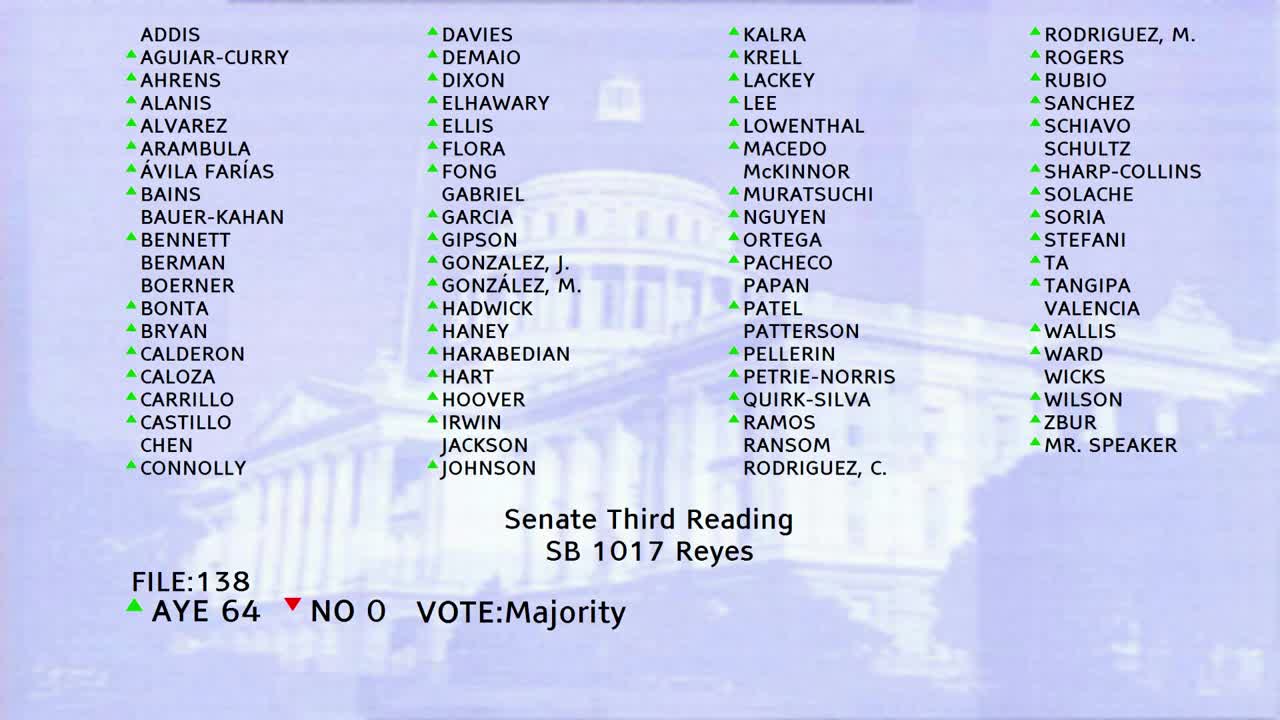 1MIN
Assembly Floor
 9MIN
Assembly Standing Committee on Public Employment and Retirement
 1MIN
Senate Floor
 12MIN
Senate Standing Committee on Labor, Public Employment and Retirement
Bill Author

Bill Co-Author(s):