SB 1228: Advertising displays: exemptions: arenas and redevelopment agency projects.
- Session Year: 2025-2026
- House: Senate
- Latest Version Date: 2026-09-27
Current Status:
Passed
(2026-09-27: Chaptered by Secretary of State. Chapter 686, Statutes of 2026.)
Introduced
In Committee
Awaiting First Chamber Vote
Passed First Chamber
In Committee
Awaiting Second Chamber Vote
Passed Second Chamber
Enacted
The Outdoor Advertising Act provides for the regulation by the Department of Transportation of advertising displays, as defined, within view of public highways. The act exempts from most of its provisions an advertising display used exclusively to advertise products, goods, or services that are either sold on the premises of an arena or marketed or promoted on the premises of an arena if, among other conditions, the advertising display has been authorized, as of January 1, 2021, by, or in accordance with, a local ordinance, including, but not limited to, a specific plan or sign district adopted in connection with the approval of the arena, as provided. The act requires an advertising display that is located on the premises of an arena and that was erected pursuant to the exemption also to be authorized by, or in accordance with, an ordinance, including, but not limited to, a specific plan or sign district, as provided.
This bill would, on and after January 1, 2028, similarly exempt from most provisions of the act an advertising display used exclusively to advertise products, goods, or services that are either sold on the premises of an arena or marketed or promoted on the premises of the arena if, among other conditions, the advertising display has been authorized, as of January 1, 2032, by, or in accordance with a local ordinance or other discretionary approval, including, but not limited to, a specific plan or sign district that benefits the arena, as specified. The bill would define premises of an arena to include a public assembly building owned by the City of Los Angeles, as specified. The bill would require, before one of these advertising displays may be placed, a determination from the department or the Federal Highway Administration that the display will not cause a reduction in federal aid funds or otherwise be inconsistent with federal law, federal regulations, or an agreement between the state and a federal agency or department, as specified.
This bill would limit both of these exemptions to an arena that is fully constructed or under construction on or before January 1, 2027. The bill would instead require an advertising display that is located on the premises of an arena and that was erected pursuant to either of these exemptions to be authorized by an ordinance or other discretionary approval, including, but not limited to, a specific plan, sign district, or conditional use permit, as specified. The bill would prohibit an arena from having more than a total of 2 advertising displays pursuant to these exemptions. Except for advertising displays authorized by the existing exemption, the bill would require certain advertising displays placed pursuant to the new exemption for one arena to be located at least 5,000 feet from an advertising display authorized pursuant to an exemption for another arena.
The act also regulates placement of advertising displays adjacent to and within specified distances of highways that are part of the national system of interstate and defense highways and federal aid highways. The act prohibits, except as provided, placing or maintaining an advertising display on property adjacent to a portion of a freeway that has a specified coverage area of landscaping or trees at the same or elevated grade of the main-traveled way, as provided. The act does not prohibit a city, county, or city and county from designating the districts or zones in which an advertising display may be placed or prohibited as part of a land use or zoning ordinance. The act also does not prohibit a local governmental entity from entering into an agreement to relocate an advertising display for any purpose.
This bill would exempt certain advertising displays developed within the boundary limits of, and as part of, an individual redevelopment agency project from the prohibition on placing or maintaining an advertising display on property adjacent to a portion of a freeway that has landscaping or trees, from a citys, countys, or city and countys land use or zoning ordinance, and from a local governmental entitys relocation agreement, as those are described above. The bill would require an advertising display subject to this exemption to remain in substantially the same location and configuration as it existed on December 31, 2025, and would prohibit the advertising display from being expanded, relocated, increased in height or display area, or modified to add additional display faces beyond those existing on December 31, 2025.
This bill would make legislative findings and declarations as to the necessity of a special statute for the City of Los Angeles.
This bill would incorporate additional changes to Section 5272 of the Business and Professions Code proposed by AB 2717 to be operative only if this bill and AB 2717 are enacted and this bill is enacted last.
The Outdoor Advertising Act provides for the regulation by the Department of Transportation of advertising displays, as defined, within view of public highways. The act exempts from most of its provisions an advertising display used exclusively to advertise products, goods, or services that are either sold on the premises of an arena or marketed or promoted on the premises of an arena if, among other conditions, the advertising display has been authorized, as of January 1, 2021, by, or in accordance with, a local ordinance, including, but not limited to, a specific plan or sign district adopted in connection with the approval of the arena, as provided. The act requires an advertising display that is located on the premises of an arena and that was erected pursuant to the exemption also to be authorized by, or in accordance with, an ordinance, including, but not limited to, a specific plan or sign district, as provided.
This bill would, on and after January 1, 2028, similarly exempt from most provisions of the act an advertising display used exclusively to advertise products, goods, or services that are either sold on the premises of an arena or marketed or promoted on the premises of the arena if, among other conditions, the advertising display has been authorized, as of January 1, 2032, by, or in accordance with a local ordinance or other discretionary approval, including, but not limited to, a specific plan or sign district that benefits the arena, as specified. The bill would define premises of an arena to include a public assembly building owned by the City of Los Angeles, as specified. The bill would require, before one of these advertising displays may be placed, a determination from the department or the Federal Highway Administration that the display will not cause a reduction in federal aid funds or otherwise be inconsistent with federal law, federal regulations, or an agreement between the state and a federal agency or department, as specified.
This bill would limit both of these exemptions to an arena that is fully constructed or under construction on or before January 1, 2027. The bill would instead require an advertising display that is located on the premises of an arena and that was erected pursuant to either of these exemptions to be authorized by an ordinance or other discretionary approval, including, but not limited to, a specific plan, sign district, or conditional use permit, as specified. The bill would prohibit an arena from having more than a total of 2 advertising displays pursuant to these exemptions. Except for advertising displays authorized by the existing exemption, the bill would require certain advertising displays placed pursuant to the new exemption for one arena to be located at least 5,000 feet from an advertising display authorized pursuant to an exemption for another arena.
The Outdoor Advertising Act act also regulates placement of advertising displays adjacent to and within specified distances of highways that are part of the national system of interstate and defense highways and federal aid highways. The act prohibits, except as provided, placing or maintaining an advertising display on property adjacent to a portion of a freeway that has a specified coverage area of landscaping or trees at the same or elevated grade of the main-traveled way, as provided. The act does not prohibit a city, county, or city and county from designating the districts or zones in which an advertising display may be placed or prohibited as part of a land use or zoning ordinance. The act also does not prohibit a local governmental entity from entering into an agreement to relocate an advertising display for any purpose.
This bill would exempt certain advertising displays developed within the boundary limits of, and as part of, an individual redevelopment agency project from the prohibition on placing or maintaining an advertising display on property adjacent to a portion of a freeway that has landscaping or trees, from a citys, countys, or city and countys land use or zoning ordinance, and from a local governmental entitys relocation agreement, as those are described above. The bill would require an advertising display subject to this exemption to remain in substantially the same location and configuration as it existed on December 31, 2025, and would prohibit the advertising display from being expanded, relocated, increased in height or display area, or modified to add additional display faces beyond those existing on December 31, 2025.
This bill would make legislative findings and declarations as to the necessity of a special statute for the City of Los Angeles.
This bill would incorporate additional changes to Section 5272 of the Business and Professions Code proposed by AB 2717 to be operative only if this bill and AB 2717 are enacted and this bill is enacted last.
The Outdoor Advertising Act regulates placement of advertising displays adjacent to and within specified distances of highways that are part of the national system of interstate and defense highways and federal aid highways. The act prohibits, except as provided, placing or maintaining an advertising display on property adjacent to a portion of a freeway that has a specified coverage area of landscaping or trees at the same or elevated grade of the main-traveled way, as provided. The act does not prohibit a city, county, or city and county from designating the districts or zones in which an advertising display may be placed or prohibited as part of a land use or zoning ordinance. The act also does not prohibit a local governmental entity from entering into an agreement to relocate an advertising display for any purpose.
This bill would exempt certain advertising displays developed within the boundary limits of, and as part of, an individual redevelopment agency project from the prohibition on placing or maintaining an advertising display on property adjacent to a portion of a freeway that has landscaping or trees, from a citys, countys, or city and countys land use or zoning ordinance, and from a local governmental entitys relocation agreement, as those are described above. The bill would require an advertising display subject to this exemption to remain in substantially the same location and configuration as it existed on December 31, 2025, and would prohibit the advertising display from being modified, as specified. expanded, relocated, increased in height or display area, or modified to add additional display faces beyond those existing on December 31, 2025.
The Outdoor Advertising Act regulates placement of advertising displays adjacent to and within specified distances of highways that are part of the national system of interstate and defense highways and federal aid highways. The act prohibits, except as provided, placing or maintaining an advertising display on property adjacent to a portion of a freeway that has a specified coverage area of landscaping or trees at the same or elevated grade of the main-traveled way, as provided. The act does not prohibit a city, county, or city and county from designating the districts or zones in which an advertising display may be placed or prohibited as part of a land use or zoning ordinance. The act also does not prohibit a local governmental entity from entering into an agreement to relocate an advertising display for any purpose.
This bill would exempt certain advertising displays developed within the boundary limits of, and as part of, an individual redevelopment agency project from the prohibition on placing or maintaining an advertising display on property adjacent to a portion of a freeway that has landscaping or trees, from a city, county, citys, countys, or city and countys land use or zoning ordinance, and from a local governmental entitys relocation agreement, as those are described above. The bill would require an advertising display subject to this exemption to remain in the same location and would prohibit the advertising display from being modified, as specified.
The Outdoor Advertising Act regulates placement of advertising displays adjacent to and within specified distances of highways that are part of the national system of interstate and defense highways and federal aid highways. The act prohibits, except as provided, placing or maintaining an advertising display on property adjacent to a portion of a freeway that has a specified coverage area of landscaping or trees at the same or elevated grade of the main-traveled way, as provided. The act does not prohibit a city, county, or city and county from designating the districts or zones in which an advertising display may be placed or prohibited as part of a land use or zoning ordinance. The act also does not prohibit a local governmental entity from entering into an agreement to relocate an advertising display for any purpose.
This bill would exempt certain advertising displays developed within the boundary limits of, and as part of, an individual redevelopment agency project from the prohibition on placing or maintaining an advertising display on property adjacent to a portion of a freeway that has landscaping or trees, a city, county, or city and countys land use or zoning ordinance, and a local governmental entitys relocation agreement, as those are described above.
The Outdoor Advertising Act provides for the regulation by the Department of Transportation of advertising displays, as defined, within view of public highways.This bill would state the intent of the Legislature to enact subsequent legislation to create a permanent solution for certain advertising displays formerly designated for location in a redevelopment agency.The Outdoor Advertising Act provides for the regulation by the Department of Transportation of advertising displays, as defined, within view of public highways.
This bill would state the intent of the Legislature to enact subsequent legislation to create a permanent solution for certain advertising displays formerly designated for location in a redevelopment agency.
(a)With the exception of Article 4 (commencing with Section 5300) and Sections 5400 to 5404, inclusive, this chapter does not apply to any advertising display used exclusively for any of the following purposes:
(1)To advertise the sale, lease, or exchange of real property on which the advertising display is placed.
(2)To advertise directions to, and the sale, lease, or exchange of, real property for which the advertising display is placed, provided that this exemption does not apply to advertising displays visible from a highway and subject to the Highway Beautification Act of 1965 (23 U.S.C. Sec. 131).
(3)To designate the name of the owner or occupant of the premises or to identify the premises.
(4)To advertise the business conducted, services rendered, or goods produced or sold on the property on which the advertising display is placed if the display is on the same side of the highway and within 1,000 feet of the point on the property or within 1,000 feet of the entrance to the site at which the business is conducted, services are rendered, or goods are produced or sold.
(5)To display only noncommercial public health, emergency, and safety messages from the County of San Joaquin, on public property and equipment owned and operated by the County of San Joaquin in conformance with state law, federal law, regulations, and agreements.
(b)With the exception of Article 4 (commencing with Section 5300) and Sections 5400 to 5404, inclusive, this chapter does not apply to any advertising display used exclusively either to advertise products, goods, or services sold by persons on the premises of an arena on a regular basis, or to advertise products, goods, or services marketed or promoted on the premises of an arena pursuant to a sponsorship marketing plan, if all of the following conditions are met:
(1)The arena is capable of providing a venue for professional sports on a permanent basis.
(2)The arena has a capacity of 15,000 or more seats.
(3)The advertising display is either of the following:
(A)Located on the premises of the arena.
(B)Has been authorized as of January 1, 2021, by, or in accordance with, a local ordinance, including, but not limited to, a specific plan or sign district adopted in connection with the approval of the arena by the city, county, or city and county, bears the name or logo of the arena, and is visible when approaching offramps from the interstate, primary, or state highways used to access the premises of the arena. No arena shall be permitted more than two advertising displays allowed under this subparagraph.
(c)(1)Any advertising display erected pursuant to subdivision (b) and located on the premises of the arena shall be lawful only if authorized by, or in accordance with, an ordinance, including, but not limited to, a specific plan or sign district, adopted by the city, county, or city and county, that regulates advertising displays on the premises of the arena by identifying the specific displays or establishing regulations that include, at a minimum, all of the following:
(A)Number of signs and total signage area allowed.
(B)Maximum individual signage area.
(C)Minimum sign separation.
(D)Illumination restrictions and regulations, including signage refresh rate, scrolling, and brightness.
(E)Illuminated sign hours of operation.
(2)Authorization of advertising displays under subdivision (b) is subject to the owner of the advertising display submitting to the department a copy of the ordinance adopted by the city, county, or city and county in which the arena is located authorizing the advertising display and, for signs located on the premises of the arena, identification of the provisions of the ordinance required under paragraph (1). The department shall certify that the proposed ordinance meets the minimum requirements contained in paragraph (1).
(3)An advertising display authorized pursuant to subdivision (b) shall not advertise products, goods, or services related to tobacco, firearms, or sexually explicit material.
(4)This chapter does not limit a local government from adopting ordinances prohibiting or further restricting the size, number, or type of advertising displays permitted by this section.
(d)As used in this section, the premises of an arena means either of the following:
(1)A venue for indoor or outdoor sports, concerts, or other events.
(2)Any development project or district encompassing the venue, adjacent to it, or separated from it only by public or private rights-of-way, the boundaries of which have been set by the city, county, or city and county in which the arena is located. The development project or district shall be contiguous and shall not extend more than 1,000 feet beyond the arena structure or any structure physically connected to the arena structure.
(e)As used in this section, sponsorship marketing plan means an agreement between the property owner, facility owner, facility operator, or occupant of the premises of an arena and a sponsor pursuant to which the sponsor is allowed to include its logo, slogan, or advertising on advertising displays and that meets both of the following conditions:
(1)The sponsorship marketing plan is for a period of not less than 120 days.
(2)The sponsorship marketing plan grants the sponsor the opportunity to display its logo, slogan, or advertising in the interior of structures on the premises of an arena, or conduct promotions, public relations, or marketing activities on the premises of an arena.
(f)Authorization of an advertising display under subdivision (b) that is a message center display is subject to the owner of the display complying with one of the following conditions:
(1)Making a message center display within the premises of the arena available on a space-available basis for use by the department or the Department of the California Highway Patrol for public service messages, including Emergency Alert System (Amber Alert) messages disseminated pursuant to Section 8594 of the Government Code, and messages containing, among other things, reports of commute times, drunk driving awareness messages, reports of accidents of a serious nature, and emergency disaster communications.
(2)Making a message center display not subject to this section that is under the control of the owner of the advertising display available on a space-available basis for public service messages in a location acceptable to the department and the Department of the California Highway Patrol.
(3)Providing funding to the department for the installation of a message center display to accommodate those public service messages, which may include funding as part of mitigation in connection with the approval of the arena by the city, county, or city and county.
(g)If an advertising display authorized under subdivision (b) is subject to a notice from the United States Department of Transportation, the Federal Highway Administration, or any other applicable federal agency to the state that the operation of that display will result in the reduction of federal aid highway funds provided in Section 131 of Title 23 of the United States Code, authorization of the display under subdivision (b) shall cease and the display owner shall remove all advertising copy from the display within 60 days after the state notifies the display owner of the receipt of the federal notice. Failure to remove the advertising copy pursuant to this subdivision shall result in a civil fine, imposed by the department, of ten thousand dollars ($10,000) per day until the advertising copy is removed. The department shall not assume any liability in connection with cessation of operation or removal of an advertising display or advertising copy pursuant to this subdivision.
(h)The city, county, or city and county adopting the ordinance authorizing the displays erected pursuant to this section shall have primary responsibility for ensuring that the displays remain in conformance with all provisions of the ordinance and of this section. If the city, county, or city and county fails to ensure that the displays remain in conformance with all provisions of the ordinance and of this section after 30 days of receipt of a written notice from the department, the city, county, or city and county shall hold the department harmless and indemnify the department for all costs incurred by the department to ensure compliance with the ordinance and this section or to defend actions challenging the adoption of the ordinance allowing the displays.
(i)An advertising display lawfully erected on or before December 31, 2013, in conformity with subdivision (e) of this section as it read on that date, shall remain authorized, subject to the terms of that subdivision.
(j)This section shall remain in effect only until January 1, 2028, and as of that date is repealed.
SEC. 2.Section 5272 is added to the Business and Professions Code, to read:5272.(a)With the exception of Article 4 (commencing with Section 5300) and Sections 5400 to 5404, inclusive, this chapter does not apply to any advertising display used exclusively for any of the following purposes:
(1)To advertise the sale, lease, or exchange of real property on which the advertising display is placed.
(2)To advertise directions to, and the sale, lease, or exchange of, real property for which the advertising display is placed, provided that this exemption does not apply to advertising displays visible from a highway and subject to the Highway Beautification Act of 1965 (23 U.S.C. Sec. 131).
(3)To designate the name of the owner or occupant of the premises or to identify the premises.
(4)To advertise the business conducted, services rendered, or goods produced or sold on the property on which the advertising display is placed if the display is on the same side of the highway and within 1,000 feet of the point on the property or within 1,000 feet of the entrance to the site at which the business is conducted, services are rendered, or goods are produced or sold.
(5)To display only noncommercial public health, emergency, and safety messages from the County of San Joaquin, on public property and equipment owned and operated by the County of San Joaquin in conformance with state law, federal law, regulations, and agreements.
(b)With the exception of Article 4 (commencing with Section 5300) and Sections 5400 to 5404, inclusive, this chapter does not apply to any advertising display used exclusively either to advertise products, goods, or services sold by persons on the premises of an arena on a regular basis, or to advertise products, goods, or services marketed or promoted on the premises of an arena pursuant to a sponsorship marketing plan, if all of the following conditions are met:
(1)The arena is capable of providing a venue for professional sports on a permanent basis.
(2)The arena has a capacity of 15,000 or more seats.
(3)On or before January 1, 2027, the arena is fully constructed or under construction.
(4)The advertising display is any of the following:
(A)Located on the premises of the arena.
(B)Has been authorized as of January 1, 2021, by, or in accordance with, a local ordinance, including, but not limited to, a specific plan or sign district adopted in connection with the approval of the arena by the city, county, or city and county, bears the name or logo of the arena, and is visible when approaching offramps from the interstate, primary, or state highways used to access the premises of the arena. An arena shall not be permitted more than two advertising displays allowed under this subparagraph.
(C)Has been authorized as of January 1, 2032, by, or in accordance with, a local ordinance or other discretionary approval, including, but not limited to, a specific plan or sign district that benefits the arena and that is adopted by the city, county, or city and county, bears the name or logo of the arena, and is visible when approaching offramps from the interstate, primary, or state highways used to access the premises of the arena. An arena shall not be permitted more than a total of two advertising displays allowed under this subparagraph and subparagraph (B).
(c)(1)Any advertising display erected pursuant to subdivision (b) and located on the premises of the arena shall be lawful only if authorized by, or in accordance with, an ordinance or other discretionary approval, including, but not limited to, a specific plan, sign district, or conditional use permit adopted or approved by the city, county, or city and county, that regulates advertising displays on the premises of the arena by identifying the specific displays or establishing regulations that include, at a minimum, all of the following:
(A)Number of signs and total signage area allowed.
(B)Maximum individual signage area.
(C)Minimum sign separation.
(D)Illumination restrictions and regulations, including signage refresh rate, scrolling, and brightness.
(E)Illuminated sign hours of operation.
(2)(A)Authorization of advertising displays under subdivision (b) is subject to the owner of the advertising display submitting to the department a copy of the ordinance or other discretionary approval adopted or approved by the city, county, or city and county in which the arena is located authorizing the advertising display and, for signs located on the premises of the arena, identification of the provisions of the ordinance or other discretionary approval required under paragraph (1). The department shall certify that the proposed ordinance or other discretionary approval meets the minimum requirements contained in paragraph (1).
(B)(i)Before an advertising display authorized pursuant to subparagraph (C) of paragraph (4) of subdivision (b) by an ordinance or other discretionary approval adopted or approved after January 1, 2027, may be placed, the department shall have determined that the display will not cause a reduction in federal aid funds or otherwise be inconsistent with any federal law, federal regulation, or agreement between the state and a federal agency or department.
(ii)If the department is unable to make the determination required pursuant to clause (i), the department shall request the Federal Highway Administration to make the determination. Upon receipt of a determination by the Federal Highway Administration that makes the finding described in clause (i), the advertising display may be placed.
(3)An advertising display authorized pursuant to subdivision (b) shall not advertise products, goods, or services related to tobacco, firearms, or sexually explicit material.
(4)An advertising display that is authorized pursuant to subparagraph (C) of paragraph (4) of subdivision (b) by an ordinance or other discretionary approval adopted or approved after January 1, 2027, and that is located more than one mile from the premises of an arena shall be located at least 5,000 feet from an advertising display for a different arena authorized pursuant to this section. This paragraph shall not apply to an advertising display authorized pursuant to subparagraph (B) of paragraph (4) of subdivision (b).
(5)This chapter does not limit a local government from adopting ordinances prohibiting or further restricting the size, number, or type of advertising displays permitted by this section.
(d)Authorization of an advertising display under subdivision (b) that is a message center display is subject to the owner of the display complying with one of the following conditions:
(1)Making a message center display within the premises of the arena available on a space-available basis for use by the department or the Department of the California Highway Patrol for public service messages, including Emergency Alert System (Amber Alert) messages disseminated pursuant to Section 8594 of the Government Code, and messages containing, among other things, reports of commute times, drunk driving awareness messages, reports of accidents of a serious nature, and emergency disaster communications.
(2)Making a message center display not subject to this section that is under the control of the owner of the advertising display available on a space-available basis for public service messages in a location acceptable to the department and the Department of the California Highway Patrol.
(3)Providing funding to the department for the installation of a message center display to accommodate those public service messages, which may include funding as part of mitigation in connection with the approval of the arena by the city, county, or city and county.
(e)If an advertising display authorized under subdivision (b) is subject to a notice from the United States Department of Transportation, the Federal Highway Administration, or any other applicable federal agency to the state that the operation of that display will result in the reduction of federal aid highway funds provided in Section 131 of Title 23 of the United States Code, authorization of the display under subdivision (b) shall cease and the display owner shall remove all advertising copy from the display within 60 days after the state notifies the display owner of the receipt of the federal notice. Failure to remove the advertising copy pursuant to this subdivision shall result in a civil fine, imposed by the department, of ten thousand dollars ($10,000) per day until the advertising copy is removed. The department shall not assume any liability in connection with cessation of operation or removal of an advertising display or advertising copy pursuant to this subdivision.
(f)The city, county, or city and county adopting the ordinance authorizing the displays erected pursuant to this section shall have primary responsibility for ensuring that the displays remain in conformance with all provisions of the ordinance and of this section. If the city, county, or city and county fails to ensure that the displays remain in conformance with all provisions of the ordinance and of this section after 30 days of receipt of a written notice from the department, the city, county, or city and county shall hold the department harmless and indemnify the department for all costs incurred by the department to ensure compliance with the ordinance and this section or to defend actions challenging the adoption of the ordinance allowing the displays.
(g)An advertising display lawfully erected on or before December 31, 2013, in conformity with subdivision (e) of this section as it read on that date, shall remain authorized, subject to the terms of that subdivision.
(h)For purposes of this section, both of the following definitions apply:
(1)Premises of an arena means either of the following:
(A)A venue for indoor or outdoor sports, concerts, or other events.
(B)Any development project or district encompassing the venue, adjacent to it, or separated from it only by public or private rights-of-way, the boundaries of which have been set by the city, county, or city and county in which the arena is located. The development project or district shall be contiguous and shall not extend more than 1,000 feet beyond the arena structure or any structure physically connected to the arena structure. For an existing public assembly building owned by the City of Los Angeles located within a sign district that includes an arena, the boundaries of which were established by City of Los Angeles Ordinance No. 189010 effective September 14, 2026, the development project or district may include the entire building if more than 50 percent of the buildings ground-floor footprint is located within 1,000 feet of the arena structure or any structure physically connected to the arena structure. No more than one existing public assembly building may be considered on the premises of an arena pursuant to this subparagraph and that public assembly building shall not have more than one advertising display on it that is considered on the premises of an arena and that is entirely beyond 1,000 feet of the arena structure or any structure physically connected to the arena structure. This subparagraph shall not be construed to authorize an advertising display that is inconsistent with federal law.
(2)Sponsorship marketing plan means an agreement between the property owner, facility owner, facility operator, or occupant of the premises of an arena and a sponsor pursuant to which the sponsor is allowed to include its logo, slogan, or advertising on advertising displays and that meets both of the following conditions:
(A)The sponsorship marketing plan is for a period of not less than 120 days.
(B)The sponsorship marketing plan grants the sponsor the opportunity to display its logo, slogan, or advertising in the interior of structures on the premises of an arena, or conduct promotions, public relations, or marketing activities on the premises of an arena.
(i)This section shall become operative on January 1, 2028.
SEC. 2.5.Section 5272 is added to the Business and Professions Code, to read:5272.(a)With the exception of Article 4 (commencing with Section 5300) and Sections 5400 to 5404, inclusive, this chapter does not apply to any advertising display used exclusively for any of the following purposes:
(1)To advertise the sale, lease, or exchange of real property on which the advertising display is placed.
(2)To advertise directions to, and the sale, lease, or exchange of, real property for which the advertising display is placed, provided that this exemption does not apply to advertising displays visible from a highway and subject to the Highway Beautification Act of 1965 (23 U.S.C. Sec. 131).
(3)To designate the name of the owner or occupant of the premises or to identify the premises.
(4)To advertise the business conducted, services rendered, or goods produced or sold on the property on which the advertising display is placed if the display is on the same side of the highway and within 1,000 feet of the point on the property or within 1,000 feet of the entrance to the site at which the business is conducted, services are rendered, or goods are produced or sold.
(5)To display only noncommercial public health, emergency, and safety messages from the County of San Joaquin, on public property and equipment owned and operated by the County of San Joaquin in conformance with state law, federal law, regulations, and agreements.
(b)With the exception of Article 4 (commencing with Section 5300) and Sections 5400 to 5404, inclusive, this chapter does not apply to any advertising display used exclusively either to advertise products, goods, or services sold by persons on the premises of an arena on a regular basis, or to advertise products, goods, or services marketed or promoted on the premises of an arena pursuant to a sponsorship marketing plan, if all of the following conditions are met:
(1)The arena is capable of providing a venue for professional sports on a permanent basis.
(2)The arena has a capacity of 15,000 or more seats.
(3)On or before January 1, 2027, the arena is fully constructed or under construction.
(4)The advertising display is any of the following:
(A)Located on the premises of the arena.
(B)Has been authorized as of January 1, 2021, by, or in accordance with, a local ordinance, including, but not limited to, a specific plan or sign district adopted in connection with the approval of the arena by the city, county, or city and county, bears the name or logo of the arena, and is visible when approaching offramps from the interstate, primary, or state highways used to access the premises of the arena. An arena shall not be permitted more than two advertising displays allowed under this subparagraph.
(C)Has been authorized as of January 1, 2032, by, or in accordance with, a local ordinance or other discretionary approval, including, but not limited to, a specific plan or sign district that benefits the arena and that is adopted by the city, county, or city and county, bears the name or logo of the arena, and is visible when approaching offramps from the interstate, primary, or state highways used to access the premises of the arena. An arena shall not be permitted more than a total of two advertising displays allowed under this subparagraph and subparagraph (B).
(c)(1)Any advertising display erected pursuant to subdivision (b) and located on the premises of the arena shall be lawful only if authorized by, or in accordance with, an ordinance or other discretionary approval, including, but not limited to, a specific plan, sign district, or conditional use permit adopted or approved by the city, county, or city and county, that regulates advertising displays on the premises of the arena by identifying the specific displays or establishing regulations that include, at a minimum, all of the following:
(A)Number of signs and total signage area allowed.
(B)Maximum individual signage area.
(C)Minimum sign separation.
(D)Illumination restrictions and regulations, including signage refresh rate, scrolling, and brightness.
(E)Illuminated sign hours of operation.
(2)(A)Authorization of advertising displays under subdivision (b) is subject to the owner of the advertising display submitting to the department a copy of the ordinance or other discretionary approval adopted or approved by the city, county, or city and county in which the arena is located authorizing the advertising display and, for signs located on the premises of the arena, identification of the provisions of the ordinance or other discretionary approval required under paragraph (1). The department shall certify that the proposed ordinance or other discretionary approval meets the minimum requirements contained in paragraph (1).
(B)(i)Before an advertising display authorized pursuant to subparagraph (C) of paragraph (4) of subdivision (b) by an ordinance or other discretionary approval adopted or approved after January 1, 2027, may be placed, the department shall have determined that the display will not cause a reduction in federal aid funds or otherwise be inconsistent with any federal law, federal regulation, or agreement between the state and a federal agency or department.
(ii)If the department is unable to make the determination required pursuant to clause (i), the department shall request the Federal Highway Administration to make the determination. Upon receipt of a determination by the Federal Highway Administration that makes the finding described in clause (i), the advertising display may be placed.
(3)An advertising display authorized pursuant to subdivision (b) shall not advertise products, goods, or services related to tobacco, firearms, or sexually explicit material.
(4)An advertising display that is authorized pursuant to subparagraph (C) of paragraph (4) of subdivision (b) by an ordinance or other discretionary approval adopted or approved after January 1, 2027, and that is located more than one mile from the premises of an arena shall be located at least 5,000 feet from an advertising display for a different arena authorized pursuant to this section. This paragraph shall not apply to an advertising display authorized pursuant to subparagraph (B) of paragraph (4) of subdivision (b).
(5)This chapter does not limit a local government from adopting ordinances prohibiting or further restricting the size, number, or type of advertising displays permitted by this section.
(d)Authorization of an advertising display under subdivision (b) that is a message center display is subject to the owner of the display complying with one of the following conditions:
(1)Making a message center display within the premises of the arena available on a space-available basis for use by the department or the Department of the California Highway Patrol for public service messages, including Emergency Alert System (Amber Alert) messages disseminated pursuant to Section 8594 of the Government Code, and messages containing, among other things, reports of commute times, drunk driving awareness messages, reports of accidents of a serious nature, and emergency disaster communications.
(2)Making a message center display not subject to this section that is under the control of the owner of the advertising display available on a space-available basis for public service messages in a location acceptable to the department and the Department of the California Highway Patrol.
(3)Providing funding to the department for the installation of a message center display to accommodate those public service messages, which may include funding as part of mitigation in connection with the approval of the arena by the city, county, or city and county.
(e)If an advertising display authorized under subdivision (b) is subject to a notice from the United States Department of Transportation, the Federal Highway Administration, or any other applicable federal agency to the state that the operation of that display will result in the reduction of federal aid highway funds provided in Section 131 of Title 23 of the United States Code, authorization of the display under subdivision (b) shall cease and the display owner shall remove all advertising copy from the display within 60 days after the state notifies the display owner of the receipt of the federal notice. Failure to remove the advertising copy pursuant to this subdivision shall result in a civil fine, imposed by the department, of ten thousand dollars ($10,000) per day until the advertising copy is removed. The department shall not assume any liability in connection with cessation of operation or removal of an advertising display or advertising copy pursuant to this subdivision.
(f)The city, county, or city and county adopting the ordinance authorizing the displays erected pursuant to this section shall have primary responsibility for ensuring that the displays remain in conformance with all provisions of the ordinance and of this section. If the city, county, or city and county fails to ensure that the displays remain in conformance with all provisions of the ordinance and of this section after 30 days of receipt of a written notice from the department, the city, county, or city and county shall hold the department harmless and indemnify the department for all costs incurred by the department to ensure compliance with the ordinance and this section or to defend actions challenging the adoption of the ordinance allowing the displays.
(g)An advertising display lawfully erected on or before December 31, 2013, in conformity with subdivision (e) of this section as it read on that date, shall remain authorized, subject to the terms of that subdivision.
(h)For purposes of this section, both of the following definitions apply:
(1)Premises of an arena means either of the following:
(A)A venue for indoor or outdoor sports, concerts, or other events.
(B)Any development project or district encompassing the venue, adjacent to it, or separated from it only by public or private rights-of-way, the boundaries of which have been set by the city, county, or city and county in which the arena is located. The development project or district shall be contiguous and shall not extend more than 1,000 feet beyond the arena structure or any structure physically connected to the arena structure. For an existing public assembly building owned by the City of Los Angeles located within a sign district that includes an arena, the boundaries of which were established by City of Los Angeles Ordinance No. 189010 effective September 14, 2026, the development project or district may include the entire building if more than 50 percent of the buildings ground-floor footprint is located within 1,000 feet of the arena structure or any structure physically connected to the arena structure. No more than one existing public assembly building may be considered on the premises of an arena pursuant to this subparagraph and that public assembly building shall not have more than one advertising display on it that is considered on the premises of an arena and that is entirely beyond 1,000 feet of the arena structure or any structure physically connected to the arena structure. This subparagraph shall not be construed to authorize an advertising display that is inconsistent with federal law.
(2)Sponsorship marketing plan means an agreement between the property owner, facility owner, facility operator, or occupant of the premises of an arena and a sponsor pursuant to which the sponsor is allowed to include its logo, slogan, or advertising on advertising displays and that meets both of the following conditions:
(A)The sponsorship marketing plan is for a period of not less than 120 days.
(B)The sponsorship marketing plan grants the sponsor the opportunity to display its logo, slogan, or advertising in the interior of structures on the premises of an arena, or conduct promotions, public relations, or marketing activities on the premises of an arena.
(i)This section shall become operative on January 1, 2028.
SEC. 3.Section 5440.5 is added to the Business and Professions Code, to read:5440.5.(a)Notwithstanding any other provision of this chapter, Sections 5440 and 5443 do not apply to an advertising display developed within the boundary limits of, and as a part of, an individual redevelopment agency project, as those boundaries existed on December 29, 2011, and that has been in place and operating as of December 31, 2025, under a tracking number issued by the department for an advertising display exempted under Section 5273, 5273.1, or 5273.5, if both of the following conditions are met:
(1)The advertising display remains in substantially the same location and configuration as it existed on December 31, 2025.
(2)The advertising display is not expanded, relocated, increased in height or display area, or modified to add additional display faces beyond those existing on December 31, 2025.
(b)An advertising display described in subdivision (a) shall be deemed a placement requiring a new permit and shall comply with all the provisions of Article 6 (commencing with Section 5350) and Article 7 (commencing with Section 5400), except those expressly exempted by subdivision (c).
(c)This section does not authorize an advertising display that is inconsistent with applicable federal law or regulations governing outdoor advertising displays, unless otherwise authorized by the United States Department of Transportation or the Federal Highway Administration. If authorized by the United States Department of Transportation or the Federal Highway Administration, the corresponding requirements under state law shall not apply, including, but not limited to, business district and business area requirements otherwise applicable under Article 7 (commencing with Section 5400).
SEC. 4.The Legislature finds and declares that a special statute is necessary and that a general statute cannot be made applicable within the meaning of Section 16 of Article IV of the California Constitution because of the of unique circumstances applicable only to the City of Los Angeles:
(a)The City of Los Angeles owns an existing public assembly building located adjacent to a qualifying arena in the sign district established by Ordinance No. 189010, but the buildings ground-floor footprint extends across the 1,000-foot boundary otherwise applicable to the arena premises.
(b)No other arena qualifying for the exemption in this act has been identified with an adjacent city-owned convention or public assembly building having this configuration.
(c)A narrowly tailored technical correction is therefore necessary to ensure that the purpose of the exemption in this act is not frustrated when the 1,000-foot boundary bisects a city-owned public assembly building intended to support advertising displays authorized under the exemption, while preserving all applicable requirements of federal law.
SEC. 5.Section 2.5 of this bill proposes to add Section 5272 to the Business and Professions Code as proposed by both this bill and Assembly Bill 2717. That section of this bill shall only become operative if (1) both bills are enacted and become effective on or before January 1, 2027, (2) each bill amends, repeals, and adds Section 5272 of the Business and Professions Code, and (3) this bill is enacted after Assembly Bill 2717, in which case Section 2 of this bill shall not become operative.
(a)With the exception of Article 4 (commencing with Section 5300) and Sections 5400 to 5404, inclusive, this chapter does not apply to any advertising display used exclusively for any of the following purposes:
(1)To advertise the sale, lease, or exchange of real property on which the advertising display is placed.
(2)To advertise directions to, and the sale, lease, or exchange of, real property for which the advertising display is placed, provided that this exemption does not apply to advertising displays visible from a highway and subject to the Highway Beautification Act of 1965 (23 U.S.C. Sec. 131).
(3)To designate the name of the owner or occupant of the premises or to identify the premises.
(4)To advertise the business conducted, services rendered, or goods produced or sold on the property on which the advertising display is placed if the display is on the same side of the highway and within 1,000 feet of the point on the property or within 1,000 feet of the entrance to the site at which the business is conducted, services are rendered, or goods are produced or sold.
(5)To display only noncommercial public health, emergency, and safety messages from the County of San Joaquin, on public property and equipment owned and operated by the County of San Joaquin in conformance with state law, federal law, regulations, and agreements.
(b)With the exception of Article 4 (commencing with Section 5300) and Sections 5400 to 5404, inclusive, this chapter does not apply to any advertising display used exclusively either to advertise products, goods, or services sold by persons on the premises of an arena on a regular basis, or to advertise products, goods, or services marketed or promoted on the premises of an arena pursuant to a sponsorship marketing plan, if all of the following conditions are met:
(1)The arena is capable of providing a venue for professional sports on a permanent basis.
(2)The arena has a capacity of 15,000 or more seats.
(3)The advertising display is either of the following:
(A)Located on the premises of the arena.
(B)Has been authorized as of January 1, 2021, by, or in accordance with, a local ordinance, including, but not limited to, a specific plan or sign district adopted in connection with the approval of the arena by the city, county, or city and county, bears the name or logo of the arena, and is visible when approaching offramps from the interstate, primary, or state highways used to access the premises of the arena. No arena shall be permitted more than two advertising displays allowed under this subparagraph.
(c)(1)Any advertising display erected pursuant to subdivision (b) and located on the premises of the arena shall be lawful only if authorized by, or in accordance with, an ordinance, including, but not limited to, a specific plan or sign district, adopted by the city, county, or city and county, that regulates advertising displays on the premises of the arena by identifying the specific displays or establishing regulations that include, at a minimum, all of the following:
(A)Number of signs and total signage area allowed.
(B)Maximum individual signage area.
(C)Minimum sign separation.
(D)Illumination restrictions and regulations, including signage refresh rate, scrolling, and brightness.
(E)Illuminated sign hours of operation.
(2)Authorization of advertising displays under subdivision (b) is subject to the owner of the advertising display submitting to the department a copy of the ordinance adopted by the city, county, or city and county in which the arena is located authorizing the advertising display and, for signs located on the premises of the arena, identification of the provisions of the ordinance required under paragraph (1). The department shall certify that the proposed ordinance meets the minimum requirements contained in paragraph (1).
(3)An advertising display authorized pursuant to subdivision (b) shall not advertise products, goods, or services related to tobacco, firearms, or sexually explicit material.
(4)This chapter does not limit a local government from adopting ordinances prohibiting or further restricting the size, number, or type of advertising displays permitted by this section.
(d)As used in this section, the premises of an arena means either of the following:
(1)A venue for indoor or outdoor sports, concerts, or other events.
(2)Any development project or district encompassing the venue, adjacent to it, or separated from it only by public or private rights-of-way, the boundaries of which have been set by the city, county, or city and county in which the arena is located. The development project or district shall be contiguous and shall not extend more than 1,000 feet beyond the arena structure or any structure physically connected to the arena structure.
(e)As used in this section, sponsorship marketing plan means an agreement between the property owner, facility owner, facility operator, or occupant of the premises of an arena and a sponsor pursuant to which the sponsor is allowed to include its logo, slogan, or advertising on advertising displays and that meets both of the following conditions:
(1)The sponsorship marketing plan is for a period of not less than 120 days.
(2)The sponsorship marketing plan grants the sponsor the opportunity to display its logo, slogan, or advertising in the interior of structures on the premises of an arena, or conduct promotions, public relations, or marketing activities on the premises of an arena.
(f)Authorization of an advertising display under subdivision (b) that is a message center display is subject to the owner of the display complying with one of the following conditions:
(1)Making a message center display within the premises of the arena available on a space-available basis for use by the department or the Department of the California Highway Patrol for public service messages, including Emergency Alert System (Amber Alert) messages disseminated pursuant to Section 8594 of the Government Code, and messages containing, among other things, reports of commute times, drunk driving awareness messages, reports of accidents of a serious nature, and emergency disaster communications.
(2)Making a message center display not subject to this section that is under the control of the owner of the advertising display available on a space-available basis for public service messages in a location acceptable to the department and the Department of the California Highway Patrol.
(3)Providing funding to the department for the installation of a message center display to accommodate those public service messages, which may include funding as part of mitigation in connection with the approval of the arena by the city, county, or city and county.
(g)If an advertising display authorized under subdivision (b) is subject to a notice from the United States Department of Transportation, the Federal Highway Administration, or any other applicable federal agency to the state that the operation of that display will result in the reduction of federal aid highway funds provided in Section 131 of Title 23 of the United States Code, authorization of the display under subdivision (b) shall cease and the display owner shall remove all advertising copy from the display within 60 days after the state notifies the display owner of the receipt of the federal notice. Failure to remove the advertising copy pursuant to this subdivision shall result in a civil fine, imposed by the department, of ten thousand dollars ($10,000) per day until the advertising copy is removed. The department shall not assume any liability in connection with cessation of operation or removal of an advertising display or advertising copy pursuant to this subdivision.
(h)The city, county, or city and county adopting the ordinance authorizing the displays erected pursuant to this section shall have primary responsibility for ensuring that the displays remain in conformance with all provisions of the ordinance and of this section. If the city, county, or city and county fails to ensure that the displays remain in conformance with all provisions of the ordinance and of this section after 30 days of receipt of a written notice from the department, the city, county, or city and county shall hold the department harmless and indemnify the department for all costs incurred by the department to ensure compliance with the ordinance and this section or to defend actions challenging the adoption of the ordinance allowing the displays.
(i)An advertising display lawfully erected on or before December 31, 2013, in conformity with subdivision (e) of this section as it read on that date, shall remain authorized, subject to the terms of that subdivision.
(j)This section shall remain in effect only until January 1, 2028, and as of that date is repealed.
SEC. 2.Section 5272 is added to the Business and Professions Code, to read:5272.(a)With the exception of Article 4 (commencing with Section 5300) and Sections 5400 to 5404, inclusive, this chapter does not apply to any advertising display used exclusively for any of the following purposes:
(1)To advertise the sale, lease, or exchange of real property on which the advertising display is placed.
(2)To advertise directions to, and the sale, lease, or exchange of, real property for which the advertising display is placed, provided that this exemption does not apply to advertising displays visible from a highway and subject to the Highway Beautification Act of 1965 (23 U.S.C. Sec. 131).
(3)To designate the name of the owner or occupant of the premises or to identify the premises.
(4)To advertise the business conducted, services rendered, or goods produced or sold on the property on which the advertising display is placed if the display is on the same side of the highway and within 1,000 feet of the point on the property or within 1,000 feet of the entrance to the site at which the business is conducted, services are rendered, or goods are produced or sold.
(5)To display only noncommercial public health, emergency, and safety messages from the County of San Joaquin, on public property and equipment owned and operated by the County of San Joaquin in conformance with state law, federal law, regulations, and agreements.
(b)With the exception of Article 4 (commencing with Section 5300) and Sections 5400 to 5404, inclusive, this chapter does not apply to any advertising display used exclusively either to advertise products, goods, or services sold by persons on the premises of an arena on a regular basis, or to advertise products, goods, or services marketed or promoted on the premises of an arena pursuant to a sponsorship marketing plan, if all of the following conditions are met:
(1)The arena is capable of providing a venue for professional sports on a permanent basis.
(2)The arena has a capacity of 15,000 or more seats.
(3)On or before January 1, 2027, the arena is fully constructed or under construction.
(4)The advertising display is any of the following:
(A)Located on the premises of the arena.
(B)Has been authorized as of January 1, 2021, by, or in accordance with, a local ordinance, including, but not limited to, a specific plan or sign district adopted in connection with the approval of the arena by the city, county, or city and county, bears the name or logo of the arena, and is visible when approaching offramps from the interstate, primary, or state highways used to access the premises of the arena. An arena shall not be permitted more than two advertising displays allowed under this subparagraph.
(C)Has been authorized as of January 1, 2032, by, or in accordance with, a local ordinance or other discretionary approval, including, but not limited to, a specific plan or sign district that benefits the arena and that is adopted by the city, county, or city and county, bears the name or logo of the arena, and is visible when approaching offramps from the interstate, primary, or state highways used to access the premises of the arena. An arena shall not be permitted more than a total of two advertising displays allowed under this subparagraph and subparagraph (B).
(c)(1)Any advertising display erected pursuant to subdivision (b) and located on the premises of the arena shall be lawful only if authorized by, or in accordance with, an ordinance or other discretionary approval, including, but not limited to, a specific plan, sign district, or conditional use permit adopted or approved by the city, county, or city and county, that regulates advertising displays on the premises of the arena by identifying the specific displays or establishing regulations that include, at a minimum, all of the following:
(A)Number of signs and total signage area allowed.
(B)Maximum individual signage area.
(C)Minimum sign separation.
(D)Illumination restrictions and regulations, including signage refresh rate, scrolling, and brightness.
(E)Illuminated sign hours of operation.
(2)(A)Authorization of advertising displays under subdivision (b) is subject to the owner of the advertising display submitting to the department a copy of the ordinance or other discretionary approval adopted or approved by the city, county, or city and county in which the arena is located authorizing the advertising display and, for signs located on the premises of the arena, identification of the provisions of the ordinance or other discretionary approval required under paragraph (1). The department shall certify that the proposed ordinance or other discretionary approval meets the minimum requirements contained in paragraph (1).
(B)(i)Before an advertising display authorized pursuant to subparagraph (C) of paragraph (4) of subdivision (b) by an ordinance or other discretionary approval adopted or approved after January 1, 2027, may be placed, the department shall have determined that the display will not cause a reduction in federal aid funds or otherwise be inconsistent with any federal law, federal regulation, or agreement between the state and a federal agency or department.
(ii)If the department is unable to make the determination required pursuant to clause (i), the department shall request the Federal Highway Administration to make the determination. Upon receipt of a determination by the Federal Highway Administration that makes the finding described in clause (i), the advertising display may be placed.
(3)An advertising display authorized pursuant to subdivision (b) shall not advertise products, goods, or services related to tobacco, firearms, or sexually explicit material.
(4)An advertising display that is authorized pursuant to subparagraph (C) of paragraph (4) of subdivision (b) by an ordinance or other discretionary approval adopted or approved after January 1, 2027, and that is located more than one mile from the premises of an arena shall be located at least 5,000 feet from an advertising display for a different arena authorized pursuant to this section. This paragraph shall not apply to an advertising display authorized pursuant to subparagraph (B) of paragraph (4) of subdivision (b).
(5)This chapter does not limit a local government from adopting ordinances prohibiting or further restricting the size, number, or type of advertising displays permitted by this section.
(d)Authorization of an advertising display under subdivision (b) that is a message center display is subject to the owner of the display complying with one of the following conditions:
(1)Making a message center display within the premises of the arena available on a space-available basis for use by the department or the Department of the California Highway Patrol for public service messages, including Emergency Alert System (Amber Alert) messages disseminated pursuant to Section 8594 of the Government Code, and messages containing, among other things, reports of commute times, drunk driving awareness messages, reports of accidents of a serious nature, and emergency disaster communications.
(2)Making a message center display not subject to this section that is under the control of the owner of the advertising display available on a space-available basis for public service messages in a location acceptable to the department and the Department of the California Highway Patrol.
(3)Providing funding to the department for the installation of a message center display to accommodate those public service messages, which may include funding as part of mitigation in connection with the approval of the arena by the city, county, or city and county.
(e)If an advertising display authorized under subdivision (b) is subject to a notice from the United States Department of Transportation, the Federal Highway Administration, or any other applicable federal agency to the state that the operation of that display will result in the reduction of federal aid highway funds provided in Section 131 of Title 23 of the United States Code, authorization of the display under subdivision (b) shall cease and the display owner shall remove all advertising copy from the display within 60 days after the state notifies the display owner of the receipt of the federal notice. Failure to remove the advertising copy pursuant to this subdivision shall result in a civil fine, imposed by the department, of ten thousand dollars ($10,000) per day until the advertising copy is removed. The department shall not assume any liability in connection with cessation of operation or removal of an advertising display or advertising copy pursuant to this subdivision.
(f)The city, county, or city and county adopting the ordinance authorizing the displays erected pursuant to this section shall have primary responsibility for ensuring that the displays remain in conformance with all provisions of the ordinance and of this section. If the city, county, or city and county fails to ensure that the displays remain in conformance with all provisions of the ordinance and of this section after 30 days of receipt of a written notice from the department, the city, county, or city and county shall hold the department harmless and indemnify the department for all costs incurred by the department to ensure compliance with the ordinance and this section or to defend actions challenging the adoption of the ordinance allowing the displays.
(g)An advertising display lawfully erected on or before December 31, 2013, in conformity with subdivision (e) of this section as it read on that date, shall remain authorized, subject to the terms of that subdivision.
(h)For purposes of this section, both of the following definitions apply:
(1)Premises of an arena means either of the following:
(A)A venue for indoor or outdoor sports, concerts, or other events.
(B)Any development project or district encompassing the venue, adjacent to it, or separated from it only by public or private rights-of-way, the boundaries of which have been set by the city, county, or city and county in which the arena is located. The development project or district shall be contiguous and shall not extend more than 1,000 feet beyond the arena structure or any structure physically connected to the arena structure. For an existing public assembly building owned by the City of Los Angeles located within a sign district that includes an arena, the boundaries of which were established by City of Los Angeles Ordinance No. 189010 effective September 14, 2026, the development project or district may include the entire building if more than 50 percent of the buildings ground-floor footprint is located within 1,000 feet of the arena structure or any structure physically connected to the arena structure. No more than one existing public assembly building may be considered on the premises of an arena pursuant to this subparagraph and that public assembly building shall not have more than one advertising display on it that is considered on the premises of an arena and that is entirely beyond 1,000 feet of the arena structure or any structure physically connected to the arena structure. This subparagraph shall not be construed to authorize an advertising display that is inconsistent with federal law.
(2)Sponsorship marketing plan means an agreement between the property owner, facility owner, facility operator, or occupant of the premises of an arena and a sponsor pursuant to which the sponsor is allowed to include its logo, slogan, or advertising on advertising displays and that meets both of the following conditions:
(A)The sponsorship marketing plan is for a period of not less than 120 days.
(B)The sponsorship marketing plan grants the sponsor the opportunity to display its logo, slogan, or advertising in the interior of structures on the premises of an arena, or conduct promotions, public relations, or marketing activities on the premises of an arena.
(i)This section shall become operative on January 1, 2028.
SEC. 2.5.Section 5272 is added to the Business and Professions Code, to read:5272.(a)With the exception of Article 4 (commencing with Section 5300) and Sections 5400 to 5404, inclusive, this chapter does not apply to any advertising display used exclusively for any of the following purposes:
(1)To advertise the sale, lease, or exchange of real property on which the advertising display is placed.
(2)To advertise directions to, and the sale, lease, or exchange of, real property for which the advertising display is placed, provided that this exemption does not apply to advertising displays visible from a highway and subject to the Highway Beautification Act of 1965 (23 U.S.C. Sec. 131).
(3)To designate the name of the owner or occupant of the premises or to identify the premises.
(4)To advertise the business conducted, services rendered, or goods produced or sold on the property on which the advertising display is placed if the display is on the same side of the highway and within 1,000 feet of the point on the property or within 1,000 feet of the entrance to the site at which the business is conducted, services are rendered, or goods are produced or sold.
(5)To display only noncommercial public health, emergency, and safety messages from the County of San Joaquin, on public property and equipment owned and operated by the County of San Joaquin in conformance with state law, federal law, regulations, and agreements.
(b)With the exception of Article 4 (commencing with Section 5300) and Sections 5400 to 5404, inclusive, this chapter does not apply to any advertising display used exclusively either to advertise products, goods, or services sold by persons on the premises of an arena on a regular basis, or to advertise products, goods, or services marketed or promoted on the premises of an arena pursuant to a sponsorship marketing plan, if all of the following conditions are met:
(1)The arena is capable of providing a venue for professional sports on a permanent basis.
(2)The arena has a capacity of 15,000 or more seats.
(3)On or before January 1, 2027, the arena is fully constructed or under construction.
(4)The advertising display is any of the following:
(A)Located on the premises of the arena.
(B)Has been authorized as of January 1, 2021, by, or in accordance with, a local ordinance, including, but not limited to, a specific plan or sign district adopted in connection with the approval of the arena by the city, county, or city and county, bears the name or logo of the arena, and is visible when approaching offramps from the interstate, primary, or state highways used to access the premises of the arena. An arena shall not be permitted more than two advertising displays allowed under this subparagraph.
(C)Has been authorized as of January 1, 2032, by, or in accordance with, a local ordinance or other discretionary approval, including, but not limited to, a specific plan or sign district that benefits the arena and that is adopted by the city, county, or city and county, bears the name or logo of the arena, and is visible when approaching offramps from the interstate, primary, or state highways used to access the premises of the arena. An arena shall not be permitted more than a total of two advertising displays allowed under this subparagraph and subparagraph (B).
(c)(1)Any advertising display erected pursuant to subdivision (b) and located on the premises of the arena shall be lawful only if authorized by, or in accordance with, an ordinance or other discretionary approval, including, but not limited to, a specific plan, sign district, or conditional use permit adopted or approved by the city, county, or city and county, that regulates advertising displays on the premises of the arena by identifying the specific displays or establishing regulations that include, at a minimum, all of the following:
(A)Number of signs and total signage area allowed.
(B)Maximum individual signage area.
(C)Minimum sign separation.
(D)Illumination restrictions and regulations, including signage refresh rate, scrolling, and brightness.
(E)Illuminated sign hours of operation.
(2)(A)Authorization of advertising displays under subdivision (b) is subject to the owner of the advertising display submitting to the department a copy of the ordinance or other discretionary approval adopted or approved by the city, county, or city and county in which the arena is located authorizing the advertising display and, for signs located on the premises of the arena, identification of the provisions of the ordinance or other discretionary approval required under paragraph (1). The department shall certify that the proposed ordinance or other discretionary approval meets the minimum requirements contained in paragraph (1).
(B)(i)Before an advertising display authorized pursuant to subparagraph (C) of paragraph (4) of subdivision (b) by an ordinance or other discretionary approval adopted or approved after January 1, 2027, may be placed, the department shall have determined that the display will not cause a reduction in federal aid funds or otherwise be inconsistent with any federal law, federal regulation, or agreement between the state and a federal agency or department.
(ii)If the department is unable to make the determination required pursuant to clause (i), the department shall request the Federal Highway Administration to make the determination. Upon receipt of a determination by the Federal Highway Administration that makes the finding described in clause (i), the advertising display may be placed.
(3)An advertising display authorized pursuant to subdivision (b) shall not advertise products, goods, or services related to tobacco, firearms, or sexually explicit material.
(4)An advertising display that is authorized pursuant to subparagraph (C) of paragraph (4) of subdivision (b) by an ordinance or other discretionary approval adopted or approved after January 1, 2027, and that is located more than one mile from the premises of an arena shall be located at least 5,000 feet from an advertising display for a different arena authorized pursuant to this section. This paragraph shall not apply to an advertising display authorized pursuant to subparagraph (B) of paragraph (4) of subdivision (b).
(5)This chapter does not limit a local government from adopting ordinances prohibiting or further restricting the size, number, or type of advertising displays permitted by this section.
(d)Authorization of an advertising display under subdivision (b) that is a message center display is subject to the owner of the display complying with one of the following conditions:
(1)Making a message center display within the premises of the arena available on a space-available basis for use by the department or the Department of the California Highway Patrol for public service messages, including Emergency Alert System (Amber Alert) messages disseminated pursuant to Section 8594 of the Government Code, and messages containing, among other things, reports of commute times, drunk driving awareness messages, reports of accidents of a serious nature, and emergency disaster communications.
(2)Making a message center display not subject to this section that is under the control of the owner of the advertising display available on a space-available basis for public service messages in a location acceptable to the department and the Department of the California Highway Patrol.
(3)Providing funding to the department for the installation of a message center display to accommodate those public service messages, which may include funding as part of mitigation in connection with the approval of the arena by the city, county, or city and county.
(e)If an advertising display authorized under subdivision (b) is subject to a notice from the United States Department of Transportation, the Federal Highway Administration, or any other applicable federal agency to the state that the operation of that display will result in the reduction of federal aid highway funds provided in Section 131 of Title 23 of the United States Code, authorization of the display under subdivision (b) shall cease and the display owner shall remove all advertising copy from the display within 60 days after the state notifies the display owner of the receipt of the federal notice. Failure to remove the advertising copy pursuant to this subdivision shall result in a civil fine, imposed by the department, of ten thousand dollars ($10,000) per day until the advertising copy is removed. The department shall not assume any liability in connection with cessation of operation or removal of an advertising display or advertising copy pursuant to this subdivision.
(f)The city, county, or city and county adopting the ordinance authorizing the displays erected pursuant to this section shall have primary responsibility for ensuring that the displays remain in conformance with all provisions of the ordinance and of this section. If the city, county, or city and county fails to ensure that the displays remain in conformance with all provisions of the ordinance and of this section after 30 days of receipt of a written notice from the department, the city, county, or city and county shall hold the department harmless and indemnify the department for all costs incurred by the department to ensure compliance with the ordinance and this section or to defend actions challenging the adoption of the ordinance allowing the displays.
(g)An advertising display lawfully erected on or before December 31, 2013, in conformity with subdivision (e) of this section as it read on that date, shall remain authorized, subject to the terms of that subdivision.
(h)For purposes of this section, both of the following definitions apply:
(1)Premises of an arena means either of the following:
(A)A venue for indoor or outdoor sports, concerts, or other events.
(B)Any development project or district encompassing the venue, adjacent to it, or separated from it only by public or private rights-of-way, the boundaries of which have been set by the city, county, or city and county in which the arena is located. The development project or district shall be contiguous and shall not extend more than 1,000 feet beyond the arena structure or any structure physically connected to the arena structure. For an existing public assembly building owned by the City of Los Angeles located within a sign district that includes an arena, the boundaries of which were established by City of Los Angeles Ordinance No. 189010 effective September 14, 2026, the development project or district may include the entire building if more than 50 percent of the buildings ground-floor footprint is located within 1,000 feet of the arena structure or any structure physically connected to the arena structure. No more than one existing public assembly building may be considered on the premises of an arena pursuant to this subparagraph and that public assembly building shall not have more than one advertising display on it that is considered on the premises of an arena and that is entirely beyond 1,000 feet of the arena structure or any structure physically connected to the arena structure. This subparagraph shall not be construed to authorize an advertising display that is inconsistent with federal law.
(2)Sponsorship marketing plan means an agreement between the property owner, facility owner, facility operator, or occupant of the premises of an arena and a sponsor pursuant to which the sponsor is allowed to include its logo, slogan, or advertising on advertising displays and that meets both of the following conditions:
(A)The sponsorship marketing plan is for a period of not less than 120 days.
(B)The sponsorship marketing plan grants the sponsor the opportunity to display its logo, slogan, or advertising in the interior of structures on the premises of an arena, or conduct promotions, public relations, or marketing activities on the premises of an arena.
(i)This section shall become operative on January 1, 2028.
SECTION 1.SEC. 3.Section 5440.5 is added to the Business and Professions Code, to read:5440.5.(a)Notwithstanding any other provision of this chapter, Sections 5440 and 5443 do not apply to an advertising display developed within the boundary limits of, and as a part of, an individual redevelopment agency project, as those boundaries existed on December 29, 2011, and that has been in place and operating as of December 31, 2025, under a tracking number issued by the department for an advertising display exempted under Section 5273, 5273.1, or 5273.5, if both of the following conditions are met:
(1)The advertising display remains in substantially the same location and configuration as it existed on December 31, 2025.
(2)The advertising display is not expanded, relocated, increased in height or display area, or modified to add additional display faces beyond those existing on December 31, 2025.
(b)An advertising display described in subdivision (a) shall be deemed a placement requiring a new permit and shall comply with all the provisions of Article 6 (commencing with Section 5350) and Article 7 (commencing with Section 5400), except those expressly exempted by subdivision (c).
(c)This section does not authorize an advertising display that is inconsistent with applicable federal law or regulations governing outdoor advertising displays, unless otherwise authorized by the United States Department of Transportation or the Federal Highway Administration. If authorized by the United States Department of Transportation or the Federal Highway Administration, the corresponding requirements under state law shall not apply, including, but not limited to, business district and business area requirements otherwise applicable under Article 7 (commencing with Section 5400).
SEC. 4.The Legislature finds and declares that a special statute is necessary and that a general statute cannot be made applicable within the meaning of Section 16 of Article IV of the California Constitution because of the of unique circumstances applicable only to the City of Los Angeles:
(a)The City of Los Angeles owns an existing public assembly building located adjacent to a qualifying arena in the sign district established by Ordinance No. 189010, but the buildings ground-floor footprint extends across the 1,000-foot boundary otherwise applicable to the arena premises.
(b)No other arena qualifying for the exemption in this act has been identified with an adjacent city-owned convention or public assembly building having this configuration.
(c)A narrowly tailored technical correction is therefore necessary to ensure that the purpose of the exemption in this act is not frustrated when the 1,000-foot boundary bisects a city-owned public assembly building intended to support advertising displays authorized under the exemption, while preserving all applicable requirements of federal law.
SEC. 5.Section 2.5 of this bill proposes to add Section 5272 to the Business and Professions Code as proposed by both this bill and Assembly Bill 2717. That section of this bill shall only become operative if (1) both bills are enacted and become effective on or before January 1, 2027, (2) each bill amends, repeals, and adds Section 5272 of the Business and Professions Code, and (3) this bill is enacted after Assembly Bill 2717, in which case Section 2 of this bill shall not become operative.
(a)Notwithstanding any other provision of this chapter, Sections 5440 and 5443 do not apply to an advertising display developed within the boundary limits of, and as a part of, an individual redevelopment agency project, as those boundaries existed on December 29, 2011, and that has been in place and operating as of December 31, 2025, under a tracking number issued by the department for an advertising display exempted under Section 5273, 5273.1, or 5273.5. An advertising display subject to this subdivision shall remain in the same location where it existed on December 31, 2025, and shall not be expanded, increased in height or display area, or modified to add additional display panels, beyond what existed on December 31, 2025. 5273.5, if both of the following conditions are met:
(1)The advertising display remains in substantially the same location and configuration as it existed on December 31, 2025.
(2)The advertising display is not expanded, relocated, increased in height or display area, or modified to add additional display faces beyond those existing on December 31, 2025.
(b)An advertising display described in subdivision (a) shall be deemed a placement requiring a new permit and shall comply with all the provisions of Article 6 (commencing with Section 5350) and Article 7 (commencing with Section 5400). 5400), except those expressly exempted by subdivision (c).
(c)This section does not authorize an advertising display that is inconsistent with applicable federal law or regulations governing outdoor advertising displays, unless otherwise authorized by the United States Department of Transportation or the Federal Highway Administration. If authorized by the United States Department of Transportation or the Federal Highway Administration, the corresponding requirements under state law shall not apply, including, but not limited to, business district and business area requirements otherwise applicable under Article 7 (commencing with Section 5400).
(a)Notwithstanding any other provision of this chapter, Sections 5440 and 5443 do not apply to an advertising display developed within the boundary limits of, and as a part of, an individual redevelopment agency project, as those boundaries existed on December 29, 2011, and that has been in place and operating as of December 31, 2025, under a tracking number issued by the department for an advertising display exempted under Section 5273, 5273.1, or 5273.5. An advertising display subject to this subdivision shall remain in the same location where it existed on December 31, 2025, and shall not be expanded, increased in height or display area, or modified to add additional display panels, beyond what existed on December 31, 2025.
(b)An advertising display described in subdivision (a) shall be deemed a placement requiring a new permit and shall comply with all the provisions of Article 6 (commencing with Section 5350) and Article 7 (commencing with Section 5400).
(a)Notwithstanding any other provision of this chapter, Sections 5440 and 5443 do not apply to an advertising display developed within the boundary limits of, and as a part of, an individual redevelopment agency project, as those boundaries existed on December 29, 2011, and that has been in place and operating as of December 31, 2025, under a tracking number issued by the department for an advertising display exempted under Section 5273, 5273.1, or 5273.5.
(b)An advertising display described in subdivision (a) shall be deemed a placement requiring a new permit and shall comply with all the provisions of Article 6 (commencing with Section 5350) and Article 7 (commencing with Section 5400).
SECTION 1.It is the intent of the Legislature to enact subsequent legislation to create a permanent solution for certain advertising displays formerly designated for location in a redevelopment agency.It is the intent of the Legislature to enact subsequent legislation to create a permanent solution for certain advertising displays formerly designated for location in a redevelopment agency.
|
Date
|
Status
|
|---|---|
| Sep 27, 2026 | Chaptered by Secretary of State. Chapter 686, Statutes of 2026. |
| Sep 27, 2026 | Approved by the Governor. |
| Sep 10, 2026 | Enrolled and presented to the Governor at 4 p.m. |
| Aug 31, 2026 | Assembly amendments concurred in. (Ayes 39. Noes 0.) Ordered to engrossing and enrolling. |
| Aug 31, 2026 | Unanimous consent granted to take up without reference to file. |
| Aug 31, 2026 | In Senate. Concurrence in Assembly amendments pending. |
| Aug 31, 2026 | Read third time. Passed. (Ayes 74. Noes 0. Page 7043.) Ordered to the Senate. |
| Aug 31, 2026 | Read third time. Passed. Ordered to the Senate. |
| Aug 30, 2026 | Read second time. Ordered to third reading. |
| Aug 30, 2026 | From committee: Do pass. (Ayes 20. Noes 1.) (August 30). |
| Aug 30, 2026 | Joint Rule 62(a) suspended. |
| Aug 28, 2026 | From committee with author's amendments. Read second time and amended. Re-referred to Com. on G.O. |
| Aug 26, 2026 | Re-referred to Com. on G.O. pursuant to Assembly Rule 77.2. |
| Aug 20, 2026 | Ordered to third reading. |
| Aug 20, 2026 | Read third time and amended. |
| Aug 6, 2026 | Read second time. Ordered to third reading. |
| Aug 5, 2026 | From committee: Do pass. (Ayes 15. Noes 0.) (August 5). |
| Jun 30, 2026 | Read second time and amended. Re-referred to Com. on APPR. |
| Jun 29, 2026 | From committee: Do pass as amended and re-refer to Com. on APPR. (Ayes 20. Noes 0.) (June 24). |
| May 26, 2026 | Referred to Com. on G.O. |
| May 19, 2026 | In Assembly. Read first time. Held at Desk. |
| May 18, 2026 | Read third time. Passed. (Ayes 38. Noes 0. Page 4305.) Ordered to the Assembly. |
| May 18, 2026 | Read third time. Passed. (Ayes 38. Noes 0.) Ordered to the Assembly. |
| Apr 28, 2026 | Read second time. Ordered to third reading. |
| Apr 27, 2026 | From committee: Be ordered to second reading pursuant to Senate Rule 28.8. |
| Apr 17, 2026 | Set for hearing April 27. |
| Apr 15, 2026 | From committee: Do pass and re-refer to Com. on APPR. (Ayes 12. Noes 0. Page 3873.) (April 14). Re-referred to Com. on APPR. |
| Apr 15, 2026 | From committee: Do pass and re-refer to Com. on APPR. (Ayes 12. Noes 0.) (April 14). Re-referred to Com. on APPR. |
| Apr 9, 2026 | Set for hearing April 14. |
| Apr 8, 2026 | Re-referred to Com. on TRANS. |
| Mar 25, 2026 | From committee with author's amendments. Read second time and amended. Re-referred to Com. on RLS. |
| Mar 4, 2026 | Referred to Com. on RLS. |
| Feb 20, 2026 | From printer. May be acted upon on or after March 22. |
| Feb 19, 2026 | Introduced. Read first time. To Com. on RLS. for assignment. To print. |
|
Date
|
Description
|
Location
|
Votes
|
|
|---|---|---|---|---|
| Aug 31, 2026 | W/O REF. TO FILE SB1228 Rubio | Senate Floor |
Passed |
|
| Aug 31, 2026 | SB 1228 Rubio Senate Third Reading By Solache | Assembly Floor |
Passed |
|
| Aug 30, 2026 | Do pass. | Assembly Standing Committee on Governmental Organization |
Passed |
|
| Aug 5, 2026 | Do pass. | Assembly Standing Committee on Appropriations |
Passed |
|
| Jun 24, 2026 | Do pass as amended and be re-referred to the Committee on [Appropriations] | Assembly Standing Committee on Governmental Organization |
Passed |
|
| May 18, 2026 | Senate 3rd Reading SB1228 Rubio | Senate Floor |
Passed |
|
| Apr 14, 2026 | Do pass, but first be re-referred to the Committee on [Appropriations] | Senate Standing Committee on Transportation |
Passed |
This list shows positions taken on this bill by organizations on the date displayed, which is linked to the original source.
Positions by individuals are not included.
|
Organization
|
Position
|
Date
|
|---|---|---|
| California Association For Local Economic Development | ** Support | |
| California Association for Local Economic Development (CALED) | ** Support | |
| California Federation of Labor Unions, Afl-cio | ** Support | |
| California Iatse Council | ** Support | |
| California State Outdoor Advertising Association | ** Against | |
| Hawaiian Gardens Casino | ** Support | |
| In-N-Out Burgers | ** Support | |
| Scenic America | ** Against | |
| The California Association for Local Economic Development | ** Support |
SENATE RULES COMMITTEE Office of Senate Floor Analyses (916) 651-4171 | SB 1228 |
UNFINISHED BUSINESS
Bill No: SB 1228
Author: Rubio (D), et al.
Amended: 8/20/26
Vote: 21
SENATE TRANSPORTATION COMMITTEE: 12-0, 4/14/26
AYES: Cortese, Strickland, Archuleta, Arreguín, Blakespear, Dahle, Gonzalez, Grayson, Menjivar, Richardson, Seyarto, Wiener
NO VOTE RECORDED: Valladares
SENATE APPROPRIATIONS COMMITTEE: Senate Rule 28.8
SENATE FLOOR: 38-0, 5/18/26
AYES: Allen, Alvarado-Gil, Archuleta, Arreguín, Ashby, Becker, Blakespear, Cabaldon, Caballero, Cervantes, Choi, Cortese, Dahle, Durazo, Gonzalez, Grayson, Grove, Hurtado, Jones, Laird, Limón, McGuire, McNerney, Menjivar, Ochoa Bogh, Pérez, Reyes, Richardson, Rubio, Seyarto, Smallwood-Cuevas, Stern, Strickland, Umberg, Valladares, Wahab, Weber Pierson, Wiener
NO VOTE RECORDED: Niello, Padilla
ASSEMBLY FLOOR: Passed, 8/31/26
SUBJECT: Advertising displays: exemptions: redevelopment agency projects
SOURCE: Author
DIGEST:
This bill provides a process for an advertising display located within the boundaries of a former redevelopment agency (RDA) project to obtain a new permit and remain in place, as specified. Additionally, modifies the Outdoor Advertising Act (OAA) to provide a specific exemption for the Los Angeles Convention Center.
Assembly Amendments
add a coauthor and specifiy an advertising display subject to the RDA provisions in this bill is to remain in the substantially same location as it existed on December 31, 2025 and clarifies a number of prohibitions pertaining to size and location, as specified. Also, further defines under OAA a “premises of an arena” to include a public assembly building owned by the City of Los Angeles, as specified.
ANALYSIS:
Existing law:
- Provides, under OAA, for the regulation by the California Department of Transportation (Caltrans) of an advertising display, as defined, within view of public highways. The OAA regulates the placement of an off-premises advertising display along highways that generally advertises business conducted, or services rendered, or goods produced or sold at a location other than the property where the display is located.
- Provides that the OAA does not apply to an on-premises advertising display.
- Provides that “on-premises advertising displays” means any structure, housing, sign, device, figure, statuary, painting, display, message placard, or other contrivance, or any part thereof, that has been designed, constructed, created, intended, or engineered to have a useful life of 15 years or more, and intended or used to advertise, or to provide data or information in the nature of advertising, for any of the following purposes:
- To designate, identify, or indicate the name or business of the owner or occupant of the premises upon which the advertising display is located.
- To advertise the business conducted, services available or rendered, or the goods produced, sold, or available for sale, upon the property where the advertising display has been lawfully erected.
- Permits, notwithstanding the dissolution of a redevelopment agency (RDA), an advertising display developed as part of and within the boundary limits of a redevelopment agency project, as those boundaries existed on December 29, 2011, to be considered an on-premises advertising display if it meets certain criteria for good cause, and allows those advertising displays to remain until January 1, 2026.
- Dissolves RDAs and institutes a process for winding down their activities.
- Requires Caltrans to administer the federal Outdoor Advertising Control (OAC) program under the Highway Beautification Act of 1965 (HBA), which has restrictions similar to California’s OAA program, including maximum sign size, sign spacing, location, illumination, and content. If the state fails to properly administer the federal program, the state is subject to potentially lose 10% of its federal highway funding.
This bill:
- Exempts certain advertising displays (billboards) in place as of December 31, 2025 within the boundaries of a former RDA project from certain provisions of the Outdoor Advertising Act (OAA) and further requires the advertising displays subject to the provisions of this bill to remain in substantially the same location and configuration as it existed on December 31, 2025 and prohibits the advertising display from being expanded, relocated, increased in height or display area, or modified to add additional display faces beyond those existing on December 31, 2025.
- Provides a process for the above-mentioned advertising displays to reapply for a new permit with Caltrans, as specified.
- Provides, under a current OAA exemption for outdoor advertising displays for designated professional sports arenas, as defined, that no more than one existing public assembly building may be considered on the premises of an arena pursuant to the City of Los Angeles Ordinance No. 189010 and that public assembly building shall not have more than one advertising display on it that is considered on the premises of an arena and that is entirely beyond 1,000 feet of the arena structure or any structure physically connected to the arena structure.
- Includes provisions to avoid chaptering out conflicts.
Comments
- Purpose of the bill. According to the author, "As a former local elected official, I understand the importance of outdoor advertisements when it comes to encouraging customers to support local businesses. This bill will help support
local businesses by addressing an issue that was inadvertently created when the Legislature eliminated redevelopment agencies. This bill creates a permanent solution, for a small universe of signs that would otherwise need to be taken down. As local governments continue to face an uncertain fiscal outlook over the next few years, this bill is a reasonable policy to support local businesses and allow revenue generated from local business activities to help local governments keep their programs and services in operation.”
- OAA: a history. Since 1933, Caltrans has enforced the OAA which contains comprehensive standards and regulations for outdoor advertising displays (also known as “billboards”). Caltrans regulates the placement of outdoor advertising displays visible from California highways. Outdoor advertising displays require a permit from Caltrans if they are within 660 feet from the edge of the right-of-way and viewed primarily by persons traveling on the main-traveled way of the freeway. In order to enforce the requirements for outdoor advertising under HBA and the State's OAA, Caltrans regularly inspects freeways and highways that are part of the National Highway System.
The OAA regulates the size, illumination, orientation, and location of advertising displays adjacent to and within specified distances of interstate or primary highways, and, with some exceptions, specifically prohibits any advertising display from being placed or maintained on property adjacent to a section of landscaped highway.
The Act generally does not apply to “on premises” advertising displays, which include those advertising the sale of the property upon which it is placed or that advertise the business conducted, services rendered, or goods produced or sold on the property. Local governments regulate on-premises displays, except for certain safety requirements. Lastly, existing law includes a number of exceptions to the OAA and assigns Caltrans the responsibility of reviewing and permitting signs that qualify for these exceptions.
- The end of Redevelopment. In 2011, facing a severe budget shortfall, Governor Brown and the Legislature passed and enacted legislation ultimately eliminating RDAs in order to deliver more property taxes to other local agencies. Before the elimination of RDAs, the OAA allowed for advertising signs (billboards) that were located within the boundaries of a redevelopment project area to be considered on-premises sign anywhere within the limits of the project if the project area was contiguous or was separated only by a public highway or public facilities developed or relocated for inclusion in the project, and for a period not to exceed 10 years or the completion of the project, whichever occurred first. The dissolution of RDAs raised questions about how existing signs would be treated by Caltrans because there was no longer an RDA to negotiate an extension with Caltrans. At the time, Caltrans had issued approximately 95 permits for advertising displays along landscaped freeways in redevelopment project areas throughout the state.
- The response & continued extensions. In 2013, the Legislature passed and Governor Brown signed SB 684 (Hill, Chapter 544, Statutes of 2013). The bill provided that an advertising display advertising businesses and activities within the boundary limits of, and as a part of, an individual RDA project, as the project boundaries existed on December 29, 2011, may remain and be considered an on-premises display, until January 1, 2023, if the advertising display met specified criteria. The bill authorized, on and after January 1, 2022, the applicable city, county, or city and county to request from Caltrans an extension for good cause, as specified, beyond January 1, 2023, not to exceed the expiration of the redevelopment project area. The measure required a specific certification from a local agency authorizing the advertising displays, as defined.
At the time, the bill did not authorize any new signage, but instead sought to retain the investment-backed expectations of public and private entities that either own or operate existing signs in former redevelopment areas. Due to the elimination of RDAs, one of the unintended consequences is that the sign agreements, formerly authorized by RDAs, can no longer be extended because there is no RDA to authorize the extension.
In 2023, AB 1175 (Quirk-Silva, Chapter 361, Statutes of 2023), extended the original SB 684 allowance of existing advertising signs (billboards) in RDAs to January 1, 2026. Last year, several measures were introduced in attempt to further extend the sunset. Ultimately, SB 783 (Rubio) passed out of the Legislature with the Governor vetoing the bill. SB 783 would have extended the exemption sunset to January 1, 2029.
The provisions specified in this bill propose to exempt currently erected advertising displays in RDAs from OAA requirements / prohibitions. Furthermore, this bill does not contain a sunset provision which has been included in previous proposals. Additionally, this bill contains a provision which will allow for owners of existing outdoor advertising displays in former RDAs to reapply for an outdoor advertising permit with Caltrans with the permit requirements remaining similar to a new outdoor advertising display permit application.
- Los Angeles Convention Center Billboard Exemption in 2025. AB 770 (M. González, Chapter 707, Statutes of 2025), provided a narrowly tailored exemption to the OAA to authorize the City of Los Angeles to establish a specialized sign district at the Los Angeles Convention Center. The urgency legislation, consistent with existing OAA exemptions applicable to the City of Los Angeles, provided the city with local flexibility to determine the placement, size, and scope of advertising displays (billboards), subject to an adopted ordinance and review by Caltrans. The measure was intended to generate an ongoing revenue stream to help finance the convention center’s long-planned expansion and modernization.
This bill is a follow-up measure that would allow the footprint of the Los Angeles Convention Center to qualify under an existing arena exemption. The South Hall of the Convention Center falls outside the 1,000-foot radius established under existing law. The author notes that “the City of Los Angeles is currently soliciting long-term proposals for signage agreements at the LACC. Providing certainty that such signage may be included in arena sponsorship agreements would help maximize the revenue potential of these signage opportunities.”
FISCAL EFFECT: Appropriation: No Fiscal Com.: Yes Local: No
According to the Assembly Committee on Appropriations:
- Minor and absorbable costs to Caltrans to monitor a display's compliance with OAA exemption rules, respond to federal oversight and enforcement inquiries, and process new permit requests. Although Caltrans had previously cautioned that bills on this topic may put federal funding at risk, Caltrans notes that unlike previous bills on this topic, the OAA exemption created by this bill relates to a state compliance issue for which there is no federal counterpart.
SUPPORT: (Verified 8/30/26)
California Association for Local Economic Development
California Federation of Labor Unions, Afl-cio
California Iatse Council
Hawaiian Gardens Casino
In-n-out Burgers
OPPOSITION: (Verified 8/30/26)
California State Outdoor Advertising Association
Prepared by: Manny Leon / TRANS. / (916) 651-4121
8/31/26 21:09:03
Date of Hearing: August 30, 2026
ASSEMBLY COMMITTEE ON GOVERNMENTAL ORGANIZATION
Blanca Rubio, Chair
SBPCA Bill Id:SB 1228
Author:(Rubio) – As Amended Ver:August 28, 2026
SENATE VOTE: 38-0
SUBJECT: Advertising displays: exemptions: arenas and redevelopment agency projects
SUMMARY: This bill would provide a process for an advertising display located within the boundaries of a former redevelopment agency (RDA) project to obtain a new permit and remain in place, as specified. Additionally, the bill would further define under the Outdoor Advertising Act (OAA) a “premises of an arena” to include a public assembly building owned by the City of Los Angeles, as specified. Specifically, this bill:
1) Exempts certain advertising displays in place as of December 31, 2025, within the boundaries of a former RDA project from certain provisions of the Outdoor Advertising Act (OAA), requires exempt displays to remain in the same location, prohibits them from being expanded, increased in height or display area, or modified to add additional display panels, beyond what existed on December 31, 2025.
2) Provides an advertising display as described above shall be deemed a placement requiring a new permit from the Department of Transportation (Caltrans), as specified.
3) States for an existing public assembly building owned by the City of Los Angeles located within a sign district that includes an arena, the boundaries of which were established by City of Los Angeles Ordinance No. 189010 effective September 14, 2026, the development project or district may include the entire building if more than 50 percent of the building’s ground-floor footprint is located within 1,000 feet of the arena structure or any structure physically connected to the arena structure.
4) Provides, under a current OAA exemption for outdoor advertising displays for designated professional sports arenas, as defined, that no more than one existing public assembly building may be considered on the premises of an arena pursuant to the City of Los Angeles Ordinance No. 189010 and that public assembly building shall not have more than one advertising display on it that is considered on the premises of an arena and that is entirely beyond 1,000 feet of the arena structure or any structure physically connected to the arena structure.
5) Provides the arena exception shall not be construed to authorize an advertising display that is inconsistent with federal law.
6) Makes legislative findings and declarations as to the necessity of a special statute for the City of Los Angeles.
7) States that Section 2.5 of this bill proposes to add Section 5272 to the Business and Professions Code as proposed by both this bill and AB 2717 (Caloza). That section of this bill shall only become operative if (1) both bills are enacted and become effective on or before January 1, 2027, (2) each bill amends, repeals, and adds Section 5272 of the Business and Professions Code, and (3) this bill is enacted after AB 2717, in which case Section 2 of this bill shall not become operative.
EXISTING LAW:
- Provides, under the OAA, for the regulation by the California Department of Transportation (Caltrans) of an advertising display, as defined, within view of public highways. The OAA regulates the placement of an off-premises advertising display along highways that generally advertises business conducted, or services rendered, or goods produced or sold at a location other than the property where the display is located. (Bus. & Prof. Code §§ 5200 et seq.)
- Provides that the OAA does not apply to an on-premises advertising display.
- Provides that “on-premises advertising displays” means any structure, housing, sign, device, figure, statuary, painting, display, message placard, or other contrivance, or any part thereof, that has been designed, constructed, created, intended, or engineered to have a useful life of 15 years or more, and intended or used to advertise, or to provide data or information in the nature of advertising, for any of the following purposes:
- To designate, identify, or indicate the name or business of the owner or occupant of the premises upon which the advertising display is located.
- To advertise the business conducted, services available or rendered, or the goods produced, sold, or available for sale, upon the property where the advertising display has been lawfully erected.
- Authorizes, notwithstanding the dissolution of a state redevelopment agency, an off-premises advertising display developed as part of and within the boundary limits of a redevelopment agency project, as those boundaries existed on December 29, 2011, to continue to exist and be considered an on-premises display if it meets certain criteria, and authorizes such a display to remain until January 1, 2026. (Bus. & Prof. Code § 5273)
- Dissolves RDAs and institutes a process for winding down their activities.
- Prohibits any advertising display from being placed or maintained on property adjacent to a section of a freeway that has been landscaped if the advertising display is designed to be viewed primarily by persons traveling on the main-traveled way of the landscaped freeway. (Bus. & Prof. Code § 5440.)
- Provides for limited exemptions to the prohibition on advertising along system and landscaped freeways, including exemptions for signs advertising goods or services manufactured or produced on the property itself.
- Requires Caltrans to administer the federal Outdoor Advertising Control program under the Highway Beautification Act of 1965 (HBA), which has restrictions similar to California’s OAA program, including maximum sign size, sign spacing, location, illumination, and content. If the state fails to properly administer the federal program, the state is subject to potentially lose 10% of its federal highway funding.
- Provides exemptions to the OAA for signs located in specified jurisdictions, including advertising displays on the premises of a professional sports arena (capacity of 15,000 or more seats) or near an arena if authorized as of January 1, 2021, by a local ordinance. Such advertising displays support the financing of arenas as an alternative to public funding, but are limited to products, goods, or services either sold within the arena on a regular basis or marketed and promoted under a sponsorship marketing plan with a minimum duration of 120 days. Advertising for distilled spirits, tobacco, firearms, or sexually explicit material is not permitted. (Bus. & Prof. Code § 5272)
10) Authorizes an ordinance adopted by the City of Los Angeles pertaining to outdoor advertising displays to provide a framework of allowable signage placement, sizing, and sequencing, as specified that is also consistent with provisions of existing outdoor advertising exemptions for Los Angeles. The bill would also authorize the City to adopt implementing ordinances that sequence or phase the authorization of advertising displays over time, as specified. (Bus. & Prof. Code § 5272.2)
FISCAL EFFECT: This bill is keyed Fiscal by Legislative Counsel.
COMMENTS:
Purpose of the bill: According to the author, “As a former local elected official, I understand the importance of outdoor advertisements when it comes to encouraging customers to support local businesses. This bill will help support local businesses by addressing an issue that was inadvertently created when the Legislature eliminated redevelopment agencies. This bill creates a permanent solution, for a small universe of signs that would otherwise need to be taken down. As local governments continue to face an uncertain fiscal outlook over the next few years, this bill is a reasonable policy to support local businesses and allow revenue generated from local business activities to help local governments keep their programs and services in operation.”
Additionally, the bill contains language “that will support the City of Los Angeles and its plan to generate revenue to support the Convention Center via the outdoor signage agreements. While the majority of the plans for the Convention Center were made last year, it has subsequently become clear that the South Hall of the Convention Center also needed to be included in the plan – this language brings it within the existing arena exemption and will enable the City to generate additional revenue. Because the Los Angeles Convention Center sits within the same footprint at the Crypto.com arena, this language will enable the City to maximize the revenue that is available via the outdoor signage agreements.”
Background.
Since 1933, Caltrans has enforced the State Outdoor Advertising Act (Bus. & Prof. Code §§ 5200 et seq.), which establishes comprehensive standards and regulations for outdoor advertising displays, commonly known as billboards. Caltrans regulates the placement of such displays that are visible from California highways. Specifically, it focuses on off-premises advertising displays that promote businesses, services, or goods at locations other than where the display is situated.
Outdoor advertising displays require a permit from Caltrans if they are within 660 feet from the edge of the right-of-way and viewed primarily by persons traveling on the main-traveled way of the freeway. In order to enforce the requirements for outdoor advertising under the Federal Highway Beautification Act and the State's OAA, Caltrans regularly inspects freeways and highways that are part of the National Highway System.
The OAA regulates the size, illumination, orientation, and location of advertising displays adjacent to and within specified distances of interstate or primary highways, and, with some exceptions, specifically prohibits any advertising display from being placed or maintained on property adjacent to a section of landscaped highway.
The Act generally does not apply to ″on-premises″ advertising displays, which include those advertising the sale of the property upon which it is placed or that advertise the business conducted, services rendered, or goods produced or sold on the property. Local governments regulate on-premises displays, except for certain safety requirements.
Current law authorizes the governing body of any city, county, or city and county to enact ordinances, including, but not limited to, land use or zoning ordinances, imposing restrictions on advertising displays adjacent to any street, road, or highway equal to or greater than those imposed by the OAA. Prohibits a city, county, or city and county from allowing an advertising display to be placed or maintained in violation of the OAA. (Bus. & Prof. Code § 5230)
Existing law includes a number of exceptions to the OAA and assigns Caltrans the responsibility of reviewing and permitting signs that qualify for these exceptions.
Caltrans Permits after the Elimination of Redevelopment Agencies. As previously mentioned, Caltrans enforces the OAA, which includes responsibilities such as maintaining a list of landscaped freeways, issuing permits for statutorily authorized signs, and notifying owners of non-compliant signage.
Before the elimination of RDAs under ABX1 26 (Blumenfield), Statutes of 2011, and ABX1 27 (Blumenfield), Statutes of 2011, the OAA allowed advertising displays (billboards) located within the boundaries of a redevelopment project area to be treated as on‑premises signs anywhere within the project boundaries. This applied if the project area was contiguous or separated only by a public highway or by public facilities developed or relocated for inclusion in the project. The authorization could extend for up to 10 years or until the project was completed, whichever came first. RDA project areas were established to support urban renewal and economic development. When the State dissolved redevelopment agencies, it created uncertainty about how existing signs would be handled by Caltrans, because there was no longer an RDA to negotiate extensions or compliance terms. At the time of dissolution, Caltrans had issued approximately 95 permits for advertising displays along landscaped freeways within redevelopment project areas statewide.
On April 11, 2013, Caltrans issued a ″Notice of Redevelopment Display Status Change.″ The notice indicated that successor agency permission will allow continued operation of the previously approved display, but that no new exemptions or extensions will be given absent legislative action. In essence, with the elimination of redevelopment agencies, Caltrans had been unsure how to proceed. Caltrans had not issued any fines to sign owners with expired permits. Instead, Caltrans indicated that it was waiting for further direction from the Legislature regarding the state's position on these specific sign permits.
SB 684 (Hill), Statutes of 2013, allowed the continuation of this on-premises RDA exemption until January 1, 2023, if the advertising display met specified criteria. The bill authorized, on and after January 1, 2022, the applicable city, county, or city and county to request from Caltrans an extension for good cause, as specified, beyond January 1, 2023, not to exceed the expiration of the redevelopment project area. The measure required a specific certification from a local agency authorizing the advertising displays, as defined. Supporters of SB 684 asserted that the RDA exemption to the OAA allowed businesses in less desirable areas to market their products and services to freeway users who might not have done so otherwise due to the area's reputation for blight.
In 2023, AB 1175 (Quirk-Silva, Statutes of 2023) extended the provisions originally established under SB 684 (2013), allowing existing advertising displays (billboards) located within former RDA project areas to remain in place through January 1, 2026. These advertising displays remained subject to the ongoing oversight of Caltrans and the city or county in which they are located. In addition, the advertising displays could not result in a reduction of federal-aid highway funds allocated to the State of California.
Last year, several measures were introduced in an effort to further extend the sunset date. Ultimately, SB 783 (S. Rubio) passed the Legislature but was vetoed by the Governor. The bill would have extended the exemption sunset to January 1, 2029.
The provisions of this bill would exempt currently erected advertising displays located within former RDAs from certain OAA requirements and prohibitions. Unlike previous proposals, this bill does not include a sunset provision. In addition, the bill would allow owners of existing outdoor advertising displays in former RDAs to reapply for an outdoor advertising permit from Caltrans. The permit application requirements would remain substantially similar to those applicable to a new outdoor advertising display permit application.
Currently, 47 advertising displays permitted under SB 684 (2013) are located along landscaped freeways within these former redevelopment project areas across the state. Of these, 12 are in full compliance with both state and federal regulations.
Los Angeles Convention Center renovation project. On October 1, 2025, the City of Los Angeles broke ground on the historic, $2.6 billion Los Angeles Convention Center (LACC) Expansion and Modernization Project. The project underscores the City’s commitment to maintaining its status as a world-class destination with a thriving tourism industry. This project is expected to transform the convention landscape in Los Angeles, making the city a top choice for major events and further elevating its status as a world-class destination. A significant portion of the project cost is expected to be funded through operational revenues, including advertising from new digital signage.
This public infrastructure investment will create more than 15,000 jobs, add $652 million in General Fund tax revenue over 30 years and draw in more than $150 million in additional visitor spending each year. The new construction will connect the two existing South and West Exhibit Halls, adding 190,000 square feet of exhibit space. This addition over Pico Boulevard will create one contiguous hall with over 750,000 square feet. The project will also add 39,000 square feet of new meeting room space and 98,000 square feet of multipurpose space.
It should be noted that the LACC will stay fully operational during the expansion. Most construction is expected to be finished by Spring 2028, with work paused from June–October 2028 for the Olympic and Paralympic Games. Construction will resume afterward, with the entire project scheduled for completion by Spring 2029.
Los Angeles Convention Center Billboard Exemption in 2025. AB 770 (M. González), Chapter 707, Statutes of 2025, provided a narrowly tailored exemption to the OAA to authorize the City of Los Angeles to establish a specialized sign district at the Los Angeles Convention Center. The urgency legislation, consistent with existing OAA exemptions applicable to the City of Los Angeles, provided the city with local flexibility to determine the placement, size, and scope of advertising displays (billboards), subject to an adopted ordinance and review by Caltrans. The measure was intended to generate an ongoing revenue stream to help finance the convention center’s long-planned expansion and modernization.
Since the passage of AB 770 in 2025, the Los Angeles City Council adopted Ordinance No. 189010, effective September 14, 2026, titled the “Convention Center and Arena Sign District”. The Ordinance was developed in conjunction with, and in furtherance of, the “Convention Center and Arena Specific Plan” and includes modifications to the “Existing Sign District” to reflect changes to the design and scope of signage, as well as other technical amendments intended to better tailor the signage program to the expansion and enhancement of the Convention Center while continuing existing signage rights at the Arena.
This bill is a follow-up measure that would allow the footprint of the Los Angeles Convention Center to qualify under an existing arena exemption. The South Hall of the Convention Center falls outside the 1,000-foot radius established under existing law. The author notes that “the City of Los Angeles is currently soliciting long-term proposals for signage agreements at the LACC. Providing certainty that such signage may be included in arena sponsorship agreements would help maximize the revenue potential of these signage opportunities.”
The bill does contain a caveat providing that the public assembly building (LACC), as specified in the ordinance’s limitations, may not have more than one advertising display on it that is considered on the premises of an arena and that is entirely beyond 1,000 feet of the arena structure or any structure physically connected to the arena structure. This exemption shall not be construed to authorize an advertising display that is inconsistent with federal law.
Additional Background Information:
OAA exemptions for arenas. The basis for the professional sports arena (capacity of 15,000 or more seats) exemption governing permitted off-site billboard advertising was established in 2013 (SB 31, Padilla, Statutes of 2013). The intent was to support the financing of sports arenas by creating alternatives to public funding. The exemption was later clarified to limit advertising displays to products, goods, or services that are either sold within the arena on a regular basis or marketed and promoted there under a sponsorship marketing plan of at least one year. This clarification was viewed as a compromise addressing concerns from both arena developers—seeking to maximize advertising revenue—and traditional outdoor advertising companies, which faced newly funded competition from arena-based displays in locations previously unavailable to the outdoor industry and advertisers.
Federal Highway Beautification Act of 1965. The Highway Beautification Act (HBA) was created to protect the public investment, promote the safety and recreational value of public travel, and to preserve the natural beauty of highways in the nation. The HBA specifies that states have the responsibility to enforce provisions regarding the placement and maintenance of outdoor advertising signs, displays and devices along the Interstate and National Highway System. The state of California enforces the provisions of federal law through a compact that was developed between the state and the federal government in 1967. Federal law also includes a penalty for states that violate HBA by reducing all federal highway transportation funds by a designated percentage. If the state fails to properly administer the federal program, the state is subject to a sanction that would reduce its federal highway funding allocations by 10%.
FHWA periodically audits Caltrans. The July 16, 2022, audit of Caltrans by the Federal Highway Administration (FHWA) found that displays in arenas and RDA zones may not be in compliance with federal law, which is more restrictive than state law governing advertising displays. FHWA recommended Caltrans pursue compliance with federal law and, in some cases, pursue the removal of signs to not jeopardize losing federal highway funding.
Landscaped freeways. Prohibits any advertising display from being placed or maintained on property adjacent to a section of a freeway that has been landscaped if the advertising display is designed to be viewed primarily by persons traveling on the main-traveled way of the landscaped freeway. (Bus. & Prof. Code § 5400)
Bonus segment. Bonus segment is any portion of an interstate freeway which is constructed upon any part of right-of-way, the entire width of which was acquired for right-of-way subsequent to July 1, 1956, except those segments of the interstate system that traverse commercial or industrial zones within the boundaries of incorporated municipalities, as such boundaries existed on September 21, 1959, or other areas where the land use, as of September 21, 1959, was clearly established by state law as industrial or commercial.
Double-jointing language. SB 1228 incorporates additional changes to Section 5272 of the California Business and Professions Code, as proposed by AB 2717 (Caloza).
In support. The California Association for Local Economic Development writes, “this measure aims to assist local agencies with outdoor advertising displays that were negatively impacted by the elimination of local redevelopment agencies (RDAs). Prior to the elimination of redevelopment, these agencies qualified for an exemption under the OAA for outdoor advertising displays providing local revenue and attracting economic activity to the redevelopment project area. Since the elimination of redevelopment, many of these displays have been authorized by temporary statutes to continue in place. SB 1228 would allow a number of these former RDA outdoor advertising displays to continue to benefit their communities via a permit process through Caltrans.″
In opposition. This bill is opposed by Scenic America and the California State Outdoor Advertising Association, the latter of which argues ″many of the remaining RDA signs can also [be] brought into compliance, but chose not to do so and continually seek extensions to an RDA system that was stopped in 2011. Converting these RDA signs to comply with Federal and State law is not hard.″
Related legislation. AB 2717 (Caloza) of 2026. This bill would extend and restate, commencing January 1, 2028, a current authorization in the OAA for outdoor advertising displays for designated professional sports arenas, as defined, until January 1, 2032. The advertising display may be used exclusively to advertise products, goods, or services that are either sold on the premises of an arena or marketed or promoted on the premises of the arena if, among other conditions, the advertising display has been authorized, as of January 1, 2032, by, or in accordance with a local ordinance or other discretionary approval, including, but not limited to, a specific plan or sign district that benefits the arena, as specified. The bill would require, before one of these advertising displays may be placed, a determination from Caltrans or the FHA that the display will not cause a reduction in federal aid funds or otherwise be inconsistent with federal law, federal regulations, or an agreement between the state and a federal agency or department, as specified. The bill also incorporates additional changes to Section 5272 of the Business and Professions Code proposed by SB 1228 to be operative only if this bill and SB 1228 are enacted and this bill is enacted last. (Pending on the Senate Floor)
Prior legislation. SB 783 (Rubio) of 2025. This bill would have extended the date at which advertising displays located in former redevelopment areas (RDAs) may continue to operate until January 1, 2029. (Vetoed by the Governor)
AB 770 (Mark González), Chapter 707, Statutes of 2025. Authorized an ordinance adopted by the City of Los Angeles pertaining to outdoor advertising displays to provide a framework of allowable signage placement, sizing, and sequencing, as specified that is also consistent with provisions of existing outdoor advertising exemptions for Los Angeles. The bill also authorized the City to adopt implementing ordinances that sequence or phase the authorization of advertising displays over time, as specified.
AB 1175 (Quirk-Silva), Chapter 361, Statutes of 2023. Extended until January 1, 2026, the period of time during which an advertising display that was in operation as of December 31, 2022 and located within the boundaries of a former RDA project may continue to be remain, under provisions that permit such signs to be treated as an on-premises display, as specified.
SB 684 (Hill), Chapter 544, Statutes of 2013. Provided that an advertising display advertising businesses and activities within the boundary limits of, and as a part of, an individual RDA project, as the project boundaries existed on December 29, 2011, may remain and be considered an on-premises display, until January 1, 2023, if the advertising display meets specified criteria. This bill would authorize, on and after January 1, 2022, the applicable city, county, or city and county to request from Caltrans an extension for good cause, as specified, beyond January 1, 2023, not to exceed the expiration of the redevelopment project area.
REGISTERED SUPPORT / OPPOSITION:
Support
California Association for Local Economic Development (CALED)
California Federation of Labor Unions, AFL-CIO
California IATSE Council
Hawaiian Gardens Casino
In-n-out Burgers
Oppose
California State Outdoor Advertising Association
Scenic America
Analysis Prepared by: Eric Johnson / G.O. / (916) 319-2531
SENATE THIRD READING
STR Bill Id:SB 1228
Author:(Rubio)
As Amended Ver:August 28, 2026
Majority vote
SUMMARY
This bill would provide a process for an advertising display located within the boundaries of a former redevelopment agency (RDA) project to obtain a new permit and remain in place, as specified. Additionally, the bill would further define under the Outdoor Advertising Act (OAA) a ″premises of an arena″ to include a public assembly building owned by the City of Los Angeles, as specified.
Major Provisions
1) Exempts certain advertising displays in place as of December 31, 2025, within the boundaries of a former RDA project from certain provisions of the Outdoor Advertising Act (OAA), requires exempt displays to remain in the same location, prohibits them from being expanded, increased in height or display area, or modified to add additional display panels, beyond what existed on December 31, 2025.
2) Provides an advertising display as described above shall be deemed a placement requiring a new permit from the Department of Transportation (Caltrans), as specified.
3) States for an existing public assembly building owned by the City of Los Angeles located within a sign district that includes an arena, the boundaries of which were established by City of Los Angeles Ordinance No. 189010 effective September 14, 2026, the development project or district may include the entire building if more than 50 percent of the building′s ground-floor footprint is located within 1,000 feet of the arena structure or any structure physically connected to the arena structure.
4) Provides, under a current OAA exemption for outdoor advertising displays for designated professional sports arenas, as defined, that no more than one existing public assembly building may be considered on the premises of an arena pursuant to the City of Los Angeles Ordinance No. 189010 and that public assembly building shall not have more than one advertising display on it that is considered on the premises of an arena and that is entirely beyond 1,000 feet of the arena structure or any structure physically connected to the arena structure.
5) Provides the arena exception shall not be construed to authorize an advertising display that is inconsistent with federal law.
6) Makes legislative findings and declarations as to the necessity of a special statute for the City of Los Angeles.
7) States that Section 2.5 of this bill proposes to add Section 5272 to the Business and Professions Code as proposed by both this bill and AB 2717 (Caloza). That section of this bill shall only become operative if (1) both bills are enacted and become effective on or before January 1, 2027, (2) each bill amends, repeals, and adds Section 5272 of the Business and Professions Code, and (3) this bill is enacted after AB 2717, in which case Section 2 of this bill shall not become operative.
COMMENTS
Background.
Since 1933, Caltrans has enforced the State Outdoor Advertising Act (Bus. & Prof. Code §§ 5200 et seq.), which establishes comprehensive standards and regulations for outdoor advertising displays, commonly known as billboards. Caltrans regulates the placement of such displays that are visible from California highways. Specifically, it focuses on off-premises advertising displays that promote businesses, services, or goods at locations other than where the display is situated.
Outdoor advertising displays require a permit from Caltrans if they are within 660 feet from the edge of the right-of-way and viewed primarily by persons traveling on the main-traveled way of the freeway. In order to enforce the requirements for outdoor advertising under the Federal Highway Beautification Act and the State′s OAA, Caltrans regularly inspects freeways and highways that are part of the National Highway System.
The OAA regulates the size, illumination, orientation, and location of advertising displays adjacent to and within specified distances of interstate or primary highways, and, with some exceptions, specifically prohibits any advertising display from being placed or maintained on property adjacent to a section of landscaped highway.
The Act generally does not apply to ″on-premises″ advertising displays, which include those advertising the sale of the property upon which it is placed or that advertise the business conducted, services rendered, or goods produced or sold on the property. Local governments regulate on-premises displays, except for certain safety requirements.
Current law authorizes the governing body of any city, county, or city and county to enact ordinances, including, but not limited to, land use or zoning ordinances, imposing restrictions on advertising displays adjacent to any street, road, or highway equal to or greater than those imposed by the OAA. Prohibits a city, county, or city and county from allowing an advertising display to be placed or maintained in violation of the OAA. (Bus. & Prof. Code § 5230)
Existing law includes a number of exceptions to the OAA and assigns Caltrans the responsibility of reviewing and permitting signs that qualify for these exceptions.
Caltrans Permits after the Elimination of Redevelopment Agencies. As previously mentioned, Caltrans enforces the OAA, which includes responsibilities such as maintaining a list of landscaped freeways, issuing permits for statutorily authorized signs, and notifying owners of non-compliant signage.
Before the elimination of RDAs under ABX1 26 (Blumenfield), Statutes of 2011, and ABX1 27 (Blumenfield), Statutes of 2011, the OAA allowed advertising displays (billboards) located within the boundaries of a redevelopment project area to be treated as on‑premises signs anywhere within the project boundaries. This applied if the project area was contiguous or separated only by a public highway or by public facilities developed or relocated for inclusion in the project. The authorization could extend for up to 10 years or until the project was completed, whichever came first. RDA project areas were established to support urban renewal and economic development. When the State dissolved redevelopment agencies, it created uncertainty about how existing signs would be handled by Caltrans, because there was no longer an RDA to negotiate extensions or compliance terms. At the time of dissolution, Caltrans had issued approximately 95 permits for advertising displays along landscaped freeways within redevelopment project areas statewide.
On April 11, 2013, Caltrans issued a ″Notice of Redevelopment Display Status Change.″ The notice indicated that successor agency permission will allow continued operation of the previously approved display, but that no new exemptions or extensions will be given absent legislative action. In essence, with the elimination of redevelopment agencies, Caltrans had been unsure how to proceed. Caltrans had not issued any fines to sign owners with expired permits. Instead, Caltrans indicated that it was waiting for further direction from the Legislature regarding the state′s position on these specific sign permits.
SB 684 (Hill), Statutes of 2013, allowed the continuation of this on-premises RDA exemption until January 1, 2023, if the advertising display met specified criteria. The bill authorized, on and after January 1, 2022, the applicable city, county, or city and county to request from Caltrans an extension for good cause, as specified, beyond January 1, 2023, not to exceed the expiration of the redevelopment project area. The measure required a specific certification from a local agency authorizing the advertising displays, as defined. Supporters of SB 684 asserted that the RDA exemption to the OAA allowed businesses in less desirable areas to market their products and services to freeway users who might not have done so otherwise due to the area′s reputation for blight.
In 2023, AB 1175 (Quirk-Silva, Statutes of 2023) extended the provisions originally established under SB 684 (2013), allowing existing advertising displays (billboards) located within former RDA project areas to remain in place through January 1, 2026. These advertising displays remained subject to the ongoing oversight of Caltrans and the city or county in which they are located. In addition, the advertising displays could not result in a reduction of federal-aid highway funds allocated to the State of California.
Last year, several measures were introduced in an effort to further extend the sunset date. Ultimately, SB 783 (S. Rubio) passed the Legislature but was vetoed by the Governor. The bill would have extended the exemption sunset to January 1, 2029. The provisions of this bill would exempt currently erected advertising displays located within former RDAs from certain OAA requirements and prohibitions. Unlike previous proposals, this bill does not include a sunset provision. In addition, the bill would allow owners of existing outdoor advertising displays in former RDAs to reapply for an outdoor advertising permit from Caltrans. The permit application requirements would remain substantially similar to those applicable to a new outdoor advertising display permit application.
Currently, 47 advertising displays permitted under SB 684 (2013) are located along landscaped freeways within these former redevelopment project areas across the state. Of these, 12 are in full compliance with both state and federal regulations.
Los Angeles Convention Center renovation project. On October 1, 2025, the City of Los Angeles broke ground on the historic, $2.6 billion Los Angeles Convention Center (LACC) Expansion and Modernization Project. The project underscores the City′s commitment to maintaining its status as a world-class destination with a thriving tourism industry. This project is expected to transform the convention landscape in Los Angeles, making the city a top choice for major events and further elevating its status as a world-class destination. A significant portion of the project cost is expected to be funded through operational revenues, including advertising from new digital signage.
This public infrastructure investment will create more than 15,000 jobs, add $652 million in General Fund tax revenue over 30 years and draw in more than $150 million in additional visitor spending each year. The new construction will connect the two existing South and West Exhibit Halls, adding 190,000 square feet of exhibit space. This addition over Pico Boulevard will create one contiguous hall with over 750,000 square feet. The project will also add 39,000 square feet of new meeting room space and 98,000 square feet of multipurpose space.
It should be noted that the LACC will stay fully operational during the expansion. Most construction is expected to be finished by Spring 2028, with work paused from June–October 2028 for the Olympic and Paralympic Games. Construction will resume afterward, with the entire project scheduled for completion by Spring 2029.
Los Angeles Convention Center Billboard Exemption in 2025. AB 770 (M. González), Chapter 707, Statutes of 2025, provided a narrowly tailored exemption to the OAA to authorize the City of Los Angeles to establish a specialized sign district at the Los Angeles Convention Center. The urgency legislation, consistent with existing OAA exemptions applicable to the City of Los Angeles, provided the city with local flexibility to determine the placement, size, and scope of advertising displays (billboards), subject to an adopted ordinance and review by Caltrans. The measure was intended to generate an ongoing revenue stream to help finance the convention center′s long-planned expansion and modernization.
Since the passage of AB 770 in 2025, the Los Angeles City Council adopted Ordinance No. 189010, effective September 14, 2026, titled the ″Convention Center and Arena Sign District″. The Ordinance was developed in conjunction with, and in furtherance of, the ″Convention Center and Arena Specific Plan″ and includes modifications to the ″Existing Sign District″ to reflect changes to the design and scope of signage, as well as other technical amendments intended to better tailor the signage program to the expansion and enhancement of the Convention Center while continuing existing signage rights at the Arena.
This bill is a follow-up measure that would allow the footprint of the Los Angeles Convention Center to qualify under an existing arena exemption. The South Hall of the Convention Center falls outside the 1,000-foot radius established under existing law. The author notes that ″the City of Los Angeles is currently soliciting long-term proposals for signage agreements at the LACC. Providing certainty that such signage may be included in arena sponsorship agreements would help maximize the revenue potential of these signage opportunities.″
The bill does contain a caveat providing that the public assembly building (LACC), as specified in the ordinance′s limitations, may not have more than one advertising display on it that is considered on the premises of an arena and that is entirely beyond 1,000 feet of the arena structure or any structure physically connected to the arena structure. This exemption shall not be construed to authorize an advertising display that is inconsistent with federal law.
Additional Background Information:
OAA exemptions for arenas. The basis for the professional sports arena (capacity of 15,000 or more seats) exemption governing permitted off-site billboard advertising was established in 2013 (SB 31, Padilla, Statutes of 2013). The intent was to support the financing of sports arenas by creating alternatives to public funding. The exemption was later clarified to limit advertising displays to products, goods, or services that are either sold within the arena on a regular basis or marketed and promoted there under a sponsorship marketing plan of at least one year. This clarification was viewed as a compromise addressing concerns from both arena developers—seeking to maximize advertising revenue—and traditional outdoor advertising companies, which faced newly funded competition from arena-based displays in locations previously unavailable to the outdoor industry and advertisers.
Double-jointing language. SB 1228 incorporates additional changes to Section 5272 of the California Business and Professions Code, as proposed by AB 2717 (Caloza).
Related legislation. AB 2717 (Caloza) of 2026. This bill would extend and restate, commencing January 1, 2028, a current authorization in the OAA for outdoor advertising displays for designated professional sports arenas, as defined, until January 1, 2032. The advertising display may be used exclusively to advertise products, goods, or services that are either sold on the premises of an arena or marketed or promoted on the premises of the arena if, among other conditions, the advertising display has been authorized, as of January 1, 2032, by, or in accordance with a local ordinance or other discretionary approval, including, but not limited to, a specific plan or sign district that benefits the arena, as specified. The bill would require, before one of these advertising displays may be placed, a determination from Caltrans or the FHA that the display will not cause a reduction in federal aid funds or otherwise be inconsistent with federal law, federal regulations, or an agreement between the state and a federal agency or department, as specified. The bill also incorporates additional changes to Section 5272 of the Business and Professions Code proposed by SB 1228 to be operative only if this bill and SB 1228 are enacted and this bill is enacted last. (Pending on the Senate Floor)
According to the Author
According to the author, ″As a former local elected official, I understand the importance of outdoor advertisements when it comes to encouraging customers to support local businesses. This bill will help support local businesses by addressing an issue that was inadvertently created when the Legislature eliminated redevelopment agencies. This bill creates a permanent solution, for a small universe of signs that would otherwise need to be taken down. As local governments continue to face an uncertain fiscal outlook over the next few years, this bill is a reasonable policy to support local businesses and allow revenue generated from local business activities to help local governments keep their programs and services in operation.″
Additionally, the bill contains language ″that will support the City of Los Angeles and its plan to generate revenue to support the Convention Center via the outdoor signage agreements. While the majority of the plans for the Convention Center were made last year, it has subsequently become clear that the South Hall of the Convention Center also needed to be included in the plan – this language brings it within the existing arena exemption and will enable the City to generate additional revenue. Because the Los Angeles Convention Center sits within the same footprint at the Crypto.com arena, this language will enable the City to maximize the revenue that is available via the outdoor signage agreements.″
Arguments in Support
The California Association for Local Economic Development writes, ″this measure aims to assist local agencies with outdoor advertising displays that were negatively impacted by the elimination of local redevelopment agencies (RDAs). Prior to the elimination of redevelopment, these agencies qualified for an exemption under the OAA for outdoor advertising displays providing local revenue and attracting economic activity to the redevelopment project area. Since the elimination of redevelopment, many of these displays have been authorized by temporary statutes to continue in place. SB 1228 would allow a number of these former RDA outdoor advertising displays to continue to benefit their communities via a permit process through Caltrans.″
Arguments in Opposition
This bill is opposed by Scenic America and the California State Outdoor Advertising Association, the latter of which argues ″many of the remaining RDA signs can also [be] brought into compliance, but chose not to do so and continually seek extensions to an RDA system that was stopped in 2011. Converting these RDA signs to comply with Federal and State law is not hard.″
FISCAL COMMENTS
This bill is keyed Fiscal by Legislative Counsel.
VOTES
SENATE FLOOR: 38-0-2
YES: Allen, Alvarado-Gil, Archuleta, Arreguín, Ashby, Becker, Blakespear, Cabaldon, Caballero, Cervantes, Choi, Cortese, Dahle, Durazo, Gonzalez, Grayson, Grove, Hurtado, Jones, Laird, Limón, McGuire, McNerney, Menjivar, Ochoa Bogh, Pérez, Reyes, Richardson, Rubio, Seyarto, Smallwood-Cuevas, Stern, Strickland, Umberg, Valladares, Wahab, Weber Pierson, Wiener
ABS, ABST OR NV: Niello, Padilla
ASM GOVERNMENTAL ORGANIZATION: 20-0-2
YES: Blanca Rubio, Davies, Alvarez, Bryan, Carrillo, Chen, Dixon, Fong, Gabriel, Gipson, Macedo, Nguyen, Pacheco, Ramos, Michelle Rodriguez, Solache, Soria, Ta, Valencia, Wallis
ABS, ABST OR NV: Berman, McKinnor
ASM APPROPRIATIONS: 15-0-0
YES: Wicks, Hoover, Arambula, Calderon, Caloza, Dixon, Fong, Mark González, Krell, Pacheco, Pellerin, Sharp-Collins, Solache, Ta, Tangipa
ASM GOVERNMENTAL ORGANIZATION: 20-1-1
YES: Blanca Rubio, Davies, Alvarez, Berman, Bryan, Carrillo, Chen, Fong, Gabriel, Gipson, Macedo, Nguyen, Pacheco, Ramos, Michelle Rodriguez, Solache, Soria, Ta, Valencia, Wallis
NO: McKinnor
ABS, ABST OR NV: Dixon
UPDATED
VERSION: August 28, 2026
CONSULTANT: Eric Johnson / G.O. / (916) 319-2531 FN: 0004524
SENATE THIRD READING
STR Bill Id:SB 1228
Author:(Rubio)
As Amended Ver:June 30, 2026
Majority vote
SUMMARY
This bill provides a process for an advertising display located within the boundaries of a former
redevelopment agency (RDA) project to obtain a new permit and remain in place, as specified.
Major Provisions
- Exempts certain advertising displays in place as of December 31, 2025, within the boundaries of a former RDA project from certain provisions of the Outdoor Advertising Act (OAA), requires exempt displays to remain in the same location, prohibits them from being expanded, increased in height or display area, or modified to add additional display panels, beyond what existed on December 31, 2025.
- Provides an advertising display as described above shall be deemed a placement requiring a new permit from the Department of Transportation (Caltrans), as specified.
COMMENTS
Background.
Since 1933, Caltrans has enforced the State Outdoor Advertising Act (California Business and Professions Code Section 5200 et seq.), which establishes comprehensive standards and regulations for outdoor advertising displays, commonly known as billboards. The department regulates the placement of such displays that are visible from California highways. Specifically, it focuses on off-premises advertising displays that promote businesses, services, or goods at locations other than where the display is situated.
Outdoor advertising displays require a permit from Caltrans if they are within 660 feet from the edge of the right-of-way and viewed primarily by persons traveling on the main-traveled way of the freeway. In order to enforce the requirements for outdoor advertising under the Federal Highway Beautification Act and the State's OAA, Caltrans regularly inspects freeways and highways that are part of the National Highway System.
The OAA regulates the size, illumination, orientation, and location of advertising displays adjacent to and within specified distances of interstate or primary highways, and, with some exceptions, specifically prohibits any advertising display from being placed or maintained on property adjacent to a section of landscaped highway.
The Act generally does not apply to ″on-premises″ advertising displays, which include those advertising the sale of the property upon which it is placed or that advertise the business conducted, services rendered, or goods produced or sold on the property. Local governments regulate on-premises displays, except for certain safety requirements.
Current law authorizes the governing body of any city, county, or city and county to enact ordinances, including, but not limited to, land use or zoning ordinances, imposing restrictions on advertising displays adjacent to any street, road, or highway equal to or greater than those imposed by the OAA. Prohibits a city, county, or city and county from allowing an advertising display to be placed or maintained in violation of the OAA. (Bussiness. and Professions. Code Section 5230.)
Existing law includes a number of exceptions to the OAA and assigns Caltrans the responsibility of reviewing and permitting signs that qualify for these exceptions.
Caltrans Permits after the Elimination of Redevelopment Agencies. As previously mentioned, Caltrans enforces the OAA, which includes responsibilities such as maintaining a list of landscaped freeways, issuing permits for statutorily authorized signs, and notifying owners of non-compliant signage.
Before the elimination of RDAs under ABX1 26 (Blumenfield), Statutes of 2011, and ABX1 27 (Blumenfield), Statutes of 2011, the OAA allowed advertising displays (billboards) located within the boundaries of a redevelopment project area to be treated as on‑premises signs anywhere within the project boundaries. This applied if the project area was contiguous or separated only by a public highway or by public facilities developed or relocated for inclusion in the project. The authorization could extend for up to 10 years or until the project was completed, whichever came first. RDA project areas were established to support urban renewal and economic development. When the State dissolved redevelopment agencies, it created uncertainty about how existing signs would be handled by Caltrans, because there was no longer an RDA to negotiate extensions or compliance terms. At the time of dissolution, Caltrans had issued approximately 95 permits for advertising displays along landscaped freeways within redevelopment project areas statewide.
On April 11, 2013, Caltrans issued a ″Notice of Redevelopment Display Status Change.″ The notice indicated that successor agency permission will allow continued operation of the previously approved display, but that no new exemptions or extensions will be given absent legislative action. In essence, with the elimination of redevelopment agencies, Caltrans had been unsure how to proceed. Caltrans had not issued any fines to sign owners with expired permits. Instead, Caltrans indicated that it was waiting for further direction from the Legislature regarding the state's position on these specific sign permits.
SB 684 (Hill), Chapter 544, Statutes of 2013, allowed the continuation of this on-premises RDA exemption until January 1, 2023, if the advertising display met specified criteria. The bill authorized, on and after January 1, 2022, the applicable city, county, or city and county to request from Caltrans an extension for good cause, as specified, beyond January 1, 2023, not to exceed the expiration of the redevelopment project area. The measure required a specific certification from a local agency authorizing the advertising displays, as defined. Supporters of SB 684 asserted that the RDA exemption to the OAA allowed businesses in less desirable areas to market their products and services to freeway users who might not have done so otherwise due to the area's reputation for blight.
In 2023, AB 1175 (Quirk-Silva, Statutes of 2023) extended the provisions originally established under SB 684 (2013), allowing existing advertising displays (billboards) located within former redevelopment agency (RDA) project areas to remain in place through January 1, 2026. These advertising displays remained subject to the ongoing oversight of Caltrans and the city or county in which they are located. In addition, the advertising displays could not result in a reduction of federal-aid highway funds allocated to the State of California.
Last year, several measures were introduced in an effort to further extend the sunset date. Ultimately, SB 783 (Rubio) passed the Legislature but was vetoed by the Governor. The bill would have extended the exemption sunset to January 1, 2029.
The provisions of this bill would exempt currently erected advertising displays located within former RDAs from certain OAA requirements and prohibitions. Unlike previous proposals, this bill does not include a sunset provision. In addition, the bill would allow owners of existing outdoor advertising displays in former RDAs to reapply for an outdoor advertising permit from Caltrans. The permit application requirements would remain substantially similar to those applicable to a new outdoor advertising display permit application.
Currently, 47 advertising displays permitted under SB 684 (2013) are located along landscaped freeways within these former redevelopment project areas across the state. Of these, 12 are in full compliance with both state and federal regulations.
Federal Highway Beautification Act of 1965. The Highway Beautification Act (HBA) was created to protect the public investment, promote the safety and recreational value of public travel, and to preserve the natural beauty of highways in the nation. The HBA specifies that states have the responsibility to enforce provisions regarding the placement and maintenance of outdoor advertising signs, displays and devices along the Interstate and National Highway System. The state of California enforces the provisions of federal law through a compact that was developed between the state and the federal government in 1967. Federal law also includes a penalty for states that violate HBA by reducing all federal highway transportation funds by a designated percentage. If the state fails to properly administer the federal program, the state is subject to a sanction that would reduce its federal highway funding allocations by 10%.
FHWA periodically audits Caltrans. The July 16, 2022, audit of Caltrans by the Federal Highway Administration (FHWA) found that displays in arenas and RDA zones may not be in compliance with federal law, which is more restrictive than state law governing advertising displays. FHWA recommended Caltrans pursue compliance with federal law and, in some cases, pursue the removal of signs to not jeopardize losing federal highway funding.
Landscaped freeways. Prohibits any advertising display from being placed or maintained on property adjacent to a section of a freeway that has been landscaped if the advertising display is designed to be viewed primarily by persons traveling on the main-traveled way of the landscaped freeway. (Bussiness and Professions Code Section 5440.)
Bonus segment. Bonus segment is any portion of an interstate freeway which is constructed upon any part of right-of-way, the entire width of which was acquired for right-of-way subsequent to July 1, 1956, except those segments of the interstate system that traverse commercial or industrial zones within the boundaries of incorporated municipalities, as such boundaries existed on September 21, 1959, or other areas where the land use, as of September 21, 1959, was clearly established by state law as industrial or commercial.
According to the Author
According to the author, ″As a former local elected official, I understand the importance of outdoor advertisements when it comes to encouraging customers to support local businesses. This bill will help support local businesses by addressing an issue that was inadvertently created when the Legislature eliminated redevelopment agencies. This bill creates a permanent solution, for a small universe of signs that would otherwise need to be taken down. As local governments continue to face an uncertain fiscal outlook over the next few years, this bill is a reasonable policy to support local businesses and allow revenue generated from local business activities to help local governments keep their programs and services in operation.″
Arguments in Support
The California Association for Local Economic Development writes, ″this measure aims to assist local agencies with outdoor advertising displays that were negatively impacted by the elimination of local redevelopment agencies (RDAs). Prior to the elimination of redevelopment, these agencies qualified for an exemption under the OAA for outdoor advertising displays providing local revenue and attracting economic activity to the redevelopment project area. Since the elimination of redevelopment, many of these displays have been authorized by temporary statutes to continue in place. SB 1228 would allow a number of these former RDA outdoor advertising displays to continue to benefit their communities via a permit process through Caltrans.″
Arguments in Opposition
This bill is opposed by Scenic America and the California State Outdoor Advertising Association, the latter of which argues ″many of the remaining RDA signs can also [be]
brought into compliance, but chose not to do so and continually seek extensions to an RDA
system that was stopped in 2011. Converting these RDA signs to comply with Federal and
State law is not hard.″
FISCAL COMMENTS
According to the Assembly Committee on Appropriations analysis, ″Minor and absorbable costs to Caltrans to monitor a display's compliance with OAA exemption rules, respond to federal oversight and enforcement inquiries, and process new permit requests. Although Caltrans had previously cautioned that bills on this topic may put federal funding at risk, Caltrans notes that unlike previous bills on this topic, the OAA exemption created by this bill relates to a state compliance issue for which there is no federal counterpart.″
VOTES
SENATE FLOOR: 38-0-2
YES: Allen, Alvarado-Gil, Archuleta, Arreguín, Ashby, Becker, Blakespear, Cabaldon, Caballero, Cervantes, Choi, Cortese, Dahle, Durazo, Gonzalez, Grayson, Grove, Hurtado, Jones, Laird, Limón, McGuire, McNerney, Menjivar, Ochoa Bogh, Pérez, Reyes, Richardson, Rubio, Seyarto, Smallwood-Cuevas, Stern, Strickland, Umberg, Valladares, Wahab, Weber Pierson, Wiener
ABS, ABST OR NV: Niello, Padilla
ASM GOVERNMENTAL ORGANIZATION: 20-0-2
YES: Blanca Rubio, Davies, Alvarez, Bryan, Carrillo, Chen, Dixon, Fong, Gabriel, Gipson, Macedo, Nguyen, Pacheco, Ramos, Michelle Rodriguez, Solache, Soria, Ta, Valencia, Wallis
ABS, ABST OR NV: Berman, McKinnor
ASM APPROPRIATIONS: 15-0-0
YES: Wicks, Hoover, Arambula, Calderon, Caloza, Dixon, Fong, Mark González, Krell, Pacheco, Pellerin, Sharp-Collins, Solache, Ta, Tangipa
UPDATED
VERSION: June 30, 2026
CONSULTANT: Eric Johnson / G.O. / (916) 319-2531 FN: 0003389
Date of Hearing: August 5, 2026
ASSEMBLY COMMITTEE ON APPROPRIATIONS
Buffy Wicks, Chair
SBPCA Bill Id:SB 1228
Author:(Rubio) – As Amended Ver:June 30, 2026
Policy Committee: | Governmental Organization | Vote: | 20 - 0 |
|
| ||
|
|
Urgency: No State Mandated Local Program: No Reimbursable: No
SUMMARY:
This bill provides a process for an advertising display located within the boundaries of a former redevelopment agency (RDA) project to obtain a new permit and remain in place.
Specifically, this bill:
- Exempts certain advertising displays in place as of December 31, 2025, within the boundaries of a former RDA project from certain provisions of the Outdoor Advertising Act (OAA), requires exempt displays to remain in the same location, and prohibits exempt displays from being expanded.
- Deems an exempt display a placement requiring a new permit from the Department of Transportation (Caltrans).
FISCAL EFFECT:
Minor and absorbable costs to Caltrans to monitor a display’s compliance with OAA exemption rules, respond to federal oversight and enforcement inquiries, and process new permit requests.
Although Caltrans had previously cautioned that bills on this topic may put federal funding at risk, Caltrans notes that unlike previous bills on this topic, the OAA exemption created by this bill relates to a state compliance issue for which there is no federal counterpart.
COMMENTS:
- Purpose. According to the author:
As a former local elected official, I understand the importance of outdoor advertisements when it comes to encouraging customers to support local business. This bill will help support local businesses by addressing an issue that was inadvertently created when the Legislature eliminated [RDAs]. This bill creates a permanent solution, for a small universe of signs that would otherwise need to be taken down. As local governments continue to face an uncertain fiscal outlook over the next few years, this bill is a reasonable policy to support local businesses and allow revenue generated from local business activities to help local governments keep their programs and services in operation.
- Background. OAA. An existing combination of federal and state law governs the placement and operation of all outdoor advertising in California. Caltrans is the administrator of the federal Outdoor Advertising Control program, which imposes similar restrictions as the state OAA on the size, illumination, orientation, and location of advertising displays adjacent to and within specified distances of interstate or primary highways. If the state fails to properly administer the federal program, the state is subject to a sanction reducing federal highway funding allocations by 10%.
On-premises Display. The OAA generally does not apply to an “on-premises” advertising display, which includes displays advertising the sale of the property upon which the display is placed or the business conducted, services rendered, or goods sold on the property. Instead, local governments generally regulate on-premises displays. Prior to the elimination of RDAs, the OAA allowed any display located within the boundaries of an RDA project to be considered an on-premises sign for a period of 10 years or the completion of the project, whichever occurred first.
SB 684 (Hill), Chapter 544, Statutes of 2013, allowed the continuation of this on-premises RDA exemption until January 1, 2023, if the advertising display met specified criteria. AB 1175 (Quirk-Silva), Chapter 361, Statutes of 2023, extended the exemption until January 1, 2026. SB 783 (Rubio) would have extended the exemption an additional three years, but was vetoed by Governor Newsom, who stated:
There are over 40 former [RDA] legacy displays throughout California. A lasting resolution should address them directly – whether through targeted statutory changes to the [OAA], administrative adjustments, or simply bringing the displays into compliance with existing law. That approach is far more durable and legally sound than repeated exemptions, which only create uncertainty, increase risk, and jeopardize critical funding that supports thousands of jobs at the state and local level.
I encourage the Legislature and stakeholders to work with my Administration on a durable solution that provides stability while balancing economic benefits with the state’s fiscal and regulatory responsibilities.
This bill recasts the OAA exemption for displays previously covered by the expired exemption and indefinitely exempts the displays from certain OAA requirements. However, this bill requires an exempt display be deemed a placement requiring a new permit in compliance with existing law.
Federal Audit. The July 16, 2022, audit of Caltrans by the Federal Highway Administration (FHWA) found that displays in arenas and RDA zones may not be in compliance with federal law, which is more restrictive than state law governing advertising displays. FHWA recommended Caltrans pursue compliance with federal law and, in some cases, pursue the removal of signs to not jeopardize losing federal highway funding.
- Support and Opposition. This bill is supported by two individual businesses and the California Association for Local Economic Development, which argues this bill “would allow a number of these former RDA outdoor advertising displays to continue to benefit their communities via a permit process through [Caltrans].”
This bill is opposed by Scenic America and the California State Outdoor Advertising Association, the latter of which argues “many of the remaining RDA signs can also [be] brought into compliance, but chose not to do so and continually seek extensions to an RDA system that was stopped in 2011. Converting these RDA signs to comply with Federal and State law is not hard.”
Analysis Prepared by: Irene Ho / APPR. / (916) 319-2081
Date of Hearing: June 24, 2026
ASSEMBLY COMMITTEE ON GOVERNMENTAL ORGANIZATION
Blanca Rubio, Chair
SBPCA Bill Id:SB 1228
Author:(Rubio) – As Amended Ver:March 25, 2026
SENATE VOTE: 38-0
SUBJECT: Advertising displays: exemptions: redevelopment agency projects
SUMMARY: This bill would exempt advertising displays located within the boundary limits of, and as part of, an individual former redevelopment agency project (RDA) from requirements of the Outdoor Advertising Act (OAA), as specified. The bill creates a process for the above-mentioned advertising displays to apply for a new permit with Caltrans to remain in place, as specified. Specifically, this bill:
1) Exempts previously erected advertising displays in former redevelopment agency project areas, as those boundaries existed on December 29, 2011, and that has been in place and operating as of December 31, 2025, from provisions of OAA, as specified.
2) Provides a process for the above-mentioned advertising displays to reapply for a new permit with Caltrans, as specified.
EXISTING LAW:
- Provides, under the OAA, for the regulation by the California Department of Transportation (Caltrans) of an advertising display, as defined, within view of public highways. The OAA regulates the placement of an off-premises advertising display along highways that generally advertises business conducted, or services rendered, or goods produced or sold at a location other than the property where the display is located. (Bus. & Prof. Code §§ 5200 et seq.)
- Provides that the OAA does not apply to an on-premises advertising display.
- Provides that “on-premises advertising displays” means any structure, housing, sign, device, figure, statuary, painting, display, message placard, or other contrivance, or any part thereof, that has been designed, constructed, created, intended, or engineered to have a useful life of 15 years or more, and intended or used to advertise, or to provide data or information in the nature of advertising, for any of the following purposes:
- To designate, identify, or indicate the name or business of the owner or occupant of the premises upon which the advertising display is located.
- To advertise the business conducted, services available or rendered, or the goods produced, sold, or available for sale, upon the property where the advertising display has been lawfully erected.
- Authorizes, notwithstanding the dissolution of a state redevelopment agency, an off-premises advertising display developed as part of and within the boundary limits of a redevelopment agency project, as those boundaries existed on December 29, 2011, to continue to exist and be considered an on-premises display if it meets certain criteria, and authorizes such a display to remain until January 1, 2026. (California Business and Professions Code § 5273)
- Dissolves RDAs and institutes a process for winding down their activities.
- Prohibits any advertising display from being placed or maintained on property adjacent to a section of a freeway that has been landscaped if the advertising display is designed to be viewed primarily by persons traveling on the main-traveled way of the landscaped freeway. (Bus. & Prof. Code § 5440.)
- Provides for limited exemptions to the prohibition on advertising along system and landscaped freeways, including exemptions for signs advertising goods or services manufactured or produced on the property itself. (Bus. & Prof. Code § 5272.)
- Requires Caltrans to administer the federal Outdoor Advertising Control program under the Highway Beautification Act of 1965 (HBA), which has restrictions similar to California’s OAA program, including maximum sign size, sign spacing, location, illumination, and content. If the state fails to properly administer the federal program, the state is subject to potentially lose 10% of its federal highway funding.
FISCAL EFFECT: This bill is keyed fiscal by Legislative Counsel.
COMMENTS:
Purpose of the bill. According to the author, “As a former local elected official, I understand the importance of outdoor advertisements when it comes to encouraging customers to support local businesses. This bill will help support local businesses by addressing an issue that was inadvertently created when the Legislature eliminated redevelopment agencies. This bill creates a permanent solution, for a small universe of signs that would otherwise need to be taken down. As local governments continue to face an uncertain fiscal outlook over the next few years, this bill is a reasonable policy to support local businesses and allow revenue generated from local business activities to help local governments keep their programs and services in operation.”
Background.
Since 1933, Caltrans has enforced the State Outdoor Advertising Act (California Business and Professions Code Section 5200 et seq.), which establishes comprehensive standards and regulations for outdoor advertising displays, commonly known as billboards. The department regulates the placement of such displays that are visible from California highways. Specifically, it focuses on off-premises advertising displays that promote businesses, services, or goods at locations other than where the display is situated.
Outdoor advertising displays require a permit from Caltrans if they are within 660 feet from the edge of the right-of-way and viewed primarily by persons traveling on the main-traveled way of the freeway. In order to enforce the requirements for outdoor advertising under the Federal Highway Beautification Act and the State's OAA, Caltrans regularly inspects freeways and highways that are part of the National Highway System.
The OAA regulates the size, illumination, orientation, and location of advertising displays adjacent to and within specified distances of interstate or primary highways, and, with some exceptions, specifically prohibits any advertising display from being placed or maintained on property adjacent to a section of landscaped highway.
The Act generally does not apply to "on-premises" advertising displays, which include those
advertising the sale of the property upon which it is placed or that advertise the business
conducted, services rendered, or goods produced or sold on the property. Local governments regulate on-premises displays, except for certain safety requirements.
Current law authorizes the governing body of any city, county, or city and county to enact ordinances, including, but not limited to, land use or zoning ordinances, imposing restrictions on advertising displays adjacent to any street, road, or highway equal to or greater than those imposed by the OAA. Prohibits a city, county, or city and county to allow an advertising display to be placed or maintained in violation of the OAA. (Bus. & Prof. Code § 5230.)
Existing law includes a number of exceptions to the OAA and assigns Caltrans the responsibility of reviewing and permitting signs that qualify for these exceptions.
Caltrans Permits after the Elimination of Redevelopment Agencies. As previously mentioned, Caltrans enforces the OAA, which includes responsibilities such as maintaining a list of landscaped freeways, issuing permits for statutorily authorized signs, and notifying owners of non-compliant signage.
Before the elimination of RDAs under ABX1 26 (Blumenfield), Statutes of 2011, and ABX1 27 (Blumenfield), Statutes of 2011, the OAA allowed advertising displays (billboards) located within the boundaries of a redevelopment project area to be treated as on‑premises signs anywhere within the project boundaries. This applied if the project area was contiguous or separated only by a public highway or by public facilities developed or relocated for inclusion in the project. The authorization could extend for up to 10 years or until the project was completed, whichever came first. RDA project areas were established to support urban renewal and economic development. When the State dissolved redevelopment agencies, it created uncertainty about how existing signs would be handled by Caltrans, because there was no longer an RDA to negotiate extensions or compliance terms. At the time of dissolution, Caltrans had issued approximately 95 permits for advertising displays along landscaped freeways within redevelopment project areas statewide.
On April 11, 2013, Caltrans issued a "Notice of Redevelopment Display Status Change." The notice indicated that successor agency permission will allow continued operation of the previously approved display, but that no new exemptions or extensions will be given absent legislative action. In essence, with the elimination of redevelopment agencies, Caltrans had been unsure how to proceed. Caltrans had not issued any fines to sign owners with expired permits. Instead, Caltrans indicated that it was waiting for further direction from the Legislature regarding the state's position on these specific sign permits.
SB 684 (Hill), Chapter 544, Statutes of 2013, allowed the continuation of this on-premises RDA exemption until January 1, 2023, if the advertising display met specified criteria. The bill authorized, on and after January 1, 2022, the applicable city, county, or city and county to request from Caltrans an extension for good cause, as specified, beyond January 1, 2023, not to exceed the expiration of the redevelopment project area. The measure required a specific certification from a local agency authorizing the advertising displays, as defined. Supporters of SB 684 asserted that the RDA exemption to the OAA allowed businesses in less desirable areas to market their products and services to freeway users who might not have done so otherwise due to the area's reputation for blight.
In 2023, AB 1175 (Quirk-Silva, Statutes of 2023) extended the provisions originally established under SB 684 (2013), allowing existing advertising displays (billboards) located within former redevelopment agency (RDA) project areas to remain in place through January 1, 2026. These advertising displays remained subject to the ongoing oversight of Caltrans and the city or county in which they are located. In addition, the advertising displays could not result in a reduction of federal-aid highway funds allocated to the State of California.
Last year, several measures were introduced in an effort to further extend the sunset date. Ultimately, SB 783 (Rubio) passed the Legislature but was vetoed by the Governor. The bill would have extended the exemption sunset to January 1, 2029. (See veto message below.)
The provisions of this bill would exempt currently erected advertising displays located within former RDAs from certain OAA requirements and prohibitions. Unlike previous proposals, this bill does not include a sunset provision. In addition, the bill would allow owners of existing outdoor advertising displays in former RDAs to reapply for an outdoor advertising permit from Caltrans. The permit application requirements would remain substantially similar to those applicable to a new outdoor advertising display permit application.
Currently, 47 advertising displays permitted under SB 684 (2013) are located along landscaped freeways within these former redevelopment project areas across the state. Of these, 12 are in full compliance with both state and federal regulations.
Federal Highway Beautification Act of 1965. The Highway Beautification Act (HBA) was created to protect the public investment, promote the safety and recreational value of public travel, and to preserve the natural beauty of highways in the nation. The HBA specifies that states have the responsibility to enforce provisions regarding the placement and maintenance of outdoor advertising signs, displays and devices along the Interstate and National Highway System. The state of California enforces the provisions of federal law through a compact that was developed between the state and the federal government in 1967. Federal law also includes a penalty for states that violate HBA by reducing all federal highway transportation funds by a designated percentage. If the state fails to properly administer the federal program, the state is subject to a sanction that would reduce its federal highway funding allocations by 10%.
FHWA periodically audits Caltrans. The July 16, 2022, audit of Caltrans by the Federal Highway Administration (FHWA) found that displays in arenas and RDA zones may not be in compliance with federal law, which is more restrictive than state law governing advertising displays. The FHWA recommended Caltrans pursue compliance with federal law and, in some cases, pursue the removal of signs to not jeopardize losing federal highway funding.
Landscaped freeways. A classified landscaped freeway is a section of freeway with ornamental vegetation planting that meets the criteria established by the California Code of Regulations (Sec. 2500-2513), Outdoor Advertising Regulations, Title 4, Division 6. It is used in the control and regulation of outdoor advertising displays. A stretch of freeway designated landscaped is grounds for permit denial for an advertising display location. However, an administrative process exists within Caltrans to declassify a freeway as non-landscape, thus permitting a display if all other permit requirements are met. It is important to note that the FHA generally leaves the classification of landscaped freeways up to the state, meaning declassifying or exempting stretches of landscaped freeway to place advertisements will not result in potential loss of federal highway funds.
Bonus segment. Bonus segment is any portion of an interstate freeway which is constructed upon any part of right-of-way, the entire width of which was acquired for right-of-way subsequent to July 1, 1956, except those segments of the interstate system that traverse commercial or industrial zones within the boundaries of incorporated municipalities, as such boundaries existed on September 21, 1959, or other areas where the land use, as of September 21, 1959, was clearly established by state law as industrial or commercial.
In support. The California Association for Local Economic Development writes, “this measure aims to assist local agencies with outdoor advertising displays that were negatively impacted by the elimination of local redevelopment agencies (RDAs). Prior to the elimination of redevelopment, these agencies qualified for an exemption under the OAA for outdoor
advertising displays providing local revenue and attracting economic activity to
the redevelopment project area. Since the elimination of redevelopment, many of these displays have been authorized by temporary statutes to continue in place. SB 1228 would allow a number of these former RDA outdoor advertising displays to continue to benefit their communities via a permit process through Caltrans.”
In-N-Out Burger writes, “this bill allows a few previously permitted signs as part of redevelopment agencies to continue to operate. SB 1228 does not authorize any new signage, but instead seeks to retain the investment-backed expectations of public entities and private businesses that either own or operate existing signs in former RDAs. For more than two decades, the “Glendora Marketplace Pylon Sign” has been essential to attracting both locals and visitors to the businesses within the Glendora Marketplace and the surrounding area. These businesses provide jobs to hundreds of Californians and generate revenue for local taxes that are critical for the City of Glendora to keep its programs and services in operation. Accordingly, a permanent solution to keep a few legacy signs in operation will resolve the uncertainty that has surrounded this signage issue.”
In opposition. The California State Outdoor Advertising Association writes, “This bill would bypass longstanding state restrictions related to freeway adjacency, landscaping, and local zoning requirements. Additionally, creating project-specific exemptions that allow certain displays to avoid generally applicable requirements undermines the uniform regulatory framework established under the OAA. These types of exemptions can create inequities by allowing some operators to function outside the rules that govern the rest of the industry, resulting in an uneven playing field. Many RDA signs have been brought into compliance with OAA by either being operated as legal on-premise signs or legal billboards. Likewise, many of the remaining RDA signs can also brought into compliance, but chose not to do so and continually seek extensions to an RDA system that ceased in 2011. Converting these RDA signs to comply with Federal and State law is not hard. For example, there are existing laws to solve landscaping restrictions through a relocation process or moving the sign to a non-landscaped section of the freeway. For many of the RDA signs, they have other legal issues, such as being located within Bonus Segments, etcetera.”
Policy consideration. To advance the bill’s objectives—while remaining consistent with recent committee actions on related legislation involving Caltrans’ authority and the approval of advertising displays, and while facilitating a timely resolution of the longstanding RDA billboard issue among stakeholders—the author should consider the following committee amendments:
- An advertising display shall remain in the same location as it existed on December 31, 2025.
- An advertising display shall not be expanded, relocated, increased in height or display area, or modified to add display faces beyond those in existence on December 31, 2025.
- Nothing in this bill shall be construed to authorize an advertising display that is inconsistent with applicable federal law or regulations governing outdoor advertising displays.
Related legislation. AB 2024 (Nguyen) of 2026. This bill would make several changes and
clarifications to the OAA, including provisions related to Caltrans’ acceptance of permit
applications, the designation of landscape freeways, and the authority for governmental entities
to enter into relocation agreements. (Senate Committee on Transportation)
AB 2099 (Mark González) of 2026. This bill would authorize, as part of “customary
maintenance”, an activity performed for the purpose of maintaining an advertising display in its
existing physical configuration, including, but not limited to, replacing structural members, as
defined, and using stronger materials, without increasing the number of posts. (Assembly
Committee on Appropriations – Held on Suspense File)
AB 2717 (Caloza) of 2026. This bill would extend an authorization date for advertising displays for designated professional sports arenas with a capacity of 15,000 or more seats to January 1, 2032. The exemption would be limited to an arena fully constructed or under construction before January 1, 2027, and would require that the display be in accordance with a local ordinance or other discretionary approval, including, but not limited to, a specific plan or sign district that benefits the arena, as specified. (Senate Committee on Transportation)
Prior legislation. SB 783 (Rubio) of 2025. This bill would have extended the date at which advertising displays located in former redevelopment areas may continue to operate until January 1, 2029. (Vetoed by the Governor)
GOVERNOR'S VETO MESSAGE:
“This bill would re-extend the sunset for the redevelopment agency project area exemption to the Outdoor Advertising Act until January 1, 2029.
As a former mayor, I have seen firsthand how outdoor advertising displays generate revenue and visibility for local economies and businesses. Yet extending the redevelopment agency exemption under the OAA simply continues a pattern of short-term fixes that avoid addressing the underlying issue. For more than a decade, this area of law has been managed through temporary extensions rather than a comprehensive solution.
There are over 40 former redevelopment agency legacy displays throughout California. A lasting resolution should address them directly – whether through targeted statutory changes to the Act, administrative adjustments, or simply bringing the displays into compliance with existing law. That approach is far more durable and legally sound than repeated exemptions, which only create uncertainty, increase risk, and jeopardize critical funding that supports thousands of jobs at the state and local level.
I encourage the Legislature and stakeholders to work with my Administration on a durable solution that provides stability while balancing economic benefits with the state's fiscal and regulatory responsibilities.”
AB 770 (Mark González), Chapter 707, Statutes of 2025. Authorized an ordinance adopted by the City of Los Angeles pertaining to outdoor advertising displays to provide a framework of allowable signage placement, sizing, and sequencing, as specified that is also consistent with
provisions of existing outdoor advertising exemptions for Los Angeles.
AB 1175 (Quirk-Silva), Chapter 361, Statutes of 2023. Extended until January 1, 2026, the period of time during which an advertising display that was in operation as of December 31, 2022 and located within the boundaries of a former RDA project may continue to be remain, under provisions that permit such signs to be treated as an on-premises display, as specified.
AB 1673 (Pacheco), Chapter 590, Statutes of 2023. Clarified the definition of the terms "relocation," "relocated display," and all related variants of the terms. It also explicitly allows the conversion of an advertising display to a message center (e.g. an advertising display which allows changeable ads rather than a static display).
AB 3168 (Rubio), Chapter 926 of 2018. Revised the OAA to facilitate the relocation and conversion of advertising displays adjacent to freeways. Specifically, the bill narrowed the definition of landscaped freeway and allow displays to be relocated, increased in height, or converted to a message center, if there is not a net increase in the number of displays statewide or a reduction of federal highway funds.
SB 1199 (Hall), Chapter 869, Statutes of 2016. Authorized two existing advertising displays along Interstate 405 in the City of Inglewood to be considered “on-premise” displays, until January 1, 2023, and therefore exempt from the OAA. This authorization is valid as long as it does not cause a reduction of federal transportation funds. The bill provided a process for the above-mentioned advertising displays to reapply for a new permit with Caltrans, as specified.
SB 684 (Hill), Chapter 544, Statutes of 2013. Provided that an advertising display advertising businesses and activities within the boundary limits of, and as a part of, an individual RDA project, as the project boundaries existed on December 29, 2011, may remain and be considered an on-premises display, until January 1, 2023, if the advertising display meets specified criteria. This bill would authorize, on and after January 1, 2022, the applicable city, county, or city and county to request from Caltrans an extension for good cause, as specified, beyond January 1, 2023, not to exceed the expiration of the redevelopment project area.
REGISTERED SUPPORT / OPPOSITION:
Support
California Association for Local Economic Development (CALED)
Hawaiian Gardens Casino
In-N-out Burgers
Oppose
California State Outdoor Advertising Association
Scenic America
Analysis Prepared by: Eric Johnson / G.O. / (916) 319-2531
SENATE RULES COMMITTEE Office of Senate Floor Analyses (916) 651-4171 | SB 1228 |
THIRD READING
Bill No: SB 1228
Author: Rubio (D)
Amended: 3/25/26
Vote: 21
SENATE TRANSPORTATION COMMITTEE: 12-0, 4/14/26
AYES: Cortese, Strickland, Archuleta, Arreguín, Blakespear, Dahle, Gonzalez, Grayson, Menjivar, Richardson, Seyarto, Wiener
NO VOTE RECORDED: Valladares
SENATE APPROPRIATIONS COMMITTEE: Senate Rule 28.8
SUBJECT: Advertising displays: exemptions: redevelopment agency projects
SOURCE: Author
DIGEST:
This bill exempts advertising displays located on former redevelopment agency projects from requirements of the Outdoor Advertising Act (OAA), as specified.
ANALYSIS:
Existing law:
- Provides, under the OAA, for the regulation by the California Department of Transportation (Caltrans) of an advertising display, as defined, within view of public highways. The OAA regulates the placement of an off-premises advertising display along highways that generally advertises business conducted, or services rendered, or goods produced or sold at a location other than the property where the display is located.
- Provides that the OAA does not apply to an on-premises advertising display.
- Provides that “on-premises advertising displays” means any structure, housing, sign, device, figure, statuary, painting, display, message placard, or other contrivance, or any part thereof, that has been designed, constructed, created, intended, or engineered to have a useful life of 15 years or more, and intended or used to advertise, or to provide data or information in the nature of advertising, for any of the following purposes:
- To designate, identify, or indicate the name or business of the owner or occupant of the premises upon which the advertising display is located.
- To advertise the business conducted, services available or rendered, or the goods produced, sold, or available for sale, upon the property where the advertising display has been lawfully erected.
- Permits, notwithstanding the dissolution of a redevelopment agency (RDA), an advertising display developed as part of and within the boundary limits of a redevelopment agency project, as those boundaries existed on December 29, 2011, to be considered an on-premises advertising display if it meets certain criteria for good cause, and allows those advertising displays to remain until January 1, 2026.
- Dissolves RDAs and institutes a process for winding down their activities.
- Requires Caltrans to administer the federal Outdoor Advertising Control program under the Highway Beautification Act of 1965 (HBA), which has restrictions similar to California’s OAA program, including maximum sign size, sign spacing, location, illumination, and content. If the state fails to properly administer the federal program, the state is subject to potentially lose 10% of its federal highway funding.
This bill:
- Exempts previously erected advertising displays in former redevelopment agency project areas from provisions of OAA, as specified.
- Provides a process for the abovementioned advertising displays to reapply for a new permit with Caltrans, as specified.
Comments
- Purpose of this bill. According to the author, "As a former local elected official, I understand the importance of outdoor advertisements when it comes to encouraging customers to support local businesses. This bill will help support
local businesses by addressing an issue that was inadvertently created when the Legislature eliminated redevelopment agencies. This bill creates a permanent solution, for a small universe of signs that would otherwise need to be taken down. As local governments continue to face an uncertain fiscal outlook over the next few years, this bill is a reasonable policy to support local businesses and allow revenue generated from local business activities to help local governments keep their programs and services in operation.”
- OAA: a history. Since 1933, Caltrans has enforced the OAA which contains comprehensive standards and regulations for outdoor advertising displays (also known as “billboards”). Caltrans regulates the placement of outdoor advertising displays visible from California highways. Outdoor advertising displays require a permit from Caltrans if they are within 660 feet from the edge of the right-of-way and viewed primarily by persons traveling on the main-traveled way of the freeway. In order to enforce the requirements for outdoor advertising under HBA and the State's OAA, Caltrans regularly inspects freeways and highways that are part of the National Highway System.
The OAA regulates the size, illumination, orientation, and location of advertising displays adjacent to and within specified distances of interstate or primary highways, and, with some exceptions, specifically prohibits any advertising display from being placed or maintained on property adjacent to a section of landscaped highway.
The Act generally does not apply to “on premises” advertising displays, which include those advertising the sale of the property upon which it is placed or that advertise the business conducted, services rendered, or goods produced or sold on the property. Local governments regulate on-premises displays, except for certain safety requirements. Lastly, existing law includes a number of exceptions to the OAA and assigns Caltrans the responsibility of reviewing and permitting signs that qualify for these exceptions.
- The end of Redevelopment. In 2011, facing a severe budget shortfall, Governor Brown and the Legislature passed and enacted legislation ultimately eliminating RDAs in order to deliver more property taxes to other local agencies. Before the elimination of RDAs, the OAA allowed for advertising signs (billboards) that were located within the boundaries of a redevelopment project area to be considered on-premises sign anywhere within the limits of the project if the project area was contiguous or was separated only by a public highway or public facilities developed or relocated for inclusion in the project, and for a period not to exceed 10 years or the completion of the project, whichever occurred first. The dissolution of RDAs raised questions about how existing signs would be treated by Caltrans because there was no longer an RDA to negotiate an extension with Caltrans. At the time, Caltrans had issued approximately 95 permits for advertising displays along landscaped freeways in redevelopment project areas throughout the state.
- The response & continued extensions. In 2013, the Legislature passed and Governor Brown signed SB 684 (Hill, Chapter 544, Statutes of 2013). The bill provided that an advertising display advertising businesses and activities within the boundary limits of, and as a part of, an individual RDA project, as the project boundaries existed on December 29, 2011, may remain and be considered an on-premises display, until January 1, 2023, if the advertising display met specified criteria. The bill authorized, on and after January 1, 2022, the applicable city, county, or city and county to request from Caltrans an extension for good cause, as specified, beyond January 1, 2023, not to exceed the expiration of the redevelopment project area. The measure required a specific certification from a local agency authorizing the advertising displays, as defined.
At the time, the bill did not authorize any new signage, but instead sought to retain the investment-backed expectations of public and private entities that either own or operate existing signs in former redevelopment areas. Due to the elimination of RDAs, one of the unintended consequences is that the sign agreements, formerly authorized by RDAs, can no longer be extended because there is no RDA to authorize the extension.
In 2023, AB 1175 (Quirk-Silva, Chapter 361, Statutes of 2023), extended the original SB 684 allowance of existing advertising signs (billboards) in RDAs to January 1, 2026. Last year, several measures were introduced in attempt to further extend the sunset. Ultimately, SB 783 (Rubio) of 2025 passed out of the Legislature with the Governor vetoing the bill. SB 783 would have extended the exemption sunset to January 1, 2029.
The provisions specified in this bill propose to exempt currently erected advertising displays in RDAs from OAA requirements / prohibitions. Furthermore, this bill does not contain a sunset provision which has been included in previous proposals. Additionally, this bill contains a provision which will allow for owners of existing outdoor advertising displays in former RDAs to reapply for an outdoor advertising permit with Caltrans with the permit requirements remaining similar to a new outdoor advertising display permit application.
- HBA. Approximately every four years the Federal Highway Administration (FHWA) audits Caltrans to ensure that it is fulfilling its duties as administrator of the federal laws and regulations regarding billboards. In its latest report[1] the FHWA was critical of many California advertising displays, specifically calling out displays erected pursuant to the redevelopment agency display exemption as out of compliance. Ultimately, under HBA, a portion of federal highway funds (up to 10%) could be jeopardized through non-compliance of HBA with FHWA potentially “clawing back” a portion of the state’s federal highway funds.
Presently, according to Caltrans, approximately 47 signs (billboards) remain in operation under the previous extensions and possess no data on the revenue generated by these signs. In an era where the existing federal administration is actively seeking areas to reduce expenditures / funding, it may be prudent for stakeholders to engage amongst each other and with the Legislature to identify a remedy that will ultimately bring the state into full compliance with federal requirements.
FISCAL EFFECT: Appropriation: No Fiscal Com.: Yes Local: No
SUPPORT: (Verified 4/28/26)
Hawaiian Gardens Casino
In-n-out Burgers
OPPOSITION: (Verified 4/28/26)
California State Outdoor Advertising Association
Prepared by: Manny Leon / TRANS. / (916) 651-4121
4/28/26 16:33:37
**** END ****
U.S. Department of Transportation, Federal Highway Administration – Outdoor Advertising Review, Final Report; June 16, 2022. ↑
SENATE COMMITTEE ON TRANSPORTATION
Senator Dave Cortese, Chair
2025 - 2026 Regular
Bill No: Hearing Date: 4/14/2026
Author: | Rubio | ||
Version: | 3/25/2026 Amended | ||
Urgency: | No | Fiscal: | Yes |
Consultant: | Manny Leon | ||
SUBJECT:
DIGEST: This bill exempts advertising displays located on former redevelopment agency projects from requirements of the Outdoor Advertising Act, as specified.
ANALYSIS:
Existing law:
- Provides, under the Outdoor Advertising Act (OAA), for the regulation by the California Department of Transportation (Caltrans) of an advertising display, as defined, within view of public highways. The OAA regulates the placement of an off-premises advertising display along highways that generally advertises business conducted, or services rendered, or goods produced or sold at a location other than the property where the display is located.
- Provides that the OAA does not apply to an on-premises advertising display.
- Provides that “on-premises advertising displays” means any structure, housing, sign, device, figure, statuary, painting, display, message placard, or other contrivance, or any part thereof, that has been designed, constructed, created, intended, or engineered to have a useful life of 15 years or more, and intended or used to advertise, or to provide data or information in the nature of advertising, for any of the following purposes:
- To designate, identify, or indicate the name or business of the owner or occupant of the premises upon which the advertising display is located.
- To advertise the business conducted, services available or rendered, or the goods produced, sold, or available for sale, upon the property where the advertising display has been lawfully erected.
- Permits, notwithstanding the dissolution of a redevelopment agency (RDA), an advertising display developed as part of and within the boundary limits of a redevelopment agency project, as those boundaries existed on December 29, 2011, to be considered an on-premises advertising display if it meets certain criteria for good cause, and allows those advertising displays to remain until January 1, 2026.
- Dissolves RDAs and institutes a process for winding down their activities.
- Requires Caltrans to administer the federal Outdoor Advertising Control (OAC) program under the Highway Beautification Act of 1965 (HBA), which has restrictions similar to California’s OAA program, including maximum sign size, sign spacing, location, illumination, and content. If the state fails to properly administer the federal program, the state is subject to potentially lose 10% of its federal highway funding.
This bill:
- Exempts previously erected advertising displays in former redevelopment agency project areas from provisions of OAA, as specified.
- Provides a process for the abovementioned advertising displays to reapply for a new permit with Caltrans, as specified.
COMMENTS:
- Purpose of the bill. According to the author, "As a former local elected official, I understand the importance of outdoor advertisements when it comes to encouraging customers to support local businesses. This bill will help support
local businesses by addressing an issue that was inadvertently created when the Legislature eliminated redevelopment agencies. This bill creates a permanent solution, for a small universe of signs that would otherwise need to be taken down. As local governments continue to face an uncertain fiscal outlook over the next few years, this bill is a reasonable policy to support local businesses and allow revenue generated from local business activities to help local governments keep their programs and services in operation.”
- OAA: a history. Since 1933, Caltrans has enforced the OAA which contains comprehensive standards and regulations for outdoor advertising displays (also known as “billboards”). Caltrans regulates the placement of outdoor advertising displays visible from California highways. Outdoor advertising displays require a permit from Caltrans if they are within 660 feet from the edge of the right-of-way and viewed primarily by persons traveling on the main-traveled way of the freeway. In order to enforce the requirements for outdoor advertising under HBA and the State's OAA, Caltrans regularly inspects freeways and highways that are part of the National Highway System.
The OAA regulates the size, illumination, orientation, and location of advertising displays adjacent to and within specified distances of interstate or primary highways, and, with some exceptions, specifically prohibits any advertising display from being placed or maintained on property adjacent to a section of landscaped highway.
The Act generally does not apply to “on premises” advertising displays, which include those advertising the sale of the property upon which it is placed or that advertise the business conducted, services rendered, or goods produced or sold on the property. Local governments regulate on-premises displays, except for certain safety requirements. Lastly, existing law includes a number of exceptions to the OAA and assigns Caltrans the responsibility of reviewing and permitting signs that qualify for these exceptions.
- The end of Redevelopment. In 2011, facing a severe budget shortfall, Governor Brown and the Legislature passed and enacted legislation ultimately eliminating RDAs in order to deliver more property taxes to other local agencies. Before the elimination of RDAs, the OAA allowed for advertising signs (billboards) that were located within the boundaries of a redevelopment project area to be considered on-premises sign anywhere within the limits of the project if the project area was contiguous or was separated only by a public highway or public facilities developed or relocated for inclusion in the project, and for a period not to exceed 10 years or the completion of the project, whichever occurred first. The dissolution of RDAs raised questions about how existing signs would be treated by Caltrans because there was no longer an RDA to negotiate an extension with Caltrans. At the time, Caltrans had issued approximately 95 permits for advertising displays along landscaped freeways in redevelopment project areas throughout the state.
- The response & continued extensions. In 2013, the Legislature passed and Governor Brown signed SB 684 (Hill, Chapter 544, Statutes of 2013). The bill provided that an advertising display advertising businesses and activities within the boundary limits of, and as a part of, an individual RDA project, as the project boundaries existed on December 29, 2011, may remain and be considered an on-premises display, until January 1, 2023, if the advertising display met specified criteria. The bill authorized, on and after January 1, 2022, the applicable city, county, or city and county to request from Caltrans an extension for good cause, as specified, beyond January 1, 2023, not to exceed the expiration of the redevelopment project area. The measure required a specific certification from a local agency authorizing the advertising displays, as defined.
At the time, the bill did not authorize any new signage, but instead sought to retain the investment-backed expectations of public and private entities that either own or operate existing signs in former redevelopment areas. Due to the elimination of RDAs, one of the unintended consequences is that the sign agreements, formerly authorized by RDAs, can no longer be extended because there is no RDA to authorize the extension.
In 2023, AB 1175 (Quirk-Silva, Chapter 361, Statutes of 2023), extended the original SB 684 allowance of existing advertising signs (billboards) in RDAs to January 1, 2026. Last year, several measures were introduced in attempt to further extend the sunset. Ultimately, SB 783 (Rubio) passed out of the Legislature with the Governor vetoing the bill. SB 783 would have extended the exemption sunset to January 1, 2029.
The provisions specified in this bill propose to exempt currently erected advertising displays in RDAs from OAA requirements / prohibitions. Furthermore, this bill does not contain a sunset provision which has been included in previous proposals. Additionally, this bill contains a provision which will allow for owners of existing outdoor advertising displays in former RDAs to reapply for an outdoor advertising permit with Caltrans with the permit requirements remaining similar to a new outdoor advertising display permit application.
- HBA. Approximately every four years the Federal Highway Administration (FHWA) audits Caltrans to ensure that it is fulfilling its duties as administrator of the federal laws and regulations regarding billboards. In its latest report[1] the FHWA was critical of many California advertising displays, specifically calling out displays erected pursuant to the redevelopment agency display exemption as out of compliance. Ultimately, under HBA, a portion of federal highway funds (up to 10 percent) could be jeopardized through non-compliance of HBA with FHWA potentially “clawing back” a portion of the state’s federal highway funds.
Presently, according to Caltrans, approximately 47 signs (billboards) remain in operation under the previous extensions and possess no data on the revenue generated by these signs. In an era where the existing federal administration is actively seeking areas to reduce expenditures / funding, it may be prudent for stakeholders to engage amongst each other and with the Legislature to identify a remedy that will ultimately bring the state into full compliance with federal requirements.
Related/previous Legislation:
SB 783 (Rubio, 2025) – Would have extended the date at which advertising displays located in former redevelopment areas may continue to operate until January 1, 2029. This bill was vetoed by the Governor.
AB 840 (Ta, 2025) – Would have extended for two years the date at which advertising displays located in former redevelopment areas may continue to operate until January 1, 2028. This bill was not heard in the Assembly Government Organization Committee.
AB 1175 (Quirk-Silva, Chapter 361, Statutes of 2023) – Extended the date at which advertising displays located in former redevelopment areas may continue to operate until January 1, 2026.
SB 684 (Hill, Chapter 544, Statutes of 2013) – Provided that an advertising display advertising businesses and activities within the boundary limits of, and as a part of, an individual redevelopment agency project, as the project boundaries existed on December 29, 2011, may remain and be considered an on-premises display, until January 1, 2023, if the advertising display meets specified criteria. Made other additional modifications, as specified.
FISCAL EFFECT: Appropriation: Fiscal Com.: Local:
POSITIONS: (Communicated to the committee before noon on Wednesday,
April 8, 2026.)
SUPPORT:
Hawaiian Gardens Casino (Sponsor)
In-N-Out Burger (Sponsor)
OPPOSITION:
California State Outdoor Advertising Association
-- END --
U.S. Department of Transportation, Federal Highway Administration – Outdoor Advertising Review, Final Report; June 16, 2022. ↑
Discussed in Hearing
 2MIN
Senate Floor
 1MIN
Assembly Floor
 13MIN
Assembly Standing Committee on Governmental Organization
 13MIN
Assembly Standing Committee on Business and Professions
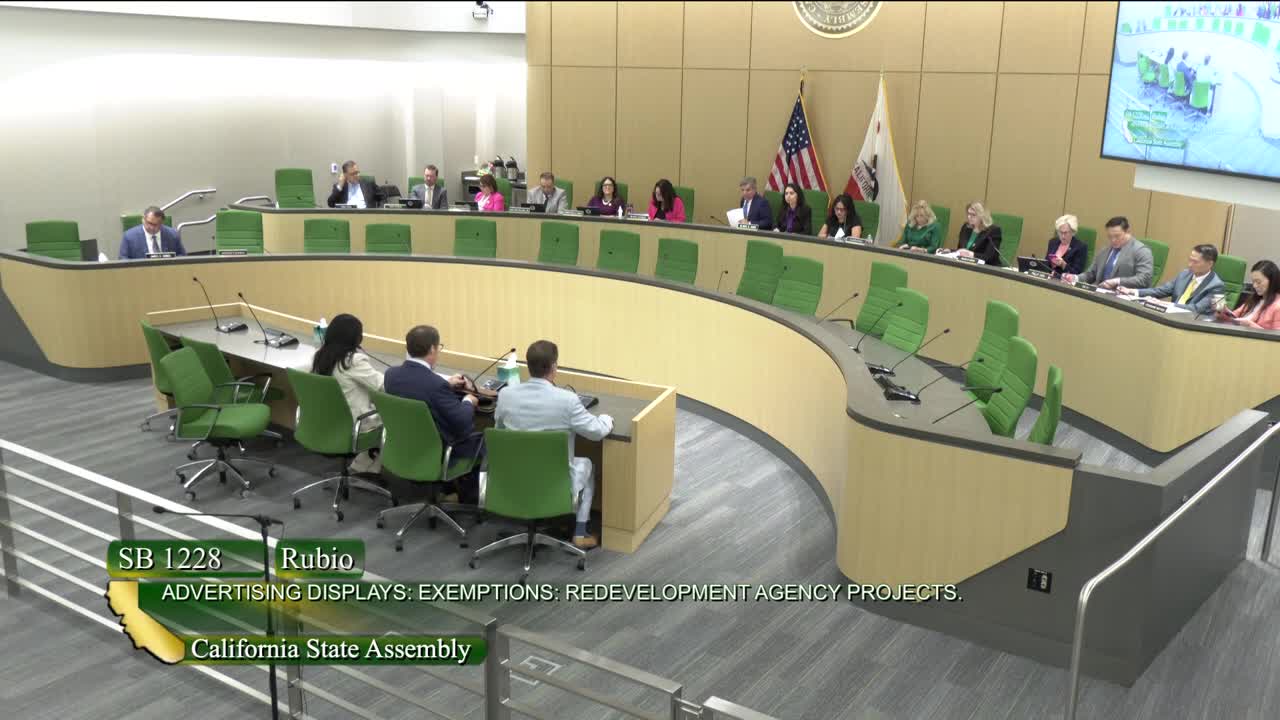 6MIN
Assembly Standing Committee on Governmental Organization
 2MIN
Senate Floor
 17MIN
Senate Standing Committee on Transportation
Bill Author