SB 1238: Common interest developments: management.
- Session Year: 2025-2026
- House: Senate
- Latest Version Date: 2026-08-30
Current Status:
In Progress
(2026-09-20: In Senate. Consideration of Governor's veto pending.)
Introduced
In Committee
Awaiting First Chamber Vote
Passed First Chamber
In Committee
Awaiting Second Chamber Vote
Passed Second Chamber
Enacted
(1)Existing law, the Davis-Stirling Common Interest Development Act (act), provides for the creation and regulation of common interest developments.
Existing law defines management services for purposes of a common interest development to mean specified acts performed or offered to be performed in an advisory capacity for an association, including implementing provisions of governing documents for the operation of the common interest development.
This bill would revise the above definition to specify that it means acts performed or offered to be performed by an agent, including a managing agent and its employees, in an advisory capacity for an association, as prescribed.
Existing law imposes certain fiduciary duties on managers and agents of common interest developments.
This bill would provide that a managing agent, including its employees, that facilitates specified activities, including reviewing association operating accounts, owes a duty of care that is prudent and provides the highest good faith effort to the association and its members.
(2)Existing law requires a common interest development to be managed by an association and requires the association to distribute to its members an annual budget that includes, among other things, a summary of the associations property, general liability, earthquake, flood, and fidelity insurance policies, a review of the financial statement of the association, and an annual policy statement, as provided. Existing law requires the owner of a separate interest in a common interest development to provide specified documents to a prospective purchaser as soon as practicable before the transfer of title or execution of a real property sales contract, including a copy of the most recent distributed annual budget, review of the financial statement, and annual policy statement and a report issued pursuant to the most recent inspection conducted.
This bill would require the association, upon request, to provide the owner of a separate interest, or their agent, with those documents as soon as practicable. The bill would require the owner to provide additional information, including, among other things, if separately requested by the purchaser, the location on the first page of the report where certain facts about the exterior elevated elements and the number of units impacted may be found. The bill would make various other related and conforming changes to those provisions.
This bill would incorporate additional changes to Section 5200 of the Civil Code proposed by AB 739 to be operative only if this bill and AB 739 are enacted and this bill is enacted last.
This bill would incorporate additional changes to Section 5550 of the Civil Code proposed by AB 2050 to be operative only if this bill and AB 2050 are enacted and this bill is enacted last.
(1)Existing law, the Davis-Stirling Common Interest Development Act (act), provides for the creation and regulation of common interest developments.
Existing civil law defines an agent as one who represents another, called the principal, in dealings with third persons.This bill would revise the above-described definition of agent to include a person or company that facilitates activities pursuant to specified provisions of the act.Existing law defines management services for purposes of a common interest development to mean specified acts performed or offered to be performed in an advisory capacity for an association, including implementing provisions of governing documents for the operation of the common interest development.
This bill would revise the above definition to specify that it means acts performed or offered to be performed by an agent, as defined above, including a managing agent and its employees, in an advisory capacity for an association, as prescribed.
Existing law imposes certain fiduciary duties on managers and agents of common interest developments.
This bill would provide that a person or entity managing agent, including its employees, that facilitates specified activities, including reviewing association operating accounts, owes a duty of care that is prudent and provides the highest good faith effort to the association and its members.
(2)Existing law requires a common interest development to be managed by an association and requires the association to distribute to its members an annual budget that includes, among other things, a summary of the associations property, general liability, earthquake, flood, and fidelity insurance policies, a review of the financial statement of the association, and an annual policy statement, as provided. Existing law requires the owner of a separate interest in a common interest development to provide specified documents to a prospective purchaser as soon as practicable before the transfer of title or execution of a real property sales contract, including a copy of the most recent distributed annual budget, review of the financial statement, and annual policy statement and a report issued pursuant to the most recent inspection conducted.
This bill would require the owner to be able to obtain the above-specified documents. The bill would require the owner to include with the most recent distributed annual budget, financial statement of the association, and annual policy statement a copy of the master insurance policy for the association, as specified, upon request of the property owner or prospective purchaser. association, upon request, to provide the owner of a separate interest, or their agent, with those documents as soon as practicable. The bill would require the owner to provide additional information, including, among other things, if separately requested by the purchaser, the location on the first page of the report where certain facts about the exterior elevated elements and the number of units impacted may be found. The bill would make various other related and conforming changes to those provisions.
(1)Existing law, the Davis-Stirling Common Interest Development Act (act), provides for the creation and regulation of common interest developments.
Existing civil law defines an agent as one who represents another, called the principal, in dealings with third persons.
This bill would revise the above-described definition of agent to include a person or company that facilitates activities pursuant to specified provisions of the act.
Existing law defines management services for purposes of a common interest development to mean specified acts performed or offered to be performed in an advisory capacity for an association, including implementing provisions of governing documents for the operation of the common interest development.
This bill would revise the above definition to specify that it means acts performed or offered to be performed by an agent, as defined above, in an advisory capacity for an association, as prescribed.
Existing law imposes certain fiduciary duties on managers and agents of common interest developments.
This bill would provide that a person or entity that facilitates specified activities, including reviewing association operating accounts, owes a duty of care that is prudent and provides the highest good faith effort to the association and its members.
(2)Existing law requires a common interest development to be managed by an association and requires the association to distribute to its members an annual budget that includes, among other things, a summary of the associations property, general liability, earthquake, flood, and fidelity insurance policies, a review of the financial statement of the association, and an annual policy statement, as provided. Existing law requires the owner of a separate interest in a common interest development to provide specified documents to a prospective purchaser as soon as practicable before the transfer of title or execution of a real property sales contract, including a copy of the most recent distributed annual budget, review of the financial statement, and annual policy statement and a report issued pursuant to the most recent inspection conducted.
This bill would require the owner to be able to obtain the above-specified documents. The bill would require the owner to include with the most recent distributed annual budget, financial statement of the association, and annual policy statement a copy of the master insurance policy for the association, as specified, upon request of the property owner or prospective purchaser. The bill would require the owner to provide additional information, including, among other things, if separately requested by the purchaser, the location on the first page of the report where certain facts about the exterior elevated elements and the number of units impacted may be found. The bill would make various other related and conforming changes to those provisions.
(1)Existing law, the Davis-Stirling Common Interest Development Act (act), provides for the creation and regulation of common interest developments.
Existing civil law defines an agent as one who represents another, called the principal, in dealings with third persons.
This bill would revise the above-described definition of agent to include a person or company that facilitates activities pursuant to specified provisions of the act and that is required to provide a fiduciary duty to the board of a homeowners association and its members. act.
Existing law defines management services for purposes of a common interest development to mean specified acts performed or offered to be performed in an advisory capacity for an association, including implementing provisions of governing documents for the operation of the common interest development.
This bill would revise the above definition to specify that it means acts performed or offered to be performed by an agent, as defined above, in an advisory capacity for an association, as prescribed.
Existing law defines professional association for common interest development managers to mean an organization that meets all of specified criteria, including having at least 200 members or certificants who are common interest development managers in California.This bill would revise that definition to specify that it means an organization that employees an agent or agents, as defined, and that meets the above mentioned criteria.Existing law imposes certain fiduciary duties on managers and agents of common interest developments.
This bill would provide that a person or entity that facilitates specified activities, including reviewing association operating accounts, owes a duty of care that is prudent and provides the highest good faith effort to the association and its members.
(2)Existing law requires the owner of a separate interest in a common interest development to provide specified documents to a prospective purchaser as soon as practicable before the transfer of title or execution of a real property sales contract, including a copy of the report issued pursuant to the most recent inspection conducted.
This bill would require the owner to provide additional information, including, among other things, if separately requested by the purchaser, the location on the first page of the report where certain facts about the exterior elevated elements and the number of units impacted may be found. The bill would make various other related and conforming changes to those provisions.
(1)Existing law, the Davis-Stirling Common Interest Development Act (act), provides for the creation and regulation of common interest developments.
Existing civil law defines an agent as one who represents another, called the principal, in dealings with third persons.
This bill would revise the above-described definition of agent to include a person or company that facilitates activities pursuant to specified provisions of the act and that is required to provide a fiduciary duty to the board of a homeowners association and its members.
Existing law defines management services for purposes of a common interest development to mean specified acts performed or offered to be performed in an advisory capacity for an association, including implementing provisions of governing documents for the operation of the common interest development.
This bill would revise the above definition to specify that it means acts performed or offered to be performed by an agent, as defined above, in an advisory capacity for an association, as prescribed.
Existing law defines professional association for common interest development managers to mean an organization that meets all of specified criteria, including having at least 200 members or certificants who are common interest development managers in California.
This bill would revise that definition to specify that it means an organization that employees an agent or agents, as defined, and that meets the above mentioned criteria.
(2)Existing law requires the owner of a separate interest in a common interest development to provide specified documents to a prospective purchaser as soon as practicable before the transfer of title or execution of a real property sales contract, including a copy of all the governing documents for the association. the report issued pursuant to the most recent inspection conducted.
This bill would require the owner to provide additional information to a prospective purchaser, information, including, among other things, a separate disclosure regarding exterior elements and units requiring imminent repairs, if the association employs an association manager or management company. if separately requested by the purchaser, the location on the first page of the report where certain facts about the exterior elevated elements and the number of units impacted may be found. The bill would make various other related and conforming changes to those provisions.
(3)Existing law prohibits the board of a common interest development from expending reserve funds for other than specified purposes, including repair, replacement, or maintenance of, or litigation involving major components, that the association is obligated to repair, replace, or maintain, and for which the reserve fund was established, subject to certain exceptions.This bill would prohibit the board from expending reserve funds for other litigation, legal services, or to threaten litigation involving any real property owner of record or relative of the real property owner of record that is a member of the homeowners association. The bill would make various other related and conforming changes to these provisions.(1)Existing law, the Davis-Stirling Common Interest Development Act (act), provides for the creation and regulation of common interest developments.
Existing civil law defines an agent as one who represents another, called the principal, in dealings with third persons.
This bill would revise the above-described definition of agent to include a person or company that facilitates activities pursuant to specified provisions of the act and that is required to provide a fiduciary duty to the board of a homeowners association and its members.
Existing law defines management services for purposes of a common interest development to mean specified acts performed or offered to be performed in an advisory capacity for an association, including implementing provisions of governing documents for the operation of the common interest development.
This bill would revise the above definition to specify that it means acts performed or offered to be performed by an agent, as defined above, in an advisory capacity for an association, as prescribed.
Existing law defines professional association for common interest development managers to mean an organization that meets all of specified criteria, including having at least 200 members or certificants who are common interest development managers in California.
This bill would revise that definition to specify that it means an organization that employees an agent or agents, as defined, and that meets the above mentioned criteria.
(2)Existing law requires the owner of a separate interest in a common interest development to provide specified documents to a prospective purchaser as soon as practicable before the transfer of title or execution of a real property sales contract, including a copy of all the governing documents for the association.
This bill would require the owner to provide additional information to a prospective purchaser, including, among other things, a separate disclosure regarding exterior elements and units requiring imminent repairs, if the association employs an association manager or management company.
(3)Existing law prohibits the board of a common interest development from expending reserve funds for other than specified purposes, including repair, replacement, or maintenance of, or litigation involving major components, that the association is obligated to repair, replace, or maintain, and for which the reserve fund was established, subject to certain exceptions.
This bill would prohibit the board from expending reserve funds for other litigation, legal services, or to threaten litigation involving any real property owner of record or relative of the real property owner of record that is a member of the homeowners association. The bill would make various other related and conforming changes to these provisions.
For purposes of this chapter, the following definitions apply:
(a)Common interest development means a residential development identified in Section 4100 of the Civil Code.
(b)Association has the same meaning as defined in Section 4080 of the Civil Code.
(c)Financial services means acts performed or offered to be performed, for compensation, for an association, including, but not limited to, the preparation of internal unaudited financial statements, internal accounting and bookkeeping functions, billing of assessments, and related services.
(d)Management services means acts performed or offered to be performed by an agent, including a managing agent and its employees, in an advisory capacity for an association including, but not limited to, the following:
(1)Administering or supervising the collection, reporting, and archiving of the financial or common area assets of an association or common interest development, at the direction of the associations board of directors.
(2)Implementing resolutions and directives of the board of directors of the association elected to oversee the operation of a common interest development.
(3)Implementing provisions of governing documents, as defined in Section 4150 of the Civil Code, that govern the operation of the common interest development.
(4)Administering association contracts, including insurance contracts, within the scope of the associations duties or with other common interest development managers, vendors, contractors, and other third-party providers of goods and services to an association or common interest development.
(5)Implementing or administering activities pursuant to Sections 5300, 5310, and 5500 of the Civil Code.
(e)Professional association for common interest development managers means an organization that meets all of the following:
(1)Has at least 200 members or certificants who are common interest development managers in California.
(2)Has been in existence for at least five years.
(3)Operates pursuant to Section 501(c) of the Internal Revenue Code.
(4)Certifies that a common interest development manager has met the criteria set forth in Section 11502 without requiring membership in the association.
(5)Requires adherence to a code of professional ethics and standards of practice for certified common interest development managers.
SEC. 2.Section 11501 of the Business and Professions Code is amended to read:11501.(a)Common interest development manager means an individual who for compensation, or in expectation of compensation, provides or contracts to provide management or financial services, as defined in Section 11500, or represents themself to act in the capacity of providing management or financial services to an association. Notwithstanding any other provision of law, an individual may not be required to obtain a real estate or brokers license in order to perform the services of a common interest development manager to an association.
(b)Common interest development manager also means any of the following:
(1)An individual who is a partner in a partnership, a shareholder or officer in a corporation, or who, in any other business entity acts in a capacity to advise, supervise, and direct the activity of a registrant or provisional registrant, or who acts as a principal on behalf of a company that provides the services of a common interest development manager.
(2)An individual operating under a fictitious business name who provides the services of a common interest development manager.
This section may not be construed to require an association to hire for compensation a common interest development manager, unless required to do so by its governing documents. Nothing in this part shall be construed to supersede any law that requires a license, permit, or any other form of registration, to provide management or financial services. Nothing in this section shall preclude a licensee of the California Board of Accountancy from providing financial services to an association within the scope of their license in addition to the preparation of reviewed and audited financial statements and the preparation of the associations tax returns.
SEC. 3.Section 4525 of the Civil Code is amended to read:4525.(a)Upon request, the association shall provide, and as soon as practicable, to the owner of a separate interest, or their agent, the documents specified paragraphs (1) to (11), inclusive. The owner of a separate interest shall provide the following documents to a prospective purchaser of the separate interest, as soon as practicable before the transfer of title or the execution of a real property sales contract, as defined in Section 2985:
(1)A copy of all governing documents. If the association is not incorporated, this shall include a statement in writing from an authorized representative of the association that the association is not incorporated.
(2)If there is a restriction in the governing documents limiting the occupancy, residency, or use of a separate interest on the basis of age in a manner different from that provided in Section 51.3, a statement that the restriction is only enforceable to the extent permitted by Section 51.3 and a statement specifying the applicable provisions of Section 51.3.
(3)A copy of the most recent documents distributed pursuant to Article 7 (commencing with Section 5300) of Chapter 6 and shall include a copy of the master insurance policy for the association that covers the associations property, general liability, earthquake, flood, and fidelity coverage upon request of the property owner or prospective purchaser.
(4)A true statement in writing obtained from an authorized representative of the association as to the amount of the associations current regular and special assessments and fees, any assessments levied upon the owners interest in the common interest development that are unpaid on the date of the statement, and any monetary fines or penalties levied upon the owners interest and unpaid on the date of the statement. The statement obtained from an authorized representative shall also include true information on late charges, interest, and costs of collection which, as of the date of the statement, are or may be made a lien upon the owners interest in a common interest development pursuant to Article 2 (commencing with Section 5650) of Chapter 8.
(5)A copy or a summary of any notice previously sent to the owner pursuant to Section 5855 that sets forth any alleged violation of the governing documents that remains unresolved at the time of the request. The notice shall not be deemed a waiver of the associations right to enforce the governing documents against the owner or the prospective purchaser of the separate interest with respect to any violation. This paragraph shall not be construed to require an association to inspect an owners separate interest.
(6)A copy of the initial list of defects provided to each member pursuant to Section 6000, unless the association and the builder subsequently enter into a settlement agreement or otherwise resolve the matter and the association complies with Section 6100. Disclosure of the initial list of defects pursuant to this paragraph does not waive any privilege attached to the document. The initial list of defects shall also include a statement that a final determination as to whether the list of defects is accurate and complete has not been made.
(7)A copy of the latest information provided for in Section 6100.
(8)Any change in the associations current regular and special assessments and fees which have been approved by the board, but have not become due and payable as of the date disclosure is provided pursuant to this subdivision.
(9)If there is a provision in the governing documents that prohibits the rental or leasing of any of the separate interests in the common interest development to a renter, lessee, or tenant, a statement describing the prohibition.
(10)If requested by the prospective purchaser, a copy of the minutes of board meetings, excluding meetings held in executive session, conducted over the previous 12 months, that were approved by the board.
(11)(A)A copy of the report issued pursuant to the most recent inspection conducted pursuant to Section 5551.
(B)The following information, if separately requested by the purchaser:
(i)The location on the first page of the report where the following information may be found:
(I)The number of exterior elevated elements, and the number of units identified pursuant to clause (i) of subparagraph (F) of paragraph (5) of subdivision (e) of Section 5551.
(II)The number of exterior elevated elements identified pursuant to clause (ii) of subparagraph (F) of paragraph (5) of subdivision (e) of Section 5551.
(III)The number of exterior elevated elements identified pursuant to clause (iii) of subparagraph (F) of paragraph (5) of subdivision (e) of Section 5551.
(ii)Any exterior elevated elements identified in the report, written pursuant to subdivision (e) of Section 5551, as needing repairs that exceed ten thousand dollars ($10,000).
(C)(i)The following information indicating whether:
(I)The covenants, restrictions, or conditions require an owner of a separate interest, with an exclusive right to use an exterior elevated element, to individually maintain that exterior elevated element.
(II)The associations reserve study includes a minimum annual budgeted replacement reserve allocation of 10 percent for repairs of the exterior elevated elements.
(III)The associations reserve study has been updated to include identified repairs contained within the exterior elevated elements inspection report conducted pursuant to subdivision (e) of Section 5551.
(ii)The requirements of clause (i) of this subparagraph may be satisfied by identifying where this information is addressed in the documents disclosed pursuant to paragraphs (1) and (3) of subdivision (a).
(b)This section does not apply to an owner that is subject to Section 11018.6 of the Business and Professions Code.
SEC. 4.Section 5200 of the Civil Code is amended to read:5200.For the purposes of this article, the following definitions shall apply:
(a)Association records means all of the following:
(1)Any financial document required to be provided to a member in Article 7 (commencing with Section 5300) or in Sections 5565 and 5810.
(2)Any financial document or statement required to be provided in Article 2 (commencing with Section 4525) of Chapter 4.
(3)Interim financial statements, periodic or as compiled, containing any of the following:
(A)Balance sheet.
(B)Income and expense statement.
(C)Budget comparison.
(D)General ledger. A general ledger is a report that shows all transactions that occurred in an association account over a specified period of time.
The records described in this paragraph shall be prepared in accordance with an accrual or modified accrual basis of accounting.
(4)Executed contracts not otherwise privileged under law.
(5)Written board approval of vendor or contractor proposals or invoices.
(6)State and federal tax returns.
(7)Reserve study pursuant to Section 5550, reserve account balances, and records of payments made from reserve accounts.
(8)Agendas and minutes of meetings of the members, the board, and any committees appointed by the board pursuant to Section 7212 of the Corporations Code; excluding, however, minutes and other information from executive sessions of the board as described in Article 2 (commencing with Section 4900).
(9)Membership lists, including name, property address, mailing address, email address, as collected by the association in accordance with Section 4041 where applicable, but not including information for members who have opted out pursuant to Section 5220.
(10)Check registers.
(11)The governing documents.
(12)An accounting prepared pursuant to subdivision (b) of Section 5520.
(13)An enhanced association record as defined in subdivision (b).
(14)Association election materials as defined in subdivision (c).
(15)All inspectors reports compiled pursuant to Section 5551.
(b)Enhanced association records means invoices, receipts, and canceled checks for payments made by the association, purchase orders approved by the association, bank account statements for bank accounts in which assessments are deposited or withdrawn, credit card statements for credit cards issued in the name of the association, statements for services rendered, and reimbursement requests submitted to the association.
(c)Association election materials means returned ballots, signed voter envelopes, the voter list of names, parcel numbers, and voters to whom ballots were to be sent, proxies, the candidate registration list, and the tally sheet of votes cast by electronic secret ballot. Signed voter envelopes may be inspected but may not be copied. An association shall maintain association election materials for one year after the date of the election.
SEC. 4.5.Section 5200 of the Civil Code is amended to read:5200.For the purposes of this article, the following definitions shall apply:
(a)Association records means all of the following:
(1)Any financial document required to be provided to a member in Article 7 (commencing with Section 5300) or in Sections 5565 and 5810.
(2)Any financial document or statement required to be provided in Article 2 (commencing with Section 4525) of Chapter 4.
(3)Interim financial statements, periodic or as compiled, containing any of the following:
(A)Balance sheet.
(B)Income and expense statement.
(C)Budget comparison.
(D)General ledger. A general ledger is a report that shows all transactions that occurred in an association account over a specified period of time.
The records described in this paragraph shall be prepared in accordance with an accrual or modified accrual basis of accounting.
(4)Executed contracts not otherwise privileged under law.
(5)Written board approval of vendor or contractor proposals or invoices.
(6)State and federal tax returns.
(7)Reserve study pursuant to Section 5550, reserve account balances, and records of payments made from reserve accounts.
(8)Agendas and minutes of meetings of the members, the board, and any committees appointed by the board pursuant to Section 7212 of the Corporations Code; excluding, however, minutes and other information from executive sessions of the board as described in Article 2 (commencing with Section 4900).
(9)Membership lists, including name, property address, mailing address, email address, as collected by the association in accordance with Section 4041 where applicable, but not including information for members who have opted out pursuant to Section 5220.
(10)Check registers.
(11)The governing documents.
(12)An accounting prepared pursuant to subdivision (b) of Section 5520.
(13)An enhanced association record as defined in subdivision (b).
(14)Association election materials as defined in subdivision (c).
(15)All inspectors reports compiled pursuant to Section 5551.
(16)Statements of fees charged by the managing agent pursuant to subdivision (g) of Section 5500.
(b)Enhanced association records means invoices, receipts, and canceled checks for payments made by the association, purchase orders approved by the association, bank account statements for bank accounts in which assessments are deposited or withdrawn, credit card statements for credit cards issued in the name of the association, statements for services rendered, and reimbursement requests submitted to the association.
(c)Association election materials means returned ballots, signed voter envelopes, the voter list of names, parcel numbers, and voters to whom ballots were to be sent, proxies, the candidate registration list, and the tally sheet of votes cast by electronic secret ballot. Signed voter envelopes may be inspected but may not be copied. An association shall maintain association election materials for one year after the date of the election.
SEC. 5.Section 5390 is added to the Civil Code, to read:5390.Any managing agent, including its employees, that facilitates activities pursuant to Sections 5300, 5310, and 5500, or other activities pursuant to this part that are authorized by the board, owes a duty of care that is prudent and provides the highest good faith effort to the association and its members.
SEC. 6.Section 5510 of the Civil Code is amended to read:5510.(a)The signatures of at least two persons, who shall be directors, or one officer who is not a director and one who is a director, shall be required for the withdrawal of moneys from the associations reserve accounts.
(b)The board shall not expend funds designated as reserve funds for any purpose other than the repair, restoration, replacement, or maintenance of, or litigation involving the repair, restoration, replacement, or maintenance of, major components that the association is obligated to repair, restore, replace, or maintain and for which the reserve fund was established.
(c)The board shall not expend funds designated as reserve funds for other litigation or legal services that are not identified in subdivision (b).
SEC. 7.Section 5550 of the Civil Code is amended to read:5550.(a)At least once every three years, the board shall cause to be conducted a reasonably competent and diligent visual inspection of the accessible areas of the major components that the association is obligated to repair, replace, restore, or maintain as part of a study of the reserve account requirements of the common interest development, if the current replacement value of the major components is equal to or greater than one-half of the gross budget of the association, excluding the associations reserve account for that period. The board shall review this study, or cause it to be reviewed, annually and shall consider and implement necessary adjustments to the boards analysis of the reserve account requirements as a result of that review.
(b)The study required by this section shall at a minimum include:
(1)Identification of the major components that the association is obligated to repair, replace, restore, or maintain that, as of the date of the study, have a remaining useful life of less than 30 years.
(2)Identification of the probable remaining useful life of the components identified in paragraph (1) as of the date of the study.
(3)An estimate of the cost of repair, replacement, restoration, or maintenance of the components identified in paragraph (1).
(4)Cost of repair, replacement, restoration or maintenance of the components identified in the report required in Section 5551.
(5)An estimate of the total annual contribution necessary to defray the cost to repair, replace, restore, or maintain the components identified in paragraph (1) during and at the end of their useful life, after subtracting total reserve funds as of the date of the study.
(6)A reserve funding plan that indicates how the association plans to fund the contribution identified in paragraph (5) to meet the associations obligation for the repair and replacement of all major components with an expected remaining life of 30 years or less, not including those components that the board has determined will not be replaced or repaired.
(c)For purposes of this section, major components includes, but is not limited to, exterior elevated elements defined and inspected pursuant to Section 5551, and gas, water, and electrical service to the extent that the association is responsible for repair or replacement of those lines pursuant to Section 4775.
SEC. 7.1.Section 5550 of the Civil Code is amended to read:5550.(a)At least once every three years, the board shall cause to be conducted a reasonably competent and diligent visual inspection of the accessible areas of the major components that the association is obligated to repair, replace, restore, or maintain as part of a study of the reserve account requirements of the common interest development, if the current replacement value of the major components is equal to or greater than one-half of the gross budget of the association, excluding the associations reserve account for that period. The board shall review this study, or cause it to be reviewed, annually and shall consider and implement necessary adjustments to the boards analysis of the reserve account requirements as a result of that review.
(b)The study required by this section shall at a minimum include:
(1)Identification of the major components that the association is obligated to repair, replace, restore, or maintain that, as of the date of the study, have a remaining useful life of less than 30 years.
(2)Identification of the probable remaining useful life of the components identified in paragraph (1) as of the date of the study.
(3)An estimate of the cost of repair, replacement, restoration, or maintenance of the components identified in paragraph (1).
(4)Cost of repair, replacement, restoration or maintenance of the components identified in the report required in Section 5551.
(5)An estimate of the total annual contribution necessary to defray the cost to repair, replace, restore, or maintain the components identified in paragraph (1) during and at the end of their useful life, after subtracting total reserve funds as of the date of the study.
(6)A reserve funding plan that indicates how the association plans to fund the contribution identified in paragraph (5) to meet the associations obligation for the repair and replacement of all major components with an expected remaining life of 30 years or less, not including those components that the board has determined will not be replaced or repaired.
(c)For purposes of this section, major components includes, but is not limited to, exterior elevated elements defined and inspected pursuant to Section 5551, and gas, water, and electrical service to the extent that the association is responsible for repair or replacement of those lines pursuant to Section 4775.
(d)This section shall remain in effect only until January 1, 2032, and as of that date is repealed.
SEC. 7.2.Section 5550 is added to the Civil Code, to read:5550.(a)At least once every three years, the association shall cause to be conducted a reasonably competent and diligent visual inspection of the accessible areas of the major components that the association is obligated to repair, replace, restore, or maintain as part of a study of the reserve account requirements of the common interest development, if the current replacement value of the major components is equal to or greater than one-half of the gross budget of the association. The association shall review and update this study annually and shall consider and implement necessary adjustments to the associations funding of the reserve account as a result of that review.
(b)The study required by this section shall at a minimum include:
(1)Identification of the major components that the association is obligated to repair, replace, restore, or maintain that, as of the date of the study, have a remaining useful life of less than 30 years.
(2)Identification of the probable remaining useful life of the components identified in paragraph (1) as of the date of the study.
(3)An estimate of the cost of repair, replacement, restoration, or maintenance of the components identified in paragraph (1).
(4)Cost of repair, replacement, restoration or maintenance of the components identified in the report required in Section 5551.
(5)An estimate of the total annual reserve account transfer necessary to defray the cost to repair, replace, restore, or maintain the components identified in paragraph (1) during and at the end of their useful life, after subtracting total reserve funds as of the date of the study.
(6)A reserve funding plan that indicates how the association plans to fund the reserve account transfer identified in paragraph (5) to meet the associations obligation for the repair and replacement of all major components with an expected remaining life of 30 years or less, not including those components that the board has determined will not be replaced or repaired.
(7)The minimum reserve contribution level to prevent the projected association reserve account balance from falling below zero over the following 30 years.
(8)A statement informing the association that, beginning January 1, 2032, state law will require an association to take certain actions if the association projects the reserve account balance to fall below zero over a 30-year period, including transferring a minimum of 15 percent of its gross annual budget to the reserve account and, under specified conditions, levying a reserve funding special assessment, as prescribed.
(c)For purposes of this section, major components includes, but is not limited to, exterior elevated elements defined and inspected pursuant to Section 5551, and gas, water, and electrical service to the extent that the association is responsible for repair or replacement of those lines pursuant to Section 4775.
(d)This section shall become operative on January 1, 2032.
SEC. 8.Section 5551 of the Civil Code is amended to read:5551.(a)For purposes of this section, the following definitions apply:
(1)Associated waterproofing systems include flashings, membranes, coatings, and sealants that protect the load-bearing components of exterior elevated elements from exposure to water.
(2)Exterior elevated elements mean the load-bearing components together with their associated waterproofing system.
(3)Load-bearing components means those components that extend beyond the exterior walls of the building to deliver structural loads to the building from decks, balconies, stairways, walkways, and their railings, that have a walking surface elevated more than six feet above ground level, that are designed for human occupancy or use, and that are supported in whole or in substantial part by wood or wood-based products.
(4)Statistically significant sample means a sufficient number of units inspected to provide 95 percent confidence that the results from the sample are reflective of the whole, with a margin of error of no greater than plus or minus 5 percent.
(5)Visual inspection means inspection through the least intrusive method necessary to inspect load-bearing components, including visual observation only or visual observation in conjunction with, for example, the use of moisture meters, borescopes, or infrared technology.
(b)(1)At least once every nine years, the board of an association of a condominium project shall cause a reasonably competent and diligent visual inspection to be conducted by a licensed structural or civil engineer or architect of a random and statistically significant sample of exterior elevated elements for which the association has maintenance or repair responsibility.
(2)The inspection shall determine whether the exterior elevated elements are in a generally safe condition and performing in accordance with applicable standards.
(c)Prior to conducting the first visual inspection, the inspector shall generate a random list of the locations of each type of exterior elevated element. The list shall include all exterior elevated elements for which the association has maintenance or repair responsibility. The list shall be provided to the association for future use.
(d)The inspector shall perform the visual inspections in accordance with the random list generated pursuant to subdivision (c). If during the visual inspection the inspector observes building conditions indicating that unintended water or water vapor has passed into the associated waterproofing system, thereby creating the potential for damage to the load-bearing components, then the inspector may conduct a further inspection. The inspector shall exercise their best professional judgment in determining the necessity, scope, and breadth of any further inspection.
(e)Based upon the inspectors visual inspections, further inspection, and construction and materials expertise, the inspector shall issue a written report containing the following:
(1)The identification of the building components comprising the load-bearing components and associated waterproofing system.
(2)The current physical condition of the load-bearing components and associated waterproofing system, including whether the condition presents an immediate threat to the health and safety of the residents.
(3)The expected future performance and remaining useful life of the load-bearing components and associated waterproofing system.
(4)Recommendations for any necessary repair or replacement of the load-bearing components and associated waterproofing system.
(5)On the first page of the report, all of the following:
(A)The date of inspection.
(B)The total number of units in the condominium project.
(C)The total number of units in the condominium project with exterior elevated elements.
(D)The total number of exterior elevated elements in the condominium project.
(E)The total number of exterior elevated elements inspected pursuant to subdivision (b).
(F)As of the date of inspection in subparagraph (A), the total number of inspected exterior elevated elements identified in the inspectors written report and the number of units impacted in each of the following repair urgency categories:
(i)The total number of inspected exterior elevated elements identified as posing an immediate threat to the safety of the occupants, pursuant to subdivision (g), and the number of units impacted.
(ii)Exterior elevated elements recommended to be included in the next reasonably competent and diligent visual inspection conducted pursuant to Section 5550 or recommended for reinspection within the next three years.
(iii)Exterior elevated elements recommended for reinspection in the next inspection conducted pursuant to this section.
(iv)Exterior elevated elements demonstrating no need for repair at the time of inspection.
(G)A certification that the inspector has conducted a visual inspection and evaluated a statistically significant sample of the exterior elevated elements within the condominium project, as required by subdivision (b).
(f)The report issued pursuant to subdivision (e) shall be stamped or signed by the inspector, presented to the board, and incorporated into the study required by Section 5550.
(g)(1)If, after inspection of any exterior elevated element, the inspector advises that the exterior elevated element poses an immediate threat to the safety of the occupants, the inspector shall provide a copy of the inspection report to the association immediately upon completion of the report, and to the local code enforcement agency within 15 days of completion of the report. Upon receiving the report, the association shall take preventive measures immediately, including preventing occupant access to the exterior elevated element until repairs have been inspected and approved by the local enforcement agency.
(2)Local enforcement agencies shall have the ability to recover enforcement costs associated with the requirements of this section from the association.
(h)Each subsequent visual inspection conducted under this section shall commence with the next exterior elevated element identified on the random list and shall proceed in order through the list.
(i)The first inspection shall be completed by January 1, 2025, and then every nine years thereafter in coordination with the reserve study inspection pursuant to Section 5550. All written reports shall be maintained for two inspection cycles as records of the association.
(j)(1)The association shall be responsible for complying with the requirements of this section.
(2)The continued and ongoing maintenance and repair of the load-bearing components and associated waterproofing systems in a safe, functional, and sanitary condition shall be the responsibility of the association as required by the associations governing documents.
(k)The inspection of buildings for which a building permit application has been submitted on or after January 1, 2020, shall occur no later than six years following the issuance of a certificate of occupancy. The inspection shall otherwise comply with the provisions of this section.
(l)This section shall only apply to buildings containing three or more attached multifamily dwelling units.
(m)The association board may enact rules or bylaws imposing requirements greater than those imposed by this section.
(n)A local government or local enforcement agency may enact an ordinance or other rule imposing requirements greater than those imposed by this section.
SEC. 9.Section 5560 of the Civil Code is amended to read:5560.(a)The reserve funding plan required by Section 5550 shall include a schedule of the date and amount of any change in regular or special assessments that would be needed to sufficiently fund the reserve funding plan.
(b)The plan shall be adopted by the board at an open meeting before the membership of the association as described in Article 2 (commencing with Section 4900) of Chapter 6.
(c)The plan shall include the costs necessary to account for the repairs identified in the inspection required pursuant to Section 5551.
(d)If the board determines that an assessment increase is necessary to fund the reserve funding plan, any increase shall be approved in a separate action of the board that is consistent with the procedure described in Section 5605.
SEC. 10.Section 5565 of the Civil Code is amended to read:5565.The summary of the associations reserves required by paragraph (2) of subdivision (b) of Section 5300 shall be based on the most recent review or study conducted pursuant to Section 5550, shall be based only on assets held in cash or cash equivalents, shall be printed in boldface type, and shall include all of the following:
(a)The current estimated replacement cost, estimated remaining life, and estimated useful life of each major component and shall include repairs identified in the inspection required pursuant to Section 5551.
(b)As of the end of the fiscal year for which the study is prepared:
(1)The current estimate of the amount of cash reserves necessary to repair, replace, restore, or maintain the major components.
(2)The current amount of accumulated cash reserves actually set aside to repair, replace, restore, or maintain major components.
(3)If applicable, the amount of funds received from either a compensatory damage award or settlement to an association from any person for injuries to property, real or personal, arising out of any construction or design defects, and the expenditure or disposition of funds, including the amounts expended for the direct and indirect costs of repair of construction or design defects. These amounts shall be reported at the end of the fiscal year for which the study is prepared as separate line items under cash reserves pursuant to paragraph (2). Instead of complying with the requirements set forth in this paragraph, an association that is obligated to issue a review of its financial statement pursuant to Section 5305 may include in the review a statement containing all of the information required by this paragraph.
(c)The percentage that the amount determined for purposes of paragraph (2) of subdivision (b) equals the amount determined for purposes of paragraph (1) of subdivision (b).
(d)The current deficiency in reserve funding expressed on a per unit basis. The figure shall be calculated by subtracting the amount determined for purposes of paragraph (2) of subdivision (b) from the amount determined for purposes of paragraph (1) of subdivision (b) and then dividing the result by the number of separate interests within the association, except that if assessments vary by the size or type of ownership interest, then the association shall calculate the current deficiency in a manner that reflects the variation.
SEC. 11.Section 4.5 of this bill incorporates amendments to Section 5200 of the Civil Code proposed by both this bill and Assembly Bill 739. That section of this bill shall only become operative if (1) both bills are enacted and become effective on or before January 1, 2027, (2) each bill amends Section 5200 of the Civil Code, and (3) this bill is enacted after Assembly Bill 739, in which case Section 4 of this bill shall not become operative.
SEC. 12.Sections 7.1 and 7.2 of this bill incorporate amendments to Section 5550 of the Civil Code proposed by both this bill and Assembly Bill 2050. Those sections of this bill shall only become operative if (1) both bills are enacted and become effective on or before January 1, 2027, (2) this bill amends Section 5550 of the Civil Code and Assembly Bill 2050 amends, repeals, and adds Section 5550 of the Civil Code, and (3) this bill is enacted after Assembly Bill 2050, in which case Section 7 of this bill shall not become operative
For purposes of this chapter, the following definitions apply:
(a)Common interest development means a residential development identified in Section 4100 of the Civil Code.
(b)Association has the same meaning as defined in Section 4080 of the Civil Code.
(c)Financial services means acts performed or offered to be performed, for compensation, for an association, including, but not limited to, the preparation of internal unaudited financial statements, internal accounting and bookkeeping functions, billing of assessments, and related services.
(d)Management services means acts performed or offered to be performed by an agent, including a managing agent and its employees, in an advisory capacity for an association including, but not limited to, the following:
(1)Administering or supervising the collection, reporting, and archiving of the financial or common area assets of an association or common interest development, at the direction of the associations board of directors.
(2)Implementing resolutions and directives of the board of directors of the association elected to oversee the operation of a common interest development.
(3)Implementing provisions of governing documents, as defined in Section 4150 of the Civil Code, that govern the operation of the common interest development.
(4)Administering association contracts, including insurance contracts, within the scope of the associations duties or with other common interest development managers, vendors, contractors, and other third-party providers of goods and services to an association or common interest development.
(5)Implementing or administering activities pursuant to Sections 5300, 5310, and 5500 of the Civil Code.
(e)Professional association for common interest development managers means an organization that meets all of the following:
(1)Has at least 200 members or certificants who are common interest development managers in California.
(2)Has been in existence for at least five years.
(3)Operates pursuant to Section 501(c) of the Internal Revenue Code.
(4)Certifies that a common interest development manager has met the criteria set forth in Section 11502 without requiring membership in the association.
(5)Requires adherence to a code of professional ethics and standards of practice for certified common interest development managers.
SEC. 2.Section 11501 of the Business and Professions Code is amended to read:11501.(a)Common interest development manager means an individual who for compensation, or in expectation of compensation, provides or contracts to provide management or financial services, as defined in Section 11500, or represents themself to act in the capacity of providing management or financial services to an association. Notwithstanding any other provision of law, an individual may not be required to obtain a real estate or brokers license in order to perform the services of a common interest development manager to an association.
(b)Common interest development manager also means any of the following:
(1)An individual who is a partner in a partnership, a shareholder or officer in a corporation, or who, in any other business entity acts in a capacity to advise, supervise, and direct the activity of a registrant or provisional registrant, or who acts as a principal on behalf of a company that provides the services of a common interest development manager.
(2)An individual operating under a fictitious business name who provides the services of a common interest development manager.
This section may not be construed to require an association to hire for compensation a common interest development manager, unless required to do so by its governing documents. Nothing in this part shall be construed to supersede any law that requires a license, permit, or any other form of registration, to provide management or financial services. Nothing in this section shall preclude a licensee of the California Board of Accountancy from providing financial services to an association within the scope of their license in addition to the preparation of reviewed and audited financial statements and the preparation of the associations tax returns.
SEC. 3.Section 4525 of the Civil Code is amended to read:4525.(a)Upon request, the association shall provide, and as soon as practicable, to the owner of a separate interest, or their agent, the documents specified paragraphs (1) to (11), inclusive. The owner of a separate interest shall provide the following documents to a prospective purchaser of the separate interest, as soon as practicable before the transfer of title or the execution of a real property sales contract, as defined in Section 2985:
(1)A copy of all governing documents. If the association is not incorporated, this shall include a statement in writing from an authorized representative of the association that the association is not incorporated.
(2)If there is a restriction in the governing documents limiting the occupancy, residency, or use of a separate interest on the basis of age in a manner different from that provided in Section 51.3, a statement that the restriction is only enforceable to the extent permitted by Section 51.3 and a statement specifying the applicable provisions of Section 51.3.
(3)A copy of the most recent documents distributed pursuant to Article 7 (commencing with Section 5300) of Chapter 6 and shall include a copy of the master insurance policy for the association that covers the associations property, general liability, earthquake, flood, and fidelity coverage upon request of the property owner or prospective purchaser.
(4)A true statement in writing obtained from an authorized representative of the association as to the amount of the associations current regular and special assessments and fees, any assessments levied upon the owners interest in the common interest development that are unpaid on the date of the statement, and any monetary fines or penalties levied upon the owners interest and unpaid on the date of the statement. The statement obtained from an authorized representative shall also include true information on late charges, interest, and costs of collection which, as of the date of the statement, are or may be made a lien upon the owners interest in a common interest development pursuant to Article 2 (commencing with Section 5650) of Chapter 8.
(5)A copy or a summary of any notice previously sent to the owner pursuant to Section 5855 that sets forth any alleged violation of the governing documents that remains unresolved at the time of the request. The notice shall not be deemed a waiver of the associations right to enforce the governing documents against the owner or the prospective purchaser of the separate interest with respect to any violation. This paragraph shall not be construed to require an association to inspect an owners separate interest.
(6)A copy of the initial list of defects provided to each member pursuant to Section 6000, unless the association and the builder subsequently enter into a settlement agreement or otherwise resolve the matter and the association complies with Section 6100. Disclosure of the initial list of defects pursuant to this paragraph does not waive any privilege attached to the document. The initial list of defects shall also include a statement that a final determination as to whether the list of defects is accurate and complete has not been made.
(7)A copy of the latest information provided for in Section 6100.
(8)Any change in the associations current regular and special assessments and fees which have been approved by the board, but have not become due and payable as of the date disclosure is provided pursuant to this subdivision.
(9)If there is a provision in the governing documents that prohibits the rental or leasing of any of the separate interests in the common interest development to a renter, lessee, or tenant, a statement describing the prohibition.
(10)If requested by the prospective purchaser, a copy of the minutes of board meetings, excluding meetings held in executive session, conducted over the previous 12 months, that were approved by the board.
(11)(A)A copy of the report issued pursuant to the most recent inspection conducted pursuant to Section 5551.
(B)The following information, if separately requested by the purchaser:
(i)The location on the first page of the report where the following information may be found:
(I)The number of exterior elevated elements, and the number of units identified pursuant to clause (i) of subparagraph (F) of paragraph (5) of subdivision (e) of Section 5551.
(II)The number of exterior elevated elements identified pursuant to clause (ii) of subparagraph (F) of paragraph (5) of subdivision (e) of Section 5551.
(III)The number of exterior elevated elements identified pursuant to clause (iii) of subparagraph (F) of paragraph (5) of subdivision (e) of Section 5551.
(ii)Any exterior elevated elements identified in the report, written pursuant to subdivision (e) of Section 5551, as needing repairs that exceed ten thousand dollars ($10,000).
(C)(i)The following information indicating whether:
(I)The covenants, restrictions, or conditions require an owner of a separate interest, with an exclusive right to use an exterior elevated element, to individually maintain that exterior elevated element.
(II)The associations reserve study includes a minimum annual budgeted replacement reserve allocation of 10 percent for repairs of the exterior elevated elements.
(III)The associations reserve study has been updated to include identified repairs contained within the exterior elevated elements inspection report conducted pursuant to subdivision (e) of Section 5551.
(ii)The requirements of clause (i) of this subparagraph may be satisfied by identifying where this information is addressed in the documents disclosed pursuant to paragraphs (1) and (3) of subdivision (a).
(b)This section does not apply to an owner that is subject to Section 11018.6 of the Business and Professions Code.
SEC. 4.Section 5200 of the Civil Code is amended to read:5200.For the purposes of this article, the following definitions shall apply:
(a)Association records means all of the following:
(1)Any financial document required to be provided to a member in Article 7 (commencing with Section 5300) or in Sections 5565 and 5810.
(2)Any financial document or statement required to be provided in Article 2 (commencing with Section 4525) of Chapter 4.
(3)Interim financial statements, periodic or as compiled, containing any of the following:
(A)Balance sheet.
(B)Income and expense statement.
(C)Budget comparison.
(D)General ledger. A general ledger is a report that shows all transactions that occurred in an association account over a specified period of time.
The records described in this paragraph shall be prepared in accordance with an accrual or modified accrual basis of accounting.
(4)Executed contracts not otherwise privileged under law.
(5)Written board approval of vendor or contractor proposals or invoices.
(6)State and federal tax returns.
(7)Reserve study pursuant to Section 5550, reserve account balances, and records of payments made from reserve accounts.
(8)Agendas and minutes of meetings of the members, the board, and any committees appointed by the board pursuant to Section 7212 of the Corporations Code; excluding, however, minutes and other information from executive sessions of the board as described in Article 2 (commencing with Section 4900).
(9)Membership lists, including name, property address, mailing address, email address, as collected by the association in accordance with Section 4041 where applicable, but not including information for members who have opted out pursuant to Section 5220.
(10)Check registers.
(11)The governing documents.
(12)An accounting prepared pursuant to subdivision (b) of Section 5520.
(13)An enhanced association record as defined in subdivision (b).
(14)Association election materials as defined in subdivision (c).
(15)All inspectors reports compiled pursuant to Section 5551.
(b)Enhanced association records means invoices, receipts, and canceled checks for payments made by the association, purchase orders approved by the association, bank account statements for bank accounts in which assessments are deposited or withdrawn, credit card statements for credit cards issued in the name of the association, statements for services rendered, and reimbursement requests submitted to the association.
(c)Association election materials means returned ballots, signed voter envelopes, the voter list of names, parcel numbers, and voters to whom ballots were to be sent, proxies, the candidate registration list, and the tally sheet of votes cast by electronic secret ballot. Signed voter envelopes may be inspected but may not be copied. An association shall maintain association election materials for one year after the date of the election.
SEC. 4.5.Section 5200 of the Civil Code is amended to read:5200.For the purposes of this article, the following definitions shall apply:
(a)Association records means all of the following:
(1)Any financial document required to be provided to a member in Article 7 (commencing with Section 5300) or in Sections 5565 and 5810.
(2)Any financial document or statement required to be provided in Article 2 (commencing with Section 4525) of Chapter 4.
(3)Interim financial statements, periodic or as compiled, containing any of the following:
(A)Balance sheet.
(B)Income and expense statement.
(C)Budget comparison.
(D)General ledger. A general ledger is a report that shows all transactions that occurred in an association account over a specified period of time.
The records described in this paragraph shall be prepared in accordance with an accrual or modified accrual basis of accounting.
(4)Executed contracts not otherwise privileged under law.
(5)Written board approval of vendor or contractor proposals or invoices.
(6)State and federal tax returns.
(7)Reserve account balances study pursuant to Section 5550, reserve account balances, and records of payments made from reserve accounts.
(8)Agendas and minutes of meetings of the members, the board, and any committees appointed by the board pursuant to Section 7212 of the Corporations Code; excluding, however, minutes and other information from executive sessions of the board as described in Article 2 (commencing with Section 4900).
(9)Membership lists, including name, property address, mailing address, email address, as collected by the association in accordance with Section 4041 where applicable, but not including information for members who have opted out pursuant to Section 5220.
(10)Check registers.
(11)The governing documents.
(12)An accounting prepared pursuant to subdivision (b) of Section 5520.
(13)An enhanced association record as defined in subdivision (b).
(14)Association election materials as defined in subdivision (c).
(15)All inspectors reports compiled pursuant to Section 5551.
(16)Statements of fees charged by the managing agent pursuant to subdivision (g) of Section 5500.
(b)Enhanced association records means invoices, receipts, and canceled checks for payments made by the association, purchase orders approved by the association, bank account statements for bank accounts in which assessments are deposited or withdrawn, credit card statements for credit cards issued in the name of the association, statements for services rendered, and reimbursement requests submitted to the association.
(c)Association election materials means returned ballots, signed voter envelopes, the voter list of names, parcel numbers, and voters to whom ballots were to be sent, proxies, the candidate registration list, and the tally sheet of votes cast by electronic secret ballot. Signed voter envelopes may be inspected but may not be copied. An association shall maintain association election materials for one year after the date of the election.
SEC. 5.Section 5390 is added to the Civil Code, to read:5390.Any managing agent, including its employees, that facilitates activities pursuant to Sections 5300, 5310, and 5500, or other activities pursuant to this part that are authorized by the board, owes a duty of care that is prudent and provides the highest good faith effort to the association and its members.
SEC. 6.Section 5510 of the Civil Code is amended to read:5510.(a)The signatures of at least two persons, who shall be directors, or one officer who is not a director and one who is a director, shall be required for the withdrawal of moneys from the associations reserve accounts.
(b)The board shall not expend funds designated as reserve funds for any purpose other than the repair, restoration, replacement, or maintenance of, or litigation involving the repair, restoration, replacement, or maintenance of, major components that the association is obligated to repair, restore, replace, or maintain and for which the reserve fund was established.
(c)The board shall not expend funds designated as reserve funds for other litigation or legal services that are not identified in subdivision (b).
SEC. 7.Section 5550 of the Civil Code is amended to read:5550.(a)At least once every three years, the board shall cause to be conducted a reasonably competent and diligent visual inspection of the accessible areas of the major components that the association is obligated to repair, replace, restore, or maintain as part of a study of the reserve account requirements of the common interest development, if the current replacement value of the major components is equal to or greater than one-half of the gross budget of the association, excluding the associations reserve account for that period. The board shall review this study, or cause it to be reviewed, annually and shall consider and implement necessary adjustments to the boards analysis of the reserve account requirements as a result of that review.
(b)The study required by this section shall at a minimum include:
(1)Identification of the major components that the association is obligated to repair, replace, restore, or maintain that, as of the date of the study, have a remaining useful life of less than 30 years.
(2)Identification of the probable remaining useful life of the components identified in paragraph (1) as of the date of the study.
(3)An estimate of the cost of repair, replacement, restoration, or maintenance of the components identified in paragraph (1).
(4)Cost of repair, replacement, restoration or maintenance of the components identified in the report required in Section 5551.
(5)An estimate of the total annual contribution necessary to defray the cost to repair, replace, restore, or maintain the components identified in paragraph (1) during and at the end of their useful life, after subtracting total reserve funds as of the date of the study.
(6)A reserve funding plan that indicates how the association plans to fund the contribution identified in paragraph (5) to meet the associations obligation for the repair and replacement of all major components with an expected remaining life of 30 years or less, not including those components that the board has determined will not be replaced or repaired.
(c)For purposes of this section, major components includes, but is not limited to, exterior elevated elements defined and inspected pursuant to Section 5551, and gas, water, and electrical service to the extent that the association is responsible for repair or replacement of those lines pursuant to Section 4775.
SEC. 7.1.Section 5550 of the Civil Code is amended to read:5550.(a)At least once every three years, the board shall cause to be conducted a reasonably competent and diligent visual inspection of the accessible areas of the major components that the association is obligated to repair, replace, restore, or maintain as part of a study of the reserve account requirements of the common interest development, if the current replacement value of the major components is equal to or greater than one-half of the gross budget of the association, excluding the associations reserve account for that period. The board shall review this study, or cause it to be reviewed, annually and shall consider and implement necessary adjustments to the boards analysis of the reserve account requirements as a result of that review.
(b)The study required by this section shall at a minimum include:
(1)Identification of the major components that the association is obligated to repair, replace, restore, or maintain that, as of the date of the study, have a remaining useful life of less than 30 years.
(2)Identification of the probable remaining useful life of the components identified in paragraph (1) as of the date of the study.
(3)An estimate of the cost of repair, replacement, restoration, or maintenance of the components identified in paragraph (1).
(4)Cost of repair, replacement, restoration or maintenance of the components identified in the report required in Section 5551.
(4)(5)An estimate of the total annual contribution necessary to defray the cost to repair, replace, restore, or maintain the components identified in paragraph (1) during and at the end of their useful life, after subtracting total reserve funds as of the date of the study.
(5)(6)A reserve funding plan that indicates how the association plans to fund the contribution identified in paragraph (4) (5) to meet the associations obligation for the repair and replacement of all major components with an expected remaining life of 30 years or less, not including those components that the board has determined will not be replaced or repaired.
(c)For purposes of this section, major components includes includes, but is not limited to, exterior elevated elements defined and inspected pursuant to Section 5551, and gas, water, and electrical service to the extent that the association is responsible for repair or replacement of those lines pursuant to Section 4775.
(d)This section shall remain in effect only until January 1, 2032, and as of that date is repealed.
SEC. 7.2.Section 5550 is added to the Civil Code, to read:5550.(a)At least once every three years, the association shall cause to be conducted a reasonably competent and diligent visual inspection of the accessible areas of the major components that the association is obligated to repair, replace, restore, or maintain as part of a study of the reserve account requirements of the common interest development, if the current replacement value of the major components is equal to or greater than one-half of the gross budget of the association. The association shall review and update this study annually and shall consider and implement necessary adjustments to the associations funding of the reserve account as a result of that review.
(b)The study required by this section shall at a minimum include:
(1)Identification of the major components that the association is obligated to repair, replace, restore, or maintain that, as of the date of the study, have a remaining useful life of less than 30 years.
(2)Identification of the probable remaining useful life of the components identified in paragraph (1) as of the date of the study.
(3)An estimate of the cost of repair, replacement, restoration, or maintenance of the components identified in paragraph (1).
(4)Cost of repair, replacement, restoration or maintenance of the components identified in the report required in Section 5551.
(5)An estimate of the total annual reserve account transfer necessary to defray the cost to repair, replace, restore, or maintain the components identified in paragraph (1) during and at the end of their useful life, after subtracting total reserve funds as of the date of the study.
(6)A reserve funding plan that indicates how the association plans to fund the reserve account transfer identified in paragraph (5) to meet the associations obligation for the repair and replacement of all major components with an expected remaining life of 30 years or less, not including those components that the board has determined will not be replaced or repaired.
(7)The minimum reserve contribution level to prevent the projected association reserve account balance from falling below zero over the following 30 years.
(8)A statement informing the association that, beginning January 1, 2032, state law will require an association to take certain actions if the association projects the reserve account balance to fall below zero over a 30-year period, including transferring a minimum of 15 percent of its gross annual budget to the reserve account and, under specified conditions, levying a reserve funding special assessment, as prescribed.
(c)For purposes of this section, major components includes, but is not limited to, exterior elevated elements defined and inspected pursuant to Section 5551, and gas, water, and electrical service to the extent that the association is responsible for repair or replacement of those lines pursuant to Section 4775.
(d)This section shall become operative on January 1, 2032.
SEC. 8.Section 5551 of the Civil Code is amended to read:5551.(a)For purposes of this section, the following definitions apply:
(1)Associated waterproofing systems include flashings, membranes, coatings, and sealants that protect the load-bearing components of exterior elevated elements from exposure to water.
(2)Exterior elevated elements mean the load-bearing components together with their associated waterproofing system.
(3)Load-bearing components means those components that extend beyond the exterior walls of the building to deliver structural loads to the building from decks, balconies, stairways, walkways, and their railings, that have a walking surface elevated more than six feet above ground level, that are designed for human occupancy or use, and that are supported in whole or in substantial part by wood or wood-based products.
(4)Statistically significant sample means a sufficient number of units inspected to provide 95 percent confidence that the results from the sample are reflective of the whole, with a margin of error of no greater than plus or minus 5 percent.
(5)Visual inspection means inspection through the least intrusive method necessary to inspect load-bearing components, including visual observation only or visual observation in conjunction with, for example, the use of moisture meters, borescopes, or infrared technology.
(b)(1)At least once every nine years, the board of an association of a condominium project shall cause a reasonably competent and diligent visual inspection to be conducted by a licensed structural or civil engineer or architect of a random and statistically significant sample of exterior elevated elements for which the association has maintenance or repair responsibility.
(2)The inspection shall determine whether the exterior elevated elements are in a generally safe condition and performing in accordance with applicable standards.
(c)Prior to conducting the first visual inspection, the inspector shall generate a random list of the locations of each type of exterior elevated element. The list shall include all exterior elevated elements for which the association has maintenance or repair responsibility. The list shall be provided to the association for future use.
(d)The inspector shall perform the visual inspections in accordance with the random list generated pursuant to subdivision (c). If during the visual inspection the inspector observes building conditions indicating that unintended water or water vapor has passed into the associated waterproofing system, thereby creating the potential for damage to the load-bearing components, then the inspector may conduct a further inspection. The inspector shall exercise their best professional judgment in determining the necessity, scope, and breadth of any further inspection.
(e)Based upon the inspectors visual inspections, further inspection, and construction and materials expertise, the inspector shall issue a written report containing the following:
(1)The identification of the building components comprising the load-bearing components and associated waterproofing system.
(2)The current physical condition of the load-bearing components and associated waterproofing system, including whether the condition presents an immediate threat to the health and safety of the residents.
(3)The expected future performance and remaining useful life of the load-bearing components and associated waterproofing system.
(4)Recommendations for any necessary repair or replacement of the load-bearing components and associated waterproofing system.
(5)On the first page of the report, all of the following:
(A)The date of inspection.
(B)The total number of units in the condominium project.
(C)The total number of units in the condominium project with exterior elevated elements.
(D)The total number of exterior elevated elements in the condominium project.
(E)The total number of exterior elevated elements inspected pursuant to subdivision (b).
(F)As of the date of inspection in subparagraph (A), the total number of inspected exterior elevated elements identified in the inspectors written report and the number of units impacted in each of the following repair urgency categories:
(i)The total number of inspected exterior elevated elements identified as posing an immediate threat to the safety of the occupants, pursuant to subdivision (g), and the number of units impacted.
(ii)Exterior elevated elements recommended to be included in the next reasonably competent and diligent visual inspection conducted pursuant to Section 5550 or recommended for reinspection within the next three years.
(iii)Exterior elevated elements recommended for reinspection in the next inspection conducted pursuant to this section.
(iv)Exterior elevated elements demonstrating no need for repair at the time of inspection.
(G)A certification that the inspector has conducted a visual inspection and evaluated a statistically significant sample of the exterior elevated elements within the condominium project, as required by subdivision (b).
(f)The report issued pursuant to subdivision (e) shall be stamped or signed by the inspector, presented to the board, and incorporated into the study required by Section 5550.
(g)(1)If, after inspection of any exterior elevated element, the inspector advises that the exterior elevated element poses an immediate threat to the safety of the occupants, the inspector shall provide a copy of the inspection report to the association immediately upon completion of the report, and to the local code enforcement agency within 15 days of completion of the report. Upon receiving the report, the association shall take preventive measures immediately, including preventing occupant access to the exterior elevated element until repairs have been inspected and approved by the local enforcement agency.
(2)Local enforcement agencies shall have the ability to recover enforcement costs associated with the requirements of this section from the association.
(h)Each subsequent visual inspection conducted under this section shall commence with the next exterior elevated element identified on the random list and shall proceed in order through the list.
(i)The first inspection shall be completed by January 1, 2025, and then every nine years thereafter in coordination with the reserve study inspection pursuant to Section 5550. All written reports shall be maintained for two inspection cycles as records of the association.
(j)(1)The association shall be responsible for complying with the requirements of this section.
(2)The continued and ongoing maintenance and repair of the load-bearing components and associated waterproofing systems in a safe, functional, and sanitary condition shall be the responsibility of the association as required by the associations governing documents.
(k)The inspection of buildings for which a building permit application has been submitted on or after January 1, 2020, shall occur no later than six years following the issuance of a certificate of occupancy. The inspection shall otherwise comply with the provisions of this section.
(l)This section shall only apply to buildings containing three or more attached multifamily dwelling units.
(m)The association board may enact rules or bylaws imposing requirements greater than those imposed by this section.
(n)A local government or local enforcement agency may enact an ordinance or other rule imposing requirements greater than those imposed by this section.
SEC. 9.Section 5560 of the Civil Code is amended to read:5560.(a)The reserve funding plan required by Section 5550 shall include a schedule of the date and amount of any change in regular or special assessments that would be needed to sufficiently fund the reserve funding plan.
(b)The plan shall be adopted by the board at an open meeting before the membership of the association as described in Article 2 (commencing with Section 4900) of Chapter 6.
(c)The plan shall include the costs necessary to account for the repairs identified in the inspection required pursuant to Section 5551.
(d)If the board determines that an assessment increase is necessary to fund the reserve funding plan, any increase shall be approved in a separate action of the board that is consistent with the procedure described in Section 5605.
SEC. 10.Section 5565 of the Civil Code is amended to read:5565.The summary of the associations reserves required by paragraph (2) of subdivision (b) of Section 5300 shall be based on the most recent review or study conducted pursuant to Section 5550, shall be based only on assets held in cash or cash equivalents, shall be printed in boldface type, and shall include all of the following:
(a)The current estimated replacement cost, estimated remaining life, and estimated useful life of each major component and shall include repairs identified in the inspection required pursuant to Section 5551.
(b)As of the end of the fiscal year for which the study is prepared:
(1)The current estimate of the amount of cash reserves necessary to repair, replace, restore, or maintain the major components.
(2)The current amount of accumulated cash reserves actually set aside to repair, replace, restore, or maintain major components.
(3)If applicable, the amount of funds received from either a compensatory damage award or settlement to an association from any person for injuries to property, real or personal, arising out of any construction or design defects, and the expenditure or disposition of funds, including the amounts expended for the direct and indirect costs of repair of construction or design defects. These amounts shall be reported at the end of the fiscal year for which the study is prepared as separate line items under cash reserves pursuant to paragraph (2). Instead of complying with the requirements set forth in this paragraph, an association that is obligated to issue a review of its financial statement pursuant to Section 5305 may include in the review a statement containing all of the information required by this paragraph.
(c)The percentage that the amount determined for purposes of paragraph (2) of subdivision (b) equals the amount determined for purposes of paragraph (1) of subdivision (b).
(d)The current deficiency in reserve funding expressed on a per unit basis. The figure shall be calculated by subtracting the amount determined for purposes of paragraph (2) of subdivision (b) from the amount determined for purposes of paragraph (1) of subdivision (b) and then dividing the result by the number of separate interests within the association, except that if assessments vary by the size or type of ownership interest, then the association shall calculate the current deficiency in a manner that reflects the variation.
SEC. 11.Section 4.5 of this bill incorporates amendments to Section 5200 of the Civil Code proposed by both this bill and Assembly Bill 739. That section of this bill shall only become operative if (1) both bills are enacted and become effective on or before January 1, 2027, (2) each bill amends Section 5200 of the Civil Code, and (3) this bill is enacted after Assembly Bill 739, in which case Section 4 of this bill shall not become operative.
SEC. 12.Sections 7.1 and 7.2 of this bill incorporate amendments to Section 5550 of the Civil Code proposed by both this bill and Assembly Bill 2050. Those sections of this bill shall only become operative if (1) both bills are enacted and become effective on or before January 1, 2027, (2) this bill amends Section 5550 of the Civil Code and Assembly Bill 2050 amends, repeals, and adds Section 5550 of the Civil Code, and (3) this bill is enacted after Assembly Bill 2050, in which case Section 7 of this bill shall not become operative
For purposes of this chapter, the following definitions apply:
(a)Common interest development means a residential development identified in Section 4100 of the Civil Code.
(b)Association has the same meaning as defined in Section 4080 of the Civil Code.
(c)Financial services means acts performed or offered to be performed, for compensation, for an association, including, but not limited to, the preparation of internal unaudited financial statements, internal accounting and bookkeeping functions, billing of assessments, and related services.
(d)Management services means acts performed or offered to be performed by an agent, as defined in Section 2295 of the Civil Code, including a managing agent and its employees, in an advisory capacity for an association including, but not limited to, the following:
(1)Administering or supervising the collection, reporting, and archiving of the financial or common area assets of an association or common interest development, at the direction of the associations board of directors.
(2)Implementing resolutions and directives of the board of directors of the association elected to oversee the operation of a common interest development.
(3)Implementing provisions of governing documents, as defined in Section 4150 of the Civil Code, that govern the operation of the common interest development.
(4)Administering association contracts, including insurance contracts, within the scope of the associations duties or with other common interest development managers, vendors, contractors, and other third-party providers of goods and services to an association or common interest development.
(5)Implementing or administering activities pursuant to Sections 5300, 5310, and 5500 of the Civil Code.
(e)Professional association for common interest development managers means an organization that meets all of the following:
(1)Has at least 200 members or certificants who are common interest development managers in California.
(2)Has been in existence for at least five years.
(3)Operates pursuant to Section 501(c) of the Internal Revenue Code.
(4)Certifies that a common interest development manager has met the criteria set forth in Section 11502 without requiring membership in the association.
(5)Requires adherence to a code of professional ethics and standards of practice for certified common interest development managers.
SEC. 2.Section 11501 of the Business and Professions Code is amended to read:11501.(a)Common interest development manager means an individual who for compensation, or in expectation of compensation, provides or contracts to provide management or financial services, as defined in Section 11500, or represents themself to act in the capacity of providing management or financial services to an association. Notwithstanding any other provision of law, an individual may not be required to obtain a real estate or brokers license in order to perform the services of a common interest development manager to an association.
(b)Common interest development manager also means any of the following:
(1)An individual who is a partner in a partnership, a shareholder or officer in a corporation, or who, in any other business entity acts in a capacity to advise, supervise, and direct the activity of a registrant or provisional registrant, or who acts as a principal on behalf of a company that provides the services of a common interest development manager.
(2)An individual operating under a fictitious business name who provides the services of a common interest development manager.
This section may not be construed to require an association to hire for compensation a common interest development manager, unless required to do so by its governing documents. Nothing in this part shall be construed to supersede any law that requires a license, permit, or any other form of registration, to provide management or financial services. Nothing in this section shall preclude a licensee of the California Board of Accountancy from providing financial services to an association within the scope of their license in addition to the preparation of reviewed and audited financial statements and the preparation of the associations tax returns.
SEC. 3.Section 2295 of the Civil Code is amended to read:2295.(a)An agent is one who represents another, called the principal, in dealings with third persons. This representation is called agency.(b)An agent includes any person or company that facilitates activities pursuant to Sections 5300, 5310, and 5500.SEC. 4.SEC. 3.Section 4525 of the Civil Code is amended to read:4525.(a)Upon request, the association shall provide, and as soon as practicable, to the owner of a separate interest, or their agent, the documents specified paragraphs (1) to (11), inclusive. The owner of a separate interest shall be able to obtain the following documents and shall provide the following documents to a prospective purchaser of the separate interest, as soon as practicable before the transfer of title or the execution of a real property sales contract, as defined in Section 2985:
(1)A copy of all governing documents. If the association is not incorporated, this shall include a statement in writing from an authorized representative of the association that the association is not incorporated.
(2)If there is a restriction in the governing documents limiting the occupancy, residency, or use of a separate interest on the basis of age in a manner different from that provided in Section 51.3, a statement that the restriction is only enforceable to the extent permitted by Section 51.3 and a statement specifying the applicable provisions of Section 51.3.
(3)A copy of the most recent documents distributed pursuant to Article 7 (commencing with Section 5300) of Chapter 6 and shall include a copy of the master insurance policy for the association that covers the associations property, general liability, earthquake, flood, and fidelity coverage upon request of the property owner or prospective purchaser.
(4)A true statement in writing obtained from an authorized representative of the association as to the amount of the associations current regular and special assessments and fees, any assessments levied upon the owners interest in the common interest development that are unpaid on the date of the statement, and any monetary fines or penalties levied upon the owners interest and unpaid on the date of the statement. The statement obtained from an authorized representative shall also include true information on late charges, interest, and costs of collection which, as of the date of the statement, are or may be made a lien upon the owners interest in a common interest development pursuant to Article 2 (commencing with Section 5650) of Chapter 8.
(5)A copy or a summary of any notice previously sent to the owner pursuant to Section 5855 that sets forth any alleged violation of the governing documents that remains unresolved at the time of the request. The notice shall not be deemed a waiver of the associations right to enforce the governing documents against the owner or the prospective purchaser of the separate interest with respect to any violation. This paragraph shall not be construed to require an association to inspect an owners separate interest.
(6)A copy of the initial list of defects provided to each member pursuant to Section 6000, unless the association and the builder subsequently enter into a settlement agreement or otherwise resolve the matter and the association complies with Section 6100. Disclosure of the initial list of defects pursuant to this paragraph does not waive any privilege attached to the document. The initial list of defects shall also include a statement that a final determination as to whether the list of defects is accurate and complete has not been made.
(7)A copy of the latest information provided for in Section 6100.
(8)Any change in the associations current regular and special assessments and fees which have been approved by the board, but have not become due and payable as of the date disclosure is provided pursuant to this subdivision.
(9)If there is a provision in the governing documents that prohibits the rental or leasing of any of the separate interests in the common interest development to a renter, lessee, or tenant, a statement describing the prohibition.
(10)If requested by the prospective purchaser, a copy of the minutes of board meetings, excluding meetings held in executive session, conducted over the previous 12 months, that were approved by the board.
(11)(A)A copy of the report issued pursuant to the most recent inspection conducted pursuant to Section 5551.
(B)The following information, if separately requested by the purchaser:
(i)The location on the first page of the report where the following information may be found:
(I)The number of exterior elevated elements, and the number of units identified pursuant to clause (i) of subparagraph (F) of paragraph (5) of subdivision (e) of Section 5551.
(II)The number of exterior elevated elements identified pursuant to clause (ii) of subparagraph (F) of paragraph (5) of subdivision (e) of Section 5551.
(III)The number of exterior elevated elements identified pursuant to clause (iii) of subparagraph (F) of paragraph (5) of subdivision (e) of Section 5551.
(ii)Any balcony exterior elevated elements identified in the report report, written pursuant to subdivision (e) of Section 5551, as needing repairs that exceed ten thousand dollars ($10,000).
(C)(i)The following information indicating whether:
(I)The covenants, restrictions, or conditions require a unit owner, an owner of a separate interest, with the an exclusive right to use the an exterior elevated element, to individually maintain that exterior elevated elements. element.
(II)The association associations reserve study includes a minimum annual budgeted replacement reserve allocation of 10 percent for repairs of the exterior structures. elevated elements.
(III)The association associations reserve study has been updated to include identified repairs contained within the balcony exterior elevated elements inspection report. report conducted pursuant to subdivision (e) of Section 5551.
(ii)The requirements of clause (i) of this subparagraph may be satisfied by identifying where this information is addressed in the documents disclosed pursuant to paragraphs (1) and (3) of subdivision (a).
(b)This section does not apply to an owner that is subject to Section 11018.6 of the Business and Professions Code.
SEC. 5.SEC. 4.Section 5200 of the Civil Code is amended to read:5200.For the purposes of this article, the following definitions shall apply:
(a)Association records means all of the following:
(1)Any financial document required to be provided to a member in Article 7 (commencing with Section 5300) or in Sections 5565 and 5810.
(2)Any financial document or statement required to be provided in Article 2 (commencing with Section 4525) of Chapter 4.
(3)Interim financial statements, periodic or as compiled, containing any of the following:
(A)Balance sheet.
(B)Income and expense statement.
(C)Budget comparison.
(D)General ledger. A general ledger is a report that shows all transactions that occurred in an association account over a specified period of time.
The records described in this paragraph shall be prepared in accordance with an accrual or modified accrual basis of accounting.
(4)Executed contracts not otherwise privileged under law.
(5)Written board approval of vendor or contractor proposals or invoices.
(6)State and federal tax returns.
(7)Reserve study pursuant to Section 5550, reserve account balances, and records of payments made from reserve accounts.
(8)Agendas and minutes of meetings of the members, the board, and any committees appointed by the board pursuant to Section 7212 of the Corporations Code; excluding, however, minutes and other information from executive sessions of the board as described in Article 2 (commencing with Section 4900).
(9)Membership lists, including name, property address, mailing address, email address, as collected by the association in accordance with Section 4041 where applicable, but not including information for members who have opted out pursuant to Section 5220.
(10)Check registers.
(11)The governing documents.
(12)An accounting prepared pursuant to subdivision (b) of Section 5520.
(13)An enhanced association record as defined in subdivision (b).
(14)Association election materials as defined in subdivision (c).
(15)All inspectors reports compiled pursuant to Section 5551.
(b)Enhanced association records means invoices, receipts, and canceled checks for payments made by the association, purchase orders approved by the association, bank account statements for bank accounts in which assessments are deposited or withdrawn, credit card statements for credit cards issued in the name of the association, statements for services rendered, and reimbursement requests submitted to the association.
(c)Association election materials means returned ballots, signed voter envelopes, the voter list of names, parcel numbers, and voters to whom ballots were to be sent, proxies, the candidate registration list, and the tally sheet of votes cast by electronic secret ballot. Signed voter envelopes may be inspected but may not be copied. An association shall maintain association election materials for one year after the date of the election.
SEC. 6.SEC. 5.Section 5390 is added to the Civil Code, to read:5390.Any person or entity managing agent, including its employees, that facilitates activities pursuant to Sections 5300, 5310, and 5500, or other activities pursuant to this part that are authorized by the board, owes a duty of care that is prudent and provides the highest good faith effort to the association and its members.
SEC. 7.SEC. 6.Section 5510 of the Civil Code is amended to read:5510.(a)The signatures of at least two persons, who shall be directors, or one officer who is not a director and one who is a director, shall be required for the withdrawal of moneys from the associations reserve accounts.
(b)The board shall not expend funds designated as reserve funds for any purpose other than the repair, restoration, replacement, or maintenance of, or litigation involving the repair, restoration, replacement, or maintenance of, major components that the association is obligated to repair, restore, replace, or maintain and for which the reserve fund was established.
(c)The board shall not expend funds designated as reserve funds for other litigation or legal services that are not identified in subdivision (b).
SEC. 8.SEC. 7.Section 5550 of the Civil Code is amended to read:5550.(a)At least once every three years, the board shall cause to be conducted a reasonably competent and diligent visual inspection of the accessible areas of the major components that the association is obligated to repair, replace, restore, or maintain as part of a study of the reserve account requirements of the common interest development, if the current replacement value of the major components is equal to or greater than one-half of the gross budget of the association, excluding the associations reserve account for that period. The board shall review this study, or cause it to be reviewed, annually and shall consider and implement necessary adjustments to the boards analysis of the reserve account requirements as a result of that review.
(b)The study required by this section shall at a minimum include:
(1)Identification of the major components that the association is obligated to repair, replace, restore, or maintain that, as of the date of the study, have a remaining useful life of less than 30 years.
(2)Identification of the probable remaining useful life of the components identified in paragraph (1) as of the date of the study.
(3)An estimate of the cost of repair, replacement, restoration, or maintenance of the components identified in paragraph (1).
(4)Cost of repair, replacement, restoration or maintenance of the components identified in the report required in Section 5551.
(5)An estimate of the total annual contribution necessary to defray the cost to repair, replace, restore, or maintain the components identified in paragraph (1) during and at the end of their useful life, after subtracting total reserve funds as of the date of the study.
(6)A reserve funding plan that indicates how the association plans to fund the contribution identified in paragraph (5) to meet the associations obligation for the repair and replacement of all major components with an expected remaining life of 30 years or less, not including those components that the board has determined will not be replaced or repaired.
(c)For purposes of this section, major components includes, but is not limited to, associated waterproofing systems, exterior elevated elements and load-bearing components defined and inspected pursuant to Section 5551, and gas, water, and electrical service to the extent that the association is responsible for repair or replacement of those lines pursuant to Section 4775.
SEC. 9.SEC. 8.Section 5551 of the Civil Code is amended to read:5551.(a)For purposes of this section, the following definitions apply:
(1)Associated waterproofing systems include flashings, membranes, coatings, and sealants that protect the load-bearing components of exterior elevated elements from exposure to water.
(2)Exterior elevated elements mean the load-bearing components together with their associated waterproofing system.
(3)Load-bearing components means those components that extend beyond the exterior walls of the building to deliver structural loads to the building from decks, balconies, stairways, walkways, and their railings, that have a walking surface elevated more than six feet above ground level, that are designed for human occupancy or use, and that are supported in whole or in substantial part by wood or wood-based products.
(4)Statistically significant sample means a sufficient number of units inspected to provide 95 percent confidence that the results from the sample are reflective of the whole, with a margin of error of no greater than plus or minus 5 percent.
(5)Visual inspection means inspection through the least intrusive method necessary to inspect load-bearing components, including visual observation only or visual observation in conjunction with, for example, the use of moisture meters, borescopes, or infrared technology.
(b)(1)At least once every nine years, the board of an association of a condominium project shall cause a reasonably competent and diligent visual inspection to be conducted by a licensed structural or civil engineer or architect of a random and statistically significant sample of exterior elevated elements for which the association has maintenance or repair responsibility.
(2)The inspection shall determine whether the exterior elevated elements are in a generally safe condition and performing in accordance with applicable standards.
(c)Prior to conducting the first visual inspection, the inspector shall generate a random list of the locations of each type of exterior elevated element. The list shall include all exterior elevated elements for which the association has maintenance or repair responsibility. The list shall be provided to the association for future use.
(d)The inspector shall perform the visual inspections in accordance with the random list generated pursuant to subdivision (c). If during the visual inspection the inspector observes building conditions indicating that unintended water or water vapor has passed into the associated waterproofing system, thereby creating the potential for damage to the load-bearing components, then the inspector may conduct a further inspection. The inspector shall exercise their best professional judgment in determining the necessity, scope, and breadth of any further inspection.
(e)Based upon the inspectors visual inspections, further inspection, and construction and materials expertise, the inspector shall issue a written report containing the following:
(1)The identification of the building components comprising the load-bearing components and associated waterproofing system.
(2)The current physical condition of the load-bearing components and associated waterproofing system, including whether the condition presents an immediate threat to the health and safety of the residents.
(3)The expected future performance and remaining useful life of the load-bearing components and associated waterproofing system.
(4)Recommendations for any necessary repair or replacement of the load-bearing components and associated waterproofing system.
(5)On the first page of the report, all of the following:
(A)The date of inspection.
(B)The total number of units in the condominium project.
(C)The total number of units in the condominium project with exterior elevated elements.
(D)The total number of exterior elevated elements in the condominium project.
(E)The total number of exterior elevated elements inspected pursuant to subdivision (b).
(F)As of the date of inspection in subparagraph (A), the total number of inspected exterior elevated elements identified in the inspectors written report and the number of units impacted in each of the following repair urgency categories:
(i)The total number of inspected exterior elevated elements identified as posing an immediate threat to the safety of the occupants, pursuant to subdivision (g), and the number of units impacted.
(ii)Exterior elevated elements recommended to be included in the next reasonably competent and diligent visual inspection conducted pursuant to Section 5550 or recommended for reinspection within the next three years.
(iii)Exterior elevated elements recommended for reinspection in the next inspection conducted pursuant to this section.
(iv)Exterior elevated elements demonstrating no need for repair at the time of inspection.
(G)A certification that the inspector has conducted a visual inspection and evaluated a statistically significant sample of the exterior elevated elements within the condominium project, as required by subdivision (b).
(f)The report issued pursuant to subdivision (e) shall be stamped or signed by the inspector, presented to the board, and incorporated into the study required by Section 5550.
(g)(1)If, after inspection of any exterior elevated element, the inspector advises that the exterior elevated element poses an immediate threat to the safety of the occupants, the inspector shall provide a copy of the inspection report to the association immediately upon completion of the report, and to the local code enforcement agency within 15 days of completion of the report. Upon receiving the report, the association shall take preventive measures immediately, including preventing occupant access to the exterior elevated element until repairs have been inspected and approved by the local enforcement agency.
(2)Local enforcement agencies shall have the ability to recover enforcement costs associated with the requirements of this section from the association.
(h)Each subsequent visual inspection conducted under this section shall commence with the next exterior elevated element identified on the random list and shall proceed in order through the list.
(i)The first inspection shall be completed by January 1, 2025, and then every nine years thereafter in coordination with the reserve study inspection pursuant to Section 5550. All written reports shall be maintained for two inspection cycles as records of the association.
(j)(1)The association shall be responsible for complying with the requirements of this section.
(2)The continued and ongoing maintenance and repair of the load-bearing components and associated waterproofing systems in a safe, functional, and sanitary condition shall be the responsibility of the association as required by the associations governing documents.
(k)The inspection of buildings for which a building permit application has been submitted on or after January 1, 2020, shall occur no later than six years following the issuance of a certificate of occupancy. The inspection shall otherwise comply with the provisions of this section.
(l)This section shall only apply to buildings containing three or more attached multifamily dwelling units.
(m)The association board may enact rules or bylaws imposing requirements greater than those imposed by this section.
(n)A local government or local enforcement agency may enact an ordinance or other rule imposing requirements greater than those imposed by this section.
SEC. 10.SEC. 9.Section 5560 of the Civil Code is amended to read:5560.(a)The reserve funding plan required by Section 5550 shall include a schedule of the date and amount of any change in regular or special assessments that would be needed to sufficiently fund the reserve funding plan.
(b)The plan shall be adopted by the board at an open meeting before the membership of the association as described in Article 2 (commencing with Section 4900) of Chapter 6.
(c)The plan shall include the costs necessary to account for the repairs identified in the inspection required pursuant to Section 5551.
(d)If the board determines that an assessment increase is necessary to fund the reserve funding plan, any increase shall be approved in a separate action of the board that is consistent with the procedure described in Section 5605.
SEC. 11.SEC. 10.Section 5565 of the Civil Code is amended to read:5565.The summary of the associations reserves required by paragraph (2) of subdivision (b) of Section 5300 shall be based on the most recent review or study conducted pursuant to Section 5550, shall be based only on assets held in cash or cash equivalents, shall be printed in boldface type, and shall include all of the following:
(a)The current estimated replacement cost, estimated remaining life, and estimated useful life of each major component and shall include repairs identified in the inspection required pursuant to Section 5551.
(b)As of the end of the fiscal year for which the study is prepared:
(1)The current estimate of the amount of cash reserves necessary to repair, replace, restore, or maintain the major components.
(2)The current amount of accumulated cash reserves actually set aside to repair, replace, restore, or maintain major components.
(3)If applicable, the amount of funds received from either a compensatory damage award or settlement to an association from any person for injuries to property, real or personal, arising out of any construction or design defects, and the expenditure or disposition of funds, including the amounts expended for the direct and indirect costs of repair of construction or design defects. These amounts shall be reported at the end of the fiscal year for which the study is prepared as separate line items under cash reserves pursuant to paragraph (2). Instead of complying with the requirements set forth in this paragraph, an association that is obligated to issue a review of its financial statement pursuant to Section 5305 may include in the review a statement containing all of the information required by this paragraph.
(c)The percentage that the amount determined for purposes of paragraph (2) of subdivision (b) equals the amount determined for purposes of paragraph (1) of subdivision (b).
(d)The current deficiency in reserve funding expressed on a per unit basis. The figure shall be calculated by subtracting the amount determined for purposes of paragraph (2) of subdivision (b) from the amount determined for purposes of paragraph (1) of subdivision (b) and then dividing the result by the number of separate interests within the association, except that if assessments vary by the size or type of ownership interest, then the association shall calculate the current deficiency in a manner that reflects the variation.
For purposes of this chapter, the following definitions apply:
(a)Common interest development means a residential development identified in Section 4100 of the Civil Code.
(b)Association has the same meaning as defined in Section 4080 of the Civil Code.
(c)Financial services means acts performed or offered to be performed, for compensation, for an association, including, but not limited to, the preparation of internal unaudited financial statements, internal accounting and bookkeeping functions, billing of assessments, and related services.
(d)Management services means acts performed or offered to be performed by an agent, as defined in Section 2295 of the Civil Code, in an advisory capacity for an association including, but not limited to, the following:
(1)Administering or supervising the collection, reporting, and archiving of the financial or common area assets of an association or common interest development, at the direction of the associations board of directors.
(2)Implementing resolutions and directives of the board of directors of the association elected to oversee the operation of a common interest development.
(3)Implementing provisions of governing documents, as defined in Section 4150 of the Civil Code, that govern the operation of the common interest development.
(4)Administering association contracts, including insurance contracts, within the scope of the associations duties or with other common interest development managers, vendors, contractors, and other third-party providers of goods and services to an association or common interest development.
(e)Professional association for common interest development managers means an organization that meets all of the following:
(1)Has at least 200 members or certificants who are common interest development managers in California.
(2)Has been in existence for at least five years.
(3)Operates pursuant to Section 501(c) of the Internal Revenue Code.
(4)Certifies that a common interest development manager has met the criteria set forth in Section 11502 without requiring membership in the association.
(5)Requires adherence to a code of professional ethics and standards of practice for certified common interest development managers.
SEC. 2.Section 11501 of the Business and Professions Code is amended to read:11501.(a)Common interest development manager means an individual who for compensation, or in expectation of compensation, provides or contracts to provide management or financial services, as defined in Section 11500, or represents themself to act in the capacity of providing management or financial services to an association. Notwithstanding any other provision of law, an individual may not be required to obtain a real estate or brokers license in order to perform the services of a common interest development manager to an association.
(b)Common interest development manager also means any of the following:
(1)An individual who is a partner in a partnership, a shareholder or officer in a corporation, or who, in any other business entity acts in a capacity to advise, supervise, and direct the activity of a registrant or provisional registrant, or who acts as a principal on behalf of a company that provides the services of a common interest development manager.
(2)An individual operating under a fictitious business name who provides the services of a common interest development manager.
This section may not be construed to require an association to hire for compensation a common interest development manager, unless required to do so by its governing documents. Nothing in this part shall be construed to supersede any law that requires a license, permit, or any other form of registration, to provide management or financial services. Nothing in this section shall preclude a licensee of the California Board of Accountancy from providing financial services to an association within the scope of their license in addition to the preparation of reviewed and audited financial statements and the preparation of the associations tax returns.
SEC. 3.Section 2295 of the Civil Code is amended to read:2295.(a)An agent is one who represents another, called the principal, in dealings with third persons. This representation is called agency.
(b)An agent includes any person or company that facilitates activities pursuant to Sections 5300, 5310, and 5500.
SEC. 4.Section 4525 of the Civil Code is amended to read:4525.(a)The owner of a separate interest shall be able to obtain the following documents and shall provide the following documents to a prospective purchaser of the separate interest, as soon as practicable before the transfer of title or the execution of a real property sales contract, as defined in Section 2985:
(1)A copy of all governing documents. If the association is not incorporated, this shall include a statement in writing from an authorized representative of the association that the association is not incorporated.
(2)If there is a restriction in the governing documents limiting the occupancy, residency, or use of a separate interest on the basis of age in a manner different from that provided in Section 51.3, a statement that the restriction is only enforceable to the extent permitted by Section 51.3 and a statement specifying the applicable provisions of Section 51.3.
(3)A copy of the most recent documents distributed pursuant to Article 7 (commencing with Section 5300) of Chapter 6. 6 and shall include a copy of the master insurance policy for the association that covers the associations property, general liability, earthquake, flood, and fidelity coverage upon request of the property owner or prospective purchaser.
(4)A true statement in writing obtained from an authorized representative of the association as to the amount of the associations current regular and special assessments and fees, any assessments levied upon the owners interest in the common interest development that are unpaid on the date of the statement, and any monetary fines or penalties levied upon the owners interest and unpaid on the date of the statement. The statement obtained from an authorized representative shall also include true information on late charges, interest, and costs of collection which, as of the date of the statement, are or may be made a lien upon the owners interest in a common interest development pursuant to Article 2 (commencing with Section 5650) of Chapter 8.
(5)A copy or a summary of any notice previously sent to the owner pursuant to Section 5855 that sets forth any alleged violation of the governing documents that remains unresolved at the time of the request. The notice shall not be deemed a waiver of the associations right to enforce the governing documents against the owner or the prospective purchaser of the separate interest with respect to any violation. This paragraph shall not be construed to require an association to inspect an owners separate interest.
(6)A copy of the initial list of defects provided to each member pursuant to Section 6000, unless the association and the builder subsequently enter into a settlement agreement or otherwise resolve the matter and the association complies with Section 6100. Disclosure of the initial list of defects pursuant to this paragraph does not waive any privilege attached to the document. The initial list of defects shall also include a statement that a final determination as to whether the list of defects is accurate and complete has not been made.
(7)A copy of the latest information provided for in Section 6100.
(8)Any change in the associations current regular and special assessments and fees which have been approved by the board, but have not become due and payable as of the date disclosure is provided pursuant to this subdivision.
(9)If there is a provision in the governing documents that prohibits the rental or leasing of any of the separate interests in the common interest development to a renter, lessee, or tenant, a statement describing the prohibition.
(10)If requested by the prospective purchaser, a copy of the minutes of board meetings, excluding meetings held in executive session, conducted over the previous 12 months, that were approved by the board.
(11)(A)A copy of the report issued pursuant to the most recent inspection conducted pursuant to Section 5551.
(B)The following information, if separately requested by the purchaser:
(i)The location on the first page of the report where the following information may be found:
(I)The number of exterior elevated elements, and the number of units identified pursuant to clause (i) of subparagraph (F) of paragraph (5) of subdivision (e) of Section 5551.
(II)The number of exterior elevated elements identified pursuant to clause (ii) of subparagraph (F) of paragraph (5) of subdivision (e) of Section 5551.
(III)The number of exterior elevated elements identified pursuant to clause (iii) of subparagraph (F) of paragraph (5) of subdivision (e) of Section 5551.
(ii)Any balcony identified in the report as needing repairs that exceed ten thousand dollars ($10,000).
(C)(i)The following information indicating whether:
(I)The covenants, codes, and restrictions restrictions, or conditions require a unit owner, with the exclusive right to use the exterior element, to individually maintain exterior elevated elements.
(II)The association reserve study includes a minimum annual budgeted replacement reserve allocation of 10 percent for repairs of the exterior structures.
(III)The association reserve study has been updated to include identified repairs contained within the balcony inspection report.
(ii)The requirements of clause (i) of this subparagraph may be satisfied by identifying where this information is addressed in the documents disclosed pursuant to paragraphs (1) and (3) of subdivision (a).
(b)This section does not apply to an owner that is subject to Section 11018.6 of the Business and Professions Code.
SEC. 5.Section 5200 of the Civil Code is amended to read:5200.For the purposes of this article, the following definitions shall apply:
(a)Association records means all of the following:
(1)Any financial document required to be provided to a member in Article 7 (commencing with Section 5300) or in Sections 5565 and 5810.
(2)Any financial document or statement required to be provided in Article 2 (commencing with Section 4525) of Chapter 4.
(3)Interim financial statements, periodic or as compiled, containing any of the following:
(A)Balance sheet.
(B)Income and expense statement.
(C)Budget comparison.
(D)General ledger. A general ledger is a report that shows all transactions that occurred in an association account over a specified period of time.
The records described in this paragraph shall be prepared in accordance with an accrual or modified accrual basis of accounting.
(4)Executed contracts not otherwise privileged under law.
(5)Written board approval of vendor or contractor proposals or invoices.
(6)State and federal tax returns.
(7)Reserve study pursuant to Section 5550, reserve account balances, and records of payments made from reserve accounts.
(8)Agendas and minutes of meetings of the members, the board, and any committees appointed by the board pursuant to Section 7212 of the Corporations Code; excluding, however, minutes and other information from executive sessions of the board as described in Article 2 (commencing with Section 4900).
(9)Membership lists, including name, property address, mailing address, email address, as collected by the association in accordance with Section 4041 where applicable, but not including information for members who have opted out pursuant to Section 5220.
(10)Check registers.
(11)The governing documents.
(12)An accounting prepared pursuant to subdivision (b) of Section 5520.
(13)An enhanced association record as defined in subdivision (b).
(14)Association election materials as defined in subdivision (c).
(15)All inspectors reports compiled pursuant to Section 5551.
(b)Enhanced association records means invoices, receipts, and canceled checks for payments made by the association, purchase orders approved by the association, bank account statements for bank accounts in which assessments are deposited or withdrawn, credit card statements for credit cards issued in the name of the association, statements for services rendered, and reimbursement requests submitted to the association.
(c)Association election materials means returned ballots, signed voter envelopes, the voter list of names, parcel numbers, and voters to whom ballots were to be sent, proxies, the candidate registration list, and the tally sheet of votes cast by electronic secret ballot. Signed voter envelopes may be inspected but may not be copied. An association shall maintain association election materials for one year after the date of the election.
SEC. 6.Section 5390 is added to the Civil Code, to read:5390.Any person or entity that facilitates activities pursuant to Sections 5300, 5310, and 5500, or other activities pursuant to this part that are authorized by the board, owes a duty of care that is prudent and provides the highest good faith effort to the association and its members.
SEC. 7.Section 5510 of the Civil Code is amended to read:5510.(a)The signatures of at least two persons, who shall be directors, or one officer who is not a director and one who is a director, shall be required for the withdrawal of moneys from the associations reserve accounts.
(b)The board shall not expend funds designated as reserve funds for any purpose other than the repair, restoration, replacement, or maintenance of, or litigation involving the repair, restoration, replacement, or maintenance of, major components that the association is obligated to repair, restore, replace, or maintain and for which the reserve fund was established.
(c)The board shall not expend funds designated as reserve funds for other litigation or legal services that are not identified in subdivision (b).
SEC. 8.Section 5550 of the Civil Code is amended to read:5550.(a)In addition to the inspection mandated pursuant to Section 5551 every nine years, At least once every three years, the board shall cause to be conducted a reasonably competent and diligent visual inspection once every three years of the accessible areas of the major components that the association is obligated to repair, replace, restore, or maintain as part of a study of the reserve account requirements of the common interest development, if the current replacement value of the major components is equal to or greater than one-half of the gross budget of the association, excluding the associations reserve account for that period. The board shall review this study, or cause it to be reviewed, annually and shall consider and implement necessary adjustments to the boards analysis of the reserve account requirements as a result of that review to ensure the maintenance of components under the associations control. review.
(b)The study required by this section shall at a minimum include:
(1)Identification of the major components that the association is obligated to repair, replace, restore, or maintain, including those identified pursuant to Section 5551, maintain that, as of the date of the study, have a remaining useful life of less than 30 years.
(2)Identification of the probable remaining useful life of the components identified in paragraph (1) as of the date of the study.
(3)An estimate of the cost of repair, replacement, restoration, or maintenance of the components identified in paragraph (1).
(4)Cost of repair, replacement, restoration or maintenance of the components identified in the report required in Section 5551.
(4)(5)An estimate of the total annual contribution necessary to defray the cost to repair, replace, restore, or maintain the components identified in paragraph (1) during and at the end of their useful life, after subtracting total reserve funds as of the date of the study.
(5)(6)A reserve funding plan that indicates how the association plans to fund the contribution identified in paragraph (4) (5) to meet the associations obligation for the repair and replacement of all major components with an expected remaining life of 30 years or less, not including those components that the board has determined will not be replaced or repaired.
(c)For purposes of this section, major components includes includes, but is not limited to, associated waterproofing systems, exterior elevated elements and load-bearing components defined and inspected pursuant to Section 5551, and gas, water, and electrical service to the extent that the association is responsible for repair or replacement of those lines pursuant to Section 4775.
SEC. 9.Section 5551 of the Civil Code is amended to read:5551.(a)For purposes of this section, the following definitions apply:
(1)Associated waterproofing systems include flashings, membranes, coatings, and sealants that protect the load-bearing components of exterior elevated elements from exposure to water.
(2)Exterior elevated elements mean the load-bearing components together with their associated waterproofing system.
(3)Load-bearing components means those components that extend beyond the exterior walls of the building to deliver structural loads to the building from decks, balconies, stairways, walkways, and their railings, that have a walking surface elevated more than six feet above ground level, that are designed for human occupancy or use, and that are supported in whole or in substantial part by wood or wood-based products.
(4)Statistically significant sample means a sufficient number of units inspected to provide 95 percent confidence that the results from the sample are reflective of the whole, with a margin of error of no greater than plus or minus 5 percent.
(5)Visual inspection means inspection through the least intrusive method necessary to inspect load-bearing components, including visual observation only or visual observation in conjunction with, for example, the use of moisture meters, borescopes, or infrared technology.
(b)(1)At least once every nine years, the board of an association of a condominium project shall cause a reasonably competent and diligent visual inspection to be conducted by a licensed structural or civil engineer or architect of a random and statistically significant sample of exterior elevated elements for which the association has maintenance or repair responsibility.
(2)The inspection shall determine whether the exterior elevated elements are in a generally safe condition and performing in accordance with applicable standards.
(c)Prior to conducting the first visual inspection, the inspector shall generate a random list of the locations of each type of exterior elevated element. The list shall include all exterior elevated elements for which the association has maintenance or repair responsibility. The list shall be provided to the association for future use.
(d)The inspector shall perform the visual inspections in accordance with the random list generated pursuant to subdivision (c). If during the visual inspection the inspector observes building conditions indicating that unintended water or water vapor has passed into the associated waterproofing system, thereby creating the potential for damage to the load-bearing components, then the inspector may conduct a further inspection. The inspector shall exercise their best professional judgment in determining the necessity, scope, and breadth of any further inspection.
(e)Based upon the inspectors visual inspections, further inspection, and construction and materials expertise, the inspector shall issue a written report containing the following:
(1)The identification of the building components comprising the load-bearing components and associated waterproofing system.
(2)The current physical condition of the load-bearing components and associated waterproofing system, including whether the condition presents an immediate threat to the health and safety of the residents.
(3)The expected future performance and remaining useful life of the load-bearing components and associated waterproofing system.
(4)Recommendations for any necessary repair or replacement of the load-bearing components and associated waterproofing system.
(5)On the first page of the report, all of the following:
(A)The date of inspection.
(B)The total number of units in the condominium project.
(C)The total number of units in the condominium project with exterior elevated elements.
(D)The total number of exterior elevated elements in the condominium project.
(E)The total number of exterior elevated elements inspected pursuant to subdivision (b).
(F)As of the date of inspection in subparagraph (A), the total number of inspected exterior elevated elements identified in the inspectors written report and the number of units impacted in each of the following repair urgency categories:
(i)The total number of inspected exterior elevated elements identified as posing an immediate threat to the safety of the occupants, pursuant to subdivision (g), and the number of units impacted.
(ii)Exterior elevated elements recommended to be included in the next reasonably competent and diligent visual inspection conducted pursuant to Section 5550 or recommended for reinspection within the next three years.
(iii)Exterior elevated elements recommended for reinspection in the next inspection conducted pursuant to this section.
(iv)Exterior elevated elements demonstrating no need for repair at the time of inspection.
(G)A certification that the inspector has conducted a visual inspection and evaluated a statistically significant sample of the exterior elevated elements within the condominium project, as required by subdivision (b).
(f)The report issued pursuant to subdivision (e) shall be stamped or signed by the inspector, presented to the board, and incorporated into the study required by Section 5550.
(g)(1)If, after inspection of any exterior elevated element, the inspector advises that the exterior elevated element poses an immediate threat to the safety of the occupants, the inspector shall provide a copy of the inspection report to the association immediately upon completion of the report, and to the local code enforcement agency within 15 days of completion of the report. Upon receiving the report, the association shall take preventive measures immediately, including preventing occupant access to the exterior elevated element until repairs have been inspected and approved by the local enforcement agency.
(2)Local enforcement agencies shall have the ability to recover enforcement costs associated with the requirements of this section from the association.
(h)Each subsequent visual inspection conducted under this section shall commence with the next exterior elevated element identified on the random list and shall proceed in order through the list.
(i)The first inspection shall be completed by January 1, 2025, and then every nine years thereafter in coordination with the reserve study inspection pursuant to Section 5550. All written reports shall be maintained for two inspection cycles as records of the association.
(j)(1)The association shall be responsible for complying with the requirements of this section.
(2)The continued and ongoing maintenance and repair of the load-bearing components and associated waterproofing systems in a safe, functional, and sanitary condition shall be the responsibility of the association as required by the associations governing documents.
(k)The inspection of buildings for which a building permit application has been submitted on or after January 1, 2020, shall occur no later than six years following the issuance of a certificate of occupancy. The inspection shall otherwise comply with the provisions of this section.
(l)This section shall only apply to buildings containing three or more attached multifamily dwelling units.
(m)The association board may enact rules or bylaws imposing requirements greater than those imposed by this section.
(n)A local government or local enforcement agency may enact an ordinance or other rule imposing requirements greater than those imposed by this section.
SEC. 10.Section 5560 of the Civil Code is amended to read:5560.(a)The reserve funding plan required by Section 5550 shall include a schedule of the date and amount of any change in regular or special assessments that would be needed to sufficiently fund the reserve funding plan.
(b)The plan shall be adopted by the board at an open meeting before the membership of the association as described in Article 2 (commencing with Section 4900) of Chapter 6.
(c)The plan shall include repairs identified in the inspection required pursuant to Section 5551.
(d)If the board determines that an assessment increase is necessary to fund the reserve funding plan, any increase shall be approved in a separate action of the board that is consistent with the procedure described in Section 5605.
SEC. 11.Section 5565 of the Civil Code is amended to read:5565.The summary of the associations reserves required by paragraph (2) of subdivision (b) of Section 5300 shall be based on the most recent review or study conducted pursuant to Section 5550, shall be based only on assets held in cash or cash equivalents, shall be printed in boldface type, and shall include all of the following:
(a)The current estimated replacement cost, estimated remaining life, and estimated useful life of each major component and shall include repairs identified in the inspection required pursuant to Section 5551.
(b)As of the end of the fiscal year for which the study is prepared:
(1)The current estimate of the amount of cash reserves necessary to repair, replace, restore, or maintain the major components.
(2)The current amount of accumulated cash reserves actually set aside to repair, replace, restore, or maintain major components.
(3)If applicable, the amount of funds received from either a compensatory damage award or settlement to an association from any person for injuries to property, real or personal, arising out of any construction or design defects, and the expenditure or disposition of funds, including the amounts expended for the direct and indirect costs of repair of construction or design defects. These amounts shall be reported at the end of the fiscal year for which the study is prepared as separate line items under cash reserves pursuant to paragraph (2). Instead of complying with the requirements set forth in this paragraph, an association that is obligated to issue a review of its financial statement pursuant to Section 5305 may include in the review a statement containing all of the information required by this paragraph.
(c)The percentage that the amount determined for purposes of paragraph (2) of subdivision (b) equals the amount determined for purposes of paragraph (1) of subdivision (b).
(d)The current deficiency in reserve funding expressed on a per unit basis. The figure shall be calculated by subtracting the amount determined for purposes of paragraph (2) of subdivision (b) from the amount determined for purposes of paragraph (1) of subdivision (b) and then dividing the result by the number of separate interests within the association, except that if assessments vary by the size or type of ownership interest, then the association shall calculate the current deficiency in a manner that reflects the variation.
For purposes of this chapter, the following definitions apply:
(a)Common interest development means a residential development identified in Section 4100 of the Civil Code.
(b)Association has the same meaning as defined in Section 4080 of the Civil Code.
(c)Financial services means acts performed or offered to be performed, for compensation, for an association, including, but not limited to, the preparation of internal unaudited financial statements, internal accounting and bookkeeping functions, billing of assessments, and related services.
(d)Management services means acts performed or offered to be performed by an agent, as defined in Section 2295 of the Civil Code, in an advisory capacity for an association including, but not limited to, the following:
(1)Administering or supervising the collection, reporting, and archiving of the financial or common area assets of an association or common interest development, at the direction of the associations board of directors.
(2)Implementing resolutions and directives of the board of directors of the association elected to oversee the operation of a common interest development.
(3)Implementing provisions of governing documents, as defined in Section 4150 of the Civil Code, that govern the operation of the common interest development.
(4)Administering association contracts, including insurance contracts, within the scope of the associations duties or with other common interest development managers, vendors, contractors, and other third-party providers of goods and services to an association or common interest development.
(e)Professional association for common interest development managers means an organization that employs an agent or agents, as defined in Section 2295 of the Civil Code, and that meets all of the following:
(1)Has at least 200 members or certificants who are common interest development managers in California.
(2)Has been in existence for at least five years.
(3)Operates pursuant to Section 501(c) of the Internal Revenue Code.
(4)Certifies that a common interest development manager has met the criteria set forth in Section 11502 without requiring membership in the association.
(5)Requires adherence to a code of professional ethics and standards of practice for certified common interest development managers.
SEC. 2.Section 11501 of the Business and Professions Code is amended to read:11501.(a)Common interest development manager means an individual who for compensation, or in expectation of compensation, provides or contracts to provide management or financial services, as defined in Section 11500, or represents themself to act in the capacity of providing management or financial services to an association. Notwithstanding any other provision of law, an individual may not be required to obtain a real estate or brokers license in order to perform the services of a common interest development manager to an association.
(b)Common interest development manager also means any of the following:
(1)An individual who is a partner in a partnership, a shareholder or officer in a corporation, or who, in any other business entity acts in a capacity to advise, supervise, and direct the activity of a registrant or provisional registrant, or who acts as a principal on behalf of a company that provides the services of a common interest development manager.
(2)An individual operating under a fictitious business name who provides the services of a common interest development manager.
This section may not be construed to require an association to hire for compensation a common interest development manager, unless required to do so by its governing documents. Nothing in this part shall be construed to supersede any law that requires a license, permit, or any other form of registration, to provide management or financial services. Nothing in this section shall preclude a licensee of the California Board of Accountancy from providing financial services to an association within the scope of their license in addition to the preparation of reviewed and audited financial statements and the preparation of the associations tax returns.
SEC. 3.Section 2295 of the Civil Code is amended to read:2295.(a)An agent is one who represents another, called the principal, in dealings with third persons. This representation is called agency.
(b)An agent includes any person or company that facilitates activities pursuant to Sections 5300, 5310, and 5500, and that is required to provide a fiduciary duty to the board of a homeowners association and its members. 5500.
SEC. 4.Section 4525 of the Civil Code is amended to read:4525.(a)The owner of a separate interest shall provide the following documents to a prospective purchaser of the separate interest, as soon as practicable before the transfer of title or the execution of a real property sales contract, as defined in Section 2985:
(1)A copy of all governing documents. If the association is not incorporated, this shall include a statement in writing from an authorized representative of the association that the association is not incorporated.
(2)If there is a restriction in the governing documents limiting the occupancy, residency, or use of a separate interest on the basis of age in a manner different from that provided in Section 51.3, a statement that the restriction is only enforceable to the extent permitted by Section 51.3 and a statement specifying the applicable provisions of Section 51.3.
(3)A copy of the most recent documents distributed pursuant to Article 7 (commencing with Section 5300) of Chapter 6.
(4)A true statement in writing obtained from an authorized representative of the association as to the amount of the associations current regular and special assessments and fees, any assessments levied upon the owners interest in the common interest development that are unpaid on the date of the statement, and any monetary fines or penalties levied upon the owners interest and unpaid on the date of the statement. The statement obtained from an authorized representative shall also include true information on late charges, interest, and costs of collection which, as of the date of the statement, are or may be made a lien upon the owners interest in a common interest development pursuant to Article 2 (commencing with Section 5650) of Chapter 8.
(5)A copy or a summary of any notice previously sent to the owner pursuant to Section 5855 that sets forth any alleged violation of the governing documents that remains unresolved at the time of the request. The notice shall not be deemed a waiver of the associations right to enforce the governing documents against the owner or the prospective purchaser of the separate interest with respect to any violation. This paragraph shall not be construed to require an association to inspect an owners separate interest.
(6)A copy of the initial list of defects provided to each member pursuant to Section 6000, unless the association and the builder subsequently enter into a settlement agreement or otherwise resolve the matter and the association complies with Section 6100. Disclosure of the initial list of defects pursuant to this paragraph does not waive any privilege attached to the document. The initial list of defects shall also include a statement that a final determination as to whether the list of defects is accurate and complete has not been made.
(7)A copy of the latest information provided for in Section 6100.
(8)Any change in the associations current regular and special assessments and fees which have been approved by the board, but have not become due and payable as of the date disclosure is provided pursuant to this subdivision.
(9)If there is a provision in the governing documents that prohibits the rental or leasing of any of the separate interests in the common interest development to a renter, lessee, or tenant, a statement describing the prohibition.
(10)If requested by the prospective purchaser, a copy of the minutes of board meetings, excluding meetings held in executive session, conducted over the previous 12 months, that were approved by the board.
(11)(A)A copy of the report issued pursuant to the most recent inspection conducted pursuant to Section 5551.
(B)The following information, if separately requested by the purchaser:
(i)The location on the first page of the report where the following information may be found:
(I)The number of exterior elevated elements, and the number of units identified pursuant to clause (i) of subparagraph (F) of paragraph (5) of subdivision (e) of Section 5551.
(II)The number of exterior elevated elements identified pursuant to clause (ii) of subparagraph (F) of paragraph (5) of subdivision (e) of Section 5551.
(III)The number of exterior elevated elements identified pursuant to clause (iii) of subparagraph (F) of paragraph (5) of subdivision (e) of Section 5551.
(ii)Any balcony identified in the report as needing repairs that exceed ten thousand dollars ($10,000).
(C)(i)The following information indicating whether:
(I)The covenants, codes, and restrictions require a unit owner, with the exclusive right to use the exterior element, to individually maintain exterior elevated elements.
(II)The association reserve study includes a minimum annual budgeted replacement reserve allocation of 10 percent for repairs of the exterior structures.
(III)The association reserve study has been updated to include identified repairs contained within the balcony inspection report.
(ii)The requirements of clause (i) of this subparagraph may be satisfied by identifying where this information is addressed in the documents disclosed pursuant to paragraphs (1) and (3) of subdivision (a).
(b)This section does not apply to an owner that is subject to Section 11018.6 of the Business and Professions Code.
SEC. 5.Section 5200 of the Civil Code is amended to read:5200.For the purposes of this article, the following definitions shall apply:
(a)Association records means all of the following:
(1)Any financial document required to be provided to a member in Article 7 (commencing with Section 5300) or in Sections 5565 and 5810.
(2)Any financial document or statement required to be provided in Article 2 (commencing with Section 4525) of Chapter 4.
(3)Interim financial statements, periodic or as compiled, containing any of the following:
(A)Balance sheet.
(B)Income and expense statement.
(C)Budget comparison.
(D)General ledger. A general ledger is a report that shows all transactions that occurred in an association account over a specified period of time.
The records described in this paragraph shall be prepared in accordance with an accrual or modified accrual basis of accounting.
(4)Executed contracts not otherwise privileged under law.
(5)Written board approval of vendor or contractor proposals or invoices.
(6)State and federal tax returns.
(7)Reserve study pursuant to Section 5550, reserve account balances, and records of payments made from reserve accounts.
(8)Agendas and minutes of meetings of the members, the board, and any committees appointed by the board pursuant to Section 7212 of the Corporations Code; excluding, however, minutes and other information from executive sessions of the board as described in Article 2 (commencing with Section 4900).
(9)Membership lists, including name, property address, mailing address, email address, as collected by the association in accordance with Section 4041 where applicable, but not including information for members who have opted out pursuant to Section 5220.
(10)Check registers.
(11)The governing documents.
(12)An accounting prepared pursuant to subdivision (b) of Section 5520.
(13)An enhanced association record as defined in subdivision (b).
(14)Association election materials as defined in subdivision (c).
(15)All inspectors reports compiled pursuant to Section 5551.
(b)Enhanced association records means invoices, receipts, and canceled checks for payments made by the association, purchase orders approved by the association, bank account statements for bank accounts in which assessments are deposited or withdrawn, credit card statements for credit cards issued in the name of the association, statements for services rendered, and reimbursement requests submitted to the association.
(c)Association election materials means returned ballots, signed voter envelopes, the voter list of names, parcel numbers, and voters to whom ballots were to be sent, proxies, the candidate registration list, and the tally sheet of votes cast by electronic secret ballot. Signed voter envelopes may be inspected but may not be copied. An association shall maintain association election materials for one year after the date of the election.
SEC. 6.Section 5390 is added to the Civil Code, to read:5390.Any person or entity that facilitates activities pursuant to Sections 5300, 5310, and 5500, or other activities pursuant to this part that are authorized by the board, owes a duty of care that is prudent and provides the highest good faith effort to the association and its members.
SEC. 6.SEC. 7.Section 5510 of the Civil Code is amended to read:5510.(a)The signatures of at least two persons, who shall be directors, or one officer who is not a director and one who is a director, shall be required for the withdrawal of moneys from the associations reserve accounts.
(b)The board shall not expend funds designated as reserve funds for any purpose other than the repair, restoration, replacement, or maintenance of, or litigation involving the repair, restoration, replacement, or maintenance of, major components that the association is obligated to repair, restore, replace, or maintain and for which the reserve fund was established.
(c)The board shall not expend funds designated as reserve funds for other litigation or legal services that are not identified in subdivision (b).
SEC. 7.SEC. 8.Section 5550 of the Civil Code is amended to read:5550.(a)In addition to the inspection mandated pursuant to Section 5551 every nine years, the board shall cause to be conducted a reasonably competent and diligent visual inspection once every three years of the accessible areas of the major components that the association is obligated to repair, replace, restore, or maintain as part of a study of the reserve account requirements of the common interest development, if the current replacement value of the major components is equal to or greater than one-half of the gross budget of the association, excluding the associations reserve account for that period. The board shall review this study, or cause it to be reviewed, annually and shall consider and implement necessary adjustments to the boards analysis of the reserve account requirements as a result of that review to ensure the maintenance of components under the associations control.
(b)The study required by this section shall at a minimum include:
(1)Identification of the major components that the association is obligated to repair, replace, restore, or maintain, including those identified pursuant to Section 5551, that, as of the date of the study, have a remaining useful life of less than 30 years.
(2)Identification of the probable remaining useful life of the components identified in paragraph (1) as of the date of the study.
(3)An estimate of the cost of repair, replacement, restoration, or maintenance of the components identified in paragraph (1).
(4)An estimate of the total annual contribution necessary to defray the cost to repair, replace, restore, or maintain the components identified in paragraph (1) during and at the end of their useful life, after subtracting total reserve funds as of the date of the study.
(5)A reserve funding plan that indicates how the association plans to fund the contribution identified in paragraph (4) to meet the associations obligation for the repair and replacement of all major components with an expected remaining life of 30 years or less, not including those components that the board has determined will not be replaced or repaired.
(c)For purposes of this section, major components includes associated waterproofing systems, exterior elevated elements and load-bearing components defined and inspected pursuant to Section 5551, and gas, water, and electrical service to the extent that the association is responsible for repair or replacement of those lines pursuant to Section 4775.
SEC. 8.SEC. 9.Section 5551 of the Civil Code is amended to read:5551.(a)For purposes of this section, the following definitions apply:
(1)Associated waterproofing systems include flashings, membranes, coatings, and sealants that protect the load-bearing components of exterior elevated elements from exposure to water.
(2)Exterior elevated elements mean the load-bearing components together with their associated waterproofing system.
(3)Load-bearing components means those components that extend beyond the exterior walls of the building to deliver structural loads to the building from decks, balconies, stairways, walkways, and their railings, that have a walking surface elevated more than six feet above ground level, that are designed for human occupancy or use, and that are supported in whole or in substantial part by wood or wood-based products.
(4)Statistically significant sample means a sufficient number of units inspected to provide 95 percent confidence that the results from the sample are reflective of the whole, with a margin of error of no greater than plus or minus 5 percent.
(5)Visual inspection means inspection through the least intrusive method necessary to inspect load-bearing components, including visual observation only or visual observation in conjunction with, for example, the use of moisture meters, borescopes, or infrared technology.
(b)(1)At least once every nine years, the board of an association of a condominium project shall cause a reasonably competent and diligent visual inspection to be conducted by a licensed structural or civil engineer or architect of a random and statistically significant sample of exterior elevated elements for which the association has maintenance or repair responsibility.
(2)The inspection shall determine whether the exterior elevated elements are in a generally safe condition and performing in accordance with applicable standards.
(c)Prior to conducting the first visual inspection, the inspector shall generate a random list of the locations of each type of exterior elevated element. The list shall include all exterior elevated elements for which the association has maintenance or repair responsibility. The list shall be provided to the association for future use.
(d)The inspector shall perform the visual inspections in accordance with the random list generated pursuant to subdivision (c). If during the visual inspection the inspector observes building conditions indicating that unintended water or water vapor has passed into the associated waterproofing system, thereby creating the potential for damage to the load-bearing components, then the inspector may conduct a further inspection. The inspector shall exercise their best professional judgment in determining the necessity, scope, and breadth of any further inspection.
(e)Based upon the inspectors visual inspections, further inspection, and construction and materials expertise, the inspector shall issue a written report containing the following:
(1)The identification of the building components comprising the load-bearing components and associated waterproofing system.
(2)The current physical condition of the load-bearing components and associated waterproofing system, including whether the condition presents an immediate threat to the health and safety of the residents.
(3)The expected future performance and remaining useful life of the load-bearing components and associated waterproofing system.
(4)Recommendations for any necessary repair or replacement of the load-bearing components and associated waterproofing system.
(5)On the first page of the report, all of the following:
(A)The date of inspection.
(B)The total number of units in the condominium project.
(C)The total number of units in the condominium project with exterior elevated elements.
(D)The total number of exterior elevated elements in the condominium project.
(E)The total number of exterior elevated elements inspected pursuant to subdivision (b).
(F)As of the date of inspection in subparagraph (A), the total number of inspected exterior elevated elements identified in the inspectors written report and the number of units impacted in each of the following repair urgency categories:
(i)The total number of inspected exterior elevated elements identified as posing an immediate threat to the safety of the occupants, pursuant to subdivision (g), and the number of units impacted.
(ii)Exterior elevated elements recommended to be included in the next reasonably competent and diligent visual inspection conducted pursuant to Section 5550 or recommended for reinspection within the next three years.
(iii)Exterior elevated elements recommended for reinspection in the next inspection conducted pursuant to this section.
(iv)Exterior elevated elements demonstrating no need for repair at the time of inspection.
(G)A certification that the inspector has conducted a visual inspection and evaluated a statistically significant sample of the exterior elevated elements within the condominium project, as required by subdivision (b).
(f)The report issued pursuant to subdivision (e) shall be stamped or signed by the inspector, presented to the board, and incorporated into the study required by Section 5550.
(g)(1)If, after inspection of any exterior elevated element, the inspector advises that the exterior elevated element poses an immediate threat to the safety of the occupants, the inspector shall provide a copy of the inspection report to the association immediately upon completion of the report, and to the local code enforcement agency within 15 days of completion of the report. Upon receiving the report, the association shall take preventive measures immediately, including preventing occupant access to the exterior elevated element until repairs have been inspected and approved by the local enforcement agency.
(2)Local enforcement agencies shall have the ability to recover enforcement costs associated with the requirements of this section from the association.
(h)Each subsequent visual inspection conducted under this section shall commence with the next exterior elevated element identified on the random list and shall proceed in order through the list.
(i)The first inspection shall be completed by January 1, 2025, and then every nine years thereafter in coordination with the reserve study inspection pursuant to Section 5550. All written reports shall be maintained for two inspection cycles as records of the association.
(j)(1)The association shall be responsible for complying with the requirements of this section.
(2)The continued and ongoing maintenance and repair of the load-bearing components and associated waterproofing systems in a safe, functional, and sanitary condition shall be the responsibility of the association as required by the associations governing documents.
(k)The inspection of buildings for which a building permit application has been submitted on or after January 1, 2020, shall occur no later than six years following the issuance of a certificate of occupancy. The inspection shall otherwise comply with the provisions of this section.
(l)This section shall only apply to buildings containing three or more attached multifamily dwelling units.
(m)The association board may enact rules or bylaws imposing requirements greater than those imposed by this section.
(n)A local government or local enforcement agency may enact an ordinance or other rule imposing requirements greater than those imposed by this section.
SEC. 9.SEC. 10.Section 5560 of the Civil Code is amended to read:5560.(a)The reserve funding plan required by Section 5550 shall include a schedule of the date and amount of any change in regular or special assessments that would be needed to sufficiently fund the reserve funding plan.
(b)The plan shall be adopted by the board at an open meeting before the membership of the association as described in Article 2 (commencing with Section 4900) of Chapter 6.
(c)The plan shall include repairs identified in the inspection required pursuant to Section 5551.
(d)If the board determines that an assessment increase is necessary to fund the reserve funding plan, any increase shall be approved in a separate action of the board that is consistent with the procedure described in Section 5605.
SEC. 10.SEC. 11.Section 5565 of the Civil Code is amended to read:5565.The summary of the associations reserves required by paragraph (2) of subdivision (b) of Section 5300 shall be based on the most recent review or study conducted pursuant to Section 5550, shall be based only on assets held in cash or cash equivalents, shall be printed in boldface type, and shall include all of the following:
(a)The current estimated replacement cost, estimated remaining life, and estimated useful life of each major component and shall include repairs identified in the inspection required pursuant to Section 5551.
(b)As of the end of the fiscal year for which the study is prepared:
(1)The current estimate of the amount of cash reserves necessary to repair, replace, restore, or maintain the major components.
(2)The current amount of accumulated cash reserves actually set aside to repair, replace, restore, or maintain major components.
(3)If applicable, the amount of funds received from either a compensatory damage award or settlement to an association from any person for injuries to property, real or personal, arising out of any construction or design defects, and the expenditure or disposition of funds, including the amounts expended for the direct and indirect costs of repair of construction or design defects. These amounts shall be reported at the end of the fiscal year for which the study is prepared as separate line items under cash reserves pursuant to paragraph (2). Instead of complying with the requirements set forth in this paragraph, an association that is obligated to issue a review of its financial statement pursuant to Section 5305 may include in the review a statement containing all of the information required by this paragraph.
(c)The percentage that the amount determined for purposes of paragraph (2) of subdivision (b) equals the amount determined for purposes of paragraph (1) of subdivision (b).
(d)The current deficiency in reserve funding expressed on a per unit basis. The figure shall be calculated by subtracting the amount determined for purposes of paragraph (2) of subdivision (b) from the amount determined for purposes of paragraph (1) of subdivision (b) and then dividing the result by the number of separate interests within the association, except that if assessments vary by the size or type of ownership interest, then the association shall calculate the current deficiency in a manner that reflects the variation.
For purposes of this chapter, the following definitions apply:
(a)Common interest development means a residential development identified in Section 4100 of the Civil Code.
(b)Association has the same meaning as defined in Section 4080 of the Civil Code.
(c)Financial services means acts performed or offered to be performed, for compensation, for an association, including, but not limited to, the preparation of internal unaudited financial statements, internal accounting and bookkeeping functions, billing of assessments, and related services.
(d)Management services means acts performed or offered to be performed by an agent, as defined in Section 2295 of the Civil Code, in an advisory capacity for an association including, but not limited to, the following:
(1)Administering or supervising the collection, reporting, and archiving of the financial or common area assets of an association or common interest development, at the direction of the associations board of directors.
(2)Implementing resolutions and directives of the board of directors of the association elected to oversee the operation of a common interest development.
(3)Implementing provisions of governing documents, as defined in Section 4150 of the Civil Code, that govern the operation of the common interest development.
(4)Administering association contracts, including insurance contracts, within the scope of the associations duties or with other common interest development managers, vendors, contractors, and other third-party providers of goods and services to an association or common interest development.
(e)Professional association for common interest development managers means an organization that employs an agent or agents, as defined in Section 2295 of the Civil Code, and that meets all of the following:
(1)Has at least 200 members or certificants who are common interest development managers in California.
(2)Has been in existence for at least five years.
(3)Operates pursuant to Section 501(c) of the Internal Revenue Code.
(4)Certifies that a common interest development manager has met the criteria set forth in Section 11502 without requiring membership in the association.
(5)Requires adherence to a code of professional ethics and standards of practice for certified common interest development managers.
SEC. 2.Section 11501 of the Business and Professions Code is amended to read:11501.(a)Common interest development manager means an individual who for compensation, or in expectation of compensation, provides or contracts to provide management or financial services, as defined in Section 11500, or represents themself to act in the capacity of providing management or financial services to an association. Notwithstanding any other provision of law, an individual may not be required to obtain a real estate or brokers license in order to perform the services of a common interest development manager to an association.
(b)Common interest development manager also means any of the following:
(1)An individual who is a partner in a partnership, a shareholder or officer in a corporation, or who, in any other business entity acts in a capacity to advise, supervise, and direct the activity of a registrant or provisional registrant, or who acts as a principal on behalf of a company that provides the services of a common interest development manager.
(2)An individual operating under a fictitious business name who provides the services of a common interest development manager.
This section may not be construed to require an association to hire for compensation a common interest development manager, unless required to do so by its governing documents. Nothing in this part shall be construed to supersede any law that requires a license, permit, or any other form of registration, to provide management or financial services. Nothing in this section shall preclude a licensee of the California Board of Accountancy from providing financial services to an association within the scope of their license in addition to the preparation of reviewed and audited financial statements and the preparation of the associations tax returns.
SEC. 3.Section 2295 of the Civil Code is amended to read:2295.(a)An agent is one who represents another, called the principal, in dealings with third persons. This representation is called agency.
(b)An agent includes any person or company that facilitates activities pursuant to Sections 5300, 5310, and 5500, and that is required to provide a fiduciary duty to the board of a homeowners association and its members.
SEC. 4.Section 4525 of the Civil Code is amended to read:4525.(a)The owner of a separate interest shall provide the following documents to a prospective purchaser of the separate interest, as soon as practicable before the transfer of title or the execution of a real property sales contract, as defined in Section 2985:
(1)A copy of all governing documents. If the association is not incorporated, this shall include a statement in writing from an authorized representative of the association that the association is not incorporated.
(2)If there is a restriction in the governing documents limiting the occupancy, residency, or use of a separate interest on the basis of age in a manner different from that provided in Section 51.3, a statement that the restriction is only enforceable to the extent permitted by Section 51.3 and a statement specifying the applicable provisions of Section 51.3.
(3)A copy of the most recent documents distributed pursuant to Article 7 (commencing with Section 5300) of Chapter 6.
(4)A true statement in writing obtained from an authorized representative of the association as to the amount of the associations current regular and special assessments and fees, any assessments levied upon the owners interest in the common interest development that are unpaid on the date of the statement, and any monetary fines or penalties levied upon the owners interest and unpaid on the date of the statement. The statement obtained from an authorized representative shall also include true information on late charges, interest, and costs of collection which, as of the date of the statement, are or may be made a lien upon the owners interest in a common interest development pursuant to Article 2 (commencing with Section 5650) of Chapter 8.
(5)A copy or a summary of any notice previously sent to the owner pursuant to Section 5855 that sets forth any alleged violation of the governing documents that remains unresolved at the time of the request. The notice shall not be deemed a waiver of the associations right to enforce the governing documents against the owner or the prospective purchaser of the separate interest with respect to any violation. This paragraph shall not be construed to require an association to inspect an owners separate interest.
(6)A copy of the initial list of defects provided to each member pursuant to Section 6000, unless the association and the builder subsequently enter into a settlement agreement or otherwise resolve the matter and the association complies with Section 6100. Disclosure of the initial list of defects pursuant to this paragraph does not waive any privilege attached to the document. The initial list of defects shall also include a statement that a final determination as to whether the list of defects is accurate and complete has not been made.
(7)A copy of the latest information provided for in Section 6100.
(8)Any change in the associations current regular and special assessments and fees which have been approved by the board, but have not become due and payable as of the date disclosure is provided pursuant to this subdivision.
(9)If there is a provision in the governing documents that prohibits the rental or leasing of any of the separate interests in the common interest development to a renter, lessee, or tenant, a statement describing the prohibition.
(10)If requested by the prospective purchaser, a copy of the minutes of board meetings, excluding meetings held in executive session, conducted over the previous 12 months, that were approved by the board.
(11)(A)A copy of the report issued pursuant to the most recent inspection conducted pursuant to Section 5551.
(12)If the association employs an association manager or association management company, when requested by the owner of record or prospective purchaser, the association shall separately disclose the following information:(A)The number of exterior elements, and the number of units, requiring imminent repairs necessary to protect life that were identified in the inspection conducted pursuant to clauses (i) and (ii) of subparagraph (F) of paragraph (5) of subdivision (e) of Section 5551.(B)The number of exterior elements, and the number of units, requiring isolated balcony maintenance and repair issues that require preventative maintenance or cosmetic wear that do not constitute critical repairs and do not require immediate attention according to the inspection report pursuant to clauses (iii) and (iv) of subparagraph (F) of paragraph (5) of subdivision (e) of Section 5551.(13)Any balcony in the report that requires ten thousand dollars ($10,000) or more worth of repairs.(14)If requested by the owner of record, prospective purchaser, or a residential mortgage lender in connection with an application to refinance an existing loan connected to the transfer or sale of real property, the association manager or association management company shall provide, upon request by an owner of record, a separate disclosure providing a uniform overview of the association or condominium complex in relation to the federal lending rule defining critical repair and shall provide information on whether:(B)The following information, if separately requested by the purchaser:
(i)The location on the first page of the report where the following information may be found:
(I)The number of exterior elevated elements, and the number of units identified pursuant to clause (i) of subparagraph (F) of paragraph (5) of subdivision (e) of Section 5551.
(II)The number of exterior elevated elements identified pursuant to clause (ii) of subparagraph (F) of paragraph (5) of subdivision (e) of Section 5551.
(III)The number of exterior elevated elements identified pursuant to clause (iii) of subparagraph (F) of paragraph (5) of subdivision (e) of Section 5551.
(ii)Any balcony identified in the report as needing repairs that exceed ten thousand dollars ($10,000).
(C)(i)The following information indicating whether:
(A)(I)The covenants, codes, and restrictions require a unit owner, with the exclusive right to use the exterior element, to individually maintain exterior elevated elements.
(B)(II)The association reserve study includes a minimum annual budgeted replacement reserve allocation of 10 percent for repairs of the exterior structures.
(C)(III)The association reserve study has been updated to include identified repairs contained within the balcony inspection report.
(ii)The requirements of clause (i) of this subparagraph may be satisfied by identifying where this information is addressed in the documents disclosed pursuant to paragraphs (1) and (3) of subdivision (a).
(b)This section does not apply to an owner that is subject to Section 11018.6 of the Business and Professions Code.
SEC. 5.Section 5200 of the Civil Code is amended to read:5200.For the purposes of this article, the following definitions shall apply:
(a)Association records means all of the following:
(1)Any financial document required to be provided to a member in Article 7 (commencing with Section 5300) or in Sections 5565 and 5810.
(2)Any financial document or statement required to be provided in Article 2 (commencing with Section 4525) of Chapter 4.
(3)Interim financial statements, periodic or as compiled, containing any of the following:
(A)Balance sheet.
(B)Income and expense statement.
(C)Budget comparison.
(D)General ledger. A general ledger is a report that shows all transactions that occurred in an association account over a specified period of time.
The records described in this paragraph shall be prepared in accordance with an accrual or modified accrual basis of accounting.
(4)Executed contracts not otherwise privileged under law.
(5)Written board approval of vendor or contractor proposals or invoices.
(6)State and federal tax returns.
(7)Reserve study pursuant to Section 5550, reserve account balances, and records of payments made from reserve accounts.
(8)Agendas and minutes of meetings of the members, the board, and any committees appointed by the board pursuant to Section 7212 of the Corporations Code; excluding, however, minutes and other information from executive sessions of the board as described in Article 2 (commencing with Section 4900).
(9)Membership lists, including name, property address, mailing address, email address, as collected by the association in accordance with Section 4041 where applicable, but not including information for members who have opted out pursuant to Section 5220.
(10)Check registers.
(11)The governing documents.
(12)An accounting prepared pursuant to subdivision (b) of Section 5520.
(13)An enhanced association record as defined in subdivision (b).
(14)Association election materials as defined in subdivision (c).
(15)All inspectors reports compiled pursuant to Section 5551.
(b)Enhanced association records means invoices, receipts, and canceled checks for payments made by the association, purchase orders approved by the association, bank account statements for bank accounts in which assessments are deposited or withdrawn, credit card statements for credit cards issued in the name of the association, statements for services rendered, and reimbursement requests submitted to the association.
(c)Association election materials means returned ballots, signed voter envelopes, the voter list of names, parcel numbers, and voters to whom ballots were to be sent, proxies, the candidate registration list, and the tally sheet of votes cast by electronic secret ballot. Signed voter envelopes may be inspected but may not be copied. An association shall maintain association election materials for one year after the date of the election.
SEC. 6.Section 5510 of the Civil Code is amended to read:5510.(a)The signatures of at least two persons, who shall be directors, or one officer who is not a director and one who is a director, shall be required for the withdrawal of moneys from the associations reserve accounts.
(b)The board shall not expend funds designated as reserve funds for any purpose other than the repair, restoration, replacement, or maintenance of, or litigation involving the repair, restoration, replacement, or maintenance of, major components that the association is obligated to repair, restore, replace, or maintain and for which the reserve fund was established.
(c)The board shall not expend funds designated as reserve funds for other litigation or legal services, or to threaten litigation involving any real property owner of record or relative of the real property owner of record that is a member of the homeowners association. services that are not identified in subdivision (b).
SEC. 7.Section 5515 of the Civil Code is amended to read:5515.(a)Notwithstanding Section 5510, the board may authorize the temporary transfer of moneys from a reserve fund to the associations general operating fund to meet short-term cashflow requirements or other expenses, if the board has provided notice of the intent to consider the transfer in a board meeting notice provided pursuant to Section 4920.(b)The notice shall include the reasons the transfer is needed, some of the options for repayment, and whether a special assessment may be considered.(c)If the board authorizes the transfer, the board shall issue a written finding, recorded in the boards minutes, explaining the reasons that the transfer is needed, and describing when and how the moneys will be repaid to the reserve fund.(d)The transferred funds shall be restored to the reserve fund within one year of the date of the initial transfer, except that the board may, after giving the same notice required for considering a transfer, and, upon making a finding supported by documentation that a temporary delay would be in the best interests of the common interest development, temporarily delay the restoration.(e)The board shall exercise prudent fiscal management in maintaining the integrity of the reserve account, and shall, if necessary, levy a special assessment to recover the full amount of the expended funds within the time limits required by this section. This special assessment is subject to the limitation imposed by Section 5605. The board may, at its discretion, extend the date the payment on the special assessment is due. Any extension shall not prevent the board from pursuing any legal remedy to enforce the collection of an unpaid special assessment.(f)The board shall not transfer funds from the associations reserve account to fund other litigation or legal services, or to threaten litigation involving any real property owner of record or relative of the real property owner of record that is a member of the homeowners association, in accordance with subdivisions (b) and (c) of Section 5510. SEC. 8.Section 5520 of the Civil Code is amended to read:5520.(a)When the decision is made to use reserve funds or to temporarily transfer moneys from the reserve fund to pay for litigation pursuant to subdivision (b) of Section 5510, the association shall provide general notice pursuant to Section 4045 of that decision, and of the availability of an accounting of those expenses.(b)The board shall not transfer moneys from the reserve fund to pay for other litigation or legal services, or to threaten litigation involving any real property owner of record or relative of the real property owner of record that is a member of the homeowners association, in accordance with subdivisions (b) and (c) of Section 5510.(c)Unless the governing documents impose more stringent standards, the association shall make an accounting of expenses related to the litigation on at least a quarterly basis. The accounting shall be made available for inspection by members of the association at the associations office.SEC. 9.SEC. 7.Section 5550 of the Civil Code is amended to read:5550.(a)In addition to the inspection mandated pursuant to Section 5551 every nine years, the board shall cause to be conducted a reasonably competent and diligent visual inspection once every three years of the accessible areas of the major components that the association is obligated to repair, replace, restore, or maintain to ensure occupant safety as part of a study of the reserve account requirements of the common interest development, if the current replacement value of the major components is equal to or greater than one-half of the gross budget of the association, excluding the associations reserve account for that period. The board shall review this study, or cause it to be reviewed, annually and shall consider and implement necessary adjustments to the boards analysis of the reserve account requirements as a result of that review to ensure the maintenance of components under the associations control.
(b)The study required by this section shall at a minimum include:
(1)Identification of the major components that the association is obligated to repair, replace, restore, or maintain, including those identified pursuant to Section 5551, that, as of the date of the study, have a remaining useful life of less than 30 years.
(2)Identification of the probable remaining useful life of the components identified in paragraph (1) as of the date of the study.
(3)An estimate of the cost of repair, replacement, restoration, or maintenance of the components identified in paragraph (1).
(4)An estimate of the total annual contribution necessary to defray the cost to repair, replace, restore, or maintain the components identified in paragraph (1) during and at the end of their useful life, after subtracting total reserve funds as of the date of the study.
(5)A reserve funding plan that indicates how the association plans to fund the contribution identified in paragraph (4) to meet the associations obligation for the repair and replacement of all major components with an expected remaining life of 30 years or less, not including those components that the board has determined will not be replaced or repaired.
(c)For purposes of this section, major components includes associated waterproofing systems, exterior elevated elements and load-bearing components defined and inspected pursuant to Section 5551, and gas, water, and electrical service to the extent that the association is responsible for repair or replacement of those lines pursuant to Section 4775.
SEC. 10.SEC. 8.Section 5551 of the Civil Code is amended to read:5551.(a)For purposes of this section, the following definitions apply:
(1)Associated waterproofing systems include flashings, membranes, coatings, and sealants that protect the load-bearing components of exterior elevated elements from exposure to water.
(2)Exterior elevated elements mean the load-bearing components together with their associated waterproofing system.
(3)Load-bearing components means those components that extend beyond the exterior walls of the building to deliver structural loads to the building from decks, balconies, stairways, walkways, and their railings, that have a walking surface elevated more than six feet above ground level, that are designed for human occupancy or use, and that are supported in whole or in substantial part by wood or wood-based products.
(4)Statistically significant sample means a sufficient number of units inspected to provide 95 percent confidence that the results from the sample are reflective of the whole, with a margin of error of no greater than plus or minus 5 percent.
(5)Visual inspection means inspection through the least intrusive method necessary to inspect load-bearing components, including visual observation only or visual observation in conjunction with, for example, the use of moisture meters, borescopes, or infrared technology.
(b)(1)At least once every nine years, the board of an association of a condominium project shall cause a reasonably competent and diligent visual inspection to be conducted by a licensed structural or civil engineer or architect of a random and statistically significant sample of exterior elevated elements for which the association has maintenance or repair responsibility.
(2)The inspection shall determine whether the exterior elevated elements are in a generally safe condition and performing in accordance with applicable standards.
(c)Prior to conducting the first visual inspection, the inspector shall generate a random list of the locations of each type of exterior elevated element. The list shall include all exterior elevated elements for which the association has maintenance or repair responsibility. The list shall be provided to the association for future use.
(d)The inspector shall perform the visual inspections in accordance with the random list generated pursuant to subdivision (c). If during the visual inspection the inspector observes building conditions indicating that unintended water or water vapor has passed into the associated waterproofing system, thereby creating the potential for damage to the load-bearing components, then the inspector may conduct a further inspection. The inspector shall exercise their best professional judgment in determining the necessity, scope, and breadth of any further inspection.
(e)Based upon the inspectors visual inspections, further inspection, and construction and materials expertise, the inspector shall issue a written report containing the following:
(1)The identification of the building components comprising the load-bearing components and associated waterproofing system.
(2)The current physical condition of the load-bearing components and associated waterproofing system, including whether the condition presents an immediate threat to the health and safety of the residents.
(3)The expected future performance and remaining useful life of the load-bearing components and associated waterproofing system.
(4)Recommendations for any necessary repair or replacement of the load-bearing components and associated waterproofing system.
(5)On the first page of the report, all of the following:
(A)The date of inspection.
(B)The total number of units in the condominium project.
(C)The total number of units in the condominium project with exterior elevated elements.
(D)The total number of exterior elevated elements in the condominium project.
(E)The total number of exterior elevated elements inspected pursuant to subdivision (b).
(F)As of the date of inspection in subparagraph (A), the total number of inspected exterior elevated elements identified in the inspectors written report and the number of units impacted in each of the following repair urgency categories:
(i)The total number of inspected exterior elevated elements identified as posing an immediate threat to the safety of the occupants, pursuant to subdivision (g), and the number of units impacted.
(ii)Exterior elevated elements requiring repair within the first year, or 365 days, following the inspection. recommended to be included in the next reasonably competent and diligent visual inspection conducted pursuant to Section 5550 or recommended for reinspection within the next three years.
(iii)Exterior elevated elements requiring repair more than one year but fewer than four years following the inspection years but fewer than nine years following the inspection. recommended for reinspection in the next inspection conducted pursuant to this section.
(iv)Exterior elevated elements demonstrating no need for repair at the time of inspection.
(G)A certification that the inspector has conducted a visual inspection and evaluated a statistically significant sample of the exterior elevated elements within the condominium project, as required by subdivision (b).
(f)The report issued pursuant to subdivision (e) shall be stamped or signed by the inspector, presented to the board, and incorporated into the study required by Section 5550.
(g)(1)If, after inspection of any exterior elevated element, the inspector advises that the exterior elevated element poses an immediate threat to the safety of the occupants, the inspector shall provide a copy of the inspection report to the association immediately upon completion of the report, and to the local code enforcement agency within 15 days of completion of the report. Upon receiving the report, the association shall take preventive measures immediately, including preventing occupant access to the exterior elevated element until repairs have been inspected and approved by the local enforcement agency.
(2)Local enforcement agencies shall have the ability to recover enforcement costs associated with the requirements of this section from the association.
(h)Each subsequent visual inspection conducted under this section shall commence with the next exterior elevated element identified on the random list and shall proceed in order through the list.
(i)The first inspection shall be completed by January 1, 2025, and then every nine years thereafter in coordination with the reserve study inspection pursuant to Section 5550. All written reports shall be maintained for two inspection cycles as records of the association.
(j)(1)The association shall be responsible for complying with the requirements of this section.
(2)The continued and ongoing maintenance and repair of the load-bearing components and associated waterproofing systems in a safe, functional, and sanitary condition shall be the responsibility of the association as required by the associations governing documents.
(k)The inspection of buildings for which a building permit application has been submitted on or after January 1, 2020, shall occur no later than six years following the issuance of a certificate of occupancy. The inspection shall otherwise comply with the provisions of this section.
(l)This section shall only apply to buildings containing three or more attached multifamily dwelling units.
(m)The association board may enact rules or bylaws imposing requirements greater than those imposed by this section.
(n)A local government or local enforcement agency may enact an ordinance or other rule imposing requirements greater than those imposed by this section.
SEC. 11.SEC. 9.Section 5560 of the Civil Code is amended to read:5560.(a)The reserve funding plan required by Section 5550 shall include a schedule of the date and amount of any change in regular or special assessments that would be needed to sufficiently fund the reserve funding plan.
(b)The plan shall be adopted by the board at an open meeting before the membership of the association as described in Article 2 (commencing with Section 4900) of Chapter 6.
(c)The plan shall include repairs identified in the inspection required pursuant to Section 5551.
(d)If the board determines that an assessment increase is necessary to fund the reserve funding plan, any increase shall be approved in a separate action of the board that is consistent with the procedure described in Section 5605.
SEC. 12.SEC. 10.Section 5565 of the Civil Code is amended to read:5565.The summary of the associations reserves required by paragraph (2) of subdivision (b) of Section 5300 shall be based on the most recent review or study conducted pursuant to Section 5550, shall be based only on assets held in cash or cash equivalents, shall be printed in boldface type, and shall include all of the following:
(a)The current estimated replacement cost, estimated remaining life, and estimated useful life of each major component and shall include repairs identified in the inspection required pursuant to Section 5551.
(b)As of the end of the fiscal year for which the study is prepared:
(1)The current estimate of the amount of cash reserves necessary to repair, replace, restore, or maintain the major components.
(2)The current amount of accumulated cash reserves actually set aside to repair, replace, restore, or maintain major components.
(3)If applicable, the amount of funds received from either a compensatory damage award or settlement to an association from any person for injuries to property, real or personal, arising out of any construction or design defects, and the expenditure or disposition of funds, including the amounts expended for the direct and indirect costs of repair of construction or design defects. These amounts shall be reported at the end of the fiscal year for which the study is prepared as separate line items under cash reserves pursuant to paragraph (2). Instead of complying with the requirements set forth in this paragraph, an association that is obligated to issue a review of its financial statement pursuant to Section 5305 may include in the review a statement containing all of the information required by this paragraph.
(c)The percentage that the amount determined for purposes of paragraph (2) of subdivision (b) equals the amount determined for purposes of paragraph (1) of subdivision (b).
(d)The current deficiency in reserve funding expressed on a per unit basis. The figure shall be calculated by subtracting the amount determined for purposes of paragraph (2) of subdivision (b) from the amount determined for purposes of paragraph (1) of subdivision (b) and then dividing the result by the number of separate interests within the association, except that if assessments vary by the size or type of ownership interest, then the association shall calculate the current deficiency in a manner that reflects the variation.
SEC. 13.Section 5570 of the Civil Code is amended to read:5570.(a)The disclosures required by this article with regard to an association or a property shall be summarized on the following form:Assessment and Reserve Funding Disclosure Summary For the Fiscal Year Ending _____(1)The regular assessment per ownership interest is $_____ per ____. Note: If assessments vary by the size or type of ownership interest, the assessment applicable to this ownership interest may be found on page _____ of the attached summary.(2)Additional regular or special assessments that have already been scheduled to be imposed or charged, regardless of the purpose, if they have been approved by the board and/or members:Date assessment will be due:Amount per ownership interest per month or year (If assessments are variable, see noteimmediately below):Purpose of the assessment:Total:Note: If assessments vary by the size or type of ownership interest, the assessment applicable to this ownership interest may be found on page ____ of the attached report.(3)Based upon the most recent reserve study and other information available to the board of directors, will currently projected reserve account balances be sufficient at the end of each year to meet the associations obligation for repair and/or replacement of major components during the next 30 years?Yes _____No _____(4)If the answer to (3) is no, what additional assessments or other contributions to reserves would be necessary to ensure that sufficient reserve funds will be available each year during the next 30 years that have not yet been approved by the board or the members?Approximate date assessmentwill be due:Amount per ownership interestper month or year:Total:(5)All major components are included in the reserve study and are included in its calculations.(6)Based on the method of calculation in paragraph (4) of subdivision (b) of Section 5570, the estimated amount required in the reserve fund at the end of the current fiscal year is $____, based in whole or in part on the last reserve study or update prepared by ____ as of ____ (month), ____ (year). The projected reserve fund cash balance at the end of the current fiscal year is $____, resulting in reserves being ____ percent funded at this date.If an alternate, but generally accepted, method of calculation is also used, the required reserve amount is $____. (See attached explanation)(7)Based on the method of calculation in paragraph (4) of subdivision (b) of Section 5570 of the Civil Code, the estimated amount required in the reserve fund at the end of each of the next five budget years is $______, and the projected reserve fund cash balance in each of those years, taking into account only assessments already approved and other known revenues, is $______, leaving the reserve at ______ percent funded. If the reserve funding plan approved by the association is implemented, the projected reserve fund cash balance in each of those years will be $______, leaving the reserve at ______ percent funded.Note: The financial representations set forth in this summary are based on the best estimates of the preparer at that time. The estimates are subject to change. At the time this summary was prepared, the assumed long-term before-tax interest rate earned on reserve funds was ____ percent per year, and the assumed long-term inflation rate to be applied to major component repair and replacement costs was ____ percent per year.(b)For the purposes of preparing a summary pursuant to this section:(1)Estimated remaining useful life means the time reasonably calculated to remain before a major component will require replacement.(2)Major component has the meaning used in Section 5550. Components with an estimated remaining useful life of more than 30 years may be included in a study as a capital asset or disregarded from the reserve calculation, so long as the decision is revealed in the reserve study report and reported in the Assessment and Reserve Funding Disclosure Summary.(3)The form set out in subdivision (a) shall accompany each annual budget report or summary thereof that is delivered pursuant to Section 5300. The form may be supplemented or modified to clarify the information delivered, so long as the minimum information set out in subdivision (a) is provided.(4)For the purpose of the report and summary, the amount of reserves needed to be accumulated for a component at a given time shall be computed as the current cost of replacement or repair multiplied by the number of years the component has been in service divided by the useful life of the component. This shall not be construed to require the board to fund reserves in accordance with this calculation.(5)The board shall not transfer funds from the associations reserve account to fund other litigation or legal services, or to threaten litigation involving any real property owner of record or relative of the real property owner of record that is a member of the homeowners association, in accordance with subdivisions (b) and (c) of Section 5510.For purposes of this chapter, the following definitions apply:
(a)Common interest development means a residential development identified in Section 4100 of the Civil Code.
(b)Association has the same meaning as defined in Section 4080 of the Civil Code.
(c)Financial services means acts performed or offered to be performed, for compensation, for an association, including, but not limited to, the preparation of internal unaudited financial statements, internal accounting and bookkeeping functions, billing of assessments, and related services.
(d)Management services means acts performed or offered to be performed by an agent, as defined in Section 2295 of the Civil Code, in an advisory capacity for an association including, but not limited to, the following:
(1)Administering or supervising the collection, reporting, and archiving of the financial or common area assets of an association or common interest development, at the direction of the associations board of directors.
(2)Implementing resolutions and directives of the board of directors of the association elected to oversee the operation of a common interest development.
(3)Implementing provisions of governing documents, as defined in Section 4150 of the Civil Code, that govern the operation of the common interest development.
(4)Administering association contracts, including insurance contracts, within the scope of the associations duties or with other common interest development managers, vendors, contractors, and other third-party providers of goods and services to an association or common interest development.
(e)Professional association for common interest development managers means an organization that employs an agent or agents, as defined in Section 2295 of the Civil Code, and that meets all of the following:
(1)Has at least 200 members or certificants who are common interest development managers in California.
(2)Has been in existence for at least five years.
(3)Operates pursuant to Section 501(c) of the Internal Revenue Code.
(4)Certifies that a common interest development manager has met the criteria set forth in Section 11502 without requiring membership in the association.
(5)Requires adherence to a code of professional ethics and standards of practice for certified common interest development managers.
SEC. 2.Section 11501 of the Business and Professions Code is amended to read:11501.(a)Common interest development manager means an individual who for compensation, or in expectation of compensation, provides or contracts to provide management or financial services, as defined in Section 11500, or represents himself or herself themself to act in the capacity of providing management or financial services to an association. Notwithstanding any other provision of law, an individual may not be required to obtain a real estate or brokers license in order to perform the services of a common interest development manager to an association.
(b)Common interest development manager also means any of the following:
(1)An individual who is a partner in a partnership, a shareholder or officer in a corporation, or who, in any other business entity acts in a capacity to advise, supervise, and direct the activity of a registrant or provisional registrant, or who acts as a principal on behalf of a company that provides the services of a common interest development manager.
(2)An individual operating under a fictitious business name who provides the services of a common interest development manager.
This section may not be construed to require an association to hire for compensation a common interest development manager, unless required to do so by its governing documents. Nothing in this part shall be construed to supersede any law that requires a license, permit, or any other form of registration, to provide management or financial services. Nothing in this section shall preclude a licensee of the California Board of Accountancy from providing financial services to an association within the scope of his or her their license in addition to the preparation of reviewed and audited financial statements and the preparation of the associations tax returns.
SEC. 3.Section 2295 of the Civil Code is amended to read:2295.(a)An agent is one who represents another, called the principal, in dealings with third persons. Such This representation is called agency.
(b)An agent includes any person or company that facilitates activities pursuant to Sections 5300, 5310, and 5500, and that is required to provide a fiduciary duty to the board of a homeowners association and its members.
SEC. 4.Section 4525 of the Civil Code is amended to read:4525.(a)The owner of a separate interest shall provide the following documents to a prospective purchaser of the separate interest, as soon as practicable before the transfer of title or the execution of a real property sales contract, as defined in Section 2985:
(1)A copy of all governing documents. If the association is not incorporated, this shall include a statement in writing from an authorized representative of the association that the association is not incorporated.
(2)If there is a restriction in the governing documents limiting the occupancy, residency, or use of a separate interest on the basis of age in a manner different from that provided in Section 51.3, a statement that the restriction is only enforceable to the extent permitted by Section 51.3 and a statement specifying the applicable provisions of Section 51.3.
(3)A copy of the most recent documents distributed pursuant to Article 7 (commencing with Section 5300) of Chapter 6.
(4)A true statement in writing obtained from an authorized representative of the association as to the amount of the associations current regular and special assessments and fees, any assessments levied upon the owners interest in the common interest development that are unpaid on the date of the statement, and any monetary fines or penalties levied upon the owners interest and unpaid on the date of the statement. The statement obtained from an authorized representative shall also include true information on late charges, interest, and costs of collection which, as of the date of the statement, are or may be made a lien upon the owners interest in a common interest development pursuant to Article 2 (commencing with Section 5650) of Chapter 8.
(5)A copy or a summary of any notice previously sent to the owner pursuant to Section 5855 that sets forth any alleged violation of the governing documents that remains unresolved at the time of the request. The notice shall not be deemed a waiver of the associations right to enforce the governing documents against the owner or the prospective purchaser of the separate interest with respect to any violation. This paragraph shall not be construed to require an association to inspect an owners separate interest.
(6)A copy of the initial list of defects provided to each member pursuant to Section 6000, unless the association and the builder subsequently enter into a settlement agreement or otherwise resolve the matter and the association complies with Section 6100. Disclosure of the initial list of defects pursuant to this paragraph does not waive any privilege attached to the document. The initial list of defects shall also include a statement that a final determination as to whether the list of defects is accurate and complete has not been made.
(7)A copy of the latest information provided for in Section 6100.
(8)Any change in the associations current regular and special assessments and fees which have been approved by the board, but have not become due and payable as of the date disclosure is provided pursuant to this subdivision.
(9)If there is a provision in the governing documents that prohibits the rental or leasing of any of the separate interests in the common interest development to a renter, lessee, or tenant, a statement describing the prohibition.
(10)If requested by the prospective purchaser, a copy of the minutes of board meetings, excluding meetings held in executive session, conducted over the previous 12 months, that were approved by the board.
(11)A copy of the report issued pursuant to the most recent inspection conducted pursuant to Section 5551.
(12)If the association employs an association manager or association management company, when requested by the owner of record or prospective purchaser, the association shall separately disclose the following information:
(A)The number of exterior elements, and the number of units, requiring imminent repairs necessary to protect life that were identified in the inspection conducted pursuant to clauses (i) and (ii) of subparagraph (F) of paragraph (5) of subdivision (e) of Section 5551.
(B)The number of exterior elements, and the number of units, requiring isolated balcony maintenance and repair issues that require preventative maintenance or cosmetic wear that do not constitute critical repairs and do not require immediate attention according to the inspection report pursuant to clauses (iii) and (iv) of subparagraph (F) of paragraph (5) of subdivision (e) of Section 5551.
(13)Any balcony in the report that requires ten thousand dollars ($10,000) or more worth of repairs.
(14)If requested by the owner of record, prospective purchaser, or a residential mortgage lender in connection with an application to refinance an existing loan connected to the transfer or sale of real property, the association manager or association management company shall provide, upon request by an owner of record, a separate disclosure providing a uniform overview of the association or condominium complex in relation to the federal lending rule defining critical repair and shall provide information on whether:
(A)The covenants, codes, and restrictions require a unit owner, with the exclusive right to use the exterior element, to individually maintain exterior elevated elements.
(B)The association reserve study includes a minimum annual budgeted replacement reserve allocation of 10 percent for repairs of the exterior structures.
(C)The association reserve study has been updated to include identified repairs contained within the balcony inspection report.
(b)This section does not apply to an owner that is subject to Section 11018.6 of the Business and Professions Code.
SEC. 5.Section 5200 of the Civil Code is amended to read:5200.For the purposes of this article, the following definitions shall apply:
(a)Association records means all of the following:
(1)Any financial document required to be provided to a member in Article 7 (commencing with Section 5300) or in Sections 5565 and 5810.
(2)Any financial document or statement required to be provided in Article 2 (commencing with Section 4525) of Chapter 4.
(3)Interim financial statements, periodic or as compiled, containing any of the following:
(A)Balance sheet.
(B)Income and expense statement.
(C)Budget comparison.
(D)General ledger. A general ledger is a report that shows all transactions that occurred in an association account over a specified period of time.
The records described in this paragraph shall be prepared in accordance with an accrual or modified accrual basis of accounting.
(4)Executed contracts not otherwise privileged under law.
(5)Written board approval of vendor or contractor proposals or invoices.
(6)State and federal tax returns.
(7)Reserve study pursuant to Section 5550, reserve account balances balances, and records of payments made from reserve accounts.
(8)Agendas and minutes of meetings of the members, the board, and any committees appointed by the board pursuant to Section 7212 of the Corporations Code; excluding, however, minutes and other information from executive sessions of the board as described in Article 2 (commencing with Section 4900).
(9)Membership lists, including name, property address, mailing address, email address, as collected by the association in accordance with Section 4041 where applicable, but not including information for members who have opted out pursuant to Section 5220.
(10)Check registers.
(11)The governing documents.
(12)An accounting prepared pursuant to subdivision (b) of Section 5520.
(13)An enhanced association record as defined in subdivision (b).
(14)Association election materials as defined in subdivision (c).
(15)All inspectors reports compiled pursuant to Section 5551.
(b)Enhanced association records means invoices, receipts, and canceled checks for payments made by the association, purchase orders approved by the association, bank account statements for bank accounts in which assessments are deposited or withdrawn, credit card statements for credit cards issued in the name of the association, statements for services rendered, and reimbursement requests submitted to the association.
(c)Association election materials means returned ballots, signed voter envelopes, the voter list of names, parcel numbers, and voters to whom ballots were to be sent, proxies, the candidate registration list, and the tally sheet of votes cast by electronic secret ballot. Signed voter envelopes may be inspected but may not be copied. An association shall maintain association election materials for one year after the date of the election.
SEC. 6.Section 5510 of the Civil Code is amended to read:5510.(a)The signatures of at least two persons, who shall be directors, or one officer who is not a director and one who is a director, shall be required for the withdrawal of moneys from the associations reserve accounts.
(b)The board shall not expend funds designated as reserve funds for any purpose other than the repair, restoration, replacement, or maintenance of, or litigation involving the repair, restoration, replacement, or maintenance of, major components that the association is obligated to repair, restore, replace, or maintain and for which the reserve fund was established.
(c)The board shall not expend funds designated as reserve funds for other litigation or legal services, or to threaten litigation involving any real property owner of record or relative of the real property owner of record that is a member of the homeowners association.
SEC. 7.Section 5515 of the Civil Code is amended to read:5515.(a)Notwithstanding Section 5510, the board may authorize the temporary transfer of moneys from a reserve fund to the associations general operating fund to meet short-term cashflow requirements or other expenses, if the board has provided notice of the intent to consider the transfer in a board meeting notice provided pursuant to Section 4920.
(b)The notice shall include the reasons the transfer is needed, some of the options for repayment, and whether a special assessment may be considered.
(c)If the board authorizes the transfer, the board shall issue a written finding, recorded in the boards minutes, explaining the reasons that the transfer is needed, and describing when and how the moneys will be repaid to the reserve fund.
(d)The transferred funds shall be restored to the reserve fund within one year of the date of the initial transfer, except that the board may, after giving the same notice required for considering a transfer, and, upon making a finding supported by documentation that a temporary delay would be in the best interests of the common interest development, temporarily delay the restoration.
(e)The board shall exercise prudent fiscal management in maintaining the integrity of the reserve account, and shall, if necessary, levy a special assessment to recover the full amount of the expended funds within the time limits required by this section. This special assessment is subject to the limitation imposed by Section 5605. The board may, at its discretion, extend the date the payment on the special assessment is due. Any extension shall not prevent the board from pursuing any legal remedy to enforce the collection of an unpaid special assessment.
(f)The board shall not transfer funds from the associations reserve account to fund other litigation or legal services, or to threaten litigation involving any real property owner of record or relative of the real property owner of record that is a member of the homeowners association, in accordance with subdivisions (b) and (c) of Section 5510.
SEC. 8.Section 5520 of the Civil Code is amended to read:5520.(a)When the decision is made to use reserve funds or to temporarily transfer moneys from the reserve fund to pay for litigation pursuant to subdivision (b) of Section 5510, the association shall provide general notice pursuant to Section 4045 of that decision, and of the availability of an accounting of those expenses.
(b)The board shall not transfer moneys from the reserve fund to pay for other litigation or legal services, or to threaten litigation involving any real property owner of record or relative of the real property owner of record that is a member of the homeowners association, in accordance with subdivisions (b) and (c) of Section 5510.
(b)(c)Unless the governing documents impose more stringent standards, the association shall make an accounting of expenses related to the litigation on at least a quarterly basis. The accounting shall be made available for inspection by members of the association at the associations office.
SEC. 9.Section 5550 of the Civil Code is amended to read:5550.(a)At least once every three years, In addition to the inspection mandated pursuant to Section 5551 every nine years, the board shall cause to be conducted a reasonably competent and diligent visual inspection once every three years of the accessible areas of the major components that the association is obligated to repair, replace, restore, or maintain to ensure occupant safety as part of a study of the reserve account requirements of the common interest development, if the current replacement value of the major components is equal to or greater than one-half of the gross budget of the association, excluding the associations reserve account for that period. The board shall review this study, or cause it to be reviewed, annually and shall consider and implement necessary adjustments to the boards analysis of the reserve account requirements as a result of that review. review to ensure the maintenance of components under the associations control.
(b)The study required by this section shall at a minimum include:
(1)Identification of the major components that the association is obligated to repair, replace, restore, or maintain maintain, including those identified pursuant to Section 5551, that, as of the date of the study, have a remaining useful life of less than 30 years.
(2)Identification of the probable remaining useful life of the components identified in paragraph (1) as of the date of the study.
(3)An estimate of the cost of repair, replacement, restoration, or maintenance of the components identified in paragraph (1).
(4)An estimate of the total annual contribution necessary to defray the cost to repair, replace, restore, or maintain the components identified in paragraph (1) during and at the end of their useful life, after subtracting total reserve funds as of the date of the study.
(5)A reserve funding plan that indicates how the association plans to fund the contribution identified in paragraph (4) to meet the associations obligation for the repair and replacement of all major components with an expected remaining life of 30 years or less, not including those components that the board has determined will not be replaced or repaired.
(c)For purposes of this section, major components includes associated waterproofing systems, exterior elevated elements and load-bearing components defined and inspected pursuant to Section 5551, and gas, water, and electrical service to the extent that the association is responsible for repair or replacement of those lines pursuant to Section 4775.
SEC. 10.Section 5551 of the Civil Code is amended to read:5551.(a)For purposes of this section, the following definitions apply:
(1)Associated waterproofing systems include flashings, membranes, coatings, and sealants that protect the load-bearing components of exterior elevated elements from exposure to water.
(2)Exterior elevated elements mean the load-bearing components together with their associated waterproofing system.
(3)Load-bearing components means those components that extend beyond the exterior walls of the building to deliver structural loads to the building from decks, balconies, stairways, walkways, and their railings, that have a walking surface elevated more than six feet above ground level, that are designed for human occupancy or use, and that are supported in whole or in substantial part by wood or wood-based products.
(4)Statistically significant sample means a sufficient number of units inspected to provide 95 percent confidence that the results from the sample are reflective of the whole, with a margin of error of no greater than plus or minus 5 percent.
(5)Visual inspection means inspection through the least intrusive method necessary to inspect load-bearing components, including visual observation only or visual observation in conjunction with, for example, the use of moisture meters, borescopes, or infrared technology.
(b)(1)At least once every nine years, the board of an association of a condominium project shall cause a reasonably competent and diligent visual inspection to be conducted by a licensed structural or civil engineer or architect of a random and statistically significant sample of exterior elevated elements for which the association has maintenance or repair responsibility.
(2)The inspection shall determine whether the exterior elevated elements are in a generally safe condition and performing in accordance with applicable standards.
(c)Prior to conducting the first visual inspection, the inspector shall generate a random list of the locations of each type of exterior elevated element. The list shall include all exterior elevated elements for which the association has maintenance or repair responsibility. The list shall be provided to the association for future use.
(d)The inspector shall perform the visual inspections in accordance with the random list generated pursuant to subdivision (c). If during the visual inspection the inspector observes building conditions indicating that unintended water or water vapor has passed into the associated waterproofing system, thereby creating the potential for damage to the load-bearing components, then the inspector may conduct a further inspection. The inspector shall exercise their best professional judgment in determining the necessity, scope, and breadth of any further inspection.
(e)Based upon the inspectors visual inspections, further inspection, and construction and materials expertise, the inspector shall issue a written report containing the following:
(1)The identification of the building components comprising the load-bearing components and associated waterproofing system.
(2)The current physical condition of the load-bearing components and associated waterproofing system, including whether the condition presents an immediate threat to the health and safety of the residents.
(3)The expected future performance and remaining useful life of the load-bearing components and associated waterproofing system.
(4)Recommendations for any necessary repair or replacement of the load-bearing components and associated waterproofing system.
(5)On the first page of the report, all of the following:
(A)The date of inspection.
(B)The total number of units in the condominium project.
(C)The total number of units in the condominium project with exterior elevated elements.
(D)The total number of exterior elevated elements in the condominium project.
(E)The total number of exterior elevated elements inspected pursuant to subdivision (b).
(F)As of the date of inspection in subparagraph (A), the total number of inspected exterior elevated elements identified in the inspectors written report and the number of units impacted in each of the following repair urgency categories:
(F)As of the date of inspection in subparagraph (A), the(i)The total number of inspected exterior elevated elements identified as posing an immediate threat to the safety of the occupants, pursuant to subdivision (g), and the number of units impacted.
(ii)Exterior elevated elements requiring repair within the first year, or 365 days, following the inspection.
(iii)Exterior elevated elements requiring repair more than one year but fewer than four years following the inspection years but fewer than nine years following the inspection.
(iv)Exterior elevated elements demonstrating no need for repair at the time of inspection.
(G)A certification that the inspector has conducted a visual inspection and evaluated a statistically significant sample of the exterior elevated elements within the condominium project, as required by subdivision (b).
(f)The report issued pursuant to subdivision (e) shall be stamped or signed by the inspector, presented to the board, and incorporated into the study required by Section 5550.
(g)(1)If, after inspection of any exterior elevated element, the inspector advises that the exterior elevated element poses an immediate threat to the safety of the occupants, the inspector shall provide a copy of the inspection report to the association immediately upon completion of the report, and to the local code enforcement agency within 15 days of completion of the report. Upon receiving the report, the association shall take preventive measures immediately, including preventing occupant access to the exterior elevated element until repairs have been inspected and approved by the local enforcement agency.
(2)Local enforcement agencies shall have the ability to recover enforcement costs associated with the requirements of this section from the association.
(h)Each subsequent visual inspection conducted under this section shall commence with the next exterior elevated element identified on the random list and shall proceed in order through the list.
(i)The first inspection shall be completed by January 1, 2025, and then every nine years thereafter in coordination with the reserve study inspection pursuant to Section 5550. All written reports shall be maintained for two inspection cycles as records of the association.
(j)(1)The association shall be responsible for complying with the requirements of this section.
(2)The continued and ongoing maintenance and repair of the load-bearing components and associated waterproofing systems in a safe, functional, and sanitary condition shall be the responsibility of the association as required by the associations governing documents.
(k)The inspection of buildings for which a building permit application has been submitted on or after January 1, 2020, shall occur no later than six years following the issuance of a certificate of occupancy. The inspection shall otherwise comply with the provisions of this section.
(l)This section shall only apply to buildings containing three or more attached multifamily dwelling units.
(m)The association board may enact rules or bylaws imposing requirements greater than those imposed by this section.
(n)A local government or local enforcement agency may enact an ordinance or other rule imposing requirements greater than those imposed by this section.
SEC. 11.Section 5560 of the Civil Code is amended to read:5560.(a)The reserve funding plan required by Section 5550 shall include a schedule of the date and amount of any change in regular or special assessments that would be needed to sufficiently fund the reserve funding plan.
(b)The plan shall be adopted by the board at an open meeting before the membership of the association as described in Article 2 (commencing with Section 4900) of Chapter 6.
(c)The plan shall include repairs identified in the inspection required pursuant to Section 5551.
(c)(d)If the board determines that an assessment increase is necessary to fund the reserve funding plan, any increase shall be approved in a separate action of the board that is consistent with the procedure described in Section 5605.
SEC. 12.Section 5565 of the Civil Code is amended to read:5565.The summary of the associations reserves required by paragraph (2) of subdivision (b) of Section 5300 shall be based on the most recent review or study conducted pursuant to Section 5550, shall be based only on assets held in cash or cash equivalents, shall be printed in boldface type, and shall include all of the following:
(a)The current estimated replacement cost, estimated remaining life, and estimated useful life of each major component. component and shall include repairs identified in the inspection required pursuant to Section 5551.
(b)As of the end of the fiscal year for which the study is prepared:
(1)The current estimate of the amount of cash reserves necessary to repair, replace, restore, or maintain the major components.
(2)The current amount of accumulated cash reserves actually set aside to repair, replace, restore, or maintain major components.
(3)If applicable, the amount of funds received from either a compensatory damage award or settlement to an association from any person for injuries to property, real or personal, arising out of any construction or design defects, and the expenditure or disposition of funds, including the amounts expended for the direct and indirect costs of repair of construction or design defects. These amounts shall be reported at the end of the fiscal year for which the study is prepared as separate line items under cash reserves pursuant to paragraph (2). Instead of complying with the requirements set forth in this paragraph, an association that is obligated to issue a review of its financial statement pursuant to Section 5305 may include in the review a statement containing all of the information required by this paragraph.
(c)The percentage that the amount determined for purposes of paragraph (2) of subdivision (b) equals the amount determined for purposes of paragraph (1) of subdivision (b).
(d)The current deficiency in reserve funding expressed on a per unit basis. The figure shall be calculated by subtracting the amount determined for purposes of paragraph (2) of subdivision (b) from the amount determined for purposes of paragraph (1) of subdivision (b) and then dividing the result by the number of separate interests within the association, except that if assessments vary by the size or type of ownership interest, then the association shall calculate the current deficiency in a manner that reflects the variation.
SEC. 13.Section 5570 of the Civil Code is amended to read:5570.(a)The disclosures required by this article with regard to an association or a property shall be summarized on the following form:
Assessment and Reserve Funding Disclosure Summary For the Fiscal Year Ending _____
(1)The regular assessment per ownership interest is $_____ per ____. Note: If assessments vary by the size or type of ownership interest, the assessment applicable to this ownership interest may be found on page _____ of the attached summary.
(2)Additional regular or special assessments that have already been scheduled to be imposed or charged, regardless of the purpose, if they have been approved by the board and/or members:
Date assessment will be due: | Amount per ownership interest per month or year (If assessments are variable, see note | Purpose of the assessment: |
Total: |
Note: If assessments vary by the size or type of ownership interest, the assessment applicable to this ownership interest may be found on page ____ of the attached report.
(3)Based upon the most recent reserve study and other information available to the board of directors, will currently projected reserve account balances be sufficient at the end of each year to meet the associations obligation for repair and/or replacement of major components during the next 30 years?
Yes _____No _____
(4)If the answer to (3) is no, what additional assessments or other contributions to reserves would be necessary to ensure that sufficient reserve funds will be available each year during the next 30 years that have not yet been approved by the board or the members?
Approximate date assessment | Amount per ownership interest |
Total: |
(5)All major components are included in the reserve study and are included in its calculations.
(6)Based on the method of calculation in paragraph (4) of subdivision (b) of Section 5570, the estimated amount required in the reserve fund at the end of the current fiscal year is $____, based in whole or in part on the last reserve study or update prepared by ____ as of ____ (month), ____ (year). The projected reserve fund cash balance at the end of the current fiscal year is $____, resulting in reserves being ____ percent funded at this date.
If an alternate, but generally accepted, method of calculation is also used, the required reserve amount is $____. (See attached explanation)
(7)Based on the method of calculation in paragraph (4) of subdivision (b) of Section 5570 of the Civil Code, the estimated amount required in the reserve fund at the end of each of the next five budget years is $______, and the projected reserve fund cash balance in each of those years, taking into account only assessments already approved and other known revenues, is $______, leaving the reserve at ______ percent funded. If the reserve funding plan approved by the association is implemented, the projected reserve fund cash balance in each of those years will be $______, leaving the reserve at ______ percent funded.
Note: The financial representations set forth in this summary are based on the best estimates of the preparer at that time. The estimates are subject to change. At the time this summary was prepared, the assumed long-term before-tax interest rate earned on reserve funds was ____ percent per year, and the assumed long-term inflation rate to be applied to major component repair and replacement costs was ____ percent per year.
(b)For the purposes of preparing a summary pursuant to this section:
(1)Estimated remaining useful life means the time reasonably calculated to remain before a major component will require replacement.
(2)Major component has the meaning used in Section 5550. Components with an estimated remaining useful life of more than 30 years may be included in a study as a capital asset or disregarded from the reserve calculation, so long as the decision is revealed in the reserve study report and reported in the Assessment and Reserve Funding Disclosure Summary.
(3)The form set out in subdivision (a) shall accompany each annual budget report or summary thereof that is delivered pursuant to Section 5300. The form may be supplemented or modified to clarify the information delivered, so long as the minimum information set out in subdivision (a) is provided.
(4)For the purpose of the report and summary, the amount of reserves needed to be accumulated for a component at a given time shall be computed as the current cost of replacement or repair multiplied by the number of years the component has been in service divided by the useful life of the component. This shall not be construed to require the board to fund reserves in accordance with this calculation.
(5)The board shall not transfer funds from the associations reserve account to fund other litigation or legal services, or to threaten litigation involving any real property owner of record or relative of the real property owner of record that is a member of the homeowners association, in accordance with subdivisions (b) and (c) of Section 5510.
|
Date
|
Status
|
|---|---|
| Sep 20, 2026 | In Senate. Consideration of Governor's veto pending. |
| Sep 20, 2026 | Vetoed by the Governor. |
| Aug 31, 2026 | Enrolled and presented to the Governor at 6 p.m. |
| Aug 27, 2026 | Assembly amendments concurred in. (Ayes 40. Noes 0. Page 5944.) Ordered to engrossing and enrolling. |
| Aug 27, 2026 | Assembly amendments concurred in. (Ayes 39. Noes 0.) Ordered to engrossing and enrolling. |
| Aug 26, 2026 | In Senate. Concurrence in Assembly amendments pending. |
| Aug 26, 2026 | Read third time. Passed. (Ayes 76. Noes 0. Page 6552.) Ordered to the Senate. |
| Aug 26, 2026 | Read third time. Passed. Ordered to the Senate. |
| Aug 21, 2026 | Assembly Rule 69(b)(1) suspended. (Ayes 55. Noes 17. Page 6296.) |
| Aug 21, 2026 | Read third time and amended. |
| Aug 21, 2026 | Ordered to third reading. |
| Aug 21, 2026 | Assembly Rule 69(b)(1) suspended. |
| Aug 19, 2026 | Read third time and amended. |
| Aug 19, 2026 | Ordered to third reading. |
| Aug 3, 2026 | Read second time. Ordered to third reading. |
| Jul 2, 2026 | Read second time and amended. Ordered to second reading. |
| Jul 1, 2026 | From committee: Do pass as amended. (Ayes 9. Noes 3.) (June 30). |
| Jun 24, 2026 | From committee: Do pass and re-refer to Com. on JUD. (Ayes 9. Noes 0.) (June 24). Re-referred to Com. on JUD. |
| May 26, 2026 | Referred to Coms. on H. & C.D. and JUD. |
| May 20, 2026 | In Assembly. Read first time. Held at Desk. |
| May 19, 2026 | Read third time. Passed. (Ayes 36. Noes 2. Page 4340.) Ordered to the Assembly. |
| May 19, 2026 | Read third time. Passed. (Ayes 36. Noes 2.) Ordered to the Assembly. |
| May 12, 2026 | Read second time. Ordered to third reading. |
| May 11, 2026 | From committee: Do pass. (Ayes 5. Noes 1. Page 4188.) (May 11). |
| May 11, 2026 | From committee: Do pass. (Ayes 5. Noes 1.) (May 11). |
| May 4, 2026 | Set for hearing May 11. |
| Apr 23, 2026 | Read second time and amended. Re-referred to Com. on APPR. |
| Apr 22, 2026 | From committee: Do pass as amended and re-refer to Com. on APPR. (Ayes 12. Noes 0. Page 3979.) (April 21). |
| Apr 22, 2026 | From committee: Do pass as amended and re-refer to Com. on APPR. (Ayes 12. Noes 0.) (April 21). |
| Apr 17, 2026 | Set for hearing April 21. |
| Apr 16, 2026 | From committee: Do pass and re-refer to Com. on JUD. (Ayes 9. Noes 0. Page 3902.) (April 15). Re-referred to Com. on JUD. |
| Apr 16, 2026 | From committee with author's amendments. Read second time and amended. Re-referred to Com. on JUD. |
| Apr 16, 2026 | From committee: Do pass and re-refer to Com. on JUD. (Ayes 9. Noes 0.) (April 15). Re-referred to Com. on JUD. |
| Apr 2, 2026 | Set for hearing April 15. |
| Mar 31, 2026 | April 7 hearing postponed by committee. |
| Mar 17, 2026 | Set for hearing April 7. |
| Mar 4, 2026 | Referred to Coms. on HOUSING, JUD., and APPR. |
| Feb 20, 2026 | From printer. May be acted upon on or after March 22. |
| Feb 19, 2026 | Introduced. Read first time. To Com. on RLS. for assignment. To print. |
|
Date
|
Description
|
Location
|
Votes
|
|
|---|---|---|---|---|
| Aug 27, 2026 | Unfinished Business SB1238 Wahab Concurrence | Senate Floor |
Passed |
|
| Aug 26, 2026 | SB 1238 Wahab Senate Third Reading By Zbur | Assembly Floor |
Passed |
|
| Jun 30, 2026 | Do pass as amended. | Assembly Standing Committee on Judiciary |
Passed |
|
| Jun 24, 2026 | Do pass and be re-referred to the Committee on [Judiciary] | Assembly Standing Committee on Housing and Community Development |
Passed |
|
| May 19, 2026 | Senate 3rd Reading SB1238 Wahab | Senate Floor |
Passed |
|
| May 11, 2026 | Do pass | Senate Standing Committee on Appropriations |
Passed |
|
| Apr 21, 2026 | Do pass as amended, but first amend, and re-refer to the Committee on [Appropriations] | Senate Standing Committee on Judiciary |
Passed |
|
| Apr 15, 2026 | Do pass, but first be re-referred to the Committee on [Judiciary] | Senate Standing Committee on Housing |
Passed |
This list shows positions taken on this bill by organizations on the date displayed, which is linked to the original source.
Positions by individuals are not included.
|
Organization
|
Position
|
Date
|
|---|---|---|
| California Association Of Community Managers | ** Against | |
| California Association Of Realtors | ** Support | |
| Center for California Homeowner Association Law | ** Support | |
| Center For Homeowner Association Law | ** Support | |
| Community Associations Institute Of California | ** Against |
SENATE RULES COMMITTEE Office of Senate Floor Analyses (916) 651-4171 | SB 1238 |
VETO
Bill No: SB 1238
Author: Wahab (D)
Amended: 8/21/26
Vote: 21
SENATE HOUSING COMMITTEE: 9-0, 4/15/26
AYES: Arreguín, Cabaldon, Caballero, Cortese, Durazo, Gonzalez, Grayson, Ochoa Bogh, Padilla
NO VOTE RECORDED: Seyarto
SENATE JUDICIARY COMMITTEE: 12-0, 4/21/26
AYES: Umberg, Niello, Allen, Ashby, Caballero, Durazo, Laird, Reyes, Stern, Wahab, Weber Pierson, Wiener
NO VOTE RECORDED: Valladares
SENATE APPROPRIATIONS COMMITTEE: 5-1, 5/11/26
AYES: Cervantes, Cabaldon, Grayson, Richardson, Wahab
NOES: Seyarto
NO VOTE RECORDED: Dahle
SENATE FLOOR: 36-2, 5/19/26
AYES: Allen, Alvarado-Gil, Archuleta, Arreguín, Ashby, Becker, Blakespear, Cabaldon, Caballero, Cervantes, Choi, Cortese, Durazo, Gonzalez, Grayson, Grove, Hurtado, Laird, Limón, McGuire, McNerney, Menjivar, Ochoa Bogh, Padilla, Pérez, Reyes, Richardson, Rubio, Smallwood-Cuevas, Stern, Strickland, Umberg, Valladares, Wahab, Weber Pierson, Wiener
NOES: Dahle, Seyarto
NO VOTE RECORDED: Jones, Niello
SENATE FLOOR: 40-0, 8/27/26
AYES: Allen, Alvarado-Gil, Archuleta, Arreguín, Ashby, Becker, Blakespear, Cabaldon, Caballero, Cervantes, Choi, Cortese, Dahle, Durazo, Gonzalez, Grayson, Grove, Hurtado, Jones, Laird, Limón, McGuire, McNerney, Menjivar, Niello, Ochoa Bogh, Padilla, Pérez, Reyes, Richardson, Rubio, Seyarto, Smallwood-Cuevas, Stern, Strickland, Umberg, Valladares, Wahab, Weber Pierson, Wiener
ASSEMBLY FLOOR: 76-0, 8/26/26 - See last page for vote
SUBJECT: Common interest developments: management
SOURCE: Author
DIGEST:
This bill provides the option for a developer of a new or existing affordable housing development for which a permit application is submitted between January 1, 2025 and December 31, 2028 to comply with the requirements specified in either the 2025 California Green Building Standards (CalGreen) or the 2024 supplement to the 2022 edition of CalGreen for the installation of low power Level 2 or higher electric vehicle (EV) charging receptacles, as specified.
ANALYSIS:
Existing law:
- Establishes, within the Davis-Stirling CID Act, rules and regulations governing the operation of CIDs and the respective rights and duties of a HOA and its members. Requires the governing documents of a CID, and any amendments to the governing documents, to be adopted through HOA elections in accordance with specified procedures.
- Establishes, within the Davis-Stirling CID Act, rules and regulations governing the operation of CIDs and the respective rights and duties of a HOA and its members. Requires the governing documents of a CID, and any amendments to the governing documents, to be adopted through HOA elections in accordance with specified procedures.
- Requires the HOA board of a CID with buildings containing three or more multifamily units to cause a reasonably competent and diligent visual inspection to be conducted of EEEs for which the HOA has maintenance or repair responsibility, as specified.
- Requires the inspection to determine whether the EEEs are in a generally safe condition and performing in accordance with applicable standards.
- Requires the first inspection to be completed by January 1, 2025, and every nine years thereafter in coordination with the HOA reserve study inspection pursuant to existing law.
- Requires the owner of a separate interest (housing unit) in a CID to provide the following documents to a prospective buyer prior, to transfer of title or the execution of a real property sales contract, as specified:
- A copy of all governing documents for the HOA, or a written statement that the HOA is not incorporated, as specified.
- If applicable, a statement that a restriction in the governing documents limiting the occupancy, residency, or use of a unit on the basis of age is only enforceable as specified.
- A copy of the most recent HOA annual budget report and policy statements, as specified.
- A written statement regarding the amount of the HOA’s current regular and special assessments and fees, any unpaid assessments on the unit, and any unpaid fines or penalties on the unit, as specified.
- A copy or summary of any notice previously sent to the seller setting forth any alleged violation of the governing documents that is unresolved, as specified.
- A copy of the initial list of defects provided to each HOA member, unless the HOA and the builder subsequently enter into a settlement agreement or otherwise resolve the matter, as specified.
- A copy of the latest information on construction defect litigation affecting the HOA, as specified.
- Any change in the HOA’s current regular and special assessments and fees approved by the board that have not yet become due and payable.
- If applicable, a statement describing any prohibition on renting or leasing any individual units in the CID.
- If requested by the buyer, a copy of the minutes of HOA board meetings conducted over the previous 12 months, as specified.
- A copy of the most recent EEE inspection conducted of the CID.
- Specifies the format and contents for the disclosure form given to the prospective buyer of a unit in a CID.
This bill:
- Provides that any managing agent, including its employees, that facilitates specified management activities under the Act, or other activities under the Act that are authorized by the HOA, owes a duty of care that is prudent and provides the highest good faith effort to the HOA and its members.
- Requires an owner of a separate interest to provide a copy of the master insurance policy for the HOA that covers the property, general liability, earthquake, flood, and fidelity coverage upon request of the property owner or prospective purchaser.
- Requires an owner of a separate interest to provide the following information to a prospective purchaser of the separate interest, if requested by the prospective purchaser:
- The location on the first page of the nine-year exterior elevated elements (EEEs) inspection report where the following information may be found:
- The number of EEEs, and the number of units identified as impacted by the EEEs inspected and posing an immediate threat to the safety of the occupants;
- The number of EEEs recommended to be included in the next reasonably competent and diligent visual inspection of major components or recommended for reinspection within the next three years; and,
- The number of EEEs recommended for reinspection in the next nine-year EEE inspection.
- Any EEE identified in the nine-year EEE inspection report as needing repairs that exceed $10,000.
- Requires an owner of a separate interest to provide to a prospective purchaser of the separate interest the following information indicating whether:
- The covenants, restrictions, and conditions require an owner of a separate interest, with an exclusive right to use an EEE, to individually maintain that EEE;
- The HOA’s reserve study includes a minimum annual budgeted replacement reserve allocation of 10% for repairs of the exterior structures; and
- The HOA’s reserve study has been updated to include identified repairs contained within the nine-year EEE inspection report.
- Expands the definition of "association records" to include three-year reserve studies.
- Prohibits an HOA from expending funds designated as reserve funds for other litigation or legal services, except for litigation involving the repair, restoration, replacement, or maintenance of major components for which the HOA is responsible.
- Adds EEEs identified in the nine-year EEE inspection report to the list of major components included in the three-year reserve study report.
- Adds the following repair urgency categories to the first page of the nine-year EEE inspection report for the total number of inspected EEEs identified in the report and the number of units impacted:
- EEEs recommended to be included in the next reasonably competent and diligent visual inspection conducted pursuant to the three-year reserve study or recommended for reinspection within the next three years;
- EEEs recommended for reinspection in the next nine-year EEE inspection report; and
- EEEs demonstrating no need for repair at the time of inspection.
- Requires an HOA's reserve funding plan to include the costs necessary to account for the repairs identified in the nine-year EEE inspection report.
- Requires the summary of the HOA's reserves to include repairs identified in the nine-year EEE inspection report.
- Incorporates nonsubstantive chaptering amendments.
Background
CIDs and HOAs. CIDs are a type of housing with separate ownership of housing units that also share common areas and amenities. There are a variety of different types of CIDs, including condominium complexes, planned unit developments, and resident-owned mobile home parks. In recent years CIDs have represented a growing share of California’s housing stock. Data from 2019 indicates that there are an estimated 54,065 CIDs in the state that are made up of 5 million housing units, or about 35% of the state’s total housing stock.
CIDs are regulated under the Davis-Stirling Act as well as the governing documents of the HOA, including the bylaws, declaration, and operating rules. CIDs can also have CC&Rs that are filed with the county and recorded at the time they are established. Owners in a CID are contractually obligated to abide by the CC&Rs and the governing documents of a CID, which specify rules such as parking policies, allowable modifications to homes, and rental restrictions. Additionally, HOAs are governed by a board of directors elected by the membership in elections that closely resemble California’s vote-by-mail process. In addition, many HOAs use a managing agent to assist with finances, logistics, and other services provided to homeowners.
HOA boards have a number of duties and powers. The board determines the annual assessments that members must pay to cover communal expenses, including maintenance obligations. The board enforces the community rules and can propose as well as make changes to those rules. If members do not pay their assessments in full or on time, or if members violate the community rules, the board has the power to fine the members and, if necessary, the power to foreclose upon the offending member’s property.
Comments
- Author statement. “SB 1238 will protect homeowners who reside in communities with a HOA by requiring additional disclosures to the homeowner and ensuring HOAs act in the homeowners’ best interest by requiring a fiduciary duty be provided by HOA managers to the HOA board and the HOA members. Under current law HOA managers have no licensing requirements or duties to the homeowner. This bill will establish a minimum standard by requiring HOA managers to provide a fiduciary duty to the homeowner while also prohibiting HOAs from using HOA reserve funds to sue homeowners seeking to hold boards and managers accountable for property maintenance required under CA law.”
- Balcony safety. In 2015, a wooden balcony collapsed at the Library Gardens apartment complex in the City of Berkeley, near the University of California, Berkeley campus. The balcony collapse killed six young adults and injured seven others. Investigations later revealed that the balcony had decayed wooden joists caused by wood dry rot left untreated due to poor building maintenance.
Ultimately, the Contractor’s State License Board revoked the license of Segue Construction, Inc., the general contractor responsible for building the apartment complex where the collapse occurred, as it was alleged that the contractor company “willfully departed from or disregarded building plans or specifications, and willfully departed from accepted trade standards for good and workmanlike construction.”
As a result of that collapse, the Legislature passed SB 465 (Hill, Chapter 372, Statutes of 2016), which, in addition to requiring additional oversight for contractors, also required the California Building Standards Commission (CBSC) to establish a working group to study the failure of EEEs. The bill directed the CBSC to submit a report to the Legislature containing findings and possible recommendations for statutory or other changes to the California Building Standards Code. In 2017, the CBSC approved emergency regulations to accelerate the adoption of higher construction standards.
The following year, SB 721 (Hill, Chapter 445, Statutes of 2018) established a requirement to perform regular inspections of EEEs of certain multi-unit residential buildings. The bill required building owners to have those elements and other load-bearing components and waterproofing elements inspected at least every six years by certain licensed persons, to determine that the EEEs and their associated waterproofing elements are in a generally safe condition, adequate working order, and free from any hazardous conditions. It also required any identified repairs be made within a designated timeframe and provided penalties for building owners who do not complete the required repairs.
Notably, SB 721 specifically excluded CIDs from its provisions. In 2019, SB 326 (Hill, Chapter 207, Statutes of 2019) extended similar inspection requirements to CIDs. SB 326 requires HOA boards to arrange an inspection every nine years, as specified, of the CID’s balconies over which the HOA has maintenance or repair responsibility. The inspector must provide a report for the board, which must be incorporated into the HOA’s reserve study.
The deadline for the initial inspection under both SB 721 and SB 326 was January 1, 2025. However, recent legislation (AB 2579, Chapter 835, 2024) generally extended this deadline to January 1, 2026—but did not explicitly extend the deadline for CIDs.
- Ensuring accountability for inspections. The original EEE inspection legislation included a mechanism for follow-up from any inspection that results in a finding that repairs are needed. If an inspector advises that the condition of an EEE poses an immediate threat to the safety of the occupants, the inspector must provide a copy of the inspection report to the local code enforcement agency and the building owner must immediately undertake preventive measures. For less urgent repairs, the law requires building owners to apply for a permit to make the repairs within 120 days and imposes fines on building owners who do not commence repairs in a timely fashion.
However, the legislation imposing EEE inspection requirements on CIDs did not include a follow-up mechanism and does not impose any consequences if an HOA does not take action in response to an inspection report that finds an EEE in need of repair. Instead, the law deems EEE inspections to be part of an HOA’s ongoing maintenance responsibility.
FISCAL EFFECT: Appropriation: No Fiscal Com.: No Local: No
According to the Senate Appropriations Committee: The Department of Real Estate (DRE) estimates minor one-time costs, likely in the tens of thousands of dollars, to conduct stakeholder and consumer education and to conduct training for Subdivisions Division staff. DRE would also incur one-time contract costs of approximately $50,000 to update Subdivision forms, the Operating Costs Manual, and Reserve Study Guidelines related to HOA budgets. (Real Estate Fund)
SUPPORT: (Verified 8/25/2026)
California Association of Realtors (Source)
Center for Homeowner Association Law
OPPOSITION: (Verified 8/25/2026)
Community Associations Institute of California
ARGUMENTS IN SUPPORT: The California Association of Realtors, the sponsor of the bill, argues that this bill creates accountability for HOA managers, improves disclosure requirements and strengthens access to essential HOA documents.
ARGUMENTS IN OPPOSITION: The Community Associations Institute of California is opposed to the bill. They argue that extending the duty of care that HOA managers owe to the association, to individual members of the association, could complicate a manager’s ability to fulfill their contractual obligations to its client (the association) where it already has a duty of care.
GOVERNOR'S VETO MESSAGE:
To the members of the California State Senate:
I am returning Senate Bill 1238 without my signature.
This bill would make several changes to the Davis-Stirling Common Interest Development Act, which governs homeowners associations (HOAs), including establishing a duty of care owed by an HOAs managing agent to both the association and its individual members.
A managing agent acts on behalf of the association, while the association owes duties to its members. Establishing a duty owed to both the association and its individual members could create conflicting obligations when a member’s interests diverge from those of the community as a whole. The resulting uncertainty could invite litigation, the costs of which homeowners would ultimately bear.
This provision also leaves unclear how the new statutory duty of care would interact with a managing agent’s existing obligations to the association under common law.
Several of the bill’s remaining provisions overlap with existing requirements governing reserve planning and homeowners’ access to association records, limiting their added benefit.
California should improve transparency and accountability in homeowners associations without creating legal uncertainty that could invite litigations and increase costs for homeowners.
For these reasons, I cannot sign this bill.
Sincerely
Gavin Newsom
ASSEMBLY FLOOR: 76-0, 8/26/26
AYES: Addis, Aguiar-Curry, Ahrens, Alanis, Alvarez, Arambula, Ávila Farías, Bains, Bauer-Kahan, Bennett, Berman, Boerner, Bonta, Bryan, Calderon, Caloza, Carrillo, Castillo, Chen, Connolly, Davies, DeMaio, Elhawary, Ellis, Flora, Fong, Gabriel, Garcia, Gipson, Jeff Gonzalez, Mark González, Hadwick, Haney, Harabedian, Hart, Hoover, Irwin, Jackson, Kalra, Krell, Lee, Lowenthal, Macedo, McKinnor, Muratsuchi, Nguyen, Ortega, Pacheco, Papan, Patel, Patterson, Pellerin, Petrie-Norris, Quirk-Silva, Ramos, Ransom, Celeste Rodriguez, Michelle Rodriguez, Rogers, Blanca Rubio, Sanchez, Schiavo, Schultz, Sharp-Collins, Solache, Soria, Stefani, Ta, Tangipa, Valencia, Wallis, Ward, Wicks, Wilson, Zbur, Rivas
NO VOTE RECORDED: Dixon, Johnson, Lackey
Prepared by: Hank Brady / HOUSING / (916) 651-4124
10/2/26 16:04:37
**** END ****
SENATE RULES COMMITTEE Office of Senate Floor Analyses (916) 651-4171 | SB 1238 |
UNFINISHED BUSINESS
Bill No: SB 1238
Author: Wahab (D)
Amended: 8/21/26
Vote: 21
SENATE HOUSING COMMITTEE: 9-0, 4/15/26
AYES: Arreguín, Cabaldon, Caballero, Cortese, Durazo, Gonzalez, Grayson, Ochoa Bogh, Padilla
NO VOTE RECORDED: Seyarto
SENATE JUDICIARY COMMITTEE: 12-0, 4/21/26
AYES: Umberg, Niello, Allen, Ashby, Caballero, Durazo, Laird, Reyes, Stern, Wahab, Weber Pierson, Wiener
NO VOTE RECORDED: Valladares
SENATE APPROPRIATIONS COMMITTEE: 5-1, 5/11/26
AYES: Cervantes, Cabaldon, Grayson, Richardson, Wahab
NOES: Seyarto
NO VOTE RECORDED: Dahle
SENATE FLOOR: 36-2, 5/19/26
AYES: Allen, Alvarado-Gil, Archuleta, Arreguín, Ashby, Becker, Blakespear, Cabaldon, Caballero, Cervantes, Choi, Cortese, Durazo, Gonzalez, Grayson, Grove, Hurtado, Laird, Limón, McGuire, McNerney, Menjivar, Ochoa Bogh, Padilla, Pérez, Reyes, Richardson, Rubio, Smallwood-Cuevas, Stern, Strickland, Umberg, Valladares, Wahab, Weber Pierson, Wiener
NOES: Dahle, Seyarto
NO VOTE RECORDED: Jones, Niello
ASSEMBLY FLOOR: Passed, 8/26/26
SUBJECT: Common interest developments: management
SOURCE: California Association of Realtors
DIGEST:
This bill 1) provides that a duty of care for any managing agent, including its employees, that facilitates activities under the Davis-Stirling Common Interest Development Act (the Act) is owed to the homeowners' association (HOA) and its members; 2) requires disclosure of specified information related to exterior elevated elements (EEEs) to a prospective purchaser of a separate interest in the common interest development (CID); and 3) makes other changes to the Act related to financial and capital planning documents.
Assembly Amendments
add a copy of the master insurance policy for an HOA to the list of required disclosures prior to the sale of a separate interest in an HOA, recast provisions of the bill to clarify that EEEs identified in the nine-year EEE inspection report are considered “major components” for the purposes of the three-year reserve study, and addresses chaptering conflicts with AB 739 (Jackson), and AB 2050 (Laird).
ANALYSIS:
Existing law:
- Establishes, within the Davis-Stirling CID Act, rules and regulations governing the operation of CIDs and the respective rights and duties of a HOA and its members. Requires the governing documents of a CID, and any amendments to the governing documents, to be adopted through HOA elections in accordance with specified procedures.
- Establishes, within the Davis-Stirling CID Act, rules and regulations governing the operation of CIDs and the respective rights and duties of a HOA and its members. Requires the governing documents of a CID, and any amendments to the governing documents, to be adopted through HOA elections in accordance with specified procedures.
- Requires the HOA board of a CID with buildings containing three or more multifamily units to cause a reasonably competent and diligent visual inspection to be conducted of EEEs for which the HOA has maintenance or repair responsibility, as specified.
- Requires the inspection to determine whether the EEEs are in a generally safe condition and performing in accordance with applicable standards.
- Requires the first inspection to be completed by January 1, 2025, and every nine years thereafter in coordination with the HOA reserve study inspection pursuant to existing law.
- Requires the owner of a separate interest (housing unit) in a CID to provide the following documents to a prospective buyer prior, to transfer of title or the execution of a real property sales contract, as specified:
- A copy of all governing documents for the HOA, or a written statement that the HOA is not incorporated, as specified.
- If applicable, a statement that a restriction in the governing documents limiting the occupancy, residency, or use of a unit on the basis of age is only enforceable as specified.
- A copy of the most recent HOA annual budget report and policy statements, as specified.
- A written statement regarding the amount of the HOA’s current regular and special assessments and fees, any unpaid assessments on the unit, and any unpaid fines or penalties on the unit, as specified.
- A copy or summary of any notice previously sent to the seller setting forth any alleged violation of the governing documents that is unresolved, as specified.
- A copy of the initial list of defects provided to each HOA member, unless the HOA and the builder subsequently enter into a settlement agreement or otherwise resolve the matter, as specified.
- A copy of the latest information on construction defect litigation affecting the HOA, as specified.
- Any change in the HOA’s current regular and special assessments and fees approved by the board that have not yet become due and payable.
- If applicable, a statement describing any prohibition on renting or leasing any individual units in the CID.
- If requested by the buyer, a copy of the minutes of HOA board meetings conducted over the previous 12 months, as specified.
- A copy of the most recent EEE inspection conducted of the CID.
- Specifies the format and contents for the disclosure form given to the prospective buyer of a unit in a CID.
This bill:
- Provides that any managing agent, including its employees, that facilitates specified management activities under the Act, or other activities under the Act that are authorized by the HOA, owes a duty of care that is prudent and provides the highest good faith effort to the HOA and its members.
- Requires an owner of a separate interest to provide a copy of the master insurance policy for the HOA that covers the property, general liability, earthquake, flood, and fidelity coverage upon request of the property owner or prospective purchaser.
- Requires an owner of a separate interest to provide the following information to a prospective purchaser of the separate interest, if requested by the prospective purchaser:
- The location on the first page of the nine-year exterior elevated elements (EEEs) inspection report where the following information may be found:
- The number of EEEs, and the number of units identified as impacted by the EEEs inspected and posing an immediate threat to the safety of the occupants;
- The number of EEEs recommended to be included in the next reasonably competent and diligent visual inspection of major components or recommended for reinspection within the next three years; and,
- The number of EEEs recommended for reinspection in the next nine-year EEE inspection.
- Any EEE identified in the nine-year EEE inspection report as needing repairs that exceed $10,000.
- Requires an owner of a separate interest to provide to a prospective purchaser of the separate interest the following information indicating whether:
- The covenants, restrictions, and conditions require an owner of a separate interest, with an exclusive right to use an EEE, to individually maintain that EEE;
- The HOA’s reserve study includes a minimum annual budgeted replacement reserve allocation of 10% for repairs of the exterior structures; and
- The HOA’s reserve study has been updated to include identified repairs contained within the nine-year EEE inspection report.
- Expands the definition of "association records" to include three-year reserve studies.
- Prohibits an HOA from expending funds designated as reserve funds for other litigation or legal services, except for litigation involving the repair, restoration, replacement, or maintenance of major components for which the HOA is responsible.
- Adds EEEs identified in the nine-year EEE inspection report to the list of major components included in the three-year reserve study report.
- Adds the following repair urgency categories to the first page of the nine-year EEE inspection report for the total number of inspected EEEs identified in the report and the number of units impacted:
- EEEs recommended to be included in the next reasonably competent and diligent visual inspection conducted pursuant to the three-year reserve study or recommended for reinspection within the next three years;
- EEEs recommended for reinspection in the next nine-year EEE inspection report; and
- EEEs demonstrating no need for repair at the time of inspection.
- Requires an HOA's reserve funding plan to include the costs necessary to account for the repairs identified in the nine-year EEE inspection report.
- Requires the summary of the HOA's reserves to include repairs identified in the nine-year EEE inspection report.
- Incorporates nonsubstantive chaptering amendments.
Background
CIDs and HOAs. CIDs are a type of housing with separate ownership of housing units that also share common areas and amenities. There are a variety of different types of CIDs, including condominium complexes, planned unit developments, and resident-owned mobile home parks. In recent years CIDs have represented a growing share of California’s housing stock. Data from 2019 indicates that there are an estimated 54,065 CIDs in the state that are made up of 5 million housing units, or about 35% of the state’s total housing stock.
CIDs are regulated under the Davis-Stirling Act as well as the governing documents of the HOA, including the bylaws, declaration, and operating rules. CIDs can also have CC&Rs that are filed with the county and recorded at the time they are established. Owners in a CID are contractually obligated to abide by the CC&Rs and the governing documents of a CID, which specify rules such as parking policies, allowable modifications to homes, and rental restrictions. Additionally, HOAs are governed by a board of directors elected by the membership in elections that closely resemble California’s vote-by-mail process. In addition, many HOAs use a managing agent to assist with finances, logistics, and other services provided to homeowners.
HOA boards have a number of duties and powers. The board determines the annual assessments that members must pay to cover communal expenses, including maintenance obligations. The board enforces the community rules and can propose as well as make changes to those rules. If members do not pay their assessments in full or on time, or if members violate the community rules, the board has the power to fine the members and, if necessary, the power to foreclose upon the offending member’s property.
Comments
Author statement. “SB 1238 will protect homeowners who reside in communities with a HOA by requiring additional disclosures to the homeowner and ensuring HOAs act in the homeowners’ best interest by requiring a fiduciary duty be provided by HOA managers to the HOA board and the HOA members. Under current law HOA managers have no licensing requirements or duties to the homeowner. This bill will establish a minimum standard by requiring HOA managers to provide a fiduciary duty to the homeowner while also prohibiting HOAs from using HOA reserve funds to sue homeowners seeking to hold boards and managers accountable for property maintenance required under CA law.”
Balcony safety. In 2015, a wooden balcony collapsed at the Library Gardens apartment complex in the City of Berkeley, near the University of California, Berkeley campus. The balcony collapse killed six young adults and injured seven others. Investigations later revealed that the balcony had decayed wooden joists caused by wood dry rot left untreated due to poor building maintenance.
Ultimately, the Contractor’s State License Board revoked the license of Segue Construction, Inc., the general contractor responsible for building the apartment complex where the collapse occurred, as it was alleged that the contractor company “willfully departed from or disregarded building plans or specifications, and willfully departed from accepted trade standards for good and workmanlike construction.”
As a result of that collapse, the Legislature passed SB 465 (Hill, Chapter 372, Statutes of 2016), which, in addition to requiring additional oversight for contractors, also required the California Building Standards Commission (CBSC) to establish a working group to study the failure of EEEs. The bill directed the CBSC to submit a report to the Legislature containing findings and possible recommendations for statutory or other changes to the California Building Standards Code. In 2017, the CBSC approved emergency regulations to accelerate the adoption of higher construction standards.
The following year, SB 721 (Hill, Chapter 445, Statutes of 2018) established a requirement to perform regular inspections of EEEs of certain multi-unit residential buildings. The bill required building owners to have those elements and other load-bearing components and waterproofing elements inspected at least every six years by certain licensed persons, to determine that the EEEs and their associated waterproofing elements are in a generally safe condition, adequate working order, and free from any hazardous conditions. It also required any identified repairs be made within a designated timeframe and provided penalties for building owners who do not complete the required repairs.
Notably, SB 721 specifically excluded CIDs from its provisions. In 2019, SB 326 (Hill, Chapter 207, Statutes of 2019) extended similar inspection requirements to CIDs. SB 326 requires HOA boards to arrange an inspection every nine years, as specified, of the CID’s balconies over which the HOA has maintenance or repair responsibility. The inspector must provide a report for the board, which must be incorporated into the HOA’s reserve study.
The deadline for the initial inspection under both SB 721 and SB 326 was January 1, 2025. However, recent legislation (AB 2579, Chapter 835, 2024) generally extended this deadline to January 1, 2026—but did not explicitly extend the deadline for CIDs.
Ensuring accountability for inspections. The original EEE inspection legislation included a mechanism for follow-up from any inspection that results in a finding that repairs are needed. If an inspector advises that the condition of an EEE poses an immediate threat to the safety of the occupants, the inspector must provide a copy of the inspection report to the local code enforcement agency and the building owner must immediately undertake preventive measures. For less urgent repairs, the law requires building owners to apply for a permit to make the repairs within 120 days and imposes fines on building owners who do not commence repairs in a timely fashion.
However, the legislation imposing EEE inspection requirements on CIDs did not include a follow-up mechanism and does not impose any consequences if an HOA does not take action in response to an inspection report that finds an EEE in need of repair. Instead, the law deems EEE inspections to be part of an HOA’s ongoing maintenance responsibility.
FISCAL EFFECT: Appropriation: No Fiscal Com.: No Local: No
According to the Senate Appropriations Committee: The Department of Real Estate (DRE) estimates minor one-time costs, likely in the tens of thousands of dollars, to conduct stakeholder and consumer education and to conduct training for Subdivisions Division staff. DRE would also incur one-time contract costs of approximately $50,000 to update Subdivision forms, the Operating Costs Manual, and Reserve Study Guidelines related to HOA budgets. (Real Estate Fund)
SUPPORT: (Verified 8/25/2026)
California Association of Realtors (Source)
Center for Homeowner Association Law
OPPOSITION: (Verified 8/25/2026)
Community Associations Institute of California
ARGUMENTS IN SUPPORT: The California Association of Realtors, the sponsor of the bill, argues that this bill creates accountability for HOA managers, improves disclosure requirements and strengthens access to essential HOA documents.
ARGUMENTS IN OPPOSITION: The Community Associations Institute of California is opposed to the bill. They argue that extending the duty of care that HOA managers owe to the association, to individual members of the association, could complicate a manager’s ability to fulfill their contractual obligations to its client (the association) where it already has a duty of care.
Prepared by: Hank Brady / HOUSING / (916) 651-4124
8/26/26 14:22:15
**** END ****
SENATE THIRD READING
STR Bill Id:SB 1238
Author:(Wahab)
As Amended Ver:August 21, 2026
Majority vote
SUMMARY
Provides that a duty of care for any managing agent, including its employees, that facilitates activities under the Davis-Stirling Common Interest Development Act (the Act) is owed to the homeowners' association (HOA) and its members. Requires disclosure of specified information related to exterior elevated elements (EEEs) to a prospective purchaser of a separate interest in the common interest development (CID). Makes other changes to the Act related to financial and capital planning documents.
Major Provisions
- Provides that any managing agent, including its employees, that facilitates specified management activities under the Act, or other activities under the Act that are authorized by the HOA, owes a duty of care that is prudent and provides the highest good faith effort to the HOA and its members.
- Requires an owner of a separate interest to provide a copy of the master insurance policy for the HOA that covers the property, general liability, earthquake, flood, and fidelity coverage upon request of the property owner or prospective purchaser.
- Requires an owner of a separate interest to provide the following information to a prospective purchaser of the separate interest, if requested by the prospective purchaser:
- The location on the first page of the nine-year exterior elevated elements (EEEs) inspection report where the following information may be found:
- The number of EEEs, and the number of units identified as impacted by the EEEs inspected and posing an immediate threat to the safety of the occupants;
- The number of EEEs recommended to be included in the next reasonably competent and diligent visual inspection of major components or recommended for reinspection within the next three years; and
- The number of EEEs recommended for reinspection in the next nine-year EEE inspection.
- Any EEE identified in the nine-year EEE inspection report as needing repairs that exceed $10,000.
- Requires an owner of a separate interest to provide to a prospective purchaser of the separate interest the following information indicating whether:
- The covenants, restrictions, and conditions require an owner of a separate interest, with an exclusive right to use an EEE, to individually maintain that EEE;
- The HOA’s reserve study includes a minimum annual budgeted replacement reserve allocation of 10% for repairs of the exterior structures; and
- The HOA’s reserve study has been updated to include identified repairs contained within the nine-year EEE inspection report.
- Expands the definition of "association records" to include three-year reserve studies.
- Prohibits an HOA from expending funds designated as reserve funds for other litigation or legal services, except for litigation involving the repair, restoration, replacement, or maintenance of major components for which the HOA is responsible.
- Adds EEEs identified in the nine-year EEE inspection report to the list of major components included in the three-year reserve study report.
- Adds the following repair urgency categories to the first page of the nine-year EEE inspection report for the total number of inspected EEEs identified in the report and the number of units impacted:
- EEEs recommended to be included in the next reasonably competent and diligent visual inspection conducted pursuant to the three-year reserve study or recommended for reinspection within the next three years;
- EEEs recommended for reinspection in the next nine-year EEE inspection report; and
- EEEs demonstrating no need for repair at the time of inspection.
- Requires an HOA's reserve funding plan to include the costs necessary to account for the repairs identified in the nine-year EEE inspection report.
- Requires the summary of the HOA's reserves to include repairs identified in the nine-year EEE inspection report.
- Incorporates nonsubstantive chaptering amendments.
COMMENTS
HOA managers: Under the Act, an HOA may contract with an HOA manager or management company to assist with the administration of the HOA. HOA managers commonly provide services like collecting assessments, maintaining association records, preparing budgets and financial reports, coordinating maintenance and repairs, administering contracts, and supporting compliance with applicable laws and governing documents. While an HOA manager may oversee day-to-day operations, the board of an HOA retains ultimate responsibility for governing the HOA and making decisions on behalf of the membership.
California does not require HOA managers to hold a state license in order to provide management services. However, existing law regulates the use of the title "certified common interest development manager." Individuals who use that title must satisfy education, examination, and continuing education requirements established under the Business and Professions Code. HOAs often hire HOA managers because volunteer board members may lack the time, expertise, or resources needed to manage the HOA's financial, administrative, operational, and maintenance responsibilities.
Disclosures and nine-year EEE inspection reports: This bill adds additional required elements to the nine-year EEE inspection report. SB 410 (Grayson), Chapter 516, Statutes of 2025, required the nine-year EEE inspection report to include, on the first page of the report, all of the following: a) the date of the inspection; b) the total number of units in the condominium project; c) the total number of units in the condominium project with EEEs; d) the total number of EEEs in the condominium project; and e) the total number of EEEs inspected in the report. SB 410 also required the report to include the total number of inspected EEEs identified as posing an immediate threat to the safety of the occupants and the number of units impacted. This bill now proposes additional categories of information for inclusion on the first page of the nine-year EEE inspection report. These new categories include, in addition to those posing an immediate threat to the safety of occupants, EEEs recommended to be included in the next three-year reserve study of the CID's major components, EEEs recommended for reinspection in the next nine-year EEE inspection, and EEEs demonstrating no need for repair at the time of the inspection.
Like the nine-year EEE inspection report, this bill also adds new information to be included in the mandated disclosure prior to transfers of separate interests. This bill requires all of the new categories outlined above in the nine-year EEE inspection report to be provided to a prospective purchaser, if separately requested by the purchaser. In other words, this bill both proposes to add new requirements to the first page of the nine-year EEE inspection report and requires an owner to provide the same information if separately requested by a prospective purchaser, despite the prospective purchaser already receiving the nine-year EEE inspection report (and presumably the first page of the report) per SB 410.
This bill does add new disclosure requirements previously discussed, including any balcony identified as needing repairs that exceed $10,000. Other information that this bill proposes to require to be disclosed, such as whether the HOA's three-year reserve study includes a minimum annual budgeted replacement reserve allocation of 10% of the repairs of the exterior structures, can assist prospective purchasers navigating the complex lending requirements imposed by government-sponsored enterprises.
Use of reserve funds: This bill specifies that reserve funds may not be used for any litigation expenses or legal services other than those permitted related to the major components. According to one of the sponsors of this bill, most standard contracts between HOA managers and HOAs require that the HOA manager be held harmless in the event they get sued and further indemnify all the HOA manager's employees. This bill's sponsor further cites sections within the Act that require reserves to be used only to maintain, repair and replace the common areas. Existing law prohibits an HOA from expending funds designated as reserve funds for any purpose other than the repair, restoration, replacement, or maintenance of, or litigation involving the repair, restoration, replacement, or maintenance of, major components that the HOA is obligated to repair, restore, replace, or maintain. Existing law already limits the use of reserve funds to obligations to repair, restore, replace, or maintain major components and any related litigation.
Reserve fund planning and major components: Under existing law, HOAs are required to periodically assess their long-term repair and replacement obligations through reserve studies. At least once every three years, the HOA board must conduct a reasonably competent and diligent visual inspection of the accessible areas of major components for which the HOA is responsible, where the replacement value of those components is at least one-half of the association's gross budget, excluding reserves, and must review that study annually and make appropriate adjustments to its reserve analysis. The reserve study must identify major components with less than 30 years of remaining useful life, estimate their remaining life and repair or replacement costs, calculate the annual contribution needed to fund those obligations, and include a reserve funding plan. For purposes of the three-year reserve study, major components include gas, water, and electric service to the extent the HOA is responsible for repair or replacement of those lines. This bill adds EEEs, associated waterproofing systems, and load-bearing components to the list of major components and specifies that the reserve funding plan must include repairs identified in the nine-year EEE inspection report. In effect, EEEs would be inspected every nine years as part of the nine-year EEE inspection report and every three years as part of the three-year reserve study.
Duty of care: An HOA itself has a fiduciary relationship with its members. Members of an HOA's board of directors also owe a fiduciary duty to the HOA and its members, including a duty of loyalty and a duty of care. These duties ensure that an HOA board acts in the best interests of the HOA and its members, and helps members of the HOA hold board members accountable if they fail to properly operate the HOA or have a conflict of interest. An HOA management company or manager, hired to conduct the HOA's day-to-day operations, may, in some circumstances, have a fiduciary relationship with the HOA board under the contract it signs with the HOA. However, the management company does not have a fiduciary relationship with the members of the HOA. Initially, this bill proposed requiring HOA managers or HOA management companies provide a fiduciary duty to the HOA board and the members of the HOA. The duty of care provisions were amended to instead specify any managing agent, including its employees, that facilitates specified management activities under the Act, or other activities under the Act that are authorized by the HOA, owes a duty of care that is prudent and provides the highest good faith effort to the HOA and its members. This bill still extends this duty of care to members of the HOA, not just the HOA board.
According to the Author
"SB 1238 will protect homeowners who reside in communities with a homeowner's association (HOA) by requiring additional disclosures to the homeowner and ensuring HOAs act in the homeowners' best interest by requiring a duty of care be provided by HOA managers to the HOA board and the HOA members. Under current law HOA managers have no licensing requirements or duties to the homeowner. This bill will establish a minimum standard by requiring HOA managers to provide a duty of care to the homeowner while also prohibiting HOAs from using HOA reserve funds to sue homeowners seeking to hold boards and managers accountable for property maintenance required under CA law."
Arguments in Support
According to the California Association of Realtors, the sponsor of this bill, "As the Department of Real Estate reports, nearly all new housing constructions now includes an HOA, yet current law provides virtually no state-level oversight of HOA managers or management companies. This lack of accountability has created long-term risks for homeowners, including opaque financial practices, limited access to essential documents, and costly barriers to enforcing their rights under the Davis-Stirling Act. SB 1238 addresses these gaps by establishing clear standards of conduct and improving access to information necessary for homeowners to understand the financial health of their association – information that is especially critical during a real estate transaction or homeowners' refinance."
Arguments in Opposition
According to the Community Associations Institute's California Legislative Action Committee, "The bill was recently amended to add language regarding a manager's 'duty of care' to the association and members of the association. While we agree the manager owes a duty of care to the association because of the contractual relationship between the two, we cannot support extending in statute that duty to the members of the association. The manager is the association's agent. Its contractual duty is owed to the corporation not the members. The association already owes a duty to the members. If the manager fails to comply with Davis-Stirling Act, that failure is imputed to the association. There is no need to impose a duty on the manager. It will only create litigation expenses which will be passed on to the owners, increasing the cost of ownership. It is for these reasons, we request an amendment to limit that language to the association."
FISCAL COMMENTS
According to the Senate Appropriations Committee, as amended April 23, 2026, "The Department of Real Estate (DRE) estimates minor one-time costs, likely in the tens of thousands of dollars, to conduct stakeholder and consumer education and to conduct training for Subdivisions Division staff. DRE would also incur one-time contract costs of approximately $50,000 to update Subdivision forms, the Operating Costs Manual, and Reserve Study Guidelines related to HOA budgets. (Real Estate Fund)"
VOTES
SENATE FLOOR: 36-2-2
YES: Allen, Alvarado-Gil, Archuleta, Arreguín, Ashby, Becker, Blakespear, Cabaldon, Caballero, Cervantes, Choi, Cortese, Durazo, Gonzalez, Grayson, Grove, Hurtado, Laird, Limón, McGuire, McNerney, Menjivar, Ochoa Bogh, Padilla, Pérez, Reyes, Richardson, Rubio, Smallwood-Cuevas, Stern, Strickland, Umberg, Valladares, Wahab, Weber Pierson, Wiener
NO: Dahle, Seyarto
ABS, ABST OR NV: Jones, Niello
ASM HOUSING AND COMMUNITY DEVELOPMENT: 9-0-3
YES: Haney, Ávila Farías, Caloza, Garcia, Kalra, Lee, Ward, Wicks, Wilson
ABS, ABST OR NV: Patterson, Ta, Tangipa
ASM JUDICIARY: 9-3-0
YES: Kalra, Bauer-Kahan, Bryan, Connolly, Harabedian, Pacheco, Papan, Stefani, Zbur
NO: Macedo, Dixon, Sanchez
UPDATED
VERSION: August 21, 2026
CONSULTANT: Juan Reyes / H. & C.D. / (916) 319-2085 FN: 0003972
SENATE THIRD READING
STR Bill Id:SB 1238
Author:(Wahab)
As Amended Ver:August 19, 2026
Majority vote
SUMMARY
Provides that a duty of care for any managing agent, including its employees, that facilitates activities under the Davis-Stirling Common Interest Development Act (the Act) is owed to the homeowners' association (HOA) and its members. Requires disclosure of specified information related to exterior elevated elements (EEEs) to a prospective purchaser of a separate interest in the common interest development (CID). Makes other changes to the Act related to financial and capital planning documents.
Major Provisions
- Provides that any managing agent, including its employees, that facilitates specified management activities under the Act, or other activities under the Act that are authorized by the HOA, owes a duty of care that is prudent and provides the highest good faith effort to the HOA and its members.
- Requires an owner of a separate interest to provide a copy of the master insurance policy for the HOA that covers the property, general liability, earthquake, flood, and fidelity coverage upon request of the property owner or prospective purchaser.
- Requires an owner of a separate interest to provide the following information to a prospective purchaser of the separate interest, if requested by the prospective purchaser:
- The location on the first page of the nine-year exterior elevated elements (EEEs) inspection report where the following information may be found:
- The number of EEEs, and the number of units identified as impacted by the EEEs inspected and posing an immediate threat to the safety of the occupants;
- The number of EEEs recommended to be included in the next reasonably competent and diligent visual inspection of major components or recommended for reinspection within the next three years; and
- The number of EEEs recommended for reinspection in the next nine-year EEE inspection.
- Any EEE identified in the nine-year EEE inspection report as needing repairs that exceed $10,000.
- Requires an owner of a separate interest to provide to a prospective purchaser of the separate interest the following information indicating whether:
- The covenants, restrictions, and conditions require an owner of a separate interest, with an exclusive right to use an EEE, to individually maintain that EEE;
- The HOA's reserve study includes a minimum annual budgeted replacement reserve allocation of 10% for repairs of the exterior structures; and
- The HOA's reserve study has been updated to include identified repairs contained within the nine-year EEE inspection report.
- Expands the definition of "association records" to include three-year reserve studies.
- Prohibits an HOA from expending funds designated as reserve funds for other litigation or legal services, except for litigation involving the repair, restoration, replacement, or maintenance of major components for which the HOA is responsible.
- Adds EEEs identified in the nine-year EEE inspection report to the list of major components included in the three-year reserve study report.
- Adds the following repair urgency categories to the first page of the nine-year EEE inspection report for the total number of inspected EEEs identified in the report and the number of units impacted:
- EEEs recommended to be included in the next reasonably competent and diligent visual inspection conducted pursuant to the three-year reserve study or recommended for reinspection within the next three years;
- EEEs recommended for reinspection in the next nine-year EEE inspection report; and
- EEEs demonstrating no need for repair at the time of inspection.
- Requires an HOA's reserve funding plan to include the costs necessary to account for the repairs identified in the nine-year EEE inspection report.
- Requires the summary of the HOA's reserves to include repairs identified in the nine-year EEE inspection report.
COMMENTS
HOA managers: Under the Act, an HOA may contract with an HOA manager or management company to assist with the administration of the HOA. HOA managers commonly provide services like collecting assessments, maintaining association records, preparing budgets and financial reports, coordinating maintenance and repairs, administering contracts, and supporting compliance with applicable laws and governing documents. While an HOA manager may oversee day-to-day operations, the board of an HOA retains ultimate responsibility for governing the HOA and making decisions on behalf of the membership.
California does not require HOA managers to hold a state license in order to provide management services. However, existing law regulates the use of the title "certified common interest development manager." Individuals who use that title must satisfy education, examination, and continuing education requirements established under the Business and Professions Code. HOAs often hire HOA managers because volunteer board members may lack the time, expertise, or resources needed to manage the HOA's financial, administrative, operational, and maintenance responsibilities.
Disclosures and nine-year EEE inspection reports: This bill adds additional required elements to the nine-year EEE inspection report. SB 410 (Grayson), Chapter 516, Statutes of 2025, required the nine-year EEE inspection report to include, on the first page of the report, all of the following: a) the date of the inspection; b) the total number of units in the condominium project; c) the total number of units in the condominium project with EEEs; d) the total number of EEEs in the condominium project; and e) the total number of EEEs inspected in the report. SB 410 also required the report to include the total number of inspected EEEs identified as posing an immediate threat to the safety of the occupants and the number of units impacted. This bill now proposes additional categories of information for inclusion on the first page of the nine-year EEE inspection report. These new categories include, in addition to those posing an immediate threat to the safety of occupants, EEEs recommended to be included in the next three-year reserve study of the CID's major components, EEEs recommended for reinspection in the next nine-year EEE inspection, and EEEs demonstrating no need for repair at the time of the inspection.
Like the nine-year EEE inspection report, this bill also adds new information to be included in the mandated disclosure prior to transfers of separate interests. This bill requires all of the new categories outlined above in the nine-year EEE inspection report to be provided to a prospective purchaser, if separately requested by the purchaser. In other words, this bill both proposes to add new requirements to the first page of the nine-year EEE inspection report and requires an owner to provide the same information if separately requested by a prospective purchaser, despite the prospective purchaser already receiving the nine-year EEE inspection report (and presumably the first page of the report) per SB 410.
This bill does add new disclosure requirements previously discussed, including any balcony identified as needing repairs that exceed $10,000. Other information that this bill proposes to require to be disclosed, such as whether the HOA's three-year reserve study includes a minimum annual budgeted replacement reserve allocation of 10% of the repairs of the exterior structures, can assist prospective purchasers navigating the complex lending requirements imposed by government-sponsored enterprises.
Use of reserve funds: This bill specifies that reserve funds may not be used for any litigation expenses or legal services other than those permitted related to the major components. According to one of the sponsors of this bill, most standard contracts between HOA managers and HOAs require that the HOA manager be held harmless in the event they get sued and further indemnify all the HOA manager's employees. This bill's sponsor further cites sections within the Act that require reserves to be used only to maintain, repair and replace the common areas. Existing law prohibits an HOA from expending funds designated as reserve funds for any purpose other than the repair, restoration, replacement, or maintenance of, or litigation involving the repair, restoration, replacement, or maintenance of, major components that the HOA is obligated to repair, restore, replace, or maintain. Existing law already limits the use of reserve funds to obligations to repair, restore, replace, or maintain major components and any related litigation.
Reserve fund planning and major components: Under existing law, HOAs are required to periodically assess their long-term repair and replacement obligations through reserve studies. At least once every three years, the HOA board must conduct a reasonably competent and diligent visual inspection of the accessible areas of major components for which the HOA is responsible, where the replacement value of those components is at least one-half of the association's gross budget, excluding reserves, and must review that study annually and make appropriate adjustments to its reserve analysis. The reserve study must identify major components with less than 30 years of remaining useful life, estimate their remaining life and repair or replacement costs, calculate the annual contribution needed to fund those obligations, and include a reserve funding plan. For purposes of the three-year reserve study, major components include gas, water, and electric service to the extent the HOA is responsible for repair or replacement of those lines. This bill adds EEEs, associated waterproofing systems, and load-bearing components to the list of major components and specifies that the reserve funding plan must include repairs identified in the nine-year EEE inspection report. In effect, EEEs would be inspected every nine years as part of the nine-year EEE inspection report and every three years as part of the three-year reserve study.
Duty of care: An HOA itself has a fiduciary relationship with its members. Members of an HOA's board of directors also owe a fiduciary duty to the HOA and its members, including a duty of loyalty and a duty of care. These duties ensure that an HOA board acts in the best interests of the HOA and its members, and helps members of the HOA hold board members accountable if they fail to properly operate the HOA or have a conflict of interest. An HOA management company or manager, hired to conduct the HOA's day-to-day operations, may, in some circumstances, have a fiduciary relationship with the HOA board under the contract it signs with the HOA. However, the management company does not have a fiduciary relationship with the members of the HOA. Initially, this bill proposed requiring HOA managers or HOA management companies provide a fiduciary duty to the HOA board and the members of the HOA. The duty of care provisions were amended to instead specify any managing agent, including its employees, that facilitates specified management activities under the Act, or other activities under the Act that are authorized by the HOA, owes a duty of care that is prudent and provides the highest good faith effort to the HOA and its members. This bill still extends this duty of care to members of the HOA, not just the HOA board.
According to the Author
"SB 1238 will protect homeowners who reside in communities with a homeowner's association (HOA) by requiring additional disclosures to the homeowner and ensuring HOAs act in the homeowners' best interest by requiring a duty of care be provided by HOA managers to the HOA board and the HOA members. Under current law HOA managers have no licensing requirements or duties to the homeowner. This bill will establish a minimum standard by requiring HOA managers to provide a duty of care to the homeowner while also prohibiting HOAs from using HOA reserve funds to sue homeowners seeking to hold boards and managers accountable for property maintenance required under CA law."
Arguments in Support
According to the California Association of Realtors, the sponsor of this bill, "As the Department of Real Estate reports, nearly all new housing constructions now includes an HOA, yet current law provides virtually no state-level oversight of HOA managers or management companies. This lack of accountability has created long-term risks for homeowners, including opaque financial practices, limited access to essential documents, and costly barriers to enforcing their rights under the Davis-Stirling Act. SB 1238 addresses these gaps by establishing clear standards of conduct and improving access to information necessary for homeowners to understand the financial health of their association – information that is especially critical during a real estate transaction or homeowners' refinance."
Arguments in Opposition
According to the Community Associations Institute's California Legislative Action Committee, "The bill was recently amended to add language regarding a manager's 'duty of care' to the association and members of the association. While we agree the manager owes a duty of care to the association because of the contractual relationship between the two, we cannot support extending in statute that duty to the members of the association. The manager is the association's agent. Its contractual duty is owed to the corporation not the members. The association already owes a duty to the members. If the manager fails to comply with Davis-Stirling Act, that failure is imputed to the association. There is no need to impose a duty on the manager. It will only create litigation expenses which will be passed on to the owners, increasing the cost of ownership. It is for these reasons, we request an amendment to limit that language to the association."
FISCAL COMMENTS
According to the Senate Appropriations Committee, as amended April 23, 2026, "The Department of Real Estate (DRE) estimates minor one-time costs, likely in the tens of thousands of dollars, to conduct stakeholder and consumer education and to conduct training for Subdivisions Division staff. DRE would also incur one-time contract costs of approximately $50,000 to update Subdivision forms, the Operating Costs Manual, and Reserve Study Guidelines related to HOA budgets. (Real Estate Fund)"
VOTES
SENATE FLOOR: 36-2-2
YES: Allen, Alvarado-Gil, Archuleta, Arreguín, Ashby, Becker, Blakespear, Cabaldon, Caballero, Cervantes, Choi, Cortese, Durazo, Gonzalez, Grayson, Grove, Hurtado, Laird, Limón, McGuire, McNerney, Menjivar, Ochoa Bogh, Padilla, Pérez, Reyes, Richardson, Rubio, Smallwood-Cuevas, Stern, Strickland, Umberg, Valladares, Wahab, Weber Pierson, Wiener
NO: Dahle, Seyarto
ABS, ABST OR NV: Jones, Niello
ASM HOUSING AND COMMUNITY DEVELOPMENT: 9-0-3
YES: Haney, Ávila Farías, Caloza, Garcia, Kalra, Lee, Ward, Wicks, Wilson
ABS, ABST OR NV: Patterson, Ta, Tangipa
ASM JUDICIARY: 9-3-0
YES: Kalra, Bauer-Kahan, Bryan, Connolly, Harabedian, Pacheco, Papan, Stefani, Zbur
NO: Macedo, Dixon, Sanchez
UPDATED
VERSION: August 19, 2026
CONSULTANT: Juan Reyes / H. & C.D. / (916) 319-2085 FN: 0003794
SENATE THIRD READING
STR Bill Id:SB 1238
Author:(Wahab)
As Amended Ver:July 2, 2026
Majority vote
SUMMARY
Establishes that a duty of care for any person or entity that facilitates activities under the Davis-Stirling Common Interest Development Act (the Act) is owed to the homeowners' association (HOA) and its members. Requires disclosure of specified information related to exterior elevated elements (EEEs) to a prospective purchaser of a separate interest in the common interest development (CID). Makes other changes to the Act related to financial and capital planning documents.
Major Provisions
- Provides that any person or entity that facilitates specified managerial duties under the Act, or other activities under the Act that are authorized by the HOA, owes a duty of care that is prudent and provides the highest good faith effort to the HOA and its members.
- Requires an owner of a separate interest to provide a copy of the master insurance policy for the HOA that covers the property, general liability, earthquake, flood, and fidelity coverage upon request of the property owner or prospective purchaser.
- Requires an owner of a separate interest to provide the following information to a prospective purchaser of the separate interest, if requested by the prospective purchaser:
- The location on the first page of the nine-year exterior elevated elements (EEEs) inspection report where the following information may be found:
- The number of EEEs, and the number of units identified as impacted by the EEEs inspected and posing an immediate threat to the safety of the occupants;
- The number of EEEs recommended to be included in the next reasonably competent and diligent visual inspection of major components or recommended for reinspection within the next three years; and
- The number of EEEs recommended for reinspection in the next nine-year EEE inspection.
- Any balcony identified in the nine-year EEE inspection report as needing repairs that exceed $10,000.
- Requires an owner of a separate interest to provide to a prospective purchaser of the separate interest the following information indicating whether:
- The covenants, conditions, and restrictions require a unit owner, with the exclusive right to use the exterior element, to individually maintain EEEs;
- The HOA reserve study includes a minimum annual budgeted replacement reserve allocation of 10% for repairs of the exterior structures; and
- The HOA reserve study has been updated to include identified repairs contained within the balcony inspection report.
- Expands the definition of "association records" to include three-year reserve studies.
- Prohibits an HOA from expending funds designated as reserve funds for other litigation or legal services, except for litigation involving the repair, restoration, replacement, or maintenance of major components for which the HOA is responsible.
- Adds associated waterproofing systems, EEEs, and load-bearing components identified in the nine-year EEE inspection report to the list of major components included in the three-year reserve study report.
- Adds the following repair urgency categories to the first page of the nine-year EEE inspection report for the total number of inspected EEEs identified in the report and the number of units impacted:
- EEEs recommended to be included in the next reasonably competent and diligent visual inspection conducted pursuant to the three-year reserve study or recommended for reinspection within the next three years;
- EEEs recommended for reinspection in the next nine-year EEE inspection report; and
- EEEs demonstrating no need for repair at the time of inspection.
- Requires an HOA's reserve funding plan to include repairs identified in the nine-year EEE inspection report.
- Requires the summary of the HOA's reserves to include repairs identified in the nine-year EEE inspection report.
COMMENTS
HOA managers: Under the Act, an HOA may contract with an HOA manager or management company to assist with the administration of the HOA. HOA managers commonly provide services like collecting assessments, maintaining association records, preparing budgets and financial reports, coordinating maintenance and repairs, administering contracts, and supporting compliance with applicable laws and governing documents. While an HOA manager may oversee day-to-day operations, the board of an HOA retains ultimate responsibility for governing the HOA and making decisions on behalf of the membership.
California does not require HOA managers to hold a state license in order to provide management services. However, existing law regulates the use of the title "certified common interest development manager." Individuals who use that title must satisfy education, examination, and continuing education requirements established under the Business and Professions Code. HOAs often hire HOA managers because volunteer board members may lack the time, expertise, or resources needed to manage the HOA's financial, administrative, operational, and maintenance responsibilities.
This bill: This bill makes a number of changes to the Act and related sections of law within the Business and Professions Code and elsewhere in the Civil Code.
Disclosures and nine-year EEE inspection reports: This bill adds additional required elements to the nine-year EEE inspection report. SB 410 (Grayson), Chapter 516, Statutes of 2025, required the nine-year EEE inspection report to include, on the first page of the report, all of the following: a) the date of the inspection; b) the total number of units in the condominium project; c) the total number of units in the condominium project with EEEs; d) the total number of EEEs in the condominium project; and e) the total number of EEEs inspected in the report. SB 410 also required the report to include the total number of inspected EEEs identified as posing an immediate threat to the safety of the occupants and the number of units impacted. This bill now proposes additional categories of information for inclusion on the first page of the nine-year EEE inspection report. These new categories include, in addition to those posing an immediate threat to the safety of occupants, EEEs recommended to be included in the next three-year reserve study of the CID's major components, EEEs recommended for reinspection in the next nine-year EEE inspection, and EEEs demonstrating no need for repair at the time of the inspection.
Like the nine-year EEE inspection report, this bill also adds new information to be included in the mandated disclosure prior to transfers of separate interests. This bill requires all of the new categories outlined above in the nine-year EEE inspection report to be provided to a prospective purchaser, if separately requested by the purchaser. In other words, this bill both proposes to add new requirements to the first page of the nine-year EEE inspection report and requires an owner to provide the same information if separately requested by a prospective purchaser, despite the prospective purchaser already receiving the nine-year EEE inspection report (and presumably the first page of the report) per SB 410.
This bill does add new disclosure requirements previously discussed, including any balcony identified as needing repairs that exceed $10,000. Other information that this bill proposes to require to be disclosed, such as whether the HOA's three-year reserve study includes a minimum annual budgeted replacement reserve allocation of 10% of the repairs of the exterior structures, can assist prospective purchasers navigating the complex lending requirements imposed by government-sponsored enterprises.
Use of reserve funds: This bill specifies that reserve funds may not be used for any litigation expenses or legal services other than those permitted related to the major components. According to one of the sponsors of this bill, most standard contracts between HOA managers and HOAs require that the HOA manager be held harmless in the event they get sued and further indemnify all the HOA manager's employees. This bill's sponsor further cites sections within the Act that require reserves to be used only to maintain, repair and replace the common areas. Existing law prohibits an HOA from expending funds designated as reserve funds for any purpose other than the repair, restoration, replacement, or maintenance of, or litigation involving the repair, restoration, replacement, or maintenance of, major components that the HOA is obligated to repair, restore, replace, or maintain. Existing law already limits the use of reserve funds to obligations to repair, restore, replace, or maintain major components and any related litigation.
Reserve fund planning and major components: Under existing law, HOAs are required to periodically assess their long-term repair and replacement obligations through reserve studies. At least once every three years, the HOA board must conduct a reasonably competent and diligent visual inspection of the accessible areas of major components for which the HOA is responsible, where the replacement value of those components is at least one-half of the association's gross budget, excluding reserves, and must review that study annually and make appropriate adjustments to its reserve analysis. The reserve study must identify major components with less than 30 years of remaining useful life, estimate their remaining life and repair or replacement costs, calculate the annual contribution needed to fund those obligations, and include a reserve funding plan. For purposes of the three-year reserve study, major components include gas, water, and electric service to the extent the HOA is responsible for repair or replacement of those lines. This bill adds EEEs, associated waterproofing systems, and load-bearing components to the list of major components and specifies that the reserve funding plan must include repairs identified in the nine-year EEE inspection report. In effect, EEEs would be inspected every nine years as part of the nine-year EEE inspection report and every three years as part of the three-year reserve study.
Duty of care: An HOA itself has a fiduciary relationship with its members. Members of an HOA's board of directors also owe a fiduciary duty to the HOA and its members, including a duty of loyalty and a duty of care. These duties ensure that an HOA board acts in the best interests of the HOA and its members, and helps members of the HOA hold board members accountable if they fail to properly operate the HOA or have a conflict of interest. An HOA management company or manager, hired to conduct the HOA's day-to-day operations, may, in some circumstances, have a fiduciary relationship with the HOA board under the contract it signs with the HOA. However, the management company does not have a fiduciary relationship with the members of the HOA. Initially, this bill proposed requiring HOA managers or HOA management companies provide a fiduciary duty to the HOA board and the members of the HOA. The duty of care provisions were amended to instead specify any person or entity that facilitates activities under Davis-Stirling Act that are authorized by an HOA board owes a duty of care that is prudent and provides the highest good faith effort. This bill still extends this duty of care to members of the HOA, not just the HOA board.
According to the Author
"SB 1238 will protect homeowners who reside in communities with a homeowner's association (HOA) by requiring additional disclosures to the homeowner and ensuring HOAs act in the homeowners' best interest by requiring a duty of care be provided by HOA managers to the HOA board and the HOA members. Under current law HOA managers have no licensing requirements or duties to the homeowner. This bill will establish a minimum standard by requiring HOA managers to provide a duty of care to the homeowner while also prohibiting HOAs from using HOA reserve funds to sue homeowners seeking to hold boards and managers accountable for property maintenance required under CA law."
Arguments in Support
According to the California Association of Realtors, the sponsor of this bill, "As the Department of Real Estate reports, nearly all new housing constructions now includes an HOA, yet current law provides virtually no state-level oversight of HOA managers or management companies. This lack of accountability has created long-term risks for homeowners, including opaque financial practices, limited access to essential documents, and costly barriers to enforcing their rights under the Davis-Stirling Act. SB 1238 addresses these gaps by establishing clear standards of conduct and improving access to information necessary for homeowners to understand the financial health of their association – information that is especially critical during a real estate transaction or homeowners' refinance."
Arguments in Opposition
According to the Community Associations Institute's California Legislative Action Committee, "The bill was recently amended to add language regarding a manager's 'duty of care' to the association and members of the association. While we agree the manager owes a duty of care to the association because of the contractual relationship between the two, we cannot support extending in statute that duty to the members of the association. The manager is the association's agent. Its contractual duty is owed to the corporation not the members. The association already owes a duty to the members. If the manager fails to comply with Davis-Stirling Act, that failure is imputed to the association. There is no need to impose a duty on the manager. It will only create litigation expenses which will be passed on to the owners, increasing the cost of ownership. It is for these reasons, we request an amendment to limit that language to the association."
FISCAL COMMENTS
According to the Senate Appropriations Committee, as amended April 23, 2026, "The Department of Real Estate (DRE) estimates minor one-time costs, likely in the tens of thousands of dollars, to conduct stakeholder and consumer education and to conduct training for Subdivisions Division staff. DRE would also incur one-time contract costs of approximately $50,000 to update Subdivision forms, the Operating Costs Manual, and Reserve Study Guidelines related to HOA budgets. (Real Estate Fund)"
VOTES
SENATE FLOOR: 36-2-2
YES: Allen, Alvarado-Gil, Archuleta, Arreguín, Ashby, Becker, Blakespear, Cabaldon, Caballero, Cervantes, Choi, Cortese, Durazo, Gonzalez, Grayson, Grove, Hurtado, Laird, Limón, McGuire, McNerney, Menjivar, Ochoa Bogh, Padilla, Pérez, Reyes, Richardson, Rubio, Smallwood-Cuevas, Stern, Strickland, Umberg, Valladares, Wahab, Weber Pierson, Wiener
NO: Dahle, Seyarto
ABS, ABST OR NV: Jones, Niello
ASM HOUSING AND COMMUNITY DEVELOPMENT: 9-0-3
YES: Haney, Ávila Farías, Caloza, Garcia, Kalra, Lee, Ward, Wicks, Wilson
ABS, ABST OR NV: Patterson, Ta, Tangipa
ASM JUDICIARY: 9-3-0
YES: Kalra, Bauer-Kahan, Bryan, Connolly, Harabedian, Pacheco, Papan, Stefani, Zbur
NO: Macedo, Dixon, Sanchez
UPDATED
VERSION: July 2, 2026
CONSULTANT: Juan Reyes / H. & C.D. / (916) 319-2085 FN: 0003299
Date of Hearing: June 30, 2026
ASSEMBLY COMMITTEE ON JUDICIARY
Ash Kalra, Chair
SBPCA Bill Id:SB 1238
Author:(Wahab) – As Amended Ver:April 23, 2026
As Proposed to be Amended
SENATE VOTE: 36-2
SUBJECT: Common interest developments: management
SYNOPSIS
Across California, more than 13 million homeowners live within the boundaries of one of the state’s approximately 55,000 common interest developments. These developments are governed by homeowner associations through the election of volunteer boards. Because these boards consist of volunteers, many associations contract out the day-to-day management of the association to third party management companies. Under existing law, these companies are contractually obligated to owe a duty of care to the association overall, but not to the individual members of the association. According to the proponents of this bill, this disconnect results in many management companies ignoring the requests of individual homeowners. This can be especially problematic when a homeowner needs access to association records for the purpose of real estate disclosures related to the sale of a separate property interest within the homeowner association.
This bill seeks to streamline the sales process for properties within a homeowner association in several ways. Frist, this bill builds on a series of measures approved by this Committee in recent years to strengthen balcony inspection requirements and ensure that the inspection records can be provided to property buyers, lenders, and insurers when needed. Secondly, the bill clarifies that specified inspection reports are association records. Third, the bill strengthens association reserve account requirements and clarifies that most litigation expenses cannot come out of homeowner association reserves. Finally, seeking to boost the accountability and responsiveness of homeowner association management companies, the bill provides that the homeowner association management company owes a duty of care to the members of the homeowner association and not simply the association itself.
This bill is sponsored the California Association of Realtors and is supported by the Center for California Homeowner Association Law. The proponents argue that management companies are largely unaccountable to individual homeowner association residents and that the management companies frequently steer the (supposedly) accountable association board into decisions that serve the management company’s interest. This bill is opposed, unless amended, by the Community Associations Institute’s California Legislative Action Committee who seek removal of the provisions related to the expanded duty of care. This Committee will be adopting amendments agreed to between the author and the Committee on Housing and Community Development, which previously heard and approved this bill by a vote of nine to zero.
SUMMARY: Updates several provisions of the Davis-Stirling Common Interest Development Act to enhance record disclosure related to exterior elevated element inspections and provides that the manager of a homeowner association owes a fiduciary duty to both the association and its members. Specifically, this bill:
- Clarifies that the owner of a separate interest must be able to obtain from the association the documents that existing law requires the seller of a separate interest within a common interest development to provide to a potential buyer of that interest.
- Adds to the list of documents that must be provided to a potential buyer of a separate interest within a common interest development a copy of the master insurance policy for the association that covers the association’s property, general liability, earthquake, flood, and fidelity coverage, if requested by the property owner or prospective purchaser.
- Provides that a homeowner association must provide the purchaser of a separate interest within the association the following information, as specified, if requested by the purchaser:
- The total number of inspected exterior elevated elements identified as posing an immediate threat to the safety of the occupants;
- The number of exterior elevated elements recommended to be included in the next reasonably competent and diligent visual inspection;
- The number of exterior elevated elements recommended for reinspection in the next inspection.
- Any balcony identified as needing repairs that exceed ten thousand dollars ($10,000);
- Whether the covenants, restrictions, or conditions require a unit owner, with the exclusive right to use the exterior element, to individually maintain exterior elevated elements;
- Whether the association reserve study includes a minimum annual budgeted replacement reserve allocation of 10 percent for repairs of the exterior structures; and
- Whether the association reserve study has been updated to include identified repairs contained within the balcony inspection report.
- Adds to the existing definition of an “association record” the reserve account study conducted in accordance with existing law.
- Requires that any person or company that facilitates activities related to the financial reporting and management of a homeowner association to owe a fiduciary duty to both the homeowner association board and its members.
- Prohibits a homeowner association from expending reserve funds for litigation or legal services, except as specified.
- Adds associated waterproofing systems, exterior elevated elements, and load-bearing components identified in the nine-year external elevated element inspection report to the list of major components included in the three-year reserve study report.
- Adds the disclosures specified in a) through c) of 3) to the first page of the nine-year elevated external elements inspection report.
- Requires a homeowner association’s reserve funding plan to include information regarding the repair, replacement, restoration or maintenance of elevated external elements, as specified.
EXISTING LAW:
- Establishes the Davis-Stirling Common Interest Development Act and provides for the rules and regulations governing the operation of a residential common interest development and the respective rights and duties of the homeowner association and its members. (Civil Code Section 4000 et seq.)
- Requires, in addition to the disclosures specified in 6), a seller of a separate real property within a common interest development to provide the following documents to a prospective purchaser of the separate interest, as soon as practicable before the transfer of title or the execution of a real property sales contract:
- A copy of all governing documents;
- If there is a restriction in the governing documents limiting the occupancy, residency, or use of a separate interest on the basis of age, as specified;
- A copy of the most recent documents distributed in the association’s annual report;
- A true statement in writing obtained from an authorized representative of the association as to the amount of the association’s current regular and special assessments and fees, any assessments levied upon the owner’s interest in the common interest development that are unpaid on the date of the statement, and any monetary fines or penalties levied upon the owner’s interest and unpaid on the date of the statement;
- A copy or a summary of any notice previously sent to the seller that sets forth any alleged violation of the governing documents that remains unresolved at the time of the request;
- A copy of the initial list of construction defects subject to litigation, unless the association and the builder subsequently enter into a settlement agreement or otherwise resolve the matter, as specified;
- Any change in the association’s current regular and special assessments and fees which have been approved by the board, but have not become due and payable as of the date disclosure;
- If there is a provision in the governing documents that prohibits the rental or leasing of any of the separate interests in the common interest development to a renter, lessee, or tenant, a statement describing the prohibition; and
- If requested by the prospective purchaser, a copy of the minutes of board meetings, excluding meetings held in executive session, conducted over the previous 12 months that were approved by the board.
- A copy of the report issued pursuant to the most recent inspection of elevated external elements. (Civil Code Section 4525.)
- Requires a homeowner association to provide the seller of a separate real property within a common interest development interest a copy of the documents specified in 2) within 10 days of any request for these documents, including a written estimate of the fees that will be assessed for providing such documents. (Civil Code Section 4530.)
- Requires a homeowner association’s board of directors to cause to be conducted, at least once every three years, a reasonably competent and diligent visual inspection of the accessible areas of the major components that the association is obligated to repair, replace, restore, or maintain as part of a study of the reserve account requirements of the common interest development. (Civil Code Section 5550.)
- Requires a homeowner association’s board of a condominium project with buildings containing three or more multifamily units to cause a reasonably competent and diligent visual inspection to be conducted by a licensed structural engineer or architect of a random and statistically significant sample of the exterior elevated elements of the common interest for which the association has maintenance or repair responsibility. (Civil Code Section 5551 (b).)
- Outlines the information that must be disclosed to a buyer of real property during a transfer by sale, exchange, real property sales contract lease with an option to purchase, any other option to purchase, or ground lease coupled with improvements of any single-family residential property. (Civil Code Section 1102 et seq.)
- Provides that if a seller willfully or negligently fails to provide the disclosures specified in 6), the seller can be held liable for actual damages by the buyer. (Civil Code Section 1102.13.)
- Defines “common interest development manager” as an individual who for compensation, or in expectation of compensation, provides or contracts to provide management or financial services, or represents themselves to act in the capacity of providing management or financial services to an association, as specified. (Business and Professions Code Section 11501.)
FISCAL EFFECT: As currently in print this bill is keyed non-fiscal.
COMMENTS: In 2015, a balcony at a Berkeley apartment complex collapsed and tragically killed six people. Investigators determined the accident resulted from decaying wooden joists and dry rot that building maintenance failed to remedy. That tragedy set off a series of legislative efforts to boost the safety of balconies, that eventually applied the standards to condominiums governed by homeowner associations. Between the Berkeley collapse and the 2021 collapse of the Surfside condominium building in Florida, insurers and mortgage lenders began significantly increasing the documentation requirements necessary to obtain insurance or a mortgage for a property within a common interest development.
Seeking to assist parties trying to buy and sell property within a common interest development, last year’s SB 410 (Grayson) Chap. 516, Stats. 2025, sought to streamline the disclosure of specified balcony inspection and repair information to buyers. However, the proponents of this bill now note that many homeowner association management companies are not providing the documents in a timely manner. Even more troubling, when documents are disclosed, property sellers are discovering that the homeowner association failed to properly maintain balconies and other common area features or have inadequately budgeted for future repairs. Both issues are significantly impacting the buying and selling of condominiums in this state. This bill seeks to address these concerns. In support of the measure, the author states:
SB 1238 will protect homeowners who reside in communities with a homeowner’s association (HOA) by requiring additional disclosures to the homeowner and ensuring HOAs act in the homeowners’ best interest by requiring a duty of care be provided by HOA managers to the HOA board and the HOA members. Under current law HOA managers have no licensing requirements or duties to the homeowner. This bill will establish a minimum standard by requiring HOA managers to provide a duty of care to the homeowner while also prohibiting HOAs from using HOA reserve funds to sue homeowners seeking to hold boards and managers accountable for property maintenance required under California law.
Background on homeowner association governance. There are approximately 50,000 common interest developments in California. They vary in size and structure, but generally are characterized by the following: (1) separate ownership of individual residential units coupled with an undivided interest in common property; (2) covenants, conditions, and restrictions that limit the use of both separate interests and common property; and (3) management of common property and enforcement of restrictions by a homeowner association.
Governance of these developments and the homeowner associations that make up their governing bodies is regulated under the Davis-Stirling Act (Civil Code Section 1350 et seq.), which sets forth general rules governing common interest developments. Beyond the overarching state law, each individual association is also subject to specific rules and regulations set forth by the association’s “governing documents." These governing documents include the recorded declaration and any other documents, such as bylaws, operating rules of the association, or articles of incorporation that govern the operation of the association. Homeowner associations are governed by volunteer boards of directors who are elected by the members of the association and who are responsible for interpreting the governing documents and state law.
Common interest developments and balcony inspections. As noted above, condominiums became subject to the state’s multifamily housing balcony inspection regime in 2019. The road to that regime began in the immediate aftermath of the Berkeley tragedy. In 2016, the Legislature enacted SB 465 (Hill), Chap. 372, Stats. 2016, which, among other provisions, required the California Building Standards Commission to establish a working group to study the failure of exterior elevated elements, including balconies. Following the working group’s report to the Legislature, policy responses to the Berkeley incident began to focus on the integrity of balconies in multifamily housing developments. In 2018, SB 721 (Hill), Chap. 445, Stats. 2018, was enacted to require regular inspections of exterior elevated elements of certain multi-unit residential buildings. Although originally exempt from SB 721, subsequent legislation – SB 326 (Hill), Chap. 207, Stats. 2019 – applied the inspection requirements to condominiums governed by homeowner associations.
Unlike apartment complexes which have one owner responsible for conducting the inspections, the complex budgeting methods used by homeowner association boards to set aside funds for maintenance within the common interest development posed difficulties for condominiums. Seeking to limit the need for special assessments for maintenance, existing law requires homeowner association boards to maintain reserve accounts for repairs and other work needed in common areas. The reserve accounts enable a homeowner association to bill residents monthly, in small increments, to build up a reserve for large future repairs. Existing law requires the amount of monthly payments to the reserve to be guided by an inspection conducted on the development every three years to assist in projecting future maintenance and repair needs.
Given the late, and somewhat unexpected, addition of condominiums to the state’s balcony inspection laws, many homeowner associations did not have adequate reserves to fund the inspections and maintain funds for emergency repairs. Although special assessments assisted some homeowner associations in funding the work, the relatively short timeline for completing the initial inspection created problems for many associations. Additionally, the lack of qualified inspectors left many associations scrambling to complete inspections in order to comply with the statutorily mandated deadline of January 1, 2025. Although it appears that most condominium associations were able to come into compliance with SB 326, many residents were unable to obtain the proof that these inspections were completed, that adequate insurance coverage was obtained for repairs, or that association funds were set aside to complete the work.
While most condominium owners are unlikely to care about inspection records related to future work funded by the homeowner association’s reserve funds, unfortunately for the sellers of condominiums, federal mortgage backers Fannie Mae and Freddie Mac do. Many lenders are now requiring proof of completed inspections before signing off on government-backed mortgages. Although most homeowner associations should be able to assist residents by providing these documents, many condominium sellers are noting difficulty in obtaining these documents to provide to would-be buyers. Without the necessary documentation to satisfy insurance companies and federal mortgage backers, many condominium sales are struggling to meet escrow deadlines. Although the aforementioned SB 410 was supposed to address the issue, the proponents of this bill contend homeowner association management companies are frustrating the implementation of that bill.
The role of the homeowner association management company. As noted above, homeowner associations are mainly governed by volunteer boards made up of the residents of the association. Recognizing that many, although not all, board members have jobs, hobbies, and other commitments outside of running the homeowner association, many associations hire management companies to assist in the day-to-day management of association affairs. The independent companies typically oversee the collection of association fees, manage the contracts the association needs for landscaping and other services, and assist in running association elections.
These association management companies also regularly oversee inspections that must be conducted to ensure that the association is adequately funding its reserve account for maintenance. These inspections include the oversight of balcony safety and other external elevated elements required to be examined by SB 326. Because the management company is the entity that directly works with the inspectors, they are the entity that frequently maintains records on the association’s behalf. Accordingly, when a resident needs to access documents related to inspections in order to disclose the information to a potential buyer, the management company must work with the homeowner to obtain the documents. Unfortunately, the proponents of this bill contend too many management companies are being uncooperative.
When a homeowner is faced with a non-cooperative management company, their only recourse is to seek assistance from their neighbors who serve on the association board. Unfortunately, in practice, many board members look to the management companies for advice about handling association affairs. This creates a conflict whereby the very parties that are able to hold an association management company accountable for assisting the association members are taking direction from that very management company.
This bill enhances several aspects of existing common interest development law to ensure that homeowners can access the association records needed to facilitate property sales. This bill enacts several reforms to the common interest development laws to ensure that property sales can be better facilitated in the post-SB 326 environment. First, this bill adds additional required elements to the nine-year elevated exterior elements inspection report to better inform lenders about the nature of a property. Secondly, the bill enhances homeowner association reserve requirements related to exterior element repairs. The bill also clarifies that the reserve fund cannot be used for most litigation expenses incurred by the association. Finally, the measure provides that the homeowner association management company owes a duty of loyalty and care to the members of the homeowner association and not just the association (through the board) itself.
Opposition worries that requiring a management company to owe a duty to all residents will create conflicts, however, this duty appears warranted in some cases. This bill is opposed by the Community Associations Institute’s California Legislative Action Committee on behalf of the state’s homeowner association boards. The Community Association Institute contends that extending the manager’s fiduciary duty to all residents is improper as the manager is the agent of the association board and it’s the association itself that owes a duty to its members and not the contracted management company. This is indeed true. However, as noted above, in practice, it is not always clear whether the association board is directing the behavior of the management company or if the management company is directing the board.
When the management company is impeding association members’ access to vital association records, there is little the member can do. While existing law enables the member to sue the association, this seems imprudent and needlessly costly just to obtain records. The provisions of this bill stating that the management company owes a duty to individual members appears to be designed to spur management companies into providing better customer service to association members. To that end the expansion of the duty appears reasonable. Such expansions also appear reasonable to boost management’s responsiveness to issues including problems with common areas and other maintenance issues.
The opposition is correct, however, that for some association issues the duty of care should be limited to the association at large. For example, because management companies assist in the administration of association elections, an individual duty of care seems imprudent. For example, owing a duty to a person who lost a valid election but claims fraud appears to cause significant legal problems. Nonetheless, given the non-responsiveness of many association management companies to the valid needs of individual homeowners a balanced approach to the duty issue appears warranted. Accordingly, the author and proponents of the bill are encouraged to work with opposition to determine what aspects of homeowner association management would be appropriate for an expanded duty of care and which aspects should be limited. The proponents of this bill have indicated a willingness to Committee staff to engage in these discussions should the bill advance out of the Committee.
Due to timing and logistics, this Committee will adopt amendments proposed by the Committee on Housing and Community Development. As is frequently the case when confronted with legislative deadlines, this Committee will be adopting and processing amendments agreed to in the prior Committee. The Committee on Housing and Community Development agreed to several amendments with the author related to the inspection language, however, due to timing they could not process the amendments. Accordingly, the author is proposing the following amendments to be adopted by this Committee:
- Subdivision (a) of Civil Code Section 4525 will now read:
(a) The owner of a separate interest shall be able to obtain the following documents and shall provide the following documents to a prospective purchaser of the separate interest, as soon as practicable before the transfer of title or the execution of a real property sales contract, as defined in Section 2985:
(1) A copy of all governing documents. If the association is not incorporated, this shall include a statement in writing from an authorized representative of the association that the association is not incorporated.
(2) If there is a restriction in the governing documents limiting the occupancy, residency, or use of a separate interest on the basis of age in a manner different from that provided in Section 51.3, a statement that the restriction is only enforceable to the extent permitted by Section 51.3 and a statement specifying the applicable provisions of Section 51.3.
(3) A copy of the most recent documents distributed pursuant to Article 7 (commencing with Section 5300) of Chapter 6 and shall include a copy of the master insurance policy for the association that covers the association’s property, general liability, earthquake, flood, and fidelity coverage upon request of the property owner or prospective purchaser.
…
- Civil Code Section 5550 will now read:
(a) At least once every three years, the board shall cause to be conducted a reasonably competent and diligent visual inspection of the accessible areas of the major components that the association is obligated to repair, replace, restore, or maintain as part of a study of the reserve account requirements of the common interest development, if the current replacement value of the major components is equal to or greater than one-half of the gross budget of the association, excluding the association’s reserve account for that period. The board shall review this study, or cause it to be reviewed, annually and shall consider and implement necessary adjustments to the board’s analysis of the reserve account requirements as a result of that review.
(b) The study required by this section shall at a minimum include:
(1) Identification of the major components that the association is obligated to repair, replace, restore, or maintain that, as of the date of the study, have a remaining useful life of less than 30 years.
(2) Identification of the probable remaining useful life of the components identified in paragraph (1) as of the date of the study.
(3) An estimate of the cost of repair, replacement, restoration, or maintenance of the components identified in paragraph (1).
(4) Cost of repair, replacement, restoration, or maintenance of the components identified in the report required in Section 5551.
(4) (5) An estimate of the total annual contribution necessary to defray the cost to repair, replace, restore, or maintain the components identified in paragraph (1) during and at the end of their useful life, after subtracting total reserve funds as of the date of the study.
(5) (6) A reserve funding plan that indicates how the association plans to fund the contribution identified in paragraph (4) (5) to meet the association’s obligation for the repair and replacement of all major components with an expected remaining life of 30 years or less, not including those components that the board has determined will not be replaced or repaired.
(c) For purposes of this section, “major components” includes, but is not limited to, associated waterproofing systems, exterior elevated elements and load-bearing components defined and inspected pursuant to Section 5551, and gas, water, and electrical service to the extent that the association is responsible for repair or replacement of those lines pursuant to Section 4775.
ARGUMENTS IN SUPPORT: This bill is sponsored by the California Association of Realtors and is supported by the Center for California Homeowner Association Law. In support of the measure the Realtors write:
SB 1238 strengthens protections for the millions of Californians who live in common-interest developments by increasing transparency, accountability, and financial clarity within. As the Department of Real Estate reports, nearly all new housing construction now includes an HOA, yet current law provides virtually no state-level oversight of HOA managers or management companies. This lack of accountability has created long-term risks for homeowners, including opaque financial practices, limited access to essential documents, and costly barriers to enforcing their rights under the Davis-Stirling Act.
SB 1238 addresses these gaps by establishing clear standards of conduct and improving access to information necessary for homeowners to understand the financial health of their association—information that is especially critical during a real estate transaction or homeowners’ refinance. By establishing basic accountability standards and improving transparency in HOA operations, SB 1238 provides meaningful protections for homeowners who currently have limited recourse and face significant financial risk when management practices fail.
ARGUMENTS IN OPPOSITION: As noted, this bill is opposed by the Community Associations Institute’s California Legislative Action Committee. In opposition they write:
While we appreciate the author’s intent to improve governance, transparency, and building safety within homeowner associations, provisions in the bill would create ambiguity and would create additional costs on homeowners unless amended.
The bill was recently amended to add language regarding a manager’s ‘duty of care’ to the association and members of the association. While we agree the manager owes a duty of care to the association because of the contractual relationship between the two, we cannot support extending in statute that duty to the members of the association. The manager is the association’s agent. Its contractual duty is owed to the corporation not the members. The association already owes a duty to the members. If the manager fails to comply with Davis-Stirling Act, that failure is imputed to the association. There is no need to impose a duty on the manager. It will only create litigation expenses which will be passed on to the owners, increasing the cost of ownership. It is for these reasons, we request an amendment to limit that language to the association.
REGISTERED SUPPORT / OPPOSITION:
Support
California Association of Realtors (sponsor)
Center for California Homeowner Association Law
Opposition
Community Associations Institute’s California Legislative Action Committee
Analysis Prepared by: Nicholas Liedtke / JUD. / (916) 319-2334
Date of Hearing: June 24, 2026
ASSEMBLY COMMITTEE ON HOUSING AND COMMUNITY DEVELOPMENT
Matt Haney, Chair
SBPCA Bill Id:SB 1238
Author:(Wahab) – As Amended Ver:April 23, 2026
SENATE VOTE: 36-2
SUBJECT: Common interest developments: management
SUMMARY: Establishes that a duty of care for any person or entity that facilitates activities under the Davis-Stirling Common Interest Development Act (the Act) is owed to the homeowners’ association (HOA) and its members. Requires disclosure of specified information related to exterior elevated elements (EEEs) to a prospective purchaser of a separate interest in the common interest development (CID). Makes other changes to the Act related to financial and capital planning documents. Specifically, this bill:
- Amends the definition of “agent” to include any person or company that facilitates activities related to specified financial reporting and management provisions of the Act.
- Specifies that “management services,” for the purposes of the provisions relating to CID managers means acts performed by an agent, as defined in Civil Code (CIV) 2295.
- Amends the definition of “CID manager” (CID manager) to specify that the management services provided by an individual are those services defined in 2) above.
- Requires an owner of a separate interest to provide the following information to a prospective purchaser of the separate interest, if requested by the prospective purchaser:
- The location on the first page of the nine-year exterior elevated elements (EEEs) inspection report where the following information may be found:
- The number of EEEs, and the number of units identified as impacted by the EEEs inspected and posing an immediate threat to the safety of the occupants;
- The number of EEEs recommended to be included in the next reasonably competent and diligent visual inspection of major components or recommended for reinspection within the next three years; and
- The number of EEEs recommended for reinspection in the next nine-year EEE inspection.
- Any balcony identified in the nine-year EEE inspection report as needing repairs that exceed $10,000.
- Requires an owner of a separate interest to provide to a prospective purchaser of the separate interest the following information indicating whether:
- The covenants, codes, and restrictions require a unit owner, with the exclusive right to use the exterior element, to individually maintain EEEs;
- The HOA reserve study includes a minimum annual budgeted replacement reserve allocation of 10% for repairs of the exterior structures; and
- The HOA reserve study has been updated to include identified repairs contained within the balcony inspection report.
- Expands the definition of “association records” to include three-year reserve studies.
- Requires any person or entity that facilitates specified managerial duties under the Act, or other activities under the Act that are authorized by the HOA, owes a duty of care that is prudent and provides the highest good faith effort to the HOA and its members.
- Prohibits an HOA from expending funds designated as reserve funds for other litigation or legal services, except for litigation involving the repair, restoration, replacement, or maintenance of major components for which the HOA is responsible.
- Adds associated waterproofing systems, EEEs, and load-bearing components identified in the nine-year EEE inspection report to the list of major components included in the three-year reserve study report.
- Adds the following repair urgency categories to the first page of the nine-year EEE inspection report for the total number of inspected EEEs identified in the report and the number of units impacted:
- EEEs recommended to be included in the next reasonably competent and diligent visual inspection conducted pursuant to the three-year reserve study or recommended for reinspection within the next three years;
- EEEs recommended for reinspection in the next nine-year EEE inspection report; and
- EEEs demonstrating no need for repair at the time of inspection.
- Requires an HOA’s reserve funding plan to include repairs identified in the nine-year EEE inspection report.
- Requires the summary of the HOA’s reserves to include repairs identified in the nine-year EEE inspection report.
EXISTING LAW:
- Establishes the Act which governs the creation and operations of CIDs and the respective rights an dduties of a CID’s HOA and its members. (CIV 4000 et seq.)
- Prohibits an HOA from expending funds designated as reserve funds for any purpose other than the repair, restoration, replacement, or maintenance of, or litigation involving the repair, restoration, replacement, or maintenance of, major components that are the responsibility of the HOA. (CIV 5510(b))
- Provides that an HOA shall cause to be conducted, at least once every three years, a reasonably competent and diligent visual inspection of the accessible areas of the major components that the HOA is obligated to repair, replace, restore, or maintain as part of a study of the reserve account requirements (three-year reserve study) of the CID, if the current replacement value of the major components is equal to or greater than one-half of the gross budget of the HOA. (CIV 5550(a)
- Requires the HOA to review the three-year reserve study, or cause it to be reviewed, annually and to consider and implement necessary adjustments to the HOA’s analysis of the reserve account requirements as a result of that review. (CIV 5550(a))
- Requires the three-year reserve study to include the following:
- Identification of the major components that the HOA is obligated to repair, replace, restore, or maintain that, as of the date of the study, have a remaining useful life of less than 30 years;
- Identification of the probable remaining useful life of the components identified in a) as of the date of the study;
- An estimate of the cost of repair, replacement, restoration, or maintenance of the components in a);
- An estimate of the total annual contribution necessary to defray the cost to repair, replace, restore, or maintain the components in a) during and at the end of their useful life, after subtracting total reserve funds as of the date of the date; and
- A reserve funding plan that indicates how the HOA plans to fund the contribution identified in d) to meet the HOA’s obligation for the repair and replacement of all major components with an expected remaining life of 30 years or less. (CIV 5550(b))
- Defines “major components” for purposes of the three-year reserve study to include gas, water, and electrical service to the extent that the HOA is responsible for repair or replacement of those lines. (CIV 5550(c))
- Requires an HOA of a condominium project with buildings containing three or more multifamily units to cause, at least once every nine years, a reasonably competent and diligent visual inspection to be conducted by a licensed structural or civil engineer or architect of a random and statistically significant sample of EEEs for which the HOA has maintenance or repair responsibility. (CIV 5551(b))
- Requires the inspector in 7) to issue a written report (the nine-year EEE inspection report) containing the following:
- The identification of the building components comprising the load-bearing components and associated waterproofing system;
- The current physical condition of the load-bearing components and associated waterproofing system, including whether the condition presents an immediate threat to the health and safety of the residents;
- The expected future performance and remaining useful life of the load-bearing components and associated waterproofing system;
- Recommendations for any necessary repair or replacement of the load-bearing components and associated waterproofing system; and
- Specified information on the first page of the report, including the date of the inspection, total number of units in the condominium project, total number of EEEs in the project, the total number of inspected EEEs identified as posing an immediate threat to the safety of the occupants and the number of units impacted, among other provisions. (CIV 5551(e))
- Defines, for purposes of the nine-year EEE inspection in 7), the following terms:
- “Exterior elevated elements” means the load-bearing components together with their associated waterproofing system.
- “Loading-bearing components” means those components that extend beyond the exterior walls of the building to deliver structural loads to the building from decks, balconies, stairways, walkways, and their railings, that have a walking surface elevated more than six feet above ground level, that are designed for human occupancy or use, and that are supported in whole or in substantial part by wood or wood-based products.
- “Associated waterproofing system” includes flashings, membranes, coatings, and sealants that protect the load-bearing components of the EEEs from exposure to water.
- “Statistically significant sample” means a sufficient number of units inspected to provide 95% confidence that the results from the sample are reflective of the whole, within a margin of error of no greater than plus or minus 5%.
- “Visual inspection” means inspection through the least intrusive method necessary to inspect load-bearing components, including visual observation only or visual observation in conjunction with, for example, the use of moisture meters, borescopes, or infrared technology. (CIV 5551(a))
- Requires an owner of a separate interest within a CID to provide specified information to a prospective purchaser of the separate interest before the execution of a real property sales contract, including a copy of all governing documents, a copy of most recent annual reports, a copy of the nine-year EEE inspection report, and other information. (CIV 4525(a))
FISCAL EFFECT: According to the Senate Appropriations Committee, “The Department of Real Estate (DRE) estimates minor one-time costs, likely in the tens of thousands of dollars, to conduct stakeholder and consumer education and to conduct training for Subdivisions Division staff. DRE would also incur one-time contract costs of approximately $50,000 to update Subdivision forms, the Operating Costs Manual, and Reserve Study Guidelines related to HOA budgets. (Real Estate Fund)”
COMMENTS:
Author’s statement: According to the author, “SB 1238 will protect homeowners who reside in communities with a homeowner’s association (HOA) by requiring additional disclosures to the homeowner and ensuring HOAs act in the homeowners’ best interest by requiring a duty of care be provided by HOA managers to the HOA board and the HOA members. Under current law HOA managers have no licensing requirements or duties to the homeowner. This bill will establish a minimum standard by requiring HOA managers to provide a duty of care to the homeowner while also prohibiting HOAs from using HOA reserve funds to sue homeowners seeking to hold boards and managers accountable for property maintenance required under CA law.”
CIDs: There are over 50,000 CIDs in the state, ranging in size from three to 27,000 units, with the average CID having 286 residents. CIDs make up roughly 4.7 million housing units, and 36% of Californians (over 14 million Californians) live in a CID. These rates are even higher for homeowners, with approximately 65% of homeowners living in a CID. CIDs include condominiums, community apartment projects, housing cooperatives, and planned unit developments. They are characterized by a separate ownership of dwelling space coupled with an undivided interest in a common property, restricted by covenants and conditions that limit the use of common area, and the separate ownership interests and the management of common property and enforcement of restrictions by an HOA. CIDs are governed by the Davis-Stirling Common Interest Development Act (the Act) as well as the governing documents of the HOA, including bylaws, declaration, and operating rules.
Davis-Stirling Common Interest Development Act (the Act): The Act went into effect in 1986 and is the primary body of law governing CIDs in California. The Act provides the legal framework for the creation and management of HOAs, including rules related to governance, assessments, dispute resolution, maintenance responsibilities, and member rights. The Act aims to balance the authority of HOAs with the rights of individual property owners, ensuring that communities are managed efficiently and fairly.
Over time, the Act has been amended to address the evolving needs of CIDs and to increase transparency, accountability, and consumer protection. Key provisions include requirements for open meetings, financial disclosures, election procedures, and architectural review processes. The Act also provides mechanisms for resolving disputes, including internal dispute resolution and alternative dispute resolution, before certain legal actions can proceed. As CIDs continue to represent a significant portion of California’s housing stock, the Act plays a critical role in shaping the living environment and governance of millions of residents across the state.
HOA managers: Under the Act, an HOA may contract with an HOA manager or management company to assist with the administration of the HOA. HOA managers commonly provide services like collecting assessments, maintain association records, preparing budgets and financial reports, coordinating maintenance and repairs, administering contracts, and supporting compliance with applicable laws and governing documents. While an HOA manager may oversee day-to-day operations, the board of an HOA retains ultimate responsibility for governing the HOA and making decisions on behalf of the membership.
California does not require HOA managers to hold a state license in order to provide management services. However, existing law regulates the use of the title “certified common interest development manager.” Individuals who use that title must satisfy education, examination, and continuing education requirements established under the Business and Professions Code. HOAs often hire HOA managers because volunteer board members may lack the time, expertise, or resources needed to manage the HOA’s financial, administrative, operational, and maintenance responsibilities.
EEE deterioration and inspection mandates: In 2015, an exterior balcony at the Library Gardens apartment complex in Berkeley, located near the University of California, Berkeley, collapsed, resulting in the deaths of six young adults and injuries to seven others. Subsequent investigations determined that the balcony’s wooden support framing had deteriorated because of extensive dry rot that had not been addressed through proper maintenance.
Following the incident, the California State Contractors State License Board revoked the license of the general contractor that built the apartment complex. The board found that the company, Segue Construction, Inc., had allegedly disregarded approved construction plans and specifications and failed to comply with accepted standards for quality construction practices.
In response to the tragedy, the Legislature approved SB 465 (Hill), Chapter 372, Statutes of 2016. Among other provisions aimed at increasing contractor oversight, the measure directed the California Building Standards Commissions (CSBC) to convene a working group to examine failures involving EEEs, such as balconies. The legislation required the CBSC to report its findings to the Legislature and identify potential statutory, regulatory, or building code changes. In 2017, the CSBC adopted emergency regulations intended to expedite implementation of enhanced construction standards.
California later approved SB 721 (Hill), Chapter 445, Statutes of 2018, which established periodic inspection requirements for EEEs in specified multifamily residential buildings. Under the law, building owners must arrange inspections of balconies and related load-bearing components and waterproofing systems at least once every six years by qualified licensed professionals. These inspections are intended to verify that the structures remain safe, functional, and free of hazardous conditions. The law also requires identified deficiencies to be repaired within prescribed timeframes and authorizes penalties for owners who fail to complete required repairs.
SB 721 did not apply to CIDs. To address that gap, the Legislature approved SB 326 (Hill), Chapter 207, Statutes of 2019, which imposed comparable inspection requirements on CIDs. Under SB 326, HOAs must arrange inspections at least every nine years for balconies and other EEEs for which the HOA is responsible for maintenance or repair. Inspectors must prepare written reports, and the findings must be incorporated into the HOA’s reserve study process.
Both SB 721 and SB 326 originally required initial inspections to be completed by January 1, 2025. However, AB 2579 (Quirk-Silva), Chapter 835, Statutes of 2024, generally extended the deadline for multifamily residential buildings subject to SB 721 to January 1, 2026. AB 2579 did not extend the corresponding deadline applicable to CIDs under SB 326.
Access to homeownership opportunities: Government-sponsored enterprises (GSEs), including Fannie Mae and Freddie Mac, play an important role in expanding homeownership opportunities in CIDs by purchasing and guaranteeing mortgages originated by private lenders. By providing liquidity to the mortgage market, the GSEs help make conventional mortgage financing more widely available for homebuyers. To manage risk, the GSEs establish project eligibility requirements for condominiums and other CIDs that consider factors such as reserve funding, special assessments, deferred maintenance, insurance coverage, and the overall financial condition of the HOA. As a result, the availability of conventional mortgage financing in many CIDs depends in part on whether the CID satisfies applicable GSE eligibility standards.
Following the 2021 Champlain Towers South condominium collapse in Seaside, Florida, Fannie Mae and Freddie Mac increased their scrutiny of condominium and CID projects with significant deferred maintenance, structural deficiencies, or critical repair needs. The GSEs do not automatically deem a project ineligible simply because repairs are required. However, projects with unresolved structural safety concerns, substantial deferred maintenance, or critical repairs affecting the safety, structural integrity, or habitability of the property may be ineligible for purchase by the GSEs until those issues are adequately resolved. According to media reports, these new requirements have resulted in the creation of a “blacklist” by the GSEs of CID properties in which all units within the development are ineligible for GSE-backed mortgages.[1]
Disclosure requirements and transfers of separate interests: Existing law requires owners of separate interests within a CID to disclose specified information to a prospective purchaser of the separate interest as soon as practicable before the transfer of title or the execution of a real property sales contract. This disclosure includes 11 different elements, such as copies of the governing documents and most recent annual fiscal reports, a statement of the HOA’s current regular and special assessments and fees, a description of any prohibition on renting or leasing of any separate interests, if applicable, among other provisions. Last year, the state enacted SB 410 (Grayson), Chapter 516, Statutes of 2025, which added the nine-year EEE inspection report to the list of disclosure requirements prior to the sale of any separate interest. The sponsors of SB 410 argued real estate transactions in CIDs had stalled because some HOAs had not provided inspection reports or conducted required inspections. According to the sponsors, SB 410 clarified that these reports must be disclosed in order to help buyers meet loan requirements while simultaneously providing greater transparency about the condition of the exterior of structures within the CID. The sponsors of SB 410 are also sponsoring this bill.
This bill: This bill makes a number of changes to the Act and related sections of law within the Business and Professions Code and elsewhere in the Civil Code.
Disclosures and nine-year EEE inspection reports: This bill adds additional required elements to the nine-year EEE inspection report. Last year, SB 410 required the nine-year EEE inspection report to include, on the first page of the report, all of the following: a) the date of the inspection; b) the total number of units in the condominium project; c) the total number of units in the condominium project with EEEs; d) the total number of EEEs in the condominium project; and e) the total number of EEEs inspected in the report. SB 410 also required the report to include the total number of inspected EEEs identified as posing an immediate threat to the safety of the occupants and the number of units impacted. This bill now proposes additional categories of information for inclusion on the first page of the nine-year EEE inspection report. These new categories include, in addition to those posing an immediate threat to the safety of occupants, EEEs recommended to be included in the next three-year reserve study of the CID’s major components, EEEs recommended for reinspection in the next nine-year EEE inspection, and EEEs demonstrating no need for repair at the time of the inspection.
Like the nine-year EEE inspection report, this bill also adds new information to be included in the mandated disclosure prior to transfers of separate interests. This bill requires all of the new categories outlined above in the nine-year EEE inspection report to be provided to a prospective purchaser, if separately requested by the purchaser. In other words, this bill both proposes to add new requirements to the first page of the nine-year EEE inspection report and requires an owner to provide the same information if separately requested by a prospective purchaser, despite the prospective purchaser already receiving the nine-year EEE inspection report (and presumably the first page of the report) per SB 410.
This bill does add new disclosure requirements previously discussed, including any balcony identified as needing repairs that exceed $10,000. Other information that this bill proposes to require to be disclosed, such as whether the HOA’s three-year reserve study includes a minimum annual budgeted replacement reserve allocation of 10% of the repairs of the exterior structures, can assist prospective purchasers navigating the complex lending requirements imposed by GSEs.
Use of reserve funds: This bill specifies that reserve funds may not be used for any litigation expenses or legal services other than those permitted related to the major components. According to one of the sponsors of this bill, most standard contracts between HOA managers and HOAs require that the HOA manager be held harmless in the event they get sued and further indemnify all the HOA manager’s employees. This bill’s sponsor further cites sections within the Act that require reserves to be used only to maintain, repair and replace the common areas. Existing law prohibits an HOA from expending funds designated as reserve funds for any purpose other than the repair, restoration, replacement, or maintenance of, or litigation involving the repair, restoration, replacement, or maintenance of, major components that the HOA is obligated to repair, restore, replace, or maintain. Existing law already limits the use of reserve funds to obligations to repair, restore, replace, or maintain major components and any related litigation; adding a prohibition on using these funds for any other litigation or legal services is unnecessary.
Reserve fund planning and major components: Under existing law, HOAs are required to periodically assess their long-term repair and replacement obligations through reserve studies. At least once every three years, the HOA board must conduct a reasonably competent and diligent visual inspection of the accessible areas of major components for which the HOA is responsible, where the replacement value of those components is at least one-half of the association’s gross budget, excluding reserves, and must review that study annually and make appropriate adjustments to its reserve analysis. The reserve study must identify major components with less than 30 years of remaining useful life, estimate their remaining life and repair or replacement costs, calculate the annual contribution needed to fund those obligations, and include a reserve funding plan. For purposes of the three-year reserve study, major components include gas, water, and electric service to the extent the HOA is responsible for repair or replacement of those lines. This bill adds EEEs, associated waterproofing systems, and load-bearing components to the list of major components and specifies that the reserve funding plan must include repairs identified in the nine-year EEE inspection report. In effect, EEEs would be inspected every nine years as part of the nine-year EEE inspection report and every three years as part of the three-year reserve study.
Duty of care: An HOA itself has a fiduciary relationship with its members. Members of an HOA’s board of directors also owe a fiduciary duty to the HOA and its members, including a duty of loyalty and a duty of care. These duties ensure that an HOA board acts in the best interests of the HOA and its members, and helps members of the HOA hold board members accountable if they fail to properly operate the HOA or have a conflict of interest. An HOA management company or manager, hired to conduct the HOA’s day-to-day operations, may, in some circumstances, have a fiduciary relationship with the HOA board under the contract it signs with the HOA. However, the management company does not have a fiduciary relationship with the members of the HOA. Initially, this bill proposed requiring HOA managers or HOA management companies provide a fiduciary duty to the HOA board and the members of the HOA. The duty of care provisions were amended to instead specify any person or entity that facilitates activities under Davis-Stirling Act that are authorized by an HOA board owes a duty of care that is prudent and provides the highest good faith effort. This bill still extends this duty of care to members of the HOA, not just the HOA.
Policy consideration: This bill aims to align the capital planning for EEEs with an HOA’s reserve fund planning for other major components under the responsibility of the HOA for repair and replacement. Although existing law already requires the nine-year EEE inspection report to be incorporated into the reserve study, this bill correctly acknowledges the benefit of planning for long-term capital improvements. Proper planning minimizes potential life safety risks to current residents and future occupants. Adequate planning also maintains access to home financing opportunities that might otherwise be the only avenue to homeownership for many Californians, particularly as greater numbers of new developments in the state are within CIDs. However, planning alone will not address any of the deficiencies identified in either inspection. Sufficiently funding reserves in a manner that remains affordable to homeowners within the HOA is essential.
Arguments in Support: The California Association of Realtors, the sponsor of this bill, writes in support: “As the Department of Real Estate reports, nearly all new housing constructions now includes an HOA, yet current law provides virtually no state-level oversight of HOA managers or management companies. This lack of accountability has created long-term risks for homeowners, including opaque financial practices, limited access to essential documents, and costly barriers to enforcing their rights under the Davis-Stirling Act. SB 1238 addresses these gaps by establishing clear standards of conduct and improving access to information necessary for homeowners to understand the financial health of their association – information that is especially critical during a real estate transaction or homeowners’ refinance.”
Arguments in Opposition: The Community Associations Institute’s California Legislative Action Committee writes in an opposed unless amended position: “The bill was recently amended to add language regarding a manager’s ‘duty of care’ to the association and members of the association. While we agree the manager owes a duty of care to the association because of the contractual relationship between the two, we cannot support extending in statute that duty to the members of the association. The manager is the association’s agent. Its contractual duty is owed to the corporation not the members. The association already owes a duty to the members. If the manager fails to comply with Davis-Stirling Act, that failure is imputed to the association. There is no need to impose a duty on the manager. It will only create litigation expenses which will be passed on to the owners, increasing the cost of ownership. It is for these reasons, we request an amendment to limit that language to the association.”
Amendments: Due to timing, the following amendments will be taken in the Assembly Judiciary Committee should this bill pass out of this Committee.
- The author has requested that the committee consider adding a copy of the master insurance policy for an HOA to the list of required disclosures prior to the sale of a separate interest.
- Recast section 8 of this bill to clarify EEEs identified in the nine-year EEE inspection report are considered ‘major components’ for purposes of the three-year reserve study.
SEC. 4.
Section 4525 of the Civil Code is amended to read:
4525.
(a) The owner of a separate interest shall be able to obtain the following documents and shall provide the following documents to a prospective purchaser of the separate interest, as soon as practicable before the transfer of title or the execution of a real property sales contract, as defined in Section 2985:
(1) A copy of all governing documents. If the association is not incorporated, this shall include a statement in writing from an authorized representative of the association that the association is not incorporated.
(2) If there is a restriction in the governing documents limiting the occupancy, residency, or use of a separate interest on the basis of age in a manner different from that provided in Section 51.3, a statement that the restriction is only enforceable to the extent permitted by Section 51.3 and a statement specifying the applicable provisions of Section 51.3.
(3) A copy of the most recent documents distributed pursuant to Article 7 (commencing with Section 5300) of Chapter 6. and shall include a copy of the master insurance policy for the association that covers the association’s property, general liability, earthquake, flood, and fidelity coverage upon request of the property owner or prospective purchaser.
(4) A true statement in writing obtained from an authorized representative of the association as to the amount of the association’s current regular and special assessments and fees, any assessments levied upon the owner’s interest in the common interest development that are unpaid on the date of the statement, and any monetary fines or penalties levied upon the owner’s interest and unpaid on the date of the statement. The statement obtained from an authorized representative shall also include true information on late charges, interest, and costs of collection which, as of the date of the statement, are or may be made a lien upon the owner’s interest in a common interest development pursuant to Article 2 (commencing with Section 5650) of Chapter 8.
(5) A copy or a summary of any notice previously sent to the owner pursuant to Section 5855 that sets forth any alleged violation of the governing documents that remains unresolved at the time of the request. The notice shall not be deemed a waiver of the association’s right to enforce the governing documents against the owner or the prospective purchaser of the separate interest with respect to any violation. This paragraph shall not be construed to require an association to inspect an owner’s separate interest.
(6) A copy of the initial list of defects provided to each member pursuant to Section 6000, unless the association and the builder subsequently enter into a settlement agreement or otherwise resolve the matter and the association complies with Section 6100. Disclosure of the initial list of defects pursuant to this paragraph does not waive any privilege attached to the document. The initial list of defects shall also include a statement that a final determination as to whether the list of defects is accurate and complete has not been made.
(7) A copy of the latest information provided for in Section 6100.
(8) Any change in the association’s current regular and special assessments and fees which have been approved by the board, but have not become due and payable as of the date disclosure is provided pursuant to this subdivision.
(9) If there is a provision in the governing documents that prohibits the rental or leasing of any of the separate interests in the common interest development to a renter, lessee, or tenant, a statement describing the prohibition.
(10) If requested by the prospective purchaser, a copy of the minutes of board meetings, excluding meetings held in executive session, conducted over the previous 12 months, that were approved by the board.
(11) (A) A copy of the report issued pursuant to the most recent inspection conducted pursuant to Section 5551.
(B) The following information, if separately requested by the purchaser:
(i) The location on the first page of the report where the following information may be found:
(I) The number of exterior elevated elements, and the number of units identified pursuant to clause (i) of subparagraph (F) of paragraph (5) of subdivision (e) of Section 5551.
(II) The number of exterior elevated elements identified pursuant to clause (ii) of subparagraph (F) of paragraph (5) of subdivision (e) of Section 5551.
(III) The number of exterior elevated elements identified pursuant to clause (iii) of subparagraph (F) of paragraph (5) of subdivision (e) of Section 5551.
(ii) Any balcony identified in the report as needing repairs that exceed ten thousand dollars ($10,000).
(C) (i) The following information indicating whether:
(I) The covenants, codes, and restrictions require a unit owner, with the exclusive right to use the exterior element, to individually maintain exterior elevated elements.
(II) The association reserve study includes a minimum annual budgeted replacement reserve allocation of 10 percent for repairs of the exterior structures.
(III) The association reserve study has been updated to include identified repairs contained within the balcony inspection report.
(ii) The requirements of clause (i) of this subparagraph may be satisfied by identifying where this information is addressed in the documents disclosed pursuant to paragraphs (1) and (3) of subdivision (a).
(b) This section does not apply to an owner that is subject to Section 11018.6 of the Business and Professions Code.
SEC. 8.
Section 5550 of the Civil Code is amended to read:
5550.
(a) At least once every three In addition to the inspection mandated pursuant to Section 5551 every nine years, the board shall cause to be conducted a reasonably competent and diligent visual inspection once every three years of the accessible areas of the major components that the association is obligated to repair, replace, restore, or maintain as part of a study of the reserve account requirements of the common interest development, if the current replacement value of the major components is equal to or greater than one-half of the gross budget of the association, excluding the association’s reserve account for that period. The board shall review this study, or cause it to be reviewed, annually and shall consider and implement necessary adjustments to the board’s analysis of the reserve account requirements as a result of that review. review to ensure the maintenance of components under the association’s control.
(b) The study required by this section shall at a minimum include:
(1) Identification of the major components that the association is obligated to repair, replace, restore, or maintain maintain, including those identified pursuant to Section 5551, that, as of the date of the study, have a remaining useful life of less than 30 years.
(2) Identification of the probable remaining useful life of the components identified in paragraph (1) as of the date of the study.
(3) An estimate of the cost of repair, replacement, restoration, or maintenance of the components identified in paragraph (1).
(4) Cost of repair, replacement, restoration, or maintenance of the components identified in the report required in Section 5551.
(4) (5) An estimate of the total annual contribution necessary to defray the cost to repair, replace, restore, or maintain the components identified in paragraph (1) during and at the end of their useful life, after subtracting total reserve funds as of the date of the study.
(5) (6) A reserve funding plan that indicates how the association plans to fund the contribution identified in paragraph (4) (5) to meet the association’s obligation for the repair and replacement of all major components with an expected remaining life of 30 years or less, not including those components that the board has determined will not be replaced or repaired.
(c) For purposes of this section, “major components” includes, but is not limited to, associated waterproofing systems, exterior elevated elements and load-bearing components defined and inspected pursuant to Section 5551, and gas, water, and electrical service to the extent that the association is responsible for repair or replacement of those lines pursuant to Section 4775.
Related legislation: SB 1007 (Menjivar, 2026), would reduce the maximum allowable increase in regular assessments without a vote of the membership from 20% greater than the preceding fiscal year to 8%. SB 1007 is pending consideration in this Committee.
AB 2050 (Caloza, 2026), 1) requires an HOA’s reserve study to identify the minimum reserve contribution level to prevent the projected reserve account balance from falling below zero over the following 30 years; 2) requires an HOA, if the reserve study projects the reserve fund will fall below zero at any point over a 30 year period, to transfer a minimum of 15% of its gross annual budget to its reserve account each year until its reserve account balance is no longer projected to fall below zero; and 3) requires an HOA to impose a special assessment of 5% of the annual budget without a vote of the membership if the 15% allocation is insufficient to fund the minimum reserve contribution level. AB 2050 is pending in the Senate Judiciary Committee.
SB 410 (Grayson) Chapter 516, Statutes of 2025, requires the owner of a housing unit to provide a copy of the report issued from the most recent inspection of EEEs in a CID to a prospective purchaser of the housing unit, requires inspection reports to contain specified information, and requires HOAs to preserve inspection reports as HOA records.
AB 2579 (Quirk-Silva) Chapter 835, Statutes of 2024, extends the deadline by one year, to January 1, 2026, for performing inspections of EEEs in all buildings containing three or more multifamily dwelling units.
AB 2114 (Irwin) Chapter 100, Statutes of 2024, adds licensed civil engineers to the types of inspectors eligible to perform visual inspections of EEEs for which an HOA has maintenance or repair responsibility.
SB 326 (Hill) Chapter 207, Statutes of 2019, establishes minimum inspection requirements for EEEs within HOAs.
SB 721 (Hill) Chapter 445, Statutes of 2018, established minimum inspection requirements for the EEEs, including balconies and decks, of buildings with three or more multifamily dwelling units, as specified.
Doubled Referred: This bill was also referred to the Assembly Judiciary Committee, where it will be heard should it pass out of this Committee.
REGISTERED SUPPORT / OPPOSITION:
Support
California Association of Realtors (Sponsor)
Opposition
Community Associations Institute – California Legislative Action Committee (unless amended)
Analysis Prepared by: Juan Reyes / H. & C.D. / (916) 319-2085
Jean Eaglesham and Nicole Friedman, “A secret mortgage blacklist is leaving homeowners stuck with unsellable condos,” The Wall Street Journal (March 2025), https://www.wsj.com/finance/regulation/condo-sales-home-insurance-crisis-a921362b ↑
SENATE RULES COMMITTEE Office of Senate Floor Analyses (916) 651-4171 | SB 1238 |
THIRD READING
Bill No: SB 1238
Author: Wahab (D)
Amended: 4/23/26
Vote: 21
SENATE HOUSING COMMITTEE: 9-0, 4/15/26
AYES: Arreguín, Cabaldon, Caballero, Cortese, Durazo, Gonzalez, Grayson, Ochoa Bogh, Padilla
NO VOTE RECORDED: Seyarto
SENATE JUDICIARY COMMITTEE: 12-0, 4/21/26
AYES: Umberg, Niello, Allen, Ashby, Caballero, Durazo, Laird, Reyes, Stern, Wahab, Weber Pierson, Wiener
NO VOTE RECORDED: Valladares
SENATE APPROPRIATIONS COMMITTEE: 5-1, 5/11/26
AYES: Cervantes, Cabaldon, Grayson, Richardson, Wahab
NOES: Seyarto
NO VOTE RECORDED: Dahle
SUBJECT: Common interest developments: management
SOURCE: California Association of Realtors
DIGEST:
This bill expands the duties and liabilities for homeowners association (HOA) managers serving a common interest development (CID), expands information that must be included in exterior elevated element (EEE) inspection reports, and expands disclosure requirements required for the sale of a property in a CID.
ANALYSIS:
Existing law:
- Establishes, within the Davis-Stirling CID Act, rules and regulations governing the operation of CIDs and the respective rights and duties of a HOA and its members. Requires the governing documents of a CID, and any amendments to the governing documents, to be adopted through HOA elections in accordance with specified procedures.
- Establishes, within the Davis-Stirling CID Act, rules and regulations governing the operation of CIDs and the respective rights and duties of a HOA and its members. Requires the governing documents of a CID, and any amendments to the governing documents, to be adopted through HOA elections in accordance with specified procedures.
- Requires the HOA board of a CID with buildings containing three or more multifamily units to cause a reasonably competent and diligent visual inspection to be conducted of EEEs for which the HOA has maintenance or repair responsibility, as specified.
- Requires the inspection to determine whether the EEEs are in a generally safe condition and performing in accordance with applicable standards.
- Requires the first inspection to be completed by January 1, 2025, and every nine years thereafter in coordination with the HOA reserve study inspection pursuant to existing law.
- Requires the owner of a separate interest (housing unit) in a CID to provide the following documents to a prospective buyer prior, to transfer of title or the execution of a real property sales contract, as specified:
- A copy of all governing documents for the HOA, or a written statement that the HOA is not incorporated, as specified.
- If applicable, a statement that a restriction in the governing documents limiting the occupancy, residency, or use of a unit on the basis of age is only enforceable as specified.
- A copy of the most recent HOA annual budget report and policy statements, as specified.
- A written statement regarding the amount of the HOA’s current regular and special assessments and fees, any unpaid assessments on the unit, and any unpaid fines or penalties on the unit, as specified.
- A copy or summary of any notice previously sent to the seller setting forth any alleged violation of the governing documents that is unresolved, as specified.
- A copy of the initial list of defects provided to each HOA member, unless the HOA and the builder subsequently enter into a settlement agreement or otherwise resolve the matter, as specified.
- A copy of the latest information on construction defect litigation affecting the HOA, as specified.
- Any change in the HOA’s current regular and special assessments and fees approved by the board that have not yet become due and payable.
- If applicable, a statement describing any prohibition on renting or leasing any individual units in the CID.
- If requested by the buyer, a copy of the minutes of HOA board meetings conducted over the previous 12 months, as specified.
- A copy of the most recent EEE inspection conducted of the CID.
- Specifies the format and contents for the disclosure form given to the prospective buyer of a unit in a CID.
This bill:
- Requires a person or entity that performs specified managerial duties under CID law to owe a duty of care that is prudent and provides the highest good faith effort to the association and its members.
- Requires a seller of a unit within a CID to disclose to a prospective purchase, upon request of the purchaser, the location in the EEE report where the following information in can be found:
- The number of EEEs and units posing an immediate threat to the safety of occupants
- The number of EEEs and units recommended to be included in the next reasonably competent and diligent visual inspection of major components.
- The EEEs recommended for inspection in the next nine-year EEE inspection; and any EEE identified in the EEE inspection report that requires more than $10,000 of repairs.
- Adds the HOA reserve study to the definition of association records.
- Prohibits reserve funds from being used for litigation other than litigation involving the repair, restoration, replacement, or maintenance of the major components for which the HOA is responsible.
- Includes EEEs identified in a nine-year EEE inspection in the definition of major components for the purposes of the required three-year reserve study inspection of accessible major components.
- Requires the inspection report compiled pursuant to the EEE inspection required every nine years to include, on the first page, the total number of inspected EEEs and the number of units impacted that, as of the date of the inspection:
- Are identified as posing an immediate threat to the safety of the occupants.
- Are recommended to be included in the next reasonably competent and diligent visual inspect of the major components.
- Are recommended for reinspection in the next nine-year EEE inspection.
- demonstrate no need for repair at the time of inspection.
- Requires the HOA’s reserve funding plan to include repairs identified pursuant to the nine-year EEE inspection.
Background
CIDs and HOAs. CIDs are a type of housing with separate ownership of housing units that also share common areas and amenities. There are a variety of different types of CIDs, including condominium complexes, planned unit developments, and resident-owned mobile home parks. In recent years CIDs have represented a growing share of California’s housing stock. Data from 2019 indicates that there are an estimated 54,065 CIDs in the state that are made up of 5 million housing units, or about 35% of the state’s total housing stock.
CIDs are regulated under the Davis-Stirling Act as well as the governing documents of the HOA, including the bylaws, declaration, and operating rules. CIDs can also have CC&Rs that are filed with the county and recorded at the time they are established. Owners in a CID are contractually obligated to abide by the CC&Rs and the governing documents of a CID, which specify rules such as parking policies, allowable modifications to homes, and rental restrictions. Additionally, HOAs are governed by a board of directors elected by the membership in elections that closely resemble California’s vote-by-mail process. In addition, many HOAs use a managing agent to assist with finances, logistics, and other services provided to homeowners.
HOA boards have a number of duties and powers. The board determines the annual assessments that members must pay to cover communal expenses, including maintenance obligations. The board enforces the community rules and can propose as well as make changes to those rules. If members do not pay their assessments in full or on time, or if members violate the community rules, the board has the power to fine the members and, if necessary, the power to foreclose upon the offending member’s property.
Comments
- Author statement. “SB 1238 will protect homeowners who reside in communities with a HOA by requiring additional disclosures to the homeowner and ensuring HOAs act in the homeowners’ best interest by requiring a fiduciary duty be provided by HOA managers to the HOA board and the HOA members. Under current law HOA managers have no licensing requirements or duties to the homeowner. This bill will establish a minimum standard by requiring HOA managers to provide a fiduciary duty to the homeowner while also prohibiting HOAs from using HOA reserve funds to sue homeowners seeking to hold boards and managers accountable for property maintenance required under CA law.”
- Balcony safety. In 2015, a wooden balcony collapsed at the Library Gardens apartment complex in the City of Berkeley, near the University of California, Berkeley campus. The balcony collapse killed six young adults and injured seven others. Investigations later revealed that the balcony had decayed wooden joists caused by wood dry rot left untreated due to poor building maintenance.
Ultimately, the Contractor’s State License Board revoked the license of Segue Construction, Inc., the general contractor responsible for building the apartment complex where the collapse occurred, as it was alleged that the contractor company “willfully departed from or disregarded building plans or specifications, and willfully departed from accepted trade standards for good and workmanlike construction.”
As a result of that collapse, the Legislature passed SB 465 (Hill, Chapter 372, Statutes of 2016), which, in addition to requiring additional oversight for contractors, also required the California Building Standards Commission (CBSC) to establish a working group to study the failure of EEEs. The bill directed the CBSC to submit a report to the Legislature containing findings and possible recommendations for statutory or other changes to the California Building Standards Code. In 2017, the CBSC approved emergency regulations to accelerate the adoption of higher construction standards.
The following year, SB 721 (Hill, Chapter 445, Statutes of 2018) established a requirement to perform regular inspections of EEEs of certain multi-unit residential buildings. The bill required building owners to have those elements and other load-bearing components and waterproofing elements inspected at least every six years by certain licensed persons, to determine that the EEEs and their associated waterproofing elements are in a generally safe condition, adequate working order, and free from any hazardous conditions. It also required any identified repairs be made within a designated timeframe and provided penalties for building owners who do not complete the required repairs.
Notably, SB 721 specifically excluded CIDs from its provisions. In 2019, SB 326 (Hill, Chapter 207, Statutes of 2019) extended similar inspection requirements to CIDs. SB 326 requires HOA boards to arrange an inspection every nine years, as specified, of the CID’s balconies over which the HOA has maintenance or repair responsibility. The inspector must provide a report for the board, which must be incorporated into the HOA’s reserve study.
The deadline for the initial inspection under both SB 721 and SB 326 was January 1, 2025. However, recent legislation (AB 2579, Chapter 835, 2024) generally extended this deadline to January 1, 2026—but did not explicitly extend the deadline for CIDs.
- Ensuring accountability for inspections. The original EEE inspection legislation included a mechanism for follow-up from any inspection that results in a finding that repairs are needed. If an inspector advises that the condition of an EEE poses an immediate threat to the safety of the occupants, the inspector must provide a copy of the inspection report to the local code enforcement agency and the building owner must immediately undertake preventive measures. For less urgent repairs, the law requires building owners to apply for a permit to make the repairs within 120 days and imposes fines on building owners who do not commence repairs in a timely fashion.
However, the legislation imposing EEE inspection requirements on CIDs did not include a follow-up mechanism and does not impose any consequences if an HOA does not take action in response to an inspection report that finds an EEE in need of repair. Instead, the law deems EEE inspections to be part of an HOA’s ongoing maintenance responsibility.
FISCAL EFFECT: Appropriation: No Fiscal Com.: No Local: No
According to the Senate Appropriations Committee: The Department of Real Estate (DRE) estimates minor one-time costs, likely in the tens of thousands of dollars, to conduct stakeholder and consumer education and to conduct training for Subdivisions Division staff. DRE would also incur one-time contract costs of approximately $50,000 to update Subdivision forms, the Operating Costs Manual, and Reserve Study Guidelines related to HOA budgets. (Real Estate Fund)
SUPPORT: (Verified 5/11/26)
California Association of Realtors (Sponsor)
Center for Homeowner Association Law
OPPOSITION: (Verified 5/11/26)
Community Associations Institute
Prepared by: Hank Brady / HOUSING / (916) 651-4124
5/13/26 16:28:01
**** END ****
SENATE COMMITTEE ON
Senator Sabrina Cervantes, Chair
2025 - 2026 Regular Session
SB 1238 (Wahab) - Common interest developments: management
Version: | Policy Vote: |
Urgency: | Mandate: |
Hearing Date: | Consultant: |
Bill Summary:
AB 1238 would make various changes to the laws regarding common interest developments (CIDs), including: requiring homeowner association (HOA) managers to provide a duty of care that is prudent and provides the highest good faith effort to the HOA and its members, expanding the information required in exterior elevated element (EEE) inspection reports, prohibiting the use of HOA funds for litigation, and expanding disclosure requirements regarding a CID’s EEEs when selling a unit within a CID, as specified.
Fiscal Impact:
- The Department of Real Estate (DRE) estimates minor one-time costs, likely in the tens of thousands of dollars, to conduct stakeholder and consumer education and to conduct training for Subdivisions Division staff. DRE would also incur one-time contract costs of approximately $50,000 to update Subdivision forms, the Operating Costs Manual, and Reserve Study Guidelines related to HOA budgets. (Real Estate Fund)
Background:
Existing law, the Davis-Sterling Common Interest Development Act, establishes rules and regulations governing the establishment and operation of residential CIDs and the rights and responsibilities of an HOA and its members. Existing makes an HOA responsible for repairing, replacing, and maintaining the common areas, while the owners of each separate interest are responsible for repairing, replacing, and maintaining their separate interest. The owner of each separate interest is also responsible for maintaining the exclusive use common area appurtenant to that separate interest, and the HOA is responsible for repairing and replacing the exclusive use common area. Existing law requires an owner of a separate interest in a CID to provide to a prospective buyer of the separate interest specified documents, as soon as practicable before the transfer of title or execution of a real property sales contract.
Existing law requires an HOA board to cause to be conducted, at least once every three years, a reasonably competent and diligent visual inspection of the accessible areas of the major components that the association is obligated to repair, replace, restore, or maintain as part of a study of the reserve account requirements of the CID. An HOA board of a condominium project with buildings containing three or more multifamily units is also required to cause a reasonably competent and diligent visual inspection to be conducted by a licensed structural engineer or architect of a random and statistically significant sample of the EEEs of the CID for which the HOA has maintenance or repair responsibility. The inspection, which must be conducted every nine years in coordination with the reserve study inspection, must determine whether the exterior elevated elements are in a generally safe condition and performing in accordance with applicable standards. The inspector must issue a written report that identifies the building components comprising load bearing components and associated waterproofing system, the current physical condition of those components, the expected future performance and remaining useful life of those components, and recommendations for any necessary repair or replacement of those components.
Proposed Law:
AB 1238 would make various changes to the laws regarding CIDs, including the following:
- Require the seller of a unit within a CID to provide a prospective buyer, if separately req uested by the purchaser, to disclose:
- The location on the first page of the report that lists: the number of EEEs and units posing an immediate threat to the safety of occupants; the number of EEEs and units recommended to be included in the next visual inspection of major components; the EEEs recommended for inspection in the next nine-year EEE inspection; and any EEE identified in the inspection report that requires more than $10,000 of repairs.
- Information indicating whether: the CC&Rs require a unit owner to individually maintain EEEs; the association reserve study includes a minimum annual budgeted replacement reserve allocation of 10% for repairs of exterior structures; and the association reserve study has been updated to include identified repairs contained within the balcony inspection report.
- Include the three-year reserve study in the definition of association records.
- Require HOA managers to provide a duty of care that is prudent and provides the highest good faith effort to the HOA and its members.
- Prohibit reserve funds from being used for litigation other than litigation involving the repair, restoration, replacement, or maintenance of the major components for which the HOA is responsible, and require the HOA board to diligently disclose any reserve funds used for litigation.
- Require the HOA board to provide notice in its annual budget report if the HOA becomes involved in litigation, and permits any member receiving this notice to request the name of the court and the case number of any litigation.
- Include EEEs identified in a nine-year EEE inspection in the definition of major components for the purposes of the required three-year reserve study inspection of accessible major components.
- Require the inspection report compiled pursuant to the EEE inspection required every nine years to include, on the first page, the total number of inspected EEEs and the number of units impacted that, as of the date of the inspection:
- are identified as posing an immediate threat to the safety of the occupants;
- are recommended to be included in the next reasonably competent and diligent visual inspect of the major components;
- are recommended for reinspection in the next nine-year EEE inspection; and
- demonstrate no need for repair at the time of inspection.
- Require the HOA’s reserve funding plan to include repairs identified pursuant to the nine-year EEE inspection.
- Require the HOA’s summary of its reserves in its annual budget report to include repairs identified in the required nine-year EEE inspection.
Related Legislation:
SB 410 (Grayson), Chap. 516/2025, required the owner of a housing unit to provide a copy of the report issued from the most recent inspection of EEEs in a CID to a prospective purchaser of the housing unit, required inspection reports to contain specified information, and required HOAs to preserve inspection reports as HOA records.
SB 326 (Hill), Chap. 207/2019, established minimum inspection requirements for EEEs within a CID, and required HOA boards to arrange an inspection of the CIDs balconies over which the HOA has maintenance and repair responsibilities every nine years.
SB 721 (Hill), Chap. 445/2018, established minimum inspection requirements for the EEEs, including balconies and decks, of buildings with three or more multifamily dwelling units, as specified, and required repairs to be made within certain timelines.
-- END --
Senator Thomas Umberg, Chair
2025-2026 Regular Session
Bill No: SB 1238 (Author:Wahab)
Version: April 16, 2026
Hearing Date: April 21, 2026
Fiscal: No
Urgency: No
Consultant: ID
SUBJECT
Common interest developments: management
DIGEST
This bill makes various changes to the laws regarding common interest developments (CIDs), including: by requiring homeowners association (HOA) managers to maintain fiduciary duties to the HOA and its members; expanding the information required in exterior elevated element (EEE) inspection reports; prohibiting the use of HOA reserve funds for any litigation, except as permitted; and expanding the information that a seller of a unit within a CID must provide a prospective buyer regarding the CID’s EEEs.
EXECUTIVE SUMMARY
Common Interest Developments (CIDs) are self-governing housing developments comprised of individually-owned housing units and common space that all homeowners and residents of the CID can enjoy. CIDs are managed and governed by homeowner associations (HOAs), of which every owner within the CID is a member. The laws that regulate CIDs are encompassed in the Davis-Sterling Common Interest Development Act (Civ. Code §§ 4000 et seq.), and require HOAs to regularly inspect and maintain major components of the CID and the exterior elevated elements (EEEs) for which the HOA is responsible. The Davis-Sterling Act also requires a seller of a unit within the CID to provide specified disclosures to a prospective buyer, and requires that the HOA conduct regular reserve studies regarding the needs of the HOA’s reserve fund. SB 1238 requires HOA managers to maintain fiduciary duties to the HOA and its members; expands the information required in EEE inspection reports; prohibits the use of HOA reserve funds for any litigation, except as permitted; and expands the information that a seller of a unit within a CID must provide a prospective buyer regarding the CID’s EEEs.
SB 1238 is sponsored by the California Association of Realtors, and is supported by the Center for California Homeowner Association Law. It is opposed by the California Association of Community Managers. SB 1238 previously passed out of the Senate Housing Committee by a vote of 9 to 0. Should the bill pass this Committee, it will then be referred to the Senate Appropriations Committee.
PROPOSED CHANGES TO THE LAW
Existing law:
- Defines an “agent” as one who represents another, called the principal, in dealings with third persons, and calls this representation agency. (Civ. Code § 2295.)
- Establishes the Davis-Stirling Common Interest Development Act, providing rules and regulations governing the establishment and operation of residential Common Interest Developments (CIDs) and the rights and responsibilities of a CID’s homeowner association (HOA) and its members. (Civ. Code §§ 4000 et seq.)
- Requires an owner of a separate interest in a CID to provide to a prospective buyer of the separate interest specified documents, as soon as practicable before the transfer of title or execution of a real property sales contract, including:
- a copy of all governing documents;
- a statement that a restriction limiting the occupancy, residency, or use of the separate interest is only enforceable to the extent permitted by law, if applicable;
- a copy of the most recent HOA annual budget and financial documents; a true statement of the amount of the HOA’s current regular and special assessments and fees, any assessments levied upon the owner’s interest that are unpaid, and any monetary fines that are unpaid;
- a copy or summary of any notice sent by the HOA to the owner for an alleged violation of the governing documents that remains unresolved;
- a copy of the initial list of construction defects for the CID, unless the builder entered into a settlement agreement to resolve the defects;
- information regarding any settlement agreement with a builder to resolve construction defects;
- any change in the HOA’s current regular and special assessments and fees that have been approved by the HOA but have yet to go into effect;
- a statement describing any provision in the HOA’s governing documents that prohibits the rental or leasing of separate interests in the HOA;
- and a copy of the minutes of HOA board meetings over the previous 12 months, if requested. (Civ. Code § 4525.)
- Requires an HOA to provide an owner of a separate interest a copy of the documents specified in (2), above, within 10 days of any request for these documents, including a written estimate of the fees that will be assessed for providing such documents. (Civ. Code § 4530.)
- Specifies that any person who willfully violates the provisions described in (2) and (3), above, is liable to the purchaser of a separate interest for actual damages, and a civil penalty of up to $500. Specifies that, in any civil action to enforce those provisions, reasonable attorney’s fees must be awarded to the prevailing party. (Civ. Code § 4540.)
- Provides that, unless the declaration states otherwise, any shutters, awnings, window boxes, doorsteps, stoops, porches, balconies, patios, exterior doors, doorframes, and hardware incidental thereto, screens and windows, or other fixtures designed to serve a single separate interest, but located outside the boundaries of the separate interest, are exclusive use common areas allocated exclusively to that separate interest. (Civ. Code § 4145(b).)
- Provides that, unless otherwise provided in the declaration of a CID, the HOA is responsible for repairing, replacing, and maintaining the common area; the owners of each separate interest are responsible for repairing, replacing, and maintaining their separate interest; and the owner of each separate interest is responsible for maintaining the exclusive use common area appurtenant to that separate interest; and the association is responsible for repairing and replacing the exclusive use common area. (Civ. Code § 4775.)
- Requires the board of directors of an HOA to cause to be conducted, at least once every three years, a reasonably competent and diligent visual inspection of the accessible areas of the major components that the association is obligated to repair, replace, restore, or maintain as part of a study of the reserve account requirements of the CID. (Civ. Code § 5550.)
- Requires this study pursuant to (8), above, to include the date and amount of any change in regular assessment or special assessments needed to fund the reserve funding plan, and requires this plan be adopted by the board at an open meeting. (Civ. Code § 5560.)
- Requires an HOA board of a condominium project with buildings containing three or more multifamily units to cause a reasonably competent and diligent visual inspection to be conducted by a licensed structural engineer or architect of a random and statistically significant sample of the exterior elevated elements of the CID for which the HOA has maintenance or repair responsibility. (Civ. Code § 5551(b).)
- Requires the inspection to determine whether the exterior elevated elements are in a generally safe condition and performing in accordance with applicable standards. (Civ. Code § 5551(b)(2).)
- Requires the first inspection to be completed by January 1, 2025, and then every nine years thereafter, in coordination with the reserve study inspection. (Civ. Code § 5551(i).)
- Requires the inspector to perform the visual inspections in accordance with the random list described in (10), above, and specifies that, if during the inspection the inspector observes building conditions indicating that unintended water or water vapor has passed into the associated waterproofing system, creating the potential for damage to the load-bearing components, the inspector is authorized to conduct a further inspection exercising their best professional judgment in determining the necessity, scope, and breadth of further testing. (Civ. Code § 5551(d).)
- Requires the inspector to issue a written report based on the inspection required in (15), above, containing the following information:
- The identification of the building components comprising the load-bearing components and associated waterproofing system;
- The current physical condition of the load-bearing components and associated waterproofing system, including whether the condition presents an immediate threat to the health and safety of the residents;
- The expected future performance and remaining useful life of the load-bearing components and associated waterproofing system; and
- Recommendations for any necessary repair or replacement of the load-bearing components and associated waterproofing system. (Civ. Code
§ 5551(e).)
- Requires the summary of an HOA’s reserves included in the HOA’s annual budget report to be based on the most recent review or reserve study, and to include specified information, including the current estimated replacement cost, estimated remaining lift, and estimated useful life of each major component. (Civ. Code § 5565.)
- Defines “association records” to mean a variety of documents, including certain financial documents and financial statements, executed contracts regarding the HOA, written board approval of vendor or contractor proposals and invoices, tax returns, reserve account balances and records of payments, the governing documents, and inspection reports of EEEs, among others. (Civ. Code § 5200.)
- Specifies that an HOA must make association records available, as specified, and that association records are subject to member inspection for specified time periods. (Civ. Code §§ 5205-5210.)
- Requires the signatures of at least two directors of the HOA, or one officer who is not a director and one who is, for any withdrawal of funds from the HOA’s reserve accounts. Prohibits the board from expending funds from the HOA reserve fund for any purpose other than the repair, restoration, replacement, or maintenance of, or litigation involving the repair, restoration, replacement, or maintenance of, major components for which the HOA is responsible. (Civ. Code § 5510.)
- Permits an HOA board to authorize the temporary transfer of funds from a reserve fund to the HOA’s general operating fund to meet short-term cashflow requirements or other expenses, if the board provides notice of its intent to consider such an action at a board meeting, and requires the HOA board to issue a written finding in the board’s minutes explaining the reasons the transfer is needed, and describing when and how the funds will be repaid in the reserve fund. (Civ. Code § 5515.)
- Specifies that, when a decision is made to use reserve funds or to temporarily transfer funds from the reserve fund, the HOA must provide general notice to the HOA members of that decision, and the availability of an accounting of those expenses, as specified. (Civ. Code § 5520.)
- Creates a process by which CID managers may be certified through completion of a specified examination or educational coursework created by a professional association for CID managers. (Bus. & Prof. Code § 11501.)
This bill:
- Specifies that “management services,” for the purposes of the provisions relating to the certification of professional common interest development managers, means acts performed by an agent, as defined in Civil Code section 2295.
- Defines, for the purposes of the provisions relating to the certification of professional CID managers, “professional association for common interest development managers” to mean an organization that employs an agent or agents, as defined in Civil Code section 2295.
- Amends the definition of agent to include any person or company that facilitates activities related to the financial reporting and management of an HOA, and that is required to provide a fiduciary duty to the HOA board and its members.
- Requires a seller of a unit within a CID to provide a prospective buyer, if requested by the prospective buyer, as soon as practicable before the transfer of title or execution of a real property sales contract, to disclose, the location on the first page of the report that lists: the number of EEEs and units posing an immediate threat to the safety of occupants; the number of EEEs and units recommended to be included in the next reasonably competent and diligent visual inspection of major components; and the EEEs recommended for inspection in the next nine-year EEE inspection; and any EEE identified in the EEE inspection report that requires more than $10,000 of repairs.
- Includes the three-year reserve study in the definition of association records.
- Prohibits reserve funds from being used for litigation other than litigation involving the repair, restoration, replacement, or maintenance of the major components for which the HOA is responsible, and requires the HOA board to diligently disclose any reserve funds used for litigation.
- Requires the HOA board to provide notice in its annual budget report if the HOA becomes involved in litigation, and permits any member receiving this notice to request the name of the court and the case number of any litigation.
- Includes EEEs identified in a nine-year EEE inspection in the definition of major components for the purposes of the required three-year reserve study inspection of accessible major components.
- Requires the inspection report compiled pursuant to the EEE inspection required every nine years to include, on the first page, the total number of inspected EEEs and the number of units impacted that, as of the date of the inspection:
- are identified as posing an immediate threat to the safety of the occupants;
- are recommended to be included in the next reasonably competent and diligent visual inspect of the major components;
- are recommended for reinspection in the next nine-year EEE inspection; and
- demonstrate no need for repair at the time of inspection.
- Requires the HOA’s reserve funding plan to include repairs identified pursuant to the nine-year EEE inspection.
- Requires the HOA’s summary of its reserves in its annual budget report to include repairs identified in the required nine-year EEE inspection.
COMMENTS
- Author’s statement:
According to the author:
SB 1238 will protect homeowners who reside in communities with a homeowner’s association (HOA) by requiring additional disclosures to the homeowner and ensuring HOAs act in the homeowners’ best interest by requiring a fiduciary duty be provided by HOA managers to the HOA board and the HOA members. Under current law HOA managers have no licensing requirements or duties to the homeowner. This bill will establish a minimum standard by requiring HOA managers to provide a fiduciary duty to the homeowner while also prohibiting HOAs from using HOA reserve funds to sue homeowners seeking to hold boards and managers accountable for property maintenance required under CA law.
- Common Interest Developments in California
Common Interest Developments (CIDs) are self-governing housing developments comprised of individually-owned housing units and common space that all homeowners and residents of the CID can enjoy. Arrangements of CIDs can vary widely, from condominiums, townhouses, and detached single-family homes, to apartment-like high rises. They may be comprised of only a few housing units, or thousands. CIDs are commonly referred to as homeowner associations, or HOAs, for the body that provides for the CID’s self-governance.
The laws that regulate CIDs are encompassed in the Davis-Sterling Common Interest Development Act (Civil Code §§ 4000 et seq.). Many of the rules and structure of the CID are determined by the Declaration of Covenants, Conditions, and Restrictions (CC&Rs) that are filed with the county recorder when the CID is established. These CC&Rs identify the CID’s common area, the HOA’s responsibilities, the obligation of the HOA to collect assessments from homeowners to cover the HOA’s expenses, and a variety of other topics. All homeowners in the CID are members of the HOA, which provides for the self-governance of the CID, managing and maintaining the common space of the CID, setting the rules for the CID, and resolving disputes. The HOA elects a board of directors, and usually has bylaws outlining the governance rules of the HOA and its board of directors (board).
The board has a number of duties and powers for the management of the community, including setting the regular, monthly assessments that members must pay in order to cover communal expenses. The board may increase the regular assessments every year by as much as 20 percent without approval of the membership. (Civ. Code § 5605.) When a homeowner in the CID does not pay their assessments, the HOA board has the authority to impose a lien and foreclose on the individual’s property. (Civ. Code §§ 5660, 5700.) The HOA may also impose fines on individual members for violations of the rules of the HOA.
- HOA boards and HOA managers’ duties to HOA members
Thus, the HOA board has significant power over individual members of the HOA. The HOA itself has a fiduciary relationship with its members.[1] In addition, members of the HOA’s board of directors also owe a fiduciary duty to the HOA and its members, including a duty of loyalty and a duty of care.[2] These duties ensure that the HOA board acts in the best interests of the HOA and its members, and helps members of the HOA hold board members accountable if they fail to properly operate the HOA or have a conflict of interest. Members of the HOA can sue the board for failing their duties of loyalty or care, though board members are protected from liability against claims of a breach of the duty of care in many cases by the “business judgement rule” that presumes that directors’ decisions are based on sound business judgement.[3]
Because HOA board members are volunteer members of the HOA and the rules governing CIDs are complex, HOAs often hire an HOA management company or manager to help manage the HOA and conduct the HOA’s day-to-day operations. The management company may, in some circumstances, have a fiduciary relationship with the HOA board under the contract it signs with the HOA; however, the management company does not have a fiduciary relationship to the members of the HOA.[4] The manager serves the members of the HOA at the direction of the board, but they do not have a direct contractual relationship with the members.
- SB 1238 would give HOA managers and management companies a fiduciary duty to the HOA and its members
SB 1238 would make HOA managers and HOA management companies agents of the HOA board and the members of the HOA, and would require the manager or management company to provide a fiduciary duty to the board and the members of the HOA. The author asserts that HOA managers and management companies are not subject to any oversight by a state agency, unless required to obtain a real estate license subject to a local ordinance, and owe no duties to the members of the HOA. By making HOA managers and management companies fiduciaries to the members, SB 1238 would make HOA managers responsible directly to HOA members. If a member believes that the HOA manager has breached their fiduciary duty, the member could sue the manager for that breach.
As already mentioned, HOA managers sometimes have a fiduciary duty to the HOA board. Under SB 1238, the manager could owe a fiduciary duty to the members at the same time as it owes fiduciary duty to the board. It is unclear how the manager could serve both interests in the case that the interests of the board and the interests of the members diverge, such as during a dispute between the board and HOA members regarding the enforcement or interpretation of the CID’s rules. It is true that, without the HOA manager having a fiduciary duty to individual HOA members, members aggrieved by the action or inaction of the manager must go to the board to rectify the issue. However, the board is responsible to the membership, as they are elected by the HOA and owe a fiduciary duty to all members. Thus, if the HOA manager mismanages the HOA, HOA members can demand that the board take corrective action, including action against the HOA manager or replacement of the manager.
- HOAs must conduct regular inspections of the HOA’s balconies and major components
The Davis-Sterling Act also sets out the various responsibilities for the maintenance of the facilities of the CID between the HOA and the individual homeowners. The HOA is generally responsible for repairing, replacing, and maintaining the common area in the CID, while each owner is responsible for repairing, replacing, and maintaining their separate interest in the CID (typically their individual unit). (Civ. Code § 4775.) Exclusive use common areas appurtenant to an owner’s separate interest must be maintained by the owner of the separate interest, while the HOA is responsible for repairing and replacing this exclusive use common area. (Civ. Code § 4775(a)(3).) An exclusive use common area is a portion of the common area designated by the CID’s declaration for the exclusive use of one or more, but fewer than all, owners of a separate interest in the CID, and which is tied to the respective separate interest or interests. (Civ. Code § 4145.) Exclusive use common areas are typically balconies, patios, exterior entryways, and designated parking spaces.
In 2015, a balcony at an apartment complex in Berkeley collapsed, killing six people and injuring seven more.[5] An investigation by the California State Contractors Licensing Board found that the accident was the result of substantial water damage, moisture saturation, and dry rot in the balcony’s supports, resulting from a combination of poor building materials and failures to waterproof the structure during construction.[6] Following this tragedy, the Legislature enacted a number of laws meant to increase oversight over the construction of balconies and to increase regular inspection of balconies. In 2019, the Legislature passed SB 326 (Hill, Ch. 207, Stats. 2019) to place inspection requirements for balconies (exterior elevated elements, or EEEs) in CIDs. SB 326 requires that the HOA board arrange a reasonably competent and diligent visual inspection every nine years of a statistically-significant sample of the CID’s balconies over which the association has maintenance or repair responsibility. (Civ. Code § 5551(b).) The purpose of the inspection is to “determine whether the exterior elevated elements are in a generally safe condition and performing in accordance with applicable standards.” The inspector must prepare a report of the inspection for the Board, which also must be incorporated into the HOA’s reserve study. (Civ. Code § 5551(e).) SB 325 requires that the first required inspection be conducted by the HOA by January 1, 2025, and every nine years thereafter. (Civ. Code § 5551(i).)
- SB 1238 requires the EEE inspection report to include additional information on the first page
This required EEE report must include specified information on the first page, including: the date of the inspection; the total number of units in the condominium project; the number of units with EEEs; the total number of EEEs in the development and the number of EEEs inspected; and the number of inspected EEEs identified as of the date of the inspection that pose an immediate threat to the safety of the occupants, and the number of units impacted. SB 1238 would additionally require that this first page include, as of the date of the inspection, the EEEs recommended to be included in the next triannual visual inspection of the CID’s major components; the EEEs recommended for reinspection during the next nine-year EEE inspection; and the EEEs that demonstrate no need for repair.
- Disclosures of balcony inspections by a seller of a unit within a CID to prospective buyers
When an owner in a CID plans to sell their unit, they must provide a prospective buyer with a number of documents related to the CID and the owner’s unit. These documents include: a copy of the CID’s governing documents; a statement regarding the limited enforcement of any restriction on the occupancy of units by age; a copy of the most recent annual budget report; a true statement in writing as to the amount of the HOA’s current regular and special assessments and fees, and any unpaid fees of the seller; a copy or summary of any notice previously sent to the seller regarding an unresolved violation of the governing documents; a copy of the initial list of construction defects and the latest information regarding these defects; and any change in the HOA’s current regular or special assessments and fees that have been approved by the board but not yet due, among others. (Civ. Code § 4525.) These documents and disclosures must be provided to the prospective buyer as soon as practicable before the transfer of title or execution of a real property sales contract.
- SB 1238 would require a seller of a unit within the CID to provide additional disclosures to a prospective buyer regarding the CID’s balconies
Recent legislation expanded these required disclosures to also require the seller to provide a prospective buyer a copy of the most recent EEE inspection (SB 410 (Grayson) Ch. 516, Stats. 2025). SB 1238 expands upon these changes by requiring the seller to provide, if requested by the buyer, the location on the first page of the EEE report where it lists: the number of EEEs and units identified as posing an immediate threat to the safety of the occupants; the EEEs recommended to be included in the next triennial inspection of the CID’s major components; and the EEEs recommended for reinspection in the next nine-year EEE inspection. It also requires that the seller provide, if separately requested by the buyer, information on any EEE identified in the report as needing repairs that exceed $10,000.
- Enforcement of the Davis-Sterling Act and the HOA board and manager’s responsibilities
The Davis-Sterling Act requires that the HOA complete what is called a reserve study at least every three years. (Civ. Code § 5550.) The study must include: an identification of the major components of the CID that the HOA is obligated to repair, replace, restore, or maintain that, as of the date of the study, have a remaining useful life of less than 30 years; identification of the probable remaining useful life of the components with less than 30 years remaining, as identified; an estimate of the cost to repair, replace, restore, or maintain the identified aging components; an estimate of the total annual contributions necessary to defray the cost to repair, replace, restore, or maintain the identified aging components at the end of their useful life, beyond the current total reserves; and a reserve funding plan that indicates how the HOA plans to fund the contributions required to repair, restore, replace, or maintain the identified aging components. (Civ. Code § 5550.) To complete this reserve study, the HOA board must arrange for a visual inspection of the accessible areas of the major components that the HOA is obligated to repair, replace, restore, or maintain.
The rules of the CID on individual homeowners can be enforced by the association or by other individual homeowners through a lawsuit. In addition, an individual homeowner may sue the HOA for failing to comply with the Davis Sterling Act or the board for failing to fulfill one of its duties, though provisions of the Davis Sterling Act require arbitration in many circumstances before a suit can be brought.
- SB 1238 would require three-year inspections of major components to include inspections of the EEEs for which the HOA is responsible
SB 1238 would require that EEEs be considered “major components,” such that EEEs must also be visually inspected every three years as part of the HOA’s reserve study. Thus, EEEs would need to be inspected on a nine-year basis by a specified engineer, and also on a three-year basis along with the other accessible major components of the CID as part of the reserve study.
- SB 1238 would prohibit an HOA from using reserve funds to fund certain litigation expenses
When the board sets aside funds into a reserve fund, such funds are only permitted to be used for certain purposes. Specifically, they may only be used for the repair, restoration, replacement, or maintenance of major components of the HOA for which the HOA is responsible. (Civ. Code § 5510.) Reserve funds may also be used for litigation involving the repair, restoration, replacement, or maintenance of major components. (Id.)
SB 1238 would specify that reserve funds may not be used for any litigation expenses or legal services other than those permitted related to the major components.
- GSEs are denying financing to condominiums that do not make critical repairs
The author argues that SB 1238’s provisions are aimed at helping units in HOAs receive financing so that they can be more easily sold and can retain their value. The main issue that many owners and would-be buyers in CIDs are encountering here is an inability to obtain financing due to alleged needed repairs.
All mortgages in the United States are either “federally-backed” mortgages, in which they are owned, insured, or guaranteed by an agency of the federal government, such as the Fair Housing Administration (FHA), or they are privately-backed mortgages. Of privately-backed mortgages, a majority are what are called “conforming mortgages,” in which they are backed by Fannie Mae or Freddie Mac, which are Government-Sponsored Enterprises (GSEs). The GSEs issue servicing guidelines that regulate the rules for the mortgages that they will back and outline the obligations of mortgage servicers of these loans. In 2024, Fannie Mae updated its guidelines for condominium projects eligible to be backed by the GSE. This update specified that ineligible projects include those in need of critical repairs or replacements that significantly impact the safety, soundness, structural integrity or habitability of the project’s buildings, or its financial viability or marketability.[7] Critical repairs include conditions like material deficiencies with the potential to result in or contribute to critical element or system failure, water intrusions, physical deterioration, unfunded repairs costing more than $10,000 per unit that should be taken within the next 12 months, and projects that fail to pass state, county, or other mandatory inspections or certifications specific to structural safety, soundness, and habitability.[8] Serious issues with balconies can qualify as needed critical repairs. These new requirements have resulted in the creation of a “blacklist” by the GSEs of CID properties in which all units within the development are ineligible for GSE-backed mortgages.[9]
When an owner in an HOA cannot obtain a conventional loan backed by a GSE, they may have a harder time obtaining financing, and may have to obtain riskier financing with worse terms. It can also mean that the real estate sale falls through entirely, if the buyer is unable to find other, adequate financing. SB 1238 aims to help prevent this by requiring more regular inspections of CID EEEs and by requiring a seller of a unit in a CID to disclose more information regarding the CID’s balconies and any needed repairs. While this may not entirely keep a CID off of GSEs’ blacklist, it could provide prospective buyers greater information regarding any structural issues with the balconies that may cause issues for obtaining financing. Moreover, its requirements that needed repairs to EEEs be included in the CID’s reserve study may help the CID better prepare for and fund EEE repairs that otherwise may prevent a unit within the CID from receiving financing.
- Amendments
The author has agreed to amendments that will change the bill’s provisions providing a manager with a fiduciary duty to the HOA and its members to instead require that the manager provide a duty of care that is prudent and provides the highest good faith effort to the HOA and its members. In addition, the amendments remove the inclusion of “that employs an agent or agents, as defined in Section 2295 of the Civil Code” from the definition of “professional association for common interest development managers,” thereby leaving the definition unchanged. A mock-up of these amendments is attached at the end of this analysis.
- Arguments in support
According to the California Association of Realtors, which is the sponsor of SB 1238:
SB 1238 strengthens protections for the millions of Californians who live in common‑interest developments by increasing transparency, accountability, and financial clarity within. As the Department of Real Estate reports, nearly all new housing construction now includes an HOA, yet current law provides virtually no state‑level oversight of HOA managers or management companies. This lack of accountability has created long‑term risks for homeowners, including opaque financial practices, limited access to essential documents, and costly barriers to enforcing their rights under the Davis‑Stirling Act.
SB 1238 addresses these gaps by establishing clear standards of conduct and improving access to information necessary for homeowners to understand the financial health of their association—information that is especially critical during a real estate transaction or homeowners’ refinance. As proposed to be amended, the bill:
- Establishes accountability for HOA managers ensuring a defined standard of care for professionals who manage millions of dollars in homeowner assets, budgets, and reserve accounts.
- Closes loopholes that allow misuse of reserve funds, clarifying that reserves cannot be spent on litigation not authorized under existing law and ensuring that any legal defense costs appear transparently in the general fund rather than being hidden from homeowners.
- Improves disclosure requirements, ensuring homeowners can obtain timely, accurate information about the association’s finances, reserves, and operational health—information essential for safe, habitable buildings and for preventing the costly consequences of deferred maintenance.
- Enhances clarity and transparency of inspection ratings, helping boards, managers, and homeowners understand building conditions and plan for necessary maintenance to protect long‑term structural and financial stability.
SUPPORT
California Association of Realtors (sponsor)
Center for California Homeowner Association Law
OPPOSITION
California Association of Community Managers
RELATED LEGISLATION
Pending Legislation:
SB 1007 (Menjivar, 2026) requires, among other things, the annual budget report to include a high-level summary breakdown of what the regular assessments fund, and a statement regarding the compensation a management company is receiving. SB 1007 is set to be heard in this Committee on April 28, 2026.
AB 739 (Jackson, 2026) requires the HOA board to review, on an annual basis, the fees charged by the HOA managing agent, as specified, and requires the HOA to deliver a statement of these fees through electronic means to an HOA member who requests them. AB 739 is currently pending in the Senate Rules Committee.
AB 2050 (Caloza, 2026) requires, beginning January 1, 2032, the reserve study to include the minimum reserve contribution level needed to prevent the projected reserve account from falling below zero, and requires the HOA to fund the reserve account on an annual basis, as specified. AB 2050 is currently pending before the Assembly Judiciary Committee.
Prior Legislation:
SB 410 (Grayson, Ch. 516, Stats. 2015) required the owner of a housing unit in a CID to provide a copy of the report issued from the most recent inspection of EEEs in the CID to a prospective purchaser of the housing unit, required inspection reports to contain specified information, and required HOAs to preserve inspection reports as HOA records.
AB 2579 (Quirk-Silva, Ch. 835, Stats. 2024) extended the deadline by one year, to January 1, 2026, for performing inspections of EEEs in all buildings containing three or more multifamily dwelling units.
AB 2114 (Irwin, Ch. 100, Stats. 2024) added licensed civil engineers to the types of inspectors eligible to perform visual inspections of EEEs for which an HOA has maintenance or repair responsibility.
SB 326 (Hill, Ch. 207, Stats. 2019) established minimum inspection requirements for EEEs within HOAs.
SB 721 (Hill, Ch. 445, Stats. 2018) established minimum inspection requirements for the EEEs, including balconies and decks, of buildings with three or more multifamily dwelling units, as specified.
PRIOR VOTES:
Senate Housing Committee (Ayes 9, Noes 0)
**************
Mock-up of Proposed Amendments for 2025-2026 SB-1238 (Wahab)
(Amendments subject to any technical changes required by Legislative Counsel)
Mock-up based on Version Number 98 - Amended Senate 4/16/26
The people of the State of California do enact as follows:
SECTION 1. Section 11500 of the Business and Professions Code is amended to read:
11500. For purposes of this chapter, the following definitions apply:
(a) “Common interest development” means a residential development identified in Section 4100 of the Civil Code.
(b) “Association” has the same meaning as defined in Section 4080 of the Civil Code.
(c) “Financial services” means acts performed or offered to be performed, for compensation, for an association, including, but not limited to, the preparation of internal unaudited financial statements, internal accounting and bookkeeping functions, billing of assessments, and related services.
(d) “Management services” means acts performed or offered to be performed by an agent, as defined in Section 2295 of the Civil Code, in an advisory capacity for an association including, but not limited to, the following:
(1) Administering or supervising the collection, reporting, and archiving of the financial or common area assets of an association or common interest development, at the direction of the association’s board of directors.
(2) Implementing resolutions and directives of the board of directors of the association elected to oversee the operation of a common interest development.
(3) Implementing provisions of governing documents, as defined in Section 4150 of the Civil Code, that govern the operation of the common interest development.
(4) Administering association contracts, including insurance contracts, within the scope of the association’s duties or with other common interest development managers, vendors, contractors, and other third-party providers of goods and services to an association or common interest development.
(e) “Professional association for common interest development managers” means an organization that employs an agent or agents, as defined in Section 2295 of the Civil Code, and that meets all of the following:
(1) Has at least 200 members or certificants who are common interest development managers in California.
(2) Has been in existence for at least five years.
(3) Operates pursuant to Section 501(c) of the Internal Revenue Code.
(4) Certifies that a common interest development manager has met the criteria set forth in Section 11502 without requiring membership in the association.
(5) Requires adherence to a code of professional ethics and standards of practice for certified common interest development managers.
SEC. 2. Section 11501 of the Business and Professions Code is amended to read:
11501. (a) “Common interest development manager” means an individual who for compensation, or in expectation of compensation, provides or contracts to provide management or financial services, as defined in Section 11500, or represents themself to act in the capacity of providing management or financial services to an association. Notwithstanding any other provision of law, an individual may not be required to obtain a real estate or broker’s license in order to perform the services of a common interest development manager to an association.
(b) “Common interest development manager” also means any of the following:
(1) An individual who is a partner in a partnership, a shareholder or officer in a corporation, or who, in any other business entity acts in a capacity to advise, supervise, and direct the activity of a registrant or provisional registrant, or who acts as a principal on behalf of a company that provides the services of a common interest development manager.
(2) An individual operating under a fictitious business name who provides the services of a common interest development manager.
This section may not be construed to require an association to hire for compensation a common interest development manager, unless required to do so by its governing documents. Nothing in this part shall be construed to supersede any law that requires a license, permit, or any other form of registration, to provide management or financial services. Nothing in this section shall preclude a licensee of the California Board of Accountancy from providing financial services to an association within the scope of their license in addition to the preparation of reviewed and audited financial statements and the preparation of the association’s tax returns.
SEC. 3. Section 2295 of the Civil Code is amended to read:
2295. (a) An agent is one who represents another, called the principal, in dealings with third persons. This representation is called agency.
(b) An agent includes any person or company that facilitates activities pursuant to Sections 5300, 5310, and 5500, and that is required to provide a fiduciary duty to the board of a homeowner’s association and its members.
SEC. 4. Section 4525 of the Civil Code is amended to read:
4525. (a) The owner of a separate interest shall provide the following documents to a prospective purchaser of the separate interest, as soon as practicable before the transfer of title or the execution of a real property sales contract, as defined in Section 2985:
(1) A copy of all governing documents. If the association is not incorporated, this shall include a statement in writing from an authorized representative of the association that the association is not incorporated.
(2) If there is a restriction in the governing documents limiting the occupancy, residency, or use of a separate interest on the basis of age in a manner different from that provided in Section 51.3, a statement that the restriction is only enforceable to the extent permitted by Section 51.3 and a statement specifying the applicable provisions of Section 51.3.
(3) A copy of the most recent documents distributed pursuant to Article 7 (commencing with Section 5300) of Chapter 6.
(4) A true statement in writing obtained from an authorized representative of the association as to the amount of the association’s current regular and special assessments and fees, any assessments levied upon the owner’s interest in the common interest development that are unpaid on the date of the statement, and any monetary fines or penalties levied upon the owner’s interest and unpaid on the date of the statement. The statement obtained from an authorized representative shall also include true information on late charges, interest, and costs of collection which, as of the date of the statement, are or may be made a lien upon the owner’s interest in a common interest development pursuant to Article 2 (commencing with Section 5650) of Chapter 8.
(5) A copy or a summary of any notice previously sent to the owner pursuant to Section 5855 that sets forth any alleged violation of the governing documents that remains unresolved at the time of the request. The notice shall not be deemed a waiver of the association’s right to enforce the governing documents against the owner or the prospective purchaser of the separate interest with respect to any violation. This paragraph shall not be construed to require an association to inspect an owner’s separate interest.
(6) A copy of the initial list of defects provided to each member pursuant to Section 6000, unless the association and the builder subsequently enter into a settlement agreement or otherwise resolve the matter and the association complies with Section 6100. Disclosure of the initial list of defects pursuant to this paragraph does not waive any privilege attached to the document. The initial list of defects shall also include a statement that a final determination as to whether the list of defects is accurate and complete has not been made.
(7) A copy of the latest information provided for in Section 6100.
(8) Any change in the association’s current regular and special assessments and fees which have been approved by the board, but have not become due and payable as of the date disclosure is provided pursuant to this subdivision.
(9) If there is a provision in the governing documents that prohibits the rental or leasing of any of the separate interests in the common interest development to a renter, lessee, or tenant, a statement describing the prohibition.
(10) If requested by the prospective purchaser, a copy of the minutes of board meetings, excluding meetings held in executive session, conducted over the previous 12 months, that were approved by the board.
(11) (A) A copy of the report issued pursuant to the most recent inspection conducted pursuant to Section 5551.
(B) The following information, if separately requested by the purchaser:
(i) The location on the first page of the report where the following information may be found:
(I) The number of exterior elevated elements, and the number of units identified pursuant to clause (i) of subparagraph (F) of paragraph (5) of subdivision (e) of Section 5551.
(II) The number of exterior elevated elements identified pursuant to clause (ii) of subparagraph (F) of paragraph (5) of subdivision (e) of Section 5551.
(III) The number of exterior elevated elements identified pursuant to clause (iii) of subparagraph (F) of paragraph (5) of subdivision (e) of Section 5551.
(ii) Any balcony identified in the report as needing repairs that exceed ten thousand dollars ($10,000).
(C) (i) The following information indicating whether:
(I) The covenants, codes, and restrictions require a unit owner, with the exclusive right to use the exterior element, to individually maintain exterior elevated elements.
(II) The association reserve study includes a minimum annual budgeted replacement reserve allocation of 10 percent for repairs of the exterior structures.
(III) The association reserve study has been updated to include identified repairs contained within the balcony inspection report.
(ii) The requirements of clause (i) of this subparagraph may be satisfied by identifying where this information is addressed in the documents disclosed pursuant to paragraphs (1) and (3) of subdivision (a).
(b) This section does not apply to an owner that is subject to Section 11018.6 of the Business and Professions Code.
SEC. 5. Section 5200 of the Civil Code is amended to read:
5200. For the purposes of this article, the following definitions shall apply:
(a) “Association records” means all of the following:
(1) Any financial document required to be provided to a member in Article 7 (commencing with Section 5300) or in Sections 5565 and 5810.
(2) Any financial document or statement required to be provided in Article 2 (commencing with Section 4525) of Chapter 4.
(3) Interim financial statements, periodic or as compiled, containing any of the following:
(A) Balance sheet.
(B) Income and expense statement.
(C) Budget comparison.
(D) General ledger. A “general ledger” is a report that shows all transactions that occurred in an association account over a specified period of time.
The records described in this paragraph shall be prepared in accordance with an accrual or modified accrual basis of accounting.
(4) Executed contracts not otherwise privileged under law.
(5) Written board approval of vendor or contractor proposals or invoices.
(6) State and federal tax returns.
(7) Reserve study pursuant to Section 5550, reserve account balances, and records of payments made from reserve accounts.
(8) Agendas and minutes of meetings of the members, the board, and any committees appointed by the board pursuant to Section 7212 of the Corporations Code; excluding, however, minutes and other information from executive sessions of the board as described in Article 2 (commencing with Section 4900).
(9) Membership lists, including name, property address, mailing address, email address, as collected by the association in accordance with Section 4041 where applicable, but not including information for members who have opted out pursuant to Section 5220.
(10) Check registers.
(11) The governing documents.
(12) An accounting prepared pursuant to subdivision (b) of Section 5520.
(13) An “enhanced association record” as defined in subdivision (b).
(14) “Association election materials” as defined in subdivision (c).
(15) All inspector’s reports compiled pursuant to Section 5551.
(b) “Enhanced association records” means invoices, receipts, and canceled checks for payments made by the association, purchase orders approved by the association, bank account statements for bank accounts in which assessments are deposited or withdrawn, credit card statements for credit cards issued in the name of the association, statements for services rendered, and reimbursement requests submitted to the association.
(c) “Association election materials” means returned ballots, signed voter envelopes, the voter list of names, parcel numbers, and voters to whom ballots were to be sent, proxies, the candidate registration list, and the tally sheet of votes cast by electronic secret ballot. Signed voter envelopes may be inspected but may not be copied. An association shall maintain association election materials for one year after the date of the election.
SEC. 6. Section 5510 of the Civil Code is amended to read:
5510. (a) The signatures of at least two persons, who shall be directors, or one officer who is not a director and one who is a director, shall be required for the withdrawal of moneys from the association’s reserve accounts.
(b) The board shall not expend funds designated as reserve funds for any purpose other than the repair, restoration, replacement, or maintenance of, or litigation involving the repair, restoration, replacement, or maintenance of, major components that the association is obligated to repair, restore, replace, or maintain and for which the reserve fund was established.
(c) The board shall not expend funds designated as reserve funds for other litigation or legal services that are not identified in subdivision (b).
SEC. 7. Section 5550 of the Civil Code is amended to read:
5550. (a) In addition to the inspection mandated pursuant to Section 5551 every nine years, the board shall cause to be conducted a reasonably competent and diligent visual inspection once every three years of the accessible areas of the major components that the association is obligated to repair, replace, restore, or maintain as part of a study of the reserve account requirements of the common interest development, if the current replacement value of the major components is equal to or greater than one-half of the gross budget of the association, excluding the association’s reserve account for that period. The board shall review this study, or cause it to be reviewed, annually and shall consider and implement necessary adjustments to the board’s analysis of the reserve account requirements as a result of that review to ensure the maintenance of components under the association’s control.
(b) The study required by this section shall at a minimum include:
(1) Identification of the major components that the association is obligated to repair, replace, restore, or maintain, including those identified pursuant to Section 5551, that, as of the date of the study, have a remaining useful life of less than 30 years.
(2) Identification of the probable remaining useful life of the components identified in paragraph (1) as of the date of the study.
(3) An estimate of the cost of repair, replacement, restoration, or maintenance of the components identified in paragraph (1).
(4) An estimate of the total annual contribution necessary to defray the cost to repair, replace, restore, or maintain the components identified in paragraph (1) during and at the end of their useful life, after subtracting total reserve funds as of the date of the study.
(5) A reserve funding plan that indicates how the association plans to fund the contribution identified in paragraph (4) to meet the association’s obligation for the repair and replacement of all major components with an expected remaining life of 30 years or less, not including those components that the board has determined will not be replaced or repaired.
(c) For purposes of this section, “major components” includes associated waterproofing systems, exterior elevated elements and load-bearing components defined and inspected pursuant to Section 5551, and gas, water, and electrical service to the extent that the association is responsible for repair or replacement of those lines pursuant to Section 4775.
SEC. 8. Section 5551 of the Civil Code is amended to read:
5551. (a) For purposes of this section, the following definitions apply:
(1) “Associated waterproofing systems” include flashings, membranes, coatings, and sealants that protect the load-bearing components of exterior elevated elements from exposure to water.
(2) “Exterior elevated elements” mean the load-bearing components together with their associated waterproofing system.
(3) “Load-bearing components” means those components that extend beyond the exterior walls of the building to deliver structural loads to the building from decks, balconies, stairways, walkways, and their railings, that have a walking surface elevated more than six feet above ground level, that are designed for human occupancy or use, and that are supported in whole or in substantial part by wood or wood-based products.
(4) “Statistically significant sample” means a sufficient number of units inspected to provide 95 percent confidence that the results from the sample are reflective of the whole, with a margin of error of no greater than plus or minus 5 percent.
(5) “Visual inspection” means inspection through the least intrusive method necessary to inspect load-bearing components, including visual observation only or visual observation in conjunction with, for example, the use of moisture meters, borescopes, or infrared technology.
(b) (1) At least once every nine years, the board of an association of a condominium project shall cause a reasonably competent and diligent visual inspection to be conducted by a licensed structural or civil engineer or architect of a random and statistically significant sample of exterior elevated elements for which the association has maintenance or repair responsibility.
(2) The inspection shall determine whether the exterior elevated elements are in a generally safe condition and performing in accordance with applicable standards.
(c) Prior to conducting the first visual inspection, the inspector shall generate a random list of the locations of each type of exterior elevated element. The list shall include all exterior elevated elements for which the association has maintenance or repair responsibility. The list shall be provided to the association for future use.
(d) The inspector shall perform the visual inspections in accordance with the random list generated pursuant to subdivision (c). If during the visual inspection the inspector observes building conditions indicating that unintended water or water vapor has passed into the associated waterproofing system, thereby creating the potential for damage to the load-bearing components, then the inspector may conduct a further inspection. The inspector shall exercise their best professional judgment in determining the necessity, scope, and breadth of any further inspection.
(e) Based upon the inspector’s visual inspections, further inspection, and construction and materials expertise, the inspector shall issue a written report containing the following:
(1) The identification of the building components comprising the load-bearing components and associated waterproofing system.
(2) The current physical condition of the load-bearing components and associated waterproofing system, including whether the condition presents an immediate threat to the health and safety of the residents.
(3) The expected future performance and remaining useful life of the load-bearing components and associated waterproofing system.
(4) Recommendations for any necessary repair or replacement of the load-bearing components and associated waterproofing system.
(5) On the first page of the report, all of the following:
(A) The date of inspection.
(B) The total number of units in the condominium project.
(C) The total number of units in the condominium project with exterior elevated elements.
(D) The total number of exterior elevated elements in the condominium project.
(E) The total number of exterior elevated elements inspected pursuant to subdivision (b).
(F) As of the date of inspection in subparagraph (A), the total number of inspected exterior elevated elements identified in the inspector’s written report and the number of units impacted in each of the following repair urgency categories:
(i) The total number of inspected exterior elevated elements identified as posing an immediate threat to the safety of the occupants, pursuant to subdivision (g), and the number of units impacted.
(ii) Exterior elevated elements recommended to be included in the next reasonably competent and diligent visual inspection conducted pursuant to Section 5550 or recommended for reinspection within the next three years.
(iii) Exterior elevated elements recommended for reinspection in the next inspection conducted pursuant to this section.
(iv) Exterior elevated elements demonstrating no need for repair at the time of inspection.
(G) A certification that the inspector has conducted a visual inspection and evaluated a statistically significant sample of the exterior elevated elements within the condominium project, as required by subdivision (b).
(f) The report issued pursuant to subdivision (e) shall be stamped or signed by the inspector, presented to the board, and incorporated into the study required by Section 5550.
(g) (1) If, after inspection of any exterior elevated element, the inspector advises that the exterior elevated element poses an immediate threat to the safety of the occupants, the inspector shall provide a copy of the inspection report to the association immediately upon completion of the report, and to the local code enforcement agency within 15 days of completion of the report. Upon receiving the report, the association shall take preventive measures immediately, including preventing occupant access to the exterior elevated element until repairs have been inspected and approved by the local enforcement agency.
(2) Local enforcement agencies shall have the ability to recover enforcement costs associated with the requirements of this section from the association.
(h) Each subsequent visual inspection conducted under this section shall commence with the next exterior elevated element identified on the random list and shall proceed in order through the list.
(i) The first inspection shall be completed by January 1, 2025, and then every nine years thereafter in coordination with the reserve study inspection pursuant to Section 5550. All written reports shall be maintained for two inspection cycles as records of the association.
(j) (1) The association shall be responsible for complying with the requirements of this section.
(2) The continued and ongoing maintenance and repair of the load-bearing components and associated waterproofing systems in a safe, functional, and sanitary condition shall be the responsibility of the association as required by the association’s governing documents.
(k) The inspection of buildings for which a building permit application has been submitted on or after January 1, 2020, shall occur no later than six years following the issuance of a certificate of occupancy. The inspection shall otherwise comply with the provisions of this section.
(l) This section shall only apply to buildings containing three or more attached multifamily dwelling units.
(m) The association board may enact rules or bylaws imposing requirements greater than those imposed by this section.
(n) A local government or local enforcement agency may enact an ordinance or other rule imposing requirements greater than those imposed by this section.
SEC. 9. Section 5560 of the Civil Code is amended to read:
5560. (a) The reserve funding plan required by Section 5550 shall include a schedule of the date and amount of any change in regular or special assessments that would be needed to sufficiently fund the reserve funding plan.
(b) The plan shall be adopted by the board at an open meeting before the membership of the association as described in Article 2 (commencing with Section 4900) of Chapter 6.
(c) The plan shall include repairs identified in the inspection required pursuant to Section 5551.
(d) If the board determines that an assessment increase is necessary to fund the reserve funding plan, any increase shall be approved in a separate action of the board that is consistent with the procedure described in Section 5605.
SEC. 10. Section 5565 of the Civil Code is amended to read:
5565. The summary of the association’s reserves required by paragraph (2) of subdivision (b) of Section 5300 shall be based on the most recent review or study conducted pursuant to Section 5550, shall be based only on assets held in cash or cash equivalents, shall be printed in boldface type, and shall include all of the following:
(a) The current estimated replacement cost, estimated remaining life, and estimated useful life of each major component and shall include repairs identified in the inspection required pursuant to Section 5551.
(b) As of the end of the fiscal year for which the study is prepared:
(1) The current estimate of the amount of cash reserves necessary to repair, replace, restore, or maintain the major components.
(2) The current amount of accumulated cash reserves actually set aside to repair, replace, restore, or maintain major components.
(3) If applicable, the amount of funds received from either a compensatory damage award or settlement to an association from any person for injuries to property, real or personal, arising out of any construction or design defects, and the expenditure or disposition of funds, including the amounts expended for the direct and indirect costs of repair of construction or design defects. These amounts shall be reported at the end of the fiscal year for which the study is prepared as separate line items under cash reserves pursuant to paragraph (2). Instead of complying with the requirements set forth in this paragraph, an association that is obligated to issue a review of its financial statement pursuant to Section 5305 may include in the review a statement containing all of the information required by this paragraph.
(c) The percentage that the amount determined for purposes of paragraph (2) of subdivision (b) equals the amount determined for purposes of paragraph (1) of subdivision (b).
(d) The current deficiency in reserve funding expressed on a per unit basis. The figure shall be calculated by subtracting the amount determined for purposes of paragraph (2) of subdivision (b) from the amount determined for purposes of paragraph (1) of subdivision (b) and then dividing the result by the number of separate interests within the association, except that if assessments vary by the size or type of ownership interest, then the association shall calculate the current deficiency in a manner that reflects the variation.
SEC. 11. Section 5390 is added to the Civil Code, to read:
5390. Any person or entity that facilitates activities pursuant to Sections 5300, 5310, and 5500, or other activities pursuant to this Part that are authorized by the board, owes a duty of care that is prudent and provides the highest good faith effort to the association and its members.
Cohen v. Kite Hill Community Assn. (1983) 142 Cal. App. 3d 642, 650-651. ↑
Francis T. V. Village Green Owners Ass’n (1986) 42 Cal. 3d 490). ↑
Ritter & Ritter, Inc. Pension & Profit Plan v. The Churchill Condominium Assn. (2008) 16 Cal. App. 4th 103, 123. ↑
Berryman v. Merit Property Management, Inc. (2007) 152 Cal. App. 4th 1544, 1558. ↑
Jason Hanna and Pere Taggart, Balcony collapses during Irish students’ party in Berkeley, killing 6. CNN (Jun. 16, 2015), available at https://www.cnn.com/2015/06/16/us/california-balcony-collapse/index.html. ↑
Cal. Contractors State Licensing Board, Berkeley Balcony Investigation Materials (May 30, 2017), available at https://www.cslb.ca.gov/About_Us/Library/Reports.aspx. ↑
Fannie Mae, Selling Guide: Fannie Mae Single Family, B4-2.1-3, Ineligible Projects (Nov. 2024), available at https://selling-guide.fanniemae.com/sel/b4-2.1-03/ineligible-projects#P4266. ↑
Id. ↑
Jean Eaglesham and Nicole Friedman, “A secret mortgage blacklist is leaving homeowners stuck with unsellable condos,” The Wall Street Journal (Mar. 17, 2025), https://www.wsj.com/finance/regulation/condo-sales-home-insurance-crisis-a921362b. ↑
SENATE COMMITTEE ON HOUSING
Senator Jesse Arreguín, Chair
2025 - 2026 Regular
Bill No: SB 1238 Hearing Date: 4/15/2026
Author: | Wahab | ||
Version: | 2/19/2026 Introduced | ||
Urgency: | No | Fiscal: | No |
Consultant: | Hank Brady | ||
SUBJECT: Common interest developments: management.
DIGEST: This bill expands the duties and liabilities for homeowners association (HOA) managers serving a common interest development (CID), expands information that must be included in exterior elevated element (EEE) inspection reports, and expands disclosure requirements required for the sale of a property in a CID.
ANALYSIS:
Existing law:
- Establishes, within the Davis-Stirling CID Act, rules and regulations governing the operation of CIDs and the respective rights and duties of a HOA and its members. Requires the governing documents of a CID, and any amendments to the governing documents, to be adopted through HOA elections in accordance with specified procedures.
EEE inspection requirements for multifamily buildings:
- Requires owners of all buildings containing three or more multifamily dwelling units to inspect EEEs that include load-bearing components.
- Specifies that the purpose of the inspection is to determine that EEEs and their associated waterproofing elements are in a generally safe condition, adequate working order, and free from any hazardous condition as specified to the extent that the life, limb, health, property, safety, or welfare of the public or the occupants is not endangered.
- Defines EEE as the following types of structures, including their supports and railings: balconies, decks, porches, stairways, walkways, and entry structures that extend beyond the exterior walls of the building and which have a walking surface that is elevated more than six feet above ground level, are designed for human occupancy or use, and rely in whole or in substantial part on wood-based products for structural support or stability of the EEE.
- Requires the inspection to include, at a minimum:
- Identification of each type of EEE that constitute a threat to the health or safety of occupants.
- Assessment of the load-bearing components and associated waterproofing elements of a sample of at least 15% of each type of EEE.
- The current condition of the EEEs, expectations of future performance and projected service life, and recommendations of any further inspection necessary.
- A written report of the evaluation that includes certain specified information and is stamped or signed by the inspector and presented to the building owner within 45 days.
- Requires the initial inspection to be completed by January 1, 2026, with follow-up inspections every six years thereafter.
- Requires the inspector to produce an initial report and, if requested by the owner, a final report indicating that any required repairs have been completed. The inspector must provide a copy of any report that recommends immediate repairs or finds severe safety issues to the building owner and the local enforcement agency within 15 days.
- Requires the building owner to correct an EEE found by the inspector to be in need of repair or replacement. All repair and replacement work must follow certain prescribed timelines and be performed by a qualified and licensed contractor in compliance with the recommendations of a specified licensed professional, any applicable manufacturer’s specifications, applicable building standards, and local jurisdictional requirements.
EEE inspection requirements for CIDs specifically:
- Requires the HOA board of a CID with buildings containing three or more multifamily units to cause a reasonably competent and diligent visual inspection to be conducted of EEEs for which the HOA has maintenance or repair responsibility, as specified.
- Requires the inspection to determine whether the EEEs are in a generally safe condition and performing in accordance with applicable standards.
- Requires the first inspection to be completed by January 1, 2025, and every nine years thereafter in coordination with the HOA reserve study inspection pursuant to existing law.
Seller disclosure requirements for units in CIDs:
- Requires the owner of a separate interest (housing unit) in a CID to provide the following documents to a prospective buyer prior, to transfer of title or the execution of a real property sales contract, as specified:
- A copy of all governing documents for the HOA, or a written statement that the HOA is not incorporated, as specified.
- If applicable, a statement that a restriction in the governing documents limiting the occupancy, residency, or use of a unit on the basis of age is only enforceable as specified.
- A copy of the most recent HOA annual budget report and policy statements, as specified.
- A written statement regarding the amount of the HOA’s current regular and special assessments and fees, any unpaid assessments on the unit, and any unpaid fines or penalties on the unit, as specified.
- A copy or summary of any notice previously sent to the seller setting forth any alleged violation of the governing documents that is unresolved, as specified.
- A copy of the initial list of defects provided to each HOA member, unless the HOA and the builder subsequently enter into a settlement agreement or otherwise resolve the matter, as specified.
- A copy of the latest information on construction defect litigation affecting the HOA, as specified.
- Any change in the HOA’s current regular and special assessments and fees approved by the board that have not yet become due and payable.
- If applicable, a statement describing any prohibition on renting or leasing any individual units in the CID.
- If requested by the buyer, a copy of the minutes of HOA board meetings conducted over the previous 12 months, as specified.
- A copy of the most recent EEE inspection conducted of the CID.
- Specifies the format and contents for the disclosure form given to the prospective buyer of a unit in a CID.
This bill:
Fiduciary Requirements
- Requires an agent that performs duties on behalf of an HOA to provide a fiduciary duty to the board of the HOA and to individual members of the HOA.
Seller disclosure requirements for units in CIDs
- Expands the list of items that must be disclosed when an owner of a housing unit in a CID seeks to sell their property as follows:
- Requires the HOA, at the request of an owner, or prospective purchaser, to disclose the following information identified in the most recent EEE inspection.
- The number of EEEs and the number of units, requiring imminent repairs necessary to protect life.
- The number of EEEs, and the number of units, requiring isolated balcony issues that require preventative maintenance that does not constitute critical repairs or require immediate attention.
- Any balcony identified as needing more than $10,000 in repairs.
- Requires an HOA manager, to provide upon request of an owner, the following information requested by a prospective purchaser, or mortgage lender associated with an application to refinance, transfer, or sell the property:
- A separate disclosure providing a uniform overview of the HOA or condominium complex in relation to the federal lending rule defining “critical repair.”
- Information on whether:
- The Codes, Covenants and Restrictions (CC&Rs) require a unit owner to maintain EEEs that they have the exclusive right to use (e.g., balconies).
- The HOA reserve study includes a minimum annual budgeted replacement reserve allocation of 10% for repairs of the exterior structures.
- HOA reserve study has been updated to include repairs identified in the in the statutorily required inspection of the EEEs for which the HOA has maintenance or repair responsibility.
- Requires the HOA, at the request of an owner, or prospective purchaser, to disclose the following information identified in the most recent EEE inspection.
Prohibition on use of reserves
- Prohibits HOAS from transferring reserve funds, or expending reserve funds on litigation, legal services, or to threaten litigation involving any real property owner of record, or relative of the owner that is a member of the HOA.
Inspections
- Narrows the focus of the triennial visual inspection that HOAs must conduct of all accessible major components from covering major components that the HOA is obligated to repair, replace, restore or maintain, to only cover items the HOA is obligated to repair, replace, restore, or maintain to ensure occupant safety.
- Expands the list of items considered “major components” for the purposes of the triennial inspection to include waterproofing systems, EEEs, and load bearing components, as specified.
- Revises and expands the information that an inspector must include in the statutorily required nine-year inspection of EEEs to include the total number of inspected EEEs identified in the inspector’s written report and the number of units impacted in each of the following repair urgency categories:
- The total number of inspected EEEs identified as posing an immediate threat to the safety of the occupants and the number of units impacted.
- EEEs requiring repair within 365 of the inspection.
- EEEs requiring repair within one to four years.
- EEEs demonstrating no need for repair at the time of inspection.
- Requires the HOAs reserve funding plan to include repairs identified in the most recent EEE inspection.
- Requires the summary of the HOAs reserves that is prepared as part of the annual budget report the HOAS must prepare to include repairs identified in the EEE inspection.
Background
CIDs and HOAs. CIDs are a type of housing with separate ownership of housing units that also share common areas and amenities. There are a variety of different types of CIDs, including condominium complexes, planned unit developments, and resident-owned mobile home parks. In recent years CIDs have represented a growing share of California’s housing stock. Data from 2019 indicates that there are an estimated 54,065 CIDs in the state that are made up of 5 million housing units, or about 35% of the state’s total housing stock.
CIDs are regulated under the Davis-Stirling Act as well as the governing documents of the HOA, including the bylaws, declaration, and operating rules. CIDs can also have CC&Rs that are filed with the county and recorded at the time they are established. Owners in a CID are contractually obligated to abide by the CC&Rs and the governing documents of a CID, which specify rules such as parking policies, allowable modifications to homes, and rental restrictions. Additionally, HOAs are governed by a board of directors elected by the membership in elections that closely resemble California’s vote-by-mail process. In addition, many HOAs use a managing agent to assist with finances, logistics, and other services provided to homeowners.
HOA boards have a number of duties and powers. The board determines the annual assessments that members must pay to cover communal expenses, including maintenance obligations. The board enforces the community rules and can propose as well as make changes to those rules. If members do not pay their assessments in full or on time, or if members violate the community rules, the board has the power to fine the members and, if necessary, the power to foreclose upon the offending member’s property.
Comments
- Author statement. “SB 1238 will protect homeowners who reside in communities with a HOA by requiring additional disclosures to the homeowner and ensuring HOAs act in the homeowners’ best interest by requiring a fiduciary duty be provided by HOA managers to the HOA board and the HOA members. Under current law HOA managers have no licensing requirements or duties to the homeowner. This bill will establish a minimum standard by requiring HOA managers to provide a fiduciary duty to the homeowner while also prohibiting HOAs from using HOA reserve funds to sue homeowners seeking to hold boards and managers accountable for property maintenance required under CA law.”
- Balcony safety. In 2015, a wooden balcony collapsed at the Library Gardens apartment complex in the City of Berkeley, near the University of California, Berkeley campus. The balcony collapse killed six young adults and injured seven others. Investigations later revealed that the balcony had decayed wooden joists caused by wood dry rot left untreated due to poor building maintenance.
Ultimately, the Contractor’s State License Board revoked the license of Segue Construction, Inc., the general contractor responsible for building the apartment complex where the collapse occurred, as it was alleged that the contractor company “willfully departed from or disregarded building plans or specifications, and willfully departed from accepted trade standards for good and workmanlike construction.”
As a result of that collapse, the Legislature passed SB 465 (Hill, Chapter 372, Statutes of 2016), which, in addition to requiring additional oversight for contractors, also required the California Building Standards Commission (CBSC) to establish a working group to study the failure of EEEs. The bill directed the CBSC to submit a report to the Legislature containing findings and possible recommendations for statutory or other changes to the California Building Standards Code. In 2017, the CBSC approved emergency regulations to accelerate the adoption of higher construction standards.
The following year, SB 721 (Hill, Chapter 445, Statutes of 2018) established a requirement to perform regular inspections of EEEs of certain multi-unit residential buildings. The bill required building owners to have those elements and other load-bearing components and waterproofing elements inspected at least every six years by certain licensed persons, to determine that the EEEs and their associated waterproofing elements are in a generally safe condition, adequate working order, and free from any hazardous conditions. It also required any identified repairs be made within a designated timeframe and provided penalties for building owners who do not complete the required repairs.
Notably, SB 721 specifically excluded CIDs from its provisions. In 2019, SB 326 (Hill, Chapter 207, Statutes of 2019) extended similar inspection requirements to CIDs. SB 326 requires HOA boards to arrange an inspection every nine years, as specified, of the CID’s balconies over which the HOA has maintenance or repair responsibility. The inspector must provide a report for the board, which must be incorporated into the HOA’s reserve study.
The deadline for the initial inspection under both SB 721 and SB 326 was January 1, 2025. However, recent legislation (AB 2579, Chapter 835, 2024) generally extended this deadline to January 1, 2026—but did not explicitly extend the deadline for CIDs.
- Ensuring accountability for inspections. The original EEE inspection legislation included a mechanism for follow-up from any inspection that results in a finding that repairs are needed. If an inspector advises that the condition of an EEE poses an immediate threat to the safety of the occupants, the inspector must provide a copy of the inspection report to the local code enforcement agency and the building owner must immediately undertake preventive measures. For less urgent repairs, the law requires building owners to apply for a permit to make the repairs within 120 days and imposes fines on building owners who do not commence repairs in a timely fashion.
However, the legislation imposing EEE inspection requirements on CIDs did not include a follow-up mechanism and does not impose any consequences if an HOA does not take action in response to an inspection report that finds an EEE in need of repair. Instead, the law deems EEE inspections to be part of an HOA’s ongoing maintenance responsibility.
- Seller disclosure requirements for units in CIDs. Recent legislation, SB 410 (Grayson, Chapter 516, Statutes of 2015) expanded the seller disclosure requirements that a homeowner in an CID must provide to a prospective purchaser to include a copy of the most recent EEE inspection. This bill revises seller disclosure requirements to require a seller to disclose if any balcony in the EEE requires $10,000 or more worth of repairs. This bill additionally requires HOAs that employ mangers to, upon request of a seller or prospective purchaser, to identify specific information contained in the copy of the EEE inspection report the seller is already required to disclose. This bill additionally requires HOA managers, upon request of an owner, to identify where loan officers and prospective purchasers can find information in documents that the seller has already provided.
HOA managers have a contractual relationship with the HOA, and they serve the members of the HOA at the direction of the board, but they do not have a relationship with entities and individuals that are not members of the HOA. “Prospective purchaser” is not defined in this bill, meaning any individual could claim to be a prospective purchaser and request information directly from the HOA. Is it in the interest of HOA members to require an HOA manager to share HOA records with any individual claiming to be prospective purchaser? The existing disclosure requirements avoid this issue by placing the disclosure requirements on the member of the HOA selling their property.
- Fiduciary Duties. This bill proposes to require HOA managers to provide a fiduciary duty to the board of an HOA and its members. Existing case law establishes a fiduciary duty between the board of an HOA and the members of an HOA.[1] An HOA, in its contractual relationship with an HOA manager may also elect to require the manager serve as a fiduciary to the HOA. In a court opinion on the fiduciary duties that directors of HOAs hold to their members, courts opined that “this fiduciary relationship is governed by the statutory standard that requires directors to exercise due care and undivided loyalty for the interests of the corporation.”[2]
This bill seeks to require HOA managers to serve as a fiduciary to the board as well as the individual members of the HOA. It is unclear how an HOA manager can serve as a fiduciary to multiple parties that may have competing financial interests. The supporters argue that this should not be an issue because the financial interests of the board and the members should always be in alignment. It is certainly desirable that HOAs and their members will never have disagreements with financial implications, however given the number of individuals living in CIDs, disagreements are inevitable.
One example demonstrating the potential for divergent financial interest occurred in Carlsbad where a homeowner in a CID planned to convert the garage in his three-story condo into a Junior Accessory Dwelling Unit (JADU) that could be used for rental income. The homeowner was informed by the HOA manager that he could not convert his garage into a rental as it violated the CC&Rs of the CID. Ultimately this matter led to litigation that is ongoing. In legal filings the HOA argued that, in addition to violating the CC&Rs prohibition on adding a JADU, the construction involved in the garage conversion resulted in physical alterations to CID property. The case is currently pending in court with the HOA litigating to prevent the conversion from moving forward.[3]
The homeowner has a financial interest in completing the project and generating rental income. The HOA can argue that it has financial interest in preserving the CC&Rs on behalf of the other members, and a financial interest in limiting physical impacts to property of the CID. How can an HOA manager serve as a fiduciary with undivided loyalty to the homeowner and the HOA when the financial interest of the two parties is not aligned?
Ultimately, adding fiduciary duties establishes a legal threshold for any entity that is obliged to serve as a fiduciary. There are significant bodies of case law describing the specific obligations of a fiduciary. The sponsors of the bill recently indicated an openness to shifting the fiduciary duty to a standard of care that “is prudent and provides the highest good faith effort to provide material information” to homeowners pursuant to existing standards in law. This proposal was not presented to committee staff in time to fully consider this issue before the hearing.
This bill will also be heard in the Judiciary Committee where the legal implications of requiring an HOA manager to serve as a fiduciary, or to meet another standard of financial care, to an HOA, to a member, or both can be weighed more fully. The Committee may wish to consider encouraging the author to continue to work with this committee, Judiciary Committee, and stakeholders, to resolve the issue before this bill is heard on the Senate Floor.
- Committee Amendments. The committee may wish to consider amending the bill as follows:
- Clarifying limits on HOA use of reserves. The bill seeks to ensure that HOA reserves are not expended on specific types of litigation that are not already authorized in existing law. Existing law authorizes the use of reserves for legal expenses related to the general preservation of major components that the HOA is obligated to maintain and hold reserves for. The current language in this bill could be read broadly to prohibit any type of litigation, including these lawful uses.
Revise the language to clarify that this bill does not limit HOAs from complying with its legal obligations to maintain property, including, if necessary, through litigation.
- Balcony inspections. Existing law requires HOAs to ensure that a competent and diligent visual inspection of major components that the HOA is responsible for, including EEEs every three years, and to ensure that a statistically significant sample of EEEs are inspected by a licensed professional every nine years.
- Triennial inspections. The triennial inspection of major components requires HOAs to conduct a diligent visual inspection of the accessible major components that the HOA is responsible for. This bill would limit the scope of this inspection to only cover major components that are related to occupant safety. This change is intended to emphasize the importance of inspecting certain major components, but it invertedly narrows the scope of the inspection to exclude major components that are not directly related to occupant safety. This could exclude the inspection of areas of the HOA such as common room or shared event space that do not have a direct safety nexus but are still important to maintain.
- Balcony inspections. Existing law requires HOAs to ensure that a competent and diligent visual inspection of major components that the HOA is responsible for, including EEEs every three years, and to ensure that a statistically significant sample of EEEs are inspected by a licensed professional every nine years.
Remove the provisions that limits the scope of the triennial inspection to only cover major components related to occupant safety.
- Nine-year inspection. The inspection of EEEs that occurs every nine years is required to identify the number of inspected EEEs posing an immediate threat to occupant safety on the cover page of the inspection report. This bill expands the items that must be included on the cover page of the inspection report to include the following:
- EEEs requiring repair within 365 days.
- EEEs requiring repair in more than one year but fewer than four years.
- EEEs demonstrating no need for repair.
- Nine-year inspection. The inspection of EEEs that occurs every nine years is required to identify the number of inspected EEEs posing an immediate threat to occupant safety on the cover page of the inspection report. This bill expands the items that must be included on the cover page of the inspection report to include the following:
The repair intervals required to be reported in the nine-year inspection should be linked to the triennial inspection to create a natural check-in point for any EEEs identified as needing potential repair.
Revise the EEE classifications in the nine-year inspection report as follows:
- EEEs requiring immediate repair (revert to/maintain existing law)
- EEEs that should be visually inspected again in three years, or at the time of the next triennial inspection.
- EEEs that should be inspected again in the next nine-year inspection.
- EEES that demonstrate no need for repair.
- Seller Disclosures. As noted in comment 5) above, this bill creates new disclosure requirements related to a sale or transfer of a housing unit in a CID and places the new disclosure requirements direction on the HOA. It also requires HOAs to disclose certain records directly to prospective purchasers rather than to HOA members.
Revise the expanded disclosure requirements proposed to be added to list of seller disclosure requirements. Specifically, place the disclosure requirements on the seller (instead of the HOA as proposed in the bill) this will ensure continuity within that section. Additionally revise the requirements to ensure that expanded disclosure requirements are objective. This objectivity will facilitate compliance with the disclosure requirements and reduce the risk of delaying or cancelling a sale or transfer or property.
- Support. The California Association of Realtors is the sponsor of the bill and argues that SB 1238 will protect homeowners, clarify that reserves cannot be used to protect bad actor HOA management companies, and require HOA managers to provide a disclosure about the financial and physical health of the HOA to the homeowners.
- Double referral. This bill was also referred to the Judiciary Committee.
Related/Prior Legislation
SB 410 (Grayson, Chapter 516, Statutes of 2015) – requires the owner of a housing unit to provide a copy of the report issued from the most recent inspection of EEEs in a CID to a prospective purchaser of the housing unit, requires inspection reports to contain specified information, and requires HOAs to preserve inspection reports as HOA records.
AB 2579 (Quirk-Silva, Chapter 835, Statutes of 2024) – extends the deadline by one year, to January 1, 2026, for performing inspections of EEEs in all buildings containing three or more multifamily dwelling units.
AB 2114 (Irwin, Chapter 100, Statutes of 2024) – adds licensed civil engineers to the types of inspectors eligible to perform visual inspections of EEEs for which an HOA has maintenance or repair responsibility.
SB 326 (Hill, Chapter 207, Statutes of 2019) – establishes minimum inspection requirements for EEEs within HOAs.
SB 721 (Hill, Chapter 445, Statutes of 2018) established minimum inspection requirements for the EEEs, including balconies and decks, of buildings with three or more multifamily dwelling units, as specified.
FISCAL EFFECT: Appropriation: Fiscal Com.: Local:
POSITIONS: (Communicated to the committee before noon on Wednesday, April 8th, 2026.)
SUPPORT:
California Association of Realtors (Sponsor)
Center for Homeowner Association Law
OPPOSITION:
None received.
-- END --
Frances T. v. Village Green Owners Association, 42 Cal. 3d 490 (Cal. 1986) ↑
Ibid. ↑
Ben Christopher, "No New ADUs Here: When California Law and Homeowner Association Rules Collide," KPBS, February 21, 2025, https://www.kpbs.org/news/living/2025/02/21/no-new-adus-here-when-california-law-and-homeowner-association-rules-collide. ↑
Discussed in Hearing
 1MIN
Senate Floor
 2MIN
Assembly Floor
 8MIN
Assembly Standing Committee on Judiciary
 8MIN
Assembly Standing Committee on Housing and Community Development
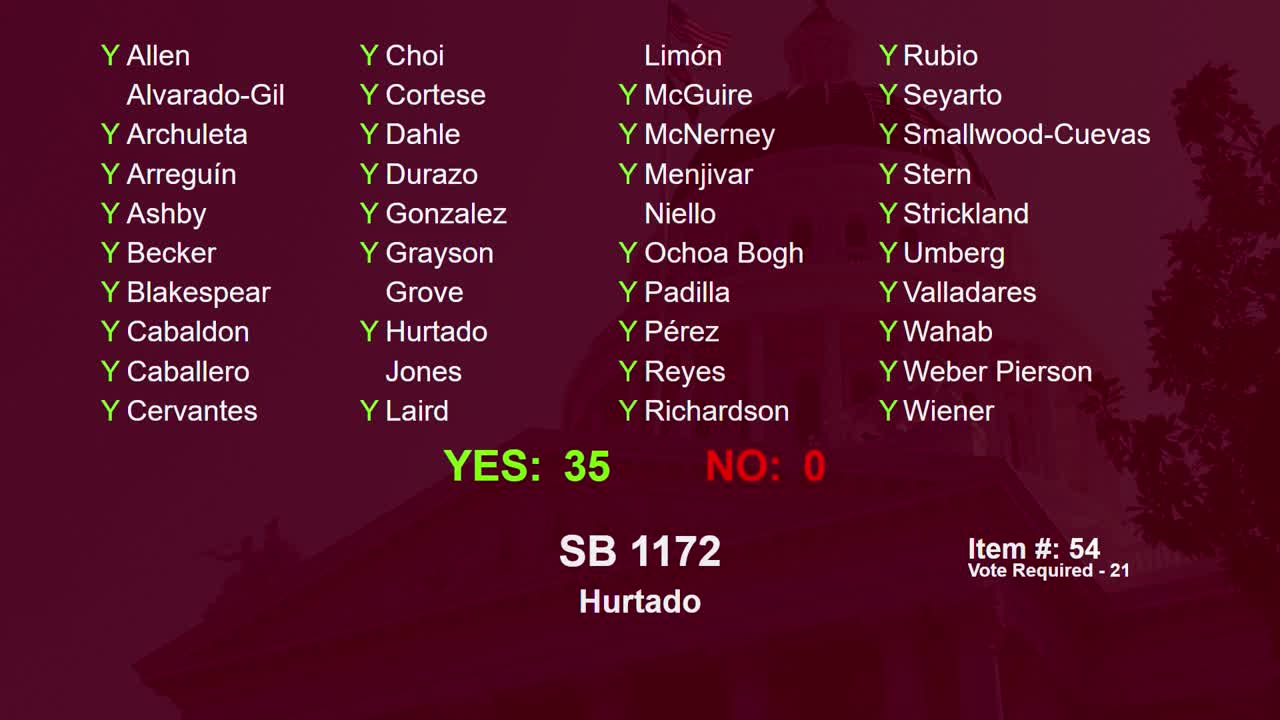 3MIN
Senate Floor
 2MIN
Senate Standing Committee on Appropriations
 10MIN
Senate Standing Committee on Judiciary
 30MIN
Senate Standing Committee on Housing
Bill Author

Bill Co-Author(s):