SB 1246: Autonomous vehicles.
- Session Year: 2025-2026
- House: Senate
- Latest Version Date: 2026-09-30
Current Status:
Passed
(2026-09-30: Chaptered by Secretary of State. Chapter 1021, Statutes of 2026.)
Introduced
In Committee
Awaiting First Chamber Vote
Passed First Chamber
In Committee
Awaiting Second Chamber Vote
Passed Second Chamber
Enacted
(1)Existing law authorizes the operation of an autonomous vehicle on public roads for testing purposes by a driver who possesses the proper class of license for the type of vehicle operated if specified requirements are satisfied. Existing law prohibits the operation of an autonomous vehicle on public roads until the manufacturer submits an application to the Department of Motor Vehicles (department), as specified, and that application is approved. Existing law requires the department to adopt regulations setting forth requirements for the submission and approval of an application, including, among other things, any testing, equipment, and performance standards the department concludes are necessary to ensure the safe operation of autonomous vehicles on public roads, as specified.
Existing law requires manufacturers of autonomous vehicles that operate without a human operator physically present in the vehicle, except as provided, to comply with certain requirements, including, among other things, to maintain a dedicated emergency response telephone line that is available for emergency response officials and to equip each autonomous vehicle with a 2-way voice communication device that enables emergency response officials who are near the vehicle to communicate effectively with a remote human operator, as specified. Under existing law, an emergency response official includes, but is not limited to, emergency dispatchers, peace officers, as specified, and first responders.
This bill would require manufacturers of autonomous vehicles to maintain communications capacity sufficient to support the maximum number of concurrent remote assistance or teleoperations sessions, as specified. The bill would require remote drivers to be located within the United States and hold a drivers license that is valid for operation in California, is of the appropriate class, and includes any required endorsements. The bill would require an autonomous vehicle manufacturer to ensure, through its staffing and assignments, that local incident technicians are immediately dispatched upon notification, electronically or otherwise, of a crash or other incident or upon receiving a request from an emergency response official or 911 dispatch center. The bill would, in the event of a fleetwide emergency or system failure that may create a traffic hazard or impeded emergency response, require an autonomous vehicle manufacturer to immediately notify affected local jurisdictions, including emergency dispatch, of the location and status of their fleet and deploy local incident technicians, where appropriate, whenever affected vehicles cannot be remotely recovered. The bill would require the department, on or before July 1, 2028, to adopt guidelines establishing reasonable response times for local incident technicians to be present at the scene upon the request of an emergency response official or 911 dispatch center. The bill would expand the definition of emergency response official for these purposes to also include traffic control, traffic enforcement, and parking enforcement personnel from a public agency in an applicable jurisdiction.
The bill would require autonomous vehicle manufacturers, for an autonomous vehicle that operates as a commercial vehicle and that is not equipped with manual controls for completing the dynamic driving task, to ensure that remote assistants or remote drivers have the ability to place the autonomous vehicle in neutral to allow an emergency response official to move the vehicle, cause the autonomous vehicle to move as directed by an emergency response official, or turn off the vehicle and have it remain stationary until otherwise directed by an emergency response official.
The bill would require autonomous vehicle manufacturers to maintain data on response times of local incident technicians and responses to fleetwide emergencies or system failures, emergency events, immobilizations, obstructions, crashes, and requests from emergency response officials. The bill would require autonomous vehicle manufacturers to provide this data to the department quarterly and would require the department to publish summary statistics on its internet website, as specified. The bill would authorize the department to share records with the Public Utilities Commission to support regulatory oversight of autonomous vehicle passenger service operations.
The bill would specify that a violation of the above provisions is not a crime. The bill would authorize a city attorney or county counsel to bring a civil action on behalf of a city, county, or city and county to enforce specified violations of the above provisions. The bill would authorize a court to impose specified civil penalties payable to the jurisdiction bringing the action, as specified.
(2)Existing law establishes the Commission on Peace Officer Standards and Training (POST) within the Department of Justice and requires the commission to develop guidelines and implement courses of instruction regarding specified topics, including, among others, racial profiling, handling domestic violence, and human trafficking.
This bill would require POST to develop uniform guidelines and requirements for, and to provide approval of, the training and written guidance required to be provided by autonomous vehicle manufacturers. The bill would authorize POST to impose fees sufficient to cover the reasonable regulatory costs associated with administering these provisions.
The bill would require POST to implement a course or courses of instruction for voluntary training of law enforcement officers, as defined, on autonomous vehicles that operate as commercial vehicles as it relates to public safety and to develop related uniform minimum guidelines for voluntary use by California law enforcement agencies, as specified. The bill would require the course or courses, learning and performance objectives, training standards, and guidelines to be developed in consultation with appropriate groups and individuals that have an interest and expertise in the field of the operation of autonomous vehicles, as specified.
(3)The bill would make its provisions operative July 1, 2028.
(1)Existing law authorizes the operation of an autonomous vehicle on public roads for testing purposes by a driver who possesses the proper class of license for the type of vehicle operated if specified requirements are satisfied. Existing law prohibits the operation of an autonomous vehicle on public roads until the manufacturer submits an application to the Department of Motor Vehicles, Vehicles (department), as specified, and that application is approved. Existing law requires the department to adopt regulations setting forth requirements for the submission and approval of an application, including, among other things, any testing, equipment, and performance standards the department concludes are necessary to ensure the safe operation of autonomous vehicles on public roads, as specified.
Existing law, commencing July 1, 2026, law requires manufacturers of autonomous vehicles that operate without a human operator physically present in the vehicle, except as provided, to comply with certain requirements, including, among other things, to maintain a dedicated emergency response telephone line that is available for emergency response officials, as defined, officials and to equip each autonomous vehicle with a 2-way voice communication device that enables emergency response officials that who are near the vehicle to communicate effectively with a remote human operator, as specified. Under existing law, an emergency response official includes, but is not limited to, emergency dispatchers, peace officers, as specified, and first responders.
This bill would require manufacturers of autonomous vehicles to maintain communications capacity sufficient to support the maximum number of concurrent remote assistance or teleoperations sessions, as specified. The bill would require remote drivers or local incident technicians, as defined, to be located within the United States and hold a valid drivers license of a state or territory of the United States of drivers license that is valid for operation in California, is of the appropriate class with any endorsements required for a human driver to lawfully operate the same vehicle in this state. class, and includes any required endorsements. The bill would require an autonomous vehicle manufacturer to ensure, through its staffing and assignments, that local incident technicians are immediately dispatched upon notification, electronically or otherwise, of an accident involving damage to persons or property, a crash or other incident or upon receiving a request from an emergency response official or 911 dispatch center. The bill would, in the event of a fleetwide emergency or system failure, failure that may create a traffic hazard or impeded emergency response, require an autonomous vehicle manufacturer to immediately notify affected local jurisdictions, including emergency dispatch, of the location and status of their fleet and deploy local incident technicians, where appropriate, whenever affected vehicles cannot be remotely recovered and create a traffic hazard or impede emergency response. recovered. The bill would also require the Department of Motor Vehicles require the department, on or before July 1, 2028, to adopt guidelines establishing reasonable response times for local incident technicians to be present at the scene upon the request of an emergency response official or 911 dispatch center. The bill would expand the definition of emergency response official for these purposes to also include traffic control, traffic enforcement, and parking enforcement personnel from a public agency in an applicable jurisdiction.
The bill would require any commercial autonomous vehicle operated without a human driver on a highway in this state that is equipped with controls that allow someone physically present to drive the vehicle to be equipped with a manual override system in the vehicle that allows local incident technicians, emergency response officials, tow operators, and trained personnel to readily and safely disable the vehicle, place the vehicle in neutral gear to relocate it during an emergency, and turn off the vehicle. For commercial autonomous vehicles that are autonomous vehicle manufacturers, for an autonomous vehicle that operates as a commercial vehicle and that is not equipped with manual controls for completing the dynamic driving task, the bill would require autonomous vehicle manufacturers to ensure that remote assistants or remote drivers have the ability to place the autonomous vehicle in neutral to allow an emergency response official to move the vehicle, or to cause the autonomous vehicle to move as directed by an emergency response official, or to turn off the vehicle and have it remain stationary until otherwise directed by an emergency response official.
The bill would also require the Commission on Peace Officer Standards and Training (POST) to develop uniform guidelines and requirements for, and to provide approval of, the training and written guidance required to be provided by autonomous vehicle manufacturers. The bill would authorize POST to impose fees sufficient to cover the reasonable regulatory costs associated with administering these provisions.The bill would require autonomous vehicle manufacturers to maintain data on response times of local incident technicians and responses to fleetwide emergencies or system failures, emergency events, immobilizations, obstructions, accidents involving damage to persons or property, crashes, and requests from emergency response officials. The bill would require autonomous vehicle manufacturers to provide this data to the Department of Motor Vehicles and the Public Utilities Commission upon request. department quarterly and would require the department to publish summary statistics on its internet website, as specified. The bill would authorize the department to share records with the Public Utilities Commission to support regulatory oversight of autonomous vehicle passenger service operations.
The bill would specify that a violation of the above provisions is not a crime. The bill would authorize a city attorney or county counsel to bring a civil action on behalf of a city, county, or city and county to enforce specified violations of the above provisions and for violations of an autonomous vehicle manufacturers permit or any regulation authorizing the autonomous vehicle manufacturers operation. provisions. The bill would authorize a court to impose specified civil penalties payable to the jurisdiction bringing the action, as specified.
(2)Existing law establishes the Commission on Peace Officer Standards and Training in (POST) within the Department of Justice and requires the commission to develop guidelines and implement courses of instruction regarding specified topics, including, among others, racial profiling, handling domestic violence, and human trafficking.
This bill would require POST to develop uniform guidelines and requirements for, and to provide approval of, the training and written guidance required to be provided by autonomous vehicle manufacturers. The bill would authorize POST to impose fees sufficient to cover the reasonable regulatory costs associated with administering these provisions.
The bill would require the commission POST to implement a course or courses of instruction for voluntary training of law enforcement officers, as defined, on commercial autonomous vehicles that operate as commercial vehicles as it relates to public safety, safety and to develop related uniform minimum guidelines for voluntary use by California law enforcement agencies, as specified. The bill would require the course or courses, learning and performance objectives, training standards, and guidelines to be developed in consultation with appropriate groups and individuals that have an interest and expertise in the field of the operation of autonomous vehicles, as specified.
(3)The bill would make its provisions operative July 1, 2028.
(1)Existing law authorizes the operation of an autonomous vehicle on public roads for testing purposes by a driver who possesses the proper class of license for the type of vehicle operated if specified requirements are satisfied. Existing law prohibits the operation of an autonomous vehicle on public roads until the manufacturer submits an application to the Department of Motor Vehicles, as specified, and that application is approved. Existing law requires the department to adopt regulations setting forth requirements for the submission and approval of an application, including, among other things, any testing, equipment, and performance standards the department concludes are necessary to ensure the safe operation of autonomous vehicles on public roads, as specified.
Existing law, commencing July 1, 2026, requires manufacturers of autonomous vehicles that operate without a human operator physically present in the vehicle, except as provided, to comply with certain requirements, including, among other things, to maintain a dedicated emergency response telephone line that is available for emergency response officials, as defined, and to equip each autonomous vehicle with a 2-way voice communication device that enables emergency response officials that are near the vehicle to communicate effectively with a remote human operator, as specified.
This bill would require remote assistants, remote drivers, drivers or local incident technicians, as defined, to be located within the United States and hold a valid California drivers license of a state or territory of the United States of the appropriate class with any endorsements required for a human driver to lawfully operate the same vehicle in this state. For autonomous passenger service vehicles, the bill would require the ratio of remote assistants or remote drivers to autonomous passenger service vehicles be 1 to 5 or higher at all times. The bill would require an autonomous vehicle manufacturer to ensure, through its staffing and assignments, that remote drivers or remote assistants are able to immediately respond to all calls and incidents. The bill would require an autonomous vehicle manufacturer to ensure, through its staffing and assignments, that local incident technicians are immediately dispatched upon notification, electronically or otherwise, of an accident involving damage to persons or property, or upon receiving a request from an emergency response official or 911 dispatch center. The bill would, in the event of a fleetwide emergency or system failure, require an autonomous vehicle manufacturer to immediately notify affected local jurisdictions, including emergency dispatch, of the location and status of their fleet and deploy local incident technicians, where appropriate, whenever affected vehicles cannot be remotely recovered and create a traffic hazard or impede emergency response. The bill would also require the Department of Motor Vehicles, by no later than January 1, 2028, Vehicles to adopt regulations guidelines establishing maximum reasonable response times for local incident technicians to be present at the scene upon notification or request. the request of an emergency response official or 911 dispatch center.
The bill would require an autonomous vehicle manufacturer to adopt and maintain written emergency response and immobilization procedures to ensure prompt responses to emergencies and accidents, as specified. The bill would require any commercial autonomous vehicle obstructing a travel lane, crosswalk, intersection, transit lane, bicycle lane, freight corridor, emergency access route, space or ramp designated for disabled persons when not carrying a disabled passenger, or fire hydrant to be relocated or removed as soon as possible, but in no case later than 5 minutes after the obstruction is detected if the autonomous vehicle is driveable, or no later than 30 minutes after the obstruction is detected if field personnel or towing is required, except as specified. The bill would prohibit a commercial autonomous vehicle from interfering with emergency events, emergency operations, or law enforcement operations.The bill would require any commercial autonomous vehicle operated without a human driver on a highway in this state that is equipped with controls that allow someone physically present to drive the vehicle to be equipped with a manual override system in the vehicle that allows local incident technicians, emergency response officials, tow operators, and trained personnel to readily and safely disable the vehicle, place the vehicle in neutral gear to relocate it during an emergency, and turn off the vehicle. The bill would require an autonomous vehicle manufacturer to provide manual override training and written guidance to local incident responders, emergency response officials, and towing providers regarding the manual override system, including safe disabling, relocation, and communication procedures, as specified. For commercial autonomous vehicles that are not equipped with manual controls for completing the dynamic driving task, the bill would require autonomous vehicle manufacturers to ensure that remote assistants or remote drivers have the ability to place the autonomous vehicle in neutral to allow an emergency response official to move the vehicle, or to cause the autonomous vehicle to move as directed by an emergency response official, or to turn off the vehicle and have it remain stationary until otherwise directed by an emergency response official.
The bill would require the Department of the California Highway Patrol (CHP) to approve the manual override systems described above. The bill would also require the Commission on Peace Officer Standards and Training (POST) to develop uniform guidelines and requirements for, and to provide approval of, the training and written guidance required to be provided by autonomous vehicle manufacturers pursuant to the above-described provisions. manufacturers. The bill would authorize the CHP and POST to impose fees sufficient to cover the reasonable regulatory costs associated with administering these provisions.
The bill would require autonomous vehicle manufacturers to maintain specified data, including, among other things, information regarding assignments and staffing for remote assistants, remote drivers, and local incident technicians and response times and responses to emergency events, immobilizations, obstructions, accidents involving damage to persons or property, and requests from emergency response officials. data on response times and responses to emergency events, immobilizations, obstructions, accidents involving damage to persons or property, and requests from emergency response officials. The bill would require autonomous vehicle manufacturers to provide this data to the Department of Motor Vehicles and the Public Utilities Commission upon request. The bill would require autonomous vehicle manufacturers to provide summary statistics showing the number of incidents in which manual control of commercial autonomous vehicles was necessary or control was exercised by remote assistants, remote drivers, or local incident technicians on a monthly basis to the department and commission, as specified. The bill would require the department and commission to post the summary statistics on their respective internet websites.
The bill would specify that a violation of the above provisions are is not crimes and would instead make violations of these provisions subject to specified civil penalties. a crime. The bill would authorize a city attorney or county counsel to bring a civil action on behalf of a city, county, or city and county to enforce specified violations of the above provisions and for violations of an autonomous vehicle manufacturers permit or any regulation authorizing the autonomous vehicle manufacturers operation. The bill would authorize a court to impose specified civil penalties payable to the jurisdiction bringing the action, as specified.
(2)Existing law establishes the Commission on Peace Officer Standards and Training in the Department of Justice and requires the commission to develop guidelines and implement courses of instruction regarding specified topics, including, among others, racial profiling, handling domestic violence, and human trafficking.
The bill would require the commission to implement a course or courses of instruction for voluntary training of law enforcement officers, as defined, on commercial autonomous vehicles as it relates to public safety, and to develop related uniform minimum guidelines for voluntary use by California law enforcement agencies, as specified. The bill would require the course or courses, learning and performance objectives, training standards, and guidelines to be developed in consultation with appropriate groups and individuals that have an interest and expertise in the field of the operation of autonomous vehicles, as specified.
(1)Existing law authorizes the operation of an autonomous vehicle on public roads for testing purposes by a driver who possesses the proper class of license for the type of vehicle operated if specified requirements are satisfied. Existing law prohibits the operation of an autonomous vehicle on public roads until the manufacturer submits an application to the Department of Motor Vehicles, as specified, and that application is approved. Existing law requires the department to adopt regulations setting forth requirements for the submission and approval of an application, including, among other things, any testing, equipment, and performance standards the department concludes are necessary to ensure the safe operation of autonomous vehicles on public roads, as specified.
Existing law, commencing July 1, 2026, requires manufacturers of autonomous vehicles that operate without a human operator physically present in the vehicle, except as provided, to comply with certain requirements, including, among other things, to maintain a dedicated emergency response telephone line that is available for emergency response officials, as defined, and to equip each autonomous vehicle with a 2-way voice communication device that enables emergency response officials that are near the vehicle to communicate effectively with a remote human operator, as specified.
This bill would require remote assistants, remote drivers, or local incident technicians, as defined, who monitor, direct, provide input to, advise, supervise, or control commercial autonomous vehicles on a public road in this state, or that provides onsite response to incidents on behalf of an autonomous vehicle operator, to be located within the United States and hold a valid California drivers license of the appropriate class with any endorsements required for a human driver to lawfully operate the same vehicle in this state. For autonomous passenger service vehicles, the bill would require the ratio of remote assistants or remote drivers to autonomous passenger service vehicles be 1 to 5 or higher at all times. The bill would require an autonomous vehicle operator manufacturer to ensure, through its staffing and assignments, that remote drivers or remote assistants are able to immediately respond to all calls and incidents. The bill would require an autonomous vehicle operator manufacturer to ensure, through its staffing and assignments, that local incident technicians are immediately dispatched upon notification, electronically or otherwise, of an accident involving damage to persons or property, or upon receiving a request from a first responder an emergency response official or 911 dispatch center. The bill would also require that local incident technicians be present at the scene of an incident within 20 minutes of receiving a notification or request no less than 90% of the time. the Department of Motor Vehicles, by no later than January 1, 2028, to adopt regulations establishing maximum response times for local incident technicians to be present at the scene upon notification or request.
The bill would require an autonomous vehicle operator manufacturer to adopt and maintain written emergency response and immobilization procedures to ensure prompt responses to emergencies and accidents, as specified. The bill would require any commercial autonomous vehicle obstructing a travel lane, crosswalk, intersection, transit lane, bicycle lane, freight corridor, emergency access route, space or ramp designated for disabled persons when not carrying a disabled passenger, or fire hydrant to be relocated or removed as soon as possible, but in no case later than 5 minutes after the obstruction is detected if the autonomous vehicle is driveable, or no later than 30 minutes after the obstruction is detected if field personnel or towing is required, except as specified. The bill would prohibit a commercial autonomous vehicle from interfering with emergency events, emergency operations, or law enforcement operations.
The bill would require any commercial autonomous vehicle operated without a human driver on a highway in this state to be equipped with a manual override system in the vehicle that allows local incident technicians, first responders, emergency response officials, tow operators, and trained personnel to readily access an emergency steering wheel and manually steer, brake, and relocate the vehicle during an emergency, as specified. and safely disable the vehicle, place the vehicle in neutral gear to relocate it during an emergency, and turn off the vehicle. The bill would require an autonomous vehicle operator manufacturer to provide manual override training and written guidance to local incident responders, first responders, emergency response officials, and towing providers regarding the manual override system, including safe disabling, relocation, and communication procedures, as specified.
The bill would require the Department of the California Highway Patrol (CHP) to approve the manual override systems described above. The bill would also require the CHP the Commission on Peace Officer Standards and Training (POST) to develop uniform guidelines and requirements for, and to provide approval of, the training and written guidance required to be provided by autonomous vehicle operators manufacturers pursuant to the above-described provisions. The bill would authorize the CHP and POST to impose fees sufficient to cover the reasonable regulatory costs associated with administering these provisions.
The bill would require autonomous vehicle operators manufacturers to maintain specified data, including, among other things, information regarding assignments and staffing for remote assistants, remote drivers, and local incident technicians and response times and responses to emergency events, immobilizations, obstructions, accidents involving damage to persons or property, and requests from first responders. emergency response officials. The bill would require autonomous vehicle operators manufacturers to provide this data to the Department of Motor Vehicles and the Public Utilities Commission upon request. The bill would require autonomous vehicle operators manufacturers to provide summary statistics showing the number of incidents in which manual control of commercial autonomous vehicles was necessary or control was exercised by remote assistants, remote drivers, or local incident technicians on a monthly basis to the department and commission, as specified. The bill would require the department and commission to post the summary statistics on their respective internet websites.
The bill would specify that a violation of the above provisions are not crimes and would instead make violations of these provisions subject to specified civil penalties and administrative actions. penalties.
(2)Existing law establishes the Commission on Peace Officer Standards and Training in the Department of Justice and requires the commission to develop guidelines and implement courses of instruction regarding specified topics, including, among others, racial profiling, handling domestic violence, and human trafficking.
The bill would require the commission to implement a course or courses of instruction for voluntary training of law enforcement officers, as defined, on commercial autonomous vehicles as it relates to public safety, and to develop related uniform minimum guidelines for voluntary use by California law enforcement agencies, as specified. The bill would require the course or courses, learning and performance objectives, training standards, and guidelines to be developed in consultation with appropriate groups and individuals that have an interest and expertise in the field of the operation of autonomous vehicles, as specified.
Existing law authorizes the operation of an autonomous vehicle on public roads for testing purposes by a driver who possesses the proper class of license for the type of vehicle operated if specified requirements are satisfied. Existing law prohibits the operation of an autonomous vehicle on public roads until the manufacturer submits an application to the Department of Motor Vehicles, as specified, and that application is approved. Existing law requires the department to adopt regulations setting forth requirements for the submission and approval of an application, including, among other things, any testing, equipment, and performance standards the department concludes are necessary to ensure the safe operation of autonomous vehicles on public roads, as specified.
Existing law, commencing July 1, 2026, requires manufacturers of autonomous vehicles that operate without a human operator physically present in the vehicle, except as provided, to comply with certain requirements, including, among other things, to maintain a dedicated emergency response telephone line that is available for emergency response officials, as defined, and to equip each autonomous vehicle with a 2-way voice communication device that enables emergency response officials that are near the vehicle to communicate effectively with a remote human operator, as specified.
This bill would require remote assistants, remote drivers, or local incident technicians, as defined, who monitor, direct, provide input to, advise, supervise, or control commercial autonomous vehicles on a public road in this state, or that provides onsite response to incidents on behalf of an autonomous vehicle operator, be located within the United States and hold a valid California drivers license of the appropriate class with any endorsements required for a human driver to lawfully operate the same vehicle in this state. For autonomous passenger service vehicles, the bill would require the ratio of remote assistants or remote drivers to autonomous passenger service vehicles be 1 to 3 5 or higher at all times. The bill would require an autonomous vehicle operator to ensure ensure, through its staffing and assignments assignments, that remote drivers or remote assistants are able to immediately respond to all calls and incidents and that incidents. The bill would require an autonomous vehicle operator to ensure, through its staffing and assignments, that local incident technicians are able to respond and be present on the scene within 10 minutes of an accident or receiving a request from a first responder, as specified. immediately dispatched upon notification, electronically or otherwise, of an accident involving damage to persons or property, or upon receiving a request from a first responder or 911 dispatch center. The bill would also require that local incident technicians be present at the scene of an incident within 20 minutes of receiving a notification or request no less than 90% of the time.
The bill would require an autonomous vehicle operator to adopt and maintain written emergency response and immobilization procedures to ensure prompt responses to emergencies and accidents, as specified. The bill would require any commercial autonomous vehicle obstructing a travel lane, crosswalk, intersection, transit lane, bicycle lane, freight corridor, emergency access route, space or ramp designated for disabled persons when not carrying a disabled passenger, or fire hydrant to be relocated or removed as soon as possible, but in no case later than 5 minutes after the obstruction is detected if the autonomous vehicle is driveable, or no later than 30 minutes after the obstruction is detected if field personnel or towing is required, except as specified. The bill would prohibit a commercial autonomous vehicle from interfering with emergency events, emergency operations, or law enforcement operations.
The bill would require any commercial autonomous vehicle operated without a human driver on a highway in this state to be equipped with a manual override system in the vehicle that allows local incident technicians, first responders, tow operators, and trained personnel to readily access an emergency steering wheel and manually steer, brake, and relocate the vehicle during an emergency, as specified. The bill would require an autonomous vehicle operator to provide manual override training and written guidance to local incident responders, first responders, and towing providers regarding the manual override system, including safe disabling, relocation, and communication procedures, as specified.
The bill would require Office the Department of the California Highway Patrol (CHP) to establish a registration process for entities that wish to contract with autonomous vehicle operators to provide local incident technician services, as specified. The bill would require CHP, in conjunction with the Office of the State Fire Marshal, (CHP) to approve the manual override systems described above. The bill would also require the CHP to develop uniform guidelines and requirements for for, and to provide approval of, the training and written guidance described above and would require CHP to approve all manual override systems, training, and written guidance developed by required to be provided by autonomous vehicle operators pursuant to the above-described provisions. The bill would authorize the CHP to impose fees sufficient to cover the cost reasonable regulatory costs associated with administering these provisions.
The bill would require autonomous vehicle operators to maintain specified data, including, among other things, information regarding assignments and staffing for remote assistants, remote drivers, and local incident technicians and response times and responses to emergency events, immobilizations, obstructions, accidents involving damage to persons or property, and requests from first responders. The bill would require autonomous vehicle operators to provide this data to the Department of Motor Vehicles and the Public Utilities Commission upon request. The bill would require autonomous vehicle operators to provide summary statistics showing the number of incidents in which manual control of commercial autonomous vehicles was necessary or control was exercised by remote assistants, remote drivers, or local incident technicians on a monthly basis to the department and commission, as specified. The bill would require the department and commission to post the summary statistics on their respective internet websites.
The bill would specify that a violation of the above provisions are not crimes and would instead make violations of these provisions subject to specified civil penalties and administrative actions.
Existing law authorizes the operation of an autonomous vehicle on public roads for testing purposes by a driver who possesses the proper class of license for the type of vehicle operated if specified requirements are satisfied. Existing law prohibits the operation of an autonomous vehicle on public roads until the manufacturer submits an application to the Department of Motor Vehicles, as specified, and that application is approved. Existing law requires the department to adopt regulations setting forth requirements for the submission and approval of an application, including, among other things, any testing, equipment, and performance standards the department concludes are necessary to ensure the safe operation of autonomous vehicles on public roads, as specified.
Existing law, commencing July 1, 2026, requires manufacturers of autonomous vehicles that operate without a human operator physically present in the vehicle, except as provided, to comply with certain requirements, including, among other things, to maintain a dedicated emergency response telephone line that is available for emergency response officials, as defined, and to equip each autonomous vehicle with a 2-way voice communication device that enables emergency response officials that are near the vehicle to communicate effectively with a remote human operator, as specified.
This bill would require remote assistants, remote drivers, or local incident technicians, as defined, who monitor, direct, provide input to, advise, supervise, or control commercial autonomous vehicles on a public road in this state, or that provides onsite response to incidents on behalf of an autonomous vehicle operator, be located within the United States and hold a valid California drivers license of the appropriate class with any endorsements required for a human driver to lawfully operate the same vehicle in this state. For autonomous passenger service vehicles, the bill would require the ratio of remote assistants or remote drivers to autonomous passenger service vehicles be 1 to 3 or higher at all times. The bill would require an autonomous vehicle operator to ensure through its staffing and assignments that remote drivers or remote assistants are able to immediately respond to all calls and incidents and that local incident technicians are able to respond and be present on the scene within 10 minutes of an accident or receiving a request from a first responder, as specified.
The bill would require an autonomous vehicle operator to adopt and maintain written emergency response and immobilization procedures to ensure prompt responses to emergencies and accidents, as specified. The bill would require any commercial autonomous vehicle obstructing a travel lane, crosswalk, intersection, transit lane, bicycle lane, freight corridor, emergency access route, space or ramp designated for disabled persons when not carrying a disabled passenger, or fire hydrant to be relocated or removed as soon as possible, but in no case later than 5 minutes after the obstruction is detected if the autonomous vehicle is driveable, or no later than 30 minutes after the obstruction is detected if field personnel or towing is required, except as specified. The bill would prohibit a commercial autonomous vehicle from interfering with emergency events, emergency operations, or law enforcement operations.
The bill would require any commercial autonomous vehicle operated without a human driver on a highway in this state to be equipped with a manual override system in the vehicle that allows local incident technicians, first responders, tow operators, and trained personnel to readily access an emergency steering wheel and manually steer, brake, and relocate the vehicle during an emergency, as specified. The bill would require an autonomous vehicle operator to provide training and written guidance to local incident responders, first responders, and towing providers regarding the manual override system, including safe disabling, relocation, and communication procedures, as specified.
The bill would require Office of the California Highway Patrol (CHP) to establish a registration process for entities that wish to contract with autonomous vehicle operators to provide local incident technician services, as specified. The bill would require CHP, in conjunction with the Office of the State Fire Marshal, to develop uniform guidelines and requirements for the training and written guidance described above and would require CHP to approve all manual override systems, training, and written guidance developed by autonomous vehicle operators pursuant to the above-described provisions. The bill would authorize CHP to impose fees sufficient to cover the cost associated with administering these provisions.
The bill would require autonomous vehicle operators to maintain specified data, including, among other things, information regarding assignments and staffing for remote assistants, remote drivers, and local incident technicians and response times and responses to emergency events, immobilizations, obstructions, accidents involving damage to persons or property, and requests from first responders. The bill would require autonomous vehicle operators to provide this data to the Department of Motor Vehicles and the Public Utilities Commission upon request. The bill would require autonomous vehicle operators to provide summary statistics showing the number of incidents in which manual control of commercial autonomous vehicles was necessary or control was exercised by remote assistants, remote drivers, or local incident technicians on a monthly basis to the department and commission, as specified. The bill would require the department and commission to post the summary statistics on their respective internet websites.
The bill would specify that a violation of the above provisions are not crimes and would instead make violations of these provisions subject to specified civil penalties and administrative actions.
Existing law authorizes the operation of an autonomous vehicle on public roads for testing purposes by a driver who possesses the proper class of license for the type of vehicle operated if specified requirements are satisfied. Existing law prohibits the operation of an autonomous vehicle on public roads until the manufacturer submits an application to the Department of Motor Vehicles, as specified, and that application is approved. Existing law requires that the application contain, at a minimum, specified certifications, including a certification by the manufacturer that the autonomous technology satisfies specified requirements, including that the autonomous vehicle has a separate mechanism to capture and store the autonomous technology sensor data for at least 30 seconds before a collision occurs between the autonomous vehicle and another vehicle, object, or person while operating in autonomous mode. Existing law requires the department to hold public hearings on the adoption of regulations applicable to the operation of an autonomous vehicle without the presence of a driver inside the vehicle.This bill would, instead, require the separate mechanism to capture and store autonomous technology sensor data for at least 45 seconds before and after, whenever feasible, a collision. This bill would allow the department to hold public hearings on the adoption of the above regulations both online and in person.Existing law authorizes the operation of an autonomous vehicle on public roads for testing purposes by a driver who possesses the proper class of license for the type of vehicle operated if specified requirements are satisfied. Existing law prohibits the operation of an autonomous vehicle on public roads until the manufacturer submits an application to the Department of Motor Vehicles, as specified, and that application is approved. Existing law requires that the application contain, at a minimum, specified certifications, including a certification by the manufacturer that the autonomous technology satisfies specified requirements, including that the autonomous vehicle has a separate mechanism to capture and store the autonomous technology sensor data for at least 30 seconds before a collision occurs between the autonomous vehicle and another vehicle, object, or person while operating in autonomous mode. Existing law requires the department to hold public hearings on the adoption of regulations applicable to the operation of an autonomous vehicle without the presence of a driver inside the vehicle.
This bill would, instead, require the separate mechanism to capture and store autonomous technology sensor data for at least 45 seconds before and after, whenever feasible, a collision. This bill would allow the department to hold public hearings on the adoption of the above regulations both online and in person.
The Legislature hereby finds and declares the following:
(a)The current experience with autonomous vehicles deployed in California raises legitimate questions about corporate permit noncompliance, vehicle immobilizations, operations that hinder first responder activity, collisions involving children and animals, the displacement of workers employed in the transportation industry, and the adequacy of safety data disclosure by companies with a direct financial interest in the expansion of autonomous vehicle operations.
(b)The coming years are likely to see a significant expansion of autonomous vehicle activity on the states highways and roads, and both the existing regulatory structure and the statewide concerns raised by the expansion of autonomous vehicle operations require immediate and sustained legislative attention to this issue. While the Department of Motor Vehicles and the Public Utilities Commission have specific regulatory mandates, neither agency is charged with comprehensively balancing the full range of public interests affected by the expansion of autonomous vehicle operations.
(c)The operation of autonomous vehicles depends not only on automated driving systems but also on humans who must supervise, authorize, respond, and intervene in autonomous vehicle operations when necessary, and currently those individuals may be located outside the State of California or outside the United States.
(d)The licensing and regulation of drivers, the safe operation of vehicles on public highways, and the control of traffic are matters of traditional state police power.
(e)Autonomous vehicles ability to respond to new and dynamic traffic situations, first responder and law enforcement directions, emergency operations, and events occurring both inside and outside of the vehicle directly affects the mobility of other vehicles and pedestrians, the flow of traffic, and the safety of the public.
(f)Immobilized autonomous vehicles blocking travel lanes or intersections present a direct threat to traffic safety, emergency response, and public mobility, including by delaying emergency medical services and fire and law enforcement response.
(g)Public safety requires that those responsible for monitoring and directing autonomous vehicles, including remote assistants, remote drivers, and local incident technicians, understand California traffic laws and must be immediately available to coordinate in real time with law enforcement, emergency responders, and traffic authorities. Public safety also requires that individuals remotely controlling or providing remote input to operating autonomous vehicles must be physically located within the United States to mitigate the risk of longer latency times for communications with autonomous vehicles.
(h)Direct communication between emergency response officials and autonomous vehicle manufacturers is necessary to ensure public safety, and autonomous vehicle manufacturers must maintain communication systems and protocols that allow emergency response officials to reach a qualified human in real time and receive an immediate, meaningful response.
(i)It is the intent of the Legislature in adopting this act to ensure that any expansion of the operation of autonomous vehicles for commercial purposes occurs under the supervision of this state and in a manner that prioritizes public safety, accountability, the protection of workers in the transportation industry, and emergency response readiness.
SEC. 2.Section 13519.18 is added to the Penal Code, to read:13519.18.(a)(1)The commission shall implement a course or courses of instruction for voluntary training of law enforcement officers on autonomous vehicles operating as commercial vehicles pursuant to Section 260 of the Vehicle Code as it relates to public safety and shall also develop related uniform minimum guidelines for voluntary use by California law enforcement agencies.
(b)The course or courses for law enforcement officers and the guidelines shall include all of the following:
(1)Existing state regulatory standards for an autonomous vehicle operating as a commercial vehicle during an emergency.
(2)Standardized protocols for law enforcement use of manual override systems in an emergency.
(3)Standardized protocols for law enforcement interaction with an autonomous vehicle operating as a commercial vehicle during an emergency.
(4)Processes for the issuance of a notice of autonomous vehicle noncompliance.
(c)Law enforcement agencies are encouraged to include periodic updates and training on autonomous vehicles in any advanced officer training program. If appropriate, the training presenters should include companies that operate autonomous vehicles as commercial vehicles. The commission shall assist in this training when possible.
(d)The course or courses of instruction, learning and performance objectives, training standards, and guidelines shall be developed in consultation with appropriate groups and individuals that have an interest and expertise in the field of the operation of autonomous vehicles. The groups and individuals shall include, but are not limited to, the Department of the California Highway Patrol, local law enforcement agencies, the Office of the State Fire Marshal, local dispatch agencies, traffic officials from public agencies, and autonomous vehicle experts.
(e)For purposes of this section, the following definitions apply:
(1)Emergency has the same meaning as that term is defined in paragraph (3) of subdivision (a) of Section 38751 of the Vehicle Code.
(2)Law enforcement officer means any officer of a local police department or sheriffs office, any peace officer of the Department of the California Highway Patrol, as defined by subdivision (a) of Section 830.2, and any officer of any other law enforcement agency with jurisdiction over autonomous vehicles that operate as commercial vehicles.
(f)This section shall become operative July 1, 2028.
SEC. 3.The heading of Chapter 1 (commencing with Section 38750) is added to Division 16.6 of the Vehicle Code, to read:1.General ProvisionsSEC. 4.Section 38751 of the Vehicle Code is amended to read:38751.(a)For purposes of this section, the following definitions apply:
(1)Emergency geofencing message means a message delivered using commonly available communication methods to identify a location using a street address, intersection, coordinates, or any other reasonable and customary way of identifying a location, that directs an autonomous vehicle to leave or avoid an area because of an emergency.
(2)Emergency response official includes, but is not limited to, emergency dispatchers, peace officers as defined in Chapter 4.5 (commencing with Section 830) of Title 3 of Part 2 of the Penal Code, and first responders.
(3)Emergency means a sudden, unexpected occurrence demanding immediate action to prevent or mitigate loss or damage to life, health, property, or essential public services.
(b)A manufacturer shall comply with all of the following requirements:
(1)(A)A manufacturer operating an autonomous vehicle under a testing permit or deployment permit issued by the department shall maintain a dedicated emergency response telephone line that is available for emergency response officials during all hours when an autonomous vehicle is on a public road. The telephone line shall be available at no cost to public agencies.
(B)The manufacturer shall continuously monitor the status of each autonomous vehicle on a public road and shall equip and staff the telephone line to ensure that calls are picked up within 30 seconds by a remote human operator who has situational awareness of all autonomous vehicles on public roads.
(C)The remote human operator shall have the ability to immobilize the autonomous vehicle, allow an emergency response official to move the autonomous vehicle, or cause the autonomous vehicle to move as directed by an emergency response official.
(2)(A)A manufacturer operating an autonomous vehicle under a testing permit or deployment permit issued by the department shall equip each autonomous vehicle with a two-way voice communication device that enables emergency response officials that are near the vehicle to communicate effectively with a remote human operator who has situational awareness about the autonomous vehicle. The manufacturer shall ensure that an emergency response official is able to reach a remote human operator within 30 seconds after making a request through the device.(B)The remote human operator shall have the ability to immobilize the autonomous vehicle, allow an emergency response official to move the autonomous vehicle, or cause the autonomous vehicle to move as directed by an emergency response official.
(3)Autonomous vehicles equipped with an override system in the vehicle that allows someone physically present to move the vehicle, pursuant to subparagraphs (A) and (D) of paragraph (1) of subdivision (c) of Section 38750 shall provide access to the override system to law enforcement and firefighters in case of emergency to allow law enforcement and firefighters to completely immobilize the vehicle or cause the vehicle to move as necessary to address the emergency. The manufacturer shall provide training for law enforcement and firefighters on the use of the override system. The training shall be reviewed on a regular basis by the manufacturer and updated as changes are needed.
(c)The department shall not renew, reinstate, or approve an expansion of the operational design domain of a permit unless the manufacturer certifies that it is in full compliance with the requirements under subdivision (b).
(d)(1)An emergency response official may issue an emergency geofencing message to a manufacturer.
(2)Within two minutes of receiving an emergency geofencing message, a manufacturer shall issue direction to its fleet to leave or avoid the area identified.
(3)Within 30 business days of receiving a notice that an emergency response official wishes to begin issuing emergency geofencing messages, a manufacturer shall provide the emergency response official with all information necessary for the emergency response official to begin issuing and for the manufacturer to receive and respond to emergency geofencing messages.
(4)An emergency geofencing message shall include the initial duration for the defined avoidance area based on a reasonable assessment of the emergency. Where necessary, an emergency response official may extend the duration for the avoidance area.
(e)This section shall only apply to manufacturers of autonomous vehicles that operate without a human operator physically present in the vehicle.(f)Paragraphs (2) and (3) of subdivision (b) and subdivision (c) shall not apply to a commercial motor vehicle with a gross vehicle weight rating or gross vehicle weight of at least 10,001 pounds, whichever is greater. This subdivision does not apply to a passenger transportation vehicle as defined in Section 464. The department may establish requirements by the adoption of regulations, determined in consultation with the Department of the California Highway Patrol, to ensure the safe interaction between autonomous commercial motor vehicles and emergency response officials.
(g)This section shall become inoperative on July 1, 2028, and, as of January 1, 2029, is repealed.
SEC. 5.Section 38751 is added to the Vehicle Code, to read:38751.(a)For purposes of this section, the following definitions apply:
(1)Emergency geofencing message means a message delivered using commonly available communication methods to identify a location using a street address, intersection, coordinates, or any other reasonable and customary way of identifying a location, that directs an autonomous vehicle to leave or avoid an area because of an emergency.
(2)Emergency response official includes, but is not limited to, emergency dispatchers, peace officers as defined in Chapter 4.5 (commencing with Section 830) of Title 3 of Part 2 of the Penal Code, and first responders.
(3)Emergency means a sudden, unexpected occurrence demanding immediate action to prevent or mitigate loss or damage to life, health, property, or essential public services.
(b)A manufacturer shall comply with all of the following requirements:
(1)(A)A manufacturer operating an autonomous vehicle under a testing permit or deployment permit issued by the department shall maintain a dedicated emergency response telephone line that is available for emergency response officials during all hours when an autonomous vehicle is on a public road. The telephone line shall be available at no cost to public agencies.
(B)The manufacturer shall continuously monitor the status of each autonomous vehicle on a public road and shall equip and staff the telephone line to ensure that calls are picked up within 30 seconds by a remote human operator who has situational awareness of all autonomous vehicles on public roads.
(C)The remote human operator shall have the ability to immobilize the autonomous vehicle, allow an emergency response official to move the autonomous vehicle, or cause the autonomous vehicle to move as directed by an emergency response official.
(D)A manufacturer shall maintain communications capacity, reserved or otherwise assured through contractual arrangements with one or more communications service providers, sufficient to support the maximum number of concurrent remote assistance or teleoperation sessions identified through the manufacturers operational design, hazard analysis, and capacity planning. The manufacturer shall ensure, through its staffing and assignments, that remote drivers or remote assistants are able to immediately respond to all calls or incidents for which their support is requested unless the autonomous vehicles cellular connectivity is compromised by broader failures in telecommunications infrastructure outside of the manufacturers direct control.
(2)(A)A manufacturer operating an autonomous vehicle under a testing permit or deployment permit issued by the department shall equip each autonomous vehicle with a two-way voice communication device that enables emergency response officials that are near the vehicle to communicate effectively with a remote human operator who has situational awareness about the autonomous vehicle. The manufacturer shall ensure that an emergency response official is able to reach a remote human operator within 30 seconds after making a request through the device.
(B)The remote human operator shall have the ability to immobilize the autonomous vehicle, allow an emergency response official to move the autonomous vehicle, or cause the autonomous vehicle to move as directed by an emergency response official.
(3)Autonomous vehicles equipped with an override system in the vehicle that allows someone physically present to move the vehicle, pursuant to subparagraphs (A) and (D) of paragraph (1) of subdivision (c) of Section 38750 shall provide access to the override system to law enforcement and firefighters in case of emergency to allow law enforcement and firefighters to completely immobilize the vehicle or cause the vehicle to move as necessary to address the emergency. The manufacturer shall provide training for law enforcement and firefighters on the use of the override system. The training shall be reviewed on a regular basis by the manufacturer and updated as changes are needed.
(c)The department shall not renew, reinstate, or approve an expansion of the operational design domain of a permit unless the manufacturer certifies that it is in full compliance with the requirements under subdivision (b).
(d)(1)An emergency response official may issue an emergency geofencing message to a manufacturer.
(2)Within two minutes of receiving an emergency geofencing message, a manufacturer shall issue direction to its fleet to leave or avoid the area identified.
(3)Within 30 business days of receiving a notice that an emergency response official wishes to begin issuing emergency geofencing messages, a manufacturer shall provide the emergency response official with all information necessary for the emergency response official to begin issuing and for the manufacturer to receive and respond to emergency geofencing messages.
(4)An emergency geofencing message shall include the initial duration for the defined avoidance area based on a reasonable assessment of the emergency. Where necessary, an emergency response official may extend the duration for the avoidance area.
(5)Upon receipt of an emergency geofencing message from an emergency response official, an autonomous vehicle manufacturer shall acknowledge receipt of the message to the requesting official within two minutes.
(e)This section shall only apply to manufacturers of autonomous vehicles that operate without a human operator physically present in the vehicle.
(f)Paragraphs (2) and (3) of subdivision (b) and subdivision (c) shall not apply to a commercial motor vehicle with a gross vehicle weight rating or gross vehicle weight of at least 10,001 pounds, whichever is greater. This subdivision does not apply to a passenger transportation vehicle as defined in Section 464. The department may establish requirements by the adoption of regulations, determined in consultation with the Department of the California Highway Patrol, to ensure the safe interaction between autonomous commercial motor vehicles and emergency response officials.
(g)This section shall become operative on July 1, 2028.
SEC. 6.Section 38754 is added to the Vehicle Code, to read:38754.(a)A remote driver shall be located within the United States and hold a drivers license that is valid for operation in California, is of the appropriate class, and includes any required endorsements.
(b)This section shall become operative on July 1, 2028.
SEC. 7.Chapter 3 (commencing with Section 38800) is added to Division 16.6 of the Vehicle Code, to read:3.Operation of Autonomous Vehicles38800.For purposes of this chapter, the following definitions apply:
(a)Emergency has the same meaning as that term is defined in paragraph (3) of subdivision (a) of Section 38751.
(b)(1)Emergency response official has the same meaning as that term is defined in paragraph (2) of subdivision (a) of Section 38751.
(2)For purposes of this chapter, emergency response official also includes traffic control, traffic enforcement, and parking enforcement personnel from a public agency in an applicable jurisdiction.
(c)First responder includes law enforcement, fire department, and emergency medical personnel.
(d)Fleetwide emergency system or system failure means an event or condition arising from shared software, communications, navigation, or a shared operational system that causes, or is likely to cause, a substantial number of a manufacturers autonomous vehicles operating within a local jurisdiction to become immobilized or unable to operate safely or perform their intended driving functions.
(e)Local incident technician means a natural person who responds onsite on behalf of an autonomous vehicle manufacturer to incidents involving an autonomous vehicle, including incidents that require vehicle retrieval, including, but not limited to, crashes, and requests for assistance from emergency response officials. Local incident technicians shall be employees of the autonomous vehicle manufacturer or an entity contracted with the autonomous vehicle manufacturer to provide local incident technician services that meets either of the following criteria:
(1)Employs 50 or more local incident technicians.
(2)Contracts with a tow truck operator to perform the local incident technician services if the towing, recovery, or storage provider has also entered into a contract, agreement, rotational tow program, or similar arrangement with the Department of the California Highway Patrol, a local law enforcement agency, the Department of Transportation, or a local transportation department or agency to provide towing or vehicle storage services.
(f)Remote assistant means a natural person who meets all of the following conditions:
(1)Is not physically located in the drivers seat of the vehicle.
(2)Is able to provide information or advice to an autonomous vehicle to facilitate trip continuation when the autonomous vehicle encounters a situation it cannot manage or is able to alert the automated driving system of the need to fall back to a minimal risk condition, but does not include remote driving.
(3)Is able to provide an autonomous vehicle with revised goals or tasks.
(g)Remote driver means a natural person who is not physically located in the drivers seat of the vehicle and performs real-time performance of part or all of the dynamic driving task fallback, including real-time braking, steering, acceleration, and transmission shifting.
38801.(a)(1)An autonomous vehicle manufacturer shall ensure, through its staffing and assignments, that local incident technicians are immediately dispatched in either of the following circumstances:
(A)Upon receiving notice, electronically or otherwise, of a crash or other incident involving an autonomous vehicle that results in the vehicle becoming immobilized, obstructing traffic or emergency access, creating a roadway hazard, or requiring onsite assistance for its safe and timely removal.
(B)Upon receiving a request from an emergency response official or 911 dispatch center.
(2)In the event of a fleetwide emergency or system failure that may create a traffic hazard or impeded emergency response, an autonomous vehicle manufacturer shall immediately notify affected local jurisdictions, including emergency dispatch, of the location and status of the portion of their impacted fleet and deploy local incident technicians, where appropriate, whenever affected vehicles cannot be remotely recovered.
(3)This paragraph does not relieve an autonomous vehicle manufacturer from its obligations under Section 38751.
(b)(1)If an emergency response official determines that a remote driver or remote assistant is unable to reasonably address a request from an emergency response official, the emergency response official may request that an autonomous vehicle manufacturer dispatch a local incident technician to an autonomous vehicle that operates as a commercial vehicle when necessary to address collisions, immobilizations, or obstructions, or to address any safety issue that requires the onsite presence of a local incident technician. Emergency response officials may communicate a request for a local incident technician utilizing an emergency response telephone line or two-way voice communication device as described in Section 38751. An autonomous vehicle manufacturer shall immediately dispatch a local incident technician pursuant to that request.
(2)The local incident technician shall have the authority to coordinate on behalf of the autonomous vehicle manufacturer with emergency response officials. The local incident technician shall have the authority and ability to manually relocate or tow the vehicle.
38802.(a)On or before July 1, 2028, the department shall adopt guidelines establishing reasonable response time standards for local incident technicians to be present at the scene of an incident after an emergency response official or 911 dispatch center requests a local incident technician pursuant to paragraph (1) of subdivision (a) of Section 38801.
(b)In developing the guidelines, the department shall consider factors, including, but not limited to, all of the following:
(1)The location and geographic area of operation, including whether the vehicle is operating in an urban, suburban, rural, or remote area.
(2)The type and severity of the incident, including whether the incident involves a collision, immobilization, obstruction, emergency response activity, evacuation, or risk to public safety.
(3)Roadway and traffic conditions, including whether the incident occurs on a freeway, at an intersection, in a high traffic corridor, or along an evacuation route or emergency response route.
(4)The size and concentration of the manufacturers autonomous vehicle fleet operating in the area, including that the manufacturer maintains sufficient local incident technician capacity to respond to multiple incidents occurring at the same time.
(5)Any other operational or public safety factors the department determines are necessary to establish reasonable and workable response time standards, including, but not limited to, first responder operational needs.
38803.(a)A manufacturer of an autonomous vehicle that operates as a commercial vehicle that is not equipped with manual controls for completing the dynamic driving task, such as a steering wheel, brake pedal, accelerator pedal, and a manual override system that allows an incident technician, emergency response official, tow operator, or trained personnel to readily disable the vehicle, shall ensure that remote assistants or remote drivers have the ability to place the autonomous vehicle in neutral to allow an emergency response official to move the autonomous vehicle, cause the autonomous vehicle to move as directed by an emergency response official, or turn off the vehicle and have it remain stationary until otherwise directed by an emergency response official.
(b)If an autonomous vehicle that operates as a commercial vehicle is unable to be relocated pursuant to subdivision (a), the manufacturer shall immediately dispatch either a local incident technician pursuant to subdivision (b) of Section 38801 or a tow operator as requested by an emergency response official to safely disable, relocate, and turn off the vehicle.
(c)Notwithstanding any other law, the department shall not permit the deployment of any autonomous vehicle that does not comply with this section.
38804.(a)The Commission on Peace Officer Standards and Training shall develop uniform guidelines and requirements for the manual override training and written guidance required to be provided by autonomous vehicle manufacturers. These guidelines and requirements shall be consistent with the course or courses of instruction and guidelines implemented by the commission for law enforcement officers pursuant to Section 13519.18 of the Penal Code, as applicable.
(b)The commission shall establish a process to review and certify any manual override training and written guidance developed by autonomous vehicle manufacturers.
(c)The commission may charge autonomous vehicle manufacturers a fee sufficient to cover the reasonable regulatory costs associated with administering this section.
38805.(a)An autonomous vehicle manufacturer shall maintain records on response times of local incident technicians and responses to fleetwide emergencies or system failures, emergency events, immobilizations, obstructions, crashes, and requests from emergency response officials.
(b)The records shall be provided to the department quarterly, in a manner acceptable to the department.
(c)The department may share records received pursuant to this section with the Public Utilities Commission, as requested, to support regulatory oversight of autonomous vehicle passenger service operations.
(d)The department shall publish summary statistics, broken down by manufacturer, quarterly on its internet website.
38806.(a)A violation of this chapter is not a crime.
(b)A city attorney or county counsel may bring a civil action in any court of competent jurisdiction for the violations described in paragraphs (1) and (2), inclusive, on behalf of a city, county, or city and county. The court may impose civil penalties payable to the jurisdiction bringing the action as follows:
(1)A civil penalty of up to five thousand dollars ($5,000) for each violation of Section 38801.
(2)A civil penalty of up to ten thousand dollars ($10,000) per autonomous vehicle operating as a commercial vehicle that causes an obstruction during, or that otherwise causes interference with, emergency events, emergency operations, or law enforcement operations for a period of more than 30 minutes from the moment an emergency response official requests a local incident technician.
(c)(1)In determining whether to impose a civil penalty pursuant to subdivision (b) and the amount of the penalty, the court shall consider all of the following:
(A)The nature, severity, duration, and consequences of the violation.
(B)Any interference with emergency response, traffic circulation, or public safety.
(C)Whether the violation was isolated or repeated.
(D)Any other relevant mitigating or aggravating circumstances.
(2)When making the determination described in paragraph (1), the court may consider circumstances beyond the manufacturers reasonable control that materially contributed to the violation.
(d)For purposes of this section, a jurisdiction may bring an action for violations that occur within the limits of the city, county, or city and county. A county may bring an action for violations that occur within the unincorporated areas of that county.
(e)This section does not prohibit a local jurisdiction from exercising its other enforcement authorities.
38807.This chapter shall become operative July 1, 2028.
SEC. 8.Any section of Senate Bill 1315 that adds a heading for Chapter 1 (commencing with Section 38750) to Division 16.6 of the Vehicle Code shall prevail over this act, whether Senate Bill 1315 is chaptered before or after this act, if Senate Bill 1315 is enacted by the Legislature during the 2026 calendar year and takes effect on or before January 1, 2027.
The Legislature hereby finds and declares the following:
(a)The current experience with autonomous vehicles deployed in California raises legitimate questions about corporate permit noncompliance, vehicle immobilizations, operations that hinder first responder activity, collisions involving children and animals, the displacement of workers employed in the transportation industry, and the adequacy of safety data disclosure by companies with a direct financial interest in the expansion of autonomous vehicle operations.
(b)The coming years are likely to see a significant expansion of autonomous vehicle activity on the states highways and roads, and both the existing regulatory structure and the statewide concerns raised by the expansion of autonomous vehicle operations require immediate and sustained legislative attention to this issue. While the Department of Motor Vehicles and the Public Utilities Commission have specific regulatory mandates, neither agency is charged with comprehensively balancing the full range of public interests affected by the expansion of autonomous vehicle operations.
(c)The operation of autonomous vehicles depends not only on automated driving systems but also on humans who must supervise, authorize, respond, and intervene in autonomous vehicle operations when necessary, and currently those individuals may be located outside the State of California or outside the United States.
(d)The licensing and regulation of drivers, the safe operation of vehicles on public highways, and the control of traffic are matters of traditional state police power.
(e)Autonomous vehicles ability to respond to new and dynamic traffic situations, first responder and law enforcement directions, emergency operations, and events occurring both inside and outside of the vehicle directly affects the mobility of other vehicles and pedestrians, the flow of traffic, and the safety of the public.
(f)Immobilized autonomous vehicles blocking travel lanes or intersections present a direct threat to traffic safety, emergency response, and public mobility, including by delaying emergency medical services and fire and law enforcement response.
(g)Public safety requires that those responsible for monitoring and directing autonomous vehicles, including remote assistants, remote drivers, and local incident technicians, understand California traffic laws and must be immediately available to coordinate in real time with law enforcement, emergency responders, and traffic authorities. Public safety also requires that individuals remotely controlling or providing remote input to operating autonomous vehicles must be physically located within the United States to mitigate the risk of longer latency times for communications with autonomous vehicles.
(h)Direct communication between emergency response officials and autonomous vehicle manufacturers is necessary to ensure public safety, and autonomous vehicle manufacturers must maintain communication systems and protocols that allow emergency response officials to reach a qualified human in real time and receive an immediate, meaningful response.
(i)It is the intent of the Legislature in adopting this act to ensure that any expansion of the operation of autonomous vehicles for commercial purposes occurs under the supervision of this state and in a manner that prioritizes public safety, accountability, the protection of workers in the transportation industry, and emergency response readiness.
SEC. 2.Section 13519.16 is added to the Penal Code, to read:13519.16.SEC. 2.Section 13519.18 is added to the Penal Code, to read:13519.18.(a)(1)The commission shall implement a course or courses of instruction for voluntary training of law enforcement officers on commercial autonomous vehicles operating as commercial vehicles pursuant to Section 260 of the Vehicle Code as it relates to public safety, safety and shall also develop related uniform minimum guidelines for voluntary use by California law enforcement agencies.
(b)The course or courses for law enforcement officers and the guidelines shall include all of the following:
(1)Legal Existing state regulatory standards for commercial autonomous vehicles an autonomous vehicle operating as a commercial vehicle during an emergency.
(2)Standardized protocols for taking control over law enforcement use of manual override systems in an emergency.
(3)Standardized protocols for commercial autonomous vehicles law enforcement interaction with an autonomous vehicle operating as a commercial vehicle during an emergency.
(4)Supervisory responsibilities for commercial autonomous vehicles during an emergency.(5)State required reporting for commercial autonomous vehicles and manual override systems during an emergency.(4)Processes for the issuance of a notice of autonomous vehicle noncompliance.
(c)Law enforcement agencies are encouraged to include periodic updates and training on commercial autonomous vehicles in any advanced officer training program. If appropriate, the training presenters should include companies that operate commercial autonomous vehicles as commercial vehicles. The commission shall assist in this training when possible.
(d)The course or courses of instruction, learning and performance objectives, training standards, and guidelines shall be developed in consultation with appropriate groups and individuals that have an interest and expertise in the field of the operation of autonomous vehicles. The groups and individuals shall include, but are not limited to, the Department of the California Highway Patrol, local law enforcement agencies, the Office of the State Fire Marshal, local dispatch agencies, traffic officials from public agencies, and autonomous vehicle experts.
(e)For purposes of this section, the following definitions apply:
(1)Emergency has the same meaning as that term is defined in paragraph (3) of subdivision (a) of Section 38751 of the Vehicle Code.
(2)Law enforcement officer means any officer of a local police department or sheriffs office, any peace officer of the Department of the California Highway Patrol, as defined by subdivision (a) of Section 830.2, and any officer of any other law enforcement agency with jurisdiction over commercial autonomous vehicles that operate as commercial vehicles.
(f)This section shall become operative July 1, 2028.
SEC. 3.The heading of Chapter 1 (commencing with Section 38750) is added to Division 16.6 of the Vehicle Code, to read:1.General ProvisionsSEC. 4.Section 38751 of the Vehicle Code is amended to read:38751.(a)For purposes of this section, the following definitions apply:
(1)Emergency geofencing message means a message delivered using commonly available communication methods to identify a location using a street address, intersection, coordinates, or any other reasonable and customary way of identifying a location, that directs an autonomous vehicle to leave or avoid an area because of an emergency.
(2)Emergency response official includes, but is not limited to, emergency dispatchers, peace officers as defined in Chapter 4.5 (commencing with Section 830) of Title 3 of Part 2 of the Penal Code, and first responders.
(3)Emergency means a sudden, unexpected occurrence demanding immediate action to prevent or mitigate loss or damage to life, health, property, or essential public services.
(b)A manufacturer shall comply with all of the following requirements:
(1)(A)A manufacturer operating an autonomous vehicle under a testing permit or deployment permit issued by the department shall maintain a dedicated emergency response telephone line that is available for emergency response officials during all hours when an autonomous vehicle is on a public road. The telephone line shall be available at no cost to public agencies.
(B)The manufacturer shall continuously monitor the status of each autonomous vehicle on a public road and shall equip and staff the telephone line to ensure that calls are picked up within 30 seconds by a remote human operator who has situational awareness of all autonomous vehicles on public roads.
(C)The remote human operator shall have the ability to immobilize the autonomous vehicle, allow an emergency response official to move the autonomous vehicle, or cause the autonomous vehicle to move as directed by an emergency response official.
(2)(A)A manufacturer operating an autonomous vehicle under a testing permit or deployment permit issued by the department shall equip each autonomous vehicle with a two-way voice communication device that enables emergency response officials that are near the vehicle to communicate effectively with a remote human operator who has situational awareness about the autonomous vehicle. The manufacturer shall ensure that an emergency response official is able to reach a remote human operator within 30 seconds after making a request through the device.(B)The remote human operator shall have the ability to immobilize the autonomous vehicle, allow an emergency response official to move the autonomous vehicle, or cause the autonomous vehicle to move as directed by an emergency response official.
(3)Autonomous vehicles equipped with an override system in the vehicle that allows someone physically present to move the vehicle, pursuant to subparagraphs (A) and (D) of paragraph (1) of subdivision (c) of Section 38750 shall provide access to the override system to law enforcement and firefighters in case of emergency to allow law enforcement and firefighters to completely immobilize the vehicle or cause the vehicle to move as necessary to address the emergency. The manufacturer shall provide training for law enforcement and firefighters on the use of the override system. The training shall be reviewed on a regular basis by the manufacturer and updated as changes are needed.
(c)The department shall not renew, reinstate, or approve an expansion of the operational design domain of a permit unless the manufacturer certifies that it is in full compliance with the requirements under subdivision (b).
(d)(1)An emergency response official may issue an emergency geofencing message to a manufacturer.
(2)Within two minutes of receiving an emergency geofencing message, a manufacturer shall issue direction to its fleet to leave or avoid the area identified.
(3)Within 30 business days of receiving a notice that an emergency response official wishes to begin issuing emergency geofencing messages, a manufacturer shall provide the emergency response official with all information necessary for the emergency response official to begin issuing and for the manufacturer to receive and respond to emergency geofencing messages.
(4)An emergency geofencing message shall include the initial duration for the defined avoidance area based on a reasonable assessment of the emergency. Where necessary, an emergency response official may extend the duration for the avoidance area.
(e)This section shall only apply to manufacturers of autonomous vehicles that operate without a human operator physically present in the vehicle.(f)Paragraphs (2) and (3) of subdivision (b) and subdivision (c) shall not apply to a commercial motor vehicle with a gross vehicle weight rating or gross vehicle weight of at least 10,001 pounds, whichever is greater. This subdivision does not apply to a passenger transportation vehicle as defined in Section 464. The department may establish requirements by the adoption of regulations, determined in consultation with the Department of the California Highway Patrol, to ensure the safe interaction between autonomous commercial motor vehicles and emergency response officials.
(g)This section shall become operative on July 1, 2026.(g)This section shall become inoperative on July 1, 2028, and, as of January 1, 2029, is repealed.
SEC. 5.Section 38751 is added to the Vehicle Code, to read:38751.(a)For purposes of this section, the following definitions apply:
(1)Emergency geofencing message means a message delivered using commonly available communication methods to identify a location using a street address, intersection, coordinates, or any other reasonable and customary way of identifying a location, that directs an autonomous vehicle to leave or avoid an area because of an emergency.
(2)Emergency response official includes, but is not limited to, emergency dispatchers, peace officers as defined in Chapter 4.5 (commencing with Section 830) of Title 3 of Part 2 of the Penal Code, and first responders.
(3)Emergency means a sudden, unexpected occurrence demanding immediate action to prevent or mitigate loss or damage to life, health, property, or essential public services.
(b)A manufacturer shall comply with all of the following requirements:
(1)(A)A manufacturer operating an autonomous vehicle under a testing permit or deployment permit issued by the department shall maintain a dedicated emergency response telephone line that is available for emergency response officials during all hours when an autonomous vehicle is on a public road. The telephone line shall be available at no cost to public agencies.
(B)The manufacturer shall continuously monitor the status of each autonomous vehicle on a public road and shall equip and staff the telephone line to ensure that calls are picked up within 30 seconds by a remote human operator who has situational awareness of all autonomous vehicles on public roads.
(C)The remote human operator shall have the ability to immobilize the autonomous vehicle, allow an emergency response official to move the autonomous vehicle, or cause the autonomous vehicle to move as directed by an emergency response official.
(D)A manufacturer shall maintain communications capacity, reserved or otherwise assured through contractual arrangements with one or more communications service providers, sufficient to support the maximum number of concurrent remote assistance or teleoperation sessions identified through the manufacturers operational design, hazard analysis, and capacity planning. The manufacturer shall ensure, through its staffing and assignments, that remote drivers or remote assistants are able to immediately respond to all calls or incidents for which their support is requested unless the autonomous vehicles cellular connectivity is compromised by broader failures in telecommunications infrastructure outside of the manufacturers direct control.
(2)(A)A manufacturer operating an autonomous vehicle under a testing permit or deployment permit issued by the department shall equip each autonomous vehicle with a two-way voice communication device that enables emergency response officials that are near the vehicle to communicate effectively with a remote human operator who has situational awareness about the autonomous vehicle. The manufacturer shall ensure that an emergency response official is able to reach a remote human operator within 30 seconds after making a request through the device.
(B)The remote human operator shall have the ability to immobilize the autonomous vehicle, allow an emergency response official to move the autonomous vehicle, or cause the autonomous vehicle to move as directed by an emergency response official.
(3)Autonomous vehicles equipped with an override system in the vehicle that allows someone physically present to move the vehicle, pursuant to subparagraphs (A) and (D) of paragraph (1) of subdivision (c) of Section 38750 shall provide access to the override system to law enforcement and firefighters in case of emergency to allow law enforcement and firefighters to completely immobilize the vehicle or cause the vehicle to move as necessary to address the emergency. The manufacturer shall provide training for law enforcement and firefighters on the use of the override system. The training shall be reviewed on a regular basis by the manufacturer and updated as changes are needed.
(c)The department shall not renew, reinstate, or approve an expansion of the operational design domain of a permit unless the manufacturer certifies that it is in full compliance with the requirements under subdivision (b).
(d)(1)An emergency response official may issue an emergency geofencing message to a manufacturer.
(2)Within two minutes of receiving an emergency geofencing message, a manufacturer shall issue direction to its fleet to leave or avoid the area identified.
(3)Within 30 business days of receiving a notice that an emergency response official wishes to begin issuing emergency geofencing messages, a manufacturer shall provide the emergency response official with all information necessary for the emergency response official to begin issuing and for the manufacturer to receive and respond to emergency geofencing messages.
(4)An emergency geofencing message shall include the initial duration for the defined avoidance area based on a reasonable assessment of the emergency. Where necessary, an emergency response official may extend the duration for the avoidance area.
(5)Upon receipt of an emergency geofencing message from an emergency response official, an autonomous vehicle manufacturer shall acknowledge receipt of the message to the requesting official within two minutes.
(e)This section shall only apply to manufacturers of autonomous vehicles that operate without a human operator physically present in the vehicle.
(f)Paragraphs (2) and (3) of subdivision (b) and subdivision (c) shall not apply to a commercial motor vehicle with a gross vehicle weight rating or gross vehicle weight of at least 10,001 pounds, whichever is greater. This subdivision does not apply to a passenger transportation vehicle as defined in Section 464. The department may establish requirements by the adoption of regulations, determined in consultation with the Department of the California Highway Patrol, to ensure the safe interaction between autonomous commercial motor vehicles and emergency response officials.
(g)This section shall become operative on July 1, 2028.
SEC. 6.Section 38754 is added to the Vehicle Code, to read:38754.(a)A remote driver shall be located within the United States and hold a drivers license that is valid for operation in California, is of the appropriate class, and includes any required endorsements.
(b)This section shall become operative on July 1, 2028.
SEC. 4.Chapter 2 (commencing with Section 38800) is added to Division 16.6 of the Vehicle Code, to read:SEC. 7.Chapter 3 (commencing with Section 38800) is added to Division 16.6 of the Vehicle Code, to read:2. 3.Operation of Autonomous Vehicles38800.For purposes of this chapter, the following definitions apply:
(a)Autonomous passenger service vehicle means an autonomous vehicle operating without a human driver for compensation or as part of a commercial enterprise for purposes of passenger transportation.(b)Commercial autonomous vehicle means an autonomous vehicle operated without a human driver for compensation or as part of a commercial enterprise, including passenger transportation or the delivery of goods or freight.(c)(a)Emergency has the same meaning as that term is defined in paragraph (3) of subdivision (a) of Section 38751.
(d)Emergency response official includes, but is not limited to, emergency dispatchers, first responders, peace officers as defined in Chapter 4.5 (commencing with Section 830) of Title 3 of Part 2 of the Penal Code, and traffic control, traffic enforcement, and parking enforcement personnel from a public agency in an applicable jurisdiction.(b)(1)Emergency response official has the same meaning as that term is defined in paragraph (2) of subdivision (a) of Section 38751.
(2)For purposes of this chapter, emergency response official also includes traffic control, traffic enforcement, and parking enforcement personnel from a public agency in an applicable jurisdiction.
(e)(c)First responder includes law enforcement, fire department, and emergency medical personnel.
(f)Fleetwide emergency or system failure means any event that simultaneously affects, or has the potential to affect, multiple autonomous vehicles operating under the same software, communications, navigation, or operational system, regardless of geographic location.(d)Fleetwide emergency system or system failure means an event or condition arising from shared software, communications, navigation, or a shared operational system that causes, or is likely to cause, a substantial number of a manufacturers autonomous vehicles operating within a local jurisdiction to become immobilized or unable to operate safely or perform their intended driving functions.
(g)(e)Local incident technician means a natural person who responds onsite on behalf of an autonomous vehicle manufacturer to incidents involving an autonomous vehicle, including accidents that involve damage to persons or property, incidents that require vehicle retrieval, including, but not limited to, crashes, and requests for assistance from emergency response officials. Local incident technicians shall be employees of the autonomous vehicle manufacturer or an entity contracted with the autonomous vehicle manufacturer to provide local incident technician services that employs 50 or more local incident technicians. Local incident services may include towing services. meets either of the following criteria:
(1)Employs 50 or more local incident technicians.
(2)Contracts with a tow truck operator to perform the local incident technician services if the towing, recovery, or storage provider has also entered into a contract, agreement, rotational tow program, or similar arrangement with the Department of the California Highway Patrol, a local law enforcement agency, the Department of Transportation, or a local transportation department or agency to provide towing or vehicle storage services.
(h)(f)Remote assistant means a natural person who meets all of the following conditions:
(1)Is not physically located in the drivers seat of the vehicle.
(2)Is able to provide information or advice to an autonomous vehicle to facilitate trip continuation when the autonomous vehicle encounters a situation it cannot manage or is able to alert the automated driving system of the need to fall back to a minimal risk condition, but does not include remote driving.
(3)Is able to provide an autonomous vehicle with revised goals or tasks.
(i)(g)Remote driver means a natural person who is not physically located in the drivers seat of the vehicle and performs real-time performance of part or all of the dynamic driving task fallback, including real-time braking, steering, acceleration, and transmission shifting.
38801.A remote driver or local incident technician shall be located within the United States and hold a valid drivers license of a state or territory of the United States of the appropriate class with any endorsements required for a human driver to lawfully operate the same vehicle in this state.38802.(a)(1)An autonomous vehicle manufacturer shall ensure, through its staffing and assignments, that remote drivers or remote assistants are able to immediately respond to all calls and incidents.(2)38801.(a)(1)An autonomous vehicle manufacturer shall ensure, through its staffing and assignments, that local incident technicians are immediately dispatched in either of the following circumstances:
(A)Upon notification, electronically or otherwise, of an accident involving damage to persons or property.(A)Upon receiving notice, electronically or otherwise, of a crash or other incident involving an autonomous vehicle that results in the vehicle becoming immobilized, obstructing traffic or emergency access, creating a roadway hazard, or requiring onsite assistance for its safe and timely removal.
(B)Upon receiving a request from an emergency response official or 911 dispatch center.
(3)(2)In the event of a fleetwide emergency or system failure, failure that may create a traffic hazard or impeded emergency response, an autonomous vehicle manufacturer shall immediately notify affected local jurisdictions, including emergency dispatch, of the location and status of the portion of their impacted fleet and deploy local incident technicians, where appropriate, whenever affected vehicles cannot be remotely recovered and create a traffic hazard or impede emergency response. recovered.
(3)This paragraph does not relieve an autonomous vehicle manufacturer from its obligations under Section 38751.
(b)(1)If an emergency response official determines that a remote driver or remote assistant is unable to reasonably address a request from an emergency response official, the emergency response official may request that an autonomous vehicle manufacturer dispatch a local incident technician to a commercial an autonomous vehicle that operates as a commercial vehicle when necessary to address collisions, immobilizations, or obstructions, or to address any safety issue that requires the onsite presence of a local incident technician. Emergency response officials may communicate a request for a local incident technician utilizing an emergency response telephone line or two-way voice communication device as described in Section 38751. An autonomous vehicle manufacturer shall immediately dispatch a local incident technician pursuant to that request.
(2)The local incident technician shall have the authority to coordinate on behalf of the autonomous vehicle manufacturer with emergency response officials. The local incident technician shall have the authority and ability to manually relocate or tow the vehicle.
38803.The 38802.(a)On or before July 1, 2028, the department shall adopt guidelines establishing reasonable response times time standards for local incident technicians to be present at the scene of an incident after an emergency response official or 911 dispatch center requests a local incident technician pursuant to paragraph (2) (1) of subdivision (a) of Section 38802. 38801.
(b)In developing the guidelines, the department shall consider factors, including, but not limited to, all of the following:
(1)The location and geographic area of operation, including whether the vehicle is operating in an urban, suburban, rural, or remote area.
(2)The type and severity of the incident, including whether the incident involves a collision, immobilization, obstruction, emergency response activity, evacuation, or risk to public safety.
(3)Roadway and traffic conditions, including whether the incident occurs on a freeway, at an intersection, in a high traffic corridor, or along an evacuation route or emergency response route.
(4)The size and concentration of the manufacturers autonomous vehicle fleet operating in the area, including that the manufacturer maintains sufficient local incident technician capacity to respond to multiple incidents occurring at the same time.
(5)Any other operational or public safety factors the department determines are necessary to establish reasonable and workable response time standards, including, but not limited to, first responder operational needs.
38804.(a)Any commercial autonomous vehicle operated without a human driver on a highway in this state that is equipped with controls that allow someone physically present to drive the vehicle shall be equipped with a manual override system in the vehicle that allows local incident technicians, emergency response officials, tow operators, and trained personnel to readily and safely disable the vehicle, place the vehicle in neutral gear to relocate it during an emergency, and turn off the vehicle.(b)38803.(a)A manufacturer of any commercial an autonomous vehicle that operates as a commercial vehicle that is not equipped with manual controls for completing the dynamic driving task, such as a steering wheel, brake pedal, and accelerator pedal, and a manual override system that allows an incident technician, emergency response official, tow operator, or trained personnel to readily disable the vehicle, shall ensure that remote assistants or remote drivers have the ability to place an the autonomous vehicle in neutral to allow an emergency response official to move the autonomous vehicle, or to cause the autonomous vehicle to move as directed by an emergency response official, or to turn off the vehicle and have it remain stationary until otherwise directed by an emergency response official.
(c)(b)If a commercial an autonomous vehicle that operates as a commercial vehicle is unable to be relocated pursuant to subdivision (b), (a), the manufacturer shall immediately dispatch either a local incident technician pursuant to subdivision (b) of Section 38802 38801 or a tow operator as requested by an emergency response official to safely disable, relocate, and turn off the vehicle.
(d)(c)Notwithstanding any other law, the department shall not permit the deployment of any autonomous vehicle that does not comply with this section.
38805.38804.(a)The Commission on Peace Officer Standards and Training shall develop uniform guidelines and requirements for the manual override training and written guidance required to be provided by autonomous vehicle manufacturers. These guidelines and requirements shall be consistent with the course or courses of instruction and guidelines implemented by the commission for law enforcement officers pursuant to Section 13519.16 13519.18 of the Penal Code, as applicable.
(b)The commission shall establish a process to review and certify any manual override training and written guidance developed by autonomous vehicle manufacturers.
(c)The commission may charge autonomous vehicle manufacturers a fee sufficient to cover the reasonable regulatory costs associated with administering this section.
38806.38805.(a)An autonomous vehicle manufacturer shall maintain records on response times of local incident technicians and responses to fleetwide emergencies or system failures, emergency events, immobilizations, obstructions, accidents involving damage to persons or property, crashes, and requests from emergency response officials.
(b)The records shall be provided to the department and Public Utilities Commission upon request. quarterly, in a manner acceptable to the department.
(c)The department may share records received pursuant to this section with the Public Utilities Commission, as requested, to support regulatory oversight of autonomous vehicle passenger service operations.
(d)The department shall publish summary statistics, broken down by manufacturer, quarterly on its internet website.
38807.38806.(a)A violation of this chapter is not a crime.
(b)A city attorney or county counsel may bring a civil action in any court of competent jurisdiction for the violations described in paragraphs (1) and (2), inclusive, on behalf of a city, county, or city and county. The court may impose civil penalties payable to the jurisdiction bringing the action as follows:
(1)A civil penalty of up to five thousand dollars ($5,000) for each violation of Section 38801, Section 38802, the autonomous vehicle manufacturers permit, or any regulation authorizing the autonomous vehicle manufacturers operations. Section 38801.
(2)A civil penalty of up to ten thousand dollars ($10,000) per commercial autonomous vehicle operating as a commercial vehicle that causes an obstruction during, or that otherwise causes interference with, emergency events, emergency operations, or law enforcement operations for a period of more than 30 minutes from the moment an emergency response official requests a local incident technician.
(c)(1)In determining whether to impose a civil penalty pursuant to subdivision (b) and the amount of the penalty, the court shall consider all of the following:
(A)The nature, severity, duration, and consequences of the violation.
(B)Any interference with emergency response, traffic circulation, or public safety.
(C)Whether the violation was isolated or repeated.
(D)Any other relevant mitigating or aggravating circumstances.
(2)When making the determination described in paragraph (1), the court may consider circumstances beyond the manufacturers reasonable control that materially contributed to the violation.
(c)(d)For purposes of this section, a jurisdiction may bring an action for violations that occur within the limits of the city, county, or city and county. A county may bring an action for violations that occur within the unincorporated areas of that county.
(e)This section does not prohibit a local jurisdiction from exercising its other enforcement authorities.
38807.This chapter shall become operative July 1, 2028.
SEC. 8.Any section of Senate Bill 1315 that adds a heading for Chapter 1 (commencing with Section 38750) to Division 16.6 of the Vehicle Code shall prevail over this act, whether Senate Bill 1315 is chaptered before or after this act, if Senate Bill 1315 is enacted by the Legislature during the 2026 calendar year and takes effect on or before January 1, 2027.
The Legislature hereby finds and declares the following:
(a)The current experience with autonomous vehicles deployed in California raises legitimate questions about corporate permit noncompliance, vehicle immobilizations, operations that hinder first responder activity, collisions involving children and animals, the displacement of workers employed in the transportation industry, and the adequacy of safety data disclosure by companies with a direct financial interest in the expansion of autonomous vehicle operations.
(b)The coming years are likely to see a significant expansion of autonomous vehicle activity on the states highways and roads, and both the existing regulatory structure and the statewide concerns raised by the expansion of autonomous vehicle operations require immediate and sustained legislative attention to this issue. While the Department of Motor Vehicles and the Public Utilities Commission have specific regulatory mandates, neither agency is charged with comprehensively balancing the full range of public interests affected by the expansion of autonomous vehicle operations.
(c)The operation of autonomous vehicles depends not only on automated driving systems but also on humans who must supervise, authorize, respond, and intervene in autonomous vehicle operations when necessary, and currently those individuals may be located outside the State of California or outside the United States.
(d)The licensing and regulation of drivers, the safe operation of vehicles on public highways, and the control of traffic are matters of traditional state police power.
(e)Autonomous vehicles ability to respond to new and dynamic traffic situations, first responder and law enforcement directions, emergency operations, and events occurring both inside and outside of the vehicle directly affects the mobility of other vehicles and pedestrians, the flow of traffic, and the safety of the public.
(f)Immobilized autonomous vehicles blocking travel lanes or intersections present a direct threat to traffic safety, emergency response, and public mobility, including by delaying emergency medical services and fire and law enforcement response.
(g)Public safety requires that those responsible for monitoring and directing autonomous vehicles, including remote assistants, remote drivers, and local incident technicians, understand California traffic laws and must be immediately available to coordinate in real time with law enforcement, emergency responders, and traffic authorities. Public safety also requires that individuals remotely controlling or providing remote input to operating autonomous vehicles must be physically located within the United States to mitigate the risk of longer latency times for communications with autonomous vehicles.
(h)Proper staffing levels and supervision ratios are necessary to ensure that remote assistants, remote drivers, and local incident responders can immediately respond to incidents and prevent unsafe conditions from developing or escalating.(i)(h)Direct communication between emergency response officials and autonomous vehicle manufacturers is necessary to ensure public safety, and autonomous vehicle manufacturers must maintain communication systems and protocols that allow emergency response officials to reach a qualified human in real time and receive an immediate, meaningful response.
(j)(i)It is the intent of the Legislature in adopting this act to ensure that any expansion of the operation of autonomous vehicles for commercial purposes occurs under the supervision of this state and in a manner that prioritizes public safety, accountability, the protection of workers in the transportation industry, and emergency response readiness.
SEC. 2.Section 13519.16 is added to the Penal Code, to read:13519.16.(a)(1)The commission shall implement a course or courses of instruction for voluntary training of law enforcement officers on commercial autonomous vehicles as it relates to public safety, and shall also develop related uniform minimum guidelines for voluntary use by California law enforcement agencies.
(b)The course or courses for law enforcement officers and the guidelines shall include all of the following:
(1)Legal standards for commercial autonomous vehicles during an emergency.
(2)Standardized protocols for taking control over manual override systems in an emergency.
(3)Standardized protocols for commercial autonomous vehicles during an emergency.
(4)Supervisory responsibilities for commercial autonomous vehicles during an emergency.
(5)State required reporting for commercial autonomous vehicles and manual override systems during an emergency.
(c)Law enforcement agencies are encouraged to include periodic updates and training on commercial autonomous vehicles in any advanced officer training program. If appropriate, the training presenters should include companies that operate commercial autonomous vehicles. The commission shall assist in this training when possible.
(d)The course or courses of instruction, learning and performance objectives, training standards, and guidelines shall be developed in consultation with appropriate groups and individuals that have an interest and expertise in the field of the operation of autonomous vehicles. The groups and individuals shall include, but are not limited to, the Department of the California Highway Patrol, local law enforcement agencies, the Office of the State Fire Marshal, local dispatch agencies, traffic officials from public agencies, and autonomous vehicle experts.
(e)For purposes of this section, the following definitions apply:
(1)Emergency has the same meaning as that term is defined in paragraph (3) of subdivision (a) of Section 38751 of the Vehicle Code.
(2)Law enforcement officer means any officer of a local police department or sheriffs office, any peace officer of the Department of the California Highway Patrol, as defined by subdivision (a) of Section 830.2, and any officer of any other law enforcement agency with jurisdiction over commercial autonomous vehicles.
SEC. 3.The heading of Chapter 1 (commencing with Section 38750) is added to Division 16.6 of the Vehicle Code, to read:1.General ProvisionsSEC. 4.Chapter 2 (commencing with Section 38800) is added to Division 16.6 of the Vehicle Code, to read:2.Operation of Autonomous Vehicles38800.For purposes of this chapter, the following definitions apply:
(a)Autonomous passenger service vehicle means an autonomous vehicle operating without a human driver for compensation or as part of a commercial enterprise for purposes of passenger transportation.
(b)Commercial autonomous vehicle means an autonomous vehicle operated without a human driver for compensation or as part of a commercial enterprise, including passenger transportation or the delivery of goods or freight.
(c)Emergency has the same meaning as that term is defined in paragraph (3) of subdivision (a) of Section 38751.
(d)Emergency response official includes, but is not limited to, emergency dispatchers, first responders, peace officers as defined in Chapter 4.5 (commencing with Section 830) of Title 3 of Part 2 of the Penal Code, and traffic control, traffic enforcement, and parking enforcement personnel from a public agency in an applicable jurisdiction.
(e)First responder includes law enforcement, fire department, and emergency medical personnel.
(f)Fleetwide emergency or system failure means any event that simultaneously affects, or has the potential to affect, multiple autonomous vehicles operating under the same software, communications, navigation, or operational system, regardless of geographic location.
(f)(g)Local incident technician means a natural person who responds onsite on behalf of an autonomous vehicle manufacturer to incidents involving an autonomous vehicle, including accidents that involve damage to persons or property, and requests for assistance from emergency response officials. Local incident technicians shall be employees of the autonomous vehicle manufacturer or an entity contracted with the autonomous vehicle manufacturer to provide local incident technician services that employs 50 or more local incident technicians. Local incident services may include towing services.
(g)(h)Remote assistant means a natural person who meets all of the following conditions:
(1)Is not physically located in the drivers seat of the vehicle.
(2)Is able to provide information or advice to an autonomous vehicle to facilitate trip continuation when the autonomous vehicle encounters a situation it cannot manage or is able to alert the automated driving system of the need to fall back to a minimal risk condition, but does not include remote driving.
(3)Is able to provide an autonomous vehicle with revised goals or tasks.
(h)(i)Remote driver means a natural person who is not physically located in the drivers seat of the vehicle and performs real-time performance of part or all of the dynamic driving task fallback, including real-time braking, steering, acceleration, and transmission shifting.
38801.(a)A remote assistant, remote driver, driver or local incident technician shall be located within the United States and hold a valid California drivers license of a state or territory of the United States of the appropriate class with any endorsements required for a human driver to lawfully operate the same vehicle in this state.
(b)For autonomous passenger service vehicles, the ratio of remote assistants or remote drivers who are actively monitoring or directing operation on a public road in this state to autonomous passenger service vehicles shall be one to five or higher at all times.(c)Remote drivers and local incident technicians shall be registered with the Employer Pull Notice Program administered by the department.38802.(a)(1)An autonomous vehicle manufacturer shall ensure, through its staffing and assignments, that remote drivers or remote assistants are able to immediately respond to all calls and incidents.
(2)An autonomous vehicle manufacturer shall ensure, through its staffing and assignments, that local incident technicians are immediately dispatched in either of the following circumstances:
(A)Upon notification, electronically or otherwise, of an accident involving damage to persons or property.
(B)Upon receiving a request from an emergency response official or 911 dispatch center.
(3)The department shall, by no later than January 1, 2028, adopt regulations establishing maximum response times for local incident technicians to be present at the scene upon notification or request.(3)In the event of a fleetwide emergency or system failure, an autonomous vehicle manufacturer shall immediately notify affected local jurisdictions, including emergency dispatch, of the location and status of their fleet and deploy local incident technicians, where appropriate, whenever affected vehicles cannot be remotely recovered and create a traffic hazard or impede emergency response.
(b)(1)If an emergency response official determines that a remote driver or remote assistant is unable to reasonably address a request from an emergency response official, the emergency response official may request that an autonomous vehicle manufacturer dispatch a local incident technician to a commercial autonomous vehicle when necessary to address collisions, immobilizations, or obstructions, or to address any safety issue that requires the onsite presence of a local incident technician. Emergency response officials may communicate a request for a local incident technician utilizing an emergency response telephone line or two-way voice communication device as described in Section 38751. An autonomous vehicle manufacturer shall immediately dispatch a local incident technician pursuant to that request.
(2)The local incident technician shall have the authority to coordinate on behalf of the autonomous vehicle with emergency response officials. The local incident technician shall have the authority and ability to manually relocate the vehicle.
38803.(a)An autonomous vehicle manufacturer shall adopt and maintain written emergency response and immobilization procedures to ensure prompt responses to emergencies and accidents involving commercial autonomous vehicles and the prompt clearance of any commercial autonomous vehicle that becomes disabled or obstructs traffic or is in a restricted area.(b)Procedures shall provide for all of the following:(1)Real-time notification of emergency events, including law enforcement activity, traffic enforcement activity, or fire department activity, and emergency medical services activity, immobilizations, or obstructions.(2)Immediate escalation to a remote assistant or remote driver with supervision and control over the commercial autonomous vehicle, or immediate dispatch of a local incident technician if there is an accident that involves damage to persons or property or a request for assistance is received from emergency response officials.(3)Coordination with emergency response officials, including procedures for immediate notification to emergency dispatchers and local 911 operators of autonomous vehicle immobilizations, obstructions, and accidents that involve damage to persons or property.(c)Any commercial autonomous vehicle obstructing a travel lane, crosswalk, intersection, transit lane, bicycle lane, freight corridor, emergency access route, space or ramp designated for disabled persons when not carrying a disabled passenger, or fire hydrant shall be relocated or removed as soon as possible, but in no case later than 5 minutes after the obstruction is detected if the autonomous vehicle is driveable, or no later than 30 minutes after the obstruction is detected if field personnel or towing is required, unless a shorter period is required by the department.(d)A commercial autonomous vehicle shall not interfere with emergency events, emergency operations, or law enforcement operations.38803.The department shall adopt guidelines establishing reasonable response times for local incident technicians to be present at the scene of an incident after an emergency response official or 911 dispatch center requests a local incident technician pursuant to paragraph (2) of subdivision (a) of Section 38802.
38804.(a)Any commercial autonomous vehicle operated without a human driver on a highway in this state that is equipped with controls that allow someone physically present to drive the vehicle shall be equipped with a manual override system in the vehicle that allows local incident technicians, emergency response officials, tow operators, and trained personnel to readily and safely disable the vehicle, place the vehicle in neutral gear to relocate it during an emergency, and turn off the vehicle.
(b)The manual override system shall comply with all of the following:(1)Be reviewed and approved by the Department of the California Highway Patrol pursuant to Section 38805.(2)To the extent possible, comply with standardized protocols for taking manual control over autonomous vehicles.(3)Be able to be activated by local incident technicians, emergency response officials, tow operators, and other trained personnel.(4)Permit removal of autonomous vehicles from travel lanes, intersections, or other roadways.(5)Operate independently of the automated driving system as necessary.(c)The autonomous vehicle manufacturer shall provide manual override training and written guidance in compliance with Section 38805 to local incident responders, emergency response officials, and towing providers regarding the manual override system, including safe disabling, relocation, and communication procedures.(1)The manual override training shall be offered to all emergency response officials with jurisdiction in areas the autonomous vehicle operates.(2)The manual override training shall be reviewed on a regular basis by the manufacturer and updated as changes are needed.(3)The manual override training shall be reviewed and approved by the Commission on Peace Officer Standards and Training pursuant to Section 38805.(b)A manufacturer of any commercial autonomous vehicle that is not equipped with manual controls for completing the dynamic driving task, such as a steering wheel, brake pedal, and accelerator pedal, shall ensure that remote assistants or remote drivers have the ability to place an autonomous vehicle in neutral to allow an emergency response official to move the autonomous vehicle, or to cause the autonomous vehicle to move as directed by an emergency response official, or to turn off the vehicle and have it remain stationary until otherwise directed by an emergency response official.
(c)If a commercial autonomous vehicle is unable to be relocated pursuant to subdivision (b), the manufacturer shall immediately dispatch either a local incident technician pursuant to subdivision (b) of Section 38802 or a tow operator as requested by an emergency response official to safely disable, relocate, and turn off the vehicle.
(d)Notwithstanding any other law, the department shall not permit the deployment of any autonomous vehicle that does not comply with this section.
38805.(a)(1)The Commission on Peace Officer Standards and Training shall develop uniform guidelines and requirements for the manual override training and written guidance required to be provided by autonomous vehicle manufacturers pursuant to Section 38804. manufacturers. These guidelines and requirements shall be consistent with the course or courses of instruction and guidelines implemented by the commission for law enforcement officers pursuant to Section 13519.16 of the Penal Code, as applicable.
(2)(b)The commission shall establish a process to review and certify any manual override training and written guidance developed by autonomous vehicle manufacturers pursuant to Section 38804. manufacturers.
(3)(c)The commission may charge autonomous vehicle manufacturers a fee sufficient to cover the reasonable regulatory costs associated with administering this subdivision. section.
(b)The Department of the California Highway Patrol shall establish a process to review and approve manual override systems for compliance with Section 38804. The department may charge autonomous vehicle manufacturers a fee sufficient to cover the reasonable regulatory costs associated with administering this subdivision.38806.(a)An autonomous vehicle manufacturer shall maintain records on all of the following: response times and responses to emergency events, immobilizations, obstructions, accidents involving damage to persons or property, and requests from emergency response officials.
(1)Information pertaining to the compliance of remote assistants, remote drivers, and local incident technicians with this chapter, including drivers license information and driving records.(2)Assignments and staffing for remote assistants, remote drivers, and local incident technicians, including supervision duration, and incident response and resolution information.(3)All incidents involving the monitoring or control of commercial autonomous vehicles by remote assistants, remote drivers, or local incident technicians who are not licensed in this state.(4)All incidents involving immobilizations, obstructions, emergency events, emergency operations, law enforcement operations, and any emergency response official, law enforcement, or traffic officer.(5)All incidents in which a commercial autonomous vehicle is involved in damage to persons or property.(6)Response times and responses to emergency events, immobilizations, obstructions, accidents involving damage to persons or property, and requests from emergency response officials.(b)The records shall be provided to the department and Public Utilities Commission upon request.
(c)Summary statistics showing the number of incidents, including obstruction and immobilization incidents, response times, and incidents in which manual control of commercial autonomous vehicles was necessary or control was exercised by remote assistants, remote drivers, or local incident technicians, shall be provided to the department and commission on a monthly basis and shall be published by the department and commission on their respective internet websites. The information required by this subdivision shall be provided in an aggregated data format that anonymizes all information.38807.A violation of this chapter is not a crime and subject to the following civil penalties and administrative actions:(a)A city, county, or city and county may impose a civil penalty of five thousand dollars ($5,000) for each violation of Section 38801, Section 38802, the autonomous vehicle manufacturers permit, or any regulation authorizing the autonomous vehicle manufacturers operations. Penalties shall be payable to the jurisdiction enforcing the violation.(b)A city, county, or city and county may impose the following civil penalties on autonomous vehicle manufacturers for violations of Section 38803.(1)One thousand dollars ($1,000) per driveable commercial autonomous vehicle for an obstruction lasting more than five minutes.(2)Five thousand dollars ($5,000) per commercial autonomous vehicle for an obstruction lasting more than 30 minutes.(3)Ten thousand dollars ($10,000) per commercial autonomous vehicle for an obstruction during, or that otherwise causes interference with, emergency events, emergency operations, or law enforcement operations.(c)Penalties assessed pursuant to this section shall be payable to the jurisdiction enforcing the violation. For purposes of this section, a city may impose civil penalties for violations within the city limits. A county may impose civil penalties for violations within the unincorporated areas of the county.38807.(a)A violation of this chapter is not a crime.
(b)A city attorney or county counsel may bring a civil action in any court of competent jurisdiction for the violations described in paragraphs (1) and (2), inclusive, on behalf of a city, county, or city and county. The court may impose civil penalties payable to the jurisdiction bringing the action as follows:
(1)A civil penalty of up to five thousand dollars ($5,000) for each violation of Section 38801, Section 38802, the autonomous vehicle manufacturers permit, or any regulation authorizing the autonomous vehicle manufacturers operations.
(2)A civil penalty of up to ten thousand dollars ($10,000) per commercial autonomous vehicle that causes an obstruction during, or that otherwise causes interference with, emergency events, emergency operations, or law enforcement operations for a period of more than 30 minutes from the moment an emergency response official requests a local incident technician.
(c)For purposes of this section, a jurisdiction may bring an action for violations that occur within the limits of the city, county, or city and county. A county may bring an action for violations that occur within the unincorporated areas of that county.
The Legislature hereby finds and declares the following:
(a)The current experience with autonomous vehicles deployed in California raises legitimate questions about corporate permit noncompliance, vehicle immobilizations, operations that hinder first responder activity, collisions involving children and animals, the displacement of workers employed in the transportation industry, and the adequacy of safety data disclosure by companies with a direct financial interest in the expansion of autonomous vehicle operations.
(b)The coming years are likely to see a significant expansion of autonomous vehicle activity on the states highways and roads, and both the existing regulatory structure and the statewide concerns raised by the expansion of autonomous vehicle operations require immediate and sustained legislative attention to this issue. While the Department of Motor Vehicles and the Public Utilities Commission have specific regulatory mandates, neither agency is charged with comprehensively balancing the full range of public interests affected by the expansion of autonomous vehicle operations.
(c)The operation of autonomous vehicles depends not only on automated driving systems but also on humans who must supervise, authorize, respond, and intervene in autonomous vehicle operations when necessary, and currently those individuals may be located outside the State of California or outside the United States.
(d)The licensing and regulation of drivers, the safe operation of vehicles on public highways, and the control of traffic are matters of traditional state police power.
(e)Autonomous vehicles ability to respond to new and dynamic traffic situations, first responder and law enforcement directions, emergency operations, and events occurring both inside and outside of the vehicle directly affects the mobility of other vehicles and pedestrians, the flow of traffic, and the safety of the public.
(f)Immobilized autonomous vehicles blocking travel lanes or intersections present a direct threat to traffic safety, emergency response, and public mobility, including by delaying emergency medical services and fire and law enforcement response.
(g)Public safety requires that those responsible for monitoring and directing autonomous vehicles, including remote assistants, remote drivers, and local incident technicians, understand California traffic laws and must be immediately available to coordinate in real time with first responders, law enforcement, emergency responders, and traffic authorities. Public safety also requires that individuals remotely controlling or providing remote input to operating autonomous vehicles must be physically located within the United States to mitigate the risk of longer latency times for communications with autonomous vehicles.
(h)Proper staffing levels and supervision ratios are necessary to ensure that remote assistants, remote drivers, and local incident responders can immediately respond to incidents and prevent unsafe conditions from developing or escalating.
(i)Direct communication between first responders emergency response officials and autonomous vehicle operators manufacturers is necessary to ensure public safety, and autonomous vehicle operators manufacturers must maintain communication systems and protocols that allow first responders emergency response officials to reach a qualified human operator in real time and receive an immediate, meaningful response.
(j)It is the intent of the Legislature in adopting this act to ensure that any expansion of the operation of autonomous vehicles for commercial purposes occurs under the supervision of this state and in a manner that prioritizes public safety, accountability, the protection of workers in the transportation industry, and emergency response readiness.
SEC. 2.Section 13519.16 is added to the Penal Code, to read:13519.16.(a)(1)The commission shall implement a course or courses of instruction for voluntary training of law enforcement officers on commercial autonomous vehicles as it relates to public safety, and shall also develop related uniform minimum guidelines for voluntary use by California law enforcement agencies.
(b)The course or courses for law enforcement officers and the guidelines shall include all of the following:
(1)Legal standards for commercial autonomous vehicles during an emergency.
(2)Standardized protocols for taking control over manual override systems in an emergency.
(3)Standardized protocols for commercial autonomous vehicles during an emergency.
(4)Supervisory responsibilities for commercial autonomous vehicles during an emergency.
(5)State required reporting for commercial autonomous vehicles and manual override systems during an emergency.
(c)Law enforcement agencies are encouraged to include periodic updates and training on commercial autonomous vehicles in any advanced officer training program. If appropriate, the training presenters should include companies that operate commercial autonomous vehicles. The commission shall assist in this training when possible.
(d)The course or courses of instruction, learning and performance objectives, training standards, and guidelines shall be developed in consultation with appropriate groups and individuals that have an interest and expertise in the field of the operation of autonomous vehicles. The groups and individuals shall include, but are not limited to, the Department of the California Highway Patrol, local law enforcement agencies, the Office of the State Fire Marshal, local dispatch agencies, traffic officials from public agencies, and autonomous vehicle experts.
(e)For purposes of this section, the following definitions apply:
(1)Emergency has the same meaning as that term is defined in paragraph (3) of subdivision (a) of Section 38751 of the Vehicle Code.
(2)Law enforcement officer means any officer of a local police department or sheriffs office, any peace officer of the Department of the California Highway Patrol, as defined by subdivision (a) of Section 830.2, and any officer of any other law enforcement agency with jurisdiction over commercial autonomous vehicles.
SEC. 2.SEC. 3.The heading of Chapter 1 (commencing with Section 38750) is added to Division 16.6 of the Vehicle Code, to read:1.General ProvisionsSEC. 3.SEC. 4.Chapter 2 (commencing with Section 38800) is added to Division 16.6 of the Vehicle Code, to read:2.Operation of Autonomous Vehicles38800.For purposes of this chapter, the following definitions apply:
(a)Autonomous passenger service vehicle means an autonomous vehicle operating without a human driver for compensation or as part of a commercial enterprise for purposes of passenger transportation.
(b)Autonomous vehicle operator means any company operating an autonomous vehicle without a human driver for compensation or as part of a commercial enterprise, including passenger transportation or the delivery of goods or freight.(c)(b)Commercial autonomous vehicle means an autonomous vehicle operated without a human driver for compensation or as part of a commercial enterprise, including passenger transportation or the delivery of goods or freight.
(d)(c)Emergency has the same meaning as that term is defined in paragraph (3) of subdivision (a) of Section 38751.
(e)First responders has the same meaning as that term is defined in Section 8562 of the Government Code except that first responders also include traffic officials from a public agency in an applicable jurisdiction.(d)Emergency response official includes, but is not limited to, emergency dispatchers, first responders, peace officers as defined in Chapter 4.5 (commencing with Section 830) of Title 3 of Part 2 of the Penal Code, and traffic control, traffic enforcement, and parking enforcement personnel from a public agency in an applicable jurisdiction.
(e)First responder includes law enforcement, fire department, and emergency medical personnel.
(f)Local incident technician means a natural person who responds onsite on behalf of an autonomous vehicle operator manufacturer to incidents involving an autonomous vehicle, including accidents that involve damage to persons or property, and requests for assistance from first responders. emergency response officials. Local incident technicians shall be employees of the autonomous vehicle operator manufacturer or an entity contracted with the autonomous vehicle operator manufacturer to provide local incident technician services that employs 50 or more local incident technicians. technicians. Local incident services may include towing services.
(g)Remote assistant means a natural person who monitors, directs, provides input to, or advises an autonomous vehicle, but is not physically located in the drivers seat of the vehicle. who meets all of the following conditions:
(1)Is not physically located in the drivers seat of the vehicle.
(2)Is able to provide information or advice to an autonomous vehicle to facilitate trip continuation when the autonomous vehicle encounters a situation it cannot manage or is able to alert the automated driving system of the need to fall back to a minimal risk condition, but does not include remote driving.
(3)Is able to provide an autonomous vehicle with revised goals or tasks.
(h)Remote driver means a natural person who monitors, directs, has the ability to control, regardless of whether such control is exercised, or performs dynamic driving tasks for an autonomous vehicle, but is not physically located in the drivers seat of the vehicle. is not physically located in the drivers seat of the vehicle and performs real-time performance of part or all of the dynamic driving task fallback, including real-time braking, steering, acceleration, and transmission shifting.
38801.(a)A remote assistant, remote driver, or local incident technician who monitors, directs, provides input to, advises, supervises, or controls a commercial autonomous vehicle on a public road in this state, or that provides onsite response to incidents involving commercial autonomous vehicles in this state on behalf of an autonomous vehicle operator, shall be located within the United States and hold a valid California drivers license of the appropriate class with any endorsements required for a human driver to lawfully operate the same vehicle in this state, including, but not limited to, any of the following: state.
(1)For a passenger vehicle designed to transport not more than 10 persons, including the driver, a valid class C drivers license.(2)For a vehicle designed, used, or maintained for the transportation of more than 10 persons, including the driver, a valid class B or class A drivers license with a passenger endorsement, as required by this code.(b)For autonomous passenger service vehicles, the ratio of remote assistants or remote drivers who are actively monitoring or directing operation on a public road in this state to autonomous passenger service vehicles shall be one to five or higher at all times.
(c)Remote assistants, remote drivers, drivers and local incident technicians shall be registered with the Employer Pull Notice Program administered by the department.
38802.(a)(1)An autonomous vehicle operator manufacturer shall ensure, through its staffing and assignments, that remote drivers or remote assistants are able to immediately respond to all calls and incidents.
(2)An autonomous vehicle operator manufacturer shall ensure, through its staffing and assignments, that local incident technicians are immediately dispatched in either of the following circumstances:
(A)Upon notification, electronically or otherwise, of an accident involving damage to persons or property.
(B)Upon receiving a request from a first responder an emergency response official or 911 dispatch center.
(3)An autonomous vehicle operator shall ensure, through its staffing and assignments, that local incident technicians are present at the scene of an incident within 20 minutes of receiving a notification or request as described in paragraph (2) no less than 90 percent of the time.(3)The department shall, by no later than January 1, 2028, adopt regulations establishing maximum response times for local incident technicians to be present at the scene upon notification or request.
(b)(1)First responders If an emergency response official determines that a remote driver or remote assistant is unable to reasonably address a request from an emergency response official, the emergency response official may request that an autonomous vehicle operator manufacturer dispatch a local incident technician to a commercial autonomous vehicle when necessary to address collisions, immobilizations, or obstructions, or to address any safety issue that requires the onsite presence of a local incident technician. First responders Emergency response officials may communicate a request for a local incident technician utilizing an emergency response telephone line or two-way voice communication device as described in Section 38751. An autonomous vehicle manufacturer shall immediately dispatch a local incident technician pursuant to that request.
(2)The local incident technician shall have the authority to coordinate on behalf of the autonomous vehicle operator with first responders and any parties involved in an accident with a commercial autonomous vehicle at the scene of the incident. emergency response officials. The local incident technician shall have the authority and ability to manually relocate the vehicle.
38803.(a)An autonomous vehicle operator manufacturer shall adopt and maintain written emergency response and immobilization procedures to ensure prompt responses to emergencies and accidents involving commercial autonomous vehicles and the prompt clearance of any commercial autonomous vehicle that becomes disabled or obstructs traffic or is in a restricted area.
(b)Procedures shall provide for all of the following:
(1)Real-time notification of emergency events, including law enforcement activity, traffic enforcement activity, or fire department activity, and emergency medical services activity, immobilizations, or obstructions.
(2)Immediate escalation to a remote assistant or remote driver with supervision and control over the commercial autonomous vehicle, or immediate dispatch of a local incident technician if there is an accident that involves damage to persons or property or a request for assistance is received from first responders. emergency response officials.
(3)Coordination with first responders, emergency response officials, including procedures for coordinating with emergency dispatchers and providing a single point of contact with the autonomous passenger service vehicle operator. immediate notification to emergency dispatchers and local 911 operators of autonomous vehicle immobilizations, obstructions, and accidents that involve damage to persons or property.
(c)Any commercial autonomous vehicle obstructing a travel lane, crosswalk, intersection, transit lane, bicycle lane, freight corridor, emergency access route, space or ramp designated for disabled persons when not carrying a disabled passenger, or fire hydrant shall be relocated or removed as soon as possible, but in no case later than 5 minutes after the obstruction is detected if the autonomous vehicle is driveable, or no later than 30 minutes after the obstruction is detected if field personnel or towing is required, unless a shorter period is required by the department.
(d)A commercial autonomous vehicle shall not interfere with emergency events, emergency operations, or law enforcement operations.
38804.(a)Any commercial autonomous vehicle operated without a human driver on a highway in this state shall be equipped with a manual override system in the vehicle that allows local incident technicians, first responders, emergency response officials, tow operators, and trained personnel to readily access an emergency steering wheel and manually steer, brake, and relocate the vehicle during an emergency. and safely disable the vehicle, place the vehicle in neutral gear to relocate it during an emergency, and turn off the vehicle.
(b)The manual override system shall comply with all of the following:
(1)Be reviewed and approved by the Department of the California Highway Patrol pursuant to Section 38805.
(2)To the extent possible, comply with standardized protocols for taking manual control over autonomous vehicles.
(3)Be able to be activated by local incident technicians, first responders, emergency response officials, tow operators, and other trained personnel.
(4)Permit removal of autonomous vehicles from travel lanes, intersections, or other roadways.
(5)Operate independently of the automated driving system as necessary.
(c)The autonomous vehicle operator manufacturer shall provide manual override training and written guidance in compliance with Section 38805 to local incident responders, first responders, emergency response officials, and towing providers regarding the manual override system, including safe disabling, relocation, and communication procedures.
(1)The manual override training shall be offered to all first responders emergency response officials with jurisdiction in areas the autonomous vehicle operates.
(2)The manual override training shall be reviewed on a regular basis by the manufacturer and updated as changes are needed.
(3)The manual override training shall be reviewed and approved by the Department of the California Highway Patrol Commission on Peace Officer Standards and Training pursuant to Section 38805.
(d)Notwithstanding any other law, the department shall not permit the deployment of any autonomous vehicle that does not comply with this section.
38805.(a)The Department of the California Highway Patrol shall develop uniform guidelines and requirements for the manual override training and written guidance required to be provided to local incident responders, first responders, and towing providers by autonomous vehicle operators pursuant to Section 38804.38805.(a)(1)The Commission on Peace Officer Standards and Training shall develop uniform guidelines and requirements for the manual override training and written guidance required to be provided by autonomous vehicle manufacturers pursuant to Section 38804. These guidelines and requirements shall be consistent with the course or courses of instruction and guidelines implemented by the commission for law enforcement officers pursuant to Section 13519.16 of the Penal Code, as applicable.
(2)The commission shall establish a process to review and certify any manual override training and written guidance developed by autonomous vehicle manufacturers pursuant to Section 38804.
(3)The commission may charge autonomous vehicle manufacturers a fee sufficient to cover the reasonable regulatory costs associated with administering this subdivision.
(b)The department Department of the California Highway Patrol shall establish a process to review and approve manual override systems and manual override training and written guidance for compliance with Section 38804. The department may charge autonomous vehicle operators manufacturers a fee sufficient to cover the reasonable regulatory costs associated with administering this section. subdivision.
38806.(a)An autonomous vehicle operator manufacturer shall maintain records on all of the following:
(1)Information pertaining to the compliance of remote assistants, remote drivers, and local incident technicians with this chapter, including drivers license information and driving records.
(2)Assignments and staffing for remote assistants, remote drivers, and local incident technicians, including supervision duration, and incident response and resolution information.
(3)All incidents involving the monitoring or control of commercial autonomous vehicles by remote assistants, remote drivers, or local incident technicians who are not licensed in this state.
(4)All incidents involving immobilizations, obstructions, emergency events, emergency operations, law enforcement operations, and any first responder, emergency response official, law enforcement, or traffic officer.
(5)All incidents in which a commercial autonomous vehicle is involved in damage to persons or property.
(6)Response times and responses to emergency events, immobilizations, obstructions, accidents involving damage to persons or property, and requests from first responders. emergency response officials.
(b)The records shall be provided to the department and Public Utilities Commission upon request.
(c)Summary statistics showing the number of incidents, including obstruction and immobilization incidents, response times, and incidents in which manual control of commercial autonomous vehicles was necessary or control was exercised by remote assistants, remote drivers, or local incident technicians, shall be provided to the department and commission on a monthly basis and shall be published by the department and commission on their respective internet websites. The information required by this subdivision shall be provided in an aggregated data format that anonymizes all information.
38807.A violation of this chapter is not a crime and subject to the following civil penalties and administrative actions:
(a)A city, county, or city and county may impose a civil penalty of five thousand dollars ($5,000) for each violation of Section 38801, Section 38802, the autonomous vehicle operators manufacturers permit, or any regulation authorizing the autonomous vehicle operators manufacturers operations. Penalties shall be payable to the jurisdiction enforcing the violation.
(b)A city, county, or city and county may impose the following civil penalties on autonomous vehicle manufacturers for violations of Section 38803.
(1)One thousand dollars ($1,000) per driveable commercial autonomous vehicle for an obstruction lasting more than five minutes.
(2)Five thousand dollars ($5,000) per commercial autonomous vehicle for an obstruction lasting more than 30 minutes.
(3)Ten thousand dollars ($10,000) per commercial autonomous vehicle for an obstruction during, or that otherwise causes interference with, emergency events, emergency operations, or law enforcement operations.
(c)Penalties assessed pursuant to this section shall be payable to the jurisdiction enforcing the violation. For purposes of this section, a city may impose civil penalties for violations within the city limits. A county may impose civil penalties for violations within the unincorporated areas of the county.
(d)Three or more violations of this chapter shall constitute grounds for suspension, revocation, or modification of department or Public Utilities Commission deployment permits, including reduction of authorized fleet size, subject to Chapter 5 (commencing with Section 11500) of Part 1 of Division 3 of Title 2 of the Government Code.The Legislature hereby finds and declares the following:
(a)The current experience with autonomous vehicles deployed in California raises legitimate questions about corporate permit noncompliance, vehicle immobilizations, operations that hinder first responder activity, collisions involving children and animals, the displacement of workers employed in the transportation industry, and the adequacy of safety data disclosure by companies with a direct financial interest in the expansion of autonomous vehicle operations.
(b)The coming years are likely to see a significant expansion of autonomous vehicle activity on the states highways and roads, and both the existing regulatory structure and the statewide concerns raised by the expansion of autonomous vehicle operations require immediate and sustained legislative attention to this issue. While the Department of Motor Vehicles and the Public Utilities Commission have specific regulatory mandates, neither agency is charged with comprehensively balancing the full range of public interests affected by the expansion of autonomous vehicle operations.
(c)The operation of autonomous vehicles depends not only on automated driving systems but also on humans who must supervise, authorize, respond, and intervene in autonomous vehicle operations when necessary, and currently those individuals may be located outside the State of California or outside the United States.
(d)The licensing and regulation of drivers, the safe operation of vehicles on public highways, and the control of traffic are matters of traditional state police power.
(e)Autonomous vehicles ability to respond to new and dynamic traffic situations, first responder and law enforcement directions, emergency operations, and events occurring both inside and outside of the vehicle directly affects the mobility of other vehicles and pedestrians, the flow of traffic, and the safety of the public.
(f)Immobilized autonomous vehicles blocking travel lanes or intersections present a direct threat to traffic safety, emergency response, and public mobility, including by delaying emergency medical services and fire and law enforcement response.
(g)Public safety requires that those responsible for monitoring and directing autonomous vehicles, including remote assistants, remote drivers, and local incident technicians, understand California traffic laws and must be immediately available to coordinate in real time with first responders, law enforcement, emergency responders, and traffic authorities. Public safety also requires that individuals remotely controlling or providing remote input to operating autonomous vehicles must be physically located within the United States to mitigate the risk of longer latency times for communications with autonomous vehicles.
(h)Proper staffing levels and supervision ratios are necessary to ensure that remote assistants, remote drivers, and local incident responders can immediately respond to incidents and prevent unsafe conditions from developing or escalating.
(i)Direct communication between first responders and autonomous vehicle operators is necessary to ensure public safety, and autonomous vehicle operators must maintain communication systems and protocols that allow first responders to reach a qualified human operator in real time and receive an immediate, meaningful response.
(j)It is the intent of the Legislature in adopting this act to ensure that any expansion of the operation of autonomous vehicles for commercial purposes occurs under the supervision of this state and in a manner that prioritizes public safety, accountability, the protection of workers in the transportation industry, and emergency response readiness.
SEC. 2.The heading of Chapter 1 (commencing with Section 38750) is added to Division 16.6 of the Vehicle Code, to read:1.General ProvisionsSEC. 3.Chapter 2 (commencing with Section 38800) is added to Division 16.6 of the Vehicle Code, to read:2.Operation of Autonomous Vehicles38800.For purposes of this chapter, the following definitions apply:
(a)Autonomous passenger service vehicle means an autonomous vehicle operating without a human driver for compensation or as part of a commercial enterprise for purposes of passenger transportation.
(b)Autonomous vehicle operator means any company operating an autonomous vehicle without a human driver for compensation or as part of a commercial enterprise, including passenger transportation or the delivery of goods or freight.
(c)Commercial autonomous vehicle means an autonomous vehicle operated without a human driver for compensation or as part of a commercial enterprise, including passenger transportation or the delivery of goods or freight.
(d)Emergency has the same meaning as that term is defined in paragraph (3) of subdivision (a) of Section 38751.
(e)First responders has the same meaning as that term is defined in Section 8562 of the Government Code except that first responders also include traffic officials from a public agency in an applicable jurisdiction.
(f)Local incident technician means a natural person who responds onsite on behalf of an autonomous vehicle operator to incidents involving an autonomous vehicle, including accidents that involve damage to persons or property, and requests for assistance from first responders. Local incident technicians shall be employees of the autonomous vehicle operator or a contractor registered with the Office of the California Highway Patrol pursuant to Section 38805. an entity contracted with the autonomous vehicle operator to provide local incident technician services that employs 50 or more local incident technicians.
(g)Remote assistant means a natural person who monitors, directs, provides input to, or advises an autonomous vehicle, but is not physically located in the drivers seat of the vehicle.
(h)Remote driver means a natural person who monitors, directs, has the ability to control, regardless of whether such control is exercised, or performs dynamic driving tasks for an autonomous vehicle, but is not physically located in the drivers seat of the vehicle.
38801.(a)A remote assistant, remote driver, or local incident technician who monitors, directs, provides input to, advises, supervises, or controls a commercial autonomous vehicle on a public road in this state, or that provides onsite response to incidents involving commercial autonomous vehicles in this state on behalf of an autonomous vehicle operator, shall be located within the United States and hold a valid California drivers license of the appropriate class with any endorsements required for a human driver to lawfully operate the same vehicle in this state, including, but not limited to, any of the following:
(1)For a passenger vehicle designed to transport not more than 10 persons, including the driver, a valid class C drivers license.
(2)For a vehicle designed, used, or maintained for the transportation of more than 10 persons, including the driver, a valid class B or class A drivers license with a passenger endorsement, as required by this code.
(b)For autonomous passenger service vehicles, the ratio of remote assistants or remote drivers who are actively monitoring or directing operating operation on a public road in this state to autonomous passenger service vehicles shall be one to three five or higher at all times.
(c)Remote assistants, remote drivers, and local incident technicians shall be registered with the Employer Pull Notice Program administered by the department.
38802.(a)(1)An autonomous vehicle operator shall ensure, through its staffing and assignments, that remote drivers or remote assistants are able to immediately respond to all calls and incidents.
(2)An autonomous vehicle operator shall ensure, through its staffing and assignments, that local incident technicians are able to respond and be present on the scene within 10 minutes of an accident involving damage to persons or property or receiving a request from a first responder. immediately dispatched in either of the following circumstances:
(A)Upon notification, electronically or otherwise, of an accident involving damage to persons or property.
(B)Upon receiving a request from a first responder or 911 dispatch center.
(3)An autonomous vehicle operator shall ensure, through its staffing and assignments, that local incident technicians are present at the scene of an incident within 20 minutes of receiving a notification or request as described in paragraph (2) no less than 90 percent of the time.
(b)(1)First responders may request that an autonomous vehicle operator dispatch a local incident technician to a commercial autonomous vehicle when necessary to address collisions, immobilizations, or obstructions, or to address any safety issue that requires the onsite presence of a local incident technician. First responders may communicate a request for a local incident technician utilizing an emergency response telephone line or two-way voice communication device as described in Section 38751.
(2)The local incident technician shall have the authority to coordinate on behalf of the autonomous vehicle operator with first responders and any parties involved in an accident with a commercial autonomous vehicle at the scene of the incident. The local incident technician shall have the authority and ability to manually relocate the vehicle.
38803.(a)An autonomous vehicle operator shall adopt and maintain written emergency response and immobilization procedures to ensure prompt responses to emergencies and accidents involving commercial autonomous vehicles and the prompt clearance of any commercial autonomous vehicle that becomes disabled or obstructs traffic or is in a restricted area.
(b)Procedures shall provide for all of the following:
(1)Real-time notification of emergency events, including law enforcement activity, traffic enforcement activity, or fire department activity, and emergency medical services activity, immobilizations, or obstructions.
(2)Immediate escalation to a remote assistant or remote driver with supervision and control over the commercial autonomous vehicle, or immediate dispatch of a local incident technician if there is an accident that involves damage to persons or property or a request for assistance is received from first responders.
(3)Coordination with first responders, including procedures for coordinating with emergency dispatchers and providing a single point of contact with the autonomous passenger service vehicle operator.
(c)Any commercial autonomous vehicle obstructing a travel lane, crosswalk, intersection, transit lane, bicycle lane, freight corridor, emergency access route, space or ramp designated for disabled persons when not carrying a disabled passenger, or fire hydrant shall be relocated or removed as soon as possible, but in no case later than 5 minutes after the obstruction is detected if the autonomous vehicle is driveable, or no later than 30 minutes after the obstruction is detected if field personnel or towing is required, unless a shorter period is required by the department.
(d)A commercial autonomous vehicle shall not interfere with emergency events, emergency operations, or law enforcement operations.
38804.(a)Any commercial autonomous vehicle operated without a human driver on a highway in this state shall be equipped with a manual override system in the vehicle that allows local incident technicians, first responders, tow operators, and trained personnel to readily access an emergency steering wheel and manually steer, brake, and relocate the vehicle during an emergency.
(b)The manual override system shall comply with all of the following:
(1)Be reviewed and approved by the Office Department of the California Highway Patrol pursuant to Section 38805.
(2)To the extent possible, comply with standardized protocols for taking manual control over autonomous vehicles.
(3)Be able to be activated by local incident technicians, first responders, tow operators, and other trained personnel.
(4)Permit removal of autonomous vehicles from travel lanes, intersections, or other roadways.
(5)Operate independently of the automated driving system as necessary.
(c)The autonomous vehicle operator shall provide manual override training and written guidance in compliance with Section 38805 to local incident responders, first responders, and towing providers regarding the manual override system, including safe disabling, relocation, and communication procedures.
(1)The manual override training shall be offered to all first responders with jurisdiction in areas the autonomous vehicle operates.
(2)The manual override training shall be reviewed on a regular basis by the manufacturer and updated as changes are needed.
(3)The manual override training must shall be reviewed and approved by the Office Department of the California Highway Patrol pursuant to Section 38805.
(d)Notwithstanding any other law, the department shall not permit the deployment of any autonomous vehicle that does not comply with this section.
38805.(a)The Office of the California Highway Patrol shall establish a registration process for entities that wish to contract with autonomous vehicle operators to provide local incident technician services in compliance with this chapter. The office shall only register entities that employ 50 or more local incident technicians and certify that all employed local incident technicians meet the requirements of this chapter. The office may charge a registration fee sufficient to cover the costs associated with administering this subdivision. The office shall publish a list of registered contractors on its website.(b)The office, in conjunction with the Office of the State Fire Marshal,38805.(a)The Department of the California Highway Patrol shall develop uniform guidelines and requirements for the manual override training and written guidance required to be provided to local incident responders, first responders, and towing providers by autonomous vehicle operators pursuant to Section 38804.
(c)The office(b)The department shall establish a process to review and approve manual override systems and training systems and manual override training and written guidance for compliance with Section 38804. The office department may charge autonomous vehicle operators a fee sufficient to cover the costs associated with administering this subdivision and subdivision (b). reasonable regulatory costs associated with administering this section.
38806.(a)An autonomous vehicle operator shall maintain records on all of the following:
(1)Information pertaining to the compliance of remote assistants, remote drivers, and local incident technicians with this chapter, including drivers license information and driving records.
(2)Assignments and staffing for remote assistants, remote drivers, and local incident technicians, including supervision duration, and incident response and resolution information.
(3)All incidents involving the monitoring or control of commercial autonomous vehicles by remote assistants, remote drivers, or local incident technicians who are not licensed in this state.
(4)All incidents involving immobilizations, obstructions, emergency events, emergency operations, law enforcement operations, and any first responder, law enforcement, or traffic officer.
(5)All incidents in which a commercial autonomous vehicle is involved in damage to persons or property.
(6)Response times and responses to emergency events, immobilizations, obstructions, accidents involving damage to persons or property, and requests from first responders.
(b)The records shall be provided to the department and Public Utilities Commission upon request.
(c)Summary statistics showing the number of incidents, including obstruction and immobilization incidents, response times, and incidents in which manual control of commercial autonomous vehicles was necessary or control was exercised by remote assistants, remote drivers, or local incident technicians, shall be provided to the department and commission on a monthly basis and shall be published by the department and commission on their respective internet websites. The information required by this subdivision shall be provided in an aggregated data format that anonymizes all information.
38807.A violation of this chapter is not a crime and subject to the following civil penalties and administrative actions:
(a)A city, county, or city and county may impose a civil penalty of five thousand dollars ($5,000) for each violation of Section 38801, Section 38802, the autonomous vehicle operators permit, or any regulation authorizing the autonomous vehicle operators operations. Penalties shall be payable to the jurisdiction enforcing the violation.
(b)A city, county, or city and county may impose the following civil penalties for violations of Section 38803.
(1)One thousand dollars ($1,000) per driveable commercial autonomous vehicle for an obstruction lasting more than five minutes.
(2)Five thousand dollars ($5,000) per commercial autonomous vehicle for an obstruction lasting more than 30 minutes.
(3)Ten thousand dollars ($10,000) per commercial autonomous vehicle for an obstruction during, or that otherwise causes interference with, emergency events, emergency operations, or law enforcement operations.
(c)Penalties assessed pursuant to this section shall be payable to the jurisdiction enforcing the violation. For purposes of this section, a city may impose civil penalties for violations within the city limits. A county may impose civil penalties for violations within the unincorporated areas of the county.
(d)Three or more violations of this chapter shall constitute grounds for suspension, revocation, or modification of department or Public Utilities Commission deployment permits, including reduction of authorized fleet size, subject to Chapter 5 (commencing with Section 11500) of Part 1 of Division 3 of Title 2 of the Government Code.
The Legislature hereby finds and declares the following:
(a)The current experience with autonomous vehicles deployed in California raises legitimate questions about corporate permit noncompliance, vehicle immobilizations, operations that hinder first responder activity, collisions involving children and animals, the displacement of workers employed in the transportation industry, and the adequacy of safety data disclosure by companies with a direct financial interest in the expansion of autonomous vehicle operations.
(b)The coming years are likely to see a significant expansion of autonomous vehicle activity on the states highways and roads, and both the existing regulatory structure and the statewide concerns raised by the expansion of autonomous vehicle operations require immediate and sustained legislative attention to this issue. While the Department of Motor Vehicles and the Public Utilities Commission have specific regulatory mandates, neither agency is charged with comprehensively balancing the full range of public interests affected by the expansion of autonomous vehicle operations.
(c)The operation of autonomous vehicles depends not only on automated driving systems but also on humans who must supervise, authorize, respond, and intervene in autonomous vehicle operations when necessary, and currently those individuals may be located outside the State of California or outside the United States.
(d)The licensing and regulation of drivers, the safe operation of vehicles on public highways, and the control of traffic are matters of traditional state police power.
(e)Autonomous vehicles ability to respond to new and dynamic traffic situations, first responder and law enforcement directions, emergency operations, and events occurring both inside and outside of the vehicle directly affects the mobility of other vehicles and pedestrians, the flow of traffic, and the safety of the public.
(f)Immobilized autonomous vehicles blocking travel lanes or intersections present a direct threat to traffic safety, emergency response, and public mobility, including by delaying emergency medical services and fire and law enforcement response.
(g)Public safety requires that those responsible for monitoring and directing autonomous vehicles, including remote assistants, remote drivers, and local incident technicians, understand California traffic laws and must be immediately available to coordinate in real time with first responders, law enforcement, emergency responders, and traffic authorities. Public safety also requires that individuals remotely controlling or providing remote input to operating autonomous vehicles must be physically located within the United States to mitigate the risk of longer latency times for communications with autonomous vehicles.
(h)Proper staffing levels and supervision ratios are necessary to ensure that remote assistants, remote drivers, and local incident responders can immediately respond to incidents and prevent unsafe conditions from developing or escalating.
(i)Direct communication between first responders and autonomous vehicle operators is necessary to ensure public safety, and autonomous vehicle operators must maintain communication systems and protocols that allow first responders to reach a qualified human operator in real time and receive an immediate, meaningful response.
(j)It is the intent of the Legislature in adopting this act to ensure that any expansion of the operation of autonomous vehicles for commercial purposes occurs under the supervision of this state and in a manner that prioritizes public safety, accountability, the protection of workers in the transportation industry, and emergency response readiness.
SEC. 2.The heading of Chapter 1 (commencing with Section 38750) is added to Division 16.6 of the Vehicle Code, to read:1.General ProvisionsSEC. 3.Chapter 2 (commencing with Section 38800) is added to Division 16.6 of the Vehicle Code, to read:2.Operation of Autonomous Vehicles38800.For purposes of this chapter, the following definitions apply:
(a)Autonomous passenger service vehicle means an autonomous vehicle operating without a human driver for compensation or as part of a commercial enterprise for purposes of passenger transportation.
(b)Autonomous vehicle operator means any company operating an autonomous vehicle without a human driver for compensation or as part of a commercial enterprise, including passenger transportation or the delivery of goods or freight.
(c)Commercial autonomous vehicle means an autonomous vehicle operated without a human driver for compensation or as part of a commercial enterprise, including passenger transportation or the delivery of goods or freight.
(d)Emergency has the same meaning as that term is defined in paragraph (3) of subdivision (a) of Section 38751.
(e)First responders has the same meaning as that term is defined in Section 8562 of the Government Code except that first responders also include traffic officials from a public agency in an applicable jurisdiction.
(f)Local incident technician means a natural person who responds onsite on behalf of an autonomous vehicle operator to incidents involving an autonomous vehicle, including accidents that involve damage to persons or property, and requests for assistance from first responders. Local incident technicians shall be employees of the autonomous vehicle operator or a contractor registered with the Office of the California Highway Patrol pursuant to Section 38805.
(g)Remote assistant means a natural person who monitors, directs, provides input to, or advises an autonomous vehicle, but is not physically located in the drivers seat of the vehicle.
(h)Remote driver means a natural person who monitors, directs, has the ability to control, regardless of whether such control is exercised, or performs dynamic driving tasks for an autonomous vehicle, but is not physically located in the drivers seat of the vehicle.
38801.(a)A remote assistant, remote driver, or local incident technician who monitors, directs, provides input to, advises, supervises, or controls a commercial autonomous vehicle on a public road in this state, or that provides onsite response to incidents involving commercial autonomous vehicles in this state on behalf of an autonomous vehicle operator, shall be located within the United States and hold a valid California drivers license of the appropriate class with any endorsements required for a human driver to lawfully operate the same vehicle in this state, including, but not limited to, any of the following:
(1)For a passenger vehicle designed to transport not more than 10 persons, including the driver, a valid class C drivers license.
(2)For a vehicle designed, used, or maintained for the transportation of more than 10 persons, including the driver, a valid class B or class A drivers license with a passenger endorsement, as required by this code.
(b)For autonomous passenger service vehicles, the ratio of remote assistants or remote drivers who are actively monitoring or directing operating on a public road in this state to autonomous passenger service vehicles shall be one to three or higher at all times.
(c)Remote assistants, remote drivers, and local incident technicians shall be registered with the Employer Pull Notice Program administered by the department.
38802.(a)(1)An autonomous vehicle operator shall ensure, through its staffing and assignments, that remote drivers or remote assistants are able to immediately respond to all calls and incidents.
(2)An autonomous vehicle operator shall ensure, through its staffing and assignments, that local incident technicians are able to respond and be present on the scene within 10 minutes of an accident involving damage to persons or property or receiving a request from a first responder.
(b)(1)First responders may request that an autonomous vehicle operator dispatch a local incident technician to a commercial autonomous vehicle when necessary to address collisions, immobilizations, or obstructions, or to address any safety issue that requires the onsite presence of a local incident technician. First responders may communicate a request for a local incident technician utilizing an emergency response telephone line or two-way voice communication device as described in Section 38751.
(2)The local incident technician shall have the authority to coordinate on behalf of the autonomous vehicle operator with first responders and any parties involved in an accident with a commercial autonomous vehicle at the scene of the incident. The local incident technician shall have the authority and ability to manually relocate the vehicle.
38803.(a)An autonomous vehicle operator shall adopt and maintain written emergency response and immobilization procedures to ensure prompt responses to emergencies and accidents involving commercial autonomous vehicles and the prompt clearance of any commercial autonomous vehicle that becomes disabled or obstructs traffic or is in a restricted area.
(b)Procedures shall provide for all of the following:
(1)Real-time notification of emergency events, including law enforcement activity, traffic enforcement activity, or fire department activity, and emergency medical services activity, immobilizations, or obstructions.
(2)Immediate escalation to a remote assistant or remote driver with supervision and control over the commercial autonomous vehicle, or immediate dispatch of a local incident technician if there is an accident that involves damage to persons or property or a request for assistance is received from first responders.
(3)Coordination with first responders, including procedures for coordinating with emergency dispatchers and providing a single point of contact with the autonomous passenger service vehicle operator.
(c)Any commercial autonomous vehicle obstructing a travel lane, crosswalk, intersection, transit lane, bicycle lane, freight corridor, emergency access route, space or ramp designated for disabled persons when not carrying a disabled passenger, or fire hydrant shall be relocated or removed as soon as possible, but in no case later than 5 minutes after the obstruction is detected if the autonomous vehicle is driveable, or no later than 30 minutes after the obstruction is detected if field personnel or towing is required, unless a shorter period is required by the department.
(d)A commercial autonomous vehicle shall not interfere with emergency events, emergency operations, or law enforcement operations.
38804.(a)Any commercial autonomous vehicle operated without a human driver on a highway in this state shall be equipped with a manual override system in the vehicle that allows local incident technicians, first responders, tow operators, and trained personnel to readily access an emergency steering wheel and manually steer, brake, and relocate the vehicle during an emergency.
(b)The manual override system shall comply with all of the following:
(1)Be reviewed and approved by the Office of the California Highway Patrol pursuant to Section 38805.
(2)To the extent possible, comply with standardized protocols for taking manual control over autonomous vehicles.
(3)Be able to be activated by local incident technicians, first responders, tow operators, and other trained personnel.
(4)Permit removal of autonomous vehicles from travel lanes, intersections, or other roadways.
(5)Operate independently of the automated driving system as necessary.
(c)The autonomous vehicle operator shall provide training and written guidance in compliance with Section 38805 to local incident responders, first responders, and towing providers regarding the manual override system, including safe disabling, relocation, and communication procedures.
(1)The training shall be offered to all first responders with jurisdiction in areas the autonomous vehicle operates.
(2)The training shall be reviewed on a regular basis by the manufacturer and updated as changes are needed.
(3)The training must be reviewed and approved by the Office of the California Highway Patrol pursuant to Section 38805.
(d)Notwithstanding any other law, the department shall not permit the deployment of any autonomous vehicle that does not comply with this section.
38805.(a)The Office of the California Highway Patrol shall establish a registration process for entities that wish to contract with autonomous vehicle operators to provide local incident technician services in compliance with this chapter. The office shall only register entities that employ 50 or more local incident technicians and certify that all employed local incident technicians meet the requirements of this chapter. The office may charge a registration fee sufficient to cover the costs associated with administering this subdivision. The office shall publish a list of registered contractors on its website.
(b)The office, in conjunction with the Office of the State Fire Marshal, shall develop uniform guidelines and requirements for the training and written guidance required to be provided to local incident responders, first responders, and towing providers by autonomous vehicle operators pursuant to Section 38804.
(c)The office shall establish a process to review and approve manual override systems and training for compliance with Section 38804. The office may charge autonomous vehicle operators a fee sufficient to cover the costs associated with administering this subdivision and subdivision (b).
38806.(a)An autonomous vehicle operator shall maintain records on all of the following:
(1)Information pertaining to the compliance of remote assistants, remote drivers, and local incident technicians with this chapter, including drivers license information and driving records.
(2)Assignments and staffing for remote assistants, remote drivers, and local incident technicians, including supervision duration, and incident response and resolution information.
(3)All incidents involving the monitoring or control of commercial autonomous vehicles by remote assistants, remote drivers, or local incident technicians who are not licensed in this state.
(4)All incidents involving immobilizations, obstructions, emergency events, emergency operations, law enforcement operations, and any first responder, law enforcement, or traffic officer.
(5)All incidents in which a commercial autonomous vehicle is involved in damage to persons or property.
(6)Response times and responses to emergency events, immobilizations, obstructions, accidents involving damage to persons or property, and requests from first responders.
(b)The records shall be provided to the department and Public Utilities Commission upon request.
(c)Summary statistics showing the number of incidents, including obstruction and immobilization incidents, response times, and incidents in which manual control of commercial autonomous vehicles was necessary or control was exercised by remote assistants, remote drivers, or local incident technicians, shall be provided to the department and commission on a monthly basis and shall be published by the department and commission on their respective internet websites. The information required by this subdivision shall be provided in an aggregated data format that anonymizes all information.
38807.A violation of this chapter is not a crime and subject to the following civil penalties and administrative actions:
(a)A city, county, or city and county may impose a civil penalty of five thousand dollars ($5,000) for each violation of Section 38801, Section 38802, the autonomous vehicle operators permit, or any regulation authorizing the autonomous vehicle operators operations. Penalties shall be payable to the jurisdiction enforcing the violation.
(b)A city, county, or city and county may impose the following civil penalties for violations of Section 38803.
(1)One thousand dollars ($1,000) per driveable commercial autonomous vehicle for an obstruction lasting more than five minutes.
(2)Five thousand dollars ($5,000) per commercial autonomous vehicle for an obstruction lasting more than 30 minutes.
(3)Ten thousand dollars ($10,000) per commercial autonomous vehicle for an obstruction during, or that otherwise causes interference with, emergency events, emergency operations, or law enforcement operations.
(c)Penalties assessed pursuant to this section shall be payable to the jurisdiction enforcing the violation. For purposes of this section, a city may impose civil penalties for violations within the city limits. A county may impose civil penalties for violations within the unincorporated areas of the county.
(d)Three or more violations of this chapter shall constitute grounds for suspension, revocation, or modification of department or Public Utilities Commission deployment permits, including reduction of authorized fleet size, subject to Chapter 5 (commencing with Section 11500) of Part 1 of Division 3 of Title 2 of the Government Code.
SECTION 1.Section 38750 of the Vehicle Code is amended to read:38750.(a)For purposes of this division, the following definitions apply:(1)Autonomous technology means technology that has the capability to drive a vehicle without the active physical control or monitoring by a human operator.(2)(A)Autonomous vehicle means any vehicle equipped with autonomous technology that has been integrated into that vehicle that meets the definition of Level 3, Level 4, or Level 5 of SAE Internationals Taxonomy and Definitions for Terms Related to Driving Automation Systems for On-Road Motor Vehicles, standard J3016 (APR2021), as may be revised.(B)An autonomous vehicle does not include a vehicle that is equipped with one or more collision avoidance systems, including, but not limited to, electronic blind spot assistance, automated emergency braking systems, park assist, adaptive cruise control, lane keep assist, lane departure warning, traffic jam and queuing assist, or other similar systems that enhance safety or provide driver assistance, but are not capable, collectively or singularly, of driving the vehicle without the active control or monitoring of a human operator.(3)Department means the Department of Motor Vehicles.(4)An operator of an autonomous vehicle is the person who is seated in the drivers seat, or, if there is no person in the drivers seat, causes the autonomous technology to engage.(5)A manufacturer of autonomous technology is the person, as defined in Section 470, that originally manufactures a vehicle and equips autonomous technology on the originally completed vehicle or, in the case of a vehicle not originally equipped with autonomous technology by the vehicle manufacturer, the person that modifies the vehicle by installing autonomous technology to convert it to an autonomous vehicle after the vehicle was originally manufactured.(b)An autonomous vehicle may be operated on public roads for testing purposes by a driver who possesses the proper class of license for the type of vehicle being operated if all of the following requirements are met:(1)The autonomous vehicle is being operated on roads in this state solely by employees, contractors, or other persons designated by the manufacturer of the autonomous technology.(2)The driver shall be seated in the drivers seat, monitoring the safe operation of the autonomous vehicle, and capable of taking over immediate manual control of the autonomous vehicle in the event of an autonomous technology failure or other emergency.(3)Prior to the start of testing in this state, the manufacturer performing the testing shall obtain an instrument of insurance, surety bond, or proof of self-insurance in the amount of five million dollars ($5,000,000), and shall provide evidence of the insurance, surety bond, or self-insurance to the department in the form and manner required by the department pursuant to the regulations adopted pursuant to subdivision (d).(c)Except as provided in subdivision (b), an autonomous vehicle shall not be operated on public roads until the manufacturer submits an application to the department, and that application is approved by the department pursuant to the regulations adopted pursuant to subdivision (d). The application shall contain, at a minimum, all of the following certifications:(1)A certification by the manufacturer that the autonomous technology satisfies all of the following requirements:(A)The autonomous vehicle has a mechanism to engage and disengage the autonomous technology that is easily accessible to the operator.(B)The autonomous vehicle has a visual indicator inside the cabin to indicate when the autonomous technology is engaged.(C)The autonomous vehicle has a system to safely alert the operator if an autonomous technology failure is detected while the autonomous technology is engaged, and when an alert is given, the system shall do either of the following:(i)Require the operator to take control of the autonomous vehicle.(ii)If the operator does not or is unable to take control of the autonomous vehicle, the autonomous vehicle shall be capable of coming to a complete stop.(D)The autonomous vehicle shall allow the operator to take control in multiple manners, including, without limitation, through the use of the brake, the accelerator pedal, or the steering wheel, and it shall alert the operator that the autonomous technology has been disengaged.(E)The autonomous vehicles autonomous technology meets Federal Motor Vehicle Safety Standards for the vehicles model year and all other applicable safety standards and performance requirements set forth in state and federal law and the regulations promulgated pursuant to those laws.(F)The autonomous technology does not make inoperative any Federal Motor Vehicle Safety Standards for the vehicles model year and all other applicable safety standards and performance requirements set forth in state and federal law and the regulations promulgated pursuant to those laws.(G)The autonomous vehicle has a separate mechanism, in addition to, and separate from, any other mechanism required by law, to capture and store the autonomous technology sensor data for at least 45 seconds before and 45 seconds after, whenever feasible, of a collision that occurs between the autonomous vehicle and another vehicle, object, or natural person while the vehicle is operating in autonomous mode. The autonomous technology sensor data shall be captured and stored in a read-only format by the mechanism so that the data is retained until extracted from the mechanism by an external device capable of downloading and storing the data. The data shall be preserved for three years after the date of the collision.(2)A certification that the manufacturer has tested the autonomous technology on public roads and has complied with the testing standards, if any, established by the department pursuant to subdivision (d).(3)A certification that the manufacturer will maintain, an instrument of insurance, a surety bond, or proof of self-insurance as specified in regulations adopted by the department pursuant to subdivision (d), in an amount of five million dollars ($5,000,000).(d)(1)The department shall adopt regulations setting forth requirements for the submission of evidence of insurance, surety bond, or self-insurance required by subdivision (b), the submission and approval of an application to operate an autonomous vehicle pursuant to subdivision (c), and processes related to notices of autonomous vehicle noncompliance pursuant to Section 38752.(2)The regulations shall include any testing, equipment, and performance standards, in addition to those established for purposes of subdivision (b), that the department concludes are necessary to ensure the safe operation of autonomous vehicles on public roads, with or without the presence of a driver inside the vehicle. In developing these regulations, the department may consult with the Department of the California Highway Patrol, the Institute of Transportation Studies at the University of California, the Public Utilities Commission, or any other entity identified by the department that has expertise in automotive technology, automotive safety, pedestrian safety, and autonomous system design.(3)The department may establish additional requirements by the adoption of regulations, which it determines, in consultation with the Department of the California Highway Patrol, are necessary to ensure the safe operation of autonomous vehicles on public roads, including, but not limited to, regulations regarding the aggregate number of deployments of autonomous vehicles on public roads, special rules for the registration of autonomous vehicles, new license requirements for operators of autonomous vehicles, regulations for notices of autonomous vehicle noncompliance, and rules for revocation, suspension, or denial of any license or any approval issued pursuant to this division.(4)The department shall hold public hearings that may be conducted both online and in person on the adoption of any regulation applicable to the operation of an autonomous vehicle without the presence of a driver inside the vehicle.(e)(1)The department shall approve an application submitted by a manufacturer pursuant to subdivision (c) if it finds that the applicant has submitted all information and completed testing necessary to satisfy the department that the autonomous vehicles are safe to operate on public roads and the applicant has complied with all requirements specified in the regulations adopted by the department pursuant to subdivision (d).(2)Notwithstanding paragraph (1), if the application seeks approval for autonomous vehicles capable of operating without the presence of a driver inside the vehicle, the department may impose additional requirements it deems necessary to ensure the safe operation of those vehicles, and may require the presence of a driver in the drivers seat of the vehicle if it determines, based on its review pursuant to paragraph (1), that such a requirement is necessary to ensure the safe operation of those vehicles on public roads.(f)The department shall post a public notice on its internet website when it adopts the regulations required by subdivision (d). The department shall not approve an application submitted pursuant to the regulations until 30 days after the public notice is provided.(g)Federal regulations promulgated by the National Highway Traffic Safety Administration shall supersede the provisions of this division when found to be in conflict with any other state law or regulation.(h)The manufacturer of the autonomous technology installed on a vehicle shall provide a written disclosure to the purchaser of an autonomous vehicle that describes what information and vehicle data are collected by the autonomous technology equipped on the vehicle. The department may promulgate regulations to assess a fee upon a manufacturer that submits an application pursuant to subdivision (c) to operate autonomous vehicles on public roads in an amount necessary to recover all costs reasonably incurred by the department.(i)Commencing January 1, 2026, an autonomous vehicle may be equipped with automated driving system (ADS) marker lamps in accordance with SAE Internationals Recommended Practice, Automated Driving System (ADS) Marker Lamp, standard J3134 (MAY2019), as may be revised, and SAE Internationals Chromaticity Requirements for Ground Vehicle Lamps and Lighting Equipment, standard J578 (APR2020), as may be revised. For purposes of this subdivision, an ADS marker lamp means a device that emits a light to indicate when an ADS is engaged in the operation of the vehicle.(j)(1)Commencing January 1, 2030, to the extent authorized by federal law, any autonomous vehicle with a model year of 2031 or later and a gross vehicle weight rating of less than 8,501 pounds shall only be operated pursuant to a deployment permit pursuant to Article 3.8 (commencing with Section 228.00) of Chapter 1 of Division 1 of Title 13 of the California Code of Regulations if the vehicle is a zero-emission vehicle, as defined in Section 44258 of the Health and Safety Code.(2)The department shall not commence rulemaking for the adoption of regulations implementing this subdivision before January 1, 2027.(a)For purposes of this division, the following definitions apply:
(1)Autonomous technology means technology that has the capability to drive a vehicle without the active physical control or monitoring by a human operator.
(2)(A)Autonomous vehicle means any vehicle equipped with autonomous technology that has been integrated into that vehicle that meets the definition of Level 3, Level 4, or Level 5 of SAE Internationals Taxonomy and Definitions for Terms Related to Driving Automation Systems for On-Road Motor Vehicles, standard J3016 (APR2021), as may be revised.
(B)An autonomous vehicle does not include a vehicle that is equipped with one or more collision avoidance systems, including, but not limited to, electronic blind spot assistance, automated emergency braking systems, park assist, adaptive cruise control, lane keep assist, lane departure warning, traffic jam and queuing assist, or other similar systems that enhance safety or provide driver assistance, but are not capable, collectively or singularly, of driving the vehicle without the active control or monitoring of a human operator.
(3)Department means the Department of Motor Vehicles.
(4)An operator of an autonomous vehicle is the person who is seated in the drivers seat, or, if there is no person in the drivers seat, causes the autonomous technology to engage.
(5)A manufacturer of autonomous technology is the person, as defined in Section 470, that originally manufactures a vehicle and equips autonomous technology on the originally completed vehicle or, in the case of a vehicle not originally equipped with autonomous technology by the vehicle manufacturer, the person that modifies the vehicle by installing autonomous technology to convert it to an autonomous vehicle after the vehicle was originally manufactured.
(b)An autonomous vehicle may be operated on public roads for testing purposes by a driver who possesses the proper class of license for the type of vehicle being operated if all of the following requirements are met:
(1)The autonomous vehicle is being operated on roads in this state solely by employees, contractors, or other persons designated by the manufacturer of the autonomous technology.
(2)The driver shall be seated in the drivers seat, monitoring the safe operation of the autonomous vehicle, and capable of taking over immediate manual control of the autonomous vehicle in the event of an autonomous technology failure or other emergency.
(3)Prior to the start of testing in this state, the manufacturer performing the testing shall obtain an instrument of insurance, surety bond, or proof of self-insurance in the amount of five million dollars ($5,000,000), and shall provide evidence of the insurance, surety bond, or self-insurance to the department in the form and manner required by the department pursuant to the regulations adopted pursuant to subdivision (d).
(c)Except as provided in subdivision (b), an autonomous vehicle shall not be operated on public roads until the manufacturer submits an application to the department, and that application is approved by the department pursuant to the regulations adopted pursuant to subdivision (d). The application shall contain, at a minimum, all of the following certifications:
(1)A certification by the manufacturer that the autonomous technology satisfies all of the following requirements:
(A)The autonomous vehicle has a mechanism to engage and disengage the autonomous technology that is easily accessible to the operator.
(B)The autonomous vehicle has a visual indicator inside the cabin to indicate when the autonomous technology is engaged.
(C)The autonomous vehicle has a system to safely alert the operator if an autonomous technology failure is detected while the autonomous technology is engaged, and when an alert is given, the system shall do either of the following:
(i)Require the operator to take control of the autonomous vehicle.
(ii)If the operator does not or is unable to take control of the autonomous vehicle, the autonomous vehicle shall be capable of coming to a complete stop.
(D)The autonomous vehicle shall allow the operator to take control in multiple manners, including, without limitation, through the use of the brake, the accelerator pedal, or the steering wheel, and it shall alert the operator that the autonomous technology has been disengaged.
(E)The autonomous vehicles autonomous technology meets Federal Motor Vehicle Safety Standards for the vehicles model year and all other applicable safety standards and performance requirements set forth in state and federal law and the regulations promulgated pursuant to those laws.
(F)The autonomous technology does not make inoperative any Federal Motor Vehicle Safety Standards for the vehicles model year and all other applicable safety standards and performance requirements set forth in state and federal law and the regulations promulgated pursuant to those laws.
(G)The autonomous vehicle has a separate mechanism, in addition to, and separate from, any other mechanism required by law, to capture and store the autonomous technology sensor data for at least 30 45 seconds before and 45 seconds after, whenever feasible, of a collision that occurs between the autonomous vehicle and another vehicle, object, or natural person while the vehicle is operating in autonomous mode. The autonomous technology sensor data shall be captured and stored in a read-only format by the mechanism so that the data is retained until extracted from the mechanism by an external device capable of downloading and storing the data. The data shall be preserved for three years after the date of the collision.
(2)A certification that the manufacturer has tested the autonomous technology on public roads and has complied with the testing standards, if any, established by the department pursuant to subdivision (d).
(3)A certification that the manufacturer will maintain, an instrument of insurance, a surety bond, or proof of self-insurance as specified in regulations adopted by the department pursuant to subdivision (d), in an amount of five million dollars ($5,000,000).
(d)(1)The department shall adopt regulations setting forth requirements for the submission of evidence of insurance, surety bond, or self-insurance required by subdivision (b), the submission and approval of an application to operate an autonomous vehicle pursuant to subdivision (c), and processes related to notices of autonomous vehicle noncompliance pursuant to Section 38752.
(2)The regulations shall include any testing, equipment, and performance standards, in addition to those established for purposes of subdivision (b), that the department concludes are necessary to ensure the safe operation of autonomous vehicles on public roads, with or without the presence of a driver inside the vehicle. In developing these regulations, the department may consult with the Department of the California Highway Patrol, the Institute of Transportation Studies at the University of California, the Public Utilities Commission, or any other entity identified by the department that has expertise in automotive technology, automotive safety, pedestrian safety, and autonomous system design.
(3)The department may establish additional requirements by the adoption of regulations, which it determines, in consultation with the Department of the California Highway Patrol, are necessary to ensure the safe operation of autonomous vehicles on public roads, including, but not limited to, regulations regarding the aggregate number of deployments of autonomous vehicles on public roads, special rules for the registration of autonomous vehicles, new license requirements for operators of autonomous vehicles, regulations for notices of autonomous vehicle noncompliance, and rules for revocation, suspension, or denial of any license or any approval issued pursuant to this division.
(4)The department shall hold public hearings hearings that may be conducted both online and in person on the adoption of any regulation applicable to the operation of an autonomous vehicle without the presence of a driver inside the vehicle.
(e)(1)The department shall approve an application submitted by a manufacturer pursuant to subdivision (c) if it finds that the applicant has submitted all information and completed testing necessary to satisfy the department that the autonomous vehicles are safe to operate on public roads and the applicant has complied with all requirements specified in the regulations adopted by the department pursuant to subdivision (d).
(2)Notwithstanding paragraph (1), if the application seeks approval for autonomous vehicles capable of operating without the presence of a driver inside the vehicle, the department may impose additional requirements it deems necessary to ensure the safe operation of those vehicles, and may require the presence of a driver in the drivers seat of the vehicle if it determines, based on its review pursuant to paragraph (1), that such a requirement is necessary to ensure the safe operation of those vehicles on public roads.
(f)The department shall post a public notice on its internet website when it adopts the regulations required by subdivision (d). The department shall not approve an application submitted pursuant to the regulations until 30 days after the public notice is provided.
(g)Federal regulations promulgated by the National Highway Traffic Safety Administration shall supersede the provisions of this division when found to be in conflict with any other state law or regulation.
(h)The manufacturer of the autonomous technology installed on a vehicle shall provide a written disclosure to the purchaser of an autonomous vehicle that describes what information is and vehicle data are collected by the autonomous technology equipped on the vehicle. The department may promulgate regulations to assess a fee upon a manufacturer that submits an application pursuant to subdivision (c) to operate autonomous vehicles on public roads in an amount necessary to recover all costs reasonably incurred by the department.
(i)Commencing January 1, 2026, an autonomous vehicle may be equipped with automated driving system (ADS) marker lamps in accordance with SAE Internationals Recommended Practice, Automated Driving System (ADS) Marker Lamp, standard J3134 (MAY2019), as may be revised, and SAE Internationals Chromaticity Requirements for Ground Vehicle Lamps and Lighting Equipment, standard J578 (APR2020), as may be revised. For purposes of this subdivision, an ADS marker lamp means a device that emits a light to indicate when an ADS is engaged in the operation of the vehicle.
(j)(1)Commencing January 1, 2030, to the extent authorized by federal law, any autonomous vehicle with a model year of 2031 or later and a gross vehicle weight rating of less than 8,501 pounds shall only be operated pursuant to a deployment permit pursuant to Article 3.8 (commencing with Section 228.00) of Chapter 1 of Division 1 of Title 13 of the California Code of Regulations if the vehicle is a zero-emission vehicle, as defined in Section 44258 of the Health and Safety Code.
(2)The department shall not commence rulemaking for the adoption of regulations implementing this subdivision before January 1, 2027.
|
Date
|
Status
|
|---|---|
| Sep 30, 2026 | Chaptered by Secretary of State. Chapter 1021, Statutes of 2026. |
| Sep 30, 2026 | Approved by the Governor. |
| Sep 9, 2026 | Enrolled and presented to the Governor at 2 p.m. |
| Aug 31, 2026 | Assembly amendments concurred in. (Ayes 28. Noes 7.) Ordered to engrossing and enrolling. |
| Aug 30, 2026 | In Senate. Concurrence in Assembly amendments pending. |
| Aug 30, 2026 | Read third time. Passed. (Ayes 65. Noes 11. Page 6903.) Ordered to the Senate. |
| Aug 30, 2026 | Read third time. Passed. Ordered to the Senate. |
| Aug 21, 2026 | Ordered to third reading. |
| Aug 21, 2026 | Read third time and amended. |
| Aug 13, 2026 | Read second time. Ordered to third reading. |
| Aug 13, 2026 | From committee: Do pass. (Ayes 11. Noes 4.) (August 13). |
| Aug 13, 2026 | Assembly Rule 63 suspended. |
| Aug 5, 2026 | August 5 set for first hearing. Placed on suspense file. |
| Jul 2, 2026 | From committee: Do pass and re-refer to Com. on APPR. (Ayes 7. Noes 1.) (July 1). Re-referred to Com. on APPR. |
| Jun 24, 2026 | Read second time and amended. Re-referred to Com. on C. & C. |
| Jun 23, 2026 | From committee: Do pass as amended and re-refer to Com. on C. & C. (Ayes 13. Noes 2.) (June 22). |
| Jun 15, 2026 | From committee with author's amendments. Read second time and amended. Re-referred to Com. on TRANS. |
| Jun 4, 2026 | Referred to Coms. on TRANS., C. & C., and JUD. |
| May 27, 2026 | In Assembly. Read first time. Held at Desk. |
| May 27, 2026 | Read third time. Passed. (Ayes 27. Noes 9. Page 4503.) Ordered to the Assembly. |
| May 27, 2026 | Read third time. Passed. (Ayes 27. Noes 9.) Ordered to the Assembly. |
| May 19, 2026 | Read second time. Ordered to third reading. |
| May 18, 2026 | From committee: Do pass as amended. (Ayes 5. Noes 2. Page 4270.) (May 14). |
| May 18, 2026 | Read second time and amended. Ordered to second reading. |
| May 18, 2026 | From committee: Do pass as amended. (Ayes 5. Noes 2.) (May 14). |
| May 8, 2026 | Set for hearing May 14. |
| May 4, 2026 | May 4 hearing: Placed on APPR. suspense file. |
| Apr 24, 2026 | Set for hearing May 4. |
| Apr 22, 2026 | From committee: Do pass and re-refer to Com. on APPR. (Ayes 9. Noes 3. Page 3979.) (April 21). Re-referred to Com. on APPR. |
| Apr 22, 2026 | From committee: Do pass and re-refer to Com. on APPR. (Ayes 9. Noes 3.) (April 21). Re-referred to Com. on APPR. |
| Apr 16, 2026 | Set for hearing April 21. |
| Apr 15, 2026 | Re-referred to Com. on JUD. |
| Apr 8, 2026 | From committee: Do pass and re-refer to Com. on RLS. (Ayes 8. Noes 3. Page 3761.) (April 7). Re-referred to Com. on RLS. |
| Apr 8, 2026 | From committee: Do pass and re-refer to Com. on RLS. (Ayes 8. Noes 3.) (April 7). Re-referred to Com. on RLS. |
| Mar 27, 2026 | Set for hearing April 7. |
| Mar 24, 2026 | From committee with author's amendments. Read second time and amended. Re-referred to Com. on TRANS. |
| Mar 4, 2026 | Referred to Com. on TRANS. |
| Feb 20, 2026 | From printer. May be acted upon on or after March 22. |
| Feb 19, 2026 | Introduced. Read first time. To Com. on RLS. for assignment. To print. |
|
Date
|
Description
|
Location
|
Votes
|
|
|---|---|---|---|---|
| Aug 31, 2026 | Unfinished Business SB1246 Cortese Concurrence | Senate Floor |
Passed |
|
| Aug 30, 2026 | SB 1246 Cortese Senate Third Reading By Rogers | Assembly Floor |
Passed |
|
| Aug 13, 2026 | Do pass. | Assembly Standing Committee on Appropriations |
Passed |
|
| Jul 1, 2026 | Do pass and be re-referred to the Committee on [Appropriations] | Assembly Standing Committee on Communications and Conveyance |
Passed |
|
| Jun 22, 2026 | Do pass as amended and be re-referred to the Committee on [Communications and Conveyance] | Assembly Standing Committee on Transportation |
Passed |
|
| May 27, 2026 | Senate 3rd Reading SB1246 Cortese | Senate Floor |
Passed |
|
| May 14, 2026 | Do pass as amended | Senate Standing Committee on Appropriations |
Passed |
|
| May 4, 2026 | Placed on suspense file | Senate Standing Committee on Appropriations |
Passed |
|
| Apr 21, 2026 | Do pass, but first be re-referred to the Committee on [Appropriations] | Senate Standing Committee on Judiciary |
Passed |
|
| Apr 7, 2026 | Do pass, but first be re-referred to the Committee on [Rules] | Senate Standing Committee on Transportation |
Passed |
This list shows positions taken on this bill by organizations on the date displayed, which is linked to the original source.
Positions by individuals are not included.
|
Organization
|
Position
|
Date
|
|---|---|---|
| Abate-A-Weed | ** Against | |
| Advocates for Highway and Auto Safety | ** Support | |
| Alliance For Automotive Innovation | ** Against | |
| Aurora | ** Against | |
| Aurora Innovation, INC. | ** Against | |
| Autonomous Vehicle Industry Association | ** Against | |
| AVRA Group | ** Against | |
| Avrs Group | ** Against | |
| Bay Area Council | ** Against | |
| Bot Auto | ** Against | |
| CalAsian Chamber of Commerce | ** Against | |
| CalChamber | ** Against | |
| California Alliance for Freight Innovation | ** Against | |
| California Association Of Highway Patrolmen | ** Support | |
| California Conference Board Of The Amalgamated Transit Union | ** Support | |
| California Federation of Labor Unions, Afl-cio | ** Support | |
| California Labor Federation, Afl-Cio | ** Support | |
| California Manufacturers & Technology Association | ** Against | |
| California Police Chiefs Association | ** Support | |
| California Professional Firefighters | ** Support | |
| California Safety and Legislative Board, Smart – Transportation Division | ** Support | |
| California Safety and Legislative Board, Smart – Transportation Division (SMART – TD) | ** Support | |
| California School Employees Association | ** Support | |
| California State Council of Service Employees International Union (Sponsor) | ** Support | |
| Center for Auto Safety | ** Support | |
| Chamber Of Progress | ** Against | |
| Consumer Attorneys Of California | ** Support | |
| Consumers For Auto Reliability & Safety | ** Support | |
| Einride | ** Against | |
| EMA – Truck and Engine Manufacturers Association | ** Against | |
| Flasher Barricade Association | ** Against | |
| Gatik | ** Against | |
| Honda | ** Against | |
| Impact Teen Drivers | ** Support | |
| INTERNATIONAL MOTORS | ** Against | |
| International Motors LLC | ** Against | |
| International Motors, LLC | ** Against | |
| Kids and Car Safety | ** Support | |
| Kodiak | ** Against | |
| Kodiak Robotics | ** Against | |
| Kodiak Robotics, INC. | ** Against | |
| League Of California Cities | ** Support | |
| Moia America | ** Against | |
| Mountain View Chamber of Commerce | ** Against | |
| National Federation Of Independent Business | ** Against | |
| National Safety Council | ** Support | |
| Nuro | ** Against | |
| NURO, INC. | ** Against | |
| Palo Alto Chamber of Commerce | ** Against | |
| Plus AI | ** Against | |
| Service Employees International Union (SEIU) | ** Support | |
| sf.citi | ** Against | |
| Silicon Valley Leadership Group | ** Against | |
| Stack | ** Against | |
| Stack AV | ** Against | |
| Teamsters California | ** Support | |
| Technet | ** Against | |
| Tesla | ** Against | |
| Tier IV | ** Against | |
| Torc | ** Against | |
| Torc Robotics | ** Against | |
| Truck And Engine Manufacturers Association | ** Against | |
| United Spinal Association | ** Against | |
| VALLEY INDUSTRY AND COMMERCE ASSOCIATION | ** Against | |
| volvo group north america | ** Against | |
| Volvo Group North America LLC | ** Against | |
| Volvo Group North America LLC | ** Against | |
| Waabi | ** Against | |
| Zoox | ** Against | |
| Zoox, INC. | ** Against |
SENATE RULES COMMITTEE Office of Senate Floor Analyses (916) 651-4171 | SB 1246 |
UNFINISHED BUSINESS
Bill No: SB 1246
Author: Cortese (D)
Amended: 8/21/26
Vote: 21
SENATE TRANSPORTATION COMMITTEE: 8-3, 4/7/26
AYES: Cortese, Archuleta, Arreguín, Blakespear, Gonzalez, Grayson, Menjivar, Richardson
NOES: Strickland, Seyarto, Valladares
NO VOTE RECORDED: Dahle, Wiener
SENATE JUDICIARY COMMITTEE: 9-3, 4/21/26
AYES: Umberg, Allen, Ashby, Caballero, Durazo, Laird, Reyes, Wahab, Weber Pierson
NOES: Niello, Valladares, Wiener
NO VOTE RECORDED: Stern
SENATE APPROPRIATIONS COMMITTEE: 5-2, 5/14/26
AYES: Cervantes, Cabaldon, Grayson, Richardson, Wahab
NOES: Seyarto, Dahle
SENATE FLOOR: 27-9, 5/27/26
AYES: Allen, Archuleta, Arreguín, Ashby, Becker, Blakespear, Caballero, Cervantes, Cortese, Durazo, Gonzalez, Grayson, Grove, Hurtado, Laird, Limón, McGuire, Menjivar, Padilla, Pérez, Reyes, Richardson, Rubio, Smallwood-Cuevas, Umberg, Wahab, Weber Pierson
NOES: Alvarado-Gil, Choi, Jones, Niello, Ochoa Bogh, Seyarto, Strickland, Valladares, Wiener
NO VOTE RECORDED: Cabaldon, Dahle, McNerney, Stern
ASSEMBLY FLOOR: Passed, 8/30/26
SUBJECT: Autonomous vehicles
SOURCE: SEIU
DIGEST:
This bill provides a number of requirements for autonomous vehicle (AV) operators pertaining to remote assistants, drivers, and local incident technicians, and further provides requirements relating to emergency response procedures involving AVs, as specified.
Assembly Amendments
modified certain provisions of this bill and revised them with new provisions regarding the duties and responsibilities of autonomous vehicle manufacturers when interacting with emergency responders involving commercial autonomous vehicles, including the creation of new civil penalties for the violation of these requirements. Further directs the Commission on Peace Officer Standards and Training (POST) and Department of Motor Vehicles (DMV) with implementing new training and guidelines for emergency responders regarding these requirements specified in this bill.
ANALYSIS:
Existing law:
- Authorizes the operation of AVs on public roads for testing purposes under certain circumstances specified in DMV regulations.
- Defines “autonomous vehicle” to mean vehicle equipped with technology that makes it capable of operation that meets the definition of Levels 3, 4, or 5 of the Society of Automotive Engineers (SAE) International's Taxonomy and Testing of Autonomous Vehicles Definitions for Terms Related to Driving Automation Systems for On-Road Motor Vehicles, standard J3016 (APR 2021).
- Defines “autonomous technology” to mean technology that has the capability to drive a vehicle without the active physical control or monitoring by a human operator.
- Prohibits the operation of AVs on public roads for non-testing purposes unless the manufacturer of the vehicles submits an application to DMV that is approved pursuant to DMV regulations.
- Requires DMV to approve an application submitted by a manufacturer for the operation of AVs for non-testing purposes if DMV finds that the applicant has submitted all information and completed testing necessary to satisfy that the AVs are safe to operate on public roads and the applicant has complied with all requirements specified in DMV regulations.
- Authorizes DMV to impose additional requirements it deems necessary to ensure the safe operation of AVs if those vehicles are capable of operating without the presence of a driver inside the vehicle.
- At the regulatory level, DMV administers the Autonomous Vehicles Program and issues permits to manufacturers that test and deploy autonomous vehicles on California public roads, as specified.
- Requires, commencing July 1, 2026, manufacturers of AVs that operate without a human operator physically present in the vehicle, except as provided, to comply with certain requirements, including, among other things, to maintain a dedicated emergency response telephone line that is available for emergency response officials, as defined, and to equip each autonomous vehicle with a two-way voice communication device that enables emergency response officials that are near the vehicle to communicate effectively with a remote human operator, as specified.
- Authorizes the California Public Utilities Commission (CPUC) to supervise and regulate every charter-party carrier of passengers.
- Defines a charter-party carrier of passengers as every person engaged in the transportation of persons by motor vehicle for compensation over any public highway in this state. A charter-party carrier of passengers includes any person, corporation, or other entity engaged in the provision of a hired driver service when a rented motor vehicle is being operated by a hired driver.
This bill:
- Makes findings and declarations in regard to protecting public safety for Californians as the operation of AVs continues to grow throughout the state, as specified.
- Requires POST, in consultation with appropriate groups and individuals with expertise in autonomous vehicles, to implement volunteer training courses and guidelines for law enforcement officers on commercial autonomous vehicles, including:
- Existing state regulatory standards;
- Standardized protocols for interaction with autonomous vehicles during an emergency;
- Process for the issuance of a notice of autonomous vehicle noncompliance; and,
- Input from companies operating commercial autonomous vehicles.
- For provisions specified in this bill, provides various definitions relating to emergency, emergency response, remote assistants, and remote drivers, as specified.
- Requires an autonomous vehicle manufacturer operating autonomous vehicles without a human operator, under penalty of having their autonomous vehicle operations permit revoked, to:
- maintain a dedicated emergency response telephone line that is continuously staffed by a remote human operator that can respond to calls within 30 seconds and has the ability to immobilize or move the autonomous vehicle, unless the vehicle has a gross weight over 10,000 pounds;
- Equip each autonomous vehicle with a two-way voice communication device that enables communication with a remote human operator;
- Equip each autonomous vehicle with an override system that allowed someone physically present to move the vehicle, and provide training on this system to law enforcement and emergency responders, unless the vehicle has a gross weight over 10,000 pounds;
- Provide all necessary information to emergency response officials so that the manufacturer can appropriately receive an emergency geofencing messaging that contains specified content; and,
- Within two minutes of receiving an emergency geofencing message, issue a direction to its fleet to leave or avoid the identified area.
- Requires a remote driver to be located within the United States and hold a driver’s license that is valid for vehicle operation in California, as specified.
- Requires an autonomous vehicle manufacturer to ensure that local incident technicians are immediately dispatched upon receiving a notice of a crash or incident involving an autonomous vehicle, or upon receiving a request from an emergency response official.
- Requires an autonomous vehicle manufacturer to immediately notify affected local jurisdictions in the event of a fleetwide emergency or system failure.
- Authorizes emergency response officials to request that an autonomous vehicle manufacturer dispatch a local incident technician when a remote driver or assistant is unable to reasonably address a request.
- Authorizes a local incident technician to coordinate with emergency response officials on behalf of the autonomous vehicle manufacturer.
- Requires DMV to adopt guidelines, as specified, establishing reasonable response time standards for local incident technicians to be present at the scene of an incident involving an AV.
- Requires a local incident technician to be able to relocate, turn off, or relocate an AV.
- Requires an autonomous vehicle manufacturer to tow any AV which cannot be relocated when required.
- Requires POST to develop uniform guidelines and requirements for the manual override guidance provided by autonomous vehicle manufacturers and authorizes POST to charge autonomous vehicle manufacturers a fee sufficient to cover their regulatory costs.
- Requires autonomous vehicle operators to maintain records of response times of local incident technicians to various emergencies, and provide these records quarterly to DMV, as well as publish statistics on its website.
- States that a violation of these provisions is not a crime, and instead establishes a civil penalty of up to $5,000 for each violation.
- Further establishes a civil penalty of up to $10,000 for each commercial autonomous vehicle that causes an obstruction that interferes with emergency response for at least 30 minutes.
- Requires a court to consider various factors, as specified, when deciding whether or not to institute a penalty.
- Delays implementation until July 1, 2028.
Comments
- Purpose of the bill. According to the author, "Autonomous vehicles (AV) are operating on California’s roads every day. When these vehicles stall in our streets, they do not just block traffic or public transit - they also interfere with first responders and other emergency operations. Currently, AV remote operators are not required to have a California driver’s license and are responsible for dozens of vehicles at a time. Our firefighters, law enforcement, and first responders cannot afford to wait on understaffed remote operators to respond to dynamic situations. SB 1246 puts common-sense standards in place to ensure AV companies act quickly, trained personnel are accountable, and our first responders have the resources they need to keep the public safe.”
- AV regulation in California. Under California law, AVs are defined as being vehicles that meet SAE Level 3, 4, or 5 standards. This includes any vehicle that, at a minimum, can conduct most driving tasks by itself under certain environmental conditions without human intervention. Importantly, Level 3, 4, and 5 vehicles do not include common vehicle safety features such as automatic breaking, lane keep assist, or adaptive cruise control. Vehicles with these systems are considered Level 2 vehicles under SAE standards, and thus do not qualify as AVs. This extends to what are commonly referred to as “Level 2+” or “Level 2 ADAS” vehicles, that package many of these features together to offer AV-like services.
In 2012, the Legislature passed SB 1298 (Padilla, Chapter 570) which permitted AVs to operate on public roads for testing by a driver under certain conditions. Since that time, AVs have been regulated by two state government entities. DMV regulates the testing, operation, and deployment of AVs, while CPUC regulates commercial robotaxi services. In order for any AV manufacturer to apply for CPUC robotaxi permits, they must first have full DMV permits. - DMV offers two different types of AV permits. The first type is a testing permit, which allows manufacturers to test AVs on California roads for internal research purposes. The second type of permits are deployment permits, that allow manufacturers to deploy AVs on California roads more broadly for both private and commercial use. Like DMV, CPUC currently offers two different permit types. The Pilot Program allows for non-commercial service for testing purposes, while the Phase I Program is what permits full, commercial robotaxi service.
Currently, both DMV and CPUC have undergone several rounds of AV rulemaking. At DMV, current regulations are aimed at authorizing new permit types and tackling existing safety concerns. Primarily, these rules add a new permit type for heavy-duty vehicles, over 10,000 pounds in gross weight, for commercial purposes. The rules are also focused on expanding data reporting, especially for deployment permits, improving law enforcement interactions with AVs, and requiring proper licensure for safety drivers. At CPUC, the proposed rules will address the regulation of partnerships between AV manufacturers and regulated passenger carriers, the use of personal AVs in regulated passenger carrier service, appropriate regulations for Level 2 vehicles, and broader issues of passenger safety, including unaccompanied minors in AVs and shared passenger service. - Remote assistants and remote drivers. All SAE Level 3 and 4 vehicles (which include all AVs deployed in California), despite high degrees of autonomy, still require some level of human input. One form of this intervention is performed by remote drivers. Remote drivers take full operational control of a vehicle from a remote location, driving the vehicle as if they were physical present. However, the far more common type of intervention in California is done by remote assistants. These individuals do not directly control or drive the vehicle. Rather they provide guidance or assistance to the vehicle, often by answering queries or prompts from the vehicle itself. This is most commonly done when the vehicle encounters a situation the AV system is not fully confident about how to navigate. For example, remote assistants may help the vehicle route around an obstacle or check if objects were left inside the vehicle.
Waymo, as the company with the most widespread AV deployment, currently makes large use of remote assistants. Notably, according to Waymo, they do not use any remote drivers. That is, all remote operators simply respond to requests sent to them by the vehicles. According to Waymo, these assistants do not passively monitor the cars, but only respond when a vehicle is in an “ambiguous situation.” Waymo maintains that the AV system remains in full control of the vehicle at all times, and that the vehicle is not “stalled” while waiting for input from the remote assistant.[1]
Earlier this year, during a federal Senate hearing, Waymo revealed that it has about 70 remote assistants working at any given time. However, that hearing also revealed that about half of these workers are located in two different cities in the Philippines. The other half are located in Arizona and Michigan. This revelation has raised concerns that these assistants may not be fully familiar with California rules of the road. Concerns have also been raised that their extreme distance from the physical vehicle could cause latency issues in communicating with the vehicles, potentially jeopardizing safety. SB 1246, in part, seeks to address this concern by requiring that all remote assistants working with AVs operating in California must be physically located in the United States and hold a valid California driver’s license. - Emergency responder interactions with AVs. Since the initial deployment of AVs in California, interactions between emergency responders and AVs has been a major point of contention. Primarily firefighters and police officers, but EMTs and other first responders, have reported numerous issues with AVs, including an inability to direct them in emergency situations, AVs interrupting emergency response activities, and AVs freezing up and blocking vital roadways. Most of these reports come from San Francisco, where AVs have been operating the longest, but issues have been documented in all areas where AVs are deployed. Specific incidents have included an AV driving towards an active fire situation; an AV driving over a firehose and stopping, rendering the hose inoperable; AVs blocking narrow roadways preventing the passage of firetrucks[2]; and an AV driving into the middle of an active shooter incident[3]. Beyond these issues, AVs that have frozen in place have also caused significant traffic disruptions by blocking streets and roadways. Most notably this occurred in San Francisco in December 2025 when a city-wide power outage disabled traffic lights, causing over a thousand Waymo vehicles to freeze.[4]
In an attempt to resolve these issues, Waymo has begun operating a hotline for emergency responders. If emergency responders are dealing with an issue with a Waymo vehicle, they can call the hotline and speak to a remote assistant who can help resolve the situation. However, first responders have reported difficulty using the hotline, citing extremely long wait times and an inability for remote assistants to rectify the situation on the ground. Waymo has also begun to make use of local incident technicians, who are individuals who can physically respond to the scene of an incident. However, little information is available about these individuals, including how many there are, their average response time, or even if they are direct Waymo employees or third-party contractors.
In response to these concerns, in 2024, the Legislature passed AB 1777 (Ting, Chapter 682), which required that all AVs operated in California be equipped with a 2-way voice communication device enabling emergency responders to directly contact a remote operator. The provisions enacted in AB 1777 went into effect on July 1, 2026.
SB 1246 goes further in addressing the concerns of first responders and builds off of DMV’s most recent regulations by requiring that remote assistants and operators can quickly respond to emergency responder calls and that local incident technicians be rapidly deployed. SB 1246 also establishes clear civil penalties on autonomous vehicle manufacturers for failing to meet these standards, and institutes training programs and guidelines to ensure autonomous vehicle manufacturers and emergency responders can effectively cooperate in an emergency situation. Finally, the bill also establishes a wide-reaching framework to allow emergency responders to communicate with remote operators, remote assistance, and local incident technicians when AVs are involved in emergency situations.
FISCAL EFFECT: Appropriation: No Fiscal Com.: Yes Local: No
According to the Assembly Appropriations Committee:
- DMV will incur one-time costs, likely of about $115,000, to develop and adopt regulations related to new requirements imposed on AV operators (Motor Vehicle Account (MVA)). DMV projects MVA will have a structural deficit as of fiscal year 2027-28.
- POST will need to develop a training course or courses, develop guidelines and establish a process to review and certify AV manufacturers’ manual override training and written guidance. POST estimates one-time costs of $250,000 (GF). POST may be able to recover these costs through a fee on AV manufacturers.
- Potential court cost pressures of an unknown, but potentially significant amount (Trial Court Trust Fund (TCTF), GF). Although courts are not funded on a workload basis, increased workload creates pressure on the GF to backfill the TCTF. The Budget Act of 2025-26 included $117.3 million GF to backfill the TCTF for trial court operations.
SUPPORT: (Verified 8/30/26)
California State Council of Service Employees International Union (Sponsor)
Advocates for Highway and Auto Safety
California Association of Highway Patrolmen
California Conference Board of the Amalgamated Transit Union
California Federation of Labor Unions, Afl-cio
California Labor Federation, Afl-cio
California Police Chiefs Association
California Professional Firefighters
California Safety and Legislative Board, Smart – Transportation Division (smart – Td)
California School Employees Association
Center for Auto Safety
Consumer Attorneys of California
Consumers for Auto Reliability & Safety
Impact Teen Drivers
Kids and Car Safety
National Safety Council
Teamsters California
OPPOSITION: (Verified 8/30/26)
Abate-a-weed
Alliance for Automotive Innovation
Aurora Innovation, INC.
Autonomous Vehicle Industry Association
Avrs Group
Bay Area Council
Bot Auto
Calasian Chamber of Commerce
Calchamber
California Alliance for Freight Innovation
California Manufacturers & Technology Association
Chamber of Progress
Einride
Flasher Barricade Association
Gatik
Honda
International Motors LLC
International Motors, LLC
Kodiak Robotics, INC.
Moia America
Mountain View Chamber of Commerce
National Federation of Independent Business
Nuro, INC.
Palo Alto Chamber of Commerce
Plus Ai
Sf.citi
Silicon Valley Leadership Group
Stack Av
Technet
Tesla
Tier Iv
Torc
Truck and Engine Manufacturers Association
United Spinal Association
Valley Industry and Commerce Association
Waabi
Prepared by: Manny Leon / TRANS. / (916) 651-4121, Samuel Myers / TRANS. / (916) 651-4121
8/30/26 20:40:34
**** END ****
https://www.pcmag.com/news/waymo-has-70-remote-agents-but-they-cant-drive-the-robotaxis ↑
https://missionlocal.org/2023/08/cruise-waymo-autonomous-vehicle-robot-taxi-driverless-car-reports-san-francisco/ ↑
https://www.ksat.com/news/texas/2026/03/10/questions-about-self-driving-cars-amplify-after-one-blocked-an-ambulance-responding-to-austin-shooting/ ↑
https://sfstandard.com/2026/03/03/waymo-san-francisco-december-blackout-stalled-cars-hearing/ ↑
SENATE THIRD READING
STR Bill Id:SB 1246
Author:(Cortese)
As Amended Ver:August 21, 2026
Majority vote
SUMMARY
Imposes new requirements on autonomous vehicle (AV) manufacturers and autonomous passenger service vehicles pertaining to remote assistants, drivers, and local incident technicians, and further provides requirements pertaining to emergency response procedures, manual override systems, data management, as specified.
Major Provisions
- Delays implementation to July 1, 2028.
- For provisions specified in this bill, provides various definitions relating to emergency response, remote operations, local incident technicians.
- Requires remote drivers, or local incident technicians, as defined, who monitor, direct, provide input to, advise, supervise, or control commercial autonomous vehicles on a public road in this state, or that provides onsite response to incidents on behalf of an autonomous vehicle manufacturer, be located within the United States and hold a valid US driver's license of the appropriate class with any endorsements required for a human driver to lawfully operate the same vehicle within the state.
- Requires, in the event of a fleetwide emergency or system failure, an autonomous vehicle manufacturer to immediately notify local jurisdictions and emergency dispatch and creates a civil penalty up to $5000 for failing to do so.
- Requires an AV manufacturer to provide manual override training and written guidance to local incident responders, emergency response officials, and towing providers regarding the manual override system, including safe disabling, relocation, and communication procedures.
- Creates a civil penalty of up to $10,000 for any commercial AV that causes obstruction during, or that otherwise causes interference with, emergency events, emergency operations, or law enforcement operations for a period of more than 30 minutes from the moment an emergency response official requests a local incident technician.
- Requires autonomous vehicles to be equipped with manual override systems, as specified, or that a manufacturer shall ensure that remote assistants or remote drivers have the ability to place an autonomous vehicle in neutral in cases of emergency.
- Requires the Department of Motor Vehicles (DMV) to adopt guidelines establishing reasonable response times for local incident technicians to be present at emergencies, as specified.
- Requires the Commission on Peace Officer Standards and Training (POST) to develop uniform guidelines and requirements for the manual override training and written guidance required to be provided by autonomous vehicle operators. Authorizes POST to charge a fee sufficient to cover the reasonable regulatory costs associated with administering this section.
- Specifies that a violation of the above provisions are not crimes and would instead make violations of these provisions subject to specified civil penalties up to $10,000 for obstructing vehicles during emergency events or law enforcement operations for more than 30 minutes. Establishes guidelines for the court to consider when determining the penalty.
- Requires POST to implement a course or courses of instruction for voluntary training of law enforcement officers on commercial AVs.
COMMENTS
In 2012, the Legislature passed SB 1298 (Padilla), Chapter 570, permitting AVs to operate on public roads for testing by a driver under certain conditions. Two years later, in 2014, DMV released regulations enabling AVs to be tested with a test driver. Subsequently, in April 2018, DMV finalized regulations for both testing and deploying AVs on public roads without a driver.
Thirty-six companies currently have a permit to test with a driver (down from a high of 58), and six companies have received a permit to test without a driver. Three companies have received a deployment permit without a human driver. One company has a deployment permit for a level three AV, which requires a human operator. One or two companies currently have a deployment permit. One company, Cruise, has lost both its deployment permit and its permit to test without a human operator.
On April 28, 2026, DMV updated its AV regulations, providing additional oversight and enforcement for AVs while also permitting heavy-duty AVs with a gross vehicle weight rating (GVWR) over 10,001 pounds to operate on California roads with a testing and deployment permit. These changes are the most significant update to the DMV's AV regulations since the DMV first permitted driverless testing and deployment on April 2, 2018.
California has been the epicenter of the testing and deployment of AVs. AV permit holders in California logged more than 9 million test miles between December 1, 2024, and November 30, 2025. Nearly half (4.192 million) of those miles were driverless testing miles. Waymo, the only AV company with a deployment permit, drove a total of 61.5 million miles between 2023 and the third quarter of 2025, including 32.3 million miles with passengers. As of September of 2025, Waymo has made over a million passenger trips a month in California, carrying 1.37 million passengers.
The National Highway Traffic Safety Administration (NHTSA) requires AV companies to report crashes to NHTSA. In the last 12 months, AV companies have reported 927 crashes. Since NHTSA began collecting data on AVs in 2021, only 218 injury-related crashes and two fatalities have been reported to NHTSA. 183 of the 218 injury-related crashes were minor injuries, while only seven were serious. Most crashes occurred in California (1,352), Arizona (435), and Texas (237). All other states reported double-digit, single-digit, or no collisions, indicating that AVs are primarily operated in three states.
According to the Analysis of pre-crash scenarios and contributing factors for autonomous vehicle crashes at intersections, Accident Analysis & Prevention, 58% of AV crashes reported to California DMV from 2018 to 2022 were rear-end collisions.
Vehicle immobilization. In January 2023, the San Francisco County Transportation Authority asked the California Public Utilities Commission to reject Waymo's request to allow commercial deployment throughout the city. The letter notes a series of 9-1-1 calls that the city had received noting AVs causing traffic obstructions and backups and erratic driving. The duration of unplanned AV stops obstructing travel lanes appeared to range from minutes (extending through many traffic light cycles) to hours. Additional incidents were posted on social media or reported by the media. The number of reported incidents is likely a fraction of the total unplanned stops because most are reported during late night hours when few people are on the streets to notice them and because many people would not think to call 9-1-1 in these circumstances. The AV failure incidents the public has reported have been significantly concentrated on downtown streets, streets with transit service, streets on the bike network, intersections, and streets on the City's High Injury Network (the 12% of San Francisco streets that account for more than 68% of severe or fatal injury crashes)."
On December 20, 2025, a blackout in San Francisco resulted in Waymo's fleet stopping 1,593 times for two minutes or more. Dispatchers called Waymo 31 times to get vehicles moved, and one call was left on hold for 53 minutes. San Francisco Mayor Lurie ultimately contacted the CEO of Waymo personally to demand the robotaxis be removed from city streets.
Vehicle immobilization incidents have resulted in major changes to DMV regulations and were the driving force behind AB 1777 (Ting, Ch. 682, Stats. 2024), which required better communication with emergency responders. Starting July 1, 2026, autonomous vehicles will be required to have a dedicated emergency response telephone line available for emergency response officials during all hours when the autonomous vehicle is on a public road. The dedicated emergency response telephone line must be equipped and staffed to ensure calls are picked up within 30 seconds by remote operations support personnel who have situational awareness of the autonomous vehicle. There must be a two-way voice communication device that enables emergency response officials who are near the vehicle to communicate effectively with remote operations support that has situational awareness. Emergency response must be able to reach the remote operations support personnel within 30 seconds.
Under the 2018 regulations, the only action DMV could take against a company that failed to comply with DMV regulations was to suspend or revoke its permit to operate. The new regulations provide DMV with incremental enforcement measures, including operational restrictions that include, but are not limited to:
- Reduction in the daily fleet in an area determined by the department or any portion of the operational design domain.
- Reduction in operational design domain (e.g., geographic area of operation, road type, weather, etc.).
- Reduction in hours of operation.
- Requirement that an autonomous vehicle test driver or support personnel be present in the vehicle under certain conditions.
- DMV regulations also established the ability for local authorities to issue a notice of noncompliance against an AV manufacturer for violations of the rules of the road. Violations could result in DMV action being taken against them.
According to the Author
"Autonomous vehicles (AV) are operating on California's roads every day. Recent events have shown us that when major AV incidents occur, the stalled vehicles don't just block traffic or public transit - they also interfere with first responders and other emergency operations. Our firefighters, law enforcement, and other emergency personnel cannot afford to wait on remote operators to respond to dynamic situations. SB 1246 sets common-sense standards in place, to increase local coordination, and ensure that AV companies take responsibility for their vehicles. By improving response times, transparency, and accountability SB 1246 will help clear the way for first responders to keep the public safe."
Arguments in Support
Service Employees International Union (SEIU), the sponsor of this bill, writes: "Autonomous vehicle use is rapidly proliferating in California, and like any new technology, there are unanticipated consequences. On December 20, 2025, a single power outage in San Francisco caused over 1,500 AV stoppages, resulted in AVs blocking fire trucks and ambulances responding to emergencies, required the Mayor of San Francisco to personally contact the AV company's CEO to get the AVs cleared, and overwhelmed AV companies' first responder hotlines, with some emergency services staff placed on hold for 53 minutes. These events made clear that current operations and the corresponding regulatory framework are inadequate for the scale of AV deployment already underway. Other concerning incidents have involved AVs driving through active police standoffs, illegally passing school buses, driving over fire hoses, and hitting and injuring children….Autonomous vehicles are on the roads across California, and like any new technology the impacts are felt at the local level first. We urge the legislature to pass these common-sense safety standards, which will ease the burden on local government resources and ensure first responders are not delayed when we need them the most."
Arguments in Opposition
The Autonomous Vehicle Industry Association, writing in opposition to this bill, argues "This bill would directly conflict with statutory and regulatory obligations poised to take effect this year. Rather than rushing through this bill, the Legislature should allow these new rules, which were adopted with thorough broad stakeholder engagement, to take effect before considering additional mandates that would disrupt implementation.
"SB 1246 addresses complex issues with no equivalence anywhere else in the United States and does so against the backdrop of ongoing regulatory efforts at the Department of Motor Vehicles (DMV) and the near-term implementation of new requirements that address topics regulated by this bill.
'Finally, SB 1246 fails to recognize the immense stakeholder engagement the AV industry has done in California, most notably with the law enforcement and first responder communities. This engagement and daily communication is wedded to the fabric of the AV industry. The industry has devoted significant resources to training California's law enforcement and first responders about AV technology and providing ongoing information to ensure the vehicles are safely integrated into California's communities."
FISCAL COMMENTS
According to the Assembly Appropriations Committee:
- The DMV will incur one-time costs, likely of about $115,000, to develop and adopt regulations related to new requirements imposed on AV operators (Motor Vehicle Account (MVA)). The DMV projects the MVA will have a structural deficit as of fiscal year 2027-28.
- POST will need to develop a training course or courses, develop guidelines and establish a process to review and certify AV manufacturers' manual override training and written guidance. POST estimates one-time costs of $250,000 (GF). POST may be able to recover these costs through a fee on AV manufacturers.
- Potential court cost pressures of an unknown, but potentially significant amount (Trial Court Trust Fund (TCTF), GF). Although courts are not funded on a workload basis, increased workload creates pressure on the GF to backfill the TCTF. The Budget Act of 2025-26 included $117.3 million GF to backfill the TCTF for trial court operations.
VOTES
SENATE FLOOR: 27-9-4
YES: Allen, Archuleta, Arreguín, Ashby, Becker, Blakespear, Caballero, Cervantes, Cortese, Durazo, Gonzalez, Grayson, Grove, Hurtado, Laird, Limón, McGuire, Menjivar, Padilla, Pérez, Reyes, Richardson, Rubio, Smallwood-Cuevas, Umberg, Wahab, Weber Pierson
NO: Alvarado-Gil, Choi, Jones, Niello, Ochoa Bogh, Seyarto, Strickland, Valladares, Wiener
ABS, ABST OR NV: Cabaldon, Dahle, McNerney, Stern
ASM TRANSPORTATION: 13-2-1
YES: Wilson, Davies, Ahrens, Ávila Farías, Carrillo, Elhawary, Harabedian, Hart, Jackson, Lackey, Papan, Ransom, Rogers
NO: Hoover, Macedo
ABS, ABST OR NV: Ward
ASM COMMUNICATIONS AND CONVEYANCE: 7-1-1
YES: Boerner, Bonta, Caloza, Krell, Lowenthal, Rogers, Blanca Rubio
NO: Hoover
ABS, ABST OR NV: Castillo
ASM APPROPRIATIONS: 11-4-0
YES: Wicks, Arambula, Calderon, Caloza, Fong, Mark González, Krell, Pacheco, Pellerin, Sharp-Collins, Solache
NO: Hoover, Dixon, Ta, Tangipa
UPDATED
VERSION: August 21, 2026
CONSULTANT: David Sforza / TRANS. / (916) 319-2093 FN: 0003963
SENATE THIRD READING
STR Bill Id:SB 1246
Author:(Cortese)
As Amended Ver:June 24, 2026
Majority vote
SUMMARY
Imposes new requirements on autonomous vehicle (AV) manufacturers and autonomous passenger service vehicles pertaining to remote assistants, drivers, and local incident technicians, and further provides requirements pertaining to emergency response procedures, manual override systems, data management, as specified.
Major Provisions
- For provisions specified in this bill, provides various definitions relating to emergency response, remote operations, local incident technicians.
- Requires remote drivers, or local incident technicians, as defined, who monitor, direct, provide input to, advise, supervise, or control commercial autonomous vehicles on a public road in this state, or that provides onsite response to incidents on behalf of an autonomous vehicle manufacturer, be located within the United States and hold a valid US driver′s license of the appropriate class with any endorsements required for a human driver to lawfully operate the same vehicle within the state and creates a civil penalty up to $5,000 for failing to do so.
- Requires, in the event of a fleetwide emergency or system failure, an autonomous vehicle manufacturer to immediately notify local jurisdictions and emergency dispatch and creates a civil penalty up to $5000 for failing to do so.
- Requires an AV manufacturer to provide manual override training and written guidance to local incident responders, emergency response officials, and towing providers regarding the manual override system, including safe disabling, relocation, and communication procedures.
- Creates a civil penalty of up to $10,000 for any commercial AV that causes obstruction during, or that otherwise causes interference with, emergency events, emergency operations, or law enforcement operations for a period of more than 30 minutes from the moment an emergency response official requests a local incident technician.
- Requires autonomous vehicles to be equipped with manual override systems, as specified, or that a manufacturer shall ensure that remote assistants or remote drivers have the ability to place an autonomous vehicle in neutral in cases of emergency.
- Requires the Department of Motor Vehicles (DMV) to adopt guidelines establishing reasonable response times for local incident technicians to be present at emergencies, as specified.
- Requires the Commission on Peace Officer Standards and Training (POST) to develop uniform guidelines and requirements for the manual override training and written guidance required to be provided by autonomous vehicle operators. Authorizes POST to charge a fee sufficient to cover the reasonable regulatory costs associated with administering this section.
- Specifies that a violation of the above provisions are not crimes and would instead make violations of these provisions subject to specified civil penalties from $1,000 to $10,000 for obstructing vehicles.
- Requires POST to implement a course or courses of instruction for voluntary training of law enforcement officers on commercial AVs.
COMMENTS
In 2012, the Legislature passed SB 1298 (Padilla), Chapter 570, permitting AVs to operate on public roads for testing by a driver under certain conditions. Two years later, in 2014, DMV released regulations enabling AVs to be tested with a test driver. Subsequently, in April 2018, DMV finalized regulations for both testing and deploying AVs on public roads without a driver.
Thirty-six companies currently have a permit to test with a driver (down from a high of 58), and six companies have received a permit to test without a driver. Three companies have received a deployment permit without a human driver. One company has a deployment permit for a level three AV, which requires a human operator. One or two companies currently have a deployment permit. One company, Cruise, has lost both its deployment permit and its permit to test without a human operator.
On April 28, 2026, DMV updated its AV regulations, providing additional oversight and enforcement for AVs while also permitting heavy-duty AVs with a gross vehicle weight rating (GVWR) over 10,001 pounds to operate on California roads with a testing and deployment permit. These changes are the most significant update to the DMV′s AV regulations since the DMV first permitted driverless testing and deployment on April 2, 2018.
California has been the epicenter of the testing and deployment of AVs. AV permit holders in California logged more than 9 million test miles between December 1, 2024, and November 30, 2025. Nearly half (4.192 million) of those miles were driverless testing miles. Waymo, the only AV company with a deployment permit, drove a total of 61.5 million miles between 2023 and the third quarter of 2025, including 32.3 million miles with passengers. As of September of 2025, Waymo has made over a million passenger trips a month in California, carrying 1.37 million passengers.
The National Highway Traffic Safety Administration (NHTSA) requires AV companies to report crashes to NHTSA. In the last 12 months, AV companies have reported 927 crashes. Since NHTSA began collecting data on AVs in 2021, only 218 injury-related crashes and two fatalities have been reported to NHTSA. 183 of the 218 injury-related crashes were minor injuries, while only seven were serious. Most crashes occurred in California (1,352), Arizona (435), and Texas (237). All other states reported double-digit, single-digit, or no collisions, indicating that AVs are primarily operated in three states.
According to the Analysis of pre-crash scenarios and contributing factors for autonomous vehicle crashes at intersections, Accident Analysis & Prevention, 58% of AV crashes reported to California DMV from 2018 to 2022 were rear-end collisions.
Vehicle immobilization. In January 2023, the San Francisco County Transportation Authority asked the California Public Utilities Commission to reject Waymo′s request to allow commercial deployment throughout the city. The letter notes a series of 9-1-1 calls that the city had received noting AVs causing traffic obstructions and backups and erratic driving. The duration of unplanned AV stops obstructing travel lanes appeared to range from minutes (extending through many traffic light cycles) to hours. Additional incidents were posted on social media or reported by the media. The number of reported incidents is likely a fraction of the total unplanned stops because most are reported during late night hours when few people are on the streets to notice them and because many people would not think to call 9-1-1 in these circumstances. The AV failure incidents the public has reported have been significantly concentrated on downtown streets, streets with transit service, streets on the bike network, intersections, and streets on the City′s High Injury Network (the 12% of San Francisco streets that account for more than 68% of severe or fatal injury crashes).″
On December 20, 2025, a blackout in San Francisco resulted in Waymo′s fleet stopping 1,593 times for two minutes or more. Dispatchers called Waymo 31 times to get vehicles moved, and one call was left on hold for 53 minutes. San Francisco Mayor Lurie ultimately contacted the CEO of Waymo personally to demand the robotaxis be removed from city streets.
Vehicle immobilization incidents have resulted in major changes to DMV regulations and were the driving force behind AB 1777 (Ting, Ch. 682, Stats. 2024), which required better communication with emergency responders. Starting July 1, 2026, autonomous vehicles will be required to have a dedicated emergency response telephone line available for emergency response officials during all hours when the autonomous vehicle is on a public road. The dedicated emergency response telephone line must be equipped and staffed to ensure calls are picked up within 30 seconds by remote operations support personnel who have situational awareness of the autonomous vehicle. There must be a two-way voice communication device that enables emergency response officials who are near the vehicle to communicate effectively with remote operations support that has situational awareness. Emergency response must be able to reach the remote operations support personnel within 30 seconds.
Under the 2018 regulations, the only action DMV could take against a company that failed to comply with DMV regulations was to suspend or revoke its permit to operate. The new regulations provide DMV with incremental enforcement measures, including operational restrictions that include, but are not limited to:
- Reduction in the daily fleet in an area determined by the department or any portion of the operational design domain.
- Reduction in operational design domain (e.g., geographic area of operation, road type, weather, etc.).
- Reduction in hours of operation.
- Requirement that an autonomous vehicle test driver or support personnel be present in the vehicle under certain conditions.
DMV regulations also established the ability for local authorities to issue a notice of noncompliance against an AV manufacturer for violations of the rules of the road. Violations could result in DMV action being taken against them.
According to the Author
″Autonomous vehicles (AV) are operating on California′s roads every day. Recent events have shown us that when major AV incidents occur, the stalled vehicles don′t just block traffic or public transit - they also interfere with first responders and other emergency operations. Our firefighters, law enforcement, and other emergency personnel cannot afford to wait on remote operators to respond to dynamic situations. SB 1246 sets common-sense standards in place, to increase local coordination, and ensure that AV companies take responsibility for their vehicles. By improving response times, transparency, and accountability SB 1246 will help clear the way for first responders to keep the public safe.″
Arguments in Support
SEIU, the sponsor of this bill, writes: ″Autonomous vehicle use is rapidly proliferating in California, and like any new technology, there are unanticipated consequences. On December 20, 2025, a single power outage in San Francisco caused over 1,500 AV stoppages, resulted in AVs blocking fire trucks and ambulances responding to emergencies, required the Mayor of San Francisco to personally contact the AV company′s CEO to get the AVs cleared, and overwhelmed AV companies′ first responder hotlines, with some emergency services staff placed on hold for 53 minutes. These events made clear that current operations and the corresponding regulatory framework are inadequate for the scale of AV deployment already underway. Other concerning incidents have involved AVs driving through active police standoffs, illegally passing school buses, driving over fire hoses, and hitting and injuring children….Autonomous vehicles are on the roads across California, and like any new technology the impacts are felt at the local level first. We urge the legislature to pass these common-sense safety standards, which will ease the burden on local government resources and ensure first responders are not delayed when we need them the most.″
Arguments in Opposition
The Autonomous Vehicle Industry Association, writing in opposition to this bill, argues ″This bill would directly conflict with statutory and regulatory obligations poised to take effect this year. Rather than rushing through this bill, the Legislature should allow these new rules, which were adopted with thorough broad stakeholder engagement, to take effect before considering additional mandates that would disrupt implementation.
″SB 1246 addresses complex issues with no equivalence anywhere else in the United States and does so against the backdrop of ongoing regulatory efforts at the Department of Motor Vehicles (DMV) and the near-term implementation of new requirements that address topics regulated by this bill.
′Finally, SB 1246 fails to recognize the immense stakeholder engagement the AV industry has done in California, most notably with the law enforcement and first responder communities. This engagement and daily communication is wedded to the fabric of the AV industry. The industry has devoted significant resources to training California′s law enforcement and first responders about AV technology and providing ongoing information to ensure the vehicles are safely integrated into California′s communities.″
FISCAL COMMENTS
According to the Assembly Appropriations Committee:
- The DMV will incur one-time costs, likely of about $115,000, to develop and adopt regulations related to new requirements imposed on AV operators (Motor Vehicle Account (MVA)). The DMV projects the MVA will have a structural deficit as of fiscal year 2027-28.
- POST will need to develop a training course or courses, develop guidelines and establish a process to review and certify AV manufacturers′ manual override training and written guidance. POST estimates one-time costs of $250,000 (GF). POST may be able to recover these costs through a fee on AV manufacturers.
- Potential court cost pressures of an unknown, but potentially significant amount (Trial Court Trust Fund (TCTF), GF). Although courts are not funded on a workload basis, increased workload creates pressure on the GF to backfill the TCTF. The Budget Act of 2025-26 included $117.3 million GF to backfill the TCTF for trial court operations.
VOTES
SENATE FLOOR: 27-9-4
YES: Allen, Archuleta, Arreguín, Ashby, Becker, Blakespear, Caballero, Cervantes, Cortese, Durazo, Gonzalez, Grayson, Grove, Hurtado, Laird, Limón, McGuire, Menjivar, Padilla, Pérez, Reyes, Richardson, Rubio, Smallwood-Cuevas, Umberg, Wahab, Weber Pierson
NO: Alvarado-Gil, Choi, Jones, Niello, Ochoa Bogh, Seyarto, Strickland, Valladares, Wiener
ABS, ABST OR NV: Cabaldon, Dahle, McNerney, Stern
ASM TRANSPORTATION: 13-2-1
YES: Wilson, Davies, Ahrens, Ávila Farías, Carrillo, Elhawary, Harabedian, Hart, Jackson, Lackey, Papan, Ransom, Rogers
NO: Hoover, Macedo
ABS, ABST OR NV: Ward
ASM COMMUNICATIONS AND CONVEYANCE: 7-1-1
YES: Boerner, Bonta, Caloza, Krell, Lowenthal, Rogers, Blanca Rubio
NO: Hoover
ABS, ABST OR NV: Castillo
ASM APPROPRIATIONS: 11-4-0
YES: Wicks, Arambula, Calderon, Caloza, Fong, Mark González, Krell, Pacheco, Pellerin, Sharp-Collins, Solache
NO: Hoover, Dixon, Ta, Tangipa
UPDATED
VERSION: June 24, 2026
CONSULTANT: David Sforza / TRANS. / (916) 319-2093 FN: 0003533
Date of Hearing: August 5, 2026
ASSEMBLY COMMITTEE ON APPROPRIATIONS
Buffy Wicks, Chair
SBPCA Bill Id:SB 1246
Author:(Cortese) – As Amended Ver:June 24, 2026
Policy Committee: | Transportation | Vote: | 13 - 2 |
Communications and Conveyance | 7 - 1 | ||
|
|
Urgency: No State Mandated Local Program: No Reimbursable: No
SUMMARY:
This bill makes various requirements of autonomous vehicles (AVs) and AV manufacturers regarding responses to accidents, incidents and emergencies and directs the Commission on Peace Officer Standards and Training (POST) to implement a course or courses of voluntary public safety-related training for law enforcement regarding commercial AVs.
More specifically, and among many other things, this bill:
Regarding Responses to Accidents, Incidents and Emergencies:
- Directs the Department of Motor Vehicles (DMV) to adopt guidelines establishing reasonable response times for local incident technicians to be present at the scene of an incident after request by an emergency response official or 911 dispatch center.
- (a) Requires any commercial AV operated without a human driver that is equipped with controls that allow someone physically present to drive the vehicle be equipped with a manual override system that allows local incident technicians, emergency response officials, tow operators, and trained personnel to readily and safely disable the vehicle, place the vehicle in neutral gear to relocate it during an emergency and turn off the vehicle and (b) requires a manufacturer of a commercial AV that is not equipped with manual controls for completing the dynamic driving task to ensure that remote assistants or remote drivers can place the AV in neutral to allow an emergency response official to move the AV or to turn off the vehicle and have it remain stationary or, if the AV is unable to be located as described here, requires the manufacturer to immediately dispatch either a local incident technician or a tow operator to safely disable, relocate and turn off the vehicle and (c) prohibits DMV from permitting the deployment of any AV that does not comply with the preceding requirements.
- Requires an AV remote driver or local incident technician be located within the United States and hold a valid driver’s license (DL) issued in the United States and for the appropriate class of vehicle.
- Requires an AV manufacturer to ensure (a) that remote drivers or remote assistants are able to immediately respond to calls and incidents and (b) that local incident technicians are immediately dispatched upon (i) notification of an accident involving damage to persons or property and (ii) receiving a request from an emergency response official or 911 dispatch center.
- In the event of a fleetwide emergency or a system failure, requires an AV manufacturer to immediately notify affected local jurisdictions, including emergency dispatch, of the location and status of the fleet and deploy local incident technicians, where appropriate, whenever affected vehicles cannot be remotely recovered and create a traffic hazard or impede emergency response.
- Requires an AV manufacturer, upon request of an emergency response official who has determined a remote driver or remote assistant is unable to reasonably address the official’s request regarding a commercial AV, as specified, to immediately dispatch a local incident technician, who has the authority and ability to manually relocate the commercial AV.
- Requires an AV manufacturer to maintain records on response times and related actions.
- Provides that a violation of the bill’s provisions is not a crime and make violations of these provisions subject to specified civil penalties from $5,000 to $10,000 for obstructing vehicles.
Regarding POST’s Implementation of Public Safety-related Training Courses:
Requires POST to:
- In consultation with appropriate groups and individuals that have an interest and expertise in the field of the operation of AVs, as specified, to implement a public-safety-related course or courses for voluntary training of law enforcement officers on commercial AVs and develop related uniform minimum guidelines for voluntary use by California law enforcement agencies and to assist in this training when possible.
- Develop uniform guidelines and requirements for the manual override training and written guidance required to be provided by AV manufacturers.
- Establish a process to review and certify any manual override training and written guidance developed by AV manufacturers.
The bill also authorizes POST to charge AV manufacturers a fee sufficient to cover its reasonable regulatory costs.
FISCAL EFFECT:
- The DMV will incur one-time costs, likely of about $115,000, to develop and adopt regulations related to new requirements imposed on AV operators (Motor Vehicle Account (MVA)). The DMV projects the MVA will have a structural deficit as of fiscal year 2027-28.
- POST will need to develop a training course or courses, develop guidelines and establish a process to review and certify AV manufacturers’ manual override training and written guidance. POST estimates one-time costs of $250,000 (GF). POST may be able to recover these costs through a fee on AV manufacturers.
- Potential court cost pressures of an unknown, but potentially significant amount (Trial Court Trust Fund (TCTF), GF). Although courts are not funded on a workload basis, increased workload creates pressure on the GF to backfill the TCTF. The Budget Act of 2025-26 included $117.3 million GF to backfill the TCTF for trial court operations.
COMMENTS:
- Purpose. The author intends this bill to ensure AV companies operating vehicles on California’s roads have trained and available personnel to mange AVs as needed by emergency response officials. According to the author, “SB 1246 puts common-sense standards in place to ensure AV companies act quickly, trained personnel are accountable, and our emergency response officials have the resources they need to keep the public safe.”
- Background. AVs on California Streets. Existing law allows operation of an AV on California public roadways for testing purposes. To operate an AV on the roadways, a manufacturer must receive permission from DMV. DMV’s website lists 40 companies permitted by DMV to test light-duty AVs with a driver, seven companies to test light-duty vehicles without a driver and three companies to deploy AVs without a driver.
The CPUC allows an AV, including a driverless AV, to offer passenger service for hire, subject to a Transportation Charter Party (TCP) permit issued by the CPUC. A TCP operating under a CPUC permit must comply with the DMV’s AV permit requirements. Driverless AVs provide passenger service in several California cities.
Driverless AVs have caused numerous highly reported disruptions, particularly in San Francisco. In response to such incidents, the Legislature approve AB 1777 (Ting), Chapter 682, Statutes of 2024, which generally required implementation of methods to allow emergency response officials to communicate with AV operators.
POST. Over six decades ago, legislation established POST to set minimum selection and training standards for California law enforcement. More recently, legislation empowered POST to certify peace officers, as well as to suspend and decertify peace officers for serious misconduct. POST offers a variety of training course and describes its “Regular Basic Course” as the minimum entry-level training requirement for all city police officers, county sheriff deputies and most other peace officer categories.
- Support and Opposition. This bill is supported by, among others, the League of California Cities and several organizations representing law enforcement and other emergency response personnel and sponsored by SEIU California, which describes the bill as ensuring AV companies “have the staffing and tools necessary to timely respond and minimize disruptions.”
The bill is opposed by AV manufacturers and operators and other business interests, which together generally object to the bill as follows:
California recently implemented substantial new requirements through AB 1777 (Ting) and updated Department of Motor Vehicles (DMV) regulations. These new provisions address many of the same subjects covered by SB 1246, including first responder interactions, manual override systems, remote support personnel, incident response, and recordkeeping. The Legislature should allow these new rules, which were adopted with thorough broad stakeholder engagement, to take effect before considering additional changes that would disrupt implementation and impede the safe operation of AVs on California’s roadways.
Analysis Prepared by: Jay Dickenson / APPR. / (916) 319-2081
Date of Hearing: July 1, 2026
ASSEMBLY COMMITTEE ON COMMUNICATIONS AND CONVEYANCE
Tasha Boerner, Chair
SBPCA Bill Id:SB 1246
Author:(Cortese) – As Amended Ver:June 15, 2026
SENATE VOTE: 27-9
SUBJECT: Autonomous vehicles
SUMMARY: This bill imposes new requirements on commercial autonomous vehicles, as defined, and autonomous vehicle manufacturers pertaining to remote assistants, remote drivers, and local incident technicians, and emergency response. Additionally, this bill requires the Commission on Peace Officer Standards and Training (POST) to implement voluntary training of law enforcement officers on commercial autonomous vehicles, as specified. Specifically, this bill:
- Establishes findings and declarations related to autonomous vehicles.
- Requires the POST commission to implement a course for voluntary training of law enforcement officers on commercial autonomous vehicles.
- Defines “commercial autonomous vehicle” to mean an autonomous vehicle operated without a human driver for compensation or as part of a commercial enterprise, including passenger transportation or the delivery of goods or freight.
- Defines “autonomous passenger service vehicle” to mean an autonomous vehicle operating without a human driver for compensation or as part of a commercial enterprise for purposes of passenger transportation.
- Defines “local incident technician” to mean a natural person who responds onsite on behalf of an autonomous vehicle manufacturer to incidents involving an autonomous vehicle, including accidents that involve damage to persons or property, and requests for assistance from emergency response officials. Local incident technicians shall be employees of the autonomous vehicle manufacturer or an entity contracted with the autonomous vehicle manufacturer to provide local incident technician services that employs 50 or more local incident technicians. Local incident services may include towing services.
- Defines “remote assistance” to mean a natural person who meets all of the following conditions:
- Is not physically located in the driver’s seat of the vehicle.
- Is able to provide information or advice to an autonomous vehicle to facilitate trip continuation when the autonomous vehicle encounters a situation it cannot manage or is able to alert the automated driving system of the need to fall back to a minimal risk condition, but does not include remote driving.
- Is able to provide an autonomous vehicle with revised goals or tasks.
- Defines “remote driver” to mean a natural person who is not physically located in the driver’s seat of the vehicle and performs real-time performance of part or all of the dynamic driving task fallback, including real-time braking, steering, acceleration, and transmission shifting.
- Requires an autonomous vehicle manufacturer to ensure, through its staffing and assignments, that remote drivers or remote assistants are able to immediately respond to all calls and incidents, that local incident technicians are immediately dispatched, as provided.
- Requires, in the event of a fleetwide emergency or system failure, an autonomous vehicle manufacturer to immediately notify local jurisdictions and emergency dispatch.
- Authorizes a local incident technician to coordinate on behalf of the autonomous vehicle with emergency response officials, and to relocate the vehicle if necessary.
- Requires the Department of Motor Vehicles (DMV) to adopt guidelines establishing reasonable response times for local incident technicians to be present at emergencies, as specified.
- Requires autonomous vehicles to be equipped with manual override systems, as specified, or that a manufacturer shall ensure that remote assistants or remote drivers have the ability to place an autonomous vehicle in neutral in cases of emergency.
- Requires the POST commission to develop uniform guidelines and requirements for the manual override training, and written guidelines required to be provided by autonomous vehicle manufacturers.
- Authorizes the POST commission to charge autonomous vehicle manufacturers a fee sufficient to cover the reasonable regulatory costs associated with administering this bill.
- Specifies that a violation of this bill is not a crime, and authorizes a city attorney or county counsel to bring a civil action in any court of competent jurisdiction for violations. Establishes specified penalties of up to $5,000 or $10,000 per violation, as provided.
EXISTING LAW:
- Defines “autonomous vehicle” to mean a vehicle equipped with technology that makes it capable of operation that meets the definition of Levels 3, 4, or 5 of the Society of Automotive Engineers (SAE) International's Taxonomy and Testing of Autonomous Vehicles Definitions for Terms Related to Driving Automation Systems for On-Road Motor Vehicles, standard J3016 (APR 2021). (Vehicle (VEH) Code § 38750(a)(2).)
- Defines “autonomous technology” to mean technology that has the capability to drive a vehicle without the active physical control or monitoring by a human operator. (VEH §38750(a)(1).)
- Defines “person” to include a natural person, firm, copartnership, association, limited liability company, or corporation. (VEH § 470)
- Defines a “manufacturer” of autonomous technology as the person that originally manufactures a vehicle and equips autonomous technology on the originally completed vehicle or, in the case of a vehicle not originally equipped with autonomous technology by the vehicle manufacturer, the person that modifies the vehicle by installing autonomous technology to convert it to an autonomous vehicle after the vehicle was originally manufactured. (VEH § 38750)
- Defines “vehicle manufacturer” as any person who produces from raw materials or new basic components a vehicle of a type subject to registration, off-highway motorcycles or all-terrain vehicles subject to identification, or trailers subject to identification, or who permanently alters, for purposes of retail sales, new commercial vehicles by converting the vehicles into house cars that display the insignia of approval under existing law. (VEH § 672)
- Authorizes the operation of AVs on public roads for testing purposes under certain circumstances and as provided in the Department of Motor Vehicles (DMV) regulations. (VEH § 38750(b) & (d).)
- Prohibits the operation of AVs on public roads for non-testing purposes unless the manufacturer of the vehicles submits an application to the DMV that is approved pursuant to DMV regulations. (VEH 38750(c).)
- Requires the DMV to approve an application submitted by a manufacturer for the operation of AVs for non-testing purposes if the DMV finds that the applicant has submitted all information and completed testing necessary to satisfy that the AVs are safe to operate on public roads and the applicant has complied with all requirements specified in regulations. (VEH § 38750(e).)
- Commencing July 1, 2026, requires manufacturers of AVs that operate without a human operator physically present in the vehicle, except as provided, to comply with certain requirements, including, among other things, to maintain a dedicated emergency response telephone line that is available for emergency response officials, as defined, and to equip each autonomous vehicle with a two-way voice communication device that enables emergency response officials that are near the vehicle to communicate effectively with a remote human operator, as specified. (VEH § 38750(i).)
- Defines “charter-party carrier of passengers” to mean every person engaged in the transportation of persons by motor vehicle for compensation, whether in common or contract carriage, over any public highway in this state. “Charter-party carrier of passengers” includes any person, corporation, or other entity engaged in the provision of a hired driver service when a rented motor vehicle is being operated by a hired driver. (Public Utilities Code (PUC) § 5360)
- Authorizes the CPUC to supervise and regulate every charter-party carrier of passengers in the State and do all things, whether specifically designated in existing law, or in addition thereto, which are necessary and convenient in the exercise of such power and jurisdiction. (PUC § 5381)
- Makes it a misdemeanor for a charter-party carrier of passengers who violates any provision of the Charter Party Carrier of Passengers Act, or fails to comply by orders of the CPUC. Establishes that such a misdemeanor is punishable by a fine of not less than one thousand dollars ($1,000) and not more than five thousand dollars ($5,000) or by imprisonment in a county jail for not more than three months, or by both that fine and imprisonment. (PUC § 5411)
- Authorizes the Attorney General, a district attorney or a city attorney to institute and prosecute actions or proceedings for the violation of any law committed in connection with, or arising from, a transaction involving the transportation of passengers by a charter-party carrier of passengers. (PUC § 5417.5)
FISCAL EFFECT: Unknown due to significant amendments since the last fiscal analysis. This bill is keyed fiscal by the Legislative Counsel and will be referred to the Appropriations Committee for a fuller analysis, should it pass this committee.
COMMENTS:
- Double referral and committee jurisdiction. This bill was first approved by the Assembly Committee on Transportation. Accordingly, this analysis will focus on matters pertaining to the jurisdiction of the Committee on Communications & Conveyance, which includes the transportation of passengers for compensation pursuant to the Passenger Charter-Party Carriers’ Act” and associated considerations.
- Author’s statement. “Autonomous vehicles (AV) are operating on California’s roads every day. When these vehicles stall in our streets, they do not just block traffic or public transit - they also interfere with first responders and other emergency operations. Currently, AV remote operators are not required to have a California driver’s license and are responsible for dozens of vehicles at a time. Our firefighters, law enforcement, and first responders cannot afford to wait on understaffed remote operators to respond to dynamic situations. SB 1246 puts common-sense standards in place to ensure AV companies act quickly, trained personnel are accountable, and our first responders have the resources they need to keep the public safe.”
- Making sense of the application of this bill to manufacturers and commercial autonomous vehicles. Existing law defines an autonomous vehicle[1], a [vehicle] manufacturer[2] and a “manufacturer of autonomous technology”[3]. AV regulations from the DMV also define those terms in reference to and alignment with the statutory definitions. The definitions in statute are intended to cover both individually owned and operated AVs, as well as fleets or AVs being used for commercial purposes such as in rideshare or delivery.
However, this bill complicates that paradigm somewhat, by introducing and defining a new term “commercial autonomous vehicle”. This term is defined more narrowly than the existing definition of autonomous vehicle, to mean an autonomous vehicle operated without a human driver for compensation or as part of a commercial enterprise, including passenger transportation or the delivery of goods and freight. In effect, it would appear this bill generally would not apply to all autonomous vehicles, vehicle manufacturers or manufacturers of autonomous vehicles broadly, but rather narrowly to those vehicles when they’re being operated in a specific manner – carrying passengers, goods and freight for compensation. Given that distinction, this bill would seem to primarily impact those autonomous vehicles currently being deployed as Charter-Party Carriers under the supervision of the CPUC, which are among the most visible and common AVs being deployed in the state. Additionally, it would include those companies that move goods and freight, which is not covered by the CPUC’s regulatory scheme or jurisdiction, nor currently being utilized on a commercial deployment basis. Both categories of commercial autonomous vehicles have been the subject of recent legislation, regulation, and controversy.
Aside from that important distinction between the terms “commercial autonomous vehicle” and “autonomous vehicle”, there is one section of this bill that stands out because it does not use the term “commercial autonomous vehicle”. Instead, the proposed Section 38802 of the Vehicle Code requires an “autonomous vehicle manufacturer[4]” in the event of a fleetwide emergency, involving “multiple autonomous vehicles” to take specified actions to notify emergency response officials. This section stands out because it utilizes the existing broad term “autonomous vehicle”, and not the more narrow term “commercial autonomous vehicle”. As was described above, that distinction is of great consequence, because it determines whether the provisions of this bill would apply broadly to all manufacturers, or only those manufacturers that are operating the smaller universe of commercial autonomous vehicles. Notably, if these provisions do apply to manufacturers broadly that would be consistent with recent legislation that imposes certain new requirements on manufacturers related to emergency response.[5]
Lastly, this bill also includes a separate definition for the term “autonomous passenger service vehicle” that is substantially similar to the term “commercial autonomous vehicle”. However, the term “autonomous passenger service vehicle” is not used in this bill. The non-operative definition appears to be a holdover from previous versions of this bill. Going forward, the author may wish to address the two definitions and consider removing the non-operative definition.
- Background on CPUC Autonomous Vehicle Program. This bill imposes various requirements on commercial autonomous vehicles, as defined, including on vehicle design, remote assistants, remote drivers, local incident technicians, and emergency response. These requirements far exceed, and are much more specific than, the regulations that currently exist under the DMV and CPUC autonomous vehicle programs. Notably, in order to participate in the CPUC’s AV Deployment Program, a participating AV company must first obtain a deployment permit from the DMV. There is only one company currently authorized to operate on a commercial deployment basis in the CPUC’s autonomous vehicle program, and three companies that have obtained an autonomous vehicle deployment permit from the DMV.
Passenger carriers participating in the CPUC AV deployment program are required to submit data and quarterly reports to the CPUC with aggregated and anonymized information about the pick-up and drop-off locations for individual trips; the availability and volume of wheelchair accessible rides; the service levels to disadvantaged communities; the fuel type used by the vehicles and electric charging; the vehicle miles traveled and passenger miles traveled; and engagement with advocates for accessibility and disadvantaged communities. The regulations also require those carriers to submit a detailed Passenger Safety Plan. This bill goes further, by specifying in particular detail how manufacturers and commercial autonomous vehicles will be managed by the operators, particularly during emergencies.
- This bill specifies procedures for fleetwide emergencies and other situations. The stated intent of this bill is to assist with emergency response, and maintain public safety on public roads. Accordingly, this bill imposes specific requirements on the qualifications for remote assistants, remote drivers, and local incident technicians. Additionally, manufacturers would be required to follow specified procedures and ensure through staffing and assignment that remote drivers and local incident technicians would be available to respond to all calls and incidents, and for local incident technicians to be immediately available for dispatch in specified situations, and fleetwide emergencies as defined. Given the potential impact to public rights-of-way caused by AVs, these requirements are not unreasonable on their face. There is public interest in ensuring any vehicle, and certainly commercial autonomous vehicles, do not block the flow of traffic or emergency response. Accordingly, this bill requires the DMV to adopt guidelines establishing reasonable response times for local incident technicians to be present at the scene of an incident. This bill also imposes specific qualifications for local incident response technicians that are questionable and perhaps arbitrary.
For example, this bill requires a local incident technician to either be an employee of the manufacturer, or an entity contracted with the autonomous vehicle manufacturer that employs 50 or more local incident technicians, including a tow company. This standard is seemingly arbitrary, at least as it relates to public safety. If the policy objective is primarily to get vehicles cleared from the street within 30 minutes, as required under penalty by this bill, or have a real person available to coordinate with emergency response officials, it would seem that limiting the number of persons or entities that are authorized to do that work on behalf of the manufacturer may actually make it more difficult to comply. For example, in the event a local incident technician is required to respond to an incident 30 minutes away, it may be preferrable to have the AV moved by a smaller tow company. On the other hand, this requirement would help spur employment or contracts with outside entities qualified to do the work, which would have economic development benefits in the areas where commercial autonomous vehicles operate. Further, especially in situations where a local incident technician is expected to coordinate with emergency response officials, it would be preferrable to have a person who is familiar with the vehicles and company.
Separately, this bill also establishes a definition of “fleetwide emergency or system failure” for purposes of establishing the parameters of when a manufacturer must notify emergency response officials. Under the definition, any event that simultaneously affects, or has the potential to affect, multiple autonomous vehicles operating under the same software, communications, navigation, or operational system, regardless of geographic location would be considered a fleetwide emergency that requires notification to emergency response officials. While this is well intentioned and could serve to provide situational awareness, it may be beyond what is necessary to achieve the objective. For example, incidents affecting only several vehicles would likely fall under the definition and require notification to emergency response officials. While several vehicles surely have the capability to cause traffic disruption, such a scenario may not otherwise be considered an emergency. The risk here is that emergency response officials could become overloaded with notifications for minor incidents, thus impacting their availability to respond to other matters. Going forward, the author may wish to consider whether further revising the number, proportion, or density of vehicles affected that constitutes a fleetwide emergency.
- This bill expands enforcement abilities of local prosecutors. This bill would expand the enforcement powers of city attorneys and county counsels. Specifically, this bill would authorize both to bring a civil action for violations of the bill’s provisions, and also for violations of the manufacturers deployment permit or any regulation authorizing the vehicle’s operations. This would appear to include violations of the CPUC’s autonomous vehicle deployment permits. Additionally, this bill authorizes enforcement by the same entities for a commercial autonomous vehicle that causes an obstruction during, emergency situations for a period of more than 30 minutes. This bill explicitly states that neither violation is a crime.
While this expansion is indeed significant and maybe unprecedented as it pertains to commercial autonomous vehicles operating pursuant to DMV permits only (ie; carrying goods, but not passengers), there is actually precedent for outside prosecutors to be authorized to initiate actions for violation of the CPUC’s regulations. For example, the Passenger Charter-party Carriers’ Act already authorizes the Attorney General, a district attorney or city attorney to institute and prosecute actions for the violation of any law committed in connection with a transaction involving a charter-party carrier of passengers[6]. As has already been established, commercial autonomous vehicles that carry passengers would be considered charter-party carriers and therefore subject to those provisions of the law. Additionally, certain violations of the Public Utilities Code relating to charter-party carriers are classified as misdemeanors[7]. To the extent that this bill imposes new legal requirements on commercial autonomous vehicles, for those under the supervision and jurisdiction of the CPUC, robust enforcement options already exist.
- Similar/related legislation.
- AB 33 (Aguiar-Curry) of 2025 prohibits an AV without a human operator from delivering commercial goods directly to a residence or to a business for its use or retail sale. AB 33 is currently on the Senate Inactive File on the Senate Floor.
- AB 2286 (Aguiar-Curry) of 2024 would have restricted an AV with a gross vehicle weight (GVW) of 10,001 pounds or more from being operated on public roads for testing purposes, transporting goods, or transporting passengers without a human safety operator physically present in the AV at the time of operation. The bill was vetoed by Governor Newsom.
- AB 3061 (Haney) of 2024 would have required the manufacturers of AVs to report to DMV any vehicle collision, traffic violation, or disengagement, or the assault or harassment of any passenger or safety driver that involves a manufacturer’s vehicle in California starting July 31, 2025. The bill was vetoed by Governor Newsom.
- SB 915 (Cortese) of 2024 would have required local authorization for an AV commercial passenger service to operate within its limits. SB 915 was held in the Assembly Transportation Committee.
- AB 1777 (Ting) Chapter 682, Statutes of 2024) placed a variety of safety requirements on manufactures of AVs by July 1, 2026, and further authorized a peace officer to issue a "notice of autonomous vehicle noncompliance" for a violation of the Vehicle Code or a local traffic ordinance to an AV manufacturer.
REGISTERED SUPPORT / OPPOSITION:
Support
California Association of Highway Patrolmen
California Federation of Labor Unions, Afl-cio
California Professional Firefighters
California Safety and Legislative Board, Smart – Transportation Division (smart – Td)
SEIU California
Opposition
Abate-a-weed
Alliance for Automotive Innovation
Aurora Innovation, INC.
Autonomous Vehicle Industry Association
Avrs Group
Bay Area Council
Bot Auto
Calasian Chamber of Commerce
Calchamber
California Alliance for Freight Innovation
California Manufacturers & Technology Association (CMTA)
Chamber of Progress
Einride
Flasher Barricade Association
Gatik
Honda
International Motors LLC
Kodiak Robotics, INC.
Moia America
Mountain View Chamber of Commerce
National Federation of Independent Business (NFIB)
Nuro, INC.
Palo Alto Chamber of Commerce
Plus Ai
Sf.citi
Silicon Valley Leadership Group
Stack Av
Technet
Tesla
Tier Iv
Torc
Truck and Engine Manufacturers Association
United Spinal Association
Valley Industry and Commerce Association (VICA)
Volvo Group North America
Waabi
Zoox, INC.
Analysis Prepared by: Emilio Perez / C. & C. / (916) 319-2637
VEH § 38750 ↑
VEH § 672 ↑
VEH § 38750 ↑
It’s not clear that the term “autonomous vehicle manufacturer” is defined or utilized in the Vehicle Code, although the terms “autonomous vehicle” and “manufacturer” are defined separately. Presumably, this term is intended to enjoin the two definitions in a manner similar to the defined term “manufacturer of autonomous technology”. Nonetheless, this section would likely benefit from further technical revisions that this committee is not in a position to address. ↑
AB 1777 (Chapter 682, Statutes of 2024) authored by Assemblymember Ting. ↑
PUC § 5417.5 ↑
PUC § 5411 ↑
Date of Hearing: June 22, 2026
ASSEMBLY COMMITTEE ON TRANSPORTATION
Lori D. Wilson, Chair
SBPCA Bill Id:SB 1246
Author:(Cortese) – As Amended Ver:May 18, 2026
SENATE VOTE: 27-9
SUBJECT: Autonomous vehicles
SUMMARY: Imposes new requirements on autonomous vehicle (AV) manufacturers and autonomous passenger service vehicles pertaining to remote assistants, drivers, and local incident technicians, and further provides requirements pertaining to emergency response procedures, manual override systems, data management, as specified. Specifically, this bill:
- Makes findings and declarations pertaining to protecting public safety for Californians as the operation of AVs continues to grow throughout the state.
- For provisions specified in this bill, provides various definitions relating to emergency response, remote operations, local incident technicians.
- Requires remote assistants, remote drivers, or local incident technicians, as defined, who monitor, direct, provide input to, advise, supervise, or control commercial autonomous vehicles on a public road in this state, or that provides onsite response to incidents on behalf of an autonomous vehicle manufacturer, be located within the United States and hold a valid California driver’s license of the appropriate class with any endorsements required for a human driver to lawfully operate the same vehicle within the state.
- For autonomous passenger service vehicles, requires the ratio of remote assistants or remote drivers to autonomous passenger service vehicles be one to five or greater at all times.
- Requires an AV manufacturer to ensure through its staffing and assignments that remote drivers or remote assistants are immediately dispatched in either of the following situations:
- Upon notification, as specified, of an accident involving damage to persons or property; or,
- Upon receiving a request from a emergency response officials or 911 dispatch center.
- Requires the Department of Motor Vehicles (DMV) to adopt regulations establishing maximum response times for local incident technicians to be present at the scene upon notification or request by January 1, 2028.
- Requires an autonomous vehicle manufacturer to adopt and maintain written emergency response and immobilization procedures to ensure prompt responses to emergencies and accidents.
- Requires any commercial autonomous vehicle obstructing a travel lane, crosswalk, intersection, transit lane, bicycle lane, freight corridor, emergency access route, space or ramp designated for disabled persons when not carrying a disabled passenger, or fire hydrant to be relocated or removed as soon as possible, but in no case later than 5 minutes after the obstruction is detected if the AV is driveable, or no later than 30 minutes after the obstruction is detected if field personnel or towing is required, except as specified.
- Prohibits a commercial autonomous vehicle from interfering with emergency events, emergency operations, or law enforcement operations.
- Requires any commercial autonomous vehicle operated without a human driver on a highway in this state to be equipped with a manual override system in the vehicle that allows local incident technicians, emergency response officials, tow operators, and trained personnel to safely disable vehicles, place vehicles in neutral gear to relocate the vehicle during an emergency, and turn off vehicles.
- Requires an AV manufacturer to provide manual override training and written guidance to local incident responders, emergency response officials, and towing providers regarding the manual override system, including safe disabling, relocation, and communication procedures.
- Requires the Commission on Peace Officer Standards and Training (POST) to develop uniform guidelines and requirements for the manual override training and written guidance required to be provided by autonomous vehicle operators. Authorizes POST to charge a fee sufficient to cover the reasonable regulatory costs associated with administering this section.
- Requires the California Highway Patrol (CHP) to establish a process to review and approve manual override systems and manual override training and authorizes CHP to charge AV manufacturers a fee sufficient to cover reasonable regulator costs associated with administering this section.
- Requires AV manufacturers to maintain specified data, including, among other things, information regarding assignments and staffing for remote assistants, remote drivers, and local incident technicians and response times and responses to emergency events, immobilizations, obstructions, accidents involving damage to persons or property, and requests from emergency response officials.
- Requires AV manufacturers to provide summary statistics showing the number of incidents in which manual control of commercial AVs was necessary, or control was exercised by remote assistants, remote drivers, or local incident technicians on a monthly basis to DMV and CPUC, as specified. Further requires DMV and CPUC to post the summary statistics on their respective internet websites.
- Specifies that a violation of the above provisions are not crimes and would instead make violations of these provisions subject to specified civil penalties from $1,000 to $10,000 for obstructing vehicles.
- Requires POST to implement a course or courses of instruction for voluntary training of law enforcement officers on commercial AVs.
EXISTING LAW:
- Authorizes the operation of AVs on public roads for testing purposes under certain circumstances and as provided in the Department of Motor Vehicles (DMV) regulations. (Vehicle Code section (VEH) 38750(b) & (d).)
- Defines “autonomous vehicle” to mean a vehicle equipped with technology that makes it capable of operation that meets the definition of Levels 3, 4, or 5 of the Society of Automotive Engineers (SAE) International's Taxonomy and Testing of Autonomous Vehicles Definitions for Terms Related to Driving Automation Systems for On-Road Motor Vehicles, standard J3016 (APR 2021). (VEH 38750(a)(2).)
- Defines “autonomous technology” to mean technology that has the capability to drive a vehicle without the active physical control or monitoring by a human operator. (VEH 38750(a)(1).)
- Prohibits the operation of AVs on public roads for non-testing purposes unless the manufacturer of the vehicles submits an application to the DMV that is approved pursuant to DMV regulations. (VEH 38750(c).)
- Requires the DMV to approve an application submitted by a manufacturer for the operation of AVs for non-testing purposes if the DMV finds that the applicant has submitted all information and completed testing necessary to satisfy that the AVs are safe to operate on public roads and the applicant has complied with all requirements specified in regulations. (VEH 38750(e).)
- Commencing July 1, 2026, requires manufacturers of AVs that operate without a human operator physically present in the vehicle, except as provided, to comply with certain requirements, including, among other things, to maintain a dedicated emergency response telephone line that is available for emergency response officials, as defined, and to equip each autonomous vehicle with a two-way voice communication device that enables emergency response officials that are near the vehicle to communicate effectively with a remote human operator, as specified. (VEH 38750(i).)
FISCAL EFFECT: Unknown
COMMENTS: In 2012, the Legislature passed SB 1298 (Padilla), Chapter 570, permitting AVs to operate on public roads for testing by a driver under certain conditions. Two years later, in 2014, DMV released regulations enabling AVs to be tested with a test driver. Subsequently, in April 2018, DMV finalized regulations for both testing and deploying AVs on public roads without a driver.
Thirty-six companies currently have a permit to test with a driver (down from a high of 58), and six companies have received a permit to test without a driver. Three companies have received a deployment permit without a human driver. One company has a deployment permit for a level three AV, which requires a human operator. One or two companies currently have a deployment permit. One company, Cruise, has lost both its deployment permit and its permit to test without a human operator.
On April 28, 2026, DMV updated its AV regulations, providing additional oversight and enforcement for AVs while also permitting heavy-duty AVs with a gross vehicle weight rating (GVWR) over 10,001 pounds to operate on California roads with a testing and deployment permit. These changes are the most significant update to the DMV’s AV regulations since the DMV first permitted driverless testing and deployment on April 2, 2018.
California has been the epicenter of the testing and deployment of AVs. AV permit holders in California logged more than 9 million test miles between December 1, 2024, and November 30, 2025. Nearly half (4.192 million) of those miles were driverless testing miles. Waymo, the only AV company with a deployment permit, drove a total of 61.5 million miles between 2023 and the third quarter of 2025, including 32.3 million miles with passengers. As of September of 2025, Waymo has made over a million passenger trips a month in California, carrying 1.37 million passengers.
The National Highway Traffic Safety Administration (NHTSA) requires AV companies to report crashes to NHTSA. In the last 12 months, AV companies have reported 927 crashes. Since NHTSA began collecting data on AVs in 2021, only 218 injury-related crashes and two fatalities have been reported to NHTSA. 183 of the 218 injury-related crashes were minor injuries, while only seven were serious. Most crashes occurred in California (1,352), Arizona (435), and Texas (237). All other states reported double-digit, single-digit, or no collisions, indicating that AVs are primarily operated in three states.
According to the Analysis of pre-crash scenarios and contributing factors for autonomous vehicle crashes at intersections, Accident Analysis & Prevention, 58% of AV crashes reported to California DMV from 2018 to 2022 were rear-end collisions.
The manufacturer is permitted to request lifting the operational restriction by submitting data to the department describing how the deficiencies precipitating the restrictions have been addressed.
Vehicle immobilization. In January 2023, the San Francisco County Transportation Authority asked the California Public Utilities Commission to reject Waymo’s request to allow commercial deployment throughout the city. The letter notes a series of 9-1-1 calls that the city had received noting AVs causing traffic obstructions and backups and erratic driving. The duration of unplanned AV stops obstructing travel lanes appeared to range from minutes (extending through many traffic light cycles) to hours. Additional incidents were posted on social media or reported by the media. The number of reported incidents is likely a fraction of the total unplanned stops because most are reported during late night hours when few people are on the streets to notice them and because many people would not think to call 9-1-1 in these circumstances. The AV failure incidents the public has reported have been significantly concentrated on downtown streets, streets with transit service, streets on the bike network, intersections, and streets on the City’s High Injury Network (the 12% of San Francisco streets that account for more than 68% of severe or fatal injury crashes).”
On December 20, 2025, a blackout in San Francisco resulted in Waymo’s fleet stopping 1,593 times for two minutes or more. Dispatchers called Waymo 31 times to get vehicles moved, and one call was left on hold for 53 minutes. San Francisco Mayor Lurie ultimately contacted the CEO of Waymo personally to demand the robotaxis be removed from city streets.
Vehicle immobilization incidents have resulted in major changes to DMV regulations and were the driving force behind AB 1777 (Ting, Ch. 682, Stats. 2024), which required better communication with emergency responders. Starting July 1, 2026, autonomous vehicles will be required to have a dedicated emergency response telephone line available for emergency response officials during all hours when the autonomous vehicle is on a public road. The dedicated emergency response telephone line must be equipped and staffed to ensure calls are picked up within 30 seconds by remote operations support personnel who have situational awareness of the autonomous vehicle. There must be a two-way voice communication device that enables emergency response officials who are near the vehicle to communicate effectively with remote operations support that has situational awareness. Emergency response must be able to reach the remote operations support personnel within 30 seconds.
This bill goes a step further and requires AVs to have a manual override system that allows emergency responders to disable the vehicle and place it in neutral so emergency responders can easily push the vehicle away. Waymo vehicles already have a manual override system built in place, while Zoox, which is manufacturing purpose-built AVs in Fremont, California, lacks a steering wheel that could be used as a manual override system.
In addition, the bill establishes a 1:5 staffing ratio for remote drivers/assistants. Currently, Waymo has approximately 70 remote assistance operators on duty at any given time to support its fleet of 3,000 vehicles. While Waymo has a fleet of 3,000 vehicles, it is unclear how many of them are operating at any given time. According to the report, Overloaded, underloaded or in control: How many automated vehicles can one person supervise? Researchers Bogg and Birrell found that the optimal number of automated vehicles an individual can effectively supervise is between five and seven. By isolating the purely observational task of remote monitoring from direct intervention or remote driving, the researchers discovered that a supervisor's situation awareness and decision-making efficacy peak when managing five vehicles, with the cognitive capacity to handle temporary surges of up to nine vehicles before experiencing significant performance degradation or missing interventions. Conversely, the study revealed that underloading a supervisor with as few as three vehicles results in a tendency toward micro-management, causing operators to misidentify normal driving behaviors as anomalies and unnecessarily escalate control handovers.
The Autonomous Vehicle Industry Association contends that the Legislature should not establish staffing ratios in statute and should wait to see how DMV regulations requiring an emergency response official to be able to reach remote operations support personnel within 30 seconds play out.
Under the 2018 regulations, the only action DMV could take against a company that failed to comply with DMV regulations was to suspend or revoke its permit to operate. The new regulations provide DMV with incremental enforcement measures, including operational restrictions that include, but are not limited to:
- Reduction in the daily fleet in an area determined by the department or any portion of the operational design domain.
- Reduction in operational design domain (e.g., geographic area of operation, road type, weather, etc.).
- Reduction in hours of operation.
- Requirement that an autonomous vehicle test driver or support personnel be present in the vehicle under certain conditions.
DMV regulations also established the ability for local authorities to issue a notice of noncompliance against an AV manufacturer for violations of the rules of the road. Violations could result in DMV action being taken against them.
Under this bill, local authorities would additionally be given the authority to issue $1,000 civil penalties against a per drivable commercial AV for obstruction lasting more than 5 minutes, $30,00 for a violation lasting more than 30 minutes, and $10,000 for an obstruction that interferes with emergency events, emergency operations, or law enforcement operations. In addition, a $5,000 civil violation can be issued for failing to maintain staffing ratios, not having remote driver’s with a California driver’s license, registering drivers in the pull notice program, or failing to immediately dispatching a local incident technician when requested by a first responder or 911 dispatch center or upon notification of an accident involving damage to persons or property, or responding to the incident in a maximum time established by DMV.
Data reporting. Under the new regulations, crash data is required to be submitted to the DMV regardless of the permit type and in the same format as required by the federal government. If the federal government revokes its requirement to report crash data, AV companies will still be required to submit the crash report using the same format. AVs are required to report vehicle immobilization data, braking events, dynamic driving task performance system failures, and total vehicle miles traveled. These reports will be required for vehicles with a testing or deployment permit, except for the breaking events, which must only be reported for vehicles with a testing permit.
This bill duplicates much of the same data requirements established under the new DMV regulations. In addition, it requires AVs to report response times, incidents where manual control was utilized, and requires the information to be reported to DMV on a monthly basis.
According to the author, "Autonomous vehicles (AV) are operating on California’s roads every day. When these vehicles stall in our streets, they do not just block traffic or public transit - they also interfere with emergency response officials and other emergency operations. Currently, AV remote manufacturers are not required to have a California driver’s license and are responsible for dozens of vehicles at a time. Our firefighters, law enforcement, and emergency response officials cannot afford to wait on understaffed remote manufacturers to respond to dynamic situations. SB 1246 puts common-sense standards in place to ensure AV companies act quickly, trained personnel are accountable, and our emergency response officials have the resources they need to keep the public safe.”
SEIU, the sponsor of this bill, writes, “Autonomous vehicle use is rapidly proliferating in California, and like any new technology, there are unanticipated consequences. On December 20, 2025, a single power outage in San Francisco caused over 1,500 AV stoppages, resulted in AVs blocking fire trucks and ambulances responding to emergencies, required the Mayor of San Francisco to personally contact the AV company’s CEO to get the AVs cleared, and overwhelmed AV companies’ first responder hotlines, with some emergency services staff placed on hold for 53 minutes. These events made clear that current operations and the corresponding regulatory framework are inadequate for the scale of AV deployment already underway. Other concerning incidents have involved AVs driving through active police standoffs, illegally passing school buses, driving over fire hoses, and hitting and injuring children….Autonomous vehicles are on the roads across California, and like any new technology the impacts are felt at the local level first. We urge the legislature to pass these common-sense safety standards, which will ease the burden on local government resources and ensure first responders are not delayed when we need them the most.”
The Autonomous Vehicle Industry Association, writing in opposition to this bill, argues “This bill would directly conflict with statutory and regulatory obligations poised to take effect this year. Rather than rushing through this bill, the Legislature should allow these new rules, which were adopted with thorough broad stakeholder engagement, to take effect before considering additional mandates that would disrupt implementation.
“SB 1246 addresses complex issues with no equivalence anywhere else in the United States and does so against the backdrop of ongoing regulatory efforts at the Department of Motor Vehicles (DMV) and the near-term implementation of new requirements that address topics regulated by this bill.
‘Finally, SB 1246 fails to recognize the immense stakeholder engagement the AV industry has done in California, most notably with the law enforcement and first responder communities. This engagement and daily communication is wedded to the fabric of the AV industry. The industry has devoted significant resources to training California’s law enforcement and first responders about AV technology and providing ongoing information to ensure the vehicles are safely integrated into California’s communities.”
Committee concerns. Some provisions of this bill are duplicative of existing DMV regulations or set impracticable standards for AV companies. New DMV regulations already require AV companies to report vehicle immobilizations. While DMV does not require reporting on the number of times manual control was necessary, DMV does require dynamic driving task system failures, which are events that would ultimately require manual control. DMV regulations already require law enforcement interaction plans as required in this bill.
Setting a maximum amount of time for a technician to respond in person to an incident is unreasonable and effectively sets an AV company up for failure because it is simply too difficult to ascertain road conditions under every scenario. Traffic is unpredictable. In 2023, 194,547 police-reported crashes occurred across the state. These crashes can greatly impact travel time. According to the INTRIX Traffic Scorecard, drivers in Los Angeles lost an average of 87 hours in traffic congestion over the course of the year. Allowing local authorities to issue $1,000 citations if an AV is stalled out for 5 minutes without a technician on the scene of a vehicle immobilization incident is unrealistic in any urban area across the state. At the same time, the committee recognizes the concerns regarding AVs that are immobilized and interfering with an active emergency.
Some provisions in this bill may be preempted by federal law. The Federal Motor Vehicle Safety Act generally preempts states from requiring motor vehicle safety standards for vehicles that are inconsistent with federal standards. Requiring the CHP to come up with design parameters for a manual override system is unusual as this is more in the purview of the federal government.
The U.S. Supreme Court has generally been skeptical of state laws placing residency requirements for employment. In order to get a California Driver’s license, you need to establish residency in the state. The requirement for all remote operators and assistants to have a California driver’s license would preclude Americans outside of this state from employment by AV companies that operate in the state. Further, remote assistants do not perform any dynamic driving task and therefore should not require a driver’s license issued in the United States. SEIU continues to assert that because AVs are replacing human operators in the United States all the new jobs AV companies create, including remote assistants, should be located in the United States.
While research suggests AV companies should have a 1-5 ratio for remote assistants to vehicles, the same research suggests that higher ratios are still safe. In addition, the operations of AVs will continue to improve over time and locking into a specific staffing ratio in state law based on vehicles being tested today is unreasonable. Ultimately, a $5,000 penalty for not adhering to a staffing ratio is overly burdensome on such a new industry. The latest DMV regulations require AV companies to respond to a call from emergency responders in 30 seconds, and the committee should consider waiting to see how the AV industry complies with that regulation before imposing strict staffing ratios.
Therefore, the committee recommends the following amendments:
- Strike the provision requiring staffing ratios and the corresponding language in the findings and declarations.
- Remove the requirement for remote assistants, remote driver’s and local incident Technicians to have a California Driver’s license and instead require remote drivers and local incident technicians to have a driver’s license issued in the United States and strike the provision requiring the participation in the pull notice program.
- Add the following language to VEH 38801: (b) In the event of a fleet-wide emergency or system failure, an autonomous vehicle manufacturer shall immediately notify affected local jurisdictions including emergency dispatch of the location and status of their fleet, and deploy local incident technicians, where appropriate, whenever affected vehicles cannot be remotely recovered and create a traffic hazard or impede emergency response.
- Strike VEH 33802(a)(3) and (b)(1) and (2)
- Strike VEH 33803.
- Strike VEH 38804(b) and (c)
- Strike VEH 38806(a)(1-5) and (c)
- Strike VEH 33807 (b)(1,2). And modify the language in (3) to the following: Ten thousand dollars ($10,000) per commercial autonomous vehicle for an obstruction during, or that otherwise causes interference with, emergency events, emergency operations, or law enforcement operations for more than 30 minutes from the moment an emergency response official requested a local incident technician.
- Add VEH 38808: The department shall adopt guidelines establishing reasonable response times for local incident technicians to be present at the scene of an incident where an emergency response official requested a local incident technician under section 22802(a)(2).
- Modify VEH 38804. (a) Any commercial autonomous vehicle operated without a human driver on a highway in this state, that is equipped with controls that allow someone physically present to drive the vehicle, shall be equipped with a manual override system in the vehicle that allows local incident technicians, emergency response officials, tow operators, and trained personnel to readily and safely disable the vehicle, place the vehicle in neutral gear to relocate it during an emergency, and turn off the vehicle.
(1)Manufacturers of any commercial autonomous vehicle that is not equipped with manual controls for completing the dynamic driving task, such as a steering wheel, brake pedal, and accelerator pedal, shall ensure that remote assistants or remote driver have the ability to either place an autonomous vehicle in neutral to allow an emergency response official to move the autonomous vehicle, or to cause the autonomous vehicle to move as directed by an emergency response official, or turn off the vehicle and have it remain stationary until otherwise directed by an emergency response official.
(2) In the event that a commercial autonomous vehicle is unable to be relocated pursuant to paragraph (1), the manufacturer shall immediately dispatch either a local incident technician pursuant to subdivision (b) of Section 38802 or a tow operator as requested by an emergency response official to safely disable, relocate, and turn off the vehicle.
In addition, Assembly Judiciary Committee has asked for the following amendments to be taken in this committee:
38807. A violation of this chapter is not a crime and subject to the following civil penalties brought in a action in a court of competent jurisdiction and administrative actions
a) A city, county, or city and county A City Attorney or County Counsel may impose a civil penalty of five thousand dollars ($5,000) for each violation of Section 38801, Section 38802, the autonomous vehicle manufacturers’ permit, or any regulation authorizing the autonomous vehiclemanufacturers’ operations. Penalties shall be payable to the jurisdiction enforcing the violation.
(b) A city, county, or city and county A city Attorney or County Counsel may impose the following civil penalties on autonomous vehicle manufacturers for the following violations of Section 38803.
Related and previous legislation. AB 33 (Aguiar-Curry) of 2025 prohibits an AV without a human operator from delivering commercial goods directly to a residence or to a business for its use or retail sale. AB 33 is currently on the Senate Inactive File on the Senate Floor.
AB 2286 (Aguiar-Curry) of 2024 would have restricted an AV with a gross vehicle weight (GVW) of 10,001 pounds or more from being operated on public roads for testing purposes, transporting goods, or transporting passengers without a human safety operator physically present in the AV at the time of operation. This bill was vetoed by Governor Newsom.
AB 3061 (Haney) of 2024 would have required the manufacturers of AVs to report to DMV any vehicle collision, traffic violation, or disengagement, or the assault or harassment of any passenger or safety driver that involves a manufacturer’s vehicle in California starting July 31, 2025. This bill was vetoed by Governor Newsom.
SB 915 (Cortese) of 2024 would have required local authorization for an AV commercial passenger service to operate within its limits. SB 915 was held in the Assembly Transportation Committee.
AB 1777 (Ting) Chapter 682, Statutes of 2024) placed a variety of safety requirements on manufactures of AVs by July 1, 2026, and further authorized a peace officer to issue a "notice of autonomous vehicle noncompliance" for a violation of the Vehicle Code or a local traffic ordinance to an AV manufacturer.
AB 96 (Kalra) Chapter 419, Statutes of 2023 required a public transit employer to provide written notice to an exclusive representative of the workforce affected by autonomous transit vehicle technology, and that collective bargaining commence within a certain timeframe, among other provisions.
AB 316 (Aguiar-Curry) of 2023 was substantially similar to AB 2286. This bill was vetoed by Governor Newsom.
SB 1298 (Padilla) Chapter 570, Statutes 2012 established conditions for the operation of AVs upon public roadways.
REGISTERED SUPPORT / OPPOSITION:
Support
California Association of Highway Patrolmen
California Conference Board of the Amalgamated Transit Union
California Federation of Labor Unions, AFL-CIO
California Professional Firefighters
California Safety and Legislative Board, Smart – Transportation Division (smart – Td)
California School Employees Association
SEIU California
Teamsters California
Opposition
Abate-a-Weed
Alliance for Automotive Innovation
Aurora Innovation
Autonomous Vehicle Industry Association
AVRS Group
Bay Area Council
Bot Auto
Cal-Asian Chamber of Commerce
Cal Chamber
California Alliance for Freight Innovation
California Manufacturers & Technology Association
California Manufacturers and Technology Association
Chamber of Progress
Einride
Flasher Barricade Association
Gatik
Honda
International Motors
Kodiak Robotics
Moia America
National Federation of Independent Business
Nuro
Palo Alto Chamber of Commerce
Plus Ai
SF.Citi
Silicon Valley Leadership Group
Stack AV
Technet
Tesla
Tier IV
Torc
Truck and Engine Manufacturers Association
United Spinal Association
Valley Industry and Commerce Association
Volvo Group North America
Waabi
Zoox
Analysis Prepared by: David Sforza / TRANS. / (916) 319-2093
SENATE RULES COMMITTEE Office of Senate Floor Analyses (916) 651-4171 | SB 1246 |
THIRD READING
Bill No: SB 1246
Author: Cortese (D)
Amended: 3/24/26
Vote: 21
SENATE TRANSPORTATION COMMITTEE: 8-3, 4/7/26
AYES: Cortese, Archuleta, Arreguín, Blakespear, Gonzalez, Grayson, Menjivar, Richardson
NOES: Strickland, Seyarto, Valladares
NO VOTE RECORDED: Dahle, Wiener
SENATE JUDICIARY COMMITTEE: 9-3, 4/21/26
AYES: Umberg, Allen, Ashby, Caballero, Durazo, Laird, Reyes, Wahab, Weber Pierson
NOES: Niello, Valladares, Wiener
NO VOTE RECORDED: Stern
SENATE APPROPRIATIONS COMMITTEE: 5-2, 5/14/26
AYES: Cervantes, Cabaldon, Grayson, Richardson, Wahab
NOES: Seyarto, Dahle
SUBJECT: Autonomous vehicles
SOURCE: SEIU
DIGEST:
This bill provides a number of requirements for autonomous vehicle (AV) operators and autonomous passenger service vehicles pertaining to remote assistants, drivers, and local incident technicians, and further provides requirements pertaining to emergency response procedures, manual override systems, data management, as specified.
ANALYSIS:
Existing law:
- Authorizes the operation of AVs on public roads for testing purposes under certain circumstances specified in the Department of Motor Vehicles (DMV) regulations.
- Defines “autonomous vehicle” to mean vehicle equipped with technology that makes it capable of operation that meets the definition of Levels 3, 4, or 5 of the Society of Automotive Engineers (SAE) International's Taxonomy and Testing of Autonomous Vehicles Definitions for Terms Related to Driving Automation Systems for On-Road Motor Vehicles, standard J3016 (APR 2021).
- Defines “autonomous technology” to mean technology that has the capability to drive a vehicle without the active physical control or monitoring by a human operator.
- Prohibits the operation of AVs on public roads for non-testing purposes unless the manufacturer of the vehicles submits an application to DMV that is approved pursuant to DMV regulations.
- Requires DMV to approve an application submitted by a manufacturer for the operation of AVs for non-testing purposes if DMV finds that the applicant has submitted all information and completed testing necessary to satisfy that the AVs are safe to operate on public roads and the applicant has complied with all requirements specified in DMV regulations.
- Authorizes DMV to impose additional requirements it deems necessary to ensure the safe operation of AVs if those vehicles are capable of operating without the presence of a driver inside the vehicle.
- At the regulatory level, DMV administers the Autonomous Vehicles Program and issues permits to manufacturers that test and deploy autonomous vehicles on California public roads, as specified.
- Commencing July 1, 2026, requires manufacturers of AVs that operate without a human operator physically present in the vehicle, except as provided, to comply with certain requirements, including, among other things, to maintain a dedicated emergency response telephone line that is available for emergency response officials, as defined, and to equip each autonomous vehicle with a two-way voice communication device that enables emergency response officials that are near the vehicle to communicate effectively with a remote human operator, as specified.
- Authorizes the California Public Utilities Commission (CPUC) to supervise and regulate every charter-party carrier of passengers.
- Defines a charter-party carrier of passengers as every person engaged in the transportation of persons by motor vehicle for compensation over any public highway in this state. A charter-party carrier of passengers includes any person, corporation, or other entity engaged in the provision of a hired driver service when a rented motor vehicle is being operated by a hired driver.
This bill:
- Makes findings and declarations pertaining to protecting public safety for Californians as the operation of AVs continues to grow throughout the state, as specified.
- For provisions specified in this bill, provides various definitions relating to AVs, emergency response, remote operations, local incident technicians, as specified.
- Requires remote assistants, remote drivers, or local incident technicians, as defined, who monitor, direct, provide input to, advise, supervise, or control commercial autonomous vehicles on a public road in this state, or that provides onsite response to incidents on behalf of an autonomous vehicle operator, be located within the United States and hold a valid California driver’s license of the appropriate class with any endorsements required for a human driver to lawfully operate the same vehicle within the state, as specified.
- For autonomous passenger service vehicles, requires the ratio of remote assistants or remote drivers to autonomous passenger service vehicles be 1 to 5 or higher at all times, as specified.
- Requires an AV operator to ensure through its staffing and assignments that remote drivers or remote assistants are immediately dispatched in either of the following situations:
- Upon notification, as specified, of an accident involving damage to persons or property; or,
- Upon receiving a request from a first responder or 911 dispatch center.
- Further requires an AV operator to ensure through its staffing and assignments that local incident technicians are present at the scene of an incident within 20 minutes of receiving a notification or request as provided above in (5), no less than 90 percent of the time.
- Requires an autonomous vehicle operator to adopt and maintain written emergency response and immobilization procedures to ensure prompt responses to emergencies and accidents, as specified.
- Requires any commercial autonomous vehicle obstructing a travel lane, crosswalk, intersection, transit lane, bicycle lane, freight corridor, emergency access route, space or ramp designated for disabled persons when not carrying a disabled passenger, or fire hydrant to be relocated or removed as soon as possible, but in no case later than 5 minutes after the obstruction is detected if the AV is driveable, or no later than 30 minutes after the obstruction is detected if field personnel or towing is required, except as specified.
- Prohibits a commercial autonomous vehicle from interfering with emergency events, emergency operations, or law enforcement operations, as specified.
- Requires any commercial autonomous vehicle operated without a human driver on a highway in this state to be equipped with a manual override system in the vehicle that allows local incident technicians, first responders, tow operators, and trained personnel to readily access an emergency steering wheel and manually steer, brake, and relocate the vehicle during an emergency, as specified.
- Requires an AV operator to provide manual override training and written guidance to local incident responders, first responders, and towing providers regarding the manual override system, including safe disabling, relocation, and communication procedures, as specified.
- Requires the California Highway Patrol (CHP), in conjunction with the Office of the State Fire Marshal, to develop uniform guidelines and requirements for the training and written guidance described above and would require CHP to approve all manual override systems, training, and written guidance developed by AV operators pursuant to the above-described provisions. Further authorizes CHP to impose fees sufficient to cover the cost associated with administering these provisions.
- Requires AV operators to maintain specified data, including, among other things, information regarding assignments and staffing for remote assistants, remote drivers, and local incident technicians and response times and responses to emergency events, immobilizations, obstructions, accidents involving damage to persons or property, and requests from first responders.
- Requires AV operators to provide summary statistics showing the number of incidents in which manual control of commercial AVs was necessary or control was exercised by remote assistants, remote drivers, or local incident technicians on a monthly basis to DMV and CPUC, as specified. Further requires DMV and CPUC to post the summary statistics on their respective internet websites.
- Specifies that a violation of the above provisions are not crimes and would instead make violations of these provisions subject to specified civil penalties and administrative actions.
Comments
- Purpose of the bill. According to the author, "Autonomous vehicles (AV) are operating on California’s roads every day. When these vehicles stall in our streets, they do not just block traffic or public transit - they also interfere with first responders and other emergency operations. Currently, AV remote operators are not required to have a California driver’s license and are responsible for dozens of vehicles at a time. Our firefighters, law enforcement, and first responders cannot afford to wait on understaffed remote operators to respond to dynamic situations. SB 1246 puts common-sense standards in place to ensure AV companies act quickly, trained personnel are accountable, and our first responders have the resources they need to keep the public safe.”
- AV regulation in California. Under California law, AVs are defined as being vehicles that meet SAE Level 3, 4, or 5 standards. This includes any vehicle that, at a minimum, can conduct most driving tasks by itself under certain environmental conditions without human intervention. Importantly, Level 3, 4, and 5 vehicles do not include common vehicle safety features such as automatic breaking, lane keep assist, or adaptive cruise control. Vehicles with these systems are considered Level 2 vehicles under SAE standards, and thus do not qualify as AVs. This extends to what are commonly referred to as “Level 2+” or “Level 2 ADAS” vehicles, that package many of these features together to offer AV-like services.
In 2012, the Legislature passed SB 1298 (Padilla, Chapter 570) which permitted AVs to operate on public roads for testing by a driver under certain conditions. Since that time, AVs have been regulated by two state government entities. DMV regulates the testing, operation, and deployment of AVs, while CPUC regulates commercial robotaxi services. In order for any AV manufacturer to apply for CPUC robotaxi permits, they must first have full DMV permits.
DMV offers two different types of AV permits. The first type is a testing permit, which allows manufacturers to test AVs on California roads for internal research purposes. The second type of permits are deployment permits, that allow manufacturers to deploy AVs on California roads more broadly for both private and commercial use. Like DMV, CPUC currently offers two different permit types. The Pilot Program allows for non-commercial service for testing purposes, while the Phase I Program is what permits full, commercial robotaxi service.
Currently, both DMV and CPUC are undergoing new rounds of AV rulemaking. At DMV, the set of proposed regulations is aimed at authorizing new permit types and tackling existing safety concerns. Primarily, these rules will add a new permit type for heavy-duty vehicles, over 10,000 pounds in gross weight, for commercial purposes. The rules are also focused on expanding data reporting, especially for deployment permits, improving law enforcement interactions with AVs, and requiring proper licensure for safety drivers. At CPUC, the proposed rules will address the regulation of partnerships between AV manufacturers and regulated passenger carriers, the use of personal AVs in regulated passenger carrier service, appropriate regulations for Level 2 vehicles, and broader issues of passenger safety, including unaccompanied minors in AVs and shared passenger service. - Remote assistants and remote drivers. All SAE Level 3 and 4 vehicles (which include all AVs deployed in California), despite high degrees of autonomy, still require some level of human input. One form of this intervention is performed by remote drivers. Remote drivers take full operational control of a vehicle from a remote location, driving the vehicle as if they were physical present. However, the far more common type of intervention in California is done by remote assistants. These individuals do not directly control or drive the vehicle. Rather they provide guidance or assistance to the vehicle, often by answering queries or prompts from the vehicle itself. This is most commonly done when the vehicle encounters a situation the AV system is not fully confident about how to navigate. For example, remote assistants may help the vehicle route around an obstacle or check if objects were left inside the vehicle.
Waymo, as the company with the most widespread AV deployment, currently makes large use of remote assistants. Notably, according to Waymo, they do not use any remote drivers. That is, all remote operators simply respond to requests sent to them by the vehicles. According to Waymo, these assistants do not passively monitor the cars, but only respond when a vehicle is in an “ambiguous situation.” Waymo maintains that the AV system remains in full control of the vehicle at all times, and that the vehicle is not “stalled” while waiting for input from the remote assistant.[1]
During a recent federal Senate hearing, Waymo revealed that it has about 70 remote assistants working at any given time. However, that hearing also revealed that about half of these workers are located in two different cities in the Philippines. The other half are located in Arizona and Michigan. This revelation has raised concerns that these assistants may not be fully familiar with California rules of the road. Concerns have also been raised that their extreme distance from the physical vehicles could cause latency issues in communicating with the vehicles, potential jeopardizing safety. SB 1246, in part, seeks to address this concern by requiring that all remote assistants working with AVs operating in California must be physically located in the United States and hold a valid California drivers license. - Emergency responder interactions with AVs. Since the initial deployment of AVs in California, interactions between emergency responders and AVs has been a major point of contention. Primarily firefighters and police officers, but EMTs and other first responders, have reported numerous issues with AVs, including an inability to direct them in emergency situations, AVs interrupting emergency response activities, and AVs freezing up and blocking vital roadways. Most of these reports come from San Francisco, where AVs have been operating the longest, but issues have been documented in all areas where AVs are deployed. Specific incidents have included an AV driving towards an active fire situation; an AV driving over a firehose and stopping, rendering the hose inoperable; AVs blocking narrow roadways preventing the passage of firetrucks[2]; and an AV driving into the middle of an active shooter incident[3]. Beyond these issues, AVs that have frozen in place have also caused significant traffic disruptions by blocking streets and roadways. Most notably this occurred in San Francisco in December 2025 when a city-wide power outage disabled traffic lights, causing over a thousand Waymo vehicles to freeze.[4]
In an attempt to resolve these issues, Waymo has begun operating a hotline for emergency responders. If emergency responders are dealing with an issue with a Waymo vehicle, they can call the hotline and speak to a remote assistant who can help resolve the situation. However, first responders have reported difficulty using the hotline, citing extremely long wait times and an inability for remote assistants to rectify the situation on the ground. Waymo has also begun to make use of local incident technicians, who are individuals who can physically respond to the scene of an incident. However, little information is available about these individuals, including how many there are, their average response time, or even if they are direct Waymo employees or third-party contractors.
In response to these concerns, in 2024, the Legislature passed AB 1777 (Ting, Chapter 682), which required that all AVs operated in California be equipped with a 2-way voice communication device enabling emergency responders to directly contact a remote operator. However, the provisions enacted in this bill do not go into effect until July 1, 2026.
This bill goes further in addressing the concerns of first responders and builds off of DMV’s most recent regulations by requiring that remote assistants can immediately respond to emergency responder calls, that local incident technicians be rapidly deployed, and that a vehicle can be relocated in at least 5 minutes if towing is not required, and in at least 30 minutes if towing is required. Finally, the bill would also require that all AVs be equipped with manual controls that can be utilized by emergency responders to relocate an AV when necessary.
FISCAL EFFECT: Appropriation: No Fiscal Com.: Yes Local: No
According to the Senate Appropriations Committee:
- DMV would incur one-time costs, likely in the range of $115,000, to develop and adopt regulations related to new requirements imposed on AV operators. Requirements to post specified summary statistics reported by AV operators on its website would be minor and absorbable. (Motor Vehicle Account)
- Unknown CHP ongoing costs, likely in the millions of dollars annually, for new staff to implement the provisions of the bill, and additional costs in the low hundreds of thousands of dollars annually for software development and maintenance. Primary cost drivers include reviewing and approving all manual override systems, and developing uniform guidelines and requirements for specified training regarding the use of manual override systems. Staff notes that the bill provides CHP the authority to charge fees for specified activities, but it is unknown whether those fees could be set at a level sufficient to fully offset all of CHP’s personnel costs. (Motor Vehicle Account)
SUPPORT: (Verified 5/14/26)
California State Council of Service Employees International Union (Source)
California Association of Highway Patrolmen
California Conference Board of the Amalgamated Transit Union
California Federation of Labor Unions, Afl-cio
California Labor Federation, Afl-cio
California Police Chiefs Association
California Professional Firefighters
California Safety and Legislative Board, Smart – Transportation Division
California School Employees Association
Center for Auto Safety
Consumer Attorneys of California
Consumers for Auto Reliability & Safety
Impact Teen Drivers
Kids and Car Safety
National Safety Council
Teamsters California
OPPOSITION: (Verified 5/14/26)
Alliance for Automotive Innovation
Aurora Innovation, INC.
Autonomous Vehicle Industry Association
Avrs Group
Bay Area Council
Bot Auto
Calasian Chamber of Commerce
Calchamber
California Alliance for Freight Innovation
California Manufacturers & Technology Association
Chamber of Progress
Einride
Flasher Barricade Association
Gatik
Honda
International Motors, LLC
Kodiak Robotics, INC.
Moia America
Mountain View Chamber of Commerce
National Federation of Independent Business
Nuro, INC.
Plus Ai
Silicon Valley Leadership Group
Stack Av
Technet
Torc
Truck and Engine Manufacturers Association
United Spinal Association
Valley Industry and Commerce Association
Volvo Group North America LLC
Waabi
Zoox, INC.
Prepared by: Manny Leon / TRANS. / (916) 651-4121
5/18/26 15:24:07
**** END ****
https://www.pcmag.com/news/waymo-has-70-remote-agents-but-they-cant-drive-the-robotaxis ↑
https://missionlocal.org/2023/08/cruise-waymo-autonomous-vehicle-robot-taxi-driverless-car-reports-san-francisco/ ↑
https://www.ksat.com/news/texas/2026/03/10/questions-about-self-driving-cars-amplify-after-one-blocked-an-ambulance-responding-to-austin-shooting/ ↑
https://sfstandard.com/2026/03/03/waymo-san-francisco-december-blackout-stalled-cars-hearing/ ↑
SENATE COMMITTEE ON
Senator Sabrina Cervantes, Chair
2025 - 2026 Regular Session
SB 1246 (Cortese) - Autonomous vehicles
Version: | Policy Vote: |
Urgency: | Mandate: |
Hearing Date: | Consultant: |
Bill Summary:
SB 1246 would impose new requirements on autonomous vehicle (AV) operators and autonomous passenger service vehicles related to remote assistants, drivers, local incident technicians, emergency response procedures, manual override systems, and data management, as specified.
*********** ANALYSIS ADDENDUM – SUSPENSE FILE ***********
The following information is revised to reflect amendments
adopted by the committee on May 14, 2026
Fiscal Impact:
- The Department of Motor Vehicles (DMV) would incur one-time costs, likely in the range of $115,000, to develop and adopt regulations related to new requirements imposed on AV operators. Requirements to post specified summary statistics reported by AV operators on its website would be minor and absorbable. (Motor Vehicle Account)
- Unknown California Highway Patrol (CHP) ongoing costs, likely in the millions of dollars annually, for new staff to implement the provisions of the bill, and additional costs in the low hundreds of thousands of dollars annually for software development and maintenance. Primary cost drivers include reviewing and approving all manual override systems, and developing uniform guidelines and requirements for specified training regarding the use of manual override systems. Staff notes that the bill provides CHP the authority to charge fees for specified activities, but it is unknown whether those fees could be set at a level sufficient to fully offset all of CHP’s personnel costs. (Motor Vehicle Account)
Author Amendments:
- Delete the requirement for CHP to conduct a certification and registration program for local incident technicians.
- Specify that local incident technicians may be employees of an entity contracted with an AV operator to provide technician services that employs 50 or more technicians.
- Delete the requirement for a technician to respond and be on the scene within 10 minutes, and instead require that they be immediately dispatched upon notification of an accident or incident, or upon receiving a request from a first responder or 911 dispatch center. An AV operator must ensure that technicians are present at the scene of an incident within 20 minutes of receiving notification, as specified, no less than 90% of the time.
- Change the staffing ratio for remote assistants or remote drivers to autonomous passenger service vehicles from one to three to one to five or higher at all times.
Committee Amendments:
Strike provisions from the author’s amendments that would require the Commission on Peace Officer Standards and Training (POST), rather than the CHP, to develop manual override training guidelines and a training course and guidelines for law enforcement officers on commercial AVs, as specified.
-- END --
SENATE COMMITTEE ON
Senator Sabrina Cervantes, Chair
2025 - 2026 Regular Session
SB 1246 (Cortese) - Autonomous vehicles
Version: | Policy Vote: |
Urgency: | Mandate: |
Hearing Date: | Consultant: |
Bill Summary:
SB 1246 would impose new requirements on autonomous vehicle (AV) operators and autonomous passenger service vehicles related to remote assistants, drivers, local incident technicians, emergency response procedures, manual override systems, and data management, as specified.
Fiscal Impact:
- The Department of Motor Vehicles (DMV) would incur one-time costs, likely in the range of $115,000, to develop and adopt regulations related to new requirements imposed on AV operators. Requirements to post specified summary statistics reported by AV operators on its website would be minor and absorbable. (Motor Vehicle Account)
- The California Highway Patrol (CHP) anticipates ongoing costs of approximately $17 million annually for 61.0 full-time PYs of new staff, and additional costs in the low hundreds of thousands of dollars annually for software development and maintenance. Primary cost drivers include establishing and administering a registration and certification program for local incident technicians, reviewing and approving all manual override systems, and developing uniform guidelines and requirements for specified training regarding the use of manual override systems. Staff notes that the bill provides CHP the authority to charge fees for specified activities, but it is unlikely that those fees could be set at a level sufficient to fully offset all of CHP’s personnel costs. (Motor Vehicle Account)
Background:
Existing law defines “autonomous vehicle” as a vehicle equipped with technology that makes it capable of operation that meets the definition of Levels 3, 4, or 5 of the Society of Automotive Engineers (SAE) International's Taxonomy and Testing of Autonomous Vehicles Definitions for Terms Related to Driving Automation Systems for On-Road Motor Vehicles, standard J3016 (APR 2021). Existing law authorizes the operation of AVs on public roads for testing and deployment purposes under certain circumstances specified in DMV regulations, and prohibits operation of AVs on public roads without DMV approval.
Existing law requires DMV to adopt regulations by January 1, 2015 setting forth the requirements for the application to operate AVs on public roads for non-testing purposes. In 2014 the DMV established regulations to authorize the testing of AVs with gross vehicle weights of less than 10,001 pounds with safety drivers. In 2018 the DMV established regulations to authorize testing of light-duty AVs without safety drivers. Light-duty AV regulations were updated in 2019 to allow for the testing and deployment of AV motor trucks (delivery vehicles weighing less than 10,001 pounds) on public roads. In 2022 the DMV established regulations to authorize the deployment of light-duty AVs without safety drivers. The DMV indicates that 30 companies are currently authorized to test light-duty AVs with a safety driver, six companies are authorized to test without a safety driver, and three companies are authorized to commercially deploy driverless light-duty AVs. According to the California Public Utilities Commission (CPUC), which regulates charter-party carriers of passengers, five companies hold testing permits for “robotaxi” services and one (Waymo) holds full commercial service permits.
Existing law, as enacted by AB 1777 (Ting), Chap. 682/2024, requires an AV manufacturer, commencing on July 1, 2026, to comply with the following, among other things:
- To maintain a dedicated emergency response telephone line that is available to emergency response officials whenever the AV is operating on a public road.
- To continually monitor its AVs and to staff the emergency response telephone line so that calls are answered within 30 seconds by a remote human operator who has situational awareness of all AVs on the roads.
- To equip each AV with a two-way voice communication device that enables emergency response officials that are near the vehicle to communicate with a remote human operator who has situational awareness about the AV. An emergency response official must be able to reach a remote human operator within 30 seconds.
- Require the remote human operator to have the ability to immobilize the AV, allow an emergency response official to move the AV, or cause it to move as directed by the emergency response official.
AB 1777 also authorized an emergency response official to issue an emergency geofencing message to an AV manufacturer that requires the manufacturer, within two minutes, to direct its AV fleet to leave or avoid the area, as specified.
DMV announced on April 28, 2026 that new AV regulations were approved that cover both light-duty and heavy-duty vehicles. Significantly, the regulations authorize AV manufacturers to apply for permits to test and deploy heavy-duty AV technology on California roadways, opening the market to AV freight operations. The new regulations also implement the requirements of AB 1777, including the following:
- Establish a process for law enforcement to issue a Notice of AV Noncompliance to manufacturers when an AV commits a moving violation.
- Require annual updates to first responder interaction plans, access to manual vehicle override systems, two-way communication links with 30-second response times, and updated training requirements for interacting with first responders.
- Authorize local emergency response officials to issue emergency geofencing directives to AV manufacturers requiring them to direct their vehicles to leave the identified areas within two minutes of receiving a message.
- Establish standards for remote operations personnel, including licensing qualifications and permitting and training requirements for remote drivers and assistants.
- Update AV data reporting requirements related to system failures, vehicle immobilizations, and hard braking events, while also expanding collision reporting.
Proposed Law:
SB 1246 would impose new requirements on AV operators and autonomous passenger service vehicles. Specifically, this bill would:
- Require remote assistants, remote drivers, or local incident technicians, as defined, who monitor, direct, provide input to, advise, supervise, or control commercial AVs on a public road in this state, or that provides onsite response to incidents on behalf of an AV operator, be located within the United States and hold a valid California driver’s license, as specified.
- Require a 1 to 3 or higher ratio of remote assistants or remote drivers to autonomous passenger service vehicles.
- Require remote assistants, remote drivers, or local incident technicians to be registered with the Employer Pull Notice Program administered by DMV.
- Require an AV operator to ensure through its staffing and assignments that remote drivers or remote assistants are able to immediately respond to all calls and incidents and that local incident technicians are able to respond and be present on the scene within 10 minutes of an accident or receiving a request from a first responder, as specified.
- Require an AV operator to adopt and maintain written emergency response and immobilization procedures to ensure prompt responses to emergencies and accidents, as specified.
- Authorize first responders to request that an AV operator dispatch a local incident technician to a commercial AV when necessary to address collisions, immobilizations, or obstructions, or to address any safety issue that requires the onsite presence of a local incident technician.
- Require an AV operator to adopt and maintain written emergency response and immobilization procedures to ensure prompt responses to emergencies and accidents, as specified.
- Require any commercial AV obstructing a travel lane, crosswalk, intersection, transit lane, bicycle lane, freight corridor, emergency access route, space or ramp designated for disabled persons, or fire hydrant to be relocated or removed as soon as possible, but in no case later than 5 minutes after the obstruction is detected if the AV is drivable, or no later than 30 minutes after the obstruction is detected if field personnel or towing is required, except as specified.
- Prohibit a commercial AV from interfering with emergency events, emergency operations, or law enforcement operations.
- Require any commercial AV operated without a human driver to be equipped with a manual override system in the vehicle that allows local incident technicians, first responders, tow operators, and trained personnel to readily access an emergency steering wheel and manually steer, brake, and relocate the vehicle during an emergency, as specified.
- Require the manual override system to be approved by the CHP, comply with standardized controls for taking manual control over AVs, and allow activation by local incident technicians, first responders, tow operators, and other trained personnel.
- Require an AV operator to provide training and written guidance to local incident responders, first responders, and towing providers regarding the manual override system, including safe disabling, relocation, and communication procedures, as specified.
- Require the CHP, in conjunction with the Office of the State Fire Marshal, to develop uniform guidelines and requirements for this training and written guidance.
- Require the CHP to establish a registration process for entities that wish to contract with AV operators to provide local incident technician services, and to certify that all technicians meet the requirements of the bill, as specified. The CHP must publish a list of registered contractors on its website.
- Authorize the CHP to impose fees sufficient to cover the costs associated with administering these provisions.
- Require AV operators to maintain specified data, including, among other things, information regarding assignments and staffing for remote assistants, remote drivers, and local incident technicians and response times and responses to emergency events, immobilizations, obstructions, accidents involving damage to persons or property, and requests from first responders.
- Require AV operators to provide summary statistics on a monthly basis to the DMV and CPUC showing the number of incidents in which manual control of commercial AVs was necessary or control was exercised by remote assistants, remote drivers, or local incident technicians, as specified. The DMV and CPUC must post the summary statistics on their respective internet websites.
- Specify that a violation of this bill’s provisions is not a crime and instead makes violations subject to specified civil penalties and administrative actions.
Related Legislation:
AB 33 (Aguiar-Curry), which is currently pending on the Inactive File on the Senate Floor, would prohibit the delivery of commercial goods directly to a residence or business for its use or retail sale by an AV operating without a human safety operator, and require the DMV to impose administrative penalties for violations.
AB 1777 (Ting), Chap. 682/2024, required manufacturers that operate AVs without a human driver in the vehicle to maintain a dedicated emergency response telephone line and equip vehicles with two-way voice communication, and authorized an emergency response official to issue a geofencing message to a manufacturer who must then direct its fleet to leave or avoid an area. The bill also authorized law enforcement to issue a notice of AV noncompliance for traffic violations that occur when autonomous technology is engaged, as specified.
Staff Comments:
The requirements of this bill would impose significant ongoing costs on the CHP to establish a registration process for entities that wish to contract with AV operators to provide local incident technician services, to develop uniform guidelines and requirements for training, and to approve all manual override systems, training, and written guidance developed by AV operators, as specified. The Motor Vehicle Account (MVA) is the primary funding source for the California Highway Patrol and DMV. The MVA has had a structural deficit since the 2021-22 fiscal year, with expenditures exceeding revenues by approximately $60 million in the current year, and approximately $112 million in the budget year (projected). Absent further actions to address the MVA fund condition, approving any new proposals that increase MVA expenditures would exacerbate the current structural imbalance of the fund. The Budget Summary published for the Governor’s proposed 2026-27 Budget notes that “the MVA will be insolvent as soon as 2028-29. Given the ongoing fiscal constraints in the MVA, the Administration will continue to limit new workload or initiatives, including those with delayed implementation dates that would create additional cost pressures over time.”
-- END --
Senator Thomas Umberg, Chair
2025-2026 Regular Session
Bill No: SB 1246 (Author:Cortese)
Version: March 24, 2026
Hearing Date: April 21, 2026
Fiscal: Yes
Urgency: No
Consultant: AM
SUBJECT
Autonomous vehicles
DIGEST
This bill enacts requirements for autonomous vehicle (AV) operators and autonomous passenger service vehicles related to remote assistants, drivers, local incident technicians, emergency response procedures, manual override systems, and data management. The bill provides that a violation of these provisions is not a crime but subject makes a person subject to specified civil penalties.
EXECUTIVE SUMMARY
This analysis will focus solely on the provisions of the bill in this Committee’s jurisdiction, which are the civil penalty provisions and federal preemption. This bill seeks to address concerns around AVs and the ability of first responders to interact with them and remote operators during emergency situations and other dynamic circumstances by placing new requirements on AV operators and autonomous passenger service vehicles.
The bill is sponsored by SEIU California and supported by labor organizations, consumer organizations, and associations representing first responders. The bill is opposed by various AV companies and associations representing the AV industry. The bill passed the Senate Transportation Committee on a vote of 8 to 3.
PROPOSED CHANGES TO THE LAW
Existing law:
- Authorizes the operation of AVs on public roads for testing purposes under certain circumstances and as provided in the Department of Motor Vehicles (DMV) regulations. (Veh. Code § 38750(b) & (d).)[1]
- Defines “autonomous vehicle” to mean a vehicle equipped with technology that makes it capable of operation that meets the definition of Levels 3, 4, or 5 of the Society of Automotive Engineers (SAE) International's Taxonomy and Testing of Autonomous Vehicles Definitions for Terms Related to Driving Automation Systems for On-Road Motor Vehicles, standard J3016 (APR 2021). (§ 38750(a)(2).)
- Defines “autonomous technology” to mean technology that has the capability to drive a vehicle without the active physical control or monitoring by a human operator. (§ 38750(a)(1).)
- Prohibits the operation of AVs on public roads for non-testing purposes unless the manufacturer of the vehicles submits an application to the DMV that is approved pursuant to DMV regulations. (§ 38750(c).)
- Requires the DMV to approve an application submitted by a manufacturer for the operation of AVs for non-testing purposes if the DMV finds that the applicant has submitted all information and completed testing necessary to satisfy that the AVs are safe to operate on public roads and the applicant has complied with all requirements specified in regulations. (§ 38750(e).)
- Commencing July 1, 2026, requires manufacturers of AVs that operate without a human operator physically present in the vehicle, except as provided, to comply with certain requirements, including, among other things, to maintain a dedicated emergency response telephone line that is available for emergency response officials, as defined, and to equip each autonomous vehicle with a two-way voice communication device that enables emergency response officials that are near the vehicle to communicate effectively with a remote human operator, as specified. (§ 38750(i).)
- Authorizes the California Public Utilities Commission (PUC) to supervise and regulate every charter-party carrier of passengers. (Pub. Util. Code § 5351 et seq.)
- Defines a “charter-party carrier of passengers” as every person engaged in the transportation of persons by motor vehicle for compensation over any public highway in this state, and includes any person, corporation, or other entity engaged in the provision of a hired driver service when a rented motor vehicle is being operated by a hired driver. (Pub. Util. Code § 5360.)
This bill:
- Makes findings and declarations pertaining to protecting public safety for Californians as the operation of AVs continues to grow throughout the state, as specified.
- Requires remote assistants, remote drivers, or local incident technicians, as defined, who monitor, direct, provide input to, advise, supervise, or control commercial AVs on a public road in this state, or that provides onsite response to incidents on behalf of an AV operator, be located within the United States and hold a valid California driver’s license of the appropriate class with any endorsements required for a human driver to lawfully operate the same vehicle within the state, as specified.
- For autonomous passenger service vehicles, requires the ratio of remote assistants or remote drivers to autonomous passenger service vehicles be 1 to 3 or higher at all times, as specified.
- Requires an AV operator to ensure through its staffing and assignments that remote drivers or remote assistants are able to immediately respond to all calls and incidents and that local incident technicians are able to respond and be present on the scene within 10 minutes of an accident or receiving a request from a first responder, as specified.
- Requires an AV operator to adopt and maintain written emergency response and immobilization procedures to ensure prompt responses to emergencies and accidents, as specified.
- Requires any commercial AV obstructing a travel lane, crosswalk, intersection, transit lane, bicycle lane, freight corridor, emergency access route, space or ramp designated for disabled persons when not carrying a disabled passenger, or fire hydrant to be relocated or removed as soon as possible, but in no case later than 5 minutes after the obstruction is detected if the AV is drivable, or no later than 30 minutes after the obstruction is detected if field personnel or towing is required, except as specified.
- Prohibits a commercial AV from interfering with emergency events, emergency operations, or law enforcement operations, as specified.
- Requires any commercial AV operated without a human driver on a highway in this state to be equipped with a manual override system in the vehicle that allows local incident technicians, first responders, tow operators, and trained personnel to readily access an emergency steering wheel and manually steer, brake, and relocate the vehicle during an emergency, as specified.
- Requires an AV operator to provide training and written guidance to local incident responders, first responders, and towing providers regarding the manual override system, including safe disabling, relocation, and communication procedures, as specified.
- Requires the California Highway Patrol (CHP) to establish a registration process for entities that wish to contract with AV operators to provide local incident technician services, as specified.
- Requires CHP, in conjunction with the Office of the State Fire Marshal, to develop uniform guidelines and requirements for the training and written guidance described above and would require CHP to approve all manual override systems, training, and written guidance developed by AV operators pursuant to the above-described provisions. The CHP may impose fees sufficient to cover the costs associated with administering these provisions.
- Requires AV operators to maintain specified data, including, among other things, information regarding assignments and staffing for remote assistants, remote drivers, and local incident technicians and response times and responses to emergency events, immobilizations, obstructions, accidents involving damage to persons or property, and requests from first responders.
- Requires AV operators to provide summary statistics showing the number of incidents in which manual control of commercial AVs was necessary or control was exercised by remote assistants, remote drivers, or local incident technicians on a monthly basis to the DMV and PUC, as specified. The DMV and PUC are required to post the summary statistics on their respective internet websites.
- Specifies that a violation of the above provisions is not a crime and instead makes violations of these provisions subject to specified civil penalties and administrative actions.
COMMENTS
- Stated need for the bill
The author writes:
Autonomous vehicles (AV) are operating on California’s roads every day. When these vehicles stall in our streets, they do not just block traffic or public transit - they also interfere with first responders and other emergency operations. Currently, AV remote operators are not required to have a California driver’s license and are responsible for dozens of vehicles at a time. Our firefighters, law enforcement, and first responders cannot afford to wait on understaffed remote operators to respond to dynamic situations. SB 1246 puts common-sense standards in place to ensure AV companies act quickly, trained personnel are accountable, and our first responders have the resources they need to keep the public safe.
- Background on AVs in California
The Senate Transportation Committee held an Informational Haring on March 24, 2026 on AVs in California.[2] The Background Paper noted that the DMV currently offers two types of AV permits—a testing permit and a deployment permit. A testing permit authorizes an AV manufacturer to test their AVs on stated roads for internal research purposes, whereas deployment permits allow AV manufacturers to deploy AVs for both private and commercial use. The PUC also issues permits to AV manufacturers— a pilot program for non-commercial service for testing purposes and a Phase I program that allows for commercial robotaxi service. In order to receive a PUC permit, a manufacturer must first obtain a testing and deployment permit from the DMV. Both the DMV and the PUC are currently in the rulemaking process to address various issues that have arisen during the deployment of the existing permits, including having a law enforcement interaction plan.
There have been several instances of AVs being unable to respond in an emergency situation or other high-stakes situations. The Senate Transportation Committee Background Paper notes:
AV concerns have been raised by emergency responders who are often at the frontlines of dealing with AVs when they go awry. Many first responders are concerned about their ability to properly work with AVs in the event of emergencies. For example, emergency responders have reported difficulties directing AV traffic in emergency situations. Concerns have also arisen around their ability to relocate malfunctioning AVs, especially if those AVs are not equipped with manual controls.[3]
AB 1777 (Ting, Ch. 682, Stats. 2024) attempted to address these issues by, among other things, requiring:
- AVs operated in California to be equipped with a 2-way voice communication device enabling emergency responders to directly contact a remote operator;
- A dedicated emergency response telephone line that is available for emergency response officials during all hours when an autonomous vehicle is on a public road; and
- A remote human operator to have the ability to immobilize the autonomous vehicle, allow an emergency response official to move the autonomous vehicle, or cause the autonomous vehicle to move as directed by an emergency response official.
AB 1777 provided that its provisions are not operative until July 1 of this year, and authorized the DMV to adopt regulations to ensure the safe interaction between autonomous commercial motor vehicles and emergency response officials. The DMV regulations promulgated pursuant to AB 1777 are pending approval from the Office of Administrative Law, and if approved would become operative July 1, 2026.
However, issues around AVs and first responders continue to occur. In December of 2025, a substation fire caused a power outage across San Francisco stalling thousands of Waymo robotaxis. This caused havoc across the city with AVs blocking roads and intersections.[4] First responders were left to deal with the obstructions on a case-by-case instance, without the proper training or support. The author and sponsor note that City officials tried to contact Waymo for emergency coordination and technical assistance and were left on hold for 53 minutes.
- This bill seeks to enhance public safety by enacting new requirements on AVs operating in the state
To address these concerns, the bill places several new requirements on (AV) operators and autonomous passenger service vehicles. The bill requires any remote operator to be located in the U.S., hold a valid California driver’s license, and be enrolled in the state’s Employer Pull Notice (EPN) program. [5] The author and sponsor argue this will mitigate concerns around latency and ensure technicians are knowledgeable about California traffic laws. Waymo currently uses remote personnel based in other states and the Philippines, thought they testified to Congress that remote assistance personnel ‘do not directly control, steer, or drive the vehicle.’[6] The bill places ratios on remote operators to AV passenger service vehicles of 1 to 3 or higher, and requires an AV operator to ensure that that remote drivers or remote assistants are able to immediately respond to all calls and incidents and that local incident technicians are able to respond and be present on the scene within 10 minutes of an accident or receiving a request from a first responder, as specified.
Additionally, the bill requires any commercial AV operated without a human driver on a highway in the state to be equipped with a manual override system that allows for access to an emergency steering wheel and manual steering, braking, and relocation of the vehicle during an emergency, as specified. The bill also requires certain data to be maintained by AV operators and be provided to the DMV and PUC upon request. The data includes response times and responses to emergency events, immobilizations, obstructions, accidents involving damage to persons or property, and requests from first responders. Under the bill, AV operators must also provide monthly summary statistics to the DMV and the PUC showing the number of incidents in which manual control of commercial AVs was necessary or exercised by remote operators, and requires the DMV and PUC to post the summary statistics on their websites.
- Federal Preemption
The concept of preemption derives from the “supremacy clause” of the federal Constitution, which provides that the laws of the United States “shall be the supreme Law of the Land.”[7] Courts have typically identified three circumstances in which federal preemption of state law occurs:
(1) express preemption, where Congress explicitly defines the extent to which its enactments preempt state law; (2) field preemption, where state law attempts to regulate conduct in a field that Congress intended the federal law exclusively to occupy; and (3) conflict preemption, where it is impossible to comply with both state and federal requirements, or where state law stands as an obstacle to the accomplishment and execution of the full purpose and objectives of Congress. [8]
In February, the SELF DRIVE Act (HR 7390) was introduced in the U.S. House of Representatives with the intent of establishing a national framework for AV regulation. Some of the SELF DRIVE Act provisions are consistent with the policy goals of this bill. However, others are in direct conflict. For example, the SELF DRIVE Act specifically allows certain AVs to not have manual controls, while this bill requires them. The current version of the SELF DRIVE Act contains an explicit statement regarding preemption of all state and local AV laws and regulations. It is speculative if the federal act will ever be enacted and whether the final provisions will preempt existing state laws. At this time, preemption is not an issue.
- Civil penalty enforcement
The provision of the bill in this Committee’s jurisdiction are the civil penalties in the bill. The bill specifies that violations of its provisions are not a crime but subject to civil penalties and administrative actions. These civil penalties are authorized to be imposed by a city, county, or city and county and are payable to the jurisdiction enforcing the violation. A city may impose civil penalties for violations within the city limits, and a county may impose civil penalties for violations within the unincorporated areas of the county. Three or more violations of the provisions of the bill constitute grounds for suspension, revocation, or modification of DMV or PUC permits, including reduction of authorized fleet size. Any action to suspend, revoke, or modify a permit is subject to the formal hearing provisions under the Administrative Procedures Act, which requires hearings to be conducted by Administrative Law Judges.
The civil penalties are as follows:
- $5,000 for each violation of the AV operators’ permit\, or any regulation authorizing the AV operators’ operations;
- $5,000 for each violation of the requirements that a remote operator be located in the U.S., have a valid California drivers license, and be registered with the EPN program, and any violation of the staffing ratio requirements;
- $5,000 for each violation of the requirement that remote drivers or remote assistants are able to immediately respond to all calls and incidents;
- $1,000 per drivable commercial AV for an obstruction lasting more than five minutes;
- $5,000 per commercial AV for an obstruction lasting more than 30 minutes; and
- $10,000 per commercial AV for an obstruction during, or that otherwise causes interference with, emergency events, emergency operations, or law enforcement operations.
Civil penalties are generally enforced through the court. The author and sponsor indicated to Committee staff that they were intending local jurisdictions to enforce the civil penalties in a similar manner to other traffic violations. Upon a plain reading of the bill, a court would likely not interpret the civil penalties in the bill as being subject to administrative enforcement by the local jurisdictions. If the bill continues to move through the Legislature, the author may wish to amend the bill to provide clear guidance on how the penalties are to be assessed.
Opposition to the bill raises several concerns regarding the civil penalties in the bill. They have concerns that the bill would allow for local regulation of AVs when the existing state framework contemplates state regulation through the DMV and PUC. They argue this will lead to a patchwork of enforcement across the state. Second, they argue that many of the bill’s requirements are operationally infeasible and arbitrary. For example, they note that the requirement for a local incident technician to respond and be present on the scene within 10 minutes of an accident or receiving a request from a first responder is just not possible for many parts of California.
The opposition writes:
The bill would establish rigid operational requirements that are not grounded in real-world conditions or technological capabilities. As one example, SB 1246 requires that local incident technicians be physically present at the scene of an incident within 10 minutes, regardless of geography, traffic conditions, or the nature of the event. This mandate is arbitrary and infeasible. For highway operations, a vehicle may not be reachable within an hour, let alone 10 minutes.
California has stretches of highway with more than 60 miles between exits.[9] Similarly, a 10 minute requirement does not reflect the realities of heavy traffic. For example, the average commute time in the City of Los Angeles is nearly 32 minutes. It is not reasonable to require a technician to be at a scene of an incident within a time period shorter than a typical commute.
- Statements in support
SEIU California, the sponsor of the bill, writes in support stating:
Autonomous vehicle use is rapidly proliferating in California, and like any new technology, there are unanticipated consequences. On December 20, 2025, a single power outage in San Francisco caused over 1,500 AV stoppages, resulted in AVs blocking fire trucks and ambulances responding to emergencies, required the Mayor of San Francisco to personally contact the AV company’s CEO to get the AVs cleared, and overwhelmed AV companies’ first responder hotlines, with some emergency services staff placed on hold for 53 minutes. These events made clear that current operations and the corresponding regulatory framework are inadequate for the scale of AV deployment already underway. Other concerning incidents have involved AVs driving through active police standoffs, illegally passing school buses, driving over fire hoses, and hitting and injuring children.
SB 1246 (Cortese) directly addresses the gaps that these incidents expose. […]
Autonomous vehicles are on the roads across California, and like any new technology the impacts are felt at the local level first. We urge the legislature to pass these common-sense safety standards, which will ease the burden on local government resources and ensure first responders are not delayed when we need them the most.
The California Professional Firefighters write in support stating:
[…] The rollout of autonomous vehicle services, also known as “robotaxis” that can provide passenger service without a human driver present in the vehicle, has presented many of these challenges with significant consequences for public safety. Malfunctioning autonomous vehicles have caused traffic accidents with human drivers, and in the most egregious case ran over and dragged a pedestrian who had already been injured.
There have also been numerous interactions between autonomous vehicles and emergency responders, with the San Francisco Fire Department reporting over 70 separate times when a vehicle interfered with either an active fire or medical scene in the year 2023. Vehicles with no drivers have been reported to park on top of fire hoses, block in ambulances, and even collide with fire trucks while they are responding to an active fire scene. In these types of incidents every moment counts to ensure the protection of life and property, and for firefighters to have to divert from their critical, life-saving work in order to try and move or control a driverless car puts both them and the public at significant risk.
SB 1246 addresses many of the growing concerns with the operations of autonomous vehicles through commonsense safety measures to both protect the public and ensure that first responders are able to carry out their duties quickly and effectively. These include requiring that all remote operators maintain active California drivers’ licenses, requiring the expedient removal of vehicles blocking traffic, and a manual override system for first responders. These measures will allow autonomous vehicles to operate without disrupting the traffic flow and safety of our urban centers, and for these reasons, we are proud to support this important measure. […]
- Statements in opposition
The bill is opposed by a coalition of AV companies, associations representing the AV industry, advocates for the business industry, and the United Spinal Association. The opposition raises several concerns with the bill. Primarily, they argue that this bill would hamper the implementation of the provisions of AB 1777, which was the result of months of stakeholder engagement, and enacts arbitrary and unworkable operational mandates. They note that the pending DMV regulations address many concerns the bill is intended to address. They argue that the Legislature “should allow AB 1777 and the DMV’s updated framework to be fully implemented before considering additional changes, rather than layering on duplicative and contradictory requirements that would hinder progress and impede the safe operation of AVs on California’s roadways.” They claim that by “imposing burdensome and inflexible requirements, SB 1246 would discourage continued investment in California and limit the state’s ability to realize the safety, mobility, and economic benefits of AV technology.”
They write:
AB 1777 and the pending DMV regulations squarely address concepts proposed in SB 1246, including requirements related to remote support personnel, first responder interactions, “immobilizations” and other incidents, and recordkeeping requirements. Yet SB 1246 does not appear to recognize DMV’s regulations in this space. Imposing overlapping and conflicting statutory mandates before these requirements are implemented would harm California’s role as a national leader on AVs, create confusion, undermine regulatory certainty, and disrupt implementation efforts. […]
[T]he DMV’s new regulations clearly define and distinguish between “remote drivers” and “remote assistants,” and impose many obligations on such personnel. A remote driver is a person who may perform real-time aspects of the dynamic driving task, while a remote assistant provides non-driving support functions such as situational guidance, communications, or logistical coordination. These roles are fundamentally different, and the DMV’s framework appropriately tailors functional requirements, training obligations, and specific qualifications to each role. SB 1246, however, conflates these distinct functions and does not reflect the reality of AV operations. This approach risks creating confusion, imposing inappropriate requirements on non-driving personnel, and undermining the careful, expert-driven work undertaken by the DMV.
As another example, SB 1246 would require AVs to be equipped with a manual override system that allows third parties to physically control the vehicle. The Legislature addressed this topic in 2024 through AB 1777, following months of engagement with stakeholders, including first responders. The Legislature should not contemplate new requirements related to override systems before these requirements are fully implemented.
SUPPORT
SEIU California (sponsor)
California Association of Highway Patrolmen
California Conference Board of the Amalgamated Transit Union
California Federation of Labor Unions
California Professional Firefighters
California Safety and Legislative Board, SMART – Transportation Division
California School Employees Association
Center for Auto Safety
Consumers for Auto Reliability & Safety
Impact Teen Drivers
Kids and Car Safety
National Safety Council
Teamsters California
OPPOSITION
Alliance for Automotive Innovation
Aurora Innovation, Inc.
Autonomous Vehicle Industry Association
AVRA Group
Bay Area Council
Bot Auto
CalAsian Chamber of Commerce
California Chamber of Commerce
California Alliance for Freight Innovation
California Manufacturers & Technology Association
Chamber of Progress
Einride
Flasher Barricade Association
Gatik
Honda
International Motors, LLC
Kodiak Robotics, Inc.
Moia America
Mountain View Chamber of Commerce
National Federation of Independent Business
Nuro, Inc.
Plus AI
Silicon Valley Leadership Group
Stack Av
TechNet
Torc Robotics
Truck and Engine Manufacturers Association
United Spinal Association
Valley Industry and Commerce Association
Volvo Group North America LLC
Waabi
Zoox, Inc.
RELATED LEGISLATION
Pending Legislation: AB 33 (Aguiar-Curry, 2025) prohibits an AV without a human operator from delivering commercial goods directly to a residence or to a business for its use or retail sale. AB 33 is currently on the Senate Inactive File on the Senate Floor.
Prior Legislation:
AB 2286 (Aguiar-Curry, 2024) would have restricted an AV with a gross vehicle weight (GVW) of 10,001 pounds or more from being operated on public roads for testing purposes, transporting goods, or transporting passengers without a human safety operator physically present in the AV at the time of operation. This bill was vetoed by Governor Newsom stating “my office offered multiple rounds of suggested amendments, which were unfortunately not accepted.”
AB 3061 (Haney, 2024) would have required the manufacturers of AVs to report to DMV any vehicle collision, traffic violation, or disengagement, or the assault or harassment of any passenger or safety driver that involves a manufacturer’s vehicle in California starting July 31, 2025. This bill was vetoed by Governor Newsom stating “I support the intent of this bill to enhance the safety and transparency of autonomous vehicle operations, the timeline it imposes is infeasible for the DMV to implement these new requirements and address the associated operational challenges involved.”
SB 915 (Cortese, 2024) would have required local authorization for an AV commercial passenger service to operate within its limits. SB 915 was held in the Assembly Transportation Committee.
AB 1777 (Ting, Ch. 682, Stats. 2024) placed a variety of safety requirements on manufactures of AVs by July 1, 2026, and further authorized a peace officer to issue a "notice of autonomous vehicle noncompliance" for a violation of the Vehicle Code or a local traffic ordinance to an AV manufacturer.
AB 96 (Kalra, Ch. 419, Stats. 2023) required a public transit employer to provide written notice to an exclusive representative of the workforce affected by autonomous transit vehicle technology, and that collective bargaining commence within a certain timeframe, among other provisions.
AB 316 (Aguiar-Curry, 2023) was substantially similar to AB 2286. This bill was vetoed by Governor Newsom stating the bill “is unnecessary for the regulation and oversight of heavy-duty autonomous vehicle technology in California, as existing law provides sufficient authority to create the appropriate regulatory framework.”
SB 1298 (Padilla, Ch. 570, Stats. 2012) established conditions for the operation of AVs upon public roadways.
PRIOR VOTES
Senate Transportation Committee (Ayes 8, Noes 3)
**************
All further references are to the Vehicle Code unless specified otherwise. ↑
Sen. Comm. on Trans., Informational Hearing, Autonomous Vehicles in California: An Overview available at https://stran.senate.ca.gov/media/1326. ↑
Id. at 3. ↑
Jaimie Ding, AP, (Dec. 22, 2025), Waymos blocked roads and caused chaos during San Francisco power outage, available at https://www.nbcbayarea.com/news/local/waymo-san-francisco-power-outage/4002009/. ↑
According to the DMV, the EPN program enables commercial and government organizations to monitor the driving records of employees who drive for them to ensure licenses are valid, improve public safety, recognize problem driving behaviors, and minimize liability. (See https://www.dmv.ca.gov/portal/vehicle-industry-services/motor-carrier-services-mcs/employer-pull-notice-epn-program/.) ↑
David Shepardson, Reuters, (Feb. 17, 2026), Waymo defends use of remote assistance workers in US robotaxi operations, available at https://www.reuters.com/technology/waymo-defends-use-remote-assistance-workers-robotaxi-operations-2026-02-17/. ↑
U.S. Const., art. VI, cl. 2. ↑
English v. Gen. Elec. Co. (1990) 496 U.S. 72, 78-80. ↑
For example, the distance between Exit 50 and Exit 78 on I-40 is approximately 63.3 miles. ↑
SENATE COMMITTEE ON TRANSPORTATION
Senator Dave Cortese, Chair
2025 - 2026 Regular
Bill No: Hearing Date: 4/7/2026
Author: | Cortese | ||
Version: | 3/24/2026 Amended | ||
Urgency: | No | Fiscal: | Yes |
Consultant: | Manny Leon & Samuel Myers | ||
SUBJECT:
DIGEST: This bill provides a number of requirements for autonomous vehicle (AV) operators and autonomous passenger service vehicles pertaining to remote assistants, drivers, and local incident technicians, and further provides requirements pertaining to emergency response procedures, manual override systems, data management, as specified.
ANALYSIS:
Existing law:
- Authorizes the operation of AVs on public roads for testing purposes under certain circumstances specified in the Department of Motor Vehicles (DMV) regulations.
- Defines “autonomous vehicle” to mean vehicle equipped with technology that makes it capable of operation that meets the definition of Levels 3, 4, or 5 of the Society of Automotive Engineers (SAE) International's Taxonomy and Testing of Autonomous Vehicles Definitions for Terms Related to Driving Automation Systems for On-Road Motor Vehicles, standard J3016 (APR 2021).
- Defines “autonomous technology” to mean technology that has the capability to drive a vehicle without the active physical control or monitoring by a human operator.
- Prohibits the operation of AVs on public roads for non-testing purposes unless the manufacturer of the vehicles submits an application to DMV that is approved pursuant to DMV regulations.
- Requires DMV to approve an application submitted by a manufacturer for the operation of AVs for non-testing purposes if DMV finds that the applicant has submitted all information and completed testing necessary to satisfy that the AVs are safe to operate on public roads and the applicant has complied with all requirements specified in DMV regulations.
- Authorizes DMV to impose additional requirements it deems necessary to ensure the safe operation of AVs if those vehicles are capable of operating without the presence of a driver inside the vehicle.
- At the regulatory level, DMV administers the Autonomous Vehicles Program and issues permits to manufacturers that test and deploy autonomous vehicles on California public roads, as specified.
- Commencing July 1, 2026, requires manufacturers of AVs that operate without a human operator physically present in the vehicle, except as provided, to comply with certain requirements, including, among other things, to maintain a dedicated emergency response telephone line that is available for emergency response officials, as defined, and to equip each autonomous vehicle with a two-way voice communication device that enables emergency response officials that are near the vehicle to communicate effectively with a remote human operator, as specified.
- Authorizes the California Public Utilities Commission (CPUC) to supervise and regulate every charter-party carrier of passengers.
- Defines a charter-party carrier of passengers as every person engaged in the transportation of persons by motor vehicle for compensation over any public highway in this state. A charter-party carrier of passengers includes any person, corporation, or other entity engaged in the provision of a hired driver service when a rented motor vehicle is being operated by a hired driver.
This bill:
- Makes findings and declarations pertaining to protecting public safety for Californians as the operation of AVs continues to grow throughout the state, as specified.
- For provisions specified in this bill, provides various definitions relating to AVs, emergency response, remote operations, as specified.
- Requires remote assistants, remote drivers, or local incident technicians, as defined, who monitor, direct, provide input to, advise, supervise, or control commercial autonomous vehicles on a public road in this state, or that provides onsite response to incidents on behalf of an autonomous vehicle operator, be located within the United States and hold a valid California driver’s license of the appropriate class with any endorsements required for a human driver to lawfully operate the same vehicle within the state, as specified.
- For autonomous passenger service vehicles, requires the ratio of remote assistants or remote drivers to autonomous passenger service vehicles be 1 to 3 or higher at all times, as specified.
- Requires an autonomous vehicle operator to ensure through its staffing and assignments that remote drivers or remote assistants are able to immediately respond to all calls and incidents and that local incident technicians are able to respond and be present on the scene within 10 minutes of an accident or receiving a request from a first responder, as specified.
- Requires an autonomous vehicle operator to adopt and maintain written emergency response and immobilization procedures to ensure prompt responses to emergencies and accidents, as specified.
- Requires any commercial autonomous vehicle obstructing a travel lane, crosswalk, intersection, transit lane, bicycle lane, freight corridor, emergency access route, space or ramp designated for disabled persons when not carrying a disabled passenger, or fire hydrant to be relocated or removed as soon as possible, but in no case later than 5 minutes after the obstruction is detected if the AV is driveable, or no later than 30 minutes after the obstruction is detected if field personnel or towing is required, except as specified.
- Prohibits a commercial autonomous vehicle from interfering with emergency events, emergency operations, or law enforcement operations, as specified.
- Requires any commercial autonomous vehicle operated without a human driver on a highway in this state to be equipped with a manual override system in the vehicle that allows local incident technicians, first responders, tow operators, and trained personnel to readily access an emergency steering wheel and manually steer, brake, and relocate the vehicle during an emergency, as specified.
- Requires an AV operator to provide training and written guidance to local incident responders, first responders, and towing providers regarding the manual override system, including safe disabling, relocation, and communication procedures, as specified.
- Requires the California Highway Patrol (CHP) to establish a registration process for entities that wish to contract with AV operators to provide local incident technician services, as specified.
- Requires CHP, in conjunction with the Office of the State Fire Marshal, to develop uniform guidelines and requirements for the training and written guidance described above and would require CHP to approve all manual override systems, training, and written guidance developed by AV operators pursuant to the above-described provisions. Further authorizes CHP to impose fees sufficient to cover the cost associated with administering these provisions.
- Requires AV operators to maintain specified data, including, among other things, information regarding assignments and staffing for remote assistants, remote drivers, and local incident technicians and response times and responses to emergency events, immobilizations, obstructions, accidents involving damage to persons or property, and requests from first responders.
- Requires AV operators to provide summary statistics showing the number of incidents in which manual control of commercial AVs was necessary or control was exercised by remote assistants, remote drivers, or local incident technicians on a monthly basis to DMV and CPUC, as specified. Further requires DMV and CPUC to post the summary statistics on their respective internet websites.
- Specifies that a violation of the above provisions are not crimes and would instead make violations of these provisions subject to specified civil penalties and administrative actions.
COMMENTS:
- Purpose of the bill. According to the author, "Autonomous vehicles (AV) are operating on California’s roads every day. When these vehicles stall in our streets, they do not just block traffic or public transit - they also interfere with first responders and other emergency operations. Currently, AV remote operators are not required to have a California driver’s license and are responsible for dozens of vehicles at a time. Our firefighters, law enforcement, and first responders cannot afford to wait on understaffed remote operators to respond to dynamic situations. SB 1246 puts common-sense standards in place to ensure AV companies act quickly, trained personnel are accountable, and our first responders have the resources they need to keep the public safe.”
- AV regulation in California. Under California law, AVs are defined as being vehicles that meet the Society of Automative Engineers (SAE) Level 3, 4, or 5 standards. This includes any vehicle that, at a minimum, can conduct most driving tasks by itself under certain environmental conditions without human intervention. Importantly, Level 3, 4, and 5 vehicles do not include common vehicle safety features such as automatic breaking, lane keep assist, or adaptive cruise control. Vehicles with these systems are considered Level 2 vehicles under SAE standards, and thus do not qualify as AVs. This extends to what are commonly referred to as “Level 2+” or “Level 2 ADAS” vehicles, that package many of these features together to offer AV-like services.
In 2012, the Legislature passed SB 1298 (Padilla, Chapter 570) which permitted AVs to operate on public roads for testing by a driver under certain conditions. Since that time, AVs have been regulated by two state government entities. DMV regulates the testing, operation, and deployment of AVs, while CPUC regulates commercial robotaxi services. In order for any AV manufacturer to apply for CPUC robotaxi permits, they must first have full DMV permits.
DMV offers two different types of AV permits. The first type is a testing permit, which allows manufacturers to test AVs on California roads for internal research purposes. The second type of permits are deployment permits, that allow manufacturers to deploy AVs on California roads more broadly for both private and commercial use. Like DMV, CPUC currently offers two different permit types. The Pilot Program allows for non-commercial service for testing purposes, while the Phase I Program is what permits full, commercial robotaxi service.
Currently, both DMV and CPUC are undergoing new rounds of AV rulemaking. At DMV, the set of proposed regulations is aimed at authorizing new permit types and tackling existing safety concerns. Primarily, these rules will add a new permit type for heavy-duty vehicles, over 10,000 pounds in gross weight, for commercial purposes. The rules are also focused on expanding data reporting, especially for deployment permits, improving law enforcement interactions with AVs, and requiring proper licensure for safety drivers. At CPUC, the proposed rules will address the regulation of partnerships between AV manufacturers and regulated passenger carriers, the use of personal AVs in regulated passenger carrier service, appropriate regulations for Level 2 vehicles, and broader issues of passenger safety, including unaccompanied minors in AVs and shared passenger service. - AV deployment in California. Today a number of AV manufacturers operate in California, performing both testing and commercial robotaxi operations. According to DMV, 30 companies hold drivered testing permits, six hold driverless testing permits, and three hold deployment permits. Meanwhile, according to CPUC, five companies hold testing permits for robotaxi services, and one holds full commercial service permits.
The company with the largest presence on California roads is Waymo. Waymo, a subsidiary of Alphabet, Google’s parent company, is the first company to offer widespread, publicly available robotaxi service in California. Waymo has been providing this service in limited areas of San Francisco and Los Angeles since 2024. Recently, Waymo has been given approval by DMV to expand their service areas in these two regions. This expanded service, along with service in San Diego and Sacramento, is expected to launch sometime in 2026.
In addition to restricted service areas, Waymo is also limited in the types of service it can offer. Currently, Waymo can only operate on surface streets at speeds of under 35 miles per hour and cannot operate in and around airports. However, even with these limitations Waymo has amassed over 127 million miles of driving experience nationally, including over 64 million miles here in California as of September 2025.
Beyond Waymo, three other companies are also operating or will soon be operating in the state. Tesla, although not technically an AV manufacturer, plays an outsized role in the space given their large public presence. Tesla’s so-called Full Self-Driving (Supervised) Mode is not truly an AV system as it is only SAE Level 2. However, Tesla has still been heavily involved in advertising their vehicles as AVs and trying to enter the robotaxi space, taking advantage of the Level 2+ loophole, leading to a series of ongoing litigation with DMV.[1]
Nuro, although a long player in the AV space, has recently shifted operations away from full vehicle manufacturing to focus solely on AV software design. The Nuro Driver software is an SAE Level 4 AV system, and Nuro currently holds full testing and deployment permits with DMV, as well as Pilot Program permits with CPUC. Moving forward, the company’s new focus is on a recently announced partnership with electric vehicle manufacturer Lucid and ridehailing service Uber. Under this arrangement, Lucid Gravity vehicles will be equipped with Nuro Driver software and used in robotaxi service on the Uber platform. The partnership aims to start services in San Francisco this year.
Finally, Zoox is an Amazon subsidiary that currently holds driverless testing permits and drivered deployment permits with DMV. While they have started full robotaxi service in Las Vegas, in California they are currently operating a free, wait-listed public beta in San Francisco. Zoox aims to begin full commercial service in limited areas of San Francisco this year.
One additional AV company, Cruise, previously operated in the state but has since had its permits revoked by DMV. Cruise was originally permitted to operate 300 AVs in San Francsico. However, that number was cut in half in August of 2023 following a collision between a Cruise vehicle and a firetruck. During this same time frame Cruise vehicles were involved in a number of other incidents, including running red-lights, hitting buses, and blocking public rights-of-way. Cruise’s permits were fully suspended in October 2023 after a Cruise vehicle struck, and then stopped on top of, a pedestrian. - Remote assistants and remote drivers. All SAE Level 3 and 4 vehicles (which include all AVs deployed in California), despite high degrees of autonomy, still require some level of human input. One form of this intervention is performed by remote drivers. Remote drivers take full operational control of a vehicle from a remote location, driving the vehicle as if they were physical present. However, the far more common type of intervention in California is done by remote assistants. These individuals do not directly control or drive the vehicle. Rather they provide guidance or assistance to the vehicle, often by answering queries or prompts from the vehicle itself. This is most commonly done when the vehicle encounters a situation the AV system is not fully confident about how to navigate. For example, remote assistants may help the vehicle route around an obstacle or check if objects were left inside the vehicle.
Waymo, as the company with the most widespread AV deployment, currently makes large use of remote assistants. Notably, according to Waymo, they do not use any remote drivers. That is, all remote operators simply respond to requests sent to them by the vehicles. According to Waymo, these assistants do not passively monitor the cars, but only respond when a vehicle is in an “ambiguous situation.” Waymo maintains that the AV system remains in full control of the vehicle at all times, and that the vehicle is not “stalled” while waiting for input from the remote assistant.[2]
During a recent federal Senate hearing, Waymo revealed that it has about 70 remote assistants working at any given time. However, that hearing also revealed that about half of these workers are located in two different cities in the Philippines. The other half are located in Arizona and Michigan. This revelation has raised concerns that these assistants may not be fully familiar with California rules of the road. Concerns have also been raised that their extreme distance from the physical vehicles could cause latency issues in communicating with the vehicles, potential jeopardizing safety. SB 1246, in part, seeks to address this concern by requiring that all remote assistants working with AVs operating in California must be physically located in the United States and hold a valid California drivers license. - What is the correct ratio of assistants to AVs? One ongoing topic of debate between AV operators, academics, and government regulators is about the correct ratio of remote assistants to operating AVs. When trying to answer this question many different factors must be considered, such as the frequency and complexity of assistance requests, the range of conditions in which the vehicles are deployed, the potential for lulls and surges in the request volume, the working conditions of the remote assistants, and the costs of employing the remote assistants.
Academically, there is no agreed upon ideal ratio of remote assistants to AVs. Various studies have been done, but they have found a wide range of values, varying from as high as 1:2 to as low as 1:12. A recent study, based on experiments with remote assistants monitoring simulated AVs suggests that the ideal ratio is between 1:5 and 1:7.[3] The same study suggests that under some conditions this ratio could go as low as 1:9, however the authors warned that performance may suffer under surge conditions at that ratio.
Data on the actual ratios being used by companies is difficult to obtain. Based on Waymo’s self-reporting of 70 active remote assistants at any given time and their known fleet size of roughly 3,000 vehicles, it is estimated that Waymo has a ratio of roughly 1:40.[4] SB 1246 seeks to reduce that ratio by mandating a ratio of 1:3. However, as mentioned above, an ideal ratio is not currently agreed upon and many different factors must be considered when choosing what ratio to maintain. - Emergency responder interactions with AVs. Since the initial deployment of AVs in California, interactions between emergency responders and AVs has been a major point of contention. Primarily firefighters and police officers, but EMTs and other first responders, have reported numerous issues with AVs, including an inability to direct them in emergency situations, AVs interrupting emergency response activities, and AVs freezing up and blocking vital roadways. Most of these reports come from San Francisco, where AVs have been operating the longest, but issues have been documented in all areas where AVs are deployed. Specific incidents have included an AV driving towards an active fire situation; an AV driving over a firehose and stopping, rendering the hose inoperable; AVs blocking narrow roadways preventing the passage of firetrucks[5]; and an AV driving into the middle of an active shooter incident[6]. Beyond these issues, AVs that have frozen in place have also caused significant traffic disruptions by blocking streets and roadways. Most notably this occurred in San Francisco in December 2025 when a city-wide power outage disabled traffic lights, causing over a thousand Waymo vehicles to freeze.[7]
In an attempt to resolve these issues, Waymo has begun operating a hotline for emergency responders. If emergency responders are dealing with an issue with a Waymo vehicle, they can call the hotline and speak to a remote assistant who can help resolve the situation. However, first responders have reported difficulty using the hotline, citing extremely long wait times and an inability for remote assistants to rectify the situation on the ground. Waymo has also begun to make use of local incident technicians, who are individuals who can physically respond to the scene of an incident. However, little information is available about these individuals, including how many there are, their average response time, or even if they are direct Waymo employees or third-party contractors.
In response to these concerns, in 2024, the Legislature passed AB 1777 (Ting, Chapter 682, Statutes of 2024), which required that all AVs operated in California be equipped with a 2-way voice communication device enabling emergency responders to directly contact a remote operator. However, the provisions enacted in this bill do not go into effect until July 1, 2026.
SB 1246 goes further in addressing the concerns of first responders by requiring that remote assistants can immediately respond to emergency responder calls, that local incident technicians be on the scene of an incident within 10 minutes, and that a vehicle can be relocated in at least 5 minutes if towing is not required, and in at least 30 minutes if towing is required. The bill would also require CHP to establish a registration process for third party entities who perform remote driving, remote assistance, and local incident technician services. Finally, the bill would also require that all AVs be equipped with manual controls that can be utilized by emergency responders to relocate an AV when necessary. - AV accident reporting requirements. Another major issue with AVs relates to the reporting of accidents and accident-related data. Right now, there is no clear standard on this type of data reporting, which has allowed for wide discrepancies in how various companies handle these issues. For example, Waymo tends to report incidents to the National Highway Traffic Safety Administration (NHSTA) with narrative descriptions of the incidents and makes certain data available after the fact. In contrast, Tesla often redacts its NHSTA reports and releases little information. Notably, Tesla has often fought the release of accident related data in court.
Although not a primary focus of the bill, SB 1246 seeks to close some of these reporting gaps by mandating that AV operators maintain certain records pertaining various AV incidents, requiring that the data be provided to CPUC upon request, and requiring monthly reporting of summary statistics on vehicle incidents. However, the bill does not specify particular types of accident data or have any public reporting requirements. Additionally, most data transparency concerns recently have been raised in regards to Tesla, which would not be considered an AV operator under SB 1246. - Coordination among state agencies. As AV deployment has expanded across California, some stakeholders have raised concerns about the bifurcation of regulating authority across multiple state agencies. As mentioned above, DMV regulates the vehicles themselves, while CPUC regulates robotaxi services. Opponents have argued that this creates confusion and potential gaps in regulatory enforcement, as well as leading to coordination problems between the agencies. SB 1246 would further split AV regulatory responsibility by requiring CHP and the Office of the State Fire Marshal to regulate the registration and training of remote drivers, remote assistants, and local incident technicians.
- Possibility of federal preemption. In February, HR 7390, also called the SELF DRIVE Act, was introduced in the United States House of Representatives. This bill is aimed at establishing a national framework for AV regulation. Some of the included provisions are in-line with the goals of SB 1246, such as establishing a more robust accident data reporting system. However, other provisions directly contradict elements of SB 1246. For example, the SELF DRIVE Act would specifically allow SAE Level 4 and 5 vehicles to not have manual controls, rather than explicitly requiring them. Most notably though, the SELF DRIVE act contains an explicit pre-emption of all state and local AV laws and regulations, establishing full federal control over the issue.
It is currently unclear if the SELF DRIVE act is likely to become law. However, similar provisions, including the federal preemption, have been included in other proposed legislation. Thus, it is likely that these provisions will continue to be considered in federal legislation moving forward, regardless of the fate of the SELF DRIVE act itself.
Related/previous Legislation:
AB 33 (Aguiar-Curry, 2025) – Would have prohibited an AV without a human operator from delivering commercial goods directly to a residence or to a business for its use or retail sale. This bill was placed on the Senate Inactive File on the Senate Floor.
AB 2286 (Aguiar-Curry, 2024) – Would have restricted an AV with a gross vehicle weight (GVW) of 10,001 pounds or more from being operated on public roads for testing purposes, transporting goods, or transporting passengers without a human safety operator physically present in the AV at the time of operation. This bill was vetoed by Governor Newsom.
AB 3061 (Haney, 2024) – Would have required the manufacturers of AVs to report to DMV any vehicle collision, traffic violation, or disengagement, or the assault or harassment of any passenger or safety driver that involves a manufacturer’s vehicle in California starting July 31, 2025. This bill was vetoed by Governor Newsom.
SB 915 (Cortese, 2024) – Would have required local authorization for an AV commercial passenger service to operate within its limits. This bill was held in the Assembly Transportation Committee.
AB 1777 (Ting, Chapter 682, Statues of 2024) – Placed a variety of safety requirements on manufactures of AVs by July 1, 2026 and further authorized a peace officer to issue a "notice of autonomous vehicle noncompliance" for a violation of the Vehicle Code or a local traffic ordinance to an AV manufacturer.
AB 96 (Kalra, Chapter 419, Statutes of 2023) – Required a public transit employer to provide written notice to an exclusive representative of the workforce affected by autonomous transit vehicle technology, and that collective bargaining commence within a certain timeframe, among other provisions.
AB 316 (Aguiar-Curry, 2023) – Was substantially similar to AB 2286. This bill was vetoed by Governor Newsom.
SB 1298 (Padilla, Chapter 570, Statutes of 2012) – Established conditions for the operation of AVs upon public roadways.
FISCAL EFFECT: Appropriation: Fiscal Com.: Local:
POSITIONS: (Communicated to the committee before noon on Wednesday,
April 1, 2026.)
SUPPORT:
California State Council of Service Employees International Union (SEIU California) (Sponsor)
California Association of Highway Patrolmen
California Conference Board of the Amalgamated Transit Union
California Labor Federation, Afl-cio
California Professional Firefighters
California Safety and Legislative Board, Smart – Transportation Division (smart – Td)
Teamsters California
OPPOSITION:
Autonomous Vehicle Industry Association
Aurora
Bay Area Council
Bot Auto
CalChamber
Chamber of Progress
EMA – Truck and Engine Manufacturers Association
Gatik
Kodiak
Silicon Valley Leadership Group
Stack
TechNet
Volvo Group North America
Waabi
-- END --
https://www.cnbc.com/2026/02/23/tesla-sues-california-dmv-to-reverse-false-advertising-ruling-on-fsd.html ↑
https://www.pcmag.com/news/waymo-has-70-remote-agents-but-they-cant-drive-the-robotaxis ↑
https://www.sciencedirect.com/science/article/pii/S0747563225001372 ↑
https://waymo.com/blog/shorts/advice-not-control-the-role-of-remote-assistance/ ↑
https://missionlocal.org/2023/08/cruise-waymo-autonomous-vehicle-robot-taxi-driverless-car-reports-san-francisco/ ↑
https://www.ksat.com/news/texas/2026/03/10/questions-about-self-driving-cars-amplify-after-one-blocked-an-ambulance-responding-to-austin-shooting/ ↑
https://sfstandard.com/2026/03/03/waymo-san-francisco-december-blackout-stalled-cars-hearing/ ↑
Discussed in Hearing
 2MIN
Senate Floor
 1MIN
Assembly Floor
 24MIN
Assembly Standing Committee on Communications and Conveyance
 16MIN
Assembly Standing Committee on Transportation
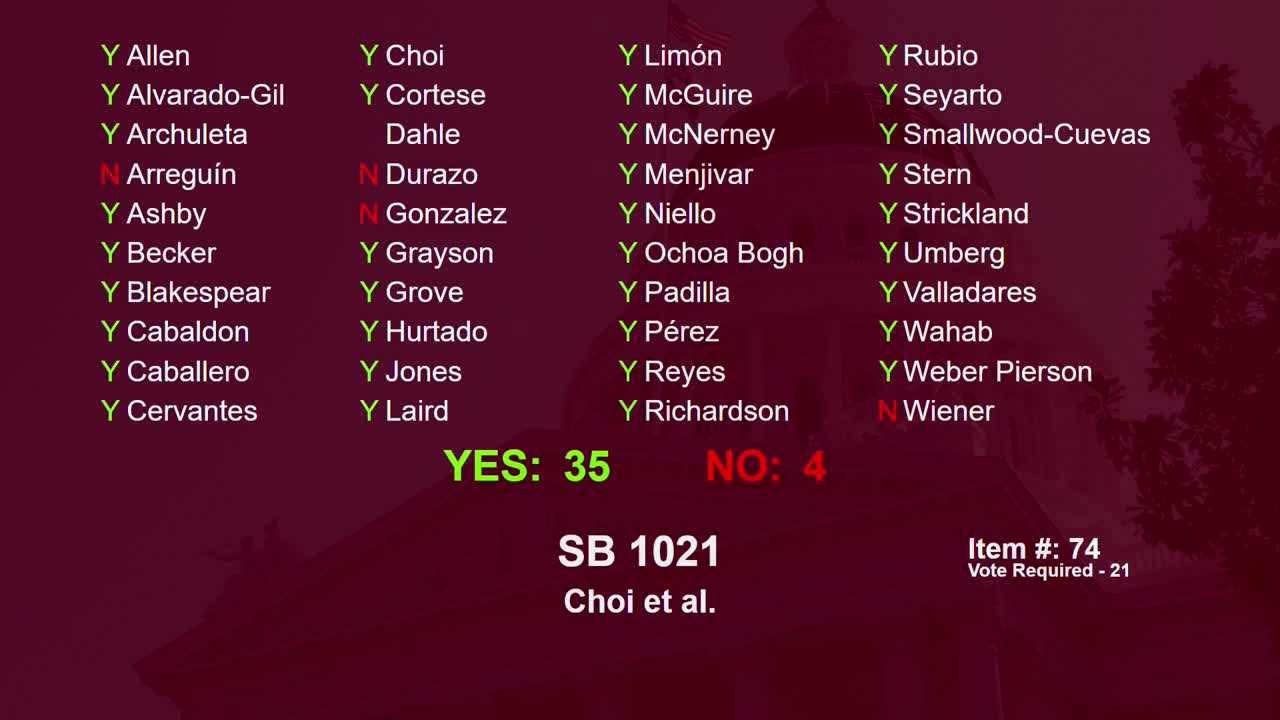 3MIN
Senate Floor
 20MIN
Senate Standing Committee on Judiciary
 40MIN
Senate Standing Committee on Transportation
Bill Author

Bill Co-Author(s):