SB 1249: Personal income taxes: deductions: elderly seniors.
- Session Year: 2025-2026
- House: Senate
- Latest Version Date: 2026-05-14
Current Status:
In Progress
(2026-06-30: June 29 hearing. Held in committee and under submission.)
Introduced
In Committee
Awaiting First Chamber Vote
Passed First Chamber
In Committee
Awaiting Second Chamber Vote
Passed Second Chamber
Enacted
The Personal Income Tax Law, in modified conformity with federal income tax laws, allows various deductions from gross income in calculating adjusted gross income.
This bill, for taxable years beginning on or after January 1, 2027, and before January 1, 2032, would allow a deduction in determining adjusted gross income for a taxpayer in an amount equal to $6,000 $3,000 per qualified individual, reduced by 6% of the taxpayers federal adjusted gross income in excess of specified thresholds. The bill would define qualified individual for these purposes to mean the taxpayer if the taxpayer is an elderly senior and, in the case of a married couple filing a joint return, the taxpayers spouse if the taxpayers spouse is an elderly senior, and would define elderly senior to mean an individual who meets specified age criteria as of the last day of the taxable year.
Existing law requires any bill authorizing a new tax expenditure to contain, among other things, specific goals that the tax expenditure will achieve, detailed performance indicators, and data collection requirements.
This bill would include additional information required for any bill authorizing a new tax expenditure.
This bill would take effect immediately as a tax levy.
The Personal Income Tax Law, in modified conformity with federal income tax laws, allows various deductions from gross income in calculating adjusted gross income.
This bill, for taxable years beginning on or after January 1, 2027, and before January 1, 2032, would allow a deduction in determining adjusted gross income for a qualified taxpayer in a specified amount calculated based on the taxpayers household size and number of elderly senior dependents, as those terms are defined. an amount equal to $6,000 per qualified individual, reduced by 6% of the taxpayers federal adjusted gross income in excess of specified thresholds. The bill would define qualified taxpayer individual for these purposes to mean a taxpayer with household income less than or equal to 600% of the federal poverty level for the taxpayers household size, without regard for the above-described deduction, who claims one or more elderly senior dependents. the taxpayer if the taxpayer is an elderly senior and, in the case of a married couple filing a joint return, the taxpayers spouse if the taxpayers spouse is an elderly senior, and would define elderly senior to mean an individual who meets specified age criteria as of the last day of the taxable year.
Existing law requires any bill authorizing a new tax expenditure to contain, among other things, specific goals that the tax expenditure will achieve, detailed performance indicators, and data collection requirements.
This bill would state the intent of the Legislature to comply with that requirement. include additional information required for any bill authorizing a new tax expenditure.
This bill would take effect immediately as a tax levy.
The Personal Income Tax Law, in modified conformity with federal income tax laws, allows various deductions from gross income in calculating adjusted gross income.
This bill, for taxable years beginning on or after January 1, 2027, and before January 1, 2032, would allow a deduction in determining adjusted gross income for a qualified taxpayer in a specified amount calculated based on the taxpayers household size and number of elderly senior dependents, as those terms are defined. The bill would define qualified taxpayer for these purposes to mean a taxpayer with household income less than or equal to 600% of the federal poverty level for the taxpayers household size, without regard for the above-described deduction, who claims one or more elderly senior dependents.
Existing law requires any bill authorizing a new tax expenditure to contain, among other things, specific goals that the tax expenditure will achieve, detailed performance indicators, and data collection requirements.
This bill would state the intent of the Legislature to comply with that requirement.
This bill would take effect immediately as a tax levy.
(a)Section 62 of the Internal Revenue Code, relating to adjusted gross income defined, shall apply, except as otherwise provided.
(b)Section 62(a)(2)(D) of the Internal Revenue Code, relating to certain expenses of elementary and secondary school teachers, shall not apply.
(c)Section 62(a)(21) of the Internal Revenue Code, relating to attorneys attorneys fees relating to awards to whistleblowers, shall not apply.
(d)For taxable years beginning on or after January 1, 2027, and before January 1, 2032, Section 62(a) of the Internal Revenue Code, relating to the general rule, is modified to provide that the deduction under Section 17213 shall be allowed in determining adjusted gross income.
SEC. 2.Section 17213 is added to the Revenue and Taxation Code, to read:17213.(a)(1)For taxable years beginning on or after January 1, 2027, and before January 1, 2032, there shall be allowed a deduction from gross income to a taxpayer in an amount equal to six three thousand dollars ($6,000) ($3,000) for each qualified individual, subject to the reduction in paragraph (2).
(2)(A)The deduction allowed by this section shall be reduced by 6 percent of the applicable of the following:
(i)In the case of a married couple filing a joint return, the amount by which the taxpayers federal adjusted gross income exceeds one hundred fifty thousand dollars ($150,000).
(ii)For all other filers, the amount by which the taxpayers federal adjusted gross income exceeds seventy-five thousand dollars ($75,000).
(B)A reduction made pursuant to this paragraph shall not exceed the maximum value of the deduction.
(b)For the purposes of this section, the following definitions shall apply:
(1)Elderly senior means an individual who is the following age or older as of the last day of the taxable year:
(A)For taxable years beginning on or after January 1, 2027, and before January 1, 2028, 90 years of age.
(B)For taxable years beginning on or after January 1, 2028, and before January 1, 2029, 89 years of age.
(C)For taxable years beginning on or after January 1, 2029, and before January 1, 2030, 88 years of age.
(D)For taxable years beginning on or after January 1, 2030, and before January 1, 2031, 87 years of age.
(E)For taxable years beginning on or after January 1, 2031, and before January 1, 2032, 86 years of age.
(2)Qualified individual means both of the following:
(A)The taxpayer if the taxpayer is an elderly senior.
(B)In the case of a married couple filing a joint return, the taxpayers spouse if the taxpayers spouse is an elderly senior.
(c)(1)For the purpose of complying with Section 41 with respect to the deduction provided by this section, the Legislature finds and declares the following:
(A)The specific goal, purpose, and objective of the tax expenditure is to provide essential relief to elderly individuals who are facing significant economic challenges and are least able to absorb rising costs.
(B)The performance indicators for the Legislature to use in determining if the tax expenditure achieves the stated goal, purpose, and objective shall be the all of the following:
(i)The number of qualified taxpayers that claimed the deduction for one elderly senior.
(ii)The number of qualified taxpayers that claimed the deduction for two elderly seniors.
(iii)The total number of qualified taxpayers that claimed the deduction.
(iv)The aggregate amount of deductions claim.
(2)On or before May 1, 2029, and annually thereafter, the Franchise Tax Board shall submit to the Legislature, in accordance with Section 9795 of the Government Code, a written report that includes, to the extent feasible, all of the following:
(A)The amounts described in clauses (i) to (iv), inclusive, of subparagraph (B) of paragraph (1).
(B)A breakdown of the data described in clauses (i) to (iv), inclusive, of subparagraph (B) of paragraph (1), by federal adjusted gross income, into the following categories:
(i)Adjusted gross income less than one hundred fifty thousand dollars ($150,000) in the case of a married couple filing a joint return or less than seventy-five thousand dollars ($75,000) for all other filers.
(ii)Adjusted gross income above one hundred fifty thousand dollars ($150,000) and less than two hundred thousand dollars ($200,000) in the case of a married couple filing a joint return or above seventy-five thousand dollars ($75,000) but less than one hundred thousand dollars ($100,000) for all other filers.
(iii)Adjusted gross income above two hundred thousand dollars ($200,000) and less than two hundred fifty thousand dollars ($250,000) in the case of a married couple filing a joint return or above one hundred thousand dollars ($100,000) but less than one hundred twenty-five thousand dollars ($125,000) for all other filers.
(iv)Adjusted gross income above three hundred thousand dollars ($300,000) and less than three hundred twenty-five thousand dollars ($325,000) in the case of a married couple filing a joint return or above one hundred fifty thousand ($150,000) but less than one hundred sixty-two thousand five hundred dollars ($162,500) for all other filers.
(3)The disclosure provisions of this subdivision shall be treated as an exception to Section 19542.
(d)This section shall remain in effect only until December 1, 2032, and as of that date is repealed.
SEC. 3.This act provides for a tax levy within the meaning of Article IV of the California Constitution and shall go into immediate effect.
(a)Section 62 of the Internal Revenue Code, relating to adjusted gross income defined, shall apply, except as otherwise provided.
(b)Section 62(a)(2)(D) of the Internal Revenue Code, relating to certain expenses of elementary and secondary school teachers, shall not apply.
(c)Section 62(a)(21) of the Internal Revenue Code, relating to attorneys fees relating to awards to whistleblowers, shall not apply.
(d)For taxable years beginning on or after January 1, 2027, and before January 1, 2032, Section 62(a) of the Internal Revenue Code, relating to the general rule, is modified to provide that the deduction under Section 17213 shall be allowed in determining adjusted gross income.
SEC. 2.Section 17213 is added to the Revenue and Taxation Code, to read:17213.(a)(1)For taxable years beginning on or after January 1, 2027, and before January 1, 2032, there shall be allowed a deduction from gross income to a qualified taxpayer in an amount calculated pursuant to equal to six thousand dollars ($6,000) for each qualified individual, subject to the reduction in paragraph (2).
(2)(A)The deduction allowed by this section shall be equal to the federal poverty level for the taxpayers household size multiplied by the ratio of the number of elderly senior dependents claimed for the taxable year over the household size. reduced by 6 percent of the applicable of the following:
(i)In the case of a married couple filing a joint return, the amount by which the taxpayers federal adjusted gross income exceeds one hundred fifty thousand dollars ($150,000).
(ii)For all other filers, the amount by which the taxpayers federal adjusted gross income exceeds seventy-five thousand dollars ($75,000).
(B)A reduction made pursuant to this paragraph shall not exceed the maximum value of the deduction.
(b)For the purposes of this section, the following definitions shall apply:
(1)Elderly senior means an individual who is the following age or older as of the last day of the taxable year:
(A)For taxable years beginning on or after January 1, 2027, and before January 1, 2028, 90 years of age.
(B)For taxable years beginning on or after January 1, 2028, and before January 1, 2029, 89 years of age.
(C)For taxable years beginning on or after January 1, 2029, and before January 1, 2030, 88 years of age.
(D)For taxable years beginning on or after January 1, 2030, and before January 1, 2031, 87 years of age.
(E)For taxable years beginning on or after January 1, 2031, and before January 1, 2032, 86 years of age.
(2)Federal poverty level means the poverty guidelines updated periodically in the Federal Register by the United States Department of Health and Human Services under authority of subsection (2) of Section 9902 of Title 42 of the United States Code.(3)Household income shall have the same meaning as defined in Section 120960 of the Health and Safety Code.(4)Household size means the following:(A)Except as specified in subparagraph (B), one plus the number of dependents properly claimed for the taxable year.(B)In the case of a taxpayer who is a surviving spouse, as defined in Section 17046, or a married couple filing a joint return, two plus the number of dependents properly claimed for the taxable year.(5)Qualified taxpayer means a taxpayer for whom household income is less than or equal to 600 percent of the federal poverty level for their household size, without regard for the deduction provided by this section, and who claims one or more elderly senior dependents.(c)It is the intent of the Legislature to comply with Section 41.(2)Qualified individual means both of the following:
(A)The taxpayer if the taxpayer is an elderly senior.
(B)In the case of a married couple filing a joint return, the taxpayers spouse if the taxpayers spouse is an elderly senior.
(c)(1)For the purpose of complying with Section 41 with respect to the deduction provided by this section, the Legislature finds and declares the following:
(A)The specific goal, purpose, and objective of the tax expenditure is to provide essential relief to elderly individuals who are facing significant economic challenges and are least able to absorb rising costs.
(B)The performance indicators for the Legislature to use in determining if the tax expenditure achieves the stated goal, purpose, and objective shall be the all of the following:
(i)The number of qualified taxpayers that claimed the deduction for one elderly senior.
(ii)The number of qualified taxpayers that claimed the deduction for two elderly seniors.
(iii)The total number of qualified taxpayers that claimed the deduction.
(iv)The aggregate amount of deductions claim.
(2)On or before May 1, 2029, and annually thereafter, the Franchise Tax Board shall submit to the Legislature, in accordance with Section 9795 of the Government Code, a written report that includes, to the extent feasible, all of the following:
(A)The amounts described in clauses (i) to (iv), inclusive, of subparagraph (B) of paragraph (1).
(B)A breakdown of the data described in clauses (i) to (iv), inclusive, of subparagraph (B) of paragraph (1), by federal adjusted gross income, into the following categories:
(i)Adjusted gross income less than one hundred fifty thousand dollars ($150,000) in the case of a married couple filing a joint return or less than seventy-five thousand dollars ($75,000) for all other filers.
(ii)Adjusted gross income above one hundred fifty thousand dollars ($150,000) and less than two hundred thousand dollars ($200,000) in the case of a married couple filing a joint return or above seventy-five thousand dollars ($75,000) but less than one hundred thousand dollars ($100,000) for all other filers.
(iii)Adjusted gross income above two hundred thousand dollars ($200,000) and less than two hundred fifty thousand dollars ($250,000) in the case of a married couple filing a joint return or above one hundred thousand dollars ($100,000) but less than one hundred twenty-five thousand dollars ($125,000) for all other filers.
(iv)Adjusted gross income above three hundred thousand dollars ($300,000) and less than three hundred twenty-five thousand dollars ($325,000) in the case of a married couple filing a joint return or above one hundred fifty thousand ($150,000) but less than one hundred sixty-two thousand five hundred dollars ($162,500) for all other filers.
(3)The disclosure provisions of this subdivision shall be treated as an exception to Section 19542.
(d)This section shall remain in effect only until December 1, 2033, 2032, and as of that date is repealed.
SEC. 3.This act provides for a tax levy within the meaning of Article IV of the California Constitution and shall go into immediate effect.
(a)Section 62 of the Internal Revenue Code, relating to adjusted gross income defined, shall apply, except as otherwise provided.
(b)Section 62(a)(2)(D) of the Internal Revenue Code, relating to certain expenses of elementary and secondary school teachers, shall not apply.
(c)Section 62(a)(21) of the Internal Revenue Code, relating to attorneys fees relating to awards to whistleblowers, shall not apply.
(d)For taxable years beginning on or after January 1, 2027, and before January 1, 2032, Section 62(a) of the Internal Revenue Code, relating to the general rule, is modified to provide that the deduction under Section 17213 shall be allowed in determining adjusted gross income.
SEC. 2.Section 17213 is added to the Revenue and Taxation Code, to read:17213.(a)(1)For taxable years beginning on or after January 1, 2027, and before January 1, 2032, there shall be allowed a deduction from gross income to a qualified taxpayer in an amount calculated pursuant to paragraph (2).
(2)The deduction allowed by this section shall be equal to the federal poverty level for the taxpayers household size multiplied by the ratio of the number of elderly senior dependents claimed for the taxable year over the household size.
(b)For the purposes of this section, the following definitions shall apply:
(1)Elderly senior means an individual who is the following age or older as of the last day of the taxable year:
(A)For taxable years beginning on or after January 1, 2027, and before January 1, 2028, 90 years of age.
(B)For taxable years beginning on or after January 1, 2028, and before January 1, 2029, 89 years of age.
(C)For taxable years beginning on or after January 1, 2029, and before January 1, 2030, 88 years of age.
(D)For taxable years beginning on or after January 1, 2030, and before January 1, 2031, 87 years of age.
(E)For taxable years beginning on or after January 1, 2031, and before January 1, 2032, 86 years of age.
(2)Federal poverty level means the poverty guidelines updated periodically in the Federal Register by the United States Department of Health and Human Services under authority of subsection (2) of Section 9902 of Title 42 of the United States Code.
(3)Household income shall have the same meaning as defined in Section 120960 of the Health and Safety Code.
(4)Household size means the following:
(A)Except as specified in subparagraph (B), one plus the number of dependents properly claimed for the taxable year.
(B)In the case of a taxpayer who is a surviving spouse, as defined in Section 17046, or a married couple filing a joint return, two plus the number of dependents properly claimed for the taxable year.
(5)Qualified taxpayer means a taxpayer for whom household income is less than or equal to 600 percent of the federal poverty level for their household size, without regard for the deduction provided by this section, and who claims one or more elderly senior dependents.
(c)It is the intent of the Legislature to comply with Section 41.
(d)This section shall remain in effect only until December 1, 2033, and as of that date is repealed.
SEC. 3.This act provides for a tax levy within the meaning of Article IV of the California Constitution and shall go into immediate effect.
|
Date
|
Status
|
|---|---|
| Jun 30, 2026 | June 29 hearing. Held in committee and under submission. |
| Jun 15, 2026 | June 15 set for first hearing. Placed on suspense file. |
| Jun 1, 2026 | Referred to Com. on REV. & TAX. |
| May 26, 2026 | In Assembly. Read first time. Held at Desk. |
| May 26, 2026 | Read third time. Passed. (Ayes 37. Noes 0. Page 4450.) Ordered to the Assembly. |
| May 26, 2026 | Read third time. Passed. (Ayes 37. Noes 0.) Ordered to the Assembly. |
| May 18, 2026 | Read second time. Ordered to third reading. |
| May 14, 2026 | From committee: Do pass as amended. (Ayes 7. Noes 0. Page 4270.) (May 14). |
| May 14, 2026 | Read second time and amended. Ordered to second reading. |
| May 14, 2026 | From committee: Do pass as amended. (Ayes 7. Noes 0.) (May 14). |
| May 12, 2026 | Set for hearing May 14. |
| May 11, 2026 | May 11 hearing: Placed on APPR. suspense file. |
| May 7, 2026 | Set for hearing May 11. |
| May 6, 2026 | From committee: Do pass and re-refer to Com. on APPR. (Ayes 5. Noes 0. Page 4154.) (May 6). Re-referred to Com. on APPR. |
| May 6, 2026 | From committee: Do pass and re-refer to Com. on APPR. (Ayes 5. Noes 0.) (May 6). Re-referred to Com. on APPR. |
| Apr 23, 2026 | From committee with author's amendments. Read second time and amended. Re-referred to Com. on REV. & TAX. |
| Apr 9, 2026 | Set for hearing May 6. |
| Mar 4, 2026 | Referred to Com. on REV. & TAX. |
| Feb 20, 2026 | From printer. May be acted upon on or after March 22. |
| Feb 19, 2026 | Introduced. Read first time. To Com. on RLS. for assignment. To print. |
|
Date
|
Description
|
Location
|
Votes
|
|
|---|---|---|---|---|
| May 26, 2026 | Senate 3rd Reading SB1249 Richardson | Senate Floor |
Passed |
|
| May 14, 2026 | Do pass as amended | Senate Standing Committee on Appropriations |
Passed |
|
| May 11, 2026 | Placed on suspense file | Senate Standing Committee on Appropriations |
Passed |
|
| May 6, 2026 | Do pass, but first be re-referred to the Committee on [Appropriations] | Senate Standing Committee on Revenue and Taxation |
Passed |
This list shows positions taken on this bill by organizations on the date displayed, which is linked to the original source.
Positions by individuals are not included.
|
Organization
|
Position
|
Date
|
|---|---|---|
| California Alliance For Retired Americans | ** Support | |
| California Association Of Area Agencies On Aging | ** Support | |
| California State Retirees | ** Support | |
| California Tax Reform Association | ** Against | |
| California Teachers Association | ** Against | |
| LeadingAge California | ** Support |
Date of Hearing: June 29, 2026
ASSEMBLY COMMITTEE ON REVENUE AND TAXATION
Mike Gipson, Chair
SBPCA Bill Id:SB 1249
Author:(Richardson) – As Amended Ver:May 14, 2026
SUSPENSE
Majority vote. Tax levy. Fiscal committee.
SENATE VOTE: 37-0
SUBJECT: Personal income taxes: deductions: elderly seniors
SUMMARY: Authorizes a deduction from gross income, under the Personal Income Tax (PIT) Law, equal to $3,000 for each "qualified individual" for five taxable years, as specified. Specifically, this bill:
- Authorizes a taxpayer to deduct from their gross income, under the PIT Law, $3,000 for each "qualified individual," for taxable years beginning on or after January 1, 2027, and before January 1, 2032.
- Reduces the deduction by 6% of the amount that a taxpayer's federal adjusted gross income exceeds $150,000 for married couples filing jointly, or $75,000 for all other filers. This reduction may not exceed the maximum value of the deduction.
- Defines an "elderly senior" as an individual who is the following age or older as of the last day of the taxable year:
- 90 years of age, for taxable years beginning on or after January 1, 2027, and before January 1, 2028;
- 89 years of age, for taxable years beginning on or after January 1, 2028, and before January 1, 2029;
- 88 years of age, for taxable years beginning on or after January 1, 2029, and before January 1, 2030;
- 87 years of age, for taxable years beginning on or after January 1, 2030, and before January 1, 2031; and,
- 86 years of age, for taxable years beginning on or after January 1, 2031, and before January 1, 2032.
- Defines a "qualified individual" as a taxpayer, if the taxpayer is an elderly senior, or the taxpayer's spouse if the taxpayer's spouse is an elderly senior and the taxpayer and spouse are married and filing jointly.
- Finds and declares, for the purposes of complying with Revenue and Taxation Code (R&TC) Section 41, that the specific goal, purpose, and objective of this bill is to provide essential relief to elderly individuals who are facing significant economic challenges and are least able to absorb rising costs. The performance indicators for the Legislature to use in determining whether this bill meets its stated goal, purpose, and objective are:
- The number of qualified taxpayers that claimed the deduction for one elderly senior;
- The number of qualified taxpayers that claimed the deduction for two elderly seniors;
- The total number of qualified taxpayers that claimed the deduction; and,
- The aggregate amount of deductions claimed.
- Requires the Franchise Tax Board (FTB) to, on or before May 1, 2029, submit a report to the Legislature that includes, to the extent feasible, the amounts for each performance metric delineated above and a breakdown of the data for each performance indicator listed above by federal adjusted gross income, as follows:
- Adjusted gross income less than $150,000 in the case of a married couple filing jointly, or less than $75,000 for all other filers;
- Adjusted gross income above $150,000 and less than $200,000 in the case of a married couple filing jointly, or above $75,000 but less than $100,000 for all other filers;
- Adjusted gross income above $200,000 and less than $250,000 in the case of a married couple filing jointly, or above $100,000 but less than $125,000 for all other filers; and,
- Adjusted gross income above $300,000 and less than $325,000 in the case of a married couple filing jointly, or above $150,000 but less than $162,500.
- Repeals this bill's provisions as of December 1, 2032.
- Takes immediate effect as a tax levy.
EXISTING FEDERAL LAW:
- Defines gross income as all income, from whatever source derived, unless specifically excluded. (Internal Revenue Code (IRC) Section 61.)
- Authorizes a deduction for taxpayers aged 65 and older and taxpayers who are blind of $600. This deduction amount is $1,200 if the taxpayer is over 65 years old and is blind. This amount can rise to $2,000 depending on the taxpayer's marital status. (IRC Section 63.)
- Authorizes, for taxable years beginning before January 1, 2029, an enhanced senior deduction equal to $6,000 for each "qualified individual" with respect to a taxpayer. A "qualified individual" is defined as the taxpayer, or their spouse in the case of a joint return, if the taxpayer or spouse are aged 65 years or older. The deduction is reduced by 6% of the taxpayer's modified adjusted gross income that exceeds $75,000, or $150,000 for joint returns; the reduction must not decrease the deduction below $0. (IRC Section 151.)
EXISTING STATE LAW:
- Conforms, with certain modifications, to federal tax law as it read on January 1, 2025. (R&TC Section 17024.5.)
- Authorizes a personal exemption credit, rather than a personal exemption deduction, equal to $52 for a taxpayer filing singly, a head of household, or a spouse filing separately. Taxpayers who are aged 65 years or older are eligible for an enhanced credit of an additional $52. These amounts are adjusted for inflation and equal $153 for the 2025 taxable year. (R&TC Section 17054.)
FISCAL EFFECT: The FTB estimates that this bill would result in a revenue loss of $24 million in the 2026-27 fiscal year (FY), $49 million in FY 2027-28, and $65 million in FY 2028-29.
COMMENTS:
- The author has provided the following statement in support of this bill:
Among adults aged 85 and older, 39.3% were low-income. As the cost of living continues to rise at unprecedented rates, elderly individuals experience declines in their standard of living. Seniors are often unable to obtain employment due to physical restrictions, caregiving responsibilities, and retirement structure limitations. Moreover, many older adults living on fixed or semi-fixed incomes struggle to maintain financial stability as food, health, and housing prices continue to surge. SB 1249 directly addresses these economic challenges by easing the tax burden on those least able to absorb California's growing expenses. By providing targeted tax relief, this bill helps offset the disproportionate decline in purchasing power experienced by older households compared to younger families.
- The California Alliance for Retired Americans, writing in support of this bill, states, in part:
In this last decade, the cost of living in California has risen at an unprecedented rate. Inflation negatively affects the elderly who live on a fixed or semi-fixed income. Though some income sources include annual cost-of-living adjustments, these allowances are much smaller than the growth in prices. Moreover, seniors are often limited by physical restrictions, caregiving responsibilities, and retirement structures that make it difficult, impractical, and potentially dangerous for the elderly to obtain work to offset rising costs.
SB 1249 directly addresses these economic challenges by easing the tax burden on those least able to absorb growing expenses. This bill recognizes that without meaningful intervention, many seniors will be forced to make difficult trade-offs between essentials such as housing, healthcare, and nutrition. By providing targeted tax relief, SB 1249 offers a way to offset the disproportionate decline in purchasing power experienced by older households compared to younger families.
- The California Tax Reform Association, writing in opposition to this bill, states, in part:
We question whether giving untargeted tax breaks to the very elderly
provides much in the way of benefit in relation to the cost. Since California
exempts social security from taxation, the poorest elderly seniors will not
benefit at all. These revenues would be better targeted to in-home care or
other supportive programs for the very elderly. Providing an across-the board
tax break is a well-meaning, but too-diffuse effort to provide for the needs of
our very elderly seniors when targeted programs and revenues could provide
a greater help. And, if this legislation is an effort to provide partial
conformity to federal tax relief for seniors, it should be discussed in the
context of a broader tax conformity effort.
- Committee Staff Comments:
- What is a "tax expenditure"? Existing law provides various credits, deductions, exclusions, and exemptions for particular taxpayer groups. In the late 1960s, U.S. Treasury officials began arguing that these features of the tax law should be referred to as "expenditures" since they are generally enacted to accomplish some governmental purpose and there is a determinable cost associated with each (in the form of foregone revenues).
As the Department of Finance notes in its annual Tax Expenditure Report, there are several key differences between tax expenditures and direct expenditures. First, tax expenditures are typically reviewed less frequently than direct expenditures. Second, there is generally no control over the amount of revenue losses associated with any given tax expenditure. Finally, it should also be noted that, once enacted, it takes a two-thirds vote to rescind an existing tax expenditure absent a sunset date. This effectively results in a "one-way ratchet" whereby tax expenditures can be conferred by majority vote, but cannot be rescinded, irrespective of their efficacy or cost, without a supermajority vote. This bill would authorize a new deduction, thereby constituting a tax expenditure.
- What is a "tax expenditure"? Existing law provides various credits, deductions, exclusions, and exemptions for particular taxpayer groups. In the late 1960s, U.S. Treasury officials began arguing that these features of the tax law should be referred to as "expenditures" since they are generally enacted to accomplish some governmental purpose and there is a determinable cost associated with each (in the form of foregone revenues).
- Committee's tax expenditure policy: SB 1335 (Leno), Chapter 845, Statutes of 2014, added R&TC Section 41, which recognized that the Legislature should apply the same level of review used for government spending programs to tax credits introduced on or after January 1, 2015. AB 263 (Burke), Chapter 743, Statutes of 2019, extended the requirements in R&TC Section 41 to all tax expenditure measures under the PIT Law, the Corporation Tax Law, and the Sales and Use Tax Law introduced on or after January 1, 2020.
A tax expenditure proposal must outline specific goals, purposes, and objectives that the tax expenditure will achieve, along with detailed performance indicators for the Legislature to use when measuring whether the tax expenditure meets those stated goals, purposes, and objectives. In addition to the R&TC Section 41 requirements, this Committee's policy also requires that all tax expenditure proposals contain an appropriate sunset provision to be eligible for a vote[1]. Sunsets are required because eliminating a tax expenditure generally requires a 2/3rd vote. These requirements must be satisfied before a bill can receive a vote in this Committee. This bill contains an appropriate five-year sunset, and complies with the requirements of R&TC Section 41.
- Conformity in California: California tax law does not automatically conform to federal tax law changes. Rather, California conforms to federal tax law as of a certain date, and any changes to federal tax law after California's date of conformity are not incorporated into state tax law. Unlike the Federal Government, the California Constitution requires the Legislature and Governor to pass a balanced budget. California's selective conformity allows the Legislature a prudent examination of the potentially costly changes made by the federal government before adoption by California.
Last year, the Legislature passed and Governor Newsom signed SB 711 (McNerney), Chapter 231, Statutes of 2025, which conformed California tax law to the IRC as of January 1, 2025, with certain modifications. SB 711 generally maintained non-conformity where California has previously decoupled from certain elements of federal law. - California's elderly population: The author has provided evidence showing that California's elderly population will increase relative to total population. Additionally, the author notes that low-income seniors, defined as earners with income of 200% of the federal poverty level, represented 39.3% of all adults aged 85 and older in 2022. For a two-person household, the annual income earned by that household to qualify for this definition of low-income would be $43,280. For a one-person household, 200% of the federal poverty level equals $31,920 of income.
- Tax Cuts and Jobs Act (TCJA) of 2017: In 2017, Congress enacted the TCJA (Public Law 115-97), which made significant changes to federal tax law. Among those changes was an increased reliance on the standard deduction by increasing the amount of the deduction. This increase was offset by the reduction or elimination of other deductions, including the personal exemption deduction. Prior to 2017, federal tax law authorized personal exemption deductions, which could be taken by any individual as a deduction in computing taxable income. The TCJA "zeroed-out" the deduction amount, nullifying the personal exemption deduction.
- One Big Beautiful Bill Act (OBBBA): The OBBBA (Public Law 119-21), enacted in 2025, made additional changes to federal tax law. Relevant to this bill, the OBBBA authorized the senior deduction described in the federal existing law section above.
- Inflationary pressures: The annual consumer price index, the annual measure of price increases for all goods, has risen 4.2% over the past 12 months. According to the United States Bureau of Labor Statistics, this increase was largely driven by rises in energy prices, which have increased 23.5% year-over-year as of May 2026. This, in turn, was predominantly driven by an increase in energy commodities, specifically fuel-oil and gasoline; fuel-oil and gasoline increased 60% and 40% year-over-year, respectively.
This increase is partially driven by the ongoing conflict in the Strait of Hormuz. Roughly 20% of the global oil supply passed through the strait daily prior to the conflict. While some experts anticipated that the scale of this disruption would dramatically increase oil prices, this effect appears to have been largely offset by historic drawdowns of the United States strategic petroleum reserve, the emergency oil reserve for the nation. The reserve will soon hit its lowest volume since 1983[2], when the United States was attempting to prevent oil price increases resulting from the energy crisis in the 1970s. Should this reserve be exhausted, energy prices will likely increase further.
In addition to global conflict, recent federal policies are likely responsible for price hikes around the nation. An April report published by the Board of Governors of the Federal Reserve found strong evidence that tariff changes through November 2025 raised core goods personal consumption expenditure prices by a cumulative 3.1% through February 2026. The study notes "the entirety of excess inflation in the core goods category relative to pre-pandemic inflations rates" can be explained by tariff changes in 2025[3].
- Deductions predominantly benefit the wealthy: Generally, deductions benefit wealthier taxpayers because a deduction is applied when calculating taxable income. In other words, a deduction's value to the taxpayer is not the statutorily prescribed amount. Rather, the value is the deduction's amount multiplied by the relevant tax bracket. As an example, a $3,000 deduction would result in direct tax savings of $30 for incomes subject to a 1% rate, the state's lowest bracket. Meanwhile, a taxpayer with income near this bill's modified adjusted gross income phaseout threshold, generally subject to the 8% rate, would realize direct tax savings of $160. Thus, this bill would provide a greater benefit to qualifying taxpayers with higher earnings.
- This bill: As currently drafted, this bill would provide a phased-in deduction of $3,000 for each qualifying senior. A qualifying senior would be 90 years of age in the first operative taxable year and would decrease by one year of age for each following taxable year such that a senior would qualify at 86 years of age in the last operative taxable year. This bill would also provide phase-out of the deduction amount, reducing the deduction by 6% of a taxpayer's modified adjusted gross income exceeding $75,000 or $150,000. The reduction may not reduce the deduction below $0.
It appears this bill is modeled on the federal senior deduction authorized by the OBBBA. California, however, does not conform to that provision. Indeed, California did not conform to the prior personal exemption deduction. Rather, California authorizes personal exemption credits. The Committee may wish to consider whether supporting low-income seniors would be better affected by augmenting the existing personal exemption credits for taxpayers with income below certain levels.
- Appropriate income thresholds? As currently drafted, this bill would begin its phaseout of the deduction if a taxpayer's modified adjusted gross income exceeds $75,000, or $150,000 if filing jointly. This phaseout reduces the deduction by 6% of the modified adjusted gross income exceeding the stipulated income thresholds for the phaseout. Thus, one qualifying senior filing singly would no longer receive this deduction if their income reaches $125,000. In the case of two qualifying seniors, filing jointly, the deduction would reach $0 when their modified adjusted gross income reaches $250,000. Thus, it appears this bill would benefit taxpayers that do not qualify as low-income and may not need subsidization.
- Suggested committee amendments: It appears the provisions of this bill that comply with the requirements of R&TC Section 41 relate to a previous version of the bill that provided a more generous deduction. Given the halving of this bill's deductible amount, the maximum income at which a taxpayer would no longer qualify for this deduction is reduced. In turn, this bill would require reporting of taxpayers with income that is ineligible for this bill's deduction. This bill should be amended to only require reporting of information for taxpayers eligible for this bill's deduction.
- FTB Analysis: The FTB, in its analysis of this bill, has identified the following technical considerations, and recommends the following changes for consistency of terminology:
- Revise the relating provisions to mirror the relevant heading in the IRC, such that in Section 17072(c) "attorney's" is replaced with "attorneys," and in Section 17072(d), "relating to the general rule" is replaced with "relating to general rule";
- Remove the phrase "to a taxpayer" in Section 17213(a)(1);
- Replace the phrase "that claimed" with the term "allowed" in Section 17213(c)(1)(B); and,
- Replace the term "claim" with the term "allowed" in Section 17213(c)(1)(B)(iv).
- Related legislation:
- SB 1096 (Dahle) would allow a senior tax credit to a qualified taxpayer equal to $1,500 per qualifying dependent claimed for each taxable year on or after January 1, 2026 and before January 1, 2031. SB 1096 is in the Senate Committee on Appropriations.
- SB 1144 (Valladares) would increase the personal exemption dependent credit to $700, for taxable years beginning on or after January 1, 2026 and before January 1, 2031. SB 1144 is in the Senate Committee on Revenue and Taxation.
REGISTERED SUPPORT / OPPOSITION:
Support
California Alliance for Retired Americans
California State Retirees
Leadingage California
Opposition
California Tax Reform Association
California Teachers Association
Analysis Prepared by: Harrison Bowlby / REV. & TAX. / (916) 319-2098
An "appropriate sunset provision" shall mean five years, except in the case of a tax expenditure measure providing relief to California veterans, in which case "appropriate sunset provision" shall mean 10 years. ↑
US Energy Information Administration, "Weekly US Ending Stocks of Crude Oil in Strategic Petroleum Reserve," https://www.eia.gov/dnav/pet/hist/LeafHandler.ashx?n=PET&s=WCSSTUS1&f=W, accessed June, 2026. ↑
Robert Minton, Madeleine Ray, and Mariano Somale, "Detecting Tariff Effects on Consumer Prices in Real Time – Part II," Board of the Governors of the Federal Reserve System, published April 8, 2026, https://www.federalreserve.gov/econres/notes/feds-notes/detecting-tariff-effects-on-consumer-prices-in-real-time-part-II-20260408.html, accessed May 2026. ↑
Date of Hearing: June 15, 2026
ASSEMBLY COMMITTEE ON REVENUE AND TAXATION
Mike Gipson, Chair
SBPCA Bill Id:SB 1249
Author:(Richardson) – As Amended Ver:May 14, 2026
Majority vote. Tax levy. Fiscal committee.
SENATE VOTE: 37-0
SUBJECT: Personal income taxes: deductions: elderly seniors
SUMMARY: Authorizes a deduction from gross income, under the Personal Income Tax (PIT) Law, equal to $3,000 for each "qualified individual" for five taxable years, as specified. Specifically, this bill:
- Authorizes a taxpayer to deduct from their gross income, under the PIT Law, $3,000 for each "qualified individual," for taxable years beginning on or after January 1, 2027, and before January 1, 2032.
- Reduces the deduction by 6% of the amount that a taxpayer's federal adjusted gross income exceeds $150,000 for married couples filing jointly, or $75,000 for all other filers. This reduction may not exceed the maximum value of the deduction.
- Defines an "elderly senior" as an individual who is the following age or older as of the last day of the taxable year:
- 90 years of age, for taxable years beginning on or after January 1, 2027, and before January 1, 2028;
- 89 years of age, for taxable years beginning on or after January 1, 2028, and before January 1, 2029;
- 88 years of age, for taxable years beginning on or after January 1, 2029, and before January 1, 2030;
- 87 years of age, for taxable years beginning on or after January 1, 2030, and before January 1, 2031; and,
- 86 years of age, for taxable years beginning on or after January 1, 2031, and before January 1, 2032.
- Defines a "qualified individual" as a taxpayer, if the taxpayer is an elderly senior, or the taxpayer's spouse if the taxpayer's spouse is an elderly senior and the taxpayer and spouse are married and filing jointly.
- Finds and declares, for the purposes of complying with Revenue and Taxation Code (R&TC) Section 41, that the specific goal, purpose, and objective of this bill is to provide essential relief to elderly individuals who are facing significant economic challenges and are least able to absorb rising costs. The performance indicators for the Legislature to use in determining whether this bill meets its stated goal, purpose, and objective are:
- The number of qualified taxpayers that claimed the deduction for one elderly senior;
- The number of qualified taxpayers that claimed the deduction for two elderly seniors;
- The total number of qualified taxpayers that claimed the deduction; and,
- The aggregate amount of deductions claimed.
- Requires the Franchise Tax Board (FTB) to, on or before May 1, 2029, submit a report to the Legislature that includes, to the extent feasible, the amounts for each performance metric delineated above and a breakdown of the data for each performance indicator listed above by federal adjusted gross income, as follows:
- Adjusted gross income less than $150,000 in the case of a married couple filing jointly, or less than $75,000 for all other filers;
- Adjusted gross income above $150,000 and less than $200,000 in the case of a married couple filing jointly, or above $75,000 but less than $100,000 for all other filers;
- Adjusted gross income above $200,000 and less than $250,000 in the case of a married couple filing jointly, or above $100,000 but less than $125,000 for all other filers; and,
- Adjusted gross income above $300,000 and less than $325,000 in the case of a married couple filing jointly, or above $150,000 but less than $162,500.
- Repeals this bill's provisions as of December 1, 2032.
- Takes immediate effect as a tax levy.
EXISTING FEDERAL LAW:
- Defines gross income as all income, from whatever source derived, unless specifically excluded. (Internal Revenue Code (IRC) Section 61.)
- Authorizes a deduction for taxpayers aged 65 and older and taxpayers who are blind of $600. This deduction amount is $1,200 if the taxpayer is over 65 years old and is blind. This amount can rise to $2,000 depending on the taxpayer's marital status. (IRC Section 63.)
- Authorizes, for taxable years beginning before January 1, 2029, an enhanced senior deduction equal to $6,000 for each "qualified individual" with respect to a taxpayer. A "qualified individual" is defined as the taxpayer, or their spouse in the case of a joint return, if the taxpayer or spouse are aged 65 years or older. The deduction is reduced by 6% of the taxpayer's modified adjusted gross income that exceeds $75,000, or $150,000 for joint returns; the reduction must not decrease the deduction below $0. (IRC Section 151.)
EXISTING STATE LAW:
- Conforms, with certain modifications, to federal tax law as it read on January 1, 2025. (R&TC Section 17024.5.)
- Authorizes a personal exemption credit, rather than a personal exemption deduction, equal to $52 for a taxpayer filing singly, a head of household, or a spouse filing separately. Taxpayers who are aged 65 years or older are eligible for an enhanced credit of an additional $52. These amounts are adjusted for inflation and equal $153 for the 2025 taxable year. (R&TC Section 17054.)
FISCAL EFFECT: The FTB estimates that this bill would result in a revenue loss of $24 million in the 2026-27 fiscal year (FY), $49 million in FY 2027-28, and $65 million in FY 2028-29.
COMMENTS:
- The author has provided the following statement in support of this bill:
Among adults aged 85 and older, 39.3% were low-income. As the cost of living continues to rise at unprecedented rates, elderly individuals experience declines in their standard of living. Seniors are often unable to obtain employment due to physical restrictions, caregiving responsibilities, and retirement structure limitations. Moreover, many older adults living on fixed or semi-fixed incomes struggle to maintain financial stability as food, health, and housing prices continue to surge. SB 1249 directly addresses these economic challenges by easing the tax burden on those least able to absorb California's growing expenses. By providing targeted tax relief, this bill helps offset the disproportionate decline in purchasing power experienced by older households compared to younger families.
- The California Alliance for Retired Americans, writing in support of this bill, states, in part:
In this last decade, the cost of living in California has risen at an unprecedented rate. Inflation negatively affects the elderly who live on a fixed or semi-fixed income. Though some income sources include annual cost-of-living adjustments, these allowances are much smaller than the growth in prices. Moreover, seniors are often limited by physical restrictions, caregiving responsibilities, and retirement structures that make it difficult, impractical, and potentially dangerous for the elderly to obtain work to offset rising costs.
SB 1249 directly addresses these economic challenges by easing the tax burden on those least able to absorb growing expenses. This bill recognizes that without meaningful intervention, many seniors will be forced to make difficult trade-offs between essentials such as housing, healthcare, and nutrition. By providing targeted tax relief, SB 1249 offers a way to offset the disproportionate decline in purchasing power experienced by older households compared to younger families.
- The California Tax Reform Association, writing in opposition to this bill, states, in part:
We question whether giving untargeted tax breaks to the very elderly
provides much in the way of benefit in relation to the cost. Since California
exempts social security from taxation, the poorest elderly seniors will not
benefit at all. These revenues would be better targeted to in-home care or
other supportive programs for the very elderly. Providing an across-the board
tax break is a well-meaning, but too-diffuse effort to provide for the needs of
our very elderly seniors when targeted programs and revenues could provide
a greater help. And, if this legislation is an effort to provide partial
conformity to federal tax relief for seniors, it should be discussed in the
context of a broader tax conformity effort.
- Committee Staff Comments:
- What is a "tax expenditure"? Existing law provides various credits, deductions, exclusions, and exemptions for particular taxpayer groups. In the late 1960s, U.S. Treasury officials began arguing that these features of the tax law should be referred to as "expenditures" since they are generally enacted to accomplish some governmental purpose and there is a determinable cost associated with each (in the form of foregone revenues).
As the Department of Finance notes in its annual Tax Expenditure Report, there are several key differences between tax expenditures and direct expenditures. First, tax expenditures are typically reviewed less frequently than direct expenditures. Second, there is generally no control over the amount of revenue losses associated with any given tax expenditure. Finally, it should also be noted that, once enacted, it takes a two-thirds vote to rescind an existing tax expenditure absent a sunset date. This effectively results in a "one-way ratchet" whereby tax expenditures can be conferred by majority vote, but cannot be rescinded, irrespective of their efficacy or cost, without a supermajority vote. This bill would authorize a new deduction, thereby constituting a tax expenditure.
- What is a "tax expenditure"? Existing law provides various credits, deductions, exclusions, and exemptions for particular taxpayer groups. In the late 1960s, U.S. Treasury officials began arguing that these features of the tax law should be referred to as "expenditures" since they are generally enacted to accomplish some governmental purpose and there is a determinable cost associated with each (in the form of foregone revenues).
- Committee's tax expenditure policy: SB 1335 (Leno), Chapter 845, Statutes of 2014, added R&TC Section 41, which recognized that the Legislature should apply the same level of review used for government spending programs to tax credits introduced on or after January 1, 2015. AB 263 (Burke), Chapter 743, Statutes of 2019, extended the requirements in R&TC Section 41 to all tax expenditure measures under the PIT Law, the Corporation Tax Law, and the Sales and Use Tax Law introduced on or after January 1, 2020.
A tax expenditure proposal must outline specific goals, purposes, and objectives that the tax expenditure will achieve, along with detailed performance indicators for the Legislature to use when measuring whether the tax expenditure meets those stated goals, purposes, and objectives. In addition to the R&TC Section 41 requirements, this Committee's policy also requires that all tax expenditure proposals contain an appropriate sunset provision to be eligible for a vote[1]. Sunsets are required because eliminating a tax expenditure generally requires a 2/3rd vote. These requirements must be satisfied before a bill can receive a vote in this Committee. This bill contains an appropriate five-year sunset, and complies with the requirements of R&TC Section 41.
- Conformity in California: California tax law does not automatically conform to federal tax law changes. Rather, California conforms to federal tax law as of a certain date, and any changes to federal tax law after California's date of conformity are not incorporated into state tax law. Unlike the Federal Government, the California Constitution requires the Legislature and Governor to pass a balanced budget. California's selective conformity allows the Legislature a prudent examination of the potentially costly changes made by the federal government before adoption by California.
Last year, the Legislature passed and Governor Newsom signed SB 711 (McNerney), Chapter 231, Statutes of 2025, which conformed California tax law to the IRC as of January 1, 2025, with certain modifications. SB 711 generally maintained non-conformity where California has previously decoupled from certain elements of federal law. - California's elderly population: The author has provided evidence showing that California's elderly population will increase relative to total population. Additionally, the author notes that low-income seniors, defined as earners with income of 200% of the federal poverty level, represented 39.3% of all adults aged 85 and older in 2022. For a two-person household, the annual income earned by that household to qualify for this definition of low-income would be $43,280. For a one-person household, 200% of the federal poverty level equals $31,920 of income.
- Tax Cuts and Jobs Act (TCJA) of 2017: In 2017, Congress enacted the TCJA (Public Law 115-97), which made significant changes to federal tax law. Among those changes was an increased reliance on the standard deduction by increasing the amount of the deduction. This increase was offset by the reduction or elimination of other deductions, including the personal exemption deduction. Prior to 2017, federal tax law authorized personal exemption deductions, which could be taken by any individual as a deduction in computing taxable income. The TCJA "zeroed-out" the deduction amount, nullifying the personal exemption deduction.
- One Big Beautiful Bill Act (OBBBA): The OBBBA (Public Law 119-21), enacted in 2025, made additional changes to federal tax law. Relevant to this bill, the OBBBA authorized the senior deduction described in the federal existing law section above.
- Inflationary pressures: The annual consumer price index, the annual measure of price increases for all goods, has risen 4.2% over the past 12 months. According to the United States Bureau of Labor Statistics, this increase was largely driven by rises in energy prices, which have increased 23.5% year-over-year as of May 2026. This, in turn, was predominantly driven by an increase in energy commodities, specifically fuel-oil and gasoline; fuel-oil and gasoline increased 60% and 40% year-over-year, respectively.
This increase is partially driven by the ongoing conflict in the Strait of Hormuz. Roughly 20% of the global oil supply passed through the strait daily prior to the conflict. While some experts anticipated that the scale of this disruption would dramatically increase oil prices, this effect appears to have been largely offset by historic drawdowns of the United States strategic petroleum reserve, the emergency oil reserve for the nation. The reserve will soon hit its lowest volume since 1983[2], when the United States was attempting to prevent oil price increases resulting from the energy crisis in the 1970s. Should this reserve be exhausted, energy prices will likely increase further.
In addition to global conflict, recent federal policies are likely responsible for price hikes around the nation. An April report published by the Board of Governors of the Federal Reserve found strong evidence that tariff changes through November 2025 raised core goods personal consumption expenditure prices by a cumulative 3.1% through February 2026. The study notes "the entirety of excess inflation in the core goods category relative to pre-pandemic inflations rates" can be explained by tariff changes in 2025[3].
- Deductions predominantly benefit the wealthy: Generally, deductions benefit wealthier taxpayers because a deduction is applied when calculating taxable income. In other words, a deduction's value to the taxpayer is not the statutorily prescribed amount. Rather, the value is the deduction's amount multiplied by the relevant tax bracket. As an example, a $3,000 deduction would result in direct tax savings of $30 for incomes subject to a 1% rate, the state's lowest bracket. Meanwhile, a taxpayer with income near this bill's modified adjusted gross income phaseout threshold, generally subject to the 8% rate, would realize direct tax savings of $160. Thus, this bill would provide a greater benefit to qualifying taxpayers with higher earnings.
- This bill: As currently drafted, this bill would provide a phased-in deduction of $3,000 for each qualifying senior. A qualifying senior would be 90 years of age in the first operative taxable year and would decrease by one year of age for each following taxable year such that a senior would qualify at 86 years of age in the last operative taxable year. This bill would also provide phase-out of the deduction amount, reducing the deduction by 6% of a taxpayer's modified adjusted gross income exceeding $75,000 or $150,000. The reduction may not reduce the deduction below $0.
It appears this bill is modeled on the federal senior deduction authorized by the OBBBA. California, however, does not conform to that provision. Indeed, California did not conform to the prior personal exemption deduction. Rather, California authorizes personal exemption credits. The Committee may wish to consider whether supporting low-income seniors would be better affected by augmenting the existing personal exemption credits for taxpayers with income below certain levels.
- Appropriate income thresholds? As currently drafted, this bill would begin its phaseout of the deduction if a taxpayer's modified adjusted gross income exceeds $75,000, or $150,000 if filing jointly. This phaseout reduces the deduction by 6% of the modified adjusted gross income exceeding the stipulated income thresholds for the phaseout. Thus, one qualifying senior filing singly would no longer receive this deduction if their income reaches $125,000. In the case of two qualifying seniors, filing jointly, the deduction would reach $0 when their modified adjusted gross income reaches $250,000. Thus, it appears this bill would benefit taxpayers that do not qualify as low-income and may not need subsidization.
- Suggested committee amendments: It appears the provisions of this bill that comply with the requirements of R&TC Section 41 relate to a previous version of the bill that provided a more generous deduction. Given the halving of this bill's deductible amount, the maximum income at which a taxpayer would no longer qualify for this deduction is reduced. In turn, this bill would require reporting of taxpayers with income that is ineligible for this bill's deduction. This bill should be amended to only require reporting of information for taxpayers eligible for this bill's deduction.
- FTB Analysis: The FTB, in its analysis of this bill, has identified the following technical considerations, and recommends the following changes for consistency of terminology:
- Revise the relating provisions to mirror the relevant heading in the IRC, such that in Section 17072(c) "attorney's" is replaced with "attorneys," and in Section 17072(d), "relating to the general rule" is replaced with "relating to general rule";
- Remove the phrase "to a taxpayer" in Section 17213(a)(1);
- Replace the phrase "that claimed" with the term "allowed" in Section 17213(c)(1)(B); and,
- Replace the term "claim" with the term "allowed" in Section 17213(c)(1)(B)(iv).
- Related legislation:
- SB 1096 (Dahle) would allow a senior tax credit to a qualified taxpayer equal to $1,500 per qualifying dependent claimed for each taxable year on or after January 1, 2026 and before January 1, 2031. SB 1096 is in the Senate Committee on Appropriations.
- SB 1144 (Valladares) would increase the personal exemption dependent credit to $700, for taxable years beginning on or after January 1, 2026 and before January 1, 2031. SB 1144 is in the Senate Committee on Revenue and Taxation.
REGISTERED SUPPORT / OPPOSITION:
Support
California Alliance for Retired Americans
California State Retirees
Leadingage California
Opposition
California Tax Reform Association
California Teachers Association
Analysis Prepared by: Harrison Bowlby / REV. & TAX. / (916) 319-2098
An "appropriate sunset provision" shall mean five years, except in the case of a tax expenditure measure providing relief to California veterans, in which case "appropriate sunset provision" shall mean 10 years. ↑
US Energy Information Administration, "Weekly US Ending Stocks of Crude Oil in Strategic Petroleum Reserve," https://www.eia.gov/dnav/pet/hist/LeafHandler.ashx?n=PET&s=WCSSTUS1&f=W, accessed June, 2026. ↑
Robert Minton, Madeleine Ray, and Mariano Somale, "Detecting Tariff Effects on Consumer Prices in Real Time – Part II," Board of the Governors of the Federal Reserve System, published April 8, 2026, https://www.federalreserve.gov/econres/notes/feds-notes/detecting-tariff-effects-on-consumer-prices-in-real-time-part-II-20260408.html, accessed May 2026. ↑
SENATE COMMITTEE ON
Senator Sabrina Cervantes, Chair
2025 - 2026 Regular Session
SB 1249 (Richardson) - Personal income taxes: deductions: elderly seniors
Version: | Policy Vote: |
Urgency: | Mandate: |
Hearing Date: | Consultant: |
Bill Summary:
SB 1249 would authorize an above-the-line deduction for elderly seniors for tax years 2026 through 2030, equal to $6,000, as specified.
*********** ANALYSIS ADDENDUM – SUSPENSE FILE ***********
The following information is revised to reflect amendments
adopted by the committee on May 14, 2026
Fiscal Impact:
The Franchise Tax Board (FTB) estimates that this bill would result in General Fund revenue losses of $24 million in 2026-27, $49 million in 2027-28, and $65 million in 2028-29. FTB’s administrative costs have yet to be identified.
Committee Amendments:
Reduce the deduction amount to $3,000.
-- END --
SENATE RULES COMMITTEE Office of Senate Floor Analyses (916) 651-4171 | SB 1249 |
THIRD READING
Bill No: SB 1249
Author: Richardson (D)
Amended: 5/14/26
Vote: 21
SENATE REVENUE AND TAXATION COMMITTEE: 5-0, 5/6/26
AYES: McNerney, Alvarado-Gil, Ashby, Becker, Grayson
SENATE APPROPRIATIONS COMMITTEE: 7-0, 5/14/26
AYES: Cervantes, Seyarto, Cabaldon, Dahle, Grayson, Richardson, Wahab
SUBJECT: Personal income taxes: deductions: elderly seniors
SOURCE: Author
DIGEST:
This bill authorizes an above-the-line deduction for elderly seniors for tax years 2027 through 2031, equal to $3,000, subject to a phase-out above specified income levels.
ANALYSIS:
Existing federal law:
- Allows various income tax credits, deductions, exemptions, and exclusions.
- Allows an additional below-the-line standard deduction amount for taxpayers who are 65+, in an amount ranging between $1,650 to $4,100, depending on filing status and whether or not the taxpayer is also blind.
- Allows an enhanced deduction for tax years 2025 to 2028 for taxpayers who are 65+, available to both itemizers and non-itemizers, in an amount equal to $6,000, subject to a phase-out at a rate of 6% of income above $75,000 for single filers or $150,000 for filers married filing jointly (MFJ).
- Allows a credit for taxpayers who are 65+ or retired on permanent and total disability and who receive taxable disability income during the year. The credit is calculated as 15% of a base amount, generally $3,750 to $7,500, depending on filing status and whether one or both spouses qualify.
- Excludes from income a portion of Social Security Benefits, which can be claimed beginning at age 62 for qualified persons, except as follows:
- Income between $25,000 to $34,000 single or $32,000 to $44,000 MFJ, up to 50% of Social Security benefits is included in gross income.
- Income above $34,000 single or $44,000 joint, up to 85% of Social Security benefits may be included in gross income.
Existing state law:
- Allows various income tax credits, deductions, exemptions, and exclusions.
- Allows a “personal-exemption” tax credit, including an additional credit amount for individuals 65 or older. For tax year 2025, the authorized amounts for both credits are $153, reduced by $6 ($12 if MFJ) for each $1,250 ($2,500 if MFJ) of AGI that exceeds:
- $252,203 if single or married filing separately,
- $504,411 if MFJ, or
- $378,310 if filing as head of household.
- Allows a senior head of household credit for taxpayers age 65+ who qualified as head of household for at least one of the prior two taxable years and whose qualifying person died during that two-year period. For 2025, if the taxpayer’s AGI does not exceed $98,652, the taxpayer is allowed a credit equal to 2% of taxable income, capped at $1,860.
- Excludes Social Security Benefits from income.
- Conforms to federal tax law as of January 1, 2025, with modifications (SB 711, McNerney, Chapter 231, Statutes of 2025).
- Does not conform to the enhanced below-the-line deduction for taxpayers who are ages 65+.
This bill:
- Authorizes an above-the-line deduction for elderly seniors equal to $3,000.
- Applies beginning in the 2027 taxable tear, and ends after the 2031 taxable year.
- Specifies that the deduction must be reduced by 6% of the amount that exceeds the taxpayer's federal AGI of $150,000 if filing jointly or $75,000 for all other filers.
- Defines “elderly senior” as an individual who is the following age or older as of the last day of the taxable year:
- For tax year 2027, 90 years of age.
- For tax year 2028, 89 years of age.
- For tax year 2029, 88 years of age.
- For tax year 2030, 87 years of age.
- For tax year 2031, 86 years of age.
- Authorizes the taxpayer and/or their spouse to take the deduction if they are considered elderly seniors in a given tax year.
- Includes legislative findings and declarations to comply with Section 41 of the Revenue and Taxation Code.
Background
An aging population and income. According to the U.S. Census Bureau, as of 2024, there are roughly 61.2 million people in the US ages 65+, representing 18% of the overall population. In 2004, that figure was only 12%. The number of Americans ages 65 and older is projected to increase to 82 million by 2050, representing 23% of the population.
In 2024, half of older adults received less than $33,310 from all sources, and half of all older households earned less than $56,680. Further, only 20% of older adults have earned income. For the remaining 80% of people age 65 and older who are fully retired, the median income was $26,770. According to PEW research, in 2022, 86.9% of people older than 65 received retirement or disability benefits. Additionally, U.S. Census Bureau researchers have found that about 14% of Americans 65 and older rely on Social Security for 90% or more of their income, 22% for 75% or more, and 42% for 50% or more.
FISCAL EFFECT: Appropriation: No Fiscal Com.: Yes Local: No
According to the Senate Appropriations Committee, the Franchise Tax Board (FTB) estimates that this bill would result in General Fund revenue losses of $24 million in 2026-27, $49 million in 2027-28, and $65 million in 2028-29. FTB’s administrative costs have yet to be identified.
SUPPORT: (Verified 5/14/26)
California Alliance for Retired Americans
California Association of Area Agencies on Aging
LeadingAge California
OPPOSITION: (Verified 5/14/26)
California Teachers Association
ARGUMENTS IN SUPPORT: According to the author, “Among adults aged 85 and older, 39.3% were low-income and 49.9% experienced independent living difficulties in 2022. As the cost of living continues to rise at unprecedented rates, elderly individuals experience declines in their standard of living. Seniors are often unable to obtain employment due to physical restrictions, caregiving responsibilities, and retirement structure limitations. Moreover, many older adults living on fixed or semi-fixed incomes struggle to maintain financial stability as food, health, and housing prices continue to surge. SB 1249 directly addresses these economic challenges by easing the tax burden on those least able to absorb California’s growing expenses. By providing targeted tax relief, this bill helps offset the disproportionate decline in purchasing power experienced by older households compared to younger families.”
ARGUMENTS IN OPPOSITION: According to the California Teachers Association, “In fiscal year 2025-26, the Department of Finance estimated a $94 billion dollar loss in general fund revenue due to existing tax expenditures. This is revenue that would have otherwise gone to the General Fund, of which approximately 40% would have gone toward the Proposition 98 minimum guarantee. Once tax credits are passed with a simple majority, it takes a two-thirds vote of the Legislature to repeal them. While we understand that some of these bills are well intended, CTA does not support this approach, as it would reduce overall funding for education. CTA believes Proposition 98 should be protected from reductions through the creation of new or expanding existing tax expenditures.”
Prepared by: Haley Summers / REV. & TAX. / (916) 651-4117
5/19/26 9:41:41
**** END ****
SENATE RULES COMMITTEE Office of Senate Floor Analyses (916) 651-4171 | SB 1249 |
THIRD READING
Bill No: SB 1249
Author: Richardson (D)
Amended: 5/14/26
Vote: 21- Urgency
SENATE REVENUE AND TAXATION COMMITTEE: 5-0, 5/6/26
AYES: McNerney, Alvarado-Gil, Ashby, Becker, Grayson
SENATE APPROPRIATIONS COMMITTEE: 7-0, 5/14/26
AYES: Cervantes, Seyarto, Cabaldon, Dahle, Grayson, Richardson, Wahab
SUBJECT: Personal income taxes: deductions: elderly seniors
SOURCE: Author
DIGEST:
This bill authorizes an above-the-line deduction for elderly seniors for tax years 2027 through 2031, equal to $3,000, subject to a phase-out above specified income levels.
ANALYSIS:
Existing federal law:
- Allows various income tax credits, deductions, exemptions, and exclusions.
- Allows an additional below-the-line standard deduction amount for taxpayers who are 65+, in an amount ranging between $1,650 to $4,100, depending on filing status and whether or not the taxpayer is also blind.
- Allows an enhanced deduction for tax years 2025 to 2028 for taxpayers who are 65+, available to both itemizers and non-itemizers, in an amount equal to $6,000, subject to a phase-out at a rate of 6% of income above $75,000 for single filers or $150,000 for filers married filing jointly (MFJ).
- Allows a credit for taxpayers who are 65+ or retired on permanent and total disability and who receive taxable disability income during the year. The credit is calculated as 15% of a base amount, generally $3,750 to $7,500, depending on filing status and whether one or both spouses qualify.
- Excludes from income a portion of Social Security Benefits, which can be claimed beginning at age 62 for qualified persons, except as follows:
- Income between $25,000 to $34,000 single or $32,000 to $44,000 MFJ, up to 50% of Social Security benefits is included in gross income.
- Income above $34,000 single or $44,000 joint, up to 85% of Social Security benefits may be included in gross income.
Existing state law:
- Allows various income tax credits, deductions, exemptions, and exclusions.
- Allows a “personal-exemption” tax credit, including an additional credit amount for individuals 65 or older. For tax year 2025, the authorized amounts for both credits are $153, reduced by $6 ($12 if MFJ) for each $1,250 ($2,500 if MFJ) of AGI that exceeds:
- $252,203 if single or married filing separately,
- $504,411 if MFJ, or
- $378,310 if filing as head of household.
- Allows a senior head of household credit for taxpayers age 65+ who qualified as head of household for at least one of the prior two taxable years and whose qualifying person died during that two-year period. For 2025, if the taxpayer’s AGI does not exceed $98,652, the taxpayer is allowed a credit equal to 2% of taxable income, capped at $1,860.
- Excludes Social Security Benefits from income.
- Conforms to federal tax law as of January 1, 2025, with modifications (SB 711, McNerney, Chapter 231, Statutes of 2025).
- Does not conform to the enhanced below-the-line deduction for taxpayers who are ages 65+.
This bill:
- Authorizes an above-the-line deduction for elderly seniors equal to $3,000.
- Applies beginning in the 2027 taxable tear, and ends after the 2031 taxable year.
- Specifies that the deduction must be reduced by 6% of the amount that exceeds the taxpayer's federal AGI of $150,000 if filing jointly or $75,000 for all other filers.
- Defines “elderly senior” as an individual who is the following age or older as of the last day of the taxable year:
- For tax year 2027, 90 years of age.
- For tax year 2028, 89 years of age.
- For tax year 2029, 88 years of age.
- For tax year 2030, 87 years of age.
- For tax year 2031, 86 years of age.
- Authorizes the taxpayer and/or their spouse to take the deduction if they are considered elderly seniors in a given tax year.
- Includes legislative findings and declarations to comply with Section 41 of the Revenue and Taxation Code.
Background
An aging population and income. According to the U.S. Census Bureau, as of 2024, there are roughly 61.2 million people in the US ages 65+, representing 18% of the overall population. In 2004, that figure was only 12%. The number of Americans ages 65 and older is projected to increase to 82 million by 2050, representing 23% of the population.
In 2024, half of older adults received less than $33,310 from all sources, and half of all older households earned less than $56,680. Further, only 20% of older adults have earned income. For the remaining 80% of people age 65 and older who are fully retired, the median income was $26,770. According to PEW research, in 2022, 86.9% of people older than 65 received retirement or disability benefits. Additionally, U.S. Census Bureau researchers have found that about 14% of Americans 65 and older rely on Social Security for 90% or more of their income, 22% for 75% or more, and 42% for 50% or more.
FISCAL EFFECT: Appropriation: No Fiscal Com.: Yes Local: No
According to the Senate Appropriations Committee, the Franchise Tax Board (FTB) estimates that this bill would result in General Fund revenue losses of $24 million in 2026-27, $49 million in 2027-28, and $650 million in 2028-29. FTB’s administrative costs have yet to be identified.
SUPPORT: (Verified 5/14/2026)
California Alliance for Retired Americans
California Association of Area Agencies on Aging
LeadingAge California
OPPOSITION: (Verified 5/14/2026)
California Teachers Association
ARGUMENTS IN SUPPORT: According to the author, “Among adults aged 85 and older, 39.3% were low-income and 49.9% experienced independent living difficulties in 2022. As the cost of living continues to rise at unprecedented rates, elderly individuals experience declines in their standard of living. Seniors are often unable to obtain employment due to physical restrictions, caregiving responsibilities, and retirement structure limitations. Moreover, many older adults living on fixed or semi-fixed incomes struggle to maintain financial stability as food, health, and housing prices continue to surge. SB 1249 directly addresses these economic challenges by easing the tax burden on those least able to absorb California’s growing expenses. By providing targeted tax relief, this bill helps offset the disproportionate decline in purchasing power experienced by older households compared to younger families.”
ARGUMENTS IN OPPOSITION: According to the California Teachers Association, “In fiscal year 2025-26, the Department of Finance estimated a $94 billion dollar loss in general fund revenue due to existing tax expenditures. This is revenue that would have otherwise gone to the General Fund, of which approximately 40% would have gone toward the Proposition 98 minimum guarantee. Once tax credits are passed with a simple majority, it takes a two-thirds vote of the Legislature to repeal them. While we understand that some of these bills are well intended, CTA does not support this approach, as it would reduce overall funding for education. CTA believes Proposition 98 should be protected from reductions through the creation of new or expanding existing tax expenditures.”
Prepared by: Haley Summers / REV. & TAX. / (916) 651-4117
5/18/26 15:24:08
**** END ****
SENATE COMMITTEE ON
Senator Sabrina Cervantes, Chair
2025 - 2026 Regular Session
SB 1249 (Richardson) - Personal income taxes: deductions: elderly seniors
Version: | Policy Vote: |
Urgency: | Mandate: |
Hearing Date: | Consultant: |
Bill Summary:
SB 1249 would authorize an above-the-line deduction for elderly seniors for tax years 2026 through 2030, equal to $6,000, as specified.
*********** ANALYSIS ADDENDUM – SUSPENSE FILE ***********
The following information is revised to reflect amendments
adopted by the committee on May 14, 2026
Fiscal Impact:
The Franchise Tax Board (FTB) estimates that this bill would result in General Fund revenue losses of $24 million in 2026-27, $49 million in 2027-28, and $650 million in 2028-29. FTB’s administrative costs have yet to be identified.
Committee Amendments:
Reduce the deduction amount to $3,000.
-- END --
SENATE COMMITTEE ON
Senator Sabrina Cervantes, Chair
2025 - 2026 Regular Session
SB 1249 (Richardson) - Personal income taxes: deductions: elderly seniors
Version: | Policy Vote: |
Urgency: | Mandate: |
Hearing Date: | Consultant: |
Bill Summary:
SB 1249 would authorize an above-the-line deduction for elderly seniors for tax years 2026 through 2030, equal to $6,000, as specified.
Fiscal Impact:
The Franchise Tax Board (FTB) estimates that this bill would result in General Fund revenue losses of $50 million in 2026-27, $100 million in 2027-28, and $130 million in 2028-29. FTB’s administrative costs have yet to be identified.
Background:
Tax expenditure programs (TEPs) are special tax provisions that reduce the amount of revenues the “basic” tax system would otherwise generate in order to provide (1) benefits to certain groups of taxpayers, and/or (2) incentives to encourage certain types of behavior and activities, such as charitable giving. Specifically, current law provides for, among other things, various income and corporation tax credits and deductions, as well as exemptions from the sales and use tax. The Department of Finance is required to publish a list of TEPs (currently totaling several hundred), which currently exceed $94 billion annually.
Existing federal and state laws provide that gross income includes all income from any source, including compensation for services, business income, gains from property, interest, dividends, rents, and royalties, unless specifically excluded. Existing federal and state laws exclude certain types of income from gross income, such as specified amounts received as gifts or by inheritance, certain compensation for injuries and sickness, qualified scholarships, educational assistance programs, foster care payments, and interest received on certain state or federal obligations, among other things.
Existing federal and state laws allow for the deduction of certain expenses from gross income when calculating adjusted gross income (AGI). Some examples include moving expenses for members of the armed service, as well as certain ordinary and necessary trade and business expenses. These are known as “above the line” deductions. Unlike itemized deductions, such as charitable deductions and mortgage interest deductions, all taxpayers with these types of expenses may take the corresponding deduction. In other words, the taxpayer can take above-the-line deductions regardless of whether the taxpayer claims the standard or itemized deduction.
State law does not automatically conform to federal changes. Instead, the Legislature must conform to federal changes. Specifically, it can pass (1) an individual bill that conforms to a specific federal tax provision, or (2) an omnibus bill to conform state law to federal law as of a specified date. Current state law generally conforms to federal tax law as of January 1, 2025.
Federal and state tax systems provide a range of income tax benefits for seniors, though the structure and amount of these benefits differ. At the federal level, seniors age 65 and older receive an additional standard deduction on top of the regular standard deduction, which is adjusted annually for inflation. The Tax Cuts and Jobs Act of 2017 temporarily suspended personal exemptions, and they were later permanently eliminated and replaced in part by an enhanced senior deduction enacted in 2025. This deduction provides up to $6,000 per eligible senior (2025–2028), with income-based phaseouts beginning at $75,000 for single filers and $150,000 for married couples filing jointly. Seniors may also qualify for a rarely used tax credit for the elderly or disabled, and Social Security benefits are partially taxable depending on income levels, with up to 85 percent included for higher-income recipients.
At the state level, California does not conform to the federal senior deduction system but instead offers smaller personal exemption credits, including additional credits for seniors, dependents, and blind taxpayers. It also provides a limited Senior Head of Household Credit for qualifying taxpayers under specific conditions. Unlike federal law, California fully excludes Social Security benefits from taxable income.
Overall, these tax provisions exist alongside broader demographic trends showing a rapidly growing senior population, many of whom rely heavily on fixed incomes such as Social Security and retirement benefits.
Proposed Law:
This bill, among other things, would authorize an above-the-line personal income tax deduction for elderly seniors for taxable years 2026 through 2030. The deduction would allow eligible taxpayers to deduct up to $6,000 annually. The allowable deduction would be reduced by 6 percent of the amount by which a taxpayer’s AGI exceeds $150,000 for married taxpayers filing jointly or $75,000 for all other filers. The bill defines an “elderly senior” as an individual who has attained the following age, or older, by the last day of the taxable year: (1) 90 years of age for tax year 2027, (2) 89 years of age for tax year 2028, (3) 88 years of age for tax year 2029, (4) 87 years of age for tax year 2030, and (5) 86 years of age for tax year 2031.
Related Legislation:
- SB 1096 (Dahle) would authorize a personal income tax credit for seniors 65 and older with no earned income, equal to $1,500 per dependent. The bill is currently pending in this Committee.
- SB 1137 (Valladares) would authorize an above-the-line deduction up to $5,000 for unreimbursed medical costs exceeding 4 percent of the qualified taxpayer’s federal adjusted gross income in the taxable year. The bill is currently pending in this Committee.
Staff Comments: Using demographic data from the Department of Finance and its own tax return information, FTB estimates that 250,000 qualified individuals would generate a deduction of $1.4 billion in tax year 2027.
-- END --
SENATE COMMITTEE ON REVENUE AND TAXATION
Senator Jerry McNerney, Chair
2025 - 2026 Regular
Bill No: | SB 1249 | Hearing Date: | 5/6/26 |
Author: | Richardson | Tax Levy: | Yes |
Version: | 4/23/26 Amended | Fiscal: | Yes |
Consultant: | Summers | ||
Personal income taxes: deductions: elderly seniors
Authorizes an above-the-line deduction for elderly seniors for tax years 2026 through 2030, equal to $6,000, subject to a phase-out above specified income levels.
Background
Tax expenditures. California law allows various income tax credits, deductions, exemptions, and exclusions. The Legislature enacts such tax incentives to compensate taxpayers for incurring certain expenses, such as child adoption, or to influence certain behavior, such as charitable giving. The Legislature uses tax incentives to encourage taxpayers to do something they would otherwise not do, but for the tax credit. The Department of Finance must publish an annual list of tax expenditures, currently totaling around $94.2 billion in forgone General Fund revenue.
Income. Existing federal and state laws provide that gross income includes all income from any source, including compensation for services, business income, gains from property, interest, dividends, rents, and royalties, unless specifically excluded. Existing federal and state laws exclude certain types of income from gross income, such as specified amounts received as gifts or by inheritance, certain compensation for injuries and sickness, qualified scholarships, educational assistance programs, foster care payments, and interest received on certain state or federal obligations, among other things.
Existing federal and state laws allow for the deduction of certain expenses from gross income when calculating adjusted gross income (AGI). Some examples include moving expenses for members of the armed service, as well as certain ordinary and necessary trade and business expenses. These are known as “above the line” deductions. Unlike itemized deductions, such as charitable deductions and mortgage interest deductions, all taxpayers with these types of expenses may take the corresponding deduction. In other words, the taxpayer can take above-the-line deductions regardless of whether the taxpayer claims the standard or itemized deduction.
Conformity. State law does not automatically conform to changes in federal tax law, except for specific retirement provisions. Instead, the Legislature must affirmatively conform to federal changes, which it can do in two different ways. First, the Legislature can pass an individual tax bill that conforms to a specific federal provision, such as the Regulated Investment Company Modernization Act (AB 1423, Perea, 2011). Second, the Legislature can enact one omnibus bill to provide that state law conforms to federal law as of a specified date. Currently, state law generally conforms to federal tax law as of January 1, 2025 (SB 711, McNerney, 2025).
Federal personal income tax benefits for seniors. Federal law authorizes several personal income tax benefits for seniors. Specifically, existing federal law authorizes:
Additional below-the-line standard deduction for seniors. In addition to the federal standard deduction, seniors age 65+ and persons who are blind receive an additional standard deduction, the amounts of which are both annually inflation-adjusted.
Prior to 2018, federal law also authorized a personal exemption deduction of $4,050 per exemption (taxpayer, spouse, dependents). The Tax Cuts and Jobs Act (TCJA) of 2017 suspended the personal exemption deduction for taxable years 2018 through 2025 and was scheduled to be reinstated beginning in tax year 2026. However, the personal exemption deduction was permanently suspended by H.R. 1 (Public Law 119-121, commonly known as the “One Big Beautiful Bill Act”). Instead, H.R. 1 authorized, for federal income tax purposes, an enhanced senior deduction.
Enhanced senior deduction. In July of 2025, Congress enacted H.R. 1 (also known as the One Big Beautiful Bill), which authorized, for federal income tax purposes, an enhanced senior deduction of $6,000 per senior aged 65+, for tax years 2025 through 2028. This is available to eligible taxpayers, both itemizers and non-itemizers. The enhanced deduction is phased out at a rate of 6% of income above $75,000 for single filers or $150,000 for MFJ filers.
The following chart outlines the authorized amounts for these federal above-the-line deductions:
Filing status | 2026 federal standard deduction amount | 2026 federal additional standard deduction for those 65+ | 2025-28 federal enhanced deduction* |
Single | $16,100 | $2,050 (If 65+ or blind). | $6,000 max (If 65+) |
Married filing separately | $16,100 | $1,650 (If 65+ or blind). | $6,000 max (If 65+) |
Head of household | $24,150 | $2,050 (If 65+ or blind). | $6,000 max (If 65+) |
Married filing jointly (MFJ)/ Surviving spouse | $32,200 | $1,650 (If 65+ or blind; per qualifying person). | $6,000 max (If 65+; per qualifying person) |
Credit for persons who are elderly or disabled. Federal law allows a nonrefundable credit for certain taxpayers who are 65+ or retired on permanent and total disability and who receive taxable disability income during the year. The credit is calculated as 15% of a base amount, generally $3,750 to $7,500, depending on filing status and whether one or both spouses qualify. The base amount is reduced by certain nontaxable income (Social Security, pension, annuity, or disability benefits) and by one-half of adjusted gross income (AGI) above specified thresholds. The credit is rarely claimed, with the average amount per return in recent years being under $100.[1]
Partial and full exclusion of Social Security Benefits. Social Security benefits, which can be claimed beginning at age 62 for qualified persons, are excluded from federal gross income, except as specified under IRC 86, as follows:
- Below $25,000 single or $32,00 joint, none of the benefits are included in net income.
- Between $25,000 to $34,000 single or $32,000 to $44,000 MFJ, up to 50% is included.
- Above $34,000 single or $44,000 joint, up to 85% may be included.
State personal income tax benefits for seniors. California departs from federal law regarding tax benefits for seniors in several ways. While seniors 65+ are authorized a standard deduction of $5,706 single or $11,412 joint in tax year 2025, California does not conform to, or have a standalone analog to, the federal additional or enhanced deductions. However, California does have a standalone personal exemption credit with enhanced amounts for seniors 65+.
Personal-exemption tax credit. State law provides various “personal-exemption” tax credits, including a personal exemption credit and exemption credits for dependents, blind persons, and individuals 65 or older. For tax year 2025, the authorized amounts for the credit are as follows:
Exemption Type | Number of Exemptions | Exemption Amount |
|---|---|---|
Personal Exemption | One exemption for themselves, and one for a spouse, if MFJ: | $153 |
Senior | One additional exemption if 65 or older, and one for a spouse 65 or older, if MFJ: | $153 |
Blind | One additional exemption if visually impaired and one for a visually impaired spouse: | $153 |
Dependent | One exemption for each qualifying dependent: | $475 |
For taxable year 2025, the exemption credits are reduced by $6 ($12 if MFJ) for each $1,250 ($2,500 if MFJ) of AGI that exceeds $252,203 if single or married filing separately, $504,411 if MFJ, or $378,310 if filing as head of household.
Senior head of household credit. California’s Senior Head of Household Credit is a nonrefundable personal income tax credit for taxpayers age 65+ who qualified as head of household for at least one of the prior two taxable years and whose qualifying person died during that two-year period. For 2025, if the taxpayer’s AGI does not exceed $98,652, the taxpayer is allowed a credit equal to 2% of taxable income, capped at $1,860.
Full exclusion of Social Security Benefits. Social Security benefits are fully excluded from California's personal income tax.
An aging population and income. According to the U.S. Census Bureau, as of 2024, there are roughly 61.2 million people in the US ages 65+, representing 18% of the overall population.[2] In 2004, that figure was only 12%. By 2025, the number of Americans ages 65 and older is projected to increase to 82 million by 2050, representing 23% of the population.[3]
Additionally, in 2024, half of older adults received less than $33,310 from all sources, and half of all older households earned less than $56,680.[4] Further, only 20% of older adults have earned income. For the remaining 80% of people age 65 and older who are fully retired, the median income was $26,770. According to PEW research, in 2022, 86.9% of people older than 65 received retirement or disability benefits. Additionally, U.S. Census Bureau researchers have found that about 14% of Americans 65 and older rely on Social Security for 90% or more of their income, 22% for 75% or more, and 42% for 50% or more.[5]
The author wants to authorize a new above-the-line to provide financial relief to elderly individuals who are least able to absorb the pressure of increased economic challenges.
Proposed Law
Senate Bill 1249 authorizes an above-the-line deduction for elderly seniors for tax years 2026 through 2030, equal to $6,000. The bill specifies that the allowed deduction shall be reduced by 6% of the amount that exceeds the taxpayer's federal AGI of $150,000 if filing jointly or $75,000 for all other filers. The measure defines “elderly senior” as an individual who is the following age or older as of the last day of the taxable year:
- For tax year 2027, 90 years of age.
- For tax year 2028, 89 years of age.
- For tax year 2029, 88 years of age.
- For tax year 2030, 87 years of age.
- For tax year 2031, 86 years of age.
The bill also authorizes the taxpayer and/or their spouse to take the deduction if they are considered elderly seniors in a given tax year and contains legislative findings and declarations to comply with Section 41 of the Revenue and Taxation Code.
State Revenue Impact
According to the FTB, the 2/19/26 version of SB 1249 would result in revenue losses of $41 million in FY 2026-27, $85 million in FY 2027-28, and $100 million in 2028-29. The revenue estimate for the 4/23/26 version of the bill, which amended several key provisions, is pending.
Comments
1. Purpose of the bill. According to the author, “Among adults aged 85 and older, 39.3% were low-income and 49.9% experienced independent living difficulties in 2022. As the cost of living continues to rise at unprecedented rates, elderly individuals experience declines in their standard of living. Seniors are often unable to obtain employment due to physical restrictions, caregiving responsibilities, and retirement structure limitations. Moreover, many older adults living on fixed or semi-fixed incomes struggle to maintain financial stability as food, health, and housing prices continue to surge. SB 1249 directly addresses these economic challenges by easing the tax burden on those least able to absorb California’s growing expenses. By providing targeted tax relief, this bill helps offset the disproportionate decline in purchasing power experienced by older households compared to younger families.”
2. “Windfall” or “but for” tax benefit? Tax expenditures produce two different outcomes. The first outcome is a “windfall,” in which the tax expenditure rewards behavior that would have occurred even without the tax benefit. The second outcome is a “but for tax benefit,” where a particular activity would not have occurred without the incentive created by the tax expenditure. Here, SB 1249 eligibility is determined by age and income, not by undertaking any new activity or incurring qualifying expenditures. As such, the deduction does not induce behavior that would not have otherwise occurred. Thus, this is largely a “windfall” tax benefit, because eligible seniors will receive the deduction irrespective of any marginal behavioral response. However, the income phaseout targets the benefit to lower- and moderate-income seniors and may modestly increase after-tax resources for necessities that may have been otherwise forgone. On balance, this deduction serves as a windfall tax benefit because it primarily provides financial support rather than encouraging new or altered behavior.
3. Revenue loss. Existing tax law provides various credits, deductions, exclusions, and exemptions for certain taxpayers. By authorizing a credit against personal income tax, SB 1249 will result in the State General Fund receiving less revenue. As a result, the state will have to reduce spending or increase taxes to offset the loss. Additionally, because Proposition 98 establishes a minimum funding guarantee for K-14 education in California, which generally represents roughly 40% of the state’s General Fund revenues, every dollar of General Fund loss results in approximately 40 cents less of funding for K-14 education.
4. Precedent. If the Legislature allows an income tax deduction for elderly seniors based solely on age and income, why should it not allow other income tax deductions for other similarly situated taxpayers, such as younger seniors age 65+, disabled individuals, caregivers, or taxpayers living on fixed incomes? This may lead to a slippery slope in which more income tax deductions are authorized for increasingly broader demographic categories, thereby eroding the income tax base and reducing General Fund revenues.
6. Who benefits? SB 1249 seeks to provide a more targeted tax benefit than H.R. 1’s enhanced deduction for seniors age 65+ by restricting eligibility to seniors age 87+ and allowing the deduction to be taken above-the-line. An above-the-line deduction reduces the taxpayer’s AGI before any standard or itemized deductions are applied. As a result, SB 1137’s deduction benefits every filer who qualifies, regardless of whether they itemize. Additionally, lowering AGI can move taxpayers into a lower marginal tax bracket, trimming the rate applied to the rest of their income and potentially unlocking other income-based credits or deductions. However, elderly seniors living solely on Social Security, which is not subject to state income tax, would not benefit from this deduction. The Committee may wish to consider whether other direct payments or grants would produce a more equitable effect.
7. Section 41. Section 41 of the Revenue and Taxation Code requires any bill enacting a new tax expenditure to contain, among other things, specific goals, purposes, and objectives that the tax expenditure will achieve and detailed performance indicators, along with data collection and reporting requirements (SB 1335, Leno, 2014). A bill that would authorize a new gross income exclusion is exempt from the requirement that the bill contain detailed performance indicators and data collection reporting if the Legislature determines there is no available data to collect and report (AB 3289, Committee on Revenue and Taxation, 2024). To satisfy these requirements, SB 1249 states that the specific goal of the tax expenditure is to provide essential relief to elderly individuals who are facing significant economic challenges and are least able to absorb rising costs. The specific performance indicators shall be the number of qualified taxpayers that claimed the deduction for one elderly senior or two elderly seniors, the total number of qualified taxpayers that claimed the deduction, and the aggregate amount of deductions claimed. To aid the Legislature in determining whether this act meets the goals, purposes, and objectives, SB 1249 directs the FTB, on or before May 1, 2029, and annually thereafter, to submit to the Legislature a written report that includes, to the extent feasible, a breakdown of the amounts deducted by federal AGI as follows:
- AGI less than $150,000 for joint filers, or less than $75,000 for all other filers.
- AGI above $150,000 and less than $200,000 for joint filers, or above $75,000 but less than $100,000 for all other filers.
- AGI above $200,000 and less than $250,000 for joint filers, or above $100,000 but less than $125,000 for all other filers.
- AGI above $300,000 and less than $325,000 for joint filers, or above $150,000 but less than $162,500 for all other filers.
8. Related legislation. Also set to be heard at the Committee’s May 6th hearing are SB 1096 (Dahle), which would authorize a personal income tax credit for seniors 65+ with no earned income, equal to $1,500 per dependent, and SB 1137 (Valladares), which would authorize an above-the-line deduction up to $5,000 for unreimbursed medical costs exceeding 4% of the qualified taxpayer’s federal adjusted gross income in the taxable year.
Support and Opposition
(5/1/26)
Support: California Alliance for Retired Americans
California Association of Area Agencies on Aging
LeadingAge California
Opposition: California Teachers Association
-- END --
https://taxpolicycenter.org/sites/default/files/statistics/pdf/elderly_credit_9.pdf ↑
https://www.census.gov/newsroom/press-releases/2025/older-adults-outnumber-children.html ↑
https://www.prb.org/resource/fact-sheet-aging-in-the-united-states/ ↑
https://pensionrights.org/resource/income-of-todays-older-adults ↑
https://www.investopedia.com/how-many-people-rely-mostly-on-social-security-in-retirement-11954297 ↑
Discussed in Hearing
 4MIN
Assembly Standing Committee on Revenue and Taxation
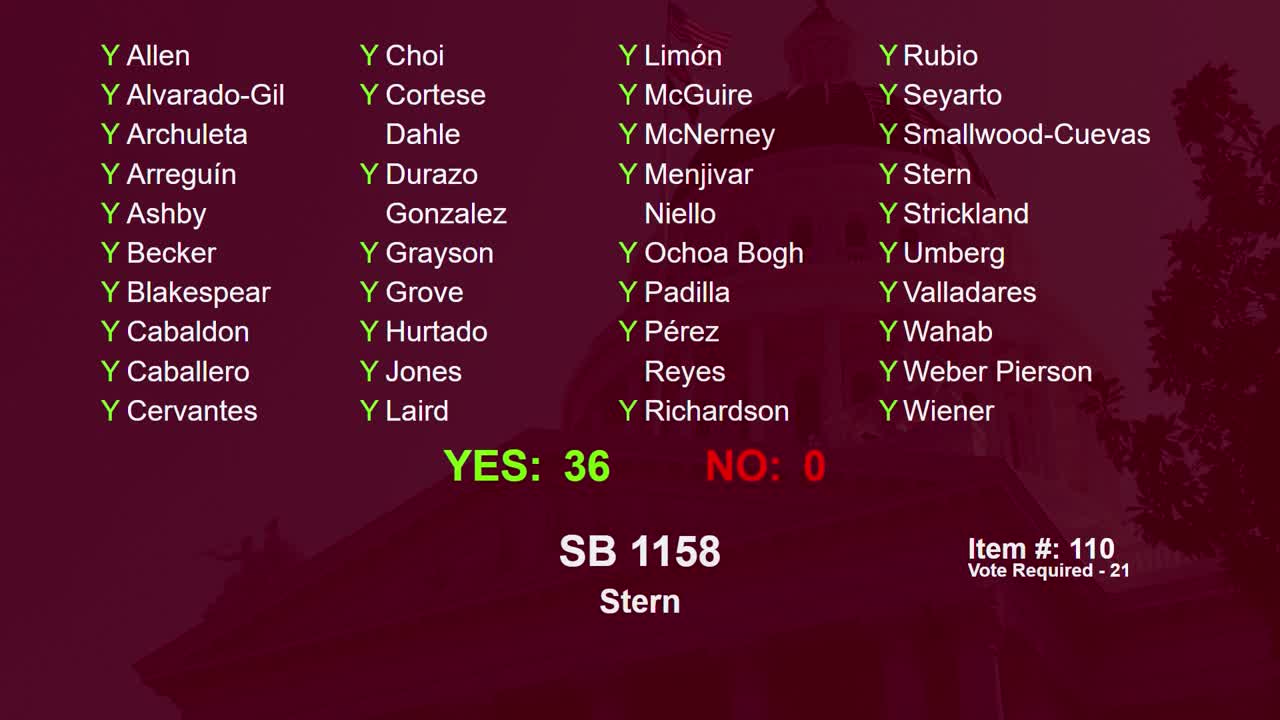 2MIN
Senate Floor
 5MIN
Senate Standing Committee on Revenue and Taxation
Bill Author

Bill Co-Author(s):