SB 1253: Salinas Reservoir: recreational use.
- Session Year: 2025-2026
- House: Senate
- Latest Version Date: 2026-08-31
Current Status:
Passed
(2026-08-31: Chaptered by Secretary of State. Chapter 177, Statutes of 2026.)
Introduced
In Committee
Awaiting First Chamber Vote
Passed First Chamber
In Committee
Awaiting Second Chamber Vote
Passed Second Chamber
Enacted
Existing law, with certain exceptions, prohibits recreational use in which there is bodily contact with water in a reservoir in which water is stored for domestic use, and establishes water standards for those exempted reservoirs.
This bill would create an exception from the above-described prohibition for recreation in which there is bodily contact with water by a participant in the Salinas Reservoir if the water subsequently receives complete water treatment in compliance with all applicable regulations of the State Water Resources Control Board before being used for domestic purposes, the San Luis Obispo County Flood Control and Water Conservation District conducts a prescribed monitoring program, and the reservoir is operated in compliance with regulations of the board. The bill would require, 2 years after approval of the changed use of the reservoir to a body contact reservoir by the boards Division of Drinking Water, and biennially thereafter, the San Luis Obispo County Flood Control and Water Conservation District to file with the Legislature and the board a report on the recreational uses at the Salinas Reservoir and the water treatment program for that reservoir, as specified. By imposing a new requirement on the San Luis Obispo County Flood Control and Water Conservation District, the bill would impose a state-mandated local program. The bill would repeal its provisions as of January 1, 2032.
This bill would make legislative findings and declarations as to the necessity of a special statute for the Salinas Reservoir.
The California Constitution requires the state to reimburse local agencies and school districts for certain costs mandated by the state. Statutory provisions establish procedures for making that reimbursement.
This bill would provide that, if the Commission on State Mandates determines that the bill contains costs mandated by the state, reimbursement for those costs shall be made pursuant to the statutory provisions noted above.
Existing law, with certain exceptions, prohibits recreational use in which there is bodily contact with water in a reservoir in which water is stored for domestic use, and establishes water standards for those exempted reservoirs.
This bill would create an exception from the above-described prohibition for recreation in which there is bodily contact with water by a participant in the Salinas Reservoir if the water subsequently receives complete water treatment in compliance with all applicable regulations of the State Water Resources Control Board before being used for domestic purposes purposes, the San Luis Obispo County Flood Control and Water Conservation District conducts a prescribed monitoring program, and the reservoir is operated in compliance with regulations of the board. The bill would require, 2 years after approval of the changed use of the reservoir to a body contact reservoir by the boards Division of Drinking Water, and biennially thereafter, the San Luis Obispo County Flood Control and Water Conservation District to file with the Legislature and the board a report on the recreational uses at the Salinas Reservoir and the water treatment program for that reservoir, as specified. By imposing a new requirement on the San Luis Obispo County Flood Control and Water Conservation District, the bill would impose a state-mandated local program. The bill would repeal its provisions as of January 1, 2032.
This bill would make legislative findings and declarations as to the necessity of a special statute for the Salinas Reservoir.
The California Constitution requires the state to reimburse local agencies and school districts for certain costs mandated by the state. Statutory provisions establish procedures for making that reimbursement.
This bill would provide that, if the Commission on State Mandates determines that the bill contains costs mandated by the state, reimbursement for those costs shall be made pursuant to the statutory provisions noted above.
Existing law, with certain exceptions, prohibits recreational use in which there is bodily contact with water in a reservoir in which water is stored for domestic use, and establishes water standards for those exempted reservoirs.
This bill would create an exception from the above-described prohibition for recreation in which there is bodily contact with water by a participant in the Salinas Reservoir if the water subsequently receives complete water treatment in compliance with all applicable regulations of the State Water Resources Control Board before being used for domestic purposes and the reservoir is operated in compliance with regulations of the board. The bill would require, 2 years after approval of the changed use of the reservoir to a body contact reservoir by the boards Division of Drinking Water, and biennially thereafter, the San Luis Obispo County Flood Control and Water Conservation District to file with the Legislature and the board a report on the recreational uses at the Salinas Reservoir and the water treatment program for that reservoir, as specified. By imposing a new requirement on the San Luis Obispo County Flood Control and Water Conservation District, the bill would impose a state-mandated local program. The bill would repeal its provisions as of January 1, 2032.
This bill would make legislative findings and declarations as to the necessity of a special statute for the Salinas Reservoir.
The California Constitution requires the state to reimburse local agencies and school districts for certain costs mandated by the state. Statutory provisions establish procedures for making that reimbursement.
This bill would provide that, if the Commission on State Mandates determines that the bill contains costs mandated by the state, reimbursement for those costs shall be made pursuant to the statutory provisions noted above.
Existing law, with certain exceptions, prohibits recreational use in which there is bodily contact with water in a reservoir in which water is stored for domestic use, and establishes water standards for those exempted reservoirs.
This bill would create an exception from the above-described prohibition for recreation in which there is bodily contact with water by a participant in the Salinas Reservoir if the water subsequently receives complete water treatment in compliance with all applicable regulations of the State Water Resources Control Board before being used for domestic purposes and the reservoir is operated in compliance with regulations of the board.
This bill would make legislative findings and declarations as to the necessity of a special statute for the Salinas Reservoir.
Existing law requires the State Department of Public Health to establish by regulation, after consultation with and approval by the California Conference of Local Health Officers, standards of education and experience for professional and technical personnel employed in local health departments and for the organization and operation of the local health departments, as specified.This bill would make technical, nonsubstantive changes to that provision.Existing law requires the State Department of Public Health to establish by regulation, after consultation with and approval by the California Conference of Local Health Officers, standards of education and experience for professional and technical personnel employed in local health departments and for the organization and operation of the local health departments, as specified.
This bill would make technical, nonsubstantive changes to that provision.
(a)In the Salinas Reservoir, recreational uses shall not include recreation in which a participant has bodily contact with the water, unless all of the following conditions are satisfied:
(1)The water subsequently receives complete water treatment, in compliance with all applicable board regulations, including oxidation, filtration, and disinfection, before being used for domestic purposes. The treatment shall, at a minimum, comply with all state laws and board regulations and all federal laws and regulations, including, but not limited to, the United States Environmental Protection Agency Long Term 2 Enhanced Surface Water Treatment Rule. This section does not limit the state or the board from imposing more stringent treatment standards than those required by federal law.
(2)The San Luis Obispo County Flood Control and Water Conservation District conducts a monitoring program for cryptosporidium, giardia, and total coliform bacteria, including E. coli and fecal coliform, at a location and frequency determined by the board, and provides the monitoring results to water suppliers directly receiving the water via infrastructure, as determined by the board, within 30 days of receiving the results.
(3)The reservoir is operated in compliance with regulations of the board.
(b)The recreational use shall be subject to additional conditions and restrictions adopted by the entity operating the water supply reservoir, or required by the board, that are required to further protect or enhance the public health and safety and do not conflict with regulations of the board.
(c)Two years after approval of the changed use of the reservoir to a body contact reservoir by the boards Division of Drinking Water, and biennially thereafter, the San Luis Obispo County Flood Control and Water Conservation District shall file, with the Legislature in accordance with Section 9795 of the Government Code and the board, a report on the recreational uses at the Salinas Reservoir and the water treatment program for that reservoir. That report shall include, but not be limited to, all of the following information:
(1)The estimated levels and types of recreational uses at the reservoir on a monthly basis.
(2)A summary of monitoring in the Salinas Reservoir watershed for cryptosporidium, giardia, and total coliform bacteria, including E. coli and fecal coliform.
(3)The most current sanitary survey of the watershed and water quality monitoring.
(4)As deemed necessary by the board, an evaluation of recommendations relating to inactivation and removal of cryptosporidium and giardia.
(5)Annual reports provided to the board as required by the water permit issued by the board.
(6)An evaluation of the impact of source water quality due to recreational activities on the Salinas Reservoir, including any microbiological monitoring.
(7)A summary of activities for operation of recreational uses and facilities in a manner that optimizes the water quality.
(8)The reservoir management plan and the operations plan.
(9)The annual water reports submitted to the consumers each year.
(d)For purposes of this section, board means the State Water Resources Control Board.
(e)This section shall remain in effect only until January 1, 2032, and as of that date is repealed.
SEC. 2.The Legislature finds and declares that a special statute is necessary and that a general statute cannot be made applicable within the meaning of Section 16 of Article IV of the California Constitution because of the unique circumstances in the Salinas Reservoir. The facts constituting the special circumstances are:
Recreational activities, including boating, fishing, hiking, biking, and other activities, take place in the several thousand acres of open space surrounding the Salinas Reservoir. The County of San Luis Obispo manages the reservoir and its untreated water. The City of San Luis Obispo will continue effective water treatment through microfiltration and disinfection.
SEC. 3.If the Commission on State Mandates determines that this act contains costs mandated by the state, reimbursement to local agencies and school districts for those costs shall be made pursuant to Part 7 (commencing with Section 17500) of Division 4 of Title 2 of the Government Code.
(a)In the Salinas Reservoir, recreational uses shall not include recreation in which a participant has bodily contact with the water, unless both all of the following conditions are satisfied:
(1)The water subsequently receives complete water treatment, in compliance with all applicable board regulations, including oxidation, filtration, and disinfection, before being used for domestic purposes. The treatment shall, at a minimum, comply with all state laws and board regulations and all federal laws and regulations, including, but not limited to, the United States Environmental Protection Agency Long Term 2 Enhanced Surface Water Treatment Rule. This section does not limit the state or the board from imposing more stringent treatment standards than those required by federal law.
(2)The San Luis Obispo County Flood Control and Water Conservation District conducts a monitoring program for cryptosporidium, giardia, and total coliform bacteria, including E. coli and fecal coliform, at a location and frequency determined by the board, and provides the monitoring results to water suppliers directly receiving the water via infrastructure, as determined by the board, within 30 days of receiving the results.
(2)(3)The reservoir is operated in compliance with regulations of the board.
(b)The recreational use shall be subject to additional conditions and restrictions adopted by the entity operating the water supply reservoir, or required by the board, that are required to further protect or enhance the public health and safety and do not conflict with regulations of the board.
(c)Two years after approval of the changed use of the reservoir to a body contact reservoir by the boards Division of Drinking Water, and biennially thereafter, the San Luis Obispo County Flood Control and Water Conservation District shall file, with the Legislature in accordance with Section 9795 of the Government Code and the board, a report on the recreational uses at the Salinas Reservoir and the water treatment program for that reservoir. That report shall include, but not be limited to, all of the following information:
(1)The estimated levels and types of recreational uses at the reservoir on a monthly basis.
(2)A summary of monitoring in the Salinas Reservoir watershed for cryptosporidium, giardia, and total coliform bacteria, including E. coli and fecal coliform.
(3)The most current sanitary survey of the watershed and water quality monitoring.
(4)As deemed necessary by the board, an evaluation of recommendations relating to inactivation and removal of cryptosporidium and giardia.
(5)Annual reports provided to the board as required by the water permit issued by the board.
(6)An evaluation of the impact of source water quality due to recreational activities on the Salinas Reservoir, including any microbiological monitoring.
(7)A summary of activities for operation of recreational uses and facilities in a manner that optimizes the water quality.
(8)The reservoir management plan and the operations plan.
(9)The annual water reports submitted to the consumers each year.
(d)For purposes of this section, board means the State Water Resources Control Board.
(e)This section shall remain in effect only until January 1, 2032, and as of that date is repealed.
SEC. 2.The Legislature finds and declares that a special statute is necessary and that a general statute cannot be made applicable within the meaning of Section 16 of Article IV of the California Constitution because of the unique circumstances in the Salinas Reservoir. The facts constituting the special circumstances are:
Recreational activities, including boating, fishing, hiking, biking, and other activities, take place in the several thousand acres of open space surrounding the Salinas Reservoir. The County of San Luis Obispo manages the reservoir and its untreated water. The City of San Luis Obispo will continue effective water treatment through microfiltration and disinfection.
SEC. 3.If the Commission on State Mandates determines that this act contains costs mandated by the state, reimbursement to local agencies and school districts for those costs shall be made pursuant to Part 7 (commencing with Section 17500) of Division 4 of Title 2 of the Government Code.
(a)In the Salinas Reservoir, recreational uses shall not include recreation in which a participant has bodily contact with the water, unless both of the following conditions are satisfied:
(1)The water subsequently receives complete water treatment, in compliance with all applicable board regulations, including oxidation, filtration, and disinfection, before being used for domestic purposes. The treatment shall, at a minimum, comply with all state laws and board regulations and all federal laws and regulations, including, but not limited to, the United States Environmental Protection Agency Long Term 2 Enhanced Surface Water Treatment Rule. This section does not limit the state or the board from imposing more stringent treatment standards than those required by federal law.
(2)The reservoir is operated in compliance with regulations of the board.
(b)The recreational use of the Salinas Reservoir shall be subject to additional conditions and restrictions adopted by the entity operating the water supply reservoir, or required by the board, that are required to further protect or enhance the public health and safety and do not conflict with regulations of the board.
(c)Two years after approval of the changed use of the reservoir to a body contact reservoir by the boards Division of Drinking Water, and biennially thereafter, the San Luis Obispo County Flood Control and Water Conservation District shall file, with the Legislature in accordance with Section 9795 of the Government Code and the board, a report on the recreational uses at the Salinas Reservoir and the water treatment program for that reservoir. That report shall include, but not be limited to, all of the following information:
(1)The estimated levels and types of recreational uses at the reservoir on a monthly basis.
(2)A summary of monitoring in the Salinas Reservoir watershed for cryptosporidium, giardia, and total coliform bacteria, including E. coli and fecal coliform.
(3)The most current sanitary survey of the watershed and water quality monitoring.
(4)As deemed necessary by the board, an evaluation of recommendations relating to inactivation and removal of cryptosporidium and giardia.
(5)Annual reports provided to the board as required by the water permit issued by the board.
(6)An evaluation of the impact of source water quality due to recreational activities on the Salinas Reservoir, including any microbiological monitoring.
(7)A summary of activities for operation of recreational uses and facilities in a manner that optimizes the water quality.
(8)The reservoir management plan and the operations plan.
(9)The annual water reports submitted to the consumers each year.
(c)(d)For purposes of this section, board means the State Water Resources Control Board.
(e)This section shall remain in effect only until January 1, 2032, and as of that date is repealed.
SEC. 2.The Legislature finds and declares that a special statute is necessary and that a general statute cannot be made applicable within the meaning of Section 16 of Article IV of the California Constitution because of the unique circumstances in the Salinas Reservoir. The facts constituting the special circumstances are:
Recreational activities, including boating, fishing, hiking, biking, and other activities, take place in the several thousand acres of open space surrounding the Salinas Reservoir. The County of San Luis Obispo manages the reservoir and its untreated water. The City of San Luis Obispo will continue effective water treatment through microfiltration and disinfection.
SEC. 3.If the Commission on State Mandates determines that this act contains costs mandated by the state, reimbursement to local agencies and school districts for those costs shall be made pursuant to Part 7 (commencing with Section 17500) of Division 4 of Title 2 of the Government Code.
(a)In the Salinas Reservoir, recreational uses shall not include recreation in which a participant has bodily contact with the water, unless both of the following conditions are satisfied:
(1)The water subsequently receives complete water treatment, in compliance with all applicable board regulations, including oxidation, filtration, and disinfection, before being used for domestic purposes. The treatment shall, at a minimum, comply with all state laws and board regulations and all federal laws and regulations, including, but not limited to, the United States Environmental Protection Agency Long Term 2 Enhanced Surface Water Treatment Rule. This section does not limit the state or the board from imposing more stringent treatment standards than those required by federal law.
(2)The reservoir is operated in compliance with regulations of the board.
(b)The recreational use of the Salinas Reservoir shall be subject to additional conditions and restrictions adopted by the entity operating the water supply reservoir, or required by the board, that are required to further protect or enhance the public health and safety and do not conflict with regulations of the board.
(c)For purposes of this section, board means the State Water Resources Control Board.
SEC. 2.The Legislature finds and declares that a special statute is necessary and that a general statute cannot be made applicable within the meaning of Section 16 of Article IV of the California Constitution because of the unique circumstances in the Salinas Reservoir. The facts constituting the special circumstances are:
Recreational activities, including boating, fishing, hiking, biking, and other activities, take place in the several thousand acres of open space surrounding the Salinas Reservoir. The County of San Luis Obispo manages the reservoir and its untreated water. The City of San Luis Obispo will continue effective water treatment through microfiltration and disinfection.
SECTION 1.Section 100295 of the Health and Safety Code is amended to read:100295.The department, after consultation with and approval by the California Conference of Local Health Officers, shall by regulation establish standards of education and experience for professional and technical personnel employed in local health departments and for the organization and operation of the local health departments. These standards may include standards for the maintenance of records of services, finances, and expenditures, that shall be reported to the director in a manner and at times as the director may specify.The department, after consultation with and approval by the California Conference of Local Health Officers, shall by regulation establish standards of education and experience for professional and technical personnel employed in local health departments and for the organization and operation of the local health departments. These standards may include standards for the maintenance of records of services, finances finances, and expenditures, that shall be reported to the director in a manner and at times as the director may specify.
|
Date
|
Status
|
|---|---|
| Aug 31, 2026 | Chaptered by Secretary of State. Chapter 177, Statutes of 2026. |
| Aug 31, 2026 | Approved by the Governor. |
| Aug 21, 2026 | Enrolled and presented to the Governor at 3 p.m. |
| Aug 17, 2026 | Assembly amendments concurred in. (Ayes 40. Noes 0. Page 5488.) Ordered to engrossing and enrolling. |
| Aug 17, 2026 | Assembly amendments concurred in. (Ayes 40. Noes 0.) Ordered to engrossing and enrolling. |
| Aug 17, 2026 | Assembly amendments concurred in. (Ayes 39. Noes 0.) Ordered to engrossing and enrolling. |
| Aug 13, 2026 | In Senate. Concurrence in Assembly amendments pending. |
| Aug 13, 2026 | Read third time. Passed. (Ayes 72. Noes 0. Page 6158.) Ordered to the Senate. |
| Aug 13, 2026 | Read third time. Passed. Ordered to the Senate. |
| Aug 6, 2026 | Read second time. Ordered to consent calendar. |
| Aug 5, 2026 | From committee: Do pass. Ordered to consent calendar. (Ayes 15. Noes 0.) (August 5). |
| Jun 30, 2026 | From committee: Do pass and re-refer to Com. on APPR. with recommendation: To consent calendar. (Ayes 11. Noes 0.) (June 30). Re-referred to Com. on APPR. |
| Jun 17, 2026 | From committee: Do pass and re-refer to Com. on W., P., & W. with recommendation: To consent calendar. (Ayes 6. Noes 0.) (June 16). Re-referred to Com. on W., P., & W. |
| Jun 10, 2026 | From committee with author's amendments. Read second time and amended. Re-referred to Com. on E.S & T.M. |
| May 26, 2026 | Referred to Coms. on E.S & T.M. and W., P., & W. |
| May 14, 2026 | In Assembly. Read first time. Held at Desk. |
| May 14, 2026 | Read third time. Passed. (Ayes 35. Noes 0. Page 4214.) Ordered to the Assembly. |
| May 14, 2026 | Read third time. Passed. (Ayes 35. Noes 0.) Ordered to the Assembly. |
| May 12, 2026 | Read second time. Ordered to consent calendar. |
| May 11, 2026 | From committee: Be ordered to second reading pursuant to Senate Rule 28.8 and ordered to consent calendar. |
| May 4, 2026 | Set for hearing May 11. |
| Apr 27, 2026 | Read second time and amended. Re-referred to Com. on APPR. |
| Apr 23, 2026 | From committee: Do pass as amended and re-refer to Com. on APPR. with recommendation: To consent calendar. (Ayes 7. Noes 0. Page 4009.) (April 22). |
| Apr 23, 2026 | From committee: Do pass as amended and re-refer to Com. on APPR. with recommendation: To consent calendar. (Ayes 7. Noes 0.) (April 22). |
| Apr 17, 2026 | Set for hearing April 22. |
| Apr 14, 2026 | From committee: Do pass and re-refer to Com. on E.Q. with recommendation: To consent calendar. (Ayes 7. Noes 0. Page 3870.) (April 14). Re-referred to Com. on E.Q. |
| Apr 14, 2026 | From committee: Do pass and re-refer to Com. on E.Q. with recommendation: To consent calendar. (Ayes 7. Noes 0.) (April 14). Re-referred to Com. on E.Q. |
| Apr 10, 2026 | Set for hearing April 14. |
| Apr 8, 2026 | Re-referred to Coms. on N.R. & W. and E.Q. |
| Apr 8, 2026 | Withdrawn from committee. |
| Apr 8, 2026 | Re-referred to Coms. on E.Q. and N.R. & W. |
| Mar 23, 2026 | From committee with author's amendments. Read second time and amended. Re-referred to Com. on RLS. |
| Mar 4, 2026 | Referred to Com. on RLS. |
| Feb 20, 2026 | From printer. May be acted upon on or after March 22. |
| Feb 19, 2026 | Introduced. Read first time. To Com. on RLS. for assignment. To print. |
|
Date
|
Description
|
Location
|
Votes
|
|
|---|---|---|---|---|
| Aug 17, 2026 | Unfinished Business SB1253 Laird Concurrence | Senate Floor |
Passed |
|
| Aug 13, 2026 | SB 1253 Laird Consent Calendar Second Day Regular Session | Assembly Floor |
Passed |
|
| Aug 5, 2026 | Do pass. To Consent Calendar. | Assembly Standing Committee on Appropriations |
Passed |
|
| Jun 30, 2026 | Do pass and be re-referred to the Committee on [Appropriations] with recommendation: To Consent Calendar | Assembly Standing Committee on Water, Parks, and Wildlife |
Passed |
|
| Jun 16, 2026 | Do pass and be re-referred to the Committee on [Water, Parks, and Wildlife] with recommendation: To Consent Calendar | Assembly Standing Committee on Environmental Safety and Toxic Materials |
Passed |
|
| May 14, 2026 | Consent Calendar 2nd SB1253 Laird | Senate Floor |
Passed |
|
| Apr 22, 2026 | Do pass as amended, but first amend, and re-refer to the Committee on [Appropriations] with the recommendation: To Consent Calendar | Senate Standing Committee on Environmental Quality |
Passed |
|
| Apr 14, 2026 | Do pass, but first be re-referred to the Committee on [Environmental Quality] with the recommendation: To Consent Calendar | Senate Standing Committee on Natural Resources and Water |
Passed |
This list shows positions taken on this bill by organizations on the date displayed, which is linked to the original source.
Positions by individuals are not included.
|
Organization
|
Position
|
Date
|
|---|---|---|
| City of San Luis Obispo | ** Support | |
| County of San Luis Obispo | ** Support | |
| County of SLO | ** Support |
1253 SENATE RULES COMMITTEE Office of Senate Floor Analyses (916) 651-4171 | SB 1253 |
UNFINISHED BUSINESS
Bill No: SB 1253
Author: Laird (D)
Amended: 6/10/26
Vote: 21
SENATE NATURAL RES. & WATER COMMITTEE: 7-0, 4/14/26
AYES: Becker, Seyarto, Allen, Cabaldon, Cortese, Grove, Stern
SENATE ENVIRONMENTAL QUALITY COMMITTEE: 7-0, 4/22/26
AYES: Blakespear, Valladares, Allen, Dahle, Gonzalez, Hurtado, Menjivar
SENATE APPROPRIATIONS COMMITTEE: Senate Rule 28.8
SENATE FLOOR: 35-0, 5/14/26 (Consent)
AYES: Allen, Alvarado-Gil, Archuleta, Arreguín, Ashby, Becker, Cabaldon, Caballero, Cervantes, Choi, Cortese, Dahle, Durazo, Gonzalez, Grayson, Grove, Hurtado, Jones, Laird, Limón, McGuire, McNerney, Menjivar, Ochoa Bogh, Padilla, Richardson, Rubio, Seyarto, Smallwood-Cuevas, Stern, Strickland, Valladares, Wahab, Weber Pierson, Wiener
NO VOTE RECORDED: Blakespear, Niello, Pérez, Reyes, Umberg
ASSEMBLY FLOOR: 72-0, 8/13/26 (Consent) - See last page for vote
SUBJECT: Salinas Reservoir: recreational use
SOURCE: Author
DIGEST:
This bill exempts the Salinas Reservoir from the general prohibition against bodily contact with water stored in a reservoir for domestic use if three conditions are met.
Assembly Amendments
require the San Luis Obispo County Flood Control and Water Conservation District (SLO District) to conduct a monitoring program for cryptosporidium, giardia, and total coliform bacteria, including E. coli and fecal coliform and provide the results to water suppliers.
ANALYSIS:
Existing law:
1) Establishes as state policy that all public waters should be used for multiple purposes if the uses are consistent with public health and public safety.
2) Prohibits reservoirs that store water for domestic use from allowing recreation where there is bodily contact with the water, though there are several statutory exemptions to this law. Statutory exemptions have been provided in various instances, including exemptions for San Diego County, Modesto Reservoir, Nacimiento Reservoir, Sly Park Reservoir, Canyon Lake Reservoir, and Bear Lake Reservoir.
3) Requires all public agency water supply reservoirs to be open for recreational use, subject to regulations of the State Water Resources Control Board (SWRCB).
4) Authorizes a public agency operating any water supply reservoir that is open for recreation use to charge a use fee to cover the costs of policing the area around the reservoir.
This bill:
- Prohibits recreation in which a participant has bodily contact with the water in the Salinas Reservoir, unless:
- The water subsequently receives complete water treatment;
- The reservoir is operated in compliance with SWRCB regulations; and
- The SLO District conducts a monitoring program for cryptosporidium, giardia, and total coliform bacteria, including E. coli and fecal coliform and provides the results to water suppliers within 30 days of receiving the results.
- Subjects recreational use of the Salinas Reservoir to additional conditions and restrictions adopted by the entity operating the reservoir or required by the SWRCB to protect or enhance public health and safety.
- Requires the SLO District to file a report on the recreational uses at the Salinas Reservoir and the water treatment program for that reservoir two years after the changed use of the reservoir to a body contract reservoir is approved and every two years thereafter.
- Repeals this exemption on January 1, 2032.
- Declares the need for a special statute for the Salinas Reservoir.
Background
Salinas Reservoir. The Salinas Dam was built in 1941 by the U.S. Army as a water conservation project to supply water to Camp San Luis Obispo and the City of San Luis Obispo. The construction of the dam formed the Salinas Reservoir (also known as Santa Margarita Lake). The Salinas Reservoir is located about 9 miles southeast of the Santa Margarita community in San Luis Obispo County, near the headwaters of the Salinas River. It captures water from a 112 square mile watershed and can store up to 22,320 acre-feet of water. Both the Salinas Dam and its delivery system were subsequently transferred from the U.S. Army to the U.S. Army Corps of Engineers (US ACE).
In 1947, the US ACE entered into an agreement with the SLO District to operate and maintain the dam, its reservoir, and related facilities. The SLO District operates the reservoir for the City of San Luis Obispo through the County Public Works Department under a lease from US ACE. According to San Luis Obispo County’s website, the Salinas Reservoir serves as one of the City of San Luis Obispo’s primary water supply sources.
Recreation facilities at Salinas Reservoir are operated by San Luis Obispo County as a county park with opportunities for boating, fishing, picnicking, and camping. No bodily contact (swimming, waterskiing, etc.) is allowed in the lake because it is a domestic water supply reservoir. While swimming is not allowed in the Salinas Reservoir, there is a swimming pool that is open on a limited schedule.
According to its website, the Salinas Reservoir is known for its excellent fishing and peaceful boating atmosphere. San Luis Obispo County Parks conducts mandatory boat inspections at the reservoir to prevent the spread of Quagga, Zebra, and Golden Mussels and other invasive species, and, earlier this year, started requiring a 30-day quarantine for boats with internal ballasts or ballast bags (e.g. wakeboard and ski boats). There are individual picnic sites with shade, ample seating, larger barbecues, and other amenities throughout the park. The park also has a range of hiking and riding trails that offer views of the lake and surrounding mountains.
According to the reservoir’s Water Quality Monitoring Report for Water Year 2024 (October 2023 – September 2024), prepared by San Luis Obispo County’s Department of Public Works Water Quality Division, “water quality parameters were typical of historical data throughout the reservoir, with no significant anomalies observed.”
Bodily contact with water in California reservoirs. The Health & Safety Code requires all public waters to be used for multiple purposes, as long as the uses are consistent with public health and safety. To this end, existing law prohibits recreational uses in which the participant has bodily contact with water in a reservoir in which water is stored for domestic use. Bodily contact with domestic water supplies can be a source of fecal pathogens and other contaminants that, if not treated, can be a serious threat to public health.
Existing law does provide exemptions from this bodily contact prohibition, however, for all reservoirs in San Diego County, the Nacimiento Reservoir, the Modesto Reservoir, the Sly Park Reservoir, the Canyon Lake Reservoir, and the Bear Lake Reservoir. In each of these cases, the exemptions come with detailed health and safety requirements that must be adhered to, including monitoring and treatment requirements.
In all cases, the water system operating the reservoir and providing treatment to the drinking water are responsible (and have accepted responsibility) for ensuring drinking water meets drinking water standards and public health is protected.
Comments
Need for the bill. According to the author, “The Salinas Reservoir, which forms Santa Margarita Lake, serves as a vital drinking water source for the City of San Luis Obispo. While bodily contact was historically restricted, modern advancements in water treatment and monitoring now allow for these activities to be conducted safely. Certain recreation access is already allowed, such as boating, kayaking, rowing, and more. SB 1253 permits recreational activities involving body contact with water, subject to rigorous water quality protocols and advanced treatment requirements to protect the public water supply.”
Water quality monitoring at the reservoir. San Luis Obispo County is already required to evaluate existing water quality conditions, identify any water quality problems, and establish an appropriate monitoring program to include chemical, limnological, and bacteriological parameters. The monitoring program was established using the guidelines published by the Central Coast Regional Water Quality Control Board in the Water Quality Control Plan for the Central Coast Basin Plan. Water quality monitoring is conducted by the County’s Water Quality Laboratory and Water Treatment Operators.
The County has established a routine sampling schedule for organic, inorganic, general mineral, lake nutrients, bacteriological, and physical analyses at the Salinas Reservoir, its tributaries, and reservoir releases. Different parameters are sampled at different frequencies. Parameters such as iron, manganese, algae, odor, and turbidity are sampled monthly, and other parameters such as coliform bacteria (total and E. coli), nitrate, and phosphate are analyzed quarterly.
Drinking water systems with surface water sources must comply with the Long-Term 2 Enhanced Surface Water Treatment Rule, which is designed to reduce the risk of disease caused by Cryptosporidium and other microorganisms, which are associated with bodily contact. The U.S. Environmental Protection Agency estimates that full compliance with this rule will reduce the incidence of illness associated with these microorganisms by 89,000 to approximately 1.4 million cases per year. The rule requires that the permitted community water system, which is the City of San Luis Obispo in this case, collect samples for E. coli or Cryptosporidium. The County conducts bacteriological analyses of coliform to evaluate general water quality.
FISCAL EFFECT: Appropriation: No Fiscal Com.: Yes Local: Yes
SUPPORT: (Verified 8/13/26)
None received
OPPOSITION: (Verified 8/13/26)
None received
ASSEMBLY FLOOR: 72-0, 8/13/26
AYES: Addis, Aguiar-Curry, Ahrens, Alanis, Arambula, Ávila Farías, Bains, Bauer-Kahan, Bennett, Boerner, Bryan, Calderon, Caloza, Carrillo, Castillo, Chen, Connolly, Davies, DeMaio, Dixon, Elhawary, Ellis, Fong, Gabriel, Garcia, Gipson, Jeff Gonzalez, Mark González, Hadwick, Haney, Harabedian, Hart, Hoover, Irwin, Jackson, Johnson, Kalra, Krell, Lackey, Lee, Lowenthal, Macedo, McKinnor, Muratsuchi, Nguyen, Ortega, Pacheco, Papan, Patel, Patterson, Pellerin, Quirk-Silva, Ramos, Ransom, Michelle Rodriguez, Rogers, Blanca Rubio, Sanchez, Schiavo, Sharp-Collins, Solache, Soria, Stefani, Ta, Tangipa, Valencia, Wallis, Ward, Wicks, Wilson, Zbur, Rivas
NO VOTE RECORDED: Alvarez, Berman, Bonta, Flora, Petrie-Norris, Celeste Rodriguez, Schultz
Prepared by: Evan Goldberg/ N.R. & W. / (916) 651-4116
10/29/26 9:35:13
**** END ****
1253 SENATE RULES COMMITTEE Office of Senate Floor Analyses (916) 651-4171 | SB 1253 |
UNFINISHED BUSINESS
Bill No: SB 1253
Author: Laird (D)
Amended: 6/10/26
Vote: 21
SENATE NATURAL RES. & WATER COMMITTEE: 7-0, 4/14/26
AYES: Becker, Seyarto, Allen, Cabaldon, Cortese, Grove, Stern
SENATE ENVIRONMENTAL QUALITY COMMITTEE: 7-0, 4/22/26
AYES: Blakespear, Valladares, Allen, Dahle, Gonzalez, Hurtado, Menjivar
SENATE APPROPRIATIONS COMMITTEE: Senate Rule 28.8
SENATE FLOOR: 35-0, 5/14/26 (Consent)
AYES: Allen, Alvarado-Gil, Archuleta, Arreguín, Ashby, Becker, Cabaldon, Caballero, Cervantes, Choi, Cortese, Dahle, Durazo, Gonzalez, Grayson, Grove, Hurtado, Jones, Laird, Limón, McGuire, McNerney, Menjivar, Ochoa Bogh, Padilla, Richardson, Rubio, Seyarto, Smallwood-Cuevas, Stern, Strickland, Valladares, Wahab, Weber Pierson, Wiener
NO VOTE RECORDED: Blakespear, Niello, Pérez, Reyes, Umberg
ASSEMBLY FLOOR: 72-0, 8/13/26 (Consent) - See last page for vote
SUBJECT: Salinas Reservoir: recreational use
SOURCE: Author
DIGEST:
Exempts the Salinas Reservoir from the general prohibition against bodily contact with water stored in a reservoir for domestic use if three conditions are met
Assembly Amendments
require the San Luis Obispo County Flood Control and Water Conservation District (SLO District) to conduct a monitoring program for cryptosporidium, giardia, and total coliform bacteria, including E. coli and fecal coliform and provide the results to water suppliers.
ANALYSIS:
Existing law:
1) Establishes as state policy that all public waters should be used for multiple purposes if the uses are consistent with public health and public safety.
2) Prohibits reservoirs that store water for domestic use from allowing recreation where there is bodily contact with the water, though there are several statutory exemptions to this law. Statutory exemptions have been provided in various instances, including exemptions for San Diego County, Modesto Reservoir, Nacimiento Reservoir, Sly Park Reservoir, Canyon Lake Reservoir, and Bear Lake Reservoir.
3) Requires all public agency water supply reservoirs to be open for recreational use, subject to regulations of the State Water Resources Control Board (SWRCB).
4) Authorizes a public agency operating any water supply reservoir that is open for recreation use to charge a use fee to cover the costs of policing the area around the reservoir.
This bill:
- Prohibits recreation in which a participant has bodily contact with the water in the Salinas Reservoir, unless:
- The water subsequently receives complete water treatment;
- The reservoir is operated in compliance with SWRCB regulations; and
- The SLO District conducts a monitoring program for cryptosporidium, giardia, and total coliform bacteria, including E. coli and fecal coliform and provides the results to water suppliers within 30 days of receiving the results.
- Subjects recreational use of the Salinas Reservoir to additional conditions and restrictions adopted by the entity operating the reservoir or required by the SWRCB to protect or enhance public health and safety.
- Requires the SLO District to file a report on the recreational uses at the Salinas Reservoir and the water treatment program for that reservoir two years after the changed use of the reservoir to a body contract reservoir is approved and every two years thereafter.
- Repeals this exemption on January 1, 2032.
- Declares the need for a special statute for the Salinas Reservoir.
Background
Salinas Reservoir. The Salinas Dam was built in 1941 by the U.S. Army as a water conservation project to supply water to Camp San Luis Obispo and the City of San Luis Obispo. The construction of the dam formed the Salinas Reservoir (also known as Santa Margarita Lake). The Salinas Reservoir is located about 9 miles southeast of the Santa Margarita community in San Luis Obispo County, near the headwaters of the Salinas River. It captures water from a 112 square mile watershed and can store up to 22,320 acre-feet of water. Both the Salinas Dam and its delivery system were subsequently transferred from the U.S. Army to the U.S. Army Corps of Engineers (US ACE).
In 1947, the US ACE entered into an agreement with the SLO District to operate and maintain the dam, its reservoir, and related facilities. The SLO District operates the reservoir for the City of San Luis Obispo through the County Public Works Department under a lease from US ACE. According to San Luis Obispo County’s website, the Salinas Reservoir serves as one of the City of San Luis Obispo’s primary water supply sources.
Recreation facilities at Salinas Reservoir are operated by San Luis Obispo County as a county park with opportunities for boating, fishing, picnicking, and camping. No bodily contact (swimming, waterskiing, etc.) is allowed in the lake because it is a domestic water supply reservoir. While swimming is not allowed in the Salinas Reservoir, there is a swimming pool that is open on a limited schedule.
According to its website, the Salinas Reservoir is known for its excellent fishing and peaceful boating atmosphere. San Luis Obispo County Parks conducts mandatory boat inspections at the reservoir to prevent the spread of Quagga, Zebra, and Golden Mussels and other invasive species, and, earlier this year, started requiring a 30-day quarantine for boats with internal ballasts or ballast bags (e.g. wakeboard and ski boats). There are individual picnic sites with shade, ample seating, larger barbecues, and other amenities throughout the park. The park also has a range of hiking and riding trails that offer views of the lake and surrounding mountains.
According to the reservoir’s Water Quality Monitoring Report for Water Year 2024 (October 2023 – September 2024), prepared by San Luis Obispo County’s Department of Public Works Water Quality Division, “water quality parameters were typical of historical data throughout the reservoir, with no significant anomalies observed.”
Bodily contact with water in California reservoirs. The Health & Safety Code requires all public waters to be used for multiple purposes, as long as the uses are consistent with public health and safety. To this end, existing law prohibits recreational uses in which the participant has bodily contact with water in a reservoir in which water is stored for domestic use. Bodily contact with domestic water supplies can be a source of fecal pathogens and other contaminants that, if not treated, can be a serious threat to public health.
Existing law does provide exemptions from this bodily contact prohibition, however, for all reservoirs in San Diego County, the Nacimiento Reservoir, the Modesto Reservoir, the Sly Park Reservoir, the Canyon Lake Reservoir, and the Bear Lake Reservoir. In each of these cases, the exemptions come with detailed health and safety requirements that must be adhered to, including monitoring and treatment requirements.
In all cases, the water system operating the reservoir and providing treatment to the drinking water are responsible (and have accepted responsibility) for ensuring drinking water meets drinking water standards and public health is protected.
Comments
Need for the bill. According to the author, “The Salinas Reservoir, which forms Santa Margarita Lake, serves as a vital drinking water source for the City of San Luis Obispo. While bodily contact was historically restricted, modern advancements in water treatment and monitoring now allow for these activities to be conducted safely. Certain recreation access is already allowed, such as boating, kayaking, rowing, and more. SB 1253 permits recreational activities involving body contact with water, subject to rigorous water quality protocols and advanced treatment requirements to protect the public water supply.”
Water quality monitoring at the reservoir. San Luis Obispo County is already required to evaluate existing water quality conditions, identify any water quality problems, and establish an appropriate monitoring program to include chemical, limnological, and bacteriological parameters. The monitoring program was established using the guidelines published by the Central Coast Regional Water Quality Control Board in the Water Quality Control Plan for the Central Coast Basin Plan. Water quality monitoring is conducted by the County’s Water Quality Laboratory and Water Treatment Operators.
The County has established a routine sampling schedule for organic, inorganic, general mineral, lake nutrients, bacteriological, and physical analyses at the Salinas Reservoir, its tributaries, and reservoir releases. Different parameters are sampled at different frequencies. Parameters such as iron, manganese, algae, odor, and turbidity are sampled monthly, and other parameters such as coliform bacteria (total and E. coli), nitrate, and phosphate are analyzed quarterly.
Drinking water systems with surface water sources must comply with the Long-Term 2 Enhanced Surface Water Treatment Rule, which is designed to reduce the risk of disease caused by Cryptosporidium and other microorganisms, which are associated with bodily contact. The U.S. Environmental Protection Agency estimates that full compliance with this rule will reduce the incidence of illness associated with these microorganisms by 89,000 to approximately 1.4 million cases per year. The rule requires that the permitted community water system, which is the City of San Luis Obispo in this case, collect samples for E. coli or Cryptosporidium. The County conducts bacteriological analyses of coliform to evaluate general water quality.
FISCAL EFFECT: Appropriation: No Fiscal Com.: Yes Local: Yes
SUPPORT: (Verified 8/13/26)
None received
OPPOSITION: (Verified 8/13/26)
None received
ASSEMBLY FLOOR: 72-0, 8/13/26
AYES: Addis, Aguiar-Curry, Ahrens, Alanis, Arambula, Ávila Farías, Bains, Bauer-Kahan, Bennett, Boerner, Bryan, Calderon, Caloza, Carrillo, Castillo, Chen, Connolly, Davies, DeMaio, Dixon, Elhawary, Ellis, Fong, Gabriel, Garcia, Gipson, Jeff Gonzalez, Mark González, Hadwick, Haney, Harabedian, Hart, Hoover, Irwin, Jackson, Johnson, Kalra, Krell, Lackey, Lee, Lowenthal, Macedo, McKinnor, Muratsuchi, Nguyen, Ortega, Pacheco, Papan, Patel, Patterson, Pellerin, Quirk-Silva, Ramos, Ransom, Michelle Rodriguez, Rogers, Blanca Rubio, Sanchez, Schiavo, Sharp-Collins, Solache, Soria, Stefani, Ta, Tangipa, Valencia, Wallis, Ward, Wicks, Wilson, Zbur, Rivas
NO VOTE RECORDED: Alvarez, Berman, Bonta, Flora, Petrie-Norris, Celeste Rodriguez, Schultz
Prepared by: Evan Goldberg/ N.R. & W. / (916) 651-4116
8/14/26 17:04:27
**** END ****
Date of Hearing: August 5, 2026
ASSEMBLY COMMITTEE ON APPROPRIATIONS
Buffy Wicks, Chair
SBPCA Bill Id:SB 1253
Author:(Laird) – As Amended Ver:June 10, 2026
Policy Committee: | Environmental Safety and Toxic Materials | Vote: | 6 - 0 |
Water, Parks and Wildlife | 11 - 0 | ||
|
|
Urgency: No State Mandated Local Program: Yes Reimbursable: No
SUMMARY:
This bill authorizes recreational activities that involve bodily contact with water in the Salinas Reservoir if the water in the reservoir is subsequently treated to specified standards, water quality monitoring is in place, and other conditions are met.
Specifically, this bill, among other things:
- Permits recreational uses that involve bodily contact with the water in the Salinas Reservoir (also referred to as Santa Margarita Lake) if the following conditions are satisfied:
- The water subsequently receives complete water treatment, in compliance with all applicable State Water Resources Control Board (State Water Board) regulations, before being used for domestic purposes, as specified.
- The San Luis Obispo County (SLO) Flood Control and Water Conservation District (SLO District) conducts a monitoring program for cryptosporidium, giardia, and total coliform bacteria at a location and frequency determined by the State Water Board, and provides the monitoring results to water suppliers directly receiving the water via infrastructure within 30 days of receiving the results.
- The reservoir is operated in compliance with State Water Board regulations.
- Subjects recreational use at the Salinas Reservoir to additional conditions and restrictions adopted by the entity operating the reservoir, or required by the State Water Board, that are required to further protect or enhance public health and safety and that do not conflict with State Water Board regulations.
- Requires the SLO District to report to the Legislature and the State Water Board two years after the approval of the changed use of the Salinas Reservoir to a body contact reservoir, and every two years thereafter, on the recreational uses at the Salinas Reservoir and the water treatment program for that reservoir, as specified.
- Sunsets on January 1, 2032.
FISCAL EFFECT:
1) The State Water Board anticipates minor and absorbable costs.
2) By imposing new requirements on the SLO District, the bill imposes a state-mandated local program. However, Article XIII B Section 6(a) of the California Constitution provides that the Legislature may, but need not, provide a subvention of funds to reimburse a local government for a legislative mandate requested by the local agency affected. This bill is sponsored by the County of SLO, and the SLO District is a dependent district of the county. Therefore, any costs incurred by the county or the SLO District are not required to be reimbursed by the state.
COMMENTS:
1) Purpose. According to the author:
The Salinas Reservoir, which forms Santa Margarita Lake, serves as a vital drinking water source for the City of San Luis Obispo. While bodily contact was historically restricted, modern advancements in water treatment and monitoring now allow for these activities to be conducted safely. Certain recreation access is already allowed, such as boating, kayaking, rowing, and more. SB 1253 permits recreational activities involving body contact with water, subject to rigorous water quality protocols and advanced treatment requirements to protect the public water supply.
2) Background. State law generally prohibits recreational uses involving bodily contact with a reservoir that stores water for domestic use. Bodily contact with domestic water supplies can be a source of fecal pathogens and other contaminants that, if not treated, can pose serious threats to public health. However, state law provides exemptions from this prohibition for specific bodies of water throughout the state.
For each exemption, statute delineates health and safety requirements, including monitoring and treatment requirements, that must be met for the exemption to remain in effect. In all cases, the water systems operating the reservoir and providing drinking water treatment are responsible for ensuring the protection of public health and compliance with drinking water standards.
According to SLO County, the sponsor of this bill, the Salinas Reservoir (or Santa Margarita Lake) is a vital regional resource that supports recreation, tourism, and quality of life for residents and visitors alike. Currently, no bodily contact (such as swimming and waterskiing) is allowed in the Salinas Reservoir because it serves as one of the City of SLO’s primary water supply sources for its roughly 16,000 connections. The County of SLO monitors water quality at the reservoir on a weekly basis and the City of SLO regularly monitors water quality of the raw water it receives from the Salinas Reservoir at its treatment plant.
This bill exempts the Salinas Reservoir from the bodily contact prohibition as long as specified water treatment, monitoring, and reporting requirements designed to protect public health and drinking water safety are met. This approach is consistent with exemptions established over the last 30 years for other reservoirs, including the Bear Lake Reservoir, which is subject to very similar requirements to those established by this bill.
Analysis Prepared by: Nikita Koraddi / APPR. / (916) 319-2081
Date of Hearing: June 30, 2026
ASSEMBLY COMMITTEE ON WATER, PARKS, AND WILDLIFE
Diane Papan, Chair
SBPCA Bill Id:SB 1253
Author:(Laird) – As Amended Ver:June 10, 2026
SENATE VOTE: 35-0
SUBJECT: Salinas Reservoir: recreational use
SUMMARY: Authorizes recreational activities that involve bodily contact with water at the Salinas Reservoir (also called Santa Margarita Lake) if the water in the reservoir is subsequently treated to specified standards, water quality monitoring is in place, and other conditions are met. Specifically, this bill:
- Permits recreational activities that involve bodily contact with the water at the Salinas Reservoir if the following conditions are met:
- The water subsequently receives complete water treatment, including oxidation, filtration, and disinfection, before being used for domestic purposes;
- The San Luis Obispo County Flood Control and Water Conservation District (SLO District) conducts a monitoring program for Cryptosporidium, Giardia, and total coliform bacteria at a location and frequency determined by the State Water Resources Control Board (State Water Board), and provides the monitoring results to water suppliers directly receiving the water via infrastructure within 30 days of receiving the results; and
- Reservoir operations comply with the regulations of the State Water Board.
- Provides recreational use at the Salinas Reservoir shall be subject to additional conditions and restrictions adopted by the entity operating the reservoir or the State Water Board that are required to protect and enhance public safety and do not conflict with regulations of the State Water Board.
- Requires SLO District to report to the Legislature two years after the approval of the changed use of the Salinas Reservoir to a body contact reservoir, and every two years thereafter, on the recreational uses at the Salinas Reservoir and the water treatment program. The report shall include the following information:
- The estimated levels and types of recreational uses at the reservoir on a monthly basis;
- A summary of monitoring in the Salinas Reservoir watershed for Cryptosporidium, Giardia, and total coliform bacteria, including Escherichia coli (E. coli) and fecal coliform;
- The most current sanitary survey of the watershed and water quality monitoring;
- As deemed necessary by the State Water Board, an evaluation of recommendations relating to inactivation and removal of Cryptosporidium and Giardia;
- Annual reports provided to the State Water Board as required by the water permit issued by the State Water Board;
- An evaluation of the impact of source water quality due to recreational activities on the Salinas Reservoir, including any microbiological monitoring;
- A summary of activities for operation of recreational uses and facilities in a manner that optimizes the water quality;
- The reservoir management plan and the operations plan; and
- The annual water reports submitted to the consumers each year.
- Sunsets the permission for recreational activities that involve bodily contact with the water at the Salinas Reservoir on January 1, 2032.
- Declares that a special statute is necessary to address the Salinas Reservoir because recreational activities, including boating, fishing, hiking, biking, and other activities, take place in the several thousand acres of open space surrounding the Salinas Reservoir. The County of San Luis Obispo manages the reservoir and its untreated water. The City of San Luis Obispo will continue effective water treatment through microfiltration and disinfection.
EXISTING LAW:
- Declares it to be policy of the state that multiple uses should be made of all public water, to the extent that multiple use is consistent with public health and safety [Health and Safety Code (HSC) § 115825(a)].
- Prohibits, for reservoirs in which water is stored for domestic use, recreational uses from including bodily contact with the water by any participant, except as provided under state law [HSC § 115825(b)].
- Specifies—for Modesto, Nacimiento, Sly Park, Canyon Lake, and Bear Lake Reservoirs, and reservoirs located in San Diego County—conditions under which recreational uses may include bodily contact with the water (HSC § 115840, et seq.).
FISCAL EFFECT: Unknown. This bill is keyed fiscal.
COMMENTS:
- Purpose of this bill. This bill authorizes swimming and expanded recreation at Salinas Reservoir in San Luis Obispo County under sanitation and monitoring requirements to ensure continued compliance with water quality standards. According to the author, “the Salinas Reservoir, which forms Santa Margarita Lake, serves as a vital drinking water source for the City of San Luis Obispo. While bodily contact was historically restricted, modern advancements in water treatment and monitoring now allow for these activities to be conducted safely. Certain recreation access is already allowed, such as boating, kayaking, rowing, and more. [This bill] permits recreational activities involving body contact with water, subject to rigorous water quality protocols and advanced treatment requirements to protect the public water supply.”
- Background. State law generally prohibits recreational uses involving bodily contact with water at reservoirs that supply water for domestic use. This is because bodily contact with domestic water supplies can be a source of fecal pathogens and other contaminants that, if not treated, can pose serious threats to public health. However, there are many exceptions from this prohibition for specific bodies of water throughout the state, including all reservoirs in San Diego County and the Nacimiento, Modesto, Sly Park, Canyon Lake, and Bear Lake reservoirs.
For each exemption, state law delineates health and safety requirements, including monitoring and treatment requirements, that must be met in order for the exemption to remain in effect. In all cases, the water systems operating the reservoir and providing drinking water treatment are responsible for ensuring the protection of public health and compliance with drinking water standards.
Salinas Dam. The Salinas Reservoir (also known as Santa Margarita Lake) is located on the upper Salinas River, approximately nine miles southeast of the community of Santa Margarita. The project was originally built by the War Department in 1941 to ensure an adequate water supply for Camp San Luis Obispo, as well as the City of San Luis Obispo. The dam and appurtenances were declared surplus by the War Department on April 14, 1947 and the U.S. Army Corps of Engineers (Corps) assumed responsibility for the facilities. On July 11, 1947, the Corps entered into an agreement with SLO District for the operation and maintenance of the dam and related facilities. The City of San Luis Obispo has an agreement with the Corps for use of the reservoir, as well as a water rights permit to divert water from the Salinas River for storage within the reservoir.
Currently, no bodily contact (swimming, waterskiing, etc.) is allowed in Salinas Reservoir because it serves as one of the City of San Luis Obispo’s primary water supply sources for its roughly 16,000 connections. Whale Rock and Nacimiento Reservoirs are the other major sources of water supply for the city and bodily contact with the water in Nacimiento Reservoir is permitted. Raw water flows from the Salinas Reservoir to the City of San Luis Obispo’s water treatment plant (Stenner Creek Water Treatment Plant) where it is treated to drinking water standards using ozone as the primary disinfectant. The County of San Luis Obispo monitors water quality at the reservoir on a weekly basis and the City of San Luis Obispo regularly monitors water quality of the raw water it receives from the Salinas Reservoir at its treatment plant.
The County of San Luis Obispo manages the Salinas Reservoir/Santa Margarita Lake and the recreational amenities surrounding the reservoir as a regional park with opportunities for boating, fishing, picnicking, and camping. Beyond the developed area is the Santa Margarita Lake Natural Area that includes thousands of acres of open space and is accessible to hikers, bicyclists, and equestrians. The watershed draining into the reservoir is largely undeveloped and cattle ranching is common. - Arguments in support. The County of San Luis Obispo is the sponsor of this bill and writes it is a “practical and carefully structured path forward to allow limited passive (e.g.,., swimming, paddleboarding, kayaking, etc.) recreational water contact activities at the Salinas Reservoir (Santa Margarita Lake), while maintaining robust public health protections.” The County maintains this bill “appropriately conditions such use on the continued application of advanced water treatment processes, including oxidation, filtration, and disinfection, consistent with all applicable state and federal requirements.” Finally, the County of San Luis Obispo asserts this bill will support the Salinas Reservoir’s role as “a vital resource that supports recreation, tourism, and quality of life for residents and visitors alike.”
- Double referral. This bill was heard in the Assembly Environmental Safety and Toxic Materials Committee on June 16, 2026 where it passed 6-0.
- Related legislation. AB 440 (Bigelow), Chapter 54, Statutes of 2021, modifies the conditions required for the Bear Lake Reservoir bodily contact exemption and extends operation of the exemption indefinitely.
SB 930 (Gaines), Chapter 149, Statutes of 2016, extends the sunset on the bodily contact exemption for Bear Lake Reservoir until January 1, 2022, and requires the Lake Alpine Water Company to submit a biennial report to the Legislature on recreational uses at Bear Lake Reservoir and the water treatment program for that reservoir.
SB 143 (Stone) of 2015 would have exempted the Diamond Valley Reservoir from the prohibition against bodily contact with water, if certain conditions were met. SB 143 was held in the Senate Environmental Quality Committee.
SB 14 (Gaines), Chapter 172, Statutes of 2013, authorizes, until January 1, 2017, recreational uses at Bear Lake Reservoir, if certain conditions were met, including water treatment, monitoring, and reporting requirements.
SB 1063 (Gaines) of 2012 would have authorized, until January 1, 2016, recreational uses at Bear Lake Reservoir if certain conditions were met, including water treatment, monitoring, and reporting requirements. SB 1063 was vetoed by Governor Brown.
AB 80 (Blakeslee) of 2009 would have amended the water storage and treatment requirements for Nacimiento Reservoir. AB 80 died on the Assembly Floor.
SB 1046 (Senate Environmental Quality Committee), Chapter 253, Statutes 2007, extends the authorization for bodily contact with water at Canyon Lake Reservoir indefinitely.
AB 1934 (Leslie), Chapter 374, Statutes of 2004, authorizes recreational uses, until January 1, 2007, at Bear Lake Reservoir if certain conditions are met; required the Lake Alpine Water Company to file, on or before January 1, 2006, a report on the recreational uses at Bear Lake Reservoir.
AB 2439 (Haynes), Chapter 519, Statutes of 2004, authorizes bodily contact with water in the Canyon Lake Reservoir until January 1, 2008, if certain conditions are met; requires the Elsinore Valley Municipal Water District to file a specified report.
SB 1074 (Senate Environmental Quality Committee), Chapter 742, Statutes of 2003, extends the authorization for bodily contact with water at Modesto Reservoir indefinitely.
SB 1093 (Costa), Chapter 968, Statutes of 2002, authorizes bodily contact with water in the Sly Park Reservoir if certain conditions are met; requires the El Dorado Irrigation District to file a specified report.
SB 2201 (Monteith), Chapter 70, Statutes of 1998, authorizes recreational uses that included bodily contact with water, until January 1, 2004, at Modesto Reservoir if certain conditions are met.
AB 1460 (Bordonaro), Chapter 524, Statutes of 1997, authorizes recreational activity in which there is bodily contact with the water in the Nacimiento Reservoir if certain conditions are met.
REGISTERED SUPPORT / OPPOSITION:
Support
County of San Luis Obispo (sponsor)
Opposition
None on file
Analysis Prepared by: Pablo Garza / W., P., & W. / (916) 319-2096
Date of Hearing: June 16, 2026
ASSEMBLY COMMITTEE ON ENVIRONMENTAL SAFETY AND TOXIC MATERIALS
Damon Connolly, Chair
SBPCA Bill Id:SB 1253
Author:(Laird) – As Amended Ver:June 10, 2026
SENATE VOTE: 35-0
SUBJECT: Salinas Reservoir: recreational use
SUMMARY: Prohibits, for the Salinas Reservoir, recreational uses from including bodily contact, unless specified water treatment, monitoring, and reporting requirements are met. Specifically, this bill:
- Prohibits, for the Salinas Reservoir, recreational uses from including recreation in which a participant has bodily contact with the water, unless the following conditions are satisfied:
- The water subsequently receives complete water treatment in compliance with all applicable State Water Resources Control Board (State Water Board) regulations, including oxidation, filtration, and disinfection, before being used for domestic purposes; requires the treatment to, at minimum, comply with all state laws, State Water Board regulations, and federal laws and regulations, including, but not limited to, the United States Environmental Protection Agency Long Term 2 Enhanced Surface Water Treatment Rule; provides that SB 1253 does not limit the state or State Water Board from imposing more stringent treatment standards than those required by federal law;
- The San Luis Obispo County Flood Control and Water Conservation District conducts a monitoring program for cryptosporidium, giardia, and total coliform bacteria, including Escherichia coli (E. coli) and fecal coliform, at a location and frequency determined by the State Water Board, and provides the monitoring results to water suppliers directly receiving the water via infrastructure, as determined by the State Water Board, within 30 days of receiving the results; and,
- The Salinas Reservoir is operated in compliance with State Water Board regulations.
- Provides that recreational uses shall be subject to additional conditions and restrictions that are adopted by the entity operating the Salinas Reservoir, or required by the State Water Board, to further protect or enhance public health and safety.
- Requires the San Luis Obispo County Flood Control and Water Conservation District—two years after approval of the changed use of the reservoir to a body contact reservoir by the State Water Board, and biennially thereafter—to file a report with the Legislature on recreational uses at the Salinas Reservoir and the water treatment program; requires the report to include, but not be limited to, all of the following information:
- The estimated levels and types of recreational uses at the reservoir, on a monthly basis;
- A summary of monitoring in the Salinas Reservoir watershed for cryptosporidium, giardia, and total coliform bacteria, including E. coli and fecal coliform;
- The most current sanitary survey of the watershed and water quality monitoring;
- As deemed necessary by the State Water Board, an evaluation of recommendations relating to inactivation and removal of cryptosporidium and giardia;
- Annual reports provided to the State Water Board, as required by the water permit issued by the State Water Board;
- An evaluation of the impact of recreational activities on source water quality, including any microbiological monitoring;
- A summary of activities for operation of recreational uses and facilities that optimize water quality;
- The Salinas Reservoir management plan and operations plan; and,
- The annual water reports submitted to consumers each year.
- Provides that SB 1253 shall remain in effect until January 1, 2032, and as of that date be repealed.
EXISTING LAW:
- Declares it to be policy of the state that multiple uses should be made of all public water, to the extent that multiple use is consistent with public health and safety. (Health and Safety Code (HSC) § 115825(a))
- Prohibits, for reservoirs in which water is stored for domestic use, recreational uses from including bodily contact with the water by any participant, except as provided under state law. (HSC § 115825(b))
- Specifies—for Modesto, Nacimiento, Sly Park, Canyon Lake, and Bear Lake Reservoirs, and reservoirs located in San Diego County—conditions under which recreational uses may include bodily contact with the water. (HSC § 115840, et seq.)
FISCAL EFFECT: Unknown.
COMMENTS:
Need for the bill: According to the author:
"Senate Bill 1253 authorizes swimming and expanded recreation at Santa Margarita Lake in San Luis Obispo County under stringent sanitation requirements to ensure continued compliance with water quality standards.
The Salinas Reservoir, which forms Santa Margarita Lake, serves as a vital drinking water source for the City of San Luis Obispo. While bodily contact was historically restricted, modern advancements in water treatment and monitoring now allow for these activities to be conducted safely. Certain recreation access is already allowed, such as boating, kayaking, rowing, and more. SB 1253 permits recreational activities involving body contact with water, subject to rigorous water quality protocols and advanced treatment requirements to protect the public water supply."
Bodily contact with water in California reservoirs: It is the policy of the state that all public waters are to be used for multiple purposes, as long as the uses are consistent with public health and safety. To this end, state law prohibits recreational uses involving bodily contact with a reservoir that stores water for domestic use. Bodily contact with domestic water supplies can be a source of fecal pathogens and other contaminants that, if not treated, can pose serious threats to public health. However, state law does provide exemptions from this prohibition for specific bodies of water throughout the state, including all reservoirs in San Diego County and the Nacimiento, Modesto, Sly Park, Canyon Lake, and Bear Lake reservoirs.
For each exemption, statute delineates health and safety requirements, including monitoring and treatment requirements, that must be met in order for the exemption to remain in effect. In all cases, the water systems operating the reservoir and providing drinking water treatment are responsible for ensuring the protection of public health and compliance with drinking water standards.
The Salinas Reservoir: The Salinas Dam was built in 1941 by the United States (U.S.) Army as a water conservation project, to supply water to Camp San Luis Obispo and the City of San Luis Obispo. The construction of the dam formed the Salinas Reservoir (also known as Santa Margarita Lake). Both the Salinas Dam and delivery system were subsequently transferred from the U.S. Army to the U.S. Army Corps of Engineers (US ACE).
In 1947, the US ACE entered into an agreement with the San Luis Obispo County Flood Control and Water Conservation District (District) for the operation and maintenance of the dam, its reservoir, and related facilities. The District operates the reservoir for the City of San Luis Obispo through the County Public Works Department under a lease from US ACE. The Salinas Reservoir, along with the Whale Rock and Nacimiento Reservoirs, serve as the City of San Luis Obispo's primary water supply sources.
Recreation facilities at Salinas Reservoir are operated by the County of San Luis Obispo as a county park with opportunities for boating, fishing, picnicking, and camping. Currently, no bodily contact (swimming, waterskiing, etc.) is allowed in the lake because it is a domestic water supply reservoir.
This bill: State law prohibits recreational uses of a reservoir from including bodily contact (e.g., swimming) if the reservoir stores water for domestic use. SB 1253 exempts the Salinas Reservoir from this prohibition, as long as specified water treatment, monitoring, and reporting requirements designed to protect public health and drinking water safety are met. This approach is consistent with exemptions established over the last 30 years for other reservoirs throughout the state, including the Bear Lake Reservoir, which is subject to very similar requirements to those established in SB 1253.
Arguments in support: According to the County of San Luis Obispo:
"SB 1253 provides a practical and carefully structured path forward to allow limited passive (i.e., swimming, paddleboarding, kayaking, etc.) recreational water contact activities at the Salinas Reservoir (Santa Margarita Lake), while maintaining robust public health protections. The bill appropriately conditions such use on the continued application of advanced water treatment processes, including oxidation, filtration, and disinfection, consistent with all applicable state and federal requirements.
Santa Margarita Lake is a vital regional resource that supports recreation, tourism, and quality of life for residents and visitors alike. At the same time, it remains an important component of the City of San Luis Obispo’s water supply system. SB 1253 strikes the appropriate balance by recognizing these dual roles and ensuring that any expanded recreational use is paired with stringent safeguards and regulatory oversight by the State Water Resources Control Board."
Arguments in opposition: None on file.
Double referral: Should the Assembly Environmental Safety & Toxic Materials Committee approve this bill, it will be re-referred to the Assembly Water, Parks, and Wildlife Committee.
Related legislation:
- AB 440 (Bigelow, Chapter 54, Statutes of 2021). Modifies the conditions required for the Bear Lake Reservoir bodily contact exemption and extends operation of the exemption indefinitely.
- SB 930 (Gaines, Chapter 149, Statutes of 2016). Extended the sunset on the bodily contact exemption for Bear Lake Reservoir until January 1, 2022, and requires the Lake Alpine Water Company to file a biennial report file with the Legislature on recreational uses at Bear Lake Reservoir and the water treatment program for that reservoir.
- SB 143 (Stone, 2015). Would have exempted the Diamond Valley Reservoir from the prohibition against bodily contact with water, if certain conditions were met. SB 143 died in the Senate Environmental Quality Committee.
- SB 14 (Gaines, Chapter 172, Statutes of 2013). Authorized, until January 1, 2017, recreational uses at Bear Lake Reservoir, if certain conditions were met, including water treatment, monitoring, and reporting requirements.
- SB 1063 (Gaines, 2012). Would have authorized, until January 1, 2016, recreational uses at Bear Lake Reservoir if certain conditions were met, including water treatment, monitoring, and reporting requirements. SB 1063 was vetoed by Governor Brown.
- AB 80 (Blakeslee, 2009). Would have amended the water storage and treatment requirements for Nacimiento Reservoir. AB 80 died on the Assembly Floor.
- SB 1046 (Senate Environmental Quality Committee, Chapter 253, Statutes 2007). Extends the authorization for bodily contact with water at Canyon Lake Reservoir indefinitely.
- AB 1934 (Leslie, Chapter 374, Statutes of 2004). Authorized recreational uses, until January 1, 2007, at Bear Lake Reservoir if certain conditions were met; required the Lake Alpine Water Company to file, on or before January 1, 2006, a report on the recreational uses at Bear Lake Reservoir, as specified.
- AB 2439 (Haynes, Chapter 519, Statutes of 2004). Authorizes bodily contact with water in the Canyon Lake Reservoir until January 1, 2008, if certain conditions are met; required the Elsinore Valley Municipal Water District to file a specified report.
- SB 1074 (Senate Environmental Quality Committee, Chapter 742, Statutes of 2003). Extends the authorization for bodily contact with water at Modesto Reservoir indefinitely.
- SB 1093 (Costa, Chapter 968, Statutes of 2002). Authorizes bodily contact with water in the Sly Park Reservoir if certain conditions are met; required the El Dorado Irrigation District to file a specified report.
- SB 2201 (Monteith, Chapter 70, Statutes of 1998). Authorized recreational uses that included bodily contact with water, until January 1, 2004, at Modesto Reservoir if certain conditions were met.
- AB 1460 (Bordonaro, Chapter 524, Statutes of 1997). Authorizes recreational activity in which there is bodily contact with the water in the Nacimiento Reservoir if certain conditions are met.
REGISTERED SUPPORT / OPPOSITION:
Support
County of San Luis Obispo (sponsor)
City of San Luis Obispo
Opposition
None on file.
Analysis Prepared by: Naomi Ondrasek / E.S. & T.M. / (916) 319-3965
SENATE RULES COMMITTEE Office of Senate Floor Analyses (916) 651-4171 | SB 1253 |
CONSENT
Bill No: SB 1253
Author: Laird (D)
Amended: 4/27/26
Vote: 21
SENATE NATURAL RES. & WATER COMMITTEE: 7-0, 4/14/26
AYES: Becker, Seyarto, Allen, Cabaldon, Cortese, Grove, Stern
SENATE ENVIRONMENTAL QUALITY COMMITTEE: 7-0, 4/22/26
AYES: Blakespear, Valladares, Allen, Dahle, Gonzalez, Hurtado, Menjivar
SENATE APPROPRIATIONS COMMITTEE: Senate Rule 28.8
SUBJECT: Salinas Reservoir: recreational use
SOURCE: County of San Luis Obispo
DIGEST:
This bill exempts the Salinas Reservoir from the general prohibition against bodily contact with water stored in a reservoir for domestic use if certain conditions are met.
ANALYSIS:
Existing law:
- Establishes as state policy that all public waters should be used for multiple purposes, to the extent that the uses are consistent with public health and public safety (Health and Safety Code (HSC) §115825(a)).
- Prohibits, for reservoirs that store water for domestic use, from allowing recreation where there is bodily contact with the water, except as specifically provided for in statute (HSC §115825(b)). Statutory exemptions have been provided in various instances, including exemptions for San Diego County (HSC §115840), Modesto Reservoir (HSC §115840.5), Nacimiento Reservoir (HSC §115841), Sly Park Reservoir (HSC §115842), Canyon Lake Reservoir (HSC §115843.5), and Bear Lake Reservoir (HSC §115843.6).
- Requires all water supply reservoirs of a public agency to be open for recreational use by the people of the state, subject to regulations of the State Water Resources Control Board (State Water Board) (HSC §115830).
- Authorizes a public agency operating any water supply reservoir that is open for recreation use to charge a use fee to cover the costs of policing the area around the reservoir (HSC §115845).
- Requires all water supply reservoirs of a public agency to be open for recreational use by the people of the state, subject to regulations of the State Water Board (HSC §115830).
This bill:
- Prohibits recreation in which a participant has bodily contact with the water in the Salinas Reservoir, unless both of the following conditions are satisfied:
- The water subsequently receives complete water treatment, as specified; and
- The reservoir is operated in compliance with the regulations of the State Water Board.
- Requires the recreational use of the Salinas Reservoir to be subject to additional conditions and restrictions adopted by the entity operating the reservoir or required by the State Water Board to further protect or enhance public health and safety.
- Requires, two years after approval of the changed use of the reservoir to a body contract reservoir, and every two years thereafter, the San Luis Obispo County Flood Control and Water Conservation District to file a specified report on the recreational uses at the Salinas Reservoir and the water treatment program for that reservoir.
- Repeals this exemption on January 1, 2032.
- Declares the need for a special statute for the Salinas Reservoir.
Background
Salinas Reservoir. The Salinas Dam was built in 1941 by the U.S. Army as a water conservation project to supply water to Camp San Luis Obispo and the City of San Luis Obispo. The construction of the dam formed the Salinas Reservoir (also known as Santa Margarita Lake). The Salinas Reservoir is located about 9 miles southeast of the Santa Margarita community in the County of San Luis Obispo, near the headwaters of the Salinas River. It captures water from a 112 square mile watershed and can store up to 22,320 acre-feet of water. Both the Salinas Dam and delivery system were subsequently transferred from the U.S. Army to the U.S. Army Corps of Engineers (US ACE).
In 1947, the US ACE entered into an agreement with the San Luis Obispo County Flood Control and Water Conservation District (District) for the operation and maintenance of the dam, its reservoir, and related facilities. The District operates the reservoir for the City of San Luis Obispo through the County Public Works Department under a lease from US ACE. According to the County of San Luis Obispo’s website, the Salinas Reservoir serves as one of the City of San Luis Obispo’s primary water supply sources.
Recreation facilities at Salinas Reservoir are operated by the County of San Luis Obispo as a county park with opportunities for boating, fishing, picnicking, and camping. No bodily contact (swimming, waterskiing, etc.) is allowed in the lake because it is a domestic water supply reservoir. While swimming is not allowed in the Salinas Reservoir, there is a swimming pool that is open on a limited schedule.
According to its website, the Salinas Reservoir is known for its excellent fishing and peaceful boating atmosphere. San Luis Obispo County Parks conducts mandatory boat inspections at the reservoir to prevent the spread of Quagga, Zebra, and Golden Mussels and other invasive species, and, earlier this year, started requiring a 30-day quarantine for boats with internal ballasts or ballast bags (e.g. wakeboard and ski boats). There are individual picnic sites with shade, ample seating, larger barbecues, and other amenities throughout the park. The park also has a range of hiking and riding trails that offer views of the lake and surrounding mountains.
According to the reservoir’s Water Quality Monitoring Report for Water Year 2024 (October 2023 – September 2024), prepared by the County of San Luis Obispo Department of Public Works Water Quality Division, “water quality parameters were typical of historical data throughout the reservoir, with no significant anomalies observed.”
Bodily contact with water in California reservoirs. The HSC establishes as state policy that all public waters are to be used for multiple purposes, as long as the uses are consistent with public health and safety. To this end, existing law prohibits recreational uses in which the participant has bodily contact with water in a reservoir in which water is stored for domestic use. Bodily contact with domestic water supplies can be a source of fecal pathogens and other contaminants that, if not treated, can be a serious threat to public health.
Existing law does provide exemptions from this bodily contact prohibition, however, for all reservoirs in San Diego County, the Nacimiento Reservoir, the Modesto Reservoir, the Sly Park Reservoir, the Canyon Lake Reservoir, and the Bear Lake Reservoir. In each of these cases, statute delineates health and safety requirements, including monitoring and treatment requirements, which must be met in order for the exemption to stay in effect. These reservoirs have unique circumstances relating to treatment, location, population served, and climate that have decreased the risk associated with bodily contact in the reservoir. California Water Code makes an additional exemption for bodily contact with water in reservoirs constructed and operated as part of the State Water Project, to the extent that the recreation is compatible with public health and safety requirements.
In all cases, the water system operating the reservoir and providing treatment to the drinking water are responsible (and have accepted responsibility) for ensuring that drinking water meets drinking water standards and public health is protected.
Comments
Water quality monitoring at the reservoir. Under a supplemental agreement, the County of San Luis Obispo is required to evaluate existing water quality conditions, identify any water quality problems, and establish an appropriate monitoring program to include chemical, limnological, and bacteriological parameters. The monitoring program was established using the guidelines published by the Central Coast Regional Water Quality Control Board (CCRWQCB) in the Water Quality Control Plan for the Central Coast Basin Plan. Water quality monitoring is conducted by the County’s Water Quality Laboratory and Water Treatment Operators.
The County has established a routine sampling schedule for organic, inorganic, general mineral, lake nutrients, bacteriological, and physical analyses at the Salinas Reservoir, its tributaries, and reservoir releases. Different parameters are sampled at different frequencies. Parameters such as iron, manganese, algae, odor, and turbidity are sampled monthly, and other parameters such as coliform bacteria (total and E. coli), nitrate, and phosphate are analyzed quarterly.
Drinking water systems with surface water sources must comply with the Long-Term 2 Enhanced Surface Water Treatment Rule, which was established to reduce the risk of disease caused by Cryptosporidium and other microorganisms, which are associated with bodily contact. The U.S. Environmental Protection Agency estimates that full compliance with this rule will reduce the incidence of illness associated with these microorganisms by 89,000 to approximately 1.4 million cases per year. The rule requires that the permitted community water system, which is the City of San Luis Obispo in this case, collect samples for E. coli or Cryptosporidium. The County conducts bacteriological analyses of coliform to evaluate general water quality.
FISCAL EFFECT: Appropriation: No Fiscal Com.: Yes Local: Yes
SUPPORT: (Verified 5/11/26)
County of San Luis Obispo (sponsor)
OPPOSITION: (Verified 5/11/26)
None received
ARGUMENTS IN SUPPORT: According to the author, “Senate Bill 1253 authorizes swimming and expanded recreation at Santa Margarita Lake in San Luis Obispo County under stringent sanitation requirements to ensure continued compliance with water quality standards.”
“The Salinas Reservoir, which forms Santa Margarita Lake, serves as a vital drinking water source for the City of San Luis Obispo. While bodily contact was historically restricted, modern advancements in water treatment and monitoring now allow for these activities to be conducted safely. Certain recreation access is already allowed, such as boating, kayaking, rowing, and more. SB 1253 permits recreational activities involving body contact with water, subject to rigorous water quality protocols and advanced treatment requirements to protect the public water supply.”
Prepared by: Genevieve Wong / N.R. & W. / (916) 651-4116
5/13/26 16:28:02
SENATE COMMITTEE ON ENVIRONMENTAL QUALITY
Senator Blakespear, Chair
2025 - 2026 Regular
Bill No: SB 1253
Author: | Laird | ||
Version: | 3/23/2026 | Hearing Date: | 4/22/2026 |
Urgency: | No | Fiscal: | Yes |
Consultant: | Taylor McKie | ||
SUBJECT: Salinas Reservoir: recreational use
DIGEST: This bill prohibits recreation involving bodily contact in the Salinas Reservoir, unless specified conditions are satisfied.
ANALYSIS:
Existing law:
- Establishes as state policy that all public waters should be used for multiple purposes, to the extent that the uses are consistent with public health and public safety. (Health and Safety Code (HSC) § 115825(a))
- Prohibits recreational use to include recreation in which there is bodily contact with the water by any participant in a reservoir in which water is stored for domestic use. (HSC § 115825(b))
- Specifies conditions in which recreational use may include recreation in which there is bodily contact with the water in specified reservoirs, including San Diego County, Modesto, Nacimiento, Sly Park, Canyon Lake, and Bear Lake. (HSC § 115840 et seq.)
- Requires all water supply reservoirs of a public agency to be open for recreational use by the people of the state, subject to regulations of the State Water Resources Control Board (State Water Board) (HSC §115830).
This bill:
- Prohibits recreation in which a participant has bodily contact with the water in the Salinas Reservoir, unless both of the following conditions are satisfied:
- The water subsequently receives complete water treatment, as specified; and
- The reservoir is operated in compliance with the regulations of the State Water Board.
- Requires the recreational use of the Salinas Reservoir to be subject to additional conditions and restrictions adopted by the entity operating the reservoir or required by the State Water Board to further protect or enhance public health and safety.
- Declares the need for a special statute for the Salinas Reservoir.
Background
- The Salinas Reservoir. The Salinas Dam was built in 1941 by the U.S. Army as a water conservation project to supply water to Camp San Luis Obispo and the City of San Luis Obispo. The construction of the dam formed the Salinas Reservoir (also known as Santa Margarita Lake). The Salinas Reservoir is located about 9 miles southeast of the Santa Margarita community in the County of San Luis Obispo, near the headwaters of the Salinas River. It captures water from a 112 square mile watershed and can store up to 22,320 acre-feet of water. Both the Salinas Dam and delivery system were subsequently transferred from the U.S. Army to the U.S. Army Corps of Engineers (US ACE).
In 1947, the US ACE entered into an agreement with the San Luis Obispo County Flood Control and Water Conservation District (District) for the operation and maintenance of the dam, its reservoir, and related facilities. The District operates the reservoir for the City of San Luis Obispo through the County Public Works Department under a lease from US ACE. The Salinas Reservoir is operated as a primary water supply for the City of San Luis Obispo.[1] No bodily contact (swimming, waterskiing, etc.) is allowed in the lake because it is a domestic water supply reservoir.
- Bodily contact with reservoir waters. State law declares that it is the policy of the state that all public waters are to be used for multiple purposes, as long as the uses are consistent with public health and safety. To this end, existing law prohibits recreational use in which the participant has bodily contact with water in a reservoir in which water is stored for domestic use. Bodily contact with domestic water supplies can be a source of fecal pathogens and other contaminants that, if not treated, can be a serious threat to public health.
Existing law does provide exemptions from this bodily contact prohibition, however, for all reservoirs in San Diego County, the Nacimiento Reservoir, the Modesto Reservoir, the Sly Park Reservoir, the Canyon Lake Reservoir, and the Bear Lake Reservoir. In each of these cases, statute delineates health and safety requirements, including monitoring and treatment requirements, which must be met for the exemption to stay in effect. These reservoirs have unique circumstances relating to treatment, location, population served, and climate that have decreased the threat to public health associated with bodily contact in the reservoir.
This bill provides a similar exemption from the bodily contact prohibition for the Salinas Reservoir. In all cases, the water system operating Salinas Reservoir and providing treatment to the drinking water are responsible (and have accepted responsibility) for ensuring that drinking water meets drinking water standards and public health is protected.
Comments
- Purpose of Bill. According to the author, “Senate Bill 1253 authorizes swimming and expanded recreation at Santa Margarita Lake in San Luis Obispo County under stringent sanitation requirements to ensure continued compliance with water quality standards. The Salinas Reservoir, which forms Santa Margarita Lake, serves as a vital drinking water source for the City of San Luis Obispo. While bodily contact was historically restricted, modern advancements in water treatment and monitoring now allow for these activities to be conducted safely. Certain recreation access is already allowed, such as boating, kayaking, rowing, and more. SB 1253 permits recreational activities involving body contact with water, subject to rigorous water quality protocols and advanced treatment requirements to protect the public water supply.”
- Senate Natural Resources and Water amendments. Due to time constraints, the Senate Environmental Quality Committee will take the amendments that the author accepted in the Senate Natural Resources and Water Committee on April 14, 2026. As discussed in the committee analysis for the Senate Natural Resources and Water Committee, reasonings for these amendments are outlined below:
- Adding reporting requirements. The Senate Natural Resources and Water Committee amended SB 1253 to be consistent with previously granted bodily-contact exemptions and include a reporting requirement for the Salinas Reservoir that is similar to those imposed on other reservoirs previously granted an exemption.
- Adding a sunset. According to the Senate Natural Resources and Water Committee, “To ensure that the water supply is not being adversely affected by the allowance of bodily contact, the committee may wish to amend the bill to sunset its provisions after 5 years, on January 1, 2032, giving the Legislature an opportunity review the appropriateness of the exemption.”
- Water quality monitoring at the reservoir. Under a supplemental agreement, the County of San Luis Obispo is required to evaluate existing water quality conditions, identify any water quality problems, and establish an appropriate monitoring program to include chemical, limnological, and bacteriological parameters.1 The monitoring program was established using the guidelines published by the Central Coast Regional Water Quality Control Board (CCRWQCB) in the Water Quality Control Plan for the Central Coast Basin Plan.[2] Water quality monitoring is conducted by the County’s Water Quality Laboratory and Water Treatment Operators.
The County has established a routine sampling schedule for organic, inorganic, general mineral, lake nutrients, bacteriological, and physical analyses at the Salinas Reservoir, its tributaries, and reservoir releases. Different parameters are sampled at different frequencies. Parameters such as iron, manganese, algae, odor, and turbidity are sampled monthly, and other parameters such as coliform bacteria (total and E. coli), nitrate, and phosphate are analyzed quarterly.1
Drinking water systems with surface water sources must comply with the Long-Term 2 Enhanced Surface Water Treatment Rule[3], which was established to reduce the risk of disease caused by Cryptosporidium and other microorganisms, which are associated with bodily contact. The U.S. EPA estimates that full compliance with this rule will reduce the incidence of illness associated with these microorganisms by 89,000 to approximately 1.4 million cases per year.[4] The rule requires that the permitted community water system, which is the City of San Luis Obispo in this case, collect samples for E. coli or Cryptosporidium. The County conducts bacteriological analyses of coliform to evaluate general water quality.1
DOUBLE REFERRAL:
This measure was heard in Senate Natural Resources and Water Committee on April 14, 2026, and passed out of committee with a vote of 7-0.
Related/Prior Legislation
AB 440 (Bigelow, Chapter 54, Statutes of 2021) modified the conditions required for the Bear Lake Reservoir bodily contact exemption and extended the operation of the exemption indefinitely.
SB 143 (Stone, 2105) would have exempted the Diamond Valley Reservoir from the prohibition against bodily contact with water if certain conditions were met. This bill was cancelled at the request of the author in the Senate Environmental Quality Committee.
SB 930 (Gaines, Chapter 149, Statues of 2016) extended the sunset on the bodily contact exemption for Bear Lake Reservoir until January 1, 2022, and required the Lake Alpine Water Company to file a biennial report file with the Legislature on the recreational uses at Bear Lake Reservoir and the water treatment program for that reservoir.
SB 14 (Gaines, Chapter 172, Statutes of 2013) authorized, until January 1, 2017, recreational uses at Bear Lake Reservoir, if certain conditions are met, including water treatment, monitoring, and reporting requirements.
SB 1063 (Gaines, 2012) would have authorized, until January 1, 2016, recreational uses at Bear Lake Reservoir if certain conditions are met, including water treatment, monitoring, and reporting requirements. SB 1063 was vetoed by Governor Brown.
AB 1934 (Leslie, Chapter 374, Statutes of 2004) authorized recreational uses, until January 1, 2007, at Bear Lake Reservoir if certain conditions are met.
SOURCE:
County of San Luis Obispo Board of Supervisors
SUPPORT:
County of San Luis Obispo
OPPOSITION:
None received
-- END --
San Luis Obispo County. (2024). Salinas Reservoir Water Quality Monitoring Report. ↑
Central Coast Region Regional Water Quality Control Board. (2024). Water Quality Control Plan for the Central Coastal Basin. ↑
U.S. Environmental Protection Agency. (2025). Long Term 2 Enhanced Surface Water Treatment Rule Documents. ↑
U.S. Environmental Protection Agency. (2005). Fact Sheet – Long Term 2 Enhanced Surface Water Treatment Rule. ↑
SENATE COMMITTEE ON NATURAL RESOURCES AND WATER
Senator Josh Becker, Chair
2025 - 2026 Regular
Bill No: SB Hearing Date: April 14, 2026
Author: | |||
Version: | Amended | ||
Urgency: | Fiscal: | ||
Consultant: | |||
Subject: Salinas Reservoir: recreational use
SUMMARY
This bill would exempt the Salinas Reservoir from the general prohibition against bodily contact with water stored in a reservoir for domestic use if certain conditions are met.
BACKGROUND AND EXISTING LAW
Salinas Reservoir.
The Salinas Dam was built in 1941 by the U.S. Army as a water conservation project to supply water to Camp San Luis Obispo and the City of San Luis Obispo. The construction of the dam formed the Salinas Reservoir (also known as Santa Margarita Lake). The Salinas Reservoir is located about 9 miles southeast of the Santa Margarita community in the County of San Luis Obispo, near the headwaters of the Salinas River. It captures water from a 112 square mile watershed and can store up to 22,320 acre-feet of water. Both the Salinas Dam and delivery system were subsequently transferred from the U.S. Army to the U.S. Army Corps of Engineers (US ACE).
In 1947, the US ACE entered into an agreement with the San Luis Obispo County Flood Control and Water Conservation District (District) for the operation and maintenance of the dam, its reservoir, and related facilities. The District operates the reservoir for the City of San Luis Obispo through the County Public Works Department under a lease from US ACE. According to the County of San Luis Obispo’s website, the Salinas Reservoir serves as one of the City of San Luis Obispo’s primary water supply sources.
Recreation facilities at Salinas Reservoir are operated by the County of San Luis Obispo as a county park with opportunities for boating, fishing, picnicking, and camping. No bodily contact (swimming, waterskiing, etc.) is allowed in the lake because it is a domestic water supply reservoir. While swimming is not allowed in the Salinas Reservoir, there is a swimming pool that is open on a limited schedule.
According to its website, the Salinas Reservoir is known for its excellent fishing and peaceful boating atmosphere. San Luis Obispo County Parks conducts mandatory boat inspections at the reservoir to prevent the spread of Quagga, Zebra, and Golden Mussels and other invasive species, and, earlier this year, started requiring a 30-day quarantine for boats with internal ballasts or ballast bags (e.g. wakeboard and ski boats). There are individual picnic sites with shade, ample seating, larger barbecues, and other amenities throughout the park. The park also has a range of hiking and riding trails that offer views of the lake and surrounding mountains.
According to the reservoir’s Water Quality Monitoring Report for Water Year 2024 (October 2023 – September 2024), prepared by the County of San Luis Obispo Department of Public Works Water Quality Division, “water quality parameters were typical of historical data throughout the reservoir, with no significant anomalies observed.”
Bodily contact with water in California reservoirs.
The California Health and Safety Code (HSC) establishes as state policy that all public waters are to be used for multiple purposes, as long as the uses are consistent with public health and safety. To this end, existing law prohibits recreational uses in which the participant has bodily contact with water in a reservoir in which water is stored for domestic use. Bodily contact with domestic water supplies can be a source of fecal pathogens and other contaminants that, if not treated, can be a serious threat to public health. Existing law does provide exemptions from this bodily contact prohibition, however, for all reservoirs in San Diego County, the Nacimiento Reservoir, the Modesto Reservoir, the Sly Park Reservoir, the Canyon Lake Reservoir, and the Bear Lake Reservoir. In each of these cases, statute delineates health and safety requirements, including monitoring and treatment requirements, which must be met in order for the exemption to stay in effect. These reservoirs have unique circumstances relating to treatment, location, population served, and climate that have decreased the risk associated with bodily contact in the reservoir. California Water Code makes an additional exemption for bodily contact with water in reservoirs constructed and operated as part of the State Water Project, to the extent that the recreation is compatible with public health and safety requirements.
In all cases, the water system operating the reservoir and providing treatment to the drinking water are responsible (and have accepted responsibility) for ensuring that drinking water meets drinking water standards and public health is protected.
Existing law:
- Declares it to be the policy of the state that multiple use should be made of all public water within the state, to the extent that multiple use is consistent with public health and safety (HSC §115825(a)).
- Prohibits, for reservoirs that store water for domestic use, from allowing recreation where there is bodily contact with the water, except as specifically provided for in statute (HSC §115825(b)). Statutory exemptions have been provided for:
- San Diego County (HSC §115840).
- Modesto Reservoir (HSC §115840.5).
- Nacimiento Reservoir (HSC §115841).
- Sly Park Reservoir (HSC §115842).
- Canyon Lake Reservoir (HSC §115843.5).
- Bear Lake Reservoir (HSC §115843.6).
- San Diego County (HSC §115840).
- Requires all water supply reservoirs of a public agency to be open for recreational use by the people of the state, subject to regulations of the State Water Resources Control Board (State Water Board) (HSC §115830).
- Authorizes a public agency operating any water supply reservoir that is open for recreation use to charge a use fee to cover the costs of policing the area around the reservoir (HSC §115845).
PROPOSED LAW
This bill would:
- Prohibit bodily contact with the water in the Salinas Reservoir unless both of the following conditions are satisfied:
- The water subsequently receives complete water treatment, in compliance with all applicable State Water Board regulations and all federal laws and regulations, including, but not limited to, the United States Environmental Protection Agency Long Term 2 Enhanced Surface Water Treatment Rule.
- The reservoir is operated in compliance with regulations of the State Water Board.
- The water subsequently receives complete water treatment, in compliance with all applicable State Water Board regulations and all federal laws and regulations, including, but not limited to, the United States Environmental Protection Agency Long Term 2 Enhanced Surface Water Treatment Rule.
- Require recreational use of the Salinas Reservoir to be subject to additional conditions and restrictions adopted by the entity operating the water supply reservoir, or required by the State Water Board, that are required to further protect or enhance the public health and safety and do not conflict with regulations of the State Water Board.
- Make findings and declarations declaring the need for a special statute for the Salinas Reservoir.
ARGUMENTS IN SUPPORT
According to the author, “Senate Bill 1253 authorizes swimming and expanded recreation at Santa Margarita Lake in San Luis Obispo County under stringent sanitation requirements to ensure continued compliance with water quality standards.
“The Salinas Reservoir, which forms Santa Margarita Lake, serves as a vital drinking water source for the City of San Luis Obispo. While bodily contact was historically restricted, modern advancements in water treatment and monitoring now allow for these activities to be conducted safely. Certain recreation access is already allowed, such as boating, kayaking, rowing, and more. SB 1253 permits recreational activities involving body contact with water, subject to rigorous water quality protocols and advanced treatment requirements to protect the public water supply.”
ARGUMENTS IN OPPOSITION
None received
COMMENTS
This bill is double referred. This bill is double referred with the Senate Environmental Quality Committee, with this committee being the committee of second referral. However, due to limited time for both committees to hear the bill, the bill be heard in this committee first and Senate Environmental Quality Committee second. Elements of this bill under the jurisdiction of the Senate Environmental Quality Committee are included here for context and completeness only and will be discussed before that Committee.
Domino effect. Unsurprisingly, water concerns are a big consideration when deciding whether a lake or reservoir that is used for drinking water supplies should allow swimming. Concerns that have been expressed for other lakes may also be applicable here.
For example, when considering whether swimming should be allowed at Lake Cachuma, a 3,100-acre reservoir in the Santa Ynez Valley, there is concern that swimming may lead to ancillary swimming activities, such as jet skis, and an increased use of motor-powered boats. According to the author, jet skiing, wakeboarding, and water skiing are not currently allowed at the Salinas Reservoir, and the author and sponsor do not anticipate this policy changing.
Motor-powered boats, however, are already permitted at Salinas Reservoir. A question is – will permitting swimming increase the number of visitors with motor-powered boats? An increase in boats can increase the risk of contaminated mussels, especially if those boats are used on other lakes. As discussed above, Salinas Reservoir is currently imposing a 30-day quarantine for boats with internal ballasts or ballast bags. This is an effort to prevent the spread of Golden Mussels, and other invasive species, that can cause significant harm to the ecosystem and the water delivery system.
Additionally, an increase in boats can change the atmosphere and primary recreational uses at the reservoir. The sponsor of the bill does not anticipate the primary uses of the reservoir to change, and most visitors will use the area for passive recreation, since motor-powered boats will still be prohibited from “towing” items behind them (jet skis, wakeboarding, water skiing, etc.). Thus, the bodily contact that will likely occur will be due to passive recreational activities such as kayaking and wading.
Worst case scenario. If in the event the reservoir’s water supply is compromised, whether due to invasive species compromising the infrastructure or contaminants impacting water quality, typically it is the water system operating the reservoir that is responsible. However, in this case, the District operates the reservoir through the County of San Luis Obispo, but it is the City of San Luis Obispo that treats the water through advanced microfiltration and disinfection. To add another layer, the District leases the reservoir from the US ACE.
According to the sponsor, if water supply is compromised and additional treatment or fixes to the water delivery system are needed, the City of San Luis Obispo would be responsible for those costs. It is unclear if the city is willing to take on that responsibility. It is also worth asking, if additional treatment or infrastructure is needed to address any issues that might arise, will those costs be passed onto the ratepayers?
According to the sponsor, the city has confirmed that it has the appropriate technology to treat any water quality issues that may arise from bodily contact with the water, and the city’s water treatment plant, which currently treats water from the Salinas Reservoir, also treats water from the Nacimiento Reservoir. The Nacimiento Reservoir has had a bodily contact exemption since 1997.
Reporting requirements imposed on other bodily-contact exemptions are not in this bill. Over the years, the Legislature has granted a number of bodily contact exemptions to reservoirs that are used for drinking water storage. These exemptions include those for reservoirs in San Diego County, Nacimiento Reservoir, Modesto Reservoir, Sly Park Reservoir, Canyon Lake Reservoir, and Bear Lake Reservoir.
Since 1998, commencing with the Modesto Reservoir, the Legislature began including certain reporting requirements. Reporting requirements are not required for reservoirs in San Diego County (exemption granted in 1995) or Nacimiento Reservoir (1997). However, reporting requirements are required for Modesto Reservoir (1998), Sly Park Reservoir (2002), Canyon Lake Reservoir (2004), and Bear Lake Reservoir (2004 and 2013).
To be consistent with previously granted bodily-contact exemptions, the committee may wish to amend the bill to include a reporting requirement for the Salinas Reservoir that is similar to those imposed on other reservoirs previously granted an exemption. See Amendment 1.
See you later. To ensure that the water supply is not being adversely affected by the allowance of bodily contact, the committee may wish to amend the bill to sunset its provisions after 5 years, on January 1, 2032, giving the Legislature an opportunity review the appropriateness of the exemption. See Amendment 2.
Committee amendments will be taken in Senate Environmental Quality Committee. Due to time constraints, if the committee wishes to amend the bill and the bill is passed out of this committee, the amendments will be taken in the Senate Environmental Quality Committee’s hearing on this bill.
Related legislation
AB 440 (Bigelow, Chapter 54, Statutes of 2021) modifies the conditions required for the Bear Lake Reservoir bodily contact exemption and extended the operation of the exemption indefinitely.
SB 143 (Stone, 2105) would have exempted the Diamond Valley Reservoir from the prohibition against bodily contact with water if certain conditions were met. This bill did not get out of the Senate Environmental Quality Committee after its bill hearings were cancelled at the request of the author.
SB 930 (Gaines, Chapter 149, Statues of 2016) extends the sunset on the bodily contact exemption for Bear Lake Reservoir until January 1, 2022, and requires the Lake Alpine Water Company to file a biennial report file with the Legislature on the recreational uses at Bear Lake Reservoir and the water treatment program for that reservoir.
SB 14 (Gaines, Chapter 172, Statutes of 2013) authorizes, until January 1, 2017, recreational uses at Bear Lake Reservoir, if certain conditions are met, including water treatment, monitoring, and reporting requirements.
SB 1063 (Gaines, 2012) would have authorized, until January 1, 2016, recreational uses at Bear Lake Reservoir if certain conditions are met, including water treatment, monitoring, and reporting requirements. SB 1063 was vetoed by Governor Brown.
AB 80 (Blakeslee, 2009) would have amended the water storage and treatment requirements for Nacimiento Reservoir. AB 80 died on concurrence on the Assembly Floor after being moved to the inactive file.
SB 1046 (Environmental Quality, Chapter 253, Statutes 1046) extends the authorization for bodily contact with water at Canyon Lake Reservoir indefinitely.
AB 1934 (Leslie, Chapter 374, Statutes of 2004) authorizes recreational uses, until January 1, 2007, at Bear Lake Reservoir if certain conditions are met.
AB 2439 (Haynes, Chapter 519, Statutes of 2004) allows bodily contact with water in the Canyon Lake Reservoir, until January 1, 2008, if certain conditions are met and required the Elsinore Valley Municipal Water District to file a specified report.
SB 1074 (Environmental Quality, Chapter 742, Statutes of 2003) extends the authorization for bodily contact with water at Modesto Reservoir indefinitely.
SB 1093 (Costa, Chapter 968, Statutes of 2002) allows bodily contact with water in the Sly Park Reservoir if certain conditions are met and required the El Dorado Irrigation District to file a specified report.
SB 2201 (Monteith, Chapter 70, Statutes of 1998) authorizes recreational uses that included bodily contact with water, until January 1, 2004, at Modesto Reservoir if certain conditions are met.
AB 1460 (Bordonaro, Chapter 524, Statutes of 1997) authorizes recreational activity in which there is bodily contact with the water in the Nacimiento Reservoir if certain conditions are met.
SUGGESTED AMENDMENTS
AMENDMENT 1
Amend proposed HSC §115843.7 to add a new subdivision (c) as follows, and to re-letter the remaining section.
(c) Two years after approval of the changed use of the reservoir to a body contact reservoir by the Division of Drinking Water, and biennially thereafter, the San Luis Obispo County Flood Control and Water Conservation District shall file, with the Legislature in accordance with Section 9795 of the Government Code and the board, a report on the recreational uses at Salinas Reservoir and the water treatment program for that reservoir. That report shall include, but is not limited to, all of the following information:
- The estimated levels and types of recreational uses at the reservoir on a monthly basis.
- A summary of monitoring in the Salinas Reservoir watershed for crytosporidum, giardia, and total coliform bacteria, including E. coli and fecal coliform.
- The most current sanitary survey of the watershed and water quality monitoring.
- As deemed necessary by the board, an evaluation of recommendations relating to inactivation and removal or crytospordium and giardia.
- Annual reports provided to the board as required by the water permit issued by the board.
- An evaluation of the impact of source water quality due to recreational activities on Salinas Reservoir, including any microbiological monitoring.
- A summary of activities for operation of recreational uses and facilities in a manner that optimizes the water quality.
- The reservoir management plan and the operations plan.
- The annual water reports submitted to the consumers each year.
- The estimated levels and types of recreational uses at the reservoir on a monthly basis.
AMENDMENT 2
Amend proposed HSC §115843.7 to add a new subdivision (e) as follows:
(e) This section shall remain in effect only until January 1, 2032, and as of that date is repealed, unless a later enacted statute, that is enacted before January 1, 2032, deletes or extends that date.
SUPPORT
County of San Luis Obispo (sponsor)
OPPOSITION
None Received
-- END --
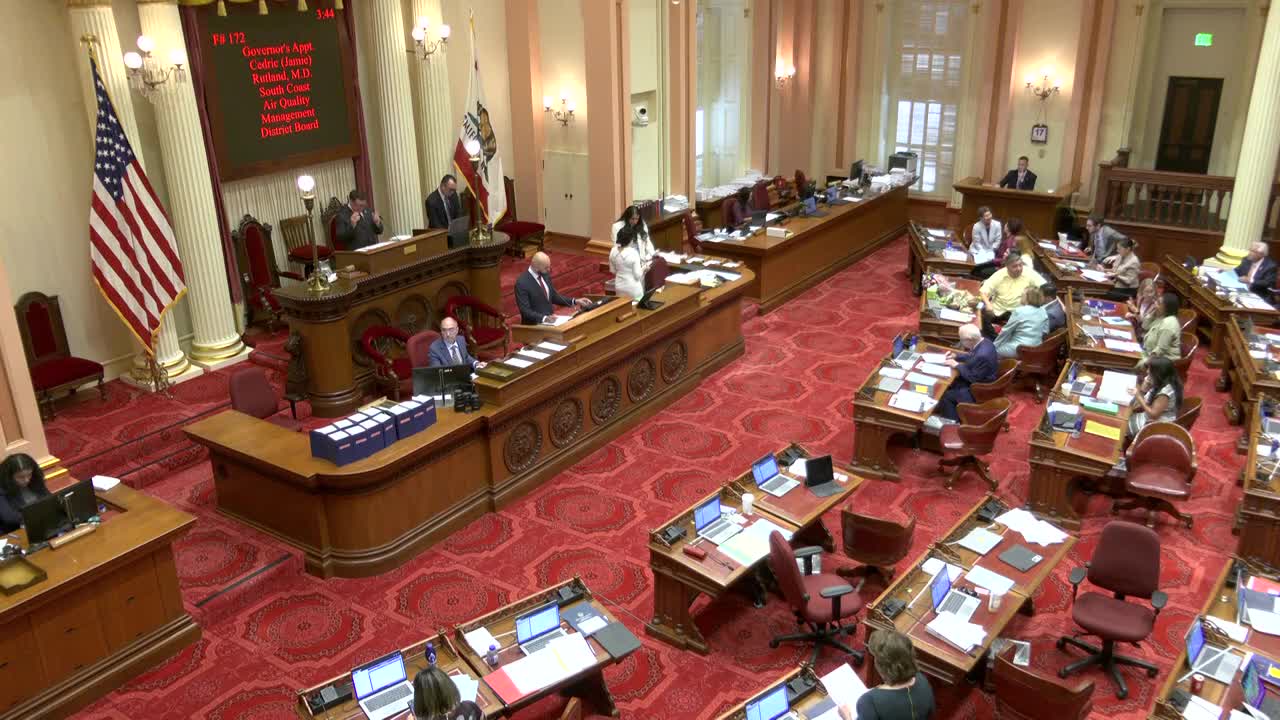
Bill Author

Bill Co-Author(s):