SB 1255: Postsecondary education: Designation of California Hispanic-Serving Institutions.
- Session Year: 2025-2026
- House: Senate
- Latest Version Date: 2026-09-30
Current Status:
Passed
(2026-09-30: Chaptered by Secretary of State. Chapter 1023, Statutes of 2026.)
Introduced
In Committee
Awaiting First Chamber Vote
Passed First Chamber
In Committee
Awaiting Second Chamber Vote
Passed Second Chamber
Enacted
Existing law establishes the California State University, under the administration of the Trustees of the California State University, the University of California, under the administration of the Regents of the University of California, the California Community Colleges, under the administration of the Board of Governors of the California Community Colleges, and independent institutions of higher education, as defined, as 4 segments of postsecondary education in the state.
This bill, upon appropriation, would establish the Designation of California Hispanic-Serving Institutions to recognize campuses of those segments of postsecondary education that excel at providing academic resources to Latino students. The bill, upon appropriation, would establish a Designation of California Hispanic-Serving Institutions governing board to designate colleges and universities as California Hispanic-Serving Institutions. The bill, upon appropriation, would designate the office of the Chancellor of the California State University as the managing entity and would require it to, among other duties, develop the application processes and to process and present initial and renewal applications to receive this designation to the governing board, as specified, and would make an initial and renewal designation valid for 5 years.
Existing law establishes the California State University, under the administration of the Trustees of the California State University, the University of California, under the administration of the Regents of the University of California, the California Community Colleges, under the administration of the Board of Governors of the California Community Colleges, and independent institutions of higher education, as defined, as 4 segments of postsecondary education in the state.
This bill bill, upon appropriation, would establish the Designation of California Hispanic-Serving Institutions to recognize campuses of those segments of postsecondary education that excel at providing academic resources to Latino students. The bill bill, upon appropriation, would establish a Designation of California Hispanic-Serving Institutions governing board to designate colleges and universities as California Hispanic-Serving Institutions and would require an unspecified Institutions. The bill, upon appropriation, would designate the office of the Chancellor of the California State University as the managing entity and would require it to, among other duties, develop the application processes and to process and present initial and renewal applications to receive this designation to the governing board, as specified. The bill specified, and would make an initial and renewal designation valid for 5 years.
Existing law establishes the California State University, under the administration of the Trustees of the California State University, the University of California, under the administration of the Regents of the University of California, the California Community Colleges, under the administration of the Board of Governors of the California Community Colleges, and independent institutions of higher education, as defined, as 4 segments of postsecondary education in the state.
This bill would establish the Designation of California Hispanic-Serving Institutions to recognize campuses of those segments of postsecondary education that excel at providing academic resources to Latino students. The bill would establish a Designation of California Hispanic-Serving Institutions governing board to designate colleges and universities as California Hispanic-Serving Institutions and would require an unspecified managing entity to, among other duties, develop the application processes and to process and present initial and renewal applications to receive this designation to the governing board, as specified. The bill would make an initial and renewal designation valid for 5 years.
The Legislature finds and declares all of the following:
(a)Supporting Latino students attending postsecondary educational institutions in California serves the interests of Californias economic growth.
(b)Throughout the early and mid-20th century, Mexican American and other Latino students were routinely subjected to de facto school segregation, including separate Mexican schools, particularly in southern and central California, which prevented access to postsecondary education.
(c)In the landmark Mendez v. Westminster School Dist. of Orange County (S.D. Cal. 1946) 64 F.Supp. 544, affd. Westminster School Dist. of Orange County v. Mendez (9th Cir. 1947) 161 F.2d 774 (Mendez v. Westminster), the Ninth Circuit Court of Appeals found that segregation of Mexican American students in California public schools was unconstitutional.
(d)The Ninth Circuit Court of Appeals ruling in Mendez v. Westminster established legal and evidentiary groundwork that influenced the United States Supreme Courts decision in the landmark Brown v. Board of Ed. of Topeka, Shawnee County, Kan. (1954) 347 U.S. 483 (Brown v. Board of Education), which declared racial segregation in public education unconstitutional nationwide.
(e)Title VI of the federal Civil Rights Act of 1964 (42 U.S.C. Sec. 2000d, et seq.) continues to advance access and equality in education by prohibiting any person, on the ground of race, color, or national origin, from being excluded from participation in, being denied the benefits of, or being subject to discrimination under any program or activity receiving federal financial assistance.
(f)The federal Developing Hispanic-Serving Institutions Program was created in 1992 (20 U.S.C. Sec. 1101 et seq.) to recognize colleges and universities that enroll a significant proportion of Latino students and to strengthen their capacity to support student success through targeted institutional support.
(g)Seventy years after the United States Supreme Courts ruling in Brown v. Board of Education, Hispanic-Serving Institutions (HSIs) enroll large numbers of Latino students and have the highest concentrations of Native American, Black, Asian American and Pacific Islander, and low-income White students, making them among the most racially, ethnically, and economically diverse colleges and universities in the nation.
(h)In California, over 170 HSIs play a critical role as vehicles of social mobility by expanding access to postsecondary education for low-income and first-generation students while developing a skilled workforce aligned with state and national economic needs.
(i)Californias colleges and universities, public and private, play a critical role in producing the next generation of the states workforce and in sustaining economic growth by supplying the educated talent that drives innovation, productivity, and Californias gross domestic product.
(j)HSIs include four-year and two-year higher education institutions.
(k)Californias public postsecondary institutions, private postsecondary educational institutions, and independent institutions of higher education have been federally designated as HSIs, reflecting the significant and growing share of campuses meeting the federal Developing Hispanic-Serving Institutions Programs enrollment thresholds.
(l)Nationally, the federal Developing Hispanic-Serving Institutions Program is currently subject to proposals and policy actions that would significantly reduce, restructure, or eliminate the program, creating uncertainty for institutions that rely on it to support student success.
(m)The federal government has a clear statutory obligation in the federal Developing Hispanic-Serving Institutions Program to provide funding for HSIs.
(n)A March 12, 2024, United States Government Accountability Office report on HSIs underscores the need for increased and sustained investment, particularly given that many HSIs remain underfunded while serving a disproportionate share of underserved students. Accordingly, it is imperative to continue challenging the reappropriation of HSI-designated funds and to advocate for funding levels that are commensurate with the growing number of HSI campuses and the students they serve.
SEC. 2.Article 7.7 (commencing with Section 66078) is added to Chapter 2 of Part 40 of Division 5 of Title 3 of the Education Code, to read:7.7.Designation of California Hispanic-Serving Institutions66078.This article shall be known, and may be cited, as the Designation of California Hispanic-Serving Institutions.
66078.1.As used in this article, the following definitions apply:
(a)Applicant means an eligible college or university that applies for a designation pursuant to this article.
(b)College or university means a University of California, California State University, or California Community Colleges campus, or an independent institution of higher education, as defined in Section 66010.
(c)Governing board means the governing board established pursuant to this article.
(d)Managing entity means the office of the Chancellor of the California State University.
(e)Normal time means the time it would take a full-time student to complete the requirements for a degree or certificate offered by a college or university.
(f)Recipient means a college or university that receives a designation pursuant to this article.
66078.2.(a)The Designation of California Hispanic-Serving Institutions is hereby established to recognize colleges and universities that excel at providing academic resources to Latino students enrolled in degree or certificate programs offered by colleges and universities. This designation shall only be awarded to qualifying applicants by a two-thirds vote of approval by the governing board.
(b)An initial designation awarded pursuant to this article shall be valid for five academic years. Thereafter, a recipient may submit an application for renewal. A renewal designation awarded pursuant to this article shall be valid for five years.
(c)An applicant is eligible for designation pursuant to this article if the applicant meets all of the following requirements:
(1)Submits an initial or renewal application, as applicable, to the managing entity on or before the application deadline established by the managing entity pursuant to Section 66078.3.
(2)Meets either of the following, as applicable:
(A)Submits an initial application that complies with subdivision (d).
(B)Submits a renewal application that complies with subdivision (e).
(3)Posts the initial or renewal application submitted pursuant to subparagraph (A) or (B) of paragraph (2), as applicable, on the applicants internet website.
(d)An initial application shall include, but not be limited to, all of the following:
(1)A certification, in writing, by the chief administrative officer of the college or university, of the applicants commitment to address Latino student success that is consistent with the applicants mission.
(2)Academic goals for the applicant to achieve within the five-year period in which the initial designation awarded pursuant to this article shall be valid. The goals described in this paragraph shall improve retention, time-to-degree or time-to-certificate completion, and graduation rates of Latino students based on the data submitted by the applicant pursuant to paragraph (5) or (6), as applicable, within the five-year period in which the initial designation shall be valid.
(3)Academic equity goals for the applicant to achieve within the five-year period in which the initial designation awarded pursuant to this article shall be valid. The goals described in this paragraph shall reduce the academic equity gaps in the retention, time-to-degree or time-to-certificate completion, and graduation rates between the applicants Latino students and the overall student population based on data submitted by the applicant pursuant to paragraph (5) or (6), as applicable.
(4)A strategic plan for the five-year period in which the initial designation awarded pursuant to this article shall be valid, on how the applicant intends to meet the academic goals and academic equity goals submitted pursuant to paragraphs (2) and (3). The strategic plan shall include, but not be limited to, all of the following:
(A)A mission statement that addresses the applicants commitment to serve Latino students.
(B)Outreach services to Latino students to encourage them to enroll at the college or university.
(C)Academic and basic needs support services to assist in the success of Latino students. Support services described in this subparagraph may include campus affinity centers and corequisite coursework or concurrent support activities.
(D)An outline of the planned allocation of resources during the five-year period in which the initial designation awarded pursuant to this article shall be valid, to ensure that the strategic plan described in this paragraph can be implemented.
(E)An outline of how the applicant will use existing resources to provide culturally relevant professional development to the applicants faculty and staff.
(F)Academic curriculum, including incorporating and expanding curriculum and course offerings in ethnic studies and other culturally responsive coursework, to reflect the diverse backgrounds of Latino students and support their academic engagement and retention.
(G)Research initiatives, including institutional research to address the needs of lived experiences of Latino populations, both on campus and in the broader community.
(H)Data disaggregation collection and analysis to identify and address the distinct needs and achievement gaps of diverse Latino ethnic subgroups.
(I)Intersegmental collaboration between the University of California, the California State University, the California Community Colleges, and independent institutions of higher education, as defined in Section 66010, to strengthen the educational pipeline for Latino students, including support for transfer and the completion of undergraduate, graduate, and professional degrees.
(5)A four-year college or university applicant shall submit, in its application, graduation rates for the previous three academic years for all students, and for Latino students, within the normal time and up to 150 percent of the normal time to degree completion, yield, retention, and graduation rate.
(6)A community college applicant shall submit, in its application, all of the following for the previous three academic years:
(A)The number of degree and certificate programs completed by all students, and by Latino students.
(B)The number of all students, and of Latino students, who completed degree and certificate programs within the normal time and up to 300 percent of the normal time to degree completion, yield, retention, and graduation rate.
(C)The student transfer rates for all students, and for Latino students, to four-year colleges and universities.
(7)A description of campus resources to promote a campus of equity and inclusion for Latino students.
(e)A renewal application shall include, but not be limited to, all of the following:
(1)Either of the following, as applicable:
(A)An applicant seeking renewal upon expiration of an initial designation awarded pursuant to this article shall resubmit the application it submitted to receive that initial designation.
(B)An applicant seeking renewal upon expiration of a renewal designation awarded pursuant to this article shall resubmit the application it submitted to receive that previous renewal designation.
(2)Demonstration of the applicants progress to achieve the academic goals and academic equity goals provided in the application submitted pursuant to paragraph (1).
(3)Demonstration of the applicants progress to implement the strategic plan provided in the application submitted pursuant to paragraph (1).
(4)Any changes made by the applicant to either of the following items provided in the application submitted pursuant to paragraph (1):
(A)The mission statement in the strategic plan that addresses the applicants commitment to serve Latino students.
(B)The description of campus resources to promote a campus of equity and inclusion for Latino students.
(5)A certification, in writing, by the chief administrative officer of the college or university, of the applicants continual commitment to address Latino student success that is consistent with the applicants mission.
(6)Academic goals for the applicant to achieve within the five-year period in which the renewal designation shall be valid. The goals described in this paragraph shall improve retention, time-to-degree or time-to-certificate completion, and graduation rates of Latino students based on the data submitted by the applicant pursuant to paragraph (9) or (10), as applicable, within the five-year period in which the renewal designation shall be valid.
(7)Academic equity goals for the applicant to achieve within the five-year period in which the renewal designation shall be valid. The goals described in this paragraph shall reduce the academic equity gaps in the retention, time-to-degree or time-to-certificate completion, and graduation rates between the applicants Latino students and the overall student population based on data submitted by the applicant pursuant to paragraph (9) or (10), as applicable.
(8)A strategic plan for the five-year period in which the renewal designation shall be valid, on how the applicant intends to meet the academic goals and academic equity goals submitted pursuant to paragraphs (6) and (7). The strategic plan shall include, but not be limited to, all of the following:
(A)Outreach services to Latino students to encourage them to enroll at the college or university.
(B)Academic and basic needs support services to assist in the academic success of Latino students. Support services described in this subparagraph may include campus affinity centers and corequisite coursework or concurrent support activities.
(C)An outline of the planned allocation of resources for the five-year period in which the renewal designation shall be valid, to ensure that the strategic plan described in this paragraph can be implemented.
(D)An outline of how the applicant will use existing resources to provide culturally relevant professional development to the applicants faculty and staff.
(E)Academic curriculum, including incorporating and expanding curriculum and course offerings in ethnic studies and other culturally responsive coursework, to reflect the diverse backgrounds of Latino students and support their academic engagement and retention.
(F)Research initiatives, including institutional research to address the needs of lived experiences of Latino populations, both on campus and in the broader community.
(G)Data disaggregation collection and analysis to identify and address the distinct needs and achievement gaps of diverse Latino ethnic subgroups.
(H)Intersegmental collaboration between the University of California, the California State University, the California Community Colleges, and independent institutions of higher education, as defined in Section 66010, to strengthen the educational pipeline for Latino students, including support for transfer and the completion of undergraduate, graduate, and professional degrees.
(9)A four-year college or university applicant shall submit, in its application, graduation rates for the previous five academic years for all students, and for Latino students, within the normal time and up to 150 percent of the normal time to degree completion, yield, retention, and graduation rate.
(10)A community college campus shall submit, in its application, all of the following for the previous five academic years:
(A)The number of degree and certificate programs completed by all students, and by Latino students.
(B)The number of all students, and of Latino students, who completed degree and certificate programs within the normal time and up to 300 percent of the normal time to degree completion yield, retention, and graduation rate.
(C)The student transfer rates for all students, and for Latino students, to four-year colleges and universities.
(f)(1)If an applicants renewal application is denied by the governing board, the applicant may only submit an application to receive an initial designation pursuant to this article.
(2)Notwithstanding paragraph (1), an applicant described in paragraph (1) may submit an application for a renewal designation following the award of a subsequent initial designation by the governing board pursuant to this article.
(g)An applicant is encouraged to inform and consult with the academic senate of the college or university on the applicants initial and renewal applications prepared pursuant to this article.
66078.3.The office of the Chancellor of the California State University is hereby designated as the managing entity for initial and renewal designations pursuant to this article. The managing entity shall act as a neutral administrative body with the following duties:
(a)Developing application processes that contain the requirements described in Section 66078.2 for applicants.
(b)Accepting initial and renewal applications from applicants. The managing entity shall set one application deadline each year on a date determined by the managing entity.
(c)Processing each application received and presenting those applications to the governing board at least once each year on a date determined by the governing board. The governing board may hold additional meetings to review additional applications at the discretion of the governing board.
(d)Upon the governing boards approval or denial of an applicants application, informing the applicant on this outcome.
(e)Preparing and delivering to an applicant approved by the governing board to receive a designation pursuant to this article an appropriate insignia recognizing the designation.
66078.4.(a)The governing board of the Designation of California Hispanic-Serving Institutions is hereby established. The purpose of the governing board is to award colleges and universities with designations pursuant to this article based on applications presented by the managing entity pursuant to Section 66078.3.
(b)(1)The governing board shall be composed of all of the following eight members:
(A)The Lieutenant Governor, or the Lieutenant Governors designee.
(B)One member of the public, to be appointed by the Speaker of the Assembly.
(C)One member of the public, to be appointed by the President pro Tempore of the Senate.
(D)A designee of the President of the University of California.
(E)A designee of the Chancellor of the California State University.
(F)A designee of the Chancellor of the California Community Colleges.
(G)A designee of the Association of Independent California Colleges and Universities.
(H)The chair of the California Latino Legislative Caucus, or the chairs designee.
(2)Any designee described in paragraph (1) shall be qualified to make decisions on behalf of that appointed position.
(3)A member of the public appointed pursuant to paragraph (1) by either the Speaker of the Assembly or the President pro Tempore of the Senate shall serve a two-year term.
(4)It is the intent of the Legislature that in appointing members of the public pursuant to paragraph (1), the appointing authority shall make every effort to ensure that the membership of the governing board includes persons who have a strong interest in the further development and improvement of the academic success of Latino students.
(c)For purposes of the first two years of the governing boards operations, the chair of the governing board shall be the Lieutenant Governor or the Lieutenant Governors designee. The governing board shall select each subsequent chairperson from within its membership by a vote of two-thirds of the governing boards voting members.
(d)The governing board shall complete both of the following actions:
(1)Convene at least once a year to vote on the approval or denial of applications of new or renewal applications that have been submitted to the managing entity at least 30 days before the meeting. The governing board may schedule additional meetings as necessary.
(2)Approve or deny each application presented by the managing entity pursuant to Section 66078.3.
(e)All decisions made by the governing board shall require a two-thirds vote of approval by the governing board members who are present for the vote.
(f)The governing board shall be subject to the Bagley-Keene Open Meeting Act (Article 9 (commencing with Section 11120) of Chapter 1 of Part 1 of Division 3 of Title 2 of the Government Code).
66078.5.This article shall only become operative upon an appropriation by the Legislature for its purposes.
The Legislature finds and declares all of the following:
(a)Supporting Latino students attending postsecondary educational institutions in California serves the interests of Californias economic growth.
(b)Throughout the early and mid-20th century, Mexican American and other Latino students were routinely subjected to de facto school segregation, including separate Mexican schools, particularly in southern and central California, which prevented access to postsecondary education.
(c)In the landmark Mendez v. Westminster School Dist. of Orange County (S.D. Cal. 1946) 64 F.Supp. 544, affd. Westminster School Dist. of Orange County v. Mendez (9th Cir. 1947) 161 F.2d 774 (Mendez v. Westminster), the Ninth Circuit Court of Appeals found that segregation of Mexican American students in California public schools was unconstitutional.
(d)The Ninth Circuit Court of Appeals ruling in Mendez v. Westminster established legal and evidentiary groundwork that influenced the United States Supreme Courts decision in the landmark Brown v. Board of Ed. of Topeka, Shawnee County, Kan. (1954) 347 U.S. 483 (Brown v. Board of Education), which declared racial segregation in public education unconstitutional nationwide.
(e)Title VI of the federal Civil Rights Act of 1964 (42 U.S.C. Sec. 2000d, et seq.) continues to advance access and equality in education by prohibiting any person, on the ground of race, color, or national origin, from being excluded from participation in, being denied the benefits of, or being subject to discrimination under any program or activity receiving federal financial assistance.
(f)The federal Developing Hispanic-Serving Institutions Program was created in 1992 (20 U.S.C. Sec. 1101 et seq.) to recognize colleges and universities that enroll a significant proportion of Latino students and to strengthen their capacity to support student success through targeted institutional support.
(g)Seventy years after the United States Supreme Courts ruling in Brown v. Board of Education, Hispanic-Serving Institutions (HSIs) enroll large numbers of Latino students and have the highest concentrations of Native American, Black, Asian American and Pacific Islander, and low-income White students, making them among the most racially, ethnically, and economically diverse colleges and universities in the nation.
(h)In California, over 170 HSIs play a critical role as vehicles of social mobility by expanding access to postsecondary education for low-income and first-generation students while developing a skilled workforce aligned with state and national economic needs.
(i)Californias colleges and universities, public and private, play a critical role in producing the next generation of the states workforce and in sustaining economic growth by supplying the educated talent that drives innovation, productivity, and Californias gross domestic product.
(j)HSIs include four-year and two-year higher education institutions.
(k)Californias public postsecondary institutions, private postsecondary educational institutions, and independent institutions of higher education have been federally designated as HSIs, reflecting the significant and growing share of campuses meeting the federal Developing Hispanic-Serving Institutions Programs enrollment thresholds.
(l)Nationally, the federal Developing Hispanic-Serving Institutions Program is currently subject to proposals and policy actions that would significantly reduce, restructure, or eliminate the program, creating uncertainty for institutions that rely on it to support student success.
(m)The federal government has a clear statutory obligation in the federal Developing Hispanic-Serving Institutions Program to provide funding for HSIs.
(n)A March 12, 2024, United States Government Accountability Office report on HSIs underscores the need for increased and sustained investment, particularly given that many HSIs remain underfunded while serving a disproportionate share of underserved students. Accordingly, it is imperative to continue challenging the reappropriation of HSI-designated funds and to advocate for funding levels that are commensurate with the growing number of HSI campuses and the students they serve.
SEC. 2.Article 7.7 (commencing with Section 66078) is added to Chapter 2 of Part 40 of Division 5 of Title 3 of the Education Code, to read:7.7.Designation of California Hispanic-Serving Institutions66078.This article shall be known, and may be cited, as the Designation of California Hispanic-Serving Institutions.
66078.1.As used in this article, the following definitions apply:
(a)Applicant means an eligible college or university that applies for a designation pursuant to this article.
(b)College or university means a University of California, California State University, or California Community Colleges campus, or an independent institution of higher education. education, as defined in Section 66010.
(c)Governing board means the governing board established pursuant to this article.
(d)Managing entity means the office of the Chancellor of the California State University.
(e)Normal time means the time it would take a full-time student to complete the requirements for a degree or certificate offered by a college or university.
(f)Recipient means a college or university that receives a designation pursuant to this article.
66078.2.(a)The Designation of California Hispanic-Serving Institutions is hereby established to recognize colleges and universities that excel at providing academic resources to Latino students enrolled in degree or certificate programs offered by colleges and universities. This designation shall only be awarded to qualifying applicants by a two-thirds vote of approval by the governing board.
(b)An initial designation awarded pursuant to this article shall be valid for five academic years. Thereafter, a recipient may submit an application for renewal. A renewal designation awarded pursuant to this article shall be valid for five years.
(c)An applicant is eligible for designation pursuant to this article if the applicant meets all of the following requirements:
(1)Has at least 25 percent of the colleges or universitys enrolled student population identifying as Hispanic and Latino students.(2)(1)Submits an initial or renewal application, as applicable, to the managing entity on or before the application deadline established by the managing entity pursuant to Section 66078.3.
(3)(2)Meets either of the following, as applicable:
(A)Submits an initial application that complies with subdivision (d).
(B)Submits a renewal application that complies with subdivision (e).
(4)(3)Posts the initial or renewal application submitted pursuant to subparagraph (A) or (B) of paragraph (3), (2), as applicable, on the applicants internet website.
(d)An initial application shall include, but not be limited to, all of the following:
(1)A certification, in writing, by the chief administrative officer of the college or university, of the applicants commitment to address Latino student success that is consistent with the applicants mission.
(2)Academic goals for the applicant to achieve within the five-year period in which the initial designation awarded pursuant to this article shall be valid. The goals described in this paragraph shall improve retention, time-to-degree or time-to-certificate completion, and graduation rates of Latino students based on the data submitted by the applicant pursuant to paragraph (5) or (6), as applicable, within the five-year period in which the initial designation shall be valid.
(3)Academic equity goals for the applicant to achieve within the five-year period in which the initial designation awarded pursuant to this article shall be valid. The goals described in this paragraph shall reduce the academic equity gaps in the retention, time-to-degree or time-to-certificate completion, and graduation rates between the applicants Latino students and the overall student population based on data submitted by the applicant pursuant to paragraph (5) or (6), as applicable.
(4)A strategic plan for the five-year period in which the initial designation awarded pursuant to this article shall be valid, on how the applicant intends to meet the academic goals and academic equity goals submitted pursuant to paragraphs (2) and (3). The strategic plan shall include, but not be limited to, all of the following:
(A)A mission statement that addresses the applicants commitment to serve Latino students.
(B)Outreach services to Latino students to encourage them to enroll at the college or university.
(C)Academic and basic needs support services to assist in the workforce development success of Latino students. Support services described in this subparagraph may include campus affinity centers and corequisite coursework or concurrent support activities.
(D)An outline of the planned allocation of resources during the five-year period in which the initial designation awarded pursuant to this article shall be valid, to ensure that the strategic plan described in this paragraph can be implemented.
(E)An outline of how the applicant will use existing resources to provide culturally relevant professional development to the applicants faculty and staff.
(F)Academic curriculum, including incorporating and expanding curriculum and course offerings in ethnic studies and other culturally responsive coursework, to reflect the diverse backgrounds of Latino students and support their academic engagement and retention.
(G)Research initiatives, including institutional research to address the needs of lived experiences of Latino populations, both on campus and in the broader community.
(H)Data disaggregation collection and analysis to identify and address the distinct needs and achievement gaps of diverse Latino ethnic subgroups.
(I)Intersegmental collaboration between the University of California, the California State University, the California Community Colleges, and independent institutions of higher education, as defined in Section 66010, to strengthen the educational pipeline for Latino students, including support for transfer and the completion of undergraduate, graduate, and professional degrees.
(5)A four-year college or university applicant shall submit, in its application, graduation rates for the previous three academic years for all students, and for Latino students, within the normal time and up to 150 percent of the normal time to degree completion, yield, retention, and graduation rate.
(6)A community college applicant shall submit, in its application, all of the following for the previous three academic years:
(A)The number of degree and certificate programs completed by all students, and by Latino students.
(B)The number of all students, and of Latino students, who completed degree and certificate programs within the normal time and up to 300 percent of the normal time to degree completion, yield, retention, and graduation rate.
(C)The student transfer rates for all students, and for Latino students, to four-year colleges and universities.
(7)A description of campus resources to promote a campus of equity and inclusion for Latino students.
(e)A renewal application shall include, but not be limited to, all of the following:
(1)Either of the following, as applicable:
(A)An applicant seeking renewal upon expiration of an initial designation awarded pursuant to this article shall resubmit the application it submitted to receive that initial designation.
(B)An applicant seeking renewal upon expiration of a renewal designation awarded pursuant to this article shall resubmit the application it submitted to receive that previous renewal designation.
(2)Demonstration of the applicants progress to achieve the academic goals and academic equity goals provided in the application submitted pursuant to paragraph (1).
(3)Demonstration of the applicants progress to implement the strategic plan provided in the application submitted pursuant to paragraph (1).
(4)Any changes made by the applicant to either of the following items provided in the application submitted pursuant to paragraph (1):
(A)The mission statement in the strategic plan that addresses the applicants commitment to serve Latino students.
(B)The description of campus resources to promote a campus of equity and inclusion for Latino students.
(5)A certification, in writing, by the chief administrative officer of the college or university, of the applicants continual commitment to address Latino student workforce development success that is consistent with the applicants mission.
(6)Academic goals for the applicant to achieve within the five-year period in which the renewal designation shall be valid. The goals described in this paragraph shall improve retention, time-to-degree or time-to-certificate completion, and graduation rates of Latino students based on the data submitted by the applicant pursuant to paragraph (9) or (10), as applicable, within the five-year period in which the renewal designation shall be valid.
(7)Academic equity goals for the applicant to achieve within the five-year period in which the renewal designation shall be valid. The goals described in this paragraph shall reduce the academic equity gaps in the retention, time-to-degree or time-to-certificate completion, and graduation rates between the applicants Latino students and the overall student population based on data submitted by the applicant pursuant to paragraph (9) or (10), as applicable.
(8)A strategic plan for the five-year period in which the renewal designation shall be valid, on how the applicant intends to meet the academic goals and academic equity goals submitted pursuant to paragraphs (6) and (7). The strategic plan shall include, but not be limited to, all of the following:
(A)Outreach services to Latino students to encourage them to enroll at the college or university.
(B)Academic and basic needs support services to assist in the academic success of Latino students. Support services described in this subparagraph may include campus affinity centers and corequisite coursework or concurrent support activities.
(C)An outline of the planned allocation of resources for the five-year period in which the renewal designation shall be valid, to ensure that the strategic plan described in this paragraph can be implemented.
(D)An outline of how the applicant will use existing resources to provide culturally relevant professional development to the applicants faculty and staff.
(E)Academic curriculum, including incorporating and expanding curriculum and course offerings in ethnic studies and other culturally responsive coursework, to reflect the diverse backgrounds of Latino students and support their academic engagement and retention.
(F)Research initiatives, including institutional research to address the needs of lived experiences of Latino populations, both on campus and in the broader community.
(G)Data disaggregation collection and analysis to identify and address the distinct needs and achievement gaps of diverse Latino ethnic subgroups.
(H)Intersegmental collaboration between the University of California, the California State University, the California Community Colleges, and independent institutions of higher education, as defined in Section 66010, to strengthen the educational pipeline for Latino students, including support for transfer and the completion of undergraduate, graduate, and professional degrees.
(9)A four-year college or university applicant shall submit, in its application, graduation rates for the previous five academic years for all students, and for Latino students, within the normal time and up to 150 percent of the normal time to degree completion, yield, retention, and graduation rate.
(10)A community college campus shall submit, in its application, all of the following for the previous five academic years:
(A)The number of degree and certificate programs completed by all students, and by Latino students.
(B)The number of all students, and of Latino students, who completed degree and certificate programs within the normal time and up to 300 percent of the normal time to degree completion yield, retention, and graduation rate.
(C)The student transfer rates for all students, and for Latino students, to four-year colleges and universities.
(f)(1)If an applicants renewal application is denied by the governing board, the applicant may only submit an application to receive an initial designation pursuant to this article.
(2)Notwithstanding paragraph (1), an applicant described in paragraph (1) may submit an application for a renewal designation following the award of a subsequent initial designation by the governing board pursuant to this article.
(g)An applicant is encouraged to inform and consult with the academic senate of the college or university on the applicants initial and renewal applications prepared pursuant to this article.
66078.3.The office of the Chancellor of the California State University is hereby designated as the managing entity for initial and renewal designations pursuant to this article. The managing entity shall act as a neutral administrative body with the following duties:
(a)Developing application processes that contain the requirements described in Section 66078.2 for applicants.
(b)Accepting initial and renewal applications from applicants. The managing entity shall set two one application deadlines deadline each year on dates a date determined by the managing entity.
(c)Processing each application received and presenting those applications to the governing board twice each year on dates determined by the governing board. at least once each year on a date determined by the governing board. The governing board may hold additional meetings to review additional applications at the discretion of the governing board.
(d)Upon the governing boards approval or denial of an applicants application, informing the applicant on this outcome.
(e)Preparing and delivering to an applicant approved by the governing board to receive a designation pursuant to this article an appropriate insignia recognizing the designation.
66078.4.(a)The governing board of the Designation of California Hispanic-Serving Institutions is hereby established. The purpose of the governing board is to award colleges and universities with designations pursuant to this article based on applications presented by the managing entity pursuant to Section 66078.3.
(b)(1)The governing board shall be composed of all of the following eight members:
(A)The Lieutenant Governor, or the Lieutenant Governors designee.
(B)One member of the public, to be appointed by the Speaker of the Assembly.
(C)One member of the public, to be appointed by the President pro Tempore of the Senate.
(D)A designee of the President of the University of California.
(E)A designee of the Chancellor of the California State University.
(F)A designee of the Chancellor of the California Community Colleges.
(G)A designee of the Association of Independent California Colleges and Universities.
(H)The chair of the California Latino Legislative Caucus, or the chairs designee.
(2)Any designee described in paragraph (1) shall be qualified to make decisions on behalf of that appointed position.
(3)A member of the public appointed pursuant to paragraph (1) by either the Speaker of the Assembly or the President pro Tempore of the Senate shall serve a two-year term.
(4)It is the intent of the Legislature that in appointing members of the public pursuant to paragraph (1), the appointing authority shall make every effort to ensure that the membership of the governing board includes persons who have a strong interest in the further development and improvement of the academic success of Latino students.
(c)For purposes of the first two years of the governing boards operations, the chair of the governing board shall be the Lieutenant Governor or the Lieutenant Governors designee. The governing board shall select each subsequent chairman chairperson from within its membership by a vote of two-thirds of the governing boards voting members.
(d)The governing board shall complete both of the following actions:
(1)Convene twice a year to vote on the approval or denial of applications.(1)Convene at least once a year to vote on the approval or denial of applications of new or renewal applications that have been submitted to the managing entity at least 30 days before the meeting. The governing board may schedule additional meetings as necessary.
(2)Approve or deny each application presented by the managing entity pursuant to Section 66078.3.
(e)All decisions made by the governing board shall require a two-thirds vote of approval by the governing board members who are present for the vote.
(f)The governing board shall be subject to the Bagley-Keene Open Meeting Act (Article 9 (commencing with Section 11120) of Chapter 1 of Part 1 of Division 3 of Title 2 of the Government Code).
66078.5.This article shall only become operative upon an appropriation by the Legislature for its purposes.
The Legislature finds and declares all of the following:
(a)Supporting Latino students attending postsecondary educational institutions in California serves the interests of Californias economic growth.
(b)Throughout the early and mid-20th century, Mexican American and other Latino students were routinely subjected to de facto school segregation, including separate Mexican schools, particularly in southern and central California, which prevented access to postsecondary education.
(c)In the landmark Mendez v. Westminster School Dist. of Orange County (S.D. Cal. 1946) 64 F.Supp. 544, affd. Westminster School Dist. of Orange County v. Mendez (9th Cir. 1947) 161 F.2d 774 (Mendez v. Westminster), the Ninth Circuit Court of Appeals found that segregation of Mexican American students in California public schools was unconstitutional.
(d)The Ninth Circuit Court of Appeals ruling in Mendez v. Westminster established legal and evidentiary groundwork that influenced the United States Supreme Courts decision in the landmark Brown v. Board of Ed. of Topeka, Shawnee County, Kan. (1954) 347 U.S. 483 (Brown v. Board of Education), which declared racial segregation in public education unconstitutional nationwide.
(e)Title VI of the federal Civil Rights Act of 1964 (42 U.S.C. Sec. 2000d, et seq.) continues to advance access and equality in education by prohibiting any person, on the ground of race, color, or national origin, from being excluded from participation in, being denied the benefits of, or being subject to discrimination under any program or activity receiving federal financial assistance.
(f)The federal Developing Hispanic-Serving Institutions Program was created in 1992 (20 U.S.C. Sec. 1101 et seq.) to recognize colleges and universities that enroll a significant proportion of Latino students and to strengthen their capacity to support student success through targeted institutional support.
(g)Seventy years after the United States Supreme Courts ruling in Brown v. Board of Education, Hispanic-Serving Institutions (HSIs) enroll large numbers of Latino students and have the highest concentrations of Native American, Black, Asian American and Pacific Islander, and low-income White students, making them among the most racially, ethnically, and economically diverse colleges and universities in the nation.
(h)In California, over 170 HSIs play a critical role as vehicles of social mobility by expanding access to postsecondary education for low-income and first-generation students while developing a skilled workforce aligned with state and national economic needs.
(i)Californias colleges and universities, public and private, play a critical role in producing the next generation of the states workforce and in sustaining economic growth by supplying the educated talent that drives innovation, productivity, and Californias gross domestic product.
(j)HSIs include four-year and two-year higher education institutions.
(k)Californias public postsecondary institutions, private postsecondary educational institutions, and independent institutions of higher education have been federally designated as HSIs, reflecting the significant and growing share of campuses meeting the federal Developing Hispanic-Serving Institutions Programs enrollment thresholds.
(l)Nationally, the federal Developing Hispanic-Serving Institutions Program is currently subject to proposals and policy actions that would significantly reduce, restructure, or eliminate the program, creating uncertainty for institutions that rely on it to support student success.
(m)The federal government has a clear statutory obligation in the federal Developing Hispanic-Serving Institutions Program to provide funding for HSIs.
(n)A March 12, 2024, United States Government Accountability Office report on HSIs underscores the need for increased and sustained investment, particularly given that many HSIs remain underfunded while serving a disproportionate share of underserved students. Accordingly, it is imperative to continue challenging the reappropriation of HSI-designated funds and to advocate for funding levels that are commensurate with the growing number of HSI campuses and the students they serve.
SEC. 2.Article 7.7 (commencing with Section 66078) is added to Chapter 2 of Part 40 of Division 5 of Title 3 of the Education Code, to read:7.7.Designation of California Hispanic-Serving Institutions66078.This article shall be known, and may be cited, as the Designation of California Hispanic-Serving Institutions.
66078.1.As used in this article, the following definitions apply:
(a)Applicant means an eligible college or university that applies for a designation pursuant to this article.
(b)College or university means a University of California, California State University, or California Community Colleges campus, or an independent institution of higher education.
(c)Governing board means the governing board established pursuant to this article.
(d)Managing entity means the office of the Chancellor of the California State University.
(e)Normal time means the time it would take a full-time student to complete the requirements for a degree or certificate offered by a college or university.
(f)Recipient means a college or university that receives a designation pursuant to this article.
66078.2.(a)The Designation of California Hispanic-Serving Institutions is hereby established to recognize colleges and universities that excel at providing academic resources to Latino students enrolled in degree or certificate programs offered by colleges and universities. This designation shall only be awarded to qualifying applicants by a two-thirds vote of approval by the governing board.
(b)An initial designation awarded pursuant to this article shall be valid for five academic years. Thereafter, a recipient may submit an application for renewal. A renewal designation awarded pursuant to this article shall be valid for five years.
(c)An applicant is eligible for designation pursuant to this article if the applicant meets all of the following requirements:
(1)Has at least 25 percent of the colleges or universitys graduation rate enrolled student population identifying as Hispanic and Latino students.
(2)Submits an initial or renewal application, as applicable, to the managing entity on or before the application deadline established by the managing entity pursuant to Section 66078.3.
(3)Meets either of the following, as applicable:
(A)Submits an initial application that complies with subdivision (d).
(B)Submits a renewal application that complies with subdivision (e).
(4)Posts the initial or renewal application submitted pursuant to subparagraph (A) or (B) of paragraph (3), as applicable, on the applicants internet website.
(d)An initial application shall include, but not be limited to, all of the following:
(1)A certification, in writing, by the chief administrative officer of the college or university, of the applicants commitment to address Latino student success that is consistent with the applicants mission.
(2)Academic goals for the applicant to achieve within the five-year period in which the initial designation awarded pursuant to this article shall be valid. The goals described in this paragraph shall improve retention, time-to-degree or time-to-certificate completion, and graduation rates of Latino students based on the data submitted by the applicant pursuant to paragraph (5) or (6), as applicable, within the five-year period in which the initial designation shall be valid.
(3)Academic equity goals for the applicant to achieve within the five-year period in which the initial designation awarded pursuant to this article shall be valid. The goals described in this paragraph shall reduce the academic equity gaps in the retention, time-to-degree or time-to-certificate completion, and graduation rates between the applicants Latino students and the overall student population based on data submitted by the applicant pursuant to paragraph (5) or (6), as applicable.
(4)A strategic plan for the five-year period in which the initial designation awarded pursuant to this article shall be valid, on how the applicant intends to meet the academic goals and academic equity goals submitted pursuant to paragraphs (2) and (3). The strategic plan shall include, but not be limited to, all of the following:
(A)A mission statement that addresses the applicants commitment to serve Latino students.
(B)Outreach services to Latino students to encourage them to enroll at the college or university.
(C)Academic and basic needs support services to assist in the workforce development success of Latino students. Support services described in this subparagraph may include campus affinity centers and corequisite coursework or concurrent support activities.
(D)An outline of the planned allocation of resources during the five-year period in which the initial designation awarded pursuant to this article shall be valid, to ensure that the strategic plan described in this paragraph can be implemented.
(E)An outline of how the applicant will use existing resources to provide culturally relevant professional development to the applicants faculty and staff.
(5)A four-year college or university applicant shall submit, in its application, graduation rates for the previous three academic years for all students, and for Latino students, within the normal time and up to 150 percent of the normal time to degree completion, yield, retention, and graduation rate.
(6)A community college applicant shall submit, in its application, all of the following for the previous three academic years:
(A)The number of degree and certificate programs completed by all students, and by Latino students.
(B)The number of all students, and of Latino students, who completed degree and certificate programs within the normal time and up to 300 percent of the normal time to degree completion, yield, retention, and graduation rate.
(C)The student transfer rates for all students, and for Latino students, to four-year colleges and universities.
(7)A description of campus resources to promote a campus of equity and inclusion for Latino students.
(e)A renewal application shall include, but not be limited to, all of the following:
(1)Either of the following, as applicable:
(A)An applicant seeking renewal upon expiration of an initial designation awarded pursuant to this article shall resubmit the application it submitted to receive that initial designation.
(B)An applicant seeking renewal upon expiration of a renewal designation awarded pursuant to this article shall resubmit the application it submitted to receive that previous renewal designation.
(2)Demonstration of the applicants progress to achieve the academic goals and academic equity goals provided in the application submitted pursuant to paragraph (1).
(3)Demonstration of the applicants progress to implement the strategic plan provided in the application submitted pursuant to paragraph (1).
(4)Any changes made by the applicant to either of the following items provided in the application submitted pursuant to paragraph (1):
(A)The mission statement in the strategic plan that addresses the applicants commitment to serve Latino students.
(B)The description of campus resources to promote a campus of equity and inclusion for Latino students.
(5)A certification, in writing, by the chief administrative officer of the college or university, of the applicants continual commitment to address Latino student workforce development success that is consistent with the applicants mission.
(6)Academic goals for the applicant to achieve within the five-year period in which the renewal designation shall be valid. The goals described in this paragraph shall improve retention, time-to-degree or time-to-certificate completion, and graduation rates of Latino students based on the data submitted by the applicant pursuant to paragraph (9) or (10), as applicable, within the five-year period in which the renewal designation shall be valid.
(7)Academic equity goals for the applicant to achieve within the five-year period in which the renewal designation shall be valid. The goals described in this paragraph shall reduce the academic equity gaps in the retention, time-to-degree or time-to-certificate completion, and graduation rates between the applicants Latino students and the overall student population based on data submitted by the applicant pursuant to paragraph (9) or (10), as applicable.
(8)A strategic plan for the five-year period in which the renewal designation shall be valid, on how the applicant intends to meet the academic goals and academic equity goals submitted pursuant to paragraphs (6) and (7). The strategic plan shall include, but not be limited to, all of the following:
(A)Outreach services to Latino students to encourage them to enroll at the college or university.
(B)Academic and basic needs support services to assist in the academic success of Latino students. Support services described in this subparagraph may include campus affinity centers and corequisite coursework or concurrent support activities.
(C)An outline of the planned allocation of resources for the five-year period in which the renewal designation shall be valid, to ensure that the strategic plan described in this paragraph can be implemented.
(D)An outline of how the applicant will use existing resources to provide culturally relevant professional development to the applicants faculty and staff.
(9)A four-year college or university applicant shall submit, in its application, graduation rates for the previous five academic years for all students, and for Latino students, within the normal time and up to 150 percent of the normal time to degree completion, yield, retention, and graduation rate.
(10)A community college campus shall submit, in its application, all of the following for the previous five academic years:
(A)The number of degree and certificate programs completed by all students, and by Latino students.
(B)The number of all students, and of Latino students, who completed degree and certificate programs within the normal time and up to 300 percent of the normal time to degree completion yield, retention, and graduation rate.
(C)The student transfer rates for all students, and for Latino students, to four-year colleges and universities.
(f)(1)If an applicants renewal application is denied by the governing board, the applicant may only submit an application to receive an initial designation pursuant to this article.
(2)Notwithstanding paragraph (1), an applicant described in paragraph (1) may submit an application for a renewal designation following the award of a subsequent initial designation by the governing board pursuant to this article.
(g)An applicant is encouraged to inform and consult with the academic senate of the college or university on the applicants initial and renewal applications prepared pursuant to this article.
66078.3.The office of the Chancellor of the California State University is hereby designated as the managing entity for initial and renewal designations pursuant to this article. The managing entity shall act as a neutral administrative body with the following duties:
(a)Developing application processes that contain the requirements described in Section 66078.2 for applicants.
(b)Accepting initial and renewal applications from applicants. The managing entity shall set two application deadlines each year on dates determined by the managing entity.
(c)Processing each application received and presenting those applications to the governing board twice each year on dates determined by the governing board.
(d)Upon the governing boards approval or denial of an applicants application, informing the applicant on this outcome.
(e)Preparing and delivering to an applicant approved by the governing board to receive a designation pursuant to this article an appropriate insignia recognizing the designation.
66078.4.(a)The governing board of the Designation of California Hispanic-Serving Institutions is hereby established. The purpose of the governing board is to award colleges and universities with designations pursuant to this article based on applications presented by the managing entity pursuant to Section 66078.3.
(b)(1)The governing board shall be composed of all of the following eight members:
(A)The Lieutenant Governor, or the Lieutenant Governors designee.
(B)One member of the public, to be appointed by the Speaker of the Assembly.
(C)One member of the public, to be appointed by the President pro Tempore of the Senate.
(D)A designee of the President of the University of California.
(E)A designee of the Chancellor of the California State University.
(F)A designee of the Chancellor of the California Community Colleges.
(G)A designee of the Association of Independent California Colleges and Universities.
(H)The chair of the California Latino Legislative Caucus, or the chairs designee.
(2)Any designee described in paragraph (1) shall be qualified to make decisions on behalf of that appointed position.
(3)A member of the public appointed pursuant to paragraph (1) by either the Speaker of the Assembly or the President pro Tempore of the Senate shall serve a two-year term.
(4)It is the intent of the Legislature that in appointing members of the public pursuant to paragraph (1), the appointing authority shall make every effort to ensure that the membership of the governing board includes persons who have a strong interest in the further development and improvement of the academic success of Latino students.
(c)For purposes of the first two years of the governing boards operations, the chair of the governing board shall be the Lieutenant Governor or the Lieutenant Governors designee. The governing board shall select each subsequent chairman from within its membership by a vote of two-thirds of the governing boards voting members.
(d)The governing board shall complete both of the following actions:
(1)Convene twice a year to vote on the approval or denial of applications.
(2)Approve or deny each application presented by the managing entity pursuant to Section 66078.3.
(e)All decisions made by the governing board shall require a two-thirds vote of approval by the governing board members who are present for the vote.
(f)The governing board shall be subject to the Bagley-Keene Open Meeting Act (Article 9 (commencing with Section 11120) of Chapter 1 of Part 1 of Division 3 of Title 2 of the Government Code).
66078.5.This article shall only become operative upon an appropriation by the Legislature for its purposes.
The Legislature finds and declares all of the following:
(a)Supporting Latino students attending postsecondary educational institutions in California serves the interests of Californias economic growth.
(b)Throughout the early and mid-20th century, Mexican American and other Latino students were routinely subjected to de facto school segregation, including separate Mexican schools, particularly in southern and central California, which prevented access to postsecondary education.
(c)In the landmark Mendez v. Westminster School Dist. of Orange County (S.D. Cal. 1946) 64 F.Supp. 544, affd. Westminster School Dist. of Orange County v. Mendez (9th Cir. 1947) 161 F.2d 774 (Mendez v. Westminster), the Ninth Circuit Court of Appeals found that segregation of Mexican American students in California public schools was unconstitutional.
(d)The Ninth Circuit Court of Appeals ruling in Mendez v. Westminster established legal and evidentiary groundwork that influenced the United States Supreme Courts decision in the landmark Brown v. Board of Ed. of Topeka, Shawnee County, Kan. (1954) 347 U.S. 483 (Brown v. Board of Education), which declared racial segregation in public education unconstitutional nationwide.
(e)Title VI of the federal Civil Rights Act of 1964 (42 U.S.C. Sec. 2000d, et seq.) continues to advance access and equality in education by prohibiting any person, on the ground of race, color, or national origin, from being excluded from participation in, being denied the benefits of, or being subject to discrimination under any program or activity receiving federal financial assistance.
(f)The federal Developing Hispanic-Serving Institutions Program was created in 1992 (20 U.S.C. Sec. 1101 et seq.) to recognize colleges and universities that enroll a significant proportion of Latino students and to strengthen their capacity to support student success through targeted institutional support.
(g)Seventy years after the United States Supreme Courts ruling in Brown v. Board of Education, Hispanic-Serving Institutions (HSIs) enroll large numbers of Latino students and have the highest concentrations of Native American, Black, Asian American and Pacific Islander, and low-income White students, making them among the most racially, ethnically, and economically diverse colleges and universities in the nation.
(h)In California, over 170 HSIs play a critical role as vehicles of social mobility by expanding access to postsecondary education for low-income and first-generation students while developing a skilled workforce aligned with state and national economic needs.
(i)Californias colleges and universities, public and private, play a critical role in producing the next generation of the states workforce and in sustaining economic growth by supplying the educated talent that drives innovation, productivity, and Californias gross domestic product.
(j)HSIs include four-year and two-year higher education institutions.
(k)Californias public postsecondary institutions, private postsecondary educational institutions, and independent institutions of higher education have been federally designated as HSIs, reflecting the significant and growing share of campuses meeting the federal Developing Hispanic-Serving Institutions Programs enrollment thresholds.
(l)Nationally, the federal Developing Hispanic-Serving Institutions Program is currently subject to proposals and policy actions that would significantly reduce, restructure, or eliminate the program, creating uncertainty for institutions that rely on it to support student success.
(m)The federal government has a clear statutory obligation in the federal Developing Hispanic-Serving Institutions Program to provide funding for HSIs.
(n)A March 12, 2024, United States Government Accountability Office report on HSIs underscores the need for increased and sustained investment, particularly given that many HSIs remain underfunded while serving a disproportionate share of underserved students. Accordingly, it is imperative to continue challenging the reappropriation of HSI-designated funds and to advocate for funding levels that are commensurate with the growing number of HSI campuses and the students they serve.
SEC. 2.Article 7.7 (commencing with Section 66078) is added to Chapter 2 of Part 40 of Division 5 of Title 3 of the Education Code, to read:7.7.Designation of California Hispanic-Serving Institutions66078.This article shall be known, and may be cited, as the Designation of California Hispanic-Serving Institutions.
66078.1.As used in this article, the following definitions apply:
(a)Applicant means an eligible college or university that applies for a designation pursuant to this article.
(b)College or university means a University of California, California State University, or California Community Colleges campus, or an independent institution of higher education.
(c)Governing board means the governing board established pursuant to this article.
(d)Managing entity means the ____ described in this article. office of the Chancellor of the California State University.
(e)Normal time means the time it would take a full-time student to complete the requirements for a degree or certificate offered by a college or university.
(f)Recipient means a college or university that receives a designation pursuant to this article.
66078.2.(a)The Designation of California Hispanic-Serving Institutions is hereby established to recognize colleges and universities that excel at providing academic resources to Latino students enrolled in degree or certificate programs offered by colleges and universities. This designation shall only be awarded to qualifying applicants by a two-thirds vote of approval by the governing board.
(b)An initial designation awarded pursuant to this article shall be valid for five academic years. Thereafter, a recipient may submit an application for renewal. A renewal designation awarded pursuant to this article shall be valid for five years.
(c)An applicant is eligible for designation pursuant to this article if the applicant meets all of the following requirements:
(1)Has at least 25 percent of the colleges or universitys graduation rate identifying as Latino students.
(2)Submits an initial or renewal application, as applicable, to the managing entity on or before the application deadline established by the managing entity pursuant to Section 66078.3.
(3)Meets either of the following, as applicable:
(A)Submits an initial application that complies with subdivision (d).
(B)Submits a renewal application that complies with subdivision (e).
(4)Posts the initial or renewal application submitted pursuant to subparagraph (A) or (B) of paragraph (3), as applicable, on the applicants internet website.
(d)An initial application shall include, but not be limited to, all of the following:
(1)A certification, in writing, by the chief administrative officer of the college or university, of the applicants commitment to address Latino student success that is consistent with the applicants mission.
(2)Academic goals for the applicant to achieve within the five-year period in which the initial designation awarded pursuant to this article shall be valid. The goals described in this paragraph shall improve retention, time-to-degree or time-to-certificate completion, and graduation rates of Latino students based on the data submitted by the applicant pursuant to paragraph (5) or (6), as applicable, within the five-year period in which the initial designation shall be valid.
(3)Academic equity goals for the applicant to achieve within the five-year period in which the initial designation awarded pursuant to this article shall be valid. The goals described in this paragraph shall reduce the academic equity gaps in the retention, time-to-degree or time-to-certificate completion, and graduation rates between the applicants Latino students and the overall student population based on data submitted by the applicant pursuant to paragraph (5) or (6), as applicable.
(4)A strategic plan for the five-year period in which the initial designation awarded pursuant to this article shall be valid, on how the applicant intends to meet the academic goals and academic equity goals submitted pursuant to paragraphs (2) and (3). The strategic plan shall include, but not be limited to, all of the following:
(A)A mission statement that addresses the applicants commitment to serve Latino students.
(B)Outreach services to Latino students to encourage them to enroll at the college or university.
(C)Academic and basic needs support services to assist in the workforce development success of Latino students. Support services described in this subparagraph may include campus affinity centers and corequisite coursework or concurrent support activities.
(D)An outline of the planned allocation of resources during the five-year period in which the initial designation awarded pursuant to this article shall be valid, to ensure that the strategic plan described in this paragraph can be implemented.
(E)An outline of how the applicant will use existing resources to provide culturally relevant professional development to the applicants faculty and staff.
(5)A four-year college or university applicant shall submit, in its application, graduation rates for the previous three academic years for all students, and for Latino students, within the normal time and up to 150 percent of the normal time to degree completion, yield, retention, and graduation rate.
(6)A community college applicant shall submit, in its application, all of the following for the previous three academic years:
(A)The number of degree and certificate programs completed by all students, and by Latino students.
(B)The number of all students, and of Latino students, who completed degree and certificate programs within the normal time and up to 300 percent of the normal time to degree completion, yield, retention, and graduation rate.
(C)The student transfer rates for all students, and for Latino students, to four-year colleges and universities.
(7)A description of campus resources to promote a campus of equity and inclusion for Latino students.
(e)A renewal application shall include, but not be limited to, all of the following:
(1)Either of the following, as applicable:
(A)An applicant seeking renewal upon expiration of an initial designation awarded pursuant to this article shall resubmit the application it submitted to receive that initial designation.
(B)An applicant seeking renewal upon expiration of a renewal designation awarded pursuant to this article shall resubmit the application it submitted to receive that previous renewal designation.
(2)Demonstration of the applicants progress to achieve the academic goals and academic equity goals provided in the application submitted pursuant to paragraph (1).
(3)Demonstration of the applicants progress to implement the strategic plan provided in the application submitted pursuant to paragraph (1).
(4)Any changes made by the applicant to either of the following items provided in the application submitted pursuant to paragraph (1):
(A)The mission statement in the strategic plan that addresses the applicants commitment to serve Latino students.
(B)The description of campus resources to promote a campus of equity and inclusion for Latino students.
(5)A certification, in writing, by the chief administrative officer of the college or university, of the applicants continual commitment to address Latino student workforce development success that is consistent with the applicants mission.
(6)Academic goals for the applicant to achieve within the five-year period in which the renewal designation shall be valid. The goals described in this paragraph shall improve retention, time-to-degree or time-to-certificate completion, and graduation rates of Latino students based on the data submitted by the applicant pursuant to paragraph (9) or (10), as applicable, within the five-year period in which the renewal designation shall be valid.
(7)Academic equity goals for the applicant to achieve within the five-year period in which the renewal designation shall be valid. The goals described in this paragraph shall reduce the academic equity gaps in the retention, time-to-degree or time-to-certificate completion, and graduation rates between the applicants Latino students and the overall student population based on data submitted by the applicant pursuant to paragraph (9) or (10), as applicable.
(8)A strategic plan for the five-year period in which the renewal designation shall be valid, on how the applicant intends to meet the academic goals and academic equity goals submitted pursuant to paragraphs (6) and (7). The strategic plan shall include, but not be limited to, all of the following:
(A)Outreach services to Latino students to encourage them to enroll at the college or university.
(B)Academic and basic needs support services to assist in the academic success of Latino students. Support services described in this subparagraph may include campus affinity centers and corequisite coursework or concurrent support activities.
(C)An outline of the planned allocation of resources for the five-year period in which the renewal designation shall be valid, to ensure that the strategic plan described in this paragraph can be implemented.
(D)An outline of how the applicant will use existing resources to provide culturally relevant professional development to the applicants faculty and staff.
(9)A four-year college or university applicant shall submit, in its application, graduation rates for the previous five academic years for all students, and for Latino students, within the normal time and up to 150 percent of the normal time to degree completion, yield, retention, and graduation rate.
(10)A community college campus shall submit, in its application, all of the following for the previous five academic years:
(A)The number of degree and certificate programs completed by all students, and by Latino students.
(B)The number of all students, and of Latino students, who completed degree and certificate programs within the normal time and up to 300 percent of the normal time to degree completion yield, retention, and graduation rate.
(C)The student transfer rates for all students, and for Latino students, to four-year colleges and universities.
(f)(1)If an applicants renewal application is denied by the governing board, the applicant may only submit an application to receive an initial designation pursuant to this article.
(2)Notwithstanding paragraph (1), an applicant described in paragraph (1) may submit an application for a renewal designation following the award of a subsequent initial designation by the governing board pursuant to this article.
(g)An applicant is encouraged to inform and consult with the academic senate of the college or university on the applicants initial and renewal applications prepared pursuant to this article.
66078.3.The ____ office of the Chancellor of the California State University is hereby designated as the managing entity for initial and renewal designations pursuant to this article. The managing entity shall act as a neutral administrative body with the following duties:
(a)Developing application processes that contain the requirements described in Section 66078.2 for applicants.
(b)Accepting initial and renewal applications from applicants. The managing entity shall set two application deadlines each year on dates determined by the managing entity.
(c)Processing each application received and presenting those applications to the governing board twice each year on dates determined by the governing board.
(d)Upon the governing boards approval or denial of an applicants application, informing the applicant on this outcome.
(e)Preparing and delivering to an applicant approved by the governing board to receive a designation pursuant to this article an appropriate insignia recognizing the designation.
66078.4.(a)The governing board of the Designation of California Hispanic-Serving Institutions is hereby established. The purpose of the governing board is to award colleges and universities with designations pursuant to this article based on applications presented by the managing entity pursuant to Section 66078.3.
(b)(1)The governing board shall be composed of all of the following eight members:
(A)The Lieutenant Governor, or the Lieutenant Governors designee.
(B)One member of the public, to be appointed by the Speaker of the Assembly.
(C)One member of the public, to be appointed by the President pro Tempore of the Senate.
(D)A designee of the President of the University of California.
(E)A designee of the Chancellor of the California State University.
(F)A designee of the Chancellor of the California Community Colleges.
(G)A designee of the Association of Independent California Colleges and Universities.
(H)The chair of the California Latino Legislative Caucus, or the chairs designee.
(2)Any designee described in paragraph (1) shall be qualified to make decisions on behalf of that appointed position.
(3)A member of the public appointed pursuant to paragraph (1) by either the Speaker of the Assembly or the President pro Tempore of the Senate shall serve a two-year term.
(4)It is the intent of the Legislature that in appointing members of the public pursuant to paragraph (1), the appointing authority shall make every effort to ensure that the membership of the governing board includes persons who have a strong interest in the further development and improvement of the academic success of Latino students.
(c)For purposes of the first two years of the governing boards operations, the chair of the governing board shall be the Lieutenant Governor or the Lieutenant Governors designee. The governing board shall select each subsequent chairman from within its membership by a vote of two-thirds of the governing boards voting members.
(d)The governing board shall complete both of the following actions:
(1)Convene twice a year to vote on the approval or denial of applications.
(2)Approve or deny each application presented by the managing entity pursuant to Section 66078.3.
(e)All decisions made by the governing board shall require a two-thirds vote of approval by the governing board members who are present for the vote.
(f)The governing board shall be subject to the Bagley-Keene Open Meeting Act (Article 9 (commencing with Section 11120) of Chapter 1 of Part 1 of Division 3 of Title 2 of the Government Code).
66078.5.This article shall only become operative upon an appropriation by the Legislature for its purposes.
The Legislature finds and declares all of the following:
(a)Supporting Latino students attending postsecondary educational institutions in California serves the interests of Californias economic growth.
(b)Throughout the early and mid-20th century, Mexican American and other Latino students were routinely subjected to de facto school segregation, including separate Mexican schools, particularly in southern and central California, which prevented access to postsecondary education.
(c)In the landmark Mendez v. Westminster School Dist. of Orange County (S.D. Cal. 1946) 64 F.Supp. 544, affd. Westminster School Dist. of Orange County v. Mendez (9th Cir. 1947) 161 F.2d 774 (Mendez v. Westminster), the Ninth Circuit Court of Appeals found that segregation of Mexican American students in California public schools was unconstitutional.
(d)The Ninth Circuit Court of Appeals ruling in Mendez v. Westminster established legal and evidentiary groundwork that influenced the United States Supreme Courts decision in the landmark Brown v. Board of Ed. of Topeka, Shawnee County, Kan. (1954) 347 U.S. 483 (Brown v. Board of Education), which declared racial segregation in public education unconstitutional nationwide.
(e)Title VI of the federal Civil Rights Act of 1964 (42 U.S.C. Sec. 2000d, et seq.) continues to advance access and equality in education by prohibiting any person, on the ground of race, color, or national origin, from being excluded from participation in, being denied the benefits of, or being subject to discrimination under any program or activity receiving federal financial assistance.
(f)The federal Developing Hispanic-Serving Institutions Program was created in 1992 (20 U.S.C. Sec. 1101 et seq.) to recognize colleges and universities that enroll a significant proportion of Latino students and to strengthen their capacity to support student success through targeted institutional support.
(g)Seventy years after the United States Supreme Courts ruling in Brown v. Board of Education, Hispanic-Serving Institutions (HSIs) enroll large numbers of Latino students and have the highest concentrations of Native American, Black, Asian American and Pacific Islander, and low-income White students, making them among the most racially, ethnically, and economically diverse colleges and universities in the nation.
(h)In California, over 170 HSIs play a critical role as vehicles of social mobility by expanding access to postsecondary education for low-income and first-generation students while developing a skilled workforce aligned with state and national economic needs.
(i)Californias colleges and universities, public and private, play a critical role in producing the next generation of the states workforce and in sustaining economic growth by supplying the educated talent that drives innovation, productivity, and Californias gross domestic product.
(j)HSIs include four-year and two-year higher education institutions.
(k)Californias public postsecondary institutions, private postsecondary educational institutions, and independent institutions of higher education have been federally designated as HSIs, reflecting the significant and growing share of campuses meeting the federal Developing Hispanic-Serving Institutions Programs enrollment thresholds.
(l)Nationally, the federal Developing Hispanic-Serving Institutions Program is currently subject to proposals and policy actions that would significantly reduce, restructure, or eliminate the program, creating uncertainty for institutions that rely on it to support student success.
(m)The federal government has a clear statutory obligation in the federal Developing Hispanic-Serving Institutions Program to provide funding for HSIs.
(n)A March 12, 2024, United States Government Accountability Office report on HSIs underscores the need for increased and sustained investment, particularly given that many HSIs remain underfunded while serving a disproportionate share of underserved students. Accordingly, it is imperative to continue challenging the reappropriation of HSI-designated funds and to advocate for funding levels that are commensurate with the growing number of HSI campuses and the students they serve.
SEC. 2.Article 7.7 (commencing with Section 66078) is added to Chapter 2 of Part 40 of Division 5 of Title 3 of the Education Code, to read:7.7.Designation of California Hispanic-Serving Institutions66078.This article shall be known, and may be cited, as the Designation of California Hispanic-Serving Institutions.
66078.1.As used in this article, the following definitions apply:
(a)Applicant means an eligible college or university that applies for a designation pursuant to this article.
(b)College or university means a University of California, California State University, or California Community Colleges campus, or an independent institution of higher education.
(c)Governing board means the governing board established pursuant to this article.
(d)Managing entity means the ____ described in this article.
(e)Normal time means the time it would take a full-time student to complete the requirements for a degree or certificate offered by a college or university.
(f)Recipient means a college or university that receives a designation pursuant to this article.
66078.2.(a)The Designation of California Hispanic-Serving Institutions is hereby established to recognize colleges and universities that excel at providing academic resources to Latino students enrolled in degree or certificate programs offered by colleges and universities. This designation shall only be awarded to qualifying applicants by a two-thirds vote of approval by the governing board.
(b)An initial designation awarded pursuant to this article shall be valid for five academic years. Thereafter, a recipient may submit an application for renewal. A renewal designation awarded pursuant to this article shall be valid for five years.
(c)An applicant is eligible for designation pursuant to this article if the applicant meets all of the following requirements:
(1)Has at least 25 percent of the colleges or universitys graduation rate identifying as Latino students.
(2)Submits an initial or renewal application, as applicable, to the managing entity on or before the application deadline established by the managing entity pursuant to Section 66078.3.
(3)Meets either of the following, as applicable:
(A)Submits an initial application that complies with subdivision (d).
(B)Submits a renewal application that complies with subdivision (e).
(4)Posts the initial or renewal application submitted pursuant to subparagraph (A) or (B) of paragraph (3), as applicable, on the applicants internet website.
(d)An initial application shall include, but not be limited to, all of the following:
(1)A certification, in writing, by the chief administrative officer of the college or university, of the applicants commitment to address Latino student success that is consistent with the applicants mission.
(2)Academic goals for the applicant to achieve within the five-year period in which the initial designation awarded pursuant to this article shall be valid. The goals described in this paragraph shall improve retention, time-to-degree or time-to-certificate completion, and graduation rates of Latino students based on the data submitted by the applicant pursuant to paragraph (5) or (6), as applicable, within the five-year period in which the initial designation shall be valid.
(3)Academic equity goals for the applicant to achieve within the five-year period in which the initial designation awarded pursuant to this article shall be valid. The goals described in this paragraph shall reduce the academic equity gaps in the retention, time-to-degree or time-to-certificate completion, and graduation rates between the applicants Latino students and the overall student population based on data submitted by the applicant pursuant to paragraph (5) or (6), as applicable.
(4)A strategic plan for the five-year period in which the initial designation awarded pursuant to this article shall be valid, on how the applicant intends to meet the academic goals and academic equity goals submitted pursuant to paragraphs (2) and (3). The strategic plan shall include, but not be limited to, all of the following:
(A)A mission statement that addresses the applicants commitment to serve Latino students.
(B)Outreach services to Latino students to encourage them to enroll at the college or university.
(C)Academic and basic needs support services to assist in the workforce development success of Latino students. Support services described in this subparagraph may include campus affinity centers and corequisite coursework or concurrent support activities.
(D)An outline of the planned allocation of resources during the five-year period in which the initial designation awarded pursuant to this article shall be valid, to ensure that the strategic plan described in this paragraph can be implemented.
(E)An outline of how the applicant will use existing resources to provide culturally relevant professional development to the applicants faculty and staff.
(5)A four-year college or university applicant shall submit, in its application, graduation rates for the previous three academic years for all students, and for Latino students, within the normal time and up to 150 percent of the normal time to degree completion, yield, retention, and graduation rate.
(6)A community college applicant shall submit, in its application, all of the following for the previous three academic years:
(A)The number of degree and certificate programs completed by all students, and by Latino students.
(B)The number of all students, and of Latino students, who completed degree and certificate programs within the normal time and up to 300 percent of the normal time to degree completion, yield, retention, and graduation rate.
(C)The student transfer rates for all students, and for Latino students, to four-year colleges and universities.
(7)A description of campus resources to promote a campus of equity and inclusion for Latino students.
(e)A renewal application shall include, but not be limited to, all of the following:
(1)Either of the following, as applicable:
(A)An applicant seeking renewal upon expiration of an initial designation awarded pursuant to this article shall resubmit the application it submitted to receive that initial designation.
(B)An applicant seeking renewal upon expiration of a renewal designation awarded pursuant to this article shall resubmit the application it submitted to receive that previous renewal designation.
(2)Demonstration of the applicants progress to achieve the academic goals and academic equity goals provided in the application submitted pursuant to paragraph (1).
(3)Demonstration of the applicants progress to implement the strategic plan provided in the application submitted pursuant to paragraph (1).
(4)Any changes made by the applicant to either of the following items provided in the application submitted pursuant to paragraph (1):
(A)The mission statement in the strategic plan that addresses the applicants commitment to serve Latino students.
(B)The description of campus resources to promote a campus of equity and inclusion for Latino students.
(5)A certification, in writing, by the chief administrative officer of the college or university, of the applicants continual commitment to address Latino student workforce development success that is consistent with the applicants mission.
(6)Academic goals for the applicant to achieve within the five-year period in which the renewal designation shall be valid. The goals described in this paragraph shall improve retention, time-to-degree or time-to-certificate completion, and graduation rates of Latino students based on the data submitted by the applicant pursuant to paragraph (9) or (10), as applicable, within the five-year period in which the renewal designation shall be valid.
(7)Academic equity goals for the applicant to achieve within the five-year period in which the renewal designation shall be valid. The goals described in this paragraph shall reduce the academic equity gaps in the retention, time-to-degree or time-to-certificate completion, and graduation rates between the applicants Latino students and the overall student population based on data submitted by the applicant pursuant to paragraph (9) or (10), as applicable.
(8)A strategic plan for the five-year period in which the renewal designation shall be valid, on how the applicant intends to meet the academic goals and academic equity goals submitted pursuant to paragraphs (6) and (7). The strategic plan shall include, but not be limited to, all of the following:
(A)Outreach services to Latino students to encourage them to enroll at the college or university.
(B)Academic and basic needs support services to assist in the academic success of Latino students. Support services described in this subparagraph may include campus affinity centers and corequisite coursework or concurrent support activities.
(C)An outline of the planned allocation of resources for the five-year period in which the renewal designation shall be valid, to ensure that the strategic plan described in this paragraph can be implemented.
(D)An outline of how the applicant will use existing resources to provide culturally relevant professional development to the applicants faculty and staff.
(9)A four-year college or university applicant shall submit, in its application, graduation rates for the previous five academic years for all students, and for Latino students, within the normal time and up to 150 percent of the normal time to degree completion, yield, retention, and graduation rate.
(10)A community college campus shall submit, in its application, all of the following for the previous five academic years:
(A)The number of degree and certificate programs completed by all students, and by Latino students.
(B)The number of all students, and of Latino students, who completed degree and certificate programs within the normal time and up to 300 percent of the normal time to degree completion yield, retention, and graduation rate.
(C)The student transfer rates for all students, and for Latino students, to four-year colleges and universities.
(f)(1) If an applicants renewal application is denied by the governing board, the applicant may only submit an application to receive an initial designation pursuant to this article.
(2)Notwithstanding paragraph (1), an applicant described in paragraph (1) may submit an application for a renewal designation following the award of a subsequent initial designation by the governing board pursuant to this article.
(g)An applicant is encouraged to inform and consult with the academic senate of the college or university on the applicants initial and renewal applications prepared pursuant to this article.
66078.3.The ____ is hereby designated as the managing entity for initial and renewal designations pursuant to this article. The managing entity shall act as a neutral administrative body with the following duties:
(a)Developing application processes that contain the requirements described in Section 66078.2 for applicants.
(b)Accepting initial and renewal applications from applicants. The managing entity shall set two application deadlines each year on dates determined by the managing entity.
(c)Processing each application received and presenting those applications to the governing board twice each year on dates determined by the governing board.
(d)Upon the governing boards approval or denial of an applicants application, informing the applicant on this outcome.
(e)Preparing and delivering to an applicant approved by the governing board to receive a designation pursuant to this article an appropriate insignia recognizing the designation.
66078.4.(a)The governing board of the Designation of California Hispanic-Serving Institutions is hereby established. The purpose of the governing board is to award colleges and universities with designations pursuant to this article based on applications presented by the managing entity pursuant to Section 66078.3.
(b)(1)The governing board shall be composed of all of the following eight members:
(A)The Lieutenant Governor, or the Lieutenant Governors designee.
(B)One member of the public, to be appointed by the Speaker of the Assembly.
(C)One member of the public, to be appointed by the President pro Tempore of the Senate.
(D)A designee of the President of the University of California.
(E)A designee of the Chancellor of the California State University.
(F)A designee of the Chancellor of the California Community Colleges.
(G)A designee of the Association of Independent California Colleges and Universities.
(H)The chair of the California Latino Legislative Caucus, or the chairs designee.
(2)Any designee described in paragraph (1) shall be qualified to make decisions on behalf of that appointed position.
(3)A member of the public appointed pursuant to paragraph (1) by either the Speaker of the Assembly or the President pro Tempore of the Senate shall serve a two-year term.
(4)It is the intent of the Legislature that in appointing members of the public pursuant to paragraph (1), the appointing authority shall make every effort to ensure that the membership of the governing board includes persons who have a strong interest in the further development and improvement of the academic success of Latino students.
(c)For purposes of the first two years of the governing boards operations, the chair of the governing board shall be the Lieutenant Governor or the Lieutenant Governors designee. The governing board shall select each subsequent chairman from within its membership by a vote of two-thirds of the governing boards voting members.
(d)The governing board shall complete both of the following actions:
(1)Convene twice a year to vote on the approval or denial of applications.
(2)Approve or deny each application presented by the managing entity pursuant to Section 66078.3.
(e)All decisions made by the governing board shall require a two-thirds vote of approval by the governing board members who are present for the vote.
(f)The governing board shall be subject to the Bagley-Keene Open Meeting Act (Article 9 (commencing with Section 11120) of Chapter 1 of Part 1 of Division 3 of Title 2 of the Government Code).
|
Date
|
Status
|
|---|---|
| Sep 30, 2026 | Chaptered by Secretary of State. Chapter 1023, Statutes of 2026. |
| Sep 30, 2026 | Approved by the Governor. |
| Sep 4, 2026 | Enrolled and presented to the Governor at 2 p.m. |
| Aug 28, 2026 | Assembly amendments concurred in. (Ayes 30. Noes 10. Page 6067.) Ordered to engrossing and enrolling. |
| Aug 28, 2026 | Assembly amendments concurred in. (Ayes 30. Noes 10.) Ordered to engrossing and enrolling. |
| Aug 24, 2026 | In Senate. Concurrence in Assembly amendments pending. |
| Aug 24, 2026 | Read third time. Passed. (Ayes 59. Noes 14. Page 6395.) Ordered to the Senate. |
| Aug 24, 2026 | Read third time. Passed. Ordered to the Senate. |
| Aug 13, 2026 | From committee: Do pass. (Ayes 11. Noes 3.) (August 13). |
| Aug 13, 2026 | Assembly Rule 63 suspended. |
| Aug 13, 2026 | Read second time. Ordered to third reading. |
| Aug 5, 2026 | August 5 set for first hearing. Placed on suspense file. |
| Jun 25, 2026 | Read second time and amended. Re-referred to Com. on APPR. |
| Jun 24, 2026 | From committee: Do pass as amended and re-refer to Com. on APPR. (Ayes 7. Noes 3.) (June 23). |
| Jun 4, 2026 | Referred to Com. on HIGHER ED. |
| May 27, 2026 | In Assembly. Read first time. Held at Desk. |
| May 27, 2026 | Read third time. Passed. (Ayes 31. Noes 7. Page 4494.) Ordered to the Assembly. |
| May 27, 2026 | Read third time. Passed. (Ayes 31. Noes 7.) Ordered to the Assembly. |
| May 14, 2026 | From committee: Do pass. (Ayes 5. Noes 1. Page 4270.) (May 14). |
| May 14, 2026 | Read second time. Ordered to third reading. |
| May 14, 2026 | From committee: Do pass. (Ayes 5. Noes 1.) (May 14). |
| May 8, 2026 | Set for hearing May 14. |
| Apr 20, 2026 | April 20 hearing: Placed on APPR. suspense file. |
| Apr 14, 2026 | From committee with author's amendments. Read second time and amended. Re-referred to Com. on APPR. |
| Apr 10, 2026 | Set for hearing April 20. |
| Apr 8, 2026 | From committee: Do pass and re-refer to Com. on G.O. (Ayes 5. Noes 1. Page 3791.) (April 8). Re-referred to Com. on G.O. |
| Apr 8, 2026 | Re-referred to Com. on APPR. |
| Apr 8, 2026 | Withdrawn from committee. |
| Apr 8, 2026 | From committee: Do pass and re-refer to Com. on G.O. (Ayes 5. Noes 1.) (April 8). Re-referred to Com. on G.O. |
| Apr 6, 2026 | From committee with author's amendments. Read second time and amended. Re-referred to Com. on ED. |
| Mar 23, 2026 | Set for hearing April 8. |
| Mar 4, 2026 | Referred to Coms. on ED. and G.O. |
| Feb 20, 2026 | From printer. May be acted upon on or after March 22. |
| Feb 19, 2026 | Introduced. Read first time. To Com. on RLS. for assignment. To print. |
|
Date
|
Description
|
Location
|
Votes
|
|
|---|---|---|---|---|
| Aug 28, 2026 | Unfinished Business SB1255 Reyes et al. Concurrence | Senate Floor |
Passed |
|
| Aug 24, 2026 | SB 1255 Reyes Senate Third Reading By Fong | Assembly Floor |
Passed |
|
| Aug 13, 2026 | Do pass. | Assembly Standing Committee on Appropriations |
Passed |
|
| Jun 23, 2026 | Do pass as amended and be re-referred to the Committee on [Appropriations] | Assembly Standing Committee on Higher Education |
Passed |
|
| May 27, 2026 | Senate 3rd Reading SB1255 Reyes et al. | Senate Floor |
Passed |
|
| May 14, 2026 | Do pass | Senate Standing Committee on Appropriations |
Passed |
|
| Apr 20, 2026 | Placed on suspense file | Senate Standing Committee on Appropriations |
Passed |
|
| Apr 8, 2026 | Do pass, but first be re-referred to the Committee on [Governmental Organization] | Senate Standing Committee on Education |
Passed |
This list shows positions taken on this bill by organizations on the date displayed, which is linked to the original source.
Positions by individuals are not included.
|
Organization
|
Position
|
Date
|
|---|---|---|
| Academic Senate California State University | ** Support | |
| Academic Senate California State University (ASCSU) | ** Support | |
| AltaMed Health Services | ** Support | |
| Antelope Valley Community College District | ** Support | |
| Association Of California School Administrators | ** Support | |
| Association of Independent California Colleges & Universities | ** Support | |
| California Community College Independents | ** Support | |
| California Community Colleges Chancellor’s Office | ** Support | |
| California State University, Office Of The Chancellor | ** Support | |
| California Teachers Association | ** Support | |
| Campaign For College Opportunity | ** Support | |
| Cerritos College | ** Support | |
| CFT – a Union of Educators & Classified Professionals, AFT, AFL-CIO | ** Support | |
| Chief Executive Officers of California's Community Colleges | ** Support | |
| Contra Costa Community College District | ** Support | |
| EdTrust-West | ** Support | |
| Edvance College | ** Support | |
| El Camino Community College District | ** Support | |
| Faculty Association Of California Community Colleges | ** Support | |
| Foothill-De Anza Community College District | ** Support | |
| Hispanic Association Of Colleges And Universities | ** Support | |
| Kern Community College District | ** Support | |
| Lake Tahoe Community College | ** Support | |
| Lake Tahoe Community College District | ** Support | |
| Lieutenant Governor Eleni Kounalakis | ** Support | |
| Long Beach Community College District | ** Support | |
| Los Angeles Community College District | ** Support | |
| Los Rios Community College District | ** Support | |
| Mt. San Jacinto Community College District | ** Support | |
| National University | ** Support | |
| North Orange County Community College District | ** Support | |
| Pasadena Area Community College District | ** Support | |
| San Bernardino Community College District | ** Support | |
| San Diego Community College District | ** Support | |
| San Diego Unified School District | ** Support | |
| San Jose-Evergreen Community College District | ** Support | |
| Santa Monica Community College District | ** Support | |
| Southern California University of Health Sciences | ** Support | |
| Southwestern Community College District | ** Support | |
| State Center Community College District | ** Support | |
| Student Senate for California Community Colleges | ** Support | |
| uAspire | ** Support | |
| Unidosus | ** Support | |
| University of California | ** Support | |
| University of California Chicanx Latinx Alumni Association | ** Support | |
| University of California Office of the President | ** Support | |
| University Of California Student Association | ** Support | |
| University of La Verne | ** Support | |
| University of Redlands | ** Support | |
| Victor Valley Community College District | ** Support |
SENATE RULES COMMITTEE Office of Senate Floor Analyses (916) 651-4171 | SB 1255 |
UNFINISHED BUSINESS
Bill No: SB 1255
Author: Reyes (D), et al.
Amended: 6/25/26
Vote: 21
SENATE EDUCATION COMMITTEE: 5-1, 4/8/26
AYES: Pérez, Cabaldon, Cortese, Gonzalez, Reyes
NOES: Ochoa Bogh
NO VOTE RECORDED: Choi
SENATE APPROPRIATIONS COMMITTEE: 5-1, 5/14/26
AYES: Cervantes, Cabaldon, Grayson, Richardson, Wahab
NOES: Dahle
NO VOTE RECORDED: Seyarto
SENATE FLOOR: 31-7, 5/27/26
AYES: Allen, Archuleta, Arreguín, Ashby, Becker, Blakespear, Cabaldon, Caballero, Cervantes, Cortese, Durazo, Gonzalez, Grayson, Grove, Hurtado, Laird, Limón, McGuire, McNerney, Menjivar, Padilla, Pérez, Reyes, Richardson, Rubio, Smallwood-Cuevas, Stern, Umberg, Wahab, Weber Pierson, Wiener
NOES: Alvarado-Gil, Jones, Niello, Ochoa Bogh, Seyarto, Strickland, Valladares
NO VOTE RECORDED: Choi, Dahle
ASSEMBLY FLOOR: Passed, 8/24/26
SUBJECT: Postsecondary education: Designation of California Hispanic-Serving Institutions
SOURCE: Hispanic Association of Colleges and Universities
DIGEST:
This bill establishes, upon appropriation, criteria and procedures for postsecondary educational institutions in California to receive a designation as a California Hispanic-Serving Institution (HSI) for the purposes of recognizing institutions that excel at providing academic resources to Latino students.
Assembly Amendments
1) remove the requirement that at least 25% of an institution’s enrollment consists of Hispanic and Latino students to qualify for the state designation, 2) modify the application timeline, 3) require the governing board to meet at least annually, instead of twice annually, while allowing additional meetings as needed, and 4) makes other minor technical and clarifying changes.
ANALYSIS:
Existing law:
- Establishes the California State University (CSU), under the administration of the Trustees of the CSU, the University of California (UC), under the administration of the UC Regents, the California Community Colleges (CCC), under the administration the Board of Governors of the CCC, and independent institutions of higher education, as defined, as 4 segments of postsecondary education in the state. (Education Code (EC) §66600, §70901, § 66010.4 et al, and Article IX, § (9)(a) of the California Constitution)
- Establishes criteria and procedures for postsecondary education institutions in California to receive a designation as a California Black-Serving Institution (BSI). It designates the CSU Central Office for Advancement of Black Excellence to serve as the managing entity and authorizes the office to process applications for the designation. An eight-person governing board is established to determine through a 2/3 vote whether a college or university is qualified for the BSI designation. (EC § 66076 et al.)
This bill:
- Establishes, upon appropriation, the Designation of California HSI for purposes of recognizing colleges and universities that excel at providing academic resources to Latino students enrolled in degree or certification programs offered by colleges and universities. The designation is to be only awarded to qualifying applicants by a 2/3 vote of approval from the governing board.
- Authorizes the designation for a period of five academic years and permits a recipient to apply for renewal after five years.
- Specifies that an applicant is eligible for the designation if the applicant meets all of the following requirements:
- Meets the application deadline established by the managing entity.
- Has either submitted an initial or renewal application that meets
specified criteria.
- Posts the initial or renewal application on the applicant’s website.
- Requires that the initial application include, at a minimum, all of the following:
- A certification by the institution’s chief administrator of their
commitment to address Latino student success that is consistent with the institution’s mission.
- Academic goals for the institution to achieve within the five-year
period for which the initial designation is valid. The goals described in the application are to improve retention, time-to-degree or time-to-certificate completion, and graduation rates of Latino students and the overall student population based on data submitted by the applicant, as applicable.
- Academic equity goals for the applicant to achieve within the five-
year period for which the initial designation is valid. The goals described by the applicant are to reduce the academic equity gaps in the retention, time-to-degree or time-to-certificate completion, and graduation rates between the applicant’s Latino students and the overall student population based on data submitted by the applicant, as applicable.
- A strategic plan for the five-year period for which the initial
designation is valid. The strategic plan is to describe how the applicant intends to meet their stated academic goals and academic equity goals. The strategic plan is to include at a minimum all of the following:
- A mission statement that addresses the applicant’s commitment
to serve Latino students.
- Outreach services to Latino students to encourage them to
enroll.
- Academic and basic needs support services to assist in the
success of Latino students, which may include affinity centers, corequisite coursework, or concurrent support activities.
- An outline of the planned allocation of resources during the
five-year period for which the initial designation is valid to ensure that the strategic plan can be implemented.
- An outline of how the applicant will use existing resources to
provide culturally relevant professional development to the applicant’s faculty and staff.
- Academic curriculum, including incorporating and expanding
curriculum and course offerings in ethnic studies and other culturally responsive coursework, to reflect the diverse backgrounds of Latino students and support their academic engagement and retention.
- Research initiatives, including institutional research to address the needs of lived experiences of Latino populations, both on campus and in the broader community.
- Data disaggregation collection and analysis to identify and address the distinct needs and achievement gaps of diverse Latino ethnic subgroups.
- Intersegmental collaboration between the UC the CSU, the CCC, and independent institutions of higher education to strengthen the educational pipeline for Latino students, including support for transfer and completion of undergraduate, graduate, and professional degrees.
rates for the previous three academic years for all students, and for Latino students, within the normal time and up to 150% of the normal time to degree completion, yield, retention, and graduation rate.
- A community college applicant is to include for the previous five
academic years:
- The number of degree and certificate programs completed by
all students, as well as by Latino students.
- The number of all students and of Latino students who
completed degree and certificate programs within the normal
time and up to 300% of the normal time to degree completion yield, retention, and graduation rate.
- The student transfer rates for all students and for Latino
students, to four-year colleges and universities.
- Establishes a renewal application process that takes effect upon expiration of an application and specifies the requirements for renewal, which include demonstration of the applicant’s progress toward achieving academic and academic equity goals and implementing a strategic plan, and outlining new academic goals to be achieved within the new five-year period, as specified.
- Provides that if a renewal application is denied by the governing board, the applicant is only authorized to apply to receive an initial designation.
- Makes CSU the managing entity for the designation and requires CSU to act as a neutral administrative body charged with duties related to accepting applications, establishing annual deadlines, processing applications biannually, notifying applicants of approval or denial of their application by the governing board, preparing, and delivering the appropriate insignia to approved applicants.
- Establishes the governing board of the Designation of California HSI for the purpose of awarding colleges and universities with the designation based on applications presented by CSU.
- Requires that the governing board be subject to the Bagley-Keene Open Meeting Act and specifies the composition of the eight member board.
- Deems any designee of an appointed governing board member qualified to make decisions on behalf of that appointed position.
- Limits board service of a public member appointed by either the Assembly Speaker or the Senate President pro Tempore to a two-year term. The bill further requires that the appointing authority of a public member make every effort to ensure that the board membership includes persons who have a strong interest in the further development and improvement of the academic success of Latino students.
- Requires, for purposes of the first two years of the governing board’s operations, the chair to be the Lieutenant Governor or their designee. Thereafter, the governing board is authorized to select a chairperson from within its membership by a two-thirds vote, as specified.
- Requires the governing board to convene at least once a year to vote on the approval or denial of applications, as described and by a two-thirds vote by those present for the vote.
- Defines various terms for the purposes of this bill.
- States various legislative findings and declarations relating to the importance of supporting Latino students in higher education, historic barriers faced by Mexican American and other Latino students in California public schools, and the uncertainty surrounding the federal HSI program.
Comments
Need for this bill. According to the author, “Since the federal designation was established, Hispanic Serving Institutions (HSIs) have played a critical role in California’s higher education system. California is home to the most HSI in the country, with 171 colleges and universities holding this designation.
“These HSIs, spanning both public and private colleges and universities, not only build the capacity to better serve Latino and low-income students, but leverage the resources they receive to develop programming that helps all students on campuses. HSI funding has helped institutions provide tutoring, mental health services, career counseling, and modern learning facilities that directly improve persistence and graduation rates. Data shows that these institutions provide large economic returns for all the students they enroll, and in turn fuel local economies and the workforce. Despite this work, many HSIs are currently in jeopardy due to political and legal battles, which threaten their ability to sustain the equity strides they have made for students.
“California’s strength comes from the success of our diverse students. By formally recognizing Hispanic-Serving Institutions in state law, we are acknowledging the campuses that are doing the hard work to close opportunity gaps and help Latino students thrive in college and beyond. This designation will shine a light on what works and encourage continued investment in student success.
“We cannot allow our students to become collateral damage in political and legal battles. SB 1255 sends a clear message: we will defend college access, protect educational quality, and stand firmly behind the students who represent the future of our state.”
Federal Minority-Serving Institutions program uncertainty. Federally, the Minority-Serving Institutions program supports higher education institutions that serve high concentrations of minority and low-income populations by assisting these institutions in strengthening their academic, administrative, and fiscal capacity The Minority-Serving Institution Program consist of several types of programs, including the HSI Program. Eligible institutions may apply for competitive grants. To qualify for a federal HSI designation, a qualifying institution must have an enrollment of undergraduate students that is at least 25% Hispanic. The Hispanic Association of Colleges and Universities reports that nationally 171 of the 615 institutions meeting the federal HSI enrollment criterion in 2023 are located in California. At the federal level, Minority-Serving Institutions programs, including HSIs, face uncertainty regarding ongoing funding and program structure, which has prompted consideration of state-level recognition.
Creates California HSI designation. This bill aims to establish an independent HSI designation for California institutions defined as CCC, CSU, UC, and independent higher education institutions. When applying for the designation, institutions are required to provide information on the outcomes of Latino students, as well as a detailed description of academic resources available to support their academic success. Applicants must fulfill several additional criteria. The designation is valid for a period of five years, after which a campus may apply for renewal. Unlike the federal program, the proposed state designation does not offer financial assistance to successful applicants.
Modeled after BSI designation. This bill’s provisions appear to be modeled after SB 1348 (Bradford, Chapter 627, Statutes of 2024), which created California’s BSI designation, the first of its kind, to recognize colleges and universities that excel at providing academic resources to Black and African American students. CSU’s Statewide Central Office for Advancement of Black Excellence serves as its managing entity, with determinations made by a separate governing board. The BSI governing board convened its inaugural meeting in December of 2025 and approved an initial cohort of 31 campuses for the designation, including two UC campuses, three CSU campuses, 25 CCCs, and one independent institution of higher education. Information regarding subsequent meetings is not available on the BSI’s governing board website. Similar to SB 1348, this bill creates a statewide designation, establishes a managing entity (CSU) and governing board, and requires institutions to apply and demonstrate efforts to improve student success, including for a historically underserved student populations, such as Latino students.
FISCAL EFFECT: Appropriation: No Fiscal Com.: Yes Local: No
According to the Assembly Appropriations Committee analysis, this bill could have the following fiscal impact:
- While the bill’s implementation is subject to an appropriation by the Legislature, the CSU cites ongoing General Fund costs in the mid-to-high hundreds of thousands of dollars annually to serve as the managing entity for initial and renewal designations and oversee the application and designation process.
- Potential minor one-time Proposition 98 General Fund cost pressures for a community college district (CCD) applying for designation as a CHSI. The California Community College’s Chancellor’s Office (CCCCO) reports a total of 96 designated HSI community colleges under the pre-existing federal designation.
- Minor General Fund state operations costs for the CCCCO to participate in the CHSI designation governing board.
- Minor and absorbable costs to the University of California (UC).
SUPPORT: (Verified 8/24/26)
Hispanic Association of Colleges and Universities (source)
Academic Senate California State University
Altamed Health Services
Antelope Valley Community College District
Association of California School Administrators
Association of Independent California Colleges & Universities
California Community College Independents
California Community Colleges Chancellor’s Office
Campaign for College Opportunity
Cerritos College
CFT – A Union of Educators & Classified Professionals, AFT, AFL-CIO
Contra Costa Community College District
EDvance College
El Camino Community College District
Foothill-De Anza Community College District
Kern Community College District
Lake Tahoe Community College
Long Beach Community College District
Los Angeles Community College District
Los Rios Community College District
Mt. San Jacinto Community College District
National University
North Orange County Community College District
San Bernardino Community College District
San Diego Unified School District
San Jose-Evergreen Community College District
Santa Monica Community College District
Southern California University of Health Sciences
Southwestern Community College District
State Center Community College District
uAspire
University of California Chicanx Latinx Alumni Association
University of California Office of the President
University of California Student Association
University of La Verne
University of Redlands
Victor Valley Community College District
OPPOSITION: (Verified 8/24/26)
Prepared by: Olgalilia Ramirez / ED. / (916) 651-4105
8/24/26 17:53:20
**** END ****
SENATE THIRD READING
STR Bill Id:SB 1255
Author:(Reyes)
As Amended Ver:June 25, 2026
Majority vote
SUMMARY
Establishes, upon appropriation by the Legislature, an application process by which qualifying postsecondary education institutions may apply and be granted by a governing board a designation as a California Hispanic Serving Institution.
Major Provisions
- Establishes the designation of California Hispanic-Serving Institutions (CHSI designation) and permits the governing board to award the CHSI designation if 2/3 of the governing board determines the college or university excels at providing academic resources to Latinx students.
- Authorizes the governing board to bestow initial and renewal CHSI designations. The initial designation will be valid for five years. A college or university who receives an initial designation is qualified to apply for a renewal designation. The renewal designation once bestowed is valid for an additional five years.
- Establishes the eligibility requirements for the initial authorization of the CHSI designation to colleges or universities who:
- Submits an initial or renewal application to the managing entity by the applicable deadline; and,
- Posts the initial or renewal application on the college's or university''s website.
- Outlines the content of the initial application a college or university must complete in order to be considered for the CHSI designation.
- Outlines the content of the renewal application a college or university must complete in order to be considered for the renewal of the CHSI designation:
- Clarifies if a college or university is denied a renewal of the CHSI designation, the applicant may submit an initial application for the CHSI designation and a subsequent renewal application if re-approved for the initial designation.
- Encourages the applying college or university to consult with the academic senates of the college or university in the compilation of the application (either initial or renewal) for the CHSI designation.
- Designates the Chancellor's Office of California State University as the managing entity of the CHSI designation and authorizes the managing entity to act as the neutral administrative body of the CHSI designation. Authorizes the managing entity to create a process to accept and process applications from colleges and universities for the CHSI designation. Requires the managing entity to present the applications to the governing board at least once a year.
- Establishes a governing board to oversee the approval or denial process of the CHSI designation. Defines the specific government officials, members of the public, and the university representatives which are appointed to the governing board. Requires the governing board to meet at least once a year and to approve or deny applications for the CHSI designation.
- Clarifies all decisions of the governing board require a 2/3 votes of the members who are present for the vote.
- Subjects the governing board to the Bagley-Keene Open Meetings Act.
- Subjects the implementation of CHSI designation to an appropriation by the Legislature for the specific purposes as outlined above.
COMMENTS
Need for the measure. With the enactment of SB 1348 (Bradford), Chapter 627, Statute of 2024, California became one of the first in the nation to introduce a state-level designation for colleges and universities. The intention behind SB 1348 was to create a Black-Serving Institution designation (BSI designation) to recognize California colleges and universities who are dedicating resources and focus to improve the academic achievements of Black and African-American identifying students. In the creation of the State-level designation, California chose to step into the gap left by the Federal Government in recognizing colleges and universities who would, due to circumstances beyond their control, never be recognized as Historically Black Colleges and Universities nor "Predominately Black Serving Institutions" pursuant to the federal definitions and requirements.
With the U.S. Department of Education electing to cancel grant funding for Minority-Serving Institutions, including Hispanic-Serving Institutions, California again has a unique opportunity to provide a state-level designation in the void created by the federal abdication. Prior to the cancellation of the designation in September 2025 by the U.S. Department of Education, California was home to roughly 172 Federally recognized, Hispanic-Serving Institutions prior to the cancellation of the funds. This measure modeled after SB 1348 (Bradford) would establish continuity of the CHSI designation for California colleges and universities; while ensuring that the colleges and universities who apply continue to focus on academic equity among their student population.
Affirmative Action and Proposition 209. In the United States, affirmative action is an effort introduced by the Federal Government to improve and increase employment and educational opportunities for minority groups. While used in all areas of government policy and contracting, affirmative action is most colloquially associated with college and university admissions, where admission quotas based on race were used to increase diversity and to establish equitable access to educational opportunities.
In 1996, the California voters established Proposition 209, which banned the use of preferential treatment by State and other public entities. Since 1996, the use of affirmative action has been prohibited by the State Constitution in California. In the Legislative Analyst Office's ballot description of Proposition 209 (1996), provided the following examples of affirmative action program, "public colleges and university programs such as scholarship, tutoring, and outreach that are targeted toward minority or women students."
SB 1255 (Reyes) of the current legislative session stipulates that in order for a college or university to qualify for the CHSI designation, a postsecondary institution must provide a strategic plan for academic and basic needs supports to assist in the academic success of Hispanic and Latinx students. Furthermore, this measure contains an "upon appropriation" clause which would require the State Legislature to directly fund the purposes of the measure.
Since this measure prevents the California State University (CSU) from implementing the CHSI designation without direct funding from the State and any direct funding provided by the State could be interpreted as a violation of Proposition 209, it is entirely possible this measure could be inoperative if chaptered in its current form.
According to the Author
"Since the federal designation was established, Hispanic Serving Institutions (CHSIs) have played a critical role in California's higher education system. California is home to the most CHSIs in the country, with 171 colleges and universities holding this designation. These CHSIs, spanning both public and private colleges and universities, not only build the capacity to better serve Latino and low-income students, but leverage the resources they receive to develop programming that helps all students on campuses. CHSI funding has helped institutions provide tutoring, mental health services, career counseling, and modern learning facilities that directly improve persistence and graduation rates. Data shows that these institutions provide large economic returns for all the students they enroll, and in turn fuel local economies and the workforce. Despite this work, many CHSIs are currently in jeopardy due to political and legal battles, which threaten their ability to sustain the equity strides they have made for students."
The author contents that, "California's strength comes from the success of our diverse students. By formally recognizing Hispanic-Serving Institutions in state law, we are acknowledging the campuses that are doing the hard work to close opportunity gaps and help Latino students thrive in college and beyond. This designation will shine a light on what works and encourages continued investment in student success. We cannot allow our students to become collateral damage in political and legal battles. SB 1255 sends a clear message: we will defend college access, protect educational quality, and stand firmly behind the students who represent the future of our state."
Arguments in Support
As stated by the Hispanic Association of Colleges and Universities (HACU), the sponsors of the measure, "HACU recognizes the important role HSIs play in educating the state's diverse student population and preparing the workforce needed to sustain California's economy. A state-level recognition process and governing structure for California's public and private institutions would ensure the state's needs for talent are met in high-growth sectors, including healthcare, technology, education, clean energy, and advanced manufacturing. By formalizing a state-level HSI designation, California can better coordinate workforce investments, maximize return on public funding, and ensure that our student population is fully integrated into the state's long-term economic strategy. [HACU] respectfully urge your support for SB 1255 and your continued leadership in advancing policies that strengthen California's education and workforce systems."
Arguments in Opposition
None on file.
FISCAL COMMENTS
According to the Assembly Committee on Appropriations:
- While the bill's implementation is subject to an appropriation by the Legislature, the CSU cites ongoing General Fund costs in the mid-to-high hundreds of thousands of dollars annually to serve as the managing entity for initial and renewal designations and oversee the application and designation process.
- Potential minor one-time Proposition 98 General Fund cost pressures for a community college district (CCD) applying for designation as a CHSI. The California Community College's Chancellor's Office (CCCCO) reports a total of 96 designated HSI community colleges under the pre-existing federal designation.
- Minor General Fund state operations costs for the CCCCO to participate in the CHSI designation governing board.
- Minor and absorbable costs to the University of California (UC).
VOTES
SENATE FLOOR: 31-7-2
YES: Allen, Archuleta, Arreguín, Ashby, Becker, Blakespear, Cabaldon, Caballero, Cervantes, Cortese, Durazo, Gonzalez, Grayson, Grove, Hurtado, Laird, Limón, McGuire, McNerney, Menjivar, Padilla, Pérez, Reyes, Richardson, Rubio, Smallwood-Cuevas, Stern, Umberg, Wahab, Weber Pierson, Wiener
NO: Alvarado-Gil, Jones, Niello, Ochoa Bogh, Seyarto, Strickland, Valladares
ABS, ABST OR NV: Choi, Dahle
ASM HIGHER EDUCATION: 7-3-0
YES: Fong, Boerner, Jackson, Muratsuchi, Patel, Celeste Rodriguez, Sharp-Collins
NO: DeMaio, Jeff Gonzalez, Tangipa
ASM APPROPRIATIONS: 11-3-1
YES: Wicks, Arambula, Calderon, Caloza, Fong, Mark González, Krell, Pacheco, Pellerin, Sharp-Collins, Solache
NO: Hoover, Dixon, Tangipa
ABS, ABST OR NV: Ta
UPDATED
VERSION: June 25, 2026
CONSULTANT: Ellen Cesaretti-Monroy / HIGHER ED. / (916) 319-3960 FN: 0003559
Date of Hearing: August 5, 2026
ASSEMBLY COMMITTEE ON APPROPRIATIONS
Buffy Wicks, Chair
SBPCA Bill Id:SB 1255
Author:(Reyes) – As Amended Ver:June 25, 2026
Policy Committee: | Higher Education | Vote: | 7 - 3 |
|
| ||
|
|
Urgency: No State Mandated Local Program: No Reimbursable: No
SUMMARY:
This bill creates, upon an appropriation by the Legislature, the Designation of California Hispanic-Serving Institutions (CHSI) to recognize colleges and universities that excel at providing academic resources to Latino students.
The bill designates the office of the Chancellor of the California State University (CSU) as the managing entity responsible for initial and renewal designations.
FISCAL EFFECT:
- While the bill’s implementation is subject to an appropriation by the Legislature, the CSU cites ongoing General Fund costs in the mid-to-high hundreds of thousands of dollars annually to serve as the managing entity for initial and renewal designations and oversee the application and designation process.
- Potential minor one-time Proposition 98 General Fund cost pressures for a community college district (CCD) applying for designation as a CHSI. The California Community College’s Chancellor’s Office (CCCCO) reports a total of 96 designated HSI community colleges under the pre-existing federal designation.
- Minor General Fund state operations costs for the CCCCO to participate in the CHSI designation governing board.
- Minor and absorbable costs to the University of California (UC).
COMMENTS:
- Purpose and Background. According to the author:
California’s strength comes from the success of our diverse students. By formally recognizing Hispanic-Serving Institutions in state law, we are acknowledging the campuses that are doing the hard work to close opportunity gaps and help Latino students thrive in college and beyond. This designation will shine a light on what works and encourages continued investment in student success. We cannot allow our students to become collateral damage in political and legal battles. SB 1255 sends a clear message: we will defend college access, protect educational quality, and stand firmly behind the students who represent the future of our state.
Further, according to EdTrust-West, “Latinx” people represent 51% of California’s population under age 25 and by “formalizing a state-level HSI designation, California can better coordinate workforce investments, maximize return on public funding, and ensure that our student population is fully integrated into the state’s long-term economic strategy.” This bill creates a similar framework for Hispanic-Serving Institutions as prescribed by the existing Black-Serving Institutions designation under current law and the proposed Asian American- and Native Hawaiian Pacific Islander-Serving Institution designation by AB 2374 (Fong), of the current legislative session. According to the CSU, “Latinx” students account for nearly half of the entire CSU system’s over 471,000 students and the bill names the office of the Chancellor of the CSU as the managing entity for determining eligibility for institutions seeking designation.
Until the federal government cancelled the designation in 2025, California had approximately 172 institutions designated by the federal government as Hispanic-Serving Institutions. Proponents of this bill argue that the state reinstituting a Hispanic-Serving Institution designation maintains continuity for the goals created by the original federal program and helps ensure successful inclusion of “Latinx” students into higher education and workforce opportunities.
- Related Legislation. AB 2374 (Fong), of the current legislative session, creates the designation of California Asian American- and Native Hawaiian Pacific Islander-Serving Institutions. AB 2374 is pending hearing in the Senate Appropriations Committee.
- Prior Legislation. SB 1348 (Bradford), Chapter 627, Statutes of 2024, established the Designation for Black-Serving Institutions, managed by the CSU Statewide Central Office for the Advancement of Black Excellence.
Analysis Prepared by: Aaron Heredia / APPR. / (916) 319-2081
Date of Hearing: June 23, 2026
ASSEMBLY COMMITTEE ON HIGHER EDUCATION
Mike Fong, Chair
SBPCA Bill Id:SB 1255
Author:(Reyes) – As Amended Ver:April 14, 2026
SENATE VOTE: 31-7
SUBJECT: Postsecondary education: Designation of California Hispanic-Serving Institutions
SUMMARY: Establishes, upon appropriation by the Legislature, an application process by which qualifying postsecondary education institutions may apply and be granted by a governing board a designation as a California Hispanic Serving Institution. Specifically, this bill:
- Establishes the designation of California Hispanic-Serving Institutions (CHSI designation) and permits the governing board to award the CHSI designation if 2/3 of the governing board determines the college or university excels at providing academic resources to Latinx students.
- Defines the following:
- “Governing board” as the board established to serve as the authorizing body of the CHSI designation;
- “College or University,” as the University of California (UC), California State University (CSU), the California Community Colleges (CCC), or an independent institution of higher education;
- “Managing entity” as the Chancellor’s Office of the CSU;
- “Normal time:” as the time it would take a full-time student to complete a degree or certificate program; and,
- “Recipient” as a college or university who receives the CHSI designation.
- Authorizes the governing board to bestow initial and renewal CHSI designations. The initial designation will be valid for five years. A college or university who receives an initial designation is qualified to apply for a renewal designation. The renewal designation once bestowed is valid for an additional five years.
- Establishes the eligibility requirements for the initial authorization of the CHSI designation to colleges or universities who:
- Have at least 25% of the enrolled student population identifying as “Hispanic and/or Latinx;”
- Submits an initial or renewal application to the managing entity by the applicable deadline; and,
- Posts the initial or renewal application on the college’s or university’s website.
- Outlines the content of the initial application to include the following:
- A commitment, certified in writing, by the chief administrative officer of the college or university, to address Latinx student success that is consistent with the college’s or university’s mission;
- Academic goals the college or university intends to achieve within a five-year period. The goals will address retention, time-to-degree, or time-to-certificate completion, and graduation rates of Latinx students. The goals will be based on data submitted by the college or university;
- Academic equity goals the college or university intends to achieve within a five year period. The goals will reduce the academic equity gaps in the retention, time-to-degree, or time-to-certificate completion, and graduation rates for Latinx students. The goals will be based on data submitted by the college or university;
- A strategic plan for a five-year period of the initial designation on how the college or university intends to meet the academic and academic equity goals as listed in the application for the designation. The strategic plan will include the following:
- A mission statement of the college’s or university’s commitment to serve Latinx students;
- Outreach services to encourage Latinx students to enroll at the college or university;
- Academic and basic needs support services to assist Latinx students achieve their academic goals. The student support services may include campus affinity centers and corequisite coursework or concurrent supports for coursework;
- An outline of the fiscal or other resources the applicant intends to designate to fulfill the strategic plan over the five-year period of the designation; and,
- An outline of how the applicant will use existing resources to provide culturally relevant professional development to faculty and staff;
- The following student success data if the applicant is a four-year university:
- The graduation, yield, and retention rates for all students and Latinx students for the three prior academic years. The completion rates will include data on students who completed their degree within the normal time-to-degree and those who completed their degree within 150% of the normal time-to-degree.
- The following student success data for the previous three academic years if the applicant is a two-year college (community college):
- The number of degree and certificate programs completed by all students and by Latinx students;
- The number of students and Latinx students who completed their degree and certificate within the normal time-to-degree and those who completed their degree or certificate program up to 300% of the normal time-to-degree. This data shall include retention, yield, and graduation rates; and,
- The transfer rates of all students and Latinx students; and,
- A description of campus resources to promote a campus of equity and inclusion for Latinx students.
- Outlines the content of the renewal application to include the following:
- Either the initial application of the original CHSI designation or a renewal application if the applicant is seeking a secondary renewal after the initial renewal;
- Evidence of the college’s or university’s progress in achieving the academic goals, academic equity goals, and the strategic plan as outlined in the initial or renewal application as provided by the college or university;
- Changes made by the college or university to any of the following since the previous application:
- The mission statement addressing the college’s or university’s commitment to serving Latinx students; and,
- The description of campus resources available to promote a campus of equity and inclusion for Latinx students.
- A commitment, certified in writing, by the chief administrative officer of the applying college or university to address Latinx student workforce development success in a manner that is consistent with the college’s or university’s mission;
- Academic goals the college or university intends to achieve within a five-year period of the renewal CHSI designation. The goals will pertain to retention, time-to-degree, or time-to-certificate completion, and graduation rates of Latinx students. The goals will be based on data submitted by the college or university;
- Academic equity goals the college or university intends to achieve within a five year period of the renewal CHSI designation. The goals will be applicants’ intention to reduce the academic equity gaps in the retention, time-to-degree, or time-to-certificate completion, and graduation rates for Latinx students. The goals will be based on data submitted by the college or university;
- A strategic plan for a five-year period of the renewal designation on how the college or university intends to meet the academic and academic equity goals as listed in the application for the CHSI designation. The strategic plan will include the following:
- Outreach services to encourage Latinx students to enroll at the college or university;
- Academic and basic needs support services to assist Latinx students achieve their academic goals. The student support services may include campus affinity centers and corequisite coursework or concurrent supports for coursework;
- An outline of the fiscal or other resources the applicant intends to designate to fulfill the strategic plan over the five-year period of the CHSI designation;
- An outline of how the college or university will use existing resources to provide culturally relevant professional development to faculty and staff;
- The following student success data if the applicant is a four-year university:
- The previous five years graduation rates, completion rates, yield, and retention rates for all students and Latinx students. The completion rates will include data on students who complete their degree within the normal time-to-degree and within 150% of the normal time-to-degree;
- The following student success data, for last five academic years, if the applicant is a two- year college (community college):
- The number of degree and certificate programs completed by all students and by Latinx students;
- The number of students and Latinx students who completed their degree and certificate within the normal time-to-degree and those who completed their degree or certificate program up to 300% of the normal time-to-degree. This data shall include retention, yield, and graduation rates; and,
- The transfer rates of all students and Latinx students.
- Clarifies if a college or university is denied a renewal of the CHSI designation, the applicant may submit an initial application for the CHSI designation and a subsequent renewal application if re-approved for the initial designation.
- Encourages the applying college or university to consult with the academic senates of the college or university in the compilation of the application (either initial or renewal) for the CHSI designation.
- Designates the Chancellor’s Office of CSU as the managing entity of the CHSI designation and authorizes the managing entity to act as the neutral administrative body of the CHSI designation. Authorizes the managing entity to conduct the following duties:
- Develop the application process for the initial and renewal of the CHSI designation;
- Accept initial and renewal applications from colleges and universities. There will be two application deadlines each year as determined by the managing entity;
- Process each application received and present those applications to the governing board twice a year on dates determined by the governing board;
- Inform applicants of the outcome of the application and the governing board’s decision to either confer or deny the CHSI designation to the applicant; and,
- Prepare and deliver to an approved applicant, the appropriate insignia of the CHSI designation.
- Establishes a governing board to oversee the approval or denial process of the CHSI designation. The governing board will include in its membership the following:
- The Lieutenant Governor, or their designee;
- One member of the public appointed by the Speaker of the Assembly, who will serve a two year term;
- One member of the public appointed by the President of the Pro Tempore of the Seante who will serve a two year term;
- The designee of the President of the UC;
- The designee of the Chancellor of the CSU;
- The designee of the Chancellor of the CCC;
- The designee of the Association of Independent California Colleges and Universities; and,
- The chair of the California Latino Legislative Caucus or their designee.
- Clarifies any designee identified or assigned to the governing will have the full authority of the board member they are representing.
- States it is the intent of the Legislature for any member of the public as appointed to the governing board will have a strong interest in the further development and improvement of the academic success of Latino students.
- Designates the Lieutenant Governor or the Lieutenant Governor’s designee as the Chair of the governing board for the first two years of operations. Requires the governing board, after two years, to select a subsequent Chair of the governing board with a 2/3 vote.
- Requires the governing board to do the following:
- Convene twice a year to approve or deny applications for the CHSI designation; and,
- Approve or deny each application as presented to the governing board by the managing entity.
- Clarifies all decisions of the governing board require a 2/3 votes of the members who are present for the vote.
- Subjects the governing board to the Bagley-Keene Open Meetings Act.
- Subjects the entire CHSI designation implementation to an appropriation by the Legislature for the specific purposes as outlined above.
- Makes various findings and declaration on behalf of the Legislature on the importance of providing educational opportunities for Latinx students and the role of Hispanic-Serving postsecondary education intuitions.
EXISTING LAW:
- Establishes the University of California (UC) as a public trust to be administered by the Regents and grants the Regents full powers of organization and governance subject only to legislative control as necessary to ensure the security of funds, compliance with terms of its endowments, and the statutory requirements around competitive bidding and contracts, sales of property, and the purchase of materials, goods, and services (Article IX, Section (9) (a) of the California Constitution).
- Constitutes the Donahoe Higher Education Act to establish the definition and missions of the California Community Colleges (CCC), California State University (CSU), and the UC. Establishes the definition and mission of independent institutions of higher education as nonpublic higher education institutions who are considered nonprofits and are accredited by an agency recognized by the United States Department of Education to confer undergraduate degrees, graduate degrees, or both (Education Code (EDC) Section 66010, et seq.).
- Establishes the CSU system, comprised of 23 campuses, and bestows upon the CSU Trustees, through the Board of Trustees, the power, duties, and functions with respect to the management, administration, and control of the CSU system (EDC Sections 66606 and 89000 et. Seq.).
- Establishes the CCC under the administration of the Board of Governors of the CCC, as one of the segments of public postsecondary education in this state. The CCC shall be comprised of community college districts (EDC Section 70900).
- Establishes the purpose of the California Black Serving Institution (BSI) designation to recognize colleges and universities who excel at providing academic resources to African American students. Permits colleges who have a student population of at least 10 percent Black and African American students, or at least 1,500 students who identify as Black and African American students to apply for the designation. Creates the application criteria for the BSI designation including, but not limited to, a strategic plan on how to provide specified services to Black and African American students, academic goals to improve degree attainment and retention amongst Black and African American students, and goals to close the equity gap. Permits colleges and universities to re-apply for the BSI designation and to demonstrate progress on their initial goals and strategic plan. Each initial BSI designation is valid for five years and the renewal BSI designation is valid for an additional five years (EDC Section 66076.2).
- Establishes the CSU Central Office as the managing entity and endows the managing entity with the authority to develop, accept, process, and present to the governing board applications for the BSI designation. Permits the managing entity to inform applications of the outcome of their application for the designation and to provide insignia to those who receive the BSI designation (EDC Section 66076.3).
- Establishes the governing board of the BSI designation and permits the governing board to determine which colleges and universities who apply for the BSI designation will receive the BSI designation. Creates an eight member governing board comprised of the Lieutenant Governor, a member of the public appointed by the Speaker of the Assembly, a member of the public appointed by the President Pro Tempore of the Senate, a designee from each of the public postsecondary education segments, a designee from the Association of Independent California Colleges and Universities, and the Chair of the California Legislative Black Caucus. Permits the governing board to convene twice a year to vote on the approval or denial of applications and requires a 2/3 vote for any approval of the applications. The governing board is subject to the Bagley-Keene Open Meetings Act (EDC Section 66076.4).
FISCAL EFFECT: According to the Senate Committee on Appropriations:
- While the bill’s provision would be contingent on an appropriation, the CSU estimates General Fund costs in the low to mid hundreds of thousands of dollars each year for CSU to serve as the managing entity for initial and renewal designations. These costs would be used to develop the application processes, review the applications, and process them to the governing board on an ongoing basis.
- This bill could result in General Fund cost pressure in the low millions of dollars each year to provide dedicated resources to CHSI designated institutions necessary to accomplish their goals in addressing the needs of these students.
- The UC does not anticipate additional costs as a result of this bill.
- The Chancellor’s Office of the CCC estimates minor General Fund costs to participate in the governing board. Additionally, to the extent that a community college district applies for the designation, there could be minor Proposition 98 General Fund workload costs to gather the requested data and information.
- There could be additional General Fund costs for the Lieutenant Governor’s Office to serve as Chair of the governing board during the first two years of the program. However, these costs are expected to be minor and absorbable within existing resources.
COMMENTS: Author’s statement. As described by the author, “since the federal designation was established, Hispanic Serving Institutions (CHSIs) have played a critical role in California’s higher education system. California is home to the most CHSIs in the country, with 171 colleges and universities holding this designation. These CHSIs, spanning both public and private colleges and universities, not only build the capacity to better serve Latino and low-income students, but leverage the resources they receive to develop programming that helps all students on campuses. CHSI funding has helped institutions provide tutoring, mental health services, career counseling, and modern learning facilities that directly improve persistence and graduation rates. Data shows that these institutions provide large economic returns for all the students they enroll, and in turn fuel local economies and the workforce. Despite this work, many CHSIs are currently in jeopardy due to political and legal battles, which threaten their ability to sustain the equity strides they have made for students.”
The author contents that, “California’s strength comes from the success of our diverse students. By formally recognizing Hispanic-Serving Institutions in state law, we are acknowledging the campuses that are doing the hard work to close opportunity gaps and help Latino students thrive in college and beyond. This designation will shine a light on what works and encourages continued investment in student success. We cannot allow our students to become collateral damage in political and legal battles. SB 1255 sends a clear message: we will defend college access, protect educational quality, and stand firmly behind the students who represent the future of our state.”
Need for the measure. With the enactment of SB 1348 (Bradford), Chapter 627, Statute of 2024, California became one of the first in the nation to introduce a state-level designation for colleges and universities. The intention behind SB 1386 was to create a Black-Serving Institution designation (BSI designation) to recognize California colleges and universities who are dedicating resources and focus to improve the academic achievements of Black and African-American identifying students. In the creation of the State-level designation, California chose to step into the gap left by the Federal Government in recognizing colleges and universities who would, due to circumstances beyond their control, never be recognized as Historically Black Colleges and Universities nor “Predominately Black Serving Institutions” pursuant to the federal definitions and requirements.
With the U.S. Department of Education electing to cancel grant funding for Minority-Serving Institutions, including Hispanic-Serving Institutions, California again has a unique opportunity to provide a state-level designation in the void created by the federal abdication. Prior to the cancellation of the designation in September 2025 by the U.S. Department of Education, California was home to roughly 172 Federally recognized, Hispanic-Serving Institutions prior to the cancellation of the funds.[1] This measure modeled after SB 1386 (Bradford) would establish continuity of the CHSI designation for California colleges and universities; while ensuring that the colleges and universities who apply continue to focus on academic equity among their student population.
Affirmative Action and Proposition 209. In the United States, affirmative action is an effort introduced by the Federal Government to improve and increase employment and educational opportunities for minority groups. While used in all areas of government policy and contracting, affirmative action is most colloquially associated with college and university admissions, where admission quotas based on race were used to increase diversity and to establish equitable access to educational opportunities.
In 1996, the California voters established Proposition 209, which banned the use of preferential treatment by State and other public entities. Since 1996, the use of affirmative action has been prohibited by the State Constitution in California. In the Legislative Analyst Office’s ballot description of Proposition 209 (1996), provided the following examples of affirmative action program, “public colleges and university programs such as scholarship, tutoring, and outreach that are targeted toward minority or women students.”[2]
SB 1255 (Reyes) stipulates that in order for a college or university to qualify for the CHSI designation, a postsecondary institution must provide a strategic plan for academic and basic needs supports to assist in the academic success of Hispanic and Latinx students. Furthermore, this measure contains an “upon appropriation” clause which would require the State Legislature to directly fund the purposes of the measure.
Since this measure prevents the CSU from implementing the CHSI designation without direct funding from the State and any direct funding provided by the State could be interpreted as a violation of the Proposition 209, it is entirely possible this measure could be inoperative if chaptered in its current form.
Comparison to the Black-Serving Institution Designation and the pending Asian American, Native Hawaiian, and Pacific Islander Serving Institution Designation. SB 1358 (Bradford) created the California BSI designation, and AB 2374 (Fong) of 2026 would create the California Asian American, Native Hawaiian, and Pacific Islander Serving Designation (AANHPISI) Designation. AB 2374 (Fong) was passed by this Committee with a 7 – 3 vote on April 21, 2026. At the time of publication of this analyses, AB 2374 awaits a hearing in the Senate Committee on Education. All three measures are composed of three parts – an application process, a managing entity, and a governing board; however, despite their similarities all three have differences between them:
BSI Designation | CHSI Designation | AANHPISI Designation |
Student population requirement – applicant must have at least 10% of the enrolled student population identifying as Black and/or African American or at least 1,500 students enrolled who identify as Black and/or African American. | Student population requirement – applicant must have at least 25% of the enrolled student population identifying as Hispanic or Latinx. | No student population requirement. |
Student Success Data includes normal-time to degree and 300% of the normal time -to-degree for community college applicants. | Student Success Data includes normal-time to degree and 300% of the normal time -to-degree for community college applicants. | Does not contain this student success data element. |
Includes the Chair of the California Legislative Black Caucus. | Includes the Chair of the California Legislative Latino Caucus. | Includes the Chair of the California Legislative Asian American and Pacific Islander Caucus. |
Application focuses on student success. | Application focuses on student success and workforce development. | Application focuses on student success. |
Matches the BSI for application content. | Includes additional content for applicants to include in the strategic plan to help the college and university meet their academic and equity goals. | |
Identifies the CSU as the managing entity. | Identifies the CSU as the managing entity. | Identifies the California Community College Chancellor’s Office as the managing entity. |
Does not contain “upon appropriation” language. | Contains upon appropriation language – limiting implementation directly to a funding allocation. | Does not contain “upon appropriation” language. |
The Committee may wish to consider whether the differences between the three designations is purposeful since each addresses a unique population of students or if the Legislature wishes to maintain continuity between the three designations, their application process, and the identified managing entities.
Arguments in support. As stated by the Hispanic Association of Colleges and Universities (HACU), the sponsors of the measure, “HACU recognizes the important role HSIs play in educating the state’s diverse student population and preparing the workforce needed to sustain California’s economy. A state-level recognition process and governing structure for California’s public and private institutions would ensure the state’s needs for talent are met in high-growth sectors, including healthcare, technology, education, clean energy, and advanced manufacturing. By formalizing a state-level HSI designation, California can better coordinate workforce investments, maximize return on public funding, and ensure that our student population is fully integrated into the state’s long-term economic strategy. [HACU] respectfully urge your support for SB 1255 and your continued leadership in advancing policies that strengthen California’s education and workforce systems.”
Committee comments. In 2024, when the Legislature first considered the creation of a State-level designation, the inclusion of the “student population” requirement for any application for the BSI designation was seen as alignment with the Federal requirements for various designations. Therefore, the inclusion of the 25% of the student population identifying as Hispanic or Latinx in SB 1255 (Reyes) does align the measure with both the existing State BSI Designation and with cancelled federal CHSI designation. The inclusion of the student population percentages does align SB 1255 (Reyes) with both the existing State BSI Designation and the Federal Hispanic Serving Institutions designation and removes ambiguity as to who would qualify for the State CHSI designation. However, with the decision of the U.S. Department of Education (USDE) ceasing to provide Minority Serving Institution (MSI) grants based on the understanding that “the racial quotes in the HSI program are unconstitutional,” the inclusion of the student population percentages could place the applying institutions in a precarious position with the Federal Government.[3]
The USDE’s reasoning for the removal of the MSI grants is rooted in the U.S. Department of Justice’s letter to Congress on July 25, 2025:
“The Higher Education Act authorizes the Department of Education to award to "Hispanic-serving institutions." 20 U.S.C. 1l0l(c). The Act defines a "Hispanic-serving institution" as an institution of higher education that, among other requirements, "has an enrollment of undergraduate full-time equivalent students that is at least 25 percent Hispanic students." 20 U.S.C. 1101a(5)(B). The Department of Justice has determined that those provisions violate the equal-protections component of the Fifth Amendment’s Due Process Clause. The Supreme Court has explained that "[o]utright racial balancing" is "patently unconstitutional." Students for Fair Admissions, Inc. v. Presidents & Fellows of Harvard College, 600 U.S. 181, 223 (2023). And its precedents make clear that the government lacks any legitimate interest in differentiating among universities based on whether "a specified number of seats in each class" are occupied by “individuals from the preferred ethnic groups." Id. at 209. Under those principles, the challenged provisions' 25-percent racial quota violates the Constitution.”[4]
Furthermore, “The U.S. Department of Education has taken action to eliminate harmful Diversity, Equity, and Inclusion (DEI) initiatives, including references to them in public-facing communication channels and its associated workforce. These actions are in line with President Trump’s ongoing commitment to end illegal discrimination and wasteful spending across the federal government. They are the first step in reorienting the agency toward prioritizing meaningful learning ahead of divisive ideology in our schools.”[5] The U.S. Department of Education Office for Civil Rights has increased the number of investigations of colleges and universities based on this understanding that any program with DEI initiatives could be seen as violating a higher education institution’s legal obligation under Title VI of the Civil Rights Act to not discriminate against students on the basis of race.
To address the above concerns and to provide further alignment between the State-Level designations, the Committee has suggested, and the author has agreed to the following amendments:
- Clarifies the intent that “independent institutions of higher education” means non-profit higher education institutions. Amends Education Code Section 66078.1, subdivision (b) to read as follows:
(b) “College or university” means a University of California, California State University, or California Community Colleges campus, or an independent institution of higher education, as defined in Education Code Section 66010.
- Removes the requirement an applicant for the designee must have a student population of at least 25% of enrolled students identifying as Hispanic or Latinx. Removes subdivision (c), paragraph (1) from Education Code Section 66078.2.
(1) Has at least 25 percent of the college’s or university’s enrolled student population identifying as Hispanic and Latino students.
- Aligns the measure with language for the BSI designation and the proposed AANHPI designation. Removes “workforce development” from Education Code Section 66078.2, subdivision (d), paragraph (4), subparagraph (C).
(C) Academic and basic needs support services to assist in the workforce development success of Latino students. Support services described in this subparagraph may include campus affinity centers and corequisite coursework or concurrent support activities.
- Aligns the measure with language for the proposed AANHPI designation. Adds subparagraphs (F), (G), (H), and (I) to paragraph (4) to subdivision (d) of Education Code Section 66078.2, to read as follows:
(F) Academic curriculum, including incorporating and expanding curriculum and course offerings in ethnic studies and other culturally responsive coursework to reflect the diverse backgrounds of Latino students and to support their academic engagement and retention.
(G) Research initiatives, including institutional research to address the needs of lived experiences of Latino populations, both on campus and in the broader community.
(H) Data disaggregation collection and analysis to identify and address the distinct needs and achievement gaps of diverse Latino ethnic subgroups.
(I) Intersegmental collaboration with the University of California, the California State University, the California Community Colleges, and independent nonprofit institutions of higher education to strengthen the educational pipeline for Latino students, including support for transfer and the completion of undergraduate, graduate, and professional degrees.
- Aligns the measure with language for the BSI designation and the proposed AANHPI designation. Removes “workforce development” from Education Code Section 66078.2, subdivision (e) paragraph (5), to read as follows:
(5) A certification, in writing, by the chief administrative officer of the college or university, of the applicant’s continual commitment to address Latino student workforce development success that is consistent with the applicant’s mission.
- Aligns the measure with language for the proposed AANHPI designation. Adds subparagraphs (E), (F), (G), and (H) to paragraph (8) to subdivision (e) of Education Code Section 66078.2, to read as follows:
(E) Academic curriculum, including incorporating and expanding curriculum and course offerings in ethnic studies and other culturally responsive coursework to reflect the diverse backgrounds of Latino students and to support their academic engagement and retention.
(F) Research initiatives, including institutional research to address the needs of lived experiences of Latino populations, both on campus and in the broader community.
(G) Data disaggregation collection and analysis to identify and address the distinct needs and achievement gaps of diverse Latino ethnic subgroups.
(H) Intersegmental collaboration with the University of California, the California State University, the California Community Colleges, and independent nonprofit institutions of higher education to strengthen the educational pipeline for Latino students, including support for transfer and the completion of undergraduate, graduate, and professional degrees.
- Addresses implementation concerns regarding the frequency of application deadlines and meetings for the governing board. Aligns the measure with AANHPI designation. Amends Education Code Section 66078.3, subdivision (b) and (c) to read as follows:
(b) Accepting initial and renewal applications from applicants. The managing entity shall set two one application deadlines each year on a date dates determined by the managing entity.
(c) Processing each application received and presenting those applications to the governing board twice each year on dates determined by the governing board. Processing each application received and presenting those applications to the governing board at least once each year on a date determined by the governing board, but may hold additional meetings to review additional applications at the discretion of the governing board.
- Addresses implementation concerns regarding the frequency of application deadlines and meetings for the governing board. Aligns the measure with AANHPI designation. Amends Education Code Section 66078.3, subdivision (d), paragraph (1) to read as follows:
(1) Convene twice a year to vote on the approval or denial of applications. Convene at least once a year to vote on the approval or denial of applications of new or renewal applications that have been submitted to the managing entity at least 30 days prior to the meeting. The governing board may schedule additional meetings as necessary.
- Makes technical and conforming changes.
REGISTERED SUPPORT / OPPOSITION:
Support
Academic Senate California State University (ASCSU)
Altamed Health Services
Antelope Valley Community College District
Association of California School Administrators
Association of Independent California Colleges & Universities (AICCU)
California Community College Independents
California Community Colleges Chancellor's Office
California State University, Office of the Chancellor
California Teachers Association
Campaign for College Opportunity
Cerritos College
Cft – a Union of Educators & Classified Professionals, Aft, Afl-cio
Chief Executive Officers of California's Community Colleges
Contra Costa Community College District
Edtrust-west
Edvance College
El Camino Community College District
Faculty Association of California Community Colleges
Foothill-de Anza Community College District
Hispanic Association of Colleges and Universities
Kern Community College District
Lake Tahoe Community College
Lieutenant Governor Eleni Kounalakis
Long Beach Community College Distict
Los Angeles Community College District
Los Rios Community College District
Mt. San Jacinto Community College District
National University
North Orange County Community College District
Pasadena Area Community College District
San Bernardino Community College District
San Diego Community College District
San Diego Unified School District
San Jose-evergreen Community College District
Santa Monica Community College District
Southern California University of Health Sciences
Southwestern Community College District
State Center Community College District
Student Senate for California Community Colleges
Uaspire
Unidosus
University of California
University of California Chicanx Latinx Alumni Association
University of California Office of the President
University of California Student Association
University of LA Verne
University of Redlands
Victor Valley Community College District
Opposition
None on file.
Analysis Prepared by: Ellen Cesaretti-Monroy / HIGHER ED. / (916) 319-3960
https://www.gao.gov/assets/d24106162.pdf ↑
https://lao.ca.gov/ballot/1996/prop209_11_1996.html ↑
https://www.ed.gov/about/news/press-release/us-department-of-education-ends-funding-racially-discriminatory-discretionary-grant-programs-minority-serving-institutions ↑
https://www.justice.gov/oip/media/1411811/dl?inline ↑
https://www.ed.gov/about/news/press-release/us-department-of-education-takes-action-eliminate-dei ↑
SENATE RULES COMMITTEE Office of Senate Floor Analyses (916) 651-4171 | SB 1255 |
THIRD READING
Bill No: SB 1255
Author: Reyes (D), et al.
Amended: 4/14/26
Vote: 21
SENATE EDUCATION COMMITTEE: 5-1, 4/8/26
AYES: Pérez, Cabaldon, Cortese, Gonzalez, Reyes
NOES: Ochoa Bogh
NO VOTE RECORDED: Choi
SENATE APPROPRIATIONS COMMITTEE: 5-1, 5/14/26
AYES: Cervantes, Cabaldon, Grayson, Richardson, Wahab
NOES: Dahle
NO VOTE RECORDED: Seyarto
SUBJECT: Postsecondary education: Designation of California Hispanic-Serving Institutions
SOURCE: Hispanic Association of Colleges and Universities
DIGEST:
This bill establishes, upon appropriation, criteria and procedures for postsecondary educational institutions in California to receive a designation as a California Hispanic-Serving Institution (HSI) for the purposes of recognizing institutions that excel at providing academic resources to Latino students.
ANALYSIS:
Existing law:
- Establishes the California State University (CSU), under the administration of the Trustees of the CSU, the University of California (UC), under the administration of the UC Regents, the California Community Colleges (CCC), under the administration the Board of Governors of the CCC, and independent institutions of higher education, as defined, as 4 segments of postsecondary education in the state. (Education Code (EC) §66600, §70901, § 66010.4 et al, and Article IX, § (9)(a) of the California Constitution)
- Establishes criteria and procedures for postsecondary education institutions in California to receive a designation as a California Black-Serving Institution (BSI). It designates the CSU Central office for Advancement of Black Excellence to serve as the managing entity and authorizes the office to process applications for the designation. An eight-person governing board is established to determine through a 2/3 vote whether a college or university is qualified for the BSI designation. (EC § 66076 et al.)
This bill:
- Establishes, upon appropriation, the Designation of California HSI for purposes of recognizing colleges and universities that excel at providing academic resources to Latino students enrolled in degree or certification programs offered by colleges and universities. The designation is to be only awarded to qualifying applicants by a 2/3 vote of approval from the governing board.
- Authorizes the designation for a period of five academic years and permits a recipient to apply for renewal after five years.
- Specifies that an applicant is eligible for the designation if the applicant meets all of the following requirements:
- Has at least 25 % of the college’s or university’s enrolled student
population identifying as Hispanic and Latino students.
- Meets the application deadline established by the managing entity.
- Has either submitted an initial or renewal application that meets
specified criteria.
- Posts the initial or renewal application on the applicant’s website.
- Requires that the initial application include, at a minimum, all of the following:
- A certification by the institution’s chief administrator of their
commitment to address Latino student success that is consistent with the institution’s mission.
- Academic goals for the institution to achieve within the five-year
period for which the initial designation is valid. The goals described in the application are to improve retention, time-to-degree or time-to-certificate completion, and graduation rates of Latino students and the overall student population based on data submitted by the applicant, as applicable.
- Academic equity goals for the applicant to achieve within the five-
year period for which the initial designation is valid. The goals described by the applicant are to reduce the academic equity gaps in the retention, time-to-degree or time-to-certificate completion, and graduation rates between the applicant’s Latino students and the overall student population based on data submitted by the applicant, as applicable.
- A strategic plan for the five-year period for which the initial
designation is valid. The strategic plan is to describe how the applicant intends to meet their stated academic goals and academic equity goals. The strategic plan is to include at a minimum all of the following:
- A mission statement that addresses the applicant’s commitment
to serve Latino students.
- Outreach services to Latino students to encourage them to
enroll.
- Academic and basic needs support services to assist in the
workforce development success of Latino students, which may include affinity centers, corequisite coursework, or concurrent support activities.
- An outline of the planned allocation of resources during the
five-year period for which the initial designation is valid to ensure that the strategic plan can be implemented.
- An outline of how the applicant will use existing resources to
provide culturally relevant professional development to the applicant’s faculty and staff.
rates for the previous three academic years for all students, and for Latino students, within the normal time and up to 150% of the normal time to degree completion, yield, retention, and graduation rate.
- A community college applicant is to include for the previous five
academic years:
- The number of degree and certificate programs completed by
all students, as well as by Latino students.
- The number of all students and of Latino students who
completed degree and certificate programs within the normal
time and up to 300% of the normal time to degree completion yield, retention, and graduation rate.
- The student transfer rates for all students and for Latino
students, to four-year colleges and universities.
- Establishes a renewal application process that takes effect upon expiration of an application and specifies the requirements for renewal, which include demonstration of the applicant’s progress toward achieving academic and academic equity goals and implementing a strategic plan, and outlining new academic goals to be achieved within the new five-year period, as specified.
- Provides that if a renewal application is denied by the governing board, the applicant is only authorized to apply to receive an initial designation.
- Makes CSU the managing entity for the designation and requires CSU to act as a neutral administrative body charged with duties related to accepting applications, establishing annual deadlines, processing applications biannually, notifying applicants of approval or denial of their application by the governing board, preparing, and delivering the appropriate insignia to approved applicants.
- Establishes the governing board of the Designation of California HSI for the purpose of awarding colleges and universities with the designation based on applications presented by CSU.
- Requires that the governing board be subject to the Bagley-Keene Open Meeting Act and specifies the composition of the eight member board.
- Deems any designee of an appointed governing board member qualified to make decisions on behalf of that appointed position.
- Limits board service of a public member appointed by either the Assembly Speaker or the Senate President pro Tempore to a two-year term. The bill further requires that the appointing authority of a public member make every effort to ensure that the board membership includes persons who have a strong interest in the further development and improvement of the academic success of Latino students.
- Requires, for purposes of the first two years of the governing board’s operations, the chair to be the Lieutenant Governor or their designee. Thereafter, the governing board is authorized to select a chairperson from within its membership by a two-thirds vote, as specified.
- Requires the governing board to convene twice a year to vote on the approval or denial of applications by a two-thirds vote by those present for the vote.
- Defines various terms for the purposes of this bill.
- States various legislative findings and declarations relating to the importance of supporting Latino students in higher education, historic barriers faced by Mexican American and other Latino students in California public schools, and the uncertainty surrounding the federal HSI program.
Comments
- Need for this bill. According to the author, “Since the federal designation was established, Hispanic Serving Institutions (HSIs) have played a critical role in California’s higher education system. California is home to the most HSI in the country, with 171 colleges and universities holding this designation.
“These HSIs, spanning both public and private colleges and universities, not only build the capacity to better serve Latino and low-income students, but leverage the resources they receive to develop programming that helps all students on campuses. HSI funding has helped institutions provide tutoring, mental health services, career counseling, and modern learning facilities that directly improve persistence and graduation rates. Data shows that these institutions provide large economic returns for all the students they enroll, and in turn fuel local economies and the workforce. Despite this work, many HSIs are currently in jeopardy due to political and legal battles, which threaten their ability to sustain the equity strides they have made for students.
“California’s strength comes from the success of our diverse students. By formally recognizing Hispanic-Serving Institutions in state law, we are acknowledging the campuses that are doing the hard work to close opportunity gaps and help Latino students thrive in college and beyond. This designation will shine a light on what works and encourage continued investment in student success.
“We cannot allow our students to become collateral damage in political and legal battles. SB 1255 sends a clear message: we will defend college access, protect educational quality, and stand firmly behind the students who represent the future of our state.”
- Federal Minority-Serving Institutions program uncertainty. Federally, the Minority-Serving Institutions program supports higher education institutions that serve high concentrations of minority and low-income populations by assisting these institutions in strengthening their academic, administrative, and fiscal capacity The Minority-Serving Institution Program consist of several types of programs, including the HSI Program. Eligible institutions may apply for competitive grants. To qualify for a federal HSI designation, a qualifying institution must have an enrollment of undergraduate students that is at least 25% Hispanic. The Hispanic Association of Colleges and Universities reports that nationally 171 of the 615 institutions meeting the federal HSI enrollment criterion in 2023 are located in California. At the federal level, Minority-Serving Institutions programs, including HSI, face uncertainty regarding ongoing funding and program structure, which has prompted consideration of state-level recognition.
- Creates California HSI designation. This bill aims to establish an independent HSI designation for California institutions defined as CCC, CSU, UC, and independent higher education institutions. When applying for the designation, institutions are required to provide information on the outcomes of Latino students, as well as a detailed description of academic resources available to support their academic success. Applicants must fulfill several additional criteria. The designation is valid for a period of five years, after which a campus may apply for renewal. Unlike the federal program, the proposed state designation does not offer financial assistance to successful applicants.
- Modeled after BSI designation. This bill’s provisions appear to be modeled after SB 1348 (Bradford, Chapter 627, Statutes of 2024), which created California’s BSI designation, the first of its kind, to recognize colleges and universities that excel at providing academic resources to Black and African American students. CSU’s Statewide Central Office for Advancement of Black Excellence serves as its managing entity, with determinations made by a separate governing board. The BSI governing board convened its inaugural meeting in December of 2025 and approved an initial cohort of 31 campuses for the designation, including two UC campuses, three CSU campuses, 25 CCCs, and one independent institution of higher education. Information regarding subsequent meetings is not available on the BSI’s governing board website. Similar to SB 1348, this bill creates a statewide designation, establishes a managing entity (CSU) and governing board, and requires institutions to apply and demonstrate efforts to improve student success, including for a historically underserved student populations, such as Latino students.
FISCAL EFFECT: Appropriation: No Fiscal Com.: Yes Local: No
According to the Senate Appropriations Committee analysis, this bill would have the following fiscal impact:
- While the bill’s provision would be contingent on an appropriation, the CSU estimates General Fund costs in the low to mid hundreds of thousands of dollars each year for CSU to serve as the managing entity for initial and renewal designations. These costs would be used to develop the application processes, review the applications, and process them to the governing board on an ongoing basis.
- This bill could result in General Fund cost pressure in the low millions of dollars each year to provide dedicated resources to HSI designated institutions necessary to accomplish their goals in addressing the needs of these students.
- The UC does not anticipate additional costs as a result of this bill.
- The Chancellor’s Office estimates minor General Fund costs to participate in the governing board. Additionally, to the extent that a community college district applies for the designation, there could be minor Proposition 98 General Fund workload costs to gather the requested data and information.
- There could be additional General Fund costs for the Lieutenant Governor’s Office to serve as Chair of the governing board during the first two years of the program. However, these costs are expected to be minor and absorbable within existing resources.
SUPPORT: (Verified 5/15/26)
Hispanic Association of Colleges and Universities (source)
Altamed Health Services
Antelope Valley Community College District
Association of California School Administrators
Association of Independent California Colleges & Universities
California Community College Independents
California Community Colleges Chancellor's Office
Campaign for College Opportunity
Cerritos College
CFT – A Union of Educators & Classified Professionals, AFT, AFL-CIO
Contra Costa Community College District
EDvance College
El Camino Community College District
Foothill-De Anza Community College District
Kern Community College District
Lake Tahoe Community College
Long Beach Community College District
Los Rios Community College District
Mt. San Jacinto Community College District
National University
North Orange County Community College District
San Bernardino Community College District
San Diego Unified School District
San Jose-Evergreen Community College District
Santa Monica Community College District
Southern California University of Health Sciences
Southwestern Community College District
State Center Community College District
uAspire
University of California Chicanx Latinx Alumni Association
University of California Office of the President
University of California Student Association
University of La Verne
University of Redlands
Victor Valley Community College District
Two individuals
OPPOSITION: (Verified 5/15/26)
None received
Prepared by: Olgalilia Ramirez / ED. / (916) 651-4105
5/16/26 11:36:01
**** END ****
SENATE COMMITTEE ON
Senator Sabrina Cervantes, Chair
2025 - 2026 Regular Session
SB 1255 (Reyes) - Postsecondary education: Designation of California Hispanic-Serving Institutions
Version: | Policy Vote: |
Urgency: | Mandate: |
Hearing Date: | Consultant: |
Bill Summary:
This bill establishes, upon appropriation, criteria and procedures for postsecondary educational institutions to receive a designation as a California Hispanic-Serving Institution (HSI) for the purpose of recognizing institutions that excel at providing academic resources to Latino students.
Fiscal Impact:
- While the bill’s provision would be contingent on an appropriation, the California State University (CSU) estimates General Fund costs in the low to mid hundreds of thousands of dollars each year for CSU to serve as the managing entity for initial and renewal designations. These costs would be used to develop the application processes, review the applications, and process them to the governing board on an ongoing basis.
- This bill could result in General Fund cost pressure in the low millions of dollars each year to provide dedicated resources to HSI designated institutions necessary to accomplish their goals in addressing the needs of these students.
- The University of California (UC) does not anticipate additional costs as a result of this bill.
- The Chancellor’s Office estimates minor General Fund costs to participate in the governing board. Additionally, to the extent that a community college district applies for the designation, there could be minor Proposition 98 General Fund workload costs to gather the requested data and information.
- There could be additional General Fund costs for the Lieutenant Governor’s Office to serve as Chair of the governing board during the first two years of the program. However, these costs are expected to be minor and absorbable within existing resources.
Background:
Existing law establishes the following four segments of postsecondary education in the state: the CSU under the administration of the Trustees of the CSU, the UC under the administration of the UC Regents, the California Community Colleges (CCC) under the administration the Board of Governors of the CCC, and independent institutions of higher education,
Existing law establishes criteria and procedures for postsecondary education institutions in California to receive a designation as a California Black-Serving Institution (BSI). It designates the CSU Central office for Advancement of Black Excellence to serve as the managing entity and authorizes the office to process applications for the designation. An eight-person governing board is established to determine through a 2/3 vote whether a college or university is qualified for the BSI designation.
Under federal law, the Minority-Serving Institutions program supports higher education institutions that serve high concentrations of minority and low-income populations by assisting these institutions in strengthening their academic, administrative, and fiscal capacity. It consists of several types of programs, including the HSI Program, where eligible institutions may apply for competitive grants. To qualify for a federal HSI designation, a qualifying institution must have an enrollment of undergraduate students that is at least 25 percent Hispanic.
Proposed Law:
This bill establishes, upon appropriation, the Designation of California HSI for purposes of recognizing colleges and universities that excel at providing academic resources to Latino students enrolled in degree or certification programs offered by colleges and universities. The designation is to be only awarded to qualifying applicants by a 2/3 vote of approval from the governing board.
This bill authorizes the designation for a period of five academic years and permits a recipient to apply for renewal after five years. It specifies that an applicant is eligible for the designation if the applicant meets specified requirements, including at least 25 percent of the college or university’s enrollment identifying as Hispanic and Latino students.
This bill requires that the initial application include prescribed requirements, including a certification by the institution’s chief administrator of their commitment to address Latino student success that is consistent with the institution’s mission and academic goals for the institution to achieve within the five-year period for which the initial designation is valid. The goals described in the application are to improve retention, time-to-degree or time-to-certificate completion, and graduation rates of Latino students and the overall student population based on data submitted by the applicant, as applicable.
This bill requires that upon expiration of an application, the renewal application include specified criteria including resubmission of the applicable application, demonstration of the applicant’s progress to achieve academic goals, academic equity goals, and strategic plan implementation stated in the previous application, and changes made to the mission statement in the strategic plan and/or in the description of campus resources.
This bill provides that CSU is the managing entity for the designation and requires CSU to act as a neutral administrative body charged with duties related to accepting applications, establishing annual deadlines, processing applications biannually, notifying applicants of approval or denial of their application by the governing board, preparing, and delivering the appropriate insignia to approved applicants.
This bill establishes the governing board of the Designation of California HSI for the purpose of awarding colleges and universities with the designation based on applications presented by CSU. It also requires that the governing board be subject to the Bagley-Keene Open Meeting Act and be comprised of the following eight members: the Lieutenant Governor, or their designee, one member of the public, to be appointed by the Speaker of the Assembly, one member of the public, to be appointed by the President pro Tempore of the Senate, a UC President designee, a CSU Chancellor designee, a CCC Chancellor designee, a designee of the Association of Independent California Colleges and Universities, and the California Latino Legislative Caucus chair, or their designee.
This bill limits board service of a public member appointed by either the Assembly Speaker or the Senate President pro Tempore to a two-year term. The bill further requires that the appointing authority of a public member make every effort to ensure that the board membership includes persons who have a strong interest in the further development and improvement of the academic success of Latino students. The bill also requires, for purposes of the first two years of the governing board’s operations, the chair to be the Lieutenant Governor or their designee. Thereafter the governing board is authorized to select a chairperson from within its membership by a two-thirds vote, as specified.
Related Legislation:
AB 2374 (Fong, 2026) establishes criteria and procedures for postsecondary education institutions in California to receive a designation as a California Asian American and Native American Pacific Islander-Serving Institution for the purposes of recognizing institutions that excel at providing academic resources to Asian American and Native American Pacific Islander students. This bill is pending in the Assembly Higher Education Committee.
Staff Comments:
This bill is modeled after SB 1348 (Bradford, Chapter 627, Statutes of 2024) which created California’s Black-Serving Institution designation to recognize colleges and universities that excel at providing academic resources to Black and African American students. CSU’s Statewide Central Office for Advancement of Black Excellence serves as its managing entity, with determinations made by a separate governing board. Similarly, this bill creates a statewide designation to recognize Hispanic-serving institutions and requires the segments of higher education to apply and demonstrate efforts to improve student success for this underserved student population. When applying for the designation, institutions are required to provide information on the outcomes of Hispanic and Latino students, as well as a detailed description of academic resources available to support their academic success. The designation would be valid for a period of five years, after which a campus may apply for renewal. The state designation does not include financial assistance for successful applicants.
-- END --
SENATE COMMITTEE ON EDUCATION
Senator Sasha Renée Pérez, Chair
2025 - 2026 Regular
Bill No: Hearing Date: April 8, 2026
Author: | |||
Version: |
| ||
Urgency: | Fiscal: | ||
Consultant: | |||
Subject: .
NOTE: This bill has been referred to the Committees on Education and Governmental Organization. A “do pass” motion should include referral to the Committee on Governmental Organization.
SUMMARY
This bill establishes, upon appropriation, criteria and procedures for postsecondary educational institutions in California to receive a designation as a California Hispanic-Serving Institution (HSI) for the purposes of recognizing institutions that excel at providing academic resources to Latino students.
BACKGROUND
Existing law:
- Establishes the California State University (CSU), under the administration of the Trustees of the CSU, the University of California (UC), under the administration of the UC Regents, the California Community Colleges (CCC), under the administration the Board of Governors of the CCC, and independent institutions of higher education, as defined, as 4 segments of postsecondary education in the state. (Education Code (EC) §66600, §70901, § 66010.4 et al, and Article IX, § (9)(a) of the California Constitution)
- Establishes criteria and procedures for postsecondary education institutions in California to receive a designation as a California Black-Serving Institution (BSI). It designates the CSU Central office for Advancement of Black Excellence to serve as the managing entity and authorizes the office to process applications for the designation. An eight-person governing board is established to determine through a 2/3 vote whether a college or university is qualified for the BSI designation. (EC § 66076 et al.)
ANALYSIS
This bill:
- Establishes, upon appropriation, the Designation of California HSI for purposes of recognizing colleges and universities that excel at providing academic resources to Latino students enrolled in degree or certification programs offered by colleges and universities. The designation is to be only awarded to qualifying applicants by a 2/3 vote of approval from the governing board.
Eligibility
- Authorizes the designation for a period of five academic years and permits a recipient to apply for renewal after five years.
- Specifies that an applicant is eligible for the designation if the applicant meets all of the following requirements:
- Has at least 25 percent of the college or university’s graduation rate
identifying as Latino students.
- Meets the application deadline established by the managing entity.
- Has either submitted an initial or renewal application that meets specified
criteria.
- Posts the initial or renewal application on the applicant’s website.
Initial Application Process
- Requires that the initial application include, at a minimum, all of the following:
- A certification by the institution’s chief administrator of their commitment
to address Latino student success that is consistent with the institution’s mission.
- Academic goals for the institution to achieve within the five-year period for
which the initial designation is valid. The goals described in the application are to improve retention, time-to-degree or time-to-certificate completion, and graduation rates of Latino students and the overall student population based on data submitted by the applicant, as applicable.
- Academic equity goals for the applicant to achieve within the five-year
period for which the initial designation is valid. The goals described by the applicant are to reduce the academic equity gaps in the retention, time-to-degree or time-to-certificate completion, and graduation rates between the applicant’s Latino students and the overall student population based on data submitted by the applicant, as applicable.
- A strategic plan for the five-year period for which the initial designation
is valid. The strategic plan is to describe how the applicant intends to meet their stated academic goals and academic equity goals. The strategic plan is to include at a minimum all of the following:
- A mission statement that addresses the applicant’s commitment to
serve Latino students.
- Outreach services to Latino students to encourage them to enroll.
- Academic and basic needs support services to assist in the
workforce development success of Latino students, which may include affinity centers, corequisite coursework, or concurrent support activities.
- An outline of the planned allocation of resources during the five-
year period for which the initial designation is valid to ensure that the strategic plan can be implemented.
- An outline of how the applicant will use existing resources to
provide culturally relevant professional development to the applicant’s faculty and staff.
the previous three academic years for all students, and for Latino students, within the normal time and up to 150 percent of the normal time to degree completion, yield, retention, and graduation rate.
- A community college applicant is to include for the previous five academic
years:
- The number of degree and certificate programs completed by all
students, as well as by Latino students.
- The number of all students and of Latino students who completed
degree and certificate programs within the normal time and up to 300 percent of the normal time to degree completion yield, retention, and graduation rate.
- The student transfer rates for all students and for Latino students,
to four-year colleges and universities.
Renewal Application Process
- Requires that upon expiration of an application, the renewal application include all of the following:
- Resubmission of the applicable application.
- Demonstration of the applicant’s progress to achieve academic goals,
academic equity goals, and strategic plan implementation stated
in the previous application.
- Changes made to the mission statement in the strategic plan and/or in
the description of campus resources.
- A written certification by the institution’s chief administrative officer of the
applicant’s continual commitment to address Latino student workforce development success that is consistent with the applicant’s mission.
- Academic goals for the applicant to achieve within the five-year period for
which the renewal designation is valid. The goals described are to improve retention, time-to-degree or time-to-certificate completion, and graduation rates of Latino students based on the data submitted by the applicant.
- Academic equity goals for the applicant to achieve within the five-year
period for which the renewal designation is valid. The goals described are to reduce academic equity gaps in the retention, time-to-degree or time-to-certificate completion, and graduation rates between the applicant’s Latino and overall student population based on data submitted by the applicant.
- A strategic plan for the five-year period for which the renewal designation
is valid on how the applicant intends to meet the academic goals and academic equity goals submitted. The strategic plan is to include, but is not limited to, all of the following:
- Outreach services to Latino students to encourage them to enroll.
- Academic and basic needs support services to assist in the
academic success of Latino students, which may include campus affinity centers and corequisite coursework or concurrent support activities.
- An outline of the planned allocation of resources for the five-year
period for which the renewal designation is valid, to ensure that the strategic plan described can be implemented.
- An outline of how the applicant will use existing resources to
provide culturally relevant professional development to the applicant’s faculty and staff.
- A four-year college or university applicant is to include graduation rates for
the previous three academic years for all students, and for Latino students, within the normal time and up to 150 percent of the normal time to degree completion, yield, retention, and graduation rate.
academic years:
- The number of degree and certificate programs completed by all
students and by Latino students.
- The number of all students, and of Latino students, who completed
degree and certificate programs within the normal time and up to 300 percent of the normal time to degree completion, yield, retention, and graduation rate.
- The student transfer rates for all students, and for Latino students,
to four-year colleges and universities.
- Provides that if a renewal application is denied by the governing board, the applicant is only authorized to apply to receive an initial designation.
Managing Entity
- Makes CSU the managing entity for the designation and requires CSU to act as a neutral administrative body charged with duties related to accepting applications, establishing annual deadlines, processing applications biannually, notifying applicants of approval or denial of their application by the governing board, preparing, and delivering the appropriate insignia to approved applicants.
Governing Board
- Establishes the governing board of the Designation of California HSI for the purpose of awarding colleges and universities with the designation based on applications presented by CSU.
- Requires that the governing board be subject to the Bagley-Keene Open Meeting Act and be comprised of the following eight members:
- The Lieutenant Governor, or their designee.
- One member of the public, to be appointed by the Speaker of the
Assembly.
- One member of the public, to be appointed by the President pro Tempore
of the Senate.
- A UC President designee.
- A CSU Chancellor designee.
- A CCC Chancellor designee.
- A designee of the Association of Independent California Colleges and
Universities.
- The California Latino Legislative Caucus chair, or their designee.
- Deems any designee of an appointed governing board member qualified to make decisions on behalf of that appointed position.
- Limits board service of a public member appointed by either the Assembly Speaker or the Senate President pro Tempore to a two-year term. The bill further requires that the appointing authority of a public member make every effort to ensure that the board membership includes persons who have a strong interest in the further development and improvement of the academic success of Latino students.
- Requires, for purposes of the first two years of the governing board’s operations, the chair to be the Lieutenant Governor or their designee. Thereafter the governing board is authorized to select a chairperson from within its membership by a two-thirds vote, as specified.
- Requires the governing board to convene twice a year to vote on the approval or denial of applications by a two-thirds vote by those present for the vote.
Miscellaneous
- Defines various terms for the purposes of the bill, including:
- “Applicant” to mean an eligible college or university that applies for a
designation.
- “College or University” to mean a University of California, California State
University, or California Community College campus, or an independent institution of higher education.
- States various legislative findings and declarations relating to the importance of supporting Latino students in higher education, historic barriers faced by Mexican American and other Latino students in California public schools, and the uncertainty surrounding the federal HSI program.
STAFF COMMENTS
- Need for the bill. According to the author, “Since the federal designation was established, Hispanic Serving Institutions (HSIs) have played a critical role in California’s higher education system. California is home to the most HSI in the country, with 171 colleges and universities holding this designation.
“These HSIs, spanning both public and private colleges and universities, not only build the capacity to better serve Latino and low-income students, but leverage the resources they receive to develop programming that helps all students on campuses. HSI funding has helped institutions provide tutoring, mental health services, career counseling, and modern learning facilities that directly improve persistence and graduation rates. Data shows that these institutions provide large economic returns for all the students they enroll, and in turn fuel local economies and the workforce. Despite this work, many HSIs are currently in jeopardy due to political and legal battles, which threaten their ability to sustain the equity strides they have made for students.
“California’s strength comes from the success of our diverse students. By formally recognizing Hispanic-Serving Institutions in state law, we are acknowledging the campuses that are doing the hard work to close opportunity gaps and help Latino students thrive in college and beyond. This designation will shine a light on what works and encourage continued investment in student success.
“We cannot allow our students to become collateral damage in political and legal battles. SB 1255 sends a clear message: we will defend college access, protect educational quality, and stand firmly behind the students who represent the future of our state.”
- Federal Minority-Serving Institutions program uncertainty. Federally, the Minority-Serving Institutions program supports higher education institutions that serve high concentrations of minority and low-income populations by assisting these institutions in strengthening their academic, administrative, and fiscal capacity. The Minority-Serving Institution Program consist of several types of programs, including the HSI Program. Eligible institutions may apply for competitive grants. To qualify for a federal HSI designation, a qualifying institution must have an enrollment of undergraduate students that is at least 25 percent Hispanic. The Hispanic Association of Colleges and Universities reports that nationally 171 of the 615 institutions meeting the federal HSI enrollment criterion in 2023 are located in California. At the federal level, Minority-Serving Institutions programs, including HSI, face uncertainty regarding ongoing funding and program structure, which has prompted consideration of state-level recognition.
- Creates California HSI designation. This bill aims to establish an independent HSI designation for California institutions defined as CCC, CSU, UC, and independent higher education institutions. When applying for the designation, institutions are required to provide information on the outcomes of Latino students, as well as a detailed description of academic resources available to support their academic success. Applicants must fulfill several additional criteria. The designation is valid for a period of five years, after which a campus may apply for renewal. Unlike the federal program, the proposed state designation does not offer financial assistance to successful applicants.
- Modeled after BSI designation. This bill’s provisions appear to be modeled after SB 1348 (Bradford, Chapter 627, Statutes of 2024), which created California’s BSI designation, the first of its kind, to recognize colleges and universities that excel at providing academic resources to Black and African American students. CSU’s Statewide Central Office for Advancement of Black Excellence serves as its managing entity, with determinations made by a separate governing board. The BSI governing board convened its inaugural meeting in December of 2025 and approved an initial cohort of 31 campuses for the designation, including two UC campuses, three CSU campuses, 25 CCCs, and one independent institution of higher education. Information regarding subsequent meetings is not available on the BSI’s governing board website. Similar to SB 1348, this bill creates a statewide designation, establishes a managing entity (CSU) and governing board, and requires institutions to apply and demonstrate efforts to improve student success, including for a historically underserved student populations, such as Latino students.
- Clarification needed on eligibility metric. This bill additionally, includes a 25 percent threshold tied to Latino students and references a “graduation rate” metric. However, it is unclear whether that threshold is intended to measure the proportion of Latino students among graduates or the graduation rate of Latino students, which may create ambiguity about how the threshold is to be applied. Moving forward, the author may wish to consider clarifying the graduation rate eligibility metric or consider an alternative approach such as using degree completion data to establish eligibility as follows:
- For a community college, the community college demonstrates that, over the three most recent academic years for which completion data are available, Latino students comprise at least 25 percent of the combined total of degrees and certificates awarded and students who transfer to a four-year university.
- For a four-year university, the university demonstrates that, over the three most recent academic years for which completion data are available, Latino students comprise at least 25 percent of undergraduate degrees awarded by the university.
- Related legislation.
AB 2374 (Fong, 2026) would establish criteria and procedures for postsecondary education institutions in California to receive a designation as a California Asian American and Native American Pacific Islander-Serving Institution for the purposes of recognizing institutions that excel at providing academic resources to Asian American and Native American Pacific Islander students. Similar to this bill, AB 2374 creates a statewide designation (AANAPSI), establishes a governing board, and requires institutions to apply and demonstrate efforts to improve student success, including for a historically underserved student population. AB 2374 is pending hearing in the Assembly Higher Education Committee.
SUPPORT
Hispanic Association of Colleges and Universities (sponsor)
Antelope Valley Community College District
Association of Independent California Colleges & Universities
California Community College Independents
California Community Colleges Chancellor's Office
Campaign for College Opportunity
Cerritos College
Contra Costa Community College District
EDvance College
El Camino Community College District
Foothill-De Anza Community College District
Kern Community College District
Lake Tahoe Community College
Los Rios Community College District
Mt. San Jacinto Community College District
National University
San Bernardino Community College District
San Diego Unified School District
Santa Monica Community College District
Southern California University of Health Sciences
Southwestern Community College District
State Center Community College District
University of California Chicanx Latinx Alumni Association
University of California Office of the President
Victor Valley Community College District
Two Individuals
OPPOSITION
None received
-- END --

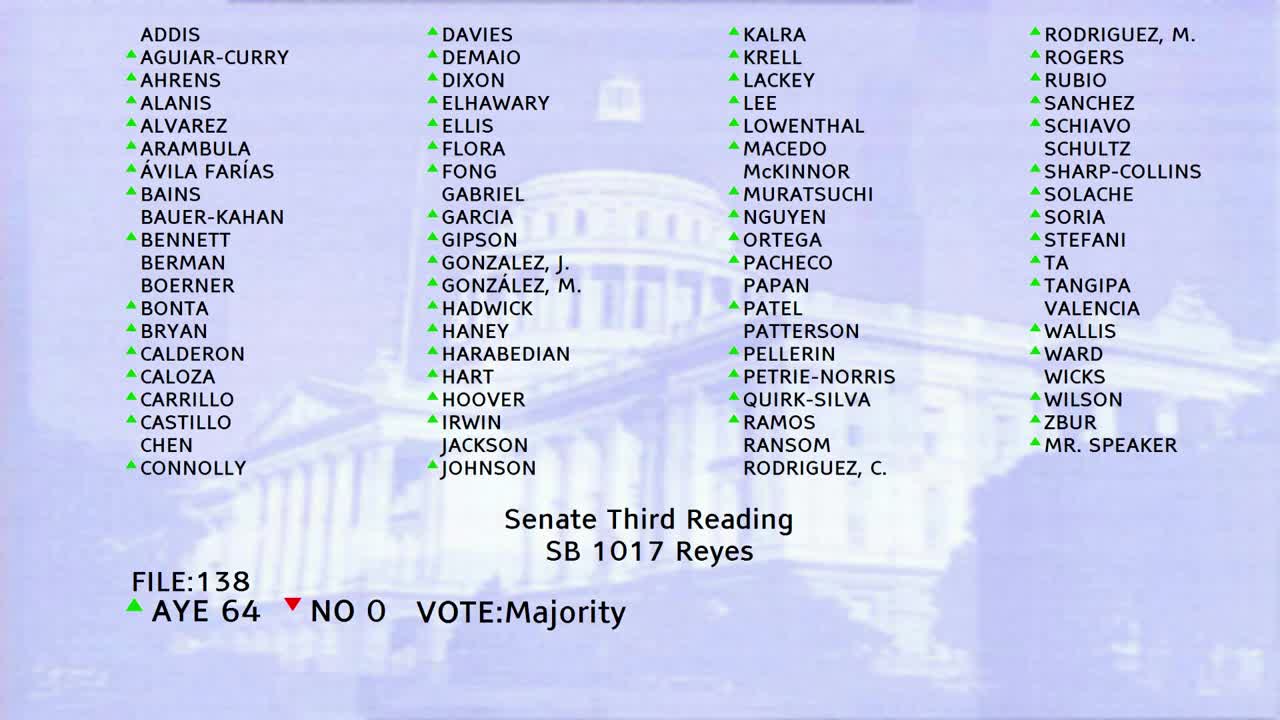
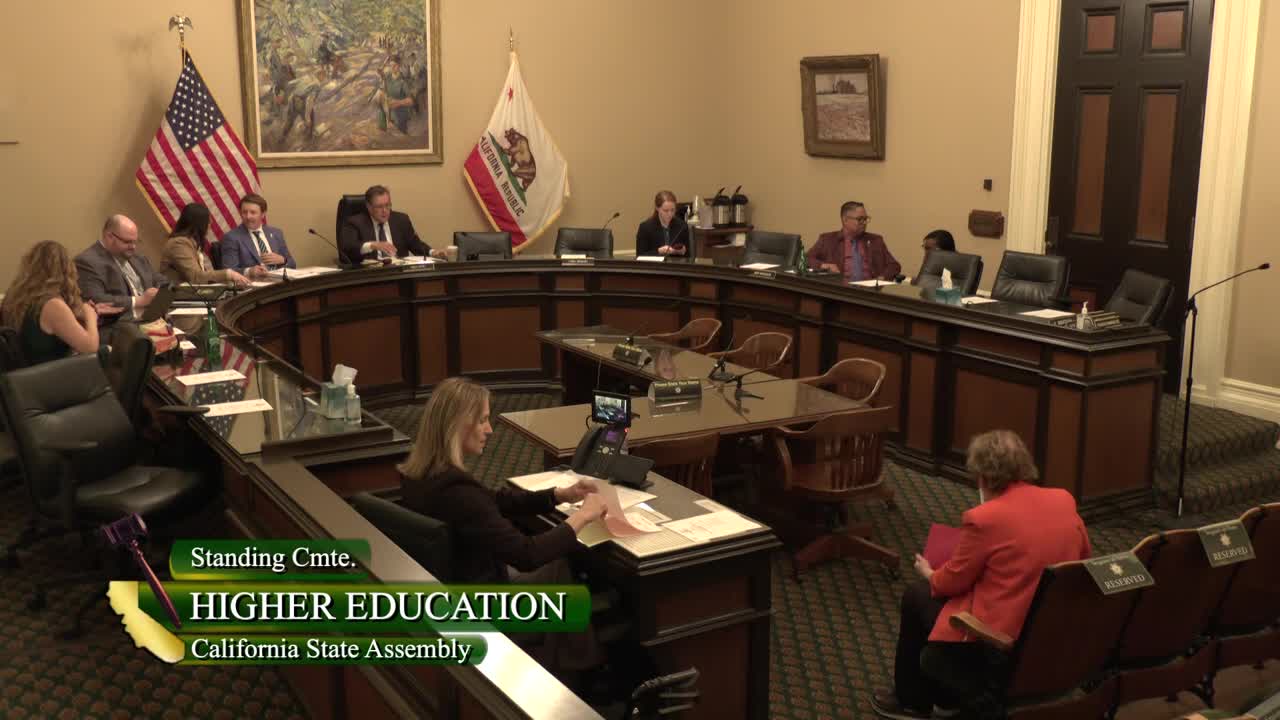
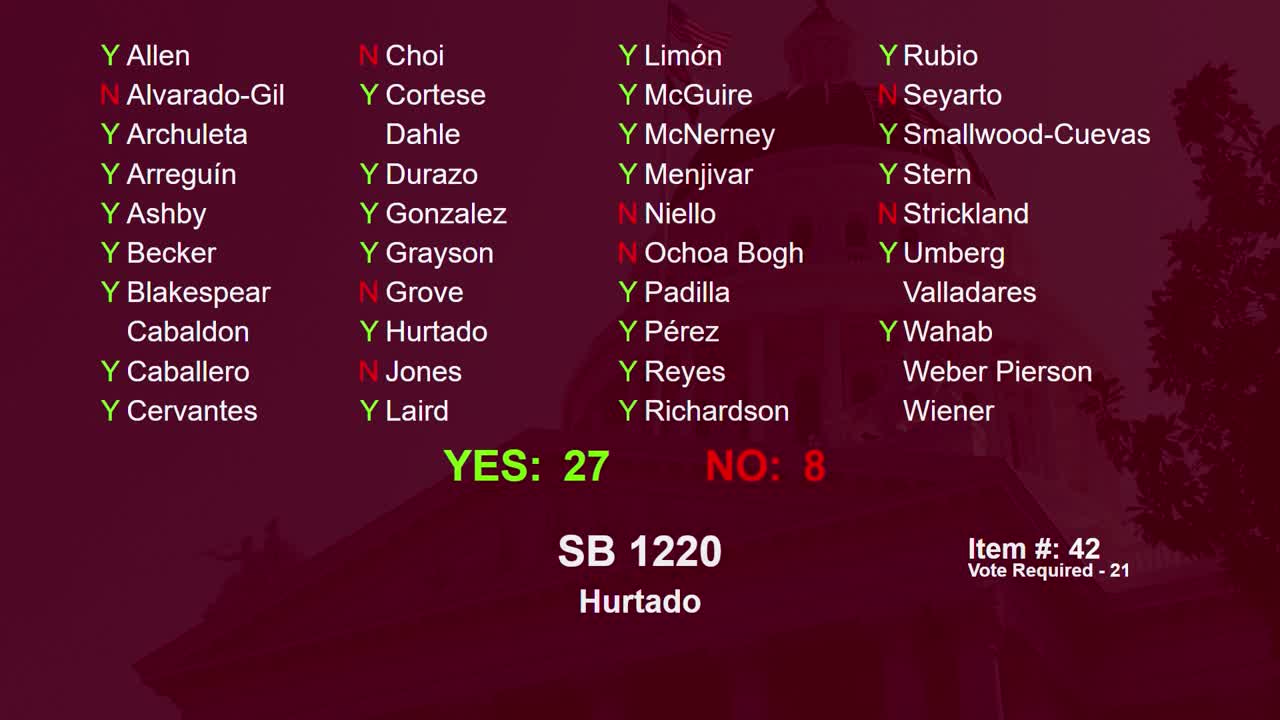

Bill Author

Bill Co-Author(s):