SB 1256: Subdivision Map Act: action or proceeding.
- Session Year: 2025-2026
- House: Senate
- Latest Version Date: 2026-09-30
Current Status:
Passed
(2026-09-30: Chaptered by Secretary of State. Chapter 1024, Statutes of 2026.)
Introduced
In Committee
Awaiting First Chamber Vote
Passed First Chamber
In Committee
Awaiting Second Chamber Vote
Passed Second Chamber
Enacted
The California Environmental Quality Act (CEQA) requires a lead agency, as defined, to prepare, or cause to be prepared, and certify the completion of an environmental impact report on a project that it proposes to carry out or approve that may have a significant effect on the environment or to adopt a negative declaration if it finds that the project will not have that effect. CEQA also requires a lead agency to prepare a mitigated negative declaration for a project that may have a significant effect on the environment if revisions in the project would avoid or mitigate that effect and there is no substantial evidence that the project, as revised, would have a significant effect on the environment. CEQA requires that an action or proceeding to attack, review, set aside, void, or annul specified acts or decisions of a public agency on the grounds of noncompliance with CEQA be commenced in accordance with specified timeframes.
Existing law, the Subdivision Map Act, vests the authority to regulate and control the design and improvement of subdivisions in the legislative body of a local agency and sets forth procedures governing the local agencys processing, approval, conditional approval or disapproval, and filing of tentative, final, and parcel maps, and the modification thereof. The act requires an action or proceeding against a decision of a local agency taken pursuant to that act to be commenced within a certain time period, as specified.
This bill would prohibit an action or proceeding to enforce the Subdivision Map Act from being maintained if certain criteria exist, including that the action or proceeding to enforce the Subdivision Map Act includes substantially similar claims or issues to claims or issues raised in an action or proceeding to enforce CEQA and the defendant in the action or proceeding to enforce the Subdivision Map Act was the defendant in the action or proceeding to enforce CEQA. The bill would provide that its provisions do not prohibit or abrogate specified actions, including the filing of timely objections to an agencys return to a writ seeking to enforce its specific mandates or timely filing of a separate action relating to the same project, as specified. The bill would repeal these provisions on January 1, 2032.
The California Environmental Quality Act (CEQA) requires a lead agency, as defined, to prepare, or cause to be prepared, and certify the completion of an environmental impact report on a project that it proposes to carry out or approve that may have a significant effect on the environment or to adopt a negative declaration if it finds that the project will not have that effect. CEQA also requires a lead agency to prepare a mitigated negative declaration for a project that may have a significant effect on the environment if revisions in the project would avoid or mitigate that effect and there is no substantial evidence that the project, as revised, would have a significant effect on the environment. CEQA requires that an action or proceeding to attack, review, set aside, void, or annul specified acts or decisions of a public agency on the grounds of noncompliance with CEQA be commenced in accordance with specified timeframes.
Existing law, the Subdivision Map Act, vests the authority to regulate and control the design and improvement of subdivisions in the legislative body of a local agency and sets forth procedures governing the local agencys processing, approval, conditional approval or disapproval, and filing of tentative, final, and parcel maps, and the modification thereof. The act requires an action or proceeding against a decision of a local agency taken pursuant to that act to be commenced within a certain time period, as specified.
This bill would prohibit an action or proceeding to enforce the Subdivision Map Act from being maintained, maintained if certain criteria exist, including that the action or proceeding to enforce the Subdivision Map Act includes substantially similar claims or issues to claims or issues raised in an action or proceeding to enforce CEQA and the defendant in the action or proceeding to enforce the Subdivision Map Act was the defendant in the action or proceeding to enforce CEQA. The bill would provide that its provisions do not prohibit or abrogate specified actions, including the filing of timely objections to an agencys return to a writ seeking to enforce its specific mandates or timely filing of a separate action relating to the same project, as specified. The bill would repeal these provisions on January 1, 2032.
The California Environmental Quality Act (CEQA) requires a lead agency, as defined, to prepare, or cause to be prepared, and certify the completion of an environmental impact report on a project that it proposes to carry out or approve that may have a significant effect on the environment or to adopt a negative declaration if it finds that the project will not have that effect. CEQA also requires a lead agency to prepare a mitigated negative declaration for a project that may have a significant effect on the environment if revisions in the project would avoid or mitigate that effect and there is no substantial evidence that the project, as revised, would have a significant effect on the environment. CEQA requires that an action or proceeding to attack, review, set aside, void, or annul specified acts or decisions of a public agency on the grounds of noncompliance with CEQA be commenced in accordance with specified timeframes.
Existing law, the Subdivision Map Act, vests the authority to regulate and control the design and improvement of subdivisions in the legislative body of a local agency and sets forth procedures governing the local agencys processing, approval, conditional approval or disapproval, and filing of tentative, final, and parcel maps, and the modification thereof. The act requires an action or proceeding against a decision of a local agency taken pursuant to that act to be commenced within a certain time period, as specified.
This bill would prohibit an action or proceeding to enforce the Subdivision Map Act from being maintained, if certain criteria exist, including that the action or proceeding to enforce the Subdivision Map Act includes substantially similar claims or issues to claims or issues raised in an action or proceeding to enforce CEQA and the defendant in the action or proceeding to enforce the Subdivision Map Act was the defendant in the action or proceeding to enforce CEQA. The bill would provide that its provisions do not prohibit the filing of timely objections to an agencys return to a writ seeking to enforce its specific mandates or timely filing of a separate action relating to the same project, as specified.
The California Environmental Quality Act (CEQA) requires a lead agency, as defined, to prepare, or cause to be prepared, and certify the completion of an environmental impact report on a project that it proposes to carry out or approve that may have a significant effect on the environment or to adopt a negative declaration if it finds that the project will not have that effect. CEQA also requires a lead agency to prepare a mitigated negative declaration for a project that may have a significant effect on the environment if revisions in the project would avoid or mitigate that effect and there is no substantial evidence that the project, as revised, would have a significant effect on the environment. CEQA requires that an action or proceeding to attack, review, set aside, void, or annul specified acts or decisions of a public agency on the grounds of noncompliance with CEQA be commenced in accordance with specified timeframes.
Existing law, the Subdivision Map Act, vests the authority to regulate and control the design and improvement of subdivisions in the legislative body of a local agency and sets forth procedures governing the local agencys processing, approval, conditional approval or disapproval, and filing of tentative, final, and parcel maps, and the modification thereof. The act requires an action or proceeding against a decision of a local agency taken pursuant to that act to be commenced within a certain time period, as specified.
This bill would prohibit an action or proceeding to enforce the Subdivision Map Act from being maintained, if certain criteria exist, including that the action or proceeding to enforce the Subdivision Map Act includes substantially similar claims or issues to claims or issues raised in an action or proceeding to enforce CEQA and the defendant in the action or proceeding to enforce the Subdivision Map Act was the defendant in the action or proceeding to enforce CEQA.
The California Environmental Quality Act (CEQA) requires a lead agency, as defined, to prepare, or cause to be prepared, and certify the completion of an environmental impact report on a project that it proposes to carry out or approve that may have a significant effect on the environment or to adopt a negative declaration if it finds that the project will not have that effect. CEQA also requires a lead agency to prepare a mitigated negative declaration for a project that may have a significant effect on the environment if revisions in the project would avoid or mitigate that effect and there is no substantial evidence that the project, as revised, would have a significant effect on the environment. CEQA requires that an action or proceeding to attack, review, set aside, void, or annul specified acts or decisions of a public agency on the grounds of noncompliance with CEQA be commenced in accordance with specified timeframes.
This bill would exempt from CEQA the closure of a railroad grade crossing by order of the Public Utilities Commission if the commission finds the crossing to present a threat to public safety. The bill would make this exemption inapplicable to any crossing for high-speed rail or any crossing for a project carried out by the High-Speed Rail Authority. The bill would require the lead agency to file the notice of exemption with specified public entities. Because the bill would impose additional duties on lead agencies with regards to the filing of the notice of exemption, this bill would impose a state-mandated local program.The California Constitution requires the state to reimburse local agencies and school districts for certain costs mandated by the state. Statutory provisions establish procedures for making that reimbursement.This bill would provide that no reimbursement is required by this act for a specified reason.Existing law, the Subdivision Map Act, vests the authority to regulate and control the design and improvement of subdivisions in the legislative body of a local agency and sets forth procedures governing the local agencys processing, approval, conditional approval or disapproval, and filing of tentative, final, and parcel maps, and the modification thereof. The act requires an action or proceeding against a decision of a local agency taken pursuant to that act to be commenced within a certain time period, as specified.
This bill would prohibit an action or proceeding to enforce the Subdivision Map Act from being maintained, if certain criteria exist, including that the action or proceeding to enforce the Subdivision Map Act includes substantially similar claims to claims raised in an action or proceeding to enforce CEQA and the defendant in the action or proceeding to enforce the Subdivision Map Act was the defendant in the action or proceeding to enforce CEQA.
The California Environmental Quality Act (CEQA) requires a lead agency, as defined, to prepare, or cause to be prepared, and certify the completion of an environmental impact report on a project that it proposes to carry out or approve that may have a significant effect on the environment or to adopt a negative declaration if it finds that the project will not have that effect. CEQA also requires a lead agency to prepare a mitigated negative declaration for a project that may have a significant effect on the environment if revisions in the project would avoid or mitigate that effect and there is no substantial evidence that the project, as revised, would have a significant effect on the environment.
This bill would exempt from CEQA the closure of a railroad grade crossing by order of the Public Utilities Commission if the commission finds the crossing to present a threat to public safety. The bill would make this exemption inapplicable to any crossing for high-speed rail or any crossing for a project carried out by the High-Speed Rail Authority. The bill would require the lead agency to file the notice of exemption with specified public entities. Because the bill would impose additional duties on lead agencies with regards to the filing of the notice of exemption, this bill would impose a state-mandated local program.
The California Constitution requires the state to reimburse local agencies and school districts for certain costs mandated by the state. Statutory provisions establish procedures for making that reimbursement.
This bill would provide that no reimbursement is required by this act for a specified reason.
(a)Any action or proceeding to enforce the Subdivision Map Act shall not be maintained if all of the following criteria exist:
(1)The action or proceeding to enforce the Subdivision Map Act includes substantially similar claims or issues to claims or issues raised in an action or proceeding to enforce the California Environmental Quality Act (Division 13 (commencing with Section 21000) of the Public Resources Code).
(2)The defendant in the action or proceeding to enforce the Subdivision Map Act was the defendant in the action or proceeding to enforce the California Environmental Quality Act (Division 13 (commencing with Section 21000) of the Public Resources Code).
(3)The action or proceeding to enforce the California Environmental Quality Act (Division 13 (commencing with Section 21000) of the Public Resources Code), was commenced prior to January 1, 2019, and has been fully adjudicated.
(4)The project that is the subject of the action or proceeding to enforce the California Environmental Quality Act (Division 13 (commencing with Section 21000) of the Public Resources Code) meets all of the following requirements:
(A)The project proposes at least 400 units of mixed-income housing.
(B)The project includes a project labor agreement.
(C)The project is located within the unincorporated area of a county that has a population of at least 3,000,000 and no greater than 4,000,000 residents.
(D)The project has been approved by the lead agency.
(5)The plaintiffs, petitioners, or real parties in interest in the action or proceeding to enforce the Subdivision Map Act are the same or in privity with the plaintiffs, petitioners, or real parties in interest in the action or proceeding to enforce the California Environmental Quality Act (Division 13 (commencing with Section 21000) of the Public Resources Code).
(b)This section shall not be construed to do any of the following:
(1)Prohibit the filing of timely objections to an agencys return to a writ seeking to enforce its specific mandates.
(2)Prohibit the timely filing of a separate action relating to the same project.
(3)Prohibit the timely filing of a Subdivision Map Act claim when necessary to enforce adherence to a mitigation measure identified in either of the following:
(A)An approved environmental impact report.
(B)A court order in, or an approved settlement of, an action or proceeding to enforce the California Environmental Quality Act (Division 13 (commencing with Section 21000) of the Public Resources Code).
(4)Abrogate a local agencys obligation to comply with a procedural requirement of the Subdivision Map Act.
(c)This section shall remain in effect only until January 1, 2032, and as of that date is repealed.
(a)Any action or proceeding to enforce the Subdivision Map Act shall not be maintained, maintained if all of the following criteria exist:
(1)The action or proceeding to enforce the Subdivision Map Act includes substantially similar claims or issues to claims or issues raised in an action or proceeding to enforce the California Environmental Quality Act (Division 13 (commencing with Section 21000) of the Public Resources Code).
(2)The defendant in the action or proceeding to enforce the Subdivision Map Act was the defendant in the action or proceeding to enforce the California Environmental Quality Act (Division 13 (commencing with Section 21000) of the Public Resources Code).
(3)The action or proceeding to enforce the California Environmental Quality Act (Division 13 (commencing with Section 21000) of the Public Resources Code), was commenced prior to January 1, 2019, and has been fully adjudicated.
(4)The project that is the subject of the action or proceeding to enforce the California Environmental Quality Act (Division 13 (commencing with Section 21000) of the Public Resources Code) meets all of the following requirements:
(A)The project proposes at least 400 units of mixed-income housing.
(B)The project includes a project labor agreement.
(C)The project is located within the unincorporated area of a county that has a population of at least 3,000,000 and no greater than 4,000,000 residents.
(D)The project has been approved by the lead agency.
(5)The plaintiffs or petitioners plaintiffs, petitioners, or real parties in interest in the action or proceeding to enforce the Subdivision Map Act are the same or in privity with the plaintiffs or petitioners plaintiffs, petitioners, or real parties in interest in the action or proceeding to enforce the California Environmental Quality Act (Division 13 (commencing with Section 21000) of the Public Resources Code).
(b)Nothing in this section shall This section shall not be construed to do either any of the following:
(1)Prohibit the filing of timely objections to an agencys return to a writ seeking to enforce its specific mandates.
(2)Prohibit the timely filing of a separate action relating to the same project.
(3)Prohibit the timely filing of a Subdivision Map Act claim when necessary to enforce adherence to a mitigation measure identified in either of the following:
(A)An approved environmental impact report.
(B)A court order in, or an approved settlement of, an action or proceeding to enforce the California Environmental Quality Act (Division 13 (commencing with Section 21000) of the Public Resources Code).
(4)Abrogate a local agencys obligation to comply with a procedural requirement of the Subdivision Map Act.
(c)This section shall remain in effect only until January 1, 2032, and as of that date is repealed.
(a)Any action or proceeding to enforce the Subdivision Map Act shall not be maintained, if all of the following criteria exist:
(a)(1)The action or proceeding to enforce the Subdivision Map Act includes substantially similar claims or issues to claims or issues raised in an action or proceeding to enforce the California Environmental Quality Act (Division 13 (commencing with Section 21000) of the Public Resources Code).
(b)(2)The defendant in the action or proceeding to enforce the Subdivision Map Act was the defendant in the action or proceeding to enforce the California Environmental Quality Act (Division 13 (commencing with Section 21000) of the Public Resources Code).
(c)(3)The action or proceeding to enforce the California Environmental Quality Act (Division 13 (commencing with Section 21000) of the Public Resources Code) Code), was commenced prior to January 1, 2019, and has been fully adjudicated.
(d)(4)The project that is the subject of the action or proceeding to enforce the California Environmental Quality Act (Division 13 (commencing with Section 21000) of the Public Resources Code) has meets all of the following requirements:
(A)The project proposes at least 400 units of mixed-income housing.
(B)The project includes a project labor agreement.
(C)The project is located within the unincorporated area of a county that has a population of at least 3,000,000 and no greater than 4,000,000 residents.
(D)The project has been approved by the lead agency.
(e)(5)The plaintiffs or petitioners in the action or proceeding to enforce the Subdivision Map Act are the same or in privity with the plaintiffs or petitioners in the action or proceeding to enforce the California Environmental Quality Act (Division 13 (commencing with Section 21000) of the Public Resources Code).
(b)Nothing in this section shall be construed to do either of the following:
(1)Prohibit the filing of timely objections to an agencys return to a writ seeking to enforce its specific mandates.
(2)Prohibit the timely filing of a separate action relating to the same project.
Any action or proceeding to enforce the Subdivision Map Act shall not be maintained, if all of the following criteria exist:
(a)The action or proceeding to enforce the Subdivision Map Act includes substantially similar claims or issues to claims or issues raised in an action or proceeding to enforce the California Environmental Quality Act (Division 13 (commencing with Section 21000) of the Public Resources Code).
(b)The defendant in the action or proceeding to enforce the Subdivision Map Act was the defendant in the action or proceeding described in subdivision (a). to enforce the California Environmental Quality Act (Division 13 (commencing with Section 21000) of the Public Resources Code).
(c)The action or proceeding described in subdivision (a) to enforce the California Environmental Quality Act (Division 13 (commencing with Section 21000) of the Public Resources Code) has been fully adjudicated.
(d)The project that is the subject of the action or proceeding described in subdivision (a) to enforce the California Environmental Quality Act (Division 13 (commencing with Section 21000) of the Public Resources Code) has been approved by the lead agency.
(e)The plaintiffs or petitioners in the action or proceeding to enforce the Subdivision Map Act are the same or in privity with the plaintiffs or petitioners in the action or proceeding to enforce the California Environmental Quality Act (Division 13 (commencing with Section 21000) of the Public Resources Code).
Any action or proceeding to enforce the Subdivision Map Act shall not be maintained, if all of the following criteria exist:
(a)The action or proceeding to enforce the Subdivision Map Act includes substantially similar claims to claims raised in an action or proceeding to enforce the California Environmental Quality Act (Division 13 (commencing with Section 21000) of the Public Resources Code).
(b)The defendant in the action or proceeding to enforce the Subdivision Map Act was the defendant in the action or proceeding described in subdivision (a).
(c)The action or proceeding described in subdivision (a) has been fully adjudicated.
(d)The project that is the subject of the action or proceeding described in subdivision (a) has been approved by the lead agency.
SECTION 1.Section 21080.14 is added to the Public Resources Code, to read:21080.14.(a)This division does not apply to the closure of a railroad grade crossing by order of the Public Utilities Commission pursuant to Chapter 6 (commencing with Section 1201) of Part 1 of Division 1 of the Public Utilities Code, if the Public Utilities Commission finds the crossing to present a threat to public safety.(b)This section does not apply to any crossing for high-speed rail, as defined in Section 185012 of the Public Utilities Code, or any crossing for a project carried out by the High-Speed Rail Authority, as described in Section 185020 of the Public Utilities Code, or a successor agency.(c)(1)Whenever a state agency determines that a project is not subject to this division pursuant to this section, and it approves or determines to carry out the project, the state agency shall file a notice with the Office of Land Use and Climate Innovation in the manner specified in subdivisions (b) and (c) of Section 21108.(2)Whenever a local agency determines that a project is not subject to this division pursuant to this section, and it approves or determines to carry out the project, the local agency shall file a notice with the Office of Land Use and Climate Innovation and with the county clerk in each county in which the project will be located in the manner specified in subdivisions (b) and (c) of Section 21152.SEC. 2.No reimbursement is required by this act pursuant to Section 6 of Article XIIIB of the California Constitution because a local agency or school district has the authority to levy service charges, fees, or assessments sufficient to pay for the program or level of service mandated by this act, within the meaning of Section 17556 of the Government Code.(a)This division does not apply to the closure of a railroad grade crossing by order of the Public Utilities Commission pursuant to Chapter 6 (commencing with Section 1201) of Part 1 of Division 1 of the Public Utilities Code, if the Public Utilities Commission finds the crossing to present a threat to public safety.
(b)This section does not apply to any crossing for high-speed rail, as defined in Section 185012 of the Public Utilities Code, or any crossing for a project carried out by the High-Speed Rail Authority, as described in Section 185020 of the Public Utilities Code, or a successor agency.
(c)(1)Whenever a state agency determines that a project is not subject to this division pursuant to this section, and it approves or determines to carry out the project, the state agency shall file a notice with the Office of Land Use and Climate Innovation in the manner specified in subdivisions (b) and (c) of Section 21108.
(2)Whenever a local agency determines that a project is not subject to this division pursuant to this section, and it approves or determines to carry out the project, the local agency shall file a notice with the Office of Land Use and Climate Innovation and with the county clerk in each county in which the project will be located in the manner specified in subdivisions (b) and (c) of Section 21152.
SEC. 2.No reimbursement is required by this act pursuant to Section 6 of Article XIIIB of the California Constitution because a local agency or school district has the authority to levy service charges, fees, or assessments sufficient to pay for the program or level of service mandated by this act, within the meaning of Section 17556 of the Government Code.
|
Date
|
Status
|
|---|---|
| Sep 30, 2026 | Chaptered by Secretary of State. Chapter 1024, Statutes of 2026. |
| Sep 30, 2026 | Approved by the Governor. |
| Sep 8, 2026 | Enrolled and presented to the Governor at 4 p.m. |
| Aug 30, 2026 | Assembly amendments concurred in. (Ayes 39. Noes 1. Page 6153.) Ordered to engrossing and enrolling. |
| Aug 30, 2026 | Assembly amendments concurred in. (Ayes 39. Noes 1.) Ordered to engrossing and enrolling. |
| Aug 30, 2026 | In Senate. Concurrence in Assembly amendments pending. |
| Aug 30, 2026 | Read third time. Passed. (Ayes 62. Noes 1. Page 6845.) Ordered to the Senate. |
| Aug 30, 2026 | Read third time. Passed. Ordered to the Senate. |
| Aug 3, 2026 | Read second time. Ordered to third reading. |
| Jul 2, 2026 | From committee: Do pass. (Ayes 8. Noes 0.) (July 1). |
| Jun 24, 2026 | Read second time and amended. Re-referred to Com. on L. GOV. |
| Jun 23, 2026 | From committee: Do pass as amended and re-refer to Com. on L. GOV. (Ayes 11. Noes 0.) (June 23). |
| Jun 12, 2026 | June 16 set for first hearing canceled at the request of author. |
| Jun 8, 2026 | Referred to Coms. on JUD. and L. GOV. |
| May 27, 2026 | In Assembly. Read first time. Held at Desk. |
| May 27, 2026 | Read third time. Passed. (Ayes 33. Noes 0. Page 4481.) Ordered to the Assembly. |
| May 27, 2026 | Read third time. Passed. (Ayes 33. Noes 0.) Ordered to the Assembly. |
| May 27, 2026 | Read third time. Passed. (Ayes 32. Noes 0.) Ordered to the Assembly. |
| Apr 30, 2026 | Read second time and amended. Ordered to third reading. |
| Apr 29, 2026 | From committee: Do pass as amended. (Ayes 7. Noes 0. Page 4095.) (April 29). |
| Apr 29, 2026 | From committee: Do pass as amended. (Ayes 7. Noes 0.) (April 29). |
| Apr 22, 2026 | From committee: Do pass and re-refer to Com. on L. GOV. with recommendation: To consent calendar. (Ayes 13. Noes 0. Page 3979.) (April 21). Re-referred to Com. on L. GOV. |
| Apr 22, 2026 | From committee with author's amendments. Read second time and amended. Re-referred to Com. on L. GOV. |
| Apr 22, 2026 | From committee: Do pass and re-refer to Com. on L. GOV. with recommendation: To consent calendar. (Ayes 13. Noes 0.) (April 21). Re-referred to Com. on L. GOV. |
| Apr 17, 2026 | Set for hearing April 29 in L. GOV. pending receipt. |
| Apr 10, 2026 | Set for hearing April 21. |
| Apr 8, 2026 | Re-referred to Coms. on JUD. and L. GOV. |
| Mar 26, 2026 | Re-referred to Com. on RLS. |
| Mar 26, 2026 | Withdrawn from committee. |
| Mar 26, 2026 | April 8 hearing postponed by committee. |
| Mar 25, 2026 | From committee with author's amendments. Read second time and amended. Re-referred to Com. on E.Q. |
| Mar 10, 2026 | Set for hearing April 8. |
| Mar 4, 2026 | Referred to Coms. on E.Q. and E., U & C. |
| Feb 20, 2026 | From printer. May be acted upon on or after March 22. |
| Feb 19, 2026 | Introduced. Read first time. To Com. on RLS. for assignment. To print. |
|
Date
|
Description
|
Location
|
Votes
|
|
|---|---|---|---|---|
| Aug 30, 2026 | Unfinished Business SB1256 Jones Concurrence | Senate Floor |
Passed |
|
| Aug 30, 2026 | SB 1256 Jones Senate Third Reading By Alanis | Assembly Floor |
Passed |
|
| Jul 1, 2026 | Do pass. | Assembly Standing Committee on Local Government |
Passed |
|
| Jun 23, 2026 | Do pass as amended and be re-referred to the Committee on [Local Government] | Assembly Standing Committee on Judiciary |
Passed |
|
| May 27, 2026 | Senate 3rd Reading SB1256 Jones | Senate Floor |
Passed |
|
| Apr 29, 2026 | Do pass as amended | Senate Standing Committee on Local Government |
Passed |
|
| Apr 21, 2026 | Do pass, but first be re-referred to the Committee on [Local Government] with the recommendation: To Consent Calendar | Senate Standing Committee on Judiciary |
Passed |
This list shows positions taken on this bill by organizations on the date displayed, which is linked to the original source.
Positions by individuals are not included.
|
Organization
|
Position
|
Date
|
|---|---|---|
| 32nd Street Canyon Task Force | ** Against | |
| 61 individuals | ** Against | |
| 6 Individuals | ** Against | |
| Brentwood Alliance of Canyons & Hillsides | ** Against | |
| California Coastal Protection Network | ** Against | |
| Canyon Back Alliance | ** Against | |
| Center For Biological Diversity | ** Against | |
| Center for Local Government Accountability | ** Against | |
| Climate Action Campaign | ** Against | |
| Elfin Forest / Harmony Grove Town Council | ** Against | |
| Elfin Forest Harmony Grove Town Council | ** Against | |
| Elfin Forest/ Harmony Grove Town Council | ** Against | |
| Endangered Habitats League | ** Against | |
| Equitable Land Use Alliance (ELUA) | ** Against | |
| Escondido Neighbors United | ** Against | |
| Friends of Goodan Ranch and Sycamore Canyon Open Space | ** Against | |
| Friends of Hedionda Creek | ** Against | |
| Hills for Everyone | ** Against | |
| Inland Empire Waterkeeper | ** Against | |
| Laborers International Union of North America (LiUNA!) Local 89 from San Diego | ** Support | |
| LIUNA Local 89 | ** Support | |
| Local 89 San Diego | ** Support | |
| Los Angeles Audubon Society | ** Against | |
| Neighbors for a Better San Diego | ** Against | |
| Orange County Coastkeeper | ** Against | |
| Planning And Conservation League | ** Against | |
| Preserve Calavera | ** Against | |
| Preserve Wild Santee | ** Against | |
| RCS Harmony Partners | ** Support | |
| RCS-Harmony Partners | ** Support | |
| Rcs Harmony Partners LLC | ** Support | |
| Resource Renewal Institute | ** Against | |
| San Diego Bird Alliance | ** Against | |
| San Dieguito Community Planning Group | ** Against | |
| San Pasqual Valley Preservation Alliance | ** Against | |
| Sea And Sage Audubon Society | ** Against | |
| State Alliance for Firesafe Road Regulations | ** Against | |
| The Chaparral Lands Conservancy | ** Against | |
| The Elfin Forest Harmony Grove Town Council | ** Against | |
| The Escondido Creek Conservancy | ** Against | |
| The Urban Wildlands Group | ** Against | |
| Wake Up California | ** Against | |
| Western Electrical Contractors Association | ** Against |
SENATE RULES COMMITTEE Office of Senate Floor Analyses (916) 651-4171 | SB 1256 |
UNFINISHED BUSINESS
Bill No: SB 1256
Author: Jones (R)
Amended: 6/24/26
Vote: 21
SENATE JUDICIARY COMMITTEE: 13-0, 4/21/26
AYES: Umberg, Niello, Allen, Ashby, Caballero, Durazo, Laird, Reyes, Stern, Valladares, Wahab, Weber Pierson, Wiener
SENATE LOCAL GOVERNMENT COMMITTEE: 7-0, 4/29/26
AYES: Durazo, Choi, Arreguín, Ashby, Cervantes, Laird, Seyarto
SENATE FLOOR: 33-0, 5/27/26
AYES: Alvarado-Gil, Archuleta, Arreguín, Ashby, Becker, Blakespear, Cabaldon, Caballero, Cervantes, Choi, Cortese, Grayson, Grove, Hurtado, Jones, Limón, McGuire, McNerney, Menjivar, Niello, Ochoa Bogh, Padilla, Pérez, Richardson, Rubio, Seyarto, Stern, Strickland, Umberg, Valladares, Wahab, Weber Pierson, Wiener
NO VOTE RECORDED: Allen, Dahle, Durazo, Gonzalez, Laird, Reyes, Smallwood-Cuevas
ASSEMBLY FLOOR: Passed, 8/30/26
SUBJECT: Subdivision Map Act: action or proceeding
SOURCE: Author
DIGEST:
This bill bars an action or proceeding under the Subdivision Map Act when a substantially similar claim or issue was raised in a prior California Environmental Quality Act (CEQA) action against the same defendant when that CEQA action has been fully adjudicated and the project that is the subject of the CEQA action has been approved by the lead agency for projects that meet specified criteria.
Assembly Amendments
add a sunset date of 1/1/2032, provide this bill does not prohibit the timely filing of a Subdivision Map Act claim necessary to enforce adherence to a mitigation measure identified in either an approved environmental impact report or a court order in, or an approved settlement of, an action or proceeding to enforce CEQA or abrogate a local agency’s obligation to comply with a procedural requirement of the Subdivision Map Act.
ANALYSIS:
Existing law:
- Requires, under the Subdivision Map Act, a tentative and final map for all subdivisions creating five or more parcels, five or more condominiums as defined in Section 783 of the Civil Code, a community apartment project containing five or more parcels, or for the conversion of a dwelling to a stock cooperative containing five or more dwelling units, as specified and with certain exceptions. (Government (Gov.) Code § 66426.)
- Requires a service of summons to be effected within 90 days after the date of a decision in any action or proceeding to attack, review, set aside, void, or annul the decision of an advisory agency, appeal board, or legislative body concerning a subdivision, or of any of the proceedings, acts, or determinations taken, done, or made prior to the decision, or to determine the reasonableness, legality, or validity of any condition attached thereto, including, but not limited to, the approval of a tentative map or final map or the any action is barred. (Gov. Code § 66499.37.)
- The proceeding is to take precedence over all matters of the calendar of the court except criminal, probate, eminent domain, forcible entry, and unlawful detainer proceedings.
- Requires lead agencies with the principal responsibility for carrying out or approving a proposed discretionary project to prepare a negative declaration, mitigated declaration, or environmental impact report (EIR) for this action, unless the project is exempt from CEQA (CEQA includes various statutory exemptions, as well as categorical exemptions in the CEQA Guidelines). (Public Resources (Pub. Res.) Code § 21100 et seq.)
- Sets requirements relating to the preparation, review, comment, approval and certification of environmental documents, as well as procedures relating to an action or proceeding to attack, review, set aside, void, or annul various actions of a public agency on the grounds of noncompliance with CEQA. (Pub. Res. Code § 21165 et seq.)
- Authorizes judicial review of CEQA actions taken by public agencies, following the agency’s decision to carry out or approve the project, and specifies certain time periods in which an action must be instituted depending on the type of claim alleged. (Pub. Res. Code § 21167.)
This bill:
- Prohibits any action or proceeding to enforce the Subdivision Map Act from being maintained if all of the following criteria apply:
- the action or proceeding to enforce the Subdivision Map Act includes substantially similar claims or issues to claims raised in an action or proceeding to enforce CEQA;
- the defendant in the action or proceeding to enforce the Subdivision Map Act was the defendant in the action or proceeding to enforce CEQA;
- the action or proceeding to enforce CEQA was commenced prior to January 1, 2019, and has been fully adjudicated;
- the plaintiffs, petitioners, or real parties in the action or proceeding to enforce the Subdivision Map Act are the same or in privity with the plaintiffs, petitioners, or real parties in the action or proceeding to enforce CEQA; and
- the project that is the subject of the CEQA action or proceeding meets the following:
- proposes at least 400 units of mixed-income housing;
- includes a project labor agreement;
- is located within the unincorporated area of a county that has a population of at least 3,000,000 and no greater than 4,000,000 residents, and
- has been approved by the lead agency.
- Provides that nothing above is to be construed to do either of the following:
- Prohibit the filing of timely objections to ensure an agency’s return to a writ seeking to enforce its specific mandates.
- Prohibit the timely filing of a separate action relating to the same project.
- Prohibit the timely filing of a Subdivision Map Act claim when necessary to enforce adherence to a mitigation measure identified in either of the following: An approved environmental impact report or a court order in, or an approved settlement of, an action or proceeding to enforce CEQA.
- Abrogate a local agency’s obligation to comply with a procedural requirement of the Subdivision Map Act.
- Repeals these provisions on January 1, 2032.
Comments
Enacted in 1970, CEQA requires state and local agencies to follow a set protocol to disclose and evaluate the significant environmental impacts of proposed projects and to adopt feasible measures to mitigate those impacts. CEQA itself applies to projects undertaken or requiring approval by public agencies, and, if more than one agency is involved, CEQA requires one of the agencies to be designated as the “lead agency.” The environmental review process required by CEQA consists of: (1) determining if the activity is a project; (2) determining if the project is exempt from CEQA; and (3) performing an initial study to identify the environmental impacts and, depending on the findings, prepare either a Negative Declaration (for projects with no significant impacts), a Mitigated Negative Declaration (for projects with significant impacts but that are revised in some form to avoid or mitigate those impacts), or an EIR (for projects with significant impacts).
An EIR must accurately describe the proposed project, identify and analyze each significant environmental impact expected to result from the proposed project, identify mitigation measures to reduce those impacts to the extent feasible, and evaluate a range of reasonable alternatives to the proposed project. Before approving any project that has received environmental review, an agency must make certain findings pertaining to the project’s environmental impact and any associated mitigation measures. If mitigation measures are required or incorporated into a project, the public agency must adopt a reporting or monitoring program to ensure compliance with those measures. To enforce the requirements of CEQA, a civil action may be brought under several code sections to attack, review, set aside, void, or annul the acts or decisions of a public agency for noncompliance with the act.
Unlike other environmental laws specific to air resources, water resources, or the control of toxic substances, there is no statewide bureaucracy charged with enforcement of CEQA. Rather, it is enforced through citizen participation and litigation if necessary. Arguably, this makes the implementation of CEQA more efficient and expeditious than if a state agency were created to administer the law. Thus, CEQA litigation could more appropriately be characterized as mere enforcement. “CEQA operates, not by dictating pro-environmental outcomes, but rather by mandating that ‘decision makers and the public’ study the likely environmental effects of contemplated government actions and thus make fully informed decisions regarding those actions. … In other words, CEQA does not care what decision is made as long as it is an informed one.” (Citizens Coalition Los Angeles v. City of Los Angeles (2018) 26 Cal. App. 5th 561, 577.)
The Subdivision Map Act (Map Act) governs how local legislative bodies regulate the division of real property into smaller parcels for sale, lease, or financing. Under the Map Act, cities and counties are required to adopt local subdivision ordinances to carry out the Map Act and any local requirements. A subdivision’s design and improvements as adopted under the Map Act must be consistent with city and county general plans.
With limited exceptions, all subdivisions creating five or more parcels require a city or county to approve a tentative map and then a final map. Local officials may require, as a condition of approving a proposed subdivision, the dedication of property within a subdivision for streets, alleys, drainage, utility easements, and other public easements and improvements. An applicant who agrees to the conditions and meets the other requirements in the Map Act and local subdivision ordinances may be granted a tentative map. Once subdividers comply with those conditions, local officials must issue final maps.
A person can bring any action to attack, review, set aside, void, or annul the decision of an advisory agency, appeal board, or legislative body concerning a subdivision, or of any of the proceedings, acts, or determinations taken, done, or made prior to the decision, or to determine the reasonableness, legality, or validity of any condition attached thereto, including, but not limited to, the approval of a tentative map or final map. However, a service of summons has to be effected within 90 days after the date of a decision or all claims are barred.
This bill is modeled off the judicial doctrines of res judicata (claim preclusion) and equitable estoppel (issue preclusion). Res judicata “prevents relitigation of the same cause of action [claim] in a second suit between the same parties or parties in privity with them.” The elements needed to assert res judicata are: (1) the legal claim or issue in the present action is identical to a claim or issue in a prior proceeding; (2) the prior proceeding resulted in a final judgment on the merits; and (3) the party against whom the doctrine is being asserted was a party or in privity with a party to the prior proceedings.
Equitable estoppel precludes relitigation of the same issue already resolved in an earlier proceeding, even if the two claims are not the same. The courts have held that the elements of equitable estoppel apply: “(1) after final adjudication; (2) of an identical issue; (3) actually litigated and necessarily decided in the first suit; and (4) asserted against one who was a party in the first suit or one in privity with that party” “If all four of the requirements for issue preclusion are satisfied, a court then also determines whether application of preclusion would be consistent with the “preservation of the integrity of the judicial system, promotion of judicial economy, and protection of litigants from harassment by vexatious litigation.”
The courts have held that the concept of privity is a requirement of due process and that in instances where the party in the first action is not the same party as in the second party, the interests of the two parties must be “so similar” that the party in the first action was essentially the “virtual representative” of the party in the second action. The court has noted that if the interests if the parties are divergent, adequate representation is not inferred and no privity is found.
This bill seeks to bar claims under the Map Act when a substantially similar claim was raised in a CEQA action against the same defendant when the CEQA action has been fully adjudicated and the project that is the subject of the CEQA action has been approved by the lead agency. The author claims that this bill is needed to halt the practice where a plaintiff exhausts all their remedies under a CEQA suit and then brings a suit under the Map Act based on substantially similar claims. The author argues this tactic is being used more and more to thwart housing development construction in the state and is an abuse of scarce judicial resources, which is the same policy behind the doctrines described above.
This bill is more akin to the doctrine of equitable estoppel as the claims in the first action (a CEQA claim) would be different in the second action (Map Act claim). This bill differs from the elements of equitable estoppel described above in two ways. First, the issues in the CEQA action are not required to be identical, but substantially similar. Under CEQA, the standard of review used by a court is the “fair argument standard” and applies to agency decisions and judicial review of those decisions. The court has described this standard “purposely sets a low threshold of evidence in order to maximize environmental protections and thereby fulfill the purposes inherent in CEQA.” The court noted that planning or zoning determinations, in contrast, “are reviewed with greater deference, both because the public entity is deemed best able to interpret its own rules and because it is presumed to bring local knowledge and experience to bear on such issues.” To the extent CEQA has a lower evidentiary burden for plaintiffs to meet, and issues in a CEQA case are found to be unsubstantiated in a final judgment by the court, barring substantially similar issues to be raised in an action under the Map Act seems to meet the policy goals of res judicata to preserve the integrity of the judicial system, promote judicial economy, and protect litigants (in this case locals) from harassment by vexatious litigation.
This bill limits it’s provisions to a project that proposes at least 400 units of mixed-income housing, includes a project labor agreement, is located within the unincorporated area of a county that has a population of at least 3,000,000 and no greater than 4,000,000 residents, and has been approved by the lead agency. The CEQA action also has to have been commenced prior to January 1, 2019.
FISCAL EFFECT: Appropriation: No Fiscal Com.: No Local: No
LIUNA Local 89
RCS Harmony Partners
OPPOSITION: (Verified 8/30/26)
32nd Street Canyon Task Force
Brentwood Alliance of Canyons & Hillsides
California Coastal Protection Network
Canyon Back Alliance
Center for Biological Diversity
Center for Local Government Accountability
Climate Action Campaign
Equitable Land Use Alliance (ELUA)
Escondido Neighbors United
Friends of Goodan Ranch and Sycamore Canyon Open Space
Friends of Hedionda Creek
Inland Empire Waterkeeper
Los Angeles Audubon Society
Neighbors for a Better San Diego
Orange County Coastkeeper
Planning and Conservation League
Preserve Calavera
Preserve Wild Santee
San Diego Bird Alliance
San Pasqual Valley Preservation Alliance
Sea and Sage Audubon Society
The Chaparral Lands Conservancy
The Urban Wildlands Group
Wake Up California
61 individuals
ARGUMENTS IN SUPPORT: The author writes:
California’s housing crisis is exacerbated by frivolous, never-ending lawsuits brought against developers of planned housing projects. Nowhere is this more apparent and frequently utilized for abuse than under the California Environmental Quality Act for which an entire cottage industry has grown around litigant services related to the Act. However, when CEQA lawsuits are fully adjudicated and developers are able to remedy any issues with the projects to the satisfaction of the court and lead agency, plaintiffs have begun to petition the court under different acts of law to further delay projects.
Avoiding the legal principle of res judicata by suing project developers for the same issues already brought forward in in a previously adjudicated CEQA lawsuit under a different act is contrary to the intent of our legal system, our environmental laws and the State’s stated goals on providing more housing inventory.
This bill would prevent plaintiffs from performing in the end-run maneuver by barring a plaintiff from suing the same defendant for the same project under the Subdivision Maps Act – a favorite vessel for this tactic – if the issues being raised are substantially similar to those already raised in a previously adjudicated CEQA lawsuit.
This bill does not erode CEQA’s environmental protection, does not carve out any project from CEQA or otherwise affect the application of CEQA.
RCS Harmony Partners writes in support stating:
SB 1256 seeks to address one aspect of that problem by prohibiting litigation or enforcement actions under the Subdivision Map Act where: 1) the claims are substantially similar to claims raised and litigated to trial judgment following appeal, in a prior adjudicated CEQA action or proceeding; 2) the defendant in the new action was a party to that prior action; and 3) the project has been approved (and re-approved, following adjudication) by the lead agency.
Harmony Grove Village South is a vivid example of why this reform is needed. The application for the project was first filed in San Diego County in 2015—well over ten years ago, The project is a masterplanned community in the San Dieguito Community Plan area of unincorporated San Diego County within two miles of major transportation and job centers. It includes 453 homes at an overall density of 4.08 dwelling units per acre; a 5,000-square-foot community clubhouse with I ,500 square feet of public commercial space; 12 public and private parks; ONO miles of trails and pathways; and 35 acres of dedicated biological open space- Moreover, the project's Greenhouse Gas emissions will be mitigated to Net Zero. As a condition of approval, the project will provide on-site affordable housing equal to 10 percent of the total dwelling units. The project is also covered by a project labor agreement with Laborers Local 89—one of the first for new housing project in the San Diego region.
This project has been thoroughly reviewed within the County's rigorous process and unanimously approved twice by two different Boards of Supervisors in two different political eras (2018 and 2025). Despite those approvals, starting in 2018, project opponents filed two separate lawsuits challenging the County's EIR on numerous grounds, in fact totaling over 40 such allegations. After years of litigation, only one CEQA claim remained, which was remanded to the trial court by the appellate court. Even though this one remaining issue was fixed and the project was re-approved in 2025, the trial court has allowed the plaintiffs to re-litigate the very same issues and claims that the courts resolved in favor of the project years ago. Throughout this entire process, the opponents main target of opposition—the project's Fire Protection Plan—was wholly upheld by the Appellate Court. To date, the developer has incurred
ARGUMENTS IN OPPOSITION: The Elfin Forest Harmony Grove Town Council and Endangered Habitats League write in opposition stating:
Elfin Forest Harmony Grove Town Council and Endangered Habitats League write
to oppose Senate Bill 1256 (Jones). Endangered Habitats League is a Southern
California organization dedicated to ecosystem protection and sustainable land use.
The Town Council is a community group whose constituents would be directly
harmed by this bill and their fire safety compromised.
SB 1256 would bar Subdivision Map Act suits whenever a developer has survived
a California Environmental Quality Act (“CEQA”) challenge on a “substantially
similar” issue—even if the local government committed entirely new and distinct
violations in a subsequent approval. In practice, it would give local governments a
free pass to ignore their own subdivision ordinances when reapproving a project
after a successful CEQA challenge.
Although SB 1256 would alter housing policy statewide, it was written to stop a
specific pending suit brought by our organizations: Elfin Forest Harmony Grove
Town Council et al. v. County of San Diego et al., No. 25CU069194C. Our suit
challenges the County of San Diego’s refusal to require fire protection review
before approving the 2025 subdivision map for the Harmony Grove Village South
project. Because all prior approvals were overturned in the previous CEQA
litigation, this was a mandatory procedural step set out in the County’s code
addressing subdivision map approvals that the County should have undertaken for t
the new project application review. Yet, it refused to do so.
Prepared by: Amanda Mattson / JUD. / (916) 651-4113
8/30/26 15:43:18
**** END ****
SENATE THIRD READING
STR Bill Id:SB 1256
Author:(Jones)
As Amended Ver:June 24, 2026
Majority vote
SUMMARY
Prohibits an action or proceeding to enforce the Subdivision Map Act from being maintained if the action contains substantially similar claims raised in a previous action to enforce the California Environmental Quality Act.
Major Provisions
- Prohibits an action to enforce the Subdivision Map Act from being maintained if all of the following criteria exist:
- The action or proceeding to enforce the Subdivision Map Act includes substantially similar claims or issues to claims or issues raised in an action or proceeding to enforce the California Environmental Quality Act;
- The defendant in the action or proceeding to enforce the Subdivision Map Act was the defendant in the action or proceeding to enforce the California Environmental Quality Act;
- The action or proceeding to enforce the California Environmental Quality Act was commenced prior to January 1, 2019, and has been fully adjudicated;
- The project that is the subject of the action or proceeding to enforce the California Environmental Quality Act proposes at least 400 units of mixed-income housing, recognizes a valid project labor agreement and is in an unincorporated county with a specified population; and
- The plaintiffs, petitioners, or real parties in interest in the action or proceeding to the Subdivision Map Act are the same or in privity with the plaintiffs, petitioners, or real parties in interest in the action or proceeding to enforce the California Environmental Quality Act.
- Provides that nothing in the bill is to be construed to do the following:
- Prohibit the filing of timely objections to an agency′s return to a writ seeking to enforce its specific mandates;
- Prohibit the timely filing of a separate action relating to the same project;
- Prohibit the timely filing of a Subdivision Map Act Claim when necessary to enforce adherence to a mitigation measure identified in an approved environmental impact report, or ordered by a court, or contained within an approved settlement of an action or proceeding to enforce the California Environmental Quality Act; or
- Abrogate a local agency′s obligation to comply with a procedural requirement of the Subdivision Map Act.
- Adopts a sunset date of January 1, 2032.
COMMENTS
The California Environmental Quality Act (CEQA), while much derided by many developers, serves to ensure that the environmental impacts of a development project are adequately studied and mitigated by the government before permits and approvals are granted. The Subdivision Map Act serves to guide local governments to approve development projects in an orderly manner that considers a development′s impacts in relation to adjoining areas. While similar issues may arise when local governments evaluate projects under two acts, they serve two distinct purposes and are different areas of law.
Because the adoption of a tentative map under the Subdivision Map Act may be deemed a discretionary act, the map itself may need to undergo review under CEQA. Any litigation surrounding the tentative map under CEQA must be resolved before the final map can be approved. Once a final subdivision map is approved it too may be litigated. Recognizing that both acts may be litigated in an attempt to stop development, this bill would prevent issues that were fully adjudicated under CEQA from being relitigated under the Subdivision Map Act, except in certain circumstances. The bill also limits its applicability to San Diego County.
As noted above, both CEQA and the Subdivision Map Act may study similar aspects of a development. For example, the Subdivision Map Act explicitly requires a map to consider public access to waterways (Government Code Section 66478.1) and CEQA requires consideration of a projects impact on ″natural and protected lands″ (Public Resources Code section 21080.1), both of which likely involve a similar review.
Recognizing that a project′s environmental impacts are likely to be challenged under CEQA, this bill seeks to prevent project opponents from getting a second chance to litigate the same issue under the Subdivision Map Act. The bill would apply only to actions against the same defendant, for the same project, brought by the same plaintiff, petitioner, or real party in interest. The bill also recognizes that some actions under the Subdivision Map Act may be necessary to enforce a judgment or settlement in a CEQA lawsuit, thus the bill provides several exceptions to the general bar including permitting lawsuits seeking writs to enforce mandates, suits to enforce a CEQA judgment, and suits to enforce the procedural requirements of the Subdivision Map Act. The author also limited the bill′s applicability, generally, to his home county of San Diego, and proposed amendments adopt a sunset date of January 1, 2032.
By seeking to preclude the relitigating of various claims and issues the bill implicates the judicial doctrines of res judicata (claim preclusion) and equitable estoppel (issue preclusion). The doctrine of res judicata seeks to ″prevent relitigation of the same cause of action in a second suit between the same parties or parties in privity with them.″ (DKN Holdings LLC v. Faerber (2015) 61 Cal.4th 813, 824.) California courts have held that the elements of a res judicata defense include: 1) whether or not the legal claim or issue in the present action is identical to a claim or issue in a prior proceeding; 2) whether the prior proceeding resulted in a final judgment on the merits; and 3) whether the party against whom the doctrine is being asserted was a party or in privity with a party to the prior proceedings. (Roberson v. City or Rialto (2014) 226 Cal.App.4th 1499, 1510.)
Similarly, the doctrine of equitable estoppel is designed to prevent the relitigation of issues that were resolved in prior litigation, even if the underlying claims are not wholly identical. The elements of an equitable estoppel defense are: ″1) after final adjudication; 2) of an identical issue; 3) actually litigated and necessarily decided in the first suit; and 4) asserted against one who was a party in the first suit or one in privity with that party.″ (State Compensation Insurance Fund v. ReadyLink Healthcare, Inc. (2020) 50 Cal.App.5th 422, 447-48.) Finally, if those elements are met, then the court must determine if precluding the reconsideration of the issue would be consistent with the preservation of the ″integrity of the judicial system.″ (Ibid.)
By precluding the relitigating of ″substantially similar claims or issues to claims or issues raised in an action or proceeding to enforce″ CEQA, this bill is largely acting as a form of equitable estoppel. While the doctrine of equitable estoppel does require a court to determine if such estoppel is necessary to protect the integrity of the judicial system, nothing in the case law appears to preclude the Legislature from asserting via statute that certain claims are deemed estopped. Given that expending precious judicial resources relitigating complex land use claims via two similar statues seems imprudent, such estoppel appears reasonable appropriate as it relates to CEQA and the Subdivision Map Act.
According to the Author
California′s housing crisis is exacerbated by frivolous, never-ending lawsuits brought against developers of planned housing projects. Nowhere is this more apparent and frequently utilized for abuse than under the California Environmental Quality Act for which an entire cottage industry has grown around litigant services related to the Act. However, when CEQA lawsuits are fully adjudicated and developers are able to remedy any issues with the projects to the satisfaction of the court and lead agency, plaintiffs have begun to petition the court under different acts of law to further delay projects.
Avoiding the legal principle of res judicata by suing project developers for the same issues already brought forward in in a previously adjudicated CEQA lawsuit under a different act is contrary to the intent of our legal system, our environmental laws and the State′s stated goals on providing more housing inventory.
This bill would prevent plaintiffs from performing in the end-run maneuver by barring a plaintiff from suing the same defendant for the same project under the Subdivision Maps Act – a favorite vessel for this tactic – if the issues being raised are substantially similar to those already raised in a previously adjudicated CEQA lawsuit.
This bill does not erode CEQA′s environmental protection, does not carve out any project from CEQA or otherwise affect the application of CEQA.
Arguments in Support
This bill is supported by RCS-Harmony Partners and the Laborers International Union of North America (LiUNA!) Local 89 from San Diego. In support of the bill, RCS-Harmony Partners writes:
As the Legislature has increasingly recognized, CEQA litigation is too often used as a tool to delay or stop housing projects, These lawsuits can drag on for years, causing otherwise viable developments to be abandoned or force the project to absorb multiple millions of dollars in legal costs. Both of these outcomes work to ultimately make housing significantly more expensive for California families.
SB 1256 seeks to address one aspect of that problem by prohibiting litigation or enforcement actions under the Subdivision Map Act where: 1) the claims are substantially similar to claims raised and litigated to trial judgment following appeal, in a prior adjudicated CEQA action or proceeding; 2) the defendant in the new action was a party to that prior action; and 3) the project has been approved (and re-approved, following adjudication) by the lead agency.
Arguments in Opposition
This bill is opposed by several habitat conservation and environmental organizations. In opposition to the measure, the Planning and Conservation League writes:
SB 1256 would bar Subdivision Map Act lawsuits whenever a developer has
survived a California Environmental Quality Act (″CEQA″) challenge on a ″substantially similar″ issue—even if the local government failed to implement State Fire Safe Regulations in a subsequent approval. By circumventing state law enacted to ensure safe evacuation, it would put the public at grave risk of fire catastrophe.
SB 1256 would have the California Legislature intervene in a specific and fully legitimate lawsuit brought by two organizations, including EHL. (Elfin Forest Harmony Grove Town Council et al. v. County of San Diego et al., No. 25CU069194C) At issue is a sprawl housing project that has no secondary egress in a Very High Fire Hazard Severity Zone, in gross violation of state law. The County refused to allow the fire protection review that would have forced compliance. SB 1256 would deprive citizens of their existing legal rights to defend themselves and literally throw them out of court.
SB 1256 would have you believe that CEQA review and complying with explicit state statutes are one and the same. They clearly are not. If they were, your Legislature would not have enacted the State Fire Safe Regulations after the loss of life from fire evacuation disasters.
Unrelated to the Fire Safe Regulations or the CEQA process, the project labor agreement provisions of the bill are opposed by the Western Electrical Contractors Association who noted in their opposition letter to the Senate Judiciary Committee:
There is no logical nexus between preventing duplicative lawsuits and requiring a developer to surrender control over construction labor relations. A project either merits protection from repetitive litigation because of sound legal policy or it does not. Conditioning that protection on the adoption of a PLA creates the troubling precedent that access to judicial certainty and streamlined legal treatment may be purchased only through acquiescence to favored labor arrangements.
PLAs are not neutral labor instruments. They are highly restrictive pre-hire collective bargaining agreements that effectively grant unions preferential and often exclusive control over project labor. These agreements impose significant burdens on the vast majority of California′s construction workforce, which has chosen not to join a union. Merit shop contractors and their employees are frequently required to obtain workers through union hiring halls, contribute to union benefit and pension systems from which their employees may never benefit, comply with unfamiliar work rules, and operate under costly administrative requirements that increase construction costs and reduce competition.
FISCAL COMMENTS
None
VOTES
SENATE FLOOR: 33-0-7
YES: Alvarado-Gil, Archuleta, Arreguín, Ashby, Becker, Blakespear, Cabaldon, Caballero, Cervantes, Choi, Cortese, Grayson, Grove, Hurtado, Jones, Limón, McGuire, McNerney, Menjivar, Niello, Ochoa Bogh, Padilla, Pérez, Richardson, Rubio, Seyarto, Stern, Strickland, Umberg, Valladares, Wahab, Weber Pierson, Wiener
ABS, ABST OR NV: Allen, Dahle, Durazo, Gonzalez, Laird, Reyes, Smallwood-Cuevas
ASM JUDICIARY: 11-0-1
YES: Kalra, Macedo, Bauer-Kahan, Bryan, Connolly, Dixon, Harabedian, Pacheco, Papan, Sanchez, Stefani
ABS, ABST OR NV: Zbur
ASM LOCAL GOVERNMENT: 8-0-2
YES: Carrillo, Ta, Johnson, Pacheco, Blanca Rubio, Stefani, Ward, Wilson
ABS, ABST OR NV: Ramos, Ransom
UPDATED
VERSION: June 24, 2026
CONSULTANT: Nicholas Liedtke / JUD. / (916) 319-2334 FN: 0003290
Date of Hearing: July 1, 2026
ASSEMBLY COMMITTEE ON LOCAL GOVERNMENT
Juan Carrillo, Chair
SBPCA Bill Id:SB 1256
Author:(Jones) – As Amended Ver:June 24, 2026
SENATE VOTE: 33-0
SUBJECT: Subdivision Map Act: action or proceeding
SUMMARY: Prohibits an action or proceeding to enforce the Subdivision Map Act (SMA) from being maintained if the action contains substantially similar claims raised in a previous action to enforce the California Environmental Quality Act (CEQA). Specifically, this bill:
- Prohibits an action to enforce the Subdivision Map Act (SMA) from being maintained if all of the following criteria exist:
- The action or proceeding to enforce the SMA includes substantially similar claims or issues to claims or issues raised in an action or proceeding to enforce the CEQA.
- The defendant in the action or proceeding to enforce the SMA was the defendant in the action or proceeding to enforce the CEQA.
- The action or proceeding to enforce the CEQA was commenced prior to January 1, 2019, and has been fully adjudicated.
- The project that is the subject of the action or proceeding to enforce the CEQA proposes at least 400 units of mixed-income housing, recognizes a valid project labor agreement and is in an unincorporated county with a specified population.
- The plaintiffs, petitioners, or real parties in interest in the action or proceeding to the SMA are the same or in privity with the plaintiffs, petitioners, or real parties in interest in the action or proceeding to enforce the CEQA.
- Provides that nothing in the bill is to be construed to do the following:
- Prohibit the filing of timely objections to an agency’s return to a writ seeking to enforce its specific mandates.
- Prohibit the timely filing of a separate action relating to the same project.
- Prohibit the timely filing of a claim under the SMA when necessary to enforce adherence to a mitigation measure identified in an approved environmental impact report, or ordered by a court, or contained within an approved settlement of an action or proceeding to enforce the CEQA.
- Abrogate a local agency’s obligation to comply with a procedural requirement of the SMA.
- Adopts a sunset date of January 1, 2032.
EXISTING LAW:
- Establishes the SMA to provide for the regulation and control of the design and improvement of subdivisions vested in the legislative bodies of local agencies. [Government Code (GOV) § 66410 et seq.]
- Requires that a tentative and final map be created for all subdivisions creating five or more parcels, five or more condominiums, a community apartment project containing five or more parcels, or for the conversion of a dwelling to a stock cooperative containing five or more dwelling units, except as specified. (GOV § 66426.)
- Requires a service of summons to be effected within 90 days after the date of a decision in any action or proceeding to attack, review, set aside, void, or annul the decision of an advisory agency, appeal board, or legislative body concerning a subdivision, or of any of the proceedings, acts, or determinations taken, done, or made prior to the decision, or to determine the reasonableness, legality, or validity of any condition attached thereto, including, but not limited to, the approval of a tentative map or final map or the action is barred. (GOV § 66499.37.)
- Establishes the CEQA that, generally, requires a public agency to prepare, or cause to be prepared, and to certify the completion of, an environmental impact report on a project that it proposes to carry out or approve that may have a significant effect on the environment or to adopt a negative declaration if it finds that the project will not have significant effects. [Public Resources Code (PRC) § Section 21100 et seq.]
- Defines a “project” for the purpose of the CEQA as an activity that may cause either a direct physical change in the environment, or a reasonably foreseeable indirect physical change in the environment, and includes any of the following:
- An activity directly undertaken by any public agency;
- An activity undertaken by a person which is supported, in whole or in part, through contracts, grants, subsidies, loans, or other forms of assistance from one or more public agencies; or
- An activity that involves the issuance to a person of a lease, permit, license, certificate, or other entitlement for use by one or more public agencies. [PRC § 21065.]
- Provides that an action or proceeding to attack, review, set aside, void, or annul the acts or decisions of a public agency on the grounds of noncompliance with the CEQA may be commenced when it is alleged that:
- A public agency is carrying out or has approved a project that may have a significant effect on the environment without having determined whether the project may have a significant effect on the environment.
- A public agency has improperly determined whether a project may have a significant effect on the environment.
- An environmental impact report prepared by, or caused to be prepared by, a public agency does not comply with the California Environmental Quality Act.
- A public agency has improperly determined that a project is not subject to the California Environmental Quality Act.
- Any other act or omission of a public agency does not comply with the California Environmental Quality Act. (PRC § 21167.)
- Provides that no part of law is retroactive, unless expressly so declared. (Civil Code Section 3.)
FISCAL EFFECT: None.
COMMENTS:
- Bill Summary. This bill prohibits an action or proceeding under the SMA, if the claims or issues being raised are substantially similar to claims or issues raised by an action to enforce CEQA by the same plaintiffs on the same project by the same defendants, provided the project meets certain conditions and the action under CEQA was fully adjudicated.
A project eligible for the provisions of the bill must meet the following requirements:- The project proposes at least 400 units of mixed-income housing.
- The project includes a project labor agreement.
- The project is located within the unincorporated area of a county that has a population of at least 3,000,000 and no greater than 4,000,000 residents.
- The project has been approved by the lead agency.
This bill also provides that the bill shall not be construed to do any of the following:
- Prohibit the filing of timely objections to an agency’s return to a writ seeking to enforce its specific mandates.
- Prohibit the timely filing of a separate action relating to the same project.
- Prohibit the timely filing of a Subdivision Map Act claim when necessary to enforce adherence to a mitigation measure identified in an approved environmental impact report, a court order to enforce CEQA, or an approved settlement of an action to enforce CEQA.
- Abrogate a local agency’s obligation to comply with a procedural requirement of the SMA.
This bill includes a sunset date of January 1, 2032.
This bill is author sponsored.
- Author’s Statement. According to the author, “California’s housing crisis is exacerbated by frivolous, never-ending lawsuits brought against developers of planned housing projects. Nowhere is this more apparent and frequently utilized for abuse than under the California Environmental Quality Act (CEQA), where an entire cottage industry has grown around litigation related to the Act. However, when CEQA lawsuits are fully adjudicated and developers are able to remedy any issues with the projects to the satisfaction of the court and lead agency, plaintiffs have begun to petition the court under different statutes to further delay projects.
“Avoiding the legal principle of res judicata by suing project developers for substantially similar issues already adjudicated in a CEQA lawsuit under a different statute is contrary to the principles of our legal system, our environmental laws, and the State’s stated goals of providing more housing inventory.
“This bill would, in a narrow and defined circumstance, prevent plaintiffs from engaging in this end-run maneuver by barring a Subdivision Map Act action where substantially similar claims or issues were raised in a previously adjudicated CEQA lawsuit involving the same project, the same defendant, and the same or privy plaintiffs.
“This bill does not erode CEQA’s environmental protections, does not carve out any project from CEQA, and does not otherwise affect the application of CEQA. It also does not prohibit timely objections to an agency’s return to a writ seeking to enforce its specific mandates or the timely filing of a separate action relating to the same project.”
- Background. Planning for and approving new development is mainly a local responsibility. The California Constitution allows cities and counties to “make and enforce within its limits, all local, police, sanitary and other ordinances and regulations not in conflict with general laws.” It is from this fundamental power, commonly called the police power, that cities and counties derive their authority to regulate behavior to preserve the health, safety, and welfare of the public – including land use authority. Cities and counties enforce this land use authority through zoning regulations, as well as through an “entitlement process” for obtaining discretionary as well as ministerial approvals.
The scale of the proposed development, as well as the existing environmental setting determine the degree of local review that occurs. For larger developments, the local entitlement process commonly requires multiple discretionary decisions regarding the subdivision of land, environmental review pursuant to CEQA, and project review by the local agency’s legislative body (city council or county board) or by a planning commission delegated by the legislative body.
- Planning and Zoning Law. Cities and counties enact zoning ordinances to implement their general plans. Zoning determines the type of housing that can be built. In addition, before building new housing, housing developers must obtain one or more permits from local planning departments and must also obtain approval from local planning commissions, city councils, or county board of supervisors. Some housing projects can be permitted by city or county planning staff ministerially, or without further approval from elected officials. Projects reviewed ministerially require only an administrative review designed to ensure they are consistent with existing general plan and zoning rules, as well as meeting standards for building quality, health, and safety. Most large housing projects are not allowed ministerial review; instead, these projects are vetted through both public hearings and administrative review. Most housing projects that require discretionary review and approval are subject to review under the California Environmental Quality Act, while projects permitted ministerially generally are not.
- Subdivision Map Act. The SMA governs how local officials regulate the division of real property into smaller parcels for sale, lease, or financing. Cities and counties adopt local subdivision ordinances to carry out the SMA and local requirements. City councils and county boards of supervisors use the SMA to control a subdivision's design and improvements. Local subdivision approvals must be consistent with city and county general plans.
Under the SMA, cities and counties can attach scores of conditions. The SMA allows local officials to require, as a condition of approving a proposed subdivision, the dedication of property within a subdivision for streets, alleys, drainage, utility easements, and other public easements and improvements. Once subdividers comply with those conditions, local officials must issue final maps. For smaller subdivisions that create four or fewer parcels, local officials usually use parcel maps, but they can require tentative parcel maps followed by final parcel maps. The SMA also constrains the dedications and improvements that local cities and counties can require as a condition of a subdivision of four or fewer lots to only the dedication of rights-of-way, easements, and the construction of reasonable offsite and onsite improvements for the parcels being created. - The California Environmental Quality Act. Enacted in 1970, CEQA requires California’s state and local agencies to evaluate, disclose, and, where feasible, mitigate the potential environmental effects of their actions before they approve projects. State law establishes CEQA’s fundamental purposes to include informing government decision-makers and the public about potential environmental effects, identifying ways to avoid or significantly reduce environmental damage, preventing significant avoidable impacts by adopting feasible mitigation measures or alternatives, and publicly disclosing the rationale for approving projects with unavoidable significant impacts.
- CEQA Process. Since cities and counties exercise land use authority in their jurisdictions, they are often a “lead agency”—the state or local agency with the principal responsibility for carrying out or approving a project—for purposes of CEQA. CEQA requires a lead agency to first determine whether an action constitutes a “project” under CEQA. A project is a discretionary activity that a public agency proposes to be carried out or approved that could have a foreseeable impact on the physical environment. If an action isn’t a project, or is non-discretionary (ministerial), CEQA does not apply.
- Exemptions. Some actions are exempt from CEQA’s requirements because they fall within one of numerous exemptions listed in statute or in the CEQA Guidelines developed by the Office of Planning and Research (recently renamed to the Office of Land Use and Climate Innovation, or “LCI”) that identify classes of projects that do not have a significant effect on the environment (categorical exemptions). A categorical exemption still may not apply to a project if there are “unusual circumstances” or “cumulative impacts” that might cause a significant environmental impact.
- Negative Declaration. If a project under CEQA isn’t exempt, the lead agency must perform an initial study to determine whether an environmental impact report (EIR) or negative declaration (ND) must be prepared.
If the project will not have a significant effect on the environment, the lead agency can prepare a ND. A lead agency can instead prepare a specific type of ND, known as a “mitigated negative declaration” (MND) for a project when the initial study has identified potentially significant effects on the environment, but:
- The project applicant proposed or agreed to changes to the project that would mitigate the effects to a point where clearly no significant effect on the environment would occur; and
- There is no substantial evidence in light of the whole record before the public agency that the project, as revised, may have a significant effect on the environment.
- Environmental Impact Report. If the lead agency can’t prepare an ND or MND, or chooses not to, they must prepare an EIR. As articulated by the California Supreme Court,[1] a lead agency must prepare an EIR whenever substantial evidence in the administrative record supports a “fair argument” that a proposed project “may have a significant effect on the environment,” even if there is other substantial evidence that the project will not have a significant effect.
An EIR provides thorough environmental review of a proposed project, analyzing the significant direct and indirect impacts of a proposed project on a long list of environmental factors, including water quality, transportation, air quality and greenhouse gas emissions, land use, wildfire risk, and many others. The EIR also includes proposed mitigation measures for any significant effects that it identifies. It also requires consideration of alternatives to the proposed project, and a consideration of cumulative and growth-inducing impacts.
Courts consider the EIR “the ‘heart of CEQA.’ Its purpose is to inform the public and its responsible officials of the environmental consequences of their decisions before they are made. Thus, the EIR ‘protects not only the environment but also informed self-government.’”[2]
EIRs involve very comprehensive analyses of a wide variety of environmental impacts. For example, the City of Los Angeles Planning Department identifies 16 categories of impacts to be examined in an EIR, including: aesthetics; agricultural resources; air quality; biology; cultural resources; geology and soils; greenhouse gas emissions; hazards and hazardous materials; hydrology and water quality; land use and planning; mineral resources; noise; population, housing, and employment; public services and recreation; transportation/circulation; tribal cultural resources; and utilities/service systems.
An EIR that fails to adequately analyze an impact may be ruled invalid by a court, jeopardizing the project for which the EIR was prepared.
- Harmony Grove Village South. In 2018, the San Diego County Board of Supervisors approved entitlements for the Harmony Grove Village South project (Harmony Grove) outside of Escondido in unincorporated San Diego County. The project proposed a mixed-use development that includes:
- 453 single family and multi-family residential units;
- 5,000 square feet of commercial/civic uses;
- 35 acres of biological open space;
- Four acres of public and private parks, along with two miles of trails; and
- A wastewater treatment facility site.
The project is located in the Very High Fire Hazard Severity Zone and was approved with an exception to the County Fire Code regarding evacuation routes because a secondary evacuation route was infeasible. The project included preparation of a Fire Protection Plan that provided alternative measures intended to provide the same level of protection as the requirements in the County Fire Code. The project is also subject to a project labor agreement with the laborers in San Diego County.
As with many large projects, it was subject to review under CEQA and the County prepared an EIR. The entitlements for the project also included a subdivision map to allow individual parcels to be sold.
- Litigation over Harmony Grove. Harmony Grove has been the subject of controversy and multiple lawsuits since the County approved it. After the Board approved the project, two lawsuits challenged the project’s approval on the grounds that it violated CEQA and the County’s general plan. The trial court ordered the County to rescind its approval because it found numerous issues with the EIR. On appeal, in 2021 the 4th District Court of Appeal found that the project complied with most requirements, including the analysis of whether the project would exacerbate wildfires. However, the 4th District Court found that the greenhouse gas mitigation measures for the project did not provide reasonable assurance that greenhouse gas reductions will actually occur, and that the County’s General Plan required housing projects to contain affordable housing units, which Harmony Grove did not.[3]
Complying with the court’s decision, the County rescinded the approval in 2022. It then revised the project to provide more certain greenhouse gas mitigation measures and requires the project to make 5% of the units affordable to lower income households and 5% to moderate income households. The County approved the revised project in 2025.
Following approval of the revised project, the same plaintiffs that had previously challenged the project filed two new lawsuits: one that alleged the project’s failure to comply with the County’s ordinances, including its ordinances adopted under the Subdivision Map Act, and one that alleged new CEQA violations. That litigation is ongoing.
- Arguments in Support. RCS-Harmony Partners writes in support, “As the Legislature has increasingly recognized, CEQA litigation is too often used as a tool to delay or stop housing projects. These lawsuits can drag on for years, causing otherwise viable developments to be abandoned or force the project to absorb multiple millions of dollars in legal costs. Both of these outcomes work to ultimately make housing significantly more expensive for California families.
“SB 1256 seeks to address one aspect of that problem by prohibiting litigation or enforcement actions under the Subdivision Map Act where: (1) the claims are substantially similar to claims raised and litigated to trial judgment following appeal, in a prior adjudicated CEQA action or proceeding; (2) the defendant in the new action was a party to that prior action; and (3) the project has been approved (and re-approved, following adjudication) by the lead agency.”
- Arguments in Opposition. Elfin Forest/ Harmony Grove Town Council writes in opposition to the bill, “SB 1256 would bar Subdivision Map Act lawsuits whenever a developer has survived a [CEQA] challenge on a ‘substantially similar’ issue—even if the local government failed to implement State Fire Safe Regulations in a subsequent approval. By circumventing state law enacted to ensure safe evacuation, it would put the public at grave risk of fire catastrophe.
“SB 1256 would have the California Legislature intervene in a specific and fully legitimate lawsuit brought by two organizations, including EHL. (Elfin Forest Harmony Grove Town Council et al. v. County of San Diego et al., No. 25CU069194C). At issue is a sprawl housing project that has no secondary egress in a Very High Fire Hazard Severity Zone, in gross violation of state law. The County refused to allow the fire protection review that would have forced compliance. SB 1256 would deprive citizens of their existing legal rights to defend themselves and literally throw them out of court.
“SB 1256 would have you believe that CEQA review and complying with explicit state statutes are one and the same. They clearly are not. If they were, your Legislature would not have enacted the State Fire Safe Regulations after the loss of life from fire evacuation disasters.”
- Double-Referral. This bill is double-referred to the Assembly Judiciary Committee, where it passed on a 11-0 vote on June 23, 2026.
REGISTERED SUPPORT / OPPOSITION:
Support
Rcs Harmony Partners LLC
Opposition
32nd Street Canyon Task Force
Brentwood Alliance of Canyons & Hillsides
California Coastal Protection Network
Canyon Back Alliance
Center for Biological Diversity
Center for Local Government Accountability
Climate Action Campaign
Equitable Land Use Alliance (ELUA)
Escondido Neighbors United
Friends of Goodan Ranch and Sycamore Canyon Open Space
Friends of Hedionda Creek
Inland Empire Waterkeeper
Los Angeles Audubon Society
Orange County Coastkeeper
Planning and Conservation League
Preserve Calavera
Preserve Wild Santee
San Diego Bird Alliance
San Pasqual Valley Preservation Alliance
Sea and Sage Audubon Society
The Escondido Creek Conservancy
The Urban Wildlands Group
Wake Up California
Western Electrical Contractors Association
Analysis Prepared by: Linda Rios / L. GOV. / (916) 319-3958
Date of Hearing: June 23, 2026
ASSEMBLY COMMITTEE ON JUDICIARY
Ash Kalra, Chair
SBPCA Bill Id:SB 1256
Author:(Jones) – As Amended Ver:April 30, 2026
As Proposed to be Amended
SENATE VOTE: 33-0
SUBJECT: Subdivision Map Act: action or proceeding
SYNOPSIS
The California Environmental Quality Act has long been maligned as being the primary roadblock to developing more housing and other necessary infrastructure in California, thus driving the cost of living in this state ever higher. Now, some are claiming that parties opposed to development are using the Subdivision Map Act to relitigate claims that they lost while litigating projects under the California Environmental Quality Act. To the extent that this is true, it would represent an abuse of California’s judicial system and will likely lead to further cost increases in housing. The author and proponents claim this is exactly what is happening to one development in San Diego County.
Although the bill may not in fact help the San Diego County development, as discussed in depth in the body of the analysis, this bill would preclude claims from being raised in a Subdivision Map Act lawsuit if the claims are substantially similar to those raised in a previous action to enforce the California Environmental Quality Act. The bill, as proposed to be amended, makes exceptions to the general claim preclusion provisions to ensure that nothing in the bill absolves local governments of their duties under the Subdivision Map Act and to ensure that the Act can be used to enforce previously agreed upon mitigation measures required by the California Environmental Quality Act. This bill’s applicability is also limited to the author’s home county.
This bill is supported by RCS-Harmony Partners and the Laborers International Union of North America (LiUNA!) Local 89 from San Diego. They contend that the Subdivision Map Act is permitting parties an unfair opportunity to relitigate California Environmental Quality Act claims. The bill is opposed by several habitat preservation organizations, environmental groups, and neighborhood advocacy councils. The opponents contend that the developer of one specific project in San Diego County is trying to force the construction of an unsafe development. The bill is also opposed by the Western Electrical Contractors Association over the inclusion of provisions related to project labor agreements. Should this bill be approved by this Committee it will subsequently be heard by the Committee on Local Government, which has primary jurisdiction over the Subdivision Map Act.
SUMMARY: Prohibits an action or proceeding to enforce the Subdivision Map Act from being maintained if the action contains substantially similar claims raised in a previous action to enforce the California Environmental Quality Act. Specifically, this bill:
- Prohibits an action to enforce the Subdivision Map Act from being maintained if all of the following criteria exist:
- The action or proceeding to enforce the Subdivision Map Act includes substantially similar claims or issues to claims or issues raised in an action or proceeding to enforce the California Environmental Quality Act;
- The defendant in the action or proceeding to enforce the Subdivision Map Act was the defendant in the action or proceeding to enforce the California Environmental Quality Act;
- The action or proceeding to enforce the California Environmental Quality Act was commenced prior to January 1, 2019, and has been fully adjudicated;
- The project that is the subject of the action or proceeding to enforce the California Environmental Quality Act proposes at least 400 units of mixed-income housing, recognizes a valid project labor agreement and is in an unincorporated county with a specified population; and
- The plaintiffs, petitioners, or real parties in interest in the action or proceeding to the Subdivision Map Act are the same or in privity with the plaintiffs, petitioners, or real parties in interest in the action or proceeding to enforce the California Environmental Quality Act.
- Provides that nothing in the bill is to be construed to do the following:
- Prohibit the filing of timely objections to an agency’s return to a writ seeking to enforce its specific mandates;
- Prohibit the timely filing of a separate action relating to the same project;
- Prohibit the timely filing of a Subdivision Map Act Claim when necessary to enforce adherence to a mitigation measure identified in an approved environmental impact report, or ordered by a court, or contained within an approved settlement of an action or proceeding to enforce the California Environmental Quality Act; or
- Abrogate a local agency’s obligation to comply with a procedural requirement of the Subdivision Map Act.
- Adopts a sunset date of January 1, 2032.
EXISTING LAW:
- Establishes the Subdivision Map Act to provide for the regulation and control of the design and improvement of subdivisions vested in the legislative bodies of local agencies. (Government Code Section 66410 et seq.)
- Requires that a tentative and final map be created for all subdivisions creating five or more parcels, five or more condominiums, a community apartment project containing five or more parcels, or for the conversion of a dwelling to a stock cooperative containing five or more dwelling units, except as specified. (Government Code Section 66426.)
- Requires a service of summons to be effected within 90 days after the date of a decision in any action or proceeding to attack, review, set aside, void, or annul the decision of an advisory agency, appeal board, or legislative body concerning a subdivision, or of any of the proceedings, acts, or determinations taken, done, or made prior to the decision, or to determine the reasonableness, legality, or validity of any condition attached thereto, including, but not limited to, the approval of a tentative map or final map or the action is barred. (Government Code Section 66499.37.)
- Establishes the California Environmental Quality Act that, generally, requires a public agency to prepare, or cause to be prepared, and to certify the completion of, an environmental impact report on a project that it proposes to carry out or approve that may have a significant effect on the environment or to adopt a negative declaration if it finds that the project will not have significant effects. (Public Resources Code Section 21100 et seq.)
- Defines a “project” for the purpose of the California Environmental Quality Act as an activity that may cause either a direct physical change in the environment, or a reasonably foreseeable indirect physical change in the environment, and includes any of the following:
- An activity directly undertaken by any public agency;
- An activity undertaken by a person which is supported, in whole or in part, through contracts, grants, subsidies, loans, or other forms of assistance from one or more public agencies; or
- An activity that involves the issuance to a person of a lease, permit, license, certificate, or other entitlement for use by one or more public agencies. (Public Resources Code Section 21065.)
- Provides that an action or proceeding to attack, review, set aside, void, or annul the acts or decisions of a public agency on the grounds of noncompliance with the California Environmental Quality Act may be commenced when it is alleged that:
- A public agency is carrying out or has approved a project that may have a significant effect on the environment without having determined whether the project may have a significant effect on the environment;
- A public agency has improperly determined whether a project may have a significant effect on the environment;
- An environmental impact report prepared by, or caused to be prepared by, a public agency does not comply with the California Environmental Quality Act;
- A public agency has improperly determined that a project is not subject to the California Environmental Quality Act; or
- Any other act or omission of a public agency does not comply with the California Environmental Quality Act. (Public Resources Code Section 21167.)
- Provides that no part of law is retroactive, unless expressly so declared. (Civil Code Section 3.)
FISCAL EFFECT: As currently in print this bill is keyed non-fiscal.
COMMENTS: The California Environmental Quality Act (CEQA), while much derided by many developers, serves to ensure that the environmental impacts of a development project are adequately studied and mitigated by the government before permits and approvals are granted. The Subdivision Map Act serves to guide local governments to approve development projects in an orderly manner that considers a development’s impacts in relation to adjoining areas. While similar issues may arise when local governments evaluate projects under two acts, they serve two distinct purposes and are different areas of law.
Because the adoption of a tentative map under the Subdivision Map Act may be deemed a discretionary act, the map itself may need to undergo review under CEQA. Any litigation surrounding the tentative map under CEQA must be resolved before the final map can be approved. Once a final subdivision map is approved it too may be litigated. Recognizing that both acts may be litigated in an attempt to stop development, this bill would prevent issues that were fully adjudicated under CEQA from being relitigated under the Subdivision Map Act, except in certain circumstances. The bill also limits its applicability to San Diego County. In support of the bill the author states:
California’s housing crisis is exacerbated by frivolous, never-ending lawsuits brought against developers of planned housing projects. Nowhere is this more apparent and frequently utilized for abuse than under the California Environmental Quality Act for which an entire cottage industry has grown around litigant services related to the Act. However, when CEQA lawsuits are fully adjudicated and developers are able to remedy any issues with the projects to the satisfaction of the court and lead agency, plaintiffs have begun to petition the court under different acts of law to further delay projects.
Avoiding the legal principle of res judicata by suing project developers for the same issues already brought forward in in a previously adjudicated CEQA lawsuit under a different act is contrary to the intent of our legal system, our environmental laws and the State’s stated goals on providing more housing inventory.
This bill would prevent plaintiffs from performing in the end-run maneuver by barring a plaintiff from suing the same defendant for the same project under the Subdivision Maps Act – a favorite vessel for this tactic – if the issues being raised are substantially similar to those already raised in a previously adjudicated CEQA lawsuit.
This bill does not erode CEQA’s environmental protection, does not carve out any project from CEQA or otherwise affect the application of CEQA.
The CEQA process and potential court challenges. At its core, CEQA seeks to ensure that public agencies do not approve projects without considering the negative impacts a project may inflict on the environment. Although CEQA is too often, and incorrectly, viewed as a tool to skew outcomes in a manner that favors environmentalists and deters development, in reality, “CEQA operates, not by dictating proenvironmental outcomes, but rather by mandating that ‘decision makers and the public’ study the likely environmental effects of contemplated government actions and thus make fully informed decisions regarding those actions.” (Citizens Coalition Los Angeles v. City of Los Angeles (2018) 26 Cal.App.5th 561, 577.) Thus, the primary objective of the environmental review required by CEQA is to steer agency decision makers into approving projects in a manner that utilizes feasible alternatives and mitigation measures to lessen the project’s impact on the environment. The consideration of the impacts of a project is to be analyzed in the agency’s environmental impact report. The failure to properly consider a project’s impacts is what typically results in litigation.
The process of finalizing an environmental impact report requires several steps. First the local lead agency must determine if a project qualifies for one of the many exemptions to CEQA provided in statute and the Office of Planning and Research’s regulations, more commonly known as the CEQA Guidelines. If no exemption exists, the lead agency must then begin to initially study the project in order to determine the scope of the project and associated environmental review. At this point if the agency believes no environmental impacts exist, they may opt to file a negative declaration stating as much and proceed to approve the project. Once the scope of the project and review is properly determined, the environmental review is conducted and a draft environmental impact report is submitted for public comment. A lead agency must respond to all written comments on the environmental impact report received during the public comment period, and revise the environmental impact report as necessary. The responses to comments should explain why the comments are rejected or if the comment resulted in the adoption of a mitigation measure. Once the public review is completed the agency can certify the final environmental impact report.
Once a final environmental impact report is certified, and a project is subsequently approved, any litigation over the environmental review of the project can begin. Courts require an environmental impact report to make a good faith effort at fully disclosing the impacts of the project, provide a detailed set of information about project impacts and serve as the foundation for agency review. The court must review the environmental impact report in two ways. First a court must determine if the environmental impact report was prepared in a procedurally sufficient manner, as described above, and contains the proper content as required by law. Secondly, the court must determine the substantive aspect of its review and determine whether the conclusions and decisions made by the lead agency are based on substantial evidence in the record. (Vineyard Area Citizens v. City of Rancho Cordova (2007) 40 Cal.4th 412.)
The Subdivision Map Act and potential court challenges. The Subdivision Map Act is designed to permit local governments to manage the orderly development of subdivisions within its boundaries. The Act’s primary goal is to ensure that local government properly considers a development’s impacts on adjacent areas of the community. The Subdivision Map Act is triggered any time land will be subdivided into five or more parcels. Typically, a developer submits a tentative subdivision map to a local government. Then the local government, typically a planning department, reviews the map for compliance with the Subdivision Map Act and the local general plan. Case law interpreting the Subdivision Map Act has authorized local governments to adopt their own ordinances to add additional requirements to tentative maps so long as they supplement and do not supersede the Subdivision Map Act. (see, Soderling v. City of Santa Monica (1983) 142 Cal. App. 3d 501.) Typically, local agencies seek public comment during the review period.
Because the approval of a tentative map is legally deemed a “project” under CEQA the map must also go through the environmental review process unless a waiver is provided in statute. (See, Rominger v. County of Colusa (2014) 229 Cal. App. 4th 690.) It is at this stage that projects typically face their first risk of litigation, especially when neighbors wish to see improvements to any proposed environmental mitigations identified in an Environmental Impact Report. Once a project receives its CEQA approvals and the subdivision map is deemed to comply with the law, a final subdivision map can be approved and a project can commence unless there are challenges to the adequacy of the approval of the submission map, in which case claims can be brought to challenge the adequacy of the final map so long as all administrative challenges have been exhausted (Audubon Society v. Planning Commission (1983) 34 Cal. 3d 412).
This bill seeks to prevent duplicative litigation under both CEQA and the Subdivision Map Act. As noted above, both CEQA and the Subdivision Map Act may study similar aspects of a development. For example, the Subdivision Map Act explicitly requires a map to consider public access to waterways (Government Code Section 66478.1) and CEQA requires consideration of a projects impact on “natural and protected lands” (Public Resources Code section 21080.1), both of which likely involve a similar review.
Recognizing that a project’s environmental impacts are likely to be challenged under CEQA, this bill seeks to prevent project opponents from getting a second chance to litigate the same issue under the Subdivision Map Act. The bill would apply only to actions against the same defendant, for the same project, brought by the same plaintiff, petitioner, or real party in interest. The bill also recognizes that some actions under the Subdivision Map Act may be necessary to enforce a judgment or settlement in a CEQA lawsuit, thus the bill provides several exceptions to the general bar including permitting lawsuits seeking writs to enforce mandates, suits to enforce a CEQA judgment, and suits to enforce the procedural requirements of the Subdivision Map Act. The author also limited the bill’s applicability, generally, to his home county of San Diego, and proposed amendments adopt a sunset date of January 1, 2032.
Res judicata and equitable estoppel. By seeking to preclude the relitigating of various claims and issues the bill implicates the judicial doctrines of res judicata (claim preclusion) and equitable estoppel (issue preclusion). The doctrine of res judicata seeks to “prevent relitigation of the same cause of action in a second suit between the same parties or parties in privity with them.” (DKN Holdings LLC v. Faerber (2015) 61 Cal.4th 813, 824.) California courts have held that the elements of a res judicata defense include: (1) whether or not the legal claim or issue in the present action is identical to a claim or issue in a prior proceeding; (2) whether the prior proceeding resulted in a final judgment on the merits; and (3) whether the party against whom the doctrine is being asserted was a party or in privity with a party to the prior proceedings. (Roberson v. City or Rialto (2014) 226 Cal.App.4th 1499, 1510.)
Similarly, the doctrine of equitable estoppel is designed to prevent the relitigation of issues that were resolved in prior litigation, even if the underlying claims are not wholly identical. The elements of an equitable estoppel defense are: “(1) after final adjudication; (2) of an identical issue; (3) actually litigated and necessarily decided in the first suit; and (4) asserted against one who was a party in the first suit or one in privity with that party.” (State Compensation Insurance Fund v. ReadyLink Healthcare, Inc. (2020) 50 Cal.App.5th 422, 447-48.) Finally, if those elements are met, then the court must determine if precluding the reconsideration of the issue would be consistent with the preservation of the “integrity of the judicial system.” (Ibid.)
By precluding the relitigating of “substantially similar claims or issues to claims or issues raised in an action or proceeding to enforce” CEQA, this bill is largely acting as a form of equitable estoppel. While the doctrine of equitable estoppel does require a court to determine if such estoppel is necessary to protect the integrity of the judicial system, nothing in the case law appears to preclude the Legislature from asserting via statute that certain claims are deemed estopped. Given that expending precious judicial resources relitigating complex land use claims via two similar statues seems imprudent, such estoppel appears reasonable appropriate as it relates to CEQA and the Subdivision Map Act.
The Harmony Grove development and the state “Fire Safe” regulations. This bill appears to emanate from what is now a decade-old dispute between RCS-Harmony Partners (one of the supporters of this bill) and the Elfin Forest/Harmony Grove Town Council (one of the leading opponents of the bill). The Council objected to RCS-Harmony Partner’s plans to develop a neighborhood in the hills of unincorporated San Diego County, adjacent to Harmony Grove. Among the many objections to the development raised by the Council was that the development would put too much pressure on the hillside road network and make it dangerous during a wildfire. Specifically, the Council argued the main artery in and out of the development, Country Club Drive, would be overwhelmed with traffic during a wildfire. The Council filed a CEQA lawsuit against the development and the San Diego County Superior Court agreed with the Council holding, “the EIR fails to adequately address the capacity of Country Club Drive in the event of an evacuation.” (Elfin Forest Harmony Grove Town Council v. County of San Diego (2020) Cal.Super.LEXIS 7079.) It appears that revisions were made to the EIR and the development plan, namely widening the road and adding additional fire hydrants.
However, when the case was heard on appeal, the Fourth District Court of Appeal relied on a study of the fire plan submitted by the developer and reviewed by the San Diego County Fire Authority and the Rancho Santa Fe Fire Protection District. While not weighing in on the adequacy of the specific measure proposed, as CEQA is focus on study and alternatives, the court held, “We conclude the EIR's discussion of evacuation routes and timing satisfies CEQA requirements. The EIR's purpose is informational; to inform decisionmakers and the public of the basis on which the Board decided to approve the Project involving significant environmental effects.” (Elfin Forest Harmony Grove Town Council v. County of San Diego (2021) Cal.App.Unpub. LEXIS 6474.)
Notably, in the years between the project seeking approval and the Court of Appeal approving most of the EIR, San Diego County’s General Plan was rejected by the same appellate court. (Golden Door Properties, LLC v. County of San Diego (2020) 50 Cal.App. 5th 467.) Between the original EIR litigation and Golden Door Properties it appears that many of the initial approvals of the tentative subdivision map expired or were rendered invalid and the County had to reevaluate the map. Nonetheless, it appears that San Diego County reapproved the subdivision map using many of the original studies related to fire safety utilized when originally approving the project.
Further complicating these matters, in 2023, the Board of Forestry and Fire Protection updated the state Fire Safe Regulations. Following the tragedy in City of Paradise, where a traffic bottleneck significantly impaired the evacuation of the town, several of these updates focused on ingress and egress to developments. The Council now contends the new map does not comply with the Fire Safe Regulations. While the Subdivision Map Act itself does not require review for compliance with the Fire Safe Regulations, San Diego County’s ordinance supplementing the Act does. (San Diego County Code of Regulatory Ordinances Title 8, Div.1, Chap. 1, Section 81.109.) The Council now contends that the County has not properly evaluated the proposed subdivision map in accordance with the new Fire Safe Regulations.
A final note on the matter, Committee staff did consult with prior-Board staff integral in drafting the Fire Safe Regulations as well as several other subject matter experts on the topic. While several experts indicated the road network may, in fact, still comply with state regulations, that issue is largely outside the scope of the Committee’s expertise and still does not release the County from its obligations to follow its own ordinance. Whether or not the County complied with its own ordinance is a matter for the court.
This bill’s potential, or not so potential, impact on pending litigation. Given the contentious nature of RCS-Harmony Partners’ proposed development it should come as little surprise that the parties are once again in court. It appears that this bill may be trying to head off that litigation, in fact that is exactly what the opposition fears. However, while the Committee staff is not privy to the briefings in the matter, the present litigation appears focused on whether or not San Diego County complied with its own regulation. Although that compliance involves fire safety, it does not appear to involve the substantive discussion of the adequacy of the development’s compliance with the Fire Safety regulations (arguably a topic that has been litigated) but rather the County’s inability to adhere to its own procedural rules (a topic outside the scope of the above discussed CEQA litigation). As such, the bill in print may not preclude the present claim.
While this Committee aims to avoid hearing bills that would impact ongoing litigation, this bill may not do so. California’s 154-year-old Civil Code Section 3 holds that all statutory changes are prospective unless otherwise stated. Similarly, modern case law holds that there is a presumption against retroactive application of statutes unless expressly authorized. (Quarry v. Doe I (2012) 53 Cal.4th 945, 955.) This bill contains no such retroactivity provisions nor the slightly less common provisions deeming the statutory change “declaratory of existing law.” Furthermore, this is not an urgency statute and the present case appears slated for hearing later this summer, several months before the January 1, 2027 enactment date of this bill.
While the bill is unlikely to impact the present case, and thus eligible for consideration by the Committee, given the litigious history of the proposed development it merits consideration. Furthermore, to the extent that this measure forestalls future litigation that unfairly casts CEQA, or the Subdivision Map Act, as an untenable barrier to development, this bill should be considered on its overall merits.
Proposed amendments further narrow the bill to prevent duplicative CEQA claims while maintaining the integrity of the Subdivision Map Act. Seeking to ensure that the bill does not inadvertently impact meritorious Subdivision Map Act claims, while also preventing the Subdivision Map Act from becoming an avenue for relitigating losing CEQA claims, the author, the staff of this Committee, and the staff of the Committee on Local Government developed several clarifying amendments. The amendments provide that the bill does not foreclose the Subdivision Map Act from being used as a tool to enforce a prior CEQA judgment or to absolve local governments of their obligations under the Subdivision Map Act. Accordingly, subdivision (b) which provides for the exception to the estoppel provisions, will be amended to read:
(b) Nothing in this section shall This section shall not be construed to do either any of the following:
(1) Prohibit the filing of timely objections to an agency’s return to a writ seeking to enforce its specific mandates.
(2) Prohibit the timely filing of a separate action relating to the same project.
(3) Prohibit the timely filing of a Subdivision Map Act claim when necessary to enforce adherence to a mitigation measure identified in either of the following:
(A) An approved environmental impact report.
(B) A court order in, or an approved settlement of, an action or proceeding to enforce the California Environmental Quality Act (Division 13 (commencing with Section 21000) of the Public Resources Code).
(4) Abrogate a local agency’s obligation to comply with a procedural requirement of the Subdivision Map Act.
Additional amendments will adopt a sunset date of January 1, 2032 to permit the Legislature to evaluate if the Subdivision Map Act does become an avenue for abusive litigation.
ARGUMENTS IN SUPPORT: This bill is supported by RCS-Harmony Partners and the Laborers International Union of North America (LiUNA!) Local 89 from San Diego. In support of the bill, RCS-Harmony Partners writes:
As the Legislature has increasingly recognized, CEQA litigation is too often used as a tool to delay or stop housing projects, These lawsuits can drag on for years, causing otherwise viable developments to be abandoned or force the project to absorb multiple millions of dollars in legal costs. Both of these outcomes work to ultimately make housing significantly more expensive for California families.
SB 1256 seeks to address one aspect of that problem by prohibiting litigation or enforcement actions under the Subdivision Map Act where: 1) the claims are substantially similar to claims raised and litigated to trial judgment following appeal, in a prior adjudicated CEQA action or proceeding; 2) the defendant in the new action was a party to that prior action; and 3) the project has been approved (and re-approved, following adjudication) by the lead agency.
ARGUMENTS IN OPPOSITION: This bill is opposed by the Elfin Forest/Harmony Grove Town Council as well as several habitat conservation and environmental organizations. In opposition to the measure, the Endangered Habitats League writes:
SB 1256 would bar Subdivision Map Act lawsuits whenever a developer has
survived a California Environmental Quality Act (“CEQA”) challenge on a “substantially similar” issue—even if the local government failed to implement State Fire Safe Regulations in a subsequent approval. By circumventing state law enacted to ensure safe evacuation, it would put the public at grave risk of fire catastrophe.
SB 1256 would have the California Legislature intervene in a specific and fully legitimate lawsuit brought by two organizations, including EHL. (Elfin Forest Harmony Grove Town Council et al. v. County of San Diego et al., No. 25CU069194C) At issue is a sprawl housing project that has no secondary egress in a Very High Fire Hazard Severity Zone, in gross violation of state law. The County refused to allow the fire protection review that would have forced compliance. SB 1256 would deprive citizens of their existing legal rights to defend themselves and literally throw them out of court.
SB 1256 would have you believe that CEQA review and complying with explicit state statutes are one and the same. They clearly are not. If they were, your Legislature would not have enacted the State Fire Safe Regulations after the loss of life from fire evacuation disasters.
Unrelated to the Fire Safe Regulations or the CEQA process, the project labor agreement provisions of the bill are opposed by the Western Electrical Contractors Association who noted in their opposition letter to the Senate Judiciary Committee:
There is no logical nexus between preventing duplicative lawsuits and requiring a developer to surrender control over construction labor relations. A project either merits protection from repetitive litigation because of sound legal policy or it does not. Conditioning that protection on the adoption of a PLA creates the troubling precedent that access to judicial certainty and streamlined legal treatment may be purchased only through acquiescence to favored labor arrangements.
PLAs are not neutral labor instruments. They are highly restrictive pre-hire collective bargaining agreements that effectively grant unions preferential and often exclusive control over project labor. These agreements impose significant burdens on the vast majority of California’s construction workforce, which has chosen not to join a union. Merit shop contractors and their employees are frequently required to obtain workers through union hiring halls, contribute to union benefit and pension systems from which their employees may never benefit, comply with unfamiliar work rules, and operate under costly administrative requirements that increase construction costs and reduce competition.
REGISTERED SUPPORT / OPPOSITION:
Support
Local 89 San Diego
RCS Harmony Partners LLC
Opposition
32nd Street Canyon Task Force
Brentwood Alliance of Canyons & Hillsides
California Coastal Protection Network
Canyon Back Alliance
Center for Biological Diversity
Center for Local Government Accountability
Climate Action Campaign
Elfin Forest / Harmony Grove Town Council
Endangered Habitats League
Equitable Land Use Alliance (ELUA)
Escondido Neighbors United
Friends of Goodan Ranch and Sycamore Canyon Open Space
Friends of Hedionda Creek
Hills for Everyone
Inland Empire Waterkeeper
Los Angeles Audubon Society
Orange County Coastkeeper
Planning and Conservation League
Preserve Calavera
Preserve Wild Santee
Resource Renewal Institute
San Diego Bird Alliance
San Pasqual Valley Preservation Alliance
Sea and Sage Audubon Society
State Alliance for Firesafe Road Regulations
The Chaparral Lands Conservancy
The Escondido Creek Conservancy
The Urban Wildlands Group
Wake Up California
Western Electrical Contractors Association
Analysis Prepared by: Nicholas Liedtke / JUD. / (916) 319-2334
SENATE RULES COMMITTEE Office of Senate Floor Analyses (916) 651-4171 | SB 1256 |
THIRD READING
Bill No: SB 1256
Author: Jones (R)
Amended: 4/30/26
Vote: 21
SENATE JUDICIARY COMMITTEE: 13-0, 4/21/26
AYES: Umberg, Niello, Allen, Ashby, Caballero, Durazo, Laird, Reyes, Stern, Valladares, Wahab, Weber Pierson, Wiener
SENATE LOCAL GOVERNMENT COMMITTEE: 7-0, 4/29/26
AYES: Durazo, Choi, Arreguín, Ashby, Cervantes, Laird, Seyarto
SUBJECT: Subdivision Map Act: action or proceeding
SOURCE: Author
DIGEST:
This bill bars an action or proceeding under the Subdivision Map Act when a substantially similar claim or issue was raised in a prior California Environmental Quality Act (CEQA) action against the same defendant when that CEQA action has been fully adjudicated and the project that is the subject of the CEQA action has been approved by the lead agency.
ANALYSIS:
Existing law:
- Requires, under the Subdivision Map Act, a tentative and final map for all subdivisions creating five or more parcels, five or more condominiums as defined in Section 783 of the Civil Code, a community apartment project containing five or more parcels, or for the conversion of a dwelling to a stock cooperative containing five or more dwelling units, as specified and with certain exceptions. (Government (Gov.) Code § 66426.)
- Requires a service of summons to be effected within 90 days after the date of a decision in any action or proceeding to attack, review, set aside, void, or annul the decision of an advisory agency, appeal board, or legislative body concerning a subdivision, or of any of the proceedings, acts, or determinations taken, done, or made prior to the decision, or to determine the reasonableness, legality, or validity of any condition attached thereto, including, but not limited to, the approval of a tentative map or final map or the any action is barred. (Gov. Code § 66499.37.)
- The proceeding is to take precedence over all matters of the calendar of the court except criminal, probate, eminent domain, forcible entry, and unlawful detainer proceedings.
- Requires lead agencies with the principal responsibility for carrying out or approving a proposed discretionary project to prepare a negative declaration, mitigated declaration, or environmental impact report (EIR) for this action, unless the project is exempt from CEQA (CEQA includes various statutory exemptions, as well as categorical exemptions in the CEQA Guidelines). (Public Resources (Pub. Res.) Code § 21100 et seq.)
- Sets requirements relating to the preparation, review, comment, approval and certification of environmental documents, as well as procedures relating to an action or proceeding to attack, review, set aside, void, or annul various actions of a public agency on the grounds of noncompliance with CEQA. (Pub. Res. Code § 21165 et seq.)
- Authorizes judicial review of CEQA actions taken by public agencies, following the agency’s decision to carry out or approve the project, and specifies certain time periods in which an action must be instituted depending on the type of claim alleged. (Pub. Res. Code § 21167.)
This bill:
- Prohibits any action or proceeding to enforce the Subdivision Map Act from being maintained if all of the following criteria apply:
- the action or proceeding to enforce the Subdivision Map Act includes substantially similar claims or issues to claims raised in an action or proceeding to enforce CEQA;
- the defendant in the action or proceeding to enforce the Subdivision Map Act was the defendant in the action or proceeding to enforce CEQA;
- the CEQA action or proceeding has been fully adjudicated; and
- the project that is the subject of the CEQA action or proceeding has been approved by the lead agency.
- The plaintiffs or petitioners in the action or proceeding to enforce the Subdivision Map Act are the same or in privity with the plaintiffs or petitioners in the action or proceeding to enforce CEQA.
- Provides that nothing above is to be construed to do either of the following:
- Prohibit the filing of timely objections to ensure an agency’s return to a writ seeking to enforce its specific mandates.
- Prohibit the timely filing of a separate action relating to the same project.
Enacted in 1970, CEQA requires state and local agencies to follow a set protocol to disclose and evaluate the significant environmental impacts of proposed projects and to adopt feasible measures to mitigate those impacts. CEQA itself applies to projects undertaken or requiring approval by public agencies, and, if more than one agency is involved, CEQA requires one of the agencies to be designated as the “lead agency.” The environmental review process required by CEQA consists of: (1) determining if the activity is a project; (2) determining if the project is exempt from CEQA; and (3) performing an initial study to identify the environmental impacts and, depending on the findings, prepare either a Negative Declaration (for projects with no significant impacts), a Mitigated Negative Declaration (for projects with significant impacts but that are revised in some form to avoid or mitigate those impacts), or an EIR (for projects with significant impacts).
An EIR must accurately describe the proposed project, identify and analyze each significant environmental impact expected to result from the proposed project, identify mitigation measures to reduce those impacts to the extent feasible, and evaluate a range of reasonable alternatives to the proposed project. Before approving any project that has received environmental review, an agency must make certain findings pertaining to the project’s environmental impact and any associated mitigation measures. If mitigation measures are required or incorporated into a project, the public agency must adopt a reporting or monitoring program to ensure compliance with those measures. To enforce the requirements of CEQA, a civil action may be brought under several code sections to attack, review, set aside, void, or annul the acts or decisions of a public agency for noncompliance with the act.
Unlike other environmental laws specific to air resources, water resources, or the control of toxic substances, there is no statewide bureaucracy charged with enforcement of CEQA. Rather, it is enforced through citizen participation and litigation if necessary. Arguably, this makes the implementation of CEQA more efficient and expeditious than if a state agency were created to administer the law. Thus, CEQA litigation could more appropriately be characterized as mere enforcement. “CEQA operates, not by dictating proenvironmental outcomes, but rather by mandating that ‘decision makers and the public’ study the likely environmental effects of contemplated government actions and thus make fully informed decisions regarding those actions. … In other words, CEQA does not care what decision is made as long as it is an informed one.” (Citizens Coalition Los Angeles v. City of Los Angeles (2018) 26 Cal. App. 5th 561, 577.)
The Subdivision Map Act (Map Act) governs how local legislative bodies regulate the division of real property into smaller parcels for sale, lease, or financing. Under the Map Act, cities and counties are required to adopt local subdivision ordinances to carry out the Map Act and any local requirements. A subdivision’s design and improvements as adopted under the Map Act must be consistent with city and county general plans.
With limited exceptions, all subdivisions creating five or more parcels require a city or county to approve a tentative map and then a final map. Local officials may require, as a condition of approving a proposed subdivision, the dedication of property within a subdivision for streets, alleys, drainage, utility easements, and other public easements and improvements. An applicant who agrees to the conditions and meets the other requirements in the Map Act and local subdivision ordinances may be granted a tentative map. Once subdividers comply with those conditions, local officials must issue final maps.
A person can bring any action to attack, review, set aside, void, or annul the decision of an advisory agency, appeal board, or legislative body concerning a subdivision, or of any of the proceedings, acts, or determinations taken, done, or made prior to the decision, or to determine the reasonableness, legality, or validity of any condition attached thereto, including, but not limited to, the approval of a tentative map or final map. However, a service of summons has to be effected within 90 days after the date of a decision or all claims are barred.
This bill is modeled off the judicial doctrines of res judicata (claim preclusion) and equitable estoppel (issue preclusion). Res judicata “prevents relitigation of the same cause of action [claim] in a second suit between the same parties or parties in privity with them.”[1] The elements needed to assert res judicata are: (1) the legal claim or issue in the present action is identical to a claim or issue in a prior proceeding; (2) the prior proceeding resulted in a final judgment on the merits; and (3) the party against whom the doctrine is being asserted was a party or in privity with a party to the prior proceedings.[2]
Equitable estoppel precludes relitigation of the same issue already resolved in an earlier proceeding, even if the two claims are not the same. The courts have held that the elements of equitable estoppel apply: “(1) after final adjudication; (2) of an identical issue; (3) actually litigated and necessarily decided in the first suit; and (4) asserted against one who was a party in the first suit or one in privity with that party”[3] “If all four of the requirements for issue preclusion are satisfied, a court then also determines whether application of preclusion would be consistent with the “preservation of the integrity of the judicial system, promotion of judicial economy, and protection of litigants from harassment by vexatious litigation.”[4]
The courts have held that the concept of privity is a requirement of due process and that in instances where the party in the first action is not the same party as in the second party, the interests of the two parties must be “so similar” that the party in the first action was essentially the “virtual representative” of the party in the second action.[5] The court has noted that if the interests if the parties are divergent, adequate representation is not inferred and no privity is found.[6]
This bill seeks to bar claims under the Map Act when a substantially similar claim was raised in a CEQA action against the same defendant when the CEQA action has been fully adjudicated and the project that is the subject of the CEQA action has been approved by the lead agency. The author claims that the bill is needed to halt the practice where a plaintiff exhausts all their remedies under a CEQA suit and then brings a suit under the Map Act based on substantially similar claims. The author argues this tactic is being used more and more to thwart housing development construction in the state and is an abuse of scarce judicial resources, which is the same policy behind the doctrines described above.
This bill is more akin to the doctrine of equitable estoppel as the claims in the first action (a CEQA claim) would be different in the second action (Map Act claim). This bill differs from the elements of equitable estoppel described above in two ways. First, the issues in the CEQA action are not required to be identical, but substantially similar. Under CEQA, the standard of review used by a court is the “fair argument standard” and applies to agency decisions and judicial review of those decisions.[7] The court has described this standard “purposely sets a low threshold of evidence in order to maximize environmental protections and thereby fulfill the purposes inherent in CEQA.”[8] The court noted that planning or zoning determinations, in contrast, “are reviewed with greater deference, both because the public entity is deemed best able to interpret its own rules and because it is presumed to bring local knowledge and experience to bear on such issues.”[9] To the extent CEQA has a lower evidentiary burden for plaintiffs to meet, and issues in a CEQA case are found to be unsubstantiated in a final judgment by the court, barring substantially similar issues to be raised in an action under the Map Act seems to meet the policy goals of res judicata to preserve the integrity of the judicial system, promote judicial economy, and protect litigants (in this case locals) from harassment by vexatious litigation.
FISCAL EFFECT: Appropriation: No Fiscal Com.: No Local: No
SUPPORT: (Verified 5/15/26)
LIUNA Local 89
RCS Harmony Partners
OPPOSITION: (Verified 5/15/26)
Endangered Habitats League
Equitable Land Use Alliance
Western Electrical Contractors Association
San Dieguito Community Planning Group
The Elfin Forest Harmony Grove Town Council
61 individuals
ARGUMENTS IN SUPPORT: The author writes:
California’s housing crisis is exacerbated by frivolous, never-ending lawsuits brought against developers of planned housing projects. Nowhere is this more apparent and frequently utilized for abuse than under the California Environmental Quality Act for which an entire cottage industry has grown around litigant services related to the Act. However, when CEQA lawsuits are fully adjudicated and developers are able to remedy any issues with the projects to the satisfaction of the court and lead agency, plaintiffs have begun to petition the court under different acts of law to further delay projects.
Avoiding the legal principle of res judicata by suing project developers for the same issues already brought forward in in a previously adjudicated CEQA lawsuit under a different act is contrary to the intent of our legal system, our environmental laws and the State’s stated goals on providing more housing inventory.
This bill would prevent plaintiffs from performing in the end-run maneuver by barring a plaintiff from suing the same defendant for the same project under the Subdivision Maps Act – a favorite vessel for this tactic – if the issues being raised are substantially similar to those already raised in a previously adjudicated CEQA lawsuit.
This bill does not erode CEQA’s environmental protection, does not carve out any project from CEQA or otherwise affect the application of CEQA.
RCS Harmony Partners writes in support stating:
SB 1256 seeks to address one aspect of that problem by prohibiting litigation or enforcement actions under the Subdivision Map Act where: 1) the claims are substantially similar to claims raised and litigated to trial judgment following appeal, in a prior adjudicated CEQA action or proceeding; 2) the defendant in the new action was a party to that prior action; and 3) the project has been approved (and re-approved, following adjudication) by the lead agency.
Harmony Grove Village South is a vivid example of why this reform is needed. The application for the project was first filed in San Diego County in 2015—well over ten years ago, The project is a masterplanned community in the San Dieguito Community Plan area of unincorporated San Diego County within two miles of major transportation and job centers. It includes 453 homes at an overall density of 4.08 dwelling units per acre; a 5,000-square-foot community clubhouse with I ,500 square feet of public commercial space; 12 public and private parks; ONO miles of trails and pathways; and 35 acres of dedicated biological open space- Moreover, the project's Greenhouse Gas emissions will be mitigated to Net Zero. As a condition of approval, the project will provide on-site affordable housing equal to 10 percent of the total dwelling units. The project is also covered by a project labor agreement with Laborers Local 89—one of the first for new housing project in the San Diego region.
This project has been thoroughly reviewed within the County's rigorous process and unanimously approved twice by two different Boards of Supervisors in two different political eras (2018 and 2025). Despite those approvals, starting in 2018, project opponents filed two separate lawsuits challenging the County's EIR on numerous grounds, in fact totaling over 40 such allegations. After years of litigation, only one CEQA claim remained, which was remanded to the trial court by the appellate court. Even though this one remaining issue was fixed and the project was re-approved in 2025, the trial court has allowed the plaintiffs to re-litigate the very same issues and claims that the courts resolved in favor of the project years ago. Throughout this entire process, the opponents main target of opposition—the project's Fire Protection Plan—was wholly upheld by the Appellate Court. To date, the developer has incurred multiple millions of dollars in legal fees, and finality remains elusive. […]
ARGUMENTS IN OPPOSITION: The Elfin Forest Harmony Grove Town Council and Endangered Habitats League write in opposition stating:
Elfin Forest Harmony Grove Town Council and Endangered Habitats League write
to oppose Senate Bill 1256 (Jones). Endangered Habitats League is a Southern
California organization dedicated to ecosystem protection and sustainable land use.
The Town Council is a community group whose constituents would be directly
harmed by this bill and their fire safety compromised.
SB 1256 would bar Subdivision Map Act suits whenever a developer has survived
a California Environmental Quality Act (“CEQA”) challenge on a “substantially
similar” issue—even if the local government committed entirely new and distinct
violations in a subsequent approval. In practice, it would give local governments a
free pass to ignore their own subdivision ordinances when reapproving a project
after a successful CEQA challenge.
Although SB 1256 would alter housing policy statewide, it was written to stop a
specific pending suit brought by our organizations: Elfin Forest Harmony Grove
Town Council et al. v. County of San Diego et al., No. 25CU069194C. Our suit
challenges the County of San Diego’s refusal to require fire protection review
before approving the 2025 subdivision map for the Harmony Grove Village South
project. Because all prior approvals were overturned in the previous CEQA
litigation, this was a mandatory procedural step set out in the County’s code
addressing subdivision map approvals that the County should have undertaken for t
the new project application review. Yet, it refused to do so.
Prepared by: Amanda Mattson / JUD. / (916) 651-4113
5/21/26 16:14:16
**** END ****
DKN Holdings LLC v. Faerber (2015) 61 Cal.4th 813, 824. ↑
Roberson v. City or Rialto (2014) 226 Cal.App.4th 1499, 1510. ↑
State Comp. Ins. Fund v. ReadyLink Healthcare, Inc. (2020) 50 Cal.App.5th 422, 447-48. ↑
Ibid. ↑
Roberson supra at fn.2, at p. 1511. ↑
Ibid. ↑
Georgetown Preservation Society v. County of El Dorado (2018) 30 Cal.App.5th 358, 371. ↑
Ibid. ↑
Ibid. ↑
SENATE RULES COMMITTEE Office of Senate Floor Analyses (916) 651-4171 | SB 1256 |
THIRD READING
Bill No: SB 1256
Author: Jones (R)
Amended: 4/30/26
Vote: 21
SENATE JUDICIARY COMMITTEE: 13-0, 4/21/26
AYES: Umberg, Niello, Allen, Ashby, Caballero, Durazo, Laird, Reyes, Stern, Valladares, Wahab, Weber Pierson, Wiener
SENATE LOCAL GOVERNMENT COMMITTEE: 7-0, 4/29/26
AYES: Durazo, Choi, Arreguín, Ashby, Cervantes, Laird, Seyarto
SUBJECT: Subdivision Map Act: action or proceeding
SOURCE: Author
DIGEST:
This bill bars an action or proceeding under the Subdivision Map Act when a substantially similar claim or issue was raised in a prior California Environmental Quality Act (CEQA) action against the same defendant when that CEQA action has been fully adjudicated and the project that is the subject of the CEQA action has been approved by the lead agency.
ANALYSIS:
Existing law:
- Requires, under the Subdivision Map Act, a tentative and final map for all subdivisions creating five or more parcels, five or more condominiums as defined in Section 783 of the Civil Code, a community apartment project containing five or more parcels, or for the conversion of a dwelling to a stock cooperative containing five or more dwelling units, as specified and with certain exceptions. (Government (Gov.) Code § 66426.)
- Requires a service of summons to be effected within 90 days after the date of a decision in any action or proceeding to attack, review, set aside, void, or annul the decision of an advisory agency, appeal board, or legislative body concerning a subdivision, or of any of the proceedings, acts, or determinations taken, done, or made prior to the decision, or to determine the reasonableness, legality, or validity of any condition attached thereto, including, but not limited to, the approval of a tentative map or final map or the any action is barred. (Gov. Code § 66499.37.)
- The proceeding is to take precedence over all matters of the calendar of the court except criminal, probate, eminent domain, forcible entry, and unlawful detainer proceedings.
- Requires lead agencies with the principal responsibility for carrying out or approving a proposed discretionary project to prepare a negative declaration, mitigated declaration, or environmental impact report (EIR) for this action, unless the project is exempt from CEQA (CEQA includes various statutory exemptions, as well as categorical exemptions in the CEQA Guidelines). (Public Resources (Pub. Res.) Code § 21100 et seq.)
- Sets requirements relating to the preparation, review, comment, approval and certification of environmental documents, as well as procedures relating to an action or proceeding to attack, review, set aside, void, or annul various actions of a public agency on the grounds of noncompliance with CEQA. (Pub. Res. Code § 21165 et seq.)
- Authorizes judicial review of CEQA actions taken by public agencies, following the agency’s decision to carry out or approve the project, and specifies certain time periods in which an action must be instituted depending on the type of claim alleged. (Pub. Res. Code § 21167.)
This bill:
- Prohibits any action or proceeding to enforce the Subdivision Map Act from being maintained if all of the following criteria apply:
- the action or proceeding to enforce the Subdivision Map Act includes substantially similar claims or issues to claims raised in an action or proceeding to enforce CEQA;
- the defendant in the action or proceeding to enforce the Subdivision Map Act was the defendant in the action or proceeding to enforce CEQA;
- the CEQA action or proceeding has been fully adjudicated; and
- the project that is the subject of the CEQA action or proceeding has been approved by the lead agency.
- The plaintiffs or petitioners in the action or proceeding to enforce the Subdivision Map Act are the same or in privity with the plaintiffs or petitioners in the action or proceeding to enforce CEQA.
- Provides that nothing above is to be construed to do either of the following:
- Prohibit the filing of timely objections to ensure an agency’s return to a writ seeking to enforce its specific mandates.
- Prohibit the timely filing of a separate action relating to the same project.
Enacted in 1970, CEQA requires state and local agencies to follow a set protocol to disclose and evaluate the significant environmental impacts of proposed projects and to adopt feasible measures to mitigate those impacts. CEQA itself applies to projects undertaken or requiring approval by public agencies, and, if more than one agency is involved, CEQA requires one of the agencies to be designated as the “lead agency.” The environmental review process required by CEQA consists of: (1) determining if the activity is a project; (2) determining if the project is exempt from CEQA; and (3) performing an initial study to identify the environmental impacts and, depending on the findings, prepare either a Negative Declaration (for projects with no significant impacts), a Mitigated Negative Declaration (for projects with significant impacts but that are revised in some form to avoid or mitigate those impacts), or an EIR (for projects with significant impacts).
An EIR must accurately describe the proposed project, identify and analyze each significant environmental impact expected to result from the proposed project, identify mitigation measures to reduce those impacts to the extent feasible, and evaluate a range of reasonable alternatives to the proposed project. Before approving any project that has received environmental review, an agency must make certain findings pertaining to the project’s environmental impact and any associated mitigation measures. If mitigation measures are required or incorporated into a project, the public agency must adopt a reporting or monitoring program to ensure compliance with those measures. To enforce the requirements of CEQA, a civil action may be brought under several code sections to attack, review, set aside, void, or annul the acts or decisions of a public agency for noncompliance with the act.
Unlike other environmental laws specific to air resources, water resources, or the control of toxic substances, there is no statewide bureaucracy charged with enforcement of CEQA. Rather, it is enforced through citizen participation and litigation if necessary. Arguably, this makes the implementation of CEQA more efficient and expeditious than if a state agency were created to administer the law. Thus, CEQA litigation could more appropriately be characterized as mere enforcement. “CEQA operates, not by dictating proenvironmental outcomes, but rather by mandating that ‘decision makers and the public’ study the likely environmental effects of contemplated government actions and thus make fully informed decisions regarding those actions. … In other words, CEQA does not care what decision is made as long as it is an informed one.” (Citizens Coalition Los Angeles v. City of Los Angeles (2018) 26 Cal. App. 5th 561, 577.)
The Subdivision Map Act (Map Act) governs how local legislative bodies regulate the division of real property into smaller parcels for sale, lease, or financing. Under the Map Act, cities and counties are required to adopt local subdivision ordinances to carry out the Map Act and any local requirements. A subdivision’s design and improvements as adopted under the Map Act must be consistent with city and county general plans.
With limited exceptions, all subdivisions creating five or more parcels require a city or county to approve a tentative map and then a final map. Local officials may require, as a condition of approving a proposed subdivision, the dedication of property within a subdivision for streets, alleys, drainage, utility easements, and other public easements and improvements. An applicant who agrees to the conditions and meets the other requirements in the Map Act and local subdivision ordinances may be granted a tentative map. Once subdividers comply with those conditions, local officials must issue final maps.
A person can bring any action to attack, review, set aside, void, or annul the decision of an advisory agency, appeal board, or legislative body concerning a subdivision, or of any of the proceedings, acts, or determinations taken, done, or made prior to the decision, or to determine the reasonableness, legality, or validity of any condition attached thereto, including, but not limited to, the approval of a tentative map or final map. However, a service of summons has to be effected within 90 days after the date of a decision or all claims are barred.
This bill is modeled off the judicial doctrines of res judicata (claim preclusion) and equitable estoppel (issue preclusion). Res judicata “prevents relitigation of the same cause of action [claim] in a second suit between the same parties or parties in privity with them.”[1] The elements needed to assert res judicata are: (1) the legal claim or issue in the present action is identical to a claim or issue in a prior proceeding; (2) the prior proceeding resulted in a final judgment on the merits; and (3) the party against whom the doctrine is being asserted was a party or in privity with a party to the prior proceedings.[2]
Equitable estoppel precludes relitigation of the same issue already resolved in an earlier proceeding, even if the two claims are not the same. The courts have held that the elements of equitable estoppel apply: “(1) after final adjudication; (2) of an identical issue; (3) actually litigated and necessarily decided in the first suit; and (4) asserted against one who was a party in the first suit or one in privity with that party”[3] “If all four of the requirements for issue preclusion are satisfied, a court then also determines whether application of preclusion would be consistent with the “preservation of the integrity of the judicial system, promotion of judicial economy, and protection of litigants from harassment by vexatious litigation.”[4]
The courts have held that the concept of privity is a requirement of due process and that in instances where the party in the first action is not the same party as in the second party, the interests of the two parties must be “so similar” that the party in the first action was essentially the “virtual representative” of the party in the second action.[5] The court has noted that if the interests if the parties are divergent, adequate representation is not inferred and no privity is found.[6]
This bill seeks to bar claims under the Map Act when a substantially similar claim was raised in a CEQA action against the same defendant when the CEQA action has been fully adjudicated and the project that is the subject of the CEQA action has been approved by the lead agency. The author claims that the bill is needed to halt the practice where a plaintiff exhausts all their remedies under a CEQA suit and then brings a suit under the Map Act based on substantially similar claims. The author argues this tactic is being used more and more to thwart housing development construction in the state and is an abuse of scarce judicial resources, which is the same policy behind the doctrines described above.
This bill is more akin to the doctrine of equitable estoppel as the claims in the first action (a CEQA claim) would be different in the second action (Map Act claim). This bill differs from the elements of equitable estoppel described above in two ways. First, the issues in the CEQA action are not required to be identical, but substantially similar. Under CEQA, the standard of review used by a court is the “fair argument standard” and applies to agency decisions and judicial review of those decisions.[7] The court has described this standard “purposely sets a low threshold of evidence in order to maximize environmental protections and thereby fulfill the purposes inherent in CEQA.”[8] The court noted that planning or zoning determinations, in contrast, “are reviewed with greater deference, both because the public entity is deemed best able to interpret its own rules and because it is presumed to bring local knowledge and experience to bear on such issues.”[9] To the extent CEQA has a lower evidentiary burden for plaintiffs to meet, and issues in a CEQA case are found to be unsubstantiated in a final judgment by the court, barring substantially similar issues to be raised in an action under the Map Act seems to meet the policy goals of res judicata to preserve the integrity of the judicial system, promote judicial economy, and protect litigants (in this case locals) from harassment by vexatious litigation.
FISCAL EFFECT: Appropriation: No Fiscal Com.: No Local: No
SUPPORT: (Verified 5/15/26)
LIUNA Local 89
RCS Harmony Partners
OPPOSITION: (Verified 5/15/26)
Endangered Habitats League
Equitable Land Use Alliance
Western Electrical Contractors Association
San Dieguito Community Planning Group
The Elfin Forest Harmony Grove Town Council
60 individuals
ARGUMENTS IN SUPPORT: The author writes:
California’s housing crisis is exacerbated by frivolous, never-ending lawsuits brought against developers of planned housing projects. Nowhere is this more apparent and frequently utilized for abuse than under the California Environmental Quality Act for which an entire cottage industry has grown around litigant services related to the Act. However, when CEQA lawsuits are fully adjudicated and developers are able to remedy any issues with the projects to the satisfaction of the court and lead agency, plaintiffs have begun to petition the court under different acts of law to further delay projects.
Avoiding the legal principle of res judicata by suing project developers for the same issues already brought forward in in a previously adjudicated CEQA lawsuit under a different act is contrary to the intent of our legal system, our environmental laws and the State’s stated goals on providing more housing inventory.
This bill would prevent plaintiffs from performing in the end-run maneuver by barring a plaintiff from suing the same defendant for the same project under the Subdivision Maps Act – a favorite vessel for this tactic – if the issues being raised are substantially similar to those already raised in a previously adjudicated CEQA lawsuit.
This bill does not erode CEQA’s environmental protection, does not carve out any project from CEQA or otherwise affect the application of CEQA.
RCS Harmony Partners writes in support stating:
SB 1256 seeks to address one aspect of that problem by prohibiting litigation or enforcement actions under the Subdivision Map Act where: 1) the claims are substantially similar to claims raised and litigated to trial judgment following appeal, in a prior adjudicated CEQA action or proceeding; 2) the defendant in the new action was a party to that prior action; and 3) the project has been approved (and re-approved, following adjudication) by the lead agency.
Harmony Grove Village South is a vivid example of why this reform is needed. The application for the project was first filed in San Diego County in 2015—well over ten years ago, The project is a masterplanned community in the San Dieguito Community Plan area of unincorporated San Diego County within two miles of major transportation and job centers. It includes 453 homes at an overall density of 4.08 dwelling units per acre; a 5,000-square-foot community clubhouse with I ,500 square feet of public commercial space; 12 public and private parks; ONO miles of trails and pathways; and 35 acres of dedicated biological open space- Moreover, the project's Greenhouse Gas emissions will be mitigated to Net Zero. As a condition of approval, the project will provide on-site affordable housing equal to 10 percent of the total dwelling units. The project is also covered by a project labor agreement with Laborers Local 89—one of the first for new housing project in the San Diego region.
This project has been thoroughly reviewed within the County's rigorous process and unanimously approved twice by two different Boards of Supervisors in two different political eras (2018 and 2025). Despite those approvals, starting in 2018, project opponents filed two separate lawsuits challenging the County's EIR on numerous grounds, in fact totaling over 40 such allegations. After years of litigation, only one CEQA claim remained, which was remanded to the trial court by the appellate court. Even though this one remaining issue was fixed and the project was re-approved in 2025, the trial court has allowed the plaintiffs to re-litigate the very same issues and claims that the courts resolved in favor of the project years ago. Throughout this entire process, the opponents main target of opposition—the project's Fire Protection Plan—was wholly upheld by the Appellate Court. To date, the developer has incurred multiple millions of dollars in legal fees, and finality remains elusive. […]
ARGUMENTS IN OPPOSITION: The Elfin Forest Harmony Grove Town Council and Endangered Habitats League write in opposition stating:
Elfin Forest Harmony Grove Town Council and Endangered Habitats League write
to oppose Senate Bill 1256 (Jones). Endangered Habitats League is a Southern
California organization dedicated to ecosystem protection and sustainable land use.
The Town Council is a community group whose constituents would be directly
harmed by this bill and their fire safety compromised.
SB 1256 would bar Subdivision Map Act suits whenever a developer has survived
a California Environmental Quality Act (“CEQA”) challenge on a “substantially
similar” issue—even if the local government committed entirely new and distinct
violations in a subsequent approval. In practice, it would give local governments a
free pass to ignore their own subdivision ordinances when reapproving a project
after a successful CEQA challenge.
Although SB 1256 would alter housing policy statewide, it was written to stop a
specific pending suit brought by our organizations: Elfin Forest Harmony Grove
Town Council et al. v. County of San Diego et al., No. 25CU069194C. Our suit
challenges the County of San Diego’s refusal to require fire protection review
before approving the 2025 subdivision map for the Harmony Grove Village South
project. Because all prior approvals were overturned in the previous CEQA
litigation, this was a mandatory procedural step set out in the County’s code
addressing subdivision map approvals that the County should have undertaken for t
the new project application review. Yet, it refused to do so.
Prepared by: Amanda Mattson / JUD. / (916) 651-4113
5/20/26 13:39:05
**** END ****
DKN Holdings LLC v. Faerber (2015) 61 Cal.4th 813, 824. ↑
Roberson v. City or Rialto (2014) 226 Cal.App.4th 1499, 1510. ↑
State Comp. Ins. Fund v. ReadyLink Healthcare, Inc. (2020) 50 Cal.App.5th 422, 447-48. ↑
Ibid. ↑
Roberson supra at fn.2, at p. 1511. ↑
Ibid. ↑
Georgetown Preservation Society v. County of El Dorado (2018) 30 Cal.App.5th 358, 371. ↑
Ibid. ↑
Ibid. ↑
SENATE RULES COMMITTEE Office of Senate Floor Analyses (916) 651-4171 | SB 1256 |
THIRD READING
Bill No: SB 1256
Author: Jones (R)
Amended: 4/30/26
Vote: 21
SENATE JUDICIARY COMMITTEE: 13-0, 4/21/26
AYES: Umberg, Niello, Allen, Ashby, Caballero, Durazo, Laird, Reyes, Stern, Valladares, Wahab, Weber Pierson, Wiener
SENATE LOCAL GOVERNMENT COMMITTEE: 7-0, 4/29/26
AYES: Durazo, Choi, Arreguín, Ashby, Cervantes, Laird, Seyarto
SUBJECT: Subdivision Map Act: action or proceeding
SOURCE: Author
DIGEST:
This bill bars an action or proceeding under the Subdivision Map Act when a substantially similar claim or issue was raised in a prior California Environmental Quality Act (CEQA) action against the same defendant when that CEQA action has been fully adjudicated and the project that is the subject of the CEQA action has been approved by the lead agency.
ANALYSIS:
Existing law:
- Requires, under the Subdivision Map Act, a tentative and final map for all subdivisions creating five or more parcels, five or more condominiums as defined in Section 783 of the Civil Code, a community apartment project containing five or more parcels, or for the conversion of a dwelling to a stock cooperative containing five or more dwelling units, as specified and with certain exceptions. (Government (Gov.) Code § 66426.)
- Requires a service of summons to be effected within 90 days after the date of a decision in any action or proceeding to attack, review, set aside, void, or annul the decision of an advisory agency, appeal board, or legislative body concerning a subdivision, or of any of the proceedings, acts, or determinations taken, done, or made prior to the decision, or to determine the reasonableness, legality, or validity of any condition attached thereto, including, but not limited to, the approval of a tentative map or final map or the any action is barred. (Gov. Code § 66499.37.)
- The proceeding is to take precedence over all matters of the calendar of the court except criminal, probate, eminent domain, forcible entry, and unlawful detainer proceedings.
- Requires lead agencies with the principal responsibility for carrying out or approving a proposed discretionary project to prepare a negative declaration, mitigated declaration, or environmental impact report (EIR) for this action, unless the project is exempt from CEQA (CEQA includes various statutory exemptions, as well as categorical exemptions in the CEQA Guidelines). (Public Resources (Pub. Res.) Code § 21100 et seq.)
- Sets requirements relating to the preparation, review, comment, approval and certification of environmental documents, as well as procedures relating to an action or proceeding to attack, review, set aside, void, or annul various actions of a public agency on the grounds of noncompliance with CEQA. (Pub. Res. Code § 21165 et seq.)
- Authorizes judicial review of CEQA actions taken by public agencies, following the agency’s decision to carry out or approve the project, and specifies certain time periods in which an action must be instituted depending on the type of claim alleged. (Pub. Res. Code § 21167.)
This bill:
- Prohibits any action or proceeding to enforce the Subdivision Map Act from being maintained if all of the following criteria apply:
- the action or proceeding to enforce the Subdivision Map Act includes substantially similar claims or issues to claims raised in an action or proceeding to enforce CEQA;
- the defendant in the action or proceeding to enforce the Subdivision Map Act was the defendant in the action or proceeding to enforce CEQA;
- the CEQA action or proceeding has been fully adjudicated; and
- the project that is the subject of the CEQA action or proceeding has been approved by the lead agency.
- The plaintiffs or petitioners in the action or proceeding to enforce the Subdivision Map Act are the same or in privity with the plaintiffs or petitioners in the action or proceeding to enforce CEQA.
- Provides that nothing above is to be construed to do either of the following:
- Prohibit the filing of timely objections to ensure an agency’s return to a writ seeking to enforce its specific mandates.
- Prohibit the timely filing of a separate action relating to the same project.
Enacted in 1970, CEQA requires state and local agencies to follow a set protocol to disclose and evaluate the significant environmental impacts of proposed projects and to adopt feasible measures to mitigate those impacts. CEQA itself applies to projects undertaken or requiring approval by public agencies, and, if more than one agency is involved, CEQA requires one of the agencies to be designated as the “lead agency.” The environmental review process required by CEQA consists of: (1) determining if the activity is a project; (2) determining if the project is exempt from CEQA; and (3) performing an initial study to identify the environmental impacts and, depending on the findings, prepare either a Negative Declaration (for projects with no significant impacts), a Mitigated Negative Declaration (for projects with significant impacts but that are revised in some form to avoid or mitigate those impacts), or an EIR (for projects with significant impacts).
An EIR must accurately describe the proposed project, identify and analyze each significant environmental impact expected to result from the proposed project, identify mitigation measures to reduce those impacts to the extent feasible, and evaluate a range of reasonable alternatives to the proposed project. Before approving any project that has received environmental review, an agency must make certain findings pertaining to the project’s environmental impact and any associated mitigation measures. If mitigation measures are required or incorporated into a project, the public agency must adopt a reporting or monitoring program to ensure compliance with those measures. To enforce the requirements of CEQA, a civil action may be brought under several code sections to attack, review, set aside, void, or annul the acts or decisions of a public agency for noncompliance with the act.
Unlike other environmental laws specific to air resources, water resources, or the control of toxic substances, there is no statewide bureaucracy charged with enforcement of CEQA. Rather, it is enforced through citizen participation and litigation if necessary. Arguably, this makes the implementation of CEQA more efficient and expeditious than if a state agency were created to administer the law. Thus, CEQA litigation could more appropriately be characterized as mere enforcement. “CEQA operates, not by dictating proenvironmental outcomes, but rather by mandating that ‘decision makers and the public’ study the likely environmental effects of contemplated government actions and thus make fully informed decisions regarding those actions. … In other words, CEQA does not care what decision is made as long as it is an informed one.” (Citizens Coalition Los Angeles v. City of Los Angeles (2018) 26 Cal. App. 5th 561, 577.)
The Subdivision Map Act (Map Act) governs how local legislative bodies regulate the division of real property into smaller parcels for sale, lease, or financing. Under the Map Act, cities and counties are required to adopt local subdivision ordinances to carry out the Map Act and any local requirements. A subdivision’s design and improvements as adopted under the Map Act must be consistent with city and county general plans.
With limited exceptions, all subdivisions creating five or more parcels require a city or county to approve a tentative map and then a final map. Local officials may require, as a condition of approving a proposed subdivision, the dedication of property within a subdivision for streets, alleys, drainage, utility easements, and other public easements and improvements. An applicant who agrees to the conditions and meets the other requirements in the Map Act and local subdivision ordinances may be granted a tentative map. Once subdividers comply with those conditions, local officials must issue final maps.
A person can bring any action to attack, review, set aside, void, or annul the decision of an advisory agency, appeal board, or legislative body concerning a subdivision, or of any of the proceedings, acts, or determinations taken, done, or made prior to the decision, or to determine the reasonableness, legality, or validity of any condition attached thereto, including, but not limited to, the approval of a tentative map or final map. However, a service of summons has to be effected within 90 days after the date of a decision or all claims are barred.
This bill is modeled off the judicial doctrines of res judicata (claim preclusion) and equitable estoppel (issue preclusion). Res judicata “prevents relitigation of the same cause of action [claim] in a second suit between the same parties or parties in privity with them.”[1] The elements needed to assert res judicata are: (1) the legal claim or issue in the present action is identical to a claim or issue in a prior proceeding; (2) the prior proceeding resulted in a final judgment on the merits; and (3) the party against whom the doctrine is being asserted was a party or in privity with a party to the prior proceedings.[2]
Equitable estoppel precludes relitigation of the same issue already resolved in an earlier proceeding, even if the two claims are not the same. The courts have held that the elements of equitable estoppel apply: “(1) after final adjudication; (2) of an identical issue; (3) actually litigated and necessarily decided in the first suit; and (4) asserted against one who was a party in the first suit or one in privity with that party”[3] “If all four of the requirements for issue preclusion are satisfied, a court then also determines whether application of preclusion would be consistent with the “preservation of the integrity of the judicial system, promotion of judicial economy, and protection of litigants from harassment by vexatious litigation.”[4]
The courts have held that the concept of privity is a requirement of due process and that in instances where the party in the first action is not the same party as in the second party, the interests of the two parties must be “so similar” that the party in the first action was essentially the “virtual representative” of the party in the second action.[5] The court has noted that if the interests if the parties are divergent, adequate representation is not inferred and no privity is found.[6]
This bill seeks to bar claims under the Map Act when a substantially similar claim was raised in a CEQA action against the same defendant when the CEQA action has been fully adjudicated and the project that is the subject of the CEQA action has been approved by the lead agency. The author claims that the bill is needed to halt the practice where a plaintiff exhausts all their remedies under a CEQA suit and then brings a suit under the Map Act based on substantially similar claims. The author argues this tactic is being used more and more to thwart housing development construction in the state and is an abuse of scarce judicial resources, which is the same policy behind the doctrines described above.
This bill is more akin to the doctrine of equitable estoppel as the claims in the first action (a CEQA claim) would be different in the second action (Map Act claim). This bill differs from the elements of equitable estoppel described above in two ways. First, the issues in the CEQA action are not required to be identical, but substantially similar. Under CEQA, the standard of review used by a court is the “fair argument standard” and applies to agency decisions and judicial review of those decisions.[7] The court has described this standard “purposely sets a low threshold of evidence in order to maximize environmental protections and thereby fulfill the purposes inherent in CEQA.”[8] The court noted that planning or zoning determinations, in contrast, “are reviewed with greater deference, both because the public entity is deemed best able to interpret its own rules and because it is presumed to bring local knowledge and experience to bear on such issues.”[9] To the extent CEQA has a lower evidentiary burden for plaintiffs to meet, and issues in a CEQA case are found to be unsubstantiated in a final judgment by the court, barring substantially similar issues to be raised in an action under the Map Act seems to meet the policy goals of res judicata to preserve the integrity of the judicial system, promote judicial economy, and protect litigants (in this case locals) from harassment by vexatious litigation.
FISCAL EFFECT: Appropriation: No Fiscal Com.: No Local: No
SUPPORT: (Verified 5/15/26)
LIUNA Local 89
RCS Harmony Partners
OPPOSITION: (Verified 5/15/26)
Endangered Habitats League
Equitable Land Use Alliance
Western Electrical Contractors Association
San Dieguito Community Planning Group
The Elfin Forest Harmony Grove Town Council
57 individuals
ARGUMENTS IN SUPPORT: The author writes:
California’s housing crisis is exacerbated by frivolous, never-ending lawsuits brought against developers of planned housing projects. Nowhere is this more apparent and frequently utilized for abuse than under the California Environmental Quality Act for which an entire cottage industry has grown around litigant services related to the Act. However, when CEQA lawsuits are fully adjudicated and developers are able to remedy any issues with the projects to the satisfaction of the court and lead agency, plaintiffs have begun to petition the court under different acts of law to further delay projects.
Avoiding the legal principle of res judicata by suing project developers for the same issues already brought forward in in a previously adjudicated CEQA lawsuit under a different act is contrary to the intent of our legal system, our environmental laws and the State’s stated goals on providing more housing inventory.
This bill would prevent plaintiffs from performing in the end-run maneuver by barring a plaintiff from suing the same defendant for the same project under the Subdivision Maps Act – a favorite vessel for this tactic – if the issues being raised are substantially similar to those already raised in a previously adjudicated CEQA lawsuit.
This bill does not erode CEQA’s environmental protection, does not carve out any project from CEQA or otherwise affect the application of CEQA.
RCS Harmony Partners writes in support stating:
SB 1256 seeks to address one aspect of that problem by prohibiting litigation or enforcement actions under the Subdivision Map Act where: 1) the claims are substantially similar to claims raised and litigated to trial judgment following appeal, in a prior adjudicated CEQA action or proceeding; 2) the defendant in the new action was a party to that prior action; and 3) the project has been approved (and re-approved, following adjudication) by the lead agency.
Harmony Grove Village South is a vivid example of why this reform is needed. The application for the project was first filed in San Diego County in 2015—well over ten years ago, The project is a masterplanned community in the San Dieguito Community Plan area of unincorporated San Diego County within two miles of major transportation and job centers. It includes 453 homes at an overall density of 4.08 dwelling units per acre; a 5,000-square-foot community clubhouse with I ,500 square feet of public commercial space; 12 public and private parks; ONO miles of trails and pathways; and 35 acres of dedicated biological open space- Moreover, the project's Greenhouse Gas emissions will be mitigated to Net Zero. As a condition of approval, the project will provide on-site affordable housing equal to 10 percent of the total dwelling units. The project is also covered by a project labor agreement with Laborers Local 89—one of the first for new housing project in the San Diego region.
This project has been thoroughly reviewed within the County's rigorous process and unanimously approved twice by two different Boards of Supervisors in two different political eras (2018 and 2025). Despite those approvals, starting in 2018, project opponents filed two separate lawsuits challenging the County's EIR on numerous grounds, in fact totaling over 40 such allegations. After years of litigation, only one CEQA claim remained, which was remanded to the trial court by the appellate court. Even though this one remaining issue was fixed and the project was re-approved in 2025, the trial court has allowed the plaintiffs to re-litigate the very same issues and claims that the courts resolved in favor of the project years ago. Throughout this entire process, the opponents main target of opposition—the project's Fire Protection Plan—was wholly upheld by the Appellate Court. To date, the developer has incurred multiple millions of dollars in legal fees, and finality remains elusive. […]
ARGUMENTS IN OPPOSITION: The Elfin Forest Harmony Grove Town Council and Endangered Habitats League write in opposition stating:
Elfin Forest Harmony Grove Town Council and Endangered Habitats League write
to oppose Senate Bill 1256 (Jones). Endangered Habitats League is a Southern
California organization dedicated to ecosystem protection and sustainable land use.
The Town Council is a community group whose constituents would be directly
harmed by this bill and their fire safety compromised.
SB 1256 would bar Subdivision Map Act suits whenever a developer has survived
a California Environmental Quality Act (“CEQA”) challenge on a “substantially
similar” issue—even if the local government committed entirely new and distinct
violations in a subsequent approval. In practice, it would give local governments a
free pass to ignore their own subdivision ordinances when reapproving a project
after a successful CEQA challenge.
Although SB 1256 would alter housing policy statewide, it was written to stop a
specific pending suit brought by our organizations: Elfin Forest Harmony Grove
Town Council et al. v. County of San Diego et al., No. 25CU069194C. Our suit
challenges the County of San Diego’s refusal to require fire protection review
before approving the 2025 subdivision map for the Harmony Grove Village South
project. Because all prior approvals were overturned in the previous CEQA
litigation, this was a mandatory procedural step set out in the County’s code
addressing subdivision map approvals that the County should have undertaken for t
the new project application review. Yet, it refused to do so.
Prepared by: Amanda Mattson / JUD. / (916) 651-4113
5/19/26 12:52:31
**** END ****
DKN Holdings LLC v. Faerber (2015) 61 Cal.4th 813, 824. ↑
Roberson v. City or Rialto (2014) 226 Cal.App.4th 1499, 1510. ↑
State Comp. Ins. Fund v. ReadyLink Healthcare, Inc. (2020) 50 Cal.App.5th 422, 447-48. ↑
Ibid. ↑
Roberson supra at fn.2, at p. 1511. ↑
Ibid. ↑
Georgetown Preservation Society v. County of El Dorado (2018) 30 Cal.App.5th 358, 371. ↑
Ibid. ↑
Ibid. ↑
SENATE RULES COMMITTEE Office of Senate Floor Analyses (916) 651-4171 | SB 1256 |
THIRD READING
Bill No: SB 1256
Author: Jones (R)
Amended: 4/30/26
Vote: 21
SENATE JUDICIARY COMMITTEE: 13-0, 4/21/26
AYES: Umberg, Niello, Allen, Ashby, Caballero, Durazo, Laird, Reyes, Stern, Valladares, Wahab, Weber Pierson, Wiener
SENATE LOCAL GOVERNMENT COMMITTEE: 7-0, 4/29/26
AYES: Durazo, Choi, Arreguín, Ashby, Cervantes, Laird, Seyarto
SUBJECT: Subdivision Map Act: action or proceeding
SOURCE: Author
DIGEST:
This bill bars an action or proceeding under the Subdivision Map Act when a substantially similar claim or issue was raised in a prior California Environmental Quality Act (CEQA) action against the same defendant when that CEQA action has been fully adjudicated and the project that is the subject of the CEQA action has been approved by the lead agency.
ANALYSIS:
Existing law:
- Requires, under the Subdivision Map Act, a tentative and final map for all subdivisions creating five or more parcels, five or more condominiums as defined in Section 783 of the Civil Code, a community apartment project containing five or more parcels, or for the conversion of a dwelling to a stock cooperative containing five or more dwelling units, as specified and with certain exceptions. (Government (Gov.) Code § 66426.)
- Requires a service of summons to be effected within 90 days after the date of a decision in any action or proceeding to attack, review, set aside, void, or annul the decision of an advisory agency, appeal board, or legislative body concerning a subdivision, or of any of the proceedings, acts, or determinations taken, done, or made prior to the decision, or to determine the reasonableness, legality, or validity of any condition attached thereto, including, but not limited to, the approval of a tentative map or final map or the any action is barred. (Gov. Code § 66499.37.)
- The proceeding is to take precedence over all matters of the calendar of the court except criminal, probate, eminent domain, forcible entry, and unlawful detainer proceedings.
- Requires lead agencies with the principal responsibility for carrying out or approving a proposed discretionary project to prepare a negative declaration, mitigated declaration, or environmental impact report (EIR) for this action, unless the project is exempt from CEQA (CEQA includes various statutory exemptions, as well as categorical exemptions in the CEQA Guidelines). (Public Resources (Pub. Res.) Code § 21100 et seq.)
- Sets requirements relating to the preparation, review, comment, approval and certification of environmental documents, as well as procedures relating to an action or proceeding to attack, review, set aside, void, or annul various actions of a public agency on the grounds of noncompliance with CEQA. (Pub. Res. Code § 21165 et seq.)
- Authorizes judicial review of CEQA actions taken by public agencies, following the agency’s decision to carry out or approve the project, and specifies certain time periods in which an action must be instituted depending on the type of claim alleged. (Pub. Res. Code § 21167.)
This bill:
- Prohibits any action or proceeding to enforce the Subdivision Map Act from being maintained if all of the following criteria apply:
- the action or proceeding to enforce the Subdivision Map Act includes substantially similar claims or issues to claims raised in an action or proceeding to enforce CEQA;
- the defendant in the action or proceeding to enforce the Subdivision Map Act was the defendant in the action or proceeding to enforce CEQA;
- the CEQA action or proceeding has been fully adjudicated; and
- the project that is the subject of the CEQA action or proceeding has been approved by the lead agency.
- The plaintiffs or petitioners in the action or proceeding to enforce the Subdivision Map Act are the same or in privity with the plaintiffs or petitioners in the action or proceeding to enforce CEQA.
- Provides that nothing above is to be construed to do either of the following:
- Prohibit the filing of timely objections to ensure an agency’s return to a writ seeking to enforce its specific mandates.
- Prohibit the timely filing of a separate action relating to the same project.
Enacted in 1970, CEQA requires state and local agencies to follow a set protocol to disclose and evaluate the significant environmental impacts of proposed projects and to adopt feasible measures to mitigate those impacts. CEQA itself applies to projects undertaken or requiring approval by public agencies, and, if more than one agency is involved, CEQA requires one of the agencies to be designated as the “lead agency.” The environmental review process required by CEQA consists of: (1) determining if the activity is a project; (2) determining if the project is exempt from CEQA; and (3) performing an initial study to identify the environmental impacts and, depending on the findings, prepare either a Negative Declaration (for projects with no significant impacts), a Mitigated Negative Declaration (for projects with significant impacts but that are revised in some form to avoid or mitigate those impacts), or an EIR (for projects with significant impacts).
An EIR must accurately describe the proposed project, identify and analyze each significant environmental impact expected to result from the proposed project, identify mitigation measures to reduce those impacts to the extent feasible, and evaluate a range of reasonable alternatives to the proposed project. Before approving any project that has received environmental review, an agency must make certain findings pertaining to the project’s environmental impact and any associated mitigation measures. If mitigation measures are required or incorporated into a project, the public agency must adopt a reporting or monitoring program to ensure compliance with those measures. To enforce the requirements of CEQA, a civil action may be brought under several code sections to attack, review, set aside, void, or annul the acts or decisions of a public agency for noncompliance with the act.
Unlike other environmental laws specific to air resources, water resources, or the control of toxic substances, there is no statewide bureaucracy charged with enforcement of CEQA. Rather, it is enforced through citizen participation and litigation if necessary. Arguably, this makes the implementation of CEQA more efficient and expeditious than if a state agency were created to administer the law. Thus, CEQA litigation could more appropriately be characterized as mere enforcement. “CEQA operates, not by dictating proenvironmental outcomes, but rather by mandating that ‘decision makers and the public’ study the likely environmental effects of contemplated government actions and thus make fully informed decisions regarding those actions. … In other words, CEQA does not care what decision is made as long as it is an informed one.” (Citizens Coalition Los Angeles v. City of Los Angeles (2018) 26 Cal. App. 5th 561, 577.)
The Subdivision Map Act (Map Act) governs how local legislative bodies regulate the division of real property into smaller parcels for sale, lease, or financing. Under the Map Act, cities and counties are required to adopt local subdivision ordinances to carry out the Map Act and any local requirements. A subdivision’s design and improvements as adopted under the Map Act must be consistent with city and county general plans.
With limited exceptions, all subdivisions creating five or more parcels require a city or county to approve a tentative map and then a final map. Local officials may require, as a condition of approving a proposed subdivision, the dedication of property within a subdivision for streets, alleys, drainage, utility easements, and other public easements and improvements. An applicant who agrees to the conditions and meets the other requirements in the Map Act and local subdivision ordinances may be granted a tentative map. Once subdividers comply with those conditions, local officials must issue final maps.
A person can bring any action to attack, review, set aside, void, or annul the decision of an advisory agency, appeal board, or legislative body concerning a subdivision, or of any of the proceedings, acts, or determinations taken, done, or made prior to the decision, or to determine the reasonableness, legality, or validity of any condition attached thereto, including, but not limited to, the approval of a tentative map or final map. However, a service of summons has to be effected within 90 days after the date of a decision or all claims are barred.
This bill is modeled off the judicial doctrines of res judicata (claim preclusion) and equitable estoppel (issue preclusion). Res judicata “prevents relitigation of the same cause of action [claim] in a second suit between the same parties or parties in privity with them.”[1] The elements needed to assert res judicata are: (1) the legal claim or issue in the present action is identical to a claim or issue in a prior proceeding; (2) the prior proceeding resulted in a final judgment on the merits; and (3) the party against whom the doctrine is being asserted was a party or in privity with a party to the prior proceedings.[2]
Equitable estoppel precludes relitigation of the same issue already resolved in an earlier proceeding, even if the two claims are not the same. The courts have held that the elements of equitable estoppel apply: “(1) after final adjudication; (2) of an identical issue; (3) actually litigated and necessarily decided in the first suit; and (4) asserted against one who was a party in the first suit or one in privity with that party”[3] “If all four of the requirements for issue preclusion are satisfied, a court then also determines whether application of preclusion would be consistent with the “preservation of the integrity of the judicial system, promotion of judicial economy, and protection of litigants from harassment by vexatious litigation.”[4]
The courts have held that the concept of privity is a requirement of due process and that in instances where the party in the first action is not the same party as in the second party, the interests of the two parties must be “so similar” that the party in the first action was essentially the “virtual representative” of the party in the second action.[5] The court has noted that if the interests if the parties are divergent, adequate representation is not inferred and no privity is found.[6]
This bill seeks to bar claims under the Map Act when a substantially similar claim was raised in a CEQA action against the same defendant when the CEQA action has been fully adjudicated and the project that is the subject of the CEQA action has been approved by the lead agency. The author claims that the bill is needed to halt the practice where a plaintiff exhausts all their remedies under a CEQA suit and then brings a suit under the Map Act based on substantially similar claims. The author argues this tactic is being used more and more to thwart housing development construction in the state and is an abuse of scarce judicial resources, which is the same policy behind the doctrines described above.
This bill is more akin to the doctrine of equitable estoppel as the claims in the first action (a CEQA claim) would be different in the second action (Map Act claim). This bill differs from the elements of equitable estoppel described above in two ways. First, the issues in the CEQA action are not required to be identical, but substantially similar. Under CEQA, the standard of review used by a court is the “fair argument standard” and applies to agency decisions and judicial review of those decisions.[7] The court has described this standard “purposely sets a low threshold of evidence in order to maximize environmental protections and thereby fulfill the purposes inherent in CEQA.”[8] The court noted that planning or zoning determinations, in contrast, “are reviewed with greater deference, both because the public entity is deemed best able to interpret its own rules and because it is presumed to bring local knowledge and experience to bear on such issues.”[9] To the extent CEQA has a lower evidentiary burden for plaintiffs to meet, and issues in a CEQA case are found to be unsubstantiated in a final judgment by the court, barring substantially similar issues to be raised in an action under the Map Act seems to meet the policy goals of res judicata to preserve the integrity of the judicial system, promote judicial economy, and protect litigants (in this case locals) from harassment by vexatious litigation.
FISCAL EFFECT: Appropriation: No Fiscal Com.: No Local: No
SUPPORT: (Verified 5/13/26)
LIUNA Local 89
RCS Harmony Partners
OPPOSITION: (Verified 5/13/26)
Endangered Habitats League
Equitable Land Use Alliance
Western Electrical Contractors Association
The Elfin Forest Harmony Grove Town Council
25 individuals
ARGUMENTS IN SUPPORT: The author writes:
California’s housing crisis is exacerbated by frivolous, never-ending lawsuits brought against developers of planned housing projects. Nowhere is this more apparent and frequently utilized for abuse than under the California Environmental Quality Act for which an entire cottage industry has grown around litigant services related to the Act. However, when CEQA lawsuits are fully adjudicated and developers are able to remedy any issues with the projects to the satisfaction of the court and lead agency, plaintiffs have begun to petition the court under different acts of law to further delay projects.
Avoiding the legal principle of res judicata by suing project developers for the same issues already brought forward in in a previously adjudicated CEQA lawsuit under a different act is contrary to the intent of our legal system, our environmental laws and the State’s stated goals on providing more housing inventory.
This bill would prevent plaintiffs from performing in the end-run maneuver by barring a plaintiff from suing the same defendant for the same project under the Subdivision Maps Act – a favorite vessel for this tactic – if the issues being raised are substantially similar to those already raised in a previously adjudicated CEQA lawsuit.
This bill does not erode CEQA’s environmental protection, does not carve out any project from CEQA or otherwise affect the application of CEQA.
RCS Harmony Partners writes in support stating:
SB 1256 seeks to address one aspect of that problem by prohibiting litigation or enforcement actions under the Subdivision Map Act where: 1) the claims are substantially similar to claims raised and litigated to trial judgment following appeal, in a prior adjudicated CEQA action or proceeding; 2) the defendant in the new action was a party to that prior action; and 3) the project has been approved (and re-approved, following adjudication) by the lead agency.
Harmony Grove Village South is a vivid example of why this reform is needed. The application for the project was first filed in San Diego County in 2015—well over ten years ago, The project is a masterplanned community in the San Dieguito Community Plan area of unincorporated San Diego County within two miles of major transportation and job centers. It includes 453 homes at an overall density of 4.08 dwelling units per acre; a 5,000-square-foot community clubhouse with I ,500 square feet of public commercial space; 12 public and private parks; ONO miles of trails and pathways; and 35 acres of dedicated biological open space- Moreover, the project's Greenhouse Gas emissions will be mitigated to Net Zero. As a condition of approval, the project will provide on-site affordable housing equal to 10 percent of the total dwelling units. The project is also covered by a project labor agreement with Laborers Local 89—one of the first for new housing project in the San Diego region.
This project has been thoroughly reviewed within the County's rigorous process and unanimously approved twice by two different Boards of Supervisors in two different political eras (2018 and 2025). Despite those approvals, starting in 2018, project opponents filed two separate lawsuits challenging the County's EIR on numerous grounds, in fact totaling over 40 such allegations. After years of litigation, only one CEQA claim remained, which was remanded to the trial court by the appellate court. Even though this one remaining issue was fixed and the project was re-approved in 2025, the trial court has allowed the plaintiffs to re-litigate the very same issues and claims that the courts resolved in favor of the project years ago. Throughout this entire process, the opponents main target of opposition—the project's Fire Protection Plan—was wholly upheld by the Appellate Court. To date, the developer has incurred multiple millions of dollars in legal fees, and finality remains elusive. […]
ARGUMENTS IN OPPOSITION: The Elfin Forest Harmony Grove Town Council and Endangered Habitats League write in opposition stating:
Elfin Forest Harmony Grove Town Council and Endangered Habitats League write
to oppose Senate Bill 1256 (Jones). Endangered Habitats League is a Southern
California organization dedicated to ecosystem protection and sustainable land use.
The Town Council is a community group whose constituents would be directly
harmed by this bill and their fire safety compromised.
SB 1256 would bar Subdivision Map Act suits whenever a developer has survived
a California Environmental Quality Act (“CEQA”) challenge on a “substantially
similar” issue—even if the local government committed entirely new and distinct
violations in a subsequent approval. In practice, it would give local governments a
free pass to ignore their own subdivision ordinances when reapproving a project
after a successful CEQA challenge.
Although SB 1256 would alter housing policy statewide, it was written to stop a
specific pending suit brought by our organizations: Elfin Forest Harmony Grove
Town Council et al. v. County of San Diego et al., No. 25CU069194C. Our suit
challenges the County of San Diego’s refusal to require fire protection review
before approving the 2025 subdivision map for the Harmony Grove Village South
project. Because all prior approvals were overturned in the previous CEQA
litigation, this was a mandatory procedural step set out in the County’s code
addressing subdivision map approvals that the County should have undertaken for t
the new project application review. Yet, it refused to do so.
Prepared by: Amanda Mattson / JUD. / (916) 651-4113
5/13/26 16:28:03
**** END ****
DKN Holdings LLC v. Faerber (2015) 61 Cal.4th 813, 824. ↑
Roberson v. City or Rialto (2014) 226 Cal.App.4th 1499, 1510. ↑
State Comp. Ins. Fund v. ReadyLink Healthcare, Inc. (2020) 50 Cal.App.5th 422, 447-48. ↑
Ibid. ↑
Roberson supra at fn.2, at p. 1511. ↑
Ibid. ↑
Georgetown Preservation Society v. County of El Dorado (2018) 30 Cal.App.5th 358, 371. ↑
Ibid. ↑
Ibid. ↑
SENATE RULES COMMITTEE Office of Senate Floor Analyses (916) 651-4171 | SB 1256 |
THIRD READING
Bill No: SB 1256
Author: Jones (R)
Amended: 4/30/26
Vote: 21
SENATE JUDICIARY COMMITTEE: 13-0, 4/21/26
AYES: Umberg, Niello, Allen, Ashby, Caballero, Durazo, Laird, Reyes, Stern, Valladares, Wahab, Weber Pierson, Wiener
SENATE LOCAL GOVERNMENT COMMITTEE: 7-0, 4/29/26
AYES: Durazo, Choi, Arreguín, Ashby, Cervantes, Laird, Seyarto
SUBJECT: Subdivision Map Act: action or proceeding
SOURCE: Author
DIGEST:
This bill bars an action or proceeding under the Subdivision Map Act when a substantially similar claim or issue was raised in a prior California Environmental Quality Act (CEQA) action against the same defendant when that CEQA action has been fully adjudicated and the project that is the subject of the CEQA action has been approved by the lead agency.
ANALYSIS:
Existing law:
- Requires, under the Subdivision Map Act, a tentative and final map for all subdivisions creating five or more parcels, five or more condominiums as defined in Section 783 of the Civil Code, a community apartment project containing five or more parcels, or for the conversion of a dwelling to a stock cooperative containing five or more dwelling units, as specified and with certain exceptions. (Government (Gov.) Code § 66426.)
- Requires a service of summons to be effected within 90 days after the date of a decision in any action or proceeding to attack, review, set aside, void, or annul the decision of an advisory agency, appeal board, or legislative body concerning a subdivision, or of any of the proceedings, acts, or determinations taken, done, or made prior to the decision, or to determine the reasonableness, legality, or validity of any condition attached thereto, including, but not limited to, the approval of a tentative map or final map or the any action is barred. (Gov. Code § 66499.37.)
- The proceeding is to take precedence over all matters of the calendar of the court except criminal, probate, eminent domain, forcible entry, and unlawful detainer proceedings.
- Requires lead agencies with the principal responsibility for carrying out or approving a proposed discretionary project to prepare a negative declaration, mitigated declaration, or environmental impact report (EIR) for this action, unless the project is exempt from CEQA (CEQA includes various statutory exemptions, as well as categorical exemptions in the CEQA Guidelines). (Public Resources (Pub. Res.) Code § 21100 et seq.)
- Sets requirements relating to the preparation, review, comment, approval and certification of environmental documents, as well as procedures relating to an action or proceeding to attack, review, set aside, void, or annul various actions of a public agency on the grounds of noncompliance with CEQA. (Pub. Res. Code § 21165 et seq.)
- Authorizes judicial review of CEQA actions taken by public agencies, following the agency’s decision to carry out or approve the project, and specifies certain time periods in which an action must be instituted depending on the type of claim alleged. (Pub. Res. Code § 21167.)
This bill:
- Prohibits any action or proceeding to enforce the Subdivision Map Act from being maintained if all of the following criteria apply:
- the action or proceeding to enforce the Subdivision Map Act includes substantially similar claims or issues to claims raised in an action or proceeding to enforce CEQA;
- the defendant in the action or proceeding to enforce the Subdivision Map Act was the defendant in the action or proceeding to enforce CEQA;
- the CEQA action or proceeding has been fully adjudicated; and
- the project that is the subject of the CEQA action or proceeding has been approved by the lead agency.
- The plaintiffs or petitioners in the action or proceeding to enforce the Subdivision Map Act are the same or in privity with the plaintiffs or petitioners in the action or proceeding to enforce CEQA.
- Provides that nothing above is to be construed to do either of the following:
- Prohibit the filing of timely objections to ensure an agency’s return to a writ seeking to enforce its specific mandates.
- Prohibit the timely filing of a separate action relating to the same project.
Enacted in 1970, CEQA requires state and local agencies to follow a set protocol to disclose and evaluate the significant environmental impacts of proposed projects and to adopt feasible measures to mitigate those impacts. CEQA itself applies to projects undertaken or requiring approval by public agencies, and, if more than one agency is involved, CEQA requires one of the agencies to be designated as the “lead agency.” The environmental review process required by CEQA consists of: (1) determining if the activity is a project; (2) determining if the project is exempt from CEQA; and (3) performing an initial study to identify the environmental impacts and, depending on the findings, prepare either a Negative Declaration (for projects with no significant impacts), a Mitigated Negative Declaration (for projects with significant impacts but that are revised in some form to avoid or mitigate those impacts), or an EIR (for projects with significant impacts).
An EIR must accurately describe the proposed project, identify and analyze each significant environmental impact expected to result from the proposed project, identify mitigation measures to reduce those impacts to the extent feasible, and evaluate a range of reasonable alternatives to the proposed project. Before approving any project that has received environmental review, an agency must make certain findings pertaining to the project’s environmental impact and any associated mitigation measures. If mitigation measures are required or incorporated into a project, the public agency must adopt a reporting or monitoring program to ensure compliance with those measures. To enforce the requirements of CEQA, a civil action may be brought under several code sections to attack, review, set aside, void, or annul the acts or decisions of a public agency for noncompliance with the act.
Unlike other environmental laws specific to air resources, water resources, or the control of toxic substances, there is no statewide bureaucracy charged with enforcement of CEQA. Rather, it is enforced through citizen participation and litigation if necessary. Arguably, this makes the implementation of CEQA more efficient and expeditious than if a state agency were created to administer the law. Thus, CEQA litigation could more appropriately be characterized as mere enforcement. “CEQA operates, not by dictating proenvironmental outcomes, but rather by mandating that ‘decision makers and the public’ study the likely environmental effects of contemplated government actions and thus make fully informed decisions regarding those actions. … In other words, CEQA does not care what decision is made as long as it is an informed one.” (Citizens Coalition Los Angeles v. City of Los Angeles (2018) 26 Cal. App. 5th 561, 577.)
The Subdivision Map Act (Map Act) governs how local legislative bodies regulate the division of real property into smaller parcels for sale, lease, or financing. Under the Map Act, cities and counties are required to adopt local subdivision ordinances to carry out the Map Act and any local requirements. A subdivision’s design and improvements as adopted under the Map Act must be consistent with city and county general plans.
With limited exceptions, all subdivisions creating five or more parcels require a city or county to approve a tentative map and then a final map. Local officials may require, as a condition of approving a proposed subdivision, the dedication of property within a subdivision for streets, alleys, drainage, utility easements, and other public easements and improvements. An applicant who agrees to the conditions and meets the other requirements in the Map Act and local subdivision ordinances may be granted a tentative map. Once subdividers comply with those conditions, local officials must issue final maps.
A person can bring any action to attack, review, set aside, void, or annul the decision of an advisory agency, appeal board, or legislative body concerning a subdivision, or of any of the proceedings, acts, or determinations taken, done, or made prior to the decision, or to determine the reasonableness, legality, or validity of any condition attached thereto, including, but not limited to, the approval of a tentative map or final map. However, a service of summons has to be effected within 90 days after the date of a decision or all claims are barred.
This bill is modeled off the judicial doctrines of res judicata (claim preclusion) and equitable estoppel (issue preclusion). Res judicata “prevents relitigation of the same cause of action [claim] in a second suit between the same parties or parties in privity with them.”[1] The elements needed to assert res judicata are: (1) the legal claim or issue in the present action is identical to a claim or issue in a prior proceeding; (2) the prior proceeding resulted in a final judgment on the merits; and (3) the party against whom the doctrine is being asserted was a party or in privity with a party to the prior proceedings.[2]
Equitable estoppel precludes relitigation of the same issue already resolved in an earlier proceeding, even if the two claims are not the same. The courts have held that the elements of equitable estoppel apply: “(1) after final adjudication; (2) of an identical issue; (3) actually litigated and necessarily decided in the first suit; and (4) asserted against one who was a party in the first suit or one in privity with that party”[3] “If all four of the requirements for issue preclusion are satisfied, a court then also determines whether application of preclusion would be consistent with the “preservation of the integrity of the judicial system, promotion of judicial economy, and protection of litigants from harassment by vexatious litigation.”[4]
The courts have held that the concept of privity is a requirement of due process and that in instances where the party in the first action is not the same party as in the second party, the interests of the two parties must be “so similar” that the party in the first action was essentially the “virtual representative” of the party in the second action.[5] The court has noted that if the interests if the parties are divergent, adequate representation is not inferred and no privity is found.[6]
This bill seeks to bar claims under the Map Act when a substantially similar claim was raised in a CEQA action against the same defendant when the CEQA action has been fully adjudicated and the project that is the subject of the CEQA action has been approved by the lead agency. The author claims that the bill is needed to halt the practice where a plaintiff exhausts all their remedies under a CEQA suit and then brings a suit under the Map Act based on substantially similar claims. The author argues this tactic is being used more and more to thwart housing development construction in the state and is an abuse of scarce judicial resources, which is the same policy behind the doctrines described above.
This bill is more akin to the doctrine of equitable estoppel as the claims in the first action (a CEQA claim) would be different in the second action (Map Act claim). This bill differs from the elements of equitable estoppel described above in two ways. First, the issues in the CEQA action are not required to be identical, but substantially similar. Under CEQA, the standard of review used by a court is the “fair argument standard” and applies to agency decisions and judicial review of those decisions.[7] The court has described this standard “purposely sets a low threshold of evidence in order to maximize environmental protections and thereby fulfill the purposes inherent in CEQA.”[8] The court noted that planning or zoning determinations, in contrast, “are reviewed with greater deference, both because the public entity is deemed best able to interpret its own rules and because it is presumed to bring local knowledge and experience to bear on such issues.”[9] To the extent CEQA has a lower evidentiary burden for plaintiffs to meet, and issues in a CEQA case are found to be unsubstantiated in a final judgment by the court, barring substantially similar issues to be raised in an action under the Map Act seems to meet the policy goals of res judicata to preserve the integrity of the judicial system, promote judicial economy, and protect litigants (in this case locals) from harassment by vexatious litigation.
FISCAL EFFECT: Appropriation: No Fiscal Com.: No Local: No
SUPPORT: (Verified 5/7/26)
LIUNA Local 89
RCS Harmony Partners
OPPOSITION: (Verified 5/7/26)
Endangered Habitats League
Equitable Land Use Alliance
The Elfin Forest Harmony Grove Town Council
14 individuals
ARGUMENTS IN SUPPORT: The author writes:
California’s housing crisis is exacerbated by frivolous, never-ending lawsuits brought against developers of planned housing projects. Nowhere is this more apparent and frequently utilized for abuse than under the California Environmental Quality Act for which an entire cottage industry has grown around litigant services related to the Act. However, when CEQA lawsuits are fully adjudicated and developers are able to remedy any issues with the projects to the satisfaction of the court and lead agency, plaintiffs have begun to petition the court under different acts of law to further delay projects.
Avoiding the legal principle of res judicata by suing project developers for the same issues already brought forward in in a previously adjudicated CEQA lawsuit under a different act is contrary to the intent of our legal system, our environmental laws and the State’s stated goals on providing more housing inventory.
This bill would prevent plaintiffs from performing in the end-run maneuver by barring a plaintiff from suing the same defendant for the same project under the Subdivision Maps Act – a favorite vessel for this tactic – if the issues being raised are substantially similar to those already raised in a previously adjudicated CEQA lawsuit.
This bill does not erode CEQA’s environmental protection, does not carve out any project from CEQA or otherwise affect the application of CEQA.
RCS Harmony Partners writes in support stating:
SB 1256 seeks to address one aspect of that problem by prohibiting litigation or enforcement actions under the Subdivision Map Act where: 1) the claims are substantially similar to claims raised and litigated to trial judgment following appeal, in a prior adjudicated CEQA action or proceeding; 2) the defendant in the new action was a party to that prior action; and 3) the project has been approved (and re-approved, following adjudication) by the lead agency.
Harmony Grove Village South is a vivid example of why this reform is needed. The application for the project was first filed in San Diego County in 2015—well over ten years ago, The project is a masterplanned community in the San Dieguito Community Plan area of unincorporated San Diego County within two miles of major transportation and job centers. It includes 453 homes at an overall density of 4.08 dwelling units per acre; a 5,000-square-foot community clubhouse with I ,500 square feet of public commercial space; 12 public and private parks; ONO miles of trails and pathways; and 35 acres of dedicated biological open space- Moreover, the project's Greenhouse Gas emissions will be mitigated to Net Zero. As a condition of approval, the project will provide on-site affordable housing equal to 10 percent of the total dwelling units. The project is also covered by a project labor agreement with Laborers Local 89—one of the first for new housing project in the San Diego region.
This project has been thoroughly reviewed within the County's rigorous process and unanimously approved twice by two different Boards of Supervisors in two different political eras (2018 and 2025). Despite those approvals, starting in 2018, project opponents filed two separate lawsuits challenging the County's EIR on numerous grounds, in fact totaling over 40 such allegations. After years of litigation, only one CEQA claim remained, which was remanded to the trial court by the appellate court. Even though this one remaining issue was fixed and the project was re-approved in 2025, the trial court has allowed the plaintiffs to re-litigate the very same issues and claims that the courts resolved in favor of the project years ago. Throughout this entire process, the opponents main target of opposition—the project's Fire Protection Plan—was wholly upheld by the Appellate Court. To date, the developer has incurred multiple millions of dollars in legal fees, and finality remains elusive. […]
ARGUMENTS IN OPPOSITION: The Elfin Forest Harmony Grove Town Council and Endangered Habitats League write in opposition stating:
Elfin Forest Harmony Grove Town Council and Endangered Habitats League write
to oppose Senate Bill 1256 (Jones). Endangered Habitats League is a Southern
California organization dedicated to ecosystem protection and sustainable land use.
The Town Council is a community group whose constituents would be directly
harmed by this bill and their fire safety compromised.
SB 1256 would bar Subdivision Map Act suits whenever a developer has survived
a California Environmental Quality Act (“CEQA”) challenge on a “substantially
similar” issue—even if the local government committed entirely new and distinct
violations in a subsequent approval. In practice, it would give local governments a
free pass to ignore their own subdivision ordinances when reapproving a project
after a successful CEQA challenge.
Although SB 1256 would alter housing policy statewide, it was written to stop a
specific pending suit brought by our organizations: Elfin Forest Harmony Grove
Town Council et al. v. County of San Diego et al., No. 25CU069194C. Our suit
challenges the County of San Diego’s refusal to require fire protection review
before approving the 2025 subdivision map for the Harmony Grove Village South
project. Because all prior approvals were overturned in the previous CEQA
litigation, this was a mandatory procedural step set out in the County’s code
addressing subdivision map approvals that the County should have undertaken for t
the new project application review. Yet, it refused to do so.
Prepared by: Amanda Mattson / JUD. / (916) 651-4113
5/11/26 9:49:13
**** END ****
DKN Holdings LLC v. Faerber (2015) 61 Cal.4th 813, 824. ↑
Roberson v. City or Rialto (2014) 226 Cal.App.4th 1499, 1510. ↑
State Comp. Ins. Fund v. ReadyLink Healthcare, Inc. (2020) 50 Cal.App.5th 422, 447-48. ↑
Ibid. ↑
Roberson supra at fn.2, at p. 1511. ↑
Ibid. ↑
Georgetown Preservation Society v. County of El Dorado (2018) 30 Cal.App.5th 358, 371. ↑
Ibid. ↑
Ibid. ↑
SENATE RULES COMMITTEE Office of Senate Floor Analyses (916) 651-4171 | SB 1256 |
THIRD READING
Bill No: SB 1256
Author: Jones (R)
Amended: 4/30/26
Vote: 21
SENATE JUDICIARY COMMITTEE: 13-0, 4/21/26
AYES: Umberg, Niello, Allen, Ashby, Caballero, Durazo, Laird, Reyes, Stern, Valladares, Wahab, Weber Pierson, Wiener
SENATE LOCAL GOVERNMENT COMMITTEE: 7-0, 4/29/26
AYES: Durazo, Choi, Arreguín, Ashby, Cervantes, Laird, Seyarto
SUBJECT: Subdivision Map Act: action or proceeding
SOURCE: Author
DIGEST:
This bill bars an action or proceeding under the Subdivision Map Act when a substantially similar claim or issue was raised in a prior California Environmental Quality Act (CEQA) action against the same defendant when that CEQA action has been fully adjudicated and the project that is the subject of the CEQA action has been approved by the lead agency.
ANALYSIS:
Existing law:
- Requires, under the Subdivision Map Act, a tentative and final map for all subdivisions creating five or more parcels, five or more condominiums as defined in Section 783 of the Civil Code, a community apartment project containing five or more parcels, or for the conversion of a dwelling to a stock cooperative containing five or more dwelling units, as specified and with certain exceptions. (Government (Gov.) Code § 66426.)
- Requires a service of summons to be effected within 90 days after the date of a decision in any action or proceeding to attack, review, set aside, void, or annul the decision of an advisory agency, appeal board, or legislative body concerning a subdivision, or of any of the proceedings, acts, or determinations taken, done, or made prior to the decision, or to determine the reasonableness, legality, or validity of any condition attached thereto, including, but not limited to, the approval of a tentative map or final map or the any action is barred. (Gov. Code § 66499.37.)
- The proceeding is to take precedence over all matters of the calendar of the court except criminal, probate, eminent domain, forcible entry, and unlawful detainer proceedings.
- Requires lead agencies with the principal responsibility for carrying out or approving a proposed discretionary project to prepare a negative declaration, mitigated declaration, or environmental impact report (EIR) for this action, unless the project is exempt from CEQA (CEQA includes various statutory exemptions, as well as categorical exemptions in the CEQA Guidelines). (Public Resources (Pub. Res.) Code § 21100 et seq.)
- Sets requirements relating to the preparation, review, comment, approval and certification of environmental documents, as well as procedures relating to an action or proceeding to attack, review, set aside, void, or annul various actions of a public agency on the grounds of noncompliance with CEQA. (Pub. Res. Code § 21165 et seq.)
- Authorizes judicial review of CEQA actions taken by public agencies, following the agency’s decision to carry out or approve the project, and specifies certain time periods in which an action must be instituted depending on the type of claim alleged. (Pub. Res. Code § 21167.)
This bill:
- Prohibits any action or proceeding to enforce the Subdivision Map Act from being maintained if all of the following criteria apply:
- the action or proceeding to enforce the Subdivision Map Act includes substantially similar claims or issues to claims raised in an action or proceeding to enforce CEQA;
- the defendant in the action or proceeding to enforce the Subdivision Map Act was the defendant in the action or proceeding to enforce CEQA;
- the CEQA action or proceeding has been fully adjudicated; and
- the project that is the subject of the CEQA action or proceeding has been approved by the lead agency.
- The plaintiffs or petitioners in the action or proceeding to enforce the Subdivision Map Act are the same or in privity with the plaintiffs or petitioners in the action or proceeding to enforce CEQA.
- Provides that nothing above is to be construed to do either of the following:
- Prohibit the filing of timely objections to ensure an agency’s return to a writ seeking to enforce its specific mandates.
- Prohibit the timely filing of a separate action relating to the same project.
Enacted in 1970, CEQA requires state and local agencies to follow a set protocol to disclose and evaluate the significant environmental impacts of proposed projects and to adopt feasible measures to mitigate those impacts. CEQA itself applies to projects undertaken or requiring approval by public agencies, and, if more than one agency is involved, CEQA requires one of the agencies to be designated as the “lead agency.” The environmental review process required by CEQA consists of: (1) determining if the activity is a project; (2) determining if the project is exempt from CEQA; and (3) performing an initial study to identify the environmental impacts and, depending on the findings, prepare either a Negative Declaration (for projects with no significant impacts), a Mitigated Negative Declaration (for projects with significant impacts but that are revised in some form to avoid or mitigate those impacts), or an EIR (for projects with significant impacts).
An EIR must accurately describe the proposed project, identify and analyze each significant environmental impact expected to result from the proposed project, identify mitigation measures to reduce those impacts to the extent feasible, and evaluate a range of reasonable alternatives to the proposed project. Before approving any project that has received environmental review, an agency must make certain findings pertaining to the project’s environmental impact and any associated mitigation measures. If mitigation measures are required or incorporated into a project, the public agency must adopt a reporting or monitoring program to ensure compliance with those measures. To enforce the requirements of CEQA, a civil action may be brought under several code sections to attack, review, set aside, void, or annul the acts or decisions of a public agency for noncompliance with the act.
Unlike other environmental laws specific to air resources, water resources, or the control of toxic substances, there is no statewide bureaucracy charged with enforcement of CEQA. Rather, it is enforced through citizen participation and litigation if necessary. Arguably, this makes the implementation of CEQA more efficient and expeditious than if a state agency were created to administer the law. Thus, CEQA litigation could more appropriately be characterized as mere enforcement. “CEQA operates, not by dictating proenvironmental outcomes, but rather by mandating that ‘decision makers and the public’ study the likely environmental effects of contemplated government actions and thus make fully informed decisions regarding those actions. … In other words, CEQA does not care what decision is made as long as it is an informed one.” (Citizens Coalition Los Angeles v. City of Los Angeles (2018) 26 Cal. App. 5th 561, 577.)
The Subdivision Map Act (Map Act) governs how local legislative bodies regulate the division of real property into smaller parcels for sale, lease, or financing. Under the Map Act, cities and counties are required to adopt local subdivision ordinances to carry out the Map Act and any local requirements. A subdivision’s design and improvements as adopted under the Map Act must be consistent with city and county general plans.
With limited exceptions, all subdivisions creating five or more parcels require a city or county to approve a tentative map and then a final map. Local officials may require, as a condition of approving a proposed subdivision, the dedication of property within a subdivision for streets, alleys, drainage, utility easements, and other public easements and improvements. An applicant who agrees to the conditions and meets the other requirements in the Map Act and local subdivision ordinances may be granted a tentative map. Once subdividers comply with those conditions, local officials must issue final maps.
A person can bring any action to attack, review, set aside, void, or annul the decision of an advisory agency, appeal board, or legislative body concerning a subdivision, or of any of the proceedings, acts, or determinations taken, done, or made prior to the decision, or to determine the reasonableness, legality, or validity of any condition attached thereto, including, but not limited to, the approval of a tentative map or final map. However, a service of summons has to be effected within 90 days after the date of a decision or all claims are barred.
This bill is modeled off the judicial doctrines of res judicata (claim preclusion) and equitable estoppel (issue preclusion). Res judicata “prevents relitigation of the same cause of action [claim] in a second suit between the same parties or parties in privity with them.”[1] The elements needed to assert res judicata are: (1) the legal claim or issue in the present action is identical to a claim or issue in a prior proceeding; (2) the prior proceeding resulted in a final judgment on the merits; and (3) the party against whom the doctrine is being asserted was a party or in privity with a party to the prior proceedings.[2]
Equitable estoppel precludes relitigation of the same issue already resolved in an earlier proceeding, even if the two claims are not the same. The courts have held that the elements of equitable estoppel apply: “(1) after final adjudication; (2) of an identical issue; (3) actually litigated and necessarily decided in the first suit; and (4) asserted against one who was a party in the first suit or one in privity with that party”[3] “If all four of the requirements for issue preclusion are satisfied, a court then also determines whether application of preclusion would be consistent with the “preservation of the integrity of the judicial system, promotion of judicial economy, and protection of litigants from harassment by vexatious litigation.”[4]
The courts have held that the concept of privity is a requirement of due process and that in instances where the party in the first action is not the same party as in the second party, the interests of the two parties must be “so similar” that the party in the first action was essentially the “virtual representative” of the party in the second action.[5] The court has noted that if the interests if the parties are divergent, adequate representation is not inferred and no privity is found.[6]
This bill seeks to bar claims under the Map Act when a substantially similar claim was raised in a CEQA action against the same defendant when the CEQA action has been fully adjudicated and the project that is the subject of the CEQA action has been approved by the lead agency. The author claims that the bill is needed to halt the practice where a plaintiff exhausts all their remedies under a CEQA suit and then brings a suit under the Map Act based on substantially similar claims. The author argues this tactic is being used more and more to thwart housing development construction in the state and is an abuse of scarce judicial resources, which is the same policy behind the doctrines described above.
This bill is more akin to the doctrine of equitable estoppel as the claims in the first action (a CEQA claim) would be different in the second action (Map Act claim). This bill differs from the elements of equitable estoppel described above in two ways. First, the issues in the CEQA action are not required to be identical, but substantially similar. Under CEQA, the standard of review used by a court is the “fair argument standard” and applies to agency decisions and judicial review of those decisions.[7] The court has described this standard “purposely sets a low threshold of evidence in order to maximize environmental protections and thereby fulfill the purposes inherent in CEQA.”[8] The court noted that planning or zoning determinations, in contrast, “are reviewed with greater deference, both because the public entity is deemed best able to interpret its own rules and because it is presumed to bring local knowledge and experience to bear on such issues.”[9] To the extent CEQA has a lower evidentiary burden for plaintiffs to meet, and issues in a CEQA case are found to be unsubstantiated in a final judgment by the court, barring substantially similar issues to be raised in an action under the Map Act seems to meet the policy goals of res judicata to preserve the integrity of the judicial system, promote judicial economy, and protect litigants (in this case locals) from harassment by vexatious litigation.
FISCAL EFFECT: Appropriation: No Fiscal Com.: No Local: No
SUPPORT: (Verified 5/7/26)
LIUNA Local 89
RCS Harmony Partners
OPPOSITION: (Verified 5/7/26)
Endangered Habitats League
Equitable Land Use Alliance
The Elfin Forest Harmony Grove Town Council
6 individuals
ARGUMENTS IN SUPPORT: The author writes:
California’s housing crisis is exacerbated by frivolous, never-ending lawsuits brought against developers of planned housing projects. Nowhere is this more apparent and frequently utilized for abuse than under the California Environmental Quality Act for which an entire cottage industry has grown around litigant services related to the Act. However, when CEQA lawsuits are fully adjudicated and developers are able to remedy any issues with the projects to the satisfaction of the court and lead agency, plaintiffs have begun to petition the court under different acts of law to further delay projects.
Avoiding the legal principle of res judicata by suing project developers for the same issues already brought forward in in a previously adjudicated CEQA lawsuit under a different act is contrary to the intent of our legal system, our environmental laws and the State’s stated goals on providing more housing inventory.
This bill would prevent plaintiffs from performing in the end-run maneuver by barring a plaintiff from suing the same defendant for the same project under the Subdivision Maps Act – a favorite vessel for this tactic – if the issues being raised are substantially similar to those already raised in a previously adjudicated CEQA lawsuit.
This bill does not erode CEQA’s environmental protection, does not carve out any project from CEQA or otherwise affect the application of CEQA.
RCS Harmony Partners writes in support stating:
SB 1256 seeks to address one aspect of that problem by prohibiting litigation or enforcement actions under the Subdivision Map Act where: 1) the claims are substantially similar to claims raised and litigated to trial judgment following appeal, in a prior adjudicated CEQA action or proceeding; 2) the defendant in the new action was a party to that prior action; and 3) the project has been approved (and re-approved, following adjudication) by the lead agency.
Harmony Grove Village South is a vivid example of why this reform is needed. The application for the project was first filed in San Diego County in 2015—well over ten years ago, The project is a masterplanned community in the San Dieguito Community Plan area of unincorporated San Diego County within two miles of major transportation and job centers. It includes 453 homes at an overall density of 4.08 dwelling units per acre; a 5,000-square-foot community clubhouse with I ,500 square feet of public commercial space; 12 public and private parks; ONO miles of trails and pathways; and 35 acres of dedicated biological open space- Moreover, the project's Greenhouse Gas emissions will be mitigated to Net Zero. As a condition of approval, the project will provide on-site affordable housing equal to 10 percent of the total dwelling units. The project is also covered by a project labor agreement with Laborers Local 89—one of the first for new housing project in the San Diego region.
This project has been thoroughly reviewed within the County's rigorous process and unanimously approved twice by two different Boards of Supervisors in two different political eras (2018 and 2025). Despite those approvals, starting in 2018, project opponents filed two separate lawsuits challenging the County's EIR on numerous grounds, in fact totaling over 40 such allegations. After years of litigation, only one CEQA claim remained, which was remanded to the trial court by the appellate court. Even though this one remaining issue was fixed and the project was re-approved in 2025, the trial court has allowed the plaintiffs to re-litigate the very same issues and claims that the courts resolved in favor of the project years ago. Throughout this entire process, the opponents main target of opposition—the project's Fire Protection Plan—was wholly upheld by the Appellate Court. To date, the developer has incurred multiple millions of dollars in legal fees, and finality remains elusive. […]
ARGUMENTS IN OPPOSITION: The Elfin Forest Harmony Grove Town Council and Endangered Habitats League write in opposition stating:
Elfin Forest Harmony Grove Town Council and Endangered Habitats League write
to oppose Senate Bill 1256 (Jones). Endangered Habitats League is a Southern
California organization dedicated to ecosystem protection and sustainable land use.
The Town Council is a community group whose constituents would be directly
harmed by this bill and their fire safety compromised.
SB 1256 would bar Subdivision Map Act suits whenever a developer has survived
a California Environmental Quality Act (“CEQA”) challenge on a “substantially
similar” issue—even if the local government committed entirely new and distinct
violations in a subsequent approval. In practice, it would give local governments a
free pass to ignore their own subdivision ordinances when reapproving a project
after a successful CEQA challenge.
Although SB 1256 would alter housing policy statewide, it was written to stop a
specific pending suit brought by our organizations: Elfin Forest Harmony Grove
Town Council et al. v. County of San Diego et al., No. 25CU069194C. Our suit
challenges the County of San Diego’s refusal to require fire protection review
before approving the 2025 subdivision map for the Harmony Grove Village South
project. Because all prior approvals were overturned in the previous CEQA
litigation, this was a mandatory procedural step set out in the County’s code
addressing subdivision map approvals that the County should have undertaken for t
the new project application review. Yet, it refused to do so.
Prepared by: Amanda Mattson / JUD. / (916) 651-4113
5/8/26 11:14:42
**** END ****
DKN Holdings LLC v. Faerber (2015) 61 Cal.4th 813, 824. ↑
Roberson v. City or Rialto (2014) 226 Cal.App.4th 1499, 1510. ↑
State Comp. Ins. Fund v. ReadyLink Healthcare, Inc. (2020) 50 Cal.App.5th 422, 447-48. ↑
Ibid. ↑
Roberson supra at fn.2, at p. 1511. ↑
Ibid. ↑
Georgetown Preservation Society v. County of El Dorado (2018) 30 Cal.App.5th 358, 371. ↑
Ibid. ↑
Ibid. ↑
SENATE RULES COMMITTEE Office of Senate Floor Analyses (916) 651-4171 | SB 1256 |
THIRD READING
Bill No: SB 1256
Author: Jones (R)
Amended: 4/30/26
Vote: 21
SENATE JUDICIARY COMMITTEE: 13-0, 4/21/26
AYES: Umberg, Niello, Allen, Ashby, Caballero, Durazo, Laird, Reyes, Stern, Valladares, Wahab, Weber Pierson, Wiener
SENATE LOCAL GOVERNMENT COMMITTEE: 7-0, 4/29/26
AYES: Durazo, Choi, Arreguín, Ashby, Cervantes, Laird, Seyarto
SUBJECT: Subdivision Map Act: action or proceeding
SOURCE: Author
DIGEST:
This bill bars an action or proceeding under the Subdivision Map Act when a substantially similar claim or issue was raised in a prior California Environmental Quality Act (CEQA) action against the same defendant when that CEQA action has been fully adjudicated and the project that is the subject of the CEQA action has been approved by the lead agency.
ANALYSIS:
Existing law:
- Requires, under the Subdivision Map Act, a tentative and final map for all subdivisions creating five or more parcels, five or more condominiums as defined in Section 783 of the Civil Code, a community apartment project containing five or more parcels, or for the conversion of a dwelling to a stock cooperative containing five or more dwelling units, as specified and with certain exceptions. (Government (Gov.) Code § 66426.)
- Requires a service of summons to be effected within 90 days after the date of a decision in any action or proceeding to attack, review, set aside, void, or annul the decision of an advisory agency, appeal board, or legislative body concerning a subdivision, or of any of the proceedings, acts, or determinations taken, done, or made prior to the decision, or to determine the reasonableness, legality, or validity of any condition attached thereto, including, but not limited to, the approval of a tentative map or final map or the any action is barred. (Gov. Code § 66499.37.)
- The proceeding is to take precedence over all matters of the calendar of the court except criminal, probate, eminent domain, forcible entry, and unlawful detainer proceedings.
- Requires lead agencies with the principal responsibility for carrying out or approving a proposed discretionary project to prepare a negative declaration, mitigated declaration, or environmental impact report (EIR) for this action, unless the project is exempt from CEQA (CEQA includes various statutory exemptions, as well as categorical exemptions in the CEQA Guidelines). (Public Resources (Pub. Res.) Code § 21100 et seq.)
- Sets requirements relating to the preparation, review, comment, approval and certification of environmental documents, as well as procedures relating to an action or proceeding to attack, review, set aside, void, or annul various actions of a public agency on the grounds of noncompliance with CEQA. (Pub. Res. Code § 21165 et seq.)
- Authorizes judicial review of CEQA actions taken by public agencies, following the agency’s decision to carry out or approve the project, and specifies certain time periods in which an action must be instituted depending on the type of claim alleged. (Pub. Res. Code § 21167.)
This bill:
- Prohibits any action or proceeding to enforce the Subdivision Map Act from being maintained if all of the following criteria apply:
- the action or proceeding to enforce the Subdivision Map Act includes substantially similar claims or issues to claims raised in an action or proceeding to enforce CEQA;
- the defendant in the action or proceeding to enforce the Subdivision Map Act was the defendant in the action or proceeding to enforce CEQA;
- the CEQA action or proceeding has been fully adjudicated; and
- the project that is the subject of the CEQA action or proceeding has been approved by the lead agency.
- The plaintiffs or petitioners in the action or proceeding to enforce the Subdivision Map Act are the same or in privity with the plaintiffs or petitioners in the action or proceeding to enforce CEQA.
- Provides that nothing above is to be construed to do either of the following:
- Prohibit the filing of timely objections to ensure an agency’s return to a writ seeking to enforce its specific mandates.
- Prohibit the timely filing of a separate action relating to the same project.
Enacted in 1970, CEQA requires state and local agencies to follow a set protocol to disclose and evaluate the significant environmental impacts of proposed projects and to adopt feasible measures to mitigate those impacts. CEQA itself applies to projects undertaken or requiring approval by public agencies, and, if more than one agency is involved, CEQA requires one of the agencies to be designated as the “lead agency.” The environmental review process required by CEQA consists of: (1) determining if the activity is a project; (2) determining if the project is exempt from CEQA; and (3) performing an initial study to identify the environmental impacts and, depending on the findings, prepare either a Negative Declaration (for projects with no significant impacts), a Mitigated Negative Declaration (for projects with significant impacts but that are revised in some form to avoid or mitigate those impacts), or an EIR (for projects with significant impacts).
An EIR must accurately describe the proposed project, identify and analyze each significant environmental impact expected to result from the proposed project, identify mitigation measures to reduce those impacts to the extent feasible, and evaluate a range of reasonable alternatives to the proposed project. Before approving any project that has received environmental review, an agency must make certain findings pertaining to the project’s environmental impact and any associated mitigation measures. If mitigation measures are required or incorporated into a project, the public agency must adopt a reporting or monitoring program to ensure compliance with those measures. To enforce the requirements of CEQA, a civil action may be brought under several code sections to attack, review, set aside, void, or annul the acts or decisions of a public agency for noncompliance with the act.
Unlike other environmental laws specific to air resources, water resources, or the control of toxic substances, there is no statewide bureaucracy charged with enforcement of CEQA. Rather, it is enforced through citizen participation and litigation if necessary. Arguably, this makes the implementation of CEQA more efficient and expeditious than if a state agency were created to administer the law. Thus, CEQA litigation could more appropriately be characterized as mere enforcement. “CEQA operates, not by dictating proenvironmental outcomes, but rather by mandating that ‘decision makers and the public’ study the likely environmental effects of contemplated government actions and thus make fully informed decisions regarding those actions. … In other words, CEQA does not care what decision is made as long as it is an informed one.” (Citizens Coalition Los Angeles v. City of Los Angeles (2018) 26 Cal. App. 5th 561, 577.)
The Subdivision Map Act (Map Act) governs how local legislative bodies regulate the division of real property into smaller parcels for sale, lease, or financing. Under the Map Act, cities and counties are required to adopt local subdivision ordinances to carry out the Map Act and any local requirements. A subdivision’s design and improvements as adopted under the Map Act must be consistent with city and county general plans.
With limited exceptions, all subdivisions creating five or more parcels require a city or county to approve a tentative map and then a final map. Local officials may require, as a condition of approving a proposed subdivision, the dedication of property within a subdivision for streets, alleys, drainage, utility easements, and other public easements and improvements. An applicant who agrees to the conditions and meets the other requirements in the Map Act and local subdivision ordinances may be granted a tentative map. Once subdividers comply with those conditions, local officials must issue final maps.
A person can bring any action to attack, review, set aside, void, or annul the decision of an advisory agency, appeal board, or legislative body concerning a subdivision, or of any of the proceedings, acts, or determinations taken, done, or made prior to the decision, or to determine the reasonableness, legality, or validity of any condition attached thereto, including, but not limited to, the approval of a tentative map or final map. However, a service of summons has to be effected within 90 days after the date of a decision or all claims are barred.
This bill is modeled off the judicial doctrines of res judicata (claim preclusion) and equitable estoppel (issue preclusion). Res judicata “prevents relitigation of the same cause of action [claim] in a second suit between the same parties or parties in privity with them.”[1] The elements needed to assert res judicata are: (1) the legal claim or issue in the present action is identical to a claim or issue in a prior proceeding; (2) the prior proceeding resulted in a final judgment on the merits; and (3) the party against whom the doctrine is being asserted was a party or in privity with a party to the prior proceedings.[2]
Equitable estoppel precludes relitigation of the same issue already resolved in an earlier proceeding, even if the two claims are not the same. The courts have held that the elements of equitable estoppel apply: “(1) after final adjudication; (2) of an identical issue; (3) actually litigated and necessarily decided in the first suit; and (4) asserted against one who was a party in the first suit or one in privity with that party”[3] “If all four of the requirements for issue preclusion are satisfied, a court then also determines whether application of preclusion would be consistent with the “preservation of the integrity of the judicial system, promotion of judicial economy, and protection of litigants from harassment by vexatious litigation.”[4]
The courts have held that the concept of privity is a requirement of due process and that in instances where the party in the first action is not the same party as in the second party, the interests of the two parties must be “so similar” that the party in the first action was essentially the “virtual representative” of the party in the second action.[5] The court has noted that if the interests if the parties are divergent, adequate representation is not inferred and no privity is found.[6]
This bill seeks to bar claims under the Map Act when a substantially similar claim was raised in a CEQA action against the same defendant when the CEQA action has been fully adjudicated and the project that is the subject of the CEQA action has been approved by the lead agency. The author claims that the bill is needed to halt the practice where a plaintiff exhausts all their remedies under a CEQA suit and then brings a suit under the Map Act based on substantially similar claims. The author argues this tactic is being used more and more to thwart housing development construction in the state and is an abuse of scarce judicial resources, which is the same policy behind the doctrines described above.
This bill is more akin to the doctrine of equitable estoppel as the claims in the first action (a CEQA claim) would be different in the second action (Map Act claim). This bill differs from the elements of equitable estoppel described above in two ways. First, the issues in the CEQA action are not required to be identical, but substantially similar. Under CEQA, the standard of review used by a court is the “fair argument standard” and applies to agency decisions and judicial review of those decisions.[7] The court has described this standard “purposely sets a low threshold of evidence in order to maximize environmental protections and thereby fulfill the purposes inherent in CEQA.”[8] The court noted that planning or zoning determinations, in contrast, “are reviewed with greater deference, both because the public entity is deemed best able to interpret its own rules and because it is presumed to bring local knowledge and experience to bear on such issues.”[9] To the extent CEQA has a lower evidentiary burden for plaintiffs to meet, and issues in a CEQA case are found to be unsubstantiated in a final judgment by the court, barring substantially similar issues to be raised in an action under the Map Act seems to meet the policy goals of res judicata to preserve the integrity of the judicial system, promote judicial economy, and protect litigants (in this case locals) from harassment by vexatious litigation.
FISCAL EFFECT: Appropriation: No Fiscal Com.: No Local: No
SUPPORT: (Verified 5/7/26)
LIUNA Local 89
RCS Harmony Partners
OPPOSITION: (Verified 5/7/26)
Endangered Habitats League
Equitable Land Use Alliance
The Elfin Forest Harmony Grove Town Council
ARGUMENTS IN SUPPORT: The author writes:
California’s housing crisis is exacerbated by frivolous, never-ending lawsuits brought against developers of planned housing projects. Nowhere is this more apparent and frequently utilized for abuse than under the California Environmental Quality Act for which an entire cottage industry has grown around litigant services related to the Act. However, when CEQA lawsuits are fully adjudicated and developers are able to remedy any issues with the projects to the satisfaction of the court and lead agency, plaintiffs have begun to petition the court under different acts of law to further delay projects.
Avoiding the legal principle of res judicata by suing project developers for the same issues already brought forward in in a previously adjudicated CEQA lawsuit under a different act is contrary to the intent of our legal system, our environmental laws and the State’s stated goals on providing more housing inventory.
This bill would prevent plaintiffs from performing in the end-run maneuver by barring a plaintiff from suing the same defendant for the same project under the Subdivision Maps Act – a favorite vessel for this tactic – if the issues being raised are substantially similar to those already raised in a previously adjudicated CEQA lawsuit.
This bill does not erode CEQA’s environmental protection, does not carve out any project from CEQA or otherwise affect the application of CEQA.
RCS Harmony Partners writes in support stating:
SB 1256 seeks to address one aspect of that problem by prohibiting litigation or enforcement actions under the Subdivision Map Act where: 1) the claims are substantially similar to claims raised and litigated to trial judgment following appeal, in a prior adjudicated CEQA action or proceeding; 2) the defendant in the new action was a party to that prior action; and 3) the project has been approved (and re-approved, following adjudication) by the lead agency.
Harmony Grove Village South is a vivid example of why this reform is needed. The application for the project was first filed in San Diego County in 2015—well over ten years ago, The project is a masterplanned community in the San Dieguito Community Plan area of unincorporated San Diego County within two miles of major transportation and job centers. It includes 453 homes at an overall density of 4.08 dwelling units per acre; a 5,000-square-foot community clubhouse with I ,500 square feet of public commercial space; 12 public and private parks; ONO miles of trails and pathways; and 35 acres of dedicated biological open space- Moreover, the project's Greenhouse Gas emissions will be mitigated to Net Zero. As a condition of approval, the project will provide on-site affordable housing equal to 10 percent of the total dwelling units. The project is also covered by a project labor agreement with Laborers Local 89—one of the first for new housing project in the San Diego region.
This project has been thoroughly reviewed within the County's rigorous process and unanimously approved twice by two different Boards of Supervisors in two different political eras (2018 and 2025). Despite those approvals, starting in 2018, project opponents filed two separate lawsuits challenging the County's EIR on numerous grounds, in fact totaling over 40 such allegations. After years of litigation, only one CEQA claim remained, which was remanded to the trial court by the appellate court. Even though this one remaining issue was fixed and the project was re-approved in 2025, the trial court has allowed the plaintiffs to re-litigate the very same issues and claims that the courts resolved in favor of the project years ago. Throughout this entire process, the opponents main target of opposition—the project's Fire Protection Plan—was wholly upheld by the Appellate Court. To date, the developer has incurred multiple millions of dollars in legal fees, and finality remains elusive. […]
ARGUMENTS IN OPPOSITION: The Elfin Forest Harmony Grove Town Council and Endangered Habitats League write in opposition stating:
Elfin Forest Harmony Grove Town Council and Endangered Habitats League write
to oppose Senate Bill 1256 (Jones). Endangered Habitats League is a Southern
California organization dedicated to ecosystem protection and sustainable land use.
The Town Council is a community group whose constituents would be directly
harmed by this bill and their fire safety compromised.
SB 1256 would bar Subdivision Map Act suits whenever a developer has survived
a California Environmental Quality Act (“CEQA”) challenge on a “substantially
similar” issue—even if the local government committed entirely new and distinct
violations in a subsequent approval. In practice, it would give local governments a
free pass to ignore their own subdivision ordinances when reapproving a project
after a successful CEQA challenge.
Although SB 1256 would alter housing policy statewide, it was written to stop a
specific pending suit brought by our organizations: Elfin Forest Harmony Grove
Town Council et al. v. County of San Diego et al., No. 25CU069194C. Our suit
challenges the County of San Diego’s refusal to require fire protection review
before approving the 2025 subdivision map for the Harmony Grove Village South
project. Because all prior approvals were overturned in the previous CEQA
litigation, this was a mandatory procedural step set out in the County’s code
addressing subdivision map approvals that the County should have undertaken for t
the new project application review. Yet, it refused to do so.
Prepared by: Amanda Mattson / JUD. / (916) 651-4113
5/7/26 13:46:19
**** END ****
DKN Holdings LLC v. Faerber (2015) 61 Cal.4th 813, 824. ↑
Roberson v. City or Rialto (2014) 226 Cal.App.4th 1499, 1510. ↑
State Comp. Ins. Fund v. ReadyLink Healthcare, Inc. (2020) 50 Cal.App.5th 422, 447-48. ↑
Ibid. ↑
Roberson supra at fn.2, at p. 1511. ↑
Ibid. ↑
Georgetown Preservation Society v. County of El Dorado (2018) 30 Cal.App.5th 358, 371. ↑
Ibid. ↑
Ibid. ↑
SENATE RULES COMMITTEE Office of Senate Floor Analyses (916) 651-4171 | SB 1256 |
THIRD READING
Bill No: SB 1256
Author: Jones (R)
Amended: 4/29/26
Vote: 21
SENATE JUDICIARY COMMITTEE: 13-0, 4/21/26
AYES: Umberg, Niello, Allen, Ashby, Caballero, Durazo, Laird, Reyes, Stern, Valladares, Wahab, Weber Pierson, Wiener
SENATE LOCAL GOVERNMENT COMMITTEE: 7-0, 4/29/26
AYES: Durazo, Choi, Arreguín, Ashby, Cervantes, Laird, Seyarto
SUBJECT: Subdivision Map Act: action or proceeding
SOURCE: Author
DIGEST:
This bill bars an action or proceeding under the Subdivision Map Act when a substantially similar claim or issue was raised in a prior California Environmental Quality Act (CEQA) action against the same defendant when that CEQA action has been fully adjudicated and the project that is the subject of the CEQA action has been approved by the lead agency.
ANALYSIS:
Existing law:
- Requires, under the Subdivision Map Act, a tentative and final map for all subdivisions creating five or more parcels, five or more condominiums as defined in Section 783 of the Civil Code, a community apartment project containing five or more parcels, or for the conversion of a dwelling to a stock cooperative containing five or more dwelling units, as specified and with certain exceptions. (Government (Gov.) Code § 66426.)
- Requires a service of summons to be effected within 90 days after the date of a decision in any action or proceeding to attack, review, set aside, void, or annul the decision of an advisory agency, appeal board, or legislative body concerning a subdivision, or of any of the proceedings, acts, or determinations taken, done, or made prior to the decision, or to determine the reasonableness, legality, or validity of any condition attached thereto, including, but not limited to, the approval of a tentative map or final map or the any action is barred. (Gov. Code § 66499.37.)
- The proceeding is to take precedence over all matters of the calendar of the court except criminal, probate, eminent domain, forcible entry, and unlawful detainer proceedings.
- Requires lead agencies with the principal responsibility for carrying out or approving a proposed discretionary project to prepare a negative declaration, mitigated declaration, or environmental impact report (EIR) for this action, unless the project is exempt from CEQA (CEQA includes various statutory exemptions, as well as categorical exemptions in the CEQA Guidelines). (Public Resources (Pub. Res.) Code § 21100 et seq.)
- Sets requirements relating to the preparation, review, comment, approval and certification of environmental documents, as well as procedures relating to an action or proceeding to attack, review, set aside, void, or annul various actions of a public agency on the grounds of noncompliance with CEQA. (Pub. Res. Code § 21165 et seq.)
- Authorizes judicial review of CEQA actions taken by public agencies, following the agency’s decision to carry out or approve the project, and specifies certain time periods in which an action must be instituted depending on the type of claim alleged. (Pub. Res. Code § 21167.)
This bill:
- Prohibits any action or proceeding to enforce the Subdivision Map Act from being maintained if all of the following criteria apply:
- the action or proceeding to enforce the Subdivision Map Act includes substantially similar claims or issues to claims raised in an action or proceeding to enforce CEQA;
- the defendant in the action or proceeding to enforce the Subdivision Map Act was the defendant in the action or proceeding to enforce CEQA;
- the CEQA action or proceeding has been fully adjudicated; and
- the project that is the subject of the CEQA action or proceeding has been approved by the lead agency.
- The plaintiffs or petitioners in the action or proceeding to enforce the Subdivision Map Act are the same or in privity with the plaintiffs or petitioners in the action or proceeding to enforce CEQA.
- Provides that nothing above is to be construed to do either of the following:
- Prohibit the filing of timely objections to ensure an agency’s return to a writ seeking to enforce its specific mandates.
- Prohibit the timely filing of a separate action relating to the same project.
Enacted in 1970, CEQA requires state and local agencies to follow a set protocol to disclose and evaluate the significant environmental impacts of proposed projects and to adopt feasible measures to mitigate those impacts. CEQA itself applies to projects undertaken or requiring approval by public agencies, and, if more than one agency is involved, CEQA requires one of the agencies to be designated as the “lead agency.” The environmental review process required by CEQA consists of: (1) determining if the activity is a project; (2) determining if the project is exempt from CEQA; and (3) performing an initial study to identify the environmental impacts and, depending on the findings, prepare either a Negative Declaration (for projects with no significant impacts), a Mitigated Negative Declaration (for projects with significant impacts but that are revised in some form to avoid or mitigate those impacts), or an EIR (for projects with significant impacts).
An EIR must accurately describe the proposed project, identify and analyze each significant environmental impact expected to result from the proposed project, identify mitigation measures to reduce those impacts to the extent feasible, and evaluate a range of reasonable alternatives to the proposed project. Before approving any project that has received environmental review, an agency must make certain findings pertaining to the project’s environmental impact and any associated mitigation measures. If mitigation measures are required or incorporated into a project, the public agency must adopt a reporting or monitoring program to ensure compliance with those measures. To enforce the requirements of CEQA, a civil action may be brought under several code sections to attack, review, set aside, void, or annul the acts or decisions of a public agency for noncompliance with the act.
Unlike other environmental laws specific to air resources, water resources, or the control of toxic substances, there is no statewide bureaucracy charged with enforcement of CEQA. Rather, it is enforced through citizen participation and litigation if necessary. Arguably, this makes the implementation of CEQA more efficient and expeditious than if a state agency were created to administer the law. Thus, CEQA litigation could more appropriately be characterized as mere enforcement. “CEQA operates, not by dictating proenvironmental outcomes, but rather by mandating that ‘decision makers and the public’ study the likely environmental effects of contemplated government actions and thus make fully informed decisions regarding those actions. … In other words, CEQA does not care what decision is made as long as it is an informed one.” (Citizens Coalition Los Angeles v. City of Los Angeles (2018) 26 Cal. App. 5th 561, 577.)
The Subdivision Map Act (Map Act) governs how local legislative bodies regulate the division of real property into smaller parcels for sale, lease, or financing. Under the Map Act, cities and counties are required to adopt local subdivision ordinances to carry out the Map Act and any local requirements. A subdivision’s design and improvements as adopted under the Map Act must be consistent with city and county general plans.
With limited exceptions, all subdivisions creating five or more parcels require a city or county to approve a tentative map and then a final map. Local officials may require, as a condition of approving a proposed subdivision, the dedication of property within a subdivision for streets, alleys, drainage, utility easements, and other public easements and improvements. An applicant who agrees to the conditions and meets the other requirements in the Map Act and local subdivision ordinances may be granted a tentative map. Once subdividers comply with those conditions, local officials must issue final maps.
A person can bring any action to attack, review, set aside, void, or annul the decision of an advisory agency, appeal board, or legislative body concerning a subdivision, or of any of the proceedings, acts, or determinations taken, done, or made prior to the decision, or to determine the reasonableness, legality, or validity of any condition attached thereto, including, but not limited to, the approval of a tentative map or final map. However, a service of summons has to be effected within 90 days after the date of a decision or all claims are barred.
This bill is modeled off the judicial doctrines of res judicata (claim preclusion) and equitable estoppel (issue preclusion). Res judicata “prevents relitigation of the same cause of action [claim] in a second suit between the same parties or parties in privity with them.”[1] The elements needed to assert res judicata are: (1) the legal claim or issue in the present action is identical to a claim or issue in a prior proceeding; (2) the prior proceeding resulted in a final judgment on the merits; and (3) the party against whom the doctrine is being asserted was a party or in privity with a party to the prior proceedings.[2]
Equitable estoppel precludes relitigation of the same issue already resolved in an earlier proceeding, even if the two claims are not the same. The courts have held that the elements of equitable estoppel apply: “(1) after final adjudication; (2) of an identical issue; (3) actually litigated and necessarily decided in the first suit; and (4) asserted against one who was a party in the first suit or one in privity with that party”[3] “If all four of the requirements for issue preclusion are satisfied, a court then also determines whether application of preclusion would be consistent with the “preservation of the integrity of the judicial system, promotion of judicial economy, and protection of litigants from harassment by vexatious litigation.”[4]
The courts have held that the concept of privity is a requirement of due process and that in instances where the party in the first action is not the same party as in the second party, the interests of the two parties must be “so similar” that the party in the first action was essentially the “virtual representative” of the party in the second action.[5] The court has noted that if the interests if the parties are divergent, adequate representation is not inferred and no privity is found.[6]
This bill seeks to bar claims under the Map Act when a substantially similar claim was raised in a CEQA action against the same defendant when the CEQA action has been fully adjudicated and the project that is the subject of the CEQA action has been approved by the lead agency. The author claims that the bill is needed to halt the practice where a plaintiff exhausts all their remedies under a CEQA suit and then brings a suit under the Map Act based on substantially similar claims. The author argues this tactic is being used more and more to thwart housing development construction in the state and is an abuse of scarce judicial resources, which is the same policy behind the doctrines described above.
This bill is more akin to the doctrine of equitable estoppel as the claims in the first action (a CEQA claim) would be different in the second action (Map Act claim). This bill differs from the elements of equitable estoppel described above in two ways. First, the issues in the CEQA action are not required to be identical, but substantially similar. Under CEQA, the standard of review used by a court is the “fair argument standard” and applies to agency decisions and judicial review of those decisions.[7] The court has described this standard “purposely sets a low threshold of evidence in order to maximize environmental protections and thereby fulfill the purposes inherent in CEQA.”[8] The court noted that planning or zoning determinations, in contrast, “are reviewed with greater deference, both because the public entity is deemed best able to interpret its own rules and because it is presumed to bring local knowledge and experience to bear on such issues.”[9] To the extent CEQA has a lower evidentiary burden for plaintiffs to meet, and issues in a CEQA case are found to be unsubstantiated in a final judgment by the court, barring substantially similar issues to be raised in an action under the Map Act seems to meet the policy goals of res judicata to preserve the integrity of the judicial system, promote judicial economy, and protect litigants (in this case locals) from harassment by vexatious litigation.
FISCAL EFFECT: Appropriation: No Fiscal Com.: No Local: No
SUPPORT: (Verified 4/30/26)
LIUNA Local 89
RCS Harmony Partners
OPPOSITION: (Verified 4/30/26)
Endangered Habitats League
The Elfin Forest Harmony Grove Town Council
ARGUMENTS IN SUPPORT: The author writes:
California’s housing crisis is exacerbated by frivolous, never-ending lawsuits brought against developers of planned housing projects. Nowhere is this more apparent and frequently utilized for abuse than under the California Environmental Quality Act for which an entire cottage industry has grown around litigant services related to the Act. However, when CEQA lawsuits are fully adjudicated and developers are able to remedy any issues with the projects to the satisfaction of the court and lead agency, plaintiffs have begun to petition the court under different acts of law to further delay projects.
Avoiding the legal principle of res judicata by suing project developers for the same issues already brought forward in in a previously adjudicated CEQA lawsuit under a different act is contrary to the intent of our legal system, our environmental laws and the State’s stated goals on providing more housing inventory.
This bill would prevent plaintiffs from performing in the end-run maneuver by barring a plaintiff from suing the same defendant for the same project under the Subdivision Maps Act – a favorite vessel for this tactic – if the issues being raised are substantially similar to those already raised in a previously adjudicated CEQA lawsuit.
This bill does not erode CEQA’s environmental protection, does not carve out any project from CEQA or otherwise affect the application of CEQA.
RCS Harmony Partners writes in support stating:
SB 1256 seeks to address one aspect of that problem by prohibiting litigation or enforcement actions under the Subdivision Map Act where: 1) the claims are substantially similar to claims raised and litigated to trial judgment following appeal, in a prior adjudicated CEQA action or proceeding; 2) the defendant in the new action was a party to that prior action; and 3) the project has been approved (and re-approved, following adjudication) by the lead agency.
Harmony Grove Village South is a vivid example of why this reform is needed. The application for the project was first filed in San Diego County in 2015—well over ten years ago, The project is a masterplanned community in the San Dieguito Community Plan area of unincorporated San Diego County within two miles of major transportation and job centers. It includes 453 homes at an overall density of 4.08 dwelling units per acre; a 5,000-square-foot community clubhouse with I ,500 square feet of public commercial space; 12 public and private parks; ONO miles of trails and pathways; and 35 acres of dedicated biological open space- Moreover, the project's Greenhouse Gas emissions will be mitigated to Net Zero. As a condition of approval, the project will provide on-site affordable housing equal to 10 percent of the total dwelling units. The project is also covered by a project labor agreement with Laborers Local 89—one of the first for new housing project in the San Diego region.
This project has been thoroughly reviewed within the County's rigorous process and unanimously approved twice by two different Boards of Supervisors in two different political eras (2018 and 2025). Despite those approvals, starting in 2018, project opponents filed two separate lawsuits challenging the County's EIR on numerous grounds, in fact totaling over 40 such allegations. After years of litigation, only one CEQA claim remained, which was remanded to the trial court by the appellate court. Even though this one remaining issue was fixed and the project was re-approved in 2025, the trial court has allowed the plaintiffs to re-litigate the very same issues and claims that the courts resolved in favor of the project years ago. Throughout this entire process, the opponents main target of opposition—the project's Fire Protection Plan—was wholly upheld by the Appellate Court. To date, the developer has incurred multiple millions of dollars in legal fees, and finality remains elusive. […]
ARGUMENTS IN OPPOSITION: The Elfin Forest Harmony Grove Town Council and Endangered Habitats League write in opposition stating:
Elfin Forest Harmony Grove Town Council and Endangered Habitats League write
to oppose Senate Bill 1256 (Jones). Endangered Habitats League is a Southern
California organization dedicated to ecosystem protection and sustainable land use.
The Town Council is a community group whose constituents would be directly
harmed by this bill and their fire safety compromised.
SB 1256 would bar Subdivision Map Act suits whenever a developer has survived
a California Environmental Quality Act (“CEQA”) challenge on a “substantially
similar” issue—even if the local government committed entirely new and distinct
violations in a subsequent approval. In practice, it would give local governments a
free pass to ignore their own subdivision ordinances when reapproving a project
after a successful CEQA challenge.
Although SB 1256 would alter housing policy statewide, it was written to stop a
specific pending suit brought by our organizations: Elfin Forest Harmony Grove
Town Council et al. v. County of San Diego et al., No. 25CU069194C. Our suit
challenges the County of San Diego’s refusal to require fire protection review
before approving the 2025 subdivision map for the Harmony Grove Village South
project. Because all prior approvals were overturned in the previous CEQA
litigation, this was a mandatory procedural step set out in the County’s code
addressing subdivision map approvals that the County should have undertaken for t
the new project application review. Yet, it refused to do so.
Prepared by: Amanda Mattson / JUD. / (916) 651-4113
5/1/26 13:13:05
**** END ****
DKN Holdings LLC v. Faerber (2015) 61 Cal.4th 813, 824. ↑
Roberson v. City or Rialto (2014) 226 Cal.App.4th 1499, 1510. ↑
State Comp. Ins. Fund v. ReadyLink Healthcare, Inc. (2020) 50 Cal.App.5th 422, 447-48. ↑
Ibid. ↑
Roberson supra at fn.2, at p. 1511. ↑
Ibid. ↑
Georgetown Preservation Society v. County of El Dorado (2018) 30 Cal.App.5th 358, 371. ↑
Ibid. ↑
Ibid. ↑
SENATE COMMITTEE ON LOCAL GOVERNMENT
Senator María Elena Durazo, Chair
2025 - 2026 Regular
Bill No: | SB 1256 | Hearing Date: | 4/29/26 |
Author: | Jones | Fiscal: | No |
Version: | 4/22/26 | Consultant: | Favorini-Csorba |
Subdivision Map Act: action or proceeding
Provides that an action to enforce the Subdivision Map Act cannot be commenced or sustained if it raises substantially similar issues or claims to an action related to the California Environmental Quality Act.
Background
The California Constitution allows cities and counties to “make and enforce within its limits, all local, police, sanitary and other ordinances and regulations not in conflict with general laws.” It is from this fundamental power (commonly called the police power) that cities and counties derive their authority to regulate behavior to preserve the health, safety, and welfare of the public—including land use authority.
Every county and city must adopt a general plan with seven mandatory elements: land use, circulation, housing, conservation, open space, noise, and safety. General plans must also either include an eighth element on environmental justice, or incorporate environmental justice concerns throughout the other elements.
The general plan must be “internally consistent,” which means the various elements cannot have conflicting information or assumptions. Additionally, cities’ and counties’ major land use decisions—including zoning ordinances and development permitting—must be consistent with their general plans.
Subdivision Map Act. The Subdivision Map Act (Map Act) governs how local officials regulate the division of real property into smaller parcels for sale, lease, or financing. Cities and counties adopt local subdivision ordinances to carry out the Map Act and local requirements. City councils and county boards of supervisors use the Map Act to control a subdivision’s design and improvements. Local subdivision approvals must be consistent with city and county general plans.
In general, all subdivisions creating five or more parcels require a city or county to approve a tentative map, followed by a final map. Under the Subdivision Map Act, cities and counties can attach scores of conditions to map approvals. The Map Act allows local officials to require, as a condition of approving a proposed subdivision, the dedication of property within a subdivision for streets, alleys, drainage, utility easements, and other public easements and improvements. An applicant who agrees to the conditions and meets the other requirements in the Map Act and local subdivision ordinances may be granted a tentative map. Once subdividers comply with those conditions, local officials must issue final maps. For smaller subdivisions that create four or fewer parcels, local officials usually use parcel maps, but they can instead require tentative parcel maps followed by final parcel maps.
The Map Act also constrains the dedications and improvements that local cities and counties can require as a condition of a subdivision of four or fewer lots to only the dedication of rights-of-way, easements, and the construction of reasonable offsite and onsite improvements for the parcels being created.
The California Environmental Quality Act. Enacted in 1970, the California Environmental Quality Act (CEQA) requires California’s state and local agencies to evaluate, disclose, and where feasible, mitigate the potential environmental effects of their actions before they approve projects. State law establishes CEQA’s fundamental purposes to include informing government decision-makers and the public about potential environmental effects, identifying ways to avoid or significantly reduce environmental damage, preventing significant avoidable impacts by adopting feasible mitigation measures or alternatives, and publicly disclosing the rationale for approving projects with unavoidable significant impacts.
CEQA process. Since cities and counties exercise land use authority in their jurisdictions, they are often a “lead agency”—the state or local agency with the principal responsibility for carrying out or approving a project—for purposes of CEQA. CEQA requires a lead agency to first determine whether an action constitutes a “project” under CEQA. A project is a discretionary activity that a public agency proposes to be carried out or approved that could have a foreseeable impact on the physical environment. If an action isn’t a project, or is non-discretionary (ministerial), CEQA does not apply.
Exemptions. Some actions are exempt from CEQA’s requirements because they fall within one of numerous exemptions listed in statute or in the CEQA Guidelines developed by the Office of Planning and Research (recently renamed to the Office of Land Use and Climate Innovation, or “LCI”) that identify classes of projects that do not have a significant effect on the environment (categorical exemptions). A categorical exemption still may not apply to a project if there are “unusual circumstances” or “cumulative impacts” that might cause a significant environmental impact.
Negative declaration. If a project under CEQA isn’t exempt, the lead agency must perform an initial study to determine whether an environmental impact report (EIR) or negative declaration (ND) must be prepared.
If the project will not have a significant effect on the environment, the lead agency can prepare a ND. A lead agency can instead prepare a specific type of ND, known as a “mitigated negative declaration” (MND) for a project when the initial study has identified potentially significant effects on the environment, but:
- The project applicant proposed or agreed to changes to the project that would mitigate the effects to a point where clearly no significant effect on the environment would occur; and
- There is no substantial evidence in light of the whole record before the public agency that the project, as revised, may have a significant effect on the environment.
Environmental Impact Report. If the lead agency can’t prepare an ND or MND, or chooses not to, they must prepare an EIR. As articulated by the California Supreme Court,[1] a lead agency must prepare an EIR whenever substantial evidence in the administrative record supports a “fair argument” that a proposed project “may have a significant effect on the environment,” even if there is other substantial evidence that the project will not have a significant effect.
An EIR provides thorough environmental review of a proposed project, analyzing the significant direct and indirect impacts of a proposed project on a long list of environmental factors, including water quality, transportation, air quality and greenhouse gas emissions, land use, wildfire risk, and many others. The EIR also includes proposed mitigation measures for any significant effects that it identifies. It also requires consideration of alternatives to the proposed project, and a consideration of cumulative and growth-inducing impacts.
Courts consider the EIR “the ‘heart of CEQA.’ Its purpose is to inform the public and its responsible officials of the environmental consequences of their decisions before they are made. Thus, the EIR ‘protects not only the environment but also informed self-government.’”[2]
EIRs involve very comprehensive analyses of a wide variety of environmental impacts. For example, the City of Los Angeles Planning Department identifies 16 categories of impacts to be examined in an EIR, including: aesthetics; agricultural resources; air quality; biology; cultural resources; geology and soils; greenhouse gas emissions; hazards and hazardous materials; hydrology and water quality; land use and planning; mineral resources; noise; population, housing, and employment; public services and recreation; transportation/circulation; tribal cultural resources; and utilities/service systems.
An EIR that fails to adequately analyze an impact may be ruled invalid by a court, jeopardizing the project for which the EIR was prepared.
Harmony Grove Village South. In 2018, the San Diego County Board of Supervisors approved entitlements for the Harmony Grove Village South project (Harmony Grove) outside of Escondido in unincorporated San Diego County. The project proposed a mixed-use development that includes:
- 453 single family and multi-family residential units;
- 5,000 square feet of commercial/civic uses;
- 35 acres of biological open space;
- Four acres of public and private parks, along with two miles of trails; and
- A wastewater treatment facility site.
The project is located in the Very High Fire Hazard Severity Zone and was approved with an exception to the County Fire Code regarding evacuation routes because a secondary evacuation route was infeasible. The project included preparation of a Fire Protection Plan that provided alternative measures intended to provide the same level of protection as the requirements in the County Fire Code. The project is also subject to a project labor agreement with the laborers in San Diego County.
As with many large projects, it was subject to review under CEQA and the County prepared an EIR. The entitlements for the project also included a subdivision map to allow individual parcels to be sold.
Litigation over Harmony Grove. Harmony Grove has been the subject of controversy and multiple lawsuits since the County approved it. After the Board approved the project, two lawsuits challenged the project’s approval on the grounds that it violated CEQA and the County’s general plan. The trial court ordered the County to rescind its approval because it found numerous issues with the EIR. On appeal, in 2021 the 4th District Court of Appeal found that the project complied with most requirements, including the analysis of whether the project would exacerbate wildfires. However, the 4th District Court found that the greenhouse gas mitigation measures for the project did not provide reasonable assurance that greenhouse gas reductions will actually occur, and that the County’s General Plan required housing projects to contain affordable housing units, which Harmony Grove did not.[3]
Complying with the court’s decision, the County rescinded the approval in 2022. It then revised the project to provide more certain greenhouse gas mitigation measures and require the project to make 5% of the units affordable to lower income households and 5% to moderate income households. The County approved the revised project in 2025.
Following approval of the revised project, the same plaintiffs that had previously challenged the project filed two new lawsuits: one that alleged the project’s failure to comply with the County’s ordinances, including its ordinances adopted under the Subdivision Map Act, and one that alleged new CEQA violations. That litigation is ongoing.
The author wants to reduce litigation over housing projects.
Proposed Law
Senate Bill 1256 provides that an action or proceeding to enforce the Map Act cannot be maintained if all the following criteria exist:
- The action or proceeding to enforce the Map Act includes substantially similar claims or issues to claims or issues raised in an action or proceeding to enforce CEQA;
- The defendant in both proceedings is the same, and the plaintiff is the same or in privity with the plaintiff in both actions;
- The action or proceeding to enforce CEQA has been fully adjudicated; and
- The project that is the subject of the action or proceeding to enforce CEQA has been approved by the lead agency.
Comments
1. Purpose of the bill. According to the author, “California’s housing crisis is exacerbated by frivolous, never-ending lawsuits brought against developers of planned housing projects. Nowhere is this more apparent and frequently utilized for abuse than under the California Environmental Quality Act (CEQA), where an entire cottage industry has grown around litigation related to the Act. However, when CEQA lawsuits are fully adjudicated and developers are able to remedy any issues with the projects to the satisfaction of the court and lead agency, plaintiffs have begun to petition the court under different statutes to further delay projects.
“Avoiding the legal principle of res judicata by suing project developers for issues already adjudicated in a CEQA lawsuit under a different statute is contrary to the principles of our legal system, our environmental laws and the State’s stated goals on providing more housing inventory.
“This bill would prevent plaintiffs from engaging in this end-run maneuver by barring a plaintiff from suing the same defendant for the same project under the Subdivision Maps Act – a favorite vessel for this tactic – if the issues being raised are substantially similar to those raised in a previously adjudicated CEQA lawsuit.
“This bill does not erode CEQA’s environmental protections, does not carve out any project from CEQA or otherwise affect the application of CEQA.”
2. Necessary? The judicial doctrines of res judicata (claim preclusion) and equitable estoppel (issue preclusion) aim to relieve parties of the cost and vexation of multiple lawsuits, conserve judicial resources, and prevent inconsistent decisions and repetitive litigation. Res judicata “prevents relitigation of the same cause of action [claim] in a second suit between the same parties or parties in privity [sharing the same interest] with them.”[4] Equitable estoppel precludes relitigation of the same issue already resolved in an earlier proceeding, even if the two claims are not the same. Courts have some discretion in determining whether to apply these doctrines: if all four of the requirements for issue preclusion are satisfied, a court then also determines whether application of preclusion would be consistent with the “preservation of the integrity of the judicial system, promotion of judicial economy, and protection of litigants from harassment by vexatious litigation.”[5]
SB 1256 prevents an action from being maintained—filed—if it raises substantially similar claims or issues and the parties are the same, among other requirements, in order to streamline litigation. This appears to generally track these existing doctrines but allows courts to determine if the issues are substantially similar, rather than identical. It is unclear the extent to which this expands the doctrine because some of this will be up to judicial interpretation. For example, if a court interprets this liberally, issues related to wildfire might be considered substantially similar even though one might pertain to the impact of a project on wildfire in the area while the other issue might be addressing the wildfire mitigation measures on the site of the project itself. In this circumstance, the bill’s efforts to streamline litigation could affect the ability of the public to litigate legitimate issues. On the other hand, courts may interpret this in line with their current practices, which would change little. Regardless, in the case of Harmony Grove, the litigation is ongoing and courts may ultimately uphold the approval on the basis of one of the above doctrines or other grounds, even without the bill.
3. Getting it right. SB 1256 is intended to prohibit adding new issues or claims to ongoing litigation that are substantially similar to claims previously raised in that same litigation, but not to preclude other separate actions from raising new issues, if otherwise allowed. Similarly, the bill is intended to address cases where a defendant addressed all of the issues to the satisfaction of the court. For example, in the case of Harmony Grove, the Court of Appeals in the original litigation ultimately vacated the County’s approval because of two issues: that the project’s greenhouse gas mitigation measures did not fully comply with CEQA and that the general plan required an affordable housing component, which the project did not contain. The County subsequently revised the mitigation measures and required the project to contain 5% low income and 5% moderate income units. According to the project proponents, the plaintiffs never objected to those revisions. However, plaintiffs in new litigation are raising concerns regarding changes to the State’s Fire Safe regulations applicable to projects in the very high fire hazard severity zone, and those questions have not been fully adjudicated. To ensure that the bill provides a measure of judicial relief from frivolous lawsuits without cutting off legitimate avenues of inquiry, the Committee may wish to consider amending SB 1256 to provide that the bill does not prohibit the filing of timely objections to ensure the court’s mandates are followed, or the timely filing of a separate action relating to the same project.
4. Incoming! The Senate Rules Committee has ordered a double referral of SB 1256: first to the Committee on Judiciary, which approved the bill at its April 21st hearing on a vote of 13-0, and second to the Committee on Local Government.
Support and Opposition
(4/24/26)
Support: Local 89 San Diego
RCS Harmony Partners
Opposition: None submitted.
-- END --
Senator Thomas Umberg, Chair
2025-2026 Regular Session
Bill No: SB 1256 (Author:Jones)
Version: March 25, 2026
Hearing Date: April 21, 2026
Fiscal: No
Urgency: No
Consultant: AM
SUBJECT
Subdivision Map Act: action or proceeding
DIGEST
This bill bars an action or proceeding under the Subdivision Map Act when a substantially similar claim was raised in a prior CEQA action against the same defendant when that CEQA action has been fully adjudicated and the project that is the subject of the CEQA action has been approved by the lead agency.
EXECUTIVE SUMMARY
This bill seeks to address the situation where a person or group brings a suit under CEQA, loses that suit, and then turns around and files a suit under the Subdivision Map Act based on similar issues in the CEQA action. The author argues this practice is a waste of judicial resources, leads to the delay of building much needed housing in the state, and is costly for local governments. The bill is modeled off the judicial doctrines of res judicata (claim preclusion) and equitable estoppel (issue preclusion).[1] The bill is author sponsored. The bill is supported by RCS Harmony Partners. No timely opposition was received by the Committee. Should this bill pass this Committee, it will then be referred to the Senate Committee on Local Government.
PROPOSED CHANGES TO THE LAW
Existing law:
- Requires, under the Subdivision Map Act, a tentative and final map for all subdivisions creating five or more parcels, five or more condominiums as defined in Section 783 of the Civil Code, a community apartment project containing five or more parcels, or for the conversion of a dwelling to a stock cooperative containing five or more dwelling units, as specified and with certain exceptions. (Gov. Code § 66426.)
- Requires a service of summons to be effected within 90 days after the date of a decision in any action or proceeding to attack, review, set aside, void, or annul the decision of an advisory agency, appeal board, or legislative body concerning a subdivision, or of any of the proceedings, acts, or determinations taken, done, or made prior to the decision, or to determine the reasonableness, legality, or validity of any condition attached thereto, including, but not limited to, the approval of a tentative map or final map or the any action is barred. (Gov. Code § 66499.37.)
- The proceeding is to take precedence over all matters of the calendar of the court except criminal, probate, eminent domain, forcible entry, and unlawful detainer proceedings.
- Requires lead agencies with the principal responsibility for carrying out or approving a proposed discretionary project to prepare a negative declaration, mitigated declaration, or environmental impact report (EIR) for this action, unless the project is exempt from CEQA (CEQA includes various statutory exemptions, as well as categorical exemptions in the CEQA Guidelines). (Pub. Res. Code § 21100 et seq.)
- Sets requirements relating to the preparation, review, comment, approval and certification of environmental documents, as well as procedures relating to an action or proceeding to attack, review, set aside, void, or annul various actions of a public agency on the grounds of noncompliance with CEQA. (Pub. Res. Code § 21165 et seq.)
- Authorizes judicial review of CEQA actions taken by public agencies, following the agency’s decision to carry out or approve the project, and specifies certain time periods in which an action must be instituted depending on the type of claim alleged. (Pub. Res. Code § 21167.)
This bill:
- Prohibits any action or proceeding to enforce the Subdivision Map Act from being maintained if all of the following criteria apply:
- the action or proceeding to enforce the Subdivision Map Act includes substantially similar claims to claims raised in an action or proceeding to enforce CEQA;
- the defendant in the action or proceeding to enforce the Subdivision Map Act was the defendant in the action or proceeding to enforce CEQA;
- the CEQA action or proceeding has been fully adjudicated; and
- the project that is the subject of the CEQA action or proceeding has been approved by the lead agency.
COMMENTS
- Stated need for the bill
The author writes:
California’s housing crisis is exacerbated by frivolous, never-ending lawsuits brought against developers of planned housing projects. Nowhere is this more apparent and frequently utilized for abuse than under the California Environmental Quality Act for which an entire cottage industry has grown around litigant services related to the Act. However, when CEQA lawsuits are fully adjudicated and developers are able to remedy any issues with the projects to the satisfaction of the court and lead agency, plaintiffs have begun to petition the court under different acts of law to further delay projects.
Avoiding the legal principle of res judicata by suing project developers for the same issues already brought forward in in a previously adjudicated CEQA lawsuit under a different act is contrary to the intent of our legal system, our environmental laws and the State’s stated goals on providing more housing inventory.
This bill would prevent plaintiffs from performing in the end-run maneuver by barring a plaintiff from suing the same defendant for the same project under the Subdivision Maps Act – a favorite vessel for this tactic – if the issues being raised are substantially similar to those already raised in a previously adjudicated CEQA lawsuit.
This bill does not erode CEQA’s environmental protection, does not carve out any project from CEQA or otherwise affect the application of CEQA.
- CEQA and the Subdivision Map Act
- CEQA
Enacted in 1970, CEQA requires state and local agencies to follow a set protocol to disclose and evaluate the significant environmental impacts of proposed projects and to adopt feasible measures to mitigate those impacts. CEQA itself applies to projects undertaken or requiring approval by public agencies, and, if more than one agency is involved, CEQA requires one of the agencies to be designated as the “lead agency.” The environmental review process required by CEQA consists of: (1) determining if the activity is a project; (2) determining if the project is exempt from CEQA; and (3) performing an initial study to identify the environmental impacts and, depending on the findings, prepare either a Negative Declaration (for projects with no significant impacts), a Mitigated Negative Declaration (for projects with significant impacts but that are revised in some form to avoid or mitigate those impacts), or an EIR (for projects with significant impacts).
An EIR must accurately describe the proposed project, identify and analyze each significant environmental impact expected to result from the proposed project, identify mitigation measures to reduce those impacts to the extent feasible, and evaluate a range of reasonable alternatives to the proposed project. Before approving any project that has received environmental review, an agency must make certain findings pertaining to the project’s environmental impact and any associated mitigation measures. If mitigation measures are required or incorporated into a project, the public agency must adopt a reporting or monitoring program to ensure compliance with those measures. To enforce the requirements of CEQA, a civil action may be brought under several code sections to attack, review, set aside, void, or annul the acts or decisions of a public agency for noncompliance with the act.
Unlike other environmental laws specific to air resources, water resources, or the control of toxic substances, there is no statewide bureaucracy charged with enforcement of CEQA. Rather, it is enforced through citizen participation and litigation if necessary. Arguably, this makes the implementation of CEQA more efficient and expeditious than if a state agency were created to administer the law. Thus, CEQA litigation could more appropriately be characterized as mere enforcement.
“CEQA operates, not by dictating proenvironmental outcomes, but rather by mandating that ‘decision makers and the public’ study the likely environmental effects of contemplated government actions and thus make fully informed decisions regarding those actions. … In other words, CEQA does not care what decision is made as long as it is an informed one.” (Citizens Coalition Los Angeles v. City of Los Angeles (2018) 26 Cal. App. 5th 561, 577.)
- Subdivision Map Act
The Subdivision Map Act (Map Act) governs how local legislative bodies regulate the division of real property into smaller parcels for sale, lease, or financing. Under the Map Act, cities and counties are required to adopt local subdivision ordinances to carry out the Map Act and any local requirements. A subdivision’s design and improvements as adopted under the Map Act must be consistent with city and county general plans.
With limited exceptions, all subdivisions creating five or more parcels require a city or county to approve a tentative map and then a final map. Local officials may require, as a condition of approving a proposed subdivision, the dedication of property within a subdivision for streets, alleys, drainage, utility easements, and other public easements and improvements. An applicant who agrees to the conditions and meets the other requirements in the Map Act and local subdivision ordinances may be granted a tentative map. Once subdividers comply with those conditions, local officials must issue final maps.
A person can bring any action to attack, review, set aside, void, or annul the decision of an advisory agency, appeal board, or legislative body concerning a subdivision, or of any of the proceedings, acts, or determinations taken, done, or made prior to the decision, or to determine the reasonableness, legality, or validity of any condition attached thereto, including, but not limited to, the approval of a tentative map or final map. However, a service of summons has to be effected within 90 days after the date of a decision or all claims are barred.
- Res judicata (claim preclusion) and equitable estoppel (issue preclusion)
This bill is modeled off the judicial doctrines of res judicata (claim preclusion) and equitable estoppel (issue preclusion). Res judicata “prevents relitigation of the same cause of action [claim] in a second suit between the same parties or parties in privity with them.”[2] The elements needed to assert res judicata are: (1) the legal claim or issue in the present action is identical to a claim or issue in a prior proceeding; (2) the prior proceeding resulted in a final judgment on the merits; and (3) the party against whom the doctrine is being asserted was a party or in privity with a party to the prior proceedings.[3]
Equitable estoppel precludes relitigation of the same issue already resolved in an earlier proceeding, even if the two claims are not the same. The courts have held that the elements of equitable estoppel apply: “(1) after final adjudication; (2) of an identical issue; (3) actually litigated and necessarily decided in the first suit; and (4) asserted against one who was a party in the first suit or one in privity with that party”[4] “If all four of the requirements for issue preclusion are satisfied, a court then also determines whether application of preclusion would be consistent with the “preservation of the integrity of the judicial system, promotion of judicial economy, and protection of litigants from harassment by vexatious litigation.”[5]
The courts have held that the concept of privity is a requirement of due process and that in instances where the party in the first action is not the same party as in the second party, the interests of the two parties must be “so similar” that the party in the first action was essentially the “virtual representative” of the party in the second action.[6] The court has noted that if the interests if the parties are divergent, adequate representation is not inferred and no privity is found.[7]
This bill seeks to bar claims under the Map Act when a substantially similar claim was raised in a CEQA action against the same defendant when the CEQA action has been fully adjudicated and the project that is the subject of the CEQA action has been approved by the lead agency. The author claims that the bill is needed to halt the practice where a plaintiff exhausts all their remedies under a CEQA suit and then brings a suit under the Map Act based on substantially similar claims. The author argues this tactic is being used more and more to thwart housing development construction in the state and is an abuse of scarce judicial resources, which is the same policy behind the doctrines described above.
The bill is more akin to the doctrine of equitable estoppel as the claims in the first action (a CEQA claim) would be different in the second action (Map Act claim). This bill differs from the elements of equitable estoppel described above in two ways. First, the issues in the CEQA action are not required to be identical, but substantially similar. Under CEQA, the standard of review used by a court is the “fair argument standard” and applies to agency decisions and judicial review of those decisions.[8] The court has described this standard “purposely sets a low threshold of evidence in order to maximize environmental protections and thereby fulfill the purposes inherent in CEQA.”[9] The court noted that planning or zoning determinations, in contrast, “are reviewed with greater deference, both because the public entity is deemed best able to interpret its own rules and because it is presumed to bring local knowledge
and experience to bear on such issues.”[10] To the extent CEQA has a lower evidentiary burden for plaintiffs to meet, and issues in a CEQA case are found to be unsubstantiated in a final judgment by the court, barring substantially similar issues to be raised in an action under the Map Act seems to meet the policy goals of res judicata to preserve the integrity of the judicial system, promote judicial economy, and protect litigants (in this case locals) from harassment by vexatious litigation.
Second, the bill does not have a requirement that the plaintiffs in the second action (the Map Act action) be the same or have privity with the plaintiffs in the CEQA action. In Roberson v. City or Rialto, the court found there was privity between an individual petitioner and a nonprofit mutual benefit corporation (citizens group) that each brought separate suits against the City of Rialto challenging project approvals based on defective notice under CEQA because the two had a similar interest and adequate representation.[11] The appellate court affirmed the lower court’s finding that the final judgment against the citizen’s group was res judicata for Roberson.[12]
- Proposed amendments
In order to ensure that the bill’s provisions encompass both claim and issue preclusion and provide that privity is needed for the plaintiffs in the CEQA and Map Act case, the author has agreed to the following amendments. Due to timing, the amendments will be processed in the Senate Local Government Committee.
Amendment[13]
SECTION 1. Section 66499.39 is added to the Government Code, immediately following Section 66499.38, to read:
66499.39. Any action or proceeding to enforce the Subdivision Map Act shall not be maintained, if all of the following criteria exist:
(a) The action or proceeding to enforce the Subdivision Map Act includes substantially similar claims or issues to claims or issues raised in an action or proceeding to enforce the California Environmental Quality Act (Division 13 (commencing with Section 21000) of the Public Resources Code).
(b) The defendant in the action or proceeding to enforce the Subdivision Map Act was the defendant in the action or proceeding described in subdivision (a). to enforce the California Environmental Quality Act.
(c) The action or proceeding described in subdivision (a) to enforce the California Environmental Quality Act has been fully adjudicated.
(d) The project that is the subject of the action or proceeding described in subdivision (a) to enforce the California Environmental Quality Act has been approved by the lead agency.
(e) The plaintiffs or petitioners in the action or proceeding to enforce the Subdivision Map Act are the same or in privity with the plaintiffs or petitioners in the action or proceeding to enforce the California Environmental Quality Act.
- Statements in support
RCS Harmony Partners writes in support stating:
SB 1256 seeks to address one aspect of that problem by prohibiting litigation or enforcement actions under the Subdivision Map Act where: 1) the claims are substantially similar to claims raised and litigated to trial judgment following appeal, in a prior adjudicated CEQA action or proceeding; 2) the defendant in the new action was a party to that prior action; and 3) the project has been approved (and re-approved, following adjudication) by the lead agency.
Harmony Grove Village South is a vivid example of why this reform is needed. The application for the project was first filed in San Diego County in 2015—well over ten years ago, The project is a masterplanned community in the San Dieguito Community Plan area of unincorporated San Diego County within two miles of major transportation and job centers. It includes 453 homes at an overall density of 4.08 dwelling units per acre; a 5,000-square-foot community clubhouse with I ,500 square feet of public commercial space; 12 public and private parks; ONO miles of trails and pathways; and 35 acres of dedicated biological open space- Moreover, the project's Greenhouse Gas emissions will be mitigated to Net Zero. As a condition of approval, the project will provide on-site affordable housing equal to 10 percent of the total dwelling units. The project is also covered by a project labor agreement with Laborers Local 89—one of the first for new housing project in the San Diego region.
This project has been thoroughly reviewed within the County's rigorous process and unanimously approved twice by two different Boards of Supervisors in two different political eras (2018 and 2025). Despite those approvals, starting in 2018, project opponents filed two separate lawsuits challenging the County's EIR on numerous grounds, in fact totaling over 40 such allegations. After years of litigation, only one CEQA claim remained, which was remanded to the trial court by the appellate court. Even though this one remaining issue was fixed and the project was re-approved in 2025, the trial court has allowed the plaintiffs to re-litigate the very same issues and claims that the courts resolved in favor of the project years ago. Throughout this entire process, the opponents main target of opposition—the project's Fire Protection Plan—was wholly upheld by the Appellate Court. To date, the developer has incurred multiple millions of dollars in legal fees, and finality remains elusive. […]
SUPPORT
RCS Harmony Partners
OPPOSITION
None received
RELATED LEGISLATION
Pending Legislation: None known.
Prior Legislation: None known.
**************
See Comment 3 below. ↑
DKN Holdings LLC v. Faerber (2015) 61 Cal.4th 813, 824. ↑
Roberson v. City or Rialto (2014) 226 Cal.App.4th 1499, 1510. ↑
State Comp. Ins. Fund v. ReadyLink Healthcare, Inc. (2020) 50 Cal.App.5th 422, 447-48. ↑
Ibid. ↑
Roberson supra at fn.2, at p. 1511. ↑
Ibid. ↑
Georgetown Preservation Society v. County of El Dorado (2018) 30 Cal.App.5th 358, 371. ↑
Ibid. ↑
Ibid. ↑
Roberson supra at fn.2, at p.1512. ↑
Id. at 1515. ↑
The amendments may include nonsubstantive changes as identified by Legislative Counsel. ↑
Discussed in Hearing
 1MIN
Assembly Floor
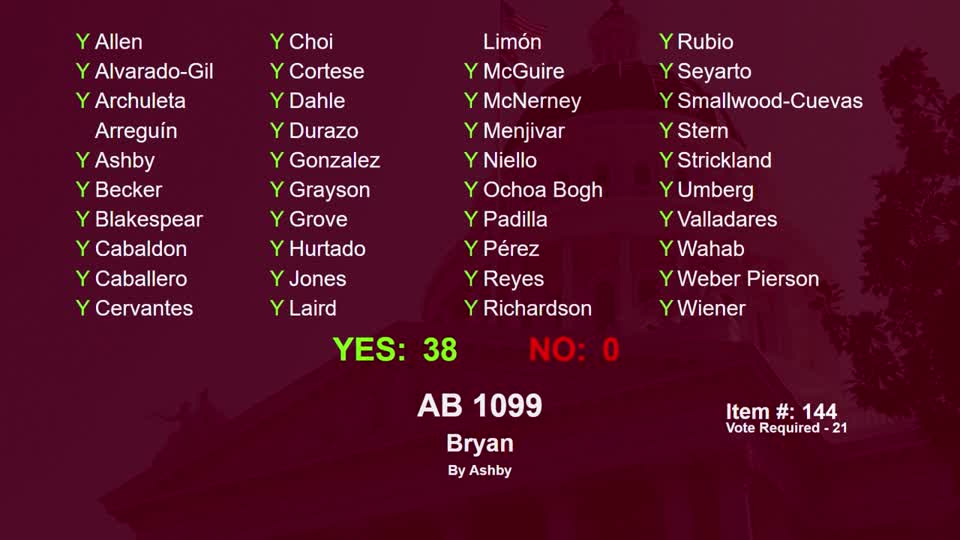 9MIN
Senate Floor
 5MIN
Assembly Standing Committee on Local Government
 10MIN
Assembly Standing Committee on Judiciary
 3MIN
Senate Floor
 20MIN
Senate Standing Committee on Local Government
Bill Author

Bill Co-Author(s):