SB 1257: Federal immigration enforcement: report.
- Session Year: 2025-2026
- House: Senate
- Latest Version Date: 2026-06-24
Current Status:
In Progress
(2026-08-13: August 13 hearing: Held in committee and under submission.)
Introduced
In Committee
Awaiting First Chamber Vote
Passed First Chamber
In Committee
Awaiting Second Chamber Vote
Passed Second Chamber
Enacted
Existing law, the California Values Act, requires the Attorney General, by October 1, 2018, in consultation with the appropriate stakeholders, to publish model policies limiting assistance with immigration enforcement to the fullest extent possible consistent with federal and state law at public schools, public libraries, health facilities operated by the state or a political subdivision of the state, courthouses, Division of Labor Standards Enforcement facilities, the Agricultural Labor Relations Board, the Division of Workers Compensation, and shelters and ensure that they remain safe and accessible to all California residents, regardless of immigration status. The act requires all public schools, health facilities operated by the state or a political subdivision of the state, and courthouses to implement the model policy or an equivalent policy.
This bill would require the Attorney General, on or before October 30, 2027, and annually thereafter, to submit to the Legislature and the Governor, and post on its internet website, a report that includes, among other things, a summary of all immigration enforcement incidents and activities occurring on or after September 1, 2025, conducted by a person at a designated safe location that have been reported by the designated safe location or a person who witnessed the activity to the Attorney General. General, as specified. The bill would authorize the Attorney General to request representatives of a designated safe location to furnish any reported immigration enforcement incidents and activities as part of compiling its annual report and would authorize the Attorney General to issue civil penalties or conduct other enforcement activity to ensure compliance with these provisions. The bill would prohibit the report from including any personally identifiable information regarding an individual stopped, detained, or arrested by an individual conducting an immigration enforcement activity. The bill would define designated safe location to mean educational institutions, schoolsites, health care provider entities, shelters, polling places, state courthouses, public transportation property, access points, and state and local government property. The bill would define immigration enforcement for these purposes to mean an effort to investigate, enforce, or assist in the investigation or enforcement of a federal civil or criminal immigration lawsuit. To the extent the bill would impose duties on locals, this bill would impose a state-mandated local program.
The California Constitution requires the state to reimburse local agencies and school districts for certain costs mandated by the state. Statutory provisions establish procedures for making that reimbursement.
This bill would provide that, if the Commission on State Mandates determines that the bill contains costs mandated by the state, reimbursement for those costs shall be made pursuant to the statutory provisions noted above.
Existing law, the California Values Act, requires the Attorney General, by October 1, 2018, in consultation with the appropriate stakeholders, to publish model policies limiting assistance with immigration enforcement to the fullest extent possible consistent with federal and state law at public schools, public libraries, health facilities operated by the state or a political subdivision of the state, courthouses, Division of Labor Standards Enforcement facilities, the Agricultural Labor Relations Board, the Division of Workers Compensation, and shelters and ensure that they remain safe and accessible to all California residents, regardless of immigration status. The act requires all public schools, health facilities operated by the state or a political subdivision of the state, and courthouses to implement the model policy or an equivalent policy.
This bill would require the Attorney General, on or before October 30, 2027, and annually thereafter, to submit to the Legislature and the Governor, and post on its internet website, a report that includes, among other things, a summary of all immigration enforcement incidents and activities conducted by a person at a designated safe location that has have been reported an immigration enforcement incident or activity either onsite or by the designated safe location or a person who witnessed the activity to the Attorney General. The bill would authorize the Attorney General to request representatives of a designated safe location to furnish any reported immigration enforcement incidents and activities as part of compiling its annual report and would authorize the Attorney General to issue civil penalties or conduct other enforcement activity to ensure compliance with these provisions. The bill would prohibit the report from including any personally identifiable information regarding an individual stopped, detained, or arrested by an individual conducting an immigration enforcement activity. The bill would define designated safe location to mean educational institutions, health care provider entities, shelters, polling places, courthouses, public transportation property, and state and local government property. The bill would define immigration enforcement for these purposes to mean an effort to investigate, enforce, or assist in the investigation or enforcement of a federal civil or criminal immigration lawsuit. To the extent the bill would impose duties on locals, this bill would impose a state-mandated local program.
The California Constitution requires the state to reimburse local agencies and school districts for certain costs mandated by the state. Statutory provisions establish procedures for making that reimbursement.
This bill would provide that, if the Commission on State Mandates determines that the bill contains costs mandated by the state, reimbursement for those costs shall be made pursuant to the statutory provisions noted above.
Existing law, the California Values Act, requires the Attorney General, by October 1, 2018, in consultation with the appropriate stakeholders, to publish model policies limiting assistance with immigration enforcement to the fullest extent possible consistent with federal and state law at public schools, public libraries, health facilities operated by the state or a political subdivision of the state, courthouses, Division of Labor Standards Enforcement facilities, the Agricultural Labor Relations Board, the Division of Workers Compensation, and shelters, shelters and ensure that they remain safe and accessible to all California residents, regardless of immigration status. The act requires all public schools, health facilities operated by the state or a political subdivision of the state, and courthouses to implement the model policy, policy or an equivalent policy.
This bill would require the Attorney General, on or before October 30, 2027, and annually thereafter, to submit to the Legislature and the Governor, and post on its internet website, a report that includes, among other things, a summary of all immigration enforcement incidents and activities conducted by any a person at a designated safe locations that have location that has reported an immigration enforcement incidents and activities incident or activity either onsite or to the Attorney General. The bill would authorize the Attorney General to request representatives of the a designated safe locations location to furnish any reported immigration enforcement incidents and activities as part of compiling its annual report and would authorize the Attorney General to issue civil penalties or conduct other enforcement activity to ensure compliance with these provisions. The bill would define designated safe locations location to mean educational institutions, health care provider entities, shelters, polling places, courthouses, public transportation property, and state and local government property, and areas where the public may be exercising their rights protected under the First Amendment to the United States Constitution. property. The bill would define immigration enforcement for these purposes to mean an effort to investigate, enforce, or assist in the investigation or enforcement of a federal civil or criminal immigration lawsuit. To the extent the bill would impose duties on locals, this bill would impose a state-mandated local program.
The California Constitution requires the state to reimburse local agencies and school districts for certain costs mandated by the state. Statutory provisions establish procedures for making that reimbursement.
This bill would provide that, if the Commission on State Mandates determines that the bill contains costs mandated by the state, reimbursement for those costs shall be made pursuant to the statutory provisions noted above.
Existing law, the California Values Act, requires the Attorney General, by October 1, 2018, in consultation with the appropriate stakeholders, to publish model policies limiting assistance with immigration enforcement to the fullest extent possible consistent with federal and state law at public schools, public libraries, health facilities operated by the state or a political subdivision of the state, courthouses, Division of Labor Standards Enforcement facilities, the Agricultural Labor Relations Board, the Division of Workers Compensation, and shelters, and ensuring ensure that they remain safe and accessible to all California residents, regardless of immigration status. The act requires all public schools, health facilities operated by the state or a political subdivision of the state, and courthouses to implement the model policy, or an equivalent policy.
This bill would require the Attorney General, on or before October 30, 2027, and annually thereafter, to submit to the Legislature and the Governor, and post on its internet website, a report that includes, among other things, a summary of all immigration enforcement incidents and activities conducted by any person at designated safe locations that have reported immigration enforcement incidents and activities either onsite or to the Attorney General. The bill would authorize the Attorney General to request representatives of the designated safe locations to furnish any reported immigration enforcement incidents and activities as part of compiling its annual report, report and would authorize the Attorney General to issue civil penalties or conduct other enforcement activity to ensure compliance with these provisions. The bill would define designated safe locations to mean educational institutions, health care providers, provider entities, shelters, polling places, courthouses, public transportation property, state and local government property, and areas where the public may be exercising their rights protected under the First Amendment to the United States Constitution. The bill would define immigration enforcement for these purposes to mean an effort to investigate, enforce, or assist in the investigation or enforcement of a federal civil or criminal immigration lawsuit. To the extent the bill would impose duties on locals, this bill would impose a state-mandated local program.
The California Constitution requires the state to reimburse local agencies and school districts for certain costs mandated by the state. Statutory provisions establish procedures for making that reimbursement.
This bill would provide that, if the Commission on State Mandates determines that the bill contains costs mandated by the state, reimbursement for those costs shall be made pursuant to the statutory provisions noted above.
Existing law, the California Values Act, requires the Attorney General, by October 1, 2018, in consultation with the appropriate stakeholders, to publish model policies limiting assistance with immigration enforcement to the fullest extent possible consistent with federal and state law at public schools, public libraries, health facilities operated by the state or a political subdivision of the state, courthouses, Division of Labor Standards Enforcement facilities, the Agricultural Labor Relations Board, the Division of Workers Compensation, and shelters, and ensuring that they remain safe and accessible to all California residents, regardless of immigration status. The act requires all public schools, health facilities operated by the state or a political subdivision of the state, and courthouses to implement the model policy, or an equivalent policy.
This bill would require the Attorney General, on or before October 30, 2027, and annually thereafter, to submit to the Legislature and the Governor, and post on its internet website, a report that includes, among other things, a summary of all immigration incidents and activities conducted by any person at designated safe locations that have reported immigration incidents and activities either onsite or to the Attorney General. The bill would authorize the Attorney General to request representatives of the designated safe locations to furnish any reported immigration incidents and activities as part of compiling its annual report, and would authorize the Attorney General to issue civil penalties or conduct other enforcement activity to ensure compliance with these provisions. The bill would define designated safe locations to mean educational institutions, health care providers, shelters, polling places, courthouses, public transportation property, state and local government property, and areas where the public may be exercising their rights protected under the First Amendment to the United States Constitution. To the extent the bill would impose duties on locals, this bill would impose a state-mandated local program.
The California Constitution requires the state to reimburse local agencies and school districts for certain costs mandated by the state. Statutory provisions establish procedures for making that reimbursement.
This bill would provide that, if the Commission on State Mandates determines that the bill contains costs mandated by the state, reimbursement for those costs shall be made pursuant to the statutory provisions noted above.
(a)On or before October 30, 2027, and annually thereafter, the Attorney General shall submit to the Legislature, and post on its internet website, a report that includes all of the following:
(1)A summary of all immigration enforcement incidents and activities occurring on or after September 1, 2025, conducted by a person at a designated safe location that have been reported by the designated safe location or a person who witnessed the activity to the Attorney General, including, but not limited to, reports submitted onsite or through the Attorney Generals federal agent misconduct online portal.
(2)Information of each immigration enforcement incident and activity described in paragraph (1), including, but not limited to, the date of occurrence, the county of occurrence, the type of facility or designated location impacted, the government governmental agency involved, and followup or resolution status. The Attorney General shall adhere to privacy laws and procedures in reporting the followup or resolution status to ensure the integrity of investigations.
(3)(A)The number of immigration enforcement incidents and activities described in paragraph (1) that resulted in legal action regarding the incident or activitys legality and the county or court in which the legal action was filed.
(B)A legal action does not include a legal action or administrative proceeding against an individual for the enforcement of federal immigration law or a prosecution of an individual under federal criminal law.
(b)For the purposes of this chapter, designated safe location means educational institutions, health care provider entities, as defined in Section 24252 of the Health and Safety Code, shelters, polling places, courthouses, public transportation property, and state and local government property.(c)(b)The Attorney General may request representatives of a designated safe location to furnish any reported immigration enforcement incidents and activities as part of compiling its annual report. The Attorney General may issue civil penalties or conduct other enforcement activity to ensure compliance with this section.
(d)(c)As part of compiling this report, the Attorney General may consider whether a designated safe location is in compliance with other state laws related to immigration enforcement and may take enforcement action to enforce those laws, as needed.
(e)(d)For purposes of this section, immigration the following definitions apply:
(1)Designated location means schoolsites, as defined in Section 234.7 of the Education Code; health care provider entities, as defined in Section 24252 of the Health and Safety Code; shelters, including, but not limited to, homeless shelters; polling places; state courthouses; public transportation access points, including, but not limited to, bus stops and transit stations; and state and local government property.
(2)Immigration enforcement means an effort to investigate, enforce, or assist in the investigation or enforcement of a federal civil immigration law or a federal criminal immigration law that penalizes a persons presence in, entry or reentry to, or employment in the United States.
(f)(e)A report to be submitted pursuant to this section shall be submitted in compliance with Section 9795 of the Government Code.
(g)(f)The report required by this section and any information therein shall not include personally either of the following:
(1)Personally identifiable information regarding an individual stopped, detained, or arrested by an individual conducting an immigration enforcement incident or activity.
(2)The physical address of the designated location.
SEC. 2.If the Commission on State Mandates determines that this act contains costs mandated by the state, reimbursement to local agencies and school districts for those costs shall be made pursuant to Part 7 (commencing with Section 17500) of Division 4 of Title 2 of the Government Code.
(a)On or before October 30, 2027, and annually thereafter, the Attorney General shall submit to the Legislature, and post on its internet website, a report that includes all of the following:
(1)A summary of all immigration enforcement incidents and activities conducted by a person at a designated safe location that has have been reported an immigration enforcement incident or activity either onsite or by the designated safe location or a person who witnessed the activity to the Attorney General, including, but not limited to, reports submitted onsite or through the Attorney Generals federal agent misconduct online portal.
(2)Information of each immigration enforcement incident and activity described in paragraph (1), including, but not limited to, the date of occurrence, the county of occurrence, the type of facility or location impacted, the government agency involved, and followup or resolution status.
(3)(A)The number of immigration enforcement incidents and activities described in paragraph (1) that resulted in legal action regarding the incident or activitys legality and the counties county or court in which the legal action took place. was filed.
(B)A legal action does not include a legal action or administrative proceeding against an individual for the enforcement of federal immigration law or a prosecution of an individual under federal criminal law.
(b)For the purposes of this chapter, designated safe location means educational institutions, health care provider entities, as defined in Section 24252 of the Health and Safety Code, shelters, polling places, courthouses, public transportation property, and state and local government property.
(c)The Attorney General may request representatives of a designated safe location to furnish any reported immigration enforcement incidents and activities as part of compiling its annual report. The Attorney General may issue civil penalties or conduct other enforcement activity to ensure compliance with this section.
(d)As part of compiling this report, the Attorney General may consider whether a designated safe location is in compliance with other state laws related to immigration enforcement and may take enforcement action to enforce those laws, as needed.
(e)For purposes of this section, immigration enforcement means an effort to investigate, enforce, or assist in the investigation or enforcement of a federal civil immigration law or a federal criminal immigration law that penalizes a persons presence in, entry or reentry to, or employment in the United States.
(f)A report to be submitted pursuant to this section shall be submitted in compliance with Section 9795 of the Government Code.
(g)The report required by this section and any information therein shall not include personally identifiable information regarding an individual stopped, detained, or arrested by an individual conducting an immigration enforcement incident or activity.
SEC. 2.If the Commission on State Mandates determines that this act contains costs mandated by the state, reimbursement to local agencies and school districts for those costs shall be made pursuant to Part 7 (commencing with Section 17500) of Division 4 of Title 2 of the Government Code.
(a)On or before October 30, 2027, and annually thereafter, the Attorney General shall submit to the Legislature, and post on its internet website, a report that includes all of the following:
(1)A summary of all immigration enforcement incidents and activities conducted by any a person at a designated safe locations that have reported location that has reported an immigration enforcement incidents and activities incident or activity either onsite or to the Attorney General, including, but not limited to, reports submitted through the Attorney Generals federal agent misconduct online portal.
(2)Information of each immigration enforcement incident and activity described in paragraph (1), including, but not limited to, the date of occurrence, the county of occurrence, the type of facility or location impacted, the government agency involved, and followup or resolution status.
(3)The number of immigration enforcement incidents and activities described in paragraph (1) that resulted in legal action and the counties involved in the legal action. in which the legal action took place.
(b)For the purposes of this chapter, designated safe locations location means educational institutions, health care provider entities, as defined in Section 24252 of the Health and Safety Code, shelters, polling places, courthouses, public transportation property, and state and local government property, and areas where the public may be exercising their rights protected under the First Amendment to the United States Constitution. property.
(c)The Attorney General may request representatives of the a designated safe locations location to furnish any reported immigration enforcement incidents and activities as part of compiling its annual report. The Attorney General may issue civil penalties or conduct other enforcement activity to ensure compliance with this section.
(d)As part of compiling this report, the Attorney General may consider whether the a designated safe location is in compliance with other state laws related to immigration enforcement and may take enforcement action to enforce those laws, as needed.
(e)For purposes of this section, immigration enforcement means an effort to investigate, enforce, or assist in the investigation or enforcement of a federal civil immigration law or a federal criminal immigration law that penalizes a persons presence in, entry or reentry to, or employment in the United States.
(f)A report to be submitted pursuant to this section shall be submitted in compliance with Section 9795 of the Government Code.
SEC. 2.If the Commission on State Mandates determines that this act contains costs mandated by the state, reimbursement to local agencies and school districts for those costs shall be made pursuant to Part 7 (commencing with Section 17500) of Division 4 of Title 2 of the Government Code.
(a)On or before October 30, 2027, and annually thereafter, the Attorney General shall submit to the Legislature, and post on its internet website, a report that includes all of the following:
(1)A summary of all immigration enforcement incidents and activities conducted by any person at designated safe locations that have reported immigration enforcement incidents and activities either onsite or to the Attorney General, including, but not limited to, reports submitted through the Attorney Generals federal agent misconduct online portal.
(2)Information of each immigration enforcement incident and activity described in paragraph (1), including, but not limited to, the date of occurrence, the county of occurrence, the type of facility or location impacted, the government agency involved, and followup or resolution status.
(3)The number of immigration enforcement incidents and activities described in paragraph (1) that resulted in legal action and the counties involved in the legal action.
(b)For the purposes of this chapter, designated safe locations means educational institutions, health care providers, provider entities, as defined in Section 24252 of the Health and Safety Code, shelters, polling places, courthouses, public transportation property, state and local government property, and areas where the public may be exercising their rights protected under the First Amendment to the United States Constitution.
(c)The Attorney General may request representatives of the designated safe locations to furnish any reported immigration enforcement incidents and activities as part of compiling its annual report. The Attorney General may issue civil penalties or conduct other enforcement activity to ensure compliance with this section.
(d)As part of compiling this report, the Attorney General may consider whether the designated safe location is in compliance with other state law, laws related to immigration enforcement and may take enforcement action, action to enforce those laws, as needed.
(e)For purposes of this section, immigration enforcement means an effort to investigate, enforce, or assist in the investigation or enforcement of a federal civil immigration law or a federal criminal immigration law that penalizes a persons presence in, entry or reentry to, or employment in the United States.
(e)(f)A report to be submitted pursuant to this section shall be submitted in compliance with Section 9795 of the Government Code.
SEC. 2.If the Commission on State Mandates determines that this act contains costs mandated by the state, reimbursement to local agencies and school districts for those costs shall be made pursuant to Part 7 (commencing with Section 17500) of Division 4 of Title 2 of the Government Code.
(a)On or before October 30, 2027, and annually thereafter, the Attorney General shall submit to the Legislature, and post on its internet website, a report that includes all of the following:
(1)A summary of all immigration incidents and activities conducted by any person at designated safe locations that have reported immigration incidents and activities either onsite or to the Attorney General, including, but not limited to, reports submitted through the Attorney Generals federal agent misconduct online portal.
(2)Information of each immigration incident and activity described in paragraph (1), including, but not limited to, the date of occurrence, the county of occurrence, the type of facility or location impacted, the government agency involved, and followup or resolution status.
(3)The number of immigration incidents and activities described in paragraph (1) that resulted in legal action and the counties involved in the legal action.
(b)For the purposes of this chapter, designated safe locations means educational institutions, health care providers, shelters, polling places, courthouses, public transportation property, state and local government property, and areas where the public may be exercising their rights protected under the First Amendment to the United States Constitution.
(c)The Attorney General may request representatives of the designated safe locations to furnish any reported immigration incidents and activities as part of compiling its annual report. The Attorney General may issue civil penalties or conduct other enforcement activity to ensure compliance with this section.
(d)As part of compiling this report, the Attorney General may consider whether the designated safe location is in compliance with other state law, and may take enforcement action, as needed.
(e)A report to be submitted pursuant to this section shall be submitted in compliance with Section 9795 of the Government Code.
SEC. 2.If the Commission on State Mandates determines that this act contains costs mandated by the state, reimbursement to local agencies and school districts for those costs shall be made pursuant to Part 7 (commencing with Section 17500) of Division 4 of Title 2 of the Government Code.
|
Date
|
Status
|
|---|---|
| Aug 13, 2026 | August 13 hearing: Held in committee and under submission. |
| Aug 5, 2026 | August 5 set for first hearing. Placed on suspense file. |
| Jul 1, 2026 | From committee: Do pass and re-refer to Com. on APPR. (Ayes 9. Noes 3.) (June 30). Re-referred to Com. on APPR. |
| Jun 24, 2026 | From committee with author's amendments. Read second time and amended. Re-referred to Com. on JUD. |
| Jun 24, 2026 | From committee: Do pass and re-refer to Com. on JUD. (Ayes 7. Noes 1.) (June 23). Re-referred to Com. on JUD. |
| Jun 8, 2026 | Referred to Coms. on PUB. S. and JUD. |
| May 26, 2026 | In Assembly. Read first time. Held at Desk. |
| May 26, 2026 | Read third time. Passed. (Ayes 29. Noes 8. Page 4441.) Ordered to the Assembly. |
| May 26, 2026 | Read third time. Passed. (Ayes 29. Noes 8.) Ordered to the Assembly. |
| May 14, 2026 | From committee: Do pass. (Ayes 5. Noes 2. Page 4271.) (May 14). |
| May 14, 2026 | Read second time. Ordered to third reading. |
| May 14, 2026 | From committee: Do pass. (Ayes 5. Noes 2.) (May 14). |
| May 8, 2026 | Set for hearing May 14. |
| Apr 27, 2026 | April 27 hearing: Placed on APPR. suspense file. |
| Apr 21, 2026 | Set for hearing April 27. |
| Apr 16, 2026 | Read second time and amended. Re-referred to Com. on APPR. |
| Apr 15, 2026 | From committee: Do pass as amended and re-refer to Com. on APPR. (Ayes 11. Noes 1. Page 3869.) (April 14). |
| Apr 15, 2026 | From committee: Do pass as amended and re-refer to Com. on APPR. (Ayes 11. Noes 1.) (April 14). |
| Apr 6, 2026 | From committee with author's amendments. Read second time and amended. Re-referred to Com. on JUD. |
| Mar 27, 2026 | Set for hearing April 14. |
| Mar 25, 2026 | Read second time and amended. Re-referred to Com. on JUD. |
| Mar 24, 2026 | From committee: Do pass as amended and re-refer to Com. on JUD. (Ayes 4. Noes 1. Page 3661.) (March 24). |
| Mar 24, 2026 | From committee: Do pass as amended and re-refer to Com. on JUD. (Ayes 4. Noes 1.) (March 24). |
| Mar 10, 2026 | Set for hearing March 24. |
| Mar 4, 2026 | Referred to Coms. on PUB. S. and JUD. |
| Feb 20, 2026 | From printer. May be acted upon on or after March 22. |
| Feb 19, 2026 | Introduced. Read first time. To Com. on RLS. for assignment. To print. |
|
Date
|
Description
|
Location
|
Votes
|
|
|---|---|---|---|---|
| Jun 30, 2026 | Do pass and be re-referred to the Committee on [Appropriations] | Assembly Standing Committee on Judiciary |
Passed |
|
| Jun 23, 2026 | Do pass and be re-referred to the Committee on [Judiciary] | Assembly Standing Committee on Public Safety |
Passed |
|
| May 26, 2026 | Senate 3rd Reading SB1257 Arreguín et al. | Senate Floor |
Passed |
|
| May 14, 2026 | Do pass | Senate Standing Committee on Appropriations |
Passed |
|
| Apr 27, 2026 | Placed on suspense file | Senate Standing Committee on Appropriations |
Passed |
|
| Apr 14, 2026 | Do pass as amended, but first amend, and re-refer to the Committee on [Appropriations] | Senate Standing Committee on Judiciary |
Passed |
|
| Mar 24, 2026 | Do pass as amended, but first amend, and re-refer to the Committee on [Judiciary] | Senate Standing Committee on Public Safety |
Passed |
This list shows positions taken on this bill by organizations on the date displayed, which is linked to the original source.
Positions by individuals are not included.
|
Organization
|
Position
|
Date
|
|---|---|---|
| Access Reproductive Justice | ** Support | |
| Aclu California Action | ** Support | |
| Alliance for a Better Community (UNREG) | ** Support | |
| Asian Americans for Community Involvement | ** Support | |
| Asian Resources, Inc. | ** Support | |
| Asociacion De Migrantes Guatemaltecos Los Angeles | ** Support | |
| Buen Vecino | ** Support | |
| California Community Foundation | ** Support | |
| California Consortium for Urban Indian Health | ** Support | |
| California Coverage Health Initiatives | ** Support | |
| California Coverage Health Initiatives (CCHI) | ** Support | |
| California Federation of Labor Unions, Afl-cio | ** Support | |
| California Immigrant Policy Center | ** Support | |
| California Latinas for Reproductive Justice | ** Support | |
| California LGBTQ Health and Human Services Network | ** Support | |
| California Pan - Ethnic Health Network | ** Support | |
| California Physicians Alliance | ** Support | |
| California Public Defenders Association | ** Support | |
| California Teachers Association | ** Support | |
| Campaign For College Opportunity | ** Support | |
| Celestria Health | ** Support | |
| Central American Resource Center of California (CARECEN-LA) | ** Support | |
| centro binacional para el desarrollo indigena oaxaqueno | ** Support | |
| Centro Binacional Para El Desarrollo Indigena Oaxaqueño (CBDIO) | ** Support | |
| City of Berkeley | ** Support | |
| City of Emeryville | ** Support | |
| City Of Oakland | ** Support | |
| City of Soledad | ** Support | |
| Coalition of California Welfare Rights Organizations | ** Support | |
| Coalition of Orange County Community Health Centers | ** Support | |
| Community Health Partnership | ** Support | |
| Courage California | ** Support | |
| El Arc de California | ** Support | |
| Empowering Marginalized Asian Communities | ** Support | |
| Empowering Pacific Islander Communities (EPIC) Fiscally Sponsored by Community Partners | ** Support | |
| Farm2people | ** Support | |
| Friends Committee On Legislation Of California | ** Support | |
| Health4Kern | ** Support | |
| Healthy Contra Costa | ** Support | |
| Immigrant Defenders Law Center | ** Support | |
| JWCH Institute | ** Support | |
| JWCH Institute Inc. | ** Support | |
| Latino Coalition for a Healthy California | ** Support | |
| Lideres Campesinas | ** Support | |
| Multicultural Institute | ** Support | |
| Oasis Legal Services | ** Support | |
| Orale: Organizing Rooted in Abolition Liberation and Empowerment | ** Support | |
| Orange County Labor Federation, AFL-CIO | ** Support | |
| Rubicon Programs | ** Support | |
| San Francisco Aids Foundation | ** Support | |
| Santa Cruz Community Health | ** Support | |
| SEIU California | ** Support | |
| South Asian Network | ** Support | |
| Southeast Asia Resource Action Center | ** Support | |
| Southeast Asia Resource Action Center (SEARAC) | ** Support | |
| Thai Community Development Center | ** Support | |
| The Black Alliance for Just Immigration | ** Support | |
| The Children's Partnership | ** Support | |
| The Children’s Partnership | ** Support | |
| The Los Angeles Trust for Children’s Health | ** Support | |
| TODEC Legal Center | ** Support | |
| transitions clinic network | ** Support | |
| Trial Impact Project | ** Support | |
| Unidosus | ** Support | |
| Vision Y Compromiso (UNREG) | ** Support | |
| Western Center on Law & Poverty, INC. | ** Support |
Date of Hearing: August 5, 2026
ASSEMBLY COMMITTEE ON APPROPRIATIONS
Buffy Wicks, Chair
SBPCA Bill Id:SB 1257
Author:(Arreguín) – As Amended Ver:June 24, 2026
Policy Committee: | Public Safety | Vote: | 7 - 1 |
Judiciary | 9 - 3 | ||
|
|
Urgency: No State Mandated Local Program: Yes Reimbursable: Yes
SUMMARY:
This bill requires the Attorney General (AG) to publish an annual report summarizing immigration enforcement incidents reported to the AG as occurring at designated locations.
More specifically, this bill:
- Requires the AG, on or before October 30, 2027, and annually thereafter, to submit to the Legislature and post on the department’s internet website a report summarizing all immigration enforcement incidents and activities occurring on or after September 1, 2025, conducted by a person at a designated location, that have been reported to the AG by the designated location or by a person who witnessed the activity, including reports submitted onsite or through the AG’s federal agent misconduct online portal.
- Requires the report to include, for each incident, the date and county of occurrence, the type of designated location impacted, the governmental agency involved, and follow-up or resolution status, and to include the number of incidents that resulted in legal action regarding the incident’s legality and the county or court in which the action was filed.
- Authorizes the AG to request representatives of a designated location to furnish reported incidents as part of compiling the report, and to issue civil penalties or conduct other enforcement activity to ensure compliance.
- Authorizes the AG, as part of compiling the report, to consider whether a designated location complies with other state laws related to immigration enforcement, and to take enforcement action as needed.
- Defines “designated location” as a schoolsite, a health care provider entity, a shelter, a polling place, a state courthouse, a public transportation access point, and state and local government property, and defines “immigration enforcement.”
- Prohibits the report from including personally identifiable information regarding an individual stopped, detained, or arrested, or the physical address of a designated location.
FISCAL EFFECT:
- Costs of approximately $11.5 million or less annually (General Fund (GF)) to the Department of Justice (DOJ), together with one-time information technology costs of $236,000 and ongoing maintenance of $115,000 annually, reflecting approximately 45 positions beginning January 1, 2027, as follows:
- Within the Public Rights Division, the Civil Rights Enforcement Section would add 31 positions to publish the report, conduct supporting reviews, and conduct related investigations and enforcement.
- The Police Practices Section would add 10 positions for investigations involving sheriff’s stations, police stations, and jails.
- The Public Inquiry Unit within the Directorate would add one analyst for intake, triage, constituent response, and report coordination, along with the information technology costs noted above for a new complaint database module.
- The Victim Services Unit within the Division of Law Enforcement would add two analysts to provide direct services to individuals contacting the AG regarding immigration enforcement incidents.
- The Office of General Counsel would add one research data specialist beginning July 1, 2027, and 300 limited-term hours to prepare a regulation package.
DOJ reports the department could not absorb these costs within existing budgeted resources. A significant share of this estimate reflects the bill’s permissive provisions rather than the mandatory reporting duty. The bill requires one annual report. The authority to request information, to issue civil penalties, and to enforce other state laws is discretionary in each instance. The bill also contains no rulemaking requirement.
- Potential reimbursable state-mandated local costs of an unknown amount, likely minor (GF), for local agencies and school districts operating designated locations that compile and furnish incident information in response to an AG request. The bill authorizes the AG to make the request but does not require a designated location to respond, which narrows the scope of any reimbursable duty. The Commission on State Mandates would determine whether a mandate exists and the reimbursable amount.
- Potential court cost pressures of an unknown, but potentially significant amount (Trial Court Trust Fund (TCTF), GF), to the extent the AG brings civil penalty or enforcement actions under the bill. Actual costs will depend on the number of cases filed and the amount of court time needed to resolve each case. It generally costs approximately $1,000 to operate a courtroom for one hour. Although courts are not funded on the basis of workload, increased pressure on the Trial Court Trust Fund may create a demand for increased funding for courts from the General Fund. The state budget provides annual General Fund backfills to the Trial Court Trust Fund to offset revenue reductions, totaling approximately $117.3 million in 2025-26.
COMMENTS:
- Purpose. According to the author:
California is recognized for its commitment to human rights and is home to nearly 11 million immigrants. However, the state has seen a marked rise in unjust immigration enforcement. Between January and October 2025, ICE made over 18,000 arrests in California… This is why accountability and transparency are needed regarding ICE activity in and across our state.
- Background. Federal immigration authorities have long identified certain facilities as sensitive locations where enforcement actions were limited, a policy the Biden administration reiterated in a 2021 memorandum covering medical facilities, schools, and social service establishments. The Department of Homeland Security rescinded that guidance on January 21, 2025, and subsequently placed enforcement decisions in or near protected areas with field-level officials on a case-by-case basis, reverting to the prior policy only as to places of worship. California responded with a series of statutes extending protections at particular facility types, including AB 49 (Muratsuchi), Chapter 122, Statutes of 2025, for schools; SB 81 (Arreguin), Chapter 123, Statutes of 2025, for health care provider entities; and AB 495 (C. Rodriguez), Chapter 664, Statutes of 2025, for day care facilities. Separately, in December 2025 the AG launched an online portal permitting members of the public to report potential misconduct by federal agents. This bill draws on those reports to require a single annual statewide report. Existing reporting requirements are not consistent across facility types, and several categories reached by this bill, including state courthouses and public transportation access points, carry no reporting obligation under existing law. The bill was previously drafted as an addition to the California Values Act, enacted by SB 54 (De Leon), Chapter 495, Statutes of 2017, which the Ninth Circuit upheld against a federal preemption and intergovernmental immunity challenge in United States v. California (2019) 921 F.3d 865. To avoid drawing that statute into new litigation, the author moved the provisions into a new Penal Code section addressing the responsibilities of the department. To the extent the bill is challenged in court, any defense costs would be borne by DOJ.
Analysis Prepared by: Shiran Zohar / APPR. / (916) 319-2081
Date of Hearing: June 30, 2026
ASSEMBLY COMMITTEE ON JUDICIARY
Ash Kalra, Chair
SBPCA Bill Id:SB 1257
Author:(Arreguín) – As Amended Ver:June 24, 2026
SENATE VOTE: 29-8
SUBJECT: FEDERAL IMMIGRATION ENFORCEMENT: REPORT
SYNOPSIS
On the first day of his second term in office, Donald Trump rescinded the long-standing “sensitive locations” memo which restricted immigration enforcement in and around locations such as schools, hospitals, and domestic violence shelters. The “sensitive locations” memo had recognized that the threat of being detained while seeking necessary, and often emergency, services was detrimental to the health and wellbeing of society at large. In the last year, the Legislature has enacted various statutes mirroring the policy of the original “sensitive locations” memo to attempt to protect California’s immigrant communities in and around specific facilities such as health care facilities, schools, and day cares. Additionally, in the fall of last year, the Attorney General developed a platform available to the public to submit reports of civil rights violations by federal agents. In an effort to provide greater transparency to the public regarding statewide rates of immigration enforcement, this bill requires the Attorney General to disseminate an annual report summarizing reports of immigration enforcement incidents the agency receives from its platform and designated locations, as defined. The bill also authorizes the Attorney General to engage in enforcement actions and impose civil penalties “as needed.” Finally, the bill prohibits the report from releasing personally identifiable information regarding individuals impacted by the immigration enforcement action.
This bill is sponsored by the Latino Coalition for a Healthy California which contends that there is a lack of sufficient accountability and transparency from the state regarding the rates of immigration enforcement throughout California. It enjoys broad support from civil rights organizations, immigrant rights advocates, legal services organizations, labor unions, and health advocates. There is no known opposition. The bill was previously heard by the Assembly Committee on Public Safety where it was approved by a vote of 7-1.
SUMMARY: Requires the Attorney General to post an annual report regarding a summary of reports of immigration enforcement incidents in the state that the department receives. Specifically, this bill:
- Requires the Attorney General, on or before October 30, 2027, and annually thereafter, to submit to the Legislature and post on its internet website, a report that includes all of the following:
- A summary of all immigration enforcement incidents occurring on or after September 1, 2025, conducted by a person at a designated location that have been reported by the designated location or a person who witnessed the activity to the Attorney General, including, but not limited to, reports submitted onsite or through the Attorney General’s federal agent misconduct online portal.
- Information of each immigration enforcement incident and activity described above, including, but not limited to, the date of occurrence, the county of occurrence, the type of designated location impacted, the governmental agency involved, and followup or resolution status. Requires the Attorney General to adhere to privacy laws and procedures in reporting the followup or resolutions status to ensure the integrity of the investigations.
- The number of immigration enforcement incidents and activities described above that resulted in legal action regarding the incident or activity’s legality and the county or court in which the legal action was filed. Clarifies that a legal action does not include a legal action or administrative proceeding against an individual for the enforcement of federal immigration law or a prosecution of an individual under federal criminal law.
- Authorizes the Attorney General to request representatives of a designated location to furnish any reported immigration enforcement incidents and activities as part of compiling its annual report. Authorizes the Attorney General to issue civil penalties or conduct other enforcement activity to ensure compliance.
- Authorizes the Attorney General to consider whether a designated location is in compliance with other state laws related to immigration enforcement and may take enforcement action to enforce those laws, as needed.
- Defines the following for purposes of the bill:
- “Designated location” means schoolsites, as defined; health care provider entities, as defined; shelters, including, but not limited to, homeless shelters; polling places; state courthouses; public transportation access points, including, but not limited to, bus stops and transit stations; and state and local government property.
- “Immigration enforcement” means an effort to investigate, enforce, or assist in the investigation or enforcement of a federal civil immigration law or a federal criminal immigration law that penalizes a person’s presence in, entry or reentry to, or employment in the United States.
- Prohibits the report required by this bill and any information therein from including either of the following: personally identifiable information regarding an individual stopped, detained, or arrested by an individual conducting an immigration enforcement incident or activity; the physical address of the designated location.
EXISTING LAW:
- Prohibits law enforcement agencies from using agency or department moneys or personnel to investigate, interrogate, detain, detect, or arrest persons for immigration enforcement purposes, as specified, place peace officers under the supervision of federal agencies, use immigration authorities as interpreters for law enforcement matters, transfer an individual to immigration authorities unless authorized by a judicial warrant, provide office space exclusively dedicated to immigration authorities, and contract with the federal government for the use of law enforcement agency facilities to house individuals as federal detainees for the purposes of civil immigration custody, as specified. (Government Code Section 7284.6.)
- Requires a law enforcement agency that participates in a joint law enforcement task force to annually report to the Department of Justice (DOJ) the purpose of the task force, the agencies involved, the number of arrests made during the reporting period, and the number of people arrested for immigration enforcement purposes. (Government Code Section 7284.6 (c)(1).)
- Requires the Attorney General, by April 1, 2018, and in consultation with the appropriate stakeholders, to publish model policies limiting assistance with immigration enforcement at public schools, public libraries, health facilities operated by the state or a political subdivision thereof, courthouses, Division of Labor Standards Enforcement facilities, the Agricultural Labor Relations Board, the Division of Workers Compensation, and shelters, to the fullest extent possible consistent with federal and state law, and ensuring that public schools remain safe and accessible to all California residents, regardless of immigration status.
- Requires all public schools, health facilities operated by the state or a political division thereof, and courthouses to implement the Attorney General’s model policy, or an equivalent.
- Encourages the Agricultural Labor Relations Board, the Division of Workers’ Compensation, the Division of Labor Standards Enforcement, shelters, libraries, and all other organizations and entities that provide services related to physical or mental health and wellness, education, or access to justice, including the University of California, to adopt the model policy. (Government Code Section 7284.8.)
- Prohibits, except as required by state or federal law or as required to administer a state or federally supported educational program, school officials and employees of a local agency from allowing an officer of an agency conducting immigration enforcement to enter a nonpublic area of a school, except as specified. (Education Code Section 234.7 (a)(2).)
- Requires the superintendent of a school district and county office of education, and the principal of a charter school, to report to their respective governing board or body in a timely manner and in a manner that ensures the confidentiality and privacy of any potentially identifying information, any requests for information or access to a schoolsite by an officer or employee of a law enforcement agency for the purpose of enforcing immigration law. (Education Code Section 234.7 (b).)
- Requires the superintendent of a school district or county office of education, and the principal of a charter school, to report to the governing board or body of the local educational agency any requests for information or access to a school site by an officer of a law enforcement agency for immigration enforcement. (Education Code Section 234.7 (c).)
- Requires the Attorney General, by April 1, 2018, and in consultation with the appropriate stakeholders, to publish model policies limiting assistance with immigration enforcement at public schools, to the fullest extent possible consistent with federal and state law, and ensuring that public schools remain safe and accessible to all California residents, regardless of immigration status. Requires the Attorney General to consider, at a minimum, all of the following in developing the model policies:
- Procedures related to requests for access to school grounds for purposes related to immigration enforcement;
- Procedures for local educational agency employees to notify specified officers of the governing board or body of public or charter schools if an individual requests or gains access to school grounds for purposes related to immigration enforcement; and
- Procedures for responding to requests for personal information about students or their family members for purposes of immigration enforcement. (Education Code Section 234.7 (f).)
- Requires the licensee or administrator of a licensed child daycare facility to report to the AG any requests for information or access to the facility by an officer of a law enforcement agency for immigration enforcement, and permits a license-exempt California state preschool program to do the same. (Health and Safety Code Section 1597.640 (b)(1).)
- Prohibits a health care provider entity and its personnel, unless required by state and federal law, from allowing any person access to the nonpublic areas of the facility for immigration enforcement purposes, unless that person has a valid judicial warrant or court order that specifically grants access to the nonpublic areas of the facility. Defines “health care provider entity” broadly, to include hospitals, clinics, and individual health care providers. (Health and Safety Code Sections 24251 (b), 24252.)
- Requires a health care provider entity, to the extent possible, to establish procedures for monitoring, documenting, and receiving visitors to health care provider entities that are consistent with 9) above, and encourages health care provider entities to post a “notice to authorities” at facility entrances. (Health and Safety Code Section 24250 (a).)
- Requires health care provider entity personnel to notify management, administration, or legal counsel of any request for access to a health care provider entity site or patient for immigration enforcement. (Health and Safety Code Section 24250 (b).)
FISCAL EFFECT: As currently in print this bill is keyed fiscal.
COMMENTS: Since at least 2007, Immigrations and Customs Enforcement (ICE) had identified certain facilities and locations as “sensitive locations” where immigration enforcement actions were limited. The Biden administration reiterated that restriction in a 2021 memo that directed “[t]o the fullest extent possible, [ICE and CBP] should not take enforcement action in or near a location that would restrain people’s access to essential services or engagement in essential activities. Such a location is referred to as a ‘protected area.’” The memo went on to describe a number of protected areas, including “medical or mental healthcare facility, such as a hospital, doctor’s office, health clinic, vaccination or testing site, urgent care center, site that serves pregnant individuals, or community health center,” a “social services establishment, such as a crisis center, domestic violence shelter, victims services center, child advocacy center, supervised visitation center, family justice center, community-based organization, facility that serves disabled persons, homeless shelter, drug or alcohol counseling and treatment facility, or foodbank or pantry or other establishment distributing food or other essentials of life to people in need.” In justifying the directive, the memo stated the “need to consider the fact that an enforcement action taken near – and not necessarily in—the protected area can have the same restraining impact on an individual’s access to the protected area itself. […] The fundamental question is whether our enforcement action would restrain people from accessing the protected area to receive essential services or engage in essential activities.” (U.S. Department of Homeland Security, Guidelines for Enforcement Actions in or Near Protected Areas, (October 27, 2021) available at: https://www.dhs.gov/sites/default/files/2022-06/ICE%20-%20Immigration%20Enforcement%20at%20Sensitive%20Locations.pdf.)
On January 21, 2025, Acting Department of Homeland Security (DHS) Secretary Benjamine Huffman rescinded the Biden directive stating that it “thwart[ed] law enforcement in or near so-called ‘sensitive’ areas.’” (U.S. Department of Homeland Security, Statement from a DHS Spokesperson on Directives Expanding Law Enforcement and Ending the Abuse of Humanitarian Parole (January 21, 2025) available at: https://www.dhs.gov/news/2025/01/21/statement-dhs-spokesperson-directives-expanding-law-enforcement-and-ending-abuse.) On January 31, 2025, DHS issued a new directive stating they were “not issuing rules regarding where immigration laws are permitted to be enforced. Instead […] the ICE Director charges Assistant Field Office Directors and Assistant Special Agents in Charge with responsibility for making case-by-case determinations regarding whether, where and when to conduct an immigration enforcement action in or near a protected area.” (U.S. Department of Homeland Security, ICE Directive Common Sense Enforcement Actions in or Near Protected Areas, (January 31, 2025) available at: https://www.ice.gov/about-ice/ero/protected-areas.) In March 2025, the Department issued yet another directive, reverting back to the 2021 policy only in relation to places of worship. (U.S. Department of Homeland Security, Enforcement Actions in or Near Places of Worship – Injunction, (March 2025) available at: https://www.ice.gov/about-ice/ero/protected-areas.)
Responding to these changes on the federal level, this Legislature has enacted a number of statutes enacting protections for particularly vulnerable communities at what had been considered “sensitive locations.” AB 495 (C. Rodriguez), Chap. 664, Stats. 2025, required, among its numerous provisions, day care facilities to adopt policies developed by the Attorney General relating to how to respond in the event of an immigration enforcement action, prohibited the collection of information relating to students’ and families’ immigration status, and required day care centers to report to the Attorney General when they received a request for information or access to the day care for the purposes of immigration enforcement. AB 49 (Muratsuchi), Chap. 122, Stats. 2025, expanded some existing provisions of the Education Code to require local education agencies to post “know-your-rights” information regarding immigration enforcement, to adopt the AG’s model policies, and prohibited local education agencies from allowing access to schools for purposes of immigration enforcement without first being presented with a valid judicial warrant. SB 81 (Arreguin), Chap. 123, Stats. 2025, prohibited health care facilities from allowing access to nonpublic areas of a facility and required facility employees to report any request to access the nonpublic areas for purposes of immigration enforcement to management or to their legal counsel.
In addition to the myriad of policy requirements imposed on the AG by the Legislature, the California Department of Justice also took it upon itself last year to develop a reporting mechanism to allow individuals to submit reports of misconduct by federal agents. As noted by the platform, submission of a report does not necessarily require the AG to act, and directs users of the platform to sources for retaining an attorney. According to their press release, the portal “will help the California Department of Justice capture and create a record of potential unlawful conduct by federal agents, such as the use of excessive force, and inform potential actions the Department may take to protect the rights and safety of Californians.” (California Announces New Online Portal to Report Misconduct by Federal Agents (December 2, 2025) California Department of Justice available at: https://oag.ca.gov/news/press-releases/california-announces-new-online-portal-report-misconduct-federal-agents.)
This bill requires the Attorney General to disseminate an annual report capturing a summary of information relating to immigration enforcement incidents and activities in and around “designated locations” since September 1, 2025. Specifically, the report must include the date of each occurrence, the county of the occurrence, the type of designated location impacted and agency involved, and any follow-up or resolution status. The report is also required to specify the number of immigration enforcement incidents “that resulted in legal action regarding the incident or activity’s legality and the county or court in which the legal action was filed,” except where the legal action is an administrative immigration proceeding or prosecution under federal criminal law.
The bill defines “designated location” as schoolsites and health care provider entities, as defined, shelters, including but not limited to homeless shelters; state courthouses; public transportation access points, including but not limited to, bus stops and transit stations; and state and local government property.
In order to develop the report, the bill authorizes the AG to request designated locations provide reports of immigration enforcement incidents and authorizes the AG to “issue civil penalties or conduct other enforcement activity to ensure compliance with this section.” Additionally, the bill authorizes the AG to “consider whether a designated location is in compliance with other state laws related to immigration enforcement” and to take action to enforce those laws “as needed.”
According to the author:
California is recognized for its commitment to human rights and is home to nearly 11 million immigrants. However, the state has seen a marked rise in unjust immigration enforcement. Between January and October 2025, ICE made over 18,000 arrests in California. Recently, ICE actions have impacted communities nationwide, regardless of legal status, and in some cases, resulted in the loss of U.S. citizens' lives. Many California immigrant communities now fear for their safety when leaving their homes.
This increase in fear leads to skipped medical appointments, school absences, and avoiding public areas, resulting in a low quality of life. This is why accountability and transparency are needed regarding ICE activity in and across our state. This bill ensures that designated health locations entities are reporting ICE activity, and that Californians are aware of actions taken to hold entities accountable.
The Attorney General retains broad authority to enforce against violations of any of California’s countless statutes. While existing law requires certain sensitive locations to maintain a record of immigration enforcement activity, and some require those entities to submit reports to the AG regarding immigration enforcement activity, neither requirement is consistent across the implicated statutes. Additionally, in many cases the Legislature intentionally determined it was inadvisable to impose civil penalties on entities that may be the site of immigration enforcement action because, while the statutes imposed some obligation on the entities, the burden of carrying out those obligations is ultimately borne by the staff that appear for work on a daily basis. Therefore, it seemed ill-advised to threaten potential monetary damages on an entity whose staff may also be in precarious circumstances when facing federal agents. Finally, some of the “designated locations” included in this bill, such as courthouses, are not statutorily obligated to report such incidents at all. Considering this past intentional decision regarding financial penalties, the inconsistent application of reporting requirements across “designated locations,” and the already-existing authority for the AG to compel compliance with existing statute, it seems this bill’s provision to “issue civil penalties or conduct other enforcement activity,” and take action to enforce those laws “as needed” is superfluous. Moreover, given that the Attorney General likely recognizes that most sensitive locations are also operating under immense pressure and that added civil liability is unlikely to result in effective implementation of existing statute, it seems unlikely that the AG will determine such action to be an effective use of the department’s already-limited resources. Understanding the intent of this provision is to encourage compliance with existing requirements relating to the documentation of immigration enforcement actions at sensitive locations, for the purposes of clarity, the author may wish to consider striking these provisions. To the extent certain locations that are statutorily required to report incidents of immigration enforcement are failing to do so, it seems that an education campaign may be more appropriately tailored to help bolster compliance.
SB 1257 also understandably attempts to shield the privacy of individuals who may have been subject to an immigration enforcement action at a sensitive location that would otherwise have to be reported by the AG pursuant to the bill’s provisions. Specifically, the bill states that the report shall not include either: personally identifiable information regarding an individual stopped, detained, or arrested by an individual conducting an immigration enforcement incident or activity; or the physical address of the designated location. Given, however, that the report is required to include the date of occurrence and type of facility impacted, it is not impossible that the mandated report could allow discovery of an individual’s identity by implication. For example, if there is only one enforcement action that occurs in a county with only one courthouse, it is possible that the general public could deduce the identity of the individuals affected by that action. In order to avoid unintentionally obligating the AG to release information that could lead to the identification of affected individuals, the author may wish to consider amending the bill to instead require an aggregated report documenting trends and patterns of practice relating to immigration enforcement across the state.
Until recently, this bill amended the California Values Act, enacted via SB 54 (De Leon, Chap. 495, Stats. 2017) which limits the use of state and local resources for the purposes of immigration enforcement. The Trump administration challenged the statute and on appeal the Ninth Circuit upheld the law, concluding that because federal immigration law is silent on the role of state or local governments in immigration enforcement, and SB 54 was focused on state and local agencies, the law was not preempted. (United States v. California (2019) 921 F.3d 865.) Although the Administration appealed the Ninth Circuit decision, the Supreme Court declined to hear the case, leaving the provisions of SB 54 valid and enforceable law in California. Recognizing the importance of the Values Act in protecting Californians, the Legislature has taken great pains to avoid opening the statute up to potential new litigation. Recognizing this risk, the author recently amended the bill to remove the statute from the Government Code entirely, instead creating a new statute in the Penal Code in a chapter addressing the administration and responsibilities of the Department of Justice. This bill is now, therefore, largely outside of this Committee’s jurisdiction and solely within the jurisdiction of the Committee on Public Safety, which previously analyzed and heard this measure.
ARGUMENTS IN SUPPORT: This bill is sponsored by the Latino Coalition for a Healthy California. It enjoys broad support from civil rights organizations, immigrant rights advocates, legal services organizations, labor unions, and health advocates. In support of the measure the sponsors submit:
From January to October 2025, over 18,000 ICE arrests occurred in the state. This increase in activity requires a constant commitment to maintain accountability for all individuals and entities found in unlawful immigration-related activities. It is a fundamental responsibility of the Attorney General to ensure that those who participate in these activities are held accountable through appropriate legal measures.
The lack of accountability and transparency from the state allows ICE enforcement to continue to commit violations and stoke fear within California. This increase in fear can lead Californians to skip medical appointments, not attend school, and avoid public areas. As a result, this leads to a low quality of life.
Although the state is collecting information on misconduct by a federal agency for the California Attorney General, the data needs to be made public, and violators need to be held accountable. The state's current lack of accountability and transparency regarding the number and locations of violations. This undermines public trust and will lead to a lack of confidence in the community to report future violations.
A public report on ICE activity, including unlawful enforcement, is key to accountability and transparency for the safety of all Californians. SB1257 will require the Attorney General to publish an annual report on immigration incidents and activities that happen in California. Finally, the Attorney General is authorized to ensure compliance through penalties or other enforcement activities.
REGISTERED SUPPORT / OPPOSITION:
Support
Latino Coalition for a Healthy California (sponsor)
Access Reproductive Justice
ACLU California Action
Alliance for a Better Community (UNREG)
Asian Americans for Community Involvement
Asian Resources, INC.
Asociacion De Migrantes Guatemaltecos Los Angeles
Berkeley; City of
Buen Vecino
California Community Foundation
California Consortium for Urban Indian Health
California Coverage Health Initiatives (CCHI)
California Federation of Labor Unions, AFL-CIO
California Immigrant Policy Center
California Latinas for Reproductive Justice
California LGBTQ Health and Human Services Network
California Pan - Ethnic Health Network
California Physicians Alliance
California Public Defenders Association
California Teachers Association
Campaign for College Opportunity
Celestria Health
Central American Resource Center of California (CARECEN-LA)
Centro Binacional Para El Desarrollo Indigena Oaxaqueño (CBDIO)
Coalition of California Welfare Rights Organizations
Coalition of Orange County Community Health Centers
Community Health Partnership
Courage California
El Arc De California
Emeryville; City of
Empowering Marginalized Asian Communities
Empowering Pacific Islander Communities (EPIC) Fiscally Sponsored by Community Partners
Farm2people
Friends Committee on Legislation of California
Health4kern
Healthy Contra Costa
Immigrant Defenders Law Center
JWCH Institute
Lideres Campesinas
Multicultural Institute
Oakland; City of
Oasis Legal Services
Orale: Organizing Rooted in Abolition Liberation and Empowerment
Orange County Labor Federation, AFL-CIO
Rubicon Programs
San Francisco Aids Foundation
Santa Cruz Community Health
SEIU California
Soledad; City of
South Asian Network
Southeast Asia Resource Action Center (SEARAC)
Thai Community Development Center
The Black Alliance for Just Immigration
The Children's Partnership
The Los Angeles Trust for Children’s Health
Todec Legal Center
Transitions Clinic Network
Trial Impact Project
Unidosus
Vision Y Compromiso (UNREG)
Western Center on Law & Poverty, INC.
Opposition
None on file
Analysis Prepared by: Manuela Boucher-de la Cadena / JUD. / (916) 319-2334
Date of Hearing: June 23, 2026
Counsel: Ilan Zur
ASSEMBLY COMMITTEE ON PUBLIC SAFETY
Nick Schultz, Chair
SBPCA Bill Id:SB 1257
Author:(Arreguín) – As Amended Ver:April 16, 2026
SUMMARY: Requires the Attorney General (AG) to annually submit to the Legislature, and post on its website, a report summarizing all immigration enforcement incidents and activities conducted by a person at a designated safe location that have been reported to the AG, as specified. Specifically, this bill:
- Requires, on or before October 30, 2027, and annually thereafter, the AG to submit to the Legislature, and post on its internet website, a report that includes all of the following:
- A summary of all immigration enforcement incidents and activities conducted by a person at a designated safe location that have been reported by the designated safe location or a person who witnessed the activity to the AG, including, but not limited to, reports submitted onsite or through the AG’s federal agent misconduct online portal.
- Information of each immigration enforcement incident and activity described above, including, but not limited to, the date of occurrence, the county of occurrence, the type of facility or location impacted, the government agency involved, and follow-up or resolution status.
- The number of immigration enforcement incidents and activities described above that resulted in legal action regarding the incident or activity’s legality and the county or court in which the legal action was filed. Legal action does not include a legal action or administrative proceeding against an individual for the enforcement of federal immigration law or a prosecution of an individual under federal criminal law.
- Authorizes the AG to request representatives of a designated safe location to furnish reported immigration enforcement incidents and activities as part of compiling its annual report.
- Authorizes the AG to issue civil penalties or conduct other enforcement activity to ensure compliance with this bill
- Authorizes, as part of compiling this report, the AG to consider whether a designated safe location is in compliance with other state laws related to immigration enforcement and authorizes the AG to take enforcement action to enforce those laws, as needed.
- Prohibits a report required by this bill and any information therein from including personally identifiable information regarding an individual stopped, detained, or arrested by an individual conducting an immigration enforcement incident or activity.
- Defines the following terms:
- A “designated safe location” means educational institutions, health care provider entities, as defined, shelters, polling places, courthouses, public transportation property, and state and local government property.
- “Immigration enforcement” means any effort to investigate, enforce, or assist in the investigation or enforcement of a federal civil immigration law or a federal criminal immigration law that penalizes a person’s presence in, entry or reentry to, or employment in the United States.
EXISTING LAW:
- Establishes the California Values Act, which prohibits law enforcement agencies (LEAs) from using agency or department money or personnel to investigate, interrogate, detain, detect, or arrest persons for immigration enforcement purposes, subject to specified exemptions. (Gov. Code, §§ 7282.5, 7284.6.)
- Requires an LEA that participates in a joint law enforcement task force to annually report to the Department of Justice (DOJ) the purpose of the task force, the agencies involved, the number of arrests made during the reporting period, and the number of people arrested for immigration enforcement purposes. (Gov. Code, § 7284.6, subd. (c)(1).)
- Requires LEAs to annually report to the DOJ the number of transfers of an individual to immigration authorities and the offense that allowed for the transfer, as specified. (Gov. Code, § 7284.6, subd. (c)(2).)
- Requires the AG to annually report on the total number of arrests made by joint law enforcement task forces, and the total number of arrests made for immigration enforcement by all task force participants, including federal law enforcement agencies, and to post the report on the AG’s website. (Gov. Code, § 7284.6, subd. (d).)
- Requires the AG to publish model policies limiting assistance with immigration enforcement to the fullest extent possible consistent with federal and state law at public schools, public libraries, health facilities, courthouses, Division of Labor Standards Enforcement facilities, the Agricultural Labor Relations Board, the Division of Workers Compensation, and shelters, and ensuring that they remain safe and accessible to all California residents, regardless of immigration status. (Gov. Code, § 7284.8, subd. (a).)
- Requires the AG to publish model policies limiting assistance with immigration enforcement at licensed child daycare facilities to the fullest extent possible, as specified, and consider, when developing the policy, procedures for employees to notify the licensee or administrator of the facility if an individual requests or gains access to facility grounds for immigration enforcement. (Health & Saf. Code, § 1597.640, subd. (f)(1).)
- Requires the licensee or administrator of a licensed child daycare facility to report to the AG any requests for information or access to the facility by an officer of a law enforcement agency for immigration enforcement, and permits a license-exempt California state preschool program to do the same. (Health & Saf. Code, § 1597.640, subd. (b)(1).)
- Requires health care provider entity personnel to notify health care provider entity management, administration, or counsel of a request for access to a provider entity site or patient for immigration enforcement. (Health & Saf. Code, § 24250, subd. (b)(1).)
- Prohibits, unless required by state or federal law, a health care provider entity and its personnel from allowing any person access to the nonpublic areas of the facility for immigration enforcement, except as specified. (Health & Saf. Code, § 24251, subd. (b).)
- Requires health care provider entities to inform staff and relevant volunteers on how to respond to requests relating to immigration enforcement that grant access to health care provider entity sites or to patients. (Health & Saf. Code, § 24251, subd. (d).)
- Prohibits, except as required by state or federal law or as required to administer a state or federally supported educational program, school officials and employees of a local agency from allowing an officer of an agency conducting immigration enforcement to enter a nonpublic area of a school, except as specified. (Ed. Code, § 234.7, subd. (a)(2).)
- Prohibits a local educational agency and its personnel, to the extent practicable, from disclosing information about a pupil or a pupil’s family and household without the pupil’s parents’ or guardians’ written consent, a school employee, or a teacher, to an officer of an agency conducting immigration enforcement absent a judicial warrant or subpoena, or court order directing the agency or its personnel to do so. (Ed. Code, § 234.7, subd. (b).)
- Requires the superintendent of a school district or county office of education, and the principal of a charter school, to report to the governing board or body of the local educational agency any requests for information or access to a school site by an officer of a law enforcement agency for immigration enforcement. (Ed. Code, § 234.7, subd. (c).)
- Requires the AG to publish model policies limiting assistance with immigration enforcement at public schools, consistent with federal and state law, and ensuring that public schools remain safe and accessible to all California residents, regardless of immigration status. (Ed. Code, § 234.7, subd. (g)(1).)
- States that it is the intent of the Legislature that all California public schools develop a comprehensive school safety plan, and requires, by March 1, 2026, that the plan include procedures to notify parents and guardians of pupils, teachers, administrators, and school personnel when the school confirms the presence of immigration enforcement on the school site. (Ed. Code, §§ 32280; 32282, subd. (a)(2)(N)(i).)
- Requires (or requests in the case of the University of California) specified higher education institutions to take certain actions related to immigration enforcement on their campuses, including: 1) advising students, faculty, and staff to notify the office of the chancellor or president if they are advised that an immigration officer has entered campus to execute a federal immigration order; 2) complying with a request from an immigration officer for access to nonpublic areas of the campus only upon presentation of a judicial warrant; 3) adopting the model policy developed by the AG limiting assistance with immigration enforcement to the fullest extent possible consistent with federal law, among other prohibitions; 4) requiring, in the event an undocumented student is subject to a federal immigration order, that all students, faculty, staff, and campus community members are notified when the presence of immigration enforcement is confirmed on campus; and 5) requiring each higher education campus to notify all students, faculty, staff, and other campus community members when the presence of immigration enforcement is confirmed on campus, including providing notice of the date and time the immigration enforcement was confirmed, the location of the immigration enforcement, and a hyperlink to additional resources. (Ed. Code, § 66093.3, subds. (a) & (b).)
FISCAL EFFECT: Unknown.
COMMENTS:
- Sponsor: Latino Coalition for a Healthy California
- Author's Statement: According to the author, “California is recognized for its commitment to human rights and is home to nearly 11 million immigrants. However, the state has seen a marked rise in unjust immigration enforcement. Between January and October 2025, ICE made over 18,000 arrests in California. Recently, ICE actions have impacted communities nationwide, regardless of legal status, and in some cases, resulted in the loss of U.S. citizens' lives. Many California immigrant communities now fear for their safety when leaving their homes.
“This increase in fear leads to skipped medical appointments, school absences, and avoiding public areas, resulting in a low quality of life. This is why accountability and transparency are needed regarding ICE activity in and across our state. This bill ensures that designated health locations entities are reporting ICE activity, and that Californians are aware of actions taken to hold entities accountable.”
- Rescission of the DHS Sensitive Locations Memo: The Department of Homeland Security (DHS) previously had standing guidance prohibiting immigration authorities from conducting enforcement actions in certain “sensitive locations,” including schools, hospitals, and churches, unless exigent circumstances existed, prior approval was obtained, or other law enforcement actions had led officers to a sensitive location, as specified.[1] In 2021, the Biden Administration issued a memo expanding these sensitive places to include, as pertains to this bill, social service establishments, such as a crisis center, domestic violence shelter, victims services center, child advocacy center, supervised visitation center, family justice center, community-based organization, facility that serves disabled persons, homeless shelter, drug or alcohol counseling and treatment facility, or food bank or pantry or other establishment distributing food or other essentials of life to people in need.[2] In justifying the directive, the memo stated the “need to consider the fact that an enforcement action taken near – and not necessarily in—the protected area can have the same restraining impact on an individual’s access to the protected area itself.”[3]
On January 21, 2025, acting DHS Secretary Benjamin Huffman rescinded the Biden directive, stating that it “thwart[ed] law enforcement in or near so-called ‘sensitive’ areas.”[4] On January 31, 2025, DHS issued a new directive stating they were “not issuing rules regarding where immigration laws are permitted to be enforced. Instead… the ICE Director charges Assistant Field Office Directors and Assistant Special Agents in Charge with responsibility for making case-by-case determinations regarding whether, where, and when to conduct an immigration enforcement action in or near a protected area.”[5] In March, ICE reverted to the 2021 policy, but only in relation to places of worship. (Ibid.)
- Protections for Sensitive Locations under California Law: Certain locations in California are subject to heightened protections against immigration enforcement activity. In 2017, the California Values Act required the AG to publish model policies limiting assistance with immigration enforcement to the fullest extent possible consistent with federal and state law at certain locations, including public schools, public libraries, health facilities, courthouses, and shelters, among other locations, and ensuring that they remain safe and accessible to all California residents, regardless of immigration status. (Gov. Code, § 7284.8, subd. (a).) Numerous laws have been enacted since then that restrict the degree to which employees of certain sensitive locations can cooperate with immigration enforcement operations and require such locations to monitor and disclose when such immigration enforcement incidents occur.
For licensed child daycare facilities, the AG is required to adopt policies limiting assistance with immigration enforcement at such facilities. (Health & Saf. Code, § 1597.640, subd. (f)(1).) Licensees or administrators of such facilities are required to report to the AG any requests for information or access to the facility by a law enforcement agency for immigration enforcement purposes. (Health & Saf. Code, § 1597.640, subd. (b)(1).) Similar provisions exist for health care provider entities. Health care provider entities are prohibited from allowing access to a nonpublic area of the facility, except as specified, and health care provider personnel are required to notify the provider entity management, administration, or counsel of any request for access to a site or patient for immigration enforcement. (Health & Saf. Code, § 24250, subd. (b)(1); 24251, subd. (b).) Comparable requirements exist for schools and higher education institutions. (See, e.g., Ed. Code, §§ 234.7, subds. (a)(2) & (g)(1); 234.7, subd. (c); 32280.)
Immigration activity can also be directly reported to the AG. The AG operates a federal agent misconduct portal that permits members of the public to report potentially unlawful activity by federal agents in California.[6] A person submitting a report must identify the nature of the incident, whether the reporting person was physically present, a description of what happened, whether injury occurred, the location, whether legal action was filed, whether law enforcement was present, and whether a police report was filed, and the portal provides an option for photos or videos to be submitted.[7]
- Effect of this Bill: This bill requires the AG, by October 30, 2027, to submit to the Legislature, and post on its website, a specified report about immigration enforcement incidents and activities that occurred at “designated safe locations” in California. A designated safe location is broadly defined to include specific entities, such as an educational institution, health care provider entity, shelter, polling place, or courthouse, but also public property more generally, such as public transportation property, and state and local government property.
The AG report must contain three categories of information. First, it must summarize all immigration enforcement incidents and activities that were conducted by a person at a designated safe location that have been reported to the AG either by the designated safe location or a person who witnessed the activity. This can include a report submitted onsite or through the AG’s federal agent misconduct online portal. Second, it must include specific information relating to each immigration enforcement incident and activity, including the date of occurrence, the county of occurrence, the type of facility or location impacted, the government agency involved, and follow-up or resolution status. Third, it must include the number of immigration enforcement incidents and activities that resulted in legal action regarding the incident or activity’s legality and the county or court in which the legal action was filed. This does not include legal action or administrative proceeding against an individual for the enforcement of federal immigration law or a prosecution of an individual under federal criminal law. Personally identifiable information of an individual stopped, detained, or arrested during an immigration enforcement incident or activity may not be included in the report.
In order to collect the information required for the report, the bill authorizes the AG to request that representatives of a designated safe location provide reported immigration enforcement incidents and activities to the AG. To enforce the provisions of the bill, it authorizes the AG to issue civil penalties or conduct other enforcement activity to ensure compliance with this bill. The AG may also, in compiling this report, consider if a designated safe location is in compliance with other state laws related to immigration enforcement, and take enforcement action to enforce those laws. The bill defines immigration enforcement” as an effort to investigate, enforce, or assist in the investigation or enforcement of a federal civil immigration law or a federal criminal immigration law that penalizes a person’s presence in, entry or reentry to, or employment in the United States. This definition is largely consistent with the definition of immigration enforcement established in the California Values Act. (Gov. Code, § 7284.4, subd. (f).)
- Practical Considerations: The author may wish to consider clarifying how immigration enforcement incident information will be collected at designated safe locations and how this information will be reported to the AG.
The annual AG report required by this bill must include “[a] summary of all immigration enforcement incidents and activities conducted by a person at a designated safe location that have been reported by the designated safe location or a person who witnessed the activity to the Attorney General.” As currently drafted, the contents of the AG report appear somewhat dependent on discretionary reporting to the DOJ. There is no requirement that the designated safe locations track the detailed information that must be included in this AG report or that they report this information to the AG. While some of the entities covered by this bill, such as health care providers, schools, and higher education institutions, are independently required to monitor immigration enforcement actions to a certain degree, they may not collect the type of information this bill requires. (Health & Saf. Code, § 24250, subd. (b)(1); Ed. Code, § 234.7, subd. (c); Ed. Code, § 66093.3, subds. (a)-(b).) Other entities encompassed by this bill, such as shelters, polling places, courthouses, or certain types of property such as public transportation property, state governmental property, and local governmental property, may even have more limited access to this information. It may be difficult for AG to include all of this information in its annual reporting if a report submitted to the AG on the front end contains little to none of the necessary information.
The bill includes an enforcement mechanism by authorizing the AG to request representatives of a designated safe location to furnish any reported immigration enforcement incidents while compiling its report, and to issue civil penalties or conduct other enforcement activity to ensure compliance with this bill. While this may assist in securing additional information about immigration enforcement incidents, it may be difficult to get this information if designated safe locations are not required to collect, and do not have access to, the type of detailed incident information that the AG is requesting.
Further, while the AG is authorized to request such information, the bill does not require that the entities respond or comply with such requests. Civil penalties or other enforcement activity may not be prudent if a designated safe location does not have the applicable immigration enforcement incident information and is not required to provide such information. The author may wish to clarify the responsibilities of a designated safe location upon receiving such a request.
Finally, for immigration incidents occurring on property, such as public transportation, state, or local governmental property, rather than at a particular entity, it is unclear which “representative” or person” would be responsible for receiving and responding to such a request. To improve the feasibility of the bill it may be prudent to remove “public transportation property, and state and local government property” from the definition of a “designated safe location.”
- The California Values Act: In 2017, California enacted the California Values Act, which limits the involvement of state and local law enforcement agencies in federal immigration enforcement. The Values Act prohibits law enforcement agencies from using resources to investigate, interrogate, detain, detect, or arrest people for immigration enforcement purposes; however, it permits LEAs to cooperate with immigration authorities to the extent such cooperation would not violate federal, state, or local law. (Gov. Code, § 7282.5.) Additionally, law enforcement agencies have discretion to transfer an individual to immigration authorities or provide ICE with information about an in-custody individual’s release date for individuals arrested or convicted for certain crimes. (Gov. Code, § 7282.5, subds. (a) (1) & (2), (b).)
The Values Act was challenged by the federal government as obstructing the enforcement of federal immigration law and violating the doctrine of intergovernmental immunity. (United States v. California (2019) 921 F.3d 865, 886, 891.) Ultimately, in United States v. California, the Ninth Circuit Court of Appeals upheld the provisions of the California Values Act relating to law enforcement cooperation with ICE. The court of appeals had “no doubt that SB 54 makes the jobs of federal immigration authorities more difficult.” (Id. at p. 886.) But the court concluded that this does not constitute obstacle preemption, because federal law “does not require any particular action on the part of California or its political subdivisions.” (Id. at p. 889.) “Even if SB 54 obstructs federal immigration enforcement,” the court stated, “the United States’ position that such obstruction is unlawful runs directly afoul of the Tenth Amendment and the anticommandeering rule.” (Id. at p. 888.) “California has the right, pursuant to the anticommandeering rule, to refrain from assisting with federal efforts.” (Id. at p. 891.) The court concluded that SB 54 does not violate the United States’ intergovernmental immunity for similar reasons. (Ibid.)
This bill establishes a new statutory section, proposed Government Code section 7284.9, that falls squarely within the chapter of law known as the “California Values Act.” The Legislature has not added a new section to the California Values Act since its enactment, in part due to the legal sensitivity associated with the critical legislation. To avoid errantly involving the Values Act in possible litigation, the author may wish to move the provisions of this bill into a different chapter of law.
- Application to Immigration Enforcement Activities Involving California Law Enforcement Officers: The information required to be included in the AG report pursuant to this bill may encompass certain immigration enforcement activity conducted by California law enforcement agencies. This is because California state and local law enforcement agencies are permitted to assist with immigration enforcement efforts in certain ways. As previously noted, the Values Act permits LEAs to cooperate with immigration authorities to the extent such cooperation would not violate federal, state, or local law. (Gov. Code, § 7282.5.) Most notably, LEAs have discretion to transfer an individual to immigration authorities or provide ICE with information about an in-custody individual’s release date for individuals arrested or convicted of certain crimes. (Gov. Code, § 7282.5, subds. (a) (1) & (2), (b).) Further, the definition of an LEA under the Values Act does not include the Department of Corrections and Rehabilitation. (Gov. Code, § 7284.4, subd. (a).)
The California Values Act already requires law enforcement agencies to annually report to the DOJ the number of transfers of an individual to immigration authorities and the offense that allowed for the transfer, as specified. (Gov. Code, § 7284.6, subd. (c)(2).) These records are subject to disclosure under the California Public Records Act (CPRA), and, as permitted under the CPRA, personal identifying information may be redacted prior to public disclosure. (Gov. Code, § 7284.6, subd. (c)(3).)
The AG report required by this bill could be interpreted to encompass lawful immigration enforcement incidents or activities conducted by state and local law enforcement agencies. Certain state or local peace officer immigration enforcement activity, such as a California peace officer-facilitated transfer to ICE, may take place on a “designated safe location,” such as public transportation property, state government property, or local government property. For example, if a local police officer transports an undocumented individual to immigration authorities because they were convicted of a specified crime, as permitted under the Values Act, and this immigration enforcement action takes place on local government property, the details of this incident, if reported to the AG, would be required to be included in the AG’s annual report. Given that local and state LEAs are permitted to assist ICE with immigration enforcement efforts in narrow ways, particularly when it comes to individuals who have committed certain crimes, this bill may expand the AG’s reporting obligations regarding the degree to which California law enforcement agencies assist in immigration enforcement under the California Values Act.
- Argument in Support: According to The Latino Coalition for a Healthy California, SB 1257 “will require the California Attorney General to publish an annual public report on all immigration incidents and activities by federal agencies…
“From January to October 2025, over 18,000 ICE arrests occurred in the state. This increase in activity requires a constant commitment to maintain accountability for all individuals and entities found in unlawful immigration-related activities. It is a fundamental responsibility of the Attorney General to ensure that those who participate in these activities are held accountable through appropriate legal measures.
“The lack of accountability and transparency from the state allows ICE enforcement to continue to commit violations and stoke fear within California. This increase in fear can lead Californians to skip medical appointments, not attend school, and avoid public areas. As a result, this leads to a low quality of life.
“Although the state is collecting information on misconduct by a federal agency for the California Attorney General, the data needs to be made public, and violators need to be held accountable. The state's current lack of accountability and transparency regarding the number and locations of violations. This undermines public trust and will lead to a lack of confidence in the community to report future violations.
“A public report on ICE activity, including unlawful enforcement, is key to accountability and transparency for the safety of all Californians. SB1257 will require the Attorney General to publish an annual report on immigration incidents and activities that happen in California. Finally, the Attorney General is authorized to ensure compliance through penalties or other enforcement activities.”
- Argument in Opposition: None received.
- Prior Legislation:
- SB 81 (Arreguín), Chapter 123, Statutes of 2025, prohibited a health care provider entity and its personnel, unless required by state and federal law, from granting access to the nonpublic areas of the facility for immigration enforcement without a valid judicial warrant or court order.
- AB 49 (Muratsuchi), Chapter 122, Statutes of 2025, prohibited, except as required by state or federal law, school officials and employees of a local educational agency (LEA) from allowing an officer or employee of an agency conducting immigration enforcement to enter a school site without providing a valid judicial warrant or court order.
- SB 98 (Pérez), Chapter 124, Statutes of 2025, required the governing boards of school districts and county offices of education, and the governing boards of charter schools, to include procedures for notifying parents and school staff when immigration enforcement is confirmed on the school site within the school safety plan.
- SB 841 (Rubio), of the 2025-2026 Legislative Session, would have prohibited an employee of a homeless shelter, rape crisis center, domestic violence shelter, family justice center, or human trafficking service provider from allowing immigration enforcement activity in the nonpublic areas of the facility without a valid warrant or court order. SB 841 was ordered to the inactive file at the request of the Assembly Majority Leader.
- AB 699 (O’Donnell), Chapter 493, Statutes of 2017, required the AG to publish model policies limiting assistance with immigration enforcement at public schools, requires local educational agencies to adopt the model policies or equivalent policies, and provides education and support to immigrant students and their families.
- SB 54 (De León), Chapter 495, Statutes of 2017, limited the involvement of state and local law enforcement agencies in federal immigration enforcement.
REGISTERED SUPPORT / OPPOSITION:
Support
Latino Coalition for a Healthy California (Sponsor)
Access Reproductive Justice
ACLU California Action
Alliance for a Better Community (UNREG)
Asian Americans for Community Involvement
Asian Resources, INC.
Asociacion De Migrantes Guatemaltecos Los Angeles
Berkeley; City of
Buen Vecino
California Community Foundation
California Consortium for Urban Indian Health
California Coverage Health Initiatives (CCHI)
California Federation of Labor Unions, Afl-cio
California Immigrant Policy Center
California Lgbtq Health and Human Services Network
California Pan - Ethnic Health Network
California Physicians Alliance
California Public Defenders Association
California Teachers Association
Campaign for College Opportunity
Celestria Health
Central American Resource Center of California (CARECEN-LA)
Centro Binacional Para El Desarrollo Indigena Oaxaqueño (CBDIO)
Centro Binacional Para El Desarrollo Indígena Oaxaqueno
Coalition of California Welfare Rights Organizations
Coalition of Orange County Community Health Centers
Community Health Partnership
Courage California
El Arc De California
Emeryville; City of
Empowering Marginalized Asian Communities
Empowering Pacific Islander Communities (EPIC) Fiscally Sponsored by Community Partners
Farm2people
Friends Committee on Legislation of California
Health4kern
Healthy Contra Costa
Immigrant Defenders Law Center
Jwch Institute
Lideres Campesinas
Multicultural Institute
Oakland; City of
Oasis Legal Services
Orale: Organizing Rooted in Abolition Liberation and Empowerment
Rubicon Programs
San Francisco Aids Foundation
Santa Cruz Community Health
Seiu California
Soledad; City of
South Asian Network
Southeast Asia Resource Action Center
Southeast Asia Resource Action Center (SEARAC)
Thai Community Development Center
The Black Alliance for Just Immigration
The Children's Partnership
The Los Angeles Trust for Children’s Health
Todec Legal Center
Transitions Clinic Network
Unidosus
Vision Y Compromiso (UNREG)
Western Center on Law & Poverty, INC.
2 private individuals
Analysis Prepared by: Ilan Zur / PUB. S. / (916) 319-3744
U.S. Immigration and Customs Enforcement, Memorandum: Enforcement Actions at or Focused on Sensitive Locations (Oct. 24, 2011) <https://www.ice.gov/doclib/ero-outreach/pdf/10029.2-policy.pdf> [as of June 10, 2026]. ↑
Id. at p. 45. ↑
Ibid. ↑
U.S. Dept. of Homeland Security, Statement from a DHS Spokesperson on Directives Expanding Law Enforcement and Ending the Abuse of Humanitarian Parol (Jan. 21, 2025) <available at: https://www.dhs.gov/news/2025/01/21/statement-dhs-spokesperson-directives-expanding-law-enforcement-and-ending-abuse> [as of June 10, 2026]. ↑
U.S. Dept. of Homeland Security, ICE Directive Common Sense Enforcement Actions in or Near Protected Area (January 31, 2025) <https://www.ice.gov/about-ice/ero/protected-areas> [as of June 10, 2026]. ↑
Cal. Dept. of Justice, Report Misconduct by Federal Agents to the California Attorney General <https://oag.ca.gov/reportmisconduct> [as of June 11, 2026]. ↑
Ibid. ↑
SENATE RULES COMMITTEE Office of Senate Floor Analyses (916) 651-4171 | SB 1257 |
THIRD READING
Bill No: SB 1257
Author: Arreguín (D), et al.
Amended: 4/16/26
Vote: 21
SENATE PUBLIC SAFETY COMMITTEE: 4-1, 3/24/26
AYES: Arreguín, Caballero, Pérez, Wiener
NOES: Seyarto
NO VOTE RECORDED: Cortese
SENATE JUDICIARY COMMITTEE: 11-1, 4/14/26
AYES: Umberg, Allen, Ashby, Caballero, Durazo, McNerney, Reyes, Stern, Wahab, Weber Pierson, Wiener
NOES: Niello
NO VOTE RECORDED: Valladares
SENATE APPROPRIATIONS COMMITTEE: 5-2, 5/14/26
AYES: Cervantes, Cabaldon, Grayson, Richardson, Wahab
NOES: Seyarto, Dahle
SUBJECT: Federal immigration enforcement: report
SOURCE: Latino Coalition for a Healthy California
DIGEST:
This bill requires the Attorney General (AG) to publish a report annually summarizing all immigration enforcement incidents and activities conducted by any persons at designated safe locations and to permit the AG to engage in enforcement actions to enforce state law, including the provisions of this bill, at these designated safe locations.
ANALYSIS:
Existing law:
- Defines “immigration enforcement” to mean any and all efforts to investigate, enforce, or assist in the investigation or enforcement of any federal civil immigration law, and also includes any and all efforts to investigate, enforce, or assist in the investigation or enforcement of any federal criminal immigration law that penalizes a person’s presence in, entry or reentry to, or employment in, the United States. (Health and Safety (Health & Saf.) Code, § 24253; Education (Ed.) Code, § 234.7, subd. (l)(i); Ed. Code, § 66093.3, subdivision (subd.) (c)(1).)
- Prohibits a health care provider entity and its personnel, unless required by state and federal law, from allowing any person access to the nonpublic areas of the facility for immigration enforcement purposes, unless that person has a valid judicial warrant or court order. (Health & Saf. Code, § 24251, subd. (b).)
- Provides an exception to the above prohibitions for agents accompanying people in lawful custody to access health care services and for their transportation and arrangement to health care provider entities. (Health & Saf. Code, § 24254.)
- Requires health care provider entity personnel to immediately notify their management of any request for access to a health care provider site or patient for immigration enforcement. (Health & Saf. Code, § 24250, subd. (b)(1).)
- Applies the above provisions to all health care provider entities, as specified, that receive public funding. (Health & Saf. Code, § 24255.)
- Prohibits, except as required by state or federal law, or as required to administer a state or federally supported educational program, school officials and employees of a local educational agency from allowing an officer or employee of an agency conducting immigration enforcement to enter a nonpublic area of a schoolsite for any purpose without being presented with a valid judicial warrant or judicial subpoena, or a court order. (Ed. Code, § 234.7, subd. (a)(2).)
- Prohibits a local educational agency and its personnel, to the extent practicable, from disclosing or providing in writing, verbally, or in any other manner, the education records of or any information about a pupil or a pupil’s family and household without the pupil’s parents’ or guardians’ written consent, to an officer or employee of an agency conducting immigration enforcement absent a valid judicial warrant or judicial subpoena, or court order directing the local educational agency or its personnel to do so. (Ed. Code, § 234.7, subd. (a)(2).)
- Requires the superintendent of a school district, the superintendent of a county office of education, and the principal of a charter school, as applicable, to report to the respective governing board or body of the local educational agency in a timely manner any requests for information or access to a schoolsite by an officer or employee of a law enforcement agency for the purpose of enforcing the immigration laws. (Ed. Code, § 234.7, subd. (c).)
- Clarifies that these provisions do not prohibit or restrict any governmental entity or official from sending to, or receiving from, federal immigration authorities, information regarding the citizenship or immigration status of an individual, if required by certain federal laws. (Ed. Code, § 234.7, subd. (i).)
- Sets forth actions the Trustees of the California State University, the governing board of each community college district in the state, and independent institutions of higher education that are qualifying institutions, as specified, must perform in relation to immigration enforcement on their campuses. (Ed. Code, § 66093.3, subd. (a).)
- Prohibits these institutions of higher education from disclosing personal information about students, faculty, and staff except: (A) with the consent of the person identified, or if the person is under 18 years of age, with the consent of the parent or guardian of the person identified; (B) as may legally be disclosed under state and federal privacy laws; (C) for the programmatic purpose for which the information was obtained; (D) as part of a directory that does not include residence addresses or individual persons’ course schedules and that the person has not elected to opt out of; or (E) in response to a judicial warrant, court order, or subpoena. (Ed. Code, § 66093.3, subd. (a)(1).)
- Requires that these institutions comply with a request from an immigration officer for access to nonpublic areas of the campus only upon presentation of a judicial warrant, but specifies that this requirement does not apply to an immigration officer’s request for access or information related to the operation of international student, staff, or faculty programs, employment verification efforts, or other nonenforcement activities. (Ed. Code, § 66093.3, subd. (a)(4).)
- Requires these institutions to advise all students, faculty, and staff to notify the office of the chancellor or president, or their designee, as soon as possible, if they are advised that an immigration officer is expected to enter, will enter, or has entered the campus to execute a federal immigration order. (Ed. Code, § 66093.3, subd. (a)(2).)
This bill:
- Requires that on or before October 30, 2027, and annually thereafter, the AG shall submit to the Legislature, and post on its internet website, a report that includes all of the following:
- A summary of all immigration enforcement incidents and activities conducted by any person at designated safe locations that have been reported by the designated safe location or a person who witnessed the activity to the AG, including, but not limited to, reports submitted onsite or through the AG’s federal agent misconduct online portal.
- Information of each immigration enforcement incident and activity, including, but not limited to, the date of occurrence, the county of occurrence, the type of facility or location impacted, the government agency involved, and follow up or resolution status.
- The number of immigration enforcement incidents and activities that resulted in legal action regarding the incident or activity’s legality and the county or court involved in the legal action. (Gov. Code, § 7284.9, subd. (a).)
- Defines “designated safe locations” to include educational institutions, health care provider entities, as specified, shelters, polling places, courthouses, public transportation property, and state and local government property.
- Defines “immigration enforcement” to mean an effort to investigate, enforce, or assist in the investigation or enforcement of a federal civil immigration law or a federal criminal immigration law that penalizes a person’s presence in, entry or reentry to, or employment in the United States.
- Clarifies that for the purposes of this section, a “legal action” does not include “a legal action or administrative proceeding against an individual for the enforcement of federal immigration law or a prosecution of an individual under federal criminal law.”
- Authorizes the AG to request representatives of the designated safe locations to furnish any reported immigration enforcement incidents and activities as part of compiling its annual report.
- Authorizes the AG to issue civil penalties or conduct other enforcement activity to ensure compliance with this section.
- Provides that as part of compiling this report, the AG may consider whether the designated safe location is in compliance with other state law, and may take enforcement action, as needed.
- Prohibits the report from including personally identifiable information regarding an individual stopped, detained, or arrested by an individual conducting an immigration enforcement incident or activity.
Background
Restrictive and harsh immigration policies have been shown to produce a chilling effect throughout immigrant communities, wherein immigrant families avoid interacting with public services and institutions for fear of being exposed to deportation threats.
In 2017, the legislature passed the California Values Act, which required the AG to publish model policies limiting assistance with immigration enforcement to the fullest extent possible consistent with federal and state law at public schools, public libraries, health facilities operated by the state or a political subdivision of the state, courthouses, Division of Labor Standards Enforcement facilities, the Agricultural Labor Relations Board, the Division of Workers’ Compensation, and shelters, and ensuring that they remain safe and accessible to all California residents, regardless of immigration status. These model policies are available on the Department of Justice website.
In 2025, in response to President Trump’s immigration policies, California legislators passed three pieces of legislation to prohibit employees at certain institutions—such as health care providers that receive state funding, state public schools, state community colleges, certain state universities, and other state facilities—from allowing immigration enforcement personnel into nonpublic areas without a lawfully issued judicial warrant or court order. These bills all defined “immigration enforcement” to include any and all efforts to investigate, enforce, or assist in the investigation or enforcement of any federal civil immigration law, and also includes any and all efforts to investigate, enforce, or assist in the investigation or enforcement of any federal criminal immigration law that penalizes a person’s presence in, entry or reentry to, or employment in, the United States.
SB 81 (Arreguín, Ch. 123, Stats. 2025) prohibited health care providers receiving state funding from allowing immigration enforcement agents into nonpublic areas. The bill also required providers to develop and publicly post policies for employees to follow in the circumstance a federal immigration enforcement agent requests access to nonpublic facilities or information. Such requests by an immigration enforcement agent for access or information were required to be immediately forwarded to the health care provider’s management, administration, or legal counsel. The bill clarified that it did not prohibit immigration enforcement agents from entering health care facilities to accompany people in their lawful custody receiving care, or from seeking care for themselves.
AB 49 (Muratsuchi, Chapter 122, Statutes of 2025) prohibited employees of any local educational agency from allowing any employee of an agency conducting immigration enforcement to enter a nonpublic area of a schoolsite without a valid judicial warrant, judicial subpoena, or court order. The bill further required school administrators to report to their respective governing boards any requests for information or access to a schoolsite by a law enforcement employee for the purpose of enforcing immigration laws.
SB 98 (Cervantes, Chapter 125, Statutes of 2025) set forth policies that the Trustees of the California State University, the governing board of each community college district in the state, and independent institutions of higher education that qualify for the Cal Grant Program, must follow related to immigration enforcement. In particular, the bill prohibited these institutions from complying with a request by an immigration enforcement officer to access nonpublic areas, unless they presented a judicial warrant. Additionally, the bill prohibited these institutions from disclosing personal information about students, faculty, and staff, unless certain exceptions are met, such as in response to a judicial warrant, court order, or subpoena.
Comments
This bill requires the AG to publish a report annually summarizing all immigration enforcement incidents and activities conducted by any persons at designated safe locations and to permit the AG to enforce state law, such as those listed above, at these designated locations. Specifically, the bill provides that by October 30, 2027, and annually thereafter, the AG is required to submit to the Legislature, and post on its internet website, a report that includes all of the following:
- A summary of all immigration enforcement incidents and activities conducted by any person at designated safe locations that have been reported by the designated safe location or a person who witnessed the activity to the AG, including, but not limited to, reports submitted onsite or through the AG’s federal agent misconduct online portal.
- Information of each immigration enforcement incident and activity, including, but not limited to, the date of occurrence, the county of occurrence, the type of facility or location impacted, the government agency involved, and follow-up or resolution status.
- The number of immigration enforcement incidents and activities that resulted in legal action regarding the incident or activity’s legality and the county or court involved in the legal action. (Gov. Code, § 7284.9, subd. (a).)
FISCAL EFFECT: Appropriation: No Fiscal Com.: Yes Local: Yes
According to the Senate Appropriations Committee:
Unknown, likely significant to major fiscal impact annually on the Department of Justice (DOJ)… For purposes of comparison, DOJ budgets $1 million annually to conduct reviews of local, county or private locked detention facilities in which noncitizens are housed for immigration purposes in the state. Unknown, reimbursable state mandated costs, potentially exceeding $50,000 annually for local entities to participate in immigration enforcement efforts to investigate, enforce, or assist in the investigation of a federal civil immigration law or a federal criminal immigration law that penalizes a person’s presence, as specified.
SUPPORT: (Verified 5/14/26)
Latino Coalition for a Healthy California (Source)
ACLU California Action
Alliance for a Better Community
Asian Americans for Community Involvement
Asian Resources, INC.
Asociacion De Migrantes Guatemaltecos Los Angeles
Buen Vecino
California Community Foundation
California Consortium for Urban Indian Health
California Coverage Health Initiatives
California Immigrant Policy Center
California Pan-Ethnic Health Network
California Physicians Alliance
California Public Defenders Association
California State Council of Service Employees International Union
California Teachers Association
Campaign for College Opportunity
Celestria Health
Central American Resource Center of California
Centro Binacional Para El Desarrollo Indígena Oaxaqueno
City of Berkeley
City of Soledad
Coalition of Orange County Community Health Centers
Courage California
Empowering Marginalized Asian Communities
Farm2People
Friends Committee on Legislation of California
Health4Kern
Healthy Contra Costa
Immigrant Defenders Law Center
JWCH Institute
Multicultural Institute
Orale: Organizing Rooted in Abolition Liberation and Empowerment
Southeast Asia Resource Action Center
The Black Alliance for Just Immigration
The Children's Partnership
TODEC Legal Center
Transitions Clinic Network
UnidosUS
Vision Y Compromiso
Western Center on Law & Poverty
OPPOSITION: (Verified 5/14/26)
None received
ARGUMENTS IN SUPPORT: The Western Center on Law and Poverty writes:
Although the state is collecting information on misconduct by a federal agency for the California AG, the data needs to be made public, and violators need to be held accountable. The state currently lacks accountability and transparency regarding the number and
locations of violations. This undermines public trust and will lead to a lack of confidence in the community to report future violations.
Prepared by: Marshal Lawler / PUB. S. /
5/16/26 10:54:39
**** END ****
SENATE COMMITTEE ON
Senator Sabrina Cervantes, Chair
2025 - 2026 Regular Session
SB 1257 (Arreguín) - Federal immigration enforcement: report
Version: | Policy Vote: |
Urgency: | Mandate: |
Hearing Date: | Consultant: |
Bill Summary:
SB 1257 would require the Attorney General (AG) to publish a report annually summarizing all immigration incidents and activities conducted by any persons at designated safe locations. The AG would be authorized to request information regarding any reported immigration enforcement incidents from these locations.
Fiscal Impact:
Unknown, likely significant to major fiscal impact annually impact on the Department of Justice (DOJ). The workload to meet the provisions of this bill would be in addition to whatever immigration related work DOJ is performing now.
For purposes of comparison, DOJ budgets $1 million annually to conduct reviews of local, county or private locked detention facilities in which noncitizens are housed for immigration purposes in the state.
Unknown, reimbursable state mandated costs, potentially exceeding $50,000 annually for local entities to participate in immigration enforcement efforts to investigate, enforce, or assist in the investigation of a federal civil immigration law or a federal criminal immigration law that penalizes a person’s presence, as specified.
Proposed Law:
The AG would be required to report to the Legislature and post a report that includes a summary of all reported immigration enforcement incidents and activities at specified locations, information on each reported immigration enforcement incident regarding where the incident occurred, the government agency involved, and any follow-up or resolution, and the number of immigration enforcement incidents that resulted in legal action
The AG would engage in enforcement actions to enforce state law at designated safe locations including educational institutions, health care providers, shelters, polling places, courthouses, public transportation property, and state and local government property.
This bill permits the AG to request information regarding any reported immigration enforcement incidents from these locations and provides that the AG can enforce any such requests via civil penalties or other enforcement activity.
Related Legislation:
SB 1399 (Durazo) would remove a July 1, 2027 sunset thereby permitting the AG to continue ongoing review of local, county or private locked detention facilities in which noncitizens are housed for immigration purposes in the state. That bill is on the committee’s Suspense File.
Staff Comments:
The California Constitution requires the state to reimburse local agencies and school districts for certain costs mandated by the state. This bill would define “immigration enforcement” for these purposes to mean an effort to investigate, enforce, or assist in the investigation or enforcement of a federal civil or criminal immigration lawsuit. To the extent local entities would assist with these duties, this bill would impose a state-mandated local program.
Senator Thomas Umberg, Chair
2025-2026 Regular Session
Bill No: SB 1257 (Author:Arreguín)
Version: April 6, 2026
Hearing Date: April 14, 2026
Fiscal: Yes
Urgency: No
Consultant: ID
SUBJECT
Federal immigration enforcement: report
This bill requires the Attorney General to submit to the Legislature and post on its internet website, on or before October 30, 2027, and annually thereafter, a report regarding immigration enforcement incidents and activities conducted at designated safe locations, as specified.
EXECUTIVE SUMMARY
Since the start of its second term, the Trump Administration has expanded immigration enforcement and altered the immigration system at an unprecedented scale. In the past year, Immigration and Customs Enforcement (ICE) and Customs and Border Protection (CBP) have conducted unprecedented, destructive sweeps of entire communities and cities. President Trump also ended long-standing federal policy that limited immigration enforcement activity at “sensitive locations” like schools, places of worship, shelters, medical facilities, funerals, and religious ceremonies. Consequently, there have been reports across the state of ICE attempting to enter hospitals, schools, and courthouses to detain and arrest individuals for immigration enforcement. In response to these developments, the Legislature passed various laws aimed at protecting the state’s immigrant community and minimizing the disruption that immigration enforcement activities can have on the state and its communities. In addition, the Attorney General launched an online portal for reporting the unlawful actions of federal agents. SB 1257 builds upon these measures by requiring the Attorney General to submit to the Legislature and post on its internet website, beginning October 30, 2027 and annually thereafter, a report regarding reported immigration enforcement incidents and activities at designated safe locations, as specified. SB 1257 is sponsored by the Latino Coalition for a Healthy California and Todec Legal Center, and is supported by numerous nonprofits and public interest entities. The Committee has received no timely letters of opposition. SB 1257 previously passed out of the Senate Public Safety Committee by a vote of 4 to 1.
PROPOSED CHANGES TO THE LAW
Existing law:
- Prohibits law enforcement agencies from using agency or department moneys or personnel to investigate, interrogate, detain, detect, or arrest persons for immigration enforcement purposes, as specified, place peace officers under the supervision of federal agencies, use immigration authorities as interpreters for law enforcement matters, transfer an individual to immigration authorities unless authorized by a judicial warrant, provide office space exclusively dedicated to immigration authorities, and contract with the federal government for the use of law enforcement agency facilities to house individuals as federal detainees for the purposes of civil immigration custody, as specified. (Gov. Code § 7284.6.)
- Requires the Attorney General, by April 1, 2018, and in consultation with the appropriate stakeholders, to publish model policies limiting assistance with immigration enforcement at public schools, public libraries, health facilities operated by the state or a political subdivision thereof, courthouses, Division of Labor Standards Enforcement facilities, the Agricultural Labor Relations Board, the Division of Workers Compensation, and shelters, to the fullest extent possible consistent with federal and state law, and ensuring that public schools remain safe and accessible to all California residents, regardless of immigration status.
- Requires all public schools, health facilities operated by the state or a political division thereof, and courthouses to implement the Attorney General’s model policy, or an equivalent.
- Encourages the Agricultural Labor Relations Board, the Division of Workers’ Compensation, the Division of Labor Standards Enforcement, shelters, libraries, and all other organizations and entities that provide services related to physical or mental health and wellness, education, or access to justice, including the University of California, to adopt the model policy. (Gov. Code § 7284.8.)
- Requires the superintendent of a school district and county office of education, and the principal of a charter school, to report to their respective governing board or body in a timely manner and in a manner that ensures the confidentiality and privacy of any potentially identifying information, any requests for information or access to a schoolsite by an officer or employee of a law enforcement agency for the purpose of enforcing immigration law. (Ed. Code § 234.7(b).)
- Requires the Attorney General, by April 1, 2018, and in consultation with the appropriate stakeholders, to publish model policies limiting assistance with immigration enforcement at public schools, to the fullest extent possible consistent with federal and state law, and ensuring that public schools remain safe and accessible to all California residents, regardless of immigration status. Requires the Attorney General to consider, at a minimum, all of the following in developing the model policies:
- procedures related to requests for access to school grounds for purposes related to immigration enforcement;
- procedures for local educational agency employees to notify specified officers of the governing board or body of public or charter schools if an individual requests or gains access to school grounds for purposes related to immigration enforcement; and
- procedures for responding to requests for personal information about students or their family members for purposes of immigration enforcement. (Ed. Code § 234.7(f).)
This bill:
- Requires, on or before October 30, 2027, and then annually thereafter, that the Attorney General submit to the Legislature and post on its internet website a report that includes:
- A summary of all immigration enforcement incidents and activities conducted by a person at a designated safe location that has reported the incident either onsite or to the Attorney General, including, but not limited to, reports submitted through the Attorney General’s federal agent misconduct online portal;
- Information on each immigration enforcement incident and activity, including the date of occurrence, the county of occurrence, the type of facility or location impacted, the government agency involved, and follow-up or resolution status of the incident; and
- The number of immigration enforcement incidents and activities that resulted in legal action, and the counties in which the legal action took place.
- Defines, for its purposes, “designated safe location” as educational institutions, health care provider entities as defined in Health and Safety Code section 24252, shelters, polling places, courthouses, public transportation property, and state and local government property.
- Permits the Attorney General to request that representatives of designated safe locations furnish any reported immigration enforcement incidents and activities as part of compiling the annual report, and permits the Attorney General to issue civil penalties or conduct other enforcement activity to ensure compliance.
- Specifies that, as part of compiling the report, the Attorney General may consider whether the designated safe location is in compliance with other state laws related to immigration enforcement, and permits the Attorney General to take enforcement action to enforce those laws.
- Defines “immigration enforcement” as an effort to investigate, enforce, or assist in the investigation or enforcement of a federal civil immigration law or a federal criminal immigration law that penalizes a person’s presence in, entry or reentry to, or employment in the United States.
COMMENTS
- Author’s statement
According to the author:
California is recognized for its commitment to human rights and is home to nearly 11 million immigrants. However, the state has seen a marked rise in unjust immigration enforcement. Between January and October 2025, ICE made over 18,000 arrests in California.
Recently, ICE actions have impacted communities nationwide, regardless of legal status, and in some cases, resulted in the loss of U.S. citizens' lives. Many California immigrant communities now fear for their safety when leaving their homes.
This increase in fear leads to skipped medical appointments, school absences, and avoiding public areas, resulting in a low quality of life. This is why accountability and transparency is needed regarding ICE activity in and across our state. This bill ensures that designated health locations entities are reporting ICE activity and that Californians are aware of actions taken to hold entities accountable.
- California’s undocumented and non-citizen community members
California is home to about 10.6 million immigrants, accounting for 22% of the foreign-born population nationwide.[1] In 2023, 27% of the state’s population was foreign born, the highest of any state. There are an estimated 133,000 undocumented children in California public K-12 schools, and one in five California children live in a mixed-status household where at least one member is not a U.S. Citizen.[2] About 76% of undocumented students arrived in the United States when they were children or adolescents, and those who arrived to the United States as adults have lived in the United States for eight years on average.[3] Non-citizen Californians are important members of their communities who are entitled to constitutionally-protected rights and to live in their communities without the constant fear of being forcibly deported to a foreign country.
- Increased immigration enforcement under the Trump Administration
The federal government, primarily through the Immigration and Customs Enforcement agency (ICE), enforces federal immigration laws in the interior of the country, through placing individuals suspected of being deportable into deportation proceedings, carrying out expedited removals in certain circumstances, or executing outstanding deportation orders.[4] In order to be deported from the United States, an individual needs to be found to have triggered a ground of deportability. There are numerous grounds of deportability, such as making a false claim to U.S. Citizenship or being convicted of certain criminal offenses. (8 U.S.C. § 1227.) An individual who is present in the United States without ever having been admitted or paroled into the United States by an immigration officer is deportable, as is an individual who has violated their immigration status or has had their immigration status expire. Thus, an undocumented person is always at risk of being subject to immigration enforcement activities by the federal government. However, any person in the United States who is not a citizen has some level of risk that they could be deported from the United States.
Since the start of its second term, the Trump Administration has expanded immigration enforcement and altered the immigration system at an unprecedented scale. Through various executive actions, President Trump has declared a national emergency at the southern border to limit lawful entries, halted refugee admission, expanded who immigration enforcement officers can prioritize for deportation, expanded expedited removal, increased the hiring of immigration officers, expanded immigration detention, and attempted to significantly curtail the availability of various immigration visas and statuses. President Trump also ended long-standing federal policy that limited immigration enforcement activity at “sensitive locations” like schools, places of worship, shelters, medical facilities, funerals, and religious ceremonies.[5] In reversing this policy, the Trump administration’s new guidance explicitly permits immigration enforcement officers to conduct enforcement activities at any location at their individual discretion.[6] In addition, the “big beautiful bill,” the budget reconciliation bill signed into law by President Trump in July 2025, included a whopping 170 billion dollars for immigration detention and enforcement, including 85 billion dollars for ICE.[7] That windfall represents an eight-fold increase in ICE’s budget from previous years, and makes ICE’s budget larger than that of all other federal law enforcement agencies - combined.
And immigration enforcement activities have skyrocketed in the months since. ICE and CBP have conducted unprecedented, large sweeps of entire communities and cities, often detaining and arresting individuals at work, on the street, or through traffic stops, and often through blatant racial profiling.[8] They have taken place as ICE has claimed sweeping additional powers to detain and arrest individuals, including the clearly unconstitutional authority to forcibly enter an individual’s home without a warrant.[9] These immigration sweeps have occurred in Los Angeles, Portland, Chicago, Minneapolis, and many other cities, antagonizing protestors, arresting and detaining non-citizen and citizen residents alike, and disrupting those cities’ communities and economies. There also have been reports across the state of ICE attempting to enter hospitals, schools, and courthouses to detain and arrest individuals for immigration enforcement.[10] ICE agents have often carried out these immigration crackdowns with aggressive force and while armed, masked, and without identification. Since the Trump Administration’s increased enforcement activities began last year, ICE has shot and injured at least eight people, and has killed at least four, including the killing of Alex Pretti and Renee Good during ICE’s surge in Minneapolis earlier this year.[11]
- The significant harm of increased immigration enforcement
These immigration sweeps have had significant negative consequences on communities across the state. Schools across California and the nation are experiencing significant drops in school attendance as students and their families fear being stopped or questioned by immigration authorities at school.[12] Research has also shown that many immigrant youth experience high levels of mental health conditions like anxiety, depression, and post-traumatic stress due to fears of immigration enforcement and separation from their family.[13] Stressors related to immigration status and the risk of deportation negatively impact all aspects of an undocumented or non-citizen’s life, and can cause many immigrants to skip medical care, be under-insured, and be hesitant to access vital assistance programs like those for health care coverage.[14] In addition, a detention or deportation can severely impact the individual targeted, separating them from their families and possibly sending them to a country in which they have not lived for many years or where they fear for their life. Family members of those subject to immigration enforcement often suffer as well, through the psychological pain of family separation as well as through financial strain and other hardships as a result.
- Recent California laws aimed at protecting the state’s non-citizen residents
Given increased immigration enforcement in the past ten years, the Legislature has passed various laws aimed at protecting the state’s immigrant community and minimizing the disruption that immigration enforcement activities can have on the state and its communities. In 2017, the Legislature passed a number of bills to provide protections for immigrant communities. It passed AB 699 (O’Donnell, Ch. 493, Stats. 2017) to ensure that all students in California public schools have equal access to education regardless of their immigration status. AB 699 also required that, by April 2018, the Attorney General issue and publish model policies for public schools regarding limiting assistance with immigration enforcement at schools, which all local educational agencies must adopt (or an equivalent policy). A similar bill was AB 21 (Kalra, Ch. 488, Stats. 2017), which required the California State University, California Community Colleges, and independent institutions of higher education, and requested the Regents of the University of California, to take certain actions regarding immigration enforcement activities on campus, including: refraining from disclosing personal information concerning students, faculty, and staff except under specified circumstances; advising all students, faculty, and staff to notify the office of the chancellor or president that an immigration officer will or has entered campus to execute an immigration order; complying with a request from an immigration officer for access to a non-public area of campus only upon the presentation of a judicial warrant; and implementing the Attorney General’s model policy limiting assistance with immigration enforcement, or an equivalent.
The Legislature also passed SB 54 (De León, Ch. 495, Stats. 2017). SB 54 prohibited law enforcement agencies from using their resources for immigration enforcement or from cooperating in immigration enforcement activities, and prohibited law enforcement agencies from using their resources for immigration enforcement or from cooperating in immigration enforcement activities. In addition, SB 54 required the Attorney General to publish various model policies regarding local entities’ involvement or cooperation with immigration enforcement. These model policies included policies for limiting assistance with immigration enforcement at public schools, public libraries, health care facilities, courthouses, and various state agencies, which public schools, health facilities operated by the state, and courthouses were required to implement.
Given the unprecedented expansion of immigration enforcement and the termination of the “sensitive locations” policy in the past year, the Legislature passed additional bills in 2025 meant to limit immigration enforcement at various state and community locations. These bills limited immigration enforcement activities in the nonpublic areas of health care facilities (SB 81 (Arreguín, Ch. 123, Stats. 2025)) and local schoolsites (AB 49 (Muratsuchi, Ch. 122, Stats. 2025)) without a warrant. Another bill required public schools and universities to notify students or their parents and guardians, teachers, and other specified school community members when immigration enforcement activity is confirmed on the schoolsite or campus (SB 98 (Cervantes, Ch. 124, Stats. 2025)), and another required local schools to post the Attorney General’s “know your educational rights” guide on their websites and in schools and administrative buildings (AB 419 (Connolly, Ch. 663, Stats. 2025)).
Just recently, the Attorney General launched an online portal for reporting unlawful actions of federal agents.[15] The portal will help the Attorney General document potential unlawful conduct by federal officers and will help inform the Attorney General regarding potential legal action to protect Californians from unlawful activity by the federal government, though the Attorney General is not required to take any specific actions on the complaints submitted through the portal.
- SB 1257 requires the Attorney General to report immigration enforcement activities that occur at certain locations
The author proposes SB 1257 to help increase transparency regarding immigration enforcement actions in the state. It requires the Attorney General to annually report to the Legislature and post on its website a report that includes: a summary of all reported immigration enforcement incidents and activities at specified locations; information on each reported immigration enforcement incident regarding where the incident occurred, the government agency involved, and any follow-up or resolution; and the number of immigration enforcement incidents that resulted in legal action. The specified locations required to be reported on include health care providers, shelters, polling places, courthouses, public transportation property, and state and local government property. SB 1257 also permits the Attorney General to request information regarding any reported immigration enforcement incidents from these locations, and provides that the Attorney General can enforce any such requests via civil penalties or other enforcement activity.
This report will provide the Legislature and the public with information regarding the immigration enforcement incidents that have occurred in the state, and what, if any, litigation has arisen with regards to the incident. Increased information will help the public and the Attorney General know where immigration enforcement is occurring, the means being used, and whether such actions are leading to litigation.
- Amendments
The author has agreed to clarifying amendments. These amendments clarify that the immigration enforcement incidents or activities included in the report are those reported by the designated safe location or a person who witnessed the incident or activity, and clarify that legal actions required to be reported are those regarding the legality of the immigration enforcement activities and not any legal actions or administrative proceedings regarding an individual detained or arrested by ICE. The amendments also specify that the report must provide information on the county or the court in which the legal action was filed, and must not include personally identifying information of individuals stopped, detained, or arrested by individuals conducting immigration enforcement activities. A mock-up of the amendments is attached to the end of this analysis.
Latino Coalition for a Healthy California (co-sponsor)
Todec Legal Center (co-sponsor)
Access Reproductive Justice
Asian Americans for Community Involvement
Asociacion De Migrantes Guatemaltecos Los Angeles
Buen Vecino
California Community Foundation
California Coverage Health Initiatives (CCHI)
California Immigrant Policy Center
California LGBTQ Health and Human Services Network
California Pan - Ethnic Health Network
California Physicians Alliance
California Public Defenders Association
Campaign for College Opportunity
Central American Resource Center of California (CARECEN-LA)
Centro Binacional Para El Desarrollo Indigena Oaxaqueño (CBDIO)
Coalition of Orange County Community Health Centers
Courage California
Empowering Marginalized Asian Communities
Farm2people
Friends Committee on Legislation of California
Healthy Contra Costa
Immigrant Defenders Law Center
JWCH Institute
Latino Coalition for a Healthy California
Lideres Campesinas
Oasis Legal Services
South Asian Network
Southeast Asia Resource Action Center
Thai Community Development Center
The Black Alliance for Just Immigration
The Children's Partnership
Transitions Clinic Network
UnidosUS
Vision Y Compromiso (UNREG)
Western Center on Law & Poverty, Inc.
OPPOSITION
None received
RELATED LEGISLATION
Pending Legislation:
SB 1103 (Pérez, 2026) requires a large home improvement retailer, as defined, to provide the Attorney General with copies of specified documentation regarding immigration enforcement activity that occurs on the retailer’s premises, and requires the large home improvement retailer to disclose on its website any policies and practices it maintains regarding immigration enforcement activity on its premises. SB 1103 authorizes the Attorney General or a person acting in the public interest to bring a civil action for injunctive relief against a large home improvement retailer for violating these provisions. SB 1103 is currently pending before this Committee.
SB 915 (Menjivar, 2026) requires a health care provider entity, upon arrival of a patient accompanied by an immigration enforcement officer, to verify and document the identities and agencies of the accompanying immigration enforcement officers, and requires health care provider entity personnel to ask that the officer step out of the patient’s room when discussing any matters pertaining to patient care or providing medical care or physical examinations. SB 915 also prohibits an immigration enforcement officer from having any authority to participate in or influence medical decisions for the patient, and prohibits a health care provider entity from using blackout policies when admitting a patient accompanied by an immigration enforcement officer, as defined. SB 915 is currently pending before the Senate Health Committee.
AB 1807 (Gabriel, 2026) prohibits the use of state-owned property for purposes of immigration enforcement, including for staging, assembling, mobilizing, or deploying vehicles, equipment, or personnel, and requires the Department of General Services to identify state-owned property previously or likely to be used for immigration enforcement purposes. It also requires state agencies to take various actions to limit access to such state-owned property for immigration enforcement purposes, as specified. AB 1807 is currently pending before the Assembly Judiciary Committee.
AB 1806 (Gabriel, 2026) requires the state prosecutor to conduct an independent, transparent, and thorough investigation of incidents of federal immigration enforcement officer-involved shooting of a civilian, and permits the state prosecutor to criminally prosecute the federal immigration enforcement officer. AB 1806 also requires the state prosecutor to post and maintain each written report regarding the incident on a public website. AB 1806 is currently pending before the Assembly Public Safety Committee.
AB 2230 (Ávila Farías, 2026) makes it a felony for a person with a firearm, a peace officer, private guard, or security personnel to be stationed at or in the immediate vicinity of a polling place, as specified, and prohibits an elections official from authorizing an officer or agency responsible for immigration enforcement or federal law enforcement to be stationed or posted in the immediate vicinity of a polling place. AB 2230 is currently pending before the Assembly Committee on Human Services.
Prior Legislation:
SB 805 (Pérez, Ch. 126, Stats. 2026) required a law enforcement officer operating in California that is not uniformed to visibly display identification that includes their agency and either their name or badge number, and made a violation of this requirement a misdemeanor, among other provisions. SB 805 also required, among other provisions, that any law enforcement agency operating in California maintain and publicly post a written policy on the visible identification of sworn personnel, as specified.
SB 98 (Cervantes, Ch. 125, Stats. 2025) required the governing bodies of local educational agencies and California State Universities, community colleges, and specified independent institutions of higher education, and requested the Regents of the University of California, to notify students or their parents and guardians, teachers, and other specified school community members when immigration enforcement activity is confirmed on the schoolsite or campus.
AB 419 (Connolly, Ch. 663, Stats. 2025) required the governing boards or bodies of local educational agencies post the Attorney General’s “Know Your Educational Rights” guide, in every language in which the Attorney General provides it, in the administrative buildings of the agency, on the internet website of the agency, and at each of the agency’s schoolsite.
AB 49 (Muratsuchi, Ch. 122, Stats. 2025) prohibited school officials and employees of a local educational agency from allowing an officer conducting immigration enforcement to enter a schoolsite for any purpose, unless the officer or employee provides valid identification and a valid judicial warrant or court order, or exigent circumstances necessitate immediate action.
SB 54 (De León, Ch. 495, Stats. 2017) prohibited state and local law enforcement agencies from using money or personnel to investigate, interrogate, detain, detect, or arrest persons for immigration enforcement purposes, subject to exception, and required the issuance and adoption by various entities of model policies limiting assistance with immigration enforcement and limiting the availability of information for immigration enforcement.
AB 699 (O’Donnell, Ch. 493, Stats. 2017) included immigration status in the list of specified characteristics for which law states it is the policy of the State of California to provide equal rights and opportunities in the state’s educational institutions, and prohibited school officials and employees of a school district, county office of education, or charter school from collecting information or documents regarding the citizenship or immigration status of pupils or their family members. Required specified school officials to take certain actions in response to requests for information or access to a schoolsite by an immigration officer for the purposes of immigration enforcement, required the Attorney General to publish, by April 1, 2018, model policies limiting assistance with immigration enforcement at public schools, and required all local educational agencies to adopt these model policies or equivalent policies. Required the governing body of local educational agencies to provide specified information of their rights to parents and guardians of students.
AB 450 (Chiu, Ch. 492, Stats. 2017) prohibited an employer from providing voluntary consent to an immigration officer to enter a non-public area of the workplace without being provided a judicial warrant. AB 450 also prohibited an employer from providing immigration officers voluntary consent to access, review, or obtain an employer’s employee records without a subpoena or judicial warrant, except for in the context of a valid request to review I-9 employment eligibility verification forms and related records.
AB 21 (Kalra, Ch. 488, Stats. 2017) required the Trustees of the California State University, the governing boards of community college districts, and independent institutions of higher education, and requested the Regents of the University of California, to take certain actions regarding immigration enforcement activities on campus, including: refraining from disclosing personal information concerning students, faculty, and staff except under specified circumstances; advising all students, faculty, and staff to notify the office of the chancellor or president as soon as possible if they are advised that an immigration officer will or has entered campus to execute an immigration order; complying with a request from an immigration officer for access to a non-public area of campus only upon the presentation of a judicial warrant; and designating a staff person to serve as a point of contact for those who may be subject to immigration actions, among other requirements. Required such institutions of higher education to adopt and implement the model policy limiting assistance with immigration enforcement developed by the Attorney General, or an equivalent.
PRIOR VOTES:
Senate Public Safety Committee (Ayes 4, Noes 1)
**************
Mock-up of Proposed Amendments for 2025-2026 SB-1257 (Arreguín)
(Amendments subject to any technical changes required by Legislative Counsel)
Mock-up based on Version Number 97 - Amended Senate 4/6/26
The people of the State of California do enact as follows:
SECTION 1. Section 7284.9 is added to the Government Code, to read:
7284.9. (a) On or before October 30, 2027, and annually thereafter, the Attorney General shall submit to the Legislature, and post on its internet website, a report that includes all of the following:
(1) A summary of all immigration enforcement incidents and activities conducted by a person at a designated safe location that have been has reported by the designated safe location or persons who witnessed the activity an immigration enforcement incident or activity either onsite or to the Attorney General, including, but not limited to, reports submitted onsite or through the Attorney General’s federal agent misconduct online portal.
(2) Information of each immigration enforcement incident and activity described in paragraph (1), including, but not limited to, the date of occurrence, the county of occurrence, the type of facility or location impacted, the government agency involved, and followup or resolution status.
(3) The number of immigration enforcement incidents and activities described in paragraph (1) that resulted in legal action regarding the incident or activity’s legality, and the counties county or court in which the legal action was filed.took place. Legal action does not include legal action or administrative proceedings against an individual for the enforcement of federal immigration law, or a prosecution of an individual under federal criminal law.
(b) For the purposes of this chapter, “designated safe location” means educational institutions, health care provider entities, as defined in Section 24252 of the Health and Safety Code, shelters, polling places, courthouses, public transportation property, and state and local government property.
(c) The Attorney General may request representatives of a designated safe location to furnish any reported immigration enforcement incidents and activities as part of compiling its annual report. The Attorney General may issue civil penalties or conduct other enforcement activity to ensure compliance with this section.
(d) As part of compiling this report, the Attorney General may consider whether a designated safe location is in compliance with other state laws related to immigration enforcement and may take enforcement action to enforce those laws, as needed.
(e) For purposes of this section, “immigration enforcement” means an effort to investigate, enforce, or assist in the investigation or enforcement of a federal civil immigration law or a federal criminal immigration law that penalizes a person’s presence in, entry or reentry to, or employment in the United States.
(f) A report to be submitted pursuant to this section shall be submitted in compliance with Section 9795 of the Government Code.
(g) The report required by this section and any information therein shall not include personally identifiable information regarding an individual stopped, detained, or arrested by individuals conducting the immigration enforcement incident or activity.
SEC. 2. If the Commission on State Mandates determines that this act contains costs mandated by the state, reimbursement to local agencies and school districts for those costs shall be made pursuant to Part 7 (commencing with Section 17500) of Division 4 of Title 2 of the Government Code.
Marisol Cuellar Mejia et al., Fact Sheet: Immigrants in California, Public Policy Institute of California (Jan. 2025), available at https://www.ppic.org/publication/immigrants-in-california/. ↑
Migrant Policy Institute, “Profile of the unauthorized population: California” (accessed Apr. 13, 2025), https://www.migrationpolicy.org/data/unauthorized-immigrant-population/state/CA#; Office of Digital Services, “Immigration and California families,” Ca.gov (accessed Apr. 13, 2025), https://www.ca.gov/immigration/. ↑
American Immigration Council and Presidents’ Alliance on Higher Education and Immigration, “Undocumented Students in U.S. Higher Education” (Jun. 2024), available at https://www.higheredimmigrationportal.org/research/undocumented-students-in-higher-education-updated-march-2021/ (hereafter American Immigration Council). ↑
Deportation proceedings are administrative proceedings that are adjudicated by an immigration judge, who must make the determination of whether the non-citizen respondent is deportable, and whether they qualify for relief from deportation like asylum. Expedited removal is a process by which an immigration officer, not an immigration judge, may remove an individual from the United States without a hearing on their deportability. While expedited removal has historically been limited to narrow circumstances where an individual is apprehended close to the border, the Trump Administration has significantly expanded the circumstances to which it applies, despite significant due process and other constitutional concerns with the practice. ↑
See Benjamine C. Huffman, Memorandum: Enforcement Actions in or Near Protected Areas, Dept. of Homeland Sec. (Jan. 20, 2025), available at https://www.nafsa.org/regulatory-information/dhs-rescinds-biden-protected-areas-enforcement-policy (hereafter Huffman memo); James A. Puleo, Memorandum: Enforcement Activities at Schools, Places of Worship, or at funerals or other religious ceremonies, Imm. & Nationality Svcs., HQ 807-P (May 17, 1993) (hereafter 1993 memo). It should be noted that President Biden expanded the protections provided in the Puleo memo to additional locations, and that the Huffman memo rescinded that policy, along with the long-standing 1993 memo. ↑
See, Huffman memo, supra note 5. ↑
Bill Chappel, “How ICE grew to be the highest-funded U.S. law enforcement agency,” NPR (Jan. 21, 2026) https://www.npr.org/2026/01/21/nx-s1-5674887/ice-budget-funding-congress-trump. ↑
Wendy Fry, “Trump’s immigration crackdown upended life in California. It continues as the new year begins,” Cal Matters (Dec. 29, 2025) https://calmatters.org/justice/2025/12/immigration-2025-year-in-review/. ↑
Rebecca Santana, “Immigration officers assert sweeping power to enter homes without a judge’s warrant, memo says,” AP News (Jan. 21, 2026) https://apnews.com/article/ice-arrests-warrants-minneapolis-trump-00d0ab0338e82341fd91b160758aeb2d. ↑
Ana Ibarra & Kristen Hwang, “ICE is suddenly showing up in California hospitals. Workers want more guidance on what to do,” Cal Matters (Aug. 26, 2025) https://calmatters.org/health/2025/08/immigration-hospitals-workers-fear/; Melissa Gomez & Howard Blume, “Federal officials arrived, denied entry at L.A. schools amid immigration enforcement fears,” Los Angeles Times (Apr. 9, 2026) https://www.latimes.com/california/story/2025-04-09/federal-agents-arrived-denied-entry-at-los-angeles-schools-officials-say; Gene Johnson & Heather Hollingsworth, “Recent immigration arrests at courthouses around the country have advocates worried,” AP News (May 1, 2025) https://apnews.com/article/immigration-courthouse-arrests-dugan-trump-ice-4a56deb366c22a409ee1be65bb20b656. ↑
Joshua Barajas, “Shooting deaths climb in Trump’s mass deportation effort,” PBS (Jan. 29, 2026) https://www.pbs.org/newshour/nation/a-look-at-shootings-by-federal-immigration-officers. ↑
Jasmine Garsd, “The prospect of immigration agents entering schools is sending shockwaves among communities,” NPR (Feb. 4, 2025), https://www.npr.org/2025/02/04/nx-s1-5277170/schools-ice-immigration. ↑
Randy Capps & Michael Fox, “How the fear of immigration enforcement affects the mental health of Latino youth,” Migration Policy Institute (Dec. 2020), https://www.migrationpolicy.org/news/how-fear-immigration-enforcement-affects-mental-health-latino-youth. ↑
Kaiser Family Foundation, “Key facts on health coverage of immigrants” (Jan. 15, 2025), https://www.kff.org/racial-equity-and-health-policy/fact-sheet/key-facts-on-health-coverage-of-immigrants/. ↑
Office of Attorney General, “California announces new online portal to report misconduct by federal agents” (Dec. 2, 2025) https://oag.ca.gov/news/press-releases/california-announces-new-online-portal-report-misconduct-federal-agents. ↑
SENATE COMMITTEE ON PUBLIC SAFETY
Senator Jesse Arreguín, Chair
2025 - 2026 Regular
Bill No: SB 1257 Hearing Date: March 24, 2026
Author: | Arreguín | ||
Version: | February 19, 2026 | ||
Urgency: | No | Fiscal: | Yes |
Consultant: | ML | ||
Subject: Federal immigration enforcement: report
HISTORY
Source: Latino Coalition for a Healthy California
Prior Legislation: SB 81 (Arreguín), Ch. 123, Stats. of 2025
AB 49 (Muratsuchi), Ch. 122, Stats. of 2025
SB 98 (Pérez), Ch. 124, Stats. of 2025
SB 54 (De León), Ch. 495, Stats. of 2017
Support: ACLU California Action; Asian Americans for Community Involvement; Asociacion de Migrantes Guatemaltecos Los Angeles; California Consortium for Urban Indian Health; California Coverage Health Initiatives; California Immigrant Policy Center; California Pan-Ethnic Health Network; California Physicians Alliance; California Public Defenders Association; Central American Resource Center of California; Coalition of Orange County Community Health Centers; Courage California; Empowering Marginalized Asian Communities; Farm2People; Friends Committee on Legislation of California; Healthy Contra Costa; Immigrant Defenders Law Center; JWCH Institute Inc.; Southeast Asia Resource Action Center; The Black Alliance for Just Immigration; The Children’s Partnership; TODEC Legal Center; Transitions Clinic Network; UnidosUS; Vision y Compromiso; Western Center on Law & Poverty
Opposition: None known
PURPOSE
The purpose of this bill is to require the Attorney General (AG) to publish a report annually summarizing all immigration incidents and activities conducted by any persons at designated safe locations and to permit the AG to engage in enforcement actions to enforce state law, including the provisions of this bill, at these designated safe locations.
Existing law, the California Values Act, requires the AG, in consultation with the appropriate stakeholders, to publish model policies limiting assistance with immigration enforcement to the fullest extent possible consistent with federal and state law at public schools, public libraries, health facilities operated by the state or a political subdivision of the state, courthouses, Division of Labor Standards Enforcement facilities, the Agricultural Labor Relations Board, the Division of Workers’ Compensation, and shelters, and ensuring that they remain safe and accessible to all California residents, regardless of immigration status. (Gov. Code, § 7284.8, subd. (a).)
Existing law defines “immigration enforcement” to mean any and all efforts to investigate, enforce, or assist in the investigation or enforcement of any federal civil immigration law, and also includes any and all efforts to investigate, enforce, or assist in the investigation or enforcement of any federal criminal immigration law that penalizes a person’s presence in, entry or reentry to, or employment in, the United States. (Health & Saf. Code, § 24253; Ed. Code, § 234.7, subd. (l)(i); Ed. Code, § 66093.3, subd. (c)(1).)
Existing law prohibits a health care provider entity and its personnel, unless required by state and federal law, from allowing any person access to the nonpublic areas of the facility for immigration enforcement purposes, unless that person has a valid judicial warrant or court order specifically grants access to the nonpublic areas of the facility. (Health & Saf. Code, § 24251, subd. (b).)
Existing law provides an exception to the above prohibitions for agents accompanying people in lawful custody to access health care services and for their transportation and arrangement to health care provider entities. Does not prohibit any person from entering nonpublic areas of a hospital to receive care for themselves or someone in their care or custody. (Health & Saf. Code, § 24254.)
Existing law requires health care provider entities to inform staff and relevant volunteers on how to respond to requests relating to immigration enforcement that grants access to its sites or to patients. (Health & Saf. Code, § 24251, subd. (d).)
Existing law requires a health care provider entity, to the extent possible, to establish or amend procedures for monitoring, documenting, and receiving visitors to be consistent with the provisions of this bill. Encourages health care provider entities to post a “notice to authorities” at facility entrances. (Health & Saf. Code, § 24250)
Existing law requires health care provider entity personnel to immediately notify their management, administration, or legal counsel of any request for access to a health care provider site or patient for immigration enforcement. Requires provider personnel to immediately provide any requests for review of their documents, including through a lawfully issued subpoena, warrant, or court order, to health care provider entity management, administration, or legal counsel. (Health & Saf. Code, § 24250, subd. (b)(1).)
Existing law requires health care provider entity personnel, if a request is made to access its site or patient, including to obtain information about a patient or their family for immigration enforcement, to direct such request to the designated management, administrator, or legal counsel. (Health & Saf. Code, § 24250, subd. (b)(2).)
Existing law applies the above provisions to all health care provider entities that receive public funding. Encourages healthcare facilities that are not covered by this requirement to adopt the provisions of this bill. (Health & Saf. Code, § 24255.)
Existing law defines “health care provider entity” to include:
- Public hospitals, defined as a hospital that is licensed to a county, a city, the State of California, the University of California, a local health care district, a local health authority, or any other political subdivision of the state;
- Nonpublic hospital, defined as a hospital that does not meet the definition of a public hospital, and is licensed as a general acute care hospitals;
- Clinics, as defined, including clinics exempt from licensure, as specified;
- A physician organization, as defined;
- Providers, as defined in the California Health Care Quality and Affordability Act, which includes physician organizations and various health care settings;
- Integrated health care delivery systems; and,
- Other providers that deliver or furnish services related to physical or mental health and wellness, education, or access to justice. (Health & Saf. Code, § 24252.).
Existing law prohibits, except as required by state or federal law, or as required to administer a state or federally supported educational program, school officials and employees of a local educational agency from allowing an officer or employee of an agency conducting immigration enforcement to enter a nonpublic area of a schoolsite for any purpose without being presented with a valid judicial warrant or judicial subpoena, or a court order. (Ed. Code, § 234.7, subd. (a)(2).)
Existing law prohibits a local educational agency and its personnel, to the extent practicable, from disclosing or providing in writing, verbally, or in any other manner, the education records of or any information about a pupil or a pupil’s family and household without the pupil’s parents’ or guardians’ written consent, a school employee, or a teacher, to an officer or employee of an agency conducting immigration enforcement absent a valid judicial warrant or judicial subpoena, or court order directing the local educational agency or its personnel to do so. (Ed. Code, § 234.7, subd. (a)(2).)
Existing law requires the superintendent of a school district, the superintendent of a county office of education, and the principal of a charter school, as applicable, to report to the respective governing board or body of the local educational agency in a timely manner any requests for information or access to a schoolsite by an officer or employee of a law enforcement agency for the purpose of enforcing the immigration laws. Requires such reporting be done in a manner that ensures the confidentiality and privacy of any potentially identifying information. (Ed. Code, § 234.7, subd. (c).)
Existing law requires that the AG, in consultation with the appropriate stakeholders, publish model policies limiting assistance with immigration enforcement at public schools, to the fullest extent possible consistent with federal and state law, and ensuring that public schools remain safe and accessible to all California residents, regardless of immigration status. Requires the AG to, at a minimum, consider all of the following issues when developing the model policies:
- Procedures related to requests for access to school grounds for purposes related to immigration enforcement.
- Procedures for local educational agency employees to notify the superintendent of the school district or their designee, the superintendent of the county office of education or their designee, or the principal of the charter school or their designee, as applicable, if an individual requests or gains access to school grounds for purposes related to immigration enforcement.
- Procedures for responding to requests for personal information about pupils or their family members for purposes of immigration enforcement. (Ed. Code, § 234.7, subd. (g)(1).)
Existing law requires that the AG, no later than December 1, 2025, update the model policies described above to ensure that these policies align with the prohibitions applicable to school officials and employees of local educational agencies related to immigration enforcement, and the requirements for local educational agencies related to immigration enforcement. (Ed. Code, § 234.7, subd. (g)(1).)
Existing law requires that local educational agencies adopt the model policies described above by July 1, 2018, and shall update those policies to reflect current law by March 1, 2026. (Ed. Code, § 234.7, subd. (h).)
Existing law provides that local educational agencies may be subject to monitoring and auditing by the Education Department to ensure compliance with these requirements. (Ed. Code, § 234.7, subd. (k).)
Existing law provides that it does not prohibit or restrict any governmental entity or official from sending to, or receiving from, federal immigration authorities, information regarding the citizenship or immigration status, lawful or unlawful, of an individual, or from requesting from federal immigration authorities immigration status information, lawful or unlawful, of any individual, or maintaining or exchanging that information with any other federal, state, or local governmental entity, if required by certain federal laws. (Ed. Code, § 234.7, subd. (i).)
Existing law requires that all California K-12 public schools develop a comprehensive school safety plan. Sets forth requirements for that plan. (Ed. Code, §§ 32280, 32282.)
Existing law requires that when a comprehensive school safety plan is next reviewed on or before March 1, 2026 through January 1, 2031, it includes procedures to notify parents and guardians, teachers, administrators, and other school personnel when the school confirms the presence of immigration enforcement on the schoolsite. (Ed. Code, § 32282, subd. (2)(N)(i).)
Existing law sets forth actions the Trustees of the California State University, the governing board of each community college district in the state, and independent institutions of higher education that are qualifying institutions, as specified, must perform in relation to immigration enforcement on their campuses. Requests, but does not require, that the Regents of the University of California perform those same actions. (Ed. Code, § 66093.3, subd. (a).)
Existing law prohibits these institutions from disclosing personal information about students, faculty, and staff except: (A) with the consent of the person identified, or if the person is under 18 years of age, with the consent of the parent or guardian of the person identified; (B) as may legally be disclosed under state and federal privacy laws; (C) for the programmatic purpose for which the information was obtained; (D) as part of a directory that does not include residence addresses or individual persons’ course schedules and that the person has not elected to opt out of; or (E) in response to a judicial warrant, court order, or subpoena. (Ed. Code, § 66093.3, subd. (a)(1).)
Existing law requires that these institutions comply with a request from an immigration officer for access to nonpublic areas of the campus only upon presentation of a judicial warrant, but specifies that this requirement does not apply to an immigration officer’s request for access or information related to the operation of international student, staff, or faculty programs, employment verification efforts, or other nonenforcement activities. (Ed. Code, § 66093.3, subd. (a)(4).)
Existing law requires these institutions to advise all students, faculty, and staff to notify the office of the chancellor or president, or their designee, as soon as possible, if they are advised that an immigration officer is expected to enter, will enter, or has entered the campus to execute a federal immigration order. (Ed. Code, § 66093.3, subd. (a)(2).)
Existing law requires that these institutions must advise all students, faculty, and staff responding to or having contact with an immigration officer executing a federal immigration order, to refer the entity or individual to the office of the chancellor or president, or their designee, for purposes of verifying the legality of any warrant, court order, or subpoena. (Ed. Code, § 66093.3, subd. (a)(5).)
Existing law requires these institutions to designate a staff person to serve as a point of contact for any student, faculty, or staff person who may or could be subject to an immigration order or inquiry on campus. (Ed. Code, § 66093.3, subd. (a)(6).)
Existing law requires these institutions to adopt and implement the model policy developed by the AG or an equivalent policy pursuant to the California Values Act, limiting assistance with immigration enforcement to the fullest extent possible consistent with federal and state law. (Ed. Code, § 66093.3, subd. (a)(8).)
Existing law requires each of these institutions to post on its internet website in a conspicuous location, and provide via email quarterly or each semester to all students, faculty, and staff: (i) a copy of the policy adopted and (ii) guidance informing them of their rights under state and federal immigration laws and how to respond to a federal immigration action or order. (Ed. Code, § 66093.3, subd. (a)(9).)
Existing law requires these institutions to notify all students, faculty, staff, and other campus community members who work on campus when the presence of immigration enforcement is confirmed on campus, to the fullest extent consistent with state and federal law. Requires that notice must provide: the date and time the immigration enforcement was confirmed, the location of the confirmed immigration enforcement, and a hyperlink to additional resources. (Ed. Code, § 66093.3, subd. (b)(1).)
This bill requires that on or before October 30, 2027, and annually thereafter, the AG shall submit to the Legislature, and post on its internet website, a report that includes all of the following:
- A summary of all immigration incidents and activities conducted by any person at designated safe locations that have reported immigration incidents and activities either onsite or to the AG, including, but not limited to, reports submitted through the AG’s federal agent misconduct online portal.
- Information of each immigration incident and activity, including, but not limited to, the date of occurrence, the county of occurrence, the type of facility or location impacted, the government agency involved, and followup or resolution status.
- The number of immigration incidents and activities that resulted in legal action and the counties involved in the legal action. (Gov. Code, § 7284.9, subd. (a).)
This bill defines “designated safe locations” to mean educational institutions, health care providers, shelters, polling places, courthouses, public transportation property, state and local government property, and areas where the public may be exercising their rights protected under the First Amendment to the United States Constitution.
This bill provides that the AG may request representatives of the designated safe locations to furnish any reported immigration incidents and activities as part of compiling its annual report. Authorizes the AG to issue civil penalties or conduct other enforcement activity to ensure compliance with this section.
This bill provides that as part of compiling this report, the AG may consider whether the designated safe location is in compliance with other state law, and may take enforcement action, as needed.
This bill requires that the report comply with Section 9795 of the Government Code, governing the delivery and format of government reports.
COMMENTS
- Need For This Bill
According to the author:
California is recognized for its commitment to human rights and is home to nearly 11 million immigrants. However, the state has seen a marked rise in unjust immigration enforcement. Between January and October 2025, ICE made over 18,000 arrests in California.
Recently, ICE actions have impacted communities nationwide, regardless of legal status, and in some cases, resulted in the loss of U.S. citizens' lives. Many California immigrant communities now fear for their safety when leaving their homes.
This increase in fear leads to skipped medical appointments, school absences, and avoiding public areas, resulting in a low quality of life. This is why accountability and transparency is needed regarding ICE activity in and across our state. This bill ensures that designated health locations entities are reporting ICE activity, and that Californians are aware of actions taken to hold entities accountable.
- Immigration Enforcement at Safe Locations in California
During his second term, President Trump has implemented an array of immigration policy changes focused on restricting immigration and increasing immigration enforcement. These policy changes include restrictions on both lawful and unlawful immigration into the U.S., increased interior enforcement activities to support mass deportation, attempts to end birthright citizenship for the children of noncitizen immigrants, and rescinding protections against enforcement action in previously protected areas such as schools, churches, and health care facilities.[1] U.S. Immigration and Customs Enforcement deported at least 8,250 people from California during the first nine months of 2025, with removals surging as the year went on.[2]
Restrictive and harsh immigration policies have been shown to produce a chilling effect throughout immigrant communities, wherein immigrant families avoid interacting with public services and institutions for fear of being exposed to deportation threats.[3] Since President Trump’s reelection, federal immigration agents have been documented in California camping out in the lobby of a Southern California hospital, at community clinics, and at mobile clinics.[4] According to the University of California, San Francisco, visits to mobile clinics designed to serve hard-to-reach undocumented immigrant communities dropped by around 36% as enforcement activity increased in California.[5] In 2024, the mobile clinics saw on average 34 patients per outing; in late 2025, the number of patients dropped to around 22 patients per outing.[6] A 2024 Urban Institute survey found that 16 percent of California immigrants were worried about attending a doctor’s office or clinic because they did not want to draw attention to their immigration status.[7] Similarly, one in six adults in immigrant families with children were worried about taking their children to school or daycare.[8]
- Prior Legislation
In 2017, the legislature passed the California Values Act, which required the AG to publish model policies limiting assistance with immigration enforcement to the fullest extent possible consistent with federal and state law at public schools, public libraries, health facilities operated by the state or a political subdivision of the state, courthouses, Division of Labor Standards Enforcement facilities, the Agricultural Labor Relations Board, the Division of Workers’ Compensation, and shelters, and ensuring that they remain safe and accessible to all California residents, regardless of immigration status.[9] These model policies are available on the Department of Justice website.[10]
In 2025, in response to President Trump’s immigration policies, California legislators passed three pieces of legislation to prohibit employees at certain institutions—such as health care providers that receive state funding, state public schools, state community colleges, certain state universities, and other state facilities—from allowing immigration enforcement personnel into nonpublic areas without a lawfully issued judicial warrant or court order. These bills all defined “immigration enforcement” to include any and all efforts to investigate, enforce, or assist in the investigation or enforcement of any federal civil immigration law, and also includes any and all efforts to investigate, enforce, or assist in the investigation or enforcement of any federal criminal immigration law that penalizes a person’s presence in, entry or reentry to, or employment in, the United States.[11]
SB 81 (Arreguín) prohibited health care providers receiving state funding from allowing immigration enforcement agents into nonpublic areas.[12] The bill also required providers to develop and publicly post policies for employees to follow in the circumstance a federal immigration enforcement agent requests access to nonpublic facilities or information. Such requests by an immigration enforcement agent for access or information were required to be immediately forwarded to the health care provider’s management, administration, or legal counsel.[13] The bill clarified that it did not prohibit immigration enforcement agents from entering health care facilities to accompany people in their lawful custody receiving care, or from seeking care for themselves.[14]
AB 49 (Muratsuchi) prohibited employees of any local educational agency from allowing any employee of an agency conducting immigration enforcement to enter a nonpublic area of a schoolsite without a valid judicial warrant, judicial subpoena, or court order.[15] The bill further required school administrators to report to their respective governing boards any requests for information or access to a schoolsite by a law enforcement employee for the purpose of enforcing immigration laws.[16] Additionally, the bill required the AG to update its model policies to reflect current law and required local educational agencies to adopt the model policies by March 1, 2026.
SB 98 (Pérez) required school safety plans, which were already required by state law, to include procedures to notify parents and guardians, teachers, administrators, and other school personnel when the school confirms the presence of immigration enforcement on the schoolsite.[17]
SB 98 also set forth policies that the Trustees of the California State University, the governing board of each community college district in the state, and independent institutions of higher education that qualify for the Cal Grant Program, must follow related to immigration enforcement.[18] In particular, the bill prohibited these institutions from complying with a request by an immigration enforcement officer to access nonpublic areas, unless they presented a judicial warrant.[19] Additionally, the bill prohibited these institutions from disclosing personal information about students, faculty, and staff, unless certain exceptions are met, such as in response to a judicial warrant, court order, or subpoena.[20] These institutions were also required to instruct all students, faculty, and staff to refer immigration officers executing a federal immigration order to the office of the chancellor or president, or their designee.[21] Finally, these institutions were required to adopt and post publicly the model policies developed by the AG under the California Values Act or an equivalent policy.[22]
- Reporting of Immigration Enforcement Incidents at Safe Locations
Presently, there is no law that requires health care providers, schools, colleges, universities, or other public institutions to publicly report data concerning immigration enforcement incidents.
This bill attempts to remedy this issue by requiring the AG to publish a report annually summarizing all immigration incidents and activities conducted by any persons at designated safe locations and to permit the AG to enforce state law, such as those listed above, at these designated locations. Specifically, the bill provides that by October 30, 2027, and annually thereafter, the AG is required to submit to the Legislature, and post on its internet website, a report that includes all of the following:
- A summary of all immigration incidents and activities conducted by any person at designated safe locations that have reported immigration incidents and activities either onsite or to the AG, including, but not limited to, reports submitted through the AG’s federal agent misconduct online portal.
- Information of each immigration incident and activity, including, but not limited to, the date of occurrence, the county of occurrence, the type of facility or location impacted, the government agency involved, and followup or resolution status.
- The number of immigration incidents and activities that resulted in legal action and the counties involved in the legal action.
Notably, the term “immigration incident,” as written, could be interpreted broadly to mean any incident related to immigration, such as someone applying for a work visa or for asylum. If the legislation is intended to capture only incidents related to federal immigration enforcement, the author may consider using the term “immigration enforcement incident.” SB 81 uses the term “immigration enforcement” throughout.
This bill further defines “designated safe locations” to mean educational institutions, health care providers, shelters, polling places, courthouses, public transportation property, state and local government property, and areas where the public may be exercising their rights protected under the First Amendment to the United States Constitution. As written, “health care providers” is not defined, and the author may consider using a cross reference to the codified by SB 81. Additionally, “areas where the public may be exercising their rights protected under the First Amendment to the United States Constitution” could include public streets or even private homes. It may not be feasible for the AG to track and report such information.
The bill further provides that the AG may request representatives of the designated safe locations to furnish any reported immigration incidents and activities as part of compiling its annual report. The AG may issue civil penalties or conduct other enforcement activity to ensure compliance with this section. As part of compiling this report, the AG may consider whether the designated safe location is in compliance with other state law, and may take enforcement action, as needed.
The term “other state law” used in this bill could be broadly interpreted to mean a number of state laws unrelated to immigration enforcement. If the legislation is intended to give the AG power to enforce state laws designed to protect immigrants, such as the California Values Act, SB 81, AB 49, and SB 98, the author may consider using the term “other state law related to immigration enforcement,” or listing the relevant specific code sections, instead.
- Argument in Support
The Western Center on Law and Poverty writes:
In 2025, California passed SB 81 (Arreguin), SB 98 (Renee-Perez), and AB 49 (Muratsuchi), which protected various locations from unlawful entry by Immigration and Customs Enforcement (ICE). Yet, the state of California is currently experiencing a significant increase in unjust immigration enforcement. From January to October 2025, over 18,000 ICE arrests occurred in the state. This increase in activity requires a constant commitment to maintain accountability for all individuals and entities found in unlawful immigration-related activities. It is a fundamental responsibility of the AG to ensure that those who participate in these activities are held accountable through appropriate legal measures.
The lack of accountability and transparency allows ICE enforcement to continue to commit violations and stoke fear within California. This increase in fear can lead Californians to skip medical appointments, not attend school, and avoid public areas. As a result, this leads to a low quality of life.
Although the state is collecting information on misconduct by a federal agency for
The California AG, the data needs to be made public, and violators need to be held accountable. The state currently lacks accountability and transparency regarding the number and locations of violations. This undermines public trust and will lead to a lack of confidence in the community to report future violations.
A public report on ICE activity, including unlawful enforcement, is key to accountability and transparency for the safety of all Californians. SB 1257 will require the AG to publish an annual report on immigration incidents and activities that happen in California. Finally, the AG is authorized to ensure compliance through penalties or other enforcement activities.
-- END --
Pillai et al., Living in an Undocumented Immigrant Family Under the Second Trump Administration: Fear, Uncertainty, and Impacts on Health and Well-Being, Kaiser Family Foundation (May 8, 2025) <https://www.kff.org/racial-equity-and-health-policy/living-in-an-undocumented-immigrant-family-under-the-second-trump-administration-fear-uncertainty-and-impacts-on-health-and-well-being/> [hereafter Kaiser Family Foundation Report]. ↑
Mathew Miranda, ICE Deportation in California surged in the thousands as 2025 went on, Sacramento Bee (Jan. 12, 2026) < https://www.sacbee.com/news/california/article314213552.html>. ↑
Ibid.; Kaiser Family Foundation Report, supra; Larry Valenzuela, ‘They still need care’: Why California migrant workers are avoiding medical clinics, CalMatters (Dec. 1, 2025)
<https://calmatters.org/economy/2025/12/immigrant-farmworker-medical-clinic> [hereafter CalMatters Article]. ↑
Claudia Boyd-Barrett, Immigration agents are raiding California hospitals and clinics. Can a new state law prevent that?, Los Angeles Times (Oct. 29, 2025) <Immigration agents are raiding California hospitals and clinics. Can a new state law prevent that? - Los Angeles Times>. ↑
CalMatters Article, supra. ↑
Ibid. ↑
Dulce Gonzalez & Hamutal Bernstein, Escalating Immigration Policies Threaten California Immigrant Families, Urban Institute, (May 29. 2025) <https://www.urban.org/urban-wire/escalating-immigration-policies-threaten-california-immigrant-families>. ↑
Ibid. ↑
Gov. Code, § 7284.8, subd. (a). ↑
Available at <https://oag.ca.gov/publications#immigration>. ↑
Health & Saf. Code, § 24253; Ed. Code, § 234.7 (l)(i); Ed. Code, §66093.3 (c)(1). ↑
Health & Saf. Code, § 24251, subd. (b). ↑
Health & Saf. Code, § 24250, subd. (b)(2). ↑
Health & Saf. Code, § 24254. ↑
Ed. Code, § 234.7, subd. (a)(2). ↑
Ed. Code, § 234.7, subd. (c). ↑
Ed. Code, § 32282, subd. (N)(i). ↑
Ed. Code, § 66093.3, subd. (a). ↑
Ed. Code, § 66093.3, subd. (a)(4) ↑
Ed. Code, § 66093.3, subd. (a)(1). ↑
Ed. Code, § 66093.3, subd. (a)(5). ↑
Ed. Code, § 66093.3, subd. (a)(8). ↑
Discussed in Hearing
 7MIN
Assembly Standing Committee on Judiciary
 8MIN
Assembly Standing Committee on Public Safety
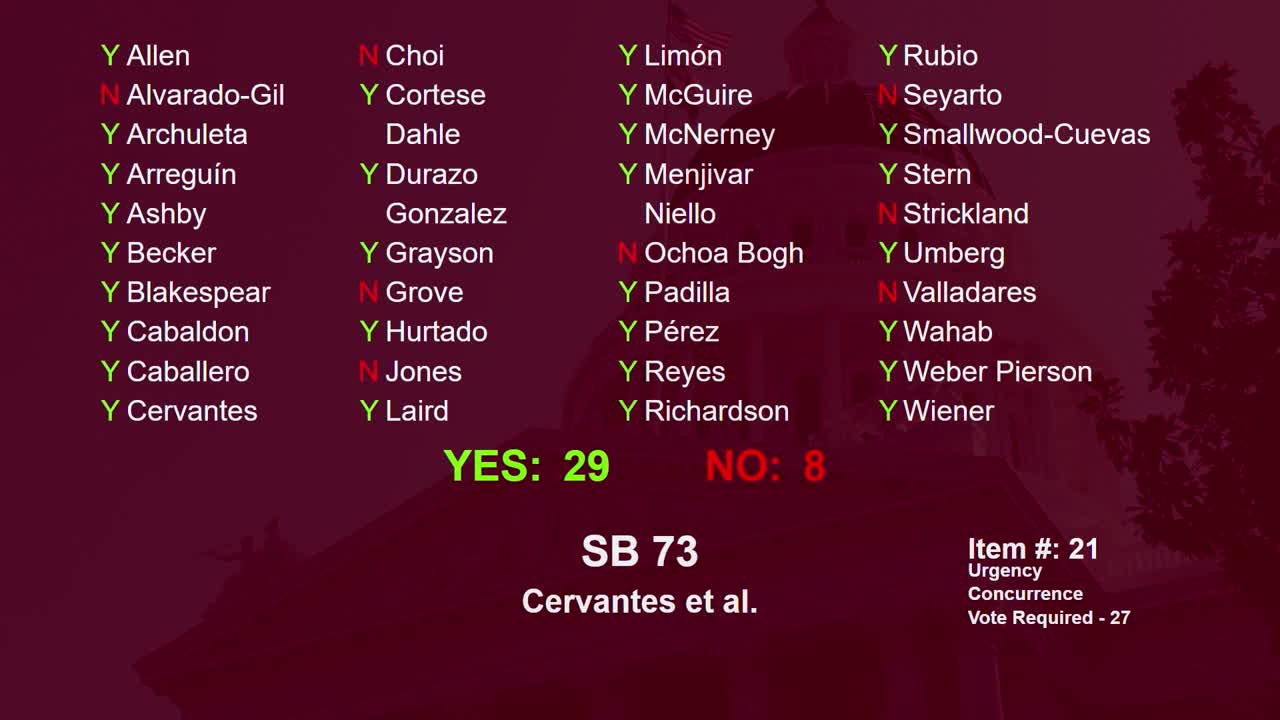 3MIN
Senate Floor
 12MIN
Senate Standing Committee on Judiciary
 12MIN
Senate Standing Committee on Public Safety
Bill Author