SB 1263: Contractors: debris removal.
- Session Year: 2025-2026
- House: Senate
- Latest Version Date: 2026-09-27
Current Status:
Passed
(2026-09-27: Chaptered by Secretary of State. Chapter 688, Statutes of 2026.)
Introduced
In Committee
Awaiting First Chamber Vote
Passed First Chamber
In Committee
Awaiting Second Chamber Vote
Passed Second Chamber
Enacted
Existing law, the Contractors State License Law, provides for the licensure and regulation of contractors by the Contractors State License Board. Existing law prohibits contractors from performing specified acts. Existing law requires the Department of Resources Recycling and Recovery or another state agency tasked to manage contracts for wildfire debris cleanup and removal by the Office of Emergency Services to prequalify contractors to enter into contracts to perform prescribed wildfire debris cleanup and removal work in communities impacted by wildfires.
Notwithstanding the prequalification requirement, this bill would prohibit a contractor from engaging in debris removal that includes hazardous materials on residential or commercial property that is damaged or destroyed by a natural disaster for which an emergency or major disaster is declared, unless the contractor has one of the specified licenses or classifications, as provided. The bill would require any licensee authorized to perform debris removal that includes hazardous materials under these provisions to have passed an approved hazardous substance certification examination and comply with hazardous waste operation and emergency response requirements, as specified.
Existing law, the Contractors State License Law, provides for the licensure and regulation of contractors by the Contractors State License Board. Existing law prohibits contractors from performing specified acts. Existing law requires the Department of Resources Recycling and Recovery or another state agency tasked to manage contracts for wildfire debris cleanup and removal by the Office of Emergency Services to prequalify contractors to enter into contracts to perform prescribed wildfire debris cleanup and removal work in communities impacted by wildfires.
Notwithstanding the prequalification requirement, this bill would prohibit a contractor from engaging in debris removal that includes hazardous materials on residential or commercial property that is damaged or destroyed by a natural disaster for which an emergency or major disaster is declared, unless the contractor has one of the specified license licenses or classifications, as provided. The bill would require any licensee authorized to perform debris removal that includes hazardous materials under these provisions to have passed an approved hazardous substance certification examination and comply with hazardous waste operation and emergency response requirements, as specified.
Existing law, the Contractors State License Law, provides for the licensure and regulation of contractors by the Contractors State License Board. Existing law prohibits contractors from performing specified acts. Existing law requires the Department of Resources Recycling and Recovery or another state agency tasked to manage contracts for wildfire debris cleanup and removal by the Office of Emergency Services to prequalify contractors to enter into contracts to perform prescribed wildfire debris cleanup and removal work in communities impacted by wildfires.
Notwithstanding the prequalification requirement, this bill would prohibit a contractor from engaging in debris removal on residential property that is damaged or destroyed by a natural disaster for which an emergency or major disaster is declared, unless the contractor has one of specified license or classifications, as provided. During a declared federal or state emergency or for a declared disaster area due to a natural disaster, the The bill would require any licensee authorized to perform debris removal under these provisions to have passed an approved hazardous substance certification examination and comply with hazardous waste operation and emergency response requirements, as specified.
Existing law, the Contractors State License Law, provides for the licensure and regulation of contractors by the Contractors State License Board. Existing law prohibits contractors from performing specified acts. Existing law requires the Department of Resources Recycling and Recovery or another state agency tasked to manage contracts for wildfire debris cleanup and removal by the Office of Emergency Services to prequalify contractors to enter into contracts to perform prescribed wildfire debris cleanup and removal work in communities impacted by wildfires.
Notwithstanding the prequalification requirement, this bill would prohibit a contractor from engaging in debris removal in a declared disaster area, on residential property that is damaged or destroyed by a natural disaster for which an emergency or major disaster is declared, unless the contractor has one of specified license or classifications. classifications, as provided. During a declared federal, state, or local federal or state emergency or for a declared disaster area due to a natural disaster, the bill would require any licensee authorized to perform debris removal under these provisions to pass have passed an approved hazardous substance certification examination and comply with hazardous waste operation and emergency response requirements, as specified.
Existing law, the Contractors State License Law, provides for the licensure and regulation of contractors by the Contractors State License Board. Existing law prohibits contractors from performing specified acts. Existing law requires the Department of Resources Recycling and Recovery or another state agency tasked to manage contracts for wildfire debris cleanup and removal by the Office of Emergency Services to prequalify contractors to enter into contracts to perform prescribed wildfire debris cleanup and removal work in communities impacted by wildfires.
Notwithstanding the prequalification requirement, this bill would prohibit a contractor from engaging in debris removal in a declared disaster area, unless the contractor has one of specified license or classifications. During a declared federal, state, or local emergency or for a declared disaster area due to a natural disaster, the bill would require any licensee authorized to perform debris removal under these provisions to pass an approved hazardous substance certification examination and comply with hazardous waste operation and emergency response requirements, as specified.
(a)Notwithstanding Section 40520 of the Public Resources Code, a contractor shall not engage in debris removal that includes hazardous materials, including muck out and ash out, on residential or commercial property that is damaged or destroyed by a natural disaster for which a state of emergency is declared by the Governor, pursuant to Section 8625 of the Government Code, or for which an emergency or major disaster is declared by the President of the United States, unless the contractor has one of the following licenses or classifications:
(1)A - General Engineering Contractor.
(2)B - General Building Contractor.
(3)C-12 - Earthwork and Paving.
(4)C-21 - Building Moving/Demolition.
(5)(A)C-49 - Tree and Palm.
(B)Debris removal that includes hazardous materials pursuant to this paragraph shall be limited to tree service and removal only.
(b)Any licensee authorized to perform debris removal that includes hazardous materials pursuant to this section shall have passed an approved hazardous substance certification examination pursuant to Section 7058.7 and shall comply with the hazardous waste operations and emergency response requirements pursuant to Section 5192 of Title 8 of the California Code of Regulations.
(c)This section shall apply when a permit is required for debris removal that includes hazardous materials resulting from a natural disaster, as described in subdivision (a), and the restrictions for debris removal that includes hazardous materials, including muck out and ash out, pursuant to this section shall no longer apply after any needed debris removal that includes hazardous materials, including muck out or ash out, is deemed completed or finalized by the local permitting agency, irrespective of whether an emergency proclamation or disaster declaration is still in effect.
(d)For the purposes of this section, the following terms have the following meanings:
(1)Debris means debris from, or located on, a residential or commercial property as a result of a natural disaster. Debris does not include any materials unrelated to the declared emergency or disaster.
(2)Debris removal means appropriate identification, encapsulation, transportation, and disposal of debris.
(3)Residential property and commercial property do not include property owned, operated, or leased by a state, federal, or local government or utility.
(a)Notwithstanding Section 40520 of the Public Resources Code, a contractor shall not engage in debris removal, removal that includes hazardous materials, including muck out and ash out, on residential or commercial property that is damaged or destroyed by a natural disaster for which a state of emergency is declared by the Governor, pursuant to Section 8625 of the Government Code, or for which an emergency or major disaster is declared by the President of the United States, unless the contractor has one of the following licenses or classifications:
(1)A - General Engineering Contractor.
(2)B - General Building Contractor.
(3)C-12 - Earthwork and Paving.
(4)C-21 - Building Moving/Demolition.
(5)(A)C-49 - Tree and Palm.
(B)Debris removal that includes hazardous materials pursuant to this paragraph shall be limited to tree service and removal only.
(b)Any licensee authorized to perform debris removal that includes hazardous materials pursuant to this section shall have passed an approved hazardous substance certification examination pursuant to Section 7058.7 and shall comply with the hazardous waste operations and emergency response requirements pursuant to Section 5192 of Title 8 of the California Code of Regulations.
(c)This section shall apply when a permit is required for debris removal that includes hazardous materials resulting from a natural disaster, as described in subdivision (a), and the restrictions for debris removal, removal that includes hazardous materials, including muck out and ash out, pursuant to this section shall no longer apply after any needed debris removal, removal that includes hazardous materials, including muck out or ash out, is deemed completed or finalized by the local permitting agency, irrespective of whether an emergency proclamation or disaster declaration is still in effect.
(d)For the purposes of this section, the following terms have the following meanings:
(1)Debris means debris from, or located on, a residential or commercial property as a result of a natural disaster. Debris does not include any materials unrelated to the declared emergency or disaster.
(2)Debris removal means appropriate identification, encapsulation, transportation, and disposal of debris.
(3)Residential property and commercial property do not include property owned, operated, or leased by a state, federal, or local government or utility.
(a)Notwithstanding Section 40520 of the Public Resources Code, a contractor shall not engage in debris removal, including muck out and ash out, on residential property that is damaged or destroyed by a natural disaster for which a state of emergency is declared by the Governor, pursuant to Section 8625 of Government Code, or for which an emergency or major disaster is declared by the President of the United States, unless the contractor has one of the following licenses or classifications:
(1)A - General Engineering Contractor.
(2)B - General Building Contractor.
(3)C-12 - Earthwork and Paving and Paving.
(4)C-21 - Building Moving/Demolition.
(5)(A)C-49 - Tree and Palm.
(B)Debris removal pursuant to this paragraph shall be limited to tree service and removal only.
(b)During a declared federal or state emergency or for a declared disaster area due to a natural disaster, any Any licensee authorized to perform debris removal pursuant to this section shall have passed an approved hazardous substance certification examination pursuant to Section 7058.7 and shall comply with the hazardous waste operations and emergency response requirements pursuant to Section 5192 of Title 8 of the California Code of Regulations.
(c)The This section shall apply when a permit is required for debris removal resulting from a natural disaster, as described in subdivision (a), and the restrictions for debris removal, including muck out and ash out, pursuant to this section shall no longer apply after any needed debris removal, including muck out or ash out, is deemed completed or finalized within the requirements of by the local permitting agency, irrespective of whether an emergency proclamation or disaster declaration is still in effect.
(d)For the purposes of this section, debris the following terms have the following meanings:
(1)Debris means debris from, or located on, a residential property as a result of a natural disaster. Debris does not include any materials unrelated to the declared emergency or disaster.
(2)Debris removal means appropriate identification, encapsulation, transportation, and disposal of debris.
(a)Notwithstanding Section 40520 of the Public Resources Code, a contractor shall not engage in debris removal, including muck out and ash out, in a declared disaster area, on residential property that is damaged or destroyed by a natural disaster for which a state of emergency is declared by the Governor, pursuant to Section 8625 of Government Code, or for which an emergency or major disaster is declared by the President of the United States, unless the contractor has one of the following licenses or classifications:
(1)A - General Engineering Contractor.
(2)B - General Building Contractor.
(3)C-12 - Earthwork and Paving and C-21 - Building Moving/Demolition.
(b)During a declared federal, state, or local federal or state emergency or for a declared disaster area due to a natural disaster, any licensee authorized to perform debris removal pursuant to this section shall have passed an approved hazardous substance certification examination pursuant to Section 7058.7 and shall comply with the hazardous waste operations and emergency response requirements pursuant to Section 5192 of Title 8 of the California Code of Regulations.
(c)The restrictions for debris removal, including muck out and ash out, pursuant to this section shall no longer apply after any needed debris removal, including muck out or ash out, is deemed completed or finalized within the requirements of the local permitting agency, irrespective of whether an emergency proclamation or disaster declaration is still in effect.
(d)For the purposes of this section, debris means debris from, or located on, a residential property as a result of a natural disaster. Debris does not include any materials unrelated to the declared emergency or disaster.
(a)Notwithstanding Section 40520 of the Public Resources Code, a contractor shall not engage in debris removal, including muck out and ash out, in a declared disaster area, unless the contractor has one of the following licenses or classifications:
(1)A - General Engineering Contractor.
(2)B - General Building Contractor.
(3)C-12 - Earthwork and Paving and C-21 - Building Moving/Demolition.
(b)During a declared federal, state, or local emergency or for a declared disaster area due to a natural disaster, any licensee authorized to perform debris removal pursuant to this section shall have passed an approved hazardous substance certification examination pursuant to Section 7058.7 and shall comply with the hazardous waste operations and emergency response requirements pursuant to Section 5192 of Title 8 of the California Code of Regulations.
|
Date
|
Status
|
|---|---|
| Sep 27, 2026 | Chaptered by Secretary of State. Chapter 688, Statutes of 2026. |
| Sep 27, 2026 | Approved by the Governor. |
| Aug 28, 2026 | Enrolled and presented to the Governor at 4 p.m. |
| Aug 20, 2026 | Assembly amendments concurred in. (Ayes 36. Noes 0. Page 5576.) Ordered to engrossing and enrolling. |
| Aug 20, 2026 | Assembly amendments concurred in. (Ayes 36. Noes 0.) Ordered to engrossing and enrolling. |
| Aug 19, 2026 | In Senate. Concurrence in Assembly amendments pending. |
| Aug 19, 2026 | Read third time. Passed. (Ayes 78. Noes 0. Page 6262.) Ordered to the Senate. |
| Aug 19, 2026 | Read third time. Passed. Ordered to the Senate. |
| Aug 13, 2026 | Ordered to third reading. |
| Aug 13, 2026 | Read third time and amended. |
| Aug 6, 2026 | Read second time. Ordered to third reading. |
| Aug 5, 2026 | From committee: Do pass. (Ayes 15. Noes 0.) (August 5). |
| Jun 30, 2026 | From committee: Do pass and re-refer to Com. on APPR. (Ayes 6. Noes 0.) (June 29). Re-referred to Com. on APPR. |
| Jun 24, 2026 | Read second time and amended. Re-referred to Com. on E.M. |
| Jun 23, 2026 | From committee: Do pass as amended and re-refer to Com. on E.M. (Ayes 18. Noes 0.) (June 23). |
| Jun 15, 2026 | From committee with author's amendments. Read second time and amended. Re-referred to Com. on B. & P. |
| Jun 9, 2026 | June 16 hearing postponed by committee. |
| May 18, 2026 | Referred to Coms. on B. & P. and E.M. |
| Apr 30, 2026 | In Assembly. Read first time. Held at Desk. |
| Apr 30, 2026 | Read third time. Passed. (Ayes 36. Noes 0. Page 4114.) Ordered to the Assembly. |
| Apr 30, 2026 | Read third time. Passed. (Ayes 36. Noes 0.) Ordered to the Assembly. |
| Apr 28, 2026 | Read second time. Ordered to consent calendar. |
| Apr 27, 2026 | From committee: Be ordered to second reading pursuant to Senate Rule 28.8 and ordered to consent calendar. |
| Apr 17, 2026 | Set for hearing April 27. |
| Apr 15, 2026 | From committee: Do pass and re-refer to Com. on APPR. with recommendation: To consent calendar. (Ayes 9. Noes 0. Page 3864.) (April 14). Re-referred to Com. on APPR. |
| Apr 15, 2026 | From committee: Do pass and re-refer to Com. on APPR. with recommendation: To consent calendar. (Ayes 9. Noes 0.) (April 14). Re-referred to Com. on APPR. |
| Apr 8, 2026 | Set for hearing April 14. |
| Mar 23, 2026 | From committee: Do pass and re-refer to Com. on E.M. with recommendation: To consent calendar. (Ayes 9. Noes 0. Page 3638.) (March 23). Re-referred to Com. on E.M. |
| Mar 23, 2026 | From committee: Do pass and re-refer to Com. on E.M. with recommendation: To consent calendar. (Ayes 9. Noes 0.) (March 23). Re-referred to Com. on E.M. |
| Mar 19, 2026 | Set for hearing March 23. |
| Mar 4, 2026 | Referred to Coms. on B. P. & E.D. and E.M. |
| Feb 20, 2026 | From printer. May be acted upon on or after March 22. |
| Feb 19, 2026 | Introduced. Read first time. To Com. on RLS. for assignment. To print. |
|
Date
|
Description
|
Location
|
Votes
|
|
|---|---|---|---|---|
| Aug 20, 2026 | Unfinished Business SB1263 McGuire Concurrence | Senate Floor |
Passed |
|
| Aug 19, 2026 | SB 1263 McGuire Senate Third Reading By Rogers | Assembly Floor |
Passed |
|
| Aug 5, 2026 | Do pass. | Assembly Standing Committee on Appropriations |
Passed |
|
| Jun 29, 2026 | Do pass and be re-referred to the Committee on [Appropriations] | Assembly Standing Committee on Emergency Management |
Passed |
|
| Jun 23, 2026 | Do pass as amended and be re-referred to the Committee on [Emergency Management] | Assembly Standing Committee on Business and Professions |
Passed |
|
| Apr 30, 2026 | Consent Calendar 2nd SB1263 McGuire | Senate Floor |
Passed |
|
| Apr 14, 2026 | Do pass, but first be re-referred to the Committee on [Appropriations] with the recommendation: To Consent Calendar | Senate Standing Committee on Emergency Management |
Passed |
|
| Mar 23, 2026 | Do pass, but first be re-referred to the Committee on [Emergency Management] with the recommendation: To Consent Calendar | Senate Standing Committee on Business, Professions and Economic Development |
Passed |
This list shows positions taken on this bill by organizations on the date displayed, which is linked to the original source.
Positions by individuals are not included.
|
Organization
|
Position
|
Date
|
|---|---|---|
| Associated General Contactors, California Chapters | ** Support | |
| Associated General Contractors, California Chapters | ** Support | |
| Author's Office | ** Support | |
| Contractors State License Board | ** Support | |
| Southern California Contractors Association | ** Support | |
| The Associated General Contractors, California Chapters | ** Support |
SENATE RULES COMMITTEE Office of Senate Floor Analyses (916) 651-4171 | SB 1263 |
UNFINISHED BUSINESS
Bill No: SB 1263
Author: McGuire (D)
Amended: 8/13/26
Vote: 21
SENATE BUS., PROF. & ECON. DEV. COMMITTEE: 9-0, 3/23/26
AYES: Wahab, Choi, Archuleta, Caballero, Grayson, Niello, Smallwood-Cuevas, Strickland, Umberg
NO VOTE RECORDED: Arreguín, Menjivar
SENATE EMERGENCY MGT. COMMITTEE: 9-0, 4/14/26
AYES: Stern, Seyarto, Allen, Ashby, Blakespear, Dahle, Grayson, Pérez, Rubio
SENATE APPROPRIATIONS COMMITTEE: Senate Rule 28.8
SENATE FLOOR: 36-0, 4/30/26 (Consent)
AYES: Allen, Alvarado-Gil, Archuleta, Ashby, Becker, Blakespear, Cabaldon, Cervantes, Choi, Cortese, Dahle, Durazo, Gonzalez, Grayson, Grove, Hurtado, Jones, Laird, Limón, McGuire, McNerney, Menjivar, Niello, Ochoa Bogh, Padilla, Pérez, Reyes, Richardson, Rubio, Seyarto, Smallwood-Cuevas, Stern, Strickland, Umberg, Weber Pierson, Wiener
NO VOTE RECORDED: Arreguín, Caballero, Valladares, Wahab
ASSEMBLY FLOOR: 78-0, 8/19/26 - See last page for vote
SUBJECT: Contractors: debris removal
SOURCE: Contractors State License Board
DIGEST:
This bill specifies that a contractor can engage in debris removal, including muck out and ash out after a disaster, provided they hold a specified license and classification. This bill prohibits contractors from providing debris removal services after a disaster unless they have passed a Contractors State License Board (CSLB) Hazardous Substance Removal Certification examination and comply with Department of Industrial Relations’ (DIR) hazardous waste operations and emergency response (HAZWOPER) requirements.
Assembly Amendments
specify the permission to engage in debris removal no longer applies after the removal is deemed completed regardless of the status of the emergency proclamation; define “debris removal” for the purposes of this bill; add C-49 – Tree and Palm classifications to the contractors who may engage in debris removal, but only limited to tree service and removal; and exempt property owned, operated, or leased by a state, federal or local government or utility.
ANALYSIS:
Existing law:
- Establishes the Contractors State License Board (CSLB) within DCA to license and regulate contractors and home improvement salespersons. (Business and Professions Code (BPC) § 7000 et seq.)
- Establishes four branches of contracting business in the following classifications:
- General engineering contracting (A)
- General building contracting (B1)
- Residential remodeling contracting (B2)
- Specialty contracting (C)
(BPC § 7055)
- Defines an A – General Engineering Contractor as those whose principal contracting businesses are in connection with fixed works requiring specialized engineering knowledge and skill, including the following divisions or subjects: irrigation, drainage, water power, water supply, flood control, inland waterways, harbors, docks and wharves, shipyards and ports, dams and hydroelectric projects, levees, river control and reclamation works, railroads, highways, streets and roads, tunnels, airports and airways, sewers and sewage disposal plants and systems, waste reduction plants, bridges, overpasses, underpasses and other similar works, pipelines and other systems for the transmission of petroleum and other liquid or gaseous substances, parks, playgrounds and other recreational works, refineries, chemical plants and similar industrial plants requiring specialized engineering knowledge and skill, powerhouses, powerplants and other utility plants and installations, mines and metallurgical plants, land leveling and earthmoving projects, excavating, grading, trenching, paving and surfacing work and cement and concrete works in connection with the above-mentioned fixed works. (BPC § 7056)
- Defines a B1 – General Building Contractor as those whose principal contracting businesses are in connection with any structure built, being built, or to be built, for the support, shelter, and enclosure of persons, animals, chattels, or movable property of any kind, requiring in its construction the use of at least two unrelated building trades or crafts, or to do or superintend the whole or any part thereof. (BPC § 7057)
- Defines a C – Specialty Contractor as those whose operations involve performance of construction work requiring special skill and whose principal contracting business involves the use of specialized building trades or crafts. (BPC § 7058)
Existing Regulations:
- Prohibits Contractors licensed in one classification from contracting in the field of any other classification unless they are also licensed in that classification or are permitted to do so by Title 16 of the California Code of Regulations (16 CCR) § 831. (16 CCR § 830)
- Defines the scope under which each specialty contractor classification may perform contracting work (16 CCR §§ 832.02, 832.4-832.17, 832.20-832.23, 832.26-832.29, 832.31-832.36, 832.38, 832.39, 832.42, 832.43, 832.45-832.47, 82.49-832.51, 832.53-832.55, 832.57, 832.60-832.62)
This bill prohibits a contractor from engaging in private debris removal, as defined, from property damaged or destroyed by a natural disaster for which a state of emergency is declared by the Governor or President, unless the contractor has an A – General Engineering, B – General Building, C-12 – Earthwork and Paving, C-21 – Building Moving/Demolition, or C-49 – Tree and Palm license issued by the CSLB, but limits work by the C-49 licensee to tree service and removal. This bill also requires any licensee authorized to perform debris removal to have passed an approved hazardous substance certification examination and to comply with hazardous waste operations and emergency response requirements.
Background
Climate change, primarily caused by the burning of fossil fuels, is increasing the frequency and severity of wildfires, not only in California, but also all over the world. Since 1950, the area burned by California wildfires each year has been increasing. Drought conditions have brought unusually warm temperatures, intensifying the effects of very low precipitation and snowpack and creating conditions for extreme, high severity wildfires that spread rapidly.
In January 2025, Los Angeles experienced the most catastrophic wildfires in its history. Beginning January 7, a series of wildfires ravaged L.A. County, consuming tens of thousands of acres due to strong Santa Ana winds and severe dry conditions. The Palisades and Eaton Fires were the most destructive, burning over 20,000 and almost 14,000 acres, respectively. The fires claimed at least 28 lives and destroyed over 16,240 structures.
In the wake of unprecedented natural disasters in California over the past several years, residential rebuilding efforts have commenced across the state in areas devastated by floods, fires, and earthquakes. CSLB has received inquiries from concerned parties about whether contractors digging to remove contaminated materials from these areas have the qualifications to do the work safely.
A contractor must have an existing license to apply for a Hazardous Substance Removal Certification, which is added to the license after the qualifier passes the corresponding examination. BPC section 7058.7 defines the scope of work for those holding a hazardous substance removal certificate, which includes engaging in the removal or remedial action if the action requires digging into the surface of the earth and removing the dug material from hazardous sites. The existing definition is unclear as to whether the contractor holding the certificate is authorized and qualified to conduct similar work in disaster areas.
CSLB updates the hazardous substances certification examination every five years with extensive input from subject matter experts who help design questions based on federal, state, and local law. However, statute only requires the Hazardous Substance Removal Certification for removal and installation of underground storage tanks or if the project site is listed on state or federal websites, and as a result the certification examination questions are limited in scope to these issues.
Currently, there is no designation in Contractors Law as to who can perform debris removal during a declared disaster. Out of necessity, CSLB has made this determination on an ad hoc basis during recent declared disasters, but a permanent solution is needed. By specifying who is authorized to perform debris removal during a declared disaster, including muck-out and ash-out operations, and requiring that contractors possess sufficient training and certification to conduct debris removal, worker safety is enhanced and the risk of additional health and environmental hazards resulting from improper debris removal and disposal practices can be mitigated.
This proposal does not alter existing law as it relates to debris removal on sites unrelated to a disaster declaration. Limiting this proposal to the removal of debris by certain classifications who hold Hazardous Substance Removal Certification in a disaster area is intended to address the safe disposal of dangerous contaminants and chemicals left behind after property is damaged or destroyed by a disaster.
FISCAL EFFECT: Appropriation: No Fiscal Com.: Yes Local: No
The CSLB anticipates no implementation costs.
SUPPORT: (Verified 8/19/26)
Contractors State License Board (source)
Associated General Contactors, California Chapters
Southern California Contractors Association
OPPOSITION: (Verified 8/19/26)
None received
ARGUMENTS IN SUPPORT: The Contractors State License Board notes, “In the aftermath of a natural disaster, safe debris removal and disposal is critical to avoid additional health and environmental problems. SB 1263 specifies who is authorized to perform debris removal during a declared disaster and ensures they have the proper safety and educational training needed to safeguard public safety and mitigate additional health and environmental hazards resulting from improper debris removal or disposal practices.”
ASSEMBLY FLOOR: 78-0, 8/19/26
AYES: Addis, Aguiar-Curry, Ahrens, Alanis, Alvarez, Arambula, Ávila Farías, Bains, Bauer-Kahan, Bennett, Berman, Boerner, Bonta, Bryan, Calderon, Caloza, Carrillo, Castillo, Chen, Connolly, Davies, DeMaio, Dixon, Elhawary, Ellis, Flora, Fong, Gabriel, Garcia, Gipson, Jeff Gonzalez, Mark González, Hadwick, Haney, Harabedian, Hart, Hoover, Irwin, Jackson, Johnson, Kalra, Krell, Lackey, Lee, Lowenthal, Macedo, McKinnor, Muratsuchi, Nguyen, Ortega, Pacheco, Papan, Patel, Patterson, Pellerin, Petrie-Norris, Quirk-Silva, Ramos, Ransom, Celeste Rodriguez, Michelle Rodriguez, Rogers, Sanchez, Schiavo, Schultz, Sharp-Collins, Solache, Soria, Stefani, Ta, Tangipa, Valencia, Wallis, Ward, Wicks, Wilson, Zbur, Rivas
NO VOTE RECORDED: Blanca Rubio
Prepared by: Yeaphana La Marr / B., P. & E.D. /
8/20/26 8:32:54
**** END ****
SENATE THIRD READING
STR Bill Id:SB 1263
Author:(McGuire)
As Amended Ver:August 13, 2026
Majority vote
SUMMARY
Prohibits a contractor from engaging in debris removal that includes hazardous waste on residential or commercial property that is damaged or destroyed by a natural disaster, as specified, unless they hold a specific license from the Contractors State License Board (CSLB or Board), have passed a CSLB Hazardous Substance Removal Certification examination, and comply with Department of Industrial Relations' Hazardous Waste Operations and Emergency Response (HAZWOPER) requirements, as specified.
Major Provisions
- Prohibits a contractor from engaging in debris removal that includes hazardous waste, including muck out and ash out, on residential or commercial property that is damaged or destroyed by a natural disaster for which a state of emergency is declared by the Governor or for which an emergency or major disaster is declared by the President of the United States, unless the contractor has one of the following licenses or classifications:
- A – General Engineering Contractor.
- B – General Building Contractor.
- C-12 – Specialty Contractor Classification for Earthwork and Paving.
- C-21 – Specialty Contractor Classification for Building Moving/Demolition.
- C-49 – Specialty Contractor Classification for Tree and Palm, as specified.
- Provides that any contractor licensee authorized to perform debris removal that includes hazardous waste must have passed a Hazardous Substance Removal Certification examination administered by the CSLB and comply with HAZWOPER requirements.
- Specifies that the restrictions for debris removal that includes hazardous waste apply when a permit is required and end after the debris removal that includes hazardous waste is deemed completed or finalized by the local permitting agency, irrespective of whether an emergency proclamation or disaster declaration is still in effect.
- Defines "debris" as debris from, or located on, a residential or commercial property as a result of a natural disaster and does not include any materials unrelated to the declared emergency or disaster.
- Defines "debris removal" to mean appropriate identification, encapsulation, transportation, and disposal of debris.
- Specifies that “residential property” and “commercial property” do not include property owned, operated, or leased by a state, federal, or local government or utility.
COMMENTS
The CSLB is responsible for implementing and enforcing the License Law, which governs the licensure, practice, and discipline of contractors in California. A license is required for construction projects valued at $1,000 or more, including labor and materials. The CSLB issues licenses to business entities and sole proprietors. Each license requires a qualifying individual (a "qualifier") who satisfies the experience and examination requirements for licensure and directly supervises and controls construction work performed under the license. The CSLB issues four types of licenses: "A" General Engineering Contractor; "B" General Building Contractor; "B-2" Residential Remodeling Contractor; and "C" Specialty Contractor classifications.
In the aftermath of the Eaton and Palisades wildfires in Los Angeles County in 2025, the first step in rebuilding was a two-phase hazardous-waste cleanup and debris-removal process. In total, more than 2.5 million tons of debris were removed from more than 9,000 properties. In the first phase, the United States Environmental Protection Agency (EPA) removed hazardous waste such as batteries, fertilizers and pesticides, paints and oils, cleaners and solvents, and propane tanks and other pressurized products from all residential properties at no cost to homeowners. In some instances, hazardous waste removal was deferred until phase two debris removal.
During phase two, property owners could elect to participate in a federally funded, government-sponsored program or to hire a private contractor. If homeowners opted in for free debris removal, the United States Army Corps of Engineers removed structural debris, including damaged foundations, hazardous trees, asbestos, ash, contaminated soil, and destroyed vehicles. Those who opted out were required to arrange for and pay for debris removal themselves. Property owners were required to hire a certified consultant to check their property for asbestos, hire a licensed, specialized contractor to remove debris, and obtain a fire debris removal permit from Los Angeles County. Los Angeles County debris removal permits were issued to contractors with an A General Engineering Contractor, B General Building Contractor, C-12 Earthwork and Paving, and C-21 Building Moving/Demolition license.
Moreover, contractors were required to hold the CSLB Hazardous Substance Removal Certification. Under current law, contractors who perform hazardous substance removal work at specific sites must pass the Hazardous Substance Removal Certification examination to add the certification to their existing license. The examination is developed by the CSLB in consultation with the Division of Occupational Safety and Health, the State Water Resources Control Board, the Department of Toxic Substances Control, and an advisory committee composed of two representatives of hazardous substance removal workers in California, two general engineering contractors in California, and two representatives of insurance companies in California who are selected by the Insurance Commissioner. The examination covers safe removal, transport, and disposal of hazardous materials, but not the identification of hazardous substances.
Los Angeles County also required contractors' employees to complete 40 hours of HAZWOPER training. Current Cal/OSHA health and safety standards cover employees performing fire cleanup work, including ash, soot, and debris removal, and require employers to provide mandated hazard training and proper protective equipment. The CSLB reports that more than 1,500 contractors met the requirements established by Los Angeles County.
This bill prohibits a contractor from engaging in debris removal on residential or commercial property that is damaged or destroyed by a natural disaster for which a state of emergency is declared by the Governor or for which an emergency or major disaster is declared by the President of the United States, unless the contractor holds a specific license type, obtains Hazardous Substance Removal Certification from CSLB, and complies with HAZWOPER standards. The debris removal restrictions apply only when a permit is required and the debris contains hazardous waste, and end after the work is deemed completed or finalized by the local permitting agency.
According to the Author
"As California faces increasingly destructive natural disasters, safe debris removal and disposal are essential components of disaster recovery. Improper handling of hazardous debris can create significant risks to public health, worker safety, and the environment. [This bill] clarifies who is authorized to conduct debris removal in declared disaster areas—including muck-out and ash-out operations—and requires that all who perform this work possess hazardous substance removal certifications and comply with HAZWOPER standards. These crucial safeguards will help ensure appropriate clearing of disaster sites while protecting workers and impacted communities."
Arguments in Support
The Associated General Contractors, California Chapters write in support:
This bill provides important benefits to licensed contractors by clarifying eligibility requirements and reinforcing the value of proper licensure and training. By requiring contractors engaged in debris removal to hold specific classifications, [this bill] helps ensure that qualified professionals are prioritized for this critical work, protecting both public safety and the integrity of the contracting industry. The bill's requirement for hazardous substance certification and compliance with established safety standards strengthens workforce preparedness. Contractors who invest in proper training and certification will be better positioned to compete for debris removal contracts, while also operating under clearer regulatory expectations during emergency response situations. [This bill] also promotes fairness by creating a more level playing field. By limiting participation to appropriately licensed and certified contractors, the bill helps reduce unqualified or opportunistic operators entering disaster zones, thereby supporting reputable contractors who adhere to industry standards.
Arguments in Opposition
There is no opposition on file.
FISCAL COMMENTS
According to the Assembly Appropriations Committee, the CSLB anticipates no implementation costs.
VOTES
SENATE FLOOR: 36-0-4
YES: Allen, Alvarado-Gil, Archuleta, Ashby, Becker, Blakespear, Cabaldon, Cervantes, Choi, Cortese, Dahle, Durazo, Gonzalez, Grayson, Grove, Hurtado, Jones, Laird, Limón, McGuire, McNerney, Menjivar, Niello, Ochoa Bogh, Padilla, Pérez, Reyes, Richardson, Rubio, Seyarto, Smallwood-Cuevas, Stern, Strickland, Umberg, Weber Pierson, Wiener
ABS, ABST OR NV: Arreguín, Caballero, Valladares, Wahab
ASM BUSINESS AND PROFESSIONS: 18-0-1
YES: Berman, Addis, Ahrens, Alanis, Bains, Bauer-Kahan, Caloza, Chen, Elhawary, Hadwick, Haney, Hart, Irwin, Jackson, Patterson, Lowenthal, Nguyen, Pellerin
ABS, ABST OR NV: Macedo
ASM EMERGENCY MANAGEMENT: 6-0-1
YES: Ransom, Hadwick, Arambula, Bennett, Calderon, DeMaio
ABS, ABST OR NV: Bains
ASM APPROPRIATIONS: 15-0-0
YES: Wicks, Hoover, Arambula, Calderon, Caloza, Dixon, Fong, Mark González, Krell, Pacheco, Pellerin, Sharp-Collins, Solache, Ta, Tangipa
UPDATED
VERSION: August 13, 2026
CONSULTANT: Kaitlin Curry / B. & P. / (916) 319-3301 FN: 0003609
SENATE THIRD READING
STR Bill Id:SB 1263
Author:(McGuire)
As Amended Ver:June 24, 2026
Majority vote
SUMMARY
Prohibits a contractor from engaging in debris removal on residential property that is damaged or destroyed by a natural disaster, as specified, unless they hold a specific license from the Contractors State License Board (CSLB or Board), have passed a CSLB Hazardous Substance Removal Certification examination, and comply with Department of Industrial Relations' Hazardous Waste Operations and Emergency Response (HAZWOPER) requirements.
Major Provisions
- Prohibits a contractor from engaging in debris removal, including muck out and ash out, on residential property that is damaged or destroyed by a natural disaster for which a state of emergency is declared by the Governor or for which an emergency or major disaster is declared by the President of the United States, unless the contractor has one of the following licenses or classifications:
- A – General Engineering Contractor.
- B – General Building Contractor.
- C-12 – Specialty Contractor Classification for Earthwork and Paving.
- C-21 – Specialty Contractor Classification for Building Moving/Demolition.
- C-49 – Specialty Contractor Classification for Tree and Palm, as specified.
- Provides that any contractor licensee authorized to perform debris removal must have passed a Hazardous Substance Removal Certification examination administered by the CSLB and comply with HAZWOPER requirements.
- Specifies that the restrictions for debris removal apply when a permit is required and end after the debris removal is deemed completed or finalized by the local permitting agency, irrespective of whether an emergency proclamation or disaster declaration is still in effect.
- Defines "debris" as debris from, or located on, a residential property as a result of a natural disaster and does not include any materials unrelated to the declared emergency or disaster.
- Defines "debris removal" to mean appropriate identification, encapsulation, transportation, and disposal of debris.
COMMENTS
The CSLB is responsible for implementing and enforcing the License Law, which governs the licensure, practice, and discipline of contractors in California. A license is required for construction projects valued at $1,000 or more, including labor and materials. The CSLB issues licenses to business entities and sole proprietors. Each license requires a qualifying individual (a "qualifier") who satisfies the experience and examination requirements for licensure and directly supervises and controls construction work performed under the license. The CSLB issues four types of licenses: "A" General Engineering Contractor; "B" General Building Contractor; "B-2" Residential Remodeling Contractor; and "C" Specialty Contractor classifications.
In the aftermath of the Eaton and Palisades wildfires in Los Angeles County in 2025, the first step in rebuilding was a two-phase hazardous-waste cleanup and debris-removal process. In total, more than 2.5 million tons of debris were removed from more than 9,000 properties. In the first phase, the United States Environmental Protection Agency (EPA) removed hazardous waste such as batteries, fertilizers and pesticides, paints and oils, cleaners and solvents, and propane tanks and other pressurized products from all residential properties at no cost to homeowners. In some instances, hazardous waste removal was deferred until phase two debris removal.
During phase two, property owners could elect to participate in a federally funded, government-sponsored program or to hire a private contractor. If homeowners opted in for free debris removal, the United States Army Corps of Engineers removed structural debris, including damaged foundations, hazardous trees, asbestos, ash, contaminated soil, and destroyed vehicles. Those who opted out were required to arrange for and pay for debris removal themselves. Property owners were required to hire a certified consultant to check their property for asbestos, hire a licensed, specialized contractor to remove debris, and obtain a fire debris removal permit from Los Angeles County. Los Angeles County debris removal permits were issued to contractors with an A General Engineering Contractor, B General Building Contractor, C-12 Earthwork and Paving, and C-21 Building Moving/Demolition license.
Moreover, contractors were required to hold the CSLB Hazardous Substance Removal Certification. Under current law, contractors who perform hazardous substance removal work at specific sites must pass the Hazardous Substance Removal Certification examination to add the certification to their existing license. The examination is developed by the CSLB in consultation with the Division of Occupational Safety and Health, the State Water Resources Control Board, the Department of Toxic Substances Control, and an advisory committee composed of two representatives of hazardous substance removal workers in California, two general engineering contractors in California, and two representatives of insurance companies in California who are selected by the Insurance Commissioner. The examination covers safe removal, transport, and disposal of hazardous materials, but not the identification of hazardous substances.
Los Angeles County also required contractors' employees to complete 40 hours of HAZWOPER training. Current Cal/OSHA health and safety standards cover employees performing fire cleanup work, including ash, soot, and debris removal, and require employers to provide mandated hazard training and proper protective equipment. The CSLB reports that more than 1,500 contractors met the requirements established by Los Angeles County.
This bill prohibits a contractor from engaging in debris removal on residential property that is damaged or destroyed by a natural disaster for which a state of emergency is declared by the Governor or for which an emergency or major disaster is declared by the President of the United States, unless the contractor holds a specific license type, obtains Hazardous Substance Removal Certification from CSLB, and complies with HAZWOPER standards. The debris removal restrictions apply when a permit is required and end after the work is deemed completed or finalized by the local permitting agency.
According to the Author
"As California faces increasingly destructive natural disasters, safe debris removal and disposal are essential components of disaster recovery. Improper handling of hazardous debris can create significant risks to public health, worker safety, and the environment. [This bill] clarifies who is authorized to conduct debris removal in declared disaster areas—including muck-out and ash-out operations—and requires that all who perform this work possess hazardous substance removal certifications and comply with HAZWOPER standards. These crucial safeguards will help ensure appropriate clearing of disaster sites while protecting workers and impacted communities."
Arguments in Support
The Associated General Contractors, California Chapters write in support:
This bill provides important benefits to licensed contractors by clarifying eligibility requirements and reinforcing the value of proper licensure and training. By requiring contractors engaged in debris removal to hold specific classifications, [this bill] helps ensure that qualified professionals are prioritized for this critical work, protecting both public safety and the integrity of the contracting industry. The bill's requirement for hazardous substance certification and compliance with established safety standards strengthens workforce preparedness. Contractors who invest in proper training and certification will be better positioned to compete for debris removal contracts, while also operating under clearer regulatory expectations during emergency response situations. [This bill] also promotes fairness by creating a more level playing field. By limiting participation to appropriately licensed and certified contractors, the bill helps reduce unqualified or opportunistic operators entering disaster zones, thereby supporting reputable contractors who adhere to industry standards.
Arguments in Opposition
There is no opposition on file.
FISCAL COMMENTS
According to the Assembly Appropriations Committee, the CSLB anticipates no implementation costs.
VOTES
SENATE FLOOR: 36-0-4
YES: Allen, Alvarado-Gil, Archuleta, Ashby, Becker, Blakespear, Cabaldon, Cervantes, Choi, Cortese, Dahle, Durazo, Gonzalez, Grayson, Grove, Hurtado, Jones, Laird, Limón, McGuire, McNerney, Menjivar, Niello, Ochoa Bogh, Padilla, Pérez, Reyes, Richardson, Rubio, Seyarto, Smallwood-Cuevas, Stern, Strickland, Umberg, Weber Pierson, Wiener
ABS, ABST OR NV: Arreguín, Caballero, Valladares, Wahab
ASM BUSINESS AND PROFESSIONS: 18-0-1
YES: Berman, Addis, Ahrens, Alanis, Bains, Bauer-Kahan, Caloza, Chen, Elhawary, Hadwick, Haney, Hart, Irwin, Jackson, Patterson, Lowenthal, Nguyen, Pellerin
ABS, ABST OR NV: Macedo
ASM EMERGENCY MANAGEMENT: 6-0-1
YES: Ransom, Hadwick, Arambula, Bennett, Calderon, DeMaio
ABS, ABST OR NV: Bains
ASM APPROPRIATIONS: 15-0-0
YES: Wicks, Hoover, Arambula, Calderon, Caloza, Dixon, Fong, Mark González, Krell, Pacheco, Pellerin, Sharp-Collins, Solache, Ta, Tangipa
UPDATED
VERSION: June 24, 2026
CONSULTANT: Kaitlin Curry / B. & P. / (916) 319-3301 FN: 0003357
Date of Hearing: August 5, 2026
ASSEMBLY COMMITTEE ON APPROPRIATIONS
Buffy Wicks, Chair
SBPCA Bill Id:SB 1263
Author:(McGuire) – As Amended Ver:June 24, 2026
Policy Committee: | Business and Professions | Vote: | 18 - 0 |
Emergency Management | 6 - 0 | ||
|
|
Urgency: No State Mandated Local Program: No Reimbursable: No
SUMMARY:
This bill prohibits a contractor from engaging in debris removal on residential property damaged or destroyed by a natural disaster unless they hold a specified license from the Contractors State License Board (CSLB) and meet hazardous substance removal requirements.
Specifically, this bill:
- Prohibits a contractor from engaging in debris removal, including muck out and ash out, on residential property damaged or destroyed by a natural disaster for which a state of emergency is declared by the Governor, or for which an emergency or major disaster is declared by the President of the United States, unless the contractor has one of the following licenses or classifications:
- A - General Engineering Contractor.
- B - General Building Contractor.
- C-12 - Earthwork and Paving.
- C-21 - Building Moving/Demolition.
- C-49 - Tree and Palm
- Limits the C-49 – Tree and Palm contractor license for debris removal pursuant to this bill to tree service and removal only.
- Requires any licensee authorized by this bill to perform debris removal to have passed an approved hazardous substance certification examination, as specified, and comply with the hazardous waste operations and emergency response (HAZWOPER) requirements.
- Specifies the requirements in this bill apply only when a permit is required for debris removal pursuant to item 1, above, and the restrictions for debris removal pursuant to this bill no longer apply after needed debris removal is deemed completed or finalized by the local permitting agency, irrespective of whether an emergency proclamation or disaster declaration is still in effect.
FISCAL EFFECT:
The CSLB anticipates no implementation costs.
COMMENTS:
- Purpose. According to the author:
As California faces increasingly destructive natural disasters, safe debris removal and disposal are essential components of disaster recovery. Improper handling of hazardous debris can create significant risks to public health, worker safety, and the environment. [This bill] clarifies who is authorized to conduct debris removal in declared disaster areas and requires all who perform this work possess hazardous substance removal certifications and comply with HAZWOPER standards. These crucial safeguards will help ensure appropriate clearing of disaster sites while protecting workers and impacted communities.
- Background. The CSLB is responsible for implementing and enforcing the Contractors State License Law, which governs the licensure, practice, and discipline of contractors in California. A license is required for construction projects valued at $1,000 or more, including labor and materials. The CSLB issues four types of licenses: A - General Engineering Contractor; B - General Building Contractor; B-2 - Residential Remodeling Contractor; and C - Specialty Contractor, of which there are more than 40 classifications.
Pursuant to the Public Resources code, existing law requires the Department of Resources Recycling and Recovery (CalRecycle) to prequalify contractors to enter into debris-removal contracts in communities impacted by wildfires. In the wake of the 2025 wildfires in southern California, Governor Newsom signed EO N-5-25, which directed state agencies to develop and implement a comprehensive plan for debris removal.
Following the Eaton and Palisades wildfires in Los Angeles County in 2025, the United States Environmental Protection Agency (EPA) removed hazardous waste from all residential properties at no cost to homeowners. Property owners could then elect to participate in a federally funded government-sponsored debris removal program provided by the United States Army Corps of Engineers or to obtain a fire debris removal permit from Los Angeles County and hire a private licensed, specialized contractor to remove debris.
Los Angeles County issued debris removal permits to a contractor with an A, B, C-12, or C-21 license classification and who held the CSLB hazardous substance removal certification, which is required under existing law for contractors who perform hazardous substance removal work at specific sites. Los Angeles County also required contractors’ employees to complete 40 hours of HAZWOPER training.
This bill places the Los Angeles County debris-removal permitting requirements in state statute, thus setting a statewide licensing standard for future declared natural disasters.
The bill is opposed by the Southern California Contractors Association (SCCA) who is concerned that the bill’s requirement for HAZWOPER training also applies to non-hazardous debris removal. The author’s office and SCCA indicate it has reached agreement on amendments that address this issue and will bring SCCA in support of the bill.
- Related Legislation. SB 641 (Ashby), of this legislative session, contained similar provisions along with unrelated provisions. SB 641 was vetoed due to unrelated provisions.
Analysis Prepared by: Jennifer Swenson / APPR. / (916) 319-2081
Date of Hearing: June 29, 2026
ASSEMBLY COMMITTEE ON EMERGENCY MANAGEMENT
Rhodesia Ransom, Chair
SBPCA Bill Id:SB 1263
Author:(McGuire) – As Amended Ver:June 15, 2026
SENATE VOTE: 36-0
SUBJECT: Contractors: debris removal
SUMMARY: Prohibits a contractor from engaging in debris removal on residential property that is damaged or destroyed by a natural disaster, as specified, unless they hold a specific license from the Contractors State License Board (CSLB), have passed an approved Hazardous Substance Removal Certification examination, and comply with Department of Industrial Relations’ Hazardous Waste Operations and Emergency Response (HAZWOPER) requirements. Specifically, this bill:
- Prohibits a contractor from engaging in debris removal, including muck out and ash out, on residential property that is damaged or destroyed by a natural disaster for which a state of emergency is declared by the Governor, or for which an emergency or major disaster is declared by the President of the United States, unless the contractor has one of the following licenses or classifications:
- A - General Engineering Contractor.
- B - General Building Contractor.
- C-12 - Earthwork and Paving.
- C-21 - Building Moving/Demolition.
- C-49 - Tree and Palm
- Specifies the C-49 – Tree and Palm contractors may only complete tree service and removal for the purposes of this bill.
- Requires any licensee authorized by this bill to perform debris removal must have passed an approved hazardous substance certification examination, as specified, and comply with the hazardous waste operations and emergency response (HAZWOPER) requirements.
- Specifies the above requirements only apply when a permit is required for debris removal resulting from a natural disaster with a state or federal emergency proclamation or disaster declaration, and the restrictions for debris removal, including muck out and ash out, no longer apply after any needed debris removal, including muck out or ash out, is deemed completed or finalized by the local permitting agency, irrespective of whether an emergency proclamation or disaster declaration is still in effect.
- Defines “debris” to mean debris from, or located on, a residential property as a result of a natural disaster. “Debris” does not include any materials unrelated to the declared emergency or disaster.
- Defines “debris removal” to mean appropriate identification, encapsulation, transportation, and disposal of debris.
EXISTING LAW:
- Establishes the California Office of Emergency Services (Cal OES) within the office of the Governor and makes Cal OES responsible for the state’s emergency and disaster response services for natural, technological, or manmade disasters and emergencies. (Government (Gov.) Code § 8550)
- Authorizes the Governor to proclaim a state of emergency and local officials and local governments to proclaim a local emergency, when specified conditions of disaster or extreme peril to the safety of persons and property exist, and authorizes the Governor or the appropriate local government to exercise certain powers in response to that emergency. (Gov. Code § 8558)
- Defines “state of emergency” and “local emergency” to mean a duly proclaimed existence of conditions of disaster or of extreme peril to the safety of persons and property within the state or territorial limits of a local government caused by, among other things, a sudden and severe energy shortage. (Gov. Code § 8558)
- Requires the Standardized Emergency Management System (SEMS) for managing multiagency and multijurisdictional responses to emergencies in California. State agencies are required to use SEMS and local government entities must use SEMS in order to be eligible for any reimbursement of response-related costs under the state’s disaster assistance programs. (Gov. Code § 8607)
- Under the California Disaster Assistance Act, requires the Director of Cal OES to provide financial assistance to local agencies for their personnel costs, equipment costs, and the cost of supplies and materials used during disaster response activities, incurred as a result of a state of emergency proclaimed by the Governor, subject to specified criteria. (Gov. Code § 8680)
- Requires the Department of Resources Recycling and Recovery or another state agency tasked to manage contracts for wildfire debris cleanup and removal by the Governor’s Office of Emergency Services to prequalify contractors to enter into contracts in communities impacted by wildfires. (Public Resources Code § 40520)
- Establishes, until January 1, 2029, the CSLB under the Department of Consumer Affairs to implement and enforce the Contractors State License Law (License Law), which includes the licensing and regulation of contractors and home improvement salespersons. (Business and Professions Code (BPC) §§ 7000 et seq.)
FISCAL EFFECT: Pursuant to Senate Rule 28.8, no significant state costs anticipated.
COMMENTS:
Author Statement: “As California faces increasingly destructive natural disasters, safe debris removal and disposal are essential components of disaster recovery. Improper handling of hazardous debris can create significant risks to public health, worker safety, and the environment. [This bill] clarifies who is authorized to conduct debris removal in declared disaster areas—including muck-out and ash-out operations—and requires that all who perform this work possess hazardous substance removal certifications and comply with HAZWOPER standards. These crucial safeguards will help ensure appropriate clearing of disaster sites while protecting workers and impacted communities.”
Natural, Technological, or Manmade Disasters and Emergencies: California faces an escalating threat from natural, technological, and human-caused disasters, with climate change acting as a major force multiplier that intensifies the frequency, scale, and complexity of emergencies statewide. Rising temperatures, prolonged drought, extreme precipitation, sea-level rise, and record-breaking heat waves are accelerating life-threatening historic wildfires, vanishing Sierra snowpacks, stressing water and energy systems, degrading air quality, and increasing risks to public health and critical infrastructure are all major intensifiers of disasters. These issues demonstrate that California’s climate emergencies are growing with frequency and intensity. California faces heightened risks of mass casualties, large-scale infrastructure failure, economic disruption, community displacement, and irreversible ecological damage.
In written testimony provided to the House of Representatives Committee on Appropriations in 2022, California’s OES Director stated, “the State of California arguably faces the most complex and severe disaster conditions in the nation and these challenges and complexities grow in magnitude each year. In the past decade, California has experienced every conceivable type of natural and manmade disaster including drought, earthquake, flood, catastrophic wildfire, mudslides, dam failure, cyber security attacks, oil spills, natural gas leak, civil unrest, terrorism, and tsunami. However, the COVID-19 pandemic has put our emergency management system to the test.” More recently, the 2025 Los Angeles Wildfires further strained emergency management systems and revealed inconsistencies in emergency preparedness and response.
Wildfire Debris Removal and Recovery Operations: The Department of Resources Recycling and Recovery (Cal Recycle) is responsible for implementing the Consolidated Debris Removal Program. The program is divided into two phases.
Department of Toxic Substance Control (DTSC) or the United States Environmental Protection Agency (USEPA) are tasked with Phase 1 of the process, which removes common household items burned in the wildfires that may require safe disposal. This phase is meant to reduce public and recovery workers’ toxic exposure. As fire-scarred houses are cleared, common household items are removed to help clear properties in preparation for rebuilding. These items are the type of common everyday materials that residents transport to designated collection facilities for proper disposal. A team surveys property, identifying debris and marking it for disposal. Then, a second team will secure the loose debris in a secure receptacle and remove it. Following removal, the collected debris is taken to a transfer site nearby where it is sorted and quickly routed on its journey to its final disposal location. Throughout this process, local, state, and federal partners work together to test air, water, and soil to ensure safety.
CalRecycle generally implements Phase 2. (However, the U.S. Army Corps of Engineers was tasked with this phase for debris removal following the 2025 Los Angeles fires.) Objectives of this phase include reducing immediate threats to public health and safety, and expediting economic recovery of the affected cities and communities. These efforts involved the removal of ash, burned structural remains, hazardous materials, foundations, ACM, vehicles, vessels, contaminated soil and debris from private and public properties. Phase 2 also includes removing the top 3 - 6 inches of contaminated soil. Soil testing and contaminated soil removal are part of the process because toxins like arsenic, lead, mercury, and chlorine can be present. Since Phase 1 does not remove all asbestos, Phase 2 crews conduct a full asbestos assessment and removal.
Property Rights of Entry (ROEs) are required to conduct Phase 2 of fire debris management. Property owners deciding to “opt out” of this program must hire their own contractors – at the owner’s expense.
Los Angeles Wildfires: In January 2025, Los Angeles County experienced the second and third most destructive fires in California history: the Palisades Fire and Eaton Fire. The University of California, Los Angeles (UCLA) estimated the fires’ total property and capital losses could range between $76 billion and $131 billion, with insured losses estimated up to $45 billion.[1] At its height, the fires placed an estimated 331,335 people on an evacuation advisory, with nearly 192,000 residents facing mandatory evacuation and roughly 140,000 subject to warnings. The Eaton Fire resulted in 9,413 buildings being destroyed, 1,074 structures damaged, and 19 confirmed civilian fatalities. The Palisades Fire resulted in 6,833 structures destroyed, 973 structures damaged, and 12 confirmed civilian fatalities. The blazes burned a combined 37,728 acres and leveled entire communities in the Pacific Palisades and Altadena neighborhoods of LA County.
Executive Order N-5-25: Following the 2025 Los Angeles wildfires, Governor Newsom signed Executive Order N-5-25, which outlined “the urgent need to expeditiously develop a comprehensive plan for debris removal and execute the contracts and take other actions necessary to expeditiously implement that plan.” The Governor’s Executive Order directed state agencies “to develop a comprehensive plan for expeditiously removing debris from impacted properties to allow the rebuilding process to commence as quickly as possible, including the prompt execution of contracts with debris removal vendors with a proven track record of successfully delivering services on a timely and cost-effective basis.”
Contractor Requirements Following Los Angeles Wildfires: Anyone who decided to “opt out” of the Phase 2 debris removal provided by the US Army Corps of Engineers was required to hire their own contractors with specialized certifications and/or licenses as well as obtain a fire debris removal permit. As noted by the Assembly Committee on Business and Professions, “Los Angeles County debris removal permits were issued to contractors with an A General Engineering Contractor, B General Building Contractor, C-12 Earthwork and Paving, and C-21 Building Moving/Demolition license.[2] Moreover, contractors were required to hold the CSLB Hazardous Substance Removal Certification. Los Angeles County also required contractors’ employees to complete 40 hours of HAZWOPER training”
This bill largely codifies these requirements.
Prior Legislation: SB 641 (Ashby) of 2025, among other things, would have prohibited a contractor from engaging in debris removal unless the contractor has an A-General Engineering Contractor, B – General Building Contractor, C-12 Earthwork and Paving, or C-21 Building Moving/Demolition license; allowed CSLB to authorize additional classification to perform debris removal during a declared emergency or declared disaster area due to a natural disaster; and required any licensee authorized to perform debris removal to have passed the CSLB’s hazardous substance certification examination and completed HAZWOPER training. (Vetoed)
Arguments in Support: According to the Associated General Contractors, “This bill provides important benefits to licensed contractors by clarifying eligibility requirements and reinforcing the value of proper licensure and training. By requiring contractors engaged in debris removal to hold specific classifications, [this bill] helps ensure that qualified professionals are prioritized for this critical work, protecting both public safety and the integrity of the contracting industry. The bill’s requirement for hazardous substance certification and compliance with established safety standards strengthens workforce preparedness. Contractors who invest in proper training and certification will be better positioned to compete for debris removal contracts, while also operating under clearer regulatory expectations during emergency response situations. [This bill] also promotes fairness by creating a more level playing field. By limiting participation to appropriately licensed and certified contractors, the bill helps reduce unqualified or opportunistic operators entering disaster zones, thereby supporting reputable contractors who adhere to industry standards.”
Arguments in Opposition: According to the Southern California Contractors Association (SCCA), this bill “generally contains two provisions. The first requires a specific contractors license for debris removal in a declared disaster area. SCCA has no concerns with this provision. The second requires hazardous waste operations and emergency response (HAZWOPER) training for any contractor that “performs debris removal” in a declared disaster area. This requirement is unnecessary. SCCA contractors have a long history of performing soil mitigation and debris removal in declared disaster areas. Our members worked on soil mitigation and debris removal after the Camp Fire in 2017 and most recently the Palisades Fire in 2025. Our contractor members have sent hundreds of workers through the 40 hour HAZWOPER training. Additionally, SCCA contractors frequently work for Caltrans and other agencies removing non-hazardous debris due to mudslides. [This bill’s] requirement for HAZWOPER training for non-hazardous debris is entirely unnecessary.”
Double Referral: This bill was first heard by the Assembly Committee on Business and Professions, where the bill passed with an 18-0-1 vote.
Policy Considerations: As written, this bill only applies to a contractor engaging in debris removal on residential property that is damaged or destroyed by a natural disaster, as opposed to a non-natural disaster. Natural disasters are not specifically defined in the California Emergency Services Act or the California Disaster Assistant Act (CDAA). Rather, statute recognizes the conditions that warrant a state of emergency:
Gov. Code § 8558.(b)
“State of emergency” means the duly proclaimed existence of conditions of disaster or of extreme peril to the safety of persons and property within the state caused by conditions such as air pollution, fire, flood, storm, epidemic, riot, drought, cyberterrorism, sudden and severe energy shortage, electromagnetic pulse attack, plant or animal infestation or disease, the Governor’s warning of an earthquake or volcanic prediction, or an earthquake, or other conditions, other than conditions resulting from a labor controversy or conditions causing a “state of war emergency,” which, by reason of their magnitude, are or are likely to be beyond the control of the services, personnel, equipment, and facilities of any single county, city and county, or city and require the combined forces of a mutual aid region or regions to combat, or with respect to regulated energy utilities, a sudden and severe energy shortage requires extraordinary measures beyond the authority vested in the Public Utilities Commission.
Additionally, the CDAA defines disaster as a fire, flood, storm, tidal wave, earthquake, terrorism, epidemic, or other similar public calamity that the Governor determines presents a threat to public safety.
The committee and the author may wish to consider whether the provisions of this bill should apply to debris removal for non-natural disasters, which may include technological and human-caused disasters such as explosions and acts of terrorism. If the committee and author determine this bill should only apply to natural disasters, the author may wish to consider defining natural disaster for the purposes of this bill.
Additionally, the committee and author may wish to consider whether the provisions of this bill should also apply to contractors engaging in debris removal of commercial property, in addition to residential property.
REGISTERED SUPPORT / OPPOSITION:
Support
Associated General Contractors, California Chapters
Contractors State License Board
Opposition
Southern California Contractors Association
Analysis Prepared by: Ryan Fleming / E.M. / (916) 319-3802
Economic Impact of the Los Angeles Wildfires, https://www.anderson.ucla.edu/about/centers/ucla-anderson-forecast/economic-impact-los-angeles-wildfires ↑
Contractors State License Board, Disaster Debris 2025 (2025), https://www.cslb.ca.gov/Resources/MediaRoom/Disaster%20Debris%202025.pdf. ↑
Date of Hearing: June 23, 2026
ASSEMBLY COMMITTEE ON BUSINESS AND PROFESSIONS
Marc Berman, Chair
SBPCA Bill Id:SB 1263
Author:(McGuire) – As Amended Ver:June 15, 2026
NOTE: This bill is double-referred and, if passed by this Committee, will be re-referred to the Assembly Emergency Management Committee.
SENATE VOTE: 36-0
SUBJECT: Contractors: debris removal
SUMMARY: Prohibits a contractor from engaging in debris removal on residential property that is damaged or destroyed by a natural disaster, as specified, unless they hold a specific license from the Contractors State License Board (CSLB or Board), have passed a CSLB Hazardous Substance Removal Certification examination, and comply with Department of Industrial Relations’ Hazardous Waste Operations and Emergency Response (HAZWOPER) requirements.
EXISTING LAW:
- Establishes, until January 1, 2029, the CSLB under the Department of Consumer Affairs to implement and enforce the Contractors State License Law (License Law), which includes the licensing and regulation of contractors and home improvement salespersons. (Business and Professions Code (BPC) §§ 7000 et seq.)
- Exempts from the License Law a work or operation on one undertaking or project by one or more contracts if the aggregate price for labor, materials, and all other items is less than $1,000 that work or operation being considered of casual, minor, or inconsequential nature, and the work or operation does not require a building permit. (BPC § 7048)
- Specifies that willful or deliberate disregard and violation of the building laws of the state constitutes a cause for disciplinary action against a licensee. (BPC § 7110)
- Makes it a misdemeanor for any person to advertise for construction or work of improvement unless that person holds a valid license in the classification so advertised, except that a licensed building or engineering contractor may advertise as a general contractor. A violation is punishable by a fine of not less than $700 and not more than $1,000, in addition to any other punishment imposed for a violation. (BPC § 7027.1)
- Requires the CSLB to promulgate regulations covering the assessment of civil penalties that consider the gravity of the violation, the good faith of the licensee or applicant for licensure being charged, and the history of previous violations. Except as otherwise provided, prohibits the CSLB from assessing a civil penalty that exceeds $8,000. Specifies that the CSLB may assess a civil penalty up to $30,000 for specified violations (e.g., willful or deliberate disregard and violation of state and local building laws; aiding or abetting an unlicensed person to violate the License Law; entering into a contract with an unlicensed person; and committing workers’ compensation fraud). (BPC § 7099.2)
- Establishes four branches of contracting business in the following classifications:
- General engineering contracting (A).
- General building contracting (B1).
- Residential remodeling contracting (B2).
- Specialty contracting (C).
(BPC § 7055)
- Defines an A – General Engineering Contractor as those whose principal contracting businesses are in connection with fixed works requiring specialized engineering knowledge and skill, including the following divisions or subjects: irrigation, drainage, water power, water supply, flood control, inland waterways, harbors, docks and wharves, shipyards and ports, dams and hydroelectric projects, levees, river control and reclamation works, railroads, highways, streets and roads, tunnels, airports and airways, sewers and sewage disposal plants and systems, waste reduction plants, bridges, overpasses, underpasses and other similar works, pipelines and other systems for the transmission of petroleum and other liquid or gaseous substances, parks, playgrounds and other recreational works, refineries, chemical plants and similar industrial plants requiring specialized engineering knowledge and skill, powerhouses, powerplants and other utility plants and installations, mines and metallurgical plants, land leveling and earthmoving projects, excavating, grading, trenching, paving and surfacing work and cement and concrete works in connection with the above-mentioned fixed works. (BPC § 7056)
- Defines a B1 – General Building Contractor as those whose principal contracting businesses are in connection with any structure built, being built, or to be built, for the support, shelter, and enclosure of persons, animals, chattels, or movable property of any kind, requiring in its construction the use of at least two unrelated building trades or crafts, or to do or superintend the whole or any part thereof. (BPC § 7057)
- Defines a C – Specialty Contractor as those whose operations involve performance of construction work requiring special skill and whose principal contracting business involves the use of specialized building trades or crafts. (BPC § 7058)
- Prohibits contractors licensed in one classification from contracting in the field of any other classification unless they are also licensed in that classification or are permitted to do so. (16 CCR § 830)
- Defines the scope under which each specialty contractor classification may perform contracting work (16 CCR §§ 832.02, 832.4-832.17, 832.20-832.23, 832.26-832.29, 832.31-832.36, 832.38, 832.39, 832.42, 832.43, 832.45-832.47, 82.49-832.51, 832.53-832.55, 832.57, 832.60-832.62)
THIS BILL:
- Prohibits a contractor from engaging in debris removal, including muck out and ash out, on residential property that is damaged or destroyed by a natural disaster for which a state of emergency is declared by the Governor or for which an emergency or major disaster is declared by the President of the United States, unless the contractor has one of the following licenses or classifications:
- A - General Engineering Contractor.
- B - General Building Contractor.
- C-12 –Specialty Contractor Classification for Earthwork and Paving and
- C-21 –Specialty Contractor Classification for Building Moving/Demolition.
- Provides that during a declared federal or state emergency or for a declared disaster area due to a natural disaster, any contractor licensee authorized to perform debris removal must have passed a Hazardous Substance Removal Certification examination administered by the CSLB and comply with HAZWOPER requirements.
- Specify that the restrictions for debris removal, including muck out and ash out, pursuant to this bill shall no longer apply after any needed debris removal, including muck out or ash out, is deemed completed or finalized within the requirements of the local permitting agency, irrespective of whether an emergency proclamation or disaster declaration is still in effect.
- Defines “debris” as debris from, or located on, a residential property as a result of a natural disaster. “Debris” does not include any materials unrelated to the declared emergency or disaster.
FISCAL EFFECT: Pursuant to Senate Rule 28.8, no significant state costs anticipated.
COMMENTS:
Purpose. This bill is author-sponsored. According to the author:
As California faces increasingly destructive natural disasters, safe debris removal and disposal are essential components of disaster recovery. Improper handling of hazardous debris can create significant risks to public health, worker safety, and the environment. [This bill] clarifies who is authorized to conduct debris removal in declared disaster areas—including muck-out and ash-out operations—and requires that all who perform this work possess hazardous substance removal certifications and comply with HAZWOPER standards. These crucial safeguards will help ensure appropriate clearing of disaster sites while protecting workers and impacted communities.
Background. The CSLB is responsible for implementing and enforcing the License Law, which governs the licensure, practice, and discipline of contractors in California. A license is required for construction projects valued at $1,000 or more, including labor and materials. The CSLB issues licenses to business entities and sole proprietors. Each license requires a qualifying individual (a “qualifier”) who satisfies the experience and examination requirements for licensure and directly supervises and controls construction work performed under the license. The CSLB issues four types of licenses: “A” General Engineering Contractor; “B” General Building Contractor; “B-2” Residential Remodeling Contractor; and “C” Specialty Contractor, of which there are more than 40 classifications. Each licensing classification (i.e., electrical) authorizes a specific type of construction work. The CSLB is authorized to take disciplinary action against licensed and unlicensed contractors who have violated the License Law and is empowered to impose an escalating range of penalties, from citations and fines to license suspension or revocation.
In the aftermath of the Eaton and Palisades wildfires in Los Angeles County in 2025, the first step in rebuilding was a two-phase hazardous-waste cleanup and debris-removal process. In total, more than 2.5 million tons of debris were removed from more than 9,000 properties. In the first phase, the United States Environmental Protection Agency (EPA) removed hazardous waste such as batteries, fertilizers and pesticides, paints and oils, cleaners and solvents, and propane tanks and other pressurized products from all residential properties at no cost to homeowners.[1] In some instances, hazardous waste removal was deferred until phase two debris removal.
During phase two, property owners could elect to participate in a federally funded, government-sponsored program or to hire a private contractor.[2] If homeowners opted in for free debris removal, the United States Army Corps of Engineers removed structural debris, including damaged foundations, hazardous trees, asbestos, ash, contaminated soil, and destroyed vehicles.[3] Those who opted out were required to arrange for and pay for debris removal themselves. Property owners were required to hire a certified consultant to check their property for asbestos, hire a licensed, specialized contractor to remove debris, and obtain a fire debris removal permit from Los Angeles County. Los Angeles County debris removal permits were issued to contractors with an A General Engineering Contractor, B General Building Contractor, C-12 Earthwork and Paving, and C-21 Building Moving/Demolition license.[4]
Moreover, contractors were required to hold the CSLB Hazardous Substance Removal Certification. Under current law, contractors who perform hazardous substance removal work at specific sites must pass the Hazardous Substance Removal Certification examination to add the certification to their existing license.[5] The examination is developed by the CSLB in consultation with the Division of Occupational Safety and Health, the State Water Resources Control Board, the Department of Toxic Substances Control, and an advisory committee composed of two representatives of hazardous substance removal workers in California, two general engineering contractors in California, and two representatives of insurance companies in California who are selected by the Insurance Commissioner. The examination covers safe removal, transport, and disposal of hazardous materials, but not the identification of hazardous substances.
Los Angeles County also required contractors’ employees to complete 40 hours of HAZWOPER training. Current Cal/OSHA health and safety standards cover employees performing fire cleanup work, including ash, soot, and debris removal, and require employers to provide mandated hazard training and proper protective equipment. According to the CSLB, more than 1,500 contractors met the debris removal contract requirements established by Los Angeles County.
This bill codifies those requirements. Specifically, this bill prohibits a contractor from engaging in debris removal on residential property that is damaged or destroyed by a natural disaster for which a state of emergency is declared by the Governor or for which an emergency or major disaster is declared by the President of the United States, unless the contractor has an A General Engineering Contractor, B General Building Contractor, C-12 Earthwork and Paving, or C-21 Building Moving/Demolition license. Additionally, the contractor must obtain Hazardous Substance Removal Certification from CSLB and comply with HAZWOPER standards. This bill is double-referred to the Assembly Emergency Management Committee.
Prior Related Legislation. SB 641 (Ashby) of 2025, as it relates to this bill, would have prohibited a contractor from engaging in debris removal unless the contractor has an A-General Engineering Contractor, B – General Building Contractor, C-12 Earthwork and Paving, or C-21 Building Moving/Demolition license; allowed CSLB to authorize additional classification to perform debris removal during a declared emergency or declared disaster area due to a natural disaster; and required any licensee authorized to perform debris removal to have passed the CSLB’s hazardous substance certification examination and completed HAZWOPER training. SB 641 was vetoed due to other provisions.
ARGUMENTS IN SUPPORT:
The Associated General Contractors write in support:
This bill provides important benefits to licensed contractors by clarifying eligibility requirements and reinforcing the value of proper licensure and training. By requiring contractors engaged in debris removal to hold specific classifications, [this bill] helps ensure that qualified professionals are prioritized for this critical work, protecting both public safety and the integrity of the contracting industry. The bill’s requirement for hazardous substance certification and compliance with established safety standards strengthens workforce preparedness. Contractors who invest in proper training and certification will be better positioned to compete for debris removal contracts, while also operating under clearer regulatory expectations during emergency response situations. [This bill] also promotes fairness by creating a more level playing field. By limiting participation to appropriately licensed and certified contractors, the bill helps reduce unqualified or opportunistic operators entering disaster zones, thereby supporting reputable contractors who adhere to industry standards.
ARGUMENTS IN OPPOSITION:
The Southern California Contractors Association (SCCA) writes in opposition:
[This bill] generally contains two provisions. The first requires a specific contractors license for debris removal in a declared disaster area. SCCA has no concerns with this provision. The second requires hazardous waste operations and emergency response (HAZWOPER) training for any contractor that “performs debris removal” in a declared disaster area. This requirement is unnecessary. SCCA contractors have a long history of performing soil mitigation and debris removal in declared disaster areas. Our members worked on soil mitigation and debris removal after the Camp Fire in 2017 and most recently the Palisades Fire in 2025. Our contractor members have sent hundreds of workers through the 40 hour HAZWOPER training. Additionally, SCCA contractors frequently work for Caltrans and other agencies removing non-hazardous debris due to mudslides. [This bill’s] requirement for HAZWOPER training for non-hazardous debris is entirely unnecessary.
POLICY ISSUES:
HASWOPER Training. As noted above, the Southern California Contractors Association asserts that the HAZWOPER training requirement is unnecessary for the removal of non-hazardous debris. However, it is unclear whether many natural disasters, as specified by this bill, require non-hazardous debris removal. The author may wish to continue working with stakeholders to determine if this requirement is overbroad.
IMPLEMENTATION ISSUES:
Natural Disasters. Subdivision (a) prohibits a contractor from engaging in debris removal on residential property that is damaged or destroyed by a natural disaster for which a state of emergency is declared by the Governor, or for which an emergency or major disaster is declared by the President of the United States, unless they hold a specific contractor license. Subdivision (b) further requires that during a declared federal or state emergency or for a declared disaster area due to a natural disaster, a contractor authorized to perform debris removal must have additional certification and training. The differences in wording between the two subdivisions create confusion and risk establishing different requirements under varying circumstances. For clarity, the author may wish to strike the natural disaster language in (b) and cross-reference (a).
Definition of “Debris.” This bill defines “debris” as “debris from, or located on, a residential property as a result of a natural disaster,” and “does not include materials unrelated to the declared emergency or disaster.” As this definition is circular, the author may with to further define “debris.”
Definition of “Debris Removal.” This bill prohibits individuals from engaging in the undefined act of “debris removal,” except as specified. The author may wish to define “debris removal.”
Local Permitting Requirements. Although it is the author’s intent to limit the applicability of this bill to debris removal requiring a permit from the local permitting agency, as currently drafted, that limitation is unclear. Subdivision (c) currently states that the restrictions shall no longer apply after any needed debris removal is deemed completed or finalized within the requirements of the local permitting agency, irrespective of whether an emergency proclamation or disaster declaration is still in effect. The author may wish to more clearly state that the bill only applies when a permit is required for debris removal resulting from a natural disaster.
Hazardous Trees. In a letter of concern, the California Special Districts Association writes that “there have been instances, such as the Park Fire, where in rural and wooded areas, hazard trees must be removed as part of the process of recovery and clean up to allow access to and ingress and egress into communities and homes in disaster areas[…] In some scenarios burned, dead trees pose a hazard to traffic, emergency response, and ingress to homes – including those on private or residential property can hinder recovery and clean up. Delays in felling hazard trees and risks of tree falls can necessitate road closures and further delay recovery and clean up.” This bill would not permit a C-49 Tree and Palm Contractor to remove hazardous trees on residential property after a natural disaster. Parts of the state that are heavily forested and have limited contractor availability rely on C-49 Tree and Palm Contractors for vegetation management and tree removal. C-49 Tree and Palm Contractors plant, maintain, and remove trees and palms. Their duties include pruning, stump grinding, and tree, palm, or limb guying. The author may wish to allow C-49 Tree and Palm Contractors to engage in debris removal, to the extent that they are performing tree-related work within the scope of the license classification.
AMENDMENTS: The author may wish to consider amending the bill as follows to improve clarity and add C-49 Tree and Palm Contractors:
(a) Notwithstanding Section 40520 of the Public Resources Code, a contractor shall not engage in debris removal, including muck out and ash out, on residential property that is damaged or destroyed by a natural disaster for which a state of emergency is declared by the Governor, pursuant to Section 8625 of Government Code, or for which an emergency or major disaster is declared by the President of the United States, unless the contractor has one of the following licenses or classifications:
(1) A - General Engineering Contractor.
(2) B - General Building Contractor.
(3) C-12 - Earthwork and Paving. and
(4) C-21 - Building Moving/Demolition.
(5)(A) C-49 – Tree and Palm, to the extent permitted by the license classification.
(B) Debris removal pursuant to this paragraph shall be limited to tree service and removal only.
(b) During a declared federal or state emergency or for a declared disaster area due to a natural disaster, any Any licensee authorized to perform debris removal pursuant to this section shall have passed an approved hazardous substance certification examination pursuant to Section 7058.7 and shall comply with the hazardous waste operations and emergency response requirements pursuant to Section 5192 of Title 8 of the California Code of Regulations.
(c) This section shall apply when a permit is required for debris removal resulting from a natural disaster as described in subdivision (a), and The the restrictions for debris removal, including muck out and ash out, pursuant to this section shall no longer apply after any needed debris removal, including muck out or ash out, is deemed completed or finalized by within the requirements of the local permitting agency, irrespective of whether an emergency proclamation or disaster declaration is still in effect.
(d) For the purposes of this section, “debris” means debris from, or located on, a residential property as a result of a natural disaster. “Debris” does not include any materials unrelated to the declared emergency or disaster.
(e) “Debris removal” means appropriate identification, encapsulation, transportation, and disposal of debris.
REGISTERED SUPPORT:
Associated General Contractors, California Chapters
Contractors State License Board
REGISTERED OPPOSITION:
Southern California Contractors Association (unless amended)
Analysis Prepared by: Kaitlin Curry / B. & P. / (916) 319-3301
Cleanup and debris removal, State of California, https://www.ca.gov/lafires/help-for-you/rebuild-your-house/cleanup-debris-removal/ (last visited June 19, 2026). ↑
Debris Removal, LA Country Recovers, https://recovery.lacounty.gov/debris-removal/ (last visited June 19, 2026). ↑
Cleanup and debris removal, State of California, https://www.ca.gov/lafires/help-for-you/rebuild-your-house/cleanup-debris-removal/ (last visited June 19, 2026). ↑
Contractors State License Board, Disaster Debris 2025 (2025), https://www.cslb.ca.gov/Resources/MediaRoom/Disaster%20Debris%202025.pdf. ↑
Bus. and Prof. Code § 7058.7. ↑
SENATE RULES COMMITTEE Office of Senate Floor Analyses (916) 651-4171 | SB 1263 |
CONSENT
Bill No: SB 1263
Author: McGuire (D)
Introduced: 2/19/26
Vote: 21
SENATE BUS., PROF. & ECON. DEV. COMMITTEE: 9-0, 3/23/26
AYES: Wahab, Choi, Archuleta, Caballero, Grayson, Niello, Smallwood-Cuevas, Strickland, Umberg
NO VOTE RECORDED: Arreguín, Menjivar
SENATE EMERGENCY MGT. COMMITTEE: 9-0, 4/14/26
AYES: Stern, Seyarto, Allen, Ashby, Blakespear, Dahle, Grayson, Pérez, Rubio
SENATE APPROPRIATIONS COMMITTEE: Senate Rule 28.8
SUBJECT: Contractors: debris removal
SOURCE: Author
DIGEST:
This bill (1) specifies that a contractor can engage in debris removal, including muck out and ash out after a disaster, provided they hold a specified license and classification; (2) prohibits contractors from providing debris removal services after a disaster unless they have passed a Contractors State License Board (CSLB) Hazardous Substance Removal Certification examination and comply with Department of Industrial Relations’ hazardous waste operations and emergency response requirements.
ANALYSIS:
Existing law:
- Establishes the CSLB within the Department of Consumer Affairs to license and regulate contractors and home improvement salespersons. (Business and Professions Code (BPC) § 7000 et seq.)
- Establishes four branches of contracting business in the following classifications:
- General engineering contracting (A)
- General building contracting (B1)
- Residential remodeling contracting (B2)
- Specialty contracting (C)
(BPC § 7055)
- Defines an A – General Engineering Contractor as those whose principal contracting businesses are in connection with fixed works requiring specialized engineering knowledge and skill, including the following divisions or subjects: irrigation, drainage, water power, water supply, flood control, inland waterways, harbors, docks and wharves, shipyards and ports, dams and hydroelectric projects, levees, river control and reclamation works, railroads, highways, streets and roads, tunnels, airports and airways, sewers and sewage disposal plants and systems, waste reduction plants, bridges, overpasses, underpasses and other similar works, pipelines and other systems for the transmission of petroleum and other liquid or gaseous substances, parks, playgrounds and other recreational works, refineries, chemical plants and similar industrial plants requiring specialized engineering knowledge and skill, powerhouses, powerplants and other utility plants and installations, mines and metallurgical plants, land leveling and earthmoving projects, excavating, grading, trenching, paving and surfacing work and cement and concrete works in connection with the above-mentioned fixed works. (BPC § 7056)
- Defines a B1 – General Building Contractor as those whose principal contracting businesses are in connection with any structure built, being built, or to be built, for the support, shelter, and enclosure of persons, animals, chattels, or movable property of any kind, requiring in its construction the use of at least two unrelated building trades or crafts, or to do or superintend the whole or any part thereof. (BPC § 7057)
- Defines a C – Specialty Contractor as those whose operations involve performance of construction work requiring special skill and whose principal contracting business involves the use of specialized building trades or crafts. (BPC § 7058)
Existing Regulations:
- Prohibits Contractors licensed in one classification from contracting in the field of any other classification unless they are also licensed in that classification or are permitted to do so by Title 16 of the California Code of Regulations (16 CCR) § 831. (16 CCR § 830)
- Defines the scope under which each specialty contractor classification may perform contracting work (16 CCR §§ 832.02, 832.4-832.17, 832.20-832.23, 832.26-832.29, 832.31-832.36, 832.38, 832.39, 832.42, 832.43, 832.45-832.47, 82.49-832.51, 832.53-832.55, 832.57, 832.60-832.62)
This bill (1) prohibits a contractor from engaging in private debris removal without having an A – General Engineering, B – General Building, or a C-12 – Earthwork and Paving and C-21 – Building Moving/Demolition license issued by the CSLB; (2) requires, during a declared federal, state, or local emergency or for a declared disaster area due to a natural disaster, any licensee authorized to perform debris removal to have passed an approved hazardous substance certification examination and to comply with hazardous waste operations and emergency response requirements.
Background
Climate change, primarily caused by the burning of fossil fuels, is increasing the frequency and severity of wildfires, not only in California, but also all over the world. Since 1950, the area burned by California wildfires each year has been increasing. Drought conditions have brought unusually warm temperatures, intensifying the effects of very low precipitation and snowpack and creating conditions for extreme, high severity wildfires that spread rapidly.
In January 2025, Los Angeles experienced the most catastrophic wildfires in its history. Beginning January 7, a series of wildfires ravaged L.A. County, consuming tens of thousands of acres due to strong Santa Ana winds and severe dry conditions. The Palisades and Eaton Fires were the most destructive, burning over 20,000 and almost 14,000 acres, respectively. The fires claimed at least 28 lives and destroyed over 16,240 structures.
In the wake of unprecedented natural disasters in California over the past several years, residential rebuilding efforts have commenced across the state in areas devastated by floods, fires, and earthquakes. CSLB has received inquiries from concerned parties about whether contractors digging to remove contaminated materials from these devasted areas are trained or have the qualifications to do the work safely.
A contractor must have an existing license to apply for a Hazardous Substance Removal Certification, which is added to the license after the qualifier passes the corresponding examination. BPC section 7058.7 defines the scope of work for those holding a hazardous substance removal certificate, which includes engaging in the removal or remedial action if the action requires digging into the surface of the earth and removing the dug material from hazardous sites. The existing definition is unclear as to whether the contractor holding the certificate is authorized and qualified to conduct similar work in disaster areas.
CSLB updates the hazardous substances certification examination every five years with extensive input from subject matter experts who help design questions based on federal, state, and local law. However, existing statute only requires the Hazardous Substance Removal Certification for removal and installation of underground storage tanks or if the project site is listed on state or federal websites, and as a result the certification examination questions are limited in scope to these issues.
Currently, there is no designation in Contractors Law as to who can perform debris removal during a declared disaster. Out of necessity, CSLB has made this determination on an ad hoc basis during recent declared disasters, but a permanent solution is needed. By specifying who is authorized to perform debris removal during a declared disaster, including muck-out and ash-out operations, and requiring that contractors possess sufficient training and certification to conduct debris removal, worker safety is enhanced and the risk of additional health and environmental hazards resulting from improper debris removal and disposal practices can be mitigated.
This proposal does not alter existing law as it relates to debris removal on sites unrelated to a disaster declaration. Limiting this proposal to the removal of debris by certain classifications who hold Hazardous Substance Removal Certification in a disaster area only is intended to address the safe disposal of dangerous contaminants and chemicals left behind after property is damaged or destroyed by a disaster.
FISCAL EFFECT: Appropriation: No Fiscal Com.: Yes Local: No
SUPPORT: (Verified 4/27/26)
Associated General Contractors, California Chapters
Contractors State License Board
OPPOSITION: (Verified 4/27/26)
None received
ARGUMENTS IN SUPPORT:
The Associated General Contractors write in support, “This bill provides important benefits to licensed contractors by clarifying eligibility requirements and reinforcing the value of proper licensure and training. By requiring contractors engaged in debris removal to hold specific classifications, SB 1263 helps ensure that qualified professionals are prioritized for this critical work, protecting both public safety and the integrity of the contracting industry.”
The Contractors State License Board notes, “In the aftermath of a natural disaster, safe debris removal and disposal is critical to avoid additional health and environmental problems. SB 1263 specifies who is authorized to perform debris removal during a declared disaster and ensures they have the proper safety and educational training needed to safeguard public safety and mitigate additional health and environmental hazards resulting from improper debris removal or disposal practices.”
Prepared by: Yeaphana La Marr / B., P. & E.D. /
4/28/26 16:33:39
**** END ****
SENATE COMMITTEE ON EMERGENCY MANAGEMENT
Senator Henry Stern
Chair
2025 - 2026 Regular
Bill No: Hearing Date: 4/14/2026
Author: | |||
Version: | Introduced | ||
Urgency: | Fiscal: | ||
Consultant: | |||
SUBJECT:
SUMMARY: Prohibits a contractor from engaging in debris removal in a declared disaster unless they hold a specified license and classification, and
requires any licensee authorized to perform debris removal during a declared emergency or in a declared disaster area to have passed an approved hazardous substance certification exam and comply with certain hazardous waste operations and emergency response standards.
ANALYSIS:
Existing law:
- Designates Cal OES as the lead agency responsible for the state’s emergency and disaster response services for natural, technological, or man-made disasters and emergencies, including responsibility for activities necessary to prevent, respond to, recover from, and mitigate the effects of emergencies and disasters to people and property.
- Authorizes the Cal OES to administer a disaster assistance program under the California Disaster Assistance Act to provide state reimbursement for costs incurred by local governments, including debris removal, resulting from a disaster event for which a state of emergency has been proclaimed.
- Establishes the Department of Resources Recycling and Recovery (CalRecycle) as the state agency tasked by Cal OES to manage contracts for wildfire debris cleanup and removal.
- Establishes the Contractors State License Board (CSLB) to license and regulate contractors and home improvement salespersons.
- Specifies the following four categories of contracting business and their respective scope of work in existing regulations:
- General engineering contracting (A)
- General building contracting (B1)
- Residential remodeling contracting (B2)
- Specialty contracting (C)
- Requires employees performing fire cleanup work, including ash, soot, and debris removal, to meet hazardous waste operations and emergency response (HAZWOPER) standards under the Department of Industrial Relations, and their employers to provide mandated hazard training and proper protective equipment to employees.
This bill:
- Provides a contractor shall not engage in debris removal, including muck out and ash out services, unless the contractor has one of the following licenses or classifications:
- A - General Engineering Contractor.
- B - General Building Contractor.
- C-12 –Specialty Contractor Classification for Earthwork and Paving and
C-21 –Specialty Contractor Classification for Building Moving/Demolition.
- Requires any contractor licensee authorized to perform debris removal, during a declared federal, state, or local emergency or for a declared disaster area due to a natural disaster, to have passed a CSLB Hazardous Substance Removal Certification examination and comply with HAZWOPER requirements.
Background
Author’s statement. According to the author, “As California faces increasingly destructive natural disasters, safe debris removal and disposal are essential components of disaster recovery. Improper handling of hazardous debris can create significant risks to public health, worker safety, and the environment. SB 1263 clarifies who is authorized to conduct debris removal in declared disaster areas—including muck-out and ash-out operations—and requires that all who perform this work possess hazardous substance removal certifications and comply with HAZWOPER standards. These crucial safeguards will help ensure appropriate clearing of disaster sites while protecting workers and impacted communities.”
Emergency response debris removal. According to Cal OES, emergency response debris removal activities are considered necessary to eliminate immediate threats to life, public health, and safety; to remediate significant damage to public or private property, or, for the permanent repair, restoration, or reconstruction of damaged public facilities. Local government entities are encouraged to develop debris management plans that define essential agency roles and personnel necessary to execute debris clearance, removal and disposal activities and address collection and disposal of various types of debris. Cal OES notes the plan should also describe a process to access the magnitude and type of debris resulting from an event as it transitions from a locally proclaimed disaster to a state proclaimed and federally declared disaster.
Wildfire debris cleanup and removal. Under current law in the Public Resources Code, CalRecycle is designated by Cal OES to prequalify contractors to enter into contracts in communities impacted by wildfires. These contracts may be executed before the onset of major damage to retain the contractor in readiness to respond to incidents as needed. Work performed under the contract must be limited to preparation, removal, transport, and recycling or disposal of metals, ash, debris, concrete foundations and flatwork, potentially dangerous trees, and contaminated soil on residential and public properties included in the structural debris removal function.
In the wake of the 2025 wildfires in Los Angeles, Governor Gavin Newsom signed Executive Order (EO) N-5-25, which described “the urgent need to expeditiously develop a comprehensive plan for debris removal and execute the contracts and take other actions necessary to expeditiously implement that plan.” With federal assistance, debris removal teams began work to clean up household hazardous waste, including paint, ammunition, pesticides, propane tanks, and batteries in both conventional and electric vehicles. The EO directed state agencies “to develop a comprehensive plan for expeditiously removing debris from impacted properties to allow the rebuilding process to commence as quickly as possible, including the prompt execution of contracts with debris removal vendors with a proven track record of successfully delivering services on a timely and cost-effective basis.”
Since the LA fires, the CSLB reports receiving inquiries about whether contractors digging to remove contaminated materials from these devasted areas are trained or have the qualifications to do the work safely. Currently, according to the CSLB, there is no designation in Contractors Law as to who can perform debris removal during a declared disaster. CSLB states that, out of necessity, it has made this determination on a case-by-case basis during recent declared disasters, but a permanent solution is needed. By specifying who is authorized to perform debris removal during a declared disaster, including muck-out and ash-out operations, and requiring that contractors possess sufficient training and certification to conduct debris removal, the CSLB notes this bill enhances worker safety and mitigates the risk of additional health and environmental hazards resulting from improper debris removal and disposal practices.
Prior/Related Legislation
SB 641 (Ashby) of 2025 contained substantially similar provisions to this bill, but was vetoed due to other unrelated provisions.
FISCAL EFFECT: Appropriation: Fiscal Com.: Local:
SUPPORT:
Associated General Contractors, California Chapters
Contractors State License Board
OPPOSITION:
None on file
ARGUMENTS IN SUPPORT: In support of the bill, the CSLB writes, “SB 1263 specifies who is authorized to perform debris removal during a declared disaster and ensures they have the proper safety and training needed to safeguard public safety and mitigate additional health and environmental hazards in the aftermath.”
DUAL REFERRAL: Senate Business, Professions and Economic Development Committee and Senate Emergency Management Committee
SENATE COMMITTEE ON
BUSINESS, PROFESSIONS AND ECONOMIC DEVELOPMENT
Senator Aisha Wahab, Chair
2025 - 2026 Regular
Bill No: Hearing Date: March 23, 2026
Author: | |||
Version: |
| ||
Urgency: | Fiscal: | ||
Consultant: | |||
Subject:
SUMMARY:
Specifies that a contractor can engage in debris removal, including muck out and ash out after a disaster, provided they hold a specified license and classification. Prohibits contractors from providing debris removal services after a disaster unless they have passed a Contractors State License Board (CSLB) Hazardous Substance Removal Certification examination and comply with Department of Industrial Relations’ (DIR) hazardous waste operations and emergency response (HAZWOPER) requirements.
NOTE: This bill is double-referred to the Senate Committee on Emergency Management, second.
Existing law:
- Establishes the Contractors State License Board (CSLB) within DCA to license and regulate contractors and home improvement salespersons. (Business and Professions Code (BPC) § 7000 et seq.)
- Establishes four branches of contracting business in the following classifications:
- General engineering contracting (A)
- General building contracting (B1)
- Residential remodeling contracting (B2)
- Specialty contracting (C)
(BPC § 7055)
- Defines an A – General Engineering Contractor as those whose principal contracting businesses are in connection with fixed works requiring specialized engineering knowledge and skill, including the following divisions or subjects: irrigation, drainage, water power, water supply, flood control, inland waterways, harbors, docks and wharves, shipyards and ports, dams and hydroelectric projects, levees, river control and reclamation works, railroads, highways, streets and roads, tunnels, airports and airways, sewers and sewage disposal plants and systems, waste reduction plants, bridges, overpasses, underpasses and other similar works, pipelines and other systems for the transmission of petroleum and other liquid or gaseous substances, parks, playgrounds and other recreational works, refineries, chemical plants and similar industrial plants requiring specialized engineering knowledge and skill, powerhouses, powerplants and other utility plants and installations, mines and metallurgical plants, land leveling and earthmoving projects, excavating, grading, trenching, paving and surfacing work and cement and concrete works in connection with the above-mentioned fixed works. (BPC § 7056)
- Defines a B1 – General Building Contractor as those whose principal contracting businesses are in connection with any structure built, being built, or to be built, for the support, shelter, and enclosure of persons, animals, chattels, or movable property of any kind, requiring in its construction the use of at least two unrelated building trades or crafts, or to do or superintend the whole or any part thereof. (BPC § 7057)
- Defines a C – Specialty Contractor as those whose operations involve performance of construction work requiring special skill and whose principal contracting business involves the use of specialized building trades or crafts. (BPC § 7058)
Existing Regulations:
- Prohibits Contractors licensed in one classification from contracting in the field of any other classification unless they are also licensed in that classification or are permitted to do so by Title 16 of the California Code of Regulations (16 CCR) § 831. (16 CCR § 830)
- Defines the scope under which each specialty contractor classification may perform contracting work (16 CCR §§ 832.02, 832.4-832.17, 832.20-832.23, 832.26-832.29, 832.31-832.36, 832.38, 832.39, 832.42, 832.43, 832.45-832.47, 82.49-832.51, 832.53-832.55, 832.57, 832.60-832.62)
This bill:
- Prohibits a contractor from engaging in private debris removal unless the contractor has one of the following licenses or classifications:
- A - General Engineering Contractor.
- B - General Building Contractor.
- C-12 –Specialty Contractor Classification for Earthwork and Paving and C-21 – Building Moving/Demolition.
- Requires, during a declared federal, state, or local emergency or for a declared disaster area due to a natural disaster, any licensee authorized to perform debris removal to have passed an approved hazardous substance certification examination and to comply with hazardous waste operations and emergency response requirements.
FISCAL EFFECT:
Unknown. This bill is keyed fiscal by Legislative Counsel.
COMMENTS:
- Purpose. The Author is the Sponsor of this bill. According to the Author, “As California faces increasingly destructive natural disasters, safe debris removal and disposal are essential components of disaster recovery. Improper handling of hazardous debris can create significant risks to public health, worker safety, and the environment. SB 1263 clarifies who is authorized to conduct debris removal in declared disaster areas—including muck-out and ash-out operations—and requires that all who perform this work possess hazardous substance removal certifications and comply with HAZWOPER standards. These crucial safeguards will help ensure appropriate clearing of disaster sites while protecting workers and impacted communities.”
- Background. Climate change, primarily caused by the burning of fossil fuels, is increasing the frequency and severity of wildfires, not only in California, but also all over the world. Since 1950, the area burned by California wildfires each year has been increasing. Drought conditions have brought unusually warm temperatures, intensifying the effects of very low precipitation and snowpack and creating conditions for extreme, high severity wildfires that spread rapidly.
In January 2025, Los Angeles experienced the most catastrophic wildfires in its history. Beginning January 7, a series of wildfires ravaged L.A. County, consuming tens of thousands of acres due to strong Santa Ana winds and severe dry conditions. The Palisades and Eaton Fires were the most destructive, burning over 20,000 and almost 14,000 acres, respectively. The fires claimed at least 28 lives and destroyed over 16,240 structures.
In the wake of unprecedented natural disasters in California over the past several years, residential rebuilding efforts have commenced across the state in areas devastated by floods, fires, and earthquakes. CSLB has received inquiries from concerned parties about whether contractors digging to remove contaminated materials from these devasted areas are trained or have the qualifications to do the work safely.
A contractor must have an existing license to apply for a Hazardous Substance Removal Certification, which is added to the license after the qualifier passes the corresponding examination. BPC section 7058.7 defines the scope of work for those holding a hazardous substance removal certificate, which includes engaging in the removal or remedial action if the action requires digging into the surface of the earth and removing the dug material from hazardous sites. The existing definition is unclear as to whether the contractor holding the certificate is authorized and qualified to conduct similar work in disaster areas.
CSLB updates the hazardous substances certification examination every five years with extensive input from subject matter experts who help design questions based on federal, state, and local law. However, existing statute only requires the Hazardous Substance Removal Certification for removal and installation of underground storage tanks or if the project site is listed on state or federal websites, and as a result the certification examination questions are limited in scope to these issues.
Currently, there is no designation in Contractors Law as to who can perform debris removal during a declared disaster. Out of necessity, CSLB has made this determination on an ad hoc basis during recent declared disasters, but a permanent solution is needed. By specifying who is authorized to perform debris removal during a declared disaster, including muck-out and ash-out operations, and requiring that contractors possess sufficient training and certification to conduct debris removal, worker safety is enhanced and the risk of additional health and environmental hazards resulting from improper debris removal and disposal practices can be mitigated.
This proposal does not alter existing law as it relates to debris removal on sites unrelated to a disaster declaration. Limiting this proposal to the removal of debris by certain classifications who hold Hazardous Substance Removal Certification in a disaster area only is intended to address the safe disposal of dangerous contaminants and chemicals left behind after property is damaged or destroyed by a disaster.
SUPPORT AND OPPOSITION:
Support:
None received
Opposition:
None received
-- END --
Discussed in Hearing
 2MIN
Senate Floor
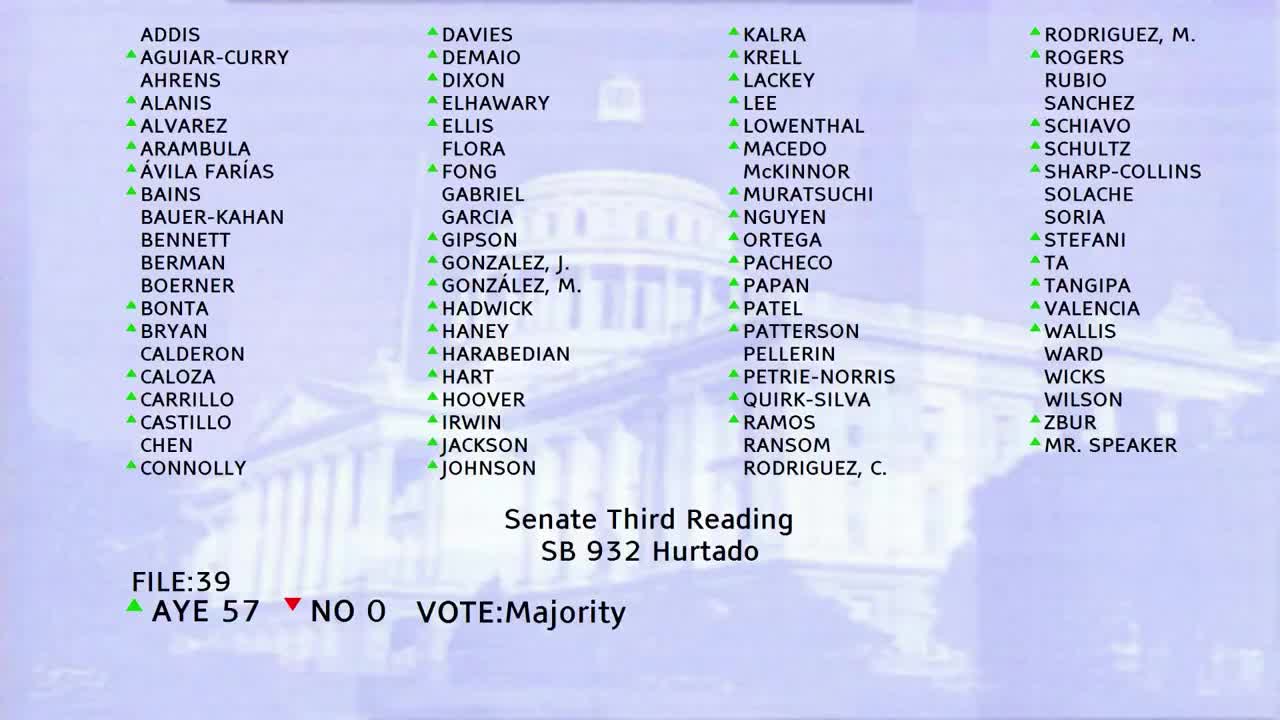 47SEC
Assembly Floor
 2MIN
Assembly Standing Committee on Appropriations
 9MIN
Assembly Standing Committee on Emergency Management
 13MIN
Assembly Standing Committee on Business and Professions
Bill Author

Bill Co-Author(s):