SB 1265: California Alternative Energy and Advanced Transportation Financing Authority: GoGreen Program.
- Session Year: 2025-2026
- House: Senate
- Latest Version Date: 2026-05-14
Current Status:
In Progress
(2026-06-24: June 24 set for second hearing canceled at the request of author.)
Introduced
In Committee
Awaiting First Chamber Vote
Passed First Chamber
In Committee
Awaiting Second Chamber Vote
Passed Second Chamber
Enacted
Under existing law, the purpose of the California Alternative Energy and Advanced Transportation Financing Authority Act is to advance the states goals of reducing the levels of greenhouse gas emissions, increasing the deployment of sustainable and renewable energy sources, implementing measures that increase the efficiency of the use of energy, creating high quality employment opportunities, and lessening the states dependence on fossil fuels and to that end to provide an alternative method of financing in providing and promoting the establishment of facilities utilizing alternative methods and sources of energy and facilities needed for the development and commercialization of advanced transportation technologies. Existing law establishes the California Alternative Energy and Advanced Transportation Financing Authority to carry out that purpose. Existing Public Utility Utilities Commission decisions established the California Hub for Energy Efficiency Financing program, administered by the authority and funded through charges collected by specified electrical corporations and gas corporations from their ratepayers.
This bill would require the authority to administer the GoGreen Program, previously known as the California Hub for Energy Efficiency Financing program, and would authorize the authority to use moneys collected from the ratepayers of electrical and gas corporations, as directed by the commission, and other available funding sources, consistent with the programs purposes. The bill would require the program to provide financing assistance to participating lenders to support residents in financing eligible energy efficiency and decarbonization measures at costs that are competitive with or below market rates. The bill would authorize the authority to receive, administer, and deploy additional moneys from federal, state, local, or private sources to support and expand the GoGreen Program, if those moneys are used in a manner consistent with the programs goals and the parameters of the funding source. The bill would create the GoGreen Program Fund in the State Treasury and would continuously appropriate make all moneys in the fund available, upon appropriation by the Legislature, to the authority for expenditure, as provided.
Under existing law, the purpose of the California Alternative Energy and Advanced Transportation Financing Authority Act is to advance the states goals of reducing the levels of greenhouse gas emissions, increasing the deployment of sustainable and renewable energy sources, implementing measures that increase the efficiency of the use of energy, creating high quality employment opportunities, and lessening the states dependence on fossil fuels and to that end to provide an alternative method of financing in providing and promoting the establishment of facilities utilizing alternative methods and sources of energy and facilities needed for the development and commercialization of advanced transportation technologies. Existing law establishes the California Alternative Energy and Advanced Transportation Financing Authority to carry out that purpose. Existing Public Utility Commission decisions established the California Hub for Energy Efficiency Financing program, administered by the authority and funded through charges collected by specified electrical corporations and gas corporations from their ratepayers.
This bill would authorize the authority, for that specified purpose, and with its own moneys or from moneys derived from other sources, to create its own financial assistance programs, financial assistance products, or both, on those terms and conditions the authority deems prudent. require the authority to administer the GoGreen Program, previously known as the California Hub for Energy Efficiency Financing program, and would authorize the authority to use moneys collected from the ratepayers of electrical and gas corporations, as directed by the commission, and other available funding sources, consistent with the programs purposes. The bill would require the program to provide financing assistance to participating lenders to support residents in financing eligible energy efficiency and decarbonization measures at costs that are competitive with or below market rates. The bill would authorize the authority to receive, administer, and deploy additional moneys from federal, state, local, or private sources to support and expand the GoGreen Program, if those moneys are used in a manner consistent with the programs goals and the parameters of the funding source. The bill would create the Alternative Energy and Advanced Transportation Expansion GoGreen Program Fund in the State Treasury and would continuously appropriate all moneys in the fund to the authority for expenditure, as provided, and to defray the administrative costs of the authority. The bill would require any interest earned or other increment derived from investments made from moneys in the fund to be deposited into the fund. provided.
Under existing law, the purpose of the California Alternative Energy and Advanced Transportation Financing Authority Act is to advance the states goals of reducing the levels of greenhouse gas emissions, increasing the deployment of sustainable and renewable energy sources, implementing measures that increase the efficiency of the use of energy, creating high quality employment opportunities, and lessening the states dependence on fossil fuels and to that end to provide an alternative method of financing in providing and promoting the establishment of facilities utilizing alternative methods and sources of energy and facilities needed for the development and commercialization of advanced transportation technologies. Existing law establishes the California Alternative Energy and Advanced Transportation Financing Authority to carry out that purpose.
This bill would authorize the authority, for that specified purpose, and with its own moneys or from moneys derived from other sources, to create its own financial assistance programs, financial assistance products, or both, on those terms and conditions the authority deems prudent. The bill would create the Alternative Energy and Advanced Transportation Expansion Fund in the State Treasury and would continuously appropriate all moneys in the fund to the authority for expenditure, as provided, and to defray the administrative costs of the authority. The bill would require any interest earned or other increment derived from investments made from moneys in the fund to be deposited into the fund.
(a)The authority shall administer the GoGreen Program, previously known as the California Hub for Energy Efficiency Financing program, established by Public Utilities Commission Decision 13-09-044 (September 19, 2013), Decision Implementing 2013-2014 Energy Efficiency Financing Pilot Programs, and may use moneys collected from the ratepayers of electrical corporations and gas corporations, as directed by the Public Utilities Commission, and other available funding sources, consistent with the GoGreen Programs purposes.
(b)The GoGreen Program shall provide financing assistance, including, but not limited to, credit enhancements, to participating lenders to support residents in financing eligible energy efficiency and decarbonization measures at costs that are competitive with or below market rates.
(c)(1)The authority shall establish and administer GoGreen Program guidelines and requirements as necessary for the effective administration of the GoGreen Program. To the extent ratepayer moneys are used for the GoGreen Program, those moneys shall be administered in a manner consistent with applicable directives of the Public Utilities Commission.
(2)The authority may adopt regulations and take other administrative actions, as necessary and appropriate, at a publicly noticed meeting, to implement and operate the GoGreen Program. Any regulations governing the use of ratepayer moneys for the GoGreen Program shall be consistent with the Public Utilities Commissions requirements on ratepayer moneys collected from electrical corporations and gas corporations.
(d)(1)The authority may receive, administer, and use additional moneys from federal, state, local, or private sources to support and expand the GoGreen Program, if those moneys are used in a manner consistent with the GoGreen Programs purposes and the parameters of the funding source.
(2)There is hereby created in the State Treasury the GoGreen Program Fund. Notwithstanding Section 13340 of the Government Code, all moneys in the fund are continuously appropriated to the authority, without regard to fiscal year, All moneys in the fund shall be available, upon appropriation by the Legislature, to the authority for expenditure pursuant to this section.
(a)The authority shall administer the GoGreen Program, previously known as the California Hub for Energy Efficiency Financing program, established by Public Utilities Commission Decision 13-09-044 (September 19, 2013), Decision Implementing 2013-2014 Energy Efficiency Financing Pilot Programs, and may use moneys collected from the ratepayers of electrical corporations and gas corporations, as directed by the Public Utilities Commission, and other available funding sources, consistent with the GoGreen Programs purposes.
(b)The GoGreen Program shall provide financing assistance, including, but not limited to, credit enhancements, to participating lenders to support residents in financing eligible energy efficiency and decarbonization measures at costs that are competitive with or below market rates.
(c)(1)The authority shall establish and administer GoGreen Program guidelines and requirements as necessary for the effective administration of the GoGreen Program. To the extent ratepayer moneys are used for the GoGreen Program, those moneys shall be administered in a manner consistent with applicable directives of the Public Utilities Commission.
(2)The authority may adopt regulations and take other administrative actions, as necessary and appropriate, at a publicly noticed meeting, to implement and operate the GoGreen Program. Any regulations governing the use of ratepayer moneys for the GoGreen Program shall be consistent with the Public Utilities Commissions requirements on ratepayer moneys collected from electrical corporations and gas corporations.
(d)(1)The authority may receive, administer, and use additional moneys from federal, state, local, or private sources to support and expand the GoGreen Program, if those moneys are used in a manner consistent with the GoGreen Programs purposes and the parameters of the funding source.
(2)There is hereby created in the State Treasury the GoGreen Program Fund. Notwithstanding Section 13340 of the Government Code, all moneys in the fund are continuously appropriated to the authority, without regard to fiscal year, for expenditure pursuant to this section.
SECTION 1.Section 26016 is added to the Public Resources Code, to read:26016.(a)In administering this chapter, the authority shall have all the powers conferred upon it by this division.(b)Notwithstanding any other law, the authority, for the purpose specified in Section 26002, may, with its own moneys or from moneys derived from other sources, create its own financial assistance programs, financial assistance products, or both, on those terms and conditions the authority deems prudent. This chapter does not prohibit the authority from exercising its discretion pursuant to this subdivision.(c)There is hereby created in the State Treasury the Alternative Energy and Advanced Transportation Expansion Fund. Notwithstanding Section 13340 of the Government Code, all moneys in the fund are continuously appropriated to the authority, without regard to fiscal year, for expenditure pursuant to this division and to defray the administrative costs of the authority. Notwithstanding Section 16305.7 of the Government Code, any interest earned or other increment derived from investments made from moneys in the fund shall be deposited into the fund.(a)In administering this chapter, the authority shall have all the powers conferred upon it by this division.
(b)Notwithstanding any other law, the authority, for the purpose specified in Section 26002, may, with its own moneys or from moneys derived from other sources, create its own financial assistance programs, financial assistance products, or both, on those terms and conditions the authority deems prudent. This chapter does not prohibit the authority from exercising its discretion pursuant to this subdivision.
(c)There is hereby created in the State Treasury the Alternative Energy and Advanced Transportation Expansion Fund. Notwithstanding Section 13340 of the Government Code, all moneys in the fund are continuously appropriated to the authority, without regard to fiscal year, for expenditure pursuant to this division and to defray the administrative costs of the authority. Notwithstanding Section 16305.7 of the Government Code, any interest earned or other increment derived from investments made from moneys in the fund shall be deposited into the fund.
|
Date
|
Status
|
|---|---|
| Jun 24, 2026 | June 24 set for second hearing canceled at the request of author. |
| Jun 10, 2026 | June 10 set for first hearing canceled at the request of author. |
| Jun 1, 2026 | Referred to Com. on U. & E. |
| May 22, 2026 | In Assembly. Read first time. Held at Desk. |
| May 22, 2026 | Read third time. Passed. (Ayes 27. Noes 5. Page 4416.) Ordered to the Assembly. |
| May 22, 2026 | Read third time. Passed. (Ayes 27. Noes 5.) Ordered to the Assembly. |
| May 18, 2026 | Read second time. Ordered to third reading. |
| May 14, 2026 | From committee: Do pass as amended. (Ayes 5. Noes 0. Page 4271.) (May 14). |
| May 14, 2026 | Read second time and amended. Ordered to second reading. |
| May 14, 2026 | From committee: Do pass as amended. (Ayes 5. Noes 0.) (May 14). |
| May 8, 2026 | Set for hearing May 14. |
| Apr 27, 2026 | April 27 hearing: Placed on APPR. suspense file. |
| Apr 17, 2026 | Set for hearing April 27. |
| Apr 14, 2026 | Read second time and amended. Re-referred to Com. on APPR. |
| Apr 13, 2026 | From committee: Do pass as amended and re-refer to Com. on APPR. (Ayes 12. Noes 1. Page 3756.) (April 7). |
| Apr 13, 2026 | From committee: Do pass as amended and re-refer to Com. on APPR. (Ayes 12. Noes 1.) (April 7). |
| Mar 25, 2026 | Set for hearing April 7. |
| Mar 4, 2026 | Referred to Com. on E., U & C. |
| Feb 20, 2026 | From printer. May be acted upon on or after March 22. |
| Feb 19, 2026 | Introduced. Read first time. To Com. on RLS. for assignment. To print. |
|
Date
|
Description
|
Location
|
Votes
|
|
|---|---|---|---|---|
| May 22, 2026 | Senate 3rd Reading SB1265 Richardson | Senate Floor |
Passed |
|
| May 14, 2026 | Do pass as amended | Senate Standing Committee on Appropriations |
Passed |
|
| Apr 27, 2026 | Placed on suspense file | Senate Standing Committee on Appropriations |
Passed |
|
| Apr 7, 2026 | Do pass as amended, but first amend, and re-refer to the Committee on [Appropriations] | Senate Standing Committee on Energy, Utilities and Communications |
Passed |
This list shows positions taken on this bill by organizations on the date displayed, which is linked to the original source.
Positions by individuals are not included.
|
Organization
|
Position
|
Date
|
|---|---|---|
| California Coast Credit Union | ** Support | |
| California Life Sciences | ** Support | |
| California State Treasurer | ** Support | |
| CAMEO Network | ** Support | |
| Fiona Ma, California State Treasurer | ** Support | |
| Marin Clean Energy | ** Support | |
| Marin Clean Energy (MCE) | ** Support | |
| Matadors Community Credit Union | ** Support | |
| Rewiring America | ** Support | |
| Self-Help Federal Credit Union | ** Support | |
| State Treasurer’s Office | ** Support | |
| Travis Credit Union | ** Support | |
| USC CREDIT UNION | ** Support | |
| U.S. Green Building Council California | ** Support | |
| Verdant Commercial Capital | ** Support |
Date of Hearing: June 24, 2026
ASSEMBLY COMMITTEE ON UTILITIES AND ENERGY
Cottie Petrie-Norris, Chair
SBPCA Bill Id:SB 1265
Author:(Richardson) – As Amended Ver:May 14, 2026
SENATE VOTE: 27-5
SUBJECT: California Alternative Energy and Advanced Transportation Financing Authority: GoGreen Program
SUMMARY: Requires the California Alternative Energy and Advanced Transportation Financing Authority (CAEATFA) at the State Treasurer’s Office to administer the GoGreen Program, previously known as the California Hub for Energy Efficiency Financing (CHEEF) program, and creates the GoGreen Fund within the State Treasury. Specifically, this bill:
- Requires CAEATFA to administer the GoGreen Program, previously known as the CHEEF program, and authorizes CAEATFA to use moneys collected from the ratepayers of electrical and gas corporations, as directed by the CPUC, and other available funding sources, consistent with the program’s purposes.
- Requires CAEATFA to establish and administer GoGreen Program guidelines and requirements as necessary for the effective administration of the program.
- Authorizes CAEATFA to adopt regulations and take other administrative actions, as necessary and appropriate, at a publicly noticed meeting, to implement and operate the GoGreen Program.
- Requires any regulations governing the use of the ratepayer moneys for the program to be consistent with the CPUC’s requirements.
- Requires the GoGreen Program to provide financing assistance to participating lenders to support residents in financing eligible energy efficiency and decarbonization measures at costs that are competitive with or below market rates.
- Authorizes CAEATFA to receive, administer, and deploy additional moneys from federal, state, local, or private sources to support and expand the GoGreen Program, if those moneys are used in a manner consistent with the program’s goals and the parameters of the funding source.
- Creates the GoGreen Program Fund in the State Treasury and makes all moneys in the fund available, upon appropriation by the Legislature, to CAEATFA for expenditure.
EXISTING LAW:
- Establishes the California Alternative Energy and Advanced Transportation Financing Authority Act to advance the state's goals of reducing greenhouse gas emissions, increasing renewable energy deployment, improving energy efficiency, creating high-quality jobs, and reducing dependence on fossil fuels through alternative financing mechanisms that support alternative energy and advanced transportation projects. (Public Resources Code § 26000 et seq.)
- Establishes the CAEATFA to carry out the purposes of the act with a membership consisting of five members: the Director of Finance, the Chairperson of the California Energy Commission (CEC), the President of the California Public Utilities Commission (CPUC), the State Controller, and the State Treasurer, who serves as the chairperson for the CAEATFA. (Public Resources Code §26004)
- Authorizes the CAEATFA to receive and utilize grants or loans from the federal government, a public agency, or any other source for carrying out the purposes of this division. (Public Resources Code § 26040)
FISCAL EFFECT: According to the Senate Committee on Appropriations, this measure could create unknown, but potentially significant, ongoing cost pressures for CAEATFA related to administering the GoGreen Program Fund.
BACKGROUND
Overview of CAEATFA - CAEATFA was established in 1980 to provide financing for projects leveraging alternative energy sources.[1]The authority was originally authorized to issue up to $200 million in revenue bonds to support projects involving technologies such as cogeneration, wind, and geothermal energy. In 1994, CAEATFA's authority was expanded beyond alternative energy projects to include advanced transportation technologies. During the 2001 energy crisis, the Legislature further expanded CAEATFA's authority to provide financial assistance to public power entities, independent generators, and other entities developing renewable energy resources and distributed generation projects. CAEATFA is governed by a five-member board consisting of the State Treasurer, State Controller, Director of Finance, Chair of the California Energy Commission (CEC), and President of the California Public Utilities Commission (CPUC). The board is responsible for approving projects and overseeing the authority's programs.
Currently, CAEATFA administers a variety of financing and incentive programs intended to support the deployment of clean energy, energy efficiency, and advanced transportation technologies. These programs include the Sales and Use Tax Exclusion (STE) Program for manufacturers, bond financing programs, and the GoGreen Financing Programs. The GoGreen programs provide financing for residential, multifamily, and commercial energy improvements through participating lenders.
GoGreen Financing Programs: Background - The California Hub for Energy Efficiency Financing (CHEEF) was established pursuant to CPUC Decision 13-09-044, issued in September 2013, to expand access to financing for energy efficiency improvements, particularly for customers who may face barriers to obtaining conventional financing. The program is supported by Public Purpose Program funds collected from the ratepayers of California's four largest investor-owned utilities: Pacific Gas and Electric Company, Southern California Edison, San Diego Gas & Electric Company, and Southern California Gas Company. A portion of those funds is used to provide loan loss reserves and other credit enhancements that reduce lender risk and enable participating financial institutions to offer financing on more favorable terms than may otherwise be available. The program was designed to leverage private capital, increase access to financing for underserved customers, and support energy savings through investments in energy efficiency measures. The CPUC initially authorized $75.2 million in ratepayer funding for CHEEF in 2013 and approved an additional $51.2 million in 2021 to continue the program through June 2027.[2]
Program Structure - CAEATFA administers CHEEF through the GoGreen Financing Programs, which provide financing for energy efficiency and other eligible clean energy improvements in homes, businesses, and affordable multifamily housing. Participation in CHEEF was originally limited to customers served by investor-owned utilities because the program was funded with investor-owned utility ratepayer dollars. In 2021, the CPUC authorized CAEATFA to use non-ratepayer funding to expand the program beyond investor-owned utility territories, and CAEATFA subsequently renamed the financing programs GoGreen. The GoGreen Financing Programs include financing options for residential, commercial, and affordable multifamily properties. GoGreen Home Energy Financing helps homeowners and renters finance qualifying home energy upgrades. GoGreen Business Energy Financing supports energy improvements in commercial buildings, nonprofit facilities, and market-rate multifamily properties. GoGreen Affordable Multifamily Energy Financing provides financing for qualifying deed-restricted affordable housing developments with five or more units.
Program Expansion - The GoGreen Financing Programs have expanded since the first residential loans were issued in 2016. According to CAEATFA, the programs supported approximately $196 million in private capital investment for energy upgrades in 2025, benefiting more than 7,400 homes and businesses.[3] CAEATFA reports that the program leveraged approximately $17.52 in private financing for every dollar of credit enhancement funds allocated. As of 2025, 10 participating lenders were enrolled in the program, and approximately 1.4% of enrolled loans had been charged off. According to a 2024 CPUC evaluation, average annual loan originations increased from 106 during the REEL Pilot period (2016–2018) to approximately 777 during the GoGreen Home Program evaluation period (2018–2023), while loan default rates remained low at 1%.[4]
COMMENTS:
- Author's Statement. According to the author, "The California Alternative Energy and Advanced Transportation Financing Authority, or otherwise known as the GoGreen program, partners with public and private entities to provide financing that helps California industries reduce greenhouse gas emissions. GoGreen supports the development of renewable energy, energy efficiency, and advanced transportation and manufacturing technologies, while also reducing air pollution, conserving energy, and creating jobs. Funding for the GoGreen program comes from investor-owned utility ratepayers to provide financing and partnerships within the IOU's service area. Over the last 15 years, the GoGreen program carried out through the Treasurer's Office has been expanded rapidly to become a one-stop entry point for Californians seeking financing for clean energy projects. Currently, according to the Treasurer's Office, GoGreen is an oversubscribed program due to the immense popularity and support the service provides. However, despite the immense success the program has achieved, it is not protected in statute to continue past the current Treasurer's tenure. SB 1265 simply codifies this program into law to allow future State Treasurers to use and expand the program."
- Program Evaluation. SB 1265 would codify the GoGreen Home Energy Financing Program and continue the use of ratepayer-supported credit enhancements to support financing for eligible energy improvements. According to the author and supporters, including the Treasurer's Office, this bill would place in statute a program that currently operates pursuant to CPUC decisions and provide additional certainty regarding its continuation under future administrations. The GoGreen program is intended to leverage private capital and expand access to financing for energy upgrades, particularly for customers who may face barriers to obtaining conventional financing. As the program evolves, information regarding program outcomes, the role of ratepayer funding, and the extent to which the program continues to address market barriers would help the Legislature assess whether the program is achieving its intended goals and whether continued ratepayer support remains necessary. As such, the committee recommends requiring CAEATFA to include additional information in its annual report to the Legislature regarding program outcomes, the benefits of ratepayer funding, whether continued ratepayer funding remains necessary to support private lender participation, and any recommendations for program improvements. The committee also recommends sunsetting the program to provide an opportunity for future legislative review of the program.
REGISTERED SUPPORT / OPPOSITION:
Support
California State Treasurer
Marin Clean Energy (MCE)
Opposition
None on file.
Analysis Prepared by: Lina V. Malova / U. & E. / (916) 319-2083
AB 1403 (Agnos) Chapter 1159, Statutes of 1980 ↑
CPUC, GoGreen Home Energy Financing Program Final Impact Evaluation Report; July 30, 2024, p. 6, GoGreen Home Energy Financing Program Final Impact Evaluation Report ↑
CAEATFA; 2025 Annual Report to the California Legislature; pg. 17; Issued March 2026 ↑
Opinion Dynamics, GoGreen Home Energy Financing Program Final Impact Evaluation Report, prepared for the California Public Utilities Commission; July 30, 2024, p. 8, Table 2, "REEL Pilot and GGH Program Activity Comparison; https://pda.energydataweb.com/api/view/3962/CPUC%20Group%20B%20GGH%20Evaluation%20Report_DRAFT%202024-04-30.pdf ↑
Date of Hearing: June 10, 2026
ASSEMBLY COMMITTEE ON UTILITIES AND ENERGY
Cottie Petrie-Norris, Chair
SBPCA Bill Id:SB 1265
Author:(Richardson) – As Amended Ver:May 14, 2026
SENATE VOTE: 27-5
SUBJECT: California Alternative Energy and Advanced Transportation Financing Authority: GoGreen Program
SUMMARY: Requires the California Alternative Energy and Advanced Transportation Financing Authority (CAEATFA) at the State Treasurer’s Office to administer the GoGreen Program, previously known as the California Hub for Energy Efficiency Financing (CHEEF) program, and creates the GoGreen Fund within the State Treasury. Specifically, this bill:
- Requires CAEATFA to administer the GoGreen Program, previously known as the CHEEF program, and authorizes CAEATFA to use moneys collected from the ratepayers of electrical and gas corporations, as directed by the CPUC, and other available funding sources, consistent with the program’s purposes.
- Requires CAEATFA to establish and administer GoGreen Program guidelines and requirements as necessary for the effective administration of the program.
- Authorizes CAEATFA to adopt regulations and take other administrative actions, as necessary and appropriate, at a publicly noticed meeting, to implement and operate the GoGreen Program.
- Requires any regulations governing the use of the ratepayer moneys for the program to be consistent with the CPUC’s requirements.
- Requires the GoGreen Program to provide financing assistance to participating lenders to support residents in financing eligible energy efficiency and decarbonization measures at costs that are competitive with or below market rates.
- Authorizes CAEATFA to receive, administer, and deploy additional moneys from federal, state, local, or private sources to support and expand the GoGreen Program, if those moneys are used in a manner consistent with the program’s goals and the parameters of the funding source.
- Creates the GoGreen Program Fund in the State Treasury and makes all moneys in the fund available, upon appropriation by the Legislature, to CAEATFA for expenditure.
EXISTING LAW:
- Establishes the California Alternative Energy and Advanced Transportation Financing Authority Act to advance the state's goals of reducing greenhouse gas emissions, increasing renewable energy deployment, improving energy efficiency, creating high-quality jobs, and reducing dependence on fossil fuels through alternative financing mechanisms that support alternative energy and advanced transportation projects. (Public Resources Code § 26000 et seq.)
- Establishes the CAEATFA to carry out the purposes of the act with a membership consisting of five members: the Director of Finance, the Chairperson of the California Energy Commission (CEC), the President of the California Public Utilities Commission (CPUC), the State Controller, and the State Treasurer, who serves as the chairperson for the CAEATFA. (Public Resources Code §26004)
- Authorizes the CAEATFA to receive and utilize grants or loans from the federal government, a public agency, or any other source for carrying out the purposes of this division. (Public Resources Code § 26040)
FISCAL EFFECT: According to the Senate Committee on Appropriations, this measure could create unknown, but potentially significant, ongoing cost pressures for CAEATFA related to administering the GoGreen Program Fund.
BACKGROUND
Overview of CAEATFA - CAEATFA was established in 1980 to provide financing for projects leveraging alternative energy sources.[1]The authority was originally authorized to issue up to $200 million in revenue bonds to support projects involving technologies such as cogeneration, wind, and geothermal energy. In 1994, CAEATFA's authority was expanded beyond alternative energy projects to include advanced transportation technologies. During the 2001 energy crisis, the Legislature further expanded CAEATFA's authority to provide financial assistance to public power entities, independent generators, and other entities developing renewable energy resources and distributed generation projects. CAEATFA is governed by a five-member board consisting of the State Treasurer, State Controller, Director of Finance, Chair of the California Energy Commission (CEC), and President of the California Public Utilities Commission (CPUC). The board is responsible for approving projects and overseeing the authority's programs.
Currently, CAEATFA administers a variety of financing and incentive programs intended to support the deployment of clean energy, energy efficiency, and advanced transportation technologies. These programs include the Sales and Use Tax Exclusion (STE) Program for manufacturers, bond financing programs, and the GoGreen Financing Programs. The GoGreen programs provide financing for residential, multifamily, and commercial energy improvements through participating lenders.
GoGreen Financing Programs: Background - The California Hub for Energy Efficiency Financing (CHEEF) was established pursuant to CPUC Decision 13-09-044, issued in September 2013, to expand access to financing for energy efficiency improvements, particularly for customers who may face barriers to obtaining conventional financing. The program is supported by Public Purpose Program funds collected from the ratepayers of California's four largest investor-owned utilities: Pacific Gas and Electric Company, Southern California Edison, San Diego Gas & Electric Company, and Southern California Gas Company. A portion of those funds is used to provide loan loss reserves and other credit enhancements that reduce lender risk and enable participating financial institutions to offer financing on more favorable terms than may otherwise be available. The program was designed to leverage private capital, increase access to financing for underserved customers, and support energy savings through investments in energy efficiency measures. The CPUC initially authorized $75.2 million in ratepayer funding for CHEEF in 2013 and approved an additional $51.2 million in 2021 to continue the program through June 2027.[2]
Program Structure - CAEATFA administers CHEEF through the GoGreen Financing Programs, which provide financing for energy efficiency and other eligible clean energy improvements in homes, businesses, and affordable multifamily housing. Participation in CHEEF was originally limited to customers served by investor-owned utilities because the program was funded with investor-owned utility ratepayer dollars. In 2021, the CPUC authorized CAEATFA to use non-ratepayer funding to expand the program beyond investor-owned utility territories, and CAEATFA subsequently renamed the financing programs GoGreen. The GoGreen Financing Programs include financing options for residential, commercial, and affordable multifamily properties. GoGreen Home Energy Financing helps homeowners and renters finance qualifying home energy upgrades. GoGreen Business Energy Financing supports energy improvements in commercial buildings, nonprofit facilities, and market-rate multifamily properties. GoGreen Affordable Multifamily Energy Financing provides financing for qualifying deed-restricted affordable housing developments with five or more units.
Program Expansion - The GoGreen Financing Programs have expanded since the first residential loans were issued in 2016. According to CAEATFA, the programs supported approximately $196 million in private capital investment for energy upgrades in 2025, benefiting more than 7,400 homes and businesses.[3] CAEATFA reports that the program leveraged approximately $17.52 in private financing for every dollar of credit enhancement funds allocated. As of 2025, 10 participating lenders were enrolled in the program, and approximately 1.4% of enrolled loans had been charged off. According to a 2024 CPUC evaluation, average annual loan originations increased from 106 during the REEL Pilot period (2016–2018) to approximately 777 during the GoGreen Home Program evaluation period (2018–2023), while loan default rates remained low at 1%.[4]
COMMENTS:
- Author's Statement. According to the author, "The California Alternative Energy and Advanced Transportation Financing Authority, or otherwise known as the GoGreen program, partners with public and private entities to provide financing that helps California industries reduce greenhouse gas emissions. GoGreen supports the development of renewable energy, energy efficiency, and advanced transportation and manufacturing technologies, while also reducing air pollution, conserving energy, and creating jobs. Funding for the GoGreen program comes from investor-owned utility ratepayers to provide financing and partnerships within the IOU's service area. Over the last 15 years, the GoGreen program carried out through the Treasurer's Office has been expanded rapidly to become a one-stop entry point for Californians seeking financing for clean energy projects. Currently, according to the Treasurer's Office, GoGreen is an oversubscribed program due to the immense popularity and support the service provides. However, despite the immense success the program has achieved, it is not protected in statute to continue past the current Treasurer's tenure. SB 1265 simply codifies this program into law to allow future State Treasurers to use and expand the program."
- Program Evaluation. SB 1265 would codify the GoGreen Home Energy Financing Program and continue the use of ratepayer-supported credit enhancements to support financing for eligible energy improvements. According to the author and supporters, including the Treasurer's Office, this bill would place in statute a program that currently operates pursuant to CPUC decisions and provide additional certainty regarding its continuation under future administrations. The GoGreen program is intended to leverage private capital and expand access to financing for energy upgrades, particularly for customers who may face barriers to obtaining conventional financing. As the program evolves, information regarding program outcomes, the role of ratepayer funding, and the extent to which the program continues to address market barriers would help the Legislature assess whether the program is achieving its intended goals and whether continued ratepayer support remains necessary. As such, the committee recommends requiring CAEATFA to include additional information in its annual report to the Legislature regarding program outcomes, the benefits of ratepayer funding, whether continued ratepayer funding remains necessary to support private lender participation, and any recommendations for program improvements. The committee also recommends sunsetting the program to provide an opportunity for future legislative review of the program.
REGISTERED SUPPORT / OPPOSITION:
Support
California State Treasurer
Marin Clean Energy (MCE)
Opposition
None on file.
Analysis Prepared by: Lina V. Malova / U. & E. / (916) 319-2083
AB 1403 (Agnos) Chapter 1159, Statutes of 1980 ↑
CPUC, GoGreen Home Energy Financing Program Final Impact Evaluation Report; July 30, 2024, p. 6, GoGreen Home Energy Financing Program Final Impact Evaluation Report ↑
CAEATFA; 2025 Annual Report to the California Legislature; pg. 17; Issued March 2026 ↑
Opinion Dynamics, GoGreen Home Energy Financing Program Final Impact Evaluation Report, prepared for the California Public Utilities Commission; July 30, 2024, p. 8, Table 2, "REEL Pilot and GGH Program Activity Comparison; https://pda.energydataweb.com/api/view/3962/CPUC%20Group%20B%20GGH%20Evaluation%20Report_DRAFT%202024-04-30.pdf ↑
SENATE RULES COMMITTEE Office of Senate Floor Analyses (916) 651-4171 | SB 1265 |
THIRD READING
Bill No: SB 1265
Author: Richardson (D)
Amended: 5/14/26
Vote: 21
SENATE ENERGY, U. & C. COMMITTEE: 12-1, 4/7/26
AYES: Allen, Ochoa Bogh, Arreguín, Becker, Caballero, Hurtado, McNerney, Reyes, Richardson, Rubio, Stern, Wahab
NOES: Strickland
NO VOTE RECORDED: Archuleta, Dahle, Gonzalez, Grove
SENATE APPROPRIATIONS COMMITTEE: 5-0, 5/14/26
AYES: Cervantes, Cabaldon, Grayson, Richardson, Wahab
NO VOTE RECORDED: Seyarto, Dahle
SUBJECT: California Alternative Energy and Advanced Transportation Financing Authority: GoGreen Program
SOURCE: Fiona Ma, California State Treasurer
DIGEST:
- This bill requires the California Alternative Energy and Advanced Transportation Financing Authority (CAEATFA) at the State Treasurer’s Office to administer the GoGreen Program, previously known as the California Hub for Energy Efficiency Financing (CHEEF) program, and creates the GoGreen Fund within the State Treasury.
ANALYSIS:
Existing law:
- Establishes the CAEATFA Act with the purpose to advance the state’s goals of reducing the levels of greenhouse gas (GHG) emissions, increasing the deployment of sustainable and renewable energy sources, implementing measures that increase the efficiency of the use of energy, creating high quality employment opportunities, and lessening the state’s dependence on fossil fuels and to that end provide an alternative method of financing in providing and promoting the establishment of facilities utilizing alternative methods and sources of energy and facilities needed for the development and commercialization of advanced transportation technologies. (Public Resources Code §26000 et seq.)
- Establishes the CAEATFA to carry out the purposes of the act with a membership consisting of five members: the Director of Finance, the Chairperson of the California Energy Commission (CEC), the President of the California Public Utilities Commission (CPUC), the State Controller, and the State Treasurer who serves as the chairperson for the CAEATFA. (Public Resources Code §26004)
- Authorizes the CAEATFA to receive and utilize grants or loans from the federal government, a public agency, or any other source for carrying out the purposes of the CAEATFA Act. (Public Resources Code §26040)
This bill:
- Requires CAEATFA to administer the GoGreen Program, previously known as the CHEEF program, and authorizes CAEATFA to use moneys collected from the ratepayers of electrical and gas corporations, as directed by the CPUC, and other available funding sources, consistent with the program’s purposes.
- Requires CAEATFA to establish and administer GoGreen Program guidelines and requirements as necessary for the effective administration of the program.
- Authorizes CAEATFA to adopt regulations and take other administrative actions, as necessary and appropriate, at a publicly noticed meeting, to implement and operate the GoGreen Program. Requires any regulations governing the use of the ratepayer moneys for the program to be consistent with the CPUC’s requirements.
- Requires the GoGreen Program to provide financing assistance to participating lenders to support residents in financing eligible energy efficiency and decarbonization measures at costs that are competitive with or below market rates.
- Authorizes CAEATFA to receive, administer, and deploy additional moneys from federal, state, local, or private sources to support and expand the GoGreen Program, if those moneys are used in a manner consistent with the program’s goals and the parameters of the funding source.
- Creates the GoGreen Program Fund in the State Treasury and makes all moneys in the fund available, upon appropriation by the Legislature, to CAEATFA for expenditure.
Background
About CAEATFA. CAEATFA was created in 1980 with an authorization of $200 million in revenue bonds to finance projects utilizing alternative sources of energy, such as cogeneration, wind and geothermal power. Pursuant to legislation, it was renamed in 1994 as the CAEATFA and its charge expanded to include the financing of “advanced transportation” technologies. During the energy crisis of 2001, its authority was again expanded, this time to provide financial assistance to public power entities, independent generators, and others for new and renewable energy sources, and to develop clean distributed generation. CAEATFA’s board, composed of the State Treasurer, State Controller, Director of the Department of Finance, Chairperson of the CEC and President of the CPUC, decides which projects to assist. CAEATFA is currently implementing various programs, including: Sales and Use Tax Exclusion Program for Manufacturers, Property Assessed Clean Energy Loss Reserve Program, Bond Program, and Efficiency Financing Programs, marketed as the GoGreen Financing Programs.
GoGreen Financing Programs. The CHEEF was originally authorized by a CPUC 2013 decision (D. 13-09-044) and funded from Public Purpose Program funds collected from the ratepayers of California’s four largest electric and gas investor-owned utilities (IOUs), Pacific Gas & Electric, San Diego Gas & Electric, Southern California Edison, and Southern California Gas Company. The funds are used to cover credit enhancements, in the form of loss reserves, to participating lenders that enable them to offer more advantageous terms to borrowers for energy efficiency loans than they otherwise could. The program was created according to the CPUC goals that the solutions should: (1) be scalable; (2) leverage private capital to support energy efficiency upgrades; (3) reach underserved Californians who would not otherwise have participated in energy efficiency upgrades; and (4) produce energy savings.
CAEATFA works with the CPUC, IOUs, finance companies, energy efficiency retrofit contractors, and several key vendors to develop and manage a series of energy efficiency finance programs, known collectively as GoGreen Financing Programs.
- GoGreen Home Energy Financing provides financing for energy efficiency upgrades in residential properties for owners and renters of single-family homes, townhomes, condominiums, duplexes, triplexes, quadplexes, and mobile and manufactured homes. Financing options include loans of $1,000 to $75,000 for terms up to 10 years, standard loans and appliance microloans are available.
- GoGreen Business Energy Financing provides financing for energy efficiency upgrades in commercial businesses, nonprofits, and market-rate multifamily properties through a variety of financing products. Financing options include $5,000-$5 million with option for utility on-bill repayment, terms of 10 years.
- GoGreen Affordable Multifamily Energy Financing provides for energy efficiency upgrades in affordable, deed-restricted multifamily properties of five or more units where at least 50% of units are income restricted. Financing options include equipment finance and lease agreements from $10,000 to $10 million with terms to 10 years.
Beyond IOU ratepayer funds. CPUC rules and the source of the funding result in regulations for the program that limit participation to the customers of the IOUs’. A subsequent CPUC decision authorized CAEATFA to incorporate additional sources of funding into the CHEEF program (now known as GoGreen) beyond the funding from IOU ratepayers. CAEATFA has since received one-time funding from the City of Palo Alto ($300,000) to expand the program and the CEC’s Equitable Building Decarbonization program ($20 million) for upgrades for properties served by publicly owned utilities. CAEATFA has also rebranded the program to the name “GoGreen”. CAEATFA developed memoranda of understandings with both the City of Palo Alto and the CEC to implement the funding afforded by each of these entities. However, there is not an immediate prospect for other funding sources.
GoGreen Financing Program performance. The GoGreen Financing Programs have grown from five loans in 2016 to nearly 7,000 in 2025. In 2025, the GoGreen Financing Programs supported $196 million in private capital investment for energy upgrades to more than 7,400 homes and businesses. The programs offered financing for energy efficiency upgrades and clean energy installations, such as solar with battery storage and electric vehicle chargers. The program leveraged $17.52 in private capital for every dollar of credit enhancement funds allocated, according to CAEATFA’s 2025 Annual Report to the California State Legislature (March 2026). A total of 10 lenders participate in the program and the program has charged-off 1.4% of all loans enrolled (209 loans).
Comments
Need for this bill. According to the author:
SB 1265 is an important tool to provide explicit authority for the Alternative Energy and Advanced Transportation Expansion Fund to receive continuously appropriated funding from IOU sources, without regard to fiscal years. This would allow the program to gain substantially greater flexibility in seeking funding and forming partnerships beyond the IOU’s while still maintaining the existing CPUC/IOU relationship.
Desire to codify program. The author and supporters of this bill, including the State Treasurer’s Office, believe the program would benefit from being codified in the statutes. As noted above, the GoGreen Financing Program was initiated through CPUC decisions to advance energy efficiency financing funded by a collection from ratepayers. Since then, the program has also received some funding from other sources, one-time funding from the City of Palo Alto ($300,000) and the CEC’s Equitable Building Decarbonization Program (originally $30 million but subsequently reduced to $20 million). Staff at the Treasurer’s Office relay concerns with the program not being in statutes and making it difficult to receive funding from other sources. The amendments adopted in the Senate Approrpriations Committee remove the continuous appropriation previously included in this bill.
Related/Prior Legislation
SB 1128 (Padilla, Chapter 677, Statutes of 2012) expanded until July 1, 2016, the sales and use tax exemption under the CAEATFA program to include “advanced manufacturing,” as specified.
SB 1952 (Rosenthal, Chapter 1218, Statutes of 1994) renamed the act the CAEATFA Act, renamed the authority and revised the membership of the authority and authorized the authority to additionally provide financing assistance under the act to a participating party for projects for the development and commercialization of advanced transportation technologies.
FISCAL EFFECT: Appropriation: No Fiscal Com.: Yes Local: No
According to the Senate Appropriations Committee, unknown but potentially significant ongoing cost pressures to CAEATFA to spend monies from the continuously appropriated GoGreen Program Fund that would be established by this bill.
SUPPORT: (Verified 5/14/26)
Fiona Ma, California State Treasurer (Source)
California Coast Credit Union
California Life Sciences
CAMEO Network
Marin Clean Energy
Matadors Community Credit Union
Rewiring America
Self-Help Federal Credit Union
Travis Credit Union
USC Credit Union
U.S. Green Building Council California
Verdant Commercial Capital
OPPOSITION: (Verified 5/14/26)
None received
ARGUMENTS IN SUPPORT: According to the State Treasurer Fiona Ma:
SB 1265 creates the Alternative Energy and Advanced Transportation Expansion Fund, giving the explicit authority for CAEATFA to receive ongoing funding from non-IOU sources without fiscal year limits, giving the Authority more financial flexibility. This would help the GoGreen Financing programs under CAEATFA to secure new funding and partnerships beyond IOUs while still maintaining its current relationship with the Public Utility Commission and IOUs.
Prepared by: Nidia Bautista / E., U. & C. / (916) 651-4107
5/26/26 12:59:00
**** END ****
SENATE RULES COMMITTEE Office of Senate Floor Analyses (916) 651-4171 | SB 1265 |
THIRD READING
Bill No: SB 1265
Author: Richardson (D)
Amended: 5/14/26
Vote: 21
SENATE ENERGY, U. & C. COMMITTEE: 12-1, 4/7/26
AYES: Allen, Ochoa Bogh, Arreguín, Becker, Caballero, Hurtado, McNerney, Reyes, Richardson, Rubio, Stern, Wahab
NOES: Strickland
NO VOTE RECORDED: Archuleta, Dahle, Gonzalez, Grove
SENATE APPROPRIATIONS COMMITTEE: 5-0, 5/14/26
AYES: Cervantes, Cabaldon, Grayson, Richardson, Wahab
NO VOTE RECORDED: Seyarto, Dahle
SUBJECT: California Alternative Energy and Advanced Transportation Financing Authority: GoGreen Program
SOURCE: Fiona Ma, California State Treasurer
DIGEST:
- This bill requires the California Alternative Energy and Advanced Transportation Financing Authority (CAEATFA) at the State Treasurer’s Office to administer the GoGreen Program, previously known as the California Hub for Energy Efficiency Financing (CHEEF) program, and creates the GoGreen Fund within the State Treasury.
ANALYSIS:
Existing law:
- Establishes the CAEATFA Act with the purpose to advance the state’s goals of reducing the levels of greenhouse gas (GHG) emissions, increasing the deployment of sustainable and renewable energy sources, implementing measures that increase the efficiency of the use of energy, creating high quality employment opportunities, and lessening the state’s dependence on fossil fuels and to that end provide an alternative method of financing in providing and promoting the establishment of facilities utilizing alternative methods and sources of energy and facilities needed for the development and commercialization of advanced transportation technologies. (Public Resources Code §26000 et seq.)
- Establishes the CAEATFA to carry out the purposes of the act with a membership consisting of five members: the Director of Finance, the Chairperson of the California Energy Commission (CEC), the President of the California Public Utilities Commission (CPUC), the State Controller, and the State Treasurer who serves as the chairperson for the CAEATFA. (Public Resources Code §26004)
- Authorizes the CAEATFA to receive and utilize grants or loans from the federal government, a public agency, or any other source for carrying out the purposes of the CAEATFA Act. (Public Resources Code §26040)
This bill:
- Requires CAEATFA to administer the GoGreen Program, previously known as the CHEEF program, and authorizes CAEATFA to use moneys collected from the ratepayers of electrical and gas corporations, as directed by the CPUC, and other available funding sources, consistent with the program’s purposes.
- Requires CAEATFA to establish and administer GoGreen Program guidelines and requirements as necessary for the effective administration of the program.
- Authorizes CAEATFA to adopt regulations and take other administrative actions, as necessary and appropriate, at a publicly noticed meeting, to implement and operate the GoGreen Program. Requires any regulations governing the use of the ratepayer moneys for the program to be consistent with the CPUC’s requirements.
- Requires the GoGreen Program to provide financing assistance to participating lenders to support residents in financing eligible energy efficiency and decarbonization measures at costs that are competitive with or below market rates.
- Authorizes CAEATFA to receive, administer, and deploy additional moneys from federal, state, local, or private sources to support and expand the GoGreen Program, if those moneys are used in a manner consistent with the program’s goals and the parameters of the funding source.
- Creates the GoGreen Program Fund in the State Treasury and makes all moneys in the fund available, upon appropriation by the Legislature, to CAEATFA for expenditure.
Background
About CAEATFA. CAEATFA was created in 1980 with an authorization of $200 million in revenue bonds to finance projects utilizing alternative sources of energy, such as cogeneration, wind and geothermal power. Pursuant to legislation, it was renamed in 1994 as the CAEATFA and its charge expanded to include the financing of “advanced transportation” technologies. During the energy crisis of 2001, its authority was again expanded, this time to provide financial assistance to public power entities, independent generators, and others for new and renewable energy sources, and to develop clean distributed generation. CAEATFA’s board, composed of the State Treasurer, State Controller, Director of the Department of Finance, Chairperson of the CEC and President of the CPUC, decides which projects to assist. CAEATFA is currently implementing various programs, including: Sales and Use Tax Exclusion Program for Manufacturers, Property Assessed Clean Energy Loss Reserve Program, Bond Program, and Efficiency Financing Programs, marketed as the GoGreen Financing Programs.
GoGreen Financing Programs. The CHEEF was originally authorized by a CPUC 2013 decision (D. 13-09-044) and funded from Public Purpose Program funds collected from the ratepayers of California’s four largest electric and gas investor-owned utilities (IOUs), Pacific Gas & Electric, San Diego Gas & Electric, Southern California Edison, and Southern California Gas Company. The funds are used to cover credit enhancements, in the form of loss reserves, to participating lenders that enable them to offer more advantageous terms to borrowers for energy efficiency loans than they otherwise could. The program was created according to the CPUC goals that the solutions should: (1) be scalable; (2) leverage private capital to support energy efficiency upgrades; (3) reach underserved Californians who would not otherwise have participated in energy efficiency upgrades; and (4) produce energy savings.
CAEATFA works with the CPUC, IOUs, finance companies, energy efficiency retrofit contractors, and several key vendors to develop and manage a series of energy efficiency finance programs, known collectively as GoGreen Financing Programs.
- GoGreen Home Energy Financing provides financing for energy efficiency upgrades in residential properties for owners and renters of single-family homes, townhomes, condominiums, duplexes, triplexes, quadplexes, and mobile and manufactured homes. Financing options include loans of $1,000 to $75,000 for terms up to 10 years, standard loans and appliance microloans are available.
- GoGreen Business Energy Financing provides financing for energy efficiency upgrades in commercial businesses, nonprofits, and market-rate multifamily properties through a variety of financing products. Financing options include $5,000-$5 million with option for utility on-bill repayment, terms of 10 years.
- GoGreen Affordable Multifamily Energy Financing provides for energy efficiency upgrades in affordable, deed-restricted multifamily properties of five or more units where at least 50% of units are income restricted. Financing options include equipment finance and lease agreements from $10,000 to $10 million with terms to 10 years.
Beyond IOU ratepayer funds. CPUC rules and the source of the funding result in regulations for the program that limit participation to the customers of the IOUs’. A subsequent CPUC decision authorized CAEATFA to incorporate additional sources of funding into the CHEEF program (now known as GoGreen) beyond the funding from IOU ratepayers. CAEATFA has since received one-time funding from the City of Palo Alto ($300,000) to expand the program and the CEC’s Equitable Building Decarbonization program ($20 million) for upgrades for properties served by publicly owned utilities. CAEATFA has also rebranded the program to the name “GoGreen”. CAEATFA developed memoranda of understandings with both the City of Palo Alto and the CEC to implement the funding afforded by each of these entities. However, there is not an immediate prospect for other funding sources.
GoGreen Financing Program performance. The GoGreen Financing Programs have grown from five loans in 2016 to nearly 7,000 in 2025. In 2025, the GoGreen Financing Programs supported $196 million in private capital investment for energy upgrades to more than 7,400 homes and businesses. The programs offered financing for energy efficiency upgrades and clean energy installations, such as solar with battery storage and electric vehicle chargers. The program leveraged $17.52 in private capital for every dollar of credit enhancement funds allocated, according to CAEATFA’s 2025 Annual Report to the California State Legislature (March 2026). A total of 10 lenders participate in the program and the program has charged-off 1.4% of all loans enrolled (209 loans).
Comments
Need for this bill. According to the author:
SB 1265 is an important tool to provide explicit authority for the Alternative Energy and Advanced Transportation Expansion Fund to receive continuously appropriated funding from IOU sources, without regard to fiscal years. This would allow the program to gain substantially greater flexibility in seeking funding and forming partnerships beyond the IOU’s while still maintaining the existing CPUC/IOU relationship.
Desire to codify program. The author and supporters of this bill, including the State Treasurer’s Office, believe the program would benefit from being codified in the statutes. As noted above, the GoGreen Financing Program was initiated through CPUC decisions to advance energy efficiency financing funded by a collection from ratepayers. Since then, the program has also received some funding from other sources, one-time funding from the City of Palo Alto ($300,000) and the CEC’s Equitable Building Decarbonization Program (originally $30 million but subsequently reduced to $20 million). Staff at the Treasurer’s Office relay concerns with the program not being in statutes and making it difficult to receive funding from other sources. The amendments adopted in the Senate Approrpriations Committee remove the continuous appropriation previously included in this bill.
Related/Prior Legislation
SB 1128 (Padilla, Chapter 677, Statutes of 2012) expanded until July 1, 2016, the sales and use tax exemption under the CAEATFA program to include “advanced manufacturing,” as specified.
SB 1952 (Rosenthal, Chapter 1218, Statutes of 1994) renamed the act the CAEATFA Act, renamed the authority and revised the membership of the authority and authorized the authority to additionally provide financing assistance under the act to a participating party for projects for the development and commercialization of advanced transportation technologies.
FISCAL EFFECT: Appropriation: No Fiscal Com.: Yes Local: No
According to the Senate Appropriations Committee, unknown but potentially significant ongoing cost pressures to CAEATFA to spend monies from the continuously appropriated GoGreen Program Fund that would be established by this bill.
SUPPORT: (Verified 5/14/26)
Fiona Ma, California State Treasurer (Source)
California Coast Credit Union
California Life Sciences
CAMEO Network
Marin Clean Energy
Matadors Community Credit Union
Rewiring America
Self-Help Federal Credit Union
Travis Credit Union
USC Credit Union
Verdant Commercial Capital
OPPOSITION: (Verified 5/14/26)
None received
ARGUMENTS IN SUPPORT: According to the State Treasurer Fiona Ma:
SB 1265 creates the Alternative Energy and Advanced Transportation Expansion Fund, giving the explicit authority for CAEATFA to receive ongoing funding from non-IOU sources without fiscal year limits, giving the Authority more financial flexibility. This would help the GoGreen Financing programs under CAEATFA to secure new funding and partnerships beyond IOUs while still maintaining its current relationship with the Public Utility Commission and IOUs.
Prepared by: Nidia Bautista / E., U. & C. / (916) 651-4107
5/18/26 15:25:39
**** END ****
SENATE COMMITTEE ON
Senator Sabrina Cervantes, Chair
2025 - 2026 Regular Session
SB 1265 (Richardson) - California Alternative Energy and Advanced Transportation Financing Authority: GoGreen Program
Version: | Policy Vote: |
Urgency: | Mandate: |
Hearing Date: | Consultant: |
Bill Summary:
This bill would require the California Alternative Energy and Advanced Transportation Financing Authority (CAEATFA) to administer the GoGreen Program, previously known as the California Hub for Energy Efficiency Financing program, and would authorize the authority to use monies collected from the ratepayers of electrical and gas corporations as well as other available funding sources, as provided. It would also create the GoGreen Program Fund and would continuously appropriate all monies in the fund to CAEATFA for expenditure, as provided.
*********** ANALYSIS ADDENDUM – SUSPENSE FILE ***********
The following information is revised to reflect amendments
adopted by the committee on May 14, 2026
Fiscal Impact:
- Unknown but potentially significant ongoing cost pressures to CAEATFA to spend monies from the continuously appropriated GoGreen Program Fund that would be established by this bill.
Committee Amendments:
Committee amendments would remove the continuous appropriation from the bill.
-- END --
SENATE COMMITTEE ON
Senator Sabrina Cervantes, Chair
2025 - 2026 Regular Session
SB 1265 (Richardson) - California Alternative Energy and Advanced Transportation Financing Authority: GoGreen Program
Version: | Policy Vote: |
Urgency: | Mandate: |
Hearing Date: | Consultant: |
Bill Summary:
This bill would require the California Alternative Energy and Advanced Transportation Financing Authority (CAEATFA) to administer the GoGreen Program, previously known as the California Hub for Energy Efficiency Financing program, and would authorize the authority to use moneys collected from the ratepayers of electrical and gas corporations as well as other available funding sources, as provided. It would also create the GoGreen Program Fund and would continuously appropriate all moneys in the fund to CAEATFA for expenditure, as provided.
Fiscal Impact:
- Unknown but potentially significant ongoing cost pressures to CAEATFA to spend monies from the continuously appropriated GoGreen Program Fund that would be established by this bill.
Background:
CAEATFA was created in 1980 with an authorization of $200 million in revenue bonds to finance projects utilizing alternative sources of energy, such as cogeneration, wind and geothermal power. Pursuant to legislation, it was renamed in 1994 as the CAEATFA and its charge expanded to include the financing of “advanced transportation” technologies. During the energy crisis of 2001, its authority was again expanded, this time to provide financial assistance to public power entities, independent generators, and others for new and renewable energy sources, and to develop clean distributed generation. CAEATFA’s board, composed of the State Treasurer, State Controller, Director of the Department of Finance, Chairperson of the CEC and President of the CPUC, decides which projects to assist. CAEATFA is currently implementing various programs, including: Sales and Use Tax Exclusion Program for Manufacturers, Property Assessed Clean Energy Loss Reserve Program, Bond Program, and Efficiency Financing Programs, marketed as the GoGreen Financing Programs.
GoGreen Financing Programs. The California Hub for Energy Efficiency Financing (CHEEF) was originally authorized by the CPUC (Decision 13-09-044) and funded from Public Purpose Program funds collected from the ratepayers of California’s four largest electric and gas investor-owned utilities (IOUs), Pacific Gas & Electric, San Diego Gas & Electric, Southern California Edison, and Southern California Gas Company. The funds are used to cover credit enhancements, in the form of loss reserves, to participating lenders that enable them to offer more advantageous terms to borrowers for energy efficiency loans than they otherwise could. The program was created according to the CPUC goals that the solutions should:
- Be scalable;
- Leverage private capital to support energy efficiency upgrades;
- Reach underserved Californians who would not otherwise have participated in energy efficiency upgrades; and
- Produce energy savings.
CAEATFA works with the CPUC, IOUs, finance companies, energy efficiency retrofit contractors, and several key vendors to develop and manage a series of energy efficiency finance programs, known collectively as GoGreen Financing Programs.
- GoGreen Home Energy Financing which provides financing for energy efficiency upgrades in residential properties for owners and renters of single-family homes, townhomes, condominiums, duplexes, triplexes, quadplexes, and mobile and manufactured homes. Financing options include loans of $1,000 to $75,000 for terms up to 10 years, standard loans and appliance microloans are available.
- GoGreen Business Energy Financing which provided financing for energy efficiency upgrades in commercial businesses, nonprofits, and market-rate multifamily properties through a variety of financing products. Financing options include $5,000-$5 million with option for utility on-bill repayment, terms to 10 years.
- GoGreen Affordable Multifamily Energy Financing which provides for energy efficiency upgrades in affordable, deed-restricted multifamily properties of five or more units where at least 50% of units are income restricted. Financing options include equipment finance and lease agreements from $10,000 to $10 million with terms to 10 years.
CPUC rules and the source of the funding result in regulations for the program that limit participation to the customers of the IOUs’. A subsequent CPUC decision authorized CAEATFA to incorporate additional sources of funding into the CHEEF program beyond the funding from IOU ratepayers. CAEATFA has since received one-time funding to expand the program from the City of Palo Alto ($300,000) and the CEC’s Equitable Building Decarbonization program ($20 million) for upgrades for properties served by publicly owned utilities. CAEATFA has also rebranded the program to the name: GoGreen. CAEATFA developed memoranda of understandings with both the City of Palo Alto and the CEC to implement the funding afforded by each of these entities. There does not currently seem to be any immediate prospects for other funding sources.
The GoGreen Financing Programs have grown from five loans in 2016 to nearly 7,000 in 2025. In 2025, the GoGreen Financing Programs supported $196 million in private capital investment for energy upgrades to more than 7,400 homes and businesses. The programs offered financing for energy efficiency upgrades and clean energy installations, such as solar with battery storage and electric vehicle chargers. The program leveraged $17.52 in private capital for every dollar of credit enhancement funds allocated, according to CAEATFA’s 2025 Annual Report to the California State Legislature (March 2026). A total of ten lenders participate in the program. The program has charged-off 1.4% of all loans enrolled (209 loans).
Proposed Law:
This bill would require the California Alternative Energy and Advanced Transportation Financing Authority to administer the GoGreen Program, previously known as the California Hub for Energy Efficiency Financing program, and would authorize the authority to use moneys collected from the ratepayers of electrical and gas corporations, as directed by the commission, and other available funding sources, consistent with the program’s purposes. The bill would require the program to provide financing assistance to participating lenders to support residents in financing eligible energy efficiency and decarbonization measures at costs that are competitive with or below market rates. The bill would authorize the authority to receive, administer, and deploy additional moneys from federal, state, local, or private sources to support and expand the GoGreen Program, if those moneys are used in a manner consistent with the program’s goals and the parameters of the funding source.
Related Legislation:
SB 1128 (Padilla, Chapter 677, Statutes of 2012) expanded until July 1, 2016, the sales and use tax exemption under the CAEATFA program to include “advanced manufacturing,” as specified.
SB 1952 (Rosenthal, Chapter 1218, Statutes of 1994) renamed the act the California Alternative Energy and Advanced Transportation Financing Authority Act, renamed the authority and revised the membership of the authority and authorized the authority to additionally provide financing assistance under the act to a participating party for projects for the development and commercialization of advanced transportation technologies.
Staff Comments:
The author and supporters of the bill, including the State Treasurer’s Office, believe the program would benefit from being codified in the statutes. As noted above, the GoGreen Financing Program was initiated through CPUC decisions to advance energy efficiency financing funded by a collection from ratepayers. Since then, the program has also received some funding from other sources, one-time funding from the City of Palo Alto ($300,000) and the CEC’s Equitable Building Decarbonization Program (originally $30 million, but subsequently reduced to $20 million). This bill would provide discretion to CAEATFA to use funds via a continuous appropriation. It would condify the GoGreen Financing Program and authorize CAEATFA to receive other funding sources so long as consistent with the goals of the programs and limited to the parameters of those funds, while protecting the limitations of the IOU ratepayers funds, as directed by the CPUC.
-- END --
SENATE COMMITTEE ON ENERGY, UTILITIES AND COMMUNICATIONS
Senator Benjamin Allen, Chair
2025 - 2026 Regular
Bill No: Hearing Date: 4/7/2026
Author: | |||
Version: | Introduced | ||
Urgency: | Fiscal: | ||
Consultant: | |||
SUBJECT:
DIGEST: This bill authorizes the California Alternative Energy and Advanced Transportation Financing Authority (CAEATFA) at the State Treasurer’s Office to create its own financial assistance programs and products. This bill also creates a new fund in the State Treasury and continuously appropriates all moneys in the fund to the authority.
ANALYSIS:
Existing law:
- Establishes the California Alternative Energy and Advanced Transportation Financing Authority Act with the purpose to advance the state’s goals of reducing the levels of greenhouse gas emissions, increasing the deployment of sustainable and renewable energy sources, implementing measures that increase the efficiency of the use of energy, creating high quality employment opportunities, and lessening the state’s dependence on fossil fuels and to that end to provide an alternative method of financing in providing and promoting the establishment of facilities utilizing alternative methods and sources of energy and facilities needed for the development and commercialization of advanced transportation technologies. (Public Resources Code §26000 et seq.)
- Establishes the CAEATFA to carry out the purposes of the act with a membership consisting of five members: the Director of Finance, the Chairperson of the California Energy Commission (CEC), the President of the California Public Utilities Commission (CPUC), the State Controller, and the State Treasurer who serves as the chairperson for the CAEATFA. (Public Resources Code §26004)
- Authorizes the CAEATFA to receive and utilize grants or loans from the federal government, a public agency, or any other source for carrying out the purposes of this division. (Public Resources Code §26040)
This bill:
- Authorizes CAEATFA to create its own financial assistance programs, financial assistance products, or both, on those terms and conditions the CAEATFA deems prudent.
- Creates the Alternative Energy and Advanced Transportation Expansion Fund in the State Treasury and continuously appropriates all moneys in the fund to CAEATFA for expenditure, as provided, and to defray administrative costs.
- Requires any interest earned or other increment derived from investments made from moneys in the fund to be deposited into the fund.
Background
About CAEATFA. CAEATFA was created in 1980 with an authorization of $200 million in revenue bonds to finance projects utilizing alternative sources of energy, such as cogeneration, wind and geothermal power. Pursuant to legislation, it was renamed in 1994 as the CAEATFA and its charge expanded to include the financing of “advanced transportation” technologies. During the energy crisis of 2001, its authority was again expanded, this time to provide financial assistance to public power entities, independent generators, and others for new and renewable energy sources, and to develop clean distributed generation. CAEATFA’s board, composed of the State Treasurer, State Controller, Director of the Department of Finance, Chairperson of the CEC and President of the CPUC, decides which projects to assist. CAEATFA is currently implementing various programs, including: Sales and Use Tax Exclusion Program for Manufacturers, Property Assessed Clean Energy Loss Reserve Program, Bond Program, and Efficiency Financing Programs, marketed as the GoGreen Financing Programs.
GoGreen Financing Programs. The California Hub for Energy Efficiency Financing (CHEEF) was originally authorized by the CPUC (Decision 13-09-044) and funded from Public Purpose Program funds collected from the ratepayers of California’s four largest electric and gas investor-owned utilities (IOUs), Pacific Gas & Electric, San Diego Gas & Electric, Southern California Edison, and Southern California Gas Company. The funds are used to cover credit enhancements, in the form of loss reserves, to participating lenders that enable them to offer more advantageous terms to borrowers for energy efficiency loans than they otherwise could. The program was created according to the CPUC goals that the solutions should:
- Be scalable;
- Leverage private capital to support energy efficiency upgrades;
- Reach underserved Californians who would not otherwise have participated in energy efficiency upgrades; and
- Produce energy savings.
CAEATFA works with the CPUC, IOUs, finance companies, energy efficiency retrofit contractors, and several key vendors to develop and manage a series of energy efficiency finance programs, known collectively as GoGreen Financing Programs.
- GoGreen Home Energy Financing which provides financing for energy efficiency upgrades in residential properties for owners and renters of single-family homes, townhomes, condominiums, duplexes, triplexes, quadplexes, and mobile and manufactured homes. Financing options include loans of $1,000 to $75,000 for terms up to 10 years, standard loans and appliance microloans are available.
- GoGreen Business Energy Financing which provided financing for energy efficiency upgrades in commercial businesses, nonprofits, and market-rate multifamily properties through a variety of financing products. Financing options include $5,000-$5 million with option for utility on-bill repayment, terms to 10 years.
- GoGreen Affordable Multifamily Energy Financing which provides for energy efficiency upgrades in affordable, deed-restricted multifamily properties of five or more units where at least 50% of units are income restricted. Financing options include equipment finance and lease agreements from $10,000 to $10 million with terms to 10 years.
CPUC rules and the source of the funding result in regulations for the program that limit participation to the customers of the IOUs’. A subsequent CPUC decision authorized CAEATFA to incorporate additional sources of funding into the CHEEF program beyond the funding from IOU ratepayers. CAEATFA has since received one-time funding to expand the program from the City of Palo Alto ($300,000) and the CEC’s Equitable Building Decarbonization program ($20 million) for upgrades for properties served by publicly owned utilities. CAEATFA has also rebranded the program to the name: GoGreen. CAEATFA developed memoranda of understandings with both the City of Palo Alto and the CEC to implement the funding afforded by each of these entities. There does not currently seem to be any immediate prospects for other funding sources.
The GoGreen Financing Programs have grown from five loans in 2016 to nearly 7,000 in 2025. In 2025, the GoGreen Financing Programs supported $196 million in private capital investment for energy upgrades to more than 7,400 homes and businesses. The programs offered financing for energy efficiency upgrades and clean energy installations, such as solar with battery storage and electric vehicle chargers. The program leveraged $17.52 in private capital for every dollar of credit enhancement funds allocated, according to CAEATFA’s 2025 Annual Report to the California State Legislature (March 2026). A total of ten lenders participate in the program. The program has charged-off 1.4% of all loans enrolled (209 loans).
Comments
Need for this bill. According to the author:
SB 1265 is an important tool to provide explicit authority for the Alternative Energy and Advanced Transportation Expansion Fund to receive continuously appropriated funding from IOU sources, without regard to fiscal years. This would allow the program to gain substantially greater flexibility in seeking funding and forming partnerships beyond the IOU’s while still maintaining the existing CPUC/IOU relationship.
Need for amendments. The author and supporters of the bill, including the State Treasurer’s Office, believe the program would benefit from being codified in the statutes. As noted above, the GoGreen Financing Program was initiated through CPUC decisions to advance energy efficiency financing funded by a collection from ratepayers. Since then, the program has also received some funding from other sources, one-time funding from the City of Palo Alto ($300,000) and the CEC’s Equitable Building Decarbonization Program (originally $30 million, but subsequently reduced to $20 million). Staff at the Treasurer’s Office relay concerns with the program not being in statutes and making it difficult to receive funding from other sources. However, as currently drafted, this bill would provide vague and broad discretion to the CAEATFA to use funds and create new programs via a continuous appropriation without any reference to the limitations on the use of the funds, particularly those collected from ratepayers as directed by the CPUC. As such, the author and committee may wish to amend this bill by striking the existing contents and replacing with language that codifies the GoGreen Financing Program and authorizes the CAEATFA to received other funding sources so long as consistent with the goals of the programs and limited to the parameters of those funds, while protecting the limitations of the IOU ratepayers funds, as directed by the CPUC.
Prior/Related Legislation
SB 1128 (Padilla, Chapter 677, Statutes of 2012) expanded until July 1, 2016, the sales and use tax exemption under the CAEATFA program to include “advanced manufacturing,” as specified.
SB 1952 (Rosenthal, Chapter 1218, Statutes of 1994) renamed the act the California Alternative Energy and Advanced Transportation Financing Authority Act, renamed the authority and revised the membership of the authority and authorized the authority to additionally provide financing assistance under the act to a participating party for projects for the development and commercialization of advanced transportation technologies.
FISCAL EFFECT: Appropriation: Fiscal Com.: Local:
SUPPORT:
Fiona Ma, California State Treasurer (Sponsor)
California Life Sciences
OPPOSITION:
None received
ARGUMENTS IN SUPPORT: According to the State Treasurer Fiona Ma:
SB 1265 creates the Alternative Energy and Advanced Transportation Expansion Fund, giving the explicit authority for CAEATFA to receive ongoing funding from non-IOU sources without fiscal year limits, giving the Authority more financial flexibility. This would help the GoGreen Financing programs under CAEATFA to secure new funding and partnerships beyond IOUs while still maintaining its current relationship with the Public Utility Commissions and IOUs.
-- END --
Discussed in Hearing
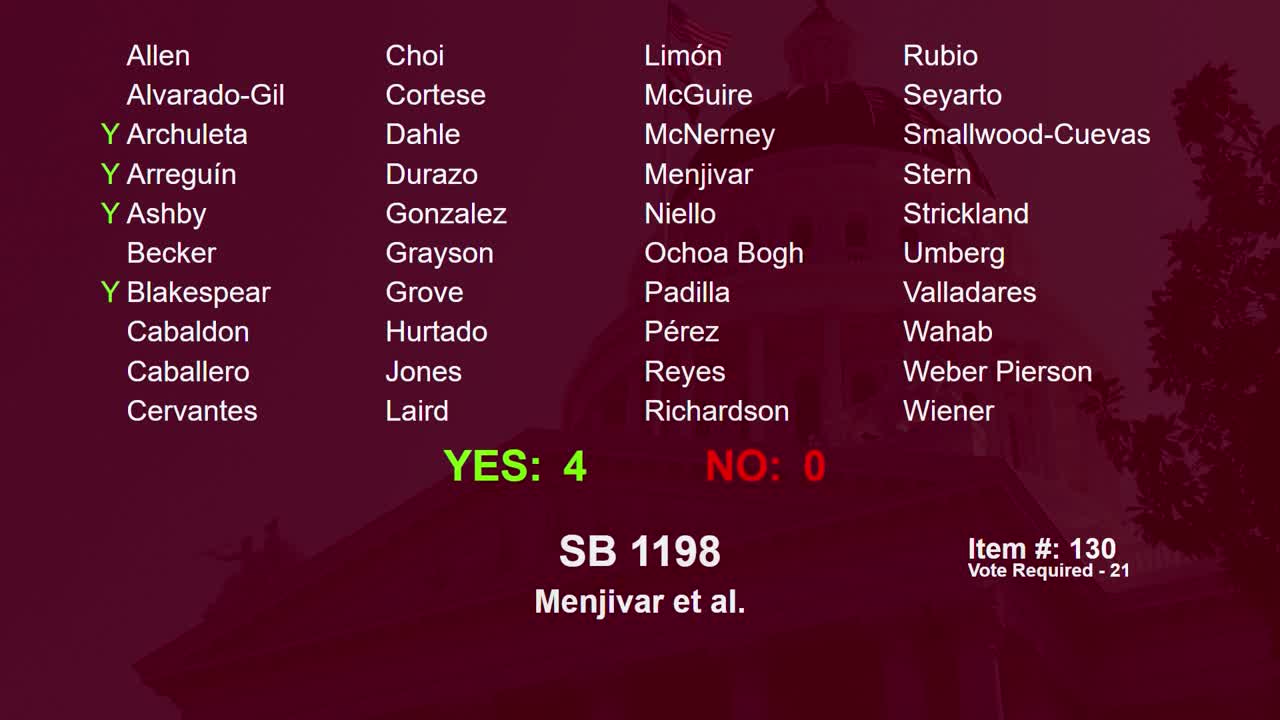 3MIN
Senate Floor
 8MIN
Senate Standing Committee on Energy, Utilities and Communications
Bill Author

Bill Co-Author(s):