SB 1279: Speed safety systems.
- Session Year: 2025-2026
- House: Senate
- Latest Version Date: 2026-09-27
Current Status:
Passed
(2026-09-27: Chaptered by Secretary of State. Chapter 689, Statutes of 2026.)
Introduced
In Committee
Awaiting First Chamber Vote
Passed First Chamber
In Committee
Awaiting Second Chamber Vote
Passed Second Chamber
Enacted
Existing law authorizes, until January 1, 2032, the Cities of Los Angeles, San Jose, Oakland, Glendale, and Long Beach, and the City and County of San Francisco to establish a program for speed enforcement that utilizes speed safety systems if the systems meet specified requirements, including limits on the number of speed safety systems operated by a participating city or city and county at any time based on population. Existing law requires the speed safety system, to the extent feasible, to be angled and focused so as to only capture photographs of speeding violations and prohibits the speed safety system from capturing identifying images of other drivers, vehicles, or pedestrians. Existing law prohibits speed safety systems in a participating city or city and county from being operated on any California state route, including all freeways and expressways, United States highways, interstate highways, or any public road in unincorporated areas of any county where the Commissioner of the California Highway Patrol has full responsibility and primary jurisdiction for the administration and enforcement of the laws, and for the investigation of traffic accidents.
This bill would require speed safety systems to blur any images that are unavoidably captured of other drivers, vehicles, or pedestrians who are not the subject of a notice of violation, and would require speed safety systems to blur these images, only to the extent feasible, for cameras that were installed before January 1, 2027. The bill would authorize, until January 1, 2032, the City of Long Beach to have 2 additional speed safety systems on the Pacific Coast Highway.
This bill would make legislative findings and declarations as to the necessity of a special statute for the City of Long Beach.
Existing law authorizes, until January 1, 2032, the City of Long Beach (city), among others, Los Angeles, San Jose, Oakland, Glendale, or Long Beach, or the City and County of San Francisco to establish a program for speed enforcement that utilizes a speed safety system if the system meets specified requirements, including limits on the number of speed safety systems operated by the city at any time based on population. Existing law requires the speed safety system, to the extent feasible, to be angled and focused so as to only capture photographs of speeding violations and prohibits the speed safety system from capturing identifying images of other drivers, vehicles, or pedestrians. Existing law prohibits a speed safety system in the city systems in participating cities from being operated on any California state route, including all freeways and expressways, United States highways, interstate highways, or any public road in unincorporated areas of any county where the Commissioner of the California Highway Patrol has full responsibility and primary jurisdiction for the administration and enforcement of the laws, and for the investigation of traffic accidents.
This bill would require speed safety systems to blur any images that are unavoidably captured of other drivers, vehicles, or pedestrians who are not the subject of a notice of violation, and would require speed safety systems to blur these images, only to the extent feasible, for cameras that were installed before January 1, 2027. The bill would authorize, until January 1, 2032, the City of Long Beach to have 2 additional speed safety systems on the Pacific Coast Highway.
This bill would make legislative findings and declarations as to the necessity of a special statute for the City of Long Beach.
Existing law authorizes, until January 1, 2032, the City of Long Beach (city), among others, to establish a program for speed enforcement that utilizes a speed safety system if the system meets specified requirements. Existing law requires the city to adopt a Speed Safety System Use Policy that sets forth, among other things, the specific purpose for the system. Existing law requires the city to adopt a Speed Safety System Impact Report that, among other things, includes the locations where the systems may be deployed. Existing law requires the policy and report to be made available for public review, as specified. requirements, including limits on the number of speed safety systems operated by the city at any time based on population.
Existing law also requires the city to develop uniform guidelines for, among other things, the processing and storage of confidential information, and designates all photographic or administrative records made by a system as confidential, except as specified. Existing law prohibits a speed safety system in the city from being operated on any California state route, including all freeways and expressways, United States highways, interstate highways, or any public road in unincorporated areas of any county where the Commissioner of the California Highway Patrol has full responsibility and primary jurisdiction for the administration and enforcement of the laws, and for the investigation of traffic accidents.
This bill would authorize, until January 1, 2032, the City of Long Beach to establish a similar program for speed enforcement that utilizes up to 5 speed safety systems on the Pacific Coast Highway. The bill would require the city to adhere to the Speed Safety System Use Policy mentioned above, and would require the city to approve an addendum to its existing Speed Safety System Impact Report before implementing the program. The bill would require the policy and the addendum to be made available for public review, as specified. have 2 additional speed safety systems on the Pacific Coast Highway.
Existing law requires a violation of a speed law recorded by a speed safety system to be subject only to civil penalties, as specified. Existing law requires, among other things, the issuance of a notice of violation, an initial review, an administrative hearing, and an appeals process, as specified, for a violation under the speed safety pilot program.This bill would require the city to also implement similar provisions.Existing law establishes a $25 filing fee for specified appeals and petitions.This bill would require a $25 filing fee for an appeal challenging a notice of violation issued as a result of the citys speed safety program until January 1, 2032.Existing constitutional provisions require that a statute that limits the right of access to the meetings of public bodies or the writings of public officials and agencies be adopted with findings demonstrating the interest protected by the limitation and the need for protecting that interest.This bill would make legislative findings to that effect.This bill would make legislative findings and declarations as to the necessity of a special statute for the City of Long Beach.
Existing law authorizes, until January 1, 2032, the City of Long Beach (city), among others, to establish a program for speed enforcement that utilizes a speed safety system if the system meets specified requirements. Existing law requires the city to adopt a Speed Safety System Use Policy that sets forth, among other things, the specific purpose for the system. Existing law requires the city to adopt a Speed Safety System Impact Report that, among other things, includes the locations where the systems may be deployed. Existing law requires the policy and report to be made available for public review, as specified.
Existing law also requires the city to develop uniform guidelines for, among other things, the processing and storage of confidential information, and designates all photographic or administrative records made by a system as confidential, except as specified. Existing law prohibits a speed safety system in the city from being operated on any California state route, including all freeways and expressways, United States highways, interstate highways, or any public road in unincorporated areas of any county where the Commissioner of the California Highway Patrol has full responsibility and primary jurisdiction for the administration and enforcement of the laws, and for the investigation of traffic accidents.
This bill would authorize, until January 1, 2036, 2032, the City of Long Beach to establish a similar program for speed enforcement that utilizes up to 6 5 speed safety systems on the Pacific Coast Highway. The bill would require the city to adhere to the Speed Safety System Use Policy mentioned above, and would require the city to approve an addendum to its existing Speed Safety System Impact Report before implementing the program. The bill would require the policy and the addendum to be made available for public review, as specified.
Existing law requires a violation of a speed law recorded by a speed safety system to be subject only to civil penalties, as specified. Existing law requires, among other things, the issuance of a notice of violation, an initial review, an administrative hearing, and an appeals process, as specified, for a violation under the speed safety pilot program.
This bill would require the city to also implement similar provisions.
Existing law establishes a $25 filing fee for specified appeals and petitions.
This bill would require a $25 filing fee for an appeal challenging a notice of violation issued as a result of the citys speed safety program until January 1, 2036. 2032.
Existing constitutional provisions require that a statute that limits the right of access to the meetings of public bodies or the writings of public officials and agencies be adopted with findings demonstrating the interest protected by the limitation and the need for protecting that interest.
This bill would make legislative findings to that effect.
This bill would make legislative findings and declarations as to the necessity of a special statute for the City of Long Beach.
Existing law authorizes, until January 1, 2032, the City of Long Beach (city), among others, to establish a program for speed enforcement that utilizes a speed safety system if the system meets specified requirements. Existing law requires the city to adopt a Speed Safety System Use Policy that sets forth, among other things, the specific purpose for the system. Existing law requires the city to adopt a Speed Safety System Impact Report that, among other things, includes the locations where the systems may be deployed. Existing law requires the policy and report to be made available for public review, as specified.
Existing law also requires the city to develop uniform guidelines for, among other things, the processing and storage of confidential information, and designates all photographic or administrative records made by a system as confidential, except as specified. Existing law prohibits a speed safety system in the city from being operated on any California state route, including all freeways and expressways, United States highways, interstate highways, or any public road in unincorporated areas of any county where the Commissioner of the California Highway Patrol has full responsibility and primary jurisdiction for the administration and enforcement of the laws, and for the investigation of traffic accidents.
This bill would authorize, until January 1, 2036, the City of Long Beach to establish a similar program for speed enforcement that utilizes up to 6 speed safety systems on the Pacific Coast Highway. The bill would require the city to adhere to the Speed Safety System Use Policy mentioned above, and would require the city to approve an addendum to its existing Speed Safety System Impact Report before implementing the program. The bill would require the policy and the addendum to be made available for public review, as specified.
Existing law requires a violation of a speed law recorded by a speed safety system to be subject only to civil penalties, as specified. Existing law requires, among other things, the issuance of a notice of violation, an initial review, an administrative hearing, and an appeals process, as specified, for a violation under the speed safety pilot program.
This bill would require the city to also implement similar provisions.
Existing law establishes a $25 filing fee for specified appeals and petitions.
This bill would require a $25 filing fee for an appeal challenging a notice of violation issued as a result of the citys speed safety program until January 1, 2036.
Existing constitutional provisions require that a statute that limits the right of access to the meetings of public bodies or the writings of public officials and agencies be adopted with findings demonstrating the interest protected by the limitation and the need for protecting that interest.
This bill would make legislative findings to that effect.
This bill would make legislative findings and declarations as to the necessity of a special statute for the City of Long Beach.
Recognizing the special circumstances in the City of Long Beach, where approximately one in five traffic fatalities takes place on the eight-mile stretch of the Pacific Coast Highway running through the city, it is the intent of the Legislature that this act be a one-time expansion of speed safety systems to increase safety in this high-injury corridor.
SEC. 2.Section 22425 of the Vehicle Code is amended to read:22425.(a)As used in this article, the following definitions apply:
(1)Automated speed violation means a violation of a speed law detected by a speed safety system operated pursuant to this article.
(2)Designated jurisdiction means any of the Cities of Los Angeles, San Jose, Oakland, Glendale, or Long Beach, or the City and County of San Francisco.
(3)A person is indigent if either of the following conditions is met:
(A)The person meets the income criteria set forth in subdivision (b) of Section 68632 of the Government Code.
(B)The person receives public benefits from a program listed in subdivision (a) of Section 68632 of the Government Code.
(4)Local department of transportation means a designated jurisdictions department of transportation or, if a designated jurisdiction does not have a department of transportation, their administrative division, including, but not limited to, a public works department that administers transportation and traffic matters under this code.
(5)School zone means an area described by subdivision (b) of Section 40802.
(6)Speed safety system or system means a fixed or mobile radar or laser system or any other electronic device that utilizes automated equipment to detect a violation of speed laws and obtains a clear photograph of a speeding vehicles license plate.
(b)(1)A designated jurisdiction may establish a program for speed enforcement that utilizes a speed safety system, to be operated by a local department of transportation, in the following areas:
(A)On a street meeting the standards of a safety corridor under Section 22358.7.
(B)On a street a local authority has determined to have had a high number of incidents for motor vehicle speed contests or motor vehicle exhibitions of speed. For the purposes of this provision, a high number of incidents shall be calls for law enforcement to respond to the area for at least four separate incidences of a motor vehicle speed contest or motor vehicle exhibition of speed within the last two years before the placement of the speed safety system.
(C)School zones, subject to subdivision (c).
(2)The number of speed safety systems operated by a designated jurisdiction at any time shall be limited as follows:
(A)For a jurisdiction with a population over 3,000,000, as determined by the United States Census Bureau in the 2020 Census, no more than 125 systems.
(B)For a jurisdiction with a population between 800,000 and 3,000,000, inclusive, as determined by the United States Census Bureau in the 2020 Census, no more than 33 systems.
(C)For a jurisdiction with a population of 300,000 up to 800,000, as determined by the United States Census Bureau in the 2020 Census, no more than 18 systems.
(D)For a jurisdiction with a population of less than 300,000, as determined by the United States Census Bureau in the 2020 Census, no more than 9 systems.
(3)In addition to the number of speed safety systems permitted under paragraph (2), the City of Long Beach may have two additional speed safety systems on the Pacific Coast Highway.
(4)A speed enforcement program developed pursuant to paragraph (1) shall place the speed safety systems in locations that are geographically and socioeconomically diverse. The designated jurisdiction shall describe how it has complied with this provision in the Speed Safety System Impact Report described in subdivision (h).
(c)If a speed safety system is deployed in a school zone and the school zone has a higher posted speed limit when children are not present, a designated jurisdiction may only enforce the school zone speed limit up to one hour before the regular school session begins, 10 minutes after school begins, one hour during lunch period, and up to one hour after regular school session concludes. For these school zones, flashing beacons activated by a time clock, other automatic device, or manual activation shall be installed on a school zone sign and be active to indicate the times during which the school zone speed limit is enforced with a speed safety system.
(d)A speed safety system may be utilized pursuant to subdivision (b) if the program meets all of the following requirements:
(1)Clearly identifies the presence of the speed safety system by signs stating Photo Enforced, along with the posted speed limit no more than 500 feet before the placement of the system. The signs shall be visible to traffic traveling on the street from the direction of travel for which the system is utilized, and shall be posted at all locations as may be determined necessary by the Department of Transportation after consultation with the California Traffic Control Devices Committee.
(2)Identifies the streets or portions of streets that have been approved for enforcement using a speed safety system and the hours of enforcement on the municipalitys internet website, which shall be updated whenever the municipality changes locations of enforcement.
(3)Ensures that the speed safety system is regularly inspected, but no less than once every 60 days, and certifies that the system is installed and operating properly. Each camera unit shall be calibrated in accordance with the manufacturers instructions, and at least once per year by an independent calibration laboratory. Documentation of the regular inspection, operation, and calibration of the system shall be retained at least 180 days after the date on which the system has been permanently removed from use.
(4)Utilizes fixed or mobile speed safety systems that provide real-time notification to the driver when violations are detected.
(e)(1)A speed safety system shall not be operated on any California state route, as defined in Section 231 of the Streets and Highways Code, including all freeways and expressways, United States highways, interstate highways, or any public road in unincorporated areas of any county where the Commissioner of the California Highway Patrol has full responsibility and primary jurisdiction for the administration and enforcement of the laws, and for the investigation of traffic accidents, pursuant to Section 2400.
(2)Notwithstanding paragraph (1), the City of Long Beach may use speed safety systems on the Pacific Coast Highway.
(f)Prior to enforcing speed laws utilizing speed safety systems, the designated jurisdiction shall do both of the following:
(1)Administer a public information campaign for at least 30 calendar days prior to the commencement of the program, which shall include public announcements in major media outlets and press releases. The public information campaign shall include the draft Speed Safety System Use Policy pursuant to subdivision (g), the Speed Safety System Impact Report pursuant to subdivision (h), information on when systems will begin detecting violations, the streets, or portions of streets, where systems will be utilized, and the designated jurisdictions internet website, where additional information about the program can be obtained. Notwithstanding the above, no further public announcement by the municipality shall be required for additional systems that may be added to the program.
(2)(A)Issue warning notices rather than notices of violation for violations detected by the speed safety systems during the first 60 calendar days of enforcement under the program. If additional systems are utilized on additional streets after the initial program implementation, the designated jurisdiction shall issue warning notices rather than notices of violation for violations detected by the new speed safety systems during the first 60 calendar days of enforcement for the additional streets added to the program.
(B)A vehicles first violation within a designated jurisdiction for traveling 11 to 15 miles per hour over the posted speed limit shall be a warning notice.
(g)The governing body of a designated jurisdiction shall adopt a Speed Safety System Use Policy before entering into an agreement regarding a speed safety system, purchasing or leasing equipment for a program, or implementing a program. The Speed Safety System Use Policy shall set forth the specific purpose for the system, the uses that are authorized, the rules and processes required to be followed by employees and contractors of the designated jurisdiction administering the system prior to its use, and the uses of the equipment and data collected that are prohibited. The policy shall identify the data or information that can be collected by the speed safety system and the individuals who can access or use the collected information, and the rules and processes related to the access, transfer, and use or use of the information. The policy shall also include provisions for protecting data from unauthorized access, data retention, public access, third-party data sharing, training, auditing, and oversight to ensure compliance with the Speed Safety System Use Policy. The Speed Safety System Use Policy shall be made available for public review, including, but not limited to, by posting it on the designated jurisdictions internet website at least 30 calendar days prior to adoption by the governing body of the designated jurisdiction.
(h)(1)The governing body of the designated jurisdiction also shall approve a Speed Safety System Impact Report prior to implementing a program. The Speed Safety System Impact Report shall include all of the following information:
(A)Assessment of potential impact of the speed safety system on civil liberties and civil rights and any plans to safeguard those public rights.
(B)Description of the speed safety system and how it works.
(C)Fiscal costs for the speed safety system, including program establishment costs, ongoing costs, and program funding.
(D)If potential deployment locations of systems are predominantly in low-income neighborhoods, a determination of why these locations experience high fatality and injury collisions due to unsafe speed.
(E)Locations where the system may be deployed and traffic data for these locations, including the address of where the cameras will be located.
(F)Proposed purpose of the speed safety system.
(2)The Speed Safety System Impact Report shall be made available for public review at least 30 calendar days prior to adoption by the governing body at a public hearing.
(3)The governing body of the designated jurisdiction shall consult and work collaboratively with relevant local stakeholder organizations, including racial equity, privacy protection, and economic justice groups, in developing the Speed Safety System Use Policy and Speed Safety System Impact Report.
(i)The designated jurisdiction shall develop uniform guidelines, consistent with the provisions of this section, for both of the following:
(1)The screening and issuing of notices of violation.
(2)The processing and storage of confidential information and procedures to ensure compliance with confidentiality requirements.
(j)Notices of violation issued pursuant to this section shall include a clear photograph of the license plate and rear of the vehicle only, identify the specific section of the Vehicle Code violated, the camera location, and the date and time when the violation occurred. Notices of violation shall exclude images of the rear window area of the vehicle.
(k)The photographic evidence stored by a speed safety system does not constitute an out-of-court hearsay statement by a declarant under Division 10 (commencing with Section 1200) of the Evidence Code.
(l)(1)Notwithstanding any provision of the California Public Records Act, or any other law, photographic or administrative records made by a system shall be confidential. Public agencies shall use and allow access to these records only for the purposes authorized by this article or to assess the impacts of the system. Data about the number of violations issued and the speeds at which they were issued is not considered an administrative record required not to be disclosed by this section.
(2)Confidential information obtained from the Department of Motor Vehicles for the administration of speed safety systems and enforcement of this article shall be held confidential, and shall not be used for any other purpose. Designated jurisdictions agents shall establish procedures to protect the confidentiality of these records consistent with Section 1808.47.
(3)Except for court records described in Section 68152 of the Government Code, or as provided in paragraph (4), the confidential records and evidence described in paragraphs (1) and (2) may be retained for up to 60 days after final disposition of the notice of violation. The designated jurisdiction may retain information that a vehicle has been cited and fined for a violation for up to three years. The municipality may adopt a retention period of less than 60 days in the Speed Safety System Use Policy. Administrative records described in paragraph (1) may be retained for up to 120 days after final disposition of the notice of violation. Notwithstanding any other law, the confidential records and evidence shall be destroyed in a manner that maintains the confidentiality of any person included in the record or evidence.
(4)Photographic evidence that is obtained from a speed safety system that does not result in the issuance of a notice of violation shall be destroyed within five business days after the photograph was first made. The use of facial recognition technology in conjunction with a speed safety system shall be prohibited.
(5)Information collected and maintained by a designated jurisdiction to administer a program shall only be used to administer the program, and shall not be disclosed to any other persons, including, but not limited to, any other state or federal government agency or official for any other purpose, except as required by state or federal law, court order, or in response to a subpoena in an individual case or proceeding.
(m)Notwithstanding subdivision (l), the registered owner or an individual identified by the registered owner as the driver of the vehicle at the time of the alleged violation shall be permitted to review and obtain a copy of the photographic evidence of the alleged violation.
(n)A contract between the designated jurisdiction and a manufacturer or supplier of speed safety systems shall allow the local authority to purchase materials, lease equipment, and contract for processing services from the manufacturer or supplier based on the services rendered on a monthly schedule or another schedule agreed upon by the municipality and contractor. The contract shall not allow for payment or compensation based on the number of notices of violation issued, or as a percentage of revenue generated, from the use of the system. The contract shall include a provision that all data collected from the speed safety systems is confidential, and shall prohibit the manufacturer or supplier of the contracted speed safety system from sharing, repurposing, or monetizing collected data, except as specifically authorized in this article. The designated jurisdiction shall oversee, maintain control, and have the final decision over all enforcement activities, including the determination of when a notice of violation should be issued.
(o)Notwithstanding subdivision (n), a designated jurisdiction may contract with a vendor for the processing of notices of violation after an employee of a designated jurisdiction has issued a notice of violation. The vendor shall be a separate legal and corporate entity from, and not related to or affiliated in any manner with, the manufacturer or supplier of speed safety systems used by the designated jurisdiction. Any contract between the designated jurisdiction and a vendor to provide processing services may include a provision for the payment of compensation based on the number of notices of violation processed by the vendor.
(p)(1)A speed safety system at a specific location shall be operated for no more than 18 months after installation of a system, unless one of the following thresholds has been met:
(A)A reduction in the 85th percentile speed of vehicles compared to data collected before the system was in operation.
(B)A 20-percent reduction in vehicles that exceed the posted speed limit by 10 miles per hour or more compared to data collected before the system was in operation.
(C)A 20-percent reduction in the number of violators who received two or more violations at the location since the system became operational.
(2)(A)Paragraph (1) does not apply if a designated jurisdiction adds traffic-calming measures to the street. Traffic-calming measures include, but are not limited to, all of the following:
(i)Bicycle lanes.
(ii)Chicanes.
(iii)Chokers.
(iv)Curb extensions.
(v)Median islands.
(vi)Raised crosswalks.
(vii)Road diets.
(viii)Roundabouts.
(ix)Speed humps or speed tables.
(x)Traffic circles.
(xi)Flashing beacons for school zone speed limits.
(B)A designated jurisdiction may continue to operate a speed safety system with a fixed or mobile vehicle speed feedback sign while traffic-calming measures are being planned or constructed, but shall halt their use if construction has not begun within two years.
(3)If the percentage of violations has not decreased by the metrics identified pursuant to paragraph (1) within one year after traffic-calming measures have completed construction, a designated jurisdiction shall either construct additional traffic-calming measures or cease operation of the system on that street.
(q)(1)The speed safety system, to the extent feasible, shall be angled and focused so as to only capture photographs of speeding violations and shall not capture identifying images of other drivers, vehicles, or pedestrians.
(2)The speed safety system shall blur any images that are unavoidably captured of other drivers, vehicles, or pedestrians who are not the subject of a notice of violation.
(3)Notwithstanding paragraph (2), for cameras that were installed before January 1, 2027, and only to the extent feasible, the speed safety system shall blur images of other drivers, vehicles, or pedestrians who are not the subject of a notice of violation.
(r)Notwithstanding subdivision (c) of Section 21455.6, the designated jurisdictions listed herein may use automated enforcement systems and photo radar for speed enforcement consistent with this article.
SEC. 3.The Legislature finds and declares that a special statute is necessary and that a general statute cannot be made applicable within the meaning of Section 16 of Article IV of the California Constitution because of the unique circumstances concerning traffic speed enforcement in the City of Long Beach.
Recognizing the special circumstances in the City of Long Beach, where approximately one in five traffic fatalities takes place on the eight-mile stretch of the Pacific Coast Highway running through the city, it is the intent of the Legislature that this act be a one-time expansion of speed safety systems to increase safety in this high-injury corridor.
SEC. 2.Section 70615 of the Government Code, as amended by Section 2.5 of Chapter 782 of the Statutes of 2025, is amended to read:70615.The fee for filing any of the following appeals to the superior court is twenty-five dollars ($25):(a)An appeal of a local agencys decision regarding an administrative fine or penalty under Section 53069.4.(b)An appeal under Section 40230 of the Vehicle Code of an administrative agencys decision regarding a parking violation.(c)An appeal under Section 99582 of the Public Utilities Code of a hearing officers determination regarding an administrative penalty for fare evasion or a passenger conduct violation.(d)A petition under Section 186.35 of the Penal Code challenging a law enforcement agencys inclusion of a persons information in a shared gang database.(e)An appeal under Section 22428 of the Vehicle Code of a hearing officers determination regarding a civil penalty for an automated speed violation, as defined in Section 22425 of the Vehicle Code.(f)An appeal under Section 22438 of the Vehicle Code of a hearing officers determination regarding a civil penalty for an automated speed violation, as defined in Section 22435 of the Vehicle Code.(g)An appeal under Section 21455.9 of the Vehicle Code of a hearing officers determination regarding a civil penalty for an automated traffic enforcement violation, as defined in Section 21455.9 of the Vehicle Code.(h)An appeal under Section 22445.3 of the Vehicle Code of a hearing officers determination regarding a civil penalty for an automated speed violation, as defined in Section 22445 of the Vehicle Code.(i)An appeal under Section 22443.3 of the Vehicle Code of a hearing officers determination regarding a civil penalty for an automated speed violation, as defined in Section 22443 of the Vehicle Code.(j)This section shall remain in effect only until January 1, 2032, and as of that date is repealed.SEC. 3.Article 4.5 (commencing with Section 22443) is added to Chapter 7 of Division 11 of the Vehicle Code, to read:4.5.City of Long Beach Pacific Coast Highway Speed Safety Pilot Program 22443.(a)As used in this article, all of the following definitions apply:(1)Automated speed violation means a violation of a speed law detected by a speed safety system operated pursuant to this article.(2)Designated jurisdiction means the City of Long Beach.(3)A person is indigent if either of the following conditions is met:(A)The person meets the income criteria set forth in subdivision (b) of Section 68632 of the Government Code.(B)The person receives public benefits from a program listed in subdivision (a) of Section 68632 of the Government Code.(4)Local department of transportation means the City of Long Beachs department that administers transportation and traffic matters under this code.(5)Speed safety system or system means a fixed or mobile radar or laser system or any other electronic device that utilizes automated equipment to detect a violation of speed laws and obtains a clear photograph of a speeding vehicles license plate.(b)The designated jurisdiction may establish a program for speed enforcement that utilizes up to five speed safety systems, to be operated by the local department of transportation, on the Pacific Coast Highway.(c)The speed safety system may be utilized pursuant to subdivision (b) if the program meets all of the following requirements:(1)Clearly identifies the presence of the speed safety system by signs stating Photo Enforced, along with the speed limit signs with flashing beacons and speed feedback signs, no more than 500 feet before the placement of the system. The signs shall be visible to traffic traveling on the street from the direction of travel for which the system is utilized, and shall be posted at locations as may be determined necessary by the Department of Transportation after consultation with the California Traffic Control Devices Committee.(2)Identifies the street or portions of the street approved for enforcement using a speed safety system and the hours of enforcement on the municipalitys internet website, which shall be updated whenever the municipality changes locations of enforcement.(3)Ensures that the speed safety system is regularly inspected no less than once every 60 days, and certifies that the system is installed and operating properly. Each camera unit shall be calibrated in accordance with the manufacturers instructions, and at least once per year by an independent calibration laboratory. Documentation of the regular inspection, operation, and calibration of the system shall be retained for at least 180 days after the date on which the system has been permanently removed from use.(4)Utilizes fixed or mobile speed safety systems that provide real-time notification to the driver when violations are detected.(d)Prior to enforcing speed laws utilizing speed safety systems, the designated jurisdiction shall do both of the following:(1)Administer a public information campaign for at least 30 calendar days prior to the commencement of the program, which shall include public announcements in major media outlets and press releases. The public information campaign shall include the draft Speed Safety System Use Policy pursuant to subdivision (e), the Speed Safety System Impact Report pursuant to subdivision (f), information on when systems will begin detecting violations, the street, or portions of the street, where systems will be utilized, and the designated jurisdictions internet website, where additional information about the program can be obtained. Notwithstanding the above, no further public announcement by the municipality shall be required for additional systems that may be added to the program.(2)(A)Issue warning notices rather than notices of violation for violations detected by the speed safety system during the first 60 calendar days of enforcement under the program.(B)A vehicles first violation for traveling 11 to 15 miles per hour over the posted speed limit shall be a warning notice.(e)The designated jurisdiction shall adhere to the Speed Safety System Use Policy adopted pursuant to Section 22425. The policy shall be made available for public review, including, but not limited to, by posting it on the designated jurisdictions internet website.(f)(1)The designated jurisdiction shall approve an addendum to its existing Speed Safety System Impact Report adopted pursuant to Section 22425 prior to implementing the program.(2)The addendum shall be made available for public review at least 30 calendar days prior to adoption by the governing body at a public hearing.(g)The designated jurisdiction shall develop uniform guidelines, consistent with the provisions of this section, for both of the following:(1)The screening and issuing of notices of violation.(2)The processing and storage of confidential information and procedures to ensure compliance with confidentiality requirements.(h)Notices of violation issued pursuant to this section shall include a clear photograph of the license plate and rear of the vehicle only, identify the specific section of the Vehicle Code violated, the camera location, and the date and time when the violation occurred. Notices of violation shall exclude images of the rear window area of the vehicle.(i)The photographic evidence stored by a speed safety system does not constitute an out-of-court hearsay statement by a declarant under Division 10 (commencing with Section 1200) of the Evidence Code.(j)(1)Notwithstanding any provision of the California Public Records Act, or any other law, photographic or administrative records made by a system shall be confidential. Public agencies shall use and allow access to these records only for the purposes authorized by this article or to assess the impacts of the system. Data about the number of violations issued is not an administrative record prohibited from disclosure by this section and is subject to disclosure under applicable law.(2)Confidential information obtained from the Department of Motor Vehicles for the administration of speed safety systems and enforcement of this article shall be held confidential, and shall not be used for any other purpose. Designated jurisdictions agents shall establish procedures to protect the confidentiality of these records consistent with Section 1808.47.(3)Except for court records described in Section 68152 of the Government Code, or as provided in paragraph (4), the confidential records and evidence described in paragraphs (1) and (2) may be retained for up to 60 days after final disposition of the notice of violation. The designated jurisdiction may retain information that a vehicle has been cited and fined for a violation for up to three years. The municipality may adopt a retention period of less than 60 days in the Speed Safety System Use Policy. Administrative records described in paragraph (1) may be retained for up to 120 days after final disposition of the notice of violation. Notwithstanding any other law, the confidential records and evidence shall be destroyed in a manner that maintains the confidentiality of any person included in the record or evidence.(4)Photographic evidence that is obtained from a speed safety system that does not result in the issuance of a notice of violation shall be destroyed within five business days after the photograph was first made. The use of facial recognition technology in conjunction with a speed safety system shall be prohibited.(5)Information collected and maintained by a designated jurisdiction to administer a program shall only be used to administer the program, and shall not be disclosed to any other persons, including, but not limited to, any other state or federal governmental agency or official for any other purpose, except as required by state or federal law, court order, or in response to a subpoena in an individual case or proceeding.(k)Notwithstanding subdivision (j), the registered owner or an individual identified by the registered owner as the driver of the vehicle at the time of the alleged violation shall be permitted to review and obtain a copy of the photographic evidence of the alleged violation.(l)A contract between the designated jurisdiction and a manufacturer or supplier of speed safety systems shall allow the local authority to purchase materials, lease equipment, and contract for processing services from the manufacturer or supplier based on the services rendered on a monthly schedule or another schedule agreed upon by the municipality and contractor. The contract shall not allow for payment or compensation based on the number of notices of violation issued, or as a percentage of revenue generated, from the use of the system. The contract shall include a provision that all data collected from the speed safety system is confidential, and shall prohibit the manufacturer or supplier of the contracted speed safety system from sharing, repurposing, or monetizing collected data, except as specifically authorized in this article. The designated jurisdiction shall oversee, maintain control, and have the final decision over all enforcement activities, including the determination of when a notice of violation should be issued.(m)Notwithstanding subdivision (l), a designated jurisdiction may contract with a vendor for the processing of notices of violation after an employee of a designated jurisdiction has issued a notice of violation. The vendor shall be a separate legal and corporate entity from, and not related to or affiliated in any manner with, the manufacturer or supplier of speed safety systems used by the designated jurisdiction. Any contract between the designated jurisdiction and a vendor to provide processing services may include a provision for the payment of compensation based on the number of notices of violation processed by the vendor.(n)The speed safety system, to the extent feasible, shall be angled and focused so as to only capture photographs of speeding violations and shall not capture identifying images of other drivers, vehicles, or pedestrians.(o)Notwithstanding subdivision (c) of Section 21455.6, the designated jurisdiction listed herein may use automated enforcement systems and photographic radar for speed enforcement consistent with this article.22443.1.(a)Notwithstanding any other law, a violation of any speed law pursuant to this chapter that is recorded by a speed safety system authorized pursuant to Section 22443 shall be subject only to a civil penalty, as provided in subdivision (c), and shall not result in the department suspending or revoking the privilege of a violator to drive a motor vehicle or in a violation point being assessed against the violator.(b)The speed safety system shall capture images of the rear license plate of vehicles that are traveling 11 miles per hour or more over the posted speed limit and notices of violation shall only be issued to registered owners of those vehicles based on that evidence.(c)A civil penalty shall be assessed as follows:(1)Fifty dollars ($50) for driving at a speed of 11 to 15 miles per hour over the posted speed limit.(2)One hundred dollars ($100) for driving at a speed of 16 to 25 miles per hour over the posted speed limit.(3)Two hundred dollars ($200) for driving at a speed of 26 miles per hour or more over the posted speed limit, unless paragraph (4) applies.(4)Five hundred dollars ($500) for driving at a speed of 100 miles per hour or more.(d)A civil penalty shall not be assessed against an authorized emergency vehicle.(e)The notice of violation shall be in writing and issued to the registered owner of the vehicle within 15 calendar days of the date of the violation. The notice of violation shall include all of the following information:(1)The violation, including reference to the speed law that was violated, the speed of the vehicle, the speed limit for the road on which the violation occurred, and verification of the most recent calibration of the system in accordance with paragraph (4) of subdivision (c) of Section 22443.(2)The date, approximate time, and location where the violation occurred.(3)The vehicle license number and the name and address of the registered owner of the vehicle.(4)A statement that payment is required to be made no later than 30 calendar days from the date of mailing of the notice of violation, or that the violation may be contested pursuant to Section 22443.2.(5)The amount of the civil penalty due for that violation and the procedures for the payment of the civil penalty or for contesting the notice of violation.(6)An affidavit of nonliability, and information of what constitutes nonliability, information as to the effect of executing the affidavit, and instructions for returning the affidavit to the processor. If the affidavit of nonliability is returned to the processing agency within 30 calendar days of the mailing of the notice of violation, together with proof of a written lease or rental agreement between a bona fide rental company, as defined in Section 1939.01 of the Civil Code, or a personal vehicle sharing program, as defined in Section 11580.24 of the Insurance Code, and its customer that identifies the renter or lessee, the processing agency shall serve or mail a notice of violation to the renter or lessee identified in the affidavit of nonliability. If the affidavit of nonliability is returned to the processing agency within 30 calendar days of the mailing of the notice of violation, together with proof of a copy of a police report indicating the vehicle had been stolen at the time of the violation, the processing agency shall not subject the registered owner to a civil violation.(7)A proof of service consistent with Section 1013a of the Code of Civil Procedure.(f)Mobile radar or laser systems shall not be used until at least two years after the installation of the first fixed radar or laser system unless the mobile radar or laser system is kept at a fixed location.(g)(1)Revenues derived from any program utilizing a speed safety system for speed limit enforcement shall first be used to recover program costs. Program costs include, but are not limited to, the installation of speed safety systems, the adjudication of violations, and reporting requirements as specified in this section.(2)The designated jurisdiction shall maintain their existing commitment of local funds for traffic-calming measures in order to remain authorized to participate in the pilot program, and shall annually expend not less than the annual average of expenditures for traffic-calming measures during the 201617, 201718, and 201819 fiscal years. For purposes of this subdivision, in calculating average expenditures on traffic-calming measures, restricted funds that may not be available on an ongoing basis, including those from voter-approved bond issuances or tax measures, shall not be included. Excess revenue shall be used for traffic-calming measures within three years of the end of the fiscal year in which the excess revenue was received. If traffic-calming measures are not planned or constructed after the third year, excess revenue shall revert to the Active Transportation Program established pursuant to Chapter 8 (commencing with Section 2380) of the Streets and Highways Code, to be allocated by the California Transportation Commission pursuant to Section 2381 of the Streets and Highways Code.(h)A person shall not be assessed a civil penalty if they are subject to criminal penalties for the same act.(i)A speed safety system may only be in operation for five years, or until January 1, 2032, whichever date is sooner.22443.2.(a)No later than 30 calendar days from the date of mailing of a notice of violation, the recipient may request an initial review of the notice by the issuing agency. The request may be made by telephone, in writing, electronically, or in person. There shall be no charge for this review. If, following the initial review, the issuing agency is satisfied that the violation did not occur, or that extenuating circumstances make cancellation of the notice of violation appropriate in the interest of justice, the issuing agency shall cancel the notice of violation. The issuing agency shall advise the processing agency, if any, of the cancellation. The issuing agency or the processing agency shall mail the results of the initial review to the person contesting the notice within 60 days of receipt of the recipients request for an initial review, and, if cancellation of the notice does not occur following that review, include a reason for that denial, notification of the ability to request an administrative hearing, and notice of the procedures adopted by the designated jurisdiction for the administrative hearing, including for waiving prepayment of the civil penalty based upon an inability to pay pursuant to paragraph (2) of subdivision (b).(b)(1)If the person contesting the notice of violation is dissatisfied with the results of the initial review, the person may, no later than 21 calendar days following the mailing of the results of the issuing agencys initial review, request an administrative hearing of the violation. The request may be made by telephone, in writing, electronically, or in person.(2)The person requesting an administrative hearing shall pay the amount of the civil penalty to the processing agency. The issuing agency shall adopt a written procedure to allow a person to request an administrative hearing without payment of the civil penalty upon satisfactory proof of an inability to pay the amount due.(3)The administrative hearing shall be held within 90 calendar days following the receipt of a request for an administrative hearing. The person requesting the hearing may request one continuance, not to exceed 21 calendar days.(c)The administrative hearing process shall include all of the following:(1)The person requesting a hearing shall have the choice of a hearing upon written declaration, video conference, or in person. An in-person hearing shall be conducted within the jurisdiction of the issuing agency.(2)If the person requesting a hearing is an unemancipated minor, that person shall be permitted to appear at a hearing or admit responsibility for the automated speed violation without the appointment of a guardian. The processing agency may proceed against the minor in the same manner as against an adult.(3)The administrative hearing shall be conducted in accordance with written procedures established by the issuing agency and approved by the governing body or chief executive officer of the issuing agency. The hearing shall provide an independent, objective, fair, and impartial review of contested automated speed violations.(4)(A)The issuing agencys governing body or chief executive officer of the designated jurisdiction shall appoint or contract with qualified independent examiners or administrative hearing providers that employ qualified independent examiners to conduct the administrative hearings. Examiners shall demonstrate the qualifications, training, and objectivity necessary to conduct a fair and impartial review, and shall meet the minimum requirements specified in subparagraph (B). The examiner shall be separate and independent from the notice of violation issuing and processing functions. An examiners continued employment, performance evaluation, compensation, and benefits shall not, directly or indirectly, be linked to the amount of civil penalties upheld by the examiner or the number or percentage of violations upheld by the examiner.(B)(i)Examiners shall have a minimum of 20 hours of training. The examiner, unless an employee of the designated jurisdiction, is responsible for the costs of the training. The issuing agency may reimburse the examiner for those costs. Training may be provided through any of the following:(I)An accredited college or university.(II)A program conducted by the Commission on Peace Officer Standards and Training.(III)A program conducted by the American Arbitration Association or a similar organization.(IV)Any program approved by the governing body or chief executive officer of the issuing agency, including a program developed and provided by, or for, the agency.(ii)Training programs shall include topics relevant to the administrative hearing, including, but not limited to, applicable laws and regulations, enforcement procedures, due process, evaluation of evidence, hearing procedures, and effective oral and written communication. Upon the approval of the governing body or chief executive officer of the issuing agency, up to 12 hours of relevant experience may be substituted for up to 12 hours of training. Up to eight hours of the training requirements described in this subparagraph may be credited to an individual, at the discretion of the governing body or chief executive officer of the issuing agency, based upon training programs or courses described in this subparagraph that the individual attended within the last five years.(5)The employee of the designated jurisdiction who issues a notice of violation shall not be required to participate in an administrative hearing. To establish a violation, the issuing agency shall not be required to produce any evidence other than, in proper form, the notice of violation or copy thereof, including the photograph of the vehicles license plate, and information received from the Department of Motor Vehicles identifying the registered owner of the vehicle. The documentation in proper form shall be prima facie evidence of the violation. If the designated jurisdiction meets its initial burden, the recipient of the notice of violation may present any evidence and argument in defense.(6)The examiners final decision following the administrative hearing may be personally delivered to the person by the examiner or sent by first-class mail within 60 days of the date of the conclusion of the administrative hearing.(7)Following a determination by the examiner that a person has committed the violation, the examiner may, consistent with the written guidelines established by the issuing agency, allow payment of the civil penalty in installments, or an issuing agency may allow for deferred payment or payments in installments, if the person provides evidence satisfactory to the examiner or the issuing agency, as the case may be, of an inability to pay the civil penalty in full. If authorized by the governing body of the issuing agency, the examiner may permit the performance of community service in lieu of payment of the civil penalty.(8)If a notice of violation is dismissed following an administrative hearing, any civil penalty, if paid, shall be refunded by the issuing agency within 30 days.22443.3.(a)Within 30 days after personal delivery or mailing of the final decision described in subdivision (c) of Section 22443.2, the contestant may seek review by filing an appeal to the superior court, where the case shall be heard de novo, except that the contents of the processing agencys file in the case on appeal shall be lodged by the designated agency at the designated agencys expense and be received into evidence. A copy of the notice of violation shall be admitted into evidence as prima facie evidence of the facts stated in the notice. A copy of the notice of appeal shall be served in person or by certified first-class mail with return receipt upon the processing agency by the appellant. For purposes of computing the 30-day period, Section 1013 of the Code of Civil Procedure shall be applicable. A proceeding under this subdivision is a limited civil case.(b)The fee for filing the notice of appeal shall be as provided in Section 70615 of the Government Code. Upon receipt of the notice of appeal, the designated jurisdiction shall lodge its administrative record for the case with the court within 15 calendar days. The court shall notify the appellant of the appearance date by mail or personal delivery. The court shall retain the fee under Section 70615 of the Government Code regardless of the outcome of the appeal. If the appellant prevails, this fee and any payment of the civil penalty shall be promptly refunded by the issuing agency in accordance with the judgment of the court.(c)The conduct of the hearing on appeal under this section may be a subordinate judicial duty and may be performed by a commissioner or other subordinate judicial officer at the direction of the presiding judge of the court.(d)If a notice of appeal of the examiners decision is not filed within the period set forth in subdivision (a), the decision shall be deemed final.(e)If the civil penalty has not been paid and the final decision is adverse to the appellant, the processing agency may, promptly after the decision becomes final, proceed to collect the civil penalty under Section 22443.1.22443.4.(a)A designated jurisdiction shall offer a diversion program for indigent speed safety system violation recipients, to perform community service or complete an educational program in lieu of paying the penalty for a speed system violation.(b)A designated jurisdiction shall offer the ability for indigent speed safety system violation recipients to pay applicable fines and penalties over a period of time under a payment plan with monthly installments of no more than twenty-five dollars ($25) and shall limit the processing fee to participate in a payment plan to five dollars ($5) or less.(c)Notwithstanding subdivisions (a) and (b), a designated jurisdiction shall reduce the applicable fines and penalties by 80 percent for indigent persons, and by 50 percent for individuals up to 250 percent above the federal poverty level.(d)The person may demonstrate that they are indigent or make up to 250 percent above the poverty level or less by providing either of the following information, as applicable:(1)Proof of income from a pay stub or another form of proof of earnings, such as a bank statement, that shows that the person meets the income criteria set forth in subdivision (b) of Section 68632 of the Government Code, subject to review and approval by the processing agency or its designee. The processing agency or its designee shall not unreasonably withhold its approval.(2)Proof of receipt of benefits under the programs described in subdivision (a) of Section 68632 of the Government Code, including, but not limited to, an electronic benefits transfer card or another card, subject to review and approval by the processing agency. The processing agency or its designee shall not unreasonably withhold its approval.22443.5.The designated jurisdiction that used a speed safety system shall, on or before March 1 of the fifth year in which the system has been implemented, submit to its governing body and the transportation committees of the Legislature, consistent with Section 9795 of the Government Code, an evaluation of the speed safety system in their respective jurisdictions to determine the systems impact on street safety and the systems economic impact on the communities where the system is utilized. The report shall be made available on the internet website of the jurisdiction and shall include all of the following information:(a)Data, at least three months before and at least six months after implementation of each system, on the number and proportion of vehicles speeding from 11 to 15 miles per hour over the legal speed limit, inclusive, from 16 to 25 miles per hour over the legal speed limit, inclusive, 26 miles per hour over the legal speed limit, and for every violator traveling at a speed of 100 miles per hour or greater. Data shall also be collected on the average speed of vehicles and 85th percentile speed of vehicles. To the extent feasible, the data should be collected at the same time of day, day of week, and location.(b)The number of notices of violation issued under the program by month and year, the corridors or locations where violations occurred, and the number of vehicles with two or more violations in a monthly period and a yearly period.(c)Data, before and after implementation of the system, on the number of traffic collisions that occurred where speed safety systems are used, relative to citywide data, and the transportation mode of the parties involved. The data on traffic collisions shall be categorized by collision type and injury severity, such as property damage only, complaint of pain, other visible injury, or severe or fatal injury.(d)The number of violations paid, the number of delinquent violations, and the number of violations for which an initial review is requested. For the violations in which an initial review was requested, the report shall indicate the number of violations that went to initial review, administrative hearing, and de novo hearing, the number of notices that were dismissed at each level of review, and the number of notices that were not dismissed after each level of review.(e)The costs associated with implementation and operation of the speed safety system and revenues collected by the jurisdiction.(f)A racial and economic equity impact analysis, developed in collaboration with local racial justice and economic equity stakeholder groups. The analysis shall include the number of notices of violations issued to indigent individuals, the number of notices of violations issued to individuals of up to 250 percent above the poverty line, and the number of violations issued to each ZIP Code.22443.6.This article shall remain in effect only until January 1, 2032, and as of that date is repealed.SEC. 4.The Legislature finds and declares that Section 3 of this act, which adds Section 22443 to the Vehicle Code, imposes a limitation on the publics right of access to the meetings of public bodies or the writings of public officials and agencies within the meaning of Section 3 of Article I of the California Constitution. Pursuant to that constitutional provision, the Legislature makes the following findings to demonstrate the interest protected by this limitation and the need for protecting that interest:To protect the privacy interests of persons who are issued notices of violation under a speed safety systems pilot program, the Legislature finds and declares that the photographic or administrative records generated by the program shall be confidential, and shall be made available only to alleged violators and to governmental agencies solely for the purpose of enforcing these violations and assessing the impact of the use of speed safety systems, as required by this act.SEC. 2.Section 22425 of the Vehicle Code is amended to read:22425.(a)As used in this article, the following definitions apply:
(1)Automated speed violation means a violation of a speed law detected by a speed safety system operated pursuant to this article.
(2)Designated jurisdiction means any of the Cities of Los Angeles, San Jose, Oakland, Glendale, or Long Beach, or the City and County of San Francisco.
(3)A person is indigent if either of the following conditions is met:
(A)The person meets the income criteria set forth in subdivision (b) of Section 68632 of the Government Code.
(B)The person receives public benefits from a program listed in subdivision (a) of Section 68632 of the Government Code.
(4)Local department of transportation means a designated jurisdictions department of transportation or, if a designated jurisdiction does not have a department of transportation, their administrative division, including, but not limited to, a public works department that administers transportation and traffic matters under this code.
(5)School zone means an area described by subdivision (b) of Section 40802.
(6)Speed safety system or system means a fixed or mobile radar or laser system or any other electronic device that utilizes automated equipment to detect a violation of speed laws and obtains a clear photograph of a speeding vehicles license plate.
(b)(1)A designated jurisdiction may establish a program for speed enforcement that utilizes a speed safety system, to be operated by a local department of transportation, in the following areas:
(A)On a street meeting the standards of a safety corridor under Section 22358.7.
(B)On a street a local authority has determined to have had a high number of incidents for motor vehicle speed contests or motor vehicle exhibitions of speed. For the purposes of this provision, a high number of incidents shall be calls for law enforcement to respond to the area for at least four separate incidences of a motor vehicle speed contest or motor vehicle exhibition of speed within the last two years before the placement of the speed safety system.
(C)School zones, subject to subdivision (c).
(2)The number of speed safety systems operated by a designated jurisdiction at any time shall be limited as follows:
(A)For a jurisdiction with a population over 3,000,000, as determined by the United States Census Bureau in the 2020 Census, no more than 125 systems.
(B)For a jurisdiction with a population between 800,000 and 3,000,000, inclusive, as determined by the United States Census Bureau in the 2020 Census, no more than 33 systems.
(C)For a jurisdiction with a population of 300,000 up to 800,000, as determined by the United States Census Bureau in the 2020 Census, no more than 18 systems.
(D)For a jurisdiction with a population of less than 300,000, as determined by the United States Census Bureau in the 2020 Census, no more than 9 systems.
(3)In addition to the number of speed safety systems permitted under paragraph (2), the City of Long Beach may have two additional speed safety systems on the Pacific Coast Highway.
(3)(4)A speed enforcement program developed pursuant to paragraph (1) shall place the speed safety systems in locations that are geographically and socioeconomically diverse. The designated jurisdiction shall describe how it has complied with this provision in the Speed Safety System Impact Report described in subdivision (h).
(c)If a speed safety system is deployed in a school zone and the school zone has a higher posted speed limit when children are not present, a designated jurisdiction may only enforce the school zone speed limit up to one hour before the regular school session begins, 10 minutes after school begins, one hour during lunch period, and up to one hour after regular school session concludes. For these school zones, flashing beacons activated by a time clock, other automatic device, or manual activation shall be installed on a school zone sign and be active to indicate the times during which the school zone speed limit is enforced with a speed safety system.
(d)A speed safety system may be utilized pursuant to subdivision (b) if the program meets all of the following requirements:
(1)Clearly identifies the presence of the speed safety system by signs stating Photo Enforced, along with the posted speed limit no more than 500 feet before the placement of the system. The signs shall be visible to traffic traveling on the street from the direction of travel for which the system is utilized, and shall be posted at all locations as may be determined necessary by the Department of Transportation after consultation with the California Traffic Control Devices Committee.
(2)Identifies the streets or portions of streets that have been approved for enforcement using a speed safety system and the hours of enforcement on the municipalitys internet website, which shall be updated whenever the municipality changes locations of enforcement.
(3)Ensures that the speed safety system is regularly inspected, but no less than once every 60 days, and certifies that the system is installed and operating properly. Each camera unit shall be calibrated in accordance with the manufacturers instructions, and at least once per year by an independent calibration laboratory. Documentation of the regular inspection, operation, and calibration of the system shall be retained at least 180 days after the date on which the system has been permanently removed from use.
(4)Utilizes fixed or mobile speed safety systems that provide real-time notification to the driver when violations are detected.
(e)(1)A speed safety system shall not be operated on any California state route, as defined in Section 231 of the Streets and Highways Code, including all freeways and expressways, United States highways, interstate highways, or any public road in unincorporated areas of any county where the Commissioner of the California Highway Patrol has full responsibility and primary jurisdiction for the administration and enforcement of the laws, and for the investigation of traffic accidents, pursuant to Section 2400.
(2)Notwithstanding paragraph (1), the City of Long Beach may use speed safety systems on the Pacific Coast Highway.
(f)Prior to enforcing speed laws utilizing speed safety systems, the designated jurisdiction shall do both of the following:
(1)Administer a public information campaign for at least 30 calendar days prior to the commencement of the program, which shall include public announcements in major media outlets and press releases. The public information campaign shall include the draft Speed Safety System Use Policy pursuant to subdivision (g), the Speed Safety System Impact Report pursuant to subdivision (h), information on when systems will begin detecting violations, the streets, or portions of streets, where systems will be utilized, and the designated jurisdictions internet website, where additional information about the program can be obtained. Notwithstanding the above, no further public announcement by the municipality shall be required for additional systems that may be added to the program.
(2)(A)Issue warning notices rather than notices of violation for violations detected by the speed safety systems during the first 60 calendar days of enforcement under the program. If additional systems are utilized on additional streets after the initial program implementation, the designated jurisdiction shall issue warning notices rather than notices of violation for violations detected by the new speed safety systems during the first 60 calendar days of enforcement for the additional streets added to the program.
(B)A vehicles first violation within a designated jurisdiction for traveling 11 to 15 miles per hour over the posted speed limit shall be a warning notice.
(g)The governing body of a designated jurisdiction shall adopt a Speed Safety System Use Policy before entering into an agreement regarding a speed safety system, purchasing or leasing equipment for a program, or implementing a program. The Speed Safety System Use Policy shall set forth the specific purpose for the system, the uses that are authorized, the rules and processes required to be followed by employees and contractors of the designated jurisdiction administering the system prior to its use, and the uses of the equipment and data collected that are prohibited. The policy shall identify the data or information that can be collected by the speed safety system and the individuals who can access or use the collected information, and the rules and processes related to the access, transfer, and use or use of the information. The policy shall also include provisions for protecting data from unauthorized access, data retention, public access, third-party data sharing, training, auditing, and oversight to ensure compliance with the Speed Safety System Use Policy. The Speed Safety System Use Policy shall be made available for public review, including, but not limited to, by posting it on the designated jurisdictions internet website at least 30 calendar days prior to adoption by the governing body of the designated jurisdiction.
(h)(1)The governing body of the designated jurisdiction also shall approve a Speed Safety System Impact Report prior to implementing a program. The Speed Safety System Impact Report shall include all of the following information:
(A)Assessment of potential impact of the speed safety system on civil liberties and civil rights and any plans to safeguard those public rights.
(B)Description of the speed safety system and how it works.
(C)Fiscal costs for the speed safety system, including program establishment costs, ongoing costs, and program funding.
(D)If potential deployment locations of systems are predominantly in low-income neighborhoods, a determination of why these locations experience high fatality and injury collisions due to unsafe speed.
(E)Locations where the system may be deployed and traffic data for these locations, including the address of where the cameras will be located.
(F)Proposed purpose of the speed safety system.
(2)The Speed Safety System Impact Report shall be made available for public review at least 30 calendar days prior to adoption by the governing body at a public hearing.
(3)The governing body of the designated jurisdiction shall consult and work collaboratively with relevant local stakeholder organizations, including racial equity, privacy protection, and economic justice groups, in developing the Speed Safety System Use Policy and Speed Safety System Impact Report.
(i)The designated jurisdiction shall develop uniform guidelines, consistent with the provisions of this section, for both of the following:
(1)The screening and issuing of notices of violation.
(2)The processing and storage of confidential information and procedures to ensure compliance with confidentiality requirements.
(j)Notices of violation issued pursuant to this section shall include a clear photograph of the license plate and rear of the vehicle only, identify the specific section of the Vehicle Code violated, the camera location, and the date and time when the violation occurred. Notices of violation shall exclude images of the rear window area of the vehicle.
(k)The photographic evidence stored by a speed safety system does not constitute an out-of-court hearsay statement by a declarant under Division 10 (commencing with Section 1200) of the Evidence Code.
(l)(1)Notwithstanding any provision of the California Public Records Act, or any other law, photographic or administrative records made by a system shall be confidential. Public agencies shall use and allow access to these records only for the purposes authorized by this article or to assess the impacts of the system. Data about the number of violations issued and the speeds at which they were issued is not considered an administrative record required not to be disclosed by this section.
(2)Confidential information obtained from the Department of Motor Vehicles for the administration of speed safety systems and enforcement of this article shall be held confidential, and shall not be used for any other purpose. Designated jurisdictions agents shall establish procedures to protect the confidentiality of these records consistent with Section 1808.47.
(3)Except for court records described in Section 68152 of the Government Code, or as provided in paragraph (4), the confidential records and evidence described in paragraphs (1) and (2) may be retained for up to 60 days after final disposition of the notice of violation. The designated jurisdiction may retain information that a vehicle has been cited and fined for a violation for up to three years. The municipality may adopt a retention period of less than 60 days in the Speed Safety System Use Policy. Administrative records described in paragraph (1) may be retained for up to 120 days after final disposition of the notice of violation. Notwithstanding any other law, the confidential records and evidence shall be destroyed in a manner that maintains the confidentiality of any person included in the record or evidence.
(4)Photographic evidence that is obtained from a speed safety system that does not result in the issuance of a notice of violation shall be destroyed within five business days after the photograph was first made. The use of facial recognition technology in conjunction with a speed safety system shall be prohibited.
(5)Information collected and maintained by a designated jurisdiction to administer a program shall only be used to administer the program, and shall not be disclosed to any other persons, including, but not limited to, any other state or federal government agency or official for any other purpose, except as required by state or federal law, court order, or in response to a subpoena in an individual case or proceeding.
(m)Notwithstanding subdivision (l), the registered owner or an individual identified by the registered owner as the driver of the vehicle at the time of the alleged violation shall be permitted to review and obtain a copy of the photographic evidence of the alleged violation.
(n)A contract between the designated jurisdiction and a manufacturer or supplier of speed safety systems shall allow the local authority to purchase materials, lease equipment, and contract for processing services from the manufacturer or supplier based on the services rendered on a monthly schedule or another schedule agreed upon by the municipality and contractor. The contract shall not allow for payment or compensation based on the number of notices of violation issued, or as a percentage of revenue generated, from the use of the system. The contract shall include a provision that all data collected from the speed safety systems is confidential, and shall prohibit the manufacturer or supplier of the contracted speed safety system from sharing, repurposing, or monetizing collected data, except as specifically authorized in this article. The designated jurisdiction shall oversee, maintain control, and have the final decision over all enforcement activities, including the determination of when a notice of violation should be issued.
(o)Notwithstanding subdivision (n), a designated jurisdiction may contract with a vendor for the processing of notices of violation after an employee of a designated jurisdiction has issued a notice of violation. The vendor shall be a separate legal and corporate entity from, and not related to or affiliated in any manner with, the manufacturer or supplier of speed safety systems used by the designated jurisdiction. Any contract between the designated jurisdiction and a vendor to provide processing services may include a provision for the payment of compensation based on the number of notices of violation processed by the vendor.
(p)(1)A speed safety system at a specific location shall be operated for no more than 18 months after installation of a system, unless one of the following thresholds has been met:
(A)A reduction in the 85th percentile speed of vehicles compared to data collected before the system was in operation.
(B)A 20-percent reduction in vehicles that exceed the posted speed limit by 10 miles per hour or more compared to data collected before the system was in operation.
(C)A 20-percent reduction in the number of violators who received two or more violations at the location since the system became operational.
(2)(A)Paragraph (1) does not apply if a designated jurisdiction adds traffic-calming measures to the street. Traffic-calming measures include, but are not limited to, all of the following:
(i)Bicycle lanes.
(ii)Chicanes.
(iii)Chokers.
(iv)Curb extensions.
(v)Median islands.
(vi)Raised crosswalks.
(vii)Road diets.
(viii)Roundabouts.
(ix)Speed humps or speed tables.
(x)Traffic circles.
(xi)Flashing beacons for school zone speed limits.
(B)A designated jurisdiction may continue to operate a speed safety system with a fixed or mobile vehicle speed feedback sign while traffic-calming measures are being planned or constructed, but shall halt their use if construction has not begun within two years.
(3)If the percentage of violations has not decreased by the metrics identified pursuant to paragraph (1) within one year after traffic-calming measures have completed construction, a designated jurisdiction shall either construct additional traffic-calming measures or cease operation of the system on that street.
(q)The speed safety system, to the extent feasible, shall be angled and focused so as to only capture photographs of speeding violations and shall not capture identifying images of other drivers, vehicles, or pedestrians.
(r)Notwithstanding subdivision (c) of Section 21455.6, the designated jurisdictions listed herein may use automated enforcement systems and photo radar for speed enforcement consistent with this article.
SEC. 5.SEC. 3.The Legislature finds and declares that a special statute is necessary and that a general statute cannot be made applicable within the meaning of Section 16 of Article IV of the California Constitution because of the unique circumstances concerning traffic speed enforcement in the City of Long Beach.
Recognizing the special circumstances in the City of Long Beach, where approximately one in five traffic fatalities takes place on the eight-mile stretch of the Pacific Coast Highway running through the city, it is the intent of the Legislature that this act be a one-time expansion of speed safety systems to increase safety in this high-injury corridor.
SECTION 1.SEC. 2.Section 70615 of the Government Code, as amended by Section 2.5 of Chapter 782 of the Statutes of 2025, is amended to read:70615.The fee for filing any of the following appeals to the superior court is twenty-five dollars ($25):
(a)An appeal of a local agencys decision regarding an administrative fine or penalty under Section 53069.4.
(b)An appeal under Section 40230 of the Vehicle Code of an administrative agencys decision regarding a parking violation.
(c)An appeal under Section 99582 of the Public Utilities Code of a hearing officers determination regarding an administrative penalty for fare evasion or a passenger conduct violation.
(d)A petition under Section 186.35 of the Penal Code challenging a law enforcement agencys inclusion of a persons information in a shared gang database.
(e)An appeal under Section 22428 of the Vehicle Code of a hearing officers determination regarding a civil penalty for an automated speed violation, as defined in Section 22425 of the Vehicle Code.
(f)An appeal under Section 22438 of the Vehicle Code of a hearing officers determination regarding a civil penalty for an automated speed violation, as defined in Section 22435 of the Vehicle Code.
(g)An appeal under Section 21455.9 of the Vehicle Code of a hearing officers determination regarding a civil penalty for an automated traffic enforcement violation, as defined in Section 21455.9 of the Vehicle Code.
(h)An appeal under Section 22445.3 of the Vehicle Code of a hearing officers determination regarding a civil penalty for an automated speed violation, as defined in Section 22445 of the Vehicle Code.
(i)An appeal under Section 22443.3 of the Vehicle Code of a hearing officers determination regarding a civil penalty for an automated speed violation, as defined in Section 22443 of the Vehicle Code.
(j)This section shall remain in effect only until January 1, 2036, 2032, and as of that date is repealed.
SEC. 2.Section 70615 of the Government Code, as amended by Section 3 of Chapter 782 of the Statutes of 2025, is amended to read:70615.The fee for filing any of the following appeals to the superior court is twenty-five dollars ($25):(a)An appeal of a local agencys decision regarding an administrative fine or penalty under Section 53069.4.(b)An appeal under Section 40230 of the Vehicle Code of an administrative agencys decision regarding a parking violation.(c)An appeal under Section 99582 of the Public Utilities Code of a hearing officers determination regarding an administrative penalty for fare evasion or a passenger conduct violation.(d)A petition under Section 186.35 of the Penal Code challenging a law enforcement agencys inclusion of a persons information in a shared gang database.(e)An appeal under Section 21455.9 of the Vehicle Code of a hearing officers determination regarding a civil penalty for an automated traffic enforcement violation, as defined in Section 21455.9 of the Vehicle Code.(f)This section shall become operative on January 1, 2036.SEC. 3.Article 4.5 (commencing with Section 22443) is added to Chapter 7 of Division 11 of the Vehicle Code, to read:4.5.City of Long Beach Pacific Coast Highway Speed Safety Pilot Program 22443.(a)As used in this article, all of the following definitions apply:
(1)Automated speed violation means a violation of a speed law detected by a speed safety system operated pursuant to this article.
(2)Designated jurisdiction means the City of Long Beach.
(3)A person is indigent if either of the following conditions is met:
(A)The person meets the income criteria set forth in subdivision (b) of Section 68632 of the Government Code.
(B)The person receives public benefits from a program listed in subdivision (a) of Section 68632 of the Government Code.
(4)Local department of transportation means the City of Long Beachs department that administers transportation and traffic matters under this code.
(5)Speed safety system or system means a fixed or mobile radar or laser system or any other electronic device that utilizes automated equipment to detect a violation of speed laws and obtains a clear photograph of a speeding vehicles license plate.
(b)The designated jurisdiction may establish a program for speed enforcement that utilizes up to six five speed safety systems, to be operated by the local department of transportation, on the Pacific Coast Highway.
(c)The speed safety system may be utilized pursuant to subdivision (b) if the program meets all of the following requirements:
(1)Clearly identifies the presence of the speed safety system by signs stating Photo Enforced, along with the speed limit signs with flashing beacons and speed feedback signs, no more than 500 feet before the placement of the system. The signs shall be visible to traffic traveling on the street from the direction of travel for which the system is utilized, and shall be posted at locations as may be determined necessary by the Department of Transportation after consultation with the California Traffic Control Devices Committee.
(2)Identifies the street or portions of the street approved for enforcement using a speed safety system and the hours of enforcement on the municipalitys internet website, which shall be updated whenever the municipality changes locations of enforcement.
(3)Ensures that the speed safety system is regularly inspected no less than once every 60 days, and certifies that the system is installed and operating properly. Each camera unit shall be calibrated in accordance with the manufacturers instructions, and at least once per year by an independent calibration laboratory. Documentation of the regular inspection, operation, and calibration of the system shall be retained for at least 180 days after the date on which the system has been permanently removed from use.
(4)Utilizes fixed or mobile speed safety systems that provide real-time notification to the driver when violations are detected.
(d)Prior to enforcing speed laws utilizing speed safety systems, the designated jurisdiction shall do both of the following:
(1)Administer a public information campaign for at least 30 calendar days prior to the commencement of the program, which shall include public announcements in major media outlets and press releases. The public information campaign shall include the draft Speed Safety System Use Policy pursuant to subdivision (e), the Speed Safety System Impact Report pursuant to subdivision (f), information on when systems will begin detecting violations, the street, or portions of the street, where systems will be utilized, and the designated jurisdictions internet website, where additional information about the program can be obtained. Notwithstanding the above, no further public announcement by the municipality shall be required for additional systems that may be added to the program.
(2)(A)Issue warning notices rather than notices of violation for violations detected by the speed safety system during the first 60 calendar days of enforcement under the program.
(B)A vehicles first violation for traveling 11 to 15 miles per hour over the posted speed limit shall be a warning notice.
(e)The designated jurisdiction shall adhere to the Speed Safety System Use Policy adopted pursuant to Section 22425. The policy shall be made available for public review, including, but not limited to, by posting it on the designated jurisdictions internet website.
(f)(1)The designated jurisdiction shall approve an addendum to its existing Speed Safety System Impact Report adopted pursuant to Section 22425 prior to implementing the program.
(2)The addendum shall be made available for public review at least 30 calendar days prior to adoption by the governing body at a public hearing.
(g)The designated jurisdiction shall develop uniform guidelines, consistent with the provisions of this section, for both of the following:
(1)The screening and issuing of notices of violation.
(2)The processing and storage of confidential information and procedures to ensure compliance with confidentiality requirements.
(h)Notices of violation issued pursuant to this section shall include a clear photograph of the license plate and rear of the vehicle only, identify the specific section of the Vehicle Code violated, the camera location, and the date and time when the violation occurred. Notices of violation shall exclude images of the rear window area of the vehicle.
(i)The photographic evidence stored by a speed safety system does not constitute an out-of-court hearsay statement by a declarant under Division 10 (commencing with Section 1200) of the Evidence Code.
(j)(1)Notwithstanding any provision of the California Public Records Act, or any other law, photographic or administrative records made by a system shall be confidential. Public agencies shall use and allow access to these records only for the purposes authorized by this article or to assess the impacts of the system. Data about the number of violations issued is not an administrative record prohibited from disclosure by this section and is subject to disclosure under applicable law.
(2)Confidential information obtained from the Department of Motor Vehicles for the administration of speed safety systems and enforcement of this article shall be held confidential, and shall not be used for any other purpose. Designated jurisdictions agents shall establish procedures to protect the confidentiality of these records consistent with Section 1808.47.
(3)Except for court records described in Section 68152 of the Government Code, or as provided in paragraph (4), the confidential records and evidence described in paragraphs (1) and (2) may be retained for up to 60 days after final disposition of the notice of violation. The designated jurisdiction may retain information that a vehicle has been cited and fined for a violation for up to three years. The municipality may adopt a retention period of less than 60 days in the Speed Safety System Use Policy. Administrative records described in paragraph (1) may be retained for up to 120 days after final disposition of the notice of violation. Notwithstanding any other law, the confidential records and evidence shall be destroyed in a manner that maintains the confidentiality of any person included in the record or evidence.
(4)Photographic evidence that is obtained from a speed safety system that does not result in the issuance of a notice of violation shall be destroyed within five business days after the photograph was first made. The use of facial recognition technology in conjunction with a speed safety system shall be prohibited.
(5)Information collected and maintained by a designated jurisdiction to administer a program shall only be used to administer the program, and shall not be disclosed to any other persons, including, but not limited to, any other state or federal governmental agency or official for any other purpose, except as required by state or federal law, court order, or in response to a subpoena in an individual case or proceeding.
(k)Notwithstanding subdivision (j), the registered owner or an individual identified by the registered owner as the driver of the vehicle at the time of the alleged violation shall be permitted to review and obtain a copy of the photographic evidence of the alleged violation.
(l)A contract between the designated jurisdiction and a manufacturer or supplier of speed safety systems shall allow the local authority to purchase materials, lease equipment, and contract for processing services from the manufacturer or supplier based on the services rendered on a monthly schedule or another schedule agreed upon by the municipality and contractor. The contract shall not allow for payment or compensation based on the number of notices of violation issued, or as a percentage of revenue generated, from the use of the system. The contract shall include a provision that all data collected from the speed safety system is confidential, and shall prohibit the manufacturer or supplier of the contracted speed safety system from sharing, repurposing, or monetizing collected data, except as specifically authorized in this article. The designated jurisdiction shall oversee, maintain control, and have the final decision over all enforcement activities, including the determination of when a notice of violation should be issued.
(m)Notwithstanding subdivision (l), a designated jurisdiction may contract with a vendor for the processing of notices of violation after an employee of a designated jurisdiction has issued a notice of violation. The vendor shall be a separate legal and corporate entity from, and not related to or affiliated in any manner with, the manufacturer or supplier of speed safety systems used by the designated jurisdiction. Any contract between the designated jurisdiction and a vendor to provide processing services may include a provision for the payment of compensation based on the number of notices of violation processed by the vendor.
(n)The speed safety system, to the extent feasible, shall be angled and focused so as to only capture photographs of speeding violations and shall not capture identifying images of other drivers, vehicles, or pedestrians.
(o)Notwithstanding subdivision (c) of Section 21455.6, the designated jurisdiction listed herein may use automated enforcement systems and photographic radar for speed enforcement consistent with this article.
22443.1.(a)Notwithstanding any other law, a violation of any speed law pursuant to this chapter that is recorded by a speed safety system authorized pursuant to Section 22443 shall be subject only to a civil penalty, as provided in subdivision (c), and shall not result in the department suspending or revoking the privilege of a violator to drive a motor vehicle or in a violation point being assessed against the violator.
(b)The speed safety system shall capture images of the rear license plate of vehicles that are traveling 11 miles per hour or more over the posted speed limit and notices of violation shall only be issued to registered owners of those vehicles based on that evidence.
(c)A civil penalty shall be assessed as follows:
(1)Fifty dollars ($50) for driving at a speed of 11 to 15 miles per hour over the posted speed limit.
(2)One hundred dollars ($100) for driving at a speed of 16 to 25 miles per hour over the posted speed limit.
(3)Two hundred dollars ($200) for driving at a speed of 26 miles per hour or more over the posted speed limit, unless paragraph (4) applies.
(4)Five hundred dollars ($500) for driving at a speed of 100 miles per hour or more.
(d)A civil penalty shall not be assessed against an authorized emergency vehicle.
(e)The notice of violation shall be in writing and issued to the registered owner of the vehicle within 15 calendar days of the date of the violation. The notice of violation shall include all of the following information:
(1)The violation, including reference to the speed law that was violated, the speed of the vehicle, the speed limit for the road on which the violation occurred, and verification of the most recent calibration of the system in accordance with paragraph (4) of subdivision (c) of Section 22443.
(2)The date, approximate time, and location where the violation occurred.
(3)The vehicle license number and the name and address of the registered owner of the vehicle.
(4)A statement that payment is required to be made no later than 30 calendar days from the date of mailing of the notice of violation, or that the violation may be contested pursuant to Section 22443.2.
(5)The amount of the civil penalty due for that violation and the procedures for the payment of the civil penalty or for contesting the notice of violation.
(6)An affidavit of nonliability, and information of what constitutes nonliability, information as to the effect of executing the affidavit, and instructions for returning the affidavit to the processor. If the affidavit of nonliability is returned to the processing agency within 30 calendar days of the mailing of the notice of violation, together with proof of a written lease or rental agreement between a bona fide rental company, as defined in Section 1939.01 of the Civil Code, or a personal vehicle sharing program, as defined in Section 11580.24 of the Insurance Code, and its customer that identifies the renter or lessee, the processing agency shall serve or mail a notice of violation to the renter or lessee identified in the affidavit of nonliability. If the affidavit of nonliability is returned to the processing agency within 30 calendar days of the mailing of the notice of violation, together with proof of a copy of a police report indicating the vehicle had been stolen at the time of the violation, the processing agency shall not subject the registered owner to a civil violation.
(7)A proof of service consistent with Section 1013a of the Code of Civil Procedure.
(f)Mobile radar or laser systems shall not be used until at least two years after the installation of the first fixed radar or laser system unless the mobile radar or laser system is kept at a fixed location.
(g)(1)Revenues derived from any program utilizing a speed safety system for speed limit enforcement shall first be used to recover program costs. Program costs include, but are not limited to, the installation of speed safety systems, the adjudication of violations, and reporting requirements as specified in this section.
(2)The designated jurisdiction shall maintain their existing commitment of local funds for traffic-calming measures in order to remain authorized to participate in the pilot program, and shall annually expend not less than the annual average of expenditures for traffic-calming measures during the 201617, 201718, and 201819 fiscal years. For purposes of this subdivision, in calculating average expenditures on traffic-calming measures, restricted funds that may not be available on an ongoing basis, including those from voter-approved bond issuances or tax measures, shall not be included. Excess revenue shall be used for traffic-calming measures within three years of the end of the fiscal year in which the excess revenue was received. If traffic-calming measures are not planned or constructed after the third year, excess revenue shall revert to the Active Transportation Program established pursuant to Chapter 8 (commencing with Section 2380) of the Streets and Highways Code, to be allocated by the California Transportation Commission pursuant to Section 2381 of the Streets and Highways Code.
(h)A person shall not be assessed a civil penalty if they are subject to criminal penalties for the same act.
(i)A speed safety system may only be in operation for five years, or until January 1, 2036, 2032, whichever date is sooner.
22443.2.(a)No later than 30 calendar days from the date of mailing of a notice of violation, the recipient may request an initial review of the notice by the issuing agency. The request may be made by telephone, in writing, electronically, or in person. There shall be no charge for this review. If, following the initial review, the issuing agency is satisfied that the violation did not occur, or that extenuating circumstances make cancellation of the notice of violation appropriate in the interest of justice, the issuing agency shall cancel the notice of violation. The issuing agency shall advise the processing agency, if any, of the cancellation. The issuing agency or the processing agency shall mail the results of the initial review to the person contesting the notice within 60 days of receipt of the recipients request for an initial review, and, if cancellation of the notice does not occur following that review, include a reason for that denial, notification of the ability to request an administrative hearing, and notice of the procedures adopted by the designated jurisdiction for the administrative hearing, including for waiving prepayment of the civil penalty based upon an inability to pay pursuant to paragraph (2) of subdivision (b).
(b)(1)If the person contesting the notice of violation is dissatisfied with the results of the initial review, the person may, no later than 21 calendar days following the mailing of the results of the issuing agencys initial review, request an administrative hearing of the violation. The request may be made by telephone, in writing, electronically, or in person.
(2)The person requesting an administrative hearing shall pay the amount of the civil penalty to the processing agency. The issuing agency shall adopt a written procedure to allow a person to request an administrative hearing without payment of the civil penalty upon satisfactory proof of an inability to pay the amount due.
(3)The administrative hearing shall be held within 90 calendar days following the receipt of a request for an administrative hearing. The person requesting the hearing may request one continuance, not to exceed 21 calendar days.
(c)The administrative hearing process shall include all of the following:
(1)The person requesting a hearing shall have the choice of a hearing upon written declaration, video conference, or in person. An in-person hearing shall be conducted within the jurisdiction of the issuing agency.
(2)If the person requesting a hearing is an unemancipated minor, that person shall be permitted to appear at a hearing or admit responsibility for the automated speed violation without the appointment of a guardian. The processing agency may proceed against the minor in the same manner as against an adult.
(3)The administrative hearing shall be conducted in accordance with written procedures established by the issuing agency and approved by the governing body or chief executive officer of the issuing agency. The hearing shall provide an independent, objective, fair, and impartial review of contested automated speed violations.
(4)(A)The issuing agencys governing body or chief executive officer of the designated jurisdiction shall appoint or contract with qualified independent examiners or administrative hearing providers that employ qualified independent examiners to conduct the administrative hearings. Examiners shall demonstrate the qualifications, training, and objectivity necessary to conduct a fair and impartial review, and shall meet the minimum requirements specified in subparagraph (B). The examiner shall be separate and independent from the notice of violation issuing and processing functions. An examiners continued employment, performance evaluation, compensation, and benefits shall not, directly or indirectly, be linked to the amount of civil penalties upheld by the examiner or the number or percentage of violations upheld by the examiner.
(B)(i)Examiners shall have a minimum of 20 hours of training. The examiner, unless an employee of the designated jurisdiction, is responsible for the costs of the training. The issuing agency may reimburse the examiner for those costs. Training may be provided through any of the following:
(I)An accredited college or university.
(II)A program conducted by the Commission on Peace Officer Standards and Training.
(III)A program conducted by the American Arbitration Association or a similar organization.
(IV)Any program approved by the governing body or chief executive officer of the issuing agency, including a program developed and provided by, or for, the agency.
(ii)Training programs shall include topics relevant to the administrative hearing, including, but not limited to, applicable laws and regulations, enforcement procedures, due process, evaluation of evidence, hearing procedures, and effective oral and written communication. Upon the approval of the governing body or chief executive officer of the issuing agency, up to 12 hours of relevant experience may be substituted for up to 12 hours of training. Up to eight hours of the training requirements described in this subparagraph may be credited to an individual, at the discretion of the governing body or chief executive officer of the issuing agency, based upon training programs or courses described in this subparagraph that the individual attended within the last five years.
(5)The employee of the designated jurisdiction who issues a notice of violation shall not be required to participate in an administrative hearing. To establish a violation, the issuing agency shall not be required to produce any evidence other than, in proper form, the notice of violation or copy thereof, including the photograph of the vehicles license plate, and information received from the Department of Motor Vehicles identifying the registered owner of the vehicle. The documentation in proper form shall be prima facie evidence of the violation. If the designated jurisdiction meets its initial burden, the recipient of the notice of violation may present any evidence and argument in defense.
(6)The examiners final decision following the administrative hearing may be personally delivered to the person by the examiner or sent by first-class mail within 60 days of the date of the conclusion of the administrative hearing.
(7)Following a determination by the examiner that a person has committed the violation, the examiner may, consistent with the written guidelines established by the issuing agency, allow payment of the civil penalty in installments, or an issuing agency may allow for deferred payment or payments in installments, if the person provides evidence satisfactory to the examiner or the issuing agency, as the case may be, of an inability to pay the civil penalty in full. If authorized by the governing body of the issuing agency, the examiner may permit the performance of community service in lieu of payment of the civil penalty.
(8)If a notice of violation is dismissed following an administrative hearing, any civil penalty, if paid, shall be refunded by the issuing agency within 30 days.
22443.3.(a)Within 30 days after personal delivery or mailing of the final decision described in subdivision (c) of Section 22443.2, the contestant may seek review by filing an appeal to the superior court, where the case shall be heard de novo, except that the contents of the processing agencys file in the case on appeal shall be lodged by the designated agency at the designated agencys expense and be received into evidence. A copy of the notice of violation shall be admitted into evidence as prima facie evidence of the facts stated in the notice. A copy of the notice of appeal shall be served in person or by certified first-class mail with return receipt upon the processing agency by the appellant. For purposes of computing the 30-day period, Section 1013 of the Code of Civil Procedure shall be applicable. A proceeding under this subdivision is a limited civil case.
(b)The fee for filing the notice of appeal shall be as provided in Section 70615 of the Government Code. Upon receipt of the notice of appeal, the designated jurisdiction shall lodge its administrative record for the case with the court within 15 calendar days. The court shall notify the appellant of the appearance date by mail or personal delivery. The court shall retain the fee under Section 70615 of the Government Code regardless of the outcome of the appeal. If the appellant prevails, this fee and any payment of the civil penalty shall be promptly refunded by the issuing agency in accordance with the judgment of the court.
(c)The conduct of the hearing on appeal under this section may be a subordinate judicial duty and may be performed by a commissioner or other subordinate judicial officer at the direction of the presiding judge of the court.
(d)If a notice of appeal of the examiners decision is not filed within the period set forth in subdivision (a), the decision shall be deemed final.
(e)If the civil penalty has not been paid and the final decision is adverse to the appellant, the processing agency may, promptly after the decision becomes final, proceed to collect the civil penalty under Section 22443.1.
22443.4.(a)A designated jurisdiction shall offer a diversion program for indigent speed safety system violation recipients, to perform community service or complete an educational program in lieu of paying the penalty for a speed system violation.
(b)A designated jurisdiction shall offer the ability for indigent speed safety system violation recipients to pay applicable fines and penalties over a period of time under a payment plan with monthly installments of no more than twenty-five dollars ($25) and shall limit the processing fee to participate in a payment plan to five dollars ($5) or less.
(c)Notwithstanding subdivisions (a) and (b), a designated jurisdiction shall reduce the applicable fines and penalties by 80 percent for indigent persons, and by 50 percent for individuals up to 250 percent above the federal poverty level.
(d)The person may demonstrate that they are indigent or make up to 250 percent above the poverty level or less by providing either of the following information, as applicable:
(1)Proof of income from a pay stub or another form of proof of earnings, such as a bank statement, that shows that the person meets the income criteria set forth in subdivision (b) of Section 68632 of the Government Code, subject to review and approval by the processing agency or its designee. The processing agency or its designee shall not unreasonably withhold its approval.
(2)Proof of receipt of benefits under the programs described in subdivision (a) of Section 68632 of the Government Code, including, but not limited to, an electronic benefits transfer card or another card, subject to review and approval by the processing agency. The processing agency or its designee shall not unreasonably withhold its approval.
22443.5.The designated jurisdiction that used a speed safety system shall, on or before March 1 of the fifth year in which the system has been implemented, submit to its governing body and the transportation committees of the Legislature, consistent with Section 9795 of the Government Code, an evaluation of the speed safety system in their respective jurisdictions to determine the systems impact on street safety and the systems economic impact on the communities where the system is utilized. The report shall be made available on the internet website of the jurisdiction and shall include all of the following information:
(a)Data, at least three months before and at least six months after implementation of each system, on the number and proportion of vehicles speeding from 11 to 15 miles per hour over the legal speed limit, inclusive, from 16 to 25 miles per hour over the legal speed limit, inclusive, 26 miles per hour over the legal speed limit, and for every violator traveling at a speed of 100 miles per hour or greater. Data shall also be collected on the average speed of vehicles and 85th percentile speed of vehicles. To the extent feasible, the data should be collected at the same time of day, day of week, and location.
(b)The number of notices of violation issued under the program by month and year, the corridors or locations where violations occurred, and the number of vehicles with two or more violations in a monthly period and a yearly period.
(c)Data, before and after implementation of the system, on the number of traffic collisions that occurred where speed safety systems are used, relative to citywide data, and the transportation mode of the parties involved. The data on traffic collisions shall be categorized by collision type and injury severity, such as property damage only, complaint of pain, other visible injury, or severe or fatal injury.
(d)The number of violations paid, the number of delinquent violations, and the number of violations for which an initial review is requested. For the violations in which an initial review was requested, the report shall indicate the number of violations that went to initial review, administrative hearing, and de novo hearing, the number of notices that were dismissed at each level of review, and the number of notices that were not dismissed after each level of review.
(e)The costs associated with implementation and operation of the speed safety system and revenues collected by the jurisdiction.
(f)A racial and economic equity impact analysis, developed in collaboration with local racial justice and economic equity stakeholder groups. The analysis shall include the number of notices of violations issued to indigent individuals, the number of notices of violations issued to individuals of up to 250 percent above the poverty line, and the number of violations issued to each ZIP Code.
22443.6.This article shall remain in effect only until January 1, 2036, 2032, and as of that date is repealed.
SEC. 4.The Legislature finds and declares that Section 3 of this act, which adds Section 22443 to the Vehicle Code, imposes a limitation on the publics right of access to the meetings of public bodies or the writings of public officials and agencies within the meaning of Section 3 of Article I of the California Constitution. Pursuant to that constitutional provision, the Legislature makes the following findings to demonstrate the interest protected by this limitation and the need for protecting that interest:
To protect the privacy interests of persons who are issued notices of violation under a speed safety systems pilot program, the Legislature finds and declares that the photographic or administrative records generated by the program shall be confidential, and shall be made available only to alleged violators and to governmental agencies solely for the purpose of enforcing these violations and assessing the impact of the use of speed safety systems, as required by this act.
SEC. 5.The Legislature finds and declares that a special statute is necessary and that a general statute cannot be made applicable within the meaning of Section 16 of Article IV of the California Constitution because of the unique circumstances concerning traffic speed enforcement in the City of Long Beach.
The fee for filing any of the following appeals to the superior court is twenty-five dollars ($25):
(a)An appeal of a local agencys decision regarding an administrative fine or penalty under Section 53069.4.
(b)An appeal under Section 40230 of the Vehicle Code of an administrative agencys decision regarding a parking violation.
(c)An appeal under Section 99582 of the Public Utilities Code of a hearing officers determination regarding an administrative penalty for fare evasion or a passenger conduct violation.
(d)A petition under Section 186.35 of the Penal Code challenging a law enforcement agencys inclusion of a persons information in a shared gang database.
(e)An appeal under Section 22428 of the Vehicle Code of a hearing officers determination regarding a civil penalty for an automated speed violation, as defined in Section 22425 of the Vehicle Code.
(f)An appeal under Section 22438 of the Vehicle Code of a hearing officers determination regarding a civil penalty for an automated speed violation, as defined in Section 22435 of the Vehicle Code.
(g)An appeal under Section 21455.9 of the Vehicle Code of a hearing officers determination regarding a civil penalty for an automated traffic enforcement violation, as defined in Section 21455.9 of the Vehicle Code.
(h)An appeal under Section 22445.3 of the Vehicle Code of a hearing officers determination regarding a civil penalty for an automated speed violation, as defined in Section 22445 of the Vehicle Code.
(i)An appeal under Section 22443.3 of the Vehicle Code of a hearing officers determination regarding a civil penalty for an automated speed violation, as defined in Section 22443 of the Vehicle Code.
(j)This section shall remain in effect only until January 1, 2036, and as of that date is repealed.
SEC. 2.Section 70615 of the Government Code, as amended by Section 3 of Chapter 782 of the Statutes of 2025, is amended to read:70615.The fee for filing any of the following appeals to the superior court is twenty-five dollars ($25):
(a)An appeal of a local agencys decision regarding an administrative fine or penalty under Section 53069.4.
(b)An appeal under Section 40230 of the Vehicle Code of an administrative agencys decision regarding a parking violation.
(c)An appeal under Section 99582 of the Public Utilities Code of a hearing officers determination regarding an administrative penalty for fare evasion or a passenger conduct violation.
(d)A petition under Section 186.35 of the Penal Code challenging a law enforcement agencys inclusion of a persons information in a shared gang database.
(e)An appeal under Section 21455.9 of the Vehicle Code of a hearing officers determination regarding a civil penalty for an automated traffic enforcement violation, as defined in Section 21455.9 of the Vehicle Code.
(f)This section shall become operative on January 1, 2036.
SEC. 3.Article 4.5 (commencing with Section 22443) is added to Chapter 7 of Division 11 of the Vehicle Code, to read:4.5.City of Long Beach Pacific Coast Highway Speed Safety Pilot Program 22443.(a)As used in this article, all of the following definitions apply:
(1)Automated speed violation means a violation of a speed law detected by a speed safety system operated pursuant to this article.
(2)Designated jurisdiction means the City of Long Beach.
(3)A person is indigent if either of the following conditions is met:
(A)The person meets the income criteria set forth in subdivision (b) of Section 68632 of the Government Code.
(B)The person receives public benefits from a program listed in subdivision (a) of Section 68632 of the Government Code.
(4)Local department of transportation means the City of Long Beachs department that administers transportation and traffic matters under this code.
(5)Speed safety system or system means a fixed or mobile radar or laser system or any other electronic device that utilizes automated equipment to detect a violation of speed laws and obtains a clear photograph of a speeding vehicles license plate.
(b)The designated jurisdiction may establish a program for speed enforcement that utilizes up to six speed safety systems, to be operated by the local department of transportation, on the Pacific Coast Highway.
(c)The speed safety system may be utilized pursuant to subdivision (b) if the program meets all of the following requirements:
(1)Clearly identifies the presence of the speed safety system by signs stating Photo Enforced, along with the speed limit signs with flashing beacons and speed feedback signs, no more than 500 feet before the placement of the system. The signs shall be visible to traffic traveling on the street from the direction of travel for which the system is utilized, and shall be posted at locations as may be determined necessary by the Department of Transportation after consultation with the California Traffic Control Devices Committee.
(2)Identifies the street or portions of the street approved for enforcement using a speed safety system and the hours of enforcement on the municipalitys internet website, which shall be updated whenever the municipality changes locations of enforcement.
(3)Ensures that the speed safety system is regularly inspected no less than once every 60 days, and certifies that the system is installed and operating properly. Each camera unit shall be calibrated in accordance with the manufacturers instructions, and at least once per year by an independent calibration laboratory. Documentation of the regular inspection, operation, and calibration of the system shall be retained for at least 180 days after the date on which the system has been permanently removed from use.
(4)Utilizes fixed or mobile speed safety systems that provide real-time notification to the driver when violations are detected.
(d)Prior to enforcing speed laws utilizing speed safety systems, the designated jurisdiction shall do both of the following:
(1)Administer a public information campaign for at least 30 calendar days prior to the commencement of the program, which shall include public announcements in major media outlets and press releases. The public information campaign shall include the draft Speed Safety System Use Policy pursuant to subdivision (e), the Speed Safety System Impact Report pursuant to subdivision (f), information on when systems will begin detecting violations, the street, or portions of the street, where systems will be utilized, and the designated jurisdictions internet website, where additional information about the program can be obtained. Notwithstanding the above, no further public announcement by the municipality shall be required for additional systems that may be added to the program.
(2)(A)Issue warning notices rather than notices of violation for violations detected by the speed safety system during the first 60 calendar days of enforcement under the program.
(B)A vehicles first violation for traveling 11 to 15 miles per hour over the posted speed limit shall be a warning notice.
(e)The designated jurisdiction shall adhere to the Speed Safety System Use Policy adopted pursuant to Section 22425. The policy shall be made available for public review, including, but not limited to, by posting it on the designated jurisdictions internet website.
(f)(1)The designated jurisdiction shall approve an addendum to its existing Speed Safety System Impact Report adopted pursuant to Section 22425 prior to implementing the program.
(2)The addendum shall be made available for public review at least 30 calendar days prior to adoption by the governing body at a public hearing.
(g)The designated jurisdiction shall develop uniform guidelines, consistent with the provisions of this section, for both of the following:
(1)The screening and issuing of notices of violation.
(2)The processing and storage of confidential information and procedures to ensure compliance with confidentiality requirements.
(h)Notices of violation issued pursuant to this section shall include a clear photograph of the license plate and rear of the vehicle only, identify the specific section of the Vehicle Code violated, the camera location, and the date and time when the violation occurred. Notices of violation shall exclude images of the rear window area of the vehicle.
(i)The photographic evidence stored by a speed safety system does not constitute an out-of-court hearsay statement by a declarant under Division 10 (commencing with Section 1200) of the Evidence Code.
(j)(1)Notwithstanding any provision of the California Public Records Act, or any other law, photographic or administrative records made by a system shall be confidential. Public agencies shall use and allow access to these records only for the purposes authorized by this article or to assess the impacts of the system. Data about the number of violations issued and the speeds at which they were issued is not considered an administrative record required not to be disclosed by this section. is not an administrative record prohibited from disclosure by this section and is subject to disclosure under applicable law.
(2)Confidential information obtained from the Department of Motor Vehicles for the administration of speed safety systems and enforcement of this article shall be held confidential, and shall not be used for any other purpose. Designated jurisdictions agents shall establish procedures to protect the confidentiality of these records consistent with Section 1808.47.
(3)Except for court records described in Section 68152 of the Government Code, or as provided in paragraph (4), the confidential records and evidence described in paragraphs (1) and (2) may be retained for up to 60 days after final disposition of the notice of violation. The designated jurisdiction may retain information that a vehicle has been cited and fined for a violation for up to three years. The municipality may adopt a retention period of less than 60 days in the Speed Safety System Use Policy. Administrative records described in paragraph (1) may be retained for up to 120 days after final disposition of the notice of violation. Notwithstanding any other law, the confidential records and evidence shall be destroyed in a manner that maintains the confidentiality of any person included in the record or evidence.
(4)Photographic evidence that is obtained from a speed safety system that does not result in the issuance of a notice of violation shall be destroyed within five business days after the photograph was first made. The use of facial recognition technology in conjunction with a speed safety system shall be prohibited.
(5)Information collected and maintained by a designated jurisdiction to administer a program shall only be used to administer the program, and shall not be disclosed to any other persons, including, but not limited to, any other state or federal governmental agency or official for any other purpose, except as required by state or federal law, court order, or in response to a subpoena in an individual case or proceeding.
(k)Notwithstanding subdivision (j), the registered owner or an individual identified by the registered owner as the driver of the vehicle at the time of the alleged violation shall be permitted to review and obtain a copy of the photographic evidence of the alleged violation.
(l)A contract between the designated jurisdiction and a manufacturer or supplier of speed safety systems shall allow the local authority to purchase materials, lease equipment, and contract for processing services from the manufacturer or supplier based on the services rendered on a monthly schedule or another schedule agreed upon by the municipality and contractor. The contract shall not allow for payment or compensation based on the number of notices of violation issued, or as a percentage of revenue generated, from the use of the system. The contract shall include a provision that all data collected from the speed safety system is confidential, and shall prohibit the manufacturer or supplier of the contracted speed safety system from sharing, repurposing, or monetizing collected data, except as specifically authorized in this article. The designated jurisdiction shall oversee, maintain control, and have the final decision over all enforcement activities, including the determination of when a notice of violation should be issued.
(m)Notwithstanding subdivision (l), a designated jurisdiction may contract with a vendor for the processing of notices of violation after an employee of a designated jurisdiction has issued a notice of violation. The vendor shall be a separate legal and corporate entity from, and not related to or affiliated in any manner with, the manufacturer or supplier of speed safety systems used by the designated jurisdiction. Any contract between the designated jurisdiction and a vendor to provide processing services may include a provision for the payment of compensation based on the number of notices of violation processed by the vendor.
(n)The speed safety system, to the extent feasible, shall be angled and focused so as to only capture photographs of speeding violations and shall not capture identifying images of other drivers, vehicles, or pedestrians.
(o)Notwithstanding subdivision (c) of Section 21455.6, the designated jurisdiction listed herein may use automated enforcement systems and photographic radar for speed enforcement consistent with this article.
22443.1.(a)Notwithstanding any other law, a violation of any speed law pursuant to this chapter that is recorded by a speed safety system authorized pursuant to Section 22443 shall be subject only to a civil penalty, as provided in subdivision (c), and shall not result in the department suspending or revoking the privilege of a violator to drive a motor vehicle or in a violation point being assessed against the violator.
(b)The speed safety system shall capture images of the rear license plate of vehicles that are traveling 11 miles per hour or more over the posted speed limit and notices of violation shall only be issued to registered owners of those vehicles based on that evidence.
(c)A civil penalty shall be assessed as follows:
(1)Fifty dollars ($50) for driving at a speed of 11 to 15 miles per hour over the posted speed limit.
(2)One hundred dollars ($100) for driving at a speed of 16 to 25 miles per hour over the posted speed limit.
(3)Two hundred dollars ($200) for driving at a speed of 26 miles per hour or more over the posted speed limit, unless paragraph (4) applies.
(4)Five hundred dollars ($500) for driving at a speed of 100 miles per hour or more.
(d)A civil penalty shall not be assessed against an authorized emergency vehicle.
(e)The notice of violation shall be in writing and issued to the registered owner of the vehicle within 15 calendar days of the date of the violation. The notice of violation shall include all of the following information:
(1)The violation, including reference to the speed law that was violated, the speed of the vehicle, the speed limit for the road on which the violation occurred, and verification of the most recent calibration of the system in accordance with paragraph (4) of subdivision (c) of Section 22443.
(2)The date, approximate time, and location where the violation occurred.
(3)The vehicle license number and the name and address of the registered owner of the vehicle.
(4)A statement that payment is required to be made no later than 30 calendar days from the date of mailing of the notice of violation, or that the violation may be contested pursuant to Section 22443.2.
(5)The amount of the civil penalty due for that violation and the procedures for the payment of the civil penalty or for contesting the notice of violation.
(6)An affidavit of nonliability, and information of what constitutes nonliability, information as to the effect of executing the affidavit, and instructions for returning the affidavit to the processor. If the affidavit of nonliability is returned to the processing agency within 30 calendar days of the mailing of the notice of violation, together with proof of a written lease or rental agreement between a bona fide rental company, as defined in Section 1939.01 of the Civil Code, or a personal vehicle sharing program, as defined in Section 11580.24 of the Insurance Code, and its customer that identifies the renter or lessee, the processing agency shall serve or mail a notice of violation to the renter or lessee identified in the affidavit of nonliability. If the affidavit of nonliability is returned to the processing agency within 30 calendar days of the mailing of the notice of violation, together with proof of a copy of a police report indicating the vehicle had been stolen at the time of the violation, the processing agency shall not subject the registered owner to a civil violation.
(7)A proof of service consistent with Section 1013a of the Code of Civil Procedure.
(f)Mobile radar or laser systems shall not be used until at least two years after the installation of the first fixed radar or laser system unless the mobile radar or laser system is kept at a fixed location.
(g)(1)Revenues derived from any program utilizing a speed safety system for speed limit enforcement shall first be used to recover program costs. Program costs include, but are not limited to, the installation of speed safety systems, the adjudication of violations, and reporting requirements as specified in this section.
(2)The designated jurisdiction shall maintain their existing commitment of local funds for traffic-calming measures in order to remain authorized to participate in the pilot program, and shall annually expend not less than the annual average of expenditures for traffic-calming measures during the 201617, 201718, and 201819 fiscal years. For purposes of this subdivision, in calculating average expenditures on traffic-calming measures, restricted funds that may not be available on an ongoing basis, including those from voter-approved bond issuances or tax measures, shall not be included. Excess revenue shall be used for traffic-calming measures within three years of the end of the fiscal year in which the excess revenue was received. If traffic-calming measures are not planned or constructed after the third year, excess revenue shall revert to the Active Transportation Program established pursuant to Chapter 8 (commencing with Section 2380) of the Streets and Highways Code, to be allocated by the California Transportation Commission pursuant to Section 2381 of the Streets and Highways Code.
(h)A person shall not be assessed a civil penalty if they are subject to criminal penalties for the same act.
(i)A speed safety system may only be in operation for five years, or until January 1, 2036, whichever date is sooner.
22443.2.(a)No later than 30 calendar days from the date of mailing of a notice of violation, the recipient may request an initial review of the notice by the issuing agency. The request may be made by telephone, in writing, electronically, or in person. There shall be no charge for this review. If, following the initial review, the issuing agency is satisfied that the violation did not occur, or that extenuating circumstances make cancellation of the notice of violation appropriate in the interest of justice, the issuing agency shall cancel the notice of violation. The issuing agency shall advise the processing agency, if any, of the cancellation. The issuing agency or the processing agency shall mail the results of the initial review to the person contesting the notice within 60 days of receipt of the recipients request for an initial review, and, if cancellation of the notice does not occur following that review, include a reason for that denial, notification of the ability to request an administrative hearing, and notice of the procedures adopted by the designated jurisdiction for the administrative hearing, including for waiving prepayment of the civil penalty based upon an inability to pay pursuant to paragraph (2) of subdivision (b).
(b)(1)If the person contesting the notice of violation is dissatisfied with the results of the initial review, the person may, no later than 21 calendar days following the mailing of the results of the issuing agencys initial review, request an administrative hearing of the violation. The request may be made by telephone, in writing, electronically, or in person.
(2)The person requesting an administrative hearing shall pay the amount of the civil penalty to the processing agency. The issuing agency shall adopt a written procedure to allow a person to request an administrative hearing without payment of the civil penalty upon satisfactory proof of an inability to pay the amount due.
(3)The administrative hearing shall be held within 90 calendar days following the receipt of a request for an administrative hearing. The person requesting the hearing may request one continuance, not to exceed 21 calendar days.
(c)The administrative hearing process shall include all of the following:
(1)The person requesting a hearing shall have the choice of a hearing upon written declaration, video conference, or in person. An in-person hearing shall be conducted within the jurisdiction of the issuing agency.
(2)If the person requesting a hearing is an unemancipated minor, that person shall be permitted to appear at a hearing or admit responsibility for the automated speed violation without the appointment of a guardian. The processing agency may proceed against the minor in the same manner as against an adult.
(3)The administrative hearing shall be conducted in accordance with written procedures established by the issuing agency and approved by the governing body or chief executive officer of the issuing agency. The hearing shall provide an independent, objective, fair, and impartial review of contested automated speed violations.
(4)(A)The issuing agencys governing body or chief executive officer of the designated jurisdiction shall appoint or contract with qualified independent examiners or administrative hearing providers that employ qualified independent examiners to conduct the administrative hearings. Examiners shall demonstrate the qualifications, training, and objectivity necessary to conduct a fair and impartial review, and shall meet the minimum requirements specified in subparagraph (B). The examiner shall be separate and independent from the notice of violation issuing and processing functions. An examiners continued employment, performance evaluation, compensation, and benefits shall not, directly or indirectly, be linked to the amount of civil penalties upheld by the examiner or the number or percentage of violations upheld by the examiner.
(B)(i)Examiners shall have a minimum of 20 hours of training. The examiner, unless an employee of the designated jurisdiction, is responsible for the costs of the training. The issuing agency may reimburse the examiner for those costs. Training may be provided through any of the following:
(I)An accredited college or university.
(II)A program conducted by the Commission on Peace Officer Standards and Training.
(III)A program conducted by the American Arbitration Association or a similar organization.
(IV)Any program approved by the governing body or chief executive officer of the issuing agency, including a program developed and provided by, or for, the agency.
(ii)Training programs shall include topics relevant to the administrative hearing, including, but not limited to, applicable laws and regulations, enforcement procedures, due process, evaluation of evidence, hearing procedures, and effective oral and written communication. Upon the approval of the governing body or chief executive officer of the issuing agency, up to 12 hours of relevant experience may be substituted for up to 12 hours of training. Up to eight hours of the training requirements described in this subparagraph may be credited to an individual, at the discretion of the governing body or chief executive officer of the issuing agency, based upon training programs or courses described in this subparagraph that the individual attended within the last five years.
(5)The employee of the designated jurisdiction who issues a notice of violation shall not be required to participate in an administrative hearing. To establish a violation, the issuing agency shall not be required to produce any evidence other than, in proper form, the notice of violation or copy thereof, including the photograph of the vehicles license plate, and information received from the Department of Motor Vehicles identifying the registered owner of the vehicle. The documentation in proper form shall be prima facie evidence of the violation. If the designated jurisdiction meets its initial burden, the recipient of the notice of violation may present any evidence and argument in defense.
(6)The examiners final decision following the administrative hearing may be personally delivered to the person by the examiner or sent by first-class mail within 60 days of the date of the conclusion of the administrative hearing.
(7)Following a determination by the examiner that a person has committed the violation, the examiner may, consistent with the written guidelines established by the issuing agency, allow payment of the civil penalty in installments, or an issuing agency may allow for deferred payment or payments in installments, if the person provides evidence satisfactory to the examiner or the issuing agency, as the case may be, of an inability to pay the civil penalty in full. If authorized by the governing body of the issuing agency, the examiner may permit the performance of community service in lieu of payment of the civil penalty.
(8)If a notice of violation is dismissed following an administrative hearing, any civil penalty, if paid, shall be refunded by the issuing agency within 30 days.
22443.3.(a)Within 30 days after personal delivery or mailing of the final decision described in subdivision (c) of Section 22443.2, the contestant may seek review by filing an appeal to the superior court, where the case shall be heard de novo, except that the contents of the processing agencys file in the case on appeal shall be lodged by the designated agency at the designated agencys expense and be received into evidence. A copy of the notice of violation shall be admitted into evidence as prima facie evidence of the facts stated in the notice. A copy of the notice of appeal shall be served in person or by certified first-class mail with return receipt upon the processing agency by the appellant. For purposes of computing the 30-day period, Section 1013 of the Code of Civil Procedure shall be applicable. A proceeding under this subdivision is a limited civil case.
(b)The fee for filing the notice of appeal shall be as provided in Section 70615 of the Government Code. Upon receipt of the notice of appeal, the designated jurisdiction shall lodge its administrative record for the case with the court within 15 calendar days. The court shall notify the appellant of the appearance date by mail or personal delivery. The court shall retain the fee under Section 70615 of the Government Code regardless of the outcome of the appeal. If the appellant prevails, this fee and any payment of the civil penalty shall be promptly refunded by the issuing agency in accordance with the judgment of the court.
(c)The conduct of the hearing on appeal under this section is may be a subordinate judicial duty that and may be performed by a commissioner or other subordinate judicial officer at the direction of the presiding judge of the court.
(d)If a notice of appeal of the examiners decision is not filed within the period set forth in subdivision (a), the decision shall be deemed final.
(e)If the civil penalty has not been paid and the final decision is adverse to the appellant, the processing agency may, promptly after the decision becomes final, proceed to collect the civil penalty under Section 22443.1.
22443.4.(a)A designated jurisdiction shall offer a diversion program for indigent speed safety system violation recipients, to perform community service or complete an educational program in lieu of paying the penalty for a speed system violation.
(b)A designated jurisdiction shall offer the ability for indigent speed safety system violation recipients to pay applicable fines and penalties over a period of time under a payment plan with monthly installments of no more than twenty-five dollars ($25) and shall limit the processing fee to participate in a payment plan to five dollars ($5) or less.
(c)Notwithstanding subdivisions (a) and (b), a designated jurisdiction shall reduce the applicable fines and penalties by 80 percent for indigent persons, and by 50 percent for individuals up to 250 percent above the federal poverty level.
(d)The person may demonstrate that they are indigent or make up to 250 percent above the poverty level or less by providing either of the following information, as applicable:
(1)Proof of income from a pay stub or another form of proof of earnings, such as a bank statement, that shows that the person meets the income criteria set forth in subdivision (b) of Section 68632 of the Government Code, subject to review and approval by the processing agency or its designee. The processing agency or its designee shall not unreasonably withhold its approval.
(2)Proof of receipt of benefits under the programs described in subdivision (a) of Section 68632 of the Government Code, including, but not limited to, an electronic benefits transfer card or another card, subject to review and approval by the processing agency. The processing agency or its designee shall not unreasonably withhold its approval.
22443.5.The designated jurisdiction that used a speed safety system shall, on or before March 1 of the fifth year in which the system has been implemented, submit to its governing body and the transportation committees of the Legislature, consistent with Section 9795 of the Government Code, an evaluation of the speed safety system in their respective jurisdictions to determine the systems impact on street safety and the systems economic impact on the communities where the system is utilized. The report shall be made available on the internet website of the jurisdiction and shall include all of the following information:
(a)Data, at least three months before and at least six months after implementation of each system, on the number and proportion of vehicles speeding from 11 to 15 miles per hour over the legal speed limit, inclusive, from 16 to 25 miles per hour over the legal speed limit, inclusive, 26 miles per hour over the legal speed limit, and for every violator traveling at a speed of 100 miles per hour or greater. Data shall also be collected on the average speed of vehicles and 85th percentile speed of vehicles. To the extent feasible, the data should be collected at the same time of day, day of week, and location.
(b)The number of notices of violation issued under the program by month and year, the corridors or locations where violations occurred, and the number of vehicles with two or more violations in a monthly period and a yearly period.
(c)Data, before and after implementation of the system, on the number of traffic collisions that occurred where speed safety systems are used, relative to citywide data, and the transportation mode of the parties involved. The data on traffic collisions shall be categorized by collision type and injury severity, such as property damage only, complaint of pain, other visible injury, or severe or fatal injury.
(d)The number of violations paid, the number of delinquent violations, and the number of violations for which an initial review is requested. For the violations in which an initial review was requested, the report shall indicate the number of violations that went to initial review, administrative hearing, and de novo hearing, the number of notices that were dismissed at each level of review, and the number of notices that were not dismissed after each level of review.
(e)The costs associated with implementation and operation of the speed safety system and revenues collected by the jurisdiction.
(f)A racial and economic equity impact analysis, developed in collaboration with local racial justice and economic equity stakeholder groups. The analysis shall include the number of notices of violations issued to indigent individuals, the number of notices of violations issued to individuals of up to 250 percent above the poverty line, and the number of violations issued to each ZIP Code.
22443.6.This article shall remain in effect only until January 1, 2036, and as of that date is repealed.
SEC. 4.The Legislature finds and declares that Section 3 of this act, which adds Section 22443 to the Vehicle Code, imposes a limitation on the publics right of access to the meetings of public bodies or the writings of public officials and agencies within the meaning of Section 3 of Article I of the California Constitution. Pursuant to that constitutional provision, the Legislature makes the following findings to demonstrate the interest protected by this limitation and the need for protecting that interest:
To protect the privacy interests of persons who are issued notices of violation under a speed safety systems pilot program, the Legislature finds and declares that the photographic or administrative records generated by the program shall be confidential, and shall be made available only to alleged violators and to governmental agencies solely for the purpose of enforcing these violations and assessing the impact of the use of speed safety systems, as required by this act.
SEC. 5.The Legislature finds and declares that a special statute is necessary and that a general statute cannot be made applicable within the meaning of Section 16 of Article IV of the California Constitution because of the unique circumstances concerning traffic speed enforcement in the City of Long Beach.
The fee for filing any of the following appeals to the superior court is twenty-five dollars ($25):
(a)An appeal of a local agencys decision regarding an administrative fine or penalty under Section 53069.4.
(b)An appeal under Section 40230 of the Vehicle Code of an administrative agencys decision regarding a parking violation.
(c)An appeal under Section 99582 of the Public Utilities Code of a hearing officers determination regarding an administrative penalty for fare evasion or a passenger conduct violation.
(d)A petition under Section 186.35 of the Penal Code challenging a law enforcement agencys inclusion of a persons information in a shared gang database.
(e)An appeal under Section 22428 of the Vehicle Code of a hearing officers determination regarding a civil penalty for an automated speed violation, as defined in Section 22425 of the Vehicle Code.
(f)An appeal under Section 22438 of the Vehicle Code of a hearing officers determination regarding a civil penalty for an automated speed violation, as defined in Section 22435 of the Vehicle Code.
(g)An appeal under Section 21455.9 of the Vehicle Code of a hearing officers determination regarding a civil penalty for an automated traffic enforcement violation, as defined in Section 21455.9 of the Vehicle Code.
(h)An appeal under Section 22445.3 of the Vehicle Code of a hearing officers determination regarding a civil penalty for an automated speed violation, as defined in Section 22445 of the Vehicle Code.
(i)An appeal under Section 22443.3 of the Vehicle Code of a hearing officers determination regarding a civil penalty for an automated speed violation, as defined in Section 22443 of the Vehicle Code.
(i)(j)This section shall remain in effect only until January 1, 2032, 2036, and as of that date is repealed.
SEC. 2.Section 70615 of the Government Code, as amended by Section 3 of Chapter 782 of the Statutes of 2025, is amended to read:70615.The fee for filing any of the following appeals to the superior court is twenty-five dollars ($25):
(a)An appeal of a local agencys decision regarding an administrative fine or penalty under Section 53069.4.
(b)An appeal under Section 40230 of the Vehicle Code of an administrative agencys decision regarding a parking violation.
(c)An appeal under Section 99582 of the Public Utilities Code of a hearing officers determination regarding an administrative penalty for fare evasion or a passenger conduct violation.
(d)A petition under Section 186.35 of the Penal Code challenging a law enforcement agencys inclusion of a persons information in a shared gang database.
(e)An appeal under Section 21455.9 of the Vehicle Code of a hearing officers determination regarding a civil penalty for an automated traffic enforcement violation, as defined in Section 21455.9 of the Vehicle Code.
(f)This section shall become operative on January 1, 2032. 2036.
SEC. 3.Article 4.5 (commencing with Section 22443) is added to Chapter 7 of Division 11 of the Vehicle Code, to read:4.5.City of Long Beach Pacific Coast Highway Speed Safety Pilot Program 22443.(a)As used in this article, all of the following definitions apply:
(1)Automated speed violation means a violation of a speed law detected by a speed safety system operated pursuant to this article.
(2)Designated jurisdiction means the City of Long Beach.
(3)A person is indigent if either of the following conditions is met:
(A)The person meets the income criteria set forth in subdivision (b) of Section 68632 of the Government Code.
(B)The person receives public benefits from a program listed in subdivision (a) of Section 68632 of the Government Code.
(4)Local department of transportation means the City of Long Beachs department that administers transportation and traffic matters under this code.
(5)Speed safety system or system means a fixed or mobile radar or laser system or any other electronic device that utilizes automated equipment to detect a violation of speed laws and obtains a clear photograph of a speeding vehicles license plate.
(b)The designated jurisdiction may establish a program for speed enforcement that utilizes up to six speed safety systems, to be operated by the local department of transportation, on the Pacific Coast Highway.
(c)The speed safety system may be utilized pursuant to subdivision (b) if the program meets all of the following requirements:
(1)Clearly identifies the presence of the speed safety system by signs stating Photo Enforced, along with the speed limit signs with flashing beacons and speed feedback signs, no more than 500 feet before the placement of the system. The signs shall be visible to traffic traveling on the street from the direction of travel for which the system is utilized, and shall be posted at locations as may be determined necessary by the Department of Transportation after consultation with the California Traffic Control Devices Committee.
(2)Identifies the street or portions of the street approved for enforcement using a speed safety system and the hours of enforcement on the municipalitys internet website, which shall be updated whenever the municipality changes locations of enforcement.
(3)Ensures that the speed safety system is regularly inspected no less than once every 60 days, and certifies that the system is installed and operating properly. Each camera unit shall be calibrated in accordance with the manufacturers instructions, and at least once per year by an independent calibration laboratory. Documentation of the regular inspection, operation, and calibration of the system shall be retained for at least 180 days after the date on which the system has been permanently removed from use.
(4)Utilizes fixed or mobile speed safety systems that provide real-time notification to the driver when violations are detected.
(d)Prior to enforcing speed laws utilizing speed safety systems, the designated jurisdiction shall do both of the following:
(1)Administer a public information campaign for at least 30 calendar days prior to the commencement of the program, which shall include public announcements in major media outlets and press releases. The public information campaign shall include the draft Speed Safety System Use Policy pursuant to subdivision (e), the Speed Safety System Impact Report pursuant to subdivision (f), information on when systems will begin detecting violations, the street, or portions of the street, where systems will be utilized, and the designated jurisdictions internet website, where additional information about the program can be obtained. Notwithstanding the above, no further public announcement by the municipality shall be required for additional systems that may be added to the program.
(2)(A) Issue warning notices rather than notices of violation for violations detected by the speed safety system during the first 60 calendar days of enforcement under the program.
(B)A vehicles first violation for traveling 11 to 15 miles per hour over the posted speed limit shall be a warning notice.
(e)The designated jurisdiction shall adhere to the Speed Safety System Use Policy adopted pursuant to Section 22425. The policy shall be made available for public review, including, but not limited to, by posting it on the designated jurisdictions internet website.
(f)(1)The designated jurisdiction shall approve an addendum to its existing Speed Safety System Impact Report adopted pursuant to Section 22425 prior to implementing the program.
(2)The addendum shall be made available for public review at least 30 calendar days prior to adoption by the governing body at a public hearing.
(g)The designated jurisdiction shall develop uniform guidelines, consistent with the provisions of this section, for both of the following:
(1)The screening and issuing of notices of violation.
(2)The processing and storage of confidential information and procedures to ensure compliance with confidentiality requirements.
(h)Notices of violation issued pursuant to this section shall include a clear photograph of the license plate and rear of the vehicle only, identify the specific section of the Vehicle Code violated, the camera location, and the date and time when the violation occurred. Notices of violation shall exclude images of the rear window area of the vehicle.
(i)The photographic evidence stored by a speed safety system does not constitute an out-of-court hearsay statement by a declarant under Division 10 (commencing with Section 1200) of the Evidence Code.
(j)(1)Notwithstanding any provision of the California Public Records Act, or any other law, photographic or administrative records made by a system shall be confidential. Public agencies shall use and allow access to these records only for the purposes authorized by this article or to assess the impacts of the system. Data about the number of violations issued and the speeds at which they were issued is not considered an administrative record required not to be disclosed by this section.
(2)Confidential information obtained from the Department of Motor Vehicles for the administration of speed safety systems and enforcement of this article shall be held confidential, and shall not be used for any other purpose. Designated jurisdictions agents shall establish procedures to protect the confidentiality of these records consistent with Section 1808.47.
(3)Except for court records described in Section 68152 of the Government Code, or as provided in paragraph (4), the confidential records and evidence described in paragraphs (1) and (2) may be retained for up to 60 days after final disposition of the notice of violation. The designated jurisdiction may retain information that a vehicle has been cited and fined for a violation for up to three years. The municipality may adopt a retention period of less than 60 days in the Speed Safety System Use Policy. Administrative records described in paragraph (1) may be retained for up to 120 days after final disposition of the notice of violation. Notwithstanding any other law, the confidential records and evidence shall be destroyed in a manner that maintains the confidentiality of any person included in the record or evidence.
(4)Photographic evidence that is obtained from a speed safety system that does not result in the issuance of a notice of violation shall be destroyed within five business days after the photograph was first made. The use of facial recognition technology in conjunction with a speed safety system shall be prohibited.
(5)Information collected and maintained by a designated jurisdiction to administer a program shall only be used to administer the program, and shall not be disclosed to any other persons, including, but not limited to, any other state or federal governmental agency or official for any other purpose, except as required by state or federal law, court order, or in response to a subpoena in an individual case or proceeding.
(k)Notwithstanding subdivision (j), the registered owner or an individual identified by the registered owner as the driver of the vehicle at the time of the alleged violation shall be permitted to review and obtain a copy of the photographic evidence of the alleged violation.
(l)A contract between the designated jurisdiction and a manufacturer or supplier of speed safety systems shall allow the local authority to purchase materials, lease equipment, and contract for processing services from the manufacturer or supplier based on the services rendered on a monthly schedule or another schedule agreed upon by the municipality and contractor. The contract shall not allow for payment or compensation based on the number of notices of violation issued, or as a percentage of revenue generated, from the use of the system. The contract shall include a provision that all data collected from the speed safety system is confidential, and shall prohibit the manufacturer or supplier of the contracted speed safety system from sharing, repurposing, or monetizing collected data, except as specifically authorized in this article. The designated jurisdiction shall oversee, maintain control, and have the final decision over all enforcement activities, including the determination of when a notice of violation should be issued.
(m)Notwithstanding subdivision (l), a designated jurisdiction may contract with a vendor for the processing of notices of violation after an employee of a designated jurisdiction has issued a notice of violation. The vendor shall be a separate legal and corporate entity from, and not related to or affiliated in any manner with, the manufacturer or supplier of speed safety systems used by the designated jurisdiction. Any contract between the designated jurisdiction and a vendor to provide processing services may include a provision for the payment of compensation based on the number of notices of violation processed by the vendor.
(n)The speed safety system, to the extent feasible, shall be angled and focused so as to only capture photographs of speeding violations and shall not capture identifying images of other drivers, vehicles, or pedestrians.
(o)Notwithstanding subdivision (c) of Section 21455.6, the designated jurisdiction listed herein may use automated enforcement systems and photographic radar for speed enforcement consistent with this article.
22443.1.(a)Notwithstanding any other law, a violation of any speed law pursuant to this chapter that is recorded by a speed safety system authorized pursuant to Section 22443 shall be subject only to a civil penalty, as provided in subdivision (c), and shall not result in the department suspending or revoking the privilege of a violator to drive a motor vehicle or in a violation point being assessed against the violator.
(b)The speed safety system shall capture images of the rear license plate of vehicles that are traveling 11 miles per hour or more over the posted speed limit and notices of violation shall only be issued to registered owners of those vehicles based on that evidence.
(c)A civil penalty shall be assessed as follows:
(1)Fifty dollars ($50) for driving at a speed of 11 to 15 miles per hour over the posted speed limit.
(2)One hundred dollars ($100) for driving at a speed of 16 to 25 miles per hour over the posted speed limit.
(3)Two hundred dollars ($200) for driving at a speed of 26 miles per hour or more over the posted speed limit, unless paragraph (4) applies.
(4)Five hundred dollars ($500) for driving at a speed of 100 miles per hour or more.
(d)A civil penalty shall not be assessed against an authorized emergency vehicle.
(e)The notice of violation shall be in writing and issued to the registered owner of the vehicle within 15 calendar days of the date of the violation. The notice of violation shall include all of the following information:
(1)The violation, including reference to the speed law that was violated, the speed of the vehicle, the speed limit for the road on which the violation occurred, and verification of the most recent calibration of the system in accordance with paragraph (4) of subdivision (c) of Section 22443.
(2)The date, approximate time, and location where the violation occurred.
(3)The vehicle license number and the name and address of the registered owner of the vehicle.
(4)A statement that payment is required to be made no later than 30 calendar days from the date of mailing of the notice of violation, or that the violation may be contested pursuant to Section 22443.2.
(5)The amount of the civil penalty due for that violation and the procedures for the payment of the civil penalty or for contesting the notice of violation.
(6)An affidavit of nonliability, and information of what constitutes nonliability, information as to the effect of executing the affidavit, and instructions for returning the affidavit to the processor. If the affidavit of nonliability is returned to the processing agency within 30 calendar days of the mailing of the notice of violation, together with proof of a written lease or rental agreement between a bona fide rental company, as defined in Section 1939.01 of the Civil Code, or a personal vehicle sharing program, as defined in Section 11580.24 of the Insurance Code, and its customer that identifies the renter or lessee, the processing agency shall serve or mail a notice of violation to the renter or lessee identified in the affidavit of nonliability. If the affidavit of nonliability is returned to the processing agency within 30 calendar days of the mailing of the notice of violation, together with proof of a copy of a police report indicating the vehicle had been stolen at the time of the violation, the processing agency shall not subject the registered owner to a civil violation.
(7)A proof of service consistent with Section 1013a of the Code of Civil Procedure.
(f)Mobile radar or laser systems shall not be used until at least two years after the installation of the first fixed radar or laser system unless the mobile radar or laser system is kept at a fixed location.
(g)(1)Revenues derived from any program utilizing a speed safety system for speed limit enforcement shall first be used to recover program costs. Program costs include, but are not limited to, the installation of speed safety systems, the adjudication of violations, and reporting requirements as specified in this section.
(2)The designated jurisdiction shall maintain their existing commitment of local funds for traffic-calming measures in order to remain authorized to participate in the pilot program, and shall annually expend not less than the annual average of expenditures for traffic-calming measures during the 201617, 201718, and 201819 fiscal years. For purposes of this subdivision, in calculating average expenditures on traffic-calming measures, restricted funds that may not be available on an ongoing basis, including those from voter-approved bond issuances or tax measures, shall not be included. Excess revenue shall be used for traffic-calming measures within three years of the end of the fiscal year in which the excess revenue was received. If traffic-calming measures are not planned or constructed after the third year, excess revenue shall revert to the Active Transportation Program established pursuant to Chapter 8 (commencing with Section 2380) of the Streets and Highways Code, to be allocated by the California Transportation Commission pursuant to Section 2381 of the Streets and Highways Code.
(h)A person shall not be assessed a civil penalty if they are subject to criminal penalties for the same act.
(i)A speed safety system may only be in operation for five years, or until January 1, 2036, whichever date is sooner.
22443.2.(a)No later than 30 calendar days from the date of mailing of a notice of violation, the recipient may request an initial review of the notice by the issuing agency. The request may be made by telephone, in writing, electronically, or in person. There shall be no charge for this review. If, following the initial review, the issuing agency is satisfied that the violation did not occur, or that extenuating circumstances make cancellation of the notice of violation appropriate in the interest of justice, the issuing agency shall cancel the notice of violation. The issuing agency shall advise the processing agency, if any, of the cancellation. The issuing agency or the processing agency shall mail the results of the initial review to the person contesting the notice within 60 days of receipt of the recipients request for an initial review, and, if cancellation of the notice does not occur following that review, include a reason for that denial, notification of the ability to request an administrative hearing, and notice of the procedures adopted by the designated jurisdiction for the administrative hearing, including for waiving prepayment of the civil penalty based upon an inability to pay pursuant to paragraph (2) of subdivision (b).
(b)(1)If the person contesting the notice of violation is dissatisfied with the results of the initial review, the person may, no later than 21 calendar days following the mailing of the results of the issuing agencys initial review, request an administrative hearing of the violation. The request may be made by telephone, in writing, electronically, or in person.
(2)The person requesting an administrative hearing shall pay the amount of the civil penalty to the processing agency. The issuing agency shall adopt a written procedure to allow a person to request an administrative hearing without payment of the civil penalty upon satisfactory proof of an inability to pay the amount due.
(3)The administrative hearing shall be held within 90 calendar days following the receipt of a request for an administrative hearing. The person requesting the hearing may request one continuance, not to exceed 21 calendar days.
(c)The administrative hearing process shall include all of the following:
(1)The person requesting a hearing shall have the choice of a hearing upon written declaration, video conference, or in person. An in-person hearing shall be conducted within the jurisdiction of the issuing agency.
(2)If the person requesting a hearing is an unemancipated minor, that person shall be permitted to appear at a hearing or admit responsibility for the automated speed violation without the appointment of a guardian. The processing agency may proceed against the minor in the same manner as against an adult.
(3)The administrative hearing shall be conducted in accordance with written procedures established by the issuing agency and approved by the governing body or chief executive officer of the issuing agency. The hearing shall provide an independent, objective, fair, and impartial review of contested automated speed violations.
(4)(A)The issuing agencys governing body or chief executive officer of the designated jurisdiction shall appoint or contract with qualified independent examiners or administrative hearing providers that employ qualified independent examiners to conduct the administrative hearings. Examiners shall demonstrate the qualifications, training, and objectivity necessary to conduct a fair and impartial review, and shall meet the minimum requirements specified in subparagraph (B). The examiner shall be separate and independent from the notice of violation issuing and processing functions. An examiners continued employment, performance evaluation, compensation, and benefits shall not, directly or indirectly, be linked to the amount of civil penalties upheld by the examiner or the number or percentage of violations upheld by the examiner.
(B)(i)Examiners shall have a minimum of 20 hours of training. The examiner, unless an employee of the designated jurisdiction, is responsible for the costs of the training. The issuing agency may reimburse the examiner for those costs. Training may be provided through any of the following:
(I)An accredited college or university.
(II)A program conducted by the Commission on Peace Officer Standards and Training.
(III)A program conducted by the American Arbitration Association or a similar organization.
(IV)Any program approved by the governing body or chief executive officer of the issuing agency, including a program developed and provided by, or for, the agency.
(ii)Training programs shall include topics relevant to the administrative hearing, including, but not limited to, applicable laws and regulations, enforcement procedures, due process, evaluation of evidence, hearing procedures, and effective oral and written communication. Upon the approval of the governing body or chief executive officer of the issuing agency, up to 12 hours of relevant experience may be substituted for up to 12 hours of training. Up to eight hours of the training requirements described in this subparagraph may be credited to an individual, at the discretion of the governing body or chief executive officer of the issuing agency, based upon training programs or courses described in this subparagraph that the individual attended within the last five years.
(5)The employee of the designated jurisdiction who issues a notice of violation shall not be required to participate in an administrative hearing. To establish a violation, the issuing agency shall not be required to produce any evidence other than, in proper form, the notice of violation or copy thereof, including the photograph of the vehicles license plate, and information received from the Department of Motor Vehicles identifying the registered owner of the vehicle. The documentation in proper form shall be prima facie evidence of the violation. If the designated jurisdiction meets its initial burden, the recipient of the notice of violation may present any evidence and argument in defense.
(6)The examiners final decision following the administrative hearing may be personally delivered to the person by the examiner or sent by first-class mail within 60 days of the date of the conclusion of the administrative hearing.
(7)Following a determination by the examiner that a person has committed the violation, the examiner may, consistent with the written guidelines established by the issuing agency, allow payment of the civil penalty in installments, or an issuing agency may allow for deferred payment or payments in installments, if the person provides evidence satisfactory to the examiner or the issuing agency, as the case may be, of an inability to pay the civil penalty in full. If authorized by the governing body of the issuing agency, the examiner may permit the performance of community service in lieu of payment of the civil penalty.
(8)If a notice of violation is dismissed following an administrative hearing, any civil penalty, if paid, shall be refunded by the issuing agency within 30 days.
22443.3.(a)Within 30 days after personal delivery or mailing of the final decision described in subdivision (c) of Section 22443.2, the contestant may seek review by filing an appeal to the superior court, where the case shall be heard de novo, except that the contents of the processing agencys file in the case on appeal shall be lodged by the designated agency at the designated agencys expense and be received into evidence. A copy of the notice of violation shall be admitted into evidence as prima facie evidence of the facts stated in the notice. A copy of the notice of appeal shall be served in person or by certified first-class mail with return receipt upon the processing agency by the appellant. For purposes of computing the 30-day period, Section 1013 of the Code of Civil Procedure shall be applicable. A proceeding under this subdivision is a limited civil case.
(b)The fee for filing the notice of appeal shall be as provided in Section 70615 of the Government Code. Upon receipt of the notice of appeal, the designated jurisdiction shall lodge its administrative record for the case with the court within 15 calendar days. The court shall notify the appellant of the appearance date by mail or personal delivery. The court shall retain the fee under Section 70615 of the Government Code regardless of the outcome of the appeal. If the appellant prevails, this fee and any payment of the civil penalty shall be promptly refunded by the issuing agency in accordance with the judgment of the court.
(c)The conduct of the hearing on appeal under this section is a subordinate judicial duty that may be performed by a commissioner or other subordinate judicial officer at the direction of the presiding judge of the court.
(d)If a notice of appeal of the examiners decision is not filed within the period set forth in subdivision (a), the decision shall be deemed final.
(e)If the civil penalty has not been paid and the final decision is adverse to the appellant, the processing agency may, promptly after the decision becomes final, proceed to collect the civil penalty under Section 22443.1.
22443.4.(a)A designated jurisdiction shall offer a diversion program for indigent speed safety system violation recipients, to perform community service or complete an educational program in lieu of paying the penalty for a speed system violation.
(b)A designated jurisdiction shall offer the ability for indigent speed safety system violation recipients to pay applicable fines and penalties over a period of time under a payment plan with monthly installments of no more than twenty-five dollars ($25) and shall limit the processing fee to participate in a payment plan to five dollars ($5) or less.
(c)Notwithstanding subdivisions (a) and (b), a designated jurisdiction shall reduce the applicable fines and penalties by 80 percent for indigent persons, and by 50 percent for individuals up to 250 percent above the federal poverty level.
(d)The person may demonstrate that they are indigent or make up to 250 percent above the poverty level or less by providing either of the following information, as applicable:
(1)Proof of income from a pay stub or another form of proof of earnings, such as a bank statement, that shows that the person meets the income criteria set forth in subdivision (b) of Section 68632 of the Government Code, subject to review and approval by the processing agency or its designee. The processing agency or its designee shall not unreasonably withhold its approval.
(2)Proof of receipt of benefits under the programs described in subdivision (a) of Section 68632 of the Government Code, including, but not limited to, an electronic benefits transfer card or another card, subject to review and approval by the processing agency. The processing agency or its designee shall not unreasonably withhold its approval.
22443.5.The designated jurisdiction that used a speed safety system shall, on or before March 1 of the fifth year in which the system has been implemented, submit to its governing body and the transportation committees of the Legislature, consistent with Section 9795 of the Government Code, an evaluation of the speed safety system in their respective jurisdictions to determine the systems impact on street safety and the systems economic impact on the communities where the system is utilized. The report shall be made available on the internet website of the jurisdiction and shall include all of the following information:
(a)Data, at least three months before and at least six months after implementation of each system, on the number and proportion of vehicles speeding from 11 to 15 miles per hour over the legal speed limit, inclusive, from 16 to 25 miles per hour over the legal speed limit, inclusive, 26 miles per hour over the legal speed limit, and for every violator traveling at a speed of 100 miles per hour or greater. Data shall also be collected on the average speed of vehicles and 85th percentile speed of vehicles. To the extent feasible, the data should be collected at the same time of day, day of week, and location.
(b)The number of notices of violation issued under the program by month and year, the corridors or locations where violations occurred, and the number of vehicles with two or more violations in a monthly period and a yearly period.
(c)Data, before and after implementation of the system, on the number of traffic collisions that occurred where speed safety systems are used, relative to citywide data, and the transportation mode of the parties involved. The data on traffic collisions shall be categorized by collision type and injury severity, such as property damage only, complaint of pain, other visible injury, or severe or fatal injury.
(d)The number of violations paid, the number of delinquent violations, and the number of violations for which an initial review is requested. For the violations in which an initial review was requested, the report shall indicate the number of violations that went to initial review, administrative hearing, and de novo hearing, the number of notices that were dismissed at each level of review, and the number of notices that were not dismissed after each level of review.
(e)The costs associated with implementation and operation of the speed safety system and revenues collected by the jurisdiction.
(f)A racial and economic equity impact analysis, developed in collaboration with local racial justice and economic equity stakeholder groups. The analysis shall include the number of notices of violations issued to indigent individuals, the number of notices of violations issued to individuals of up to 250 percent above the poverty line, and the number of violations issued to each ZIP Code.
22443.6.This article shall remain in effect only until January 1, 2036, and as of that date is repealed.
SEC. 4.The Legislature finds and declares that Section 3 of this act, which adds Section 22443 to the Vehicle Code, imposes a limitation on the publics right of access to the meetings of public bodies or the writings of public officials and agencies within the meaning of Section 3 of Article I of the California Constitution. Pursuant to that constitutional provision, the Legislature makes the following findings to demonstrate the interest protected by this limitation and the need for protecting that interest:
To protect the privacy interests of persons who are issued notices of violation under a speed safety systems pilot program, the Legislature finds and declares that the photographic or administrative records generated by the program shall be confidential, and shall be made available only to alleged violators and to governmental agencies solely for the purpose of enforcing these violations and assessing the impact of the use of speed safety systems, as required by this act.
SEC. 5.The Legislature finds and declares that a special statute is necessary and that a general statute cannot be made applicable within the meaning of Section 16 of Article IV of the California Constitution because of the unique circumstances concerning traffic speed enforcement in the City of Long Beach.
|
Date
|
Status
|
|---|---|
| Sep 27, 2026 | Chaptered by Secretary of State. Chapter 689, Statutes of 2026. |
| Sep 27, 2026 | Approved by the Governor. |
| Aug 30, 2026 | Enrolled and presented to the Governor at 6 p.m. |
| Aug 25, 2026 | Assembly amendments concurred in. (Ayes 33. Noes 6. Page 5796.) Ordered to engrossing and enrolling. |
| Aug 25, 2026 | Assembly amendments concurred in. (Ayes 33. Noes 6.) Ordered to engrossing and enrolling. |
| Aug 25, 2026 | Assembly amendments concurred in. (Ayes 33. Noes 5.) Ordered to engrossing and enrolling. |
| Aug 24, 2026 | In Senate. Concurrence in Assembly amendments pending. |
| Aug 24, 2026 | Read third time. Passed. (Ayes 65. Noes 7. Page 6415.) Ordered to the Senate. |
| Aug 24, 2026 | Read third time. Passed. Ordered to the Senate. |
| Aug 13, 2026 | Read second time. Ordered to third reading. |
| Aug 13, 2026 | From committee: Do pass. (Ayes 13. Noes 2.) (August 13). |
| Aug 13, 2026 | Assembly Rule 63 suspended. |
| Aug 5, 2026 | August 5 set for first hearing. Placed on suspense file. |
| Jul 2, 2026 | From committee: Do pass and re-refer to Com. on APPR. (Ayes 13. Noes 2.) (July 1). Re-referred to Com. on APPR. |
| Jun 26, 2026 | From committee with author's amendments. Read second time and amended. Re-referred to Com. on P. & C.P. |
| Jun 24, 2026 | Read second time and amended. Re-referred to Com. on P. & C.P. |
| Jun 23, 2026 | From committee: Do pass as amended and re-refer to Com. on P. & C.P. (Ayes 14. Noes 1.) (June 22). |
| Jun 23, 2026 | June 23 hearing postponed by committee. |
| Jun 11, 2026 | Assembly Rule 56 suspended. |
| May 26, 2026 | Referred to Coms. on TRANS. and P. & C.P. |
| May 20, 2026 | In Assembly. Read first time. Held at Desk. |
| May 19, 2026 | Read third time. Passed. (Ayes 33. Noes 6. Page 4348.) Ordered to the Assembly. |
| May 19, 2026 | Read third time. Passed. (Ayes 33. Noes 6.) Ordered to the Assembly. |
| May 14, 2026 | From committee: Do pass. (Ayes 5. Noes 0. Page 4271.) (May 14). |
| May 14, 2026 | Read second time. Ordered to third reading. |
| May 14, 2026 | From committee: Do pass. (Ayes 5. Noes 0.) (May 14). |
| May 8, 2026 | Set for hearing May 14. |
| Apr 27, 2026 | April 27 hearing: Placed on APPR. suspense file. |
| Apr 17, 2026 | Set for hearing April 27. |
| Apr 15, 2026 | Read second time and amended. Re-referred to Com. on APPR. |
| Apr 14, 2026 | From committee: Do pass as amended and re-refer to Com. on APPR. (Ayes 7. Noes 2. Page 3843.) (April 13). |
| Apr 14, 2026 | From committee: Do pass as amended and re-refer to Com. on APPR. (Ayes 7. Noes 2.) (April 13). |
| Apr 9, 2026 | Set for hearing April 13. |
| Apr 8, 2026 | From committee: Do pass and re-refer to Com. on P., D.T., & C.P. (Ayes 10. Noes 1. Page 3761.) (April 7). Re-referred to Com. on P., D.T., & C.P. |
| Apr 8, 2026 | From committee: Do pass and re-refer to Com. on P., D.T., & C.P. (Ayes 10. Noes 1.) (April 7). Re-referred to Com. on P., D.T., & C.P. |
| Mar 25, 2026 | From committee with author's amendments. Read second time and amended. Re-referred to Com. on TRANS. |
| Mar 17, 2026 | Set for hearing April 7. |
| Mar 4, 2026 | Referred to Coms. on TRANS. and P., D.T., & C.P. |
| Feb 23, 2026 | Read first time. |
| Feb 23, 2026 | From printer. May be acted upon on or after March 23. |
| Feb 20, 2026 | Introduced. To Com. on RLS. for assignment. To print. |
|
Date
|
Description
|
Location
|
Votes
|
|
|---|---|---|---|---|
| Aug 25, 2026 | Unfinished Business SB1279 Gonzalez et al. Concurrence | Senate Floor |
Passed |
|
| Aug 24, 2026 | SB 1279 Gonzalez Senate Third Reading By Lowenthal | Assembly Floor |
Passed |
|
| Aug 13, 2026 | Do pass. | Assembly Standing Committee on Appropriations |
Passed |
|
| Jul 1, 2026 | Do pass and be re-referred to the Committee on [Appropriations] | Assembly Standing Committee on Privacy and Consumer Protection |
Passed |
|
| Jun 22, 2026 | Do pass as amended and be re-referred to the Committee on [Privacy and Consumer Protection] | Assembly Standing Committee on Transportation |
Passed |
|
| May 19, 2026 | Senate 3rd Reading SB1279 Gonzalez et al. | Senate Floor |
Passed |
|
| May 14, 2026 | Do pass | Senate Standing Committee on Appropriations |
Passed |
|
| Apr 27, 2026 | Placed on suspense file | Senate Standing Committee on Appropriations |
Passed |
|
| Apr 13, 2026 | Do pass as amended, but first amend, and re-refer to the Committee on [Appropriations] | Senate Standing Committee on Privacy, Digital Technologies, and Consumer Protection |
Passed |
|
| Apr 7, 2026 | Do pass, but first be re-referred to the Committee on [Privacy, Digital Technologies, and Consumer Protection] | Senate Standing Committee on Transportation |
Passed |
This list shows positions taken on this bill by organizations on the date displayed, which is linked to the original source.
Positions by individuals are not included.
|
Organization
|
Position
|
Date
|
|---|---|---|
| AAA Northern California, Nevada & Utah | ** Support | |
| Alliance For Automotive Innovation | ** Support | |
| Associated General Contractors, California Chapters | ** Support | |
| Auto Club of Southern California | ** Support | |
| Bike Long Beach | ** Support | |
| California Bicycle Coalition | ** Support | |
| Car-Lite Long Beach | ** Support | |
| City of Long Beach | ** Support | |
| City of Long Beach Councilmember, Daryl Supernaw | ** Support | |
| City of Long Beach Councilmember, Roberto Uranga | ** Support | |
| City of Long Beach Councilmember, Suely Saro | ** Support | |
| City of Long Beach (sponsor) | ** Support | |
| City Of Signal Hill | ** Support | |
| Long Beach; City of | ** Support | |
| Los Angeles County Sheriff'S Department | ** Support | |
| National Motorists Assoc | ** Against | |
| National Motorists Association | ** Against | |
| PeopleforBikes | ** Support | |
| Rex Richardson | ** Support | |
| San Francisco Bay Area Families for Safe Streets | ** Support | |
| Streets Are For Everyone | ** Support | |
| Streets for All | ** Support | |
| The City of Long Beach | ** Support | |
| The National Motorist Association | ** Against | |
| Walk San Francisco Foundation | ** Support |
SENATE RULES COMMITTEE Office of Senate Floor Analyses (916) 651-4171 | SB 1279 |
UNFINISHED BUSINESS
Bill No: SB 1279
Author: Gonzalez (D), et al.
Amended: 8/13/26
Vote: 21
SENATE TRANSPORTATION COMMITTEE: 10-1, 4/7/26
AYES: Cortese, Archuleta, Arreguín, Blakespear, Gonzalez, Grayson, Menjivar, Richardson, Valladares, Wiener
NOES: Strickland
NO VOTE RECORDED: Dahle, Seyarto
SENATE PRIV., DIGITAL TECH. & CONS. PROT. COMMITTEE: 7-2, 4/13/26
AYES: Cabaldon, Gonzalez, McNerney, Padilla, Reyes, Umberg, Wiener
NOES: Jones, Ochoa Bogh
SENATE APPROPRIATIONS COMMITTEE: 5-0, 5/14/26
AYES: Cervantes, Cabaldon, Grayson, Richardson, Wahab
NO VOTE RECORDED: Seyarto, Dahle
SENATE FLOOR: 33-6, 5/19/26
AYES: Allen, Alvarado-Gil, Archuleta, Arreguín, Ashby, Becker, Blakespear, Cabaldon, Caballero, Cervantes, Cortese, Dahle, Durazo, Gonzalez, Grayson, Hurtado, Laird, Limón, McGuire, McNerney, Menjivar, Padilla, Pérez, Reyes, Richardson, Rubio, Smallwood-Cuevas, Stern, Umberg, Valladares, Wahab, Weber Pierson, Wiener
NOES: Choi, Grove, Jones, Ochoa Bogh, Seyarto, Strickland
NO VOTE RECORDED: Niello
ASSEMBLY FLOOR: 65-7, 8/24/26 - See last page for vote
SUBJECT: Speed safety systems
SOURCE: Author
DIGEST:
This bill authorizes the City of Long Beach to have two additional automated speed enforcement cameras on the Pacific Coast Highway (PCH) as part of the Speed Safety System Pilot Program established by AB 645 (Friedman, Chapter 808, Statutes of 2023).
Assembly Amendments
reduce the number of newly permissible cameras for the City of Long Beach to operate on PCH from five to two, add the new camera authorization to the existing speed safety system pilot program, and increase privacy protection requirements for the entire AB 645 pilot through new image blurring requirements.
ANALYSIS:
Existing law:
- Establishes a speed safety system pilot program in the cities of Long Beach, Los Angeles, San Jose, Oakland, Glendale, and San Francisco with the following provisions:
- The number of cameras is capped, and the trial is limited to five years.
- The program must be approved by the local governing body and is subject to substantial public input, notice and warnings.
- Violations are a civil penalty with specified fines which may be lowered depending on income.
- Fine revenue pays for the operation of the pilot with any extra revenues dedicated to traffic calming measures.
- An appeals process and privacy protections are established.
- The local governing body must report to the Legislature on the impact of the program.
- Establishes a speed safety system pilot program in the City of Malibu which allows for up to five cameras on PCH, requires enhanced signage to alert drivers of their speed, the speed limit, and the presence of video enforcement, and requires the City of Malibu to continue funding additional patrols by the California Highway Patrol (CHP). The program can operate for five years or until January 1, 2032, whichever is earlier.
- Establishes a speed safety system pilot program in work zones on state highways administered by the Department of Transportation (Caltrans).
This bill:
- Authorizes the City of Long Beach to install and operate two speed safety systems on PCH, in addition to the City’s existing program.
- Allows the program to operate for five years or until January 1, 2032, whichever is earlier.
- Requires the City of Long Beach to develop uniform guidelines on the screening and issuance of notices of violation and storage of confidential information.
- Requires the city to administer a public information campaign which identifies the location of the cameras and the timeframe when they will be in use.
- Allows the program to only issue warning notices during the first 60 days of enforcement; additionally a vehicle’s first violation for traveling 11 to 15 miles per hour (mph) over the speed limit shall be a warning notice.
- Specifies privacy provisions related to the storage and usage of violation records.
- Provides for the following fines to the owner of the registered vehicle:
- $50 for a speed violation from 11 to 15 mph over the posted speed limit.
- $100 for a speed violation from 16 to 25 mph over the posted speed limit;
- $200 for a speed violation of 26 mph or more over the posted speed limit; and,
- $500 for traveling at a speed of 100 mph or greater.
- Indicates the fine is a civil penalty and shall not result in a loss of the driving privilege or in a violation point being assessed against the violator.
- Requires indigent individuals to be offered community service in lieu of the fine, or the fine is reduced by 80%. The fine is reduced by 50% for individuals up to 250% above the federal poverty level.
- Provides that a person will not be subject to a civil violation if there is proof the vehicle was being used by someone sharing their vehicle in a personal vehicle sharing program or if proof of a copy of a police report indicating the vehicle had been stolen at the time of the violation, in addition to the existing provision for the owner of a rental car.
- Requires, to the extent feasible, for the speed safety system camera to be angled and focused so as to only capture photographs of speeding violations and not capture identifying images of other drivers, vehicles, or pedestrians, and to blur any image of a pedestrian.
- Requires the revenue raised by speed cameras to first be spent on implementing the program and then be spent on traffic-calming measures. Funds not spent within three years are required to be sent to the Active Transportation Program (ATP).
- Establishes an appeals process for ticketed drivers.
- Requires the city to report to the Legislature an evaluation of the speed safety system.
- Requires the speed safety systems to blur any images that are unavoidably captured of other drivers, vehicles, or pedestrians who are not the subject of a notice of violation.
- Specifies that cameras installed prior to January 1, 2027, need to blur any images that are unavoidably captured of other drivers, vehicles, or pedestrians only to the extent feasible.
Comments
- Purpose of the bill. According to the author, “For the last two years, six cities throughout California, including Long Beach, have been rolling out a speed camera pilot program, placing speed cameras in areas like high-injury intersections and streets with elevated crash rates. These speed cameras are already making streets safer – since activating speed cameras, San Francisco has seen a 72% decrease in speeding. Unfortunately, current law regulating the pilot program does not allow Long Beach to place speed cameras along the City’s portion of Pacific Coast Highway (PCH), where over 20% of the City’s speeding-related fatalities occur.
“While the PCH only accounts for 8 miles of Long Beach’s 217 miles of high-capacity roadway, it accounts for 39 of its 192 crash fatalities since 2020. That means that 20% of the City’s crash fatalities have occurred on less than 1% of its roads. SB 1279 will give the City the authority it needs to place speed cameras along the PCH and make this road safer for the community.”
- What are speed safety systems? Speed safety systems are speed detecting cameras that use speed measurement devices to detect speeding and capture photographic or video evidence of vehicles that are violating a set speed threshold. Research shows that speed cameras effectively reduce speed and speed-related crashes. According to the Federal Highway Administration (FHWA), fixed camera units can reduce crashes on urban principal arterials up to 54% for all crashes and 48% for injury crashes.[1]
A 2016 analysis of an automated speed camera enforcement program in Montgomery County, Maryland titled “Effects of automated speed enforcement in Montgomery County, Maryland, on vehicle speeds, public opinion, and crashes,” reported that, “[r]elative to comparable sites without cameras, sites with cameras saw a decrease in mean speeds, a decrease in the likelihood that a driver was driving at more than ten miles per hour above the speed limit, and a reduction in the likelihood of a crash resulting in an incapacitating or fatal injury.”[2] As of January 2022, 171 communities in 18 states and the District of Columbia used automated speed camera enforcement. However, opponents raise concerns around the potential for these programs to inadvertently further social inequities for those unable to pay. Additionally, some opponents raise privacy concerns around the potential for unauthorized data sharing.
- A brief history of speed cameras in California. In 2023, the Legislature passed and the Governor signed AB 645 (Friedman, Chapter 808, Statutes of 2023), which authorized the use of automated speed enforcement cameras in California for the first time. AB 645 created a five-year pilot program to give local transportation authorities in the cities of San Jose, Oakland, Los Angeles, Glendale, Long Beach, and the City and County of San Francisco the authority to install speed safety systems. Under the pilot, cities can issue civil penalties to the registered owner of the ticketed vehicle as follows:
- $50 for driving 11 to 15 mph over the posted speed limit.
- $100 for driving 16 to 25 mph over the posted speed limit.
- $200 for driving 26 mph or more over the posted speed limit.
- $500 for driving 100 mph or more.
The pilot also included numerous equity and privacy-related provisions. The following year, in 2024, the Legislature passed and Governor Newsom signed SB 1297 (Allen, Chapter 631, Statutes of 2024). This bill authorized the City of Malibu to operate five speed cameras on PCH for five years or until January 1, 2032, whichever is earlier. This was the first time speed cameras were authorized for use on a state highway. The expansion of the pilot was attributed to Malibu’s uniquely high rate of fatal and serious injury crashes on the city’s section of PCH.
- Status of the current pilots. Of the numerous jurisdictions authorized to use speed cameras, only San Francisco and Oakland have launched their programs. The City of Long Beach anticipates beginning its 60-day warning period this summer at 18 locations across the City.
The San Francisco Municipal Transportation Agency (SFMTA) Speed Safety Camera program launched in March 2025, and all 33 cameras were issuing warnings as of June 6, 2025. The program began issuing citations on August 5, 2025. A six-month analysis of the program examined speeding at 15 key sample locations before and after SFMTA installed the cameras. It showed that speeding decreased by 72% on average at these locations.[3] SFMTA also reported approximately 20,000 fewer vehicles were speeding at these locations every single day.
The City of Oakland released a report on the city’s speed camera program on August 20, 2026. The report found, “that drivers are slowing down at every speed camera location. The number of vehicles traveling 11 MPH or more over the speed limit dropped by an average of 70% across all 18 camera locations.”[4]
- SB 1279 authorizes Long Beach to install two cameras on PCH. Under the local speed camera pilot program authorized through AB 645 in 2023, the City of Long Beach cannot deploy any of its 18 speed safety systems along state highways. AB 645 only allowed speed cameras to be installed on local streets and roads. PCH—also known as State Route 1—is a state highway and thus not eligible for camera placement under AB 645. According to the City of Long Beach, PCH constitutes only 8 miles of the City’s 217 miles of arterial roads, yet it has accounted for 39 of the 192 speed-related fatalities in the City since January 2020. That means, according to Long Beach, that this less than 1% stretch of highway accounts for over 20%, or 1 in 5, of the City’s traffic deaths.
This bill amends the current speed safety system pilot’s authorizing statute to permit the City of Long Beach to operate two additional camera systems on PCH. Additionally, this bill adds requirements for all speed safety systems to blur any images incidentally collected of any nonrelevant drivers, vehicles, or pedestrians not subject to a notice of violation.
Related/Prior Legislation
AB 289 (Haney, Chapter 684, Statutes of 2025) – This bill authorized Caltrans to establish a five-year work zone speed safety pilot program to enforce speeding violations in highway maintenance and construction work zones using speed safety systems.
SB 1297 (Allen, Chapter 631, Statutes of 2024) – This bill authorized the City of Malibu to establish a speed safety system pilot program of up to five cameras on PCH.
AB 645 (Friedman, Chapter 808, Statutes of 2023) – This bill established a speed safety system pilot program in six specified cities.
FISCAL EFFECT: Appropriation: No Fiscal Com.: Yes Local: No
According to the Assembly Appropriations Committee:
- Cost pressures to the courts of an unknown, but potentially significant amount to adjudicate appeals of alleged violations captured by devices installed by the City of Malibu (General Fund (GF), Trial Court Trust Fund (TCTF)). The bill authorizes a person who receives a notice of violation to appeal it through an administrative appeals process and, if the administrative appeal sustains the violation, to file an appeal in court. It is unclear how many court actions may be filed for such alleged violations, which the bill specifies to be subject to civil penalties—not criminal penalties—but the estimated workload cost of one hour of court time is $1,000.
- Although courts are not funded on the basis of workload, increased pressure on staff and the TCTF may create a need for increased court funding from the GF to perform existing duties. The state budget provides annual General Fund backfills to the Trial Court Trust Fund to offset revenue reductions, totaling approximately $117.3 million in 2025-26. Any such costs would be offset, somewhat, by the $25 filing fee authorized by existing law.
SUPPORT: (Verified 8/24/26)
AAA Northern California, Nevada & Utah
Alliance for Automotive Innovation
Associated General Contractors, California Chapters
Auto Club of Southern California
Bike Long Beach
California Bicycle Coalition
Car-lite Long Beach
City of Long Beach
City of Long Beach Councilmember, Daryl Supernaw
City of Long Beach Councilmember, Roberto Uranga
City of Long Beach Councilmember, Suely Saro
City of Signal Hill
Long Beach; City of
Los Angeles County Sheriff's Department
Peopleforbikes
San Francisco Bay Area Families for Safe Streets
Streets are for Everyone
Streets for All
Walk San Francisco Foundation
OPPOSITION: (Verified 8/24/26)
National Motorists Assoc
ARGUMENTS IN SUPPORT: According to the City of Long Beach, “[a]utomated enforcement systems like those authorized by AB 645 are a critical tool in advancing local Safe Streets and Vision Zero goals, as speed is the most significant factor in determining the severity of a crash. Data from the National Traffic Speeds Survey, administered by the U.S. Department of Transpiration, shows that at 20 miles per hour (MPH), there is only a 13% likelihood of a pedestrian fatality or severe injury, compared to 40% at 30 MPH and 73% at 40 MPH. By encouraging reduced speeds, automated enforcement directly lowers the risk of death and life-altering injuries, particularly for pedestrians and bicyclists who are most vulnerable and prevalent on this highly urbanized segment of the highway.”
ARGUMENTS IN OPPOSITION: According to the National Motorists Association, “Agreements negotiated in good faith must be honored. If not, how can the public trust the legislative process in the future? What incentive will there be to negotiate with legislators if they can nullify any resulting agreements in the next legislative session? Trust in our institutions is at an all-time low. When legislators renege on agreements, it further erodes the public’s trust – and we are all the worse off for it. It is distressing that legislators are proposing to void prior agreements. If SB 1279 is approved, in every future year, there will undoubtedly be more cities requesting additional cameras or authorization to be added to the pilot.”
ASSEMBLY FLOOR: 65-7, 8/24/26
AYES: Addis, Aguiar-Curry, Ahrens, Alanis, Alvarez, Arambula, Ávila Farías, Bains, Bauer-Kahan, Bennett, Berman, Boerner, Bonta, Bryan, Calderon, Caloza, Carrillo, Chen, Connolly, Davies, Dixon, Elhawary, Fong, Gabriel, Garcia, Gipson, Mark González, Haney, Harabedian, Hart, Hoover, Irwin, Jackson, Kalra, Krell, Lee, Lowenthal, Muratsuchi, Nguyen, Ortega, Pacheco, Papan, Patel, Patterson, Pellerin, Petrie-Norris, Quirk-Silva, Ramos, Ransom, Celeste Rodriguez, Michelle Rodriguez, Rogers, Blanca Rubio, Schiavo, Schultz, Sharp-Collins, Solache, Soria, Stefani, Wallis, Ward, Wicks, Wilson, Zbur, Rivas
NOES: DeMaio, Ellis, Johnson, Macedo, Sanchez, Ta, Tangipa
NO VOTE RECORDED: Castillo, Flora, Jeff Gonzalez, Hadwick, Lackey, McKinnor, Valencia
Prepared by: Isabelle LaSalle / TRANS. / (916) 651-4121
11/5/26 16:56:32
**** END ****
https://highways.dot.gov/sites/fhwa.dot.gov/files/Speed%20Safety%20Cameras_508.pdf ↑
Hu, W., & McCartt, A. T. (2016). Effects of automated speed enforcement in Montgomery County, Maryland, on vehicle speeds, public opinion, and crashes. Traffic Injury Prevention, 17(sup1), 53–58. https://doi.org/10.1080/15389588.2016.1189076 ↑
Our Speed Cameras are Working: Initial Evaluation Shows Drivers are Slowing Down | SFMTA ↑
Oakland Speed Safety Cameras: Six-Month Report (1/14/26-7/15/26) | City of Oakland, CA ↑
SENATE RULES COMMITTEE Office of Senate Floor Analyses (916) 651-4171 | SB 1279 |
UNFINISHED BUSINESS
Bill No: SB 1279
Author: Gonzalez (D), et al.
Amended: 6/26/26
Vote: 21
SENATE TRANSPORTATION COMMITTEE: 10-1, 4/7/26
AYES: Cortese, Archuleta, Arreguín, Blakespear, Gonzalez, Grayson, Menjivar, Richardson, Valladares, Wiener
NOES: Strickland
NO VOTE RECORDED: Dahle, Seyarto
SENATE PRIV., DIGITAL TECH. & CONS. PROT. COMMITTEE: 7-2, 4/13/26
AYES: Cabaldon, Gonzalez, McNerney, Padilla, Reyes, Umberg, Wiener
NOES: Jones, Ochoa Bogh
SENATE APPROPRIATIONS COMMITTEE: 5-0, 5/14/26
AYES: Cervantes, Cabaldon, Grayson, Richardson, Wahab
NO VOTE RECORDED: Seyarto, Dahle
SENATE FLOOR: 33-6, 5/19/26
AYES: Allen, Alvarado-Gil, Archuleta, Arreguín, Ashby, Becker, Blakespear, Cabaldon, Caballero, Cervantes, Cortese, Dahle, Durazo, Gonzalez, Grayson, Hurtado, Laird, Limón, McGuire, McNerney, Menjivar, Padilla, Pérez, Reyes, Richardson, Rubio, Smallwood-Cuevas, Stern, Umberg, Valladares, Wahab, Weber Pierson, Wiener
NOES: Choi, Grove, Jones, Ochoa Bogh, Seyarto, Strickland
NO VOTE RECORDED: Niello
ASSEMBLY FLOOR: 65-7, 8/24/26 - See last page for vote
SUBJECT: City of Long Beach Pacific Coast Highway speed safety system pilot program
SOURCE: Author
DIGEST:
This bill authorizes the City of Long Beach to have two additional automated speed enforcement cameras on the Pacific Coast Highway (PCH) as part of the Speed Safety System Pilot Program established by AB 645 (Friedman, Chapter 808, Statutes of 2023).
Assembly Amendments
reduce the number of newly permissible cameras for the City of Long Beach to operate on PCH from five to two, add the new camera authorization to the existing speed safety system pilot program, and increase privacy protection requirements for the entire AB 645 pilot through new image blurring requirements.
ANALYSIS:
Existing law:
- Establishes a speed safety system pilot program in the cities of Long Beach, Los Angeles, San Jose, Oakland, Glendale, and San Francisco with the following provisions:
- The number of cameras is capped, and the trial is limited to five years.
- The program must be approved by the local governing body and is subject to substantial public input, notice and warnings.
- Violations are a civil penalty with specified fines which may be lowered depending on income.
- Fine revenue pays for the operation of the pilot with any extra revenues dedicated to traffic calming measures.
- An appeals process and privacy protections are established.
- The local governing body must report to the Legislature on the impact of the program.
- Establishes a speed safety system pilot program in the City of Malibu which allows for up to five cameras on PCH, requires enhanced signage to alert drivers of their speed, the speed limit, and the presence of video enforcement, and requires the City of Malibu to continue funding additional patrols by the California Highway Patrol (CHP). The program can operate for five years or until January 1, 2032, whichever is earlier.
- Establishes a speed safety system pilot program in work zones on state highways administered by the Department of Transportation (Caltrans).
This bill:
- Authorizes the City of Long Beach to install and operate two speed safety systems on PCH, in addition to the City’s existing program.
- Allows the program to operate for five years or until January 1, 2032, whichever is earlier.
- Requires the City of Long Beach to develop uniform guidelines on the screening and issuance of notices of violation and storage of confidential information.
- Requires the city to administer a public information campaign which identifies the location of the cameras and the timeframe when they will be in use.
- Allows the program to only issue warning notices during the first 60 days of enforcement; additionally a vehicle’s first violation for traveling 11 to 15 miles per hour (mph) over the speed limit shall be a warning notice.
- Specifies privacy provisions related to the storage and usage of violation records.
- Provides for the following fines to the owner of the registered vehicle:
- $50 for a speed violation from 11 to 15 mph over the posted speed limit.
- $100 for a speed violation from 16 to 25 mph over the posted speed limit;
- $200 for a speed violation of 26 mph or more over the posted speed limit; and,
- $500 for traveling at a speed of 100 mph or greater.
- Indicates the fine is a civil penalty and shall not result in a loss of the driving privilege or in a violation point being assessed against the violator.
- Requires indigent individuals to be offered community service in lieu of the fine, or the fine is reduced by 80%. The fine is reduced by 50% for individuals up to 250% above the federal poverty level.
- Provides that a person will not be subject to a civil violation if there is proof the vehicle was being used by someone sharing their vehicle in a personal vehicle sharing program or if proof of a copy of a police report indicating the vehicle had been stolen at the time of the violation, in addition to the existing provision for the owner of a rental car.
- Requires, to the extent feasible, for the speed safety system camera to be angled and focused so as to only capture photographs of speeding violations and not capture identifying images of other drivers, vehicles, or pedestrians, and to blur any image of a pedestrian.
- Requires the revenue raised by speed cameras to first be spent on implementing the program and then be spent on traffic-calming measures. Funds not spent within three years are required to be sent to the Active Transportation Program (ATP).
- Establishes an appeals process for ticketed drivers.
- Requires the city to report to the Legislature an evaluation of the speed safety system.
- Requires the speed safety systems to blur any images that are unavoidably captured of other drivers, vehicles, or pedestrians who are not the subject of a notice of violation.
- Specifies that cameras installed prior to January 1, 2027, need to blur any images that are unavoidably captured of other drivers, vehicles, or pedestrians only to the extent feasible.
Comments
- Purpose of the bill. According to the author, “For the last two years, six cities throughout California, including Long Beach, have been rolling out a speed camera pilot program, placing speed cameras in areas like high-injury intersections and streets with elevated crash rates. These speed cameras are already making streets safer – since activating speed cameras, San Francisco has seen a 72% decrease in speeding. Unfortunately, current law regulating the pilot program does not allow Long Beach to place speed cameras along the City’s portion of Pacific Coast Highway (PCH), where over 20% of the City’s speeding-related fatalities occur.
“While the PCH only accounts for 8 miles of Long Beach’s 217 miles of high-capacity roadway, it accounts for 39 of its 192 crash fatalities since 2020. That means that 20% of the City’s crash fatalities have occurred on less than 1% of its roads. SB 1279 will give the City the authority it needs to place speed cameras along the PCH and make this road safer for the community.”
- What are speed safety systems? Speed safety systems are speed detecting cameras that use speed measurement devices to detect speeding and capture photographic or video evidence of vehicles that are violating a set speed threshold. Research shows that speed cameras effectively reduce speed and speed-related crashes. According to the Federal Highway Administration (FHWA), fixed camera units can reduce crashes on urban principal arterials up to 54% for all crashes and 48% for injury crashes.[1]
A 2016 analysis of an automated speed camera enforcement program in Montgomery County, Maryland titled “Effects of automated speed enforcement in Montgomery County, Maryland, on vehicle speeds, public opinion, and crashes,” reported that, “[r]elative to comparable sites without cameras, sites with cameras saw a decrease in mean speeds, a decrease in the likelihood that a driver was driving at more than ten miles per hour above the speed limit, and a reduction in the likelihood of a crash resulting in an incapacitating or fatal injury.”[2] As of January 2022, 171 communities in 18 states and the District of Columbia used automated speed camera enforcement. However, opponents raise concerns around the potential for these programs to inadvertently further social inequities for those unable to pay. Additionally, some opponents raise privacy concerns around the potential for unauthorized data sharing.
- A brief history of speed cameras in California. In 2023, the Legislature passed and the Governor signed AB 645 (Friedman, Chapter 808, Statutes of 2023), which authorized the use of automated speed enforcement cameras in California for the first time. AB 645 created a five-year pilot program to give local transportation authorities in the cities of San Jose, Oakland, Los Angeles, Glendale, Long Beach, and the City and County of San Francisco the authority to install speed safety systems. Under the pilot, cities can issue civil penalties to the registered owner of the ticketed vehicle as follows:
- $50 for driving 11 to 15 mph over the posted speed limit.
- $100 for driving 16 to 25 mph over the posted speed limit.
- $200 for driving 26 mph or more over the posted speed limit.
- $500 for driving 100 mph or more.
The pilot also included numerous equity and privacy-related provisions. The following year, in 2024, the Legislature passed and Governor Newsom signed SB 1297 (Allen, Chapter 631, Statutes of 2024). This bill authorized the City of Malibu to operate five speed cameras on PCH for five years or until January 1, 2032, whichever is earlier. This was the first time speed cameras were authorized for use on a state highway. The expansion of the pilot was attributed to Malibu’s uniquely high rate of fatal and serious injury crashes on the city’s section of PCH.
- Status of the current pilots. Of the numerous jurisdictions authorized to use speed cameras, only San Francisco and Oakland have launched their programs. The City of Long Beach anticipates beginning its 60-day warning period this summer at 18 locations across the City.
The San Francisco Municipal Transportation Agency (SFMTA) Speed Safety Camera program launched in March 2025, and all 33 cameras were issuing warnings as of June 6, 2025. The program began issuing citations on August 5, 2025. A six-month analysis of the program examined speeding at 15 key sample locations before and after SFMTA installed the cameras. It showed that speeding decreased by 72% on average at these locations.[3] SFMTA also reported approximately 20,000 fewer vehicles were speeding at these locations every single day.
The City of Oakland released a report on the city’s speed camera program on August 20, 2026. The report found, “that drivers are slowing down at every speed camera location. The number of vehicles traveling 11 MPH or more over the speed limit dropped by an average of 70% across all 18 camera locations.”[4]
- SB 1279 authorizes Long Beach to install two cameras on PCH. Under the local speed camera pilot program authorized through AB 645 in 2023, the City of Long Beach cannot deploy any of its 18 speed safety systems along state highways. AB 645 only allowed speed cameras to be installed on local streets and roads. PCH—also known as State Route 1—is a state highway and thus not eligible for camera placement under AB 645. According to the City of Long Beach, PCH constitutes only 8 miles of the City’s 217 miles of arterial roads, yet it has accounted for 39 of the 192 speed-related fatalities in the City since January 2020. That means, according to Long Beach, that this less than 1% stretch of highway accounts for over 20%, or 1 in 5, of the City’s traffic deaths.
This bill amends the current speed safety system pilot’s authorizing statute to permit the City of Long Beach to operate two additional camera systems on PCH. Additionally, this bill adds requirements for all speed safety systems to blur any images incidentally collected of any nonrelevant drivers, vehicles, or pedestrians not subject to a notice of violation.
Related/Prior Legislation
AB 289 (Haney, Chapter 684, Statutes of 2025) – This bill authorized Caltrans to establish a five-year work zone speed safety pilot program to enforce speeding violations in highway maintenance and construction work zones using speed safety systems.
SB 1297 (Allen, Chapter 631, Statutes of 2024) – This bill authorized the City of Malibu to establish a speed safety system pilot program of up to five cameras on PCH.
AB 645 (Friedman, Chapter 808, Statutes of 2023) – This bill established a speed safety system pilot program in six specified cities.
FISCAL EFFECT: Appropriation: No Fiscal Com.: Yes Local: No
According to the Assembly Appropriations Committee:
- Cost pressures to the courts of an unknown, but potentially significant amount to adjudicate appeals of alleged violations captured by devices installed by the City of Malibu (General Fund (GF), Trial Court Trust Fund (TCTF)). The bill authorizes a person who receives a notice of violation to appeal it through an administrative appeals process and, if the administrative appeal sustains the violation, to file an appeal in court. It is unclear how many court actions may be filed for such alleged violations, which the bill specifies to be subject to civil penalties—not criminal penalties—but the estimated workload cost of one hour of court time is $1,000.
- Although courts are not funded on the basis of workload, increased pressure on staff and the TCTF may create a need for increased court funding from the GF to perform existing duties. The state budget provides annual General Fund backfills to the Trial Court Trust Fund to offset revenue reductions, totaling approximately $117.3 million in 2025-26. Any such costs would be offset, somewhat, by the $25 filing fee authorized by existing law.
SUPPORT: (Verified 8/24/26)
AAA Northern California, Nevada & Utah
Alliance for Automotive Innovation
Associated General Contractors, California Chapters
Auto Club of Southern California
Bike Long Beach
California Bicycle Coalition
Car-lite Long Beach
City of Long Beach
City of Long Beach Councilmember, Daryl Supernaw
City of Long Beach Councilmember, Roberto Uranga
City of Long Beach Councilmember, Suely Saro
City of Signal Hill
Long Beach; City of
Los Angeles County Sheriff's Department
Peopleforbikes
San Francisco Bay Area Families for Safe Streets
Streets are for Everyone
Streets for All
Walk San Francisco Foundation
OPPOSITION: (Verified 8/24/26)
National Motorists Assoc
ARGUMENTS IN SUPPORT: According to the City of Long Beach, “[a]utomated enforcement systems like those authorized by AB 645 are a critical tool in advancing local Safe Streets and Vision Zero goals, as speed is the most significant factor in determining the severity of a crash. Data from the National Traffic Speeds Survey, administered by the U.S. Department of Transpiration, shows that at 20 miles per hour (MPH), there is only a 13% likelihood of a pedestrian fatality or severe injury, compared to 40% at 30 MPH and 73% at 40 MPH. By encouraging reduced speeds, automated enforcement directly lowers the risk of death and life-altering injuries, particularly for pedestrians and bicyclists who are most vulnerable and prevalent on this highly urbanized segment of the highway.”
ARGUMENTS IN OPPOSITION: According to the National Motorists Association, “Agreements negotiated in good faith must be honored. If not, how can the public trust the legislative process in the future? What incentive will there be to negotiate with legislators if they can nullify any resulting agreements in the next legislative session? Trust in our institutions is at an all-time low. When legislators renege on agreements, it further erodes the public’s trust – and we are all the worse off for it. It is distressing that legislators are proposing to void prior agreements. If SB 1279 is approved, in every future year, there will undoubtedly be more cities requesting additional cameras or authorization to be added to the pilot.”
ASSEMBLY FLOOR: 65-7, 8/24/26
AYES: Addis, Aguiar-Curry, Ahrens, Alanis, Alvarez, Arambula, Ávila Farías, Bains, Bauer-Kahan, Bennett, Berman, Boerner, Bonta, Bryan, Calderon, Caloza, Carrillo, Chen, Connolly, Davies, Dixon, Elhawary, Fong, Gabriel, Garcia, Gipson, Mark González, Haney, Harabedian, Hart, Hoover, Irwin, Jackson, Kalra, Krell, Lee, Lowenthal, Muratsuchi, Nguyen, Ortega, Pacheco, Papan, Patel, Patterson, Pellerin, Petrie-Norris, Quirk-Silva, Ramos, Ransom, Celeste Rodriguez, Michelle Rodriguez, Rogers, Blanca Rubio, Schiavo, Schultz, Sharp-Collins, Solache, Soria, Stefani, Wallis, Ward, Wicks, Wilson, Zbur, Rivas
NOES: DeMaio, Ellis, Johnson, Macedo, Sanchez, Ta, Tangipa
NO VOTE RECORDED: Castillo, Flora, Jeff Gonzalez, Hadwick, Lackey, McKinnor, Valencia
Prepared by: Isabelle LaSalle / TRANS. / (916) 651-4121
8/24/26 17:30:11
**** END ****
https://highways.dot.gov/sites/fhwa.dot.gov/files/Speed%20Safety%20Cameras_508.pdf ↑
Hu, W., & McCartt, A. T. (2016). Effects of automated speed enforcement in Montgomery County, Maryland, on vehicle speeds, public opinion, and crashes. Traffic Injury Prevention, 17(sup1), 53–58. https://doi.org/10.1080/15389588.2016.1189076 ↑
Our Speed Cameras are Working: Initial Evaluation Shows Drivers are Slowing Down | SFMTA ↑
Oakland Speed Safety Cameras: Six-Month Report (1/14/26-7/15/26) | City of Oakland, CA ↑
SENATE THIRD READING
STR Bill Id:SB 1279
Author:(Gonzalez)
As Amended Ver:June 26, 2026
Majority vote
SUMMARY
Authorizes the City of Long Beach to have two additional speed safety systems on Pacific Coast Highway as part of the Speed Safety System Pilot Program established by AB 645 (Friedman) Chapter 808, Statutes of 2023).
Major Provisions
- Allows the program to operate for five years or until January 1, 2032, whichever is earlier.
- Requires the City of Long Beach to develop uniform guidelines on the screening and issuance of notices of violation and storage of confidential information.
- Requires the city to administer a public information campaign which identifies the location of the cameras and the timeframe when they will be in use.
- Allows the program to only issue warning notices during the first 60 days of enforcement, additionally a vehicle’s first violation for traveling 11 to 15 miles per hour (mph) over the speed limit shall be a warning notice.
- Specifies privacy provisions related to the storage and usage of violation records.
- Provides for the following fines to the owner of the registered vehicle:
- $50 for a speed violation from 11 to 15 mph over the posted speed limit.
- $100 for a speed violation from 16 to 25 mph over the posted speed limit;
- $200 for a speed violation of 26 mph or more over the posted speed limit; and,
- $500 for traveling at a speed of 100 mph or greater.
- The fine is a civil penalty and shall not result in a loss of the driving privilege or in a violation point being assessed against the violator.
- Requires indigent individuals be offered community service in lieu of the fine, or the fine is reduced by 80%. The fine is reduced by 50% for individuals up to 250% above the federal poverty level.
- Provides that a person will not be subject to a civil violation if there is proof the vehicle was being used by someone sharing their vehicle in a personal vehicle sharing program or if proof of a copy of a police report indicating the vehicle had been stolen at the time of the violation, in addition to the existing provision for the owner of a rental car.
- Requires, to the extent feasible, for the speed safety system camera to be angled and focused so as to only capture photographs of speeding violations and not capture identifying images of other drivers, vehicles, or pedestrians, and to blur any image of a pedestrian.
- Requires the revenue raised by speed cameras to first be spent on implementing the program and then be spent on traffic-calming measures. Funds not spent within three years are required to be sent to the Active Transportation Program (ATP).
- Establishes an appeals process for ticketed drivers.
- Requires the city to report to the Legislature an evaluation of the speed safety system.
COMMENTS
According to the National Transportation Safety Board (NTSB), from 2005-14, crashes in which a law enforcement officer indicated a vehicle's speed was a factor resulting in 112,580 fatalities, representing 31% of all traffic fatalities. NTSB notes that speeding increases the risk of a crash and the severity of injuries.
AB 645 (Friedman), Chapter 808, Statutes of 2023 established a speed safety system program in California and authorized the cities of Los Angeles, San Jose, San Francisco, Oakland, Long Beach and Glendale to operate a limited number of speed safety systems for five years, or until January 1, 2032, whichever is sooner. AB 645 explicitly prohibited cities from operating cameras on roads where the California Highway Patrol (CHP) had jurisdiction, and limited camera placement to the city’s high injury networks, school zones and streets with a high number of calls for motor vehicle exhibitions of speed and speed contests. SB 1297 (Allen), Chapter 631, Statutes of 2024 created a separate pilot program for the city of Malibu to operate five speed safety systems on the Pacific Coast Highway. AB 289 (Haney) chapter 684, Statutes of 2025 authorized Caltrans to implement a 35-camera pilot program in work zones.
Status of Speed Safety System Pilot Programs in California. As of the writing of this analysis, only San Francisco and Oakland are piloting speed cameras. The City of Long Beach has already selected its camera locations and plans to turn on their cameras by October 3.
According to San Franscisco Municipal Transportation Agency (SFMTA) there has been an 80% drop in the share of drivers traveling 10 mph or more above the posted speed limit after one year of operations. There are roughly 40,000 fewer cases of speeding every day across camera locations. Only 2% of all drivers are now exceeding the posted speed limit by 10 mph or more in areas where speed cameras are present. Before the cameras were installed, the number was 11% on average. About two-thirds of drivers (65%) who have received a warning or citation did not get another ticket, and 82% of drivers have received two or fewer tickets. In total, the 33 cameras operated by SFMTA issued 163,900 citations and over 553,600 warnings in the first year.
Oakland activated its camera pilot program on January 14, 2026. Between March 15 and April 25, Oakland's cameras issued 82,000 citations and 69,000 warnings. Notably, a single camera location accounted for 8,127 of those tickets.
Speed Safety Systems effectiveness elsewhere. According to The National Transportation Safety Board (NTSB), a 2010 review of 28 studies of automated speed enforcement (ASE) in the United States, Canada, Europe, Australia, and New Zealand found a lower number of crashes after ASE implementation. These studies reported reductions of 8% to 49% for all crashes and reductions of 11% to 44% for crashes causing serious injuries or fatalities.
According to the National Highway Traffic Safety Administration (NHTSA) ″Crash-based evaluations from the United States and Canada have also reported safety benefits from speed safety cameras programs in urban areas. Shin et al. (2009) examined effects of a fixed camera enforcement program applied to a 6.5-mile urban freeway section through Scottsdale, Arizona. The speed limit on the enforced freeway was 65 mph; the enforcement trigger was set to 76 mph. Total target (off-peak/free-flow) crashes were reduced by an estimated 44 to 54%, injury crashes by 28 to 48%, and property damage only crashes by 46 to 56% during the 9-month program period.″
PCH- Long Beach. PCH spans approximately 8.5 miles. Using the Transportation Injury Mapping system, which may have delayed reporting for 2024 and 2025, a total of 29 fatal injuries occurred on PCH, 109 severe injuries, and 1,005 other injuries. 192, or 17%, of the crashes were due to unsafe speed.
Long Beach was unable to place any of its 18 cameras on PCH because of a provision of AB 645 that restricted the use of cameras on state routes.
According to the Author
″For the last two years, six cities throughout California, including Long Beach, have been rolling out a speed camera pilot program, placing speed cameras in areas like high-injury intersections and streets with elevated crash rates. These speed cameras are already making streets safer – since activating speed cameras, San Francisco has seen a 72% decrease in speeding. Unfortunately, current law regulating the pilot program does not allow Long Beach to place speed cameras along the City’s portion of Pacific Coast Highway (PCH), where over 20% of the City's speeding-related fatalities occur.
″While the PCH only accounts for 8 miles of Long Beach's 217 miles of high-capacity roadway, it accounts for 39 of its 192 crash fatalities since 2020. That means that 20% of the City’s crash fatalities have occurred on less than 1% of its roads. SB 1279 will give the City the authority it needs to place speed cameras along the PCH and make this road safer for the community.″
Arguments in Support
The City of Long Beach, writing in support of this bill, argues ″AB 645 authorized a limited pilot program for use of automated speed safety systems in six California cities, including the City of Long Beach, to address excessive speeding on high-injury corridors. However, AB 645 explicitly prohibits speed safety system devices from being operated on any California state routes, including PCH. SB 1279 addresses this limitation by allowing up to 5 speed safety systems along the limited section of PCH within the City's limits.
″The additional speed safety systems authorized by SB 1279 will be subject to the same privacy and equity considerations established by AB 645. The system is designed to capture only the rear license plate of the violating vehicle and will not record the faces of drivers, passengers, or bystanders. No individual citation information will be shared with the Long Beach Police Department or other enforcement agencies.
″Automated enforcement systems like those authorized by AB 645 are a critical tool in advancing local Safe Streets and Vision Zero goals, as speed is the most significant factor in determining the severity of a crash. Data from the National Traffic Speeds Survey, administered by the U.S. Department of Transpiration, shows that at 20 miles per hour (MPH), there is only a 13% likelihood of a pedestrian fatality or severe injury, compared to 40% at 30 MPH and 73% at 40 MPH. By encouraging reduced speeds, automated enforcement directly lowers the risk of death and life-altering injuries, particularly for pedestrians and bicyclists who are most vulnerable and prevalent on this highly urbanized segment of the highway. Automated speed enforcement systems also utilize warning and speed feedback signage to focus on prevention rather than punishment, creating safer streets for all users, and ensuring more consistent compliance with speed limits than traditional enforcement methods alone.
″This approach also allows valuable law enforcement resources to be dedicated to higher-priority safety needs, while providing an equitable and transparent alternative to discretionary traffic stops.″
Arguments in Opposition
The National Motorist Association, writing in opposition to this bill, argues ″The Speed Ticketing Camera Pilot Program authorized under AB-645 resulted from extensive negotiations over multiple legislative sessions. The agreement set forth a maximum number of six participant cities, each allotted a specific number of camera installations. Numerous stakeholder groups negotiated in good faith with the bill's author, Assemblymember Friedman, to determine the number of cities and cameras authorized to participate in the pilot program. Parties to these negotiations relied on the terms of these agreements when deciding how to expend their efforts during the legislative process. Before the pilot program even began, legislators approved an expansion of the pilot program to PCH in Malibu. Now legislators are attempting to add another city to the pilot program. One may ask, ″What is the harm of adding an additional city at this time?″ The answer is simple – agreements negotiated in good faith must be honored.″
FISCAL COMMENTS
According to Assembly Appropriations Committee:
- Cost pressures to the courts of an unknown, but potentially significant amount to adjudicate appeals of alleged violations captured by devices installed by the City of Malibu (General Fund (GF), Trial Court Trust Fund (TCTF)). The bill authorizes a person who receives a notice of violation to appeal it through an administrative appeals process and, if the administrative appeal sustains the violation, to file an appeal in court. It is unclear how many court actions may be filed for such alleged violations, which the bill specifies to be subject to civil penalties—not criminal penalties—but the estimated workload cost of one hour of court time is $1,000.
- Although courts are not funded on the basis of workload, increased pressure on staff and the TCTF may create a need for increased court funding from the GF to perform existing duties. The state budget provides annual General Fund backfills to the Trial Court Trust Fund to offset revenue reductions, totaling approximately $117.3 million in 2025-26. Any such costs would be offset, somewhat, by the $25 filing fee authorized by existing law.
VOTES
SENATE FLOOR: 33-6-1
YES: Allen, Alvarado-Gil, Archuleta, Arreguín, Ashby, Becker, Blakespear, Cabaldon, Caballero, Cervantes, Cortese, Dahle, Durazo, Gonzalez, Grayson, Hurtado, Laird, Limón, McGuire, McNerney, Menjivar, Padilla, Pérez, Reyes, Richardson, Rubio, Smallwood-Cuevas, Stern, Umberg, Valladares, Wahab, Weber Pierson, Wiener
NO: Choi, Grove, Jones, Ochoa Bogh, Seyarto, Strickland
ABS, ABST OR NV: Niello
ASM TRANSPORTATION: 14-1-1
YES: Wilson, Davies, Ahrens, Ávila Farías, Carrillo, Elhawary, Harabedian, Hart, Hoover, Jackson, Papan, Ransom, Rogers, Ward
NO: Macedo
ABS, ABST OR NV: Lackey
ASM PRIVACY AND CONSUMER PROTECTION: 13-2-0
YES: Bauer-Kahan, Bryan, Hoover, Irwin, Lowenthal, McKinnor, Ortega, Patterson, Pellerin, Petrie-Norris, Ward, Bennett, Wilson
NO: Macedo, DeMaio
ASM APPROPRIATIONS: 13-2-0
YES: Wicks, Hoover, Arambula, Calderon, Caloza, Dixon, Fong, Mark González, Krell, Pacheco, Pellerin, Sharp-Collins, Solache
NO: Ta, Tangipa
UPDATED
VERSION: June 26, 2026
CONSULTANT: David Sforza / TRANS. / (916) 319-2093 FN: 0003534
Date of Hearing: August 5, 2026
ASSEMBLY COMMITTEE ON APPROPRIATIONS
Buffy Wicks, Chair
SBPCA Bill Id:SB 1279
Author:(Gonzalez) – As Amended Ver:June 26, 2026
Policy Committee: | Transportation | Vote: | 14 - 1 |
Privacy and Consumer Protection | 13 - 2 | ||
|
|
Urgency: No State Mandated Local Program: No Reimbursable: No
SUMMARY:
This bill allows the City of Long Beach to install and use two speed safety systems (speed cameras) on the Pacific Coast Highway (PCH), in addition to other speed cameras existing law allows to be installed on PCH.
The bill further requires speed cameras blur any images of other drivers that are unavoidably captured, vehicles or pedestrians who are not the subject of a notice of violation and limits this requirement only to the extent doing so is feasible for any speed camera installed before January 1, 2027.
FISCAL EFFECT:
Cost pressures to the courts of an unknown, but potentially significant amount to adjudicate appeals of alleged violations captured by devices installed by the City of Malibu (General Fund (GF), Trial Court Trust Fund (TCTF)). The bill authorizes a person who receives a notice of violation to appeal it through an administrative appeals process and, if the administrative appeal sustains the violation, to file an appeal in court. It is unclear how many court actions may be filed for such alleged violations, which the bill specifies to be subject to civil penalties—not criminal penalties—but the estimated workload cost of one hour of court time is $1,000.
Although courts are not funded on the basis of workload, increased pressure on staff and the TCTF may create a need for increased court funding from the GF to perform existing duties. The state budget provides annual General Fund backfills to the Trial Court Trust Fund to offset revenue reductions, totaling approximately $117.3 million in 2025-26. Any such costs would be offset, somewhat, by the $25 filing fee authorized by existing law.
COMMENTS:
- Background and Purpose. According to the author
While the PCH only accounts for 8 miles of Long Beach’s 217 miles of high-capacity roadway, it accounts for 39 of its 192 crash fatalities since 2020. That means that 20% of the City’s crash fatalities have occurred on less than 1% of its roads.
The theory behind this bill is that speeding is a significant factor behind the too-frequent injuries and deaths on this section of PCH, and that speed cameras and similar devices will reduce incidences of speeding, thereby reducing vehicle-related collisions.
In 2023, the Legislature passed legislation (AB 645 (Friedman) Chapter 808, Statutes of 2023) to authorize the use of speed cameras in several California cities, including Long Beach. However, AB 645 did not allow the cities to place speed cameras on state routes, such as PCH. The following year, the Legislature passed SB 1297 (Allen), Chapter 631, Statutes of 2024, to allow Malibu to establish a speed enforcement pilot program that uses up to five cameras on the PCH. In both cases, the Legislature authorized the use of speed cameras on a pilot basis, to be followed by reports that allow the Legislature to assess the effectiveness and unintended consequences, if any, of the use of such cameras.
- Support and Opposition. This bill is supported by a variety of road-user advocates and the City of Long Beach, among others, the latter of which, noting the frequency of collisions between cars and other road users on the PCH, and the oftentimes resulting fatalities, writes:
Automated enforcement systems like those authorized by AB 645 are a critical tool in advancing local Safe Streets and Vision Zero goals, as speed is the most significant factor in determining the severity of a crash… By encouraging reduced speeds, automated enforcement directly lowers the risk of death and life-altering injuries, particularly for pedestrians and bicyclists who are most vulnerable and prevalent on this highly urbanized segment of the highway.
The lone opponent to the bill is the National Motorists Association, which describes itself as “representing the interests of over 27 million licensed drivers in California.” The association summarizes its opposition as follows:
Before considering additional enforcement in the form of automated ticketing machines, Caltrans and the City of Long Beach should take all reasonable measures to employ engineering safety countermeasures along PCH.
Regardless of one’s feelings in general about the use of ticketing cameras, many other solutions are at least as effective, if not more effective… It is almost a certainty that proper engineering will prove to be much more effective in improving real-time speed compliance than issuing automated tickets weeks after an alleged violation. Until these types of low-cost improvements are installed and evaluated on PCH, it is premature to consider breaking prior agreements and expanding the Speed Ticketing Camera Pilot Program.
Analysis Prepared by: Jay Dickenson / APPR. / (916) 319-2081
Date of Hearing: July 1, 2026
Fiscal:
ASSEMBLY COMMITTEE ON PRIVACY AND CONSUMER PROTECTION
Rebecca Bauer-Kahan, Chair
SBPCA Bill Id:SB 1279
Author:(Gonzalez) – As Amended Ver:June 26, 2026
SENATE VOTE: 33-6
SUBJECT: Speed safety systems
SYNOPSIS
In an effort to combat speeding and decrease the number of traffic fatalities, AB 645 (Friedman, Ch. 808, Stats. 2023) established a pilot program in the Cities of Los Angeles, San Jose, Oakland, Glendale, and Long Beach, as well as in the City and County of San Francisco, to allow for the installation of automated speed enforcement (ASE) systems. This bill expands on this pilot program by allowing the City of Long Beach to install two additional speed safety systems on the eight-mile stretch of the Pacific Coast Highway (PCH) that runs through the city.
The question of whether these systems will help to reduce reckless driving and increase traffic safety is within the jurisdiction of the Transportation Committee.
For this Committee, the primary consideration is whether this bill contains adequate measures to protect people’s privacy. AB 645 already has a significant number of privacy provisions, including requiring that photographic or administrative records generated by the speed safety system be confidential, and allows these records only to be used to administer the program, and not be disclosed to any other person, including any other state or federal government agency or official for any other purpose, except as required by state or federal law, or court order. Additionally, the systems are required, to the extent feasible, to be angled to only capture photographs of speeding violations. Any portion of the images that incidentally captures other vehicles, drivers, or pedestrians not subject to a violation must be blurred.
This bill is sponsored by the City of Long Beach and is supported by a coalition of advocacy groups, such as Streets for All and Streets are for Everyone, as well as by elected officials of the City of Long Beach. The bill is opposed by the National Motorists Association.
This bill was previously heard by the Transportation Committee, where it passed on a 14-1-1 vote.
EXISTING LAW:
- Establishes a speed safety system pilot program in the cities of Long Beach, Los Angeles, San Jose, Oakland, Glendale, and San Francisco with the following provisions:
- The number of cameras is capped and the trial is limited to five years.
- The program must be approved by the local governing body and is subject to substantial public input, notice and warnings.
- The cameras are prohibited from being placed on any California state routes.
- Violations are a civil penalty with specified fines which may be lowered depending on income.
- Fine revenue pays for the operation of the pilot with any extra revenues dedicated to traffic calming measures.
- An appeals process and privacy protections are established.
- The local governing body must report to the Legislature on the impact of the program. (Veh. Code § 22425.)
- Establishes a speed safety system pilot program in the City of Malibu which allows for up to five cameras on PCH, requires enhanced signage to alert drivers of their speed, the speed limit, and the presence of video enforcement, and requires the City of Malibu to continue funding additional patrols by the California Highway Patrol (CHP). The program can operate for five years or until January 1, 2032, whichever is earlier. (Veh. Code § 22435.)
- Establishes a speed safety system pilot program in work zones on state highways administered by the Department of Transportation (Caltrans). (Veh. Code § 22445.)
- Establishes a “basic speed law” that prohibits a person from driving a vehicle at a speed greater than is reasonable or prudent given the weather, visibility, traffic, highway conditions, and in no event at a speed that endangers the safety of persons or property. (Veh. Code § 22362.)
- Authorizes the use of automated traffic enforcement systems (i.e., red light cameras) at railroad crossings and intersections to record violations of unlawful grade crossings and running of red lights. (Veh. Code § 21455.5.)
- Requires a peace officer or “qualified employee” of a law enforcement agency to review the photograph taken by an automated traffic enforcement system and issue a citation, as appropriate. (Veh. Code § 21455.5.)
- Conditions the use of red light cameras on several requirements and procedures, including the following:
- Only a governmental agency in cooperation with a law enforcement agency may operate a system.
- Intersections equipped with the enforcement systems must be identified by signs visible to traffic in all directions or by signs posted at all major entrances to the participating city.
- The city council or county board of supervisors must conduct a public hearing on the proposed use of an automated enforcement system.
- Use of the system must be preceded by public notice by the local jurisdiction at least 30 days in advance, and only warning notices may be issued to violators during the first 30 days of the system’s operation, after which citations may be issued.
- All photographic records are confidential and shall be made available only to the affected governmental agencies for enforcement purposes.
- Any driver alleged to be a violator of the red light provisions or the vehicle’s registered owner is permitted to review the photographic evidence of the alleged violation.
- Citations must be delivered to the driver within 15 days of the alleged violations, with a certificate of mailing obtained as evidence of service, and must include specified information, including how, when, and where the citation may be challenged. (Veh. Code § 21455.5.)
- Requires automated forward facing parking control devices to be angled and focused so as to capture video images of parking violations and not unnecessarily capture identifying images of other drivers, vehicles, and pedestrians. (Veh. Code § 40240(a).)
- Requires automated forward facing parking control devices to record the date and time of the violation at the same time video images are captured, and provides that video image records are confidential and shall not be used or accessed for any purposes not related to the enforcement of parking violations occurring in transit-only traffic lanes. (Veh. Code § 40240(f).)
THIS BILL:
- Authorizes the City of Long Beach to use speed safety systems on the PCH.
- States that the City of Long Beach may have two additional speed safety systems on the PCH.
- Requires the speed safety systems to blur any images that are unavoidably captured of other drivers, vehicles, or pedestrians who are not the subject of a notice of violation.
- States that cameras installed prior to January 1, 2027 need to blur any images that are unavoidably captured of other drivers, vehicles, or pedestrians only to the extent feasible.
COMMENTS:
1) Author’s statement. According to the author:
For the past two years, six cities, including Long Beach, have been rolling out a speed camera pilot program, placing cameras in high-injury intersections and streets with elevated crash rates. These speed cameras are already making streets safer–since activating speed cameras, San Francisco has seen a 72% decrease in speeding. Unfortunately, current law regulating the pilot program does not allow Long Beach to place speed cameras along the City’s portion of Pacific Coast Highway (PCH), where over 20% of the City’s speeding-related fatalities occur.
While the PCH only accounts for 8 miles of Long Beach’s 217 miles of high-capacity roadway, it accounts for 39 of its 192 crash fatalities since 2020. That means that 20% of the City’s crash fatalities have occurred on less than 1% of its roads. SB 1279 will give the City the authority it needs to make this road safer for the community.
2) A brief history of automated enforcement in California. For the past 30 years, California has introduced and passed a range of legislation that promotes automated enforcement of traffic violations. Beginning in 1994, SB 1802 (Rosenthal, Ch. 1216, Stats. 1994) was passed, which authorized the use of “automated rail crossing enforcement systems” to dissuade drivers from passing around or under rail crossings while the gates are closed.[1] These enforcement systems rely on cameras that photograph the front license plate and driver of a vehicle that proceeded around or under the rail crossing gates. The driver would then receive a citation for the violation to the home that was registered with the vehicle according to the Department of Motor Vehicles (DMV).
A year later, SB 883 (Kopp, Ch. 922, Stats. 1995) was introduced in the Legislature, which established a three-year pilot program for red light camera enforcement systems, which use similar camera detections to identify and cite drivers who pull into an intersection during a red light. The program was permanently extended in 1998 (SB 1136, Kopp, Ch. 54, Stats. 1998).
San Francisco was then authorized to begin a four-year pilot project in 2007, where the City and County installed video cameras on city-owned public transit vehicles for the purpose of video imaging parking violations occurring in transit-only traffic lanes (AB 101, Ma, Ch. 377, Stats. 2007.) In 2011, the project was extended for an additional year and the City and County were required to provide a report to the Legislature detailing the effectiveness of the program and its impact on privacy (AB 1041, Ma, Ch. 325, Stats. 2011). The program was permanently extended in 2015 (AB 1287, Chiu, Ch. 485, Stats. 2015).
In 2016, the Alameda-Contra Costa Transit District (AC Transit), the public bus system serving the East Bay, was authorized to operate an automated transit-only lane enforcement program similar to San Francisco’s, with a sunset on January 1, 2022 (AB 1051, Hancock, Ch. 427, Stats. 2016). AC Transit was required to provide the Transportation, Privacy and Consumer Protection, and Judiciary Committees of the Legislature with an evaluation report of the enforcement system’s effectiveness, impact on privacy, cost to implement, and generation of revenue.[2]
In 2023, the Legislature passed AB 645 (Friedman, Ch. 808, Stats. 2023), which authorized six localities, including the City of Long Beach, to install speed safety systems in designated roadways that have been determined to have had a high number of speeding incidents, not to include any California state routes. SB 1297 (Allen, Ch. 631, Stats. 2024) mirrored AB 645’s speed safety system implementation framework for the stretch of the PCH that runs through the City of Malibu. Most recently, AB 289 (Haney, Ch. 684, Stats. 2025) authorized Caltrans to establish a five-year work zone speed safety pilot program using speed safety systems to enforce speeding violations in highway maintenance and construction work zones.
3) Effectiveness of speed safety systems. Both the Assembly and the Senate Transportation Committees report that automated speed safety cameras appear to be effective. Specifically, according to the Transportation Committee:
According to The National Transportation Safety Board (NTSB), a 2010 review of 28 studies of automated speed enforcement (ASE) in the United States, Canada, Europe, Australia, and New Zealand found a lower number of crashes after ASE implementation. These studies reported reductions of 8% to 49% for all crashes and reductions of 11% to 44% for crashes causing serious injuries or fatalities.
According to the National Highway Traffic Safety Administration (NHTSA) “Crash-based evaluations from the United States and Canada have also reported safety benefits from speed safety cameras programs in urban areas. Shin et al. (2009) examined effects of a fixed camera enforcement program applied to a 6.5-mile urban freeway section through Scottsdale, Arizona. The speed limit on the enforced freeway was 65 mph; the enforcement trigger was set to 76 mph. Total target (off-peak/free-flow) crashes were reduced by an estimated 44 to 54%, injury crashes by 28 to 48%, and property damage only crashes by 46 to 56% during the 9-month program period.”
However, the National Motorists Association, in opposition to this bill, argue that speed safety cameras are not effective safety measures when road fatalities are not caused by unsafe speeding, as they argue is the case on the City of Long Beach’s stretch of the PCH. Specifically, they argue:
In brief, the statistics being used to support SB 1279 are misleading as presented. They make PCH appear to be an extreme outlier by moving between different comparison groups: PCH by itself, all state highways in Long Beach, all city traffic fatalities, and surface-street fatalities. When the comparisons are stated clearly and adjusted for traffic volume, the data do not show that PCH stands out from other Long Beach surface streets in a way that justifies adding five speed cameras.
We found that:
- The fatality data we reviewed do not show an unusual unsafe-speed problem on PCH. From 2020 through 2025, the SWITRS database shows zero PCH fatalities attributed to unsafe speed.
- When traffic volume is accounted for, PCH does not stand out from other Long Beach surface streets. PCH’s driver-at-fault fatality rate was approximately 1.18 fatalities per 100 million VMT, compared with approximately 1.34 fatalities per 100 million VMT on non-PCH surface streets. This means PCH’s driver-at-fault fatality rate is about 12% lower than the rate on other Long Beach surface streets.
Since speeding is not a major cause of injury collisions along PCH, deploying ticketing cameras can offer little safety benefit.
4) Privacy concerns related to technology that collects location information. The primary jurisdiction of this Committee is to determine if the addition of these speed safety systems significantly infringes on privacy protections afforded under the California Constitution. The widespread adoption of digital technology means that every Californian leaves a trove of personal information and data following nearly every interaction, both in the physical world and online, including every website visited, credit card payment, and browser search.[3]
In the physical world, we cannot step out of our homes without being monitored and tracked. Cars collect location data everywhere we drive. Phones, our constant companions, collect location data everywhere we go. If a car is too old to collect location data and a person leaves their phone at home, license plate readers and traffic cameras are at virtually every intersection, on freeways, at the entrance of parking garages, in store parking lots, and toll roads. These devices are tracking the movement of every single car that passes by. It has become virtually impossible for people to move through the United States without being tracked.
The slow erosion of privacy through the collection of what seem to be relatively small pieces of personal information may not cause people to be overly concerned. However, those pieces of information are being amassed into dossiers that disclose every aspect of the lives of everyone in the United States. The fact that these dossiers are being made available to individuals, private companies, and local, state, and federal government agencies should be cause for alarm. University of Virginia Law Professor Danielle Citron warned in an interview with The Guardian in 2022, “We don’t viscerally appreciate the ways in which companies and governments surveil our lives by amassing intimate information about our bodies, our health, our closest relationships, our sexual activities and our innermost thoughts. Companies are selling this information to data brokers, who are compiling dossiers with about 3,000 data points on each of us.”[4]
As it pertains to this bill, the addition of two cameras along the eight-mile stretch of the PCH in the City of Long Beach, one of the most well-traveled highways in California, marks one more method for tracking people in California. These cameras capture not only license plate information in a photograph, but also collect the exact time, date, and location where the image was taken. However, if the bill appropriately limits the collection, storage, and retention of the data, the information should be adequately protected from being accessed by data brokers who can combine the information with thousands of other data points related to the registered owner of the vehicle for their own financial gain.
5) Privacy protections contained in this bill. This bill includes a number of provisions to ensure that the privacy of drivers is protected in the cities authorized to use speed safety systems. For example, the bill requires that photographic or administrative records generated by the speed safety system be confidential and only used to administer a program. The bill prohibits the information from being disclosed to any other person, including any other state or federal government agency or official for any other purpose, except as required by state or federal law, or court order.
The pilot cities are only permitted to retain speed safety system data and evidence for 60 days and speed safety system administrative records for 120 days following final disposition of a violation, after which the data, evidence, and administrative records must be destroyed in a manner that maintains the confidentiality of any person included in the evidence. Cities are also required to destroy any speed safety system data within five days if the data shows no evidence of a speeding violation. Finally, the bill also ensures that any vendors are held to these same standards and provides that any speed safety system data collected is confidential and may not be shared, repurposed, or monetized for purposes other than speed safety system enforcement. The bill additionally prohibits the use of facial recognition software and requires any image of any nonrelevant driver, vehicle, or pedestrian be blurred.
6) What this bill would do. Under the current pilot program, the City of Long Beach is authorized to have 18 speed safety systems; however, the city is prohibited from distributing any of these cameras along the eight-mile stretch of the PCH that runs through Long Beach. Given the high rates of injuries and deaths occurring on this stretch of highway, this bill seeks to expand the pilot program slightly by authorizing the City of Long Beach to add two additional speed safety systems to the PCH. Additionally, this bill adds requirements for all speed safety systems to blur any images incidentally collected of any nonrelevant drivers, vehicles, or pedestrians not subject to a notice of violation.
ARGUMENTS IN SUPPORT: The Mayor of the City of Long Beach, Rex Richardson, writes in support:
Long Beach’s segment of PCH, spanning approximately 8.5 miles, constitutes less than 1% of the city’s arterial road network, but accounts for nearly 20% of traffic fatalities. Since 2020, state highways within City limits, including PCH, have been the site of 52 out of 192 deaths in Long Beach, representing 27% of the city’s crash fatalities. Heartbreaking incidents, involving pedestrians, cyclists, and drivers, occur with alarming frequency, illustrating the need for additional tools and resources to appropriately address this growing challenge.
Assembly Bill 645 (AB 645) authorized a limited pilot program for use of automated speed safety systems in six California cities, including the City of Long Beach, to address excessive speeding on high-injury corridors. However, AB 645 explicitly prohibits speed safety system devices from being operated on any California state routes, including PCH. SB 1279 addresses this limitation by allowing up to six speed safety systems along the limited section of PCH within the City's limits.
The additional speed safety systems authorized by SB 1279 will be subject to the same privacy and equity considerations established by AB 645. The system is designed to capture only the rear license plate of the violating vehicle and will not record the faces of drivers, passengers, or bystanders. No individual citation information will be shared with the Long Beach Police Department or other enforcement agencies.
Automated enforcement systems like those authorized by AB 645 are a critical tool in advancing local Safe Streets and Vision Zero goals, as speed is the most significant factor in determining the severity of a crash. Data from the National Traffic Speeds Survey, administered by the U.S. Department of Transpiration, shows that at 20 miles per hour (MPH), there is only a 13% likelihood of a pedestrian fatality or severe injury, compared to 40% at 30 MPH and 73% at 40 MPH. By encouraging reduced speeds, automated enforcement directly lowers the risk of death and life-altering injuries, particularly for pedestrians and bicyclists who are most vulnerable and prevalent on this highly urbanized segment of the highway. Automated speed enforcement systems also utilize warning and speed feedback signage to focus on prevention rather than punishment, creating safer streets for all users, and ensuring more consistent compliance with speed limits than traditional enforcement methods alone.
This approach also allows valuable law enforcement resources to be dedicated to higher-priority safety needs, while providing an equitable and transparent alternative to discretionary traffic stops. Importantly, automated systems complement, rather than replace, road design and education efforts, helping to address speeding on corridors where engineering changes may be cost-prohibitive or take years to implement.
ARGUMENTS IN OPPOSITION: In opposition to the bill, the National Motorists Association argues:
The Speed Ticketing Camera Pilot Program authorized under AB 645 resulted from extensive negotiations over multiple legislative sessions. The agreement set forth a maximum number of six participant cities, each allotted a specific number of camera installations. Numerous stakeholder groups negotiated in good faith with the bill’s author, Assemblymember Friedman, to determine the number of cities and cameras authorized to participate in the pilot program. Parties to these negotiations relied on the terms of these agreements when deciding how to expend their efforts during the legislative process.
Before the pilot program even began, legislators approved an expansion of the pilot program to Pacific Coast Highway in Malibu. Now City of Long Beach official are requesting the Legislature grant an additional five ticketing cameras on PCH in their city, a nearly 30% increase in their camera allotment, before their program has even begun. This would result in a higher concentration of ticketing cameras per mile on PCH in Long Beach than was granted to Malibu’s section of PCH.
Agreements negotiated in good faith must be honored. If not, how can the public trust the legislative process in the future? What incentive will there be to negotiate with legislators if they can nullify any resulting agreements in the next legislative session? Trust in our institutions is at an all-time low. When legislators renege on agreements, it further erodes the public’s trust – and we are all the worse off for it. It is distressing that legislators are proposing to void prior agreements. If SB 1279 is approved, in every future year, there will undoubtedly be more cities requesting additional cameras or authorization to be added to the pilot. For example, if SB 1279 is approved, unquestionably the City of Los Angeles, which also hasn’t yet implemented their program, will argue that they are also due an increase in the number of cameras they are permitted to use. At what point does this end? Will we just continue adding more cities each year? Either this is a pilot program with clearly defined parameters or it isn’t.
We ask that each member of the Assembly Transportation Committee carefully consider whether they wish to be a party to a breach of the Legislature’s prior agreements by voting in support of SB 1279.
REGISTERED SUPPORT / OPPOSITION:
Support
City of Long Beach (sponsor)
AAA Northern California, Nevada & Utah
Associated General Contractors, California Chapters
Auto Club of Southern California (AAA)
Bike Long Beach
California Bicycle Coalition
Car-lite Long Beach
City of Signal Hill
Los Angeles County Sheriff's Department
Streets are for Everyone (SAFE) (ORG)
Streets for All (UNREG)
Oppose
National Motorists Assoc
Analysis Prepared by: Kate Davis / P. & C.P. / (916) 319-2200
Veh. Code § 22451. ↑
Veh. Code § 40240.5. ↑
Emile Ayoub and Elizabeth Goitein. Closing the Data Broker Loophole, The Brennan Center for Justice (Feb. 13, 2024). ↑
Laurie Clarke. “Interview - Law professor Danielle Citron: ‘Privacy is essential to human flourishing,’” The Guardian (Oct. 2, 2022) https://www.theguardian.com/technology/2022/oct/02/danielle-citron-privacy-is-essential-to-human-flourishing. ↑
Date of Hearing: June 22, 2026
ASSEMBLY COMMITTEE ON TRANSPORTATION
Lori D. Wilson, Chair
SBPCA Bill Id:SB 1279
Author:(Gonzalez) – As Amended Ver:April 15, 2026
SENATE VOTE: 33-6
SUBJECT: City of Long Beach Pacific Coast Highway speed safety system pilot program
SUMMARY: Establishes a speed safety system pilot program that uses up to five cameras until January 1, 2032, on the Pacific Coast Highway (PCH) in the City of Long Beach. Specifically, this bill:
- Allows up to five cameras on the highway, and requires enhanced signage to alert drivers of their speed, the speed limit, and the presence of photo enforcement.
- Allows the program to operate for five years or until January 1, 2032, whichever is earlier.
- Requires the City of Long Beach to develop uniform guidelines on the screening and issuance of notices of violation and storage of confidential information.
- Requires the city to administer a public information campaign which identifies the location of the cameras and the timeframe when they will be in use.
- Allows the program to only issue warning notices during the first 60 days of enforcement, additionally a vehicle’s first violation for traveling 11 to 15 miles per hour (mph) over the speed limit shall be a warning notice.
- Specifies privacy provisions related to the storage and usage of violation records.
- Provides for the following fines to the owner of the registered vehicle:
- $50 for a speed violation from 11 to 15 mph over the posted speed limit.
- $100 for a speed violation from 16 to 25 mph over the posted speed limit;
- $200 for a speed violation of 26 mph or more over the posted speed limit; and,
- $500 for traveling at a speed of 100 mph or greater.
- The fine is a civil penalty and shall not result in a loss of the driving privilege or in a violation point being assessed against the violator.
- Requires indigent individuals be offered community service in lieu of the fine, or the fine is reduced by 80%. The fine is reduced by 50% for individuals up to 250% above the federal poverty level.
- Establishes a process where the registered owner can request a review of the fine by the issuing agency and a hearing on the fine by the issuing agency.
- Establishes that the photos and administrative records shall be confidential, and that public agencies shall use and allow access to these records only for the purposes of the automated speed enforcement system. Limits on how long records can be retained are established and disclosures to others prohibited.
- Provides that a person will not be subject to a civil violation if there is proof the vehicle was being used by someone sharing their vehicle in a personal vehicle sharing program or if proof of a copy of a police report indicating the vehicle had been stolen at the time of the violation, in addition to the existing provision for the owner of a rental car.
- Requires, to the extent feasible, for the speed safety system camera to be angled and focused so as to only capture photographs of speeding violations and not capture identifying images of other drivers, vehicles, or pedestrians.
- Requires the revenue raised by speed cameras to first be spent on implementing the program and then be spent on traffic-calming measures. Funds not spent within three years are required to be sent to the Active Transportation Program (ATP).
- Establishes an appeals process for ticketed drivers.
- Requires the city to report to the Legislature an evaluation of the speed safety system.
EXISTING LAW:
- Establishes a speed safety system pilot program in the cities of Long Beach, Los Angeles, San Jose, Oakland, Glendale, and San Francisco with the following provisions:
- The number of cameras is capped and the trial is limited to five years.
- The program must be approved by the local governing body and is subject to substantial public input, notice and warnings.
- Violations are a civil penalty with specified fines which may be lowered depending on income.
- Fine revenue pays for the operation of the pilot with any extra revenues dedicated to traffic calming measures.
- An appeals process and privacy protections are established.
- The local governing body must report to the Legislature on the impact of the program. (Vehicle Code Section (VEH) 22425)
- Establishes a speed safety system pilot program in the City of Malibu which allows for up to five cameras on PCH, requires enhanced signage to alert drivers of their speed, the speed limit, and the presence of video enforcement, and requires the City of Malibu to continue funding additional patrols by the California Highway Patrol (CHP). The program can operate for five years or until January 1, 2032, whichever is earlier (VEH 22435).
- Establishes a speed safety system pilot program in work zones on state highways administered by the Department of Transportation (Caltrans). (VEH 22445)
FISCAL EFFECT: According to Senate Appropriations Committee:
- Unknown court workload cost pressures on superior courts to hear and adjudicate appeals of hearing officer determinations that are brought under the provisions of this bill. These costs would be partially offset by the $25 fees for filing appeals. See Staff Comments. (Trial Court Trust Fund, General Fund).
- Unknown, significant local costs for the City of Long Beach to establish and administer additional automated speed enforcement systems on the PCH, including adopting and amending specified policies and guidelines prior to implementing a program, conducting a public information campaign, identifying sites, installing signage and infrastructure, adjudicating violations, establishing a diversion program for indigent violation recipients, and evaluating and reporting the systems’ impacts. Staff notes that any costs incurred by the City of Long Beach to establish and administer an expanded automated speed enforcement system would not be state-reimbursable because those costs would be attributable to a discretionary action, rather than a state mandated local program. In addition, any local costs are likely to be fully offset by revenue gains from civil penalties paid by violators of speed laws in enforcement zones. (local funds)
COMMENTS: According to the National Transportation Safety Board (NTSB), from 2005-14, crashes in which a law enforcement officer indicated a vehicle's speed was a factor resulting in 112,580 fatalities, representing 31% of all traffic fatalities. NTSB notes that speeding increases the risk of a crash and the severity of injuries.
AB 645 (Friedman), Chapter 808, Statutes of 2023 established a speed safety system program in California and authorized the cities of Los Angeles, San Jose, San Francisco, Oakland, Long Beach and Glendale to operate a limited number of speed safety systems for five years, or until January 1, 2032, whichever is sooner. AB 645 explicitly prohibited cities from operating cameras on roads where the California Highway Patrol (CHP) had jurisdiction, and limited camera placement to the city’s high injury networks, school zones and streets with a high number of calls for motor vehicle exhibitions of speed and speed contests. SB 1297 (Allen), Chapter 631, Statutes of 2024 created a separate pilot program for the city of Malibu to operate five speed safety systems on the Pacific Coast Highway. AB 289 (Haney) chapter 684, Statutes of 2025 authorized Caltrans to implement a 35-camera pilot program in work zones.
Status of Speed Safety System Pilot Programs in California. As of the writing of this analysis, only San Francisco and Oakland are piloting speed cameras. The City of Long Beach has already selected its camera locations.
According to San Franscisco Municipal Transportation Agency (SFMTA) there has been an 80% drop in the share of drivers traveling 10 mph or more above the posted speed limit after one year of operations. There are roughly 40,000 fewer cases of speeding every day across camera locations. Only 2% of all drivers are now exceeding the posted speed limit by 10 mph or more in areas where speed cameras are present. Before the cameras were installed, the number was 11% on average. About two-thirds of drivers (65%) who have received a warning or citation did not get another ticket, and 82% of drivers have received two or fewer tickets. In total, the 33 cameras operated by SFMTA issued 163,900 citations and over 553,600 warnings in the first year.
Oakland activated its camera pilot program on January 14, 2026. Between March 15 and April 25, Oakland's cameras issued 82,000 citations and 69,000 warnings. Notably, a single camera location accounted for 8,127 of those tickets.
Speed Safety Systems effectiveness elsewhere. According to The National Transportation Safety Board (NTSB), a 2010 review of 28 studies of automated speed enforcement (ASE) in the United States, Canada, Europe, Australia, and New Zealand found a lower number of crashes after ASE implementation. These studies reported reductions of 8% to 49% for all crashes and reductions of 11% to 44% for crashes causing serious injuries or fatalities.
According to the National Highway Traffic Safety Administration (NHTSA) “Crash-based evaluations from the United States and Canada have also reported safety benefits from speed safety cameras programs in urban areas. Shin et al. (2009) examined effects of a fixed camera enforcement program applied to a 6.5-mile urban freeway section through Scottsdale, Arizona. The speed limit on the enforced freeway was 65 mph; the enforcement trigger was set to 76 mph. Total target (off-peak/free-flow) crashes were reduced by an estimated 44 to 54%, injury crashes by 28 to 48%, and property damage only crashes by 46 to 56% during the 9-month program period.”
PCH- Long Beach. PCH spans approximately 8.5 miles. Using the Transportation Injury Mapping system, which may have delayed reporting for 2024 and 2025, a total of 29 fatal injuries occurred on PCH, 109 severe injuries, and 1,005 other injuries. 192, or 17%, of the crashes were due to unsafe speed.
According to the author, “For the last two years, six cities throughout California, including Long Beach, have been rolling out a speed camera pilot program, placing speed cameras in areas like high-injury intersections and streets with elevated crash rates. These speed cameras are already making streets safer – since activating speed cameras, San Francisco has seen a 72% decrease in speeding. Unfortunately, current law regulating the pilot program does not allow Long Beach to place speed cameras along the City’s portion of Pacific Coast Highway (PCH), where over 20% of the City’s speeding-related fatalities occur.
“While the PCH only accounts for 8 miles of Long Beach’s 217 miles of high-capacity roadway, it accounts for 39 of its 192 crash fatalities since 2020. That means that 20% of the City’s crash fatalities have occurred on less than 1% of its roads. SB 1279 will give the City the authority it needs to place speed cameras along the PCH and make this road safer for the community.”
The city of Long Beach, writing in support of this bill, argues “AB 645 authorized a limited pilot program for use of automated speed safety systems in six California cities, including the City of Long Beach, to address excessive speeding on high-injury corridors. However, AB 645 explicitly prohibits speed safety system devices from being operated on any California state routes, including PCH. SB 1279 addresses this limitation by allowing up to 5 speed safety systems along the limited section of PCH within the City's limits.
“The additional speed safety systems authorized by SB 1279 will be subject to the same privacy and equity considerations established by AB 645. The system is designed to capture only the rear license plate of the violating vehicle and will not record the faces of drivers, passengers, or bystanders. No individual citation information will be shared with the Long Beach Police Department or other enforcement agencies.
“Automated enforcement systems like those authorized by AB 645 are a critical tool in advancing local Safe Streets and Vision Zero goals, as speed is the most significant factor in determining the severity of a crash. Data from the National Traffic Speeds Survey, administered by the U.S. Department of Transpiration, shows that at 20 miles per hour (MPH), there is only a 13% likelihood of a pedestrian fatality or severe injury, compared to 40% at 30 MPH and 73% at 40 MPH. By encouraging reduced speeds, automated enforcement directly lowers the risk of death and life-altering injuries, particularly for pedestrians and bicyclists who are most vulnerable and prevalent on this highly urbanized segment of the highway. Automated speed enforcement systems also utilize warning and speed feedback signage to focus on prevention rather than punishment, creating safer streets for all users, and ensuring more consistent compliance with speed limits than traditional enforcement methods alone.
“This approach also allows valuable law enforcement resources to be dedicated to higher-priority safety needs, while providing an equitable and transparent alternative to discretionary traffic stops.”
The National Motorist Association, writing in opposition to this bill, argues “The Speed Ticketing Camera Pilot Program authorized under AB-645 resulted from extensive negotiations over multiple legislative sessions. The agreement set forth a maximum number of six participant cities, each allotted a specific number of camera installations. Numerous stakeholder groups negotiated in good faith with the bill’s author, Assemblymember Friedman, to determine the number of cities and cameras authorized to participate in the pilot program. Parties to these negotiations relied on the terms of these agreements when deciding how to expend their efforts during the legislative process. Before the pilot program even began, legislators approved an expansion of the pilot program to PCH in Malibu. Now legislators are attempting to add another city to the pilot program. One may ask, “What is the harm of adding an additional city at this time?” The answer is simple – agreements negotiated in good faith must be honored.”
Committee concerns. This bill is modeled after SB 1297 (Allen), which authorized five speed safety systems on PCH in Malibu. However, the characteristics of this eight mile stretch of PCH in Long Beach are more akin city streets and the speed limit is primarily 35 mph. SB 1297 was tailored to a 21-mile stretch of highway more akin to a freeway, while AB 645 was geared towards city streets.
By modeling this bill after SB 1297 instead of AB 645, this bill lacks several of the restrictions that were placed on cities. AB 645 placed time restrictions on when school zone speed limits could be enforced and required flashing beacons to indicate the school zone speed limit was in effect. This bill lacks those considerations. AB 645 required cameras to be placed in areas that were part of a city’s high injury network, school zones or areas with a high concentration of calls related to speed contests and motor vehicles exhibition of speed. This bill places no such restrictions. AB 645 permitted Long Beach to use 18 cameras throughout the entire city. This bill would permit Long Beach to concentrate five additional cameras on one 8.5 mile stretch of road, effectively permitting a speed camera every 1.5 miles (compared to ever 4.2 miles on PCH in Malibu).
Long Beach was unable to place any of its 18 cameras on PCH because of a provision of AB 645 that restricted the use of cameras on state routes.
Long Beach has not even begun to test the speed cameras authorized by AB 645. The Legislature should wait for data to come back on the existing pilot programs before expanding the use of cameras in a jurisdiction already authorized to use speed cameras.
At the same time, the committee recognizes that PCH poses unique challenges to the city of Long Beach. The committee recommends modifying the pilot program established by AB 645 to permit Long Beach to place cameras on PCH instead of creating an entirely separate pilot program within a city that is already authorized to pilot speed cameras. In addition, the committee recommends allowing Long Beach to have two additional cameras for PCH, in line with the density of cameras permitted under the Malibu pilot program.
Therefore, the committee recommends the following amendment:
Strike sections 2-4 of the bill and replace with the following:
VEH 22425 (e)(1) A speed safety system shall not be operated on any California state route, as defined in Section 231 of the Streets and Highways Code, including all freeways and expressways, United States highways, interstate highways, or any public road in unincorporated areas of any county where the Commissioner of the California Highway Patrol has full responsibility and primary jurisdiction for the administration and enforcement of the laws, and for the investigation of traffic accidents, pursuant to Section 2400.
(e)(2) Notwithstanding (e)(1), the City of Long Beach may use speed safety systems on the Pacific Coast Highway.
(b)(3) In addition to the number of speed safety systems permitted under (b)(2), the city of Long Beach may have two additional speed safety systems on Pacific Coast Highway.
Previous legislation. AB 289 (Haney) Chapter 684, Statutes of 2025), authorized Caltrans to establish a five-year work zone speed safety pilot program to enforce speeding violations in highway maintenance and construction work zones using speed safety systems.
SB 1297 (Allen) Chapter 631, Statutes of 2024, authorized the City of Malibu to establish a speed safety system pilot program of up to five cameras on PCH.
AB 645 (Friedman) Chapter 808, Statutes of 2023, established a speed safety system pilot program in six specified cities.
REGISTERED SUPPORT / OPPOSITION:
Support
AAA Northern California, Nevada & Utah
Associated General Contractors, California Chapters
Auto Club of Southern California
Bike Long Beach
California Bicycle Coalition
Car-Lite Long Beach
City of Long Beach
City of Signal Hill
Los Angeles County Sheriff's Department
Streets are for Everyone (SAFE) (ORG)
Streets for All (UNREG)
Opposition
National Motorists Association
Analysis Prepared by: David Sforza / TRANS. / (916) 319-2093
SENATE RULES COMMITTEE Office of Senate Floor Analyses (916) 651-4171 | SB 1279 |
THIRD READING
Bill No: SB 1279
Author: Gonzalez (D), et al.
Amended: 4/15/26
Vote: 21
SENATE TRANSPORTATION COMMITTEE: 10-1, 4/7/26
AYES: Cortese, Archuleta, Arreguín, Blakespear, Gonzalez, Grayson, Menjivar, Richardson, Valladares, Wiener
NOES: Strickland
NO VOTE RECORDED: Dahle, Seyarto
SENATE PRIV., DIGITAL TECH. & CONS. PROT. COMMITTEE: 7-2, 4/13/26
AYES: Cabaldon, Gonzalez, McNerney, Padilla, Reyes, Umberg, Wiener
NOES: Jones, Ochoa Bogh
SENATE APPROPRIATIONS COMMITTEE: 5-0, 5/14/26
AYES: Cervantes, Cabaldon, Grayson, Richardson, Wahab
NO VOTE RECORDED: Seyarto, Dahle
SUBJECT: City of Long Beach Pacific Coast Highway speed safety system pilot program
SOURCE: Author
DIGEST:
This bill authorizes the City of Long Beach to establish a speed safety system pilot program that utilizes up to five speed safety systems on the Pacific Coast Highway (PCH) until January 1, 2032, as specified.
ANALYSIS:
Existing law:
- Establishes a speed safety system pilot program in the cities of Long Beach, Los Angeles, San Jose, Oakland, Glendale, and San Francisco with the following provisions:
- The number of cameras is capped, and the trial is limited to five years.
- The program must be approved by the local governing body and is subject to substantial public input, notice and warnings.
- Violations are a civil penalty with specified fines which may be lowered depending on income.
- Fine revenue pays for the operation of the pilot with any extra revenues dedicated to traffic calming measures.
- An appeals process and privacy protections are established.
- The local governing body must report to the Legislature on the impact of the program.
- Establishes a speed safety system pilot program in the City of Malibu which allows for up to five cameras on PCH, requires enhanced signage to alert drivers of their speed, the speed limit, and the presence of video enforcement, and requires the City of Malibu to continue funding additional patrols by the California Highway Patrol (CHP). The program can operate for five years or until January 1, 2032, whichever is earlier.
- Establishes a speed safety system pilot program in work zones on state highways administered by the Department of Transportation (Caltrans).
This bill:
- Establishes a speed safety system pilot program on PCH in the City of Long Beach with the following provisions:
- Allows up to five cameras on the highway, and requires enhanced signage to alert drivers of their speed, the speed limit, and the presence of photo enforcement;
- Allows the program to operate for five years or until January 1, 2032, whichever is earlier;
- Requires the City of Long Beach to develop uniform guidelines on the screening and issuance of notices of violation and storage of confidential information;
- Requires the city to administer a public information campaign which identifies the location of the cameras and the timeframe when they will be in use;
- The program may only issue warning notices during the first 60 days of enforcement, additionally a vehicle’s first violation for traveling 11 to 15 miles per hour (mph) over the speed limit shall be a warning notice;
- Specifies privacy provisions related to the storage and usage of violation records;
- Specifies the civil penalties which may be assessed and diversion requirements;
- Limits how revenue from the speed safety system may be used;
- Establishes an appeals process for ticketed drivers; and,
- Requires the city to report to the Legislature an evaluation of the speed safety system.
Comments
- Purpose of the bill. According to the author, “For the last two years, six cities throughout California, including Long Beach, have been rolling out a speed camera pilot program, placing speed cameras in areas like high-injury intersections and streets with elevated crash rates. These speed cameras are already making streets safer – since activating speed cameras, San Francisco has seen a 72% decrease in speeding. Unfortunately, current law regulating the pilot program does not allow Long Beach to place speed cameras along the City’s portion of Pacific Coast Highway (PCH), where over 20% of the City’s speeding-related fatalities occur.
“While the PCH only accounts for 8 miles of Long Beach’s 217 miles of high-capacity roadway, it accounts for 39 of its 192 crash fatalities since 2020. That means that 20% of the City’s crash fatalities have occurred on less than 1% of its roads. SB 1279 will give the City the authority it needs to place speed cameras along the PCH and make this road safer for the community.”
- What are speed safety systems? Speed safety systems are speed detecting cameras that use speed measurement devices to detect speeding and capture photographic or video evidence of vehicles that are violating a set speed threshold. Research shows that speed cameras effectively reduce speed and speed-related crashes. According to the Federal Highway Administration (FHWA), fixed camera units can reduce crashes on urban principal arterials up to 54% for all crashes and 48% for injury crashes.[1]
A 2016 analysis of an automated speed camera enforcement program in Montgomery County, Maryland titled “Effects of automated speed enforcement in Montgomery County, Maryland, on vehicle speeds, public opinion, and crashes,” reported that, “[r]elative to comparable sites without cameras, sites with cameras saw a decrease in mean speeds, a decrease in the likelihood that a driver was driving at more than ten miles per hour above the speed limit, and a reduction in the likelihood of a crash resulting in an incapacitating or fatal injury.”[2] As of January 2022, 171 communities in 18 states and the District of Columbia used automated speed camera enforcement. However, opponents raise concerns around the potential for these programs to inadvertently further social inequities for those unable to pay. Additionally, some opponents raise privacy concerns around the potential for unauthorized data sharing.
- A brief history of speed cameras in California. In 2023, the Legislature passed and the Governor signed AB 645 (Friedman, Chapter 808, Statutes of 2023), which authorized the use of automated speed enforcement cameras in California for the first time. AB 645 created a five-year pilot program to give local transportation authorities in the cities of San Jose, Oakland, Los Angeles, Glendale, Long Beach, and the City and County of San Francisco the authority to install speed safety systems. Under the pilot, cities can issue civil penalties to the registered owner of the ticketed vehicle as follows:
- $50 for driving 11 to 15 mph over the posted speed limit.
- $100 for driving 16 to 25 mph over the posted speed limit.
- $200 for driving 26 mph or more over the posted speed limit.
- $500 for driving 100 mph or more.
The pilot also included numerous equity and privacy-related provisions. The following year, in 2024, the Legislature passed and Governor Newsom signed SB 1297 (Allen, Chapter 631, Statutes of 2024). This bill authorized the City of Malibu to operate five speed cameras on PCH for five years or until January 1, 2032, whichever is earlier. This was the first time speed cameras were authorized for use on a state highway. The expansion of the pilot was attributed to Malibu’s uniquely high rate of fatal and serious injury crashes on the city’s section of PCH.
- Status of the current pilots. Of the numerous jurisdictions authorized to use speed cameras, only San Francisco and Oakland have launched their programs. The City of Long Beach anticipates beginning their 60-day warning period this summer at 18 locations across the city.
The San Francisco Municipal Transportation Agency (SFMTA) Speed Safety Camera program launched in March 2025, and all 33 cameras were issuing warnings as of June 6, 2025. The program began issuing citations on August 5, 2025. A six-month analysis of the program examined speeding at 15 key sample locations before and after SFMTA installed the cameras. It showed that speeding decreased by 72% on average at these locations.[3] SFMTA also reported approximately 20,000 fewer vehicles were speeding at these locations every single day. Furthermore, before speed cameras were installed, 12 of these 15 locations had average speeds higher than the posted speed limit. Today, average speed is below the posted speed limit at all 15 locations. SFMTA reported that, so far, two-thirds of vehicles that have received a violation warning or citation have not received a second. Each week since July 2025, they have issued fewer violations than the week before.
In Oakland, cameras have been issuing warnings as of January 14, 2026, and began issuing speeding tickets on March 15, 2026. The Oakland Department of Transportation (OakDOT) identified 18 locations utilizing the High-Injury Network (HIN)—the 6% of Oakland’s streets that account for 60% of severe and fatal collisions in Oakland. OakDOT collected data on vehicle speeds at over 40 locations before narrowing down to 18 candidate locations. Locations were prioritized based on observed speeding as well as proximity to sensitive land uses such as schools, senior centers and commercial districts.[4]
- SB 1279 is modeled on Malibu’s PCH speed camera program. This bill would establish a speed camera program in Long Beach nearly identical to the program created under SB 1297 (Allen, Chapter 631, Statutes of 2024) for the City of Malibu. Unlike the other local camera programs, Malibu’s cameras will be placed on a state highway (PCH). Malibu city staff report that the city is currently finishing up the permitting process for the camera infrastructure.
Under the local speed camera pilot program authorized through AB 645 in 2023, the City of Long Beach cannot deploy any of its 18 speed systems along state highways. AB 645 only allowed speed cameras to be installed on local streets and roads. PCH—also known as State Route 1—is a state highway and thus not eligible for camera placement under AB 645. According to the City of Long Beach, PCH constitutes only 8 miles of the City’s 217 miles of arterial roads, yet it has accounted for 39 speed-related fatalities of the 192 in the City since January 2020. That means, according to Long Beach, that this less than 1% stretch of highway accounts for over 20%, or 1 in 5, of the City’s traffic deaths.
- Specifics of the program authorized under this bill. This bill allows the City of Long Beach to install and operate five speed cameras on the city’s portion of PCH. The photographs may capture only the rear of the license plate, not the windshield or face of driver. Footage may only be retained for five days if no violation is issued, and 60 days if a violation is issued. Footage may not be shared or used for any other purpose. The fine structure is identical to that of previous speed camera bills detailed above. Citations are non-moving violations, meaning points may not be added to a driver's license.
Related/Prior Legislation
AB 289 (Haney, Chapter 684, Statutes of 2025) – This bill authorized Caltrans to establish a five-year work zone speed safety pilot program to enforce speeding violations in highway maintenance and construction work zones using speed safety systems.
SB 1297 (Allen, Chapter 631, Statutes of 2024) – This bill authorized the City of Malibu to establish a speed safety system pilot program of up to five cameras on PCH.
AB 645 (Friedman, Chapter 808, Statutes of 2023) – This bill established a speed safety system pilot program in six specified cities.
FISCAL EFFECT: Appropriation: No Fiscal Com.: Yes Local: No
According to the Senate Appropriations Committee:
- Unknown court workload cost pressures for superior courts to hear and adjudicate appeals of hearing officer determinations that are brought under the provisions of this bill. These costs would be partially offset by the $25 fees for filing appeals. See Staff Comments. (Trial Court Trust Fund, General Fund).
- Unknown, significant local costs for the City of Long Beach to establish and administer additional automated speed enforcement systems on the PCH, including adopting and amending specified policies and guidelines prior to implementing a program, conducting a public information campaign, identifying sites, installing signage and infrastructure, adjudicating violations, establishing a diversion program for indigent violation recipients, and evaluating and reporting the systems’ impacts. Staff notes that any costs incurred by the City of Long Beach to establish and administer an expanded automated speed enforcement system would not be state-reimbursable because those costs would be attributable to a discretionary action, rather than a state mandated local program. In addition, any local costs are likely to be fully offset by revenue gains from civil penalties paid by violators of speed laws in enforcement zones. (local funds)
SUPPORT: (Verified 5/14/26)
AAA Northern California, Nevada & Utah
Alliance for Automotive Innovation
Associated General Contractors, California Chapters
Auto Club of Southern California
Car-lite Long Beach
City of Long Beach
City of Long Beach Councilmember, Daryl Supernaw
City of Long Beach Councilmember, Roberto Uranga
City of Long Beach Councilmember, Suely Saro
City of Signal Hill
Los Angeles County Sheriff's Department
Peopleforbikes
San Francisco Bay Area Families for Safe Streets
Streets are for Everyone (SAFE)
Streets are for Everyone (SAFE) (ORG)
Streets for All
Walk San Francisco Foundation
OPPOSITION: (Verified 5/14/26)
National Motorists Assoc
Prepared by: Isabelle LaSalle / TRANS. / (916) 651-4121
5/16/26 11:02:48
**** END ****
https://highways.dot.gov/sites/fhwa.dot.gov/files/Speed%20Safety%20Cameras_508.pdf ↑
Hu, W., & McCartt, A. T. (2016). Effects of automated speed enforcement in Montgomery County, Maryland, on vehicle speeds, public opinion, and crashes. Traffic Injury Prevention, 17(sup1), 53–58. https://doi.org/10.1080/15389588.2016.1189076 ↑
Our Speed Cameras are Working: Initial Evaluation Shows Drivers are Slowing Down | SFMTA ↑
Speed Safety Cameras Background & Frequently Asked Questions | City of Oakland, CA ↑
SENATE COMMITTEE ON
Senator Sabrina Cervantes, Chair
2025 - 2026 Regular Session
SB 1279 (Gonzalez) - City of Long Beach Pacific Coast Highway speed safety system pilot program
Version: | Policy Vote: |
Urgency: | Mandate: |
Hearing Date: | Consultant: |
Bill Summary:
SB 1279 would authorize the City of Long Beach to establish a speed safety system pilot program that utilizes up to five speed safety systems on the Pacific Coast Highway (PCH) until January 1, 2032, as specified.
Fiscal Impact:
- Unknown court workload cost pressures for superior courts to hear and adjudicate appeals of hearing officer determinations that are brought under the provisions of this bill. These costs would be partially offset by the $25 fees for filing appeals. See Staff Comments. (Trial Court Trust Fund, General Fund).
- Unknown, significant local costs for the City of Long Beach to establish and administer additional automated speed enforcement systems on the PCH, including adopting and amending specified policies and guidelines prior to implementing a program, conducting a public information campaign, identifying sites, installing signage and infrastructure, adjudicating violations, establishing a diversion program for indigent violation recipients, and evaluating and reporting the systems’ impacts. Staff notes that any costs incurred by the City of Long Beach to establish and administer an expanded automated speed enforcement system would not be state-reimbursable because those costs would be attributable to a discretionary action, rather than a state mandated local program. In addition, any local costs are likely to be fully offset by revenue gains from civil penalties paid by violators of speed laws in enforcement zones. (local funds)
Background:
Existing law establishes a “basic speed law” that prohibits a person from driving a vehicle upon a highway at a speed greater than is reasonable or prudent having due regard for weather, visibility, the traffic on, and the surface and width of, the highway, and in no event at a speed which endangers the safety of persons or property. Existing law authorizes the designation of “safety corridors” for up to one-fifth of a local jurisdiction’s streets with the highest number of injuries and fatalities, and requires the Department of Transportation to formally define the term in the next revision of the California Manual on Uniform Traffic Control Devices. Once a local agency designates a safety corridor, existing law authorizes the jurisdiction to lower speed limits in those corridors by 5 mph from the existing speed limit established by an engineering and traffic survey.
Existing law, as enacted by AB 645 (Friedman), Chap. 808/2023, authorizes the cities of Los Angeles, San Jose, Oakland, Glendale, Long Beach, and San Francisco to establish an automated sped enforcement pilot program for five years until January 1, 2032. Existing law specifies the number of cameras that may be installed in each jurisdiction, and limits their use to school zones, streets that local authorities have determined to have a high number of incidents of speed contests or exhibitions of speed, and streets that are safety corridors, as specified. Existing law, as enacted by SB 1297 (Allen), Chap. 631/2024, authorized the City of Malibu to establish a speed safety system pilot program of up to five cameras on the PCH under the same parameters as the pilot program authorized by AB 645. Existing law requires a participating jurisdiction to do the following:
- Adopt a specified Speed Safety System Use Policy and Speed Safety System Impact Report prior to implementing the program.
- Engage in a specified public information campaign at least 30 days prior to implementation, as specified.
- Issue warning notices rather than notices of violation for the first 60 days of the program.
- Develop uniform guidelines for the screening and issuing of notices of violation and for the processing and storage of confidential information.
- Impose a specified graduated scale of civil penalties for violations, depending on the speed recorded over the established speed limit, provide for an appeals process, and offer a specified diversion program for indigent persons who receive a notice of violation.
- Use revenues from automated enforcement violation penalties to first recover program costs, including installation of cameras, adjudication of violations, reporting requirements, and the construction of traffic calming measures.
- Submit an evaluation of the program to its local governing body and the Legislature to determine the system’s impact on street safety and the economic impact on the communities where the system is utilized, as specified.
Under the current pilot program established by AB 645, the City of Long Beach is authorized to deploy 18 cameras on local streets and roads, but installations along state highways within Long Beach’s city limits are prohibited. The City maintains 206 centerline miles of arterial roadways, while Caltrans maintains approximately 11 miles within the city limits, including 8 miles of the PCH. According to Long Beach, there have been 192 fatalities from vehicle-related crashes in the City since 2020, with 39 fatal crashes on the PCH alone. As such, this stretch of state highway accounts for less than 1% of Long Beach’s arterial roadways, but accounts for about 20% of vehicle-related fatalities.
Proposed Law:
SB 1279 would authorize the City of Long Beach to establish an automated speed enforcement program for five years until January 1, 2032. Specifically, this bill would:
- Authorize the City of Long Beach to establish a program for speed enforcement that uses up to five automated cameras to enforce speed limits on the PCH if the program meets all of the following requirements:
- The City continues to fund the additional traffic enforcement on the PCH provided by the California Highway Patrol.
- Identifies the presence of a speed safety system by signs stating “Photo Enforced,” along with speed limit signs with flashing beacons and speed feedback, within 500 feet of the placement of the system, as specified.
- Identifies the street or portions of the street approved for automated enforcement and the hours of enforcement on the City’s website.
- Ensures that the system is regularly inspected at least every 60 days and certified as properly installed and operating, and calibrated at least once each year, as specified. Documentation of regular inspection, operation, and calibration must be retained for at least 180 days after the system has been permanently removed.
- Utilizes fixed or mobile systems that provide real-time notification to the driver when violations are detected.
- Require Long Beach’s governing body to adhere to the adopted Speed Safety System Use Policy, as specified. The policy must be available for public review, including by posting it on the local agency’s website.
- Require Long Beach’s governing body to approve an addendum to its existing Speed Safety System Impact Report prior to implementing the program. The addendum must be made available for public review at least 30 calendar days prior to adoption at a public hearing.
- Require that a public information program be commenced for at least 30 days prior to the implementation of the camera program and that for the first 60 days of enforcement only warning notices be issued. A vehicle’s first violation for traveling 11-15 miles per hour over the posted speed limit would also be a warning notice.
- Require the City of Long Beach to establish guidelines for the screening and issuing of notices of violation and for the processing and storage of confidential information. The notice shall include a clear photograph of the license plate and rear of the vehicle only, the name and address of the vehicle owner, the vehicle license number, the Vehicle Code violation, the sped of the vehicle, posted speed limit, the date, time, and location of the violation, verification of the most recent calibration of the system, a statement that payment is required within 30 days, the amount of civil penalty that is due, a specified affidavit of nonliability, and a specified proof of service. Notices must not include images of the rear window area of the vehicle.
- Specify a violation of speed laws captured by an automated speed enforcement system is subject to a civil penalty assessed to the registered owner of the vehicle in the amount of $50 for a speed violation from 11 to 15 miles per hour over the posted speed limit, $100 for a speed violation from 16 to 25 miles per hour over the posted speed limit, $200 for a speed violation of 26 miles per hour or more over the posted speed limit, and $500 for traveling at a speed of 100 miles per hour or greater. The penalty would not result in a loss of the driving privilege or in a violation point being assessed against the violator.
- Require Long Beach to: (1) offer a diversion program for specified indigent persons, to perform community service or complete an educational program in lieu of paying a civil penalty for an automated speed system violation; (2) offer a payment plan to pay fines in monthly installments of no more than $25 with a processing fee of no more than $5; and (3) reduce the applicable fines and penalties by 80% for indigent persons and by 50% for persons up to 250% above the federal poverty level.
- Require revenues from automated enforcement violation penalties to first be used to recover program costs, including installation of cameras, adjudication of violations, and reporting requirements.
- Require Long Beach to maintain existing commitments of local funds for traffic calming measures and annually expend not less than the average annual expenditures for those purposes, as specified, to retain authorization to participate in the program.
- Establish that the photos and administrative records shall be confidential, and that Long Beach shall use and allow access to these records only for the purposes of the automated speed enforcement system. Limits on how long records can be retained are established and disclosures to others prohibited.
- Prescribe a process for contesting a violation, including requesting an initial review of the notice of violation by the issuing agency, conducting an administrative hearing, and authorization for a violator to file an appeal with the superior court if the person is not satisfied with the results of the administrative hearing, as specified.
- Require Long Beach to submit an evaluation of the program to its local governing body and the Legislature by March 1 of the fifth year in which the system has been implemented to determine the system’s impact on street safety and the economic impact on the communities where the system is utilized, as specified.
- Sunset the provisions of the bill on January 1, 2032.
Related Legislation:
AB 289 (Haney), Chap. 684/2025, authorized Caltrans to establish a five-year work zone speed safety pilot program to enforce speeding violations in highway maintenance and construction work zones using specified safety systems for automated enforcement.
SB 1297 (Allen), Chap. 631/2024, authorized the City of Malibu to establish a five-year Speed Safety System Pilot Program that utilizes up to five speed safety systems for automated enforcement on the Pacific Coast Highway until January 1, 2032.
AB 645 (Friedman), Chap. 808/2023, authorized the Cities of Glendale, Long Beach, Los Angeles, Oakland, San Francisco, and San Jose to establish a Speed Safety System Pilot Program, which provides for automated speed enforcement on specified streets for up to five years until January 1, 2032
Staff Comments:
It is unknown how many additional actions will be brought in superior court to appeal hearing officer determinations as a result of this bill. Staff notes that it generally costs about $10,500 to operate a courtroom for one eight-hour day. If civil cases brought as a result of this bill take an additional 40 hours of court time in the aggregate in a given year, the cost pressures to the courts would surpass the Suspense File threshold. Although courts are not funded on the basis of workload, increased staff time and resources resulting from additional case filings may result in delayed court services and create a need for enhanced support from the General Fund to fund court operations. Staff notes that trial court operations have cumulatively received over $1 billion from the General Fund over the last five Budget Acts to improve service levels. The Governor’s Proposed 2026-27 Budget includes $70 million in ongoing support from the General Fund to continue to backfill the fund imbalance in the Trial Court Trust Fund and help pay for trial court operations. The Proposed Budget includes total funding of $5.3 billion ($3.3 billion General Fund and $2 billion other funds) in 2026-27 for the Judicial Branch, of which $3 billion is provided to support trial court operations.
-- END --
SENATE PRIVACY, DIGITAL TECHNOLOGIES, AND CONSUMER PROTECTION COMMITTEE
Senator Christopher Cabaldon, Chair
2025-2026 Regular Session
Bill No: SB 1279 (Author:Gonzalez)
Version: March 25, 2026
Hearing Date: April 13, 2026
Fiscal: Yes
Urgency: No
Consultant: CK
SUBJECT
City of Long Beach Pacific Coast Highway speed safety system pilot program
DIGEST
This bill establishes an automated traffic enforcement program for the stretch of the Pacific Coast Highway (PCH) running through the City of Long Beach.
EXECUTIVE SUMMARY
To this point, California has taken an incremental approach to phasing in automated enforcement of certain laws. In 1994, the Legislature authorized automated rail crossing enforcement systems, recognizing the potential fatal consequences of the relevant violations. Over the years that followed, California has passed laws authorizing red-light cameras, cameras on public transit vehicles and street sweeping vehicles, and automated enforcement of parking violations. A series of bills has authorized automated speed enforcement in various jurisdictions.
Automated enforcement can provide more thorough enforcement of certain laws and reduce the need for employees conducting such enforcement, a cost savings measure. However, with these benefits come concerns regarding privacy and equity. Furthering the reach of automated surveillance should arguably be gradual, thoughtful, and done with an understanding of, and countermeasures to prevent, potential unintended consequences. Such enforcement gathers a vast amount of data, may reduce the judicious enforcement of parking laws, and has the ability to create a perverse incentive for governments that stand to financially benefit from increased citations.
This bill authorizes automated speed enforcement systems to be deployed in the City of Long Beach along the PCH. The program closely mirrors those authorized in pilot programs across six cities in California and along the PCH in the City of Malibu. The program is authorized for up to 9 years until a sunset on January 1, 2036. The bill is sponsored by the City of Long Beach. It is supported by a coalition of advocacy organizations and elected officials, including Streets for All. It is opposed by the National Motorist Association. The bill passed out of the Senate Transportation Committee on a 10 to 1 vote.
PROPOSED CHANGES TO THE LAW
Existing law:
- Establishes a “basic speed law” that prohibits a person from driving a vehicle upon a highway at a speed greater than is reasonable or prudent, having due regard for weather, visibility, the traffic on, and the surface and width of, the highway, and in no event at a speed which endangers the safety of persons or property. (Veh. Code § 22350.)
- Authorizes the cities of Los Angeles, San Jose, San Francisco, Oakland, Long Beach, and Glendale to establish a five-year speed safety system pilot program. (Veh. Code § 22425.)
- Authorizes the City of Malibu to establish a five-year speed safety system pilot program on the PCH. (Veh. Code § 22435.)
- Authorizes the use of an automated enforcement system for enforcement of red light violations by a governmental agency, subject to specific requirements and limitations. (Veh. Code § 21455.5.)
- Establishes the Active Transportation Program (ATP), a grant program administered by the California Transportation Commission (CTC) to encourage increased use of active modes of transportation, such as walking and biking. (Sts. & High. Code § 2380.)
- Authorizes the designation of “safety corridors” for up to one-fifth of a local jurisdiction’s streets with the highest number of injuries and fatalities, with a definition to be determined by the California Department of Transportation (Caltrans) in the next revision of the California Manual on Uniform Traffic Control Devices. Authorizes jurisdictions to lower speed limits in safety corridors by 5 mph from the existing speed limit established by an engineering and traffic survey. (Veh. Code § 22358.7.)
- Provides that a person is “indigent” for purposes of parking violations if the person meets specified income criteria or the person receives specified public benefits. (Veh. Code § 40220(c).)
- Authorizes a public transit operator to install automated forward facing parking control devices on city-owned or district-owned public transit vehicles for the purpose of video imaging parking violations occurring in transit-only traffic lanes and at transit stops. Existing law defines a “transit-only traffic lane” to mean any designated transit-only lane on which use is restricted to mass transit vehicles, or other designated vehicles, including taxis and vanpools, during posted times. (Veh. Code § 40240(a), (h).)
- States that citations shall only be issued for violations captured during the posted hours of operation for a transit-only traffic lane. Existing law requires designated employees to review video image recordings for the purpose of determining whether a parking violation occurred in a transit-only traffic lane, and permits alleged violators to review the video image evidence of the alleged violation during normal business hours at no cost. (Veh. Code § 40240(a), (c), (d).)
- Requires automated forward facing parking control devices to be angled and focused so as to capture video images of parking violations and not unnecessarily capture identifying images of other drivers, vehicles, and pedestrians. Existing law requires the devices to record the date and time of the violation at the same time video images are captured, and provides that video image records are confidential and shall not be used or accessed for any purposes not related to the enforcement of parking violations occurring in transit-only traffic lanes. (Veh. Code § 40240(a), (f).)
This bill:
- Authorizes the City of Long Beach to establish a program for speed enforcement that utilizes up to six speed safety systems, to be operated by the local department of transportation, on the Pacific Coast Highway.
- Imposes specified requirements for the program, including enhanced signage to alert drivers of their speed, the speed limit, and the presence of photo enforcement, and the development of uniform guidelines on the screening and issuance of notices of violation and storage of confidential information.
- Requires the City of Long Beach to administer a public information campaign which identifies the location of the cameras and the timeframe when they will be in use.
- Provides that the program may only issue warning notices during the first 60 days of enforcement; additionally, a vehicle’s first violation for traveling 11 to 15 miles per hour over the speed limit shall be a warning notice.
- Provides that photographic or administrative records made by the system shall be confidential. Public agencies shall use and allow access to these records only for the purposes authorized or to assess the impacts of the system. Data about the number of violations issued is not an administrative record prohibited from disclosure hereby and is subject to disclosure under applicable law. Strict retention guidelines must be abided by.
- Specifies the specific civil penalties which may be assessed. It establishes an appeal process for ticketed drivers. The City of Long Beach must offer a diversion program for indigent speed safety system violation recipients to perform community service or complete an educational program in lieu of paying the penalty for a speed system violation.
- Requires the City of Long Beach to offer the ability for indigent speed safety system violation recipients to pay applicable fines and penalties over a period of time under a payment plan with monthly installments of no more than $25 and shall limit the processing fee to participate in a payment plan to $5 or less. Applicable fines and penalties must be reduced by 80 percent for indigent persons, and by 50 percent for individuals up to 250 percent above the federal poverty level.
- Places limitations on what the revenue from the program can be used for.
- Requires the City to report to the Legislature an evaluation of the speed safety system. This must include a racial and economic equity impact analysis, developed in collaboration with local racial justice and economic equity stakeholder groups. The analysis shall include the number of notices of violations issued to indigent individuals, the number of notices of violations issued to individuals of up to 250 percent above the poverty line, and the number of violations issued to each ZIP Code.
- Sunsets the authorization on January 1, 2036.
COMMENTS
- The history of automated enforcement
While some counties may have installed automated traffic enforcement systems at an earlier date, legislative authorization for automated enforcement procedures relating to traffic violations began in 1994 with SB 1802 (Rosenthal, Ch. 1216, Stats. 1994). That bill authorized the use of “automated rail crossing enforcement systems” to enforce prohibitions on drivers from passing around or under rail crossings while the gates are closed. (Veh. Code § 22451.) Those systems functioned by photographing the front license plate and the driver of vehicles who proceeded around closed rail crossing gates in violation of the Vehicle Code provisions. The drivers of photographed vehicles, in turn, received citations for their violations.
In 1995, the Legislature authorized a three-year trial for red light camera enforcement programs. (SB 833, Kopp, Ch. 922, Stats. 1995.) Using similar technology, that program used sensors connected to cameras to take photographs of the front license plate and driver upon entering an intersection on a red light. That program was permanently extended in 1998 by SB 1136 (Kopp, Ch. 54, Stats. 1998).
In 2007, the Legislature authorized a four-year pilot project where San Francisco was authorized to install video cameras on city-owned public transit vehicles for the purpose of video imaging parking violations occurring in transit-only traffic lanes. (AB 101, Ma, Ch. 377, Stats. 2007.) Three years later, the Legislature authorized a five-year statewide pilot project to allow local public agencies to use automated parking enforcement systems for street sweeping-related violations. (AB 2567, Bradford, Ch. 471, Stats. 2010.) In 2011, the Legislature extended San Francisco’s automated transit-only lane enforcement program for an additional year and required the City and County to provide a report to the Transportation and Judiciary Committees of the Legislature no later than March 1, 2015, describing the effectiveness of the pilot program and its impact on privacy. (AB 1041, Ma, Ch. 325, Stats. 2011.) Following the receipt of that report, San Francisco’s transit-only lane enforcement program was permanently extended in AB 1287 (Chiu, Ch. 485, Stats. 2015).
The following year, AB 1051 (Hancock, Ch. 427, Stats. 2016) authorized AC Transit to operate an automated transit-only lane enforcement program similar to San Francisco’s, with a sunset on January 1, 2022. AC Transit was required to provide to the Transportation, Privacy and Consumer Protection, and Judiciary Committees of the Legislature an evaluation report of the enforcement system’s effectiveness, impact on privacy, cost to implement, and generation of revenue, no later than January 1, 2021. (Veh. Code § 40240.5.) AB 917 (Bloom, Ch. 709, Stats. 2021) expanded automated enforcement of parking violations using forward-facing cameras on transit vehicles to include both transit-only lanes and transit stops and extended the authorization statewide until January 1, 2027.
More recently, AB 645 (Friedman, Ch. 808, Stats. 2023) authorized six localities to deploy speed safety systems in designated roadways, including official “safety corridors,” school zones, and streets a local authority has determined to have had a high number of incidents for motor vehicle speed contests or motor vehicle exhibitions of speed. Last session, SB 1297 (Allen, Ch. 631, Stats. 2024) established a speed safety system pilot project for the PCH that was substantially similar to the one in AB 645. Just last year, AB 289 (Haney, Ch. 684, Stats. 2025) authorized the California Department of Transportation (Caltrans) to establish a five-year work zone speed safety pilot program to enforce speeding violations in highway maintenance and construction work zones using speed safety systems.
- Expanding automated speed enforcement
This bill again authorizes an automated speed safety pilot program, this time for a section of the PCH running through the City of Long Beach. It is nearly identical to recent laws, specifically AB 645 and AB 1297.
According to the author:
For the last two years, six cities throughout California, including Long Beach, have been rolling out a speed camera pilot program, placing speed cameras in areas like high-injury intersections and streets with elevated crash rates. These speed cameras are already making streets safer – since activating speed cameras, San Francisco has seen a 72% decrease in speeding. Unfortunately, current law regulating the pilot program does not allow Long Beach to place speed cameras along the City’s portion of Pacific Coast Highway (PCH), where over 20% of the City’s speeding-related fatalities occur.
While the PCH only accounts for 8 miles of Long Beach’s 217 miles of high-capacity roadway, it accounts for 39 of its 192 crash fatalities since 2020. That means that 20% of the City’s crash fatalities have occurred on less than 1% of its roads. SB 1279 will give the City the authority it needs to place speed cameras along the PCH and make this road safer for the community.
- Privacy, equity, due process, and effectiveness versus revenue generation
Various concerns have previously been raised about these sorts of programs, including privacy, equity, due process, and the balance of effective enforcement of safety laws against perverse financial incentives.
As to privacy, there have been concerns about automated imaging that records not only vehicles, but also individuals on sidewalks and commercial and residential property adjacent to the roadway. To provide a layer of protection, the information being collected as part of these programs is deemed confidential and not subject to disclosure under the California Public Records Act. In addition, there are retention limitations: information that a vehicle has been cited and fined for a violation may be kept for up to three years, but other records may only be kept for up to 60 days. Photographic evidence that does not result in a violation must be destroyed within five business days. The bill also requires the speed safety system, to the extent feasible, to be angled and focused so as to only capture photographs of speeding violations and shall not capture identifying images of other drivers, vehicles, or pedestrians.
There are also use limitations placed on the evidence, allowing public agencies to use or allow access to the information collected and maintained through a speed safety system only as needed to administer the program or measure its impacts. The bill prohibits disclosure of information collected to any other persons, including any other state or federal government agency or official, for any other purpose, except as required by state or federal law, court order, or in response to a subpoena in an individual case or proceeding. These are all protections that were negotiated into the previous automated speed enforcement programs.
Additional concerns have been expressed over the use of automated enforcement programs not as a means to promote roadway safety, but as a mechanism for revenue generation, and how that might affect the fairness and equity of the program. Ultimately, there is concern that those paying for whatever revenue generation there is will be disproportionately low-income communities who tend to bear the brunt of the cost of citations. Depending on how authorized local agencies administer this new power, it could lead to an unreasonable or inflexible mode of enforcement that would not necessarily be the case with enforcement by officers present to witness a speeding violation.
Photographic evidence necessarily limits the field of view of an observer and prevents consideration of relevant facts that would otherwise be available to an officer who sees an event transpire in person. In addition, the holistic assessment that can be performed by an actual person on the ground allows for more thoughtful and judicious enforcement of speeding violations. Ultimately, the technology and process will inevitably lead to errors. For these reasons, people may be less likely to identify errors in the technology or process that led to their notice of violation. The bill also provides that photographic evidence stored by a speed safety system does not constitute an out-of-court hearsay statement by a declarant.
To address concerns of equity, the bill does provide for some notice to affected communities. It requires a 30-day public information campaign before a system can be deployed. Additionally, the bill provides that only warning notices may be issued for the first 60 days, and thereafter, a vehicle’s first violation may only be issued a warning notice where the violation is for traveling 11 to 15 miles per hour over the limit.
The civil penalties are also capped depending on the severity of the violation, $50 for violations of 11 to 15 miles per hour above the posted speed limit, up to $500 for driving 100 miles per hour or more. In addition, the bill requires Long Beach to offer violation recipients who are indigent the option to pay applicable fines and penalties over a period of time under a payment plan with monthly installments not to exceed $25. Any processing fee to participate in a payment plan is prohibited from exceeding $5. In addition, the designated jurisdiction must offer a diversion program for indigent violators to perform community service or complete an education program in lieu of paying the penalty.
To ensure accountability and oversight, Long Beach is required to submit a report that evaluates its impacts, particularly on street safety and the economic impact on the communities where the system is utilized.
- Stakeholder positions
The City of Long Beach, the sponsor of the bill, writes:
Assembly Bill 645 (AB 645) authorized a limited pilot program for use of automated speed safety systems in six California cities, including the City of Long Beach, to address excessive speeding on high-injury corridors. However, AB 645 explicitly prohibits speed safety system devices from being operated on any California state routes, including PCH. SB 1279 addresses this limitation by allowing up to six speed safety systems along the limited section of PCH within the City's limits.
The additional speed safety systems authorized by SB 1279 will be subject to the same privacy and equity considerations established by AB 645. The system is designed to capture only the rear license plate of the violating vehicle and will not record the faces of drivers, passengers, or bystanders. No individual citation information will be shared with the Long Beach Police Department or other enforcement agencies.
Automated enforcement systems like those authorized by AB 645 are a critical tool in advancing local Safe Streets and Vision Zero goals, as speed is the most significant factor in determining the severity of a crash. Data from the National Traffic Speeds Survey, administered by the U.S. Department of Transportation, shows that at 20 miles per hour (MPH), there is only a 13% likelihood of a pedestrian fatality or severe injury, compared to 40% at 30 MPH and 73% at 40 MPH. By encouraging reduced speeds, automated enforcement directly lowers the risk of death and life-altering injuries, particularly for pedestrians and bicyclists who are most vulnerable and prevalent on this highly urbanized segment of the highway. Automated speed enforcement systems also utilize warning and speed feedback signage to focus on prevention rather than punishment, creating safer streets for all users and ensuring more consistent compliance with speed limits than traditional enforcement methods alone.
This approach also allows valuable law enforcement resources to be dedicated to higher-priority safety needs, while providing an equitable and transparent alternative to discretionary traffic stops. Importantly, automated systems complement, rather than replace, road design and education efforts, helping to address speeding on corridors where engineering changes may be cost-prohibitive or take years to implement.
Writing in opposition, the National Motorists Association argues that there is no demonstrated safety need for the bill and that there are more effective methods, namely, traffic engineering countermeasures, that could further the stated goal of the author. The association also argues that despite previous assertions, the expansion of these types of programs continues unabated:
The Speed Ticketing Camera Pilot Program authorized under AB-645 resulted from extensive negotiations over multiple legislative sessions. The agreement set forth a maximum number of six participant cities, each allotted a specific number of camera installations. Numerous stakeholder groups negotiated in good faith with the bill’s author, Assemblymember Friedman, to determine the number of cities and cameras authorized to participate in the pilot program. Parties to these negotiations relied on the terms of these agreements when deciding how to expend their efforts during the legislative process.
Before the pilot program even began, legislators approved an expansion of the pilot program to PCH in Malibu. Now legislators are attempting to add another city to the pilot program. One may ask, “What is the harm of adding an additional city at this time?” The answer is simple – agreements negotiated in good faith must be honored. If not, how can the public trust the legislative process in the future? What incentive will there be to negotiate with legislators if they can nullify any resulting agreements in the next legislative session? Trust in our institutions is at an all-time low. When legislators renege on agreements, it further erodes the public’s trust – and we are all the worse off for it. It is distressing that legislators now wish to void prior agreements. If SB-1279 is approved, in every future year, there will undoubtedly be more cities requesting authorization to be added to the pilot. At what point does this end? Will we just continue adding more cities each year? At what point is it enough?
In order to address some concerns that have been raised about the length and scope of the program, the author has agreed to the following amendments:
- States the intent of the Legislature is for this expansion of speed safety systems to be a one-time expansion to increase safety in the relevant high-injury corridor.
- Shortens the authorization for the program to a sunset of January 1, 2032.
- Limits the program to only five speed safety systems instead of six.
SUPPORT
City of Long Beach (sponsor)
Car-lite Long Beach
City of Long Beach Councilmember, Daryl Supernaw
City of Long Beach Councilmember, Roberto Uranga
City of Long Beach Councilmember, Suely Saro
City of Signal Hill
PeopleForBikes
Streets are for Everyone (SAFE)
Streets for All
OPPOSITION
National Motorists Association
RELATED LEGISLATION
SB 1292 (Richardson, 2026) authorizes a local agency, as defined, to establish an enhanced curb management system that records images of vehicles for the purpose of enforcing parking violations or automating parking payments if certain requirements are met. It requires a local agency that automates parking payments by charging vehicles a fee for access to outline the fee, and any adjusted rates, in an ordinance or resolution. SB 1292 is currently in the Senate Transportation Committee.
SB 1297 (Allen, Ch. 631, Stats. 2024) See Comment 1.
AB 645 (Friedman, Ch. 808, Stats. 2023) See Comment 1.
AB 917 (Bloom, Ch. 709, Stats. 2021) See Comment 1.
AB 1051 (Hancock, Ch. 427, Stats. 2016) See Comment 1.
AB 1287 (Chiu, Ch. 485, Stats. 2015) See Comment 1.
AB 1041 (Ma, Ch. 325, Stats. 2011) See Comment 1.
AB 2567 (Bradford, Ch. 471, Stats. 2010) See Comment 1.
AB 101 (Ma, Ch. 377, Stats. 2007) See Comment 1.
SB 1136 (Kopp, Ch. 54, Stats. 1998) See Comment 1.
SB 833 (Kopp, Ch. 922, Stats. 1995) See Comment 1.
SB 1802 (Rosenthal, Ch. 1216, Stats. 1994) See Comment 1.
PRIOR VOTES:
Senate Transportation Committee (Ayes 10, Noes 1)
**************
SENATE COMMITTEE ON TRANSPORTATION
Senator Dave Cortese, Chair
2025 - 2026 Regular
Bill No: Hearing Date: 4/7/2026
Author: | Gonzalez | ||
Version: | 3/25/2026 Amended | ||
Urgency: | No | Fiscal: | Yes |
Consultant: | Isabelle LaSalle | ||
SUBJECT:
DIGEST: This bill authorizes the City of Long Beach to establish a speed safety system pilot program on the Pacific Coast Highway (PCH).
ANALYSIS:
Existing law:
- Establishes a speed safety system pilot program in the cities of Long Beach, Los Angeles, San Jose, Oakland, Glendale, and San Francisco with the following provisions:
- The number of cameras is capped and the trial is limited to five years.
- The program must be approved by the local governing body and is subject to substantial public input, notice and warnings.
- Violations are a civil penalty with specified fines which may be lowered depending on income.
- Fine revenue pays for the operation of the pilot with any extra revenues dedicated to traffic calming measures.
- An appeals process and privacy protections are established.
- The local governing body must report to the Legislature on the impact of the program.
- Establishes a speed safety system pilot program in the City of Malibu which allows for up to five cameras on PCH, requires enhanced signage to alert drivers of their speed, the speed limit, and the presence of video enforcement, and requires the City of Malibu to continue funding additional patrols by the California Highway Patrol (CHP). The program can operate for five years or until January 1, 2032, whichever is earlier.
- Establishes a speed safety system pilot program in work zones on state highways administered by the Department of Transportation (Caltrans).
This bill:
- Establishes a speed safety system pilot program on PCH in the City of Long Beach with the following provisions:
- Allows up to six cameras on the highway, and requires enhanced signage to alert drivers of their speed, the speed limit, and the presence of photo enforcement;
- Allows the program to operate for five years or until January 1, 2036, whichever is earlier;
- Requires the City of Long Beach to develop uniform guidelines on the screening and issuance of notices of violation and storage of confidential information;
- Requires the city to administer a public information campaign which identifies the location of the cameras and the timeframe when they will be in use;
- The program may only issue warning notices during the first 60 days of enforcement, additionally a vehicle’s first violation for traveling 11 to 15 miles per hour (mph) over the speed limit shall be a warning notice;
- Specifies privacy provisions related to the storage and usage of violation records;
- Specifies the civil penalties which may be assessed and diversion requirements;
- Limits how revenue from the speed safety system may be used;
- Establishes an appeals process for ticketed drivers; and,
- Requires the city to report to the Legislature an evaluation of the speed safety system.
COMMENTS:
- Purpose of the bill. According to the author, “For the last two years, six cities throughout California, including Long Beach, have been rolling out a speed camera pilot program, placing speed cameras in areas like high-injury intersections and streets with elevated crash rates. These speed cameras are already making streets safer – since activating speed cameras, San Francisco has seen a 72% decrease in speeding. Unfortunately, current law regulating the pilot program does not allow Long Beach to place speed cameras along the City’s portion of Pacific Coast Highway (PCH), where over 20% of the City’s speeding-related fatalities occur.
“While the PCH only accounts for 8 miles of Long Beach’s 217 miles of high-capacity roadway, it accounts for 39 of its 192 crash fatalities since 2020. That means that 20% of the City’s crash fatalities have occurred on less than 1% of its roads. SB 1279 will give the City the authority it needs to place speed cameras along the PCH and make this road safer for the community.”
- What are speed safety systems? Speed safety systems are speed detecting cameras that use speed measurement devices to detect speeding and capture photographic or video evidence of vehicles that are violating a set speed threshold. Research shows that speed cameras effectively reduce speed and speed-related crashes. According to the Federal Highway Administration (FHWA), fixed camera units can reduce crashes on urban principal arterials up to 54% for all crashes and 48% for injury crashes.[1]
A 2016 analysis of an automated speed camera enforcement program in Montgomery County, Maryland titled “Effects of automated speed enforcement in Montgomery County, Maryland, on vehicle speeds, public opinion, and crashes,” reported that, “[r]elative to comparable sites without cameras, sites with cameras saw a decrease in mean speeds, a decrease in the likelihood that a driver was driving at more than ten miles per hour above the speed limit, and a reduction in the likelihood of a crash resulting in an incapacitating or fatal injury.”[2] As of January 2022, 171 communities in 18 states and the District of Columbia used automated speed camera enforcement. However, opponents raise concerns around the potential for these programs to inadvertently further social inequities for those unable to pay. Additionally, some opponents raise privacy concerns around the potential for unauthorized data sharing.
- A brief history of speed cameras in California. In 2023, the Legislature passed and the Governor signed AB 645 (Friedman, Chapter 808, Statutes of 2023), which authorized the use of automated speed enforcement cameras in California for the first time. The bill created a five-year pilot program to give local transportation authorities in the cities of San Jose, Oakland, Los Angeles, Glendale, Long Beach, and the City and County of San Francisco the authority to install speed safety systems. Under the pilot, cities can issue civil penalties to the registered owner of the ticketed vehicle as follows:
- $50 for driving 11 to 15 mph over the posted speed limit.
- $100 for driving 16 to 25 mph over the posted speed limit.
- $200 for driving 26 mph or more over the posted speed limit.
- $500 for driving 100 mph or more.
The pilot also included numerous equity and privacy-related provisions. The following year, in 2024, the Legislature passed and Governor Newsom signed SB 1297 (Allen, Chapter 631, Statutes of 2024). This bill authorized the City of Malibu to operate five speed cameras on PCH for five years or until January 1, 2032, whichever is earlier. This was the first time speed cameras were authorized for use on a state highway. The expansion of the pilot was attributed to Malibu’s uniquely high rate of fatal and serious injury crashes on the city’s section of PCH.
A year later in 2025 the Legislature passed and the Governor signed AB 289 (Haney, Chapter 684, Statutes of 2025), which authorized Caltrans to use speed cameras to enforce reduced speed limits in works zones on state highways. Under this pilot, Caltrans can install 35 speed cameras in varying locations in construction or maintenance areas across the state.
- Status of the current pilots. Of the numerous jurisdictions authorized to use speed cameras, only San Francisco and Oakland have launched their programs. The City of Los Angeles is expected to launch their program later this year. The City of Long Beach anticipates beginning their 60-day warning period this summer at 18 locations across the city.
The San Francisco Municipal Transportation Agency (SFMTA) Speed Safety Camera program launched in March 2025, and all 33 cameras were issuing warnings as of June 6, 2025. The program began issuing citations on August 5, 2025. A six-month analysis of the program examined speeding at 15 key sample locations before and after SFMTA installed the cameras. It showed that speeding decreased by 72% on average at these locations.[3] SFMTA also reported approximately 20,000 fewer vehicles were speeding at these locations every single day. Furthermore, before speed cameras were installed, 12 of these 15 locations had average speeds higher than the posted speed limit. Today, average speed is below the posted speed limit at all 15 locations.
SFMTA reported the number of warnings and citations issued to drivers who were observed travelling 11 mph or more over the posted speed limit at 33 locations across the city as follows:
- June 2025: 66, 887 warnings only
- July 2025: 149,506 warnings only
- August 2025: 43,749 warnings and 16,555 citations
SFMTA reported that, so far, two-thirds of vehicles that have received a violation warning or citation have not received a second. Each week since July 2025, they have issued fewer violations than the week before.
In Oakland, cameras have been issuing warnings as of January 14, 2026, and began issuing speeding tickets on March 15, 2026. The Oakland Department of Transportation (OakDOT) identified 18 locations utilizing the High-Injury Network (HIN)—the 6% of Oakland’s streets that account for 60% of severe and fatal collisions in Oakland. OakDOT collected data on vehicle speeds at over 40 locations before narrowing down to 18 candidate locations. Locations were prioritized based on observed speeding as well as proximity to sensitive land uses such as schools, senior centers and commercial districts.[4]
- Malibu’s PCH speed camera program. This bill would establish a speed camera program in Long Beach nearly identical to the program created under SB 1297 (2024) for the City of Malibu. According to the City of Malibu, collisions occurring on the stretch of PCH within the Malibu’s borders make up 81% of Malibu’s total collision volume.[5] Malibu city staff report that the city is currently finishing up the permitting process for the camera infrastructure. Unlike the other local camera programs, Malibu’s cameras will be placed on a state highway, which necessitates encroachment permits from Caltrans. The city plans to bring a proposed camera vendor contract to the city council for approval this year. Malibu is required to publish a comprehensive report on the implementation and impacts of the program on or before March 1 of the fifth year in which the system has been implemented. The Committee may wish to consider waiting to receive the report from the City of Malibu on their camera program before expanding authority to use speed cameras on PCH.
- Pacific Coast Highway in Long Beach. Under the current pilot program authorized through AB 645, the City of Long Beach cannot deploy any of its 18 speed systems along state highways. AB 645 only allowed speed cameras to be installed on local streets and roads. PCH is a state highway and thus not eligible for camera placement under AB 645. According to the City of Long Beach, PCH constitutes only 8 miles of the City’s 217 miles of arterial roads, yet it has accounted for 39 speed-related fatalities of the 192 in the City since January 2020. That means, according to Long Beach, that this less than 1% stretch of highway accounts for over 20%, or 1 in 5, of the City’s traffic deaths.
- Specifics of the program authorized under this bill. This bill allows the City of Long Beach to install and operate six speed cameras on the city’s portion of PCH. The photographs may capture only the rear of the license plate, not the windshield or face of driver. Footage may only be retained for five days if no violation is issued, and 60 days if a violation is issued. Footage may not be shared or used for any other purpose. The fine structure is identical to that of previous speed camera bills detailed above. Citations are non-moving violations, meaning points may not be added to a driver's license.
- Double Referral. This bill has been double referred to the Senate Privacy, Digital Technologies, and Consumer Protection Committee.
Related/previous Legislation:
AB 289 (Haney, Chapter 684, Statutes of 2025) – This bill authorized Caltrans to establish a five-year work zone speed safety pilot program to enforce speeding violations in highway maintenance and construction work zones using speed safety systems.
SB 1297 (Allen, Chapter 631, Statutes of 2024) – This bill authorized the City of Malibu to establish a speed safety system pilot program of up to five cameras on PCH.
AB 645 (Friedman, Chapter 808, Statutes of 2023) – This bill established a speed safety system pilot program in six specified cities.
FISCAL EFFECT: Appropriation: Fiscal Com.: Local:
POSITIONS: (Communicated to the committee before noon on Wednesday, April 1, 2026.)
SUPPORT:
City of Long Beach (sponsor)
AAA Northern California, Nevada & Utah
Associated General Contractors, California Chapters
Auto Club of Southern California (AAA)
Car-lite Long Beach
City of Long Beach Councilmember, Daryl Supernaw
City of Long Beach Councilmember, Roberto Uranga
City of Signal Hill
Los Angeles County Sheriff's Department
Streets are for Everyone (SAFE)
Streets for All
OPPOSITION:
National Motorists Assoc
-- END --
https://highways.dot.gov/sites/fhwa.dot.gov/files/Speed%20Safety%20Cameras_508.pdf ↑
Hu, W., & McCartt, A. T. (2016). Effects of automated speed enforcement in Montgomery County, Maryland, on vehicle speeds, public opinion, and crashes. Traffic Injury Prevention, 17(sup1), 53–58. https://doi.org/10.1080/15389588.2016.1189076 ↑
Our Speed Cameras are Working: Initial Evaluation Shows Drivers are Slowing Down | SFMTA ↑
Speed Safety Cameras Background & Frequently Asked Questions | City of Oakland, CA ↑
Discussed in Hearing
 2MIN
Senate Floor
 2MIN
Assembly Floor
 4MIN
Assembly Standing Committee on Privacy and Consumer Protection
 13MIN
Assembly Standing Committee on Transportation
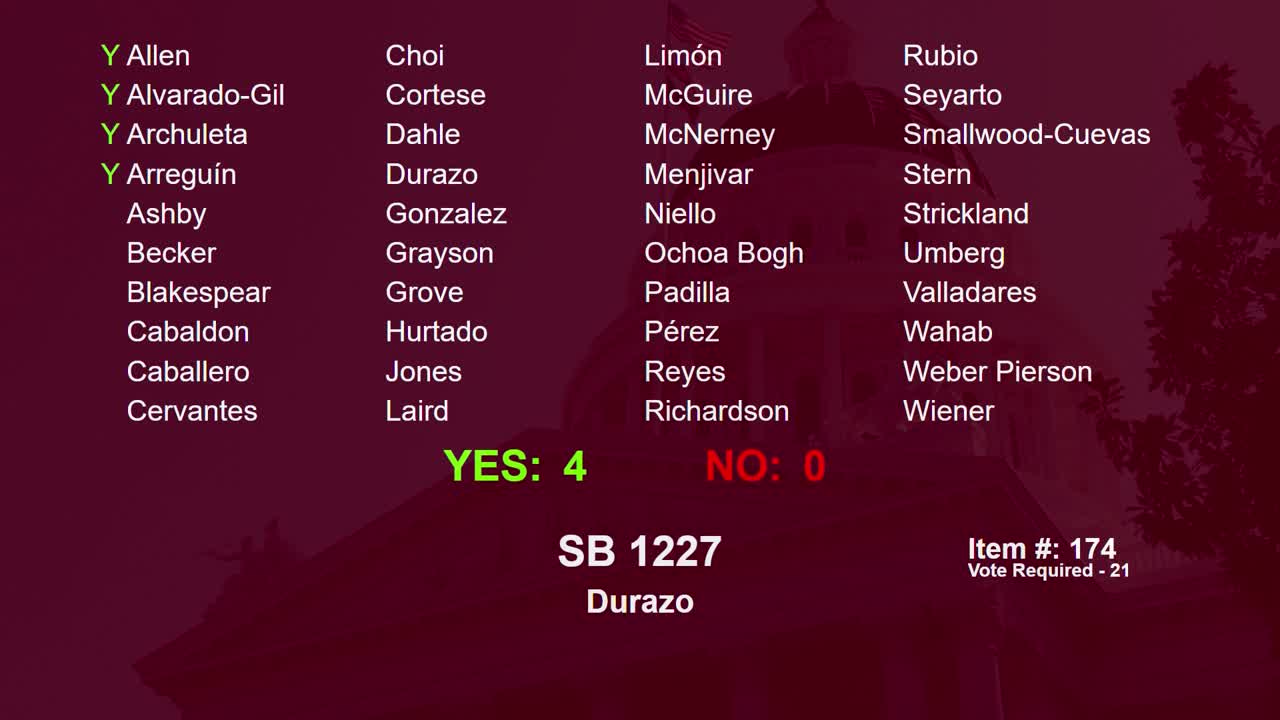 2MIN
Senate Floor
 18MIN
Senate Standing Committee on Privacy, Digital Technologies, and Consumer Protection
 43MIN
Senate Standing Committee on Transportation
Bill Author

Bill Co-Author(s):
