SB 1283: Electric vehicle charging stations: installation: permits.
- Session Year: 2025-2026
- House: Senate
- Latest Version Date: 2026-09-20
Current Status:
Passed
(2026-09-20: Chaptered by Secretary of State. Chapter 347, Statutes of 2026.)
Introduced
In Committee
Awaiting First Chamber Vote
Passed First Chamber
In Committee
Awaiting Second Chamber Vote
Passed Second Chamber
Enacted
Existing law requires a city, county, or city and county (local government) to administratively approve an application to install an electric vehicle charging station (EV station) through the issuance of a building permit or similar nondiscretionary permit. Existing law requires those EV stations to meet all applicable safety and performance standards established by specified entities.
This bill would require this administrative approval to extend to EV stations with a canopy, as defined, or onsite energy storage systems sized to support charging. This bill would also require any electric vehicle supply equipment installed at the EV station to meet all applicable safety and performance standards.
Existing law requires every local government to adopt, pursuant to specified deadlines, an ordinance that creates an expedited, streamlined permitting process for EV stations. Existing law requires the local government to adopt a checklist of all requirements with which the EV stations must comply with for expedited review.
This bill would require the ordinance to also address expedited streamlining for any supporting infrastructure necessary for or accessory to the operation of EV stations, as described, and would clarify that the checklist may be amended. The bill would require the ordinance and checklist to be amended to implement the bills provisions no later than December 31, 2027.
This bill would further provide that if the local government has not adopted or amended such a checklist, an application to install an EV station must contain specified information about the proposed project to the building official of the local government, including, but not limited to, the specific location of the EV station. The bill would require the Governors Office of Business and Economic Development (GO-Biz) to develop and publicly post a standardized form that applicants may use and submit to the local government for purposes of satisfying this requirement. The bill would also require GO-Biz to develop and publicly post an optional template that applicants may use to document their applications compliance with specified provisions relating to the submittal of their EV station application.
This bill would require a local government to provide, no later than 30 days after an application has been deemed approved, a written notice to the applicant of the date the application was deemed approved and identify all permits and authorizations that have been granted. The bill would authorize an applicant to proceed with project construction following that notice, as described.
This bill would prohibit its provisions from being construed to limit a local agencys ability to, among other things, require plans or supporting documentation that are necessary to verify an electric vehicle charging station, including supporting infrastructure, meets all health and safety requirements of local, state, and federal law, as provided.
This bill would make conforming changes and revise various definitions in these provisions, including by redefining an EV station for purposes of these provisions to mean a physical site where one or more devices with one or more charging ports and connectors for charging electric vehicles are available for use.
By imposing additional duties on local agencies, the bill would impose a state-mandated local program.
The California Constitution requires the state to reimburse local agencies and school districts for certain costs mandated by the state. Statutory provisions establish procedures for making that reimbursement.
This bill would provide that no reimbursement is required by this act for a specified reason.
Existing law requires a city, county, or city and county (local government) to administratively approve an application to install an electric vehicle charging station (EV station) through the issuance of a building permit or similar nondiscretionary permit. Existing law requires those EV stations to meet all applicable safety and performance standards established by specified entities.
This bill would require this administrative approval to extend to EV stations with a canopy, as defined, or onsite energy storage systems sized to support charging. This bill would also require any electric vehicle supply equipment installed at the EV station to meet all applicable safety and performance standards.
Existing law requires every local government to adopt, pursuant to specified deadlines, an ordinance that creates an expedited, streamlined permitting process for EV stations. Existing law requires the local government to adopt a checklist of all requirements with which the EV stations must comply with for expedited review.
This bill would require the ordinance to also address expedited streamlining for any supporting infrastructure necessary for or accessory to the operation of EV stations, as described, and would clarify that the checklist may be amended. The bill would require the ordinance and checklist to be amended to implement the bills provisions no later than December 31, 2027.
This bill would further provide that if the local government has not adopted or amended such a checklist, an application to install an EV station must contain specified information about the proposed project to the building official of the local government, including, but not limited to, the specific location of the EV station. The bill would require the Governors Office of Business and Economic Development (GO-Biz) to develop and publicly post a standardized form that applicants may use and submit to the local government for purposes of satisfying this requirement. The bill would also require GO-Biz to develop and publicly post an optional template that applicants may use to document their applications compliance with specified provisions relating to the submittal of their EV station application.
This bill would require a local government to provide, no later than 30 days after an application has been deemed approved, a written notice to the applicant of the date the application was deemed approved and identify all permits and authorizations that have been granted. The bill would authorize an applicant to proceed with project construction following that notice, as described.
This bill would authorize an applicant to institute a proceeding for injunctive relief, declaratory relief, or a writ of mandamus to enforce specified provisions of law relating to the approval of EV station applications. The bill would authorize a court to award attorneys fees and costs, including expert fees and costs, to a prevailing plaintiff if a certain condition is met.This bill would prohibit its provisions from being construed to limit a local agencys ability to, among other things, require plans or supporting documentation that are necessary to verify an electric vehicle charging station, including supporting infrastructure, meets all health and safety requirements of local, state, and federal law, as provided.
This bill would make conforming changes and revise various definitions in these provisions, including by redefining an EV station for purposes of these provisions to mean a physical site where one or more devices with one or more charging ports and connectors for charging electric vehicles are available for use.
By imposing additional duties on local agencies, the bill would impose a state-mandated local program.
The California Constitution requires the state to reimburse local agencies and school districts for certain costs mandated by the state. Statutory provisions establish procedures for making that reimbursement.
This bill would provide that no reimbursement is required by this act for a specified reason.
Existing law requires a city, county, or city and county (local government) to administratively approve an application to install an electric vehicle charging station (EV station) through the issuance of a building permit or similar nondiscretionary permit. Existing law requires those EV stations to meet all applicable safety and performance standards established by specified entities.
This bill would require this administrative approval to extend to EV stations with a canopy, as defined, or onsite energy storage systems sized to support charging. This bill would also require any electric vehicle supply equipment installed at the EV station to meet all applicable safety and performance standards.
Existing law requires every local government to adopt, pursuant to specified deadlines, an ordinance that creates an expedited, streamlined permitting process for EV stations. Existing law requires the local government to adopt a checklist of all requirements with which the EV stations must comply with for expedited review.
This bill would require the ordinance to also address expedited streamlining for any supporting infrastructure necessary for or accessory to the operation of EV stations, as described, and would clarify that the checklist may be amended. The bill would require the ordinance and checklist to be amended to implement the bills provisions no later than December 31, 2027.
This bill would further provide that if the local government has not adopted or amended such a checklist, an application to install an EV station must contain specified information about the proposed project to the building official of the local government, including, but not limited to, the specific location of the EV station. The bill would require the Governors Office of Business and Economic Development (GO-Biz) to develop and publicly post a standardized form that applicants may use and submit to the local government for purposes of satisfying this requirement. The bill would also require GO-Biz to develop and publicly post an optional template that applicants may use to document their applications compliance with specified provisions relating to the submittal of their EV station application.
This bill would require a local government to provide, no later than 30 days after an application has been deemed approved, a written notice to the applicant of the date the application was deemed approved and identify all permits and authorizations that have been granted. The bill would authorize an applicant to proceed with project construction following that notice, as described.
This bill would authorize an applicant to institute a proceeding for injunctive relief, declaratory relief, or a writ of mandamus to enforce specified provisions of law relating to the approval of EV station applications. The bill would require authorize a court to award attorneys fees and costs, including expert fees and costs, to a prevailing plaintiff. plaintiff if a certain condition is met.
This bill would prohibit its provisions from being construed to limit a local agencys ability to, among other things, require plans or supporting documentation that are necessary to verify an electric vehicle charging station, including supporting infrastructure, meets all health and safety requirements of local, state, and federal law, as provided.
This bill would make conforming changes and revise various definitions in these provisions, including by redefining an EV station for purposes of these provisions to mean a physical site where one or more devices with one or more charging ports and connectors for charging electric vehicles are available for use.
By imposing additional duties on local agencies, the bill would impose a state-mandated local program.
The California Constitution requires the state to reimburse local agencies and school districts for certain costs mandated by the state. Statutory provisions establish procedures for making that reimbursement.
This bill would provide that no reimbursement is required by this act for a specified reason.
Existing law requires a city, county, or city and county (local government) to administratively approve an application to install an electric vehicle charging station (EV station) through the issuance of a building permit or similar nondiscretionary permit. Existing law requires those EV stations to meet all applicable safety and performance standards established by specified entities.
This bill would require this administrative approval to extend to EV Stations stations with a canopy, as defined, and or onsite energy storage systems sized to support charging. This bill would also require any electric vehicle supply equipment installed at the EV station to meet all applicable safety and performance standards.
Existing law requires every local government to adopt, pursuant to specified deadlines, an ordinance that creates an expedited, streamlined permitting process for EV stations. Existing law requires the local government to adopt a checklist of all requirements with which the EV stations must comply with for expedited review.
This bill would require the ordinance to also address expedited streamlining for any supporting infrastructure necessary for or accessory to the operation of EV stations, as described, and would clarify the checklist may be amended. The bill would require the ordinance and checklist to be amended to implement the bills provisions no later than December 31, 2027.
This bill would further provide that if the local government has not adopted or amended such a checklist, an application to install an EV station must contain specified information about the proposed project to the building official of the local government, including, but not limited to, the specific location of the EV station. The bill would require the Governors Office of Business and Economic Development (GO-Biz) to develop and publicly post a standardized form that applicants may use and submit to the local government for purposes of satisfying this requirement. The bill would also require GO-Biz to develop and publicly post an optional template that applicants may use to document their applications compliance with specified provisions relating to the submittal of their EV station application.
This bill would require a local government to provide, no later than 30 days after an application has been deemed approved, a written notice to the applicant of the date the application was deemed approved and identify all permits and authorizations that have been granted. The bill would authorize an applicant to proceed with project construction following that notice, as described.
This bill would authorize an applicant to institute a proceeding for injunctive relief, declaratory relief, or a writ of mandamus to enforce specified provisions of law relating to the approval of EV station applications. The bill would require a court to award attorneys fees and costs, including expert fees and costs, to a prevailing plaintiff.
This bill would make conforming changes and revise various definitions in these provisions, including by redefining an EV Station station for purposes of these provisions to mean a physical site where one or more devices with one or more charging ports and connectors for charging electric vehicles are available for use.
By imposing additional duties on local agencies, the bill would impose a state-mandated local program.
The California Constitution requires the state to reimburse local agencies and school districts for certain costs mandated by the state. Statutory provisions establish procedures for making that reimbursement.
This bill would provide that no reimbursement is required by this act for a specified reason.
Existing law requires a city, county, or city and county (local government) to administratively approve an application to install an electric vehicle charging station (EV station) through the issuance of a building permit or similar nondiscretionary permit. Existing law requires those EV stations to meet all applicable safety and performance standards established by specified entities.
This bill would require this administrative approval to extend to EV Stations with a canopy, as defined, and onsite energy storage systems sized to support charging. This bill would also require any electric vehicle supply equipment installed at the EV station to meet all applicable safety and performance standards.
Existing law requires every local government to adopt, pursuant to specified deadlines, an ordinance that creates an expedited, streamlined permitting process for EV stations. Existing law requires the local government to adopt a checklist of all requirements with which the EV stations must comply with for expedited review.
This bill would require the ordinance to also address expedited streamlining for any supporting infrastructure necessary for or accessory to the operation of EV stations, as described, and would clarify the checklist may be amended. The bill would require the ordinance and checklist to be amended to implement the bills provisions no later than December 31, 2027.
This bill would further provide that if the local government has not adopted such a checklist, an application to install an EV station must contain specified information about the proposed project to the building official of the local government, including, but not limited to, the specific location of the EV station. The bill would require the Governors Office of Business and Economic Development (GO-Biz) to develop and publicly post a standardized form that applicants may use and submit to the local government for purposes of satisfying this requirement. The bill would also require GO-Biz to develop and publicly post an optional template that applicants may use to document their applications compliance with specified provisions relating to the submittal of their EV station application.
This bill would require a local government to provide, no later than 30 days after an application has been deemed approved, a written notice to the applicant of the date the application was deemed approved and identify all permits and authorizations that have been granted. The bill would authorize an applicant to proceed with project construction following that notice, as described.
This bill would authorize an applicant to institute a proceeding for injunctive relief, declaratory relief, or a writ of mandamus to enforce specified provisions of law relating to the approval of EV station applications. The bill would require a court to award attorneys fees and costs, including expert fees and costs, to a prevailing plaintiff.
This bill would make conforming changes and revise various definitions in these provisions, including by redefining an EV Station for purposes of these provisions to mean a physical site where one or more devices with one or more charging ports and connectors for charging electric vehicles are available for use.
By imposing additional duties on local agencies, the bill would impose a state-mandated local program.
The California Constitution requires the state to reimburse local agencies and school districts for certain costs mandated by the state. Statutory provisions establish procedures for making that reimbursement.
This bill would provide that no reimbursement is required by this act for a specified reason.
Existing law establishes the Department of Motor Vehicles in the Transportation Agency and sets forth the powers and duties of the department, as specified. Existing law regulates the accuracy of information provided to consumers during vehicle sales, including the information contained in advertising, brochures, and manuals, as specified. Existing law also requires a buy-here-pay-here dealer to disclose certain information regarding a used vehicle by affixing a label with certain information on the vehicle. Existing law prohibits a buy-here-pay-here dealer from disabling the vehicle using starter interrupt technology, unless certain conditions are met, and makes a violation of those provisions a misdemeanor. Existing law defines a buy-here-pay-here dealer as, among other things, a dealer who assigns less than 90% of all unrescinded conditional sale contracts and lease contracts to unaffiliated third-party finance or leasing sources within 45 days of the consummation of those contracts. This bill would amend that definition and extend that deadline to within 46 days of the consummation of those contracts. By expanding the application of an existing crime to more persons, this bill would impose a state-mandated local program.The California Constitution requires the state to reimburse local agencies and school districts for certain costs mandated by the state. Statutory provisions establish procedures for making that reimbursement.This bill would provide that no reimbursement is required by this act for a specified reason.Existing law establishes the Department of Motor Vehicles in the Transportation Agency and sets forth the powers and duties of the department, as specified. Existing law regulates the accuracy of information provided to consumers during vehicle sales, including the information contained in advertising, brochures, and manuals, as specified. Existing law also requires a buy-here-pay-here dealer to disclose certain information regarding a used vehicle by affixing a label with certain information on the vehicle. Existing law prohibits a buy-here-pay-here dealer from disabling the vehicle using starter interrupt technology, unless certain conditions are met, and makes a violation of those provisions a misdemeanor. Existing law defines a buy-here-pay-here dealer as, among other things, a dealer who assigns less than 90% of all unrescinded conditional sale contracts and lease contracts to unaffiliated third-party finance or leasing sources within 45 days of the consummation of those contracts.
This bill would amend that definition and extend that deadline to within 46 days of the consummation of those contracts. By expanding the application of an existing crime to more persons, this bill would impose a state-mandated local program.
The California Constitution requires the state to reimburse local agencies and school districts for certain costs mandated by the state. Statutory provisions establish procedures for making that reimbursement.
This bill would provide that no reimbursement is required by this act for a specified reason.
(a)The Legislature finds and declares all of the following:
(1)The implementation of consistent statewide standards to achieve the timely and cost-effective installation of electric vehicle charging stations and hydrogen-fueling stations is not a municipal affair, as that term is used in Section 5 of Article XI of the California Constitution, but is instead a matter of statewide concern. Therefore, this section applies to all cities, including charter cities.
(2)It is the intent of the Legislature that local agencies not adopt ordinances that create unreasonable barriers to the installation of zero-emission vehicle infrastructure and not unreasonably restrict the ability of homeowners and agricultural and business concerns to install electric vehicle charging and hydrogen-fueling stations.
(3)It is the policy of the state to promote and encourage the use of electric vehicle charging stations and hydrogen-fueling stations and to limit obstacles to their use.
(4)It is the intent of the Legislature that local agencies comply not only with the language of this section, but also the legislative intent to encourage the installation of electric vehicle charging stations and hydrogen-fueling stations by removing obstacles to, and minimizing costs of, permitting for charging and hydrogen-fueling stations so long as the action does not supersede the building officials authority to identify and address higher priority life-safety situations.
(b)(1)A city, county, or city and county shall administratively approve an application to install electric vehicle charging stations through the issuance of a building permit or similar nondiscretionary permit, including, but not limited to, an electric vehicle charging station with a canopy or onsite energy storage systems sized to support charging.
(2)A city, county, or city and county shall administratively approve an application to install hydrogen-fueling stations through the issuance of a building permit or similar nondiscretionary permit. This paragraph shall only apply to an application to install hydrogen-fueling stations on a parcel that satisfies either of the following:
(A)It is zoned for industrial or commercial development and does not contain any residential units.
(B)It was previously developed with a service station. For purposes of this subparagraph, service station means any establishment which offers for sale or sells gasoline or other motor vehicle fuel to the public.
(3)Review of an application to install an electric vehicle charging station or hydrogen-fueling station shall be limited to the building officials review of whether it meets all health and safety requirements of local, state, and federal law. The requirements of local law shall be limited to those standards and regulations necessary to ensure that the electric vehicle charging station or hydrogen-fueling station will not have a specific, adverse impact upon the public health or safety. However, if the building official of the city, county, or city and county makes a finding, based on substantial evidence, that the electric vehicle charging station or hydrogen-fueling station could have a specific, adverse impact upon the public health or safety, the city, county, or city and county may require the applicant to apply for a use permit.
(c)A city, county, or city and county may not deny an application for a use permit to install an electric vehicle charging station or hydrogen-fueling station unless it makes written findings based upon substantial evidence in the record that the proposed installation would have a specific, adverse impact upon the public health or safety, and there is no feasible method to satisfactorily mitigate or avoid the specific, adverse impact. The findings shall include the basis for the rejection of potential feasible alternatives of preventing the adverse impact.
(d)The decision of the building official pursuant to subdivisions (b) and (c) may be appealed to the planning commission of the city, county, or city and county.
(e)Any conditions imposed on an application to install an electric vehicle charging station or hydrogen-fueling station shall be designed to mitigate the specific, adverse impact upon the public health or safety at the lowest cost possible.
(f)(1)An electric vehicle charging station or hydrogen-fueling station shall meet applicable health and safety standards and requirements imposed by state and local permitting authorities.
(2)Any electric vehicle supply equipment installed at an electric vehicle charging station shall meet all applicable safety and performance standards established by the California Electrical Code, the Society of Automotive Engineers, the National Electrical Manufacturers Association, and accredited testing laboratories such as Underwriters Laboratories and, where applicable, rules of the Public Utilities Commission regarding safety and reliability, or rules of the Department of Food and Agriculture regarding safety, reliability, weights, and measures.
(3)A hydrogen-fueling station shall meet all of the following, as applicable:
(A)Safety and performance standards established by the Society of Automotive Engineers and accredited nationally recognized testing laboratories.
(B)All applicable state laws and regulations pertaining to hydrogen fueling, including any rules established by the State Air Resources Board, Energy Commission, or Department of Food and Agriculture regarding safety, reliability, weights, and measures.
(C)Guidance established by the Governors Office of Business and Economic Development, as outlined in the Hydrogen Station Permitting Guidebook.
(g)(1)(A)On or before September 30, 2016, every city, county, or city and county with a population of 200,000 or more residents, and, on or before September 30, 2017, every city, county, or city and county with a population of less than 200,000 residents, shall, in consultation with the local fire department or district and the utility director, if the city, county, or city and county operates a utility, adopt an ordinance, consistent with the goals and intent of this section, that creates an expedited, streamlined permitting process for electric vehicle charging stations, including any supporting infrastructure necessary for or accessory to the operation of the station. That supporting infrastructure includes, but is not limited to, any paving, concrete pad, utility trench, canopy, or onsite energy storage system sized to support electric vehicle charging. In developing an expedited permitting process, the city, county, or city and county shall adopt or amend a checklist of all requirements with which electric vehicle charging stations shall comply to be eligible for expedited review.
(B)On or before September 30, 2025, every city, county, or city and county with a population of 250,000 or more residents, and, on or before September 30, 2028, every city, county, or city and county with a population of fewer than 250,000 residents, shall, in consultation with the local fire department or district and the utility director, if the city, county, or city and county operates a utility, adopt an ordinance, consistent with the goals and intent of this section, that creates an expedited, streamlined permitting process for hydrogen-fueling stations that meet the requirements of paragraph (2) of subdivision (b). In developing an expedited permitting process, the city, county, or city and county shall adopt a checklist of all requirements with which hydrogen-fueling stations shall comply to be eligible for expedited review.
(C)Amendments to ordinances and checklists to implement the amendments to this section made by the act that added this subparagraph shall be completed no later than December 31, 2027.
(2)An application that satisfies the information requirements in either checklist adopted pursuant to paragraph (1), as determined by the city, county, or city and county, shall be deemed complete. Upon confirmation by the city, county, or city and county of the application and supporting documents being complete and meeting the requirements of the checklist, and consistent with the ordinance, a city, county, or city and county shall, consistent with subdivision (b), approve the application and issue all required permits or authorizations. However, the city, county, or city and county may establish a process to prioritize competing applications for expedited permits. Upon receipt of an incomplete application, a city, county, or city and county shall issue a written correction notice detailing all deficiencies in the application and any additional information required to be eligible for expedited permit issuance. An application submitted to a city, county, or city and county that owns and operates an electric utility shall demonstrate compliance with the utilitys interconnection policies prior to approval.
(3)Each checklist and required permitting documentation shall be published on a publicly accessible internet website, if the city, county, or city and county has an internet website, and the city, county, or city and county shall allow for electronic submittal of a permit application and associated documentation, and shall authorize the electronic signature on all forms, applications, and other documentation in lieu of a wet signature by an applicant. In developing the ordinance, the city, county, or city and county may refer to the recommendations contained in the most current version of the Electric Vehicle Charging Station Permitting Guidebook or the Hydrogen Station Permitting Guidebook published by the Governors Office of Business and Economic Development. A city, county, or city and county may adopt an ordinance that modifies the checklists and standards found in the guidebooks due to unique climactic, geological, seismological, or topographical conditions. If a city, county, or city and county determines that it is unable to authorize the acceptance of an electronic signature on all forms, applications, and other documents in lieu of a wet signature by an applicant, the city, county, or city and county shall state, in the ordinance required under this subdivision, the reasons for its inability to accept electronic signatures and acceptance of an electronic signature shall not be required.
(h)A city, county, or city and county shall not condition approval for any electric vehicle charging station or hydrogen-fueling station permit on the approval of the station by an association, as that term is defined in Section 4080 of the Civil Code.
(i)Nothing in this section or Section 65850.71 shall be construed to limit a local agencys ability to do either of the following for an electric vehicle charging station and any supporting infrastructure necessary for the operation of the electric vehicle charging station, including, but not limited to, a canopy or onsite energy storage system:
(1)(A)Require plans or supporting documentation that are necessary to verify the electric vehicle charging station, including supporting infrastructure, meets all health and safety requirements of local, state, and federal law.
(B)Plan checking and document review for an electric vehicle charging station, including supporting infrastructure necessary for the operation of the electric vehicle charging station, including, but not limited to, a canopy or onsite energy storage system, shall be conducted, completed, and approved in accordance with the expedited, streamlined permitting process established in this section and Section 65850.71.
(2)Conduct inspections or require the electric vehicle charging station, including supporting infrastructure, as built, to comply with all health and safety requirements of local, state, and federal law.
(j)The following definitions shall apply to this section:
(1)A feasible method to satisfactorily mitigate or avoid the specific, adverse impact includes, but is not limited to, any cost-effective method, condition, or mitigation imposed by a city, county, or city and county on another similarly situated application in a prior successful application for a permit.
(2)Canopy means an overhead covering structure with a clearance height of 17 feet or less, measured from ground level to the underside of the canopy, a canopy fascia width of 4 feet or less, and a coverage area of 5,000 square feet or less.
(3)Electronic submittal means the utilization of one or more of the following:
(A)Email.
(B)The internet.
(C)Facsimile.
(4)Electric vehicle charging station or charging station means a physical site where one or more EVSEs are available for use.
(5)Electric vehicle supply equipment or EVSE means a device with one or more charging ports and connectors for charging electric vehicles.
(6)Hydrogen-fueling station means the equipment and structural design components necessary to ensure the safety of the fueling station, including hydrogen-refueling canopies, that are used to store and dispense hydrogen fuel to vehicles according to industry codes and standards that are open to the public.
(7)Specific, adverse impact means a significant, quantifiable, direct, and unavoidable impact, based on objective, identified, and written public health or safety standards, policies, or conditions as they existed on the date the application was deemed complete.
(k)This section shall remain in effect only until January 1, 2030, and as of that date is repealed.
SEC. 2.Section 65850.7 of the Government Code, as amended by Section 2 of Chapter 607 of the Statutes of 2024, is amended to read:65850.7.(a)The Legislature finds and declares all of the following:
(1)The implementation of consistent statewide standards to achieve the timely and cost-effective installation of electric vehicle charging stations is not a municipal affair, as that term is used in Section 5 of Article XI of the California Constitution, but is instead a matter of statewide concern. Therefore, this section applies to all cities, including charter cities.
(2)It is the intent of the Legislature that local agencies not adopt ordinances that create unreasonable barriers to the installation of electric vehicle charging stations and not unreasonably restrict the ability of homeowners and agricultural and business concerns to install electric vehicle charging stations.
(3)It is the policy of the state to promote and encourage the use of electric vehicle charging stations and to limit obstacles to their use.
(4)It is the intent of the Legislature that local agencies comply not only with the language of this section, but also the legislative intent to encourage the installation of electric vehicle charging stations by removing obstacles to, and minimizing costs of, permitting for charging stations so long as the action does not supersede the building officials authority to identify and address higher priority life-safety situations.
(b)A city, county, or city and county shall administratively approve an application to install an electric vehicle charging station through the issuance of a building permit or similar nondiscretionary permit, including, but not limited to, an electric vehicle charging station with a canopy or onsite energy storage systems sized to support charging. Review of the application to install an electric vehicle charging station shall be limited to the building officials review of whether it meets all health and safety requirements of local, state, and federal law. The requirements of local law shall be limited to those standards and regulations necessary to ensure that the electric vehicle charging station will not have a specific, adverse impact upon the public health or safety. However, if the building official of the city, county, or city and county makes a finding, based on substantial evidence, that the electric vehicle charging station could have a specific, adverse impact upon the public health or safety, the city, county, or city and county may require the applicant to apply for a use permit.
(c)A city, county, or city and county may not deny an application for a use permit to install an electric vehicle charging station unless it makes written findings based upon substantial evidence in the record that the proposed installation would have a specific, adverse impact upon the public health or safety, and there is no feasible method to satisfactorily mitigate or avoid the specific, adverse impact. The findings shall include the basis for the rejection of potential feasible alternatives of preventing the adverse impact.
(d)The decision of the building official pursuant to subdivisions (b) and (c) may be appealed to the planning commission of the city, county, or city and county.
(e)Any conditions imposed on an application to install an electric vehicle charging station shall be designed to mitigate the specific, adverse impact upon the public health or safety at the lowest cost possible.
(f)(1)An electric vehicle charging station shall meet applicable health and safety standards and requirements imposed by state and local permitting authorities.
(2)Any electric vehicle supply equipment installed at the electric vehicle charging station shall meet all applicable safety and performance standards established by the California Electrical Code, the Society of Automotive Engineers, the National Electrical Manufacturers Association, and accredited testing laboratories such as Underwriters Laboratories and, where applicable, rules of the Public Utilities Commission regarding safety and reliability, or rules of the Department of Food and Agriculture regarding safety, reliability, weights, and measures.
(g)(1)(A)On or before September 30, 2016, every city, county, or city and county with a population of 200,000 or more residents, and, on or before September 30, 2017, every city, county, or city and county with a population of less than 200,000 residents, shall, in consultation with the local fire department or district and the utility director, if the city, county, or city and county operates a utility, adopt an ordinance, consistent with the goals and intent of this section, that creates an expedited, streamlined permitting process for electric vehicle charging stations, including any supporting infrastructure necessary for or accessory to the operation of the station. That supporting infrastructure includes, but is not limited to, any paving, concrete pad, utility trench, canopy, or onsite energy storage system sized to support electric vehicle charging.
(B)In developing an expedited permitting process, the city, county, or city and county shall adopt or amend a checklist of all requirements with which electric vehicle charging stations shall comply to be eligible for expedited review. An application that satisfies the information requirements in the checklist, as determined by the city, county, or city and county, shall be deemed complete. Upon confirmation by the city, county, or city and county of the application and supporting documents being complete and meeting the requirements of the checklist, and consistent with the ordinance, a city, county, or city and county shall, consistent with subdivision (b), approve the application and issue all required permits or authorizations. However, the city, county, or city and county may establish a process to prioritize competing applications for expedited permits. Upon receipt of an incomplete application, a city, county, or city and county shall issue a written correction notice detailing all deficiencies in the application and any additional information required to be eligible for expedited permit issuance. An application submitted to a city, county, or city and county that owns and operates an electric utility shall demonstrate compliance with the utilitys interconnection policies prior to approval.
(C)Amendments to ordinances and checklists to implement the amendments to this section made by the act that added this subparagraph shall be completed no later than December 31, 2027.
(2)The checklist and required permitting documentation shall be published on a publicly accessible internet website, if the city, county, or city and county has an internet website, and the city, county, or city and county shall allow for electronic submittal of a permit application and associated documentation, and shall authorize the electronic signature on all forms, applications, and other documentation in lieu of a wet signature by an applicant. In developing the ordinance, the city, county, or city and county may refer to the recommendations contained in the most current version of the Electric Vehicle Charging Station Permitting Guidebook published by the Governors Office of Business and Economic Development. A city, county, or city and county may adopt an ordinance that modifies the checklists and standards found in the guidebook due to unique climactic, geological, seismological, or topographical conditions. If a city, county, or city and county determines that it is unable to authorize the acceptance of an electronic signature on all forms, applications, and other documents in lieu of a wet signature by an applicant, the city, county, or city and county shall state, in the ordinance required under this subdivision, the reasons for its inability to accept electronic signatures and acceptance of an electronic signature shall not be required.
(h)A city, county, or city and county shall not condition approval for any electric vehicle charging station permit on the approval of an electric vehicle charging station by an association, as that term is defined in Section 4080 of the Civil Code.
(i)Nothing in this section or Section 65850.71 shall be construed to limit a local agencys ability to do either of the following for an electric vehicle charging station and any supporting infrastructure necessary for the operation of the electric vehicle charging station, including, but not limited to, a canopy or onsite energy storage system:
(1)(A)Require plans or supporting documentation that are necessary to verify the electric vehicle charging station, including supporting infrastructure, meets all health and safety requirements of local, state, and federal law.
(B)Plan checking and document review for an electric vehicle charging station, including supporting infrastructure necessary for the operation of the electric vehicle charging station, including, but not limited to, a canopy or onsite energy storage system, shall be conducted, completed, and approved in accordance with the expedited, streamlined permitting process established in this section and Section 65850.71.
(2)Conduct inspections or require the electric vehicle charging station, including supporting infrastructure, as built, to comply with all health and safety requirements of local, state, and federal law.
(j)The following definitions shall apply to this section:
(1)A feasible method to satisfactorily mitigate or avoid the specific, adverse impact includes, but is not limited to, any cost-effective method, condition, or mitigation imposed by a city, county, or city and county on another similarly situated application in a prior successful application for a permit.
(2)Canopy means an overhead covering structure with a clearance height of 17 feet or less, measured from ground level to the underside of the canopy, a canopy fascia width of 4 feet or less, and a coverage area of 5,000 square feet or less.
(3)Electronic submittal means the utilization of one or more of the following:
(A)Email.
(B)The internet.
(C)Facsimile.
(4)Electric vehicle charging station or charging station means a physical site where one or more EVSEs are available for use.
(5)Electric vehicle supply equipment or EVSE means a device with one or more charging ports and connectors for charging electric vehicles.
(6)Specific, adverse impact means a significant, quantifiable, direct, and unavoidable impact, based on objective, identified, and written public health or safety standards, policies, or conditions as they existed on the date the application was deemed complete.
(k)This section shall become operative on January 1, 2030.
SEC. 3.Section 65850.71 of the Government Code is amended to read:65850.71.(a)The Legislature finds and declares both of the following:
(1)An electric vehicle charging station has a significant economic impact in California and is not a municipal affair, as that term is used in Section 5 of Article XI of the California Constitution, but is instead a matter of statewide concern. Therefore, this section applies to all cities, including charter cities.
(2)Table 3 of the Governors Office of Business and Economic Development (GO-Biz) Electric Vehicle Charging Station Permitting Guidebook, published July 2019, recommends best practices for electric vehicle supply equipment permitting that would establish a 15-day timeline and satisfy the intent of Assembly Bill 1236 (Chapter 598 of the Statutes of 2015).
(b)(1)An application to install an electric vehicle charging station submitted to the building official of a city, county, or city and county shall be deemed complete if, after the applicable time period described in paragraph (2) has elapsed, both of the following are true:
(A)The building official of the city, county, or city and county has not deemed the application complete, consistent with the checklist adopted by the city, county, or city and county pursuant to subdivision (g) of Section 65850.7, or if none has been adopted, consistent with the information listed in subdivision (f).
(B)The building official of the city, county, or city and county has not issued a written correction notice detailing all deficiencies in the application and identifying any additional information explicitly necessary for the building official to complete a review limited to whether the electric vehicle charging station meets all health and safety requirements of local, state, and federal law, consistent with subdivisions (b) and (g) of Section 65850.7.
(2)For purposes of paragraph (1), applicable time period means either of the following:
(A)Five business days after submission of the application to the city, county, or city and county, if the application is for at least 1, but not more than 25 EVSEs at a single site.
(B)Ten business days after submission of the application to the city, county, or city and county, if the application is for more than 25 EVSEs at a single site.
(c)(1)Notwithstanding subdivision (g), an application to install an electric vehicle charging station shall be deemed approved, with no notice or public hearing required, if the applicable time period described in paragraph (2) has elapsed and all of the following are true:
(A)The building official of the city, county, or city and county has not administratively approved the application pursuant to subdivision (b) of Section 65850.7.
(B)The building official of the city, county, or city and county has not made a finding, based on substantial evidence, that the electric vehicle charging station could have a specific adverse impact upon the public health or safety or required the applicant to apply for a use permit pursuant to subdivision (b) of Section 65850.7.
(C)The building official of the city, county, or city and county has not denied the permit pursuant to subdivision (c) of Section 65850.7.
(D)An appeal has not been made to the planning commission of the city, county, or city and county, pursuant to subdivision (d) of Section 65850.7.
(2)For purposes of paragraph (1), applicable time period means either of the following:
(A)Twenty business days after the application was deemed complete, if the application is for at least 1, but not more than 25 EVSEs at a single site.
(B)Forty business days after the application was deemed complete, if the application is for more than 25 EVSEs at a single site.
(d)If an electric vehicle charging station and any associated equipment interfere with, reduce, eliminate, or in any way impact the required parking spaces for existing uses, the city, county, or city and county shall reduce the number of required parking spaces for the existing uses by the amount necessary to accommodate the electric vehicle charging station and any associated equipment.
(e)If the electric vehicle charging station is being installed in an area that receives electrical service from a local publicly owned electric utility, this section does not expand or restrict the local publicly owned electric utilitys role and responsibility in providing new electric service to the electric vehicle charging station in a manner consistent with safety, reliability, and engineering requirements.
(f)(1)If a city, county, or city and county has not adopted or amended an ordinance or checklist pursuant to subdivision (g) of Section 65850.7, an application to install an electric vehicle charging station shall contain all of the following information about the proposed project to the building official of the city, county, or city and county:
(A)The specific location, including parcel numbers, a legal description, and site address, if applicable.
(B)The number of EVSE units proposed to be installed.
(C)Contact information for the applicant and the property owner.
(D)The proposed input and output voltage or, if applicable, the voltage range for each proposed EVSE model.
(E)The maximum output power of each proposed EVSE model in kilowatts.
(F)The manufacturer and model number of each proposed EVSE model.
(G)The system voltage or, if applicable, voltages for the electric vehicle charging station project.
(H)The rating of existing main electrical service equipment in amperes.
(I)The rating of circuit for EVSE in volts, amperes, and poles.
(J)The ampere-interrupting capacity for EVSE circuit breakers.
(K)The connected load, calculated load, or demand load of existing panel supplying EVSE in amperes.
(L)Total existing load plus total new EVSE load in amperes.
(M)Maximum site grade in percentages.
(N)If present, canopy area in square feet, canopy clearance height in feet, and total canopy height in feet.
(O)If proposed, the total energy capacity in kilowatthours of any onsite energy storage system supporting EVSE.
(P)Documentation demonstrating compliance with the requirements of subdivisions (b) and (f) of Section 65850.7, as applicable.(2)Paragraph (1) shall also apply in cases where the ordinance or checklist have not been amended, whether before or after December 31, 2027, to implement the changes described in subparagraph (C) of paragraph (1) of subdivision (g) of Section 65850.7.
(3)(A)The Governors Office of Business and Economic Development shall adopt a standardized form that applicants for electric vehicle charging stations may use for purposes of satisfying the requirements for submittal specified in paragraph (1).
(B)The Governors Office of Business and Economic Development shall also develop and publicly post a template that applicants may use to document their applications compliance with subdivisions (b) and (c) and submit to the applicable city, county, or city and county. However, submittal of this document is voluntary and is not a prerequisite for the requirements of subdivision (g) to apply.
(g)No later than 30 days after an application has been deemed approved pursuant to subdivision (c), the applicable city, county, or city and county shall provide written notice to the applicant of the date the application was deemed approved in accordance with paragraph (1) of subdivision (c) and identify all permits and authorizations that have been granted accordingly. An applicant may proceed with construction of the project described in a deemed approved application prior to receipt of this letter.
(h)For purposes of this section, EVSE has the same meaning as defined in Section 65850.7.
(i)(1)This section shall become operative on January 1, 2022, but for every city, county, or city and county with a population of less than 200,000 residents, this section shall apply beginning on January 1, 2023.
(2)The amendments made by the act that added this paragraph shall become operative on January 1, 2027.
SEC. 4.No reimbursement is required by this act pursuant to Section 6 of Article XIIIB of the California Constitution because a local agency or school district has the authority to levy service charges, fees, or assessments sufficient to pay for the program or level of service mandated by this act, within the meaning of Section 17556 of the Government Code.
(a)The Legislature finds and declares all of the following:
(1)The implementation of consistent statewide standards to achieve the timely and cost-effective installation of electric vehicle charging stations and hydrogen-fueling stations is not a municipal affair, as that term is used in Section 5 of Article XI of the California Constitution, but is instead a matter of statewide concern. Therefore, this section applies to all cities, including charter cities.
(2)It is the intent of the Legislature that local agencies not adopt ordinances that create unreasonable barriers to the installation of zero-emission vehicle infrastructure and not unreasonably restrict the ability of homeowners and agricultural and business concerns to install electric vehicle charging and hydrogen-fueling stations.
(3)It is the policy of the state to promote and encourage the use of electric vehicle charging stations and hydrogen-fueling stations and to limit obstacles to their use.
(4)It is the intent of the Legislature that local agencies comply not only with the language of this section, but also the legislative intent to encourage the installation of electric vehicle charging stations and hydrogen-fueling stations by removing obstacles to, and minimizing costs of, permitting for charging and hydrogen-fueling stations so long as the action does not supersede the building officials authority to identify and address higher priority life-safety situations.
(b)(1)A city, county, or city and county shall administratively approve an application to install electric vehicle charging stations through the issuance of a building permit or similar nondiscretionary permit, including, but not limited to, an electric vehicle charging station with a canopy or onsite energy storage systems sized to support charging.
(2)A city, county, or city and county shall administratively approve an application to install hydrogen-fueling stations through the issuance of a building permit or similar nondiscretionary permit. This paragraph shall only apply to an application to install hydrogen-fueling stations on a parcel that satisfies either of the following:
(A)It is zoned for industrial or commercial development and does not contain any residential units.
(B)It was previously developed with a service station. For purposes of this subparagraph, service station means any establishment which offers for sale or sells gasoline or other motor vehicle fuel to the public.
(3)Review of an application to install an electric vehicle charging station or hydrogen-fueling station shall be limited to the building officials review of whether it meets all health and safety requirements of local, state, and federal law. The requirements of local law shall be limited to those standards and regulations necessary to ensure that the electric vehicle charging station or hydrogen-fueling station will not have a specific, adverse impact upon the public health or safety. However, if the building official of the city, county, or city and county makes a finding, based on substantial evidence, that the electric vehicle charging station or hydrogen-fueling station could have a specific, adverse impact upon the public health or safety, the city, county, or city and county may require the applicant to apply for a use permit.
(c)A city, county, or city and county may not deny an application for a use permit to install an electric vehicle charging station or hydrogen-fueling station unless it makes written findings based upon substantial evidence in the record that the proposed installation would have a specific, adverse impact upon the public health or safety, and there is no feasible method to satisfactorily mitigate or avoid the specific, adverse impact. The findings shall include the basis for the rejection of potential feasible alternatives of preventing the adverse impact.
(d)The decision of the building official pursuant to subdivisions (b) and (c) may be appealed to the planning commission of the city, county, or city and county.
(e)Any conditions imposed on an application to install an electric vehicle charging station or hydrogen-fueling station shall be designed to mitigate the specific, adverse impact upon the public health or safety at the lowest cost possible.
(f)(1)An electric vehicle charging station or hydrogen-fueling station shall meet applicable health and safety standards and requirements imposed by state and local permitting authorities.
(2)Any electric vehicle supply equipment installed at an electric vehicle charging station shall meet all applicable safety and performance standards established by the California Electrical Code, the Society of Automotive Engineers, the National Electrical Manufacturers Association, and accredited testing laboratories such as Underwriters Laboratories and, where applicable, rules of the Public Utilities Commission regarding safety and reliability, or rules of the Department of Food and Agriculture regarding safety, reliability, weights, and measures.
(3)A hydrogen-fueling station shall meet all of the following, as applicable:
(A)Safety and performance standards established by the Society of Automotive Engineers and accredited nationally recognized testing laboratories.
(B)All applicable state laws and regulations pertaining to hydrogen fueling, including any rules established by the State Air Resources Board, Energy Commission, or Department of Food and Agriculture regarding safety, reliability, weights, and measures.
(C)Guidance established by the Governors Office of Business and Economic Development, as outlined in the Hydrogen Station Permitting Guidebook.
(g)(1)(A)On or before September 30, 2016, every city, county, or city and county with a population of 200,000 or more residents, and, on or before September 30, 2017, every city, county, or city and county with a population of less than 200,000 residents, shall, in consultation with the local fire department or district and the utility director, if the city, county, or city and county operates a utility, adopt an ordinance, consistent with the goals and intent of this section, that creates an expedited, streamlined permitting process for electric vehicle charging stations, including any supporting infrastructure necessary for or accessory to the operation of the station. That supporting infrastructure includes, but is not limited to, any paving, concrete pad, utility trench, canopy, or onsite energy storage system sized to support electric vehicle charging. In developing an expedited permitting process, the city, county, or city and county shall adopt or amend a checklist of all requirements with which electric vehicle charging stations shall comply to be eligible for expedited review.
(B)On or before September 30, 2025, every city, county, or city and county with a population of 250,000 or more residents, and, on or before September 30, 2028, every city, county, or city and county with a population of fewer than 250,000 residents, shall, in consultation with the local fire department or district and the utility director, if the city, county, or city and county operates a utility, adopt an ordinance, consistent with the goals and intent of this section, that creates an expedited, streamlined permitting process for hydrogen-fueling stations that meet the requirements of paragraph (2) of subdivision (b). In developing an expedited permitting process, the city, county, or city and county shall adopt a checklist of all requirements with which hydrogen-fueling stations shall comply to be eligible for expedited review.
(C)Amendments to ordinances and checklists to implement the amendments to this section made by the act that added this subparagraph shall be completed no later than December 31, 2027.
(2)An application that satisfies the information requirements in either checklist adopted pursuant to paragraph (1), as determined by the city, county, or city and county, shall be deemed complete. Upon confirmation by the city, county, or city and county of the application and supporting documents being complete and meeting the requirements of the checklist, and consistent with the ordinance, a city, county, or city and county shall, consistent with subdivision (b), approve the application and issue all required permits or authorizations. However, the city, county, or city and county may establish a process to prioritize competing applications for expedited permits. Upon receipt of an incomplete application, a city, county, or city and county shall issue a written correction notice detailing all deficiencies in the application and any additional information required to be eligible for expedited permit issuance. An application submitted to a city, county, or city and county that owns and operates an electric utility shall demonstrate compliance with the utilitys interconnection policies prior to approval.
(3)Each checklist and required permitting documentation shall be published on a publicly accessible internet website, if the city, county, or city and county has an internet website, and the city, county, or city and county shall allow for electronic submittal of a permit application and associated documentation, and shall authorize the electronic signature on all forms, applications, and other documentation in lieu of a wet signature by an applicant. In developing the ordinance, the city, county, or city and county may refer to the recommendations contained in the most current version of the Electric Vehicle Charging Station Permitting Guidebook or the Hydrogen Station Permitting Guidebook published by the Governors Office of Business and Economic Development. A city, county, or city and county may adopt an ordinance that modifies the checklists and standards found in the guidebooks due to unique climactic, geological, seismological, or topographical conditions. If a city, county, or city and county determines that it is unable to authorize the acceptance of an electronic signature on all forms, applications, and other documents in lieu of a wet signature by an applicant, the city, county, or city and county shall state, in the ordinance required under this subdivision, the reasons for its inability to accept electronic signatures and acceptance of an electronic signature shall not be required.
(h)A city, county, or city and county shall not condition approval for any electric vehicle charging station or hydrogen-fueling station permit on the approval of the station by an association, as that term is defined in Section 4080 of the Civil Code.
(i)Nothing in this section or Section 65850.71 shall be construed to limit a local agencys ability to do either of the following for an electric vehicle charging station and any supporting infrastructure necessary for the operation of the electric vehicle charging station, including, but not limited to, a canopy or onsite energy storage system:
(1)(A)Require plans or supporting documentation that are necessary to verify the electric vehicle charging station, including supporting infrastructure, meets all health and safety requirements of local, state, and federal law.
(B)Plan checking and document review for an electric vehicle charging station, including supporting infrastructure necessary for the operation of the electric vehicle charging station, including, but not limited to, a canopy or onsite energy storage system, shall be conducted, completed, and approved in accordance with the expedited, streamlined permitting process established in this section and Section 65850.71.
(2)Conduct inspections or require the electric vehicle charging station, including supporting infrastructure, as built, to comply with all health and safety requirements of local, state, and federal law.
(j)The following definitions shall apply to this section:
(1)A feasible method to satisfactorily mitigate or avoid the specific, adverse impact includes, but is not limited to, any cost-effective method, condition, or mitigation imposed by a city, county, or city and county on another similarly situated application in a prior successful application for a permit.
(2)Canopy means an overhead covering structure with a clearance height of 17 feet or less, measured from ground level to the underside of the canopy, a canopy fascia width of 4 feet or less, and a coverage area of 5,000 square feet or less.
(3)Electronic submittal means the utilization of one or more of the following:
(A)Email.
(B)The internet.
(C)Facsimile.
(4)Electric vehicle charging station or charging station means a physical site where one or more EVSEs are available for use.
(5)Electric vehicle supply equipment or EVSE means a device with one or more charging ports and connectors for charging electric vehicles.
(6)Hydrogen-fueling station means the equipment and structural design components necessary to ensure the safety of the fueling station, including hydrogen-refueling canopies, that are used to store and dispense hydrogen fuel to vehicles according to industry codes and standards that are open to the public.
(7)Specific, adverse impact means a significant, quantifiable, direct, and unavoidable impact, based on objective, identified, and written public health or safety standards, policies, or conditions as they existed on the date the application was deemed complete.
(k)This section shall remain in effect only until January 1, 2030, and as of that date is repealed.
SEC. 2.Section 65850.7 of the Government Code, as amended by Section 2 of Chapter 607 of the Statutes of 2024, is amended to read:65850.7.(a)The Legislature finds and declares all of the following:
(1)The implementation of consistent statewide standards to achieve the timely and cost-effective installation of electric vehicle charging stations is not a municipal affair, as that term is used in Section 5 of Article XI of the California Constitution, but is instead a matter of statewide concern. Therefore, this section applies to all cities, including charter cities.
(2)It is the intent of the Legislature that local agencies not adopt ordinances that create unreasonable barriers to the installation of electric vehicle charging stations and not unreasonably restrict the ability of homeowners and agricultural and business concerns to install electric vehicle charging stations.
(3)It is the policy of the state to promote and encourage the use of electric vehicle charging stations and to limit obstacles to their use.
(4)It is the intent of the Legislature that local agencies comply not only with the language of this section, but also the legislative intent to encourage the installation of electric vehicle charging stations by removing obstacles to, and minimizing costs of, permitting for charging stations so long as the action does not supersede the building officials authority to identify and address higher priority life-safety situations.
(b)A city, county, or city and county shall administratively approve an application to install an electric vehicle charging station through the issuance of a building permit or similar nondiscretionary permit, including, but not limited to, an electric vehicle charging station with a canopy or onsite energy storage systems sized to support charging. Review of the application to install an electric vehicle charging station shall be limited to the building officials review of whether it meets all health and safety requirements of local, state, and federal law. The requirements of local law shall be limited to those standards and regulations necessary to ensure that the electric vehicle charging station will not have a specific, adverse impact upon the public health or safety. However, if the building official of the city, county, or city and county makes a finding, based on substantial evidence, that the electric vehicle charging station could have a specific, adverse impact upon the public health or safety, the city, county, or city and county may require the applicant to apply for a use permit.
(c)A city, county, or city and county may not deny an application for a use permit to install an electric vehicle charging station unless it makes written findings based upon substantial evidence in the record that the proposed installation would have a specific, adverse impact upon the public health or safety, and there is no feasible method to satisfactorily mitigate or avoid the specific, adverse impact. The findings shall include the basis for the rejection of potential feasible alternatives of preventing the adverse impact.
(d)The decision of the building official pursuant to subdivisions (b) and (c) may be appealed to the planning commission of the city, county, or city and county.
(e)Any conditions imposed on an application to install an electric vehicle charging station shall be designed to mitigate the specific, adverse impact upon the public health or safety at the lowest cost possible.
(f)(1)An electric vehicle charging station shall meet applicable health and safety standards and requirements imposed by state and local permitting authorities.
(2)Any electric vehicle supply equipment installed at the electric vehicle charging station shall meet all applicable safety and performance standards established by the California Electrical Code, the Society of Automotive Engineers, the National Electrical Manufacturers Association, and accredited testing laboratories such as Underwriters Laboratories and, where applicable, rules of the Public Utilities Commission regarding safety and reliability, or rules of the Department of Food and Agriculture regarding safety, reliability, weights, and measures.
(g)(1)(A)On or before September 30, 2016, every city, county, or city and county with a population of 200,000 or more residents, and, on or before September 30, 2017, every city, county, or city and county with a population of less than 200,000 residents, shall, in consultation with the local fire department or district and the utility director, if the city, county, or city and county operates a utility, adopt an ordinance, consistent with the goals and intent of this section, that creates an expedited, streamlined permitting process for electric vehicle charging stations, including any supporting infrastructure necessary for or accessory to the operation of the station. That supporting infrastructure includes, but is not limited to, any paving, concrete pad, utility trench, canopy, or onsite energy storage system sized to support electric vehicle charging.
(B)In developing an expedited permitting process, the city, county, or city and county shall adopt or amend a checklist of all requirements with which electric vehicle charging stations shall comply to be eligible for expedited review. An application that satisfies the information requirements in the checklist, as determined by the city, county, or city and county, shall be deemed complete. Upon confirmation by the city, county, or city and county of the application and supporting documents being complete and meeting the requirements of the checklist, and consistent with the ordinance, a city, county, or city and county shall, consistent with subdivision (b), approve the application and issue all required permits or authorizations. However, the city, county, or city and county may establish a process to prioritize competing applications for expedited permits. Upon receipt of an incomplete application, a city, county, or city and county shall issue a written correction notice detailing all deficiencies in the application and any additional information required to be eligible for expedited permit issuance. An application submitted to a city, county, or city and county that owns and operates an electric utility shall demonstrate compliance with the utilitys interconnection policies prior to approval.
(C)Amendments to ordinances and checklists to implement the amendments to this section made by the act that added this subparagraph shall be completed no later than December 31, 2027.
(2)The checklist and required permitting documentation shall be published on a publicly accessible internet website, if the city, county, or city and county has an internet website, and the city, county, or city and county shall allow for electronic submittal of a permit application and associated documentation, and shall authorize the electronic signature on all forms, applications, and other documentation in lieu of a wet signature by an applicant. In developing the ordinance, the city, county, or city and county may refer to the recommendations contained in the most current version of the Electric Vehicle Charging Station Permitting Guidebook published by the Governors Office of Business and Economic Development. A city, county, or city and county may adopt an ordinance that modifies the checklists and standards found in the guidebook due to unique climactic, geological, seismological, or topographical conditions. If a city, county, or city and county determines that it is unable to authorize the acceptance of an electronic signature on all forms, applications, and other documents in lieu of a wet signature by an applicant, the city, county, or city and county shall state, in the ordinance required under this subdivision, the reasons for its inability to accept electronic signatures and acceptance of an electronic signature shall not be required.
(h)A city, county, or city and county shall not condition approval for any electric vehicle charging station permit on the approval of an electric vehicle charging station by an association, as that term is defined in Section 4080 of the Civil Code.
(i)Nothing in this section or Section 65850.71 shall be construed to limit a local agencys ability to do either of the following for an electric vehicle charging station and any supporting infrastructure necessary for the operation of the electric vehicle charging station, including, but not limited to, a canopy or onsite energy storage system:
(1)(A)Require plans or supporting documentation that are necessary to verify the electric vehicle charging station, including supporting infrastructure, meets all health and safety requirements of local, state, and federal law.
(B)Plan checking and document review for an electric vehicle charging station, including supporting infrastructure necessary for the operation of the electric vehicle charging station, including, but not limited to, a canopy or onsite energy storage system, shall be conducted, completed, and approved in accordance with the expedited, streamlined permitting process established in this section and Section 65850.71.
(2)Conduct inspections or require the electric vehicle charging station, including supporting infrastructure, as built, to comply with all health and safety requirements of local, state, and federal law.
(j)The following definitions shall apply to this section:
(1)A feasible method to satisfactorily mitigate or avoid the specific, adverse impact includes, but is not limited to, any cost-effective method, condition, or mitigation imposed by a city, county, or city and county on another similarly situated application in a prior successful application for a permit.
(2)Canopy means an overhead covering structure with a clearance height of 17 feet or less, measured from ground level to the underside of the canopy, a canopy fascia width of 4 feet or less, and a coverage area of 5,000 square feet or less.
(3)Electronic submittal means the utilization of one or more of the following:
(A)Email.
(B)The internet.
(C)Facsimile.
(4)Electric vehicle charging station or charging station means a physical site where one or more EVSEs are available for use.
(5)Electric vehicle supply equipment or EVSE means a device with one or more charging ports and connectors for charging electric vehicles.
(6)Specific, adverse impact means a significant, quantifiable, direct, and unavoidable impact, based on objective, identified, and written public health or safety standards, policies, or conditions as they existed on the date the application was deemed complete.
(k)This section shall become operative on January 1, 2030.
SEC. 3.Section 65850.71 of the Government Code is amended to read:65850.71.(a)The Legislature finds and declares both of the following:
(1)An electric vehicle charging station has a significant economic impact in California and is not a municipal affair, as that term is used in Section 5 of Article XI of the California Constitution, but is instead a matter of statewide concern. Therefore, this section applies to all cities, including charter cities.
(2)Table 3 of the Governors Office of Business and Economic Development (GO-Biz) Electric Vehicle Charging Station Permitting Guidebook, published July 2019, recommends best practices for electric vehicle supply equipment permitting that would establish a 15-day timeline and satisfy the intent of Assembly Bill 1236 (Chapter 598 of the Statutes of 2015).
(b)(1)An application to install an electric vehicle charging station submitted to the building official of a city, county, or city and county shall be deemed complete if, after the applicable time period described in paragraph (2) has elapsed, both of the following are true:
(A)The building official of the city, county, or city and county has not deemed the application complete, consistent with the checklist adopted by the city, county, or city and county pursuant to subdivision (g) of Section 65850.7, or if none has been adopted, consistent with the information listed in subdivision (f).
(B)The building official of the city, county, or city and county has not issued a written correction notice detailing all deficiencies in the application and identifying any additional information explicitly necessary for the building official to complete a review limited to whether the electric vehicle charging station meets all health and safety requirements of local, state, and federal law, consistent with subdivisions (b) and (g) of Section 65850.7.
(2)For purposes of paragraph (1), applicable time period means either of the following:
(A)Five business days after submission of the application to the city, county, or city and county, if the application is for at least 1, but not more than 25 EVSEs at a single site.
(B)Ten business days after submission of the application to the city, county, or city and county, if the application is for more than 25 EVSEs at a single site.
(c)(1)Notwithstanding subdivision (g), an application to install an electric vehicle charging station shall be deemed approved, with no notice or public hearing required, if the applicable time period described in paragraph (2) has elapsed and all of the following are true:
(A)The building official of the city, county, or city and county has not administratively approved the application pursuant to subdivision (b) of Section 65850.7.
(B)The building official of the city, county, or city and county has not made a finding, based on substantial evidence, that the electric vehicle charging station could have a specific adverse impact upon the public health or safety or required the applicant to apply for a use permit pursuant to subdivision (b) of Section 65850.7.
(C)The building official of the city, county, or city and county has not denied the permit pursuant to subdivision (c) of Section 65850.7.
(D)An appeal has not been made to the planning commission of the city, county, or city and county, pursuant to subdivision (d) of Section 65850.7.
(2)For purposes of paragraph (1), applicable time period means either of the following:
(A)Twenty business days after the application was deemed complete, if the application is for at least 1, but not more than 25 EVSEs at a single site.
(B)Forty business days after the application was deemed complete, if the application is for more than 25 EVSEs at a single site.
(d)If an electric vehicle charging station and any associated equipment interfere with, reduce, eliminate, or in any way impact the required parking spaces for existing uses, the city, county, or city and county shall reduce the number of required parking spaces for the existing uses by the amount necessary to accommodate the electric vehicle charging station and any associated equipment.
(e)If the electric vehicle charging station is being installed in an area that receives electrical service from a local publicly owned electric utility, this section does not expand or restrict the local publicly owned electric utilitys role and responsibility in providing new electric service to the electric vehicle charging station in a manner consistent with safety, reliability, and engineering requirements.
(f)(1)If a city, county, or city and county has not adopted or amended an ordinance or checklist pursuant to subdivision (g) of Section 65850.7, an application to install an electric vehicle charging station shall contain all of the following information about the proposed project to the building official of the city, county, or city and county:
(A)The specific location, including parcel numbers, a legal description, and site address, if applicable.
(B)The number of EVSE units proposed to be installed.
(C)Contact information for the applicant and the property owner.
(D)The proposed input and output voltage or, if applicable, the voltage range for each proposed EVSE model.
(E)The maximum output power of each proposed EVSE model in kilowatts.
(F)The manufacturer and model number of each proposed EVSE model.
(G)The system voltage or, if applicable, voltages for the electric vehicle charging station project.
(H)The rating of existing main electrical service equipment in amperes.
(I)The rating of circuit for EVSE in volts, amperes, and poles.
(J)The ampere-interrupting capacity for EVSE circuit breakers.
(K)The connected load, calculated load, or demand load of existing panel supplying EVSE in amperes.
(L)Total existing load plus total new EVSE load in amperes.
(M)Maximum site grade in percentages.
(N)If present, canopy area in square feet, canopy clearance height in feet, and total canopy height in feet.
(O)If proposed, the total energy capacity in kilowatthours of any onsite energy storage system supporting EVSE.
(P)Documentation demonstrating compliance with all applicable health and safety requirements. the requirements of subdivisions (b) and (f) of Section 65850.7, as applicable.(2)Paragraph (1) shall also apply in cases where the ordinance or checklist have not been amended, whether before or after December 31, 2027, to implement the changes described in subparagraph (C) of paragraph (1) of subdivision (g) of Section 65850.7.
(3)(A)The Governors Office of Business and Economic Development shall adopt a standardized form that applicants for electric vehicle charging stations may use for purposes of satisfying the requirements for submittal specified in paragraph (1).
(B)The Governors Office of Business and Economic Development shall also develop and publicly post a template that applicants may use to document their applications compliance with subdivisions (b) and (c) and submit to the applicable city, county, or city and county. However, submittal of this document is voluntary and is not a prerequisite for the requirements of subdivision (g) to apply.
(g)No later than 30 days after an application has been deemed approved pursuant to subdivision (c), the applicable city, county, or city and county shall provide written notice to the applicant of the date the application was deemed approved in accordance with paragraph (1) of subdivision (c) and identify all permits and authorizations that have been granted accordingly. An applicant may proceed with construction of the project described in a deemed approved application prior to receipt of this letter.
(h)For purposes of this section, EVSE has the same meaning as defined in Section 65850.7.
(i)(1)This section shall become operative on January 1, 2022, but for every city, county, or city and county with a population of less than 200,000 residents, this section shall apply beginning on January 1, 2023.
(2)The amendments made by the act that added this paragraph shall become operative on January 1, 2027.
SEC. 4.No reimbursement is required by this act pursuant to Section 6 of Article XIIIB of the California Constitution because a local agency or school district has the authority to levy service charges, fees, or assessments sufficient to pay for the program or level of service mandated by this act, within the meaning of Section 17556 of the Government Code.
(a)The Legislature finds and declares all of the following:
(1)The implementation of consistent statewide standards to achieve the timely and cost-effective installation of electric vehicle charging stations and hydrogen-fueling stations is not a municipal affair, as that term is used in Section 5 of Article XI of the California Constitution, but is instead a matter of statewide concern. Therefore, this section applies to all cities, including charter cities.
(2)It is the intent of the Legislature that local agencies not adopt ordinances that create unreasonable barriers to the installation of zero-emission vehicle infrastructure and not unreasonably restrict the ability of homeowners and agricultural and business concerns to install electric vehicle charging and hydrogen-fueling stations.
(3)It is the policy of the state to promote and encourage the use of electric vehicle charging stations and hydrogen-fueling stations and to limit obstacles to their use.
(4)It is the intent of the Legislature that local agencies comply not only with the language of this section, but also the legislative intent to encourage the installation of electric vehicle charging stations and hydrogen-fueling stations by removing obstacles to, and minimizing costs of, permitting for charging and hydrogen-fueling stations so long as the action does not supersede the building officials authority to identify and address higher priority life-safety situations.
(b)(1)A city, county, or city and county shall administratively approve an application to install electric vehicle charging stations through the issuance of a building permit or similar nondiscretionary permit, including, but not limited to, an electric vehicle charging station with a canopy or onsite energy storage systems sized to support charging.
(2)A city, county, or city and county shall administratively approve an application to install hydrogen-fueling stations through the issuance of a building permit or similar nondiscretionary permit. This paragraph shall only apply to an application to install hydrogen-fueling stations on a parcel that satisfies either of the following:
(A)It is zoned for industrial or commercial development and does not contain any residential units.
(B)It was previously developed with a service station. For purposes of this subparagraph, service station means any establishment which offers for sale or sells gasoline or other motor vehicle fuel to the public.
(3)Review of an application to install an electric vehicle charging station or hydrogen-fueling station shall be limited to the building officials review of whether it meets all health and safety requirements of local, state, and federal law. The requirements of local law shall be limited to those standards and regulations necessary to ensure that the electric vehicle charging station or hydrogen-fueling station will not have a specific, adverse impact upon the public health or safety. However, if the building official of the city, county, or city and county makes a finding, based on substantial evidence, that the electric vehicle charging station or hydrogen-fueling station could have a specific, adverse impact upon the public health or safety, the city, county, or city and county may require the applicant to apply for a use permit.
(c)A city, county, or city and county may not deny an application for a use permit to install an electric vehicle charging station or hydrogen-fueling station unless it makes written findings based upon substantial evidence in the record that the proposed installation would have a specific, adverse impact upon the public health or safety, and there is no feasible method to satisfactorily mitigate or avoid the specific, adverse impact. The findings shall include the basis for the rejection of potential feasible alternatives of preventing the adverse impact.
(d)The decision of the building official pursuant to subdivisions (b) and (c) may be appealed to the planning commission of the city, county, or city and county.
(e)Any conditions imposed on an application to install an electric vehicle charging station or hydrogen-fueling station shall be designed to mitigate the specific, adverse impact upon the public health or safety at the lowest cost possible.
(f)(1)An electric vehicle charging station or hydrogen-fueling station shall meet applicable health and safety standards and requirements imposed by state and local permitting authorities.
(2)Any electric vehicle supply equipment installed at an electric vehicle charging station shall meet all applicable safety and performance standards established by the California Electrical Code, the Society of Automotive Engineers, the National Electrical Manufacturers Association, and accredited testing laboratories such as Underwriters Laboratories and, where applicable, rules of the Public Utilities Commission regarding safety and reliability, or rules of the Department of Food and Agriculture regarding safety, reliability, weights, and measures.
(3)A hydrogen-fueling station shall meet all of the following, as applicable:
(A)Safety and performance standards established by the Society of Automotive Engineers and accredited nationally recognized testing laboratories.
(B)All applicable state laws and regulations pertaining to hydrogen fueling, including any rules established by the State Air Resources Board, Energy Commission, or Department of Food and Agriculture regarding safety, reliability, weights, and measures.
(C)Guidance established by the Governors Office of Business and Economic Development, as outlined in the Hydrogen Station Permitting Guidebook.
(g)(1)(A)On or before September 30, 2016, every city, county, or city and county with a population of 200,000 or more residents, and, on or before September 30, 2017, every city, county, or city and county with a population of less than 200,000 residents, shall, in consultation with the local fire department or district and the utility director, if the city, county, or city and county operates a utility, adopt an ordinance, consistent with the goals and intent of this section, that creates an expedited, streamlined permitting process for electric vehicle charging stations, including any supporting infrastructure necessary for or accessory to the operation of the station. That supporting infrastructure includes, but is not limited to, any paving, concrete pad, utility trench, canopy, or onsite energy storage system sized to support electric vehicle charging. In developing an expedited permitting process, the city, county, or city and county shall adopt or amend a checklist of all requirements with which electric vehicle charging stations shall comply to be eligible for expedited review.
(B)On or before September 30, 2025, every city, county, or city and county with a population of 250,000 or more residents, and, on or before September 30, 2028, every city, county, or city and county with a population of fewer than 250,000 residents, shall, in consultation with the local fire department or district and the utility director, if the city, county, or city and county operates a utility, adopt an ordinance, consistent with the goals and intent of this section, that creates an expedited, streamlined permitting process for hydrogen-fueling stations that meet the requirements of paragraph (2) of subdivision (b). In developing an expedited permitting process, the city, county, or city and county shall adopt a checklist of all requirements with which hydrogen-fueling stations shall comply to be eligible for expedited review.
(C)Amendments to ordinances and checklists to implement the amendments to this section made by the act that added this subparagraph shall be completed no later than December 31, 2027.
(2)An application that satisfies the information requirements in either checklist adopted pursuant to paragraph (1), as determined by the city, county, or city and county, shall be deemed complete. Upon confirmation by the city, county, or city and county of the application and supporting documents being complete and meeting the requirements of the checklist, and consistent with the ordinance, a city, county, or city and county shall, consistent with subdivision (b), approve the application and issue all required permits or authorizations. However, the city, county, or city and county may establish a process to prioritize competing applications for expedited permits. Upon receipt of an incomplete application, a city, county, or city and county shall issue a written correction notice detailing all deficiencies in the application and any additional information required to be eligible for expedited permit issuance. An application submitted to a city, county, or city and county that owns and operates an electric utility shall demonstrate compliance with the utilitys interconnection policies prior to approval.
(3)Each checklist and required permitting documentation shall be published on a publicly accessible internet website, if the city, county, or city and county has an internet website, and the city, county, or city and county shall allow for electronic submittal of a permit application and associated documentation, and shall authorize the electronic signature on all forms, applications, and other documentation in lieu of a wet signature by an applicant. In developing the ordinance, the city, county, or city and county may refer to the recommendations contained in the most current version of the Electric Vehicle Charging Station Permitting Guidebook or the Hydrogen Station Permitting Guidebook published by the Governors Office of Business and Economic Development. A city, county, or city and county may adopt an ordinance that modifies the checklists and standards found in the guidebooks due to unique climactic, geological, seismological, or topographical conditions. If a city, county, or city and county determines that it is unable to authorize the acceptance of an electronic signature on all forms, applications, and other documents in lieu of a wet signature by an applicant, the city, county, or city and county shall state, in the ordinance required under this subdivision, the reasons for its inability to accept electronic signatures and acceptance of an electronic signature shall not be required.
(h)A city, county, or city and county shall not condition approval for any electric vehicle charging station or hydrogen-fueling station permit on the approval of the station by an association, as that term is defined in Section 4080 of the Civil Code.
(i)Nothing in this section or Section 65850.71 shall be construed to limit a local agencys ability to do either of the following for an electric vehicle charging station and any supporting infrastructure necessary for the operation of the electric vehicle charging station, including, but not limited to, a canopy or onsite energy storage system:
(1)(A)Require plans or supporting documentation that are necessary to verify the electric vehicle charging station, including supporting infrastructure, meets all health and safety requirements of local, state, and federal law.
(B)Plan checking and document review for an electric vehicle charging station, including supporting infrastructure necessary for the operation of the electric vehicle charging station, including, but not limited to, a canopy or onsite energy storage system, shall be conducted, completed, and approved in accordance with the expedited, streamlined permitting process established in this section and Section 65850.71.
(2)Conduct inspections or require the electric vehicle charging station, including supporting infrastructure, as built, to comply with all health and safety requirements of local, state, and federal law.
(j)The following definitions shall apply to this section:
(1)A feasible method to satisfactorily mitigate or avoid the specific, adverse impact includes, but is not limited to, any cost-effective method, condition, or mitigation imposed by a city, county, or city and county on another similarly situated application in a prior successful application for a permit.
(2)Canopy means an overhead covering structure with a clearance height of 17 feet or less, measured from ground level to the underside of the canopy, a canopy fascia width of 4 feet or less, and a coverage area of 5,000 square feet or less.
(3)Electronic submittal means the utilization of one or more of the following:
(A)Email.
(B)The internet.
(C)Facsimile.
(4)Electric vehicle charging station or charging station means a physical site where one or more EVSEs are available for use.
(5)Electric vehicle supply equipment or EVSE means a device with one or more charging ports and connectors for charging electric vehicles.
(6)Hydrogen-fueling station means the equipment and structural design components necessary to ensure the safety of the fueling station, including hydrogen-refueling canopies, that are used to store and dispense hydrogen fuel to vehicles according to industry codes and standards that are open to the public.
(7)Specific, adverse impact means a significant, quantifiable, direct, and unavoidable impact, based on objective, identified, and written public health or safety standards, policies, or conditions as they existed on the date the application was deemed complete.
(k)This section shall remain in effect only until January 1, 2030, and as of that date is repealed.
SEC. 2.Section 65850.7 of the Government Code, as amended by Section 2 of Chapter 607 of the Statutes of 2024, is amended to read:65850.7.(a)The Legislature finds and declares all of the following:
(1)The implementation of consistent statewide standards to achieve the timely and cost-effective installation of electric vehicle charging stations is not a municipal affair, as that term is used in Section 5 of Article XI of the California Constitution, but is instead a matter of statewide concern. Therefore, this section applies to all cities, including charter cities.
(2)It is the intent of the Legislature that local agencies not adopt ordinances that create unreasonable barriers to the installation of electric vehicle charging stations and not unreasonably restrict the ability of homeowners and agricultural and business concerns to install electric vehicle charging stations.
(3)It is the policy of the state to promote and encourage the use of electric vehicle charging stations and to limit obstacles to their use.
(4)It is the intent of the Legislature that local agencies comply not only with the language of this section, but also the legislative intent to encourage the installation of electric vehicle charging stations by removing obstacles to, and minimizing costs of, permitting for charging stations so long as the action does not supersede the building officials authority to identify and address higher priority life-safety situations.
(b)A city, county, or city and county shall administratively approve an application to install an electric vehicle charging station through the issuance of a building permit or similar nondiscretionary permit, including, but not limited to, an electric vehicle charging station with a canopy or onsite energy storage systems sized to support charging. Review of the application to install an electric vehicle charging station shall be limited to the building officials review of whether it meets all health and safety requirements of local, state, and federal law. The requirements of local law shall be limited to those standards and regulations necessary to ensure that the electric vehicle charging station will not have a specific, adverse impact upon the public health or safety. However, if the building official of the city, county, or city and county makes a finding, based on substantial evidence, that the electric vehicle charging station could have a specific, adverse impact upon the public health or safety, the city, county, or city and county may require the applicant to apply for a use permit.
(c)A city, county, or city and county may not deny an application for a use permit to install an electric vehicle charging station unless it makes written findings based upon substantial evidence in the record that the proposed installation would have a specific, adverse impact upon the public health or safety, and there is no feasible method to satisfactorily mitigate or avoid the specific, adverse impact. The findings shall include the basis for the rejection of potential feasible alternatives of preventing the adverse impact.
(d)The decision of the building official pursuant to subdivisions (b) and (c) may be appealed to the planning commission of the city, county, or city and county.
(e)Any conditions imposed on an application to install an electric vehicle charging station shall be designed to mitigate the specific, adverse impact upon the public health or safety at the lowest cost possible.
(f)(1)An electric vehicle charging station shall meet applicable health and safety standards and requirements imposed by state and local permitting authorities.
(2)Any electric vehicle supply equipment installed at the electric vehicle charging station shall meet all applicable safety and performance standards established by the California Electrical Code, the Society of Automotive Engineers, the National Electrical Manufacturers Association, and accredited testing laboratories such as Underwriters Laboratories and, where applicable, rules of the Public Utilities Commission regarding safety and reliability, or rules of the Department of Food and Agriculture regarding safety, reliability, weights, and measures.
(g)(1)(A)On or before September 30, 2016, every city, county, or city and county with a population of 200,000 or more residents, and, on or before September 30, 2017, every city, county, or city and county with a population of less than 200,000 residents, shall, in consultation with the local fire department or district and the utility director, if the city, county, or city and county operates a utility, adopt an ordinance, consistent with the goals and intent of this section, that creates an expedited, streamlined permitting process for electric vehicle charging stations, including any supporting infrastructure necessary for or accessory to the operation of the station. That supporting infrastructure includes, but is not limited to, any paving, concrete pad, utility trench, canopy, or onsite energy storage system sized to support electric vehicle charging.
(B)In developing an expedited permitting process, the city, county, or city and county shall adopt or amend a checklist of all requirements with which electric vehicle charging stations shall comply to be eligible for expedited review. An application that satisfies the information requirements in the checklist, as determined by the city, county, or city and county, shall be deemed complete. Upon confirmation by the city, county, or city and county of the application and supporting documents being complete and meeting the requirements of the checklist, and consistent with the ordinance, a city, county, or city and county shall, consistent with subdivision (b), approve the application and issue all required permits or authorizations. However, the city, county, or city and county may establish a process to prioritize competing applications for expedited permits. Upon receipt of an incomplete application, a city, county, or city and county shall issue a written correction notice detailing all deficiencies in the application and any additional information required to be eligible for expedited permit issuance. An application submitted to a city, county, or city and county that owns and operates an electric utility shall demonstrate compliance with the utilitys interconnection policies prior to approval.
(C)Amendments to ordinances and checklists to implement the amendments to this section made by the act that added this subparagraph shall be completed no later than December 31, 2027.
(2)The checklist and required permitting documentation shall be published on a publicly accessible internet website, if the city, county, or city and county has an internet website, and the city, county, or city and county shall allow for electronic submittal of a permit application and associated documentation, and shall authorize the electronic signature on all forms, applications, and other documentation in lieu of a wet signature by an applicant. In developing the ordinance, the city, county, or city and county may refer to the recommendations contained in the most current version of the Electric Vehicle Charging Station Permitting Guidebook published by the Governors Office of Business and Economic Development. A city, county, or city and county may adopt an ordinance that modifies the checklists and standards found in the guidebook due to unique climactic, geological, seismological, or topographical conditions. If a city, county, or city and county determines that it is unable to authorize the acceptance of an electronic signature on all forms, applications, and other documents in lieu of a wet signature by an applicant, the city, county, or city and county shall state, in the ordinance required under this subdivision, the reasons for its inability to accept electronic signatures and acceptance of an electronic signature shall not be required.
(h)A city, county, or city and county shall not condition approval for any electric vehicle charging station permit on the approval of an electric vehicle charging station by an association, as that term is defined in Section 4080 of the Civil Code.
(i)Nothing in this section or Section 65850.71 shall be construed to limit a local agencys ability to do either of the following for an electric vehicle charging station and any supporting infrastructure necessary for the operation of the electric vehicle charging station, including, but not limited to, a canopy or onsite energy storage system:
(1)(A)Require plans or supporting documentation that are necessary to verify the electric vehicle charging station, including supporting infrastructure, meets all health and safety requirements of local, state, and federal law.
(B)Plan checking and document review for an electric vehicle charging station, including supporting infrastructure necessary for the operation of the electric vehicle charging station, including, but not limited to, a canopy or onsite energy storage system, shall be conducted, completed, and approved in accordance with the expedited, streamlined permitting process established in this section and Section 65850.71.
(2)Conduct inspections or require the electric vehicle charging station, including supporting infrastructure, as built, to comply with all health and safety requirements of local, state, and federal law.
(j)The following definitions shall apply to this section:
(1)A feasible method to satisfactorily mitigate or avoid the specific, adverse impact includes, but is not limited to, any cost-effective method, condition, or mitigation imposed by a city, county, or city and county on another similarly situated application in a prior successful application for a permit.
(2)Canopy means an overhead covering structure with a clearance height of 17 feet or less, measured from ground level to the underside of the canopy, a canopy fascia width of 4 feet or less, and a coverage area of 5,000 square feet or less.
(3)Electronic submittal means the utilization of one or more of the following:
(A)Email.
(B)The internet.
(C)Facsimile.
(4)Electric vehicle charging station or charging station means a physical site where one or more EVSEs are available for use.
(5)Electric vehicle supply equipment or EVSE means a device with one or more charging ports and connectors for charging electric vehicles.
(6)Specific, adverse impact means a significant, quantifiable, direct, and unavoidable impact, based on objective, identified, and written public health or safety standards, policies, or conditions as they existed on the date the application was deemed complete.
(k)This section shall become operative on January 1, 2030.
SEC. 3.Section 65850.71 of the Government Code is amended to read:65850.71.(a)The Legislature finds and declares both of the following:
(1)An electric vehicle charging station has a significant economic impact in California and is not a municipal affair, as that term is used in Section 5 of Article XI of the California Constitution, but is instead a matter of statewide concern. Therefore, this section applies to all cities, including charter cities.
(2)Table 3 of the Governors Office of Business and Economic Development (GO-Biz) Electric Vehicle Charging Station Permitting Guidebook, published July 2019, recommends best practices for electric vehicle supply equipment permitting that would establish a 15-day timeline and satisfy the intent of Assembly Bill 1236 (Chapter 598 of the Statutes of 2015).
(b)(1)An application to install an electric vehicle charging station submitted to the building official of a city, county, or city and county shall be deemed complete if, after the applicable time period described in paragraph (2) has elapsed, both of the following are true:
(A)The building official of the city, county, or city and county has not deemed the application complete, consistent with the checklist adopted by the city, county, or city and county pursuant to subdivision (g) of Section 65850.7, or if none has been adopted, consistent with the information listed in subdivision (f).
(B)The building official of the city, county, or city and county has not issued a written correction notice detailing all deficiencies in the application and identifying any additional information explicitly necessary for the building official to complete a review limited to whether the electric vehicle charging station meets all health and safety requirements of local, state, and federal law, consistent with subdivisions (b) and (g) of Section 65850.7.
(2)For purposes of paragraph (1), applicable time period means either of the following:
(A)Five business days after submission of the application to the city, county, or city and county, if the application is for at least 1, but not more than 25 EVSEs at a single site.
(B)Ten business days after submission of the application to the city, county, or city and county, if the application is for more than 25 EVSEs at a single site.
(c)(1)Notwithstanding subdivision (g), an application to install an electric vehicle charging station shall be deemed approved, with no notice or public hearing required, if the applicable time period described in paragraph (2) has elapsed and all of the following are true:
(A)The building official of the city, county, or city and county has not administratively approved the application pursuant to subdivision (b) of Section 65850.7.
(B)The building official of the city, county, or city and county has not made a finding, based on substantial evidence, that the electric vehicle charging station could have a specific adverse impact upon the public health or safety or required the applicant to apply for a use permit pursuant to subdivision (b) of Section 65850.7.
(C)The building official of the city, county, or city and county has not denied the permit pursuant to subdivision (c) of Section 65850.7.
(D)An appeal has not been made to the planning commission of the city, county, or city and county, pursuant to subdivision (d) of Section 65850.7.
(2)For purposes of paragraph (1), applicable time period means either of the following:
(A)Twenty business days after the application was deemed complete, if the application is for at least 1, but not more than 25 EVSEs at a single site.
(B)Forty business days after the application was deemed complete, if the application is for more than 25 EVSEs at a single site.
(d)If an electric vehicle charging station and any associated equipment interfere with, reduce, eliminate, or in any way impact the required parking spaces for existing uses, the city, county, or city and county shall reduce the number of required parking spaces for the existing uses by the amount necessary to accommodate the electric vehicle charging station and any associated equipment.
(e)If the electric vehicle charging station is being installed in an area that receives electrical service from a local publicly owned electric utility, this section does not expand or restrict the local publicly owned electric utilitys role and responsibility in providing new electric service to the electric vehicle charging station in a manner consistent with safety, reliability, and engineering requirements.
(f)(1)If a city, county, or city and county has not adopted or amended an ordinance or checklist pursuant to subdivision (g) of Section 65850.7, an application to install an electric vehicle charging station shall contain all of the following information about the proposed project to the building official of the city, county, or city and county:
(A)The specific location, including parcel numbers, a legal description, and site address, if applicable.
(B)The number of EVSE units proposed to be installed.
(C)Contact information for the applicant and the property owner.
(D)The proposed input and output voltage or, if applicable, the voltage range for each proposed EVSE model.
(E)The maximum output power of each proposed EVSE model in kilowatts.
(F)The manufacturer and model number of each proposed EVSE model.
(G)The system voltage or, if applicable, voltages for the electric vehicle charging station project.
(H)The rating of existing main electrical service equipment in amperes.
(I)The rating of circuit for EVSE in volts, amperes, and poles.
(J)The ampere-interrupting capacity for EVSE circuit breakers.
(K)The connected load, calculated load, or demand load of existing panel supplying EVSE in amperes.
(L)Total existing load plus total new EVSE load in amperes.
(M)Maximum site grade in percentages.
(N)If present, canopy area in square feet, canopy clearance height in feet, and total canopy height in feet.
(O)If proposed, the total energy capacity in kilowatthours of any onsite energy storage system supporting EVSE.
(P)Documentation demonstrating compliance with all applicable health and safety requirements.
(2)Paragraph (1) shall also apply in cases where the ordinance or checklist have not been amended, whether before or after December 31, 2027, to implement the changes described in subparagraph (C) of paragraph (1) of subdivision (g) of Section 65850.7.
(3)(A)The Governors Office of Business and Economic Development shall adopt a standardized form that applicants for electric vehicle charging stations may use for purposes of satisfying the requirements for submittal specified in paragraph (1).
(B)The Governors Office of Business and Economic Development shall also develop and publicly post a template that applicants may use to document their applications compliance with subdivisions (b) and (c) and submit to the applicable city, county, or city and county. However, submittal of this document is voluntary and is not a prerequisite for the requirements of subdivision (g) to apply.
(g)No later than 30 days after an application has been deemed approved pursuant to subdivision (c), the applicable city, county, or city and county shall provide written notice to the applicant of the date the application was deemed approved in accordance with paragraph (1) of subdivision (c) and identify all permits and authorizations that have been granted accordingly. An applicant may proceed with construction of the project described in a deemed approved application prior to receipt of this letter.
(h)(1)An applicant may institute a proceeding for injunctive or declaratory relief, or for a writ of mandamus, in any court of competent jurisdiction, to enforce the provisions of this section.(2)In an action brought by an applicant or the Attorney General, the court may award the prevailing plaintiff reasonable attorneys fees and costs as well as expert fees and costs if the court finds that the city, county, or city and county is not making a good faith effort to comply with the requirements of this section.(3)This subdivision shall not be construed to restrict or diminish any courts authority to grant appropriate relief or impose any order it deems proper.(i)(h)For purposes of this section, EVSE has the same meaning as defined in Section 65850.7.
(j)(i)(1)This section shall become operative on January 1, 2022, but for every city, county, or city and county with a population of less than 200,000 residents, this section shall apply beginning on January 1, 2023.
(2)The amendments made by the act that added this paragraph shall become operative on January 1, 2027.
SEC. 4.No reimbursement is required by this act pursuant to Section 6 of Article XIIIB of the California Constitution because a local agency or school district has the authority to levy service charges, fees, or assessments sufficient to pay for the program or level of service mandated by this act, within the meaning of Section 17556 of the Government Code.
(a)The Legislature finds and declares all of the following:
(1)The implementation of consistent statewide standards to achieve the timely and cost-effective installation of electric vehicle charging stations and hydrogen-fueling stations is not a municipal affair, as that term is used in Section 5 of Article XI of the California Constitution, but is instead a matter of statewide concern. Therefore, this section applies to all cities, including charter cities.
(2)It is the intent of the Legislature that local agencies not adopt ordinances that create unreasonable barriers to the installation of zero-emission vehicle infrastructure and not unreasonably restrict the ability of homeowners and agricultural and business concerns to install electric vehicle charging and hydrogen-fueling stations.
(3)It is the policy of the state to promote and encourage the use of electric vehicle charging stations and hydrogen-fueling stations and to limit obstacles to their use.
(4)It is the intent of the Legislature that local agencies comply not only with the language of this section, but also the legislative intent to encourage the installation of electric vehicle charging stations and hydrogen-fueling stations by removing obstacles to, and minimizing costs of, permitting for charging and hydrogen-fueling stations so long as the action does not supersede the building officials authority to identify and address higher priority life-safety situations.
(b)(1)A city, county, or city and county shall administratively approve an application to install electric vehicle charging stations through the issuance of a building permit or similar nondiscretionary permit, including, but not limited to, an electric vehicle charging station with a canopy or onsite energy storage systems sized to support charging.
(2)A city, county, or city and county shall administratively approve an application to install hydrogen-fueling stations through the issuance of a building permit or similar nondiscretionary permit. This paragraph shall only apply to an application to install hydrogen-fueling stations on a parcel that satisfies either of the following:
(A)It is zoned for industrial or commercial development and does not contain any residential units.
(B)It was previously developed with a service station. For purposes of this subparagraph, service station means any establishment which offers for sale or sells gasoline or other motor vehicle fuel to the public.
(3)Review of an application to install an electric vehicle charging station or hydrogen-fueling station shall be limited to the building officials review of whether it meets all health and safety requirements of local, state, and federal law. The requirements of local law shall be limited to those standards and regulations necessary to ensure that the electric vehicle charging station or hydrogen-fueling station will not have a specific, adverse impact upon the public health or safety. However, if the building official of the city, county, or city and county makes a finding, based on substantial evidence, that the electric vehicle charging station or hydrogen-fueling station could have a specific, adverse impact upon the public health or safety, the city, county, or city and county may require the applicant to apply for a use permit.
(c)A city, county, or city and county may not deny an application for a use permit to install an electric vehicle charging station or hydrogen-fueling station unless it makes written findings based upon substantial evidence in the record that the proposed installation would have a specific, adverse impact upon the public health or safety, and there is no feasible method to satisfactorily mitigate or avoid the specific, adverse impact. The findings shall include the basis for the rejection of potential feasible alternatives of preventing the adverse impact.
(d)The decision of the building official pursuant to subdivisions (b) and (c) may be appealed to the planning commission of the city, county, or city and county.
(e)Any conditions imposed on an application to install an electric vehicle charging station or hydrogen-fueling station shall be designed to mitigate the specific, adverse impact upon the public health or safety at the lowest cost possible.
(f)(1)An electric vehicle charging station or hydrogen-fueling station shall meet applicable health and safety standards and requirements imposed by state and local permitting authorities.
(2)Any electric vehicle supply equipment installed at an electric vehicle charging station shall meet all applicable safety and performance standards established by the California Electrical Code, the Society of Automotive Engineers, the National Electrical Manufacturers Association, and accredited testing laboratories such as Underwriters Laboratories and, where applicable, rules of the Public Utilities Commission regarding safety and reliability, or rules of the Department of Food and Agriculture regarding safety, reliability, weights, and measures.
(3)A hydrogen-fueling station shall meet all of the following, as applicable:
(A)Safety and performance standards established by the Society of Automotive Engineers and accredited nationally recognized testing laboratories.
(B)All applicable state laws and regulations pertaining to hydrogen fueling, including any rules established by the State Air Resources Board, Energy Commission, or Department of Food and Agriculture regarding safety, reliability, weights, and measures.
(C)Guidance established by the Governors Office of Business and Economic Development, as outlined in the Hydrogen Station Permitting Guidebook.
(g)(1)(A)On or before September 30, 2016, every city, county, or city and county with a population of 200,000 or more residents, and, on or before September 30, 2017, every city, county, or city and county with a population of less than 200,000 residents, shall, in consultation with the local fire department or district and the utility director, if the city, county, or city and county operates a utility, adopt an ordinance, consistent with the goals and intent of this section, that creates an expedited, streamlined permitting process for electric vehicle charging stations, including any supporting infrastructure necessary for or accessory to the operation of the station. That supporting infrastructure includes, but is not limited to, any paving, concrete pad, utility trench, canopy, or onsite energy storage system sized to support electric vehicle charging. In developing an expedited permitting process, the city, county, or city and county shall adopt or amend a checklist of all requirements with which electric vehicle charging stations shall comply to be eligible for expedited review.
(B)On or before September 30, 2025, every city, county, or city and county with a population of 250,000 or more residents, and, on or before September 30, 2028, every city, county, or city and county with a population of fewer than 250,000 residents, shall, in consultation with the local fire department or district and the utility director, if the city, county, or city and county operates a utility, adopt an ordinance, consistent with the goals and intent of this section, that creates an expedited, streamlined permitting process for hydrogen-fueling stations that meet the requirements of paragraph (2) of subdivision (b). In developing an expedited permitting process, the city, county, or city and county shall adopt a checklist of all requirements with which hydrogen-fueling stations shall comply to be eligible for expedited review.
(C)Amendments to ordinances and checklists to implement the amendments to this section made by the act that added this subparagraph shall be completed no later than December 31, 2027.
(2)An application that satisfies the information requirements in either checklist adopted pursuant to paragraph (1), as determined by the city, county, or city and county, shall be deemed complete. Upon confirmation by the city, county, or city and county of the application and supporting documents being complete and meeting the requirements of the checklist, and consistent with the ordinance, a city, county, or city and county shall, consistent with subdivision (b), approve the application and issue all required permits or authorizations. However, the city, county, or city and county may establish a process to prioritize competing applications for expedited permits. Upon receipt of an incomplete application, a city, county, or city and county shall issue a written correction notice detailing all deficiencies in the application and any additional information required to be eligible for expedited permit issuance. An application submitted to a city, county, or city and county that owns and operates an electric utility shall demonstrate compliance with the utilitys interconnection policies prior to approval.
(3)Each checklist and required permitting documentation shall be published on a publicly accessible internet website, if the city, county, or city and county has an internet website, and the city, county, or city and county shall allow for electronic submittal of a permit application and associated documentation, and shall authorize the electronic signature on all forms, applications, and other documentation in lieu of a wet signature by an applicant. In developing the ordinance, the city, county, or city and county may refer to the recommendations contained in the most current version of the Electric Vehicle Charging Station Permitting Guidebook or the Hydrogen Station Permitting Guidebook published by the Governors Office of Business and Economic Development. A city, county, or city and county may adopt an ordinance that modifies the checklists and standards found in the guidebooks due to unique climactic, geological, seismological, or topographical conditions. If a city, county, or city and county determines that it is unable to authorize the acceptance of an electronic signature on all forms, applications, and other documents in lieu of a wet signature by an applicant, the city, county, or city and county shall state, in the ordinance required under this subdivision, the reasons for its inability to accept electronic signatures and acceptance of an electronic signature shall not be required.
(h)A city, county, or city and county shall not condition approval for any electric vehicle charging station or hydrogen-fueling station permit on the approval of the station by an association, as that term is defined in Section 4080 of the Civil Code.
(i)Nothing in this section or Section 65850.71 shall be construed to limit a local agencys ability to do either of the following for an electric vehicle charging station and any supporting infrastructure necessary for the operation of the electric vehicle charging station, including, but not limited to, a canopy or onsite energy storage system:
(1)(A)Require plans or supporting documentation that are necessary to verify the electric vehicle charging station, including supporting infrastructure, meets all health and safety requirements of local, state, and federal law.
(B)Plan checking and document review for an electric vehicle charging station, including supporting infrastructure necessary for the operation of the electric vehicle charging station, including, but not limited to, a canopy or onsite energy storage system, shall be conducted, completed, and approved in accordance with the expedited, streamlined permitting process established in this section and Section 65850.71.
(2)Conduct inspections or require the electric vehicle charging station, including supporting infrastructure, as built, to comply with all health and safety requirements of local, state, and federal law.
(i)(j)The following definitions shall apply to this section:
(1)A feasible method to satisfactorily mitigate or avoid the specific, adverse impact includes, but is not limited to, any cost-effective method, condition, or mitigation imposed by a city, county, or city and county on another similarly situated application in a prior successful application for a permit.
(2)Canopy means an overhead covering structure with a clearance height of 17 feet or less, measured from ground level to the underside of the canopy, a canopy fascia width of 4 feet or less, and a coverage area of 5,000 square feet or less.
(3)Electronic submittal means the utilization of one or more of the following:
(A)Email.
(B)The internet.
(C)Facsimile.
(4)Electric vehicle charging station or charging station means a physical site where one or more EVSEs are available for use.
(5)Electric vehicle supply equipment or EVSE means a device with one or more charging ports and connectors for charging electric vehicles.
(6)Hydrogen-fueling station means the equipment and structural design components necessary to ensure the safety of the fueling station, including hydrogen-refueling canopies, that are used to store and dispense hydrogen fuel to vehicles according to industry codes and standards that are open to the public.
(7)Specific, adverse impact means a significant, quantifiable, direct, and unavoidable impact, based on objective, identified, and written public health or safety standards, policies, or conditions as they existed on the date the application was deemed complete.
(j)(k)This section shall remain in effect only until January 1, 2030, and as of that date is repealed.
SEC. 2.Section 65850.7 of the Government Code, as amended by Section 2 of Chapter 607 of the Statutes of 2024, is amended to read:65850.7.(a)The Legislature finds and declares all of the following:
(1)The implementation of consistent statewide standards to achieve the timely and cost-effective installation of electric vehicle charging stations is not a municipal affair, as that term is used in Section 5 of Article XI of the California Constitution, but is instead a matter of statewide concern. Therefore, this section applies to all cities, including charter cities.
(2)It is the intent of the Legislature that local agencies not adopt ordinances that create unreasonable barriers to the installation of electric vehicle charging stations and not unreasonably restrict the ability of homeowners and agricultural and business concerns to install electric vehicle charging stations.
(3)It is the policy of the state to promote and encourage the use of electric vehicle charging stations and to limit obstacles to their use.
(4)It is the intent of the Legislature that local agencies comply not only with the language of this section, but also the legislative intent to encourage the installation of electric vehicle charging stations by removing obstacles to, and minimizing costs of, permitting for charging stations so long as the action does not supersede the building officials authority to identify and address higher priority life-safety situations.
(b)A city, county, or city and county shall administratively approve an application to install an electric vehicle charging stations station through the issuance of a building permit or similar nondiscretionary permit, including, but not limited to, an electric vehicle charging station with a canopy or onsite energy storage systems sized to support charging. Review of the application to install an electric vehicle charging station shall be limited to the building officials review of whether it meets all health and safety requirements of local, state, and federal law. The requirements of local law shall be limited to those standards and regulations necessary to ensure that the electric vehicle charging station will not have a specific, adverse impact upon the public health or safety. However, if the building official of the city, county, or city and county makes a finding, based on substantial evidence, that the electric vehicle charging station could have a specific, adverse impact upon the public health or safety, the city, county, or city and county may require the applicant to apply for a use permit.
(c)A city, county, or city and county may not deny an application for a use permit to install an electric vehicle charging station unless it makes written findings based upon substantial evidence in the record that the proposed installation would have a specific, adverse impact upon the public health or safety, and there is no feasible method to satisfactorily mitigate or avoid the specific, adverse impact. The findings shall include the basis for the rejection of potential feasible alternatives of preventing the adverse impact.
(d)The decision of the building official pursuant to subdivisions (b) and (c) may be appealed to the planning commission of the city, county, or city and county.
(e)Any conditions imposed on an application to install an electric vehicle charging station shall be designed to mitigate the specific, adverse impact upon the public health or safety at the lowest cost possible.
(f)(1)An electric vehicle charging station shall meet applicable health and safety standards and requirements imposed by state and local permitting authorities.
(2)Any electric vehicle supply equipment installed at the electric vehicle charging station shall meet all applicable safety and performance standards established by the California Electrical Code, the Society of Automotive Engineers, the National Electrical Manufacturers Association, and accredited testing laboratories such as Underwriters Laboratories and, where applicable, rules of the Public Utilities Commission regarding safety and reliability, or rules of the Department of Food and Agriculture regarding safety, reliability, weights, and measures.
(g)(1)(A)On or before September 30, 2016, every city, county, or city and county with a population of 200,000 or more residents, and, on or before September 30, 2017, every city, county, or city and county with a population of less than 200,000 residents, shall, in consultation with the local fire department or district and the utility director, if the city, county, or city and county operates a utility, adopt an ordinance, consistent with the goals and intent of this section, that creates an expedited, streamlined permitting process for electric vehicle charging stations, including any supporting infrastructure necessary for or accessory to the operation of the station. That supporting infrastructure includes, but is not limited to, any paving, concrete pad, utility trench, canopy, or onsite energy storage system sized to support electric vehicle charging.
(B)In developing an expedited permitting process, the city, county, or city and county shall adopt or amend a checklist of all requirements with which electric vehicle charging stations shall comply to be eligible for expedited review. An application that satisfies the information requirements in the checklist, as determined by the city, county, or city and county, shall be deemed complete. Upon confirmation by the city, county, or city and county of the application and supporting documents being complete and meeting the requirements of the checklist, and consistent with the ordinance, a city, county, or city and county shall, consistent with subdivision (b), approve the application and issue all required permits or authorizations. However, the city, county, or city and county may establish a process to prioritize competing applications for expedited permits. Upon receipt of an incomplete application, a city, county, or city and county shall issue a written correction notice detailing all deficiencies in the application and any additional information required to be eligible for expedited permit issuance. An application submitted to a city, county, or city and county that owns and operates an electric utility shall demonstrate compliance with the utilitys interconnection policies prior to approval.
(C)Amendments to ordinances and checklists to implement the amendments to this section made by the act that added this subparagraph shall be completed no later than December 31, 2027.
(2)The checklist and required permitting documentation shall be published on a publicly accessible internet website, if the city, county, or city and county has an internet website, and the city, county, or city and county shall allow for electronic submittal of a permit application and associated documentation, and shall authorize the electronic signature on all forms, applications, and other documentation in lieu of a wet signature by an applicant. In developing the ordinance, the city, county, or city and county may refer to the recommendations contained in the most current version of the Electric Vehicle Charging Station Permitting Guidebook published by the Governors Office of Business and Economic Development. A city, county, or city and county may adopt an ordinance that modifies the checklists and standards found in the guidebook due to unique climactic, geological, seismological, or topographical conditions. If a city, county, or city and county determines that it is unable to authorize the acceptance of an electronic signature on all forms, applications, and other documents in lieu of a wet signature by an applicant, the city, county, or city and county shall state, in the ordinance required under this subdivision, the reasons for its inability to accept electronic signatures and acceptance of an electronic signature shall not be required.
(h)A city, county, or city and county shall not condition approval for any electric vehicle charging station permit on the approval of an electric vehicle charging station by an association, as that term is defined in Section 4080 of the Civil Code.
(i)Nothing in this section or Section 65850.71 shall be construed to limit a local agencys ability to do either of the following for an electric vehicle charging station and any supporting infrastructure necessary for the operation of the electric vehicle charging station, including, but not limited to, a canopy or onsite energy storage system:
(1)(A)Require plans or supporting documentation that are necessary to verify the electric vehicle charging station, including supporting infrastructure, meets all health and safety requirements of local, state, and federal law.
(B)Plan checking and document review for an electric vehicle charging station, including supporting infrastructure necessary for the operation of the electric vehicle charging station, including, but not limited to, a canopy or onsite energy storage system, shall be conducted, completed, and approved in accordance with the expedited, streamlined permitting process established in this section and Section 65850.71.
(2)Conduct inspections or require the electric vehicle charging station, including supporting infrastructure, as built, to comply with all health and safety requirements of local, state, and federal law.
(i)(j)The following definitions shall apply to this section:
(1)A feasible method to satisfactorily mitigate or avoid the specific, adverse impact includes, but is not limited to, any cost-effective method, condition, or mitigation imposed by a city, county, or city and county on another similarly situated application in a prior successful application for a permit.
(2)Canopy means an overhead covering structure with a clearance height of 17 feet or less, measured from ground level to the underside of the canopy, a canopy fascia width of 4 feet or less, and a coverage area of 5,000 square feet or less.
(3)Electronic submittal means the utilization of one or more of the following:
(A)Email.
(B)The internet.
(C)Facsimile.
(4)Electric vehicle charging station or charging station means a physical site where one or more EVSEs are available for use.
(5)Electric vehicle supply equipment or EVSE means a device with one or more charging ports and connectors for charging electric vehicles.
(6)Specific, adverse impact means a significant, quantifiable, direct, and unavoidable impact, based on objective, identified, and written public health or safety standards, policies, or conditions as they existed on the date the application was deemed complete.
(j)(k)This section shall become operative on January 1, 2030.
SEC. 3.Section 65850.71 of the Government Code is amended to read:65850.71.(a)The Legislature finds and declares both of the following:
(1)An electric vehicle charging station has a significant economic impact in California and is not a municipal affair, as that term is used in Section 5 of Article XI of the California Constitution, but is instead a matter of statewide concern. Therefore, this section applies to all cities, including charter cities.
(2)Table 3 of the Governors Office of Business and Economic Development (GO-Biz) Electric Vehicle Charging Station Permitting Guidebook, published July 2019, recommends best practices for electric vehicle supply equipment permitting that would establish a 15-day timeline and satisfy the intent of Assembly Bill 1236 (Chapter 598 of the Statutes of 2015).
(b)(1)An application to install an electric vehicle charging station submitted to the building official of a city, county, or city and county shall be deemed complete if, after the applicable time period described in paragraph (2) has elapsed, both of the following are true:
(A)The building official of the city, county, or city and county has not deemed the application complete, consistent with the checklist adopted by the city, county, or city and county pursuant to subdivision (g) of Section 65850.7, or if none has been adopted, consistent with the information listed in subdivision (f).
(B)The building official of the city, county, or city and county has not issued a written correction notice detailing all deficiencies in the application and identifying any additional information explicitly necessary for the building official to complete a review limited to whether the electric vehicle charging station meets all health and safety requirements of local, state, and federal law, consistent with subdivisions (b) and (g) of Section 65850.7.
(2)For purposes of paragraph (1), applicable time period means either of the following:
(A)Five business days after submission of the application to the city, county, or city and county, if the application is for at least 1, but not more than 25 EVSEs at a single site.
(B)Ten business days after submission of the application to the city, county, or city and county, if the application is for more than 25 EVSEs at a single site.
(c)(1)Notwithstanding subdivision (g), an application to install an electric vehicle charging station shall be deemed approved, with no notice or public hearing required, if the applicable time period described in paragraph (2) has elapsed and all of the following are true:
(A)The building official of the city, county, or city and county has not administratively approved the application pursuant to subdivision (b) of Section 65850.7.
(B)The building official of the city, county, or city and county has not made a finding, based on substantial evidence, that the electric vehicle charging station could have a specific adverse impact upon the public health or safety or required the applicant to apply for a use permit pursuant to subdivision (b) of Section 65850.7.
(C)The building official of the city, county, or city and county has not denied the permit pursuant to subdivision (c) of Section 65850.7.
(D)An appeal has not been made to the planning commission of the city, county, or city and county, pursuant to subdivision (d) of Section 65850.7.
(2)For purposes of paragraph (1), applicable time period means either of the following:
(A)Twenty business days after the application was deemed complete, if the application is for at least 1, but not more than 25 EVSEs at a single site.
(B)Forty business days after the application was deemed complete, if the application is for more than 25 EVSEs at a single site.
(d)If an electric vehicle charging station and any associated equipment interfere with, reduce, eliminate, or in any way impact the required parking spaces for existing uses, the city, county, or city and county shall reduce the number of required parking spaces for the existing uses by the amount necessary to accommodate the electric vehicle charging station and any associated equipment.
(e)If the electric vehicle charging station is being installed in an area that receives electrical service from a local publicly owned electric utility, this section does not expand or restrict the local publicly owned electric utilitys role and responsibility in providing new electric service to the electric vehicle charging station in a manner consistent with safety, reliability, and engineering requirements.
(f)(1)If a city, county, or city and county has not adopted or amended an ordinance or checklist pursuant to subdivision (g) of Section 65850.7, an application to install an electric vehicle charging station shall contain all of the following information about the proposed project to the building official of the city, county, or city and county:
(A)The specific location, including parcel numbers, a legal description, and site address, if applicable.
(B)The number of EVSE units proposed to be installed.
(C)Contact information for the applicant and the property owner.
(D)The proposed input and output voltage or, if applicable, the voltage range for each proposed EVSE model.
(E)The maximum output power of each proposed EVSE model in kilowatts.
(F)The manufacturer and model number of each proposed EVSE model.
(G)The system voltage or, if applicable, voltages for the electric vehicle charging station project.
(H)The rating of existing main electrical service equipment in amperes.
(I)The rating of circuit for EVSE in volts, amperes, and poles.
(J)The ampere-interrupting capacity for EVSE circuit breakers.
(K)The connected load, calculated load, or demand load of existing panel supplying EVSE in amperes.
(L)Total existing load plus total new EVSE load in amperes.
(M)Maximum site grade in percentages.
(N)If present, canopy area in square feet, canopy clearance height in feet, and total canopy height in feet.
(O)If proposed, the total energy capacity in kilowatthours of any onsite energy storage system supporting EVSE.
(P)Documentation demonstrating compliance with all applicable health and safety requirements.
(2)Paragraph (1) shall also apply in cases where the ordinance or checklist have not been amended, whether before or after December 31, 2027, to implement the changes described in subparagraph (C) of paragraph (1) of subdivision (g) of Section 65850.7.
(3)(A)The Governors Office of Business and Economic Development shall adopt a standardized form that applicants for electric vehicle charging stations may use for purposes of satisfying the requirements for submittal specified in paragraph (1).
(B)The Governors Office of Business and Economic Development shall also develop and publicly post a template that applicants may use to document their applications compliance with subdivisions (b) and (c) and submit to the applicable city, county, or city and county. However, submittal of this document is voluntary and is not a prerequisite for the requirements of subdivision (g) to apply.
(g)No later than 30 days after an application has been deemed approved pursuant to subdivision (c), the applicable city, county, or city and county shall provide written notice to the applicant of the date the application was deemed approved in accordance with paragraph (1) of subdivision (c) and identify all permits and authorizations that have been granted accordingly. An applicant may proceed with construction of the project described in a deemed approved application prior to receipt of this letter.
(h)(1)An applicant may institute a proceeding for injunctive or declaratory relief, or for a writ of mandamus, in any court of competent jurisdiction, to enforce the provisions of this section.
(2)In an action brought by an applicant or the Attorney General, the court shall may award the prevailing plaintiff reasonable attorneys fees and costs as well as expert fees and costs. costs if the court finds that the city, county, or city and county is not making a good faith effort to comply with the requirements of this section.
(3)This subdivision shall not be construed to restrict or diminish any courts authority to grant appropriate relief or impose any order it deems proper.
(i)For purposes of this section, EVSE has the same meaning as defined in Section 65850.7.
(j)(1)This section shall become operative on January 1, 2022, but for every city, county, or city and county with a population of less than 200,000 residents, this section shall apply beginning on January 1, 2023.
(2)The amendments made by the act that added this paragraph shall become operative on January 1, 2027.
SEC. 4.No reimbursement is required by this act pursuant to Section 6 of Article XIIIB of the California Constitution because a local agency or school district has the authority to levy service charges, fees, or assessments sufficient to pay for the program or level of service mandated by this act, within the meaning of Section 17556 of the Government Code.
(a)The Legislature finds and declares all of the following:
(1)The implementation of consistent statewide standards to achieve the timely and cost-effective installation of electric vehicle charging stations and hydrogen-fueling stations is not a municipal affair, as that term is used in Section 5 of Article XI of the California Constitution, but is instead a matter of statewide concern. Therefore, this section applies to all cities, including charter cities.
(2)It is the intent of the Legislature that local agencies not adopt ordinances that create unreasonable barriers to the installation of zero-emission vehicle infrastructure and not unreasonably restrict the ability of homeowners and agricultural and business concerns to install electric vehicle charging and hydrogen-fueling stations.
(3)It is the policy of the state to promote and encourage the use of electric vehicle charging stations and hydrogen-fueling stations and to limit obstacles to their use.
(4)It is the intent of the Legislature that local agencies comply not only with the language of this section, but also the legislative intent to encourage the installation of electric vehicle charging stations and hydrogen-fueling stations by removing obstacles to, and minimizing costs of, permitting for charging and hydrogen-fueling stations so long as the action does not supersede the building officials authority to identify and address higher priority life-safety situations.
(b)(1)A city, county, or city and county shall administratively approve an application to install electric vehicle charging stations through the issuance of a building permit or similar nondiscretionary permit, including, but not limited to, an electric vehicle charging station with a canopy and or onsite energy storage systems sized to support charging.
(2)A city, county, or city and county shall administratively approve an application to install hydrogen-fueling stations through the issuance of a building permit or similar nondiscretionary permit. This paragraph shall only apply to an application to install hydrogen-fueling stations on a parcel that satisfies either of the following:
(A)It is zoned for industrial or commercial development and does not contain any residential units.
(B)It was previously developed with a service station. For purposes of this subparagraph, service station means any establishment which offers for sale or sells gasoline or other motor vehicle fuel to the public.
(3)Review of an application to install an electric vehicle charging station or hydrogen-fueling station shall be limited to the building officials review of whether it meets all health and safety requirements of local, state, and federal law. The requirements of local law shall be limited to those standards and regulations necessary to ensure that the electric vehicle charging station or hydrogen-fueling station will not have a specific, adverse impact upon the public health or safety. However, if the building official of the city, county, or city and county makes a finding, based on substantial evidence, that the electric vehicle charging station or hydrogen-fueling station could have a specific, adverse impact upon the public health or safety, the city, county, or city and county may require the applicant to apply for a use permit.
(c)A city, county, or city and county may not deny an application for a use permit to install an electric vehicle charging station or hydrogen-fueling station unless it makes written findings based upon substantial evidence in the record that the proposed installation would have a specific, adverse impact upon the public health or safety, and there is no feasible method to satisfactorily mitigate or avoid the specific, adverse impact. The findings shall include the basis for the rejection of potential feasible alternatives of preventing the adverse impact.
(d)The decision of the building official pursuant to subdivisions (b) and (c) may be appealed to the planning commission of the city, county, or city and county.
(e)Any conditions imposed on an application to install an electric vehicle charging station or hydrogen-fueling station shall be designed to mitigate the specific, adverse impact upon the public health or safety at the lowest cost possible.
(f)(1)Any electric vehicle supply equipment installed at the An electric vehicle charging station or hydrogen-fueling station shall meet applicable health and safety standards and requirements imposed by state and local permitting authorities.
(2)An Any electric vehicle supply equipment installed at an electric vehicle charging station shall meet all applicable safety and performance standards established by the California Electrical Code, the Society of Automotive Engineers, the National Electrical Manufacturers Association, and accredited testing laboratories such as Underwriters Laboratories and, where applicable, rules of the Public Utilities Commission regarding safety and reliability, or rules of the Department of Food and Agriculture regarding safety, reliability, weights, and measures.
(3)A hydrogen-fueling station shall meet all of the following, as applicable:
(A)Safety and performance standards established by the Society of Automotive Engineers and accredited nationally recognized testing laboratories.
(B)All applicable state laws and regulations pertaining to hydrogen fueling, including any rules established by the State Air Resources Board, Energy Commission, or Department of Food and Agriculture regarding safety, reliability, weights, and measures.
(C)Guidance established by the Governors Office of Business and Economic Development, as outlined in the Hydrogen Station Permitting Guidebook.
(g)(1)(A)On or before September 30, 2016, every city, county, or city and county with a population of 200,000 or more residents, and, on or before September 30, 2017, every city, county, or city and county with a population of less than 200,000 residents, shall, in consultation with the local fire department or district and the utility director, if the city, county, or city and county operates a utility, adopt an ordinance, consistent with the goals and intent of this section, that creates an expedited, streamlined permitting process for electric vehicle charging stations, including any supporting infrastructure necessary for or accessory to the operation of the station. That supporting infrastructure includes, but is not limited to, any paving, concrete pad, utility trench, canopy, or onsite energy storage system sized to support electric vehicle charging. In developing an expedited permitting process, the city, county, or city and county shall adopt or amend a checklist of all requirements with which electric vehicle charging stations shall comply to be eligible for expedited review. Amendments to ordinances and checklists to implement the amendments to this section made by the act that added this subparagraph shall be completed no later than December 31, 2027.
(B)On or before September 30, 2025, every city, county, or city and county with a population of 250,000 or more residents, and, on or before September 30, 2028, every city, county, or city and county with a population of fewer than 250,000 residents, shall, in consultation with the local fire department or district and the utility director, if the city, county, or city and county operates a utility, adopt an ordinance, consistent with the goals and intent of this section, that creates an expedited, streamlined permitting process for hydrogen-fueling stations that meet the requirements of paragraph (2) of subdivision (b). In developing an expedited permitting process, the city, county, or city and county shall adopt a checklist of all requirements with which hydrogen-fueling stations shall comply to be eligible for expedited review.
(C)Amendments to ordinances and checklists to implement the amendments to this section made by the act that added this subparagraph shall be completed no later than December 31, 2027.
(2)An application that satisfies the information requirements in either checklist adopted pursuant to paragraph (1), as determined by the city, county, or city and county, shall be deemed complete. Upon confirmation by the city, county, or city and county of the application and supporting documents being complete and meeting the requirements of the checklist, and consistent with the ordinance, a city, county, or city and county shall, consistent with subdivision (b), approve the application and issue all required permits or authorizations. However, the city, county, or city and county may establish a process to prioritize competing applications for expedited permits. Upon receipt of an incomplete application, a city, county, or city and county shall issue a written correction notice detailing all deficiencies in the application and any additional information required to be eligible for expedited permit issuance. An application submitted to a city, county, or city and county that owns and operates an electric utility shall demonstrate compliance with the utilitys interconnection policies prior to approval.
(3)Each checklist and required permitting documentation shall be published on a publicly accessible internet website, if the city, county, or city and county has an internet website, and the city, county, or city and county shall allow for electronic submittal of a permit application and associated documentation, and shall authorize the electronic signature on all forms, applications, and other documentation in lieu of a wet signature by an applicant. In developing the ordinance, the city, county, or city and county may refer to the recommendations contained in the most current version of the Electric Vehicle Charging Station Permitting Guidebook or the Hydrogen Station Permitting Guidebook published by the Governors Office of Business and Economic Development. A city, county, or city and county may adopt an ordinance that modifies the checklists and standards found in the guidebooks due to unique climactic, geological, seismological, or topographical conditions. If a city, county, or city and county determines that it is unable to authorize the acceptance of an electronic signature on all forms, applications, and other documents in lieu of a wet signature by an applicant, the city, county, or city and county shall state, in the ordinance required under this subdivision, the reasons for its inability to accept electronic signatures and acceptance of an electronic signature shall not be required.
(h)A city, county, or city and county shall not condition approval for any electric vehicle charging station or hydrogen-fueling station permit on the approval of the station by an association, as that term is defined in Section 4080 of the Civil Code.
(i)The following definitions shall apply to this section:
(1)A feasible method to satisfactorily mitigate or avoid the specific, adverse impact includes, but is not limited to, any cost-effective method, condition, or mitigation imposed by a city, county, or city and county on another similarly situated application in a prior successful application for a permit.
(2)Canopy means an overhead covering structure with a clearance height of 17 feet or less, measured from ground level to the underside of the canopy, a canopy fascia width of 4 feet or less, and a coverage area of 5,000 square feet or less.
(3)Electronic submittal means the utilization of one or more of the following:
(A)Email.
(B)The internet.
(C)Facsimile.
(4)Electric vehicle charging station or charging station means a physical site where one or more EVSEs are available for use.
(5)Electric vehicle supply equipment or EVSE means a device with one or more charging ports and connectors for charging electric vehicles.
(6)Hydrogen-fueling station means the equipment and structural design components necessary to ensure the safety of the fueling station, including hydrogen-refueling canopies, that are used to store and dispense hydrogen fuel to vehicles according to industry codes and standards that are open to the public.
(7)Specific, adverse impact means a significant, quantifiable, direct, and unavoidable impact, based on objective, identified, and written public health or safety standards, policies, or conditions as they existed on the date the application was deemed complete.
(j)This section shall remain in effect only until January 1, 2030, and as of that date is repealed.
SEC. 2.Section 65850.7 of the Government Code, as amended by Section 2 of Chapter 607 of the Statutes of 2024, is amended to read:65850.7.(a)The Legislature finds and declares all of the following:
(1)The implementation of consistent statewide standards to achieve the timely and cost-effective installation of electric vehicle charging stations is not a municipal affair, as that term is used in Section 5 of Article XI of the California Constitution, but is instead a matter of statewide concern. Therefore, this section applies to all cities, including charter cities.
(2)It is the intent of the Legislature that local agencies not adopt ordinances that create unreasonable barriers to the installation of electric vehicle charging stations and not unreasonably restrict the ability of homeowners and agricultural and business concerns to install electric vehicle charging stations.
(3)It is the policy of the state to promote and encourage the use of electric vehicle charging stations and to limit obstacles to their use.
(4)It is the intent of the Legislature that local agencies comply not only with the language of this section, but also the legislative intent to encourage the installation of electric vehicle charging stations by removing obstacles to, and minimizing costs of, permitting for charging stations so long as the action does not supersede the building officials authority to identify and address higher priority life-safety situations.
(b)A city, county, or city and county shall administratively approve an application to install an electric vehicle charging stations through the issuance of a building permit or similar nondiscretionary permit, including, but not limited to, an electric vehicle charging station with a canopy and or onsite energy storage systems sized to support charging. Review of the application to install an electric vehicle charging station shall be limited to the building officials review of whether it meets all health and safety requirements of local, state, and federal law. The requirements of local law shall be limited to those standards and regulations necessary to ensure that the electric vehicle charging station will not have a specific, adverse impact upon the public health or safety. However, if the building official of the city, county, or city and county makes a finding, based on substantial evidence, that the electric vehicle charging station could have a specific, adverse impact upon the public health or safety, the city, county, or city and county may require the applicant to apply for a use permit.
(c)A city, county, or city and county may not deny an application for a use permit to install an electric vehicle charging station unless it makes written findings based upon substantial evidence in the record that the proposed installation would have a specific, adverse impact upon the public health or safety, and there is no feasible method to satisfactorily mitigate or avoid the specific, adverse impact. The findings shall include the basis for the rejection of potential feasible alternatives of preventing the adverse impact.
(d)The decision of the building official pursuant to subdivisions (b) and (c) may be appealed to the planning commission of the city, county, or city and county.
(e)Any conditions imposed on an application to install an electric vehicle charging station shall be designed to mitigate the specific, adverse impact upon the public health or safety at the lowest cost possible.
(f)(1)An electric vehicle charging station shall meet applicable health and safety standards and requirements imposed by state and local permitting authorities.
(2)Any electric vehicle supply equipment installed at the electric vehicle charging station shall meet all applicable safety and performance standards established by the California Electrical Code, the Society of Automotive Engineers, the National Electrical Manufacturers Association, and accredited testing laboratories such as Underwriters Laboratories and, where applicable, rules of the Public Utilities Commission regarding safety and reliability, or rules of the Department of Food and Agriculture regarding safety, reliability, weights, and measures.
(g)(1)(A)On or before September 30, 2016, every city, county, or city and county with a population of 200,000 or more residents, and, on or before September 30, 2017, every city, county, or city and county with a population of less than 200,000 residents, shall, in consultation with the local fire department or district and the utility director, if the city, county, or city and county operates a utility, adopt an ordinance, consistent with the goals and intent of this section, that creates an expedited, streamlined permitting process for electric vehicle charging stations, including any supporting infrastructure necessary for or accessory to the operation of the station. That supporting infrastructure includes, but is not limited to, any paving, concrete pad, utility trench, canopy, or onsite energy storage system sized to support electric vehicle charging.
(B)In developing an expedited permitting process, the city, county, or city and county shall adopt or amend a checklist of all requirements with which electric vehicle charging stations shall comply to be eligible for expedited review. An application that satisfies the information requirements in the checklist, as determined by the city, county, or city and county, shall be deemed complete. Upon confirmation by the city, county, or city and county of the application and supporting documents being complete and meeting the requirements of the checklist, and consistent with the ordinance, a city, county, or city and county shall, consistent with subdivision (b), approve the application and issue all required permits or authorizations. However, the city, county, or city and county may establish a process to prioritize competing applications for expedited permits. Upon receipt of an incomplete application, a city, county, or city and county shall issue a written correction notice detailing all deficiencies in the application and any additional information required to be eligible for expedited permit issuance. An application submitted to a city, county, or city and county that owns and operates an electric utility shall demonstrate compliance with the utilitys interconnection policies prior to approval.
(C)Amendments to ordinances and checklists to implement the amendments to this section made by the act that added this subparagraph shall be completed no later than December 31, 2027.
(2)The checklist and required permitting documentation shall be published on a publicly accessible internet website, if the city, county, or city and county has an internet website, and the city, county, or city and county shall allow for electronic submittal of a permit application and associated documentation, and shall authorize the electronic signature on all forms, applications, and other documentation in lieu of a wet signature by an applicant. In developing the ordinance, the city, county, or city and county may refer to the recommendations contained in the most current version of the Electric Vehicle Charging Station Permitting Guidebook published by the Governors Office of Business and Economic Development. A city, county, or city and county may adopt an ordinance that modifies the checklists and standards found in the guidebook due to unique climactic, geological, seismological, or topographical conditions. If a city, county, or city and county determines that it is unable to authorize the acceptance of an electronic signature on all forms, applications, and other documents in lieu of a wet signature by an applicant, the city, county, or city and county shall state, in the ordinance required under this subdivision, the reasons for its inability to accept electronic signatures and acceptance of an electronic signature shall not be required.
(h)A city, county, or city and county shall not condition approval for any electric vehicle charging station permit on the approval of an electric vehicle charging station by an association, as that term is defined in Section 4080 of the Civil Code.
(i)The following definitions shall apply to this section:
(1)A feasible method to satisfactorily mitigate or avoid the specific, adverse impact includes, but is not limited to, any cost-effective method, condition, or mitigation imposed by a city, county, or city and county on another similarly situated application in a prior successful application for a permit.
(2)Canopy means an overhead covering structure with a clearance height of 17 feet or less, measured from ground level to the underside of the canopy, a canopy fascia width of 4 feet or less, and a coverage area of 5,000 square feet or less.
(3)Electronic submittal means the utilization of one or more of the following:
(A)Email.
(B)The internet.
(C)Facsimile.
(4)Electric vehicle charging station or charging station means a physical site where one or more EVSEs are available for use.
(5)Electric vehicle supply equipment or EVSE means a device with one or more charging ports and connectors for charging electric vehicles.
(6)Specific, adverse impact means a significant, quantifiable, direct, and unavoidable impact, based on objective, identified, and written public health or safety standards, policies, or conditions as they existed on the date the application was deemed complete.
(j)This section shall become operative on January 1, 2030.
SEC. 3.Section 65850.71 of the Government Code is amended to read:65850.71.(a)The Legislature finds and declares both of the following:
(1)An electric vehicle charging station has a significant economic impact in California and is not a municipal affair, as the that term is used in Section 5 of Article XI of the California Constitution, but is instead a matter of statewide concern. Therefore, this section applies to all cities, including charter cities.
(2)Table 3 of the Governors Office of Business and Economic Development (GO-Biz) Electric Vehicle Charging Station Permitting Guidebook, published July 2019, recommends best practices for electric vehicle supply equipment permitting that would establish a 15-day timeline and satisfy the intent of Assembly Bill 1236 (Chapter 598 of the Statutes of 2015).
(b)(1)An application to install an electric vehicle charging station submitted to the building official of a city, county, or city and county shall be deemed complete if, after the applicable time period described in paragraph (2) has elapsed, both of the following are true:
(A)The building official of the city, county, or city and county has not deemed the application complete, consistent with the checklist adopted by the city, county, or city and county pursuant to subdivision (g) of Section 65850.7, or if none has been adopted, consistent with the information listed in subdivision (g). (f).
(B)The building official of the city, county, or city and county has not issued a written correction notice detailing all deficiencies in the application and identifying any additional information explicitly necessary for the building official to complete a review limited to whether the electric vehicle charging station meets all health and safety requirements of local, state, and federal law, consistent with subdivisions (b) and (g) of Section 65850.7.
(2)For purposes of paragraph (1), applicable time period means either of the following:
(A)Five business days after submission of the application to the city, county, or city and county, if the application is for at least 1, but not more than 25 EVSEs at a single site.
(B)Ten business days after submission of the application to the city, county, or city and county, if the application is for more than 25 EVSEs at a single site.
(c)(1)Notwithstanding subdivision (g), an application to install an electric vehicle charging station shall be deemed approved, with no notice or public hearing required, if the applicable time period described in paragraph (2) has elapsed and all of the following are true:
(A)The building official of the city, county, or city and county has not administratively approved the application pursuant to subdivision (b) of Section 65850.7.
(B)The building official of the city, county, or city and county has not made a finding, based on substantial evidence, that the electric vehicle charging station could have a specific adverse impact upon the public health or safety or required the applicant to apply for a use permit pursuant to subdivision (b) of Section 65850.7.
(C)The building official of the city, county, or city and county has not denied the permit pursuant to subdivision (c) of Section 65850.7.
(D)An appeal has not been made to the planning commission of the city, county, or city and county, pursuant to subdivision (d) of Section 65850.7.
(2)For purposes of paragraph (1), applicable time period means either of the following:
(A)Twenty business days after the application was deemed complete, if the application is for at least 1, but not more than 25 EVSEs at a single site.
(B)Forty business days after the application was deemed complete, if the application is for more than 25 EVSEs at a single site.
(d)If an electric vehicle charging station and any associated equipment interfere with, reduce, eliminate, or in any way impact the required parking spaces for existing uses, the city, county, or city and county shall reduce the number of required parking spaces for the existing uses by the amount necessary to accommodate the electric vehicle charging station and any associated equipment.
(e)If the electric vehicle charging station is being installed in an area that receives electrical service from a local publicly owned electric utility, this section does not expand or restrict the local publicly owned electric utilitys role and responsibility in providing new electric service to the electric vehicle charging station in a manner consistent with safety, reliability, and engineering requirements.
(f)(1)If a city, county, or city and county has not adopted or amended an ordinance or checklist pursuant to subdivision (g) of Section 65850.7, an applicant application to install an electric vehicle charging station shall contain all of the following information about the proposed project to the building official of the city, county, or city and county:
(A)The specific location, including parcel numbers, a legal description, and site address, if applicable.
(B)The number of EVSE units proposed to be installed.
(C)Contact information for the applicant and the property owner.
(D)The proposed input and output voltage or, if applicable, the voltage range for each proposed EVSE model.
(E)The maximum output power of each proposed EVSE model in kilowatts.
(F)The manufacturer and model number of each proposed EVSE model.
(G)The system voltage or, if applicable, voltages for the electric vehicle charging station project.
(H)The rating of existing main electrical service equipment in amperes.
(I)The rating of circuit for EVSE in volts, amperes, and poles.
(J)The ampere-interrupting capacity for EVSE circuit breakers.
(K)The connected load, calculated load, or demand load of existing panel supplying EVSE in amperes.
(L)Total existing load plus total new EVSE load in amperes.
(M)Maximum site grade in percentages.
(N)If present, canopy area in square feet, canopy clearance height in feet, and total canopy height in feet.
(O)If proposed, the total energy capacity in kilowatthours of any onsite energy storage system supporting EVSE.
(P)Documentation demonstrating compliance with all applicable health and safety requirements.
(2)Paragraph (1) shall also apply in cases where the ordinance or checklist have not been amended, whether before or after December 31, 2027, to implement the changes described in subparagraph (C) of paragraph (1) of subdivision (g) of Section 65850.7.
(3)(A)The Governors Office of Business and Economic Development shall adopt a standardized form that applicants for electric vehicle charging stations may use for purposes of satisfying the requirements for submittal specified in paragraph (1).
(B)The Governors Office of Business and Economic Development shall also develop and publicly post a template that applicants may use to document their applications compliance with subdivisions (b) and (c) and submit to the applicable city, county, or city and county. However, submittal of this document is voluntary and is not a prerequisite for the requirements of subdivision (h) (g) to apply.
(g)No later than 30 days after an application has been deemed approved pursuant to subdivision (c), the applicable city, county, or city and county shall provide written notice to the applicant of the date the application was deemed approved in accordance with paragraph (1) of subdivision (c) and identify all permits and authorizations that have been granted accordingly. An applicant may proceed with construction of the project described in a deemed approved application prior to receipt of this letter.
(h)(1)An applicant may institute a proceeding for injunctive or declaratory relief, or for a writ of mandamus, in any court of competent jurisdiction, to enforce the provisions of this section.
(2)In an action brought by an applicant or the Attorney General, the court shall award the prevailing plaintiff reasonable attorneys fees and costs as well as expert fees and costs.
(3)This subdivision shall not be construed to restrict or diminish any courts authority to grant appropriate relief or impose any order it deems proper.
(i)For purposes of this section, EVSE has the same meaning as defined in Section 65850.7.
(j)(1)This section shall become operative on January 1, 2022, but for every city, county, or city and county with a population of less than 200,000 residents, this section shall apply beginning on January 1, 2023.
(2)The amendments made by the act that added this paragraph shall become operative on January 1, 2027.
SEC. 4.No reimbursement is required by this act pursuant to Section 6 of Article XIIIB of the California Constitution because a local agency or school district has the authority to levy service charges, fees, or assessments sufficient to pay for the program or level of service mandated by this act, within the meaning of Section 17556 of the Government Code.
(a)The Legislature finds and declares all of the following:
(1)The implementation of consistent statewide standards to achieve the timely and cost-effective installation of electric vehicle charging stations and hydrogen-fueling stations is not a municipal affair, as that term is used in Section 5 of Article XI of the California Constitution, but is instead a matter of statewide concern. Therefore, this section applies to all cities, including charter cities.
(2)It is the intent of the Legislature that local agencies not adopt ordinances that create unreasonable barriers to the installation of zero-emission vehicle infrastructure and not unreasonably restrict the ability of homeowners and agricultural and business concerns to install electric vehicle charging and hydrogen-fueling stations.
(3)It is the policy of the state to promote and encourage the use of electric vehicle charging stations and hydrogen-fueling stations and to limit obstacles to their use.
(4)It is the intent of the Legislature that local agencies comply not only with the language of this section, but also the legislative intent to encourage the installation of electric vehicle charging stations and hydrogen-fueling stations by removing obstacles to, and minimizing costs of, permitting for charging and hydrogen-fueling stations so long as the action does not supersede the building officials authority to identify and address higher priority life-safety situations.
(b)(1)A city, county, or city and county shall administratively approve an application to install electric vehicle charging stations through the issuance of a building permit or similar nondiscretionary permit. permit, including, but not limited to, an electric vehicle charging station with a canopy and onsite energy storage systems sized to support charging.
(2)A city, county, or city and county shall administratively approve an application to install hydrogen-fueling stations through the issuance of a building permit or similar nondiscretionary permit. This paragraph shall only apply to an application to install hydrogen-fueling stations on a parcel that satisfies either of the following:
(A)It is zoned for industrial or commercial development and does not contain any residential units.
(B)It was previously developed with service station. For purposes of this subparagraph, service station means any establishment which offers for sale or sells gasoline or other motor vehicle fuel to the public.
(3)Review of an application to install an electric vehicle charging station or hydrogen-fueling station shall be limited to the building officials review of whether it meets all health and safety requirements of local, state, and federal law. The requirements of local law shall be limited to those standards and regulations necessary to ensure that the electric vehicle charging station or hydrogen-fueling station will not have a specific, adverse impact upon the public health or safety. However, if the building official of the city, county, or city and county makes a finding, based on substantial evidence, that the electric vehicle charging station or hydrogen-fueling station could have a specific, adverse impact upon the public health or safety, the city, county, or city and county may require the applicant to apply for a use permit.
(c)A city, county, or city and county may not deny an application for a use permit to install an electric vehicle charging station or hydrogen-fueling station unless it makes written findings based upon substantial evidence in the record that the proposed installation would have a specific, adverse impact upon the public health or safety, and there is no feasible method to satisfactorily mitigate or avoid the specific, adverse impact. The findings shall include the basis for the rejection of potential feasible alternatives of preventing the adverse impact.
(d)The decision of the building official pursuant to subdivisions (b) and (c) may be appealed to the planning commission of the city, county, or city and county.
(e)Any conditions imposed on an application to install an electric vehicle charging station or hydrogen-fueling station shall be designed to mitigate the specific, adverse impact upon the public health or safety at the lowest cost possible.
(f)(1)An Any electric vehicle supply equipment installed at the electric vehicle charging station or hydrogen-fueling station shall meet applicable health and safety standards and requirements imposed by state and local permitting authorities.
(2)An electric vehicle charging station shall meet all applicable safety and performance standards established by the California Electrical Code, the Society of Automotive Engineers, the National Electrical Manufacturers Association, and accredited testing laboratories such as Underwriters Laboratories and, where applicable, rules of the Public Utilities Commission regarding safety and reliability, or rules of the Department of Food and Agriculture regarding safety, reliability, weights, and measures.
(3)A hydrogen-fueling station shall meet all of the following, as applicable:
(A)Safety and performance standards established by the Society of Automotive Engineers and accredited nationally recognized testing laboratories.
(B)All applicable state laws and regulations pertaining to hydrogen fueling, including any rules established by the State Air Resources Board, Energy Commission, or Department of Food and Agriculture regarding safety, reliability, weights, and measures.
(C)Guidance established by the Governors Office of Business and Economic Development, as outlined in the Hydrogen Station Permitting Guidebook.
(g)(1)(A)On or before September 30, 2016, every city, county, or city and county with a population of 200,000 or more residents, and, on or before September 30, 2017, every city, county, or city and county with a population of less than 200,000 residents, shall, in consultation with the local fire department or district and the utility director, if the city, county, or city and county operates a utility, adopt an ordinance, consistent with the goals and intent of this section, that creates an expedited, streamlined permitting process for electric vehicle charging stations. stations, including any supporting infrastructure necessary for or accessory to the operation of the station. That supporting infrastructure includes, but is not limited to, any paving, concrete pad, utility trench, canopy, or onsite energy storage system sized to support electric vehicle charging. In developing an expedited permitting process, the city, county, or city and county shall adopt or amend a checklist of all requirements with which electric vehicle charging stations shall comply to be eligible for expedited review. Amendments to ordinances and checklists to implement the amendments to this section made by the act that added this subparagraph shall be completed no later than December 31, 2027.
(B)On or before September 30, 2025, every city, county, or city and county with a population of 250,000 or more residents, and, on or before September 30, 2028, every city, county, or city and county with a population of fewer than 250,000 residents, shall, in consultation with the local fire department or district and the utility director, if the city, county, or city and county operates a utility, adopt an ordinance, consistent with the goals and intent of this section, that creates an expedited, streamlined permitting process for hydrogen-fueling stations that meet the requirements of paragraph (2) of subdivision (b). In developing an expedited permitting process, the city, county, or city and county shall adopt a checklist of all requirements with which hydrogen-fueling stations shall comply to be eligible for expedited review.
(2)An application that satisfies the information requirements in either checklist adopted pursuant to paragraph (1), as determined by the city, county, or city and county, shall be deemed complete. Upon confirmation by the city, county, or city and county of the application and supporting documents being complete and meeting the requirements of the checklist, and consistent with the ordinance, a city, county, or city and county shall, consistent with subdivision (b), approve the application and issue all required permits or authorizations. However, the city, county, or city and county may establish a process to prioritize competing applications for expedited permits. Upon receipt of an incomplete application, a city, county, or city and county shall issue a written correction notice detailing all deficiencies in the application and any additional information required to be eligible for expedited permit issuance. An application submitted to a city, county, or city and county that owns and operates an electric utility shall demonstrate compliance with the utilitys interconnection policies prior to approval.
(3)Each checklist and required permitting documentation shall be published on a publicly accessible internet website, if the city, county, or city and county has an internet website, and the city, county, or city and county shall allow for electronic submittal of a permit application and associated documentation, and shall authorize the electronic signature on all forms, applications, and other documentation in lieu of a wet signature by an applicant. In developing the ordinance, the city, county, or city and county may refer to the recommendations contained in the most current version of the Electric Vehicle Charging Station Permitting Guidebook or the Hydrogen Station Permitting Guidebook published by the Governors Office of Business and Economic Development. A city, county, or city and county may adopt an ordinance that modifies the checklists and standards found in the guidebooks due to unique climactic, geological, seismological, or topographical conditions. If a city, county, or city and county determines that it is unable to authorize the acceptance of an electronic signature on all forms, applications, and other documents in lieu of a wet signature by an applicant, the city, county, or city and county shall state, in the ordinance required under this subdivision, the reasons for its inability to accept electronic signatures and acceptance of an electronic signature shall not be required.
(h)A city, county, or city and county shall not condition approval for any electric vehicle charging station or hydrogen-fueling station permit on the approval of the station by an association, as that term is defined in Section 4080 of the Civil Code.
(i)The following definitions shall apply to this section:
(1)A feasible method to satisfactorily mitigate or avoid the specific, adverse impact includes, but is not limited to, any cost-effective method, condition, or mitigation imposed by a city, county, or city and county on another similarly situated application in a prior successful application for a permit.
(2)Canopy means an overhead covering structure with a clearance height of 17 feet or less, measured from ground level to the underside of the canopy, a canopy fascia width of 4 feet or less, and a coverage area of 5,000 square feet or less.
(2)(3)Electronic submittal means the utilization of one or more of the following:
(A)Email.
(B)The internet.
(C)Facsimile.
(3)(4)Electric vehicle charging station or charging station means any level of electric vehicle supply equipment station that is designed and built in compliance with Article 625 of the California Electrical Code, as it reads on the effective date of this section, and delivers electricity from a source outside an electric vehicle into a plug-in electric vehicle. a physical site where one or more EVSEs are available for use.
(5)Electric vehicle supply equipment or EVSE means a device with one or more charging ports and connectors for charging electric vehicles.
(4)(6)Hydrogen-fueling station means the equipment and structural design components necessary to ensure the safety of the fueling station, including hydrogen-refueling canopies, that are used to store and dispense hydrogen fuel to vehicles according to industry codes and standards that are open to the public.
(5)(7)Specific, adverse impact means a significant, quantifiable, direct, and unavoidable impact, based on objective, identified, and written public health or safety standards, policies, or conditions as they existed on the date the application was deemed complete.
(j)This section shall remain in effect only until January 1, 2030, and as of that date is repealed.
SEC. 2.Section 65850.7 of the Government Code, as amended by Section 2 of Chapter 607 of the Statutes of 2024, is amended to read:65850.7.(a)The Legislature finds and declares all of the following:
(1)The implementation of consistent statewide standards to achieve the timely and cost-effective installation of electric vehicle charging stations is not a municipal affair, as that term is used in Section 5 of Article XI of the California Constitution, but is instead a matter of statewide concern. Therefore, this section applies to all cities, including charter cities.
(2)It is the intent of the Legislature that local agencies not adopt ordinances that create unreasonable barriers to the installation of electric vehicle charging stations and not unreasonably restrict the ability of homeowners and agricultural and business concerns to install electric vehicle charging stations.
(3)It is the policy of the state to promote and encourage the use of electric vehicle charging stations and to limit obstacles to their use.
(4)It is the intent of the Legislature that local agencies comply not only with the language of this section, but also the legislative intent to encourage the installation of electric vehicle charging stations by removing obstacles to, and minimizing costs of, permitting for charging stations so long as the action does not supersede the building officials authority to identify and address higher priority life-safety situations.
(b)A city, county, or city and county shall administratively approve an application to install an electric vehicle charging stations through the issuance of a building permit or similar nondiscretionary permit. permit, including, but not limited to, an electric vehicle charging station with a canopy and onsite energy storage systems sized to support charging. Review of the application to install an electric vehicle charging station shall be limited to the building officials review of whether it meets all health and safety requirements of local, state, and federal law. The requirements of local law shall be limited to those standards and regulations necessary to ensure that the electric vehicle charging station will not have a specific, adverse impact upon the public health or safety. However, if the building official of the city, county, or city and county makes a finding, based on substantial evidence, that the electric vehicle charging station could have a specific, adverse impact upon the public health or safety, the city, county, or city and county may require the applicant to apply for a use permit.
(c)A city, county, or city and county may not deny an application for a use permit to install an electric vehicle charging station unless it makes written findings based upon substantial evidence in the record that the proposed installation would have a specific, adverse impact upon the public health or safety, and there is no feasible method to satisfactorily mitigate or avoid the specific, adverse impact. The findings shall include the basis for the rejection of potential feasible alternatives of preventing the adverse impact.
(d)The decision of the building official pursuant to subdivisions (b) and (c) may be appealed to the planning commission of the city, county, or city and county.
(e)Any conditions imposed on an application to install an electric vehicle charging station shall be designed to mitigate the specific, adverse impact upon the public health or safety at the lowest cost possible.
(f)(1)An electric vehicle charging station shall meet applicable health and safety standards and requirements imposed by state and local permitting authorities.
(2)An Any electric vehicle supply equipment installed at the electric vehicle charging station shall meet all applicable safety and performance standards established by the California Electrical Code, the Society of Automotive Engineers, the National Electrical Manufacturers Association, and accredited testing laboratories such as Underwriters Laboratories and, where applicable, rules of the Public Utilities Commission regarding safety and reliability, or rules of the Department of Food and Agriculture regarding safety, reliability, weights, and measures.
(g)(1)On (A)On or before September 30, 2016, every city, county, or city and county with a population of 200,000 or more residents, and, on or before September 30, 2017, every city, county, or city and county with a population of less than 200,000 residents, shall, in consultation with the local fire department or district and the utility director, if the city, county, or city and county operates a utility, adopt an ordinance, consistent with the goals and intent of this section, that creates an expedited, streamlined permitting process for electric vehicle charging stations. In stations, including any supporting infrastructure necessary for or accessory to the operation of the station. That supporting infrastructure includes, but is not limited to, any paving, concrete pad, utility trench, canopy, or onsite energy storage system sized to support electric vehicle charging.
(B)In developing an expedited permitting process, the city, county, or city and county shall adopt or amend a checklist of all requirements with which electric vehicle charging stations shall comply to be eligible for expedited review. An application that satisfies the information requirements in the checklist, as determined by the city, county, or city and county, shall be deemed complete. Upon confirmation by the city, county, or city and county of the application and supporting documents being complete and meeting the requirements of the checklist, and consistent with the ordinance, a city, county, or city and county shall, consistent with subdivision (b), approve the application and issue all required permits or authorizations. However, the city, county, or city and county may establish a process to prioritize competing applications for expedited permits. Upon receipt of an incomplete application, a city, county, or city and county shall issue a written correction notice detailing all deficiencies in the application and any additional information required to be eligible for expedited permit issuance. An application submitted to a city, county, or city and county that owns and operates an electric utility shall demonstrate compliance with the utilitys interconnection policies prior to approval.
(C)Amendments to ordinances and checklists to implement the amendments to this section made by the act that added this subparagraph shall be completed no later than December 31, 2027.
(2)The checklist and required permitting documentation shall be published on a publicly accessible internet website, if the city, county, or city and county has an internet website, and the city, county, or city and county shall allow for electronic submittal of a permit application and associated documentation, and shall authorize the electronic signature on all forms, applications, and other documentation in lieu of a wet signature by an applicant. In developing the ordinance, the city, county, or city and county may refer to the recommendations contained in the most current version of the Electric Vehicle Charging Station Permitting Guidebook published by the Governors Office of Business and Economic Development. A city, county, or city and county may adopt an ordinance that modifies the checklists and standards found in the guidebook due to unique climactic, geological, seismological, or topographical conditions. If a city, county, or city and county determines that it is unable to authorize the acceptance of an electronic signature on all forms, applications, and other documents in lieu of a wet signature by an applicant, the city, county, or city and county shall state, in the ordinance required under this subdivision, the reasons for its inability to accept electronic signatures and acceptance of an electronic signature shall not be required.
(h)A city, county, or city and county shall not condition approval for any electric vehicle charging station permit on the approval of an electric vehicle charging station by an association, as that term is defined in Section 4080 of the Civil Code.
(i)The following definitions shall apply to this section:
(1)A feasible method to satisfactorily mitigate or avoid the specific, adverse impact includes, but is not limited to, any cost-effective method, condition, or mitigation imposed by a city, county, or city and county on another similarly situated application in a prior successful application for a permit.
(2)Canopy means an overhead covering structure with a clearance height of 17 feet or less, measured from ground level to the underside of the canopy, a canopy fascia width of 4 feet or less, and a coverage area of 5,000 square feet or less.
(2)(3)Electronic submittal means the utilization of one or more of the following:
(A)Email.
(B)The internet.
(C)Facsimile.
(3)(4)Electric vehicle charging station or charging station means any level of electric vehicle supply equipment station that is designed and built in compliance with Article 625 of the California Electrical Code, as it reads on the effective date of this section, and delivers electricity from a source outside an electric vehicle into a plug-in electric vehicle. a physical site where one or more EVSEs are available for use.
(5)Electric vehicle supply equipment or EVSE means a device with one or more charging ports and connectors for charging electric vehicles.
(4)(6)Specific, adverse impact means a significant, quantifiable, direct, and unavoidable impact, based on objective, identified, and written public health or safety standards, policies, or conditions as they existed on the date the application was deemed complete.
(j)This section shall become operative on January 1, 2030.
SEC. 3.Section 65850.71 of the Government Code is amended to read:65850.71.(a)The Legislature finds and declares both of the following:
(1)An electric vehicle charging station has a significant economic impact in California and is not a municipal affair, as the term is used in Section 5 of Article XI of the California Constitution, but is instead a matter of statewide concern. Therefore, this section applies to all cities, including charter cities.
(2)Table 3 of the Governors Office of Business and Economic Development (GO-Biz) Electric Vehicle Charging Station Permitting Guidebook, published July 2019, recommends best practices for electric vehicle supply equipment permitting that would establish a 15-day timeline and satisfy the intent of Assembly Bill 1236 (Chapter 598 of the Statutes of 2015).
(b)(1)An application to install an electric vehicle charging station submitted to the building official of a city, county, or city and county shall be deemed complete if, after the applicable time period described in paragraph (2) has elapsed, both of the following are true:
(A)The building official of the city, county, or city and county has not deemed the application complete, consistent with the checklist created adopted by the city, county, or city and county pursuant to subdivision (g) of Section 65850.7. 65850.7, or if none has been adopted, consistent with the information listed in subdivision (g).
(B)The building official of the city, county, or city and county has not issued a written correction notice detailing all deficiencies in the application and identifying any additional information explicitly necessary for the building official to complete a review limited to whether the electric vehicle charging station meets all health and safety requirements of local, state, and federal law, consistent with subdivisions (b) and (g) of Section 65850.7.
(2)For purposes of paragraph (1), applicable time period means either of the following:
(A)Five business days after submission of the application to the city, county, or city and county, if the application is for at least 1, but not more than 25 electric vehicle charging stations EVSEs at a single site.
(B)Ten business days after submission of the application to the city, county, or city and county, if the application is for more than 25 electric vehicle charging stations EVSEs at a single site.
(c)(1)An Notwithstanding subdivision (g), an application to install an electric vehicle charging station shall be deemed approved approved, with no notice or public hearing required, if the applicable time period described in paragraph (2) has elapsed and all of the following are true:
(A)The building official of the city, county, or city and county has not administratively approved the application pursuant to subdivision (b) of Section 65850.7.
(B)The building official of the city, county, or city and county has not made a finding, based on substantial evidence, that the electric vehicle charging station could have a specific adverse impact upon the public health or safety or required the applicant to apply for a use permit pursuant to subdivision (b) of Section 65850.7.
(C)The building official of the city, county, or city and county has not denied the permit pursuant to subdivision (c) of Section 65850.7.
(D)An appeal has not been made to the planning commission of the city, county, or city and county, pursuant to subdivision (d) of Section 65850.7.
(2)For purposes of paragraph (1), applicable time period means either of the following:
(A)Twenty business days after the application was deemed complete, if the application is for at least 1, but not more than 25 electric vehicle charging stations EVSEs at a single site.
(B)Forty business days after the application was deemed complete, if the application is for more than 25 electric vehicle charging stations EVSEs at a single site.
(d)If an electric vehicle charging station and any associated equipment interfere with, reduce, eliminate, or in any way impact the required parking spaces for existing uses, the city, county, or city and county shall reduce the number of required parking spaces for the existing uses by the amount necessary to accommodate the electric vehicle charging station and any associated equipment.
(e)If the electric vehicle charging station is being installed in an area that receives electrical service from a local publicly owned electric utility, this section does not expand or restrict the local publicly owned electric utilitys role and responsibility in providing new electric service to the electric vehicle charging station in a manner consistent with safety, reliability, and engineering requirements.
(f)(1)If a city, county, or city and county has not adopted an ordinance or checklist pursuant to subdivision (g) of Section 65850.7, an applicant to install an electric vehicle charging station shall contain all of the following information about the proposed project to the building official of the city, county, or city and county:
(A)The specific location, including parcel numbers, a legal description, and site address, if applicable.
(B)The number of EVSE units proposed to be installed.
(C)Contact information for the applicant and the property owner.
(D)The proposed input and output voltage or, if applicable, the voltage range for each proposed EVSE model.
(E)The maximum output power of each proposed EVSE model in kilowatts.
(F)The manufacturer and model number of each proposed EVSE model.
(G)The system voltage or, if applicable, voltages for the electric vehicle charging station project.
(H)The rating of existing main electrical service equipment in amperes.
(I)The rating of circuit for EVSE in volts, amperes, and poles.
(J)The ampere-interrupting capacity for EVSE circuit breakers.
(K)The connected load, calculated load, or demand load of existing panel supplying EVSE in amperes.
(L)Total existing load plus total new EVSE load in amperes.
(M)Maximum site grade in percentages.
(N)If present, canopy area in square feet, canopy clearance height in feet, and total canopy height in feet.
(O)If proposed, the total energy capacity in kilowatthours of any onsite energy storage system supporting EVSE.
(P)Documentation demonstrating compliance with all applicable health and safety requirements.
(2)Paragraph (1) shall also apply in cases where the ordinance or checklist have not been amended, whether before or after December 31, 2027, to implement the changes described in subparagraph (C) of paragraph (1) of subdivision (g) of Section 65850.7.
(3)(A)The Governors Office of Business and Economic Development shall adopt a standardized form that applicants for electric vehicle charging stations may use for purposes of satisfying the requirements for submittal specified in paragraph (1).
(B)The Governors Office of Business and Economic Development shall also develop and publicly post a template that applicants may use to document their applications compliance with subdivisions (b) and (c) and submit to the applicable city, county, or city and county. However, submittal of this document is voluntary and is not a prerequisite for the requirements of subdivision (h) to apply.
(g)No later than 30 days after an application has been deemed approved pursuant to subdivision (c), the applicable city, county, or city and county shall provide written notice to the applicant of the date the application was deemed approved in accordance with paragraph (1) of subdivision (c) and identify all permits and authorizations that have been granted accordingly. An applicant may proceed with construction of the project described in a deemed approved application prior to receipt of this letter.
(h)(1)An applicant may institute a proceeding for injunctive or declaratory relief, or for a writ of mandamus, in any court of competent jurisdiction, to enforce the provisions of this section.
(2)In an action brought by the Attorney General, the court shall award the prevailing plaintiff reasonable attorneys fees and costs as well as expert fees and costs.
(3)This subdivision shall not be construed to restrict or diminish any courts authority to grant appropriate relief or impose any order it deems proper.
(i)For purposes of this section, EVSE has the same meaning as defined in Section 65850.7.
(f)(j)(1)This section shall become operative on January 1, 2022, but for every city, county, or city and county with a population of less than 200,000 residents, this section shall apply beginning on January 1, 2023.
(2)The amendments made by the act that added this paragraph shall become operative on January 1, 2027.
SEC. 4.No reimbursement is required by this act pursuant to Section 6 of Article XIIIB of the California Constitution because a local agency or school district has the authority to levy service charges, fees, or assessments sufficient to pay for the program or level of service mandated by this act, within the meaning of Section 17556 of the Government Code.
SECTION 1.Section 241 of the Vehicle Code is amended to read:241.A buy-here-pay-here dealer is a dealer, as defined in Section 285, who is not otherwise expressly excluded by Section 241.1, and who does all of the following:(a)Enters into conditional sale contracts, within the meaning of subdivision (a) of Section 2981 of the Civil Code, and subject to the provisions of Chapter 2b (commencing with Section 2981) of Title 14 of Part 4 of Division 3 of the Civil Code, or lease contracts, within the meaning of Section 2985.7 of the Civil Code, and subject to the provisions of Chapter 2d (commencing with Section 2985.7) of Title 14 of Part 4 of Division 3 of the Civil Code.(b)Assigns less than 90 percent of all unrescinded conditional sale contracts and lease contracts to unaffiliated third-party finance or leasing sources within 46 days of the consummation of those contracts.(c)For purposes of this section, a conditional sale contract does not include a contract for the sale of a motor vehicle if all amounts owed under the contract are paid in full within 30 days.(d)The department may promulgate regulations as necessary to implement this section.SEC. 2.No reimbursement is required by this act pursuant to Section 6 of Article XIIIB of the California Constitution because the only costs that may be incurred by a local agency or school district will be incurred because this act creates a new crime or infraction, eliminates a crime or infraction, or changes the penalty for a crime or infraction, within the meaning of Section 17556 of the Government Code, or changes the definition of a crime within the meaning of Section 6 of Article XIIIB of the California Constitution.A buy-here-pay-here dealer is a dealer, as defined in Section 285, who is not otherwise expressly excluded by Section 241.1, and who does all of the following:
(a)Enters into conditional sale contracts, within the meaning of subdivision (a) of Section 2981 of the Civil Code, and subject to the provisions of Chapter 2b (commencing with Section 2981) of Title 14 of Part 4 of Division 3 of the Civil Code, or lease contracts, within the meaning of Section 2985.7 of the Civil Code, and subject to the provisions of Chapter 2d (commencing with Section 2985.7) of Title 14 of Part 4 of Division 3 of the Civil Code.
(b)Assigns less than 90 percent of all unrescinded conditional sale contracts and lease contracts to unaffiliated third-party finance or leasing sources within 45 46 days of the consummation of those contracts.
(c)For purposes of this section, a conditional sale contract does not include a contract for the sale of a motor vehicle if all amounts owed under the contract are paid in full within 30 days.
(d)The department may promulgate regulations as necessary to implement this section.
SEC. 2.No reimbursement is required by this act pursuant to Section 6 of Article XIIIB of the California Constitution because the only costs that may be incurred by a local agency or school district will be incurred because this act creates a new crime or infraction, eliminates a crime or infraction, or changes the penalty for a crime or infraction, within the meaning of Section 17556 of the Government Code, or changes the definition of a crime within the meaning of Section 6 of Article XIIIB of the California Constitution.
|
Date
|
Status
|
|---|---|
| Sep 20, 2026 | Chaptered by Secretary of State. Chapter 347, Statutes of 2026. |
| Sep 20, 2026 | Approved by the Governor. |
| Aug 30, 2026 | Enrolled and presented to the Governor at 6 p.m. |
| Aug 25, 2026 | Assembly amendments concurred in. (Ayes 32. Noes 5. Page 5795.) Ordered to engrossing and enrolling. |
| Aug 25, 2026 | Assembly amendments concurred in. (Ayes 32. Noes 5.) Ordered to engrossing and enrolling. |
| Aug 24, 2026 | In Senate. Concurrence in Assembly amendments pending. |
| Aug 24, 2026 | Read third time. Passed. (Ayes 71. Noes 0. Page 6376.) Ordered to the Senate. |
| Aug 24, 2026 | Read third time. Passed. Ordered to the Senate. |
| Aug 19, 2026 | Ordered to third reading. |
| Aug 19, 2026 | Read third time and amended. |
| Aug 6, 2026 | Read second time. Ordered to third reading. |
| Aug 5, 2026 | From committee: Do pass. (Ayes 12. Noes 1.) (August 5). |
| Jul 2, 2026 | From committee: Do pass and re-refer to Com. on APPR. (Ayes 9. Noes 0.) (July 1). Re-referred to Com. on APPR. |
| Jun 4, 2026 | Referred to Com. on L. GOV. |
| May 26, 2026 | In Assembly. Read first time. Held at Desk. |
| May 26, 2026 | Read third time. Passed. (Ayes 31. Noes 4. Page 4450.) Ordered to the Assembly. |
| May 26, 2026 | Read third time. Passed. (Ayes 31. Noes 4.) Ordered to the Assembly. |
| May 18, 2026 | Read second time. Ordered to third reading. |
| May 14, 2026 | From committee: Do pass as amended. (Ayes 5. Noes 2. Page 4271.) (May 14). |
| May 14, 2026 | Read second time and amended. Ordered to second reading. |
| May 14, 2026 | From committee: Do pass as amended. (Ayes 5. Noes 2.) (May 14). |
| May 12, 2026 | Set for hearing May 14. |
| May 11, 2026 | May 11 hearing: Placed on APPR. suspense file. |
| May 4, 2026 | Set for hearing May 11. |
| Apr 23, 2026 | Read second time and amended. Re-referred to Com. on APPR. |
| Apr 22, 2026 | From committee: Do pass as amended and re-refer to Com. on APPR. (Ayes 12. Noes 0. Page 3979.) (April 21). |
| Apr 22, 2026 | From committee: Do pass as amended and re-refer to Com. on APPR. (Ayes 12. Noes 0.) (April 21). |
| Apr 16, 2026 | Set for hearing April 21. |
| Apr 15, 2026 | From committee: Do pass and re-refer to Com. on JUD. (Ayes 6. Noes 0. Page 3904.) (April 15). Re-referred to Com. on JUD. |
| Apr 15, 2026 | From committee: Do pass and re-refer to Com. on JUD. (Ayes 6. Noes 0.) (April 15). Re-referred to Com. on JUD. |
| Apr 9, 2026 | Set for hearing April 15. |
| Apr 8, 2026 | From committee with author's amendments. Read second time and amended. Re-referred to Com. on L. GOV. |
| Apr 8, 2026 | Re-referred to Coms. on L. GOV. and JUD. |
| Mar 24, 2026 | Re-referred to Com. on RLS. |
| Mar 24, 2026 | Withdrawn from committee. |
| Mar 23, 2026 | From committee with author's amendments. Read second time and amended. Re-referred to Com. on JUD. |
| Mar 4, 2026 | Referred to Com. on JUD. |
| Feb 23, 2026 | Read first time. |
| Feb 23, 2026 | From printer. May be acted upon on or after March 23. |
| Feb 20, 2026 | Introduced. To Com. on RLS. for assignment. To print. |
|
Date
|
Description
|
Location
|
Votes
|
|
|---|---|---|---|---|
| Aug 25, 2026 | Unfinished Business SB1283 Ashby Concurrence | Senate Floor |
Passed |
|
| Aug 24, 2026 | SB 1283 Ashby Senate Third Reading By Carrillo | Assembly Floor |
Passed |
|
| Aug 5, 2026 | Do pass. | Assembly Standing Committee on Appropriations |
Passed |
|
| Jul 1, 2026 | Do pass and be re-referred to the Committee on [Appropriations] | Assembly Standing Committee on Local Government |
Passed |
|
| May 26, 2026 | Senate 3rd Reading SB1283 Ashby | Senate Floor |
Passed |
|
| May 14, 2026 | Do pass as amended | Senate Standing Committee on Appropriations |
Passed |
|
| May 11, 2026 | Placed on suspense file | Senate Standing Committee on Appropriations |
Passed |
|
| Apr 21, 2026 | Do pass as amended, but first amend, and re-refer to the Committee on [Appropriations] | Senate Standing Committee on Judiciary |
Passed |
|
| Apr 15, 2026 | Do pass, but first be re-referred to the Committee on [Judiciary] | Senate Standing Committee on Local Government |
Passed |
This list shows positions taken on this bill by organizations on the date displayed, which is linked to the original source.
Positions by individuals are not included.
|
Organization
|
Position
|
Date
|
|---|---|---|
| California Electric Transportation Coalition | ** Support | |
| California State Association Of Counties | ** Against | |
| Chargepoint, Inc | ** Support | |
| City and County of San Francisco | ** Support | |
| Coalition For Clean Air | ** Support | |
| County of Shasta | ** Against | |
| Electric Vehicle Charging Association | ** Support | |
| Electric Vehicle Charging Association (EVCA) | ** Support | |
| ELECTRIFY AMERICA, LLC | ** Support | |
| Ionna | ** Support | |
| League Of California Cities | ** Against | |
| Natural Resources Defense Council | ** Support | |
| Rural County Representatives of California | ** Against | |
| Scout Motors INC. | ** Support | |
| Tesla Motors, Inc. | ** Support |
SENATE RULES COMMITTEE Office of Senate Floor Analyses (916) 651-4171 | SB 1283 |
UNFINISHED BUSINESS
Bill No: SB 1283
Author: Ashby (D)
Amended: 8/19/26
Vote: 21
SENATE LOCAL GOVERNMENT COMMITTEE: 6-0, 4/15/26
AYES: Durazo, Choi, Arreguín, Ashby, Cervantes, Laird
NO VOTE RECORDED: Seyarto
SENATE JUDICIARY COMMITTEE: 12-0, 4/21/26
AYES: Umberg, Niello, Allen, Ashby, Caballero, Durazo, Laird, Reyes, Stern, Wahab, Weber Pierson, Wiener
NO VOTE RECORDED: Valladares
SENATE APPROPRIATIONS COMMITTEE: 5-2, 5/14/26
AYES: Cervantes, Cabaldon, Grayson, Richardson, Wahab
NOES: Seyarto, Dahle
SENATE FLOOR: 31-4, 5/26/26
AYES: Allen, Archuleta, Arreguín, Ashby, Becker, Blakespear, Cabaldon, Caballero, Cervantes, Choi, Cortese, Durazo, Grayson, Hurtado, Laird, Limón, McGuire, McNerney, Menjivar, Padilla, Pérez, Reyes, Richardson, Rubio, Smallwood-Cuevas, Stern, Umberg, Valladares, Wahab, Weber Pierson, Wiener
NOES: Alvarado-Gil, Grove, Seyarto, Strickland
NO VOTE RECORDED: Dahle, Gonzalez, Jones, Niello, Ochoa Bogh
ASSEMBLY FLOOR: 71-0, 8/24/26 - See last page for vote
SUBJECT: Electric vehicle charging stations: installation: permits
SOURCE: Electric Vehicle Charging Association
DIGEST:
This bill expands the requirements for cities and counties to streamline electric vehicle (EV) charger permitting.
Assembly Amendments
make technical changes.
ANALYSIS:
Existing law:
- Allows a city or county to make and enforce within its limits, all local, police, sanitary, and other ordinances and regulations not in conflict with general laws. This includes land use authority and the power to enact zoning ordinances and specify permitting requirements for development projects within their jurisdiction.
- Pursuant to AB 1236 (Chiu, Chapter 598, Statutes of 2015) and subsequent legislation:
- Requires cities and counties to administratively approve an application to install an EV charging station through the issuance of a building permit or similar nondiscretionary permit.
- Limits review of an application is limited to the building official’s review of whether it meets all health and safety requirements of local, state, and federal law.
- Allows a county or city may require an applicant to apply for a use permit if the building official makes a finding, based on substantial evidence, that the EV charging station could have a specific, adverse impact upon the public health and safety. The decisions of the building official may be appealed to the planning commission of the local agency.
- Requires that EV charging stations meet state and local laws including the state building code, electrical code, energy code, fire code, and any locally adopted building codes that are more restrictive than state standards.
- Prohibits a local agency from denying an application for a use permit to install an EV charging station unless it makes written findings based upon substantial evidence in the record that the proposed installation will have a specific, adverse impact upon the public health or safety, and there is no feasible method to satisfactorily mitigate or avoid the specific, adverse impact. The findings must include the basis for the rejection of potential feasible alternatives of preventing the adverse impact. Any conditions imposed on an application to install an EV charging station must be designed to mitigate the specific, adverse impact upon the public health and safety at the lowest cost possible.
- Deems an application to install an EV charging station complete if the local building official hasn’t identified deficiencies after:
- Five business days for applications to construct at least one and up to 25 charging stations at a single site; or
- 10 business days for applications to construct over 25 charging stations at a single site.
- Deems approved an application to install an EV charging station 20 business days after the application was deemed complete for an installation of up to 25 charging stations at a single site, or 40 business days for an installation of more than 25 charging stations, if the building official hasn’t acted on the application.
This bill:
- Expands the requirement for a city or county to administratively approve an application to install an EV charging station to include a station with a canopy or onsite energy storage systems sized to support charging. A qualifying canopy can be up to 17 feet above ground-level and cover up to 5,000 square feet, as specified.
- Requires cities and counties to update their ordinances to streamline any supporting infrastructure necessary for an EV charging station, including, but is not limited to, battery storage, paving, concrete pads, or utility trenches. Cities and counties must update these ordinances by December 31, 2027.
- Provides that if a city or county has not adopted a streamlined ordinance as required by law, including the new requirements established by the bill, an application to the city or county building official must include specified information regarding the proposed station, including the location, number of chargers, electrical specifications, site grade, any canopy area, any energy storage system, and documentation demonstrating compliance with all applicable health and safety requirements.
- Requires California Governor’s Office of Business and Economic Development (GO-BIZ) to:
- Adopt a standardized form that applicants for EV charging stations may use to submit the required information to jurisdictions that have not adopted a streamlining ordinance; and
- Develop and publicly post a template that applicants may voluntarily use to document that their applications are complete and meet local requirements.
- Enhances the existing deemed approved remedy:
- Requires a city or county, no later than 30 days after an application has been deemed approved, to provide written notice to the applicant of the date the application was deemed approved and identify all permits and authorizations that have been granted.
- Allows an applicant to proceed with construction of the project described in a deemed approved application prior to receipt of this letter. An applicant using the standardized application produced by GO-BIZ pursuant to the bill is eligible for the same process for deeming an application complete or approved as under existing law.
- Provides that nothing in EV charging streamlining law shall be construed to limit a local agency’s ability to do either of the following:
- Require plans or supporting documentation that are necessary to verify the electric vehicle charging station, including supporting infrastructure, meets all health and safety requirements of local, state, and federal law, as specified.
- Conduct inspections or require the electric vehicle charging station, including supporting infrastructure, as built, to comply with all health and safety requirements of local, state, and federal law.
Background
As an alternative to gasoline-based vehicles, California has more electric vehicles (EVs)—and the charging stations used to fuel them—than any other state in the nation. California has established ambitious EV infrastructure and vehicle targets for the state—250,000 shared EV chargers, including 10,000 direct current fast chargers, by 2025. These targets were set to put California on the path to host 5 million zero emissions vehicles (ZEVs) by 2030.
Both EVs and charging stations have grown significantly in recent years, due to a rapidly growing list of state policies that support the adoption of EV technology and infrastructure. Among other steps, the Governor’s Office of Planning and Research, now known as the Office of Land Use and Climate Innovation, created several resources to help achieve the goals in the Governor's Executive Order, including a “ZEV guidebook.” The guidebook highlights many aspects of ZEV readiness, including necessary infrastructure, land use permitting guidelines, the need to green local fleets, and options for incentives and outreach to the public. It also offers a number of tools and templates, including a checklist that guides both permit applicants and building department staff through the process of charging station installation.
The state currently has over 1.9 million EVs on the roads and over 200,000 chargers to support them as of September 2025, according to the California Energy Commission. This is more than double the number of chargers statewide in 2022, and nearly five times as many as in 2019.
EV charger streamlining compliance. Not all cities and counties have adopted the expedited permitting requirements of AB 1236 and subsequent laws. GO-Biz tracks local compliance with the state’s EV charger streamlining laws through an online tracker and, as of April 10, 2026, 358 cities and counties in the state are fully streamlined, while an additional 77 are partially so. However, the remaining 105 cities and counties are not streamlined.
The EV charging industry reports that local permitting remains a barrier to increasing the number and availability of chargers. The Electric Vehicle Charging Association, which represents charging infrastructure manufacturers, installers, and other companies interested in the successful deployment of EV charging infrastructure, wants the Legislature to further streamline EV charger station development.
Comments
Purpose of the bill. According to the author, “California has led the nation in advancing clean transportation, including streamlining approvals for electric vehicle charging stations that meet California safety standards. But ambiguity in existing law has prevented local governments from streamlining essential additions to electric vehicle charging stations, such as canopies and on-site energy storage systems.
“SB 1283 addresses this gap by allowing local governments to administratively approve critical charging station additions and update their permitting processes by the end of 2027. By making approvals faster, clearer, and more consistent, this bill will help accelerate electric vehicle infrastructure and continue to support California’s clean energy and transportation goals.”
Business is boomin’. This bill proposes a broad suite of new limitations and requirements on local governments to accelerate EV charging deployment. These provisions include:
- Expanding the eligibility for streamlining to stations that include large canopies, battery storage, and other supporting infrastructure, which exempts these items from local planning requirements and design review;
- Establishing a standardized application for EV charging station developers to use in jurisdictions that are not currently streamlined, which enables them to more easily take advantage of the deemed approved remedy in existing law; and
- Allowing construction to begin without a permit by the local agency if the local agency fails to act on a permit sufficiently quickly.
However, it is unclear that local permitting rules remain a significant obstacle to EV charger deployment. First, the number of EV chargers in California is already rapidly growing, increasing fivefold in the past seven years (from about 42,000 in 2019 to 201,000 to today). Second, other sources of significant delay remain that may have a greater impact on the ability to get chargers up and running. A February 2024 report by Stanford University’s Institute for Economic Policy Research stated, “limits on grid capacity are the most significant source of delay, especially when installing DC fast chargers.”[1] The report also identified local staff capacity as a constraint and recommended alleviating staff shortages as another means to accelerate permitting, along with technical assistance and grant funding to enact ordinances. This bill does not address these additional challenges, potentially limiting the efficacy of this bill.
FISCAL EFFECT: Appropriation: No Fiscal Com.: Yes Local: Yes
According to the Assembly Appropriations Committee:
- GO-Biz anticipates minor and absorbable costs to develop and publicly post a standardized form and template that permit applicants may use if a local agency has not adopted a streamlining ordinance.
- Costs to cities and counties of an unknown, but potentially significant amount to comply with expanded permit streamlining requirements and to adopt amended ordinances and checklists related to the streamlined permitting of EV charging stations related infrastructure by December 31, 2027. Local costs are not state-reimbursable because local agencies have general authority to charge and adjust planning and permitting fees to cover administrative costs for permitting mandates.
SUPPORT: (Verified 8/24/26)
Electric Vehicle Charging Association (source)
California Electric Transportation Coalition
Chargepoint, INC
City and County of San Francisco
Coalition for Clean Air
Electrify America, LLC
Ionna
Natural Resources Defense Council
Scout Motors INC.
Tesla Motors, INC.
OPPOSITION: (Verified 8/24/26)
California State Association of Counties
County of Shasta
League of California Cities
Rural County Representatives of California
ASSEMBLY FLOOR: 71-0, 8/24/26
AYES: Addis, Aguiar-Curry, Ahrens, Alanis, Alvarez, Arambula, Ávila Farías, Bains, Bauer-Kahan, Bennett, Berman, Boerner, Bonta, Bryan, Calderon, Caloza, Carrillo, Castillo, Chen, Connolly, Davies, DeMaio, Elhawary, Flora, Fong, Gabriel, Garcia, Gipson, Jeff Gonzalez, Mark González, Haney, Harabedian, Hart, Hoover, Irwin, Jackson, Johnson, Kalra, Krell, Lackey, Lee, Lowenthal, Muratsuchi, Nguyen, Ortega, Pacheco, Papan, Patel, Pellerin, Petrie-Norris, Quirk-Silva, Ramos, Ransom, Celeste Rodriguez, Michelle Rodriguez, Rogers, Blanca Rubio, Sanchez, Schiavo, Schultz, Sharp-Collins, Solache, Soria, Stefani, Valencia, Wallis, Ward, Wicks, Wilson, Zbur, Rivas
NO VOTE RECORDED: Dixon, Ellis, Hadwick, Macedo, McKinnor, Patterson, Ta, Tangipa
Prepared by: Anton Favorini-Csorba / L. GOV. / (916) 651-4119
11/6/26 9:26:42
**** END ****
Esther Conrad, Preeti Hehmeyer, and Bruce Cain, Stanford Institute for Economic Policy Research. “Overcoming roadblocks to California’s public EV charging infrastructure.” ↑
SENATE RULES COMMITTEE Office of Senate Floor Analyses (916) 651-4171 | SB 1283 |
UNFINISHED BUSINESS
Bill No: SB 1283
Author: Ashby (D)
Amended: 8/19/26
Vote: 21
SENATE LOCAL GOVERNMENT COMMITTEE: 6-0, 4/15/26
AYES: Durazo, Choi, Arreguín, Ashby, Cervantes, Laird
NO VOTE RECORDED: Seyarto
SENATE JUDICIARY COMMITTEE: 12-0, 4/21/26
AYES: Umberg, Niello, Allen, Ashby, Caballero, Durazo, Laird, Reyes, Stern, Wahab, Weber Pierson, Wiener
NO VOTE RECORDED: Valladares
SENATE APPROPRIATIONS COMMITTEE: 5-2, 5/14/26
AYES: Cervantes, Cabaldon, Grayson, Richardson, Wahab
NOES: Seyarto, Dahle
SENATE FLOOR: 31-4, 5/26/26
AYES: Allen, Archuleta, Arreguín, Ashby, Becker, Blakespear, Cabaldon, Caballero, Cervantes, Choi, Cortese, Durazo, Grayson, Hurtado, Laird, Limón, McGuire, McNerney, Menjivar, Padilla, Pérez, Reyes, Richardson, Rubio, Smallwood-Cuevas, Stern, Umberg, Valladares, Wahab, Weber Pierson, Wiener
NOES: Alvarado-Gil, Grove, Seyarto, Strickland
NO VOTE RECORDED: Dahle, Gonzalez, Jones, Niello, Ochoa Bogh
ASSEMBLY FLOOR: Passed, 8/24/26
SUBJECT: Electric vehicle charging stations: installation: permits
SOURCE: Electric Vehicle Charging Association
DIGEST:
This bill expands the requirements for cities and counties to streamline electric vehicle (EV) charger permitting.
Assembly Amendments
make technical changes.
ANALYSIS:
Existing law:
- Allows a city or county to make and enforce within its limits, all local, police, sanitary, and other ordinances and regulations not in conflict with general laws. This includes land use authority and the power to enact zoning ordinances and specify permitting requirements for development projects within their jurisdiction.
- Pursuant to AB 1236 (Chiu, Chapter 598, Statutes of 2015) and subsequent legislation:
- Requires cities and counties to administratively approve an application to install an EV charging station through the issuance of a building permit or similar nondiscretionary permit.
- Limits review of an application is limited to the building official’s review of whether it meets all health and safety requirements of local, state, and federal law.
- Allows a county or city may require an applicant to apply for a use permit if the building official makes a finding, based on substantial evidence, that the EV charging station could have a specific, adverse impact upon the public health and safety. The decisions of the building official may be appealed to the planning commission of the local agency.
- Requires that EV charging stations meet state and local laws including the state building code, electrical code, energy code, fire code, and any locally adopted building codes that are more restrictive than state standards.
- Prohibits a local agency from denying an application for a use permit to install an EV charging station unless it makes written findings based upon substantial evidence in the record that the proposed installation will have a specific, adverse impact upon the public health or safety, and there is no feasible method to satisfactorily mitigate or avoid the specific, adverse impact. The findings must include the basis for the rejection of potential feasible alternatives of preventing the adverse impact. Any conditions imposed on an application to install an EV charging station must be designed to mitigate the specific, adverse impact upon the public health and safety at the lowest cost possible.
- Deems an application to install an EV charging station complete if the local building official hasn’t identified deficiencies after:
- Five business days for applications to construct at least one and up to 25 charging stations at a single site; or
- 10 business days for applications to construct over 25 charging stations at a single site.
- Deems approved an application to install an EV charging station 20 business days after the application was deemed complete for an installation of up to 25 charging stations at a single site, or 40 business days for an installation of more than 25 charging stations, if the building official hasn’t acted on the application.
This bill:
- Expands the requirement for a city or county to administratively approve an application to install an EV charging station to include a station with a canopy or onsite energy storage systems sized to support charging. A qualifying canopy can be up to 17 feet above ground-level and cover up to 5,000 square feet, as specified.
- Requires cities and counties to update their ordinances to streamline any supporting infrastructure necessary for an EV charging station, including, but is not limited to, battery storage, paving, concrete pads, or utility trenches. Cities and counties must update these ordinances by December 31, 2027.
- Provides that if a city or county has not adopted a streamlined ordinance as required by law, including the new requirements established by the bill, an application to the city or county building official must include specified information regarding the proposed station, including the location, number of chargers, electrical specifications, site grade, any canopy area, any energy storage system, and documentation demonstrating compliance with all applicable health and safety requirements.
- Requires California Governor’s Office of Business and Economic Development (GO-BIZ) to:
- Adopt a standardized form that applicants for EV charging stations may use to submit the required information to jurisdictions that have not adopted a streamlining ordinance; and
- Develop and publicly post a template that applicants may voluntarily use to document that their applications are complete and meet local requirements.
- Enhances the existing deemed approved remedy:
- Requires a city or county, no later than 30 days after an application has been deemed approved, to provide written notice to the applicant of the date the application was deemed approved and identify all permits and authorizations that have been granted.
- Allows an applicant to proceed with construction of the project described in a deemed approved application prior to receipt of this letter. An applicant using the standardized application produced by GO-BIZ pursuant to the bill is eligible for the same process for deeming an application complete or approved as under existing law.
- Provides that nothing in EV charging streamlining law shall be construed to limit a local agency’s ability to do either of the following:
- Require plans or supporting documentation that are necessary to verify the electric vehicle charging station, including supporting infrastructure, meets all health and safety requirements of local, state, and federal law, as specified.
- Conduct inspections or require the electric vehicle charging station, including supporting infrastructure, as built, to comply with all health and safety requirements of local, state, and federal law.
Background
As an alternative to gasoline-based vehicles, California has more electric vehicles (EVs)—and the charging stations used to fuel them—than any other state in the nation. California has established ambitious EV infrastructure and vehicle targets for the state—250,000 shared EV chargers, including 10,000 direct current fast chargers, by 2025. These targets were set to put California on the path to host 5 million zero emissions vehicles (ZEVs) by 2030.
Both EVs and charging stations have grown significantly in recent years, due to a rapidly growing list of state policies that support the adoption of EV technology and infrastructure. Among other steps, the Governor’s Office of Planning and Research, now known as the Office of Land Use and Climate Innovation, created several resources to help achieve the goals in the Governor's Executive Order, including a “ZEV guidebook.” The guidebook highlights many aspects of ZEV readiness, including necessary infrastructure, land use permitting guidelines, the need to green local fleets, and options for incentives and outreach to the public. It also offers a number of tools and templates, including a checklist that guides both permit applicants and building department staff through the process of charging station installation.
The state currently has over 1.9 million EVs on the roads and over 200,000 chargers to support them as of September 2025, according to the California Energy Commission. This is more than double the number of chargers statewide in 2022, and nearly five times as many as in 2019.
EV charger streamlining compliance. Not all cities and counties have adopted the expedited permitting requirements of AB 1236 and subsequent laws. GO-Biz tracks local compliance with the state’s EV charger streamlining laws through an online tracker and, as of April 10, 2026, 358 cities and counties in the state are fully streamlined, while an additional 77 are partially so. However, the remaining 105 cities and counties are not streamlined.
The EV charging industry reports that local permitting remains a barrier to increasing the number and availability of chargers. The Electric Vehicle Charging Association, which represents charging infrastructure manufacturers, installers, and other companies interested in the successful deployment of EV charging infrastructure, wants the Legislature to further streamline EV charger station development.
Comments
Purpose of the bill. According to the author, “California has led the nation in advancing clean transportation, including streamlining approvals for electric vehicle charging stations that meet California safety standards. But ambiguity in existing law has prevented local governments from streamlining essential additions to electric vehicle charging stations, such as canopies and on-site energy storage systems.
“SB 1283 addresses this gap by allowing local governments to administratively approve critical charging station additions and update their permitting processes by the end of 2027. By making approvals faster, clearer, and more consistent, this bill will help accelerate electric vehicle infrastructure and continue to support California’s clean energy and transportation goals.”
Business is boomin’. This bill proposes a broad suite of new limitations and requirements on local governments to accelerate EV charging deployment. These provisions include:
- Expanding the eligibility for streamlining to stations that include large canopies, battery storage, and other supporting infrastructure, which exempts these items from local planning requirements and design review;
- Establishing a standardized application for EV charging station developers to use in jurisdictions that are not currently streamlined, which enables them to more easily take advantage of the deemed approved remedy in existing law; and
- Allowing construction to begin without a permit by the local agency if the local agency fails to act on a permit sufficiently quickly.
However, it is unclear that local permitting rules remain a significant obstacle to EV charger deployment. First, the number of EV chargers in California is already rapidly growing, increasing fivefold in the past seven years (from about 42,000 in 2019 to 201,000 to today). Second, other sources of significant delay remain that may have a greater impact on the ability to get chargers up and running. A February 2024 report by Stanford University’s Institute for Economic Policy Research stated, “limits on grid capacity are the most significant source of delay, especially when installing DC fast chargers.”[1] The report also identified local staff capacity as a constraint and recommended alleviating staff shortages as another means to accelerate permitting, along with technical assistance and grant funding to enact ordinances. This bill does not address these additional challenges, potentially limiting the efficacy of this bill.
FISCAL EFFECT: Appropriation: No Fiscal Com.: Yes Local: Yes
According to the Assembly Appropriations Committee:
- GO-Biz anticipates minor and absorbable costs to develop and publicly post a standardized form and template that permit applicants may use if a local agency has not adopted a streamlining ordinance.
- Costs to cities and counties of an unknown, but potentially significant amount to comply with expanded permit streamlining requirements and to adopt amended ordinances and checklists related to the streamlined permitting of EV charging stations related infrastructure by December 31, 2027. Local costs are not state-reimbursable because local agencies have general authority to charge and adjust planning and permitting fees to cover administrative costs for permitting mandates.
SUPPORT: (Verified 8/24/26)
Electric Vehicle Charging Association (sponsor)
California Electric Transportation Coalition
Chargepoint, INC
City and County of San Francisco
Coalition for Clean Air
Electrify America, LLC
Ionna
Natural Resources Defense Council
Scout Motors INC.
Tesla Motors, INC.
OPPOSITION: (Verified 8/24/26)
California State Association of Counties
County of Shasta
League of California Cities
Rural County Representatives of California
Prepared by: Anton Favorini-Csorba / L. GOV. / (916) 651-4119
8/24/26 16:26:46
**** END ****
Esther Conrad, Preeti Hehmeyer, and Bruce Cain, Stanford Institute for Economic Policy Research. “Overcoming roadblocks to California’s public EV charging infrastructure.” ↑
SENATE THIRD READING
STR Bill Id:SB 1283
Author:(Ashby)
As Amended Ver:August 19, 2026
Majority vote
SUMMARY
Expands existing law requirements for cities and counties to streamline the permitting of electric vehicle (EV) charging stations.
Major Provisions
- Expands the requirement for a city or county to create an expedited, streamlined permitting process for EV charging stations to include any supporting infrastructure necessary for or accessory to the operation of the station. That supporting infrastructure includes, but is not limited to, any paving, concrete pad, utility trench, canopy, or onsite energy storage system sized to support EV charging.
- Expands the requirement for a city or county to administratively approve an application to install an EV charging station to include a station with a canopy or onsite energy storage systems sized to support charging.
- Defines "canopy" to mean an overhead covering structure with a clearance height of 17 feet or less, measured from ground level to the underside of the canopy, a canopy fascia width of 4 feet or less, and a coverage area of 5,000 square feet or less.
- Requires cities and counties to update their ordinances and checklists, which are required pursuant to existing law to streamline EV charging station permitting, to implement the provisions of this bill by December 31, 2027.
- Provides that nothing in this bill or existing law requiring cities and counties to streamline EV charging station permitting shall be construed to limit a local agency's ability to do either of the following for an EV charging station and any supporting infrastructure necessary for the operation of the EV charging station, including, but not limited to, a canopy or onsite energy storage system:
- Require plans or supporting documentation that are necessary to verify the EV charging station, including supporting infrastructure, meets all health and safety requirements of local, state, and federal law, as specified.
- Conduct inspections or require the EV charging station, including supporting infrastructure, as built, to comply with all health and safety requirements of local, state, and federal law.
- Provides that, if a city or county has not adopted or amended an ordinance or checklist pursuant to existing law requiring cities and counties to streamline EV charging station permitting, an application to install an EV charging station shall contain specified information about the proposed project to the building official of the city or county. This requirement also applies in cases where the ordinance or checklist have not been amended to implement the changes made by this bill.
- Requires the Governor's Office of Business and Economic Development (GO-Biz) to adopt a standardized form that applicants for EV charging stations may use for purposes of satisfying the requirements for submittal specified in 6), above.
- Requires GO-Biz to also develop and publicly post a template that applicants may use to document their application's compliance with the requirements in existing law governing an application for an EV charging station and submit to the applicable city or county. However, submittal of this document is voluntary and is not a prerequisite for the requirements 10), below, to apply.
- Requires, no later than 30 days after an application has been deemed approved pursuant to existing law governing an application for an EV charging station, the applicable city or county to provide written notice to the applicant of the date the application was deemed approved and identify all permits and authorizations that have been granted. An applicant may proceed with construction of the project described in a deemed approved application prior to receipt of this letter.
COMMENTS
Existing law requires cities and counties to administratively approve an application to install an EV charging station and limits building officials' review to whether the station meets all health and safety requirements of local, state, and federal law. A local agency may deny a permit application only if it makes a written finding based upon substantial evidence that the proposed installation would have a specific, adverse impact on public health or safety, and there is no feasible method to mitigate or avoid that impact.
Existing law requires each local agency, by a specified date, to adopt an ordinance that creates an expedited, streamlined permitting process for EV charging stations, and to adopt a checklist of all requirements that EV charging stations must meet to qualify for expedited review. An application that satisfies all the checklist requirements is deemed complete.
Existing law requires an application for installation of EV charging stations to be deemed complete if local officials do not identify deficiencies after five business days, for proposals to construct 1 to 25 stations at a single site, or 10 business days for proposals to construct more than 25 stations at a single site. An application is deemed approved either 20 business days or 40 business days after an application was deemed complete, as applicable, if local officials have not acted on the application.
According to the Author
"California has led the nation in advancing clean transportation, including streamlining approvals for EV charging stations that meet California safety standards. But ambiguity in existing law has prevented local governments from streamlining essential additions to EV charging stations, such as canopies and on-site energy storage systems.
"SB 1283 addresses this gap by allowing local governments to administratively approve critical charging station additions and update their permitting processes by the end of 2027. By making approvals faster, clearer, and more consistent, this bill will help accelerate EV infrastructure and continue to support California's clean energy and transportation goals."
Arguments in Support
The Electric Vehicle Charging Association (EVCA), sponsor of this bill, writes, "While state law encourages streamlined ministerial approval of EV charging projects, many local governments maintain additional requirements, specific design standards, or prolonged review timelines that delay or discourage installation. These barriers are especially pronounced for more complex projects, such as those that include canopies or on-site energy storage systems, which may be treated as separate or discretionary developments subject to additional review. As a result, EV charging deployment is not keeping pace with growing demand, creating infrastructure gaps, increasing costs for developers, and undermining the state's climate and transportation goals.
"California currently has approximately 201,180 EV charging ports of the 2.11 million chargers the state will need by 2035 to support its zero-emission vehicle goals, per the CEC's AB 2127 EV Charging Infrastructure Assessment. EVCA members consistently identify local permitting inconsistencies as one of the most significant practical obstacles to rapid deployment, particularly for charging projects involving canopies, battery storage, or multiple EVSE units. SB 1283 provides that certainty."
Arguments in Opposition
The Shasta County Board of Supervisors writes, "SB 1283 expands existing state mandates by requiring local governments to administratively approve more complex electric vehicle charging station installations, specifically stations with canopies and onsite energy storage systems, under streamlined, nondiscretionary permitting requirements. These types of installations typically require more extensive engineering review, site evaluation, and inspections. Rural counties like Shasta often have older electrical infrastructure, limited staff capacity, and unique topographical and environmental considerations that make umbrella administrative approval inappropriate for all project types.
"The bill requires local jurisdictions to adopt or amend expedited permitting ordinances and checklists to cover supporting infrastructure such as pads, trenches, canopies, and energy storage systems. Completing these amendments by the end of 2027 places additional burdens on small counties with limited planning and building department staffing. Additionally, the requirement for jurisdictions to provide detailed written notices after automatic approval of applications increases administrative workload without corresponding resources. SB 1283 also introduces new definitions and mandates that trigger state-level review forms, documentation, and standardized templates, creating additional procedural obligations that counties must integrate into existing permitting systems.
"SB 1283 explicitly states that no reimbursement is required, despite creating a state-mandated local program. For smaller, rural counties already facing staffing shortages and budget constraints, these unfunded mandates will divert resources away from critical public safety and infrastructure functions. Policies surrounding EV charging stations must balance statewide goals with local capacity and administrative realities. SB 1283 does not adequately account for the unique challenges rural counties face when reviewing increasingly complex electrical and structural installations under severely compressed timelines."
FISCAL COMMENTS
According to the Assembly Appropriations Committee:
- GO-Biz anticipates minor and absorbable costs to develop and publicly post a standardized form and template that permit applicants may use if a local agency has not adopted a streamlining ordinance.
- Costs to cities and counties of an unknown, but potentially significant amount to comply with expanded permit streamlining requirements and to adopt amended ordinances and checklists related to the streamlined permitting of EV charging stations related infrastructure by December 31, 2027. Local costs are not state-reimbursable because local agencies have general authority to charge and adjust planning and permitting fees to cover administrative costs for permitting mandates.
VOTES
SENATE FLOOR: 31-4-5
YES: Allen, Archuleta, Arreguín, Ashby, Becker, Blakespear, Cabaldon, Caballero, Cervantes, Choi, Cortese, Durazo, Grayson, Hurtado, Laird, Limón, McGuire, McNerney, Menjivar, Padilla, Pérez, Reyes, Richardson, Rubio, Smallwood-Cuevas, Stern, Umberg, Valladares, Wahab, Weber Pierson, Wiener
NO: Alvarado-Gil, Grove, Seyarto, Strickland
ABS, ABST OR NV: Dahle, Gonzalez, Jones, Niello, Ochoa Bogh
ASM LOCAL GOVERNMENT: 9-0-1
YES: Carrillo, Johnson, Pacheco, Ramos, Ransom, Blanca Rubio, Stefani, Ward, Wilson
ABS, ABST OR NV: Ta
ASM APPROPRIATIONS: 12-1-2
YES: Wicks, Hoover, Arambula, Calderon, Caloza, Fong, Mark González, Krell, Pacheco, Pellerin, Sharp-Collins, Solache
NO: Dixon
ABS, ABST OR NV: Ta, Tangipa
UPDATED
VERSION: August 19, 2026
CONSULTANT: Angela Mapp / L. GOV. / (916) 319-3958 FN: 0003807
SENATE THIRD READING
STR Bill Id:SB 1283
Author:(Ashby)
As Amended Ver:May 14, 2026
Majority vote
SUMMARY
Expands existing law requirements for cities and counties to streamline the permitting of electric vehicle (EV) charging stations.
Major Provisions
- Expands the requirement for a city or county to create an expedited, streamlined permitting process for EV charging stations to include any supporting infrastructure necessary for or accessory to the operation of the station. That supporting infrastructure includes, but is not limited to, any paving, concrete pad, utility trench, canopy, or onsite energy storage system sized to support EV charging.
- Expands the requirement for a city or county to administratively approve an application to install an EV charging station to include a station with a canopy or onsite energy storage systems sized to support charging.
- Defines "canopy" to mean an overhead covering structure with a clearance height of 17 feet or less, measured from ground level to the underside of the canopy, a canopy fascia width of 4 feet or less, and a coverage area of 5,000 square feet or less.
- Requires cities and counties to update their ordinances and checklists, which are required pursuant to existing law to streamline EV charging station permitting, to implement the provisions of this bill by December 31, 2027.
- Provides that nothing in this bill or existing law requiring cities and counties to streamline EV charging station permitting shall be construed to limit a local agency's ability to do either of the following for an EV charging station and any supporting infrastructure necessary for the operation of the EV charging station, including, but not limited to, a canopy or onsite energy storage system:
- Require plans or supporting documentation that are necessary to verify the EV charging station, including supporting infrastructure, meets all health and safety requirements of local, state, and federal law, as specified.
- Conduct inspections or require the EV charging station, including supporting infrastructure, as built, to comply with all health and safety requirements of local, state, and federal law.
- Provides that, if a city or county has not adopted or amended an ordinance or checklist pursuant to existing law requiring cities and counties to streamline EV charging station permitting, an application to install an EV charging station shall contain specified information about the proposed project to the building official of the city or county. This requirement also applies in cases where the ordinance or checklist have not been amended to implement the changes made by this bill.
- Requires the Governor's Office of Business and Economic Development (GO-Biz) to adopt a standardized form that applicants for EV charging stations may use for purposes of satisfying the requirements for submittal specified in 6), above.
- Requires GO-Biz to also develop and publicly post a template that applicants may use to document their application's compliance with the requirements in existing law governing an application for an EV charging station and submit to the applicable city or county. However, submittal of this document is voluntary and is not a prerequisite for the requirements 10), below, to apply.
- Requires, no later than 30 days after an application has been deemed approved pursuant to existing law governing an application for an EV charging station, the applicable city or county to provide written notice to the applicant of the date the application was deemed approved and identify all permits and authorizations that have been granted. An applicant may proceed with construction of the project described in a deemed approved application prior to receipt of this letter.
COMMENTS
Existing law requires cities and counties to administratively approve an application to install an EV charging station and limits building officials' review to whether the station meets all health and safety requirements of local, state, and federal law. A local agency may deny a permit application only if it makes a written finding based upon substantial evidence that the proposed installation would have a specific, adverse impact on public health or safety, and there is no feasible method to mitigate or avoid that impact.
Existing law requires each local agency, by a specified date, to adopt an ordinance that creates an expedited, streamlined permitting process for EV charging stations, and to adopt a checklist of all requirements that EV charging stations must meet to qualify for expedited review. An application that satisfies all the checklist requirements is deemed complete.
Existing law requires an application for installation of EV charging stations to be deemed complete if local officials do not identify deficiencies after five business days, for proposals to construct 1 to 25 stations at a single site, or 10 business days for proposals to construct more than 25 stations at a single site. An application is deemed approved either 20 business days or 40 business days after an application was deemed complete, as applicable, if local officials have not acted on the application.
According to the Author
"California has led the nation in advancing clean transportation, including streamlining approvals for EV charging stations that meet California safety standards. But ambiguity in existing law has prevented local governments from streamlining essential additions to EV charging stations, such as canopies and on-site energy storage systems.
"SB 1283 addresses this gap by allowing local governments to administratively approve critical charging station additions and update their permitting processes by the end of 2027. By making approvals faster, clearer, and more consistent, this bill will help accelerate EV infrastructure and continue to support California's clean energy and transportation goals.'
Arguments in Support
The Electric Vehicle Charging Association (EVCA), sponsor of this bill, writes, "While state law encourages streamlined ministerial approval of EV charging projects, many local governments maintain additional requirements, specific design standards, or prolonged review timelines that delay or discourage installation. These barriers are especially pronounced for more complex projects, such as those that include canopies or on-site energy storage systems, which may be treated as separate or discretionary developments subject to additional review. As a result, EV charging deployment is not keeping pace with growing demand, creating infrastructure gaps, increasing costs for developers, and undermining the state's climate and transportation goals.
"California currently has approximately 201,180 EV charging ports of the 2.11 million chargers the state will need by 2035 to support its zero-emission vehicle goals, per the CEC's AB 2127 EV Charging Infrastructure Assessment. EVCA members consistently identify local permitting inconsistencies as one of the most significant practical obstacles to rapid deployment, particularly for charging projects involving canopies, battery storage, or multiple EVSE units. SB 1283 provides that certainty."
Arguments in Opposition
The Shasta County Board of Supervisors writes, "SB 1283 expands existing state mandates by requiring local governments to administratively approve more complex electric vehicle charging station installations, specifically stations with canopies and onsite energy storage systems, under streamlined, nondiscretionary permitting requirements. These types of installations typically require more extensive engineering review, site evaluation, and inspections. Rural counties like Shasta often have older electrical infrastructure, limited staff capacity, and unique topographical and environmental considerations that make umbrella administrative approval inappropriate for all project types.
"The bill requires local jurisdictions to adopt or amend expedited permitting ordinances and checklists to cover supporting infrastructure such as pads, trenches, canopies, and energy storage systems. Completing these amendments by the end of 2027 places additional burdens on small counties with limited planning and building department staffing. Additionally, the requirement for jurisdictions to provide detailed written notices after automatic approval of applications increases administrative workload without corresponding resources. SB 1283 also introduces new definitions and mandates that trigger state-level review forms, documentation, and standardized templates, creating additional procedural obligations that counties must integrate into existing permitting systems.
"SB 1283 explicitly states that no reimbursement is required, despite creating a state-mandated local program. For smaller, rural counties already facing staffing shortages and budget constraints, these unfunded mandates will divert resources away from critical public safety and infrastructure functions. Policies surrounding EV charging stations must balance statewide goals with local capacity and administrative realities. SB 1283 does not adequately account for the unique challenges rural counties face when reviewing increasingly complex electrical and structural installations under severely compressed timelines."
FISCAL COMMENTS
According to the Assembly Appropriations Committee:
- GO-Biz anticipates minor and absorbable costs to develop and publicly post a standardized form and template that permit applicants may use if a local agency has not adopted a streamlining ordinance.
- Costs to cities and counties of an unknown, but potentially significant amount to comply with expanded permit streamlining requirements and to adopt amended ordinances and checklists related to the streamlined permitting of EV charging stations related infrastructure by December 31, 2027. Local costs are not state-reimbursable because local agencies have general authority to charge and adjust planning and permitting fees to cover administrative costs for permitting mandates.
VOTES
SENATE FLOOR: 31-4-5
YES: Allen, Archuleta, Arreguín, Ashby, Becker, Blakespear, Cabaldon, Caballero, Cervantes, Choi, Cortese, Durazo, Grayson, Hurtado, Laird, Limón, McGuire, McNerney, Menjivar, Padilla, Pérez, Reyes, Richardson, Rubio, Smallwood-Cuevas, Stern, Umberg, Valladares, Wahab, Weber Pierson, Wiener
NO: Alvarado-Gil, Grove, Seyarto, Strickland
ABS, ABST OR NV: Dahle, Gonzalez, Jones, Niello, Ochoa Bogh
ASM LOCAL GOVERNMENT: 9-0-1
YES: Carrillo, Johnson, Pacheco, Ramos, Ransom, Blanca Rubio, Stefani, Ward, Wilson
ABS, ABST OR NV: Ta
ASM APPROPRIATIONS: 12-1-2
YES: Wicks, Hoover, Arambula, Calderon, Caloza, Fong, Mark González, Krell, Pacheco, Pellerin, Sharp-Collins, Solache
NO: Dixon
ABS, ABST OR NV: Ta, Tangipa
UPDATED
VERSION: May 14, 2026
CONSULTANT: Angela Mapp / L. GOV. / (916) 319-3958 FN: 0003339
Date of Hearing: August 5, 2026
ASSEMBLY COMMITTEE ON APPROPRIATIONS
Buffy Wicks, Chair
SBPCA Bill Id:SB 1283
Author:(Ashby) – As Amended Ver:May 14, 2026
Policy Committee: | Local Government | Vote: | 9 - 0 |
|
| ||
|
|
Urgency: No State Mandated Local Program: Yes Reimbursable: No
SUMMARY:
This bill expands existing law to require cities and counties to also provide streamlined permitting for EV charging station supporting infrastructure, such as canopies and onsite energy storage systems, and requires each local agency to amend its local streamlined permitting ordinances to implement this requirement.
This bill also requires the Governor’s Office of Business and Economic Development (GO-Biz) to adopt a standardized form that applicants for EV charging stations may use if a local agency has not adopted a streamlining ordinance.
Specifically, this bill:
- Expands the existing requirement for cities and counties to administratively approve a permit application to install an EV charging station to include related infrastructure, including, but not limited to, paving, concrete pads, utility trenches, canopies, or an onsite energy storage system sized to support EV charging.
- Requires a city or county to adopt amendments to its EV charging station streamlining ordinances and checklists to implement the changes in this bill by December 31, 2027.
- Specifies that nothing in these provisions is construed to limit a local agency’s ability to conduct inspections or require an EV charging station and supporting infrastructure, as built, to comply with all health and safety requirements, as specified.
- Requires an application to install an EV charging station to contain specified information about the proposed project, if a city or county has not adopted or amended an ordinance or checklist, as specified.
- Requires GO-Biz to adopt a standardized form that applicants for EV charging stations may use and submit to a local government to satisfy the streamlined permitting requirements, if the city or county has not adopted a streamlining ordinance.
- Requires GO-Biz to develop and publicly post a template that applicants may use to document their application’s compliance with specified requirements to be deemed complete.
- Requires a city or county, no later than 30 days after an application has been deemed approved, to provide written notice to the applicant of the date the application was deemed approved and identify all permits and authorizations that have been granted.
FISCAL EFFECT:
- GO-Biz anticipates minor and absorbable costs to develop and publicly post a standardized form and template that permit applicants may use if a local agency has not adopted a streamlining ordinance.
- Costs to cities and counties of an unknown, but potentially significant amount to comply with expanded permit streamlining requirements and to adopt amended ordinances and checklists related to the streamlined permitting of EV charging stations related infrastructure by December 31, 2027. Local costs are not state-reimbursable because local agencies have general authority to charge and adjust planning and permitting fees to cover administrative costs for permitting mandates.
COMMENTS:
- Purpose. According to the author:
California has led the nation in advancing clean transportation, including streamlining approvals for EV charging stations that meet California safety standards. But ambiguity in existing law has prevented local governments from streamlining essential additions to EV charging stations, such as canopies and on-site energy storage systems. By making approvals faster, clearer, and more consistent, this bill will help accelerate EV infrastructure and continue to support California’s clean energy and transportation goals.
- Background. Existing law requires cities and counties to administratively approve an application to install an EV charging station and limits building officials’ review to whether the station meets all health and safety requirements of local, state, and federal law. A local agency may deny a permit application only if it makes a written finding based upon substantial evidence that the proposed installation would have a specific, adverse impact on public health or safety, and there is no feasible method to mitigate or avoid that impact.
Existing law requires each local agency, by a specified date, to adopt an ordinance that creates an expedited, streamlined permitting process for EV charging stations, and to adopt a checklist of all requirements that EV charging stations must meet to qualify for expedited review. An application that satisfies all the checklist requirements is deemed complete.
Existing law requires an application for installation of EV charging stations to be deemed complete if local officials do not identify deficiencies after five business days, for proposals to construct 1 to 25 stations at a single site, or 10 business days for proposals to construct more than 25 stations at a single site. An application is deemed approved either 20 business days or 40 business days after an application was deemed complete, as applicable, if local officials have not acted on the application.
Not all cities and counties have adopted the expedited EV charging station permitting requirements. According to GO-Biz, 358 cities and counties in the state are fully streamlined, 77 are partially streamlined, and the remaining 105 cities and counties are not streamlined. According to the Electric Vehicle Charging Association, sponsor of the bill, local permitting inconsistencies are one of the most significant practical obstacles to rapid deployment, particularly for charging projects involving canopies, battery storage, or multiple EVSE units.
This bill requires cities and counties to additionally streamline permitting for EV charging station supporting infrastructure and requires Go-Biz to adopt standardized forms applicants for EV charging stations may use if a local agency has not adopted a streamlined process.
- Support and Opposition. The bill is supported by the EV charging industry, the Coalition for Clean Air, and the City and County of San Francisco, who assert this bill will reduce barriers to EV charging infrastructure deployment, accelerate project timelines, and help the state meet its zero-emission goals.
This bill is opposed by Shasta County, who asserts:
Policies surrounding EV charging stations must balance statewide goals with local capacity and administrative realities. [This bill] does not adequately account for the unique challenges rural counties face when reviewing increasingly complex electrical and structural installations under severely compressed timelines.
Analysis Prepared by: Jennifer Swenson / APPR. / (916) 319-2081
Date of Hearing: July 1, 2026
ASSEMBLY COMMITTEE ON LOCAL GOVERNMENT
Juan Carrillo, Chair
SBPCA Bill Id:SB 1283
Author:(Ashby) – As Amended Ver:May 14, 2026
SENATE VOTE: 31-4
SUBJECT: EV charging stations: installation: permits
SUMMARY: Expands existing law requirements for cities and counties to streamline the permitting of electric vehicle (EV) charging stations. Specifically, this bill:
- Expands the requirement for a city or county to create an expedited, streamlined permitting process for EV charging stations to include any supporting infrastructure necessary for or accessory to the operation of the station. That supporting infrastructure includes, but is not limited to, any paving, concrete pad, utility trench, canopy, or onsite energy storage system sized to support EV charging.
- Expands the requirement for a city or county to administratively approve an application to install an EV charging station to include a station with a canopy or onsite energy storage systems sized to support charging.
- Defines “canopy” to mean an overhead covering structure with a clearance height of 17 feet or less, measured from ground level to the underside of the canopy, a canopy fascia width of 4 feet or less, and a coverage area of 5,000 square feet or less.
- Requires cities and counties to update their ordinances and checklists, which are required pursuant to existing law to streamline EV charging station permitting, to implement the provisions of this bill by December 31, 2027.
- Provides that nothing in this bill or existing law requiring cities and counties to streamline EV charging station permitting shall be construed to limit a local agency’s ability to do either of the following for an EV charging station and any supporting infrastructure necessary for the operation of the EV charging station, including, but not limited to, a canopy or onsite energy storage system:
- Require plans or supporting documentation that are necessary to verify the EV charging station, including supporting infrastructure, meets all health and safety requirements of local, state, and federal law, as specified.
- Conduct inspections or require the EV charging station, including supporting infrastructure, as built, to comply with all health and safety requirements of local, state, and federal law.
- Provides that, if a city or county has not adopted or amended an ordinance or checklist pursuant to existing law requiring cities and counties to streamline EV charging station permitting, an application to install an EV charging station shall contain all of the following information about the proposed project to the building official of the city or county:
- The specific location, including parcel numbers, a legal description, and site address, if applicable.
- The number of EVSE units proposed to be installed.
- Contact information for the applicant and the property owner.
- The proposed input and output voltage or, if applicable, the voltage range for each proposed EVSE model.
- The maximum output power of each proposed EVSE model in kilowatts.
- The manufacturer and model number of each proposed EVSE model.
- The system voltage or, if applicable, voltages for the EV charging station project.
- The rating of existing main electrical service equipment in amperes.
- The rating of circuit for EVSE in volts, amperes, and poles.
- The ampere-interrupting capacity for EVSE circuit breakers.
- The connected load, calculated load, or demand load of existing panel supplying EVSE in amperes.
- Total existing load plus total new EVSE load in amperes.
- Maximum site grade in percentages.
- If present, canopy area in square feet, canopy clearance height in feet, and total canopy height in feet.
- If proposed, the total energy capacity in kilowatthours of any onsite energy storage system supporting EVSE.
- Documentation demonstrating compliance with all applicable health and safety requirements.
- Provides that 6), above, shall also apply in cases where the ordinance or checklist have not been amended to implement the changes made by this bill.
- Requires the Governor’s Office of Business and Economic Development (GO-Biz) to adopt a standardized form that applicants for EV charging stations may use for purposes of satisfying the requirements for submittal specified in 6), above.
- Requires GO-Biz to also develop and publicly post a template that applicants may use to document their application’s compliance with the requirements in existing law governing an application for an EV charging station and submit to the applicable city or county. However, submittal of this document is voluntary and is not a prerequisite for the requirements 10), below, to apply.
- Requires, no later than 30 days after an application has been deemed approved pursuant to existing law governing an application for an EV charging station, the applicable city or county to provide written notice to the applicant of the date the application was deemed approved in accordance with existing law governing an application for an EV charging station and identify all permits and authorizations that have been granted accordingly. An applicant may proceed with construction of the project described in a deemed approved application prior to receipt of this letter.
- Provides that no reimbursement is required by this bill pursuant to Section 6 of Article XIII B of the California Constitution because a local agency or school district has the authority to levy service charges, fees, or assessments sufficient to pay for the program or level of service mandated by this bill, as specified.
FISCAL EFFECT: According to the Senate Appropriations Committee:
- The Governor’s Office of Business and Economic Development (GO-Biz) anticipates minor and absorbable costs to develop and publicly post a standardized form and template that permit applicants can use to submit specified information if a local agency has not adopted a streamlining ordinance. (General Fund)
- Unknown significant local costs to adopt amended ordinances and checklists related to the streamlined permitting of EV charging stations and related infrastructure by December 31, 2027, and to comply with expanded permit streamlining requirements. Local costs are not state-reimbursable because local agencies have general authority to charge and adjust planning and permitting fees to cover any administrative costs for permitting mandates. (local funds)
COMMENTS:
- Author’s Statement. According to the author, “California has led the nation in advancing clean transportation, including streamlining approvals for EV charging stations that meet California safety standards. But ambiguity in existing law has prevented local governments from streamlining essential additions to EV charging stations, such as canopies and on-site energy storage systems.
“SB 1283 addresses this gap by allowing local governments to administratively approve critical charging station additions and update their permitting processes by the end of 2027. By making approvals faster, clearer, and more consistent, this bill will help accelerate EV infrastructure and continue to support California’s clean energy and transportation goals.”
- Background. California has been steadily expanding its policies supporting the adoption of EV technology and infrastructure, beginning with incentives for purchasing EVs and requirements on automakers to manufacture specified percentages of EVs in relation to their production of conventional cars. This was followed by statutes governing the degree of authority Common Interest Developments (CIDs) can exercise over the installation of EV charging infrastructure, and prohibitions against specified membership and fee requirements for the privilege of using an EV charging station.
In 2012, the Governor issued an Executive Order directing the California Air Resources Board (CARB), the California Energy Commission (CEC), the California Public Utilities Commission (PUC), and other relevant agencies working with the California Plug-In EV Collaborative and the Fuel Cell Partnership to develop benchmarks to help support and facilitate the rapid commercialization of zero emission vehicles (ZEVs). The order directed these agencies to establish benchmarks to help the state's ZEV infrastructure support 1.5 million EVs by 2025. Furthering this goal, the Governor’s Office of Planning and Research and the State Architect published guidelines to address physical accessibility standards and design guidelines for the installation of EV charging stations throughout California.
To further these efforts, at the end of 2020, Governor Newsom issued Executive Order (EO) N-79-20, which required 100% of in-state sales of new passenger cars and trucks to be zero-emission by 2035. This EO tasked CARB with developing and proposing passenger vehicle and truck regulations requiring increasing volumes of new zero-emission vehicles sold in the State towards that goal. The EO also directed the CEC to update the biennial statewide assessment of zero-emission vehicle infrastructure required by AB 2127 (Ting) Chapter 365, Statutes of 2018, to support the level of EV adoption required by the EO.
- AB 1236 of 2015. Responding to the patchwork of California’s EV permitting structure and the uncertainty it posed to installers, AB 1236 (Chiu), Chapter 598, Statutes of 2015, placed significant new requirements into law regarding applications to install EV charging stations. AB 1236 required counties and cities to administratively approve an application to install EV charging stations through the issuance of a building permit or similar nondiscretionary permit, and limited review of an application to whether it meets all health and safety requirements of local, state, and federal law. Requirements of local law were limited to those standards and regulations necessary to ensure that the EV charging station will not have a specific, adverse impact upon the public’s health or safety. AB 1236 allowed a county or city to require an applicant to apply for a use permit under certain circumstances.
AB 1236 also required local agencies to adopt an ordinance that creates an expedited, streamlined permitting process for EV charging stations. Local agencies must adopt a checklist of all requirements with which EV charging stations must comply to be eligible for expedited review. An application that satisfies the information requirements in the checklist is deemed complete. A local agency must approve the application and issue all required permits once the local agency confirms the application and supporting documents are complete and meet the requirements of the checklist. If a local agency receives an incomplete application, it must issue a written correction notice detailing all deficiencies in the application and any additional information required to be eligible for expedited permit issuance.
- 2019 GO-Biz Guidebook. GO-Biz in July 2019 published the first edition of its “EV Charging Station Permitting Guidebook.” The 2019 GO-Biz Guidebook noted, “To support California’s ambitious ZEV deployment goals – 5 million ZEVs in California by 2030 – the state is prioritizing the development of infrastructure to support these vehicles, in the form of plug-in EV charging stations and hydrogen fueling stations. At the most fundamental level, infrastructure enables the deployment of ZEVs. When consumers look to buy a new or used car, they need confirmation that it will be able to take them where they want to go. Widespread availability of infrastructure ensures that Californians will have that confidence…Ultimately, a successful transition to zero emissions hinges on success at the local level.”
According to the 2019 GO-Biz Guidebook, “Plug-in EVs (PEVs) as a percentage of new passenger car sales continue to increase. PEV sales exceeded 5% of all new passenger car sales in California in 2017 and comprised approximately 8% of sales in 2018. In total, well over 600,000 PEVs have been sold in California as of the publishing of this document. With the increasing popularity of ZEVs and increasing ZEV sales, the need for ZEV infrastructure is increasingly important.”
The 2019 GO-Biz Guidebook also reported that there were 20,653 public chargers in California as of June 25, 2019. This included:
- Level 1 (4–5 miles of range per hour) – 367 chargers at 169 sites;
- Level 2 (12–70 miles of range per hour) – 17,216 chargers at 4,764 sites; and,
- DC Fast (3–20 miles of range per minute) – 3,070 chargers at 685 sites.
- 2019 GO-Biz Guidebook’s Findings and Recommendations on Permitting. The 2019 GO-Biz Guidebook stated, “When AB 1236 was being developed, permitting processes and actual timelines varied widely – in many cases adding considerable delay to the station development process. Delays continue to come from both sides of the equation. Both (local governments) and station developers have reported frustrations with incomplete information…Unfortunately, due to lack of awareness, enforcement, and inconsistent application across the state, a wide variance in permitting processes persists.”
The Guidebook generally recommended as best practices that local agencies determine if an application is complete within five business days and provide approval to build within 15 business days. It did note, however, that “it is important to consider the unique circumstances of some typical installations.” For fast-charging stations in particular, the Guidebook pointed out some of the additional considerations not associated with single-family residential charging stations, such as potential requirements for more power, a dedicated power drop, and complex trenching and associated rights-of-way issues.
- AB 970 and AB 2427. In response to the 2019 GO-Biz Guidebook’s recommendations, AB 970 (McCarty), Chapter 710, Statutes of 2021, established specific time frames in which local agencies must complete and approve permits for EV charging stations. Under the bill, an application to install an EV charging station is deemed complete if the building official of the city or county has not either deemed the application complete or written a correction notice detailing the deficiencies in the application within specified time periods. Applications are deemed approved 20 business days after the application was deemed complete for an installation of up to 25 charging stations at a single site, or 40 business days for an installation of more than 25 charging stations, if certain conditions are met.
AB 2427 (McCarty), Chapter 567, Statutes of 2024, expanded on the law enacted via AB 970 by requiring local agencies to: develop a permitting checklist that includes all information required to permit the installation of EV charging stations in the public right-of-way; identify all applicable fees and charges as part of the permitting process; and, identify criteria of the local agency to determine appropriate locations within the public right-of-way for installation of an EV charging station.
- Bill Summary. This bill expands the requirement for a city or county to administratively approve an application to install an EV charging station to include a station with a canopy or onsite energy storage systems sized to support charging. A qualifying canopy can be up to 17 feet above ground-level and cover up to 5,000 square feet, as specified.
This bill requires cities and counties to update their ordinances to streamline any supporting infrastructure necessary for an EV charging station, including, but not limited to, battery storage, paving, concrete pads, or utility trenches. Cities and counties must update these ordinances by December 31, 2027.
If a city or county has not adopted a streamlined ordinance as required by law, including the new requirements established by this bill, an application for an EV charging station must include specified information regarding the proposed station, including the location, number of chargers, electrical specifications, site grade, any canopy area, any energy storage system, and documentation demonstrating compliance with all applicable health and safety requirements.
This bill requires GO-BIZ to adopt a standardized form that applicants for EV charging stations may use to submit the required information to jurisdictions that have not adopted a streamlining ordinance and develop and publicly post a template that applicants may use to document that their applications are complete and meet local requirements.
This bill requires a city or county, no later than 30 days after an application has been deemed approved, to provide written notice to the applicant of the date the application was deemed approved and identify all permits and authorizations that have been granted. An applicant may proceed with construction of the project described in a deemed approved application prior to receipt of this letter.
This bill provides that nothing in EV charging streamlining law shall be construed to limit a local agency’s ability to do either of the following:
- Require plans or supporting documentation that are necessary to verify the EV charging station, including supporting infrastructure, meets all health and safety requirements of local, state, and federal law, as specified.
- Conduct inspections or require the EV charging station, including supporting infrastructure, as built, to comply with all health and safety requirements of local, state, and federal law.
This bill is sponsored by the Electric Vehicle Charging Association.
- Previous Legislation. AB 2427 (McCarty), Chapter 567, Statutes of 2024, required local agencies to: develop a permitting checklist that includes all information required to permit the installation of EV charging stations in the public right-of-way; identify all applicable fees and charges as part of the permitting process; and, identify criteria of the local agency to determine appropriate locations within the public right-of-way for installation of an EV charging station.
AB 2559 (Petrie-Norris) of 2024 would have required GO-Biz to create and maintain a publicly accessible internet website to collect information and report delays and denials regarding permitting for zero-emission vehicle (ZEV) infrastructure. AB 2559 was held in the Senate Appropriations Committee.
AB 1504 (McCarty) of 2023 would have required cities and counties to complete a plan for the installation of EV charging stations in the public right-of-way, and made changes to the statewide assessment of EV charging infrastructure the CEC must prepare pursuant to existing law. AB 1504 was held in the Assembly Appropriations Committee.
SB 507 (Gonzalez) of 2023 would have expanded the scope of information the CEC must consider when assessing the state’s need for EV charging infrastructure. SB 507 was held in the Senate Appropriations Committee.
AB 970 (McCarty), Chapter 710, Statutes of 2021, established specific time frames in which local agencies must approve permits for EV charging stations.
AB 2127 (Ting), Chapter 365, Statutes of 2017, required the CEC to conduct a statewide assessment of the EV charging infrastructure needed to support the levels of EV adoption required for the state to meet its goals of putting at least five million ZEVs on California roads by 2030 and of reducing emissions of GHG to 40% below 1990 levels by 2030.
AB 1236 (Chiu), Chapter 598, Statutes of 2015, required counties and cities to administratively approve applications to install EV charging stations, and create an expedited, streamlined permitting process for EV charging stations.
- Arguments in Support. The Electric Vehicle Charging Association (EVCA), sponsor of this bill, writes, “While state law encourages streamlined ministerial approval of EV charging projects, many local governments maintain additional requirements, specific design standards, or prolonged review timelines that delay or discourage installation. These barriers are especially pronounced for more complex projects, such as those that include canopies or on-site energy storage systems, which may be treated as separate or discretionary developments subject to additional review. As a result, EV charging deployment is not keeping pace with growing demand, creating infrastructure gaps, increasing costs for developers, and undermining the state’s climate and transportation goals.
“California currently has approximately 201,180 EV charging ports of the 2.11 million chargers the state will need by 2035 to support its zero-emission vehicle goals, per the CEC’s AB 2127 EV Charging Infrastructure Assessment. EVCA members consistently identify local permitting inconsistencies as one of the most significant practical obstacles to rapid deployment, particularly for charging projects involving canopies, battery storage, or multiple EVSE units. SB 1283 provides that certainty.”
- Arguments in Opposition. The Shasta County Board of Supervisors writes, “SB 1283 expands existing state mandates by requiring local governments to administratively
approve more complex electric vehicle charging station installations, specifically stations with canopies and onsite energy storage systems, under streamlined, nondiscretionary permitting requirements. These types of installations typically require more extensive engineering review, site evaluation, and inspections. Rural counties like Shasta often have older electrical infrastructure, limited staff capacity, and unique topographical and environmental considerations that make umbrella administrative approval inappropriate for all project types.
“The bill requires local jurisdictions to adopt or amend expedited permitting ordinances and checklists to cover supporting infrastructure such as pads, trenches, canopies, and energy storage systems. Completing these amendments by the end of 2027 places additional burdens on small counties with limited planning and building department staffing. Additionally, the requirement for jurisdictions to provide detailed written notices after automatic approval of applications increases administrative workload without corresponding resources. SB 1283 also introduces new definitions and mandates that trigger state-level review forms, documentation, and standardized templates, creating additional procedural obligations that counties must integrate into existing permitting systems.
“SB 1283 explicitly states that no reimbursement is required, despite creating a state-mandated local program. For smaller, rural counties already facing staffing shortages and budget constraints, these unfunded mandates will divert resources away from critical public safety and infrastructure functions.
“Policies surrounding EV charging stations must balance statewide goals with local capacity and administrative realities. SB 1283 does not adequately account for the unique challenges rural counties face when reviewing increasingly complex electrical and structural installations under severely compressed timelines.”
REGISTERED SUPPORT / OPPOSITION:
Support
Electric Vehicle Charging Association [SPONSOR]
California Electric Transportation Coalition
Chargepoint, INC
Coalition for Clean Air
Electrify America, LLC
Ionna
Scout Motors INC.
Tesla Motors, INC.
Opposition
Shasta County Board of Supervisors
California State Association of Counties (CSAC) (prior version)
League of California Cities (prior version)
Rural County Representatives of California (RCRC) (prior version)
Analysis Prepared by: Angela Mapp / L. GOV. / (916) 319-3958
SENATE RULES COMMITTEE Office of Senate Floor Analyses (916) 651-4171 | SB 1283 |
THIRD READING
Bill No: SB 1283
Author: Ashby (D)
Amended: 5/14/26
Vote: 21
SENATE LOCAL GOVERNMENT COMMITTEE: 6-0, 4/15/26
AYES: Durazo, Choi, Arreguín, Ashby, Cervantes, Laird
NO VOTE RECORDED: Seyarto
SENATE JUDICIARY COMMITTEE: 12-0, 4/21/26
AYES: Umberg, Niello, Allen, Ashby, Caballero, Durazo, Laird, Reyes, Stern, Wahab, Weber Pierson, Wiener
NO VOTE RECORDED: Valladares
SENATE APPROPRIATIONS COMMITTEE: 5-2, 5/14/26
AYES: Cervantes, Cabaldon, Grayson, Richardson, Wahab
NOES: Seyarto, Dahle
SUBJECT: Electric vehicle charging stations: installation: permits
SOURCE: Electric Vehicle Charging Association
DIGEST:
This bill expands the requirements for cities and counties to streamline electric vehicle charger permitting.
ANALYSIS:
Existing law:
- Allows a city or county to make and enforce within its limits, all local, police, sanitary, and other ordinances and regulations not in conflict with general laws. This includes land use authority and the power to enact zoning ordinances and specify permitting requirements for development projects within their jurisdiction.
- Pursuant to AB 1236 (Chiu, Chapter 598, Statutes of 2015) and subsequent legislation:
- Requires cities and counties to administratively approve an application to install an EV charging station through the issuance of a building permit or similar nondiscretionary permit.
- Limits review of an application is limited to the building official’s review of whether it meets all health and safety requirements of local, state, and federal law.
- Allows a county or city may require an applicant to apply for a use permit if the building official makes a finding, based on substantial evidence, that the EV charging station could have a specific, adverse impact upon the public health and safety. The decisions of the building official may be appealed to the planning commission of the local agency.
- Requires that EV charging stations meet state and local laws including the state building code, electrical code, energy code, fire code, and any locally adopted building codes that are more restrictive than state standards.
- Prohibits a local agency from denying an application for a use permit to install an EV charging station unless it makes written findings based upon substantial evidence in the record that the proposed installation will have a specific, adverse impact upon the public health or safety, and there is no feasible method to satisfactorily mitigate or avoid the specific, adverse impact. The findings must include the basis for the rejection of potential feasible alternatives of preventing the adverse impact. Any conditions imposed on an application to install an EV charging station must be designed to mitigate the specific, adverse impact upon the public health and safety at the lowest cost possible.
- Deems an application to install an EV charging station complete if the local building official hasn’t identified deficiencies after:
- Five business days for applications to construct at least one and up to 25 charging stations at a single site; or
- 10 business days for applications to construct over 25 charging stations at a single site.
- Deems approved an application to install an EV charging station 20 business days after the application was deemed complete for an installation of up to 25 charging stations at a single site, or 40 business days for an installation of more than 25 charging stations, if the building official hasn’t acted on the application.
This bill:
- Expands the requirement for a city or county to administratively approve an application to install an EV charging station to include a station with a canopy or onsite energy storage systems sized to support charging. A qualifying canopy can be up to 17 feet above ground-level and cover up to 5,000 square feet, as specified.
- Requires cities and counties to update their ordinances to streamline any supporting infrastructure necessary for an EV charging station, including, but is not limited to, battery storage, paving, concrete pads, or utility trenches. Cities and counties must update these ordinances by December 31, 2027.
- Provides that if a city or county has not adopted a streamlined ordinance as required by law, including the new requirements established by the bill, an application to the city or county building official must include specified information regarding the proposed station, including the location, number of chargers, electrical specifications, site grade, any canopy area, any energy storage system, and documentation demonstrating compliance with all applicable health and safety requirements.
- Requires GO-BIZ to:
- Adopt a standardized form that applicants for EV charging stations may use to submit the required information to jurisdictions that have not adopted a streamlining ordinance; and
- Develop and publicly post a template that applicants may voluntarily use to document that their applications are complete and meet local requirements.
- Enhances the existing deemed approved remedy:
- Requires a city or county, no later than 30 days after an application has been deemed approved, to provide written notice to the applicant of the date the application was deemed approved and identify all permits and authorizations that have been granted.
- Allows an applicant to proceed with construction of the project described in a deemed approved application prior to receipt of this letter. An applicant using the standardized application produced by GO-BIZ pursuant to the bill is eligible for the same process for deeming an application complete or approved as under existing law.
- Provides that nothing in EV charging streamlining law shall be construed to limit a local agency’s ability to do either of the following:
- Require plans or supporting documentation that are necessary to verify the electric vehicle charging station, including supporting infrastructure, meets all health and safety requirements of local, state, and federal law, as specified.
- Conduct inspections or require the electric vehicle charging station, including supporting infrastructure, as built, to comply with all health and safety requirements of local, state, and federal law.
Background
As an alternative to gasoline-based vehicles, California has more electric vehicles (EVs)—and the charging stations used to fuel them—than any other state in the nation. California has established ambitious EV infrastructure and vehicle targets for the state—250,000 shared EV chargers, including 10,000 direct current fast chargers, by 2025. These targets were set to put California on the path to host 5 million zero emissions vehicles (ZEVs) by 2030.
Both EVs and charging stations have grown significantly in recent years, due to a rapidly growing list of state policies that support the adoption of EV technology and infrastructure. Among other steps, the Governor’s Office of Planning and Research, now known as the Office of Land Use and Climate Innovation, created several resources to help achieve the goals in the Governor's Executive Order, including a “ZEV guidebook.” The guidebook highlights many aspects of ZEV readiness, including necessary infrastructure, land use permitting guidelines, the need to green local fleets, and options for incentives and outreach to the public. It also offers a number of tools and templates, including a checklist that guides both permit applicants and building department staff through the process of charging station installation.
The state currently has over 1.9 million EVs on the roads and over 200,000 chargers to support them as of September 2025, according to the California Energy Commission. This is more than double the number of chargers statewide in 2022, and nearly five times as many as in 2019.
EV charger streamlining compliance. Not all cities and counties have adopted the expedited permitting requirements of AB 1236 and subsequent laws. GO-Biz tracks local compliance with the state’s EV charger streamlining laws through an online tracker and, as of April 10, 2026, 358 cities and counties in the state are fully streamlined, while an additional 77 are partially so. However, the remaining 105 cities and counties are not streamlined.
The EV charging industry reports that local permitting remains a barrier to increasing the number and availability of chargers. The Electric Vehicle Charging Association, which represents charging infrastructure manufacturers, installers, and other companies interested in the successful deployment of EV charging infrastructure, wants the Legislature to further streamline EV charger station development.
Comments
- Purpose of the bill. According to the author, “California has led the nation in advancing clean transportation, including streamlining approvals for electric vehicle charging stations that meet California safety standards. But ambiguity in existing law has prevented local governments from streamlining essential additions to electric vehicle charging stations, such as canopies and on-site energy storage systems.
“SB 1283 addresses this gap by allowing local governments to administratively approve critical charging station additions and update their permitting processes by the end of 2027. By making approvals faster, clearer, and more consistent, this bill will help accelerate electric vehicle infrastructure and continue to support California’s clean energy and transportation goals.”
- Business is boomin’. This bill proposes a broad suite of new limitations and requirements on local governments to accelerate EV charging deployment. These provisions include:
- Expanding the eligibility for streamlining to stations that include large canopies, battery storage, and other supporting infrastructure, which exempts these items from local planning requirements and design review;
- Establishing a standardized application for EV charging station developers to use in jurisdictions that are not currently streamlined, which enables them to more easily take advantage of the deemed approved remedy in existing law; and
- Allowing construction to begin without a permit by the local agency if the local agency fails to act on a permit sufficiently quickly.
However, it is unclear that local permitting rules remain a significant obstacle to EV charger deployment. First, the number of EV chargers in California is already rapidly growing, increasing fivefold in the past seven years (from about 42,000 in 2019 to 201,000 to today). Second, other sources of significant delay remain that may have a greater impact on the ability to get chargers up and running. A February 2024 report by Stanford University’s Institute for Economic Policy Research stated, “limits on grid capacity are the most significant source of delay, especially when installing DC fast chargers.”[1] The report also identified local staff capacity as a constraint and recommended alleviating staff shortages as another means to accelerate permitting, along with technical assistance and grant funding to enact ordinances. This bill does not address these additional challenges, potentially limiting the efficacy of the bill.
FISCAL EFFECT: Appropriation: No Fiscal Com.: Yes Local: Yes
According to the Senate Appropriations Committee:
- The Governor’s Office of Business and Economic Development (GO-Biz) anticipates minor and absorbable costs to develop and publicly post a standardized form and template that permit applicants can use to submit specified information if a local agency has not adopted a streamlining ordinance. (General Fund)
- Unknown significant local costs to adopt amended ordinances and checklists related to the streamlined permitting of EV charging stations and related infrastructure by December 31, 2027, and to comply with expanded permit streamlining requirements. Local costs are not state-reimbursable because local agencies have general authority to charge and adjust planning and permitting fees to cover any administrative costs for permitting mandates. (local funds)
SUPPORT: (Verified 5/15/26)
Electric Vehicle Charging Association (source)
California Electric Transportation Coalition
Chargepoint, INC
Coalition for Clean Air
Electrify America, LLC
Ionna
Scout Motors INC.
Tesla Motors, INC.
OPPOSITION: (Verified 5/15/26)
California State Association of Counties
League of California Cities
Rural County Representatives of California
Prepared by: Anton Favorini-Csorba / L. GOV. / (916) 651-4119
5/18/26 15:25:41
**** END ****
Esther Conrad, Preeti Hehmeyer, and Bruce Cain, Stanford Institute for Economic Policy Research. “Overcoming roadblocks to California’s public EV charging infrastructure.” ↑
SENATE COMMITTEE ON
Senator Sabrina Cervantes, Chair
2025 - 2026 Regular Session
SB 1283 (Ashby) - Electric vehicle charging stations: installation: permits
Version: | Policy Vote: |
Urgency: | Mandate: |
Hearing Date: | Consultant: |
Bill Summary:
SB 1283 would expand existing requirements for cities and counties to streamline permitting of electric vehicle (EV) charging stations to include supporting infrastructure related to an EV charging station, and would establish new remedies if local governments have not complied with streamlining requirements, as specified.
*********** ANALYSIS ADDENDUM – SUSPENSE FILE ***********
The following information is revised to reflect amendments
adopted by the committee on May 14, 2026
Fiscal Impact:
- The Governor’s Office of Business and Economic Development (GO-Biz) anticipates minor and absorbable costs to develop and publicly post a standardized form and template that permit applicants can use to submit specified information if a local agency has not adopted a streamlining ordinance. (General Fund)
- Unknown significant local costs to adopt amended ordinances and checklists related to the streamlined permitting of EV charging stations and related infrastructure by December 31, 2027, and to comply with expanded permit streamlining requirements. Local costs are not state-reimbursable because local agencies have general authority to charge and adjust planning and permitting fees to cover any administrative costs for permitting mandates. (local funds)
Committee Amendments:
Delete provisions that explicitly authorize an applicant to bring a court action for injunctive or declaratory relief, or a writ of mandamus, to enforce the permitting provisions. Amendments would also delete associated provisions authorizing the court to award specified reasonable fees and costs if a local agency is not making a good faith effort to comply with the streamlined permitting process.
-- END --
SENATE COMMITTEE ON
Senator Sabrina Cervantes, Chair
2025 - 2026 Regular Session
SB 1283 (Ashby) - Electric vehicle charging stations: installation: permits
Version: | Policy Vote: |
Urgency: | Mandate: |
Hearing Date: | Consultant: |
Bill Summary:
SB 1283 would expand existing requirements for cities and counties to streamline permitting of electric vehicle (EV) charging stations to include supporting infrastructure related to an EV charging station, and would establish new remedies if local governments have not complied with streamlining requirements, as specified.
Fiscal Impact:
- The Governor’s Office of Business and Economic Development (GO-Biz) anticipates minor and absorbable costs to develop and publicly post a standardized form and template that permit applicants can use to submit specified information if a local agency has not adopted a streamlining ordinance. (General Fund)
- Unknown, potentially significant court cost pressures for new workload to adjudicate additional actions for the recovery of injunctive relief or declaratory relief, or for a writ of mandamus, and potentially for recovery of reasonable attorney’s fees and costs as well as expert fees and costs (Trial Court Trust Fund, General Fund). The actual fiscal impact on the courts will depend on many unknown factors, including the number of cases filed and the factors unique to each case. (See Staff Comments)
- Unknown significant local costs to adopt amended ordinances and checklists related to the streamlined permitting of EV charging stations and related infrastructure by December 31, 2027, and to comply with expanded permit streamlining requirements. Local costs are not state-reimbursable because local agencies have general authority to charge and adjust planning and permitting fees to cover any administrative costs for permitting mandates. (local funds)
Background:
Existing law, as enacted by AB 1236 (Chiu, 2015), requires cities and counties to administratively approve an application to install an EV charging station through the issuance of a building permit or similar nondiscretionary permit, and limits building officials’ review to whether the station meets all health and safety requirements of local, state, and federal law. A local agency may only deny a permit application if it makes a written finding based upon substantial evidence that the proposed installation would have a specific, adverse impact on public health or safety, and there is no feasible method to mitigate or avoid that impact. Existing law requires local agencies, by a specified date, to adopt an ordinance that creates an expedited, streamlined permitting process for EV charging stations, and to adopt a checklist of all requirements that EV charging stations must meet to qualify for expedited review, as specified. An application that satisfies all of the checklist requirements is deemed complete.
Existing law, as enacted by AB 970 (McCarty, 2021), requires an application for installation of EV charging stations to be deemed complete if local officials do not identify deficiencies after five business days (for proposals to construct 1-25 stations at a single site) or 10 business days (for proposals to construct over 25 stations at a single site). An application is deemed approved 20 business days after an application was deemed complete (for proposals to construct 1-25 stations at a single site), or 40 business days after the application was deemed complete (for proposals to construct over 25 stations at a single site), if local officials have not acted on the application.
Not all cities and counties have adopted the expedited permitting requirements of AB 1236 and subsequent laws. GO-Biz has been tracking local agency compliance with the state’s EV charger streamlining laws and found that 358 cities and counties in the state are fully streamlined, 77 are partially streamlined, and the remaining 105 cities and counties are not streamlined.
Proposed Law:
SB 1283 would expand requirements for cities and counties to streamline permitting of EV charging stations. Specifically, this bill would:
- Expand the existing requirements for cities and counties to administratively approve a permit application to install EV charging stations to include related infrastructure, including canopies, onsite energy storage systems sized to support charging, and supporting infrastructure, as specified.
- Require a city or county to adopt any amendments to streamlining ordinances and checklists to implement the changes specified in this bill by December 31, 2027.
- Define “canopy” as an overhead covering structure with a clearance height of 17 feet or less, measured from ground level to the underside of the canopy, a canopy fascia width of 4 feet or less, and coverage area of 5,000 square feet or less.
- Specify that nothing in these provisions is construed to limit a local agency’s ability to do either of the following for an EV charging station and any supporting infrastructure necessary for operation of the EV charging station:
- Require plans or supporting documentation that are necessary to verify the EV charging station and supporting infrastructure meets all health and safety requirements of local, state, and federal law, as specified.
- Conduct inspections or require the EV charging station and supporting infrastructure, as built, to comply with all health and safety requirements.
- Require an application to install an EV charging station to be deemed approved without requirements for notice or a public hearing.
- Require an application to install an EV charging station to contain specified information about the proposed project if a city or county has not adopted or amended an ordinance or checklist, as specified. This information includes the location, number of chargers, electrical specifications, site grade, any canopy area, any energy storage system, and documentation demonstrating compliance with all applicable health and safety requirements.
- Require a local government, no later than 30 days after an application has been deemed approved, to provide written notice to the applicant of the date the application was deemed approved and identify all permits and authorizations that have been granted.
- Require GO-Biz to adopt a standardized form that applicants for EV charging stations can use to satisfy specified requirements if a local agency has not adopted a streamlining ordinance.
- Require GO-Biz to develop and publicly post a template that applicants can use to document their application’s compliance with specified requirements to be deemed complete, as specified.
- Authorize an applicant to bring an action for injunctive or declaratory relief, or for a writ of mandamus, in any court of competent jurisdiction, to enforce these permitting provisions.
- Authorize the court, in an action brought by an applicant or the Attorney General, to award the prevailing plaintiff reasonable attorney’s fees and costs as well as expert fees and costs if the court finds that the local agency is not making a good faith effort to comply with the expedited, streamlined permitting process.
Related Legislation:
AB 970 (McCarty), Chap. 710/2021, required an application for EV charging stations to be deemed complete if local officials do not identify deficiencies after five or 10 business days (depending on the number of chargers), and required an application to be deemed approved 20 or 40 business days after the application was deemed complete (for up to 25 stations at a single site, or more than 25 respectively).
AB 1236 (Chiu), Chap. 568/2015, required cities and counties to administratively approve an application to install an EV charging station, adopt an ordinance that creates an expedited and streamlined permitting process for EV charging stations, and adopt a checklist that EV charging stations must meet to qualify for expedited review.
Staff Comments:
As noted above, this bill creates a new right of action for an applicant to seek injunctive or declaratory relief, or for a writ of mandamus, to enforce these statutory permit streamlining statutes. The bill also authorizes the court to award the prevailing plaintiff reasonable attorney’s fees and costs, as well as expert fees and costs, if the court finds that a local agency is not making a good faith effort to comply with the requirements of these laws. The specific number of new actions that would be filed under the bill is unknown, but numerous local agencies are currently out of compliance with the requirement to establish streamlined permitting for EV charger installations. Staff notes that it generally costs about $10,500 to operate a courtroom for one eight-hour day. If cases brought as a result of this bill take an additional 40 hours of court time in the aggregate in a given year, the cost pressures to the courts would surpass the Suspense File threshold. Although courts are not funded on the basis of workload, increased staff time and resources resulting from additional case filings may result in delayed court services and create a need for enhanced support from the General Fund to fund court operations. Staff notes that trial court operations have cumulatively received over $1 billion from the General Fund over the last five Budget Acts to improve service levels. The Governor’s Proposed 2026-27 Budget includes $70 million in ongoing support from the General Fund to continue to backfill the fund imbalance in the Trial Court Trust Fund and help pay for trial court operations. The Proposed Budget includes total funding of $5.3 billion ($3.3 billion General Fund and $2 billion other funds) in 2026-27 for the Judicial Branch, of which $3 billion is provided to support trial court operations.
-- END --
Senator Thomas Umberg, Chair
2025-2026 Regular Session
Bill No: SB 1283 (Author:Ashby)
Version: April 8, 2026
Hearing Date: April 21, 2026
Fiscal: Yes
Urgency: No
AMConsultant:
SUBJECT
Electric vehicle charging stations: installation: permits
DIGEST
This bill streamlines local permitting processes related to electrical vehicle (EV) charging stations by expanding existing ministerial approval to include related infrastructure, requiring local governments to update their EV charging stations ordinances and checklists by December 2027, and requires local governments to provide a written notice to the applicant of the date the application was deemed approved and identify all permits and authorizations that have been granted no later than 30 days after an application has been deemed approved. The bill provides applicants to institute a proceeding for injunctive or declaratory relief, or for a writ of mandamus, in any court of competent jurisdiction, to enforce EV charging station permitting requirements.
EXECUTIVE SUMMARY
The author and sponsor argue that EV charging deployment is not keeping pace with growing demand, which creates infrastructure gaps, increases costs for developers, and undermines the state’s climate and transportation goals. One issue they point out as a cause of this is barriers in the permitting process at the local level. This bill seeks to address these barriers by streamlining local permitting processes through expanding existing requirements for ministerial approval of EV charging stations to, among other things, include related infrastructure, such as canopies and on-site energy storage systems. Additionally, the bill requires local governments to update their EV charging stations ordinances and checklists by December 2027. The bill provides specific authority for a permit applicant or the Attorney General (AG) to bring an action for injunctive or declaratory relief, or for a writ of mandamus and requires the award of reasonable attorney’s fees and costs as well as expert fees and costs to a prevailing plaintiff. The bill is sponsored by the Electric Vehicle Charging Association and supported by various businesses that provide EV charging. The bill is opposed by the California State Association of Counties, the League of California Cities, and the Rural County Representatives of California. The bill passed the Senate Local Government Committee on a vote of 6 to 1.
The author agreed to amendments in the Senate Local Government Committee that, due to timing, are being processed in this Committee. These specific amendments can be found at the end of the analysis.
PROPOSED CHANGES TO THE LAW
Existing law:
- Requires counties and cities to administratively approve an application to install EV charging stations and issue a building permit or similar nondiscretionary permit. (Gov. Code §§ 65850.7 & 65850.71.)
- Limits review of an application to a review of whether the project meets all health and safety requirements of local, state, and federal law, as specified.
- If an applicant would have to apply for a use permit if the building official makes a finding, based on substantial evidence, that the EV charging station could have a specific, adverse impact upon the public health and safety.
- These decisions are appealed to the planning commission of the local agency. (Gov. Code § 65850.7(b) & (d).)
- Prohibits a local agency from denying an application for a use permit to install an EV charging station unless it makes written findings based upon substantial evidence in the record that the proposed installation will have a specific, adverse impact upon the public health or safety, and there is no feasible method to satisfactorily mitigate or avoid the specific, adverse impact. (Gov. Code § 65850.7(c).)
- Requires every local agency to adopt an ordinance that creates an expedited, streamlined permitting process for EV charging stations, as provided.
- Requires every local agency to adopt a checklist of all requirements that EV charging stations have to comply with in order to be eligible for expedited review.
- An application that satisfies the information requirements in the checklist is deemed complete. (Gov. Code § 65850.7(g)(1).)
This bill:
- Expands the existing EV charging station permitting provisions to also encompass related infrastructure, including canopies, on-site energy storage systems, and supporting infrastructure.
- Requires an application to install an EV charging station to be deemed approved without notice or a public hearing being required.
- Requires a local government, no later than 30 days after an application has been deemed approved, to provide written notice to the applicant of the date the application was deemed approved and identify all permits and authorizations that have been granted.
- Authorizes an applicant to proceed with construction of the project described in a deemed approved application prior to receipt of the notice.
- Requires, if a local government has not adopted or amended an ordinance or checklist, an application to contain specified information.
- Requires amendments to local ordinances and checklists which implement these changes to be completed no later than December 31, 2027.
- Requires the Governor’s Office of Business and Economic Development (Go-Biz) to develop and publicly post a template that applicants may use to document their application’s compliance and submit to the applicable city, county, or city and county. Submittal of this document is voluntary and is not a prerequisite for application approval.
- Grants an applicant the right to bring an action for injunctive or declaratory relief, or for a writ of mandamus, in any court of competent jurisdiction, to enforce EV charging permitting provisions.
- Requires the court to award the prevailing plaintiff reasonable attorney’s fees and costs as well as expert fees and costs in any action brought by an applicant or the AG.
COMMENTS
- Stated need for the bill
The author writes:
California has led the nation in advancing clean transportation, including streamlining approvals for electric vehicle charging stations that meet California safety standards. But ambiguity in existing law has prevented local governments from streamlining essential additions to electric vehicle charging stations, such as canopies and on-site energy storage systems.
SB 1283 addresses this gap by allowing local governments to administratively approve critical charging station additions and update their permitting processes by the end of 2027. By making approvals faster, clearer, and more consistent, this bill will help accelerate electric vehicle infrastructure and continue to support California’s clean energy and transportation goals.
- EV charging infrastructure goals and current permitting statutes
In an effort to do its part to reduce the effects of climate change, California has set aggressive goals for reducing its greenhouse gas emissions. Since the transportation sector emits about half of California’s greenhouse gas emissions, former Governor Brown called for five million electric cars, buses, and trucks to be on California roads by 2030. (Executive Order B-48-18 (Jan. 2018).) The Executive Order set infrastructure and vehicle goals for the state of 250,000 shared EV chargers, including 10,000 direct current fast chargers, by 2025. These goals place California on the path to meet the charging needs of 5 million zero emissions vehicles (ZEVs) by 2030.
To reach these aggressive goals for EV use, California needs to quickly develop corresponding infrastructure. A report by the California Energy Commission (CEC) found that:
1.01 million public and shared private chargers are needed to support 7.1 million passenger plug-in electric vehicles in 2030, and 2.11 million public and shared private chargers are needed to support 15.2 million passenger plug-in electric vehicles in 2035. An additional 114,500 chargers are needed to support the 157,000 medium- and heavy-duty vehicles anticipated for 2030.[1]
The Legislature passed AB 1236 (Chiu, Ch. 568, Stats. 2015) in furtherance of these goals. AB 1236 required counties and cities to administratively approve an application to install EV charging stations and issue a building permit or similar nondiscretionary permit. Review of a permit application was limited to review of whether the project meets all health and safety requirements of local, state, and federal law. However, an applicant would have to apply for a use permit if the building official makes a finding, based on substantial evidence, that the EV charging station could have a specific, adverse impact upon the public health and safety. These decisions are appealed to the planning commission of the local agency.
AB 1236 also made other changes to streamline to permitting process by:
- Prohibiting a local agency from denying an application for a use permit to install an EV charging station unless it makes written findings based upon substantial evidence in the record that the proposed installation will have a specific, adverse impact upon the public health or safety, and there is no feasible method to satisfactorily mitigate or avoid the specific, adverse impact.
- Required every local agency to adopt an ordinance that creates an expedited, streamlined permitting process for EV charging stations.
- Required every local agency to adopt a checklist of all requirements that EV charging stations have to comply with in order to be eligible for expedited review.
- Makes an application that satisfies the information requirements in the checklist deemed complete.
- Required a local agency to approve the application and issue all required permits when the local agency confirms the application and supporting documents are complete and meets the checklist requirements.
AB 970 (McCarty, Ch. 710, Stats. 2021) expanded on the requirements of AB 1236 to make an application deemed complete if the local building official does not identify deficiencies after either: five business days for applications to construct at least one and up to 25 charging stations at a single site; or 10 business days for applications to construct over 25 charging stations at a single site. Additionally, an application is deemed approved 20 business days after the application was deemed complete for an installation of up to 25 charging stations at a single site, or 40 business days for an installation of more than 25 charging stations, if the building official hasn’t acted on the application.
The Governor’s Office of Business and Economic Development (GO-Biz) has been tracking compliance by locals with the state’s EV charger streamlining laws and found that 358 cities and counties in the state are fully streamlined, 77 are partially streamlined, and the remaining 105 cities and counties are not streamlined.[2] The Electric Vehicle Charging Association, the sponsor of the bill, states that “, many local governments maintain additional requirements, specific design standards, or prolonged review timelines that delay or discourage installation.”
- Streamlining local permitting processes related to electrical vehicle (EV) charging stations
This bill seeks to streamline local permitting processes related to electrical vehicle (EV) charging stations in several ways:
- expands the existing provisions to also encompass related infrastructure, such as canopies, on-site energy storage systems, and supporting infrastructure;
- requires amendments to local ordinances and checklist to implement the bill’s provisions to be completed no later than December 31, 2027;
- requires an application to install an EV charging station to be deemed approved without notice or a public hearing being required;
- requires a local government, no later than 30 days after an application has been deemed approved, to provide written notice to the applicant of the date the application was deemed approved and identify all permits and authorizations that have been granted;
- authorizes an applicant to proceed with construction of the project described in a deemed approved application prior to receipt of the notice; and
- if a local government has not adopted or amended an ordinance or checklist, as provided, specifies certain information that an application is to contain.
The bill also provides an applicant the right to bring an action for injunctive or declaratory relief, or for a writ of mandamus, in any court of competent jurisdiction, to enforce these permitting provisions. Under the bill, the court is required to award the prevailing plaintiff reasonable attorney’s fees and costs as well as expert fees and costs in any action brought by an applicant or the AG.
- Senate Judiciary Committee Amendment
The author has agreed to amend the fees provision from mandatory to at the discretion of the court if the court finds that that the city, county, or city and county is not making a good faith effort to comply with the requirements of the permitting provisions.
The specific amendment is as follows:
Subdivision (h) of Section 65850.71 of the Government Code is amended to read:
(h) (1) An applicant may institute a proceeding for injunctive or declaratory relief, or for a writ of mandamus, in any court of competent jurisdiction, to enforce the provisions of this section.
(2) In an action brought by an applicant or the Attorney General, the court shall may award the prevailing plaintiff reasonable attorney’s fees and costs as well as expert fees and costs. costs if the court finds that the city, county, or city and county is not making a good faith effort to comply with the requirements of this section.
(3) This subdivision shall not be construed to restrict or diminish any court’s authority to grant appropriate relief or impose any order it deems proper.
- Stakeholder statements
The Electric Vehicle Charging Association, sponsor of the bill, writes:
[…] While state law encourages streamlined ministerial approval of EV charging projects, many local governments maintain additional requirements, specific design standards, or prolonged review timelines that delay or discourage installation. These barriers are especially pronounced for more complex projects, such as those that include canopies or on-site energy storage systems, which may be treated as separate or discretionary developments subject to additional review. As a result, EV charging deployment is not keeping pace with growing demand, creating infrastructure gaps, increasing costs for developers, and undermining the state’s climate and transportation goals.
California currently has approximately 201,180 EV charging ports of the 2.11 million chargers the state will need by 2035 to support its zero-emission vehicle goals, per the CEC’s AB 2127 Electric Vehicle Charging Infrastructure Assessment. EVCA members consistently identify local permitting inconsistencies as one of the most significant practical obstacles to rapid deployment, particularly for charging projects involving canopies, battery storage, or multiple EVSE units. SB 1283 provides that certainty. […]
The Rural County Representatives of California (RCRC), California State Association of Counties (CSAC), and League of California Cities write in opposition unless amended stating:
[…] As currently written, SB 1283 creates a pathway for automatic approvals without full safety, design, or site-specific review if statutory timelines are missed. This introduces a real risk that large-scale installations, including overhead canopies and high-voltage battery storage systems, could proceed without comprehensive safety review or appropriate conditions of approval. Unlike other areas of state law, the bill does not clearly preserve local authority to deny or condition projects where legitimate health, safety, or site constraints exist. The bill also constrains local oversight of construction-related safety measures in the public right-of-way by limiting the ability to delay or condition approvals for traffic control plans and related safety submissions. This raises additional concerns regarding pedestrian safety, traffic management, and construction impacts in densely populated or high-traffic areas.
Additionally, SB 1283 establishes a clear private right of action, allowing applicants to seek writs of mandamus or injunctive relief against local governments. While the bill does not explicitly provide attorney’s fees for private litigants, it does mandate fee recovery for actions brought by the Attorney General and preserves existing pathways for fee recovery under state law. Combined with strict procedural requirements and automatic approval mechanisms, this structure creates a heightened litigation environment that will disproportionately impact local governments with limited staffing and resources.
Cities and counties are committed partners in advancing the state’s zero-emission transportation goals. However, this transition must be implemented in a manner that ensures public safety, maintains infrastructure integrity, and respects the role of local governments in land use and permitting decisions. To accomplish this, we request that SB 1283 be amended to clearly preserve local authority to address health and safety risks, eliminate “deemed approved” provisions for complex infrastructure, provide realistic timelines aligned with local staffing and project complexity, and reduce legal liability for good-faith local permitting decisions. […]
SUPPORT
Electric Vehicle Charging Association (sponsor)
California Electric Transportation Coalition
Chargepoint, Inc.
Electrify America, LLC
Ionna
Tesla Motors, Inc.
OPPOSITION
California State Association of Counties
League of California Cities
Rural County Representatives of California
RELATED LEGISLATION
Pending Legislation: None known.
Prior Legislation: See Comment 2, above.
PRIOR VOTES
Senate Local Government Committee (Ayes 6, Noes 0)
**************
AMENDMENTS TO SB 1283 AS AGREED TO BY THE AUTHOR IN THE SENATE LOCAL GOVERNMENT COMMITTEE
Amendment 1
On page 4, in line 24, strike out “and” and insert:
or
Amendment 2
On page 4, in line 34, after “with” insert:
a
Amendment 3
On page 5, in lines 27 and 28, strike out “Any electric vehicle supply equipment installed at the” and insert:
An
Amendment 4
On page 5, in line 31, strike out “An” and insert:
Any electric vehicle supply equipment installed at an
Amendment 5
On page 6, in line 27, strike out “Amendments to” and strike out lines 28 to 30, inclusive
Amendment 6
On page 7, between lines 3 and 4, insert:
(C) Amendments to ordinances and checklists to implement the amendments to this section made by the act that added this subparagraph shall be completed no later than December 31, 2027.
Amendment 7
On page 9, in line 40, strike out “and” and insert:
or
Amendment 8
On page 13, in line 28, strike out “the” and insert:
that
Amendment 9
On page 14, in line 8, strike out “(g)” and insert:
(f)
Amendment 10
On page 15, in line 28, after “adopted” insert:
or amended
Amendment 11
On page 15, in line 30, strike out “applicant” and insert:
application
Amendment 12
On page 16, in line 36, strike out “(h)” and insert:
(g)
Amendment 13
On page 17, in line 8, after “by” insert:
an applicant or
CEC, Electric Vehicle Charging Infrastructure Assessment - AB 2127, available at https://www.energy.ca.gov/data-reports/reports/electric-vehicle-charging-infrastructure-assessment-ab-2127. ↑
Go-Biz, Plug-in Electric Vehicle Charging Station Readiness, available at https://business.ca.gov/industries/zero-emission-vehicles/plug-in-readiness/. ↑
SENATE COMMITTEE ON LOCAL GOVERNMENT
Senator María Elena Durazo, Chair
2025 - 2026 Regular
Bill No: | SB 1283 | Hearing Date: | 4/15/26 |
Author: | Ashby | Fiscal: | Yes |
Version: | 4/8/26 | Consultant: | Favorini-Csorba |
Electric vehicle charging stations: installation: permits
Expands the requirements for cities and counties to streamline electric vehicle charger permitting and establishes new remedies if local governments have not complied with streamlining laws.
Background
As an alternative to gasoline-based vehicles, California has more electric vehicles (EVs)—and the charging stations used to fuel them—than any other state in the nation. California has established ambitious EV infrastructure and vehicle targets for the state—250,000 shared EV chargers, including 10,000 direct current fast chargers, by 2025. These targets were set to put California on the path to host 5 million zero emissions vehicles (ZEVs) by 2030.
Both EVs and charging stations have grown significantly in recent years, due to a rapidly growing list of state policies that support the adoption of EV technology and infrastructure. Among other steps, the Governor’s Office of Planning and Research, now known as the Office of Land Use and Climate Innovation, created several resources to help achieve the goals in the Governor's Executive Order, including a “ZEV guidebook.” The guidebook highlights many aspects of ZEV readiness, including necessary infrastructure, land use permitting guidelines, the need to green local fleets, and options for incentives and outreach to the public. It also offers a number of tools and templates, including a checklist that guides both permit applicants and building department staff through the process of charging station installation.
The state currently has over 1.9 million EVs on the roads and over 200,000 chargers to support them as of September 2025, according to the California Energy Commission. This is more than double the number of chargers statewide in 2022, and nearly five times as many as in 2019.
EV charger streamlining. Responding to the patchwork of California’s EV permitting structure and the uncertainty it posed to installers, AB 1236 (Chiu, 2015) placed significant new requirements into law regarding applications to install EV charging stations. AB 1236 requires counties and cities to administratively approve an application to install EV charging stations through the issuance of a building permit or similar nondiscretionary permit. Review of an application is limited to the building official’s review of whether it meets all health and safety requirements of local, state, and federal law. However, a county or city may require an applicant to apply for a use permit if the building official makes a finding, based on substantial evidence, that the EV charging station could have a specific, adverse impact upon the public health and safety. The decisions of the building official may be appealed to the planning commission of the local agency.
AB 1236 prohibits a local agency from denying an application for a use permit to install an EV charging station unless it makes written findings based upon substantial evidence in the record that the proposed installation will have a specific, adverse impact upon the public health or safety, and there is no feasible method to satisfactorily mitigate or avoid the specific, adverse impact. The findings must include the basis for the rejection of potential feasible alternatives of preventing the adverse impact. Any conditions imposed on an application to install an EV charging station must be designed to mitigate the specific, adverse impact upon the public health and safety at the lowest cost possible. An EV charging station must meet specified applicable health and safety requirements and performance standards.
AB 1236 also requires every local agency to adopt an ordinance that creates an expedited, streamlined permitting process for EV charging stations. Local agencies must adopt a checklist of all requirements with which EV charging stations must comply to be eligible for expedited review. An application that satisfies the information requirements in the checklist is deemed complete. A local agency must approve the application and issue all required permits once the local agency confirms the application and supporting documents are complete and meet the requirements of the checklist. If a local agency receives an incomplete application, it must issue a written correction notice detailing all deficiencies in the application and any additional information required to be eligible for expedited permit issuance.
More recently, AB 970 (McCarty, 2021) updated these requirements to deem an application to install an EV charging station complete if the local building official hasn’t identified deficiencies after:
- Five business days for applications to construct at least one and up to 25 charging stations at a single site; or
- 10 business days for applications to construct over 25 charging stations at a single site.
AB 970 also deems approved an application to install an EV charging station 20 business days after the application was deemed complete for an installation of up to 25 charging stations at a single site, or 40 business days for an installation of more than 25 charging stations, if the building official hasn’t acted on the application.
GO-Biz Guidebook. In July 2019, the Governor’s Office of Business and Economic Development (GO-Biz) published the first edition of its “Electric Vehicle Charging Station Permitting Guidebook.” The GO-Biz Guidebook states, “When AB 1236 was being developed, permitting processes and actual timelines varied widely – in many cases adding considerable delay to the station development process. Delays continue to come from both sides of the equation. Both [local governments] and station developers have reported frustrations with incomplete information…Unfortunately, due to lack of awareness, enforcement, and inconsistent application across the state, a wide variance in permitting processes persists.”
EV charger streamlining compliance. Not all cities and counties have adopted the expedited permitting requirements of AB 1236 and subsequent laws. GO-Biz tracks local compliance with the state’s EV charger streamlining laws through an online tracker and, as of April 10, 2026, 358 cities and counties in the state are fully streamlined, while an additional 77 are partially so. However, the remaining 105 cities and counties are not streamlined.
The EV charging industry reports that local permitting remains a barrier to increasing the number and availability of chargers. The Electric Vehicle Charging Association, which represents charging infrastructure manufacturers, installers, and other companies interested in the successful deployment of EV charging infrastructure, wants the Legislature to further streamline EV charger station development.
Proposed Law
Senate Bill 1283 expands the requirements for cities and counties to streamline EV charger permitting and establishes new remedies if local governments have not complied with streamlining laws.
Expanded streamlining. SB 1283 expands the requirement for a city or county to administratively approve an application to install an EV charging station to include a station with a canopy or onsite energy storage systems sized to support charging. The bill allows a qualifying canopy to be up to 17 feet above ground-level and cover up to 5,000 square feet, as specified. SB 1283 also requires cities and counties to update their ordinances to streamline any supporting infrastructure necessary for an EV charging station, including, but is not limited to, battery storage, paving, concrete pads, or utility trenches. Cities and counties must update these ordinances by December 31, 2027.
Standardized application in jurisdictions that have not streamlined. SB 1283 provides that if a city or county has not adopted a streamlined ordinance as required by law, including the new requirements established by the bill, an application to the city or county building official must include specified information regarding the proposed station, including the location, number of chargers, electrical specifications, site grade, any canopy area, any energy storage system, and documentation demonstrating compliance with all applicable health and safety requirements.
The bill requires GO-BIZ to:
- Adopt a standardized form that applicants for EV charging stations may use to submit the required information to jurisdictions that have not adopted a streamlining ordinance; and
- Develop and publicly post a template that applicants may voluntarily use to document that their applications are complete and meet local requirements.
Enhancing “deemed approved.” SB 1283 requires a city or county, no later than 30 days after an application has been deemed approved, to provide written notice to the applicant of the date the application was deemed approved and identify all permits and authorizations that have been granted. However, the bill allows an applicant to proceed with construction of the project described in a deemed approved application prior to receipt of this letter. An applicant using the standardized application produced by GO-BIZ pursuant to the bill is eligible for the same process for deeming an application complete or approved as under existing law.
Litigation provisions. SB 1283 allows an applicant to institute a proceeding for injunctive or declaratory relief, or for a writ of mandamus, in any court of competent jurisdiction, to enforce the procedures in state law for approving EV charging station permit applications. The bill also requires a court to award the prevailing plaintiff reasonable attorney’s fees and costs as well as expert fees and costs in an action brought by an applicant or the Attorney General. It also provides that these provisions must not be construed to restrict or diminish any court’s authority to grant appropriate relief or impose any order it deems proper.
SB 1283 makes technical and conforming changes to EV charging streamlining laws and includes findings and declarations to support its purposes.
Comments
1. Purpose of the bill. According to the author, “California has led the nation in advancing clean transportation, including streamlining approvals for electric vehicle charging stations that meet California safety standards. But ambiguity in existing law has prevented local governments from streamlining essential additions to electric vehicle charging stations, such as canopies and on-site energy storage systems.
“SB 1283 addresses this gap by allowing local governments to administratively approve critical charging station additions and update their permitting processes by the end of 2027. By making approvals faster, clearer, and more consistent, this bill will help accelerate electric vehicle infrastructure and continue to support California’s clean energy and transportation goals.”
2. Business is boomin’. SB 1283 proposes a broad suite of new limitations and requirements on local governments to accelerate EV charging deployment. These provisions include:
- Expanding the eligibility for streamlining to stations that include large canopies, battery storage, and other supporting infrastructure, which exempts these items from local planning requirements and design review;
- Establishing a standardized application for EV charging station developers to use in jurisdictions that are not currently streamlined, which enables them to more easily take advantage of the deemed approved remedy in existing law;
- Allowing construction to begin without a permit by the local agency if the local agency fails to act on a permit sufficiently quickly; and
- Awarding attorneys fees and expert fees to an applicant or the Attorney General that wins a lawsuit.
However, it is unclear that local permitting rules remain a significant obstacle to EV charger deployment. First, the number of EV chargers in California is already rapidly growing, increasing fivefold in the past seven years (from about 42,000 in 2019 to 201,000 to today). Second, other sources of significant delay remain that may have a greater impact on the ability to get chargers up and running. A February 2024 report by Stanford University’s Institute for Economic Policy Research stated, “limits on grid capacity are the most significant source of delay, especially when installing DC fast chargers.”[1] The report also identified local staff capacity as a constraint and recommended alleviating staff shortages as another means to accelerate permitting, along with technical assistance and grant funding to enact ordinances. SB 1283 does not address these additional challenges, potentially limiting the efficacy of the bill.
3. Going for the deep pockets. Under current law, an applicant who believes that a city or county improperly acted, or failed to act, on an EV charging permit can bring a writ of mandamus to compel them to act in accordance with the law and issue permits that are deemed approved. SB 1283 expands the litigation options to include other avenues for challenging local agency actions (injunctive and declaratory relief) and provides that if an applicant or the Attorney General wins in court, they recover their attorney’s fees and any fees paid to experts. This establishes a strong incentive for cities and counties to comply with the law, but exposes them to significant financial liability. Additionally, SB 1283 includes other measures to ensure that EV charging stations can be built, including to allow construction of stations that are deemed approved without a permit. Accordingly, it is unclear that the litigation provisions of the bill are necessary to ensure that stations are built in a timely fashion. The Committee may wish to consider amending SB 1283 to remove the provisions related to litigation.
4. Canopy or calamity? Building officials are public employees of cities or counties who perform inspections to ensure that structures are built in compliance with building codes. Their overriding goal and motivation in doing so is to ensure the safety of the public. SB 1283 includes two provisions that raise questions regarding the ability of building officials to adequately review EV charging station projects. First, by incorporating canopies and energy storage in the permits for EV charging stations, rather than as standalone permits, building officials may have difficulty reviewing these specialized features of a project. Second, SB 1283 takes the unusual step of allowing an EV charging station developer to commence construction prior to receiving permits from the city or county if the building official fails to act on the application and the application is deemed approved. However, without undergoing review by a building official, a proposed project may be built out of conformance with the applicable safety codes. Code compliance can be especially important for large structural elements like a canopy, or energy storage systems that can rapidly catch fire if something goes wrong. To mitigate these concerns, the Committee may wish to consider amending SB 1283 to incorporate measures to ensure that EV charging stations comply with applicable safety codes, such as building, fire, electrical, and accessibility codes.
5. Let’s get technical. Committee staff recommend the following technical amendment to SB 1283:
- On p. 9, in line 13, strike “stations” and insert “station”
6. Mandate. The California Constitution requires the state to reimburse local governments for the costs of new or expanded state mandated local programs. Because SB 1283 expands the imposes new duties on local officials, Legislative Counsel says that it imposes a new state mandate. SB 1283 disclaims the state’s responsibility for providing reimbursement by citing local governments’ authority to charge for the costs of implementing the bill’s provisions.
7. Coming and going. The Senate Rules Committee has ordered a double referral SB 1283: first to the Committee on Local Government to hear issues related to local permitting, and then to the Committee on Judiciary.
Support and Opposition
(4/10/2026)
Support: Electric Vehicle Charging Association (Sponsor)
California Electric Transportation Coalition
Chargepoint, INC
Electrify America, LLC
Opposition: California State Association of Counties (CSAC)
League of California Cities
Rural County Representatives of California (RCRC)
-- END --
Esther Conrad, Preeti Hehmeyer, and Bruce Cain, Stanford Institute for Economic Policy Research. “Overcoming roadblocks to California’s public EV charging infrastructure.” ↑
Discussed in Hearing
 1MIN
Senate Floor
 1MIN
Assembly Floor
 1MIN
Assembly Standing Committee on Appropriations
 5MIN
Assembly Standing Committee on Local Government
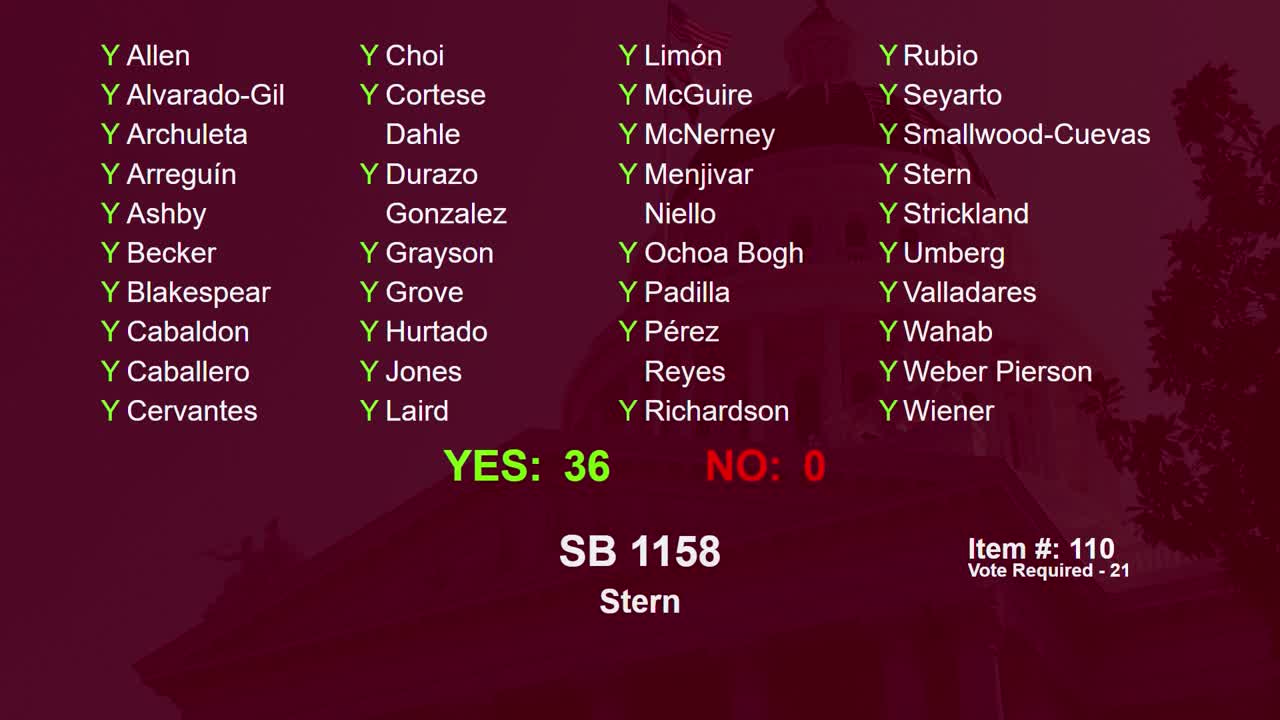 1MIN
Senate Floor
 12MIN
Senate Standing Committee on Judiciary
 24MIN
Senate Standing Committee on Local Government
Bill Author

Bill Co-Author(s):