SB 1286: California State Library: study: state pinniped.
- Session Year: 2025-2026
- House: Senate
- Latest Version Date: 2026-04-15
Current Status:
In Progress
(2026-05-14: May 14 hearing: Held in committee and under submission.)
Introduced
In Committee
Awaiting First Chamber Vote
Passed First Chamber
In Committee
Awaiting Second Chamber Vote
Passed Second Chamber
Enacted
Existing law establishes the state flag and the states emblems, including, among other things, the California Grizzly Bear as the state animal, the California gray whale as the state marine mammal, and the Pacific leatherback sea turtle as the state marine reptile. Existing law establishes the California State Library within the state government and vests control of the library to the State Librarian. Existing law authorizes the California State Library to serve as the central reference and research library for the departments of state government and maintain adequate legislative reference and research library services for the Legislature.
This bill would establish the California sea lion as the official state pinniped. The bill would also make related findings and declarations.This bill would require the California State Library to conduct a study, in consultation with the public, on the best candidate for the official state pinniped. The bill would require the California State Library, on or before January 1, 2028, to submit a report to the Legislature with the California State Librarys recommendations based on the study, as provided. The bill would repeal these provisions on January 1, 2032.
Existing law establishes the state flag and the states emblems, including, among other things, the California Grizzly Bear as the state animal, the California gray whale as the state marine mammal, and the Pacific leatherback sea turtle as the state marine reptile.
This bill would establish the California sea lion as the official state pinniped. The bill would also make related findings and declarations.
(a)The California State Library shall conduct a study, in consultation with the public, on the best candidate for the official state pinniped.
(b)(1)On or before January 1, 2028, the California State Library shall submit a report to the Legislature with the California State Librarys recommendations based on the study conducted pursuant to subdivision (a).
(2)A report to be submitted pursuant to paragraph (1) shall be submitted in compliance with Section 9795.
(c)This section shall be repealed on January 1, 2032, pursuant to Section 10231.5.
SECTION 1.The Legislature finds and declares all of the following:(a)Pinnipeds are fin- or flipper-footed marine mammals that have front and rear flippers; the California sea lion is a member of the eared seal family.(b)California sea lions are found along the shore from California to Mexico, including Baja and Tres Marias Islands, in the Galapagos Islands, and in the southern Sea of Japan. They generally live along coastlines but have been found in rivers along the northern Pacific coast. California sea lions often congregate on man-made structures such as jetties, piers, offshore buoys, and oil platforms.(c)California sea lions have been known to assemble at the mouths of freshwater rivers where there is a steady supply of fish. They also feed on cephalopods, anchovies, herring, Pacific whiting, rockfish, hake, salmon, squid, and octopuses.(d)The California sea lion, once in severe decline, has rebounded and is abundant today because of the federal Marine Mammal Protection Act of 1972 (Public Law 92-522).(e)It is the intent of the Legislature that this recognition helps provide additional protections as California sea lions face a rapidly changing environment.SEC. 2.Section 425.4 is added to the Government Code, to read:425.4.The California sea lion (Zalophus californianus) is the official state pinniped.The Legislature finds and declares all of the following:
(a)Pinnipeds are fin- or flipper-footed marine mammals that have front and rear flippers; the California sea lion is a member of the eared seal family.
(b)California sea lions are found along the shore from California to Mexico, including Baja and Tres Marias Islands, in the Galapagos Islands, and in the southern Sea of Japan. They generally live along coastlines but have been found in rivers along the northern Pacific coast. California sea lions often congregate on man-made structures such as jetties, piers, offshore buoys, and oil platforms.
(c)California sea lions have been known to assemble at the mouths of freshwater rivers where there is a steady supply of fish. They also feed on cephalopods, anchovies, herring, Pacific whiting, rockfish, hake, salmon, squid, and octopuses.
(d)The California sea lion, once in severe decline, has rebounded and is abundant today because of the federal Marine Mammal Protection Act of 1972 (Public Law 92-522).
(e)It is the intent of the Legislature that this recognition helps provide additional protections as California sea lions face a rapidly changing environment.
SEC. 2.Section 425.4 is added to the Government Code, to read:425.4.The California sea lion (Zalophus californianus) is the official state pinniped.
|
Date
|
Status
|
|---|---|
| May 14, 2026 | May 14 hearing: Held in committee and under submission. |
| May 8, 2026 | Set for hearing May 14. |
| Apr 27, 2026 | April 27 hearing: Placed on APPR. suspense file. |
| Apr 17, 2026 | Set for hearing April 27. |
| Apr 16, 2026 | Re-referred to Com. on APPR. pursuant to Joint Rule 10.5. |
| Apr 15, 2026 | Read second time and amended. Ordered to third reading. |
| Apr 14, 2026 | From committee: Do pass as amended. (Ayes 14. Noes 0. Page 3866.) (April 14). |
| Apr 14, 2026 | From committee: Do pass as amended. (Ayes 14. Noes 0.) (April 14). |
| Apr 13, 2026 | Set for hearing April 14. |
| Mar 4, 2026 | Referred to Com. on G.O. |
| Feb 23, 2026 | Read first time. |
| Feb 23, 2026 | From printer. May be acted upon on or after March 23. |
| Feb 20, 2026 | Introduced. To Com. on RLS. for assignment. To print. |
|
Date
|
Description
|
Location
|
Votes
|
|
|---|---|---|---|---|
| Apr 27, 2026 | Placed on suspense file | Senate Standing Committee on Appropriations |
Passed |
|
| Apr 14, 2026 | Do pass as amended | Senate Standing Committee on Governmental Organization |
Passed |
This list shows positions taken on this bill by organizations on the date displayed, which is linked to the original source.
Positions by individuals are not included.
|
Organization
|
Position
|
Date
|
|---|---|---|
| altasea at the port of los angeles | ** Support | |
| Aquarium Of The Pacific | ** Support | |
| Cabrillo Marine Aquarium | ** Support | |
| California Wildlife Center | ** Support | |
| Channel Islands Marine & Wildlife Institute | ** Support | |
| Continental Development Corporation | ** Support | |
| Heal The Bay | ** Support | |
| Long Marine Lab Stranding Network | ** Support | |
| Marathon Petroleum Corporation | ** Support | |
| Marine Mammal Care Center Los Angeles | ** Support | |
| National Marine Mammal Foundation | ** Support | |
| Ocean Animal Response and Research Alliance (OARRA) | ** Support | |
| San Diego Zoo Wildlife Alliance | ** Support | |
| San Gabriel Band of Mission Indians Gabrieleno/Tongva | ** Support | |
| SeaWorld San Diego | ** Support | |
| Surfrider Foundation Los Angeles Chapter | ** Support | |
| The Living Desert Zoo and Gardens | ** Support | |
| The Marine Mammal Center | ** Support | |
| Vectis Strategies, LLC | ** Support | |
| Venice Surfing Association | ** Support |
SENATE COMMITTEE ON
Senator Sabrina Cervantes, Chair
2025 - 2026 Regular Session
SB 1286 (Richardson) - California State Library: study: state pinniped
Version: | Policy Vote: |
Urgency: | Mandate: |
Hearing Date: | Consultant: |
Bill Summary:
SB 1178 tasks the California State Library (CSL) with determining the best candidate for the official state pinniped.
Fiscal Impact:
CSL reports total General Fund costs of approximately $440,000. CSL’s estimate includes:
- $415,000 for three limited-term staff (Librarian, Research Specialist I, Analyst II) to develop the study, conduct outreach, and finalize the report. Specific activities include creating the candidate inclusion criteria, defining the study’s evaluative framework (such as conservation status, cultural or indigenous significance, and public recognition of the symbols in question), and engaging in public outreach through web forms, regional listening sessions, and stakeholder panels.
- $25,000 for IT and travel costs to conduct the study and support public engagement.
CSL notes that their fiscal estimate is in consideration of this bill and two similar bills pending in this committee. CSL presumes a coordinated framework with shared staffing, methodology, and public engagement infrastructure for all three studies. However, CSL’s estimated costs would be applicable whether just one of these bills is enacted or all three.
Background:
Existing law establishes the following, among other things, as official state emblems:
- “Eureka” as the official State Motto.
- “The Golden State” as the official State Nickname.
- The golden poppy as the official State Flower, and April 6th of each year as California Poppy Day.
- The California desert tortoise as the official state retile, and the Pacific leatherback sea turtle as the official state marine reptile.
- The California red-legged frog as the official state amphibian.
- The California dog-face butterfly as the official State insect.
- The pallid bat as the official state bat.
- The banana slug as the official state slug.
- The Dungeness crab as the official state crustacean.
Proposed Law:
- Requires the CSL to study, in consultation with the public, the best candidate for the official state pinniped.
- Requires the CSL to submit a report to the Legislature on its recommendations.
- Repeals the study on January 1, 2032.
Related Legislation:
SB 1178 (Reyes, 2026) tasks the CSL with determining the best candidate for the official state wasp.
SB 1214 (Ochoa Bogh, 2026) tasks the CSL with determining the best candidate for the official state butterfly.
-- END --
SENATE COMMITTEE ON GOVERNMENTAL ORGANIZATION
Senator Susan Rubio
Chair
2025 - 2026 Regular
Bill No: Hearing Date: 4/14/2026
Author: | , et al. | ||
Version: | Introduced | ||
Urgency: | Fiscal: | ||
Consultant: | |||
SUBJECT:
DIGEST: This bill establishes the California sea lion (Zalophus californianus) as the official state pinniped.
ANALYSIS:
Existing law establishes, among other things, the following state emblems:
- “Eureka” as the official State Motto.
- “The Golden State” as the official State Nickname.
- The golden poppy as the official State Flower, and April 6th of each year as California Poppy Day.
- The California desert tortoise as the official state reptile, and the Pacific leatherback sea turtle as the official state marine reptile.
- The California red-legged frog as the official state amphibian.
- The California valley quail as the official bird and avifaunal emblem of the State.
- “The Californian” as the official state tall ship.
- The California dog-face butterfly as the official State insect.
- Surfing as the official state sport.
- The California Grizzly Bear as the state animal, as specified.
- The California grey whale as the official state Marine Mammal.
- The garibaldi as the official state marine fish.
- The Augustynolophus morrisi as the official state dinosaur and the saber-toothed cat as the official state fossil.
- The pallid bat as the official state bat.
- The Dungeness crab as the official state crustacean.
This bill establishes the California sea lion as the official state pinniped and includes related Legislative findings and declarations.
Background
Author Statement. According to the author’s office, “the California sea lion is found from the Northernmost point of our state to its warmest southern beaches, and number near 240,000 all told in our state alone. They are critical, high-profile indicators of marine ecosystem health, acting as sentinels that reflect changing ocean conditions, prey availability, and pollution levels through their diet, reproductive success, and population health. As top predators in the California current system, they help manage prey populations, while also providing significant economic value via tourism, education, and specialized U.S. Navy research programs. This bill would further establish their significance in our state by declaring them the state pinniped, encouraging further preservation and environmental habitat support.”
California Sea Lion. Pinnipeds, commonly known as seals, are a widely distributed and diverse clade of carnivorous, fin-footed, semiaquatic, mostly marine mammals. They comprise the extant families Obodenidae (whose only living member is the walrus), Otariidae (the eared seals), and Phocidae (the earless seals, or true seals). Pinnipeds belong to the suborder California of the order Carnivora; their closest living relatives being weasels, raccoons, skunks, and red pandas. According to the National Oceanic and Atmospheric Administration (NOAA) Fisheries website, California sea lions “are ‘eared seals’ native to the West Coast of North America. They live in coastal waters and on beaches, docks, buoys, and jetties. They are easily trained and intelligent and are commonly seen in zoos and aquariums. California sea lions are playful, intelligent, and very vocal (sounding like barking dogs).”
Further, NOAA Fisheries notes that, “California sea lions live in the shallow waters of the eastern North Pacific Ocean. They prefer sandy beaches or rocky coves for breeding and haul-out sites. Along the West Coast, they also haul out on marina docks as well as jetties and buoys. California sea lions range from southeast Alaska to the Pacific coast of central Mexico. Their primary breeding range is from the Channel Islands in southern California to central Mexico. NOAA Fisheries divides the California sea lion population into three stocks (United States, western Baja California, and Gulf of California) based on the location of major rookeries and the international border.”
California sea lions are a particularly popular pinniped at PIER 39 on San Francisco’s famed Fisherman’s Wharf waterfront. According to PIER 39’s internet website, “[a] few California sea lions began ‘hauling out’ on PIER 39’s K-Dock shortly after the Loma Prieta earthquake hit San Francisco in October 1989. By January 1990, the boisterous barking pinnipeds started to arrive in droves and completely took over K-Dock, much to the exasperation of PIER 39’s Marina tenants. The Marina Staff turned to the Marine Mammal Center, an organization devoted to the rescue and rehabilitation of marine mammals, for advice about their new slippery tenants. After much debate and research, the experts from the Marine Mammal Center recommended that the sea lions state in the newfound home.”

Source: marinemammalcenter.org/visit/getting-here/pier-39
Possible Pinniped Picks. In addition to the California sea lion, the state is home to five other pinniped species. The Steller (or northern) sea lion, Pacific harbor seal, northern elephant seal, northern fur seal, and Guadalupe fur seal all call California’s coastal waters home. Additionally, the ribbon seal and the hooded seal have been reported in California waters, but these are rare events and are not considered normal California visitors. Notably, California already has an official state animal (California Grizzly Bear) and an official State Marine Mammal (California gray whale).
California’s Official State Emblems. California is renowned for its diverse landscapes, rich history, global influence, and its industrious and vibrant people. Boasting a unique array of official symbols, the state represents its natural beauty, historical significance, and cultural identity through emblems. These symbols serve as reminders for residents and visitors alike, emphasizing the state's distinct identity and the importance of preserving its heritage for future generations. As California continues to evolve and grow, its state emblems are intended to remain steadfast symbols of the state’s past, present, and future.
For example, the golden poppy is codified as the official state flower, representing the state’s vibrant landscapes and wildflower fields. Many people believe that emblem law prohibits cutting or damaging the California poppy because of its official designation. In fact, there is no law specifically protecting the California poppy, but the designation endears a special appreciation of the flower and has perpetuated the myth that no one may pick them. Designated in 1903, the golden poppy symbolizes the beauty of California’s natural environment.
Several of the state’s official emblems lean heavily on California’s Gold Rush history. The official state motto – “Eureka” – is a Greek word that translates to “I have found it.” In the context of California, the motto is closely tied to the California Gold Rush of 1848-1855. Gold discovered at Sutter's Mill in 1848 sparked a massive influx of fortune-seekers who flocked to California to seek wealth and prosperity. Native gold is designated as the official state mineral and mineralogic emblem, while “The Golden State” serves as the official state nickname, and Bodie is established as the official state gold rush ghost town.
California is now represented by a herd of nearly 50 state symbols, 45 of which are codified by statute in Government Code, including: state amphibian, animal, bat, bird, colors, crustacean, dance, dinosaur, fabric, flower, flag, folk dance, fossil, gemstone, gold rush ghost town, grass, historical society, insect, LGBTQ veterans memorial, lichen, marine fish, marine mammal, marine reptile, military museum, mineral, motto, mushroom, nickname, nuts, prehistoric artifact, reptile, rock, sea shell, seal, silver rush ghost town, slug, soil, song, sport, tall ship, tartan, tree, and Vietnam veterans memorial.
Almost Official. Not every bill proposing a novel state emblem gets to swim right on to officialdom. Examples include AB 666 (Rogers, 2025) which would have named Bigfoot as the state cryptid, AB 868 (E. Garcia, 2021) proposed to establish the date shake as the official state milkshake, and AB 1769 (Voepel, 2018) would have established the California Vaquero Horse as the official state horse. Those bills were either never heard in committee or failed passage.
In 2006, Governor Schwarzenegger terminated the possibility of recognizing Zinfandel as “California’s historic wine” contemplated by AB 1253 (Migden, 2006). As introduced, the bill sought to designate that varietal as an official state emblem. However, the bill was watered down after much attention and negotiation and instead proposed Zinfandel as historic. Governor Schwarzenegger vetoed the legislation writing, in part, “California wines have inspired authors, artists and Oscar-winning motion pictures. Singling one out for special recognition would be inappropriate.” That bill is yet to be back.
Simply Symbolic? Designating a new state symbol may cause a brief wave attention (whether positive or negative) – but does not always materially accomplish any policy goal such as supporting habitat, research, or protection for the identified symbol. Each new symbol may lead to a sort of “emblem fatigue” as successive designations produce progressively smaller spikes in public interest, fostering a growing frustration from the public.
Further, a February 1, 2024, article in CalMatters titled “A bill for every problem? Why California lawmakers introduce longshots,” cites a 2002 Legislative Analyst’s Office estimate that “each bill cost at least $18,000 to go from introduction to passage: Each bill is given a title and number, goes through analysis by committee staff and is printed out. An updated dollar figure from the legislative analyst was not available, but adjusting for inflation, each bill costs in the neighborhood of $30,000.”
The article goes on to note that, “[e]ven Jerry Brown, who famously vetoed a bill with the message, ‘Not every human problem deserves a law,’ signed a majority of those sent to his desk while he was governor.”
California’s Proposition, 140 approved by the voters in 1990 – among other things – limited the total amount of expenditures allowed by the Legislature. The Legislature may wish to consider at what point establishing additional state symbols reaches a breaking point in a larger cost-benefit analysis. Alternative avenues currently exist that allow for the Legislature to recognize the myriad iconic animals, places, and things that make California a globally recognized cultural driver it is – without the need for creating new statute. Options may include resolutions which are commonly adopted and allow the Legislature to highlight particularly notable animals, plants, places, or items within the state.
Policy Consideration. This Committee is now the only policy committee of the Legislature with primary jurisdiction over official state emblems. The Committee may wish to consider whether designating a new state emblem in statute is the most appropriate approach, particularly given the recent influx of legislation proposing additional official symbols. In the three legislative sessions since 2021-2022, 15 bills have been introduced attempting to designate a novel official state emblem. The three legislative sessions immediately prior saw eight such bills introduced and from 2000-2015 the Legislature approved, and the Governor signed, eight new state emblems. California already maintains nearly 50 state emblems, including multiple categories within similar subject areas (e.g., state animal, bird, marine reptile, crustacean, and others) and notably already has a state marine mammal – California gray whale.
As such, the Committee may wish to explore an alternative more holistic, statewide perspective approach by removing the contents of the bill and instead directing the California State Library to conduct a one-year study on the state pinniped and report back to the Legislature with recommendations. This approach would allow for a more holistic, statewide perspective and provide the Legislature with informed recommendations as follows:
Amendment #1: Strike Sections 1 and 2
Amendment #2: Insert Section 1
(a) The California State Library shall conduct a study and collect public comments on the best candidate for the official state pinniped.
(b) On or before January 1, 2028, the California State Library shall submit a report to the Legislature with the Library’s recommendations based on the study conducted pursuant to subdivision (a).
(c) (1) A report to be submitted pursuant to subdivision (b) shall be submitted in compliance with Section 9795.
(2) Pursuant to Section 10231.5, this section is repealed on January 1, 2029.
Prior/Related Legislation
SB 1178 (Reyes, 2026) establishes the California yellow jacket (Vespula sulphurea) as the official state wasp. (Pending in the Senate Governmental Organization Committee)
SB 1214 (Ochoa Bogh, 2026) establishes western monarch (danaus plexippus) as the official State Butterfly. (Pending in the Senate Governmental Organization Committee)
SB 765 (Niello, Chapter 482, Statutes of 2025) established the giant garter snake (Thamnophis gigas) as the official state snake.
AB 581 (Bennett, Chapter 481, Statutes of 2025) established the bigberry manzanita (Arctostaphylos glauca) as the official state shrub.
AB 1666 (Robers, 2026) would have stated the intent of the Legislature to enact legislation designating Bigfoot as the official state cryptid. (Gutted and amended into an unrelated topic)
AB 666 (Rogers, 2025) would have established Bigfoot as the official state cryptid. (Held without recommendation in the Assembly Arts, Entertainment, Sports, and Tourism Committee)
AB 1334 (Wallis, 2025) establishes solar energy as the official state energy. (Pending in the Senate Governmental Organization Committee)
FISCAL EFFECT: Appropriation: Fiscal Com.: Local:
SUPPORT:
AltaSea At the Port of Los Angeles
Aquarium of the Pacific
Cabrillo Marine Aquarium
California Wildlife Center
Channel Islands Marine & Wildlife Institute
Continental Development Corporation
Heal the Bay
Long Marine Lab Stranding Network
Marathon Petroleum Corporation
Marine Mammal Care Center Los Angeles
National Marine Mammal Foundation
Ocean Animal Response and Research Alliance (OARRA)
San Diego Zoo Wildlife Alliance
San Gabriel Band of Mission Indians Gabrieleno/Tongva
Seaworld San Diego
Surfrider Foundation Los Angeles Chapter
The Living Desert Zoo and Gardens
The Marine Mammal Center
Vectis Strategies, LLC
Venice Surfing Association
OPPOSITION:
None received
ARGUMENTS IN SUPPORT: In support of the bill, the Marine Mammal Center writes, in part, that the “California sea lion is one of the most recognizable and iconic marine species along our coast. Nearly half of the species’ global population depends on California’s coastal waters, making our state central to its continued health and conservation.”
Further, “[f]or generations, coastal Tribal communities in California have maintained deep relationships with marine ecosystems and marine wildlife, including sea lions. These mammals have held cultural, subsistence, and spiritual significance for many Native peoples along the Pacific Coast. Recognizing the California sea lion as the official state pinniped acknowledges not only its ecological role but also its longstanding place in the cultural heritage of the lands and coastal communities that we now call California.”
The presence of sea lions contributes meaningfully to the state’s coastal economy. California sea lions are a major draw for residents and visitors who come to experience wildlife along piers, beaches, and marine protected areas. They also serve as important indicators of ocean health. As sentinel species, changes in their behavior, health, and population trends can signal shifts in marine ecosystems. Monitoring sea lions has helped scientists identify impacts from harmful algal blooms, pollution, fisheries interactions, and other environmental stressors that affect both wildlife and coastal communities.”
And finally, “California has long demonstrated leadership in environmental stewardship. Recognizing the California sea lion as official state pinniped would appropriately honor a species that reflects our state’s biodiversity, scientific innovation, and deep connection to the ocean, and encourage further protection and conservation. For these reasons, we support an ‘Aye’ vote on SB 1286.”
SENATE COMMITTEE ON GOVERNMENTAL ORGANIZATION
Senator Susan Rubio
Chair
2025 - 2026 Regular
Bill No: Hearing Date: 4/14/2026
Author: | , et al. | ||
Version: | Introduced | ||
Urgency: | Fiscal: | ||
Consultant: | |||
SUBJECT:
DIGEST: This bill establishes the California sea lion (Zalophus californianus) as the official state pinniped.
ANALYSIS:
Existing law establishes, among other things, the following state emblems:
- “Eureka” as the official State Motto.
- “The Golden State” as the official State Nickname.
- The golden poppy as the official State Flower, and April 6th of each year as California Poppy Day.
- The California desert tortoise as the official state reptile, and the Pacific leatherback sea turtle as the official state marine reptile.
- The California red-legged frog as the official state amphibian.
- The California valley quail as the official bird and avifaunal emblem of the State.
- “The Californian” as the official state tall ship.
- The California dog-face butterfly as the official State insect.
- Surfing as the official state sport.
- The California Grizzly Bear as the state animal, as specified.
- The California grey whale as the official state Marine Mammal.
- The garibaldi as the official state marine fish.
- The Augustynolophus morrisi as the official state dinosaur and the saber-toothed cat as the official state fossil.
- The pallid bat as the official state bat.
- The Dungeness crab as the official state crustacean.
This bill establishes the California sea lion as the official state pinniped and includes related Legislative findings and declarations.
Background
Author Statement. According to the author’s office, “the California sea lion is found from the Northernmost point of our state to its warmest southern beaches, and number near 240,000 all told in our state alone. They are critical, high-profile indicators of marine ecosystem health, acting as sentinels that reflect changing ocean conditions, prey availability, and pollution levels through their diet, reproductive success, and population health. As top predators in the California current system, they help manage prey populations, while also providing significant economic value via tourism, education, and specialized U.S. Navy research programs. This bill would further establish their significance in our state by declaring them the state pinniped, encouraging further preservation and environmental habitat support.”
California Sea Lion. Pinnipeds, commonly known as seals, are a widely distributed and diverse clade of carnivorous, fin-footed, semiaquatic, mostly marine mammals. They comprise the extant families Obodenidae (whose only living member is the walrus), Otariidae (the eared seals), and Phocidae (the earless seals, or true seals). Pinnipeds belong to the suborder California of the order Carnivora; their closest living relatives being weasels, raccoons, skunks, and red pandas. According to the National Oceanic and Atmospheric Administration (NOAA) Fisheries website, California sea lions “are ‘eared seals’ native to the West Coast of North America. They live in coastal waters and on beaches, docks, buoys, and jetties. They are easily trained and intelligent and are commonly seen in zoos and aquariums. California sea lions are playful, intelligent, and very vocal (sounding like barking dogs).”
Further, NOAA Fisheries notes that, “California sea lions live in the shallow waters of the eastern North Pacific Ocean. They prefer sandy beaches or rocky coves for breeding and haul-out sites. Along the West Coast, they also haul out on marina docks as well as jetties and buoys. California sea lions range from southeast Alaska to the Pacific coast of central Mexico. Their primary breeding range is from the Channel Islands in southern California to central Mexico. NOAA Fisheries divides the California sea lion population into three stocks (United States, western Baja California, and Gulf of California) based on the location of major rookeries and the international border.”
California sea lions are a particularly popular pinniped at PIER 39 on San Francisco’s famed Fisherman’s Wharf waterfront. According to PIER 39’s internet website, “[a] few California sea lions began ‘hauling out’ on PIER 39’s K-Dock shortly after the Loma Prieta earthquake hit San Francisco in October 1989. By January 1990, the boisterous barking pinnipeds started to arrive in droves and completely took over K-Dock, much to the exasperation of PIER 39’s Marina tenants. The Marina Staff turned to the Marine Mammal Center, an organization devoted to the rescue and rehabilitation of marine mammals, for advice about their new slippery tenants. After much debate and research, the experts from the Marine Mammal Center recommended that the sea lions state in the newfound home.”
Source: marinemammalcenter.org/visit/getting-here/pier-39
Possible Pinniped Picks. In addition to the California sea lion, the state is home to five other pinniped species. The Steller (or northern) sea lion, Pacific harbor seal, northern elephant seal, northern fur seal, and Guadalupe fur seal all call California’s coastal waters home. Additionally, the ribbon seal and the hooded seal have been reported in California waters, but these are rare events and are not considered normal California visitors. Notably, California already has an official state animal (California Grizzly Bear) and an official State Marine Mammal (California gray whale).
California’s Official State Emblems. California is renowned for its diverse landscapes, rich history, global influence, and its industrious and vibrant people. Boasting a unique array of official symbols, the state represents its natural beauty, historical significance, and cultural identity through emblems. These symbols serve as reminders for residents and visitors alike, emphasizing the state's distinct identity and the importance of preserving its heritage for future generations. As California continues to evolve and grow, its state emblems are intended to remain steadfast symbols of the state’s past, present, and future.
For example, the golden poppy is codified as the official state flower, representing the state’s vibrant landscapes and wildflower fields. Many people believe that emblem law prohibits cutting or damaging the California poppy because of its official designation. In fact, there is no law specifically protecting the California poppy, but the designation endears a special appreciation of the flower and has perpetuated the myth that no one may pick them. Designated in 1903, the golden poppy symbolizes the beauty of California’s natural environment.
Several of the state’s official emblems lean heavily on California’s Gold Rush history. The official state motto – “Eureka” – is a Greek word that translates to “I have found it.” In the context of California, the motto is closely tied to the California Gold Rush of 1848-1855. Gold discovered at Sutter's Mill in 1848 sparked a massive influx of fortune-seekers who flocked to California to seek wealth and prosperity. Native gold is designated as the official state mineral and mineralogic emblem, while “The Golden State” serves as the official state nickname, and Bodie is established as the official state gold rush ghost town.
California is now represented by a herd of nearly 50 state symbols, 45 of which are codified by statute in Government Code, including: state amphibian, animal, bat, bird, colors, crustacean, dance, dinosaur, fabric, flower, flag, folk dance, fossil, gemstone, gold rush ghost town, grass, historical society, insect, LGBTQ veterans memorial, lichen, marine fish, marine mammal, marine reptile, military museum, mineral, motto, mushroom, nickname, nuts, prehistoric artifact, reptile, rock, sea shell, seal, silver rush ghost town, slug, soil, song, sport, tall ship, tartan, tree, and Vietnam veterans memorial.
Almost Official. Not every bill proposing a novel state emblem gets to swim right on to officialdom. Examples include AB 666 (Rogers, 2025) which would have named Bigfoot as the state cryptid, AB 868 (E. Garcia, 2021) proposed to establish the date shake as the official state milkshake, and AB 1769 (Voepel, 2018) would have established the California Vaquero Horse as the official state horse. Those bills were either never heard in committee or failed passage.
In 2006, Governor Schwarzenegger terminated the possibility of recognizing Zinfandel as “California’s historic wine” contemplated by AB 1253 (Migden, 2006). As introduced, the bill sought to designate that varietal as an official state emblem. However, the bill was watered down after much attention and negotiation and instead proposed Zinfandel as historic. Governor Schwarzenegger vetoed the legislation writing, in part, “California wines have inspired authors, artists and Oscar-winning motion pictures. Singling one out for special recognition would be inappropriate.” That bill is yet to be back.
Simply Symbolic? Designating a new state symbol may cause a brief wave attention (whether positive or negative) – but does not always materially accomplish any policy goal such as supporting habitat, research, or protection for the identified symbol. Each new symbol may lead to a sort of “emblem fatigue” as successive designations produce progressively smaller spikes in public interest, fostering a growing frustration from the public.
Further, a February 1, 2024, article in CalMatters titled “A bill for every problem? Why California lawmakers introduce longshots,” cites a 2002 Legislative Analyst’s Office estimate that “each bill cost at least $18,000 to go from introduction to passage: Each bill is given a title and number, goes through analysis by committee staff and is printed out. An updated dollar figure from the legislative analyst was not available, but adjusting for inflation, each bill costs in the neighborhood of $30,000.”
The article goes on to note that, “[e]ven Jerry Brown, who famously vetoed a bill with the message, ‘Not every human problem deserves a law,’ signed a majority of those sent to his desk while he was governor.”
California’s Proposition, 140 approved by the voters in 1990 – among other things – limited the total amount of expenditures allowed by the Legislature. The Legislature may wish to consider at what point establishing additional state symbols reaches a breaking point in a larger cost-benefit analysis. Alternative avenues currently exist that allow for the Legislature to recognize the myriad iconic animals, places, and things that make California a globally recognized cultural driver it is – without the need for creating new statute. Options may include resolutions which are commonly adopted and allow the Legislature to highlight particularly notable animals, plants, places, or items within the state.
Policy Consideration. This Committee is now the only policy committee of the Legislature with primary jurisdiction over official state emblems. The Committee may wish to consider whether designating a new state emblem in statute is the most appropriate approach, particularly given the recent influx of legislation proposing additional official symbols. In the three legislative sessions since 2021-2022, 15 bills have been introduced attempting to designate a novel official state emblem. The three legislative sessions immediately prior saw eight such bills introduced and from 2000-2015 the Legislature approved, and the Governor signed, eight new state emblems. California already maintains nearly 50 state emblems, including multiple categories within similar subject areas (e.g., state animal, bird, marine reptile, crustacean, and others) and notably already has a state marine mammal – California gray whale.
As such, the Committee may wish to explore an alternative more holistic, statewide perspective approach by removing the contents of the bill and instead directing the California State Library to conduct a one-year study on the state wasp and report back to the Legislature with recommendations. This approach would allow for a more holistic, statewide perspective and provide the Legislature with informed recommendations as follows:
Amendment #1: Strike Sections 1 and 2
Amendment #2: Insert Section 1
(a) The California State Library shall conduct a study and collect public comments on the best candidate for the official state pinniped.
(b) On or before January 1, 2028, the California State Library shall submit a report to the Legislature with the Library’s recommendations based on the study conducted pursuant to subdivision (a).
(c) (1) A report to be submitted pursuant to subdivision (b) shall be submitted in compliance with Section 9795.
(2) Pursuant to Section 10231.5, this section is repealed on January 1, 2029.
Prior/Related Legislation
SB 1178 (Reyes, 2026) establishes the California yellow jacket (Vespula sulphurea) as the official state wasp. (Pending in the Senate Governmental Organization Committee)
SB 1214 (Ochoa Bogh, 2026) establishes western monarch (danaus plexippus) as the official State Butterfly. (Pending in the Senate Governmental Organization Committee)
SB 765 (Niello, Chapter 482, Statutes of 2025) established the giant garter snake (Thamnophis gigas) as the official state snake.
AB 581 (Bennett, Chapter 481, Statutes of 2025) established the bigberry manzanita (Arctostaphylos glauca) as the official state shrub.
AB 1666 (Robers, 2026) would have stated the intent of the Legislature to enact legislation designating Bigfoot as the official state cryptid. (Gutted and amended into an unrelated topic)
AB 666 (Rogers, 2025) would have established Bigfoot as the official state cryptid. (Held without recommendation in the Assembly Arts, Entertainment, Sports, and Tourism Committee)
AB 1334 (Wallis, 2025) establishes solar energy as the official state energy. (Pending in the Senate Governmental Organization Committee)
FISCAL EFFECT: Appropriation: Fiscal Com.: Local:
SUPPORT:
AltaSea At the Port of Los Angeles
Aquarium of the Pacific
Cabrillo Marine Aquarium
California Wildlife Center
Channel Islands Marine & Wildlife Institute
Continental Development Corporation
Heal the Bay
Long Marine Lab Stranding Network
Marathon Petroleum Corporation
Marine Mammal Care Center Los Angeles
National Marine Mammal Foundation
Ocean Animal Response and Research Alliance (OARRA)
San Diego Zoo Wildlife Alliance
San Gabriel Band of Mission Indians Gabrieleno/Tongva
Seaworld San Diego
Surfrider Foundation Los Angeles Chapter
The Living Desert Zoo and Gardens
The Marine Mammal Center
Vectis Strategies, LLC
Venice Surfing Association
OPPOSITION:
None received
ARGUMENTS IN SUPPORT: In support of the bill, the Marine Mammal Center writes, in part, that the “California sea lion is one of the most recognizable and iconic marine species along our coast. Nearly half of the species’ global population depends on California’s coastal waters, making our state central to its continued health and conservation.”
Further, “[f]or generations, coastal Tribal communities in California have maintained deep relationships with marine ecosystems and marine wildlife, including sea lions. These mammals have held cultural, subsistence, and spiritual significance for many Native peoples along the Pacific Coast. Recognizing the California sea lion as the official state pinniped acknowledges not only its ecological role but also its longstanding place in the cultural heritage of the lands and coastal communities that we now call California.”
The presence of sea lions contributes meaningfully to the state’s coastal economy. California sea lions are a major draw for residents and visitors who come to experience wildlife along piers, beaches, and marine protected areas. They also serve as important indicators of ocean health. As sentinel species, changes in their behavior, health, and population trends can signal shifts in marine ecosystems. Monitoring sea lions has helped scientists identify impacts from harmful algal blooms, pollution, fisheries interactions, and other environmental stressors that affect both wildlife and coastal communities.”
And finally, “California has long demonstrated leadership in environmental stewardship. Recognizing the California sea lion as official state pinniped would appropriately honor a species that reflects our state’s biodiversity, scientific innovation, and deep connection to the ocean, and encourage further protection and conservation. For these reasons, we support an ‘Aye’ vote on SB 1286.”
Discussed in Hearing
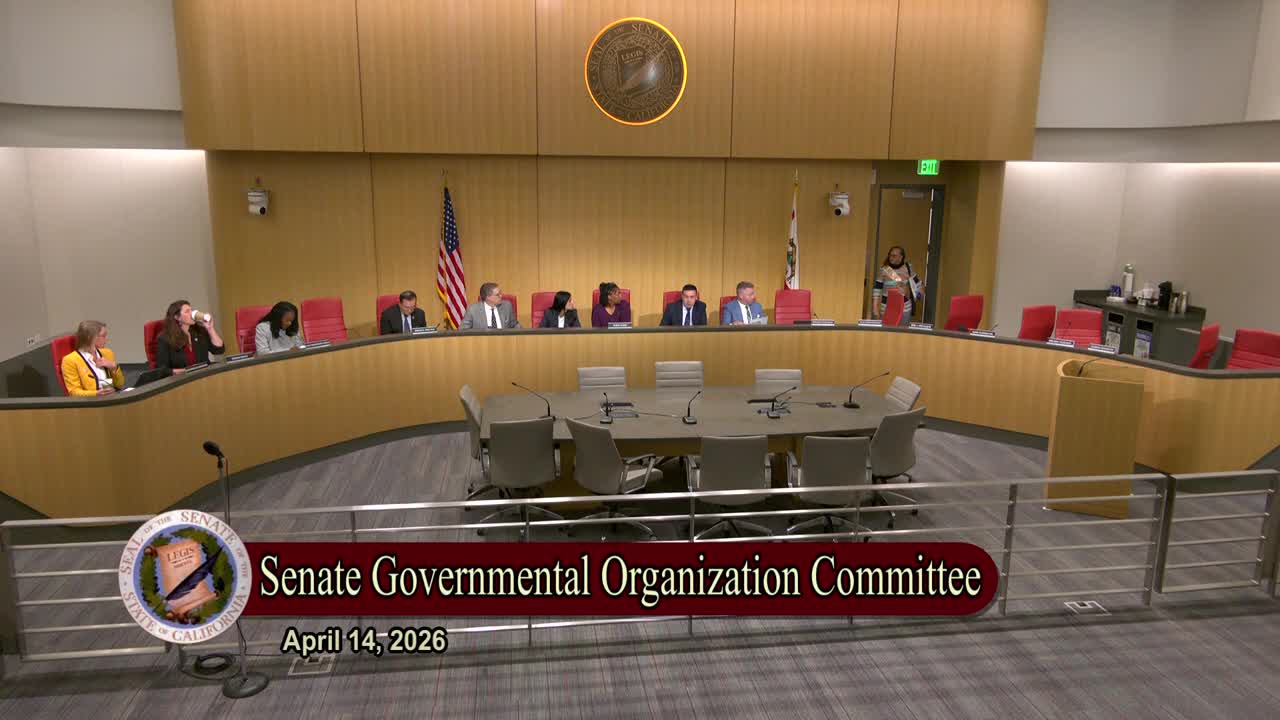 9MIN
Senate Standing Committee on Governmental Organization
Bill Author

Bill Co-Author(s):