SB 1292: Enhanced curb management system.
- Session Year: 2025-2026
- House: Senate
- Latest Version Date: 2026-06-11
Current Status:
In Progress
(2026-06-29: June 29 set for second hearing canceled at the request of author.)
Introduced
In Committee
Awaiting First Chamber Vote
Passed First Chamber
In Committee
Awaiting Second Chamber Vote
Passed Second Chamber
Enacted
Existing law authorizes, until January 1, 2030, a local agency, as defined, to install automated forward facing parking control devices on city-owned or district-owned parking enforcement vehicles for the purpose of taking photographs of parking violations occurring in bicycle lanes. Existing law requires a designated employee of a city, county, city and county, or a contracted law enforcement agency for a special transit district, who is qualified by the city and county or the district to issue parking citations, to review photographs for the purpose of determining whether a parking violation occurred in a bicycle lane and to issue a notice of violation to the registered owner of a vehicle within 15 calendar days, as specified. Existing law requires these photographic records to be confidential and makes these records available only to public agencies to enforce parking violations. Existing law requires any local agency that implements this pilot program to report to specified committees of the Legislature on the systems effectiveness and impact on traffic outcomes, among other things, by December 31, 2028.
This bill would authorize, until January 1, 2032, the City of Los Angeles, Santa Monica, West Hollywood, Inglewood, San Diego, or Long Beach, or the city parking enforcement authority within those cities, to establish an enhanced curb management system (system) that records images of vehicles for the purpose of enforcing parking violations or automating parking payments if certain requirements are met. The bill would require the governing body of the participating city to adopt a public ordinance or resolution that would authorize the use of a system in specified locations, including, among others, passenger loading zones and smart loading zones. The bill would require a participating city that automates parking payments by charging vehicles a fee for access to outline the fee, and any adjusted rates, in an ordinance or resolution. The bill would require the public ordinance or resolution to include an Enhanced Curb Management Use Policy (policy) that sets forth the specific purpose of the system, among other things. The bill would require the policy to be made available for public review, as specified.
This bill would require the system to record images of the vehicle and license plate at the time of the violation, and requires, before mailing a notice of parking violation, that the image data be reviewed and approved by a peace officer or person authorized to enforce parking laws. The bill would require the notice of violation to be mailed to the registered owner of the vehicle within 15 calendar days, as specified. The bill would require the image data collected by the system and any identifying information to be confidential, and would require the image data to only be used for the purpose of processing parking violations and charging vehicles a fee for access.
This bill would require a participating city to observe a public information campaign for at least 60 days before issuing citations, as specified. The bill would require a participating city to submit a report to its governing body and the transportation committees of the Legislature, as specified. The bill would require the governing body of the participating city to approve an Enhanced Curb Management Impact Report (report) after implementing a system and would require the report to include specified information, including, among other things, the locations where the system was deployed and data for these locations.
Existing constitutional provisions require that a statute that limits the right of access to the meetings of public bodies or the writings of public officials and agencies be adopted with findings demonstrating the interest protected by the limitation and the need for protecting that interest.
This bill would make legislative findings to that effect.
Existing law authorizes, until January 1, 2030, a local agency, as defined, to install automated forward facing parking control devices on city-owned or district-owned parking enforcement vehicles for the purpose of taking photographs of parking violations occurring in bicycle lanes. Existing law requires a designated employee of a city, county, city and county, or a contracted law enforcement agency for a special transit district, who is qualified by the city and county or the district to issue parking citations, to review photographs for the purpose of determining whether a parking violation occurred in a bicycle lane and to issue a notice of violation to the registered owner of a vehicle within 15 calendar days, as specified. Existing law requires these photographic records to be confidential and makes these records available only to public agencies to enforce parking violations. Existing law requires any local agency that implements this pilot program to report to specified committees of the Legislature on the systems effectiveness and impact on traffic outcomes, among other things, by December 31, 2028.
This bill would authorize a local agency, as defined, authorize, until January 1, 2032, the City of Los Angeles, Santa Monica, West Hollywood, Inglewood, San Diego, or Long Beach, or the city parking enforcement authority within those cities, to establish an enhanced curb management system (system) that records images of vehicles for the purpose of enforcing parking violations or automating parking payments if certain requirements are met. The bill would require the governing body of the local agency participating city to adopt a public ordinance or resolution that would authorize the use of a system in specified locations, including, among others, passenger loading zones and commercial smart loading zones. The bill would require a local agency participating city that automates parking payments by charging vehicles a fee for access to outline the fee, and any adjusted rates, in an ordinance or resolution. The bill would require the public ordinance or resolution to include an Enhanced Curb Management Use Policy (policy) that sets forth the specific purpose of the system, among other things. The bill would require the policy to be made available for public review, as specified.
This bill would require the system to record images of the vehicle and license plate at the time of the violation, and requires, before mailing a notice of parking violation, that the image data be reviewed and approved by a peace officer or person authorized to enforce parking laws. The bill would require the notice of violation to be mailed to the registered owner of the vehicle within 15 calendar days, as specified. The bill would require the image data collected by the system and any identifying information to be confidential, and would require the image data to only be used for the purpose of processing parking violations and charging vehicles a fee for access.
This bill would require a local agency participating city to observe a public information campaign for at least 60 days before issuing citations, as specified. The bill would require a local agency to report periodically to the Legislature on the systems impact, as specified. participating city to submit a report to its governing body and the transportation committees of the Legislature, as specified. The bill would require the governing body of the participating city to approve an Enhanced Curb Management Impact Report (report) after implementing a system and would require the report to include specified information, including, among other things, the locations where the system was deployed and data for these locations.
Existing constitutional provisions require that a statute that limits the right of access to the meetings of public bodies or the writings of public officials and agencies be adopted with findings demonstrating the interest protected by the limitation and the need for protecting that interest.
This bill would make legislative findings to that effect.
Existing law authorizes, until January 1, 2030, a local agency, as defined, to install automated forward facing parking control devices on city-owned or district-owned parking enforcement vehicles for the purpose of taking photographs of parking violations occurring in bicycle lanes. Existing law requires a designated employee of a city, county, city and county, or a contracted law enforcement agency for a special transit district, who is qualified by the city and county or the district to issue parking citations, to review photographs for the purpose of determining whether a parking violation occurred in a bicycle lane and to issue a notice of violation to the registered owner of a vehicle within 15 calendar days, as specified. Existing law requires these photographic records to be confidential and makes these records available only to public agencies to enforce parking violations. Existing law requires any local agency that implements this pilot program to report to specified committees of the Legislature on the systems effectiveness and impact on traffic outcomes, among other things, by December 31, 2028.
This bill would authorize a local agency, as defined, to establish an enhanced curb management system (system) that records images of vehicles for the purpose of enforcing parking violations or automating parking payments if certain requirements are met. The bill would require the governing body of the local agency to adopt a public ordinance or resolution that would authorize the use of a system in specified locations, including, among others, passenger loading zones and commercial loading zones. The bill would require a local agency that automates parking payments by charging vehicles a fee for access to outline the fee, and any adjusted rates, in an ordinance or resolution.
This bill would require the system to record images of the vehicle and license plate at the time of the violation, and requires, before mailing a notice of parking violation, that the image data be reviewed and approved by a peace officer or person authorized to enforce parking laws. The bill would require the notice of violation to be mailed to the registered owner of the vehicle within 15 calendar days, as specified. The bill would require the image data collected by the system and any identifying information to be confidential, and would require the image data to only be used for the purpose of processing parking violations and charging vehicles a fee for access.
This bill would require a local agency to observe a public information campaign for at least 60 days before issuing citations, as specified. The bill would require a local agency to report periodically to the Legislature on the systems impact, as specified.
Existing constitutional provisions require that a statute that limits the right of access to the meetings of public bodies or the writings of public officials and agencies be adopted with findings demonstrating the interest protected by the limitation and the need for protecting that interest.
This bill would make legislative findings to that effect.
The Legislature finds and declares all of the following:
(a)Illegally parked vehicles, such as those blocking transit stops, bicycle lanes, or crosswalks, or double-parked in travel lanes, create safety hazards and contribute to traffic congestion. Pedestrians, cyclists, wheelchair users, and transit riders are put at risk when forced into vehicle lanes by blocked sidewalks, bicycle paths, or bus zones. Poor compliance in loading zones also leaves delivery drivers with few options, often leading to double-parked vehicles. Clearing these obstructions will improve overall road safety and traffic because these violations are very short in nature, and they go uncited the vast majority of the time.
(b)Due to limited parking enforcement personnel, many curb parking violations go unchecked, especially in busy urban areas. Traditional enforcement, such as writing a ticket and placing it on a windshield, is resource intensive and often impossible when violations are transient or after hours. Automated enforcement systems can supplement scarce personnel by reliably detecting violations, thereby promoting better compliance with existing parking laws.
(c)California and other jurisdictions have seen positive results from automated traffic enforcement and automatically paid loading zones. For example, the City and County of San Franciscos pilot program using cameras to enforce transit-only lanes significantly reduced transit delays by up to 20 percent and improved traffic flow. The City of New York Citys deployment of bus lane and bus stop cameras improved bus speeds by 5 percent and reduced collisions by 20 percent on those corridors. The Cities of Pittsburgh and Philadelphias programs to automate curbside enforcement and payment for loading zones and other safety hazard violations have led to 70 to 97 percent reductions in double parking, improved traffic flow, and greater economic activity in urban cores. These outcomes demonstrate that automated enforcement and paid loading zones can increase safety and efficiency without overburdening drivers.
(d)Effective curb management through consistent enforcement and charging vehicles a fee for access of loading zones has economic benefits, ensuring parking turnover for businesses and reliable loading zones for deliveries. It also reduces circling for parking and idling in traffic, which in turn lowers emissions. The Legislature notes that cities like the Cities of Los Angeles and Long Beach view robust parking enforcement as vital to supporting local businesses and events and to meet climate and air quality goals. By deterring illegal parking, automated enforcement can enhance commerce in downtowns and reduce pollution from congestion.
(e)The Legislature is mindful that automated license plate recognition and camera systems must include safeguards for privacy and accuracy. Successful programs have implemented strict data retention limits and oversight, for instance, requiring that any recorded images be destroyed within a defined short period after citation processing. It is the intent of the Legislature that any authorization of automated curb enforcement shall incorporate robust privacy protections and transparency measures. Public awareness efforts, including warning periods for drivers, are also critical to ensure the programs fairness and acceptance.
(f)Under existing law, local agencies must provide installment payment plans for indigent, or low-income, individuals with unpaid parking citations. Local agencies are required to place a link to information describing payment programs in a prominent, readily accessible location on the parking citation section of their internet websites.
(g)It is the intent of the Legislature that local agencies that choose to adopt enhanced curb management systems comply with provisions of current law that require installment payment plans for the indigent.
SEC. 2.Article 5 (commencing with Section 40275) is added to Chapter 1 of Division 17 of the Vehicle Code, to read:5.Enhanced Curb Management System40275.(a)As used in this article, both of the following definitions apply:
(1)Enhanced curb management system or system means a system of one or more stationary cameras or sensor devices with designated signage that record images of vehicles for the purpose of enforcing parking violations or automating parking payments.
(2)Designated jurisdiction means any of the Cities of Los Angeles, Santa Monica, West Hollywood, Inglewood, San Diego, or Long Beach, or the city parking enforcement authority within the City of Los Angeles, Santa Monica, West Hollywood, Inglewood, San Diego, or Long Beach.
(b)A designated jurisdiction may establish an enhanced curb management system if it meets all of the requirements of this article.
(c)An enhanced curb management system shall be operated by, or under the oversight of, a designated jurisdiction or by a contracted vendor on behalf of a designated jurisdiction.
(d)Before the governing body of the designated jurisdiction establishes an enhanced curb management system, the governing body of the designated jurisdiction shall adopt a public ordinance or resolution that authorizes the use of an enhanced curb management system in any of the following locations:
(1)Passenger loading zones.
(2)Commercial loading zones for the purpose of enforcing parking violations only.
(3)Smart loading zones.
(4)Zero-emissions delivery zones.
(5)Bicycle lanes.
(6)No stopping zones.
(7)Crosswalks.
(e)(1)A designated jurisdiction may automate parking payments by charging vehicles a fee for access to passenger loading zones and smart loading zones.
(2)A designated jurisdiction that charges vehicles a fee for access pursuant to paragraph (1) shall outline the fee, and any adjusted rates, in an ordinance or resolution.
(3)A designated jurisdiction shall not charge vehicles a fee for access to commercial loading zones that existed prior to the adoption of an ordinance or resolution.
(f)(1)The public ordinance or resolution that authorizes the use of an enhanced curb management system shall include an Enhanced Curb Management Use Policy that shall set forth the specific purpose of the system, the uses that are authorized, the rules and processes requirement to be followed by employees and contractors of the designated jurisdiction administering the system prior to its use, and the uses of the equipment or data collected that are prohibited.
(2)The policy shall identify the data or information that can be collected by the system and the individuals who can access or use the collected information, and the rules and processes related to the access, transfer, and use of the information.
(3)The policy shall include provisions for protecting data from unauthorized access, data retention, public access, third-party data sharing, training, auditing, and oversight to ensure compliance with the Enhanced Curb Management Use Policy.
(4)The Enhanced Curb Management Use Policy, as an element of the public ordinance or resolution, shall be made available for public review, including, but not limited to, by posting it on the designated jurisdictions internet website at least 30 calendar days prior to adoption by the governing body of the designated jurisdiction.
(g)A designated jurisdiction shall post signage giving notice of the enhanced curb management system, and the signage shall be posted clearly and positioned to provide reasonable notice to motorists in the affected area before the commencement of enforcement.
(h)A designated jurisdiction may install a system pursuant to this article only if the examiner or issuing agency, as described in Section 40215, includes options to reduce or waive the payment of a parking penalty when the person is determined to be indigent, as defined in Section 40220.
40276.(a)The image data collected by the system shall be used only for both of the following:
(1)To enforce parking violation laws.
(2)To charge vehicles a fee for access to designated passenger loading zones and smart loading zones.
(b)The image data collected by the system shall not be retained longer than 60 days after final disposition of a citation, six months after a paid session in a passenger loading zone or smart loading zone, or 30 days after the image was recorded if a citation is not issued or a fee is not charged, after which time the information shall be destroyed.
(c)The designated jurisdiction shall ensure a contracted vendor operating the system follows the data retention and privacy guidelines pursuant to this section.
(d)The image data and personal identifying information obtained from the Department of Motor Vehicles for enforcement shall be confidential, shall only be used for purposes of processing the parking violation or to charge vehicles a fee for access, and shall not be disclosed except as required by law.
(e)(1)The system shall collect only the minimum image data reasonably necessary to identify a vehicle license plate for the purposes described in subdivision (a).
(2)To the extent technologically feasible, the system shall automatically obscure or blur portions of an image that do not depict the license plate or vehicle necessary for enforcement.
(f)(1)A designated jurisdiction, or any contracted vendor operating the system, shall not cooperate with or provide image data to any individual, agency, or department from another state or to a federal agency, except when disclosure is required by federal law or a warrant is issued by a court of competent jurisdiction.
(2)Failure to comply with the data sharing restrictions in paragraph (1) shall result in excess revenue from the program being reverted to the Active Transportation Program, established pursuant to Chapter 8 (commencing with Section 2380) of the Streets and Highways Code, to be allocated by the California Transportation Commission, upon appropriation by the Legislature, pursuant to Section 2381 of the Streets and Highways Code.
40277.(a)Notwithstanding subdivisions (a) and (b) of Section 40202, a notice of parking violation may be served by mail without physical attachment to the vehicle if the violation is detected by an enhanced curb management system operated by a designated jurisdiction in accordance with this article.
(b)An enhanced curb management system shall meet all of the following procedures:
(1)The enhanced curb management system shall record images of the vehicle and license plate at the time of the alleged violation, along with the date, time, and location. The recorded data shall be of sufficient clarity to identify the vehicle involved.
(2)Before mailing a notice of parking violation under this section, the image data shall be reviewed and approved by a peace officer or person authorized to enforce parking laws. The reviewing person shall verify that the vehicle was in violation of the applicable parking regulation based on the image data. A certification of this review shall be included in the case file.
(3)The processing agency shall mail the notice of parking violation to the registered owner of the vehicle no later than 15 calendar days after the date of the violation. The notice shall include copies of the image data and information on how to view any image data, the violation details, and the procedure to pay or contest the citation.
(4)A notice of parking violation issued under this section has the same force and effect as a notice placed on a vehicle windshield. All rights and obligations applicable to the recipient of a parking citation under this chapter, including the right to contest under Section 40215, and affidavits of nonliability under Sections 40208 and 40209, shall apply to notices served by mail pursuant to this section.
(c)The notice of parking violation mailed under this section shall include a statement of the vehicle owners privacy rights regarding the image data.
(d)(1)Revenues derived from any program utilizing an enhanced curb management system shall first be used to recover program costs. Program costs include, but are not limited to, the installation of camera enforcement systems, the adjudication of violations, and reporting requirements, as specified in this article.
(2)A designated jurisdiction using an enhanced curb management system, as authorized by this article, shall maintain their existing commitment of local funds for curbside parking enforcement and shall annually expend not less than the annual average of expenditures for local curbside parking enforcement during the 202324, 202425, and 202526 fiscal years. For purposes of this subdivision, in calculating average expenditures on curbside parking enforcement, restricted funds that may not be available on an ongoing basis, including those from voter-approved bond issuances or tax measures, shall not be included. Any excess revenue shall be used for parking management measures within three years of the end of the fiscal year in which the excess revenue was received. If parking management measures are not planned or constructed after the third year, excess revenue shall revert to the Active Transportation Program established pursuant to Chapter 8 (commencing with Section 2380) of the Streets and Highways Code, to be allocated by the California Transportation Commission, upon appropriation by the Legislature, pursuant to Section 2381 of the Streets and Highways Code.
40278.(a)Before a designated jurisdiction issues notices of parking violation under Section 40277, the designated jurisdiction shall observe a public information campaign in accordance with this section.
(b)(1)The designated jurisdiction shall conduct a public information campaign for at least 60 days before issuing citations. This campaign may include public service announcements, press releases, community meetings, social media notifications, and other outreach to inform motorists of the new enforcement method, the locations involved, and the date on which citations will begin.
(2)For the first 60 days of active enforcement using a system at a given location, the designated jurisdiction shall issue only warning notices, with no monetary penalty, to violators caught by the system. The warning notices shall clearly explain the violation and state that no fine is assessed for this warning, but that future violations will result in citations with fines.
(c)The requirements of this section shall apply each time a new automated parking enforcement camera or location is activated by a designated jurisdiction. The designated jurisdiction shall maintain records of its public outreach efforts and the issuance of warning notices. The records shall be available for public inspection.
40279.(a)A designated jurisdiction using an enhanced curb management system shall, on or before March 1 of the fifth year in which the system has been implemented, or by December 1, 2031, whichever occurs first, submit a report to its governing body and the transportation committees of the Legislature an evaluation of the system in their respective jurisdictions to determine the systems impact on safety, loading zone activity, and the systems economic impact on the communities where the system is utilized.
(b)(1)The report shall be made available on the internet website of the designated jurisdiction and shall include all of the following information:
(A)The number of notices of automated parking fees and the number of violations issued by month and year, the locations where violations occurred, and the number of vehicles with two or more violations in a monthly period and a yearly period.
(B)The number of fees paid, violations paid, the number of delinquent violations and fees, and the number of violations contested. For the violations contested, the report shall indicate the number of notices that were dismissed.
(C)The costs associated with implementation and operation of the system, and revenues collected by each jurisdiction.
(D)A racial and economic equity impact analysis, developed in collaboration with local racial justice and economic equity stakeholder groups. The analysis shall include the amount of fees charged, and the number of notices of violations issued, to indigent individuals, to individuals of up to 250 percent above the poverty line, and to each ZIP Code.
(2)The report shall be submitted in compliance with Section 9795 of the Government Code.
40280.The governing body of the designated jurisdiction shall approve an Enhanced Curb Management Impact Report after implementing a system. The Enhanced Curb Management Impact Report shall include all of the following information:
(a)An assessment of impact of the system on civil liberties and civil rights and any recommendations to improve ways to safeguard those public rights.
(b)A description of the system and how it works.
(c)Fiscal costs for the system, including program establishment costs, projected ongoing costs, and program funding.
(d)If deployment locations of systems are in predominantly in low-income neighborhoods.
(e)Locations where the system was deployed and data for these locations.
40280.5.Image data and records collected pursuant to this article shall not be used or processed by an automated license plate recognition system, as defined in Section 1798.90.5 of the Civil Code.
40281.This article shall remain in effect only until January 1, 2032, and as of that date is repealed.
SEC. 3.The Legislature finds and declares that Section 2 of this act, which adds Section 40276 to the Vehicle Code, imposes a limitation on the publics right of access to the meetings of public bodies or the writings of public officials and agencies within the meaning of Section 3 of Article I of the California Constitution. Pursuant to that constitutional provision, the Legislature makes the following findings to demonstrate the interest protected by this limitation and the need for protecting that interest:
To protect the privacy interests of persons who are issued notices of violation under an enhanced curb management system, the Legislature finds and declares that the image data or administrative records generated by the system shall be confidential, and shall be made available only to alleged violators and to governmental agencies solely for the purpose of enforcing these violations, charging vehicles a fee for access, and assessing the impact of the use of enhanced curb management systems.
The Legislature finds and declares all of the following:
(a)Illegally parked vehicles, such as those blocking transit stops, bicycle lanes, or crosswalks, or double-parked in travel lanes, create safety hazards and contribute to traffic congestion. Pedestrians, cyclists, wheelchair users, and transit riders are put at risk when forced into vehicle lanes by blocked sidewalks, bicycle paths, or bus zones. Poor compliance in loading zones also leaves delivery drivers with few options, often leading to double-parked vehicles. Clearing these obstructions will improve overall road safety and traffic because these violations are very short in nature, and they go uncited the vast majority of the time.
(b)Due to limited parking enforcement personnel, many curb parking violations go unchecked, especially in busy urban areas. Traditional enforcement, such as writing a ticket and placing it on a windshield, is resource intensive and often impossible when violations are transient or after hours. Automated enforcement systems can supplement scarce personnel by reliably detecting violations, thereby promoting better compliance with existing parking laws.
(c)California and other jurisdictions have seen positive results from automated traffic enforcement and automatically paid loading zones. For example, the City and County of San Franciscos pilot program using cameras to enforce transit-only lanes significantly reduced transit delays by up to 20 percent and improved traffic flow. The City of New York Citys deployment of bus lane and bus stop cameras improved bus speeds by 5 percent and reduced collisions by 20 percent on those corridors. The Cities of Pittsburgh and Philadelphias programs to automate curbside enforcement and payment for loading zones and other safety hazard violations have led to 70 to 97 percent reductions in double parking, improved traffic flow, and greater economic activity in urban cores. These outcomes demonstrate that automated enforcement and paid loading zones can increase safety and efficiency without overburdening drivers.
(d)Effective curb management through consistent enforcement and charging vehicles a fee for access of loading zones has economic benefits, ensuring parking turnover for businesses and reliable loading zones for deliveries. It also reduces circling for parking and idling in traffic, which in turn lowers emissions. The Legislature notes that cities like the Cities of Los Angeles and Long Beach view robust parking enforcement as vital to supporting local businesses and events and to meet climate and air quality goals. By deterring illegal parking, automated enforcement can enhance commerce in downtowns and reduce pollution from congestion.
(e)The Legislature is mindful that automated license plate recognition and camera systems must include safeguards for privacy and accuracy. Successful programs have implemented strict data retention limits and oversight, for instance, requiring that any recorded images be destroyed within a defined short period after citation processing. It is the intent of the Legislature that any authorization of automated curb enforcement shall incorporate robust privacy protections and transparency measures. Public awareness efforts, including warning periods for drivers, are also critical to ensure the programs fairness and acceptance.
(f)Under existing law, local agencies must provide installment payment plans for indigent, or low-income, individuals with unpaid parking citations. Local agencies are required to place a link to information describing payment programs in a prominent, readily accessible location on the parking citation section of their internet websites.
(g)It is the intent of the Legislature that local agencies that choose to adopt enhanced curb management systems comply with provisions of current law that require installment payment plans for the indigent.
SEC. 2.Article 5 (commencing with Section 40275) is added to Chapter 1 of Division 17 of the Vehicle Code, to read:5.Enhanced Curb Management System40275.(a)As used in this article, both of the following definitions apply:
(1)Enhanced curb management system or system means a system of one or more stationary cameras or sensor devices with designated signage that record images of vehicles for the purpose of enforcing parking violations or automating parking payments.
(2)Local agency means a local city, county, or city and county parking enforcement authority.(2)Designated jurisdiction means any of the Cities of Los Angeles, Santa Monica, West Hollywood, Inglewood, San Diego, or Long Beach, or the city parking enforcement authority within the City of Los Angeles, Santa Monica, West Hollywood, Inglewood, San Diego, or Long Beach.
(b)A local agency designated jurisdiction may establish an enhanced curb management system if it meets all of the requirements of this article.
(c)An enhanced curb management system shall be operated by, or under the oversight of, a local agency designated jurisdiction or by a contracted vendor on behalf of a local agency. designated jurisdiction.
(d)Before the governing body of the local agency designated jurisdiction establishes an enhanced curb management system, the governing body of the local agency designated jurisdiction shall adopt a public ordinance or resolution that authorizes the use of an enhanced curb management system in any of the following locations:
(1)Passenger loading zones.
(2)Commercial loading zones. zones for the purpose of enforcing parking violations only.
(3)Smart loading zones.
(4)Zero-emissions delivery zones.
(5)Bicycle lanes.
(6)No stopping zones.
(7)Crosswalks.
(e)(1)A local agency designated jurisdiction may automate parking payments by charging vehicles a fee for access to passenger loading zones, commercial loading zones, zones and smart loading zones.
(2)A local agency designated jurisdiction that charges vehicles a fee for access pursuant to paragraph (1) shall outline the fee, and any adjusted rates, in an ordinance or resolution.
(3)A designated jurisdiction shall not charge vehicles a fee for access to commercial loading zones that existed prior to the adoption of an ordinance or resolution.
(f)(1)The public ordinance or resolution that authorizes the use of an enhanced curb management system shall include an Enhanced Curb Management Use Policy that shall set forth the specific purpose of the system, the uses that are authorized, the rules and processes requirement to be followed by employees and contractors of the designated jurisdiction administering the system prior to its use, and the uses of the equipment or data collected that are prohibited.
(2)The policy shall identify the data or information that can be collected by the system and the individuals who can access or use the collected information, and the rules and processes related to the access, transfer, and use of the information.
(3)The policy shall include provisions for protecting data from unauthorized access, data retention, public access, third-party data sharing, training, auditing, and oversight to ensure compliance with the Enhanced Curb Management Use Policy.
(4)The Enhanced Curb Management Use Policy, as an element of the public ordinance or resolution, shall be made available for public review, including, but not limited to, by posting it on the designated jurisdictions internet website at least 30 calendar days prior to adoption by the governing body of the designated jurisdiction.
(f)(g)A local agency designated jurisdiction shall post signage giving notice of the enhanced curb management system, and the signage shall be posted clearly and positioned to provide reasonable notice to motorists in the affected area before the commencement of enforcement.
(g)(h)A local agency designated jurisdiction may install a system pursuant to this article only if the examiner or issuing agency, as described in Section 40215, includes options to reduce or waive the payment of a parking penalty when the person is determined to be indigent, as defined in Section 40220.
40276.(a)The image data collected by the system shall be used only for both of the following:
(1)To enforce parking violation laws.
(2)To charge vehicles a fee for access to designated passenger loading zones, commercial loading zones, zones and smart loading zones.
(b)The image data collected by the system shall not be retained longer than 60 days after final disposition of a citation, six months after a paid session in a passenger loading zone, commercial loading zone, zone or smart loading zone, or 30 days after the image was recorded if a citation is not issued or a fee is charged. not charged, after which time the information shall be destroyed.
(c)The local agency designated jurisdiction shall ensure a contracted vendor operating the system follows the data retention and privacy guidelines pursuant to this section.
(d)The image data and personal identifying information obtained from the Department of Motor Vehicles for enforcement shall be confidential, shall only be used for purposes of processing the parking violation or to charge vehicles a fee for access, and shall not be disclosed except as required by law.
(e)(1)The system shall collect only the minimum image data reasonably necessary to identify a vehicle license plate for the purposes described in subdivision (a).
(2)To the extent technologically feasible, the system shall automatically obscure or blur portions of an image that do not depict the license plate or vehicle necessary for enforcement.
(f)(1)A designated jurisdiction, or any contracted vendor operating the system, shall not cooperate with or provide image data to any individual, agency, or department from another state or to a federal agency, except when disclosure is required by federal law or a warrant is issued by a court of competent jurisdiction.
(2)Failure to comply with the data sharing restrictions in paragraph (1) shall result in excess revenue from the program being reverted to the Active Transportation Program, established pursuant to Chapter 8 (commencing with Section 2380) of the Streets and Highways Code, to be allocated by the California Transportation Commission, upon appropriation by the Legislature, pursuant to Section 2381 of the Streets and Highways Code.
40277.(a)Notwithstanding subdivisions (a) and (b) of Section 40202, a notice of parking violation may be served by mail without physical attachment to the vehicle if the violation is detected by an enhanced curb management system operated by a local agency designated jurisdiction in accordance with this article.
(b)An enhanced curb management system shall meet all of the following procedures:
(1)The enhanced curb management system shall record images of the vehicle and license plate at the time of the alleged violation, along with the date, time, and location. The recorded data shall be of sufficient clarity to identify the vehicle involved.
(2)Before mailing a notice of parking violation under this section, the image data shall be reviewed and approved by a peace officer or person authorized to enforce parking laws. The reviewing person shall verify that the vehicle was in violation of the applicable parking regulation based on the image data. A certification of this review shall be included in the case file.
(3)The processing agency shall mail the notice of parking violation to the registered owner of the vehicle no later than 15 calendar days after the date of the violation. The notice shall include copies of the image data and information on how to view any image data, the violation details, and the procedure to pay or contest the citation.
(4)A notice of parking violation issued under this section has the same force and effect as a notice placed on a vehicle windshield. All rights and obligations applicable to the recipient of a parking citation under this chapter, including the right to contest under Section 40215, and affidavits of nonliability under Sections 40208 and 40209, shall apply to notices served by mail pursuant to this section.
(c)The notice of parking violation mailed under this section shall include a statement of the vehicle owners privacy rights regarding the image data.
(d)(1)Revenues derived from any program utilizing an enhanced curb management system shall first be used to recover program costs. Program costs include, but are not limited to, the installation of camera enforcement systems, the adjudication of violations, and reporting requirements, as specified in this article.
(2)A designated jurisdiction using an enhanced curb management system, as authorized by this article, shall maintain their existing commitment of local funds for curbside parking enforcement and shall annually expend not less than the annual average of expenditures for local curbside parking enforcement during the 202324, 202425, and 202526 fiscal years. For purposes of this subdivision, in calculating average expenditures on curbside parking enforcement, restricted funds that may not be available on an ongoing basis, including those from voter-approved bond issuances or tax measures, shall not be included. Any excess revenue shall be used for parking management measures within three years of the end of the fiscal year in which the excess revenue was received. If parking management measures are not planned or constructed after the third year, excess revenue shall revert to the Active Transportation Program established pursuant to Chapter 8 (commencing with Section 2380) of the Streets and Highways Code, to be allocated by the California Transportation Commission, upon appropriation by the Legislature, pursuant to Section 2381 of the Streets and Highways Code.
40278.(a)Before a local agency designated jurisdiction issues notices of parking violation under Section 40277, a local agency the designated jurisdiction shall observe a public information campaign in accordance with this section.
(b)(1)The local agency designated jurisdiction shall conduct a public information campaign for at least 60 days before issuing citations. This campaign may include public service announcements, press releases, community meetings, social media notifications, and other outreach to inform motorists of the new enforcement method, the locations involved, and the date on which citations will begin.
(2)For the first 60 days of active enforcement using a system at a given location, the local agency designated jurisdiction shall issue only warning notices, with no monetary penalty, to violators caught by the system. The warning notices shall clearly explain the violation and state that no fine is assessed for this warning, but that future violations will result in citations with fines.
(c)The requirements of this section shall apply each time a new automated parking enforcement camera or location is activated by a local agency. The local agency designated jurisdiction. The designated jurisdiction shall maintain records of its public outreach efforts and the issuance of warning notices. The records shall be available for public inspection.
40279.(a)A local agency designated jurisdiction using an enhanced curb management system shall report periodically to the Legislature on the systems impact, including the number of citations issued, accident or safety data in the enforced areas, and any public concerns received, in order to evaluate the programs effectiveness and any need for changes. shall, on or before March 1 of the fifth year in which the system has been implemented, or by December 1, 2031, whichever occurs first, submit a report to its governing body and the transportation committees of the Legislature an evaluation of the system in their respective jurisdictions to determine the systems impact on safety, loading zone activity, and the systems economic impact on the communities where the system is utilized.
(b)(1)The report shall be made available on the internet website of the designated jurisdiction and shall include all of the following information:
(A)The number of notices of automated parking fees and the number of violations issued by month and year, the locations where violations occurred, and the number of vehicles with two or more violations in a monthly period and a yearly period.
(B)The number of fees paid, violations paid, the number of delinquent violations and fees, and the number of violations contested. For the violations contested, the report shall indicate the number of notices that were dismissed.
(C)The costs associated with implementation and operation of the system, and revenues collected by each jurisdiction.
(D)A racial and economic equity impact analysis, developed in collaboration with local racial justice and economic equity stakeholder groups. The analysis shall include the amount of fees charged, and the number of notices of violations issued, to indigent individuals, to individuals of up to 250 percent above the poverty line, and to each ZIP Code.
(b)(2)The report shall be submitted in compliance with Section 9795 of the Government Code.
40280.The governing body of the designated jurisdiction shall approve an Enhanced Curb Management Impact Report after implementing a system. The Enhanced Curb Management Impact Report shall include all of the following information:
(a)An assessment of impact of the system on civil liberties and civil rights and any recommendations to improve ways to safeguard those public rights.
(b)A description of the system and how it works.
(c)Fiscal costs for the system, including program establishment costs, projected ongoing costs, and program funding.
(d)If deployment locations of systems are in predominantly in low-income neighborhoods.
(e)Locations where the system was deployed and data for these locations.
40281.This article shall remain in effect only until January 1, 2032, and as of that date is repealed.
SEC. 3.The Legislature finds and declares that Section 2 of this act, which adds Section 40276 to the Vehicle Code, imposes a limitation on the publics right of access to the meetings of public bodies or the writings of public officials and agencies within the meaning of Section 3 of Article I of the California Constitution. Pursuant to that constitutional provision, the Legislature makes the following findings to demonstrate the interest protected by this limitation and the need for protecting that interest:
To protect the privacy interests of persons who are issued notices of violation under an enhanced curb management system, the Legislature finds and declares that the image data or administrative records generated by the system shall be confidential, and shall be made available only to alleged violators and to governmental agencies solely for the purpose of enforcing these violations, charging vehicles a fee for access, and assessing the impact of the use of enhanced curb management systems.
The Legislature finds and declares all of the following:
(a)Illegally parked vehicles, such as those blocking transit stops, bicycle lanes, or crosswalks, or double-parked in travel lanes, create safety hazards and contribute to traffic congestion. Pedestrians, cyclists, wheelchair users, and transit riders are put at risk when forced into vehicle lanes by blocked sidewalks, bicycle paths, or bus zones. Poor compliance in loading zones also leaves delivery drivers with few options, often leading to double-parked vehicles. Clearing these obstructions will improve overall road safety and traffic because these violations are very short in nature, and they go uncited the vast majority of the time.
(b)Due to limited parking enforcement personnel, many curb parking violations go unchecked, especially in busy urban areas. Traditional enforcement, such as writing a ticket and placing it on a windshield, is resource intensive and often impossible when violations are transient or after hours. Automated enforcement systems can supplement scarce personnel by reliably detecting violations, thereby promoting better compliance with existing parking laws.
(c)California and other jurisdictions have seen positive results from automated traffic enforcement and automatically paid loading zones. For example, the City and County of San Franciscos pilot program using cameras to enforce transit-only lanes significantly reduced transit delays by up to 20 percent and improved traffic flow. The City of New York Citys deployment of bus lane and bus stop cameras improved bus speeds by 5 percent and reduced collisions by 20 percent on those corridors. The Cities of Pittsburgh and Philadelphias programs to automate curbside enforcement and payment for loading zones and other safety hazard violations have led to 70 to 97 percent reductions in double parking, improved traffic flow, and greater economic activity in urban cores. These outcomes demonstrate that automated enforcement and paid loading zones can increase safety and efficiency without overburdening drivers.
(d)Effective curb management through consistent enforcement and charging vehicles a fee for access of loading zones has economic benefits, ensuring parking turnover for businesses and reliable loading zones for deliveries. It also reduces circling for parking and idling in traffic, which in turn lowers emissions. The Legislature notes that cities like the Cities of Los Angeles and Long Beach view robust parking enforcement as vital to supporting local businesses and events and to meet climate and air quality goals. By deterring illegal parking, automated enforcement can enhance commerce in downtowns and reduce pollution from congestion.
(e)The Legislature is mindful that automated license plate recognition and camera systems must include safeguards for privacy and accuracy. Successful programs have implemented strict data retention limits and oversight, for instance, requiring that any recorded images be destroyed within a defined short period after citation processing. It is the intent of the Legislature that any authorization of automated curb enforcement shall incorporate robust privacy protections and transparency measures. Public awareness efforts, including warning periods for drivers, are also critical to ensure the programs fairness and acceptance.
(f)Under existing law, local agencies must provide installment payment plans for indigent, or low-income, individuals with unpaid parking citations. Local agencies are required to place a link to information describing payment programs in a prominent, readily accessible location on the parking citation section of their internet websites.
(g)It is the intent of the Legislature that local agencies that choose to adopt enhanced curb management systems comply with provisions of current law that require installment payment plans for the indigent.
SEC. 2.Article 5 (commencing with Section 40275) is added to Chapter 1 of Division 17 of the Vehicle Code, to read:5.Enhanced Curb Management System40275.(a)As used in this article, both of the following definitions apply:
(1)Enhanced curb management system or system means a system of one or more stationary cameras or sensor devices with designated signage that record images of vehicles for the purpose of enforcing parking violations or automating parking payments.
(2)Local agency means a local city, county, or city and county parking enforcement authority.
(b)A local agency may establish an enhanced curb management system if it meets all of the requirements of this article.
(c)An enhanced curb management system shall be operated by, or under the oversight of, a local agency or by a contracted vendor on behalf of a local agency.
(d)Before the governing body of the local agency establishes an enhanced curb management system, the governing body of the local agency shall adopt a public ordinance or resolution that authorizes the use of an enhanced curb management system in any of the following locations:
(1)Passenger loading zones.
(2)Commercial loading zones.
(3)Smart loading zones.
(4)Zero-emissions delivery zones.
(5)Bicycle lanes.
(6)No stopping zones.
(7)Crosswalks.
(e)(1)A local agency may automate parking payments by charging vehicles a fee for access to passenger loading zones, commercial loading zones, and smart loading zones.
(2)A local agency that charges vehicles a fee for access pursuant to paragraph (1) shall outline the fee, and any adjusted rates, in an ordinance or resolution.
(f)A local agency shall post signage giving notice of the enhanced curb management system, and the signage shall be posted clearly and positioned to provide reasonable notice to motorists in the affected area before the commencement of enforcement.
(g)A local agency may install a system pursuant to this article only if the examiner or issuing agency, as described in Section 40215, includes options to reduce or waive the payment of a parking penalty when the person is determined to be indigent, as defined in Section 40220.
40276.(a)The image data collected by the system shall be used only for both of the following:
(1)To enforce parking violation laws.
(2)To charge vehicles a fee for access to designated passenger loading zones, commercial loading zones, and smart loading zones.
(b)The image data collected by the system shall not be retained longer than 60 days after final disposition of a citation, six months after a paid session in a passenger loading zone, commercial loading zone, or smart loading zone, or 30 days after the image was recorded if a citation is not issued or a fee is charged.
(c)The local agency shall ensure a contracted vendor operating the system follows the data retention and privacy guidelines pursuant to this section.
(d)The image data and personal identifying information obtained from the Department of Motor Vehicles for enforcement shall be confidential, shall only be used for purposes of processing the parking violation or to charge vehicles a fee for access, and shall not be disclosed except as required by law.
40277.(a)Notwithstanding subdivisions (a) and (b) of Section 40202, a notice of parking violation may be served by mail without physical attachment to the vehicle if the violation is detected by an enhanced curb management system operated by a local agency in accordance with this article.
(b)An enhanced curb management system shall meet all of the following procedures:
(1)The enhanced curb management system shall record images of the vehicle and license plate at the time of the alleged violation, along with the date, time, and location. The recorded data shall be of sufficient clarity to identify the vehicle involved.
(2)Before mailing a notice of parking violation under this section, the image data shall be reviewed and approved by a peace officer or person authorized to enforce parking laws. The reviewing person shall verify that the vehicle was in violation of the applicable parking regulation based on the image data. A certification of this review shall be included in the case file.
(3)The processing agency shall mail the notice of parking violation to the registered owner of the vehicle no later than 15 calendar days after the date of the violation. The notice shall include copies of the image data and information on how to view any image data, the violation details, and the procedure to pay or contest the citation.
(4)A notice of parking violation issued under this section has the same force and effect as a notice placed on a vehicle windshield. All rights and obligations applicable to the recipient of a parking citation under this chapter, including the right to contest under Section 40215, shall apply to notices served by mail pursuant to this section.
(c)The notice of parking violation mailed under this section shall include a statement of the vehicle owners privacy rights regarding the image data.
40278.(a)Before a local agency issues notices of parking violation under Section 40277, a local agency shall observe a public information campaign in accordance with this section.
(b)(1)The local agency shall conduct a public information campaign for at least 60 days before issuing citations. This campaign may include public service announcements, press releases, community meetings, social media notifications, and other outreach to inform motorists of the new enforcement method, the locations involved, and the date on which citations will begin.
(2)For the first 60 days of active enforcement using a system at a given location, the local agency shall issue only warning notices, with no monetary penalty, to violators caught by the system. The warning notices shall clearly explain the violation and state that no fine is assessed for this warning, but that future violations will result in citations with fines.
(c)The requirements of this section shall apply each time a new automated parking enforcement camera or location is activated by a local agency. The local agency shall maintain records of its public outreach efforts and the issuance of warning notices. The records shall be available for public inspection.
40279.(a)A local agency using an enhanced curb management system shall report periodically to the Legislature on the systems impact, including the number of citations issued, accident or safety data in the enforced areas, and any public concerns received, in order to evaluate the programs effectiveness and any need for changes.
(b)The report shall be submitted in compliance with Section 9795 of the Government Code.
SEC. 3.The Legislature finds and declares that Section 2 of this act, which adds Section 40276 to the Vehicle Code, imposes a limitation on the publics right of access to the meetings of public bodies or the writings of public officials and agencies within the meaning of Section 3 of Article I of the California Constitution. Pursuant to that constitutional provision, the Legislature makes the following findings to demonstrate the interest protected by this limitation and the need for protecting that interest:
To protect the privacy interests of persons who are issued notices of violation under an enhanced curb management system, the Legislature finds and declares that the image data or administrative records generated by the system shall be confidential, and shall be made available only to alleged violators and to governmental agencies solely for the purpose of enforcing these violations, charging vehicles a fee for access, and assessing the impact of the use of enhanced curb management systems.
|
Date
|
Status
|
|---|---|
| Jun 29, 2026 | June 29 set for second hearing canceled at the request of author. |
| Jun 25, 2026 | Assembly Rule 56 suspended. |
| Jun 22, 2026 | June 22 set for first hearing canceled at the request of author. |
| Jun 11, 2026 | From committee with author's amendments. Read second time and amended. Re-referred to Com. on TRANS. |
| Jun 1, 2026 | Referred to Coms. on TRANS. and P. & C.P. |
| May 26, 2026 | In Assembly. Read first time. Held at Desk. |
| May 26, 2026 | Read third time. Passed. (Ayes 28. Noes 7. Page 4443.) Ordered to the Assembly. |
| May 26, 2026 | Read third time. Passed. (Ayes 28. Noes 7.) Ordered to the Assembly. |
| May 5, 2026 | Read second time. Ordered to third reading. |
| May 4, 2026 | From committee: Be ordered to second reading pursuant to Senate Rule 28.8. |
| Apr 24, 2026 | Set for hearing May 4. |
| Apr 23, 2026 | Re-referred to Com. on APPR. pursuant to Joint Rule 10.5. |
| Apr 22, 2026 | Read second time and amended. Ordered to third reading. |
| Apr 21, 2026 | From committee: Do pass as amended. (Ayes 7. Noes 2. Page 3958.) (April 20). |
| Apr 21, 2026 | From committee: Do pass as amended. (Ayes 7. Noes 2.) (April 20). |
| Apr 15, 2026 | From committee: Do pass and re-refer to Com. on P., D.T., & C.P. (Ayes 11. Noes 1. Page 3873.) (April 14). Re-referred to Com. on P., D.T., & C.P. |
| Apr 15, 2026 | From committee: Do pass and re-refer to Com. on P., D.T., & C.P. (Ayes 11. Noes 1.) (April 14). Re-referred to Com. on P., D.T., & C.P. |
| Apr 10, 2026 | Set for hearing April 20 in P., D.T., & C.P. pending receipt. |
| Mar 26, 2026 | Set for hearing April 14. |
| Mar 4, 2026 | Referred to Coms. on TRANS. and P., D.T., & C.P. |
| Feb 23, 2026 | Read first time. |
| Feb 23, 2026 | From printer. May be acted upon on or after March 23. |
| Feb 20, 2026 | Introduced. To Com. on RLS. for assignment. To print. |
|
Date
|
Description
|
Location
|
Votes
|
|
|---|---|---|---|---|
| May 26, 2026 | Senate 3rd Reading SB1292 Richardson | Senate Floor |
Passed |
|
| Apr 20, 2026 | Do pass as amended | Senate Standing Committee on Privacy, Digital Technologies, and Consumer Protection |
Passed |
|
| Apr 14, 2026 | Do pass, but first be re-referred to the Committee on [Privacy, Digital Technologies, and Consumer Protection] | Senate Standing Committee on Transportation |
Passed |
This list shows positions taken on this bill by organizations on the date displayed, which is linked to the original source.
Positions by individuals are not included.
|
Organization
|
Position
|
Date
|
|---|---|---|
| Active San Gabriel Valley | ** Support | |
| Automotus | ** Support | |
| California Contract Cities Association | ** Support | |
| California Mobility and Parking Association | ** Support | |
| Circulate Planning & Policy | ** Support | |
| City and County of San Francisco | ** Support | |
| City of Long Beach | ** Support | |
| City Of Los Angeles | ** Support | |
| City of Norwalk | ** Support | |
| City of Pico Rivera | ** Support | |
| City of Santa Monica | ** Support | |
| City of West Hollywood | ** Support | |
| International Parking and Mobility Institute | ** Support | |
| IPMI (International Parking and Mobility Institute) | ** Support | |
| Los Angeles Cleantech Incubator | ** Support | |
| Los Angeles Clean Tech Incubator (sponsor) | ** Support | |
| Move LA | ** Support | |
| National Motorists Association | ** Against | |
| Oakland Privacy | ** Against | |
| Sacramento Area Bicycle Advocates | ** Support | |
| San Diego County Bicycle Coalition | ** Support | |
| San Francisco Bicycle Coalition | ** Support | |
| Seamless Bay Area | ** Support | |
| South Pas Active Streets | ** Support | |
| Streets Are For Everyone | ** Support | |
| Streets for All | ** Support |
Date of Hearing: June 22, 2026
ASSEMBLY COMMITTEE ON TRANSPORTATION
Lori D. Wilson, Chair
SBPCA Bill Id:SB 1292
Author:(Richardson) – As Amended Ver:April 22, 2026
SENATE VOTE: 28-7
SUBJECT: Enhanced curb management system
SUMMARY: Authorizes the Cities of Los Angeles, Santa Monica, West Hollywood, Inglewood, San Diego, and Long Beach to operate, until January 1, 2032, enhanced curb management systems with stationary cameras that record images of vehicles for the purpose of enforcing parking violations and automating parking payments. Specifically, this bill:
- Authorizes the Cities of Los Angeles, Santa Monica, West Hollywood, Inglewood, San Diego and Long Beach to establish an “enhanced curb management system” defined as one or more stationary cameras or sensor devices with designated signage that record images of vehicles for the purpose of enforcing parking violations or automating parking payments.
- Repeals the authorization for the pilot on January 1, 2032.
- Allows the use of an enhanced curb management system in any of the following locations:
- Passenger loading zones.
- Commercial loading zone for the purpose of enforcing parking violations only.
- Smart loading zones.
- Zero-emissions delivery zones.
- Bicycle lanes.
- No stopping zones.
- Crosswalks.
- Requires the governing body of the local agency to adopt a public ordinance or resolution authorizing the use of the enhanced curb management system.
- Specifies that the ordinance must include an Enhanced Curb Management Use Policy with the following information:
- The specific purpose of the system, the uses that are authorized, the rules and processes requirement to be followed by employees and contractors of the designated jurisdiction administering the system prior to its use, and the uses of the equipment or data collected that are prohibited;
- The data or information that can be collected by the system and the individuals who can access or use the collected information, and the rules and processes related to the access, transfer, and use of the information; and,
- Provisions for protecting data from unauthorized access, data retention, public access, third-party data sharing, training, auditing, and oversight to ensure compliance with the Enhanced Curb Management Use Policy.
- Authorizes the local agency to automate parking payments by charging vehicles a fee for access to passenger loading zones and smart loading zones.
- Specifies that the local agency must post signage giving clear notice of the enhanced curb management system.
- Allows a notice of parking violation to be served by mail without physical attachment to the vehicle if the violation is detected by an enhanced curb management system.
- Requires the image data from a violation to be reviewed and approved by a peace officer or person authorized to enforce parking laws and requires that the notice of parking violation be mailed to the registered owner of the vehicle no later than 15 calendar days after the date of the violation. The notice must include copies of the image data and information on how to view any image data, the violation details, and the procedure to pay or contest the citation.
- Specifies that the system may collect only the minimum image data reasonably necessary to identify a vehicle license plate and the system must automatically obscure or blur portions of an image that do not depict the license plate or vehicle necessary for enforcement.
- Prohibits an operator from providing image data to any individual, agency, or department from another state or to a federal agency, except when disclosure is required by federal law or a warrant is issued by a court of competent jurisdiction and specifies that failure to comply with the data sharing restrictions shall result in excess revenue from the program being reverted to the Active Transportation Program.
- Requires a local agency using the system to conduct a public information campaign for at least 60 days before issuing citations, only issue warning notices for the first 60 days of operation, and report periodically to the Legislature on the system’s impact.
- Provides that revenue from the program must be used first to recover program costs and then may only be used for parking management measures. Participating cities must maintain their existing commitment of local funds for curbside parking enforcement.
EXISTING LAW:
- Authorizes a public transit operator to install automated forward facing parking control devices on city-owned or district-owned public transit vehicles for the purpose of video imaging of parking violations occurring in transit only traffic lanes and at transit stops until January 1, 2027. (Vehicle Code (VEH) §40240)
- Authorizes designated employees to review video image recordings for the purpose of determining whether a parking violation occurred in a transit-only traffic lane and permits alleged violators to review the video image evidence of the alleged violation during normal business hours at no cost. (VEH §40240)
- Authorizes a local agency to install automated forward facing parking control devices on city-owned or district-owned parking enforcement vehicles for the purpose of taking photographs of parking violations occurring in bicycle lanes until 2030. (VEH §40245)
- Prohibits a car from parking on a crosswalk, except when necessary to avoid conflict with other traffic or in compliance with the directions of a peace officer or official traffic control device. (VEH §22500)
FISCAL EFFECT: Pursuant to Senate Rule 28.8, negligible state costs.
COMMENTS: Cities use parking tickets to manage congestion. Cities have long utilized parking regulations and enforcement as primary tools to manage traffic congestion, ensure commercial access, and balance competing demands for public space. The fundamental challenge of curbside allocation is not a modern phenomenon; the mechanical parking meter was invented in 1935 in Oklahoma City to address severe downtown gridlock.
As noted by the Encyclopedia of Oklahoma History and Culture, the original parking meter was invented in 1935 specifically to stop downtown workers from monopolizing retail curbs all day. When implemented, it immediately resolved parking shortages, generated municipal revenue, and increased commercial property values by ensuring predictable vehicle turnover.
The impact of this early curb management tool was threefold: it resolved local parking shortages, generated municipal revenue through meter fees and parking fines, and stimulated commercial property valuations by ensuring predictable turnover. Today, municipalities continue to use parking enforcement to achieve critical public safety and transit goals, including maintaining open spaces for emergency vehicles, protecting dedicated zones for individuals with disabilities, ensuring electric vehicle charging access, and preventing all-day vehicle storage from choking out retail corridors.
The problem with free parking. Despite the proven utility of pricing and regulating the curb, most parking in the United States remains free and underpriced. To accommodate unmitigated automobile use, local planning policies have dedicated exorbitant amounts of valuable urban land strictly to vehicle storage. For example, the County of Los Angeles has dedicated approximately 200 square miles of its land mass entirely to parking—an area equivalent to the combined geographic footprints of Brooklyn, Manhattan, San Francisco, and the Bronx (which collectively house over 6.5 million people).
In his foundational work, The High Cost of Free Parking, University of California, Los Angeles urban planner Dr. Donald Shoup argues that while parking is a necessary component of the transportation network, excessive minimum parking requirements act as a structural detriment to urban centers:
"The principle that 'the dose makes the poison' applies perfectly to parking. By prescribing massive overdoses of parking spaces, planners are poisoning the city. Planning for parking has caused severe adverse reactions, and if a policy is judged by its consequences, off-street parking requirements are a catastrophe… The many significant costs related to current parking policies (e.g., increased housing prices, unjust subsidies for cars, distorted transportation choices, sprawl, social inequity, and economic and environmental degradation) are not a consideration."
To rectify these distortions, modern transportation planning emphasizes market-priced curb parking to reduce congestion, conserve energy, improve air quality, and generate localized public revenue that can be reinvested directly into the communities generating it.
Better curb management. Traditional municipal curbside planning strategies have long relied on static, land-use-based demand estimates to allocate permanent access priority, such as dedicating whole blocks exclusively to private passenger vehicle storage. However, a comprehensive study by the National Center for Sustainable Transportation at UC Davis highlights that the explosive growth of ride-hailing services (TNCs) and e-commerce residential deliveries has placed unprecedented pressure on these already saturated, inflexible urban right-of-ways. Cruising and searching for parking in dense areas severely degrades system efficiency, with empirical data showing that average parking search times range from 3.5 to 14 minutes, accounting for up to 74% of local traffic congestion. When delivery trucks or ride-hailing vehicles cannot secure predictable curb access, they resort to illegal double or triple parking. This behavior significantly spikes travel delays, generates disproportionate greenhouse gas emissions due to gridlock, and creates hazardous conditions for transit, cyclists, and pedestrians. This bill provides a regulatory framework to transition local jurisdictions away from antiquated storage models and toward dynamic, high-productivity curb management strategies.
Simulations within the UC Davis report demonstrate that modernizing curb infrastructure layout directly yields significant environmental and operational dividends. According to the study's localized simulation models, incorporating real-time parking information can reduce average vehicle kilometers traveled (VKT) by up to 3% in supply-constrained markets, while optimizing parking capacity can reduce intersection queue times by 5% and slash local emissions by up to 20% in residential sectors. Furthermore, the report establishes that dedicating precise ratios of on-street spaces as flexible loading and unloading zones significantly minimizes the time delivery vehicles spend circling the block or double-parking. Notably, the researchers identified a critical optimization threshold: dedicating up to 30% of curbside space to specialized loading and passenger drop-off zones maximizes commercial throughput and reduces system-wide emissions by 10% in high-density districts. By establishing a state-guided approach to flexible "flex-zone" management and technology integration, this bill codifies proven transportation research into actionable policy that enhances local economic competitiveness, improves traffic flow, and protects vulnerable road users.
Pilot programs on parking management: California currently has two ongoing pilot programs authorizing the use of automated enforcement for parking. AB 917 (Bloom), Chapter 709, Statutes of 2021 authorized a five-year pilot program to use automated enforcement cameras on transit buses to issue tickets to individuals who park in bus-only lanes or at transit stops. AB 1837 (Gonzalez) of 2026 would extend the pilot for 10 years. AB 361 (Ward), Chapter 432, Statutes of 2023 authorized a pilot program for automated enforcement cameras to be installed on city-owned or district-owned parking enforcement vehicles for vehicles parking in bike-only lanes. SB 532 (Wiener), Chapter 858, Statutes of 2024, authorized San Francisco, Santa Monica and Long Beach to require payment of parking fees with a mobile device until 2033.
How Automotus Works. Automotus, a supporter of this bill, develop camera infrastructure and software platforms that local jurisdictions would likely purchase to implement the expanded curb management authorized by this bill.
When a vehicle enters the zone, the system's integrated Automated License Plate Recognition (ALPR) identifies the vehicle and tracks its exact dwell time to the minute. Because the system performs its data analysis locally "at the edge," it is engineered to instantly anonymize general data, blur pedestrian faces, and de-identify non-violating traffic to protect public privacy. For participating commercial fleets and delivery operators, this automation bypasses the need for physical parking meters or smartphone apps; instead, the system automatically logs the vehicle's arrival and departure, calculating and issuing a precise, time-based digital invoice directly to the fleet management account.
In Southern California, Los Angeles and Santa Monica have deployed Automotus primarily through structured pilot programs designed to incentivize sustainable logistics and manage the explosion of last-mile delivery. Working in tandem with the Southern California Association of Governments (SCAG) and the Los Angeles Cleantech Incubator (LACI), both cities have used the technology to establish specialized "Zero-Emission Delivery Zones" (ZEDZ) and "Smart Loading Zones." In these designated corridors, the Automotus cameras dynamically track curb occupancy and capture real-world traffic analytics to help city planners model local congestion. Because California statutory law does not currently grant cities the explicit authority to issue automated, camera-based parking tickets via the mail, LA and Santa Monica use the platform to administer voluntary, minute-by-minute user fees for commercial fleets rather than punitive penal citations. Additionally, the technology allows these jurisdictions to experiment with dynamic pricing, offering heavily discounted curb-access rates to electric commercial vehicles to encourage delivery fleets to transition away from fossil fuels.
According to the author, “Curb space is one of the most valuable and contested pieces of public right-of-way in California’s cities. However, local governments currently lack adequate authority and tools to manage modern curb activity effectively. SB 1292 would allow cities to adopt ordinances to help more effectively manage passenger and commercial curb activity in high demand locations.”
Los Angeles Clean Tech Incubator, the sponsor of this bill, argues, “SB 1292 addresses the growing demand for effective curb management in urban areas, where e-commerce deliveries, ride-hailing services, and zero-emission vehicles increasingly compete for limited curb space. By enabling local jurisdictions to adopt stationary camera systems for parking enforcement and automated payment collection, this bill provides a much-needed tool to reduce congestion, improve safety, and optimize curb usage.
“SB 1292 will continue to require human review, due process protection, and strict limitations on data use. Taken together, these provisions offer a measured approach that aligns with California’s existing automated enforcement framework. We respectfully ask for your continued leadership on SB 1292 and your support for the amendments described above as the measure advances. This proposal will help California’s cities address the challenges of modern curb activity while safeguarding the rights and interests of residents.”
Oakland Privacy, writing in opposition to this bill, argues “Senate Bill 1292 is another in a series of bills that seek to broaden the authority of local governments to install automated license plate readers on municipal equipment in order to do automated parking enforcement. From an initial special temporary authorization for San Francisco’s MUNI to install these cameras to record vehicles blocking public transit lanes, these programs have grown to an additional temporary authorization to AC Transit, an extension to any public transit vehicle in California, a renewed temporary authorization and now pending, an indefinite authorization (AB 1837). In addition, a pilot authorization was granted for city parking vehicles to install cameras for the purpose of automated ticketing of vehicles blocking bicycle lanes. All of this is accompanied by California five-city speed camera pilot which was extended to include Malibu. SB 1292 is an expansion of the bicycle lanes pilot program scheduled to end in 2028.
“In general, we would like to see the state complete the planned duration of a pilot program and evaluate the results before expanding the pilot program. Pilot programs have a purpose. It’s been a little disappointing when pilot programs are presented in good faith but then expanded to include more things before the pilot period has even run its course. That is what is being proposed here.”
Committee concerns. Enhanced curb management has the potential to help cities better manage finite curb space, making roads safer for delivery drivers, transit vehicles, and passengers of taxis, TNCs, and autonomous vehicles (AVs) by providing dedicated drop-off zones. At the same time, an automated enforcement system can be entirely unforgiving. A driver who pulls up to an unfamiliar loading zone authorized by this bill could inadvertently receive a violation while simply idling to read local signage to see if they are legally allowed to park. While passenger loading and commercial loading zones are frequently used for quick, seconds-long pickups and drop-offs that typically would not result in a physical citation from a parking officer, a continuous camera system could change the enforcement baseline dramatically.
Californians are facing an affordability crisis. Parking tickets in Los Angeles bring in $110 million in revenue for the city annually. In Los Angeles, a parking ticket costs $63 for parking at an expired permit or $70 for parking in a passenger loading zone. An unforgiving automated enforcement system tickets an individual instantly could come at an inopportune time where only 11% of individuals living in Los Angeles can afford a median priced home. According to a survey from the USC Sol Price Center for Social Innovation, three out of four Los Angeles’ households were rent-burdened, meaning they spent over 30% of household income on rent and utilities. 48% were severely rent-burdened, spending more than half of their household income on rent and utilities. The survey also highlighted racial disparities. White and Asian households were less likely to be rent-burdened than Latino and Black households.
As currently drafted, this bill places no limits on what a local government can charge a motorist for pulling up to a smart loading zone, nor does it establish statewide boundaries for when a failure to pay a dynamic fee escalates into a full penal violation. Charging drivers for accessing traditional loading zones is novel; the closest structural equivalent is charging a toll for using a bridge or an express lane.
Historically, a lack of strict statutory restrictions on toll violations has come at a severe cost to low-income consumers. In November 2021, SPUR released a report titled Bridging the Gap, which analyzed Bay Area toll structures and their regressive impacts. SPUR identified four systemic flaws in automated toll collections: mailing address errors, accessibility barriers, high fines and fees, and a lack of flexible payment plans. Notably, SPUR found that in 2019, 5 million unpaid tolls resulted in escalating fines and fees, with 70% eventually sent to the DMV or collection agencies—often accruing at least $70 in penalties for an initial $6 toll.
To remedy these issues, the Legislature passed AB 2594 (Ting, Chapter 969, Statutes of 2022), which established consumer guardrails by providing a 30-day window to pay original bridge tolls, capping first-notice evasion penalties at $25, and second notices at $50. SB 1292 currently lacks similar statutory consumer protections. Under the bill's current framework, local government could levy unrestricted fees on a motorist, with zero statutory caps on late payments.
This bill contains several unresolved ambiguities due to ill-defined terms. The bill authorizes local governing bodies to designate areas for enhanced curb management at "smart loading zones," yet the exact operational definition of a "smart loading zone" remains undefined, leaving it entirely to local discretion or vendor-driven specifications.
Automotus relies on an automated, card-free, app-based payment structure for delivery drivers and couriers, which utilizes automatic license plate recognition (ALPR) linked directly to a pre-registered commercial fleet account. For heavily consolidated legacy fleets like UPS, FedEx, or corporate autonomous vehicle operators like Waymo, registering vehicles and automating corporate billing is simple.
However, for independent gig-economy couriers, app-based food delivery workers, or independent TNC drivers, the administrative process of registering personal vehicles across various localized municipal platforms could become immensely burdensome. This asymmetry increases the likelihood that independent, low-income gig workers will face a disproportionate volume of automated citations for brief stops, even when they are performing the exact short-term commercial loading activities these zones are designed to facilitate.
Should this bill move out of this committee, the committee should consider an amendment striking the provision authorizing tickets in bike-only lanes, as the Legislature authorized a pilot program for parking in bike-only lanes statewide when it passed AB 361 (Ward), Chapter 432, Statutes of 2023.
Previous and related legislation. AB 1837 (Mark González) of 2026 would make permanent a previously authorized pilot program that allows transit agencies to enforce parking violations in transit-only lanes and at transit stops using video images. That bill is pending before Senate Transportation Committee.
SB 532 (Wiener) Chapter 858, Statutes of 2024 authorized local authorities in the City and County of San Francisco, the City of Long Beach, or the City of Santa Monica to require payment of parking fees with a mobile device under specified conditions for five years or until January 1, 2033, whichever is sooner
.
SB 1487 (Glazer) of 2024 would have prohibited a late payment penalty for a parking violation from exceeding 30% of the original penalty and would extend the time to pay a parking violation before additional penalties accrue. This bill was held in the Assembly Appropriations Committee.
AB 361 (Ward) Chapter 432, Statutes of 2023 Authorizes a local agency to install an automated forward facing parking control device on city-owned or district-owned parking enforcement vehicles for the purpose of video imaging or parking violations occurring in bicycle lanes, until January 1, 2030.
AB 917 (Bloom) Chapter 709, Statutes of 2021 Authorized all public transit operators to install automated forward-facing parking control devices on transit vehicles for the purposes of enforcing parking violations occurring in transit-only traffic lanes and at transit stops until January 1, 2027.
SB 1051 (Hancock) Chapter 427, Statutes of 2016) authorized a pilot program for video enforcement of parking violations in transit-only traffic lanes.
AB 1287 (Chiu) Chapter 485, Statutes of 2015) removed the sunset on the authority of San Francisco’s pilot program for video enforcement of parking violations in transit-only traffic lanes.
SB 1388 (Desaulnier) Chapter 70, Statutes of 2012) authorized local authorities to use, but do not require, mobile payments for parking.
AB 1041 (Ma) Chapter 325, Statutes of 2011) extended the sunset on the authority of San Francisco’s pilot program for video enforcement of parking violations in transit-only traffic lanes to January 1, 2016.
AB 101 (Ma) Chapter 377, Statutes of 2007) authorized San Francisco to establish a pilot program for video enforcement of parking violations in transit-only traffic lanes which expired January 1, 2012.
REGISTERED SUPPORT / OPPOSITION:
Support
Los Angeles Clean Tech Incubator (sponsor)
Active San Gabriel Valley
California Contract Cities Association
Circulate Planning & Policy
City and County of San Francisco
City of Long Beach
City of Los Angeles
City of Norwalk
City of West Hollywood
Move LA
Sacramento Area Bicycle Advocates
San Diego County Bicycle Coalition
San Francisco Bicycle Coalition
Seamless Bay Area
South Pas Active Streets
Streets are for Everyone
Streets for All
Opposition
National Motorists Association
Oakland Privacy
Analysis Prepared by: David Sforza / TRANS. / (916) 319-2093
SENATE RULES COMMITTEE Office of Senate Floor Analyses (916) 651-4171 | SB 1292 |
THIRD READING
Bill No: SB 1292
Author: Richardson (D)
Amended: 4/22/26
Vote: 21
SENATE TRANSPORTATION COMMITTEE: 11-1, 4/14/26
AYES: Cortese, Strickland, Archuleta, Arreguín, Blakespear, Dahle, Gonzalez, Grayson, Menjivar, Richardson, Wiener
NOES: Seyarto
NO VOTE RECORDED: Valladares
SENATE PRIV., DIGITAL TECH. & CONS. PROT. COMMITTEE: 7-2, 4/20/26
AYES: Cabaldon, Gonzalez, McNerney, Padilla, Reyes, Umberg, Wiener
NOES: Jones, Seyarto
SENATE APPROPRIATIONS COMMITTEE: Senate Rule 28.8
SUBJECT: Enhanced curb management system
SOURCE: Author
DIGEST:
This bill authorizes the Cities of Los Angeles, Santa Monica, West Hollywood, Inglewood, San Diego, and Long Beach to operate, until January 1, 2032, enhanced curb management systems with stationary cameras that record images of vehicles for the purpose of enforcing parking violations and automating parking payments, as specified.
ANALYSIS:
Existing law:
- Authorizes a public transit operator to install automated forward facing parking control devices on city-owned or district-owned public transit vehicles for the purpose of video imaging of parking violations occurring in transit only traffic lanes and at transit stops until January 1, 2027. (Vehicle Code (VEH) §40240)
- Authorizes designated employees to review video image recordings for the purpose of determining whether a parking violation occurred in a transit-only traffic lane and permits alleged violators to review the video image evidence of the alleged violation during normal business hours at no cost. (VEH §40240)
- Authorizes a local agency to install automated forward facing parking control devices on city-owned or district-owned parking enforcement vehicles for the purpose of taking photographs of parking violations occurring in bicycle lanes until 2030. (VEH §40245)
- Prohibits a car from parking on a crosswalk, except when necessary to avoid conflict with other traffic or in compliance with the directions of a peace officer or official traffic control device. (VEH §22500)
This bill:
- Authorizes the Cities of Los Angeles, Santa Monica, West Hollywood, Inglewood, San Diego and Long Beach to establish an “enhanced curb management system” defined as one or more stationary cameras or sensor devices with designated signage that record images of vehicles for the purpose of enforcing parking violations or automating parking payments.
- Repeals the authorization for the pilot on January 1, 2032.
- Allows the use of an enhanced curb management system in any of the following locations:
- Passenger loading zones.
- Commercial loading zone for the purpose of enforcing parking violations only.
- Smart loading zones.
- Zero-emissions delivery zones.
- Bicycle lanes.
- No stopping zones.
- Crosswalks.
- Requires the governing body of the local agency to adopt a public ordinance or resolution authorizing the use of the enhanced curb management system.
- Specifies that the ordinance must include an Enhanced Curb Management Use Policy with the following information:
- The specific purpose of the system, the uses that are authorized, the rules and processes requirement to be followed by employees and contractors of the designated jurisdiction administering the system prior to its use, and the uses of the equipment or data collected that are prohibited.
- The data or information that can be collected by the system and the individuals who can access or use the collected information, and the rules and processes related to the access, transfer, and use of the information.
- Provisions for protecting data from unauthorized access, data retention, public access, third-party data sharing, training, auditing, and oversight to ensure compliance with the Enhanced Curb Management Use Policy.
- Authorizes the local agency to automate parking payments by charging vehicles a fee for access to passenger loading zones and smart loading zones.
- Specifies that the local agency must post signage giving clear notice of the enhanced curb management system.
- Allows a notice of parking violation to be served by mail without physical attachment to the vehicle if the violation is detected by an enhanced curb management system.
- Requires the image data from a violation to be reviewed and approved by a peace officer or person authorized to enforce parking laws and requires that the notice of parking violation be mailed to the registered owner of the vehicle no later than 15 calendar days after the date of the violation. The notice must include copies of the image data and information on how to view any image data, the violation details, and the procedure to pay or contest the citation.
- Specifies that the system may collect only the minimum image data reasonably necessary to identify a vehicle license plate and the system must automatically obscure or blur portions of an image that do not depict the license plate or vehicle necessary for enforcement.
- Prohibits an operator from providing image data to any individual, agency, or department from another state or to a federal agency, except when disclosure is required by federal law or a warrant is issued by a court of competent jurisdiction and specifies that failure to comply with the data sharing restrictions shall result in excess revenue from the program being reverted to the Active Transportation Program.
- Requires a local agency using the system to conduct a public information campaign for at least 60 days before issuing citations, only issue warning notices for the first 60 days of operation, and report periodically to the Legislature on the system’s impact.
- Provides that revenue from the program must be used first to recover program costs and then may only be used for parking management measures. Participating cities must maintain their existing commitment of local funds for curbside parking enforcement.
Comments
- Purpose of the bill. According to the author, “Curb space is one of the most valuable and contested pieces of public right-of-way in California’s cities. However, local governments currently lack adequate authority and tools to manage modern curb activity effectively. SB 1292 would allow cities to adopt ordinances to help more effectively manage passenger and commercial curb activity in high demand locations.”
- Automated parking enforcement history. Automated parking enforcement utilizes cameras to charge for parking and cite vehicles for parking violations. In California, automated parking technology is primarily used to enforce no-parking requirements in transit-only lanes, transit stops, and bike lanes. Originally, AB 101 (Ma, Chapter 377, Statutes of 2007) authorized San Francisco to establish a pilot program for video enforcement of parking violations in transit-only traffic lanes which expired January 1, 2012. The sunset was initially extended and then removed in 2015. AB 917 (Bloom, Chapter 709, Statutes of 2021) authorized all public transit operators to install automated forward-facing parking control devices on transit vehicles for the purposes of enforcing parking violations occurring in transit-only traffic lanes and at transit stops until January 1, 2027. AB 361 (Ward, Chapter 432, Statutes of 2023) authorized local agencies to install automated forward-facing parking control devices on city-owned or district-owned parking enforcement vehicles for the purpose of video imaging of parking violations occurring in bicycle lanes, until January 1, 2030.
- This bill takes a broader approach. SB 1292 would authorize a five-year pilot for the cities of Los Angeles, Santa Monica, West Hollywood, Inglewood, San Diego, and Long Beach to establish “Enhanced Curb Management Systems.” An Enhanced Curb Management System is a system of one or more stationary cameras that record images of vehicles for the purpose of enforcing parking violations or automating parking payments. The cameras would be permitted in passenger loading zones, commercial loading zones, smart loading zones, zero-emissions delivery zones, bicycle lanes, no stopping zones, and crosswalks. The cities within the pilot would be authorized to use the cameras to charge a fee for access to passenger loading zones and smart loading zones, but not commercial loading zones.
- The value of parking and cost of parking tickets. In dense urban areas, parking spaces are a highly valuable and limited resource, and cities rely on tools like metering and parking enforcement to ensure they are used efficiently—encouraging turnover, reducing congestion, preserving access for residents, supporting nearby businesses, and maintaining availability for emergency vehicles, people with disabilities, and electric vehicle charging. However, while parking tickets help achieve these goals, they can also impose disproportionate financial burdens on low-income individuals, where even minor infractions can escalate into significant hardship, leading to mounting fines, withheld vehicle registration, or towing—ultimately restricting access to a car that may be essential for work, healthcare, and daily life, and exacerbating existing inequalities.
- Monetizing the curb. California’s existing automated enforcement authorizations allow local jurisdictions to cite vehicles for violations—such as speeding, running a red light, or parking in a bus lane. In all these cases, the driver of the vehicle has presumably broken the law. In contrast, this bill allows automated enforcement for revenue generation (monetization). Thus, a camera in this program can photograph a license plate and issue a fee (as opposed to a fine) to the vehicle’s owner for pulling up to a curb, even if the driver was always in full compliance with the law. These cameras can be used essentially as automated parking meters.
SB 1292 would specifically allow the participating pilot cities to use these cameras to charge vehicles a fee for access to passenger loading zones and smart loading zones. Last year, Philadelphia launched Smart Loading Zones in 22 Center City locations, using Automotus’ (the sponsor of SB 1292) camera‑based enforcement technology to manage curb space. Drivers registered for the CurbPass system pay 10 cents per minute (up to one hour) instead of receiving citations. Unregistered vehicles, or those exceeding the one-hour limit, face a $51 fine after three minutes. Double parking results in a $76 ticket.
- Loading zones. This bill seeks to utilize automated enforcement to charge for access to loading zones. A loading zone is a specially marked, signed or designated area for the loading or unloading of vehicles. These zones are intentionally short-term in nature, ensuring the space remains available for a continuous cycle of vehicles needing quick access to the curb. The demand for dedicated loading space has grown as people increasingly rely on delivery and ride-hailing services. Loading zones often compete directly with regular on-street parking spaces. An on-street parking space can generate thousands of dollars annually in revenue, while many loading zones have little or no fee.
- Using cameras to enforce parking violations. In addition to loading zone management, this bill would allow cities to use cameras to enforce parking prohibitions in no stopping zones, commercial loading zones, crosswalks, and bike lanes. It is illegal in California to park in a bike lane unless parking is explicitly permitted. This restriction improves safety for bicyclists, though concerns have been raised about rampant noncompliance with the law. State law also prohibits stopping or parking on a crosswalk, except when necessary to avoid conflict with other traffic or in compliance with the directions of a peace officer or official traffic control device. Although automated enforcement may be able to more aggressively penalize illegal and unsafe parking, it also may not be able to account for some of the nuances in the law, such as a driver parking on a crosswalk at the direction of a peace officer.
- Privacy. Opponents of automated enforcement broadly raise concerns about increased surveillance within daily life and the erosion of data privacy. Unlike speed cameras, stationary parking cameras typically capture far more than just a specific vehicle’s license plate. They shoot images down a street, capturing the curb activity of a section of roadway and sidewalk. Moreover, the sponsor of the bill, Automotus, provides the camera technology and the associated payment and invoicing technology, called CurbPass. Drivers seeking to park in a “managed” parking spot must register with CurbPass and input their payment information. In order to mitigate data misuse concerns, this bill only allows image data collected by the system to be retained for 60 days after final disposition of a citation, six months after a paid session in a passenger loading zone or smart loading zone, or 30 days after the image was recorded if a citation is not issued or a fee is not charged.
Related/Prior Legislation
AB 1837 (Mark González, 2026) – This bill would make permanent a previously authorized pilot program that allows transit agencies to enforce parking violations in transit-only lanes and at transit stops using video images.
SB 532 (Wiener, Chapter 858, Statutes of 2024) – Authorized local authorities in the City and County of San Francisco, the City of Long Beach, or the City of Santa Monica to require payment of parking fees with a mobile device under specified conditions for five years or until January 1, 2033, whichever is sooner.
AB 361 (Ward, Chapter 432, Statutes of 2023) – Authorizes a local agency to install an automated forward facing parking control device on city-owned or district-owned parking enforcement vehicles for the purpose of video imaging or parking violations occurring in bicycle lanes, until January 1, 2030.
AB 917 (Bloom, Chapter 709, Statutes of 2021) – Authorized all public transit operators to install automated forward-facing parking control devices on transit vehicles for the purposes of enforcing parking violations occurring in transit-only traffic lanes and at transit stops until January 1, 2027.
SB 1051 (Hancock, Chapter 427, Statutes of 2016) – Authorized a pilot program for video enforcement of parking violations in transit-only traffic lanes.
AB 101 (Ma, Chapter 377, Statutes of 2007) – Authorized San Francisco to establish a pilot program for video enforcement of parking violations in transit-only traffic lanes which expired January 1, 2012.
FISCAL EFFECT: Appropriation: No Fiscal Com.: Yes Local: No
SUPPORT: (Verified 5/4/26)
Automotus (co-source)
Streets for All (co-source)
California Contract Cities Association
California Mobility and Parking Association
City and County of San Francisco
City of Norwalk
City of Pico Rivera
Ipmi (international Parking and Mobility Institute)
Los Angeles Cleantech Incubator
Los Angeles Cleantech Incubator
Move LA
Norwalk; City of
Santa Monica; City of
Streets are for Everyone
West Hollywood; City of
OPPOSITION: (Verified 5/4/26)
Oakland Privacy
ARGUMENTS IN SUPPORT: Writing in support, Automotus writes, “Curb space has become one of the most strained and valuable components of the public right-of-way in California’s communities. As e commerce deliveries, on demand services, ride hailing, and autonomous vehicle activity accelerate, our existing curb regulations have not kept pace. Research shows that commercial curb use now represents a majority of total activity in many cities, much of it occurring without compliance or effective oversight…SB 1292 offers a modern, locally controlled solution. By enabling jurisdictions to adopt enhanced curb management systems—with human review, due process protections, and strict limitations on data use—this bill provides a thoughtful, measured approach that aligns with California’s existing automated enforcement framework.”
ARGUMENTS IN OPPOSITION: Writing in opposition, Oakland Privacy states, “To capture entire crosswalks, cameras will have to be bi-directional and obviously will capture images of people passing through the crosswalk as pedestrians on a regular basis. Unlike other pilot programs approved by the Legislature, this program has no expiration date and no limit on the number of cameras. This potentially could result in multiple cameras at every traffic intersection or a gauntlet that ensnares not only automobile drivers, but every pedestrian. This seems far beyond the goals of the bill as expressed in the legislative findings.”
Prepared by: Isabelle LaSalle / TRANS. / (916) 651-4121
5/5/26 15:55:46
**** END ****
SENATE PRIVACY, DIGITAL TECHNOLOGIES, AND CONSUMER PROTECTION COMMITTEE
Senator Christopher Cabaldon, Chair
2025-2026 Regular Session
Bill No: SB 1292 (Author:Richardson)
Version: February 20, 2026
Hearing Date: April 20, 2026
Fiscal: No
Urgency: No
Consultant: BH
SUBJECT
Enhanced curb management system
DIGEST
This bill authorizes a designated jurisdiction, as defined, to establish an enhanced curb management system as specified. Additionally, it requires images and data, as described, to be reviewed and approved by a peace officer, as specified.
EXECUTIVE SUMMARY
This bill authorizes a designated jurisdiction, consisting of the Cities of Los Angeles, Santa Monica, West Hollywood, Inglewood, San Diego or Long Beach, to establish an “Enhanced Curb Management System” that records images of vehicles for the purpose of enforcing parking violations or automating parking payments as described. The bill requires the designated jurisdiction to adopt a public ordinance, provide system locations, as specified, and require all violations be reviewed by a peace officer as described.
This bill is sponsored by Automotus. It is supported by various local governmental entities and advocacy groups, including the City of Santa Monica. The bill is opposed by Oakland Privacy. The bill passed out of the Senate Transportation Committee on a vote of 11 to 1 with amendments to be taken in this Committee. This analysis reflects those amendments, which are substantively provided at the end of this analysis.
PROPOSED CHANGES TO THE LAW
Existing law:
- Authorizes a public transit operator to install automated forward facing parking control devices on city-owned or district-owned public transit vehicles for the purpose of video imaging of parking violations occurring in transit only traffic lanes and at transit stops until January 1, 2027. (Veh. Code § 40240.)
- Authorizes designated employees to review video image recordings for the purpose of determining whether a parking violation occurred in a transit-only traffic lane and permits alleged violators to review the video image evidence of the alleged violation during normal business hours at no cost. (Veh. Code § 40240.)
- Requires automated forward facing parking control devices to be angled and focused so as to capture video images of parking violations and not unnecessarily capture identifying images of other drivers, vehicles, and pedestrians. (Veh. Code § 40240.)
- Authorizes a local agency to install automated forward facing parking control devices on city-owned or district-owned parking enforcement vehicles for the purpose of taking photographs of parking violations occurring in bicycle lanes until 2030. (Veh. Code § 40245.)
- Prohibits driving a motor vehicle in a bicycle lane on a roadway except to park where parking is permitted, to enter or leave the roadway, or to prepare for a turn. (Veh. Code § 21209.)
- Prohibits a car from parking on a crosswalk, except when necessary to avoid conflict with other traffic or in compliance with the directions of a peace officer or official traffic control device. (Veh. Code § 22500.)
Note: This analysis includes amendments received from the Senate Transportation Committee that are in process but not in print. The substantive amendments are included at the end of this analysis.
This bill:
- Provides the following definitions:
- “Enhanced curb management system” means one or more stationary cameras or sensor devices with designated signage that record images of vehicles for the purpose of enforcing parking violations or automating parking payments.
- “Designated jurisdiction” means any of the Cities of Los Angeles, Santa Monica, West Hollywood, Inglewood, San Diego, or Long Beach, or city parking enforcement authority within the Cities of Los Angeles, Santa Monica, West Hollywood, Inglewood, San Diego, or Long Beach.
- Allows the use of an enhanced curb management system in any of the following locations:
- Passenger loading zones.
- Commercial loading zone for the purpose of enforcing parking violations only.
- Smart loading zones.
- Zero-emissions delivery zones.
- Bicycle lanes.
- No stopping zones.
- Crosswalks.
- Requires the governing body of the designated jurisdiction to adopt a public ordinance or resolution authorizing the use of the enhanced curb management system.
- Authorizes the designated jurisdiction to automate parking payments by charging vehicles a fee for access to passenger loading zones and smart loading zones.
- Requires a designated jurisdiction that charges vehicles a fee for access (see above, 2), shall outline the fee and any adjusted rates, in an ordinance or resolution.
- Requires designated jurisdiction shall not charge vehicles a fee for access to commercial loading zones that existed prior to the adoption of an ordinance or resolution.
- Requires authorizing public ordinance or resolution to include an Enhanced Curb Management Use Policy, as specified.
- Specifies that the designated jurisdiction must post signage giving clear notice of the enhanced curb management system.
- Allows a notice of parking violation to be served by mail without physical attachment to the vehicle if the violation is detected by an enhanced curb management system.
- Requires the image data from a violation to be reviewed and approved by a peace officer or person authorized to enforce parking laws and requires that the notice of parking violation be mailed to the registered owner of the vehicle no later than 15 calendar days after the date of the violation. The notice must include copies of the image data and information on how to view any image data, the violation details, and the procedure to pay or contest the citation.
- Requires a designated jurisdiction conduct a public information campaign for at least 60 days before issuing citations, only issue warning notices for the first 60 days of operation, and report periodically to the Legislature on the system’s impact.
COMMENTS
- The author has provided the following statement
“Curb space is one of the most valuable and contested pieces of public right-of-way in California’s cities. However, local governments currently lack adequate authority and tools to manage modern curb activity effectively. SB 1292 would allow cities to adopt ordinances to help more effectively manage passenger and commercial curb activity in high demand locations.”
- Existing curb regulations are overwhelmed
With the rapid increase in last-mile and on-demand deliveries, local curb regulations are ignored in the crush of delivery vehicles moving in and out of commercial business zones. This leads to double parking and time violations in loading zones. Research from the Los Angeles Department of Transportation found that nearly half of all loading activity was noncompliant, with vehicles overstaying posted time limits and crowding out legitimate loading needs. “Commercial vehicles,” the author argues, “pay for curb access less than five percent of the time, undermining both turnover and fairness.”
- Privacy
Opponents of automated enforcement broadly raise concerns about increased surveillance within daily life and the erosion of data privacy. Unlike speed cameras, stationary parking cameras typically capture far more than just a specific vehicle’s license plate. They shoot images down a street, capturing the curb activity of a section of roadway and sidewalk. Moreover, the sponsor of the bill, Automotus, provides the camera technology and the associated payment and invoicing technology, called CurbPass. Drivers seeking to park in a “managed” parking spot must register with CurbPass and input their payment information. In order to mitigate data misuse concerns, this bill only allows image data collected by the system to be retained for 60 days after final disposition of a citation, six months after a paid session in a passenger loading zone, commercial loading zone, or smart loading zone, or 30 days after the image was recorded if a citation is not issued or a fee is charged.
- Arguments in Support
For anyone who has attempted to navigate crowded city streets only to find they have been completely blocked off by trucks and cars double and triple parked, the need for more and better curb space management is obvious. Automotus, the sponsor of the bill, notes, “Curb space has become one of the most strained and valuable components of the public right-of-way in California’s communities.” Using curb paint, signage and the occasional parking enforcement officer is no longer able to effectively manage the significant increase in parking demand. The rise of e-commerce deliveries, on-demand services, ride-hailing and autonomous vehicle activity have all contributed to this localized gridlock. “By enabling jurisdictions to adopt enhanced curb management systems,” the sponsor argues, “-with human review, due-process protections, and strict limitations on data use – this bill provides a thoughtful, measured approach that aligns with California’s existing automated enforcement framework.”
Safe parking provides much more than just a convenient place to park a vehicle. The International Parking and Mobility Institute (IPMI), who note that they are the largest association of parking, transportation, and mobility professionals, stands in strong support for the measure. “Evidence-based approaches,” they argue, “such as improved curb management, optimized parking utilization, and enhanced wayfinding have been shown to reduce congestion caused by vehicles circling in search of parking, mitigate safety risks for both pedestrians and motorists.”
With illegal parking choking off street traffic, businesses suffer. IPMI goes on to note that parking improvements, “support local economic vitality by facilitating access to businesses, increasing customer turnover, and fostering more active and attractive commercial districts.” Current curb management systems, supporters argue, have become overwhelmed and non-functioning. A more modern and effective alternative is required.
- Arguments in opposition
As noted in the existing law section of this analysis, Vehicle Code section 40245 authorizes a local agency to install automated forward facing parking control devices on city-owned or district-owned parking enforcement vehicles for the purpose of taking photographs of parking violations occurring in bicycle lanes until 2030. Oakland Privacy, writing in “regretful opposition,” points out the purpose of pilot programs with a well defined end date is to collect data for program analysis. The bicycle lane pilot program, they note, is scheduled to end in 2028. Oakland Privacy makes the following argument:
“In general, we would like to see the state complete the planned duration of a pilot program and evaluate the results before expanding the pilot program. Pilot programs have a purpose. It’s been a little disappointing when pilot programs are presented in good faith, but then expanded to include more things before the pilot period has even run its course. That is what is being proposed here.”
Committee amendments accepted by the author included in this analysis:
The author has agreed to the following amendments to be taken in the Senate Privacy, Digital Technologies, and Consumer Protection Committee:
- Limit participation in the program to the following six cities: Los Angeles, Santa Monica, West Hollywood, Long Beach, Inglewood, and San Diego.
- Sunset the use of the system in 2032, or after five years, whichever is first.
- Require the designated jurisdiction that used a system to, on or before March 1 of the fifth year in which the system has been implemented, submit to its governing body and the transportation committees of the Legislature, consistent with Section 9795 of the Government Code, an evaluation of the system in their respective jurisdictions to determine the system’s impact on safety, loading zone activity, and the system’s economic impact on the communities where the system is utilized. The report shall be made available on the internet website of the jurisdiction and shall include all of the following information:
- The number of notices of automated parking fees and the number of violations issued under the program by month and year, the locations where violations occurred, and the number of vehicles with two or more violations in a monthly period and a yearly period.
- The number of fees paid, violations paid, the number of delinquent violations and fees, and the number of violations contested. For the violations contested, the report shall indicate the number of notices that were dismissed.
- The costs associated with implementation and operation of the systems, and revenues collected by each jurisdiction.
- A racial and economic equity impact analysis, developed in collaboration with local racial justice and economic equity stakeholder groups. The analysis shall include the amount of fees charged to and the number of notices of violations issued to indigent individuals, individuals of up to 250 percent above the poverty line, and issued to each ZIP Code.
- Specify that the system shall collect only the minimum image data reasonably necessary to identify a vehicle license plate.
- Require to the extent technologically feasible, the system shall automatically obscure or blur portions of an image that do not depict the license plate or vehicle necessary for enforcement.
- Establish that state or local public agency, or any contracted vendor operating the system, shall not cooperate with or provide image data to any individual, agency, or department from another state or to a federal agency, except where disclosure is required by federal law, or a warrant issued by a court of competent jurisdiction.
- Specify that failure to comply with the above data sharing restrictions will result in excess revenue from the program being reverted to the Active Transportation Program, to be allocated by the California Transportation Commission.
- Require a local jurisdiction that wants to opt into the Enhanced Curb Management Program adopt the following elements as part of a resolution or ordinance:
- Enhanced Curb Management Use Policy before entering into an agreement regarding camera-based parking enforcement specifically authorized under SB 1292 (Richardson), purchasing or leasing equipment for an enhanced curb management program or implementing such a program.
- The Enhanced Curb Management Use Policy element of that local ordinance or resolution shall set forth the specific purpose of the system, the uses that are authorized, the rules and processes requirement to be followed by employees and contractors of the designated jurisdiction administering the system prior to its use, and the uses of the equipment or data collected that are prohibited.
- The policy shall identify the data or information that can be collected by the Enhanced Curb Management System and the individuals who can access or use the collected information, and the rules and processes related to the access, transfer, and use or use of the information.
- The policy shall also include provisions for protecting data from unauthorized access, data retention, public access, third-party data sharing, training, auditing, and oversight to ensure compliance with the Enhanced Curb Management Policy.
- The Enhanced Curb Management Use policy, as an element of the local ordinance or resolution, shall be made available for public review, including, but not limited to, by posting it on the designated jurisdiction’s internet website at least 30 calendar days prior to adoption by the governing body of the designated jurisdiction.
- The governing body of the designated jurisdiction also shall deliver an Enhanced Curb Management Impact Report after implementing a program. The Enhanced Curb Management Impact Report shall include all of the following information:
- Assessment of impact of the Enhanced Curb Management System on civil liberties and civil rights and any recommendations to improve ways to safeguard those public rights.
- Description of the Enhanced Curb Management System and it was demonstrated.
- Fiscal costs for the Enhanced Curb Management System, including program establishment costs, projected ongoing costs, and program funding.
- If deployment locations of systems were in predominantly in low-income neighborhoods.
- Locations where the system was deployed and data for these locations.
- The Enhanced Curb Management System Impact Report shall be made available for public review at least 30 calendar days prior to adoption by the governing body at a public hearing.
- Revenues derived from any program utilizing an enhanced curb management system shall first be used to recover program costs. Program costs include, but are not limited to, the installation of camera enforcement systems, the adjudication of violations, and reporting requirements, as specified in this section.
- Local jurisdictions that elect to participate in enhanced curb management programs as authorized by this section shall maintain their existing commitment of local funds for curbside parking enforcement and shall annually expend not less than the annual average of expenditures for local curbside parking enforcement during the 2023–24, 2024–25, and 2025–26 fiscal years. For purposes of this subdivision, in calculating average expenditures on curbside parking enforcement, restricted funds that may not be available on an ongoing basis, including those from voter-approved bond issuances or tax measures, shall not be included.
- Any excess revenue shall be used for parking management measures within three years of the end of the fiscal year in which the excess revenue was received. If parking management measures are not planned or constructed after the third year, excess revenue shall revert to the Active Transportation Program established pursuant to Chapter 8 (commencing with Section 2380) of the Streets and Highways Code, to be allocated by the California Transportation Commission pursuant to Section 2381 of the Streets and Highways Code.
- Clarify that the image data collected by the system must be destroyed after the expiration of the timelines established in this program.
- Clarify that enhanced curb management systems shall not authorize charging a fee for access to commercial loading zones, but may be used for the enforcement of parking violations in commercial loading zones.
- Authorize a recipient of a parking citation under this program to utilize an affidavit of non-liability.
SUPPORT
Automotus (sponsor)
California Contract Cities Association
California Mobility and Parking Association
City of Norwalk
City of Pico Rivera
Ipmi (International Parking and Mobility Institute)
Los Angeles Cleantech Incubator
Norwalk; City of
Santa Monica; City of
Streets are for Everyone (SAFE) (ORG)
Streets for All
OPPOSITION
Oakland Privacy
**************
SENATE COMMITTEE ON TRANSPORTATION
Senator Dave Cortese, Chair
2025 - 2026 Regular
Bill No: Hearing Date: 4/14/2026
Author: | Richardson | ||
Version: | 2/20/2026 Introduced | ||
Urgency: | No | Fiscal: | No |
Consultant: | Isabelle LaSalle | ||
SUBJECT:
DIGEST: This bill authorizes local agencies to operate enhanced curb management systems with stationary cameras that record images of vehicles for the purpose of enforcing parking violations and automating parking payments, as specified.
ANALYSIS:
Existing law:
- Authorizes a public transit operator to install automated forward facing parking control devices on city-owned or district-owned public transit vehicles for the purpose of video imaging of parking violations occurring in transit only traffic lanes and at transit stops until January 1, 2027. (VEH 40240)
- Authorizes designated employees to review video image recordings for the purpose of determining whether a parking violation occurred in a transit-only traffic lane and permits alleged violators to review the video image evidence of the alleged violation during normal business hours at no cost. (VEH 40240)
- Requires automated forward facing parking control devices to be angled and focused so as to capture video images of parking violations and not unnecessarily capture identifying images of other drivers, vehicles, and pedestrians. (VEH 40240)
- Authorizes a local agency to install automated forward facing parking control devices on city-owned or district-owned parking enforcement vehicles for the purpose of taking photographs of parking violations occurring in bicycle lanes until 2030. (VEH 40245)
- Prohibits driving a motor vehicle in a bicycle lane on a roadway except to park where parking is permitted, to enter or leave the roadway, or to prepare for a turn. (VEH 21209)
- Prohibits a car from parking on a crosswalk, except when necessary to avoid conflict with other traffic or in compliance with the directions of a peace officer or official traffic control device. (VEH 22500)
This bill:
- Authorizes a local agency to establish an “enhanced curb management system” defined as one or more stationary cameras or sensor devices with designated signage that record images of vehicles for the purpose of enforcing parking violations or automating parking payments.
- Allows the use of an enhanced curb management system in any of the following locations:
- Passenger loading zones.
- Commercial loading zones.
- Smart loading zones.
- Zero-emissions delivery zones.
- Bicycle lanes.
- No stopping zones.
- Crosswalks.
- Requires the governing body of the local agency to adopt a public ordinance or resolution authorizing the use of the enhanced curb management system.
- Authorizes the local agency to automate parking payments by charging vehicles a fee for access to passenger loading zones, commercial loading zones, and smart loading zones.
- Specifies that the local agency must post signage giving clear notice of the enhanced curb management system.
- Allows a notice of parking violation to be served by mail without physical attachment to the vehicle if the violation is detected by an enhanced curb management system.
- Requires the image data from a violation to be reviewed and approved by a peace officer or person authorized to enforce parking laws and requires that the notice of parking violation be mailed to the registered owner of the vehicle no later than 15 calendar days after the date of the violation. The notice must include copies of the image data and information on how to view any image data, the violation details, and the procedure to pay or contest the citation.
- Requires a local agency using the system to conduct a public information campaign for at least 60 days before issuing citations, only issue warning notices for the first 60 days of operation, and report periodically to the Legislature on the system’s impact.
COMMENTS:
- Purpose of the bill. According to the author, “Curb space is one of the most valuable and contested pieces of public right-of-way in California’s cities. However, local governments currently lack adequate authority and tools to manage modern curb activity effectively. SB 1292 would allow cities to adopt ordinances to help more effectively manage passenger and commercial curb activity in high demand locations.”
- Automated parking enforcement. Automated parking enforcement utilizes cameras to charge for parking and cite vehicles for parking violations. In California, automated parking technology is primarily used to enforce no-parking requirements in transit-only lanes, transit stops, and bike lanes. Originally, AB 101 (Ma, Chapter 377, Statutes of 2007) authorized San Francisco to establish a pilot program for video enforcement of parking violations in transit-only traffic lanes which expired January 1, 2012. The sunset was initially extended and then removed in 2015. AB 917 (Bloom, Chapter 709, Statutes of 2021) authorized all public transit operators to install automated forward-facing parking control devices on transit vehicles for the purposes of enforcing parking violations occurring in transit-only traffic lanes and at transit stops until January 1, 2027. AB 361 (Ward, Chapter 432, Statutes of 2023) authorized local agencies to install automated forward-facing parking control devices on city-owned or district-owned parking enforcement vehicles for the purpose of video imaging of parking violations occurring in bicycle lanes, until January 1, 2030.
SB 1292 would authorize local agencies to establish an “Enhanced Curb Management System” which is a system of one or more stationary cameras or sensor devices with designated signage that record images of vehicles for the purpose of enforcing parking violations or automating parking payments. The cameras would be permitted in passenger loading zones, commercial loading zones, smart loading zones, zero-emissions delivery zones, bicycle lanes, no stopping zones, and crosswalks.
- Value of parking spaces. In dense, urban environments, space is one of the most valuable resources. In order to support a transportation system largely designed for cars, cities have traditionally tried to devote a significant portion of space to parking. Given the high value of this space, cities need mechanisms to make sure those spaces are being used effectively. Cities will often meter valuable spaces in order to incentivize shorter trips and discourage congestion. Illegal on-street parking can increase travel time and congestion. Cities use parking tickets today to reduce congestion in downtown areas, ensure local residents have a place to park, enable people to park near retail stores for a limited period of time, prevent individuals from parking in spaces for emergency vehicles, keep open spots for people with disabilities, and ensure that non-electric vehicles are not parking in spots meant for electric vehicles to charge.
- Parking revenue. Revenues from parking enforcement are substantial for many jurisdictions and are used to subsidize important city functions. Many cities generate meaningful revenue from parking enforcement. For example, according to the website for the Los Angeles (LA) City Controller Parking Citations Dashboard, the City of LA issued 1,866,244 parking citations in 2025 which generated $162.7 million in total fines for the city. The average fine amount was $87 per citation. 1,168 of these citations were loading zone violations and 1,460 were for parking in a crosswalk. The largest share of tickets, 482,908 specifically, were listed as “no parking/street cleaning violations.”
Last year the City of Long Beach raised parking tickets by $5 to help backfill a budget shortfall. City officials said the increased revenue will cover eight positions on the city’s Clean Teams, sent to scrub, power wash sidewalks and alleys, and clear homeless encampments. The City of Santa Monica announced in August of last year plans to increase parking rates at most city-owned parking facilities. According to the City, the rate changes are expected to increase parking-related revenue by approximately 17%. Currently, parking revenue represents 6.3% of the City’s total revenue. This additional revenue will be used to cover many of the City’s expenses, including supporting upgrades, repairs, and maintenance of the city’s 42 parking facilities, and advancing investments in Clean Streets and Safe Neighborhoods.[1]
The City of West Hollywood reported issuing 150,215 parking citations in 2025 and identified parking fines as a significant source of revenue for the city.[2] The City of Inglewood created a Residential permit parking program to “protect Inglewood residential neighborhoods from Sports and Entertainment Venue visitors.” Inglewood estimates that the city issued 84,000 citations in 2025, raised over $6 million in parking revenue that year, and set a target of issuing 86,000 tickets in 2027.
- Cost burden. Parking tickets can impose a disproportionate financial burden on low-income individuals, turning minor infractions into cascading economic hardship. When someone is already struggling to afford basic necessities—such as rent, food, utilities, and gas—even a single ticket can be destabilizing, and multiple fines can quickly become unmanageable. A vehicle’s registration can be withheld and a car can be towed due to unpaid parking tickets, which can effectively strip people of their primary means of transportation. For many, a car is not a luxury but a lifeline—essential for getting to work, attending medical appointments, or ensuring personal safety. In this way, aggressive parking enforcement can deepen existing inequalities and trap vulnerable individuals in a cycle of debt and reduced mobility.
- Loading zones, smart loading zones, and zero-emissions delivery zones. A loading zone is a specially marked, signed or designated area for the loading or unloading of vehicles. These zones typically fall into two categories: freight/commercial or passenger loading. Loading zones provide a dedicated area for brief stops preventing delivery trucks and service vehicles from double-parking, which can impede the general flow of traffic and block access to businesses. These zones are intentionally short-term in nature, ensuring the space remains available for a continuous cycle of vehicles needing quick access to the curb. The demand for dedicated loading space has grown as people increasingly rely on delivery and ride-hailing services.
Loading zones often compete directly with regular on-street parking spaces. An on-street parking space can generate thousands of dollars annually in revenue, while many loading zones have little or no fee. Some loading zones are reserved for commercial vehicles and are not shared with vehicles providing food deliveries, e-commerce deliveries, or rideshare pick-up and drop-off activities. According to Automotus, the bill’s sponsor, “[a]s e commerce deliveries, on demand services, ride hailing, and autonomous vehicle activity accelerate, our existing curb regulations have not kept pace. Research shows that commercial curb use now represents a majority of total activity in many cities, much of it occurring without compliance or effective oversight.” In an effort to address these challenges and monetize curb space, this bill would allow cities to use automated technology to enforce and charge for loading zone usage.
Under the program established in SB 1292, cities would also be able to use the camera systems to enforce zero-emissions delivery zones. Zero-emissions delivery zones are growing in popularity as a mechanism to incentivize clean delivery vehicles in high-pollution areas. For example, in 2021 the City of Los Angeles adopted an ordinance to create commercial loading zones exclusively available for zero‑emission commercial delivery vehicles.[3]
This bill additionally allows cities to establish, monitor, and charge for smart loading zones. Smart loading zone is a broad term that generally refers to the involvement of technology and data analytics in the planning and management of a loading zone. Cities participating in this program would have the flexibility to establish and define smart loading zones as they see fit.
- Monetizing the curb. California’s existing automated enforcement authorizations allow local jurisdictions to cite vehicles for violations—such as speeding, running a red light, or parking in a bus lane. In all these cases, the driver of the vehicle has presumably broken the law. In contrast, this bill allows automated enforcement for revenue generation (monetization). Thus, a camera in this program can photograph a license plate and issue a fee (as opposed to a fine) to the vehicle’s owner for pulling up to a curb, even if the driver was always in full compliance with the law. These cameras can be used essentially as automated parking meters. On the one hand, this may offer convenience for parkers who would not need to pay at a meter or on an app and may potentially allow them to only pay for the actual time they spent in the parking space. On the other hand, cities may be financially incentivized to monetize as many curbs as possible. Heavy enforcement may exacerbate affordability challenges many drivers already contend with. Additionally, the cameras do not offer a cash option, which may impact those without access to banking services.
SB 1292 would specifically allow cities to use these cameras to charge vehicles a fee for access to passenger loading zones, commercial loading zones, and smart loading zones. Last year, Philadelphia launched Smart Loading Zones in 22 Center City locations, using Automotus’ (the sponsor of SB 1292) camera‑based enforcement technology to manage curb space. Drivers registered for the CurbPass system pay 10 cents per minute (up to one hour) instead of receiving citations. Unregistered vehicles or those exceeding the one-hour limit face a $51 fine after three minutes, while double parking results in a $76 ticket.
- Enforcing “no stopping” and other parking violations. In addition to loading zone management, this bill would allow cities to use cameras to enforce parking prohibitions in no stopping zones, crosswalks, and bike lanes. No stopping zones are typically used at locations where the prohibition would reduce the risk of collisions or where parking would unduly interfere with the movement of traffic. These include areas with narrow roadway width or restricted visibility at intersections for pedestrian and vehicular traffic.
It is illegal in California to park in a bike lane unless parking is explicitly permitted. This restriction improves safety for bicyclists, though concerns have been raised about rampant noncompliance with the law. California law also prohibits stopping or parking on a crosswalk, except when necessary to avoid conflict with other traffic or in compliance with the directions of a peace officer or official traffic control device. Although automated enforcement may be able to more aggressively penalize illegal and unsafe parking, it also may not be able to account for some of the nuances in the law, such as a driver parking on a crosswalk at the direction of a peace officer.
- A ticket in the mail, not on the windshield. Current law generally requires parking tickets to be physically placed on a vehicle. This bill instead authorizes citations generated from the cameras to be mailed directly to the registered vehicle owner—a process that ensures enforcement without requiring a physical officer to issue a ticket. The bill or citation would have to be mailed within 15 days of the violation. This means that a driver could potentially not know that they received a fine or fee for over two weeks which may erode their ability to collect evidence to contest a ticket. For example, currently, if a driver receives a ticket for parking in a no parking spot, but the sign was fully obscured, they can contest the ticket. The driver would see the ticket on their windshield and presumably collect photographic evidence to submit to the parking authority. Under this bill, a driver would not know they received the ticket until it arrives in the mail, limiting their ability to contest the ticket. Furthermore, as mentioned previously, cars can park in typically illegal places under specific circumstances, such as at the direction of a peace officer. A driver who receives an automated ticket under these conditions may also struggle to contest the violation.
In order to address some of the due process concerns with automated enforcement, this bill requires that before mailing a notice of parking violation, the image data must be reviewed and approved by a peace officer or person authorized to enforce parking laws. The reviewer must verify that the vehicle was in violation of the parking regulation based on the image data.
- Privacy. Opponents of automated enforcement broadly raise concerns about increased surveillance within daily life and the erosion of data privacy. Unlike speed cameras, stationary parking cameras typically capture far more than just a specific vehicle’s license plate. They shoot images down a street, capturing the curb activity of a section of roadway and sidewalk. Moreover, the sponsor of the bill, Automotus, provides the camera technology and the associated payment and invoicing technology, called CurbPass. Drivers seeking to park in a “managed” parking spot, must register with CurbPass and input their payment information. In order to mitigate data misuse concerns, this bill only allows image data collected by the system to be retained for 60 days after final disposition of a citation, six months after a paid session in a passenger loading zone, commercial loading zone, or smart loading zone, or 30 days after the image was recorded if a citation is not issued or a fee is charged.
- Amendments. In order to improve the accountability and oversight of the enhanced curb management system program, the author has agreed to the following amendments to be taken in the Senate Privacy, Digital Technologies, and Consumer Protection Committee:
- Limit participation in the program to the following six cities: Los Angeles, Santa Monica, West Hollywood, Long Beach, Inglewood, and San Diego.
- Sunset the use of the system in 2032, or after five years, whichever is first.
- Require the designated jurisdiction that used a system to, on or before March 1 of the fifth year in which the system has been implemented, submit to its governing body and the transportation committees of the Legislature, consistent with Section 9795 of the Government Code, an evaluation of the system in their respective jurisdictions to determine the system’s impact on safety, loading zone activity, and the system’s economic impact on the communities where the system is utilized. The report shall be made available on the internet website of the jurisdiction and shall include all of the following information:
- The number of notices of automated parking fees and the number of violations issued under the program by month and year, the locations where violations occurred, and the number of vehicles with two or more violations in a monthly period and a yearly period.
- The number of fees paid, violations paid, the number of delinquent violations and fees, and the number of violations contested. For the violations contested, the report shall indicate the number of notices that were dismissed.
- The costs associated with implementation and operation of the systems, and revenues collected by each jurisdiction.
- A racial and economic equity impact analysis, developed in collaboration with local racial justice and economic equity stakeholder groups. The analysis shall include the amount of fees charged to and the number of notices of violations issued to indigent individuals, individuals of up to 250 percent above the poverty line, and issued to each ZIP Code.
- Specify that the system shall collect only the minimum image data reasonably necessary to identify a vehicle license plate.
- Require to the extent technologically feasible, the system shall automatically obscure or blur portions of an image that do not depict the license plate or vehicle necessary for enforcement.
- Establish that state or local public agency, or any contracted vendor operating the system, shall not cooperate with or provide image data to any individual, agency, or department from another state or to a federal agency, except where disclosure is required by federal law, or a warrant issued by a court of competent jurisdiction.
- Specify that failure to comply with the above data sharing restrictions will result in excess revenue from the program being reverted to the Active Transportation Program, to be allocated by the California Transportation Commission.
- Require a local jurisdiction that wants to opt into the Enhanced Curb Management Program adopt the following elements as part of a resolution or ordinance:
- Enhanced Curb Management Use Policy before entering into an agreement regarding camera-based parking enforcement specifically authorized under SB 1292 (Richardson), purchasing or leasing equipment for an enhanced curb management program or implementing such a program.
- The Enhanced Curb Management Use Policy element of that local ordinance or resolution shall set forth the specific purpose of the system, the uses that are authorized, the rules and processes requirement to be followed by employees and contractors of the designated jurisdiction administering the system prior to its use, and the uses of the equipment or data collected that are prohibited.
- The policy shall identify the data or information that can be collected by the Enhanced Curb Management System and the individuals who can access or use the collected information, and the rules and processes related to the access, transfer, and use or use of the information.
- The policy shall also include provisions for protecting data from unauthorized access, data retention, public access, third-party data sharing, training, auditing, and oversight to ensure compliance with the Enhanced Curb Management Policy.
- The Enhanced Curb Management Use policy, as an element of the local ordinance or resolution, shall be made available for public review, including, but not limited to, by posting it on the designated jurisdiction’s internet website at least 30 calendar days prior to adoption by the governing body of the designated jurisdiction.
- The governing body of the designated jurisdiction also shall deliver an Enhanced Curb Management Impact Report after implementing a program. The Enhanced Curb Management Impact Report shall include all of the following information:
- Assessment of impact of the Enhanced Curb Management System on civil liberties and civil rights and any recommendations to improve ways to safeguard those public rights.
- Description of the Enhanced Curb Management System and it was demonstrated.
- Fiscal costs for the Enhanced Curb Management System, including program establishment costs, projected ongoing costs, and program funding.
- If deployment locations of systems were in predominantly in low-income neighborhoods.
- Locations where the system was deployed and data for these locations.
- The Enhanced Curb Management System Impact Report shall be made available for public review at least 30 calendar days prior to adoption by the governing body at a public hearing.
- Revenues derived from any program utilizing an enhanced curb management system shall first be used to recover program costs. Program costs include, but are not limited to, the installation of camera enforcement systems, the adjudication of violations, and reporting requirements, as specified in this section.
- Local jurisdictions that elect to participate in enhanced curb management programs as authorized by this section shall maintain their existing commitment of local funds for curbside parking enforcement and shall annually expend not less than the annual average of expenditures for local curbside parking enforcement during the 2023–24, 2024–25, and 2025–26 fiscal years. For purposes of this subdivision, in calculating average expenditures on curbside parking enforcement, restricted funds that may not be available on an ongoing basis, including those from voter-approved bond issuances or tax measures, shall not be included.
- Any excess revenue shall be used for parking management measures within three years of the end of the fiscal year in which the excess revenue was received. If parking management measures are not planned or constructed after the third year, excess revenue shall revert to the Active Transportation Program established pursuant to Chapter 8 (commencing with Section 2380) of the Streets and Highways Code, to be allocated by the California Transportation Commission pursuant to Section 2381 of the Streets and Highways Code.
- Clarify that the image data collected by the system must be destroyed after the expiration of the timelines established in this program.
- Clarify that enhanced curb management systems shall not authorize charging a fee for access to commercial loading zones, but may be used for the enforcement of parking violations in commercial loading zones.
- Authorize a recipient of a parking citation under this program to utilize an affidavit of non-liability.
- Double Referral. This bill has been double referred to the Senate Privacy, Digital Technologies, and Consumer Protection Committee.
Related/previous Legislation:
AB 1837 (Mark González, 2026) – This bill would make permanent a previously authorized pilot program that allows transit agencies to enforce parking violations in transit-only lanes and at transit stops using video images.
SB 532 (Wiener, Chapter 858, Statutes of 2024) – Authorized local authorities in the City and County of San Francisco, the City of Long Beach, or the City of Santa Monica to require payment of parking fees with a mobile device under specified conditions for five years or until January 1, 2033, whichever is sooner.
SB 1487 (Glazer, 2024) – Would have prohibited a late payment penalty for a parking violation from exceeding 30% of the original penalty and would extend the time to pay a parking violation before additional penalties accrue. This bill was held in the Assembly Appropriations Committee.
AB 361 (Ward, Chapter 432, Statutes of 2023) – Authorizes a local agency to install an automated forward facing parking control device on city-owned or district-owned parking enforcement vehicles for the purpose of video imaging or parking violations occurring in bicycle lanes, until January 1, 2030.
AB 917 (Bloom, Chapter 709, Statutes of 2021) – Authorized all public transit operators to install automated forward-facing parking control devices on transit vehicles for the purposes of enforcing parking violations occurring in transit-only traffic lanes and at transit stops until January 1, 2027.
SB 1051 (Hancock, Chapter 427, Statutes of 2016) – Authorized a pilot program for video enforcement of parking violations in transit-only traffic lanes.
AB 1287 (Chiu, Chapter 485, Statutes of 2015) – Removed the sunset on the authority of San Francisco’s pilot program for video enforcement of parking violations in transit-only traffic lanes.
SB 1388 (Desaulnier, Chapter 70, Statutes of 2012) – Authorized local authorities to use, but not require, mobile payments for parking.
AB 1041 (Ma, Chapter 325, Statutes of 2011) – Extended the sunset on the authority of San Francisco’s pilot program for video enforcement of parking violations in transit-only traffic lanes to January 1, 2016.
AB 101 (Ma, Chapter 377, Statutes of 2007) – Authorized San Francisco to establish a pilot program for video enforcement of parking violations in transit-only traffic lanes which expired January 1, 2012.
FISCAL EFFECT: Appropriation: Fiscal Com.: Local:
POSITIONS: (Communicated to the committee before noon on Wednesday,
April 8, 2026.)
SUPPORT:
Automotus (Sponsor)
Streets for All (Sponsor)
California Contract Cities Association
California Mobility and Parking Association
City of Norwalk
City of Pico Rivera
Los Angeles Cleantech Incubator
Norwalk; City of
Santa Monica; City of
Streets are for Everyone (SAFE) (ORG)
OPPOSITION:
Oakland Privacy
ARGUMENTS IN SUPPORT: Writing in support, Automotus writes, “Curb space has become one of the most strained and valuable components of the public right-of-way in California’s communities. As e commerce deliveries, on demand services, ride hailing, and autonomous vehicle activity accelerate, our existing curb regulations have not kept pace. Research shows that commercial curb use now represents a majority of total activity in many cities, much of it occurring without compliance or effective oversight…SB 1292 offers a modern, locally controlled solution. By enabling jurisdictions to adopt enhanced curb management systems—with human review, due process protections, and strict limitations on data use—this bill provides a thoughtful, measured approach that aligns with California’s existing automated enforcement framework.”
ARGUMENTS IN OPPOSITION: Writing in opposition, Oakland Privacy states, “To capture entire crosswalks, cameras will have to be bi-directional and obviously will capture images of people passing through the crosswalk as pedestrians on a regular basis. Unlike other pilot programs approved by the Legislature, this program has no expiration date and no limit on the number of cameras. This potentially could result in multiple cameras at every traffic intersection or a gauntlet that ensnares not only automobile drivers, but every pedestrian. This seems far beyond the goals of the bill as expressed in the legislative findings.”
-- END --
Discussed in Hearing
 10MIN
Senate Floor
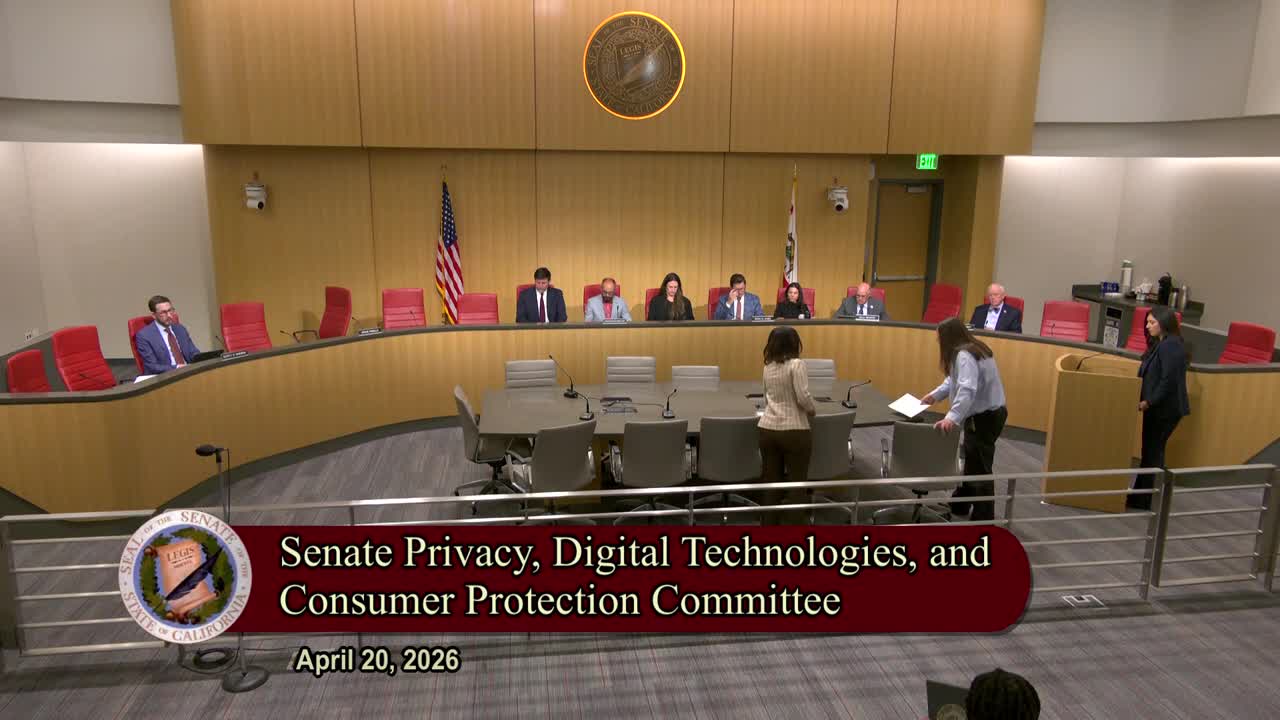 17MIN
Senate Standing Committee on Privacy, Digital Technologies, and Consumer Protection
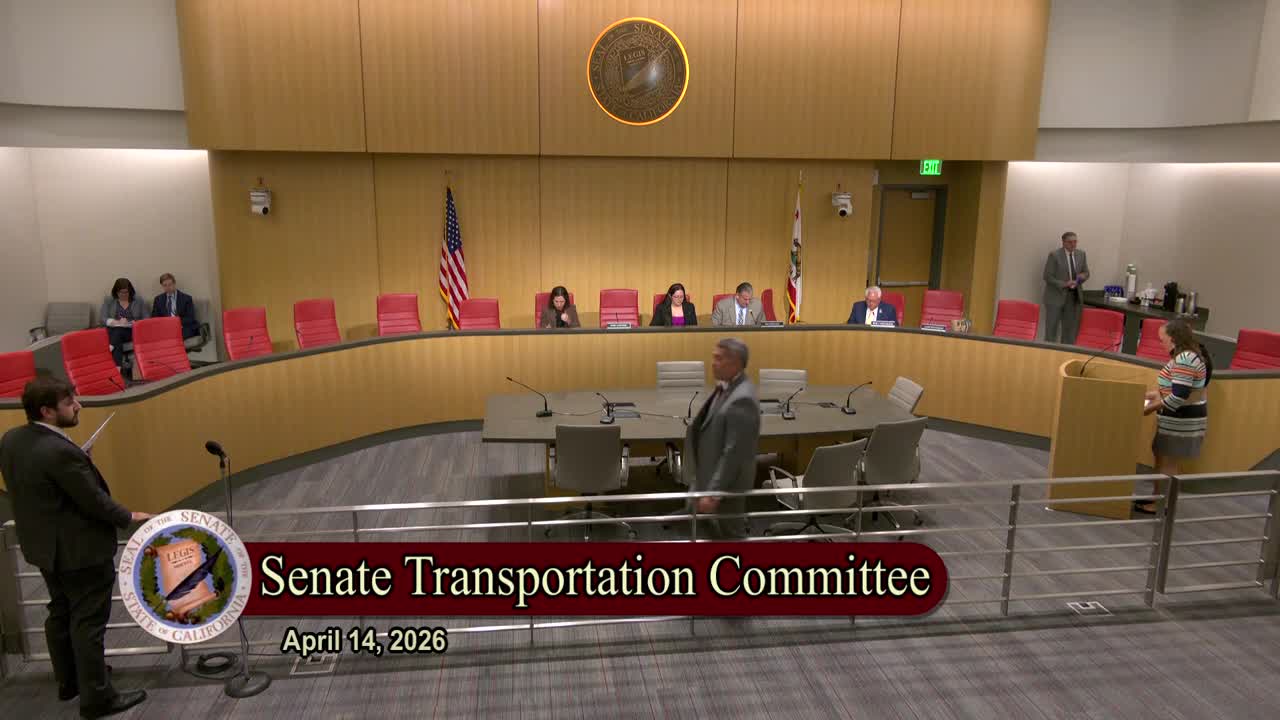 13MIN
Senate Standing Committee on Transportation
Bill Author

Bill Co-Author(s):