SB 1297: Regional wildfire partnerships.
- Session Year: 2025-2026
- House: Senate
- Latest Version Date: 2026-04-14
Current Status:
In Progress
(2026-05-14: May 14 hearing: Held in committee and under submission.)
Introduced
In Committee
Awaiting First Chamber Vote
Passed First Chamber
In Committee
Awaiting Second Chamber Vote
Passed Second Chamber
Enacted
Existing law establishes in the Department of Conservation the Regional Forest and Fire Capacity Program to support regional leadership to build local and regional capacity and develop, prioritize, and implement strategies and projects that create fire adapted communities and landscapes by improving ecosystem health, community wildfire preparedness, and fire resilience. Existing law requires the department, upon appropriation, among other things, to provide block grants to regional entities, as defined, to develop regional strategies and projects that create fire adapted communities and landscapes, as provided. Existing law authorizes regional entities to implement collaborative planning efforts with specified local entities and develop regional priority strategies that develop and support specified goals.
This bill would authorize regional entities to form regional wildfire mitigation collaboratives, consisting of specified local government entities, special districts, and tribal governments, and would further authorize these collaboratives to take the form of a joint powers authority. The bill would require these collaboratives to form cooperative agreements with specified entities, as provided. The bill would authorize the collaboratives to develop wildfire mitigation plans to implement projects across the region that mitigate against the risk of wildfire, including projects related to, among other things, structure hardening and retrofitting. The bill would require the plans to consider projects that accomplish specified goals, including, among other things, improve the availability and affordability of property insurance in the region. revise and recast the Regional Forest and Fire Capacity Program. The bill would, among other things, authorize regional entities to (1) implement collaborative planning efforts with insurance companies, private and public utilities, and other private and public entities, and (2) develop regional priority strategies that develop and support fire-resistant homes, businesses, and public buildings, as provided. The bill would authorize a public regional entity, or an entity or entities designated by a public regional entity, to organize a regional wildfire partnership, defined as either a partnership between a public regional entity and specified private entities or a joint powers authority, as provided, in order to support the regional priority strategies. The bill would require a regional wildfire partnership to submit an annual report to the Department of Conservation, as provided, and would require the department to make the reports publicly available on its internet website.
Existing law, the Bergeson-Peace Infrastructure and Economic Development Bank Act, establishes the California Infrastructure and Economic Development Bank (I-Bank) within the Governors Office of Business and Economic Development and, among other things, authorizes the I-Bank to make loans, issue bonds, and provide financial assistance for various types of projects that qualify as economic development or public development facilities, as provided.
This bill would authorize the I-Bank, in coordination with the Treasurer and the Department of Conservation, to issue revenue bonds to finance wildfire mitigation plans developed by regional wildfire mitigation collaboratives. regional priority strategies developed by regional wildfire partnerships. The bill would establish the Regional Wildfire Mitigation Collaborative Partnership Revolving Fund (revolving fund) in the State Treasury, require moneys generated from the sale of bonds to be deposited in the revolving fund and used exclusively to support the regional wildfire mitigation collaboratives, a regional wildfire partnership, and continuously appropriate moneys in the revolving fund to the I-Bank to support the regional wildfire mitigation collaboratives. a regional wildfire partnership. By establishing a continuously appropriated fund, the bill would make an appropriation. The bill would require a regional wildfire mitigation collaborative regional wildfire partnership receiving funds from the I-Bank to enter into a repayment and participation agreement with the bank, specifying the funding commitments and reporting obligations. The bill would also authorize the I-Bank to provide technical assistance to regional wildfire partnerships.
The bill would require a regional wildfire mitigation collaborative seeking funds from the Revolving Fund to submit a wildfire mitigation plan to the Department of Conservation. The bill would authorize the department to consult with specified state entities to review the plans according to specified criteria. The bill would make the regional wildfire mitigation collaboratives eligible for funding from the Revolving Fund upon the departments approval of the wildfire mitigation plan. The bill would also authorize the I-Bank to provide technical assistance to regional wildfire mitigation collaboratives.Existing law establishes in the Department of Conservation the Regional Forest and Fire Capacity Program to support regional leadership to build local and regional capacity and develop, prioritize, and implement strategies and projects that create fire adapted communities and landscapes by improving ecosystem health, community wildfire preparedness, and fire resilience. Existing law requires the department, upon appropriation, among other things, to provide block grants to regional entities, as defined, to develop regional strategies and projects that create fire adapted communities and landscapes, as provided.
This bill would authorize regional entities to form regional wildfire mitigation collaboratives, consisting of specified local government entities, special districts, and tribal governments, and would further authorize these collaboratives to take the form of a joint powers authority. The bill would require these collaboratives to form cooperative agreements with specified entities, as provided. The bill would authorize the collaboratives to develop wildfire mitigation plans to implement projects across the region that mitigate against the risk of wildfire, including projects related to, among other things, structure hardening and retrofitting. The bill would require the plans to consider projects that accomplish specified goals, including, among other things, improve the availability and affordability of property insurance in the region.
Existing law, the Bergeson-Peace Infrastructure and Economic Development Bank Act, establishes the California Infrastructure and Economic Development Bank (I-Bank) within the Governors Office of Business and Economic Development and, among other things, authorizes the I-Bank to make loans, issue bonds, and provide financial assistance for various types of projects that qualify as economic development or public development facilities, as provided.
This bill would authorize the I-Bank, in coordination with the Treasurer and the Department of Conservation, to issue revenue bonds to finance wildfire mitigation plans developed by regional wildfire mitigation collaboratives. The bill would establish the Regional Wildfire Mitigation Collaborative Revolving Fund (revolving fund) in the State Treasury, require moneys generated from the sale of bonds to be deposited in the revolving fund and used exclusively to support the regional wildfire mitigation collaboratives, and continuously appropriate moneys in the revolving fund to the I-Bank to support the regional wildfire mitigation collaboratives. By establishing a continuously appropriated fund, the bill would make an appropriation. The bill would require a regional wildfire mitigation collaborative receiving funds from the I-Bank to enter into a repayment and participation agreement with the bank, specifying the funding commitments and reporting obligations.
The bill would require a regional wildfire mitigation collaborative seeking funds from the Revolving Fund to submit a wildfire mitigation plan to the Department of Conservation. The bill would authorize the department to consult with specified state entities to review the plans according to specified criteria. The bill would make the regional wildfire mitigation collaboratives eligible for funding from the Revolving Fund upon the departments approval of the wildfire mitigation plan. The bill would also authorize the I-Bank to provide technical assistance to regional wildfire mitigation collaboratives.
Existing law, the Planning and Zoning Law, provides that there is in each city and county a planning agency with the powers necessary to carry out the purposes of the law and requires the legislative body of each city and county to by ordinance assign the functions of the planning agency to a planning department, one or more planning commissions, administrative bodies or hearing officers, the legislative body itself, or any combination thereof, as it deems appropriate and necessary.This bill would make nonsubstantive changes to those provisions.Existing law, the Planning and Zoning Law, provides that there is in each city and county a planning agency with the powers necessary to carry out the purposes of the law and requires the legislative body of each city and county to by ordinance assign the functions of the planning agency to a planning department, one or more planning commissions, administrative bodies or hearing officers, the legislative body itself, or any combination thereof, as it deems appropriate and necessary.
This bill would make nonsubstantive changes to those provisions.
(a)The Legislature finds and declares all of the following:
(a)Californias wildfire crisis poses systemic risks to insurance markets, investor-owned utilities, ratepayers, and the states long-term fiscal outlook.(b)Wildfire prevention actions, including home hardening, defensible space, landscape-scale vegetation management, and more, are necessary to reduce the risk of loss and damage to life and property.(1)Wildfires pose an existential threat to communities in the wildland-urban interface, causing catastrophic loss of life, property, and natural resources and imposing escalating costs on homeowners, local governments, utilities, insurers, and the state.
(2)Effective wildfire risk reduction requires landscape-scale, regionally coordinated investment strategies that integrate vegetation management, structure hardening, community preparedness, and infrastructure resilience.
(c)(3)Current wildfire spending is insufficient to result in the needed risk reduction at the scale required. In addition, current spending is not directed enough towards structural hardening and communitywide risk reduction.
(d)(4)In the 202526 fiscal year, the State of California spent roughly $4,000,000,000 on wildfire, 90 percent of which went towards firefighting and fire suppression, and only 10 percent towards prevention.
(e)(5)In 2025, according to Stanford University researchers, investor-owned utility planned wildfire expenditures totaled more than $9,000,000,0000, to be spent primarily on distribution line right-of-way clearance.
(f)Conservation finance methodologies, including pay-for-success models where public and private entities quantify the benefits associated with a planned conservation action and agree to a schedule of milestone payments based upon the action being implemented and the benefits accrued, have been successfully deployed, including in California, to raise upfront financing via bond markets.(g)It is the intent of the Legislature, on a voluntary basis, to incentivize similar financing strategies via existing programs and in a targeted manner to increase wildfire prevention in California.(6)Regional entities with established relationships, local expertise, and accountability to affected communities are best positioned to develop and implement strategies tailored to their regions distinct risk profiles, resources, and stakeholder networks.
(7)Sustainable financing for wildfire resilience requires aligning the financial interests of the many parties that benefit from risk reduction, including local governments, water agencies, electrical corporations, insurers, reinsurers, and state and federal agencies, so that each contributor participates on terms that serve its institutional objectives.
(8)Innovative financing models hold significant promise for mobilizing private capital to supplement public funding for wildland-urban interface resilience.
(9)California Infrastructure and Economic Development Bank financing tools, catalytic state funding, and a clear statutory framework can lower transaction costs and attract participation by entities that might otherwise lack a pathway for investment.
(10)The states existing Regional Forest and Fire Capacity Program and the Wildfire and Forest Resilience Task Force framework provide an appropriate institutional foundation upon which to build a more comprehensive regional resilience financing system.
(b)(1)It is the intent of the Legislature to incentivize, on a voluntary basis, Regional Fire and Forest Capacity Program regional entities and other capable regional organizations to develop and implement wildfire resilience financing plans through regional public-private partnerships that improve regional wildfire prevention, reduce future losses from wildfire, prioritize communitywide risk reduction, improve the availability and affordability of insurance, and reduce the risk of utility-sparked fires.
(2)It is also the intent of the Legislature to achieve all of the following:
(A)Provide a flexible suite of financing tools including, but not limited to, revenue bond financing that regional entities may deploy as appropriate to their circumstances.
(B)Establish a catalytic state investment sufficient to demonstrate the viability of regional financing strategies and attract participation by private utilities, insurers, and other private entities.
(C)Enable performance-based financing structures in which upfront capital investments are supported by multiyear revenue commitments from beneficiary entities tied to verified reductions in wildfire risk and losses.
(D)Encourage private utilities, insurers, and other private entities to participate in regional wildfire resilience financing plans by creating a clear legal and institutional framework for their contributions, while preserving regulatory flexibility and recognizing each entitys distinct institutional objectives.
(E)Maintain flexibility so that regions may design programs consistent with their own circumstances, available resources, and stakeholder composition, without requiring participation by any particular entity.
SEC. 2.Article 6.1 (commencing with Section 63048.51) is added to Chapter 2 of Division 1 of Title 6.7 of the Government Code, to read:6.1.Regional Wildfire Mitigation Collaboratives Partnerships63048.51.For purposes of this article, the following definitions apply:
(a)Entity means an entity listed in paragraphs (1) to (9), inclusive, of subdivision (a) of Section 4208.2 of the Public Resources Code.(b)Regional wildfire mitigation collaborative means an entity formed pursuant to Section 4208.2 of the Public Resources Code.(a)Regional wildfire partnership or partnership has the same meaning as that term is defined in Section 4208 of the Public Resources Code.
(c)(b)Revolving fund means the Regional Wildfire Mitigation Collaborative Partnership Revolving Fund established pursuant to subdivision (c) of Section 63048.52.
63048.52.(a)The bank, in coordination with the Treasurer and the Department of Conservation, may issue revenue bonds to finance wildfire mitigation plans regional priority strategies developed by a regional wildfire mitigation collaboratives partnership pursuant to Article 11 (commencing with Section 4208) of Chapter 1 of Part 2 of Division 4 of the Public Resources Code.
(b)A regional wildfire mitigation collaborative partnership receiving funding for a plan regional priority strategy developed pursuant to Article 11 (commencing with Section 4208) of Chapter 1 of Part 2 of Division 4 of the Public Resources Code shall enter into a repayment and participation agreement with the bank, specifying the funding commitments and reporting obligations.
(c)(1)The Regional Wildfire Mitigation Collaborative Partnership Revolving Fund is hereby established in the State Treasury. Notwithstanding Section 13340 of the Government Code, moneys in the revolving fund are hereby continuously appropriated to the bank without regard to fiscal year for the purposes of this article.
(2)Moneys generated from the sale of bonds shall be deposited into the revolving fund.
(d)The bank may distribute proceeds from the revolving fund to regional wildfire mitigation collaboratives, following approval of the collaboratives wildfire mitigation plan pursuant to Section 4208.4 of the Public Resources Code. a partnership.
(e)The bank may also provide technical assistance to regional wildfire mitigation collaboratives, including joint powers authorities. a partnership.
63048.53.(a)The bank may issue taxable or tax-exempt revenue bonds pursuant to Chapter 5 (commencing with Section 63070) to finance wildfire mitigation plans regional priority strategies developed by regional wildfire mitigation collaboratives a partnership pursuant to Article 11 (commencing with Section 4208) of Chapter 1 of Part 2 of Division 4 of the Public Resources Code. The proceeds of the bonds shall be deposited into the revolving fund, as provided in Section 63048.52, and used exclusively for the purposes of supporting wildfire mitigation plans regional priority strategies developed by regional wildfire mitigation collaboratives a partnership pursuant to Article 11 (commencing with Section 4208 4208) of Chapter 1 of Part 2 of Division 4 of the Public Resources Code). Code. Bond proceeds may also be used to fund necessary reserves, capitalized interest, or costs of issuance.
(b)Bonds issued under this article shall not be deemed to constitute a debt or liability of the state or of any political subdivision of the state or a pledge of the faith and credit of the state or of any political subdivision, other than the bank, but shall be payable solely from the revolving fund and the assets of the revolving fund, and the security provided by the revolving fund. All bonds issued under this article shall contain on the face of the bonds a statement to that effect.
SEC. 3.Section 4208 of the Public Resources Code is amended to read:4208.For purposes of this article, the following definitions apply:
(a)Department means the Department of Conservation.
(b)Eligible coordinating organization means a local government, tribal government, resource conservation district, joint powers authority, or nongovernmental organization with a history of providing technical assistance and demonstrated capacity to coordinate regional partners across the state.
(c)Program means the Regional Forest and Fire Capacity Program.
(d)Regional entity means a state conservancy, local government, tribal government, resource conservation district, joint powers authority, or nongovernmental organization with a history of implementing related projects, demonstrated capacity to work across regional partners, and ability to serve as fiscal administrators for the program.
(e)Regional wildfire mitigation collaborative or collaborative means an entity formed by a regional entity as described in Section 4208.2.(e)Regional wildfire partnership means either of the following, organized by either a public regional entity or a public entity or entities designated by a public regional entity:
(1)A cooperative arrangement, contractual agreement, memorandum of understanding, or other similar arrangement between public regional entities and private entities, including, but not limited to, those private entities identified in paragraph (2) of subdivision (b) of Section 4208.1, built on the expertise of each partner, that best meets the regions needs through the appropriate allocation of resources, personnel, risks, and funding for the purposes of the development and implementation of regional priority strategies to identify and reduce wildfire risk. This partnership may also include nonpublic regional entities.
(2)A joint powers authority formed in accordance with the Joint Exercise of Powers Act (Chapter 5 (commencing with Section 6500) of Division 7 of Title 1 of the Government Code). These joint powers authorities may enter into cooperative agreements, contractual agreements, memoranda of understanding, or other similar agreements with private entities including, but not limited to, those private entities identified in paragraph (2) of subdivision (b) of Section 4208.1, for the purposes of the development and implementation of regional priority strategies to identify and reduce wildfire risk.
(f)Statewide implementation means identifying and supporting regional entities in every part of the state that contains or is adjacent to a very high or high fire hazard severity zone identified by the State Fire Marshal pursuant to Section 51178 of the Government Code or Article 9 (commencing with Section 4201).
SEC. 4.Section 4208.1 of the Public Resources Code is amended to read:4208.1.(a)There is hereby established in the department the Regional Forest and Fire Capacity Program to support regional leadership to build local and regional capacity and develop, prioritize, and implement strategies and projects that create fire adapted communities and landscapes by improving ecosystem health, community wildfire preparedness, and fire resilience. For strategies and projects that seek to create fire adapted communities, regional entities shall maximize risk reductions to people and property, especially in the most vulnerable communities.
(b)(1)The department shall, upon an appropriation by the Legislature for these purposes, do both of the following:
(A)(i)Provide block grants to regional entities to develop regional strategies that develop governance structures, identify wildfire risks, foster collaboration, and prioritize and implement projects within the region to achieve the goals of the program.
(ii)Regional priority strategy development shall be in coordination with public landowners and other relevant forest and fire planning efforts in wildfire and forest resiliency planning. planning, which may include, but not be limited to, efforts of private entities and nongovernmental organizations.
(B)Ensure, to the extent feasible, there are regional entities to cover every part of the state that contains or is adjacent to a very high or high fire hazard severity zone identified by the State Fire Marshal pursuant to Section 51178 of the Government Code or Article 9 (commencing with Section 4201).
(2)Regional entities may implement program activities directly or provide subgrants or contracts, and collaborative planning efforts with local entities, including municipal governments, tribal governments, nongovernmental organizations, community organizations, fire safe councils, land trusts, resource conservation districts, joint power authorities, special districts, fire departments, residents, private and public forest landowners and managers, businesses, insurance companies, private and public utilities, including, but not limited to, water and electric utilities, and others, other private and public entities, to assist the regional entity in accomplishing all of the following objectives:
(A)Develop regional priority strategies that develop and support fire any combination of the following:
(i)Fire adapted communities and landscapes by improving forest health, watershed health, or fire risk reduction, or fire reduction.
(ii)Fire-resistant homes, businesses, and public buildings by expanding structure hardening and retrofitting opportunities.
(iii)Fire resilience needed to achieve local, regional, or statewide public safety, climate resiliency, and ecosystem goals included in the Agreement for Shared Stewardship of Californias Forest and Rangelands and Californias Wildfire and Forest Resilience Action Plan.
(B)Complete project development and permitting to generate implementation-ready projects that address regional landscape resilience and community fire protection priorities for funding consideration.
(C)Implement forest management demonstration projects that showcase scalable models for management, funding, and achieving and quantifying multiple benefits.
(D)Implement community fire preparedness demonstration projects that create durable risk reduction for structures and critical community infrastructure.
(E)Develop outreach, education, and training as needed to facilitate and build capacity to implement this section.
(F)Collect and assess data and information as needed to identify and map communities, infrastructure, forests, and watersheds at risk of, and vulnerable to, wildfire, in collaboration with appropriate state agencies, including, but not limited to, the Department of Forestry and Fire Protection.
(c)The department shall, upon an appropriation by the Legislature for these purposes, provide block grants to eligible coordinating organizations under the program to support the statewide implementation of the program through coordination of and technical assistance to regional entities, as well as to support forest health and resilience efforts across regions and throughout the state.
(d)(1)A public regional entity, or a public entity or entities designated by a public regional entity, may organize a regional wildfire partnership.
(2)A regional wildfire partnership shall be eligible for financing from the Regional Wildfire Partnership Revolving Fund established pursuant to Article 6.1 (commencing with Section 63048.51) of Chapter 2 of Division 1 of Title 6.7 of the Government Code for purposes of supporting regional priority strategies.
(3)Only a regional wildfire partnership shall be eligible for financing from the Regional Wildfire Partnership Revolving Fund. A regional entity that is not a regional wildfire partnership shall remain eligible for grants and other financing from sources other than the Regional Wildfire Partnership Revolving Fund.
(d)(e)To maximize the benefits of the program, the department shall do all of the following:
(1)Facilitate peer-to-peer learning within and between regions to share information, experiences, and resources to build regional capacity.
(2)Provide technical assistance to regions to enhance regional capacity and assist in the development and prioritization of projects.
(3)Assist regions in identifying potential funding sources for regional priorities.
(4)Encourage the development of local cost share opportunities.
(5)Publish and update on the departments internet website the following information related to implementation of the program:
(A)A list of regional entities and eligible coordinating organizations funded by the program.
(B)The outcomes of any block grant provided to a regional entity or eligible coordinating organization, including a summary of the benefits, such as the number of people and properties for which wildfire risk has been mitigated, ecosystem health benefits, or other measurements of progress towards state goals for public health and safety, climate resilience, and biodiversity, as applicable.
(C)A description of progress towards ensuring there are regional entities to cover every part of the state that contains or is adjacent to a very high or high fire hazard severity zone identified by the State Fire Marshal pursuant to Section 51178 of the Government Code or Article 9 (commencing with Section 4201).
(e)(f)Until July 1, 2025, the department may authorize advance payments on a grant awarded under this section in accordance with subdivision (d) of Section 11019.1 of the Government Code.
SEC. 4.Section 4208.2 is added to the Public Resources Code, immediately following Section 4208.1, to read:4208.2.(a)A regional entity may form a regional wildfire mitigation collaborative with any or all of the following entities:(1)Cities.(2)Counties.(3)Fire districts.(4)Water agencies.(5)Public utilities.(6)Conservancies.(7)Resource conservation districts.(8)Tribal governments.(9)Other relevant public agencies.(b)A collaborative shall form cooperative agreements with any or all of the following entities:(1)Property insurers that serve the region, if applicable.(2)Private utilities that serve the region, if applicable.(3)Other relevant private or nonprofit entities.(c)A collaborative formed pursuant to subdivision (a) may be formed as a joints powers authority pursuant to Chapter 5 (commencing with Section 6500) of Division 7 of Title 1 of the Government Code.SEC. 5.Section 4208.3 is added to the Public Resources Code, to read:4208.3.(a)A regional wildfire mitigation collaborative formed pursuant to Section 4208.2 may develop wildfire mitigation plans to implement projects across the region that mitigate against the risk of wildfire, including, but not limited to, the following types of projects:(1)Structure hardening and retrofitting that creates fire-resistant homes, businesses, and public buildings.(2)Creation of additional Firewise USA communities.(3)Projects that facilitate vegetation management.(4)Prescribed grazing.(5)Prescribed burns.(6)The creation and maintenance of defensible space.(7)Development and implementation of public education and outreach programs, including the following:(A)Programs that include technical assistance, new technologies, game elements to enhance and accelerate the education of property owners, workforce recruitment and training, and equipment purchases.(B)Public education outreach regarding making homes and communities more wildfire resilient, including training on defensible space and prescribed grazing.(8)Ignition prevention.(9)Other fuel modification activities that provide neighborhood or communitywide benefits against wildfire.(b)Wildfire mitigation plans shall be focused primarily on maximizing communitywide wildfire risk reduction. Plans may also include projects that benefit individual properties.(c)Wildfire mitigation plans shall consider projects that accomplish the following goals:(1)Improve the availability and affordability of property insurance in the region.(2)Reduce the risk of utility started fires.(3)Complement other fire prevention or forest health activities and plans.SEC. 6.Section 4208.4 is added to the Public Resources Code, to read:4208.4.(a)A regional wildfire mitigation collaborative may, consistent with the requirements of this section, receive funds from the California Infrastructure and Economic Development Bank pursuant to Article 6.1 (commencing with Section 63048.51) of Chapter 2 of Division 1 of Title 6.7 of the Government Code.(b)A regional wildfire mitigation collaborative seeking funds pursuant to Article 6.1 (commencing with Section 63048.51) of Chapter 2 of Division 1 of Title 6.7 of the Government Code shall submit a wildfire mitigation plan consistent with Section 4208.3 to the department.(c)The department may consult with the State Fire Marshal, the Department of Forestry and Fire Protection, the Department of Housing and Community Development, the Office of Emergency Services, the Department of Insurance, and the Public Utilities Commission, as applicable, to review a wildfire mitigation plan according to the following criteria:(1)The wildfire risk and loss reduction that the plan brings to the region.(2)The wildfire risk and loss reduction that the plan brings to very high and high fire hazard severity zones.(3)Geographic areas to which the plan and its activities apply.(4)Cost effectiveness of the activities identified in the plan.(d)Following approval of the wildfire mitigation plan by the department, the collaborative shall be eligible to receive funds for purposes of the wildfire mitigation plan pursuant to Article 6.1 (commencing with Section 63048.51) of Chapter 2 of Division 1 of Title 6.7 of the Government Code.SEC. 5.Section 4208.2 is added to the Public Resources Code, immediately following Section 4208.1, to read:4208.2.A regional wildfire partnership shall, no later than December 31 of the year it was created, and annually thereafter, submit a report to the department regarding whether any funds, other than program grants, were used to achieve projects identified in their regional priority strategies. The department shall make the report publicly available on its internet website.
The Legislature finds and declares all of the following:
(a)Californias wildfire crisis poses systemic risks to insurance markets, investor-owned utilities, ratepayers, and the states long-term fiscal outlook.
(b)Wildfire prevention actions, including home hardening, defensible space, landscape-scale vegetation management, and more, are necessary to reduce the risk of loss and damage to life and property.
(c)Current wildfire spending is insufficient to result in the needed risk reduction at the scale required. In addition, current spending is not directed enough towards structural hardening and communitywide risk reduction.
(d)In the 202526 fiscal year, the State of California spent roughly $4,000,000,000 on wildfire, 90 percent of which went towards firefighting and fire suppression, and only 10 percent towards prevention.
(e)In 2025, according to Stanford University researchers, investor-owned utility planned wildfire expenditures totaled more than $9,000,000,0000, to be spent primarily on distribution line right-of-way clearance.
(f)Conservation finance methodologies, including pay-for-success models where public and private entities quantify the benefits associated with a planned conservation action and agree to a schedule of milestone payments based upon the action being implemented and the benefits accrued, have been successfully deployed, including in California, to raise upfront financing via bond markets.
(g)It is the intent of the Legislature, on a voluntary basis, to incentivize similar financing strategies via existing programs and in a targeted manner to increase wildfire prevention in California.
SEC. 2.Article 6.1 (commencing with Section 63048.51) is added to Chapter 2 of Division 1 of Title 6.7 of the Government Code, to read:6.1.Regional Wildfire Mitigation Collaboratives63048.51.For purposes of this article, the following definitions apply:
(a)Entity means an entity listed in paragraphs (1) to (9), inclusive, of subdivision (a) of Section 4208.2 of the Public Resources Code.
(b)Regional wildfire mitigation collaborative means an entity formed pursuant to Section 4208.2 of the Public Resources Code.
(c)Revolving fund means the Regional Wildfire Mitigation Collaborative Revolving Fund established pursuant to subdivision (c) of Section 63048.52.
63048.52.(a)The bank, in coordination with the Treasurer and the Department of Conservation, may issue revenue bonds to finance wildfire mitigation plans developed by regional wildfire mitigation collaboratives pursuant to Article 11 (commencing with Section 4208) of Chapter 1 of Part 2 of Division 4 of the Public Resources Code.
(b)A regional wildfire mitigation collaborative receiving funding for a plan developed pursuant to Article 11 (commencing with Section 4208) of Chapter 1 of Part 2 of Division 4 of the Public Resources Code shall enter into a repayment and participation agreement with the bank, specifying the funding commitments and reporting obligations.
(c)(1)The Regional Wildfire Mitigation Collaborative Revolving Fund is hereby established in the State Treasury. Notwithstanding Section 13340 of the Government Code, moneys in the revolving fund are hereby continuously appropriated to the bank without regard to fiscal year for the purposes of this article.
(2)Moneys generated from the sale of bonds shall be deposited into the revolving fund.
(d)The bank may distribute proceeds from the revolving fund to regional wildfire mitigation collaboratives, following approval of the collaboratives wildfire mitigation plan pursuant to Section 4208.4 of the Public Resources Code.
(e)The bank may also provide technical assistance to regional wildfire mitigation collaboratives, including joint powers authorities.
63048.53.(a)The bank may issue taxable or tax-exempt revenue bonds pursuant to Chapter 5 (commencing with Section 63070) to finance wildfire mitigation plans developed by regional wildfire mitigation collaboratives pursuant to Article 11 (commencing with Section 4208) of Chapter 1 of Part 2 of Division 4 of the Public Resources Code. The proceeds of the bonds shall be deposited into the revolving fund, as provided in Section 63048.52, and used exclusively for the purposes of supporting wildfire mitigation plans developed by regional wildfire mitigation collaboratives pursuant to Article 11 (commencing with Section 4208 of Chapter 1 of Part 2 of Division 4 of the Public Resources Code). Bond proceeds may also be used to fund necessary reserves, capitalized interest, or costs of issuance.
(b)Bonds issued under this article shall not be deemed to constitute a debt or liability of the state or of any political subdivision of the state or a pledge of the faith and credit of the state or of any political subdivision, other than the bank, but shall be payable solely from the revolving fund and the assets of the revolving fund, and the security provided by the revolving fund. All bonds issued under this article shall contain on the face of the bonds a statement to that effect.
SEC. 3.Section 4208 of the Public Resources Code is amended to read:4208.For purposes of this article, the following definitions apply:
(a)Department means the Department of Conservation.
(b)Eligible coordinating organization means a local government, tribal government, resource conservation district, joint powers authority, or nongovernmental organization with a history of providing technical assistance and demonstrated capacity to coordinate regional partners across the state.
(c)Program means the Regional Forest and Fire Capacity Program.
(d)Regional entity means a state conservancy, local government, tribal government, resource conservation district, joint powers authority, or nongovernmental organization with a history of implementing related projects, demonstrated capacity to work across regional partners, and ability to serve as fiscal administrators for the program.
(e)Regional wildfire mitigation collaborative or collaborative means an entity formed by a regional entity as described in Section 4208.2.
(e)(f)Statewide implementation means identifying and supporting regional entities in every part of the state that contains or is adjacent to a very high or high fire hazard severity zone identified by the State Fire Marshal pursuant to Section 51178 of the Government Code or Article 9 (commencing with Section 4201).
SEC. 4.Section 4208.2 is added to the Public Resources Code, immediately following Section 4208.1, to read:4208.2.(a)A regional entity may form a regional wildfire mitigation collaborative with any or all of the following entities:
(1)Cities.
(2)Counties.
(3)Fire districts.
(4)Water agencies.
(5)Public utilities.
(6)Conservancies.
(7)Resource conservation districts.
(8)Tribal governments.
(9)Other relevant public agencies.
(b)A collaborative shall form cooperative agreements with any or all of the following entities:
(1)Property insurers that serve the region, if applicable.
(2)Private utilities that serve the region, if applicable.
(3)Other relevant private or nonprofit entities.
(c)A collaborative formed pursuant to subdivision (a) may be formed as a joints powers authority pursuant to Chapter 5 (commencing with Section 6500) of Division 7 of Title 1 of the Government Code.
SEC. 5.Section 4208.3 is added to the Public Resources Code, to read:4208.3.(a)A regional wildfire mitigation collaborative formed pursuant to Section 4208.2 may develop wildfire mitigation plans to implement projects across the region that mitigate against the risk of wildfire, including, but not limited to, the following types of projects:
(1)Structure hardening and retrofitting that creates fire-resistant homes, businesses, and public buildings.
(2)Creation of additional Firewise USA communities.
(3)Projects that facilitate vegetation management.
(4)Prescribed grazing.
(5)Prescribed burns.
(6)The creation and maintenance of defensible space.
(7)Development and implementation of public education and outreach programs, including the following:
(A)Programs that include technical assistance, new technologies, game elements to enhance and accelerate the education of property owners, workforce recruitment and training, and equipment purchases.
(B)Public education outreach regarding making homes and communities more wildfire resilient, including training on defensible space and prescribed grazing.
(8)Ignition prevention.
(9)Other fuel modification activities that provide neighborhood or communitywide benefits against wildfire.
(b)Wildfire mitigation plans shall be focused primarily on maximizing communitywide wildfire risk reduction. Plans may also include projects that benefit individual properties.
(c)Wildfire mitigation plans shall consider projects that accomplish the following goals:
(1)Improve the availability and affordability of property insurance in the region.
(2)Reduce the risk of utility started fires.
(3)Complement other fire prevention or forest health activities and plans.
SEC. 6.Section 4208.4 is added to the Public Resources Code, to read:4208.4.(a)A regional wildfire mitigation collaborative may, consistent with the requirements of this section, receive funds from the California Infrastructure and Economic Development Bank pursuant to Article 6.1 (commencing with Section 63048.51) of Chapter 2 of Division 1 of Title 6.7 of the Government Code.
(b)A regional wildfire mitigation collaborative seeking funds pursuant to Article 6.1 (commencing with Section 63048.51) of Chapter 2 of Division 1 of Title 6.7 of the Government Code shall submit a wildfire mitigation plan consistent with Section 4208.3 to the department.
(c)The department may consult with the State Fire Marshal, the Department of Forestry and Fire Protection, the Department of Housing and Community Development, the Office of Emergency Services, the Department of Insurance, and the Public Utilities Commission, as applicable, to review a wildfire mitigation plan according to the following criteria:
(1)The wildfire risk and loss reduction that the plan brings to the region.
(2)The wildfire risk and loss reduction that the plan brings to very high and high fire hazard severity zones.
(3)Geographic areas to which the plan and its activities apply.
(4)Cost effectiveness of the activities identified in the plan.
(d)Following approval of the wildfire mitigation plan by the department, the collaborative shall be eligible to receive funds for purposes of the wildfire mitigation plan pursuant to Article 6.1 (commencing with Section 63048.51) of Chapter 2 of Division 1 of Title 6.7 of the Government Code.
SECTION 1.Section 65100 of the Government Code is amended to read:65100.There is in each city and county a planning agency with the powers necessary to carry out the purposes of this title. The legislative body of each city and county shall by ordinance assign the functions of the planning agency to a planning department, one or more planning commissions, administrative bodies or hearing officers, the legislative body itself, or any combination thereof, as it deems necessary and appropriate. In the absence of an assignment, the legislative body shall carry out all the functions of the planning agency.There is in each city and county a planning agency with the powers necessary to carry out the purposes of this title. The legislative body of each city and county shall by ordinance assign the functions of the planning agency to a planning department, one or more planning commissions, administrative bodies or hearing officers, the legislative body itself, or any combination thereof, as it deems appropriate and necessary. necessary and appropriate. In the absence of an assignment, the legislative body shall carry out all the functions of the planning agency.
|
Date
|
Status
|
|---|---|
| May 14, 2026 | May 14 hearing: Held in committee and under submission. |
| May 8, 2026 | Set for hearing May 14. |
| May 4, 2026 | May 4 hearing: Placed on APPR. suspense file. |
| Apr 24, 2026 | Set for hearing May 4. |
| Apr 20, 2026 | From committee: Do pass and re-refer to Com. on APPR. (Ayes 10. Noes 0. Page 3954.) (April 20). Re-referred to Com. on APPR. |
| Apr 20, 2026 | From committee: Do pass and re-refer to Com. on APPR. (Ayes 10. Noes 0.) (April 20). Re-referred to Com. on APPR. |
| Apr 15, 2026 | Set for hearing April 20. |
| Apr 14, 2026 | From committee with author's amendments. Read second time and amended. Re-referred to Com. on B. P. & E.D. |
| Apr 14, 2026 | From committee: Do pass and re-refer to Com. on B. P. & E.D. (Ayes 7. Noes 0. Page 3870.) (April 14). Re-referred to Com. on B. P. & E.D. |
| Apr 14, 2026 | From committee: Do pass and re-refer to Com. on B. P. & E.D. (Ayes 7. Noes 0.) (April 14). Re-referred to Com. on B. P. & E.D. |
| Apr 9, 2026 | Set for hearing April 14. |
| Apr 8, 2026 | Re-referred to Coms. on N.R. & W. and B. P. & E.D. |
| Mar 25, 2026 | From committee with author's amendments. Read second time and amended. Re-referred to Com. on RLS. |
| Mar 4, 2026 | Referred to Com. on RLS. |
| Feb 23, 2026 | Read first time. |
| Feb 23, 2026 | From printer. May be acted upon on or after March 23. |
| Feb 20, 2026 | Introduced. To Com. on RLS. for assignment. To print. |
|
Date
|
Description
|
Location
|
Votes
|
|
|---|---|---|---|---|
| May 4, 2026 | Placed on suspense file | Senate Standing Committee on Appropriations |
Passed |
|
| Apr 20, 2026 | Do pass, but first be re-referred to the Committee on [Appropriations] | Senate Standing Committee on Business, Professions and Economic Development |
Passed |
|
| Apr 14, 2026 | Do pass, but first be re-referred to the Committee on [Business, Professions and Economic Development] | Senate Standing Committee on Natural Resources and Water |
Passed |
This list shows positions taken on this bill by organizations on the date displayed, which is linked to the original source.
Positions by individuals are not included.
|
Organization
|
Position
|
Date
|
|---|---|---|
| NET-ZERO CALIFORNIA | ** Support | |
| Sierra Business Council | ** Support |
SENATE COMMITTEE ON
Senator Sabrina Cervantes, Chair
2025 - 2026 Regular Session
SB 1297 (Allen) - Regional wildfire partnerships
Version: | Policy Vote: |
Urgency: | Mandate: |
Hearing Date: | Consultant: |
Bill Summary:
This bill would authorize the Infrastructure and Economic Development Bank (IBank) to issue bonds to finance regional priority strategies developed by wildfire partnerships.
Fiscal Impact:
- Unknown but likely significant ongoing costs, possibly in the millions of dollars annually (various funds) for IBank to establish and administer the Regional Wildfire Partnership Revolving Fund. See staff comments for details.
- Unknown but likely significant ongoing costs (various funds) for the Department of Conservation to administer programs, collect data, and produce reports as required by this bill, among other things.
- Unknown but likely significant ongoing cost pressures (various funds) for the state to provide funds for the Regional Wildfire Partnership Revolving Fund established by this bill.
Background:
IBank and Infrastructure Loans. According to its website, IBank exists within GO-Biz and “was created in 1994 to finance public infrastructure and private development that promote a healthy climate for jobs, contribute to a strong economy and improve the quality of life in California communities. IBank has broad authority to issue tax-exempt and taxable revenue bonds, provide financing to public agencies, provide credit enhancements, acquire or lease facilities, and leverage State and Federal funds. IBank’s current programs include the Infrastructure State Revolving Fund (ISRF) Loan Program, California Lending for Energy and Environmental Needs (CLEEN) Center, the Climate Catalyst Revolving Loan fund, Small Business Finance Center and the Bond Financing Program.”
Regional Forest and Fire Capacity (RFFC) Program. According to the California Department of Conservation, the Regional Forest and Fire Capacity (RFFC) Program supports the development of regional strategies and partnerships for landscape-scale wildfire resilience. The program provides block grant funding to designated regional entities to build local and regional capacity, convene cross-jurisdictional partners, and coordinate among state, local, federal, tribal, and nonprofit stakeholders. RFFC grantees develop Regional Priority Plans that identify and prioritize forest health and wildfire mitigation projects, align regional efforts with state goals, and advance projects through early planning, permitting, and design.
According to the California Wildfire and Forest Resilience Task Force, the program is intended to address fragmentation in wildfire planning by supporting sustained regional governance structures and collaboration, with the goal of creating a pipeline of ready-to-implement projects that improve forest health, reduce wildfire risk, and promote fire-adapted communities.
Proposed Law:
This bill would:
- Authorize IBank, in coordination with the Treasurer and the Department of Conservation, to issue revenue bonds to finance regional priority strategies developed by wildfire partnerships and specifies that a partnership receiving funding for a strategy must enter into a repayment and participation agreement with IBank, specifying the funding commitments and reporting obligations.
- Define wildfire partnership as a joint powers authority, cooperative arrangement, contractual agreement, memorandum of understanding, or other similar arrangement between the public and private sectors, built on the expertise of each partner, that best meets the region’s needs through the appropriate allocation of resources, personnel, risks, and funding for the purposes of the development and implementation of regional priority strategies to identify and reduce wildfire risk.
- Establish the Regional Wildfire Partnership Revolving Fund in the State Treasury and specify that moneys in the fund are continuously appropriated to IBank without regard to fiscal year and that moneys generated from the sale of bonds must be deposited into the fund. Authorize IBank to distribute proceeds from the fund to regional wildfire partnerships and authorize IBank to provide technical assistance to regional wildfire partnerships.
- Specify that only regional wildfire partnerships are eligible for financing from the Regional Wildfire Partnership Revolving Fund but that other regional entities that are not Regional Wildfire Partnerships remain eligible for grants and other financing that are not the Regional Wildfire Partnership Fund.
- Require a regional wildfire partnership, no later than December 31 of the year it was created, and annually thereafter, to submit a report to the Department of Conservation regarding whether any funds, other than Regional Forest and Fire Capacity Program grants, were utilized to achieve projects identified in their regional priority and requires the Department of Conservation to make the report publicly available on its website.
- State findings and declarations.
- State Legislative intent.
Related Legislation:
SB 894 (Allen, 2026) would create the Wildfire Resilience Loan Program within the California Alternative Energy and Advanced Transportation Financing Authority (CAEATFA), allowing property owners to access low interest loans to retrofit their homes and businesses with fire resistant building materials.
Staff Comments:
IBank notes that it is difficult to determine a fiscal estimate to implement the provisions of this bill as it is unclear how the IBank would issue bonds based on the credit of Regional Wildfire Partnership Revolving Fund when the fund itself does not have a funding source, appropriation, and/or revenue stream to support repayment. Without these features, any bonds sold cannot be repaid, which would make it impossible to sell the bonds.
If the revolving fund were to receive funding/an appropriation/source of repayment, IBank would require additional staffing and funding for external consultants in order to implement the program. None of this could be absorbed into the existing IBank budget as this would need to be a separate program within the IBank.
In order to establish a Transmission Revolving Fund program, IBank has requested five-year funding of $3.6 million for staff positions and $11 million for non-staff expenses. IBank estimates similar costs for implementing the proposed Regional Wildfire Partnership Revolving Fund with the distinction that costs to implement SB 1297 would likely be ongoing as, unlike the Transmission Revolving Fund, there is no sunset in place.
-- END --
SENATE COMMITTEE ON
BUSINESS, PROFESSIONS AND ECONOMIC DEVELOPMENT
Senator Dr. Aisha Wahab, Chair
2025 - 2026 Regular
Bill No: Hearing Date: April 20, 2026
Author: | |||
Version: |
| ||
Urgency: | Fiscal: | ||
Consultant: | /Anna Billy | ||
Subject:
SUMMARY:
Authorizes the Infrastructure and Economic Development Bank (IBank) to issue bonds to finance regional priority strategies developed by wildfire partnerships.
NOTE: This bill was heard in the Senate Committee on Natural Resources and Water on April 14, 2026 and passed on a 7-0 vote.
Existing law:
- Establishes the Governor’s Office of Business and Economic Development (GO-Biz) within the Governor's Office for the purpose of serving as the lead state entity for economic strategy and marketing of California on issues relating to business development, private sector investment and economic growth. (Government Code (GC) §§ 12096 – 12098.5)
- Establishes the Bergeson-Peace Infrastructure and Economic Development Bank Act and creates the IBank. (GC § 63000 et seq.)
- Establishes the GO-Biz as the administrator of the Fund. (GC § 63021)
- Authorizes IBank to make loans, issue bonds, and provide other economic development assistance, among other things. (GC § 63050 et seq.)
This bill:
- Authorizes IBank, in coordination with the Treasurer and the Department of Conservation, to issue revenue bonds to finance regional priority strategies developed by wildfire partnerships and specifies that a partnership receiving funding for a strategy must enter into a repayment and participation agreement with IBank, specifying the funding commitments and reporting obligations. Defines wildfire partnership as a joint powers authority, cooperative arrangement, contractual agreement, memorandum of understanding, or other similar arrangement between the public and private sectors, built on the expertise of each partner, that best meets the region’s needs through the appropriate allocation of resources, personnel, risks, and funding for the purposes of the development and implementation of regional priority strategies to identify and reduce wildfire risk.
- Establishes The Regional Wildfire Partnership Revolving Fund in the State Treasury and specifies that moneys in the fund are continuously appropriated to IBank without regard to fiscal year and that moneys generated from the sale of bonds must be deposited into the fund. Authorizes IBank to distribute proceeds from the fund to regional wildfire partnerships and authorizes IBank to provide technical assistance to regional wildfire partnerships.
- Specifies that only regional wildfire partnerships are eligible for financing from the Regional Wildfire Partnership Revolving Fund but that other regional entities that are not Regional Wildfire Partnerships remain eligible for grants and other financing that are not the Regional Wildfire Partnership Fund.
- Requires a regional wildfire partnership, no later than December 31 of the year it was created, and annually thereafter, to submit a report to the Department of Conservation regarding whether any funds, other than Regional Forest and Fire Capacity Program grants, were utilized to achieve projects identified in their regional priority and requires the Department of Conservation to make the report publicly available on its website.
- States findings and declarations that wildfire poses an existential threat to communities in the wildland-urban interface, causing catastrophic loss of life, property, and natural resources and imposing escalating costs on homeowners, local governments, utilities, insurers, and the state; that effective wildfire risk reduction requires landscape-scale, regionally coordinated investment strategies that integrate vegetation management, structure hardening, community preparedness, and infrastructure resilience; that current wildfire spending is insufficient to result in the needed risk reduction; that in the 2025–26 fiscal year, the state spent roughly $4 billion on wildfires, 90 percent of which went towards firefighting and fire suppression, and only 10 percent towards prevention; that Stanford University researchers say investor-owned utility planned wildfire expenditures totaled more than $9 billion to be spent primarily on distribution line right-of-way clearance; that regional entities with established relationships, local expertise, and accountability to affected communities are best positioned to develop and implement strategies tailored to their regions' distinct risk profiles, resources, and stakeholder networks; that sustainable financing for wildfire resilience requires aligning the financial interests of the many parties that benefit from risk reduction, including local governments, water agencies, electrical corporations, insurers, reinsurers, and state and federal agencies, so that each contributor participates on terms that serve its institutional objectives; that innovative financing models hold significant promise for mobilizing private capital to supplement public funding for wildland-urban interface resilience; that IBank financing tools, catalytic state funding, and a clear statutory framework can lower transaction costs and attract participation by entities that might otherwise lack a pathway for investment and: that the state's existing Regional Forest and Fire Capacity (RFFC) program and the Wildfire and Forest Resilience Task Force framework provides an appropriate institutional foundation upon which to build a more comprehensive regional resilience financing system.
- States Legislative intent, on a voluntary basis, to incentivize Regional Fire and Forest Capacity regional entities and other capable regional organizations to develop and implement wildfire resilience financing plans through regional public-private partnerships that improve regional wildfire prevention, reduce future losses from wildfire, prioritize communitywide risk reduction, improve the availability and affordability of insurance, and reduce the risk of utility sparked fires. State Legislative intent to provide a flexible suite of financing tools including, but not limited to, revenue bond financing that regional entities may deploy as appropriate to their circumstances; to establish a catalytic state investment sufficient to demonstrate the viability of regional financing strategies and attract participation by private utilities, insurers, and other private entities; to enable performance-based financing structures in which upfront capital investments are supported by multi-year revenue commitments from beneficiary entities tied to verified reductions in wildfire risk and losses; to encourage private utilities, insurers, and other private entities to participate in regional wildfire resilience financing plans by creating a clear legal and institutional framework for their contributions, while preserving regulatory flexibility and recognizing each entity's distinct institutional objectives and; to maintain flexibility so that regions may design programs consistent with their own circumstances, available resources, and stakeholder composition, without requiring participation by any particular entity.
FISCAL EFFECT:
Unknown. This bill is keyed fiscal by Legislative Counsel.
COMMENTS:
- Purpose. The Author is the Sponsor of this bill. According to the Author, “Californians have been suffering from more frequent and catastrophic wildfires over recent years, leading to greater losses and damage. The 2025 Palisades and Eaton fires killed 31 people, displaced about 12,900 households, and caused about $30 billion in losses. The fire survivors are now navigating the costly process of rebuilding and are still healing from the trauma of the disaster. The government has the responsibility to take action to prevent these kinds of disasters in the future.
SB 1297 builds on the existing Regional Forest and Fire Capacity program, which only focuses on landscape-level mitigation, by allowing for the creation of Regional Wildfire Public Private Partnerships that enables entities which benefit from wildfire risk reduction to be involved in planning and funding mitigation projects. Participating entities could include public agencies, insurers, utilities, and non-profit organizations that all serve an area. The Partnerships will develop plans that focus not just on landscape mitigation, but also on community-scale hardening and structural hardening shaped by participant feedback on what will meaningfully reduce the risk of substantial losses following a wildfire, improve insurability, and lead to saved costs. Partnership participants would help fund those plans over time but be eligible to receive the initial project funding from bonds coordinated by the IBank.
SB 1297 avoids the pitfalls of current mitigation planning processes by encouraging all beneficiaries of wildfire risk reduction to come together and collaborate on the planning process, rather than operating in their own silos. Additionally, this bill opens new financing opportunities to make available more stable and reliable sources of funds for regional projects.”
- Background.
GO-Biz. In February 2010, the Little Hoover Commission undertook a review of the state's economic and workforce development programs. In its final report, Making up for Lost Ground: Creating a Governor's Office of Economic Development, it analyzed the status and effectiveness of current programs since the 2003 demise of the Technology, Trade and Commerce Agency (TTCA) and recommended the creation of a new governmental entity to fill the void left by the dismantled agency.
The report called for a single entity that would promote greater economic development, foster job creation, serve as a policy advisor and deliver specific services (i.e., permitting, tax, regulatory, and other information) directly to the California business community. In April 2010, Governor Schwarzenegger issued Executive Order S-05-10 as a means to operationalize the report recommendations including the creation of the Governor's Office of Economic Development (GOED).
In October 2011, the Governor signed AB 29 (John A. Pérez, Chapter 475, Statutes of 2011), which effectively codified GOED and changed its name to GO-Biz. Since its inception, the office has served thousands of businesses, 95 percent of which are small businesses. The most frequent types of assistance include help with permit streamlining, starting a business, relocation and expansion of businesses, and regulatory challenges.
In March 2012, Governor Brown initiated a reorganization process to realign the state's administrative structure. Key changes include dismantling of the Business, Transportation and Housing Agency and the shifting of a number of key programs to GO-Biz including the Small Business Loan Guarantee Program, the California Travel and Tourism Commission, the California Film Commission, the Film California First Program, and the Infrastructure and Economic Development Bank (IBank). Currently, GO-Biz administers the following programs and units:
- Made In California program for the purpose of encouraging consumer product awareness and to foster the purchases of products manufactured in California.
- The California Inclusive Innovation Hub Program (iHub2) to incubate and/or accelerate technology and science-based firms, with a focus on underserved regions and communities.
- The California Competes Tax Credit Program under which “businesses who want to come to California or stay and grow in California” can receive an income tax credit.
- The California Business Investment Services Unit, which provides no-fee, tailored site selection services to employers and others who may be considering California for relocation or expansion.
- The California Business Portal, which provides information to California businesses about common questions, permitting, financial options, and more.
- The California Community Reinvestment Grants Program, which was included in Proposition 64, authorized GO-Biz to award grants to local health departments and certain nonprofit organizations to support communities disproportionately affected by the War on Drugs.
- Office of the Small Business Advocate which provides information and assistance to small businesses.
- The Zero Emission Vehicles (ZEV) Infrastructure Unit which works to accelerate the deployment of ZEV infrastructure.
- The International Affairs and Business Development Unit, which serves as California’s primary point of contact for expanding international trade and investment relations. This unit focuses on foreign direct investment (services for foreign investors, foreign investment technical assistance, and the EB-5 Investor Visa Program), international trade promotion (STEP program, trade missions, export assistance, and the California-China Trade Office), and international agreements.
IBank and Infrastructure Loans. According to its website, IBank exists within GO-Biz and “was created in 1994 to finance public infrastructure and private development that promote a healthy climate for jobs, contribute to a strong economy and improve the quality of life in California communities. IBank has broad authority to issue tax-exempt and taxable revenue bonds, provide financing to public agencies, provide credit enhancements, acquire or lease facilities, and leverage State and Federal funds. IBank’s current programs include the Infrastructure State Revolving Fund (ISRF) Loan Program, California Lending for Energy and Environmental Needs (CLEEN) Center, the Climate Catalyst Revolving Loan fund, Small Business Finance Center and the Bond Financing Program.”
Regional Forest and Fire Capacity (RFFC) Program. According to the California Department of Conservation, the Regional Forest and Fire Capacity (RFFC) Program supports the development of regional strategies and partnerships for landscape-scale wildfire resilience. The program provides block grant funding to designated regional entities to build local and regional capacity, convene cross-jurisdictional partners, and coordinate among state, local, federal, tribal, and nonprofit stakeholders. RFFC grantees develop Regional Priority Plans that identify and prioritize forest health and wildfire mitigation projects, align regional efforts with state goals, and advance projects through early planning, permitting, and design.
According to the California Wildfire and Forest Resilience Task Force, the program is intended to address fragmentation in wildfire planning by supporting sustained regional governance structures and collaboration, with the goal of creating a pipeline of ready-to-implement projects that improve forest health, reduce wildfire risk, and promote fire-adapted communities.
- Arguments in Support. Net-Zero California and Sierra Business Council write that “while California spends tens of billions of dollars each year on wildfire-related activities, these funds are not targeted toward prevention. In 2025-26, for example, the State allocated $4.1 billion to wildfire, with 91% ($3.75 billion) devoted to fire suppression and only 9% ($0.35 billion) to prevention. Investor-owned utilities spent nearly $10 billion on measures specifically to reduce equipment-related ignition risk. Insurers have paid $22 billion in claims for the Eaton and Palisades fires alone - losses which could have be substantially reduced through more strategic, upfront investments in wildfire prevention. What is needed is a mechanism to better coordinate these existing funding streams and align them toward cost-effective wildfire prevention. This was most recently identified in the SB 254 Catastrophe Resiliency study, authored by the California Earthquake Authority, which specifically called for blended public and private capital to finance community wildfire mitigation…New strategies to finance wildfire prevention are urgently needed. SB 1297 proposes to take a proven model from conservation finance and apply it to wildfire prevention in California. The model seeks to coordinate and align private entity objectives with state policy goals, in doing so unlocking significant new funding for wildfire prevention.”
SUPPORT AND OPPOSITION:
Support:
Net-Zero California
Sierra Business Council
Opposition:
None received
-- END --
SENATE COMMITTEE ON NATURAL RESOURCES AND WATER
Senator Josh Becker, Chair
2025 - 2026 Regular
Bill No: SB Hearing Date: April 14, 2026
Author: | |||
Version: | Amended | ||
Urgency: | Fiscal: | ||
Consultant: | |||
Subject: Regional Wildfire Mitigation Collaboratives
SUMMARY
This bill would authorize regional entities under the Regional Forest and Fire Capacity Program in the Department of Conservation to form regional wildfire mitigation collaboratives and authorize the California Infrastructure and Economic Development Bank to issue revenue bonds to fund projects planned by the collaboratives.
BACKGROUND AND EXISTING LAW
California Infrastructure and Economic Development Bank (IBank). IBank was created in 1994 to finance public infrastructure and private development that promote a healthy climate for jobs, contribute to a strong economy, and improve the quality of life in California communities. IBank has broad authority to issue tax-exempt and taxable revenue bonds, provide financing to public agencies, provide credit enhancements, acquire or lease facilities, and leverage state and federal funds.
Regional Forest and Fire Capacity Program (RFFC). Established in the Public Resources Code, under the Department of Conservation (DOC), RFFC supports regional leadership to build local and regional capacity and develop, prioritize, and implement strategies and projects that create fire adapted communities and landscapes by improving ecosystem health, community wildfire preparedness, and fire resilience. DOC provides block grants to regional entities and to eligible coordinating organizations to support the statewide implementation of the program.
Existing Law:
- Establishes, via the Bergeson-Peace Infrastructure and Economic Development Bank Act, IBank within the Governor’s Office of Business and Economic Development (Government Code (GOV) § 63021).
- Authorizes IBank to issue bonds (GOV § 63030).
- Establishes RFFC in the DOC (Public Resources Code (PRC) § 4208.1).
- Establishes the goals of the program to:
- Support regional leadership to build local and regional capacity.
- Develop, prioritize, and implement strategies and projects that create fire adapted communities and landscapes.
- Improve ecosystem health, community wildfire preparedness, and fire resilience (PRC § 4208.1).
- Authorizes DOC to provide block grants to regional entities to develop regional strategies that implement projects to achieve the program’s goals and ensure there are regional entities to cover every part of the state adjacent to or containing a very high or high fire hazard severity zone (PRC § 4208.1(b)(1)).
- Authorizes regional entities to implement program activities directly, or provide subgrants or contracts, and collaborate with local entities, including municipal governments, tribal governments, nongovernmental organizations, community organizations, fire safe councils, land trusts, resource conservation districts, joint power authorities, special districts, fire departments, residents, private and public forest landowners and managers, businesses, and others to accomplish certain objectives, as follows:
- Develop regional priority strategies that develop and support fire adapted communities and landscapes by improving forest health, watershed health, fire risk reduction, or fire resilience needed to achieve local, regional, or statewide public safety, climate resiliency, and ecosystem goals included in the “Agreement for Shared Stewardship of California’s Forest and Rangelands” and “California’s Wildfire and Forest Resilience Action Plan.”
- Complete project development and permitting to generate implementation-ready projects that address regional landscape resilience and community fire protection priorities for funding consideration.
- Implement forest management demonstration projects that showcase scalable models for management, funding, and achieving and quantifying multiple benefits.
- Implement community fire preparedness demonstration projects that create durable risk reduction for structures and critical community infrastructure.
- Develop outreach, education, and training as needed to facilitate and build capacity to implement this section.
- Collect and assess data and information as needed to identify and map communities, infrastructure, forests, and watersheds at risk of, and vulnerable to, wildfire, in collaboration with appropriate state agencies, including, but not limited to, the Department of Forestry and Fire Protection (PRC § 4208.1(b)(2)).
- Requires DOC, upon appropriation by the Legislature, to provide block grants to eligible coordinating organizations to support the statewide implementation through coordination of and technical assistance to regional entities.
- Requires DOC to:
- Facilitate peer-to-peer learning within and between regions to share information, experiences, and resources to build regional capacity.
- Provide technical assistance to regions to enhance regional capacity and assist in the development and prioritization of projects.
- Assist regions in identifying potential funding sources for regional priorities.
- Encourage the development of local cost share opportunities.
- Publish and update on the DOC’s internet website the following information related to implementation of the program:
- A list of regional entities and eligible coordinating organizations funded by the program.
- The outcomes of any block grant provided to a regional entity or eligible coordinating organization, including a summary of the benefits, such as the number of people and properties for which wildfire risk has been mitigated, ecosystem health benefits, or other measurements of progress towards state goals for public health and safety, climate resilience, and biodiversity, as applicable.
- A description of progress towards ensuring there are regional entities to cover every part of the state that contains or is adjacent to a very high or high fire hazard severity zone (PRC § 4208.1(d)).
- Authorizes DOC, until July 1, 2025, to authorize advance payments on grants awarded pursuant to this program (PRC § 4208.1(e)).
PROPOSED LAW
This bill would:
- Authorize IBank to issue revenue bonds to finance wildfire mitigation plans developed by regional wildfire mitigation collaboratives, as specified.
- Require a regional wildfire mitigation collaborative receiving funding for a wildfire mitigation plan to enter into a repayment and participation agreement with IBank.
- Establish the regional wildfire mitigation collaborative revolving fund (revolving fund) in the state treasury.
- Authorize IBank to distribute proceeds from the revolving fund to regional wildfire mitigation collaboratives following approval of the collaborative’s wildfire mitigation plan.
- Authorize IBank to provide technical assistance to regional wildfire mitigation collaboratives.
- Authorize IBank to issue taxable or tax exempt revenue bonds to finance wildfire mitigation plans developed by regional wildfire mitigation collaboratives.
- Define “regional wildfire mitigation collaborative” as specified.
- Authorize entities in the same geographic region to form a regional wildfire mitigation collaborative, as specified, with any or all of the following entities: cities; counties; fire districts; water agencies; public utilities; conservancies; resource conservation districts; tribal governments; and any other relevant public agencies.
- Require regional wildfire mitigation collaboratives to form cooperative agreements with any or all of the following entities: property insurers that serve the region, if applicable; private utilities that serve the region, if applicable; and other relevant private or nonprofit entities.
- Authorize a regional wildfire mitigation collaborative to form as a joint powers authority.
- Authorize regional wildfire mitigation collaboratives to develop wildfire mitigation plans to implement projects across the region that mitigate against the risk of wildfire, including, but not limited to:
- Structure hardening and retrofitting that creates fire-resistant homes, businesses, and public buildings.
- Creation of additional “Firewise USA” communities.
- Projects that facilitate vegetation management.
- Prescribed grazing.
- Prescribed burns.
- The creation and maintenance of defensible space.
- Development and implementation of public education and outreach programs, including the following:
- Programs that include technical assistance, new technologies, game elements to enhance and accelerate the education of property owners, workforce recruitment and training, and equipment purchases.
- Public education outreach regarding making homes and communities more wildfire resilient, including training on defensible space and prescribed grazing.
- Ignition prevention.
- Other fuel modification activities that provide neighborhood or communitywide benefits against wildfire.
- Specify that wildfire mitigation plans are to be focused primarily on maximizing communitywide wildfire risk reduction, and may also include projects that benefit individual properties.
- Require wildfire mitigation plans to consider projects that accomplish the following goals:
- Improve the availability and affordability of property insurance in the region.
- Reduce the risk of utility-started fires.
- Complement other fire prevention or forest health activities and plans.
- Allow a regional wildfire mitigation collaborative to receive funds from IBank.
- Require a regional wildfire mitigation collaborative seeking IBank funds to submit a wildfire mitigation plan to DOC.
- Authorize DOC to consult with the State Fire Marshal, Department of Forestry and Fire Protection, Department of Housing and Community Development, California Office of Emergency Services, Department of Insurance, and the California Public Utilities Commission to review wildfire mitigation plans according to the following criteria:
- The wildfire risk and loss reduction that the plan brings to the region.
- The wildfire risk and loss reduction that the plan brings to very high and high fire hazard severity zones.
- Geographic areas to which the plan and its activities apply.
- Cost effectiveness of the activities identified in the plan.
- Establish that regional wildfire mitigation collaboratives are eligible to receive IBank funds after approval of the wildfire mitigation plan by DOC.
- Make relevant findings and declarations.
ARGUMENTS IN SUPPORT
According to the author, “SB 1297 builds on the existing Regional Forest and Fire Capacity program, which only focuses on landscape-level mitigation, by allowing for the creation of Regional Wildfire Mitigation Collaboratives that enables entities which benefit from wildfire risk reduction to be involved in planning and funding mitigation projects. Participating entities could include public agencies, insurers, utilities, and non-profit organizations that all serve an area. The Collaboratives will develop plans that focus not just on landscape mitigation, but also on community-scale hardening and structural hardening shaped by participant feedback on what will meaningfully reduce the risk of substantial losses following a wildfire, improve insurability, and lead to saved costs. Collaborative participants would help fund those plans over time but be eligible to receive the initial project funding from bonds coordinated by the IBank.
“SB 1297 avoids the pitfalls of current mitigation planning processes by encouraging all beneficiaries of wildfire risk reduction to come together and collaborate on the planning process, rather than operating in their own silos. Additionally, this bill opens new financing opportunities to make available more stable and reliable sources of funds for regional projects.”
ARGUMENTS IN OPPOSITION
None received.
COMMENTS
Double referral. This bill is double referred to this committee and the Business, Professions, and Economic Development Committee. This is the committee of first referral. Issues discussed in this analysis under the portfolio of the Business, Professions, and Economic Development Committee are included here for completeness and context only.
Applying proven funding mechanisms to wildfire prevention. Much like SB 894 (Allen, passed in this Committee on April 7, 2026, with a vote of 7-0), this bill proposes to build off a successful financing mechanism to fund wildfire mitigation projects. SB 894 would create the Wildfire Resilience Loan Program within the California Alternative Energy and Advanced Transportation Financing Authority (CAEATFA), allowing property owners to access low interest loans to retrofit their homes and businesses with fire resistant building materials. CAEATFA has been very successful in increasing uptake of energy efficiency retrofits and provides a framework for promoting a similar increase in structure hardening uptake.
This bill, SB 1297, proposes to build off the successful IBank regional transportation funding model, which provides a variety of funding options (including taxable and tax exempt bonds, loans, credit enhancements, and other financing mechanisms) to governments and businesses to facilitate public infrastructure and private development. By applying this model to regional wildfire mitigation, public and private entities can pool resources to access funding to implement projects that reduce regional risk profiles.
How it would work. This bill would establish a new entity in the RFFC, called a “regional wildfire mitigation collaborative” (collaborative), and a new fund, the Regional Wildfire Mitigation Collaborative Revolving Fund, in the State Treasury. It would authorize IBank to issue bonds to fund wildfire mitigation plans.
The collaborative is required to enter into cooperative agreements with any or all of a list of private entities, including property insurers and private utilities. If the collaborative wants to access IBank bond revenues, the collaborative is authorized to write a wildfire mitigation plan.
That mitigation plan must be approved by the DOC before IBank is authorized to issue revenue bonds to finance the development and support of the plan.
Worthy cause, duplicative programming. The RFFC program establishes a definition for “regional entities,” who are regional leadership agencies with proven experience who are given responsibility under RFFCP for developing regional strategies to implement regional wildfire mitigation projects. DOC then provides block grants to the regional entities to implement those strategies.
This bill would establish a second category of regional entities, known as “regional wildfire mitigation collaboratives,” established by regional entities as joint powers authorities with additional cooperative agreements with private entities such as insurers and private utilities. These collaboratives would be required to develop and submit a wildfire mitigation plan to DOC for approval. Approval of the plan would make the collaborative eligible for funding via IBank.
This creates a parallel collaborative authority and plan writing process that is duplicative of the existing procedure. Currently, a regional entity develops a regional wildfire strategy, and then applies for competitive funding from DOC to implement the strategy. This bill proposes that the regional entity create a second region-wide organization, structured as a joint powers authority or other cooperative agreement. This second organization would write a different strategy, called the wildfire mitigation plan. This second plan would have to be approved by the DOC before the collaborative would be eligible for IBank funding.
Instead, the Committee may wish to amend this bill so that private partners such as utilities and insurers can enter into agreements directly with a regional entity, instead of with a collaborative, and that IBank bonds can fund implementation of the regional wildfire strategy.
This reduces inefficiencies in the planning process, authorizes flexible legal agreement options that best meet a region’s needs, and moves money into local communities with less friction. Instead of having two different regional organizations having two different regional plans being funded by two different sources, this process would make sure regional wildfire planning efforts were coordinated and funding didn’t go to cross purposes. The regional entity can use one planning process to access two sources of funding, maximizing the use of taxpayer dollars.
Authorize regional entities to form partnerships. Frequently used in transportation infrastructure financing, agreements between public and private sector organizations can help to most efficiently allocate resources, personnel, risks, and funding to best meet a region’s needs.
The committee may wish to amend this bill to authorize regional entities to form partnerships with private organizations in the form of joint powers authorities, cooperative agreements, contractual agreements, memoranda of understanding, or other agreements. Once a regional entity enters into an agreement with a private organization, the partnership would be eligible for financing from IBank.
The amendments include:
- Defining “partnership.” [SEE AMENDMENT #1]
- Amending the authorizing statutes of the RFFC Program to:
- Specify that private entities and nongovernmental organizations are included in organizations that may be coordinated with to develop regional priority strategies.
- Specify that regional entities may implement program activities directly with, provide subgrants or contracts to, and conduct collaborative planning efforts with, insurance companies, private and public utilities, including, but not limited to water and electric utilities, and other public and private entities.
- Place a stronger emphasis on the development of regional priority strategies that support expanding structure hardening and retrofitting opportunities.
- Authorizing regional entities to form a Regional Wildfire Partnership through legal agreements with other public and/or private organizations.
- Establishing that only those regional entities who take the extra step of becoming a Regional Wildfire Partnership are eligible for IBank bonds.
- Establishing that regional entities who do not take the extra step to become a Regional Wildfire Partnership continue to remain eligible for DOC grants. [SEE AMENDMENT #2, for 2)-5)]
Reporting requirement. The Committee may wish to require a regional wildfire public private partnership to submit a report to DOC regarding whether any funds, besides RFFC grants, were utilized to achieve projects identified in their regional priority strategy. [SEE AMENDMENT #3]
Make conforming changes to the proposed Regional Wildfire Mitigation Collaborative Revolving Fund. The Committee may also wish to rename the Fund as the Regional Wildfire Partnership Fund, establish appropriate definitions, and substitute “partnerships” for “regional wildfire mitigation collaboratives” and “regional priority strategies” for “wildfire mitigation plans,” and make other conforming changes (such as deleting references to DOC approval of plans). [SEE AMENDMENT #4]
Further, the Committee may wish to amend the legislative findings and declarations to conform to the changes described above. [SEE AMENDMENT #5]
Committee amendments will be taken in Senate Business, Professions, and Economic Development Committee. Due to legislative time constraints, amendments that the author agrees to in this Committee will be taken in the Senate Business, Professions, and Economic Development Committee’s hearing on this bill.
Related legislation
AB 9 (Wood, Chapter 225, Statutes of 2021) established the Regional Forest and Fire Capacity Program in DOC to support regional leadership to build local and regional capacity and develop, prioritize, and implement strategies and projects that create fire adapted communities and landscapes by improving ecosystem health, community wildfire preparedness, and fire resilience.
SUGGESTED AMENDMENTS
AMENDMENT 1
Section 4208 of the Public Resources Code is amended to read:
4208. For purposes of this article, the following definitions apply:
(a) “Department” means the Department of Conservation.
(b) “Eligible coordinating organization” means a local government, tribal government, resource conservation district, joint powers authority, or nongovernmental organization with a history of providing technical assistance and demonstrated capacity to coordinate regional partners across the state.
(c) “Program” means the Regional Forest and Fire Capacity Program.
(d) “Wildfire partnership” means a joint powers authority, cooperative arrangement, contractual agreement, memorandum of understanding, or other similar arrangement between the public and private sectors, built on the expertise of each partner, that best meets the region’s needs through the appropriate allocation of resources, personnel, risks, and funding for the purposes of the development and implementation of regional priority strategies to identify and reduce wildfire risk.
(e) “Regional entity” means a state conservancy, local government, tribal government, resource conservation district, joint powers authority, or nongovernmental organization with a history of implementing related projects, demonstrated capacity to work across regional partners, and ability to serve as fiscal administrators for the program.
(e) “Regional wildfire mitigation collaborative” or “collaborative” means an entity formed by a regional entity as described in Section 4208.2.
(f) “Statewide implementation” means identifying and supporting regional entities in every part of the state that contains or is adjacent to a very high or high fire hazard severity zone identified by the State Fire Marshal pursuant to Section 51178 of the Government Code or Article 9 (commencing with Section 4201).
AMENDMENT 2
Section 4208.1 of the Public Resources Code is amended to read:
(a) There is hereby established in the department the Regional Forest and Fire Capacity Program to support regional leadership to build local and regional capacity and develop, prioritize, and implement strategies and projects that create fire adapted communities and landscapes by improving ecosystem health, community wildfire preparedness, and fire resilience. For strategies and projects that seek to create fire adapted communities, regional entities shall maximize risk reductions to people and property, especially in the most vulnerable communities.
(b) (1) The department shall, upon an appropriation by the Legislature for these purposes, do both of the following:
(A) (i) Provide block grants to regional entities to develop regional strategies that develop governance structures, identify wildfire risks, foster collaboration, and prioritize and implement projects within the region to achieve the goals of the program.
(ii) Regional priority strategy development shall be in coordination with public landowners and other relevant forest and fire planning efforts, which may include, but not be limited to, private entities and nongovernmental organizations, in wildfire and forest resiliency planning.
(B) Ensure, to the extent feasible, there are regional entities to cover every part of the state that contains or is adjacent to a very high or high fire hazard severity zone identified by the State Fire Marshal pursuant to Section 51178 of the Government Code or Article 9 (commencing with Section 4201).
(2) Regional entities may implement program activities directly or provide subgrants or contracts, and collaborative planning efforts with local entities, including municipal governments, tribal governments, nongovernmental organizations, community organizations, fire safe councils, land trusts, resource conservation districts, joint power authorities, special districts, fire departments, residents, private and public forest landowners and managers, businesses, insurance companies, private and public utilities, including but not limited to water and electric utilities, and other public and private entities others, to assist the regional entity in accomplishing all of the following objectives:
(A) Develop regional priority strategies that develop and support any of the following:
(i) fire adapted communities and landscapes by improving forest health, watershed health, fire risk reduction, or
(ii) fire resistant homes, businesses, and public buildings by expanding structure hardening and retrofitting opportunities, or
(iii) fire resilience needed to achieve local, regional, or statewide public safety, climate resiliency, and ecosystem goals included in the “Agreement for Shared Stewardship of California’s Forest and Rangelands” and “California’s Wildfire and Forest Resilience Action Plan,.” Or
(iv) any combination of (i)-(iii) above.
(B) Complete project development and permitting to generate implementation-ready projects that address regional landscape resilience and community fire protection priorities for funding consideration.
(C) Implement forest management demonstration projects that showcase scalable models for management, funding, and achieving and quantifying multiple benefits.
(D) Implement community fire preparedness demonstration projects that create durable risk reduction for structures and critical community infrastructure.
(E) Develop outreach, education, and training as needed to facilitate and build capacity to implement this section.
(F) Collect and assess data and information as needed to identify and map communities, infrastructure, forests, and watersheds at risk of, and vulnerable to, wildfire, in collaboration with appropriate state agencies, including, but not limited to, the Department of Forestry and Fire Protection.
(c) The department shall, upon an appropriation by the Legislature for these purposes, provide block grants to eligible coordinating organizations under the program to support the statewide implementation of the program through coordination of and technical assistance to regional entities, as well as to support forest health and resilience efforts across regions and throughout the state.
(d) Public regional entities, as defined in subdivision (e) of section 4208 of the Public Resources Code, or an entity or entities designated by the regional entity, may organize a Regional Wildfire Partnership. Regional entities may enter into joint powers authorities, cooperative agreements, contractual agreements, memoranda of understanding, or other similar agreements with private entities such as, but not limited to, those identified in (b)(2) of Section 4208.1, for the purposes of subdivision (e) of section 4208.1 of the Public Resources Code.
(e) Only Regional Wildfire Partnerships established pursuant to subdivision (d) are eligible for financing from the Regional Wildfire Partnership Revolving Fund established pursuant to section 63048.51 of the Government Code. Regional entities established pursuant to subdivision (e) of section 4208 of the Public Resources Code that are not Regional Wildfire Partnerships established pursuant to subdivision (d) remain eligible for grants and other financing that are not the Regional Wildfire Partnership Fund.
(f) To maximize the benefits of the program, the department shall do all of the following:
(1) Facilitate peer-to-peer learning within and between regions to share information, experiences, and resources to build regional capacity.
(2) Provide technical assistance to regions to enhance regional capacity and assist in the development and prioritization of projects.
(3) Assist regions in identifying potential funding sources for regional priorities.
(4) Encourage the development of local cost share opportunities.
(5) Publish and update on the department’s internet website the following information related to implementation of the program:
(A) A list of regional entities and eligible coordinating organizations funded by the program.
(B) The outcomes of any block grant provided to a regional entity or eligible coordinating organization, including a summary of the benefits, such as the number of people and properties for which wildfire risk has been mitigated, ecosystem health benefits, or other measurements of progress towards state goals for public health and safety, climate resilience, and biodiversity, as applicable.
(C) A description of progress towards ensuring there are regional entities to cover every part of the state that contains or is adjacent to a very high or high fire hazard severity zone identified by the State Fire Marshal pursuant to Section 51178 of the Government Code or Article 9 (commencing with Section 4201).
(e) (g) Until July 1, 2025, the department may authorize advance payments on a grant awarded under this section in accordance with subdivision (d) of Section 11019.1 of the Government Code.
AMENDMENT 3
Strike proposed sections 5 and 6 from the bill.
Section 4208.2 is added to the Public Resources Code, immediately following Section 4208.1, to read:
4208.2. A Regional Wildfire Partnership shall, no later than December 31 of the year it was created, and annually thereafter, submit a report to the Department of Conservation regarding whether any funds, other than Regional Forest and Fire Capacity Program grants, were utilized to achieve projects identified in their regional priority. The Department shall make the report publicly available on its internet website.
AMENDMENT 4
Amend proposed GOV sections 63048.2 and 63048.3 as follows:
63048.52. (a) The bank, in coordination with the Treasurer and the Department of Conservation, may issue revenue bonds to finance wildfire mitigation plans regional priority strategies developed by regional wildfire mitigation collaboratives partnerships pursuant to Article 11 (commencing with Section 4208) of Chapter 1 of Part 2 of Division 4 of the Public Resources Code.
(b) A partnership regional wildfire mitigation collaborative receiving funding for a regional priority strategy plan developed pursuant to Article 11 (commencing with Section 4208) of Chapter 1 of Part 2 of Division 4 of the Public Resources Code shall enter into a repayment and participation agreement with the bank, specifying the funding commitments and reporting obligations.
(c) (1) The Regional Wildfire Partnership Wildfire Mitigation Collaborative Revolving Fund is hereby established in the State Treasury. Notwithstanding Section 13340 of the Government Code, moneys in the revolving fund are hereby continuously appropriated to the bank without regard to fiscal year for the purposes of this article.
(2) Moneys generated from the sale of bonds shall be deposited into the revolving fund.
(d) The bank may distribute proceeds from the revolving fund to Regional Wildfire Partnerships regional wildfire mitigation collaboratives, following approval of the collaborative’s wildfire mitigation plan pursuant to Section 4208.4 of the Public Resources Code.
(e) The bank may also provide technical assistance to Regional Wildfire Partnerships regional wildfire mitigation collaboratives, including joint powers authorities.
63048.53. (a) The bank may issue taxable or tax-exempt revenue bonds pursuant to Chapter 5 (commencing with Section 63070) to finance regional priority strategies wildfire mitigation plans developed by Regional Wildfire Partnerships regional wildfire mitigation collaboratives pursuant to Article 11 (commencing with Section 4208) of Chapter 1 of Part 2 of Division 4 of the Public Resources Code. The proceeds of the bonds shall be deposited into the revolving fund, as provided in Section 63048.52, and used exclusively for the purposes of supporting regional priority strategies wildfire mitigation plans developed by partnerships regional wildfire mitigation collaboratives pursuant to Article 11 (commencing with Section 4208 of Chapter 1 of Part 2 of Division 4 of the Public Resources Code). Bond proceeds may also be used to fund necessary reserves, capitalized interest, or costs of issuance.
(b) Bonds issued under this article shall not be deemed to constitute a debt or liability of the state or of any political subdivision of the state or a pledge of the faith and credit of the state or of any political subdivision, other than the bank, but shall be payable solely from the revolving fund and the assets of the revolving fund, and the security provided by the revolving fund. All bonds issued under this article shall contain on the face of the bonds a statement to that effect.
AMENDMENT 5
Amend Section 1 – Legislative findings and declarations – as follows:
The Legislature finds and declares all of the following:
(a) California’s wildfire crisis poses systemic risks to insurance markets, investor-owned utilities, ratepayers, and the state’s long-term fiscal outlook. Wildfire poses an existential threat to communities in the wildland-urban interface, causing catastrophic loss of life, property, and natural resources and imposing escalating costs on homeowners, local governments, utilities, insurers, and the state.
(b) Wildfire prevention actions, including home hardening, defensible space, landscape-scale vegetation management, and more, are necessary to reduce the risk of loss and damage to life and property. Effective wildfire risk reduction requires landscape-scale, regionally coordinated investment strategies that integrate vegetation management, structure hardening, community preparedness, and infrastructure resilience.
(c) Current wildfire spending is insufficient to result in the needed risk reduction at the scale required. In addition, current spending is not directed enough towards structural hardening and communitywide risk reduction.
(d) In the 2025–26 fiscal year, the State of California spent roughly $4,000,000,000 on wildfire, 90 percent of which went towards firefighting and fire suppression, and only 10 percent towards prevention.
(e) In 2025, according to Stanford University researchers, investor-owned utility planned wildfire expenditures totaled more than $9,000,000,0000, to be spent primarily on distribution line right-of-way clearance.
(f) Conservation finance methodologies, including pay-for-success models where public and private entities quantify the benefits associated with a planned conservation action and agree to a schedule of milestone payments based upon the action being implemented and the benefits accrued, have been successfully deployed, including in California, to raise upfront financing via bond markets. Regional entities with established relationships, local expertise, and accountability to affected communities are best positioned to develop and implement strategies tailored to their regions' distinct risk profiles, resources, and stakeholder networks.
(g) It is the intent of the Legislature, on a voluntary basis, to incentivize similar financing strategies via existing programs and in a targeted manner to increase wildfire prevention in California. Sustainable financing for wildfire resilience requires aligning the financial interests of the many parties that benefit from risk reduction, including local governments, water agencies, electrical corporations, insurers, reinsurers, and state and federal agencies, so that each contributor participates on terms that serve its institutional objectives.
(h) Innovative financing models hold significant promise for mobilizing private capital to supplement public funding for wildland-urban interface resilience.
(i) California Infrastructure and Economic Development Bank (IBank) financing tools, catalytic state funding, and a clear statutory framework can lower transaction costs and attract participation by entities that might otherwise lack a pathway for investment.
(j) The state's existing Regional Forest and Fire Capacity (RFFC) program and the Wildfire and Forest Resilience Task Force framework provides an appropriate institutional foundation upon which to build a more comprehensive regional resilience financing system.
(k) It is the intent of the Legislature, on a voluntary basis, to incentivize Regional Fire and Forest Capacity regional entities and other capable regional organizations to develop and implement wildfire resilience financing plans through regional public-private partnerships that improve regional wildfire prevention, reduce future losses from wildfire, prioritize communitywide risk reduction, improve the availability and affordability of insurance, and reduce the risk of utility sparked fires.
(l) It is also the intent of the Legislature to:
(1) Provide a flexible suite of financing tools including, but not limited to, revenue bond financing that regional entities may deploy as appropriate to their circumstances.
(2) Establish a catalytic state investment sufficient to demonstrate the viability of regional financing strategies and attract participation by private utilities, insurers, and other private entities.
(3) Enable performance-based financing structures in which upfront capital investments are supported by multi-year revenue commitments from beneficiary entities tied to verified reductions in wildfire risk and losses.
(4) Encourage private utilities, insurers, and other private entities to participate in regional wildfire resilience financing plans by creating a clear legal and institutional framework for their contributions, while preserving regulatory flexibility and recognizing each entity's distinct institutional objectives.
(5) Maintain flexibility so that regions may design programs consistent with their own circumstances, available resources, and stakeholder composition, without requiring participation by any particular entity.
SUPPORT
Net-zero California
Sierra Business Council
OPPOSITION
None Received
-- END --
Discussed in Hearing
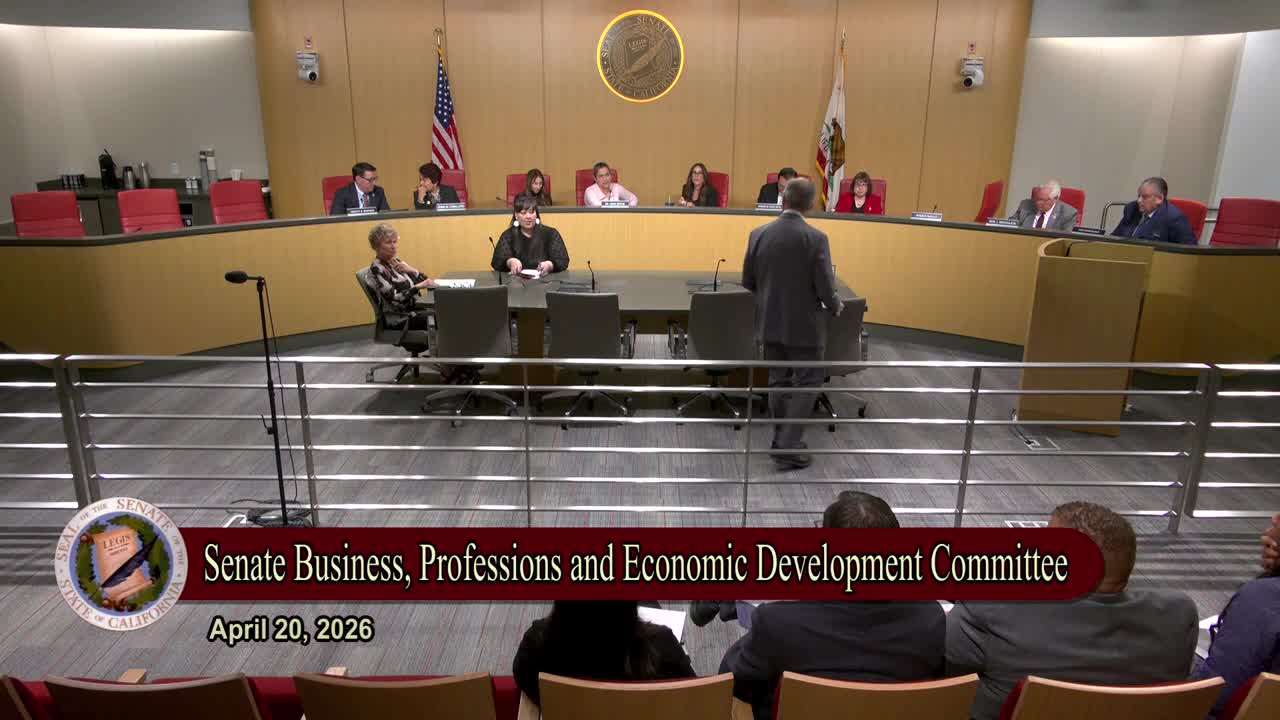 9MIN
Senate Standing Committee on Business, Professions and Economic Development
 8MIN
Senate Standing Committee on Natural Resources and Water
Bill Author
Bill Co-Author(s):