SB 1301: Residential property insurance: nonrenewals.
- Session Year: 2025-2026
- House: Senate
- Latest Version Date: 2026-09-27
Current Status:
Passed
(2026-09-27: Chaptered by Secretary of State. Chapter 693, Statutes of 2026.)
Introduced
In Committee
Awaiting First Chamber Vote
Passed First Chamber
In Committee
Awaiting Second Chamber Vote
Passed Second Chamber
Enacted
Existing law creates the Department of Insurance, headed by the Insurance Commissioner, and generally regulates classes of insurance, including residential property insurance. Existing law requires an insurer to deliver to the named insured an offer of renewal, as specified, at least 45 days before the policy expiration and to deliver a notice of nonrenewal at least 75 days before the policy expiration. If the insurer fails to do so, existing law requires the existing policy, with no change in its terms and conditions, to remain in effect for 75 days from the date that the notice of nonrenewal is delivered or mailed to the named insured. Existing law requires nonrenewal notices to contain specified information.
This bill would, beginning January 1, 2028, require an insurer to deliver to the named policyholder a notice of nonrenewal of the policy at least 90 days before the policy expiration, except as provided. The bill would require the notice to contain specified information, including all information related to the basis for the nonrenewal, as specified. If the insurer fails to deliver a notice of nonrenewal to the named policyholder, the bill would require the existing policy to remain in effect for 90 days from the date the notice of nonrenewal is delivered. If an insurer finds that a policy does not meet its underwriting guidelines due to a condition that can be remedied by the policyholder, the bill would require the insurer to deliver or mail to the named policyholder a notice at least 120 days before the policy expiration that includes an explanation of any remediation, additional information, or other change to the property that would qualify the policyholder to obtain renewal of the policy.
This bill would, beginning January 1, 2028, require an insurer that refuses to renew a policy to provide the policyholder with a detailed, plain language explanation of the grounds for the nonrenewal and all nonaerial imagery relied upon as a basis for the decision. The bill would require, upon request and within 15 days of that request, an insurer to provide any property inspection findings or property inspection reports relied upon as a basis for the decision. If an insurer finds that a policy does not meet its underwriting guidelines due to a condition that can be remedied by the policyholder, the bill would require the insurer to provide the policyholder with a period of not less than 90 days to perform the necessary remediation or other change to the property or to provide additional information. The bill would prohibit an insurer from refusing to renew a residential property insurance policy solely on the basis of certain claims, on the basis of the policyholders previous inquiry, or on the basis of the age of the roof under certain circumstances.
On or before April 1, 2029, and annually thereafter by that date, this bill would require an insurer to submit to the commissioner a report for the previous calendar year containing specified information. On or before September 1, 2029, and annually thereafter by that date, the bill would require the commissioner to prepare and publish on the departments internet website an aggregated report for the previous calendar year of the information reported by insurers.
Existing law creates the Department of Insurance, headed by the Insurance Commissioner, and generally regulates classes of insurance, including residential property insurance. Existing law requires an insurer to deliver to the named insured an offer of renewal, as specified, at least 45 days before the policy expiration and to deliver a notice of nonrenewal at least 75 days before the policy expiration. If the insurer fails to do so, existing law requires the existing policy, with no change in its terms and conditions, to remain in effect for 75 days from the date that the notice of nonrenewal is delivered or mailed to the named insured. Existing law requires nonrenewal notices to contain specified information.
This bill would, beginning January 1, 2028, require an insurer to deliver to the named policyholder a notice of nonrenewal of the policy at least 90 days before the policy expiration, except as provided. The bill would require the notice to contain specified information, including all information related to the basis for the nonrenewal, as specified. If the insurer fails to deliver a notice of nonrenewal to the named policyholder, the bill would require the existing policy to remain in effect for 90 days from the date the notice of nonrenewal is delivered. If an insurer finds that a policy does not meet its underwriting guidelines due to a condition that can be remedied by the policyholder, the bill would require the insurer to deliver or mail to the named policyholder a notice at least 120 days before the policy expiration that includes an explanation of any remediation, additional information, or other change to the property that would qualify the policyholder to obtain renewal of the policy.
This bill would, beginning January 1, 2028, require an insurer that refuses to renew a policy to provide the policyholder with a detailed, plain language explanation of the grounds for the nonrenewal and all nonaerial imagery relied upon as a basis for the decision. The bill would require, upon request and within 15 days of that request, an insurer to provide any property inspection findings or property inspection reports relied upon as a basis for the decision. If an insurer finds that a policy does not meet its underwriting guidelines due to a condition that can be remedied by the policyholder, the bill would require the insurer to provide the policyholder with a period of not less than 90 days to perform the necessary remediation or other change to the property or to provide additional information. The bill would prohibit an insurer from refusing to renew a residential property insurance policy solely on the basis of certain claims, on the basis of the policyholders previous inquiry, or on the basis of the age of the roof under certain circumstances.
On or before April 1, 2029, and annually thereafter by that date, this bill would require an insurer to submit to the commissioner a report for the previous calendar year containing specified information. On or before September 1, 2029, and annually thereafter by that date, the bill would require the commissioner to prepare and publish on the departments internet website an aggregated report for the previous calendar year of the information reported by insurers.
Existing law creates the Department of Insurance, headed by the Insurance Commissioner, and generally regulates classes of insurance, including residential property insurance. Existing law requires an insurer to deliver to the named insured an offer of renewal, as specified, at least 45 days before the policy expiration and to deliver a notice of nonrenewal at least 75 days before the policy expiration. If the insurer fails to do so, existing law requires the existing policy, with no change in its terms and conditions, to remain in effect for 75 days from the date that the notice of nonrenewal is delivered or mailed to the named insured. Existing law requires nonrenewal notices to contain specified information.
This bill would, beginning January 1, 2028, require an insurer to either deliver to the named policyholder an offer of renewal or a notice of nonrenewal or a notice of renewal with a reduction of limits or an elimination of coverage under of the policy at least 90 days before the policy expiration. expiration, except as provided. The bill would require the notice to contain specified information, including all information related to the basis for the nonrenewal or the reduction of limits or elimination of coverage, nonrenewal, as specified. If the insurer fails to deliver an offer or notice a notice of nonrenewal to the named policyholder, the bill would require the existing policy to remain in effect for 90 days from the date the offer of renewal is delivered or the notice of nonrenewal or notice of renewal with a reduction of limits or an elimination of coverage is delivered. If an insurer finds that a policy does not meet its underwriting guidelines due to a condition that can be remedied by the policyholder, the bill would require the insurer to deliver or mail to the named policyholder a notice at least 120 days before the policy expiration that includes an explanation of any remediation, additional information, or other change to the property that would qualify the policyholder to obtain renewal of the policy or to maintain the existing limits or coverage of the policy.
This bill would, beginning January 1, 2028, require an insurer that refuses to renew a policy or imposes a reduction of limits or an elimination of coverage to provide the policyholder with a detailed, plain language explanation of the grounds for the nonrenewal or reduction of limits or elimination of coverage and, upon request, all nonproprietary information relating to the decision of nonrenewal or reduction of limits or elimination of coverage, as specified. and all nonaerial imagery relied upon as a basis for the decision. The bill would require, upon request and within 15 days of that request, an insurer to provide any property inspection findings or property inspection reports relied upon as a basis for the decision. If an insurer finds that a policy does not meet its underwriting guidelines due to a condition that can be remedied by the policyholder, the bill would require the insurer to provide the policyholder with a period of not less than 90 days to perform the necessary remediation or other change to the property or to provide additional information. The bill would prohibit an insurer from refusing to issue or renew, or determine eligibility for, renew a residential property insurance policy solely on the basis of certain claims, on the basis of the policyholders previous inquiry, or on the basis of the age of the roof under certain circumstances.
On or before April 1, 2029, and annually thereafter by that date, this bill would require an insurer to submit to the commissioner a report for the previous calendar year containing specified information, including the number of policies for which the insurer elected not to renew or imposed a reduction of limits or an elimination of coverage. information. On or before September 1, 2029, and annually thereafter by that date, the bill would require the commissioner to prepare and publish on the departments internet website an aggregated report for the previous calendar year of the information reported by insurers.
Existing law creates the Department of Insurance, headed by the Insurance Commissioner, and generally regulates classes of insurance, including residential property insurance. Existing law requires an insurer to deliver to the named insured an offer of renewal, as specified, at least 45 days before the policy expiration and to deliver a notice of nonrenewal at least 75 days before the policy expiration. If the insurer fails to do so, existing law requires the existing policy, with no change in its terms and conditions, to remain in effect for 75 days from the date that the notice of nonrenewal is delivered or mailed to the named insured. Existing law requires nonrenewal notices to contain specified information.
This bill would, beginning January 1, 2028, require an insurer to either deliver to the named policyholder an offer of renewal or a notice of nonrenewal or a notice of renewal with a reduction of limits or an elimination of coverage under the policy at least 90 days before the policy expiration. The bill would require the notice to contain specified information, including all information related to the basis for the nonrenewal or the reduction of limits or elimination of coverage, as specified. If the insurer fails to deliver an offer or notice to the named policyholder, the bill would require the existing policy to remain in effect for 90 days from the date the offer of renewal is delivered or the notice of nonrenewal or notice of renewal with a reduction of limits or an elimination of coverage is delivered. If an insurer finds that a policy does not meet its underwriting guidelines due to a condition that can be remedied by the policyholder, the bill would require the insurer to deliver or mail to the named policyholder a notice at least 120 days before the policy expiration that includes an explanation of any remediation, additional information, or other change to the property that would qualify the policyholder to obtain renewal of the policy or to maintain the existing limits or coverage of the policy.
This bill would, beginning January 1, 2028, require an insurer that refuses to renew a policy or imposes a reduction of limits or an elimination of coverage to provide the policyholder with specified information, including a detailed, plain language explanation of the grounds for the nonrenewal or reduction of limits or elimination of coverage. coverage and, upon request, all nonproprietary information relating to the decision of nonrenewal or reduction of limits or elimination of coverage, as specified. If an insurer finds that a policy does not meet its underwriting guidelines due to a condition that can be remedied by the policyholder, the bill would require the insurer to provide the policyholder with a period of not less than 90 days to perform the necessary remediation or other change to the property or to provide additional information. The bill would prohibit an insurer from refusing to issue or renew, or determine eligibility for, a residential property insurance policy solely on the basis of certain claims, on the basis of the policyholders previous inquiry, or on the basis of the age of the roof under certain circumstances.
On or before April 1, 2029, and annually thereafter by that date, this bill would require an insurer to submit to the commissioner a report for the previous calendar year containing specified information, including the number of policies for which the insurer elected not to renew or imposed a reduction of limits or an elimination of coverage. On or before September 1, 2029, and annually thereafter by that date, the bill would require the commissioner to prepare and publish on the departments internet website an aggregated report for the previous calendar year of the information reported by insurers.
Existing law creates the Department of Insurance, headed by the Insurance Commissioner, and generally regulates classes of insurance, including residential property insurance. Existing law requires an insurer to deliver to the named insured an offer of renewal, as specified, at least 45 days before the policy expiration and to deliver a notice of nonrenewal at least 75 days before the policy expiration. If the insurer fails to do so, existing law requires the existing policy, with no change in its terms and conditions, to remain in effect for 75 days from the date that the notice of nonrenewal is delivered or mailed to the named insured. Existing law requires nonrenewal notices to contain specified information.
This bill would, beginning July 1, 2027, January 1, 2028, require an insurer to either deliver to the named policyholder an offer of renewal or a notice of nonrenewal or a notice of renewal with a reduction of limits or an elimination of coverage under the policy at least 90 days before the policy expiration. The bill would require the notice to contain specified information, including all information related to the basis for the nonrenewal or the reduction of limits or elimination of coverage, as specified. If the insurer fails to deliver an offer or notice to the named policyholder, the bill would require the existing policy to remain in effect for 90 days from the date the offer of renewal is delivered or the notice of nonrenewal or notice of renewal with a reduction of limits or an elimination of coverage is delivered. If an insurer finds that a policy does not meet its underwriting guidelines due to a condition that can be remedied by the policyholder, the bill would require the insurer to deliver or mail to the named policyholder a notice at least 120 days before the policy expiration that includes an explanation of any remediation, additional information, or other change to the property that would qualify the policyholder to obtain renewal of the policy or to maintain the existing limits or coverage of the policy.
This bill would, beginning July 1, 2027, January 1, 2028, require an insurer that refuses to renew a policy or imposes a reduction of limits or an elimination of coverage to provide the policyholder with specified information, including a clear detailed, plain language explanation of the grounds for the nonrenewal or reduction of limits or elimination of coverage. If an insurer issues a notice of nonrenewal or a notice of reduction of limits or elimination of coverage, finds that a policy does not meet its underwriting guidelines due to a condition that can be remedied by the policyholder, the bill would require the insurer to provide the policyholder with a period of not less than 90 days to perform the necessary remediation or other change to the property or to provide additional information. The bill would require the insurer to provide one extension of up to 90 days, as specified, upon request of the policyholder. The bill would prohibit an insurer from refusing to issue or renew, or determine eligibility for, a residential property insurance policy on the basis of certain claims, on the basis of the policyholders previous inquiry, or on the basis of the age of the roof under certain circumstances.
On or before April 1, 2028, 2029, and annually thereafter by that date, this bill would require an insurer to submit to the commissioner a report for the previous calendar year containing specified information, including the number of policies for which the insurer elected not to renew or imposed a reduction of limits or an elimination of coverage. On or before July 1, 2028, September 1, 2029, and annually thereafter by that date, the bill would require the commissioner to prepare and publish on the departments internet website an aggregated report for the previous calendar year of the information reported by insurers.
Existing law creates the Department of Insurance, headed by the Insurance Commissioner, and generally regulates classes of insurance, including residential property insurance. Existing law requires an insurer to deliver to the named insured an offer of renewal, as specified, at least 45 days before the policy expiration and to deliver a notice of nonrenewal at least 75 days before the policy expiration. If the insurer fails to do so, existing law requires the existing policy, with no change in its terms and conditions, to remain in effect for 75 days from the date that the notice of nonrenewal is delivered or mailed to the named insured. Existing law requires nonrenewal notices to contain specified information.
This bill would, beginning July 1, 2027, require an insurer to either deliver to the named policyholder an offer of renewal at least 90 days before the policy expiration or a notice of nonrenewal or a notice of renewal with a reduction of limits or an elimination of coverage under the policy at least 180 90 days before the policy expiration. The bill would require the notice to contain specified information, including all information related to the basis for the nonrenewal or the reduction of limits or elimination of coverage, as specified. If the insurer fails to deliver an offer or notice to the named policyholder, the bill would require the existing policy to remain in effect for either 90 days from the date the offer of renewal is delivered or for 180 days from the date the notice of nonrenewal or notice of renewal with a reduction of limits or an elimination of coverage is delivered.
This bill would, beginning July 1, 2027, require an insurer that refuses to renew a policy or imposes a reduction of limits or an elimination of coverage to provide the policyholder with specified information, including a clear explanation of the grounds for the nonrenewal or reduction of limits or elimination of coverage. If an insurer issues a notice of nonrenewal or a notice of reduction of limits or elimination of coverage, the bill would require the insurer to provide the policyholder with a period of not less than 90 days to perform the necessary remediation or other change to the property or to provide additional information. The bill would require the insurer to provide an one extension of up to 180 90 days, as specified, upon request of the policyholder. The bill would prohibit an insurer from refusing to issue or renew, or determine eligibility for, a residential property insurance policy on the basis of certain claims, on the basis of the policyholders previous inquiry, or on the basis of the age of the roof under certain circumstances.
On or before April 1, 2028, and annually thereafter by that date, this bill would require an insurer to submit to the commissioner a report for the previous calendar year containing specified information, including the number of policies for which the insurer elected not to renew or imposed a reduction of limits or an elimination of coverage. On or before July 1, 2028, and annually thereafter by that date, the bill would require the commissioner to prepare and publish on the departments internet website an aggregated report for the previous calendar year of the information reported by insurers.
Existing law creates the Department of Insurance, headed by the Insurance Commissioner, and generally regulates classes of insurance, including residential property insurance. Existing law requires an insurer to deliver to the named insured an offer of renewal, as specified, at least 45 days before the policy expiration and to deliver a notice of nonrenewal at least 75 days before the policy expiration. If the insurer fails to do so, existing law requires the existing policy, with no change in its terms and conditions, to remain in effect for 75 days from the date that the notice of nonrenewal is delivered or mailed to the named insured. Existing law requires nonrenewal notices to contain specified information.
This bill would, beginning July 1, 2027, require an insurer to either deliver to the named policyholder an offer of renewal at least 90 days before the policy expiration or a notice of nonrenewal or a notice of renewal with a reduction of limits or an elimination of coverage under the policy at least 180 days before the policy expiration. The bill would require the notice to contain specified information, including all information related to the basis for the nonrenewal or the reduction of limits or elimination of coverage, as specified. If the insurer fails to deliver an offer or notice to the named policyholder, the bill would require the existing policy to remain in effect for either 90 days from the date the offer of renewal is delivered or for 180 days from the date the notice of nonrenewal or notice of renewal with a reduction of limits or an elimination of coverage is delivered.
This bill would, beginning July 1, 2027, require an insurer that refuses to renew a policy or imposes a reduction of limits or an elimination of coverage to provide the policyholder with specified information, including a clear explanation of the grounds for the nonrenewal or reduction of limits or elimination of coverage. If an insurer issues a notice of nonrenewal or a notice of reduction of limits or elimination of coverage, the bill would require the insurer to provide the policyholder with a period of not less than 90 days to perform the necessary remediation or other change to the property or to provide additional information. The bill would require the insurer to provide an extension of up to 180 days, as specified, upon request of the policyholder. The bill would prohibit an insurer from refusing to issue or renew, or determine eligibility for, a residential property insurance policy on the basis of certain claims, on the basis of the policyholders previous inquiry, or on the basis of the age of the roof under certain circumstances.
On or before April 1, 2028, and annually thereafter by that date, this bill would require an insurer to submit to the commissioner a report for the previous calendar year containing specified information, including the number of policies for which the insurer elected not to renew or imposed a reduction of limits or an elimination of coverage. On or before July 1, 2028, and annually thereafter by that date, the bill would require the commissioner to prepare and publish on the departments internet website an aggregated report for the previous calendar year of the information reported by insurers.
(a)This section applies only to residential property insurance policies specified in Section 675.
(b)(1)An insurer that refuses to renew a policy shall provide the policyholder with a detailed, plain language explanation of the grounds for the nonrenewal. An insurer shall also provide the policyholder with all nonaerial imagery relied upon as a basis for the decision and, upon request and within 15 days of that request, any property inspection findings or property inspection reports relied upon as a basis for the decision.
(2)(A)If the nonrenewal is due in whole or in part to an assessment of the wildfire risk associated with the property, the insurer shall provide the policyholder with their wildfire risk score or other wildfire risk classification, including the following, as applicable:
(i)A plain language description of each property-specific characteristic that led to the determination.
(ii)A plain language description of each surrounding area characteristic that led to the determination.
(B)This paragraph does not require the insurer to provide information that they provide to the policyholder in connection with the wildfire risk score or other wildfire risk classification pursuant to Section 2644.9 of Title 10 of the California Code of Regulations.
(c)(1)If an insurer finds that a policy does not meet its underwriting guidelines due to a condition that can be remedied by the policyholder, the insurer shall, at least 120 days before the policy expiration, provide the policyholder with both of the following:
(A)A detailed, plain language explanation of any remediation, additional information to provide, or other change to the property that is consistent with the insurers underwriting guidelines and that would qualify the policyholder to obtain renewal of the policy, along with direction on how to provide evidence of that action or other change, or the information.
(B)A period of not less than 90 days to perform the necessary remediation or other change to the property or to provide additional information.
(2)An insurer may contact the policyholder to verify that the policyholder will be performing remediation or another change to their property pursuant to this subdivision.
(3)Following any efforts of remediation, the policyholder shall furnish the insurer evidence of remediation. If the insurer seeks additional verification, the insurer may perform an onsite physical or virtual inspection of the property to verify remediation at the insurers expense.
(4)Remediation, additional information, or other change to the property completed in accordance with the explanation provided to the policyholder under subparagraph (A) of paragraph (1) that is verified by the insurer shall qualify the policyholder for renewal of the policy.
(5)The insurer shall issue a written determination within 15 days of receipt of additional information or evidence of any remediation or other change to the property.
(d)(1)The insurer shall provide a policyholder a reasonable opportunity to dispute, or to correct or amend any inaccurate or incomplete information relied upon by the insurer in connection with, a decision to not renew a policy.
(2)If the dispute concerns the condition of the property, a policyholder may request that the insurer conduct an onsite physical inspection of the property to verify the information relied upon by the insurer in connection with a decision to not renew a policy. The policyholder may, at their sole discretion, use a process made available by the insurer other than an in-person physical inspection to verify the accuracy, persistence, and validity of the conditions pertaining to the decision to terminate coverage.
(3)The insurer shall acknowledge receipt of any dispute, correction, or amendment within 10 days and shall issue a written determination within 30 days of the acknowledgment of receipt.
(e)This section shall become operative on January 1, 2028.
SEC. 2.Section 676.12 is added to the Insurance Code, to read:676.12.(a)This section applies only to residential property insurance policies specified in Section 675.
(b)On or before April 1, 2029, and annually thereafter by that date, an insurer shall submit to the commissioner a report for the previous calendar year containing the following information for policies written in California:
(1)The number of policies in each of the following categories:
(A)The number of policies for which the insurer provided the policyholder a notice pursuant to subdivision (b) of Section 678.
(B)The number of policies for which the policyholder provided the insurer evidence of any of the actions described in the notice provided under subdivision (b) of Section 678 and whether those actions resulted in a renewal of the policy.
(c)The policy information reported pursuant to subdivision (b) shall be listed by county and ZIP Code.
(d)Nothing in this section shall require an insurer to submit to the commissioner information the insurer has already provided for the calendar year in question.
(e)On or before September 1, 2029, and annually thereafter by that date, the commissioner shall prepare and publish on the departments internet website an aggregated report for the previous calendar year of all information reported by insurers pursuant to subdivision (b).
(f)This section shall become operative on January 1, 2028.
SEC. 3.Section 676.13 is added to the Insurance Code, to read:676.13.(a)(1)An insurer shall not refuse to renew a residential property insurance policy solely on the basis of any of the following claims by the applicant or policyholder or any previous owner or occupant of the property to be insured:
(A)A claim that is filed but is not paid or payable.
(B)A claim that is within the claimants deductible.
(C)A claim that is not covered by the policy.
(D)A claim concerning a property that is no longer owned by the applicant or policyholder.
(E)A claim by the applicant or policyholder in which the loss was not the direct result of intentional conduct or gross negligence by the applicant or policyholder and for which the risk of loss has been mitigated through the removal of the hazard, the repair of the damage or defect, or other changes to the property or to the condition that caused the loss.
(2)Subparagraphs (A) and (B) of paragraph (1) do not apply if the applicant or policyholder has had at least three claims regarding the same damage, defect, or other condition of the property over the previous three years.
(b)An insurer shall not refuse to renew a residential property insurance policy based in whole or in part on whether a policyholder has previously inquired about the insurance policy, including, but not limited to, an inquiry concerning the scope or nature of coverage available under the policy.
(c)For purposes of this section, residential property insurance means the insurance described in subdivision (a) of Section 675.
(d)This section shall become operative on January 1, 2028.
SEC. 4.Section 676.14 is added to the Insurance Code, to read:676.14.(a)Beginning January 1, 2028, an insurer shall not refuse to issue or renew, or determine eligibility for, a residential property insurance policy solely on the basis of the age of the roof if the policyholder obtains and pays for an independent inspection of the roof that confirms at least five years of useful roof life remaining.
(b)This section does not prohibit an insurer from taking into consideration the age of the roof when issuing or renewing, or determining eligibility for, a residential property insurance policy.
(c)For purposes of this section, residential property insurance means the insurance described in subdivision (a) of Section 675.
(d)This section shall become operative on January 1, 2028.
SEC. 5.Section 678 of the Insurance Code is amended to read:678.(a)(1)At least 45 days before the policy expiration, an insurer shall deliver to the named insured or mail to the named insured at the address shown in the policy, either of the following:
(A)An offer of renewal of the policy contingent upon payment of premium as stated in the offer, stating each of the following:
(i)Any reduction of limits or elimination of coverage. That reduction of limits or elimination of coverage shall identify the specific limits being reduced or coverage being eliminated by the offer of renewal. The elimination of coverage for the previously covered peril of fire shall be subject to subdivision (b) of Section 10103.6.
(ii)The telephone number of the insurers representatives who handle consumer inquiries or complaints. The telephone number shall be displayed prominently in a font size consistent with the other text of the renewal offer.
(B)A notice of nonrenewal of the policy. That notice shall contain all of the following:
(i)The specific reason or reasons for the nonrenewal.
(ii)The telephone number of the insurers representatives who handle consumer inquiries or complaints. The telephone number shall be displayed prominently in a font size consistent with the other text of the notice of nonrenewal.
(iii)Until July 1, 2020, a brief statement indicating that if the consumer has contacted the insurer to discuss the nonrenewal and remains unsatisfied, the consumer may have the matter reviewed by the department. The statement shall include the telephone number of the unit within the department that responds to consumer inquiries and complaints.
(iv)On or after July 1, 2020, a statement that if the consumer has contacted the insurer to discuss the nonrenewal and remains unsatisfied, the consumer may have the matter reviewed by the department. The statement shall include the departments internet website, www.insurance.ca.gov, the departments telephone number, (800) 927-HELP (4357), and the mailing address of the departments Consumer Services Division, 300 S. Spring Street, Los Angeles, CA 90013.
(2)On and after July 1, 2022, the time periods and procedures in subdivision (a) of Section 1013 of the Code of Civil Procedure shall be applicable if an offer or notice is mailed.
(b)If an insurer fails to give the named insured either an offer of renewal or notice of nonrenewal as required by this section, the existing policy, with no change in its terms and conditions, shall remain in effect for 45 days from the date that either the offer to renew or the notice of nonrenewal is delivered or mailed to the named insured. A notice to this effect shall be provided by the insurer to the named insured with the policy or the notice of renewal or nonrenewal.
(c)Notwithstanding subdivisions (a) and (b), with respect to a notice of nonrenewal for a policy that expires on or after July 1, 2020, the following timelines apply:
(1)At least 75 days before the policy expiration, the insurer shall deliver the notice of nonrenewal to the named insured or mail the notice of nonrenewal to the named insured at the address shown in the policy. The notice shall include the information contained in subparagraph (B) of paragraph (1) of subdivision (a). On and after July 1, 2022, the time periods and procedures in subdivision (a) of Section 1013 of the Code of Civil Procedure shall be applicable if a notice is mailed.
(2)If an insurer fails to give the named insured a notice of nonrenewal at least 75 days before the policy expiration, as required by paragraph (1), the existing policy, with no change in its terms and conditions, shall remain in effect for 75 days from the date that the notice of nonrenewal is delivered or mailed to the named insured. A notice to this effect shall be provided by the insurer to the named insured with the notice of nonrenewal.
(d)A policy written for a term of less than one year shall be considered as if written for a term of one year. A policy written for a term longer than one year, or a policy with no fixed expiration date, shall be considered as if written for successive policy periods or terms of one year.
(e)A notice of nonrenewal for a residential property insurance policy expiring on or after July 1, 2021, shall be accompanied by the following notice:
The California Department of Insurance has developed the California Home Insurance Finder, an online tool that can assist you in obtaining insurance for your home. The Finder contains names, addresses, telephone numbers, and internet website links of licensed insurance agents, brokers, and insurance companies that may be able to sell insurance to you. The Finder is organized by ZIP Code and the languages in which the agent, broker, or insurance company sells insurance.
The California FAIR Plan (FAIR Plan) provides basic property insurance as the insurer of last resort if you cannot find insurance coverage for your property in the normal (voluntary) insurance market. The FAIR Plan provides basic property insurance coverage for residential structures, as well as personal property coverage for residential and business occupancies. However, FAIR Plan policies may not cover liability, theft, or water damage, among other things. There are also optional coverages available for both residential properties. Applications can be made directly with the FAIR Plan (cfpnet.com), although the FAIR Plan strongly encourages use of a licensed agent or broker for assistance in preparing and obtaining a quote. There is no additional cost for using an agent or broker for purchasing a FAIR Plan policy.
California law requires an agent or broker to assist a person seeking a FAIR Plan policy by (1) submitting a coverage application to the FAIR Plan on behalf of the consumer, (2) providing the consumer the FAIR Plans internet website address and toll-free telephone number, or (3) obtaining a policy for the consumer through an admitted or nonadmitted insurer.
To supplement a FAIR Plan policy, a Difference in Conditions (DIC) policy should be considered. A DIC policy is sold by some private insurers, and provides coverage for things not covered by the basic property insurance policy provided by the FAIR Plan. A consumer who wants broader coverage than that provided by the FAIR Plan policy should contact an agent, broker, or insurance company that offers a DIC policy to obtain this additional coverage. The Department of Insurance maintains a list of insurance companies that sell DIC policies on its internet website (insurance.ca.gov). Additional assistance may be obtained by contacting an agent or broker listed with the departments online agent locator.
(f)An insurer may use a notice substantially similar to the notice set forth in subdivision (e) to the extent that the notice provides additional or more detailed information.
(g)This section applies only to policies of insurance specified in Section 675.
(h)This section shall remain in effect only until January 1, 2028, and as of that date is repealed.
SEC. 6.Section 678 is added to the Insurance Code, to read:678.(a)An insurer shall do either of the following:
(1)At least 45 days before the policy expiration, an insurer shall deliver to the named policyholder or mail to the named policyholder at the address shown in the policy, an offer of renewal of the policy contingent upon payment of premium as stated in the offer, stating each of the following:
(A)Any reduction of limits or elimination of coverage. That reduction of limits or elimination of coverage shall identify the specific limits being reduced or coverage being eliminated by the offer of renewal. The elimination of coverage for the previously covered peril of fire shall be subject to subdivision (b) of Section 10103.6.
(B)The telephone number of the insurers representatives who handle consumer inquiries or complaints. The telephone number shall be displayed prominently in a font size consistent with the other text of the renewal offer.
(2)(A)At least 90 days before the policy expiration, an insurer shall deliver to the named policyholder or mail to the named policyholder at the address shown in the policy a notice of nonrenewal of the policy. That notice shall contain all of the following:
(i)All information related to the basis for the nonrenewal, as required by subdivision (b) of Section 676.11.
(ii)A detailed, plain language explanation of the policyholders right to dispute, or to correct or amend any inaccurate or incomplete information relied upon by the insurer in connection with, the decision to not renew the policy, as provided in subdivision (d) of Section 676.11.
(iii)The telephone number of the insurers representatives who handle consumer inquiries or complaints. The telephone number shall be displayed prominently in a font size consistent with the other text of the notice of nonrenewal.
(iv)A statement that if the consumer has contacted the insurer to discuss the nonrenewal and remains unsatisfied, the consumer may have the matter reviewed by the department. The statement shall include the departments internet website, www.insurance.ca.gov, the departments telephone number, (800) 927-HELP (4357), and the mailing address of the departments Consumer Services Division, 300 S. Spring Street, Los Angeles, CA 90013.
(B)Clauses (i) and (ii) of subparagraph (A) do not apply to personal watercraft insurance policies and personal umbrella liability insurance policies.
(C)For personal watercraft insurance policies and personal umbrella liability insurance policies, an insurer shall mail or deliver the notice required by this paragraph at least 75 days before the policy expiration.
(b)If an insurer finds that a policy does not meet its underwriting guidelines due to a condition that can be remedied by the policyholder, the insurer shall deliver to the named policyholder or mail to the named policyholder at the address shown in the policy a notice of the following at least 120 days before the policy expiration:
(1)A detailed, plain language explanation of any remediation, additional information, or other change to the property that would qualify the policyholder to obtain renewal of the policy, and a full description of all of the policyholders rights as provided in Section 676.11.
(2)A detailed, plain language disclaimer that, in 30 days, the policyholder will receive a notice of nonrenewal of the policy that will take effect on the policys expiration date if the policyholder does not perform the necessary remediation or other change to the property or provide additional information to meet the insurers underwriting guidelines.
(3)The telephone number of the insurers representatives who handle consumer inquiries or complaints. The telephone number shall be displayed prominently in a font size consistent with the other text of the notice of nonrenewal.
(4)A statement that if the consumer has contacted the insurer to discuss the notice required by this subdivision and remains unsatisfied, the consumer may have the matter reviewed by the department. The statement shall include the departments internet website, www.insurance.ca.gov, the departments telephone number, (800) 927-HELP (4357), and the mailing address of the departments Consumer Services Division, 300 S. Spring Street, Los Angeles, CA 90013.
(c)On and after January 1, 2028, the time periods and procedures in subdivision (a) of Section 1013 of the Code of Civil Procedure shall be applicable if an offer or notice is mailed.
(d)If an insurer fails to give the named policyholder an offer of renewal as required by this section, the existing policy, with no change in its terms and conditions, shall remain in effect for 45 days from the date that the offer to renew is delivered or mailed to the named policyholder. A notice to this effect shall be provided by the insurer to the named policyholder with the offer to renew.
(e)If an insurer fails to give the named policyholder a notice of nonrenewal, as required by this section, the existing policy, with no change in its terms and conditions, shall remain in effect for 90 days from the date that the notice is delivered or mailed to the named policyholder. A notice to this effect shall be provided by the insurer to the named policyholder with the notice of nonrenewal.
(f)A policy written for a term of less than one year shall be considered as if written for a term of one year. A policy written for a term longer than one year, or a policy with no fixed expiration date, shall be considered as if written for successive policy periods or terms of one year.
(g)A notice of nonrenewal for a residential property insurance policy shall be accompanied by the following notice:
The California Department of Insurance has developed the California Home Insurance Finder, an online tool that can assist you in obtaining insurance for your home. The Finder contains names, addresses, telephone numbers, and internet website links of licensed insurance agents, brokers, and insurance companies that may be able to sell insurance to you. The Finder is organized by ZIP Code and the languages in which the agent, broker, or insurance company sells insurance.
The California FAIR Plan (FAIR Plan) provides basic property insurance as the insurer of last resort if you cannot find insurance coverage for your property in the normal (voluntary) insurance market. The FAIR Plan provides basic property insurance coverage for residential structures, as well as personal property coverage for residential and business occupancies. However, FAIR Plan policies may not cover liability, theft, or water damage, among other things. There are also optional coverages available for both residential properties. Applications can be made directly with the FAIR Plan (cfpnet.com), although the FAIR Plan strongly encourages use of a licensed agent or broker for assistance in preparing and obtaining a quote. There is no additional cost for using an agent or broker for purchasing a FAIR Plan policy.
California law requires an agent or broker to assist a person seeking a FAIR Plan policy by (1) submitting a coverage application to the FAIR Plan on behalf of the consumer, (2) providing the consumer the FAIR Plans internet website address and toll-free telephone number, or (3) obtaining a policy for the consumer through an admitted or nonadmitted insurer.
To supplement a FAIR Plan policy, a Difference in Conditions (DIC) policy should be considered. A DIC policy is sold by some private insurers, and provides coverage for things not covered by the basic property insurance policy provided by the FAIR Plan. A consumer who wants broader coverage than that provided by the FAIR Plan policy should contact an agent, broker, or insurance company that offers a DIC policy to obtain this additional coverage. The Department of Insurance maintains a list of insurance companies that sell DIC policies on its internet website (insurance.ca.gov). Additional assistance may be obtained by contacting an agent or broker listed with the departments online agent locator.
(h)An insurer may use a notice substantially similar to the notice set forth in subdivision (g) to the extent that the notice provides additional or more detailed information.
(i)This section applies only to policies of insurance specified in Section 675.
(j)This section shall become operative on January 1, 2028.
(a)This section applies only to residential property insurance policies specified in Section 675.
(b)(1)An insurer that refuses to renew a policy shall provide the policyholder with a detailed, plain language explanation of the grounds for the nonrenewal. An insurer shall also provide the policyholder with all nonaerial imagery relied upon as a basis for the decision and, upon request and within 15 days of that request, any property inspection findings or property inspection reports relied upon as a basis for the decision.
(2)(A)If the nonrenewal is due in whole or in part to an assessment of the wildfire risk associated with the property, the insurer shall provide the policyholder with their wildfire risk score or other wildfire risk classification, including the following, as applicable:
(i)A plain language description of each property-specific characteristic that led to the determination.
(ii)A plain language description of each surrounding area characteristic that led to the determination.
(B)This paragraph does not require the insurer to provide information that they provide to the policyholder in connection with the wildfire risk score or other wildfire risk classification pursuant to Section 2644.9 of Title 10 of the California Code of Regulations.
(c)(1)If an insurer finds that a policy does not meet its underwriting guidelines due to a condition that can be remedied by the policyholder, the insurer shall, at least 120 days before the policy expiration, provide the policyholder with both of the following:
(A)A detailed, plain language explanation of any remediation, additional information to provide, or other change to the property that is consistent with the insurers underwriting guidelines and that would qualify the policyholder to obtain renewal of the policy, along with direction on how to provide evidence of that action or other change, or the information.
(B)A period of not less than 90 days to perform the necessary remediation or other change to the property or to provide additional information.
(2)An insurer may contact the policyholder to verify that the policyholder will be performing remediation or another change to their property pursuant to this subdivision.
(3)Following any efforts of remediation, the policyholder shall furnish the insurer evidence of remediation. If the insurer seeks additional verification, the insurer may perform an onsite physical or virtual inspection of the property to verify remediation at the insurers expense.
(4)Remediation, additional information, or other change to the property completed in accordance with the explanation provided to the policyholder under subparagraph (A) of paragraph (1) that is verified by the insurer shall qualify the policyholder for renewal of the policy.
(5)The insurer shall issue a written determination within 15 days of receipt of additional information or evidence of any remediation or other change to the property.
(d)(1)The insurer shall provide a policyholder a reasonable opportunity to dispute, or to correct or amend any inaccurate or incomplete information relied upon by the insurer in connection with, a decision to not renew a policy.
(2)If the dispute concerns the condition of the property, a policyholder may request that the insurer conduct an onsite physical inspection of the property to verify the information relied upon by the insurer in connection with a decision to not renew a policy. The policyholder may, at their sole discretion, use a process made available by the insurer other than an in-person physical inspection to verify the accuracy, persistence, and validity of the conditions pertaining to the decision to terminate coverage.
(3)The insurer shall acknowledge receipt of any dispute, correction, or amendment within 10 days and shall issue a written determination within 30 days of the acknowledgment of receipt.
(e)This section shall become operative on January 1, 2028.
SEC. 2.Section 676.12 is added to the Insurance Code, to read:676.12.(a)This section applies only to residential property insurance policies specified in Section 675.
(b)On or before April 1, 2029, and annually thereafter by that date, an insurer shall submit to the commissioner a report for the previous calendar year containing the following information for policies written in California:
(1)The number of policies in each of the following categories:
(A)The number of policies for which the insurer provided the policyholder a notice pursuant to subdivision (b) of Section 678.
(B)The number of policies for which the policyholder provided the insurer evidence of any of the actions described in the notice provided under subdivision (b) of Section 678 and whether those actions resulted in a renewal of the policy.
(c)The policy information reported pursuant to subdivision (b) shall be listed by county and ZIP Code.
(d)Nothing in this section shall require an insurer to submit to the commissioner information the insurer has already provided for the calendar year in question.
(e)On or before September 1, 2029, and annually thereafter by that date, the commissioner shall prepare and publish on the departments internet website an aggregated report for the previous calendar year of all information reported by insurers pursuant to subdivision (b).
(f)This section shall become operative on January 1, 2028.
SEC. 3.Section 676.13 is added to the Insurance Code, to read:676.13.(a)(1)An insurer shall not refuse to renew a residential property insurance policy solely on the basis of any of the following claims by the applicant or policyholder or any previous owner or occupant of the property to be insured:
(A)A claim that is filed but is not paid or payable.
(B)A claim that is within the claimants deductible.
(C)A claim that is not covered by the policy.
(D)A claim concerning a property that is no longer owned by the applicant or policyholder.
(E)A claim by the applicant or policyholder in which the loss was not the direct result of intentional conduct or gross negligence by the applicant or policyholder and for which the risk of loss has been mitigated through the removal of the hazard, the repair of the damage or defect, or other changes to the property or to the condition that caused the loss.
(2)Subparagraphs (A) and (B) of paragraph (1) do not apply if the applicant or policyholder has had at least three claims regarding the same damage, defect, or other condition of the property over the previous three years.
(b)An insurer shall not refuse to renew a residential property insurance policy based in whole or in part on whether a policyholder has previously inquired about the insurance policy, including, but not limited to, an inquiry concerning the scope or nature of coverage available under the policy.
(c)For purposes of this section, residential property insurance means the insurance described in subdivision (a) of Section 675.
(d)This section shall become operative on January 1, 2028.
SEC. 4.Section 676.14 is added to the Insurance Code, to read:676.14.(a)Beginning January 1, 2028, an insurer shall not refuse to issue or renew, or determine eligibility for, a residential property insurance policy solely on the basis of the age of the roof if the policyholder obtains and pays for an independent inspection of the roof that confirms at least five years of useful roof life remaining.
(b)This section does not prohibit an insurer from taking into consideration the age of the roof when issuing or renewing, or determining eligibility for, a residential property insurance policy.
(c)For purposes of this section, residential property insurance means the insurance described in subdivision (a) of Section 675.
(d)This section shall become operative on January 1, 2028.
SEC. 5.Section 678 of the Insurance Code is amended to read:678.(a)(1)At least 45 days before the policy expiration, an insurer shall deliver to the named insured or mail to the named insured at the address shown in the policy, either of the following:
(A)An offer of renewal of the policy contingent upon payment of premium as stated in the offer, stating each of the following:
(i)Any reduction of limits or elimination of coverage. That reduction of limits or elimination of coverage shall identify the specific limits being reduced or coverage being eliminated by the offer of renewal. The elimination of coverage for the previously covered peril of fire shall be subject to subdivision (b) of Section 10103.6.
(ii)The telephone number of the insurers representatives who handle consumer inquiries or complaints. The telephone number shall be displayed prominently in a font size consistent with the other text of the renewal offer.
(B)A notice of nonrenewal of the policy. That notice shall contain all of the following:
(i)The specific reason or reasons for the nonrenewal.
(ii)The telephone number of the insurers representatives who handle consumer inquiries or complaints. The telephone number shall be displayed prominently in a font size consistent with the other text of the notice of nonrenewal.
(iii)Until July 1, 2020, a brief statement indicating that if the consumer has contacted the insurer to discuss the nonrenewal and remains unsatisfied, the consumer may have the matter reviewed by the department. The statement shall include the telephone number of the unit within the department that responds to consumer inquiries and complaints.
(iv)On or after July 1, 2020, a statement that if the consumer has contacted the insurer to discuss the nonrenewal and remains unsatisfied, the consumer may have the matter reviewed by the department. The statement shall include the departments internet website, www.insurance.ca.gov, the departments telephone number, (800) 927-HELP (4357), and the mailing address of the departments Consumer Services Division, 300 S. Spring Street, Los Angeles, CA 90013.
(2)On and after July 1, 2022, the time periods and procedures in subdivision (a) of Section 1013 of the Code of Civil Procedure shall be applicable if an offer or notice is mailed.
(b)If an insurer fails to give the named insured either an offer of renewal or notice of nonrenewal as required by this section, the existing policy, with no change in its terms and conditions, shall remain in effect for 45 days from the date that either the offer to renew or the notice of nonrenewal is delivered or mailed to the named insured. A notice to this effect shall be provided by the insurer to the named insured with the policy or the notice of renewal or nonrenewal.
(c)Notwithstanding subdivisions (a) and (b), with respect to a notice of nonrenewal for a policy that expires on or after July 1, 2020, the following timelines apply:
(1)At least 75 days before the policy expiration, the insurer shall deliver the notice of nonrenewal to the named insured or mail the notice of nonrenewal to the named insured at the address shown in the policy. The notice shall include the information contained in subparagraph (B) of paragraph (1) of subdivision (a). On and after July 1, 2022, the time periods and procedures in subdivision (a) of Section 1013 of the Code of Civil Procedure shall be applicable if a notice is mailed.
(2)If an insurer fails to give the named insured a notice of nonrenewal at least 75 days before the policy expiration, as required by paragraph (1), the existing policy, with no change in its terms and conditions, shall remain in effect for 75 days from the date that the notice of nonrenewal is delivered or mailed to the named insured. A notice to this effect shall be provided by the insurer to the named insured with the notice of nonrenewal.
(d)A policy written for a term of less than one year shall be considered as if written for a term of one year. A policy written for a term longer than one year, or a policy with no fixed expiration date, shall be considered as if written for successive policy periods or terms of one year.
(e)A notice of nonrenewal for a residential property insurance policy expiring on or after July 1, 2021, shall be accompanied by the following notice:
The California Department of Insurance has developed the California Home Insurance Finder, an online tool that can assist you in obtaining insurance for your home. The Finder contains names, addresses, telephone numbers, and internet website links of licensed insurance agents, brokers, and insurance companies that may be able to sell insurance to you. The Finder is organized by ZIP Code and the languages in which the agent, broker, or insurance company sells insurance.
The California FAIR Plan (FAIR Plan) provides basic property insurance as the insurer of last resort if you cannot find insurance coverage for your property in the normal (voluntary) insurance market. The FAIR Plan provides basic property insurance coverage for residential structures, as well as personal property coverage for residential and business occupancies. However, FAIR Plan policies may not cover liability, theft, or water damage, among other things. There are also optional coverages available for both residential properties. Applications can be made directly with the FAIR Plan (cfpnet.com), although the FAIR Plan strongly encourages use of a licensed agent or broker for assistance in preparing and obtaining a quote. There is no additional cost for using an agent or broker for purchasing a FAIR Plan policy.
California law requires an agent or broker to assist a person seeking a FAIR Plan policy by (1) submitting a coverage application to the FAIR Plan on behalf of the consumer, (2) providing the consumer the FAIR Plans internet website address and toll-free telephone number, or (3) obtaining a policy for the consumer through an admitted or nonadmitted insurer.
To supplement a FAIR Plan policy, a Difference in Conditions (DIC) policy should be considered. A DIC policy is sold by some private insurers, and provides coverage for things not covered by the basic property insurance policy provided by the FAIR Plan. A consumer who wants broader coverage than that provided by the FAIR Plan policy should contact an agent, broker, or insurance company that offers a DIC policy to obtain this additional coverage. The Department of Insurance maintains a list of insurance companies that sell DIC policies on its internet website (insurance.ca.gov). Additional assistance may be obtained by contacting an agent or broker listed with the departments online agent locator.
(f)An insurer may use a notice substantially similar to the notice set forth in subdivision (e) to the extent that the notice provides additional or more detailed information.
(g)This section applies only to policies of insurance specified in Section 675.
(h)This section shall remain in effect only until January 1, 2028, and as of that date is repealed.
SEC. 6.Section 678 is added to the Insurance Code, to read:678.(a)An insurer shall do either of the following:
(1)At least 45 days before the policy expiration, an insurer shall deliver to the named policyholder or mail to the named policyholder at the address shown in the policy, an offer of renewal of the policy contingent upon payment of premium as stated in the offer, stating each of the following:
(A)Any reduction of limits or elimination of coverage. That reduction of limits or elimination of coverage shall identify the specific limits being reduced or coverage being eliminated by the offer of renewal. The elimination of coverage for the previously covered peril of fire shall be subject to subdivision (b) of Section 10103.6.
(B)The telephone number of the insurers representatives who handle consumer inquiries or complaints. The telephone number shall be displayed prominently in a font size consistent with the other text of the renewal offer.
(2)(A)At least 90 days before the policy expiration, an insurer shall deliver to the named policyholder or mail to the named policyholder at the address shown in the policy a notice of nonrenewal of the policy. That notice shall contain all of the following:
(i)All information related to the basis for the nonrenewal, as required by subdivision (b) of Section 676.11.
(ii)A detailed, plain language explanation of the policyholders right to dispute, or to correct or amend any inaccurate or incomplete information relied upon by the insurer in connection with, the decision to not renew the policy, as provided in subdivision (d) of Section 676.11.
(iii)The telephone number of the insurers representatives who handle consumer inquiries or complaints. The telephone number shall be displayed prominently in a font size consistent with the other text of the notice of nonrenewal.
(iv)A statement that if the consumer has contacted the insurer to discuss the nonrenewal and remains unsatisfied, the consumer may have the matter reviewed by the department. The statement shall include the departments internet website, www.insurance.ca.gov, the departments telephone number, (800) 927-HELP (4357), and the mailing address of the departments Consumer Services Division, 300 S. Spring Street, Los Angeles, CA 90013.
(B)Clauses (i) and (ii) of subparagraph (A) do not apply to personal watercraft insurance policies and personal umbrella liability insurance policies.
(C)For personal watercraft insurance policies and personal umbrella liability insurance policies, an insurer shall mail or deliver the notice required by this paragraph at least 75 days before the policy expiration.
(b)If an insurer finds that a policy does not meet its underwriting guidelines due to a condition that can be remedied by the policyholder, the insurer shall deliver to the named policyholder or mail to the named policyholder at the address shown in the policy a notice of the following at least 120 days before the policy expiration:
(1)A detailed, plain language explanation of any remediation, additional information, or other change to the property that would qualify the policyholder to obtain renewal of the policy, and a full description of all of the policyholders rights as provided in Section 676.11.
(2)A detailed, plain language disclaimer that, in 30 days, the policyholder will receive a notice of nonrenewal of the policy that will take effect on the policys expiration date if the policyholder does not perform the necessary remediation or other change to the property or provide additional information to meet the insurers underwriting guidelines.
(3)The telephone number of the insurers representatives who handle consumer inquiries or complaints. The telephone number shall be displayed prominently in a font size consistent with the other text of the notice of nonrenewal.
(4)A statement that if the consumer has contacted the insurer to discuss the notice required by this subdivision and remains unsatisfied, the consumer may have the matter reviewed by the department. The statement shall include the departments internet website, www.insurance.ca.gov, the departments telephone number, (800) 927-HELP (4357), and the mailing address of the departments Consumer Services Division, 300 S. Spring Street, Los Angeles, CA 90013.
(c)On and after January 1, 2028, the time periods and procedures in subdivision (a) of Section 1013 of the Code of Civil Procedure shall be applicable if an offer or notice is mailed.
(d)If an insurer fails to give the named policyholder an offer of renewal as required by this section, the existing policy, with no change in its terms and conditions, shall remain in effect for 45 days from the date that the offer to renew is delivered or mailed to the named policyholder. A notice to this effect shall be provided by the insurer to the named policyholder with the offer to renew.
(e)If an insurer fails to give the named policyholder a notice of nonrenewal, as required by this section, the existing policy, with no change in its terms and conditions, shall remain in effect for 90 days from the date that the notice is delivered or mailed to the named policyholder. A notice to this effect shall be provided by the insurer to the named policyholder with the notice of nonrenewal.
(f)A policy written for a term of less than one year shall be considered as if written for a term of one year. A policy written for a term longer than one year, or a policy with no fixed expiration date, shall be considered as if written for successive policy periods or terms of one year.
(g)A notice of nonrenewal for a residential property insurance policy shall be accompanied by the following notice:
The California Department of Insurance has developed the California Home Insurance Finder, an online tool that can assist you in obtaining insurance for your home. The Finder contains names, addresses, telephone numbers, and internet website links of licensed insurance agents, brokers, and insurance companies that may be able to sell insurance to you. The Finder is organized by ZIP Code and the languages in which the agent, broker, or insurance company sells insurance.
The California FAIR Plan (FAIR Plan) provides basic property insurance as the insurer of last resort if you cannot find insurance coverage for your property in the normal (voluntary) insurance market. The FAIR Plan provides basic property insurance coverage for residential structures, as well as personal property coverage for residential and business occupancies. However, FAIR Plan policies may not cover liability, theft, or water damage, among other things. There are also optional coverages available for both residential properties. Applications can be made directly with the FAIR Plan (cfpnet.com), although the FAIR Plan strongly encourages use of a licensed agent or broker for assistance in preparing and obtaining a quote. There is no additional cost for using an agent or broker for purchasing a FAIR Plan policy.
California law requires an agent or broker to assist a person seeking a FAIR Plan policy by (1) submitting a coverage application to the FAIR Plan on behalf of the consumer, (2) providing the consumer the FAIR Plans internet website address and toll-free telephone number, or (3) obtaining a policy for the consumer through an admitted or nonadmitted insurer.
To supplement a FAIR Plan policy, a Difference in Conditions (DIC) policy should be considered. A DIC policy is sold by some private insurers, and provides coverage for things not covered by the basic property insurance policy provided by the FAIR Plan. A consumer who wants broader coverage than that provided by the FAIR Plan policy should contact an agent, broker, or insurance company that offers a DIC policy to obtain this additional coverage. The Department of Insurance maintains a list of insurance companies that sell DIC policies on its internet website (insurance.ca.gov). Additional assistance may be obtained by contacting an agent or broker listed with the departments online agent locator.
(h)An insurer may use a notice substantially similar to the notice set forth in subdivision (g) to the extent that the notice provides additional or more detailed information.
(i)This section applies only to policies of insurance specified in Section 675.
(j)This section shall become operative on January 1, 2028.
(a)This section applies only to residential property insurance policies specified in Section 675.
(b)(1)An insurer that refuses to renew a policy or imposes a reduction of limits or an elimination of coverage shall provide the policyholder with a detailed, plain language explanation of the grounds for the nonrenewal or the reduction of limits or elimination of coverage. Upon request, the insurer shall also, within 15 days of the request, provide the policyholder with all nonproprietary information relating to the decision of nonrenewal or reduction of limits or elimination of coverage, including, but not limited to, all nonaerial imagery or other documentation relating to the decision and all sources of such information, nonaerial imagery, and documentation. nonrenewal. An insurer shall also provide the policyholder with all nonaerial imagery relied upon as a basis for the decision and, upon request and within 15 days of that request, any property inspection findings or property inspection reports relied upon as a basis for the decision.
(2)(A)If the nonrenewal is due in whole or in part to an assessment of the wildfire risk associated with the property, the insurer shall provide the policyholder with their wildfire risk score or other wildfire risk classification, including the following, as applicable:
(i)A plain language description of each property-specific characteristic that led to the determination.
(ii)A plain language description of each surrounding area characteristic that led to the determination, including a map of those characteristics in any parcel larger than the property size used to assess the propertys wildfire risk and the propertys placement within it. determination.
(B)This paragraph does not require the insurer to provide information that they provide to the policyholder in connection with the wildfire risk score or other wildfire risk classification pursuant to Section 2644.9 of Title 10 of the California Code of Regulations.
(c)(1)If an insurer finds that a policy does not meet its underwriting guidelines due to a condition that can be remedied by the policyholder, the insurer shall shall, at least 120 days before the policy expiration, provide the policyholder with both of the following:
(A)A detailed, plain language explanation of any remediation, additional information, information to provide, or other change to the property that is consistent with the insurers underwriting guidelines and that would qualify the policyholder to obtain renewal of the policy or to maintain the existing limits or coverage of the policy, along with a detailed, plain language explanation of the action to be taken by the policyholder or the additional information to be provided by the policyholder. policy, along with direction on how to provide evidence of that action or other change, or the information.
(B)A period of not less than 90 days to perform the necessary remediation or other change to the property or to provide additional information.
(2)An insurer may contact the policyholder to verify that the policyholder will be performing remediation or another change to their property pursuant to this subdivision.
(3)Following any efforts of remediation, the policyholder shall furnish the insurer evidence of remediation. If the insurer seeks additional verification, the insurer may perform an onsite physicalinspection or virtual inspection of the property to verify remediation at the insurers expense.
(4)Remediation, additional information, or other change to the property completed in accordance with the explanation provided to the policyholder under subparagraph (A) of paragraph (1) that is verified by the insurer shall qualify the policyholder for renewal of the policy or to maintain existing limits or coverage. policy.
(5)The insurer shall issue a written determination within 15 days of receipt of additional information or evidence of any remediation or other change to the property.
(d)(1)The insurer shall provide a policyholder a reasonable opportunity to dispute, or to correct or amend any inaccurate or incomplete information relied upon by the insurer in connection with, a decision to not renew or to impose a reduction of limits or an elimination of coverage of a policy.
(2)A If the dispute concerns the condition of the property, a policyholder may request that the insurer conduct an onsite physical inspection of the property to verify the information relied upon by the insurer in connection with a decision to not renew or to impose a reduction of limits or an elimination of coverage of a policy. a policy. The policyholder may, at their sole discretion, use a process made available by the insurer other than an in-person physical inspection to verify the accuracy, persistence, and validity of the conditions pertaining to the decision to terminate coverage.
(3)The insurer shall issue a written determination within 15 days of receipt of any dispute, correction, or amendment.(e)A nonrenewal or a reduction of limits or elimination of coverage of a policy shall not take effect during a period of remediation under subdivision (c).(3)The insurer shall acknowledge receipt of any dispute, correction, or amendment within 10 days and shall issue a written determination within 30 days of the acknowledgment of receipt.
(f)(e)This section shall become operative on January 1, 2028.
SEC. 2.Section 676.12 is added to the Insurance Code, to read:676.12.(a)This section applies only to residential property insurance policies specified in Section 675.
(b)On or before April 1, 2029, and annually thereafter by that date, an insurer shall submit to the commissioner a report for the previous calendar year containing the following information for policies written in California:
(1)The number of policies in each of the following categories:
(A)New policies.(B)Renewed policies.(C)Policies for which the policyholder elected not to renew.(D)Policies for which the insurer elected not to renew or imposed a reduction of limits or an elimination of coverage.(E)Canceled policies.(2)For each policy under subparagraph (D) of paragraph (1), the insurer shall additionally include the following aggregated information:(A)The number of policies for which the insurer provided the policyholder with an explanation of any remediation, additional information, or other change to the property that is consistent with the insurers underwriting guidelines and that would qualify the policyholder to obtain renewal of the policy or to maintain the existing limits or coverage of the policy, pursuant to subdivision (c) of Section 676.11. a notice pursuant to subdivision (b) of Section 678.
(B)The number of policies for which the policyholder performed any of the actions described in subparagraph (A) and whether those actions resulted in a renewal of the policy or a nonrenewal of the policy. provided the insurer evidence of any of the actions described in the notice provided under subdivision (b) of Section 678 and whether those actions resulted in a renewal of the policy.
(c)The policy information reported pursuant to subdivision (b) shall be listed by county and ZIP Code.
(d)For the report that is due by April 1, 2029, the report shall only include the required information collected beginning January 1, 2028.(d)Nothing in this section shall require an insurer to submit to the commissioner information the insurer has already provided for the calendar year in question.
(e)On or before September 1, 2029, and annually thereafter by that date, the commissioner shall prepare and publish on the departments internet website an aggregated report for the previous calendar year of all information reported by insurers pursuant to subdivision (b).
(f)This section shall become operative on January 1, 2028.
SEC. 3.Section 676.13 is added to the Insurance Code, to read:676.13.(a)(1)An insurer shall not refuse to issue or renew, or determine eligibility for, renew a residential property insurance policy solely on the basis of any of the following claims by the applicant or policyholder or any previous owner or occupant of the property to be insured:
(A)A claim that is filed but is not paid or payable.
(B)A claim that is within the claimants deductible.
(C)A claim that is not covered by the policy.
(D)A claim that is paid in full by another insurance policy or a third party. (E)(D)A claim concerning a property that is no longer owned by the applicant or policyholder.
(F)(E)A claim by the applicant or policyholder in which the loss was not the direct result of intentional conduct or gross negligence by the applicant or policyholder and for which the risk of loss has been mitigated through the removal of the hazard, the repair of the damage or defect, or other changes to the property or to the condition that caused the loss.
(2)Subparagraphs (A) and (B) of paragraph (1) do not apply if the applicant or policyholder has had at least three claims regarding the same damage, defect, or other condition of the property over the previous three years.
(b)An insurer shall not refuse to issue or renew, or determine eligibility for, renew a residential property insurance policy based in whole or in part on whether a policyholder has previously inquired about the insurance policy, including, but not limited to, an inquiry concerning the scope or nature of coverage available under the policy.
(c)For purposes of this section, residential property insurance means the insurance described in subdivision (a) of Section 675.
(d)This section shall become operative on January 1, 2028.
SEC. 4.Section 676.14 is added to the Insurance Code, to read:676.14.(a)Beginning January 1, 2028, an insurer shall not refuse to issue or renew, or determine eligibility for, a residential property insurance policy solely on the basis of the age of the roof if the policyholder obtains and pays for an independent inspection of the roof that confirms at least five years of useful roof life remaining.
(b)This section does not prohibit an insurer from taking into consideration the age of the roof when issuing or renewing, or determining eligibility for, a residential property insurance policy.
(c)For purposes of this section, residential property insurance means the insurance described in subdivision (a) of Section 675.
(d)This section shall become operative on January 1, 2028.
SEC. 5.Section 678 of the Insurance Code is amended to read:678.(a)(1)At least 45 days before the policy expiration, an insurer shall deliver to the named insured or mail to the named insured at the address shown in the policy, either of the following:
(A)An offer of renewal of the policy contingent upon payment of premium as stated in the offer, stating each of the following:
(i)Any reduction of limits or elimination of coverage. That reduction of limits or elimination of coverage shall identify the specific limits being reduced or coverage being eliminated by the offer of renewal. The elimination of coverage for the previously covered peril of fire shall be subject to subdivision (b) of Section 10103.6.
(ii)The telephone number of the insurers representatives who handle consumer inquiries or complaints. The telephone number shall be displayed prominently in a font size consistent with the other text of the renewal offer.
(B)A notice of nonrenewal of the policy. That notice shall contain all of the following:
(i)The specific reason or reasons for the nonrenewal.
(ii)The telephone number of the insurers representatives who handle consumer inquiries or complaints. The telephone number shall be displayed prominently in a font size consistent with the other text of the notice of nonrenewal.
(iii)Until July 1, 2020, a brief statement indicating that if the consumer has contacted the insurer to discuss the nonrenewal and remains unsatisfied, the consumer may have the matter reviewed by the department. The statement shall include the telephone number of the unit within the department that responds to consumer inquiries and complaints.
(iv)On or after July 1, 2020, a statement that if the consumer has contacted the insurer to discuss the nonrenewal and remains unsatisfied, the consumer may have the matter reviewed by the department. The statement shall include the departments internet website, www.insurance.ca.gov, the departments telephone number, (800) 927-HELP (4357), and the mailing address of the departments Consumer Services Division, 300 S. Spring Street, Los Angeles, CA 90013.
(2)On and after July 1, 2022, the time periods and procedures in subdivision (a) of Section 1013 of the Code of Civil Procedure shall be applicable if an offer or notice is mailed.
(b)If an insurer fails to give the named insured either an offer of renewal or notice of nonrenewal as required by this section, the existing policy, with no change in its terms and conditions, shall remain in effect for 45 days from the date that either the offer to renew or the notice of nonrenewal is delivered or mailed to the named insured. A notice to this effect shall be provided by the insurer to the named insured with the policy or the notice of renewal or nonrenewal.
(c)Notwithstanding subdivisions (a) and (b), with respect to a notice of nonrenewal for a policy that expires on or after July 1, 2020, the following timelines apply:
(1)At least 75 days before the policy expiration, the insurer shall deliver the notice of nonrenewal to the named insured or mail the notice of nonrenewal to the named insured at the address shown in the policy. The notice shall include the information contained in subparagraph (B) of paragraph (1) of subdivision (a). On and after July 1, 2022, the time periods and procedures in subdivision (a) of Section 1013 of the Code of Civil Procedure shall be applicable if a notice is mailed.
(2)If an insurer fails to give the named insured a notice of nonrenewal at least 75 days before the policy expiration, as required by paragraph (1), the existing policy, with no change in its terms and conditions, shall remain in effect for 75 days from the date that the notice of nonrenewal is delivered or mailed to the named insured. A notice to this effect shall be provided by the insurer to the named insured with the notice of nonrenewal.
(d)A policy written for a term of less than one year shall be considered as if written for a term of one year. A policy written for a term longer than one year, or a policy with no fixed expiration date, shall be considered as if written for successive policy periods or terms of one year.
(e)A notice of nonrenewal for a residential property insurance policy expiring on or after July 1, 2021, shall be accompanied by the following notice:
The California Department of Insurance has developed the California Home Insurance Finder, an online tool that can assist you in obtaining insurance for your home. The Finder contains names, addresses, telephone numbers, and internet website links of licensed insurance agents, brokers, and insurance companies that may be able to sell insurance to you. The Finder is organized by ZIP Code and the languages in which the agent, broker, or insurance company sells insurance.
The California FAIR Plan (FAIR Plan) provides basic property insurance as the insurer of last resort if you cannot find insurance coverage for your property in the normal (voluntary) insurance market. The FAIR Plan provides basic property insurance coverage for residential structures, as well as personal property coverage for residential and business occupancies. However, FAIR Plan policies may not cover liability, theft, or water damage, among other things. There are also optional coverages available for both residential properties. Applications can be made directly with the FAIR Plan (cfpnet.com), although the FAIR Plan strongly encourages use of a licensed agent or broker for assistance in preparing and obtaining a quote. There is no additional cost for using an agent or broker for purchasing a FAIR Plan policy.
California law requires an agent or broker to assist a person seeking a FAIR Plan policy by (1) submitting a coverage application to the FAIR Plan on behalf of the consumer, (2) providing the consumer the FAIR Plans internet website address and toll-free telephone number, or (3) obtaining a policy for the consumer through an admitted or nonadmitted insurer.
To supplement a FAIR Plan policy, a Difference in Conditions (DIC) policy should be considered. A DIC policy is sold by some private insurers, and provides coverage for things not covered by the basic property insurance policy provided by the FAIR Plan. A consumer who wants broader coverage than that provided by the FAIR Plan policy should contact an agent, broker, or insurance company that offers a DIC policy to obtain this additional coverage. The Department of Insurance maintains a list of insurance companies that sell DIC policies on its internet website (insurance.ca.gov). Additional assistance may be obtained by contacting an agent or broker listed with the departments online agent locator.
(f)An insurer may use a notice substantially similar to the notice set forth in subdivision (e) to the extent that the notice provides additional or more detailed information.
(g)This section applies only to policies of insurance specified in Section 675.
(h)This section shall remain in effect only until January 1, 2028, and as of that date is repealed.
SEC. 6.Section 678 is added to the Insurance Code, to read:678.(a)An insurer shall do either of the following:
(1)At least 90 45 days before the policy expiration, an insurer shall deliver to the named policyholder or mail to the named policyholder at the address shown in the policy an offer of renewal of the policy contingent upon payment of premium as stated in the offer. That notice shall state the telephone number of the insurers representatives who handle consumer inquiries or complaints. The telephone number shall be displayed prominently in a font size consistent with the other text of the renewal offer. policy, an offer of renewal of the policy contingent upon payment of premium as stated in the offer, stating each of the following:
(A)Any reduction of limits or elimination of coverage. That reduction of limits or elimination of coverage shall identify the specific limits being reduced or coverage being eliminated by the offer of renewal. The elimination of coverage for the previously covered peril of fire shall be subject to subdivision (b) of Section 10103.6.
(B)The telephone number of the insurers representatives who handle consumer inquiries or complaints. The telephone number shall be displayed prominently in a font size consistent with the other text of the renewal offer.
(2)(A)At least 90 days before the policy expiration, an insurer shall deliver to the named policyholder or mail to the named policyholder at the address shown in the policy a notice of nonrenewal of the policy or a notice of renewal with a reduction of limits or an elimination of coverage under the policy. That notice shall contain all of the following:
(A)(i)All information related to the basis for the nonrenewal or the reduction of limits or elimination of coverage, nonrenewal, as required by subdivision (b) of Section 676.11.
(B)(ii)A detailed, plain language explanation of the policyholders right to dispute, or to correct or amend any inaccurate or incomplete information relied upon by the insurer in connection with, the decision to not renew the policy or to impose a reduction of limits or an elimination of coverage of a policy, as provided in subdivision (d) of Section 676.11.
(C)(iii)The telephone number of the insurers representatives who handle consumer inquiries or complaints. The telephone number shall be displayed prominently in a font size consistent with the other text of the notice of nonrenewal.
(D)(iv)A statement that if the consumer has contacted the insurer to discuss the nonrenewal and remains unsatisfied, the consumer may have the matter reviewed by the department. The statement shall include the departments internet website, www.insurance.ca.gov, the departments telephone number, (800) 927-HELP (4357), and the mailing address of the departments Consumer Services Division, 300 S. Spring Street, Los Angeles, CA 90013.
(B)Clauses (i) and (ii) of subparagraph (A) do not apply to personal watercraft insurance policies and personal umbrella liability insurance policies.
(C)For personal watercraft insurance policies and personal umbrella liability insurance policies, an insurer shall mail or deliver the notice required by this paragraph at least 75 days before the policy expiration.
(b)If an insurer finds that a policy does not meet its underwriting guidelines due to a condition that can be remedied by the policyholder, the insurer shall deliver to the named policyholder or mail to the named policyholder at the address shown in the policy a notice of the following at least 120 days before the policy expiration:
(1)A detailed, plain language explanation of any remediation, additional information, or other change to the property that would qualify the policyholder to obtain renewal of the policy or to maintain the existing limits or coverage of the policy, and a full description of all of the policyholders rights as provided in Section 676.11.
(2)A detailed, plain language disclaimer that, in 30 days, the policyholder will receive a notice of nonrenewal of the policy or a notice of renewal with a reduction of limits or elimination of coverage under the policy that will take effect on the policys expiration date if the policyholder does not perform the necessary remediation or other change to the property or provide additional information to meet the insurers underwriting guidelines.
(3)The telephone number of the insurers representatives who handle consumer inquiries or complaints. The telephone number shall be displayed prominently in a font size consistent with the other text of the notice of nonrenewal.
(4)A statement that if the consumer has contacted the insurer to discuss the notice required by this subdivision and remains unsatisfied, the consumer may have the matter reviewed by the department. The statement shall include the departments internet website, www.insurance.ca.gov, the departments telephone number, (800) 927-HELP (4357), and the mailing address of the departments Consumer Services Division, 300 S. Spring Street, Los Angeles, CA 90013.
(c)On and after January 1, 2028, the time periods and procedures in subdivision (a) of Section 1013 of the Code of Civil Procedure shall be applicable if an offer or notice is mailed.
(d)If an insurer fails to give the named policyholder an offer of renewal as required by this section, the existing policy, with no change in its terms and conditions, shall remain in effect for 90 45 days from the date that the offer to renew is delivered or mailed to the named policyholder. A notice to this effect shall be provided by the insurer to the named policyholder with the offer to renew.
(e)If an insurer fails to give the named policyholder a notice of nonrenewal or a notice of renewal with a reduction of limits or an elimination of coverage, nonrenewal, as required by this section, the existing policy, with no change in its terms and conditions, shall remain in effect for 90 days from the date that the notice is delivered or mailed to the named policyholder. A notice to this effect shall be provided by the insurer to the named policyholder with the notice of nonrenewal or the notice of renewal with a reduction of limits or an elimination of coverage. nonrenewal.
(f)A policy written for a term of less than one year shall be considered as if written for a term of one year. A policy written for a term longer than one year, or a policy with no fixed expiration date, shall be considered as if written for successive policy periods or terms of one year.
(g)A notice of nonrenewal for a residential property insurance policy shall be accompanied by the following notice:
The California Department of Insurance has developed the California Home Insurance Finder, an online tool that can assist you in obtaining insurance for your home. The Finder contains names, addresses, telephone numbers, and internet website links of licensed insurance agents, brokers, and insurance companies that may be able to sell insurance to you. The Finder is organized by ZIP Code and the languages in which the agent, broker, or insurance company sells insurance.
The California FAIR Plan (FAIR Plan) provides basic property insurance as the insurer of last resort if you cannot find insurance coverage for your property in the normal (voluntary) insurance market. The FAIR Plan provides basic property insurance coverage for residential structures, as well as personal property coverage for residential and business occupancies. However, FAIR Plan policies may not cover liability, theft, or water damage, among other things. There are also optional coverages available for both residential properties. Applications can be made directly with the FAIR Plan (cfpnet.com), although the FAIR Plan strongly encourages use of a licensed agent or broker for assistance in preparing and obtaining a quote. There is no additional cost for using an agent or broker for purchasing a FAIR Plan policy.
California law requires an agent or broker to assist a person seeking a FAIR Plan policy by (1) submitting a coverage application to the FAIR Plan on behalf of the consumer, (2) providing the consumer the FAIR Plans internet website address and toll-free telephone number, or (3) obtaining a policy for the consumer through an admitted or nonadmitted insurer.
To supplement a FAIR Plan policy, a Difference in Conditions (DIC) policy should be considered. A DIC policy is sold by some private insurers, and provides coverage for things not covered by the basic property insurance policy provided by the FAIR Plan. A consumer who wants broader coverage than that provided by the FAIR Plan policy should contact an agent, broker, or insurance company that offers a DIC policy to obtain this additional coverage. The Department of Insurance maintains a list of insurance companies that sell DIC policies on its internet website (insurance.ca.gov). Additional assistance may be obtained by contacting an agent or broker listed with the departments online agent locator.
(h)An insurer may use a notice substantially similar to the notice set forth in subdivision (g) to the extent that the notice provides additional or more detailed information.
(i)This section applies only to policies of insurance specified in Section 675.
(j)This section shall become operative on January 1, 2028.
(a)This section applies only to residential property insurance policies specified in Section 675.
(b)(1)An insurer that refuses to renew a policy or imposes a reduction of limits or an elimination of coverage shall provide the policyholder with all of the following: a detailed, plain language explanation of the grounds for the nonrenewal or the reduction of limits or elimination of coverage. Upon request, the insurer shall also, within 15 days of the request, provide the policyholder with all nonproprietary information relating to the decision of nonrenewal or reduction of limits or elimination of coverage, including, but not limited to, all nonaerial imagery or other documentation relating to the decision and all sources of such information, nonaerial imagery, and documentation.
(A)A detailed, plain language explanation of the grounds for the nonrenewal or the reduction of limits or elimination of coverage, including a reference to the specific provision or provisions in the insurers underwriting guidelines upon which the nonrenewal or the reduction of limits or elimination of coverage is based.(B)All information relating to the decision of nonrenewal or reduction of limits or elimination of coverage, including, but not limited to, all nonaerial imagery or other documentation relating to the decision and all sources of such information, nonaerial imagery, and documentation.(2)(A)If the nonrenewal is due in whole or in part to an assessment of the wildfire risk associated with the property, the insurer shall provide the policyholder with their wildfire risk score or other wildfire risk classification, including the following, as applicable:
(i)A plain language description of each property-specific characteristic that led to the determination.
(ii)A plain language description of each surrounding area characteristic that led to the determination, including a map of those characteristics in any parcel larger than the property size used to assess the propertys wildfire risk and the propertys placement within it.
(B)This paragraph does not require the insurer to provide information that they provide to the policyholder in connection with the wildfire risk score or other wildfire risk classification pursuant to Section 2644.9 of Title 10 of the California Code of Regulations.
(c)(1)If an insurer finds that a policy does not meet its underwriting guidelines due to a condition that can be remedied by the policyholder, the insurer shall provide the policyholder with both of the following:
(A)A detailed, plain language explanation of any remediation, additional information, or other change to the property that is consistent with the insurers underwriting guidelines and that would qualify the policyholder to obtain renewal of the policy or to maintain the existing limits or coverage of the policy, along with a detailed, plain language explanation of the action to be taken by the policyholder or the additional information to be provided by the policyholder.
(B)A period of not less than 90 days to perform the necessary remediation or other change to the property or to provide additional information.
(2)An insurer may contact the policyholder to verify that the policyholder will be performing remediation or another change to their property pursuant to this subdivision.
(3)Following any efforts of remediation, the policyholder shall furnish the insurer evidence of remediation. If the insurer seeks additional verification, the insurer may perform an onsite physical inspection of the property to verify remediation at the insurers expense.
(4)Remediation, additional information, or other change to the property completed in accordance with the explanation provided to the policyholder under subparagraph (A) of paragraph (1) that is verified by the insurer shall qualify the policyholder for renewal of the policy or to maintain existing limits or coverage.
(5)The insurer shall issue a written determination within 15 days of receipt of additional information or evidence of any remediation or other change to the property.
(d)(1)The insurer shall provide a policyholder a reasonable opportunity to dispute, or to correct or amend any inaccurate or incomplete information relied upon by the insurer in connection with, a decision to not renew or to impose a reduction of limits or an elimination of coverage of a policy.
(2)A policyholder may request that the insurer conduct an onsite physical inspection of the property to verify the information relied upon by the insurer in connection with a decision to not renew or to impose a reduction of limits or an elimination of coverage of a policy.
(3)The insurer shall issue a written determination within 15 days of receipt of any dispute, correction, or amendment.
(e)A nonrenewal or a reduction of limits or elimination of coverage of a policy shall not take effect during a period of remediation under subdivision (c).
(f)This section shall become operative on January 1, 2028.
SEC. 2.Section 676.12 is added to the Insurance Code, to read:676.12.(a)This section applies only to residential property insurance policies specified in Section 675.
(b)On or before April 1, 2029, and annually thereafter by that date, an insurer shall submit to the commissioner a report for the previous calendar year containing the following information for policies written in California:
(1)The number of policies in each of the following categories:
(A)New policies.
(B)Renewed policies.
(C)Policies for which the policyholder elected not to renew.
(D)Policies for which the insurer elected not to renew or imposed a reduction of limits or an elimination of coverage.
(E)Canceled policies.
(2)For each policy under subparagraph (D) of paragraph (1), the insurer shall additionally include the following aggregated information:
(A)The number of policies for which the insurer provided the policyholder with an explanation of any remediation, additional information, or other change to the property that is consistent with the insurers underwriting guidelines and that would qualify the policyholder to obtain renewal of the policy or to maintain the existing limits or coverage of the policy, pursuant to subdivision (c) of Section 676.11.
(B)The number of policies for which the policyholder performed any of the actions described in subparagraph (A) and whether those actions resulted in a renewal of the policy or a nonrenewal of the policy.
(c)The policy information reported pursuant to subdivision (b) shall be listed by county and ZIP Code.
(d)For the report that is due by April 1, 2029, the report shall only include the required information collected beginning January 1, 2028.
(e)On or before September 1, 2029, and annually thereafter by that date, the commissioner shall prepare and publish on the departments internet website an aggregated report for the previous calendar year of all information reported by insurers pursuant to subdivision (b).
(f)This section shall become operative on January 1, 2028.
SEC. 3.Section 676.13 is added to the Insurance Code, to read:676.13.(a)(1)An insurer shall not refuse to issue or renew, or determine eligibility for, a residential property insurance policy solely on the basis of any of the following claims by the applicant or policyholder or any previous owner or occupant of the property to be insured:
(A)A claim that is filed but is not paid or payable.
(B)A claim that is within the claimants deductible.
(C)A claim that is not covered by the policy.
(D)A claim that is paid in full by another insurance policy or a third party.
(E)A claim concerning a property that is no longer owned by the applicant or policyholder.
(F)A claim by the applicant or policyholder in which the loss was not the direct result of intentional conduct or gross negligence by the applicant or policyholder and for which the risk of loss has been mitigated through the removal of the hazard, the repair of the damage or defect, or other changes to the property or to the condition that caused the loss.
(2)Subparagraphs (A) and (B) of paragraph (1) do not apply if the applicant or policyholder has had at least three claims regarding the same damage, defect, or other condition of the property over the previous three years.
(b)An insurer shall not refuse to issue or renew, or determine eligibility for, a residential property insurance policy based in whole or in part on whether a policyholder has previously inquired about the insurance policy, including, but not limited to, an inquiry concerning the scope or nature of coverage available under the policy.
(c)For purposes of this section, residential property insurance means the insurance described in subdivision (a) of Section 675.
(d)This section shall become operative on January 1, 2028.
SEC. 4.Section 676.14 is added to the Insurance Code, to read:676.14.(a)Beginning January 1, 2028, an insurer shall not refuse to issue or renew, or determine eligibility for, a residential property insurance policy solely on the basis of the age of the roof if the policyholder obtains and pays for an independent inspection of the roof that confirms at least five years of useful roof life remaining.
(b)This section does not prohibit an insurer from taking into consideration the age of the roof when issuing or renewing, or determining eligibility for, a residential property insurance policy.
(c)For purposes of this section, residential property insurance means the insurance described in subdivision (a) of Section 675.
(d)This section shall become operative on January 1, 2028.
SEC. 5.Section 678 of the Insurance Code is amended to read:678.(a)(1)At least 45 days before the policy expiration, an insurer shall deliver to the named insured or mail to the named insured at the address shown in the policy, either of the following:
(A)An offer of renewal of the policy contingent upon payment of premium as stated in the offer, stating each of the following:
(i)Any reduction of limits or elimination of coverage. That reduction of limits or elimination of coverage shall identify the specific limits being reduced or coverage being eliminated by the offer of renewal. The elimination of coverage for the previously covered peril of fire shall be subject to subdivision (b) of Section 10103.6.
(ii)The telephone number of the insurers representatives who handle consumer inquiries or complaints. The telephone number shall be displayed prominently in a font size consistent with the other text of the renewal offer.
(B)A notice of nonrenewal of the policy. That notice shall contain all of the following:
(i)The specific reason or reasons for the nonrenewal.
(ii)The telephone number of the insurers representatives who handle consumer inquiries or complaints. The telephone number shall be displayed prominently in a font size consistent with the other text of the notice of nonrenewal.
(iii)Until July 1, 2020, a brief statement indicating that if the consumer has contacted the insurer to discuss the nonrenewal and remains unsatisfied, the consumer may have the matter reviewed by the department. The statement shall include the telephone number of the unit within the department that responds to consumer inquiries and complaints.
(iv)On or after July 1, 2020, a statement that if the consumer has contacted the insurer to discuss the nonrenewal and remains unsatisfied, the consumer may have the matter reviewed by the department. The statement shall include the departments internet website, www.insurance.ca.gov, the departments telephone number, (800) 927-HELP (4357), and the mailing address of the departments Consumer Services Division, 300 S. Spring Street, Los Angeles, CA 90013.
(2)On and after July 1, 2022, the time periods and procedures in subdivision (a) of Section 1013 of the Code of Civil Procedure shall be applicable if an offer or notice is mailed.
(b)If an insurer fails to give the named insured either an offer of renewal or notice of nonrenewal as required by this section, the existing policy, with no change in its terms and conditions, shall remain in effect for 45 days from the date that either the offer to renew or the notice of nonrenewal is delivered or mailed to the named insured. A notice to this effect shall be provided by the insurer to the named insured with the policy or the notice of renewal or nonrenewal.
(c)Notwithstanding subdivisions (a) and (b), with respect to a notice of nonrenewal for a policy that expires on or after July 1, 2020, the following timelines apply:
(1)At least 75 days before the policy expiration, the insurer shall deliver the notice of nonrenewal to the named insured or mail the notice of nonrenewal to the named insured at the address shown in the policy. The notice shall include the information contained in subparagraph (B) of paragraph (1) of subdivision (a). On and after July 1, 2022, the time periods and procedures in subdivision (a) of Section 1013 of the Code of Civil Procedure shall be applicable if a notice is mailed.
(2)If an insurer fails to give the named insured a notice of nonrenewal at least 75 days before the policy expiration, as required by paragraph (1), the existing policy, with no change in its terms and conditions, shall remain in effect for 75 days from the date that the notice of nonrenewal is delivered or mailed to the named insured. A notice to this effect shall be provided by the insurer to the named insured with the notice of nonrenewal.
(d)A policy written for a term of less than one year shall be considered as if written for a term of one year. A policy written for a term longer than one year, or a policy with no fixed expiration date, shall be considered as if written for successive policy periods or terms of one year.
(e)A notice of nonrenewal for a residential property insurance policy expiring on or after July 1, 2021, shall be accompanied by the following notice:
The California Department of Insurance has developed the California Home Insurance Finder, an online tool that can assist you in obtaining insurance for your home. The Finder contains names, addresses, telephone numbers, and internet website links of licensed insurance agents, brokers, and insurance companies that may be able to sell insurance to you. The Finder is organized by ZIP Code and the languages in which the agent, broker, or insurance company sells insurance.
The California FAIR Plan (FAIR Plan) provides basic property insurance as the insurer of last resort if you cannot find insurance coverage for your property in the normal (voluntary) insurance market. The FAIR Plan provides basic property insurance coverage for residential structures, as well as personal property coverage for residential and business occupancies. However, FAIR Plan policies may not cover liability, theft, or water damage, among other things. There are also optional coverages available for both residential properties. Applications can be made directly with the FAIR Plan (cfpnet.com), although the FAIR Plan strongly encourages use of a licensed agent or broker for assistance in preparing and obtaining a quote. There is no additional cost for using an agent or broker for purchasing a FAIR Plan policy.
California law requires an agent or broker to assist a person seeking a FAIR Plan policy by (1) submitting a coverage application to the FAIR Plan on behalf of the consumer, (2) providing the consumer the FAIR Plans internet website address and toll-free telephone number, or (3) obtaining a policy for the consumer through an admitted or nonadmitted insurer.
To supplement a FAIR Plan policy, a Difference in Conditions (DIC) policy should be considered. A DIC policy is sold by some private insurers, and provides coverage for things not covered by the basic property insurance policy provided by the FAIR Plan. A consumer who wants broader coverage than that provided by the FAIR Plan policy should contact an agent, broker, or insurance company that offers a DIC policy to obtain this additional coverage. The Department of Insurance maintains a list of insurance companies that sell DIC policies on its internet website (insurance.ca.gov). Additional assistance may be obtained by contacting an agent or broker listed with the departments online agent locator.
(f)An insurer may use a notice substantially similar to the notice set forth in subdivision (e) to the extent that the notice provides additional or more detailed information.
(g)This section applies only to policies of insurance specified in Section 675.
(h)This section shall remain in effect only until January 1, 2028, and as of that date is repealed.
SEC. 6.Section 678 is added to the Insurance Code, to read:678.(a)An insurer shall do either of the following:
(1)At least 90 days before the policy expiration, an insurer shall deliver to the named policyholder or mail to the named policyholder at the address shown in the policy an offer of renewal of the policy contingent upon payment of premium as stated in the offer. That notice shall state the telephone number of the insurers representatives who handle consumer inquiries or complaints. The telephone number shall be displayed prominently in a font size consistent with the other text of the renewal offer.
(2)At least 90 days before the policy expiration, an insurer shall deliver to the named policyholder or mail to the named policyholder at the address shown in the policy a notice of nonrenewal of the policy or a notice of renewal with a reduction of limits or an elimination of coverage under the policy. That notice shall contain all of the following:
(A)All information related to the basis for the nonrenewal or the reduction of limits or elimination of coverage, as required by subdivision (b) of Section 676.11.
(B)A detailed, plain language explanation of the policyholders right to dispute, or to correct or amend any inaccurate or incomplete information relied upon by the insurer in connection with, the decision to not renew the policy or to impose a reduction of limits or an elimination of coverage of a policy, as provided in subdivision (d) of Section 676.11.
(C)The telephone number of the insurers representatives who handle consumer inquiries or complaints. The telephone number shall be displayed prominently in a font size consistent with the other text of the notice of nonrenewal.
(D)A statement that if the consumer has contacted the insurer to discuss the nonrenewal and remains unsatisfied, the consumer may have the matter reviewed by the department. The statement shall include the departments internet website, www.insurance.ca.gov, the departments telephone number, (800) 927-HELP (4357), and the mailing address of the departments Consumer Services Division, 300 S. Spring Street, Los Angeles, CA 90013.
(b)If an insurer finds that a policy does not meet its underwriting guidelines due to a condition that can be remedied by the policyholder, the insurer shall deliver to the named policyholder or mail to the named policyholder at the address shown in the policy a notice of the following at least 120 days before the policy expiration:
(1)A detailed, plain language explanation of any remediation, additional information, or other change to the property that would qualify the policyholder to obtain renewal of the policy or to maintain the existing limits or coverage of the policy, and a full description of all of the policyholders rights as provided in Section 676.11.
(2)A detailed, plain language disclaimer that, in 30 days, the policyholder will receive a notice of nonrenewal of the policy or a notice of renewal with a reduction of limits or elimination of coverage under the policy that will take effect on the policys expiration date if the policyholder does not perform the necessary remediation or other change to the property or provide additional information to meet the insurers underwriting guidelines.
(3)The telephone number of the insurers representatives who handle consumer inquiries or complaints. The telephone number shall be displayed prominently in a font size consistent with the other text of the notice of nonrenewal.
(4)A statement that if the consumer has contacted the insurer to discuss the notice required by this subdivision and remains unsatisfied, the consumer may have the matter reviewed by the department. The statement shall include the departments internet website, www.insurance.ca.gov, the departments telephone number, (800) 927-HELP (4357), and the mailing address of the departments Consumer Services Division, 300 S. Spring Street, Los Angeles, CA 90013.
(c)On and after January 1, 2028, the time periods and procedures in subdivision (a) of Section 1013 of the Code of Civil Procedure shall be applicable if an offer or notice is mailed.
(d)If an insurer fails to give the named policyholder an offer of renewal as required by this section, the existing policy, with no change in its terms and conditions, shall remain in effect for 90 days from the date that the offer to renew is delivered or mailed to the named policyholder. A notice to this effect shall be provided by the insurer to the named policyholder with the offer to renew.
(e)If an insurer fails to give the named policyholder a notice of nonrenewal or a notice of renewal with a reduction of limits or an elimination of coverage, as required by this section, the existing policy, with no change in its terms and conditions, shall remain in effect for 90 days from the date that the notice is delivered or mailed to the named policyholder. A notice to this effect shall be provided by the insurer to the named policyholder with the notice of nonrenewal or the notice of renewal with a reduction of limits or an elimination of coverage.
(f)A policy written for a term of less than one year shall be considered as if written for a term of one year. A policy written for a term longer than one year, or a policy with no fixed expiration date, shall be considered as if written for successive policy periods or terms of one year.
(g)A notice of nonrenewal for a residential property insurance policy shall be accompanied by the following notice:
The California Department of Insurance has developed the California Home Insurance Finder, an online tool that can assist you in obtaining insurance for your home. The Finder contains names, addresses, telephone numbers, and internet website links of licensed insurance agents, brokers, and insurance companies that may be able to sell insurance to you. The Finder is organized by ZIP Code and the languages in which the agent, broker, or insurance company sells insurance.
The California FAIR Plan (FAIR Plan) provides basic property insurance as the insurer of last resort if you cannot find insurance coverage for your property in the normal (voluntary) insurance market. The FAIR Plan provides basic property insurance coverage for residential structures, as well as personal property coverage for residential and business occupancies. However, FAIR Plan policies may not cover liability, theft, or water damage, among other things. There are also optional coverages available for both residential properties. Applications can be made directly with the FAIR Plan (cfpnet.com), although the FAIR Plan strongly encourages use of a licensed agent or broker for assistance in preparing and obtaining a quote. There is no additional cost for using an agent or broker for purchasing a FAIR Plan policy.
California law requires an agent or broker to assist a person seeking a FAIR Plan policy by (1) submitting a coverage application to the FAIR Plan on behalf of the consumer, (2) providing the consumer the FAIR Plans internet website address and toll-free telephone number, or (3) obtaining a policy for the consumer through an admitted or nonadmitted insurer.
To supplement a FAIR Plan policy, a Difference in Conditions (DIC) policy should be considered. A DIC policy is sold by some private insurers, and provides coverage for things not covered by the basic property insurance policy provided by the FAIR Plan. A consumer who wants broader coverage than that provided by the FAIR Plan policy should contact an agent, broker, or insurance company that offers a DIC policy to obtain this additional coverage. The Department of Insurance maintains a list of insurance companies that sell DIC policies on its internet website (insurance.ca.gov). Additional assistance may be obtained by contacting an agent or broker listed with the departments online agent locator.
(h)An insurer may use a notice substantially similar to the notice set forth in subdivision (g) to the extent that the notice provides additional or more detailed information.
(i)This section applies only to policies of insurance specified in Section 675.
(j)This section shall become operative on January 1, 2028.
(a)This section applies only to residential property insurance policies specified in Section 675.
(b)(1)An insurer that refuses to renew a policy or imposes a reduction of limits or an elimination of coverage shall provide the policyholder with all of the following:
(A)A clear detailed, plain language explanation of the grounds for the nonrenewal or the reduction of limits or elimination of coverage, including a reference to the specific provision or provisions in the insurers underwriting guidelines upon which the nonrenewal or the reduction of limits or elimination of coverage is based.
(B)All information relating to the decision of nonrenewal or reduction of limits or elimination of coverage, including, but not limited to, all nonaerial imagery or other documentation relating to the decision and all sources of such information, nonaerial imagery, and documentation.
(2)(A)If the nonrenewal is due in whole or in part to an assessment of the wildfire risk associated with the property, the insurer shall provide the policyholder with their wildfire risk score or other wildfire risk classification, including the following, as applicable:
(A)(i)A plain language description of each property-specific characteristic that led to the determination.
(B)(ii)A plain language description of each surrounding area characteristic that led to the determination, including a map of those characteristics in any parcel larger than the property size used to assess the propertys wildfire risk and the propertys placement within it.
(B)This paragraph does not require the insurer to provide information that they provide to the policyholder in connection with the wildfire risk score or other wildfire risk classification pursuant to Section 2644.9 of Title 10 of the California Code of Regulations.
(c)(1)If an insurer issues a notice of nonrenewal or a notice of reduction of limits or elimination of coverage, the insurer shall provide the policyholder with both of the following:(c)(1)If an insurer finds that a policy does not meet its underwriting guidelines due to a condition that can be remedied by the policyholder, the insurer shall provide the policyholder with both of the following:
(A)A clear detailed, plain language explanation of any remediation, additional information, or other change to the property that is consistent with the insurers underwriting guidelines and that would qualify the policyholder to obtain renewal of the policy or to maintain the existing limits or coverage of the policy. policy, along with a detailed, plain language explanation of the action to be taken by the policyholder or the additional information to be provided by the policyholder.
(B)A period of not less than 90 days to perform the necessary remediation or other change to the property or to provide additional information. Upon request of the policyholder, the insurer shall provide the policyholder one extension of time of up to 90 days beyond the date of the notice of nonrenewal or the notice of reduction of limits or elimination of coverage if the policyholder requires additional time to perform the necessary remediation or other change to the property.
(2)An insurer may contact the policyholder to verify that the policyholder will be performing remediation or another change to their property pursuant to this subdivision.
(3)Following any efforts of remediation, the policyholder shall furnish the insurer evidence of remediation. If the insurer seeks additional verification, the insurer may perform an onsite physical inspection of the property to verify remediation at the insurers expense.
(4)Verified remediation, Remediation, additional information, or other change to the property completed in accordance with the explanation provided to the policyholder under subparagraph (A) of paragraph (1) that is verified by the insurer shall qualify the policyholder for renewal of the policy or to maintain existing limits or coverage.
(5)The insurer shall acknowledge receipt of additional information or evidence of any remediation or other change to the property within 7 days and shall issue a written determination within 14 days of the acknowledgment of receipt. 15 days of receipt of additional information or evidence of any remediation or other change to the property.
(d)(1)The insurer shall provide a policyholder a reasonable opportunity to dispute, or to correct or amend any inaccurate or incomplete information relied upon by the insurer in connection with, a decision to not renew or to impose a reduction of limits or an elimination of coverage of a policy.
(2)A policyholder may request that the insurer conduct an onsite physical inspection of the property to verify the information relied upon by the insurer in connection with a decision to not renew or to impose a reduction of limits or an elimination of coverage of a policy.
(3)The insurer shall acknowledge receipt of any dispute, correction, or amendment within 7 days and shall issue a written determination within 14 days of the acknowledgment of receipt. 15 days of receipt of any dispute, correction, or amendment.
(4)If the insurer issues a written determination that the evidence of remediation or other change to the property does not meet the underwriting guidelines and is insufficient to qualify the policyholder to obtain renewal of the policy or to maintain the existing limits or coverage of the policy less than 30 days before the nonrenewal or reduction of limits or elimination of coverage takes effect, the insurer shall extend the nonrenewal or reduction of limits or elimination of coverage of a policy such that the policy shall remain in effect for 30 days from the date that the determination is delivered or mailed to the policyholder.(e)A nonrenewal or a reduction of limits or elimination of coverage of a policy shall not take effect during a period of remediation under subdivision (c) or during a period of dispute, correction, or amendment under subdivision (d). (c).
(f)This section shall become operative on July 1, 2027. January 1, 2028.
SEC. 2.Section 676.12 is added to the Insurance Code, to read:676.12.(a)This section applies only to residential property insurance policies specified in Section 675.
(b)On or before April 1, 2028, 2029, and annually thereafter by that date, an insurer shall submit to the commissioner a report for the previous calendar year containing the following information for policies written in California:
(1)The number of policies in each of the following categories:
(A)New policies.
(B)Renewed policies.
(C)Policies for which the policyholder elected not to renew.
(D)Policies for which the insurer elected not to renew or imposed a reduction of limits or an elimination of coverage.
(E)Canceled policies.
(2)For each policy under subparagraph (D) of paragraph (1), the insurer shall additionally include the following aggregated information:
(A)Whether The number of policies for which the insurer provided the policyholder with an explanation of any remediation, additional information, or other change to the property that is consistent with the insurers underwriting guidelines and that would qualify the policyholder to obtain renewal of the policy or to maintain the existing limits or coverage of the policy, pursuant to subdivision (c) of Section 676.11.
(B)Whether The number of policies for which the policyholder performed any of the actions described in subparagraph (A) and whether those actions resulted in a renewal of the policy or a nonrenewal of the policy.
(c)The policy information reported pursuant to subdivision (b) shall be listed by county and ZIP Code.
(d)For the report that is due by April 1, 2028, 2029, the report shall only include the required information collected beginning July 1, 2027. January 1, 2028.
(e)On or before July 1, 2028, September 1, 2029, and annually thereafter by that date, the commissioner shall prepare and publish on the departments internet website an aggregated report for the previous calendar year of all information reported by insurers pursuant to subdivision (b).
(f)This section shall become operative on July 1, 2027. January 1, 2028.
SEC. 3.Section 676.13 is added to the Insurance Code, to read:676.13.(a)(1)An insurer shall not refuse to issue or renew, or determine eligibility for, a residential property insurance policy on the basis of any of the following claims by the applicant or policyholder or any previous owner or occupant of the property to be insured:
(1)(A)A claim that is filed but is not paid or payable.
(2)(B)A claim that is within the claimants deductible.
(3)(C)A claim that is not covered by the policy.
(4)(D)A claim that is paid in full by another insurance policy or a third party.
(5)(E)A claim concerning a property that is no longer owned by the applicant or policyholder.
(6)(F)A claim by the applicant or policyholder in which the loss was not the direct result of intentional conduct or gross negligence by the applicant or policyholder and for which the risk of loss has been mitigated through the removal of the hazard, the repair of the damage or defect, or other changes to the property or to the condition that caused the loss.
(2)Subparagraphs (A) and (B) of paragraph (1) do not apply if the applicant or policyholder has had at least three claims regarding the same damage, defect, or other condition of the property over the previous three years.
(b)An insurer shall not refuse to issue or renew, or determine eligibility for, a residential property insurance policy based in whole or in part on whether a policyholder has previously inquired about the insurance policy, including, but not limited to, an inquiry concerning the scope or nature of coverage available under the policy.
(c)For purposes of this section, residential property insurance means the insurance described in subdivision (a) of Section 675.
(d)This section shall become operative on July 1, 2027. January 1, 2028.
SEC. 4.Section 676.14 is added to the Insurance Code, to read:676.14.(a)Beginning July 1, 2027, January 1, 2028, an insurer shall not refuse to issue or renew, or determine eligibility for, a residential property insurance policy solely on the basis of the age of the roof if the policyholder obtains and pays for an independent inspection of the roof that confirms at least five years of useful roof life remaining.
(b)This section does not prohibit an insurer from taking into consideration the age of the roof when issuing or renewing, or determining eligibility for, a residential property insurance policy.
(c)For purposes of this section, residential property insurance means the insurance described in subdivision (a) of Section 675.
(d)This section shall become operative on July 1, 2027. January 1, 2028.
SEC. 5.Section 678 of the Insurance Code is amended to read:678.(a)(1)At least 45 days before the policy expiration, an insurer shall deliver to the named insured or mail to the named insured at the address shown in the policy, either of the following:
(A)An offer of renewal of the policy contingent upon payment of premium as stated in the offer, stating each of the following:
(i)Any reduction of limits or elimination of coverage. That reduction of limits or elimination of coverage shall identify the specific limits being reduced or coverage being eliminated by the offer of renewal. The elimination of coverage for the previously covered peril of fire shall be subject to subdivision (b) of Section 10103.6.
(ii)The telephone number of the insurers representatives who handle consumer inquiries or complaints. The telephone number shall be displayed prominently in a font size consistent with the other text of the renewal offer.
(B)A notice of nonrenewal of the policy. That notice shall contain all of the following:
(i)The specific reason or reasons for the nonrenewal.
(ii)The telephone number of the insurers representatives who handle consumer inquiries or complaints. The telephone number shall be displayed prominently in a font size consistent with the other text of the notice of nonrenewal.
(iii)Until July 1, 2020, a brief statement indicating that if the consumer has contacted the insurer to discuss the nonrenewal and remains unsatisfied, the consumer may have the matter reviewed by the department. The statement shall include the telephone number of the unit within the department that responds to consumer inquiries and complaints.
(iv)On or after July 1, 2020, a statement that if the consumer has contacted the insurer to discuss the nonrenewal and remains unsatisfied, the consumer may have the matter reviewed by the department. The statement shall include the departments internet website, www.insurance.ca.gov, the departments telephone number, (800) 927-HELP (4357), and the mailing address of the departments Consumer Services Division, 300 S. Spring Street, Los Angeles, CA 90013.
(2)On and after July 1, 2022, the time periods and procedures in subdivision (a) of Section 1013 of the Code of Civil Procedure shall be applicable if an offer or notice is mailed.
(b)If an insurer fails to give the named insured either an offer of renewal or notice of nonrenewal as required by this section, the existing policy, with no change in its terms and conditions, shall remain in effect for 45 days from the date that either the offer to renew or the notice of nonrenewal is delivered or mailed to the named insured. A notice to this effect shall be provided by the insurer to the named insured with the policy or the notice of renewal or nonrenewal.
(c)Notwithstanding subdivisions (a) and (b), with respect to a notice of nonrenewal for a policy that expires on or after July 1, 2020, the following timelines apply:
(1)At least 75 days before the policy expiration, the insurer shall deliver the notice of nonrenewal to the named insured or mail the notice of nonrenewal to the named insured at the address shown in the policy. The notice shall include the information contained in subparagraph (B) of paragraph (1) of subdivision (a). On and after July 1, 2022, the time periods and procedures in subdivision (a) of Section 1013 of the Code of Civil Procedure shall be applicable if a notice is mailed.
(2)If an insurer fails to give the named insured a notice of nonrenewal at least 75 days before the policy expiration, as required by paragraph (1), the existing policy, with no change in its terms and conditions, shall remain in effect for 75 days from the date that the notice of nonrenewal is delivered or mailed to the named insured. A notice to this effect shall be provided by the insurer to the named insured with the notice of nonrenewal.
(d)A policy written for a term of less than one year shall be considered as if written for a term of one year. A policy written for a term longer than one year, or a policy with no fixed expiration date, shall be considered as if written for successive policy periods or terms of one year.
(e)A notice of nonrenewal for a residential property insurance policy expiring on or after July 1, 2021, shall be accompanied by the following notice:
The California Department of Insurance has developed the California Home Insurance Finder, an online tool that can assist you in obtaining insurance for your home. The Finder contains names, addresses, telephone numbers, and internet website links of licensed insurance agents, brokers, and insurance companies that may be able to sell insurance to you. The Finder is organized by ZIP Code and the languages in which the agent, broker, or insurance company sells insurance.
The California FAIR Plan (FAIR Plan) provides basic property insurance as the insurer of last resort if you cannot find insurance coverage for your property in the normal (voluntary) insurance market. The FAIR Plan provides basic property insurance coverage for residential structures, as well as personal property coverage for residential and business occupancies. However, FAIR Plan policies may not cover liability, theft, or water damage, among other things. There are also optional coverages available for both residential properties. Applications can be made directly with the FAIR Plan (cfpnet.com), although the FAIR Plan strongly encourages use of a licensed agent or broker for assistance in preparing and obtaining a quote. There is no additional cost for using an agent or broker for purchasing a FAIR Plan policy.
California law requires an agent or broker to assist a person seeking a FAIR Plan policy by (1) submitting a coverage application to the FAIR Plan on behalf of the consumer, (2) providing the consumer the FAIR Plans internet website address and toll-free telephone number, or (3) obtaining a policy for the consumer through an admitted or nonadmitted insurer.
To supplement a FAIR Plan policy, a Difference in Conditions (DIC) policy should be considered. A DIC policy is sold by some private insurers, and provides coverage for things not covered by the basic property insurance policy provided by the FAIR Plan. A consumer who wants broader coverage than that provided by the FAIR Plan policy should contact an agent, broker, or insurance company that offers a DIC policy to obtain this additional coverage. The Department of Insurance maintains a list of insurance companies that sell DIC policies on its internet website (insurance.ca.gov). Additional assistance may be obtained by contacting an agent or broker listed with the departments online agent locator.
(f)An insurer may use a notice substantially similar to the notice set forth in subdivision (e) to the extent that the notice provides additional or more detailed information.
(g)This section applies only to policies of insurance specified in Section 675.
(h)This section shall be repealed on July 1, 2027.(h)This section shall remain in effect only until January 1, 2028, and as of that date is repealed.
SEC. 6.Section 678 is added to the Insurance Code, to read:678.(a)An insurer shall do either of the following:
(1)At least 90 days before the policy expiration, an insurer shall deliver to the named policyholder or mail to the named policyholder at the address shown in the policy an offer of renewal of the policy contingent upon payment of premium as stated in the offer. That notice shall state the telephone number of the insurers representatives who handle consumer inquiries or complaints. The telephone number shall be displayed prominently in a font size consistent with the other text of the renewal offer.
(2)At least 90 days before the policy expiration, an insurer shall deliver to the named policyholder or mail to the named policyholder at the address shown in the policy a notice of nonrenewal of the policy or a notice of renewal with a reduction of limits or an elimination of coverage under the policy. That notice shall contain all of the following:
(A)All information related to the basis for the nonrenewal or the reduction of limits or elimination of coverage, as required by subdivision (b) of Section 676.11.
(B)A clear explanation of any remediation, additional information, or other change to the property that qualify the policyholder to obtain renewal of the policy or to maintain the existing limits or coverage of the policy and a full description of all of the policyholders rights, as provided in subdivision (c) of Section 676.11. (C)(B)A clear detailed, plain language explanation of the policyholders right to dispute, or to correct or amend any inaccurate or incomplete information relied upon by the insurer in connection with, the decision to not renew the policy or to impose a reduction of limits or an elimination of coverage of a policy, as provided in subdivision (d) of Section 676.11.
(D)(C)The telephone number of the insurers representatives who handle consumer inquiries or complaints. The telephone number shall be displayed prominently in a font size consistent with the other text of the notice of nonrenewal.
(E)(D)A statement that if the consumer has contacted the insurer to discuss the nonrenewal and remains unsatisfied, the consumer may have the matter reviewed by the department. The statement shall include the departments internet website, www.insurance.ca.gov, the departments telephone number, (800) 927-HELP (4357), and the mailing address of the departments Consumer Services Division, 300 S. Spring Street, Los Angeles, CA 90013.
(b)If an insurer finds that a policy does not meet its underwriting guidelines due to a condition that can be remedied by the policyholder, the insurer shall deliver to the named policyholder or mail to the named policyholder at the address shown in the policy a notice of the following at least 120 days before the policy expiration:
(1)A detailed, plain language explanation of any remediation, additional information, or other change to the property that would qualify the policyholder to obtain renewal of the policy or to maintain the existing limits or coverage of the policy, and a full description of all of the policyholders rights as provided in Section 676.11.
(2)A detailed, plain language disclaimer that, in 30 days, the policyholder will receive a notice of nonrenewal of the policy or a notice of renewal with a reduction of limits or elimination of coverage under the policy that will take effect on the policys expiration date if the policyholder does not perform the necessary remediation or other change to the property or provide additional information to meet the insurers underwriting guidelines.
(3)The telephone number of the insurers representatives who handle consumer inquiries or complaints. The telephone number shall be displayed prominently in a font size consistent with the other text of the notice of nonrenewal.
(4)A statement that if the consumer has contacted the insurer to discuss the notice required by this subdivision and remains unsatisfied, the consumer may have the matter reviewed by the department. The statement shall include the departments internet website, www.insurance.ca.gov, the departments telephone number, (800) 927-HELP (4357), and the mailing address of the departments Consumer Services Division, 300 S. Spring Street, Los Angeles, CA 90013.
(b)(c)On and after July 1, 2027, January 1, 2028, the time periods and procedures in subdivision (a) of Section 1013 of the Code of Civil Procedure shall be applicable if an offer or notice is mailed.
(c)(d)If an insurer fails to give the named policyholder an offer of renewal as required by this section, the existing policy, with no change in its terms and conditions, shall remain in effect for 90 days from the date that the offer to renew is delivered or mailed to the named policyholder. A notice to this effect shall be provided by the insurer to the named policyholder with the offer to renew.
(d)(e)If an insurer fails to give the named policyholder a notice of nonrenewal or a notice of renewal with a reduction of limits or an elimination of coverage, as required by this section, the existing policy, with no change in its terms and conditions, shall remain in effect for 90 days from the date that the notice is delivered or mailed to the named policyholder. A notice to this effect shall be provided by the insurer to the named policyholder with the notice of nonrenewal or the notice of renewal with a reduction of limits or an elimination of coverage.
(e)(f)A policy written for a term of less than one year shall be considered as if written for a term of one year. A policy written for a term longer than one year, or a policy with no fixed expiration date, shall be considered as if written for successive policy periods or terms of one year.
(f)(g)A notice of nonrenewal for a residential property insurance policy shall be accompanied by the following notice:
The California Department of Insurance has developed the California Home Insurance Finder, an online tool that can assist you in obtaining insurance for your home. The Finder contains names, addresses, telephone numbers, and internet website links of licensed insurance agents, brokers, and insurance companies that may be able to sell insurance to you. The Finder is organized by ZIP Code and the languages in which the agent, broker, or insurance company sells insurance.
The California FAIR Plan (FAIR Plan) provides basic property insurance as the insurer of last resort if you cannot find insurance coverage for your property in the normal (voluntary) insurance market. The FAIR Plan provides basic property insurance coverage for residential structures, as well as personal property coverage for residential and business occupancies. However, FAIR Plan policies may not cover liability, theft, or water damage, among other things. There are also optional coverages available for both residential properties. Applications can be made directly with the FAIR Plan (cfpnet.com), although the FAIR Plan strongly encourages use of a licensed agent or broker for assistance in preparing and obtaining a quote. There is no additional cost for using an agent or broker for purchasing a FAIR Plan policy.
California law requires an agent or broker to assist a person seeking a FAIR Plan policy by (1) submitting a coverage application to the FAIR Plan on behalf of the consumer, (2) providing the consumer the FAIR Plans internet website address and toll-free telephone number, or (3) obtaining a policy for the consumer through an admitted or nonadmitted insurer.
To supplement a FAIR Plan policy, a Difference in Conditions (DIC) policy should be considered. A DIC policy is sold by some private insurers, and provides coverage for things not covered by the basic property insurance policy provided by the FAIR Plan. A consumer who wants broader coverage than that provided by the FAIR Plan policy should contact an agent, broker, or insurance company that offers a DIC policy to obtain this additional coverage. The Department of Insurance maintains a list of insurance companies that sell DIC policies on its internet website (insurance.ca.gov). Additional assistance may be obtained by contacting an agent or broker listed with the departments online agent locator.
(g)(h)An insurer may use a notice substantially similar to the notice set forth in subdivision (f) (g) to the extent that the notice provides additional or more detailed information.
(h)(i)This section applies only to policies of insurance specified in Section 675.
(i)(j)This section shall become operative on July 1, 2027. January 1, 2028.
(a)This section applies only to residential property insurance policies specified in Section 675.
(b)(1)An insurer that refuses to renew a policy or imposes a reduction of limits or an elimination of coverage shall provide the policyholder with all of the following:
(A)A clear explanation of the grounds for the nonrenewal or the reduction of limits or elimination of coverage, including a reference to the specific provision or provisions in the insurers underwriting guidelines upon which the nonrenewal or the reduction of limits or elimination of coverage is based.
(B)All information relating to the decision of nonrenewal or reduction of limits or elimination of coverage, including, but not limited to, all imagery or other documentation relating to the decision and all sources of such information, imagery, and documentation.
(2)If the nonrenewal is due in whole or in part to an assessment of the wildfire risk associated with the property, the insurer shall provide the policyholder with their wildfire risk score or other wildfire risk classification, including the following, as applicable:
(A)A plain language description of each property-specific characteristic that led to the determination.
(B)A plain language description of each surrounding area characteristic that led to the determination, including a map of those characteristics in any parcel larger than the property size used to assess the propertys wildfire risk and the propertys placement within it.
(c)(1)If an insurer issues a notice of nonrenewal or a notice of reduction of limits or elimination of coverage, the insurer shall provide the policyholder with both of the following:
(A)A clear explanation of any remediation, additional information, or other change to the property that is consistent with the insurers underwriting guidelines and that would qualify the policyholder to obtain renewal of the policy or to maintain the existing limits or coverage of the policy.
(B)A period of not less than 90 days to perform the necessary remediation or other change to the property or to provide additional information. Upon request of the policyholder, the insurer shall provide the policyholder an one extension of time of up to 180 90 days beyond the date of the notice of nonrenewal or the notice of reduction of limits or elimination of coverage if the policyholder encounters a delay beyond their control. Circumstances upon which an extension shall be granted include, but are not limited to, any of the following: requires additional time to perform the necessary remediation or other change to the property.
(i)Unavoidable delays in obtaining a required permit.(ii)Unavailability of required construction materials.(iii)Unavailability of contractors to perform the work.(iv)Disability, injury, or incapacity of the policyholder.(2)An insurer may contact the policyholder to verify that the policyholder will be performing remediation or another change to their property pursuant to this subdivision.
(2)(3)Following any efforts of remediation, the policyholder shall furnish the insurer evidence of remediation. If the insurer seeks additional verification, the insurer may perform an onsite physical inspection of the property to verify remediation at the insurers expense.
(3)(4)Verified remediation, additional information, or other change to the property shall qualify the policyholder for renewal of the policy or to maintain existing limits or coverage.
(4)(5)The insurer shall acknowledge receipt of additional information or evidence of any remediation or other change to the property within 10 7 days and shall issue a written determination within 30 14 days of the acknowledgment of receipt. The 30-day period may be extended by 15 days if the policyholder furnishes the insurer with additional information or evidence of remediation or other change to the property during the 30-day period.
(d)(1)The insurer shall provide a policyholder a reasonable opportunity to dispute, or to correct or amend any inaccurate or incomplete information relied upon by the insurer in connection with, a decision to not renew or to impose a reduction of limits or an elimination of coverage of a policy.
(2)A policyholder may request that the insurer conduct an onsite physical inspection of the property to verify the information relied upon by the insurer in connection with a decision to not renew or to impose a reduction of limits or an elimination of coverage of a policy.
(3)The insurer shall acknowledge receipt of any dispute, correction, or amendment within 10 7 days and shall issue a written determination within 30 14 days of the acknowledgment of receipt. The 30-day period may be extended by 15 days if the policyholder furnishes the insurer additional information regarding the dispute, correction, or amendment during the 30-day period.
(4)If the insurer issues a written determination that the evidence of remediation or other change to the property does not meet the underwriting guidelines and is insufficient to qualify the policyholder to obtain renewal of the policy or to maintain the existing limits or coverage of the policy less than 30 days before the nonrenewal or reduction of limits or elimination of coverage takes effect, the insurer shall extend the nonrenewal or reduction of limits or elimination of coverage of a policy such that the policy shall remain in effect for 30 days from the date that the determination is delivered or mailed to the policyholder.
(e)A nonrenewal or a reduction of limits or elimination of coverage of a policy shall not take effect during a period of remediation under subdivision (c) or during a period of dispute, correction, or amendment under subdivision (d).
(f)This section shall become operative on July 1, 2027.
SEC. 2.Section 676.12 is added to the Insurance Code, to read:676.12.(a)This section applies only to residential property insurance policies specified in Section 675.
(b)On or before April 1, 2028, and annually thereafter by that date, an insurer shall submit to the commissioner a report for the previous calendar year containing the following information for policies written in California:
(1)The number of policies in each of the following categories:
(A)New policies.
(B)Renewed policies.
(C)Policies for which the policyholder elected not to renew.
(D)Policies for which the insurer elected not to renew or imposed a reduction of limits or an elimination of coverage.
(E)Canceled policies.
(2)For each policy under subparagraph (D) of paragraph (1), the insurer shall additionally include the following aggregated information:
(A)The reason or reasons for the nonrenewal or the reduction of limits or elimination of coverage.(B)Whether the policyholder performed any remediation or other change to the property or provided additional information in response to the notice of nonrenewal or the reduction of limits or elimination of coverage, pursuant to subdivision (c) of Section 676.11, whether the policyholder disputed, corrected, or amended any inaccurate or incomplete information, pursuant to subdivision (d) of Section 676.11, and the outcome of those actions.(A)Whether the insurer provided the policyholder with an explanation of any remediation, additional information, or other change to the property that is consistent with the insurers underwriting guidelines and that would qualify the policyholder to obtain renewal of the policy or to maintain the existing limits or coverage of the policy, pursuant to subdivision (c) of Section 676.11.
(B)Whether the policyholder performed any of the actions described in subparagraph (A) and whether those actions resulted in a renewal of the policy or a nonrenewal of the policy.
(c)The policy information reported pursuant to subdivision (b) shall be listed by county and ZIP Code.
(d)For the report that is due by April 1, 2028, the report shall only include the required information collected beginning July 1, 2027.
(e)On or before July 1, 2028, and annually thereafter by that date, the commissioner shall prepare and publish on the departments internet website an aggregated report for the previous calendar year of all information reported by insurers pursuant to subdivision (b).
(f)This section shall become operative on July 1, 2027.
SEC. 3.Section 676.13 is added to the Insurance Code, to read:676.13.(a)An insurer shall not refuse to issue or renew, or determine eligibility for, a residential property insurance policy on the basis of any of the following claims by the applicant or policyholder or any previous owner or occupant of the property to be insured:
(1)A claim that is filed but is not paid or payable.
(2)A claim that is within the claimants deductible.
(3)A claim that is not covered by the policy.
(4)A claim that is paid in full by another insurance policy or a third party.
(5)A claim concerning a property that is no longer owned by the applicant or policyholder.
(6)A claim by the applicant or policyholder in which the loss was not the direct result of intentional conduct or gross negligence by the applicant or policyholder and for which the risk of loss has been mitigated through the removal of the hazard, the repair of the damage or defect, or other changes to the property or to the condition that caused the loss.
(b)An insurer shall not refuse to issue or renew, or determine eligibility for, a residential property insurance policy based in whole or in part on whether a policyholder has previously inquired about the insurance policy, including, but not limited to, an inquiry concerning the scope or nature of coverage available under the policy.
(c)For purposes of this section, residential property insurance means the insurance described in subdivision (a) of Section 675.
(d)This section shall become operative on July 1, 2027.
SEC. 4.Section 676.14 is added to the Insurance Code, to read:676.14.(a)Beginning July 1, 2027, an insurer shall not refuse to issue or renew, or determine eligibility for, a residential property insurance policy solely on the basis of the age of the roof if the policyholder obtains and pays for an independent inspection of the roof that confirms at least five years of useful roof life remaining.
(b)This section does not prohibit an insurer from taking into consideration the age of the roof when issuing or renewing, or determining eligibility for, a residential property insurance policy.
(b)(c)For purposes of this section, residential property insurance means the insurance described in subdivision (a) of Section 675.
(c)(d)This section shall become operative on July 1, 2027.
SEC. 5.Section 678 of the Insurance Code is amended to read:678.(a)(1)At least 45 days before the policy expiration, an insurer shall deliver to the named insured or mail to the named insured at the address shown in the policy, either of the following:
(A)An offer of renewal of the policy contingent upon payment of premium as stated in the offer, stating each of the following:
(i)Any reduction of limits or elimination of coverage. That reduction of limits or elimination of coverage shall identify the specific limits being reduced or coverage being eliminated by the offer of renewal. The elimination of coverage for the previously covered peril of fire shall be subject to subdivision (b) of Section 10103.6.
(ii)The telephone number of the insurers representatives who handle consumer inquiries or complaints. The telephone number shall be displayed prominently in a font size consistent with the other text of the renewal offer.
(B)A notice of nonrenewal of the policy. That notice shall contain all of the following:
(i)The specific reason or reasons for the nonrenewal.
(ii)The telephone number of the insurers representatives who handle consumer inquiries or complaints. The telephone number shall be displayed prominently in a font size consistent with the other text of the notice of nonrenewal.
(iii)Until July 1, 2020, a brief statement indicating that if the consumer has contacted the insurer to discuss the nonrenewal and remains unsatisfied, the consumer may have the matter reviewed by the department. The statement shall include the telephone number of the unit within the department that responds to consumer inquiries and complaints.
(iv)On or after July 1, 2020, a statement that if the consumer has contacted the insurer to discuss the nonrenewal and remains unsatisfied, the consumer may have the matter reviewed by the department. The statement shall include the departments internet website, www.insurance.ca.gov, the departments telephone number, (800) 927-HELP (4357), and the mailing address of the departments Consumer Services Division, 300 S. Spring Street, Los Angeles, CA 90013.
(2)On and after July 1, 2022, the time periods and procedures in subdivision (a) of Section 1013 of the Code of Civil Procedure shall be applicable if an offer or notice is mailed.
(b)If an insurer fails to give the named insured either an offer of renewal or notice of nonrenewal as required by this section, the existing policy, with no change in its terms and conditions, shall remain in effect for 45 days from the date that either the offer to renew or the notice of nonrenewal is delivered or mailed to the named insured. A notice to this effect shall be provided by the insurer to the named insured with the policy or the notice of renewal or nonrenewal.
(c)Notwithstanding subdivisions (a) and (b), with respect to a notice of nonrenewal for a policy that expires on or after July 1, 2020, the following timelines apply:
(1)At least 75 days before the policy expiration, the insurer shall deliver the notice of nonrenewal to the named insured or mail the notice of nonrenewal to the named insured at the address shown in the policy. The notice shall include the information contained in subparagraph (B) of paragraph (1) of subdivision (a). On and after July 1, 2022, the time periods and procedures in subdivision (a) of Section 1013 of the Code of Civil Procedure shall be applicable if a notice is mailed.
(2)If an insurer fails to give the named insured a notice of nonrenewal at least 75 days before the policy expiration, as required by paragraph (1), the existing policy, with no change in its terms and conditions, shall remain in effect for 75 days from the date that the notice of nonrenewal is delivered or mailed to the named insured. A notice to this effect shall be provided by the insurer to the named insured with the notice of nonrenewal.
(d)A policy written for a term of less than one year shall be considered as if written for a term of one year. A policy written for a term longer than one year, or a policy with no fixed expiration date, shall be considered as if written for successive policy periods or terms of one year.
(e)A notice of nonrenewal for a residential property insurance policy expiring on or after July 1, 2021, shall be accompanied by the following notice:
The California Department of Insurance has developed the California Home Insurance Finder, an online tool that can assist you in obtaining insurance for your home. The Finder contains names, addresses, telephone numbers, and internet website links of licensed insurance agents, brokers, and insurance companies that may be able to sell insurance to you. The Finder is organized by ZIP Code and the languages in which the agent, broker, or insurance company sells insurance.
The California FAIR Plan (FAIR Plan) provides basic property insurance as the insurer of last resort if you cannot find insurance coverage for your property in the normal (voluntary) insurance market. The FAIR Plan provides basic property insurance coverage for residential structures, as well as personal property coverage for residential and business occupancies. However, FAIR Plan policies may not cover liability, theft, or water damage, among other things. There are also optional coverages available for both residential properties. Applications can be made directly with the FAIR Plan (cfpnet.com), although the FAIR Plan strongly encourages use of a licensed agent or broker for assistance in preparing and obtaining a quote. There is no additional cost for using an agent or broker for purchasing a FAIR Plan policy.
California law requires an agent or broker to assist a person seeking a FAIR Plan policy by (1) submitting a coverage application to the FAIR Plan on behalf of the consumer, (2) providing the consumer the FAIR Plans internet website address and toll-free telephone number, or (3) obtaining a policy for the consumer through an admitted or nonadmitted insurer.
To supplement a FAIR Plan policy, a Difference in Conditions (DIC) policy should be considered. A DIC policy is sold by some private insurers, and provides coverage for things not covered by the basic property insurance policy provided by the FAIR Plan. A consumer who wants broader coverage than that provided by the FAIR Plan policy should contact an agent, broker, or insurance company that offers a DIC policy to obtain this additional coverage. The Department of Insurance maintains a list of insurance companies that sell DIC policies on its internet website (insurance.ca.gov). Additional assistance may be obtained by contacting an agent or broker listed with the departments online agent locator.
(f)An insurer may use a notice substantially similar to the notice set forth in subdivision (e) to the extent that the notice provides additional or more detailed information.
(g)This section applies only to policies of insurance specified in Section 675.
(h)This section shall be repealed on July 1, 2027.
SEC. 6.Section 678 is added to the Insurance Code, to read:678.(a)An insurer shall do either of the following:
(1)At least 90 days before the policy expiration, an insurer shall deliver to the named policyholder or mail to the named policyholder at the address shown in the policy an offer of renewal of the policy contingent upon payment of premium as stated in the offer. That notice shall state the telephone number of the insurers representatives who handle consumer inquiries or complaints. The telephone number shall be displayed prominently in a font size consistent with the other text of the renewal offer.
(2)At least 180 90 days before the policy expiration, an insurer shall deliver to the named policyholder or mail to the named policyholder at the address shown in the policy a notice of nonrenewal of the policy or a notice of renewal with a reduction of limits or an elimination of coverage under the policy. That notice shall contain all of the following:
(A)All information related to the basis for the nonrenewal or the reduction of limits or elimination of coverage, as required by subdivision (b) of Section 676.11.
(B)A clear explanation of any remediation, additional information, or other change to the property that qualify the policyholder to obtain renewal of the policy or to maintain the existing limits or coverage of the policy and a full description of all of the policyholders rights, as provided in subdivision (c) of Section 676.11.
(C)A clear explanation of the policyholders right to dispute, or to correct or amend any inaccurate or incomplete information relied upon by the insurer in connection with, the decision to not renew the policy or to impose a reduction of limits or an elimination of coverage of a policy, as provided in subdivision (d) of Section 676.11.
(D)The telephone number of the insurers representatives who handle consumer inquiries or complaints. The telephone number shall be displayed prominently in a font size consistent with the other text of the notice of nonrenewal.
(E)A statement that if the consumer has contacted the insurer to discuss the nonrenewal and remains unsatisfied, the consumer may have the matter reviewed by the department. The statement shall include the departments internet website, www.insurance.ca.gov, the departments telephone number, (800) 927-HELP (4357), and the mailing address of the departments Consumer Services Division, 300 S. Spring Street, Los Angeles, CA 90013.
(b)On and after July 1, 2027, the time periods and procedures in subdivision (a) of Section 1013 of the Code of Civil Procedure shall be applicable if an offer or notice is mailed.
(c)If an insurer fails to give the named policyholder an offer of renewal as required by this section, the existing policy, with no change in its terms and conditions, shall remain in effect for 90 days from the date that the offer to renew is delivered or mailed to the named policyholder. A notice to this effect shall be provided by the insurer to the named policyholder with the offer to renew.
(d)If an insurer fails to give the named policyholder a notice of nonrenewal or a notice of renewal with a reduction of limits or an elimination of coverage, as required by this section, the existing policy, with no change in its terms and conditions, shall remain in effect for 180 90 days from the date that the notice is delivered or mailed to the named policyholder. A notice to this effect shall be provided by the insurer to the named policyholder with the notice of nonrenewal or the notice of renewal with a reduction of limits or an elimination of coverage.
(e)A policy written for a term of less than one year shall be considered as if written for a term of one year. A policy written for a term longer than one year, or a policy with no fixed expiration date, shall be considered as if written for successive policy periods or terms of one year.
(f)A notice of nonrenewal for a residential property insurance policy shall be accompanied by the following notice:
The California Department of Insurance has developed the California Home Insurance Finder, an online tool that can assist you in obtaining insurance for your home. The Finder contains names, addresses, telephone numbers, and internet website links of licensed insurance agents, brokers, and insurance companies that may be able to sell insurance to you. The Finder is organized by ZIP Code and the languages in which the agent, broker, or insurance company sells insurance.
The California FAIR Plan (FAIR Plan) provides basic property insurance as the insurer of last resort if you cannot find insurance coverage for your property in the normal (voluntary) insurance market. The FAIR Plan provides basic property insurance coverage for residential structures, as well as personal property coverage for residential and business occupancies. However, FAIR Plan policies may not cover liability, theft, or water damage, among other things. There are also optional coverages available for both residential properties. Applications can be made directly with the FAIR Plan (cfpnet.com), although the FAIR Plan strongly encourages use of a licensed agent or broker for assistance in preparing and obtaining a quote. There is no additional cost for using an agent or broker for purchasing a FAIR Plan policy.
California law requires an agent or broker to assist a person seeking a FAIR Plan policy by (1) submitting a coverage application to the FAIR Plan on behalf of the consumer, (2) providing the consumer the FAIR Plans internet website address and toll-free telephone number, or (3) obtaining a policy for the consumer through an admitted or nonadmitted insurer.
To supplement a FAIR Plan policy, a Difference in Conditions (DIC) policy should be considered. A DIC policy is sold by some private insurers, and provides coverage for things not covered by the basic property insurance policy provided by the FAIR Plan. A consumer who wants broader coverage than that provided by the FAIR Plan policy should contact an agent, broker, or insurance company that offers a DIC policy to obtain this additional coverage. The Department of Insurance maintains a list of insurance companies that sell DIC policies on its internet website (insurance.ca.gov). Additional assistance may be obtained by contacting an agent or broker listed with the departments online agent locator.
(g)An insurer may use a notice substantially similar to the notice set forth in subdivision (f) to the extent that the notice provides additional or more detailed information.
(h)This section applies only to policies of insurance specified in Section 675.
(i)This section shall become operative on July 1, 2027.
(a)This section applies only to residential property insurance policies specified in Section 675.
(b)(1)An insurer that refuses to renew a policy or imposes a reduction of limits or an elimination of coverage shall provide the policyholder with all of the following:
(A)A clear explanation of the grounds for the nonrenewal or the reduction of limits or elimination of coverage, including a reference to the specific provision or provisions in the insurers underwriting guidelines upon which the nonrenewal or the reduction of limits or elimination of coverage is based.
(B)All information relating to the decision of nonrenewal or reduction of limits or elimination of coverage, including, but not limited to, all imagery or other documentation relating to the decision and all sources of such information, imagery, and documentation.
(2)If the nonrenewal is due in whole or in part to an assessment of the wildfire risk associated with the property, the insurer shall provide the policyholder with their wildfire risk score or other wildfire risk classification, including the following, as applicable:
(A)A plain language description of each property-specific characteristic that led to the determination.
(B)A plain language description of each surrounding area characteristic that led to the determination, including a map of those characteristics in any parcel larger than the property size used to assess the propertys wildfire risk and the propertys placement within it.
(c)(1)If an insurer issues a notice of nonrenewal or a notice of reduction of limits or elimination of coverage, the insurer shall provide the policyholder with both of the following:
(A)A clear explanation of any remediation, additional information, or other change to the property that is consistent with the insurers underwriting guidelines and that would qualify the policyholder to obtain renewal of the policy or to maintain the existing limits or coverage of the policy.
(B)A period of not less than 90 days to perform the necessary remediation or other change to the property or to provide additional information. Upon request of the policyholder, the insurer shall provide the policyholder an extension of time of up to 180 days beyond the date of the notice of nonrenewal or the notice of reduction of limits or elimination of coverage if the policyholder encounters a delay beyond their control. Circumstances upon which an extension shall be granted include, but are not limited to, any of the following:
(i)Unavoidable delays in obtaining a required permit.
(ii)Unavailability of required construction materials.
(iii)Unavailability of contractors to perform the work.
(iv)Disability, injury, or incapacity of the policyholder.
(2)Following any efforts of remediation, the policyholder shall furnish the insurer evidence of remediation. If the insurer seeks additional verification, the insurer may perform an onsite physical inspection of the property to verify remediation at the insurers expense.
(3)Verified remediation, additional information, or other change to the property shall qualify the policyholder for renewal of the policy or to maintain existing limits or coverage.
(4)The insurer shall acknowledge receipt of additional information or evidence of any remediation or other change to the property within 10 days and shall issue a written determination within 30 days of the acknowledgment of receipt. The 30-day period may be extended by 15 days if the policyholder furnishes the insurer with additional information or evidence of remediation or other change to the property during the 30-day period.
(d)(1)The insurer shall provide a policyholder a reasonable opportunity to dispute, or to correct or amend any inaccurate or incomplete information relied upon by the insurer in connection with, a decision to not renew or to impose a reduction of limits or an elimination of coverage of a policy.
(2)A policyholder may request that the insurer conduct an onsite physical inspection of the property to verify the information relied upon by the insurer in connection with a decision to not renew or to impose a reduction of limits or an elimination of coverage of a policy.
(3)The insurer shall acknowledge receipt of any dispute, correction, or amendment within 10 days and shall issue a written determination within 30 days of the acknowledgment of receipt. The 30-day period may be extended by 15 days if the policyholder furnishes the insurer additional information regarding the dispute, correction, or amendment during the 30-day period.
(e)A nonrenewal or a reduction of limits or elimination of coverage of a policy shall not take effect during a period of remediation under subdivision (c) or during a period of dispute, correction, or amendment under subdivision (d).
(f)This section shall become operative on July 1, 2027.
SEC. 2.Section 676.12 is added to the Insurance Code, to read:676.12.(a)This section applies only to residential property insurance policies specified in Section 675.
(b)On or before April 1, 2028, and annually thereafter by that date, an insurer shall submit to the commissioner a report for the previous calendar year containing the following information for policies written in California:
(1)The number of policies in each of the following categories:
(A)New policies.
(B)Renewed policies.
(C)Policies for which the policyholder elected not to renew.
(D)Policies for which the insurer elected not to renew or imposed a reduction of limits or an elimination of coverage.
(E)Canceled policies.
(2)For each policy under subparagraph (D) of paragraph (1), the insurer shall additionally include the following information:
(A)The reason or reasons for the nonrenewal or the reduction of limits or elimination of coverage.
(B)Whether the policyholder performed any remediation or other change to the property or provided additional information in response to the notice of nonrenewal or the reduction of limits or elimination of coverage, pursuant to subdivision (c) of Section 676.11, whether the policyholder disputed, corrected, or amended any inaccurate or incomplete information, pursuant to subdivision (d) of Section 676.11, and the outcome of those actions.
(c)The policy information reported pursuant to subdivision (b) shall be listed by county and ZIP Code.
(d)For the report that is due by April 1, 2028, the report shall only include the required information collected beginning July 1, 2027.
(e)On or before July 1, 2028, and annually thereafter by that date, the commissioner shall prepare and publish on the departments internet website an aggregated report for the previous calendar year of all information reported by insurers pursuant to subdivision (b).
(f)This section shall become operative on July 1, 2027.
SEC. 3.Section 676.13 is added to the Insurance Code, to read:676.13.(a)An insurer shall not refuse to issue or renew, or determine eligibility for, a residential property insurance policy on the basis of any of the following claims by the applicant or policyholder or any previous owner or occupant of the property to be insured:
(1)A claim that is filed but is not paid or payable.
(2)A claim that is within the claimants deductible.
(3)A claim that is not covered by the policy.
(4)A claim that is paid in full by another insurance policy or a third party.
(5)A claim concerning a property that is no longer owned by the applicant or policyholder.
(6)A claim by the applicant or policyholder in which the loss was not the direct result of intentional conduct or gross negligence by the applicant or policyholder and for which the risk of loss has been mitigated through the removal of the hazard, the repair of the damage or defect, or other changes to the property or to the condition that caused the loss.
(b)An insurer shall not refuse to issue or renew, or determine eligibility for, a residential property insurance policy based in whole or in part on whether a policyholder has previously inquired about the insurance policy, including, but not limited to, an inquiry concerning the scope or nature of coverage available under the policy.
(c)For purposes of this section, residential property insurance means the insurance described in subdivision (a) of Section 675.
(d)This section shall become operative on July 1, 2027.
SEC. 4.Section 676.14 is added to the Insurance Code, to read:676.14.(a)Beginning July 1, 2027, an insurer shall not refuse to issue or renew, or determine eligibility for, a residential property insurance policy solely on the basis of the age of the roof if the policyholder obtains an independent inspection of the roof that confirms at least five years of useful roof life remaining.
(b)For purposes of this section, residential property insurance means the insurance described in subdivision (a) of Section 675.
(c)This section shall become operative on July 1, 2027.
SEC. 5.Section 678 of the Insurance Code is amended to read:678.(a)(1)At least 45 days before the policy expiration, an insurer shall deliver to the named insured or mail to the named insured at the address shown in the policy, either of the following:
(A)An offer of renewal of the policy contingent upon payment of premium as stated in the offer, stating each of the following:
(i)Any reduction of limits or elimination of coverage. That reduction of limits or elimination of coverage shall identify the specific limits being reduced or coverage being eliminated by the offer of renewal. The elimination of coverage for the previously covered peril of fire shall be subject to subdivision (b) of Section 10103.6.
(ii)The telephone number of the insurers representatives who handle consumer inquiries or complaints. The telephone number shall be displayed prominently in a font size consistent with the other text of the renewal offer.
(B)A notice of nonrenewal of the policy. That notice shall contain all of the following:
(i)The specific reason or reasons for the nonrenewal.
(ii)The telephone number of the insurers representatives who handle consumer inquiries or complaints. The telephone number shall be displayed prominently in a font size consistent with the other text of the notice of nonrenewal.
(iii)Until July 1, 2020, a brief statement indicating that if the consumer has contacted the insurer to discuss the nonrenewal and remains unsatisfied, the consumer may have the matter reviewed by the department. The statement shall include the telephone number of the unit within the department that responds to consumer inquiries and complaints.
(iv)On or after July 1, 2020, a statement that if the consumer has contacted the insurer to discuss the nonrenewal and remains unsatisfied, the consumer may have the matter reviewed by the department. The statement shall include the departments internet website, www.insurance.ca.gov, the departments telephone number, (800) 927-HELP (4357), and the mailing address of the departments Consumer Services Division, 300 S. Spring Street, Los Angeles, CA 90013.
(2)On and after July 1, 2022, the time periods and procedures in subdivision (a) of Section 1013 of the Code of Civil Procedure shall be applicable if an offer or notice is mailed.
(b)If an insurer fails to give the named insured either an offer of renewal or notice of nonrenewal as required by this section, the existing policy, with no change in its terms and conditions, shall remain in effect for 45 days from the date that either the offer to renew or the notice of nonrenewal is delivered or mailed to the named insured. A notice to this effect shall be provided by the insurer to the named insured with the policy or the notice of renewal or nonrenewal.
(c)Notwithstanding subdivisions (a) and (b), with respect to a notice of nonrenewal for a policy that expires on or after July 1, 2020, the following timelines apply:
(1)At least 75 days before the policy expiration, the insurer shall deliver the notice of nonrenewal to the named insured or mail the notice of nonrenewal to the named insured at the address shown in the policy. The notice shall include the information contained in subparagraph (B) of paragraph (1) of subdivision (a). On and after July 1, 2022, the time periods and procedures in subdivision (a) of Section 1013 of the Code of Civil Procedure shall be applicable if a notice is mailed.
(2)If an insurer fails to give the named insured a notice of nonrenewal at least 75 days before the policy expiration, as required by paragraph (1), the existing policy, with no change in its terms and conditions, shall remain in effect for 75 days from the date that the notice of nonrenewal is delivered or mailed to the named insured. A notice to this effect shall be provided by the insurer to the named insured with the notice of nonrenewal.
(d)A policy written for a term of less than one year shall be considered as if written for a term of one year. A policy written for a term longer than one year, or a policy with no fixed expiration date, shall be considered as if written for successive policy periods or terms of one year.
(e)A notice of nonrenewal for a residential property insurance policy expiring on or after July 1, 2021, shall be accompanied by the following notice:
The California Department of Insurance has developed the California Home Insurance Finder, an online tool that can assist you in obtaining insurance for your home. The Finder contains names, addresses, telephone numbers, and internet website links of licensed insurance agents, brokers, and insurance companies that may be able to sell insurance to you. The Finder is organized by ZIP Code and the languages in which the agent, broker, or insurance company sells insurance.
The California FAIR Plan (FAIR Plan) provides basic property insurance as the insurer of last resort if you cannot find insurance coverage for your property in the normal (voluntary) insurance market. The FAIR Plan provides basic property insurance coverage for residential structures, as well as personal property coverage for residential and business occupancies. However, FAIR Plan policies may not cover liability, theft, or water damage, among other things. There are also optional coverages available for both residential properties. Applications can be made directly with the FAIR Plan (cfpnet.com), although the FAIR Plan strongly encourages use of a licensed agent or broker for assistance in preparing and obtaining a quote. There is no additional cost for using an agent or broker for purchasing a FAIR Plan policy.
California law requires an agent or broker to assist a person seeking a FAIR Plan policy by (1) submitting a coverage application to the FAIR Plan on behalf of the consumer, (2) providing the consumer the FAIR Plans internet website address and toll-free telephone number, or (3) obtaining a policy for the consumer through an admitted or nonadmitted insurer.
To supplement a FAIR Plan policy, a Difference in Conditions (DIC) policy should be considered. A DIC policy is sold by some private insurers, and provides coverage for things not covered by the basic property insurance policy provided by the FAIR Plan. A consumer who wants broader coverage than that provided by the FAIR Plan policy should contact an agent, broker, or insurance company that offers a DIC policy to obtain this additional coverage. The Department of Insurance maintains a list of insurance companies that sell DIC policies on its internet website (insurance.ca.gov). Additional assistance may be obtained by contacting an agent or broker listed with the departments online agent locator.
(f)An insurer may use a notice substantially similar to the notice set forth in subdivision (e) to the extent that the notice provides additional or more detailed information.
(g)This section applies only to policies of insurance specified in Section 675.
(h)This section shall be repealed on July 1, 2027.
SEC. 6.Section 678 is added to the Insurance Code, to read:678.(a)An insurer shall do either of the following:
(1)At least 90 days before the policy expiration, an insurer shall deliver to the named policyholder or mail to the named policyholder at the address shown in the policy an offer of renewal of the policy contingent upon payment of premium as stated in the offer. That notice shall state the telephone number of the insurers representatives who handle consumer inquiries or complaints. The telephone number shall be displayed prominently in a font size consistent with the other text of the renewal offer.
(2)At least 180 days before the policy expiration, an insurer shall deliver to the named policyholder or mail to the named policyholder at the address shown in the policy a notice of nonrenewal of the policy or a notice of renewal with a reduction of limits or an elimination of coverage under the policy. That notice shall contain all of the following:
(A)All information related to the basis for the nonrenewal or the reduction of limits or elimination of coverage, as required by subdivision (b) of Section 676.11.
(B)A clear explanation of any remediation, additional information, or other change to the property that qualify the policyholder to obtain renewal of the policy or to maintain the existing limits or coverage of the policy and a full description of all of the policyholders rights, as provided in subdivision (c) of Section 676.11.
(C)A clear explanation of the policyholders right to dispute, or to correct or amend any inaccurate or incomplete information relied upon by the insurer in connection with, the decision to not renew the policy or to impose a reduction of limits or an elimination of coverage of a policy, as provided in subdivision (d) of Section 676.11.
(D)The telephone number of the insurers representatives who handle consumer inquiries or complaints. The telephone number shall be displayed prominently in a font size consistent with the other text of the notice of nonrenewal.
(E)A statement that if the consumer has contacted the insurer to discuss the nonrenewal and remains unsatisfied, the consumer may have the matter reviewed by the department. The statement shall include the departments internet website, www.insurance.ca.gov, the departments telephone number, (800) 927-HELP (4357), and the mailing address of the departments Consumer Services Division, 300 S. Spring Street, Los Angeles, CA 90013.
(b)On and after July 1, 2027, the time periods and procedures in subdivision (a) of Section 1013 of the Code of Civil Procedure shall be applicable if an offer or notice is mailed.
(c)If an insurer fails to give the named policyholder an offer of renewal as required by this section, the existing policy, with no change in its terms and conditions, shall remain in effect for 90 days from the date that the offer to renew is delivered or mailed to the named policyholder. A notice to this effect shall be provided by the insurer to the named policyholder with the offer to renew.
(d)If an insurer fails to give the named policyholder a notice of nonrenewal or a notice of renewal with a reduction of limits or an elimination of coverage, as required by this section, the existing policy, with no change in its terms and conditions, shall remain in effect for 180 days from the date that the notice is delivered or mailed to the named policyholder. A notice to this effect shall be provided by the insurer to the named policyholder with the notice of nonrenewal or the notice of renewal with a reduction of limits or an elimination of coverage.
(e)A policy written for a term of less than one year shall be considered as if written for a term of one year. A policy written for a term longer than one year, or a policy with no fixed expiration date, shall be considered as if written for successive policy periods or terms of one year.
(f)A notice of nonrenewal for a residential property insurance policy shall be accompanied by the following notice:
The California Department of Insurance has developed the California Home Insurance Finder, an online tool that can assist you in obtaining insurance for your home. The Finder contains names, addresses, telephone numbers, and internet website links of licensed insurance agents, brokers, and insurance companies that may be able to sell insurance to you. The Finder is organized by ZIP Code and the languages in which the agent, broker, or insurance company sells insurance.
The California FAIR Plan (FAIR Plan) provides basic property insurance as the insurer of last resort if you cannot find insurance coverage for your property in the normal (voluntary) insurance market. The FAIR Plan provides basic property insurance coverage for residential structures, as well as personal property coverage for residential and business occupancies. However, FAIR Plan policies may not cover liability, theft, or water damage, among other things. There are also optional coverages available for both residential properties. Applications can be made directly with the FAIR Plan (cfpnet.com), although the FAIR Plan strongly encourages use of a licensed agent or broker for assistance in preparing and obtaining a quote. There is no additional cost for using an agent or broker for purchasing a FAIR Plan policy.
California law requires an agent or broker to assist a person seeking a FAIR Plan policy by (1) submitting a coverage application to the FAIR Plan on behalf of the consumer, (2) providing the consumer the FAIR Plans internet website address and toll-free telephone number, or (3) obtaining a policy for the consumer through an admitted or nonadmitted insurer.
To supplement a FAIR Plan policy, a Difference in Conditions (DIC) policy should be considered. A DIC policy is sold by some private insurers, and provides coverage for things not covered by the basic property insurance policy provided by the FAIR Plan. A consumer who wants broader coverage than that provided by the FAIR Plan policy should contact an agent, broker, or insurance company that offers a DIC policy to obtain this additional coverage. The Department of Insurance maintains a list of insurance companies that sell DIC policies on its internet website (insurance.ca.gov). Additional assistance may be obtained by contacting an agent or broker listed with the departments online agent locator.
(g)An insurer may use a notice substantially similar to the notice set forth in subdivision (f) to the extent that the notice provides additional or more detailed information.
(h)This section applies only to policies of insurance specified in Section 675.
(i)This section shall become operative on July 1, 2027.
|
Date
|
Status
|
|---|---|
| Sep 27, 2026 | Chaptered by Secretary of State. Chapter 693, Statutes of 2026. |
| Sep 27, 2026 | Approved by the Governor. |
| Sep 9, 2026 | Enrolled and presented to the Governor at 2 p.m. |
| Aug 31, 2026 | Assembly amendments concurred in. (Ayes 29. Noes 7.) Ordered to engrossing and enrolling. |
| Aug 31, 2026 | In Senate. Concurrence in Assembly amendments pending. |
| Aug 31, 2026 | Read third time. Passed. (Ayes 63. Noes 11. Page 6994.) Ordered to the Senate. |
| Aug 31, 2026 | Read third time. Passed. Ordered to the Senate. |
| Aug 17, 2026 | Read second time. Ordered to third reading. |
| Aug 13, 2026 | Read second time and amended. Ordered to second reading. |
| Aug 13, 2026 | From committee: Do pass as amended. (Ayes 11. Noes 2.) (August 13). |
| Aug 13, 2026 | Assembly Rule 63 suspended. |
| Aug 5, 2026 | August 5 set for first hearing. Placed on suspense file. |
| Jun 25, 2026 | Read second time and amended. Re-referred to Com. on APPR. |
| Jun 24, 2026 | From committee: Do pass as amended and re-refer to Com. on APPR. (Ayes 13. Noes 2.) (June 24). |
| Jun 18, 2026 | From committee with author's amendments. Read second time and amended. Re-referred to Com. on INS. |
| Jun 1, 2026 | Referred to Com. on INS. |
| May 26, 2026 | In Assembly. Read first time. Held at Desk. |
| May 26, 2026 | Read third time. Passed. (Ayes 29. Noes 7. Page 4451.) Ordered to the Assembly. |
| May 26, 2026 | Read third time. Passed. (Ayes 29. Noes 7.) Ordered to the Assembly. |
| May 18, 2026 | Read second time. Ordered to third reading. |
| May 14, 2026 | From committee: Do pass as amended. (Ayes 5. Noes 2. Page 4272.) (May 14). |
| May 14, 2026 | Read second time and amended. Ordered to second reading. |
| May 14, 2026 | From committee: Do pass as amended. (Ayes 5. Noes 2.) (May 14). |
| May 8, 2026 | Set for hearing May 14. |
| May 4, 2026 | May 4 hearing: Placed on APPR. suspense file. |
| Apr 24, 2026 | Set for hearing May 4. |
| Apr 23, 2026 | From committee: Do pass and re-refer to Com. on APPR. (Ayes 5. Noes 2. Page 4012.) (April 22). Re-referred to Com. on APPR. |
| Apr 23, 2026 | From committee: Do pass and re-refer to Com. on APPR. (Ayes 5. Noes 2.) (April 22). Re-referred to Com. on APPR. |
| Apr 10, 2026 | Set for hearing April 22. |
| Mar 4, 2026 | Referred to Com. on INS. |
| Feb 23, 2026 | Read first time. |
| Feb 23, 2026 | From printer. May be acted upon on or after March 23. |
| Feb 20, 2026 | Introduced. To Com. on RLS. for assignment. To print. |
|
Date
|
Description
|
Location
|
Votes
|
|
|---|---|---|---|---|
| Aug 31, 2026 | Unfinished Business SB1301 Allen et al. Concurrence | Senate Floor |
Passed |
|
| Aug 31, 2026 | SB 1301 Allen Senate Third Reading By Harabedian | Assembly Floor |
Passed |
|
| Aug 13, 2026 | Do pass as amended. | Assembly Standing Committee on Appropriations |
Passed |
|
| Jun 24, 2026 | Do pass as amended and be re-referred to the Committee on [Appropriations] | Assembly Standing Committee on Insurance |
Passed |
|
| May 26, 2026 | Senate 3rd Reading SB1301 Allen et al. | Senate Floor |
Passed |
|
| May 14, 2026 | Do pass as amended | Senate Standing Committee on Appropriations |
Passed |
|
| May 4, 2026 | Placed on suspense file | Senate Standing Committee on Appropriations |
Passed |
|
| Apr 22, 2026 | Do pass, but first be re-referred to the Committee on [Appropriations] | Senate Standing Committee on Insurance |
Passed |
This list shows positions taken on this bill by organizations on the date displayed, which is linked to the original source.
Positions by individuals are not included.
|
Organization
|
Position
|
Date
|
|---|---|---|
| 350 Conejo / San Fernando Valley | ** Support | |
| 545 Individuals | ** Support | |
| AARP | ** Support | |
| Affordable Homeownership Foundation Inc | ** Support | |
| Altadena Colab | ** Support | |
| American Property Casualty Insurance Association | ** Against | |
| Americans for Financial Reform | ** Support | |
| Ballona Wetlands Institute | ** Support | |
| Bayardo Strategies LLC | ** Support | |
| Bay Area System Change Not Climate Change | ** Support | |
| Bay Area-System Change Not Climate Change | ** Support | |
| BERKELEY; CITY OF | ** Support | |
| Bright Operations | ** Support | |
| California Community Foundation | ** Support | |
| California Insurance Commissioner Emeritus Dave Jones | ** Support | |
| California Low-Income Consumer Coalition | ** Support | |
| California Nurses Association | ** Support | |
| Center For Biological Diversity | ** Support | |
| Center for Community Action and Environmental Justice (CCAEJ) | ** Support | |
| Center for Community Action & Environmental Justice | ** Support | |
| Climate Defenders | ** Support | |
| Consumer Action | ** Support | |
| Consumer Attorneys Of California | ** Support | |
| Consumer Federation of America | ** Support | |
| Consumer Federation Of California | ** Support | |
| Consumer Protection Policy Center | ** Support | |
| Consumer Protection Policy Center/USD School of Law | ** Support | |
| Consumer Watchdog | ** Support | |
| Courage California | ** Support | |
| Defend Ballona Wetlands | ** Support | |
| Dena Rise Up | ** Support | |
| Eaton Fire Renters Coalition | ** Support | |
| Eaton Fire Residents United | ** Support | |
| Every Fire Survivor’s Network | ** Support | |
| Every Fire Survivor’s Network (co-source) | ** Support | |
| Extreme Weather Survivors | ** Support | |
| Extreme Weather Survivors Action Fund | ** Support | |
| Food and Water Watch | ** Support | |
| Food & Water Watch | ** Support | |
| Freeport Haven | ** Support | |
| Green America | ** Support | |
| Individual | ** Support | |
| Jewish Federation of The Greater San Gabriel and Pomona Valleys | ** Support | |
| League Of California Cities | ** Support | |
| Leap of Faith Family to Family Support | ** Support | |
| My Tribe Rise | ** Support | |
| National Association of Mutual Insurance Companies | ** Against | |
| ORINDA; CITY OF | ** Support | |
| Pacific Association Of Domestic Insurance Companies | ** Against | |
| pacific palisades community council | ** Support | |
| Palisades Recovery Coalition | ** Support | |
| Pasadenans Organizing for Progress | ** Support | |
| Personal Insurance Federation Of California | ** Against | |
| Public Citizen | ** Support | |
| Rise Economy | ** Support | |
| So Cal 350 Climate Action | ** Support | |
| SoCal 350 Climate Action | ** Support | |
| Sunflower Alliance | ** Support | |
| Team Palisades | ** Support | |
| The American Policyholder Association | ** Support | |
| Town of Truckee | ** Support | |
| United Policyholders | ** Support | |
| West Berkeley Alliance for Clean Air and Safe Jobs | ** Support | |
| Xtreme Athletics | ** Support |
SENATE RULES COMMITTEE Office of Senate Floor Analyses (916) 651-4171 | SB 1301 |
UNFINISHED BUSINESS
Bill No: SB 1301
Author: Allen (D), et al.
Amended: 8/13/26
Vote: 21
SENATE INSURANCE COMMITTEE: 5-2, 4/22/26
AYES: Padilla, Becker, Menjivar, Richardson, Rubio
NOES: Niello, Jones
SENATE APPROPRIATIONS COMMITTEE: 5-2, 5/14/26
AYES: Cervantes, Cabaldon, Grayson, Richardson, Wahab
NOES: Seyarto, Dahle
SENATE FLOOR: 29-7, 5/26/26
AYES: Allen, Archuleta, Arreguín, Ashby, Becker, Blakespear, Cabaldon, Caballero, Cervantes, Cortese, Durazo, Grayson, Hurtado, Laird, Limón, McGuire, McNerney, Menjivar, Padilla, Pérez, Reyes, Richardson, Rubio, Smallwood-Cuevas, Stern, Umberg, Wahab, Weber Pierson, Wiener
NOES: Alvarado-Gil, Choi, Grove, Jones, Seyarto, Strickland, Valladares
NO VOTE RECORDED: Dahle, Gonzalez, Niello, Ochoa Bogh
ASSEMBLY FLOOR: 63-11, 8/31/26 - See last page for vote
SUBJECT: Residential property insurance: nonrenewals
SOURCE: Consumer Watchdog
Every Fire Survivor’s Network
DIGEST:
This bill updates processes and timelines that residential property insurers must follow when an insurer does not renew such a policy, among other related provisions.
Assembly Amendments
1) Extend the implementation date of the bill’s provisions. 2) Narrow the application of the bill’s provisions to instances of nonrenewal by insurers. 3) Provide that policyholders must be given certain relevant information that formed the basis of the insurer’s decision not to renew the policy. 4) Revise the reporting requirement information that insurers must submit to the Insurance Commissioner (Commissioner) related to the bill’s provisions.
ANALYSIS:
Existing law:
- Creates the California Department of Insurance (CDI), led by the Commissioner, for the regulation of insurers, agents and brokers, and other insurance-like organizations, as well as classes of insurance, including residential property insurance.
- Defines a “policy of residential property insurance” to mean a policy insuring individually owned residential structures of not more than four dwelling units, individually owned condominium units, or individually owned mobile homes, and their contents, and used exclusively for residential purposes, or a tenant’s policy insuring personal contents of a residential unit.
- States in Insurance Code Section 675 the nature and scope of property and liability policies relevant to law pertaining to renewal and nonrenewal. The applicable policies cover insurance on residential property for up to four units, personal property, and personal liability. These provisions do not apply to auto insurance, workers' compensation, or commercial insurance.
- Requires in Insurance Code Section 678 that insurers deliver or mail a policyholder an offer of renewal, as specified, at least 45 days before policy expiration. If an insurer fails to give the policyholder an offer of renewal, the existing policy, with no change in its terms and conditions, will remain in effect for 45 days from the date that the offer to renew is delivered or mailed to the policyholder.
- Requires in Insurance Code Section 678 that insurers deliver or mail a policyholder a notice of nonrenewal, as specified, at least 75 days before policy expiration. If an insurer fails to give the policyholder notice of nonrenewal, the existing policy, with no change in its terms and conditions, will remain in effect for 75 days from the date that the notice of nonrenewal is delivered or mailed to the policyholder.
This bill:
- Requires an insurer that refuses to renew a policy to provide the policyholder with a detailed, plain-language explanation of the grounds for the nonrenewal.
- Requires an insurer to provide the policyholder with all the nonaerial imagery relied upon as a basis for the decision, upon request within 15 days, as well as any property inspection findings or property inspection reports relied upon.
- Provides that if the nonrenewal is due in whole or in part to an assessment of the wildfire risk associated with the property, the insurer shall provide the policyholder with their wildfire risk score or other wildfire risk classification, as specified and applicable.
- Requires upon finding a policy does not meet its underwriting guidelines due to a condition that can be remediated by the policyholder, the insurer must at least 120 days before the policy expiration, provide the policyholder with explanatory information related to the finding and time to address the situation. An insurer may contact the policyholder to verify that the policyholder will be performing remediation or another related change to their property.
- Requires a policyholder to provide the insurer with evidence of remediation. If the insurer seeks additional verification, the insurer may perform an onsite physical or virtual inspection of the property to verify remediation at the insurer’s expense.
- Requires an insurer to renew a policy if remediation, additional information, or other change to the property is verified by the insurer. The insurer must issue a written determination within 15 days of receipt of additional information or evidence of any remediation or other change to the property.
- States that an insurer must provide a policyholder with a reasonable opportunity to dispute, or to correct or amend any inaccurate or incomplete information relied upon by the insurer in connection with a decision not to renew a policy, as specified.
- Requires an insurer, on or before April 1, 2029 and annually thereafter, to submit a report to the Commissioner for the previous calendar year containing certain information for policies written in California. By September 1, 2029 and annually thereafter, the Commissioner must prepare and publish on the CDI website an aggregated report for the previous calendar year of all such information reported by insurers.
- Prohibits an insurer from refusing to renew a residential property insurance policy solely on the basis of any certain claims or inquiries by the applicant or policyholder, or any previous owner or occupant of the property to be insured, as specified.
- Provides that beginning January 1, 2028, an insurer shall not refuse to issue or renew, or determine eligibility for, a residential property insurance policy solely on the basis of the age of the roof if the policyholder obtains and pays for an independent inspection of the roof that confirms at least five years of useful roof life remaining. Allows an insurer to take into consideration the age of the roof when issuing, renewing, or determining eligibility for, a residential property insurance policy.
- Repeals, on January 1, 2028, Insurance Code Section 678, which deals with policyholder notification of renewal or nonrenewal and associated timelines.
- Enacts on January 1, 2028, a replacement Section 678 of the Insurance Code with extended timelines and associated requirements. At least 45 days before the policy expiration, an insurer shall deliver to the policyholder an offer of renewal, as specified, of the policy contingent upon payment of premium. Additionally, insurers must deliver notices of nonrenewal of the policy or a notice of renewal at least 90 days before the policy expiration, and stipulates that if the policy does not meet the underwriting guidelines due to a condition that can be remediated by the policyholder, then the insurer will have to deliver or mail notice to the policyholder at least 120 days before the policy expiration date.
- Provides that all provisions of this bill apply to residential property insurance policies and do not become operative until January 1, 2028.
Related/Prior Legislation
SB 824 (Lara, Chapter 616, Statutes of 2018). Prohibited an insurer from canceling or refusing to renew a homeowners’ insurance policy for one year from the date of a declaration of a state of emergency.
AB 1816 (Daly, Chapter 833, Statutes of 2019). Required insurers to provide a 75-day notice to policyholders when they nonrenew a homeowners policy.
FISCAL EFFECT: Appropriation: No Fiscal Com.: Yes Local: No
According to the Assembly Appropriations Committee:
Costs of an unknown amount, potentially in the low hundreds of thousands of dollars, thereafter to CDI for additional staff positions to support increased consumer complaints and subsequent enforcement of expanded notification, disclosure, remediation, and dispute requirements; to review a significant volume of rate filings submitted by insurance companies regarding policy renewals; and to annually collect, verify, and report renewal and remediation information from over 100 insurance companies (Insurance Fund).
SUPPORT: (Verified 8/25/26)
Consumer Watchdog (co-source)
Every Fire Survivor’s Network (co-source)
350 Conejo / San Fernando Valley
AARP
Affordable Homeownership Foundation INC
Altadena Colab
Americans for Financial Reform
Ballona Wetlands Institute
Bay Area System Change Not Climate Change
Bay Area-system Change Not Climate Change
Bayardo Strategies LLC
Berkeley; City of
Bright Operations
California Community Foundation
California Insurance Commissioner Emeritus Dave Jones
California Low-income Consumer Coalition
California Nurses Association
Center for Biological Diversity
Center for Community Action & Environmental Justice
Center for Community Action and Environmental Justice (CCAEJ)
Climate Defenders
Consumer Action
Consumer Attorneys of California
Consumer Federation of America
Consumer Federation of California
Consumer Protection Policy Center
Consumer Protection Policy Center/USD School of Law
Courage California
Defend Ballona Wetlands
Dena Rise Up
Eaton Fire Renters Coalition
Eaton Fire Residents United
Extreme Weather Survivors
Extreme Weather Survivors Action Fund
Food & Water Watch
Food and Water Watch
Freeport Haven
Green America
Individual
Jewish Federation of the Greater San Gabriel and Pomona Valleys
League of California Cities
Leap of Faith Family to Family Support
My Tribe Rise
Orinda; City of
Pacific Palisades Community Council
Palisades Recovery Coalition
Pasadenans Organizing for Progress
Public Citizen
Rise Economy
So Cal 350 Climate Action
SoCal 350 Climate Action
Sunflower Alliance
Team Palisades
The American Policyholder Association
Town of Truckee
United Policyholders
West Berkeley Alliance for Clean Air and Safe Jobs
Xtreme Athletics
OPPOSITION: (Verified 8/25/26)
None received
ARGUMENTS IN SUPPORT: According to Consumer Watchdog and Every Fire Survivor’s Network, co-sources of the bill: “SB 1301 cuts through the miscommunication and confusion by creating clear disclosure of reasons for renewal, any path to repair, and more time to respond or shop for new coverage. These changes will help the many hundreds of thousands of Californians who have struggled to keep their insurance. SB 1301 creates a more transparent renewal process, giving families a chance to maintain their home insurance and protecting them from unfair or unreasonable nonrenewal decisions. We respectfully ask for your support.”
Assembly Floor 63 11 5 SB 1301 Allen Senate Third Reading By Harabedian Ayes: Addis, Aguiar-Curry, Ahrens, Alanis, Alvarez, Arambula, Ávila Farías, Bains, Bauer-Kahan, Bennett, Berman, Boerner, Bonta, Bryan, Calderon, Caloza, Carrillo, Connolly, Davies, Elhawary, Fong, Gabriel, Garcia, Gipson, Mark González, Haney, Harabedian, Hart, Irwin, Jackson, Kalra, Krell, Lee, Lowenthal, McKinnor, Muratsuchi, Nguyen, Ortega, Pacheco, Papan, Patel, Pellerin, Petrie-Norris, Quirk-Silva, Ramos, Ransom, Celeste Rodriguez, Michelle Rodriguez, Rogers, Blanca Rubio, Schiavo, Schultz, Sharp-Collins, Solache, Soria, Stefani, Valencia, Wallis, Ward, Wicks, Wilson, Zbur, Rivas Noes: DeMaio, Dixon, Ellis, Flora, Hadwick, Johnson, Lackey, Macedo, Patterson, Sanchez, Tangipa No Vote Recorded: Castillo, Chen, Jeff Gonzalez, Hoover, Ta
Prepared by: Brandon Seto / INS. / (916) 651-4110
11/6/26 10:17:28
**** END ****
SENATE RULES COMMITTEE Office of Senate Floor Analyses (916) 651-4171 | SB 1301 |
UNFINISHED BUSINESS
Bill No: SB 1301
Author: Allen (D), et al.
Amended: 8/13/26
Vote: 21
SENATE INSURANCE COMMITTEE: 5-2, 4/22/26
AYES: Padilla, Becker, Menjivar, Richardson, Rubio
NOES: Niello, Jones
SENATE APPROPRIATIONS COMMITTEE: 5-2, 5/14/26
AYES: Cervantes, Cabaldon, Grayson, Richardson, Wahab
NOES: Seyarto, Dahle
SENATE FLOOR: 29-7, 5/26/26
AYES: Allen, Archuleta, Arreguín, Ashby, Becker, Blakespear, Cabaldon, Caballero, Cervantes, Cortese, Durazo, Grayson, Hurtado, Laird, Limón, McGuire, McNerney, Menjivar, Padilla, Pérez, Reyes, Richardson, Rubio, Smallwood-Cuevas, Stern, Umberg, Wahab, Weber Pierson, Wiener
NOES: Alvarado-Gil, Choi, Grove, Jones, Seyarto, Strickland, Valladares
NO VOTE RECORDED: Dahle, Gonzalez, Niello, Ochoa Bogh
ASSEMBLY FLOOR: Passed, 8/31/26
SUBJECT: Residential property insurance: nonrenewals
SOURCE: Consumer Watchdog
Every Fire Survivor’s Network
DIGEST:
This bill updates processes and timelines that residential property insurers must follow when an insurer does not renew such a policy, among other related provisions.
Assembly Amendments
1) Extend the implementation date of the bill’s provisions. 2) Narrow the application of the bill’s provisions to instances of nonrenewal by insurers. 3) Provide that policyholders must be given certain relevant information that formed the basis of the insurer’s decision not to renew the policy. 4) Revise the reporting requirement information that insurers must submit to the Insurance Commissioner (Commissioner) related to the bill’s provisions.
ANALYSIS:
Existing law:
- Creates the California Department of Insurance (CDI), led by the Commissioner, for the regulation of insurers, agents and brokers, and other insurance-like organizations, as well as classes of insurance, including residential property insurance.
- Defines a “policy of residential property insurance” to mean a policy insuring individually owned residential structures of not more than four dwelling units, individually owned condominium units, or individually owned mobile homes, and their contents, and used exclusively for residential purposes, or a tenant’s policy insuring personal contents of a residential unit.
- States in Insurance Code Section 675 the nature and scope of property and liability policies relevant to law pertaining to renewal and nonrenewal. The applicable policies cover insurance on residential property for up to four units, personal property, and personal liability. These provisions do not apply to auto insurance, workers' compensation, or commercial insurance.
- Requires in Insurance Code Section 678 that insurers deliver or mail a policyholder an offer of renewal, as specified, at least 45 days before policy expiration. If an insurer fails to give the policyholder an offer of renewal, the existing policy, with no change in its terms and conditions, will remain in effect for 45 days from the date that the offer to renew is delivered or mailed to the policyholder.
- Requires in Insurance Code Section 678 that insurers deliver or mail a policyholder a notice of nonrenewal, as specified, at least 75 days before policy expiration. If an insurer fails to give the policyholder notice of nonrenewal, the existing policy, with no change in its terms and conditions, will remain in effect for 75 days from the date that the notice of nonrenewal is delivered or mailed to the policyholder.
This bill:
- Requires an insurer that refuses to renew a policy to provide the policyholder with a detailed, plain-language explanation of the grounds for the nonrenewal.
- Requires an insurer to provide the policyholder with all the nonaerial imagery relied upon as a basis for the decision, upon request within 15 days, as well as any property inspection findings or property inspection reports relied upon.
- Provides that if the nonrenewal is due in whole or in part to an assessment of the wildfire risk associated with the property, the insurer shall provide the policyholder with their wildfire risk score or other wildfire risk classification, as specified and applicable.
- Requires upon finding a policy does not meet its underwriting guidelines due to a condition that can be remediated by the policyholder, the insurer must at least 120 days before the policy expiration, provide the policyholder with explanatory information related to the finding and time to address the situation. An insurer may contact the policyholder to verify that the policyholder will be performing remediation or another related change to their property.
- Requires a policyholder to provide the insurer with evidence of remediation. If the insurer seeks additional verification, the insurer may perform an onsite physical or virtual inspection of the property to verify remediation at the insurer’s expense.
- Requires an insurer to renew a policy if remediation, additional information, or other change to the property is verified by the insurer. The insurer must issue a written determination within 15 days of receipt of additional information or evidence of any remediation or other change to the property.
- States that an insurer must provide a policyholder with a reasonable opportunity to dispute, or to correct or amend any inaccurate or incomplete information relied upon by the insurer in connection with a decision not to renew a policy, as specified.
- Requires an insurer, on or before April 1, 2029 and annually thereafter, to submit a report to the Commissioner for the previous calendar year containing certain information for policies written in California. By September 1, 2029 and annually thereafter, the Commissioner must prepare and publish on the CDI website an aggregated report for the previous calendar year of all such information reported by insurers.
- Prohibits an insurer from refusing to renew a residential property insurance policy solely on the basis of any certain claims or inquiries by the applicant or policyholder, or any previous owner or occupant of the property to be insured, as specified.
- Provides that beginning January 1, 2028, an insurer shall not refuse to issue or renew, or determine eligibility for, a residential property insurance policy solely on the basis of the age of the roof if the policyholder obtains and pays for an independent inspection of the roof that confirms at least five years of useful roof life remaining. Allows an insurer to take into consideration the age of the roof when issuing, renewing, or determining eligibility for, a residential property insurance policy.
- Repeals, on January 1, 2028, Insurance Code Section 678, which deals with policyholder notification of renewal or nonrenewal and associated timelines.
- Enacts on January 1, 2028, a replacement Section 678 of the Insurance Code with extended timelines and associated requirements. At least 45 days before the policy expiration, an insurer shall deliver to the policyholder an offer of renewal, as specified, of the policy contingent upon payment of premium. Additionally, insurers must deliver notices of nonrenewal of the policy or a notice of renewal at least 90 days before the policy expiration, and stipulates that if the policy does not meet the underwriting guidelines due to a condition that can be remediated by the policyholder, then the insurer will have to deliver or mail notice to the policyholder at least 120 days before the policy expiration date.
- Provides that all provisions of this bill apply to residential property insurance policies and do not become operative until January 1, 2028.
Related/Prior Legislation
SB 824 (Lara, Chapter 616, Statutes of 2018). Prohibited an insurer from canceling or refusing to renew a homeowners’ insurance policy for one year from the date of a declaration of a state of emergency.
AB 1816 (Daly, Chapter 833, Statutes of 2019). Required insurers to provide a 75-day notice to policyholders when they nonrenew a homeowners policy.
FISCAL EFFECT: Appropriation: No Fiscal Com.: Yes Local: No
According to the Assembly Appropriations Committee:
Costs of an unknown amount, potentially in the low hundreds of thousands of dollars, thereafter to CDI for additional staff positions to support increased consumer complaints and subsequent enforcement of expanded notification, disclosure, remediation, and dispute requirements; to review a significant volume of rate filings submitted by insurance companies regarding policy renewals; and to annually collect, verify, and report renewal and remediation information from over 100 insurance companies (Insurance Fund).
SUPPORT: (Verified 8/25/26)
Consumer Watchdog (co-source)
Every Fire Survivor’s Network (co-source)
350 Conejo / San Fernando Valley
AARP
Affordable Homeownership Foundation INC
Altadena Colab
Americans for Financial Reform
Ballona Wetlands Institute
Bay Area System Change Not Climate Change
Bay Area-system Change Not Climate Change
Bayardo Strategies LLC
Berkeley; City of
Bright Operations
California Community Foundation
California Insurance Commissioner Emeritus Dave Jones
California Low-income Consumer Coalition
California Nurses Association
Center for Biological Diversity
Center for Community Action & Environmental Justice
Center for Community Action and Environmental Justice (CCAEJ)
Climate Defenders
Consumer Action
Consumer Attorneys of California
Consumer Federation of America
Consumer Federation of California
Consumer Protection Policy Center
Consumer Protection Policy Center/USD School of Law
Courage California
Defend Ballona Wetlands
Dena Rise Up
Eaton Fire Renters Coalition
Eaton Fire Residents United
Extreme Weather Survivors
Extreme Weather Survivors Action Fund
Food & Water Watch
Food and Water Watch
Freeport Haven
Green America
Individual
Jewish Federation of the Greater San Gabriel and Pomona Valleys
League of California Cities
Leap of Faith Family to Family Support
My Tribe Rise
Orinda; City of
Pacific Palisades Community Council
Palisades Recovery Coalition
Pasadenans Organizing for Progress
Public Citizen
Rise Economy
So Cal 350 Climate Action
SoCal 350 Climate Action
Sunflower Alliance
Team Palisades
The American Policyholder Association
Town of Truckee
United Policyholders
West Berkeley Alliance for Clean Air and Safe Jobs
Xtreme Athletics
OPPOSITION: (Verified 8/25/26)
None received
ARGUMENTS IN SUPPORT: According to Consumer Watchdog and Every Fire Survivor’s Network, co-sources of the bill:
“SB 1301 cuts through the miscommunication and confusion by creating clear disclosure of reasons for renewal, any path to repair, and more time to respond or shop for new coverage. These changes will help the many hundreds of thousands of Californians who have struggled to keep their insurance. SB 1301 creates a more transparent renewal process, giving families a chance to maintain their home insurance and protecting them from unfair or unreasonable nonrenewal decisions. We respectfully ask for your support.”
Prepared by: Brandon Seto / INS. / (916) 651-4110
8/31/26 14:39:06
**** END ****
SENATE THIRD READING
STR Bill Id:SB 1301
Author:(Allen)
As Amended Ver:August 13, 2026
Majority vote
SUMMARY
Provides new processes that insurers must follow when an insurer refuses to renew a policy, among other provisions.
Major Provisions
- Requires an insurer that refuses to renew a policy to provide the policyholder with a detailed, plain language explanation of the grounds for the nonrenewal.
- Requires an insurer to provide the policyholder with all the nonaerial imagery relied upon as a basis for the decision, upon request within 15 days, as well as any property inspection findings or property inspection reports relied upon.
- Provides that if the nonrenewal is due in whole or in part to an assessment of the wildfire risk associated with the property, the insurer shall provide the policyholder with their wildfire risk score or other wildfire risk classification, including the following, as applicable:
- A plain language description of each property-specific characteristic that led to the determination; or,
- A plain language description of each surrounding area characteristic that led to the determination.
- Specifies the requirement above does not require the insurer to provide information that they provide to the policyholder in connection with the wildfire risk score or other wildfire risk classification pursuant to Section 2644.9 of Title 10 of the California Code of Regulations.
- Requires that if an insurer finds that a policy does not meet its underwriting guidelines due to a condition that can be remediated by the policyholder, the insurer must at least 120 days before the policy expiration, provide the policyholder with both of the following:
- A detailed, plain language explanation of any remediation, additional information, or other change to the property that is consistent with the insurer's underwriting guidelines and that would qualify the policyholder to obtain renewal of the policy, along with direction on how to provide evidence of the action or other change, or the information, and,
- A period of not less than 90 days to perform the necessary remediation or other change to the property or to provide additional information.
- Allows an insurer to contact the policyholder to verify that the policyholder will be performing remediation or another change to their property pursuant #4, above.
- Requires a policyholder to furnish the insurer evidence of remediation. If the insurer seeks additional verification, the insurer may perform an onsite physical or virtual inspection of the property to verify remediation at the insurer’s expense.
- Requires an insurer to renew a policy if remediation, additional information, or other change to the property is verified by the insurer.
- Requires the insurer to issue a written determination within 15 days of receipt of additional information or evidence of any remediation or other change to the property.
- Requires an insurer to provide a policyholder with a reasonable opportunity to dispute, or to correct or amend any inaccurate or incomplete information relied upon by the insurer in connection with a decision to not renew or to impose a reduction of limits or an elimination of coverage of a policy.
- Allows a policyholder to request that an insurer conduct an onsite physical inspection of the property to verify the information relied upon by the insurer in connection with a decision to not renew a policy.
- Requires an insurer to issue a written determination within 15 days of receipt of any dispute, correction, or amendment.
- Requires an insurer, on or before April 1, 2029 and annually thereafter, to submit to the Insurance Commissioner (IC) a report for the previous calendar year containing specified information for policies written in California:
- Requires the IC, on or before September 1, 2029 and annually thereafter to prepare and publish on the California Department of Insurance (CDI) internet website an aggregated report for the previous calendar year of all information reported by insurers.
- Prohibits an insurer from refusing to renew, a residential property insurance policy solely on the basis of any of the following claims by the applicant or policyholder, or any previous owner or occupant of the property to be insured:
- A claim that is filed but is not paid or payable.
- A claim that is within the claimant’s deductible.
- A claim that is not covered by the policy.
- A claim concerning a property that is no longer owned by the applicant or policyholder.
- A claim by the applicant or policyholder in which the loss was not the direct result of intentional conduct or gross negligence by the applicant or policyholder and for which the risk of loss has been mitigated through the removal of the hazard, the repair of the damage or defect, or other changes to the property or to the condition that caused the loss.
- Provides that #14 does not apply if the applicant or policyholder has had at least three claims regarding the same damage, defect, or other condition of the property over the previous three years.
- Prohibits an insurer from refusing renew, a residential property insurance policy based in whole or in part on whether a policyholder has previously inquired about the insurance policy, including, but not limited to, an inquiry concerning the scope or nature of coverage available under the policy.
- Provides that beginning January 1, 2028, an insurer shall not refuse to issue or renew, or determine eligibility for, a residential property insurance policy solely on the basis of the age of the roof if the policyholder obtains and pays for an independent inspection of the roof that confirms at least five years of useful roof life remaining. Allows an insurer to take in consideration the age of the roof when issuing or renewing, or determining eligibility for, a residential property insurance policy.
- Repeals, on January 1, 2028, Insurance Code Section 678, which deals with policyholder notification of renewal or nonrenewal and associated timelines.
- Enacts on January 1, 2028, a replacement Section 678 of the Insurance Code with extended timelines and associated requirements. At least 45 days before the policy expiration, an insurer shall deliver to the policyholder an offer of renewal, as specified, of the policy contingent upon payment of premium. Additionally, insurers must deliver notices of nonrenewal of the policy or a notice of renewal at least 90 days before the policy expiration.
- Provides, if the policy does not meet the underwriting guidelines due to a condition that can be remediated by the policyholder, then the insurer will have to deliver or mail to the policyholder at least 120 days before the policy expiration date.
- Provides that all provisions of this bill apply to residential property insurance policies and do not become operative until January 1, 2028.
COMMENTS
This measure addresses multiple issues in a piecemeal approach. The measure puts together a fairly tight framework on the approach an insurer takes when non-renewing. The expectation is that the policyholder is provided with a clear explanation of why a reduction of coverage or non-renewal was provided. Additionally, the bill puts together a framework for a policyholder to remediate the property and potentially maintain their policy. The measure also contains a reporting requirement to be conducted by insurers to the IC, an issuance and renewal provision attached to claims, a new and separate process pertaining to the age of a roof, and repeals and replaces Insurance Code 678 which changes when a policyholder must receive renewal from 45 days to 90 days and a non-renewal notice from 75 days to 90 days. If a property is determined to have an opportunity to remediate, the policyholder must be provided 120 days before policy expiration.
California's Existing Framework: An insurer must deliver or mail at least 45 days before a policy expires, a renewal offer stating the new terms and premium, or 75 days prior, a written non-renewal notice. If the insurer chooses not to renew, the notice must include the specific reason or reasons for that decision and contact information.
According to the Author
According to the Author, "California policyholders receive a nonrenewal notice from their insurers at the fourth highest rate in the nation. Losing insurance coverage unnecessarily risks the livelihood of families and increases reliance on our FAIR Plan which has increased policy underwriting by 146 percent since 2022. These nonrenewal notices are often opaque and do not sufficiently specify why a policyholder is being dropped. Increased transparency would allow policyholders to appropriately repair or adjust their property to reduce risk of damage, improve insurability and affordability, and minimize reliance on the FAIR Plan.
SB 1301 requires insurers to provide a nonrenewal notice three months in advance, detail the specific reasons why the nonrenewal notice was issued, and offer an opportunity for the policyholder to maintain coverage if appropriate remedying action is taken. Those performing remedying action are eligible for additional time beyond three months to complete work if they require it. The bill also prohibits nonrenewal notices because of specifying reasons that don't pertain to the risk of the property, helping policyholders appropriately maintain their coverage."
Arguments in Support
According to the sponsor Consumer Watchdog, "SB 1301 cuts through the miscommunication and confusion by creating clear disclosure of reasons for renewal, any path to repair, and more time to respond or shop for new coverage. These changes will help the many hundreds of thousands of Californians who have struggled to keep their insurance."
Arguments in Opposition
None on file.
FISCAL COMMENTS
According to the Assembly Appropriations Committee, costs of an unknown amount, potentially in the low hundreds of thousands of dollars, thereafter to CDI for additional staff positions to support increased consumer complaints and subsequent enforcement of expanded notification, disclosure, remediation, and dispute requirements; to review a significant volume of rate filings submitted by insurance companies regarding policy renewals; and to annually collect, verify, and report renewal and remediation information from over 100 insurance companies (Insurance Fund).
VOTES
SENATE FLOOR: 29-7-4
YES: Allen, Archuleta, Arreguín, Ashby, Becker, Blakespear, Cabaldon, Caballero, Cervantes, Cortese, Durazo, Grayson, Hurtado, Laird, Limón, McGuire, McNerney, Menjivar, Padilla, Pérez, Reyes, Richardson, Rubio, Smallwood-Cuevas, Stern, Umberg, Wahab, Weber Pierson, Wiener
NO: Alvarado-Gil, Choi, Grove, Jones, Seyarto, Strickland, Valladares
ABS, ABST OR NV: Dahle, Gonzalez, Niello, Ochoa Bogh
ASM INSURANCE: 13-2-2
YES: Calderon, Addis, Alvarez, Ávila Farías, Berman, Gipson, Harabedian, Krell, Nguyen, Ortega, Petrie-Norris, Michelle Rodriguez, Valencia
NO: Ellis, Hadwick
ABS, ABST OR NV: Wallis, Chen
ASM APPROPRIATIONS: 11-2-2
YES: Wicks, Arambula, Calderon, Caloza, Fong, Mark González, Krell, Pacheco, Pellerin, Sharp-Collins, Solache
NO: Dixon, Tangipa
ABS, ABST OR NV: Hoover, Ta
UPDATED
VERSION: June 25, 2026
CONSULTANT: Kathleen O'Malley / INS. / (916) 319-2086 FN: 0003550
Date of Hearing: August 5, 2026
ASSEMBLY COMMITTEE ON APPROPRIATIONS
Buffy Wicks, Chair
SBPCA Bill Id:SB 1301
Author:(Allen) – As Amended Ver:June 25, 2026
Policy Committee: | Insurance | Vote: | 13 - 2 |
|
| ||
|
|
Urgency: No State Mandated Local Program: No Reimbursable: No
SUMMARY:
This bill extends the timeframe by which an insurer must provide a policyholder with a notice of non-renewal for a property and requires the insurer to provide the policyholder with an opportunity to remediate the property to meet underwriting guidelines and maintain coverage.
Specifically, this bill:
- Requires, beginning January 1, 2028, an insurer to notify a policyholder of a property’s renewal or non-renewal at least 90 days, instead of 45 days and 75 days, respectively, before the policy’s expiration and, for a non-renewal or renewal with a reduction of coverage, requires the notice to contain information about the basis for the decision and the policyholder’s right to dispute.
- Requires an insurer to notify a policyholder if the insurer finds that a policy does not meet underwriting guidelines due to a condition that can be remedied by the policyholder at least 120 days before the policy’s expiration; requires the notification to include an explanation of the remediation or other information that would allow the policyholder to maintain coverage; requires the insurer to provide the policyholder, upon request and within 15 days, all non-proprietary information relating to the insurer’s decision; requires the policyholder to have at least 90 days to perform necessary remediation; and requires the insurer to issue a written determination within 15 days of receiving evidence of remediation.
- Requires an insurer to provide a policyholder with the opportunity to dispute inaccurate or incomplete information used by the insurer to non-renew or reduce policy coverage and requires the insurer to issue a written determination within 15 days of receiving a dispute.
- Prohibits an insurer from refusing to issue or renew a residential property insurance policy solely on the basis of: (a) certain previous claims filed by the applicant, policyholder, or previous owner of the insured property; (b) the policyholder’s previous inquiry about the policy; or (c) the age of the property’s roof if the policyholder obtains an independent inspection of the roof confirming at least five years of remaining useful life.
- Requires, by April 1, 2029, and annually thereafter, an insurer to report to the Insurance Commissioner (IC) certain localized information for the previous year regarding residential property insurance policies, including non-renewals, reductions in coverage, and remediation efforts, and requires, by September 1, 2029, and annually thereafter, the IC to publish an aggregate report of such information on the Department of Insurance (CDI) website.
FISCAL EFFECT:
Costs of approximately $467,000 in fiscal year (FY) 2026-27, $465,000 in FY 2027-28, $802,000 in FY 2028-29, and $789,000 in FY 2029-20 and annually thereafter to CDI for additional staff positions to support increased consumer complaints and subsequent enforcement of expanded notification, disclosure, remediation, and dispute requirements; to review a significant volume of rate filings submitted by insurance companies regarding policy renewals; and to annually collect, verify, and report renewal and remediation information from over 100 insurance companies (Insurance Fund).
COMMENTS:
- Purpose. According to the author:
California policyholders receive a nonrenewal notice from their insurers at the fourth highest rate in the nation. Losing insurance coverage unnecessarily risks the livelihood of families and increases reliance on our FAIR Plan which has increased policy underwriting by 146 percent since 2022. These nonrenewal notices are often opaque and do not sufficiently specify why a policyholder is being dropped. Increased transparency would allow policyholders to appropriately repair or adjust their property to reduce risk of damage, improve insurability and affordability, and minimize reliance on the FAIR Plan.
- Property Insurance Non-renewals. Existing law requires an insurer to provide a policyholder with a renewal offer at least 45 days before a property insurance policy expires and a non-renewal notice at least 75 days prior, which must include the specific reason for the non-renewal decision. This bill imposes additional requirements on an insurer that non-renews a policy or renews a policy with a reduction of coverage by requiring an insurer to provide such notice at least 90 days prior and additionally notify a policyholder 120 days prior if the insurer determines the the policy does not meet underwriting guidelines due to a condition that can be remedied by the policyholder. Additionally, this bill establishes a process by which the policyholder may remediate the property to maintain coverage and dispute information used by the insurer to non-renew or reduce coverage, and prohibits an insurer from refusing to issue or renew a policy on the sole basis of certain conditions.
As noted in the Assembly Insurance Committee’s analysis of this bill:
This measure has many beneficial provisions that hopefully help policyholders maintain coverage or at least provide a better understanding of why one may be non-renewed. However, given the withdrawal of insurers over the last few years, one must always consider market implications and balance the two. As the IC has stated publicly at numerous oversight hearings, insurers are not required to stay in California…
- Support and Opposition. This bill is co-sponsored by Consumer Watchdog and Every Fire Survivor’s Network, which argue, “While wildfire risk is in the headlines as a leading reason for nonrenewals, loss of coverage is often due to the short notice consumers receive, the vague reasons provided by the insurer, and the lack of information provided about any potential path to retaining coverage.” This bill is also supported by other consumer groups, environmental groups, and local government entities.
This bill is opposed by a coalition of insurer associations, led by the American Property Casualty Insurance Association, which argues this bill contains “several significant provisions that would impose unnecessary operational burdens on insurers, limit the ability to effectively underwrite risk, and ultimately undermine efforts to improve insurance availability in California.”
- Related Legislation. AB 1559 (Calderon) prohibits an insurer form basing a decision to terminate coverage on an aerial image taken of the insured property older than 180 days, among other provisions. AB 1559 was referred to, but not heard by, the Senate Privacy, Digital Technologies, and Consumer Protection Committee.
AB 2038 (Harabedian) increases by one year the time periods for which an insurer must renew or is prohibited from canceling or non-renewing certain residential property insurance policies after a disaster or state of emergency, respectively. AB 2038 is pending on the Seante Appropriations Committee’s suspense file.
Analysis Prepared by: Irene Ho / APPR. / (916) 319-2081
Date of Hearing: June 24, 2026
ASSEMBLY COMMITTEE ON INSURANCE
Lisa Calderon, Chair
SBPCA Bill Id:SB 1301
Author:(Allen) – As Amended Ver:June 18, 2026
SENATE VOTE: 29-7
SUBJECT: Residential property insurance: nonrenewals
SUMMARY: Provides new processes that insurers must follow when an insurer refuses to renew a policy or imposes a reduction of limits or an elimination of coverage, among other provisions. Specifically, this bill:
- Requires an insurer that refuses to renew a policy or imposes a reduction of limits or an elimination of coverage to provide the policyholder with all of the following:
- A detailed, plain language explanation of the grounds for the nonrenewal or the reduction of limits or elimination of coverage, including a reference to the specific provision or provisions in the insurer’s underwriting guidelines; and,
- All information relating to the decision of nonrenewal or reduction of limits or elimination of coverage, including, but not limited to, all nonaerial imagery or other documentation relating to the decision and all sources of such information, nonaerial imagery, and documentation.
- Provides that if the nonrenewal is due in whole or in part to an assessment of the wildfire risk associated with the property, the insurer shall provide the policyholder with their wildfire risk score or other wildfire risk classification, including the following, as applicable:
- A plain language description of each property-specific characteristic that led to the determination; or,
- A plain language description of each surrounding area characteristic that led to the determination.
- Specifies the requirement above does not require the insurer to provide information that they provide to the policyholder in connection with the wildfire risk score or other wildfire risk classification pursuant to Section 2644.9 of Title 10 of the California Code of Regulations.
- Requires that if an insurer finds that a policy does not meet its underwriting guidelines due to a condition that can be remediated by the policyholder, the insurer must provide the policyholder with both of the following:
- A detailed, plain language explanation of any remediation, additional information, or other change to the property that is consistent with the insurer’s underwriting guidelines and that would qualify the policyholder to obtain renewal of the policy or to maintain the existing limits or coverage of the policy, along with a detailed, plain language explanation of the action to be taken by the policyholder or the additional information to be provided by the policyholder; and,
- A period of not less than 90 days to perform the necessary remediation or other change to the property or to provide additional information.
- Allows an insurer to contact the policyholder to verify that the policyholder will be performing remediation or another change to their property pursuant #4, above.
- Requires a policyholder to furnish the insurer evidence of remediation. If the insurer seeks additional verification, the insurer may perform an onsite physical inspection of the property to verify remediation at the insurer’s expense.
- Requires an insurer to renew a policy if remediation, additional information, or other change to the property is verified by the insurer.
- Requires the insurer to issue a written determination within 15 days of receipt of additional information or evidence of any remediation or other change to the property.
- Requires an insurer to provide a policyholder with a reasonable opportunity to dispute, or to correct or amend any inaccurate or incomplete information relied upon by the insurer in connection with a decision to not renew or to impose a reduction of limits or an elimination of coverage of a policy.
- Allows a policyholder to request that an insurer conduct an onsite physical inspection of the property to verify the information relied upon by the insurer in connection with a decision to not renew or to impose a reduction of limits or an elimination of coverage of a policy.
- Requires an insurer to issue a written determination within 15 days of receipt of any dispute, correction, or amendment.
- Prohibits a nonrenewal or a reduction of limits or elimination of coverage of a policy to take effect during a period of remediation.
- Requires an insurer, on or before April 1, 2029 and annually thereafter, to submit to the Insurance Commissioner (IC) a report for the previous calendar year containing the following information for policies written in California:
- The number of policies in each of the following categories listed by county and ZIP Code:
- New policies.
- Renewed policies.
- Policies for which the policyholder elected not to renew.
- Policies for which the insurer elected not to renew or imposed a reduction of limits or an elimination of coverage.
- Requires information under this category to include:
- The number of policies for which the insurer provided the policyholder with an explanation of any remediation, additional information, or other change to the property that is consistent with the insurer’s underwriting guidelines and that would qualify the policyholder to obtain renewal of the policy or to maintain the existing limits or coverage of the policy; and,
- The number of policies for which the policyholder performed remediation and whether those actions resulted in a renewal of the policy or a nonrenewal of the policy.
- Requires information under this category to include:
- Canceled policies.
- The number of policies in each of the following categories listed by county and ZIP Code:
- Provides the report shall only include the required information collected beginning January 1, 2028.
- Requires the IC, on or before September 1, 2029 and annually thereafter to prepare and publish on the California Department of Insurance (CDI) internet website an aggregated report for the previous calendar year of all information reported by insurers.
- Prohibits an insurer from refusing to issue or renew, or determine eligibility for, a residential property insurance policy on the basis of any of the following claims by the applicant or policyholder, or any previous owner or occupant of the property to be insured:
- A claim that is filed but is not paid or payable.
- A claim that is within the claimant’s deductible.
- A claim that is not covered by the policy.
- A claim that is paid in full by another insurance policy or a third party.
- A claim concerning a property that is no longer owned by the applicant or policyholder.
- A claim by the applicant or policyholder in which the loss was not the direct result of intentional conduct or gross negligence by the applicant or policyholder and for which the risk of loss has been mitigated through the removal of the hazard, the repair of the damage or defect, or other changes to the property or to the condition that caused the loss.
- Provides that #14 does not apply if the applicant or policyholder has had at least three claims regarding the same damage, defect, or other condition of the property over the previous three years.
- Prohibits an insurer from refusing to issue or renew, or determine eligibility for, a residential property insurance policy based in whole or in part on whether a policyholder has previously inquired about the insurance policy, including, but not limited to, an inquiry concerning the scope or nature of coverage available under the policy.
- Provides that beginning January 1, 2028, an insurer shall not refuse to issue or renew, or determine eligibility for, a residential property insurance policy solely on the basis of the age of the roof if the policyholder obtains and pays for an independent inspection of the roof that confirms at least five years of useful roof life remaining. Allows an insurer to take in consideration the age of the roof when issuing or renewing, or determining eligibility for, a residential property insurance policy.
- Repeals, on January 1, 2028, Insurance Code Section 678, which deals with policyholder notification of renewal or nonrenewal and associated timelines.
- Enacts on January 1, 2028, a replacement Section 678 of the Insurance Code with extended timelines and associated requirements. At least 90 days before the policy expiration, an insurer shall deliver to the policyholder an offer of renewal, as specified, of the policy contingent upon payment of premium. Additionally, insurers must deliver notices of nonrenewal of the policy or a notice of renewal with a reduction of limits or an elimination of coverage at least 90 days before the policy expiration.
- Provides, if the policy does not meet the underwriting guidelines due to a condition that can be remediated by the policyholder, then the insurer will have to deliver or mail to the policyholder at least 120 days before the policy expiration date.
- Provides that all provisions of this bill apply to residential property insurance policies and do not become operative until January 1, 2028.
EXISTING LAW:
- Establishes CDI, led by the IC for the regulation of insurers, agents and brokers, and other insurance-like organizations, as well as classes of insurance, including residential property insurance.
- Defines a “policy of residential property insurance” to mean a policy insuring individually owned residential structures of not more than four dwelling units, individually owned condominium units, or individually owned mobile homes, and their contents, and used exclusively for residential purposes, or a tenant’s policy insuring personal contents of a residential unit. (Insurance Code, Section 675)
- Provides a framework for renewal and nonrenewal. The applicable policies cover insurance on residential property for up to four units, personal property, and personal liability. These provisions do not apply to auto insurance, workers' compensation, or commercial insurance. (Insurance Code, Section 675)
- Provides an insurer cannot refuse to renew a policy of insurance solely on the grounds that a claim is pending under the policy. (Insurance Code, Section 675)
- Requires insurers to deliver or mail to a policyholder an offer of renewal, as specified, at least 45 days before policy expiration. If an insurer fails to give the policyholder an offer of renewal, the existing policy, with no change in its terms and conditions, will remain in effect for 45 days from the date that the offer to renew is delivered or mailed to the policyholder. (Insurance Code, Section 678)
- Requires insurers to deliver or mail to a policyholder a notice of nonrenewal, as specified, at least 75 days before policy expiration. If an insurer fails to give the policyholder a notice of nonrenewal, the existing policy, with no change in its terms and conditions, will remain in effect for 75 days from the date that the notice of nonrenewal is delivered or mailed to the policyholder. (Insurance Code, Section 678)
FISCAL EFFECT: Unknown.
COMMENTS:
- Purpose of the bill: According to the Author, “California policyholders receive a nonrenewal notice from their insurers at the fourth highest rate in the nation. Losing insurance coverage unnecessarily risks the livelihood of families and increases reliance on our FAIR Plan which has increased policy underwriting by 146 percent since 2022. These nonrenewal notices are often opaque and do not sufficiently specify why a policyholder is being dropped. Increased transparency would allow policyholders to appropriately repair or adjust their property to reduce risk of damage, improve insurability and affordability, and minimize reliance on the FAIR Plan.
SB 1301 requires insurers to provide a nonrenewal notice three months in advance, detail the specific reasons why the nonrenewal notice was issued, and offer an opportunity for the policyholder to maintain coverage if appropriate remedying action is taken. Those performing remedying action are eligible for additional time beyond three months to complete work if they require it. The bill also prohibits nonrenewal notices because of specifying reasons that don’t pertain to the risk of the property, helping policyholders appropriately maintain their coverage.” - Background: This measure addresses multiple issues in a piecemeal approach. The measure puts together a fairly tight framework on the approach an insurer takes when non-renewing. The expectation is that the policyholder is provided with a clear explanation of why a reduction of coverage or non-renewal was provided. Additionally, the bill puts together a framework for a policyholder to remediate the property and potentially maintain their policy. The measure also contains a reporting requirement to be conducted by insurers to the IC, an issuance and renewal provision attached to claims, a new and separate process pertaining to the age of a roof, and repeals and replaces Insurance Code 678 which changes when a policyholder must receive renewal from 45 days to 90 days and a non-renewal notice from 75 days to 90 days. If a property is determined to have an opportunity to remediate, the policyholder must be provided 120 days before policy expiration.
California’s Existing Framework: An insurer must deliver or mail at least 45 days before a policy expires, a renewal offer stating the new terms and premium, or 75 days prior, a written non-renewal notice. If the insurer chooses not to renew, the notice must include the specific reason or reasons for that decision and contact information.
This measure has many beneficial provisions that hopefully help policyholders maintain coverage or at least provide a better understanding of why one may be non-renewed. However, given the withdrawal of insurers over the last few years, one must always consider market implications and balance the two. As the IC has stated publicly at numerous oversight hearings, insurers are not required to stay in California, hence the creation of the Sustainable Insurance Strategy. At times a carrot-and-stick approach is necessary. As shown below, the Legislature has over a half dozen measures moving through the process that address concerns highlighted from the Eaton and Palisades fires. All of these measures should be considered together.
- Related Legislation:
SB 877 (Perez) Modifies the definition of “claims-related documents” within the standard fire insurance policy form to clarify loss adjustment calculations include preliminary or final documents that relate to the amount of loss, covered damage, and cost of repairs. Pending before the Assembly Appropriations Committee.
SB 878 (Perez) Codifies regulations specifying timeframes for payment of a claim under a policy of residential property insurance and adds interest payable to the insured, if the timeframes are not met. Pending before the Assembly Appropriations Committee.
SB 876 (Padilla) Clarifies and expands options available to policyholders using additional living expenses after a dwelling loss. Requires insurers to assign and make a primary claims adjuster available when multiple adjusters are assigned to claims, and to provide a timely written status report. Requires insurers to develop, maintain, and submit to the California Department of Insurance, a detailed disaster response plan. Increases liability for penalties fixed by the Insurance Commissioner for unfair insurance practices and expands the Insurance Commissioner’s authority to order restitution by insurers or licensees for losses arising from their conduct. Pending before the Assembly Insurance Committee.
AB 570 (Calderon)
Reduces the time an insurer must provide a policyholder, after a covered loss, a copy of their homeowner’s policy to 15 calendar days rather than 30 calendar days, once requested by the policyholder. Pending before the Senate Appropriations Committee.
AB 1559 (Calderon) Beginning July 1, 2027, requires admitted insurers to notify residential property insurance policyholders in advance of taking aerial images of the insured property, and to provide access to those images upon request, and prohibits insurers from basing decisions to terminate coverage on aerial images older than 180 days. Provides policyholders who have been subject to a decision to terminate coverage based on an aerial image with the right to dispute the accuracy of the image, verify remediation, and request an in-person inspection. Pending before the Senate Privacy Committee.
AB 1642 (Harabedian) Establishes the Wildfire Environmental Safety and Testing Act (Act), which, among other things, requires, by July 1, 2027, the Department of Toxic Substances Control (DTSC) to adopt emergency regulations specifying science-informed, health-based standards to guide the adequate removal of lead and asbestos inside and outside of standing homes, schools, workplaces, and other structures after a wildland urban interface fire; requires, by July 1, 2028, DTSC to adopt non-emergency regulations specifying standards for additional contaminants. Pending before the Senate Environmental Quality Committee.
AB 1795 (Gipson) Requires that the California Environmental Protection Agency (CalEPA) develop, by June 30, 2027, health-based standards and requirements for minimum sampling, testing, and chemical screening levels for residential properties that have sustained smoke damage as a result of a wildland-urban interface (WUI) fire or urban conflagration; establishes a framework for the application and implementation of these standards, to include the development of training and certification requirements for insurance adjusters and persons who sample, test, or restore residential properties; requirements for insurers; and requirements pertaining to specified responsibilities for CDI. Pending before the Senate Insurance Committee.
AB 2038 (Harabedian) Requires an insurer to offer to their policyholders, when a disaster-related total loss of a primary residential property occurs, coverage for at least the next three annual renewal periods, but no less than 36 months of coverage from the date of the total loss. Additionally, prohibits an insurer from canceling or refusing to renew a policy of residential property insurance for a property located in any ZIP Code within or adjacent to a fire perimeter for two years after the declaration of a state of emergency. Pending before the Senate Appropriations Committee.
- Arguments in Support: According to Consumer Watchdog et al, “Access to home insurance is a mounting crisis in California and around the country. The often vague and inaccurate notices families receive that their insurance will not be renewed are a growing part of the problem. Homeowners receive nonrenewal notices that do not give them a chance to respond. Some cite “increased hazard” without further documentation. Others contain outdated information or provide pictures that don’t reflect the hazard, that’s the reason for nonrenewal. Notices rarely offer a path to fix anything and maintain coverage. This opaqueness makes compliance impossible for many policyholders, and it allows insurers to drop policies for safe homes without accountability.
SB 1301 requires insurance companies to: give policyholders more notice before changing or
nonrenewing coverage; provide clear disclosure of the reasons for nonrenewal; spell out any
actions that will allow a family to keep coverage; and give them enough time to correct errors or make those repairs. The bill also prevents nonrenewal due solely to the age of a roof, or for filing a claim.
California ranks 4th highest in the nation for non-renewals. Hundreds of thousands of
homeowners have lost coverage across the state, and the FAIR Plan has doubled in size in just two years. The insurance crisis, worsened by climate-driven weather disasters, is threatening the housing market and putting Californians’ financial futures at risk.”
- Arguments in Opposition: According to the APCIA, NAMIC, PADIC and PIFC, “SB 1301 unnecessarily limits insurers' ability to evaluate property conditions by restricting the previous claims history as underwriting factors. Previous history of damage and loss are well-established indicators of future property risk and are routinely considered throughout the country. Restricting insurers' ability to rely on this information will not reduce losses or improve affordability; it will simply make underwriting less precise and increase uncertainty within the market.
Similarly, the bill’s requirement to publicly disclose detailed underwriting guidelines moves California’s fragile insurance market in the wrong direction. Such a requirement would expose proprietary risk-selection methodologies, and create legal uncertainty surrounding the protection of trade-secret information. Moreover, underwriting decisions are rarely based on a single factor; they involve the evaluation of numerous variables and predictive models that operate together to assess risk. Requiring disclosure and oversimplification of these complex methodologies could result in confusion for consumers while exposing sensitive business practices that are fundamental to an insurer's operations. These consequences would make it more difficult for insurers to effectively manage risk and could discourage participation in California's residential property insurance market. Rather than enhancing consumer protection, the proposal risks reducing competition and availability, ultimately harming the very consumers it seeks to help.”
- Recommended Committee Amendments: The following amendments are recommended to balance the objective of the measure with the stabilization of California’s insurance market.
The below recommended amendment implements a similar approach provided under AB 1559 (Calderon).
- On page 3, line 7 after delete “all of the following” and delete lines 8-18 and insert:
“a detailed, plain language explanation of the grounds for the nonrenewal or the reduction of limits or elimination of coverage. Upon request, the insurer shall, also, within 15 days of the request, provide the policyholder all non-proprietary information relating to the decision of nonrenewal of reduction of limits or elimination of coverage, including, but not limited to, all nonaerial imagery or other documentation relating to the decision and all sources of such, nonaerial imagery, and documentation."
REGISTERED SUPPORT / OPPOSITION:
Support
350 Conejo / San Fernando Valley
AARP
Affordable Homeownership Foundation INC
Altadena Colab
Americans for Financial Reform
Ballona Wetlands Institute
Bay Area System Change Not Climate Change
Bay Area-system Change Not Climate Change
Bayardo Strategies LLC
Berkeley; City of
Bright Operations
California Community Foundation
California Insurance Commissioner Emeritus Dave Jones
California Low-income Consumer Coalition
California Nurses Association
Center for Biological Diversity
Center for Community Action & Environmental Justice
Center for Community Action and Environmental Justice (CCAEJ)
Climate Defenders
Consumer Action
Consumer Attorneys of California
Consumer Federation of America
Consumer Federation of California
Consumer Protection Policy Center
Consumer Watchdog
Courage California
Defend Ballona Wetlands
Dena Rise Up
Eaton Fire Renters Coalition
Eaton Fire Residents United
Every Fire Survivor’s Network
Extreme Weather Survivors
Extreme Weather Survivors Action Fund
Food & Water Watch
Freeport Haven
Green America
Individual
Jewish Federation of the Greater San Gabriel and Pomona Valleys
League of California Cities
Leap of Faith Family to Family Support
My Tribe Rise
Orinda; City of
Pacific Palisades Community Council
Pasadenans Organizing for Progress
Public Citizen
Rise Economy
So Cal 350 Climate Action
Sunflower Alliance
Team Palisades
The American Policyholder Association
Town of Truckee
United Policyholders
West Berkeley Alliance for Clean Air and Safe Jobs
Xtreme Athletics
Oppose
American Property Casualty Insurance Association
National Association of Mutual Insurance Companies
Pacific Association of Domestic Insurance Companies
Personal Insurance Federation of California
Analysis Prepared by: Kathleen O'Malley / INS. / (916) 319-2086
SENATE RULES COMMITTEE Office of Senate Floor Analyses (916) 651-4171 | SB 1301 |
THIRD READING
Bill No: SB 1301
Author: Allen (D), et al.
Amended: 5/14/26
Vote: 21
SENATE INSURANCE COMMITTEE: 5-2, 4/22/26
AYES: Padilla, Becker, Menjivar, Richardson, Rubio
NOES: Niello, Jones
SENATE APPROPRIATIONS COMMITTEE: 5-2, 5/14/26
AYES: Cervantes, Cabaldon, Grayson, Richardson, Wahab
NOES: Seyarto, Dahle
SUBJECT: Residential property insurance: nonrenewals
SOURCE: Consumer Watchdog
Every Fire Survivor’s Network
DIGEST:
This bill, beginning July 1, 2027, specifies that insurers must provide specific rationale for nonrenewal, cancellation, or elimination of residential property insurance coverage within certain timeframes. Creates an annual reporting requirement for insurers to submit information to the Department of Insurance regarding policies written in the state. Lengthens the amount of time before policy expiration when insurers must inform policyholders that their coverage has been renewed, nonrenewed, or reduced, and requires that the policyholder be given the reasons for the decision. Provides policyholders with a chance to remedy or dispute these issues, and retain their current coverage.
ANALYSIS:
Existing law:
- Creates the California Department of Insurance (CDI), led by the Insurance Commissioner (Commissioner), for the regulation of insurers, agents and brokers, and other insurance-like organizations, as well as classes of insurance, including residential property insurance.
- Defines a “policy of residential property insurance” to mean a policy insuring individually owned residential structures of not more than four dwelling units, individually owned condominium units, or individually owned mobile homes, and their contents, and used exclusively for residential purposes, or a tenant’s policy insuring personal contents of a residential unit.
- States in Insurance Code Section 675 the nature and scope of property and liability policies relevant to law pertaining to renewal and nonrenewal. The applicable policies cover insurance on residential property for up to four units, personal property, and personal liability. These provisions do not apply to auto insurance, workers' compensation, or commercial insurance.
- Requires in Insurance Code Section 678 insurers to deliver or mail to a policyholder an offer of renewal, as specified, at least 45 days before policy expiration. If an insurer fails to give the policyholder an offer of renewal, the existing policy, with no change in its terms and conditions, will remain in effect for 45 days from the date that the offer to renew is delivered or mailed to the policyholder.
- Requires in Insurance Code Section 678 insurers to deliver or mail to a policyholder a notice of nonrenewal, as specified, at least 75 days before policy expiration. If an insurer fails to give the policyholder a notice of nonrenewal, the existing policy, with no change in its terms and conditions, will remain in effect for 75 days from the date that the notice of nonrenewal is delivered or mailed to the policyholder.
This bill:
- States that its provisions apply only to residential property insurance policies specified in Insurance Code Section 675, as described above.
- Specifies that an insurer that refuses to renew a policy or imposes a reduction of limits or an elimination of coverage must provide the policyholder with all the following:
- A clear explanation of the grounds for the nonrenewal, reduction of limits, or elimination of coverage, including a reference to the specific provision or provisions in the insurer’s underwriting guidelines upon which the decision is based.
- All information relating to the decision of nonrenewal, reduction of limits, or elimination of coverage, including, all imagery or other documentation relating to the decision and all sources of such information, imagery, and documentation.
- States that if the nonrenewal is due in whole or in part to an assessment of the wildfire risk associated with the property, the insurer must provide the policyholder with their wildfire risk score or other wildfire risk classification, including the following, as applicable:
- A plain-language description of each property-specific characteristic that led to the determination.
- A plain-language description of each surrounding area characteristic that led to the determination, including a map of those characteristics in any parcel larger than the property size used to assess the property’s wildfire risk and the property’s placement within it.
- Specifies that if an insurer issues a notice of nonrenewal, notice of reduction of limits, or elimination of coverage, the insurer must provide the policyholder with both of the following:
- A clear explanation of any remediation, additional information, or other change to the property that is consistent with the insurer’s underwriting guidelines that would qualify the policyholder to obtain renewal of the policy, or to maintain the existing limits or coverage of the policy.
- At least 90 days to perform the necessary remediation, or other change to the property, or to provide additional information. Upon request of the policyholder, the insurer must provide one extension of up to 90 days beyond the date of the notice of nonrenewal, notice of reduction of limits, or elimination of coverage, if the policyholder requires additional time to remediate or change the property as necessary. Insurers may contact policyholders to verify their intent to perform these property changes.
- Requires the policyholder to furnish the insurer with evidence of remediation, after any such efforts. If the insurer seeks additional verification, they may perform an onsite physical inspection of the property at the insurer’s expense. Verified remediation, additional information, or other change to the property qualifies the policyholder for renewal of the policy or to maintain existing limits or coverage.
- Requires an insurer to acknowledge receipt of additional information or evidence of any remediation or other change to the property within 7 days and issue a written determination within 14 days of the acknowledgment of receipt.
- Stipulates that an insurer provide a policyholder a reasonable opportunity to dispute, or to correct or amend any inaccurate or incomplete information used by the insurer in connection with a decision not to renew, to impose a reduction of limits, or eliminate coverage on a policy.
- States that policyholder may request that the insurer conduct an onsite physical inspection of the property to verify the information relied upon by the insurer in connection with a decision not to renew or to impose a reduction of limits, or eliminate of coverage on a policy.
- Requires an insurer to acknowledge receipt of any dispute, correction, or amendment within 7 days and issue a written determination within 14 days of the acknowledgment of receipt.
- Require insurers to extend policy coverage for 30 days from the date a coverage decision is delivered, if the notice of nonrenewal, limit reduction, or cancellation is issued less than 30 days before taking effect.
- States that a nonrenewal or a reduction of limits or elimination of coverage of a policy cannot occur during a period of remediation, dispute, correction, or amendment.
- Specifies that on or before April 1, 2028, and annually thereafter, an insurer must submit to the Commissioner a report, as specified, for the previous calendar year containing the following information and number and ZIP Code of related policies written in California:
- States that for policies the insurer elected not to renew or imposed a reduction of limits or an elimination of coverage, the insurer must include aggregated information regarding whether the policyholder received an explanation of any remediation, additional information, or other change to the property consistent with the insurer’s underwriting guidelines that would qualify the policyholder to obtain renewal, or to maintain the existing limits or coverage, as specified. Furthermore, insurers must note whether the policyholder performed any of these actions, and if that resulted in the renewal or nonrenewal of the policy.
- States that by July 1, 2028, and annually thereafter, the Commissioner must prepare and publish on CDI’s website an aggregated report for the previous calendar year of all information described above as reported by insurers.
- Prohibits an insurer from refusing to issue or renew, or determine eligibility for, a residential property insurance policy on the basis of certain claims by the applicant or policyholder or any previous owner or occupant of the property to be insured, or based on whether a policyholder has previously inquired about the policy, including an inquiry concerning the scope or nature of coverage available under the policy.
- States that beginning July 1, 2027, an insurer cannot refuse to issue or renew, or determine eligibility for, a residential property insurance policy based solely on the age of the roof if the policyholder obtains and pays for an independent inspection that confirms the roof has at least five years of useful life remaining. This does not prohibit an insurer from taking into consideration the age of the roof when issuing, renewing, or determining eligibility for such a policy.
- Specifies that all provisions detailed above take effect on July 1, 2027.
- Repeals, on July 1, 2027, Insurance Code Section 678, which deals with policyholder notification of renewal or nonrenewal and associated timelines.
- Enacts on July 1, 2027 a replacement Section 678 of the Insurance Code with extended timelines and associated requirements. At least 90 days before the policy expiration, an insurer shall deliver to the policyholder an offer of renewal, as specified, of the policy contingent upon payment of premium. Additionally, insurers must deliver notices of nonrenewal of the policy or a notice of renewal with a reduction of limits or an elimination of coverage at least 90 days before the policy expiration.
- States that a notice of nonrenewal of the policy, a notice of renewal with a reduction of limits, or an elimination of coverage must contain all information the decision was based upon, explanation of corrections that can help renew or retain the coverage limits of the policy, an explanation of the policyholder’s rights as established by the provisions described above, and description of the right to dispute or correct the information leading to this decision.
- Stipulates that in a notice of nonrenewal, policyholders receive information about how to file an inquiry or complaint with the insurer, as well as how to have such a matter reviewed by CDI if they are not satisfied.
- States that if an insurer fails to give the policyholder an offer of renewal, the existing policy, with no change in its terms and conditions, will remain in effect for 90 days from the date that the offer to renew is delivered or mailed to the policyholder. A notice to this effect must be provided by the insurer to the policyholder with the offer to renew.
- States that if an insurer fails to give the policyholder a notice of nonrenewal, a notice of renewal with a reduction of limits, or an elimination of coverage, the existing policy with no change in its terms and conditions, will remain in effect for 90 days from the date that the notice is delivered or mailed to the policyholder. A notice to this effect must be provided by the insurer to the policyholder with the notice of the coverage decision.
- Retains informational requirements in existing law for a notice of nonrenewal regarding finding home insurance coverage, including through the California FAIR Plan.
- Specifies that the provisions of the new section apply only to residential property insurance policies specified in Insurance Code Section 675, as described above.
Related/Prior Legislation
SB 824 (Lara, Chapter 616, Statutes of 2018). Prohibited an insurer from canceling or refusing to renew a homeowners’ insurance policy for one year from the date of a declaration of a state of emergency.
AB 1816 (Daly, Chapter 833, Statutes of 2019). Required insurers to provide a 75-day notice to policyholders when they nonrenew a homeowners policy.
AB 75 (Calderon, 2025). Would have required insurers to notify residential property insurance policyholders annually if aerial images may be taken of the insured property and provide those images to a policyholder upon request. Would have prohibited insurers from basing a decision to terminate insurance coverage on aerial images older than 180 days from when the cancellation decision notice is sent, and provides policyholders a process to dispute the accuracy of the aerial images taken that resulted in the cancelation of their policy. Held in Senate Appropriations Committee.
SB 260 (Wahab) of the current legislative session, would require a residential property insurer to provide written notice if it has gathered sufficient evidence for the termination of an insurance contract during an inspection of a policyholder’s property using a remotely operated unmanned aircraft, in addition to evidence gathered during the inspection to the policyholder, and 120 days for the policyholder to remedy the issue.
AB 1559 (Calderon) of the current legislative session, would enact nearly identical provisions as those in AB 75, as described above.
FISCAL EFFECT: Appropriation: No Fiscal Com.: Yes Local: No
According to the Senate Appropriations Committee:
Unknown potential increase in administrative and enforcement workload for CDI to monitor compliance with the bill's expanded notification and reporting mandates, and to aggregate and publish localized remediation data annually (Insurance Fund). CDI may need to undertake rulemaking to standardize reporting formats, define minimum standards for the specific rationales provided in consumer disclosures, and establish procedures for the policyholder dispute and remediation process. The creation of a formal dispute and remediation framework may result in a higher volume of consumer complaints and subsequent enforcement actions, the fiscal impact of which is indeterminate.
SUPPORT: (Verified 5/14/26)
Consumer Watchdog (co-source)
Every Fire Survivor’s Network (co-source)
350 Conejo/San Fernando Valley
AARP
Affordable Homeownership Foundation INC
Altadena CoLab
Americans for Financial Reform
Ballona Wetlands Institute
Bay Area System Change Not Climate Change
Berkeley; City of
Bright Operations
California Community Foundation
California Insurance Commissioner Emeritus Dave Jones
California Low-Income Consumer Coalition
California Nurses Association
Center for Biological Diversity
Center for Community Action & Environmental Justice
Center for Community Action and Environmental Justice
Climate Defenders
Consumer Action
Consumer Attorneys of California
Consumer Federation of America
Consumer Federation of California
Consumer Protection Policy Center
Courage California
Defend Ballona Wetlands
Dena Rise Up
Eaton Fire Renters Coalition
Eaton Fire Residents United
Extreme Weather Survivors
Food and Water Watch
Freeport Haven
Green America
Jewish Federation of the Greater San Gabriel and Pomona Valleys
League of California Cities
Leap of Faith Family to Family Support
My Tribe Rise
Pasadenans Organizing for Progress
Public Citizen
Rise Economy
SoCal 350 Climate Action
Sunflower Alliance
Team Palisades
The American Policyholder Association
United Policyholders
West Berkeley Alliance for Clean Air and Safe Jobs
Xtreme Athletics
545 Individuals
OPPOSITION: (Verified 5/14/26)
American Property Casualty Insurance Association
National Association of Mutual Insurance Companies
Pacific Association of Domestic Insurance Companies
Personal Insurance Federation of California
ARGUMENTS IN SUPPORT: The sponsors, Consumer Watchdog and Every Fire Survivor’s Network, state in support of a previous version of this bill:
“SB 1301 would give consumers more time and more information to try and keep their home insurance. Insurance company underwriting guidelines, in which insurers spell out who is eligible to buy coverage, are already public information that is filed with the Department of Insurance. They are not, however, provided directly to consumers. If consumers do not know insurers’ rules for renewal how can they meet those rules? SB 1301 gives them that opportunity.
SB 1301 cuts through the miscommunication and confusion by creating clear disclosure of reasons for renewal, any path to repair, and more time to respond or shop for new coverage. These changes will help the hundreds of thousands of Californians who have struggled with losing their insurance. The bill also creates a narrow circumstance in which a consumer has the right to renew: if the nonrenewal was due to the age of the roof and they obtain a certification that their roof has at least 5 years of life remaining. It also prevents nonrenewal simply because a consumer filed a claim that is not paid, or for which the risk of loss has been eliminated.
These changes are universally popular. Over 90% of California voters support requiring insurers to provide six months’ notice of nonrenewal, specific written justification for nonrenewals, an explanation of required repairs, and sufficient time to make improvements. SB 1301 creates a more transparent renewal process, giving families a chance to maintain their home insurance and protecting them from unfair or unreasonable nonrenewal decisions.”
ARGUMENTS IN OPPOSITION: The insurance associations known as the “Trades” state in opposition to a previous version of this bill:
“SB 1301 proposes to extend notice and response timelines far beyond any time frame found in any other state. SB 1301’s proposed 180-day notice standard departs dramatically from national norms and imposes burdens with limited demonstrated benefit to policyholders. SB 1301 would transform routine underwriting into a highly regulated, multi-stage process. New timelines, extensive disclosures, remediation tracking, and system redesigns will materially increase administrative cost and compliance risk.
SB 1301 would impose extensive new operational, data reporting, underwriting, and compliance mandates on insurers at a time when California is working to stabilize its property insurance market. The bill replaces long-standing, functional frameworks with a highly prescriptive system that will increase administrative costs, reduce underwriting flexibility, and ultimately strain market capacity without reliably improving consumer outcomes.”
Prepared by: Brandon Seto / INS. / (916) 651-4110
5/18/26 15:25:43
**** END ****
SENATE COMMITTEE ON
Senator Sabrina Cervantes, Chair
2025 - 2026 Regular Session
SB 1301 (Allen) - Residential property insurance: nonrenewals
Version: | Policy Vote: |
Urgency: | Mandate: |
Hearing Date: | Consultant: |
Bill Summary:
SB 1301, beginning July 1, 2027, requires insurers to provide a specific rationale for the nonrenewal, cancellation, or elimination of residential property insurance coverage within established timeframes and requires insurers submit annual reports to the California Department of Insurance (CDI) regarding policy issuances, nonrenewals, and remediation outcomes by location, which CDI must then aggregate and publish online. SB 1301 also extends the required notice period for insurers to inform policyholders of a coverage renewal, nonrenewal, or reduction. Under these provisions, insurers must disclose the specific reasons for such decisions and provide policyholders the opportunity to dispute or remedy identified issues to retain their current coverage.
*********** ANALYSIS ADDENDUM – SUSPENSE FILE ***********
The following information is revised to reflect amendments
adopted by the committee on May 14, 2026
Fiscal Impact:
Unknown potential increase in administrative and enforcement workload for CDI to monitor compliance with the bill's expanded notification and reporting mandates, and to aggregate and publish localized remediation data annually (Insurance Fund). CDI may need to undertake rulemaking to standardize reporting formats, define minimum standards for the specific rationales provided in consumer disclosures, and establish procedures for the policyholder dispute and remediation process. The creation of a formal dispute and remediation framework may result in a higher volume of consumer complaints and subsequent enforcement actions, the fiscal impact of which is indeterminate.
Author Amendments:
- Reduce the policyholder notification timeframe for renewals, nonrenewals, limit reductions, or coverage elimination from 180 to 90 days before policy expiration. Reduce the mandatory policy extension requirement from 180 to 90 days.
- Revise the mandated remediation extension to instead require an insurer to provide one extension of up to 90 days beyond the notice date if the policyholder requires additional time to complete property remediation. Authorize insurers to contact policyholders to verify their intent to perform these property changes.
- Reduce the timeframes by which insurers must acknowledge receipt of remediation evidence or any coverage-related disputes, corrections, or amendments.
- Strike related timeframe extension provisions for policyholders.
- Require insurers to extend policy coverage for 30 days from the date a coverage decision is delivered, if the notice of nonrenewal, limit reduction, or cancellation is issued less than 30 days before taking effect.
- Revise the information insurers must annually report to CDI.
- Clarify that insurers may still consider roof age when issuing, renewing, or determining eligibility for a residential property insurance policy.
- Make other conforming changes.
- Add a coauthor.
-- END --
SENATE COMMITTEE ON
Senator Sabrina Cervantes, Chair
2025 - 2026 Regular Session
SB 1301 (Allen) - Residential property insurance: nonrenewals
Version: | Policy Vote: |
Urgency: | Mandate: |
Hearing Date: | Consultant: |
Bill Summary:
SB 1301, beginning July 1, 2027, requires insurers to provide a specific rationale for the nonrenewal, cancellation, or elimination of residential property insurance coverage within established timeframes and requires insurers submit annual reports to the California Department of Insurance (CDI) regarding policy issuances, nonrenewals, and remediation outcomes by location, which CDI must then aggregate and publish online. SB 1301 also extends the required notice period for insurers to inform policyholders of a coverage renewal, nonrenewal, or reduction. Under these provisions, insurers must disclose the specific reasons for such decisions and provide policyholders the opportunity to dispute or remedy identified issues to retain their current coverage.
Fiscal Impact:
Unknown potential increase in administrative and enforcement workload for CDI to monitor compliance with the bill's expanded notification and reporting mandates, and to aggregate and publish localized remediation data annually (Insurance Fund). CDI may need to undertake rulemaking to standardize reporting formats, define minimum standards for the specific rationales provided in consumer disclosures, and establish procedures for the policyholder dispute and remediation process. The creation of a formal dispute and remediation framework may result in a higher volume of consumer complaints and subsequent enforcement actions, the fiscal impact of which is indeterminate.
Background:
Residential property insurance refers to policies that provide financial protection for private dwellings of up to four units and their contents against specific perils.
Proposed Law:
- States that its provisions apply only to residential property insurance policies specified in Insurance Code Section 675, as described above.
- Specifies that an insurer that refuses to renew a policy or imposes a reduction of limits or an elimination of coverage must provide the policyholder with all the following:
- A clear explanation of the grounds for the nonrenewal, reduction of limits, or elimination of coverage, including a reference to the specific provision or provisions in the insurer’s underwriting guidelines upon which the decision is based.
- All information relating to the decision of nonrenewal, reduction of limits, or elimination of coverage, including, all imagery or other documentation relating to the decision and all sources of such information, imagery, and documentation.
- States that if the nonrenewal is due in whole or in part to an assessment of the wildfire risk associated with the property, the insurer must provide the policyholder with their wildfire risk score or other wildfire risk classification, including the following, as applicable:
- A plain-language description of each property-specific characteristic that led to the determination.
- A plain-language description of each surrounding area characteristic that led to the determination, including a map of those characteristics in any parcel larger than the property size used to assess the property’s wildfire risk and the property’s placement within it.
- Specifies that if an insurer issues a notice of nonrenewal, notice of reduction of limits, or elimination of coverage, the insurer must provide the policyholder with both of the following:
- A clear explanation of any remediation, additional information, or other change to the property that is consistent with the insurer’s underwriting guidelines that would qualify the policyholder to obtain renewal of the policy, or to maintain the existing limits or coverage of the policy.
- At least 90 days to perform the necessary remediation, or other change to the property, or to provide additional information. Upon request of the policyholder, the insurer must provide an extension of time of up to 180 days beyond the date of the notice of nonrenewal, notice of reduction of limits, or elimination of coverage, if the policyholder encounters a delay beyond their control, as specified.
- Requires the policyholder to furnish the insurer with evidence of remediation, after any such efforts. If the insurer seeks additional verification, they may perform an onsite physical inspection of the property at the insurer’s expense. Verified remediation, additional information, or other change to the property qualifies the policyholder for renewal of the policy or to maintain existing limits or coverage.
- Requires an insurer to acknowledge receipt of additional information or evidence of any remediation or other change to the property within 10 days and issue a written determination within 30 days of the acknowledgment of receipt. The 30-day period may be extended by 15 days if the policyholder furnishes the insurer with additional information or evidence of remediation or other change to the property during the 30-day period.
- Stipulates that an insurer provide a policyholder a reasonable opportunity to dispute, or to correct or amend any inaccurate or incomplete information used by the insurer in connection with a decision not to renew, to impose a reduction of limits, or eliminate coverage on a policy.
- States that policyholder may request that the insurer conduct an onsite physical inspection of the property to verify the information relied upon by the insurer in connection with a decision not to renew or to impose a reduction of limits, or eliminate of coverage on a policy.
- Requires an insurer to acknowledge receipt of any dispute, correction, or amendment within 10 days and issue a written determination within 30 days of the acknowledgment of receipt. The 30-day period may be extended by 15 days if the policyholder furnishes the insurer additional information regarding the dispute, correction, or amendment during the 30-day period.
- States that a nonrenewal or a reduction of limits or elimination of coverage of a policy cannot occur during a period of remediation, dispute, correction, or amendment.
- Specifies that on or before April 1, 2028, and annually thereafter, an insurer must submit to the Commissioner a report, as specified, for the previous calendar year containing the following information and number and ZIP Code of related policies written in California:
- States that for policies the insurer elected not to renew or imposed a reduction of limits or an elimination of coverage, the reason or reasons for this decision must be included, along with whether the policyholder performed any remediation or other change to the property or provided additional information in response to the decision, and whether the policyholder disputed, corrected, or amended any inaccurate or incomplete information, and the outcome of those actions, as specified.
- States that by July 1, 2028, and annually thereafter, the Commissioner must prepare and publish on CDI’s website an aggregated report for the previous calendar year of all information described above as reported by insurers.
- Prohibits an insurer from refusing to issue or renew, or determine eligibility for, a residential property insurance policy on the basis of certain claims by the applicant or policyholder or any previous owner or occupant of the property to be insured, or based on whether a policyholder has previously inquired about the policy, including an inquiry concerning the scope or nature of coverage available under the policy.
- States that beginning July 1, 2027, an insurer cannot refuse to issue or renew, or determine eligibility for, a residential property insurance policy based solely the age of the roof if the policyholder obtains an independent inspection that confirms the roof has at least five years of useful life remaining.
- Specifies that all provisions detailed above take effect on July 1, 2027.
- Repeals, on July 1, 2027, Insurance Code Section 678, which deals with policyholder notification of renewal or nonrenewal and associated timelines.
- Enacts on July 1, 2027, a replacement Section 678 of the Insurance Code with extended timelines and associated requirements. At least 90 days before the policy expiration, an insurer shall deliver to the policyholder an offer of renewal, as specified, of the policy contingent upon payment of premium. Alternatively, insurers must deliver notices of nonrenewal of the policy or a notice of renewal with a reduction of limits or an elimination of coverage at least 180 days before the policy expiration.
- States that a notice of nonrenewal of the policy, a notice of renewal with a reduction of limits, or an elimination of coverage must contain all information the decision was based upon, explanation of corrections that can help renew or retain the coverage limits of the policy, explanation of the policyholders rights as established by the provisions described above, and description of the right to dispute or correct the information leading to this decision.
- Stipulates that in a notice of nonrenewal, policyholders receive information about how to file an inquiry or complaint with the insurer, as well as how to have such a matter reviewed by CDI if they are not satisfied.
- States that if an insurer fails to give the policyholder an offer of renewal, the existing policy, with no change in its terms and conditions, will remain in effect for 90 days from the date that the offer to renew is delivered or mailed to the policyholder. A notice to this effect must be provided by the insurer to the policyholder with the offer to renew.
- States that if an insurer fails to give the policyholder a notice of nonrenewal, a notice of renewal with a reduction of limits, or an elimination of coverage, the existing policy with no change in its terms and conditions, will remain in effect for 180 days from the date that the notice is delivered or mailed to the named policyholder. A notice to this effect must be provided by the insurer to the policyholder with the notice of the coverage decision.
- Retains informational requirements in existing law for a notice of nonrenewal regarding finding home insurance coverage, including through the California FAIR Plan.
- Specifies that the provisions of the new section apply only to residential property insurance policies specified in Insurance Code Section 675, as described above.
-- END --
SENATE COMMITTEE ON INSURANCE
Senator Stephen Padilla, Chair
2025 - 2026 Regular
Bill No: SB 1301 Hearing Date: April 22, 2026
Author: | Allen | ||
Version: | February 20, 2026 Introduced | ||
Urgency: | No | Fiscal: | Yes |
Consultant: | Brandon Seto | ||
SUBJECT: Residential property insurance: nonrenewals
DIGEST:
Beginning July 1, 2027, specifies that insurers must provide specific rationale for nonrenewal, cancellation, or elimination of residential property insurance coverage within certain timeframes. Creates an annual reporting requirement for insurers to submit information to the Department of Insurance regarding policies written in the state. Lengthens the amount of time before policy expiration when insurers must inform policyholders that their coverage has been renewed, nonrenewed, or reduced, and requires that the policyholder be given the reasons for the decision. Provides policyholders with a chance to remedy or dispute these issues, and retain their current coverage.
ANALYSIS:
Existing law:
- Creates the California Department of Insurance (CDI), led by the Insurance Commissioner (Commissioner), for the regulation of insurers, agents and brokers, and other insurance-like organizations, as well as classes of insurance, including residential property insurance.
- Defines a “policy of residential property insurance” to mean a policy insuring individually owned residential structures of not more than four dwelling units, individually owned condominium units, or individually owned mobile homes, and their contents, and used exclusively for residential purposes, or a tenant’s policy insuring personal contents of a residential unit.
- States in Insurance Code Section 675 the nature and scope of property and liability policies relevant to law pertaining to renewal and nonrenewal. The applicable policies cover insurance on residential property for up to four units, personal property, and personal liability. These provisions do not apply to auto insurance, workers' compensation, or commercial insurance.
- Requires in Insurance Code Section 678 insurers to deliver or mail to a policyholder an offer of renewal, as specified, at least 45 days before policy expiration. If an insurer fails to give the policyholder an offer of renewal, the existing policy, with no change in its terms and conditions, will remain in effect for 45 days from the date that the offer to renew is delivered or mailed to the policyholder.
- Requires in Insurance Code Section 678 insurers to deliver or mail to a policyholder a notice of nonrenewal, as specified, at least 75 days before policy expiration. If an insurer fails to give the policyholder a notice of nonrenewal, the existing policy, with no change in its terms and conditions, will remain in effect for 75 days from the date that the notice of nonrenewal is delivered or mailed to the policyholder.
This bill:
- States that its provisions apply only to residential property insurance policies specified in Insurance Code Section 675, as described above.
- Specifies that an insurer that refuses to renew a policy or imposes a reduction of limits or an elimination of coverage must provide the policyholder with all the following:
- A clear explanation of the grounds for the nonrenewal, reduction of limits, or elimination of coverage, including a reference to the specific provision or provisions in the insurer’s underwriting guidelines upon which the decision is based.
- All information relating to the decision of nonrenewal, reduction of limits, or elimination of coverage, including, all imagery or other documentation relating to the decision and all sources of such information, imagery, and documentation.
- States that if the nonrenewal is due in whole or in part to an assessment of the wildfire risk associated with the property, the insurer must provide the policyholder with their wildfire risk score or other wildfire risk classification, including the following, as applicable:
- A plain-language description of each property-specific characteristic that led to the determination.
- A plain-language description of each surrounding area characteristic that led to the determination, including a map of those characteristics in any parcel larger than the property size used to assess the property’s wildfire risk and the property’s placement within it.
- Specifies that if an insurer issues a notice of nonrenewal, notice of reduction of limits, or elimination of coverage, the insurer must provide the policyholder with both of the following:
- A clear explanation of any remediation, additional information, or other change to the property that is consistent with the insurer’s underwriting guidelines that would qualify the policyholder to obtain renewal of the policy, or to maintain the existing limits or coverage of the policy.
- At least 90 days to perform the necessary remediation, or other change to the property, or to provide additional information. Upon request of the policyholder, the insurer must provide an extension of time of up to 180 days beyond the date of the notice of nonrenewal, notice of reduction of limits, or elimination of coverage, if the policyholder encounters a delay beyond their control, as specified.
- Requires the policyholder to furnish the insurer with evidence of remediation, after any such efforts. If the insurer seeks additional verification, they may perform an onsite physical inspection of the property at the insurer’s expense. Verified remediation, additional information, or other change to the property qualifies the policyholder for renewal of the policy or to maintain existing limits or coverage.
- Requires an insurer to acknowledge receipt of additional information or evidence of any remediation or other change to the property within 10 days and issue a written determination within 30 days of the acknowledgment of receipt. The 30-day period may be extended by 15 days if the policyholder furnishes the insurer with additional information or evidence of remediation or other change to the property during the 30-day period.
- Stipulates that an insurer provide a policyholder a reasonable opportunity to dispute, or to correct or amend any inaccurate or incomplete information used by the insurer in connection with a decision not to renew, to impose a reduction of limits, or eliminate coverage on a policy.
- States that policyholder may request that the insurer conduct an onsite physical inspection of the property to verify the information relied upon by the insurer in connection with a decision not to renew or to impose a reduction of limits, or eliminate of coverage on a policy.
- Requires an insurer to acknowledge receipt of any dispute, correction, or amendment within 10 days and issue a written determination within 30 days of the acknowledgment of receipt. The 30-day period may be extended by 15 days if the policyholder furnishes the insurer additional information regarding the dispute, correction, or amendment during the 30-day period.
- States that a nonrenewal or a reduction of limits or elimination of coverage of a policy cannot occur during a period of remediation, dispute, correction, or amendment.
- Specifies that on or before April 1, 2028, and annually thereafter, an insurer must submit to the Commissioner a report, as specified, for the previous calendar year containing the following information and number and ZIP Code of related policies written in California:
- States that for policies the insurer elected not to renew or imposed a reduction of limits or an elimination of coverage, the reason or reasons for this decision must be included, along with whether the policyholder performed any remediation or other change to the property or provided additional information in response to the decision, and whether the policyholder disputed, corrected, or amended any inaccurate or incomplete information, and the outcome of those actions, as specified.
- States that by July 1, 2028, and annually thereafter, the Commissioner must prepare and publish on CDI’s website an aggregated report for the previous calendar year of all information described above as reported by insurers.
- Prohibits an insurer from refusing to issue or renew, or determine eligibility for, a residential property insurance policy on the basis of certain claims by the applicant or policyholder or any previous owner or occupant of the property to be insured, or based on whether a policyholder has previously inquired about the policy, including an inquiry concerning the scope or nature of coverage available under the policy.
- States that beginning July 1, 2027, an insurer cannot refuse to issue or renew, or determine eligibility for, a residential property insurance policy based solely the age of the roof if the policyholder obtains an independent inspection that confirms the roof has at least five years of useful life remaining.
- Specifies that all provisions detailed above take effect on July 1, 2027.
- Repeals, on July 1, 2027, Insurance Code Section 678, which deals with policyholder notification of renewal or nonrenewal and associated timelines.
- Enacts on July 1, 2027 a replacement Section 678 of the Insurance Code with extended timelines and associated requirements. At least 90 days before the policy expiration, an insurer shall deliver to the policyholder an offer of renewal, as specified, of the policy contingent upon payment of premium. Alternatively, insurers must deliver notices of nonrenewal of the policy or a notice of renewal with a reduction of limits or an elimination of coverage at least 180 days before the policy expiration.
- States that a notice of nonrenewal of the policy, a notice of renewal with a reduction of limits, or an elimination of coverage must contain all information the decision was based upon, explanation of corrections that can help renew or retain the coverage limits of the policy, explanation of the policyholders rights as established by the provisions described above, and description of the right to dispute or correct the information leading to this decision.
- Stipulates that in a notice of nonrenewal, policyholders receive information about how to file an inquiry or complaint with the insurer, as well as how to have such a matter reviewed by CDI if they are not satisfied.
- States that if an insurer fails to give the policyholder an offer of renewal, the existing policy, with no change in its terms and conditions, will remain in effect for 90 days from the date that the offer to renew is delivered or mailed to the policyholder. A notice to this effect must be provided by the insurer to the policyholder with the offer to renew.
- States that if an insurer fails to give the policyholder a notice of nonrenewal, a notice of renewal with a reduction of limits, or an elimination of coverage, the existing policy with no change in its terms and conditions, will remain in effect for 180 days from the date that the notice is delivered or mailed to the named policyholder. A notice to this effect must be provided by the insurer to the policyholder with the notice of the coverage decision.
- Retains informational requirements in existing law for a notice of nonrenewal regarding finding home insurance coverage, including through the California FAIR Plan.
- Specifies that the provisions of the new section apply only to residential property insurance policies specified in Insurance Code Section 675, as described above.
Background
According to the author:
“California policyholders receive a nonrenewal notice from their insurers at the fourth highest rate in the nation. Losing insurance coverage unnecessarily risks the livelihood of families and increases reliance on our FAIR Plan which has increased policy underwriting by 146 percent since 2022. These nonrenewal notices are often opaque and do not sufficiently specify why a policyholder is being dropped. Increased transparency would allow policyholders to appropriately repair or adjust their property to reduce risk of damage, improve insurability and affordability, and minimize reliance on the FAIR Plan.
SB 1301 requires insurers to provide a nonrenewal notice six months in advance, detail the specific reasons why the nonrenewal notice was issued, and offer an opportunity for the policyholder to maintain coverage if appropriate remedying action is taken. The bill also prohibits nonrenewal notices because of specifying reasons that don’t pertain to the risk of the property, helping policyholders appropriately maintain their coverage.”
Related/Prior Legislation
SB 824 (Lara, Chapter 616, Statutes of 2018). Prohibits an insurer from canceling or refusing to renew a homeowners’ insurance policy for one year from the date of a declaration of a state of emergency.
AB 1816 (Daly, Chapter 833, Statutes of 2019). Required insurers to provide a 75-day notice to policyholders when they nonrenew a homeowners policy.
AB 75 (Calderon, 2025) Requires insurers to notify residential property insurance policyholders annually if aerial images may be taken of the insured property and provide those
images to a policyholder upon request. Prohibits insurers from basing a decision to terminate insurance coverage on aerial images older than 180 days from when the cancellation decision notice is sent, and provides policyholders a process to dispute the accuracy of the aerial images taken that resulted in the cancelation of their policy. Held in Senate Appropriations Committee.
SB 260 (Wahab). Requires a residential property insurer to provide written notice if it has gathered sufficient evidence for the termination of an insurance contract during an inspection of a policyholder’s property using a remotely operated unmanned aircraft, evidence gathered during the inspection to the policyholder, and 120 days for the policyholder to remedy the issue. Pending referral in the Assembly.
AB 1559 (Calderon) Nearly identical to the provisions of AB 75, as described above. Pending in Assembly Privacy and Consumer Protection Committee.
ARGUMENTS IN SUPPORT:
Consumer Watchdog and Every Fire Survivor’s Network, sponsors of the bill, state:
“SB 1301 would give consumers more time and more information to try and keep their home
insurance. Insurance company underwriting guidelines, in which insurers spell out who is eligible to buy coverage, are already public information that is filed with the Department of Insurance. They are not, however, provided directly to consumers. If consumers do not know insurers’ rules for renewal how can they meet those rules? SB 1301 gives them that opportunity.
SB 1301 cuts through the miscommunication and confusion by creating clear disclosure of
reasons for renewal, any path to repair, and more time to respond or shop for new coverage.
These changes will help the hundreds of thousands of Californians who have struggled with
losing their insurance. The bill also creates a narrow circumstance in which a consumer has the right to renew: if the nonrenewal was due to the age of the roof and they obtain a certification that their roof has at least 5 years of life remaining. It also prevents nonrenewal simply because a consumer filed a claim that is not paid, or for which the risk of loss has been eliminated.
These changes are universally popular. Over 90% of California voters support requiring insurers
to provide six months’ notice of nonrenewal, specific written justification for nonrenewals, an
explanation of required repairs, and sufficient time to make improvements. SB 1301 creates a more transparent renewal process, giving families a chance to maintain their home insurance and protecting them from unfair or unreasonable nonrenewal decisions.”
ARGUMENTS IN OPPOSITION:
The insurance associations known as the “Trades” state:
“SB 1301 proposes to extend notice and response timelines far beyond any time frame found in any other state. SB 1301’s proposed 180-day notice standard departs dramatically from national norms and imposes burdens with limited demonstrated benefit to policyholders. SB 1301 would transform routine underwriting into a highly regulated, multi-stage process. New timelines, extensive disclosures, remediation tracking, and system redesigns will materially increase administrative cost and compliance risk.
SB 1301 would impose extensive new operational, data reporting, underwriting, and compliance mandates on insurers at a time when California is working to stabilize its property insurance market. The bill replaces long-standing, functional frameworks with a highly prescriptive system that will increase administrative costs, reduce underwriting flexibility, and ultimately strain market capacity—without reliably improving consumer outcomes.”
SUPPORT:
Consumer Watchdog/Every Fire Survivor’s Network (Sponsors)
350 Conejo / San Fernando Valley
Affordable Homeownership Foundation INC
Altadena CoLab
Americans for Financial Reform
Ballona Wetlands Institute
Bay Area System Change Not Climate Change
Bright Operations
California Community Foundation
California Insurance Commissioner Emeritus Dave Jones
California Low-Income Consumer Coalition
California Nurses Association
Center for Biological Diversity
Center for Community Action & Environmental Justice
Center for Community Action and Environmental Justice (CCAEJ)
Climate Defenders
Consumer Action
Consumer Attorneys of California
Consumer Federation of America
Consumer Federation of California
Consumer Protection Policy Center
Consumer Protection Policy Center/USD School of Law
Courage California
Defend Ballona Wetlands
Dena Rise Up
Eaton Fire Renters Coalition
Eaton Fire Residents United
Extreme Weather Survivors
Food and Water Watch
Freeport Haven
Green America
Jewish Federation of the Greater San Gabriel and Pomona Valleys
League of California Cities
Leap of Faith Family to Family Support
My Tribe Rise
Pasadenans Organizing for Progress
Public Citizen
Rise Economy
SoCal 350 Climate Action
Sunflower Alliance
Team Palisades
The American Policyholder Association
United Policyholders
West Berkeley Alliance for Clean Air and Safe Jobs
Xtreme Athletics
545 Individuals
OPPOSITION:
American Property Casualty Insurance Association
National Association of Mutual Insurance Companies
Pacific Association of Domestic Insurance Companies
Personal Insurance Federation of California
-- END --
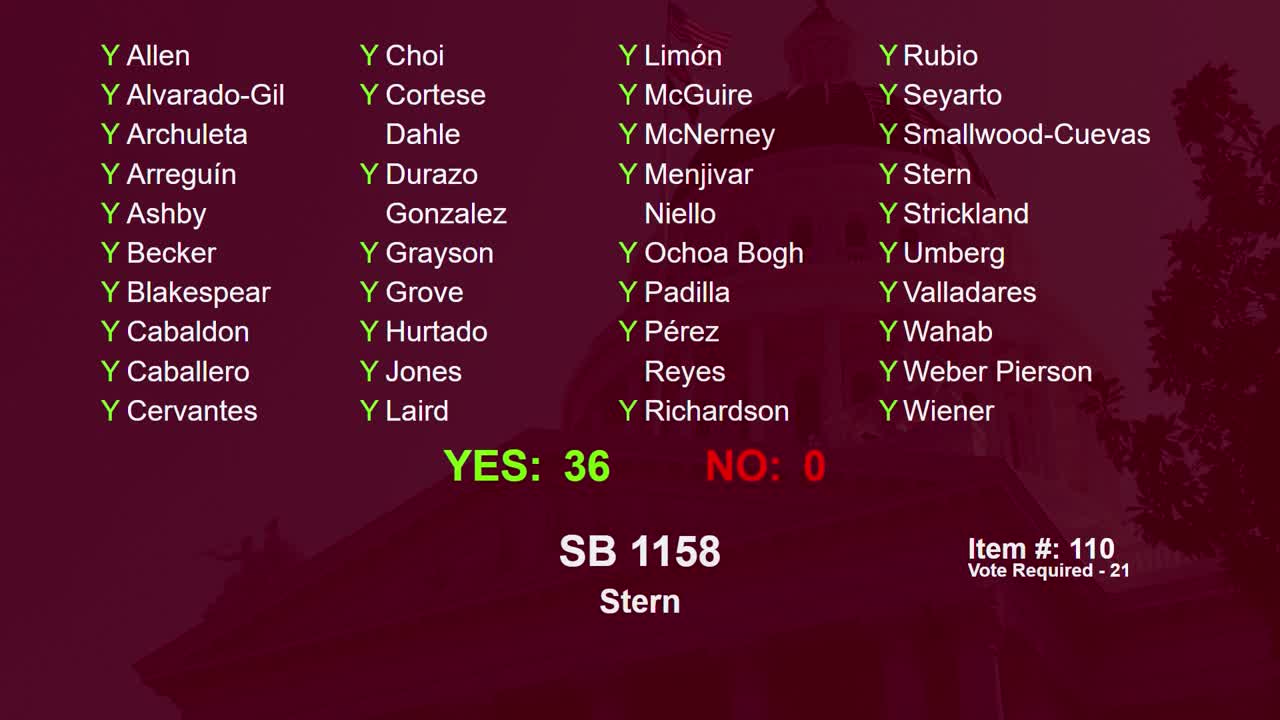
Bill Author