SB 1304: Respiratory Care Practice Act.
- Session Year: 2025-2026
- House: Senate
- Latest Version Date: 2026-09-20
Current Status:
Passed
(2026-09-20: Chaptered by Secretary of State. Chapter 431, Statutes of 2026.)
Introduced
In Committee
Awaiting First Chamber Vote
Passed First Chamber
In Committee
Awaiting Second Chamber Vote
Passed Second Chamber
Enacted
Existing law, the Respiratory Care Practice Act, establishes the Respiratory Care Board of California to license and regulate respiratory care practitioners. Existing law authorizes the board to employ an executive office, as specified. Existing law establishes fees for license and examination requirements for respiratory care practitioners, including an initial license fee of no more than $300 and a license renewal fee at $230, as specified. Existing law authorizes the board to increase the license renewal fee, by regulation, to no more than $330. Existing law repeals the existence of the board and the authority for employment of an executive officer on January 1, 2027.
This bill would extend the operation of the existence of the board and the executive officer to January 1, 2031, and would delete the initial license fee provision. The bill would increase the license renewal fee to $330 and would authorize the board to increase the license renewal fee, by regulation, to $375.
Existing law establishes requirements for licensure as a respiratory care practitioner and generally prohibits an applicant for licensure from being licensed without first successfully passing the National Board for Respiratory Cares Therapist Multiple-Choice Examination, at the cut-off level required to qualify for the Clinical Simulation Examination, and the Clinical Simulation Examination, or any succeeding examinations.
This bill would revise the above provision to instead prohibit an applicant from being licensed under these provisions without first successfully passing the National Board for Respiratory Cares Respiratory Therapy Examination, at the cut-off level required to qualify for the Registered Respiratory Therapist credential, or any succeeding examinations.
Existing law authorizes the board to order the denial, suspension, or revocation of, or the imposition of probationary conditions upon, a license of a respiratory care practitioner for certain specified acts, including the commission of any fraudulent, dishonest, or corrupt act that is substantially related to the qualifications, functions, or duties of a licensee. Existing law further requires the board to revoke or suspend a license for the conviction of a crime that is substantially related to the qualifications, functions, or duties of a licensee. Existing law deems a crime involving sexual misconduct or attempted sexual misconduct, regardless of whether committed with a patient, to be a substantially related crime and requires the board to revoke a license for sexual contact with a patient or for the commission of, or conviction for, a sex offense, as defined.
This bill would additionally require the board to suspend the license of a respiratory care practitioner convicted of specified felonies, regardless of whether the offense was committed in the course of practice, and notwithstanding any other provision. The bill would require the board to revoke the license if the specified conviction becomes final. The bill would authorize the board to decline to impose or to set aside a suspension in the interest of justice and would require the board to rescind a license suspension or revocation if the conviction is overturned, as provided. The bill would authorize a licensee to request a hearing to determine the appropriate level of discipline and would prohibit an administrative law judge from considering expert testimony regarding whether the conviction is substantially related to the practice of respiratory care.
The Respiratory Care Practice Act authorizes the board to promulgate regulations defining specified levels of respiratory care, with each requiring a greater degree of training or skill to perform. Existing law specifies the lowest level as basic services, which are tasks or services that do not require a respiratory assessment and only require manual, technical skills, or data collection. Existing law, the Vocational Nursing Practice Act, limits a licensed vocational nurse to basic respiratory tasks and services, as prescribed.
Existing law exempts from the Respiratory Care Practice Act specified tasks performed by a licensed vocational nurse. In this regard, existing law authorizes a licensed vocational nurse to perform respiratory tasks and services under specified circumstances that vary depending on the task or service, the nurses training, demonstrated competency, and employer, and the setting in which the task or service is performed, as provided. Specifically, existing law authorizes a licensed vocational nurse who is employed by a home health agency to perform respiratory tasks and services identified by the board if, on or before January 1, 2028, the licensed vocational nurse has completed patient-specific training satisfactory to their employer, and, on and after that date, the licensed vocational nurse has completed that training in accordance with guidelines promulgated by the board, in collaboration with the Board of Vocational Nursing and Psychiatric Technicians of the State of California.
This bill would expand the respiratory tasks and services a licensed vocational nurse is authorized to perform. In this regard, the bill would remove the above requirement that a licensed vocational nurse be employed by a home health agency to perform respiratory tasks and services identified by the board, and would, instead, authorize a licensed vocational nurse to perform these services in expanded settings, including, among others, congregate living health facilities, group homes, and adult residential facilities. The bill would authorize a licensed vocational nurse to perform certain suctioning tasks, as specified.
Existing law specifies that the Respiratory Care Practice Act is not intended to limit, preclude, or otherwise interfere with the practice of other licensed personnel carrying out authorized and customary duties and functions.
This bill would provide that certain activities are not considered to be practicing respiratory care, including documenting observations and gathering and reporting data to another health care provider, as specified.
Existing law, the Respiratory Care Practice Act, establishes the Respiratory Care Board of California to license and regulate respiratory care practitioners. Existing law authorizes the board to employ an executive office, as specified. Existing law establishes fees for license and examination requirements for respiratory care practitioners, including an initial license fee of no more than $300 and a license renewal fee at $230, as specified. Existing law authorizes the board to increase the license renewal fee, by regulation, to no more than $330. Existing law repeals the existence of the board and the authority for employment of an executive officer on January 1, 2027.
This bill would extend the operation of the existence of the board and the executive officer to January 1, 2031, and would delete the initial license fee provision. The bill would increase the license renewal fee to $330 and would authorize the board to increase the license renewal fee, by regulation, to $375.
Existing law establishes requirements for licensure as a respiratory care practitioner and generally prohibits an applicant for licensure from being licensed without first successfully passing the National Board for Respiratory Cares Therapist Multiple-Choice Examination, at the cut-off level required to qualify for the Clinical Simulation Examination, and the Clinical Simulation Examination, or any succeeding examinations.
This bill would revise the above provision to instead prohibit an applicant from being licensed under these provisions without first successfully passing the National Board for Respiratory Cares Respiratory Therapy Examination, at the cut-off level required to qualify for the Registered Respiratory Therapist credential, or any succeeding examinations.
Existing law authorizes the board to order the denial, suspension, or revocation of, or the imposition of probationary conditions upon, a license of a respiratory care practitioner for certain specified acts, including the commission of any fraudulent, dishonest, or corrupt act that is substantially related to the qualifications, functions, or duties of a licensee. Existing law further requires the board to revoke or suspend a license for the conviction of a crime that is substantially related to the qualifications, functions, or duties of a licensee. Existing law deems a crime involving sexual misconduct or attempted sexual misconduct, regardless of whether committed with a patient, to be a substantially related crime and requires the board to revoke a license for sexual contact with a patient or for the commission of, or conviction for, a sex offense, as defined.
This bill would additionally require the board to suspend the license of a respiratory care practitioner convicted of specified felonies, regardless of whether the offense was committed in the course of practice, and notwithstanding any other provision. The bill would require the board to revoke the license if the specified conviction becomes final. The bill would authorize the board to decline to impose or to set aside a suspension in the interest of justice and would require the board to rescind a license suspension or revocation if the conviction is overturned, as provided. The bill would authorize a licensee to request a hearing to determine the appropriate level of discipline and would prohibit an administrative law judge from considering expert testimony regarding whether the conviction is substantially related to the practice of respiratory care.
The Respiratory Care Practice Act authorizes the board to promulgate regulations defining specified levels of respiratory care, with each requiring a greater degree of training or skill to perform. Existing law specifies the lowest level as basic services, which are tasks or services that do not require a respiratory assessment and only require manual, technical skills, or data collection. Existing law, the Vocational Nursing Practice Act, limits a licensed vocational nurse to basic respiratory tasks and services, as prescribed.
Existing law exempts from the Respiratory Care Practice Act specified tasks performed by a licensed vocational nurse. In this regard, existing law authorizes a licensed vocational nurse to perform respiratory tasks and services under specified circumstances that vary depending on the task or service, the nurses training, demonstrated competency, and employer, and the setting in which the task or service is performed, as provided. Specifically, existing law authorizes a licensed vocational nurse who is employed by a home health agency to perform respiratory tasks and services identified by the board if, on or before January 1, 2028, the licensed vocational nurse has completed patient-specific training satisfactory to their employer, and, on and after that date, the licensed vocational nurse has completed that training in accordance with guidelines promulgated by the board, in collaboration with the Board of Vocational Nursing and Psychiatric Technicians of the State of California.
This bill would expand the respiratory tasks and services a licensed vocational nurse is authorized to perform. In this regard, the bill would remove the above requirement that a licensed vocational nurse be employed by a home health agency to perform respiratory tasks and services identified by the board, and would, instead, authorize a licensed vocational nurse to perform these services in expanded settings, including, among others, congregate living health facilities, group homes, and adult residential facilities. The bill would authorize a licensed vocational nurse to perform certain suctioning tasks, as specified.
Existing law specifies that the Respiratory Care Practice Act is not intended to limit, preclude, or otherwise interfere with the practice of other licensed personnel carrying out authorized and customary duties and functions.
This bill would provide that certain activities are not considered to be practicing respiratory care, including documenting observations and gathering and reporting data to another health care provider, as specified.
Existing law, the Respiratory Care Practice Act, establishes the Respiratory Care Board of California to license and regulate respiratory care practitioners. Those provisions establish requirements for licensure, including completing an education program for respiratory care and being awarded an associate degree or equivalent, as specified. Existing law authorizes the board to employ an executive office, as specified. Existing law establishes fees for license and examination requirements for respiratory care practitioners, including an initial license fee of no more than $300 and a license renewal fee at $230, as specified. Existing law authorizes the board to increase the license renewal fee, by regulation, to no more than $330. Existing law repeals the existence of the board and the authority for employment of an executive officer on January 1, 2027.
This bill would extend the operation of the existence of the board and the executive officer to January 1, 2031, and would delete the initial license fee provision. The bill would increase the license renewal fee to $330 and would authorize the board to increase the license renewal fee, by regulation, to $375.
Existing law requires establishes requirements for licensure as a respiratory care practitioner to complete a respiratory care education program and be awarded an associate degree or its equivalent, as specified. Existing law and generally prohibits an applicant for licensure from being licensed without first successfully passing the National Board for Respiratory Cares Therapist Multiple-Choice Examination, at the cut-off level required to qualify for the Clinical Simulation Examination, and the Clinical Simulation Examination, or any succeeding examinations.
This bill would revise the above provision to instead prohibit an applicant from being licensed under these provisions without first successfully passing the National Board for Respiratory Cares Respiratory Therapy Examination, at the cut-off level required to qualify for the Registered Respiratory Therapist credential, or any succeeding examinations.
Existing law authorizes the board to order the denial, suspension, or revocation of, or the imposition of probationary conditions upon, a license of a respiratory care practitioner for certain specified acts, including the commission of any fraudulent, dishonest, or corrupt act that is substantially related to the qualifications, functions, or duties of a licensee. Existing law further requires the board to revoke or suspend a license for the conviction of a crime that is substantially related to the qualifications, functions, or duties of a licensee. Existing law deems a crime involving sexual misconduct or attempted sexual misconduct, regardless of whether committed with a patient, to be a substantially related crime and requires the board to revoke a license for sexual contact with a patient or for the commission of, or conviction for, a sex offense, as defined.
This bill would additionally require the board to suspend the license of a respiratory care practitioner convicted of specified felonies, regardless of whether the offense was committed in the course of practice, and notwithstanding any other provision. The bill would require the board to revoke the license if the specified conviction becomes final. The bill would authorize the board to decline to impose or to set aside a suspension in the interest of justice and would require the board to rescind a license suspension or revocation if the conviction is overturned, as provided. The bill would authorize a licensee to request a hearing to determine the appropriate level of discipline and would prohibit an administrative law judge from considering expert testimony regarding whether the conviction is substantially related to the practice of respiratory care.
The Respiratory Care Practice Act authorizes the board to promulgate regulations defining specified levels of respiratory care, with each requiring a greater degree of training or skill to perform. Existing law specifies the lowest level as basic services, which are tasks or services that do not require a respiratory assessment and only require manual, technical skills, or data collection. Existing law, the Vocational Nursing Practice Act, limits a licensed vocational nurse to basic respiratory tasks and services, as prescribed.
Existing law exempts from the Respiratory Care Practice Act specified tasks performed by a licensed vocational nurse. In this regard, existing law authorizes a licensed vocational nurse to perform respiratory tasks and services under specified circumstances that vary depending on the task or service, the nurses training, demonstrated competency, and employer, and the setting in which the task or service is performed, as provided. Specifically, existing law authorizes a licensed vocational nurse who is employed by a home health agency to perform respiratory tasks and services identified by the board if, on or before January 1, 2028, the licensed vocational nurse has completed patient-specific training satisfactory to their employer, and, on and after that date, the licensed vocational nurse has completed that training in accordance with guidelines promulgated by the board, in collaboration with the Board of Vocational Nursing and Psychiatric Technicians of the State of California.
This bill would expand the respiratory tasks and services a licensed vocational nurse is authorized to perform. In this regard, the bill would remove the above requirement that a licensed vocational nurse be employed by a home health agency to perform respiratory tasks and services identified by the board, and would, instead, authorize a licensed vocational nurse to perform these services in expanded settings, including, among others, congregate living health facilities, group homes, and adult residential facilities. The bill would authorize a licensed vocational nurse to perform certain suctioning tasks, as specified.
Existing law specifies that the Respiratory Care Practice Act is not intended to limit, preclude, or otherwise interfere with the practice of other licensed personnel carrying out authorized and customary duties and functions.
This bill would provide that certain activities are not considered to be practicing respiratory care, including documenting observations and gathering and reporting data to another health care provider, as specified.
Existing law, the Respiratory Care Practice Act, establishes the Respiratory Care Board of California to license and regulate respiratory care practitioners. Those provisions establish requirements for licensure, including completing an education program for respiratory care and being awarded an associate degree or equivalent, as specified. Existing law authorizes the board to employ an executive office, as specified. Existing law establishes fees for license and examination requirements for respiratory care practitioners, including an initial license fee of no more than $300 and a license renewal fee at $230, as specified. Existing law authorizes the board to increase the license renewal fee, by regulation, to no more than $330. Existing law repeals the existence of the board and the authority for employment of an executive officer on January 1, 2027.
This bill would extend the operation of the existence of the board and the executive officer to January 1, 2031, and would delete the initial license fee provision. The bill would increase the license renewal fee to $330 and would authorize the board to increase the license renewal fee, by regulation, to $375.
Existing law requires a respiratory care practitioner to complete a respiratory care education program and be awarded an associate degree or its equivalent, as specified. Existing law generally prohibits an applicant from being licensed without first successfully passing the National Board for Respiratory Cares Therapist Multiple-Choice Examination, at the cut-off level required to qualify for the Clinical Simulation Examination, and the Clinical Simulation Examination, or any succeeding examinations.
This bill would revise the above provision to instead prohibit an applicant from being licensed under these provisions without first successfully passing the National Board for Respiratory Cares Respiratory Therapy Examination, at the cut-off level required to qualify for the Registered Respiratory Therapist credential, or any succeeding examinations.
Existing law authorizes the board to order the denial, suspension, or revocation of, or the imposition of probationary conditions upon, a license of a respiratory care practitioner for certain specified acts, including the commission of any fraudulent, dishonest, or corrupt act that is substantially related to the qualifications, functions, or duties of a licensee. Existing law further requires the board to revoke or suspend a license for the conviction of a crime that is substantially related to the qualifications, functions, or duties of a licensee. Existing law deems a crime involving sexual misconduct or attempted sexual misconduct, regardless of whether committed with a patient, to be a substantially related crime and requires the board to revoke a license for sexual contact with a patient or for the commission of, or conviction for, a sex offense, as defined.
This bill would additionally require the board to suspend the license of a respiratory care practitioner convicted of specified felonies, regardless of whether the offense was committed in the course of practice, and notwithstanding any other provision. The bill would require the board to revoke the license if the specified conviction becomes final. The bill would authorize the board to decline to impose or to set aside a suspension in the interest of justice and would require the board to rescind a license suspension or revocation if the conviction is overturned, as provided. The bill would authorize a licensee to request a hearing to determine the appropriate level of discipline and would prohibit an administrative law judge from considering expert testimony regarding whether the conviction is substantially related to the practice of respiratory care.
Existing law prescribes the respiratory tasks and services that a licensed vocational nurse may perform, including basic respiratory tasks and services that do not require a respiratory assessment and only require manual or technical skills, or data collection, as identified by the board, as specified. ExistingThe Respiratory Care Practice Act authorizes the board to promulgate regulations defining specified levels of respiratory care, with each requiring a greater degree of training or skill to perform. Existing law specifies the lowest level as basic services, which are tasks or services that do not require a respiratory assessment and only require manual, technical skills, or data collection. Existing law, the Vocational Nursing Practice Act, limits a licensed vocational nurse to basic respiratory tasks and services, as prescribed.
Existing law exempts from the Respiratory Care Practice Act specified tasks performed by a licensed vocational nurse. In this regard, existing law exempts authorizes a licensed vocational nurse to perform respiratory tasks and services under specified circumstances that vary depending on the task or service, the nurses training, demonstrated competency, and employer, and the setting in which the task or service is performed, as provided. With regard to those exempted settings, Specifically, existing law exempts authorizes a licensed vocational nurse who is employed by a home health agency to perform respiratory tasks and services identified by the board if, on or before January 1, 2028, the licensed vocational nurse has completed patient-specific training satisfactory to their employer, and, on and after that date, the licensed vocational nurse has completed that training in accordance with guidelines promulgated by the board, in collaboration with the Board of Vocational Nursing and Psychiatric Technicians of the State of California.
This bill would expand the respiratory tasks and services a licensed vocational nurse is authorized to perform. In this regard, the bill would remove the above requirement that a licensed vocational nurse be employed by a home health agency to perform respiratory tasks and services identified by the board, and would, instead, authorize a licensed vocational nurse to perform these services in expanded settings, including, among others, congregate living health facilities, group homes, and adult residential facilities. The bill would require a licensed vocational nurse, in all exempted settings, to complete patient-specific training provided by the employer before January 1, 2028, and receive task-specific training on respiratory tasks and services from specified providers on or after that date. The bill would authorize a licensed vocational nurse to perform certain suctioning tasks, as specified.
Existing law specifies that the Respiratory Care Practice Act is not intended to limit, preclude, or otherwise interfere with the practice of other licensed personnel carrying out authorized and customary duties and functions.
This bill would provide that certain activities are not considered to be practicing respiratory care, including documenting observations and gathering and reporting data to another health care provider, as specified.
Existing law, the Respiratory Care Practice Act, establishes the Respiratory Care Board of California to license and regulate respiratory care practitioners. The act establishes Those provisions establish requirements for licensure, including completing an education program for respiratory care and being awarded an associate degree or equivalent, as specified. Existing law authorizes the board to employ an executive office, as specified. Existing law establishes fees for license and examination requirements for respiratory care practitioners, including an initial license fee of no more than $300 and a license renewal fee at $230, as specified. Existing law authorizes the board to increase the license renewal fee, by regulation, to no more than $330. Existing law repeals the existence of the board and the authority for employment of an executive officer on January 1, 2027.
This bill would extend the operation of the existence of the board and the executive officer to January 1, 2031, and would delete the initial license fee provision. The bill would increase the license renewal fee to $330 and would authorize the board to increase the license renewal fee, by regulation, to $375.
Existing law requires a respiratory care practitioner to complete a respiratory care education program and be awarded an associate degree or its equivalent, as specified. Existing law generally prohibits an applicant from being licensed under the act without first successfully passing the National Board for Respiratory Cares Therapist Multiple-Choice Examination, at the cut-off level required to qualify for the Clinical Simulation Examination, and the Clinical Simulation Examination, or any succeeding examinations.This bill would revise the above provision to instead prohibit an applicant from being licensed under the act these provisions without first successfully passing the National Board for Respiratory Cares Respiratory Therapy Examination, at the cut-off level required to qualify for the Registered Respiratory Therapist credential, or any succeeding examinations.Existing law authorizes the board to order the denial, suspension, or revocation of, or the imposition of probationary conditions upon, a license of a respiratory care practitioner for certain specified acts, including the commission of any fraudulent, dishonest, or corrupt act that is substantially related to the qualifications, functions, or duties of a licensee. Existing law further requires the board to revoke or suspend a license for the conviction of a crime that is substantially related to the qualifications, functions, or duties of a licensee. Existing law deems a crime involving sexual misconduct or attempted sexual misconduct, regardless of whether committed with a patient, to be a substantially related crime and requires the board to revoke a license for sexual contact with a patient or for the commission of, or conviction for, a sex offense, as defined.
This bill would additionally require the board to suspend the license of a respiratory care practitioner convicted of specified felonies, regardless of whether the offense was committed in the course of practice, and notwithstanding any other provision. The bill would require the board to revoke the license if the specified conviction becomes final. The bill would authorize the board to decline to impose or to set aside a suspension in the interest of justice and would require the board to rescind a license suspension or revocation if the conviction is overturned, as provided. The bill would authorize a licensee to request a hearing to determine the appropriate level of discipline and would prohibit an administrative law judge from considering expert testimony regarding whether the conviction is substantially related to the practice of respiratory care.
Existing law prescribes the respiratory tasks and services that a licensed vocational nurse may perform, including basic respiratory tasks and services that do not require a respiratory assessment and only require manual or technical skills, or data collection, as identified by the board, as specified. Existing law exempts a licensed vocational nurse to perform respiratory tasks and services under specified circumstances that vary depending on the task or service, the nurses training, demonstrated competency, and employer, and the setting in which the task or service is performed, as provided. With regard to those exempted settings, existing law exempts a licensed vocational nurse who is employed by a home health agency if, on or before January 1, 2028, the licensed vocational nurse has completed patient-specific training satisfactory to their employer, and, on and after that date, the licensed vocational nurse has completed that training in accordance with guidelines promulgated by the board, in collaboration with the Board of Vocational Nursing and Psychiatric Technicians of the State of California.
This bill would remove the above requirement that a licensed vocational nurse be employed by a home health agency to perform respiratory tasks and services identified by the board, and would, instead, authorize a licensed vocational nurse to perform these services in expanded settings, including, among others, congregate living health facilities, group homes, and adult residential facilities. The bill would require a licensed vocational nurse, in all exempted settings, to complete patient-specific training provided by the employer before January 1, 2028, and receive task-specific training on respiratory tasks and services from specified providers on or after that date.
Existing law, the Respiratory Care Practice Act, establishes the Respiratory Care Board of California to license and regulate respiratory care practitioners. The act establishes requirements for licensure, including completing an education program for respiratory care and being awarded an associate degree or equivalent, as specified.
Existing law generally prohibits an applicant from being licensed under the act without first successfully passing the National Board for Respiratory Cares Therapist Multiple-Choice Examination, at the cut-off level required to qualify for the Clinical Simulation Examination, and the Clinical Simulation Examination, or any succeeding examinations.
This bill would revise the above provision to instead prohibit an applicant from being licensed under the act without first successfully passing the National Board for Respiratory Cares Respiratory Therapy Examination, at the cut-off level required to qualify for the Registered Respiratory Therapist credential, or any succeeding examinations.
(a)This chapter confers no authority to practice medicine or surgery, to provide respiratory care services and treatment, or to undertake the prevention, treatment, or cure of disease, pain, injury, deformity, or mental or physical condition in violation of any provision of law.
(b)(1)Notwithstanding subdivision (a), a licensed vocational nurse who has received training and who demonstrates competency satisfactory to their employer may, when directed by a physician and surgeon, perform respiratory tasks and services expressly identified by the Respiratory Care Board of California pursuant to subdivision (a) of Section 3702.5.
(2)Notwithstanding paragraph (1), a licensed vocational nurse may perform the respiratory tasks and services as authorized under paragraph (9) of subdivision (a) of Section 3765.
(c)Notwithstanding any other law except subdivision (a) of Section 2859, the practice of vocational nursing includes all of the following:
(1)Oral suctioning performed within the oral cavity that does not enter the oropharynx or beyond.
(2)Nasal suctioning performed within the nasal cavity that does not enter the nasopharynx or beyond.
(3)Tracheostomy tube suctioning when the suctioning device remains within the tracheostomy tube and does not pass beyond the distal end of the tube.
(4)Removal and replacement of an external speaking valve for purposes of suctioning the tracheostomy tube.
SEC. 2.Section 3710 of the Business and Professions Code is amended to read:3710.(a)The Respiratory Care Board of California, hereafter referred to as the board, shall enforce and administer this chapter.
(b)This section shall remain in effect only until January 1, 2031, and as of that date is repealed. Notwithstanding any other law, the repeal of this section renders the board subject to review by the appropriate policy committees of the Legislature.
SEC. 3.Section 3716 of the Business and Professions Code is amended to read:3716.(a)The board may employ an executive officer exempt from civil service and, subject to the provisions of law relating to civil service, clerical assistants and, except as provided in Section 159.5, other employees as it may deem necessary to carry out its powers and duties.
(b)This section shall remain in effect only until January 1, 2031, and as of that date is repealed.
SEC. 4.Section 3735 of the Business and Professions Code is amended to read:3735.(a)Except as otherwise provided in this chapter, an applicant shall not receive a license under this chapter without first successfully passing the National Board for Respiratory Cares Respiratory Therapy Examination, at the cut-off level required to qualify for the Registered Respiratory Therapist credential, or any succeeding examinations.
(b)Notwithstanding subdivision (a), any person applying for licensure who provides evidence that they passed the national Certified Respiratory Therapist Examination or Written Registry Examination before January 1, 2015, shall be deemed to have met the examination requirement of subdivision (a), provided there is no evidence of prior license or job-related discipline, as determined by the board in its discretion.
SEC. 5.Section 3752.8 is added to the Business and Professions Code, to read:3752.8.(a)The board shall suspend a license under the following conditions:
(1)Notwithstanding any other provision of this chapter, the board or its designee shall automatically suspend a license following a conviction of a felony by a licensee, where the conviction involves a violation of one or more of the sections identified in subdivision (b), whether in the course of the licensees practice as a respiratory care practitioner or otherwise.
(2)The suspension shall remain in effect until the time for appeal has elapsed, if no appeal has been taken, or until the judgment of conviction has been affirmed on appeal, or has otherwise become final, and until further order of the board.
(3)The board or its designee may decline to impose or may set aside the suspension when it appears to be in the best interest of justice to do so, with due regard being given to maintaining the integrity of, and confidence in, the profession.
(b)The offenses subject to this section include all of the following:
(1)A violation of Section 726.
(2)An offense described in subdivision (c) or (d) of Section 290 of the Penal Code.
(3)A serious felony, as defined in Section 1192.7 of the Penal Code.
(c)The board shall revoke a license under the following conditions:
(1)Following the conviction of a felony, as described in subdivision (b), the board or its designee shall automatically revoke a license at the time that the appeal has elapsed with no appeal having been taken, or the judgment of conviction has been affirmed on appeal, the judgment of conviction has otherwise become final.
(2)If the related conviction of the licensee is overturned on appeal, no revocation order shall be issued as to that conviction, and any suspension order issued pursuant to the above shall be rescinded, unless that order is based on a stipulated settlement. This subdivision shall not prohibit the board from pursuing disciplinary action based on any cause other than the overturned conviction, including, but not limited to, the underlying conduct alleged in the criminal case.
(d)(1)A licensee subject to suspension or revocation under this section may request a hearing within 30 days of the automatic suspension order described in subdivision (a) and the automatic revocation order described in subdivision (c). The proceeding shall be conducted in accordance with the Administrative Procedure Act (Chapter 5 (commencing with Section 11500) of Part 1 of Division 3 of Title 2 of the Government Code).
(2)The Legislature finds and declares that the conviction of any felony identified in subdivision (b) is substantially related to the qualifications, functions, or duties of a respiratory care practitioner. An administrative law judge shall not permit or give any weight to expert testimony regarding whether the conviction is substantially related to the practice of respiratory care. The only purpose of an administrative hearing shall be to determine whether the discipline imposed shall be a suspension, revocation, or other action under the circumstances of the case.
(e)This section does not limit the boards authority to pursue disciplinary action under any other provision of this chapter, including, but not limited to, Sections 3750, 3750.5, and 3755, based on conduct or violations separate from the conviction addressed in this section.
SEC. 6.Section 3762 of the Business and Professions Code is amended to read:3762.(a)Nothing in this chapter is intended to limit, preclude, or otherwise interfere with the practices of other licensed personnel in carrying out authorized and customary duties and functions.
(b)For purposes of this chapter, the following are not considered the practice of respiratory care:
(1)Documenting observations and gathering and reporting data to another health care provider, without analysis, interpretation, or independent clinical decisionmaking.
(2)(A)Notwithstanding subdivision (c) of Section 1399.365 of Title 16 of the California Code of Regulations, a service or task requiring a license issued under this division if it does not involve either of the following:
(i)Any task or service defined as respiratory care pursuant to Section 3702, 3702.5, or 3702.7, except as specified in subdivision (c) of Section 2860.
(ii)Any task requiring respiratory assessment at the time of the task.
(B)For purpose of this paragraph, respiratory assessment means conducting analysis to make recommendations concerning the respiratory management, diagnosis, treatment, or care of a patient or as a means to perform any task in regard to the care of a patient.
SEC. 7.Section 3765 of the Business and Professions Code is amended to read:3765.(a)This act does not prohibit any of the following activities:
(1)The performance of respiratory care that is an integral part of the program of study by students enrolled in approved respiratory therapy training programs.
(2)Self-care by the patient or the gratuitous care by a friend or member of the family who does not represent or hold themselves out to be a respiratory care practitioner licensed under the provisions of this chapter.
(3)The respiratory care practitioner from performing advances in the art and techniques of respiratory care learned through formal or specialized training.
(4)The performance of respiratory care in an emergency situation by paramedical personnel who have been formally trained in these modalities and are duly licensed under the provisions of an act pertaining to their specialty.
(5)Temporary performance, by other health care personnel, students, or groups, of respiratory care services, as identified and authorized by the board, in the event of an epidemic, pandemic, public disaster, or emergency.
(6)Persons from engaging in cardiopulmonary research.
(7)Formally trained licensees and staff of child day care facilities from administering to a child inhaled medication as defined in Section 1596.798 of the Health and Safety Code.
(8)The performance by a person employed by a home medical device retail facility or by a home health agency licensed by the State Department of Public Health of specific, limited, and basic respiratory care or respiratory care-related services that have been authorized by the board.
(9)The performance, by a vocational nurse licensed by the Board of Vocational Nursing and Psychiatric Technicians of the State of California, of respiratory tasks and services identified by the board, if the licensed vocational nurse complies with all of the following:
(A)Before January 1, 2028, the licensed vocational nurse has completed patient-specific training satisfactory to their employer and before the provision of patient care.
(B)On or after January 1, 2028, the licensed vocational nurse has completed both of the following, in accordance with guidelines that shall be promulgated by the board in collaboration with the Board of Vocational Nursing and Psychiatric Technicians of the State of California:
(i)The licensed vocational nurse has completed task-specific training on each respiratory task or service the licensed vocational nurse will perform. This training may be provided by the employer directly or through the California Association of Medical Product Suppliers (CAMPS), the California Society for Respiratory Care (CSRC), or another organization identified by the board.
(ii)The licensed vocational nurse has completed patient-specific training provided by their employer.
(C)The licensed vocational nurse performs respiratory care tasks and services, as identified by the board, and, pursuant to this paragraph, in any of the following settings:
(i)At a congregate living health facility, intermediate care facility designated as 15 beds or fewer, adult day health care center, pediatric day health and respite care facility, hospice agency, hospice facility, or home health agency, licensed by the State Department of Public Health.
(ii)At a small family home, adult residential facility, adult residential facility for persons with special health care needs, group home, group home for children with special health care needs, enhanced behavioral supports home, community crisis home, residential care facility for the elderly, residential care facility for the chronically ill, adult day program, or therapeutic day services facility, licensed by the State Department of Social Services.
(iii)At a medical foster home for veterans approved by the United States Department of Veterans Affairs.
(iv)As a private duty nurse as part of daily transportation and activities outside a patients residence or family respite for home- and community-based patients.
(v)As an individual nurse provider working in a residential home.
(vi)As part of services provided through a family home agency, as defined in Section 4689.1 of the Welfare and Institutions Code.
(vii)As part of supported living services provided pursuant to Section 4689 of the Welfare and Institutions Code.
(10)The performance of suctioning and other basic respiratory tasks and services by a vocational nurse licensed by the Board of Vocational Nursing and Psychiatric Technicians of the State of California under the supervision of a credentialed school nurse in accordance with Sections 49423.5 and 49426.5 of the Education Code.
(b)For purposes of this section, employer means a person, agency, facility, organization, or entity responsible for assigning, directing, or coordinating the care provided by the licensed vocational nurse. Employer includes, where applicable, a family member or legal guardian authorized under the patients plan of care to perform that function.
(c)For purposes of this section, intermediate care facility includes an intermediate care facility for the developmentally disabled that provides habilitative care, nursing care, or continuous nursing care.
SEC. 8.Section 3775 of the Business and Professions Code is amended to read:3775.The amount of fees provided in connection with licenses or approvals for the practice of respiratory care shall be as follows:
(a)The application fee shall be established by the board at not more than three hundred dollars ($300).
(b)The application fee for the applicant under subdivision (c) of Section 3740 shall be established by the board at not more than three hundred fifty dollars ($350).
(c)The fees for any examination or reexamination required by the board shall be the actual cost to the board for developing, purchasing, grading, and administering each examination or reexamination.
(d)The renewal fee shall be established at three hundred thirty dollars ($330). The board may increase the renewal fee, by regulation, to an amount not to exceed three hundred seventy-five dollars ($375).
(e)The delinquency fee shall be established by the board at not more than the following amounts:
(1)If the license is renewed not more than two years from the date of its expiration, the delinquency fee shall be 100 percent of the renewal fee in effect at the time or renewal.
(2)If the license is renewed after two years, but not more than three years, from the date of expiration of the license, the delinquency fee shall be 200 percent of the renewal fee in effect at the time of renewal.
(f)The duplicate license fee shall not exceed seventy-five dollars ($75).
(g)The endorsement fee shall not exceed one hundred dollars ($100).
(h)Costs incurred by the board in order to obtain and review documents or information related to the criminal history of, rehabilitation of, disciplinary actions taken by another state agency against, or acts of negligence in the practice of respiratory care by, an applicant or licensee, shall be paid by the applicant or licensee before a license will be issued or a subsequent renewal processed.
(i)Fees paid in any form other than check, money order, or cashiers check shall be subject to an additional processing charge equal to the boards actual processing costs.
(j)Fees incurred by the board to process return mail shall be paid by the applicant or licensee for whom the charges were incurred.
(k)Notwithstanding any other provision of this chapter, the board, in its discretion, may reduce the amount of any fee otherwise prescribed by this section.
SEC. 9.Section 49423.5 of the Education Code is amended to read:49423.5.(a)Notwithstanding Section 49422, an individual with exceptional needs who requires specialized physical health care services, during the regular schoolday, may be assisted by any of the following individuals:
(1)Qualified persons who possess an appropriate credential issued pursuant to Section 44267 or 44267.5, or hold a valid certificate of public health nursing issued by the Board of Registered Nursing.
(2)Qualified designated school personnel trained in the administration of specialized physical health care if they perform those services under the supervision, as defined by Section 3051.12 of Title 5 of the California Code of Regulations, of a credentialed school nurse, public health nurse, or licensed physician and surgeon and the services are determined by the credentialed school nurse or licensed physician and surgeon, in consultation with the physician treating the pupil, to be all of the following:
(A)Routine for the pupil.
(B)Pose little potential harm for the pupil.
(C)Performed with predictable outcomes, as defined in the individualized education program of the pupil.
(D)Do not require a nursing assessment, interpretation, or decisionmaking by the designated school personnel.
(3)For basic respiratory services authorized by paragraph (10) of subdivision (a) of Section 3765 of the Business and Professions Code, a vocational nurse licensed by the Board of Vocational Nursing and Psychiatric Technicians of the State of California under the supervision of a credentialed school nurse.
(b)Specialized health care or other services that require medically related training shall be provided pursuant to the procedures prescribed by Section 49423.
(c)Persons providing specialized physical health care services shall also demonstrate competence in basic cardiopulmonary resuscitation and shall be knowledgeable of the emergency medical resources available in the community in which the services are performed.
(d)Specialized physical health care services, as used in this section, includes catheterization, gastric tube feeding, suctioning, or other services that require medically related training.
(e)Regulations necessary to implement this section shall be developed jointly by the State Department of Education and the State Department of Health Care Services, and adopted by the state board.
(f)This section does not diminish or weaken any federal requirement for serving individuals with exceptional needs under the Individuals with Disabilities Education Act (20 U.S.C. Sec. 1400 et seq.), and its implementing regulations, and under Section 504 of the Rehabilitation Act of 1973 (29 U.S.C. Sec. 794) and its implementing regulations.
(g)This section does not affect current state law or regulation regarding medication administration.
(h)It is the intent of the Legislature that this section not cause individuals with exceptional needs to be placed at schoolsites other than those they would attend but for their needs for specialized physical health care services.
(a)This chapter confers no authority to practice medicine or surgery, to provide respiratory care services and treatment, or to undertake the prevention, treatment, or cure of disease, pain, injury, deformity, or mental or physical condition in violation of any provision of law.
(b)(1)Notwithstanding subdivision (a), a licensed vocational nurse who has received training and who demonstrates competency satisfactory to their employer may, when directed by a physician and surgeon, perform respiratory tasks and services expressly identified by the Respiratory Care Board of California pursuant to subdivision (a) of Section 3702.5.
(2)Notwithstanding paragraph (1), a licensed vocational nurse may perform the respiratory tasks and services as authorized under paragraph (9) of subdivision (a) of Section 3765.
(c)Notwithstanding any other law except subdivision (a) of Section 2859, the practice of vocational nursing includes all of the following:
(1)Oral suctioning performed within the oral cavity that does not enter the oropharynx or beyond.
(2)Nasal suctioning performed within the nasal cavity that does not enter the nasopharynx or beyond.
(3)Tracheostomy tube suctioning when the suctioning device remains within the tracheostomy tube and does not pass beyond the distal end of the tube.
(4)Removal and replacement of an external speaking valve for purposes of suctioning the tracheostomy tube.
SEC. 2.Section 3710 of the Business and Professions Code is amended to read:3710.(a)The Respiratory Care Board of California, hereafter referred to as the board, shall enforce and administer this chapter.
(b)This section shall remain in effect only until January 1, 2031, and as of that date is repealed. Notwithstanding any other law, the repeal of this section renders the board subject to review by the appropriate policy committees of the Legislature.
SEC. 3.Section 3716 of the Business and Professions Code is amended to read:3716.(a)The board may employ an executive officer exempt from civil service and, subject to the provisions of law relating to civil service, clerical assistants and, except as provided in Section 159.5, other employees as it may deem necessary to carry out its powers and duties.
(b)This section shall remain in effect only until January 1, 2031, and as of that date is repealed.
SEC. 4.Section 3735 of the Business and Professions Code is amended to read:3735.(a)Except as otherwise provided in this chapter, an applicant shall not receive a license under this chapter without first successfully passing the National Board for Respiratory Cares Respiratory Therapy Examination, at the cut-off level required to qualify for the Registered Respiratory Therapist credential, or any succeeding examinations.
(b)Notwithstanding subdivision (a), any person applying for licensure who provides evidence that they passed the national Certified Respiratory Therapist Examination or Written Registry Examination before January 1, 2015, shall be deemed to have met the examination requirement of subdivision (a), provided there is no evidence of prior license or job-related discipline, as determined by the board in its discretion.
SEC. 5.Section 3752.8 is added to the Business and Professions Code, to read:3752.8.(a)The board shall suspend a license under the following conditions:
(1)Notwithstanding any other provision of this chapter, the board or its designee shall automatically suspend a license following a conviction of a felony by a licensee, where the conviction involves a violation of one or more of the sections identified in subdivision (b), whether in the course of the licensees practice as a respiratory care practitioner or otherwise.
(2)The suspension shall remain in effect until the time for appeal has elapsed, if no appeal has been taken, or until the judgment of conviction has been affirmed on appeal, or has otherwise become final, and until further order of the board.
(3)The board or its designee may decline to impose or may set aside the suspension when it appears to be in the best interest of justice to do so, with due regard being given to maintaining the integrity of, and confidence in, the profession.
(b)The offenses subject to this section include all of the following:
(1)A violation of Section 726.
(2)An offense described in subdivision (c) or (d) of Section 290 of the Penal Code.
(3)A serious felony, as defined in Section 1192.7 of the Penal Code.
(c)The board shall revoke a license under the following conditions:
(1)Following the conviction of a felony, as described in subdivision (b), the board or its designee shall automatically revoke a license at the time that the appeal has elapsed with no appeal having been taken, or the judgment of conviction has been affirmed on appeal, the judgment of conviction has otherwise become final.
(2)If the related conviction of the licensee is overturned on appeal, no revocation order shall be issued as to that conviction, and any suspension order issued pursuant to the above shall be rescinded, unless that order is based on a stipulated settlement. This subdivision shall not prohibit the board from pursuing disciplinary action based on any cause other than the overturned conviction, including, but not limited to, the underlying conduct alleged in the criminal case.
(d)(1)A licensee subject to suspension or revocation under this section may request a hearing within 30 days of the automatic suspension order described in subdivision (a) and the automatic revocation order described in subdivision (c). The proceeding shall be conducted in accordance with the Administrative Procedure Act (Chapter 5 (commencing with Section 11500) of Part 1 of Division 3 of Title 2 of the Government Code).
(2)The Legislature finds and declares that the conviction of any felony identified in subdivision (b) is substantially related to the qualifications, functions, or duties of a respiratory care practitioner. An administrative law judge shall not permit or give any weight to expert testimony regarding whether the conviction is substantially related to the practice of respiratory care. The only purpose of an administrative hearing shall be to determine whether the discipline imposed shall be a suspension, revocation, or other action under the circumstances of the case.
(e)This section does not limit the boards authority to pursue disciplinary action under any other provision of this chapter, including, but not limited to, Sections 3750, 3750.5, and 3755, based on conduct or violations separate from the conviction addressed in this section.
SEC. 6.Section 3762 of the Business and Professions Code is amended to read:3762.(a)Nothing in this chapter is intended to limit, preclude, or otherwise interfere with the practices of other licensed personnel in carrying out authorized and customary duties and functions.
(b)For purposes of this chapter, the following are not considered the practice of respiratory care:
(1)Documenting observations and gathering and reporting data to another health care provider, without analysis, interpretation, or independent clinical decisionmaking.
(2)(A)Notwithstanding subdivision (c) of Section 1399.365 of Title 16 of the California Code of Regulations, a service or task requiring a license issued under this division if it does not involve either of the following:
(i)Any task or service defined as respiratory care pursuant to Section 3702, 3702.5, or 3702.7, except as specified in subdivision (c) of Section 2860.
(ii)Any task requiring respiratory assessment at the time of the task.
(B)For purpose of this paragraph, respiratory assessment means conducting analysis to make recommendations concerning the respiratory management, diagnosis, treatment, or care of a patient or as a means to perform any task in regard to the care of a patient.
SEC. 7.Section 3765 of the Business and Professions Code is amended to read:3765.(a)This act does not prohibit any of the following activities:
(1)The performance of respiratory care that is an integral part of the program of study by students enrolled in approved respiratory therapy training programs.
(2)Self-care by the patient or the gratuitous care by a friend or member of the family who does not represent or hold themselves out to be a respiratory care practitioner licensed under the provisions of this chapter.
(3)The respiratory care practitioner from performing advances in the art and techniques of respiratory care learned through formal or specialized training.
(4)The performance of respiratory care in an emergency situation by paramedical personnel who have been formally trained in these modalities and are duly licensed under the provisions of an act pertaining to their specialty.
(5)Temporary performance, by other health care personnel, students, or groups, of respiratory care services, as identified and authorized by the board, in the event of an epidemic, pandemic, public disaster, or emergency.
(6)Persons from engaging in cardiopulmonary research.
(7)Formally trained licensees and staff of child day care facilities from administering to a child inhaled medication as defined in Section 1596.798 of the Health and Safety Code.
(8)The performance by a person employed by a home medical device retail facility or by a home health agency licensed by the State Department of Public Health of specific, limited, and basic respiratory care or respiratory care-related services that have been authorized by the board.
(9)The performance, by a vocational nurse licensed by the Board of Vocational Nursing and Psychiatric Technicians of the State of California, of respiratory tasks and services identified by the board, if the licensed vocational nurse complies with all of the following:
(A)Before January 1, 2028, the licensed vocational nurse has completed patient-specific training satisfactory to their employer and before the provision of patient care.
(B)On or after January 1, 2028, the licensed vocational nurse has completed both of the following, in accordance with guidelines that shall be promulgated by the board in collaboration with the Board of Vocational Nursing and Psychiatric Technicians of the State of California:
(i)The licensed vocational nurse has completed task-specific training on each respiratory task or service the licensed vocational nurse will perform. This training may be provided by the employer directly or through the California Association of Medical Product Suppliers (CAMPS), the California Society for Respiratory Care (CSRC), or another organization identified by the board.
(ii)The licensed vocational nurse has completed patient-specific training provided by their employer.
(C)The licensed vocational nurse performs respiratory care tasks and services, as identified by the board, and, pursuant to this paragraph, in any of the following settings:
(i)At a congregate living health facility, intermediate care facility designated as 15 beds or fewer, adult day health care center, pediatric day health and respite care facility, hospice agency, hospice facility, or home health agency, licensed by the State Department of Public Health.
(ii)At a small family home, adult residential facility, adult residential facility for persons with special health care needs, group home, group home for children with special health care needs, enhanced behavioral supports home, community crisis home, residential care facility for the elderly, residential care facility for the chronically ill, adult day program, or therapeutic day services facility, licensed by the State Department of Social Services.
(iii)At a medical foster home for veterans approved by the United States Department of Veterans Affairs.
(iv)As a private duty nurse as part of daily transportation and activities outside a patients residence or family respite for home- and community-based patients.
(v)As an individual nurse provider working in a residential home.
(vi)As part of services provided through a family home agency, as defined in Section 4689.1 of the Welfare and Institutions Code.
(vii)As part of supported living services provided pursuant to Section 4689 of the Welfare and Institutions Code.
(10)The performance of suctioning and other basic respiratory tasks and services by a vocational nurse licensed by the Board of Vocational Nursing and Psychiatric Technicians of the State of California under the supervision of a credentialed school nurse in accordance with Sections 49423.5 and 49426.5 of the Education Code.
(b)For purposes of this section, employer means a person, agency, facility, organization, or entity responsible for assigning, directing, or coordinating the care provided by the licensed vocational nurse. Employer includes, where applicable, a family member or legal guardian authorized under the patients plan of care to perform that function.
(c)For purposes of this section, intermediate care facility includes an intermediate care facility for the developmentally disabled that provides habilitative care, nursing care, or continuous nursing care.
SEC. 8.Section 3775 of the Business and Professions Code is amended to read:3775.The amount of fees provided in connection with licenses or approvals for the practice of respiratory care shall be as follows:
(a)The application fee shall be established by the board at not more than three hundred dollars ($300).
(b)The application fee for the applicant under subdivision (c) of Section 3740 shall be established by the board at not more than three hundred fifty dollars ($350).
(c)The fees for any examination or reexamination required by the board shall be the actual cost to the board for developing, purchasing, grading, and administering each examination or reexamination.
(d)The renewal fee shall be established at three hundred thirty dollars ($330). The board may increase the renewal fee, by regulation, to an amount not to exceed three hundred seventy-five dollars ($375).
(e)The delinquency fee shall be established by the board at not more than the following amounts:
(1)If the license is renewed not more than two years from the date of its expiration, the delinquency fee shall be 100 percent of the renewal fee in effect at the time or renewal.
(2)If the license is renewed after two years, but not more than three years, from the date of expiration of the license, the delinquency fee shall be 200 percent of the renewal fee in effect at the time of renewal.
(f)The duplicate license fee shall not exceed seventy-five dollars ($75).
(g)The endorsement fee shall not exceed one hundred dollars ($100).
(h)Costs incurred by the board in order to obtain and review documents or information related to the criminal history of, rehabilitation of, disciplinary actions taken by another state agency against, or acts of negligence in the practice of respiratory care by, an applicant or licensee, shall be paid by the applicant or licensee before a license will be issued or a subsequent renewal processed.
(i)Fees paid in any form other than check, money order, or cashiers check shall be subject to an additional processing charge equal to the boards actual processing costs.
(j)Fees incurred by the board to process return mail shall be paid by the applicant or licensee for whom the charges were incurred.
(k)Notwithstanding any other provision of this chapter, the board, in its discretion, may reduce the amount of any fee otherwise prescribed by this section.
SEC. 9.Section 49423.5 of the Education Code is amended to read:49423.5.(a)Notwithstanding Section 49422, an individual with exceptional needs who requires specialized physical health care services, during the regular schoolday, may be assisted by any of the following individuals:
(1)Qualified persons who possess an appropriate credential issued pursuant to Section 44267 or 44267.5, or hold a valid certificate of public health nursing issued by the Board of Registered Nursing.
(2)Qualified designated school personnel trained in the administration of specialized physical health care if they perform those services under the supervision, as defined by Section 3051.12 of Title 5 of the California Code of Regulations, of a credentialed school nurse, public health nurse, or licensed physician and surgeon and the services are determined by the credentialed school nurse or licensed physician and surgeon, in consultation with the physician treating the pupil, to be all of the following:
(A)Routine for the pupil.
(B)Pose little potential harm for the pupil.
(C)Performed with predictable outcomes, as defined in the individualized education program of the pupil.
(D)Do not require a nursing assessment, interpretation, or decisionmaking by the designated school personnel.
(3)For basic respiratory services authorized by paragraph (10) of subdivision (a) of Section 3765 of the Business and Professions Code, a vocational nurse licensed by the Board of Vocational Nursing and Psychiatric Technicians of the State of California under the supervision of a credentialed school nurse.
(b)Specialized health care or other services that require medically related training shall be provided pursuant to the procedures prescribed by Section 49423.
(c)Persons providing specialized physical health care services shall also demonstrate competence in basic cardiopulmonary resuscitation and shall be knowledgeable of the emergency medical resources available in the community in which the services are performed.
(d)Specialized physical health care services, as used in this section, includes catheterization, gastric tube feeding, suctioning, or other services that require medically related training.
(e)Regulations necessary to implement this section shall be developed jointly by the State Department of Education and the State Department of Health Care Services, and adopted by the state board.
(f)This section does not diminish or weaken any federal requirement for serving individuals with exceptional needs under the Individuals with Disabilities Education Act (20 U.S.C. Sec. 1400 et seq.), and its implementing regulations, and under Section 504 of the Rehabilitation Act of 1973 (29 U.S.C. Sec. 794) and its implementing regulations.
(g)This section does not affect current state law or regulation regarding medication administration.
(h)It is the intent of the Legislature that this section not cause individuals with exceptional needs to be placed at schoolsites other than those they would attend but for their needs for specialized physical health care services.
(a)This chapter confers no authority to practice medicine or surgery, to provide respiratory care services and treatment, or to undertake the prevention, treatment, or cure of disease, pain, injury, deformity, or mental or physical condition in violation of any provision of law.
(b)(1)Notwithstanding subdivision (a), a licensed vocational nurse who has received training and who demonstrates competency satisfactory to their employer may, when directed by a physician and surgeon, perform respiratory tasks and services expressly identified by the Respiratory Care Board of California pursuant to subdivision (a) of Section 3702.5.
(2)Notwithstanding paragraph (1), a licensed vocational nurse may perform the respiratory tasks and services as authorized under paragraph (9) of subdivision (a) of Section 3765.
(c)Notwithstanding any other law except subdivision (a) of Section 2859, the practice of vocational nursing includes all of the following:
(1)Oral suctioning performed within the oral cavity that does not enter the oropharynx or beyond.
(2)Nasal suctioning performed within the nasal cavity that does not enter the nasopharynx or beyond.
(3)Tracheostomy tube suctioning when the suctioning device remains within the tracheostomy tube and does not pass beyond the distal end of the tube.
(4)Removal and replacement of an external speaking valve for purposes of suctioning the tracheostomy tube.
SEC. 2.Section 3710 of the Business and Professions Code is amended to read:3710.(a)The Respiratory Care Board of California, hereafter referred to as the board, shall enforce and administer this chapter.
(b)This section shall remain in effect only until January 1, 2031, and as of that date is repealed. Notwithstanding any other law, the repeal of this section renders the board subject to review by the appropriate policy committees of the Legislature.
SEC. 3.Section 3716 of the Business and Professions Code is amended to read:3716.(a)The board may employ an executive officer exempt from civil service and, subject to the provisions of law relating to civil service, clerical assistants and, except as provided in Section 159.5, other employees as it may deem necessary to carry out its powers and duties.
(b)This section shall remain in effect only until January 1, 2031, and as of that date is repealed.
SEC. 4.Section 3735 of the Business and Professions Code is amended to read:3735.(a)Except as otherwise provided in this chapter, an applicant shall not receive a license under this chapter without first successfully passing the National Board for Respiratory Cares Respiratory Therapy Examination, at the cut-off level required to qualify for the Registered Respiratory Therapist credential, or any succeeding examinations.
(b)Notwithstanding subdivision (a), any person applying for licensure who provides evidence that they passed the national Certified Respiratory Therapist Examination or Written Registry Examination before January 1, 2015, shall be deemed to have met the examination requirement of subdivision (a), provided there is no evidence of prior license or job-related discipline, as determined by the board in its discretion.
SEC. 5.Section 3752.8 is added to the Business and Professions Code, to read:3752.8.(a)The board shall suspend a license under the following conditions:
(1)Notwithstanding any other provision of this chapter, the board or its designee shall automatically suspend a license following a conviction of a felony by a licensee, where the conviction involves a violation of one or more of the sections identified in subdivision (b), whether in the course of the licensees practice as a respiratory care practitioner or otherwise.
(2)The suspension shall remain in effect until the time for appeal has elapsed, if no appeal has been taken, or until the judgment of conviction has been affirmed on appeal, or has otherwise become final, and until further order of the board.
(3)The board or its designee may decline to impose or may set aside the suspension when it appears to be in the best interest of justice to do so, with due regard being given to maintaining the integrity of, and confidence in, the profession.
(b)The offenses subject to this section include all of the following:
(1)A violation of Section 726.
(2)An offense described in subdivision (c) or (d) of Section 290 of the Penal Code.
(3)A serious felony, as defined in Section 1192.7 of the Penal Code.
(c)The board shall revoke a license under the following conditions:
(1)Following the conviction of a felony, as described in subdivision (b), the board or its designee shall automatically revoke a license at the time that the appeal has elapsed with no appeal having been taken, or the judgment of conviction has been affirmed on appeal, the judgment of conviction has otherwise become final.
(2)If the related conviction of the licensee is overturned on appeal, no revocation order shall be issued as to that conviction, and any suspension order issued pursuant to the above shall be rescinded, unless that order is based on a stipulated settlement. This subdivision shall not prohibit the board from pursuing disciplinary action based on any cause other than the overturned conviction, including, but not limited to, the underlying conduct alleged in the criminal case.
(d)(1)A licensee subject to suspension or revocation under this section may request a hearing within 30 days of the automatic suspension order described in subdivision (a) and the automatic revocation order described in subdivision (c). The proceeding shall be conducted in accordance with the Administrative Procedure Act (Chapter 5 (commencing with Section 11500) of Part 1 of Division 3 of Title 2 of the Government Code).
(2)The Legislature finds and declares that the conviction of any felony identified in subdivision (b) is substantially related to the qualifications, functions, or duties of a respiratory care practitioner. An administrative law judge shall not permit or give any weight to expert testimony regarding whether the conviction is substantially related to the practice of respiratory care. The only purpose of an administrative hearing shall be to determine whether the discipline imposed shall be a suspension, revocation, or other action under the circumstances of the case.
(e)This section does not limit the boards authority to pursue disciplinary action under any other provision of this chapter, including, but not limited to, Sections 3750, 3750.5, and 3755, based on conduct or violations separate from the conviction addressed in this section.
SEC. 6.Section 3762 of the Business and Professions Code is amended to read:3762.(a)Nothing in this chapter is intended to limit, preclude, or otherwise interfere with the practices of other licensed personnel in carrying out authorized and customary duties and functions.
(b)For purposes of this chapter, the following are not considered the practice of respiratory care:
(1)Documenting observations and gathering and reporting data to another health care provider, without analysis, interpretation, or independent clinical decisionmaking.
(2)(A)Notwithstanding subdivision (c) of Section 1399.365 of Title 16 of the California Code of Regulations, a service or task requiring a license issued under this division if it does not involve either of the following:
(i)Any task or service defined as respiratory care pursuant to Section 3702, 3702.5, or 3702.7, except as specified in subdivision (c) of Section 2860 or in paragraph (1). 2860.
(ii)Any task requiring respiratory assessment at the time of the task.
(B)For purpose of this paragraph, respiratory assessment means conducting analysis to make recommendations concerning the respiratory management, diagnosis, treatment, or care of a patient or as a means to perform any task in regard to the respiratory care of a patient.
SEC. 7.Section 3765 of the Business and Professions Code is amended to read:3765.(a)This act does not prohibit any of the following activities:
(1)The performance of respiratory care that is an integral part of the program of study by students enrolled in approved respiratory therapy training programs.
(2)Self-care by the patient or the gratuitous care by a friend or member of the family who does not represent or hold themselves out to be a respiratory care practitioner licensed under the provisions of this chapter.
(3)The respiratory care practitioner from performing advances in the art and techniques of respiratory care learned through formal or specialized training.
(4)The performance of respiratory care in an emergency situation by paramedical personnel who have been formally trained in these modalities and are duly licensed under the provisions of an act pertaining to their specialty.
(5)Temporary performance, by other health care personnel, students, or groups, of respiratory care services, as identified and authorized by the board, in the event of an epidemic, pandemic, public disaster, or emergency.
(6)Persons from engaging in cardiopulmonary research.
(7)Formally trained licensees and staff of child day care facilities from administering to a child inhaled medication as defined in Section 1596.798 of the Health and Safety Code.
(8)The performance by a person employed by a home medical device retail facility or by a home health agency licensed by the State Department of Public Health of specific, limited, and basic respiratory care or respiratory care-related services that have been authorized by the board.
(9)The performance, by a vocational nurse licensed by the Board of Vocational Nursing and Psychiatric Technicians of the State of California, of respiratory tasks and services identified by the board, if the licensed vocational nurse complies with all of the following:
(A)Before January 1, 2028, the licensed vocational nurse has completed patient-specific training satisfactory to their employer and before the provision of patient care.
(B)On or after January 1, 2028, the licensed vocational nurse has completed both of the following, in accordance with guidelines that shall be promulgated by the board in collaboration with the Board of Vocational Nursing and Psychiatric Technicians of the State of California:
(i)The licensed vocational nurse has completed task-specific training on each respiratory task or service the licensed vocational nurse will perform. This training may be provided by the employer directly or through the California Association of Medical Product Suppliers (CAMPS), the California Society for Respiratory Care (CSRC), or another organization identified by the board.
(ii)The licensed vocational nurse has completed patient-specific training provided by their employer.
(C)The licensed vocational nurse performs respiratory care tasks and services, as identified by the board, and, pursuant to this paragraph, in any of the following settings:
(i)At a congregate living health facility, intermediate care facility designated as 15 beds or fewer, adult day health care center, pediatric day health and respite care facility, hospice agency, hospice facility, or home health agency, licensed by the State Department of Public Health.
(ii)At a small family home, adult residential facility, adult residential facility for persons with special health care needs, group home, group home for children with special health care needs, enhanced behavioral supports home, community crisis home, residential care facility for the elderly, residential care facility for the chronically ill, adult day program, or therapeutic day services facility, licensed by the State Department of Social Services.
(iii)At a medical foster home for veterans approved by the United States Department of Veterans Affairs.
(iv)As a private duty nurse as part of daily transportation and activities outside a patients residence or family respite for home- and community-based patients.
(v)As an individual nurse provider working in a residential home.
(vi)As part of services provided through a family home agency, as defined in Section 4689.1 of the Welfare and Institutions Code.
(vii)As part of supported living services provided pursuant to Section 4689 of the Welfare and Institutions Code.
(10)The performance of suctioning and other basic respiratory tasks and services by a vocational nurse licensed by the Board of Vocational Nursing and Psychiatric Technicians of the State of California under the supervision of a credentialed school nurse in accordance with Sections 49423.5 and 49426.5 of the Education Code.
(b)For purposes of this section, employer means a person, agency, facility, organization, or entity responsible for assigning, directing, or coordinating the care provided by the licensed vocational nurse. Employer includes, where applicable, a family member or legal guardian authorized under the patients plan of care to perform that function.
(c)For purposes of this section, intermediate care facility includes an intermediate care facility for the developmentally disabled that provides habilitative care, nursing care, or continuous nursing care.
SEC. 8.Section 3775 of the Business and Professions Code is amended to read:3775.The amount of fees provided in connection with licenses or approvals for the practice of respiratory care shall be as follows:
(a)The application fee shall be established by the board at not more than three hundred dollars ($300).
(b)The application fee for the applicant under subdivision (c) of Section 3740 shall be established by the board at not more than three hundred fifty dollars ($350).
(c)The fees for any examination or reexamination required by the board shall be the actual cost to the board for developing, purchasing, grading, and administering each examination or reexamination.
(d)The renewal fee shall be established at three hundred thirty dollars ($330). The board may increase the renewal fee, by regulation, to an amount not to exceed three hundred seventy-five dollars ($375).
(e)The delinquency fee shall be established by the board at not more than the following amounts:
(1)If the license is renewed not more than two years from the date of its expiration, the delinquency fee shall be 100 percent of the renewal fee in effect at the time or renewal.
(2)If the license is renewed after two years, but not more than three years, from the date of expiration of the license, the delinquency fee shall be 200 percent of the renewal fee in effect at the time of renewal.
(f)The duplicate license fee shall not exceed seventy-five dollars ($75).
(g)The endorsement fee shall not exceed one hundred dollars ($100).
(h)Costs incurred by the board in order to obtain and review documents or information related to the criminal history of, rehabilitation of, disciplinary actions taken by another state agency against, or acts of negligence in the practice of respiratory care by, an applicant or licensee, shall be paid by the applicant or licensee before a license will be issued or a subsequent renewal processed.
(i)Fees paid in any form other than check, money order, or cashiers check shall be subject to an additional processing charge equal to the boards actual processing costs.
(j)Fees incurred by the board to process return mail shall be paid by the applicant or licensee for whom the charges were incurred.
(k)Notwithstanding any other provision of this chapter, the board, in its discretion, may reduce the amount of any fee otherwise prescribed by this section.
SEC. 9.Section 49423.5 of the Education Code is amended to read:49423.5.(a)Notwithstanding Section 49422, an individual with exceptional needs who requires specialized physical health care services, during the regular schoolday, may be assisted by any of the following individuals:
(1)Qualified persons who possess an appropriate credential issued pursuant to Section 44267 or 44267.5, or hold a valid certificate of public health nursing issued by the Board of Registered Nursing.
(2)Qualified designated school personnel trained in the administration of specialized physical health care if they perform those services under the supervision, as defined by Section 3051.12 of Title 5 of the California Code of Regulations, of a credentialed school nurse, public health nurse, or licensed physician and surgeon and the services are determined by the credentialed school nurse or licensed physician and surgeon, in consultation with the physician treating the pupil, to be all of the following:
(A)Routine for the pupil.
(B)Pose little potential harm for the pupil.
(C)Performed with predictable outcomes, as defined in the individualized education program of the pupil.
(D)Do not require a nursing assessment, interpretation, or decisionmaking by the designated school personnel.
(3)For basic respiratory services authorized by subdivision (l) paragraph (10) of subdivision (a) of Section 3765 of the Business and Professions Code, a vocational nurse licensed by the Board of Vocational Nursing and Psychiatric Technicians of the State of California under the supervision of a credentialed school nurse.
(b)Specialized health care or other services that require medically related training shall be provided pursuant to the procedures prescribed by Section 49423.
(c)Persons providing specialized physical health care services shall also demonstrate competence in basic cardiopulmonary resuscitation and shall be knowledgeable of the emergency medical resources available in the community in which the services are performed.
(d)Specialized physical health care services, as used in this section, includes catheterization, gastric tube feeding, suctioning, or other services that require medically related training.
(e)Regulations necessary to implement this section shall be developed jointly by the State Department of Education and the State Department of Health Care Services, and adopted by the state board.
(f)This section does not diminish or weaken any federal requirement for serving individuals with exceptional needs under the Individuals with Disabilities Education Act (20 U.S.C. Sec. 1400 et seq.), and its implementing regulations, and under Section 504 of the Rehabilitation Act of 1973 (29 U.S.C. Sec. 794) and its implementing regulations.
(g)This section does not affect current state law or regulation regarding medication administration.
(h)It is the intent of the Legislature that this section not cause individuals with exceptional needs to be placed at schoolsites other than those they would attend but for their needs for specialized physical health care services.
(a)This chapter confers no authority to practice medicine or surgery, to provide respiratory care services and treatment, or to undertake the prevention, treatment, or cure of disease, pain, injury, deformity, or mental or physical condition in violation of any provision of law.
(b)(1)Notwithstanding subdivision (a), a licensed vocational nurse who has received training and who demonstrates competency satisfactory to their employer may, when directed by a physician and surgeon, perform respiratory tasks and services expressly identified by the Respiratory Care Board of California pursuant to subdivision (a) of Section 3702.5.
(2)Notwithstanding paragraph (1), a licensed vocational nurse may perform the respiratory tasks and services as authorized under paragraph (9) of subdivision (a) of Section 3765.
(c)Notwithstanding any other law except subdivision (a) of Section 2859, the practice of vocational nursing includes all of the following:
(1)Oral suctioning performed within the oral cavity that does not enter the oropharynx or beyond.
(2)Nasal suctioning performed within the nasal cavity that does not enter the nasopharynx or beyond.
(3)Tracheostomy tube suctioning when the suctioning device remains within the tracheostomy tube and does not pass beyond the distal end of the tube.
(4)Removal and replacement of an external speaking valve for purposes of suctioning the tracheostomy tube.
SECTION 1.SEC. 2.Section 3710 of the Business and Professions Code is amended to read:3710.(a)The Respiratory Care Board of California, hereafter referred to as the board, shall enforce and administer this chapter.
(b)This section shall remain in effect only until January 1, 2031, and as of that date is repealed. Notwithstanding any other law, the repeal of this section renders the board subject to review by the appropriate policy committees of the Legislature.
SEC. 2.SEC. 3.Section 3716 of the Business and Professions Code is amended to read:3716.(a)The board may employ an executive officer exempt from civil service and, subject to the provisions of law relating to civil service, clerical assistants and, except as provided in Section 159.5, other employees as it may deem necessary to carry out its powers and duties.
(b)This section shall remain in effect only until January 1, 2031, and as of that date is repealed.
SEC. 3.SEC. 4.Section 3735 of the Business and Professions Code is amended to read:3735.(a)Except as otherwise provided in this chapter, an applicant shall not receive a license under this chapter without first successfully passing the National Board for Respiratory Cares Respiratory Therapy Examination, at the cut-off level required to qualify for the Registered Respiratory Therapist credential, or any succeeding examinations.
(b)Notwithstanding subdivision (a), any person applying for licensure who provides evidence that they passed the national Certified Respiratory Therapist Examination or Written Registry Examination before January 1, 2015, shall be deemed to have met the examination requirement of subdivision (a), provided there is no evidence of prior license or job-related discipline, as determined by the board in its discretion.
SEC. 4.SEC. 5.Section 3752.8 is added to the Business and Professions Code, to read:3752.8.(a)The board shall suspend a license under the following conditions:
(1)Notwithstanding any other provision of this chapter, the board or its designee shall automatically suspend a license following a conviction of a felony by a licensee, where the conviction involves a violation of one or more of the sections identified in subdivision (b), whether in the course of the licensees practice as a respiratory care practitioner or otherwise.
(2)The suspension shall remain in effect until the time for appeal has elapsed, if no appeal has been taken, or until the judgment of conviction has been affirmed on appeal, or has otherwise become final, and until further order of the board.
(3)The board or its designee may decline to impose or may set aside the suspension when it appears to be in the best interest of justice to do so, with due regard being given to maintaining the integrity of, and confidence in, the profession.
(b)The offenses subject to this section include all of the following:
(1)A violation of Section 726.
(2)An offense described in subdivision (c) or (d) of Section 290 of the Penal Code.
(3)A serious felony, as defined in Section 1192.7 of the Penal Code.
(c)The board shall revoke a license under the following conditions:
(1)Following the conviction of a felony, as described in subdivision (b), the board or its designee shall automatically revoke a license at the time that the appeal has elapsed with no appeal having been taken, or the judgment of conviction has been affirmed on appeal, the judgment of conviction has otherwise become final.
(2)If the related conviction of the licensee is overturned on appeal, no revocation order shall be issued as to that conviction, and any suspension order issued pursuant to the above shall be rescinded, unless that order is based on a stipulated settlement. This subdivision shall not prohibit the board from pursuing disciplinary action based on any cause other than the overturned conviction, including, but not limited to, the underlying conduct alleged in the criminal case.
(d)(1)A licensee subject to suspension or revocation under this section may request a hearing within 30 days of the automatic suspension order described in subdivision (a) and the automatic revocation order described in subdivision (c). The proceeding shall be conducted in accordance with the Administrative Procedure Act (Chapter 5 (commencing with Section 11500) of Part 1 of Division 3 of Title 2 of the Government Code).
(2)The Legislature finds and declares that the conviction of any felony identified in subdivision (b) is substantially related to the qualifications, functions, or duties of a respiratory care practitioner. An administrative law judge shall not permit or give any weight to expert testimony regarding whether the conviction is substantially related to the practice of respiratory care. The only purpose of an administrative hearing shall be to determine whether the discipline imposed shall be a suspension, revocation, or other action under the circumstances of the case.
(e)This section does not limit the boards authority to pursue disciplinary action under any other provision of this chapter, including, but not limited to, Sections 3750, 3750.5, and 3755, based on conduct or violations separate from the conviction addressed in this section.
SEC. 6.Section 3762 of the Business and Professions Code is amended to read:3762.(a)Nothing in this chapter is intended to limit, preclude, or otherwise interfere with the practices of other licensed personnel in carrying out authorized and customary duties and functions.
(b)For purposes of this chapter, the following are not considered the practice of respiratory care:
(1)Documenting observations and gathering and reporting data to another health care provider, without analysis, interpretation, or independent clinical decisionmaking.
(2)(A)Notwithstanding subdivision (c) of Section 1399.365 of Title 16 of the California Code of Regulations, a service or task requiring a license issued under this division if it does not involve either of the following:
(i)Any task or service defined as respiratory care pursuant to Section 3702, 3702.5, or 3702.7, except as specified in subdivision (c) of Section 2860 or in paragraph (1).
(ii)Any task requiring respiratory assessment at the time of the task.
(B)For purpose of this paragraph, respiratory assessment means conducting analysis to make recommendations concerning the respiratory management, diagnosis, treatment, or care of a patient or as a means to perform any task in regard to the respiratory care of a patient.
SEC. 5.SEC. 7.Section 3765 of the Business and Professions Code is amended to read:3765.(a)This act does not prohibit any of the following activities:
(1)The performance of respiratory care that is an integral part of the program of study by students enrolled in approved respiratory therapy training programs.
(2)Self-care by the patient or the gratuitous care by a friend or member of the family who does not represent or hold themselves out to be a respiratory care practitioner licensed under the provisions of this chapter.
(3)The respiratory care practitioner from performing advances in the art and techniques of respiratory care learned through formal or specialized training.
(4)The performance of respiratory care in an emergency situation by paramedical personnel who have been formally trained in these modalities and are duly licensed under the provisions of an act pertaining to their specialty.
(5)Temporary performance, by other health care personnel, students, or groups, of respiratory care services, as identified and authorized by the board, in the event of an epidemic, pandemic, public disaster, or emergency.
(6)Persons from engaging in cardiopulmonary research.
(7)Formally trained licensees and staff of child day care facilities from administering to a child inhaled medication as defined in Section 1596.798 of the Health and Safety Code.
(8)The performance by a person employed by a home medical device retail facility or by a home health agency licensed by the State Department of Public Health of specific, limited, and basic respiratory care or respiratory care-related services that have been authorized by the board.
(9)The performance, by a vocational nurse licensed by the Board of Vocational Nursing and Psychiatric Technicians of the State of California, of respiratory tasks and services identified by the board, if the licensed vocational nurse complies with all of the following:
(A)Before January 1, 2028, the licensed vocational nurse has completed patient-specific training satisfactory to their employer and before the provision of patient care.
(B)On or after January 1, 2028, the licensed vocational nurse has completed both of the following, in accordance with guidelines that shall be promulgated by the board in collaboration with the Board of Vocational Nursing and Psychiatric Technicians of the State of California. California:
(i)The licensed vocational nurse has completed task-specific training on each respiratory task or service the licensed vocational nurse will perform. This training may be provided by the employer directly or through the California Association of Medical Product Suppliers (CAMPS), the California Society for Respiratory Care (CSRC), or another organization identified by the board.
(ii)The licensed vocational nurse has completed patient-specific training provided by their employer.
(C)The licensed vocational nurse performs respiratory care tasks and services, as identified by the board, and, pursuant to this paragraph, in any of the following settings:
(i)At a congregate living health facility, intermediate care facility designated as 15 beds or fewer, adult day health care center, pediatric day health and respite care facility, hospice agency, hospice facility, or home health agency, licensed by the State Department of Public Health.
(ii)At a small family home, adult residential facility, adult residential facility for persons with special health care needs, group home, group home for children with special health care needs, enhanced behavioral supports home, community crisis home, residential care facility for the elderly, residential care facility for the chronically ill, adult day program, or therapeutic day services facility, licensed by the State Department of Social Services.
(iii)At a medical foster home for veterans approved by the United States Department of Veterans Affairs.
(iv)As a private duty nurse as part of daily transportation and activities outside a patients residence or family respite for home- and community-based patients.
(v)As an individual nurse provider working in a residential home.
(vi)As part of services provided through a family home agency, as defined in Section 4689.1 of the Welfare and Institutions Code.
(vii)As part of supported living services provided pursuant to Section 4689 of the Welfare and Institutions Code.
(10)The performance of suctioning and other basic respiratory tasks and services by a vocational nurse licensed by the Board of Vocational Nursing and Psychiatric Technicians of the State of California under the supervision of a credentialed school nurse in accordance with Sections 49423.5 and 49426.5 of the Education Code.
(b)For purposes of this section, employer means a person, agency, facility, organization, or entity responsible for assigning, directing, or coordinating the care provided by the licensed vocational nurse. Employer includes, where applicable, a family member or legal guardian authorized under the patients plan of care to perform that function.
SEC. 6.SEC. 8.Section 3775 of the Business and Professions Code is amended to read:3775.The amount of fees provided in connection with licenses or approvals for the practice of respiratory care shall be as follows:
(a)The application fee shall be established by the board at not more than three hundred dollars ($300).
(b)The application fee for the applicant under subdivision (c) of Section 3740 shall be established by the board at not more than three hundred fifty dollars ($350).
(c)The fees for any examination or reexamination required by the board shall be the actual cost to the board for developing, purchasing, grading, and administering each examination or reexamination.
(d)The renewal fee shall be established at three hundred thirty dollars ($330). The board may increase the renewal fee, by regulation, to an amount not to exceed three hundred seventy-five dollars ($375).
(e)The delinquency fee shall be established by the board at not more than the following amounts:
(1)If the license is renewed not more than two years from the date of its expiration, the delinquency fee shall be 100 percent of the renewal fee in effect at the time or renewal.
(2)If the license is renewed after two years, but not more than three years, from the date of expiration of the license, the delinquency fee shall be 200 percent of the renewal fee in effect at the time of renewal.
(f)The duplicate license fee shall not exceed seventy-five dollars ($75).
(g)The endorsement fee shall not exceed one hundred dollars ($100).
(h)Costs incurred by the board in order to obtain and review documents or information related to the criminal history of, rehabilitation of, disciplinary actions taken by another state agency against, or acts of negligence in the practice of respiratory care by, an applicant or licensee, shall be paid by the applicant or licensee before a license will be issued or a subsequent renewal processed.
(i)Fees paid in any form other than check, money order, or cashiers check shall be subject to an additional processing charge equal to the boards actual processing costs.
(j)Fees incurred by the board to process return mail shall be paid by the applicant or licensee for whom the charges were incurred.
(k)Notwithstanding any other provision of this chapter, the board, in its discretion, may reduce the amount of any fee otherwise prescribed by this section.
(a)The Respiratory Care Board of California, hereafter referred to as the board, shall enforce and administer this chapter.
(b)This section shall remain in effect only until January 1, 2027, 2031, and as of that date is repealed. Notwithstanding any other law, the repeal of this section renders the board subject to review by the appropriate policy committees of the Legislature.
SEC. 2.Section 3716 of the Business and Professions Code is amended to read:3716.(a)The board may employ an executive officer exempt from civil service and, subject to the provisions of law relating to civil service, clerical assistants and, except as provided in Section 159.5, other employees as it may deem necessary to carry out its powers and duties.
(b)This section shall remain in effect only until January 1, 2027, 2031, and as of that date is repealed.
SECTION 1.SEC. 3.Section 3735 of the Business and Professions Code is amended to read:3735.(a)Except as otherwise provided in this chapter, an applicant shall not receive a license under this chapter without first successfully passing the National Board for Respiratory Cares Respiratory Therapy Examination, at the cut-off level required to qualify for the Registered Respiratory Therapist credential, or any succeeding examinations.
(b)Notwithstanding subdivision (a), any person applying for licensure who provides evidence that they passed the national Certified Respiratory Therapist Examination or Written Registry Examination before January 1, 2015, shall be deemed to have met the examination requirement of subdivision (a), provided there is no evidence of prior license or job-related discipline, as determined by the board in its discretion.
SEC. 4.Section 3752.8 is added to the Business and Professions Code, to read:3752.8.(a)The board shall suspend a license under the following conditions:
(1)Notwithstanding any other provision of this chapter, the board or its designee shall automatically suspend a license following a conviction of a felony by a licensee, where the conviction involves a violation of one or more of the sections identified in subdivision (b), whether in the course of the licensees practice as a respiratory care practitioner or otherwise.
(2)The suspension shall remain in effect until the time for appeal has elapsed, if no appeal has been taken, or until the judgment of conviction has been affirmed on appeal, or has otherwise become final, and until further order of the board.
(3)The board or its designee may decline to impose or may set aside the suspension when it appears to be in the best interest of justice to do so, with due regard being given to maintaining the integrity of, and confidence in, the profession.
(b)The offenses subject to this section include all of the following:
(1)A violation of Section 726.
(2)An offense described in subdivision (c) or (d) of Section 290 of the Penal Code.
(3)A serious felony, as defined in Section 1192.7 of the Penal Code.
(c)The board shall revoke a license under the following conditions:
(1)Following the conviction of a felony, as described in subdivision (b), the board or its designee shall automatically revoke a license at the time that the appeal has elapsed with no appeal having been taken, or the judgment of conviction has been affirmed on appeal, the judgment of conviction has otherwise become final.
(2)If the related conviction of the licensee is overturned on appeal, no revocation order shall be issued as to that conviction, and any suspension order issued pursuant to the above shall be rescinded, unless that order is based on a stipulated settlement. This subdivision shall not prohibit the board from pursuing disciplinary action based on any cause other than the overturned conviction, including, but not limited to, the underlying conduct alleged in the criminal case.
(d)(1)A licensee subject to suspension or revocation under this section may request a hearing within 30 days of the automatic suspension order described in subdivision (a) and the automatic revocation order described in subdivision (c). The proceeding shall be conducted in accordance with the Administrative Procedure Act (Chapter 5 (commencing with Section 11500) of Part 1 of Division 3 of Title 2 of the Government Code).
(2)The Legislature finds and declares that the conviction of any felony identified in subdivision (b) is substantially related to the qualifications, functions, or duties of a respiratory care practitioner. An administrative law judge shall not permit or give any weight to expert testimony regarding whether the conviction is substantially related to the practice of respiratory care. The only purpose of an administrative hearing shall be to determine whether the discipline imposed shall be a suspension, revocation, or other action under the circumstances of the case.
(e)This section does not limit the boards authority to pursue disciplinary action under any other provision of this chapter, including, but not limited to, Sections 3750, 3750.5, and 3755, based on conduct or violations separate from the conviction addressed in this section.
SEC. 5.Section 3765 of the Business and Professions Code is amended to read:3765.(a)This act does not prohibit any of the following activities:
(a)(1)The performance of respiratory care that is an integral part of the program of study by students enrolled in approved respiratory therapy training programs.
(b)(2)Self-care by the patient or the gratuitous care by a friend or member of the family who does not represent or hold themselves out to be a respiratory care practitioner licensed under the provisions of this chapter.
(c)(3)The respiratory care practitioner from performing advances in the art and techniques of respiratory care learned through formal or specialized training.
(d)(4)The performance of respiratory care in an emergency situation by paramedical personnel who have been formally trained in these modalities and are duly licensed under the provisions of an act pertaining to their specialty.
(e)(5)Temporary performance, by other health care personnel, students, or groups, of respiratory care services, as identified and authorized by the board, in the event of an epidemic, pandemic, public disaster, or emergency.
(f)(6)Persons from engaging in cardiopulmonary research.
(g)(7)Formally trained licensees and staff of child day care facilities from administering to a child inhaled medication as defined in Section 1596.798 of the Health and Safety Code.
(h)(8)The performance by a person employed by a home medical device retail facility or by a home health agency licensed by the State Department of Public Health of specific, limited, and basic respiratory care or respiratory care-related services that have been authorized by the board.
(i)(9)The performance, by a vocational nurse licensed by the Board of Vocational Nursing and Psychiatric Technicians of the State of California who is employed by a home health agency licensed by the State Department of Public Health, California, of respiratory tasks and services identified by the board, if the licensed vocational nurse complies with the all of the following:
(1)(A)Before January 1, 2028, the licensed vocational nurse has completed patient-specific training satisfactory to their employer. employer and before the provision of patient care.
(2)(B)On or after January 1, 2028, the licensed vocational nurse has completed patient-specific training by the employer has completed both of the following, in accordance with guidelines that shall be promulgated by the board no later than January 1, 2028, in collaboration with the Board of Vocational Nursing and Psychiatric Technicians of the State of California.
(j)The performance of respiratory care services identified by the board by a licensed vocational nurse who satisfies the requirements in paragraph (1) in the settings listed in paragraph (2).(1)(A)The licensed vocational nurse is licensed pursuant to Chapter 6.5 (commencing with Section 2840).(B)The licensed vocational nurse has completed ompleted(i)The licensed vocational nurse has completed task-specific training on each respiratory task or service the licensed vocational nurse will perform. This training may be provided by the employer directly or through the California Association of Medical Product Suppliers (CAMPS), the California Society for Respiratory Care (CSRC), or another organization identified by the board.
(ii)The licensed vocational nurse has completed patient-specific training satisfactory to provided by their employer.
(C)The licensed vocational nurse holds a current and valid certification of competency for each respiratory task to be performed from the California Association of Medical Product Suppliers, the California Society for Respiratory Care, or another organization identified by the board.(2)A licensed vocational nurse may perform the respiratory care services identified by the board pursuant to this subdivision in the following settings:(C)The licensed vocational nurse performs respiratory care tasks and services, as identified by the board, and, pursuant to this paragraph, in any of the following settings:
(A)(i)At a congregate living health facility facility, intermediate care facility designated as 15 beds or fewer, adult day health care center, pediatric day health and respite care facility, hospice agency, hospice facility, or home health agency, licensed by the State Department of Public Health that is designated as six beds or fewer. Health.
(B)At an intermediate care facility licensed by the State Department of Public Health that is designated as six beds or fewer.(C)At an adult day health care center licensed by the State Department of Public Health.(D)As an employee of a home health agency licensed by the State Department of Public Health or an individual nurse provider working in a residential home.(E)At a pediatric day health and respite care facility licensed by the State Department of Public Health.(F)(ii)At a small family home licensed by the State Department of Social Services that is designated as six beds or fewer. home, adult residential facility, adult residential facility for persons with special health care needs, group home, group home for children with special health care needs, enhanced behavioral supports home, community crisis home, residential care facility for the elderly, residential care facility for the chronically ill, adult day program, or therapeutic day services facility, licensed by the State Department of Social Services.
(iii)At a medical foster home for veterans approved by the United States Department of Veterans Affairs.
(G)(iv)As a private duty nurse as part of daily transportation and activities outside a patients residence or family respite for home- and community-based patients.
(3)This subdivision is operative on January 1, 2028.(k)The performance of pulmonary function testing by persons who are currently employed by Los Angeles County hospitals and have performed pulmonary function testing for at least 15 years.(v)As an individual nurse provider working in a residential home.
(vi)As part of services provided through a family home agency, as defined in Section 4689.1 of the Welfare and Institutions Code.
(vii)As part of supported living services provided pursuant to Section 4689 of the Welfare and Institutions Code.
(l)(10)The performance of suctioning and other basic respiratory tasks and services by a vocational nurse licensed by the Board of Vocational Nursing and Psychiatric Technicians of the State of California under the supervision of a credentialed school nurse in accordance with Sections 49423.5 and 49426.5 of the Education Code.
(b)For purposes of this section, employer means a person, agency, facility, organization, or entity responsible for assigning, directing, or coordinating the care provided by the licensed vocational nurse. Employer includes, where applicable, a family member or legal guardian authorized under the patients plan of care to perform that function.
SEC. 6.Section 3775 of the Business and Professions Code is amended to read:3775.The amount of fees provided in connection with licenses or approvals for the practice of respiratory care shall be as follows:
(a)The application fee shall be established by the board at not more than three hundred dollars ($300). The
(b)The application fee for the applicant under subdivision (c) of Section 3740 shall be established by the board at not more than three hundred fifty dollars ($350).
(b)(c)The fees for any examination or reexamination required by the board shall be the actual cost to the board for developing, purchasing, grading, and administering each examination or reexamination.
(c)The initial license fee for a respiratory care practitioner shall be no more than three hundred dollars ($300).(d)For any license term beginning on or after January 1, 1999, the The renewal fee shall be established at two three hundred thirty dollars ($230). ($330). The board may increase the renewal fee, by regulation, to an amount not to exceed three hundred thirty seventy-five dollars ($330). The board shall fix the renewal fee so that, together with the estimated amount from revenue, the reserve balance in the boards contingent fund shall be equal to approximately six months of annual authorized expenditures. If the estimated reserve balance in the boards contingent fund will be greater than six months, the board shall reduce the renewal fee. In no case shall the fee in any year be more than 10 percent greater than the amount of the fee in the preceding year. ($375).
(e)The delinquency fee shall be established by the board at not more than the following amounts:
(1)If the license is renewed not more than two years from the date of its expiration, the delinquency fee shall be 100 percent of the renewal fee in effect at the time or renewal.
(2)If the license is renewed after two years, but not more than three years, from the date of expiration of the license, the delinquency fee shall be 200 percent of the renewal fee in effect at the time of renewal.
(f)The duplicate license fee shall not exceed seventy-five dollars ($75).
(g)The endorsement fee shall not exceed one hundred dollars ($100).
(h)Costs incurred by the board in order to obtain and review documents or information related to the criminal history of, rehabilitation of, disciplinary actions taken by another state agency against, or acts of negligence in the practice of respiratory care by, an applicant or licensee, shall be paid by the applicant or licensee before a license will be issued or a subsequent renewal processed.
(i)Fees paid in any form other than check, money order, or cashiers check shall be subject to an additional processing charge equal to the boards actual processing costs.
(j)Fees incurred by the board to process return mail shall be paid by the applicant or licensee for whom the charges were incurred.
(k)Notwithstanding any other provision of this chapter, the board, in its discretion, may reduce the amount of any fee otherwise prescribed by this section.
(a)Except as otherwise provided in this chapter, an applicant shall not receive a license under this chapter without first successfully passing the National Board for Respiratory Cares Therapist Multiple-Choice Respiratory Therapy Examination, at the cut-off level required to qualify for the Clinical Simulation Examination, and the Clinical Simulation Examination, Registered Respiratory Therapist credential, or any succeeding examinations.
(b)Notwithstanding subdivision (a), any person applying for licensure who provides evidence that he or she they passed the national Certified Respiratory Therapist Examination or Written Registry Examination prior to before January 1, 2015, shall be deemed to have met the examination requirement of subdivision (a), provided there is no evidence of prior license or job-related discipline, as determined by the board in its discretion.
|
Date
|
Status
|
|---|---|
| Sep 20, 2026 | Chaptered by Secretary of State. Chapter 431, Statutes of 2026. |
| Sep 20, 2026 | Approved by the Governor. |
| Aug 31, 2026 | Enrolled and presented to the Governor at 6 p.m. |
| Aug 27, 2026 | Assembly amendments concurred in. (Ayes 40. Noes 0. Page 5947.) Ordered to engrossing and enrolling. |
| Aug 27, 2026 | Assembly amendments concurred in. (Ayes 40. Noes 0.) Ordered to engrossing and enrolling. |
| Aug 26, 2026 | In Senate. Concurrence in Assembly amendments pending. |
| Aug 26, 2026 | Read third time. Passed. (Ayes 72. Noes 0. Page 6608.) Ordered to the Senate. |
| Aug 26, 2026 | Read third time. Passed. Ordered to the Senate. |
| Aug 17, 2026 | Ordered to third reading. |
| Aug 17, 2026 | Read third time and amended. |
| Aug 13, 2026 | Read second time. Ordered to third reading. |
| Aug 13, 2026 | From committee: Do pass. (Ayes 14. Noes 0.) (August 13). |
| Aug 13, 2026 | Assembly Rule 63 suspended. |
| Aug 5, 2026 | August 5 set for first hearing. Placed on suspense file. |
| Jul 1, 2026 | Read second time and amended. Re-referred to Com. on APPR. |
| Jun 30, 2026 | From committee: Do pass as amended and re-refer to Com. on APPR. (Ayes 17. Noes 0.) (June 30). |
| May 26, 2026 | Referred to Com. on B. & P. |
| May 19, 2026 | In Assembly. Read first time. Held at Desk. |
| May 18, 2026 | Read third time. Passed. (Ayes 38. Noes 0. Page 4313.) Ordered to the Assembly. |
| May 18, 2026 | Read third time. Passed. (Ayes 37. Noes 0.) Ordered to the Assembly. |
| May 14, 2026 | From committee: Do pass. (Ayes 7. Noes 0. Page 4272.) (May 14). |
| May 14, 2026 | Read second time. Ordered to third reading. |
| May 14, 2026 | From committee: Do pass. (Ayes 7. Noes 0.) (May 14). |
| May 8, 2026 | Set for hearing May 14. |
| May 4, 2026 | May 4 hearing: Placed on APPR. suspense file. |
| Apr 24, 2026 | Set for hearing May 4. |
| Apr 20, 2026 | From committee: Do pass and re-refer to Com. on APPR. (Ayes 10. Noes 0. Page 3954.) (April 20). Re-referred to Com. on APPR. |
| Apr 20, 2026 | From committee: Do pass and re-refer to Com. on APPR. (Ayes 10. Noes 0.) (April 20). Re-referred to Com. on APPR. |
| Apr 15, 2026 | From committee with author's amendments. Read second time and amended. Re-referred to Com. on B. P. & E.D. |
| Apr 15, 2026 | Set for hearing April 20. |
| Mar 4, 2026 | Referred to Com. on B. P. & E.D. |
| Feb 23, 2026 | Read first time. |
| Feb 23, 2026 | From printer. May be acted upon on or after March 23. |
| Feb 20, 2026 | Introduced. To Com. on RLS. for assignment. To print. |
|
Date
|
Description
|
Location
|
Votes
|
|
|---|---|---|---|---|
| Aug 27, 2026 | Unfinished Business SB1304 Wahab Concurrence | Senate Floor |
Passed |
|
| Aug 26, 2026 | SB 1304 Wahab Senate Third Reading By Berman | Assembly Floor |
Passed |
|
| Aug 13, 2026 | Do pass. | Assembly Standing Committee on Appropriations |
Passed |
|
| Jun 30, 2026 | Do pass as amended and be re-referred to the Committee on [Appropriations] | Assembly Standing Committee on Business and Professions |
Passed |
|
| May 18, 2026 | Senate 3rd Reading SB1304 Wahab | Senate Floor |
Passed |
|
| May 14, 2026 | Do pass | Senate Standing Committee on Appropriations |
Passed |
|
| May 4, 2026 | Placed on suspense file | Senate Standing Committee on Appropriations |
Passed |
|
| Apr 20, 2026 | Do pass, but first be re-referred to the Committee on [Appropriations] | Senate Standing Committee on Business, Professions and Economic Development |
Passed |
This list shows positions taken on this bill by organizations on the date displayed, which is linked to the original source.
Positions by individuals are not included.
|
Organization
|
Position
|
Date
|
|---|---|---|
| American Nurses Association/California | ** Against | |
| Association of California Healthcare Districts | ** Against | |
| California Assisted Living Association | ** Support | |
| California Association Of Health Facilities | ** Against | |
| California Association Of Medical Product Suppliers | ** Support | |
| California Hospital Association | ** Against | |
| California Society For Respiratory Care | ** Support | |
| Leading Age California | ** Against | |
| One individual | ** Against | |
| Pediatric Day Health Care Coalition | ** Support | |
| Respiratory Care Board of California | ** Support |
SENATE RULES COMMITTEE Office of Senate Floor Analyses (916) 651-4171 | SB 1304 |
UNFINISHED BUSINESS
Bill No: SB 1304
Author: Wahab (D)
Amended: 8/17/26
Vote: 21
SENATE BUS., PROF. & ECON. DEV. COMMITTEE: 10-0, 4/20/26
AYES: Wahab, Choi, Archuleta, Caballero, Grayson, Menjivar, Niello, Smallwood-Cuevas, Strickland, Umberg
NO VOTE RECORDED: Arreguín
SENATE APPROPRIATIONS COMMITTEE: 7-0, 5/14/26
AYES: Cervantes, Seyarto, Cabaldon, Dahle, Grayson, Richardson, Wahab
SENATE FLOOR: 38-0, 5/18/26
AYES: Allen, Alvarado-Gil, Archuleta, Arreguín, Ashby, Becker, Blakespear, Cabaldon, Caballero, Cervantes, Choi, Cortese, Dahle, Durazo, Gonzalez, Grayson, Grove, Hurtado, Jones, Laird, Limón, McGuire, McNerney, Menjivar, Ochoa Bogh, Pérez, Reyes, Richardson, Rubio, Seyarto, Smallwood-Cuevas, Stern, Strickland, Umberg, Valladares, Wahab, Weber Pierson, Wiener
NO VOTE RECORDED: Niello, Padilla
ASSEMBLY FLOOR: 72-0, 8/26/26 - See last page for vote
SUBJECT: Respiratory Care Practice Act
SOURCE: Author
DIGEST:
This bill is the sunset bill for the Respiratory Care Board (RCB or Board) which makes various changes to the regulation of licensed respiratory care practitioners (RCPs) by RCB stemming from the comprehensive sunset review oversight of the RCB.
Assembly Amendments
clarify in the Licensed Vocational Practice Act that basic respiratory tasks and services apply to all settings except the exempt settings, which are intended to have separate regulations that are not limited to basic functions; authorize licensed vocational nurses (LVNs) to perform certain suctioning tasks, as specified; exempt clerical documentation and tasks that are not specifically identified by the Board and do not require a respiratory assessment, as specified; clarify whenever a task requires a respiratory assessment, it must be performed by an appropriately licensed practitioner, regardless of the patient’s underlying diagnosis or the primary reason they are receiving care; define intermediate care facilities for the purpose of designating all qualified intermediate care facilities as exempt settings; define respiratory assessment; and make various technical changes to the Act.
ANALYSIS:
Existing law establishes, until January 1, 2027, the RCB responsible for the licensing and enforcement of the respiratory care profession in California. (Business & Professions Code (BPC) § 3700 et seq.)
This bill makes various changes to the RCB in response to issues raised during the RCB sunset review oversight process including:
- Extends the operations of RCB and its authority for RCB to appoint an executive officer from January 1, 2027, to January 1, 2031.
- Clarifies in the Licensed Vocational Practice Act that basic respiratory tasks and services apply to all settings except the exempt settings, as specified.
- Authorizes an LVN to perform certain suctioning tasks including oral suctioning performed within the oral cavity that does not enter the oropharynx or beyond; nasal suctioning performed within the nasal cavity that does not enter the nasopharynx or beyond; tracheostomy tube suctioning when the suctioning device remains within the tracheostomy tube and does not pass beyond the distal end of the tube; removal and replacement of an external speaking valve for purposes of suctioning the tracheostomy tube.
- Provides a technical name change to the national examination title to consolidate both the National Board for Respiratory Care’s multiple-choice exam and the clinical exam.
- Provides the RCB with authorization to grant automatic license suspension upon felony conviction for specified offenses and automatic license revocation for licensees convicted of specified felonies involving sexual misconduct or serious violence.
- Clarifies that the following are not considered the practice of respiratory care: documenting observations and gathering and reporting data to another health care provider, without analysis, interpretation, or independent clinical decision making; any tasks or services that are not specifically identified by the Board and do not require respiratory assessment.
- Defines respiratory assessment to mean conducting analysis to make recommendations concerning the respiratory management, diagnosis, treatment, or care of a patient or as a means to perform any task in regard to the care of a patient.
- Adds additional exempt practice settings LVNs may perform respiratory care services, as specified; requires LVNs to complete patient-specific training satisfactory to their employer on or before January 1, 2028 and before the provision of care; and on or after January 1, 2028 requires LVNs, in accordance with guidelines that shall be promulgated by the RCB and in collaboration with the Board of Vocational Nurses and Psychiatric Technicians (BVNPT), to complete task-specific training on each respiratory task or service the LVN will perform; specifies that training may be provided by the employer directly or through the California Association of Medical Suppliers, the California Society for Respiratory Care, or another organization identified by the Board; and requires LVNs complete patient-specific training provided by their employer.
- Defines intermediate care facilities to include an intermediate care facility for the developmentally disabled that provides habilitative care, nursing care, or continuous nursing care.
- Increases the renewal fee to $330, increases the renewal ceiling fee to $375 and permanently eliminates the license fee for applicants applying for licensure.
Background
The RCB licenses and regulates RCPs. RCPs work under the direction of a medical director and specialize in evaluating and treating patients with breathing difficulties as a result of heart, lung, and other disorders, as well as providing diagnostic, educational, and rehabilitation services. RCPs are utilized in virtually all health care settings.
RCPs provide services to patients ranging from premature infants to older adults. RCPs provide treatments for patients who have breathing difficulties and care for those who are dependent upon life support and cannot breathe on their own. RCPs treat patients with acute and chronic diseases including chronic obstructive pulmonary disease (COPD), trauma victims, and surgery patients.
The Board currently issues over 1,200 new licenses and renews over 10,000 licenses each year. As of June 30, 2025, the Board had 21,390 active licensees, 2,799 delinquent licensees, and 891 current but inactive licensees. Of these licensees, 1,536 live out of the state or country. An additional 1,474 licenses have been placed in retirement status as of June 30, 2025.
Current law, (BPC § 3710.1), states that the protection of the public shall be the highest priority for the Board in exercising its licensing, regulatory, and disciplinary functions.
Oversight Hearings and Sunset Review of Licensing Boards and Programs. In March 2026, the Senate Business, Professions and Economic Development Committee and the Assembly Committee on Business and Professions (Committees) began their comprehensive sunset review oversight of 10 regulatory entities including the RCB. The Committees conducted three oversight hearings. This bill and the accompanying sunset bills are intended to implement legislative changes as recommended by the staff of the Committees, and which are reflected in the Background Papers prepared by the Committee staff for each agency and program reviewed this year. The following are selected issues pertaining to the Board along with background information concerning the issue.
Clarification for Individuals in Specified Settings and Under Certain Circumstances to be Authorized to Provide Limited Respiratory Care Services. For over 20 years, the Board and BVNPT have differed in their view of whether LVNs are legally authorized to provide certain respiratory services, including mechanical ventilator care, and have long discussed the difference in education and training between LVNs and RCPs. At one point, BVNPT issued guidance to its licensees saying that according to that board, they were authorized to adjust ventilator settings and do various related respiratory tasks, despite not having any statutory or regulatory authority to support that administrative guidance. The RCB has remained concerned about the patient safety implications of this messaging, noting that BVNPT has failed to revoke the policy even though there is no accompanying legal justification for it. The Board notes that LVNs performing services beyond the basic care they are authorized to engage in has led to adverse incidents resulting in death or serious harm that the Board is made aware of via requirements to take enforcement action for unlicensed practice.
In 2022, SB 1436 (Roth, Chapter 624, Statutes of 2022), amended the Vocational Nursing Practice Act to reiterate that LVN’s do not possess independent authority to perform respiratory care services or treatments that are not specifically identified by the RCB. SB 1436 authorized LVNs with appropriate training, to perform only those basic respiratory tasks expressly identified by the Board. The Board-authorized tasks must be manual or technical in nature or involve data collection and must not require any form of respiratory assessment. This was intended to ensure that LVN involvement in respiratory care is restricted to narrowly defined, non-clinical activities that do not overlap with the specialized judgement and skills of RCPs. This bill recognized the unique care needs in home settings and provided clarifications to ensure LVNs performing certain tasks pursuant to employer training would not be considered the practice of respiratory care, ensuring that the LVN would not face unlicensed activity enforcement under narrow circumstances.
Since the passage of SB 1436, the Board became aware of other licensed home and community-based facilities and patients not covered in the exemptions outlined by that bill. Settings with only one or a few patients requiring respiratory services make it unfeasible to hire a full-time RCP and the Board sought to find balance to ensure patients would not be re-institutionalized or lose access to daily living services. In response to stakeholder concerns, the Board conducted extensive research to identify additional types of facilities, like small facilities outside of acute care facilities and independent providers who provide for transport and/or overseeing care of patients during daily activities, such as an outing, attending school, or providing a few hours of relief for parents’ in-home care.
SB 1451 (Ashby, Chapter 480, Statutes of 2024) further amended the Act to add new exemptions for LVNs working in additional community-based settings to clarify that those individuals would not be considered to be practicing respiratory care and subject to RCB oversight.
In March 2024, the Board initiated the first of several new regulatory packages to define Board-approved basic respiratory tasks and services that LVNs may lawfully perform, in accordance with requirements for the Board to undertake this work. The regulatory language, discussed extensively at public meetings, explicitly listed the tasks that could be considered “basic”, while also clarifying the limits of LVN practice.
While the basic respiratory tasks and services regulation provided clarity for licensed health care facilities, it erroneously did not include the additional exempt settings as added by SB 1451. This oversight prompted questions and concerns regarding the level of care permitted in home health and community-based settings where LVNs have historically provided respiratory care beyond respiratory care services. To address these concerns, on January 12, 2026, the Office of Administrative Law approved an emergency amendment that clarified that the LVNs performing respiratory care services identified by the RCB while working in the specified home and community based exempt settings are not engaging in respiratory care.
The Board continued to receive questions from stakeholders specifically related to how its regulatory definition of basic respiratory services impacts suctioning-related tasks involving oral, nasal and tracheostomy-related care. According to the Board, the questions generally related to tasks that were typically viewed as basic nursing or caregiving functions and were not intended to be regulated as respiratory care services by RCB. To address this concern, on January 23, 2026, the Board held a Professional Qualifications Committee (PQC) meeting to discuss stakeholder feedback, examine how certain suctioning tasks are described and categorized under CCR, Title 16, §1399.365 and consider whether additional clarification is necessary. As discussed during the PQC meeting, the Board’s regulatory concerns were focused on suctioning that involves entry into the airway and carries associated respiratory risks, such as bronchospasm, hypoxemia, mucosal trauma, or hemodynamic instability. The Board states that the regulation was structured to address suctioning procedures that rise to the level of respiratory care because they involve airway entry and require clinical respiratory assessment.
The PQC has determined that superficial nasal suctioning, within the nasal cavity only, is commonly treated as a basic nursing or caregiver task and does not involve airway entry, and therefore, does not rise to the level of requiring a clinical respiratory assessment. Nasal suctioning becomes a respiratory task when it enters the pharynx or airway therefore requiring a clinical respiratory assessment.
The PQC has determined that suctioning that remains confined to the interior of the tracheostomy tube and does not pass beyond the distal end of the tube is commonly treated as a basic nursing or caregiver task and does not involve airway entry, and therefore, does not rise to the level of requiring a clinical respiratory assessment.
The regulation does not address oral suctioning. Currently, oral suctioning is permissible when it is limited to the visible oral cavity and does not enter the airway or the oropharynx The PQC has determined that oral suctioning becomes a respiratory task when it enters beyond the oral cavity into the oropharynx or airway therefore requiring a clinical respiratory assessment.
At the March 2025 Board meeting, initial conceptual regulatory language was presented for three proposed sections to CCR Title 16, §§ 1399.361, 1399.362 and 1399.363, implementing the statutory framework created by SB 1451. The Board was provided with detailed feedback from board members and stakeholders to help refine the draft language. The clarified task lists aligned the terminology with national respiratory care standards. The RCB reports that board staff have initiated coordination with training providers and will continue working closely with the BVNPT and other stakeholders to refine the regulatory language establishing corresponding training standards. The final regulatory package is expected to be completed and adopted by or prior to the existing January 1, 2028, implementation date, barring any unforeseen obstacles.
This bill updates the Licensed Vocational Practice Act to clarify that basic respiratory tasks and services apply to all settings except exempt settings which are intended to have separate regulations that will be promulgated by the RCB on January 1, 2028. To address further concerns shared by stakeholders, this bill updates the exempt settings in which LVN’s may perform respiratory care. This bill recognizes suctioning as a basic nursing or care giving task and authorizes an LVN to perform oral, nasal and tracheal suctioning tasks that do not permeate the airway, as specified. To dispel any further ambiguity for LVNs, this bill clarifies that clerical documentation and tasks that are not specifically identified by the Board and do not require a respiratory assessment are not considered a respiratory task or service and whenever a task requires a respiratory assessment, defined in the bill, it must be performed by an appropriately licensed practitioner, regardless of the patients underlying diagnosis or the primary reason that they are receiving care.
Automatic license suspension and revocation for certain felony convictions. Currently, licensees may still practice while the administrative enforcement process plays out, putting vulnerable patients at risk. Allowing licensees convicted of serious felony offenses to continue practicing during extended administrative proceedings undermines public trust and jeopardizes patient safety. To bridge this gap in enforcement, the Board recommended amendments similar to authority the Medical Board of California has to authorize automatic license suspension upon felony conviction for specified offenses and automatic license revocation for licensees convicted of specified felony offenses involving sexual misconduct or serious violence. This bill allows the RCB to automatically suspend and revoke licenses for certain felony convictions.
FISCAL EFFECT: Appropriation: No Fiscal Com.: Yes Local: No
According to the Assembly Committee on Appropriations, the bill will result in costs of approximately $4.4 million per year to extend the operation of RCB. The Board of Vocational Nursing and Psychiatric Technicians anticipates potential costs of an unknown amount due to an increase in the number of complaints received and consequent workload and costs.
SUPPORT: (Verified 8/24/26)
California Assisted Living Association
California Association of Medical Product Suppliers
California Society for Respiratory Care
Pediatric Day Health Care Coalition
Respiratory Care Board of California
OPPOSITION: (Verified 8/24/26)
American Nurses Association/California
Association of California Healthcare Districts
California Association of Health Facilities
California Hospital Association
Leading Age California
One individual
ARGUMENTS IN SUPPORT: The California Assisted Living Association, The California Respiratory Care Board, the California Association of Medical Product Suppliers, and the Pediatric Day Health Care Coalition write in support stating that this bill streamlines and simplify the process whereby LVNs working for employers in exempted settings may perform specific respiratory care tasks and services, and ensures that there are adequate respiratory care services and providers in all care settings so that individuals with complex medical needs will continue to have the choice to safely reside in their homes or community based settings, maintain their independence and quality of life, and stay connected with their loved ones and communities.
ARGUMENTS IN OPPOSITION: Opposition to this bill states that establishing a different scope of practice for LVN’s based on the setting in which they are practicing is inconsistent with how scope of practice has been historically determined for other licensed health professionals. They request this bill be amended to either delete the setting-specific framework in the existing SB 1304 or include additional settings where an LVN may perform respiratory care tasks to include skilled nursing facilities (SNFs), intermediate care facilities for the developmentally disable, and pediatric and adult subacute facilities and hospitals; allow employers that operate both exempt and non-exempt settings, such as continuing care retirement communities that operate senior living, assisted living and SNF’s on the same campus, to train LVNs that work in all the settings to provide respiratory care tasks to residents that move between settings as their care needs change; clarify that LVNs’ may perform respiratory tasks as part of their formal training and education program and under the supervision of the training program in any setting; specify the basic respiratory tasks that are within the data collection and observation roles of their scope and can be performed by LVNs in any setting based on their existing licensure and without additional training.
ASSEMBLY FLOOR: 72-0, 8/26/26
AYES: Addis, Aguiar-Curry, Ahrens, Alanis, Alvarez, Arambula, Ávila Farías, Bauer-Kahan, Bennett, Berman, Bonta, Bryan, Calderon, Caloza, Carrillo, Castillo, Chen, Connolly, Davies, Dixon, Elhawary, Ellis, Flora, Fong, Gabriel, Garcia, Gipson, Jeff Gonzalez, Mark González, Hadwick, Haney, Harabedian, Hart, Hoover, Irwin, Jackson, Johnson, Kalra, Krell, Lackey, Lee, Lowenthal, Macedo, McKinnor, Muratsuchi, Nguyen, Ortega, Papan, Patel, Patterson, Pellerin, Petrie-Norris, Quirk-Silva, Ramos, Ransom, Michelle Rodriguez, Rogers, Blanca Rubio, Sanchez, Schiavo, Schultz, Sharp-Collins, Solache, Soria, Stefani, Tangipa, Valencia, Wallis, Ward, Wicks, Wilson, Rivas
NO VOTE RECORDED: Bains, Boerner, DeMaio, Pacheco, Celeste Rodriguez, Ta, Zbur
Prepared by: Anna Billy / B. P., & E. D. / (916) 651-4104
11/6/26 11:02:17
**** END ****
SENATE RULES COMMITTEE Office of Senate Floor Analyses (916) 651-4171 | SB 1304 |
UNFINISHED BUSINESS
Bill No: SB 1304
Author: Wahab (D)
Amended: 8/17/26
Vote: 21
SENATE BUS., PROF. & ECON. DEV. COMMITTEE: 10-0, 4/20/26
AYES: Wahab, Choi, Archuleta, Caballero, Grayson, Menjivar, Niello, Smallwood-Cuevas, Strickland, Umberg
NO VOTE RECORDED: Arreguín
SENATE APPROPRIATIONS COMMITTEE: 7-0, 5/14/26
AYES: Cervantes, Seyarto, Cabaldon, Dahle, Grayson, Richardson, Wahab
SENATE FLOOR: 38-0, 5/18/26
AYES: Allen, Alvarado-Gil, Archuleta, Arreguín, Ashby, Becker, Blakespear, Cabaldon, Caballero, Cervantes, Choi, Cortese, Dahle, Durazo, Gonzalez, Grayson, Grove, Hurtado, Jones, Laird, Limón, McGuire, McNerney, Menjivar, Ochoa Bogh, Pérez, Reyes, Richardson, Rubio, Seyarto, Smallwood-Cuevas, Stern, Strickland, Umberg, Valladares, Wahab, Weber Pierson, Wiener
NO VOTE RECORDED: Niello, Padilla
ASSEMBLY FLOOR: Passed, 8/26/26
SUBJECT: Respiratory Care Practice Act
SOURCE: Author
DIGEST:
This bill is the sunset bill for the Respiratory Care Board (RCB or Board) which makes various changes to the regulation of licensed respiratory care practitioners (RCPs) by RCB stemming from the comprehensive sunset review oversight of the RCB.
Assembly Amendments
clarify in the Licensed Vocational Practice Act that basic respiratory tasks and services apply to all settings except the exempt settings, which are intended to have separate regulations that are not limited to basic functions; authorize licensed vocational nurses (LVNs) to perform certain suctioning tasks, as specified; exempt clerical documentation and tasks that are not specifically identified by the Board and do not require a respiratory assessment, as specified; clarify whenever a task requires a respiratory assessment, it must be performed by an appropriately licensed practitioner, regardless of the patient’s underlying diagnosis or the primary reason they are receiving care; define intermediate care facilities for the purpose of designating all qualified intermediate care facilities as exempt settings; define respiratory assessment; and make various technical changes to the Act.
ANALYSIS:
Existing law establishes, until January 1, 2027, the RCB responsible for the licensing and enforcement of the respiratory care profession in California. (Business & Professions Code (BPC) § 3700 et seq.)
This bill makes various changes to the RCB in response to issues raised during the RCB sunset review oversight process including:
- Extends the operations of RCB and its authority for RCB to appoint an executive officer from January 1, 2027, to January 1, 2031.
- Clarifies in the Licensed Vocational Practice Act that basic respiratory tasks and services apply to all settings except the exempt settings, as specified.
- Authorizes an LVN to perform certain suctioning tasks including oral suctioning performed within the oral cavity that does not enter the oropharynx or beyond; nasal suctioning performed within the nasal cavity that does not enter the nasopharynx or beyond; tracheostomy tube suctioning when the suctioning device remains within the tracheostomy tube and does not pass beyond the distal end of the tube; removal and replacement of an external speaking valve for purposes of suctioning the tracheostomy tube.
- Provides a technical name change to the national examination title to consolidate both the National Board for Respiratory Care’s multiple-choice exam and the clinical exam.
- Provides the RCB with authorization to grant automatic license suspension upon felony conviction for specified offenses and automatic license revocation for licensees convicted of specified felonies involving sexual misconduct or serious violence.
- Clarifies that the following are not considered the practice of respiratory care: documenting observations and gathering and reporting data to another health care provider, without analysis, interpretation, or independent clinical decision making; any tasks or services that are not specifically identified by the Board and do not require respiratory assessment.
- Defines respiratory assessment to mean conducting analysis to make recommendations concerning the respiratory management, diagnosis, treatment, or care of a patient or as a means to perform any task in regard to the care of a patient.
- Adds additional exempt practice settings LVNs may perform respiratory care services, as specified; requires LVNs to complete patient-specific training satisfactory to their employer on or before January 1, 2028 and before the provision of care; and on or after January 1, 2028 requires LVNs, in accordance with guidelines that shall be promulgated by the RCB and in collaboration with the Board of Vocational Nurses and Psychiatric Technicians (BVNPT), to complete task-specific training on each respiratory task or service the LVN will perform; specifies that training may be provided by the employer directly or through the California Association of Medical Suppliers, the California Society for Respiratory Care, or another organization identified by the Board; and requires LVNs complete patient-specific training provided by their employer.
- Defines intermediate care facilities to include an intermediate care facility for the developmentally disabled that provides habilitative care, nursing care, or continuous nursing care.
- Increases the renewal fee to $330, increases the renewal ceiling fee to $375 and permanently eliminates the license fee for applicants applying for licensure.
Background
The RCB licenses and regulates RCPs. RCPs work under the direction of a medical director and specialize in evaluating and treating patients with breathing difficulties as a result of heart, lung, and other disorders, as well as providing diagnostic, educational, and rehabilitation services. RCPs are utilized in virtually all health care settings.
RCPs provide services to patients ranging from premature infants to older adults. RCPs provide treatments for patients who have breathing difficulties and care for those who are dependent upon life support and cannot breathe on their own. RCPs treat patients with acute and chronic diseases including chronic obstructive pulmonary disease (COPD), trauma victims, and surgery patients.
The Board currently issues over 1,200 new licenses and renews over 10,000 licenses each year. As of June 30, 2025, the Board had 21,390 active licensees, 2,799 delinquent licensees, and 891 current but inactive licensees. Of these licensees, 1,536 live out of the state or country. An additional 1,474 licenses have been placed in retirement status as of June 30, 2025.
Current law, (BPC § 3710.1), states that the protection of the public shall be the highest priority for the Board in exercising its licensing, regulatory, and disciplinary functions.
Oversight Hearings and Sunset Review of Licensing Boards and Programs. In March 2026, the Senate Business, Professions and Economic Development Committee and the Assembly Committee on Business and Professions (Committees) began their comprehensive sunset review oversight of 10 regulatory entities including the RCB. The Committees conducted three oversight hearings. This bill and the accompanying sunset bills are intended to implement legislative changes as recommended by the staff of the Committees, and which are reflected in the Background Papers prepared by the Committee staff for each agency and program reviewed this year. The following are selected issues pertaining to the Board along with background information concerning the issue.
Clarification for Individuals in Specified Settings and Under Certain Circumstances to be Authorized to Provide Limited Respiratory Care Services. For over 20 years, the Board and BVNPT have differed in their view of whether LVNs are legally authorized to provide certain respiratory services, including mechanical ventilator care, and have long discussed the difference in education and training between LVNs and RCPs. At one point, BVNPT issued guidance to its licensees saying that according to that board, they were authorized to adjust ventilator settings and do various related respiratory tasks, despite not having any statutory or regulatory authority to support that administrative guidance. The RCB has remained concerned about the patient safety implications of this messaging, noting that BVNPT has failed to revoke the policy even though there is no accompanying legal justification for it. The Board notes that LVNs performing services beyond the basic care they are authorized to engage in has led to adverse incidents resulting in death or serious harm that the Board is made aware of via requirements to take enforcement action for unlicensed practice.
In 2022, SB 1436 (Roth, Chapter 624, Statutes of 2022), amended the Vocational Nursing Practice Act to reiterate that LVN’s do not possess independent authority to perform respiratory care services or treatments that are not specifically identified by the RCB. SB 1436 authorized LVNs with appropriate training, to perform only those basic respiratory tasks expressly identified by the Board. The Board-authorized tasks must be manual or technical in nature or involve data collection and must not require any form of respiratory assessment. This was intended to ensure that LVN involvement in respiratory care is restricted to narrowly defined, non-clinical activities that do not overlap with the specialized judgement and skills of RCPs. This bill recognized the unique care needs in home settings and provided clarifications to ensure LVNs performing certain tasks pursuant to employer training would not be considered the practice of respiratory care, ensuring that the LVN would not face unlicensed activity enforcement under narrow circumstances.
Since the passage of SB 1436, the Board became aware of other licensed home and community-based facilities and patients not covered in the exemptions outlined by that bill. Settings with only one or a few patients requiring respiratory services make it unfeasible to hire a full-time RCP and the Board sought to find balance to ensure patients would not be re-institutionalized or lose access to daily living services. In response to stakeholder concerns, the Board conducted extensive research to identify additional types of facilities, like small facilities outside of acute care facilities and independent providers who provide for transport and/or overseeing care of patients during daily activities, such as an outing, attending school, or providing a few hours of relief for parents’ in-home care.
SB 1451 (Ashby, Chapter 480, Statutes of 2024) further amended the Act to add new exemptions for LVNs working in additional community-based settings to clarify that those individuals would not be considered to be practicing respiratory care and subject to RCB oversight.
In March 2024, the Board initiated the first of several new regulatory packages to define Board-approved basic respiratory tasks and services that LVNs may lawfully perform, in accordance with requirements for the Board to undertake this work. The regulatory language, discussed extensively at public meetings, explicitly listed the tasks that could be considered “basic”, while also clarifying the limits of LVN practice.
While the basic respiratory tasks and services regulation provided clarity for licensed health care facilities, it erroneously did not include the additional exempt settings as added by SB 1451. This oversight prompted questions and concerns regarding the level of care permitted in home health and community-based settings where LVNs have historically provided respiratory care beyond respiratory care services. To address these concerns, on January 12, 2026, the Office of Administrative Law approved an emergency amendment that clarified that the LVNs performing respiratory care services identified by the RCB while working in the specified home and community based exempt settings are not engaging in respiratory care.
The Board continued to receive questions from stakeholders specifically related to how its regulatory definition of basic respiratory services impacts suctioning-related tasks involving oral, nasal and tracheostomy-related care. According to the Board, the questions generally related to tasks that were typically viewed as basic nursing or caregiving functions and were not intended to be regulated as respiratory care services by RCB. To address this concern, on January 23, 2026, the Board held a Professional Qualifications Committee (PQC) meeting to discuss stakeholder feedback, examine how certain suctioning tasks are described and categorized under CCR, Title 16, §1399.365 and consider whether additional clarification is necessary. As discussed during the PQC meeting, the Board’s regulatory concerns were focused on suctioning that involves entry into the airway and carries associated respiratory risks, such as bronchospasm, hypoxemia, mucosal trauma, or hemodynamic instability. The Board states that the regulation was structured to address suctioning procedures that rise to the level of respiratory care because they involve airway entry and require clinical respiratory assessment.
The PQC has determined that superficial nasal suctioning, within the nasal cavity only, is commonly treated as a basic nursing or caregiver task and does not involve airway entry, and therefore, does not rise to the level of requiring a clinical respiratory assessment. Nasal suctioning becomes a respiratory task when it enters the pharynx or airway therefore requiring a clinical respiratory assessment.
The PQC has determined that suctioning that remains confined to the interior of the tracheostomy tube and does not pass beyond the distal end of the tube is commonly treated as a basic nursing or caregiver task and does not involve airway entry, and therefore, does not rise to the level of requiring a clinical respiratory assessment.
The regulation does not address oral suctioning. Currently, oral suctioning is permissible when it is limited to the visible oral cavity and does not enter the airway or the oropharynx The PQC has determined that oral suctioning becomes a respiratory task when it enters beyond the oral cavity into the oropharynx or airway therefore requiring a clinical respiratory assessment.
At the March 2025 Board meeting, initial conceptual regulatory language was presented for three proposed sections to CCR Title 16, §§ 1399.361, 1399.362 and 1399.363, implementing the statutory framework created by SB 1451. The Board was provided with detailed feedback from board members and stakeholders to help refine the draft language. The clarified task lists aligned the terminology with national respiratory care standards. The RCB reports that board staff have initiated coordination with training providers and will continue working closely with the BVNPT and other stakeholders to refine the regulatory language establishing corresponding training standards. The final regulatory package is expected to be completed and adopted by or prior to the existing January 1, 2028, implementation date, barring any unforeseen obstacles.
This bill updates the Licensed Vocational Practice Act to clarify that basic respiratory tasks and services apply to all settings except exempt settings which are intended to have separate regulations that will be promulgated by the RCB on January 1, 2028. To address further concerns shared by stakeholders, this bill updates the exempt settings in which LVN’s may perform respiratory care. This bill recognizes suctioning as a basic nursing or care giving task and authorizes an LVN to perform oral, nasal and tracheal suctioning tasks that do not permeate the airway, as specified. To dispel any further ambiguity for LVNs, this bill clarifies that clerical documentation and tasks that are not specifically identified by the Board and do not require a respiratory assessment are not considered a respiratory task or service and whenever a task requires a respiratory assessment, defined in the bill, it must be performed by an appropriately licensed practitioner, regardless of the patients underlying diagnosis or the primary reason that they are receiving care.
Automatic license suspension and revocation for certain felony convictions. Currently, licensees may still practice while the administrative enforcement process plays out, putting vulnerable patients at risk. Allowing licensees convicted of serious felony offenses to continue practicing during extended administrative proceedings undermines public trust and jeopardizes patient safety. To bridge this gap in enforcement, the Board recommended amendments similar to authority the Medical Board of California has to authorize automatic license suspension upon felony conviction for specified offenses and automatic license revocation for licensees convicted of specified felony offenses involving sexual misconduct or serious violence. This bill allows the RCB to automatically suspend and revoke licenses for certain felony convictions.
FISCAL EFFECT: Appropriation: No Fiscal Com.: Yes Local: No
According to the Assembly Committee on Appropriations, the bill will result in costs of approximately $4.4 million per year to extend the operation of RCB. The Board of Vocational Nursing and Psychiatric Technicians anticipates potential costs of an unknown amount due to an increase in the number of complaints received and consequent workload and costs.
SUPPORT: (Verified 8/24/26)
California Assisted Living Association
California Association of Medical Product Suppliers
California Society for Respiratory Care
Pediatric Day Health Care Coalition
Respiratory Care Board of California
OPPOSITION: (Verified 8/24/26)
American Nurses Association/California
Association of California Healthcare Districts
California Association of Health Facilities
California Hospital Association
Leading Age California
One individual
ARGUMENTS IN SUPPORT: The California Assisted Living Association, The California Respiratory Care Board, the California Association of Medical Product Suppliers, and the Pediatric Day Health Care Coalition write in support stating that this bill streamlines and simplify the process whereby LVNs working for employers in exempted settings may perform specific respiratory care tasks and services, and ensures that there are adequate respiratory care services and providers in all care settings so that individuals with complex medical needs will continue to have the choice to safely reside in their homes or community based settings, maintain their independence and quality of life, and stay connected with their loved ones and communities.
ARGUMENTS IN OPPOSITION: Opposition to this bill states that establishing a different scope of practice for LVN’s based on the setting in which they are practicing is inconsistent with how scope of practice has been historically determined for other licensed health professionals. They request this bill be amended to either delete the setting-specific framework in the existing SB 1304 or include additional settings where an LVN may perform respiratory care tasks to include skilled nursing facilities (SNFs), intermediate care facilities for the developmentally disable, and pediatric and adult subacute facilities and hospitals; allow employers that operate both exempt and non-exempt settings, such as continuing care retirement communities that operate senior living, assisted living and SNF’s on the same campus, to train LVNs that work in all the settings to provide respiratory care tasks to residents that move between settings as their care needs change; clarify that LVNs’ may perform respiratory tasks as part of their formal training and education program and under the supervision of the training program in any setting; specify the basic respiratory tasks that are within the data collection and observation roles of their scope and can be performed by LVNs in any setting based on their existing licensure and without additional training.
Prepared by: Anna Billy / B., P. & E.D. /
8/26/26 15:19:47
**** END ****
SENATE THIRD READING
STR Bill Id:SB 1304
Author:(Wahab)
As Amended Ver:August 17, 2026
Majority vote
SUMMARY
Makes updates, clarifications, and other changes to the regulation of licensed respiratory care practitioners (RCPs) and the practice of respiratory care by RCPs and licensed vocational nurses (LVNs) recommended as part of the joint sunset review oversight of the Respiratory Care Board of California (RCB).
Major Provisions
- Authorizes LVNs to perform specified respiratory tasks identified by the RCB in specified congregate, day center, and home health settings.
- Adds specified suctioning tasks to the practice of vocational nursing.
- Extends the operation of the RCB until January 1, 2031.
- Updates title of the national examination and makes a conforming change to the required cut-off level.
- Authorizes the RCB to automatically suspend and revoke licenses for specified serious felony convictions.
- Makes the following changes to the congregate, day center, and home health settings where LVNs may practice respiratory care:
- Changes the required training from patient-specific to task-specific.
- Combines the employer-provided training and the organization-based training into one list of options.
- Increases the bed limit for intermediate care facilities to 15 and removes the six-bed limit for others.
- Defines "intermediate care facility" to include those for the developmentally disabled that provide habilitative care, nursing care, or continuous nursing care.
- Deletes the home health employment pathway and instead adds home health agency to the list of settings licensed by the California Department of Public Health (CDPH) along with hospice agencies and hospice facilities.
- Expands the facilities licensed by the Department of Social Services to include adult residential facilities, adult residential facilities for persons with special health care needs, group homes, group homes for children with special health care needs, enhanced behavioral supports homes, community crisis homes, residential care facilities for the elderly, residential care facilities for the chronically ill, adult day programs, and therapeutic day services facilities.
- Adds medical foster homes for veterans approved by the United States Department of Veterans Affairs.
- Adds family home agencies and regional centers.
- Defines, for purposes of all respiratory care exempted from the Respiratory Care Act, "employer" as:
- A person, agency, facility, organization, or entity responsible for assigning, directing, or coordinating the care provided by the licensed vocational nurse.
- When applicable, a family member or legal guardian authorized under the patient's plan of care to perform that function.
- Deletes the exemption to the Respiratory Care Practice Act (RC) Act for performance of pulmonary function testing by persons who are currently employed by Los Angeles County hospitals and have performed pulmonary function testing for at least 15 years.
- Deletes the $300 fee for issuance of an initial license.
- Increases the license renewal fee from $230 to $330 and authorizes the RCB to increase the fee to $375 through rulemaking.
- Specifies that the practice of respiratory care, for purposes of licensure under the Respiratory Care Practice Act, does not include:
- Documenting observations and gathering and reporting data to another health care provider, without analysis, interpretation, or independent clinical decisionmaking.
- Any task that is not identified by the RCB and does not require a respiratory assessment at the time of the task.
- Defines, "respiratory assessment," for purposes of non-respiratory tasks, to mean conducting analysis to make recommendations concerning the respiratory management, diagnosis, treatment, or care of a patient or as a means to perform any task in regard to the care of a patient.
COMMENTS
Background. Each year, the Assembly Committee on Business and Professions and the Senate Committee on Business, Professions, and Economic Development hold joint sunset review oversight hearings to review the licensing entities under the Department of Consumer Affairs (DCA). The DCA boards, bureaus, and other entities are responsible for protecting consumers and the public and regulating the professionals they license. The sunset review process provides an opportunity for the legislature, DCA, licensing entities, and stakeholders to discuss the entities' performance and make recommendations for improvements.
Each licensing entity subject to review has an enacting statute with a repeal date, meaning their authority must be extended by the legislature before the repeal date. This bill is a "sunset" bill, intended to extend the repeal date of the RCB, as well as incorporate the recommendations from the sunset review oversight hearings. This year there are ten boards up for review, each with their own sunset bill. Five of those sunset review bills are authored by the chair of the Assembly Committee on Business and Professions and the other five are authored by the chair of the Senate Committee on Business, Professions, and Economic Development.
RCB. The RCB is responsible for administering and enforcing the Respiratory Care Act, which establishes the board and contains the regulatory framework for the practice of respiratory care. According to the RCB:
RCPs are one of three licensed healthcare professionals typically found at patients' bedsides, alongside physicians and nurses. RCPs work under the direction of a medical director and specialize in providing evaluation of, and treatment to, patients with breathing difficulties as a result of heart, lung, and other disorders, as well as providing diagnostic, educational, and rehabilitation services. RCPs are needed in virtually all health care settings.
On a daily basis, RCPs provide services to patients ranging from premature infants to older adults. RCPs provide treatments for patients who have breathing difficulties and care for those who are dependent upon life support and cannot breathe on their own. RCPs treat patients with acute and chronic diseases including chronic obstructive pulmonary disease (COPD), trauma victims, and surgery patients.
The RCB's primary function is to run the licensing, education, and disciplinary programs for RCPs. At the end of fiscal year (FY) 2024-25, the RCB reported a total of 21,390 active, in-state licensees. It also reported 36 respiratory care education programs in California that are approved by the RCB by virtue of their accreditation status.
The RCB's mission statement, as stated in its 2023-2027 Strategic Plan, is: "To protect and serve consumers by licensing qualified respiratory care practitioners, enforcing the provisions of the Respiratory Care Practice Act, expanding the availability of respiratory care services, increasing public awareness of the profession, and supporting the development and education of respiratory care practitioners."
Sunset Review. The RCB is currently under sunset review. As part of that review, committee staff publish background papers that identify outstanding issues related to the entity being reviewed. This bill addresses some of the identified issues while others remain in active discussion. The issues are discussed further in the policy committee analysis.
According to the Author
"This bill is necessary to make changes to the Board of Respiratory Care to improve oversight of the regulated professions under the jurisdiction of the Board."
Arguments in Support
The California Assisted Living Association writes in support:
The California Assisted Living Association (CALA), representing Residential Care Facilities for the Elderly (RCFEs) and Continuing Care Retirement Communities (CCRCs) throughout the state, is pleased to support [this bill].
Prior to implementation on October 1, 2025 of the Respiratory Care Board's regulations defining basic respiratory tasks, Licensed Vocational Nurses (LVNs) had been safely providing care in Assisted Living communities, among other settings, that generally included assisting residents with CPAP and BiPAP machines and with oxygen. While RCFEs are not required to provide nurses, many choose to employ nurses for these types of basic services and for medication administration so that residents don't have to live in a skilled nursing facility simply due to the need for assistance with these basic tasks. The updated regulations created challenges for existing residents and prospective residents not capable of managing these systems on their own.
We appreciate the amendments to [this bill] that allow current staff working in RCFEs to resume providing these basic tasks, for which they have been adequately trained, and allow residents to remain in the least restrictive setting.
The California Association of Medical Product Suppliers writes in support:
We appreciate that [this bill], as amended on April 15, 2026, includes clear authorization for LVNs who have received training from their employer to continue performing intermediate tasks & services so as not to disrupt the continuity of care for medically fragile children and adults who choose to receive respiratory care services and the normalcy of life at home and in community-based settings with their families instead of in a hospital or other institutional setting.
With regard to the requirements that take effect on or after January 1, 2028, we ask that the Committee consider an amendment to give employers a 12 month "training and compliance window" after the release of the RCB's guidelines. This will allow a sufficient amount of time for LVNs to complete the required training, and for facility administrators to ensure full compliance and a smooth transition before implementation deadlines take effect. Establishing a "training and compliance window" will also enable facility administrators to coordinate schedules, maintain staffing levels, and minimize disruption to daily operations while LVNs under their employ work toward meeting the new training requirements.
To this end, we request that the date in Business and Professions Code Section (BPC) 3765 (a)(9)(B) be removed as we cannot be sure if the guidelines will be completed sooner or later than the data specified.
We note that Sections (C) (iv) and (iiv) allow for LVNs to provide respiratory care tasks and services for adults with developmental disabilities as part of services provided through a family home agency, as defined in Section 4689.1 of the Welfare and Institutions Code, and as part of supported living services provided pursuant to Section 4689 of the Welfare and Institutions Code.
The Legislature and Governor have consistently supported the expansion of home and community-based services which allow patients with complex medical conditions to remain in familiar environments with family and community members, promoting emotional well-being and stability alongside their medical treatment. Some examples include:
- The California Program of All-Inclusive Care for the Elderly (PACE) program serves individuals with significant health needs with the intent to provide preventive, primary, acute, and LTC services so older individuals can continue living in the community and avoid hospitalization and skilled nursing facility (SNF) services. PACE organizations provide care for dually enrolled Medi-Cal and Medicare beneficiaries.
- The Early and Periodic Screening, Diagnostic, and Treatment (EPSDT) program provides care for critically ill children in California suffering from complex medical conditions, such as spastic quadriplegic cerebral palsy, muscular dystrophy, and anoxic brain injury.
- The "Home- and Community-Based Services" (HCBA) Waiver allows individuals who would medically qualify to receive hospital or skilled nursing facility care to instead receive similar services at home or in community settings.
It is unclear whether [this bill] allows for LVNs to provide respiratory care tasks and services under these programs. Therefore we are requesting clarification to ensure the provisions of [this bill] cover the services provided in these programs in addition to the supported living services provided pursuant to Section 4689 and 4689.1 of the Welfare and Institutions Code.
The California Society for Respiratory Care (CSRC) writes in support:
CSRC supports the RCB's efforts to clarify a pathway for LVNs to provide basic respiratory tasks for nonacute patients in certain settings. We look forward to working with the committee to resolve any outstanding issues on that topic.
CSRC supports the New Issues outlined in RCB's report. Particularly item #5 to create a cardiopulmonary specific graduate level practitioner, the Advanced Practice Respiratory Therapist (APRT).
The APRT continues to advance nationally. CoARC, the Commission on Accreditation of Respiratory Care, has already approved curriculum. Ohio State has a formal APRT program. The APRT would add a much-needed advanced practice provider already specialized in cardiopulmonology to care for patients with cardiopulmonary disease, and a new option within the respiratory care profession for those therapists and students who are already interested in a graduate position.
Respiratory care practitioners, already trained to manage complex cardiopulmonary conditions such as COPD, asthma, and respiratory failure, are uniquely positioned to help close critical gaps in care. Establishing the APRT role will create a pathway for graduate-level trained RCPs to serve as physician extenders, deliver advanced assessments, ordering and interpreting diagnostic tests, prescribing medications, managing treatment plans, and supporting patients with complex needs, particularly in critical care, pulmonary medicine, and underserved regions where workforce shortages are most acute.
The Pediatric Day Health Care Coalition writes in support:
On behalf of the Pediatric Day Health Care Coalition [PDHCC], we would like to express our support for [this bill], as amended on 04/15/26. These amendments streamline and simplify the process whereby LVNs working for employers in exempted settings may perform specific respiratory care tasks and services ensuring competency through employer-based training.
Pediatric Day Health Care centers have provided skilled nursing, including respiratory care, to children with defined diagnoses that result in medically fragile and/or technology-dependent health conditions. LVNs have safely provided respiratory care for decades. We acknowledge that some respiratory care tasks should only be performed by a respiratory care professional as indicated by the Respiratory Care Board of California [RCB].
The bill also requires the RCB to develop Training Guidelines for employers and other entities to use when training LVNs on task-specific and patient specific respiratory care. Under the current version of [this bill], the Board has until January 1, 2028, to release those Guidelines. However, the bill does not allow for time between this release and the effective date by which employers must review their curriculum, revise if necessary, and train nursing staff according to the Guidelines. We do have one suggestion to ensure smooth implementation. We also suggest that employers, in exempt settings, have six months after the release of the guidelines to review their curriculum using the guidelines, revise the curriculum and complete the training
Arguments in Opposition
A coalition comprised of the California Association of Health Facilities, LeadingAge California, the California Hospital Association, the Association of California Healthcare Districts, and the American Nurses Association\California is opposed to this bill unless it is amended to:
- Delete the setting-specific framework in the [existing law] that establishes different tasks that LVNs can do in different settings or include additional settings where an LVN may perform respiratory care tasks to include skilled nursing facilities (SNFs), intermediate care facilities for the developmentally disabled, pediatric and adult subacute facilities, and hospitals.
- At a minimum, allow employers that operate both exempt and non-exempt settings, such as continuing care retirement communities that operate senior living, assisted living and SNFs on the same campus, to train LVNs that work in all the settings to provide respiratory care tasks to residents that move between settings as their care needs change.
- Clarify that LVNs can perform respiratory tasks as part of their formal training and education program and under the supervision of the training program in any setting, as part of their required training.
- Specify the basic respiratory tasks that are within the data collection and observation roles of their scope and can be performed by LVNs in any setting based on their existing licensure and without additional training.
More specifically, the coalition writes:
[This bill] does not authorize LVNs working in non-exempted settings, to perform respiratory care tasks in those settings even if they were to obtain the same training provided to LVNs practicing in exempted settings. Establishing a different scope of practice for LVNs based on the setting in which they are practicing is inconsistent with how scope of practice has been historically determined for other licensed health professionals….
The LVN scope of practice is defined in state law and oversight for LVN licensing is under the oversight of the [BVNPT]. LVNs are trained and licensed to perform a range of practical nursing tasks as part of a health care team under the direct supervision of registered nurses and physicians, regardless of setting type. As part of their scope of practice to provide direct patient care, basic nursing care, and administer medications, LVNs are trained and have historically provided basic respiratory services related to oxygen delivery and tracheostomy care (suctioning, cleaning, etc.) consistent with their training. LVNs have been trained in and evaluated on all tasks, including basic respiratory care, in their scope of practice and have performed these tasks for decades.
Existing statute and regulations that authorize the RCB to oversee and enforce LVN scope of practice with regard to the performance of respiratory care tasks have resulted in confusion, major care disruptions, and unanticipated cost increases in health care, social service and educational settings. [This bill], through its delineation of expanded settings, does not address these issues. For example, an LVN that works for a hospice agency and provides hospice care to residents in a SNF, they would be able to perform basic respiratory tasks, but if that same LVN works directly for a SNF and receives the same employer-provided training in respiratory care, they would not be allowed to perform respiratory tasks. LVNs in licensed health facilities, such as SNFs and hospitals, practice under the close supervision of physicians and registered nurses in a highly regulated setting. Establishing a different LVN scope of practice that is more restricted than the scope of practice of an LVN working in a non-healthcare facility environment, is contrary to the State's goals for patient safety and public protection.
Increased costs to care for patients with respiratory care needs in non-exempt settings. Under the framework governing care provided by LVNs in non-exempt settings, employers would likely need to hire additional registered nurses (RNs) and/or respiratory therapists (RTs) to provide care that was previously provided by LVNs. Existing state and federal law does not require most SNFs to have 24-hour RN or RT availability, so SNFs commonly use a staffing mix of RNs and LVNs to deliver basic respiratory services. Based on the Q3 2025 Payroll Based Journal file from the Centers for Medicare and Medicaid Services, only 353 facilities out of 1,115 California nursing facilities have an average of 24-hour coverage of a combination of in-house and contract registered nurses and respiratory therapists. The additional Medi-Cal cost that would be incurred by nursing facilities is projected at $4.72 million if the facilities were able to provide the services with in-house respiratory care practitioners to $28.06 million if the facilities used in-house registered nurses. The cost would be higher if the facility was required to utilize contract services.
To comply with [this bill] and the existing RCB regulations without hiring additional staff, SNFs would need to assess patients and refrain from admitting patients that have any respiratory care needs, however basic, that might require 24-hour availability of additional RNs and RTs. For example, a patient recovering from a broken hip and normally would be discharged to a SNF for therapy, but who also may need assistance with putting on a CPAP mask or who may need help putting on an oxygen mask for comfort, would likely need to be redirected to another care setting for rehabilitation services. This would have downstream impacts on hospitals who may experience delays in discharging patients to post-acute care resulting in higher costs accrued to hospitals.
SNFs have already been cited by state regulatory agencies for failing to have 24-hour RN and RT availability when admitting patients who were later deemed to require respiratory care that could only be provided by an RN or RT. The increased risk of these types of citations will continue under SB 1304, such that employers will need to make decisions to adjust their patient mix to ensure that LVNs do not risk their professional licensure and facilities avoid these citations. Ultimately, Medi-Cal costs will increase and patient access to appropriate post-acute care will be limited.
Existing framework for oversight of LVN respiratory tasks has not improved patient care. There have been serious negative impacts on patient safety and access to care in a wide range of healthcare and non-healthcare settings because of the impact of California Code of Regulations, Title 16, [Section] 1399.365, which significantly limited the basic respiratory tasks that LVNs could perform and negatively impacted health care delivery including:
- Delays in addressing immediate breathing issues for vulnerable individuals.
- Unnecessary denied admissions, transfers and discharges of patients from service settings that have not been able to hire additional RNs or RCPs to provide respiratory care previously provided by LVNs.
- Inefficient reallocation of care workload that diverts RNs and other clinical staff to perform tasks that were previously performed by LVNs.
- Increased costs and diversion of limited public funding to hire additional clinical staff to perform respiratory tasks previously performed by LVNs.
- Disruptions in the health care workforce training pipeline for LVNs.
- Confusion among LVNs, employers and other healthcare professionals about the legal scope of practice for LVNs.
We request that [this bill] be amended to allow LVNs in the requested licensed health facility settings to continue to provide critical patient care, including performing respiratory tasks in which they have been trained and evaluated, and across the wide variety of settings in which that they have historically practiced under appropriate clinical supervision.
FISCAL COMMENTS
According to the Assembly Appropriations Committee:
- Costs of approximately $4.4 million per year to extend the operation of the RCB (Respiratory Care Fund).
- The RCB notes that if all fees were set at the caps established by this bill, revenues for RCB would increase by up to approximately $450,000 per year; however, the RCB would be required to promulgate regulations to increase fees. The RCB also anticipates reduced costs of an unknown amount as a result of automatic license suspensions and revocations for practitioners convicted of certain felonies.
- The Board of Vocational Nursing and Psychiatric Technicians anticipates potential costs of an unknown amount due to an increase in the number of complaints received and consequent workload and costs (Vocational Nursing and Psychiatric Technicians Fund).
VOTES
SENATE FLOOR: 38-0-2
YES: Allen, Alvarado-Gil, Archuleta, Arreguín, Ashby, Becker, Blakespear, Cabaldon, Caballero, Cervantes, Choi, Cortese, Dahle, Durazo, Gonzalez, Grayson, Grove, Hurtado, Jones, Laird, Limón, McGuire, McNerney, Menjivar, Ochoa Bogh, Pérez, Reyes, Richardson, Rubio, Seyarto, Smallwood-Cuevas, Stern, Strickland, Umberg, Valladares, Wahab, Weber Pierson, Wiener
ABS, ABST OR NV: Niello, Padilla
ASM BUSINESS AND PROFESSIONS: 17-0-2
YES: Berman, Johnson, Addis, Ahrens, Alanis, Bauer-Kahan, Chen, Elhawary, Hadwick, Haney, Hart, Irwin, Jackson, Lowenthal, Macedo, Nguyen, Pellerin
ABS, ABST OR NV: Bains, Caloza
ASM APPROPRIATIONS: 14-0-1
YES: Wicks, Hoover, Arambula, Calderon, Caloza, Dixon, Fong, Mark González, Krell, Pacheco, Pellerin, Sharp-Collins, Solache, Tangipa
ABS, ABST OR NV: Ta
UPDATED
VERSION: August 17, 2026
CONSULTANT: Vincent Chee / B. & P. / (916) 319-3301 FN: 0003681
SENATE THIRD READING
STR Bill Id:SB 1304
Author:(Wahab)
As Amended Ver:July 1, 2026
Majority vote
SUMMARY
Makes updates, clarifications, and other changes to the regulation of licensed respiratory care practitioners (RCPs) and the practice of respiratory care by RCPs and licensed vocational nurses (LVNs) recommended as part of the joint sunset review oversight of the Respiratory Care Board of California (RCB).
Major Provisions
- Authorizes LVNs to perform specified respiratory tasks identified by the RCB in specified congregate, day center, and home health settings.
- Adds specified suctioning tasks to the practice of vocational nursing.
- Extends the operation of the RCB until January 1, 2031.
- Updates title of the national examination and makes a conforming change to the required cut-off level.
- Authorizes the RCB to automatically suspend and revoke licenses for specified serious felony convictions.
- Makes the following changes to the congregate, day center, and home health settings where LVNs may practice respiratory care:
- Changes the required training from patient-specific to task-specific.
- Combines the employer-provided training and the organization-based training into one list of options.
- Increases the bed limit for intermediate care facilities to 15 and removes the 6-bed limit for others.
- Deletes the home health employment pathway and instead adds home health agency to the list of settings licensed by the California Department of Public Health (CDPH) along with hospice agencies and hospice facilities.
- Expands the facilities licensed by the Department of Social Services to include adult residential facilities, adult residential facilities for persons with special health care needs, group homes, group homes for children with special health care needs, enhanced behavioral supports homes, community crisis homes, residential care facilities for the elderly, residential care facilities for the chronically ill, adult day programs, and therapeutic day services facilities.
- Adds medical foster homes for veterans approved by the United States Department of Veterans Affairs.
- Adds family home agencies and regional centers.
- Defines, for purposes of all respiratory care exempted from the Respiratory Care Act, “employer” as:
- A person, agency, facility, organization, or entity responsible for assigning, directing, or coordinating the care provided by the licensed vocational nurse.
- When applicable, a family member or legal guardian authorized under the patient’s plan of care to perform that function.
- Deletes the exemption to the Respiratory Care Practice Act (RC) Act for performance of pulmonary function testing by persons who are currently employed by Los Angeles County hospitals and have performed pulmonary function testing for at least 15 years.
- Deletes the $300 fee for issuance of an initial license.
- Increases the license renewal fee from $230 to $330 and authorizes the RCB to increase the fee to $375 through rulemaking.
- Specifies that the practice of respiratory care, for purposes of licensure under the Respiratory Care Practice Act, does not include:
- Documenting observations and gathering and reporting data to another health care provider, without analysis, interpretation, or independent clinical decisionmaking.
- Any task that is not identified by the RCB and does not require a respiratory assessment at the time of the task.
- Defines, "respiratory assessment," for purposes of non-respiratory tasks, to mean conducting analysis to make recommendations concerning the respiratory management, diagnosis, treatment, or care of a patient or as a means to perform any task in regard to the respiratory care of a patient.
COMMENTS
Background. Each year, the Assembly Committee on Business and Professions and the Senate Committee on Business, Professions, and Economic Development hold joint sunset review oversight hearings to review the licensing entities under the Department of Consumer Affairs (DCA). The DCA boards, bureaus, and other entities are responsible for protecting consumers and the public and regulating the professionals they license. The sunset review process provides an opportunity for the legislature, DCA, licensing entities, and stakeholders to discuss the entities’ performance and make recommendations for improvements.
Each licensing entity subject to review has an enacting statute with a repeal date, meaning their authority must be extended by the legislature before the repeal date. This bill is a “sunset” bill, intended to extend the repeal date of the RCB, as well as incorporate the recommendations from the sunset review oversight hearings. This year there are ten boards up for review, each with their own sunset bill. Five of those sunset review bills are authored by the chair of the Assembly Committee on Business and Professions and the other five are authored by the chair of the Senate Committee on Business, Professions, and Economic Development.
RCB. The RCB is responsible for administering and enforcing the Respiratory Care Act, which establishes the board and contains the regulatory framework for the practice of respiratory care. According to the RCB:
RCPs are one of three licensed healthcare professionals typically found at patients' bedsides, alongside physicians and nurses. RCPs work under the direction of a medical director and specialize in providing evaluation of, and treatment to, patients with breathing difficulties as a result of heart, lung, and other disorders, as well as providing diagnostic, educational, and rehabilitation services. RCPs are needed in virtually all health care settings.
On a daily basis, RCPs provide services to patients ranging from premature infants to older adults. RCPs provide treatments for patients who have breathing difficulties and care for those who are dependent upon life support and cannot breathe on their own. RCPs treat patients with acute and chronic diseases including chronic obstructive pulmonary disease (COPD), trauma victims, and surgery patients.
The RCB's primary function is to run the licensing, education, and disciplinary programs for RCPs. At the end of fiscal year (FY) 2024-25, the RCB reported a total of 21,390 active, in-state licensees. It also reported 36 respiratory care education programs in California that are approved by the RCB by virtue of their accreditation status.
The RCB's mission statement, as stated in its 2023-2027 Strategic Plan, is: "To protect and serve consumers by licensing qualified respiratory care practitioners, enforcing the provisions of the Respiratory Care Practice Act, expanding the availability of respiratory care services, increasing public awareness of the profession, and supporting the development and education of respiratory care practitioners."
Sunset Review. The RCB is currently under sunset review. As part of that review, committee staff publish background papers that identify outstanding issues related to the entity being reviewed. This bill addresses some of the identified issues while others remain in active discussion. The issues are discussed further in the policy committee analysis.
According to the Author
"This bill is necessary to make changes to the Board of Respiratory Care to improve oversight of the regulated professions under the jurisdiction of the Board."
Arguments in Support
The California Assisted Living Association writes in support:
The California Assisted Living Association (CALA), representing Residential Care Facilities for the Elderly (RCFEs) and Continuing Care Retirement Communities (CCRCs) throughout the state, is pleased to support [this bill].
Prior to implementation on October 1, 2025 of the Respiratory Care Board's regulations defining basic respiratory tasks, Licensed Vocational Nurses (LVNs) had been safely providing care in Assisted Living communities, among other settings, that generally included assisting residents with CPAP and BiPAP machines and with oxygen. While RCFEs are not required to provide nurses, many choose to employ nurses for these types of basic services and for medication administration so that residents don’t have to live in a skilled nursing facility simply due to the need for assistance with these basic tasks. The updated regulations created challenges for existing residents and prospective residents not capable of managing these systems on their own.
We appreciate the amendments to [this bill] that allow current staff working in RCFEs to resume providing these basic tasks, for which they have been adequately trained, and allow residents to remain in the least restrictive setting.
The California Association of Medical Product Suppliers writes in support:
We appreciate that [this bill], as amended on April 15, 2026, includes clear authorization for LVNs who have received training from their employer to continue performing intermediate tasks & services so as not to disrupt the continuity of care for medically fragile children and adults who choose to receive respiratory care services and the normalcy of life at home and in community-based settings with their families instead of in a hospital or other institutional setting.
With regard to the requirements that take effect on or after January 1, 2028, we ask that the Committee consider an amendment to give employers a 12 month “training and compliance window” after the release of the RCB’s guidelines. This will allow a sufficient amount of time for LVNs to complete the required training, and for facility administrators to ensure full compliance and a smooth transition before implementation deadlines take effect. Establishing a "training and compliance window" will also enable facility administrators to coordinate schedules, maintain staffing levels, and minimize disruption to daily operations while LVNs under their employ work toward meeting the new training requirements.
To this end, we request that the date in Business and Professions Code Section (BPC) 3765 (a)(9)(B) be removed as we cannot be sure if the guidelines will be completed sooner or later than the data specified.
We note that Sections (C) (iv) and (iiv) allow for LVNs to provide respiratory care tasks and services for adults with developmental disabilities as part of services provided through a family home agency, as defined in Section 4689.1 of the Welfare and Institutions Code, and as part of supported living services provided pursuant to Section 4689 of the Welfare and Institutions Code.
The Legislature and Governor have consistently supported the expansion of home and community-based services which allow patients with complex medical conditions to remain in familiar environments with family and community members, promoting emotional well-being and stability alongside their medical treatment. Some examples include:
- The California Program of All-Inclusive Care for the Elderly (PACE) program serves individuals with significant health needs with the intent to provide preventive, primary, acute, and LTC services so older individuals can continue living in the community and avoid hospitalization and skilled nursing facility (SNF) services. PACE organizations provide care for dually enrolled Medi-Cal and Medicare beneficiaries.
- The Early and Periodic Screening, Diagnostic, and Treatment (EPSDT) program provides care for critically ill children in California suffering from complex medical conditions, such as spastic quadriplegic cerebral palsy, muscular dystrophy, and anoxic brain injury.
- The "Home- and Community-Based Services" (HCBA) Waiver allows individuals who would medically qualify to receive hospital or skilled nursing facility care to instead receive similar services at home or in community settings.
It is unclear whether [this bill] allows for LVNs to provide respiratory care tasks and services under these programs. Therefore we are requesting clarification to ensure the provisions of [this bill] cover the services provided in these programs in addition to the supported living services provided pursuant to Section 4689 and 4689.1 of the Welfare and Institutions Code.
The California Society for Respiratory Care writes in support:
CSRC supports the RCB's efforts to clarify a pathway for LVNs to provide basic respiratory tasks for nonacute patients in certain settings. We look forward to working with the committee to resolve any outstanding issues on that topic.
CSRC supports the New Issues outlined in RCB's report. Particularly item #5 to create a cardiopulmonary specific graduate level practitioner, the Advanced Practice Respiratory Therapist (APRT).
The APRT continues to advance nationally. CoARC, the Commission on Accreditation of Respiratory Care, has already approved curriculum. Ohio State has a formal APRT program. The APRT would add a much-needed advanced practice provider already specialized in cardiopulmonology to care for patients with cardiopulmonary disease, and a new option within the respiratory care profession for those therapists and students who are already interested in a graduate position.
Respiratory care practitioners, already trained to manage complex cardiopulmonary conditions such as COPD, asthma, and respiratory failure, are uniquely positioned to help close critical gaps in care. Establishing the APRT role will create a pathway for graduate-level trained RCPs to serve as physician extenders, deliver advanced assessments, ordering and interpreting diagnostic tests, prescribing medications, managing treatment plans, and supporting patients with complex needs, particularly in critical care, pulmonary medicine, and underserved regions where workforce shortages are most acute.
The Pediatric Day Health Care Coalition writes in support:
On behalf of the Pediatric Day Health Care Coalition [PDHCC], we would like to express our support for [this bill], as amended on 04/15/26. These amendments streamline and simplify the process whereby LVNs working for employers in exempted settings may perform specific respiratory care tasks and services ensuring competency through employer-based training.
Pediatric Day Health Care centers have provided skilled nursing, including respiratory care, to children with defined diagnoses that result in medically fragile and/or technology-dependent health conditions. LVNs have safely provided respiratory care for decades. We acknowledge that some respiratory care tasks should only be performed by a respiratory care professional as indicated by the Respiratory Care Board of California [RCB].
The bill also requires the RCB to develop Training Guidelines for employers and other entities to use when training LVNs on task-specific and patient specific respiratory care. Under the current version of [this bill], the Board has until January 1, 2028, to release those Guidelines. However, the bill does not allow for time between this release and the effective date by which employers must review their curriculum, revise if necessary, and train nursing staff according to the Guidelines. We do have one suggestion to ensure smooth implementation. We also suggest that employers, in exempt settings, have six months after the release of the guidelines to review their curriculum using the guidelines, revise the curriculum and complete the training.
Arguments in Opposition
A coalition comprised of the California Association of Health Facilities, LeadingAge California, the California Hospital Association, the Association of California Healthcare Districts, and the American Nurses Association\California is opposed to this bill unless it is amended to:
- Delete the setting-specific framework in the [existing law] that establishes different tasks that LVNs can do in different settings or include additional settings where an LVN may perform respiratory care tasks to include skilled nursing facilities (SNFs), intermediate care facilities for the developmentally disabled, pediatric and adult subacute facilities, and hospitals.
- At a minimum, allow employers that operate both exempt and non-exempt settings, such as continuing care retirement communities that operate senior living, assisted living and SNFs on the same campus, to train LVNs that work in all the settings to provide respiratory care tasks to residents that move between settings as their care needs change.
- Clarify that LVNs can perform respiratory tasks as part of their formal training and education program and under the supervision of the training program in any setting, as part of their required training.
- Specify the basic respiratory tasks that are within the data collection and observation roles of their scope and can be performed by LVNs in any setting based on their existing licensure and without additional training.
More specifically, the coalition writes:
[This bill] does not authorize LVNs working in non-exempted settings, to perform respiratory care tasks in those settings even if they were to obtain the same training provided to LVNs practicing in exempted settings. Establishing a different scope of practice for LVNs based on the setting in which they are practicing is inconsistent with how scope of practice has been historically determined for other licensed health professionals….
The LVN scope of practice is defined in state law and oversight for LVN licensing is under the oversight of the [BVNPT]. LVNs are trained and licensed to perform a range of practical nursing tasks as part of a health care team under the direct supervision of registered nurses and physicians, regardless of setting type. As part of their scope of practice to provide direct patient care, basic nursing care, and administer medications, LVNs are trained and have historically provided basic respiratory services related to oxygen delivery and tracheostomy care (suctioning, cleaning, etc.) consistent with their training. LVNs have been trained in and evaluated on all tasks, including basic respiratory care, in their scope of practice and have performed these tasks for decades.
Existing statute and regulations that authorize the RCB to oversee and enforce LVN scope of practice with regard to the performance of respiratory care tasks have resulted in confusion, major care disruptions, and unanticipated cost increases in health care, social service and educational settings. [This bill], through its delineation of expanded settings, does not address these issues. For example, an LVN that works for a hospice agency and provides hospice care to residents in a SNF, they would be able to perform basic respiratory tasks, but if that same LVN works directly for a SNF and receives the same employer-provided training in respiratory care, they would not be allowed to perform respiratory tasks. LVNs in licensed health facilities, such as SNFs and hospitals, practice under the close supervision of physicians and registered nurses in a highly regulated setting. Establishing a different LVN scope of practice that is more restricted than the scope of practice of an LVN working in a non-healthcare facility environment, is contrary to the State’s goals for patient safety and public protection.
Increased costs to care for patients with respiratory care needs in non-exempt settings. Under the framework governing care provided by LVNs in non-exempt settings, employers would likely need to hire additional registered nurses (RNs) and/or respiratory therapists (RTs) to provide care that was previously provided by LVNs. Existing state and federal law does not require most SNFs to have 24-hour RN or RT availability, so SNFs commonly use a staffing mix of RNs and LVNs to deliver basic respiratory services. Based on the Q3 2025 Payroll Based Journal file from the Centers for Medicare and Medicaid Services, only 353 facilities out of 1,115 California nursing facilities have an average of 24-hour coverage of a combination of in-house and contract registered nurses and respiratory therapists. The additional Medi-Cal cost that would be incurred by nursing facilities is projected at $4.72 million if the facilities were able to provide the services with in-house respiratory care practitioners to $28.06 million if the facilities used in-house registered nurses. The cost would be higher if the facility was required to utilize contract services.
To comply with [this bill] and the existing RCB regulations without hiring additional staff, SNFs would need to assess patients and refrain from admitting patients that have any respiratory care needs, however basic, that might require 24-hour availability of additional RNs and RTs. For example, a patient recovering from a broken hip and normally would be discharged to a SNF for therapy, but who also may need assistance with putting on a CPAP mask or who may need help putting on an oxygen mask for comfort, would likely need to be redirected to another care setting for rehabilitation services. This would have downstream impacts on hospitals who may experience delays in discharging patients to post-acute care resulting in higher costs accrued to hospitals.
SNFs have already been cited by state regulatory agencies for failing to have 24-hour RN and RT availability when admitting patients who were later deemed to require respiratory care that could only be provided by an RN or RT. The increased risk of these types of citations will continue under SB 1304, such that employers will need to make decisions to adjust their patient mix to ensure that LVNs do not risk their professional licensure and facilities avoid these citations. Ultimately, Medi-Cal costs will increase and patient access to appropriate post-acute care will be limited.
Existing framework for oversight of LVN respiratory tasks has not improved patient care. There have been serious negative impacts on patient safety and access to care in a wide range of healthcare and non-healthcare settings because of the impact of California Code of Regulations, Title 16, §1399.365, which significantly limited the basic respiratory tasks that LVNs could perform and negatively impacted health care delivery including:
- Delays in addressing immediate breathing issues for vulnerable individuals.
- Unnecessary denied admissions, transfers and discharges of patients from service settings that have not been able to hire additional RNs or RCPs to provide respiratory care previously provided by LVNs.
- Inefficient reallocation of care workload that diverts RNs and other clinical staff to perform tasks that were previously performed by LVNs.
- Increased costs and diversion of limited public funding to hire additional clinical staff to perform respiratory tasks previously performed by LVNs.
- Disruptions in the health care workforce training pipeline for LVNs.
- Confusion among LVNs, employers and other healthcare professionals about the legal scope of practice for LVNs.
We request that [this bill] be amended to allow LVNs in the requested licensed health facility settings to continue to provide critical patient care, including performing respiratory tasks in which they have been trained and evaluated, and across the wide variety of settings in which that they have historically practiced under appropriate clinical supervision.
FISCAL COMMENTS
According to the Assembly Appropriations Committee:
- Costs of approximately $4.4 million per year to extend the operation of the RCB (Respiratory Care Fund).
- The RCB notes that if all fees were set at the caps established by this bill, revenues for RCB would increase by up to approximately $450,000 per year; however, the RCB would be required to promulgate regulations to increase fees. The RCB also anticipates reduced costs of an unknown amount as a result of automatic license suspensions and revocations for practitioners convicted of certain felonies.
- The Board of Vocational Nursing and Psychiatric Technicians anticipates potential costs of an unknown amount due to an increase in the number of complaints received and consequent workload and costs (Vocational Nursing and Psychiatric Technicians Fund).
VOTES
SENATE FLOOR: 38-0-2
YES: Allen, Alvarado-Gil, Archuleta, Arreguín, Ashby, Becker, Blakespear, Cabaldon, Caballero, Cervantes, Choi, Cortese, Dahle, Durazo, Gonzalez, Grayson, Grove, Hurtado, Jones, Laird, Limón, McGuire, McNerney, Menjivar, Ochoa Bogh, Pérez, Reyes, Richardson, Rubio, Seyarto, Smallwood-Cuevas, Stern, Strickland, Umberg, Valladares, Wahab, Weber Pierson, Wiener
ABS, ABST OR NV: Niello, Padilla
ASM BUSINESS AND PROFESSIONS: 17-0-2
YES: Berman, Johnson, Addis, Ahrens, Alanis, Bauer-Kahan, Chen, Elhawary, Hadwick, Haney, Hart, Irwin, Jackson, Lowenthal, Macedo, Nguyen, Pellerin
ABS, ABST OR NV: Bains, Caloza
ASM APPROPRIATIONS: 14-0-1
YES: Wicks, Hoover, Arambula, Calderon, Caloza, Dixon, Fong, Mark González, Krell, Pacheco, Pellerin, Sharp-Collins, Solache, Tangipa
ABS, ABST OR NV: Ta
UPDATED
VERSION: July 1, 2026
CONSULTANT: Vincent Chee / B. & P. / (916) 319-3301 FN: 0003484
Date of Hearing: August 5, 2026
ASSEMBLY COMMITTEE ON APPROPRIATIONS
Buffy Wicks, Chair
SBPCA Bill Id:SB 1304
Author:(Wahab) – As Amended Ver:July 1, 2026
Policy Committee: | Business and Professions | Vote: | 17 - 0 |
|
| ||
|
|
Urgency: No State Mandated Local Program: No Reimbursable: No
SUMMARY:
This bill extends, until 2031, the sunset of the Respiratory Care Board of California (RCB) and makes various changes to the regulation of licensed respiratory care practitioners (RCPs) and the practice of respiratory care by licensed vocational nurses (LVNs).
More specifically, this bill:
- Extends the operation of the RCB until January 1, 2031.
- Authorizes the RCB to automatically suspend and revoke licenses for specified serious felony convictions.
- Makes changes to the exempted congregate, day center, and home health settings where LVNs may practice respiratory care, and adds specific suctioning and suctioning-related activities to an LVN’s scope of practice.
- Specifies activities that are not considered the practice of respiratory care.
- Defines, for purposes of all respiratory care exempted from the Respiratory Care Act (RC Act), “employer” as a person, agency, facility, organization, or entity responsible for assigning, directing, or coordinating the care provided by an LVN, and where applicable, a family member or legal guardian authorized under the patient’s plan of care to perform that function.
- Deletes the $300 fee for issuance of an initial license for a respiratory care practitioner, increases the license renewal fee from $230 to $330, and authorizes the RCB to increase the fee to $375 through rulemaking.
FISCAL EFFECT:
Costs of approximately $4.4 million per year to extend the operation of the RCB (Respiratory Care Fund).
The RCB notes that if all fees were set at the caps established by this bill, revenues for RCB would increase by up to approximately $450,000 per year; however, the RCB would be required to promulgate regulations to increase fees. The RCB also anticipates reduced costs of an unknown amount as a result of automatic license suspensions and revocations for practitioners convicted of certain felonies.
The Board of Vocational Nursing and Psychiatric Technicians anticipates potential costs of an unknown amount due to an increase in the number of complaints received and consequent workload and costs (Vocational Nursing and Psychiatric Technicians Fund).
COMMENTS:
- Purpose. According to the author, “This bill is necessary to make changes to the Board of Respiratory Care to improve oversight of the regulated professions under the jurisdiction of the Board.”
- Background. RCPs. RCPs are one of three licensed healthcare professionals typically found at patients’ bedsides, alongside physicians and nurses. RCPs work under the direction of a medical director and specialize in providing evaluation of, and treatment to, patients with breathing difficulties as a result of heart, lung, and other disorders, as well as providing diagnostic, educational, and rehabilitation services. RCPs provide services to patients ranging from premature infants to older adults and are needed in virtually all health care settings.
RCB. The RCB is responsible for administering and enforcing the RC Act, which establishes the board and contains the regulatory framework for the practice of respiratory care. The RCB’s primary function is to run the licensing, education, and disciplinary programs for RCPs. At the end of fiscal year 2024-25, the RCB reported a total of 21,390 active, in-state licensees.
Sunset Review. Each year, the Assembly Committee on Business and Professions and the Senate Committee on Business, Professions, and Economic Development hold joint sunset review oversight hearings to review the licensing entities under the Department of Consumer Affairs (DCA). The DCA boards, bureaus, and other entities are responsible for protecting consumers and the public and regulating the professionals they license. The sunset review process provides an opportunity for the Legislature, DCA, licensing entities, and stakeholders to discuss the entities’ performance and make recommendations for improvements. This bill is a “sunset” bill, intended to extend the repeal date of the RCB, as well as incorporate the recommendations from the sunset review oversight hearings.
- Oppose Unless Amended. A coalition of the California Association of Health Facilities, LeadingAge California, the California Hospital Association, the Association of California Healthcare Districts, and the American Nurses Association\California wrote in opposition to an earlier version of this bill unless amended to:
- Delete the setting-specific framework in [existing law] that establishes different tasks that LVNs may do in different settings, or include the following additional settings: skilled nursing facilities, intermediate care facilities for the developmentally disabled, pediatric and adult subacute facilities, and hospitals.
- Clarify that LVNs may perform respiratory tasks as part of their formal training and education program and under the supervision of the training program in any setting.
- Specify the basic respiratory tasks that are within the data collection and observation roles of LVNs’ scope and may be performed by LVNs in any setting based on their existing licensure and without additional training.
Analysis Prepared by: Allegra Kim / APPR. / (916) 319-2081
Date of Hearing: June 30, 2026
ASSEMBLY COMMITTEE ON BUSINESS AND PROFESSIONS
Marc Berman, Chair
SBPCA Bill Id:SB 1304
Author:(Wahab) – As Amended Ver:April 15, 2026
SENATE VOTE: 38-0
SUBJECT: Respiratory Care Practice Act
SUMMARY: Makes various changes to the regulation of licensed respiratory care practitioners (RCPs) and the practice of respiratory care by licensed vocational nurses (LVNs) recommended as part of the joint sunset review oversight of the Respiratory Care Board of California (RCB).
EXISTING LAW:
- Regulates the practice of respiratory care through the licensure of RCPs under the Respiratory Care Practice Act (RC Act). (Business and Professions Code (BPC) §§ 3700-3779)
- Establishes the RCB, until January 1, 2027, to administer and enforce the RC Act. (BPC §§ 3710, 3716).
- Declares that protection of the public shall be the highest priority for the RCB in exercising its licensing, regulatory, and disciplinary functions. Whenever the protection of the public is inconsistent with other interests sought to be promoted, the protection of the public shall be paramount. (BPC § 3710.1)
- Defines the practice of respiratory care as a health care profession employed under the supervision of a medical director in the therapy, management, rehabilitation, diagnostic evaluation, and care of patients with deficiencies and abnormalities which affect the pulmonary system and associated aspects of cardiopulmonary and other systems functions, as specified. (BPC § 3702)
- Prohibits the practice of respiratory care unless licensed under the RC Act or otherwise authorized. (BPC § 3760)
- Specifies that the RC Act is not intended to limit, preclude, or otherwise interfere with the practices of other licensed personnel in carrying out authorized and customary duties and functions. (BPC § 3762)
- Specifies that the RCB is the only state agency that may define or interpret the practice of respiratory care for RCPs or develop standardized procedures or protocols pursuant to the RC Act unless authorized by the act or specifically required by state or federal statute. (BPC § 3702.5)
- Authorizes the RCB to adopt regulations to define, interpret, or identify all of the following:
- Basic respiratory tasks and services that do not require a respiratory assessment and only require manual, technical skills, or data collection. (BPC § 3702.5(a))
- Intermediate respiratory tasks, services, and procedures that require formal respiratory education and training. (BPC § 3702.5(b))
- Advanced respiratory tasks, services, and procedures that require supplemental education, training, or additional credentialing consistent with national standards, as applicable. (BPC § 3702.5(c))
- Establishes a list of basic respiratory tasks and services and exclusions identified by the RCB. (California Code of Regulations (CCR) Title 16, § 1399.365)
- Defines “assessment,” for purposes of basic respiratory tasks and services, as making an analysis or judgment and making recommendations concerning the management, diagnosis, treatment, or care of a patient or as a means to perform any task in regard to the care of a patient that is beyond documenting observations, and gathering and reporting data to a licensed respiratory care practitioner, registered nurse, or physician. (CCR tit. 16, § 1399.365(a))
- Specifies that basic respiratory tasks and services do not require a respiratory assessment. (CCR tit. 16, § 1399.365(b))
- Specifies that basic respiratory tasks and services include the following:
- Patient data collection. (CCR tit. 16, § 1399.365(b)(1))
- Application and monitoring of a pulse oximeter. (CCR tit. 16, § 1399.365(b)(2))
- Medication administration by aerosol that does not require manipulation of an invasive or non-invasive mechanical ventilator. (CCR tit. 16, § 1399.365(b)(3))
- Heat moisture exchanger (HME) and oxygen tank replacement for patients who are using non-invasive mechanical ventilation. (CCR tit. 16, § 1399.365(b)(4))
- Hygiene care, including replacement of tracheostomy ties and gauze and cleaning of the stoma sites. (CCR tit. 16, § 1399.365(b)(5))
- Use of a manual resuscitation device and other cardio-pulmonary resuscitation technical skills (basic life support level) in the event of an emergency. (CCR tit. 16, § 1399.365(b)(6))
- Documentation of care provided, which includes data retrieved from performing a breath count or transcribing data from an invasive or non-invasive ventilator interface. (CCR tit. 16, § 1399.365(b)(7))
- Observing and gathering data from chest auscultation, palpation, and percussion. (CCR tit. 16, § 1399.365(b)(8))
- Excludes the following tasks and services from the list of basic respiratory tasks and services:
- Manipulation of an invasive or non-invasive ventilator. (CCR tit. 16, § 1399.365(c)(1))
- Assessment or evaluation of observed and gathered data from chest auscultation, palpation, and percussion. (CCR tit. 16, § 1399.365(c)(2))
- Pre-treatment or post-treatment assessment. (CCR tit. 16, § 1399.365(c)(3))
- Use of medical gas mixtures other than oxygen. (CCR tit. 16, § 1399.365(c)(4))
- Preoxygenation, or endotracheal or nasal suctioning. (CCR tit. 16, § 1399.365(c)(5))
- Initial setup, change out, or replacement of a breathing circuit or adjustment of oxygen liter flow or oxygen concentration. (CCR tit. 16, § 1399.365(c)(6))
- Tracheal suctioning, cuff inflation or deflation, use or removal of an external speaking valve, or removal and replacement of the tracheostomy tube or inner cannula. (CCR tit. 16, § 1399.365(c)(7))
- Specifies that the definitions and lists regarding basic respiratory tasks and services do not apply to LVNs performing respiratory care services identified by the RCB while providing specified home and community-based care exempt from the RC Act, as specified. (CCR tit. 16, § 1399.365(d))
- Exempts an LVN from the licensing requirements of the RC Act when providing home and community-based care under two pathways:
- Performing respiratory care tasks identified by the RCB while employed by a licensed home health agency if the LVN completes specified patient-specific training provided by the employer. (BPC § 3765(i))
- Performing respiratory care tasks identified by the RCB in specified congregate, day center, and home health settings if the LVN completes patient-specific training satisfactory to their employer and holds a current and valid certification of competency for each respiratory task to be performed from the California Association of Medical Product Suppliers, the California Society for Respiratory Care, or another organization identified by the RCB. (BPC § 3765(j))
- Regulates the practice of vocational nursing under the Vocational Nursing Practice Act (VN Act). (BPC §§ 2840-2895.5)
- Establishes the Board of Vocational Nursing and Psychiatric Technicians (BVNPT) to administer and enforce the VN Act. (BPC §§ 2840-2858)
- Declares that protection of the public shall be the highest priority for the BVNPT in exercising its licensing, regulatory, and disciplinary functions. Whenever the protection of the public is inconsistent with other interests sought to be promoted, the protection of the public shall be paramount. (BPC § 2841.1)
- Defines the practice of vocational nursing within the meaning of the VN Act is the performance of services requiring those technical, manual skills acquired by means of a course in an approved school of vocational nursing, or its equivalent, practiced under the direction of a licensed physician and surgeon or registered nurse, or naturopathic doctor, as specified. (BPC § 2859(a))
- Specifies that the VN Act confers no authority to practice medicine or surgery, to provide respiratory care services and treatment, or to undertake the prevention, treatment, or cure of disease, pain, injury, deformity, or mental or physical condition in violation of any provision of law. (BPC § 2860(a))
- Specifies that, notwithstanding the prohibition against practicing respiratory care, an LVN who has received training and who demonstrates competency satisfactory to their employer may, when directed by a physician and surgeon, perform respiratory care tasks identified by the RCB as basic. (BPC § 2860(b))
THIS BILL:
- Extends the operation of the RCB until January 1, 2031.
- Updates title of the national examination and makes a conforming change to the cut-off level.
- Authorizes the RCB to automatically suspend and revoke licenses for specified serious felony convictions.
- Makes the following changes to the exempted congregate, day center, and home health settings where LVNs may practice respiratory care:
- Changes the required training from patient-specific to task-specific.
- Combines the employer-provided training and the organization-based training into one list of options.
- Increases the bed limit for intermediate care facilities to 15 and removes the 6-bed limit for others.
- Deletes the home health employment pathway and instead adds home health agency to the list of settings licensed by the California Department of Public Health (CDPH) along with hospice agencies and hospice facilities.
- Expands the facilities licensed by the Department of Social Services to include adult residential facilities, adult residential facilities for persons with special health care needs, group homes, group homes for children with special health care needs, enhanced behavioral supports homes, community crisis homes, residential care facilities for the elderly, residential care facilities for the chronically ill, adult day programs, and therapeutic day services facilities.
- Adds medical foster homes for veterans approved by the United States Department of Veterans Affairs.
- Adds family home agencies and regional centers.
- Defines, for purposes of all respiratory care exempted from the RC Act, “employer” as:
- A person, agency, facility, organization, or entity responsible for assigning, directing, or coordinating the care provided by the licensed vocational nurse.
- When applicable, a family member or legal guardian authorized under the patient’s plan of care to perform that function.
- Deletes the exemption to the RC Act for performance of pulmonary function testing by persons who are currently employed by Los Angeles County hospitals and have performed pulmonary function testing for at least 15 years.
- Deletes the $300 fee for issuance of an initial license.
- Increases the license renewal fee from $230 to $330 and authorizes the RCB to increase the fee to $375 through rulemaking.
FISCAL EFFECT: According to the Senate Appropriations Committee, the 2026-27 Governor’s Budget provides:
- Approximately $4.15 million (Respiratory Care Fund) and 16.4 positions to support the continued operation of the RCB’s licensing and enforcement activities.
The RCB anticipates:
- An increase in annual fee revenue of approximately $450,000 resulting from the raised renewal fee cap.
- Unknown costs to promulgate regulations to increase fees within the new statutory limit.
- Minor annual cost savings of approximately $15,000 in Attorney General enforcement costs due to RCB’s new authority to automatically suspend or revoke licenses for certain felony convictions.
COMMENTS:
Purpose. This bill is sponsored by the author. According to the author, “This bill is necessary to make changes to the Board of Respiratory Care to improve oversight of the regulated professions under the jurisdiction of the Board.”
Background. Each year, the Assembly Committee on Business and Professions and the Senate Committee on Business, Professions, and Economic Development hold joint sunset review oversight hearings to review the licensing entities under the Department of Consumer Affairs (DCA). The DCA boards, bureaus, and other entities are responsible for protecting consumers and the public and regulating the professionals they license. The sunset review process provides an opportunity for the legislature, DCA, licensing entities, and stakeholders to discuss the entities’ performance and make recommendations for improvements.
Each licensing entity subject to review has an enacting statute with a repeal date, meaning their authority must be extended by the legislature before the repeal date, otherwise the entity will lose its statutory mandate. This bill is a “sunset” bill, intended to extend the repeal date of the RCB, as well as incorporate the recommendations from the sunset review oversight hearings. This year there are ten boards up for review, each with their own sunset bill. This year, five of the sunset review bills are authored by the chair of the Assembly Committee on Business and Professions and the other five are authored by the chair of the Senate Committee on Business, Professions, and Economic Development.
RCB. The RCB is responsible for administering and enforcing the RC Act, which establishes the board and contains the regulatory framework for the practice of respiratory care. According to the RCB:
RCPs are one of three licensed healthcare professionals typically found at patients’ bedsides, alongside physicians and nurses. RCPs work under the direction of a medical director and specialize in providing evaluation of, and treatment to, patients with breathing difficulties as a result of heart, lung, and other disorders, as well as providing diagnostic, educational, and rehabilitation services. RCPs are needed in virtually all health care settings.
On a daily basis, RCPs provide services to patients ranging from premature infants to older adults. RCPs provide treatments for patients who have breathing difficulties and care for those who are dependent upon life support and cannot breathe on their own. RCPs treat patients with acute and chronic diseases including chronic obstructive pulmonary disease (COPD), trauma victims, and surgery patients.
The RCB’s primary function is to run the licensing, education, and disciplinary programs for RCPs. At the end of fiscal year (FY) 2024-25, the RCB reported a total of 21,390 active, in-state licensees. It also reported 36 respiratory care education programs in California that are approved by the RCB by virtue of their accreditation status.
The RCB’s mission statement, as stated in its 2023-2027 Strategic Plan, is: “To protect and serve consumers by licensing qualified respiratory care practitioners, enforcing the provisions of the Respiratory Care Practice Act, expanding the availability of respiratory care services, increasing public awareness of the profession, and supporting the development and education of respiratory care practitioners.”
Current Related Legislation. AB 2771 (Committee on Business and Professions) is the sunset review bill for the Bureau of Private Postsecondary Education. AB 2771 is pending in the Senate.
AB 2772 (Committee on Business and Professions) is the sunset review bill for the California Council for Interior Design Certification. AB 2772 is pending in the Senate.
AB 2773 (Committee on Business and Professions) is the sunset review bill for the California Board of Occupational Therapy. AB 2773 is pending in the Senate.
AB 2774 (Committee on Business and Professions) is the sunset review bill for the Physical Therapy Board of California. AB 2774 is pending in the Senate.
AB 2775 (Committee on Business and Professions) is the sunset review bill for the State Board of Chiropractic Examiners (BCE). AB 2775 is pending in the Senate.
SB 1302 (Wahab) is the sunset review bill for the California Board of Registered Nursing. SB 1302 is pending in this Committee.
SB 1303 (Wahab) is the sunset review bill for the California Board of Naturopathic Medicine. SB 1303 is pending in this Committee.
SB 1363 (Wahab) is the sunset review bill for the California Board of Barbering and Cosmetology. SB 1363 is pending in this Committee.
SB 1368 (Wahab) is the sunset review bill for the California Speech-Language Pathology & Audiology & Hearing Aid Dispensers Board. SB 1368 is pending in this Committee.
Prior Related Legislation. SB 389 (Ochoa Bogh), Chapter 389, Statutes of 2025, authorized LVNs to perform suctioning and other basic respiratory tasks and services under the supervision of a credentialed school nurse.
SB 1451 (Ashby), Chapter 480, Statutes of 2024, among other things unrelated to respiratory care, extended the dates by which LVNs employed by home health agencies would need to meet additional training specified by the RCB in collaboration with the BVNPT from January 1, 2025, to January 1, 2028, and established the settings-specific exemptions for congregate, day center, and home health settings that will take effect January 1, 2028.
SB 1436 (Roth), Chapter 624, Statutes of 2022, was the RCB’s prior sunset bill which, among other things: established the initial RC Act exemption for LVNs employed by home health agencies if, prior to January 1, 2025, patient-specific training satisfactory to their employer and, after January 1, 2025, patient-specific training by the employer in accordance with guidelines promulgated by the RCB in collaboration with the BVNPT; amended the VN Act to specifically restrict the practice of respiratory care by LVNs; and made other conforming or otherwise related changes.
ARGUMENTS IN SUPPORT:
The California Assisted Living Association writes in support:
The California Assisted Living Association (CALA), representing Residential Care Facilities for the Elderly (RCFEs) and Continuing Care Retirement Communities (CCRCs) throughout the state, is pleased to support [this bill].
Prior to implementation on October 1, 2025 of the Respiratory Care Board’s regulations defining basic respiratory tasks, Licensed Vocational Nurses (LVNs) had been safely providing care in Assisted Living communities, among other settings, that generally included assisting residents with CPAP and BiPAP machines and with oxygen. While RCFEs are not required to provide nurses, many choose to employ nurses for these types of basic services and for medication administration so that residents don’t have to live in a skilled nursing facility simply due to the need for assistance with these basic tasks. The updated regulations created challenges for existing residents and prospective residents not capable of managing these systems on their own.
We appreciate the amendments to [this bill] that allow current staff working in RCFEs to resume providing these basic tasks, for which they have been adequately trained, and allow residents to remain in the least restrictive setting.
The California Association of Medical Product Suppliers writes in support:
We appreciate that [this bill], as amended on April 15, 2026, includes clear authorization for LVNs who have received training from their employer to continue performing intermediate tasks & services so as not to disrupt the continuity of care for medically fragile children and adults who choose to receive respiratory care services and the normalcy of life at home and in community-based settings with their families instead of in a hospital or other institutional setting.
With regard to the requirements that take effect on or after January 1, 2028, we ask that the Committee consider an amendment to give employers a 12 month “training and compliance window” after the release of the RCB’s guidelines. This will allow a sufficient amount of time for LVNs to complete the required training, and for facility administrators to ensure full compliance and a smooth transition before implementation deadlines take effect. Establishing a “training and compliance window” will also enable facility administrators to coordinate schedules, maintain staffing levels, and minimize disruption to daily operations while LVNs under their employ work toward meeting the new training requirements.
To this end, we request that the date in B & P §3765 (a)(9)(B) be removed as we cannot be sure if the guidelines will be completed sooner or later than the data specified.
We note that Sections (C) (iv) and (iiv) allow for LVNs to provide respiratory care tasks and services for adults with developmental disabilities as part of services provided through a family home agency, as defined in Section 4689.1 of the Welfare and Institutions Code, and as part of supported living services provided pursuant to Section 4689 of the Welfare and Institutions Code.
The Legislature and Governor have consistently supported the expansion of home and community-based services which allow patients with complex medical conditions to remain in familiar environments with family and community members, promoting emotional well-being and stability alongside their medical treatment. Some examples include:
- The California Program of All-Inclusive Care for the Elderly (PACE) program serves individuals with significant health needs with the intent to provide preventive, primary, acute, and LTC services so older individuals can continue living in the community and avoid hospitalization and skilled nursing facility (SNF) services. PACE organizations provide care for dually enrolled Medi-Cal and Medicare beneficiaries.
- The Early and Periodic Screening, Diagnostic, and Treatment (EPSDT) program provides care for critically ill children in California suffering from complex medical conditions, such as spastic quadriplegic cerebral palsy, muscular dystrophy, and anoxic brain injury.
- The “Home- and Community-Based Services” (HCBA) Waiver allows individuals who would medically qualify to receive hospital or skilled nursing facility care to instead receive similar services at home or in community settings.
It is unclear whether [this bill] allows for LVNs to provide respiratory care tasks and services under these programs. Therefore we are requesting clarification to ensure the provisions of [this bill] cover the services provided in these programs in addition to the supported living services provided pursuant to Section 4689 and 4689.1 of the Welfare and Institutions Code.
The California Society for Respiratory Care writes in support:
CSRC supports the RCB’s efforts to clarify a pathway for LVNs to provide basic respiratory tasks for nonacute patients in certain settings. We look forward to working with the committee to resolve any outstanding issues on that topic.
CSRC supports the New Issues outlined in RCB’s report. Particularly item #5 to create a cardiopulmonary specific graduate level practitioner, the Advanced Practice Respiratory Therapist (APRT).
The APRT continues to advance nationally. CoARC, the Commission on Accreditation of Respiratory Care, has already approved curriculum. Ohio State has a formal APRT program. The APRT would add a much-needed advanced practice provider already specialized in cardiopulmonology to care for patients with cardiopulmonary disease, and a new option within the respiratory care profession for those therapists and students who are already interested in a graduate position.
Respiratory care practitioners, already trained to manage complex cardiopulmonary conditions such as COPD, asthma, and respiratory failure, are uniquely positioned to help close critical gaps in care. Establishing the APRT role will create a pathway for graduate-level trained RCPs to serve as physician extenders, deliver advanced assessments, ordering and interpreting diagnostic tests, prescribing medications, managing treatment plans, and supporting patients with complex needs, particularly in critical care, pulmonary medicine, and underserved regions where workforce shortages are most acute.
The Pediatric Day Health Care Coalition writes in support:
On behalf of the Pediatric Day Health Care Coalition [PDHCC], we would like to express our support for [this bill], as amended on 04/15/26. These amendments streamline and simplify the process whereby LVNs working for employers in exempted settings may perform specific respiratory care tasks and services ensuring competency through employer-based training.
Pediatric Day Health Care centers have provided skilled nursing, including respiratory care, to children with defined diagnoses that result in medically fragile and/or technology-dependent health conditions. LVNs have safely provided respiratory care for decades. We acknowledge that some respiratory care tasks should only be performed by a respiratory care professional as indicated by the Respiratory Care Board of California [RCB].
The bill also requires the RCB to develop Training Guidelines for employers and other entities to use when training LVNs on task-specific and patient specific respiratory care. Under the current version of [this bill], the Board has until January 1, 2028, to release those Guidelines. However, the bill does not allow for time between this release and the effective date by which employers must review their curriculum, revise if necessary, and train nursing staff according to the Guidelines. We do have one suggestion to ensure smooth implementation. We also suggest that employers, in exempt settings, have six months after the release of the guidelines to review their curriculum using the guidelines, revise the curriculum and complete the training.
ARGUMENTS IN OPPOSITION:
A coalition comprised of the California Association of Health Facilities, LeadingAge California, the California Hospital Association, the Association of California Healthcare Districts, and the American Nurses Association\California is opposed to this bill unless it is amended to:
- Delete the setting-specific framework in the [existing law] that establishes different tasks that LVNs can do in different settings or include additional settings where an LVN may perform respiratory care tasks to include skilled nursing facilities (SNFs), intermediate care facilities for the developmentally disabled, pediatric and adult subacute facilities, and hospitals.
- Clarify that LVNs can perform respiratory tasks as part of their formal training and education program and under the supervision of the training program in any setting, as part of their required training.
- Specify the basic respiratory tasks that are within the data collection and observation roles of their scope and can be performed by LVNs in any setting based on their existing licensure and without additional training.
Specifically, the coalition writes:
[This bill] does not authorize LVNs working in non-exempted settings, to perform respiratory care tasks in those settings even if they were to obtain the same training provided to LVNs practicing in exempted settings. Establishing a different scope of practice for LVNs based on the setting in which they are practicing is inconsistent with how scope of practice has been historically determined for other licensed health professionals….
The LVN scope of practice is defined in state law and oversight for LVN licensing is under the oversight of the [BVNPT]. LVNs are trained and licensed to perform a range of practical nursing tasks as part of a health care team under the direct supervision of registered nurses and physicians, regardless of setting type. As part of their scope of practice to provide direct patient care, basic nursing care, and administer medications, LVNs are trained and have historically provided basic respiratory services related to oxygen delivery and tracheostomy care (suctioning, cleaning, etc.) consistent with their training. LVNs have been trained in and evaluated on all tasks, including basic respiratory care, in their scope of practice and have performed these tasks for decades.
Existing statute and regulations that authorize the RCB to oversee and enforce LVN scope of practice with regard to the performance of respiratory care tasks have resulted in confusion, major care disruptions, and unanticipated cost increases in health care, social service and educational settings. [This bill], through its delineation of expanded settings, does not address these issues. For example, an LVN that works for a hospice agency and provides hospice care to residents in a SNF, they would be able to perform basic respiratory tasks, but if that same LVN works directly for a SNF and receives the same employer-provided training in respiratory care, they would not be allowed to perform respiratory tasks. LVNs in licensed health facilities, such as SNFs and hospitals, practice under the close supervision of physicians and registered nurses in a highly regulated setting. Establishing a different LVN scope of practice that is more restricted than the scope of practice of an LVN working in a non-healthcare facility environment, is contrary to the State’s goals for patient safety and public protection.
Existing framework for oversight of LVN respiratory tasks has not improved patient care. There have been serious negative impacts on patient safety and access to care in a wide range of healthcare and non-healthcare settings because of the impact of California Code of Regulations, Title 16, §1399.365, which significantly limited the basic respiratory tasks that LVNs could perform and negatively impacted health care delivery including:
- Delays in addressing immediate breathing issues for vulnerable individuals.
- Unnecessary denied admissions, transfers and discharges of patients from service settings that have not been able to hire additional RNs or RCPs to provide respiratory care previously provided by LVNs.
- Inefficient reallocation of care workload that diverts RNs and other clinical staff to perform tasks that were previously performed by LVNs.
- Increased costs and diversion of limited public funding to hire additional clinical staff to perform respiratory tasks previously performed by LVNs.
- Disruptions in the health care workforce training pipeline for LVNs.
- Confusion among LVNs, employers and other healthcare professionals about the legal scope of practice for LVNs.
We request that [this bill] be amended to allow LVNs in the requested licensed health facility settings to continue to provide critical patient care, including performing respiratory tasks in which they have been trained and evaluated, and across the wide variety of settings in which that they have historically practiced under appropriate clinical supervision.
SUNSET ISSUES FOR CONSIDERATION:
In preparation for the sunset hearings, committee staff publish background papers that identify outstanding issues related to the entity being reviewed. All background papers are available on the committee’s website: https://abp.assembly.ca.gov/hearings/joint-sunset-review-oversight-hearings. While every issue discussed in the background papers remain available for discussion, the following are being addressed in the amendments to this bill or are being actively discussed.
- Issue #1: Fees. The RCB is requesting three changes to its statutory fees. The first request is an increase to the statutory floor and ceiling on its license renewal fee. While the board reports that it “does not anticipate the need for a fee increase in the near future,” it is requesting the increase proactively. It would like the option of increasing its fees in regulation in the event it cannot absorb unanticipated costs, such as legislative or regulatory mandates, fee increases imposed by other agencies, significant enforcement actions, or litigation.
According to the RCB’s March 31, 2026, budget update, its reserve has been growing, from approximately $2,408,000 (7.3 months in reserve) in fiscal year (FY) 2023-24 to a projected $2,887,000 (8.2 months) by June 30, 2026.[1] However, it projects that it may experience a slight structural imbalance beginning FY 2026-27, with the reserve dropping back down to $2,622,000 (7.3 months) in 2027-28.
The RCB’s renewal fee is currently set to the $330 statutory maximum in regulation. The RCB is requesting to increase the fee floor from $230 to match the fee. It is also requesting to increase the statutory limit on the fee from the current $330 to $375.
The second request is to delete the requirement that the RCB adjust its fees to maintain no more or less than approximately six months of fund reserve. The RCB believes the six-month reserve is not sustainable and refers to the general requirement that DCA boards and bureaus maintain no more than two-years operating budget in any FY.
The third request is to delete the obsolete initial license fee from the RC Act. The RCB eliminated that fee via regulation in 2012 to reduce the financial burden on new RCPs.
Staff Background Paper Recommendation: The RCB should inform the Committees on the necessity of increasing the renewal ceiling fee. The RCB should update the Committees on whether it believes the reserve limit should be increased from 6 months to 24 months consistent with many other boards and bureaus under the DCA. The Committees may wish to amend the Act to ensure the RCB is solvent and to allow the RCB to eliminate burdensome fees by licensees and applicants.
RCB Response:
The Board’s fee authority… has historically provided sufficient flexibility to maintain fiscal stability. After nearly two decades without a fee increase, the Board implemented a phased adjustment to the renewal fee—from $230 to the current statutory maximum of $330—primarily due to rising costs outside of the Board’s control. As a result of these increases, the Board’s fund condition has stabilized, and at this time, the Board does not anticipate the need for additional fee increases in the foreseeable future.
However, the Board believes it is both prudent and necessary to recommend a modest increase to the statutory renewal fee ceiling as a proactive safeguard. This recommendation is not driven by an immediate need to raise fees, but rather to ensure the Board has the flexibility to respond to unforeseen fiscal pressures, such as increased pro rata assessments, new legislative or regulatory mandates, significant enforcement actions, or unexpected litigation costs. Having an increased statutory ceiling in place allows the Board to implement a regulatory fee adjustment in a timely manner should circumstances require, thereby avoiding potential fund insolvency and disruption to Board operations.
In addition, the Board supports permanently eliminating the initial license fee, which it discontinued in 2012 to streamline application processing and reduce barriers to entry for applicants. Maintaining the elimination of this fee aligns with the Board’s commitment to reducing unnecessary financial burdens while continuing to ensure efficient licensure processes.
With respect to the fund reserve, the Board supports repealing the existing six-month reserve cap and aligning with the broader Department of Consumer Affairs framework under BPC § 128.5, which allows for a reserve of up to 24 months of operating expenditures. The current six-month limitation no longer reflects the fiscal realities of Board operations and does not provide sufficient cushion to address fluctuations in revenue or unexpected expenditures. Aligning with the 24-month reserve standard would provide the Board with greater financial stability and flexibility, while still maintaining appropriate safeguards, as BPC § 128.5 requires fee reductions if reserves approach or exceed the allowable threshold.
The Board respectfully requests that the Committees consider [deleting the initial license fee, increasing the renewal fee to $330, authorizing the RCB to increase the renewal fee in regulation up to $375, and deleting the reserve limit of six months].
In summary, the Board’s proposals are intended to ensure long-term fiscal solvency, operational stability, and continued consumer protection, while minimizing unnecessary financial burdens on licensees and applicants.
Sunset Recommendation: This bill contains all three of the RCB’s fee requests.
- Issue #7: Basic Respiratory Care Services by LVNs. As noted in the staff sunset review background paper, the RCB and BVNPT have had different views of whether LVNs are legally authorized or even trained to provide certain respiratory services in varying degrees for over 20 years, with particular focus on ventilator care.
However, more recent discussions around the use of LVNs in home and community-based settings to perform respiratory functions, namely that it was happening to a significant degree but without agreement on the legal authority to do so. In recognition of this absence of a regulatory framework to govern ongoing practices, in 2019 the RCB and the BVNPT began to work collaboratively and issued a joint statement clarifying RCP and LVN roles relating to patient care, particularly for patients reliant on mechanical ventilators. However, that process ultimately led to disagreement between the boards.
Further, the VN Act is unhelpfully vague as to what an LVN’s scope of practice includes, aside from specific services that require additional training, such as injections. It simply says, “the performance of services requiring those technical, manual skills acquired by means of a course in an approved school of vocational nursing, or its equivalent, practiced under the direction of a licensed physician and surgeon or registered nurse.” At the time of the disagreement, naturopathic doctors were not included as being able to direct an LVN.
For purposes of what is taught in approved LVN training programs, the curriculum must, at a minimum, prepare LVNs for the NCLEX-PN administered by the National Council of State Boards of Nursing (NCSBN). The NCSBN develops and administers the licensing examination for both LVNs and registered nurses. To pass the NCLEX-PN, modern LVNs must understand the concept of physiological adaptation for purposes of identifying clinical changes (decompensation) in patients with acute, chronic, or life-threatening physical health conditions.[2] In patients requiring respiratory care, the NCLEX-PN establishes competency by requiring LVNs to demonstrate the ability through several respiratory-related tasks:
- Respond and intervene to a client life-threatening situation (e.g., cardiopulmonary resuscitation).
- Intervene to improve client respiratory status (e.g., breathing treatment, suctioning, repositioning).
- Provide care for a client with a tracheostomy.
- Provide care to client on ventilator.[3]
However, the NCLEX-PN is a computer test. It tests an LVN’s clinical understanding and cognitive application of these tasks, but does not necessarily reflect the ability to apply this ability to a variety of patients in any given setting. That depends on the clinical experience gained in school and on the job. Further, a newly licensed practitioner may have trouble distinguishing the threshold between the manual or technical skill, the identification of decompensation, and the respiratory task beyond their scope without any clearly delineated legal boundaries.
In 2022, the RCB’s sunset bill amended the VN Act in an attempt to draw those boundaries. It authorized LVNs, with additional training, to perform specific basic respiratory tasks identified by the RCB. The intent was to ensure that LVN involvement in respiratory care was distinct from the specialized judgement and skills of RCPs.
The bill also attempted to address the unique needs in home settings by authorizing additional tasks pursuant to employer training that would not be considered the practice of respiratory care. By the time the sunset bill took effect, the RCB had presented the topic and issue at public board meetings and the language in the bill had been considered at numerous public Legislative hearings.
Since then, the RCB was made aware of licensed home and community-based facilities and patients not covered in the exemptions outlined by that bill. Settings with only one or a few patients requiring respiratory services make it impracticable to hire a full-time RCP, so the RCB identified additional types of facilities, like small facilities outside of acute care facilities and independent providers who provide for transport or overseeing care of patients during daily activities, such as an outing, attending school, or providing a few hours of relief for parents’ in-home care.
Follow-up legislation amended added the new exemptions, authorizing LVNs employed by exempt home health agencies or working in designated home and community based “exempt” settings to perform additional respiratory tasks, beyond basic level, if they have received appropriate task and patient specific employer training and obtained valid competency certification for each respiratory task from a board-recognized organization.
In March 2024, the RCB initiated the first of several new regulatory packages to define RCB-approved basic respiratory tasks and services that LVNs may lawfully perform. The regulatory language, which was discussed extensively at public meetings, listed the tasks that the RCB considered “basic” and listed those that were categorically not basic. The regulation became effective on October 1, 2025.
While the basic respiratory tasks and services regulation provided clarity for licensed health care facilities, it erroneously did not include the additional exempt settings. This oversight prompted questions and concerns regarding the level of care permitted in home health and community-based settings where LVNs have historically provided respiratory care beyond respiratory care services. To address these concerns, on January 12, 2026, the OAL approved an emergency amendment that clarified that the LVNs performing respiratory care services identified by the RCB while working in the specified home and community based exempt settings are not engaging in respiratory care.
The RCB continued to receive questions from stakeholders specifically related to how its regulatory definition of basic respiratory services impacts suctioning-related tasks involving oral, nasal and tracheostomy-related care. According to the RCB, the questions generally related to tasks that were typically viewed as basic nursing or caregiving functions and were not intended to be regulated as respiratory care services by RCB. To address this concern, on January 23, 2026, the RCB held a Professional Qualifications Committee (PQC) meeting to discuss stakeholder feedback, examine how certain suctioning tasks are described and categorized and consider whether additional clarification is necessary. As discussed during the PQC meeting, the RCB’s regulatory concerns were focused on suctioning that involves entry into the airway and carries associated respiratory risks, such as bronchospasm, hypoxemia, mucosal trauma, or hemodynamic instability. The RCB states that the regulation was structured to address suctioning procedures that rise to the level of respiratory care because they involve airway entry and require clinical respiratory assessment.
The PQC has determined that superficial nasal suctioning, within the nasal cavity only, is commonly treated as a basic nursing or caregiver task and does not involve airway entry, and therefore, does not rise to the level of requiring a clinical respiratory assessment. Nasal suctioning becomes a respiratory task when it enters the pharynx or airway therefore requiring a clinical respiratory assessment.
The PQC has determined that suctioning that remains confined to the interior of the tracheostomy tube and does not pass beyond the distal end of the tube is commonly treated as a basic nursing or caregiver task and does not involve airway entry, and therefore, does not rise to the level of requiring a clinical respiratory assessment.
The regulation does not address oral suctioning. Currently, oral suctioning is permissible when it is limited to the visible oral cavity and does not enter the airway or the oropharynx The PQC has determined that oral suctioning becomes a respiratory task when it enters beyond the oral cavity into the oropharynx or airway therefore requiring a clinical respiratory assessment.
At the March 2025 RCB meeting, initial conceptual regulatory language was presented for three proposed sections implementing the original intent of the exempt settings framework. The RCB received feedback from board members and stakeholders to help refine the draft language. The clarified task lists aligned the terminology with national respiratory care standards, and separated the rulemaking package into three coordinated components:
- 1399.361 - Define the scope of respiratory care tasks and services LVNs may perform in home health and community-based settings.
- 1399.362 – Establish training guidelines (to be developed in collaboration with the BVNPT) including certification requirements, for LVNs practicing under the new exemptions.
- 1399.363 - Set forth guidelines for Demonstrated Limited-Competency Certification issued by the California Society for Respiratory Care, California Association of Medical Suppliers or another organization identified by the Board.
This framework was designed to ensure that any expansion of LVN performance of respiratory care is coupled with consistent training, supervision, and competency safeguards as required per statute. At the November 2025, RCB meeting the regulatory language clarifying the scope of respiratory tasks that LVNs may perform in exempt settings was approved. The rulemaking process is anticipated to be completed by January 2027. The RCB reports that board staff have initiated coordination with training providers and will continue working closely with the BVNPT and other stakeholders to refine the regulatory language establishing corresponding training standards. The final regulatory package is expected to be completed and adopted by or prior to the existing January 1, 2028, implementation date, barring any unforeseen obstacles.
Staff Background Paper Recommendation: The RCB should update the Committees on outstanding issues and whether additional statutory changes need to be made to reflect the robust and ongoing public stakeholder discussions that have taken place in the past two years.
RCB Response:
The work the Board has undertaken regarding the unauthorized practice of respiratory care by LVNs has been guided by a single principle: protecting respiratory patients.
Respiratory care often involves medically fragile individuals who rely on oxygen therapy, ventilatory support, and other life-sustaining treatments. These services require clinical assessment, ongoing monitoring, and the ability to respond rapidly to changes in a patient’s condition. Ensuring that these responsibilities remain with appropriately trained and licensed professionals is a critical component of consumer protection.
In this context, respiratory care education and training for licensed RCPs and LVNs differ significantly in both scope and depth. RCP programs are specifically designed to prepare practitioners to assess, treat, and manage cardiopulmonary conditions, including advanced airway management, mechanical ventilation,
physiology, pathophysiology, pharmacology, and evidence-based practice, as well as substantial clinical training dedicated to respiratory care across a range of patient populations and acuity levels.
By comparison, LVN programs are not designed to provide comprehensive training in respiratory care and include only limited respiratory-related content. A review of California programs confirms that respiratory instruction within LVN programs is minimal and not comparable in scope to respiratory care programs.
For example, at Butte College, the LVN program includes a single 3-unit course covering cardiovascular and respiratory nursing, which introduces the nursing process related to adult clients with respiratory and cardiovascular disorders and provides a general overview of pathophysiology and medical treatment. In contrast, the respiratory care program consists of a full sequence of dedicated coursework, including instruction in cardiopulmonary anatomy and physiology, blood gas analysis, ventilatory dynamics, respiratory pharmacology, and mechanical ventilation, along with extensive laboratory and clinical training focused exclusively on respiratory care.
At Hartnell College, the LVN program totals approximately 67 units and is structured around general nursing theory and clinical practice across multiple body systems and patient populations. By comparison, the respiratory care program requires approximately 89 units and includes specialized coursework such as cardiopulmonary anatomy and physiology, respiratory therapeutics, diagnostic studies, pharmacology, and supervised clinical experience specifically focused on respiratory care.
Similarly, at Gurnick Academy of Medical Arts, LVN students receive instruction in general nursing topics, including basic physiology, pharmacology, and limited respiratory-related skills such as oxygenation within broader coursework. In contrast, the respiratory therapy program includes a dedicated sequence of courses focused entirely on respiratory care, including airway management, aerosol therapy, arterial blood gas analysis, patient assessment, mechanical ventilation, and clinical practicum experience in hospital settings.
These differences are not simply a matter of total units, but of specialization. LVN programs introduce respiratory concepts within a broader nursing framework, while respiratory care programs provide in-depth, focused education and clinical training dedicated to cardiopulmonary assessment, treatment, and management. As a result, LVN training does not include the level of focused education, clinical training, or competency validation required to independently assess, manage, or make clinical decisions regarding respiratory care.
At the same time, the Board recognized that in practice, certain limited respiratory-related tasks were occurring and that there was significant confusion regarding what activities constitute the practice of respiratory care. The Board’s efforts have therefore focused on establishing clear guardrails so that providers, employers, and regulators understand what tasks require a licensed RCP and what limited activities may be performed by LVNs under narrowly defined circumstances.
This framework is particularly important across care settings. In home and community-based settings, patients often choose to remain in their homes to maintain independence and participate in daily activities. The statutory framework appropriately recognizes this reality by allowing limited, well-defined exemptions supported by training and competency safeguards.
By contrast, patients receiving care in licensed health care facilities—such as skilled nursing or subacute settings—are in environments specifically designed to provide a higher level of clinical oversight. In those settings, there is a reasonable expectation that respiratory care services will be delivered by licensed professionals with the training and expertise to perform clinical assessments and manage complex respiratory conditions.
Through prior legislation and rulemaking, including SB 1436 (2022), SB 1451 (2024), and the Board’s adoption of CCR, Title 16, § 1399.365, significant progress has been made in clarifying the boundaries of LVN involvement in respiratory-related tasks. However, despite these efforts, confusion persists among stakeholders, in part due to inconsistent interpretation and application across settings. Accordingly, the Board believes that targeted statutory refinements are still necessary to improve clarity, support compliance, and ensure consistent application of the law while maintaining patient safety. To address remaining gaps identified through stakeholder engagement, the Board is proposing limited amendments that would: •Streamline and consolidate existing exempt settings into a clearer, more cohesive structure; Align training and competency requirements across all exempt settings; and •Add a limited number of additional home and community-based settings where similar patient care circumstances exist. These refinements are based on feedback the Board has received during implementation of recent legislation and ongoing stakeholder discussions. Some of the changes are intended to clarify or better align existing facility categories so the law is applied consistently. Others reflect care settings where similar services are already being provided but were not previously included in statute.
[The changes currently in this bill] are intended to maintain the existing statutory structure while improving clarity, consistency, and compliance across settings where respiratory-related tasks are performed.
The Board looks forward to working with the Committees to refine these statutory changes and ensure that the framework continues to support both patient safety and access to care.
Ongoing Policy Discussion—Setting-Specific Exemptions for Respiratory Care Tasks. Existing law, via the RCB’s prior sunset review bill and subsequent regulations, limits the respiratory tasks that an LVN can perform to those identified by the RCB as “basic respiratory tasks” unless the LVN is working in home health setting or educational setting. The RCB regulations for home health were approved by the board for submission for rulemaking in November 2025.[4]
As noted by both the support and opposition, there is disagreement amongst stakeholders as to whether the list of settings in the bill is sufficiently comprehensive. The opposition also questions whether it is appropriate to limit LVN practice based on setting.
As discussed earlier, the RCB’s rationale for the current list is founded on a specific need and access gap identified in congregate, day center, and home health settings. In these settings, the RCB is weighing what it perceives as the risks of a scope expansion with the smaller training gap in settings with smaller patient populations, less turnover, and more homogenous acuity.
The opposition’s rationale is that it is paradoxical to authorize more services in settings with arguably less oversight. Another common mechanism for authorizing additional scope of practice are the creation of standardized procedures or facility protocols, both of which become more comprehensive in settings with greater levels of organization.
The opposition further argues that the acuity in some of the exempted settings can be higher than the acuity expected of the settings excluded. For example, the CPDH describes congregate living health facilities as providing “skilled nursing care on a recurring, intermittent, extended, or continuous basis. This care is generally less intense than that provided in general acute care hospitals but more intense than that provided in skilled nursing facilities.”[5] In addition, congregate living health facilities can be quite large, reaching up to 59 beds when operated by a city and county.
Lastly, the opposition argues that this distinction between settings will make it confusing for employers who have both exempted and non-exempted settings. They have raised a concern where the LVNs may move between facilities and is limited in the services they can provide despite being qualified to provide the services
For purposes of this bill, the exempt settings model is existing law, and the changes are intended to reduce barriers identified by the RCB in that model. However, because there is still disagreement, the Committees continue to work with the RCB and stakeholders on this issue.
Ongoing Implementation Discussions:
- Implementation Date. Two supporters of this bill have requested a delayed implementation date to comply with the new training requirements after January 1, 2028. However, it is currently unclear how to craft the exemption without authorizing an LVN to provide respiratory services without the required training.
- Basic Respiratory Tasks vs. Exempt Settings. Currently the VN Act only authorizes LVNs to provide respiratory tasks identified by the RCB as basic. However, the intent of the exempt settings is to allow more than basic services in those settings.
- Overlapping LVN Functions vs. Non-Respiratory Care. As alluded to in the opposition’s letter, stakeholders have cited confusion and disruptions over varying interpretations of the RCB’s regulations and the statutes established in the RCB’s prior sunset review. One aspect of this confusion stems from the fact that basic services appear to be an exhaustive list of all respiratory and respiratory adjacent tasks. The opposition has noted anecdotal reports of CDPH inspectors telling facilities that if the task is not listed, it is not authorized, regardless of whether the task requires a respiratory assessment or is clearly authorized as basic pursuant to the RCB’s subsequent guidance.
Sunset Recommendation: This bill updates the exempt settings that LVN’s may perform respiratory care services, as specified, and requires LVN’s complete patient-specific and task-specific training, and competency standards, as specified. The recommended amendment at the end of this analysis amends both practice acts to clarify the three categories of LVN respirator-related practices at issue in this bill: 1) those that do not fall within the practice of respiratory care, 2) basic respiratory tasks, and 3) those that will be identified for exempt home care settings. The details of this clarification and the other questions around settings are still being discussed.
- Issue #: Enforcement—Automatic Revocation. The RCB is requesting authority similar to that of the Medical Board of California, which authorizes automatic license suspension upon felony conviction for specified offenses and automatic license revocation for licensees convicted of specified felony offenses involving sexual misconduct or serious violence. The RCB states this proposal balances protecting patients with an enforceable mechanism while maintaining due process for licensees through limited hearings on procedural issues.
Staff Background Paper Recommendation: The Committees may wish to amend the disciplinary authority in the RC Act to ensure that specified felony offenses are swiftly adjudicated.
RCB Response:
The Board agrees that additional statutory authority is warranted to allow for timely action in cases involving the most egregious criminal conduct.
As outlined, the current enforcement process requires full administrative adjudication before final discipline can be imposed, even after a qualifying felony conviction. In practice, this creates a delay between conviction and Board action during which a licensee may potentially continue to practice. Existing tools, such as interim suspension orders and Penal Code § 23 suspensions, are limited and do not fully address this gap once a conviction has been entered and becomes final.
Since its last Sunset Review, the Board has handled four cases involving convictions for serious and violent felony offenses, including possession of child pornography, murder of a minor, rape of a minor, and possession of a controlled substance for sale while armed with a loaded firearm. In each of these cases, the outcome ultimately resulted in revocation or surrender of the license. However, the Board was required to pursue full administrative discipline in every instance. The Office of the Attorney General costs for these four cases exceeded $40,000, not including the costs associated with pursuing the initial Penal Code § 23 suspension process, which are not recoverable.
The Board currently has two additional cases for which it must now initiate the full disciplinary process despite the finality of the egregious convictions. Under the proposed statutory authority, the Board would be able to act immediately to revoke these licenses.
While the Board is grateful that the number of these cases is low, the nature of the underlying conduct is exceptionally serious. These are not borderline or technical violations, they involve conduct that presents a clear and immediate risk to public safety. The current process requires significant time and resources to reach outcomes that are ultimately consistent across cases: revocation or surrender.
To address this issue, the Board is proposing a targeted statutory amendment modeled after Business and Professions Code § 2232.5 (Medical Board). The proposal is limited to specified felony convictions involving serious misconduct, such as sexual offenses or acts of violence, where the underlying conduct is directly relevant to public protection.
The proposal would authorize automatic suspension upon conviction, followed by automatic revocation once the conviction becomes final. It is not intended to apply broadly, but rather to a defined set of offenses where the conviction itself establishes a clear risk to patient safety.
The Board’s intent is to close a narrow but significant timing gap while maintaining appropriate due process. Any hearing would be limited to confirming that the statutory criteria for automatic action have been met.
The Board respectfully requests that the Committees consider [the language currently in the bill].
This approach aligns the Board with other healing arts boards and ensures the Board can act without unnecessary delay in cases where patient safety is clearly at risk. The Board looks forward to working with the Committees to further refine the scope of qualifying offenses and statutory language.
Sunset Recommendation: This bill allows the RCB to automatically suspend and revoke licenses for certain felony convictions.
- Issue #10: Technical Changes. The RC Act currently requires the National Board for Respiratory Care’s (NBRC) Registered Respiratory Therapist (RRT) examinations, which include both the Therapist Multiple-Choice (TMC) Examination and the Clinical Stimulation Examination (CSE).
In January 2027, the NBRC plans to launch a redesigned examination with the goal of simplifying the process for entering respiratory care. This will merge the existing examinations and implement new clinical judgment testing components.
Sunset Recommendation: This bill updates the NBRC examinations title to reflect the consolidation of the examinations.
AMENDMENTS:
- To address the second implementation concern raised on page 20 of this analysis and clarify that the basic services restriction applies to all settings except the exempt settings, which are intended to have separate regs that are not necessarily limited to basic functions, amend the bill as follows:
SECTION 1. Section 2860 of the Business and Professions Code is amended to read:
2860. (a) This chapter confers no authority to practice medicine or surgery, to provide respiratory care services and treatment, or to undertake the prevention, treatment, or cure of disease, pain, injury, deformity, or mental or physical condition in violation of any provision of law.
(b) Notwithstanding subdivision (a), the following apply: a
(1) A licensed vocational nurse who has received training and who demonstrates competency satisfactory to their employer may, when directed by a physician and surgeon, perform respiratory tasks and services expressly identified by the Respiratory Care Board of California pursuant to subdivision (a) of Section 3702.5.
(2) Notwithstanding paragraph (1), a licensed vocational nurse may perform the respiratory tasks and services as authorized under paragraph (9) of subdivision (a) of Section 3765.
- To partially address the third implementation concern raised on page 20 of this analysis regarding non-respiratory overlapping LVN functions, amend the bill to authorize suctioning as follows:
(c) In accordance with subdivision (a) of Section 2859, but notwithstanding any other law, the practice of vocational nursing includes the following:
(1) Oral suctioning performed within the oral cavity that does not enter the oropharynx or beyond.
(2) Nasal suctioning performed within the nasal cavity that does not enter the nasopharynx or beyond.
(3) Tracheostomy tube suctioning when the suctioning device remains within the tracheostomy tube and does not pass beyond the distal end of the tube.
(4) Removal and replacement of an external speaking valve for purposes of suctioning the tracheostomy tube.
3) To partially address the third implementation concern raised on page 20 of this analysis regarding non-respiratory overlapping LVN functions, amend the bill to exempt 1) clerical documentation and 2) tasks that are not specifically identified by the RCB and do not require respiratory assessment as follows:
SEC. [X]. Section 3762 of the Business and Professions Code is amended to read:
3762. (a) Nothing in this chapter is intended to limit, preclude, or otherwise interfere with the practices of other licensed personnel in carrying out authorized and customary duties and functions.
(b) For purposes of this chapter, the following are not considered the practice of respiratory care:
(1) Documenting observations and gathering and reporting data to another health care provider, without analysis, interpretation, or independent clinical decision-making.
(2) (A) Notwithstanding subdivision (c) of section 1399.365 of title 16 of the California Code of Regulations, a service or task requiring a license issued under this division if it does not involve either of the following:
(i) Any task or service defined as respiratory care pursuant to Sections 3702, 3702.5, or 3702.7, except as specified in subdivision (c) of Section 2860 or paragraph (1).
(ii) Any task requiring respiratory assessment at the time of the task.
(B) For purposes of this paragraph, "respiratory assessment” means conducting analysis to make recommendations concerning the respiratory management, diagnosis, treatment, or care of a patient or as a means to perform any task in regard to the respiratory care of a patient.
REGISTERED SUPPORT:
California Assisted Living Association
California Association of Medical Product Suppliers
California Society for Respiratory Care
Pediatric Day Health Care Coalition
Respiratory Care Board of California
REGISTERED OPPOSITION:
American Nurses Association/California (unless amended)
Association of California Healthcare Districts (unless amended)
California Association of Health Facilities (unless amended)
California Hospital Association (unless amended)
LeadingAge California (unless amended)
1 individual (unless amended)
Analysis Prepared by: Vincent Chee / B. & P. / (916) 319-3301
Respiratory Care Board of California, "Board Budget Update (as of 3/31/26)," March 2026, https://rcb.ca.gov/about_us/forms/03_26_budget_update.pdf. ↑
National Council of State Boards of Nursing, 2026 NCLEX-PN Test Plan (Chicago: National Council of State Boards of Nursing, 2026), 18. ↑
Id. ↑
Respiratory Care Board of California, "Agenda Item 3: Consideration and Possible Action to Initiate a Rulemaking for the Proposed Regulation to Adopt California Code of Regulations, Title 16, Section 1399.361, Home and Community-Based Respiratory Tasks and Services," November 14, 2025, https://www.rcb.ca.gov/board_meetings/forms/nov25/3_1399.361.pdf. ↑
California Department of Public Health, "Congregate Living Health Facility Initial Application Packet," last modified May 27, 2025, https://www.cdph.ca.gov/Programs/CHCQ/LCP/Pages/AppPacket/CLHF-Initial.aspx. ↑
SENATE RULES COMMITTEE Office of Senate Floor Analyses (916) 651-4171 | SB 1304 |
THIRD READING
Bill No: SB 1304
Author: Wahab (D)
Amended: 4/15/26
Vote: 21
SENATE BUS., PROF. & ECON. DEV. COMMITTEE: 10-0, 4/20/26
AYES: Wahab, Choi, Archuleta, Caballero, Grayson, Menjivar, Niello, Smallwood-Cuevas, Strickland, Umberg
NO VOTE RECORDED: Arreguín
SENATE APPROPRIATIONS COMMITTEE: 7-0, 5/14/26
AYES: Cervantes, Seyarto, Cabaldon, Dahle, Grayson, Richardson, Wahab
SUBJECT: Respiratory Care Practice Act
SOURCE: Author
DIGEST:
This bill is the sunset bill for the Respiratory Care Board (RCB or Board) which makes various changes to the regulation of licensed respiratory care practitioners (RCPs) by RCB stemming from the joint sunset review oversight of the RCB.
ANALYSIS:
Existing law:
Establishes, until January 1, 2027, the RCB responsible for the licensing and enforcement of the respiratory care profession in California. (Business & Professions Code (BPC) § 3700 et seq.)
This bill:
- Extends the operations of RCB and its authority for RCB to appoint an executive officer (EO) from January 1, 2027, to January 1, 2031.
- Increases the renewal fee to $330, increases the renewal ceiling fee to $375 and permanently eliminates the license fee for applicants applying for licensure.
- Provides a technical name change to the national examination title to consolidate both the National Board for Respiratory Care’s multiple-choice exam and the clinical exam.
- Adds additional exempt practice settings licensed vocational nurses (LVNs) may perform respiratory care services, as specified; requires LVN’s to complete patient-specific training satisfactory to their employer on or before January 1, 2028 and before the provision of care; and on or after January 1, 2028 requires LVN’s, in accordance with guidelines that shall be promulgated by the RCB and in collaboration with the Board of Vocational Nurses and Psychiatric Technicians (BVNPT), to complete task-specific training on each respiratory task or service the LVN will perform; specifies that training may be provided by the employer directly or through the California Association of Medical Suppliers (CAMPS), the California Society for Respiratory Care (CSRC), or another organization identified by the Board; and requires LVN’s complete patient-specific training provided by their employer.
- Provides the RCB with authorization to grant automatic license suspension upon felony conviction for specified offenses and automatic license revocation for licensees convicted of specified felonies involving sexual misconduct or serious violence.
Background
Oversight Hearings and Sunset Review of Licensing Boards and Programs. In March 2026, the Senate Business, Professions and Economic Development Committee and the Assembly Committee on Business and Professions (Committees) began their comprehensive sunset review oversight of 10 regulatory entities including the RCB. The Committees conducted three oversight hearings. This bill and the accompanying sunset bills are intended to implement legislative changes as recommended by the staff of the Committees, and which are reflected in the Background Papers prepared by the Committee staff for each agency and program reviewed this year.
Background on RCB. RCB licenses and regulates Respiratory Care Practitioners. RCPs are one of three licensed health care professionals who work at patients’ bedsides, the other two being physicians and nurses. RCPs work under the direction of a medical director and specialize in evaluating and treating patients with breathing difficulties as a result of heart, lung, and other disorders, as well as providing diagnostic, educational, and rehabilitation services. RCPs are utilized in virtually all health care settings.
RCPs provide services to patients ranging from premature infants to older adults. RCPs provide treatments for patients who have breathing difficulties and care for those who are dependent upon life support and cannot breathe on their own. RCPs treat patients with acute and chronic diseases including chronic obstructive pulmonary disease (COPD), trauma victims, and surgery patients. Common RCP patients include individuals suffering from:
- Asthma
- Bronchitis
- Heart attack
- Cystic fibrosis
- Emphysema
- Stroke
- Lung cancer
- Premature infants and infants with birth defects
- High-risk influenza/COVID-19
The Board currently issues over 1,200 new licenses and renews over 10,000 licenses each year. As of June 30, 2025, the Board had 21,390 active licensees, 2,799 delinquent licensees, and 891 current but inactive licensees. Of these licensees, 1,536 live out of the state or country. An additional 1,474 licenses have been placed in retirement status as of June 30, 2025.
Current law, (BPC § 3710.1), states that the protection of the public shall be the highest priority for the Board in exercising its licensing, regulatory, and disciplinary functions.
FISCAL EFFECT: Appropriation: No Fiscal Com.: Yes Local: No
According to the Senate Committee on Appropriations, “The 2026-27 Governor’s Budget provides approximately $4.15 million (Respiratory Care Fund) and 16.4 positions to support the continued operation of the RCB’s licensing and enforcement activities. The RCB anticipates an increase in annual fee revenue of approximately $450,000 resulting from the raised renewal fee cap, unknown costs to promulgate regulations to increase fees within the new statutory limit and minor annual cost savings of approximately $15,000 in Attorney General enforcement costs due to RCB’s new authority to automatically suspend or revoke licenses for certain felony convictions. The BVNPT notes that this bill addresses specific respiratory tasks performed by vocational nurses. BVNPT anticipates a potential increase in complaints filed with the board, which would result in additional workload costs; however, the exact fiscal magnitude is unknown.”
SUPPORT: (Verified 5/14/26)
California Association of Medical Product Suppliers
Pediatric Day Health Care Coalition
Respiratory Care Board
OPPOSITION: (Verified 5/14/26)
Association of California Healthcare Districts
California Association of Health Facilities
California Hospital Association
Leading Age California
One individual
ARGUMENTS IN SUPPORT: The Respiratory Care Board, the California Association of Medical Product Suppliers, and the Pediatric Day Health Care Coalition write in support stating that the bill streamlines and simplify the process whereby LVNs working for employers in exempted settings may perform specific respiratory care tasks and services, and ensures that there are adequate respiratory care services and providers in all care settings so that individuals with complex medical needs will continue to have the choice to safely reside in their homes or community based settings, maintain their independence and quality of life, and stay connected with their loved ones and communities.
ARGUMENTS IN OPPOSITION: Opposition to the bill states that establishing a different scope of practice for LVN’s based on the setting in which they are practicing is inconsistent with how scope of practice has been historically determined for other licensed health professionals. They request the bill be
amended to include additional settings where an LVN may perform respiratory care tasks to include skilled nursing facilities, pediatric and adult subacute facilities and hospitals.
Prepared by: Anna Billy / B., P. & E.D. /
5/16/26 11:09:52
**** END ****
SENATE COMMITTEE ON
Senator Sabrina Cervantes, Chair
2025 - 2026 Regular Session
SB 1304 (Wahab) - Respiratory Care Practice Act
Version: | Policy Vote: |
Urgency: | Mandate: |
Hearing Date: | Consultant: |
Bill Summary:
SB 1304 is the sunset bill for the Board of Respiratory Care (RCB) and makes various changes recommended during the joint sunset review of the RCB.
Fiscal Impact:
The 2026-27 Governor’s Budget provides:
- Approximately $4.15 million (Respiratory Care Fund) and 16.4 positions to support the continued operation of the RCB’s licensing and enforcement activities.
RCB anticipates:
- An increase in annual fee revenue of approximately $450,000 resulting from the raised renewal fee cap.
- Unknown costs to promulgate regulations to increase fees within the new statutory limit.
- Minor annual cost savings of approximately $15,000 in Attorney General enforcement costs due to RCB’s new authority to automatically suspend or revoke licenses for certain felony convictions.
The Board of Vocational Nurses and Psychiatric Technicians (BVNPT) notes that this bill addresses specific respiratory tasks performed by vocational nurses. BVNPT anticipates a potential increase in complaints filed with the board, which would result in additional workload costs; however, the exact fiscal magnitude is unknown.
Background:
In March 2026, the Senate Business, Professions and Economic Development Committee and the Assembly Committee on Business and Professions (Committees) began their comprehensive sunset review oversight of 10 regulatory entities, including the RCB. The Committees conducted three oversight hearings. This bill and the accompanying sunset bills are intended to implement legislative changes as recommended by staff of the Committees, and which are reflected in the Background Papers prepared by Committee staff for each agency and program reviewed this year.
Proposed Law:
- Extends the operations of RCB and its authority for RCB to appoint an executive officer (EO) from January 1, 2027, to January 1, 2031.
- Increases the renewal ceiling fee to $375 and permanently eliminates the license fee for applicants applying for licensure.
- Provides a technical name change to the national examination title to consolidate both the National Board for Respiratory Care’s multiple-choice exam and the clinical exam.
- Adds additional exempt practice settings licensed vocational nurses (LVNs) may perform respiratory care services, as specified; requires LVN’s to complete patient-specific training satisfactory to their employer on or before January 1, 2028 and before the provision of care; and on or after January 1, 2028 requires LVN’s, in accordance with guidelines that shall be promulgated by the RCB and in collaboration with the BVNPT, to complete task-specific training on each respiratory task or service the LVN will perform; specifies that training may be provided by the employer directly or through the California Association of Medical Suppliers (CAMPS), the California Society for Respiratory Care (CSRC), or another organization identified by the RCB; and requires LVN’s complete patient-specific training provided by their employer.
- Provides the RCB with authorization to grant automatic license suspension upon felony conviction for specified offenses and automatic license revocation for licensees convicted of specified felonies involving sexual misconduct or serious violence.
Related Legislation:
SB 1302 (Wahab, 2026) is the Board of Registered Nursing sunset bill. SB 1302 is pending in this committee.
SB 1303 (Wahab, 2026) is the California Board of Naturopathic Medicine sunset bill. SB 1303 is pending in this committee.
SB 1363 (Wahab, 2026) is the State Board of Barbering and Cosmetology sunset bill. SB 1363 is pending in this committee.
SB 1368 (Wahab, 2026) is the Speech-Language Pathologists and Audiologists and Hearing Aid Dispensers Board sunset bill. SB 1368 is pending in this committee.
AB 2771 (Committee on Business and Professions, 2026) is the Bureau for Private Postsecondary Education sunset bill. AB 2771 is pending in the Assembly Appropriations Committee.
AB 2772 (Committee on Business and Professions, 2026) is the California Council for Interior Design Certification sunset bill. AB 2772 is pending in the Assembly Appropriations Committee.
AB 2773 (Committee on Business and Professions, 2026) is the California Board of Occupational Therapy sunset bill. AB 2773 is pending in the Assembly Appropriations Committee.
AB 2774 (Committee on Business and Professions, 2026) is the Physical Therapy Board of California sunset bill. AB 2774 is pending in the Assembly Appropriations Committee.
AB 2775 (Committee on Business and Professions, 2026) is the State Board of Chiropractic Examiners sunset bill. AB 2775 is pending in the Assembly Appropriations Committee.
-- END --
SENATE COMMITTEE ON
BUSINESS, PROFESSIONS AND ECONOMIC DEVELOPMENT
Senator Dr. Aisha Wahab, Chair
2025 - 2026 Regular
Bill No: Hearing Date: 4/20/2026
Author: | |||
Version: | April 15, 2026 | ||
Urgency: | Fiscal: | ||
Consultant: | |||
Subject:
SUMMARY:
The sunset bill for the Board of Respiratory Care (RCB or Board); makes various changes to the regulation of licensed respiratory care practitioners (RCPs) by RCB stemming from the joint sunset review oversight of the RCB.
Existing law:
- Establishes, until January 1, 2027, the RCB responsible for the licensing and enforcement of the respiratory care profession in California. (Business & Professions Code (BPC) § 3700 et seq.)
This bill:
- Extends the operations of RCB and its authority for RCB to appoint an executive officer (EO) from January 1, 2027, to January 1, 2031.
- Increases the renewal ceiling fee to $375 and permanently eliminates the license fee for applicants applying for licensure.
- Provides a technical name change to the national examination title to consolidate both the National Board for Respiratory Care’s multiple-choice exam and the clinical exam.
- Adds additional exempt practice settings licensed vocational nurses (LVNs) may perform respiratory care services, as specified; requires LVN’s to complete patient-specific training satisfactory to their employer on or before January 1, 2028 and before the provision of care; and on or after January 1, 2028 requires LVN’s, in accordance with guidelines that shall be promulgated by the RCB and in collaboration with the Board of Vocational Nurses and Psychiatric Technicians (BVNPT), to complete task-specific training on each respiratory task or service the LVN will perform; specifies that training may be provided by the employer directly or through the California Association of Medical Suppliers (CAMPS), the California Society for Respiratory Care (CSRC), or another organization identified by the Board; and requires LVN’s complete patient-specific training provided by their employer.
- Provides the RCB with authorization to grant automatic license suspension upon felony conviction for specified offenses and automatic license revocation for licensees convicted of specified felonies involving sexual misconduct or serious violence.
FISCAL EFFECT:
Unknown. This bill is keyed fiscal by Legislative Counsel.
COMMENTS:
- Purpose. This bill is one of five sunset bills sponsored by the Author. According to the Author, “This bill is necessary to make changes to the Board of Respiratory Care to improve oversight of the regulated professions under the jurisdiction of the Board.”
- Oversight Hearings and Sunset Review of Licensing Boards and Programs. In March 2026, the Senate Business, Professions and Economic Development Committee and the Assembly Committee on Business and Professions (Committees) began their comprehensive sunset review oversight of 10 regulatory entities including the RCB. The Committees conducted three oversight hearings. This bill and the accompanying sunset bills are intended to implement legislative changes as recommended by the staff of the Committees, and which are reflected in the Background Papers prepared by the Committee staff for each agency and program reviewed this year.
Background on RCB. RCB licenses and regulates Respiratory Care Practitioners. RCPs are one of three licensed health care professionals who work at patients’ bedsides, the other two being physicians and nurses. RCPs work under the direction of a medical director and specialize in evaluating and treating patients with breathing difficulties as a result of heart, lung, and other disorders, as well as providing diagnostic, educational, and rehabilitation services. RCPs are utilized in virtually all health care settings.
RCPs provide services to patients ranging from premature infants to older adults. RCPs provide treatments for patients who have breathing difficulties and care for those who are dependent upon life support and cannot breathe on their own. RCPs treat patients with acute and chronic diseases including chronic obstructive pulmonary disease (COPD), trauma victims, and surgery patients. Common RCP patients include individuals suffering from:
- Asthma
- Bronchitis
- Heart attack
- Cystic fibrosis
- Emphysema
- Stroke
- Lung cancer
- Premature infants and infants with birth defects
- High-risk influenza/COVID-19
The Board currently issues over 1,200 new licenses and renews over 10,000 licenses each year. As of June 30, 2025, the Board had 21,390 active licensees, 2,799 delinquent licensees, and 891 current but inactive licensees. Of these licensees, 1,536 live out of the state or country. An additional 1,474 licenses have been placed in retirement status as of June 30, 2025.
Business and Professions Code (BPC) § 3710.1 states that the protection of the public shall be the highest priority for the Board in exercising its licensing, regulatory, and disciplinary functions.
- Sunset Review Oversight of RCB. The following are select issues pertaining to the RCB that will be addressed in this bill moving forward, along with background information concerning the particular issue.
- Increase the License Renewal Fee and Renewal Ceiling Fee and Permanently Eliminate the Initial License Fee
Background: The authority for the Board’s fees is established in BPC § 3775 and provides either a ceiling for the fee amount or an actual amount. This section also provides the Board with some flexibility, authorizing it to reduce the amount of any fee at its discretion.
The Board pays pro rata from its fund, most of the revenue for which comes from licensing and renewal fees. After two decades of not raising fees, the Board raised renewal fees over a four-year period from $230-$330 primarily due to increases in pro rata costs, hence threatening the stability of the fund. Following fee increases, the fund condition stabilized. The Board does not expect to increase fees in the foreseeable future as the Board’s fund for FY 2022/23 and beyond is stable and the Board has no plans in the immediate future to raise expenditures. The statutory cap for renewal fees is set at $330. The Board is recommending increasing the license renewal fee from $230 to $330 and capping the renewal ceiling fee at $375.
However, as a proactive measure the Board is recommending a modest statutory increase to the renewal ceiling fee to establish a safeguard against potential future developments, including legislative or regulatory mandates, unanticipated fee increases imposed by other agencies, or potential expenses arising from significant enforcement actions or unforeseen litigation. The Board notes that having an increased statutory fee ceiling already in place allows a regulatory fee adjustment to be implemented in less than a year, if the Board experiences a financial burden, ensuring the Board remains financially stable.
In 2012, the Board eliminated charging applicants its initial license fee in order to reduce application processing times and increased the application fee from $200-$300. The Board is recommending to permanently eliminate the initial license fee to prevent any additional financial burden on applicants.
The Board also proposes to repeal provisions in BPC § 3775, which prohibits the Board from maintaining a fund reserve balance that is greater than six months of the annual authorized expenditures of the Board in any FY. In the last four years the Board reports a fund reserve balance averaging over the six-month authorized limit. The Board states that the six-month reserve is no longer sufficient, and defers to BPC § 128.5 (b), which prohibits boards and bureaus from having a fund reserve greater than two-years operating budget in any FY. If the fund reserve equals or exceeds its operating budget in a FY, the board must reduce its licensing fees accordingly. For all other boards and bureaus under the DCA, excluding the Contractors State License Board, they abide by BPC § 128.5.
This bill will provide the Board with statutory authority to increase the renewal licensing fee and the renewal ceiling fee while permanently eliminating the initial license fee.
- Revise the National Board of Respiratory Care Examinations Title
Background: The Board currently utilizes the National Board for Respiratory Care’s (NBRC) Registered Respiratory Therapist (RRT) examinations, which include both the Therapist Multiple-Choice (TMC) Examination and the Clinical Stimulation Examination (CSE), as the basis for licensure.
Beginning in January 2027, the NBRC will launch a redesigned examination pathway aimed at simplifying the process for individuals entering the respiratory care field, while preserving the profession’s high standards. The updated approach will merge existing examinations to lessen obstacles for recent graduates and broaden access. In addition, the NBRC will embed clinical judgment testing within an expanded multiple-choice structure, providing a more comprehensive measure of knowledge, critical thinking, and practice readiness.
This bill will revise the NBRC examinations title to reflect the consolidation of the current examinations required for licensure.
- Provide Clarification for Individuals in Specified Settings and Under Certain Circumstances to be Authorized to Provide Limited Respiratory Care Services Without Facing Sanctions for the Unlicensed Practice of Respiratory Therapy
Background: For over 20 years, the Board and BVNPT have differed in their view of whether LVNs are legally authorized to provide certain respiratory services, including mechanical ventilator care, and have long discussed the difference in education and training between LVNs and RCPs. BVNPT maintains that because LVNs learn about the respiratory system, they are trained and educated to provide respiratory services, regardless of the fact that the LVN practice act does not confer any authority for the LVN “to practice medicine or surgery, to provide respiratory care services and treatment, or to undertake the prevention, treatment, or cure of disease, pain, injury, deformity, or mental or physical condition in violation of any provision of law” pursuant to BPC § 2860 (a). At one point, BVNPT issued guidance to its licensees saying that according to that board, they were authorized to adjust ventilator settings and do various related respiratory tasks, despite not having any statutory or regulatory authority to support that administrative guidance. The RCB has remained concerned about the patient safety implications of this messaging, noting that BVNPT has failed to revoke the policy even though there is no accompanying legal justification for it. The Board notes that LVNs performing services beyond the basic care they are authorized to engage in has led to adverse incidents resulting in death or serious harm that the Board is made aware of via requirements to take enforcement action for unlicensed practice.
The Board and BVNPT began to work collaboratively again in 2019 and issued a joint statement clarifying RCP and LVN roles relating to patient care, particularly for patients reliant on mechanical ventilators. In 2022, SB 1436 (Roth, Chapter 624, Statutes of 2022), amended the Vocational Nursing Practice Act to reiterate that LVN’s do not possess independent authority to perform respiratory care services or treatments that are not specifically identified by the RCB. SB 1436 authorized LVNs with appropriate training, to perform only those basic respiratory tasks expressly identified by the Board. The Board-authorized tasks must be manual or technical in nature or involve data collection and must not require any form of respiratory assessment. This was intended to ensure that LVN involvement in respiratory care is restricted to narrowly defined, non-clinical activities that do not overlap with the specialized judgement and skills of RCPs.
The bill recognized the unique care needs in home settings and provided clarifications to ensure LVNs performing certain tasks pursuant to employer training would not be considered the practice of respiratory care, ensuring that the LVN would not face unlicensed activity enforcement under narrow circumstances. By the time SB 1436 took effect, the Board had presented the topic and issue at numerous public board meetings and the language in the bill had been considered at numerous public Legislative hearings.
Since the passage of SB 1436, the Board became aware of other licensed home and community-based facilities and patients not covered in the exemptions outlined by that bill. Settings with only one or a few patients requiring respiratory services make it unfeasible to hire a full-time RCP and the Board sought to find balance to ensure patients would not be re-institutionalized or lose access to daily living services. In response to stakeholder concerns, the Board conducted extensive research to identify additional types of facilities, like small facilities outside of acute care facilities and independent providers who provide for transport and/or overseeing care of patients during daily activities, such as an outing, attending school, or providing a few hours of relief for parents’ in-home care.
SB 1451 (Ashby, Chapter 480, Statutes of 2024) further amended the Act to add new exemptions for LVNs working in additional community-based settings to clarify that those individuals would not be considered to be practicing respiratory care and subject to RCB oversight. SB 1451 provided that LVNs employed by exempt home health agencies or working in designated home and community based exempt settings may perform additional respiratory tasks, beyond basic level, if they have received appropriate task and patient specific employer training and obtained valid competency certification for each respiratory task from a board-recognized organization.
In March 2024, the Board initiated the first of several new regulatory packages to define Board-approved basic respiratory tasks and services that LVNs may lawfully perform, in accordance with requirements for the Board to undertake this work. The regulatory language, discussed extensively at public meetings, explicitly listed the tasks that could be considered “basic”, while also clarifying the limits of LVN practice. The Office of Administrative Law approved the regulation defining basic respiratory tasks and services that may be performed by LVNs to require manual, technical skills, or data collection without conducting a respiratory assessment. The regulation became effective on October 1, 2025.
While the basic respiratory tasks and services regulation provided clarity for licensed health care facilities, it erroneously did not include the additional exempt settings as added by SB 1451. This oversight prompted questions and concerns regarding the level of care permitted in home health and community-based settings where LVNs have historically provided respiratory care beyond respiratory care services. To address these concerns, on January 12, 2026, the OAL approved an emergency amendment that clarified that the LVNs performing respiratory care services identified by the RCB while working in the specified home and community based exempt settings are not engaging in respiratory care.
The Board continued to receive questions from stakeholders specifically related to how its regulatory definition of basic respiratory services impacts suctioning-related tasks involving oral, nasal and tracheostomy-related care. According to the Board, the questions generally related to tasks that were typically viewed as basic nursing or caregiving functions and were not intended to be regulated as respiratory care services by RCB. To address this concern, on January 23, 2026, the Board held a Professional Qualifications Committee (PQC) meeting to discuss stakeholder feedback, examine how certain suctioning tasks are described and categorized under CCR, Title 16, §1399.365 and consider whether additional clarification is necessary. As discussed during the PQC meeting, the Board’s regulatory concerns were focused on suctioning that involves entry into the airway and carries associated respiratory risks, such as bronchospasm, hypoxemia, mucosal trauma, or hemodynamic instability. The Board states that the regulation was structured to address suctioning procedures that rise to the level of respiratory care because they involve airway entry and require clinical respiratory assessment.
The PQC has determined that superficial nasal suctioning, within the nasal cavity only, is commonly treated as a basic nursing or caregiver task and does not involve airway entry, and therefore, does not rise to the level of requiring a clinical respiratory assessment. Nasal suctioning becomes a respiratory task when it enters the pharynx or airway therefore requiring a clinical respiratory assessment.
The PQC has determined that suctioning that remains confined to the interior of the tracheostomy tube and does not pass beyond the distal end of the tube is commonly treated as a basic nursing or caregiver task and does not involve airway entry, and therefore, does not rise to the level of requiring a clinical respiratory assessment.
The regulation does not address oral suctioning. Currently, oral suctioning is permissible when it is limited to the visible oral cavity and does not enter the airway or the oropharynx The PQC has determined that oral suctioning becomes a respiratory task when it enters beyond the oral cavity into the oropharynx or airway therefore requiring a clinical respiratory assessment.
At the March 2025, Board meeting initial conceptual regulatory language was presented for three proposed sections to CCR Title 16, §§ 1399.361, 1399.362 and 1399.363, implementing the statutory framework created by SB 1451. The Board was provided with detailed feedback from board members and stakeholders to help refine the draft language. The clarified task lists aligned the terminology with national respiratory care standards, and separated the rulemaking package into three coordinated components:
- 1399.361 - Define the scope of respiratory care tasks and services LVNs may perform in home health and community-based settings.
- 1399.362 – Establish training guidelines (to be developed in collaboration with the BVNPT) including certification requirements, for LVNs practicing under the new exemptions.
- 1399.363 - Set forth guidelines for Demonstrated Limited-Competency Certification issued by the California Society for Respiratory Care, California Association of Medical Suppliers or another organization identified by the Board.
This framework was designed to ensure that any expansion of LVN performance of respiratory care is coupled with consistent training, supervision, and competency safeguards as required per statute. At the November 2025, board meeting the regulatory language clarifying the scope of respiratory tasks that LVNs may perform in exempt settings was approved. The rulemaking process is anticipated to be completed by January 2027. The RCB reports that board staff have initiated coordination with training providers and will continue working closely with the BVNPT and other stakeholders to refine the regulatory language establishing corresponding training standards. The final regulatory package is expected to be completed and adopted by or prior to the existing January 1, 2028, implementation date, barring any unforeseen obstacles.
This bill updates the exempt settings that LVN’s may perform respiratory care services, as specified, and requires LVN’s complete patient-specific and task-specific training, and competency standards, as specified.
- Allow the Board to automatically suspend and revoke licenses for certain felony convictions.
Background: The Board currently has disciplinary authority in statute pursuant to BPC §§ 3750 – 3755. This disciplinary authority allows the Board to establish general grounds for suspensions, revocation or probation of a license for unprofessional conduct, guilty pleas, guilty verdicts or no contest pleas that result in a conviction, crimes involving bodily injury or attempted bodily injury, sexual misconduct or attempted sexual misconduct whether with or without a patient and to establish mandatory license revocation for sexual misconduct with patients or certain offenses.
The Board reports that their overall goal for all cases to be completed from the date the complaint is filed to final adjudication is 540 days or 18 months. In FY 2021-22 through FY 2024-25, the Board notes the adjudication process for cases was completed in an average of 444 days well under its target processing goals. The only exception is for cases that are referred to the OAG and are out of the Board’s control. The Board acknowledges that the OAG has made significant progress in reducing processing times and is largely responsible for the marked improvements enabling the Board to largely meet its target goals over the last four years. As noted in the Board’s 2026 Sunset Review report, 76% of cases in which formal discipline of a license or denial of an application pursued through the OAG were closed in one year.
As previously stated, licensees may still practice during the administrative process, putting vulnerable patients at risk. Allowing licensees convicted of serious felony offenses to continue practicing during extended administrative proceedings undermines public trust and jeopardizes patient safety.
To bridge this gap in enforcement, the Board is recommending a legislative proposal modeled after the Medical Board of California statue which would authorize automatic license suspension upon felony conviction for specified offenses and automatic license revocation for licensees convicted of specified felony offenses involving sexual misconduct or serious violence. The Board states this proposal balances protecting patients with an enforceable mechanism while maintaining due process for licensees through limited hearings on procedural issues.
This bill allows the RCB to automatically suspend and revoke licenses for certain
felony convictions.
- Arguments in Support. The Respiratory Care Board of California writes in support, “SB 1304 includes several targeted updates that improve patient safety and regulatory effectiveness including establishing mandatory suspension and subsequent revocation of a license upon conviction of specified serious felonies, ensuring individuals who pose a risk are promptly removed from patient care settings, while preserving due process if a conviction is overturned; modernizes licensure requirements by aligning the examination standard with the National Board of Respiratory Care’s Registered Respiratory Therapist credential, ensuring new licensees meet current national competency expectations; clarifies and expands the role of licensed vocational nurses in defined settings by updating exemptions and reinforcing training and competency standards; and increases the renewal ceiling fee and outdated fee provisions, and authorizes future updates within reasonable limits to maintain fiscal stability, support enforcement activities, and ensure continued service levels.”
SUPPORT AND OPPOSITION:
Support:
Respiratory Care Board of California
Opposition:
None received
-- END --
Discussed in Hearing
 57SEC
Senate Floor
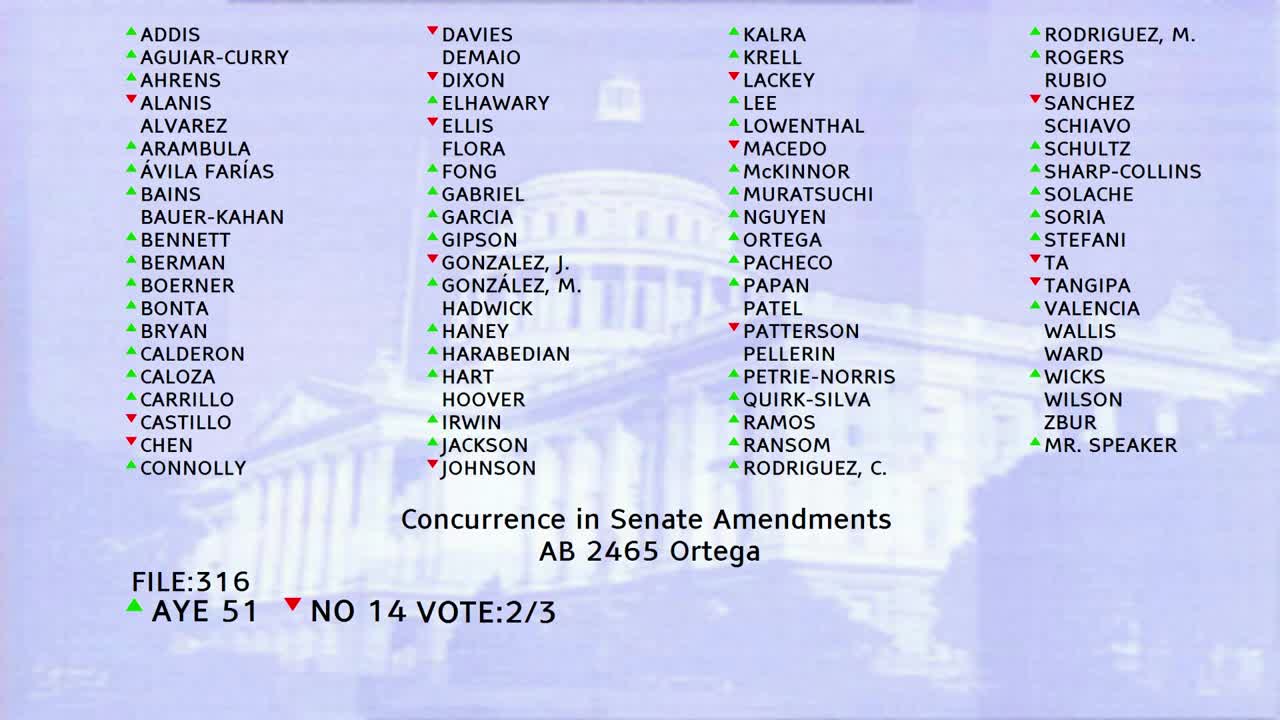 1MIN
Assembly Floor
 7MIN
Assembly Standing Committee on Business and Professions
 2MIN
Senate Floor
 13MIN
Senate Standing Committee on Business, Professions and Economic Development
Bill Author

Bill Co-Author(s):