SB 1314: Cigarette or tobacco product retailers: new retail locations and sale of nitrous oxide.
- Session Year: 2025-2026
- House: Senate
- Latest Version Date: 2026-07-01
Current Status:
In Progress
(2026-08-13: August 13 hearing: Held in committee and under submission.)
Introduced
In Committee
Awaiting First Chamber Vote
Passed First Chamber
In Committee
Awaiting Second Chamber Vote
Passed Second Chamber
Enacted
The Stop Tobacco Access to Kids Enforcement (STAKE) Act requires the State Department of Public Health to establish and develop a program to reduce the availability of tobacco products to persons under 21 years of age through specified enforcement activities. In addition to the primary enforcement responsibility assumed by the department, existing law authorizes other state and local governmental agencies to conduct inspections and assess penalties for violations of the act, as specified, and encourages state and local enforcement agencies to share the results of inspections and coordinate with the department when enforcing the act. In this regard, existing law authorizes an enforcing agency to assess specified civil penalties against any person, firm, or corporation that sells, gives, or in any way furnishes to another person who is under 21 years of age any tobacco, cigarettes, or cigarette papers. Existing law, upon the assessment of a civil penalty for the 3rd, 4th, or 5th violation, requires the department to notify the California Department of Tax and Fee Administration (CDTFA), and requires the CDTFA to assess civil penalties and suspend or revoke a license issued under the Cigarette and Tobacco Products Licensing Act of 2003.
This bill, effective July 1, 2027, would prohibit the a new retail location for a smoke shop, as defined, retailer of cigarettes or tobacco products from being located within a 600-foot radius of a school or a daycare center unless the local jurisdiction specifies a radius greater than 600 feet. The bill would prohibit a smoke shop from engaging in the retail sale of tobacco products directly to the public between the hours of 10:00 p.m. to 6:00 a.m. The bill would also prohibit a smoke shop retailer of cigarettes or tobacco products from possessing, storing, owning, or selling nitrous oxide or paraphernalia relating to the consumption of nitrous oxide. The bill would authorize an enforcement agency to assess civil penalties for a violation of those provisions. The bill would authorize the CDTFA to then assess a civil penalty and suspend or revoke a license for a violation of those provisions. The bill would exempt a grocery store, as defined, from the bills provisions and would define various other terms relating to the bills provisions.
The Cigarette and Tobacco Products Licensing Act of 2003 requires the California Department of Tax and Fee Administration to issue a license to a retailer to engage in the sale of cigarettes or tobacco products upon receipt of a completed application and payment of certain fees, unless an exception applies.
This bill bill, on and after July 1, 2027, would include among those exceptions a retailer that is a smoke shop located an application for a new license for a retail location within 600 feet of a school or daycare center or a greater radius established by the local jurisdiction. jurisdiction, as specified.
The California Constitution provides for the establishment of the State Board of Equalization, which, before July 1, 2017, had primary responsibility for most of the states duties, powers, and responsibilities regarding the administration of taxes and fees. Existing law, on July 1, 2017, transferred to the CDTFA various duties, powers, and responsibilities of the State Board of Equalization, including administration of the STAKE Act, as specified.
This bill would change references in the provisions of the STAKE Act amended by this bill from the State Board of Equalization to the California Department of Tax and Fee Administration to reflect the transfer of the boards duties, powers, and responsibilities to the CDTFA.
The Stop Tobacco Access to Kids Enforcement (STAKE) Act requires the State Department of Public Health to establish and develop a program to reduce the availability of tobacco products to persons under 21 years of age through specified enforcement activities. In addition to the primary enforcement responsibility assumed by the department, existing law authorizes other state and local governmental agencies to conduct inspections and assess penalties for violations of the act, as specified, and encourages state and local enforcement agencies to share the results of inspections and coordinate with the department when enforcing the act. In this regard, existing law authorizes an enforcing agency to assess specified civil penalties against any person, firm, or corporation that sells, gives, or in any way furnishes to another person who is under 21 years of age any tobacco, cigarettes, or cigarette papers. Existing law, upon the assessment of a civil penalty for the 3rd, 4th, or 5th violation, requires the department to notify the California Department of Tax and Fee Administration (CDTFA), and requires the CDTFA to assess civil penalties and suspend or revoke a license issued under the Cigarette and Tobacco Products Licensing Act of 2003.
This bill, effective July 1, 2027, would prohibit the retail location for a smoke shop, as defined, from being located within a 600-foot radius of a school or a daycare center in existence at the time the retail license is issued, unless the local jurisdiction specifies a radius greater than 600 feet. The bill would prohibit a smoke shop from engaging in the retail sale of tobacco products directly to the public between the hours of 10:00 p.m. to 6:00 a.m. The bill would authorize the CDTFA to establish regulations relating to the operation of smoke shops, including the creation of a separate license category with administrative processes and separate fee rates. The bill would also prohibit a smoke shop from possessing, storing, owning, or selling nitrous oxide or paraphernalia relating to the consumption of nitrous oxide. The bill would authorize an enforcement agency to assess civil penalties for a violation of those provisions. The bill would authorize the CDTFA to then assess a civil penalty and suspend or revoke a license for a violation of those provisions. The bill would define various terms relating to the bills provisions.
The Cigarette and Tobacco Products Licensing Act of 2003 requires the California Department of Tax and Fee Administration to issue a license to a retailer to engage in the sale of cigarettes or tobacco products upon receipt of a completed application and payment of certain fees, unless an exception applies.
This bill would include among those exceptions a retailer that is a smoke shop located within 600 feet of a school or daycare center or a greater radius established by the local jurisdiction.
The California Constitution provides for the establishment of the State Board of Equalization, which, before July 1, 2017, had primary responsibility for most of the states duties, powers, and responsibilities regarding the administration of taxes and fees. Existing law, on July 1, 2017, transferred to the CDTFA various duties, powers, and responsibilities of the State Board of Equalization, including administration of the STAKE Act, as specified.
This bill would change references in the provisions of the STAKE Act amended by this bill from the State Board of Equalization to the California Department of Tax and Fee Administration to reflect the transfer of the boards duties, powers, and responsibilities to the CDTFA.
The Stop Tobacco Access to Kids Enforcement (STAKE) Act requires the State Department of Public Health to establish and develop a program to reduce the availability of tobacco products to persons under 21 years of age through specified enforcement activities. In addition to the primary enforcement responsibility assumed by the department, existing law authorizes other state and local governmental agencies to conduct inspections and assess penalties for violations of the act, as specified, and encourages state and local enforcement agencies to share the results of inspections and coordinate with the department when enforcing the act. In this regard, existing law authorizes an enforcing agency to assess specified civil penalties against any person, firm, or corporation that sells, gives, or in any way furnishes to another person who is under 21 years of age any tobacco, cigarettes, or cigarette papers. Existing law, upon the assessment of a civil penalty for the 3rd, 4th, or 5th violation, requires the department to notify the California Department of Tax and Fee Administration (CDTFA), and requires the CDTFA to assess civil penalties and suspend or revoke a license issued under the Cigarette and Tobacco Products Licensing Act of 2003.
This bill, effective July 1, 2027, would prohibit the retail location for a smoke shop, as defined, from being located within a 600-foot radius of a school or a day care daycare center in existence at the time the retail license is issued, unless the local jurisdiction specifies a radius greater than 600 feet. The bill would prohibit a smoke shop from engaging in the retail sale of tobacco products directly to the public between the hours of 10:00 p.m. to 6:00 a.m. The bill would authorize the State Department of Public Health or the CDTFA to establish regulations relating to the operation of smoke shops, including the creation of a separate license category with administrative processes and separate fee rates. The bill would also prohibit a smoke shop from possessing, storing, owning, or selling nitrous oxide or paraphernalia relating to the consumption of nitrous oxide. The bill would authorize an enforcement agency to assess civil penalties for a violation of those provisions. The bill would authorize the CDTFA to then assess a civil penalty and suspend or revoke a license for a violation of those provisions. The bill would define various terms relating to the bills provisions.
The California Constitution provides for the establishment of the State Board of Equalization, which, before July 1, 2017, had primary responsibility for most of the states duties, powers, and responsibilities regarding the administration of taxes and fees. Existing law, on July 1, 2017, transferred to the CDTFA various duties, powers, and responsibilities of the State Board of Equalization, including administration of the STAKE Act, as specified.
This bill would change references in the provisions of the STAKE Act amended by this bill from the State Board of Equalization to the California Department of Tax and Fee Administration to reflect the transfer of the boards duties, powers, and responsibilities to the CDTFA.
The Stop Tobacco Access to Kids Enforcement (STAKE) Act requires the State Department of Public Health to establish and develop a program to reduce the availability of tobacco products to persons under 21 years of age through specified enforcement activities. In addition to the primary enforcement responsibility assumed by the department, existing law authorizes other state and local governmental agencies to conduct inspections and assess penalties for violations of the act, as specified, and encourages state and local enforcement agencies to share the results of inspections and coordinate with the department when enforcing the act. In this regard, existing law authorizes an enforcing agency to assess specified civil penalties against any person, firm, or corporation that sells, gives, or in any way furnishes to another person who is under 21 years of age any tobacco, cigarettes, or cigarette papers. Existing law, upon the assessment of a civil penalty for the 3rd, 4th, or 5th violation, requires the department to notify the California Department of Tax and Fee Administration (CDTFA), and requires the CDTFA to assess civil penalties and suspend or revoke a license issued under the Cigarette and Tobacco Products Licensing Act of 2003.
This bill, effective January 1, 2028, July 1, 2027, would prohibit the retail location for a smoke shop, as defined, from being located within a 600-foot radius of a school or a day care center in existence at the time the retail license is issued, unless the local jurisdiction specifies a different radius. radius greater than 600 feet. The bill would prohibit a smoke shop from engaging in the retail sale of tobacco products directly to the public between the hours of 10:00 p.m. to 6:00 a.m. The bill would authorize the State Department of Public Health or the CDTFA to establish regulations relating to the operation of smoke shops, including the creation of a separate license category with administrative processes and separate fee rates. The bill would also prohibit a smoke shop from possessing, storing, owning, or selling nitrous oxide or paraphernalia relating to the consumption of nitrous oxide. The bill would authorize an enforcement agency to assess civil penalties for a violation of those provisions. The bill would authorize the CDTFA to then assess a civil penalty and suspend or revoke a license for a violation of those provisions. The bill would define various terms relating to the bills provisions.
The California Constitution provides for the establishment of the State Board of Equalization, which, before July 1, 2017, had primary responsibility for most of the states duties, powers, and responsibilities regarding the administration of taxes and fees. Existing law, on July 1, 2017, transferred to the CDTFA various duties, powers, and responsibilities of the State Board of Equalization, including administration of the STAKE Act, as specified.
This bill would change references in the provisions of the STAKE Act amended by this bill from the State Board of Equalization to the California Department of Tax and Fee Administration to reflect the transfer of the boards duties, powers, and responsibilities to the CDTFA.
The Stop Tobacco Access to Kids Enforcement (STAKE) Act requires the State Department of Public Health to establish and develop a program to reduce the availability of tobacco products to persons under 21 years of age through specified enforcement activities. In addition to the primary enforcement responsibility assumed by the department, existing law authorizes other state and local governmental agencies to conduct inspections and assess penalties for violations of the act, as specified, and encourages state and local enforcement agencies to share the results of inspections and coordinate with the department when enforcing the act. In this regard, existing law authorizes an enforcing agency to assess specified civil penalties against any person, firm, or corporation that sells, gives, or in any way furnishes to another person who is under 21 years of age any tobacco, cigarettes, or cigarette papers. Existing law, upon the assessment of a civil penalty for the 3rd, 4th, or 5th violation, requires the department to notify the California Department of Tax and Fee Administration (CDTFA), and requires the CDTFA to assess civil penalties and suspend or revoke a license issued under the Cigarette and Tobacco Products Licensing Act of 2003.
This bill, effective January 1, 2028, would prohibit the retail location for a smoke shop, as defined, from being located within a 600-foot radius of a school or a day care center in existence at the time the retail license is issued, unless the local jurisdiction specifies a different radius. The bill would prohibit a smoke shop from engaging in the retail sale of tobacco products directly to the public between the hours of 10:00 p.m. to 6:00 a.m. The bill would authorize the State Department of Public Health or the CDTFA to establish regulations relating to the operation of smoke shops, including the creation of a separate license category with administrative processes and separate fee rates. The bill would also prohibit a smoke shop from possessing, storing, owning, or selling nitrous oxide or paraphernalia relating to the consumption of nitrous oxide. The bill would authorize an enforcement agency to assess civil penalties for a violation of those provisions. The bill would authorize the CDTFA to then assess a civil penalty and suspend or revoke a license for a violation of those provisions. The bill would define various terms relating to the bills provisions.
The California Constitution provides for the establishment of the State Board of Equalization, which, before July 1, 2017, had primary responsibility for most of the states duties, powers, and responsibilities regarding the administration of taxes and fees. Existing law, on July 1, 2017, transferred to the CDTFA various duties, powers, and responsibilities of the State Board of Equalization, including administration of the STAKE Act, as specified.
This bill would change references in the provisions of the STAKE Act amended by this bill from the State Board of Equalization to the California Department of Tax and Fee Administration to reflect the transfer of the boards duties, powers, and responsibilities to the CDTFA.
This act shall be known, and may be cited, as the Youth Over Smoke Act.
SEC. 2.Section 22958 of the Business and Professions Code is amended to read:22958.(a)An enforcing agency may assess civil penalties against any person, firm, or corporation that sells, gives, or in any way furnishes to another person who is under 21 years of age any tobacco, cigarette, cigarette papers, any other instrument or paraphernalia that is designed for the smoking or ingestion of tobacco, tobacco products, or any controlled substance, according to the following schedule:
(1)A civil penalty of one thousand dollars ($1,000) to one thousand five hundred dollars ($1,500) for the first violation.
(2)A civil penalty of two thousand dollars ($2,000) to three thousand dollars ($3,000) for the second violation at the same location within a five-year period.
(3)A civil penalty of five thousand dollars ($5,000) to ten thousand dollars ($10,000) for the third violation at the same location within a five-year period.
(4)A civil penalty of ten thousand dollars ($10,000) to twenty thousand dollars ($20,000) for a fourth violation within a five-year period.
(5)A civil penalty of at least twenty thousand dollars ($20,000) for five or more violations within a five-year period.
(b)(1)In addition to the civil penalties described in subdivision (a), upon the assessment of a civil penalty for the third, fourth, or fifth violation, the department, within 60 days of the date of service of the final administrative adjudication on the parties or payment of the civil penalty for an uncontested violation, shall notify the California Department of Tax and Fee Administration of the violation. The State Board of Equalization shall then assess a civil penalty of two hundred fifty dollars ($250) and suspend or revoke a license issued pursuant to Chapter 2 (commencing with Section 22971.7) of Division 8.6 in accordance with the following schedule:
(A)A 45-day suspension of the license for a third violation at the same location within a five-year period.
(B)A 90-day suspension of the license for a fourth violation at the same location within a five-year period.
(C)Revocation of the license for a fifth violation at the same location within a five-year period.
(2)The provisions of Chapter 4 (commencing with Section 55121) of Part 30 of Division 2 of the Revenue and Taxation Code apply with respect to the collection of the penalty imposed by the State Board of Equalization pursuant to paragraph (1).
(c)(1)For each suspension or revocation pursuant to subdivision (b), the civil penalty of two hundred fifty dollars ($250) assessed pursuant to that subdivision, notwithstanding Section 22953, shall be deposited into the Cigarette and Tobacco Products Compliance Fund established pursuant to Section 22990. Moneys from that civil penalty deposited into this fund shall be made available to the State Board of Equalization, upon appropriation by the Legislature, for the purposes of meeting its duties under subdivision (b).
(2)The department shall, upon request, provide to the California Department of Tax and Fee Administration information concerning any person, firm, or corporation that has been assessed a civil penalty for violation of the STAKE Act pursuant to this section when the department has notified the State Board of Equalization of the violation.
(d)The enforcing agency shall assess penalties pursuant to the schedule set forth in subdivision (a) against a person, firm, or corporation that sells, offers for sale, or distributes tobacco products from a cigarette or tobacco products vending machine, or a person, firm, or corporation that leases, furnishes, or services these machines in violation of Section 22960.
(e)An enforcing agency may assess civil penalties against a person, firm, or corporation that sells or deals in tobacco or any preparation thereof, and fails to post conspicuously and keep posted in the place of business at each point of purchase the notice required pursuant to subdivision (b) of Section 22952. The civil penalty shall be in the amount of two hundred dollars ($200) for the first offense and five hundred dollars ($500) for each additional violation.
(f)An enforcing agency shall assess penalties in accordance with the schedule set forth in subdivision (a) against a person, firm, or corporation that advertises or causes to be advertised a tobacco product on an outdoor billboard in violation of Section 22961.
(g)An enforcing agency shall assess penalties in accordance with the schedule set forth in subdivision (a) and provide notice in accordance with subdivision (b) against a person, firm, or corporation in violation of Section 22965. The California Department of Tax and Fee Administration shall then assess a civil penalty and suspend or revoke a license pursuant to subdivision (b) for violations of Section 22965.
(h)If a civil penalty has been assessed pursuant to this section against a person, firm, or corporation for a single, specific violation of this division, the person, firm, or corporation shall not be prosecuted under Section 308 of the Penal Code for a violation based on the same facts or specific incident for which the civil penalty was assessed. If a person, firm, or corporation has been prosecuted for a single, specific violation of Section 308 of the Penal Code, the person, firm, or corporation shall not be assessed a civil penalty under this section based on the same facts or specific incident upon which the prosecution under Section 308 of the Penal Code was based.
(i)(1)In the case of a corporation or business with more than one retail location, to determine the number of accumulated violations for purposes of the penalty schedule set forth in subdivision (a), violations of this division by one retail location shall not be accumulated against other retail locations of that same corporation or business.
(2)In the case of a retail location that operates pursuant to a franchise as defined in Section 20001, violations of this division accumulated and assessed against a prior owner of a single franchise location shall not be accumulated against a new owner of the same single franchise location for purposes of the penalty schedule set forth in subdivision (a).
(j)Proceedings under this section shall be conducted pursuant to Section 131071 of the Health and Safety Code, except in cases where a civil penalty is assessed by an enforcing agency other than the department, in which case proceedings shall be conducted pursuant to the procedures of that agency that are consistent with Section 131071 of the Health and Safety Code.
SEC. 3.Section 22965 is added to the Business and Professions Code, to read:22965.(a)For purposes of this section, the following definitions apply:
(1)Cigar means any roll of tobacco other than a cigarette wrapped entirely or in part in tobacco or any substance containing tobacco and weighing more than three pounds per thousand.(2)Cigar lounge means any retailer whose retail location has 70 percent or more of its net floor area devoted to the sale or onsite consumption of cigars.(3)(1)Daycare center means a facility, other than a family daycare home, serving infant, toddler, preschool, or schoolage children licensed by the State Department of Social Services pursuant to Chapter 3.5 (commencing with Section 1596.90) of Division 2 of the Health and Safety Code.
(4)(2)License shall have the same meaning as provided in Section 22971.
(5)Net floor area means the sales area or customer area of a retailer and includes register areas, bar areas, waiting areas, and display areas that may not be directly accessible to customers, but does not include hallways, offices, restrooms, courtyards, break areas, the forecourt of a service station, or a kiosk of a service station.(6)(3)Nitrous oxide shall have the same meaning as provided in Section 381c of the Penal Code.
(7)(4)Retailer shall have the same meaning as provided in Section 22971.
(8)(5)Retail location shall have the same meaning as provided in Section 22971. 22971, except that a retailer does not include a grocery store, as defined in paragraph (3) of subdivision (e) of Section 113948 of the Health and Safety Code.
(9)(6)School means, as evidenced by the State Department of Educations school directory, either of the following:
(A)A public school instructing children in kindergarten or any of grades 1 to 12, inclusive, as authorized by the State Department of Education.
(B)A private school instructing children in kindergarten or any of grades 1 to 12, inclusive, that has filed a verification of private school affidavit with the State Department of Education pursuant to Section 33190 of the Education Code, excluding any private school in which education is primarily conducted in a private home.
(10)Smoke shop means any retailer whose retail location has 20 percent or more of its net floor area devoted to the sale of tobacco products, substances intended for smoking or inhaling, or smoking or inhaling accessories, including, but not limited to, pipes, vaporizing devices, or other smoking or inhaling paraphernalia. Smoke shop does not include a cigar lounge licensed pursuant to Division 8.6 (commencing with Section 22970) or a cannabis retailer licensed pursuant to Division 10 (commencing with Section 26000).(b)Effective July 1, 2027, the a new retail location for a smoke shop retailer shall not be located within a 600-foot radius of a school or daycare center unless the local jurisdiction specifies a radius greater than 600 feet. The distance specified in this subdivision shall be measured in the same manner as provided in subdivision (c) of Section 11362.768 of the Health and Safety Code, unless otherwise provided by law.
(c)A smoke shop may only engage in the retail sale of tobacco products directly to the public between the hours of 6:00 a.m. and 10:00 p.m.(d)(c)A smoke shop retailer shall not possess, store, own, or sell nitrous oxide, including products derived from or containing nitrous oxide, or paraphernalia related to the consumption of nitrous oxide.
(e)This section sets forth minimum state restrictions with respect to the operation of smoke shops and does not preempt or otherwise prohibit the adoption of a local standard that imposes more restrictive requirements on the operation of smoke shops. A local standard that imposes more restrictive requirements on the operation of smoke shops shall control in the event of any inconsistency between this section and a local standard. SEC. 4.Section 22973.1 of the Business and Professions Code is amended to read:22973.1.(a)The board shall issue a license to a retailer upon receipt of a completed application and payment of the fees prescribed in Section 22973, unless any of the following apply:
(1)The retailer, or if the retailer is not an individual, any person controlling the retailer, has previously been issued a license that is suspended or revoked by the board for violation of any of the provisions of this division.
(2)The application is for a license or renewal of a license for a retail location that is the same retail location as that of a retailer whose license was revoked or is subject to revocation proceedings for violation of any of the provisions of this division, unless:
(A)It has been more than five years since a previous license for the retail location was revoked.
(B)The person applying for the license provides the board with documentation demonstrating that the applicant has acquired or is acquiring the premises or business in an arms length transaction. For purposes of this section, an arms length transaction is defined as a sale in good faith and for valuable consideration that reflects the fair market value in the open market between two informed and willing parties, neither under any compulsion to participate in the transaction. A sale between relatives, related companies or partners, or a sale for the primary purpose of avoiding the effect of the violations of this division that occurred at the retail location, is presumed not to be made at arms length.
(3)The retailer, or if the retailer is not an individual, any person controlling the retailer, has been convicted of a felony pursuant to Section 30473 or 30480 of the Revenue and Taxation Code.
(4)The retailer does not possess all required permits or licenses required under the Revenue and Taxation Code.
(5)The retailer is a smoke shop, as defined in Section 22965, and is located within 600 feet of a school or daycare center, or within the distance set by the local jurisdiction pursuant to that section.(5)On and after July 1, 2027, the application is for a new license for a retail location within 600 feet of a school or daycare center or within the distance set by the local jurisdiction pursuant to Section 22965. This paragraph does not apply to either of the following:
(A)The renewal of a license for an existing retailer.
(B)A new license or the renewal of a license for a grocery store, as defined in paragraph (3) of subdivision (e) of Section 113948 of the Health and Safety Code.
(b)(1)Any retailer who is denied a license may petition for a redetermination of the boards denial of the license within 30 days after service upon that retailer of the notice of the denial of the license. If a petition for redetermination is not filed within the 30-day period, the determination of denial becomes final at the expiration of the 30-day period.
(2)Every petition for redetermination shall be in writing and shall state the specific grounds upon which the petition is founded. The petition may be amended to state additional grounds at anytime prior to the date on which the board issues its order or decision upon the petition for redetermination.
(3)If the petition for redetermination is filed within the 30-day period, the board shall reconsider the determination of the denial and, if the retailer has so requested in the petition, shall grant the retailer an oral hearing and shall give the retailer at least 10 days notice of the time and place of the hearing. The board may continue the hearing from time to time as may be necessary.
(4)The order or decision of the board upon a petition for redetermination becomes final 30 days after mailing of notice thereof.
SEC. 5.The provisions of this act are severable. If any provision of this act or its application is held invalid, that invalidity shall not affect other provisions or applications that can be given effect without the invalid provision or application.
This act shall be known, and may be cited, as the Youth Over Smoke Act.
SEC. 2.Section 22958 of the Business and Professions Code is amended to read:22958.(a)An enforcing agency may assess civil penalties against any person, firm, or corporation that sells, gives, or in any way furnishes to another person who is under 21 years of age any tobacco, cigarette, cigarette papers, any other instrument or paraphernalia that is designed for the smoking or ingestion of tobacco, tobacco products, or any controlled substance, according to the following schedule:
(1)A civil penalty of one thousand dollars ($1,000) to one thousand five hundred dollars ($1,500) for the first violation.
(2)A civil penalty of two thousand dollars ($2,000) to three thousand dollars ($3,000) for the second violation at the same location within a five-year period.
(3)A civil penalty of five thousand dollars ($5,000) to ten thousand dollars ($10,000) for the third violation at the same location within a five-year period.
(4)A civil penalty of ten thousand dollars ($10,000) to twenty thousand dollars ($20,000) for a fourth violation within a five-year period.
(5)A civil penalty of at least twenty thousand dollars ($20,000) for five or more violations within a five-year period.
(b)(1)In addition to the civil penalties described in subdivision (a), upon the assessment of a civil penalty for the third, fourth, or fifth violation, the department, within 60 days of the date of service of the final administrative adjudication on the parties or payment of the civil penalty for an uncontested violation, shall notify the California Department of Tax and Fee Administration of the violation. The State Board of Equalization shall then assess a civil penalty of two hundred fifty dollars ($250) and suspend or revoke a license issued pursuant to Chapter 2 (commencing with Section 22971.7) of Division 8.6 in accordance with the following schedule:
(A)A 45-day suspension of the license for a third violation at the same location within a five-year period.
(B)A 90-day suspension of the license for a fourth violation at the same location within a five-year period.
(C)Revocation of the license for a fifth violation at the same location within a five-year period.
(2)The provisions of Chapter 4 (commencing with Section 55121) of Part 30 of Division 2 of the Revenue and Taxation Code apply with respect to the collection of the penalty imposed by the State Board of Equalization pursuant to paragraph (1).
(c)(1)For each suspension or revocation pursuant to subdivision (b), the civil penalty of two hundred fifty dollars ($250) assessed pursuant to that subdivision, notwithstanding Section 22953, shall be deposited into the Cigarette and Tobacco Products Compliance Fund established pursuant to Section 22990. Moneys from that civil penalty deposited into this fund shall be made available to the State Board of Equalization, upon appropriation by the Legislature, for the purposes of meeting its duties under subdivision (b).
(2)The department shall, upon request, provide to the California Department of Tax and Fee Administration information concerning any person, firm, or corporation that has been assessed a civil penalty for violation of the STAKE Act pursuant to this section when the department has notified the State Board of Equalization of the violation.
(d)The enforcing agency shall assess penalties pursuant to the schedule set forth in subdivision (a) against a person, firm, or corporation that sells, offers for sale, or distributes tobacco products from a cigarette or tobacco products vending machine, or a person, firm, or corporation that leases, furnishes, or services these machines in violation of Section 22960.
(e)An enforcing agency may assess civil penalties against a person, firm, or corporation that sells or deals in tobacco or any preparation thereof, and fails to post conspicuously and keep posted in the place of business at each point of purchase the notice required pursuant to subdivision (b) of Section 22952. The civil penalty shall be in the amount of two hundred dollars ($200) for the first offense and five hundred dollars ($500) for each additional violation.
(f)An enforcing agency shall assess penalties in accordance with the schedule set forth in subdivision (a) against a person, firm, or corporation that advertises or causes to be advertised a tobacco product on an outdoor billboard in violation of Section 22961.
(g)An enforcing agency shall assess penalties in accordance with the schedule set forth in subdivision (a) and provide notice in accordance with subdivision (b) against a person, firm, or corporation in violation of Section 22965. The California Department of Tax and Fee Administration shall then assess a civil penalty and suspend or revoke a license pursuant to subdivision (b) for violations of Section 22965.
(h)If a civil penalty has been assessed pursuant to this section against a person, firm, or corporation for a single, specific violation of this division, the person, firm, or corporation shall not be prosecuted under Section 308 of the Penal Code for a violation based on the same facts or specific incident for which the civil penalty was assessed. If a person, firm, or corporation has been prosecuted for a single, specific violation of Section 308 of the Penal Code, the person, firm, or corporation shall not be assessed a civil penalty under this section based on the same facts or specific incident upon which the prosecution under Section 308 of the Penal Code was based.
(i)(1)In the case of a corporation or business with more than one retail location, to determine the number of accumulated violations for purposes of the penalty schedule set forth in subdivision (a), violations of this division by one retail location shall not be accumulated against other retail locations of that same corporation or business.
(2)In the case of a retail location that operates pursuant to a franchise as defined in Section 20001, violations of this division accumulated and assessed against a prior owner of a single franchise location shall not be accumulated against a new owner of the same single franchise location for purposes of the penalty schedule set forth in subdivision (a).
(j)Proceedings under this section shall be conducted pursuant to Section 131071 of the Health and Safety Code, except in cases where a civil penalty is assessed by an enforcing agency other than the department, in which case proceedings shall be conducted pursuant to the procedures of that agency that are consistent with Section 131071 of the Health and Safety Code.
SEC. 3.Section 22965 is added to the Business and Professions Code, to read:22965.(a)For purposes of this section, the following definitions apply:
(1)Cigar means any roll of tobacco other than a cigarette wrapped entirely or in part in tobacco or any substance containing tobacco and weighing more than three pounds per thousand.
(2)Cigar lounge means any retailer whose retail location has 70 percent or more of its net floor area devoted to the sale or onsite consumption of cigars.
(3)Daycare center means a facility, other than a family daycare home, serving infant, toddler, preschool, or schoolage children licensed by the State Department of Social Services pursuant to Chapter 3.5 (commencing with Section 1596.90) of Division 2 of the Health and Safety Code.
(4)License shall have the same meaning as provided in Section 22971.
(5)Net floor area means the sales area or customer area of a retailer and includes register areas, bar areas, waiting areas, and display areas that may not be directly accessible to customers, but does not include hallways, offices, restrooms, courtyards, break areas, the forecourt of a service station, or a kiosk of a service station.
(6)Nitrous oxide shall have the same meaning as provided in Section 381c of the Penal Code.
(7)Retailer shall have the same meaning as provided in Section 22971.
(8)Retail location shall have the same meaning as provided in Section 22971.
(9)School means, as evidenced by the State Department of Educations school directory, either of the following:
(A)A public school instructing children in kindergarten or any of grades 1 to 12, inclusive, as authorized by the State Department of Education.
(B)A private school instructing children in kindergarten or any of grades 1 to 12, inclusive, that has filed a verification of private school affidavit with the State Department of Education pursuant to Section 33190 of the Education Code, excluding any private school in which education is primarily conducted in a private home.
(10)Smoke shop means any retailer whose retail location has 20 percent or more of its net floor area devoted to the sale of tobacco products, substances intended for smoking or inhaling, or smoking or inhaling accessories, including, but not limited to, pipes, vaporizing devices, or other smoking or inhaling paraphernalia. Smoke shop does not include a cigar lounge licensed pursuant to Division 8.6 (commencing with Section 22970) or a cannabis retailer licensed pursuant to Division 10 (commencing with Section 26000).
(b)Effective July 1, 2027, the retail location for a smoke shop shall not be located within a 600-foot radius of a school or daycare center that is in existence at the time the smoke shops license is issued unless the local jurisdiction specifies a radius greater than 600 feet. The distance specified in this subdivision shall be measured in the same manner as provided in subdivision (c) of Section 11362.768 of the Health and Safety Code, unless otherwise provided by law.
(c)A smoke shop may only engage in the retail sale of tobacco products directly to the public between the hours of 6:00 a.m. and 10:00 p.m.
(d)A smoke shop shall not possess, store, own, or sell nitrous oxide, including products derived from or containing nitrous oxide, or paraphernalia related to the consumption of nitrous oxide.
(e)The California Department of Tax and Fee Administration may establish regulations and requirements for the operation of smoke shops, which may include the creation of a separate license category for smoke shops with administrative processes and separate fee rates, accordingly. Those rules and regulations shall be consistent with the purposes and intent of this section. (f)(e)This section sets forth minimum state restrictions with respect to the operation of smoke shops and does not preempt or otherwise prohibit the adoption of a local standard that imposes more restrictive requirements on the operation of smoke shops. A local standard that imposes more restrictive requirements on the operation of smoke shops shall control in the event of any inconsistency between this section and a local standard.
SEC. 4.Section 22973.1 of the Business and Professions Code is amended to read:22973.1.(a)The board shall issue a license to a retailer upon receipt of a completed application and payment of the fees prescribed in Section 22973, unless any of the following apply:
(1)The retailer, or if the retailer is not an individual, any person controlling the retailer, has previously been issued a license that is suspended or revoked by the board for violation of any of the provisions of this division.
(2)The application is for a license or renewal of a license for a retail location that is the same retail location as that of a retailer whose license was revoked or is subject to revocation proceedings for violation of any of the provisions of this division, unless:
(A)It has been more than five years since a previous license for the retail location was revoked.
(B)The person applying for the license provides the board with documentation demonstrating that the applicant has acquired or is acquiring the premises or business in an arms length transaction. For purposes of this section, an arms length transaction is defined as a sale in good faith and for valuable consideration that reflects the fair market value in the open market between two informed and willing parties, neither under any compulsion to participate in the transaction. A sale between relatives, related companies or partners, or a sale for the primary purpose of avoiding the effect of the violations of this division that occurred at the retail location, is presumed not to be made at arms length.
(3)The retailer, or if the retailer is not an individual, any person controlling the retailer, has been convicted of a felony pursuant to Section 30473 or 30480 of the Revenue and Taxation Code.
(4)The retailer does not possess all required permits or licenses required under the Revenue and Taxation Code.
(5)The retailer is a smoke shop, as defined in Section 22965, and is located within 600 feet of a school or daycare center, or within the distance set by the local jurisdiction pursuant to that section.
(b)(1)Any retailer who is denied a license may petition for a redetermination of the boards denial of the license within 30 days after service upon that retailer of the notice of the denial of the license. If a petition for redetermination is not filed within the 30-day period, the determination of denial becomes final at the expiration of the 30-day period.
(2)Every petition for redetermination shall be in writing and shall state the specific grounds upon which the petition is founded. The petition may be amended to state additional grounds at anytime prior to the date on which the board issues its order or decision upon the petition for redetermination.
(3)If the petition for redetermination is filed within the 30-day period, the board shall reconsider the determination of the denial and, if the retailer has so requested in the petition, shall grant the retailer an oral hearing and shall give the retailer at least 10 days notice of the time and place of the hearing. The board may continue the hearing from time to time as may be necessary.
(4)The order or decision of the board upon a petition for redetermination becomes final 30 days after mailing of notice thereof.
SEC. 4.SEC. 5.The provisions of this act are severable. If any provision of this act or its application is held invalid, that invalidity shall not affect other provisions or applications that can be given effect without the invalid provision or application.
This act shall be known, and may be cited, as the Youth Over Smoke Act.
SEC. 2.Section 22958 of the Business and Professions Code is amended to read:22958.(a)An enforcing agency may assess civil penalties against any person, firm, or corporation that sells, gives, or in any way furnishes to another person who is under 21 years of age any tobacco, cigarette, cigarette papers, any other instrument or paraphernalia that is designed for the smoking or ingestion of tobacco, tobacco products, or any controlled substance, according to the following schedule:
(1)A civil penalty of one thousand dollars ($1,000) to one thousand five hundred dollars ($1,500) for the first violation.
(2)A civil penalty of two thousand dollars ($2,000) to three thousand dollars ($3,000) for the second violation at the same location within a five-year period.
(3)A civil penalty of five thousand dollars ($5,000) to ten thousand dollars ($10,000) for the third violation at the same location within a five-year period.
(4)A civil penalty of ten thousand dollars ($10,000) to twenty thousand dollars ($20,000) for a fourth violation within a five-year period.
(5)A civil penalty of at least twenty thousand dollars ($20,000) for five or more violations within a five-year period.
(b)(1)In addition to the civil penalties described in subdivision (a), upon the assessment of a civil penalty for the third, fourth, or fifth violation, the department, within 60 days of the date of service of the final administrative adjudication on the parties or payment of the civil penalty for an uncontested violation, shall notify the California Department of Tax and Fee Administration of the violation. The State Board of Equalization shall then assess a civil penalty of two hundred fifty dollars ($250) and suspend or revoke a license issued pursuant to Chapter 2 (commencing with Section 22971.7) of Division 8.6 in accordance with the following schedule:
(A)A 45-day suspension of the license for a third violation at the same location within a five-year period.
(B)A 90-day suspension of the license for a fourth violation at the same location within a five-year period.
(C)Revocation of the license for a fifth violation at the same location within a five-year period.
(2)The provisions of Chapter 4 (commencing with Section 55121) of Part 30 of Division 2 of the Revenue and Taxation Code apply with respect to the collection of the penalty imposed by the State Board of Equalization pursuant to paragraph (1).
(c)(1)For each suspension or revocation pursuant to subdivision (b), the civil penalty of two hundred fifty dollars ($250) assessed pursuant to that subdivision, notwithstanding Section 22953, shall be deposited into the Cigarette and Tobacco Products Compliance Fund established pursuant to Section 22990. Moneys from that civil penalty deposited into this fund shall be made available to the State Board of Equalization, upon appropriation by the Legislature, for the purposes of meeting its duties under subdivision (b).
(2)The department shall, upon request, provide to the California Department of Tax and Fee Administration information concerning any person, firm, or corporation that has been assessed a civil penalty for violation of the STAKE Act pursuant to this section when the department has notified the State Board of Equalization of the violation.
(d)The enforcing agency shall assess penalties pursuant to the schedule set forth in subdivision (a) against a person, firm, or corporation that sells, offers for sale, or distributes tobacco products from a cigarette or tobacco products vending machine, or a person, firm, or corporation that leases, furnishes, or services these machines in violation of Section 22960.
(e)An enforcing agency may assess civil penalties against a person, firm, or corporation that sells or deals in tobacco or any preparation thereof, and fails to post conspicuously and keep posted in the place of business at each point of purchase the notice required pursuant to subdivision (b) of Section 22952. The civil penalty shall be in the amount of two hundred dollars ($200) for the first offense and five hundred dollars ($500) for each additional violation.
(f)An enforcing agency shall assess penalties in accordance with the schedule set forth in subdivision (a) against a person, firm, or corporation that advertises or causes to be advertised a tobacco product on an outdoor billboard in violation of Section 22961.
(g)An enforcing agency shall assess penalties in accordance with the schedule set forth in subdivision (a) and provide notice in accordance with subdivision (b) against a person, firm, or corporation in violation of Section 22965. The California Department of Tax and Fee Administration shall then assess a civil penalty and suspend or revoke a license pursuant to subdivision (b) for violations of Section 22965.
(h)If a civil penalty has been assessed pursuant to this section against a person, firm, or corporation for a single, specific violation of this division, the person, firm, or corporation shall not be prosecuted under Section 308 of the Penal Code for a violation based on the same facts or specific incident for which the civil penalty was assessed. If a person, firm, or corporation has been prosecuted for a single, specific violation of Section 308 of the Penal Code, the person, firm, or corporation shall not be assessed a civil penalty under this section based on the same facts or specific incident upon which the prosecution under Section 308 of the Penal Code was based.
(i)(1)In the case of a corporation or business with more than one retail location, to determine the number of accumulated violations for purposes of the penalty schedule set forth in subdivision (a), violations of this division by one retail location shall not be accumulated against other retail locations of that same corporation or business.
(2)In the case of a retail location that operates pursuant to a franchise as defined in Section 20001, violations of this division accumulated and assessed against a prior owner of a single franchise location shall not be accumulated against a new owner of the same single franchise location for purposes of the penalty schedule set forth in subdivision (a).
(j)Proceedings under this section shall be conducted pursuant to Section 131071 of the Health and Safety Code, except in cases where a civil penalty is assessed by an enforcing agency other than the department, in which case proceedings shall be conducted pursuant to the procedures of that agency that are consistent with Section 131071 of the Health and Safety Code.
SEC. 3.Section 22965 is added to the Business and Professions Code, to read:22965.(a)For purposes of this section, the following definitions apply:
(1)Cigar means any roll of tobacco other than a cigarette wrapped entirely or in part in tobacco or any substance containing tobacco and weighing more than three pounds per thousand.
(2)Cigar lounge means any retailer whose retail location has 70 percent or more of its net floor area devoted to the sale or onsite consumption of cigars.
(3)Daycare center means a facility, other than a family daycare home, serving infant, toddler, preschool, or schoolage children licensed by the State Department of Social Services pursuant to Chapter 3.5 (commencing with Section 1596.90) of Division 2 of the Health and Safety Code.
(4)License shall have the same meaning as provided in Section 22971.
(5)Net floor area means the sales area or customer area of a retailer and includes register areas, bar areas, waiting areas, and display areas that may not be directly accessible to customers, but does not include hallways, offices, restrooms, courtyards, break areas, the forecourt of a service station, or a kiosk of a service station.
(6)Nitrous oxide shall have the same meaning as provided in Section 381c of the Penal Code.
(7)Retailer shall have the same meaning as provided in Section 22971.
(8)Retail location shall have the same meaning as provided in Section 22971.
(9)School means, as evidenced by the State Department of Educations school directory, either of the following:
(A)A public school instructing children in kindergarten or any of grades 1 to 12, inclusive, as authorized by the State Department of Education.
(B)A private school instructing children in kindergarten or any of grades 1 to 12, inclusive, that has filed a verification of private school affidavit with the State Department of Education pursuant to Section 33190 of the Education Code, excluding any private school in which education is primarily conducted in a private home.
(10)Smoke shop means any retailer whose retail location has 20 percent or more of its net floor area devoted to the sale of tobacco products, substances intended for smoking or inhaling, or smoking or inhaling accessories, including, but not limited to, pipes, vaporizing devices, or other smoking or inhaling paraphernalia. Smoke shop does not include a cigar lounge licensed pursuant to Division 8.6 (commencing with Section 22970) or a cannabis retailer licensed pursuant to Division 10 (commencing with Section 26000).
(b)Effective July 1, 2027, the retail location for a smoke shop shall not be located within a 600-foot radius of a school or daycare center that is in existence at the time the smoke shops license is issued unless the local jurisdiction specifies a radius greater than 600 feet. The distance specified in this subdivision shall be measured in the same manner as provided in subdivision (c) of Section 11362.768 of the Health and Safety Code, unless otherwise provided by law.
(c)A smoke shop may only engage in the retail sale of tobacco products directly to the public between the hours of 6:00 a.m. and 10:00 p.m.
(d)A smoke shop shall not possess, store, own, or sell nitrous oxide, including products derived from or containing nitrous oxide, or paraphernalia related to the consumption of nitrous oxide.
(e)The department or the California Department of Tax and Fee Administration may establish regulations and requirements for the operation of smoke shops, which may include the creation of a separate license category for smoke shops with administrative processes and separate fee rates, accordingly. Those rules and regulations shall be consistent with the purposes and intent of this section.
(f)This section sets forth minimum state restrictions with respect to the operation of smoke shops and does not preempt or otherwise prohibit the adoption of a local standard that imposes more restrictive requirements on the operation of smoke shops. A local standard that imposes more restrictive requirements on the operation of smoke shops shall control in the event of any inconsistency between this section and a local standard.
SEC. 4.The provisions of this act are severable. If any provision of this act or its application is held invalid, that invalidity shall not affect other provisions or applications that can be given effect without the invalid provision or application.
This act shall be known, and may be cited, as the California Smoke Shop Regulation and Safety Youth Over Smoke Act.
SEC. 2.Section 22958 of the Business and Professions Code is amended to read:22958.(a)An enforcing agency may assess civil penalties against any person, firm, or corporation that sells, gives, or in any way furnishes to another person who is under 21 years of age any tobacco, cigarette, cigarette papers, any other instrument or paraphernalia that is designed for the smoking or ingestion of tobacco, tobacco products, or any controlled substance, according to the following schedule:
(1)A civil penalty of one thousand dollars ($1,000) to one thousand five hundred dollars ($1,500) for the first violation.
(2)A civil penalty of two thousand dollars ($2,000) to three thousand dollars ($3,000) for the second violation at the same location within a five-year period.
(3)A civil penalty of five thousand dollars ($5,000) to ten thousand dollars ($10,000) for the third violation at the same location within a five-year period.
(4)A civil penalty of ten thousand dollars ($10,000) to twenty thousand dollars ($20,000) for a fourth violation within a five-year period.
(5)A civil penalty of at least twenty thousand dollars ($20,000) for five or more violations within a five-year period.
(b)(1)In addition to the civil penalties described in subdivision (a), upon the assessment of a civil penalty for the third, fourth, or fifth violation, the department, within 60 days of the date of service of the final administrative adjudication on the parties or payment of the civil penalty for an uncontested violation, shall notify the California Department of Tax and Fee Administration of the violation. The State Board of Equalization shall then assess a civil penalty of two hundred fifty dollars ($250) and suspend or revoke a license issued pursuant to Chapter 2 (commencing with Section 22971.7) of Division 8.6 in accordance with the following schedule:
(A)A 45-day suspension of the license for a third violation at the same location within a five-year period.
(B)A 90-day suspension of the license for a fourth violation at the same location within a five-year period.
(C)Revocation of the license for a fifth violation at the same location within a five-year period.
(2)The provisions of Chapter 4 (commencing with Section 55121) of Part 30 of Division 2 of the Revenue and Taxation Code apply with respect to the collection of the penalty imposed by the State Board of Equalization pursuant to paragraph (1).
(c)(1)For each suspension or revocation pursuant to subdivision (b), the civil penalty of two hundred fifty dollars ($250) assessed pursuant to that subdivision, notwithstanding Section 22953, shall be deposited into the Cigarette and Tobacco Products Compliance Fund established pursuant to Section 22990. Moneys from that civil penalty deposited into this fund shall be made available to the State Board of Equalization, upon appropriation by the Legislature, for the purposes of meeting its duties under subdivision (b).
(2)The department shall, upon request, provide to the California Department of Tax and Fee Administration information concerning any person, firm, or corporation that has been assessed a civil penalty for violation of the STAKE Act pursuant to this section when the department has notified the State Board of Equalization of the violation.
(d)The enforcing agency shall assess penalties pursuant to the schedule set forth in subdivision (a) against a person, firm, or corporation that sells, offers for sale, or distributes tobacco products from a cigarette or tobacco products vending machine, or a person, firm, or corporation that leases, furnishes, or services these machines in violation of Section 22960.
(e)An enforcing agency may assess civil penalties against a person, firm, or corporation that sells or deals in tobacco or any preparation thereof, and fails to post conspicuously and keep posted in the place of business at each point of purchase the notice required pursuant to subdivision (b) of Section 22952. The civil penalty shall be in the amount of two hundred dollars ($200) for the first offense and five hundred dollars ($500) for each additional violation.
(f)An enforcing agency shall assess penalties in accordance with the schedule set forth in subdivision (a) against a person, firm, or corporation that advertises or causes to be advertised a tobacco product on an outdoor billboard in violation of Section 22961.
(g)An enforcing agency shall assess penalties in accordance with the schedule set forth in subdivision (a) and provide notice in accordance with subdivision (b) against a person, firm, or corporation in violation of Section 22965. The California Department of Tax and Fee Administration shall then assess a civil penalty and suspend or revoke a license pursuant to subdivision (b) for violations of Section 22965.
(h)If a civil penalty has been assessed pursuant to this section against a person, firm, or corporation for a single, specific violation of this division, the person, firm, or corporation shall not be prosecuted under Section 308 of the Penal Code for a violation based on the same facts or specific incident for which the civil penalty was assessed. If a person, firm, or corporation has been prosecuted for a single, specific violation of Section 308 of the Penal Code, the person, firm, or corporation shall not be assessed a civil penalty under this section based on the same facts or specific incident upon which the prosecution under Section 308 of the Penal Code was based.
(i)(1)In the case of a corporation or business with more than one retail location, to determine the number of accumulated violations for purposes of the penalty schedule set forth in subdivision (a), violations of this division by one retail location shall not be accumulated against other retail locations of that same corporation or business.
(2)In the case of a retail location that operates pursuant to a franchise as defined in Section 20001, violations of this division accumulated and assessed against a prior owner of a single franchise location shall not be accumulated against a new owner of the same single franchise location for purposes of the penalty schedule set forth in subdivision (a).
(j)Proceedings under this section shall be conducted pursuant to Section 131071 of the Health and Safety Code, except in cases where a civil penalty is assessed by an enforcing agency other than the department, in which case proceedings shall be conducted pursuant to the procedures of that agency that are consistent with Section 131071 of the Health and Safety Code.
SEC. 3.Section 22965 is added to the Business and Professions Code, to read:22965.(a)For purposes of this section, the following definitions apply:
(1)Cigar means any roll of tobacco other than a cigarette wrapped entirely or in part in tobacco or any substance containing tobacco and weighing more than three pounds per thousand.
(2)Cigar lounge means any retailer whose retail location has 70 percent or more of its net floor area devoted to the sale or onsite consumption of cigars.
(3)Daycare center means a facility, other than a family daycare home, serving infant, toddler, preschool, or schoolage children licensed by the State Department of Social Services pursuant to Chapter 3.5 (commencing with Section 1596.90) of Division 2 of the Health and Safety Code.
(4)License shall have the same meaning as provided in Section 22971.
(5)Net floor area means the sales area or customer area of a retailer and includes register areas, bar areas, waiting areas, and display areas that may not be directly accessible to customers, but does not include hallways, offices, restrooms, courtyards, break areas, or the forecourt of a service station. station, or a kiosk of a service station.
(6)Nitrous oxide shall have the same meaning as provided in Section 381c of the Penal Code.
(7)Retailer shall have the same meaning as provided in Section 22971.
(8)Retail location shall have the same meaning as provided in Section 22971.
(9)School means, as evidenced by the State Department of Educations school directory, either of the following:
(A)A public school instructing children in kindergarten or any of grades 1 to 12, inclusive, as authorized by the State Department of Education.
(B)A private school instructing children in kindergarten or any of grades 1 to 12, inclusive, that has filed a verification of private school affidavit with the State Department of Education pursuant to Section 33190 of the Education Code, excluding any private school in which education is primarily conducted in a private home.
(10)Smoke shop means any retailer whose retail location has 20 percent or more of its net floor area devoted to the sale of tobacco products, substances intended for smoking or inhaling, or smoking or inhaling accessories, including, but not limited to, pipes, vaporizing devices, or other smoking or inhaling paraphernalia. Smoke shop does not include a cigar lounge licensed pursuant to Division 8.6 (commencing with Section 22970) or a cannabis retailer licensed pursuant to Division 10 (commencing with Section 26000).
(b)(1)Effective January 1, 2028, July 1, 2027, the retail location for a smoke shop shall not be located within a 600-foot radius of a school or daycare center that is in existence at the time the smoke shops license is issued unless the local jurisdiction specifies a different radius. radius greater than 600 feet. The distance specified in this subdivision shall be measured in the same manner as provided in subdivision (c) of Section 11362.768 of the Health and Safety Code, unless otherwise provided by law.
(2)The fact that the local jurisdiction for the retail location for a smoke shop specified a different radius pursuant this subdivision shall be a defense to an action brought pursuant to this subdivision.(c)A smoke shop may only engage in the retail sale of tobacco products directly to the public between the hours of 6:00 a.m. and 10:00 p.m.
(d)A smoke shop shall not possess, store, own, or sell nitrous oxide, including products derived from or containing nitrous oxide, or paraphernalia related to the consumption of nitrous oxide.
(e)The department or the California Department of Tax and Fee Administration may establish regulations and requirements for the operation of smoke shops, which may include the creation of a separate license category for smoke shops with administrative processes and separate fee rates, accordingly. Those rules and regulations shall be consistent with the purposes and intent of this section.
(f)This section sets forth minimum state restrictions with respect to the operation of smoke shops and does not preempt or otherwise prohibit the adoption of a local standard that imposes more restrictive requirements on the operation of smoke shops. A local standard that imposes more restrictive requirements on the operation of smoke shops shall control in the event of any inconsistency between this section and a local standard.
SEC. 4.The provisions of this act are severable. If any provision of this act or its application is held invalid, that invalidity shall not affect other provisions or applications that can be given effect without the invalid provision or application.
This act shall be known, and may be cited, as the California Smoke Shop Regulation and Safety Act.
SEC. 2.Section 22958 of the Business and Professions Code is amended to read:22958.(a)An enforcing agency may assess civil penalties against any person, firm, or corporation that sells, gives, or in any way furnishes to another person who is under 21 years of age any tobacco, cigarette, cigarette papers, any other instrument or paraphernalia that is designed for the smoking or ingestion of tobacco, tobacco products, or any controlled substance, according to the following schedule:
(1)A civil penalty of one thousand dollars ($1,000) to one thousand five hundred dollars ($1,500) for the first violation.
(2)A civil penalty of two thousand dollars ($2,000) to three thousand dollars ($3,000) for the second violation at the same location within a five-year period.
(3)A civil penalty of five thousand dollars ($5,000) to ten thousand dollars ($10,000) for the third violation at the same location within a five-year period.
(4)A civil penalty of ten thousand dollars ($10,000) to twenty thousand dollars ($20,000) for a fourth violation within a five-year period.
(5)A civil penalty of at least twenty thousand dollars ($20,000) for five or more violations within a five-year period.
(b)(1)In addition to the civil penalties described in subdivision (a), upon the assessment of a civil penalty for the third, fourth, or fifth violation, the department, within 60 days of the date of service of the final administrative adjudication on the parties or payment of the civil penalty for an uncontested violation, shall notify the State Board of Equalization California Department of Tax and Fee Administration of the violation. The State Board of Equalization shall then assess a civil penalty of two hundred fifty dollars ($250) and suspend or revoke a license issued pursuant to Chapter 2 (commencing with Section 22971.7) of Division 8.6 in accordance with the following schedule:
(A)A 45-day suspension of the license for a third violation at the same location within a five-year period.
(B)A 90-day suspension of the license for a fourth violation at the same location within a five-year period.
(C)Revocation of the license for a fifth violation at the same location within a five-year period.
(2)The provisions of Chapter 4 (commencing with Section 55121) of Part 30 of Division 2 of the Revenue and Taxation Code apply with respect to the collection of the penalty imposed by the State Board of Equalization pursuant to paragraph (1).
(c)(1)For each suspension or revocation pursuant to subdivision (b), the civil penalty of two hundred fifty dollars ($250) assessed pursuant to that subdivision, notwithstanding Section 22953, shall be deposited into the Cigarette and Tobacco Products Compliance Fund established pursuant to Section 22990. Moneys from that civil penalty deposited into this fund shall be made available to the State Board of Equalization, upon appropriation by the Legislature, for the purposes of meeting its duties under subdivision (b).
(2)The department shall, upon request, provide to the State Board of Equalization California Department of Tax and Fee Administration information concerning any person, firm, or corporation that has been assessed a civil penalty for violation of the STAKE Act pursuant to this section when the department has notified the State Board of Equalization of the violation.
(d)The enforcing agency shall assess penalties pursuant to the schedule set forth in subdivision (a) against a person, firm, or corporation that sells, offers for sale, or distributes tobacco products from a cigarette or tobacco products vending machine, or a person, firm, or corporation that leases, furnishes, or services these machines in violation of Section 22960.
(e)An enforcing agency may assess civil penalties against a person, firm, or corporation that sells or deals in tobacco or any preparation thereof, and fails to post conspicuously and keep posted in the place of business at each point of purchase the notice required pursuant to subdivision (b) of Section 22952. The civil penalty shall be in the amount of two hundred dollars ($200) for the first offense and five hundred dollars ($500) for each additional violation.
(f)An enforcing agency shall assess penalties in accordance with the schedule set forth in subdivision (a) against a person, firm, or corporation that advertises or causes to be advertised a tobacco product on an outdoor billboard in violation of Section 22961.
(g)An enforcing agency shall assess penalties in accordance with the schedule set forth in subdivision (a) and provide notice in accordance with subdivision (b) against a person, firm, or corporation in violation of Section 22965. The California Department of Tax and Fee Administration shall then assess a civil penalty and suspend or revoke a license pursuant to subdivision (b) for violations of Section 22965.
(g)(h)If a civil penalty has been assessed pursuant to this section against a person, firm, or corporation for a single, specific violation of this division, the person, firm, or corporation shall not be prosecuted under Section 308 of the Penal Code for a violation based on the same facts or specific incident for which the civil penalty was assessed. If a person, firm, or corporation has been prosecuted for a single, specific violation of Section 308 of the Penal Code, the person, firm, or corporation shall not be assessed a civil penalty under this section based on the same facts or specific incident upon which the prosecution under Section 308 of the Penal Code was based.
(h)(i)(1)In the case of a corporation or business with more than one retail location, to determine the number of accumulated violations for purposes of the penalty schedule set forth in subdivision (a), violations of this division by one retail location shall not be accumulated against other retail locations of that same corporation or business.
(2)In the case of a retail location that operates pursuant to a franchise as defined in Section 20001, violations of this division accumulated and assessed against a prior owner of a single franchise location shall not be accumulated against a new owner of the same single franchise location for purposes of the penalty schedule set forth in subdivision (a).
(i)(j)Proceedings under this section shall be conducted pursuant to Section 131071 of the Health and Safety Code, except in cases where a civil penalty is assessed by an enforcing agency other than the department, in which case proceedings shall be conducted pursuant to the procedures of that agency that are consistent with Section 131071 of the Health and Safety Code.
SEC. 3.Section 22965 is added to the Business and Professions Code, to read:22965.(a)For purposes of this section, the following definitions apply:
(1)Cigar means any roll of tobacco other than a cigarette wrapped entirely or in part in tobacco or any substance containing tobacco and weighing more than three pounds per thousand.
(2)Cigar lounge means any retailer whose retail location has 70 percent or more of its net floor area devoted to the sale or onsite consumption of cigars.
(3)Daycare center means a facility, other than a family daycare home, serving infant, toddler, preschool, or schoolage children licensed by the State Department of Social Services pursuant to Chapter 3.5 (commencing with Section 1596.90) of Division 2 of the Health and Safety Code.
(4)License shall have the same meaning as provided in Section 22971.
(5)Net floor area means the sales area or customer area of a retailer and includes register areas, bar areas, waiting areas, and display areas that may not be directly accessible to customers, but does not include hallways, offices, restrooms, courtyards, break areas, or the forecourt of a service station.
(6)Nitrous oxide shall have the same meaning as provided in Section 381c of the Penal Code.
(7)Retailer shall have the same meaning as provided in Section 22971.
(8)Retail location shall have the same meaning as provided in Section 22971.
(9)School means, as evidenced by the State Department of Educations school directory, either of the following:
(A)A public school instructing children in kindergarten or any of grades 1 to 12, inclusive, as authorized by the State Department of Education.
(B)A private school instructing children in kindergarten or any of grades 1 to 12, inclusive, that has filed a verification of private school affidavit with the State Department of Education pursuant to Section 33190 of the Education Code, excluding any private school in which education is primarily conducted in a private home.
(10)Smoke shop means any retailer whose retail location has 20 percent or more of its net floor area devoted to the sale of tobacco products, substances intended for smoking or inhaling, or smoking or inhaling accessories, including, but not limited to, pipes, vaporizing devices, or other smoking or inhaling paraphernalia. Smoke shop does not include a cigar lounge licensed pursuant to Division 8.6 (commencing with Section 22970) or a cannabis retailer licensed pursuant to Division 10 (commencing with Section 26000).
(b)(1)Effective January 1, 2028, the retail location for a smoke shop shall not be located within a 600-foot radius of a school or daycare center that is in existence at the time the smoke shops license is issued unless the local jurisdiction specifies a different radius. The distance specified in this subdivision shall be measured in the same manner as provided in subdivision (c) of Section 11362.768 of the Health and Safety Code, unless otherwise provided by law.
(2)The fact that the local jurisdiction for the retail location for a smoke shop specified a different radius pursuant this subdivision shall be a defense to an action brought pursuant to this subdivision.
(c)A smoke shop may only engage in the retail sale of tobacco products directly to the public between the hours of 6:00 a.m. and 10:00 p.m.
(d)A smoke shop shall not possess, store, own, or sell nitrous oxide, including products derived from or containing nitrous oxide, or paraphernalia related to the consumption of nitrous oxide.
(e)The department or the California Department of Tax and Fee Administration may establish regulations and requirements for the operation of smoke shops, which may include the creation of a separate license category for smoke shops with administrative processes and separate fee rates, accordingly. Those rules and regulations shall be consistent with the purposes and intent of this section.
(f)This section sets forth minimum state restrictions with respect to the operation of smoke shops and does not preempt or otherwise prohibit the adoption of a local standard that imposes more restrictive requirements on the operation of smoke shops. A local standard that imposes more restrictive requirements on the operation of smoke shops shall control in the event of any inconsistency between this section and a local standard.
SEC. 4.The provisions of this act are severable. If any provision of this act or its application is held invalid, that invalidity shall not affect other provisions or applications that can be given effect without the invalid provision or application.
|
Date
|
Status
|
|---|---|
| Aug 13, 2026 | August 13 hearing: Held in committee and under submission. |
| Aug 5, 2026 | August 5 set for first hearing. Placed on suspense file. |
| Jul 1, 2026 | Read second time and amended. Re-referred to Com. on APPR. |
| Jun 30, 2026 | From committee: Do pass as amended and re-refer to Com. on APPR. (Ayes 12. Noes 4.) (June 30). |
| Jun 24, 2026 | From committee: Do pass and re-refer to Com. on B. & P. (Ayes 14. Noes 0.) (June 23). Re-referred to Com. on B. & P. |
| Jun 8, 2026 | Referred to Coms. on HEALTH and B. & P. |
| May 26, 2026 | In Assembly. Read first time. Held at Desk. |
| May 26, 2026 | Read third time. Passed. (Ayes 30. Noes 2. Page 4451.) Ordered to the Assembly. |
| May 26, 2026 | Read third time. Passed. (Ayes 30. Noes 2.) Ordered to the Assembly. |
| May 18, 2026 | Read second time. Ordered to third reading. |
| May 14, 2026 | From committee: Do pass as amended. (Ayes 6. Noes 0. Page 4272.) (May 14). |
| May 14, 2026 | Read second time and amended. Ordered to second reading. |
| May 14, 2026 | From committee: Do pass as amended. (Ayes 6. Noes 0.) (May 14). |
| May 12, 2026 | Set for hearing May 14. |
| May 11, 2026 | May 11 hearing: Placed on APPR. suspense file. |
| May 4, 2026 | Set for hearing May 11. |
| Apr 27, 2026 | Read second time and amended. Re-referred to Com. on APPR. |
| Apr 23, 2026 | From committee: Do pass as amended and re-refer to Com. on APPR. (Ayes 8. Noes 0. Page 4011.) (April 22). |
| Apr 23, 2026 | From committee: Do pass as amended and re-refer to Com. on APPR. (Ayes 8. Noes 0.) (April 22). |
| Apr 14, 2026 | Set for hearing April 22. |
| Apr 8, 2026 | From committee: Do pass and re-refer to Com. on HEALTH. (Ayes 4. Noes 0. Page 3795.) (April 8). Re-referred to Com. on HEALTH. |
| Apr 8, 2026 | From committee: Do pass and re-refer to Com. on HEALTH. (Ayes 4. Noes 0.) (April 8). Re-referred to Com. on HEALTH. |
| Apr 6, 2026 | From committee with author's amendments. Read second time and amended. Re-referred to Com. on REV. & TAX. |
| Mar 25, 2026 | Set for hearing April 8. |
| Mar 4, 2026 | Referred to Coms. on REV. & TAX. and HEALTH. |
| Feb 23, 2026 | Read first time. |
| Feb 23, 2026 | From printer. May be acted upon on or after March 23. |
| Feb 20, 2026 | Introduced. To Com. on RLS. for assignment. To print. |
|
Date
|
Description
|
Location
|
Votes
|
|
|---|---|---|---|---|
| Jun 30, 2026 | Do pass as amended and be re-referred to the Committee on [Appropriations] | Assembly Standing Committee on Business and Professions |
Passed |
|
| Jun 23, 2026 | Do pass and be re-referred to the Committee on [Business and Professions] | Assembly Standing Committee on Health |
Passed |
|
| May 26, 2026 | Senate 3rd Reading SB1314 Menjivar et al. | Senate Floor |
Passed |
|
| May 14, 2026 | Do pass as amended | Senate Standing Committee on Appropriations |
Passed |
|
| May 11, 2026 | Placed on suspense file | Senate Standing Committee on Appropriations |
Passed |
|
| Apr 22, 2026 | Do pass as amended, but first amend, and re-refer to the Committee on [Appropriations] | Senate Standing Committee on Health |
Passed |
|
| Apr 8, 2026 | Do pass, but first be re-referred to the Committee on [Health] | Senate Standing Committee on Revenue and Taxation |
Passed |
This list shows positions taken on this bill by organizations on the date displayed, which is linked to the original source.
Positions by individuals are not included.
|
Organization
|
Position
|
Date
|
|---|---|---|
| American Academy Of Pediatrics, California | ** Support | |
| American Cancer Society Cancer Action Network | ** Against | |
| American Heart Association | ** Against | |
| American Lung Association | ** Against | |
| Arcadia Police Officers’ Association | ** Support | |
| Association Of California School Administrators | ** Support | |
| Brea Police Association | ** Support | |
| Burbank Police Officers’ Association | ** Support | |
| California Asian Pacific Chamber Of Commerce | ** Against | |
| California Association of School Administrators | ** Support | |
| California Cannabis Operators Association | ** Support | |
| California Coalition of School Safety Professionals | ** Support | |
| California District Attorneys Association | ** Support | |
| California Fuels and Convenience Alliance (CFCA) | ** Against | |
| California LGBTQ Health and Human Services Network | ** Support | |
| California Narcotic Officers’ Association | ** Support | |
| California Reserve Peace Officers Association | ** Support | |
| California State Association Of Counties | ** Support | |
| California Youth Karate Club | ** Support | |
| Campaign for Tobacco-Free Kids | ** Against | |
| Capitol Business Alliance | ** Against | |
| City of Bellflower | ** Support | |
| City of El Cerrito | ** Support | |
| City of Sacramento Councilmember Eric Guerra | ** Support | |
| City of Stanton | ** Support | |
| CLAREMONT POLICE OFFICERS ASSOCIATION | ** Support | |
| cleanearth4kids.org | ** Support | |
| Corona Police Officers Association | ** Support | |
| County of Orange | ** Support | |
| Culver City Police Officers’ Association | ** Support | |
| Eric Guerra, Sacramento City Councilmember, District 6 | ** Support | |
| Fullerton Police Officers’ Association | ** Support | |
| Jessie Lopez, Santa Ana City Councilmember, Ward 3 | ** Support | |
| Latino Caucus Of California Counties | ** Support | |
| League Of California Cities | ** Support | |
| Los Angeles County District Attorney’s Office | ** Support | |
| Los Angeles School Police Management Association | ** Support | |
| los angeles school police officers association | ** Support | |
| Los Angeles Unified School District | ** Support | |
| Murrieta Police Officers’ Association | ** Support | |
| Newport Beach Police Association | ** Support | |
| Office of the District Attorney of Orange County | ** Support | |
| Palos Verdes Police Officers’ Association | ** Support | |
| Placer County Deputy Sheriffs' Association | ** Support | |
| Pomona Police Officers’ Association | ** Support | |
| RIVERSIDE POLICE OFFICERS ASSOCIATION | ** Support | |
| Riverside Sheriffs’ Association | ** Support | |
| Sacramento Mayor Pro Tem Eric Guerra | ** Support | |
| Sacramento Mayor Pro Tem Eric Guerra (Sponsor) | ** Support | |
| Todd Spitzer, District Attorney, Orange County | ** Support |
Date of Hearing: August 5, 2026
ASSEMBLY COMMITTEE ON APPROPRIATIONS
Buffy Wicks, Chair
SBPCA Bill Id:SB 1314
Author:(Menjivar) – As Amended Ver:July 1, 2026
Policy Committee: | Health | Vote: | 14 - 0 |
Business and Professions | 12 - 4 | ||
|
|
Urgency: No State Mandated Local Program: No Reimbursable: No
SUMMARY:
This bill prohibits a new retail location for a retailer of cigarettes or tobacco products (“retailer”) from being located within 600 feet—or a greater radius required by a local jurisdiction—of a school or daycare center and prohibits a retailer from selling nitrous oxide or paraphernalia related to the consumption of nitrous oxide.
Specifically, this bill:
- Prohibits a new retail location for a retailer from being located within 600 feet of a daycare center or public or private school, including kindergarten or any of grades one through 12, unless the local jurisdiction specifies a distance greater than 600 feet.
- Effective July 1, 2027, prohibits a retailer from possessing, storing, owning, or selling nitrous oxide, including products derived from or containing nitrous oxide, or paraphernalia related to the consumption of nitrous oxide.
- Provides that, effective July 1, 2027, the California Department of Tax and Fee Administration (CDTFA) is not required to issue a new tobacco license for a retail location within 600 feet—or a greater distance set by a local jurisdiction—of a school or daycare center unless the application is for license renewal for an existing retailer, or a new license or renewal of a license for a grocery store.
- Requires an enforcing agency (a) assess penalties for violations of items 1 and 2, above, in accordance with a schedule prescribed in existing law, and (b) provide notice of the violation to CDTFA. Requires CDTFA, upon such notification, to assess a civil penalty and suspend or revoke a tobacco license.
- Provides that the provisions of the bill are severable.
FISCAL EFFECT:
CDTFA estimates costs of $359,000 in 2026-27, $292,000 in 2027-28, and approximately $159,000 in 2028-29 and ongoing for programming updates to CDTFA’s online retailer license application, processing applications, implementing license suspensions and revocations following enforcing agency violation notices, performing inspections to ensure compliance with suspension or revocation provisions, issuing civil or criminal citations, and seizing cigarettes and tobacco products from suspended licensees (Cigarette and Tobacco Products Compliance Fund).
CDTFA states it cannot estimate the effect of this bill on revenues because it does not know how many retailer licenses would be denied to retail locations within the restricted radius, suspended, or revoked as a result of the bill's provisions. Similarly, CDTFA is unable to estimate revenues from civil penalties and criminal fines, and losses from sales and use taxes associated with nitrous oxide sales.
The California Department of Public Health (CDPH) estimates costs of $1.75 million in fiscal year (FY) 2028-29 and $1.66 million annually beginning in FY 2029-30 for 7.5 full-time staff to carry out the enforcement, administrative, and legal requirements of the bill (General Fund).
COMMENTS:
- Purpose. This bill is sponsored by Sacramento Mayor Pro Tem Eric Guerra. According to the author:
[This bill] takes a common-sense approach to protecting the health and safety of minors by establishing reasonable guardrails on how and where these smoke shops operate to ensure that our kids’ environments are not plagued with harmful vices.
- Background. Tobacco Access. This bill amends the Stop Tobacco Access to Kids Enforcement Act (STAKE Act), which CDPH administers to reduce the availability of tobacco to youth under 21 years old. Under the STAKE Act, an enforcing agency, including CDPH, the Attorney General, and local law enforcement agencies, may assess civil penalties against any person, firm, or corporation that sells, gives, or furnishes a tobacco product to another person who is under 21. Fines range from $1,000 to $10,000 for a first, second, third, fourth, or fifth violation within a five-year period. Enforcement agencies deposit civil penalties in the State Treasury to the credit of the Sale of Tobacco to Minors Control Account.
Nitrous Oxide. Nitrous oxide has long been used for anesthesia in surgical and dental procedures. Nitrous oxide is also used in aerosol containers to deliver culinary substances such as cooking oil sprays and whipped cream, and in motor racing as a rapid-burning fuel. Nitrous oxide is also used as a recreational drug, producing short-lived euphoric and hallucinogenic effects. The U.S. Food and Drug Administration recently warned that “inhaling nitrous oxide can result in a range of symptoms and serious health problems, neurological and nerve damage, spinal cord and brain damage, heart attack, and in some cases, death.”
- Opposition. The California Fuels and Convenience Alliance (CFCA) writes in opposition to this bill that by limiting where new fuel retail facilities may locate and where existing stations may be redeveloped or replaced, this bill would limit the number of gas stations competing for customers in local markets, which would mean higher prices at the pump. CFCA further argues that for many fuel retailers, tobacco sales generate the customer traffic that supports other purchases, and CFCA members in jurisdictions that have adopted comparable restrictions have experienced substantial declines in store revenues, reduced staffing levels, shorter business hours, and deferred facility investments after losing tobacco sales. CFCA contends this bill could prevent a purchaser of a gas station from obtaining a new license for the same location, which would render the business less valuable, and such impacts would fall disproportionately on immigrant and minority entrepreneurs. CFCA argues recent amendments would drive sales to the unlicensed tobacco sellers, “reducing tax revenues while rewarding those who ignore the law.”
- Related Legislation. AB 762 (Irwin) prohibits the sale of disposable, battery-embedded vapor inhalation devices and authorizes the CDTFA and local agencies to enforce the prohibition through the revocation or suspension of the respective licenses issued by those entities or imposing civil penalties. AB 762 is pending in the Senate Appropriations Committee.
AB 957 (Ortega) prohibits a pharmacy from engaging in the sale of cigarettes or tobacco products. AB 957 failed passage in the Senate Committee on Business, Professions, and Economic Development.
SB 758 (Umberg) prohibits a cigarette and tobacco retailer, except a grocery store or general retail merchandise store with a grocery department, from selling nitrous oxide. SB 758 is pending in this committee.
SB 936 (Blakespear) prohibits a person from selling, offering to sell, or distributing: (a) a nitrous oxide container that can hold more than eight grams of nitrous oxide, (b) a container that allows an individual to directly inhale nitrous oxide, (c) flavored or scented nitrous oxide, or (d) a device that allows a person to inhale nitrous oxide from the container or to hold nitrous oxide released from the nitrous oxide container for purposes of inhalation. SB 936 is pending in this committee.
Analysis Prepared by: Allegra Kim / APPR. / (916) 319-2081
Date of Hearing: June 30, 2026
ASSEMBLY COMMITTEE ON BUSINESS AND PROFESSIONS
Marc Berman, Chair
SBPCA Bill Id:SB 1314
Author:(Menjivar) – As Amended Ver:May 14, 2026
NOTE: This bill is double referred and previously passed the Assembly Committee on Health on a 14-0-2 vote.
SENATE VOTE: 30-2
SUBJECT: Smoke shops: locations, hours of operation, and sale of nitrous oxide
SUMMARY: Prohibits the retail location of a smoke shop, as defined, from being located within a 600-foot radius of a school or daycare center; limits the hours that a smoke shop may engage in the sale of tobacco products directly to the public to between 6:00 a.m. and 10:00 p.m.; and prohibits smoke shops from carrying or selling nitrous oxide and related products.
EXISTING LAW:
- Establishes the California Department of Tax and Fee Administration (CDTFA) within the Government Operations Agency. (Government Code §§ 15570 et seq.)
- Enacts the Cigarette and Tobacco Products Tax Law, which, among other provisions, requires distributors engaged in the sale of cigarettes or tobacco products to apply for and obtain a license from the CDTFA. (Revenue and Taxation Code §§ 30001 et seq.)
- Establishes the California Department of Public Health (CDPH) within the California Health and Human Services Agency, which houses a California Tobacco Control Branch charged with leading state and local health program to promote a tobacco-free environment. (Health and Safety Code (HSC) §§ 131000 et seq.)
- Prohibits a tobacco retailer from selling flavored tobacco products or flavor enhancers, requires the CDPH to notify the CDTFA of repeat violations of that prohibition, and requires the CDTFA to assess a civil penalty and suspend or revoke the violating retailer’s license. (HSC § 104559.5)
- Requires the CDPH to establish a program to reduce the availability of tobacco products to persons under 21 years of age through authorized enforcement activities, as specified, pursuant to the Stop Tobacco Access to Kids Enforcement Act (STAKE Act). (Business and Professions Code (BPC) 22952)
- Authorizes specified enforcing agencies to assess civil penalties against any person, firm, or corporation that violates the prohibition against sales of tobacco products, instruments, or paraphernalia to persons under the age of 21. (BPC § 22958)
- Prohibits the advertisement of tobacco products on any outdoor billboard located within 1,000 feet of any public or private elementary school, junior high school, or high school, or public playground. (BPC § 22961)
- Enacts the Cigarette and Tobacco Products Licensing Act of 2003 to provide for the licensing of manufacturers, importers, distributors, wholesalers, and retailers of cigarettes and tobacco products. (BPC §§ 22970 et seq.)
- Provides for specified application requirements for a retailer to obtain a license from the CDTFA to engage in the sale of cigarettes or tobacco products and specifies causes for denial of a license, including the conviction of specified felonies. (BPC § 22973.1)
- Requires the forfeiture of unlawful flavored tobacco products or tobacco product flavor enhancers and requires the CDTFA to suspend or revoke the license of a retailer or wholesaler following multiple cases of forfeiture, as specified. (BPC § 22974.2; § 22978.3)
- Requires the CDTFA to revoke the license of any retailer or any person controlling the retailer that has been convicted of specified felonies or had any permit or license revoked under the Cigarette and Tobacco Products Tax Law. (BPC § 22974.4)
- Specifies additional causes for suspension or revocation of a retailer’s license to engage in the sale of cigarettes or tobacco products by the CDTFA, including violations of laws relevant to the scope of the license. (BPC § 22980.3)
- Enacts the Compassionate Use Act of 1996, which first allowed patients to engage in the medical use of cannabis, and for patients and their primary caregivers to cultivate and possess medicinal cannabis, without being subject to criminal prosecution or punishment. (HSC §§ 11362.5 et seq.)
- Prohibits a medicinal cannabis cooperative, collective, dispensary, operator, establishment, or provider operating pursuant to the Compassionate Use Act of 1996 from being located within a 600-foot radius of a school. (HSC § 11362.768)
- Makes it unlawful for any person to smoke cannabis or cannabis products within 1,000 feet of a school, day care center, or youth center while children are present at the school, day care center, or youth center, except in or upon the grounds of a private residence or in accordance with local control and only if such smoking is not detectable by others on the grounds of the school, day care center, or youth center while children are present. (HSC § 11362.3)
- Enacts the Medicinal and Adult-Use Cannabis Regulation and Safety Act (MAUCRSA) to provide for a comprehensive regulatory framework for the cultivation, distribution, transport, storage, manufacturing, processing, and sale of medicinal and adult-use cannabis. (BPC §§ 26000 et seq.)
- Establishes the Department of Cannabis Control (DCC) within the Business, Consumer Services, and Housing Agency to administer and enforce MAUCRSA. (BPC § 26010)
- Prohibits a premises licensed under MAUCRSA from being located within a 600-foot radius of a school providing instruction in kindergarten or any grades 1 through 12, daycare center, or youth center that is in existence at the time the license is issued, unless the DCC or a local jurisdiction specifies a different radius. (BPC § 26054)
- Requires the DCC to establish minimum security requirements for cannabis retailers, which currently includes regulations restricting the sale and delivery of cannabis goods to between the hours of 6:00 a.m. and 10:00 p.m. Pacific Time. (BPC § 26070)
- Prohibits a person engaged in commercial cannabis activity, whether licensed or unlicensed, from advertising or marketing cannabis or cannabis products on an advertising sign within 1,000 feet of a day care center, school providing instruction in kindergarten or any grades 1 to 12, inclusive, playground, or youth center. (BPC § 26152)
- Authorizes the Attorney General, on behalf of the people, a city attorney, or a county counsel to bring and maintain an action for violations of cannabis advertising prohibitions. (BPC § 26152.2)
- Exempts from the prohibition against advertising within 1,000 feet of a day care, school, playground, or youth center the placement of advertising signs inside a licensed premises that are not visible by normal unaided vision from a public place, provided that such advertising signs do not advertise cannabis or cannabis products in a manner intended to encourage persons under 21 years of age to consume cannabis or cannabis products. (BPC § 26155)
- Provides that any person who possesses nitrous oxide with the intent to breathe, inhale, ingest for the purposes of causing intoxication, elation, euphoria, dizziness, stupefaction, or dulling of the senses, or for the purposes of changing, distorting, or disturbing the audio, visual, or mental processes, or who is intentionally under the influence of nitrous oxide, is guilty of a misdemeanor punishable by imprisonment in county jail for up to six months, by a fine not to exceed $1,000, or by both imprisonment and a fine. (Penal Code (PEN) § 381b)
- Defines “nitrous oxide” as N2O, dinitrogen monoxide, dinitrogen oxide, nitrogen oxide, or laughing gas; states that every person who sells, furnishes, administers, distributes, or gives away, or offers to sell, furnish, distribute, or give away a device, canister, tank, or receptacle either exclusively containing nitrous oxide, or exclusively containing a chemical compound containing nitrous oxide to a person under 18 years of age is guilty of a misdemeanor punishable by imprisonment in a county jail for up to six months, by a fine not to exceed $1,000, or by both imprisonment and a fine; requires the court to consider ordering community service as a condition of probation. (PEN § 381c)
- Makes it a misdemeanor punishable by imprisonment in a county jail for up to six months, by a fine not to exceed $1,000, or both, for any person to dispense or distribute nitrous oxide to a person knowing or having reason to believe that the nitrous oxide will be ingested or inhaled by the person for the purposes of causing intoxication, euphoria, dizziness, or stupefaction, and that person proximately cause great bodily injury or death to themselves or any other person. (PEN § 381d)
- Requires a person who distributes or dispenses nitrous to record each transaction involving nitrous oxide in a physical written document, which both that person and the purchaser must sign, and which that person must make available during normal business hours to members of law enforcement or to the California State Board of Pharmacy, with specified exemptions. (PEN § 381e)
THIS BILL:
- Defines “smoke shop” as any retailer whose retail location has 20 percent or more of its net floor area devoted to the sale of tobacco products, substances intended for smoking or inhaling, or smoking or inhaling accessories, including, but not limited to, pipes, vaporizing devices, or other smoking or inhaling paraphernalia.
- Exempts cigar lounges and cannabis retailers from the definition of smoke shop.
- Defines “cigar lounge” as any retailer whose retail location has 70 percent or more of its net floor area devoted to the sale or onsite consumption of cigars, which are defined as meaning any roll of tobacco other than a cigarette wrapped entirely or in part in tobacco or any substance containing tobacco and weighing more than three pounds per thousand.
- Defines “net floor area” as the sales area or customer area of a retailer, including register areas, bar areas, waiting areas, and display areas that may not be directly accessible to customers, but not including hallways, offices, restrooms, courtyards, break areas, the forecourt of a service station, or a kiosk of a service station.
- Prohibits the retail location for a smoke shop from being located within a 600-foot radius of a school or daycare center, beginning July 1, 2027.
- Prohibits a smoke shop from engaging in the retail sale of tobacco products directly to the public outside the hours of 6:00 a.m. to 10:00 p.m.
- Prohibits a smoke shop from possessing, storing, owning, or selling nitrous oxide, including products derived from or containing nitrous oxide, or paraphernalia related to the consumption of nitrous oxide.
- Expressly provides that the restrictions in the bill with respect to the operation of smoke shops do not preempt or otherwise prohibit the adoption of a local standard that imposes more restrictive requirements on the operation of smoke shops.
- Prohibits the issuance or renewal of a license from the CDTFA to engage in the sale of cigarettes or tobacco products to smoke shops located within 600 feet of a school or daycare center.
- Authorizes an enforcing agency to assess penalties against a person or entity in violation of the bill’s prohibitions and requires the CDTFA to then assess a civil penalty and suspend or revoke the license of a smoke shop found to be in violation.
- Provide that the provisions of the bill are severable.
- Declares that the bill shall be known, and may be cited, as the Youth Over Smoke Act.
FISCAL EFFECT: According to the Senate Committee on Appropriations, the CDTFA indicates that it would incur annual administrative costs of up to $250,000 to implement the provisions of the bill, with reduced licensing fee revenues of an unknown amount and the potential increase in penalty revenue, the magnitude of which is unknown.
COMMENTS:
Purpose. This bill is sponsored by Sacramento Mayor Pro Tem Eric Guerra. According to the author:
As a state, we are confronting a growing youth drug crisis—from the surge in vaping among teens to the recent rise of nitrous oxide use, commonly known as “whippets.” In 2024 alone, 156 minors died from nitrous oxide use. The time to act is now. We must ensure that as a state, we are protecting our children by creating healthy and safe neighborhoods around our schools. It is unacceptable that there are schools across the state with smoke shops that are closer than the community centers, libraries, and public parks. We must do better. SB 1314 takes a common-sense approach to protecting the health and safety of minors by establishing reasonable guardrails on how and where these smoke shops operate to ensure that our kids’ environments are not plagued with harmful vices.
Background.
Regulation of Cigarette and Tobacco Sales. According to the federal Centers for Disease Control and Prevention, smoking causes cancer, heart disease, stroke, lung diseases, diabetes, and chronic obstructive pulmonary disease. The government has an established policy goal in preventing tobacco use, and there are multiple federally funded campaigns to not just educate consumers about tobacco health considerations, but to discourage smoking and encourage cessation. In California, the CDPH’s California Tobacco Control Program states that its focus is to make tobacco “less desirable, less acceptable and less accessible.”[1] The California Department of Education similarly provides assistance to schools, school districts, and county offices of education regarding the prevention and cessation of tobacco use.
The Cigarette and Tobacco Products Tax Law provides for the licensure of distributors engaged in the sale of cigarettes or tobacco products from the CDTFA. The Cigarette and Tobacco Products Licensing Act of 2003 provides for the licensure of manufacturers, importers, distributors, wholesalers, and retailers of cigarettes and tobacco products. Current law provides that specific violations of the law are cause for the CDTFA to deny an application for an initial or renewed license to engage in the sale of cigarettes and tobacco products, and that a license can be suspended or revoked for specified causes.
The Stop Tobacco Access to Kids Enforcement Act (STAKE Act) was enacted in 1994 to prohibit the sale of tobacco products to minors and require tobacco retailers to post age restriction warning signs. The minimum age to purchase tobacco products was increased from 18 to 21 in 2016 through the enactment of SBX2 7 (Hernandez). The STAKE Act enforces compliance through undercover youth decoy operations, imposes specific fines for violations, and mandates licensing requirements for sellers. The STAKE Act further prohibits advertising of tobacco products on any outdoor billboard located within 1,000 feet of any public or private elementary school, junior high school, or high school, or public playground.
In 2020, the Legislature enacted SB 793 (Hill), which prohibits retailers from selling flavored tobacco products or a tobacco product flavor enhancers, with some exceptions. This ban applied to combustible cigarettes and cigars as well as electronic cigarettes and other vaping products. SB 793 was challenged unsuccessfully in court, and a referendum was placed on the 2022 ballot in California that resulted in nearly two-thirds of voters choosing to uphold the legislation. In 2024, the Legislature enacted AB 3218 (Wood), which requires the Attorney General to establish and maintain a website containing a list of tobacco product brand styles that lack a characterizing flavor, known as the Unflavored Tobacco List.
Place and Time Restrictions on Smoke Shops. According to a study cited by the author, 63 percent of public schools located in 30 surveyed major cities are located within 1,000 feet of a tobacco retailer. The study found that the density of tobacco retailers is significantly greater in lower income neighborhoods. The study further found that 54 percent of tobacco retailers are within 500 feet of another tobacco retailer.[2]
While tobacco retailers must obtain a state license from the CDTFA, additional requirements and restrictions may be imposed at the local level through business license and land use regulations. Cities and counties in California have increasingly used local licensing and zoning ordinances to limit where tobacco retailers may operate, particularly in proximity to locations frequented by children. For example, the City of Los Altos prohibits issuance of a tobacco retailer license to a business located within 1,000 feet of a public or private school, and the City of Santa Rosa prohibits new tobacco retailer licenses within 600 feet of youth-oriented areas like schools and parks.
Similar buffer requirements are imposed on cannabis businesses. In 2010, the Legislature enacted AB 2650 (Buchanan), which prohibited any medical marijuana cooperative, collective, dispensary, operator, or establishment authorized under the Compassionate Use Act of 1996 from being located within 600 feet of a school. Following the passage of the Adult Use of Marijuana Act in 2016, this policy was incorporated into MAUCRSA, which prohibits the DCC from licensing a premises located within a 600-foot radius of a K-12 school, daycare center, or youth center that is in existence at the time the license is issued.
This bill would impose the same restrictions on certain tobacco retailers by prohibiting the retail location for a smoke shop licensed by the CDTFA, as defined, from being located within a 600-foot radius of a school or daycare center. This prohibition would go into effect beginning July 1, 2027. As with cannabis, local jurisdictions would retain the authority to specify a greater radius, and the bill would expressly provide that more restrictive local ordinances are not preempted by state law.
Additionally, this bill would prohibit a smoke shop from engaging in the retail sale of tobacco products directly to the public outside the hours of 6:00 a.m. to 10:00 p.m. There is a similar restriction on cannabis retailers; MAUCRSA requires the DCC to establish minimum security requirements for cannabis retailers, and regulations adopted by the DCC currently provide that “a licensed retailer shall sell and deliver cannabis goods only between the hours of 6:00 a.m. Pacific Time and 10:00 p.m. Pacific Time.”
Restriction of Nitrous Oxide Sales. Nitrous oxide, or dinitrogen monoxide, is a gaseous chemical compound. While most consumers interact with nitrous oxide through consumer products already containing a sprayable substance, pure nitrous oxide may be purchased separately in bulbs or canisters for purposes of recharging dispensers that can then be loaded with home-made whipped products. A popular brand of whipped cream chargers is marketed as “Whip-It!” and can be easily purchased at kitchen supply stores and online retailers. These containers are associated with the inappropriate use of nitrous oxide as a recreational drug, commonly referred to as “whippets.”
There are serious health risks associated with the recreational use of nitrous oxide, which can result in serious injury or dangerous activity. Existing law makes it a misdemeanor to possess nitrous oxide with the intent to use it for the purposes of getting high. Additionally, it is a crime to sell, furnish, administer, distribute, give away, or offer nitrous oxide canisters to a person who is under 18 years of age, or to anyone the seller knows intends to use the canisters to get high. Current law also requires a person who dispenses or distributes nitrous oxide to record each transaction in a document signed by both the seller and the buyer, which must inform the buyer that recreational use of nitrous oxide is both a crime and dangerous.
Existing law makes it a misdemeanor to sell, furnish, administer, distribute, or give away a device, canister, tank, or receptacle either exclusively containing nitrous oxide or exclusively containing a chemical compound mixed with nitrous oxide, to a person under 18 years of age. The defendant can raise a defense that they honestly and reasonably believed that the minor involved in the offense was at least 18 years of age. Beginning in 2010, the court is required to order the suspension of the business license, for a period of up to one year, of a person who knowingly violates this misdemeanor after having been previously convicted of a violation of the same crime.
Additional provisions of law make it a misdemeanor for a retailer to dispense or distribute nitrous oxide to a person who the retailer knows or should know is going to use the nitrous oxide in violation of the law, and that person proximately causes great bodily injury or death to themselves or another person. Retailers are also required to record each transaction involving the dispensing or distribution of nitrous oxide and to make specified disclosures to purchasers, and a violation of required confidentiality relating to information obtained from purchasers is also punishable as a misdemeanor. Unlike the prohibition on sales of nitrous oxide to minors, repeated violations of these additional restrictions and requirements are not subject to mandatory suspension of a business license.
Beyond these legal restrictions and requirements, nitrous oxide products are legal to purchase and sell for legitimate reasons and are not federally regulated as a controlled substance. It has been contended that while many stores sell nitrous oxide for its intended use—to dispense whipped cream through an aerosol device—it is very unlikely that a consumer who purchases the product from a shop primarily selling cigarettes or tobacco products intends to use the canisters for any purpose other than getting high. However, it has also been noted that nitrous oxide can currently be purchased from myriad other retailers that are arguably less regulated, including online retailers that do not necessarily engage in age verification or other protections against abuse.
Current law provides that specific violations of the law are cause for the CDTFA to deny an application for an initial or renewed license under the Cigarette and Tobacco Products Licensing Act of 2003, and that a license can be suspended or revoked for specified causes. This bill would prohibit a smoke shop from possessing, storing, owning, or selling nitrous oxide, including products derived from or containing nitrous oxide. The bill would additionally prohibit smoke shops from carrying or selling paraphernalia related to the consumption of nitrous oxide.
Current Related Legislation. AB 762 (Irwin) would prohibit the sale of disposable, battery-embedded vapor inhalation devices and authorize the CDTFA to enforce this prohibition through the revocation or suspension of the respective licenses issued by those departments. This bill is pending in the Senate Committee on Revenue and Taxation.
AB 957 (Ortega) would prohibit a pharmacy from engaging in the sale of cigarettes or tobacco products. This bill is pending in the Senate Committee on Business, Professions, and Economic Development.
SB 758 (Umberg) would prohibit a retailer licensed to engage in the sale of cigarettes or tobacco products from selling nitrous oxide at a retail location. This bill is pending in the Assembly Committee on Public Safety.
SB 936 (Blakespear) would prohibit the sale of specified nitrous oxide products associated with a greater likelihood of being inappropriately used for direct inhalation of nitrous oxide by the purchaser and establishes penalties for the unlawful sale of those nitrous oxide containers. This bill is pending in the Assembly Committee on Public Safety.
Prior Related Legislation. AB 1107 (Flora) of 2025 would have authorized the CDTFA to deny, suspend, or revoke a license for a retailer to sell cigarettes or tobacco products if the retailer has been convicted of violating laws criminalizing the unlawful sale of nitrous oxide. This bill died on suspense in the Assembly Committee on Appropriations.
SB 793 (Hill), Chapter 34, Statutes of 2020 prohibited a tobacco retailer, or any of its agents or employees from selling, offering for sale, or possessing with the intent to sell or offer for sale, a flavored tobacco product or a tobacco product flavor enhancer.
SB 193 (Nielsen) of 2019 would have criminalized the sale of nitrous oxide by a tobacco retailer and requires the court to order the suspension of the retailer’s business license if convicted. This bill died on suspense in the Assembly Committee on Appropriations.
SB 631 (Nielsen) of 2017 would have prohibited a retailer of tobacco products or tobacco-related products from selling or offering to sell nitrous oxide, and made a violation punishable by a civil penalty not to exceed $2,500. This bill died in Assembly Committee on Judiciary.
SB 94 (Committee on Budget and Fiscal Review), Chapter 27, Statutes of 2017 established a unified system for the regulation of cannabis which included a prohibition against cannabis retailers selling tobacco products.
SB 1927 (Hayden), Chapter 1009, Statutes of 1994 enacted the Stop Tobacco Access to Kids Enforcement (STAKE) Act.
ARGUMENTS IN SUPPORT:
This bill is sponsored by Sacramento Mayor Pro Tem Eric Guerra, who writes: “While the State of California has made considerable strides in curbing youth smoking by banning flavored tobacco products, there is still a pressing need for stronger restriction on the sale of tobacco to and around minors. In the City of Sacramento, buffer zone of 1,000 feet between tobacco retailers currently exists and staff is working to identify new buffers between schools and childcare facilities. Even with these buffers in place, we are still seeing a rise of young kids partaking in tobacco and Delta 9 THC vape consumption and selling these products to their classmates.” Mayor Pro Tem Guerra further writes: “By requiring a statewide 600-foot buffer, the risk of children engaging with these retailers and their advertising decreases.”
ARGUMENTS IN OPPOSITION:
The Campaign for Tobacco-Free Kids, the American Cancer Society Cancer Action Network, the American Lung Association, and the American Heart Association write jointly in opposition to this bill: “This bill would define and regulate smoke shops, establish a new definition of ‘cigar,’ and create a new definition of ‘cigar lounges’ in state law where none has existed before. While we recognize the author as a public health champion and applaud the intent to restrict smoke shop locations near schools and daycare centers and limit the hours of operation, we are deeply concerned that the bill, as currently written, would have the unintended consequence of expanding access and exposure to cigar smoking.” The coalition further writes: “We remain committed to working with the author towards a resolution that achieves meaningful smoke shop regulation without inadvertently creating a pathway for the proliferation of cigar lounges throughout California.”
POLICY ISSUES:
Unintended Consequences of New Definitions. This bill would currently only apply to cigarette and tobacco product retailers who meet the definition of “smoke shop” being established under the bill. Because the bill would exclude cigar lounges from that definition, the bill would further define the terms “cigar” and “cigar lounge.” Multiple stakeholders have reached out in opposition to these new definitions. The Committee on Health’s analysis of this bill recommended striking those definitions and applying the bill to all retailers licensed to sell cigarettes and tobacco products; those amendments should still be incorporated into the bill.
Applicability to Grocery Stores. When amendments were initially proposed to broaden the bill to all cigarettes and tobacco product retailers, rather than a narrow definition of “smoke shops,” concerns were raised that the bill would apply to grocery stores licensed to sell cigarettes and tobacco products. Prohibiting grocery stores from operating in proximity to schools and daycares could contribute to food deserts in communities where families live and work. To avoid this unintended consequence, the bill should be amended to exempt grocery stores from the new buffer requirements.
Impact on Existing Retailers. The Committee on Health’s proposed amendments additionally included an amendment to make the bill’s buffer requirements applicable only to new licensees. That amendment should also be incorporated to ensure existing businesses with established locations are not inequitably impacted by the bill.
Hours of Operation Restrictions. The Committee on Health’s analysis recommended striking the bill’s limitations on a cigarette and tobacco product retailer’s hours of operation. This amendment should be effectuated as well.
AMENDMENTS:
- Strike the new definitions currently being established in the bill and make the bill generally applicable to retailers licensed to sell cigarettes and tobacco products.
- Exempt grocery stores from the bill’s retail location restrictions, as the term “grocery store” is defined in the Health and Safety Code.
- Make the bill’s retail location restrictions applicable only to new licensees by allowing existing retailers to remain licensed by the CDTFA and to renew their licenses while prohibiting the CDTFA from granting a new license to a retailer whose location would violate the bill’s prohibitions.
- Strike the bill’s restrictions on operating hours for cigarette and tobacco product retailers.
- Make additional conforming changes to align with these amendments.
REGISTERED SUPPORT:
Sacramento Mayor Pro Tem Eric Guerra (Sponsor)
Arcadia Police Officers’ Association
Association of California School Administrators
Brea Police Association
Burbank Police Officers’ Association
California Association of School Police Chiefs
California Coalition of School Safety Professionals
California Narcotic Officers’ Association
California Reserve Peace Officers Association
California State Association of Counties
City of El Cerrito
Claremont Police Officers Association
Corona Police Officers Association
Culver City Police Officers’ Association
Fullerton Police Officers’ Association
League of California Cities
Los Angeles County District Attorney’s Office
Los Angeles School Police Management Association
Los Angeles School Police Officers Association
Los Angeles Unified School District
Murrieta Police Officers’ Association
Newport Beach Police Association
Palos Verdes Police Officers Association
Placer County Deputy Sheriffs' Association
Pomona Police Officers’ Association
Riverside Police Officers Association
Riverside Sheriffs’ Association
REGISTERED OPPOSITION:
American Cancer Society Cancer Action Network
American Heart Association
American Lung Association
California Asian Pacific Chamber of Commerce
Campaign for Tobacco-Free Kids
Capitol Business Alliance
Analysis Prepared by: Robert Sumner / B. & P. / (916) 319-3301
Date of Hearing: June 23, 2026
ASSEMBLY COMMITTEE ON HEALTH
Mia Bonta, Chair
SBPCA Bill Id:SB 1314
Author:(Menjivar) – As Amended Ver:May 14, 2026
SENATE VOTE: 30-2
SUBJECT: Smoke shops: locations, hours of operation, and sale of nitrous oxide.
SUMMARY: Enacts the Youth Over Smoke Act, which, effective July 1, 2027, prohibits the retail location for a smoke shop, as defined, from being located within a 600-foot radius of a school or daycare center. Prohibits a smoke shop from operation between 10:00 p.m. and 6:00 a.m., and prohibits a smoke shop from possessing, storing, owning, or selling nitrous oxide or paraphernalia relating to the consumption of nitrous oxide. Specifically, this bill:
- Prohibits, effective July 1, 2027, the retail location for a smoke shop from being located within a 600-foot radius of a school or daycare center unless the local jurisdiction specifies a radius greater than 600 feet. Requires the distance to be measured in the same manner as provided in existing law with respect to cannabis dispensaries.
- Allows a smoke shop to only engage in the retail sale of tobacco products directly to the public between the hours of 6:00 a.m. and 10:00 p.m.
- Prohibits a smoke shop from possessing, storing, owning, or selling nitrous oxide, including products derived from or containing nitrous oxide, or paraphernalia related to the consumption of nitrous oxide.
- Specifies that the provisions described in 1) through 3) set forth minimum state restrictions with respect to the operation of smoke shops and do not preempt or otherwise prohibit the adoption of a local standard that imposes more restrictive requirements on the operation of smoke shops. Requires a local standard that imposes more restrictive requirements on the operation of smoke shops to control in the event of any inconsistency between this bill and a local standard.
- Defines the following for purposes of this bill:
- “Cigar” to mean any roll of tobacco other than a cigarette wrapped entirely or in part in tobacco or any substance containing tobacco and weighing more than three pounds per thousand;
- “Cigar lounge” to mean any retailer whose retail location has 70% or more of its net floor area devoted to the sale or onsite consumption of cigars;
- “Daycare center” to mean a facility, other than a family daycare home, serving infant, toddler, preschool, or school age children licensed by the State Department of Social Services;
- “License” to have the same meaning as described in 1) of Existing Law, below;
- “Net floor area” to mean the sales area or customer area of a retailer, including register areas, bar areas, waiting areas, and display areas that may not be directly accessible to customers, but not including hallways, offices, restrooms, courtyards, break areas, the forecourt of a service station, or a kiosk of a service station;
- “Nitrous oxide” to have the same meaning as described in 4) of Existing Law, below;
- “School” to mean, as evidenced by the State Department of Education’s school directory, either of the following:
- A public school instructing children in kindergarten or any of grades 1 to 12, inclusive, as authorized by the State Department of Education; or,
- A private school instructing children in kindergarten or any of grades 1 to 12, inclusive, that has filed a verification of private school affidavit with the State Department of Education pursuant to Section 33190 of the Education Code, excluding any private school in which education is primarily conducted in a private home; and,
- “Smoke shop” to mean any retailer whose retail location has 20% or more of its net floor area devoted to the sale of tobacco products, substances intended for smoking or inhaling, or smoking or inhaling accessories, including, but not limited to, pipes, vaporizing devices, or other smoking or inhaling paraphernalia. Specifies that a smoke shop does not include a cigar lounge.
- Makes the provision of this bill severable. Requires, if any provision of this act or its application is held invalid, that invalidity to not affect other provisions or applications that can be given effect without the invalid provision or application.
EXISTING LAW:
Tobacco Products Licensing and Regulation
- Establishes the Cigarette and Tobacco Products Licensing Act of 2003, which requires tobacco retailers to be licensed by submitting an application to the California Department of Tax and Fee Administration (CDTFA) to sell tobacco products, and to conspicuously display the license in the retail location in a manner visible to the public. Imposes a $500 penalty for any retailer who fails to display a license. [Business and Professions Code (BPC) § 22972 and § 22974.5]
- Requires every wholesaler and distributor annually to obtain and maintain a license to engage in the sale of tobacco products, and to maintain accurate and complete records relating to the sale of those products, including, but not limited to, receipts, invoices, and other records as may be required by CDTFA. [BPC § 22975(a) and § 22978.5(a)]
- Authorizes any peace officer, or CDTFA employee granted limited peace officer status, upon presenting appropriate credentials to conduct inspections and assess penalties. [BPC § 22980, et seq.]
Nitrous oxide (N2O)
- Makes every person who sells, furnishes, administers, distributes, gives away, or offers to sell, furnish, administer, distribute, or give away a device, canister, tank, or receptacle either exclusively containing N2O, or exclusively containing a chemical compound mixed with N2O, to a person under 18 years of age guilty of a misdemeanor. [Penal Code Section § 381(d)]
Tobacco Use Prevention and Cessation
- Requires the State Department of Public Health (DPH) to establish and develop a program to reduce the availability of tobacco products to persons under 21 years of age through authorized enforcement activities pursuant to the Stop Tobacco Access to Kids Enforcement Act (STAKE Act). [BPC § 22950, et seq.]
- Requires retailers of tobacco products, as part of the STAKE Act, to conspicuously post a notice that states that: selling tobacco products to anyone under 21 years of age is illegal and subject to penalties; checking the identification of a purchaser is required of those selling tobacco products; and, reporting unlawful sales of tobacco products to any person under 21 can be done through a toll-free telephone number. [BPC § 22952(b)]
- Requires DPH, in carrying out its enforcement responsibilities under the STAKE Act, to conduct random, onsite sting inspections at retail sites with the assistance of persons under 21 years of age. Permits DPH to conduct these inspections in response to public complaints or at retail sites where violations have previously occurred, and to investigate illegal sales of tobacco products to any person under 21 years of age by telephone, mail, or the internet. A person under 21 years of age who participates in these enforcement activities is immune from prosecution under any law prohibiting the purchase of these products by a person under 21 years of age. [BPC § 22952(c)]
- Permits an “enforcing agency” to assess civil penalties against any person, firm, or corporation that sells, gives, or in any way furnishes to another person who is under 21 years of age, except for military personnel 18 or older, any tobacco product, instrument, or paraphernalia that is designed for the smoking or ingestion of tobacco products ranging from $1,000 to $20,000 for a first, second, third, fourth, or fifth violation within a five-year period. [BPC § 22958(a)]
- Defines “enforcing agency” in the STAKE Act as DPH; another state agency, including, but not limited to, the office of the Attorney General; or a local law enforcement agency, including, but not limited to, a city attorney, district attorney, or county counsel. [BPC § 22950.5(b)]
- Requires DPH, in addition to civil penalties, and within 60 days of the final administrative adjudication on the parties or payment of the civil penalty for an uncontested violation, to notify CDTFA of the violation. CDTFA is then required to assess a civil penalty of $250 and suspend the license of those cited for a third or fourth violation at the same location within five years for 45 or 90 days, or revoke the license for a fifth violation at the same location within five years. [BPC § 22958(b)]
FISCAL EFFECT: According to the Senate Appropriations Committee, CDTFA indicates that it would incur annual administrative costs of up to $250,000 to implement the provisions of the bill. Cost drivers would include (1) administrative workload related to license suspensions and revocations, (2) performing inspections, (3) issuing citations, and (4) seizing a licensee’s cigarette and tobacco products (Cigarette and Tobacco Products Compliance Fund). CDTFA anticipates that the bill would result in reduced licensing fee revenues of an unknown amount. Specifically, the number of licenses that would be suspended under the bill's requirements or revoked for violations of the Licensing Act’s suspension provisions is unknown. (Cigarette and Tobacco Products Compliance Fund). Additionally, CDTFA anticipates a potential loss of sales and use tax revenues of an unknown amount, resulting from limiting the sale of nitrous oxide (General Fund and local funds). The bill could result in increased penalty revenue; the magnitude is unknown.
COMMENTS:
- PURPOSE OF THIS BILL. According to the author, as a state, we are confronting a growing youth drug crisis—from the surge in vaping among teens to the recent rise of nitrous oxide use, commonly known as “whippets.” In 2024 alone, 156 minors died from nitrous oxide use. The author states the time to act is now. We must ensure that as a state, we are protecting our children by creating healthy and safe neighborhoods around our schools. It is unacceptable that there are schools across the state with smoke shops that are closer than the community centers, libraries, and public parks. The author concludes that this bill takes a common-sense approach to protecting the health and safety of minors by establishing reasonable guardrails on how and where these smoke shops operate to ensure that our kids’ environments are not plagued with harmful vices.
- BACKGROUND. The most recent National Youth Tobacco Survey (NYTS) on youth tobacco use in the Center for Disease Control and Prevention Morbidity and Mortality Weekly Report, “Tobacco Product Use Among Middle and High School Students — National Youth Tobacco Survey, United States, 2024,” found, that in 2024, 2.25 million middle and high school students reported current use (use on one or more days during the past 30 days) of any tobacco product, compared to 2.80 million in 2023. This decline was largely attributable to the significant drop in the number of students who reported current e-cigarette use (2.13 million youth in 2023 compared to 1.63 million youth in 2024). Within the past year, a significant decline also occurred in current hookah use (290,000 in 2023 compared to 190,000 in 2024). Cigarette smoking reached the lowest level ever recorded by the survey, with only 1.4% of students reporting current use in 2024. The findings showed current e-cigarette use decreased from 2.13 million (7.7%) youth in 2023 to 1.63 million (5.9%) youth in 2024. Furthermore, youth nicotine pouch use did not show a statistically significant change from 2023 (1.5% in 2023 and 1.8% in 2024). The most commonly used tobacco products were: e-cigarettes (5.9%), nicotine pouches (1.8%), cigarettes (1.4%), cigars (1.2%), smokeless tobacco (1.2%), other oral nicotine products (1.2%), heated tobacco products (0.8%), hookahs (0.7%), and pipe tobacco (0.5%).
- Retailer violation rates for tobacco sales to youth. The California Synar Tobacco Purchase Survey (STPS) assesses tobacco retailer licensees violation rate for tobacco sales to youth and young adults under 21 years of age. In their most recent 2025 survey, they found the following data:
- The statewide retailer violation rate was 14.2%;
- Drug stores/pharmacies and supermarket/large grocery stores had the lowest violation rates (4.7% and 6.7% respectively); and,
- Tobacco stores/smoke shops (28.5%) and liquor stores (18.7%) had higher violation rates than the statewide average.
- Placement of Smoke Shops. According to a 2020 research study conducted by Stanford University School of Medicine, across 30 major U.S. cities, an average of 63% of public schools are located within 1,000 feet — about two city blocks — of a store selling tobacco and e-cigarette products. Findings include:
- Tobacco retailers are located near schools. In eight of the cities surveyed, at least 80% of public schools are within 1,000 feet of a tobacco retailer: Baltimore (87%), Boston (87.5%), Miami (90%), New York City (94%), Philadelphia (90%), Providence (80%), San Francisco (81.5%) and Washington, D.C. (82%).
- Tobacco retailers are concentrated in low-income areas. On average, there are nearly five times more tobacco retailers per square mile in the lowest-income neighborhoods than in the highest-income neighborhoods, as defined by data from the U.S. Census.
- Teen and Young Adult Abuse of N2O Increasing. According to a 2025 report in JAMA Network Open, “Teen and Young Adult Abuse of N2O Increasing,” nitrous oxide deaths in the United States spiked by more than 500% between 2010 and 2023. When abused, nitrous oxide produces short-lived euphoric high and mild dissociative effects, which can make it appealing for recreational use. Abuse can lead to neuropathy, memory loss, and motor dysfunction. When used without adequate oxygen, nitrous oxide can cause oxygen deprivation (hypoxia), which can result in dizziness, unconsciousness, cognitive impairment, paranoia, or even death in severe cases. The drug can also cause nausea and vomiting, which may lead to choking if the user is lying down. One surprising side effect is frostbite; directly inhaling the gas from the canister can cause cold burns. Dependence, cravings, and compulsive use of nitrous oxide may result from regular use of the drug.
- Federal Food and Drug Administration (FDA) N2O advice. As last updated on June 26, 2025, the FDA has a webpage advising consumers not to inhale N2O products from any size canisters, tanks, or chargers. These products are marketed as both unflavored and flavored N2O canisters and are sold as a food processing propellant for whipped cream and culinary food use. The FDA states intentional misuse or inhalation of contents can lead to serious adverse health events, including death. The FDA further notes these products are being sold online and at retailers, including Amazon.com, eBay, Costco, Walmart, and at smoke/vape shops and gas stations.
- Retailer violation rates for tobacco sales to youth. The California Synar Tobacco Purchase Survey (STPS) assesses tobacco retailer licensees violation rate for tobacco sales to youth and young adults under 21 years of age. In their most recent 2025 survey, they found the following data:
- SUPPORT. This bill is sponsored by Eric Guerra, Mayor Pro Tem of the City of Sacramento, who states in support that this bill places common sense guardrails on the operations of smoke shops to ensure the state protects the health and safety of minors. While the State of California has made considerable strides in curbing youth smoking by
banning flavored tobacco products, there is still a pressing need for stronger restriction on the sale of tobacco to and around minors. The sponsor notes that in the City of Sacramento, a buffer zone of 1,000 feet between tobacco retailers currently exists and staff is working to identify new buffers between schools and childcare facilities. Even with these buffers in place, they are still seeing a rise of young kids partaking in tobacco and Delta 9 THC vape consumption and selling these products to their classmates. The sponsor argues that it is also important to address the dangers of nitrous oxide before it becomes an epidemic among our young children. Nitrous oxide comes in all manners of flavors and is advertised for cooking purposes; however, it is being sold in tobacco stores with attachments making it easier to ingest and become intoxicated. While nitrous oxide is used in cooking it does not need to be sold by tobacco retailers, with such ease of access. The sponsor concludes that by requiring a statewide 600-foot buffer, the risk of children engaging with these retailers and their advertising decreases.
- OPPOSE UNLESS AMENDED. The Campaign for Tobacco-Free Kids, the American Cancer Society Cancer Action Network, and the American Lung Association are opposed to this bill unless it is amended. The opposition notes that this bill would define and regulate smoke shops, establish a new definition of “cigar,” and create a new definition of “cigar lounges” in state law where none has existed before. The opposition states that they recognize the author as a public health champion and applaud the intent to restrict smoke shop locations near schools and daycare centers and limit the hours of operation, they are deeply concerned that the bill, as currently written, would have the unintended consequence of expanding access and exposure to cigar smoking.
The opposition argues that a definition of "cigar" already exists in HSC § 104550, and it has served as the foundation for California's regulation of cigars for decades. This includes the state's landmark flavored tobacco law, SB 793 (Hill) Chapter 34, Statutes of 2020. Unlike the existing HSC § 104550 definition, which covers all cigar-like products regardless of size or weight, the definition in the bill adds a weight-based threshold of more than three pounds per thousand units. Little cigars and cigarillos, which have been shown time and again to be targeted towards youth, generally fall below that threshold. Introducing a conflicting definition of "cigar" that excludes these products by weight creates ambiguity that has the potential to undermine SB 793. The opponents further note that California law does not currently define or recognize “cigar lounges” as a distinct business category. These establishments have operated as a “private smoking lounge” (Labor Code § 6404.5) for decades. A new definition for cigar lounges would put the state’s formal stamp of approval on these enterprises. While the current bill would regulate where smoke shops operate, it would do nothing to restrict where cigar lounges may locate, what hours they may operate, or what products they may sell. In effect, it would create a new, lightly regulated category of tobacco retail establishment operating entirely outside the consumer protections this bill seeks to impose. The opponents conclude that they remain committed to working with the author towards a resolution that achieves meaningful smoke shop regulation without inadvertently creating a pathway for the proliferation of cigar lounges throughout California.
- RELATED LEGISLATION. SB 1124 (Archuleta) would require DPH to develop signage for lung cancer screening by July 1, 2027, and mandates that retailers prominently display this signage in retail locations beginning January 1, 2028. Would create a $500 penalty for failure to display the signage, enforceable by CDTFA. SB 1124 is pending a hearing in the Assembly Health Committee.
- PREVIOUS LEGISLATION.
- AB 573 (Rogers), Chapter 269, Statutes of 2025, increases the fee for a license to sell tobacco products to provide additional resources for increased enforcement of tobacco law. Requires the Legislative Analyst’s Office to report to the Legislature information about the state’s enforcement activities and how they could be bolstered.
- SB 1230 (Rubio), Chapter 462, Statutes of 2024, enacts the Strengthen Tobacco Oversight Programs and Seize Illegal Tobacco Products Act, which increases civil penalties on retailers who violate the STAKE Act, and authorizes CDTFA to seize flavored tobacco products or tobacco product flavor enhancers that violate the flavored tobacco products ban.
- SB 793 prohibits a tobacco retailer, or any of the tobacco retailer’s agents or employees, from selling, offering for sale, or possessing with the intent to sell or offer for sale a flavored tobacco product or a tobacco product flavor enhancer, as specified.
- AB 1735 (Hall), Chapter 458, Statutes of 2014, makes it a misdemeanor for any person to dispense or distribute N2O to a person, if it is known or should have been known that the N2O will be ingested or inhaled by the person for the purposes of causing intoxication, and that person proximately causes great bodily injury or death to themselves, or any other person.
- SB 1927 (Hayden), Chapter 1009, Statutes of 1994 enacted the STAKE Act.
- DOUBLE REFERRAL. This bill is double referred; upon passage of this committee, it will be referred to the Assembly Committee on Business and Professions.
- AMENDMENTS. In order to address concerns raised by stakeholders regarding the potential inadvertent effects of creating a new definition of cigar and cigar lounge, the Committee may wish to amend this bill as follows:
- To strike the provisions of the bill that create new definitions for cigars, cigar lounges, and smoke shops;
- Extend the prohibition on a retailer within 600 feet of a school or daycare center to 1000 feet, and make it applicable only to new licensees; and,
- Remove the limitations on a retailers’ hours of operation.
REGISTERED SUPPORT / OPPOSITION:
Support
City of Sacramento Councilmember Eric Guerra (sponsor)
Association of California School Administrators
California State Association of Counties
City of El Cerrito
League of California Cities
Los Angeles County District Attorney's Office
Los Angeles Unified School District
Opposition
None on file
Analysis Prepared by: Lara Flynn / HEALTH / (916) 319-2097
SENATE RULES COMMITTEE Office of Senate Floor Analyses (916) 651-4171 | SB 1314 |
THIRD READING
Bill No: SB 1314
Author: Menjivar (D), et al.
Amended: 5/14/26
Vote: 21
SENATE REVENUE AND TAXATION COMMITTEE: 4-0, 4/8/26
AYES: McNerney, Ashby, Becker, Grayson
NO VOTE RECORDED: Alvarado-Gil
SENATE HEALTH COMMITTEE: 8-0, 4/22/26
AYES: Weber Pierson, Caballero, Durazo, Menjivar, Padilla, Pérez, Rubio, Smallwood-Cuevas
NO VOTE RECORDED: Valladares, Gonzalez, Grove
SENATE APPROPRIATIONS COMMITTEE: 6-0, 5/14/26
AYES: Cervantes, Cabaldon, Dahle, Grayson, Richardson, Wahab
NO VOTE RECORDED: Seyarto
SUBJECT: Smoke shops: locations, hours of operation, and sale of nitrous oxide
SOURCE: Author
DIGEST:
This bill enacts the Youth Over Smoke Act, which limits the location and operation of smoke shops, as defined.
ANALYSIS:
- Allows cities and counties to “make and enforce within [their] limits all local police, sanitary, and other ordinances and regulations not in conflict with general laws” (California Constitution, Article XI, Section Seven).
- Prohibits a medical marijuana cooperative, collective, dispensary, operator, establishment, or provider who possesses, cultivates, or distributes medical marijuana from being located within a 600-foot radius of a school, while permitting a local agency to further restrict the location or establishment of a medical marijuana cooperative (AB 2650, Buchanan, Chapter 63, Statutes of 2010).
- Enacts the Stop Tobacco Access to Kids Enforcement Act (STAKE Act) to reduce the availability of tobacco to those under the age of 21.
- Allows an enforcing agency, including the California Department of Public Health (CDPH), the Attorney General, and local law enforcement agencies, to assess civil penalties against any person, firm, or corporation that sells, gives, or in any way furnishes a tobacco product to another person who is under 21.
- Imposes civil penalties for violations of the STAKE Act between $1,000 to $10,000 for a first, second, third, fourth, or fifth violation within a five-year period.
- Deposits civil penalties in the State Treasury to the credit of the Sale of Tobacco to Minors Control Account.
- Enacts the Cigarette and Tobacco Products Licensing Act, which required the Board of Equalization (BOE) to license manufacturers, distributors, wholesalers, importers, and retailers of cigarette or tobacco products who are engaged in business in California.
- Transfers duties, powers, and responsibilities related to the administration of taxes and fees from BOE to the California Department of Tax and Fee Administration (CDTFA).
- Directs CDTFA to administer the Cigarette and Tobacco Products Tax Law.
- Requires retailers, distributors, manufacturers, wholesalers, and importers to have and maintain a license.
- Creates two kinds of licenses for retailers: one for those who sell tobacco products subject to the Cigarette and Tobacco Products Tax, and one for those whose products are not subject to that tax, such as retailers of electronic delivery devices not containing or sold with nicotine and certain accessories, such as zero-nicotine vaporized liquids.
- Provides that licenses are valid for one year and must be renewed annually.
- Sets license fees on both sets of tobacco retailers at $450, for new or renewed licenses applied for on or after July 1, 2026, while permitting CDTFA to further increase the license fee by regulation to an amount necessary to maintain the Compliance Fund at a level that is no more than necessary to cover its reasonable costs, not to exceed $600 (AB 573, Rogers, Chapter 269, Statutes of 2025).
- Provides that CDTFA may suspend a retailer’s license under the Licensing Act or the Cigarette and Tobacco Products Tax Law for a first or subsequent license violation, so long as a licensee is provided at least ten days’ written notice of a pending suspension or revocation and an opportunity to appeal.
- Prohibits CDTFA from issuing a retail license if:
- A retailer has previously had a license suspended or revoked for a violation of the Licensing Act.
- The application for a license is for a location where a previous license has been suspended or revoked, unless five years have passed or the person applying for the license provides the board with documentation showing that they acquired the premises or location in an arm’s length transaction.
- The retailer or any person controlling the retailer is convicted of a felony.
- The retailer does not possess all required permits and licenses issued under the Revenue & Taxation Code.
- Requires CDTFA to either suspend or revoke a tobacco license upon a third, fourth, or fifth violation of the STAKE Act within 60 days of notification by the enforcing agency’s final adjudication:
- 45 days for a third violation at the same location within a five-year period.
- 90 days for a fourth violation at the same location within a five-year period.
- Revocation of the license for a fifth violation at the same location within a five-year period.
- Directs CDTFA to also impose a $250 civil penalty when notified of a violation by a STAKE Act enforcement agency that triggers license suspension or revocation.
- Makes possession of nitrous oxide with the intent to ingest, for the purposes of intoxication, a misdemeanor, and also provides that intentionally being under the influence of nitrous oxide is a misdemeanor, except pursuant to legitimate medical or dental use.
- Provides that the sale or furnishing of nitrous oxide to a minor is a misdemeanor for the suspension of the business license of a person who has been convicted of this crime for a second time for up to one year, unless the business license owner demonstrates good faith efforts to prevent sales of nitrous oxide to minors by the business license owner’s employee.
- Makes a misdemeanor any person dispensing or distributing nitrous oxide to a person, if it is known or should have been known that it will be ingested or inhaled by the person for the purposes of causing intoxication, and that person proximately causes great bodily injury or death to themselves, or any other person.
This bill:
- Enacts the Youth Over Smoke Act, which limits the location and operation of smoke shops.
- Prohibits a smoke shop from being located within a 600-foot radius of a school or day care center, unless the local jurisdiction specifies a radius greater than 600 feet.
- Directs that the radius be measured in a manner similar to the existing prohibition on medical cannabis facilities.
- Restricts the hours a smoke shop may sell tobacco products directly to the public to between 6 am to 10 pm.
- Bars a smoke shop from possessing, storing, owning or selling nitrous oxide, including products derived from nitrous oxide, or paraphernalia related to the consumption of nitrous oxide.
- Prohibits CDTFA from issuing a license to a tobacco retailer located within a 600-foot radius of a school or day care center, or the greater radius specified by the local jurisdiction.
- Directs a STAKE Act enforcement agency to assess penalties that apply to current violations of the bill’s restrictions on smoke shops upon notice to the person, firm, or corporation in violation of the bill.
- Requires CDTFA to issue civil penalties under the STAKE Act that apply upon a third, fourth, or fifth violation, and suspend or revoke the tobacco retailer’s license.
- Defines several terms, many by reference to the Cigarette and Tobacco Products Licensing Act or other provisions of existing law, including:
- “Smoke shop” as any retailer whose retail location has 20 percent or more of its net floor area devoted to the sale of tobacco products, substances intended for smoking or inhaling, or smoking or inhaling accessories, but not licensed cigar lounges or cannabis retailers.
- “School” as evidenced by the State Department of Education’s school directory, either a public or private school instructing children in kindergarten or any of grades 1 to 12, inclusive, as authorized by the State Department of Education. Private schools must have filed a verification of private school affidavit with the State Department of Education. A school does not include a private school in which education is primarily conducted in a private home.
- Replaces references to BOE with CDTFA.
- Includes a severability clause.
FISCAL EFFECT: Appropriation: No Fiscal Com.: Yes Local: No
According to the Senate Appropriations Committee:
- CDTFA indicates that it would incur annual administrative costs of up to $250,000 to implement the provisions of the bill. Cost drivers would include (1) administrative workload related to license suspensions and revocations, (2) performing inspections, (3) issuing citations, and (4) seizing a licensee’s cigarette and tobacco products (Cigarette and Tobacco Products Compliance Fund).
- The department anticipates that the bill would result in reduced licensing fee revenues of an unknown amount. Specifically, the number of licenses that would be suspended under the bill’s requirements or revoked for violations of the Licensing Act’s suspension provisions is unknown (Cigarette and Tobacco Products Compliance Fund). Additionally, CDTFA anticipates a potential loss of sales and use tax revenues of an unknown amount, resulting from limiting the sale of nitrous oxide (General Fund and local funds).
- The bill could result in increased penalty revenue; the magnitude is unknown.
SUPPORT: (Verified 5/14/26)
Eric Guerra, Sacramento City Councilmember, District 6
Jessie Lopez, Santa Ana City Councilmember, Ward 3
Todd Spitzer, District Attorney, Orange County
American Academy of Pediatrics, California
California Cannabis Operators Association
California District Attorneys Association
California LGBTQ Health and Human Services Network
California Narcotic Officers’ Association
California State Association of Counties
California Youth Karate Club
City of Bellflower
City of Stanton
CleanEarth4Kids.org
County of Orange
Latino Caucus of California Counties
League of California Cities
Los Angeles Unified School District
OPPOSITION: (Verified 5/14/26)
None received
ARGUMENTS IN SUPPORT: According to the author, “As a state, we are confronting a growing youth drug crisis—from the surge in vaping among teens to the recent rise of nitrous oxide use, commonly known as ‘whippets.’ In 2024 alone, 156 minors died from nitrous oxide use. The time to act is now. We must ensure that as a state, we are protecting our children by creating healthy and safe neighborhoods around our schools. It is unacceptable that there are schools across the state with smoke shops that are closer than the community centers, libraries, and public parks. We must do better. SB 1314 takes a common-sense approach to protecting the health and safety of minors by establishing reasonable guardrails on how and where these smoke shops operate to ensure that our kids’ environments are not plagued with harmful vices.”
Prepared by: Colin Grinnell / REV. & TAX. / (916) 651-4117
5/18/26 15:28:49
SENATE COMMITTEE ON
Senator Sabrina Cervantes, Chair
2025 - 2026 Regular Session
SB 1314 (Menjivar) - Smoke shops: locations, hours of operation, and sale of nitrous oxide
Version: | Policy Vote: |
Urgency: | Mandate: |
Hearing Date: | Consultant: |
Bill Summary:
SB 1314 would enact the Youth Over Smoke Act, as specified.
*********** ANALYSIS ADDENDUM – SUSPENSE FILE ***********
The following information is revised to reflect amendments
adopted by the committee on May 14, 2026
Fiscal Impact:
- The California Department of Tax and Fee Administration (CDTFA) indicates that it would incur annual administrative costs of up to $250,000 to implement the provisions of the bill. Cost drivers would include (1) administrative workload related to license suspensions and revocations, (2) performing inspections, (3) issuing citations, and (4) seizing a licensee’s cigarette and tobacco products (Cigarette and Tobacco Products Compliance Fund).
- The department anticipates that the bill would result in reduced licensing fee revenues of an unknown amount. Specifically, the number of licenses that would be suspended under the bill's requirements or revoked for violations of the Licensing Act’s suspension provisions is unknown. (Cigarette and Tobacco Products Compliance Fund). Additionally, CDTFA anticipates a potential loss of sales and use tax revenues of an unknown amount, resulting from limiting the sale of nitrous oxide (General Fund and local funds).
- The bill could result in increased penalty revenue; the magnitude is unknown.
Author Amendments:
- Strike CDTFA's authorization for development of additional regulations.
- Clarify CDTFA's licensing role to prohibit renewals of licenses if smoke shops are within 600 feet buffer zone.
-- END --
SENATE COMMITTEE ON
Senator Sabrina Cervantes, Chair
2025 - 2026 Regular Session
SB 1314 (Menjivar) - Smoke shops: locations, hours of operation, and sale of nitrous oxide
Version: | Policy Vote: |
Urgency: | Mandate: |
Hearing Date: | Consultant: |
Bill Summary:
SB 1314 would enact the Youth Over Smoke Act, as specified.
Fiscal Impact:
- The California Department of Tax and Fee Administration (CDTFA) indicates that it would incur annual administrative costs of up to $250,000 to implement the provisions of the bill. Cost drivers would include (1) administrative workload related to license suspensions and revocations, (2) performing inspections, (3) issuing citations, and (4) seizing a licensee’s cigarette and tobacco products (Cigarette and Tobacco Products Compliance Fund).
- The department anticipates that the bill would result in reduced licensing fee revenues of an unknown amount. Specifically, the number of licenses that would be suspended under the bill's requirements or revoked for violations of the Licensing Act’s suspension provisions is unknown. (Cigarette and Tobacco Products Compliance Fund). Additionally, CDTFA anticipates a potential loss of sales and use tax revenues of an unknown amount, resulting from limiting the sale of nitrous oxide (General Fund and local funds).
- The bill could result in increased penalty revenue; the magnitude is unknown.
Background:
California has established a comprehensive statutory and regulatory framework to restrict youth access to tobacco and related products. The California Department of Public Health (CDPH) administers the Stop Tobacco Access to Kids Enforcement (STAKE) Act, which authorizes state and local enforcement agencies to impose escalating civil penalties on entities that furnish tobacco products to individuals under 21 years of age. Penalty revenues are deposited into the Sale of Tobacco to Minors Control Account to support ongoing enforcement efforts.
In parallel, the Legislature enacted the Cigarette and Tobacco Products Licensing Act in 2003 to require licensure of all manufacturers, distributors, wholesalers, importers, and retailers engaged in the sale of cigarette and tobacco products in California. Administrative authority over these licensing and tax programs was initially tasked to the Board of Equalization but subsequently transferred to CDTFA. Thus, CDTFA now oversees both licensing compliance and administration of cigarette and tobacco product taxes.
Current law requires tobacco retailers and related entities to obtain and annually renew appropriate licenses. Recent legislation increased retailer licensing fees and authorized CDTFA to further adjust fees by regulation to maintain sufficient funding for enforcement and compliance activities. CDTFA also possesses authority to suspend or revoke licenses for violations of tobacco licensing and tax laws, subject to notice and appeal procedures.
Additionally, state law links STAKE Act violations to licensing consequences. Upon repeated violations involving sales to minors at the same location within a five-year period, CDTFA is required to impose escalating disciplinary actions, including license suspensions and eventual revocation. CDTFA also assesses supplemental civil penalties tied to these violations, with revenues supporting the Cigarette and Tobacco Products Compliance Fund.
Compliance activities funded through licensing fees and penalties include inspections of approximately 29,000 licensed tobacco retail locations statewide. CDTFA conducts thousands of annual inspections to enforce licensing and tax laws, including authority to seize unstamped or unlawfully sold tobacco products, which are forfeited to the state upon seizure.
Separately, California regulates nitrous oxide due to its legitimate commercial and medical uses as well as its potential for abuse as an intoxicant. State law criminalizes possession or use of nitrous oxide for intoxication purposes and prohibits the sale or furnishing of nitrous oxide to minors. Subsequent legislation expanded penalties for unlawful distribution resulting in serious bodily injury or death and imposed transaction recordkeeping requirements on sellers and distributors.
Proposed Law:
This bill, among other things, would limit the location and operation of smoke shops, as defined. Specifically, the bill would add a section to the STAKE Act effective July 1, 2027, to do the following:
- Prohibit a smoke shop, as defined, from being located within a 600-foot radius of a school (as defined) or daycare center that is in existence at the time CDTFA issues the smoke shop’s tobacco retailer license, unless the local jurisdiction specifies a radius greater than 600 feet. The measure directs that the radius be measured in a specified manner.
- Restrict the hours of operation of a smoke shop to between 6 am to 10 pm.
- Bar a smoke shop from possessing, storing, owning or selling nitrous oxide, including products derived from nitrous oxide, or paraphernalia related to the consumption of nitrous oxide.
- Permit CDTFA to establish regulations and requirements for the operation of smoke shops, which may include a separate license category and fee rates. Provide that a local standard that imposes more restrictive requirements on the operation of smoke shops shall control in the event of any inconsistency.
- Direct a STAKE Act enforcement agency to assess penalties that apply to current violations of the bill’s restrictions on smoke shops upon notice to the person, firm, or corporation in violation of the bill. The measure then would requires CDTFA to issue civil penalties under the STAKE Act that apply upon a third, fourth, or fifth violation, and suspend or revoke the tobacco retailer’s license.
Related Legislation:
- SB 1124 (Archuleta) would require a retailer engaged in the retail sale of cigarettes or tobacco products to prominently display signage regarding lung cancer screening, as specified. The bill is currently pending in this Committee.
- AB 573 (Rogers, Chapter 269, Statutes of 2025) increases the fee for a license to sell tobacco products for each separate license to provide additional resources for increased enforcement of tobacco law. Requires the Legislative Analyst’s Office to report to the Legislature information about the state’s enforcement activities and how they could be bolstered.
- SB 1230 (Rubio, Chapter 462, Statutes of 2024) enacts the Strengthen Tobacco Oversight Programs and Seize Illegal Tobacco Products Act, which increases civil penalties on retailers who violate the STAKE Act, and authorizes CDTFA to seize flavored tobacco products or tobacco product flavor enhancers that violate the flavored tobacco products ban.
- AB 1735 (Hall, Chapter 458, Statutes of 2014) makes it a misdemeanor for any person to dispense or distribute N2O to a person, if it is known or should have been known that the N2O will be ingested or inhaled by the person for the purposes of causing intoxication, and that person proximately cause great bodily injury or death to himself/herself, or any other person.
- SB 1927 (Hayden, Chapter 1009, Statutes of 1994) enacted the STAKE Act.
-- END --
SENATE COMMITTEE ON HEALTH
Senator Dr. Akilah Weber Pierson, Chair
BILL NO: SB 1314
AUTHOR: | Menjivar | ||
VERSION: | April 6, 2026 | ||
HEARING DATE: | April 22, 2026 | ||
CONSULTANT: | Reyes Diaz | ||
SUBJECT: Smoke shops: locations, hours of operation, and sale of nitrous oxide
SUMMARY:
Prohibits, effective July 1, 2027, the retail location of a smoke shop from being located within a 600-foot radius of a school or daycare center (other than a family daycare home) that is in existence at the time the smoke shop’s license is issued, unless the local jurisdiction specifies a radius greater than 600 feet. Prohibits smoke shops from possessing, storing, owning, or selling nitrous oxide or related paraphernalia. Imposes existing penalties and license actions under the Stop Tobacco Access to Kids Enforcement Act, ranging from suspension to revocation, for violations of provisions in this bill.
Existing law:
Tobacco Products Licensing and Regulation
- Establishes the Cigarette and Tobacco Products Licensing Act of 2003, which requires tobacco retailers to be licensed by submitting an application to the California Department of Tax and Fee Administration (CDTFA) to sell tobacco products, and to conspicuously display the license in the retail location in a manner visible to the public. Imposes a $500 penalty for any retailer who fails to display a license. [BPC §22972 and §22974.5]
- Requires every wholesaler and distributor annually to obtain and maintain a license to engage in the sale of tobacco products, and to maintain accurate and complete records relating to the sale of those products, including, but not limited to, receipts, invoices, and other records as may be required by CDTFA. [BPC §22975(a) and §22978.5(a)]
- Authorizes any peace officer, or CDTFA employee granted limited peace officer status, upon presenting appropriate credentials to conduct inspections and assess penalties. [BPC §22980, et seq.]
- Makes every person who sells, furnishes, administers, distributes, gives away, or offers to sell, furnish, administer, distribute, or give away a device, canister, tank, or receptacle either exclusively containing N2O, or exclusively containing a chemical compound mixed with N2O, to a person under 18 years of age guilty of a misdemeanor. [PEN §381d]
Tobacco Use Prevention and Cessation
- Requires the California Department of Public Health (CDPH) to establish and develop a program to reduce the availability of tobacco products to persons under 21 years of age through authorized enforcement activities pursuant to the Stop Tobacco Access to Kids Enforcement Act (STAKE Act). [BCP §22950, et seq.]
- Requires retailers of tobacco products, as part of the STAKE Act, to conspicuously post a notice that states that: selling tobacco products to anyone under 21 years of age is illegal and subject to penalties; checking the identification of a purchaser is required of those selling tobacco products; and, reporting unlawful sales of tobacco products to any person under 21 can be done through a toll-free telephone number. [BPC §22952(b)]
- Requires CDPH, in carrying out its enforcement responsibilities under the STAKE Act, to conduct random, onsite sting inspections at retail sites with the assistance of persons under 21 years of age. Permits CDPH to conduct these inspections in response to public complaints or at retail sites where violations have previously occurred, and to investigate illegal sales of tobacco products to any person under 21 by telephone, mail, or the Internet. A person under 21 years of age who participates in these enforcement activities is immune from prosecution under any law prohibiting the purchase of these products by a person under 21. [BPC §22952(c)]
- Permits an “enforcing agency” to assess civil penalties against any person, firm, or corporation that sells, gives, or in any way furnishes to another person who is under 21, except for military personnel 18 or older, any tobacco product, instrument, or paraphernalia that is designed for the smoking or ingestion of tobacco products ranging from $1,000 to $20,000 for a first, second, third, fourth, or fifth violation within a five-year period. [BPC §22958(a)]
- Defines “enforcing agency” in the STAKE Act as CDPH, another state agency, including, but not limited to, the office of the Attorney General or a local law enforcement agency, including, but not limited to, a city attorney, district attorney, or county counsel. [BPC §22950.5(b)]
- Requires CDPH, in addition to civil penalties and within 60 days of the final administrative adjudication on the parties or payment of the civil penalty for an uncontested violation, to notify CDTFA of the violation. CDTFA is then required to assess a civil penalty of $250 and suspend the license of those cited for a third or fourth violation at the same location within five years for 45 or 90 days, or revoke the license for a fifth violation at the same location within five years. [BPC §22958(b)]
This bill:
Tobacco Products Licensing and Regulation
- Prohibits, effective July 1, 2027, the retail location of a smoke shop from being located within a 600-foot radius of a school (public or private) or daycare center licensed by the California Department of Social Services (other than a family daycare home) that is in existence at the time the smoke shop’s license is issued, unless the local jurisdiction specifies a radius greater than 600 feet. The distance specified is required to be measured in the same manner as provided in the Medical Marijuana Program for cannabis entities prohibited from being near schools, unless otherwise provided by law.
N2O
- Prohibits a smoke shop from possessing, storing, owning, or selling N2O, including products derived from or containing N2O, or paraphernalia related to the consumption of N2O. Permits a smoke shop only to engage in the retail sale of tobacco products directly to the public between the hours of 6:00 a.m. and 10:00 p.m.
- Permits CDPH or CDTFA to establish regulations and requirements for the operation of smoke shops, which may include the creation of a separate license category for smoke shops with administrative processes and separate fee rates. Those rules and regulations are required to be consistent with the purposes and intent of this bill.
Tobacco Use Prevention and Cessation
- Requires an enforcing agency to assess penalties and to notify entities about license suspension of revocation using the same schedules as noted in 8) and 10) above of existing law for violations of provisions in this bill. Requires CDTFA to then assess a civil penalty and suspend or revoke a license if a “smoke shop” located less than 600 feet radius of a school or daycare center that is in existence at the time the smoke shop’s license is issued unless the local jurisdiction specifies a radius greater than 600 feet.
Miscellaneous
- Defines “smoke shop” as any retailer whose retail location has 20% or more of its net floor area devoted to the sale of tobacco products, substances intended for smoking or inhaling, or smoking or inhaling accessories, including, but not limited to, pipes, vaporizing devices, or other smoking or inhaling paraphernalia. Specifies that “smoke shop” does not include a cigar lounge or a licensed cannabis retailer.
- Specifies that this bill sets forth minimum state restrictions with respect to the operation of smoke shops and does not preempt or otherwise prohibit the adoption of a local standard that imposes more restrictive requirements on the operation of smoke shops. A local standard that imposes more restrictive requirements is required to control in the event of any inconsistency between the provisions in this bill and a local standard.
- Specifies the provisions of this bill are severable. If any of these provisions or their application are held invalid, that invalidity does not affect other provisions or applications that can be given effect without the invalid provision or application.
FISCAL EFFECT:
This bill has not been analyzed by a fiscal committee.
COMMENTS:
- Author’s statement. According to the author, as a state, we are confronting a growing youth drug crisis—from the surge in vaping among teens to the recent rise of N2O use, commonly known as “whippets.” In 2024 alone, 156 minors died from N2O use. The time to act is now. We must ensure that as a state, we are protecting our children by creating healthy and safe neighborhoods around our schools. It is unacceptable that there are schools across the state with smoke shops that are closer than the community centers, libraries, and public parks. We must do better. This bill takes a common-sense approach to protecting the health and safety of minors by establishing reasonable guardrails on how and where these smoke shops operate to ensure that our kids’ environments are not plagued with harmful vices.
- N2O. The federal Centers for Disease Control and Prevention (CDC) website states N2O is a colorless gas used clinically as an inhalational anesthetic, analgesic, and anxiolytic. It is a common component of some commercial products, most notably as a propellant in steel aerosol containers used in whipped cream dispensers, from which it can be inhaled (whippets). Acute N2O use induces a rapid onset of euphoric, anxiolytic, and hallucinogenic effects that are short-lived, disappearing within minutes. The inhalant is an increasingly popular recreational substance, particularly among teenagers and young adults (aged 20–39 years), offering users a low cost and currently legal option easily accessible online and widely available at vape stores, grocery and convenience stores, and gas stations. The CDC says despite misconceptions among recreational users that N2O is safe, frequent or chronic long-term use can cause disabling neurologic sequelae, including neuronal demyelination and subacute combined spinal cord degeneration consequent to functional vitamin B12 deficiency. Treatment involves permanent cessation of N2O use along with high-dose intramuscular vitamin B12 supplementation; recovery is often protracted and incomplete.
- Increased N2O use. In late 2023, an increase in the number of patients hospitalized with neurologic signs and symptoms secondary to N2O misuse was detected in Michigan Poison & Drug Information Center (MiPDC) data. Toxicosurveillance monitoring was prompted by an increase in N2O–associated poisoning consultations involving the poison center and its toxicologists. MiPDC and the Michigan Department of Health and Human Services collaborated to investigate poison center cases, emergency department (ED) visits, and emergency medical service (EMS) responses to analyze trends in N2O–associated poisoning exposures and health care encounters in Michigan. Between 2019 and 2023, 144 poison center cases, 132 ED visits, and 192 EMS responses involving N2O were identified. Notable increases were observed between 2019 and 2023 in poison center calls (ten to 48), ED visits (seven to 60), and EMS responses (15 to 78). N2O events occurred most frequently among persons aged 20 to 39 years and in metropolitan counties. Among the 192 EMS responses, 14 (7.3%) involved fatalities, including three suspected suicides. The CDC states cause of death cannot be determined in EMS data, but N2O involvement was documented among these fatalities. Polysubstance involvement occurred in 30% of poison center cases, most commonly benzodiazepines (9.7%), cannabis/delta-9-tetrahydrocannabinol (9%), and alcohol (8.3%). The most common clinical effects among N2O–involved poison center cases were tachycardia (19.4%)—a heart rate over 100 beats a minute. Many types of irregular heart rhythms, called arrhythmias, can cause tachycardia)—other-neurologic (18.8%), and numbness (16.7%).
- Federal Food and Drug Administration (FDA) N2O advice. As last updated on June 26, 2025, the FDA has a webpage advising consumers not to inhale N2O products from any size canisters, tanks, or chargers. These products are marketed as both unflavored and flavored N2O canisters and are sold as a food processing propellant for whipped cream and culinary food use. The FDA states intentional misuse or inhalation of contents can lead to serious adverse health events, including death. Inhaling N2O can result in a range of symptoms and serious health problems, from abnormal blood counts, asphyxiation, blood clots, frostbite, headache, impaired bowel and bladder function, lightheadedness, limb weakness, loss of consciousness, numbness, palpitations, paralysis, psychiatric disturbances (delusions, hallucinations, paranoia, depression), tingling, trouble walking, vitamin B12 deficiency, and in some cases, death. For some individuals who regularly inhale N2O, this habit can lead to prolonged neurological effects, including spinal cord or brain damage, even after stopping use. The FDA further notes these products are being sold online and at retailers, including Amazon.com, eBay, Costco, Walmart, and at smoke/vape shops and gas stations.
- Data on tobacco use. In October 2024, the FDA and CDC released data from the 2024 National Youth Tobacco Survey (NYTS) on youth tobacco use in the Morbidity and Mortality Weekly Report: “Tobacco Product Use Among Middle and High School Students — National Youth Tobacco Survey, United States, 2024.” In 2024, 2.25 million middle and high school students reported current use (use on one or more days during the past 30 days) of any tobacco product, compared to 2.80 million in 2023. This decline was largely attributable to the significant drop in the number of students who reported current e-cigarette use (2.13 million youth in 2023 compared to 1.63 million youth in 2024). Within the past year, a significant decline also occurred in current hookah use (290,000 in 2023 compared to 190,000 in 2024). Cigarette smoking reached the lowest level ever recorded by the survey, with only 1.4% of students reporting current use in 2024. The findings showed current e-cigarette use decrease from 2.13 million (7.7%) youth in 2023 to 1.63 million (5.9%) youth in 2024. Furthermore, youth nicotine pouch use did not show a statistically significant change from 2023 (1.5% in 2023 and 1.8% in 2024). The most commonly used tobacco products were: e-cigarettes (5.9%), nicotine pouches (1.8%), cigarettes (1.4%), cigars (1.2%), smokeless tobacco (1.2%), other oral nicotine products (1.2%), heated tobacco products (0.8%), hookahs (0.7%), and pipe tobacco (0.5%).
- Double referral. This bill was heard in the Senate Revenue and Taxation Committee on April 8, 2026, and passed with a 4-0 vote.
- Related legislation. SB 1124 (Archuleta) requires CDPH to develop signage for lung cancer screening by July 1, 2027, and mandates that retailers prominently display this signage in retail locations beginning January 1, 2028. Creates a $1,000 penalty for failure to display the signage, enforceable by CDTFA. SB 1124 is set for hearing on April 22, 2026, in the Senate Revenue and Taxation Committee.
- Prior legislation. AB 573 (Rogers, Chapter 269, Statutes of 2025) increases the fee for a license to sell tobacco products for each separate license to provide additional resources for increased enforcement of tobacco law. Requires the Legislative Analyst’s Office to report to the Legislature information about the state’s enforcement activities and how they could be bolstered.
SB 1230 (Rubio, Chapter 462, Statutes of 2024) enacts the Strengthen Tobacco Oversight Programs and Seize Illegal Tobacco Products Act, which increases civil penalties on retailers who violate the STAKE Act, and authorizes CDTFA to seize flavored tobacco products or tobacco product flavor enhancers that violate the flavored tobacco products ban.
AB 1735 (Hall, Chapter 458, Statutes of 2014) makes it a misdemeanor for any person to dispense or distribute N2O to a person, if it is known or should have been known that the N2O will be ingested or inhaled by the person for the purposes of causing intoxication, and that person proximately cause great bodily injury or death to himself/herself, or any other person
SB 1927 (Hayden, Chapter 1009, Statutes of 1994) enacted the STAKE Act.
- Support. Orange County states it has witnessed the impacts of increased N2O use firsthand. In August 2025, the Orange County Health Care Agency released a comprehensive assessment documenting the scope of N2O misuse in the community, and found that ED visits associated with N2O increased dramatically over a five-year period, reflecting a troubling rise in incidents involving misuse and adverse health outcomes. The report also documented N2O-related deaths among Orange County residents between 2020 and 2024, demonstrating that misuse can have fatal consequences. Local public safety agencies have also observed the dangers associated with this substance. For example, data from the Orange County Fire Authority, which serves 23 cities and unincorporated areas across Orange County, identified 44 known N2O-related emergency medical incidents between January 2023 and March 2025, with approximately 72% involving individuals between the ages of 13 and 34. These incidents underscore the risk posed to children and the growing burden placed on emergency responders and health care systems. Recognizing these concerns, the Orange County Board of Supervisors adopted a local ordinance in 2025 prohibiting the sale or distribution of N2O for recreational use in unincorporated areas of the county. However, the growing retail and online marketplace for these products demonstrates the need for a consistent statewide framework. This bill provides a balanced and targeted solution by prohibiting N2O possession, storage, ownership, or sale at currently underregulated, higher-risk retail points of sale. The bill will also make several other changes to smoke shop regulations, closing existing loopholes in state law and helping prevent N2O from becoming an easily accessible drug of convenience. The California Cannabis Operators Association writes that across California, smoke shops and similar retail outlets have increasingly become points of sale for a range of unregulated and highly intoxicating substances, including N2O. These overlapping markets have created an uneven and, in many cases, unsafe retail environment in which some intoxicating products are subject to strict public health protections while others remain widely available with little to no oversight. Unlike California’s licensed cannabis retailers, which operate under comprehensive state oversight, including age verification, laboratory testing, track-and-trace requirements, and taxation, many smoke shops operate with virtually no regulatory standards. As a result, these establishments often sell products in ways that would not be permitted in any regulated framework, undermining both public health and the integrity of California’s legal marketplace.
- Policy concern. This bill permits CDPH or CDTFA to establish regulations and requirements for the operation of smoke shops, which may include the creation of a separate license category for smoke shops with administrative processes and separate fee rates. However, the authority for licensing tobacco products retailers lies squarely with CDTFA. Not only does this provision create confusion about which entity would have ultimate say on how to regulate smoke shops, CDPH has no function in issuing licenses. The author may wish to amend the bill to give CDTFA sole authority to establish regulations and requirements for the operation of smoke shops as follow:
- BPC §22965 (e) The
department or theCalifornia Department of Tax and Fee Administration may establish regulations and requirements for the operation of smoke shops, which may include the creation of a separate license category for smoke shops with administrative processes and separate fee rates, accordingly. Those rules and regulations shall be consistent with the purposes and intent of this section.
- BPC §22965 (e) The
SUPPORT AND OPPOSITION:
Support: California Cannabis Operators Association
California District Attorneys Association
California LGBTQ Health and Human Services Network
California Narcotic Officers’ Association
California Youth Karate Club
CleanEarth4Kids.org
City of Stanton
County of Orange
Latino Caucus of California Counties
League of California Cities
Office of the District Attorney of Orange County
Oppose: None received
-- END --
SENATE COMMITTEE ON REVENUE AND TAXATION
Senator Jerry McNerney, Chair
2025 - 2026 Regular
Bill No: | SB 1314 | Hearing Date: | 4/8/26 |
Author: | Menjivar | Tax Levy: | No |
Version: | 4/6/26 | Fiscal: | Yes |
Consultant: | Grinnell | ||
Smoke shops: locations, hours of operation, and sale of nitrous oxide
Enacts the Youth Over Smoke Act, which limits the location and operation of smoke shops, as defined.
Background
STAKE Act. The California Department of Public Health (CDPH) administers the Stop Tobacco Access to Kids Enforcement Act (STAKE Act) to reduce the availability of tobacco to those under the age of 21. Under the STAKE Act, an enforcing agency, including CDPH, the Attorney General, and local law enforcement agencies, can assess civil penalties against any person, firm, or corporation that sells, gives, or in any way furnishes a tobacco product to another person who is under 21. Fines range from between $1,000 to $10,000 for a first, second, third, fourth, or fifth violation within a five-year period. Enforcement agencies deposit civil penalties in the State Treasury to the credit of the Sale of Tobacco to Minors Control Account.
Tobacco Products Licensing. In 2003, the Cigarette and Tobacco Products Licensing Act (AB 71, Horton, 2003) required the Board of Equalization (BOE) to license manufacturers, distributors, wholesalers, importers, and retailers of cigarette or tobacco products who are engaged in business in California. In 2017, the Legislature enacted AB 102 (Committee on Budget), which transferred duties, powers, and responsibilities related to the administration of taxes and fees from BOE to the California Department of Tax and Fee Administration (CDTFA). CDTFA also administers the Cigarette and Tobacco Products Tax.
Under the Licensing Act, retailers, distributors, manufacturers, wholesalers, and importers must have and maintain a license. For retailers, there are two kinds of licenses: one for those who sell tobacco products subject to the Cigarette and Tobacco Products Tax, and one for those whose products are not subject to that tax, such as retailers of electronic delivery devices not containing or sold with nicotine and certain accessories, such as zero-nicotine vaporized liquids. Licenses are valid for one year and must be renewed annually. Last year, the Legislature increased license fees on both sets of tobacco retailers from $265 to $450, for new or renewed licenses applied for on or after July 1, 2026 (AB 573, Rogers). AB 573 then permitted CDTFA to further increase the license fee by regulation to an amount necessary to maintain the Compliance Fund at a level that is no more than necessary to cover its reasonable costs, and not to exceed $600.
CDTFA may suspend a retailer’s license under the Licensing Act or the Cigarette and Tobacco Products Tax Law for a first or subsequent license violation. CDTFA must provide a tobacco product licensee with at least ten days’ written notice of a pending suspension or revocation and an opportunity to appeal.
In addition to penalties for violating the Licensing Act or the Cigarette and Tobacco Products Tax Law, CDTFA must either suspend or revoke a tobacco license upon a third, fourth, or fifth violation of the STAKE Act within 60 days of notification by the enforcing agency’s final adjudication. Suspension periods are:
- 45 days for a third violation at the same location within a five-year period.
- 90 days for a fourth violation at the same location within a five-year period.
- Revocation of the license for a fifth violation at the same location within a five-year period.
CDTFA also imposes a $250 civil penalty when notified of a violation that triggers license suspension or revocation and deposits these penalty proceeds into the Cigarette and Tobacco Products Compliance Fund, which funds compliance efforts. Additionally, CDTFA cannot consider an appeal of a suspension or revocation if the appeal is founded upon the grounds of whether the retailer, or any agent or employee, violated the STAKE Act.
Funds from license fees, along with penalties and fines, are deposited into the Cigarette and Tobacco Products License Fund, which pays for CDTFA’s compliance efforts. These compliance efforts include regular inspections of businesses selling cigarettes and tobacco products, including retailers, wholesalers, and distributors, to ensure compliance with cigarette and tobacco product tax and licensing laws. Approximately 29,000 cigarette and tobacco product retail locations are licensed to sell cigarettes and tobacco products in California. CDTFA annually conducts about 3,318 inspections of licensed cigarette and tobacco product retailers to ensure compliance with the Licensing Act and applicable tax laws. When CDTFA discovers that a retailer, or any of its agents or employees, sells or offers to sell unstamped cigarette packages, it can seize the packages. (Similar authority exists for CDTFA to seize cannabis products under specified circumstances). When seized, the law treats the products as forfeited to the state.
Police Power. The police power is the authority of governments to regulate private behavior in the public interest, consistent with constitutional rights and procedures. The California Constitution allows cities and counties to “make and enforce within [their] limits all local police, sanitary, and other ordinances and regulations not in conflict with general laws.” Zoning and use permits are examples of how local officials use their police powers to regulate land uses.
Nitrous Oxide. Nitrous oxide combined with oxygen is commonly used for sedation of patients and pain relief during dental procedures. Nitrous oxide is commercially sold in a steel cylinder or cartridge primarily as a whipping agent in whipped cream dispensers and in some cooking sprays, as well as in coffee shops and restaurants to make lighter, fluffier whipped cream. Nitrous oxide can also be used as an oxidizer in model rockets and motor vehicle racing due to its low temperature and high oxygen content. Since it may produce a feeling of giddiness or euphoria, it is often called “laughing gas.” As a result, nitrous oxide is used as a recreational drug and is outlawed in some states and countries when used for intoxication.
In California, the Penal Code makes possession of nitrous oxide with the intent to ingest, for the purposes of intoxication, a misdemeanor, and also provides that intentionally being under the influence of nitrous oxide is a misdemeanor, except pursuant to legitimate medical or dental use. In 2009, the Legislature provided that the sale or furnishing of nitrous oxide to a minor is a misdemeanor (AB 1015, Torlakson). AB 1015 also provided for the suspension of the business license of a person who has been convicted of this crime for a second time for up to one year, unless the business license owner demonstrates good faith efforts to prevent sales of nitrous oxide to minors by the business license owner’s employees. The bill did not apply to California licensed medical or dental practitioners administering nitrous oxide for medical or dental care, or as a propellant in a food product.
In 2014, the Legislature expanded these provisions to make it a misdemeanor for any person to dispense or distribute nitrous oxide to a person, if it is known or should have been known that it will be ingested or inhaled by the person for the purposes of causing intoxication, and that person proximately causes great bodily injury or death to themselves, or any other person (AB 1735, Hall). AB 1735 also required persons distributing or selling nitrous oxide to record each transaction involving the dispensing or distribution of nitrous oxide in a written or electronic document, among other record-keeping requirements.
Seeking to increase regulation of smoke shops to mitigate potential harms, the author wants to limit the location and operation of smoke shops by adding a new provision to the STAKE Act.
Proposed Law
Senate Bill 1314 enacts the Youth Over Smoke Act, limiting the location and operation of smoke shops, as defined. Specifically, SB 1314 adds a section to the STAKE Act effective July 1, 2027, to:
- Prohibit a smoke shop from being located within a 600-foot radius of a school or day care center that is in existence at the time CDTFA issues the smoke shop’s tobacco retailer license, unless the local jurisdiction specifies a radius greater than 600 feet. The measure directs that the radius be measured in a manner similar to the existing prohibition on medical cannabis facilities (AB 2650, Buchanan, 2010).
- Restrict the hours of operation of a smoke shop to between 6 am to 10 pm.
- Bars a smoke shop from possessing, storing, owning or selling nitrous oxide, including products derived from nitrous oxide, or paraphernalia related to the consumption of nitrous oxide.
- Permits CDPH or CDTFA to establish regulations and requirements for the operation of smoke shops, which may include a separate license category and fee rates. However, a local standard that imposes more restrictive requirements on the operation of smoke shops shall control in the event of any inconsistency.
SB 1314 directs a STAKE Act enforcement agency to assess penalties that apply to current violations of the bill’s restrictions on smoke shops upon notice to the person, firm, or corporation in violation of the bill. The measure then requires CDTFA to issue civil penalties under the STAKE Act that apply upon a third, fourth, or fifth violation, and suspend or revoke the tobacco retailer’s license. The measure defines several terms, many by reference to the Cigarette and Tobacco Products Licensing Act or other provisions of existing law. Among them, the bill defines:
- “Smoke shop” as any retailer whose retail location has 20 percent or more of its net floor area devoted to the sale of tobacco products, substances intended for smoking or inhaling, or smoking or inhaling accessories, but not licensed cigar lounges or cannabis retailers.
- “School” means, as evidenced by the State Department of Education’s school directory, either a public or private school instructing children in kindergarten or any of grades 1 to 12, inclusive, as authorized by the State Department of Education. Private schools must have filed a verification of private school affidavit with the State Department of Education. A school does not include a private school in which education is primarily conducted in a private home.
The bill replaces references to BOE with CDTFA and includes a severability clause.
State Revenue Impact
No estimate.
Comments
1. Purpose of the bill. According to the author, “As a state, we are confronting a growing youth drug crisis—from the surge in vaping among teens to the recent rise of nitrous oxide use, commonly known as ‘whippets.’ In 2024 alone, 156 minors died from nitrous oxide use. The time to act is now. We must ensure that as a state, we are protecting our children by creating healthy and safe neighborhoods around our schools. It is unacceptable that there are schools across the state with smoke shops that are closer than the community centers, libraries, and public parks. We must do better. SB 1314 takes a common-sense approach to protecting the health and safety of minors by establishing reasonable guardrails on how and where these smoke shops operate to ensure that our kids’ environments are not plagued with harmful vices.”
2. Sure, but will it work? Generally, local agencies regulate land use within their jurisdictions, applying local ordinances to mitigate the effects of otherwise legitimate business operations to suit local needs. However, the state often either sets minimum standards or overrides local discretion, as it has with the prohibition on medical cannabis facilities. SB 1314 seeks to set a statewide floor for specified operations of smoke shops; however, it’s unclear to what degree state agency enforcement can be effective. CDPH administers the STAKE Act, which seeks to deter sales of tobacco products to those under the age of 21. CDTFA administers the Cigarette and Tobacco Products Licensing Act and the Cigarette and Tobacco Products Tax, which seeks to generally regulate the sale of cigarettes and tobacco products, deter the sale of unstamped cigarettes, and ensure the adequate collection of cigarette and tobacco products taxes. Although CDTFA reviews license applications and conducts physical examinations of retailers, neither agency regulates business locations and operations in the manner contemplated by SB 1314, which permits either agency to issue regulations for the operation of smoke shops and to potentially include a separate license category and fee rates. Additionally, the Penal Code currently makes the sale of nitrous oxide with the intent to ingest for intoxication a misdemeanor.
3. Technicals. The bill’s proposed new Business and Professions Code 22965(b) states that a smoke shop “shall not be located within a 600-foot radius of a school or daycare center that is in existence at the time the smoke shop’s license is issued.” However, it’s unclear what entity is issuing which license under this provision. Additionally, the measure is ambiguous as to whether this prohibition applies to existing licensees or only new ones; if it’s the former, CDTFA could not issue a license renewal to an existing location within 600 feet of a school or day care center, which would require the smoke shop to move or cease retail sales of tobacco products.
4. Coming and going. The Senate Rules Committee ordered a double-referral of SB 1314: first, to the Committee on Revenue & Taxation to consider its impacts on tobacco licensing, and second to the Committee on Health.
Support and Opposition
(4/6/26)
Support: California Cannabis Operators Association
California District Attorneys Association
California Youth Karate Club
City of Stanton
County of Orange
League of California Cities
Opposition: None received.
-- END --
Discussed in Hearing
 23MIN
Assembly Standing Committee on Business and Professions
 18MIN
Assembly Standing Committee on Health
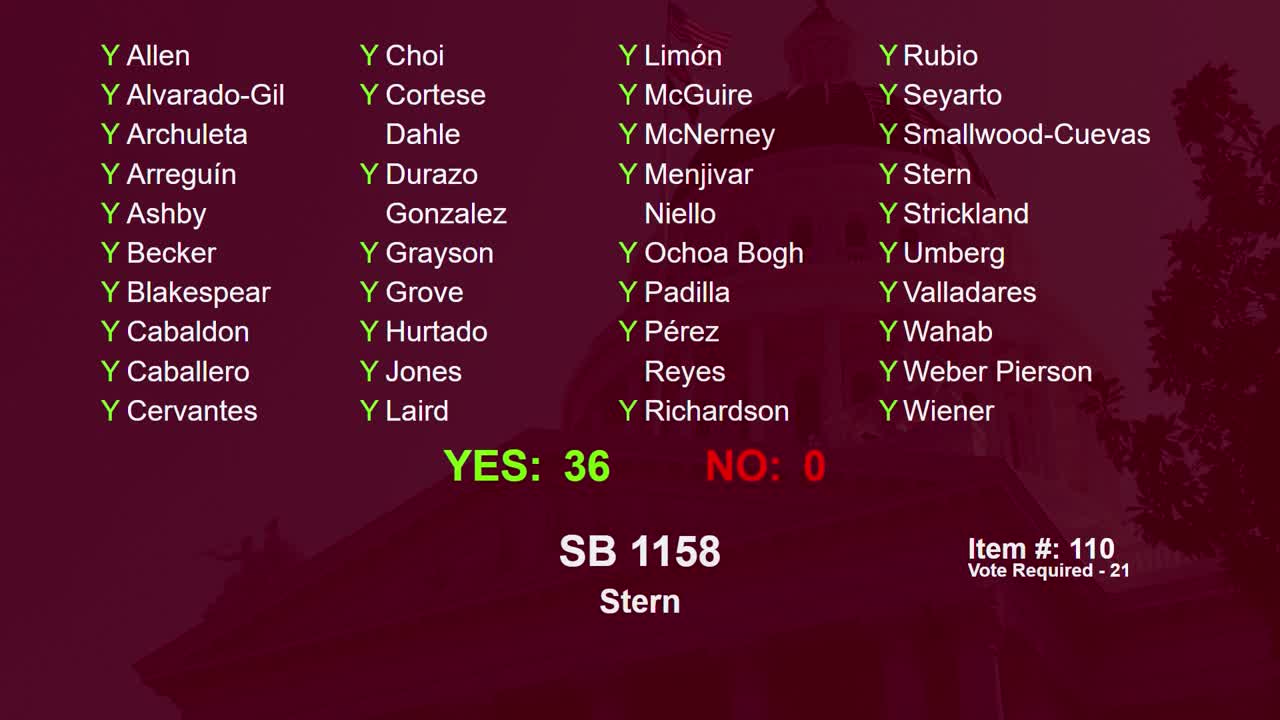 2MIN
Senate Floor
 17MIN
Senate Standing Committee on Health
 20MIN
Senate Standing Committee on Revenue and Taxation
Bill Author