SB 1329: Real property tax: valuation: active solar energy system.
- Session Year: 2025-2026
- House: Senate
- Latest Version Date: 2026-07-01
Current Status:
In Progress
(2026-08-05: August 5 set for first hearing canceled at the request of author.)
Introduced
In Committee
Awaiting First Chamber Vote
Passed First Chamber
In Committee
Awaiting Second Chamber Vote
Passed Second Chamber
Enacted
The California Constitution generally limits the maximum rate of ad valorem tax on real property to 1% of the full cash value of the property and defines full cash value for these purposes as the appraised value of real property when purchased, newly constructed, or a change in ownership has occurred after the 1975 assessment. Pursuant to constitutional authorization, existing property tax law excludes from the definition of newly constructed for these purposes the construction or addition of any active solar energy system, as defined, through the 202526 fiscal year, except as specified.
This bill would establish uniform rules regarding the method of valuation of an active solar energy system. The bill would set forth parameters for determining the value of an active solar energy system, as specified, and would provide that the valuation of such a system is limited to only the tangible property comprising the active solar energy system, and does not include intangible assets and rights of the system, as described. By expanding the duties of local tax officials, this bill would impose a state-mandated local program.This bill would prescribe rules for the valuation of an active solar energy system under certain valuation methods, including a requirement that, under the income method, the assessor exclude from income the benefit from, among other things, renewable energy credits, as defined. By expanding the duties of local tax officials, this bill would impose a state-mandated local program.
Existing law requires the state to reimburse local agencies annually for certain property tax revenues lost as a result of any exemption or classification of property for purposes of ad valorem property taxation.
This bill would provide that, notwithstanding those provisions, no appropriation is made and the state shall not reimburse local agencies for property tax revenues lost by them pursuant to the bill.
The California Constitution requires the state to reimburse local agencies and school districts for certain costs mandated by the state. Statutory provisions establish procedures for making that reimbursement.
This bill would provide that, if the Commission on State Mandates determines that the bill contains costs mandated by the state, reimbursement for those costs shall be made pursuant to the statutory provisions noted above.
This bill would take effect immediately as a tax levy.
This bill would include a change in state statute that would result in a taxpayer paying a higher tax within the meaning of Section 3 of Article XIIIA of the California Constitution, and thus would require for passage the approval of 2/3 of the membership of each house of the Legislature.
The California Constitution generally limits the maximum rate of ad valorem tax on real property to 1% of the full cash value of the property and defines full cash value for these purposes as the appraised value of real property when purchased, newly constructed, or a change in ownership has occurred after the 1975 assessment. Pursuant to constitutional authorization, existing property tax law excludes from the definition of newly constructed for these purposes the construction or addition of any active solar energy system, as defined, through the 202526 fiscal year, except as specified.
This bill would establish uniform rules regarding the method of valuation of an active solar energy system. The bill would provide that the preferred valuation of an active solar energy system is the replacement cost new less depreciation and all other forms of obsolescence. The bill would set forth parameters for determining the replacement cost new value the value of an active solar energy system, as specified, and would provide that the valuation of such a system is limited to only the tangible property comprising the active solar energy system, and does not include intangible assets and rights of the system, as described. The bill would also provide that, with respect to an active solar energy system or portion thereof excluded in whole or part from the definition of newly constructed, as specified, the active solar energy system or portion thereof shall be treated as a separate appraisal unit from any property not excluded. By expanding the duties of local tax officials, this bill would impose a state-mandated local program.
Existing law requires the state to reimburse local agencies annually for certain property tax revenues lost as a result of any exemption or classification of property for purposes of ad valorem property taxation.
This bill would provide that, notwithstanding those provisions, no appropriation is made and the state shall not reimburse local agencies for property tax revenues lost by them pursuant to the bill.
The California Constitution requires the state to reimburse local agencies and school districts for certain costs mandated by the state. Statutory provisions establish procedures for making that reimbursement.
This bill would provide that, if the Commission on State Mandates determines that the bill contains costs mandated by the state, reimbursement for those costs shall be made pursuant to the statutory provisions noted above.
This bill would take effect immediately as a tax levy.
This bill would include a change in state statute that would result in a taxpayer paying a higher tax within the meaning of Section 3 of Article XIIIA of the California Constitution, and thus would require for passage the approval of 2/3 of the membership of each house of the Legislature.
The California Constitution generally limits the maximum rate of ad valorem tax on real property to 1% of the full cash value of the property and defines full cash value for these purposes as the appraised value of real property when purchased, newly constructed, or a change in ownership has occurred after the 1975 assessment. Pursuant to constitutional authorization, existing property tax law excludes from the definition of newly constructed for these purposes the construction or addition of any active solar energy system, as defined, through the 202526 fiscal year, except as specified.
This bill would establish uniform rules regarding the method of valuation of an active solar energy system. The bill would provide that the preferred valuation of an active solar energy system is the replacement cost new less depreciation and all other forms of obsolescence. The bill would set forth parameters for determining the replacement cost new value and would provide that the valuation of such a system is limited to only the tangible property comprising the active solar energy system, and does not include intangible assets and rights of the system, as described. The bill would also provide that, with respect to an active solar energy system or portion thereof excluded in whole or part from the definition of newly constructed, as specified, the active solar energy system or portion thereof shall be treated as a separate appraisal unit from any property not excluded. By expanding the duties of local tax officials, this bill would impose a state-mandated local program.
Existing law requires the state to reimburse local agencies annually for certain property tax revenues lost as a result of any exemption or classification of property for purposes of ad valorem property taxation.
This bill would provide that, notwithstanding those provisions, no appropriation is made and the state shall not reimburse local agencies for property tax revenues lost by them pursuant to the bill.
The California Constitution requires the state to reimburse local agencies and school districts for certain costs mandated by the state. Statutory provisions establish procedures for making that reimbursement.
This bill would provide that, if the Commission on State Mandates determines that the bill contains costs mandated by the state, reimbursement for those costs shall be made pursuant to the statutory provisions noted above.
This bill would take effect immediately as a tax levy.
This bill would include a change in state statute that would result in a taxpayer paying a higher tax within the meaning of Section 3 of Article XIIIA of the California Constitution, and thus would require for passage the approval of 2/3 of the membership of each house of the Legislature.
Existing law, the Personal Income Tax Law, imposes taxes on income and provides definitions of specified terms for the purposes of that law, including a definition for part-year resident.This bill would make a nonsubstantive change to those provisions.Existing law, the Personal Income Tax Law, imposes taxes on income and provides definitions of specified terms for the purposes of that law, including a definition for part-year resident.
This bill would make a nonsubstantive change to those provisions.
(a)In valuing an active solar energy system under the income method of appraisal, the assessor shall exclude from income the benefit from both of the following:
(1)Renewable energy credits, as defined in paragraph (2) of subdivision (h) of Section 399.12 of the Public Utilities Code.
(2)Federal and state tax credits, cash grants, direct payments, or similar governmental subsidies.
(b)In valuing an active solar energy system under the cost method of appraisal, the assessor shall reduce the cost by any federal and state tax credits or similar governmental subsidies.
(c)For purposes of this section, active solar energy system shall have the same meaning as is provided in Section 73.
SEC. 2.Notwithstanding Section 2229 of the Revenue and Taxation Code, no appropriation is made by this act and the state shall not reimburse any local agency for any property tax revenues lost by it pursuant to this act.
SEC. 3.If the Commission on State Mandates determines that this act contains costs mandated by the state, reimbursement to local agencies and school districts for those costs shall be made pursuant to Part 7 (commencing with Section 17500) of Division 4 of Title 2 of the Government Code.
SEC. 4.This act provides for a tax levy within the meaning of Article IV of the California Constitution and shall go into immediate effect.
(a)An assessor shall value an active solar energy system or portion thereof consistent with the requirements of Section 401. The methods of valuation shall include, but are not limited to, the comparable sales method, the income method, or the cost method. The preferred method of any valuation of an active solar energy system or portion thereof is the replacement cost new value less depreciation and all other forms of obsolescence.
(b)For purposes of applying Sections 110 and 212 to determine the full cash value, fair market value, or taxable value of any active solar energy system or portion thereof, as defined in Section 73, all of the following shall apply:
(1) Full cash value, fair market value, or taxable value shall include only the tangible property comprising the active solar energy system or portion thereof, excluding value attributable to any assets in accordance with subdivision (d) of Section 110 and subdivision (c) of Section 212.(2)When determining full cash value, fair market value, or taxable value of the tangible property comprising the active solar energy system or portion thereof, both of the following shall apply to the extent applicable to the given valuation approach:
(A)The useful life and economic life of the active solar energy system shall not exceed the lesser of the following:
(i)Twenty-five years.
(ii)The active solar energy systems remaining site lease term, including any extension options, measured from the time the system is placed in service.
(iii)The applicable useful life set forth in Table P of the California Assessors Associations 2026 Position Paper 26-001 on Business Assessment Factors, as updated periodically, subject to a minimum percentage factor of 15 percent in the case of the cost method.
(2)Obsolescence includes,(B)Obsolescence includes, but is not limited to, external obsolescence. External obsolescence includes includes, but is not limited to, both the amounts of any United States duties and tariffs. tariffs and the amounts of any federal tax credits and similar incentives that have been generated by the applicable solar energy system or portion thereof.
(3)Replacement cost new means The replacement cost new shall be the original cost or taxable original cost of the active solar energy system, reduced by government subsidies in the form of tax credits or other similar subsidies, and subsequently multiplied by a depreciation percent good factor and by an inflation cost index factor. In determining replacement cost new, the following shall apply:
(A)The original cost or taxable original cost shall be limited to the actual cost of the active solar energy system build and shall exclude developer step-ups and other similar costs. build.
(B)The tax credits and similar subsidies to be deducted from the original cost or taxable original cost shall include those set forth under clause (i) of subparagraph (A) of paragraph (4) that are applicable to the active solar energy system.
(C)The equipment index factors shall be derived from utility-scale solar specific data publications, including, but not limited to, the United States Energy Information Administration Annual Energy Outlook, or the Lawrence Berkeley National Laboratory Utility-Scale Solar Report, except that this factor shall be adjusted to exclude amounts attributable to United States import customs and duties.(4) (A)For purposes of paragraph (1), tangible property shall not include intangible assets and rights rights, or any income or value arising from or attributable to those assets and rights, relating to an active solar energy system or portion thereof, including, but not limited to, all both of the following:(i)Federal and state tax credits, cash grants, direct payments, or similar federal subsidies received or to be received.
(ii)Contracts for energy, resource adequacy, ancillary services, or related market products.(iii)(ii)Renewable energy credits, as defined in paragraph (2) of subdivision (h) of Section 399.12 of the Public Utilities Code.
(iv)Environmental commodities, including, but not limited to, carbon credits and emissions credits.(B)Nothing in this paragraph shall be construed to mean that a business operating an active solar energy system does not also have intangible assets and rights commonly found in general businesses, including, but not limited to, concessions, franchises, workforce in place, customer lists, trademarks, and copyrights.
(C)The treatment of intangible assets, rights, and attributes, as described in this paragraph, shall be consistent with Section 110. In this regard, the assets, rights, and attributes set forth in paragraph (3) shall not be considered intangible attributes of real property under subdivision (f) of Section 110.
(c)For purposes of Section 51, in the case of any active solar energy system or portion thereof excluded in whole or in part from the term newly constructed pursuant to Section 73, such an active solar energy system or portion thereof shall be treated as a separate appraisal unit from any other property that is not excluded from the definition of newly constructed pursuant to Section 73.SEC. 2.Notwithstanding Section 2229 of the Revenue and Taxation Code, no appropriation is made by this act and the state shall not reimburse any local agency for any property tax revenues lost by it pursuant to this act.
SEC. 3.If the Commission on State Mandates determines that this act contains costs mandated by the state, reimbursement to local agencies and school districts for those costs shall be made pursuant to Part 7 (commencing with Section 17500) of Division 4 of Title 2 of the Government Code.
SEC. 4.This act provides for a tax levy within the meaning of Article IV of the California Constitution and shall go into immediate effect.
(a)An assessor shall value an active solar energy system or portion thereof consistent with the requirements of Section 401. The methods of valuation shall include, but are not limited to, the comparable sales method, the income method, or the cost method. The preferred method of any valuation of an active solar energy system or portion thereof is the replacement cost new value less depreciation and all other forms of obsolescence.
(b)For purposes of applying Sections 110 and 212 to determine the full cash value, fair market value, or taxable value of any active solar energy system or portion thereof, as defined in Section 73, all of the following shall apply:
(1)Full cash value, fair market value, or taxable value shall include only the tangible property comprising the active solar energy system or portion thereof, excluding value attributable to any assets in accordance with subdivision (d) of Section 110 and subdivision (c) of Section 212.
(2)Obsolescence includes, but is not limited to, external obsolescence. External obsolescence includes the amounts of any United States duties and tariffs.
(3)Replacement cost new means the original cost or taxable original cost of the active solar energy system, reduced by government subsidies in the form of tax credits or other similar subsidies, and subsequently multiplied by a depreciation percent good factor and by an inflation cost index factor. In determining replacement cost new, the following shall apply:
(A)The original cost or taxable original cost shall be limited to the actual cost of the active solar energy system build and shall exclude developer step-ups and other similar costs.
(B)The tax credits and similar subsidies to be deducted from the original cost or taxable original cost shall include those set forth under clause (i) of subparagraph (A) of paragraph (4) that are applicable to the active solar energy system.
(C)The equipment index factors shall be derived from utility-scale solar specific data publications, including, but not limited to, the United States Energy Information Administration Annual Energy Outlook, or the Lawrence Berkeley National Laboratory Utility-Scale Solar Report, except that this factor shall be adjusted to exclude amounts attributable to United States import customs and duties.
(4)(A)For purposes of paragraph (1), tangible property shall not include intangible assets and rights relating to an active solar energy system or portion thereof, including, but not limited to, all of the following:
(i)Federal and state tax credits, cash grants, direct payments, or similar federal subsidies received or to be received.
(ii)Contracts for energy, resource adequacy, ancillary services, or related market products.
(iii)Renewable energy credits, as defined in paragraph (2) of subdivision (h) of Section 399.12 of the Public Utilities Code.
(iv)Environmental commodities, including, but not limited to, carbon credits and emissions credits.
(B)Nothing in this paragraph shall be construed to mean that a business operating an active solar energy system does not also have intangible assets and rights commonly found in general businesses, including, but not limited to, concessions, franchises, workforce in place, customer lists, trademarks, and copyrights.
(C)The treatment of intangible assets, rights, and attributes, as described in this paragraph, shall be consistent with Section 110. In this regard, the assets, rights, and attributes set forth in paragraph (3) shall not be considered intangible attributes of real property under subdivision (f) of Section 110.
(c)For purposes of Section 51, in the case of any active solar energy system or portion thereof excluded in whole or in part from the term newly constructed pursuant to Section 73, such an active solar energy system or portion thereof shall be treated as a separate appraisal unit from any other property that is not excluded from the definition of newly constructed pursuant to Section 73.
SEC. 2.Notwithstanding Section 2229 of the Revenue and Taxation Code, no appropriation is made by this act and the state shall not reimburse any local agency for any property tax revenues lost by it pursuant to this act.
SEC. 3.If the Commission on State Mandates determines that this act contains costs mandated by the state, reimbursement to local agencies and school districts for those costs shall be made pursuant to Part 7 (commencing with Section 17500) of Division 4 of Title 2 of the Government Code.
SEC. 4.This act provides for a tax levy within the meaning of Article IV of the California Constitution and shall go into immediate effect.
SECTION 1.Section 17015.5 of the Revenue and Taxation Code is amended to read:17015.5.For purposes of Part 10.2 (commencing with Section 18401) and this part, part-year resident means a taxpayer who meets both of the following conditions during the same taxable year.(a)Is a resident of this state during a portion of the taxable year.(b)Is a nonresident of this state during a portion of the taxable year.For purposes of Part 10.2 (commencing with Section 18401) and this part, the term part-year resident means a taxpayer who meets both of the following conditions during the same taxable year.
(a)Is a resident of this state during a portion of the taxable year.
(b)Is a nonresident of this state during a portion of the taxable year.
|
Date
|
Status
|
|---|---|
| Aug 5, 2026 | August 5 set for first hearing canceled at the request of author. |
| Jul 1, 2026 | Read second time and amended. Re-referred to Com. on APPR. |
| Jun 30, 2026 | From committee: Do pass as amended and re-refer to Com. on APPR. (Ayes 5. Noes 2.) (June 29). |
| Jun 30, 2026 | June 29 set for first hearing. Placed on suspense file. |
| Jun 22, 2026 | From committee with author's amendments. Read second time and amended. Re-referred to Com. on REV. & TAX. |
| Jun 4, 2026 | Referred to Com. on REV. & TAX. |
| May 27, 2026 | In Assembly. Read first time. Held at Desk. |
| May 27, 2026 | Read third time. Passed. (Ayes 27. Noes 11. Page 4483.) Ordered to the Assembly. |
| May 27, 2026 | Read third time. Passed. (Ayes 27. Noes 11.) Ordered to the Assembly. |
| May 14, 2026 | From committee: Do pass. (Ayes 5. Noes 2. Page 4273.) (May 14). |
| May 14, 2026 | Read second time. Ordered to third reading. |
| May 14, 2026 | From committee: Do pass. (Ayes 5. Noes 2.) (May 14). |
| May 12, 2026 | Set for hearing May 14. |
| May 11, 2026 | May 11 hearing: Placed on APPR. suspense file. |
| May 7, 2026 | Set for hearing May 11. |
| May 6, 2026 | From committee: Do pass and re-refer to Com. on APPR. (Ayes 4. Noes 0. Page 4154.) (May 6). Re-referred to Com. on APPR. |
| May 6, 2026 | From committee: Do pass and re-refer to Com. on APPR. (Ayes 4. Noes 0.) (May 6). Re-referred to Com. on APPR. |
| Apr 9, 2026 | Set for hearing May 6. |
| Apr 8, 2026 | Re-referred to Com. on REV. & TAX. |
| Mar 23, 2026 | From committee with author's amendments. Read second time and amended. Re-referred to Com. on RLS. |
| Mar 4, 2026 | Referred to Com. on RLS. |
| Feb 23, 2026 | Read first time. |
| Feb 23, 2026 | From printer. May be acted upon on or after March 23. |
| Feb 20, 2026 | Introduced. To Com. on RLS. for assignment. To print. |
|
Date
|
Description
|
Location
|
Votes
|
|
|---|---|---|---|---|
| Jun 29, 2026 | Do pass as amended and be re-referred to the Committee on [Appropriations] | Assembly Standing Committee on Revenue and Taxation |
Passed |
|
| May 27, 2026 | Senate 3rd Reading SB1329 McNerney | Senate Floor |
Passed |
|
| May 14, 2026 | Do pass | Senate Standing Committee on Appropriations |
Passed |
|
| May 11, 2026 | Placed on suspense file | Senate Standing Committee on Appropriations |
Passed |
|
| May 6, 2026 | Do pass, but first be re-referred to the Committee on [Appropriations] | Senate Standing Committee on Revenue and Taxation |
Passed |
This list shows positions taken on this bill by organizations on the date displayed, which is linked to the original source.
Positions by individuals are not included.
|
Organization
|
Position
|
Date
|
|---|---|---|
| 2100 IFF Strategies (prior version) | ** Support | |
| 350 Humboldt: Grass Roots Climate Action (prior version) | ** Support | |
| Advanced Energy United (prior version) | ** Support | |
| American Clean Power - California | ** Support | |
| Arevon | ** Support | |
| Assessor Tom J. Bordonaro, Jr., San Luis Obispo County (prior version) | ** Against | |
| California Assessors' Association | ** Against | |
| California Energy Storage Alliance | ** Support | |
| California Solar and Storage Association | ** Support | |
| California State Association of Electrical Workers (prior version) | ** Support | |
| Cleanearth4kids.org (prior version) | ** Support | |
| Climate Action California (prior version) | ** Support | |
| Coalition of California Utility Employees (prior version) | ** Support | |
| County of Fresno | ** Against | |
| County of Inyo | ** Against | |
| County Of Kern | ** Against | |
| County Of Kings | ** Against | |
| County Of Madera | ** Against | |
| County of Merced | ** Against | |
| County of San Bernardino | ** Against | |
| County of San Joaquin | ** Against | |
| County Of Stanislaus | ** Against | |
| County of Tulare | ** Against | |
| EDF Power Solutions | ** Support | |
| Edison International And Affiliates, Including Southern California Edison | ** Support | |
| EDP RENEWABLES NORTH AMERICA, LLC | ** Support | |
| Environment California (prior version) | ** Support | |
| Forefront Power LLC | ** Support | |
| Forefront Power, LLC | ** Support | |
| Hes Renewables | ** Support | |
| Imperial Irrigation District (prior version) | ** Against | |
| Independent Energy Producers Alliance | ** Support | |
| Independent Energy Producers Association | ** Support | |
| Large-Scale Solar Association | ** Support | |
| Natural Resources Defense Council (prior version) | ** Support | |
| Nexamp | ** Support | |
| Qcells | ** Support | |
| Qcells North America | ** Support | |
| RWE | ** Support | |
| RWE Renewables America, LLC | ** Support | |
| San Joaquin Valley Regional Association of California Counties | ** Against | |
| Solar Energy Industry Association | ** Support | |
| Solar Gain West | ** Support | |
| SOLAR TECHNOLOGIES | ** Support | |
| State Building and Construction Trades Council of California (prior version) | ** Support | |
| Sunrun | ** Support |
Date of Hearing: June 29, 2026
ASSEMBLY COMMITTEE ON REVENUE AND TAXATION
Mike Gipson, Chair
SBPCA Bill Id:SB 1329
Author:(McNerney) – As Amended Ver:June 22, 2026
2/3 vote. Tax levy. Fiscal committee.
SENATE VOTE: 27-11
SUBJECT: Real property tax: valuation: active solar energy system
SUMMARY: Requires assessors to adjust for certain aspects when valuing an active solar energy system (ASES). Specifically, this bill:
- Requires an assessor to value an ASES, or portion thereof, consistently with existing law, and stipulates that the methods of valuation include, but are not limited to, the comparable sales method, the income method, or the cost method.
- Provides that, for the purposes of applying existing law to determine the "full cash value," "fair market value," or "taxable value" of any ASES or portion thereof, as defined, all of the following apply:
- "Full cash value," "fair market value," or "taxable value" must only include the tangible property comprising the ASES or portion thereof, excluding value attributable to any intangible assets, as provided in existing law; and,
- When determining "full cash value," "fair market value," or "taxable value" of the tangible property comprising the ASES or portion thereof, both of the following must apply:
- The useful life and economic life of the ASES must not exceed the lesser of:
- 25 years;
- The ASES's remaining site lease term, including any extension options, measured from the time the system is placed in service; or,
- The applicable useful life set forth in Table P of the California Assessors' Association's 2026 Position Paper 26-001 on Business Assessment Factors, as updated periodically, subject to a minimum percentage factor of 15% in the case of the cost method.
- Obsolescence includes, without limitation, external obsolescence, which is defined to include, but not limit to, both the amounts of any U.S. duties and tariffs and the amounts of any federal tax credits and similar incentives that have been generated by the applicable solar energy system or portion thereof.
- The useful life and economic life of the ASES must not exceed the lesser of:
- The replacement cost new must be the original cost or taxable original cost of the ASES, reduced by government subsidies in the form of tax credits or other similar subsidies, and subsequently multiplied by a depreciation percent good factor and by an inflation cost index factor. The following must apply when determining "replacement cost new":
- The original cost or taxable cost must be limited to the actual cost of the ASES build; and,
- The tax credits and similar subsidies be deducted from the original cost or taxable original cost must include value attributable to certain intangible assets specified in this bill that are applicable to the ASES.
- For the purposes of determining "full cash value," "fair market value," or "taxable value," "tangible property" must not include intangible assets and rights, or any income or value arising from or attributable to those assets and rights, relating to an ASES or portion thereof, including, but not limited to, both of the following:
- Federal and state tax credits, cash grants, direct payments, or similar federal subsidies received or to be received; and,
- Renewable energy credits (RECs), as defined in existing law.
This treatment for determining "full cash value," "fair market value," or "taxable value" must not be construed to mean that a business operating an ASES does not also have intangible assets and rights commonly found in general businesses, including, but not limited to, concessions, franchises, workforce in place, customer lists, trademarks, and copyrights. Additionally, the treatment of intangible assets, rights, and attributes, as provided in the determination of "full cash value," "fair market value," or "taxable value", must be consistent with existing law, and, in that regard, the assets, rights, and attributes stipulated in this bill must not be considered intangible attributes that are taxable under existing law.
- Prohibits reimbursement of any local agency for any property tax revenue lost pursuant to this bill, notwithstanding existing law.
- Requires reimbursement to local agencies and school districts for costs if the Commission on State Mandates determines that this bill contains mandated costs.
- Takes immediate effect as a tax levy.
EXISTING LAW:
- Provides that all property is taxable unless otherwise provided by the California Constitution or federal law, and requires that taxable property be assessed at the same percentage of "fair market value" and taxed in proportion to the property's full value. (California Constitution, Article XIII, Section 1.)
- Limits the maximum amount of ad valorem property taxation to 1% of the full cash value of the property. Generally, the Constitution restricts the full cash value of a property to the assessed value upon a change of ownership in, or new construction on, the property. The Legislature is authorized to exclude from the definition of new construction certain improvements, including the construction or addition of any ASES. In implementing this authorization, the Legislature provides that the exclusion for newly constructed ASESs is repealed on January 1, 2027. (California Constitution, Article XIII A, Sections 1 and 2 and Revenue and Taxation Code (R&TC) Section 73.)
- Defines "full cash value" or "fair market value" as the amount of cash or its equivalent that property would bring if exposed for sale in the open market, as specified, and is the purchase price paid in the transaction, unless a preponderance of evidence establishes that the property would not have transferred for that purchase price. The purchase price is rebuttably presumed to be the full cash value or fair market value. The value of intangible assets and rights relating to the going concern value of a business must not be reflected in the value of the taxable property. The exclusive nature of a concession, franchise, or similar agreement, is an intangible asset that must not enhance the value of the taxable property. Intangible assets or rights necessary to put the taxable property to beneficial or productive use may be assessed and valued, along with intangible attributes of real property, including zoning, location, and other attributes that relate directly to the real property involved. (R&TC Section 110.)
- Provides that notes, debentures, shares of capital stock, solvent credits, bonds, deeds of trust, mortgages, and any interest in taxable property are exempt from taxation, as is money kept on hand to be used in the ordinary and regular course of a trade, profession, or business. Intangible assets and rights are exempt from taxation and must not enhance or be reflected in the value of the property, unless the presence of intangible assets or rights is necessary to put the taxable property to beneficial or productive use. (R&TC Section 212.)
- Requires an assessor to exclude from income the benefit from federal and state low-income housing tax credits, as defined, when valuing property under the income method of appraisal. (R&TC Section 402.95.)
- Defines a "REC" as a certificate of proof associated with the generation of electricity from an eligible renewable energy resources, issued through the accounting system established by the California Energy Commission according to existing law, that one unit of electricity was generated and delivered by an eligible renewable energy resource. (Public Utilities Code Section 399.12.)
FISCAL EFFECT: The State Board of Equalizations (BOE) notes that an estimated revenue loss is indeterminable. Committee staff notes that this bill results in revenue losses that are almost certainly in excess of this Committee's Suspense File threshold.
COMMENTS:
- The author has submitted the following statement in support of this bill:
Since 1980, solar energy systems on homes, businesses, and in big projects that feed into the electrical grid have been excluded from property taxes in California. That exclusion sunsets at the end of 2026 and solar will become fully taxable. Solar power remains crucial to helping California decarbonize our energy grid, so we must keep development in the state and cost to ratepayers low. SB 1329 would help ensure that solar power continues to grow in California by creating a standard for property taxes for all 58 counties for solar so that the industry is not priced out of California. To ensure that solar is provided to Californians at a fair and reasonable price, those who build solar need to know the way to calculate property tax regardless of where they build in the state. SB 1329 will allow California to continue to meet its clean energy and climate goals, keep project costs down, and bring new tax dollars to the state and local government.
- A coalition of solar industry, environmental, and electrical worker union advocates, writing in support of this bill, state, in part:
The current statutory authorization for the solar property tax exclusion is set to expire at
the end of 2026 – with this expiration new solar projects will start paying property taxes
in 2027. To ensure consistency across all 58 counties and to provide certainty to clean
energy developers, SB 1329 proposes a set of standard inputs – regardless of the
valuation methodology employed – for the assessment of solar property. This clarity is
vital to ensuring California's clean energy and climate goals can be achieved affordably
while bringing new tax dollars to the state and to local governments.
- The California Assessors' Association, and a coalition of counties, writing in opposition to this bill, state, in part:
The bill also requires assessors to reduce value by tax credits, subsidies, and similar
incentives. This shifts valuation away from fair market value toward a net-of-subsidy
approach that is not recognized in appraisal practice. These incentives are not
negotiated between buyers and sellers and do not determine what a purchaser would
pay for an operating facility. Mandating their subtraction would create inconsistent
and non-uniform assessments across comparable properties.
In addition, SB 1329 directs assessors to treat tariffs and duties as obsolescence by
law. This removes the requirement that obsolescence be supported by market
evidence and would result in artificially reduced values.
[…]
Finally, the bill is unnecessary. Existing law and [BOE] guidance provide a clear and workable framework for valuing renewable energy facilities, including the treatment of obsolescence and intangible assets. Replacing this framework with a statutory formula would reduce valuation accuracy and create broader pressure to apply similar approaches to other property types.
- Committee Staff Comments:
- Creation of the California property tax and the BOE: After the establishment of California's first state constitution, California's newly established Legislature enacted the Property Tax Law of 1850, which imposed a 0.5% tax on the value of real and personal property as assessed by local county assessors. The property tax would serve as the state's primary source of revenue until 1910 and has always been a critical source of revenue for local jurisdictions. Given this importance, ensuring that taxation across counties remained consistent was of paramount concern. Thus, the Legislature created the BOE in 1870. This statutory creation was subsequently found unconstitutional by the State Supreme Court as the constitution then required that property values be set by local assessors. In 1879, when the state revisited its constitution, the BOE was formally established in the constitution, which made the BOE responsible for ensuring equalized assessment across counties.
- History of the ASES exclusion: In 1980, voters approved Proposition 7 (Prop. 7), which constitutionally authorized the Legislature to exclude from the definition of new construction the installation or addition of any ASES, as defined by the Legislature. In the Ballot Pamphlet issued for the November 4, 1980 election, voter materials described the arguments for and against Prop. 7. Proponents of the proposition noted that "[w]e need to take short-term steps to reduce the cost and create a demand for solar energy equipment. Eventually the demand on its own will cut the cost, and tax incentives will no longer be needed."
Since its authorization over 40 years ago, the ASES exclusion has been implemented and clarified by the Legislature. These provisions have provided that certain uses of an ASES are eligible, and that certain components of an ASES are excluded up to a specified percentage of their full cash value. Additionally, the Legislature authorized the transfer of the ASES exclusion from a developer to an initial purchaser, dubbed the builder's exclusion, thereby circumventing the normal reassessment requirement that a property be reassessed when it changes ownership.
- One Big Beautiful Bill Act (OBBBA): The OBBBA rescinded numerous "clean energy tax credits." Among these rescinded credits were the Clean Electricity Production Tax Credit and the Clean Electricity Investment Tax Credit.
- Aggressive climate change goals: In 2018, the Legislature passed SB 100 (De León), Chapter 312, Statutes of 2018, which required that retail electricity sales in California be supplied by certain percentages of renewable and zero-carbon sources. Specifically, existing law requires the state to supply 60% of sales from renewable and zero-carbon sources by 2030, 90% by 2035, 95% by 2040, and 100% by 2045.
- Inflationary pressures: Recent federal policies are likely responsible for price hikes around the nation. An April report published by the Board of Governors of the Federal Reserve found strong evidence that tariff changes through November 2025 raised core goods personal consumption expenditure prices by a cumulative 3.1% through February 2026. The study notes "the entirety of excess inflation in the core goods category relative to pre-pandemic inflations rates" can be explained by tariff changes in 2025[1].
- Methods of valuation: Pursuant to the State Constitution, property must be taxed in proportion to its full value. Thus, assessors are constitutionally required to determine the full value of a property for taxation purposes. There are three primary methods that an assessor may use to value property: the comparable sales method, the cost method, and the income method.
The comparable sales method derives a property's value by comparing the fair market value for exchanged properties that are similar to the property the assessor is currently valuing. A common example is the assessment of residential property. Often times, assessors have readily available data regarding the fair market value of residential properties as these are exchanged frequently.
The cost method sums the component costs associated with bringing the property to its current, taxable state. For properties that have aged, this cost must be adjusted for price changes in the component costs and depreciation of the property as the current cost to recreate or replace a similar property would not be the same for when an aged property was first constructed. Thus, a percent goods factor is applied to account for price changes in the component costs. While this can decrease the value of property under the cost method in deflationary environments, this rarely occurs in practice. In turn, the percent goods factor is generally a factor greater than 100%, which accounts for the fact that prices generally inflate over time. After the application of the percent goods factor, an equipment index factor is applied. The equipment index factor downwardly adjusts the value of the property, accounting for the depreciation of that property. This depreciation can result from physical deterioration, functional obsolescence, or external obsolescence. Functional obsolescence can occur due to changes in marketplace taste or technological advancement. External obsolescence can include environmental factors or reductions in value due to an economic base of employment shifting away from an area. Regardless, depreciation of any form reduces the value of the property so depreciated.
Finally, the income method uses the income stream produced by a property to derive a present value estimate for the property, which acts as an indicator for the property's fair market value. The income approach relies on the principle of capitalization, which converts an expected future income stream into a present value estimate. In some cases, this calculation may be relatively simple, such as the capitalized value of a lease. In other instances, this calculation can be very complicated.
- This bill: The proponents state that this bill is intended to provide clarity in assessment of properties that will soon no longer be exempt. As such, there are limited, if any, sales of ASESs that could indicate the value of ASESs on the open market. Thus, the proponents claim that this bill provides clarity and consistency in assessment practices.
As currently drafted, this bill would impose a series of requirements on assessors when valuing ASESs. Specifically, this bill would require that only the tangible property of the ASES be included in value. This bill then requires that property have a useful life, or be depreciated, based on the lesser of certain periods and that obsolescence include "external obsolescence." In turn, "external obsolescence" includes, but is not limited to, U.S. duties and tariffs and the amounts of any federal tax credits and similar incentives generated by the ASES.
This bill would then require that, under the cost method, that “replacement cost new” be the original or taxable original cost of the ASES, reduced by government subsidies in the form of tax credits or other similar subsidies, and restates an inverted calculation of the cost method's calculation. This bill then provides that when using the replacement cost new method under the cost method, the original or taxable original cost be limited to the actual cost of the ASES build and that tax credits and similar subsidies be deducted from that cost. This bill then states that "tangible property" does not include any intangible assets and rights, or any income or value arising from them, and requires that intangible assets and rights include, but are not strictly limited to, federal and state tax credits, cash grants, direct payments, or similar federal subsidies received or to be received, and RECs.
- Repetitive clarity or an inadvertent double benefit: As currently drafted, this bill would require that an ASES only be valued based on the tangible property comprising the ASES. This bill then requires that value be reduced by certain intangibles, despite those intangibles being explicitly excluded from valuation in the first instance. Therefore, this bill would reduce a property's assessed value multiple times for the same component of value. In other words, this bill would create a double benefit, which is generally counter to sound tax policy. The author and Committee may wish to consider whether it is appropriate to provide a double tax benefit, as this bill proposes.
- A duty to value: This bill would require that the value of a property be adjusted for U.S. duties and tariffs. This bill does not specify which duties and tariffs must be considered, thereby including any conceivable duty or tariff. Additionally, this provision would create a discrepancy between the assessed and fair market value of a property. Creating this discrepancy would likely not violate the constitutional requirement that all property be taxed in proportion to its full value as the State Constitution authorizes the Legislature to exclude ASES and provides the Legislature wide authority to implement this authorization. This discrepancy would, however, counter sound tax policy as it would diverge the property's assessed taxable value with the price for which the property would exchange on the open market, which is the foundational definition of fair market value. Moreover, subsidizing the costs of distortive federal policy through the property tax system may be a questionable precedent.
- The role of the BOE: Proponents note that this bill is intended to provide consistent assessment practices across counties. The proponents claim that as ASESs become taxable, the lack of prior taxable properties to guide assessment practices could lead to disparate valuations for similarly situated properties. This claim, however, fundamentally ignores the primary constitutionally prescribed function of the BOE, namely, to equalize assessment practices across California's 58 counties. As a quasi-judicial body, the BOE fulfills this responsibility by hearing issues brought before it and adjudicating discrepancies in assessment practices. The Committee may wish to consider whether circumventing this process would clarify assessment practices for ASESs or would complicate an assessor's requirement to assess properties at fair market value.
- Existing assessment restrictions: As noted in the existing law portion of this analysis, LIHTCs are required to be excluded from the value of a property. This requirement acknowledges that LIHTCs incentivize the development of affordable housing, a public good. Given the requirement that this state procure electricity from certain renewable sources by certain dates, the provision of renewably generated electricity could arguably be considered a public good. The author and Committee may wish to simply providing that the benefit of state and federal tax credits, cash grants, direct subsidies, and other government subsidies, along with RECs, are not included as income under the income approach, and that value of those tax credits and government subsidies not be considered in the cost of a property under the cost approach.
- Related legislation:
- AB 2389 (Irwin) would have extended the ASES new construction exclusion by five years for small, customer-sited ASESs and ASESs sited on the property of a public entity customer. AB 2389 was held on the Assembly Committee on Appropriations' Suspense File.
- AB 1516 (Committee on Revenue and Taxation), Chapter 72, Statutes of 2025, required that a claim filed by the initial purchaser of an ASES benefitting from the builder's exclusion is timely if filed within three years, among other provisions.
- Prior legislation:
- SB 1340 (Hertzberg), Chapter 425, Statutes of 2022, extended the ASES new construction exclusion by two years, among other provisions.
- SB 871 (Committee on Budget and Fiscal Review), Chapter 41, Statutes of 2014, extended the ASES new construction exclusion by eight years.
REGISTERED SUPPORT / OPPOSITION:
Support
2100 IFF Strategies (prior version)
350 Humboldt: Grass Roots Climate Action (prior version)
Advanced Energy United (prior version)
Arevon
California Energy Storage Alliance
California Solar and Storage Association
California State Association of Electrical Workers (prior version)
Cleanearth4kids.org (prior version)
Climate Action California (prior version)
Coalition of California Utility Employees (prior version)
Edison International and Affiliates, including Southern California Edison
EDP Renewables North America, LLC
Environment California (prior version)
Forefront Power LLC
Hes Renewables
Independent Energy Producers Alliance
Large-Scale Solar Association
Natural Resources Defense Council (prior version)
Nexamp
Qcells
RWE
Solar Energy Industry Association
Solar Gain West
Solar Technologies
State Building and Construction Trades Council of California (prior version)
Sunrun
Opposition
Assessor Tom J. Bordonaro, Jr., San Luis Obispo County (prior version)
California Assessors' Association
County of Fresno
County of Inyo
County of Kern
County of Kings
County of Madera
County of Merced
County of San Bernardino
County of San Joaquin
County of Stanislaus
County of Tulare
Imperial Irrigation District (prior version)
San Joaquin Valley Regional Association of California Counties
Analysis Prepared by: Harrison Bowlby / REV. & TAX. / (916) 319-2098
Robert Minton, Madeleine Ray, and Mariano Somale, "Detecting Tariff Effects on Consumer Prices in Real Time – Part II," Board of the Governors of the Federal Reserve System, published April 8, 2026, https://www.federalreserve.gov/econres/notes/feds-notes/detecting-tariff-effects-on-consumer-prices-in-real-time-part-II-20260408.html, accessed May 2026. ↑
SENATE RULES COMMITTEE Office of Senate Floor Analyses (916) 651-4171 | SB 1329 |
THIRD READING
Bill No: SB 1329
Author: McNerney (D)
Amended: 3/23/26
Vote: 27
SENATE REVENUE AND TAXATION COMMITTEE: 4-0, 5/6/26
AYES: McNerney, Ashby, Becker, Grayson
NO VOTE RECORDED: Alvarado-Gil
SENATE APPROPRIATIONS COMMITTEE: 5-2, 5/14/26
AYES: Cervantes, Cabaldon, Grayson, Richardson, Wahab
NOES: Seyarto, Dahle
SUBJECT: Real property tax: valuation: active solar energy system
SOURCE: Large Scale Solar Association
Solar Energy Industries Association
DIGEST:
This bill enacts a specific valuation methodology for active solar energy systems.
ANALYSIS:
Existing law:
- Provides that all property is taxable unless explicitly exempted by the Constitution or federal law (California Constitution, Article XIII, Section One).
- Limits the maximum amount of any ad valorem tax on real property at 1% of full cash value, plus any locally-authorized bonded indebtedness, and provides that assessors may only reappraise property whenever it is purchased, newly constructed, or when ownership changes (California Constitution, Article XIIIA, as added by Proposition 13, 1978).
- Allows the Legislature to exclude from the definition of “new construction,” the construction or addition of any active solar energy system (California Constitution, Article XIIIA, Section Two, as added by Proposition 7, 1980).
- Implements the active solar energy system new construction exclusion until the 2025-26 fiscal year (SB 1340, Hertzberg, Chapter 45, Statutes of 2020) and provides that it becomes inoperative on January 1, 2027 (SB 710, Blakespear, Chapter 328, Statutes of 2025).
- Defines an active solar energy system as one that uses solar devices, which are thermally isolated from living space or any other area where the energy is used, to provide for the collection, storage, or distribution of solar energy.
- States that an active solar energy system excluded from new construction may be used for:
- Domestic, recreational, therapeutic, or service water heating.
- Space conditioning.
- Production of electricity.
- Process heat.
- Solar mechanical energy.
- Excludes from the definition of active solar energy system:
- Solar swimming pool heaters.
- Hot tub heaters.
- Passive energy systems.
- Wind energy systems.
- Defines fair market value for property tax assessment purposes to mean the amount of cash or its equivalent that property would bring if exposed for sale in the open market under conditions in which neither buyer nor seller could take advantage of the exigencies of the other, and both the buyer and seller have knowledge of all the uses and purposes to which the property adapted and for which it is capable of being used, and of the enforceable restrictions upon those uses and purposes.
- Establishes presumptions of value that make the process of determining fair market value more simple and reliable, mainly by presuming that the market value of a property is its purchase price in an open market transaction, but allows an assessor to overcome this presumption upon a preponderance of the evidence.
- Provides that intangible assets and rights are not themselves subject to property tax, but allows assessors and appraisers to assume the presence of intangible assets or rights necessary to put the property to beneficial or productive use when determining fair market value.
- Directs assessors to determine the fair market value of taxable property by removing from the value of the unit the fair market value of intangible assets and rights.
- Generally requires property to be assessed as a single unit, while allowing property tax appraisal units to be separated in specific cases, including when determining declines in value caused by a calamity.
This bill:
- Sets forth a methodology for the assessment of active solar energy systems.
- States that assessors should value active solar energy systems under current law, including using the cost, comparative sales, and income methods, but sets as the preferred method replacement cost new, less depreciation and all other forms of obsolescence.
- Directs the assessor when valuing an active solar energy system to include only its tangible property, and exclude value from intangible assets and rights, in accordance with existing law.
- Provides that obsolescence includes external obsolescence, defined to include the amount of any United States duties and tariffs.
- Directs the assessor to reduce replacement cost new by the amount of any government subsidies in the form of tax credits or other similar subsidies, including those the bill defines as intangible assets and rights, before multiplying by an inflation cost index and depreciation percentage good factor.
- Limits original cost or taxable original cost to actual costs of the system build, excluding developer step ups and other similar costs.
- Requires assessors to derive index factors from specific publications, except that assessors must also reduce factors by amounts attributable to import customs and duties.
- Excludes from tangible property intangible assets and rights, including, but not limited to:
- Federal and state tax credits, cash grants, direct payments, or similar federal subsidies received or to be received.
- Contracts for energy, resource adequacy, ancillary services, or related market products.
- Renewable energy credits, as defined.
- Environmental commodities, including, but not limited to, carbon credits and emission credits.
- States that its provisions regarding intangibles shall not be construed to mean that a business operating an active solar energy system does not also have intangible assets and rights commonly found in general businesses, including, but not limited to, concessions, franchises, workforce in place, customer lists, trademarks, and copyrights.
- Provides that an active solar energy system or portion thereof is a separate appraisal unit from any other property that is not excluded.
FISCAL EFFECT: Appropriation: No Fiscal Com.: Yes Local: Yes
According to the Senate Appropriations Committee:
- The bill’s proposed changes to appraisal methodologies for specified solar energy systems would likely reduce assessed values relative to current law, thereby decreasing local property tax revenues. The magnitude of the revenue loss is unknown but could be significant.
- Reductions in local property tax revenues, in turn, can increase General Fund Proposition 98 spending by up to roughly 50 percent (the exact amount depends on the specific amount of the annual Proposition 98 guarantee, which in turn depends upon a variety of economic, demographic and budgetary factors). BOE’s administrative costs have yet to be identified.
- By changing the duties of local tax officials, this bill creates a state-mandated local program. To the extent the Commission on State Mandates determines that the provisions of this bill create a new program or impose a higher level of service on local agencies, local agencies could claim reimbursement of those costs. The magnitude is unknown (General Fund).
SUPPORT: (Verified 5/14/26)
Large-Scale Solar Association (Co-Source)
Solar Energy Industry Association (Co-Source)
American Clean Power - California
Arevon
California Energy Storage Alliance
California Solar & Storage Association
EDF Power Solutions
EDP Renewables North America, LLC
Environment California
Forefront Power, LLC
HES Renewables
Independent Energy Producers Association
Nexamp
Qcells North America
RWE Renewables America, LLC
Solar Gain West
Solar Technologies
OPPOSITION: (Verified 5/14/26)
California Assessors’ Association
California State Association of Counties
County of Fresno
County of Imperial
County of Kern
County of Kings
Rural County Representatives of California
Urban Counties of California
ARGUMENTS IN SUPPORT: According to the author, “Since 1980, solar energy systems on homes, businesses, and in big projects that feed into the electrical grid have been excluded from property taxes in California. That exclusion sunsets at the end of 2026 and solar will become fully taxable. Solar power remains crucial to helping California decarbonize our energy grid, so we must keep development in the state and cost to ratepayers low. SB 1329 would help ensure that solar power continues to grow in California by creating a standard for property taxes for all 58 counties for solar so that the industry is not priced out of California. To ensure that solar is provided to Californians at a fair and reasonable price, those who build solar need to know the way to calculate property tax regardless of where they build in the state. SB 1329 will allow California to continue to meet its clean energy and climate goals, keep project costs down, and bring new tax dollars to the state and local government.”
ARGUMENTS IN OPPOSITION: According to the California Assessors Association, “While intended to provide clarity, SB 1329 replaces established market-based appraisal standards with a rigid, formula-driven approach that does not reflect how these properties are bought and sold. Utility-scale solar facilities are income-producing assets that are typically valued based on expected income. By establishing the cost approach as the preferred method, the bill conflicts with existing law and standard appraisal practice and would constrain assessors’ ability to determine fair market value. The bill also requires assessors to reduce value by tax credits, subsidies, and similar incentives. This shifts valuation away from fair market value toward a net-of-subsidy approach that is not recognized in appraisal practice. These incentives are not negotiated between buyers and sellers and do not determine what a purchaser would pay for an operating facility. Mandating their subtraction would create inconsistent and non-uniform assessments across comparable properties. In addition, SB 1329 directs assessors to treat tariffs and duties as obsolescence by law. This removes the requirement that obsolescence be supported by market evidence and would result in artificially reduced values. The bill further excludes key economic components from consideration, including contracts and related revenue streams, and would also exclude ‘developer step-ups and other similar costs’ that are part of actual market transactions. Removing these elements risks understating the value of operating facilities and increasing disputes.”
Prepared by: Colin Grinnell / REV. & TAX. / (916) 651-4117
5/16/26 11:13:45
**** END ****
SENATE COMMITTEE ON
Senator Sabrina Cervantes, Chair
2025 - 2026 Regular Session
SB 1329 (McNerney) - Real property tax: valuation: active solar energy system
Version: | Policy Vote: |
Urgency: | Mandate: |
Hearing Date: | Consultant: |
SB 1329 would revise property tax valuation methodologies applicable to certain active solar energy systems. Specifically, the bill would set forth a specific valuation methodology, and require specific elements be excluded when assessors value qualifying systems.
Fiscal Impact:
- The bill’s proposed changes to appraisal methodologies for specified solar energy systems would likely reduce assessed values relative to current law, thereby decreasing local property tax revenues. The magnitude of the revenue loss is unknown but could be significant.
Reductions in local property tax revenues, in turn, can increase General Fund Proposition 98 spending by up to roughly 50 percent (the exact amount depends on the specific amount of the annual Proposition 98 guarantee, which in turn depends upon a variety of economic, demographic and budgetary factors). BOE’s administrative costs have yet to be identified.
- By changing the duties of local tax officials, this bill creates a state-mandated local program. To the extent the Commission on State Mandates determines that the provisions of this bill create a new program or impose a higher level of service on local agencies, local agencies could claim reimbursement of those costs. The magnitude is unknown (General Fund).
Background:
California’s property tax system is governed by Article XIIIA of the California Constitution, which establishes that all property is taxable unless expressly exempted by constitutional or federal law. The Constitution limits ad valorem property taxation to 1 percent of assessed value, plus voter-approved indebtedness, and requires reassessment upon changes in ownership or new construction. Within this framework, the Legislature has enacted a series of statutory exclusions and valuation methodologies that shape the assessment of specialized property types, including renewable energy infrastructure.
Article XIIIA specifically authorizes the Legislature to exclude active solar energy systems from the definition of “new construction.” Since the adoption of Proposition 7 in 1980, the Legislature has repeatedly extended this exclusion through successive enactments, most recently through January 1, 2027. Consequently, the installation of qualifying active solar energy systems generally does not trigger reassessment or increase the taxable value of underlying real property. This treatment places solar energy systems among a limited class of improvements—alongside seismic retrofits, fire suppression systems, disabled access improvements, and rainwater capture systems—that receive preferential constitutional and statutory treatment for property tax purposes.
State law defines active solar energy systems broadly to include systems used for electricity generation, water heating, space conditioning, industrial process heat, and related energy applications, while excluding passive systems, wind generation, and specified recreational heating systems. Historically, the exclusion has applied uniformly without distinguishing between residential systems and utility-scale or commercial solar facilities operated for energy production and sale.
California property tax law generally requires assessors to determine fair market value based on the price a knowledgeable buyer and seller would agree to in an open market transaction. While purchase price is typically presumed to reflect market value, assessors must rely on alternative appraisal methodologies where no recent sale exists or where the presumption is rebutted. In those circumstances, assessors employ one or more traditional valuation approaches: the cost approach, the sales comparison approach, and the income approach. Guidance issued by BOE directs assessors to select the methodology most appropriate to the nature of the property and the availability of reliable market data.
The cost approach is frequently used for specialized or infrequently traded properties and estimates value based on the current cost to reproduce or replace the property, less depreciation and obsolescence. Assessors may utilize either current replacement costs or trended historical costs adjusted through price indices and depreciation schedules. The income approach, by contrast, estimates value based on the present worth of anticipated future income streams and is commonly applied to income-producing properties where market sales data are limited.
Property tax law further distinguishes between taxable tangible property and non-taxable intangible assets and rights. Although intangible assets themselves are exempt from property taxation, assessors must assume the presence of intangible rights necessary to place property into productive use while ensuring that the independent value of those rights is excluded from the taxable assessment. This distinction has generated significant litigation concerning the treatment of subsidies, contractual rights, regulatory entitlements, and other intangible interests in the valuation process. Recent California Supreme Court decisions have clarified that intangible business enterprise value must generally be excluded from taxable property value, while payments or incentives that directly enhance the income-generating capacity of the property itself may properly be included in an assessment.
In practice, assessors typically value real property as an integrated economic unit, rather than separately valuing constituent elements such as land, improvements, and fixtures. However, statutory and regulatory exceptions permit separate appraisal treatment in limited circumstances, including certain disaster-related reassessments. Establishing separate appraisal units may materially affect taxable value by preventing appreciation in one component of the property from offsetting depreciation or obsolescence in another component, such as a solar energy installation.
Absent further legislative action, the statutory exclusion for newly constructed active solar energy systems will sunset after January 1, 2027. At that point, while current law will continue to exclude systems where construction has been completed, and some systems with construction in progress, newly constructed systems that have historically been excluded from assessment for more than four decades will become subject to standard property tax valuation methodologies.
Proposed Law:
This bill would set forth a methodology for the assessment of active solar energy systems, consisting of four major components: (1) preferred method of assessment, (2) specific definitions for “obsolescence” and “replacement cost new,” (3) treatment of intangibles, (4) separate appraisal unit. Among other things, it would do the following:
- Method of Assessment: Provide that assessors should value active solar energy systems under current law, including using the cost, comparative sales, and income methods. However, it states that the replacement cost new, less depreciation, is the preferred method.
- Specific Definitions. Provide that obsolescence must include the amount of any United States duties and tariffs. The assessor must also reduce replacement cost new by the amount of any government subsidies in the form of tax credits or other similar subsidies, as defined. Assessors must then multiply that value by a depreciation percentage “good factor” and inflation cost index factor. The bill would (1) limit replacement cost to the actual cost of the system to build, excluding developer step-ups and other costs, and (2) require equipment cost index factors to be derived from specific publications, except that assessors must also reduce factors by amounts attributable to import customs and duties.
- Intangibles. Require assessors to only include the tangible property comprising the active solar energy system in the taxable value and not include intangible rights and assets relating to the going concern value of the business. The measure then specifies that those rights and assets include (1) federal and state tax credits, cash grants, direct payments, or similar federal subsidies received or to be received, (2) contracts for energy, resource adequacy, ancillary services, or related market products, (3) renewable energy credits, as defined, and (4) environmental commodities, including, but not limited to, carbon credits and emission credits.
- Appraisal Units. Provide that an active solar energy system or portion thereof is a separate appraisal unit from any other property that is not excluded.
Related Legislation:
- SB 710 (Blakespear, Chapter 328, Statutes of 2025) provides that instead of the new construction exclusion for active solar energy systems being repealed as of January 1, 2027, it is no longer in effect after that date.
- AB 2389 (Irwin) would extend the repeal date of the exclusion by five years and limit the active solar energy systems that qualify for the exclusion to a “customer-sited” system that either has a “system size” of ten kilowatts or less, or is sited on the property of a “public entity customer.” The bill is currently pending in the Assembly Appropriations Committee.
- SB 1340 (Hertzberg, Chapter 425, Statutes of 2022), among other provisions, established a valuation methodology similar to this bill for “nonqualified” active solar energy systems, as defined.
Staff Comments: Specifically, assessors have discretion in determining the taxable value of real property. SB 1329 would establish statewide valuation rules for active solar energy systems constructed after January 1, 2027 that prefer a cost-based approach — specifically “replacement cost new less depreciation and obsolescence” — and would expressly limit taxable value to the tangible equipment itself while excluding intangible assets, contractual rights, and other nonphysical value components.
In practical terms, this could lower assessments for taxable solar facilities because assessors would no longer be able to include certain elements in the property tax base¸ and would have to overcome the bill’s preferred method if they wanted to use the income method instead. The bill also requires that excluded solar systems be treated as separate appraisal units from the rest of the property, which may further constrain how much value can be attributed to the real property as a whole.
-- END --
SENATE COMMITTEE ON REVENUE AND TAXATION
Senator Jerry McNerney, Chair
2025 - 2026 Regular
Bill No: | SB 1329 | Hearing Date: | 5/6/26 |
Author: | McNerney | Tax Levy: | Yes |
Version: | 3/23/26 | Fiscal: | Yes |
Consultant: | Grinnell | ||
Real property tax: valuation: active solar energy system
Enacts a specific valuation methodology for active solar energy systems.
Background
Property taxation. Section One of Article XIII of the California Constitution provides that all property is taxable unless explicitly exempted by the Constitution or federal law. The Constitution limits the maximum amount of any ad valorem tax on real property at 1% of full cash value, plus any locally-authorized bonded indebtedness. Assessors reappraise property whenever it is purchased, newly constructed, or when ownership changes. The Constitution and statute define those terms.
New construction exclusion. Section Two of Article XIIIA allows the Legislature to exclude from the definition of “new construction” the construction or addition of any active solar energy system (Proposition 7, 1980). Through various bills, the Legislature enacted the exclusion from 1980-81 to 1993-94, allowed it to sunset from 1994-95 to 1998-99, and reinstated it in 1998 (AB 1755, Keeley, 1998). After AB 1755 was set to sunset, the Legislature extended it until 2015-16 (AB 1451, Leno, 2008), again until 2024-25 (SB 871, Committee on Budget & Fiscal Review, 2014), and most recently until January 1, 2027 (SB 1340, Hertzberg, 2022).
As a result, installing a qualifying solar energy system does not increase or decrease the assessed value of the existing property, unlike other physical additions to real property, which are assessed at current market value and whose value is added to the existing base year value of the real property. Only active solar energy systems, fire sprinkler systems, seismic retrofits, disabled access improvements, and rainwater capture systems have similar treatment under the Constitution and statute.
State law defines an active solar energy system as one that uses solar devices, which are thermally isolated from living spaces or any other area where the energy is used, to provide for the collection, storage, or distribution of solar energy. An active solar energy system may be used for:
- Domestic, recreational, therapeutic, or service water heating.
- Space conditioning.
- Production of electricity.
- Process heat.
- Solar mechanical energy.
State law explicitly excludes from the definition:
- Solar swimming pool heaters.
- Hot tub heaters.
- Passive energy systems.
- Wind energy systems.
The new construction exclusion has neither historically nor currently distinguished between active solar energy systems affixed to residential real property from systems used by electrical generation companies that sell solar energy to energy purchasers.
Methods of assessment. As mentioned above, the California Constitution directs assessors to value property according to its fair market value. State law defines fair market value to mean “the amount of cash or its equivalent that property would bring if exposed for sale in the open market under conditions in which neither buyer nor seller could take advantage of the exigencies of the other, and both the buyer and seller have knowledge of all the uses and purposes to which the property adapted and for which it is capable of being used, and of the enforceable restrictions upon those uses and purposes.”
State law also establishes presumptions of value that make the process of determining fair market value simpler and more reliable, mainly by presuming that the market value of a property is its purchase price in an “open market transaction.” However, an assessor can overcome this presumption upon a preponderance of the evidence. Additionally, a purchase price is only available for a property that is bought or sold. When a taxpayer constructs their own property, or when a sales price is unavailable, assessors must use other methods to determine value, namely cost, comparative sales, or income. The Board of Equalization’s (BOE’s) Assessor’s Handbook advises assessors that each appraisal approach utilized should be carried out independently from the others, but while all three approaches to value should be considered, the use of all three may not always be appropriate. Instead, the nature of a property, its market, and the availability of data will normally indicate which approach is most applicable.
While state law contains specified methodologies for valuing specific kinds of personal property, such as certificated aircraft or certain possessory interests, it does not contain a preferred method of value for any form of real property. However, BOE guidance states that the replacement cost method is preferred when neither reliable income nor comparable sales are available, and when the income from the property is not so regulated as to make such cost irrelevant. BOE guidance adds that the income method is preferred when reliable sales data are not available and the cost approaches are unreliable because the reproducible property has suffered considerable physical depreciation, functional obsolescence, or economic obsolescence.
Cost method. The cost approach generally attempts to calculate value “by applying current prices to the labor and material components of a substitute property capable of yielding the same services and amenities” and then applying a depreciation factor to arrive at a taxable base value. The cost approach is often preferred because many properties are rarely sold or do not have calculable incomes, but costs are usually easy to find.
Assessors can use reproduction cost, which is the cost to reproduce an existing property with a replica, or replacement cost, which is the cost to build a property of similar utility, as of a current date. Assessors usually calculate costs by reference to a price guide (BOE publishes several price guides and indices), then make any adjustments to account for the differences in value between a specific property and the value in the guide or index. Under either reproduction or replacement, assessors then generally reduce the costs derived from the guide or index downward for several reasons, including physical deterioration, functional obsolescence, and economic obsolescence.
An assessor can use a trended historical cost approach or apply current prices when determining replacement cost. Under the first method, the assessor obtains the historical, or original, cost of the property, then factors this historical cost to the date of the appraisal using a price index. For example, a piece of manufacturing equipment purchased for $100,000 ten years ago has a trended cost of $120,000 if the price index shows 2% annual price increases for that kind of equipment. As a result, the taxable value of $120,000 is the amount the taxpayer would pay to replace the current property. However, because the equipment is now ten years old, the $120,000 value is too high because the taxpayer isn’t replacing a new asset, they’re replacing a ten-year old one. To reflect this lost value, the $120,000 is multiplied by a “percentage good factor,” based on the useful or economic life of the equipment to reflect normal physical depreciation and normal obsolescence. There may be further depreciation that is not reflected in the above calculation, as well as other considerations necessary to arrive at fair market value. The law prohibits assessors using the cost method from including a component for entrepreneurial profit, unless market-derived evidence indicates such profit exists and has not been fully offset by physical deterioration or economic obsolescence.
Income method. The income method values an income producing property by estimating the present value of the property’s expected future income stream. The income approach to value is used in conjunction with other approaches, typically when the property under appraisal is purchased in anticipation of a money income, and either has an established income stream or can be attributed a real or hypothetical income stream by comparison with other properties.
Intangibles. Property taxes are imposed on real property like land and buildings, as well as personal property, like office equipment and machinery. While state law says that intangible assets and rights are not themselves taxable, it also says that assessors and appraisers should value tangible property by assuming the presence of intangible assets or rights necessary to put the property to beneficial or productive use. For example, a license to operate a hazardous waste facility is not tangible property, but has considerable value because, without it, the facility’s value is near zero. The law further directs that when valuing properties that are operated as a unit, and the unit includes intangible assets and rights, then the assessor should remove the fair market value of the intangible assets and rights contained within the unit.
As a result, assessors face the difficult task of assessing property at its fair market value while ensuring that the value of intangible assets does not incorrectly add to the value of taxable property; a task the can result in disputes and appeals. Two recent California Supreme Court decisions have wrestled with whether and how assessors should include or exclude the value of certain intangible assets and rights. The California Supreme Court held that the Board of Equalization cannot include the value of Emission Reduction Credits (ERCs) when calculating the replacement cost necessary for the taxpayer to construct an electric power plant and to operate it at certain air-pollutant emission levels.[1] The Court found that the ERCs value was for the business enterprise, not the property, so it must be excluded. The Court then held that the assessor correctly included a subsidy that the City of Los Angeles paid to a hotel owner to create an incentive for construction, as well as a one-time payment that a hotel manager paid to the owner to secure the right to manage the hotel when valuing the JW Marriott and Ritz Carlton Hotel in downtown Los Angeles using the income method.[2] The Court distinguished these payments from the value of the ERC in Elk Hills because they enhance the revenue of the property regardless of its owner.
This treatment of intangibles generally applies to all forms of real property; there are no separate limitations on valuing intangibles for specific forms of property.
Appraisal units. Property is usually composed of many different things (buildings, other improvements, land), especially for property that produces income, like agricultural land or a manufacturing plant. Most of the time, assessors value all of these on a single property together, because they are typically bought and sold that way. For example, single family homes are sold as a combination of land and buildings, as buyers and sellers do not negotiate separate prices for the land and the buildings. Usually, assessors determine an appraisal unit according to the benefits that will be generated by the entire operating unit rather than the sum of the values of the individual parts. However, statute provides in specified cases for appraisal units to be separated; when considering declines in value caused by a calamity and measuring damage or destruction, the land, improvements, and fixtures are treated as separate appraisal units. BOE Property Tax Rule 474 also states that land is a separate appraisal unit for petroleum refining properties in the event of a disaster. As a practical matter, creating separate assessment units can provide for lower assessments because the growth in value of some parts of the property, such as land, does not offset the reduction in value in other parts, such as the solar energy system.
Statutory provisions enacting the new construction exclusion for active solar energy systems will sunset after January 1, 2027, unless extended by the Legislature. While the law will continue to exclude systems where construction has been completed, and some systems with construction in progress, assessors will begin valuing newly constructed systems after that date, following more than 45 years of being excluded. The Large-Scale Solar Association and the Solar Energy Industries Association want to create a new system for valuing nonresidential systems for property tax purposes, to increase certainty and uniformity.
Proposed Law
Senate Bill 1329 sets forth a methodology for the assessment of active solar energy systems, consisting of four major components:
- Preferred method of assessment.
- Specific definitions for “obsolescence” and “replacement cost new.”
- Treatment of intangibles.
- Separate appraisal unit.
Method of assessment. SB 1329 states that assessors should value active solar energy systems under current law, including using the cost, comparative sales, and income methods. However, it states that the replacement cost new, less depreciation, is the preferred method.
Specific definitions. The measure provides that obsolescence must include the amount of any United States duties and tariffs. The assessor must also reduce replacement cost new by the amount of any government subsidies in the form of tax credits or other similar subsidies, as defined in the list of intangible rights and assets below. Assessors must then multiply that value by a depreciation percentage “good factor” and inflation cost index factor. SB 1329 limits replacement cost to the actual cost of the system to build, excluding developer step-ups and other costs. The measure also requires equipment cost index factors to be derived from specific publications, except that assessors must also reduce factors by amounts attributable to import customs and duties.
Intangibles. SB 1329 requires assessors to only include the tangible property comprising the active solar energy system in the taxable value, and not include intangible rights and assets relating to the going concern value of the business. The measure then specifies that those rights and assets include:
- Federal and state tax credits, cash grants, direct payments, or similar federal subsidies received or to be received;
- Contracts for energy, resource adequacy, ancillary services, or related market products;
- Renewable energy credits, as defined; and
- Environmental commodities, including, but not limited to, carbon credits and emission credits.
The measure states that it shall not be construed to mean that a business operating an active solar energy system does not also have intangible assets and rights commonly found in general businesses, including, but not limited to, concessions, franchises, workforce in place, customer lists, trademarks, and copyrights.
Appraisal units. SB 1329 states that an active solar energy system or portion thereof is a separate appraisal unit from any other property that is not excluded.
The bill’s changes to the method of assessment, treatment of intangibles, and composition of the assessment unit would take effect immediately as the measure is a tax levy.
State Revenue Impact
Pending.
Comments
1. Purpose of the bill. According to the author, “Since 1980, solar energy systems on homes, businesses, and in big projects that feed into the electrical grid have been excluded from property taxes in California. That exclusion sunsets at the end of 2026 and solar will become fully taxable. Solar power remains crucial to helping California decarbonize our energy grid, so we must keep development in the state and cost to ratepayers low. SB 1329 would help ensure that solar power continues to grow in California by creating a standard for property taxes for all 58 counties for solar so that the industry is not priced out of California. To ensure that solar is provided to Californians at a fair and reasonable price, those who build solar need to know the way to calculate property tax regardless of where they build in the state. SB 1329 will allow California to continue to meet its clean energy and climate goals, keep project costs down, and bring new tax dollars to the state and local government.”
2. Here and there. For many decades, active solar energy systems were among the few, and certainly the most valuable, forms of excluded new construction excluded. Should the current exclusion sunset on January 1, 2027, as provided in current law, assessors would value any newly constructed active solar energy system at fair market value, unlike those built in the past 45 years. SB 1329 creates a specific methodology for these systems, which would advance uniformity and certainty in assessments, and, in theory, help solar energy providers supply renewable energy at lower prices. However, counties where solar developers cite projects argue that its provisions will result in assessments below fair market value, resulting in less property tax revenue to fund public services – up to $60 million annually for the County of Kern. Significant solar generation facilities are also located in Fresno, San Bernardino, and Riverside counties. The County of Kern adds that the bill’s specific methodology disproportionately and unfairly deprives those counties that approve large-scale solar systems of needed revenue, while the rest of the state benefits from less expensive solar power and counties that do not have large-scale solar systems bear no cost at all. The County also notes that they have lost significant revenue given the 45-year existence of the exclusion. The Committee may wish to consider whether SB 1329’s potentially reduced property tax revenues for counties with more solar energy systems is worth its benefit to solar energy producers, and whether its allocation of the costs of meeting the state’s climate and renewable energy goals strikes the right balance.
3. Precedents. As previously noted, current law does not contain any explicit direction for assessors to determine the value of certain forms of property in the way SB 1329 would for active solar energy systems. SB 1329 would also create several specific precedents:
- State law does not contain a preferred method of valuing real property. SB 1329 would state that the replacement cost new less depreciation is the preferred method for active solar energy systems. While a preference is not a requirement, and no presumption attaches to the preferred method, an assessor insisting on the income method would have to overcome the bill’s preference in an appeal before an assessment appeals board or court.
- BOE guidance largely guides the determination of value using the cost method, which accounts for certain forms of obsolescence. Assessors correctly accounting for obsolescence when valuing property is backstopped by the property tax appeal process. SB 1329 says that valuation must include “all forms” of obsolescence, and that obsolescence includes external obsolescence, specifically including amounts of any United States duties and tariffs – the first known instance of California tax law explicitly accounting for the cost of duties and tariffs. Assessors note that while duties and tariffs may reduce value, reductions must generally be supported by market data.
- Replacement cost new is determined by measuring the change in prices of items necessary to construct the system between the year when the property is built and when it is assessed. Those costs are then multiplied by a percentage good factor because the system has been operating for some period of time, and thus is no longer new. SB 1329 would require the subtraction from replacement cost new any government subsidies, which does not explicitly exist for any other form of property, and could result in a lower value for a system simply due to the existence and amount of subsidies. BOE’s guidance for wind properties states that while such subsidies may be considered economic obsolescence and indicate a lower value, any calculation of obsolescence depends on the attributes of a specific property.
- SB 1329 limits replacement cost to the actual cost of the system to build, excluding developer step-ups and other costs. Currently, assessors can add entrepreneurial profit, when market-derived evidence indicates it exists and has not been fully offset by physical deterioration or economic obsolescence.
- Determining the presence of intangible assets or rights necessary to put the property to beneficial or productive use is a complex determination that varies from property to property. Assessors argue that SB 1329’s limits on the consideration of intangibles strip out major economic drivers used by real buyers and sellers to price operating generation assets.
- Assessors also note that there is scant justification for treating the system as a separate assessment unit because they do not sell separately on the open market from the land and other buildings on the same property, and doing so is inconsistent with the statutory and case law, as well as standard appraisal practices.
4. Not like the others. As noted above, SB 1329 creates precedents that don’t apply to other forms of real property. However, voters chose to treat active solar energy systems differently in 1980 and authorized the Legislature to implement the exclusion as it saw fit. Solar energy developers argue that, as a policy matter, providing clear and predictable property tax treatment justifies creating these precedents:
- The current exclusion has directly led to California’s leadership position in cost-effective solar energy production necessary to meet state climate and reliability targets. Unless assessments after the expiration of the exclusion are transparent and certain, the financial model where developers sell electricity derived from solar under long-term contracts becomes strained. Proponents state that current assessments for non-excluded storage systems have varied considerably, with assessors incorrectly adding value from items like software, which has led to disputes and appeals.
- Solar developers don’t often buy and sell systems, so valuing based on a value derived in a hypothetical open market doesn’t suit this industry. Instead, developers build these systems themselves, and can easily demonstrate the costs they incur, so basing value on cost and not income is both fair and more accurate. Only systems constructed after January 1, 2027, are subject to assessment, so it should not be difficult to determine value using recently incurred costs.
- Large-scale solar systems in California already operate at a significant disadvantage compared to systems in nearby states. Proponents identify exclusions in Arizona and Texas, and a replacement cost methodology in Texas. Solar developers could simply cite projects in different states with more favorable tax treatment, and along with them employment and economic activity resulting from the system.
- Many counties require solar developers to pay development fees that endure for the life of the project to offset any reduced property tax revenue.
5. Related legislation. Last year, the Legislature enacted SB 710 (Blakespear), which provided that instead of the new construction exclusion for active solar energy systems being repealed as of January 1, 2027, it is no longer in effect after that date. Additionally, the Legislature also enacted AB 1516 (Committee on Revenue & Taxation), which provides that property owners acquiring a property for which the owner-builder built a system but did not claim an exclusion have three years from the date of purchase to file a claim for the exclusion that applies retroactively to the date construction is completed.
6. Related legislation, part two. This year, AB 2389 (Irwin) would extend the repeal date of the exclusion by five years and limit the active solar energy systems that qualify for the exclusion to a “customer-sited” system that either has a “system size” of ten kilowatts or less, or is sited on the property of a “public entity customer.” The Assembly Revenue & Taxation Committee approved the measure as amended on April 27th. Should AB 2389 be enacted, those systems would continue to be excluded from new construction after January 1, 2027, and SB 1329’s provisions would apply to those systems that do not meet the above criteria.
7. Related legislation, part three. In 2022, the Senate approved SB 1340 (Hertzberg), which among other provisions, established a valuation methodology similar to SB 1329’s for “nonqualified” active solar energy systems, defined as those with nameplate capacity above 20 megawatts of alternating current. The Assembly Appropriations Committee removed those provisions; as enacted, SB 1340 extended the new construction exclusion for two years.
8. Mandate. The California Constitution requires the state to reimburse local governments for the costs of new or expanded state mandated local programs. Because SB 1329 changes the way that assessors value real property, Legislative Counsel says that this bill imposes a new state mandate. The measure provides that the state shall not reimburse local agencies for property tax revenue losses, instead stating that, should the Commission on State Mandates determine that the bill imposes a reimbursable mandate, reimbursement must be made pursuant to existing statutory provisions.
Support and Opposition
(5/1/26)
Support: Large-Scale Solar Association (Co-Sponsor)
Solar Energy Industry Association (Co-Sponsor)
American Clean Power - California
Arevon
California Energy Storage Alliance
California Solar & Storage Association
EDF Power Solutions
EDP Renewables North America, LLC
Environment California
Forefront Power, LLC
HES Renewables
Independent Energy Producers Association
Nexamp
Qcells North America
RWE Renewables America, LLC
Solar Gain West
Solar Technologies
Opposition: California Assessors’ Association
County of Fresno
County of Kern
-- END --
Discussed in Hearing
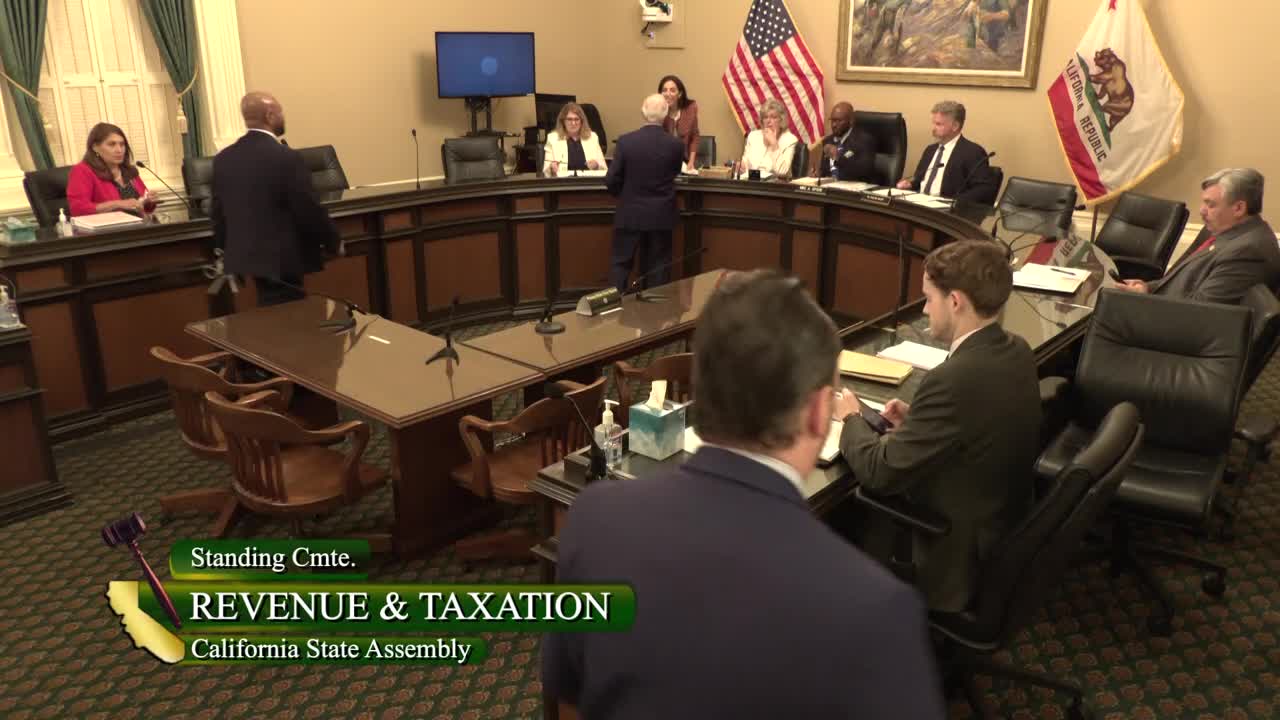 12MIN
Assembly Standing Committee on Revenue and Taxation
 21MIN
Senate Floor
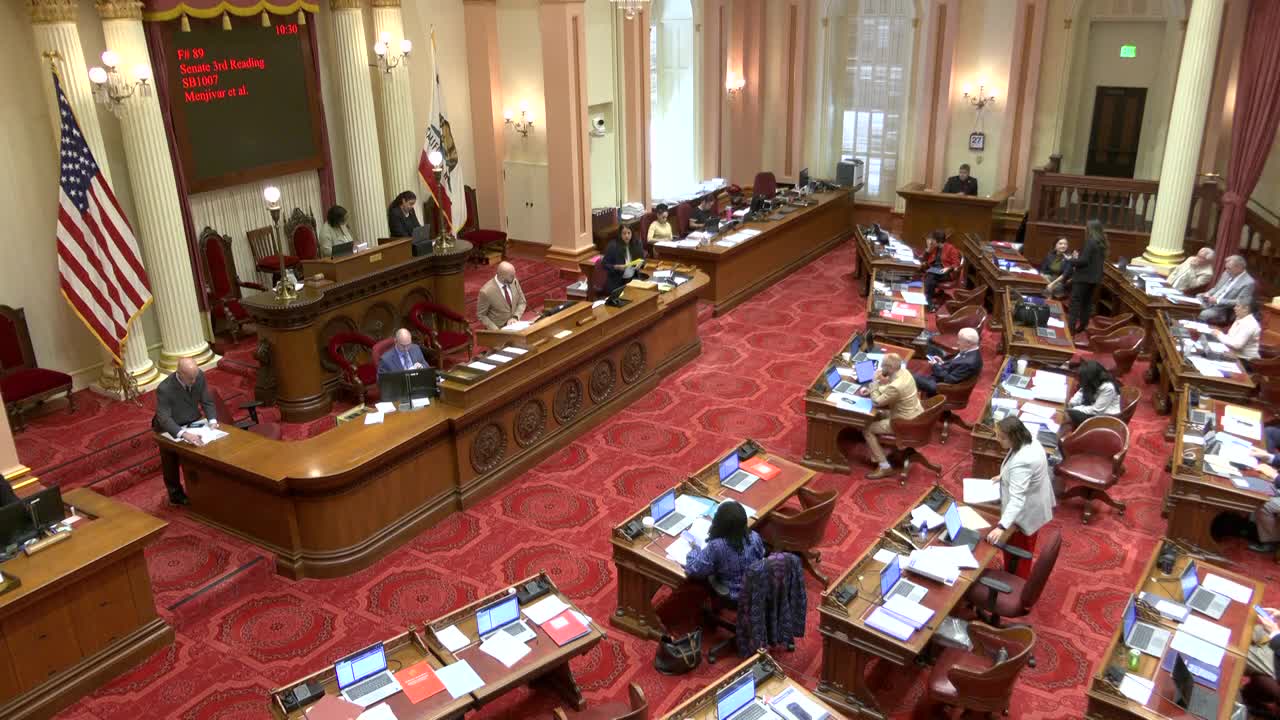 25SEC
Senate Floor
 14MIN
Senate Standing Committee on Revenue and Taxation
Bill Author

Bill Co-Author(s):