SB 1338: Vehicles: repossession.
- Session Year: 2025-2026
- House: Senate
- Latest Version Date: 2026-05-14
Current Status:
In Progress
(2026-06-30: June 30 set for final hearing canceled at the request of author.)
Introduced
In Committee
Awaiting First Chamber Vote
Passed First Chamber
In Committee
Awaiting Second Chamber Vote
Passed Second Chamber
Enacted
Existing law prohibits a person from interfering with the transport of a vehicle to a storage facility, auction, or dealer by an individual who is employed by a repossession agency or is licensed as a repossession agency once repossession is complete, as provided. A violation of these provisions would be an infraction pursuant to other provisions of law. Under existing law, a violation of this provision is an infraction, punishable by specified fines.
This bill would instead make the interference with the transport of a vehicle to a storage facility, auction, or dealer, as described above, punishable as an infraction or misdemeanor, as specified. Because the bill would increase the punishment required by the crime, it would impose a state-mandated local program. double the fines, as specified.
The California Constitution requires the state to reimburse local agencies and school districts for certain costs mandated by the state. Statutory provisions establish procedures for making that reimbursement.This bill would provide that no reimbursement is required by this act for a specified reason.Existing law prohibits a person from interfering with the transport of a vehicle to a storage facility, auction, or dealer by an individual who is employed by a repossession agency or is licensed as a repossession agency once repossession is complete, as provided. A violation of these provisions would be an infraction pursuant to other provisions of law.
This bill would instead make the interference with the transport of a vehicle to a storage facility, auction, or dealer, as described above, punishable as a misdemeanor. an infraction or misdemeanor, as specified. Because the bill would increase the punishment required by the crime, it would impose a state-mandated local program.
The California Constitution requires the state to reimburse local agencies and school districts for certain costs mandated by the state. Statutory provisions establish procedures for making that reimbursement.
This bill would provide that no reimbursement is required by this act for a specified reason.
Existing law prohibits a person from interfering with the transport of a vehicle to a storage facility, auction, or dealer by an individual who is employed by a repossession agency or is licensed as a repossession agency once repossession is complete, as provided. A violation of these provisions would be an infraction pursuant to other provisions of law.
This bill would instead make the interference with the transport of a vehicle to a storage facility, auction, or dealer, as described above, punishable as a misdemeanor. Because the bill would increase the punishment required by the crime, it would impose a state-mandated local program.
The California Constitution requires the state to reimburse local agencies and school districts for certain costs mandated by the state. Statutory provisions establish procedures for making that reimbursement.
This bill would provide that no reimbursement is required by this act for a specified reason.
Existing law authorizes an organization to apply to the Department of Motor Vehicles for participation in special interest license plate programs in which the department issues license plates with a participating organizations distinctive design, decal, or descriptive message and specifies the design criteria for the special license plate.This bill would make a technical, nonsubstantive change to these provisions.Existing law authorizes an organization to apply to the Department of Motor Vehicles for participation in special interest license plate programs in which the department issues license plates with a participating organizations distinctive design, decal, or descriptive message and specifies the design criteria for the special license plate.
This bill would make a technical, nonsubstantive change to these provisions.
(a)(1)A person shall not interfere with the transport of a vehicle to a storage facility, auction, or dealer by an individual who is employed by a repossession agency or who is licensed pursuant to Chapter 11 (commencing with Section 7500) of Division 3 of the Business and Professions Code once repossession is complete as provided in Section 7507.12 of the Business and Professions Code.
(2)A violation of this subdivision shall be punishable either as an infraction, or as a misdemeanor punishable by a fine not exceeding four hundred dollars ($400), imprisonment in a county jail not exceeding 60 days, or both such fine and imprisonment. as follows:
(A)By a fine not exceeding two hundred dollars ($200).
(B)For a second infraction occurring within one year of a prior infraction that resulted in a conviction, a fine not exceeding four hundred dollars ($400).
(C)For a third or subsequent infraction occurring within one year of two or more prior infractions that resulted in convictions, a fine not exceeding five hundred dollars ($500).
(3)This subdivision shall not apply to a peace officer while acting in an official capacity.
(b)(1)Any tow yard, impounding agency, or governmental agency, or any person acting on behalf of those entities, shall not refuse to release a vehicle or other collateral to anyone that is legally entitled to that vehicle or other collateral.
(2)This subdivision shall not apply to a vehicle being held for evidence by law enforcement or a prosecuting attorney.
(c)For purposes of this section, interfere means to physically impede by obstructing, hindering, or preventing movement, including removing or disabling equipment used for transporting the vehicle.
SEC. 2.No reimbursement is required by this act pursuant to Section 6 of Article XIIIB of the California Constitution because the only costs that may be incurred by a local agency or school district will be incurred because this act creates a new crime or infraction, eliminates a crime or infraction, or changes the penalty for a crime or infraction, within the meaning of Section 17556 of the Government Code, or changes the definition of a crime within the meaning of Section 6 of Article XIIIB of the California Constitution.(a)(1)A person shall not interfere with the transport of a vehicle to a storage facility, auction, or dealer by an individual who is employed by a repossession agency or who is licensed pursuant to Chapter 11 (commencing with Section 7500) of Division 3 of the Business and Professions Code once repossession is complete as provided in Section 7507.12 of the Business and Professions Code. A
(2)A violation of this subdivision shall be punishable either as a misdemeanor. This an infraction, or as a misdemeanor punishable by a fine not exceeding four hundred dollars ($400), imprisonment in a county jail not exceeding 60 days, or both such fine and imprisonment.
(3)This subdivision shall not apply to a peace officer while acting in an official capacity.
(b)(1)Any tow yard, impounding agency, or governmental agency, or any person acting on behalf of those entities, shall not refuse to release a vehicle or other collateral to anyone that is legally entitled to that vehicle or other collateral. This
(2)This subdivision shall not apply to a vehicle being held for evidence by law enforcement or a prosecuting attorney.
(c)For purposes of this section, interfere means to physically impede by obstructing, hindering, or preventing movement, including removing or disabling equipment used for transporting the vehicle.
SEC. 2.No reimbursement is required by this act pursuant to Section 6 of Article XIIIB of the California Constitution because the only costs that may be incurred by a local agency or school district will be incurred because this act creates a new crime or infraction, eliminates a crime or infraction, or changes the penalty for a crime or infraction, within the meaning of Section 17556 of the Government Code, or changes the definition of a crime within the meaning of Section 6 of Article XIIIB of the California Constitution.
(a)A person shall not interfere with the transport of a vehicle to a storage facility, auction, or dealer by an individual who is employed by a repossession agency or who is licensed pursuant to Chapter 11 (commencing with Section 7500) of Division 3 of the Business and Professions Code once repossession is complete as provided in Section 7507.12 of the Business and Professions Code. A violation of this subdivision shall be punishable as a misdemeanor. This subdivision shall not apply to a peace officer while acting in an official capacity.
(b)Any tow yard, impounding agency, or governmental agency, or any person acting on behalf of those entities, shall not refuse to release a vehicle or other collateral to anyone that is legally entitled to that vehicle or other collateral. This subdivision shall not apply to a vehicle being held for evidence by law enforcement or a prosecuting attorney.
SEC. 2.No reimbursement is required by this act pursuant to Section 6 of Article XIIIB of the California Constitution because the only costs that may be incurred by a local agency or school district will be incurred because this act creates a new crime or infraction, eliminates a crime or infraction, or changes the penalty for a crime or infraction, within the meaning of Section 17556 of the Government Code, or changes the definition of a crime within the meaning of Section 6 of Article XIIIB of the California Constitution.
SECTION 1.Section 5060 of the Vehicle Code is amended to read:5060.(a)An organization may apply to the department for participation in a special interest license plate program and the department shall issue special license plates for that program if the issuance of those plates is required by this article, the sponsoring organization complies with the requirements of this section, and the organization meets all of the following criteria:(1)Qualifies for tax-exempt status under Section 501(c)(3) of the Internal Revenue Code and Section 23701d of the Revenue and Taxation Code.(2)Submits a financial plan describing the purposes for which the revenues described in paragraph (2) of subdivision (e) will be used.(3)Submits a design of the organizations proposed special interest license plate that, among other things, provides for the placement of the number and letter characters in a manner that allows for law enforcement to readily identify those characters.(b)Any person described in Section 5101 may apply for special interest license plates, in lieu of the regular license plates.(c)The design criteria for a special interest license plate are as follows:(1)The license plate for a passenger vehicle, commercial vehicle, or trailer shall provide a space not larger than two inches by three inches to the left of the numerical series and a space not larger than five-eighths of an inch in height below the numerical series for a distinctive design, decal, or descriptive message as authorized by this article. The plates shall be issued in sequential numerical order or, pursuant to Section 5103, in a combination of numbers or letters.(2)Special interest license plates authorized under this article may be issued for use on a motorcycle. That license plate shall contain a five digit configuration issued in sequential numerical order or, pursuant to Section 5103, in a combination of numbers or letters. There shall be a space to the left of the numerical series for a distinctive design or decal and the characters shall contrast sharply with the uniform background color. No motorcycle plate containing a full plate graphic design is authorized. Those particular special interest license plates that were issued prior to the discontinuation provided by this paragraph may continue to be used and attached to the vehicle for which they were issued and may be renewed, retained, or transferred pursuant to this code.(d)(1)No organization may be included in the program until not less than 7,500 applications for the particular special interest license plates are received. Each organization shall collect and hold applications for the plates. Once the organization has received at least 7,500 applications, it shall submit the applications, along with the necessary fees, to the department. The department shall not issue any special interest license plate until an organization has received and submitted to the department not less than 7,500 applications for that particular special interest license plate within the time period prescribed in this section. Advanced payment to the department by an organization representing the departments estimated or actual administrative costs associated with the issuance of a particular special interest license plate shall not constitute compliance with this requirement. The organization shall have 12 months, following the effective date of the enactment of the specific legislation enabling the organization to participate in this program, to receive the required number of applications. If, after that 12 months, 7,500 applications have not been received, the organization shall immediately do either of the following:(A)Refund to all applicants any fees or deposits that have been collected.(B)Contact the department to indicate the organizations intent to undertake collection of additional applications and fees or deposits for an additional period, not to exceed 12 months, in order to obtain the minimum 7,500 applications. If an organization elects to exercise the option under this paragraph, it shall contact each applicant who has submitted an application with the appropriate fees or deposits to determine if the applicant wishes a refund of fees or deposits or requests the continuance of the holding of the application and fees or deposits until that time that the organization has received 7,500 applications. The organization shall refund the fees or deposits to any applicant so requesting. In no event shall an organization collect and hold applications for a period exceeding 24 months following the date of authorization as described in paragraph (2) of subdivision (a).(C)Sequential plate fees shall be paid for the original issuance, renewal, retention, replacement, or transfer of the special interest license plate as determined by the organization and authorized by the departments regulations. Those plates containing a personalized message are subject to the fees required pursuant to Sections 5106 and 5108 in addition to any fees required by the special interest license plate program.(2)(A)If the number of currently outstanding and valid special interest license plates in any particular program provided for in this article is less than 7,500, the department shall notify the sponsoring organization of that fact and shall inform the organization that if that number is less than 7,500 one year from the date of that notification, the department will no longer issue or replace those special interest license plates.(B)Those particular special interest license plates that were issued prior to the discontinuation provided by subparagraph (A) may continue to be used and attached to the vehicle for which they were issued and may be renewed, retained, or transferred pursuant to this code.(e)(1)The department shall deduct its costs to develop and administer the special interest license plate program from the revenues collected for the plates.(2)The department shall deposit the remaining revenues from the original issuance, renewal, retention, replacement, or transfer of the special interest license plate in a fund which shall be established by the Controller.(f)When payment of renewal fees is not required as specified in Section 4000, or when a person determines to retain the special interest license plate upon a sale, trade, or other release of the vehicle upon which the plate has been displayed, the person shall notify the department and the person may retain and use the plate as authorized by department regulations.(g)An organization that is eligible to participate in a special interest license plate program pursuant to this article and receives funds from the additional fees collected from the sale of special license plates shall not expend annually more than 25 percent of those funds on administrative costs, marketing, or other promotional activities associated with encouraging application for, or renewal of, the special license plates.(h)(1)Every organization authorized under this article to offer special interest license plates shall prepare and submit an annual accounting report to the department by June 30. The report shall include an accounting of all revenues and expenditures associated with the special interest license plate program.(2)If an organization submits a report pursuant to paragraph (1) indicating that the organization violated the expenditure restriction set forth in subdivision (g), the department shall immediately cease depositing fees in the fund created by the Controller for that organization under paragraph (2) of subdivision (e) and, instead, shall deposit those fees that would have otherwise been deposited in that fund in a separate fund created by the Controller, which fund is subject to appropriation by the Legislature. The department shall immediately notify the organization of this course of action. The depositing of funds in the account established pursuant to this paragraph shall continue until the organization demonstrates to the satisfaction of the department that the organization is in compliance or will comply with the requirements of subdivision (g). If one year from the date that the organization receives the notice described in this paragraph, the organization is still unable to satisfactorily demonstrate to the department that it is in compliance or will comply with the requirements of subdivision (g), the department shall no longer issue or replace those special interest license plates associated with that organization. Those particular special interest license plates that were issued prior to the discontinuation provided by this paragraph may continue to be used and attached to the vehicle for which they were issued and may be renewed, retained, or transferred pursuant to this code.(3)Upon receiving the reports required under paragraph (1), the department shall prepare and transmit an annual consolidated report to the Legislature containing the revenue and expenditure data.(a)An organization may apply to the department for participation in a special interest license plate program and the department shall issue special license plates for that program if the issuance of those plates is required by this article, the sponsoring organization complies with the requirements of this section, and the organization meets all of the following criteria:
(1)Qualifies for tax-exempt status under Section 501(c)(3) of the Internal Revenue Code and Section 23701d of the Revenue and Taxation Code.
(2)Submits a financial plan describing the purposes for which the revenues described in paragraph (2) of subdivision (e) will be used.
(3)Submits a design of the organizations proposed special interest license plate that, among other things, provides for the placement of the number and letter characters in a manner that allows for law enforcement to readily identify those characters.
(b)Any person described in Section 5101 may apply for special interest license plates, in lieu of the regular license plates.
(c)The design criteria for a special interest license plate are as follows:
(1)The license plate for a passenger vehicle, commercial vehicle, or trailer shall provide a space not larger than 2 two inches by 3 three inches to the left of the numerical series and a space not larger than five-eighths of an inch in height below the numerical series for a distinctive design, decal, or descriptive message as authorized by this article. The plates shall be issued in sequential numerical order or, pursuant to Section 5103, in a combination of numbers or letters.
(2)Special interest license plates authorized under this article may be issued for use on a motorcycle. That license plate shall contain a five digit configuration issued in sequential numerical order or, pursuant to Section 5103, in a combination of numbers or letters. There shall be a space to the left of the numerical series for a distinctive design or decal and the characters shall contrast sharply with the uniform background color. No motorcycle plate containing a full plate graphic design is authorized. Those particular special interest license plates that were issued prior to the discontinuation provided by this paragraph may continue to be used and attached to the vehicle for which they were issued and may be renewed, retained, or transferred pursuant to this code.
(d)(1)No organization may be included in the program until not less than 7,500 applications for the particular special interest license plates are received. Each organization shall collect and hold applications for the plates. Once the organization has received at least 7,500 applications, it shall submit the applications, along with the necessary fees, to the department. The department shall not issue any special interest license plate until an organization has received and submitted to the department not less than 7,500 applications for that particular special interest license plate within the time period prescribed in this section. Advanced payment to the department by an organization representing the departments estimated or actual administrative costs associated with the issuance of a particular special interest license plate shall not constitute compliance with this requirement. The organization shall have 12 months, following the effective date of the enactment of the specific legislation enabling the organization to participate in this program, to receive the required number of applications. If, after that 12 months, 7,500 applications have not been received, the organization shall immediately do either of the following:
(A)Refund to all applicants any fees or deposits that have been collected.
(B)Contact the department to indicate the organizations intent to undertake collection of additional applications and fees or deposits for an additional period, not to exceed 12 months, in order to obtain the minimum 7,500 applications. If an organization elects to exercise the option under this paragraph, it shall contact each applicant who has submitted an application with the appropriate fees or deposits to determine if the applicant wishes a refund of fees or deposits or requests the continuance of the holding of the application and fees or deposits until that time that the organization has received 7,500 applications. The organization shall refund the fees or deposits to any applicant so requesting. In no event shall an organization collect and hold applications for a period exceeding 24 months following the date of authorization as described in paragraph (2) of subdivision (a).
(C)Sequential plate fees shall be paid for the original issuance, renewal, retention, replacement, or transfer of the special interest license plate as determined by the organization and authorized by the departments regulations. Those plates containing a personalized message are subject to the fees required pursuant to Sections 5106 and 5108 in addition to any fees required by the special interest license plate program.
(2)(A)If the number of currently outstanding and valid special interest license plates in any particular program provided for in this article is less than 7,500, the department shall notify the sponsoring organization of that fact and shall inform the organization that if that number is less than 7,500 one year from the date of that notification, the department will no longer issue or replace those special interest license plates.
(B)Those particular special interest license plates that were issued prior to the discontinuation provided by subparagraph (A) may continue to be used and attached to the vehicle for which they were issued and may be renewed, retained, or transferred pursuant to this code.
(e)(1)The department shall deduct its costs to develop and administer the special interest license plate program from the revenues collected for the plates.
(2)The department shall deposit the remaining revenues from the original issuance, renewal, retention, replacement, or transfer of the special interest license plate in a fund which shall be established by the Controller.
(f)When payment of renewal fees is not required as specified in Section 4000, or when a person determines to retain the special interest license plate upon a sale, trade, or other release of the vehicle upon which the plate has been displayed, the person shall notify the department and the person may retain and use the plate as authorized by department regulations.
(g)An organization that is eligible to participate in a special interest license plate program pursuant to this article and receives funds from the additional fees collected from the sale of special license plates shall not expend annually more than 25 percent of those funds on administrative costs, marketing, or other promotional activities associated with encouraging application for, or renewal of, the special license plates.
(h)(1)Every organization authorized under this article to offer special interest license plates shall prepare and submit an annual accounting report to the department by June 30. The report shall include an accounting of all revenues and expenditures associated with the special interest license plate program.
(2)If an organization submits a report pursuant to paragraph (1) indicating that the organization violated the expenditure restriction set forth in subdivision (g), the department shall immediately cease depositing fees in the fund created by the Controller for that organization under paragraph (2) of subdivision (e) and, instead, shall deposit those fees that would have otherwise been deposited in that fund in a separate fund created by the Controller, which fund is subject to appropriation by the Legislature. The department shall immediately notify the organization of this course of action. The depositing of funds in the account established pursuant to this paragraph shall continue until the organization demonstrates to the satisfaction of the department that the organization is in compliance or will comply with the requirements of subdivision (g). If one year from the date that the organization receives the notice described in this paragraph, the organization is still unable to satisfactorily demonstrate to the department that it is in compliance or will comply with the requirements of subdivision (g), the department shall no longer issue or replace those special interest license plates associated with that organization. Those particular special interest license plates that were issued prior to the discontinuation provided by this paragraph may continue to be used and attached to the vehicle for which they were issued and may be renewed, retained, or transferred pursuant to this code.
(3)Upon receiving the reports required under paragraph (1), the department shall prepare and transmit an annual consolidated report to the Legislature containing the revenue and expenditure data.
|
Date
|
Status
|
|---|---|
| Jun 30, 2026 | June 30 set for final hearing canceled at the request of author. |
| Jun 23, 2026 | June 23 set for second hearing canceled at the request of author. |
| Jun 11, 2026 | June 9 set for first hearing canceled at the request of author. |
| Jun 1, 2026 | Referred to Com. on PUB. S. |
| May 22, 2026 | In Assembly. Read first time. Held at Desk. |
| May 22, 2026 | Read third time. Passed. (Ayes 32. Noes 0. Page 4416.) Ordered to the Assembly. |
| May 22, 2026 | Read third time. Passed. (Ayes 32. Noes 0.) Ordered to the Assembly. |
| May 18, 2026 | Read second time. Ordered to third reading. |
| May 14, 2026 | From committee: Do pass as amended. (Ayes 7. Noes 0. Page 4273.) (May 14). |
| May 14, 2026 | Read second time and amended. Ordered to second reading. |
| May 14, 2026 | From committee: Do pass as amended. (Ayes 7. Noes 0.) (May 14). |
| May 12, 2026 | Set for hearing May 14. |
| May 11, 2026 | May 11 hearing: Placed on APPR. suspense file. |
| May 4, 2026 | Set for hearing May 11. |
| Apr 23, 2026 | Read second time and amended. Re-referred to Com. on APPR. |
| Apr 22, 2026 | From committee: Do pass as amended and re-refer to Com. on APPR. (Ayes 5. Noes 1. Page 3984.) (April 21). |
| Apr 22, 2026 | From committee: Do pass as amended and re-refer to Com. on APPR. (Ayes 5. Noes 1.) (April 21). |
| Apr 15, 2026 | Set for hearing April 21. |
| Apr 14, 2026 | April 14 set for first hearing canceled at the request of author. |
| Apr 9, 2026 | Set for hearing April 14. |
| Apr 8, 2026 | Re-referred to Com. on PUB. S. |
| Mar 25, 2026 | From committee with author's amendments. Read second time and amended. Re-referred to Com. on RLS. |
| Mar 4, 2026 | Referred to Com. on RLS. |
| Feb 23, 2026 | Read first time. |
| Feb 23, 2026 | From printer. May be acted upon on or after March 23. |
| Feb 20, 2026 | Introduced. To Com. on RLS. for assignment. To print. |
|
Date
|
Description
|
Location
|
Votes
|
|
|---|---|---|---|---|
| May 22, 2026 | Senate 3rd Reading SB1338 Jones | Senate Floor |
Passed |
|
| May 14, 2026 | Do pass as amended | Senate Standing Committee on Appropriations |
Passed |
|
| May 11, 2026 | Placed on suspense file | Senate Standing Committee on Appropriations |
Passed |
|
| Apr 21, 2026 | Do pass as amended, but first amend, and re-refer to the Committee on [Appropriations] | Senate Standing Committee on Public Safety |
Passed |
This list shows positions taken on this bill by organizations on the date displayed, which is linked to the original source.
Positions by individuals are not included.
|
Organization
|
Position
|
Date
|
|---|---|---|
| Aclu California Action | ** Against | |
| All of Us or None | ** Against | |
| California Association Of Licensed Repossessors | ** Support | |
| Californians United for a Responsible Budget | ** Against | |
| California Public Defenders Association | ** Against | |
| Daybreak Metro | ** Support | |
| Daybreak Metro, INC | ** Support | |
| Ella Baker Center For Human Rights | ** Against | |
| Justice2jobs Coalition | ** Against | |
| LA Defensa | ** Against | |
| Legal Services for Prisoners with Children | ** Against | |
| Smart Justice California | ** Against |
Date of Hearing: June 30, 2026
Counsel: Dustin Weber
ASSEMBLY COMMITTEE ON PUBLIC SAFETY
Nick Schultz, Chair
SBPCA Bill Id:SB 1338
Author:(Jones) – As Amended Ver:May 14, 2026
SUMMARY: Increases fines for interfering with the transport of a vehicle to a storage facility, auction, or dealer by an individual who is employed by a repossession agency. Specifically, this bill:
- Punishes with an infraction and increases the fine from $100-$200 a person who interferes with the transport of a vehicle to a storage facility, auction, or dealer by an individual who is employed by a repossession agency.
- Punishes with an infraction and increases the fine from $200-$400 a person who, for a second time within one year, interferes with the transport of a vehicle to a storage facility, auction, or dealer by an individual who is employed by a repossession agency.
- Punishes with an infraction and increases the fine from $250-$500 a person who, for a third or subsequent time within one year, interferes with the transport of a vehicle to a storage facility, auction, or dealer by an individual who is employed by a repossession agency.
- Defines “interfere” as to physically impede by obstructing, hindering, or preventing movement, including removing or disabling equipment used for transporting the vehicle.
EXISTING LAW:
- Prohibits a person from interfering with the transport of a vehicle to a storage facility, auction, or dealer by an individual who is employed by a repossession agency or who is licensed as a repossessor, once repossession is complete, as specified. This prohibition does not apply to a peace officer while acting in an official capacity. This offense is punishable as an infraction. (Veh. Code, § 10856, subd. (a).)
- States that any tow yard, impounding agency, or governmental agency, or any person acting on behalf of a person employed by a repossession agency or who is licensed as a repossessor, to release a vehicle or other collateral to anyone that is legally entitled to that vehicle or other collateral shall not refuse release of the vehicle or collateral. This subdivision does not apply to a vehicle being held for evidence by law enforcement or a prosecuting attorney. (Veh. Code, § 10856, subd. (b).)
- Requires that a person convicted of an infraction for defined violations of the Vehicle Code be punished as follows:
- By a fine not exceeding $100.
- For a second infraction occurring within one year of a prior infraction that resulted in a conviction, a fine not exceeding $200.
- For a third or subsequent infraction occurring within one year of two or more prior infractions that resulted in convictions, a fine not exceeding $250. (Veh. Code, § 42001, subd. (a).)
- Defines “repossession” as any of the following:
- The repossessor gains entry to the collateral.
- The collateral becomes connected to a tow truck or the repossessor’s tow vehicle.
- The repossessor moves the entire collateral present.
- The repossessor gains control of the collateral.
- The repossessor disconnects any part of the collateral from any surface where it is mounted or attached. (Bus. & Prof. Code, § 7500.2.)
- Defines “repossession agency” as any person who, for any consideration whatsoever, engages in business or accepts employment to locate or recover collateral, whether voluntarily or involuntarily, including, but not limited to, collateral registered under the provisions of the Vehicle Code that is subject to a security agreement. (Bus. & Prof. Code, § 7500.2, subd. (a).)
FISCAL EFFECT:
Unknown
COMMENTS:
- Sponsor: California Association of Licensed Repossessors.
- Author's Statement: According to the author, “Repossessions often occur in unpredictable and dynamic environments, where interactions between agents and debtors can escalate quickly. While current law prohibits interference with the transportation of a repossessed vehicle after the repossession is complete, existing provisions do not sufficiently ensure orderly completion of these activities. SB 1338 reinforces these protections by increasing the penalty for intentional interference, establishing clearer consequences for interference and defining what constitutes this interference.”
- Effect of the Bill: SB 1338 would double the fines available generally for interfering with the repossession of a vehicle. It is unclear whether increasing penalties has a deterrent effect. There is reliable evidence showing increased penalties generally fails to deter criminal behavior.[1] Data shows greater deterrent effects as the likelihood of being caught and the perception that one will get caught rises.[2] In contrast, the act of punishment and the length of punishment largely do not increase deterrence.[3]
Fines and the collection of those fines are commonly misunderstood. The actual cost to a defendant can be much higher than the base fine amount. The breakdown and supporting information below can be illustrative.
Example: Penalty assessments and fees on a base fine of $1,000:
Pen. Code, § 1464 state penalty on fines: 1,000 ($10 for every $10)
Pen. Code, § 1465.7 state surcharge: 200 (20% surcharge)
Pen. Code, § 1465.8 court operation assessment: 40 ($40 fee per criminal offense)
Gov. Code, § 70372 court construction penalty: 500 ($5 for every $10)
Gov. Code, § 70373 assessment: 30 ($30 for felony or misdemeanor)
Gov. Code, § 76000 penalty: 700 ($7 for every $10)
Gov. Code, § 76000.5 EMS penalty: 200 ($2 for every $10)
Gov. Code, § 76104.6 DNA fund penalty: 100 ($1 for every $10)
Gov. Code, § 76104.7 additional DNA fund penalty:400 ($4 for every $10)
Total Fine with Assessments: $4,170
Fines can rapidly balloon into unpayable amounts for most of the population, which create downstream economic consequences for impacted individuals and society. Unsurprisingly, the judicial branch reported that $8.6 billion in fines and fees remained unpaid at the end of 2019-20.[4]
With evidence also showing that growing fines increases felony recidivism, specifically among a population that historically has faced disproportionate punishment in the criminal justice system,[5] it remains questionable whether increasing fines, as this bill does, would produce the desired impact.
- Need for the Bill: One of the justifications for the penalty increases in this bill includes the occasionally chaotic examples of repossession. For example, in February 2026, a repossession agent in Apple Valley towed a vehicle when a suspect approached and threatened him with a firearm. The person put the firearm away when he was informed the tow truck driver was a repossession agent.[6] In 2025, a Huntington Beach man assaulted a repossession agent who was attempting to recover a towed boat, causing significant injuries.[7] In 2023, repossession agent Blaine LaPrairie responded to a call to repossess a vehicle when he was shot in the upper body.[8] He was transported to a nearby hospital, where he later died from his injuries.[9] While these incidents are certainly troubling, they represent a few incidents across a few years. Because there does not appear to be reliable, contemporary data tracking violence against repossessors, it is difficult to know whether these incidents are outliers or representative of an emerging or existing trend. Given the data on the unlikelihood of deterrence being effective with increased fines proposed by SB 1338, it is important to consider whether this bill will produce the author’s desired impact.
The intent of the bill, at least in part, is to deter people from engaging in violence with repossessors while they are in the process of repossessing or transporting a vehicle. Yet, as noted in the previous section of the analysis, it is unclear whether the expanded penalties proposed in SB 1338 will have a deterrent effect.
- Punishing Poverty: SB 1338 would double the fines associated generally with interfering with a repossessor. Vehicle repossession generally arises out of an inability to make payments on a vehicle you have purchased and financed. An inability to make these payments is often connected to a person’s economic wellbeing. In 2026, the economic health of Californians and Americans at large, under many measures, is historically bad. These punishing economic headwinds facing everyday Californians are falling most heavily on those with the least.
California has the highest poverty rate in the country.[10] California’s poverty rate rose from 11.7% in 2021 to 13.2% in 2023, and nearly a third of Californians are living in or near poverty.[11] This rising poverty rate, as well as increased costs of living, has coincided with a significant increase in California’s homelessness population—increasing by as much as 7.5% between 2022 and 2023.[12] Recent data suggests that more than 180,000 persons were experiencing homelessness in California in 2024.[13] Racial disparities among the homeless population is well documented. The share of Black, American Indian, Alaska Native, or Indigenous people experiencing homelessness is five times greater than their share of the total population.[14]
Other economic data paints a sobering picture, particularly among those living at or near the margins. In a report released by the Urban Institute, which is an organization founded by President Lyndon B. Johnson in 1968 to provide knowledge to help solve the problems that weighed heavily on the nation’s hearts and minds, they found Americans struggling to afford necessities like “food, child care, housing, and energy.”[15] They found roughly half of American families cannot afford the true cost of living, which generally measures whether they have the resources to “live securely in their community.”[16] Nearly every essential need for American families is rising much faster than earnings, including home and rental costs, health care plans, electricity cost, costs of groceries, and notably, gas prices.[17] In the past three months alone, gas prices have gone up an average of $1.00 per gallon.[18] California is home to unreachable housing prices for much of its population. The available jobs, too, are rapidly deteriorating as the labor market continues to constrict with employers making callous, painful and broad cuts to their workforce in favor of the comparatively minimal costs of using artificial-intelligence programs.[19] As a result, credit card delinquency rates, student loan rates, and most relevantly here, auto delinquency rates appear to be relentlessly growing in 2026.[20]
The rise of homelessness additionally has led to an increasing number of persons living in their vehicles.[21] In San Jose, an estimated 17% of people experiencing homelessness live in their vehicles, while in Sonoma County the estimate is 29%.[22] Notably, in Los Angeles, almost half of the unsheltered population are estimated to live in their vehicles.[23] Vehicles represent a critical last-resort for persons on the verge of losing shelter. As stated by Transfer Magazine, a publication of the Pacific Southwest Region University Transportation Center:
A car is often shelter of last resort for housing-insecure people. If a person loses their housing and has a vehicle, that vehicle can prevent them from living on sidewalks and other public places. Tents and other makeshift shelters can offer protection from the elements, but cars tend to offer more safety and stability, and more mobility. A car can be locked to secure one’s belongings, blends into the neighborhood in ways a sidewalk tent doesn’t, and offers a way to reach jobs, schools, and services.[24]
For an unhoused person who utilizes their car not only as shelter, but as a means to get to their job, services, or medical needs, losing their car to impoundment is a tipping point that can lead to unsheltered homelessness.[25] This is particularly true, given that once a vehicle is towed, the person living in it often are unable to afford to recover their cars.[26]
Furthermore, the Sentencing Project released a four-part report that undertook a comprehensive analysis of persisting racial and economic inequities in the American criminal justice system. The report found one driver of carceral disparity relates to the damaging consequences of criminal legal contact, which are disproportionately experienced by communities of color.[27] Fines, fees, and predatory practices are inequitably experienced by justice-involved Americans and families.[28]
Criminal justice involvement often begins with system contact that stems, at least initially, from an infraction. Under current law, infractions can produce unpayable fees for some that can then balloon into crippling, life-altering debt. Moreover, system contact can quickly turn into a misdemeanor if the charged individual is unable to comply with established legal processes. While some individuals may be negligent or unwilling to abide by these processes, far too often justice-involved individuals are simply faced with impossible choices. Criminal convictions too often create lifelong disadvantage, particularly for African Americans.[29] Employers discriminate against job candidates who have criminal histories, especially against those who are Black, and application questions about criminal histories deter some people from applying to certain jobs and colleges altogether.[30] One study found discovered nearly half of unemployed men had a criminal conviction.[31]
Given the painful economic headwinds facing Californians and the likelihood that increased fines arising from this bill would disproportionately impact those already living on the margins, the timing and impact of this bill may be worth further evaluation.
- Argument in Support: According to the bill’s sponsor, the California Association of Licensed Repossessors, “we respectfully urge your support on Senate Bill 1338 by Senator Brian Jones, which would increase the fines for the infraction.
“Unfortunately, a violent and dangerous trend has emerged in the repossession industry. After a vehicle has been repossessed and is in transit, individuals-including the registered owner- follow and attempt to stop the repossessor’s tow vehicle by using other vehicles to block exits, by boxing in the tow truck on residential streets or at intersections, or by otherwise obstructing the roadway. Once the repossessor’s vehicle has been stopped, individuals attempt to unhook the repossessed vehicle from the tow truck, enter or sit inside the repossessed vehicle, sit on the tow vehicle, or stand in front of the tow truck to prevent it from leaving. In some cases, when they are unable to regain possession of the vehicle, individuals damage the repossessor’s tow vehicle. This conduct creates serious public safety risks not only to the repossessor and the involved individuals, but also to law enforcement officers and passing motorists.
“SB 1338 does not expand repossession authority nor alter the breach-of-peace doctrine, nor change the definition of when a repossession must cease. It is a narrowly tailored public safety enforcement adjustment addressing post-repossession completion transport interference. This proposal amends Vehicle Code Section 10856 to reclassify interference with a repossessed vehicle after repossession has been lawfully completed
“Reclassifying this violation provides law enforcement with meaningful enforcement authority.
“It allows us to raise the penalties for interference.
“This will help avoid dangerous roadway obstruction and interference, to protect involved individuals and the general public, and preserve California’s breach-of-peace doctrine.
“As licensed reposessor’s we hold our profession to the highest integrity and believe SB 1338 will increase both public safety and safety of our repossessor colleagues. It is for these reasons that we seek your support of SB 1338 (Jones) when it comes before your committee.”
- Argument in Opposition: According to the American Civil Liberties Union, “The American Civil Liberties Union California Action must respectfully oppose SB 1338, which would increase the criminal penalties for interfering with the transportation of a vehicle by a repossession agency.
“SB 1338 will not improve public safety and may exacerbate the issue the bill aims to address. While we appreciate the latest amendments, SB 1338’s approach of increased fines goes against extensive public safety research which demonstrates that increased sentences do not deter or prevent crime.1 In addition to failing to deter the behavior at issue, extracting increased fines from individuals only drives them further into economic desperation, making them less likely to be able to pay down their debts and more likely to have negative interactions with repossession agency employees.
“For these reasons, we must respectfully oppose SB 1338.”
- Related Legislation: AB 2437 (Chen) would make it a violation of the Vehicle Code to require a vehicle’s legal owner or a legal owner’s agent to present any documentation other than the documents specified to secure release of the vehicle or collateral to which the person is legally entitled. AB 2437 has been referred to the Senate Transportation Committee.
- Prior Legislation: AB 2503 (Hagman), Chapter 390, Statutes of 2014, requires, among other things, a repossession agency to only transact business with a person or entity as an independent contractor, and prohibits a licensed repossession agency from allowing a person or entity, other than the qualified certificate holder or the owner or officer of the repossession agency, to manage the day-to-day operations, operate, control, or transact business under the license of the repossession agency, except as specified.
REGISTERED SUPPORT / OPPOSITION:
Support
California Association of Licensed Repossessors (Sponsor)
Daybreak Metro, INC
Opposition
ACLU California Action
All of Us or None
Californians United for a Responsible Budget
Ella Baker Center for Human Rights
Justice2jobs Coalition
LA Defensa
Legal Services for Prisoners With Children
Smart Justice California
Analysis Prepared by: Dustin Weber / PUB. S. / (916) 319-3744
National Institute of Justice, Five Things About Deterrence (May 2016) <https://www.ojp.gov/pdffiles1/nij/247350.pdf> [as of May 29, 2026]. ↑
Ibid. ↑
Ibid. ↑
Legis. Analyst, Overview of Criminal Fine and Fee System (May 13, 2021) <https://lao.ca.gov/Publications/Detail/4427> [as of May 29, 2026]. ↑
Giles, The Government Revenue, Recidivism, and Financial Health Effects of Criminal Fines and Fees (Feb. 19, 2025) Wellesley College <http://dx.doi.org/10.2139/ssrn.4568724> [as of May 29, 2026]. ↑
20-Year-Old Apple Valley Resident Arrested After Allegedly Pointing Gun at Repo Driver In Victorville (Feb. 14, 2026) Victor Valley News Group <https://www.vvng.com/20-year-old-apple-valley-resident-arrested-after-allegedly-pointing-gun-at-repo-driver-in-victorville/> [as of May 29, 2026]. ↑
Dallow, Huntington Beach man arrested after assault, SWAT standoff over towed boat, KTLA 5 (Dec. 19, 2025) <https://ktla.com/news/local-news/huntington-beach-man-arrested-after-assault-swat-standoff-over-towed-boat/> [as of May 29, 2026]. ↑
Chow, Southern California repo man killed on the job, suspect at large (Dec. 15, 2023) KTLA 5 <https://ktla.com/news/local-news/socal-repo-man-killed-on-the-job-suspect-at-large/> [as of May 29, 2026]. ↑
Ibid. ↑
Dan Walters, Once again, California beats every other state when it comes to poverty (Sept. 11, 2024) CalMatters <https://calmatters.org/commentary/2024/09/california-again-top-state-poverty/> [as of June 5, 2026]. ↑
Bohn et. al., Poverty in California (Oct. 2023) Public Policy Institute of California <https://www.ppic.org/publication/poverty-in-california/> [as of June 5, 2026]. ↑
Cuellar and Perez, An Update on Homelessness in California (March 21, 2024) <https://www.ppic.org/blog/an-update-on-homelessness-in-california/> [as of June 5, 2026]. ↑
Ibid. ↑
Acting to Prevent, Reduce, and End Homelessness (2026) Business, Consumer Services and Housing Agency <https://bcsh.ca.gov/calich/hdis.html> [as of June 5, 2026]. ↑
The American Affordability Tracker (Apr. 2, 2026) Urban Institute <https://www.urban.org/data-tools/american-affordability-tracker> [as of June 5, 2026]. ↑
Ibid. ↑
Ibid. ↑
Ibid. ↑
Wong, Q. AI boom fuels California growth but leaves more workers jobless (June 5, 2026) Los Angeles Times <https://www.latimes.com/business/story/2026-06-05/californian-conundrum-high-growth-but-high-unemployment> [as of June 5, 2026]. ↑
Supra, at note 15. ↑
Giamarino, et. al., Geographic and Regulatory Impacts on Vehicle Homelessness in Los Angeles (June 28, 2022) <https://www.its.ucla.edu/publication/geographic-regulatory-impacts-vehicular-homelessness-los-angeles/> [as of June 5, 2026]. ↑
Madeline Brozen, Where you Go When Your Car is Home (Jan. 2023), Transfer Magazine <https://transfersmagazine.org/magazine-article/issue-10/where-you-go-when-your-car-is-home/> [as of June 5, 2026]. ↑
Gorn, with thousands of Californians living in vehicles, lawsuit aims to stop cities from towing their homes (June 23, 2020) <https://calmatters.org/economy/2018/09/lawsuit-homeless-vehicle-tow-california-impound/> [as of June 5, 2026]. ↑
Ibid. ↑
Ghandnoosh, N and Trinka, L. One in Five: How Mass Incarceration Deepens Inequality and Harms Public Safety (Nov. 2, 2023) The Sentencing Project <https://www.sentencingproject.org/reports/one-in-five-disparities-in-crime-and-policing/> [as of June 5, 2026]. ↑
Ibid. ↑
Ibid. ↑
Ibid. ↑
Ibid. ↑
Date of Hearing: June 23, 2026
Counsel: Dustin Weber
ASSEMBLY COMMITTEE ON PUBLIC SAFETY
Nick Schultz, Chair
SBPCA Bill Id:SB 1338
Author:(Jones) – As Amended Ver:May 14, 2026
SUMMARY: Increases fines for interfering with the transport of a vehicle to a storage facility, auction, or dealer by an individual who is employed by a repossession agency. Specifically, this bill:
- Punishes with an infraction and increases the fine from $100-$200 a person who interferes with the transport of a vehicle to a storage facility, auction, or dealer by an individual who is employed by a repossession agency.
- Punishes with an infraction and increases the fine from $200-$400 a person who, for a second time within one year, interferes with the transport of a vehicle to a storage facility, auction, or dealer by an individual who is employed by a repossession agency.
- Punishes with an infraction and increases the fine from $250-$500 a person who, for a third or subsequent time within one year, interferes with the transport of a vehicle to a storage facility, auction, or dealer by an individual who is employed by a repossession agency.
- Defines “interfere” as to physically impede by obstructing, hindering, or preventing movement, including removing or disabling equipment used for transporting the vehicle.
EXISTING LAW:
- Prohibits a person from interfering with the transport of a vehicle to a storage facility, auction, or dealer by an individual who is employed by a repossession agency or who is licensed as a repossessor, once repossession is complete, as specified. This prohibition does not apply to a peace officer while acting in an official capacity. This offense is punishable as an infraction. (Veh. Code, § 10856, subd. (a).)
- States that any tow yard, impounding agency, or governmental agency, or any person acting on behalf of a person employed by a repossession agency or who is licensed as a repossessor, to release a vehicle or other collateral to anyone that is legally entitled to that vehicle or other collateral shall not refuse release of the vehicle or collateral. This subdivision does not apply to a vehicle being held for evidence by law enforcement or a prosecuting attorney. (Veh. Code, § 10856, subd. (b).)
- Requires that a person convicted of an infraction for defined violations of the Vehicle Code be punished as follows:
- By a fine not exceeding $100.
- For a second infraction occurring within one year of a prior infraction that resulted in a conviction, a fine not exceeding $200.
- For a third or subsequent infraction occurring within one year of two or more prior infractions that resulted in convictions, a fine not exceeding $250. (Veh. Code, § 42001, subd. (a).)
- Defines “repossession” as any of the following:
- The repossessor gains entry to the collateral.
- The collateral becomes connected to a tow truck or the repossessor’s tow vehicle.
- The repossessor moves the entire collateral present.
- The repossessor gains control of the collateral.
- The repossessor disconnects any part of the collateral from any surface where it is mounted or attached. (Bus. & Prof. Code, § 7500.2.)
- Defines “repossession agency” as any person who, for any consideration whatsoever, engages in business or accepts employment to locate or recover collateral, whether voluntarily or involuntarily, including, but not limited to, collateral registered under the provisions of the Vehicle Code that is subject to a security agreement. (Bus. & Prof. Code, § 7500.2, subd. (a).)
FISCAL EFFECT:
Unknown
COMMENTS:
- Sponsor: California Association of Licensed Repossessors.
- Author's Statement: According to the author, “Repossessions often occur in unpredictable and dynamic environments, where interactions between agents and debtors can escalate quickly. While current law prohibits interference with the transportation of a repossessed vehicle after the repossession is complete, existing provisions do not sufficiently ensure orderly completion of these activities. SB 1338 reinforces these protections by increasing the penalty for intentional interference, establishing clearer consequences for interference and defining what constitutes this interference.”
- Effect of the Bill: SB 1338 would double the fines available generally for interfering with the repossession of a vehicle. It is unclear whether increasing penalties has a deterrent effect. There is reliable evidence showing increased penalties generally fails to deter criminal behavior.[1] Data shows greater deterrent effects as the likelihood of being caught and the perception that one will get caught rises.[2] In contrast, the act of punishment and the length of punishment largely do not increase deterrence.[3]
Fines and the collection of those fines are commonly misunderstood. The actual cost to a defendant can be much higher than the base fine amount. The breakdown and supporting information below can be illustrative.
Example: Penalty assessments and fees on a base fine of $1,000:
Pen. Code, § 1464 state penalty on fines: 1,000 ($10 for every $10)
Pen. Code, § 1465.7 state surcharge: 200 (20% surcharge)
Pen. Code, § 1465.8 court operation assessment: 40 ($40 fee per criminal offense)
Gov. Code, § 70372 court construction penalty: 500 ($5 for every $10)
Gov. Code, § 70373 assessment: 30 ($30 for felony or misdemeanor)
Gov. Code, § 76000 penalty: 700 ($7 for every $10)
Gov. Code, § 76000.5 EMS penalty: 200 ($2 for every $10)
Gov. Code, § 76104.6 DNA fund penalty: 100 ($1 for every $10)
Gov. Code, § 76104.7 additional DNA fund penalty:400 ($4 for every $10)
Total Fine with Assessments: $4,170
Fines can rapidly balloon into unpayable amounts for most of the population, which create downstream economic consequences for impacted individuals and society. Unsurprisingly, the judicial branch reported that $8.6 billion in fines and fees remained unpaid at the end of 2019-20.[4]
With evidence also showing that growing fines increases felony recidivism, specifically among a population that historically has faced disproportionate punishment in the criminal justice system,[5] it remains questionable whether increasing fines, as this bill does, would produce the desired impact.
- Need for the Bill: One of the justifications for the penalty increases in this bill includes the occasionally chaotic examples of repossession. For example, in February 2026, a repossession agent in Apple Valley towed a vehicle when a suspect approached and threatened him with a firearm. The person put the firearm away when he was informed the tow truck driver was a repossession agent.[6] In 2025, a Huntington Beach man assaulted a repossession agent who was attempting to recover a towed boat, causing significant injuries.[7] In 2023, repossession agent Blaine LaPrairie responded to a call to repossess a vehicle when he was shot in the upper body.[8] He was transported to a nearby hospital, where he later died from his injuries.[9] While these incidents are certainly troubling, they represent a few incidents across a few years. Because there does not appear to be reliable, contemporary data tracking violence against repossessors, it is difficult to know whether these incidents are outliers or representative of an emerging or existing trend. Given the data on the unlikelihood of deterrence being effective with increased fines proposed by SB 1338, it is important to consider whether this bill will produce the author’s desired impact.
The intent of the bill, at least in part, is to deter people from engaging in violence with repossessors while they are in the process of repossessing or transporting a vehicle. Yet, as noted in the previous section of the analysis, it is unclear whether the expanded penalties proposed in SB 1338 will have a deterrent effect.
- Punishing Poverty: SB 1338 would double the fines associated generally with interfering with a repossessor. Vehicle repossession generally arises out of an inability to make payments on a vehicle you have purchased and financed. An inability to make these payments is often connected to a person’s economic wellbeing. In 2026, the economic health of Californians and Americans at large, under many measures, is historically bad. These punishing economic headwinds facing everyday Californians are falling most heavily on those with the least.
California has the highest poverty rate in the country.[10] California’s poverty rate rose from 11.7% in 2021 to 13.2% in 2023, and nearly a third of Californians are living in or near poverty.[11] This rising poverty rate, as well as increased costs of living, has coincided with a significant increase in California’s homelessness population—increasing by as much as 7.5% between 2022 and 2023.[12] Recent data suggests that more than 180,000 persons were experiencing homelessness in California in 2024.[13] Racial disparities among the homeless population is well documented. The share of Black, American Indian, Alaska Native, or Indigenous people experiencing homelessness is five times greater than their share of the total population.[14]
Other economic data paints a sobering picture, particularly among those living at or near the margins. In a report released by the Urban Institute, which is an organization founded by President Lyndon B. Johnson in 1968 to provide knowledge to help solve the problems that weighed heavily on the nation’s hearts and minds, they found Americans struggling to afford necessities like “food, child care, housing, and energy.”[15] They found roughly half of American families cannot afford the true cost of living, which generally measures whether they have the resources to “live securely in their community.”[16] Nearly every essential need for American families is rising much faster than earnings, including home and rental costs, health care plans, electricity cost, costs of groceries, and notably, gas prices.[17] In the past three months alone, gas prices have gone up an average of $1.00 per gallon.[18] California is home to unreachable housing prices for much of its population. The available jobs, too, are rapidly deteriorating as the labor market continues to constrict with employers making callous, painful and broad cuts to their workforce in favor of the comparatively minimal costs of using artificial-intelligence programs.[19] As a result, credit card delinquency rates, student loan rates, and most relevantly here, auto delinquency rates appear to be relentlessly growing in 2026.[20]
The rise of homelessness additionally has led to an increasing number of persons living in their vehicles.[21] In San Jose, an estimated 17% of people experiencing homelessness live in their vehicles, while in Sonoma County the estimate is 29%.[22] Notably, in Los Angeles, almost half of the unsheltered population are estimated to live in their vehicles.[23] Vehicles represent a critical last-resort for persons on the verge of losing shelter. As stated by Transfer Magazine, a publication of the Pacific Southwest Region University Transportation Center:
A car is often shelter of last resort for housing-insecure people. If a person loses their housing and has a vehicle, that vehicle can prevent them from living on sidewalks and other public places. Tents and other makeshift shelters can offer protection from the elements, but cars tend to offer more safety and stability, and more mobility. A car can be locked to secure one’s belongings, blends into the neighborhood in ways a sidewalk tent doesn’t, and offers a way to reach jobs, schools, and services.[24]
For an unhoused person who utilizes their car not only as shelter, but as a means to get to their job, services, or medical needs, losing their car to impoundment is a tipping point that can lead to unsheltered homelessness.[25] This is particularly true, given that once a vehicle is towed, the person living in it often are unable to afford to recover their cars.[26]
Furthermore, the Sentencing Project released a four-part report that undertook a comprehensive analysis of persisting racial and economic inequities in the American criminal justice system. The report found one driver of carceral disparity relates to the damaging consequences of criminal legal contact, which are disproportionately experienced by communities of color.[27] Fines, fees, and predatory practices are inequitably experienced by justice-involved Americans and families.[28]
Criminal justice involvement often begins with system contact that stems, at least initially, from an infraction. Under current law, infractions can produce unpayable fees for some that can then balloon into crippling, life-altering debt. Moreover, system contact can quickly turn into a misdemeanor if the charged individual is unable to comply with established legal processes. While some individuals may be negligent or unwilling to abide by these processes, far too often justice-involved individuals are simply faced with impossible choices. Criminal convictions too often create lifelong disadvantage, particularly for African Americans.[29] Employers discriminate against job candidates who have criminal histories, especially against those who are Black, and application questions about criminal histories deter some people from applying to certain jobs and colleges altogether.[30] One study found discovered nearly half of unemployed men had a criminal conviction.[31]
Given the painful economic headwinds facing Californians and the likelihood that increased fines arising from this bill would disproportionately impact those already living on the margins, the timing and impact of this bill may be worth further evaluation.
- Argument in Support: According to the bill’s sponsor, the California Association of Licensed Repossessors, “we respectfully urge your support on Senate Bill 1338 by Senator Brian Jones, which would increase the fines for the infraction.
“Unfortunately, a violent and dangerous trend has emerged in the repossession industry. After a vehicle has been repossessed and is in transit, individuals-including the registered owner- follow and attempt to stop the repossessor’s tow vehicle by using other vehicles to block exits, by boxing in the tow truck on residential streets or at intersections, or by otherwise obstructing the roadway. Once the repossessor’s vehicle has been stopped, individuals attempt to unhook the repossessed vehicle from the tow truck, enter or sit inside the repossessed vehicle, sit on the tow vehicle, or stand in front of the tow truck to prevent it from leaving. In some cases, when they are unable to regain possession of the vehicle, individuals damage the repossessor’s tow vehicle. This conduct creates serious public safety risks not only to the repossessor and the involved individuals, but also to law enforcement officers and passing motorists.
“SB 1338 does not expand repossession authority nor alter the breach-of-peace doctrine, nor change the definition of when a repossession must cease. It is a narrowly tailored public safety enforcement adjustment addressing post-repossession completion transport interference. This proposal amends Vehicle Code Section 10856 to reclassify interference with a repossessed vehicle after repossession has been lawfully completed
“Reclassifying this violation provides law enforcement with meaningful enforcement authority.
“It allows us to raise the penalties for interference.
“This will help avoid dangerous roadway obstruction and interference, to protect involved individuals and the general public, and preserve California’s breach-of-peace doctrine.
“As licensed reposessor’s we hold our profession to the highest integrity and believe SB 1338 will increase both public safety and safety of our repossessor colleagues. It is for these reasons that we seek your support of SB 1338 (Jones) when it comes before your committee.”
- Argument in Opposition: According to the American Civil Liberties Union, “The American Civil Liberties Union California Action must respectfully oppose SB 1338, which would increase the criminal penalties for interfering with the transportation of a vehicle by a repossession agency.
“SB 1338 will not improve public safety and may exacerbate the issue the bill aims to address. While we appreciate the latest amendments, SB 1338’s approach of increased fines goes against extensive public safety research which demonstrates that increased sentences do not deter or prevent crime.1 In addition to failing to deter the behavior at issue, extracting increased fines from individuals only drives them further into economic desperation, making them less likely to be able to pay down their debts and more likely to have negative interactions with repossession agency employees.
“For these reasons, we must respectfully oppose SB 1338.”
- Related Legislation: AB 2437 (Chen) would make it a violation of the Vehicle Code to require a vehicle’s legal owner or a legal owner’s agent to present any documentation other than the documents specified to secure release of the vehicle or collateral to which the person is legally entitled. AB 2437 has been referred to the Senate Transportation Committee.
- Prior Legislation: AB 2503 (Hagman), Chapter 390, Statutes of 2014, requires, among other things, a repossession agency to only transact business with a person or entity as an independent contractor, and prohibits a licensed repossession agency from allowing a person or entity, other than the qualified certificate holder or the owner or officer of the repossession agency, to manage the day-to-day operations, operate, control, or transact business under the license of the repossession agency, except as specified.
REGISTERED SUPPORT / OPPOSITION:
Support
California Association of Licensed Repossessors (Sponsor)
Daybreak Metro, INC
Opposition
ACLU California Action
All of Us or None
Californians United for a Responsible Budget
Ella Baker Center for Human Rights
Justice2jobs Coalition
LA Defensa
Legal Services for Prisoners With Children
Smart Justice California
Analysis Prepared by: Dustin Weber / PUB. S. / (916) 319-3744
National Institute of Justice, Five Things About Deterrence (May 2016) <https://www.ojp.gov/pdffiles1/nij/247350.pdf> [as of May 29, 2026]. ↑
Ibid. ↑
Ibid. ↑
Legis. Analyst, Overview of Criminal Fine and Fee System (May 13, 2021) <https://lao.ca.gov/Publications/Detail/4427> [as of May 29, 2026]. ↑
Giles, The Government Revenue, Recidivism, and Financial Health Effects of Criminal Fines and Fees (Feb. 19, 2025) Wellesley College <http://dx.doi.org/10.2139/ssrn.4568724> [as of May 29, 2026]. ↑
20-Year-Old Apple Valley Resident Arrested After Allegedly Pointing Gun at Repo Driver In Victorville (Feb. 14, 2026) Victor Valley News Group <https://www.vvng.com/20-year-old-apple-valley-resident-arrested-after-allegedly-pointing-gun-at-repo-driver-in-victorville/> [as of May 29, 2026]. ↑
Dallow, Huntington Beach man arrested after assault, SWAT standoff over towed boat, KTLA 5 (Dec. 19, 2025) <https://ktla.com/news/local-news/huntington-beach-man-arrested-after-assault-swat-standoff-over-towed-boat/> [as of May 29, 2026]. ↑
Chow, Southern California repo man killed on the job, suspect at large (Dec. 15, 2023) KTLA 5 <https://ktla.com/news/local-news/socal-repo-man-killed-on-the-job-suspect-at-large/> [as of May 29, 2026]. ↑
Ibid. ↑
Dan Walters, Once again, California beats every other state when it comes to poverty (Sept. 11, 2024) CalMatters <https://calmatters.org/commentary/2024/09/california-again-top-state-poverty/> [as of June 5, 2026]. ↑
Bohn et. al., Poverty in California (Oct. 2023) Public Policy Institute of California <https://www.ppic.org/publication/poverty-in-california/> [as of June 5, 2026]. ↑
Cuellar and Perez, An Update on Homelessness in California (March 21, 2024) <https://www.ppic.org/blog/an-update-on-homelessness-in-california/> [as of June 5, 2026]. ↑
Ibid. ↑
Acting to Prevent, Reduce, and End Homelessness (2026) Business, Consumer Services and Housing Agency <https://bcsh.ca.gov/calich/hdis.html> [as of June 5, 2026]. ↑
The American Affordability Tracker (Apr. 2, 2026) Urban Institute <https://www.urban.org/data-tools/american-affordability-tracker> [as of June 5, 2026]. ↑
Ibid. ↑
Ibid. ↑
Ibid. ↑
Wong, Q. AI boom fuels California growth but leaves more workers jobless (June 5, 2026) Los Angeles Times <https://www.latimes.com/business/story/2026-06-05/californian-conundrum-high-growth-but-high-unemployment> [as of June 5, 2026]. ↑
Supra, at note 15. ↑
Giamarino, et. al., Geographic and Regulatory Impacts on Vehicle Homelessness in Los Angeles (June 28, 2022) <https://www.its.ucla.edu/publication/geographic-regulatory-impacts-vehicular-homelessness-los-angeles/> [as of June 5, 2026]. ↑
Madeline Brozen, Where you Go When Your Car is Home (Jan. 2023), Transfer Magazine <https://transfersmagazine.org/magazine-article/issue-10/where-you-go-when-your-car-is-home/> [as of June 5, 2026]. ↑
Giamarino, et. al., Geographic and Regulatory Impacts on Vehicle Homelessness in Los Angeles (June 28, 2022) <https://www.its.ucla.edu/publication/geographic-regulatory-impacts-vehicular-homelessness-los-angeles/> [as of June 5, 2026]. ↑
Madeline Brozen, Where you Go When Your Car is Home (Jan. 2023), Transfer Magazine <https://transfersmagazine.org/magazine-article/issue-10/where-you-go-when-your-car-is-home/> [as of June 5, 2026]. ↑
Gorn, with thousands of Californians living in vehicles, lawsuit aims to stop cities from towing their homes (June 23, 2020) <https://calmatters.org/economy/2018/09/lawsuit-homeless-vehicle-tow-california-impound/> [as of June 5, 2026]. ↑
Ibid. ↑
Ghandnoosh, N and Trinka, L. One in Five: How Mass Incarceration Deepens Inequality and Harms Public Safety (Nov. 2, 2023) The Sentencing Project <https://www.sentencingproject.org/reports/one-in-five-disparities-in-crime-and-policing/> [as of June 5, 2026]. ↑
Ibid. ↑
Ibid. ↑
Ibid. ↑
Ibid. ↑
Date of Hearing: June 9, 2026
Counsel: Dustin Weber
ASSEMBLY COMMITTEE ON PUBLIC SAFETY
Nick Schultz, Chair
SBPCA Bill Id:SB 1338
Author:(Jones) – As Amended Ver:May 14, 2026
SUMMARY: Increases fines for interfering with the transport of a vehicle to a storage facility, auction, or dealer by an individual who is employed by a repossession agency. Specifically, this bill:
- Punishes with an infraction and increases the fine from $100-$200 a person who interferes with the transport of a vehicle to a storage facility, auction, or dealer by an individual who is employed by a repossession agency.
- Punishes with an infraction and increases the fine from $200-$400 a person who, for a second time within one year, interferes with the transport of a vehicle to a storage facility, auction, or dealer by an individual who is employed by a repossession agency.
- Punishes with an infraction and increases the fine from $250-$500 a person who, for a third or subsequent time within one year, interferes with the transport of a vehicle to a storage facility, auction, or dealer by an individual who is employed by a repossession agency.
- Defines “interfere” as to physically impede by obstructing, hindering, or preventing movement, including removing or disabling equipment used for transporting the vehicle.
EXISTING LAW:
- Prohibits a person from interfering with the transport of a vehicle to a storage facility, auction, or dealer by an individual who is employed by a repossession agency or who is licensed as a repossessor, once repossession is complete, as specified. This prohibition does not apply to a peace officer while acting in an official capacity. This offense is punishable as an infraction. (Veh. Code, § 10856, subd. (a).)
- States that any tow yard, impounding agency, or governmental agency, or any person acting on behalf of a person employed by a repossession agency or who is licensed as a repossessor, to release a vehicle or other collateral to anyone that is legally entitled to that vehicle or other collateral shall not refuse release of the vehicle or collateral. This subdivision does not apply to a vehicle being held for evidence by law enforcement or a prosecuting attorney. (Veh. Code, § 10856, subd. (b).)
- Requires that a person convicted of an infraction for defined violations of the Vehicle Code be punished as follows:
- By a fine not exceeding $100.
- For a second infraction occurring within one year of a prior infraction that resulted in a conviction, a fine not exceeding $200.
- For a third or subsequent infraction occurring within one year of two or more prior infractions that resulted in convictions, a fine not exceeding $250. (Veh. Code, § 42001, subd. (a).)
- Defines “repossession” as any of the following:
- The repossessor gains entry to the collateral.
- The collateral becomes connected to a tow truck or the repossessor’s tow vehicle.
- The repossessor moves the entire collateral present.
- The repossessor gains control of the collateral.
- The repossessor disconnects any part of the collateral from any surface where it is mounted or attached. (Bus. & Prof. Code, § 7500.2.)
- Defines “repossession agency” as any person who, for any consideration whatsoever, engages in business or accepts employment to locate or recover collateral, whether voluntarily or involuntarily, including, but not limited to, collateral registered under the provisions of the Vehicle Code that is subject to a security agreement. (Bus. & Prof. Code, § 7500.2, subd. (a).)
FISCAL EFFECT:
Unknown
COMMENTS:
- Sponsor: California Association of Licensed Repossessors.
- Author's Statement: According to the author, “Repossessions often occur in unpredictable and dynamic environments, where interactions between agents and debtors can escalate quickly. While current law prohibits interference with the transportation of a repossessed vehicle after the repossession is complete, existing provisions do not sufficiently ensure orderly completion of these activities. SB 1338 reinforces these protections by increasing the penalty for intentional interference, establishing clearer consequences for interference and defining what constitutes this interference.”
- Effect of the Bill: SB 1338 would double the fines available generally for interfering with the repossession of a vehicle. It is unclear whether increasing penalties has a deterrent effect. There is reliable evidence showing increased penalties generally fails to deter criminal behavior.[1] Data shows greater deterrent effects as the likelihood of being caught and the perception that one will get caught rises.[2] In contrast, the act of punishment and the length of punishment largely do not increase deterrence.[3]
Fines and the collection of those fines are commonly misunderstood. The actual cost to a defendant can be much higher than the base fine amount. The breakdown and supporting information below can be illustrative.
Example: Penalty assessments and fees on a base fine of $1,000:
Pen. Code, § 1464 state penalty on fines: 1,000 ($10 for every $10)
Pen. Code, § 1465.7 state surcharge: 200 (20% surcharge)
Pen. Code, § 1465.8 court operation assessment: 40 ($40 fee per criminal offense)
Gov. Code, § 70372 court construction penalty: 500 ($5 for every $10)
Gov. Code, § 70373 assessment: 30 ($30 for felony or misdemeanor)
Gov. Code, § 76000 penalty: 700 ($7 for every $10)
Gov. Code, § 76000.5 EMS penalty: 200 ($2 for every $10)
Gov. Code, § 76104.6 DNA fund penalty: 100 ($1 for every $10)
Gov. Code, § 76104.7 additional DNA fund penalty:400 ($4 for every $10)
Total Fine with Assessments: $4,170
Fines can rapidly balloon into unpayable amounts for most of the population, which create downstream economic consequences for impacted individuals and society. Unsurprisingly, the judicial branch reported that $8.6 billion in fines and fees remained unpaid at the end of 2019-20.[4]
With evidence also showing that growing fines increases felony recidivism, specifically among a population that historically has faced disproportionate punishment in the criminal justice system,[5] it remains questionable whether increasing fines, as this bill does, would produce the desired impact.
- Need for the Bill: One of the justifications for the penalty increases in this bill includes the occasionally chaotic examples of repossession. For example, in February 2026, a repossession agent in Apple Valley towed a vehicle when a suspect approached and threatened him with a firearm. The person put the firearm away when he was informed the tow truck driver was a repossession agent.[6] In 2025, a Huntington Beach man assaulted a repossession agent who was attempting to recover a towed boat, causing significant injuries.[7] In 2023, repossession agent Blaine LaPrairie responded to a call to repossess a vehicle when he was shot in the upper body.[8] He was transported to a nearby hospital, where he later died from his injuries.[9] While these incidents are certainly troubling, they represent a few incidents across a few years. Because there does not appear to be reliable, contemporary data tracking violence against repossessors, it is difficult to know whether these incidents are outliers or representative of an emerging or existing trend. Given the data on the unlikelihood of deterrence being effective with increased fines proposed by SB 1338, it is important to consider whether this bill will produce the author’s desired impact.
The intent of the bill, at least in part, is to deter people from engaging in violence with repossessors while they are in the process of repossessing or transporting a vehicle. Yet, as noted in the previous section of the analysis, it is unclear whether the expanded penalties proposed in SB 1338 will have a deterrent effect.
- Punishing Poverty: SB 1338 would double the fines associated generally with interfering with a repossessor. Vehicle repossession generally arises out of an inability to make payments on a vehicle you have purchased and financed. An inability to make these payments is often connected to a person’s economic wellbeing. In 2026, the economic health of Californians and Americans at large, under many measures, is historically bad. These punishing economic headwinds facing everyday Californians are falling most heavily on those with the least.
California has the highest poverty rate in the country.[10] California’s poverty rate rose from 11.7% in 2021 to 13.2% in 2023, and nearly a third of Californians are living in or near poverty.[11] This rising poverty rate, as well as increased costs of living, has coincided with a significant increase in California’s homelessness population—increasing by as much as 7.5% between 2022 and 2023.[12] Recent data suggests that more than 180,000 persons were experiencing homelessness in California in 2024.[13] Racial disparities among the homeless population is well documented. The share of Black, American Indian, Alaska Native, or Indigenous people experiencing homelessness is five times greater than their share of the total population.[14]
Other economic data paints a sobering picture, particularly among those living at or near the margins. In a report released by the Urban Institute, which is an organization founded by President Lyndon B. Johnson in 1968 to provide knowledge to help solve the problems that weighed heavily on the nation’s hearts and minds, they found Americans struggling to afford necessities like “food, child care, housing, and energy.”[15] They found roughly half of American families cannot afford the true cost of living, which generally measures whether they have the resources to “live securely in their community.”[16] Nearly every essential need for American families is rising much faster than earnings, including home and rental costs, health care plans, electricity cost, costs of groceries, and notably, gas prices.[17] In the past three months alone, gas prices have gone up an average of $1.00 per gallon.[18] California is home to unreachable housing prices for much of its population. The available jobs, too, are rapidly deteriorating as the labor market continues to constrict with employers making callous, painful and broad cuts to their workforce in favor of the comparatively minimal costs of using artificial-intelligence programs.[19] As a result, credit card delinquency rates, student loan rates, and most relevantly here, auto delinquency rates appear to be relentlessly growing in 2026.[20]
The rise of homelessness additionally has led to an increasing number of persons living in their vehicles.[21] In San Jose, an estimated 17% of people experiencing homelessness live in their vehicles, while in Sonoma County the estimate is 29%.[22] Notably, in Los Angeles, almost half of the unsheltered population are estimated to live in their vehicles.[23] Vehicles represent a critical last-resort for persons on the verge of losing shelter. As stated by Transfer Magazine, a publication of the Pacific Southwest Region University Transportation Center:
A car is often shelter of last resort for housing-insecure people. If a person loses their housing and has a vehicle, that vehicle can prevent them from living on sidewalks and other public places. Tents and other makeshift shelters can offer protection from the elements, but cars tend to offer more safety and stability, and more mobility. A car can be locked to secure one’s belongings, blends into the neighborhood in ways a sidewalk tent doesn’t, and offers a way to reach jobs, schools, and services.[24]
For an unhoused person who utilizes their car not only as shelter, but as a means to get to their job, services, or medical needs, losing their car to impoundment is a tipping point that can lead to unsheltered homelessness.[25] This is particularly true, given that once a vehicle is towed, the person living in it often are unable to afford to recover their cars.[26]
Furthermore, the Sentencing Project released a four-part report that undertook a comprehensive analysis of persisting racial and economic inequities in the American criminal justice system. The report found one driver of carceral disparity relates to the damaging consequences of criminal legal contact, which are disproportionately experienced by communities of color.[27] Fines, fees, and predatory practices are inequitably experienced by justice-involved Americans and families.[28]
Criminal justice involvement often begins with system contact that stems, at least initially, from an infraction. Under current law, infractions can produce unpayable fees for some that can then balloon into crippling, life-altering debt. Moreover, system contact can quickly turn into a misdemeanor if the charged individual is unable to comply with established legal processes. While some individuals may be negligent or unwilling to abide by these processes, far too often justice-involved individuals are simply faced with impossible choices. Criminal convictions too often create lifelong disadvantage, particularly for African Americans.[29] Employers discriminate against job candidates who have criminal histories, especially against those who are Black, and application questions about criminal histories deter some people from applying to certain jobs and colleges altogether.[30] One study found discovered nearly half of unemployed men had a criminal conviction.[31]
Given the painful economic headwinds facing Californians and the likelihood that increased fines arising from this bill would disproportionately impact those already living on the margins, the timing and impact of this bill may be worth further evaluation.
- Argument in Support: According to the bill’s sponsor, the California Association of Licensed Repossessors, “we respectfully urge your support on Senate Bill 1338 by Senator Brian Jones, which would increase the fines for the infraction.
“Unfortunately, a violent and dangerous trend has emerged in the repossession industry. After a vehicle has been repossessed and is in transit, individuals-including the registered owner- follow and attempt to stop the repossessor’s tow vehicle by using other vehicles to block exits, by boxing in the tow truck on residential streets or at intersections, or by otherwise obstructing the roadway. Once the repossessor’s vehicle has been stopped, individuals attempt to unhook the repossessed vehicle from the tow truck, enter or sit inside the repossessed vehicle, sit on the tow vehicle, or stand in front of the tow truck to prevent it from leaving. In some cases, when they are unable to regain possession of the vehicle, individuals damage the repossessor’s tow vehicle. This conduct creates serious public safety risks not only to the repossessor and the involved individuals, but also to law enforcement officers and passing motorists.
“SB 1338 does not expand repossession authority nor alter the breach-of-peace doctrine, nor change the definition of when a repossession must cease. It is a narrowly tailored public safety enforcement adjustment addressing post-repossession completion transport interference. This proposal amends Vehicle Code Section 10856 to reclassify interference with a repossessed vehicle after repossession has been lawfully completed
“Reclassifying this violation provides law enforcement with meaningful enforcement authority.
“It allows us to raise the penalties for interference.
“This will help avoid dangerous roadway obstruction and interference, to protect involved individuals and the general public, and preserve California’s breach-of-peace doctrine.
“As licensed reposessor’s we hold our profession to the highest integrity and believe SB 1338 will increase both public safety and safety of our repossessor colleagues. It is for these reasons that we seek your support of SB 1338 (Jones) when it comes before your committee.”
- Argument in Opposition: According to the American Civil Liberties Union, “The American Civil Liberties Union California Action must respectfully oppose SB 1338, which would increase the criminal penalties for interfering with the transportation of a vehicle by a repossession agency.
“SB 1338 will not improve public safety and may exacerbate the issue the bill aims to address. While we appreciate the latest amendments, SB 1338’s approach of increased fines goes against extensive public safety research which demonstrates that increased sentences do not deter or prevent crime.1 In addition to failing to deter the behavior at issue, extracting increased fines from individuals only drives them further into economic desperation, making them less likely to be able to pay down their debts and more likely to have negative interactions with repossession agency employees.
“For these reasons, we must respectfully oppose SB 1338.”
- Related Legislation: AB 2437 (Chen) would make it a violation of the Vehicle Code to require a vehicle’s legal owner or a legal owner’s agent to present any documentation other than the documents specified to secure release of the vehicle or collateral to which the person is legally entitled. AB 2437 has been referred to the Senate Transportation Committee.
- Prior Legislation: AB 2503 (Hagman), Chapter 390, Statutes of 2014, requires, among other things, a repossession agency to only transact business with a person or entity as an independent contractor, and prohibits a licensed repossession agency from allowing a person or entity, other than the qualified certificate holder or the owner or officer of the repossession agency, to manage the day-to-day operations, operate, control, or transact business under the license of the repossession agency, except as specified.
REGISTERED SUPPORT / OPPOSITION:
Support
California Association of Licensed Repossessors (Sponsor)
Daybreak Metro, INC
Opposition
ACLU California Action
All of Us or None
Californians United for a Responsible Budget
Ella Baker Center for Human Rights
Justice2jobs Coalition
LA Defensa
Legal Services for Prisoners With Children
Smart Justice California
Analysis Prepared by: Dustin Weber / PUB. S. / (916) 319-3744
National Institute of Justice, Five Things About Deterrence (May 2016) <https://www.ojp.gov/pdffiles1/nij/247350.pdf> [as of May 29, 2026]. ↑
Ibid. ↑
Ibid. ↑
Legis. Analyst, Overview of Criminal Fine and Fee System (May 13, 2021) <https://lao.ca.gov/Publications/Detail/4427> [as of May 29, 2026]. ↑
Giles, The Government Revenue, Recidivism, and Financial Health Effects of Criminal Fines and Fees (Feb. 19, 2025) Wellesley College <http://dx.doi.org/10.2139/ssrn.4568724> [as of May 29, 2026]. ↑
20-Year-Old Apple Valley Resident Arrested After Allegedly Pointing Gun at Repo Driver In Victorville (Feb. 14, 2026) Victor Valley News Group <https://www.vvng.com/20-year-old-apple-valley-resident-arrested-after-allegedly-pointing-gun-at-repo-driver-in-victorville/> [as of May 29, 2026]. ↑
Dallow, Huntington Beach man arrested after assault, SWAT standoff over towed boat, KTLA 5 (Dec. 19, 2025) <https://ktla.com/news/local-news/huntington-beach-man-arrested-after-assault-swat-standoff-over-towed-boat/> [as of May 29, 2026]. ↑
Chow, Southern California repo man killed on the job, suspect at large (Dec. 15, 2023) KTLA 5 <https://ktla.com/news/local-news/socal-repo-man-killed-on-the-job-suspect-at-large/> [as of May 29, 2026]. ↑
Ibid. ↑
Dan Walters, Once again, California beats every other state when it comes to poverty (Sept. 11, 2024) CalMatters <https://calmatters.org/commentary/2024/09/california-again-top-state-poverty/> [as of June 5, 2026]. ↑
Bohn et. al., Poverty in California (Oct. 2023) Public Policy Institute of California <https://www.ppic.org/publication/poverty-in-california/> [as of June 5, 2026]. ↑
Cuellar and Perez, An Update on Homelessness in California (March 21, 2024) <https://www.ppic.org/blog/an-update-on-homelessness-in-california/> [as of June 5, 2026]. ↑
Ibid. ↑
Acting to Prevent, Reduce, and End Homelessness (2026) Business, Consumer Services and Housing Agency <https://bcsh.ca.gov/calich/hdis.html> [as of June 5, 2026]. ↑
The American Affordability Tracker (Apr. 2, 2026) Urban Institute <https://www.urban.org/data-tools/american-affordability-tracker> [as of June 5, 2026]. ↑
Ibid. ↑
Ibid. ↑
Ibid. ↑
Wong, Q. AI boom fuels California growth but leaves more workers jobless (June 5, 2026) Los Angeles Times <https://www.latimes.com/business/story/2026-06-05/californian-conundrum-high-growth-but-high-unemployment> [as of June 5, 2026]. ↑
Supra, at note 15. ↑
Giamarino, et. al., Geographic and Regulatory Impacts on Vehicle Homelessness in Los Angeles (June 28, 2022) <https://www.its.ucla.edu/publication/geographic-regulatory-impacts-vehicular-homelessness-los-angeles/> [as of June 5, 2026]. ↑
Madeline Brozen, Where you Go When Your Car is Home (Jan. 2023), Transfer Magazine <https://transfersmagazine.org/magazine-article/issue-10/where-you-go-when-your-car-is-home/> [as of June 5, 2026]. ↑
Giamarino, et. al., Geographic and Regulatory Impacts on Vehicle Homelessness in Los Angeles (June 28, 2022) <https://www.its.ucla.edu/publication/geographic-regulatory-impacts-vehicular-homelessness-los-angeles/> [as of June 5, 2026]. ↑
Madeline Brozen, Where you Go When Your Car is Home (Jan. 2023), Transfer Magazine <https://transfersmagazine.org/magazine-article/issue-10/where-you-go-when-your-car-is-home/> [as of June 5, 2026]. ↑
Gorn, with thousands of Californians living in vehicles, lawsuit aims to stop cities from towing their homes (June 23, 2020) <https://calmatters.org/economy/2018/09/lawsuit-homeless-vehicle-tow-california-impound/> [as of June 5, 2026]. ↑
Ibid. ↑
Ghandnoosh, N and Trinka, L. One in Five: How Mass Incarceration Deepens Inequality and Harms Public Safety (Nov. 2, 2023) The Sentencing Project <https://www.sentencingproject.org/reports/one-in-five-disparities-in-crime-and-policing/> [as of June 5, 2026]. ↑
Ibid. ↑
Ibid. ↑
Ibid. ↑
Ibid. ↑
SENATE RULES COMMITTEE Office of Senate Floor Analyses (916) 651-4171 | SB 1338 |
THIRD READING
Bill No: SB 1338
Author: Jones (R)
Amended: 5/14/26
Vote: 21
SENATE PUBLIC SAFETY COMMITTEE: 5-1, 4/21/26
AYES: Arreguín, Seyarto, Caballero, Cortese, Pérez
NOES: Wiener
SENATE APPROPRIATIONS COMMITTEE: 7-0, 5/14/26
AYES: Cervantes, Seyarto, Cabaldon, Dahle, Grayson, Richardson, Wahab
SUBJECT: Vehicles: repossession
SOURCE: California Association of Licensed Repossessors
DIGEST:
This bill increases the fines for the infraction of interfering with a repossessor transporting a vehicle to a storage facility, auction, or dealer once repossession is complete.
ANALYSIS:
Existing law:
- Defines “assault” as an unlawful attempt, coupled with a present ability, to inflict a violent injury upon another person, and makes the offense punishable by up to six months in the county jail, by a fine not exceeding $1,000, or by both. (Penal (Pen.) Code, §§ 240, 241, subd. (a).)
- Defines “battery” as the willful and unlawful use of force or violence upon another person, and makes the offense punishable by up to six months in the county jail, by a fine not to exceed $2,000, or by both. (Pen. Code, §§ 242, 243, subd. (a).)
- Provides that any person who commits an assault upon another by any means of force likely to produce great bodily injury shall be punished by imprisonment in a county jail for up to one year, or in the state prison for two, three, or four years, or by a fine not exceeding $10,000, or by both the fine and imprisonment. (Pen. Code, § 245, subd. (a)(4).)
- Prohibits a person from interfering with the transport of a vehicle to a storage facility, auction, or dealer by an individual who is employed by a repossession agency or who is licensed as a repossessor, as specified, once repossession is complete, as specified. Does not apply to a peace officer while acting in an official capacity. Provides that this offense is punishable as an infraction. (Vehicle (Veh.) Code, § 10856, subd. (a).)
- Requires that a person convicted of an infraction for a violation of the Vehicle Code is to be punished as follows:
- By a fine not exceeding $100.
- For a second infraction occurring within one year of a prior infraction that resulted in a conviction, a fine not exceeding $200.
- For a third or subsequent infraction occurring within one year of two or more prior infractions that resulted in convictions, a fine not exceeding $250. (Veh. Code, § 42001, subd. (a).)
- Requires any tow yard, impounding agency, or governmental agency, or any person acting on behalf of a person employed by a repossession agency or who is licensed as a repossessor, to release a vehicle or other collateral to anyone that is legally entitled to that vehicle or other collateral. Does not apply to a vehicle being held for evidence by law enforcement or a prosecuting attorney. (Veh. Code, § 10856, subd. (b).)
- Defines a repossession agency as any person who, for any consideration whatsoever, engages in business or accepts employment to locate or recover collateral, whether voluntarily or involuntarily, including, but not limited to, collateral registered under the provisions of the Vehicle Code that is subject to a security agreement. (Business (Bus.) & Professions (Prof.) Code, § 7500.2.)
- Provides that a repossession is complete if any of the following occurs:
- The repossessor gains entry to the collateral.
- The collateral becomes connected to a tow truck or the repossessor’s tow vehicle, as specified.
- The repossessor moves the entire collateral present.
- The repossessor gains control of the collateral. (Bus. & Prof. Code, § 7500.2.)
This bill:
- Increases the fines for the infraction of interfering with a repossessor transporting a vehicle to a storage facility, auction, or dealer once repossession is complete, to the following amounts:
- Up to $200 for a first offense.
- Up to $400 for a second offense within one year of a prior offense.
- Up to $500 for a third or subsequent offense within one year of two prior offenses.
- Defines “interfere” for purposes of this infraction to mean “to physically impede by obstructing, hindering, or preventing movement, including removing or disabling equipment used for transporting the vehicle.”
Background
There are reports of people assaulting repossessors while they are in the process of repossessing or transporting a vehicle, and this bill is intended to deter those assaults. For example, in February 2026, a repossession agent in Apple Valley towed a vehicle when a suspect approached and threatened him with a firearm; the defendant put the firearm away when he was informed the tow truck driver was a repossession agent. (Victor Valley News Group, 20-Year-Old Apple Valley Resident Arrested After Allegedly Pointing Gun at Repo Driver In Victorville, (Feb. 14, 2026) <https://www.vvng.com/20-year-old-apple-valley-resident-arrested-after-allegedly-pointing-gun-at-repo-driver-in-victorville/ [as of April 4, 2026].) In 2025, a Huntington Beach man assaulted a repossession agent who was attempting to recover a towed boat, causing significant injuries. (Lily Dallow, Huntington Beach man arrested after assault, SWAT standoff over towed boat, KTLA 5 (Dec. 19, 2025) < https://ktla.com/news/local-news/huntington-beach-man-arrested-after-assault-swat-standoff-over-towed-boat/ [as of April 4, 2026].) In 2023, repossession agent Blaine LaPrairie responded to a call to repossess a vehicle when he was shot in the upper body. He was transported to a nearby hospital, where he later died from his injuries. (Vivian Chow, Southern California repo man killed on the job, suspect at large, KTLA 5 (Dec. 15, 2023) <https://ktla.com/news/local-news/socal-repo-man-killed-on-the-job-suspect-at-large/ [as of April 4, 2026].) The sponsor further notes that people sometimes obstruct tow trucks or repossessors with other vehicles, which can impede the repossession process.
Under existing law, it is an infraction for a person to interfere with the transport of a vehicle to a storage facility, auction, or dealer by a repossessor once repossession is complete. (Veh. Code, § 10856, subd. (a).)
A repossession is complete if any of the following occurs: the repossessor gains entry to the collateral; the collateral becomes connected to a tow truck or the repossessor’s tow vehicle, as specified; the repossessor moves the entire collateral present; or the repossessor gains control of the collateral. (Bus. & Prof. Code, § 7500.2.)
A violation of the infraction described above is punishable with a fine, as follows:
- For a first infraction, a fine not exceeding $100
- For a second infraction occurring within one year of a prior infraction, a fine not exceeding $200
- For a third or subsequent infraction occurring within one year of two or more prior infractions, a fine not exceeding $250. (Veh. Code, § 42001, subd. (a).)
Existing law does not define what it means to “interfere” with the transportation of the vehicle for purposes of this statute, which raises concerns that the statute in existing law may be unconstitutionally vague. A statute is unconstitutionally vague if it does not provide adequate notice of the conduct proscribed. (People v. Superior Court (Caswell) (1988) 46 Cal. 3d 381, 389.) Here, if someone argues with the repossession agent taking their vehicle, does that qualify as interference? This statute, as written in existing law, likely does not provide adequate notice of what is prohibited; thus, it likely does not survive the vagueness test.
This bill increases the fines for the infraction of interfering with a repossessor transporting a vehicle to a storage facility, auction, or dealer once repossession is complete, set at the following amounts:
- Up to $200 for a first offense
- Up to $400 for a second offense within one year of a prior offense
- Up to $500 for a third or subsequent offense within one year of two prior offenses
This bill also defines the term “interfere” for purposes of this infraction to mean “to physically impede by obstructing, hindering, or preventing movement, including removing or disabling equipment used for transporting the vehicle.” This change likely addresses the concern regarding vagueness, discussed above.
Notably, assault and battery against anyone, including against a repossession agent, are already criminal offenses. An assault is “an unlawful attempt, coupled with a present ability, to commit a violent injury on the person of another.” (Pen. Code, § 240.) A battery is “any willful and unlawful use of force or violence upon the person of another.” (Pen. Code, § 242.) Put simply, assault is attempted battery. “Simple” battery or assault does not involve infliction of serious injury or the likelihood of serious bodily injury. Simple assaults and batteries on most individuals are misdemeanors punishable by up to 6 months in jail, a fine of up to $1,000, or both.
This bill may not actually deter people from interfering with repossessions, because people doing so are likely in a state of passion and are unlikely to know of this increase in penalty. Existing research on deterrence indicates that “[l]aws and policies designed to deter crime by focusing mainly on increasing the severity of punishment are ineffective partly because criminals know little about the sanctions for specific crimes.” (National Institute of Justice, Five Things About Deterrence, U.S. Department of Justice (Jun. 5, 2016) <https://nij.ojp.gov/topics/articles/five-things-about-deterrence [as of April 4, 2026].) People are unlikely to learn about the fine for this offense being elevated, and so it is unlikely to deter offenses against repossession agents.
FISCAL EFFECT: Appropriation: No Fiscal Com.: Yes Local: No
The Senate Appropriations Committee writes:
Unknown cost pressure for increased local incarceration (General Fund). Unknown court cost pressure. To the extent there are prosecutions for misdemeanor violations, there will be cost pressures related to the courts to adjudicate the criminal charges and costs to the counties to incarcerate people who are convicted. These actual cost pressures and costs will depend on the number of prosecutions and convictions. Costs will depend on the number of actions and the amount of court time required by each action (Trial Court Trust Fund, General Fund).
SUPPORT: (Verified 5/14/26)
California Association of Licensed Repossessors (Source)
Daybreak Metro
OPPOSITION: (Verified 5/14/26)
ACLU California Action
All of Us or None
California Public Defenders Association
Californians United for a Responsible Budget
Ella Baker Center for Human Rights
Justice2Jobs Coalition
La Defensa
Legal Services for Prisoners with Children
Smart Justice California
ARGUMENTS IN SUPPORT: The California Association of Licensed Repossessors writes:
Unfortunately, a violent and dangerous trend has emerged in the repossession industry. After a vehicle has been repossessed and is in transit, individuals-including the registered owner- follow and attempt to stop the repossessor’s tow vehicle by using other vehicles to block exits, by boxing in the tow truck on residential streets or at intersections, or by otherwise obstructing the roadway. Once the repossessor’s vehicle has been stopped, individuals attempt to unhook the repossessed vehicle from the tow truck, enter or sit inside the repossessed vehicle, sit on the tow vehicle, or stand in front of the tow truck to prevent it from leaving. In some cases, when they are unable to regain possession of the vehicle, individuals damage the repossessor’s tow vehicle. This conduct creates serious public safety risks not only to the repossessor and the involved individuals, but also to law enforcement officers and passing motorists.
SB 1338 does not expand repossession authority nor alter the breach-of-peace doctrine, nor change the definition of when a repossession must cease. It is a narrowly tailored public safety enforcement adjustment addressing post-repossession completion transport interference. This proposal amends Vehicle Code Section 10856 to reclassify interference with a repossessed vehicle after repossession has been lawfully completed from an infraction to a misdemeanor.
Reclassifying this violation provides law enforcement with meaningful enforcement authority. It allows them to deter dangerous roadway obstruction and interference, to protect involved individuals and the general public, and preserves California’s breach-of-peace doctrine.
ARGUMENTS IN OPPOSITION: ACLU California Action writes:
SB 1338 goes against existing, extensive public safety research which demonstrates that increased sentences do not deter or prevent crime. This is a sentiment reflected by the U.S Department of Justice’s National Institute of Justice guidance that “laws and policies designed to deter crime by focusing mainly on increasing the severity of punishment are ineffective partly because criminals know little about the sanctions for specific crimes”. In addition to not improving public safety, the Legislature cannot ignore the fiscal cost of incarceration. In 2021, incarcerating an individual in LA County jail for one year cost approximately $90,000. The Legislature should not drive up local costs in pursuit of an ineffective carceral approach.
…
Lastly, our current laws already address situations where an individual interferes with a repossession agency employee in a nontrivial manner. If an individual assaults a repossession agency employee, they are already liable under Penal Code Section 241. Likewise, if an individual commits battery against a repossession agency employee, they are already liable under Penal Code Section 243 – with incidents resulting in serious injuries being punishable by up to 4 years of incarceration. There is no need for SB 1338.
Prepared by: Marshal Lawler / PUB. S. /
5/18/26 15:28:51
**** END ****
SENATE COMMITTEE ON
Senator Sabrina Cervantes, Chair
2025 - 2026 Regular Session
SB 1338 (Jones) - Vehicles: repossession
Version: | Policy Vote: |
Urgency: | Mandate: |
Hearing Date: | Consultant: |
Bill Summary:
SB 1338 would make it a misdemeanor for a person to interfere with the transport of a vehicle to a storage facility, auction, or deal by a repossessor once repossession is complete.
*********** ANALYSIS ADDENDUM – SUSPENSE FILE ***********
The following information is revised to reflect amendments
adopted by the committee on May 14, 2026
Fiscal Impact:
Unknown cost pressure for increased local incarceration (General Fund).
Unknown court cost pressure. To the extent there are prosecutions for misdemeanor violations, there will be cost pressures related to the courts to adjudicate the criminal charges and costs to the counties to incarcerate people who are convicted. These actual cost pressures and costs will depend on the number of prosecutions and convictions. Costs will depend on the number of actions and the amount of court time required by each action (Trial Court Trust Fund, General Fund).
Committee Amendments:
Amend to double current fines and to strike up to 60 days jail time.
-- END --
SENATE COMMITTEE ON
Senator Sabrina Cervantes, Chair
2025 - 2026 Regular Session
SB 1338 (Jones) - Vehicles: repossession
Version: | Policy Vote: |
Urgency: | Mandate: |
Hearing Date: | Consultant: |
Bill Summary:
SB 1338 would make it a misdemeanor for a person to interfere with the transport of a vehicle to a storage facility, auction, or deal by a repossessor once repossession is complete.
Fiscal Impact:
Unknown cost pressure for increased local incarceration (General Fund).
Unknown court cost pressure. To the extent there are prosecutions for misdemeanor violations, there will be cost pressures related to the courts to adjudicate the criminal charges and costs to the counties to incarcerate people who are convicted. These actual cost pressures and costs will depend on the number of prosecutions and convictions. Costs will depend on the number of actions and the amount of court time required by each action (Trial Court Trust Fund, General Fund).
Background:
Existing law prohibits a person from interfering with the transport of a vehicle to a storage facility, auction, or dealer by an individual who is employed by a repossession agency or who is licensed as a repossessor, as specified, once repossession is complete, as specified. This prohibition does not apply to a peace officer while acting in an official capacity. This offense is punishable as an infraction (Vehicle Code 10856 (a)).
Existing law requires that a person convicted of an infraction for a violation of the Vehicle Code is to be punished as follows:
- By a fine not exceeding $100.
- For a second infraction occurring within one year of a prior infraction that resulted in a conviction, a fine not exceeding $200.
- For a third or subsequent infraction occurring within one year of two or more prior infractions that resulted in convictions, a fine not exceeding $250. (Vehicle Code 42001 (a))
Proposed Law:
This offense would be punishable by up to sixty days in jail, a fine of up to $400, or both.
If a prosecutor files the offense as a misdemeanor, Vehicle Code 42001 would not apply. If the prosecutor files the offense as an infraction, it would be punishable pursuant to Vehicle Code 42001. In that case, the first infraction would be a fine up to $100, and so forth.
Staff Comments:
This bill creates a wobblette, which means the offense can be punished as an infraction or a misdemeanor. Therefore, whether the offense is an infraction or misdemeanor depends on how the prosecutor charges it.
If the person interfering with the repossession is charged with an infraction, that charge is usually handled in a lower court, such as traffic court. If the person is charged with a misdemeanor, that charge will be in criminal court, with the rights and due process afforded criminal defendants, including a defense attorney, and a jury trial.
SENATE COMMITTEE ON PUBLIC SAFETY
Senator Jesse Arreguín, Chair
2025 - 2026 Regular
Bill No: SB 1338 Hearing Date: April 21, 2026
Author: | Jones | ||
Version: | March 25, 2026 | ||
Urgency: | No | Fiscal: | Yes |
Consultant: | ML | ||
Subject: Vehicles: repossession
HISTORY
Source: California Association of Licensed Repossessors
Prior Legislation: AB 2503 (Hagman), Ch. 390, Stats. of 2014
Support: Unknown
Opposition: ACLU California Action; All of Us or None; California Public Defenders Association; Californians United for A Responsible Budget: Ella Baker Center for Human Rights; Justice2Jobs Coalition; La Defensa; Legal Services for Prisoners with Children; Smart Justice California
PURPOSE
The purpose of this bill is to make it a misdemeanor for a person to interfere with a repossessor transporting a vehicle to a storage facility, auction, or dealer once repossession is complete.
Existing law defines “assault” as an unlawful attempt, coupled with a present ability, to inflict a violent injury upon another person, and makes the offense punishable by up to six months in the county jail, by a fine not exceeding $1,000, or by both. (Pen. Code, §§ 240, 241, subd. (a).)
Existing law defines “battery” as the willful and unlawful use of force or violence upon another person, and makes the offense punishable by up to six months in the county jail, by a fine not to exceed $2,000, or by both. (Pen. Code, §§ 242, 243, subd. (a).)
Existing law provides that any person who commits an assault upon another by any means of force likely to produce great bodily injury shall be punished by imprisonment in a county jail for up to one year, or in the state prison for two, three, or four years, or by a fine not exceeding $10,000, or by both the fine and imprisonment. (Pen. Code, § 245, subd. (a)(4).)
Existing law provides that when an assault is committed against a peace officer, firefighter, emergency medical technician, lifeguard, process server, traffic officer, code enforcement officer, animal control officer, or search and rescue member engaged in the performance of their duties, or a physician or nurse engaged in rendering emergency medical care outside a hospital, clinic, or other health care facility, or a physician, nurse, or other health care worker of a hospital
engaged in providing services within the emergency department, and the perpetrator knows or reasonably should know that the victim is a member of one of the specified professions engaged in the performance of their duties, or rendering emergency medical care (whichever is applicable to the profession), the assault is punishable by a fine of up to $2,000, or by imprisonment in a county jail not exceeding one year, or by both. (Pen. Code, § 241, subd. (c).)
Existing law provides that when a battery is committed against a peace officer, custodial officer, firefighter, emergency medical technician, lifeguard, security officer, custody assistant, process server, traffic officer, code enforcement officer, animal control officer, or search and rescue member engaged in the performance of their duties, whether on or off duty, including when the peace officer is in a police uniform and is concurrently performing the duties required of them as a peace officer while also employed in a private capacity as a part-time or casual private security guard or patrolman, or a nonsworn employee of a probation department engaged in the performance of their duties, whether on or off duty, or a physician or nurse engaged in rendering emergency medical care outside a hospital, clinic, or other health care facility, or a physician, nurse, or other health care worker of a hospital engaged in providing services within the emergency department, and the person committing the offense knows, or reasonably should know, that the victim is a member of one of the specified professions engaged in the performance of their duties, or rendering emergency medical care (whichever is applicable to the profession), the offense is punishable by a fine of up to $2,000, or by imprisonment in a county jail for up to one year, or by both. (Pen. Code, § 243, subd. (b).)
Existing law prohibits a person from interfering with the transport of a vehicle to a storage facility, auction, or dealer by an individual who is employed by a repossession agency or who is licensed as a repossessor, as specified, once repossession is complete, as specified. Does not apply to a peace officer while acting in an official capacity. Provides that this offense is punishable as an infraction. (Veh. Code, § 10856, subd. (a).)
Existing law requires that a person convicted of an infraction for a violation of the Vehicle Code is to be punished as follows:
- By a fine not exceeding $100.
- For a second infraction occurring within one year of a prior infraction that resulted in a conviction, a fine not exceeding $200.
- For a third or subsequent infraction occurring within one year of two or more prior infractions that resulted in convictions, a fine not exceeding $250. (Veh. Code, § 42001, subd. (a).)
Existing law requires any tow yard, impounding agency, or governmental agency, or any person acting on behalf of a person employed by a repossession agency or who is licensed as a repossessor, to release a vehicle or other collateral to anyone that is legally entitled to that vehicle or other collateral. Does not apply to a vehicle being held for evidence by law enforcement or a prosecuting attorney. (Veh. Code, § 10856, subd. (b).)
Existing law defines a repossession agency as any person who, for any consideration whatsoever, engages in business or accepts employment to locate or recover collateral, whether voluntarily or involuntarily, including, but not limited to, collateral registered under the provisions of the Vehicle Code that is subject to a security agreement. (Bus. & Prof. Code, § 7500.2.)
Existing law provides that a repossession is complete if any of the following occurs:
- The repossessor gains entry to the collateral.
- The collateral becomes connected to a tow truck or the repossessor’s tow vehicle, as specified
- The repossessor moves the entire collateral present.
- The repossessor gains control of the collateral. (Bus. & Prof. Code, § 7500.2.)
This bill makes it a misdemeanor for a person to interfere with the transport of a vehicle to a storage facility, auction, or dealer by a repossessor once repossession is complete, punishable by up to six months in jail, a fine of up to $1,000, or both.
COMMENTS
- Need For This Bill
The author writes:
Repossessions often occur in unpredictable and dynamic environments, where interactions between agents and debtors can escalate quickly. While current law prohibits interference with the transportation of a repossessed vehicle, existing provisions do not sufficiently ensure orderly completion of these activities. SB 1338 reinforces these protections by increasing the penalty for intentional interference from an infraction to a misdemeanor, establishing clearer consequences for interference once the repossession is complete. The bill helps reduce the likelihood of confrontation and supports safer outcomes for all parties involved.
- Repossessions
Under existing law, it is an infraction for a person to interfere with the transport of a vehicle to a storage facility, auction, or dealer by a repossessor once repossession is complete. (Veh. Code, § 10856, subd. (a).)
A repossession is complete if any of the following occurs: the repossessor gains entry to the collateral; he collateral becomes connected to a tow truck or the repossessor’s tow vehicle, as specified; the repossessor moves the entire collateral present; or the repossessor gains control of the collateral. (Bus. & Prof. Code, § 7500.2.)
A violation of the infraction described above is punishable with a fine, as follows:
- For a first infraction, a fine not exceeding $100
- For a second infraction occurring within one year of a prior infraction, a fine not exceeding $200
- For a third or subsequent infraction occurring within one year of two or more prior infractions, a fine not exceeding $250. (Veh. Code, § 42001, subd. (a).)
- Assaults Against Repossession Agents
There are reports of people assaulting repossessors while they are in the process of repossessing or transporting a vehicle, and this bill is intended to deter those assaults. For example, in February 2026, a repossession agent in Apple Valley towed a vehicle when a suspect approached and threatened him with a firearm; the defendant put the firearm away when he was informed the tow truck driver was a repossession agent. (Victor Valley News Group, 20-Year-Old Apple Valley Resident Arrested After Allegedly Pointing Gun at Repo Driver In Victorville, (Feb. 14, 2026) <https://www.vvng.com/20-year-old-apple-valley-resident-arrested-after-allegedly-pointing-gun-at-repo-driver-in-victorville/> [as of April 4, 2026].) In 2025, a Huntington Beach man assaulted a repossession agent who was attempting to recover a towed boat, causing significant injuries. (Lily Dallow, Huntington Beach man arrested after assault, SWAT standoff over towed boat, KTLA 5 (Dec. 19, 2025) < https://ktla.com/news/local-news/huntington-beach-man-arrested-after-assault-swat-standoff-over-towed-boat/> [as of April 4, 2026].) In 2023, repossession agent Blaine LaPrairie responded to a call to repossess a vehicle when he was shot in the upper body. He was transported to a nearby hospital, where he later died from his injuries. (Vivian Chow, Southern California repo man killed on the job, suspect at large, KTLA 5 (Dec. 15, 2023) <https://ktla.com/news/local-news/socal-repo-man-killed-on-the-job-suspect-at-large/> [as of April 4, 2026].) The sponsor further notes that people sometimes obstruct tow trucks or repossessors with other vehicles, which can impede the repossession process.
- The Effect of This Bill and Policy Implications
- Elevation to a Misdemeanor
This bill would make it a misdemeanor for a person to interfere with the transport of a vehicle to a storage facility, auction, or dealer by a repossessor once repossession is complete. This offense would be punishable by up to six months in jail, a fine of up to $1,000, or both. (See Pen. Code, § 19.) Assault and battery against anyone, including against a repossession agent, are already criminal offenses. An assault is “an unlawful attempt, coupled with a present ability, to commit a violent injury on the person of another.” (Pen. Code, § 240.) A battery is “any willful and unlawful use of force or violence upon the person of another.” (Pen. Code, § 242.) Put simply, assault is attempted battery. “Simple” battery or assault do not involve infliction of serious injury or the likelihood of serious bodily injury. Simple assaults and batteries on most individuals are misdemeanors punishable by up to 6 months in jail, a fine of up to $1,000, or both.
It is unclear there is a need to further criminalize conduct that does not rise to the level of assault or battery. Given the lack of clarity around what it means to “interfere” with the transport of a vehicle, discussed below, this bill raises concerns because someone could receive jail time for conduct that does not amount to physical harm or the threat of physical harm. Thus, the Committee may consider leaving this offense as an infraction, which carries a fine.
- Definition of “Interfere”
Notably, neither existing law nor this bill define what it means to “interfere” with the transportation of the vehicle, and there is no relevant definition of “interfere” in the existing Vehicle Code or Business and Professions Code. Further, there is no existing case law applying this statute that clarifies the definition of “interfere.”
This raises concerns because this lack of a definition may render the statute unconstitutionally vague. A statute is unconstitutionally vague if it does not provide adequate notice of the conduct proscribed. (People v. Superior Court (Caswell) (1988) 46 Cal. 3d 381, 389.) “A statute which either forbids or requires the doing of an act in terms so vague that men of common intelligence must necessarily guess at its meaning and differ as to its application, violates the first essential of due process of law.” (Connally v. General Const. Co. (1926) 269 U.S. 385, 391.) Additionally, a statute must provide sufficiently definite guidelines for the police in order to prevent arbitrary and discriminatory enforcement. (Caswell, supra, at p. 390.) Here, if someone argues with the repossession agent taking their vehicle, does that qualify as interference? If someone yells in frustration, does that qualify as interference? This statute, as written, likely does not provide adequate notice of what is prohibited; thus, it likely does not survive the vagueness test. Notably, this vague language is already in existing statute and possibly has never been challenged, but it is far more likely to be challenged if the conduct described is elevated to a misdemeanor.
The Committee may consider defining the term “interfere” to clarify and limit the scope of criminalized conduct to only “physically impeding” the transportation of the repossessed vehicle, such that it provides adequate notice of what is prohibited. Even with this limited definition, the Committee may not want to criminalize conduct that does not amount to physical harm or threat of physical harm with a misdemeanor, which carries the possibility of jail time.
- Deterrence
This bill may not actually deter people from interfering with repossessions, because people doing so are likely in a state of passion and are unlikely to know of this increase in penalty. Existing research on deterrence indicates that “[l]aws and policies designed to deter crime by focusing mainly on increasing the severity of punishment are ineffective partly because criminals know little about the sanctions for specific crimes.” (National Institute of Justice, Five Things About Deterrence, U.S. Department of Justice (Jun. 5, 2016) <https://nij.ojp.gov/topics/articles/five-things-about-deterrence> [as of April 4, 2026].) People are unlikely to learn about this offense being elevated to a misdemeanor, and so it is unlikely to deter offenses against repossession agents.
- Argument in Support
The California Association of Licensed Repossessors writes:
Unfortunately, a violent and dangerous trend has emerged in the repossession industry. After a vehicle has been repossessed and is in transit, individuals-including the registered owner- follow and attempt to stop the repossessor’s tow vehicle by using other vehicles to block exits, by boxing in the tow truck on residential streets or at intersections, or by otherwise obstructing the roadway. Once the repossessor’s vehicle has been stopped, individuals attempt to unhook the repossessed vehicle from the tow truck, enter or sit inside the repossessed vehicle, sit on the tow vehicle, or stand in front of the tow truck to prevent it from leaving. In some cases, when they are unable to regain possession of the vehicle, individuals damage the repossessor’s tow vehicle. This conduct creates serious public safety risks not only to the repossessor and the involved individuals, but also to law enforcement officers and passing motorists.
SB 1338 does not expand repossession authority nor alter the breach-of-peace doctrine, nor change the definition of when a repossession must cease. It is a narrowly tailored public safety enforcement adjustment addressing post-repossession completion transport interference. This proposal amends Vehicle Code Section 10856 to reclassify interference with a repossessed vehicle after repossession has been lawfully completed from an infraction to a misdemeanor.
Reclassifying this violation provides law enforcement with meaningful enforcement authority. It allows them to deter dangerous roadway obstruction and interference, to protect involved individuals and the general public, and preserves California’s breach-of-peace doctrine.
- Argument in Opposition
The California Public Defenders Association writes:
SB 1338 wastes scare resources that would be better spent elsewhere and is unnecessary. There is no evidence or research indicating the current penalty is inadequate. Moreover, AB 2503 (Hagman) which enacted the current penalty was actually sponsored by The California Association of Licensed Repossessors (CALR).
SB 1338 goes against existing, extensive public safety research which demonstrates that increased sentences do not deter or prevent crime. This is a sentiment reflected by the U.S Department of Justice’s National Institute of Justice guidance that “laws and policies designed to deter crime by focusing mainly on increasing the severity of punishment are ineffective partly because criminals know little about the sanctions for specific crimes”. In addition to not improving public safety, the Legislature cannot ignore the fiscal cost of incarceration. In 2021, incarcerating an individual in LA County jail for one year cost approximately $90,000. The Legislature should not drive-up local costs in pursuit of an ineffective carceral approach.
Moreover, by increasing the criminal liability from an infraction to a misdemeanor, SB 1338 will have devastating impacts on individuals and their families. Misdemeanor convictions carry approximately 580 collateral consequences – making it difficult for a person to find meaningful employment, secure housing, or pursue higher education.
Lastly, our current laws already address situations where an individual interferes with a repossession agency employee in a nontrivial manner. If an individual assaults a repossession agency employee, they are already liable under Penal Code Section 241. Likewise, if an individual commits battery against a repossession agency employee, they are already liable under Penal Code Section 243 – with incidents resulting in serious injuries being punishable by up to 4 years of incarceration. There is no need for SB 1338.
-- END --
SENATE COMMITTEE ON PUBLIC SAFETY
Senator Jesse Arreguín, Chair
2025 - 2026 Regular
Bill No: SB 1338 Hearing Date: April 14, 2026
Author: | Jones | ||
Version: | March 25, 2026 | ||
Urgency: | No | Fiscal: | Yes |
Consultant: | ML | ||
Subject: Vehicles: repossession
HISTORY
Source: California Association of Licensed Repossessors
Prior Legislation: AB 2503 (Hagman), Ch. 390, Stats. of 2014
Support: California Association of Licensed Repossessors
Opposition: ACLU California Action; All of Us or None; California Public Defenders Association; Californians United for A Responsible Budget: Ella Baker Center for Human Rights; Justice2Jobs Coalition; La Defensa; Legal Services for Prisoners with Children; Smart Justice California
PURPOSE
The purpose of this bill is to make it a misdemeanor for a person to interfere with a repossessor transporting a vehicle to a storage facility, auction, or dealer once repossession is complete.
Existing law defines “assault” as an unlawful attempt, coupled with a present ability, to inflict a violent injury upon another person, and makes the offense punishable by up to six months in the county jail, by a fine not exceeding $1,000, or by both. (Pen. Code, §§ 240, 241, subd. (a).)
Existing law defines “battery” as the willful and unlawful use of force or violence upon another person, and makes the offense punishable by up to six months in the county jail, by a fine not to exceed $2,000, or by both. (Pen. Code, §§ 242, 243, subd. (a).)
Existing law provides that any person who commits an assault upon another by any means of force likely to produce great bodily injury shall be punished by imprisonment in a county jail for up to one year, or in the state prison for two, three, or four years, or by a fine not exceeding $10,000, or by both the fine and imprisonment. (Pen. Code, § 245, subd. (a)(4).)
Existing law provides that when an assault is committed against a peace officer, firefighter, emergency medical technician, lifeguard, process server, traffic officer, code enforcement officer, animal control officer, or search and rescue member engaged in the performance of their duties, or a physician or nurse engaged in rendering emergency medical care outside a hospital, clinic, or other health care facility, or a physician, nurse, or other health care worker of a hospital
engaged in providing services within the emergency department, and the perpetrator knows or reasonably should know that the victim is a member of one of the specified professions engaged in the performance of their duties, or rendering emergency medical care (whichever is applicable to the profession), the assault is punishable by a fine of up to $2,000, or by imprisonment in a county jail not exceeding one year, or by both. (Pen. Code, § 241, subd. (c).)
Existing law provides that when a battery is committed against a peace officer, custodial officer, firefighter, emergency medical technician, lifeguard, security officer, custody assistant, process server, traffic officer, code enforcement officer, animal control officer, or search and rescue member engaged in the performance of their duties, whether on or off duty, including when the peace officer is in a police uniform and is concurrently performing the duties required of them as a peace officer while also employed in a private capacity as a part-time or casual private security guard or patrolman, or a nonsworn employee of a probation department engaged in the performance of their duties, whether on or off duty, or a physician or nurse engaged in rendering emergency medical care outside a hospital, clinic, or other health care facility, or a physician, nurse, or other health care worker of a hospital engaged in providing services within the emergency department, and the person committing the offense knows, or reasonably should know, that the victim is a member of one of the specified professions engaged in the performance of their duties, or rendering emergency medical care (whichever is applicable to the profession), the offense is punishable by a fine of up to $2,000, or by imprisonment in a county jail for up to one year, or by both. (Pen. Code, § 243, subd. (b).)
Existing law prohibits a person from interfering with the transport of a vehicle to a storage facility, auction, or dealer by an individual who is employed by a repossession agency or who is licensed as a repossessor, as specified, once repossession is complete, as specified. Does not apply to a peace officer while acting in an official capacity. Provides that this offense is punishable as an infraction. (Veh. Code, § 10856, subd. (a).)
Existing law requires that a person convicted of an infraction for a violation of the Vehicle Code is to be punished as follows:
- By a fine not exceeding $100.
- For a second infraction occurring within one year of a prior infraction that resulted in a conviction, a fine not exceeding $200.
- For a third or subsequent infraction occurring within one year of two or more prior infractions that resulted in convictions, a fine not exceeding $250. (Veh. Code, § 42001, subd. (a).)
Existing law requires any tow yard, impounding agency, or governmental agency, or any person acting on behalf of a person employed by a repossession agency or who is licensed as a repossessor, to release a vehicle or other collateral to anyone that is legally entitled to that vehicle or other collateral. Does not apply to a vehicle being held for evidence by law enforcement or a prosecuting attorney. (Veh. Code, § 10856, subd. (b).)
Existing law defines a repossession agency as any person who, for any consideration whatsoever, engages in business or accepts employment to locate or recover collateral, whether voluntarily or involuntarily, including, but not limited to, collateral registered under the provisions of the Vehicle Code that is subject to a security agreement. (Bus. & Prof. Code, § 7500.2.)
Existing law provides that a repossession is complete if any of the following occurs:
- The repossessor gains entry to the collateral.
- The collateral becomes connected to a tow truck or the repossessor’s tow vehicle, as specified
- The repossessor moves the entire collateral present.
- The repossessor gains control of the collateral. (Bus. & Prof. Code, § 7500.2.)
This bill makes it a misdemeanor for a person to interfere with the transport of a vehicle to a storage facility, auction, or dealer by a repossessor once repossession is complete, punishable by up to six months in jail, a fine of up to $1,000, or both.
COMMENTS
- Need For This Bill
The author writes:
Repossessions often occur in unpredictable and dynamic environments, where interactions between agents and debtors can escalate quickly. While current law prohibits interference with the transportation of a repossessed vehicle, existing provisions do not sufficiently ensure orderly completion of these activities. SB 1338 reinforces these protections by increasing the penalty for intentional interference from an infraction to a misdemeanor, establishing clearer consequences for interference once the repossession is complete. The bill helps reduce the likelihood of confrontation and supports safer outcomes for all parties involved.
- Repossessions
Under existing law, it is an infraction for a person to interfere with the transport of a vehicle to a storage facility, auction, or dealer by a repossessor once repossession is complete. (Veh. Code, § 10856, subd. (a).)
A repossession is complete if any of the following occurs:
- The repossessor gains entry to the collateral.
- The collateral becomes connected to a tow truck or the repossessor’s tow vehicle, as specified
- The repossessor moves the entire collateral present.
- The repossessor gains control of the collateral. (Bus. & Prof. Code, § 7500.2.)
A violation of the infraction described above is punishable with a fine, as follows:
- For a first infraction, a fine not exceeding $100
- For a second infraction occurring within one year of a prior infraction, a fine not exceeding $200
- For a third or subsequent infraction occurring within one year of two or more prior infractions, a fine not exceeding $250. (Veh. Code, § 42001, subd. (a).)
- Assaults Against Repossession Agents
There are reports of people assaulting repossessors while they are in the process of repossessing or transporting a vehicle, and this bill is intended to deter those assaults. For example, in February 2026, a repossession agent in Apple Valley towed a vehicle when a suspect approached and threatened him with a firearm; the defendant put the firearm away when he was informed the tow truck driver was a repossession agent. (Victor Valley News Group, 20-Year-Old Apple Valley Resident Arrested After Allegedly Pointing Gun at Repo Driver In Victorville, (Feb. 14, 2026) <https://www.vvng.com/20-year-old-apple-valley-resident-arrested-after-allegedly-pointing-gun-at-repo-driver-in-victorville/> [as of April 4, 2026].) In 2025, a Huntington Beach man assaulted a repossession agent who was attempting to recover a towed boat, causing significant injuries. (Lily Dallow, Huntington Beach man arrested after assault, SWAT standoff over towed boat, KTLA 5 (Dec. 19, 2025) < https://ktla.com/news/local-news/huntington-beach-man-arrested-after-assault-swat-standoff-over-towed-boat/> [as of April 4, 2026].) In 2023, repossession agent Blaine LaPrairie responded to a call to repossess a vehicle when he was shot in the upper body. He was transported to a nearby hospital, where he later died from his injuries. (Vivian Chow, Southern California repo man killed on the job, suspect at large, KTLA 5 (Dec. 15, 2023) <https://ktla.com/news/local-news/socal-repo-man-killed-on-the-job-suspect-at-large/> [as of April 4, 2026].) The sponsor further notes that people sometimes obstruct tow trucks or repossessors with other vehicles, which can impede the repossession process.
- The Effect of This Bill and Policy Implications
- Elevation to a Misdemeanor
This bill would make it a misdemeanor for a person to interfere with the transport of a vehicle to a storage facility, auction, or dealer by a repossessor once repossession is complete. This offense would be punishable by up to six months in jail, a fine of up to $1,000, or both. (See Pen. Code, § 19.)
Assault and battery against anyone, including against a repossession agent, are already criminal offenses. An assault is “an unlawful attempt, coupled with a present ability, to commit a violent injury on the person of another.” (Pen. Code, § 240.) A battery is “any willful and unlawful use of force or violence upon the person of another.” (Pen. Code, § 242.) Put simply, assault is attempted battery. “Simple” battery or assault do not involve infliction of serious injury or the likelihood of serious bodily injury. Simple assaults and batteries on most individuals are misdemeanors punishable by up to 6 months in jail, a fine of up to $1,000, or both.
It is unclear there is a need to further criminalize conduct that does not rise to the level of assault or battery. Given the lack of clarity around what it means to “interfere” with the transport of a vehicle, discussed below, this bill raises concerns because someone could receive jail time for conduct that does not amount to physical harm or the threat of physical harm. Thus, the Committee may consider leaving this offense as an infraction, which carries a fine.
- Definition of “Interfere”
Notably, neither existing law nor this bill define what it means to “interfere” with the transportation of the vehicle, and there is no relevant definition of “interfere” in the existing Vehicle Code or Business and Professions Code. Further, there is no existing case law applying this statute that clarifies the definition of “interfere.”
This raises concerns because this lack of a definition may render the statute unconstitutionally vague. A statute is unconstitutionally vague if it does not provide adequate notice of the conduct proscribed. (People v. Superior Court (Caswell) (1988) 46 Cal. 3d 381, 389.) “A statute which either forbids or requires the doing of an act in terms so vague that men of common intelligence must necessarily guess at its meaning and differ as to its application, violates the first essential of due process of law.” (Connally v. General Const. Co. (1926) 269 U.S. 385, 391.) Additionally, a statute must provide sufficiently definite guidelines for the police in order to prevent arbitrary and discriminatory enforcement. (Caswell, supra, at p. 390.) Here, if someone argues with the repossession agent taking their vehicle, does that qualify as interference? If someone yells in frustration, does that qualify as interference? This statute, as written, likely does not provide adequate notice of what is prohibited; thus, it likely does not survive the vagueness test. Notably, this vague language is already in existing statute and possibly has never been challenged, but it is far more likely to be challenged if the conduct described is elevated to a misdemeanor.
The Committee may consider defining the term “interfere” to clarify and limit the scope of criminalized conduct to only “physically impeding” the transportation of the repossessed vehicle, such that it provides adequate notice of what is prohibited. Even with this limited definition, the Committee may not want to criminalize conduct that does not amount to physical harm or threat of physical harm with a misdemeanor, which carries the possibility of jail time.
- Deterrence
This bill may not actually deter people from interfering with repossessions, because people doing so are likely in a state of passion and are unlikely to know of this increase in penalty. Existing research on deterrence indicates that “[l]aws and policies designed to deter crime by focusing mainly on increasing the severity of punishment are ineffective partly because criminals know little about the sanctions for specific crimes.” (National Institute of Justice, Five Things About Deterrence, U.S. Department of Justice (Jun. 5, 2016) <https://nij.ojp.gov/topics/articles/five-things-about-deterrence> [as of April 4, 2026].) People are unlikely to learn about this offense being elevated to a misdemeanor, and so it is unlikely to deter offenses against repossession agents.
- Argument in Support
The California Association of Licensed Repossessors writes:
Unfortunately, a violent and dangerous trend has emerged in the repossession industry. After a vehicle has been repossessed and is in transit, individuals-including the registered owner- follow and attempt to stop the repossessor’s tow vehicle by using other vehicles to block exits, by boxing in the tow truck on residential streets or at intersections, or by otherwise obstructing the roadway. Once the repossessor’s vehicle has been stopped, individuals attempt to unhook the repossessed vehicle from the tow truck, enter or sit inside the repossessed vehicle, sit on the tow vehicle, or stand in front of the tow truck to prevent it from leaving. In some cases, when they are unable to regain possession of the vehicle, individuals damage the repossessor’s tow vehicle. This conduct creates serious public safety risks not only to the repossessor and the involved individuals, but also to law enforcement officers and passing motorists.
SB 1338 does not expand repossession authority nor alter the breach-of-peace doctrine, nor change the definition of when a repossession must cease. It is a narrowly tailored public safety enforcement adjustment addressing post-repossession completion transport interference. This proposal amends Vehicle Code Section 10856 to reclassify interference with a repossessed vehicle after repossession has been lawfully completed from an infraction to a misdemeanor.
Reclassifying this violation provides law enforcement with meaningful enforcement authority. It allows them to deter dangerous roadway obstruction and interference, to protect involved individuals and the general public, and preserves California’s breach-of-peace doctrine.
- Argument in Opposition
The California Public Defenders Association writes:
SB 1338 wastes scare resources that would be better spent elsewhere and is unnecessary. There is no evidence or research indicating the current penalty is inadequate. Moreover, AB 2503 (Hagman) which enacted the current penalty was actually sponsored by The California Association of Licensed Repossessors (CALR).
SB 1338 goes against existing, extensive public safety research which demonstrates that increased sentences do not deter or prevent crime. This is a sentiment reflected by the U.S Department of Justice’s National Institute of Justice guidance that “laws and policies designed to deter crime by focusing mainly on increasing the severity of punishment are ineffective partly because criminals know little about the sanctions for specific crimes”. In addition to not improving public safety, the Legislature cannot ignore the fiscal cost of incarceration. In 2021, incarcerating an individual in LA County jail for one year cost approximately $90,000. The Legislature should not drive-up local costs in pursuit of an ineffective carceral approach.
Moreover, by increasing the criminal liability from an infraction to a misdemeanor, SB 1338 will have devastating impacts on individuals and their families. Misdemeanor convictions carry approximately 580 collateral consequences – making it difficult for a person to find meaningful employment, secure housing, or pursue higher education.
Lastly, our current laws already address situations where an individual interferes with a repossession agency employee in a nontrivial manner. If an individual assaults a repossession agency employee, they are already liable under Penal Code Section 241. Likewise, if an individual commits battery against a repossession agency employee, they are already liable under Penal Code Section 243 – with incidents resulting in serious injuries being punishable by up to 4 years of incarceration. There is no need for SB 1338.
-- END --
Discussed in Hearing
View Older Hearings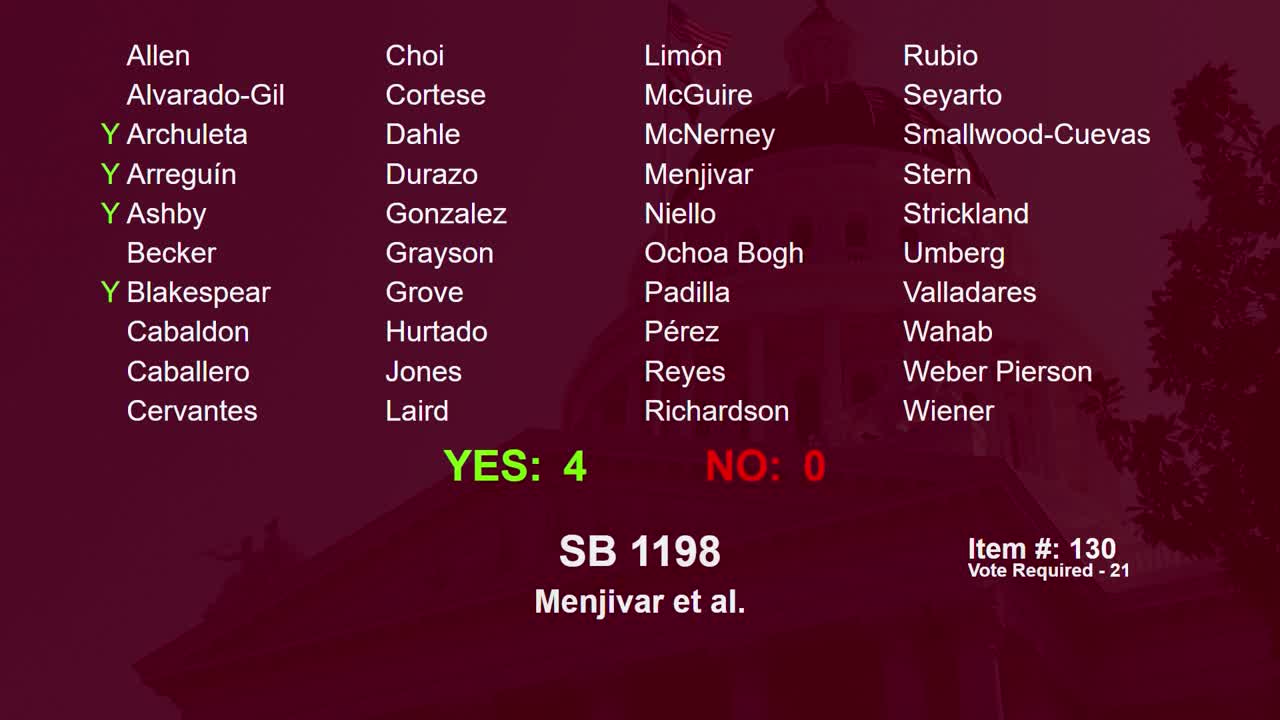
Bill Author

Bill Co-Author(s):