SB 1340: Small business liaison: contract information: small business procurement participation.
- Session Year: 2025-2026
- House: Senate
- Latest Version Date: 2026-08-30
Current Status:
In Progress
(2026-09-27: In Senate. Consideration of Governor's veto pending.)
Introduced
In Committee
Awaiting First Chamber Vote
Passed First Chamber
In Committee
Awaiting Second Chamber Vote
Passed Second Chamber
Enacted
Existing law establishes the Office of Small Business Advocate within the Governors Office of Business and Economic Development, led by the Small Business Advocate, and sets forth its powers and duties relating to advocacy on behalf of small businesses and providing small businesses with the information they need to survive in the marketplace.
Existing law, the Small Business Procurement and Contract Act, which requires the directors of the Department of General Services and other state agencies that enter specified contracts to establish a minimum goal for procurement participation for small businesses, including microbusinesses, in the provision of goods, information technology, and services to the state, and in the construction of state facilities, also requires a contractor, upon completion of a contract for which a commitment to achieve a small business or disabled business enterprise participation goal was made, to report to the awarding department the actual percentage of small business and disabled business enterprise participation that was achieved.
This bill would also require an awarding department, upon completion of a contract for which a commitment to achieve a small business or disabled business enterprise participation goal was made, to require a prime contractor that entered into a subcontract with a small business to certify specified information to the awarding department, including, among other things, the total amount that the prime contractor received under the contract, that all payments under the contract have been made to the small business, and the actual percentage of small business participation that was achieved. By requiring a prime contractor to certify this information, the bill would expand the crime of perjury and impose a state-mandated local program. The bill would require a prime contractor, after being awarded a contract pursuant to the act, to use the small businesses or microbusiness subcontractor proposed in its bid, proposal, or contract unless certain conditions are met.
Existing law, the State Contract Act except as specified, makes all contracts entered into by any state agency for the acquisition of goods or services, the construction, alteration, improvement, repair, or maintenance of property, real or personal, or the performance of work or services by the state agency for or in cooperation with any person, or public body, void unless and until approved by the Department of General Services.
This bill would require an awarding department, beginning on January 1, 2028, and annually thereafter, through its small business liaison, to make available a report on payment activity during the previous fiscal year related to all contracts awarded to a small business, as specified.
Existing law requires a state agency that significantly regulates small business or that significantly impacts small business to designate at least one person to serve as a small business liaison for the agency. Existing law requires these state agencies to notify the Office of Small Business Advocate within the Governors Office of Business and Economic Development and the Department of General Services of specified information, including the name and contact information of the agencys small business liaison.
This bill would require the small business liaison for each state agency to annually submit the above-described report on payment activity to the Office of Small Business Advocate. The bill would require the Office of Small Business Advocate to post that information on its internet website.
The California Constitution requires the state to reimburse local agencies and school districts for certain costs mandated by the state. Statutory provisions establish procedures for making that reimbursement.
This bill would provide that no reimbursement is required by this act for a specified reason.
Existing law establishes the Office of Small Business Advocate within the Governors Office of Business and Economic Development, led by the Small Business Advocate, and sets forth its powers and duties relating to advocacy on behalf of small businesses and providing small businesses with the information they need to survive in the marketplace.
Existing law, the Small Business Procurement and Contract Act, which requires the directors of the Department of General Services and other state agencies that enter specified contracts to establish a minimum goal for procurement participation for small businesses, including microbusinesses, in the provision of goods, information technology, and services to the state, and in the construction of state facilities, also requires a contractor, upon completion of a contract for which a commitment to achieve a small business or disabled business enterprise participation goal was made, to report to the awarding department the actual percentage of small business and disabled business enterprise participation that was achieved.
This bill would also require an awarding department, upon completion of a contract for which a commitment to achieve a small business or disabled business enterprise participation goal was made, to require a prime contractor that entered into a subcontract with a small business to certify specified information to the awarding department, including, among other things, the total amount that the prime contractor received under the contract, that all payments under the contract have been made to the small business, and the actual percentage of small business participation that was achieved. By requiring a prime contractor to certify this information, the bill would expand the crime of perjury and impose a state-mandated local program. The bill would require a prime contractor, after being awarded a contract pursuant to the act, to use the small businesses or microbusiness subcontractor proposed in its bid, proposal, or contract unless certain conditions are met.
Existing law, the State Contract Act except as specified, makes all contracts entered into by any state agency for the acquisition of goods or services, the construction, alteration, improvement, repair, or maintenance of property, real or personal, or the performance of work or services by the state agency for or in cooperation with any person, or public body, void unless and until approved by the Department of General Services.
This bill would require an awarding department, beginning on January 1, 2028, and annually thereafter, through its small business liaison, to make available a report on payment activity during the previous fiscal year related to all contracts awarded to a small business, as specified.
Existing law requires a state agency that significantly regulates small business or that significantly impacts small business to designate at least one person to serve as a small business liaison for the agency. Existing law requires these state agencies to notify the Office of Small Business Advocate within the Governors Office of Business and Economic Development and the Department of General Services of specified information, including the name and contact information of the agencys small business liaison.
This bill would require the small business liaison for each state agency to annually submit specified contract information the above-described report on payment activity to the Office of Small Business Advocate, including, among other things, a list of all contracts of the state agency that include a subcontract with a small business. Advocate. The bill would require the Office of Small Business Advocate to post that contract information on its internet website.
Existing law requires the directors of state departments and other agencies that enter into contracts for the provision of goods, information technology, and services to the state, and in the construction, including alteration, demolition, repair, or improvement, of state facilities to, among other things, establish a minimum goal for procurement participation for small businesses, provide for small business preference, and give special consideration and assistance to small businesses, as specified.This bill would require a contractor awarded a state contract pursuant to these provisions to utilize the listed small business or microbusiness subcontractor identified in a bid proposal for goods and services specified in a contract described above unless otherwise approved by the awarding state agency. The bill would prohibit a contractor awarded a state contract pursuant to these provisions from substituting, replacing, or terminating a listed small business or microbusiness subcontractor without approval of the awarding state agency or department. The bill would require an awarding state department or agency, upon the completion of an awarded contract for which a commitment to achieve a small business goal was made, to require the prime contractor that entered into a subcontract with a small business to certify certain information including, among other things, that all payments under the contract have been made to the small business, and require the prime contractor, upon request by the awarding state department or agency, to provide proof of payment for the work. By expanding the scope of the crime of perjury, this bill would impose a state-mandated local program.Existing law, the California Disabled Veteran Business Enterprise Program, sets disabled veteran business enterprise statewide participation goals of a minimum of 3 % of total contract value expended each year for contracts awarded by any state agency, department, officer, or other state governmental entity, as specified.This bill would require a contractor awarded a state contract pursuant to the program to utilize the listed disabled veteran business enterprise subcontractor identified in a bid proposal for goods and services specified in the contract unless otherwise approved by the awarding state agency. The bill would prohibit a contractor awarded a state contract pursuant to the program from substituting, replacing, or terminating a listed disabled veteran business enterprise subcontractor without approval of the awarding state agency or department.The California Constitution requires the state to reimburse local agencies and school districts for certain costs mandated by the state. Statutory provisions establish procedures for making that reimbursement.
This bill would provide that no reimbursement is required by this act for a specified reason.
Existing law establishes the Office of Small Business Advocate within the Governors Office of Business and Economic Development, led by the Small Business Advocate, and sets forth its powers and duties relating to advocacy on behalf of small businesses and providing small businesses with the information they need to survive in the marketplace.
Existing law requires a state agency that significantly regulates small business or that significantly impacts small business to designate at least one person to serve as a small business liaison for the agency. Existing law requires these state agencies to notify the Office of Small Business Advocate within the Governors Office of Business and Economic Development and the Department of General Services of specified information, including the name and contact information of the agencys small business liaison.
This bill would require the small business liaison for each state agency to annually submit specified contract information to the Office of Small Business Advocate, including, among other things, a list of all contracts of the state agency that include a subcontract with a small business. The bill would require the Office of Small Business Advocate to post that contract information on its internet website.
Existing law requires the directors of state departments and other agencies that enter into contracts for the provision of goods, information technology, and services to the state, and in the construction, including alteration, demolition, repair, or improvement, of state facilities to, among other things, establish a minimum goal for procurement participation for small businesses, provide for small business preference, and give special consideration and assistance to small businesses, as specified.
This bill would require a contractor awarded a state contract pursuant to these provisions to utilize the listed small business or microbusiness subcontractor identified in a bid proposal for goods and services specified in a contract described above unless otherwise approved by the awarding state agency. The bill would prohibit a contractor awarded a state contract pursuant to these provisions from substituting, replacing, or terminating a listed small business or microbusiness subcontractor without approval of the awarding state agency or department. The bill would require an awarding state department or agency, upon the completion of an awarded contract for which a commitment to achieve a small business goal was made, to require the prime contractor that entered into a subcontract with a small business to certify certain information including, among other things, that all payments under the contract have been made to the small business, and require the prime contractor, upon request by the awarding state department or agency, to provide proof of payment for the work. By expanding the scope of the crime of perjury, this bill would impose a state-mandated local program.
Existing law, the California Disabled Veteran Business Enterprise Program, sets disabled veteran business enterprise statewide participation goals of a minimum of 3 % of total contract value expended each year for contracts awarded by any state agency, department, officer, or other state governmental entity, as specified.
This bill would require a contractor awarded a state contract pursuant to the program to utilize the listed disabled veteran business enterprise subcontractor identified in a bid proposal for goods and services specified in the contract unless otherwise approved by the awarding state agency. The bill would prohibit a contractor awarded a state contract pursuant to the program from substituting, replacing, or terminating a listed disabled veteran business enterprise subcontractor without approval of the awarding state agency or department.
The California Constitution requires the state to reimburse local agencies and school districts for certain costs mandated by the state. Statutory provisions establish procedures for making that reimbursement.
This bill would provide that no reimbursement is required by this act for a specified reason.
Existing law establishes the Office of Small Business Advocate within the Governors Office of Business and Economic Development, led by the Small Business Advocate, and sets forth its powers and duties relating to advocacy on behalf of small businesses and providing small businesses with the information they need to survive in the marketplace.
Existing law requires a state agency that significantly regulates small business or that significantly impacts small business to designate at least one person to serve as a small business liaison for the agency. Existing law requires these state agencies to notify the Office of Small Business Advocate within the Governors Office of Business and Economic Development and the Department of General Services of specified information, including the name and contact information of the agencys small business liaison.
This bill would require the small business liaison for each state agency to annually submit specified contract information to the Office of Small Business Advocate, including, among other things, a list of all contracts of the state agency that include a subcontract with a small business. The bill would require the Office of Small Business Advocate to post that contract information on its internet website.
(a)The small business liaison for each state agency shall annually submit the information required under subdivision (a) of Section 19200 of the Public Contract Code to the Office of Small Business Advocate.
(b)The Office of Small Business Advocate shall post the information received pursuant to subdivision (a) on its internet website.
SEC. 2.Section 14841 of the Government Code is amended to read:14841.(a)Upon completion of an awarded contract for which a commitment to achieve small business or disabled veteran business enterprise participation goals was made, the contractor shall report to the awarding department the actual percentage of small business and disabled veteran business enterprise participation that was achieved.
(b)A contract that includes disabled veteran business enterprise participation shall also meet the requirements of Article 6 (commencing with Section 999) of Chapter 6 of Division 4 of the Military and Veterans Code.
(c)Upon completion of an awarded contract for which a commitment to achieve a small business goal was made, the awarding department shall require a prime contractor that entered into a subcontract with a small business to certify all of the following to the awarding department:
(1)The total amount that the prime contractor received under the contract.
(2)The contract number and description.
(3)The name, address, and certification identification number of the small business that participated in the performance of the contract.
(4)The amount and percentage of work the prime contractor committed to provide to one or more small businesses under the requirements of the contract and the total payment amount each small business received from the prime contractor.
(5)That all payments under the contract have been made to the small business. Upon request by the awarding state department or agency, the prime contractor shall provide proof of payment for the work.
(6)The actual percentage of small business participation that was achieved.
(d)After being awarded a contract pursuant to this chapter, a prime contractor shall use the small business or microbusiness subcontractors proposed its bid, proposal, or contract with the state unless a substitution is requested in writing by the prime contractor and approved by the awarding department in writing before any work by the proposed subcontractor is started. A substitution pursuant to this subdivision shall additionally comply with regulations adopted by the Department of General Services.
SEC. 3.Chapter 12 (commencing with Section 19200) is added to Part 2 of Division 2 of the Public Contract Code, immediately following Section 19150, to read:12.Reporting Small Business Contracting19200.(a)Commencing on January 1, 2028, and annually thereafter, each awarding department, through its small business liaison, shall make available a report on payment activity during the previous fiscal year related to all contracts awarded to a small business.
(b)The report described in subdivision (a) shall be submitted to the Office of Small Business Advocate, as required under Section 11148.5.1 of the Government Code, and contain a list of contracts with the following information for each contract:
(1)Contractor name.
(2)Contract number and description.
(3)Contract term, including amendments.
(4)Total amount of the contract, including amendments.
(5)Total amount paid during the previous fiscal year and the cumulative total amount paid during the contract term.
(c)For purposes of this section, small business has the same meaning as defined in Section 14837 of the Government Code.
SEC. 4.No reimbursement is required by this act pursuant to Section 6 of Article XIIIB of the California Constitution because the only costs that may be incurred by a local agency or school district will be incurred because this act creates a new crime or infraction, eliminates a crime or infraction, or changes the penalty for a crime or infraction, within the meaning of Section 17556 of the Government Code, or changes the definition of a crime within the meaning of Section 6 of Article XIIIB of the California Constitution.
(a)The small business liaison for each state agency shall annually submit the information required under subdivision (a) of Section 19200 of the Public Contract Code to the Office of Small Business Advocate.
(b)The Office of Small Business Advocate shall post the information received pursuant to subdivision (a) on its internet website.
SEC. 2.Section 14841 of the Government Code is amended to read:14841.(a)Upon completion of an awarded contract for which a commitment to achieve small business or disabled veteran business enterprise participation goals was made, the contractor shall report to the awarding department the actual percentage of small business and disabled veteran business enterprise participation that was achieved. A
(b)A contract that includes disabled veteran business enterprise participation shall also meet the requirements of Article 6 (commencing with Section 999) of Chapter 6 of Division 4 of the Military and Veterans Code.
(c)Upon completion of an awarded contract for which a commitment to achieve a small business goal was made, the awarding department shall require a prime contractor that entered into a subcontract with a small business to certify all of the following to the awarding department:
(1)The total amount that the prime contractor received under the contract.
(2)The contract number and description.
(3)The name, address, and certification identification number of the small business that participated in the performance of the contract.
(4)The amount and percentage of work the prime contractor committed to provide to one or more small businesses under the requirements of the contract and the total payment amount each small business received from the prime contractor.
(5)That all payments under the contract have been made to the small business. Upon request by the awarding state department or agency, the prime contractor shall provide proof of payment for the work.
(6)The actual percentage of small business participation that was achieved.
(d)After being awarded a contract pursuant to this chapter, a prime contractor shall use the small business or microbusiness subcontractors proposed its bid, proposal, or contract with the state unless a substitution is requested in writing by the prime contractor and approved by the awarding department in writing before any work by the proposed subcontractor is started. A substitution pursuant to this subdivision shall additionally comply with regulations adopted by the Department of General Services.
SEC. 3.Chapter 12 (commencing with Section 19200) is added to Part 2 of Division 2 of the Public Contract Code, immediately following Section 19150, to read:12.Reporting Small Business Contracting19200.(a)Commencing on January 1, 2028, and annually thereafter, each awarding department, through its small business liaison, shall make available a report on payment activity during the previous fiscal year related to all contracts awarded to a small business.
(b)The report described in subdivision (a) shall be submitted to the Office of Small Business Advocate, as required under Section 11148.5.1 of the Government Code, and contain a list of contracts with the following information for each contract:
(1)Contractor name.
(2)Contract number and description.
(3)Contract term, including amendments.
(4)Total amount of the contract, including amendments.
(5)Total amount paid during the previous fiscal year and the cumulative total amount paid during the contract term.
(c)For purposes of this section, small business has the same meaning as defined in Section 14837 of the Government Code.
SEC. 4.No reimbursement is required by this act pursuant to Section 6 of Article XIIIB of the California Constitution because the only costs that may be incurred by a local agency or school district will be incurred because this act creates a new crime or infraction, eliminates a crime or infraction, or changes the penalty for a crime or infraction, within the meaning of Section 17556 of the Government Code, or changes the definition of a crime within the meaning of Section 6 of Article XIIIB of the California Constitution.
SECTION 1.Section 11148.5.1 is added to the Government Code, to read:11148.5.1.(a)The small business liaison for each state agency shall annually submit the following information to the Office of Small Business Advocate:(1)(A)A list of all current contracts between the state agency and a small business.(B)A list of all contracts of the state agency that include a subcontract with a small business.(2)The total dollar amount of each contract, as described in paragraph (1).(3)The total dollar amount paid to a small business under a contract or subcontract, as described in paragraph (1).(b)The Office of Small Business Advocate shall post the information received pursuant to subdivision (a) on its internet website.SEC. 2.Section 14838 of the Government Code is amended to read:14838.In order to facilitate the participation of small business, including microbusiness, in the provision of goods, information technology, and services to the state, and in the construction, including alteration, demolition, repair, or improvement, of state facilities, the directors of the department and other state agencies that enter those contracts, each within their respective areas of responsibility, shall do all of the following:(a)Establish a minimum goal of 25 percent procurement participation for small businesses, including microbusinesses, in the provision of goods, information technology, and services to the state, and in the construction of state facilities.(b)Provide for small business preference, or nonsmall business preference for bidders that provide for small business and microbusiness subcontractor participation, in the award of contracts for goods, information technology, services, and construction, as follows:(1)In solicitations where an award is to be made to the lowest responsible bidder meeting specifications, the preference to small business and microbusiness shall be 5 percent of the lowest responsible bidder meeting specifications. The preference to nonsmall business bidders that provide for small business or microbusiness subcontractor participation shall be, up to a maximum of 5 percent of the lowest responsible bidder meeting specifications, determined according to rules and regulations established by the Department of General Services.(2)In solicitations where an award is to be made to the highest scored bidder based on evaluation factors in addition to price, the preference to small business or microbusiness shall be 5 percent of the highest responsible bidders total score. The preference to nonsmall business bidders that provide for small business or microbusiness subcontractor participation shall be up to a maximum 5 percent of the highest responsible bidders total score, determined according to rules and regulations established by the Department of General Services.(3)The preferences under paragraphs (1) and (2) shall not be awarded to a noncompliant bidder and shall not be used to achieve any applicable minimum requirements.(4)The preference under paragraph (1) shall not exceed fifty thousand dollars ($50,000) for any bid, and the combined cost of preferences granted pursuant to paragraph (1) and any other provision of law shall not exceed one hundred thousand dollars ($100,000). In bids in which the state has reserved the right to make multiple awards, this fifty-thousand-dollar ($50,000) maximum preference cost shall be applied, to the extent possible, so as to maximize the dollar participation of small businesses, including microbusinesses, in the contract award.(c)Give special consideration to small businesses and microbusinesses, by both:(1)Reducing the experience required.(2)Reducing the level of inventory normally required.(d)Give special assistance to small businesses and microbusinesses in the preparation and submission of the information requested in Section 14310.(e)Under the authorization granted in Section 10163 of the Public Contract Code, make awards, whenever feasible, to small business and microbusiness bidders for each project bid upon within their prequalification rating. This may be accomplished by dividing major projects into subprojects so as to allow a small business or microbusiness contractor to qualify to bid on these subprojects.(f)Make continuous efforts to expand the pool of small businesses and microbusinesses that participate in the departments and other state agencies contracts by regularly seeking out and identifying small businesses and microbusinesses that have not previously done business with the department or other state agency or that are not regularly used by the department or other state agency, and including those small businesses and microbusinesses in the agencys solicitations.(g)(1)A contractor awarded a state contract pursuant to this section shall utilize the listed small business or microbusiness subcontractor identified in a bid proposal for goods and services specified in the contract unless otherwise approved by the awarding state department or agency.(2)A contractor awarded a state contract pursuant to this section shall not substitute, replace, or terminate a listed small business or microbusiness subcontractor without approval of the awarding state department or agency.(h)Small business and microbusiness bidders qualified in accordance with this chapter shall have precedence over nonsmall business bidders in that the application of a bidder preference for which nonsmall business bidders may be eligible under this section or any other provision of law shall not result in the denial of the award to a small business or microbusiness bidder. In the event of a precise tie between the low responsible bid of a bidder meeting specifications of a small business or microbusiness, and the low responsible bid of a bidder meeting the specifications of a disabled veteran-owned small business or microbusiness, the contract shall be awarded to the disabled veteran-owned small business or microbusiness. This provision applies if the small business or microbusiness bidder is the lowest responsible bidder, as well as if the small business or microbusiness bidder is eligible for award as the result of application of the small business and microbusiness bidder preference granted by subdivision (b).(i)If the directors of the department and other state agencies that enter into those contracts are unable to reach the goals established under subdivision (a) in the year in which the changes made by the act that added this subdivision become operative, the directors of the department and other state agencies may count towards that goal, contracts with firms that would be considered a small business or microbusiness under the amendments made to Section 14837 by the act adding this subdivision. This subdivision shall become operative on January 1, 2019.(j)Upon completion of an awarded contract for which a commitment to achieve a small business goal was made, an awarding state department or agency shall require the prime contractor that entered into a subcontract with a small business to certify to the awarding department or agency all of the following:(1)The total amount the prime contractor received under the contract.(2)The name and address of the small business that participated in the performance of the contract and the contract number.(3)The amount and percentage of work the prime contractor committed to provide to one or more small businesses under the requirements of the contract and the amount each small business received from the prime contractor.(4)That all payments under the contract have been made to the small business. Upon request by the awarding state department or agency, the prime contractor shall provide proof of payment for the work.SEC. 3.Section 999.10 of the Military and Veterans Code is amended to read:999.10.(a)An awarding department taking bids in connection with the award of a contract shall provide, in the general conditions under which bids will be received, that a person making a bid or offer to perform a contract shall, in the bid or offer, set forth the following information:(1)The name, disabled veteran business enterprise certification number, contact information, and the location of the place of business of each subcontractor certified as a disabled veteran business enterprise who will perform work or labor or render service to the prime contractor in connection with the performance of the contract and who will be used by the prime contractor to fulfill disabled veteran business enterprise participation goals.(2)The portion of work that will be done by each subcontractor under paragraph (1). Except in cases of emergency when a contract is necessary for the immediate preservation of the public health, welfare, or safety, or protection of state property, the prime contractor shall list only one subcontractor for each portion of work as is defined by the prime contractor in the contractors bid or offer.(3)A certification, signed under penalty of perjury, that the portion of work that will be done by each subcontractor under paragraph (1) serves a commercially useful function, as defined in clause (i) of subparagraph (B) of paragraph (5) of subdivision (b) of Section 999.(b)A contractor awarded a state contract pursuant to this article shall utilize the listed disabled veteran business enterprise subcontractor identified in a bid proposal for goods and services specified in the contract unless otherwise approved by the awarding state department or agency.(c)A contractor awarded a state contract pursuant to this article shall not substitute, replace, or terminate a listed disabled veteran business enterprise subcontractor without approval of the awarding state department or agency.(d)The Subletting and Subcontracting Fair Practices Act (Chapter 4 (commencing with Section 4100) of Part 1 of Division 2 of the Public Contract Code) shall apply to the information required by subdivision (a) relating to subcontractors certified as disabled veteran business enterprises.(e)For purposes of this section, subcontractor and prime contractor shall have the same meaning as those terms are defined in Section 4113 of the Public Contract Code.(f)As used in this section, contract does not include a contract negotiated pursuant to Chapter 10 (commencing with Section 4525) of Division 5 of Title 1 of the Government Code.SEC. 4.No reimbursement is required by this act pursuant to Section 6 of Article XIIIB of the California Constitution because the only costs that may be incurred by a local agency or school district will be incurred because this act creates a new crime or infraction, eliminates a crime or infraction, or changes the penalty for a crime or infraction, within the meaning of Section 17556 of the Government Code, or changes the definition of a crime within the meaning of Section 6 of Article XIIIB of the California Constitution.(a)The small business liaison for each state agency shall annually submit the following information to the Office of Small Business Advocate:
(1)(A)A list of all current contracts between the state agency and a small business.
(B)A list of all contracts of the state agency that include a subcontract with a small business.
(2)The total dollar amount of each contract, as described in paragraph (1).
(3)The total dollar amount paid to a small business under a contract or subcontract, as described in paragraph (1).
(b)The Office of Small Business Advocate shall post the information received pursuant to subdivision (a) on its internet website.
SEC. 2.Section 14838 of the Government Code is amended to read:14838.In order to facilitate the participation of small business, including microbusiness, in the provision of goods, information technology, and services to the state, and in the construction, including alteration, demolition, repair, or improvement, of state facilities, the directors of the department and other state agencies that enter those contracts, each within their respective areas of responsibility, shall do all of the following:
(a)Establish a minimum goal of 25 percent procurement participation for small businesses, including microbusinesses, in the provision of goods, information technology, and services to the state, and in the construction of state facilities.
(b)Provide for small business preference, or nonsmall business preference for bidders that provide for small business and microbusiness subcontractor participation, in the award of contracts for goods, information technology, services, and construction, as follows:
(1)In solicitations where an award is to be made to the lowest responsible bidder meeting specifications, the preference to small business and microbusiness shall be 5 percent of the lowest responsible bidder meeting specifications. The preference to nonsmall business bidders that provide for small business or microbusiness subcontractor participation shall be, up to a maximum of 5 percent of the lowest responsible bidder meeting specifications, determined according to rules and regulations established by the Department of General Services.
(2)In solicitations where an award is to be made to the highest scored bidder based on evaluation factors in addition to price, the preference to small business or microbusiness shall be 5 percent of the highest responsible bidders total score. The preference to nonsmall business bidders that provide for small business or microbusiness subcontractor participation shall be up to a maximum 5 percent of the highest responsible bidders total score, determined according to rules and regulations established by the Department of General Services.
(3)The preferences under paragraphs (1) and (2) shall not be awarded to a noncompliant bidder and shall not be used to achieve any applicable minimum requirements.
(4)The preference under paragraph (1) shall not exceed fifty thousand dollars ($50,000) for any bid, and the combined cost of preferences granted pursuant to paragraph (1) and any other provision of law shall not exceed one hundred thousand dollars ($100,000). In bids in which the state has reserved the right to make multiple awards, this fifty-thousand-dollar ($50,000) maximum preference cost shall be applied, to the extent possible, so as to maximize the dollar participation of small businesses, including microbusinesses, in the contract award.
(c)Give special consideration to small businesses and microbusinesses, by both:
(1)Reducing the experience required.
(2)Reducing the level of inventory normally required.
(d)Give special assistance to small businesses and microbusinesses in the preparation and submission of the information requested in Section 14310.
(e)Under the authorization granted in Section 10163 of the Public Contract Code, make awards, whenever feasible, to small business and microbusiness bidders for each project bid upon within their prequalification rating. This may be accomplished by dividing major projects into subprojects so as to allow a small business or microbusiness contractor to qualify to bid on these subprojects.
(f)Make continuous efforts to expand the pool of small businesses and microbusinesses that participate in the departments and other state agencies contracts by regularly seeking out and identifying small businesses and microbusinesses that have not previously done business with the department or other state agency or that are not regularly used by the department or other state agency, and including those small businesses and microbusinesses in the agencys solicitations.
(g)(1)A contractor awarded a state contract pursuant to this section shall utilize the listed small business or microbusiness subcontractor identified in a bid proposal for goods and services specified in the contract unless otherwise approved by the awarding state department or agency.
(2)A contractor awarded a state contract pursuant to this section shall not substitute, replace, or terminate a listed small business or microbusiness subcontractor without approval of the awarding state department or agency.
(g)(h)Small business and microbusiness bidders qualified in accordance with this chapter shall have precedence over nonsmall business bidders in that the application of a bidder preference for which nonsmall business bidders may be eligible under this section or any other provision of law shall not result in the denial of the award to a small business or microbusiness bidder. In the event of a precise tie between the low responsible bid of a bidder meeting specifications of a small business or microbusiness, and the low responsible bid of a bidder meeting the specifications of a disabled veteran-owned small business or microbusiness, the contract shall be awarded to the disabled veteran-owned small business or microbusiness. This provision applies if the small business or microbusiness bidder is the lowest responsible bidder, as well as if the small business or microbusiness bidder is eligible for award as the result of application of the small business and microbusiness bidder preference granted by subdivision (b).
(h)(i)If the directors of the department and other state agencies that enter into those contracts are unable to reach the goals established under subdivision (a) in the year in which the changes made by the act that added this subdivision become operative, the directors of the department and other state agencies may count towards that goal, contracts with firms that would be considered a small business or microbusiness under the amendments made to Section 14837 by the act adding this subdivision. This subdivision shall become operative on January 1, 2019.
(j)Upon completion of an awarded contract for which a commitment to achieve a small business goal was made, an awarding state department or agency shall require the prime contractor that entered into a subcontract with a small business to certify to the awarding department or agency all of the following:
(1)The total amount the prime contractor received under the contract.
(2)The name and address of the small business that participated in the performance of the contract and the contract number.
(3)The amount and percentage of work the prime contractor committed to provide to one or more small businesses under the requirements of the contract and the amount each small business received from the prime contractor.
(4)That all payments under the contract have been made to the small business. Upon request by the awarding state department or agency, the prime contractor shall provide proof of payment for the work.
SEC. 3.Section 999.10 of the Military and Veterans Code is amended to read:999.10.(a)An awarding department taking bids in connection with the award of a contract shall provide, in the general conditions under which bids will be received, that a person making a bid or offer to perform a contract shall, in the bid or offer, set forth the following information:
(1)The name, disabled veteran business enterprise certification number, contact information, and the location of the place of business of each subcontractor certified as a disabled veteran business enterprise who will perform work or labor or render service to the prime contractor in connection with the performance of the contract and who will be used by the prime contractor to fulfill disabled veteran business enterprise participation goals.
(2)The portion of work that will be done by each subcontractor under paragraph (1). Except in cases of emergency when a contract is necessary for the immediate preservation of the public health, welfare, or safety, or protection of state property, the prime contractor shall list only one subcontractor for each portion of work as is defined by the prime contractor in the contractors bid or offer.
(3)A certification, signed under penalty of perjury, that the portion of work that will be done by each subcontractor under paragraph (1) serves a commercially useful function, as defined in clause (i) of subparagraph (B) of paragraph (5) of subdivision (b) of Section 999.
(b)A contractor awarded a state contract pursuant to this article shall utilize the listed disabled veteran business enterprise subcontractor identified in a bid proposal for goods and services specified in the contract unless otherwise approved by the awarding state department or agency.
(c)A contractor awarded a state contract pursuant to this article shall not substitute, replace, or terminate a listed disabled veteran business enterprise subcontractor without approval of the awarding state department or agency.
(b)(d)The Subletting and Subcontracting Fair Practices Act (Chapter 4 (commencing with Section 4100) of Part 1 of Division 2 of the Public Contract Code) shall apply to the information required by subdivision (a) relating to subcontractors certified as disabled veteran business enterprises.
(c)(e)For purposes of this section, subcontractor and prime contractor shall have the same meaning as those terms are defined in Section 4113 of the Public Contract Code.
(f)(f)As used in this section, contract does not include a contract negotiated pursuant to Chapter 10 (commencing with Section 4525) of Division 5 of Title 1 of the Government Code.
SEC. 4.No reimbursement is required by this act pursuant to Section 6 of Article XIIIB of the California Constitution because the only costs that may be incurred by a local agency or school district will be incurred because this act creates a new crime or infraction, eliminates a crime or infraction, or changes the penalty for a crime or infraction, within the meaning of Section 17556 of the Government Code, or changes the definition of a crime within the meaning of Section 6 of Article XIIIB of the California Constitution.
REVISIONS: HeadingLine 2.(a)The small business liaison for each state agency shall annually submit the following information to the Office of Small Business Advocate:
(1)(A)A list of all current contracts between the state agency and a small business.
(B)A list of all contracts of the state agency that include a subcontract with a small business.
(2)The total dollar amount of each contract, as described in paragraph (1).
(3)The total dollar amount paid to a small business under a contract or subcontract, as described in paragraph (1).
(b)The Office of Small Business Advocate shall post the information received pursuant to subdivision (a) on its internet website.
|
Date
|
Status
|
|---|---|
| Sep 27, 2026 | In Senate. Consideration of Governor's veto pending. |
| Sep 27, 2026 | Vetoed by the Governor. |
| Sep 3, 2026 | Enrolled and presented to the Governor at 3 p.m. |
| Aug 27, 2026 | Assembly amendments concurred in. (Ayes 40. Noes 0. Page 6026.) Ordered to engrossing and enrolling. |
| Aug 27, 2026 | Assembly amendments concurred in. (Ayes 39. Noes 0.) Ordered to engrossing and enrolling. |
| Aug 26, 2026 | In Senate. Concurrence in Assembly amendments pending. |
| Aug 26, 2026 | Read third time. Passed. (Ayes 79. Noes 0. Page 6609.) Ordered to the Senate. |
| Aug 26, 2026 | Read third time. Passed. Ordered to the Senate. |
| Aug 21, 2026 | Assembly Rule 69(b)(1) suspended. (Ayes 55. Noes 17. Page 6296.) |
| Aug 21, 2026 | Ordered to third reading. |
| Aug 21, 2026 | Read third time and amended. |
| Aug 21, 2026 | Assembly Rule 69(b)(1) suspended. |
| Aug 13, 2026 | From committee: Do pass. (Ayes 15. Noes 0.) (August 13). |
| Aug 13, 2026 | Assembly Rule 63 suspended. |
| Aug 13, 2026 | Read second time. Ordered to third reading. |
| Aug 5, 2026 | August 5 set for first hearing. Placed on suspense file. |
| Jun 23, 2026 | From committee: Do pass and re-refer to Com. on APPR. with recommendation: To consent calendar. (Ayes 8. Noes 0.) (June 23). Re-referred to Com. on APPR. |
| Jun 23, 2026 | Coauthors revised. |
| Jun 18, 2026 | From committee with author's amendments. Read second time and amended. Re-referred to Com. on E.D., G., & H.I. |
| Jun 1, 2026 | Referred to Com. on E.D., G., & H.I. |
| May 22, 2026 | In Assembly. Read first time. Held at Desk. |
| May 22, 2026 | Read third time. Passed. (Ayes 33. Noes 0. Page 4420.) Ordered to the Assembly. |
| May 22, 2026 | Read third time. Passed. (Ayes 33. Noes 0.) Ordered to the Assembly. |
| May 20, 2026 | Ordered to special consent calendar. |
| May 14, 2026 | From committee: Do pass. (Ayes 7. Noes 0. Page 4273.) (May 14). |
| May 14, 2026 | Read second time. Ordered to third reading. |
| May 14, 2026 | From committee: Do pass. (Ayes 7. Noes 0.) (May 14). |
| May 8, 2026 | Set for hearing May 14. |
| Apr 27, 2026 | April 27 hearing: Placed on APPR. suspense file. |
| Apr 17, 2026 | Set for hearing April 27. |
| Apr 13, 2026 | From committee: Do pass and re-refer to Com. on APPR. (Ayes 11. Noes 0. Page 3841.) (April 13). Re-referred to Com. on APPR. |
| Apr 13, 2026 | From committee: Do pass and re-refer to Com. on APPR. (Ayes 11. Noes 0.) (April 13). Re-referred to Com. on APPR. |
| Apr 8, 2026 | Set for hearing April 13. |
| Mar 24, 2026 | From committee: Do pass and re-refer to Com. on B. P. & E.D. with recommendation: To consent calendar. (Ayes 14. Noes 0. Page 3658.) (March 24). Re-referred to Com. on B. P. & E.D. |
| Mar 24, 2026 | From committee: Do pass and re-refer to Com. on B. P. & E.D. with recommendation: To consent calendar. (Ayes 14. Noes 0.) (March 24). Re-referred to Com. on B. P. & E.D. |
| Mar 18, 2026 | Set for hearing March 24. |
| Mar 4, 2026 | Referred to Coms. on G.O. and B. P. & E.D. |
| Feb 23, 2026 | Read first time. |
| Feb 23, 2026 | From printer. May be acted upon on or after March 23. |
| Feb 20, 2026 | Introduced. To Com. on RLS. for assignment. To print. |
|
Date
|
Description
|
Location
|
Votes
|
|
|---|---|---|---|---|
| Aug 27, 2026 | Unfinished Business SB1340 Richardson et al. Concurrence | Senate Floor |
Passed |
|
| Aug 26, 2026 | SB 1340 Richardson Senate Third Reading By Caloza | Assembly Floor |
Passed |
|
| Aug 13, 2026 | Do pass. | Assembly Standing Committee on Appropriations |
Passed |
|
| May 22, 2026 | Special Consent SB1340 Richardson | Senate Floor |
Passed |
|
| May 14, 2026 | Do pass | Senate Standing Committee on Appropriations |
Passed |
|
| Apr 27, 2026 | Placed on suspense file | Senate Standing Committee on Appropriations |
Passed |
|
| Apr 13, 2026 | Do pass, but first be re-referred to the Committee on [Appropriations] | Senate Standing Committee on Business, Professions and Economic Development |
Passed |
|
| Mar 24, 2026 | Do pass, but first be re-referred to the Committee on [Business, Professions and Economic Development] with the recommendation: To Consent Calendar | Senate Standing Committee on Governmental Organization |
Passed |
This list shows positions taken on this bill by organizations on the date displayed, which is linked to the original source.
Positions by individuals are not included.
|
Organization
|
Position
|
Date
|
|---|---|---|
| CA Edge Coalition | ** Support | |
| California African American Chamber Of Commerce | ** Support | |
| California Asian Pacific Chamber Of Commerce | ** Support | |
| California Black Chamber of Commerce | ** Support | |
| California EDGE Coalition | ** Support | |
| California Retailers Association | ** Support | |
| CAMEO Network | ** Support | |
| Career Launch Path | ** Support | |
| Family Business Association of California | ** Support | |
| Latino Media Collaborative | ** Support | |
| Long Beach Area Chamber of Commerce | ** Support | |
| Los Angeles County Business Federation | ** Support | |
| Los Angeles County Business Federation (BIZ-FED) | ** Support | |
| Prismatic Research & Strategy | ** Support |
SENATE RULES COMMITTEE Office of Senate Floor Analyses (916) 651-4171 | SB 1340 |
UNFINISHED BUSINESS
Bill No: SB 1340
Author: Richardson (D), et al.
Amended: 8/21/26
Vote: 21
SENATE GOVERNMENTAL ORG. COMMITTEE: 14-0, 3/24/26
AYES: Rubio, Valladares, Alvarado-Gil, Archuleta, Blakespear, Cervantes, Dahle, Hurtado, Ochoa Bogh, Padilla, Richardson, Smallwood-Cuevas, Wahab, Weber Pierson
NO VOTE RECORDED: Ashby
SENATE BUS., PROF. & ECON. DEV. COMMITTEE: 11-0, 4/13/26
AYES: Wahab, Choi, Archuleta, Arreguín, Caballero, Grayson, Menjivar, Niello, Smallwood-Cuevas, Strickland, Umberg
SENATE APPROPRIATIONS COMMITTEE: 7-0, 5/14/26
AYES: Cervantes, Seyarto, Cabaldon, Dahle, Grayson, Richardson, Wahab
SENATE FLOOR: 33-0, 5/22/26
AYES: Archuleta, Arreguín, Ashby, Blakespear, Cabaldon, Caballero, Cervantes, Choi, Cortese, Dahle, Durazo, Gonzalez, Grayson, Grove, Jones, Laird, Limón, McGuire, McNerney, Menjivar, Ochoa Bogh, Pérez, Reyes, Richardson, Rubio, Seyarto, Smallwood-Cuevas, Strickland, Umberg, Valladares, Wahab, Weber Pierson, Wiener
NO VOTE RECORDED: Allen, Alvarado-Gil, Becker, Hurtado, Niello, Padilla, Stern
ASSEMBLY FLOOR: 79-0, 8/26/26 - See last page for vote
SUBJECT: Small business liaison: contract information: small business procurement participation
SOURCE: Author
DIGEST:
This bill 1) requires state agency small business liaisons to annually report to the Office of Small Business Advocate (OSBA) and post online information about state contracts and subcontracts involving small businesses. The report must include current contracts with small businesses, contracts with small businesses subcontractors, and the total amount paid to small businesses under those agreements; Additionally, and 2) requires an awarding department, upon completion of an awarded contract for which a commitment to achieve a small business goal was made, to require the prime contractor that entered into a subcontract with a small business to certify specified information related to the awarded contract.
Assembly Amendments
require an awarding department, upon completion of an awarded contract for which a commitment to achieve a small business goal was made, to require the prime contractor that entered into a subcontract with a small business to certify specified information related to the awarded contract.
ANALYSIS:
Existing law:
- Requires, under the Small Business Procurement and Contract Act (Act), state agencies to take certain actions in order to facilitate the participation of small businesses and microbusinesses in the provisions of goods, information technology, and services to the state, and in the construction of state facilities.
- Defines a “small business” to mean an independently owned and operated business that is not dominant in its field of operation, the principal office of which is located in California, the officers of which are domiciled in California, and which, together with affiliates, has 100 or fewer employees, and average annual gross receipts of $10 million or less over the previous three years, or is a manufacturer, as defined, and has 100 or fewer employees.
- Requires a state agency that significantly regulates small business or that significantly impacts small business to designate at least one person to serve as a small business liaison.
- Requires the small business liaison to be responsible for specified duties relating to interactions between the state agency and small businesses, including assisting the head of the agency in ensuring that the procurement and contracting processes of the state agency are administered in order to meet or exceed the 25% small business participation goal, and developing and sharing innovative procurement and contracting practices from the public and private sectors to increase small businesses.
- Establishes the Office within the Governor’s Office of Business and Economic Development (GOBiz) to advocate for causes of small businesses and to provide small businesses with information they need to survive in the marketplace.
- Establishes, under the California Disabled Veteran Business Enterprise Program, a statewide participation goal of three-percent of total contract value expended each year for contracts awarded by any state agency, department, officer, or other state governmental entity, as specified.
This bill:
- Requires the small business liaison of every awarding department, to make available a report on payment activity during the previous fiscal year related to all contracts awarded to a small business that includes specified information, and requires the small business liaison to submit the report to OSBA.
- Requires a department, upon completion of an awarded contract for which a commitment to achieve a small business goal was made, to require the prime contractor that entered into a subcontract with a small business to certify all of the following to the awarding department:
- The total amount that the prime contractor received under the contract.
- The contract number and description.
- The name, address, and certification identification number of the small business that participated in the performance of the contract.
- The amount and percentage of work the prime contractor committed to provide to one or more small businesses under the requirements of the contract and the total payment amount of each small business received from the prime contractor.
- That all payments under the contract have been made to the small business.
- The actual percentage of small business participation that was achieved.
- Requires a prime contract to use the small business or microbusiness subcontractors proposed on its bid unless a substitution is requested in writing by the prime contractor and approved by the awarding department in writing.
Background
Author’s Statement. According to the author’s office, “small businesses are significant contributors to California’s economy, accounting for 42.3% ($70.1) billion of the state’s exports annually. These businesses drive economic growth and mobility, creating 7.6 million jobs in 2025 alone. In order to fully leverage the goal established by AB 2019 (Petrie-Norris), California must have a standard reporting requirement to ensure state agencies are meeting and/or exceeding the required 25% participation goal for small businesses. SB 1430 will help and identify participation gaps and strengthen accountability by evaluating whether small businesses are receiving meaningful access to state contracting requirements.”
Small Business Liaison. Current law requires a state agency that significantly regulates small businesses or that significantly impacts small businesses to designate at least one person to serve as a small business liaison utilizing existing personnel and resources. State agencies are required to widely publicize the position of small business liaison on the agency’s website. The Office is also required to establish a web portal that includes the name, telephone number, internet website, and email of the small business liaison.
The small business liaison is responsible for specified duties relating to interactions between the state agency and small businesses. This includes assisting the head of the state agency in ensuring that the procurement and contracting processes of the state agency are administered in order to meet or exceed the 25% small businesses participation goal, and developing and sharing innovative procurement and contracting practices from the public and private sectors to increase small business participation in state contracting and procurement.
Other responsibilities include receiving and responding to complaints received by the agency from small businesses, providing technical advice and assisting small businesses resolving problems and questions regarding compliance with the agency’s regulations and statutes, reporting small business concerns, and if appropriate, reporting recommendations to the agency secretary or to the agency head.
This bill would require the small business liaison for each state agency to annually submit contract information to the Office including, among other things, a list of all contracts of the state agency that include a subcontract with a small business. The bill would require the Office to post that contract information on its internet website.
Office of Small Business Advocate. Housed within GOBiz, the OSBAwas created by AB 29 (John A. Perez, Chapter 475, Statutes of 2011) “in order to advocate for the causes of small business and to provide small businesses with the information they need to survive in the marketplace.”
The Office is responsible for serving as the principal advocate in the state on behalf of small business. This includes advisory participation in the consideration of all legislation and administrative regulations that affect small businesses, advocacy on state policy and programs related to small businesses, and representing the views and interest of small businesses before other state agencies whose policies and activities may affect small businesses. The Office is also required to seek the assistance and cooperation of all state agencies and departments providing services to, or affecting, small business, including the small business liaison, to ensure coordination of state efforts.
Small Business Eligibility Requirements. In order for a small business to be eligible for certification, the small business must be independently owned and operated; not dominant in its field of operation; and, its principal office must be located in California. In addition, the business must be either a business with 100 or fewer employees and an average annual gross receipts of $15 million or less over the last three tax years; a manufacturer, as defined, with 100 or fewer employees; or, a microbusiness. A small business will automatically be designated as microbusiness, if gross annual receipts are less than $3.5 million; or the small business is a manufacturer with 25 or fewer employees.
Upon meeting eligibility requirements, certified small businesses and microbusinesses are entitled, to among other things, a 5% bid preference. The goal of the preference is to help small and micro businesses to be more competitive in the bid process, thereby enhancing state contract awards directly or indirectly to these types of businesses. The preference is only used for computation purposes to determine the winning bidder, the contract is awarded at the actual bid amount.
In addition, certified small businesses are eligible for the State’s Business Participation Program, which sets a goal for the use of small businesses in at least 25% of the state’s overall annual contract dollars.
Related/ Prior Legislation
SB 656 (Richardson, 2025) would have required all state agencies to designate at least one person to serve as a small business liaison, as specified. Additionally, the bill would have required the small business liaison to annually submit specified information to the Office. (Held in the Senate Appropriations Committee Suspense File)
SB 2019 (Petrie-Norris, Chapter 730, Statutes of 2022) codified, among other things, a 25% small business goal for state procurement and proposes a number of actions to enhance the ability and commitment of state agencies to include small business, including microbusinesses in state contracting, as specified.
AB 29 (John A. Perez, Chapter 475, Statutes of 2011) created GO-Biz and established specific tasks and duties for the office, including reorganizing such entities as the Advocate into this new office. Additionally, the bill required state agencies to furnish the Office the reports, document, and information that are public records and that the Office deems necessary to carry out the Office’s functions.
FISCAL EFFECT: Appropriation: No Fiscal Com.: Yes Local: Yes
According to the Assembly Appropriations Committee, Assembly Appropriations Committee, Ongoing General Fund costs of $137,000 annually to OSBA for one analyst and, potentially, an additional $25,000 to $75,000 annual IT, web, and data support workload (General Fund) to implement and maintain the annual reporting and publication process. OSBA also reports that if it is required to verify agency submissions independently, then costs would be higher.
It is unknown how much it will cost state agencies with designated small business liaisons, cumulatively statewide, to comply with the bill’s expanded reporting mandates. However, according to the OSBA, significant costs, to awarding departments or the Department of General Services, might result from monitoring listed small business and disabled veteran business enterprise (DVBE) subcontractor utilization, reviewing and approving substitutions, requiring completion certifications, reviewing proof of payment upon request, and providing standardized data for OSBA publication.
SUPPORT: (Verified 8/24/26)
California African American Chamber of Commerce
California Asian Pacific Chamber of Commerce
California Black Chamber of Commerce
California Edge Coalition
California Retailers Association
CAMEO Network
Career Launch Path
Family Business Association of California
Latino Media Collaborative
Long Beach Area Chamber of Commerce
Los Angeles County Business Federation
Prismatic Research & Strategy
OPPOSITION: (Verified 8/24/26)
None received
ARGUMENTS IN SUPPORT: According to the California Black Chamber of Commerce, “by requiring state agencies, departments, boards, and commission to report not only contract awards but also the actual payments made to small businesses, this measure will provide critical data needed to evaluate whether participation goals are being meaningfully achieved. This level of transparency is essential to ensuring that small businesses – particularly those in historically underserved communities – are not awarded contracts, but are fully and fairly compensated.”
Assembly Floor 79 0 0
Ayes: Addis, Aguiar-Curry, Ahrens, Alanis, Alvarez, Arambula, Ávila Farías, Bains, Bauer-Kahan, Bennett, Berman, Boerner, Bonta, Bryan, Calderon, Caloza, Carrillo, Castillo, Chen, Connolly, Davies, DeMaio, Dixon, Elhawary, Ellis, Flora, Fong, Gabriel, Garcia, Gipson, Jeff Gonzalez, Mark González, Hadwick, Haney, Harabedian, Hart, Hoover, Irwin, Jackson, Johnson, Kalra, Krell, Lackey, Lee, Lowenthal, Macedo, McKinnor, Muratsuchi, Nguyen, Ortega, Pacheco, Papan, Patel, Patterson, Pellerin, Petrie-Norris, Quirk-Silva, Ramos, Ransom, Celeste Rodriguez, Michelle Rodriguez, Rogers, Blanca Rubio, Sanchez, Schiavo, Schultz,
Sharp-Collins, Solache, Soria, Stefani, Ta, Tangipa, Valencia, Wallis, Ward, Wicks, Wilson, Zbur, Rivas
Noes:
No Vote Recorded:
Prepared by: Felipe Lopez / G.O. / (916) 651-1530
11/6/26 11:42:20
**** END ****
SENATE RULES COMMITTEE Office of Senate Floor Analyses (916) 651-4171 | SB 1340 |
VETO
Bill No: SB 1340
Author: Richardson (D), et al.
Enrolled: 8/30/26
Vote: 27
SENATE GOVERNMENTAL ORG. COMMITTEE: 14-0, 3/24/26
AYES: Rubio, Valladares, Alvarado-Gil, Archuleta, Blakespear, Cervantes, Dahle, Hurtado, Ochoa Bogh, Padilla, Richardson, Smallwood-Cuevas, Wahab, Weber Pierson
NO VOTE RECORDED: Ashby
SENATE BUS., PROF. & ECON. DEV. COMMITTEE: 11-0, 4/13/26
AYES: Wahab, Choi, Archuleta, Arreguín, Caballero, Grayson, Menjivar, Niello, Smallwood-Cuevas, Strickland, Umberg
SENATE APPROPRIATIONS COMMITTEE: 7-0, 5/14/26
AYES: Cervantes, Seyarto, Cabaldon, Dahle, Grayson, Richardson, Wahab
SENATE FLOOR: 33-0, 5/22/26
AYES: Archuleta, Arreguín, Ashby, Blakespear, Cabaldon, Caballero, Cervantes, Choi, Cortese, Dahle, Durazo, Gonzalez, Grayson, Grove, Jones, Laird, Limón, McGuire, McNerney, Menjivar, Ochoa Bogh, Pérez, Reyes, Richardson, Rubio, Seyarto, Smallwood-Cuevas, Strickland, Umberg, Valladares, Wahab, Weber Pierson, Wiener
NO VOTE RECORDED: Allen, Alvarado-Gil, Becker, Hurtado, Niello, Padilla, Stern
SENATE FLOOR: 40-0, 8/27/26
AYES: Allen, Alvarado-Gil, Archuleta, Arreguín, Ashby, Becker, Blakespear, Cabaldon, Caballero, Cervantes, Choi, Cortese, Dahle, Durazo, Gonzalez, Grayson, Grove, Hurtado, Jones, Laird, Limón, McGuire, McNerney, Menjivar, Niello, Ochoa Bogh, Padilla, Pérez, Reyes, Richardson, Rubio, Seyarto, Smallwood-Cuevas, Stern, Strickland, Umberg, Valladares, Wahab, Weber Pierson, Wiener
ASSEMBLY FLOOR: 79-0, 8/26/26 - See last page for vote
SUBJECT: Small business liaison: contract information: small business procurement participation
SOURCE: Author
DIGEST:
This bill 1) requires state agency small business liaisons to annually report to the Office of Small Business Advocate (OSBA) and post online information about state contracts and subcontracts involving small businesses. The report must include current contracts with small businesses, contracts with small businesses subcontractors, and the total amount paid to small businesses under those agreements; Additionally, and 2) requires an awarding department, upon completion of an awarded contract for which a commitment to achieve a small business goal was made, to require the prime contractor that entered into a subcontract with a small business to certify specified information related to the awarded contract.
ANALYSIS:
Existing law:
- Requires, under the Small Business Procurement and Contract Act (Act), state agencies to take certain actions in order to facilitate the participation of small businesses and microbusinesses in the provisions of goods, information technology, and services to the state, and in the construction of state facilities.
- Defines a “small business” to mean an independently owned and operated business that is not dominant in its field of operation, the principal office of which is located in California, the officers of which are domiciled in California, and which, together with affiliates, has 100 or fewer employees, and average annual gross receipts of $10 million or less over the previous three years, or is a manufacturer, as defined, and has 100 or fewer employees.
- Requires a state agency that significantly regulates small business or that significantly impacts small business to designate at least one person to serve as a small business liaison.
- Requires the small business liaison to be responsible for specified duties relating to interactions between the state agency and small businesses, including assisting the head of the agency in ensuring that the procurement and contracting processes of the state agency are administered in order to meet or exceed the 25% small business participation goal, and developing and sharing innovative procurement and contracting practices from the public and private sectors to increase small businesses.
- Establishes the Office within the Governor’s Office of Business and Economic Development (GOBiz) to advocate for causes of small businesses and to provide small businesses with information they need to survive in the marketplace.
- Establishes, under the California Disabled Veteran Business Enterprise Program, a statewide participation goal of three-percent of total contract value expended each year for contracts awarded by any state agency, department, officer, or other state governmental entity, as specified.
This bill:
- Requires the small business liaison of every awarding department, to make available a report on payment activity during the previous fiscal year related to all contracts awarded to a small business that includes specified information, and requires the small business liaison to submit the report to OSBA.
- Requires a department, upon completion of an awarded contract for which a commitment to achieve a small business goal was made, to require the prime contractor that entered into a subcontract with a small business to certify all of the following to the awarding department:
- The total amount that the prime contractor received under the contract.
- The contract number and description.
- The name, address, and certification identification number of the small business that participated in the performance of the contract.
- The amount and percentage of work the prime contractor committed to provide to one or more small businesses under the requirements of the contract and the total payment amount of each small business received from the prime contractor.
- That all payments under the contract have been made to the small business.
- The actual percentage of small business participation that was achieved.
- Requires a prime contract to use the small business or microbusiness subcontractors proposed on its bid unless a substitution is requested in writing by the prime contractor and approved by the awarding department in writing.
Background
Author’s Statement. According to the author’s office, “small businesses are significant contributors to California’s economy, accounting for 42.3% ($70.1) billion of the state’s exports annually. These businesses drive economic growth and mobility, creating 7.6 million jobs in 2025 alone. In order to fully leverage the goal established by AB 2019 (Petrie-Norris), California must have a standard reporting requirement to ensure state agencies are meeting and/or exceeding the required 25% participation goal for small businesses. SB 1430 will help and identify participation gaps and strengthen accountability by evaluating whether small businesses are receiving meaningful access to state contracting requirements.”
Small Business Liaison. Current law requires a state agency that significantly regulates small businesses or that significantly impacts small businesses to designate at least one person to serve as a small business liaison utilizing existing personnel and resources. State agencies are required to widely publicize the position of small business liaison on the agency’s website. The Office is also required to establish a web portal that includes the name, telephone number, internet website, and email of the small business liaison.
The small business liaison is responsible for specified duties relating to interactions between the state agency and small businesses. This includes assisting the head of the state agency in ensuring that the procurement and contracting processes of the state agency are administered in order to meet or exceed the 25% small businesses participation goal, and developing and sharing innovative procurement and contracting practices from the public and private sectors to increase small business participation in state contracting and procurement.
Other responsibilities include receiving and responding to complaints received by the agency from small businesses, providing technical advice and assisting small businesses resolving problems and questions regarding compliance with the agency’s regulations and statutes, reporting small business concerns, and if appropriate, reporting recommendations to the agency secretary or to the agency head.
This bill would require the small business liaison for each state agency to annually submit contract information to the Office including, among other things, a list of all contracts of the state agency that include a subcontract with a small business. The bill would require the Office to post that contract information on its internet website.
Office of Small Business Advocate. Housed within GOBiz, the OSBAwas created by AB 29 (John A. Perez, Chapter 475, Statutes of 2011) “in order to advocate for the causes of small business and to provide small businesses with the information they need to survive in the marketplace.”
The Office is responsible for serving as the principal advocate in the state on behalf of small business. This includes advisory participation in the consideration of all legislation and administrative regulations that affect small businesses, advocacy on state policy and programs related to small businesses, and representing the views and interest of small businesses before other state agencies whose policies and activities may affect small businesses. The Office is also required to seek the assistance and cooperation of all state agencies and departments providing services to, or affecting, small business, including the small business liaison, to ensure coordination of state efforts.
Small Business Eligibility Requirements. In order for a small business to be eligible for certification, the small business must be independently owned and operated; not dominant in its field of operation; and, its principal office must be located in California. In addition, the business must be either a business with 100 or fewer employees and an average annual gross receipts of $15 million or less over the last three tax years; a manufacturer, as defined, with 100 or fewer employees; or, a microbusiness. A small business will automatically be designated as microbusiness, if gross annual receipts are less than $3.5 million; or the small business is a manufacturer with 25 or fewer employees.
Upon meeting eligibility requirements, certified small businesses and microbusinesses are entitled, to among other things, a 5% bid preference. The goal of the preference is to help small and micro businesses to be more competitive in the bid process, thereby enhancing state contract awards directly or indirectly to these types of businesses. The preference is only used for computation purposes to determine the winning bidder, the contract is awarded at the actual bid amount.
In addition, certified small businesses are eligible for the State’s Business Participation Program, which sets a goal for the use of small businesses in at least 25% of the state’s overall annual contract dollars.
Related/ Prior Legislation
SB 656 (Richardson, 2025) would have required all state agencies to designate at least one person to serve as a small business liaison, as specified. Additionally, the bill would have required the small business liaison to annually submit specified information to the Office. (Held in the Senate Appropriations Committee Suspense File)
SB 2019 (Petrie-Norris, Chapter 730, Statutes of 2022) codified, among other things, a 25% small business goal for state procurement and proposes a number of actions to enhance the ability and commitment of state agencies to include small business, including microbusinesses in state contracting, as specified.
AB 29 (John A. Perez, Chapter 475, Statutes of 2011) created GO-Biz and established specific tasks and duties for the office, including reorganizing such entities as the Advocate into this new office. Additionally, the bill required state agencies to furnish the Office the reports, document, and information that are public records and that the Office deems necessary to carry out the Office’s functions.
FISCAL EFFECT: Appropriation: No Fiscal Com.: Yes Local: Yes
According to the Assembly Appropriations Committee, Assembly Appropriations Committee, Ongoing General Fund costs of $137,000 annually to OSBA for one analyst and, potentially, an additional $25,000 to $75,000 annual IT, web, and data support workload (General Fund) to implement and maintain the annual reporting and publication process. OSBA also reports that if it is required to verify agency submissions independently, then costs would be higher.
It is unknown how much it will cost state agencies with designated small business liaisons, cumulatively statewide, to comply with the bill’s expanded reporting mandates. However, according to the OSBA, significant costs, to awarding departments or the Department of General Services, might result from monitoring listed small business and disabled veteran business enterprise (DVBE) subcontractor utilization, reviewing and approving substitutions, requiring completion certifications, reviewing proof of payment upon request, and providing standardized data for OSBA publication.
SUPPORT: (Verified 9/28/26)
California African American Chamber of Commerce
California Asian Pacific Chamber of Commerce
California Black Chamber of Commerce
California Edge Coalition
California Retailers Association
CAMEO Network
Career Launch Path
Family Business Association of California
Latino Media Collaborative
Long Beach Area Chamber of Commerce
Los Angeles County Business Federation
Prismatic Research & Strategy
OPPOSITION: (Verified 9/28/26)
None received
ARGUMENTS IN SUPPORT: According to the California Black Chamber of Commerce, “by requiring state agencies, departments, boards, and commission to report not only contract awards but also the actual payments made to small businesses, this measure will provide critical data needed to evaluate whether participation goals are being meaningfully achieved. This level of transparency is essential to ensuring that small businesses – particularly those in historically underserved communities – are not awarded contracts, but are fully and fairly compensated.”
GOVERNOR'S VETO MESSAGE:
This bill would require the small business liaison for each state agency to annually submit an inventory of all agency contracts and subcontracts involving small businesses, including total contract values and total payments made, to the Office of the Small Business Advocate (OSBA). This bill also requires OSBA to post that information on its website.
I support the author’s goal to create greater consistency in statewide reporting as agencies meet small business participation requirements in state contracting. However, this bill’s proposed manual review and collection requirement, when applied across all agencies that execute procurement contracts, would result in additional spending in the tens of millions of dollars annually.
In partnership with the Legislature this year, my administration has enacted a balanced budget that recognizes the challenging fiscal landscape our state faces while maintaining our commitment to working families and our most vulnerable communities. With significant fiscal pressures and the federal government’s hostile economic policies, it is vital that we remain disciplined when considering bills with significant fiscal implications that are not included in the budget, such as this measure.
For this reason, I cannot sign this bill.
ASSEMBLY FLOOR: 79-0, 8/26/26
AYES: Addis, Aguiar-Curry, Ahrens, Alanis, Alvarez, Arambula, Ávila Farías, Bains, Bauer-Kahan, Bennett, Berman, Boerner, Bonta, Bryan, Calderon, Caloza, Carrillo, Castillo, Chen, Connolly, Davies, DeMaio, Dixon, Elhawary, Ellis, Flora, Fong, Gabriel, Garcia, Gipson, Jeff Gonzalez, Mark González, Hadwick, Haney, Harabedian, Hart, Hoover, Irwin, Jackson, Johnson, Kalra, Krell, Lackey, Lee, Lowenthal, Macedo, McKinnor, Muratsuchi, Nguyen, Ortega, Pacheco, Papan, Patel, Patterson, Pellerin, Petrie-Norris, Quirk-Silva, Ramos, Ransom, Celeste Rodriguez, Michelle Rodriguez, Rogers, Blanca Rubio, Sanchez, Schiavo, Schultz, Sharp-Collins, Solache, Soria, Stefani, Ta, Tangipa, Valencia, Wallis, Ward, Wicks, Wilson, Zbur, Rivas
Prepared by: Felipe Lopez / G.O. / (916) 651-1530
10/2/26 12:35:49
**** END ****
SENATE RULES COMMITTEE Office of Senate Floor Analyses (916) 651-4171 | SB 1340 |
UNFINISHED BUSINESS
Bill No: SB 1340
Author: Richardson (D), et al.
Amended: 8/21/26
Vote: 21
SENATE GOVERNMENTAL ORG. COMMITTEE: 14-0, 3/24/26
AYES: Rubio, Valladares, Alvarado-Gil, Archuleta, Blakespear, Cervantes, Dahle, Hurtado, Ochoa Bogh, Padilla, Richardson, Smallwood-Cuevas, Wahab, Weber Pierson
NO VOTE RECORDED: Ashby
SENATE BUS., PROF. & ECON. DEV. COMMITTEE: 11-0, 4/13/26
AYES: Wahab, Choi, Archuleta, Arreguín, Caballero, Grayson, Menjivar, Niello, Smallwood-Cuevas, Strickland, Umberg
SENATE APPROPRIATIONS COMMITTEE: 7-0, 5/14/26
AYES: Cervantes, Seyarto, Cabaldon, Dahle, Grayson, Richardson, Wahab
SENATE FLOOR: 33-0, 5/22/26
AYES: Archuleta, Arreguín, Ashby, Blakespear, Cabaldon, Caballero, Cervantes, Choi, Cortese, Dahle, Durazo, Gonzalez, Grayson, Grove, Jones, Laird, Limón, McGuire, McNerney, Menjivar, Ochoa Bogh, Pérez, Reyes, Richardson, Rubio, Seyarto, Smallwood-Cuevas, Strickland, Umberg, Valladares, Wahab, Weber Pierson, Wiener
NO VOTE RECORDED: Allen, Alvarado-Gil, Becker, Hurtado, Niello, Padilla, Stern
ASSEMBLY FLOOR: Passed, 8/26/26
SUBJECT: Small business liaison: contract information
SOURCE: Author
DIGEST:
This bill 1) requires state agency small business liaisons to annually report to the Office of Small Business Advocate (OSBA) and post online information about state contracts and subcontracts involving small businesses. The report must include current contracts with small businesses, contracts with small businesses subcontractors, and the total amount paid to small businesses under those agreements; Additionally, and 2) requires an awarding department, upon completion of an awarded contract for which a commitment to achieve a small business goal was made, to require the prime contractor that entered into a subcontract with a small business to certify specified information related to the awarded contract.
Assembly Amendments
require an awarding department, upon completion of an awarded contract for which a commitment to achieve a small business goal was made, to require the prime contractor that entered into a subcontract with a small business to certify specified information related to the awarded contract.
ANALYSIS:
Existing law:
- Requires, under the Small Business Procurement and Contract Act (Act), state agencies to take certain actions in order to facilitate the participation of small businesses and microbusinesses in the provisions of goods, information technology, and services to the state, and in the construction of state facilities.
- Defines a “small business” to mean an independently owned and operated business that is not dominant in its field of operation, the principal office of which is located in California, the officers of which are domiciled in California, and which, together with affiliates, has 100 or fewer employees, and average annual gross receipts of $10 million or less over the previous three years, or is a manufacturer, as defined, and has 100 or fewer employees.
- Requires a state agency that significantly regulates small business or that significantly impacts small business to designate at least one person to serve as a small business liaison.
- Requires the small business liaison to be responsible for specified duties relating to interactions between the state agency and small businesses, including assisting the head of the agency in ensuring that the procurement and contracting processes of the state agency are administered in order to meet or exceed the 25% small business participation goal, and developing and sharing innovative procurement and contracting practices from the public and private sectors to increase small businesses.
- Establishes the Office within the Governor’s Office of Business and Economic Development (GOBiz) to advocate for causes of small businesses and to provide small businesses with information they need to survive in the marketplace.
- Establishes, under the California Disabled Veteran Business Enterprise Program, a statewide participation goal of three-percent of total contract value expended each year for contracts awarded by any state agency, department, officer, or other state governmental entity, as specified.
This bill:
- Requires the small business liaison of every awarding department, to make available a report on payment activity during the previous fiscal year related to all contracts awarded to a small business that includes specified information, and requires the small business liaison to submit the report to OSBA.
- Requires a department, upon completion of an awarded contract for which a commitment to achieve a small business goal was made, to require the prime contractor that entered into a subcontract with a small business to certify all of the following to the awarding department:
- The total amount that the prime contractor received under the contract.
- The contract number and description.
- The name, address, and certification identification number of the small business that participated in the performance of the contract.
- The amount and percentage of work the prime contractor committed to provide to one or more small businesses under the requirements of the contract and the total payment amount of each small business received from the prime contractor.
- That all payments under the contract have been made to the small business.
- The actual percentage of small business participation that was achieved.
- Requires a prime contract to use the small business or microbusiness subcontractors proposed on its bid unless a substitution is requested in writing by the prime contractor and approved by the awarding department in writing.
Background
Author’s Statement. According to the author’s office, “small businesses are significant contributors to California’s economy, accounting for 42.3% ($70.1) billion of the state’s exports annually. These businesses drive economic growth and mobility, creating 7.6 million jobs in 2025 alone. In order to fully leverage the goal established by AB 2019 (Petrie-Norris), California must have a standard reporting requirement to ensure state agencies are meeting and/or exceeding the required 25% participation goal for small businesses. SB 1430 will help and identify participation gaps and strengthen accountability by evaluating whether small businesses are receiving meaningful access to state contracting requirements.”
Small Business Liaison. Current law requires a state agency that significantly regulates small businesses or that significantly impacts small businesses to designate at least one person to serve as a small business liaison utilizing existing personnel and resources. State agencies are required to widely publicize the position of small business liaison on the agency’s website. The Office is also required to establish a web portal that includes the name, telephone number, internet website, and email of the small business liaison.
The small business liaison is responsible for specified duties relating to interactions between the state agency and small businesses. This includes assisting the head of the state agency in ensuring that the procurement and contracting processes of the state agency are administered in order to meet or exceed the 25% small businesses participation goal, and developing and sharing innovative procurement and contracting practices from the public and private sectors to increase small business participation in state contracting and procurement.
Other responsibilities include receiving and responding to complaints received by the agency from small businesses, providing technical advice and assisting small businesses resolving problems and questions regarding compliance with the agency’s regulations and statutes, reporting small business concerns, and if appropriate, reporting recommendations to the agency secretary or to the agency head.
This bill would require the small business liaison for each state agency to annually submit contract information to the Office including, among other things, a list of all contracts of the state agency that include a subcontract with a small business. The bill would require the Office to post that contract information on its internet website.
Office of Small Business Advocate. Housed within GOBiz, the OSBAwas created by AB 29 (John A. Perez, Chapter 475, Statutes of 2011) “in order to advocate for the causes of small business and to provide small businesses with the information they need to survive in the marketplace.”
The Office is responsible for serving as the principal advocate in the state on behalf of small business. This includes advisory participation in the consideration of all legislation and administrative regulations that affect small businesses, advocacy on state policy and programs related to small businesses, and representing the views and interest of small businesses before other state agencies whose policies and activities may affect small businesses. The Office is also required to seek the assistance and cooperation of all state agencies and departments providing services to, or affecting, small business, including the small business liaison, to ensure coordination of state efforts.
Small Business Eligibility Requirements. In order for a small business to be eligible for certification, the small business must be independently owned and operated; not dominant in its field of operation; and, its principal office must be located in California. In addition, the business must be either a business with 100 or fewer employees and an average annual gross receipts of $15 million or less over the last three tax years; a manufacturer, as defined, with 100 or fewer employees; or, a microbusiness. A small business will automatically be designated as microbusiness, if gross annual receipts are less than $3.5 million; or the small business is a manufacturer with 25 or fewer employees.
Upon meeting eligibility requirements, certified small businesses and microbusinesses are entitled, to among other things, a 5% bid preference. The goal of the preference is to help small and micro businesses to be more competitive in the bid process, thereby enhancing state contract awards directly or indirectly to these types of businesses. The preference is only used for computation purposes to determine the winning bidder, the contract is awarded at the actual bid amount.
In addition, certified small businesses are eligible for the State’s Business Participation Program, which sets a goal for the use of small businesses in at least 25% of the state’s overall annual contract dollars.
Related/ Prior Legislation
SB 656 (Richardson, 2025) would have required all state agencies to designate at least one person to serve as a small business liaison, as specified. Additionally, the bill would have required the small business liaison to annually submit specified information to the Office. (Held in the Senate Appropriations Committee Suspense File)
SB 2019 (Petrie-Norris, Chapter 730, Statutes of 2022) codified, among other things, a 25% small business goal for state procurement and proposes a number of actions to enhance the ability and commitment of state agencies to include small business, including microbusinesses in state contracting, as specified.
AB 29 (John A. Perez, Chapter 475, Statutes of 2011) created GO-Biz and established specific tasks and duties for the office, including reorganizing such entities as the Advocate into this new office. Additionally, the bill required state agencies to furnish the Office the reports, document, and information that are public records and that the Office deems necessary to carry out the Office’s functions.
FISCAL EFFECT: Appropriation: No Fiscal Com.: Yes Local: Yes
According to the Assembly Appropriations Committee, Assembly Appropriations Committee, Ongoing General Fund costs of $137,000 annually to OSBA for one analyst and, potentially, an additional $25,000 to $75,000 annual IT, web, and data support workload (General Fund) to implement and maintain the annual reporting and publication process. OSBA also reports that if it is required to verify agency submissions independently, then costs would be higher.
It is unknown how much it will cost state agencies with designated small business liaisons, cumulatively statewide, to comply with the bill’s expanded reporting mandates. However, according to the OSBA, significant costs, to awarding departments or the Department of General Services, might result from monitoring listed small business and disabled veteran business enterprise (DVBE) subcontractor utilization, reviewing and approving substitutions, requiring completion certifications, reviewing proof of payment upon request, and providing standardized data for OSBA publication.
SUPPORT: (Verified 8/24/26)
California African American Chamber of Commerce
California Asian Pacific Chamber of Commerce
California Black Chamber of Commerce
California Edge Coalition
California Retailers Association
CAMEO Network
Career Launch Path
Family Business Association of California
Latino Media Collaborative
Long Beach Area Chamber of Commerce
Los Angeles County Business Federation
Prismatic Research & Strategy
OPPOSITION: (Verified 8/24/26)
None received
ARGUMENTS IN SUPPORT: According to the California Black Chamber of Commerce, “by requiring state agencies, departments, boards, and commission to report not only contract awards but also the actual payments made to small businesses, this measure will provide critical data needed to evaluate whether participation goals are being meaningfully achieved. This level of transparency is essential to ensuring that small businesses – particularly those in historically underserved communities – are not awarded contracts, but are fully and fairly compensated.”
Prepared by: Felipe Lopez / G.O. / (916) 651-1530
8/26/26 15:08:50
**** END ****
SENATE THIRD READING
STR Bill Id:SB 1340
Author:(Richardson)
As Amended Ver:August 21, 2026
Majority vote
SUMMARY
This bill requires state agency small business liaisons to annually report to the Office of Small Business Advocate (OSBA) and post online information about state contracts and subcontracts involving small businesses. The report must include current contracts, contracts with small business subcontractors, and the total amount paid to small businesses under those agreements.
Major Provisions
- Commencing January 1, 2028, and annually thereafter, this measure bill requires each state awarding department to publicly post a report concerning payment activity for contracts awarded to small businesses during the prior fiscal year.
- The report includes for each contract:
- Contractor name
- Contract number and description
- Contract term, including amendments
- Total contract amount, including amendments
- Amount paid during the prior fiscal year
- Cumulative amount paid during the contract term
- Requires a contractor, upon completion of a contract that includes a small business or Disabled Veteran Business Enterprise participation commitment, to report the actual percentage of participation achieved.
- Requires an awarding department to obtain certification from a prime contractor that used one or more small business subcontractors. Authorizes the awarding department to request proof of payment from the prime contractor.
- A prime contractor seeking to substitute a listed subcontractor is required to:
- Submit a written substitution request to the awarding department
- Obtain written approval before the proposed subcontractor begins work
- Comply with applicable regulations adopted by the Department of General Services
- Provides that contracts containing DVBE participation requirements continue to comply with the existing provisions of the Military and Veterans Code. This measure does not replace existing DVBE statutory and regulatory framework.
COMMENTS
SB 1340 strengthens transparency and accountability in state contracting by improving oversight of small business, microbusiness, and Disabled Veteran Business Enterprise (DVBE) participation. The bill requires state agencies to report contract and payment information to CalOSBA, protects listed subcontractors from unauthorized substitution, and requires prime contractors to certify contract payments and small business participation. Under the current CalOSBA procurement tracking framework, the reporting requirement is designed to bridge the gap between California's ambitious contracting goals and real-world execution. This measure is intended to ensure California’s existing 25% small business and 3% DVBE participation goals translate into meaningful contracting opportunities and that businesses are fully and fairly compensated.
According to the Author
According to the author, ″Small businesses are significant contributors to California’s economy, accounting for 42.3% ($70.1 billion) of the state’s exports annually. These businesses drive economic growth and mobility, creating 7.6 million jobs in 2025 alone. In order to fully leverage the goal established by AB 2019 (Petrie-Norris, Ch. 730, Stats. 2022), California must have a standard reporting requirement to ensure state agencies are meeting and/or exceeding the required 25% participation goal for small businesses. SB 1340 will help and identify participation gaps and strengthen accountability by evaluating whether small businesses are receiving meaningful access to state contracting opportunities.″
Arguments in Support
Supporters argue that SB 1340 strengthens California’s small business contracting goals by requiring state agencies to report actual payments made to small businesses, not just contracts awarded. This increased transparency will help determine whether existing participation goals are being meaningfully achieved, identify disparities, and ensure small businesses, including those in historically underserved communities, are fairly compensated. Supporters believe the measure will improve accountability and help small businesses create jobs, invest in their communities, and contribute to a stronger and more inclusive California economy.
Arguments in Opposition
None on file.
FISCAL COMMENTS
According to the Assembly Appropriations Committee, Ongoing General Fund costs of $137,000 annually to OSBA for one analyst and, potentially, an additional $25,000 to $75,000 annual IT, web, and data support workload (General Fund) to implement and maintain the annual reporting and publication process. OSBA also reports that if it is required to verify agency submissions independently, then costs would be higher.
It is unknown how much it will cost state agencies with designated small business liaisons, cumulatively statewide, to comply with the bill’s expanded reporting mandates. However, according to the OSBA, significant costs, to awarding departments or the Department of General Services, might result from monitoring listed small business and disabled veteran business enterprise (DVBE) subcontractor utilization, reviewing and approving substitutions, requiring completion certifications, reviewing proof of payment upon request, and providing standardized data for CalOSBA publication.
VOTES
SENATE FLOOR: 33-0-7
YES: Archuleta, Arreguín, Ashby, Blakespear, Cabaldon, Caballero, Cervantes, Choi, Cortese, Dahle, Durazo, Gonzalez, Grayson, Grove, Jones, Laird, Limón, McGuire, McNerney, Menjivar, Ochoa Bogh, Pérez, Reyes, Richardson, Rubio, Seyarto, Smallwood-Cuevas, Strickland, Umberg, Valladares, Wahab, Weber Pierson, Wiener
ABS, ABST OR NV: Allen, Alvarado-Gil, Becker, Hurtado, Niello, Padilla, Stern
ASM ECONOMIC DEVELOPMENT, GROWTH, AND HOUSEHOLD IMPACT: 8-0-0
YES: Solache, Castillo, Caloza, Patel, Petrie-Norris, Michelle Rodriguez, Soria, Wallis
ASM APPROPRIATIONS: 15-0-0
YES: Wicks, Hoover, Arambula, Calderon, Caloza, Dixon, Fong, Mark González, Krell, Pacheco, Pellerin, Sharp-Collins, Solache, Ta, Tangipa
UPDATED
VERSION: August 21, 2026
CONSULTANT: Carla Castilla / E.D., G., & H.I. / (916) 319-2090 FN: 0004013
SENATE THIRD READING
STR Bill Id:SB 1340
Author:(Richardson)
As Amended Ver:June 18, 2026
Majority vote
SUMMARY
This bill requires state agency small business liaisons to annually report to the Office of Small Business Advocate (OSBA) and post online information about state contracts and subcontracts involving small businesses. The report must include current contracts, contracts with small business subcontractors, and the total amount paid to small businesses under those agreements.
Major Provisions
COMMENTS
This bill strengthens transparency and accountability in state contracting by improving oversight of small business, microbusiness, and Disabled Veteran Business Enterprise (DVBE) participation. The bill requires state agencies to report contract and payment information to CalOSBA, protects listed subcontractors from unauthorized substitution, and requires prime contractors to certify contract payments and small business participation. Under the current CalOSBA procurement tracking framework, the reporting requirement is designed to bridge the gap between California's ambitious contracting goals and real-world execution. This measure is intended to ensure California's existing 25% small business and 3% DVBE participation goals translate into meaningful contracting opportunities and that businesses are fully and fairly compensated.
According to the Author
According to the author, "Small businesses are significant contributors to California's economy, accounting for 42.3% ($70.1 billion) of the state's exports annually. These businesses drive economic growth and mobility, creating 7.6 million jobs in 2025 alone. In order to fully leverage the goal established by AB 2019 (Petrie-Norris, Ch. 730, Stats. 2022), California must have a standard reporting requirement to ensure state agencies are meeting and/or exceeding the required 25% participation goal for small businesses. SB 1340 will help and identify participation gaps and strengthen accountability by evaluating whether small businesses are receiving meaningful access to state contracting opportunities."
Arguments in Support
Supporters argue that SB 1340 strengthens California's small business contracting goals by requiring state agencies to report actual payments made to small businesses, not just contracts awarded. This increased transparency will help determine whether existing participation goals are being meaningfully achieved, identify disparities, and ensure small businesses, including those in historically underserved communities, are fairly compensated. Supporters believe the measure will improve accountability and help small businesses create jobs, invest in their communities, and contribute to a stronger and more inclusive California economy.
Arguments in Opposition
None on file.
FISCAL COMMENTS
According to the Assembly Appropriations Committee, Ongoing General Fund costs of $137,000 annually to OSBA for one analyst and, potentially, an additional $25,000 to $75,000 annual IT, web, and data support workload (General Fund) to implement and maintain the annual reporting and publication process.
OSBA also reports that if it is required to verify agency submissions independently, then costs would be higher.
It is unknown how much it will cost state agencies with designated small business liaisons, cumulatively statewide, to comply with the bill’s expanded reporting mandates. However, according to the OSBA, significant costs, to awarding departments or the Department of General Services, might result from monitoring listed small business and disabled veteran business enterprise (DVBE) subcontractor utilization, reviewing and approving substitutions, requiring completion certifications, reviewing proof of payment upon request, and providing standardized data for CalOSBA publication.
VOTES
SENATE FLOOR: 33-0-7
YES: Archuleta, Arreguín, Ashby, Blakespear, Cabaldon, Caballero, Cervantes, Choi, Cortese, Dahle, Durazo, Gonzalez, Grayson, Grove, Jones, Laird, Limón, McGuire, McNerney, Menjivar, Ochoa Bogh, Pérez, Reyes, Richardson, Rubio, Seyarto, Smallwood-Cuevas, Strickland, Umberg, Valladares, Wahab, Weber Pierson, Wiener
ABS, ABST OR NV: Allen, Alvarado-Gil, Becker, Hurtado, Niello, Padilla, Stern
ASM ECONOMIC DEVELOPMENT, GROWTH, AND HOUSEHOLD IMPACT: 8-0-0
YES: Solache, Castillo, Caloza, Patel, Petrie-Norris, Michelle Rodriguez, Soria, Wallis
ASM APPROPRIATIONS: 15-0-0
YES: Wicks, Hoover, Arambula, Calderon, Caloza, Dixon, Fong, Mark González, Krell, Pacheco, Pellerin, Sharp-Collins, Solache, Ta, Tangipa
UPDATED
VERSION: June 18, 2026
CONSULTANT: Carla Castilla / E.D., G., & H.I. / (916) 319-2090 FN: 0003554
Date of Hearing: August 5, 2026
ASSEMBLY COMMITTEE ON APPROPRIATIONS
Buffy Wicks, Chair
SBPCA Bill Id:SB 1340
Author:(Richardson) – As Amended Ver:June 18, 2026
Policy Committee: | Economic Development, Growth, and Household Impact | Vote: | 8 - 0 |
|
| ||
|
|
Urgency: No State Mandated Local Program: Yes Reimbursable: Yes
SUMMARY:
This bill requires a state agency small business liaison to annually submit to the Office of Small Business Advocate (OSBA) and post to its website information regarding contracts and subcontracts between the state agency and a small business.
Specifically, the bill requires annual submission by a state agency of a list of all current contracts between the agency and a small business, a list of all contracts including a subcontract with a small business, and the total dollar amount paid to a small business under a contract or subcontract, among other changes.
FISCAL EFFECT:
Ongoing General Fund costs of $137,000 annually to OSBA for one analyst and, potentially, an additional $25,000 to $75,000 annual IT, web, and data support workload (General Fund) to implement and maintain the annual reporting and publication process.
OSBA also reports that if it is required to verify agency submissions independently, then costs would be higher.
It is unknown how much it will cost state agencies with designated small business liaisons, cumulatively statewide, to comply with the bill’s expanded reporting mandates. However, according to the OSBA, significant costs, to awarding departments or the Department of General Services, might result from monitoring listed small business and disabled veteran business enterprise (DVBE) subcontractor utilization, reviewing and approving substitutions, requiring completion certifications, reviewing proof of payment upon request, and providing standardized data for CalOSBA publication.
COMMENTS:
- Purpose. According to the author:
Small businesses are significant contributors to California’s economy, accounting for 42.3% ($70.1 billion) of the state’s exports annually. These businesses drive economic growth and mobility, creating 7.6 million jobs in 2025 alone. In order to fully leverage the goal established by AB 2019 (Petrie-Norris, Ch. 730, Stats. 2022), California must have a standard reporting requirement to ensure state agencies are meeting and/or exceeding the required 25% participation goal for small businesses. SB 1340 will help and identify participation gaps and strengthen accountability by evaluating whether small businesses are receiving meaningful access to state contracting opportunities.
Background. Current law tasks the OSBA with providing support and resources to small businesses to help them succeed in the marketplace. Additionally, each state agency charged with significant regulation of small businesses must designate at least one person to serve as the small business liaison for their respective department. Current law also requires a state agency to pursue a small business contract participation goal of 25% and a Disabled Veteran Business Enterprise goal of 3%. By increasing contracting reporting requirements on state agencies, proponents of this bill, such as the California Retailers Association, argue that it “will strengthen transparency and fiscal accountability to ensure small businesses are given opportunities to effectively participate in the state’s procurement processes.”
Analysis Prepared by: Aaron Heredia / APPR. / (916) 319-2081
Date of Hearing: June 23, 2026
ASSEMBLY COMMITTEE ON ECONOMIC DEVELOPMENT, GROWTH, AND HOUSEHOLD IMPACT
José Luis Solache, Jr., Chair
SBPCA Bill Id:SB 1340
Author:(Richardson) – As Introduced Ver:February 20, 2026
SENATE VOTE: 33-0
SUBJECT: Small business liaison: contract information
SUMMARY: This bill requires each state agency’s small business liaison to annually report specified contracting information, including contracts that contain small business subcontracts, to the Office of Small Business Advocate. The office would then be required to publish the reported information on its website to increase transparency and accountability in state contracting.
Specifically, this bill:
- Requires the small business liaison for each state agency to annually submit specified contract information to the Office of Small Business Advocate, including, among other things, a list of all contracts of the state agency that include a subcontract with a small business.
- Requires the Office of Small Business Advocate to post that contract information on its internet website.
EXISTING LAW:
- Establishes the Office of Small Business Advocate within the Governor’s Office of Business and Economic Development, led by the Small Business Advocate, and sets forth its powers and duties relating to advocacy on behalf of small businesses and providing small businesses with the information they need to survive in the marketplace.
- Requires a state agency that significantly regulates small business or that significantly impacts small business to designate at least one person to serve as a small business liaison for the agency. Existing law requires these state agencies to notify the Office of Small Business Advocate within the Governor’s Office of Business and Economic Development and the Department of General Services of specified information, including the name and contact information of the agency’s small business liaison.
FISCAL EFFECT: According to the Senate Appropriations Committee:
- OSBA anticipates approximately $137,000 in ongoing General Fund costs for one Analyst II position to support the workload associated with the bill’s expanded data collection and publication mandates.
- The cumulative fiscal impact on the 154 state agencies and departments with designated small business liaisons required to comply with the bill’s expanded reporting mandates is unknown. However, to the extent increased workload is absorbable within existing resources, the statewide fiscal impact may be minor.
COMMENTS: California has established procurement participation goals intended to expand contracting opportunities for certified small businesses, microbusinesses, and Disabled Veteran Business Enterprises (DVBEs). Existing law requires state agencies to pursue a 25% small business participation goal and a 3% DVBE participation goal in state contracting.
SB 1340 seeks to strengthen oversight and accountability for small business and DVBE participation in state procurement through three primary mechanisms. First, the bill requires each state agency's small business liaison to annually report specified contracting information to the Office of the Small Business Advocate (CalOSBA), including contracts awarded to small businesses, contracts containing small business subcontracts, and amounts paid under those contracts and subcontracts. The bill requires CalOSBA to publish this information on its website.
Second, the bill establishes protections intended to ensure that small businesses, microbusinesses, and DVBEs identified in bid proposals are utilized during contract performance. The bill prohibits a prime contractor from substituting, replacing, or terminating a listed small business, microbusiness, or DVBE subcontractor without approval from the awarding state agency.
Third, the bill requires agencies to obtain certifications from prime contractors upon completion of contracts for which a small business participation commitment was made. Prime contractors must certify the amount received under the contract, identify participating small businesses, report amounts paid to those businesses, and certify that all payments due have been made. Agencies may request proof of payment.
A key policy question is whether current state procurement reporting and compliance mechanisms adequately track subcontracting commitments and payments, or whether additional reporting and certification requirements are necessary to ensure participation goals result in meaningful contracting opportunities for small businesses and DVBEs
Author’s Statement: According to the author, “Small businesses are significant contributors to California’s economy, accounting for 42.3% ($70.1 billion) of the state’s exports annually. These businesses drive economic growth and mobility, creating 7.6 million jobs in 2025 alone. In order to fully leverage the goal established by AB 2019 (Petrie-Norris, Ch. 730, Stats. 2022), California must have a standard reporting requirement to ensure state agencies are meeting and/or exceeding the required 25% participation goal for small businesses. SB 1340 will help and identify participation gaps and strengthen accountability by evaluating whether small businesses are receiving meaningful access to state contracting opportunities.”
REGISTERED SUPPORT / OPPOSITION:
Support
CA Black Chamber of Commerce |
CA Edge Coalition |
California African American Chamber of Commerce |
California Asian Pacific Chamber of Commerce |
California Retailers Association |
Cameo - California Association for Micro Enterprise Opportunity |
Career Launch Path |
Family Business Association of California |
Latino Media Collaborative |
Los Angeles County Business Federation (BIZ-FED) |
Prismatic Research & Strategy |
Opposition
None on file.
Analysis Prepared by: Carla Castilla / E.D., G., & H.I. / (916) 319-2090
SENATE RULES COMMITTEE Office of Senate Floor Analyses (916) 651-4171 | SB 1340 |
THIRD READING
Bill No: SB 1340
Author: Richardson (D)
Introduced: 2/20/26
Vote: 21
SENATE GOVERNMENTAL ORG. COMMITTEE: 14-0, 3/24/26
AYES: Rubio, Valladares, Alvarado-Gil, Archuleta, Blakespear, Cervantes, Dahle, Hurtado, Ochoa Bogh, Padilla, Richardson, Smallwood-Cuevas, Wahab, Weber Pierson
NO VOTE RECORDED: Ashby
SENATE BUS., PROF. & ECON. DEV. COMMITTEE: 11-0, 4/13/26
AYES: Wahab, Choi, Archuleta, Arreguín, Caballero, Grayson, Menjivar, Niello, Smallwood-Cuevas, Strickland, Umberg
SENATE APPROPRIATIONS COMMITTEE: 7-0, 5/14/26
AYES: Cervantes, Seyarto, Cabaldon, Dahle, Grayson, Richardson, Wahab
SUBJECT: Small business liaison: contract information
SOURCE: Author
DIGEST: This bill requires the small business liaison for each state agency to annually submit contract information to the Office of the Small Business Advocate (Office), including, among other things, a list of all contracts of the state agency that include a subcontract with a small business. This bill requires the Office to post that contract information on its internet website.
ANALYSIS:
Existing law:
- Requires, under the Small Business Procurement and Contract Act (Act), state agencies to take certain actions in order to facilitate the participation of small businesses and microbusinesses in the provisions of goods, information technology, and services to the state, and in the construction of state facilities.
- Defines a “small business” to mean an independently owned and operated business that is not dominant in its field of operation, the principal office of which is located in California, the officers of which are domiciled in California, and which, together with affiliates, has 100 or fewer employees, and average annual gross receipts of $10 million or less over the previous three years, or is a manufacturer, as defined, and has 100 or fewer employees.
- Requires a state agency that significantly regulates small business or that significantly impacts small business to designate at least one person to serve as a small business liaison.
- Requires the small business liaison to be responsible for specified duties relating to interactions between the state agency and small businesses, including assisting the head of the agency in ensuring that the procurement and contracting processes of the state agency are administered in order to meet or exceed the 25% small business participation goal, and developing and sharing innovative procurement and contracting practices from the public and private sectors to increase small businesses.
- Establishes the Office within the Governor’s Office of Business and Economic Development (GOBiz) to advocate for causes of small businesses and to provide small businesses with information they need to survive in the marketplace.
This bill:
- Requires the small business liaison for each state agency to annually submit the following information to the Office:
- A list of all current contracts between the state agency and a small business and the total dollar amount of each contract.
- A list of all contracts of the state agency that include a subcontract with a small business and the total dollar amount paid to a small business under a contract or subcontract.
- Requires the Office to post the information described above on its internet website.
Background
Author’s Statement. According to the author’s office, “small businesses are significant contributors to California’s economy, accounting for 42.3% ($70.1) billion of the state’s exports annually. These businesses drive economic growth and mobility, creating 7.6 million jobs in 2025 alone. In order to fully leverage the goal established by AB 2019 (Petrie-Norris), California must have a standard reporting requirement to ensure state agencies are meeting and/or exceeding the required 25% participation goal for small businesses. SB 1430 will help and identify participation gaps and strengthen accountability by evaluating whether small businesses are receiving meaningful access to state contracting requirements.”
Small Business Liaison. Current law requires a state agency that significantly regulates small businesses or that significantly impacts small businesses to designate at least one person to serve as a small business liaison utilizing existing personnel and resources. State agencies are required to widely publicize the position of small business liaison on the agency’s website. The Office is also required to establish a web portal that includes the name, telephone number, internet website, and email of the small business liaison.
The small business liaison is responsible for specified duties relating to interactions between the state agency and small businesses. This includes assisting the head of the state agency in ensuring that the procurement and contracting processes of the state agency are administered in order to meet or exceed the 25% small businesses participation goal, and developing and sharing innovative procurement and contracting practices from the public and private sectors to increase small business participation in state contracting and procurement.
Other responsibilities include receiving and responding to complaints received by the agency from small businesses, providing technical advice and assisting small businesses resolving problems and questions regarding compliance with the agency’s regulations and statutes, reporting small business concerns, and if appropriate, reporting recommendations to the agency secretary or to the agency head.
This bill would require the small business liaison for each state agency to annually submit contract information to the Office including, among other things, a list of all contracts of the state agency that include a subcontract with a small business. The bill would require the Office to post that contract information on its internet website.
Office of Small Business Advocate. Housed within GOBiz, the Office was created by AB 29 (John A. Perez, Chapter 475, Statutes of 2011) “in order to advocate for the causes of small business and to provide small businesses with the information they need to survive in the marketplace.”
The Office is responsible for serving as the principal advocate in the state on behalf of small business. This includes advisory participation in the consideration of all legislation and administrative regulations that affect small businesses, advocacy on state policy and programs related to small businesses, and representing the views and interest of small businesses before other state agencies whose policies and activities may affect small businesses. The Office is also required to seek the assistance and cooperation of all state agencies and departments providing services to, or affecting, small business, including the small business liaison, to ensure coordination of state efforts.
Small Business Eligibility Requirements. In order for a small business to be eligible for certification, the small business must be independently owned and operated; not dominant in its field of operation; and, its principal office must be located in California. In addition, the business must be either a business with 100 or fewer employees and an average annual gross receipts of $15 million or less over the last three tax years; a manufacturer, as defined, with 100 or fewer employees; or, a microbusiness. A small business will automatically be designated as microbusiness, if gross annual receipts are less than $3.5 million; or the small business is a manufacturer with 25 or fewer employees.
Upon meeting eligibility requirements, certified small businesses and microbusinesses are entitled, to among other things, a 5% bid preference. The goal of the preference is to help small and micro businesses to be more competitive in the bid process, thereby enhancing state contract awards directly or indirectly to these types of businesses. The preference is only used for computation purposes to determine the winning bidder, the contract is awarded at the actual bid amount.
In addition, certified small businesses are eligible for the State’s Business Participation Program, which sets a goal for the use of small businesses in at least 25% of the state’s overall annual contract dollars.
Related/ Prior Legislation
SB 656 (Richardson, 2025) would have required all state agencies to designate at least one person to serve as a small business liaison, as specified. Additionally, the bill would have required the small business liaison to annually submit specified information to the Office. (Held in the Senate Appropriations Committee Suspense File)
SB 2019 (Petrie-Norris, Chapter 730, Statutes of 2022) codified, among other things, a 25% small business goal for state procurement and proposes a number of actions to enhance the ability and commitment of state agencies to include small business, including microbusinesses in state contracting, as specified.
AB 29 (John A. Perez, Chapter 475, Statutes of 2011) created GO-Biz and established specific tasks and duties for the office, including reorganizing such entities as the Advocate into this new office. Additionally, the bill required state agencies to furnish the Office the reports, document, and information that are public records and that the Office deems necessary to carry out the Office’s functions.
FISCAL EFFECT: Appropriation: No Fiscal Com.: Yes Local: No
According to the Senate Appropriations Committee, the Office anticipates approximately $137,000 in ongoing General Fund costs for one Analyst II position to support the workload associated with the bill’s expanded data collection and publication mandates. The cumulative fiscal impact on the 154 state agencies and departments with designated small business liaisons required to comply with the bill’s expanded reporting mandates is unknown. However, to the extent increased workload is absorbable within existing resources, the statewide fiscal impact may be minor.
SUPPORT: (Verified 5/12/26)
California Asian Pacific Chamber of Commerce
California Black Chamber of Commerce
CAMEO Network
Latino Media Collaborative
Los Angeles County Business Federation
OPPOSITION: (Verified 5/12/26)
None received
ARGUMENTS IN SUPPORT: According to the California Black Chamber of Commerce, “by requiring state agencies, departments, boards, and commission to report not only contract awards but also the actual payments made to small businesses, this measure will provide critical data needed to evaluate whether participation goals are being meaningfully achieved. This level of transparency is essential to ensuring that small businesses – particularly those in historically underserved communities – are not awarded contracts, but are fully and fairly compensated.”
Prepared by: Felipe Lopez / G.O. / (916) 651-1530
5/14/26 16:55:21
**** END ****
SENATE COMMITTEE ON
Senator Sabrina Cervantes, Chair
2025 - 2026 Regular Session
SB 1340 (Richardson) - Small business liaison: contract information
Version: | Policy Vote: |
Urgency: | Mandate: |
Hearing Date: | Consultant: |
Bill Summary:
SB 1340 requires each state agency’s small business liaison to annually submit a list of all current contracts and subcontracts and their total dollar amounts with a small business to the Office of Small Business Advocate (OSBA) and requires OSBA to post this information on its website.
Fiscal Impact:
- OSBA anticipates approximately $137,000 in ongoing General Fund costs for one Analyst II position to support the workload associated with the bill’s expanded data collection and publication mandates.
- The cumulative fiscal impact on the 154 state agencies and departments with designated small business liaisons required to comply with the bill’s expanded reporting mandates is unknown. However, to the extent increased workload is absorbable within existing resources, the statewide fiscal impact may be minor.
Background:
OSBA is housed within the Governor’s Office of Business and Economic Development (GO-Biz), which acts as the central hub for economic development and job growth. OSBA directly serves the small business community through hosting summits, forums, and interagency meetings; maintaining resources for technical assistance, financing, and state procurement; holding webinars, and other outreach methods.
Current law requires a state agency that significantly regulates small businesses or that significantly impacts small businesses to designate at least one person to serve as a small business liaison utilizing existing personnel and resources. State agencies are required to widely publicize the position of small business liaison on the agency’s website. OSBA is also required to establish a web portal that includes the name, telephone number, internet website, and email of the small business liaison.
The small business liaison is responsible for specified duties relating to interactions between the state agency and small businesses. This includes assisting the head of the state agency in ensuring that the procurement and contracting processes of the state agency are administered in order to meet or exceed the 25% small businesses participation goal, and developing and sharing innovative procurement and contracting practices from the public and private sectors to increase small business participation in state contracting and procurement.
Other responsibilities include receiving and responding to complaints received by the agency from small businesses, providing technical advice and assisting small businesses resolving problems and questions regarding compliance with the agency’s regulations and statutes, reporting small business concerns, and if appropriate, reporting recommendations to the agency secretary or to the agency head.
Proposed Law:
- Requires the small business advocate for each state agency to annually submit the following information to the Office of Small Business Advocate:
- A list of all current contracts between the state agency and a small business.
- A list of all contracts of the state agency that include a subcontract with a small business.
- The total dollar amount of each contract or subcontract.
- Requires OSBA to post the above information on its internet website.
-- END --
SENATE COMMITTEE ON
BUSINESS, PROFESSIONS AND ECONOMIC DEVELOPMENT
Senator Dr. Aisha Wahab, Chair
2025 - 2026 Regular
Bill No: Hearing Date: April 13, 2026
Author: | |||
Version: |
| ||
Urgency: | Fiscal: | ||
Consultant: | |||
Subject:
SUMMARY:
Requires the small business liaison for each state agency to annually submit information to the Office of Small Business Advocate (OSBA) about that state agency’s contracts and requires OSBA to post the information on its website.
NOTE: This bill was heard in the Senate Committee on Governmental Organization on March 24, 2026 and passed on a 14-0 vote.
Existing law:
- Establishes GO-Biz within the Governor's office for the purpose of serving as the lead state entity for economic strategy and marketing of California on issues relating to business development, private sector investment and economic growth. (Government Code (GC) §§ 12096 et. seq.)
- Requires the Governor to appoint a Small Business Advocate who is Director of OSBA and outlines the duties and functions of the Small Business Advocate, including, but not limited to:
- Representing the views and interests of small businesses before other state agencies whose policies and activities may affect small businesses;
- Collaborating with the Office of Small Business and Disabled Veteran Business Enterprise Services in their activities under the Small Business Procurement and Contract Act, including, but not limited to, promoting small business certification and undertaking reasonable means to assist state agencies in improving small business participation. Among other activities, the advocate shall maintain, publicize, and distribute an annual list of persons serving as a small business advocate, designated pursuant to Section 14846, throughout state government;
- Collaborating with the California Disabled Veteran Enterprise Program Advocate, regarding the implementation of the California Disabled Veteran Business Enterprise Program, including, but not limited to, promoting disabled veteran business enterprise certification to veteran entrepreneurs and veteran-owned small businesses and undertaking reasonable means to assist state agencies in improving small business and disabled business enterprise procurement participation. (GC §§ 12098-12098.7)
- Requires each state agency that significantly regulates or impacts small business to designate at least one person to serve as a small business liaison for the agency. Requires the small business liaison to be responsible for, among other things, receiving and responding to complaints received by the agency from small businesses and assisting in ensuring that the procurement and contracting processes of the entity are administered in order to meet or exceed the goal of 25% small business participation. (GC § 11148.5)
This bill:
- Requires the small business liaison for each state agency to annually submit the following to OSBA:
- A list of all current contracts between the state agency and a small business, the total dollar amount of each contract, and the total dollar amount paid to a small business
- A list of all contracts of the state agency that include a subcontract with a small business.
- Requires OSBA to post the information on its website.
FISCAL EFFECT:
Unknown. This bill is keyed fiscal by Legislative Counsel.
COMMENTS:
- Purpose. The California State Controller’s Office is the sponsor of this bill. According to the Author, “Small businesses are significant contributors to California’s economy, accounting for 42.3% ($70.1 billion) of the state’s exports annually. These businesses drive economic growth and mobility, creating 7.6 million jobs in 2025 alone. In 2022, California state agencies were required to reach a minimum 25% procurement participation goal for small businesses. However, out of 150 mandatory agencies, only 62.67% met the small business participation goal in fiscal year 2023-24. In order to fully leverage the goal made in 2022, California must have a standard annual report to help the state’s progress in meeting its objective of supporting small businesses in contracting processes. SB 1340 will strengthen transparency and fiscal accountability by evaluating contract activity and actual dollars spent on small businesses, both prime and subcontract, to ensure these businesses are receiving meaningful access to state contracting opportunities.”
The Author states that “current law lacks transparency and accountability in how state agencies award contracts to small businesses. California has committed to guaranteeing small businesses have a 25% procurement participation; however, there is no clear and consistent statewide tracking mechanism to determine whether agencies are adhering to this law. SB 1340 aims to improve visibility, identify disparities, and strengthen access to state contracting opportunities for small business.”
- Background.
GO-Biz. In February 2010, the Little Hoover Commission undertook a review of the state's economic and workforce development programs. In its final report, Making up for Lost Ground: Creating a Governor's Office of Economic Development, it analyzed the status and effectiveness of current programs since the 2003 demise of the Technology, Trade and Commerce Agency and recommended the creation of a new governmental entity to fill the void left by the dismantled agency.
The report called for a single entity that would promote greater economic development, foster job creation, serve as a policy advisor and deliver specific services (i.e., permitting, tax, regulatory, and other information) directly to the California business community. In April 2010, Governor Schwarzenegger issued Executive Order S-05-10 as a means to operationalize the report recommendations, including the creation of the Governor's Office of Economic Development (GOED).
In October 2011, the Governor signed AB 29 (John A. Pérez, Chapter 475, Statutes of 2011), which effectively codified GOED and changed its name to GO-Biz. Since its inception, the office has served thousands of businesses, 95 percent of which are small businesses. The most frequent types of assistance include help with permit streamlining, starting a business, relocation and expansion of businesses, and regulatory challenges.
In March 2012, Governor Brown initiated a reorganization process to realign the state's administrative structure. Key changes include dismantling of the Business, Transportation and Housing Agency and the shifting of a number of key programs to GO-Biz including the Small Business Loan Guarantee Program, the California Travel and Tourism Commission, the California Film Commission, the Film California First Program, and the Infrastructure and Economic Development Bank (IBank). Currently, GO-Biz administers the following programs and units:
- Made In California program for the purpose of encouraging consumer product awareness and to foster the purchases of products manufactured in California.
- The California Inclusive Innovation Hub Program (iHub2) to incubate and/or accelerate technology and science-based firms, with a focus on underserved regions and communities.
- The California Competes Tax Credit Program under which “businesses who want to come to California or stay and grow in California” can receive an income tax credit.
- The California Business Investment Services Unit, which provides no-fee, tailored site selection services to employers and others who may be considering California for relocation or expansion.
- The California Business Portal, which provides information to California businesses about common questions, permitting, financial options, and more.
- The California Community Reinvestment Grants Program, which was included in Proposition 64, authorized GO-Biz to award grants to local health departments and certain nonprofit organizations to support communities disproportionately affected by the War on Drugs.
- OSBA which provides information and assistance to small businesses.
- The Zero Emission Vehicles (ZEV) Infrastructure Unit which works to accelerate the deployment of ZEV infrastructure.
- The International Affairs and Business Development Unit, which serves as California’s primary point of contact for expanding international trade and investment relations. This unit focuses on foreign direct investment (services for foreign investors, foreign investment technical assistance, and the EB-5 Investor Visa Program), international trade promotion (STEP program, trade missions, export assistance, and the California-China Trade Office), and international agreements.
Office of Small Business Advocate. Since its inception, GO-Biz has served thousands of businesses, 95 percent of which are small businesses. The most frequent types of assistance include help with permit streamlining, starting a business, relocation and expansion of businesses, and regulatory challenges. In addition to economic development programs, GO-Biz is responsible for specialized assistance to small businesses through the OSBA. OSBA directly serves the small business community through hosting summits, forums, and interagency meetings; maintaining resources for technical assistance, financing, and state procurement; holding webinars, and other outreach methods. OSBA oversees the Capital Infusion Program, which enables the California Small Business Development Center Networks to expand their one-to-one, no-cost, confidential consulting to small business owners. From its inception in 2014 to 2016, the Capital Infusion Program resulted in roughly $379 million in documented capital infusion and served over 20,000 small business owners across the state. In 2015, GO-Biz launched a new California Business Portal; the site includes a Business Navigator feature, which provides custom information regarding permits, licenses, and incentives that relate specifically to the user’s business. OSBA also provides emergency preparedness resources on its website, and is involved in facilitating disaster relief financing efforts for small businesses due to California wildfires.
Small Business Liaison. Current law requires a state agency that significantly regulates small businesses or that significantly impacts small businesses to designate at least one person to serve as a small business liaison utilizing existing personnel and resources. State agencies are required to widely publicize the position of small business liaison on the agency’s website. OSBA is also required to establish a web portal that includes the name, telephone number, internet website, and email of the small business liaison.
The small business liaison is responsible for specified duties relating to interactions between the state agency and small businesses, including assisting the head of the state agency in ensuring that the procurement and contracting processes of the state agency are administered in order to meet or exceed the 25 percent small businesses participation goal, and developing and sharing innovative procurement and contracting practices from the public and private sectors to increase small business participation in state contracting and procurement.
Other responsibilities include receiving and responding to complaints received by the agency from small businesses, providing technical advice and assisting small businesses resolving problems and questions regarding compliance with the agency’s regulations and statutes, and reporting small business concerns, and if appropriate, reporting recommendations to the agency secretary or to the agency head.
- Arguments in Support. CAMEO Network writes that “As the job market faces intense global competition, California must expand its capacity to serve small businesses in order to increase economic resilience. SB 1340 will strengthen transparency and accountability by ensuring state agencies are meeting and/or exceeding the minimum 25% participation goal. This bill establishes a standard report to evaluate state agency performance, identify participation gaps, and help determine whether small businesses are receiving meaningful access to state contracting opportunities.”
The Latino Media Collaborative writes that it is committed to guaranteeing small businesses are given a fair opportunity to secure state contracts to support California’s economy in its support of this bill.
SUPPORT AND OPPOSITION:
Support:
CAMEO Network
Latino Media Collaborative
Opposition:
None received
-- END --
SENATE COMMITTEE ON GOVERNMENTAL ORGANIZATION
Senator Susan Rubio
Chair
2025 - 2026 Regular
Bill No: Hearing Date: 3/24/2026
Author: | |||
Version: | Introduced | ||
Urgency: | Fiscal: | ||
Consultant: | |||
SUBJECT:
DIGEST: This bill requires the small business liaison for each state agency to annually submit contract information to the Office of the Small Business Advocate (Office), including, among other things, a list of all contracts of the state agency that include a subcontract with a small business. The bill would require the Office to post that contract information on its internet website.
ANALYSIS:
Existing law:
- Requires, under the Small Business Procurement and Contract Act (Act), state agencies to take certain actions in order to facilitate the participation of small businesses and microbusinesses in the provisions of goods, information technology, and services to the state, and in the construction of state facilities.
- Defines a “small business” to mean an independently owned and operated business that is not dominant in its field of operation, the principal office of which is located in California, the officers of which are domiciled in California, and which, together with affiliates, has 100 or fewer employees, and average annual gross receipts of $10 million or less over the previous three years, or is a manufacturer, as defined, and has 100 or fewer employees.
- Requires a state agency that significantly regulates small business or that significantly impacts small business to designate at least one person to serve as a small business liaison.
- Requires the small business liaison to be responsible for specified duties relating to interactions between the state agency and small businesses, including assisting the head of the agency in ensuring that the procurement and contracting processes of the state agency are administered in order to meet or exceed the 25% small business participation goal, and developing and sharing innovative procurement and contracting practices from the public and private sectors to increase small businesses.
- Establishes the Office within the Governor’s Office of Business and Economic Development (GOBiz) to advocate for causes of small businesses and to provide small businesses with information they need to survive in the marketplace.
This bill:
- Requires the small business liaison for each state agency to annually submit the following information to the Office:
- A list of all current contracts between the state agency and a small business and the total dollar amount of each contract.
- A list of all contracts of the state agency that include a subcontract with a small business and the total dollar amount paid to a small business under a contract or subcontract.
- Requires, the Office to post the information described above on its internet website.
Background
Author’s Statement. According to the author’s office, “small businesses are significant contributors to California’s economy, accounting for 42.3% ($70.1) billion of the state’s exports annually. These businesses drive economic growth and mobility, creating 7.6 million jobs in 2025 alone. In order to fully leverage the goal established by AB 2019 (Petrie-Norris), California must have a standard reporting requirement to ensure state agencies are meeting and/or exceeding the required 25% participation goal for small businesses. SB 1430 will help and identify participation gaps and strengthen accountability by evaluating whether small businesses are receiving meaningful access to state contracting requirements.”
Small Business Liaison. Current law requires a state agency that significantly regulates small businesses or that significantly impacts small businesses to designate at least one person to serve as a small business liaison utilizing existing personnel and resources. State agencies are required to widely publicize the position of small business liaison on the agency’s website. The Office is also required to establish a web portal that includes the name, telephone number, internet website, and email of the small business liaison.
The small business liaison is responsible for specified duties relating to interactions between the state agency and small businesses. This includes assisting the head of the state agency in ensuring that the procurement and contracting processes of the state agency are administered in order to meet or exceed the 25% small businesses participation goal, and developing and sharing innovative procurement and contracting practices from the public and private sectors to increase small business participation in state contracting and procurement.
Other responsibilities include receiving and responding to complaints received by the agency from small businesses, providing technical advice and assisting small businesses resolving problems and questions regarding compliance with the agency’s regulations and statutes, reporting small business concerns, and if appropriate, reporting recommendations to the agency secretary or to the agency head.
This bill would require the small business liaison for each state agency to annually submit contract information to the Office including, among other things, a list of all contracts of the state agency that include a subcontract with a small business. The bill would require the Office to post that contract information on its internet website.
Office of Small Business Advocate. Housed within GOBiz, the Office was created by AB 29 (John A. Perez, Chapter 475, Statutes of 2011) “in order to advocate for the causes of small business and to provide small businesses with the information they need to survive in the marketplace.”
The Office is responsible for serving as the principal advocate in the state on behalf of small business. This includes advisory participation in the consideration of all legislation and administrative regulations that affect small businesses, advocacy on state policy and programs related to small businesses, and representing the views and interest of small businesses before other state agencies whose policies and activities may affect small businesses. The Office is also required to seek the assistance and cooperation of all state agencies and departments providing services to, or affecting, small business, including the small business liaison, to ensure coordination of state efforts.
Small Business Eligibility Requirements. In order for a small business to be eligible for certification, the small business must be independently owned and operated; not dominant in its field of operation; and, its principal office must be located in California. In addition, the business must be either a business with 100 or fewer employees and an average annual gross receipts of $15 million or less over the last three tax years; a manufacturer, as defined, with 100 or fewer employees; or, a microbusiness. A small business will automatically be designated as microbusiness, if gross annual receipts are less than $3.5 million; or the small business is a manufacturer with 25 or fewer employees.
Upon meeting eligibility requirements, certified small businesses and microbusinesses are entitled, to among other things, a 5% bid preference. The goal of the preference is to help small and micro businesses to be more competitive in the bid process, thereby enhancing state contract awards directly or indirectly to these types of businesses. The preference is only used for computation purposes to determine the winning bidder, the contract is awarded at the actual bid amount.
In addition, certified small businesses are eligible for the State’s Business Participation Program, which sets a goal for the use of small businesses in at least 25% of the state’s overall annual contract dollars.
Prior/Related Legislation
SB 656 (Richardson, 2025) would have required all state agencies to designate at least one person to serve as a small business liaison, as specified. Additionally, the bill would have required the small business liaison to annually submit specified information to the Office. (Held in the Senate Appropriations Committee Suspense File)
SB 2019 (Petrie-Norris, Chapter 730, Statutes of 2022) codified, among other things, a 25% small business goal for state procurement and proposes a number of actions to enhance the ability and commitment of state agencies to include small business, including microbusinesses in state contracting, as specified.
AB 29 (John A. Perez, Chapter 475, Statutes of 2011) created GO-Biz and established specific tasks and duties for the office, including reorganizing such entities as the Advocate into this new office. Additionally, the bill required state agencies to furnish the Office the reports, document, and information that are public records and that the Office deems necessary to carry out the Office’s functions.
FISCAL EFFECT: Appropriation: Fiscal Com.: Local:
SUPPORT:
None Received
OPPOSITION:
None Received
DUAL REFERRAL: Senate Governmental Organization Committee and Senate Business, Professions & Economic Development
Discussed in Hearing
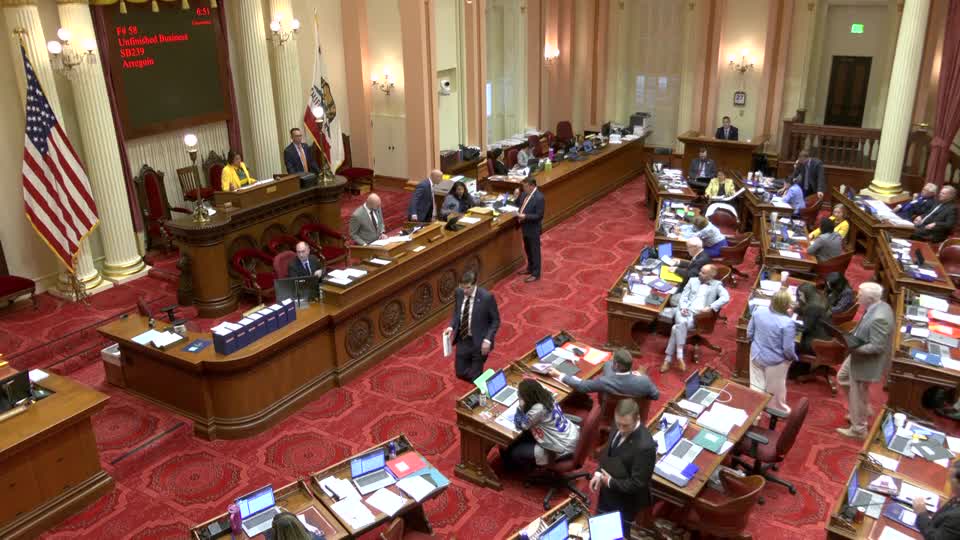 2MIN
Senate Floor
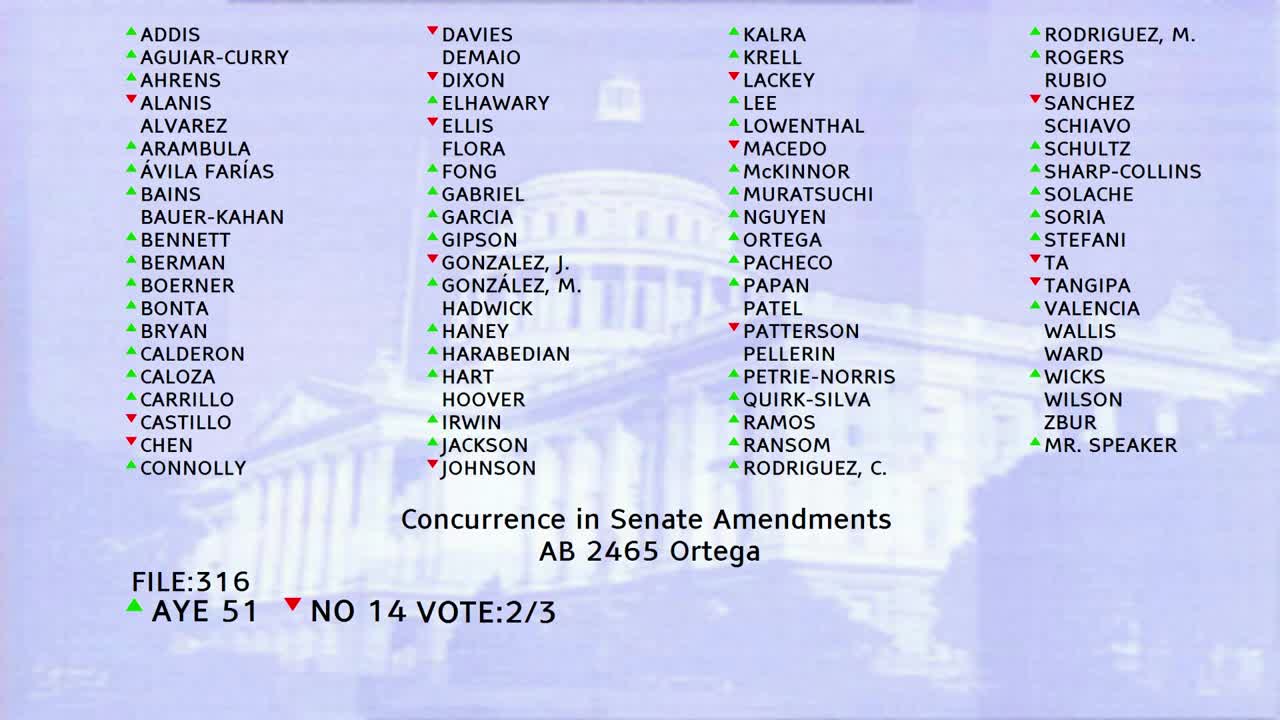 58SEC
Assembly Floor
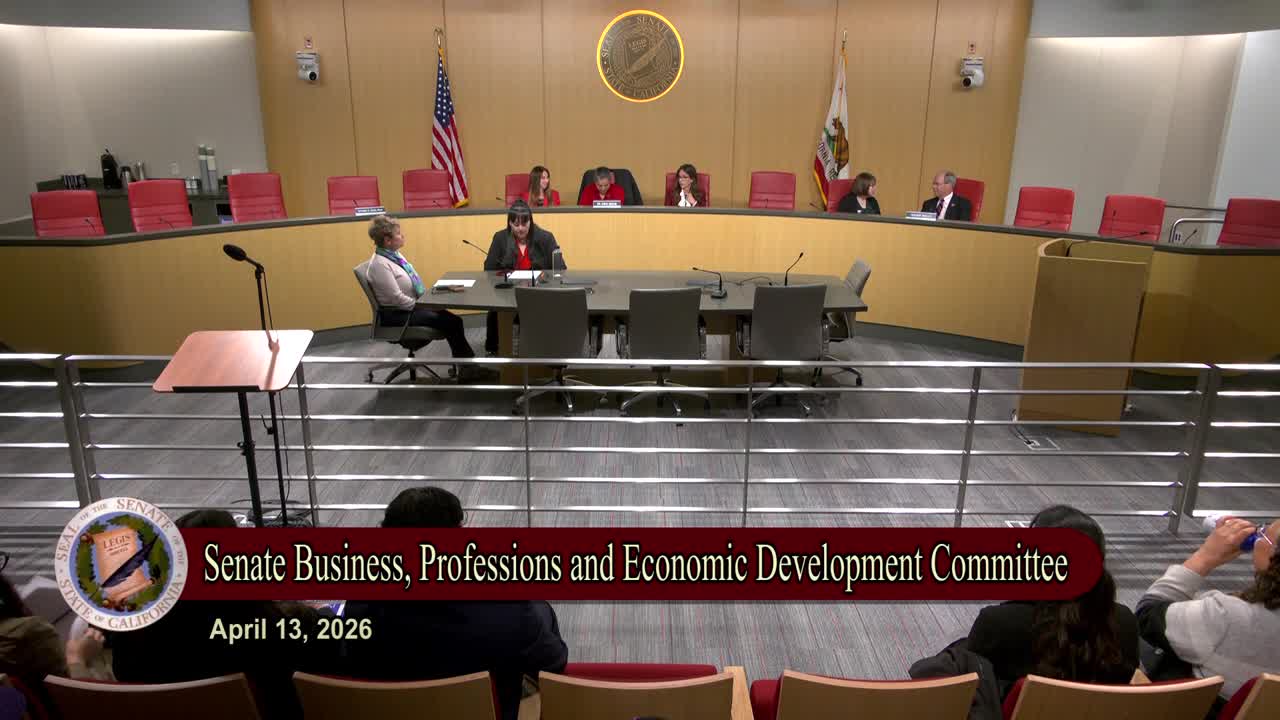 6MIN
Senate Standing Committee on Business, Professions and Economic Development
Bill Author

Bill Co-Author(s):