SB 1350: Energy: renewable electrical generation facilities: definition.
- Session Year: 2025-2026
- House: Senate
- Latest Version Date: 2026-06-29
Current Status:
Passed
(2026-06-29: Chaptered by Secretary of State. Chapter 35, Statutes of 2026.)
Introduced
In Committee
Awaiting First Chamber Vote
Passed First Chamber
In Committee
Awaiting Second Chamber Vote
Passed Second Chamber
Enacted
Existing law defines a renewable electrical generation facility as a facility that uses biomass, solar thermal, photovoltaic, wind, geothermal, fuel cells or linear generators that use specified fuels, small hydroelectric generation of 30 megawatts or less, digester gas, municipal solid waste conversion, landfill gas, ocean wave, ocean thermal, or tidal current, and that meets other specified requirements. Existing law incorporates that definition into various programs, including the California Renewables Portfolio Standard Program, which requires the Public Utilities Commission to establish a renewables portfolio standard requiring all retail sellers, as defined, to procure a minimum quantity of electricity products from electrical generating facilities that meet that definition of renewable electrical generation facility, and the net energy metering program, in which residential customers, small commercial customers, and commercial, industrial, or agricultural customers of an electrical utility, who use renewable electrical generation facilities, are eligible to participate, as specified.
This bill would expand the definition of renewable electrical generation facility to include a facility that converts hydrogen gas to electricity in a turbine and meets specified criteria, including that the hydrogen used in the turbine is solely derived from an eligible renewable resource, as specified, or through the electrolysis of water, and exclusively uses electricity generated from another renewable electrical generation facility, and that the manufacturing of the hydrogen does not result in resource shuffling or use unbundled renewable energy credits, as specified.
Under existing law, a violation of any order, decision, rule, direction, demand, or requirement of the commission is a crime.
Because a violation of a commission action implementing this bills requirements would be a crime, the bill would impose a state-mandated local program.
The California Constitution requires the state to reimburse local agencies and school districts for certain costs mandated by the state. Statutory provisions establish procedures for making that reimbursement.
This bill would provide that no reimbursement is required by this act for a specified reason.
This bill would declare that it is to take effect immediately as an urgency statute.
Existing law defines a renewable electrical generation facility as a facility that uses biomass, solar thermal, photovoltaic, wind, geothermal, fuel cells or linear generators that use specified fuels, small hydroelectric generation of 30 megawatts or less, digester gas, municipal solid waste conversion, landfill gas, ocean wave, ocean thermal, or tidal current, and that meets other specified requirements. Existing law incorporates that definition into various programs, including the California Renewables Portfolio Standard Program, which requires the Public Utilities Commission to establish a renewables portfolio standard requiring all retail sellers, as defined, to procure a minimum quantity of electricity products from electrical generating facilities that meet that definition of renewable electrical generation facility, and the net energy metering program, in which residential customers, small commercial customers, and commercial, industrial, or agricultural customers of an electrical utility, who use renewable electrical generation facilities, are eligible to participate, as specified.
This bill would expand the definition of renewable electrical generation facility to include a facility that converts hydrogen gas to electricity in a turbine and meets specified criteria, including that the hydrogen used in the turbine is solely derived from an eligible renewable feedstock resource, as specified, or through the electrolysis of water, and exclusively uses electricity generated from another renewable electrical generation facility, and that the manufacturing of the hydrogen does not result in resource shuffling or use unbundled renewable energy credits, as specified.
Under existing law, a violation of any order, decision, rule, direction, demand, or requirement of the commission is a crime.
Because a violation of a commission action implementing this bills requirements would be a crime, the bill would impose a state-mandated local program.
The California Constitution requires the state to reimburse local agencies and school districts for certain costs mandated by the state. Statutory provisions establish procedures for making that reimbursement.
This bill would provide that no reimbursement is required by this act for a specified reason.
This bill would declare that it is to take effect immediately as an urgency statute.
Existing law defines a renewable electrical generation facility as a facility that uses biomass, solar thermal, photovoltaic, wind, geothermal, fuel cells or linear generators that use specified fuels, small hydroelectric generation of 30 megawatts or less, digester gas, municipal solid waste conversion, landfill gas, ocean wave, ocean thermal, or tidal current, and that meets other specified requirements. Existing law incorporates that definition into various programs, including the California Renewables Portfolio Standard Program, which requires the Public Utilities Commission to establish a renewables portfolio standard requiring all retail sellers, as defined, to procure a minimum quantity of electricity products from electrical generating facilities that meet that definition of renewable electrical generation facility, and the net energy metering program, in which residential customers, small commercial customers, and commercial, industrial, or agricultural customers of an electrical utility, who use renewable electrical generation facilities, are eligible to participate, as specified.
This bill would expand the definition of renewable electrical generation facility to include a facility that converts hydrogen gas to electricity in a turbine and meets specified criteria, including that the hydrogen used in the turbine is solely derived from a non-fossil-based an eligible renewable feedstock or through the electrolysis of water using water, and exclusively uses electricity generated from another renewable electrical generation facility facility, and the manufacturing of the hydrogen does not result in resource shuffling or use unbundled renewable energy credits, as specified.
Under existing law, a violation of any order, decision, rule, direction, demand, or requirement of the commission is a crime.
Because a violation of a commission action implementing this bills requirements would be a crime, the bill would impose a state-mandated local program.
The California Constitution requires the state to reimburse local agencies and school districts for certain costs mandated by the state. Statutory provisions establish procedures for making that reimbursement.
This bill would provide that no reimbursement is required by this act for a specified reason.
Existing law defines a renewable electrical generation facility as a facility that uses biomass, solar thermal, photovoltaic, wind, geothermal, fuel cells or linear generators that use specified fuels, small hydroelectric generation of 30 megawatts or less, digester gas, municipal solid waste conversion, landfill gas, ocean wave, ocean thermal, or tidal current, and that meets other specified requirements. Existing law incorporates that definition into various programs, including the California Renewables Portfolio Standard Program, which requires the Public Utilities Commission to establish a renewables portfolio standard requiring all retail sellers, as defined, to procure a minimum quantity of electricity products from electrical generating facilities that meet that definition of renewable electrical generation facility, and the net energy metering program, in which residential customers, small commercial customers, and commercial, industrial, or agricultural customers of an electrical utility, who use renewable electrical generation facilities, are eligible to participate, as specified.
This bill would expand the definition of renewable electrical generation facility to include a facility that converts hydrogen gas to electricity in a turbine and meets specified criteria, including that the hydrogen used in the turbine is solely derived from a non-fossil-based feedstock or through the electrolysis of water using electricity generated from another renewable electrical generation facility and the manufacturing of the hydrogen does not result in resource shuffling or use unbundled renewable energy credits, as specified.
Under existing law, a violation of any order, decision, rule, direction, demand, or requirement of the commission is a crime.
Because a violation of a commission action implementing this bills requirements would be a crime, the bill would impose a state-mandated local program.
The California Constitution requires the state to reimburse local agencies and school districts for certain costs mandated by the state. Statutory provisions establish procedures for making that reimbursement.
This bill would provide that no reimbursement is required by this act for a specified reason.
Existing law defines a renewable electrical generation facility as a facility that uses biomass, solar thermal, photovoltaic, wind, geothermal, fuel cells or linear generators that use specified fuels, small hydroelectric generation of 30 megawatts or less, digester gas, municipal solid waste conversion, landfill gas, ocean wave, ocean thermal, or tidal current, and that meets other specified requirements. Existing law incorporates that definition into various programs, including the California Renewables Portfolio Standard Program, which requires the Public Utilities Commission to establish a renewables portfolio standard requiring all retail sellers, as defined, to procure a minimum quantity of electricity products from electrical generating facilities that meet that definition of renewable electrical generation facility, and the net energy metering program, in which residential customers, small commercial customers, and commercial, industrial, or agricultural customers of an electrical utility, who use renewable electrical generation facilities, are eligible to participate, as specified.
This bill would revise expand the definition of renewable electrical generation facility to include a facility that uses turbines that use specified fuels. converts hydrogen gas to electricity in a turbine and meets specified criteria, including that the hydrogen used in the turbine is solely derived from a non-fossil-based feedstock or through the electrolysis of water using electricity generated from another renewable electrical generation facility and the manufacturing of the hydrogen does not result in resource shuffling or use unbundled renewable energy credits, as specified.
Under existing law, a violation of any order, decision, rule, direction, demand, or requirement of the commission is a crime.
Because a violation of a commission action implementing this bills requirements would be a crime, the bill would impose a state-mandated local program.
The California Constitution requires the state to reimburse local agencies and school districts for certain costs mandated by the state. Statutory provisions establish procedures for making that reimbursement.
This bill would provide that no reimbursement is required by this act for a specified reason.
Existing law defines a renewable electrical generation facility as a facility that uses biomass, solar thermal, photovoltaic, wind, geothermal, fuel cells or linear generators that use specified fuels, small hydroelectric generation of 30 megawatts or less, digester gas, municipal solid waste conversion, landfill gas, ocean wave, ocean thermal, or tidal current, and that meets other specified requirements. Existing law incorporates that definition into various programs, including the California Renewables Portfolio Standard Program, which requires the Public Utilities Commission to establish a renewables portfolio standard requiring all retail sellers, as defined, to procure a minimum quantity of electricity products from electrical generating facilities that meet that definition of renewable electrical generation facility, and the net energy metering program, in which residential customers, small commercial customers, and commercial, industrial, or agricultural customers of an electrical utility, who use renewable electrical generation facilities, are eligible to participate, as specified.
This bill would revise the definition of renewable electrical generation facility to include a facility that uses turbines that use specified fuels.
Under existing law, a violation of any order, decision, rule, direction, demand, or requirement of the commission is a crime.
Because a violation of a commission action implementing this bills requirements would be a crime, the bill would impose a state-mandated local program.
The California Constitution requires the state to reimburse local agencies and school districts for certain costs mandated by the state. Statutory provisions establish procedures for making that reimbursement.
This bill would provide that no reimbursement is required by this act for a specified reason.
As used in this chapter, all of the following definitions apply:
(a)Renewable electrical generation facility means a facility that meets all of the following criteria:
(1)The facility meets either of the following criteria:
(A)The facility uses biomass, solar thermal, photovoltaic, wind, geothermal, fuel cells or linear generators using fuels described in this paragraph that otherwise meet the requirements of this subdivision, small hydroelectric generation of 30 megawatts or less, digester gas, municipal solid waste conversion, landfill gas, ocean wave, ocean thermal, or tidal current, and any additions or enhancements to the facility using that technology.
(B)The facility converts hydrogen gas to electricity in a turbine and meets all of the following criteria:
(i)The hydrogen used in the turbine is solely derived from an eligible renewable resource described in subparagraph (A) or through the electrolysis of water, and exclusively uses electricity generated from another renewable electrical generation facility. Any fraction of hydrogen produced through the use of nonrenewable fuels or nonrenewable electricity shall not be eligible to satisfy the requirements of this section.
(ii)The electricity used to derive the hydrogen is not also counted toward a compliance obligation pursuant to the California Renewables Portfolio Standard Program (Article 16 (commencing with Section 399.11) of Chapter 2.3 of Part 1 of Division 1 of the Public Utilities Code) or claimed as renewable generation for any other state program.
(iii)The facility provides the commission with confirmation from the air quality management district or air pollution control district that the facilitys turbine has the capacity to use a fuel for which hydrogen comprises a sufficient quantity of the blend by volume, but not below 20 percent by volume, to achieve a measurable reduction in greenhouse gas emissions.
(iv)The facility has submitted information on the hydrogen production process, as specified by the commission. For electrolytic production, the operator shall demonstrate, for the production process, hourly matching of hydrogen production with renewable energy generation starting January 1, 2030.
(v)The manufacturing of the hydrogen does not result in resource shuffling, as independently determined by the commission based on regional impacts of hydrogen production on zero-carbon generation, local air pollution, and fossil fuel generation.
(vi)The manufacturing of the hydrogen does not use unbundled renewable energy credits.
(vii)The facility provides the commission with confirmation from the air quality management district or air pollution control district that the combustion of hydrogen will result in a net decrease of air pollutants and of greenhouse gas emissions from the electrical sector and will not increase the oxides of nitrogen emissions rate from the turbine compared to natural gas.
(viii)The hydrogen is physically delivered to the turbine.
(2)The facility satisfies one of the following requirements:
(A)The facility is located in the state or near the border of the state with the first point of connection to the transmission network of a balancing authority area primarily located within the state. For purposes of this subparagraph, balancing authority area has the same meaning as defined in Section 399.12 of the Public Utilities Code.
(B)The facility has its first point of interconnection to the transmission network outside the state, within the Western Electricity Coordinating Council (WECC) service area, and satisfies all of the following requirements:
(i)It commences initial commercial operation after January 1, 2005.
(ii)It will not cause or contribute to a violation of a California environmental quality standard or requirement.
(iii)It participates in the accounting system to verify compliance with the renewables portfolio standard established by the commission pursuant to subdivision (b) of Section 399.25 of the Public Utilities Code.
(C)The facility meets the requirements of clauses (ii) and (iii) of subparagraph (B), but does not meet the requirements of clause (i) of subparagraph (B) because it commenced initial operation before January 1, 2005, if the facility satisfies either of the following requirements:
(i)The electricity is from incremental generation resulting from expansion or repowering of the facility.
(ii)Electricity generated by the facility was procured by a retail seller or local publicly owned electric utility as of January 1, 2010.
(3)If the facility is outside the United States, it is developed and operated in a manner that is as protective of the environment as a similar facility located in the state.
(4)If eligibility of the facility is based on the use of landfill gas, digester gas, or another renewable fuel delivered to the facility through a common carrier pipeline, the transaction for the procurement of that fuel, including the source of the fuel and delivery method, satisfies the requirements of Section 399.12.6 of the Public Utilities Code and is verified pursuant to the accounting system established by the commission pursuant to Section 399.25 of the Public Utilities Code, or a comparable system, as determined by the commission.
(b)Municipal solid waste conversion means a technology that uses a noncombustion thermal process to convert solid waste to a clean-burning fuel for the purpose of generating electricity, and that meets all of the following criteria:
(1)The technology does not use air or oxygen in the conversion process, except ambient air to maintain temperature control.
(2)The technology produces no discharges of air contaminants or emissions, including greenhouse gases as defined in Section 38505 of the Health and Safety Code.
(3)The technology produces no discharges to surface or groundwaters of the state.
(4)The technology produces no hazardous wastes.
(5)To the maximum extent feasible, the technology removes all recyclable materials and marketable green waste compostable materials from the solid waste stream before the conversion process and the owner or operator of the facility certifies that those materials will be recycled or composted.
(6)The facility at which the technology is used is in compliance with all applicable laws, regulations, and ordinances.
(7)The technology meets any other conditions established by the commission.
(8)The facility certifies that any local agency sending solid waste to the facility diverted at least 30 percent of all solid waste it collects through solid waste reduction, recycling, and composting. For purposes of this paragraph, local agency means any city, county, or special district, or subdivision thereof, that is authorized to provide solid waste handling services.
(c)Renewable energy public goods charge means that portion of the nonbypassable system benefits charge required to be collected to fund renewable energy pursuant to the Reliable Electric Service Investments Act (Article 15 (commencing with Section 399) of Chapter 2.3 of Part 1 of Division 1 of the Public Utilities Code).
(d)Report means the report entitled Investing in Renewable Electricity Generation in California (June 2001, Publication Number P500-00-022) submitted to the Governor and the Legislature by the commission.
(e)Retail seller has the same meaning as defined in Section 399.12 of the Public Utilities Code.
SEC. 2.No reimbursement is required by this act pursuant to Section 6 of Article XIIIB of the California Constitution because the only costs that may be incurred by a local agency or school district will be incurred because this act creates a new crime or infraction, eliminates a crime or infraction, or changes the penalty for a crime or infraction, within the meaning of Section 17556 of the Government Code, or changes the definition of a crime within the meaning of Section 6 of Article XIIIB of the California Constitution.
SEC. 3.This act is an urgency statute necessary for the immediate preservation of the public peace, health, or safety within the meaning of Article IV of the California Constitution and shall go into immediate effect. The facts constituting the necessity are:
In order to ensure the continued safe harboring of over $675 million in tax credits that would materially benefit the state, to allow the State Energy Resources Conservation and Development Commission to begin working on implementation this year or by early 2027, and to provide a strong market signal for utilities to contract for procurement of renewable hydrogen before implementation, it is necessary for this act to take effect immediately.
As used in this chapter, all of the following definitions apply:
(a)Renewable electrical generation facility means a facility that meets all of the following criteria:
(1)The facility meets either of the following criteria:
(A)The facility uses biomass, solar thermal, photovoltaic, wind, geothermal, fuel cells or linear generators using fuels described in this paragraph that otherwise meet the requirements of this subdivision, small hydroelectric generation of 30 megawatts or less, digester gas, municipal solid waste conversion, landfill gas, ocean wave, ocean thermal, or tidal current, and any additions or enhancements to the facility using that technology.
(B)The facility converts hydrogen gas to electricity in a turbine and meets all of the following criteria:
(i)The hydrogen used in the turbine is solely derived from an eligible renewable feedstock resource described in subparagraph (A) or through the electrolysis of water, and exclusively uses electricity generated from another renewable electrical generation facility. Any fraction of hydrogen produced through the use of nonrenewable fuels or nonrenewable electricity shall not be eligible to satisfy the requirements of this section.
(ii)The electricity used to derive the hydrogen is not also counted toward a compliance obligation pursuant to the California Renewables Portfolio Standard Program (Article 16 (commencing with Section 399.11) of Chapter 2.3 of Part 1 of Division 1 of the Public Utilities Code) or claimed as renewable generation for any other state program.
(iii)The facility provides the commission with confirmation from the air quality management district or air pollution control district that the facilitys turbine has the capacity to use a fuel for which hydrogen comprises a sufficient quantity of the blend by volume, as determined by the commission, but not below 20 percent by volume, to achieve a measurable reduction in greenhouse gas emissions, as determined by the commission. emissions.
(iv)The operator of the facility has submitted information on the hydrogen production process, as specified by the commission. For electrolytic production, the operator shall demonstrate, for the production process, hourly matching of hydrogen production with renewable energy generation starting January 1, 2030.
(v)The manufacturing of the hydrogen does not result in resource shuffling, as independently determined by the commission based on regional impacts of hydrogen production on zero-carbon generation, local air pollution, and fossil fuel generation.
(vi)The manufacturing of the hydrogen does not use unbundled renewable energy credits.
(vii)The use of the hydrogen results in a net decrease of air pollutants, as regulated by local air districts, and of greenhouse gases from the electrical sector.(viii)(vii)The operator of the facility provides the commission with confirmation from the air quality management district or air pollution control district that the combustion of hydrogen will result in a net decrease of air pollutants and of greenhouse gas emissions from the electrical sector and will not increase the oxides of nitrogen emissions rate from the turbine compared to natural gas.
(ix)(viii)The hydrogen is physically delivered to the turbine.
(2)The facility satisfies one of the following requirements:
(A)The facility is located in the state or near the border of the state with the first point of connection to the transmission network of a balancing authority area primarily located within the state. For purposes of this subparagraph, balancing authority area has the same meaning as defined in Section 399.12 of the Public Utilities Code.
(B)The facility has its first point of interconnection to the transmission network outside the state, within the Western Electricity Coordinating Council (WECC) service area, and satisfies all of the following requirements:
(i)It commences initial commercial operation after January 1, 2005.
(ii)It will not cause or contribute to a violation of a California environmental quality standard or requirement.
(iii)It participates in the accounting system to verify compliance with the renewables portfolio standard established by the commission pursuant to subdivision (b) of Section 399.25 of the Public Utilities Code.
(C)The facility meets the requirements of clauses (ii) and (iii) of subparagraph (B), but does not meet the requirements of clause (i) of subparagraph (B) because it commenced initial operation before January 1, 2005, if the facility satisfies either of the following requirements:
(i)The electricity is from incremental generation resulting from expansion or repowering of the facility.
(ii)Electricity generated by the facility was procured by a retail seller or local publicly owned electric utility as of January 1, 2010.
(3)If the facility is outside the United States, it is developed and operated in a manner that is as protective of the environment as a similar facility located in the state.
(4)If eligibility of the facility is based on the use of landfill gas, digester gas, or another renewable fuel delivered to the facility through a common carrier pipeline, the transaction for the procurement of that fuel, including the source of the fuel and delivery method, satisfies the requirements of Section 399.12.6 of the Public Utilities Code and is verified pursuant to the accounting system established by the commission pursuant to Section 399.25 of the Public Utilities Code, or a comparable system, as determined by the commission.
(b)Municipal solid waste conversion means a technology that uses a noncombustion thermal process to convert solid waste to a clean-burning fuel for the purpose of generating electricity, and that meets all of the following criteria:
(1)The technology does not use air or oxygen in the conversion process, except ambient air to maintain temperature control.
(2)The technology produces no discharges of air contaminants or emissions, including greenhouse gases as defined in Section 38505 of the Health and Safety Code.
(3)The technology produces no discharges to surface or groundwaters of the state.
(4)The technology produces no hazardous wastes.
(5)To the maximum extent feasible, the technology removes all recyclable materials and marketable green waste compostable materials from the solid waste stream before the conversion process and the owner or operator of the facility certifies that those materials will be recycled or composted.
(6)The facility at which the technology is used is in compliance with all applicable laws, regulations, and ordinances.
(7)The technology meets any other conditions established by the commission.
(8)The facility certifies that any local agency sending solid waste to the facility diverted at least 30 percent of all solid waste it collects through solid waste reduction, recycling, and composting. For purposes of this paragraph, local agency means any city, county, or special district, or subdivision thereof, that is authorized to provide solid waste handling services.
(c)Renewable energy public goods charge means that portion of the nonbypassable system benefits charge required to be collected to fund renewable energy pursuant to the Reliable Electric Service Investments Act (Article 15 (commencing with Section 399) of Chapter 2.3 of Part 1 of Division 1 of the Public Utilities Code).
(d)Report means the report entitled Investing in Renewable Electricity Generation in California (June 2001, Publication Number P500-00-022) submitted to the Governor and the Legislature by the commission.
(e)Retail seller has the same meaning as defined in Section 399.12 of the Public Utilities Code.
SEC. 2.No reimbursement is required by this act pursuant to Section 6 of Article XIIIB of the California Constitution because the only costs that may be incurred by a local agency or school district will be incurred because this act creates a new crime or infraction, eliminates a crime or infraction, or changes the penalty for a crime or infraction, within the meaning of Section 17556 of the Government Code, or changes the definition of a crime within the meaning of Section 6 of Article XIIIB of the California Constitution.
SEC. 3.This act is an urgency statute necessary for the immediate preservation of the public peace, health, or safety within the meaning of Article IV of the California Constitution and shall go into immediate effect. The facts constituting the necessity are:
In order to ensure the continued safe harboring of over $675 million in tax credits that would materially benefit the state, to allow the State Energy Resources Conservation and Development Commission to begin working on implementation this year or by early 2027, and to provide a strong market signal for utilities to contract for procurement of renewable hydrogen before implementation, it is necessary for this act to take effect immediately.
REVISIONS: HeadingLines 5 and 6.As used in this chapter, all of the following definitions apply:
(a)Renewable electrical generation facility means a facility that meets all of the following criteria:
(1)The facility meets either of the following criteria:
(A)The facility uses biomass, solar thermal, photovoltaic, wind, geothermal, fuel cells or linear generators using fuels described in this paragraph that otherwise meet the requirements of this subdivision, small hydroelectric generation of 30 megawatts or less, digester gas, municipal solid waste conversion, landfill gas, ocean wave, ocean thermal, or tidal current, and any additions or enhancements to the facility using that technology.
(B)The facility converts hydrogen gas to electricity in a turbine and meets all of the following criteria:
(i)The hydrogen used in the turbine is solely derived from a non-fossil-based an eligible renewable feedstock or through the electrolysis of water using water, and exclusively uses electricity generated from another renewable electrical generation facility. Any fraction of hydrogen produced through the use of nonrenewable fuels or nonrenewable electricity shall not be eligible to satisfy the requirements of this section.
(ii)The electricity used to derive the hydrogen is not also counted toward a compliance obligation pursuant to the California Renewables Portfolio Standard Program (Article 16 (commencing with Section 399.11) of Chapter 2.3 of Part 1 of Division 1 of the Public Utilities Code) or claimed as renewable generation for any other state program.
(iii)The facilitys turbine has the capacity to use a fuel for which hydrogen comprises a sufficient quantity of the blend by volume, as determined by the commission, but not below 20 percent by volume, to achieve a measurable reduction in greenhouse gas emissions, as determined by the commission.
(iv)The operator of the facility has submitted information on the hydrogen production process, as specified by the commission. For electrolytic production, the operator shall demonstrate, for the production process, hourly matching of hydrogen production with renewable energy generation starting January 1, 2030.
(v)The manufacturing of the hydrogen does not result in resource shuffling, as independently determined by the commission based on regional impacts of hydrogen production on zero-carbon generation, local air pollution, and fossil fuel generation.
(vi)The manufacturing of the hydrogen does not use unbundled renewable energy credits.
(vii)The use of the hydrogen results in a net decrease of air pollutants, as regulated by local air districts, and of greenhouse gases from the electrical sector.
(viii)The operator of the facility provides the commission with confirmation from the air quality management district or air pollution control district that the combustion of hydrogen will not increase the oxides of nitrogen emissions rate from the turbine compared to natural gas.
(ix)The hydrogen is physically delivered to the turbine.
(2)The facility satisfies one of the following requirements:
(A)The facility is located in the state or near the border of the state with the first point of connection to the transmission network of a balancing authority area primarily located within the state. For purposes of this subparagraph, balancing authority area has the same meaning as defined in Section 399.12 of the Public Utilities Code.
(B)The facility has its first point of interconnection to the transmission network outside the state, within the Western Electricity Coordinating Council (WECC) service area, and satisfies all of the following requirements:
(i)It commences initial commercial operation after January 1, 2005.
(ii)It will not cause or contribute to a violation of a California environmental quality standard or requirement.
(iii)It participates in the accounting system to verify compliance with the renewables portfolio standard established by the commission pursuant to subdivision (b) of Section 399.25 of the Public Utilities Code.
(C)The facility meets the requirements of clauses (ii) and (iii) of subparagraph (B), but does not meet the requirements of clause (i) of subparagraph (B) because it commenced initial operation before January 1, 2005, if the facility satisfies either of the following requirements:
(i)The electricity is from incremental generation resulting from expansion or repowering of the facility.
(ii)Electricity generated by the facility was procured by a retail seller or local publicly owned electric utility as of January 1, 2010.
(3)If the facility is outside the United States, it is developed and operated in a manner that is as protective of the environment as a similar facility located in the state.
(4)If eligibility of the facility is based on the use of landfill gas, digester gas, or another renewable fuel delivered to the facility through a common carrier pipeline, the transaction for the procurement of that fuel, including the source of the fuel and delivery method, satisfies the requirements of Section 399.12.6 of the Public Utilities Code and is verified pursuant to the accounting system established by the commission pursuant to Section 399.25 of the Public Utilities Code, or a comparable system, as determined by the commission.
(b)Municipal solid waste conversion means a technology that uses a noncombustion thermal process to convert solid waste to a clean-burning fuel for the purpose of generating electricity, and that meets all of the following criteria:
(1)The technology does not use air or oxygen in the conversion process, except ambient air to maintain temperature control.
(2)The technology produces no discharges of air contaminants or emissions, including greenhouse gases as defined in Section 38505 of the Health and Safety Code.
(3)The technology produces no discharges to surface or groundwaters of the state.
(4)The technology produces no hazardous wastes.
(5)To the maximum extent feasible, the technology removes all recyclable materials and marketable green waste compostable materials from the solid waste stream before the conversion process and the owner or operator of the facility certifies that those materials will be recycled or composted.
(6)The facility at which the technology is used is in compliance with all applicable laws, regulations, and ordinances.
(7)The technology meets any other conditions established by the commission.
(8)The facility certifies that any local agency sending solid waste to the facility diverted at least 30 percent of all solid waste it collects through solid waste reduction, recycling, and composting. For purposes of this paragraph, local agency means any city, county, or special district, or subdivision thereof, that is authorized to provide solid waste handling services.
(c)Renewable energy public goods charge means that portion of the nonbypassable system benefits charge required to be collected to fund renewable energy pursuant to the Reliable Electric Service Investments Act (Article 15 (commencing with Section 399) of Chapter 2.3 of Part 1 of Division 1 of the Public Utilities Code).
(d)Report means the report entitled Investing in Renewable Electricity Generation in California (June 2001, Publication Number P500-00-022) submitted to the Governor and the Legislature by the commission.
(e)Retail seller has the same meaning as defined in Section 399.12 of the Public Utilities Code.
SEC. 2.No reimbursement is required by this act pursuant to Section 6 of Article XIIIB of the California Constitution because the only costs that may be incurred by a local agency or school district will be incurred because this act creates a new crime or infraction, eliminates a crime or infraction, or changes the penalty for a crime or infraction, within the meaning of Section 17556 of the Government Code, or changes the definition of a crime within the meaning of Section 6 of Article XIIIB of the California Constitution.
As used in this chapter, all of the following definitions apply:
(a)Renewable electrical generation facility means a facility that meets all of the following criteria:
(1)The facility meets either of the following criteria:
(A)The facility uses biomass, solar thermal, photovoltaic, wind, geothermal, fuel cells or linear generators using fuels described in this paragraph that otherwise meet the requirements of this subdivision, small hydroelectric generation of 30 megawatts or less, digester gas, municipal solid waste conversion, landfill gas, ocean wave, ocean thermal, or tidal current, and any additions or enhancements to the facility using that technology.
(B)The facility converts hydrogen gas to electricity in a turbine and meets all of the following criteria:
(i)The hydrogen used in the turbine is solely derived from a non-fossil-based feedstock or through the electrolysis of water using electricity generated from another renewable electrical generation facility.
(ii)The electricity used to derive the hydrogen is not also counted toward a compliance obligation pursuant to the California Renewables Portfolio Standard Program (Article 16 (commencing with Section 399.11) of Chapter 2.3 of Part 1 of Division 1 of the Public Utilities Code) or claimed as renewable generation for any other state program.
(iii)The facilitys turbine has the capacity to use a fuel for which hydrogen comprises a sufficient quantity of the blend by volume, as determined by the commission, but not below 20 percent by volume, to achieve a measurable reduction in greenhouse gas emissions, as determined by the commission.
(iv)The operator of the facility has submitted information on the hydrogen production process, as specified by the commission. For electrolytic production, the operator shall demonstrate, for the production process, hourly matching of hydrogen production with renewable energy generation starting January 1, 2030.
(v)The manufacturing of the hydrogen does not result in resource shuffling, as independently determined by the State Air Resources Board, in alignment with existing regulations. commission based on regional impacts of hydrogen production on zero-carbon generation, local air pollution, and fossil fuel generation.
(vi)The manufacturing of the hydrogen does not use unbundled renewable energy credits.
(vii)The use of the hydrogen results in a net decrease of air pollutants, as regulated by local air districts, and of greenhouse gases from the electrical sector.
(2)The facility satisfies one of the following requirements:
(A)The facility is located in the state or near the border of the state with the first point of connection to the transmission network of a balancing authority area primarily located within the state. For purposes of this subparagraph, balancing authority area has the same meaning as defined in Section 399.12 of the Public Utilities Code.
(B)The facility has its first point of interconnection to the transmission network outside the state, within the Western Electricity Coordinating Council (WECC) service area, and satisfies all of the following requirements:
(i)It commences initial commercial operation after January 1, 2005.
(ii)It will not cause or contribute to a violation of a California environmental quality standard or requirement.
(iii)It participates in the accounting system to verify compliance with the renewables portfolio standard established by the commission pursuant to subdivision (b) of Section 399.25 of the Public Utilities Code.
(C)The facility meets the requirements of clauses (ii) and (iii) of subparagraph (B), but does not meet the requirements of clause (i) of subparagraph (B) because it commenced initial operation before January 1, 2005, if the facility satisfies either of the following requirements:
(i)The electricity is from incremental generation resulting from expansion or repowering of the facility.
(ii)Electricity generated by the facility was procured by a retail seller or local publicly owned electric utility as of January 1, 2010.
(3)If the facility is outside the United States, it is developed and operated in a manner that is as protective of the environment as a similar facility located in the state.
(4)If eligibility of the facility is based on the use of landfill gas, digester gas, or another renewable fuel delivered to the facility through a common carrier pipeline, the transaction for the procurement of that fuel, including the source of the fuel and delivery method, satisfies the requirements of Section 399.12.6 of the Public Utilities Code and is verified pursuant to the accounting system established by the commission pursuant to Section 399.25 of the Public Utilities Code, or a comparable system, as determined by the commission.
(b)Municipal solid waste conversion means a technology that uses a noncombustion thermal process to convert solid waste to a clean-burning fuel for the purpose of generating electricity, and that meets all of the following criteria:
(1)The technology does not use air or oxygen in the conversion process, except ambient air to maintain temperature control.
(2)The technology produces no discharges of air contaminants or emissions, including greenhouse gases as defined in Section 38505 of the Health and Safety Code.
(3)The technology produces no discharges to surface or groundwaters of the state.
(4)The technology produces no hazardous wastes.
(5)To the maximum extent feasible, the technology removes all recyclable materials and marketable green waste compostable materials from the solid waste stream before the conversion process and the owner or operator of the facility certifies that those materials will be recycled or composted.
(6)The facility at which the technology is used is in compliance with all applicable laws, regulations, and ordinances.
(7)The technology meets any other conditions established by the commission.
(8)The facility certifies that any local agency sending solid waste to the facility diverted at least 30 percent of all solid waste it collects through solid waste reduction, recycling, and composting. For purposes of this paragraph, local agency means any city, county, or special district, or subdivision thereof, that is authorized to provide solid waste handling services.
(c)Renewable energy public goods charge means that portion of the nonbypassable system benefits charge required to be collected to fund renewable energy pursuant to the Reliable Electric Service Investments Act (Article 15 (commencing with Section 399) of Chapter 2.3 of Part 1 of Division 1 of the Public Utilities Code).
(d)Report means the report entitled Investing in Renewable Electricity Generation in California (June 2001, Publication Number P500-00-022) submitted to the Governor and the Legislature by the commission.
(e)Retail seller has the same meaning as defined in Section 399.12 of the Public Utilities Code.
SEC. 2.No reimbursement is required by this act pursuant to Section 6 of Article XIIIB of the California Constitution because the only costs that may be incurred by a local agency or school district will be incurred because this act creates a new crime or infraction, eliminates a crime or infraction, or changes the penalty for a crime or infraction, within the meaning of Section 17556 of the Government Code, or changes the definition of a crime within the meaning of Section 6 of Article XIIIB of the California Constitution.
As used in this chapter, all of the following definitions apply:
(a)Renewable electrical generation facility means a facility that meets all of the following criteria:
(1)The facility meets either of the following criteria:
(1)(A)The facility uses biomass, solar thermal, photovoltaic, wind, geothermal, fuel cells or linear generators using fuels described in this paragraph that otherwise meet the requirements of this subdivision, turbines using fuels described in this paragraph that otherwise meet the requirements of this subdivision, small hydroelectric generation of 30 megawatts or less, digester gas, municipal solid waste conversion, landfill gas, ocean wave, ocean thermal, or tidal current, and any additions or enhancements to the facility using that technology.
(B)The facility converts hydrogen gas to electricity in a turbine and meets all of the following criteria:
(i)The hydrogen used in the turbine is solely derived from a non-fossil-based feedstock or through the electrolysis of water using electricity generated from another renewable electrical generation facility.
(ii)The electricity used to derive the hydrogen is not also counted toward a compliance obligation pursuant to the California Renewables Portfolio Standard Program (Article 16 (commencing with Section 399.11) of Chapter 2.3 of Part 1 of Division 1 of the Public Utilities Code) or claimed as renewable generation for any other state program.
(iii)The facilitys turbine has the capacity to use a fuel for which hydrogen comprises a sufficient quantity of the blend by volume, as determined by the commission, but not below 20 percent by volume, to achieve a measurable reduction in greenhouse gas emissions, as determined by the commission.
(iv)The operator of the facility has submitted information on the hydrogen production process, as specified by the commission.
(v)The manufacturing of the hydrogen does not result in resource shuffling, as determined by the State Air Resources Board, in alignment with existing regulations.
(vi)The manufacturing of the hydrogen does not use unbundled renewable energy credits.
(vii)The use of the hydrogen results in a net decrease of air pollutants, as regulated by local air districts, and of greenhouse gases from the electrical sector.
(2)The facility satisfies one of the following requirements:
(A)The facility is located in the state or near the border of the state with the first point of connection to the transmission network of a balancing authority area primarily located within the state. For purposes of this subparagraph, balancing authority area has the same meaning as defined in Section 399.12 of the Public Utilities Code.
(B)The facility has its first point of interconnection to the transmission network outside the state, within the Western Electricity Coordinating Council (WECC) service area, and satisfies all of the following requirements:
(i)It commences initial commercial operation after January 1, 2005.
(ii)It will not cause or contribute to a violation of a California environmental quality standard or requirement.
(iii)It participates in the accounting system to verify compliance with the renewables portfolio standard established by the commission pursuant to subdivision (b) of Section 399.25 of the Public Utilities Code.
(C)The facility meets the requirements of clauses (ii) and (iii) of subparagraph (B), but does not meet the requirements of clause (i) of subparagraph (B) because it commenced initial operation before January 1, 2005, if the facility satisfies either of the following requirements:
(i)The electricity is from incremental generation resulting from expansion or repowering of the facility.
(ii)Electricity generated by the facility was procured by a retail seller or local publicly owned electric utility as of January 1, 2010.
(3)If the facility is outside the United States, it is developed and operated in a manner that is as protective of the environment as a similar facility located in the state.
(4)If eligibility of the facility is based on the use of landfill gas, digester gas, or another renewable fuel delivered to the facility through a common carrier pipeline, the transaction for the procurement of that fuel, including the source of the fuel and delivery method, satisfies the requirements of Section 399.12.6 of the Public Utilities Code and is verified pursuant to the accounting system established by the commission pursuant to Section 399.25 of the Public Utilities Code, or a comparable system, as determined by the commission.
(b)Municipal solid waste conversion means a technology that uses a noncombustion thermal process to convert solid waste to a clean-burning fuel for the purpose of generating electricity, and that meets all of the following criteria:
(1)The technology does not use air or oxygen in the conversion process, except ambient air to maintain temperature control.
(2)The technology produces no discharges of air contaminants or emissions, including greenhouse gases as defined in Section 38505 of the Health and Safety Code.
(3)The technology produces no discharges to surface or groundwaters of the state.
(4)The technology produces no hazardous wastes.
(5)To the maximum extent feasible, the technology removes all recyclable materials and marketable green waste compostable materials from the solid waste stream before the conversion process and the owner or operator of the facility certifies that those materials will be recycled or composted.
(6)The facility at which the technology is used is in compliance with all applicable laws, regulations, and ordinances.
(7)The technology meets any other conditions established by the commission.
(8)The facility certifies that any local agency sending solid waste to the facility diverted at least 30 percent of all solid waste it collects through solid waste reduction, recycling, and composting. For purposes of this paragraph, local agency means any city, county, or special district, or subdivision thereof, that is authorized to provide solid waste handling services.
(c)Renewable energy public goods charge means that portion of the nonbypassable system benefits charge required to be collected to fund renewable energy pursuant to the Reliable Electric Service Investments Act (Article 15 (commencing with Section 399) of Chapter 2.3 of Part 1 of Division 1 of the Public Utilities Code).
(d)Report means the report entitled Investing in Renewable Electricity Generation in California (June 2001, Publication Number P500-00-022) submitted to the Governor and the Legislature by the commission.
(e)Retail seller has the same meaning as defined in Section 399.12 of the Public Utilities Code.
SEC. 2.No reimbursement is required by this act pursuant to Section 6 of Article XIIIB of the California Constitution because the only costs that may be incurred by a local agency or school district will be incurred because this act creates a new crime or infraction, eliminates a crime or infraction, or changes the penalty for a crime or infraction, within the meaning of Section 17556 of the Government Code, or changes the definition of a crime within the meaning of Section 6 of Article XIIIB of the California Constitution.
As used in this chapter, the following definitions apply:
(a)Renewable electrical generation facility means a facility that meets all of the following criteria:
(1)The facility uses biomass, solar thermal, photovoltaic, wind, geothermal, fuel cells or linear generators using fuels described in this paragraph that otherwise meet the requirements of this subdivision, turbines using fuels described in this paragraph that otherwise meet the requirements of this subdivision, small hydroelectric generation of 30 megawatts or less, digester gas, municipal solid waste conversion, landfill gas, ocean wave, ocean thermal, or tidal current, and any additions or enhancements to the facility using that technology.
(2)The facility satisfies one of the following requirements:
(A)The facility is located in the state or near the border of the state with the first point of connection to the transmission network of a balancing authority area primarily located within the state. For purposes of this subparagraph, balancing authority area has the same meaning as defined in Section 399.12 of the Public Utilities Code.
(B)The facility has its first point of interconnection to the transmission network outside the state, within the Western Electricity Coordinating Council (WECC) service area, and satisfies all of the following requirements:
(i)It commences initial commercial operation after January 1, 2005.
(ii)It will not cause or contribute to any a violation of a California environmental quality standard or requirement.
(iii)It participates in the accounting system to verify compliance with the renewables portfolio standard established by the commission pursuant to subdivision (b) of Section 399.25 of the Public Utilities Code.
(C)The facility meets the requirements of clauses (ii) and (iii) of subparagraph (B), but does not meet the requirements of clause (i) of subparagraph (B) because it commenced initial operation before January 1, 2005, if the facility satisfies either of the following requirements:
(i)The electricity is from incremental generation resulting from expansion or repowering of the facility.
(ii)Electricity generated by the facility was procured by a retail seller or local publicly owned electric utility as of January 1, 2010.
(3)If the facility is outside the United States, it is developed and operated in a manner that is as protective of the environment as a similar facility located in the state.
(4)If eligibility of the facility is based on the use of landfill gas, digester gas, or another renewable fuel delivered to the facility through a common carrier pipeline, the transaction for the procurement of that fuel, including the source of the fuel and delivery method, satisfies the requirements of Section 399.12.6 of the Public Utilities Code and is verified pursuant to the accounting system established by the commission pursuant to Section 399.25 of the Public Utilities Code, or a comparable system, as determined by the commission.
(b)Municipal solid waste conversion means a technology that uses a noncombustion thermal process to convert solid waste to a clean-burning fuel for the purpose of generating electricity, and that meets all of the following criteria:
(1)The technology does not use air or oxygen in the conversion process, except ambient air to maintain temperature control.
(2)The technology produces no discharges of air contaminants or emissions, including greenhouse gases as defined in Section 38505 of the Health and Safety Code.
(3)The technology produces no discharges to surface or groundwaters of the state.
(4)The technology produces no hazardous wastes.
(5)To the maximum extent feasible, the technology removes all recyclable materials and marketable green waste compostable materials from the solid waste stream before the conversion process and the owner or operator of the facility certifies that those materials will be recycled or composted.
(6)The facility at which the technology is used is in compliance with all applicable laws, regulations, and ordinances.
(7)The technology meets any other conditions established by the commission.
(8)The facility certifies that any local agency sending solid waste to the facility diverted at least 30 percent of all solid waste it collects through solid waste reduction, recycling, and composting. For purposes of this paragraph, local agency means any city, county, or special district, or subdivision thereof, that is authorized to provide solid waste handling services.
(c)Renewable energy public goods charge means that portion of the nonbypassable system benefits charge required to be collected to fund renewable energy pursuant to the Reliable Electric Service Investments Act (Article 15 (commencing with Section 399) of Chapter 2.3 of Part 1 of Division 1 of the Public Utilities Code).
(d)Report means the report entitled Investing in Renewable Electricity Generation in California (June 2001, Publication Number P500-00-022) submitted to the Governor and the Legislature by the commission.
(e)Retail seller means a retail seller has the same meaning as defined in Section 399.12 of the Public Utilities Code.
SEC. 2.No reimbursement is required by this act pursuant to Section 6 of Article XIIIB of the California Constitution because the only costs that may be incurred by a local agency or school district will be incurred because this act creates a new crime or infraction, eliminates a crime or infraction, or changes the penalty for a crime or infraction, within the meaning of Section 17556 of the Government Code, or changes the definition of a crime within the meaning of Section 6 of Article XIIIB of the California Constitution.
|
Date
|
Status
|
|---|---|
| Jun 29, 2026 | Chaptered by Secretary of State. Chapter 35, Statutes of 2026. |
| Jun 29, 2026 | Approved by the Governor. |
| Jun 29, 2026 | Enrolled and presented to the Governor at 6 p.m. |
| Jun 29, 2026 | Assembly amendments concurred in. (Ayes 38. Noes 0. Page 5077.) Ordered to engrossing and enrolling. |
| Jun 29, 2026 | Urgency clause adopted. |
| Jun 29, 2026 | Assembly amendments concurred in. (Ayes 38. Noes 0.) Ordered to engrossing and enrolling. |
| Jun 29, 2026 | Unanimous consent granted to take up without reference to file. |
| Jun 29, 2026 | In Senate. Concurrence in Assembly amendments pending. |
| Jun 29, 2026 | Read third time. Urgency clause adopted. Passed. (Ayes 74. Noes 0. Page 5914.) Ordered to the Senate. |
| Jun 29, 2026 | Read third time. Urgency clause adopted. Passed. Ordered to the Senate. |
| Jun 25, 2026 | Read second time. Ordered to third reading. |
| Jun 24, 2026 | From committee: Do pass. (Ayes 15. Noes 0.) (June 24). |
| Jun 24, 2026 | Coauthors revised. |
| Jun 23, 2026 | Read second time and amended. Re-referred to Com. on APPR. |
| Jun 22, 2026 | From committee: Do pass as amended and re-refer to Com. on APPR. (Ayes 10. Noes 0.) (June 22). |
| Jun 22, 2026 | Joint Rule 62(a) suspended. |
| Jun 15, 2026 | From committee with author's amendments. Read second time and amended. Re-referred to Com. on NAT. RES. |
| Jun 11, 2026 | From committee: Do pass and re-refer to Com. on NAT. RES. (Ayes 18. Noes 0.) (June 10). Re-referred to Com. on NAT. RES. |
| Jun 8, 2026 | Joint Rule 62(a) suspended. |
| Jun 4, 2026 | Referred to Coms. on U. & E. and NAT. RES. |
| May 27, 2026 | In Assembly. Read first time. Held at Desk. |
| May 27, 2026 | Read third time. Passed. (Ayes 39. Noes 0. Page 4502.) Ordered to the Assembly. |
| May 27, 2026 | Read third time. Passed. (Ayes 39. Noes 0.) Ordered to the Assembly. |
| May 19, 2026 | Read second time. Ordered to third reading. |
| May 18, 2026 | From committee: Do pass as amended. (Ayes 5. Noes 0. Page 4274.) (May 14). |
| May 18, 2026 | Read second time and amended. Ordered to second reading. |
| May 18, 2026 | From committee: Do pass as amended. (Ayes 5. Noes 0.) (May 14). |
| May 12, 2026 | Set for hearing May 14. |
| May 11, 2026 | May 11 hearing: Placed on APPR. suspense file. |
| May 4, 2026 | Set for hearing May 11. |
| Apr 28, 2026 | Read second time and amended. Re-referred to Com. on APPR. |
| Apr 27, 2026 | From committee: Do pass as amended and re-refer to Com. on APPR. (Ayes 7. Noes 0. Page 4010.) (April 22). |
| Apr 27, 2026 | From committee: Do pass as amended and re-refer to Com. on APPR. (Ayes 7. Noes 0.) (April 22). |
| Apr 17, 2026 | Set for hearing April 22. |
| Apr 14, 2026 | From committee: Do pass and re-refer to Com. on E.Q. (Ayes 15. Noes 0. Page 3842.) (April 13). Re-referred to Com. on E.Q. |
| Apr 14, 2026 | From committee: Do pass and re-refer to Com. on E.Q. (Ayes 15. Noes 0.) (April 13). Re-referred to Com. on E.Q. |
| Apr 13, 2026 | Set for hearing April 13. |
| Apr 6, 2026 | April 7 set for first hearing canceled at the request of author. |
| Mar 25, 2026 | Set for hearing April 7. |
| Mar 4, 2026 | Referred to Coms. on E., U & C. and E.Q. |
| Feb 23, 2026 | Read first time. |
| Feb 23, 2026 | From printer. May be acted upon on or after March 23. |
| Feb 20, 2026 | Introduced. To Com. on RLS. for assignment. To print. |
|
Date
|
Description
|
Location
|
Votes
|
|
|---|---|---|---|---|
| Jun 29, 2026 | W/O REF. TO FILE SB1350 McNerney Urgency Clause | Senate Floor |
Passed |
|
| Jun 29, 2026 | SB 1350 McNerney Third Reading Urgency By Carrillo | Assembly Floor |
Passed |
|
| Jun 24, 2026 | Do pass. | Assembly Standing Committee on Appropriations |
Passed |
|
| Jun 22, 2026 | Do pass as amended and be re-referred to the Committee on [Appropriations] | Assembly Standing Committee on Natural Resources |
Passed |
|
| Jun 10, 2026 | Do pass and be re-referred to the Committee on [Natural Resources] | Assembly Standing Committee on Utilities and Energy |
Passed |
|
| May 27, 2026 | Senate 3rd Reading SB1350 McNerney et al. | Senate Floor |
Passed |
|
| May 14, 2026 | Do pass as amended | Senate Standing Committee on Appropriations |
Passed |
|
| May 11, 2026 | Placed on suspense file | Senate Standing Committee on Appropriations |
Passed |
|
| Apr 22, 2026 | Do pass as amended, but first amend, and re-refer to the Committee on [Appropriations] | Senate Standing Committee on Environmental Quality |
Passed |
|
| Apr 13, 2026 | Do pass, but first be re-referred to the Committee on [Environmental Quality] | Senate Standing Committee on Energy, Utilities and Communications |
Passed |
This list shows positions taken on this bill by organizations on the date displayed, which is linked to the original source.
Positions by individuals are not included.
|
Organization
|
Position
|
Date
|
|---|---|---|
| Air Products and Chemicals, Inc. | ** Support | |
| An individual | ** Against | |
| Burbank Water and Power | ** Support | |
| California Environmental Justice Alliance Action | ** Against | |
| California Hydrogen Business Council | ** Support | |
| California Municipal Utilities Association | ** Support | |
| Capstone Green Energy | ** Support | |
| City Of Burbank | ** Support | |
| City Of Vernon | ** Support | |
| Climate Action California | ** Against | |
| Earthjustice | ** Against | |
| Element Resources | ** Support | |
| Environmental Protection Information Center | ** Against | |
| Geokiln Energy Innovation, Inc. | ** Support | |
| Green Hydrogen Coalition | ** Support | |
| Green Hydrogen Coalition - sponsor | ** Support | |
| Natural Resources Defense Council | ** Against | |
| Northern California Power Agency | ** Support | |
| Pacific Gas And Electric Company | ** Support | |
| PTS Advance | ** Support | |
| PTS Advance, LLC | ** Support | |
| RNG Coalition | ** Support | |
| San Diego Gas and Electric Company | ** Support | |
| Sierra Club California | ** Against | |
| Sierra Energy | ** Support | |
| Southern California Gas Company | ** Support | |
| Southern California Public Power Authority | ** Support | |
| State Building & Construction Trades Council Of California | ** Support | |
| Sustain SoCal | ** Support | |
| The Coalition for Renewable Natural Gas | ** Support | |
| The Utility Reform Network | ** Against | |
| Union Of Concerned Scientists | ** Against | |
| United States Hydrogen Alliance | ** Support | |
| Western Propane Gas Association | ** Support |
SENATE RULES COMMITTEE Office of Senate Floor Analyses (916) 651-4171 | SB 1350 |
UNFINISHED BUSINESS
Bill No: SB 1350
Author: McNerney (D), et al.
Chaptered: 6/29/26
Vote: 27 - Urgency
SENATE ENERGY, U. & C. COMMITTEE: 15-0, 4/13/26
AYES: Allen, Ochoa Bogh, Archuleta, Arreguín, Caballero, Dahle, Gonzalez, Grove, Hurtado, McNerney, Reyes, Richardson, Stern, Strickland, Wahab
NO VOTE RECORDED: Becker, Rubio
SENATE ENVIRONMENTAL QUALITY COMMITTEE: 7-0, 4/22/26
AYES: Blakespear, Valladares, Allen, Dahle, Gonzalez, Hurtado, Menjivar
SENATE APPROPRIATIONS COMMITTEE: 5-0, 5/14/26
AYES: Cervantes, Cabaldon, Grayson, Richardson, Wahab
NO VOTE RECORDED: Seyarto, Dahle
SENATE FLOOR: 39-0, 5/27/26
AYES: Allen, Alvarado-Gil, Archuleta, Arreguín, Ashby, Becker, Blakespear, Cabaldon, Caballero, Cervantes, Choi, Cortese, Durazo, Gonzalez, Grayson, Grove, Hurtado, Jones, Laird, Limón, McGuire, McNerney, Menjivar, Niello, Ochoa Bogh, Padilla, Pérez, Reyes, Richardson, Rubio, Seyarto, Smallwood-Cuevas, Stern, Strickland, Umberg, Valladares, Wahab, Weber Pierson, Wiener
NO VOTE RECORDED: Dahle
ASSEMBLY FLOOR: 74-0, 6/29/26 - See last page for vote
SUBJECT: Energy: renewable electrical generation facilities: definition
SOURCE: Green Hydrogen Coalition
DIGEST:
This bill specifies that turbines using hydrogen can be considered a renewable electrical generation facility for the purpose of the Renewables Portfolio Standard (RPS) if the turbine facility meets specified criteria.
Assembly Amendments
of 6/23/26 add an urgency clause and modify the RPS eligibility criteria for turbines using hydrogen based on hydrogen production process. Amendments also shift responsibility for verifying a turbine’s use of RPS-eligible hydrogen from the California Energy Commission (CEC) to the local air quality management or pollution control district and remove provisions allowing the CEC to raise the minimum threshold of hydrogen a turbine must use for RPS eligibility above a 20% hydrogen blend by volume. Amendments require the hydrogen to be physically delivered to the turbine.
ANALYSIS:
Existing law:
- Defines a “renewable electrical generation facility” as a facility that uses biomass, solar thermal, photovoltaic, wind, geothermal, fuel cells using renewable fuels, small hydroelectric generation of 30 megawatts (MW) or less, digester gas, municipal solid waste conversion, landfill gas, ocean wave, ocean thermal, or tidal current. To meet the definition of a renewable electrical generation facility, the facility must be in state, have its first point of connection to the transmission network of a balancing authority area primarily located within the state, or has its first point of interconnection to the transmission network outside the state, within the Western Electricity Coordinating Council (WECC) and meets certain specified requirements. (Public Resources Code §25741)
- Defines an “eligible renewable energy resource” as an electrical generating facility that meets the definition of a “renewable electrical generation facility” in the Public Resources Code, subject to specified conditions. (Public Resources Code §399.12)
- Establishes the RPS program and establishes a goal of procuring at least 60% of total retail sales of electricity from renewable energy resources by December 31, 2030, with specified benchmarks up to that date. Existing law requires the California Public Utilities Commission (CPUC) to oversee electrical corporations’ compliance with renewable energy procurement mandates and requires the CEC to oversee electric publicly owned utility (POU) renewable energy procurement compliance. (Public Utilities Code §399.11 et. seq.)
- Defines a renewable energy credit (REC) and requires the CEC to design and implement an accounting system to verify electric utilities’ compliance with the RPS, to ensure that electricity generated by an eligible renewable energy resource is counted only once for the purpose of meeting the RPS, to certify RECs produced by eligible renewable energy resources, and to verify retail product claims. (Public Utilities Code §399.25)
- Defines “green electrolytic hydrogen” as hydrogen gas produced through electrolysis and does not include hydrogen gas manufactured using steam reforming or any other conversion technology that produces hydrogen from a fossil fuel feedstock. (Public Utilities Code §400.2)
- Requires the CPUC, CEC and California Air Resources Board (CARB) to consider green electrolytic hydrogen an eligible form of energy storage and consider its potential uses. (Public Utilities Code §400.3)
- Requires CARB to evaluate market barriers to accelerate the use of green hydrogen, potential beneficial uses of hydrogen, and an estimate of greenhouse gas (GHG) emissions reductions that can be achieved through deploying green hydrogen in various settings. Existing law requires CARB’s evaluation to include an analysis of life-cycle GHG emissions from various forms of hydrogen, including green hydrogen. (Health and Safety Code §38561.8)
- Requires the CEC to administer a program to provide financial incentives to hydrogen projects that produce, process, deliver, store, or use hydrogen. Existing law specifies that hydrogen projects are only eligible for these incentives if the hydrogen is derived from water using RPS-eligible energy resources, or hydrogen derived from RPS-eligible energy resources. Existing law specifies that the CEC may only provide these financial incentives to projects that help reduce sector-wide emissions, as determined by the CEC. (Public Resources Code §25664–25664.1)
This bill expands the definition of a “renewable electrical generation facility” for the purpose of the RPS to include a turbine that meets all of the following criteria:
- The hydrogen used in the turbine is solely derived from an RPS-eligible resource or through the electrolysis of water using electricity generated solely by an RPS-eligible resource.
- Electricity used to derive the hydrogen used by the turbine is not also counted toward an RPS compliance obligation or claimed as renewable generation for any other state program.
- The facility provides information to the CEC from the local air quality management or pollution control district that the facility’s turbine can use a fuel blend of at least 20% hydrogen.
- The facility’s operator submits information on the hydrogen production process, as specified by the CEC. For electrolytic hydrogen production, the operator shall demonstrate hourly matching of a facility’s consumption with renewable energy generation starting January 1, 2030.
- The manufacturing of the hydrogen used by the turbine does not result in resource shuffling, as determined by the CEC based on regional impacts of hydrogen production on zero carbon generation, local air pollution, and fossil fuel generation. This bill requires the hydrogen to be physically delivered to the turbine.
- The manufacturing of the hydrogen used by the turbine does not use unbundled RECs.
- The provides the CEC with confirmation from the local air quality management or pollution control district that the combustion of hydrogen in the turbine will result in a net decrease of air pollutants and GHG emissions from the electric sector and will not increase oxides of nitrogen emissions when compared to combustion of natural gas.
Background
Effective decarbonization using hydrogen depends on a number of factors. Certain sectors are increasingly advocating for the use of hydrogen as a fuel to displace more fossil-intense fuels; however, the ability to achieve emissions reductions and effectively decarbonize certain processes by using hydrogen depends on a variety of factors, including the feedstocks and processes used to make hydrogen and the amount of hydrogen displacing fossil fuel. Currently over 90% of the hydrogen used in the United States is produced from fossil fuels – specifically, through steam methane reforming (SMR). Even electrolytic hydrogen has the potential to increase emissions from the power sector by relying on electricity produced from fossil fuel to make the hydrogen through electrolysis of water. Hydrogen is also a smaller, less energy dense molecule than the methane compounds in natural gas. As a result, turbines using a blend of natural gas and hydrogen may need to burn more fuel to produce the same amount of combustion power as traditional natural gas turbines. At low blends of hydrogen and natural gas, this need for more fuel can increase a facility’s use of natural gas despite using a blend with hydrogen. Hydrogen blends also require much higher blends of hydrogen to meaningfully achieve emissions reductions. Research from the National Renewable Energy Laboratory (NREL) indicates that blends of 20% hydrogen and natural gas can only achieve up to a six to seven percent reduction in GHG emissions. Turbines for electrical power generation may also need to use solely natural gas to facilitate “cold” starts and stops for turbines that are not consistently running, which can lower the anticipated emissions savings from using hydrogen blends in these turbines.
Which electric generation facilities are using hydrogen? Hydrogen’s capacity to embrittle and weaken certain metals has limited the extent to which existing energy infrastructure can be used to store, process, transport, and combust hydrogen. As a result, few existing facilities can manage fuel blends with a high percentage of hydrogen without extensive facility upgrades. Despite the challenges and expenses associated with retrofitting or repowering natural gas facilities to use hydrogen, several utilities have already started the process of making this transition. The Lodi Energy Center (a Northern California Power Agency facility) and the Scattergood Generating Station (a Los Angeles Department of Water and Power facility) are both in the process of converting their natural gas facilities to turbines that can run on a blend of natural gas and hydrogen.
One step forward, two steps back: the status of clean hydrogen incentives. While California has taken steps to encourage the in-state development of clean hydrogen resources, the Trump Administration has taken actions to curtail or eliminate federal support for those efforts. Both California’s hydrogen hub program and potential recipients of federal tax credits have been impacted by hydrogen incentive cuts by the Trump Administration.
Status of the Hydrogen Hub Program. In 2021, President Biden signed the Infrastructure Investment and Jobs Act (IIJA), which included $8 billion to the federal Department of Energy (DOE) to establish regional clean hydrogen hubs across the nation. In 2022, the Legislature passed AB 157 (Committee on Budget, Chapter 570, Statutes of 2022), which authorized GO-Biz to take steps to prepare and submit an application to receive funding from the regional clean hydrogen hubs program. This legislation led to the establishment of California’s clean hydrogen hub administrator, known as the Alliance for Renewable Clean Hydrogen Energy Systems (ARCHES). In October 2025, the Trump Administration cut the federal funding for California’s hydrogen hub program. As a result, the Governor paused the development of ARCHES in November 2025. In February 2026, California and 12 other states filed suit against the Trump Administration in response to the federal government’s $1.2 billion termination of California’s ARCHES grant.
Status of the 45v Tax Credit. In addition to funding provided under the IIJA, President Biden also signed the Inflation Reduction Act (IRA). The IRA provides a number of production tax credits for certain types of clean energy and manufacturing acceleration projects. The IRA tasked the federal Treasury Department with developing a federal tax credit to incentivize the production of clean hydrogen, otherwise known as the 45v production tax credit. The tax credit is structured to provide up to a $3 tax credit per kilogram of hydrogen produced, with the higher credits granted to lower-carbon-intensive hydrogen. The 45v tax credit has the potential to shape the growth of the hydrogen industry. In 2025, federal statute (H.R. 1/One Big Beautiful Bill Act) made changes to the IRA’s federal tax credits to limit eligibility for these credits. These changes cut the number of facilities that could qualify for the 45v tax credit by shortening the deadline by which facilities must be under construction to qualify for the credits. The Trump Administration also enacted changes to production tax credits for renewable energy, including solar generation, limiting eligibility to those projects under construction by July 2026. These shortened deadlines particularly impact those hydrogen production facilities seeking to use these tax incentives to help support facilities that only use renewable energy to produce electrolytic hydrogen.
The “three pillars” of clean hydrogen development. The development of the 45v tax credit elevated a debate about the extent to which hydrogen producers are capable of complying with certain clean hydrogen requirements, including requirements to prevent the shifting of emissions to the electricity sector. As part of the development of the 45v tax credit, the federal Treasury Department released a draft proposal for the tax credit, which included setting requirements for hydrogen to meet a set of principles known as the “three pillars.” These principles are intended to ensure that hydrogen production supports decarbonization and does not result in an increase in emissions. The three pillars include the following requirements:
- Additionality/Incrementality: the hydrogen must be produced from new units of renewable electric generation to prevent hydrogen from diverting clean energy resources away from the grid.
- Deliverability: the hydrogen must be regionally deliverable to ensure that the hydrogen is not being produced from dirty resources that cannot be verified or from far away resources that are never able to reach the facility.
- Hourly Matching: the hydrogen’s production must match a clean power supply on an hourly basis to ensure that hydrogen production does not increase demand for fossil fuel generation.
This bill specifies that a turbine may only be eligible for designation as a renewable energy facility in the RPS if the facility and the hydrogen used by the turbine meet certain conditions. These conditions include the use of RPS eligible electricity to manufacture hydrogen created through electrolysis of water or the use of an already RPS-eligible resource to make the hydrogen. This bill also prohibits resource shuffling and use of unbundled RECs for the production of hydrogen used in a turbine seeking RPS eligibility. These limitations ensure that the hydrogen used in a turbine seeking RPS eligibility must be manufactured using cleaner production processes than those generally used for hydrogen derived from SMR. In the event that a turbine uses electrolytic hydrogen, this bill requires the turbine operator to demonstrate to the CEC that the hydrogen used by the turbine is made with electricity matched on an hourly basis with renewable electricity generation, starting in 2030.
This bill also requires a turbine to use a fuel blend of at least 20% hydrogen to obtain RPS eligibility. Blends of hydrogen and natural gas can vary from very low blends comprised almost entirely of natural gas and very high blends of hydrogen with very little natural gas. Since GHG emissions reductions from a powerplant using hydrogen blends can only be achieved when those blends contain a larger percentage of hydrogen, powerplants using low blends of hydrogen with natural gas may not meaningfully reduce emissions from those facilities through the use of hydrogen. With a 20% by volume blend of hydrogen in natural gas, the extent to which a turbine can provide a reduction in emissions from the power sector will depend on how long the turbine runs and how much of its run time uses renewable hydrogen under this bill.
What resources would be RPS-eligible under this bill? This bill adds facilities that power turbines that use hydrogen at certain blends to the list of RPS-eligible facilities. Existing statutes do not currently list hydrogen as an RPS-eligible fuel. The CEC sets specific requirements on each type of RPS-eligible resource in the RPS guidebook. The RPS guidebook only allows a facility using hydrogen to qualify as an RPS-eligible resource when that facility uses fuel cells or linear generators to convert hydrogen gas to electricity under certain circumstances. The RPS guidebook states:
A facility converting hydrogen gas to electricity in a fuel cell or linear generator may qualify for RPS certification if the hydrogen was derived from a non-fossil-based fuel or feedstock through a process powered using an RPS-eligible renewable energy resource. The electricity generated by a facility using this type of hydrogen gas is eligible for the RPS only if the electricity that was used to derive the hydrogen is not also counted toward an RPS compliance obligation or claimed for any other program as renewable generation. The applicant must submit information on the hydrogen production process as part of the application.
Expanding RPS eligibility may not be the most appropriate mechanism to support hydrogen development. This bill would expand the list of RPS-eligible facilities to include facilities that power turbines using hydrogen that meets certain conditions. This bill is partly aimed at providing incentives to the power sector to re-power natural gas facilities with hydrogen and provide a market for clean hydrogen in California. However, it is not clear that hydrogen eligibility in RPS is needed to ensure that utilities meet state-mandated renewable procurement targets. Few utilities have indicated that they will not meet near-term RPS goals and some utilities are significantly ahead of schedule. Some utilities have indicated that zero-carbon and reliability procurement targets may pose a greater challenge than RPS procurement.
While procurement progress fluctuates year-to-year, the most recent complete RPS compliance cycle shows that all three of the large investor-owned utilities (IOUs) are on-target or ahead of schedule to meet RPS procurement goals. Most of the hydrogen powerplant conversion projects underway in the state are assets of local electric POUs. Unlike the IOUs, POUs can use alternate compliance mechanisms to modify their RPS obligations in the event that procurements to meet RPS targets are too costly or infeasible. Of the 43 POUs in the state, six POUs successfully used an alternate compliance measure. In all six cases, these POUs cited cost limitation rules as the measure used. One additional POU attempted to use cost limitation as an optional compliance measure without meeting CEC guidelines for using such a measure. None of the utilities that currently own electricity generating plants transitioning to hydrogen are included in the list of POUs that used an optional compliance measure in the most recently completed round of RPS verifications (Cycle 3). While the list of POUs using cost limitations as optional compliance measures is expected to modestly increase once the 4th cycle of verifications is completed by the end of 2026, POUs have indicated that cost concerns largely stem from delays in interconnections for existing projects, construction and supply chain disruptions, and other challenges associated with costs for sourcing resources. To the extent that hydrogen facilities provide affordable resources, new RPS-eligible resources may better help these utilities meet their targets; however, if these new resources are too expensive, POUs may continue to rely on cost limitation measures.
Related/Prior Legislation
SB 993 (Becker, 2024) would have required the CPUC, after making certain findings, to establish a tariff to encourage new, grid-responsive electricity consumption exclusively for electrolytic hydrogen production and electrifying industrial heat processes. The bill was held by the Senate Appropriations Committee.
SB 1018 (Becker, 2024) would have exempted sellers of wind and solar generation from the definition of an “electrical corporation” if that generation is transmitted over private lines for electrolytic hydrogen production or industrial heat processes. The bill was held by the Assembly Appropriations Committee.
SB 1420 (Caballero, Chapter 608, Statutes of 2024) expanded the types of facilities eligible for opt-in permitting administered by the CEC to include hydrogen production facilities that do not use fossil fuel feedstocks and also receive funding from certain state and federal programs. The bill also limited the opt-in permitting eligibility of projects that combust biomass.
SB 663 (Archuleta, 2023) would have defined renewable hydrogen and added renewable hydrogen as a renewable energy resource under the RPS. The bill would also have established criteria for renewable hydrogen acquired from a dedicated or on-site pipeline to meet RPS standards. The bill died in the Senate.
AB 1550 (Bennett, 2023) would have established a clean fuel requirement for all hydrogen produced or used in California for electrical generation or vehicle refueling, starting on January 1, 2045. The bill’s clean fuel standard would have required all hydrogen to be "renewable hydrogen of biological origin" or "renewable hydrogen of nonbiological origin," as specified. The bill would have added renewable hydrogen of biological origin and renewable hydrogen of nonbiological origin to the list of RPS-eligible resources. The bill died in the Assembly.
SB 1075 (Skinner, Chapter 363, Statutes of 2022) required CARB and the CEC to analyze options for using hydrogen as part of decarbonization strategies.
AB 157 (Committee on Budget, Chapter 570, Statutes of 2022) authorized GO-Biz to take steps to prepare and submit an application to receive funding from the regional clean hydrogen hubs program or to otherwise participate in the regional clean hydrogen hubs program. The bill also established a definition of clean hydrogen.
AB 209 (Committee on Budget, Chapter 251, Statutes of 2022) among other provisions, establishes a hydrogen funding program at the CEC to support projects that produce, process, deliver, store, or use hydrogen.
FISCAL EFFECT: Appropriation: No Fiscal Com.: Yes Local: Yes
According to the Assembly Appropriations Committee:
This bill makes several new requirements of the California Energy Commission (CEC), including:
- Making determinations about the technical capacity of an eligible renewable electrical generation facility’s turbine to use hydrogen fuel to achieve measurable reductions in greenhouse gas (GHG) emissions.
- Specifying information a facility is to submit to the CEC regarding hydrogen production.
- Determining whether the manufacturing of hydrogen results in “resource shuffling” (that is, swapping power sources to make it inaccurately appear as though electricity generation reduces GHG emissions).
- Accepting from a facility confirmation from the air quality management district or air pollution control district that the combustion of hydrogen will not increase the oxides of nitrogen emissions rate from the turbine compared to the combustion of natural gas in the turbine.
SUPPORT: (Verified 6/29/26)
Green Hydrogen Coalition (Source)
Air Products and Chemicals, Inc.
Burbank Water and Power
California Hydrogen Business Council
Capstone Green Energy
City of Vernon
Element Resources
Geokiln Energy Innovation, Inc.
Northern California Power Agency
Pacific Gas and Electric Company
PTS Advance
RNG Coalition
San Diego Gas and Electric Company
Sierra Energy
Southern California Gas Company
Southern California Public Power Authority
State Building & Construction Trades Council of California
Sustain SoCal
Western Propane Gas Association
OPPOSITION: (Verified 6/29/26)
California Environmental Justice Alliance Action
Earthjustice
Environmental Protection Information Center
Natural Resources Defense council
Sierra Club California
The Utility Reform Network
Union of Concerned Scientists
An Individual
ARGUMENTS IN SUPPORT: According to the author:
California has committed to reaching 100% clean energy by 2045. Clean hydrogen made from renewable sources, is a clean and safe fuel source that can be used to transition some of our existing energy infrastructure into clean energy infrastructure – reducing costs of the energy transition for ratepayers, helping better integrate renewables, and providing good union jobs in the process. SB 1350 will help California meet its clean energy goals by allowing power plants to get Renewables Portfolio Standard credit while using green hydrogen to power their turbines – as they currently do when they use biogas, and as fuel cells do when they use hydrogen. This will stimulate investment in clean hydrogen projects in California that will decarbonize both the power system and transportation system.
ARGUMENTS IN OPPOSITION: In opposition, a coalition of environmental organizations, including the Sierra Club, states:
The Legislature created the RPS to transform California’s power system away from fossil-fueled power plants and toward clean resources. This transition is necessary for the state to attain both climate goals and health-based air quality standards. SB 1350 threatens to disrupt this transition by providing a new incentive for fossil-fueled power plants. SB 1350 threatens to prolong the life of combustion power plants, despite the health toll of these facilities. Combustion turbines emit nitrogen oxides (NOx) regardless of whether they burn hydrogen or methane, which contributes to respiratory ailments and cardiovascular disease. There is a risk that transitioning a power plant to run on hydrogen will increase NOx emissions because hydrogen burns at a higher flame temperature than methane.
ASSEMBLY FLOOR: 74-0 6/29/26
AYES: Addis, Aguiar-Curry, Ahrens, Alanis, Alvarez, Arambula, Ávila Farías, Bauer-Kahan, Berman, Bonta, Bryan, Calderon, Caloza, Carrillo, Castillo, Chen, Connolly, Davies, DeMaio, Dixon, Elhawary, Ellis, Flora, Fong, Gabriel, Garcia, Gipson, Jeff Gonzalez, Mark González, Hadwick, Haney, Harabedian, Hart, Hoover, Irwin, Jackson, Johnson, Kalra, Krell, Lee, Lowenthal, Macedo, McKinnor, Nguyen, Ortega, Pacheco, Papan, Patel, Patterson, Pellerin, Petrie-Norris, Quirk-Silva, Ramos, Ransom, Celeste Rodriguez, Michelle Rodriguez, Rogers, Blanca Rubio, Sanchez, Schiavo, Schultz, Sharp-Collins, Solache, Soria, Stefani, Ta, Tangipa, Valencia, Wallis, Ward, Wicks, Wilson, Zbur, Rivas
NO VOTE RECORDED: Bains, Bennett, Boerner, Lackey, Muratsuchi
Prepared by: Sarah Smith / E., U. & C. / (916) 651-4107
7/7/26 11:59:02
**** END ****
SENATE RULES COMMITTEE Office of Senate Floor Analyses (916) 651-4171 | SB 1350 |
UNFINISHED BUSINESS
Bill No: SB 1350
Author: McNerney (D), et al.
Amended: 6/23/26
Vote: 27 - Urgency
SENATE ENERGY, U. & C. COMMITTEE: 15-0, 4/13/26
AYES: Allen, Ochoa Bogh, Archuleta, Arreguín, Caballero, Dahle, Gonzalez, Grove, Hurtado, McNerney, Reyes, Richardson, Stern, Strickland, Wahab
NO VOTE RECORDED: Becker, Rubio
SENATE ENVIRONMENTAL QUALITY COMMITTEE: 7-0, 4/22/26
AYES: Blakespear, Valladares, Allen, Dahle, Gonzalez, Hurtado, Menjivar
SENATE APPROPRIATIONS COMMITTEE: 5-0, 5/14/26
AYES: Cervantes, Cabaldon, Grayson, Richardson, Wahab
NO VOTE RECORDED: Seyarto, Dahle
SENATE FLOOR: 39-0, 5/27/26
AYES: Allen, Alvarado-Gil, Archuleta, Arreguín, Ashby, Becker, Blakespear, Cabaldon, Caballero, Cervantes, Choi, Cortese, Durazo, Gonzalez, Grayson, Grove, Hurtado, Jones, Laird, Limón, McGuire, McNerney, Menjivar, Niello, Ochoa Bogh, Padilla, Pérez, Reyes, Richardson, Rubio, Seyarto, Smallwood-Cuevas, Stern, Strickland, Umberg, Valladares, Wahab, Weber Pierson, Wiener
NO VOTE RECORDED: Dahle
ASSEMLBY FLOOR: 6/29/26 – roll call vote not available.
SUBJECT: Energy: renewable electrical generation facilities: definition
SOURCE: Green Hydrogen Coalition
DIGEST:
This bill specifies that turbines using hydrogen can be considered a renewable electrical generation facility for the purpose of the Renewables Portfolio Standard (RPS) if the turbine facility meets specified criteria.
Assembly Amendments
of 6/23/26 add an urgency clause and modify the RPS eligibility criteria for turbines using hydrogen based on hydrogen production process. Amendments also shift responsibility for verifying a turbine’s use of RPS-eligible hydrogen from the California Energy Commission (CEC) to the local air quality management or pollution control district and remove provisions allowing the CEC to raise the minimum threshold of hydrogen a turbine must use for RPS eligibility above a 20% hydrogen blend by volume. Amendments require the hydrogen to be physically delivered to the turbine.
ANALYSIS:
Existing law:
- Defines a “renewable electrical generation facility” as a facility that uses biomass, solar thermal, photovoltaic, wind, geothermal, fuel cells using renewable fuels, small hydroelectric generation of 30 megawatts (MW) or less, digester gas, municipal solid waste conversion, landfill gas, ocean wave, ocean thermal, or tidal current. To meet the definition of a renewable electrical generation facility, the facility must be in state, have its first point of connection to the transmission network of a balancing authority area primarily located within the state, or has its first point of interconnection to the transmission network outside the state, within the Western Electricity Coordinating Council (WECC) and meets certain specified requirements. (Public Resources Code §25741)
- Defines an “eligible renewable energy resource” as an electrical generating facility that meets the definition of a “renewable electrical generation facility” in the Public Resources Code, subject to specified conditions. (Public Resources Code §399.12)
- Establishes the RPS program and establishes a goal of procuring at least 60% of total retail sales of electricity from renewable energy resources by December 31, 2030, with specified benchmarks up to that date. Existing law requires the California Public Utilities Commission (CPUC) to oversee electrical corporations’ compliance with renewable energy procurement mandates and requires the CEC to oversee electric publicly owned utility (POU) renewable energy procurement compliance. (Public Utilities Code §399.11 et. seq.)
- Defines a renewable energy credit (REC) and requires the CEC to design and implement an accounting system to verify electric utilities’ compliance with the RPS, to ensure that electricity generated by an eligible renewable energy resource is counted only once for the purpose of meeting the RPS, to certify RECs produced by eligible renewable energy resources, and to verify retail product claims. (Public Utilities Code §399.25)
- Defines “green electrolytic hydrogen” as hydrogen gas produced through electrolysis and does not include hydrogen gas manufactured using steam reforming or any other conversion technology that produces hydrogen from a fossil fuel feedstock. (Public Utilities Code §400.2)
- Requires the CPUC, CEC and California Air Resources Board (CARB) to consider green electrolytic hydrogen an eligible form of energy storage and consider its potential uses. (Public Utilities Code §400.3)
- Requires CARB to evaluate market barriers to accelerate the use of green hydrogen, potential beneficial uses of hydrogen, and an estimate of greenhouse gas (GHG) emissions reductions that can be achieved through deploying green hydrogen in various settings. Existing law requires CARB’s evaluation to include an analysis of life-cycle GHG emissions from various forms of hydrogen, including green hydrogen. (Health and Safety Code §38561.8)
- Requires the CEC to administer a program to provide financial incentives to hydrogen projects that produce, process, deliver, store, or use hydrogen. Existing law specifies that hydrogen projects are only eligible for these incentives if the hydrogen is derived from water using RPS-eligible energy resources, or hydrogen derived from RPS-eligible energy resources. Existing law specifies that the CEC may only provide these financial incentives to projects that help reduce sector-wide emissions, as determined by the CEC. (Public Resources Code §25664–25664.1)
This bill expands the definition of a “renewable electrical generation facility” for the purpose of the RPS to include a turbine that meets all of the following criteria:
- The hydrogen used in the turbine is solely derived from an RPS-eligible resource or through the electrolysis of water using electricity generated solely by an RPS-eligible resource.
- Electricity used to derive the hydrogen used by the turbine is not also counted toward an RPS compliance obligation or claimed as renewable generation for any other state program.
- The facility provides information to the CEC from the local air quality management or pollution control district that the facility’s turbine can use a fuel blend of at least 20% hydrogen.
- The facility’s operator submits information on the hydrogen production process, as specified by the CEC. For electrolytic hydrogen production, the operator shall demonstrate hourly matching of a facility’s consumption with renewable energy generation starting January 1, 2030.
- The manufacturing of the hydrogen used by the turbine does not result in resource shuffling, as determined by the CEC based on regional impacts of hydrogen production on zero carbon generation, local air pollution, and fossil fuel generation. This bill requires the hydrogen to be physically delivered to the turbine.
- The manufacturing of the hydrogen used by the turbine does not use unbundled RECs.
- The provides the CEC with confirmation from the local air quality management or pollution control district that the combustion of hydrogen in the turbine will result in a net decrease of air pollutants and GHG emissions from the electric sector and will not increase oxides of nitrogen emissions when compared to combustion of natural gas.
Background
Effective decarbonization using hydrogen depends on a number of factors. Certain sectors are increasingly advocating for the use of hydrogen as a fuel to displace more fossil-intense fuels; however, the ability to achieve emissions reductions and effectively decarbonize certain processes by using hydrogen depends on a variety of factors, including the feedstocks and processes used to make hydrogen and the amount of hydrogen displacing fossil fuel. Currently over 90% of the hydrogen used in the United States is produced from fossil fuels – specifically, through steam methane reforming (SMR). Even electrolytic hydrogen has the potential to increase emissions from the power sector by relying on electricity produced from fossil fuel to make the hydrogen through electrolysis of water. Hydrogen is also a smaller, less energy dense molecule than the methane compounds in natural gas. As a result, turbines using a blend of natural gas and hydrogen may need to burn more fuel to produce the same amount of combustion power as traditional natural gas turbines. At low blends of hydrogen and natural gas, this need for more fuel can increase a facility’s use of natural gas despite using a blend with hydrogen. Hydrogen blends also require much higher blends of hydrogen to meaningfully achieve emissions reductions. Research from the National Renewable Energy Laboratory (NREL) indicates that blends of 20% hydrogen and natural gas can only achieve up to a six to seven percent reduction in GHG emissions. Turbines for electrical power generation may also need to use solely natural gas to facilitate “cold” starts and stops for turbines that are not consistently running, which can lower the anticipated emissions savings from using hydrogen blends in these turbines.
Which electric generation facilities are using hydrogen? Hydrogen’s capacity to embrittle and weaken certain metals has limited the extent to which existing energy infrastructure can be used to store, process, transport, and combust hydrogen. As a result, few existing facilities can manage fuel blends with a high percentage of hydrogen without extensive facility upgrades. Despite the challenges and expenses associated with retrofitting or repowering natural gas facilities to use hydrogen, several utilities have already started the process of making this transition. The Lodi Energy Center (a Northern California Power Agency facility) and the Scattergood Generating Station (a Los Angeles Department of Water and Power facility) are both in the process of converting their natural gas facilities to turbines that can run on a blend of natural gas and hydrogen.
One step forward, two steps back: the status of clean hydrogen incentives. While California has taken steps to encourage the in-state development of clean hydrogen resources, the Trump Administration has taken actions to curtail or eliminate federal support for those efforts. Both California’s hydrogen hub program and potential recipients of federal tax credits have been impacted by hydrogen incentive cuts by the Trump Administration.
Status of the Hydrogen Hub Program. In 2021, President Biden signed the Infrastructure Investment and Jobs Act (IIJA), which included $8 billion to the federal Department of Energy (DOE) to establish regional clean hydrogen hubs across the nation. In 2022, the Legislature passed AB 157 (Committee on Budget, Chapter 570, Statutes of 2022), which authorized GO-Biz to take steps to prepare and submit an application to receive funding from the regional clean hydrogen hubs program. This legislation led to the establishment of California’s clean hydrogen hub administrator, known as the Alliance for Renewable Clean Hydrogen Energy Systems (ARCHES). In October 2025, the Trump Administration cut the federal funding for California’s hydrogen hub program. As a result, the Governor paused the development of ARCHES in November 2025. In February 2026, California and 12 other states filed suit against the Trump Administration in response to the federal government’s $1.2 billion termination of California’s ARCHES grant.
Status of the 45v Tax Credit. In addition to funding provided under the IIJA, President Biden also signed the Inflation Reduction Act (IRA). The IRA provides a number of production tax credits for certain types of clean energy and manufacturing acceleration projects. The IRA tasked the federal Treasury Department with developing a federal tax credit to incentivize the production of clean hydrogen, otherwise known as the 45v production tax credit. The tax credit is structured to provide up to a $3 tax credit per kilogram of hydrogen produced, with the higher credits granted to lower-carbon-intensive hydrogen. The 45v tax credit has the potential to shape the growth of the hydrogen industry. In 2025, federal statute (H.R. 1/One Big Beautiful Bill Act) made changes to the IRA’s federal tax credits to limit eligibility for these credits. These changes cut the number of facilities that could qualify for the 45v tax credit by shortening the deadline by which facilities must be under construction to qualify for the credits. The Trump Administration also enacted changes to production tax credits for renewable energy, including solar generation, limiting eligibility to those projects under construction by July 2026. These shortened deadlines particularly impact those hydrogen production facilities seeking to use these tax incentives to help support facilities that only use renewable energy to produce electrolytic hydrogen.
The “three pillars” of clean hydrogen development. The development of the 45v tax credit elevated a debate about the extent to which hydrogen producers are capable of complying with certain clean hydrogen requirements, including requirements to prevent the shifting of emissions to the electricity sector. As part of the development of the 45v tax credit, the federal Treasury Department released a draft proposal for the tax credit, which included setting requirements for hydrogen to meet a set of principles known as the “three pillars.” These principles are intended to ensure that hydrogen production supports decarbonization and does not result in an increase in emissions. The three pillars include the following requirements:
- Additionality/Incrementality: the hydrogen must be produced from new units of renewable electric generation to prevent hydrogen from diverting clean energy resources away from the grid.
- Deliverability: the hydrogen must be regionally deliverable to ensure that the hydrogen is not being produced from dirty resources that cannot be verified or from far away resources that are never able to reach the facility.
- Hourly Matching: the hydrogen’s production must match a clean power supply on an hourly basis to ensure that hydrogen production does not increase demand for fossil fuel generation.
This bill specifies that a turbine may only be eligible for designation as a renewable energy facility in the RPS if the facility and the hydrogen used by the turbine meet certain conditions. These conditions include the use of RPS eligible electricity to manufacture hydrogen created through electrolysis of water or the use of an already RPS-eligible resource to make the hydrogen. This bill also prohibits resource shuffling and use of unbundled RECs for the production of hydrogen used in a turbine seeking RPS eligibility. These limitations ensure that the hydrogen used in a turbine seeking RPS eligibility must be manufactured using cleaner production processes than those generally used for hydrogen derived from SMR. In the event that a turbine uses electrolytic hydrogen, this bill requires the turbine operator to demonstrate to the CEC that the hydrogen used by the turbine is made with electricity matched on an hourly basis with renewable electricity generation, starting in 2030.
This bill also requires a turbine to use a fuel blend of at least 20% hydrogen to obtain RPS eligibility. Blends of hydrogen and natural gas can vary from very low blends comprised almost entirely of natural gas and very high blends of hydrogen with very little natural gas. Since GHG emissions reductions from a powerplant using hydrogen blends can only be achieved when those blends contain a larger percentage of hydrogen, powerplants using low blends of hydrogen with natural gas may not meaningfully reduce emissions from those facilities through the use of hydrogen. With a 20% by volume blend of hydrogen in natural gas, the extent to which a turbine can provide a reduction in emissions from the power sector will depend on how long the turbine runs and how much of its run time uses renewable hydrogen under this bill.
What resources would be RPS-eligible under this bill? This bill adds facilities that power turbines that use hydrogen at certain blends to the list of RPS-eligible facilities. Existing statutes do not currently list hydrogen as an RPS-eligible fuel. The CEC sets specific requirements on each type of RPS-eligible resource in the RPS guidebook. The RPS guidebook only allows a facility using hydrogen to qualify as an RPS-eligible resource when that facility uses fuel cells or linear generators to convert hydrogen gas to electricity under certain circumstances. The RPS guidebook states:
A facility converting hydrogen gas to electricity in a fuel cell or linear generator may qualify for RPS certification if the hydrogen was derived from a non-fossil-based fuel or feedstock through a process powered using an RPS-eligible renewable energy resource. The electricity generated by a facility using this type of hydrogen gas is eligible for the RPS only if the electricity that was used to derive the hydrogen is not also counted toward an RPS compliance obligation or claimed for any other program as renewable generation. The applicant must submit information on the hydrogen production process as part of the application.
Expanding RPS eligibility may not be the most appropriate mechanism to support hydrogen development. This bill would expand the list of RPS-eligible facilities to include facilities that power turbines using hydrogen that meets certain conditions. This bill is partly aimed at providing incentives to the power sector to re-power natural gas facilities with hydrogen and provide a market for clean hydrogen in California. However, it is not clear that hydrogen eligibility in RPS is needed to ensure that utilities meet state-mandated renewable procurement targets. Few utilities have indicated that they will not meet near-term RPS goals and some utilities are significantly ahead of schedule. Some utilities have indicated that zero-carbon and reliability procurement targets may pose a greater challenge than RPS procurement.
While procurement progress fluctuates year-to-year, the most recent complete RPS compliance cycle shows that all three of the large investor-owned utilities (IOUs) are on-target or ahead of schedule to meet RPS procurement goals. Most of the hydrogen powerplant conversion projects underway in the state are assets of local electric POUs. Unlike the IOUs, POUs can use alternate compliance mechanisms to modify their RPS obligations in the event that procurements to meet RPS targets are too costly or infeasible. Of the 43 POUs in the state, six POUs successfully used an alternate compliance measure. In all six cases, these POUs cited cost limitation rules as the measure used. One additional POU attempted to use cost limitation as an optional compliance measure without meeting CEC guidelines for using such a measure. None of the utilities that currently own electricity generating plants transitioning to hydrogen are included in the list of POUs that used an optional compliance measure in the most recently completed round of RPS verifications (Cycle 3). While the list of POUs using cost limitations as optional compliance measures is expected to modestly increase once the 4th cycle of verifications is completed by the end of 2026, POUs have indicated that cost concerns largely stem from delays in interconnections for existing projects, construction and supply chain disruptions, and other challenges associated with costs for sourcing resources. To the extent that hydrogen facilities provide affordable resources, new RPS-eligible resources may better help these utilities meet their targets; however, if these new resources are too expensive, POUs may continue to rely on cost limitation measures.
Related/Prior Legislation
SB 993 (Becker, 2024) would have required the CPUC, after making certain findings, to establish a tariff to encourage new, grid-responsive electricity consumption exclusively for electrolytic hydrogen production and electrifying industrial heat processes. The bill was held by the Senate Appropriations Committee.
SB 1018 (Becker, 2024) would have exempted sellers of wind and solar generation from the definition of an “electrical corporation” if that generation is transmitted over private lines for electrolytic hydrogen production or industrial heat processes. The bill was held by the Assembly Appropriations Committee.
SB 1420 (Caballero, Chapter 608, Statutes of 2024) expanded the types of facilities eligible for opt-in permitting administered by the CEC to include hydrogen production facilities that do not use fossil fuel feedstocks and also receive funding from certain state and federal programs. The bill also limited the opt-in permitting eligibility of projects that combust biomass.
SB 663 (Archuleta, 2023) would have defined renewable hydrogen and added renewable hydrogen as a renewable energy resource under the RPS. The bill would also have established criteria for renewable hydrogen acquired from a dedicated or on-site pipeline to meet RPS standards. The bill died in the Senate.
AB 1550 (Bennett, 2023) would have established a clean fuel requirement for all hydrogen produced or used in California for electrical generation or vehicle refueling, starting on January 1, 2045. The bill’s clean fuel standard would have required all hydrogen to be "renewable hydrogen of biological origin" or "renewable hydrogen of nonbiological origin," as specified. The bill would have added renewable hydrogen of biological origin and renewable hydrogen of nonbiological origin to the list of RPS-eligible resources. The bill died in the Assembly.
SB 1075 (Skinner, Chapter 363, Statutes of 2022) required CARB and the CEC to analyze options for using hydrogen as part of decarbonization strategies.
AB 157 (Committee on Budget, Chapter 570, Statutes of 2022) authorized GO-Biz to take steps to prepare and submit an application to receive funding from the regional clean hydrogen hubs program or to otherwise participate in the regional clean hydrogen hubs program. The bill also established a definition of clean hydrogen.
AB 209 (Committee on Budget, Chapter 251, Statutes of 2022) among other provisions, establishes a hydrogen funding program at the CEC to support projects that produce, process, deliver, store, or use hydrogen.
FISCAL EFFECT: Appropriation: No Fiscal Com.: Yes Local: Yes
According to the Assembly Appropriations Committee:
This bill makes several new requirements of the California Energy Commission (CEC), including:
- Making determinations about the technical capacity of an eligible renewable electrical generation facility’s turbine to use hydrogen fuel to achieve measurable reductions in greenhouse gas (GHG) emissions.
- Specifying information a facility is to submit to the CEC regarding hydrogen production.
- Determining whether the manufacturing of hydrogen results in “resource shuffling” (that is, swapping power sources to make it inaccurately appear as though electricity generation reduces GHG emissions).
- Accepting from a facility confirmation from the air quality management district or air pollution control district that the combustion of hydrogen will not increase the oxides of nitrogen emissions rate from the turbine compared to the combustion of natural gas in the turbine.
SUPPORT: (Verified 6/29/26)
Green Hydrogen Coalition (Source)
Air Products and Chemicals, Inc.
Burbank Water and Power
California Hydrogen Business Council
Capstone Green Energy
City of Vernon
Element Resources
Geokiln Energy Innovation, Inc.
Northern California Power Agency
Pacific Gas and Electric Company
PTS Advance
RNG Coalition
San Diego Gas and Electric Company
Sierra Energy
Southern California Gas Company
Southern California Public Power Authority
State Building & Construction Trades Council of California
Sustain SoCal
Western Propane Gas Association
OPPOSITION: (Verified 6/29/26)
California Environmental Justice Alliance Action
Earthjustice
Environmental Protection Information Center
Natural Resources Defense council
Sierra Club California
The Utility Reform Network
Union of Concerned Scientists
An Individual
ARGUMENTS IN SUPPORT: According to the author:
California has committed to reaching 100% clean energy by 2045. Clean hydrogen made from renewable sources, is a clean and safe fuel source that can be used to transition some of our existing energy infrastructure into clean energy infrastructure – reducing costs of the energy transition for ratepayers, helping better integrate renewables, and providing good union jobs in the process. SB 1350 will help California meet its clean energy goals by allowing power plants to get Renewables Portfolio Standard credit while using green hydrogen to power their turbines – as they currently do when they use biogas, and as fuel cells do when they use hydrogen. This will stimulate investment in clean hydrogen projects in California that will decarbonize both the power system and transportation system.
ARGUMENTS IN OPPOSITION: In opposition, a coalition of environmental organizations, including the Sierra Club, states:
The Legislature created the RPS to transform California’s power system away from fossil-fueled power plants and toward clean resources. This transition is necessary for the state to attain both climate goals and health-based air quality standards. SB 1350 threatens to disrupt this transition by providing a new incentive for fossil-fueled power plants. SB 1350 threatens to prolong the life of combustion power plants, despite the health toll of these facilities. Combustion turbines emit nitrogen oxides (NOx) regardless of whether they burn hydrogen or methane, which contributes to respiratory ailments and cardiovascular disease. There is a risk that transitioning a power plant to run on hydrogen will increase NOx emissions because hydrogen burns at a higher flame temperature than methane.
Prepared by: Sarah Smith / E., U. & C. / (916) 651-4107
6/29/26 15:41:29
**** END ****
SENATE THIRD READING
STR Bill Id:SB 1350
Author:(McNerney)
As Amended Ver:June 23, 2026
2/3 vote. Urgency
SUMMARY
Provides that a facility that converts hydrogen gas to electricity in a turbine may be a renewable electrical generation facility for purposes of eligibility under the Renewables Portfolio Standard (RPS) Program, if certain conditions are met.
Major Provisions
Specifically, this bill requires the qualifying hydrogen-fueled turbines to meet the following criteria:
- The hydrogen used in the turbine is solely derived from both:
- Either an RPS-eligible resource (biomass, digester gas, landfill gas, etc.) or through the electrolysis of water, and
- Exclusively uses electricity generated from another renewable electrical generation facility.
- Provides that any fraction of hydrogen produced through use of nonrenewable fuels or nonrenewable electricity is not eligible.
- The electricity used to derive the hydrogen is not also counted toward a RPS compliance obligation or claimed as renewable generation for any other state program.
- The facility provides the California Energy Commission (CEC) with confirmation from the air quality management district or air pollution control district that the facility's turbine has the capacity to use a fuel for which hydrogen comprises a sufficient quantity of the blend by volume, but not below 20% by volume, to achieve a measurable reduction in greenhouse gas emissions.
- The facility has submitted information on the hydrogen production process, as specified by the CEC. For electrolytic production, the operator shall demonstrate, for the production process, hourly matching of hydrogen production with renewable energy generation starting January 1, 2030.
- The manufacturing of the hydrogen does not result in resource shuffling, as independently determined by the CEC based on regional impacts of hydrogen production on zero-carbon generation, local air pollution, and fossil fuel generation.
- The manufacturing of the hydrogen does not use unbundled renewable energy credits.
- The facility provides the CEC with confirmation from the local the air quality management district or air pollution control district that the combustion of hydrogen will result in a net decrease of air pollutants and of greenhouse gas emissions from the electrical sector and will not increase the oxides of nitrogen emissions rate from the turbine compared to natural gas.
- The hydrogen is physically delivered to the turbine.
COMMENTS
Existing law requires every load-serving entity (LSE) – electric utilities, community choice aggregators, electric service providers – and every electric publicly owned utility (POU) to procure progressively greater proportions of electricity from renewable electrical generation facilities so that, by the end of 2030, at least 60% of total retail sales of electricity in California come from such facilities. This is known as the RPS.
Statute charges the CEC with certifying an electrical generation facility as a renewable electrical generation facility, the electricity from which may count towards an LSE's and POU's RPS obligation. Statute defines a facility that may be an eligible renewable electrical generation facility under the RPS Program as one that, among other things, uses biomass, solar thermal, photovoltaic, wind, geothermal, fuel cells using renewable fuels, small hydroelectric generation of 30 megawatts or less, digester gas, municipal solid waste conversion, landfill gas, ocean wave, ocean thermal or tidal current.
California has recognized a role for hydrogen, especially hydrogen produced solely from non- greenhouse gas (GHG)-emitting resources, in enabling the state to meet its ambitious clean energy goals. Nonetheless, the statutory list of potentially RPS-eligible renewable electrical generation facilities does not include one that uses hydrogen gas, even if the hydrogen is produced using electricity that, itself, was generated by an RPS-eligible renewable electrical generation facility ("renewable" hydrogen). Nor does the list include a turbine that generates electricity by burning hydrogen gas, regardless of how the hydrogen was generated.
In response to significant federal funding (since cancelled) and federal production tax credits (largely still available), several projects have begun development in California to produce hydrogen using RPS-eligible electricity resources. One such project is in Lancaster in Los Angeles County. Project developer Element Resources Inc. urges a statutory change to allow "renewable" hydrogen to qualify for RPS eligibility, asserting that such a change will "enable Element Resources to provide substantial renewable hydrogen to help the State meets its climate goals."
Element Resources has indicated without a clear path toward financing the project – i.e., signing offtake agreements – they cannot continue to spend on ongoing construction requirements. Making the LCEC hydrogen RPS-eligible, as proposed by this bill, would make it more valuable and attractive to retail sellers facing RPS compliance obligations, particularly POUs like LADWP that own natural gas power plants.
According to the Author
According to the author, "California has committed to reaching 100% clean energy by 2045. Clean hydrogen made from renewable sources is a clean and safe fuel source that can be used to transition some of our existing energy infrastructure into clean energy infrastructure – reducing costs of the energy transition for ratepayers, helping better integrate renewables, and providing good union jobs in the process. SB 1350 will help California meet its clean energy goals by allowing power plants to get Renewables Portfolio Standard credit while using green hydrogen to power their turbines – as they currently do when they use biogas, and as fuel cells do when they use hydrogen. This will stimulate investment in clean hydrogen projects in California that will decarbonize both the power system and transportation system."
Arguments in Support
The bill is sponsored by the Green Hydrogen Coalition and supported by a coalition of hydrogen developers, utilities (both public and private), natural gas and propane gas associations, and the State Building and Construction Trades. The Green Hydrogen Coalition notes the cancelation of significant federal funding necessitates this statutory change, and points to the power sector as the only venue able to scale (i.e., pay for) renewable hydrogen in the near term. The Trades note that adoption of this bill soon "would allow several projects to begin construction in time to take advantage of the fleeting tax incentives putting thousands of our members to work."
Arguments in Opposition
Several environmental advocacy organizations oppose the bill, which together assert the bill "will have negative consequences for public health" and that inclusion of hydrogen as RPS-eligible "threatens to disrupt this transition by providing a new incentive for fossil-fueled power plants," warning that "Combustion turbines emit nitrogen oxides (NOx) regardless of whether they burn hydrogen or methane."
FISCAL COMMENTS
According to the Assembly Committee on Appropriations, this bill will likely require resources in the mid to high hundreds of thousands of dollars annually to the CEC to implement.
VOTES
SENATE FLOOR: 39-0-1
YES: Allen, Alvarado-Gil, Archuleta, Arreguín, Ashby, Becker, Blakespear, Cabaldon, Caballero, Cervantes, Choi, Cortese, Durazo, Gonzalez, Grayson, Grove, Hurtado, Jones, Laird, Limón, McGuire, McNerney, Menjivar, Niello, Ochoa Bogh, Padilla, Pérez, Reyes, Richardson, Rubio, Seyarto, Smallwood-Cuevas, Stern, Strickland, Umberg, Valladares, Wahab, Weber Pierson, Wiener
ABS, ABST OR NV: Dahle
ASM UTILITIES AND ENERGY: 18-0-0
YES: Petrie-Norris, Patterson, Boerner, Calderon, Chen, Davies, Mark González, Harabedian, Hart, Irwin, Kalra, Papan, Rogers, Schiavo, Schultz, Ta, Wallis, Zbur
ASM NATURAL RESOURCES: 14-0-0
YES: Bryan, Ellis, Alanis, Connolly, Garcia, Haney, Hoover, Kalra, Macedo, Muratsuchi, Pellerin, Schultz, Wicks, Zbur
ASM APPROPRIATIONS: 15-0-0
YES: Wicks, Hoover, Aguiar-Curry, Calderon, Caloza, Dixon, Fong, Mark González, Krell, Pacheco, Pellerin, Sharp-Collins, Solache, Ta, Tangipa
UPDATED
VERSION: June 23, 2026
CONSULTANT: Laura Shybut / U. & E. / (916) 319-2083 FN: 0003209
Date of Hearing: June 24, 2026
ASSEMBLY COMMITTEE ON APPROPRIATIONS
Buffy Wicks, Chair
SBPCA Bill Id:SB 1350
Author:(McNerney) – As Amended Ver:June 23, 2026
Policy Committee: | Utilities and Energy | Vote: | 18 - 0 |
Natural Resources | 14 - 0 | ||
|
|
Urgency: No State Mandated Local Program: Yes Reimbursable: No
SUMMARY:
This bill defines a facility that converts hydrogen gas to electricity in a turbine as a renewable electrical generation facility for purposes of eligibility under the existing statutory Renewables Portfolio Standard (RPS) Program, if certain conditions are met.
More specifically, this bill, among other things, for purposes of the RPS Program, defines as a renewable electrical generation facility a facility that converts hydrogen gas to electricity in a turbine if, among several other criteria, the hydrogen used in the turbine is derived from either (a) an eligible renewable resource, as defined in existing law, or (b) through the electrolysis of water, and exclusively uses electricity generated from another renewable electrical generation facility.
FISCAL EFFECT:
This bill makes several new requirements of the California Energy Commission (CEC), including:
- Making determinations about the technical capacity of an eligible renewable electrical generation facility’s turbine to use hydrogen fuel to achieve measurable reductions in greenhouse gas (GHG) emissions.
- Specifying information a facility is to submit to the CEC regarding hydrogen production.
- Determining whether the manufacturing of hydrogen results in “resource shuffling” (that is, swapping power sources to make it inaccurately appear as though electricity generation reduces GHG emissions).
- Accepting from a facility confirmation from the air quality management district or air pollution control district that the combustion of hydrogen will not increase the oxides of nitrogen emissions rate from the turbine compared to the combustion of natural gas in the turbine.
Costs to the CEC to perform these functions, and to perform related analytical, regulatory and administrative actions, will likely require resources the mid to high hundreds of thousands of dollars annually (Energy Resources Program Account (ERPA)). In the recent past, the CEC has warned that the ERPA, the CEC’s main funding source, faces a structural deficit and may not be able to accommodate additional costs.
COMMENTS:
Existing law requires every load serving entity (LSE)—electric utilities and the like—to procure progressively greater proportions of electricity from renewable electrical generation facilities so that, by the end of 2030, at least 60% of total retail sales of electricity in California come from such facilities. This is known as the RPS.
Statute charges the CEC with certifying an electrical generation facility as a renewable electrical generation facility, the electricity from which may count towards an LSE’s RPS obligation. Statute defines a facility that may be an eligible renewable electrical generation facility under the RPS Program as one that, among other things, uses biomass, solar thermal, photovoltaic, wind, geothermal, fuel cells using renewable fuels, small hydroelectric generation of 30 megawatts or less, digester gas, municipal solid waste conversion, landfill gas, ocean wave, ocean thermal or tidal current.
California has recognized a role for hydrogen, especially hydrogen produced solely from non-GHG-emitting resources, in enabling the state to meet its ambitious clean energy goals. Nonetheless, the statutory list of potentially RPS-eligible renewable electrical generation facilities does not include one that uses hydrogen gas, even if the hydrogen is produced using electricity that, itself, was generated by an RPS-eligible renewable electrical generation facility (“renewable” hydrogen). Nor does the list include a turbine that generates electricity by burning hydrogen gas, regardless of how the hydrogen was generated.
In response to significant federal funding (since cancelled) and federal production tax credits (largely still available), several projects have begun development in California to produce hydrogen using RPS-eligible electricity resources. One such project is in Lancaster in Los Angeles County. Project developer Element Resources Inc. urges a statutory change to allow “renewable” hydrogen to qualify for RPS eligibility, asserting that such a change will “enable Element Resources to provide substantial renewable hydrogen to help the State meets its climate goals.”
Critical to projects such as that being developed by Element Resources is the ability to sell hydrogen, or electricity generated from the burning of hydrogen, to LSE’s seeking to fulfill their RPS obligations. The proposed change to the RPS program, and the bill, is supported by the hydrogen industry, as well as the State Building and Construction Trades Council of California.
In contrast, several environmental advocacy organizations oppose the bill, which together assert the bill “will have negative consequences for public health” and that inclusion of hydrogen as RPS-eligible “threatens to disrupt this transition by providing a new incentive for fossil-fueled power plants,” warning that “Combustion turbines emit nitrogen oxides (NOx) regardless of whether they burn hydrogen or methane.”
Analysis Prepared by: Jay Dickenson / APPR. / (916) 319-2081
Date of Hearing: June 22, 2026
ASSEMBLY COMMITTEE ON NATURAL RESOURCES
Isaac G. Bryan, Chair
SBPCA Bill Id:SB 1350
Author:(McNerney) – As Amended Ver:June 15, 2026
SENATE VOTE: 39-0
SUBJECT: Energy: renewable electrical generation facilities: definition
SUMMARY: Provides that a turbine converting hydrogen to electricity may be considered a renewable electric generating facility for purposes of the Renewables Portfolio Standard (RPS) if specified criteria are met.
EXISTING LAW:
- Requires, pursuant to the RPS, utilities and other retail sellers of electricity to procure 60% of their retail electricity sales from eligible renewable energy resources by 2030 and thereafter, including interim targets of 33% by 2020, 44% by 2024, and 52% by 2027. (Public Utilities Code 399.11 et seq.)
- Provides that RPS-eligible generation facilities must use biomass, solar thermal, photovoltaic, wind, geothermal, renewable fuel cells, small hydroelectric, digester gas, limited non-combustion municipal solid waste conversion, landfill gas, ocean wave, ocean thermal, or tidal current. (Public Resources Code 25741)
THIS BILL provides that a facility that converts hydrogen gas to electricity in a turbine is a renewable electrical generation facility for purposes of the RPS if it meets the following criteria:
- The hydrogen used in the turbine is solely derived from an eligible renewable feedstock or through the electrolysis of water, and exclusively uses electricity generated from another renewable electrical generation facility. Provides that any fraction of hydrogen produced through use of nonrenewable fuels or nonrenewable electricity is not eligible.
- The electricity used to derive the hydrogen is not also counted toward a RPS compliance obligation or claimed as renewable generation for any other state program.
- The facility’s turbine has the capacity to use a fuel for which hydrogen comprises a sufficient quantity of the blend by volume, as determined by the California Energy Commission (CEC), but not below 20% by volume, to achieve a measurable reduction in greenhouse gas emissions.
- The operator of the facility has submitted information on the hydrogen production process, as specified by the CEC. For electrolytic production, the operator shall demonstrate, for the production process, hourly matching of hydrogen production with renewable energy generation starting January 1, 2030.
- The manufacturing of the hydrogen does not result in resource shuffling, as independently determined by the CEC based on regional impacts of hydrogen production on zero-carbon generation, local air pollution, and fossil fuel generation.
- The manufacturing of the hydrogen does not use unbundled renewable energy credits.
- The use of the hydrogen results in a net decrease of air pollutants, as regulated by local air districts, and of greenhouse gases from the electrical sector.
- The operator of the facility provides the CEC with confirmation from the local air district that the combustion of hydrogen will not increase the oxides of nitrogen emissions rate from the turbine compared to natural gas.
- The hydrogen is physically delivered to the turbine.
FISCAL EFFECT: According to the Senate Appropriations Committee, ongoing costs, potentially in the hundreds of thousands of dollars annually (Energy Resources Program Account), for the CEC to provide project technical analysis, develop program guidelines, perform process creation and facility eligibility determinations in the RPS program, and undertake reporting, data collection and analysis from energy data of facilities using eligible renewable fuels, among other things.
COMMENTS:
- Background. The environmental impacts of hydrogen use, including effects on climate and air quality, can range from very favorable to very unfavorable, depending on production, delivery, end use, and the fuel the hydrogen is replacing. For example, hydrogen produced with fossil fuels and used in a combustion application that replaces a renewable energy source is not a good environmental solution. However, hydrogen produced with zero-carbon energy and used in a zero-emission application that replaces diesel combustion has clear climate and air quality benefits.
The source of the hydrogen and the source of the energy used to split hydrogen plays a significant role in determining the lifecycle emissions associated with hydrogen use. Green hydrogen, using 100% renewable electricity to split hydrogen from water molecules, can result in almost no greenhouse gas emissions. However, green hydrogen is relatively expensive and accounts for approximately 2% of total hydrogen production.
Both California and the federal government have taken steps to encourage the development of cleaner hydrogen production. In 2021, the Infrastructure Investment and Jobs Act (IIJA) included $8 billion to the federal Department of Energy (DOE) to establish regional clean hydrogen hubs across the nation. In 2022, the Legislature passed AB 157 (Committee on Budget) Chapter 570, Statutes of 2022, which authorized Governor’s Office of Business and Economic Development (GO-Biz) to take steps to prepare and submit an application to receive funding from the regional clean hydrogen hubs program. This legislation led to the establishment of California’s clean hydrogen hub administrator, known as the Alliance for Renewable Clean Hydrogen Energy Systems (ARCHES). In July 2024, DOE announced a $1.2 billion award for ARCHES, with $30 million for the first round of funding.
In addition to funding provided under the IIJA, the Inflation Reduction Act (IRA) provides a number of production tax credits for certain types of clean energy and manufacturing acceleration projects. The IRA tasked the federal Treasury Department with developing a federal tax credit to incentivize the production of clean hydrogen, otherwise known as the 45V production tax credit. The 45V tax credit is structured to provide up to a $3 tax credit per kg of hydrogen produced, with higher credits granted to lower-carbon intensity (CI) hydrogen. In December 2023, the Treasury Department released its draft proposal, which included a version of the “three pillars,” which are principles intended to ensure that hydrogen production supports decarbonization and does not result in an increase in emissions. Final regulations were released on January 3, 2025, and clarified that projects in states with clean energy policies and emissions caps – like California – are considered to meet the requirements of one pillar (incrementality).
However, since mid-2025, federal support for clean hydrogen has contracted significantly. The Trump administration cancelled the $1.2 billion DOE award for ARCHES, defunding California's hydrogen hub program. The future of the 45V production tax credit is also uncertain, with the credit’s scope and longevity remaining the subject of ongoing Congressional debate. Compounding the uncertainty around 45V, H.R. 1 phases out the production tax credit (PTC) for solar and wind projects that do not begin construction by July 4, 2026, or are not placed in service by December 31, 2027, undermining the economics of the on-site renewable energy generation that many electrolytic green hydrogen projects depend upon to meet the 45V clean electricity sourcing requirements.
This bill expands the definition of a “renewable electrical generation facility” under the RPS to include turbines that convert hydrogen to electricity, where the hydrogen is produced from RPS-eligible feedstocks (e.g., biomass) or electrolysis, using exclusively RPS-eligible electricity. For electrolytic hydrogen, this bill requires hourly matching of hydrogen production with renewable energy generation starting in 2030 (consistent with the 45V requirement, as well as state law and CEC rules for retail sellers’ power source disclosure, which requires electricity generators to provide hourly scheduling data).
This bill is largely motivated by Element Resources’ Lancaster Clean Energy Center (LCEC), which they describe as one of “the largest off-grid solar-powered green hydrogen plants in the U.S.” According to their materials, LCEC is proposed to be fully islanded (not grid connected), reliant on ~690 MW onsite solar and ~350 MW-hour storage to power a ~400 MW electrolyzer plant, and will deploy zero-emissions trucks to carry the hydrogen to consumers. Such a facility could be eligible for the 45V tax credits for the hydrogen production, as well as tax credits for the onsite solar and batteries. As noted above, recent federal changes have initiated the phase out of the PTC (45Y) for solar and wind projects that do not begin construction by July 4, 2026, or are not placed in service by December 31, 2027. LCEC has met the July 4 “begin construction” date, starting construction in December 2025, but now must continuously demonstrate construction at the facility to assure compliance with the new tax law. Element Resources has indicated without a clear path toward financing the project – i.e., signing offtake agreements – they cannot continue to spend on ongoing construction requirements. Making the LCEC hydrogen RPS-eligible, as proposed by this bill, would make it more valuable and attractive to retail sellers facing RPS compliance obligations, particularly publicly-owned utilities like LADWP that own natural gas power plants.
- Author’s statement:
California has committed to reaching 100% clean energy by 2045. Clean hydrogen made from renewable sources, is a clean and safe fuel source that can be used to transition some of our existing energy infrastructure into clean energy infrastructure – reducing costs of the energy transition for ratepayers, helping better integrate renewables, and providing good union jobs in the process. SB 1350 will help California meet its clean energy goals by allowing power plants to get Renewables Portfolio Standard credit while using green hydrogen to power their turbines – as they currently do when they use biogas, and as fuel cells do when they use hydrogen. This will stimulate investment in clean hydrogen projects in California that will decarbonize both the power system and transportation system.
- Double referral. This bill was heard by the Utilities and Energy Committee on June 10 and passed by a vote of 18-0.
REGISTERED SUPPORT / OPPOSITION:
Support
California Hydrogen Business Council
California Municipal Utilities Association
Green Hydrogen Coalition
State Building & Construction Trades Council of California
Opposition
California Environmental Justice Alliance (CEJA) Action
Climate Action California
Sierra Club
Union of Concerned Scientists
Analysis Prepared by: Lawrence Lingbloom / NAT. RES. /
Date of Hearing: June 10, 2026
ASSEMBLY COMMITTEE ON UTILITIES AND ENERGY
Cottie Petrie-Norris, Chair
SBPCA Bill Id:SB 1350
Author:(McNerney) – As Amended Ver:May 18, 2026
SENATE VOTE: 39-0
SUBJECT: Energy: renewable electrical generation facilities: definition
SUMMARY: Qualifies hydrogen-fueled turbines as renewable electrical generation facilities under the Renewables Portfolio Standard (RPS), if the turbine facility and hydrogen fuel meet specified criteria. Specifically, this bill requires the qualifying hydrogen-fueled turbines to ensure:
- The hydrogen used in the turbine is solely derived from a non-fossil-based feedstock or through the electrolysis of water using electricity generated from another renewable electrical generation facility.
- Electricity used to derive the hydrogen used by the turbine is not also counted toward an RPS compliance obligation or claimed as renewable generation for any other state program.
- The facility’s turbine must use a hydrogen fuel blend sufficient to meaningfully reduce greenhouse gas (GHG) emissions, with any California Energy Commission (CEC)-set minimum blend threshold no lower than 20% hydrogen by volume.
- The facility’s operator submits information on the hydrogen production process, as specified by the CEC. For electrolytic hydrogen production, the operator shall demonstrate hourly matching of a facility’s consumption with renewable energy generation starting January 1, 2030.
- The manufacturing of the hydrogen used by the turbine does not result in resource shuffling, as determined by the CEC based on regional impacts of hydrogen production on zero carbon generation, local air pollution, and fossil fuel generation.
- The manufacturing of the hydrogen used by the turbine does not use unbundled renewable energy credits (RECs).
- The facility’s use of hydrogen results in a net decrease of air pollutants and GHG emissions, as specified.
EXISTING LAW:
- Defines a “renewable electrical generation facility” as a facility that uses biomass, solar thermal, photovoltaic, wind, geothermal, fuel cells using renewable fuels, small hydroelectric generation of 30 megawatts (MW) or less, digester gas, municipal solid waste conversion, landfill gas, ocean wave, ocean thermal, or tidal current. To meet this definition, the facility must be in state, have its first point of connection to the transmission network of a balancing authority area primarily located within the state, or have its first point of interconnection to the transmission network outside the state, within the Western Electricity Coordinating Council (WECC), and meet certain specified requirements. (Public Resources Code § 25741)
- Defines an “eligible renewable energy resource” as an electrical generating facility that meets the definition of a “renewable electrical generation facility” in the Public Resources Code, subject to specified conditions. (Public Utilities Code § 399.12)
- Establishes the RPS program and establishes a goal of procuring at least 60% of total retail sales of electricity from renewable energy resources by December 31, 2030, with specified benchmarks up to that date. Existing law requires the California Public Utilities Commission (CPUC) to oversee retail sellers’— including electrical corporations (IOU), community choice aggregators (CCA), and electric service providers (ESPs) — compliance with renewable energy procurement mandates and requires the CEC to oversee local publicly owned electric utilities’ (POU) compliance. (Public Utilities Code §§ 399.11 et. seq.)
- Defines a renewable energy credit (REC) and requires the CEC to design and implement an accounting system to verify electric utilities’ compliance with the RPS, to ensure that electricity generated by an eligible renewable energy resource is counted only once for the purpose of meeting the RPS, to certify RECs produced by eligible renewable energy resources, and to verify retail product claims. (Public Utilities Code § 399.25)
- Defines “green electrolytic hydrogen” as hydrogen gas produced through electrolysis and does not include hydrogen gas manufactured using steam reforming or any other conversion technology that produces hydrogen from a fossil fuel feedstock. (Public Utilities Code § 400.2)
- Requires the CEC to administer a program to provide financial incentives to hydrogen projects that produce, process, deliver, store, or use hydrogen. Existing law specifies that hydrogen projects are only eligible for these incentives if the hydrogen is derived from water using RPS-eligible energy resources, or hydrogen derived from RPS-eligible energy resources. Existing law specifies that the CEC may only provide these financial incentives to projects that help reduce sector-wide emissions, as determined by the CEC. (Public Resources Code §§ 25664–25664.1)
FISCAL EFFECT: According to the Senate Committee on Appropriations, this bill will result in ongoing costs, potentially in the hundreds of thousands of dollars annually, for the CEC to implement.
BACKGROUND:
California’s Hydrogen Future – As in most matters of long-term, deep decarbonization, there is a range of plausible futures for the use of hydrogen in California. The California Air Resources Board’s 2022 Scoping Plan Update envisioned a mix of technologies providing California’s burgeoning hydrogen supply.[1] Although it is not explicitly clear exactly which end-uses are expected to be powered by hydrogen, some sectors appear to be entirely reliant on hydrogen to decarbonize. Iron and steel production, ammonia synthesis, and some functions in oil refining will almost certainly require hydrogen and supplying that hydrogen in a sustainable manner will require major scale-up of the paltry clean hydrogen production that exists today.
What is not as clear is where that clean hydrogen will come from. One of the scenarios in the draft scoping plan update considered using only electrolysis to meet the projected demand for hydrogen.[2] It found that doing so would require 40 gigawatts (GW) of renewable electricity dedicated to electrolysis: an amount roughly equivalent to today’s statewide summer peak grid demand. Instead, the final update prescribed a mix of steam methane reforming of biomethane, gasification of biomass with carbon capture, and electrolysis from (21 GW of) off-grid solar resources to produce the statewide hydrogen supply needed in 2045.[3] The next scoping plan update will be in 2027.
Hydrogen Incentive Whiplash – In recent years, the concept of using hydrogen to decarbonize certain hard-to-abate sectors has gained greater attention. However, effectively using hydrogen as a decarbonization strategy depends upon the ability to produce large quantities of hydrogen without relying on fossil fuels or increasing emissions through the hydrogen production process. Currently, over 90% of the hydrogen used in the United States is produced from fossil fuels –mostly using steam methane reforming.[4]
Both California and the federal government have taken steps to encourage the development of clean hydrogen. In 2021, the Infrastructure Investment and Jobs Act (IIJA) was signed; that Act included $8 billion to the federal Department of Energy (DOE) to establish regional clean hydrogen hubs across the nation. In 2022, the Legislature passed AB 157 (Committee on Budget, Chapter 570, Statutes of 2022), which authorized Governor’s Office of Business and Economic Development (GO-Biz) to take steps to prepare and submit an application to receive funding from the regional clean hydrogen hubs program. This legislation led to the establishment of California’s clean hydrogen hub administrator, known as the Alliance for Renewable Clean Hydrogen Energy Systems (ARCHES). In July 2024, DOE announced a $1.2 billion award for ARCHES, with $30 million for the first round of funding.[5]
In addition to funding provided under the IIJA, the Inflation Reduction Act (IRA) provides a number of production tax credits for certain types of clean energy and manufacturing acceleration projects. The IRA tasked the federal Treasury Department with developing a federal tax credit to incentivize the production of clean hydrogen, otherwise known as the 45V production tax credit. The 45V tax credit is structured to provide up to a $3 tax credit per kg of hydrogen produced, with higher credits granted to lower-carbon intensity (CI) hydrogen. In December 2023, the Treasury Department released its draft proposal, which included a version of the “three pillars,” which are principles intended to ensure that hydrogen production supports decarbonization and does not result in an increase in emissions.[6] Final regulations were released on January 3, 2025, and clarified that states with clean energy policies and emissions caps – like California – are considered meeting the requirements of one pillar (incrementality).[7]
However, since mid-2025, federal support for clean hydrogen has contracted significantly.[8] The Trump administration cancelled the $1.2 billion DOE award for ARCHES, defunding California's hydrogen hub program.[9] In February 2026, California and 12 other states filed suit against the Trump Administration in response to the federal government’s $1.2 billion termination of California’s ARCHES grant. The future of the 45V production tax credit is also uncertain, with the credit’s scope and longevity remaining the subject of ongoing Congressional debate.[10] Compounding the uncertainty around 45V, the federal reconciliation bill signed into law on July 4, 2025 (the "One Big Beautiful Bill Act") phases out the Production Tax Credit (PTC, 45Y) for solar and wind projects that do not begin construction by July 4, 2026, or are not placed in service by December 31, 2027, undermining the economics of the on-site renewable energy generation that many electrolytic green hydrogen production depends upon to meet the 45V clean electricity sourcing requirements.
In response to this federal retreat, California has continued advancing hydrogen policy at the state level. For instance, the Los Angeles Department of Water and Power (LADWP) voted in October 2025, to approve an approximately $800 million modernization of its Scattergood Generating Station to install hydrogen-ready combined-cycle turbines capable of running on at least a 30% hydrogen blend, with a target in-service date of 2029.[11] State-level commitments such as LADWP’s reflect California's effort to maintain its clean hydrogen development trajectory even as federal incentives have become uncertain.
COMMENTS:
- Author’s Statement. According to the author, “California has committed to reaching 100% clean energy by 2045. Clean hydrogen made from renewable sources is a clean and safe fuel source that can be used to transition some of our existing energy infrastructure into clean energy infrastructure – reducing costs of the energy transition for ratepayers, helping better integrate renewables, and providing good union jobs in the process. SB 1350 will help California meet its clean energy goals by allowing power plants to get Renewables Portfolio Standard credit while using green hydrogen to power their turbines – as they currently do when they use biogas, and as fuel cells do when they use hydrogen. This will stimulate investment in clean hydrogen projects in California that will decarbonize both the power system and transportation system.”
- Purpose of Bill. This bill expands the definition of a “renewable electrical generation facility” under the RPS to include turbines that convert hydrogen to electricity, where the hydrogen is produced from non-fossil feedstocks or electrolysis powered by renewable electricity. Under existing law, hydrogen-burning turbines do not qualify as eligible RPS resources, and hydrogen fuel itself is not specifically listed as an RPS-eligible fuel. The CEC has made the use of hydrogen in fuel cells and linear generators RPS-eligible, under certain circumstances.[12] This bill would close the gap, providing a state-level policy incentive for hydrogen-fueled turbines at a time when federal incentives for clean hydrogen have become uncertain. To guard against the risk that RPS credit flows to hydrogen generation that does not achieve genuine emissions reductions, the bill includes requirements that hydrogen not be double-counted toward other programs, that production not cause resource shuffling or rely on unbundled RECs, and that the facility demonstrate a net reduction in GHG emissions and local air pollutants. As briefly discussed below, it is an open question whether these are sufficient safeguards.
- Landscape of Potentially Qualifying Facilities. The bill’s author and sponsors have indicated this bill is largely motivated by Element Resources’ Lancaster Clean Energy Center (LCEC), which they describe as one of “the largest off-grid solar-powered green hydrogen plants in the U.S.” According to their materials, LCEC is proposed to be fully islanded (not grid connected), reliant on ~690 MW onsite solar and ~350 MW-hour storage to power a ~400 MW electrolyzer plant, and will deploy zero-emissions trucks to carry the hydrogen to consumers. Such a facility could be eligible for the 45V tax credits for the hydrogen production, as well as the 45Y tax credits for the onsite solar and 48E for the onsite batteries. As noted above, recent federal changes have initiated the phase out of the PTC (45Y) for solar and wind projects that do not begin construction by July 4, 2026, or are not placed in service by December 31, 2027. LCEC has met the July 4 “begin construction” date, starting construction in December 2025, but now must continuously demonstrate construction at the facility to assure compliance with the new tax law. Element Resources has indicated without a clear path toward financing the project – i.e., signing offtake agreements – they cannot continue to spend on ongoing construction requirements. Making the LCEC hydrogen RPS-eligible, as proposed by this bill, could make its fuel more attractive to power sellers facing RPS compliance obligations. Though it is premature to say just how much.
While the LCEC presents an example of the applicability and timeliness of this bill, the policy in this measure is broader than the LCEC facility alone. On the production side, the supply chain needed to fuel these turbines is generally early-stage. The most developed seems to be the ACES Delta project in Delta, Utah, a joint venture of Mitsubishi Power and Chevron,[13] which has reported commissioning all 40 electrolyzers (~220 MW) in early 2026,[14] with the hydrogen destined for the adjacent Intermountain Power Project (IPP) plant.[15] Within California, the only operational green hydrogen electrolysis facility known to the committee is SoHyCal, a small Electrolysis Technologies facility in Kerman, CA that produces up to three tons per day using solar power, though it was originally oriented toward hydrogen refueling stations.[16] PG&E's “Hydrogen to Infinity” project in Lodi, CA, mentioned below, is designed to produce hydrogen via onsite renewable-powered electrolysis for use at the Lodi Energy Center.[17] SGH2 Energy's Lancaster facility, which would produce hydrogen by gasifying recycled paper waste — a non-fossil feedstock route that would not be subject to the bill’s hourly matching requirements — received its final investment decision in 2023, but its current status is unclear.[18] Given many of these projects are still in the development stage, and were likely part of the statewide ARCHES effort that is now paused,[19] the status of many of these projects is uncertain.
On the generation side, the most developed example of a hydrogen-capable turbine facility serving California is the IPP in Delta, Utah, which commenced operations in 2025 on natural gas with Mitsubishi turbines designed to run on a 30% hydrogen blend, with hydrogen co-firing planned to begin in mid-2026.[20] The plant is owned by the Intermountain Power Agency and operated by LADWP, which is the primary off-taker, and it sits within the WECC service area, meaning it could satisfy RPS statute’s out-of-state interconnection requirements. Within California, LADWP's October 2025 board approved the replacement of aging units with combined-cycle turbines capable of operating on at least a 30% hydrogen-natural gas blend at the Scattergood Generating Station, with an in-service target of 2029.[21] The Northern California Power Agency's 300 MW Lodi Energy Center, adjacent to PG&E's “Hydrogen to Infinity” production demonstration facility, is also designed to accept a hydrogen-natural gas blend in its combined-cycle turbine, with the integrated project previously targeting operations around 2027.[22] Notably, all three facilities are either not yet burning hydrogen or not yet updated, and given the changes in federal funding, the ongoing viability of some of these projects is unknown. Moreover, all would need to secure a CEC-approved methodology for the bill's requirements around hourly matching, resource shuffling, and air pollutant reduction.
- What about SB 100? California’s SB 100 (De León, Chapter 312, Statutes of 2018) establishes a policy that all retail electricity sold in the state by 2045 be met with 60% from RPS-eligible and the remaining 40% satisfied by either RPS-eligible or zero-carbon resources that do not qualify under the RPS framework. Hydrogen-fired generation could theoretically slot into this non-RPS clean energy tier today, allowing LSEs to count it toward their SB 100 obligations without triggering RPS compliance requirements. However, this pathway comes with a commercial drawback: there would be no associated REC generated for such purchases, stripping out what is a valuable attribute of a renewable energy transaction. Some LSEs do already participate in markets for zero-carbon, non-RPS attributes – trading “energy attribute” certificates associated with large hydroelectric power, for instance – but these instruments carry no regulatory compliance obligation and accordingly trade at a substantial discount to RECs, often fetching much lower premiums. For hydrogen developers and project financiers, this distinction could matter significantly.
- Does RPS eligibility guarantee hydrogen contracts? Even if hydrogen-fired generation were to qualify for RPS eligibility under the amended statute, it would then face a second challenge: competing on price against an increasingly deep and low-cost pool of renewable resources. California’s RPS market is dominated by utility-scale solar and wind, technologies that have experienced dramatic cost reductions over the past decade and whose levelized cost of energy continues to fall. Hydrogen-fired generation, by contrast, carries a compounded cost burden: the facility must first produce or procure green hydrogen at significant expense, convert it to electricity with some thermodynamic loss, and then deliver that power into a market where solar and wind developers are routinely offering power purchase agreements at prices that hydrogen may be unable to match. LSEs procuring RPS-eligible resources operate under least-cost procurement obligations and face regulatory scrutiny over above-market expenditures, meaning that even an eligible hydrogen project may struggle to clear the economic bar set by competing solicitations. The promise in hydrogen-fired generation is it provides additional grid services — RA capacity, local reliability, long-duration storage, or dispatchability — that conventional renewables may not fully provide and that LSEs are willing to pay a meaningful premium for. Otherwise, RPS eligibility alone may not translate into executed offtake agreements at the project economics hydrogen developers would require.
As noted in the Senate Energy Committee analysis for this measure, few utilities have indicated that they will not meet near-term RPS goals and some utilities are significantly ahead of schedule. Some utilities have indicated that zero-carbon and reliability procurement targets may pose a greater challenge than RPS procurement. This may be where hydrogen-fired generation may find a more compelling commercial case: potentially satisfying multiple compliance obligations simultaneously – meeting both reliability requirements and RPS targets within a single contracted resource. Other RPS-eligible fuels, such as biomethane, hold a similar promise but may be limited in volumes.
- Outstanding Issues. The bill’s eligibility criteria for hydrogen-fired generation leave several implementation questions that the CEC would need to resolve to preserve the integrity of the RPS program. The bill does not define “non-fossil-based feedstock,” giving the CEC significant discretion in determining what qualifies — a gap that would benefit from clear guidance to ensure that credited hydrogen meets a consistent and verifiable standard. The hourly matching requirement applies only to electrolytic production beginning in 2030, which leaves open how the CEC would verify temporal alignment and carbon intensity for other non-fossil production pathways in the interim. The condition requiring a net decrease in both GHG emissions and local air pollutants is seeking to be a safeguard, but its construction is broad and seemingly allows for increases in pollution at one facility (or of one pollutant type) so long as there is a decrease elsewhere. The application of this requirement may vary across air district jurisdictions and could use further refinement. Finally, the bill does not specify standards for the physical sourcing and deliverability of hydrogen fuel to the generation facility, which would need to be addressed to give the CEC a sufficient basis for independently verifying that combusted hydrogen meets the eligibility criteria on an ongoing basis. Such requirements exist for other RPS-eligible fuels, such as biomethane.
- Prior Legislation.
AB 388 (Rogers, 2025) would have exempted sellers of wind and solar generation from two requirements in existing law if that generation is transmitted over private lines for electrolytic hydrogen production or industrial heat processes. Status: Held by the Assembly Committee on Appropriations.
AB 1921 (Papan) adds linear generators using renewable fuels to the definition of “renewable electrical generation facility.” Status: Chapter 556, Statutes of 2024.
SB 993 (Becker, 2024) would have required the CPUC, after making certain findings, to establish a tariff to encourage new, grid-responsive electricity consumption exclusively for electrolytic hydrogen production and electrifying industrial heat processes. Status: Held by the Senate Committee on Appropriations.
SB 1018 (Becker, 2024), largely similar to AB 388 (Rogers), would have exempted sellers of wind and solar generation from the definition of an “electrical corporation” if that generation is transmitted over private lines for electrolytic hydrogen production or industrial heat processes. Status: Held by the Assembly Committee on Appropriations.
SB 1420 (Caballero) expanded the types of facilities eligible for opt-in permitting administered by the CEC to include hydrogen production facilities that do not use fossil fuel feedstocks and also receive funding from certain state and federal programs. The bill also limited the opt-in permitting eligibility of projects that combust biomass. Status: Chapter 608, Statutes of 2024.
SB 663 (Archuleta, 2023) would have defined renewable hydrogen and added renewable hydrogen as a renewable energy resource under the RPS. The bill would also have established criteria for renewable hydrogen acquired from a dedicated or on-site pipeline to meet RPS standards. Status: Died in the Senate.
AB 1550 (Bennett, 2023) would have established a clean fuel requirement for all hydrogen produced or used in California for electrical generation or vehicle refueling, starting on January 1, 2045. The bill’s clean fuel standard would have required all hydrogen to be "renewable hydrogen of biological origin" or "renewable hydrogen of nonbiological origin," as specified. The bill would have added renewable hydrogen of biological origin and renewable hydrogen of nonbiological origin to the list of RPS-eligible resources. Status: Died in the Assembly.
SB 1075 (Skinner) required CARB and the CEC to analyze options for using hydrogen as part of decarbonization strategies. Status: Chapter 363, Statutes of 2022.
AB 157 (Committee on Budget) authorized the GO-Biz to take steps to prepare and submit an application to receive funding from the federal regional clean hydrogen hubs program or to otherwise participate in the regional clean hydrogen hubs program. The bill also established a definition of clean hydrogen. Status: Chapter 570, Statutes of 2022.
AB 209 (Committee on Budget) among other provisions, establishes a hydrogen funding program at the CEC to support projects that produce, process, deliver, store, or use hydrogen. Status: Chapter 251, Statutes of 2022.
- Double Referral. This bill is double referred. Upon passage in this committee, it will be referred to the Assembly Committee on Natural Resources for its review.
REGISTERED SUPPORT / OPPOSITION:
Support
Air Products and Chemicals, INC.
California Hydrogen Business Council
Capstone Green Energy
City of Burbank
City of Vernon
Element Resources, INC.
Geokiln Energy Innovation, INC.
Green Hydrogen Coalition - sponsor
Northern California Power Agency
Pacific Gas and Electric Company
Pts Advance, LLC
San Diego Gas and Electric Company
Sierra Energy
Southern California Gas Company
Southern California Public Power Authority (SCPPA)
State Building & Construction Trades Council of California - sponsor
Sustain Socal
The Coalition for Renewable Natural Gas
Western Propane Gas Association
Support If Amended
United States Hydrogen Alliance
Oppose
California Environmental Justice Alliance (CEJA) Action
Earthjustice
Environmental Protection Information Center (EPIC)
Sierra Club
Sierra Club California
Union of Concerned Scientists
Oppose Unless Amended
Natural Resources Defense Council (NRDC)
The Utility Reform Network (TURN)
Analysis Prepared by: Laura Shybut / U. & E. / (916) 319-2083
CARB, 2022 Scoping Plan for Achieving Carbon Neutrality; December 2022; https://ww2.arb.ca.gov/sites/default/files/2023-04/2022-sp.pdf ↑
See footnote 151, pg. 88, CARB 2022 Scoping Plan; Ibid. ↑
CARB, 2022 Scoping Plan Appendix H, AB 32 GHG Inventory Sector Modeling; https://ww2.arb.ca.gov/sites/default/files/2024-01/nc-2022-sp-appendix-h-ab-32-ghg-inventory-sector-modeling.pdf.pdf ↑
Pg. 5, DOE, “Hydrogen Strategy: Enabling A Low-Carbon Economy;” July 2020; https://www.energy.gov/sites/prod/files/2020/07/f76/USDOE_FE_Hydrogen_Strategy_July2020.pdf ↑
DOE Office of Clean Energy Demonstration, “Regional Clean Hydrogen Hubs Program, California Hydrogen Hub (ARCHES) Awardee Fact Sheet;” 2024; https://www.energy.gov/sites/default/files/2024-07/H2Hubs%20ARCHES_Award%20Fact%20Sheet.pdf ↑
These pillars include the following: 1) Additionality/Incrementality: the hydrogen must be produced from new units of renewable electric generation to prevent hydrogen from diverting clean energy resources away from the grid. 2) Deliverability: the hydrogen must be regionally deliverable to ensure that the hydrogen is not being produced from dirty resources that cannot be verified or are so far away as to never being delivered to the facility. 3) Hourly Matching: the hydrogen’s production must match a clean power supply on an hourly basis to ensure that hydrogen production does not increase demand for fossil fuel generation. ↑
Department of the Treasury; “U.S. Department of Treasury Releases Final Rules for Clean Hydrogen Production Tax Credit;” Press Release; January 3, 2025; https://home.treasury.gov/news/press-releases/jy2768 ↑
Hayley Smith, “Trump’s Department of Energy targets California and other blue states for budget cuts, according to internal documents,” Los Angeles Times; April 1, 2025; https://www.latimes.com/environment/story/2025-04-01/trumps-doe-cuts-target-california-blue-states-internal-documents-show ↑
“Governor Newsom statement on Trump administration’s decision to cut hydrogen hub funding,” October 1, 2025; https://www.gov.ca.gov/2025/10/01/governor-newsom-statement-on-trump-administrations-decision-to-cut-hydrogen-hub-funding/ ↑
Charlie Currie, “US House committee approves bill that could terminate 45V hydrogen tax credit,” 14 May 2025, https://www.gasworld.com/story/us-house-committee-approves-bill-that-could-terminate-45v-hydrogen-tax-credit/2126067.article/?is-h2-redirect=true ↑
Fuel Cell Works, “LADWP Approves $800M Hydrogen Conversion of Scattergood Plant, Drawing Praise and Protests,” October 29, 2025; https://fuelcellsworks.com/2025/10/29/green-investment/ladwp-approves-800m-hydrogen-conversion-of-scattergood-plant-drawing-praise-and-protests ↑
Chapter 2.4.2 of the Draft 10th Edition RPS Eligibility Guidebook (Docket 21-RPS-02), currently under CEC review; https://efiling.energy.ca.gov/GetDocument.aspx?tn=264070&DocumentContentId=100760 ↑
https://www.chevron.com/newsroom/2023/q3/chevron-acquires-majority-stake-in-advanced-clean-energy-storage-project-delta-utah ↑
Jason Lindquist, “Electrolyzers in Place and Operational at ACES Delta Project in Utah,” RBN Energy, February 27, 2026; https://rbnenergy.com/daily-posts/analyst-insight/electrolyzers-place-and-operational-aces-delta-project-utah ↑
Emma Penrod, “Hydrogen is transforming a tiny Utah coal town. Could its success hold lessons for similar communities?” Utility Dive, January 15, 2025. https://www.utilitydive.com/news/hydrogen-transforming-utah-coal-town-aces-delta-intermountain-power-project-ladwp/731685/ ↑
https://www.solarpowerworldonline.com/2024/03/largest-operational-green-hydrogen-plant-in-north-america-will-soon-integrate-solar/ ↑
https://www.pge.com/en/about/pge-systems/hydrogen-to-infinity.html ↑
https://www.sgh2energy.com/press-release-sgh2-hydrogen-plant-gets-green-light ↑
https://archesh2.org/california-pauses-hydrogen-hub-activities-amid-federal-funding-changes/ ↑
https://www.ladwp.com/strategic-initiatives/clean-energy-future/intermountain-power-project ↑
Fuel Cell Works, “LADWP Approves $800M Hydrogen Conversion of Scattergood Plant, Drawing Praise and Protests,” October 29, 2025; https://fuelcellsworks.com/2025/10/29/green-investment/ladwp-approves-800m-hydrogen-conversion-of-scattergood-plant-drawing-praise-and-protests ↑
SJCOG One Voice Application for the Loci Energy Center Hydrogen Conversion Project, November 27, 2023; https://www.sjcog.org/DocumentCenter/View/8943/Lodi---Lodi-Energy-Center-Hydrogen-Conversion-Project ↑
SENATE RULES COMMITTEE Office of Senate Floor Analyses (916) 651-4171 | SB 1350 |
THIRD READING
Bill No: SB 1350
Author: McNerney (D), et al.
Amended: 5/18/26
Vote: 21
SENATE ENERGY, U. & C. COMMITTEE: 15-0, 4/13/26
AYES: Allen, Ochoa Bogh, Archuleta, Arreguín, Caballero, Dahle, Gonzalez, Grove, Hurtado, McNerney, Reyes, Richardson, Stern, Strickland, Wahab
NO VOTE RECORDED: Becker, Rubio
SENATE ENVIRONMENTAL QUALITY COMMITTEE: 7-0, 4/22/26
AYES: Blakespear, Valladares, Allen, Dahle, Gonzalez, Hurtado, Menjivar
SENATE APPROPRIATIONS COMMITTEE: 5-0, 5/14/26
AYES: Cervantes, Cabaldon, Grayson, Richardson, Wahab
NO VOTE RECORDED: Seyarto, Dahle
SUBJECT: Energy: renewable electrical generation facilities: definition
SOURCE: Green Hydrogen Coalition
DIGEST:
This bill specifies that turbines using hydrogen can be considered a renewable electrical generation facility for the purpose of the Renewables Portfolio Standard (RPS) if the turbine facility meets specified criteria.
ANALYSIS:
Existing law:
- Defines a “renewable electrical generation facility” as a facility that uses biomass, solar thermal, photovoltaic, wind, geothermal, fuel cells using renewable fuels, small hydroelectric generation of 30 megawatts (MW) or less, digester gas, municipal solid waste conversion, landfill gas, ocean wave, ocean thermal, or tidal current. To meet the definition of a renewable electrical generation facility, the facility must be in state, have its first point of connection to the transmission network of a balancing authority area primarily located within the state, or has its first point of interconnection to the transmission network outside the state, within the Western Electricity Coordinating Council (WECC) and meets certain specified requirements. (Public Resources Code §25741)
- Defines an “eligible renewable energy resource” as an electrical generating facility that meets the definition of a “renewable electrical generation facility” in the Public Resources Code, subject to specified conditions. (Public Resources Code §399.12)
- Establishes the RPS program and establishes a goal of procuring at least 60% of total retail sales of electricity from renewable energy resources by December 31, 2030, with specified benchmarks up to that date. Existing law requires the California Public Utilities Commission (CPUC) to oversee electrical corporations’ compliance with renewable energy procurement mandates and requires the California Energy Commission (CEC) to oversee electric publicly owned utility (POU) renewable energy procurement compliance. (Public Utilities Code §399.11 et. seq.)
- Defines a renewable energy credit (REC) and requires the CEC to design and implement an accounting system to verify electric utilities’ compliance with the RPS, to ensure that electricity generated by an eligible renewable energy resource is counted only once for the purpose of meeting the RPS, to certify RECs produced by eligible renewable energy resources, and to verify retail product claims. (Public Utilities Code §399.25)
- Defines “green electrolytic hydrogen” as hydrogen gas produced through electrolysis and does not include hydrogen gas manufactured using steam reforming or any other conversion technology that produces hydrogen from a fossil fuel feedstock. (Public Utilities Code §400.2)
- Requires the CPUC, CEC and California Air Resources Board (CARB) to consider green electrolytic hydrogen an eligible form of energy storage and consider its potential uses. (Public Utilities Code §400.3)
- Requires CARB to evaluate market barriers to accelerate the use of green hydrogen, potential beneficial uses of hydrogen, and an estimate of greenhouse gas (GHG) emissions reductions that can be achieved through deploying green hydrogen in various settings. Existing law requires CARB’s evaluation to include an analysis of life-cycle GHG emissions from various forms of hydrogen, including green hydrogen. (Health and Safety Code §38561.8)
- Requires the CEC to administer a program to provide financial incentives to hydrogen projects that produce, process, deliver, store, or use hydrogen. Existing law specifies that hydrogen projects are only eligible for these incentives if the hydrogen is derived from water using RPS-eligible energy resources, or hydrogen derived from RPS-eligible energy resources. Existing law specifies that the CEC may only provide these financial incentives to projects that help reduce sector-wide emissions, as determined by the CEC. (Public Resources Code §25664–25664.1)
This bill expands the definition of a “renewable electrical generation facility” for the purpose of the RPS to include a turbine that meets all of the following criteria:
- The hydrogen used in the turbine is solely derived from a non-fossil-based feedstock or through the electrolysis of water using electricity generated from another renewable electrical generation facility.
- Electricity used to derive the hydrogen used by the turbine is not also counted toward an RPS compliance obligation or claimed as renewable generation for any other state program.
- The facility’s turbine has the capacity to use a fuel for which hydrogen comprises a sufficient amount of the fuel blend to achieve a measurable reduction in GHG emissions. The CEC may set a threshold blend of hydrogen that a facility must use to be eligible for the RPS; however, this threshold may not be set below 20% by volume of the blend.
- The facility’s operator submits information on the hydrogen production process, as specified by the CEC. For electrolytic hydrogen production, the operator shall demonstrate hourly matching of a facility’s consumption with renewable energy generation starting January 1, 2030.
- The manufacturing of the hydrogen used by the turbine does not result in resource shuffling, as determined by the CEC based on regional impacts of hydrogen production on zero carbon generation, local air pollution, and fossil fuel generation.
- The manufacturing of the hydrogen used by the turbine does not use unbundled renewable energy credits (RECs).
- The facility’s use of hydrogen results in a net decrease of air pollutants and GHG emissions, as specified.
Background
Effective decarbonization using hydrogen depends on a number of factors. Certain sectors are increasingly advocating for the use of hydrogen as a fuel to displace more fossil-intense fuels; however, the ability to achieve emissions reductions and effectively decarbonize certain processes by using hydrogen depends on a variety of factors, including the feedstocks and processes used to make hydrogen and the amount of hydrogen displacing fossil fuel. Currently over 90% of the hydrogen used in the United States is produced from fossil fuels – specifically, through steam methane reforming (SMR). Even electrolytic hydrogen has the potential to increase emissions from the power sector by relying on electricity produced from fossil fuel to make the hydrogen through electrolysis of water. Hydrogen is also a smaller, less energy dense molecule than the methane compounds in natural gas. As a result, turbines using a blend of natural gas and hydrogen may need to burn more fuel to produce the same amount of combustion power as traditional natural gas turbines. At low blends of hydrogen and natural gas, this need for more fuel can increase a facility’s use of natural gas despite using a blend with hydrogen. Hydrogen blends also require much higher blends of hydrogen to meaningfully achieve emissions reductions. Research from the National Renewable Energy Laboratory (NREL) indicates that blends of 20% hydrogen and natural gas can only achieve up to a 6 to 7% reduction in GHG emissions. Turbines for electrical power generation may also need to use solely natural gas to facilitate “cold” starts and stops for turbines that are not consistently running, which can lower the anticipated emissions savings from using hydrogen blends in these turbines.
Which electric generation facilities are using hydrogen? Hydrogen’s capacity to embrittle and weaken certain metals has limited the extent to which existing energy infrastructure can be used to store, process, transport, and combust hydrogen. As a result, few existing facilities can manage fuel blends with a high percentage of hydrogen without extensive facility upgrades. Despite the challenges and expenses associated with retrofitting or repowering natural gas facilities to use hydrogen, several utilities have already started the process of making this transition. The Lodi Energy Center (a Northern California Power Agency facility) and the Scattergood Generating Station (a Los Angeles Department of Water and Power facility) are both in the process of converting their natural gas facilities to turbines that can run on a blend of natural gas and hydrogen.
One step forward, two steps back: the status of clean hydrogen incentives. While California has taken steps to encourage the in-state development of clean hydrogen resources, the Trump Administration has taken actions to curtail or eliminate federal support for those efforts. Both California’s hydrogen hub program and potential recipients of federal tax credits have been impacted by hydrogen incentive cuts by the Trump Administration.
Status of the Hydrogen Hub Program. In 2021, President Biden signed the Infrastructure Investment and Jobs Act (IIJA), which included $8 billion to the federal Department of Energy (DOE) to establish regional clean hydrogen hubs across the nation. In 2022, the Legislature passed AB 157 (Committee on Budget, Chapter 570, Statutes of 2022), which authorized GO-Biz to take steps to prepare and submit an application to receive funding from the regional clean hydrogen hubs program. This legislation led to the establishment of California’s clean hydrogen hub administrator, known as the Alliance for Renewable Clean Hydrogen Energy Systems (ARCHES). In October 2025, the Trump Administration cut the federal funding for California’s hydrogen hub program. As a result, the Governor paused the development of ARCHES in November 2025. In February 2026, California and 12 other states filed suit against the Trump Administration in response to the federal government’s $1.2 billion termination of California’s ARCHES grant.
Status of the 45v Tax Credit. In addition to funding provided under the IIJA, President Biden also signed the Inflation Reduction Act (IRA). The IRA provides a number of production tax credits for certain types of clean energy and manufacturing acceleration projects. The IRA tasked the federal Treasury Department with developing a federal tax credit to incentivize the production of clean hydrogen, otherwise known as the 45v production tax credit. The tax credit is structured to provide up to a $3 tax credit per kilogram of hydrogen produced, with the higher credits granted to lower-carbon-intensive hydrogen. The 45v tax credit has the potential to shape the growth of the hydrogen industry. In 2025, federal statute (H.R. 1/One Big Beautiful Bill Act) made changes to the IRA’s federal tax credits to limit eligibility for these credits. These changes cut the number of facilities that could qualify for the 45v tax credit by shortening the deadline by which facilities must be under construction to qualify for the credits. The Trump Administration also enacted changes to production tax credits for renewable energy, including solar generation, limiting eligibility to those projects under construction by July 2026. These shortened deadlines particularly impact those hydrogen production facilities seeking to use these tax incentives to help support facilities that only use renewable energy to produce electrolytic hydrogen. California is home to at least two existing plants that may qualify for these credits if they can meet the new federal tax credit deadlines.
The “three pillars” of clean hydrogen development. The development of the 45v tax credit elevated a debate about the extent to which hydrogen producers are capable of complying with certain clean hydrogen requirements, including requirements to prevent the shifting of emissions to the electricity sector. As part of the development of the 45v tax credit, the federal Treasury Department released a draft proposal for the tax credit, which included setting requirements for hydrogen to meet a set of principles known as the “three pillars.” These principles are intended to ensure that hydrogen production supports decarbonization and does not result in an increase in emissions. The three pillars include the following requirements:
- Additionality/Incrementality: the hydrogen must be produced from new units of renewable electric generation to prevent hydrogen from diverting clean energy resources away from the grid.
- Deliverability: the hydrogen must be regionally deliverable to ensure that the hydrogen is not being produced from dirty resources that cannot be verified or from far away resources that are never able to reach the facility.
- Hourly Matching: the hydrogen’s production must match a clean power supply on an hourly basis to ensure that hydrogen production does not increase demand for fossil fuel generation.
This bill specifies that a turbine may only be eligible for designation as a renewable energy facility in the RPS if the facility and the hydrogen used by the turbine meet certain conditions. These conditions include the use of RPS eligible electricity to manufacture hydrogen created through electrolysis of water and non-fossil feedstock for non-electrolytic hydrogen production. This bill also prohibits resource shuffling and use of unbundled RECs for the production of hydrogen used in a turbine seeking RPS eligibility. These limitations ensure that the hydrogen used in a turbine seeking RPS eligibility must be manufactured using cleaner production processes than those generally used for hydrogen derived from SMR. In the event that a turbine uses electrolytic hydrogen, this bill requires the turbine operator to demonstrate to the CEC that the hydrogen used by the turbine is made with electricity matched on an hourly basis with renewable electricity generation, starting in 2030.
This bill also requires a turbine to use a fuel blend of at least 20% hydrogen to obtain RPS eligibility. Blends of hydrogen and natural gas can vary from very low blends comprised almost entirely of natural gas and very high blends of hydrogen with very little natural gas. Since GHG emissions reductions from a powerplant using hydrogen blends can only be achieved when those blends contain a larger percentage of hydrogen, powerplants using low blends of hydrogen with natural gas may not meaningfully reduce emissions from those facilities through the use of hydrogen. To the extent that facilities using these low blends of hydrogen obtain renewable energy credits, they may be obtaining credits for power that fails to reduce emissions from the power sector and continues to primarily use fossil fuel. At a 20% blend of hydrogen and natural gas, a turbine may achieve between 6% and 10% reductions in carbon dioxide emissions. To achieve deeper reductions, a higher blend would be necessary. This bill allows the CEC to set a higher blend needed to ensure that the RPS meaningfully reduces GHG emissions from the power sector.
What resources would be RPS-eligible under this bill? This bill adds facilities that power turbines that use hydrogen at certain blends to the list of RPS-eligible facilities. Existing statutes do not currently list hydrogen as an RPS-eligible fuel. The CEC sets specific requirements on each type of RPS-eligible resource in the RPS guidebook. The RPS guidebook only allows a facility using hydrogen to qualify as an RPS-eligible resource when that facility uses fuel cells or linear generators to convert hydrogen gas to electricity under certain circumstances. The RPS guidebook states:
A facility converting hydrogen gas to electricity in a fuel cell or linear generator may qualify for RPS certification if the hydrogen was derived from a non-fossil-based fuel or feedstock through a process powered using an RPS-eligible renewable energy resource. The electricity generated by a facility using this type of hydrogen gas is eligible for the RPS only if the electricity that was used to derive the hydrogen is not also counted toward an RPS compliance obligation or claimed for any other program as renewable generation. The applicant must submit information on the hydrogen production process as part of the application.
Expanding RPS eligibility may not be the most appropriate mechanism to support hydrogen development. This bill would expand the list of RPS-eligible facilities to include facilities that power turbines using hydrogen that meets certain conditions. This bill is partly aimed at providing incentives to the power sector to re-power natural gas facilities with hydrogen and provide a market for clean hydrogen in California. However, it is not clear that hydrogen eligibility in RPS is needed to ensure that utilities meet state-mandated renewable procurement targets. Few utilities have indicated that they will not meet near-term RPS goals and some utilities are significantly ahead of schedule. Some utilities have indicated that zero-carbon and reliability procurement targets may pose a greater challenge than RPS procurement.
While procurement progress fluctuates year-to-year, the most recent complete RPS compliance cycle shows that all three of the large investor-owned utilities (IOUs) are on-target or ahead of schedule to meet RPS procurement goals. Most of the hydrogen powerplant conversion projects underway in the state are assets of local electric POUs. Unlike the IOUs, POUs can use alternate compliance mechanisms to modify their RPS obligations in the event that procurements to meet RPS targets are too costly or infeasible. Of the 43 POUs in the state, six POUs successfully used an alternate compliance measure. In all six cases, these POUs cited cost limitation rules as the measure used. One additional POU attempted to use cost limitation as an optional compliance measure without meeting CEC guidelines for using such a measure. None of the utilities that currently own electricity generating plants transitioning to hydrogen are included in the list of POUs that used an optional compliance measure in the most recently completed round of RPS verifications (Cycle 3). While the list of POUs using cost limitations as optional compliance measures is expected to modestly increase once the 4th cycle of verifications is completed by the end of 2026, POUs have indicated that cost concerns largely stem from delays in interconnections for existing projects, construction and supply chain disruptions, and other challenges associated with costs for sourcing resources. To the extent that hydrogen facilities provide affordable resources, new RPS-eligible resources may better help these utilities meet their targets; however, if these new resources are too expensive, POUs may continue to rely on cost limitation measures.
Related/Prior Legislation
SB 993 (Becker) of 2024, would have required the CPUC, after making certain findings, to establish a tariff to encourage new, grid-responsive electricity consumption exclusively for electrolytic hydrogen production and electrifying industrial heat processes. The bill was held by the Senate Appropriations Committee.
SB 1018 (Becker) of 2024, would have exempted sellers of wind and solar generation from the definition of an “electrical corporation” if that generation is transmitted over private lines for electrolytic hydrogen production or industrial heat processes. The bill was held by the Assembly Appropriations Committee.
SB 1420 (Caballero, Chapter 608, Statutes of 2024) expanded the types of facilities eligible for opt-in permitting administered by the CEC to include hydrogen production facilities that do not use fossil fuel feedstocks and also receive funding from certain state and federal programs. The bill also limited the opt-in permitting eligibility of projects that combust biomass.
SB 663 (Archuleta) of 2023, would have defined renewable hydrogen and added renewable hydrogen as a renewable energy resource under the RPS. The bill would also have established criteria for renewable hydrogen acquired from a dedicated or on-site pipeline to meet RPS standards. The bill died in the Senate.
AB 1550 (Bennett) of 2023, would have established a clean fuel requirement for all hydrogen produced or used in California for electrical generation or vehicle refueling, starting on January 1, 2045. The bill’s clean fuel standard would have required all hydrogen to be "renewable hydrogen of biological origin" or "renewable hydrogen of nonbiological origin," as specified. The bill would have added renewable hydrogen of biological origin and renewable hydrogen of nonbiological origin to the list of RPS-eligible resources. The bill died in the Assembly.
SB 1075 (Skinner, Chapter 363, Statutes of 2022) required CARB and the CEC to analyze options for using hydrogen as part of decarbonization strategies.
AB 157 (Committee on Budget, Chapter 570, Statutes of 2022) authorized GO-Biz to take steps to prepare and submit an application to receive funding from the regional clean hydrogen hubs program or to otherwise participate in the regional clean hydrogen hubs program. The bill also established a definition of clean hydrogen.
AB 209 (Committee on Budget, Chapter 251, Statutes of 2022) among other provisions, establishes a hydrogen funding program at the CEC to support projects that produce, process, deliver, store, or use hydrogen.
FISCAL EFFECT: Appropriation: No Fiscal Com.: Yes Local: Yes
According to the Senate Appropriations Committee, ongoing costs, potentially in the hundreds of thousands of dollars annually (Energy Resources Program Account [ERPA]), for the California Energy Commission (CEC) to provide project technical analysis, develop program guidelines, perform process creation and facility eligibility determinations in the RPS program, and undertake reporting, data collection and analysis from energy data of facilities using eligible renewable fuels, among other things.
SUPPORT: (Verified 5/14/26)
Green Hydrogen Coalition (Source)
Air Products and Chemicals, Inc.
Burbank Water and Power
California Hydrogen Business Council
Capstone Green Energy
City of Vernon
Element Resources
Geokiln Energy Innovation, Inc.
Northern California Power Agency
Pacific Gas and Electric Company
PTS Advance
RNG Coalition
San Diego Gas and Electric Company
Sierra Energy
Southern California Gas Company
Southern California Public Power Authority
State Building & Construction Trades Council of California
Sustain SoCal
Western Propane Gas Association
OPPOSITION: (Verified 5/14/26)
California Environmental Justice Alliance Action
Earthjustice
Environmental Protection Information Center
Natural Resources Defense council
Sierra Club California
The Utility Reform Network
Union of Concerned Scientists
An Individual
ARGUMENTS IN SUPPORT: According to the author:
California has committed to reaching 100% clean energy by 2045. Clean hydrogen made from renewable sources, is a clean and safe fuel source that can be used to transition some of our existing energy infrastructure into clean energy infrastructure – reducing costs of the energy transition for ratepayers, helping better integrate renewables, and providing good union jobs in the process. SB 1350 will help California meet its clean energy goals by allowing power plants to get Renewables Portfolio Standard credit while using green hydrogen to power their turbines – as they currently do when they use biogas, and as fuel cells do when they use hydrogen. This will stimulate investment in clean hydrogen projects in California that will decarbonize both the power system and transportation system.
ARGUMENTS IN OPPOSITION: In opposition, a coalition of environmental organizations, including the Sierra Club, states:
The Legislature created the RPS to transform California’s power system away from fossil-fueled power plants and toward clean resources. This transition is necessary for the state to attain both climate goals and health-based air quality standards. SB 1350 threatens to disrupt this transition by providing a new incentive for fossil-fueled power plants. SB 1350 threatens to prolong the life of combustion power plants, despite the health toll of these facilities. Combustion turbines emit nitrogen oxides (NOx) regardless of whether they burn hydrogen or methane, which contributes to respiratory ailments and cardiovascular disease. There is a risk that transitioning a power plant to run on hydrogen will increase NOx emissions because hydrogen burns at a higher flame temperature than methane.
Prepared by: Sarah Smith / E., U. & C. / (916) 651-4107
5/19/26 12:49:10
**** END ****
SENATE RULES COMMITTEE Office of Senate Floor Analyses (916) 651-4171 | SB 1350 |
THIRD READING
Bill No: SB 1350
Author: McNerney (D), et al.
Amended: 5/14/26
Vote: 21
SENATE ENERGY, U. & C. COMMITTEE: 15-0, 4/13/26
AYES: Allen, Ochoa Bogh, Archuleta, Arreguín, Caballero, Dahle, Gonzalez, Grove, Hurtado, McNerney, Reyes, Richardson, Stern, Strickland, Wahab
NO VOTE RECORDED: Becker, Rubio
SENATE ENVIRONMENTAL QUALITY COMMITTEE: 7-0, 4/22/26
AYES: Blakespear, Valladares, Allen, Dahle, Gonzalez, Hurtado, Menjivar
SENATE APPROPRIATIONS COMMITTEE: 5-0, 5/14/26
AYES: Cervantes, Cabaldon, Grayson, Richardson, Wahab
NO VOTE RECORDED: Seyarto, Dahle
SUBJECT: Energy: renewable electrical generation facilities: definition
SOURCE: Green Hydrogen Coalition
DIGEST:
This bill specifies that turbines using hydrogen can be considered a renewable electrical generation facility for the purpose of the Renewables Portfolio Standard (RPS) if the turbine facility meets specified criteria.
ANALYSIS:
Existing law:
- Defines a “renewable electrical generation facility” as a facility that uses biomass, solar thermal, photovoltaic, wind, geothermal, fuel cells using renewable fuels, small hydroelectric generation of 30 megawatts (MW) or less, digester gas, municipal solid waste conversion, landfill gas, ocean wave, ocean thermal, or tidal current. To meet the definition of a renewable electrical generation facility, the facility must be in state, have its first point of connection to the transmission network of a balancing authority area primarily located within the state, or has its first point of interconnection to the transmission network outside the state, within the Western Electricity Coordinating Council (WECC) and meets certain specified requirements. (Public Resources Code §25741)
- Defines an “eligible renewable energy resource” as an electrical generating facility that meets the definition of a “renewable electrical generation facility” in the Public Resources Code, subject to specified conditions. (Public Resources Code §399.12)
- Establishes the RPS program and establishes a goal of procuring at least 60% of total retail sales of electricity from renewable energy resources by December 31, 2030, with specified benchmarks up to that date. Existing law requires the California Public Utilities Commission (CPUC) to oversee electrical corporations’ compliance with renewable energy procurement mandates and requires the California Energy Commission (CEC) to oversee electric publicly owned utility (POU) renewable energy procurement compliance. (Public Utilities Code §399.11 et. seq.)
- Defines a renewable energy credit (REC) and requires the CEC to design and implement an accounting system to verify electric utilities’ compliance with the RPS, to ensure that electricity generated by an eligible renewable energy resource is counted only once for the purpose of meeting the RPS, to certify RECs produced by eligible renewable energy resources, and to verify retail product claims. (Public Utilities Code §399.25)
- Defines “green electrolytic hydrogen” as hydrogen gas produced through electrolysis and does not include hydrogen gas manufactured using steam reforming or any other conversion technology that produces hydrogen from a fossil fuel feedstock. (Public Utilities Code §400.2)
- Requires the CPUC, CEC and California Air Resources Board (CARB) to consider green electrolytic hydrogen an eligible form of energy storage and consider its potential uses. (Public Utilities Code §400.3)
- Requires CARB to evaluate market barriers to accelerate the use of green hydrogen, potential beneficial uses of hydrogen, and an estimate of greenhouse gas (GHG) emissions reductions that can be achieved through deploying green hydrogen in various settings. Existing law requires CARB’s evaluation to include an analysis of life-cycle GHG emissions from various forms of hydrogen, including green hydrogen. (Health and Safety Code §38561.8)
- Requires the CEC to administer a program to provide financial incentives to hydrogen projects that produce, process, deliver, store, or use hydrogen. Existing law specifies that hydrogen projects are only eligible for these incentives if the hydrogen is derived from water using RPS-eligible energy resources, or hydrogen derived from RPS-eligible energy resources. Existing law specifies that the CEC may only provide these financial incentives to projects that help reduce sector-wide emissions, as determined by the CEC. (Public Resources Code §25664–25664.1)
This bill expands the definition of a “renewable electrical generation facility” for the purpose of the RPS to include a turbine that meets all of the following criteria:
- The hydrogen used in the turbine is solely derived from a non-fossil-based feedstock or through the electrolysis of water using electricity generated from another renewable electrical generation facility.
- Electricity used to derive the hydrogen used by the turbine is not also counted toward an RPS compliance obligation or claimed as renewable generation for any other state program.
- The facility’s turbine has the capacity to use a fuel for which hydrogen comprises a sufficient amount of the fuel blend to achieve a measurable reduction in GHG emissions. The CEC may set a threshold blend of hydrogen that a facility must use to be eligible for the RPS; however, this threshold may not be set below 20% by volume of the blend.
- The facility’s operator submits information on the hydrogen production process, as specified by the CEC. For electrolytic hydrogen production, the operator shall demonstrate hourly matching of a facility’s consumption with renewable energy generation starting January 1, 2030.
- The manufacturing of the hydrogen used by the turbine does not result in resource shuffling, as determined by the CEC based on regional impacts of hydrogen production on zero carbon generation, local air pollution, and fossil fuel generation.
- The manufacturing of the hydrogen used by the turbine does not use unbundled renewable energy credits (RECs).
- The facility’s use of hydrogen results in a net decrease of air pollutants and GHG emissions, as specified.
Background
Effective decarbonization using hydrogen depends on a number of factors. Certain sectors are increasingly advocating for the use of hydrogen as a fuel to displace more fossil-intense fuels; however, the ability to achieve emissions reductions and effectively decarbonize certain processes by using hydrogen depends on a variety of factors, including the feedstocks and processes used to make hydrogen and the amount of hydrogen displacing fossil fuel. Currently over 90% of the hydrogen used in the United States is produced from fossil fuels – specifically, through steam methane reforming (SMR). Even electrolytic hydrogen has the potential to increase emissions from the power sector by relying on electricity produced from fossil fuel to make the hydrogen through electrolysis of water. Hydrogen is also a smaller, less energy dense molecule than the methane compounds in natural gas. As a result, turbines using a blend of natural gas and hydrogen may need to burn more fuel to produce the same amount of combustion power as traditional natural gas turbines. At low blends of hydrogen and natural gas, this need for more fuel can increase a facility’s use of natural gas despite using a blend with hydrogen. Hydrogen blends also require much higher blends of hydrogen to meaningfully achieve emissions reductions. Research from the National Renewable Energy Laboratory (NREL) indicates that blends of 20% hydrogen and natural gas can only achieve up to a 6 to 7% reduction in GHG emissions. Turbines for electrical power generation may also need to use solely natural gas to facilitate “cold” starts and stops for turbines that are not consistently running, which can lower the anticipated emissions savings from using hydrogen blends in these turbines.
Which electric generation facilities are using hydrogen? Hydrogen’s capacity to embrittle and weaken certain metals has limited the extent to which existing energy infrastructure can be used to store, process, transport, and combust hydrogen. As a result, few existing facilities can manage fuel blends with a high percentage of hydrogen without extensive facility upgrades. Despite the challenges and expenses associated with retrofitting or repowering natural gas facilities to use hydrogen, several utilities have already started the process of making this transition. The Lodi Energy Center (a Northern California Power Agency facility) and the Scattergood Generating Station (a Los Angeles Department of Water and Power facility) are both in the process of converting their natural gas facilities to turbines that can run on a blend of natural gas and hydrogen.
One step forward, two steps back: the status of clean hydrogen incentives. While California has taken steps to encourage the in-state development of clean hydrogen resources, the Trump Administration has taken actions to curtail or eliminate federal support for those efforts. Both California’s hydrogen hub program and potential recipients of federal tax credits have been impacted by hydrogen incentive cuts by the Trump Administration.
Status of the Hydrogen Hub Program. In 2021, President Biden signed the Infrastructure Investment and Jobs Act (IIJA), which included $8 billion to the federal Department of Energy (DOE) to establish regional clean hydrogen hubs across the nation. In 2022, the Legislature passed AB 157 (Committee on Budget, Chapter 570, Statutes of 2022), which authorized GO-Biz to take steps to prepare and submit an application to receive funding from the regional clean hydrogen hubs program. This legislation led to the establishment of California’s clean hydrogen hub administrator, known as the Alliance for Renewable Clean Hydrogen Energy Systems (ARCHES). In October 2025, the Trump Administration cut the federal funding for California’s hydrogen hub program. As a result, the Governor paused the development of ARCHES in November 2025. In February 2026, California and 12 other states filed suit against the Trump Administration in response to the federal government’s $1.2 billion termination of California’s ARCHES grant.
Status of the 45v Tax Credit. In addition to funding provided under the IIJA, President Biden also signed the Inflation Reduction Act (IRA). The IRA provides a number of production tax credits for certain types of clean energy and manufacturing acceleration projects. The IRA tasked the federal Treasury Department with developing a federal tax credit to incentivize the production of clean hydrogen, otherwise known as the 45v production tax credit. The tax credit is structured to provide up to a $3 tax credit per kilogram of hydrogen produced, with the higher credits granted to lower-carbon-intensive hydrogen. The 45v tax credit has the potential to shape the growth of the hydrogen industry. In 2025, federal statute (H.R. 1/One Big Beautiful Bill Act) made changes to the IRA’s federal tax credits to limit eligibility for these credits. These changes cut the number of facilities that could qualify for the 45v tax credit by shortening the deadline by which facilities must be under construction to qualify for the credits. The Trump Administration also enacted changes to production tax credits for renewable energy, including solar generation, limiting eligibility to those projects under construction by July 2026. These shortened deadlines particularly impact those hydrogen production facilities seeking to use these tax incentives to help support facilities that only use renewable energy to produce electrolytic hydrogen. California is home to at least two existing plants that may qualify for these credits if they can meet the new federal tax credit deadlines.
The “three pillars” of clean hydrogen development. The development of the 45v tax credit elevated a debate about the extent to which hydrogen producers are capable of complying with certain clean hydrogen requirements, including requirements to prevent the shifting of emissions to the electricity sector. As part of the development of the 45v tax credit, the federal Treasury Department released a draft proposal for the tax credit, which included setting requirements for hydrogen to meet a set of principles known as the “three pillars.” These principles are intended to ensure that hydrogen production supports decarbonization and does not result in an increase in emissions. The three pillars include the following requirements:
- Additionality/Incrementality: the hydrogen must be produced from new units of renewable electric generation to prevent hydrogen from diverting clean energy resources away from the grid.
- Deliverability: the hydrogen must be regionally deliverable to ensure that the hydrogen is not being produced from dirty resources that cannot be verified or from far away resources that are never able to reach the facility.
- Hourly Matching: the hydrogen’s production must match a clean power supply on an hourly basis to ensure that hydrogen production does not increase demand for fossil fuel generation.
This bill specifies that a turbine may only be eligible for designation as a renewable energy facility in the RPS if the facility and the hydrogen used by the turbine meet certain conditions. These conditions include the use of RPS eligible electricity to manufacture hydrogen created through electrolysis of water and non-fossil feedstock for non-electrolytic hydrogen production. This bill also prohibits resource shuffling and use of unbundled RECs for the production of hydrogen used in a turbine seeking RPS eligibility. These limitations ensure that the hydrogen used in a turbine seeking RPS eligibility must be manufactured using cleaner production processes than those generally used for hydrogen derived from SMR. In the event that a turbine uses electrolytic hydrogen, this bill requires the turbine operator to demonstrate to the CEC that the hydrogen used by the turbine is made with electricity matched on an hourly basis with renewable electricity generation, starting in 2030.
This bill also requires a turbine to use a fuel blend of at least 20% hydrogen to obtain RPS eligibility. Blends of hydrogen and natural gas can vary from very low blends comprised almost entirely of natural gas and very high blends of hydrogen with very little natural gas. Since GHG emissions reductions from a powerplant using hydrogen blends can only be achieved when those blends contain a larger percentage of hydrogen, powerplants using low blends of hydrogen with natural gas may not meaningfully reduce emissions from those facilities through the use of hydrogen. To the extent that facilities using these low blends of hydrogen obtain renewable energy credits, they may be obtaining credits for power that fails to reduce emissions from the power sector and continues to primarily use fossil fuel. At a 20% blend of hydrogen and natural gas, a turbine may achieve between 6% and 10% reductions in carbon dioxide emissions. To achieve deeper reductions, a higher blend would be necessary. This bill allows the CEC to set a higher blend needed to ensure that the RPS meaningfully reduces GHG emissions from the power sector.
What resources would be RPS-eligible under this bill? This bill adds facilities that power turbines that use hydrogen at certain blends to the list of RPS-eligible facilities. Existing statutes do not currently list hydrogen as an RPS-eligible fuel. The CEC sets specific requirements on each type of RPS-eligible resource in the RPS guidebook. The RPS guidebook only allows a facility using hydrogen to qualify as an RPS-eligible resource when that facility uses fuel cells or linear generators to convert hydrogen gas to electricity under certain circumstances. The RPS guidebook states:
A facility converting hydrogen gas to electricity in a fuel cell or linear generator may qualify for RPS certification if the hydrogen was derived from a non-fossil-based fuel or feedstock through a process powered using an RPS-eligible renewable energy resource. The electricity generated by a facility using this type of hydrogen gas is eligible for the RPS only if the electricity that was used to derive the hydrogen is not also counted toward an RPS compliance obligation or claimed for any other program as renewable generation. The applicant must submit information on the hydrogen production process as part of the application.
Expanding RPS eligibility may not be the most appropriate mechanism to support hydrogen development. This bill would expand the list of RPS-eligible facilities to include facilities that power turbines using hydrogen that meets certain conditions. This bill is partly aimed at providing incentives to the power sector to re-power natural gas facilities with hydrogen and provide a market for clean hydrogen in California. However, it is not clear that hydrogen eligibility in RPS is needed to ensure that utilities meet state-mandated renewable procurement targets. Few utilities have indicated that they will not meet near-term RPS goals and some utilities are significantly ahead of schedule. Some utilities have indicated that zero-carbon and reliability procurement targets may pose a greater challenge than RPS procurement.
While procurement progress fluctuates year-to-year, the most recent complete RPS compliance cycle shows that all three of the large investor-owned utilities (IOUs) are on-target or ahead of schedule to meet RPS procurement goals. Most of the hydrogen powerplant conversion projects underway in the state are assets of local electric POUs. Unlike the IOUs, POUs can use alternate compliance mechanisms to modify their RPS obligations in the event that procurements to meet RPS targets are too costly or infeasible. Of the 43 POUs in the state, six POUs successfully used an alternate compliance measure. In all six cases, these POUs cited cost limitation rules as the measure used. One additional POU attempted to use cost limitation as an optional compliance measure without meeting CEC guidelines for using such a measure. None of the utilities that currently own electricity generating plants transitioning to hydrogen are included in the list of POUs that used an optional compliance measure in the most recently completed round of RPS verifications (Cycle 3). While the list of POUs using cost limitations as optional compliance measures is expected to modestly increase once the 4th cycle of verifications is completed by the end of 2026, POUs have indicated that cost concerns largely stem from delays in interconnections for existing projects, construction and supply chain disruptions, and other challenges associated with costs for sourcing resources. To the extent that hydrogen facilities provide affordable resources, new RPS-eligible resources may better help these utilities meet their targets; however, if these new resources are too expensive, POUs may continue to rely on cost limitation measures.
Related/Prior Legislation
SB 993 (Becker) of 2024, would have required the CPUC, after making certain findings, to establish a tariff to encourage new, grid-responsive electricity consumption exclusively for electrolytic hydrogen production and electrifying industrial heat processes. The bill was held by the Senate Appropriations Committee.
SB 1018 (Becker) of 2024, would have exempted sellers of wind and solar generation from the definition of an “electrical corporation” if that generation is transmitted over private lines for electrolytic hydrogen production or industrial heat processes. The bill was held by the Assembly Appropriations Committee.
SB 1420 (Caballero, Chapter 608, Statutes of 2024) expanded the types of facilities eligible for opt-in permitting administered by the CEC to include hydrogen production facilities that do not use fossil fuel feedstocks and also receive funding from certain state and federal programs. The bill also limited the opt-in permitting eligibility of projects that combust biomass.
SB 663 (Archuleta) of 2023, would have defined renewable hydrogen and added renewable hydrogen as a renewable energy resource under the RPS. The bill would also have established criteria for renewable hydrogen acquired from a dedicated or on-site pipeline to meet RPS standards. The bill died in the Senate.
AB 1550 (Bennett) of 2023, would have established a clean fuel requirement for all hydrogen produced or used in California for electrical generation or vehicle refueling, starting on January 1, 2045. The bill’s clean fuel standard would have required all hydrogen to be "renewable hydrogen of biological origin" or "renewable hydrogen of nonbiological origin," as specified. The bill would have added renewable hydrogen of biological origin and renewable hydrogen of nonbiological origin to the list of RPS-eligible resources. The bill died in the Assembly.
SB 1075 (Skinner, Chapter 363, Statutes of 2022) required CARB and the CEC to analyze options for using hydrogen as part of decarbonization strategies.
AB 157 (Committee on Budget, Chapter 570, Statutes of 2022) authorized GO-Biz to take steps to prepare and submit an application to receive funding from the regional clean hydrogen hubs program or to otherwise participate in the regional clean hydrogen hubs program. The bill also established a definition of clean hydrogen.
AB 209 (Committee on Budget, Chapter 251, Statutes of 2022) among other provisions, establishes a hydrogen funding program at the CEC to support projects that produce, process, deliver, store, or use hydrogen.
FISCAL EFFECT: Appropriation: No Fiscal Com.: Yes Local: Yes
According to the Senate Appropriations Committee, ongoing costs, potentially in the hundreds of thousands of dollars annually (Energy Resources Program Account [ERPA]), for the California Energy Commission (CEC) to provide project technical analysis, develop program guidelines, perform process creation and facility eligibility determinations in the RPS program, and undertake reporting, data collection and analysis from energy data of facilities using eligible renewable fuels, among other things.
SUPPORT: (Verified 5/14/26)
Green Hydrogen Coalition (Source)
Air Products and Chemicals, Inc.
Burbank Water and Power
California Hydrogen Business Council
Capstone Green Energy
City of Vernon
Element Resources
Geokiln Energy Innovation, Inc.
Northern California Power Agency
Pacific Gas and Electric Company
PTS Advance
RNG Coalition
San Diego Gas and Electric Company
Sierra Energy
Southern California Gas Company
Southern California Public Power Authority
State Building & Construction Trades Council of California
Sustain SoCal
Western Propane Gas Association
OPPOSITION: (Verified 5/14/26)
California Environmental Justice Alliance Action
Earthjustice
Environmental Protection Information Center
Natural Resources Defense council
Sierra Club California
The Utility Reform Network
Union of Concerned Scientists
An Individual
ARGUMENTS IN SUPPORT: According to the author:
California has committed to reaching 100% clean energy by 2045. Clean hydrogen made from renewable sources, is a clean and safe fuel source that can be used to transition some of our existing energy infrastructure into clean energy infrastructure – reducing costs of the energy transition for ratepayers, helping better integrate renewables, and providing good union jobs in the process. SB 1350 will help California meet its clean energy goals by allowing power plants to get Renewables Portfolio Standard credit while using green hydrogen to power their turbines – as they currently do when they use biogas, and as fuel cells do when they use hydrogen. This will stimulate investment in clean hydrogen projects in California that will decarbonize both the power system and transportation system.
ARGUMENTS IN OPPOSITION: In opposition, a coalition of environmental organizations, including the Sierra Club, states:
The Legislature created the RPS to transform California’s power system away from fossil-fueled power plants and toward clean resources. This transition is necessary for the state to attain both climate goals and health-based air quality standards. SB 1350 threatens to disrupt this transition by providing a new incentive for fossil-fueled power plants. SB 1350 threatens to prolong the life of combustion power plants, despite the health toll of these facilities. Combustion turbines emit nitrogen oxides (NOx) regardless of whether they burn hydrogen or methane, which contributes to respiratory ailments and cardiovascular disease. There is a risk that transitioning a power plant to run on hydrogen will increase NOx emissions because hydrogen burns at a higher flame temperature than methane.
Prepared by: Sarah Smith / E., U. & C. / (916) 651-4107
5/18/26 15:28:52
**** END ****
SENATE COMMITTEE ON
Senator Sabrina Cervantes, Chair
2025 - 2026 Regular Session
SB 1350 (McNerney) - Energy: renewable electrical generation facilities: definition
Version: | Policy Vote: |
Urgency: | Mandate: |
Hearing Date: | Consultant: |
Bill Summary:
This bill would expand the definition of “renewable electrical generation facility” to include facilities converting hydrogen gas to electricity in a turbine that meet specified criteria, thereby allowing them to qualify for the Renewable Portfolio Standard (RPS).
*********** ANALYSIS ADDENDUM – SUSPENSE FILE ***********
The following information is revised to reflect amendments
adopted by the committee on May 14, 2026
Fiscal Impact:
- Ongoing costs, potentially in the hundreds of thousands of dollars annually (Energy Resources Program Account [ERPA]), for the California Energy Commission (CEC) to provide project technical analysis, develop program guidelines, perform process creation and facility eligibility determinations in the RPS program, and undertake reporting, data collection and analysis from energy data of facilities using eligible renewable fuels, among other things.
Committee Amendments:
These amendments would include an hourly matching requirement as a backstop to federal tax credit requirements (which require hourly matching in 2030, but could be embowelled at any time by the Trump administration) and modify the provision relating to resource shuffling.
“Hourly matching” means that the production of hydrogen must match a clean power supply on an hourly basis to ensure that hydrogen production does not increase demand for fossil fuel generation. Hourly matching is an existing requirement under the Biden Tax Credit rules in place today that all parties seeking tax benefits must meet. However, there is concern that the Trump Administration may eliminate hourly matching as it has other Biden-era requirements. Committee amendments would provide a state backstop in case the existing federal requirement is abdicated. Specifically, committee amendments would require, for electrolytic production, that operators demonstrate that the hydrogen used by the facility was produced using electricity sourced from renewable electrical generation matched on an hourly basis, beginning January 1, 2030.
“Resource shuffling” can result in situations where more polluting electricity is generated as an indirect result of clean energy being used for the hydrogen. The recent amendments to SB 1350 would require that “the manufacture of the hydrogen does not result in resource shuffling, as determined by the California Air Resources Board (CARB), in alignment with existing regulation.” Under the “existing regulation” referenced in SB 1350, procurement of RPS-eligible energy is automatically exempted from being characterized as resource shuffling regardless of whether the seller procures substitute fossil generation to fill the gap resulting from the sale. This automatic exemption would preclude the CEC from evaluating whether renewable energy procurement to serve hydrogen production constitutes resource shuffling. Because the provision references only “existing” regulations, no alternative resource shuffling test could be applied even if CARB modifies its rules in the future. Committee amendments would address this issue by modifying the resource shuffling provision. These amendments would require that the manufacture of hydrogen pursuant to SB 1350 to not result in resource shuffling, as independently determined by the CEC based on the regional impacts of hydrogen production on zero-carbon generation, local air pollution, and fossil fuel generation, instead of by CARB in alignment with existing regulation.
These two changes would add guardrails to protect California’s RPS program, which is likely a substantial driver of emission reductions at a moderate cost per ton, and the substantial environmental and health benefits that come from it, such as improved air quality and reduced water usage. The monetized value of these benefits to the state is sizeable, and outweighs costs. But the cost-effectiveness of RPS is underpinned by its high standards for eligibility. Should we fail to maintain these standards, the result could be higher greenhouse gas emissions, more air pollution, greater use of limited natural resources, and decelerated progress towards our climate and clean energy goals. These impacts could increase state costs and cost pressures, especially if the state backfills foregone GHG emission reductions or spends more for clean air, water conservation, or environmental protection. The guardrails that committee amendments would establish could reduce or avoid such state costs while also preserving progress toward California’s clean energy goals.
-- END --
SENATE COMMITTEE ON
Senator Sabrina Cervantes, Chair
2025 - 2026 Regular Session
SB 1350 (McNerney) - Energy: renewable electrical generation facilities: definition
Version: | Policy Vote: |
Urgency: | Mandate: |
Hearing Date: | Consultant: |
Bill Summary:
This bill would expand the definition of “renewable electrical generation facility” to include facilities converting hydrogen gas to electricity in a turbine that meet specified criteria, thereby allowing them to qualify for the Renewable Portfolio Standard (RPS).
Fiscal Impact:
- The California Energy Commission (CEC) estimates ongoing costs of $777,000 annually (Energy Resources Program Account [ERPA]) for 4 positions to (1) provide project technical analysis, program guidelines development, staff process creation and facility eligibility determinations in the RPS program, (2) undertake reporting, data collection and analysis from energy data of facilities using eligible renewable fuels, and (3) review petitions to amend and modify existing licenses to incorporate hydrogen fuel into a project’s fuel supply, among other things.
Background:
The Renewable Portfolio Standard (RPS) requires all load-serving entities (LSEs) in California to procure a portion of their electricity sales from eligible renewable resources. The procurement goal was updated by SB 100 (de León, Chapter 312, Statutes of 2018) to 60% of energy procured by LSEs be from eligible renewable energy resources by 2030. The California Public Utilities Commission (CPUC) and CEC jointly implement the RPS program. The CEC certifies facilities that generate renewable energy as eligible for the RPS. The CEC’s RPS certification of a facility means the facility can generate electricity that may be used by a retail seller or publicly owned utility (POU) to satisfy its RPS procurement requirements.
According to the Legislative Analyst’s Office (LAO), RPS is likely a substantial driver of emission reductions at a moderate cost per ton. The LAO estimates that the RPS program (1) reduced annual emissions by up to the low tens of millions of tons in 2018 and (2) costs about $60 to $70 per ton reduced in energy procurement costs. A variety of other costs—such as transmission and integration costs—are difficult to quantify, but could increase costs by tens of dollars per ton. Although the program likely generated other benefits— such as reducing local air pollutants and contributing to a global decline in solar prices—the magnitude of these effects appears to have been relatively small. Importantly, future costs to increase renewable generation are likely to be much different than past costs. This is because procurement costs for renewable energy are likely to be much lower in the future due to declining renewable prices, but this could be at least partially offset by higher integration costs.
Direct IOU Compliance Costs Likely Over $1 Billion Annually—Roughly 5 Percent of Total Costs. State law requires CPUC to report annually on IOU RPS procurement and generation costs, increases in total utility costs from meeting RPS requirements, and avoided costs as a result of meeting RPS. In total, CPUC estimates 2018 RPS procurement expenditures for the three large IOUs were $1.1 billion higher than alternative sources of electricity generation (the cost of a combined cycle natural gas power plant). Although this estimate is imperfect, it provides a rough sense of the RPS’s higher generation costs. For context, the large IOUs collect about $24 billion in annual revenue from “bundled” customers—or customers for whom the IOU procures the energy, as well as the distribution and transmission. The $1.1 billion in costs reflects an almost 5 percent increase in overall retail rates for bundled IOU customers. This increase is generally consistent with national studies that have found increased rates from RPS of about 3 percent to 8 percent.
Cost and benefits of RPS. An article appearing the Environmental Research Letters titled “Assessing the Costs and Benefits of US Renewable Portfolio Standards” found that at the national-level, the monetized value of improved air quality and reduced climate damages for RPS programs exceed the increase electric system costs. The same study found that existing RPS policies yield $97 billion in air-pollution health benefits and $161 billion in climate damage reductions. These scenarios also yield benefits in the form of reduced water use.
Effective decarbonization using hydrogen depends on a number of factors. Certain sectors are increasingly advocating for the use of hydrogen as a fuel to displace more fossil-intense fuels; however, the ability to achieve emissions reductions and effectively decarbonize certain processes by using hydrogen depends on a variety of factors, including the feedstocks and processes used to make hydrogen and the amount of hydrogen displacing fossil fuel. Currently over 90% of the hydrogen used in the United States is produced from fossil fuels – specifically, through steam methane reforming (SMR). Even electrolytic hydrogen has the potential to increase emissions from the power sector by relying on electricity produced from fossil fuel to make the hydrogen through electrolysis of water. Hydrogen is also a smaller, less energy dense molecule than the methane compounds in natural gas. As a result, turbines using a blend of natural gas and hydrogen may need to burn more fuel to produce the same amount of combustion power as traditional natural gas turbines. At low blends of hydrogen and natural gas, this need for more fuel can increase a facility’s use of natural gas despite using a blend with hydrogen. Hydrogen blends also require much higher blends of hydrogen to meaningfully achieve emissions reductions. Research from the National Renewable Energy Laboratory (NREL) indicates that blends of 20% hydrogen and natural gas can only achieve up to a 6 to 7% reduction in GHG emissions. Turbines for electrical power generation may also need to use solely natural gas to facilitate “cold” starts and stops for turbines that are not consistently running, which can lower the anticipated emissions savings from using hydrogen blends in these turbines.
The “three pillars” of clean hydrogen development. The development of the 45v tax credit elevated a debate about the extent to which hydrogen producers are capable of complying with certain clean hydrogen requirements, including requirements to prevent the shifting of emissions to the electricity sector. As part of the development of the 45v tax credit, the federal Treasury Department released a draft proposal for the tax credit, which included setting requirements for hydrogen to meet a set of principles known as the “three pillars.” These principles are intended to ensure that hydrogen production supports decarbonization and does not result in an increase in emissions. The three pillars include the following requirements:
- Additionality/Incrementality: the hydrogen must be produced from new units of renewable electric generation to prevent hydrogen from diverting clean energy resources away from the grid.
- Deliverability: the hydrogen must be regionally deliverable to ensure that the hydrogen is not being produced from dirty resources that cannot be verified or from far away resources that are never able to reach the facility.
- Hourly Matching: the hydrogen’s production must match a clean power supply on an hourly basis to ensure that hydrogen production does not increase demand for fossil fuel generation.
Proposed Law:
This bill would make certain facilities converting hydrogen gas to electricity in a turbine eligible for the RPS by adding these facilities to the definition of “renewable electrical generation facility.”
Existing law defines a “renewable electrical generation facility” as a facility that uses biomass, solar thermal, photovoltaic, wind, geothermal, fuel cells using renewable fuels, small hydroelectric generation of 30 megawatts (MW) or less, digester gas, municipal solid waste conversion, landfill gas, ocean wave, ocean thermal, or tidal current. To meet the definition of a renewable electrical generation facility, the facility must be in state, have its first point of connection to the transmission network of a balancing authority area primarily located within the state, or has its first point of interconnection to the transmission network outside the state, within the Western Electricity Coordinating Council (WECC) and meets certain specified requirements. (Public Resources Code §25741)
This bill would add to that definition that a facility can meet either that existing criteria or of the following criteria:
- The facility converts hydrogen gas to electricity in a turbine and meets all of the following criteria:
- The hydrogen used in the turbine is solely derived from a non-fossil-based feedstock or through the electrolysis of water using electricity generated from another renewable electrical generation facility.
- The electricity used to derive the hydrogen is not also counted toward a compliance obligation pursuant to the California Renewables Portfolio Standard Program (Article 16 (commencing with Section 399.11) of Chapter 2.3 of Part 1 of Division 1 of the Public Utilities Code) or claimed as renewable generation for any other state program.
- The facility’s turbine has the capacity to use a fuel for which hydrogen comprises a sufficient quantity of the blend by volume, as determined by the commission, but not below 20 percent by volume, to achieve a measurable reduction in greenhouse gas emissions, as determined by the commission.
- The operator of the facility has submitted information on the hydrogen production process, as specified by the commission.
- The manufacturing of the hydrogen does not result in resource shuffling, as determined by the State Air Resources Board, in alignment with existing regulations.
- The manufacturing of the hydrogen does not use unbundled renewable energy credits.
- The use of the hydrogen results in a net decrease of air pollutants, as regulated by local air districts, and of greenhouse gases from the electrical sector.
Related Legislation:
SB 993 (Becker) of 2024, would have required the CPUC, after making certain findings, to establish a tariff to encourage new, grid-responsive electricity consumption exclusively for electrolytic hydrogen production and electrifying industrial heat processes. The bill was held in this committee.
SB 1018 (Becker) of 2024, would have exempted sellers of wind and solar generation from the definition of an “electrical corporation” if that generation is transmitted over private lines for electrolytic hydrogen production or industrial heat processes. The bill was held in the Assembly Appropriations Committee.
SB 1420 (Caballero, Chapter 608, Statutes of 2024) expanded the types of facilities eligible for opt-in permitting administered by the CEC to include hydrogen production facilities that do not use fossil fuel feedstocks and also receive funding from certain state and federal programs. The bill also limited the opt-in permitting eligibility of projects that combust biomass.
SB 663 (Archuleta) of 2023, would have defined renewable hydrogen and added renewable hydrogen as a renewable energy resource under the RPS. The bill would also have established criteria for renewable hydrogen acquired from a dedicated or on-site pipeline to meet RPS standards. The bill died in the Senate.
AB 1550 (Bennett) of 2023, would have established a clean fuel requirement for all hydrogen produced or used in California for electrical generation or vehicle refueling, starting on January 1, 2045. The bill’s clean fuel standard would have required all hydrogen to be "renewable hydrogen of biological origin" or "renewable hydrogen of nonbiological origin," as specified. The bill would have added renewable hydrogen of biological origin and renewable hydrogen of nonbiological origin to the list of RPS-eligible resources. The bill died in the Assembly.
SB 1075 (Skinner, Chapter 363, Statutes of 2022) required CARB and the CEC to analyze options for using hydrogen as part of decarbonization strategies.
AB 157 (Committee on Budget, Chapter 570, Statutes of 2022) authorized GO-Biz to take steps to prepare and submit an application to receive funding from the regional clean hydrogen hubs program or to otherwise participate in the regional clean hydrogen hubs program. The bill also established a definition of clean hydrogen.
AB 209 (Committee on Budget, Chapter 251, Statutes of 2022) among other provisions, establishes a hydrogen funding program at the CEC to support projects that produce, process, deliver, store, or use hydrogen.
Staff Comments:
The CEC estimates ongoing costs of $777,000 annually as a result of this bill. Of this amount:
- The CEC estimates ongoing costs of $371,000 annually (ERPA) for direct bill implementation. The CEC estimates that adding renewable hydrogen into RPS for the limited purpose of this bill, and ongoing RPS program administration, will require incremental resources for 2 two positions. These positions would provide project technical analysis, program guidelines development, staff process creation and facility eligibility determinations in the RPS program. This also includes reporting, data collection and analysis from energy data of facilities using eligible renewable fuels.
- The CEC estimates ongoing costs of $406,000 annually (ERPA) due to secondary impacts that would result in direct costs The CEC anticipates that SB 1350 would lead owners and operators of existing natural gas power plants in California to seek modifications to their facilities to accommodate the onsite storage and combustion of renewable hydrogen. Under the Warren-Alquist Act, the CEC has exclusive jurisdiction over thermal power plants in California of at least 50 MW, subject to certain limitations. If jurisdictional power plants were repurposed and redesigned to operate using renewable hydrogen, the facilities would need to seek CEC approval of amendments to their operating licenses. With SB 1350 potentially causing more power plants retrofits to operate using renewable hydrogen, the CEC anticipates that there would be additional staff resources needed to fulfill the potential increase in power plant certification. To support the work necessary to review petitions to amend and modify existing licenses to incorporate hydrogen fuel into a project’s fuel supply the CEC would need two positions for technical analysis. This analysis would include environmental impact reviews to disclose potential impacts consistent with the California Environmental Quality Act (CEQA).
Staff notes that ERPA is in a structural deficit, an issue that’s been both recurrent and long-standing. The state uses ERPA funds to support various energy programs and projects, including CEC’s operations. ERPA is funded primarily by a surcharge on retail electricity sales, which is currently set to the statutory maximum of $0.0003 per kWh. This surcharge generated $71.6 million in 2022-23. On average, a California ratepayer pays about 16 cents per month for the surcharge—or about $2 annually. The CEC sought authority to increase this tax via a budget trailer bill in 2024 but was unsuccessful. Any increased expenditures from this account would exacerbate this deficit and expedite the insolvency of the fund.
Concerns about cost-effectiveness. As discussed in the background, California’s RPS program is likely a substantial driver of emission reductions at a moderate cost per ton. Furthermore, substantial environmental and health benefits have been evidenced and attributed to RPS, such as improved air quality and reduced water usage. The monetized value of these benefits is sizeable and clearly outweigh the costs for RPS. For example, the above study found that existing RPS policies yield $97 billion in air-pollution health benefits and $161 billion in climate damage reductions. Suffice it to say that California’s RPS is fairly cost-effective when it comes to state policy goals.
SB 1350 would allow for the combustion of hydrogen in a natural gas blend to generate RPS-eligible electricity. Blends of hydrogen and natural gas can vary from very low blends comprised almost entirely of natural gas and very high blends of hydrogen with very little natural gas. This bill does not clarify that a turbine must primarily use hydrogen in order to qualify as an RPS-eligible resource. As a result, this bill may enable natural gas plants to obtain RPS eligibility by using very little renewable fuels. Since GHG emissions reductions from a powerplant using hydrogen blends can only be achieved when those blends contain a larger percentage of hydrogen, powerplants using low blends of hydrogen with natural gas may not meaningfully reduce emissions from those facilities through the use of hydrogen. To the extent that facilities using these low blends of hydrogen obtain renewable energy credits, they may be obtaining credits for power that fails to reduce emissions from the power sector and continues to primarily use fossil fuel.
Other air pollutants are also a concern, particularly given the facts that burning hydrogen has the potential to produce significant volumes of oxides of nitrogen (NOx), that NOx are a major contributor to smog formation in the very same highly-NOx-polluted air basin where two existing facilities reside, and that simply ensuring a 20% blend of hydrogen does not address this issue, it may be necessary to add more guardrails onto the burning of hydrogen in these blends.
Expanding RPS eligibility to incorporate a much lower standard for facilities could lower the program’s cost-effectiveness, thereby increasing costs or reducing benefits relative to current outcomes. This could result in state costs to the extent that the state backfills foregone GHG emission reductions or increases spending on air quality, water conservation, or other goal.
-- END --
SENATE COMMITTEE ON ENVIRONMENTAL QUALITY
Senator Blakespear, Chair
2025 - 2026 Regular
Bill No: SB 1350
Author: | McNerney | ||
Version: | 2/20/2026 | Hearing Date: | 4/22/2026 |
Urgency: | No | Fiscal: | Yes |
Consultant: | Heather Walters | ||
SUBJECT: Energy: renewable electrical generation facilities: definition
DIGEST: This bill expands the definition of “renewable electrical generation facility” as it pertains to the Renewable Portfolio Standard to include facilities converting hydrogen gas to electricity in a turbine, as specified.
ANALYSIS:
Existing law:
- Defines a “renewable electrical generation facility” as a facility that uses biomass, solar thermal, photovoltaic, wind, geothermal, fuel cells using renewable fuels, small hydroelectric generation of 30 megawatts (MW) or less, digester gas, municipal solid waste conversion, landfill gas, ocean wave, ocean thermal, or tidal current. To meet the definition of a renewable electrical generation facility, the facility must be in state, have its first point of connection to the transmission network of a balancing authority area primarily located within the state, or has its first point of interconnection to the transmission network outside the state, within the Western Electricity Coordinating Council (WECC) and meets certain specified requirements. (Public Resources Code §25741)
- Defines an “eligible renewable energy resource” as an electrical generating facility that meets the definition of a “renewable electrical generation facility” in the Public Resources Code, subject to specified conditions. (Public Resources Code §399.12)
- Establishes the Renewable Portfolio Standard (RPS) program and establishes a goal of procuring at least 60% of total retail sales of electricity from renewable energy resources by December 31, 2030, with specified benchmarks up to that date. Existing law requires the California Public Utilities Commission (CPUC) to oversee electrical corporations’ compliance with renewable energy procurement mandates and requires the California Energy Commission (CEC) to oversee electric publicly owned utility (POU) renewable energy procurement compliance. (Public Utilities Code §399.11 et. seq.)
- Defines a renewable energy credit (REC) and requires the CEC to design and implement an accounting system to verify electric utilities’ compliance with the RPS, to ensure that electricity generated by an eligible renewable energy resource is counted only once for the purpose of meeting the RPS, to certify RECs produced by eligible renewable energy resources, and to verify retail product claims. (Public Utilities Code §399.25)
- Defines “green electrolytic hydrogen” as hydrogen gas produced through electrolysis and does not include hydrogen gas manufactured using steam reforming or any other conversion technology that produces hydrogen from a fossil fuel feedstock. (Public Utilities Code §400.2)
- Requires the CPUC, CEC and California Air Resources Board (CARB) to consider green electrolytic hydrogen an eligible form of energy storage and consider its potential uses. (Public Utilities Code §400.3)
- Requires CARB to evaluate by June 1, 2024, market barriers to accelerate the use of green hydrogen, potential beneficial uses of hydrogen, and an estimate of greenhouse gas (GHG) emissions reductions that can be achieved through deploying green hydrogen in various settings. Existing law requires CARB’s evaluation to include an analysis of life-cycle GHG emissions from various forms of hydrogen, including green hydrogen. (Health and Safety Code §38561.8)
- Requires the CEC to administer a program to provide financial incentives to hydrogen projects that produce, process, deliver, store, or use hydrogen. Existing law specifies that hydrogen projects are only eligible for these incentives if the hydrogen is derived from water using RPS-eligible energy resources, or hydrogen derived from RPS-eligible energy resources. Existing law specifies that the CEC may only provide these financial incentives to projects that help reduce sector-wide emissions, as determined by the CEC. (Public Resources Code §25664–25664.1)
This bill expands the definition of a “renewable electrical generation facility” for the purpose of the RPS if the facility’s turbines use a fuel already included in the RPS.
Background
- Hydrogen today. Hydrogen is an energy carrier that can be used to store, move, and deliver energy produced from other sources. Currently, the U.S. is estimated to produce 10 million metric tons (MMT) of hydrogen, resulting in about 100 MMT of GHG emissions, per year. The hydrogen produced in the U.S. is primarily used in refining (55%) or chemical processes (35%), and is almost entirely produced by steam methane reforming (SMR) of fossil natural gas. Hydrogen can also be used, primarily through fuel cell technology, as energy storage and a transportation fuel.
By using low-cost, abundant, electricity from intermittent renewables during the day to produce hydrogen, and then using that hydrogen in fuel cells to provide power at other times, hydrogen can act as a chemical form of storage for low- or zero-carbon electricity. However, in practice, electrolyzer technology is still prohibitively expensive and unable to economically cycle on and off in line with the availability of intermittent renewables. While technology continues to improve and bring this role closer to a cost-effective reality, it is not widely used today. However, hydrogen can be (and in some places is) blended with natural gas and combusted in a traditional turbine generator.
While not one of the seven GHGs recognized by California, hydrogen does in fact induce an indirect net warming effect when introduced to the atmosphere. A recent study conducted by the Environmental Defense Fund (EDF) and published in Environmental Science & Technology found that the warming effects of hydrogen emissions could considerably affect life cycle assessments of hydrogen. EDF stated that even for renewable-based green hydrogen electrolysis pathways, high hydrogen emissions could reduce the near-term climate benefits by up to 25%. - Hydrogen tomorrow. As in most matters of long-term, deep decarbonization, there is a range of plausible futures for the use of hydrogen in California. CARB’s 2022 Scoping Plan Update envisioned a mix of technologies providing California’s burgeoning hydrogen supply. Although it is not explicitly clear exactly which end-uses are expected to be powered by hydrogen, some sectors appear to be entirely reliant on hydrogen to decarbonize. Iron and steel production, ammonia synthesis, and some functions in oil refining will almost certainly require hydrogen, and supplying that hydrogen in a sustainable manner will require major scale-up of the paltry clean hydrogen production that exists today.
What is not as clear is where that clean hydrogen will come from. One of the scenarios considered in the draft scoping plan update considered using only electrolysis to meet the projected demand for hydrogen. It found that doing so would require 40 GW of renewable electricity dedicated to electrolysis: an amount roughly equivalent to peak grid demand in summer today. Instead, the final update prescribed a mix of SMR of biomethane and biomass gasification with CCS to produce hydrogen, along with electrolysis from (21 GW of) off-grid solar resources.
The federal government had previously bet on hydrogen being a major part of our decarbonized future. On November 15, 2021, President Biden signed into law the Infrastructure Investment and Jobs Act (IIJA), which included $8 billion to the Department of Energy (DOE) to establish hydrogen research and pilots across the country, known as the Regional Clean Hydrogen Hubs Program (H2Hubs). This legislation led to the establishment of California’s clean hydrogen hub administrator, known as the Alliance for Renewable Clean Hydrogen Energy Systems (ARCHES). In October 2025, the Trump Administration cut the federal funding for California’s hydrogen hub program. As a result, the Governor paused the development of ARCHES in November 2025. In February 2026, California and 12 other states filed suit against the Trump Administration in response to the federal government’s $1.2 billion termination of California’s ARCHES grant. - The Renewable Portfolio Standard (RPS) Program. The Renewable Portfolio Standard (RPS) requires all load-serving entities (LSEs) in California to procure a portion of their electricity sales from eligible renewable resources. The procurement goal was updated by SB 100 (de León, Chapter 312, Statutes of 2018) to 60% of energy procured by LSEs be from eligible renewable energy resources by 2030. The California Public Utilities Commission (CPUC) and CEC jointly implement the RPS program. The CEC certifies facilities that generate renewable energy as eligible for the RPS. The CEC’s RPS certification of a facility means the facility can generate electricity that may be used by a retail seller or publicly owned utility (POU) to satisfy its RPS procurement requirements.
Some of the myriad categories of RPS-eligible electricity sources (i.e. biomass, solar thermal, photovoltaic, wind, geothermal, fuel cells using renewable fuels, small hydroelectric generation of 30 megawatts or less, digester gas, municipal solid waste conversion, landfill gas, ocean wave, ocean thermal, or tidal current) have resource-specific requirements. Hydrogen fuel cells are one; there are requirements on where the hydrogen used in the fuel cell may be sourced. It must come from non-fossil fuel feedstocks or other RPS-eligible electricity, and must not be double-counted. In other words, you cannot use a fuel cell to turn a non-RPS-eligible energy into RPS-eligible energy.
Comments
- Purpose of Bill. According to the author, “CA has committed to reaching 100% clean energy by 2045. Clean hydrogen made from renewable sources, is a clean and safe fuel source that can be used to transition some of our existing energy infrastructure into clean energy infrastructure – reducing costs of the energy transition for ratepayers, helping better integrate renewables, and providing good union jobs in the process. SB 1350 will help California meet its clean energy goals by allowing power plants to get Renewables Portfolio Standard credit while using green hydrogen to power their turbines – as they currently do when they use biogas, and as fuel cells do when they use hydrogen. This will stimulate investment in clean hydrogen projects in CA that will decarbonize both the power system and transportation system.”
- Senate Energy, Utilities, and Communications amendments. This bill was heard on April 13, 2026 in the Senate Energy, Utilities, and Communications (SEUC) committee. The bill passed with a commitment to amendments described in the committee analysis, which due to timing constraints will be incorporated as part of this committee’s actions on the bill. Thus, those amendments are not in print today.
Briefly, the SEUC amendments state that a facility converting hydrogen gas to electricity in a turbine may qualify as a renewable electrical generation facility, as long as:- The hydrogen in the turbine is solely derived from a non-fossil-based feedstock or through the electrolysis of water using RPS-eligible electricity;
- The electricity used to derive the hydrogen is not counted towards a compliance obligation or claimed for any other program as renewable generation;
- The turbines have the capacity to use a fuel where hydrogen comprises not less than 20% by volume, with the possibility of the CEC adopting a higher blend; and
- The applicant submits CEC-specified information on the hydrogen production process.
These amendments take steps towards ensuring that any RPS-eligible electricity coming from hydrogen blended in turbines is held to high standards. However, even with these guardrails in place, projects could still significantly contribute directly and indirectly to GHG and criteria air pollutant emissions.
- Hydrogen: one proton, many flavors. As a general rule, lower-emissions hydrogen is more expensive than higher-emissions, and hydrogen users will preferably use the lowest-cost hydrogen they are able to use in a given application. This creates an inherent tension where without imposing appropriate guardrails, incentives, and/or mandates, cleaner hydrogen will rarely if ever be chosen over the more-polluting alternative for a given application.
Particularly after the SEUC amendments, there are two distinct parts of the hydrogen supply chain that must be considered separately in this bill: production and combustion. Each stage introduces unique risks and opportunities to affect the process’s overall emissions intensity.- Hydrogen production. Hydrogen can be produced from many different pathways, and the vast majority of hydrogen today is produced through steam methane reforming (SMR) of fossil natural gas. This is, by a wide margin, the lowest cost hydrogen available today.
Two main pathways exist for what is generally considered “green” or “renewable” hydrogen: electrolysis of water using renewable energy or chemical processing of biogenic methane sources (potentially either via SMR or pyrolysis). These are, to varying degrees, significantly more costly than fossil fuel-derived hydrogen.
Electrolysis (the splitting of water using electricity) can be done with very few associated GHG emissions, but is not inherently low-emission. Setting the appropriate conditions to ensure that electrolytic hydrogen has low carbon intensity has been the subject of significant ongoing debate (see “The Three Pillars” below). Biogenic hydrogen, too, can vary considerably in its associated carbon intensity depending on the specific parameters of its production and feedstock.
In the SEUC amendments, hydrogen production is held to a higher standard primarily through the requirement that the hydrogen used in a turbine be either not derived from fossil fuel feedstocks or made through the electrolysis of water using RPS-eligible electricity. However, even electrolytic hydrogen using nominally clean electricity can still generate significant GHG emissions without additional conditions. - Gas-to-power. The second part of the hydrogen supply chain implicated in this bill is the combustion of a hydrogen-natural gas mix to generate electricity. Regardless of the provenance of the molecule, there are many environmental considerations around a powerplant burning hydrogen.
For one, hydrogen is much less energy-dense by volume than natural gas, meaning a much greater volume must be burned to produce the same amount of energy. Another consideration is the pollutants that result from hydrogen’s combustion. Although hydrogen gas does not contain any carbon atoms, under most conditions burning it still produces significant oxides of nitrogen (NOx), which are themselves GHGs as well as major contributors to local air quality impacts and smog formation.
In the amendments committed to in the previous committee, hydrogen combustion in a turbine is held to a higher standard primarily through the requirement that an eligible turbine burning a blend of hydrogen and natural gas must be capable of at least a 20% hydrogen content. This somewhat addresses the energy density issue (i.e. at lower hydrogen contents than 20%, the gas mixture could result in no emissions savings because of the energy losses), but it does nothing to address the NOx impacts.
- Hydrogen production. Hydrogen can be produced from many different pathways, and the vast majority of hydrogen today is produced through steam methane reforming (SMR) of fossil natural gas. This is, by a wide margin, the lowest cost hydrogen available today.
- The Three Pillars. Designed as part of the 2022 Inflation Reduction Act to support the development of a U.S. hydrogen economy, the federal Section 45V clean hydrogen production tax credit offers up to $3.00 per kilogram for the lowest GHG emission hydrogen. Defining the carbon intensity of that hydrogen has driven significant discussion of how to define and verify clean hydrogen. In a situation where a hydrogen producer simply builds a new renewable energy resource to directly power their operations, such as the Element project in Lancaster, this is a simple task. However, when energy attribute certificates (EACs) are used to account for clean electricity generated and used elsewhere, this quickly becomes wickedly complicated.
In a white paper published in December of 2023, the U.S. Department of Energy sought to describe the necessary safeguards to ensure that electricity EACs used for hydrogen production truly contributed to reduced GHG emissions.[1] The framework used in that white paper has been colloquially referred to as the “Three Pillars” and has stood as an example of the robust considerations necessary to ensure nominal GHG emission reductions represent real-world improvements.
After over a year of deliberations and over 30,000 public comments, the U.S. Treasury’s final hydrogen 45V guidance established the rules for qualifying electrolytic hydrogen projects.[2] The rules generally maintain the “three pillars” overall structure — requiring producers to build and deliver clean power, at the time of production, to hydrogen projects to qualify for the tax credit.[3] Notably, some provisions of the final 45V guidance work different in California and Washington, due to the presence of certain state laws.
The following sections briefly describe each of the three pillars, what outcome is risked by ignoring it, and where 45V ended up in the final regulations.- Pillar 1: Additionality. Electricity made to produce hydrogen must be generated from new resources, rather than shifting clean power that is simply used elsewhere today. Without guardrails on additionality, what looks like a reduction in emissions on paper could in fact make no overall difference (e.g. a factory using clean energy now whose clean energy goes towards hydrogen production instead may turn to procuring electricity from higher-emission sources, offsetting the apparent clean energy the hydrogen production claims). In the final 45V regulations, the existence of California’s cap-and-trade and RPS policies meant the state had an exemption from this pillar, with the logic being that once the state’s entire grid was clean, inducing further electricity demand would only be met with renewable energy supply.
- Pillar 2: Hourly matching. When RECs are used to transfer the environmental attributes of clean electricity, the real-world impacts of the electricity generation become murky. Many electrolyzers available today cannot ramp up and down with the availability of abundant, cheap electricity from renewables, and must operate around the clock. Without hourly matching of RECs to electrolysis, increased demand during peak, polluting times could be balanced out with the purchase of low-cost clean energy credits from, say, solar during the day. Despite significant pushes across public and private entities to move towards hourly matching, the software and infrastructure for doing so is not yet universal. As such, the final 45V credits allowed the hourly matching requirement to phase-in in 2030, to give the system time to enable doing so.
- Pillar 3: Deliverability. Similarly to hourly matching needing to ensure REC represented real-world conditions across time, deliverability considers real-world conditions across space. The use of specific grid infrastructure can at time face real-world constraints like congestion and reliability. Using a REC generated elsewhere—even at the appropriately hourly-matched time—does nothing to prevent or disincentivize these detrimental local effects. The final 45V regulations required RECs to generally be generated in the same “National Transmission Needs Study” region, to somewhat narrow the geographic scope of where RECs could be counted and used. California is its own region for these purposes.
- Pillar 1: Additionality. Electricity made to produce hydrogen must be generated from new resources, rather than shifting clean power that is simply used elsewhere today. Without guardrails on additionality, what looks like a reduction in emissions on paper could in fact make no overall difference (e.g. a factory using clean energy now whose clean energy goes towards hydrogen production instead may turn to procuring electricity from higher-emission sources, offsetting the apparent clean energy the hydrogen production claims). In the final 45V regulations, the existence of California’s cap-and-trade and RPS policies meant the state had an exemption from this pillar, with the logic being that once the state’s entire grid was clean, inducing further electricity demand would only be met with renewable energy supply.
- SB 1350: one bill, two missions. By establishing criteria for hydrogen blended into natural gas for combustion in turbines to be an RPS-eligible energy resource, SB 1350 attempts to feed two birds with one scone. The bill would resolve a longstanding debate around how sufficiently renewable hydrogen for such use could be defined, and in so doing would provide an offtake opportunity for a specific hydrogen production project: Element Resources’s Lancaster Clean Energy Center.
The Lancaster Clean Energy Center is slated to be the largest off-grid renewable green hydrogen production project in the U.S. It would produce at least 21,000 metric tons of hydrogen annually on a 2,100 acre site roughly 90 miles from the Los Angeles basin.[4] The project is an exemplary demonstration of green hydrogen production; it would be powered by 100% behind-the-meter solar panels, resolving all of the issues with electricity utilization that necessitate guardrails like the three pillars. The power is additional because they are building it. It is deliverable because it is directly connected to the facility. It does not require additional temporal matching provisions because it is directly provided electricity, not abstract RECs. To the extent that California’s future will rely on hydrogen for certain sectors, generating that hydrogen in facilities like the Lancaster Clean Energy Center should be strongly encouraged.
However, the project is currently facing an impending challenge in that over $600 million of existing solar tax credits that the project relies for financing require—due to recent changes from the federal government—the project to break ground by July 4th of this year. It should be noted that as written, SB 1350 would not go into effect until January 1, 2027, so the author should (and is) considering alternative courses of action for addressing this problem more immediately.
To indirectly support the Lancaster Clean Energy Center, SB 1350 enables natural gas turbines to blend hydrogen into their gas and burn it to generate electricity that would count as an eligible renewable energy resource for the RPS. To be clear, the Lancaster project would not itself be utilizing these turbines. Rather, the intent of SB 1350 is to allow natural gas turbines capable of using the hydrogen (such as what is intended for Los Angeles Department of Water and Power’s Scattergood facility) to be counted as RPS-eligible resources when using the hydrogen produced by facilities like Lancaster Clean Energy Center. In this way, SB 1350 would provide an incentive to certain natural gas powerplants, which would in turn induce demand for hydrogen from certain production facilities, which would in turn assure the Lancaster project that there will be sufficient demand for their product. This should support Lancaster Clean Energy Center in securing financing. - Raising the bar in hydrogen production. Within the context of the bill before the committee today, the author is attempting to set the standards that will dictate how RPS-eligible electricity can be generated from a blend of hydrogen and natural gas. Some standards were added in the SEUC amendments, some from the RPS Guidebook’s definition of qualifying hydrogen for fuel cell and linear generator use, and some more specific to this bill. Those standards help stave off some of the worst outcomes that could come from making a natural gas blend RPS-eligible, but there is a need for further strengthening.
For the production of the hydrogen that is blended in the eligible turbine, it is important to set high standards for its emissions impacts. Otherwise it could be possible that creating this RPS-eligible electricity could contribute to overall sector-wide GHG emission increases. While the three pillars framework introduced in the context of the 45V tax credit is useful, it is not an entirely apt set of standards across the board for the purposes of this bill.
The committee may wish to require the manufacture of hydrogen used for blending in RPS-eligible gas turbines to not result in resource shuffling.
Doing so will prevent the worst outcomes the additionality pillar is intended to address: situations where more polluting electricity is generated as an indirect result of clean energy being used for the hydrogen. Given the fledgling state of hydrogen blending in natural gas turbines in the state today (to staff’s knowledge there are only two sites making such investments today), it may be inappropriate to require a more rigid requirement for strictly new resources, particularly in light of the final 45V tax credit giving California a special exemption. However, care should be taken to not tie the hands of the CEC in case future circumstances create a situation where the bar for additionality should be raised further. The author may, going forward, wish to consider the future potential of requiring new and incremental renewable energy resources.
Moreover, the committee may wish to require that the manufacture of hydrogen used for blending in RPS-eligible gas turbines not use unbundled RECs.
Similarly, doing so would advance protections somewhat in line with the hourly matching pillar, while also recognizing that such requirements may not be realistic today. The final 45V credits recognized that such requirements are not practicable today due to the state of the industry, and phase them in in 2030. Similarly, the author may wish to consider the future potential of requiring some kind of temporal matching of RECs to hydrogen production.
It should be noted that none of these standards in any way jeopardize the eligibility of hydrogen produced at the Lancaster Clean Energy Center. Because of the 100% behind-the-meter solar utilized there, the hydrogen will easily exceed these standards. In fact, by having lower standards on the hydrogen production could create a situation whereby the Lancaster project would need to compete against competitors who use cheap, ineffective RECs to appear on paper to be just as clean. - Raising the bar for hydrogen utilization. Beyond the production of the hydrogen, since SB 1350 would allow for the combustion of hydrogen in a natural gas blend to generate RPS-eligible electricity, it is important to hold that stage of the process to high standards as well. Particularly given the facts that burning hydrogen has the potential to produce significant volumes of oxides of nitrogen (NOx), that NOx are a major contributor to smog formation in the very same highly-NOx-polluted air basin where the Lancaster and Scattergood projects reside, and that simply ensuring a 20% blend of hydrogen does not address this issue, it may be necessary to add more guardrails onto the burning of hydrogen in these blends.
The committee may wish to require any facility burning a blend of hydrogen and natural gas to result in a net decrease in NOx and other air pollutants from the electrical sector.
Moreover, a future where California increasingly relies on hydrogen for its clean energy and decarbonization goals will have to contend with the physical realities of hydrogen. It is an extremely small molecule, and as such leaks and embrittlement have been found to be significant risks when storing and transporting the gas, particularly in retrofitted existing infrastructure. Given the safety considerations and indirect GHG effects hydrogen can cause, these issues should be taken seriously as the industry scales up. However, there are not yet clear and applicable guidelines that could be applied.
Going forward, the author should consider stipulating the procurement and use of hydrogen in these applications to align with best practices regarding hydrogen production, distribution, storage, and use that are available at the time a facility applies for certification as a renewable energy resource. - Committee amendments. Staff recommends the committee adopt the bolded amendments contained in comments 6 and 7 above.
DOUBLE REFERRAL:
This measure was heard in Senate Energy, Utilities, and Communications Committee on April 13, 2026, and passed out of committee with a vote of 15-0.
Related/Prior Legislation
SB 1420 (Caballero, Chapter 608, Statutes of 2024), as heard by this committee, defined “renewable hydrogen” and “qualified clean hydrogen,” and included those classes of hydrogen in a set of transportation fuel content standards for 2025, 2030, and 2045; added them to two existing permit streamlining mechanisms created by recent legislation; and made changes to the RPS to enable their inclusion as eligible resources.
AB 2204 (Bennett, 2024) would require all hydrogen produced or used in California by date certain to be green hydrogen that excludes fossil fuels as a feedstock or an energy source in the production process, and that complies with any applicable requirements regarding the three pillars. AB 2204 was not heard in committee.
SB 663 (Archuleta, 2023) would have made electrical generation facilities using renewable hydrogen, as defined, eligible for certification under the RPS. This bill was moved to the inactive file on the Senate Floor and subsequently died.
SB 414 (Allen, 2023) would have required CARB, in consultation with the CEC and CPUC, to develop an assessment of hydrogen use for specified applications including electricity generation. This assessment would include cost, energy efficiency, and health, safety, environmental, and climate risks. This bill died in the Assembly Appropriations Committee.
AB 1550 (Bennett, 2023) would have required, on and after January 1, 2045, all hydrogen produced and used in California for either the generation of electricity or the fueling of vehicles be “renewable hydrogen of biological origin” or “renewable hydrogen of nonbiological origin” and also would have made a facility that generates electricity using these two specified categories of hydrogen an eligible renewable energy resource. This bill died on the Assembly Floor.
SB 1075 (Skinner, Chapter 363, Statutes of 2022) directs CARB, in consultation with the CPUC and CEC, to develop an evaluation by June 1, 2024 which includes, among other topics, policy recommendations regarding the use of green hydrogen in the state, an estimate of reduced GHG emissions achievable through the use of green hydrogen, the cost of green hydrogen, the potential use for other forms of hydrogen (not green hydrogen), health and environmental impacts of various forms of hydrogen, and strategies to support hydrogen infrastructure.
SB 1369 (Skinner, Chapter 567, Statutes of 2018) requires the CPUC, CARB, and CEC to consider green electrolytic hydrogen an eligible form of energy storage, and to consider other potential uses of green electrolytic hydrogen. It defines “green electrolytic hydrogen” as hydrogen gas produced for electrolysis, excluding hydrogen gas manufactured using steam reforming or any other technology using a fossil fuel feedstock.
SOURCE:
Green Hydrogen Coalition
SUPPORT:
Air Products and Chemicals, INC.
California Hydrogen Business Council
Capstone Green Energy
City of Vernon
Element Resources, INC.
Geokiln Energy Innovation, INC.
Green Hydrogen Coalition
Northern California Power Agency
Pts Advance, LLC
Sierra Energy
Southern California Public Power Authority (SCPPA)
State Building & Construction Trades Council of California
Sustain Socal
The Coalition for Renewable Natural Gas
OPPOSITION:
California Environmental Justice Alliance Action, a Project of Tides Advocacy
Earthjustice
Environmental Protection Information Center
Sierra Club
The Utility Reform Network (TURN)
Union of Concerned Scientists
-- END --
Assessing Lifecycle Greenhouse Gas Emissions Associated with Electricity Use for the Section 45V Clean Hydrogen Production Tax Credit. U.S. DOE. https://www.energy.gov/sites/default/files/2023-12/Assessing_Lifecycle_Greenhouse_Gas_Emissions_Associated_with_Electricity_Use_for_the_Section_45V_Clean_Hydrogen_Production_Tax_Credit.pdf ↑
Credit for Production of Clean Hydrogen and Energy Credit. 1/10/2025. Federal Register. https://www.federalregister.gov/documents/2025/01/10/2024-31513/credit-for-production-of-clean-hydrogen-and-energy-credit ↑
Implementing the 45V Rule: What it Means for Green Hydrogen Projects. Taylor Krause, Evan Brooks, Nathan Iyer for RMI. March 3, 2025 ↑
Lancaster Clean Energy Center. https://www.elementresources.com/our-projects/lancaster-energy-center/ ↑
SENATE COMMITTEE ON ENERGY, UTILITIES AND COMMUNICATIONS
Senator Benjamin Allen, Chair
2025 - 2026 Regular
Bill No: Hearing Date: 4/13/2026
Author: | |||
Version: | Introduced | ||
Urgency: | Fiscal: | ||
Consultant: | |||
SUBJECT:
DIGEST: This bill specifies that a facility with turbines is a renewable electrical generation facility for the purpose of the Renewable Portfolio Standard (RPS) if the facility’s turbines use a fuel already included in the RPS.
ANALYSIS:
Existing law:
- Defines a “renewable electrical generation facility” as a facility that uses biomass, solar thermal, photovoltaic, wind, geothermal, fuel cells using renewable fuels, small hydroelectric generation of 30 megawatts (MW) or less, digester gas, municipal solid waste conversion, landfill gas, ocean wave, ocean thermal, or tidal current. To meet the definition of a renewable electrical generation facility, the facility must be in state, have its first point of connection to the transmission network of a balancing authority area primarily located within the state, or has its first point of interconnection to the transmission network outside the state, within the Western Electricity Coordinating Council (WECC) and meets certain specified requirements. (Public Resources Code §25741)
- Defines an “eligible renewable energy resource” as an electrical generating facility that meets the definition of a “renewable electrical generation facility” in the Public Resources Code, subject to specified conditions. (Public Resources Code §399.12)
- Establishes the RPS program and establishes a goal of procuring at least 60% of total retail sales of electricity from renewable energy resources by December 31, 2030, with specified benchmarks up to that date. Existing law requires the California Public Utilities Commission (CPUC) to oversee electrical corporations’ compliance with renewable energy procurement mandates and requires the California Energy Commission (CEC) to oversee electric publicly owned utility (POU) renewable energy procurement compliance. (Public Utilities Code §399.11 et. seq.)
- Defines a renewable energy credit (REC) and requires the CEC to design and implement an accounting system to verify electric utilities’ compliance with the RPS, to ensure that electricity generated by an eligible renewable energy resource is counted only once for the purpose of meeting the RPS, to certify RECs produced by eligible renewable energy resources, and to verify retail product claims. (Public Utilities Code §399.25)
- Defines “green electrolytic hydrogen” as hydrogen gas produced through electrolysis and does not include hydrogen gas manufactured using steam reforming or any other conversion technology that produces hydrogen from a fossil fuel feedstock. (Public Utilities Code §400.2)
- Requires the CPUC, CEC and California Air Resources Board (CARB) to consider green electrolytic hydrogen an eligible form of energy storage and consider its potential uses. (Public Utilities Code §400.3)
- Requires CARB to evaluate by June 1, 2024, market barriers to accelerate the use of green hydrogen, potential beneficial uses of hydrogen, and an estimate of greenhouse gas (GHG) emissions reductions that can be achieved through deploying green hydrogen in various settings. Existing law requires CARB’s evaluation to include an analysis of life-cycle GHG emissions from various forms of hydrogen, including green hydrogen. (Health and Safety Code §38561.8)
- Requires the CEC to administer a program to provide financial incentives to hydrogen projects that produce, process, deliver, store, or use hydrogen. Existing law specifies that hydrogen projects are only eligible for these incentives if the hydrogen is derived from water using RPS-eligible energy resources, or hydrogen derived from RPS-eligible energy resources. Existing law specifies that the CEC may only provide these financial incentives to projects that help reduce sector-wide emissions, as determined by the CEC. (Public Resources Code §25664–25664.1)
This bill expands the definition of a “renewable electrical generation facility” for the purpose of the RPS if the facility’s turbines use a fuel already included in the RPS.
Background
Effective decarbonization using hydrogen depends on a number of factors. Certain sectors are increasingly advocating for the use of hydrogen as a fuel to displace more fossil-intense fuels; however, the ability to achieve emissions reductions and effectively decarbonize certain processes by using hydrogen depends on a variety of factors, including the feedstocks and processes used to make hydrogen and the amount of hydrogen displacing fossil fuel. Currently over 90% of the hydrogen used in the United States is produced from fossil fuels – specifically, through steam methane reforming (SMR). Even electrolytic hydrogen has the potential to increase emissions from the power sector by relying on electricity produced from fossil fuel to make the hydrogen through electrolysis of water. Hydrogen is also a smaller, less energy dense molecule than the methane compounds in natural gas. As a result, turbines using a blend of natural gas and hydrogen may need to burn more fuel to produce the same amount of combustion power as traditional natural gas turbines. At low blends of hydrogen and natural gas, this need for more fuel can increase a facility’s use of natural gas despite using a blend with hydrogen. Hydrogen blends also require much higher blends of hydrogen to meaningfully achieve emissions reductions. Research from the National Renewable Energy Laboratory (NREL) indicates that blends of 20% hydrogen and natural gas can only achieve up to a 6 to 7% reduction in GHG emissions. Turbines for electrical power generation may also need to use solely natural gas to facilitate “cold” starts and stops for turbines that are not consistently running, which can lower the anticipated emissions savings from using hydrogen blends in these turbines.
Which electric generation facilities are using hydrogen? Hydrogen’s capacity to embrittle and weaken certain metals has limited the extent to which existing energy infrastructure can be used to store, process, transport, and combust hydrogen. As a result, few existing facilities can manage fuel blends with a high percentage of hydrogen without extensive facility upgrades. Despite the challenges and expenses associated with retrofitting or repowering natural gas facilities to use hydrogen, several utilities have already started the process of making this transition. The Lodi Energy Center (a Northern California Power Agency facility) and the Scattergood Generating Station (a Los Angeles Department of Water and Power facility) are both in the process of converting their natural gas facilities to turbines that can run on a blend of natural gas and hydrogen.
One step forward, two steps back: the status of clean hydrogen incentives. While California has taken steps to encourage the in-state development of clean hydrogen resources, the Trump Administration has taken actions to curtail or eliminate federal support for those efforts. Both California’s hydrogen hub program and potential recipients of federal tax credits have been impacted by hydrogen incentive cuts by the Trump Administration.
Status of the Hydrogen Hub Program. In 2021, President Biden signed the Infrastructure Investment and Jobs Act (IIJA), which included $8 billion to the federal Department of Energy (DOE) to establish regional clean hydrogen hubs across the nation. In 2022, the Legislature passed AB 157 (Committee on Budget, Chapter 570, Statutes of 2022), which authorized GO-Biz to take steps to prepare and submit an application to receive funding from the regional clean hydrogen hubs program. This legislation led to the establishment of California’s clean hydrogen hub administrator, known as the Alliance for Renewable Clean Hydrogen Energy Systems (ARCHES). In October 2025, the Trump Administration cut the federal funding for California’s hydrogen hub program. As a result, the Governor paused the development of ARCHES in November 2025. In February 2026, California and 12 other states filed suit against the Trump Administration in response to the federal government’s $1.2 billion termination of California’s ARCHES grant.
Status of the 45v Tax Credit. In addition to funding provided under the IIJA, President Biden also signed the Inflation Reduction Act (IRA). The IRA provides a number of production tax credits for certain types of clean energy and manufacturing acceleration projects. The IRA tasked the federal Treasury Department with developing a federal tax credit to incentivize the production of clean hydrogen, otherwise known as the 45v production tax credit. The tax credit is structured to provide up to a $3 tax credit per kilogram of hydrogen produced, with the higher credits granted to lower-carbon-intensive hydrogen. The 45v tax credit has the potential to shape the growth of the hydrogen industry. In 2025, federal statute (H.R. 1/One Big Beautiful Bill Act) made changes to the IRA’s federal tax credits to limit eligibility for these credits. These changes cut the number of facilities that could qualify for the 45v tax credit by shortening the deadline by which facilities must be under construction to qualify for the credits. The Trump Administration also enacted changes to production tax credits for renewable energy, including solar generation, limiting eligibility to those projects under construction by July 2026. These shortened deadlines particularly impact those hydrogen production facilities seeking to use these tax incentives to help support facilities that only use renewable energy to produce electrolytic hydrogen. California is home to at least two existing plants that may qualify for these credits if they can meet the new federal tax credit deadlines.
Bill may conflict with the “three pillars” of clean hydrogen development. The development of the 45v tax credit elevated a debate about the extent to which hydrogen producers are capable of complying with certain clean hydrogen requirements, including requirements to prevent the shifting of emissions to the electricity sector. As part of the development of the 45v tax credit, the federal Treasury Department released a draft proposal for the tax credit, which included setting requirements for hydrogen to meet a set of principles known as the “three pillars.” These principles are intended to ensure that hydrogen production supports decarbonization and does not result in an increase in emissions. The three pillars include the following requirements:
- Additionality/Incrementality: the hydrogen must be produced from new units of renewable electric generation to prevent hydrogen from diverting clean energy resources away from the grid.
- Deliverability: the hydrogen must be regionally deliverable to ensure that the hydrogen is not being produced from dirty resources that cannot be verified or from far away resources that are never able to reach the facility.
- Hourly Matching: the hydrogen’s production must match a clean power supply on an hourly basis to ensure that hydrogen production does not increase demand for fossil fuel generation.
While this bill is aimed at expanding the list of RPS-eligible resources to include turbines powered using hydrogen, this bill does not expressly clarify the requirements for the hydrogen used in those turbines. As a result, it is not clear that turbines using hydrogen must source the hydrogen from clean feedstocks or from electrolytic facilities that use renewable energy to power the electrolysis. Additionally, this bill does not specify how much renewable gas must be used by a turbine in order for that facility to qualify as a renewable electricity source. Blends of hydrogen and natural gas can vary from very low blends comprised almost entirely of natural gas and very high blends of hydrogen with very little natural gas. This bill does not clarify that a turbine must primarily use hydrogen in order to qualify as an RPS-eligible resource. As a result, this bill may enable natural gas plants to obtain RPS eligibility by using very little renewable fuels. Since GHG emissions reductions from a powerplant using hydrogen blends can only be achieved when those blends contain a larger percentage of hydrogen, powerplants using low blends of hydrogen with natural gas may not meaningfully reduce emissions from those facilities through the use of hydrogen. To the extent that facilities using these low blends of hydrogen obtain renewable energy credits, they may be obtaining credits for power that fails to reduce emissions from the power sector and continues to primarily use fossil fuel.
What resources would be RPS-eligible under this bill? This bill adds facilities that power turbines with any already-eligible RPS fuel to the list of RPS-eligible facilities. The author has indicated that this bill is aimed at allowing facilities powered by clean hydrogen to qualify for the RPS. However, existing statutes do not currently list hydrogen as an RPS-eligible fuel. The CEC sets specific requirements on each type of RPS-eligible resource in the RPS guidebook. The RPS guidebook only allows a facility using hydrogen to qualify as an RPS-eligible resource when that facility uses fuel cells or linear generators to convert hydrogen gas to electricity under certain circumstances. The RPS guidebook states:
A facility converting hydrogen gas to electricity in a fuel cell or linear generator may qualify for RPS certification if the hydrogen was derived from a non-fossil-based fuel or feedstock through a process powered using an RPS-eligible renewable energy resource. The electricity generated by a facility using this type of hydrogen gas is eligible for the RPS only if the electricity that was used to derive the hydrogen is not also counted toward an RPS compliance obligation or claimed for any other program as renewable generation. The applicant must submit information on the hydrogen production process as part of the application.
Expanding RPS eligibility may not be the most appropriate mechanism to support hydrogen development. This bill would expand the list of RPS-eligible facilities to include facilities that power turbines with any fuel that is already eligible for RPS designation. This bill is partly aimed at providing incentives to the power sector re-power natural gas facilities with hydrogen and provide a market for clean hydrogen in California. However, this bill does not narrowly pertain solely to hydrogen. A number of fuels are already eligible for RPS designation under existing law, including landfill gas, digester gas, and biomethane. It is not clear that hydrogen would be the most cost-effective fuel when compared to these alternatives. To the extent that this bill expands the RPS eligibility of other, less-expensive fuels already included in the RPS to some degree, this bill may provide stronger market signal for those other fuels over hydrogen.
Additionally, it is not clear that hydrogen eligibility in RPS is needed to ensure that utilities meet state-mandated renewable procurement targets. Few utilities have indicated that they will not meet near-term RPS goals and some utilities are significantly ahead of schedule. Some utilities have indicated that zero-carbon and reliability procurement targets may pose a greater challenge than RPS procurement.
While procurement progress fluctuates year-to-year, the most recent complete RPS compliance cycle shows that all three of the large investor-owned utilities (IOUs) are on-target or ahead of schedule to meet RPS procurement goals. Most of the hydrogen powerplant conversion projects underway in the state are assets of local electric POUs. Unlike the IOUs, POUs can use alternate compliance mechanisms to modify their RPS obligations in the event that procurements to meet RPS targets are too costly or infeasible. Of the 43 POUs in the state, six POUs successfully used an alternate compliance measure. In all six cases, these POUs cited cost limitation rules as the measure used. One additional POU attempted to use cost limitation as an optional compliance measure without meeting CEC guidelines for using such a measure. None of the utilities that currently own electricity generating plants transitioning to hydrogen are included in the list of POUs that used an optional compliance measure in the most recently completed round of RPS verifications (Cycle 3). While the list of POUs using cost limitations as optional compliance measures is expected to modestly increase once the 4th cycle of verifications is completed by the end of 2026, POUs have indicated that cost concerns largely stem from delays in interconnections for existing projects, construction and supply chain disruptions, and other challenges associated with costs for sourcing resources. To the extent that hydrogen facilities provide affordable resources, new RPS-eligible resources may better help these utilities meet their targets; however, if these new resources are too expensive, POUs may continue to rely on cost limitation measures.
Need for Amendments. While the author indicates that this bill is aimed at expanding RPS eligibility to electricity generated by hydrogen used in turbines, this bill does not expressly include hydrogen in the list of resources that would be eligible under the bill. As currently written, this bill may expand the extent to which other gases that already have some degree of RPS eligibility (such as biomethane, landfill gas, and other renewable gases) can be counted towards the RPS when used in natural gas turbines. This bill also does not clarify how much hydrogen a natural gas turbine must use in order to qualify for RPS eligibility. As a result, a natural gas turbine using small levels of hydrogen may increase its use of natural gas under this bill while also potentially generating renewable energy credits. This does not appear to be the author’s intent. For these reasons, the author and committee may wish to amend this bill to do the following:
- Clarify that this bill only expands RPS eligibility to hydrogen used in turbines.
- Specify that in order to be RPS-eligible, the facility must only use hydrogen produced without fossil fuel feed stock and for electrolytic hydrogen, the electricity used to make the hydrogen must be RPS-eligible electricity.
- Clarify that a turbine facility using hydrogen pursuant to this bill is only RPS-eligible if the electricity that was used to derive the hydrogen is not also counted toward an RPS compliance obligation or claimed for any other program as renewable generation.
- Limit RPS eligibility to those facilities capable of using a blend of at least 50 percent hydrogen or a higher amount specified by the CEC.
- Require an applicant seeking RPS eligibility under this bill to submit information on the hydrogen production process, as specified by the CEC.
Dual Referral. Should this bill be approved by this committee, it will be re-referred to the Senate Environmental Quality Committee.
Prior/Related Legislation
SB 993 (Becker) of 2024, would have required the CPUC, after making certain findings, to establish a tariff to encourage new, grid-responsive electricity consumption exclusively for electrolytic hydrogen production and electrifying industrial heat processes. The bill was held in the Senate Appropriations Committee.
SB 1018 (Becker) of 2024, would have exempted sellers of wind and solar generation from the definition of an “electrical corporation” if that generation is transmitted over private lines for electrolytic hydrogen production or industrial heat processes. The bill was held in the Assembly Appropriations Committee.
SB 1420 (Caballero, Chapter 608, Statutes of 2024) expanded the types of facilities eligible for opt-in permitting administered by the CEC to include hydrogen production facilities that do not use fossil fuel feedstocks and also receive funding from certain state and federal programs. The bill also limited the opt-in permitting eligibility of projects that combust biomass.
SB 663 (Archuleta) of 2023, would have defined renewable hydrogen and added renewable hydrogen as a renewable energy resource under the RPS. The bill would also have established criteria for renewable hydrogen acquired from a dedicated or on-site pipeline to meet RPS standards. The bill died in the Senate.
AB 1550 (Bennett) of 2023, would have established a clean fuel requirement for all hydrogen produced or used in California for electrical generation or vehicle refueling, starting on January 1, 2045. The bill’s clean fuel standard would have required all hydrogen to be "renewable hydrogen of biological origin" or "renewable hydrogen of nonbiological origin," as specified. The bill would have added renewable hydrogen of biological origin and renewable hydrogen of nonbiological origin to the list of RPS-eligible resources. The bill died in the Assembly.
SB 1075 (Skinner, Chapter 363, Statutes of 2022) required CARB and the CEC to analyze options for using hydrogen as part of decarbonization strategies.
AB 157 (Committee on Budget, Chapter 570, Statutes of 2022) authorized GO-Biz to take steps to prepare and submit an application to receive funding from the regional clean hydrogen hubs program or to otherwise participate in the regional clean hydrogen hubs program. The bill also established a definition of clean hydrogen.
AB 209 (Committee on Budget, Chapter 251, Statutes of 2022) among other provisions, establishes a hydrogen funding program at the CEC to support projects that produce, process, deliver, store, or use hydrogen.
FISCAL EFFECT: Appropriation: Fiscal Com.: Local:
SUPPORT:
Green Hydrogen Coalition (Sponsor)
Air Products and Chemicals, Inc.
California Hydrogen Business Council
Capstone Green Energy
Geokiln Energy Innovation, Inc.
Northern California Power Agency
Pacific Gas and Electric Company
PTS Advance, LLC
RNG Coalition
San Diego Gas and Electric Company
Sierra Energy
Southern California Gas Company
Southern California Public Power Authority
State Building & Construction Trades Council of California
Sustain SoCal
Western Propane Gas Association
OPPOSITION:
The Utility Reform Network
An Individual
ARGUMENTS IN SUPPORT: According to the author:
California has committed to reaching 100% clean energy by 2045. Clean hydrogen made from renewable sources, is a clean and safe fuel source that can be used to transition some of our existing energy infrastructure into clean energy infrastructure – reducing costs of the energy transition for ratepayers, helping better integrate renewables, and providing good union jobs in the process. SB 1350 will help California meet its clean energy goals by allowing power plants to get Renewables Portfolio Standard credit while using green hydrogen to power their turbines – as they currently do when they use biogas, and as fuel cells do when they use hydrogen. This will stimulate investment in clean hydrogen projects in California that will decarbonize both the power system and transportation system.
ARGUMENTS IN OPPOSITION: The Utility Reform Network (TURN) is opposed to this bill unless it is amended to clarify the resources used to derive hydrogen used in turbines to ensure that the hydrogen is made using renewable resources and prohibit RPS eligibility for hydrogen blended into natural gas pipelines. TURN states:
The California Energy Commission (CEC) has declined to allow combustion of hydrogen to be eligible under the RPS program. This bill would overturn the CEC’s determinations. TURN is concerned because the current CEC RPS guidebooks do not provide clarity on the process by which eligible “renewable” hydrogen may be created. For example, the CEC has not indicated whether a hydrogen producer may satisfy the eligibility requirements by purchasing electricity from fossil generation supplemented with tradable Renewable Energy Credits (RECs) produced anywhere in the West in lieu of using bundled newly built renewable electricity that is delivered into California. Unbundled RECs are not currently treated as zero carbon resources under existing state programs including Cap-and-Trade (CARB), Integrated Resource Planning (CPUC), and Power Source Disclosure Program (CEC).
-- END --
Discussed in Hearing
 7MIN
Assembly Floor
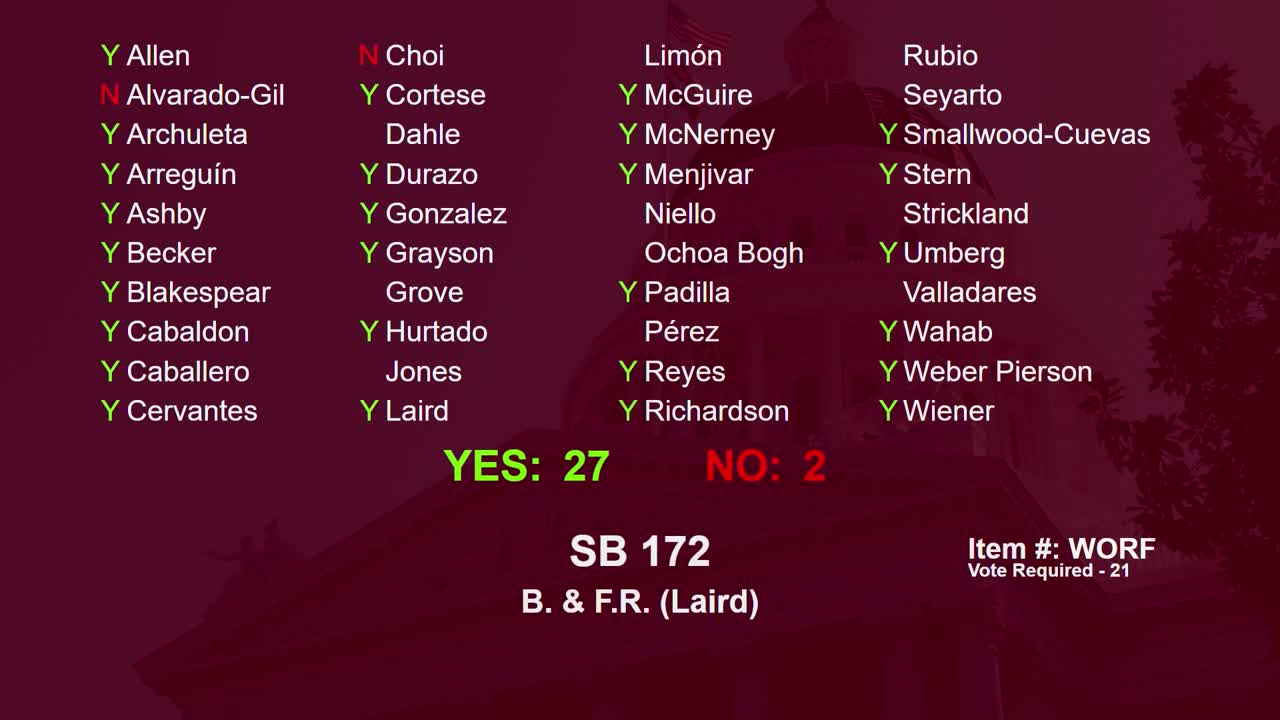 3MIN
Senate Floor
 4MIN
Assembly Standing Committee on Appropriations
 10MIN
Assembly Standing Committee on Natural Resources
 28MIN
Assembly Standing Committee on Utilities and Energy
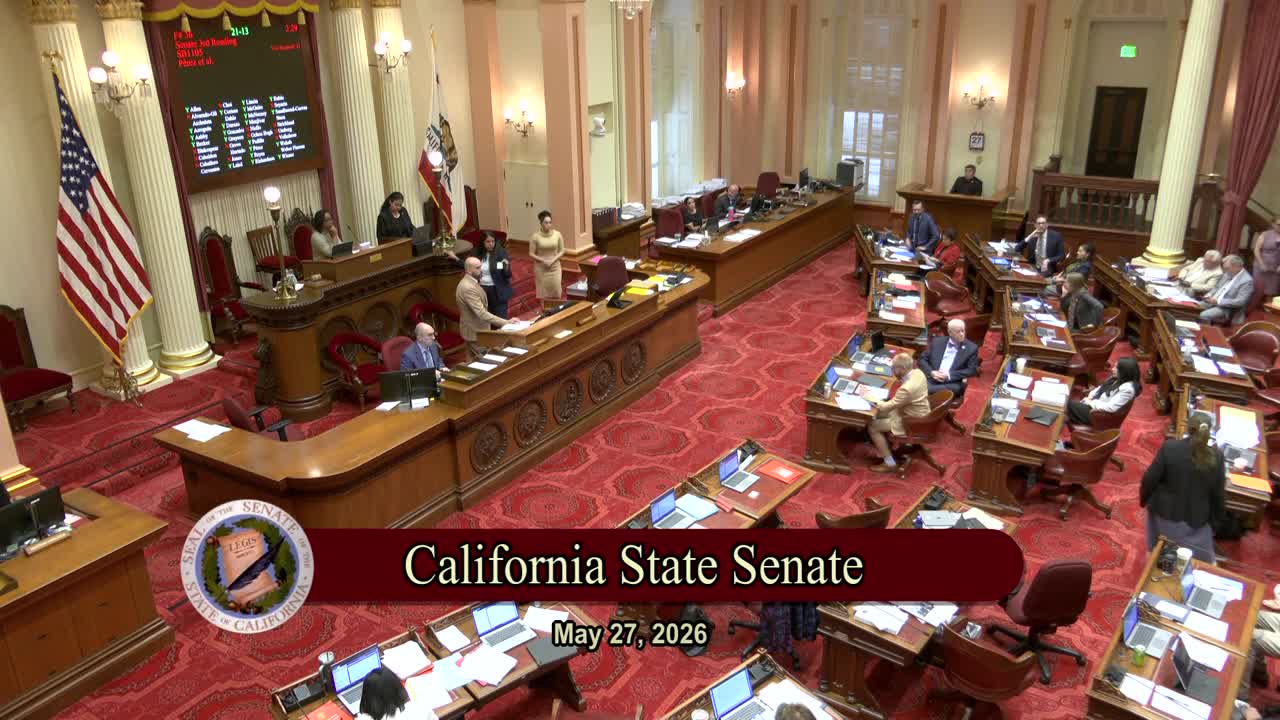 3MIN
Senate Floor
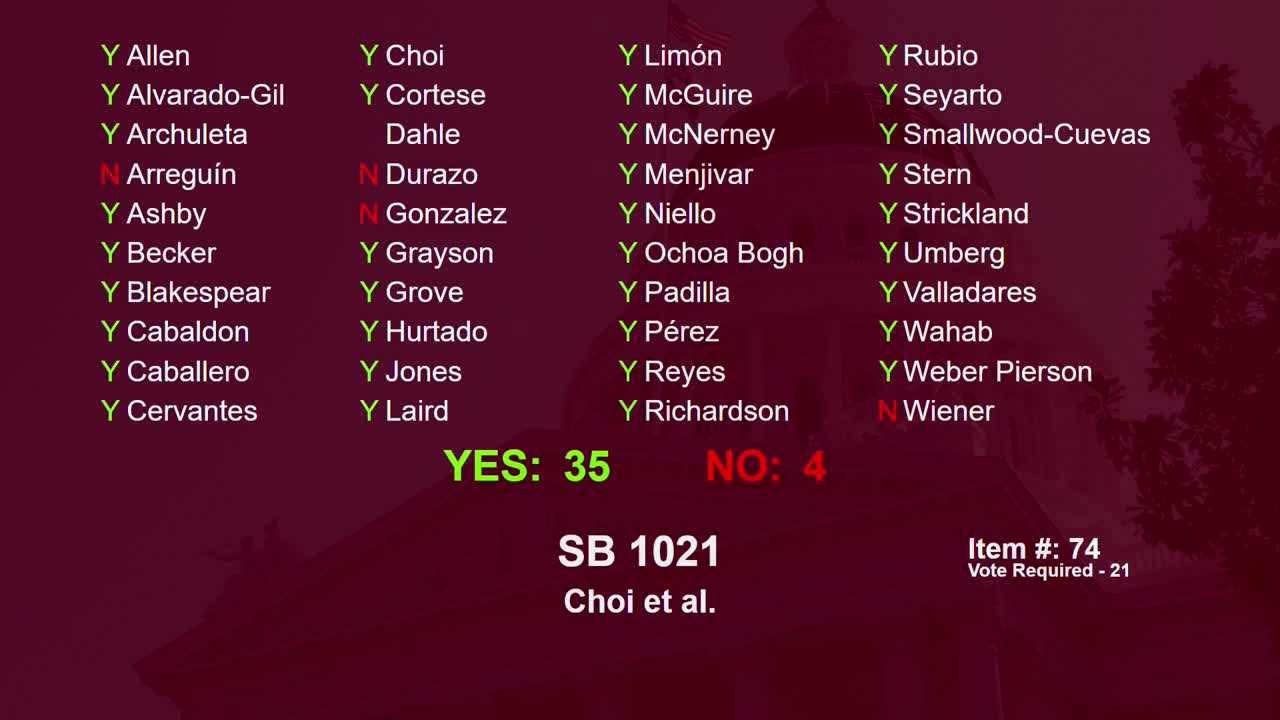 1MIN
Senate Floor
 17MIN
Senate Standing Committee on Environmental Quality
Bill Author