SB 1358: News outlets: state expenditures on ethnic and community media outlets.
- Session Year: 2025-2026
- House: Senate
- Latest Version Date: 2026-04-06
Current Status:
In Progress
(2026-05-14: May 14 hearing: Held in committee and under submission.)
Introduced
In Committee
Awaiting First Chamber Vote
Passed First Chamber
In Committee
Awaiting Second Chamber Vote
Passed Second Chamber
Enacted
Existing law establishes the Office of Community Partnerships and Strategic Communications and requires the office to assist in marketing, advertising, and outreach to priority populations, as defined. Existing law requires state agencies that expend funds on marketing, advertising, or outreach to develop a plan for increasing expenditures directed to ethnic media outlets and community media outlets, as those terms are defined. Existing law also requires state agencies to annually report their progress in implementing those plans. Existing law repeals these requirements on January 1, 2029.
This bill would delete the January 1, 2029, repeal date, thereby extending operation of these requirements indefinitely. The bill would additionally require the office to establish and maintain a database of the above-described outlets and would authorize the office to hold trainings for state employees responsible for purchasing advertising, as specified.
Former law, Chapter 341 of the Statutes of 2020, until July 1, 2023, among other things, required the Department of General Services to publish an annual report on or before July 1 of each year relating to payments for placement of marketing or outreach advertising material by each state agency.
This bill would reenact and recast this report requirement to instead require the office to publish an annual report relating to those payments, which the bill would require to include disaggregated information for priority populations and ethnic and community media outlets, as specified. The bill would additionally require state agencies to direct at least 40% of their annual advertising spending to ethnic and community media outlets and to require vendors selected for marketing or advertising services that require outreach to priority populations to prioritize outlets included in the above-described database. The bill would require authorize state agencies to award a contract for advertising or marketing services with an estimated value greater than $5,000 and less than $350,000 only to a small business, nonprofit organization, or an ethnic or community media outlet, as specified.
Existing law requires a 3-part test, commonly known as the ABC test, as specified, to determine if workers are employees or independent contractors for purposes of the Labor Code, the Unemployment Insurance Code, and the wage orders of the Industrial Welfare Commission. Existing law exempts specified occupations and business relationships from the application of the ABC test, and provides that these exempt relationships are governed by the multifactor test previously adopted in the case of S. G. Borello & Sons, Inc. v. Department of Industrial Relations (1989) 48 Cal.3d 341. These exemptions include a temporary exemption for newspaper distributors working under contract with a newspaper publisher and newspaper carriers, as those terms are defined, until January 1, 2030.This bill would extend operation of the above-described exemption indefinitely.Existing law establishes the Office of Community Partnerships and Strategic Communications and requires the office to assist in marketing, advertising, and outreach to priority populations, as defined. Existing law requires state agencies that expend funds on marketing, advertising, or outreach to develop a plan for increasing expenditures directed to ethnic media outlets and community media outlets, as those terms are defined. Existing law also requires state agencies to annually report their progress in implementing those plans. Existing law repeals these requirements on January 1, 2029.
This bill would delete the January 1, 2029, repeal date, thereby extending operation of these requirements indefinitely. The bill would additionally require the office to establish and maintain a database of the above-described outlets and would authorize the office to hold trainings for state employees responsible for purchasing advertising, as specified.
Former law, Chapter 341 of the Statutes of 2020, until July 1, 2023, among other things, required the Department of General Services to publish an annual report on or before July 1 of each year relating to payments for placement of marketing or outreach advertising material by each state agency.
This bill would reenact and recast this report requirement to instead require the office to publish an annual report relating to those payments, which the bill would require to include disaggregated information for priority populations and ethnic and community media outlets, as specified. The bill would additionally require state agencies to direct at least 40% of their annual advertising spending to ethnic and community media outlets and to require vendors selected for marketing or advertising services that require outreach to priority populations to prioritize outlets included in the above-described database. The bill would require state agencies to award a contract for advertising or marketing services with an estimated value greater than $5,000 and less than $350,000 only to a small business, nonprofit organization, or an ethnic or community media outlet, as specified.
Existing law requires a 3-part test, commonly known as the ABC test, as specified, to determine if workers are employees or independent contractors for purposes of the Labor Code, the Unemployment Insurance Code, and the wage orders of the Industrial Welfare Commission. Existing law exempts specified occupations and business relationships from the application of the ABC test, and provides that these exempt relationships are governed by the multifactor test previously adopted in the case of S. G. Borello & Sons, Inc. v. Department of Industrial Relations (1989) 48 Cal.3d 341. These exemptions include a temporary exemption for newspaper distributors working under contract with a newspaper publisher and newspaper carriers, as those terms are defined, until January 1, 2030.
This bill would extend operation of the above-described exemption indefinitely.
Existing law establishes various state government entities and specifies their powers and duties.This bill would state the intent of the Legislature to enact legislation relating to state government.Existing law establishes various state government entities and specifies their powers and duties.
This bill would state the intent of the Legislature to enact legislation relating to state government.
The Legislature finds and declares the following:
(a)The State of California is home to complex and diverse populations and it is essential that all residents have meaningful access to state programs, services, and activities regardless of native language, race, color, gender, national origin, ethnicity, religion, sexual orientation, disability, or immigrant status.
(b)An overwhelming majority of the states advertising and marketing funds have been concentrated among a small number of vendors, with insufficient transparency regarding whether funds effectively reach ethnic and community outlets.
(c)Therefore, it is the intent of the Legislature to expand the reach into underserved communities by ensuring and enhancing the allocation of advertising funds to ethnic and community media outlets. To achieve this, it is the intent of the Legislature that state agencies adopt serious goals, have read access to a database of ethnic and community media partners, and have the necessary tools to utilize their services quickly and efficiently.
SEC. 2.Section 65054 of the Government Code is amended to read:65054.For the purposes of this article, the following definitions apply:
(a)(1)Ethnic media means any organization that produces news or culturally relevant media that serves ethnic, racial, or cultural communities residing in California, including priority populations, racial and linguistic minorities, immigrant communities, indigenous groups, and other historically underserved and underrepresented groups.
(2)For purposes of paragraph (1), priority populations for purposes of this article, mean members of underserved, disadvantaged, and hard-to-reach communities, including, but not limited to, people who are any of the following:
(A)Asian American.
(B)Black or African American.
(C)Immigrants or refugees.
(D)Native American or members of Tribal communities.
(E)Latinx.
(F)LGBTQ+.
(G)Limited English proficiency (LEP).
(H)Middle Eastern or North African.
(I)Native Hawaiian or Pacific Islander.
(J)People with disabilities.
(K)Religious minorities.
(L)Low-income communities.
(b)Ethnic media outlet means an entity that provides a substantial amount of ethnic media content through broadcast, print, or digital means, including television, radio, or online outlets on a daily, weekly, or other regular interval, and that has continuously produced that content for at least one year.
(c)Community media outlet means a nonprofit organization, small business, or microbusiness, as defined in paragraphs (1) and (2) of subdivision (d) of Section 14837, in which at least one-half of the content is originally produced community news and cultural content of specific interest to a community, city, neighborhood, or region in the state through broadcast, print, or digital means, including television, radio, or online outlets on a daily, weekly, or other regular interval, and that has continuously produced that content for at least one year.
(d)Office means the Office of Community Partnerships and Strategic Communications.
(e)State agency means each entity identified in Section 11000, and includes the California State University.
SEC. 3.Section 65054.3 of the Government Code is repealed.SEC. 4.Section 65054.3 is added to the Government Code, to read:65054.3.(a)The office shall establish and maintain a database of ethnic and community media outlets. The office shall publish guidelines setting forth a process for outlets to apply to be listed and certified within this database pursuant to the criteria set forth in Section 65054.
(b)In support of database development, the office may engage nonprofit news outlets and organizations to assist in strengthening the sector and ensuring diverse and wide representation across the state.
(c)The office may hold one or more annual trainings for public information and communications officers and other state employees responsible for purchasing advertising to ensure a common understanding of the diverse media ecosystem and best practices for equitable outreach.
SEC. 5.Section 2783 of the Labor Code is amended to read:2783.Section 2775 and the holding in Dynamex do not apply to the following occupations as defined in the paragraphs below, and instead, the determination of employee or independent contractor status for individuals in those occupations shall be governed by Borello:(a)A person or organization that is licensed by the Department of Insurance pursuant to Chapter 5 (commencing with Section 1621), Chapter 6 (commencing with Section 1760), or Chapter 8 (commencing with Section 1831) of Part 2 of Division 1 of the Insurance Code or a person who provides underwriting inspections, premium audits, risk management, claims adjusting, third-party administration consistent with use of the term third-party administrator, as defined in subdivision (cc) of Section 10112.1 of Title 8 of the California Code of Regulations, or loss control work for the insurance and financial service industries.(b)A physician and surgeon, dentist, podiatrist, psychologist, or veterinarian licensed by the State of California pursuant to Division 2 (commencing with Section 500) of the Business and Professions Code, performing professional or medical services provided to or by a health care entity, including an entity organized as a sole proprietorship, partnership, or professional corporation as defined in Section 13401 of the Corporations Code. Nothing in this subdivision shall circumvent, undermine, or restrict the rights under federal law to organize and collectively bargain.(c)An individual who holds an active license from the State of California and is practicing one of the following recognized professions: lawyer, architect, landscape architect, engineer, private investigator, or accountant.(d)A securities broker-dealer or investment adviser or their agents and representatives that are either of the following:(1)Registered with the Securities and Exchange Commission or the Financial Industry Regulatory Authority.(2)Licensed by the State of California under Chapter 2 (commencing with Section 25210) or Chapter 3 (commencing with Section 25230) of Division 1 of Part 3 of Title 4 of the Corporations Code.(e)A direct sales salesperson as described in Section 650 of the Unemployment Insurance Code, so long as the conditions for exclusion from employment under that section are met.(f)A manufactured housing salesperson, subject to all obligations under Part 2 (commencing with Section 18000) of Division 13 of the Health and Safety Code, including all regulations promulgated by the Department of Housing and Community Development relating to manufactured home salespersons and all other obligations of manufactured housing salespersons to members of the public. The statutorily imposed duties of a manufactured housing dealer under Section 18060.5 of the Health and Safety Code are not factors to be considered under the Borello test.(g)A commercial fisher working on an American vessel.(1)For the purposes of this subdivision:(A)American vessel has the same meaning as defined in Section 125.5 of the Unemployment Insurance Code.(B)Commercial fisher means a person who has a valid, unrevoked commercial fishing license issued pursuant to Article 3 (commencing with Section 7850) of Chapter 1 of Part 3 of Division 6 of the Fish and Game Code.(C)Working on an American vessel means the taking or the attempt to take fish, shellfish, or other fishery resources of the state by any means, and includes each individual aboard an American vessel operated for fishing purposes who participates directly or indirectly in the taking of these raw fishery products, including maintaining the vessel or equipment used aboard the vessel. However, working on an American vessel does not apply to anyone aboard a licensed commercial fishing vessel as a visitor or guest who does not directly or indirectly participate in the taking.(2)For the purposes of this subdivision, a commercial fisher working on an American vessel is eligible for unemployment insurance benefits if they meet the definition of employment in Section 609 of the Unemployment Insurance Code and are otherwise eligible for those benefits pursuant to the provisions of the Unemployment Insurance Code.(3)(A)Notwithstanding Section 10231.5 of the Government Code, on or before March 1, 2021, and each June 30 thereafter, the Employment Development Department shall issue an annual report to the Legislature on the use of unemployment insurance in the commercial fishing industry. This report shall include, but not be limited to, all of the following:(i)Reporting the number of commercial fishers who apply for unemployment insurance benefits.(ii)The number of commercial fishers who have their claims disputed.(iii)The number of commercial fishers who have their claims denied.(iv)The number of commercial fishers who receive unemployment insurance benefits.(B)The report required by this subparagraph shall be submitted in compliance with Section 9795 of the Government Code.(4)This subdivision shall become inoperative on January 1, 2031, unless extended by the Legislature.(h)(1)A newspaper distributor working under contract with a newspaper publisher, as defined in paragraph (2), or a newspaper carrier.(2)For purposes of this subdivision:(A)Newspaper means a newspaper of general circulation, as defined in Section 6000 or 6008 of the Government Code, and any other publication circulated to the community in general as an extension of or substitute for that newspapers own publication, whether that publication be designated a shoppers guide, as a zoned edition, or otherwise. Newspaper may also be a publication that is published in print and that may be posted in a digital format, and distributed periodically at daily, weekly, or other short intervals, for the dissemination of news of a general or local character and of a general or local interest.(B)Publisher means the natural or corporate person that manages the newspapers business operations, including circulation.(C)Newspaper distributor means a person or entity that contracts with a publisher to distribute newspapers to the community.(D)Newspaper carrier means a person who effects physical delivery of the newspaper to the customer or reader, who is not working as an app-based driver, as defined in Chapter 10.5 (commencing with Section 7448) of Division 3 of the Business and Professions Code, during the time when the newspaper carrier is performing the newspaper delivery services.(3)(A)On or before March 1, 2025, March 1, 2026, March 1, 2027, March 1, 2028, and March 1, 2029, every newspaper publisher or distributor that hires or directly contracts with newspaper carriers shall submit to the Labor and Workforce Development Agency, in a manner prescribed by the agency and in conformity with existing law, the following information related to their workforce for the current year:(i)The number of carriers for which the publisher or distributor paid payroll taxes in the previous year and the number of carriers for which the publisher or distributor did not pay payroll taxes in the previous year.(ii)The average wage rate paid to carriers classified as independent contractors and as employees.(iii)The number of carrier wage claims filed, if any, with the Labor Commissioner or in a court of law.(B)For the March 1, 2025, reporting date only, every newspaper publisher and distributor shall also report the number of carrier wage claims filed with the Labor Commissioner or in a court of law for the preceding three years.(C)Information that is submitted shall only be disclosed in accordance with Section 7927.705 of the Government Code, relating to trade secrets or other proprietary business information.(i)An individual who is engaged by an international exchange visitor program that has obtained and maintains full official designation by the United States Department of State under Part 62 (commencing with Section 62.1) of Title 22 of the Code of Federal Regulations for the purpose of conducting, instead of participating in, international and cultural exchange visitor programs and is in full compliance with Part 62 (commencing with Section 62.1) of Title 22 of the Code of Federal Regulations.(j)A competition judge with a specialized skill set or expertise providing services that require the exercise of discretion and independent judgment to an organization for the purposes of determining the outcome or enforcing the rules of a competition. This includes, but is not limited to, an amateur umpire or referee.SEC. 6.SEC. 5.Chapter 2.6 (commencing with Section 11100) is added to Part 2 of Division 2 of the Public Contract Code, to read:2.6.Local News Preference in Marketing or Outreach Advertising11100.For purposes of this chapter, the following definitions shall apply:
(a)Department means the Department of General Services.
(b)Ethnic and Community Media Database or database means the database established pursuant to Section 65054.3 of the Government Code.
(c)Ethnic and community media outlet means an ethnic media outlet or a community media outlet as those terms are defined in Section 65054 of the Government Code.
(d)Office means the Office of Community Partnerships and Strategic Communications.
(e)Priority populations has the same meaning as that term is defined in Section 65054 of the Government Code.
(f)State agency means each entity identified in Section 11000 of the Government Code, and includes the California State University.
11101.It is the declared policy of the Legislature that the state should assess and evaluate the effectiveness of its contracts to determine how it can best utilize its media and marketing and communication efforts to reach ethnic, racial, or cultural communities residing in California, including priority populations, racial and linguistic minorities, immigrant communities, indigenous groups, and other historically underserved and underrepresented groups.
11102.(a)A state agency shall award a contract for the acquisition of advertising or marketing services that has an estimated value of greater than five thousand dollars ($5,000) but less than three hundred fifty thousand dollars ($350,000) only to a small business, including a microbusiness, a nonprofit organization, or an ethnic or community media outlet.(b)A state agency shall not award a contract for the acquisition of advertising or marketing services that has an estimated value of greater than five thousand dollars ($5,000) but less than three hundred fifty thousand dollars ($350,000) to a small business, including a microbusiness, or a nonprofit organization, unless the agency obtains price quotations from two or more entities included in the Ethnic and Community Media Database.11102.(a)Notwithstanding the advertising, bidding, and protest provisions of Chapter 6 (commencing with Section 14825) of Part 5.5 of Division 3 of Title 2 of the Government Code, Chapter 2 (commencing with Section 10290), and Chapter 3 (commencing with Section 12100), a state agency may award a contract for the acquisition of advertising or marketing services that has an estimated an estimated value of greater than five thousand dollars ($5,000), but less than three hundred fifty thousand dollars ($350,000), to an ethnic or community media outlet, as long as the agency obtains price quotations from two or more ethnic or community media outlets.
(c)(b)Commencing January 1, 2028, and annually thereafter, the department may conduct a review of the maximum estimated contract value specified in this section and adjust that value to reflect changes in the California Consumer Price Index.
11103.A state agency issuing a request for proposal for marketing or advertising services that requires outreach to priority populations, as defined in Section 65054 of the Government Code, shall provide an awarded vendor with a copy of the Ethnic and Community Media Database and require the vendor to make every effort to prioritize outlets included in the database in their media buying plan.
11104.(a)A state agency shall direct at least 40 percent of its annual advertising spending to ethnic and community media outlets.
(b)For each state agency required to have a small business liaison pursuant to Section 11148.5 of the Government Code, the small business liaison shall assist the agency in complying with this section by utilizing the Ethnic and Community Media Database and shall work with local community groups and organizations to identify additional ethnic and community media outlets for inclusion in the database.
11105.(a)On or before July 1, 2027, and annually thereafter, the office shall submit to the Governor and the Legislature and publish on its internet website, a report that identifies all of the following:
(1)Each state agency that paid for placement of marketing or outreach advertising material pursuant to a contract.
(2)The amounts paid by each state agency to each media platform pursuant to a contract, including pursuant to a subcontract if the information is available, to place marketing or outreach advertising material.
(3)The recipients of the amounts paid by each state agency to media platforms, including to any subcontractors if the information is available, with which the agency contracted or subcontracted to place marketing or outreach advertising materials.
(4)The information required in paragraphs (1) to (3), inclusive, shall be further disaggregated to report information on contracts, including on subcontracts if the information is available, for both of the following:
(A)The placement of marketing or outreach advertising material targeting specific ethnic communities, including, but not limited to, priority populations.
(B)The placement of marketing or outreach advertising material by ethnic and community media outlets.
(5)Recommendations for best practices based on successful state agencies.
(b)(1)A report to be submitted pursuant to this section shall be submitted in compliance with Section 9795 of the Government Code.
(2)Pursuant to Section 10231.5 of the Government Code, this section is repealed on January 1, 2031.
11106.This chapter is not intended to amend any of the provisions of Chapter 1 (commencing with Section 6000) of Division 7 of Title 1 of the Government Code.
The Legislature finds and declares the following:
(a)The State of California is home to complex and diverse populations and it is essential that all residents have meaningful access to state programs, services, and activities regardless of native language, race, color, gender, national origin, ethnicity, religion, sexual orientation, disability, or immigrant status.
(b)An overwhelming majority of the states advertising and marketing funds have been concentrated among a small number of vendors, with insufficient transparency regarding whether funds effectively reach ethnic and community outlets.
(c)Therefore, it is the intent of the Legislature to expand the reach into underserved communities by ensuring and enhancing the allocation of advertising funds to ethnic and community media outlets. To achieve this, it is the intent of the Legislature that state agencies adopt serious goals, have read access to a database of ethnic and community media partners, and have the necessary tools to utilize their services quickly and efficiently.
SEC. 2.Section 65054 of the Government Code is amended to read:65054.For the purposes of this article, the following definitions apply:
(a)(1)Ethnic media means any organization that produces news or culturally relevant media that serves ethnic, racial, or cultural communities residing in California, including priority populations, racial and linguistic minorities, immigrant communities, indigenous groups, and other historically underserved and underrepresented groups.
(2)For purposes of paragraph (1), priority populations for purposes of this article, mean members of underserved, disadvantaged, and hard-to-reach communities, including, but not limited to, people who are any of the following:
(A)Asian American.
(B)Black or African American.
(C)Immigrants or refugees.
(D)Native American or members of Tribal communities.
(E)Latinx.
(F)LGBTQ+.
(G)Limited English proficiency (LEP).
(H)Middle Eastern or North African.
(I)Native Hawaiian or Pacific Islander.
(J)People with disabilities.
(K)Religious minorities.
(L)Low-income communities.
(b)Ethnic media outlet means an entity that provides a substantial amount of ethnic media content through broadcast, print, or digital means, including television, radio, or online outlets on a daily, weekly, or other regular interval, and that has continuously produced that content for at least one year.
(c)Community media outlet means a nonprofit organization, small business, or microbusiness, as defined in paragraphs (1) and (2) of subdivision (d) of Section 14837, in which at least one-half of the content is originally produced community news and cultural content of specific interest to a community, city, neighborhood, or region in the state through broadcast, print, or digital means, including television, radio, or online outlets on a daily, weekly, or other regular interval, and that has continuously produced that content for at least one year.
(d)Office means the Office of Community Partnerships and Strategic Communications.
(e)State agency means each entity identified in Section 11000, and includes the California State University.
SEC. 3.Section 65054.3 of the Government Code is repealed.65054.3.This article shall become inoperative on July 1, 2028, and, as of January 1, 2029, is repealed.SEC. 4.Section 65054.3 is added to the Government Code, to read:65054.3.(a)The office shall establish and maintain a database of ethnic and community media outlets. The office shall publish guidelines setting forth a process for outlets to apply to be listed and certified within this database pursuant to the criteria set forth in Section 65054.
(b)In support of database development, the office may engage nonprofit news outlets and organizations to assist in strengthening the sector and ensuring diverse and wide representation across the state.
(c)The office may hold one or more annual trainings for public information and communications officers and other state employees responsible for purchasing advertising to ensure a common understanding of the diverse media ecosystem and best practices for equitable outreach.
SEC. 5.Section 2783 of the Labor Code is amended to read:2783.Section 2775 and the holding in Dynamex do not apply to the following occupations as defined in the paragraphs below, and instead, the determination of employee or independent contractor status for individuals in those occupations shall be governed by Borello:
(a)A person or organization that is licensed by the Department of Insurance pursuant to Chapter 5 (commencing with Section 1621), Chapter 6 (commencing with Section 1760), or Chapter 8 (commencing with Section 1831) of Part 2 of Division 1 of the Insurance Code or a person who provides underwriting inspections, premium audits, risk management, claims adjusting, third-party administration consistent with use of the term third-party administrator, as defined in subdivision (cc) of Section 10112.1 of Title 8 of the California Code of Regulations, or loss control work for the insurance and financial service industries.
(b)A physician and surgeon, dentist, podiatrist, psychologist, or veterinarian licensed by the State of California pursuant to Division 2 (commencing with Section 500) of the Business and Professions Code, performing professional or medical services provided to or by a health care entity, including an entity organized as a sole proprietorship, partnership, or professional corporation as defined in Section 13401 of the Corporations Code. Nothing in this subdivision shall circumvent, undermine, or restrict the rights under federal law to organize and collectively bargain.
(c)An individual who holds an active license from the State of California and is practicing one of the following recognized professions: lawyer, architect, landscape architect, engineer, private investigator, or accountant.
(d)A securities broker-dealer or investment adviser or their agents and representatives that are either of the following:
(1)Registered with the Securities and Exchange Commission or the Financial Industry Regulatory Authority.
(2)Licensed by the State of California under Chapter 2 (commencing with Section 25210) or Chapter 3 (commencing with Section 25230) of Division 1 of Part 3 of Title 4 of the Corporations Code.
(e)A direct sales salesperson as described in Section 650 of the Unemployment Insurance Code, so long as the conditions for exclusion from employment under that section are met.
(f)A manufactured housing salesperson, subject to all obligations under Part 2 (commencing with Section 18000) of Division 13 of the Health and Safety Code, including all regulations promulgated by the Department of Housing and Community Development relating to manufactured home salespersons and all other obligations of manufactured housing salespersons to members of the public. The statutorily imposed duties of a manufactured housing dealer under Section 18060.5 of the Health and Safety Code are not factors to be considered under the Borello test.
(g)A commercial fisher working on an American vessel.
(1)For the purposes of this subdivision:
(A)American vessel has the same meaning as defined in Section 125.5 of the Unemployment Insurance Code.
(B)Commercial fisher means a person who has a valid, unrevoked commercial fishing license issued pursuant to Article 3 (commencing with Section 7850) of Chapter 1 of Part 3 of Division 6 of the Fish and Game Code.
(C)Working on an American vessel means the taking or the attempt to take fish, shellfish, or other fishery resources of the state by any means, and includes each individual aboard an American vessel operated for fishing purposes who participates directly or indirectly in the taking of these raw fishery products, including maintaining the vessel or equipment used aboard the vessel. However, working on an American vessel does not apply to anyone aboard a licensed commercial fishing vessel as a visitor or guest who does not directly or indirectly participate in the taking.
(2)For the purposes of this subdivision, a commercial fisher working on an American vessel is eligible for unemployment insurance benefits if they meet the definition of employment in Section 609 of the Unemployment Insurance Code and are otherwise eligible for those benefits pursuant to the provisions of the Unemployment Insurance Code.
(3)(A)Notwithstanding Section 10231.5 of the Government Code, on or before March 1, 2021, and each June 30 thereafter, the Employment Development Department shall issue an annual report to the Legislature on the use of unemployment insurance in the commercial fishing industry. This report shall include, but not be limited to, all of the following:
(i)Reporting the number of commercial fishers who apply for unemployment insurance benefits.
(ii)The number of commercial fishers who have their claims disputed.
(iii)The number of commercial fishers who have their claims denied.
(iv)The number of commercial fishers who receive unemployment insurance benefits.
(B)The report required by this subparagraph shall be submitted in compliance with Section 9795 of the Government Code.
(4)This subdivision shall become inoperative on January 1, 2031, unless extended by the Legislature.
(h)(1)A newspaper distributor working under contract with a newspaper publisher, as defined in paragraph (2), or a newspaper carrier.
(2)For purposes of this subdivision:
(A)Newspaper means a newspaper of general circulation, as defined in Section 6000 or 6008 of the Government Code, and any other publication circulated to the community in general as an extension of or substitute for that newspapers own publication, whether that publication be designated a shoppers guide, as a zoned edition, or otherwise. Newspaper may also be a publication that is published in print and that may be posted in a digital format, and distributed periodically at daily, weekly, or other short intervals, for the dissemination of news of a general or local character and of a general or local interest.
(B)Publisher means the natural or corporate person that manages the newspapers business operations, including circulation.
(C)Newspaper distributor means a person or entity that contracts with a publisher to distribute newspapers to the community.
(D)Newspaper carrier means a person who effects physical delivery of the newspaper to the customer or reader, who is not working as an app-based driver, as defined in Chapter 10.5 (commencing with Section 7448) of Division 3 of the Business and Professions Code, during the time when the newspaper carrier is performing the newspaper delivery services.
(3)(A)On or before March 1, 2025, March 1, 2026, March 1, 2027, March 1, 2028, and March 1, 2029, every newspaper publisher or distributor that hires or directly contracts with newspaper carriers shall submit to the Labor and Workforce Development Agency, in a manner prescribed by the agency and in conformity with existing law, the following information related to their workforce for the current year:
(i)The number of carriers for which the publisher or distributor paid payroll taxes in the previous year and the number of carriers for which the publisher or distributor did not pay payroll taxes in the previous year.
(ii)The average wage rate paid to carriers classified as independent contractors and as employees.
(iii)The number of carrier wage claims filed, if any, with the Labor Commissioner or in a court of law.
(B)For the March 1, 2025, reporting date only, every newspaper publisher and distributor shall also report the number of carrier wage claims filed with the Labor Commissioner or in a court of law for the preceding three years.
(C)Information that is submitted shall only be disclosed in accordance with Section 7927.705 of the Government Code, relating to trade secrets or other proprietary business information.
(4)This subdivision shall become inoperative on January 1, 2030, unless extended by the Legislature.(i)An individual who is engaged by an international exchange visitor program that has obtained and maintains full official designation by the United States Department of State under Part 62 (commencing with Section 62.1) of Title 22 of the Code of Federal Regulations for the purpose of conducting, instead of participating in, international and cultural exchange visitor programs and is in full compliance with Part 62 (commencing with Section 62.1) of Title 22 of the Code of Federal Regulations.
(j)A competition judge with a specialized skill set or expertise providing services that require the exercise of discretion and independent judgment to an organization for the purposes of determining the outcome or enforcing the rules of a competition. This includes, but is not limited to, an amateur umpire or referee.
SEC. 6.Chapter 2.6 (commencing with Section 11100) is added to Part 2 of Division 2 of the Public Contract Code, to read:2.6.Local News Preference in Marketing or Outreach Advertising11100.For purposes of this chapter, the following definitions shall apply:
(a)Department means the Department of General Services.
(b)Ethnic and Community Media Database or database means the database established pursuant to Section 65054.3 of the Government Code.
(c)Ethnic and community media outlet means an ethnic media outlet or a community media outlet as those terms are defined in Section 65054 of the Government Code.
(d)Office means the Office of Community Partnerships and Strategic Communications.
(e)Priority populations has the same meaning as that term is defined in Section 65054 of the Government Code.
(f)State agency means each entity identified in Section 11000 of the Government Code, and includes the California State University.
11101.It is the declared policy of the Legislature that the state should assess and evaluate the effectiveness of its contracts to determine how it can best utilize its media and marketing and communication efforts to reach ethnic, racial, or cultural communities residing in California, including priority populations, racial and linguistic minorities, immigrant communities, indigenous groups, and other historically underserved and underrepresented groups.
11102.(a)A state agency shall award a contract for the acquisition of advertising or marketing services that has an estimated value of greater than five thousand dollars ($5,000) but less than three hundred fifty thousand dollars ($350,000) only to a small business, including a microbusiness, a nonprofit organization, or an ethnic or community media outlet.
(b)A state agency shall not award a contract for the acquisition of advertising or marketing services that has an estimated value of greater than five thousand dollars ($5,000) but less than three hundred fifty thousand dollars ($350,000) to a small business, including a microbusiness, or a nonprofit organization, unless the agency obtains price quotations from two or more entities included in the Ethnic and Community Media Database.
(c)Commencing January 1, 2028, and annually thereafter, the department may conduct a review of the maximum estimated contract value specified in this section and adjust that value to reflect changes in the California Consumer Price Index.
11103.A state agency issuing a request for proposal for marketing or advertising services that requires outreach to priority populations, as defined in Section 65054 of the Government Code, shall provide an awarded vendor with a copy of the Ethnic and Community Media Database and require the vendor to make every effort to prioritize outlets included in the database in their media buying plan.
11104.(a)A state agency shall direct at least 40 percent of its annual advertising spending to ethnic and community media outlets.
(b)For each state agency required to have a small business liaison pursuant to Section 11148.5 of the Government Code, the small business liaison shall assist the agency in complying with this section by utilizing the Ethnic and Community Media Database and shall work with local community groups and organizations to identify additional ethnic and community media outlets for inclusion in the database.
11105.(a)On or before July 1, 2027, and annually thereafter, the office shall submit to the Governor and the Legislature and publish on its internet website, a report that identifies all of the following:
(1)Each state agency that paid for placement of marketing or outreach advertising material pursuant to a contract.
(2)The amounts paid by each state agency to each media platform pursuant to a contract, including pursuant to a subcontract if the information is available, to place marketing or outreach advertising material.
(3)The recipients of the amounts paid by each state agency to media platforms, including to any subcontractors if the information is available, with which the agency contracted or subcontracted to place marketing or outreach advertising materials.
(4)The information required in paragraphs (1) to (3), inclusive, shall be further disaggregated to report information on contracts, including on subcontracts if the information is available, for both of the following:
(A)The placement of marketing or outreach advertising material targeting specific ethnic communities, including, but not limited to, priority populations.
(B)The placement of marketing or outreach advertising material by ethnic and community media outlets.
(5)Recommendations for best practices based on successful state agencies.
(b)(1)A report to be submitted pursuant to this section shall be submitted in compliance with Section 9795 of the Government Code.
(2)Pursuant to Section 10231.5 of the Government Code, this section is repealed on January 1, 2031.
11106.This chapter is not intended to amend any of the provisions of Chapter 1 (commencing with Section 6000) of Division 7 of Title 1 of the Government Code.
SECTION 1.It is the intent of the Legislature to enact legislation relating to state government.It is the intent of the Legislature to enact legislation relating to state government.
|
Date
|
Status
|
|---|---|
| May 14, 2026 | May 14 hearing: Held in committee and under submission. |
| May 8, 2026 | Set for hearing May 14. |
| Apr 27, 2026 | April 27 hearing: Placed on APPR. suspense file. |
| Apr 17, 2026 | Set for hearing April 27. |
| Apr 14, 2026 | From committee: Do pass and re-refer to Com. on APPR. (Ayes 15. Noes 0. Page 3866.) (April 14). Re-referred to Com. on APPR. |
| Apr 14, 2026 | From committee: Do pass and re-refer to Com. on APPR. (Ayes 15. Noes 0.) (April 14). Re-referred to Com. on APPR. |
| Apr 9, 2026 | Set for hearing April 14. |
| Apr 8, 2026 | Re-referred to Com. on G.O. |
| Apr 6, 2026 | From committee with author's amendments. Read second time and amended. Re-referred to Com. on RLS. |
| Mar 25, 2026 | From committee with author's amendments. Read second time and amended. Re-referred to Com. on RLS. |
| Mar 4, 2026 | Referred to Com. on RLS. |
| Feb 23, 2026 | Read first time. |
| Feb 23, 2026 | From printer. May be acted upon on or after March 23. |
| Feb 20, 2026 | Introduced. To Com. on RLS. for assignment. To print. |
|
Date
|
Description
|
Location
|
Votes
|
|
|---|---|---|---|---|
| Apr 27, 2026 | Placed on suspense file | Senate Standing Committee on Appropriations |
Passed |
|
| Apr 14, 2026 | Do pass, but first be re-referred to the Committee on [Appropriations] | Senate Standing Committee on Governmental Organization |
Passed |
This list shows positions taken on this bill by organizations on the date displayed, which is linked to the original source.
Positions by individuals are not included.
|
Organization
|
Position
|
Date
|
|---|---|---|
| Latino Media Collaborative | ** Support |
SENATE COMMITTEE ON
Senator Sabrina Cervantes, Chair
2025 - 2026 Regular Session
SB 1358 (Rubio) - News outlets: state expenditures on ethnic and community media outlets
Version: | Policy Vote: |
Urgency: | Mandate: |
Hearing Date: | Consultant: |
Bill Summary:
SB 1358 expands the responsibilities of the Office of Community Partnerships and Strategic Communications (OCPSC) by requiring it to establish and maintain a database of ethnic and community media outlets. SB 1358 also requires the office to annually submit a report to the Governor and the Legislature detailing how state agencies spend funds on marketing and outreach advertising. Additionally, SB 1358 authorizes a state agency to award a contract for the acquisition of advertising or marketing services that has an estimated value of less than $350,000 to an ethnic or community media outlet, as long as the agency obtains price quotations from two or more community media outlets. Finally, SB 1358 requires state agencies to direct at least 40 percent of their annual advertising spending to ethnic and community media outlets.
Fiscal Impact:
- OCPSC notes ongoing General Fund costs of approximately $2.5 million to sustain its operations, as the proposed 2026-27 Governor’s Budget does not provide funding to maintain the office beyond June 30, 2026. These costs would cover three full-time positions (Manager II, Information Officer I, and AGPA), along with equipment, office space, and other operating expenses required to meet the bill’s mandates.
- Unknown, potentially significant costs to state agencies to report on and redirect advertising expenditures. Actual fiscal impacts will vary based on the extent to which an entity already utilizes ethnic and community media partners and availability of such outlets to meet the entity’s operational needs and specific mandates. Fiscal impacts may range from absorbable to hundreds of thousands of dollars per entity (General Fund and various special funds).
Background:
The OCPSC’s core role is to serve as the state’s central hub for communicating with Californians, particularly hard-to-reach or underserved populations, about high-priority issues such as public health. The office accomplishes this by coordinating statewide campaigns, bunding and partnering with community-based organizations, and building a network of trusted organizations who can deliver culturally and linguistically appropriate information directly to communities.
Proposed Law:
- Authorizes state agencies to award a contract for the acquisition of advertising or marketing services that has an estimated value of greater than $5,000, but less than $350,000 to an ethnic or community media outlet, as long as the agency obtains price quotations from two or more ethnic or community media outlets.
- Requires the office to establish and maintain a database of ethnic and community media outlets and requires the office to publish guidelines setting forth a process for outlets to apply to be listed and certified within this database.
- Authorizes the office to engage nonprofit news outlets and organizations to assist in strengthening the sector and ensuring diverse and wide representation across the state.
- Authorizes the office to hold one or more annual trainings for public information and communication officers and other state employees responsible for purchasing advertising to ensure a common understanding of the diverse media ecosystem and best practices for equitable outreach.
- Requires a state agency issuing a request for proposal for marketing or advertising services that requires outreach to priority populations, to provide an awarded vendor with a copy of the Ethnic and Community Media Database and require the vendor to prioritize outlets included in the database in their media buying plan.
- Requires state agencies to direct at least 40 percent of their annual advertising spending to ethnic and community media outlets.
- Requires the small business liaison, for each state agency that is required to have a small business liaison, to assist the agency in complying with the provisions of this bill and shall work with local community groups and organizations to identify additional ethnic and community media outlets for including in the database.
- Requires the office, on or before July 1, 2027, and annually thereafter, to submit to the Governor and the Legislature and publish on its internet website, a report that identifies all of the following:
- Each state agency that paid for placement of marketing or outreach advertising material pursuant to a contract.
- The amounts paid by each state agency to each media platform pursuant to a contract, including pursuant to a subcontract if the information is available, to place marketing or outreach material.
- The recipients of the amounts paid by each state agency to media platforms, including any subcontractors if the information is available, with which the agency contracted or subcontracted to place marketing or outreach advertising materials.
- The information required above shall be further disaggregated to report information on contracts if the information is available, for both of the following:
- The placement of marketing or outreach advertising material targeting specific ethnic communities, including, but not limited to priority populations.
- The placement of marketing or outreach advertising material by ethnic and community media outlets.
- Recommendations for best practices based on successful state agencies.
- States legislative findings and declarations.
Staff Comments:
Costs for impacted agencies will vary depending on their advertising needs and current contracting practices. For comparison:
- The Department of Transportation (Caltrans) anticipates costs in the low hundreds of thousands of dollars for additional staff to meet reporting requirements. Additionally, Caltrans notes that the 40 percent minimum expenditure mandate may not be feasible. To comply, the department would have to shift away from its heavy reliance on outdoor advertising; meaning Caltrans would either need to cut these campaigns or significantly increase other spending on non-outdoor advertising to balance the ratio. Additionally, the department notes the mandate is difficult to meet because advertisements in mainstream print media are often far more expensive than those in targeted ethnic or community-based publications, which may also skew its expenditure ratio. Lastly, Caltrans notes that there may be an insufficient number of eligible outlets to fulfill the mandate, which could lead to a reduction in advertising through other government entities, such as public transit.
- The California Highway Patrol (CHP) anticipates minor and absorbable costs for workload associated with data collection and tracking. Costs to meet the minimum expenditure mandate are estimated between tens of thousands and hundreds of thousands of dollars, depending on contract length and scope. CHP also notes concerns regarding the availability of vendors to meet its specific needs.
- The Employment Development Department notes unknown, but likely significant cost pressures to comply with the bill’s annual reporting and minimum expenditure requirements.
- The Department of Technology, Governor’s Office of Business and Economic Development, Office of Emergency Services, California Natural Resources Agency, Department of General Services, Department of Justice, and Office of Traffic Safety anticipate either absorbable or no direct fiscal impacts.
While resource requirements will vary by agency, if even a few state entities incur fiscal impacts in the hundreds of thousands of dollars, then the bill’s total statewide costs may reach into the millions of dollars.
-- END --
SENATE COMMITTEE ON GOVERNMENTAL ORGANIZATION
Senator Susan Rubio
Chair
2025 - 2026 Regular
Bill No: Hearing Date: 4/14/2026
Author: | |||
Version: | Amended | ||
Urgency: | Fiscal: | ||
Consultant: | |||
SUBJECT:
DIGEST: This bill expands the responsibilities of the Office of Community Partnerships and Strategic Communications (Office) by requiring it to establish and maintain a database of ethnic and community media outlets. The bill also requires the Office to annually submit a report to the Governor and the Legislature detailing how state agencies spend funds on marketing and outreach advertising. Additionally, the bill authorizes a state agency to award a contract for the acquisition of advertising or marketing services that has an estimated value of less than $350,000 to an ethnic or community media outlet, as long as the agency obtains price quotations from two or more community media outlets. Finally, the bill requires state agencies to direct at least 40% of their annual advertising spending to ethnic and community media outlets.
ANALYSIS:
Existing law:
- Establishes the Office and requires the office to assist in marketing, advertising, and outreach to priority populations, as defined.
- Defines “priority populations” to mean members of underserved, disadvantage, and hard-to-reach communities, including, but not limited to, people who are any of the following:
- Asian American.
- Black or African American.
- Immigrants or refugees.
- Native American or members of Tribal communities.
- Latinx.
- LGBTQ+
- Limited English proficiency.
- Middle Eastern or North African.
- Native Hawaiian or Pacific Islander.
- People with disabilities.
- Religious minorities.
- Low-income communities.
- Requires state agencies that expend funds on marketing, advertising, or outreach to develop a plan for increasing expenditures directed to ethnic media outlets and community media outlets, as those terms are defined. State agencies are required, until January 1, 2029, to annually report their progress in implementing these plans.
- Defines “ethnic media outlet” to mean an entity that provides a substantial amount of ethnic media content through broadcast, print, or digital means, including television, radio, or online outlets on a daily, weekly, or other regular interval, and that has continuously produced content for at least one year.
- Defines “ethnic media” to mean any organization that produces news or culturally relevant media that serves ethnic, racial, or cultural communities residing in California, including priority populations, racial and linguistic minorities, immigrant communities, indigenous groups, and other historically underserved and underrepresented groups.
- Defines “community media outlet” to mean a nonprofit organization, small business, or microbusiness, in which at least one-half of the content is originally produced community news and cultural content of specific interest to a community, city, neighborhood, or region in the state through broadcast, print, or digital means, including television, radio, or online outlets on a daily, weekly, or other regular interval, and that has continuously produced that content for at least one year.
- Authorizes, under the Small Business Procurement and Contract Act, a state agency to award contract for the acquisition of goods, services, and information technology (IT) that has an estimated value of greater than $5,000, but less than $250,000, to a certified small business (SB), including a microbusiness, or a disabled veteran business enterprise (DVBE), as long as the agency obtains price quotations from two or more SBs or DVBEs, without complying with specified competitive bidding requirements.
- Defines a “small business” to mean an independently owned and operated business that is not dominant in its field of operation, the principal office of which is located in California, the officers of which are domiciled in California, and which, together with affiliates, has 100 or fewer employees, and average annual gross receipts of $10 million or less over the previous three years, or is a manufacturer, as defined, and has 100 or fewer employees.
- Requires a state agency that significantly regulates small business or that significantly impacts small business to designate at least one person to serve as a small business liaison.
- Requires the small business liaison to be responsible for specified duties relating to interactions between the state agency and small businesses, including assisting the head of the agency in ensuring that the procurement and contracting processes of the state agency are administered in order to meet or exceed the 25% small business participation goal, and developing and sharing innovative procurement and contracting practices from the public and private sectors to increase small businesses.
This bill:
- Authorizes state agencies to award a contract for the acquisition of advertising or marketing services that has an estimated value of greater than $5,000, but less than $350,000 to an ethnic or community media outlet, as long as the agency obtains price quotations from two or more ethnic or community media outlets.
- Requires the Office to establish and maintain a database of ethnic and community media outlets and requires the Office to publish guidelines setting forth a process for outlets to apply to be listed and certified within this database.
- Authorizes the Office to engage nonprofit news outlets and organizations to assist in strengthening the sector and ensuring diverse and wide representation across the state.
- Authorizes the Office to hold one or more annual trainings for public information and communication officers and other state employees responsible for purchasing advertising to ensure a common understanding of the diverse media ecosystem and best practices for equitable outreach.
- Requires a state agency issuing a request for proposal for marketing or advertising services that requires outreach to priority populations, to provide an awarded vendor with a copy of the Ethnic and Community Media Database and require the vendor to prioritize outlets included in the database in their media buying plan.
- Requires state agencies to direct at least 40 percent of their annual advertising spending to ethnic and community media outlets.
- Requires the small business liaison, for each state agency that is required to have a small business liaison, to assist the agency in complying with the provisions of this bill and shall work with local community groups and organizations to identify additional ethnic and community media outlets for including in the database.
- Requires the Office, on or before July 1, 2027, and annually thereafter, to submit to the Governor and the Legislature and publish on its internet website, a report that identifies all of the following:
- Each state agency that paid for placement of marketing or outreach advertising material pursuant to a contract.
- The amounts paid by each state agency to each media platform pursuant to a contract, including pursuant to a subcontract if the information is available, to place marketing or outreach material.
- The recipients of the amounts paid by each state agency to media platforms, including any subcontractors if the information is available, with which the agency contracted or subcontracted to place marketing or outreach advertising materials.
- The information required above shall be further disaggregated to report information on contracts if the information is available, for both of the following:
- The placement of marketing or outreach advertising material targeting specific ethnic communities, including, but not limited to priority populations.
- The placement of marketing or outreach advertising material by ethnic and community media outlets.
- Recommendations for best practices based on successful state agencies.
Background
Author Statement. According to the author’s office, “equity and access to opportunity are crucial to having a strong democratic system and maintaining public trust, and this is true for our state advertising processes. California is home to diverse communities with their own unique needs, histories, cultures, and methods of communication. Ethnic and community media outlets are organizations and groups that are well-equipped to address the information needs of these communities, especially those that are underserved. Called ‘trusted messengers,’ these outlets can provide relevant information to their intended audiences and can act as leaders and advocates on behalf of their communities. Yet, these same outlets struggle with financial instability and need increased access to revenue to continue their critical work.”
Additionally, “SB 1358 will strengthen California’s outreach to underserved communities by enhancing the allocation of advertising funds to ethnic and community media outlets. The bill will create a database of ethnic and community media outlets, will direct that agencies spend at least 40 percent of their annual advertising spending to ethnic and community media, and will ensure ethnic and community media outlets are represented in state contracting processes. In California, we believe in diversity, equity, and inclusion, and ensuring that everyone, from our immigrants to minority populations, have access to information as to what is going on in their state. If we care about our immigrant and underserved communities and their well-being, then we, as legislators, have an obligation to protect the work of ethnic and community media, and uphold access to opportunity for these outlets and their communities.”
Office of Community Partnerships and Strategic Communications. The Office was formally proposed by Governor Newsom in January 2022 and officially established in July 2022 within the Governor’s Office of Planning and Research to coordinate California’s major public awareness and community engagement efforts. It was established as part of Governor Newsom’s “California Blueprint,” with dedicated state funding to formalize and expand outreach strategies that had been developed during the 2020 Census and COVID-19 vaccination campaigns.
The Office’s core role is to serve as the state’s central hub for communicating with Californians – particularly hard-to-reach or underserved populations – about high-priority issues such as public health. The Office accomplishes this by coordinating statewide campaigns, bunding and partnering with community-based organizations, and building a network of trusted organizations who can deliver culturally and linguistically appropriate information directly to communities.
This bill expands the responsibilities of the Office by requiring it to establish and maintain a database of ethnic and community media outlets. Additionally, the bill requires the Office, until January 1, 2031, to annually submit a report to the Governor and the Legislature detailing how state agencies spend funds on marketing and outreach advertising. The report must identify which state agencies entered into advertising contracts, how much each agency paid to media platforms and the ultimate recipients of those funds. It must also break down this information to show spending on campaigns targeting specific ethnic communities and on placements with ethnic and community media outlets. In addition, the office must include recommendations for best practices based on successful agency efforts.
Streamlined Contracting for Ethnic and Community Media. The bill would authorize state agencies to award contracts for advertising or marketing services, with an estimated value greater than $5,000 but less than $350,000, to ethnic or community media outlets, provided the agency obtains price quotations from at least two such outlets. This provision mirrors existing law that permits state agencies to award contracts for goods, services, and information technology valued between $5,000 and $250,000 to certified small businesses or disabled veteran business enterprises, upon obtaining price quotations from at least two qualified entities, without complying with specified competitive bidding requirements.
This provision is intended to encourage and facilitate the ability of state agencies to contract with ethnic and community media outlets without the need to navigate formal competitive bidding processes. It should be noted, however, that while current law sets a cap of $250,000, SB 1044 (Reyes, 2026) proposes to increase this threshold to $350,000 to account for inflation.
New York City Example. The New York City Ethnic Media Program officially began under the administration of Mayor Bill de Blasio in 2019. It was established as part of his efforts to recognize and bolster the city’s ethnic and community media outlets. The initiative was formalized with the creation of the Mayor’s Office of Ethnic and Community Media in 2020. This office was tasked with coordinating the city’s outreach and support to these media outlets, ensuring they have the resources and access needed to serve their diverse audiences effectively.
The office’s establishment was a response to long-standing advocacy for greater support and recognition of ethnic media’s role in New York City. The program aims to bridge communication gaps and ensure that all city residents, regardless of language or cultural background, have access to vital information and city services. Under the program, at least 50 percent of the city’s annual advertising budget must be directed to ethnic and community outlets. This mandate was formalized by Executive Order 47, signed by Mayor Bill de Blasio in March of 2021. The directive is designed to ensure that these media outlets, which serve diverse and often underrepresented communities, receive a significant share of city advertising spending, thereby supporting their financial sustainability and helping to disseminate information more broadly across all demographics. This allocation was designed not only to boost the revenue for ethnic media but also to ensure city communications reach a wider audience, including those who might not engage with mainstream English-language media.
This bill seeks to implement one of the core goals of the New York City Example by requiring that state agencies direct at least 40 percent of their annual advertising spending to ethnic and community media outlets.
Prior/Related Legislation
SB 1044 (Reyes, 2026) increases, from $250,000 to $350,000, the maximum estimated value of a contract awarded pursuant to the Small Business Procurement and Contract Act which allows state agencies to award a contract to a SB, or to a DVBE without complying with competitive bidding requirements. The bill also requires the Department of General Services (DGS) to biennially review the maximum contract value and authorize the director to adjust the value to reflect changes in the California Consumer Price Index. (Pending in the Senate Appropriations Committee)
SB 70 (Seyarto, 2025) would have similarly increased, from $250,000 to $350,000, the maximum estimated value of a contract awarded pursuant to the Act which allows state agencies to award a contract to SB or DVBE without complying with competitive bidding requirements. The bill would have also required DGS to biennially review the maximum contract value and authorized the director to adjust the value to reflect changes in the CPI. (Held in the Assembly Appropriations Suspense File)
SB 1511 (Santiago, Chapter 352, Statutes of 2024) requires state agencies that expend funds on marketing advertising or outreach to develop a plan for increasing expenditures directed to ethnic media outlets and community media outlets, as specified.
AB 2030 (Davies, 2024) would have expanded the current authorization that allows state agencies to grant contracts valued between $5,000 and $250,000 for goods, services, or IT to certified SBs, Micro SBs, and DVBEs to now include women business enterprise, LGBT business enterprise and minority business enterprises. (Held in the Assembly Appropriations Suspense File)
SB 2019 (Petrie-Norris, Chapter 730, Statutes of 2022) codified, among other things, a 25% small business goal for state procurement and proposes a number of actions to enhance the ability and commitment of state agencies to include small business, including microbusinesses in state contracting, as specified.
FISCAL EFFECT: Appropriation: Fiscal Com.: Local:
SUPPORT:
Latino Media Collaborative (Source)
OPPOSITION:
None received
ARGUMENTS IN SUPPORT: According to the Latino Media Collaborative, “California’s ethnic media sector includes roughly 300 outlets that publish and broadcast throughout California, serving at least 38 different ethnic, racial, and cultural communities. The second has a long history of providing trusted, community-specific information and stories. Government agencies have underutilized the state’s ethnic and community media, which has hurt the state’s ability to reach all of California’s diverse communities. SB 1358 will maximize the State’s outreach capacity in several ways. The bill establishes an Ethnic and Community Media Database, providing state agencies with the resources needed to efficiently partner with these outlets. The bill also promotes accountability and transparency through a mandatory annual report that will include total state agency marketing and advertising expenditures.”
Discussed in Hearing
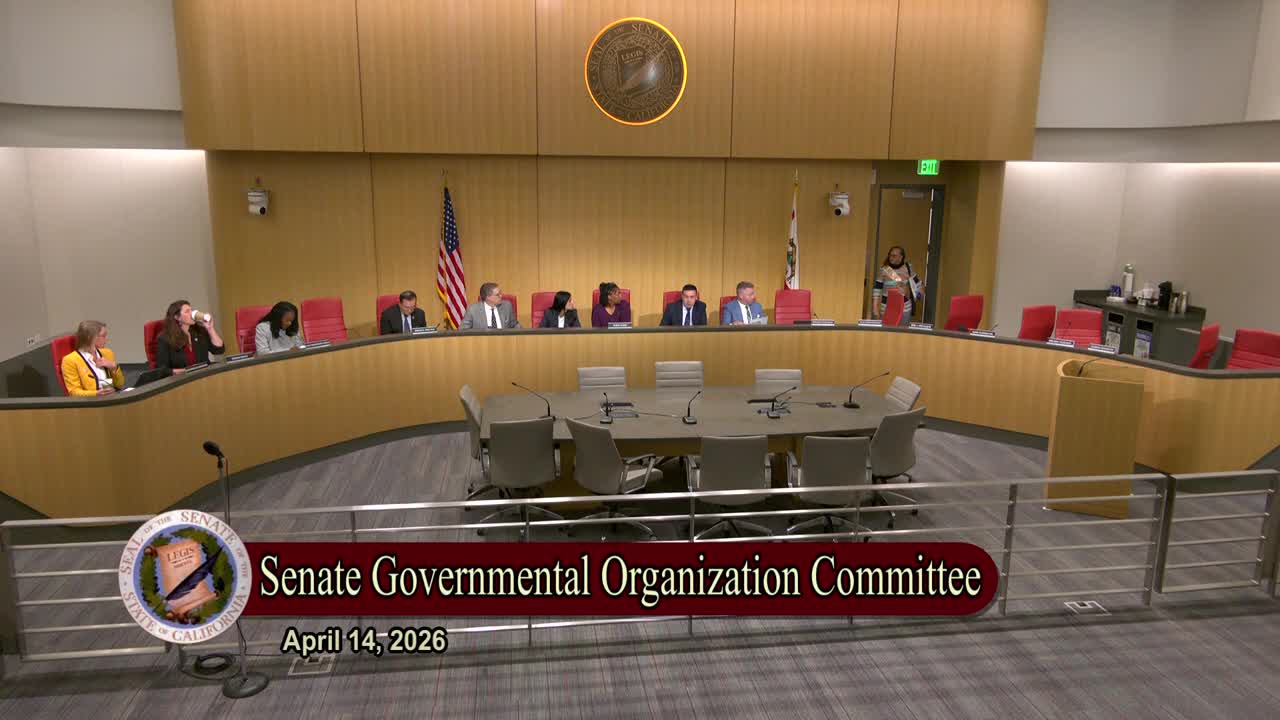 9MIN
Senate Standing Committee on Governmental Organization
Bill Author

Bill Co-Author(s):