SB 1359: Natural Gas Ratepayer Protection Act.
- Session Year: 2025-2026
- House: Senate
- Latest Version Date: 2026-09-30
Current Status:
Passed
(2026-09-30: Chaptered by Secretary of State. Chapter 1026, Statutes of 2026.)
Introduced
In Committee
Awaiting First Chamber Vote
Passed First Chamber
In Committee
Awaiting Second Chamber Vote
Passed Second Chamber
Enacted
Existing law vests the Public Utilities Commission with regulatory authority over public utilities, including gas corporations. Existing law authorizes the commission to fix the rates and charges for every public utility and requires that those rates and charges be just and reasonable. Existing law requires, until at least December 31, 2029, each gas corporation to submit to the commission a map that includes, among other things, the location of all potential gas distribution line replacement projects identified in its distribution integrity management plan and any foreseeable gas distribution pipeline replacements, as provided.
This bill would require each gas corporation to submit an annual report to the commission that describes its expenditures associated with gas distribution infrastructure replacement and upgrade projects, as provided. The bill would require the commission, as part of its long-term gas planning rulemaking or a successor proceeding, to consider a framework for the depreciation of gas distribution infrastructure that reflects reasonably foreseeable changes in gas demand and is designed to minimize future ratepayer exposure to stranded asset costs, and would authorize the commission to apply the framework in evaluating the depreciation of, and cost recovery for, gas distribution infrastructure replacements and upgrades.
Under existing law, a violation of the Public Utilities Act or an order, decision, rule, direction, demand, or requirement of the commission is a crime.
Because the above provisions would be part of the Public Utilities Act and a violation of a commission action implementing this bills requirements would be a crime, the bill would impose a state-mandated local program.
The California Constitution requires the state to reimburse local agencies and school districts for certain costs mandated by the state. Statutory provisions establish procedures for making that reimbursement.
This bill would provide that no reimbursement is required by this act for a specified reason.
Existing law vests the Public Utilities Commission with regulatory authority over public utilities, including gas corporations. Existing law authorizes the commission to fix the rates and charges for every public utility and requires that those rates and charges be just and reasonable. Existing law requires, until at least December 31, 2029, each gas corporation to submit to the commission a map that includes, among other things, the location of all potential gas distribution line replacement projects identified in its distribution integrity management plan and any foreseeable gas distribution pipeline replacements, as provided.
This bill would require each gas corporation to submit an annual report to the commission that describes its expenditures associated with gas distribution infrastructure replacement and upgrade projects, as provided. The bill would require the commission, before authorizing recovery of costs associated with a gas distribution infrastructure replacement and upgrade project, to consider whether cost-effective electrification alternatives or nonpipeline alternatives could reasonably avoid or reduce the costs, and to adopt rules implementing this requirement, including a reasonable cost threshold below which the requirement would not apply. The bill would require the commission to evaluate whether depreciation schedules for gas distribution infrastructure replacement and upgrade projects appropriately reflect projected reductions in gas demand and consider alternative depreciation methodologies that minimize future ratepayer exposure to stranded asset costs. The bill would require the commission, as part of its long-term gas planning rulemaking or a successor proceeding, to consider a framework for the depreciation of gas distribution infrastructure that reflects reasonably foreseeable changes in gas demand and is designed to minimize future ratepayer exposure to stranded asset costs, and would authorize the commission to apply the framework in evaluating the depreciation of, and cost recovery for, gas distribution infrastructure replacements and upgrades.
Under existing law, a violation of the Public Utilities Act or an order, decision, rule, direction, demand, or requirement of the commission is a crime.
Because the above provisions would be part of the Public Utilities Act and a violation of a commission action implementing this bills requirements would be a crime, the bill would impose a state-mandated local program.
The California Constitution requires the state to reimburse local agencies and school districts for certain costs mandated by the state. Statutory provisions establish procedures for making that reimbursement.
This bill would provide that no reimbursement is required by this act for a specified reason.
Existing law vests the Public Utilities Commission with regulatory authority over public utilities, including gas corporations. Existing law authorizes the commission to fix the rates and charges for every public utility and requires that those rates and charges be just and reasonable. Existing law requires, until at least December 31, 2029, each gas corporation to submit to the commission a map that includes, among other things, the location of all potential gas distribution line replacement projects identified in its distribution integrity management plan and any foreseeable gas distribution pipeline replacements, as provided.
This bill would require each gas corporation to submit an annual report to the commission that describes its expenditures associated with gas distribution infrastructure replacement and upgrade projects, as provided. The bill would require the commission, before authorizing recovery of costs associated with a gas distribution infrastructure replacement and upgrade project, to consider whether cost-effective electrification alternatives or nonpipeline alternatives could reasonably avoid or reduce the project. costs, and to adopt rules implementing this requirement, including a reasonable cost threshold below which the requirement would not apply. The bill would require the commission to evaluate whether depreciation schedules for gas distribution infrastructure replacement and upgrade projects appropriately reflect projected reductions in gas demand and consider alternative depreciation methodologies that minimize future ratepayer exposure to stranded asset costs.
Under existing law, a violation of the Public Utilities Act or an order, decision, rule, direction, demand, or requirement of the commission is a crime.
Because the above provisions would be part of the Public Utilities Act and a violation of a commission action implementing this bills requirements would be a crime, the bill would impose a state-mandated local program.
The California Constitution requires the state to reimburse local agencies and school districts for certain costs mandated by the state. Statutory provisions establish procedures for making that reimbursement.
This bill would provide that no reimbursement is required by this act for a specified reason.
Existing law vests the Public Utilities Commission with regulatory authority over public utilities, including gas corporations. Existing law authorizes the commission to fix the rates and charges for every public utility and requires that those rates and charges be just and reasonable. Existing law requires, until at least December 31, 2029, each gas corporation to submit to the commission a map that includes, among other things, the location of all potential gas distribution line replacement projects identified in its distribution integrity management plan and any foreseeable gas distribution pipeline replacements, as provided.
This bill would require the commission, before approving any capital investment by a gas corporation for natural gas distribution infrastructure exceeding $10,000,000, to determine that the proposed investment is consistent with the states greenhouse gas emission reduction targets, and would require a gas corporation seeking approval of an investment to provide evidence regarding specified factors.This bill would require each gas corporation to submit an annual report to the commission that describes its expenditures associated with gas distribution infrastructure replacement and upgrade projects, as provided. The bill would require the commission, before authorizing recovery of costs associated with a gas distribution infrastructure replacement and upgrade project, to consider whether cost-effective electrification alternatives or nonpipeline alternatives could reasonably avoid or reduce the project. The bill would require the commission to evaluate whether depreciation schedules for gas distribution infrastructure replacement and upgrade projects appropriately reflect projected reductions in gas demand and consider alternative depreciation methodologies that minimize future ratepayer exposure to stranded asset costs.
Under existing law, a violation of the Public Utilities Act or an order, decision, rule, direction, demand, or requirement of the commission is a crime.
Because the above provisions would be part of the Public Utilities Act and a violation of a commission action implementing this bills requirements would be a crime, the bill would impose a state-mandated local program.
The California Constitution requires the state to reimburse local agencies and school districts for certain costs mandated by the state. Statutory provisions establish procedures for making that reimbursement.
This bill would provide that no reimbursement is required by this act for a specified reason.
The California Global Warming Solutions Act of 2006 requires the State Air Resources Board to determine what the statewide greenhouse gas emissions level was in 1990 and approve in a public hearing a statewide greenhouse gas emissions limit that is equivalent to that level, to be achieved by 2020. The act requires the state board, in adopting rules and regulations to achieve the maximum technologically feasible and cost-effective greenhouse gas emissions reductions, to ensure that the statewide greenhouse gas emissions are reduced to at least 40% below the 1990 levels no later than December 31, 2030.
Existing law vests the Public Utilities Commission with regulatory authority over public utilities, including gas corporations. Existing law authorizes the commission to fix the rates and charges for every public utility and requires that those rates and charges be just and reasonable.
This bill would require that the obligation of a gas corporation to furnish service under these provisions be interpreted consistent with the states greenhouse gas emission reduction mandates and policies promoting building electrification, and would authorize the commission to authorize the retirement or discontinuation of natural gas distribution infrastructure where the commission finds that continued operation is inconsistent with the public interest, as provided.Existing law requires the commission, in order to achieve transparency and accountability for rate revenues and best value for ratepayers, to consider, among other things, providing revenues for all activities identified and required by certain rules and procedures governing the operation, maintenance, repair, and replacement of commission-regulated gas pipeline facilities, including any adjustment of allowance for lost and unaccounted for natural gas related to actual leakage volumes.This bill would require the commission, in determining just and reasonable rates, to ensure that costs associated with avoidable natural gas leakage, including methane emissions resulting from inadequate maintenance or infrastructure replacement delays, are not recovered from ratepayers. The bill would, beginning January 1, 2030, prohibit the commission, when establishing rates for a gas corporation, from allowing recovery from ratepayers for the value of natural gas lost to the atmosphere from facilities under the control of the gas corporation, as specified.This bill would require the commission, before approving any capital investment by a gas corporation for natural gas distribution infrastructure exceeding $10,000,000, to determine that the proposed investment is consistent with the states greenhouse gas emission reduction targets, and would require a gas corporation seeking approval of an investment to provide evidence regarding specified factors. The bill would require the commission to develop a framework for the orderly and equitable transition of the natural gas distribution system, as provided. The bill would require each gas corporation to establish a Gas Infrastructure Decommissioning Trust, require the trust to be funded through shareholder contributions, and prohibit contributions to the trust from being recovered from ratepayers. The bill would require each gas corporation, beginning January 1, 2030, to annually file with the commission a transition report, as specified. The bill would prohibit a gas corporation, beginning January 1, 2030, from extending new natural gas service to residential or mixed-use developments unless the applicant pays the full cost of the extension, including all costs that would otherwise be borne by existing ratepayers. The bill would require the commission to initiate a rulemaking to implement the above-described provisions on or before July 1, 2029.
Under existing law, a violation of the Public Utilities Act or an order, decision, rule, direction, demand, or requirement of the commission is a crime.
Because the above provisions would be part of the Public Utilities Act and a violation of a commission action implementing this bills requirements would be a crime, the bill would impose a state-mandated local program.
The California Constitution requires the state to reimburse local agencies and school districts for certain costs mandated by the state. Statutory provisions establish procedures for making that reimbursement.
This bill would provide that no reimbursement is required by this act for a specified reason.
Existing law vests the Public Utilities Commission with regulatory authority over public utilities, including gas corporations. Existing law authorizes the commission to fix the rates and charges for every public utility and requires that those rates and charges be just and reasonable.
This bill would require that the obligation of a gas corporation to furnish service under these provisions be interpreted consistent with the states greenhouse gas emission reduction mandates and policies promoting building electrification, and would authorize the commission to authorize the retirement or discontinuation of natural gas distribution infrastructure where the commission finds that continued operation is inconsistent with the public interest, as provided.
Existing law requires the commission, in order to achieve transparency and accountability for rate revenues and best value for ratepayers, to consider, among other things, providing revenues for all activities identified and required by certain rules and procedures governing the operation, maintenance, repair, and replacement of commission-regulated gas pipeline facilities, including any adjustment of allowance for lost and unaccounted for natural gas related to actual leakage volumes.
This bill would require the commission, in determining just and reasonable rates, to ensure that costs associated with avoidable natural gas leakage, including methane emissions resulting from inadequate maintenance or infrastructure replacement delays, are not recovered from ratepayers. The bill would, beginning January 1, 2030, prohibit the commission, when establishing rates for a gas corporation, from allowing recovery from ratepayers for the value of natural gas lost to the atmosphere from facilities under the control of the gas corporation, as specified.
This bill would require the commission, before approving any capital investment by a gas corporation for natural gas distribution infrastructure exceeding $5,000,000, $10,000,000, to determine that the proposed investment is consistent with the states greenhouse gas emission reduction targets, and would require a gas corporation seeking approval of an investment to demonstrate certain requirements are satisfied. provide evidence regarding specified factors. The bill would require the commission to develop a framework for the orderly and equitable transition of the natural gas distribution system, as provided. The bill would prohibit the commission from approving a gas corporation to recover from ratepayers the costs of hydrogen blending, as defined, in a gas distribution system unless the commission makes a written finding that specified conditions are met. The bill would require each gas corporation to establish a Gas Infrastructure Decommissioning Trust, require the trust to be funded through shareholder contributions, and prohibit contributions to the trust from being recovered from ratepayers. The bill would require each gas corporation, beginning January 1, 2030, to annually file with the commission a climate transition risk report, as specified. The bill would prohibit a gas corporation, beginning January 1, 2030, from extending new natural gas service to residential or mixed-use developments unless the applicant pays the full cost of the extension, including a surcharge reflecting the expected cost of future decommissioning. all costs that would otherwise be borne by existing ratepayers. The bill would require the commission to initiate a rulemaking to implement the above-described provisions on or before July 1, 2029.
Under existing law, a violation of the Public Utilities Act or an order, decision, rule, direction, demand, or requirement of the commission is a crime.
Because the above provisions would be part of the Public Utilities Act and a violation of a commission action implementing this bills requirements would be a crime, the bill would impose a state-mandated local program.
The California Constitution requires the state to reimburse local agencies and school districts for certain costs mandated by the state. Statutory provisions establish procedures for making that reimbursement.
This bill would provide that no reimbursement is required by this act for a specified reason.
Existing law vests the Public Utilities Commission with regulatory authority over public utilities, including gas corporations. Existing law authorizes the commission to fix the rates and charges for every public utility and requires that those rates and charges be just and reasonable.
This bill would require that the obligation of a gas corporation to furnish service under these provisions be interpreted consistent with the states greenhouse gas emission reduction mandates and policies promoting building electrification, and would authorize the commission to authorize the retirement or discontinuation of natural gas distribution infrastructure where the commission finds that continued operation is inconsistent with the public interest, as provided.
Existing law requires the commission, in order to achieve transparency and accountability for rate revenues and best value for ratepayers, to consider, among other things, providing revenues for all activities identified and required by certain rules and procedures governing the operation, maintenance, repair, and replacement of commission-regulated gas pipeline facilities, including any adjustment of allowance for lost and unaccounted for natural gas related to actual leakage volumes.
This bill would require the commission, in determining just and reasonable rates, to ensure that costs associated with avoidable natural gas leakage, including methane emissions resulting from inadequate maintenance or infrastructure replacement delays, are not recovered from ratepayers. The bill would, beginning January 1, 2030, prohibit the commission, when establishing rates for a gas corporation, from allowing recovery from ratepayers for the value of natural gas lost to the atmosphere from facilities under the control of the gas corporation, as specified.
This bill would require the commission, before approving any capital investment by a gas corporation for natural gas distribution infrastructure exceeding $5,000,000, to determine that the proposed investment is consistent with the states greenhouse gas emission reduction targets, and would require a gas corporation seeking approval of an investment to demonstrate certain requirements are satisfied. The bill would require the commission to develop a framework for the orderly and equitable transition of the natural gas distribution system, as provided. The bill would prohibit the commission from approving a gas corporation to recover from ratepayers the costs of hydrogen blending, as defined, in a gas distribution system unless the commission makes a written finding that specified conditions are met. The bill would require each gas corporation to establish a Gas Infrastructure Decommissioning Trust, require the trust to be funded through shareholder contributions, and prohibit contributions to the trust from being recovered from ratepayers. The bill would require each gas corporation, beginning January 1, 2030, to annually file with the commission a climate transition risk report, as specified. The bill would prohibit a gas corporation, beginning January 1, 2030, from extending new natural gas service to residential or mixed-use developments unless the applicant pays the full cost of the extension, including a surcharge reflecting the expected cost of future decommissioning. The bill would require the commission to initiate a rulemaking to implement the above-described provisions on or before July 1, 2029.
Under existing law, a violation of the Public Utilities Act or an order, decision, rule, direction, demand, or requirement of the commission is a crime.
Because the above provisions would be part of the Public Utilities Act and a violation of a commission action implementing this bills requirements would be a crime, the bill would impose a state-mandated local program.
The California Constitution requires the state to reimburse local agencies and school districts for certain costs mandated by the state. Statutory provisions establish procedures for making that reimbursement.
This bill would provide that no reimbursement is required by this act for a specified reason.
Existing law vests the Public Utilities Commission with regulatory authority over public utilities, including gas corporations. Existing law requires the commission to establish a surcharge to fund low-income assistance programs and cost-effective energy efficiency and conservation activities and public interest research and development not adequately provided by the competitive and regulated markets, as specified. Existing law requires the State Board of Equalization to transmit revenues from that surcharge to the Treasurer, and requires the Treasurer to deposit those revenues into the Gas Consumption Surcharge Fund, which is continuously appropriated.This bill would make a nonsubstantive change to that requirement on the Treasurer.Existing law vests the Public Utilities Commission with regulatory authority over public utilities, including gas corporations. Existing law requires the commission to establish a surcharge to fund low-income assistance programs and cost-effective energy efficiency and conservation activities and public interest research and development not adequately provided by the competitive and regulated markets, as specified. Existing law requires the State Board of Equalization to transmit revenues from that surcharge to the Treasurer, and requires the Treasurer to deposit those revenues into the Gas Consumption Surcharge Fund, which is continuously appropriated.
This bill would make a nonsubstantive change to that requirement on the Treasurer.
This act shall be known, and may be cited, as the Natural Gas Ratepayer Protection Act.
SEC. 2.The heading of Article 1 (commencing with Section 328) is added to Chapter 2.2 of Part 1 of Division 1 of the Public Utilities Code, to read:1.General ProvisionsSEC. 3.Article 2 (commencing with Section 329) is added to Chapter 2.2 of Part 1 of Division 1 of the Public Utilities Code, to read:2.Natural Gas Transition329.(a)Each gas corporation shall submit an annual report to the commission that describes its expenditures, during the gas corporations general rate case cycle, associated with gas distribution infrastructure replacement and upgrade projects and includes all of the following:
(1)Planned and forecasted expenditures for gas distribution infrastructure replacement and upgrade projects, as determined by the commission, in alignment with information already reported through general rate case, risk assessment mitigation phase, or successor proceedings.
(2)The status of gas distribution infrastructure replacement and upgrade projects planned, initiated, completed, deferred, or canceled since the gas corporations immediately preceding general rate case decision.
(3)The estimated remaining costs and projected completion dates for ongoing gas distribution infrastructure replacement and upgrade projects.
(4)Any expenditures recorded in any catastrophic event memorandum account, wildfire memorandum account, or other memorandum or balancing account used to recover costs associated with wildfire response, recovery, or gas distribution system during the gas corporations general rate case cycle.
(5)Any material changes in projected customer counts, projected gas throughput, or other assumptions used to justify the gas distribution infrastructure replacement and upgrade projects, including an assessment of stranded asset risk and the distributional impacts of stranded assets on remaining gas ratepayers.
(6)Available electrification and nonpipeline alternatives implemented or evaluated since the gas corporations immediately preceding general rate case decision.
(b)(1)The commission may require the report required pursuant to subdivision (a) to be submitted in a format that facilitates public review and comparison of authorized and actual expenditures.
(2)The commission may specify requirements for the report required pursuant to subdivision (a) that reduce duplication and align timelines with other existing reporting requirements.
329.1.(a)As part of its long-term gas planning rulemaking or a successor proceeding, the commission shall consider developing a framework for the depreciation of gas distribution infrastructure that reflects reasonably foreseeable changes in gas demand and is designed to minimize future ratepayer exposure to stranded asset costs.
(b)Upon the development of a framework described in subdivision (a), the commission may apply the framework in evaluating the depreciation of, and cost recovery for, gas distribution infrastructure replacements and upgrades.
SEC. 4.No reimbursement is required by this act pursuant to Section 6 of Article XIIIB of the California Constitution because the only costs that may be incurred by a local agency or school district will be incurred because this act creates a new crime or infraction, eliminates a crime or infraction, or changes the penalty for a crime or infraction, within the meaning of Section 17556 of the Government Code, or changes the definition of a crime within the meaning of Section 6 of Article XIIIB of the California Constitution.
This act shall be known, and may be cited, as the Natural Gas Ratepayer Protection Act.
SEC. 2.The heading of Article 1 (commencing with Section 328) is added to Chapter 2.2 of Part 1 of Division 1 of the Public Utilities Code, to read:1.General ProvisionsSEC. 3.Article 2 (commencing with Section 329) is added to Chapter 2.2 of Part 1 of Division 1 of the Public Utilities Code, to read:2.Natural Gas Transition329.(a)Each gas corporation shall submit an annual report to the commission that describes its expenditures, during the pendency of its current gas corporations general rate case cycle, associated with gas distribution infrastructure replacement and upgrade projects and includes all of the following:
(1)Planned and forecasted expenditures for each gas distribution infrastructure replacement and upgrade project. projects, as determined by the commission, in alignment with information already reported through general rate case, risk assessment mitigation phase, or successor proceedings.
(2)The status of gas distribution infrastructure replacement and upgrade projects planned, initiated, completed, deferred, or canceled since the gas corporations most recent immediately preceding general rate case decision.
(3)The estimated remaining costs and projected completion dates for ongoing gas distribution infrastructure replacement and upgrade projects.
(4)Any expenditures recorded in any catastrophic event memorandum account, wildfire memorandum account, or other memorandum or balancing account used to recover costs associated with wildfire response, recovery, or gas distribution system restoration. during the gas corporations general rate case cycle.
(5)Any material changes in projected customer counts, projected gas throughput, or other assumptions used to justify the gas distribution infrastructure replacement and upgrade projects, including an assessment of stranded asset risk. risk and the distributional impacts of stranded assets on remaining gas ratepayers.
(6)Available electrification and nonpipeline alternatives. alternatives implemented or evaluated since the gas corporations immediately preceding general rate case decision.
(b)(1)The commission may require the report required pursuant to subdivision (a) to be submitted in a format that facilitates public review and comparison of authorized and actual expenditures.
(2)The commission may specify requirements for the report required pursuant to subdivision (a) that reduce duplication and align timelines with other existing reporting requirements.
329.1.(a)(1)Before authorizing recovery of costs associated with a gas distribution infrastructure replacement and upgrade project, the commission shall consider whether cost-effective electrification alternatives or nonpipeline alternatives could reasonably avoid or reduce those costs.(2)As part of its long-term gas planning rulemaking or in a successor proceeding, the commission shall adopt rules implementing this requirement, including a reasonable cost threshold below which this requirement shall not apply.(b)The commission shall evaluate whether depreciation schedules for gas distribution infrastructure replacement and upgrade projects appropriately reflect projected reductions in gas demand and consider alternative depreciation methodologies that minimize future ratepayer exposure to stranded asset costs.(c)Nothing in this section shall delay or disallow recovery of prudently incurred costs required for the safety, reliability, or legal compliance of gas distribution infrastructure, or for emergency or catastrophic event response.329.1.(a)As part of its long-term gas planning rulemaking or a successor proceeding, the commission shall consider developing a framework for the depreciation of gas distribution infrastructure that reflects reasonably foreseeable changes in gas demand and is designed to minimize future ratepayer exposure to stranded asset costs.
(b)Upon the development of a framework described in subdivision (a), the commission may apply the framework in evaluating the depreciation of, and cost recovery for, gas distribution infrastructure replacements and upgrades.
SEC. 4.No reimbursement is required by this act pursuant to Section 6 of Article XIIIB of the California Constitution because the only costs that may be incurred by a local agency or school district will be incurred because this act creates a new crime or infraction, eliminates a crime or infraction, or changes the penalty for a crime or infraction, within the meaning of Section 17556 of the Government Code, or changes the definition of a crime within the meaning of Section 6 of Article XIIIB of the California Constitution.
This act shall be known, and may be cited, as the Natural Gas Ratepayer Protection Act.
SEC. 2.(a)The Legislature finds and declares all of the following:(1)California has binding statutory obligations to reduce greenhouse gas emissions pursuant to Senate Bill 32 of the 201516 Regular Session (Chapter 249 of the Statutes of 2016) and subsequent statutes.(2)Californias natural gas distribution system is experiencing structural load decline due to building electrification, energy efficiency improvements, and climate policy.(3)Continued capital investment in natural gas infrastructure under conditions of declining demand creates significant risk of stranded assets and escalating costs for ratepayers.(4)Electrification of buildings is widely recognized as the lowest cost and lowest emission pathway for providing space heating, water heating, and cooking services.(5)The state must establish a managed transition of the natural gas distribution system, ensuring that financial risks associated with declining natural gas use are appropriately borne by utility shareholders rather than ratepayers.(6)The Public Utilities Commission is currently undertaking a long-term gas planning rulemaking process (commission Rulemaking R.24-09-012) to examine how to facilitate gas decarbonization while supporting equity, safety, affordability, and reliability.(b)It is the intent of the Legislature to direct the Public Utilities Commission to prioritize electrification and nonpipeline alternatives, ensure prudent depreciation of natural gas infrastructure, ensure a just transition for workers, and facilitate the orderly retirement of portions of the natural gas system.SEC. 3.SEC. 2.The heading of Article 1 (commencing with Section 328) is added to Chapter 2.2 of Part 1 of Division 1 of the Public Utilities Code, to read:1.General ProvisionsSEC. 4.SEC. 3.Article 2 (commencing with Section 329) is added to Chapter 2.2 of Part 1 of Division 1 of the Public Utilities Code, to read:2.Natural Gas Transition329.(a)Each gas corporation shall submit an annual report to the commission that describes its expenditures, during the pendency of its current general rate case cycle, associated with gas distribution infrastructure replacement and upgrade projects and includes all of the following:
(1)Planned and forecasted expenditures for each gas distribution infrastructure replacement and upgrade project.
(2)The status of gas distribution infrastructure replacement and upgrade projects planned, initiated, completed, deferred, or canceled since the gas corporations most recent general rate case decision.
(3)The estimated remaining costs and projected completion dates for ongoing gas distribution infrastructure replacement and upgrade projects.
(4)Any expenditures recorded in any catastrophic event memorandum account, wildfire memorandum account, or other memorandum or balancing account used to recover costs associated with wildfire response, recovery, or gas distribution system restoration.
(5)Any material changes in projected customer counts, projected gas throughput, or other assumptions used to justify the gas distribution infrastructure replacement and upgrade projects, including an assessment of stranded asset risk.
(6)Available electrification and nonpipeline alternatives.
(b)The commission may require the report required pursuant to subdivision (a) to be submitted in a format that facilitates public review and comparison of authorized and actual expenditures.
329.1.(a)(1)Before authorizing recovery of costs associated with a gas distribution infrastructure replacement and upgrade project, the commission shall consider whether cost-effective electrification alternatives or nonpipeline alternatives could reasonably avoid or reduce those costs.
(2)As part of its long-term gas planning rulemaking or in a successor proceeding, the commission shall adopt rules implementing this requirement, including a reasonable cost threshold below which this requirement shall not apply.
(b)The commission shall evaluate whether depreciation schedules for gas distribution infrastructure replacement and upgrade projects appropriately reflect projected reductions in gas demand and consider alternative depreciation methodologies that minimize future ratepayer exposure to stranded asset costs.
(c)Nothing in this section shall delay or disallow recovery of prudently incurred costs required for the safety, reliability, or legal compliance of gas distribution infrastructure, or for emergency or catastrophic event response.
SEC. 5.SEC. 4.No reimbursement is required by this act pursuant to Section 6 of Article XIIIB of the California Constitution because the only costs that may be incurred by a local agency or school district will be incurred because this act creates a new crime or infraction, eliminates a crime or infraction, or changes the penalty for a crime or infraction, within the meaning of Section 17556 of the Government Code, or changes the definition of a crime within the meaning of Section 6 of Article XIIIB of the California Constitution.
This act shall be known, and may be cited, as the Gas Transition Responsibility and Electrification Act. Natural Gas Ratepayer Protection Act.
SEC. 2.(a)The Legislature finds and declares all of the following:
(1)California has binding statutory obligations to reduce greenhouse gas emissions pursuant to Senate Bill 32 of the 201516 Regular Session (Chapter 249 of the Statutes of 2016) and subsequent statutes.
(2)Californias natural gas distribution system is experiencing structural load decline due to building electrification, energy efficiency improvements, and climate policy.
(3)Continued capital investment in natural gas infrastructure under conditions of declining demand creates significant risk of stranded assets and escalating costs for ratepayers.
(4)Electrification of buildings is widely recognized as the lowest cost and lowest emission pathway for providing space heating, water heating, and cooking services.
(5)The state must establish a managed transition of the natural gas distribution system, ensuring that financial risks associated with declining natural gas use are appropriately borne by utility shareholders rather than ratepayers.
(6)The Public Utilities Commission is currently undertaking a long-term gas planning rulemaking process (commission Rulemaking R.24-09-012) to examine how to facilitate gas decarbonization while supporting equity, safety, affordability, and reliability.
(b)It is the intent of the Legislature to direct the Public Utilities Commission to prioritize electrification and nonpipeline alternatives, ensure prudent depreciation of natural gas infrastructure, ensure a just transition for workers, and facilitate the orderly retirement of portions of the natural gas system.
SEC. 3.The heading of Article 1 (commencing with Section 328) is added to Chapter 2.2 of Part 1 of Division 1 of the Public Utilities Code, to read:1.General ProvisionsSEC. 4.Article 2 (commencing with Section 329) is added to Chapter 2.2 of Part 1 of Division 1 of the Public Utilities Code, to read:2.Natural Gas Transition329.(a)Before approving any capital investment by a gas corporation for natural gas distribution infrastructure exceeding ten million dollars ($10,000,000), the commission shall determine that the proposed investment is consistent with the states greenhouse gas emission reduction targets.(b)A gas corporation seeking approval of an investment described in subdivision (a) shall provide evidence, as determined by the commission, regarding all of the following factors:(1)Electrification alternatives are infeasible or demonstrably more costly over the life cycle of the project.(2)A nonpipeline alternative has been evaluated.(3)The proposed investment appropriately considers potential stranded asset risk over the expected useful life of the asset.(4)The investment is consistent with the states climate policy framework.(c)The commission shall prioritize alternatives to investments described in subdivision (a) if a nonpipeline alternative achieves equivalent or greater benefits at a lower life-cycle cost, unless the commission finds the investment is necessary to ensure safety, reliability, or compliance with legal obligations.329.(a)Each gas corporation shall submit an annual report to the commission that describes its expenditures, during the pendency of its current general rate case cycle, associated with gas distribution infrastructure replacement and upgrade projects and includes all of the following:
(1)Planned and forecasted expenditures for each gas distribution infrastructure replacement and upgrade project.
(2)The status of gas distribution infrastructure replacement and upgrade projects planned, initiated, completed, deferred, or canceled since the gas corporations most recent general rate case decision.
(3)The estimated remaining costs and projected completion dates for ongoing gas distribution infrastructure replacement and upgrade projects.
(4)Any expenditures recorded in any catastrophic event memorandum account, wildfire memorandum account, or other memorandum or balancing account used to recover costs associated with wildfire response, recovery, or gas distribution system restoration.
(5)Any material changes in projected customer counts, projected gas throughput, or other assumptions used to justify the gas distribution infrastructure replacement and upgrade projects, including an assessment of stranded asset risk.
(6)Available electrification and nonpipeline alternatives.
(b)The commission may require the report required pursuant to subdivision (a) to be submitted in a format that facilitates public review and comparison of authorized and actual expenditures.
329.1.(a)Before authorizing recovery of costs associated with a gas distribution infrastructure replacement and upgrade project, the commission shall consider whether cost-effective electrification alternatives or nonpipeline alternatives could reasonably avoid or reduce those costs.
(b)The commission shall evaluate whether depreciation schedules for gas distribution infrastructure replacement and upgrade projects appropriately reflect projected reductions in gas demand and consider alternative depreciation methodologies that minimize future ratepayer exposure to stranded asset costs.
SEC. 5.No reimbursement is required by this act pursuant to Section 6 of Article XIIIB of the California Constitution because the only costs that may be incurred by a local agency or school district will be incurred because this act creates a new crime or infraction, eliminates a crime or infraction, or changes the penalty for a crime or infraction, within the meaning of Section 17556 of the Government Code, or changes the definition of a crime within the meaning of Section 6 of Article XIIIB of the California Constitution.
This act shall be known, and may be cited, as the Gas Transition Responsibility and Electrification Act.
SEC. 2.(a)The Legislature finds and declares all of the following:
(1)California has binding statutory obligations to reduce greenhouse gas emissions pursuant to Senate Bill 32 of the 201516 Regular Session (Chapter 249 of the Statutes of 2016) and subsequent statutes.
(2)Californias natural gas distribution system is experiencing structural load decline due to building electrification, energy efficiency improvements, and climate policy.
(3)Continued capital investment in natural gas infrastructure under conditions of declining demand creates significant risk of stranded assets and escalating costs for ratepayers.
(4)Electrification of buildings is widely recognized as the lowest cost and lowest emission pathway for providing space heating, water heating, and cooking services.
(5)The state must establish a managed transition of the natural gas distribution system, ensuring that financial risks associated with declining natural gas use are appropriately borne by utility shareholders rather than ratepayers.
(6)The Public Utilities Commission is currently undertaking a long-term gas planning rulemaking process (commission Rulemaking R.24-09-012) to examine how to facilitate gas decarbonization while supporting equity, safety, affordability, and reliability.
(b)It is the intent of the Legislature to direct the Public Utilities Commission to prioritize electrification and nonpipeline alternatives, ensure prudent depreciation of natural gas infrastructure, ensure a just transition for workers, and facilitate the orderly retirement of portions of the natural gas system.
SEC. 3.The heading of Article 1 (commencing with Section 328) is added to Chapter 2.2 of Part 1 of Division 1 of the Public Utilities Code, to read:1.General ProvisionsSEC. 4.Article 2 (commencing with Section 329) is added to Chapter 2.2 of Part 1 of Division 1 of the Public Utilities Code, to read:2.Natural Gas Transition329.(a)Before approving any capital investment by a gas corporation for natural gas distribution infrastructure exceeding ten million dollars ($10,000,000), the commission shall determine that the proposed investment is consistent with the states greenhouse gas emission reduction targets.
(b)A gas corporation seeking approval of an investment described in subdivision (a) shall provide evidence, as determined by the commission, regarding all of the following factors:
(1)Electrification alternatives are infeasible or demonstrably more costly over the life cycle of the project.
(2)A nonpipeline alternative has been evaluated.
(3)The proposed investment appropriately considers potential stranded asset risk over the expected useful life of the asset.
(4)The investment is consistent with the states climate policy framework.
(c)The commission shall prioritize alternatives to investments described in subdivision (a) if a nonpipeline alternative achieves equivalent or greater benefits at a lower life-cycle cost, unless the commission finds the investment is necessary to ensure safety, reliability, or compliance with legal obligations.
329.1.(a)The commission shall develop a framework for the orderly and equitable transition of the natural gas distribution system.(b)The framework developed pursuant to subdivision (a) shall include all of the following:(1)Identification of electrification priority zones where building electrification is cost effective.(2)A process for retiring natural gas infrastructure in the electrification priority zones identified pursuant to paragraph (1).(3)A minimum notice period of five years before discontinuation of service.(c)The commission shall consider mechanisms to allocate unrecovered net book value associated with infrastructure retired due to load decline or climate policy compliance between gas corporation shareholders and ratepayers in a manner that is just and reasonable and minimizes ratepayer impacts.(d)The commission shall evaluate depreciation practices in a manner that reflects updated demand forecasts, while minimizing ratepayer impacts and avoiding incentives for uneconomic capital investment.329.2.(a)Each gas corporation shall establish a Gas Infrastructure Decommissioning Trust.(b)The trust shall be funded through shareholder contributions.(c)The trust shall be used exclusively for all of the following:(1)Decommissioning natural gas infrastructure.(2)Environmental remediation.(3)Workforce transition programs.(d)Contributions to the trust shall not be recovered from ratepayers.329.3.(a)Beginning January 1, 2030, each gas corporation shall annually file with the commission a transition report that includes all of the following:(1)Long-term natural gas demand forecasts.(2)Scenario analysis assuming up to 90 percent reduction in natural gas demand by 2045.(3)Estimated stranded asset exposure.(b)The commission shall use the reports submitted pursuant to subdivision (a) when determining authorized rates of return.329.4.Beginning January 1, 2030, a gas corporation shall not extend natural gas service to residential or mixed-use developments unless the applicant pays the full cost of the extension, including all costs that would otherwise be borne by existing ratepayers, as determined by the commission.329.5.The commission shall initiate a rulemaking to implement this article on or before July 1, 2029.SEC. 5.Section 451 of the Public Utilities Code is amended to read:451.(a)All charges demanded or received by any public utility, or by any two or more public utilities, for any product or commodity furnished or to be furnished or any service rendered or to be rendered shall be just and reasonable. Every unjust or unreasonable charge demanded or received for that product, commodity, or service is unlawful.(b)Every public utility shall furnish and maintain adequate, efficient, just, and reasonable service, instrumentalities, equipment, and facilities, including telephone facilities, as defined in Section 54.1 of the Civil Code, as are necessary to promote the safety, health, comfort, and convenience of its patrons, its employees, and the public.(c)All rules made by a public utility affecting or pertaining to its charges or service to the public shall be just and reasonable.(d)(1)The obligation of a gas corporation to furnish service under this section shall be interpreted consistent with the states greenhouse gas emission reduction mandates and policies promoting building electrification. The commission may authorize the retirement or discontinuation of natural gas distribution infrastructure where the commission finds that continued operation is inconsistent with the public interest, including where electrification alternatives are cost effective or necessary to achieve state climate targets.(2)This section does not require a gas corporation to extend or continue natural gas service where the commission determines that doing so would impose unreasonable costs on ratepayers or create stranded asset risk.(e)Nothing in this section shall be interpreted to compromise the safety or reliability of the natural gas system.SEC. 6.Section 977 of the Public Utilities Code is amended to read:977.(a)In order to achieve transparency and accountability for rate revenues and best value for ratepayers, and consistent with the commissions existing ratemaking procedures and authority to establish just and reasonable rates, the commission shall consider all of the following:(1)Providing an adequate workforce to achieve the objectives of reducing hazards and emissions from leaks, including leak avoidance, reduction, and repair.(2)Providing revenues for all activities identified and required pursuant to Section 975, including any adjustment of allowance for lost and unaccounted for gas related to actual leakage volumes.(3)Providing guidance for treatment of expenditures as being either an item of expense or a capital investment.(4)The impact on affordability of gas service for vulnerable customers as a result of the incremental costs of compliance with the adopted rules and procedures.(b)In determining just and reasonable rates pursuant to Section 451, the commission shall ensure that costs associated with avoidable natural gas leakage, as determined by the commission based on prudent utility practices and existing safety standards, including methane emissions resulting from inadequate maintenance or infrastructure replacement delays, are not recovered from ratepayers.(c)(1)Beginning January 1, 2030, when establishing rates for a gas corporation, the commission shall not allow recovery from ratepayers for the value of natural gas lost to the atmosphere from facilities under the control of the gas corporation, including all of the following:(A)Commission-regulated gas pipeline facilities.(B)Aboveground storage facilities.(C)Underground storage facilities.(D)Processing facilities.(E)Facilities used for the transportation of natural gas.(F)Facilities used for the delivery of natural gas.(2)Paragraph (1) does not apply to natural gas lost due to an act of God.SEC. 7.SEC. 5.No reimbursement is required by this act pursuant to Section 6 of Article XIIIB of the California Constitution because the only costs that may be incurred by a local agency or school district will be incurred because this act creates a new crime or infraction, eliminates a crime or infraction, or changes the penalty for a crime or infraction, within the meaning of Section 17556 of the Government Code, or changes the definition of a crime within the meaning of Section 6 of Article XIIIB of the California Constitution.
This act shall be known, and may be cited, as the Gas Transition Responsibility and Electrification Act.
SEC. 2.(a)The Legislature finds and declares all of the following:
(1)California has binding statutory obligations to reduce greenhouse gas emissions pursuant to Senate Bill 32 of the 201516 Regular Session (Chapter 249 of the Statutes of 2016) and subsequent statutes.
(2)Californias natural gas distribution system is experiencing structural load decline due to building electrification, energy efficiency improvements, and climate policy.
(3)Continued capital investment in natural gas infrastructure under conditions of declining demand creates significant risk of stranded assets and escalating costs for ratepayers.
(4)Electrification of buildings is widely recognized as the lowest cost and lowest emission pathway for providing space heating, water heating, and cooking services.
(5)Hydrogen blending into natural gas distribution systems has been proposed as a means of extending the operational life of natural gas infrastructure despite significant unresolved concerns regarding safety, cost-effectiveness, infrastructure compatibility, and life-cycle emissions.(6)(5)The state must establish a managed transition of the natural gas distribution system, ensuring that financial risks associated with declining natural gas use are appropriately borne by utility shareholders rather than ratepayers.
(6)The Public Utilities Commission is currently undertaking a long-term gas planning rulemaking process (commission Rulemaking R.24-09-012) to examine how to facilitate gas decarbonization while supporting equity, safety, affordability, and reliability.
(b)It is the intent of the Legislature to direct the Public Utilities Commission to prioritize electrification and nonpipeline alternatives, ensure prudent depreciation of natural gas infrastructure, ensure a just transition for workers, and facilitate the orderly retirement of portions of the natural gas system.
SEC. 3.The heading of Article 1 (commencing with Section 328) is added to Chapter 2.2 of Part 1 of Division 1 of the Public Utilities Code, to read:1.General ProvisionsSEC. 4.Article 2 (commencing with Section 329) is added to Chapter 2.2 of Part 1 of Division 1 of the Public Utilities Code, to read:2.Natural Gas Transition329.(a)Before approving any capital investment by a gas corporation for natural gas distribution infrastructure exceeding five ten million dollars ($5,000,000), ($10,000,000), the commission shall determine that the proposed investment is consistent with the states greenhouse gas emission reduction targets.
(b)A gas corporation seeking approval of an investment described in subdivision (a) shall demonstrate provide evidence, as determined by the commission, regarding all of the following: following factors:
(1)Electrification alternatives are infeasible or demonstrably more costly over the life cycle of the project.
(2)A nonpipeline alternative has been evaluated.
(3)The proposed investment will not create stranded asset risk within a 20-year planning horizon. appropriately considers potential stranded asset risk over the expected useful life of the asset.
(4)The investment is consistent with the states climate policy framework.
(c)The commission shall not approve an investment shall prioritize alternatives to investments described in subdivision (a) if a nonpipeline alternative achieves equivalent or greater benefits at a lower life-cycle cost. cost, unless the commission finds the investment is necessary to ensure safety, reliability, or compliance with legal obligations.
329.1.(a)The commission shall develop a framework for the orderly and equitable transition of the natural gas distribution system.
(b)The framework developed pursuant to subdivision (a) shall include all of the following:
(1)Identification of electrification priority zones where building electrification is cost effective.
(2)A process for retiring natural gas infrastructure in the electrification priority zones identified pursuant to paragraph (1).
(3)A minimum notice period of five years before discontinuation of service.
(c)The commission shall ensure that at least 50 percent of unrecovered net book value associated with infrastructure retired due to load decline or climate policy compliance is borne by gas corporation shareholders. shall consider mechanisms to allocate unrecovered net book value associated with infrastructure retired due to load decline or climate policy compliance between gas corporation shareholders and ratepayers in a manner that is just and reasonable and minimizes ratepayer impacts.
(d)In determining depreciation schedules, the commission shall assume a default remaining useful life of 10 to 15 years for natural gas distribution assets unless the gas corporation demonstrates otherwise. The commission shall evaluate depreciation practices in a manner that reflects updated demand forecasts, while minimizing ratepayer impacts and avoiding incentives for uneconomic capital investment.
(e)The commission shall not use hydrogen blending, as defined in Section 329.2, or future hydrogen conversion as justification for extending the useful life of natural gas infrastructure.329.2.(a)For purposes of this section, hydrogen blending means the intentional introduction of hydrogen gas into a natural gas distribution system so that the resultant mixture is delivered to end-use customers.(b)The commission shall not approve a gas corporation to recover from ratepayers the costs of hydrogen blending in a natural gas distribution system unless the commission makes a written finding that all of the following conditions are met:(1)Hydrogen blending is more cost effective than electrification alternatives.(2)Hydrogen blending achieves greater life-cycle greenhouse gas emission reductions than electrification.(3)The use of ratepayer funds would result in just and reasonable rates pursuant to Section 451.(4)Safety and reliability standards are met.(c)Hydrogen blending shall not be used to justify any of the following:(1)Extension of the useful life of natural gas distribution assets.(2)Approval of natural gas infrastructure investments.(3)Avoidance of accelerated depreciation or asset retirement.(4)Recovery of stranded asset costs from ratepayers.(d)Hydrogen blending shall not qualify as a nonpipeline alternative.(e)Costs associated with hydrogen blending shall not be recovered through affiliates, subsidiaries, balancing accounts, or memorandum accounts.329.3.329.2.(a)Each gas corporation shall establish a Gas Infrastructure Decommissioning Trust.
(b)The trust shall be funded through shareholder contributions.
(c)The trust shall be used exclusively for all of the following:
(1)Decommissioning natural gas infrastructure.
(2)Environmental remediation.
(3)Workforce transition programs.
(d)Contributions to the trust shall not be recovered from ratepayers.
329.4.329.3.(a)Beginning January 1, 2030, each gas corporation shall annually file with the commission a climate transition risk report that includes all of the following:
(1)Long-term natural gas demand forecasts.
(2)Scenario analysis assuming up to 90 percent reduction in natural gas demand by 2045.
(3)Estimated stranded asset exposure.
(b)The commission shall use the reports submitted pursuant to subdivision (a) when determining authorized rates of return.
329.5.329.4.Beginning January 1, 2030, a gas corporation shall not extend natural gas service to residential or mixed-use developments unless the applicant pays the full cost of the extension, including a surcharge reflecting the expected cost of future decommissioning. all costs that would otherwise be borne by existing ratepayers, as determined by the commission.
329.6.329.5.The commission shall initiate a rulemaking to implement this article on or before July 1, 2029.
SEC. 5.Section 451 of the Public Utilities Code is amended to read:451.(a)All charges demanded or received by any public utility, or by any two or more public utilities, for any product or commodity furnished or to be furnished or any service rendered or to be rendered shall be just and reasonable. Every unjust or unreasonable charge demanded or received for that product, commodity, or service is unlawful.
(b)Every public utility shall furnish and maintain adequate, efficient, just, and reasonable service, instrumentalities, equipment, and facilities, including telephone facilities, as defined in Section 54.1 of the Civil Code, as are necessary to promote the safety, health, comfort, and convenience of its patrons, its employees, and the public.
(c)All rules made by a public utility affecting or pertaining to its charges or service to the public shall be just and reasonable.
(d)(1)The obligation of a gas corporation to furnish service under this section shall be interpreted consistent with the states greenhouse gas emission reduction mandates and policies promoting building electrification. The commission may authorize the retirement or discontinuation of natural gas distribution infrastructure where the commission finds that continued operation is inconsistent with the public interest, including where electrification alternatives are cost effective or necessary to achieve state climate targets.
(2)This section does not require a gas corporation to extend or continue natural gas service where the commission determines that doing so would impose unreasonable costs on ratepayers or create stranded asset risk.
(e)Nothing in this section shall be interpreted to compromise the safety or reliability of the natural gas system.
SEC. 6.Section 977 of the Public Utilities Code is amended to read:977.(a)In order to achieve transparency and accountability for rate revenues and best value for ratepayers, and consistent with the commissions existing ratemaking procedures and authority to establish just and reasonable rates, the commission shall consider all of the following:
(1)Providing an adequate workforce to achieve the objectives of reducing hazards and emissions from leaks, including leak avoidance, reduction, and repair.
(2)Providing revenues for all activities identified and required pursuant to Section 975, including any adjustment of allowance for lost and unaccounted for gas related to actual leakage volumes.
(3)Providing guidance for treatment of expenditures as being either an item of expense or a capital investment.
(4)The impact on affordability of gas service for vulnerable customers as a result of the incremental costs of compliance with the adopted rules and procedures.
(b)In determining just and reasonable rates pursuant to Section 451, the commission shall ensure that costs associated with avoidable natural gas leakage, as determined by the commission based on prudent utility practices and existing safety standards, including methane emissions resulting from inadequate maintenance or infrastructure replacement delays, are not recovered from ratepayers.
(c)(1)Beginning January 1, 2030, when establishing rates for a gas corporation, the commission shall not allow recovery from ratepayers for the value of natural gas lost to the atmosphere from facilities under the control of the gas corporation, including all of the following:
(A)Commission-regulated gas pipeline facilities.
(B)Aboveground storage facilities.
(C)Underground storage facilities.
(D)Processing facilities.
(E)Facilities used for the transportation of natural gas.
(F)Facilities used for the delivery of natural gas.
(2)Paragraph (1) does not apply to natural gas lost due to an act of God.
SEC. 7.No reimbursement is required by this act pursuant to Section 6 of Article XIIIB of the California Constitution because the only costs that may be incurred by a local agency or school district will be incurred because this act creates a new crime or infraction, eliminates a crime or infraction, or changes the penalty for a crime or infraction, within the meaning of Section 17556 of the Government Code, or changes the definition of a crime within the meaning of Section 6 of Article XIIIB of the California Constitution.
This act shall be known, and may be cited, as the Gas Transition Responsibility and Electrification Act.
SEC. 2.(a)The Legislature finds and declares all of the following:
(1)California has binding statutory obligations to reduce greenhouse gas emissions pursuant to Senate Bill 32 of the 201516 Regular Session (Chapter 249 of the Statutes of 2016) and subsequent statutes.
(2)Californias natural gas distribution system is experiencing structural load decline due to building electrification, energy efficiency improvements, and climate policy.
(3)Continued capital investment in natural gas infrastructure under conditions of declining demand creates significant risk of stranded assets and escalating costs for ratepayers.
(4)Electrification of buildings is widely recognized as the lowest cost and lowest emission pathway for providing space heating, water heating, and cooking services.
(5)Hydrogen blending into natural gas distribution systems has been proposed as a means of extending the operational life of natural gas infrastructure despite significant unresolved concerns regarding safety, cost-effectiveness, infrastructure compatibility, and life-cycle emissions.
(6)The state must establish a managed transition of the natural gas distribution system, ensuring that financial risks associated with declining natural gas use are appropriately borne by utility shareholders rather than ratepayers.
(b)It is the intent of the Legislature to direct the Public Utilities Commission to prioritize electrification and nonpipeline alternatives, ensure prudent depreciation of natural gas infrastructure, and facilitate the orderly retirement of portions of the natural gas system.
SEC. 3.The heading of Article 1 (commencing with Section 328) is added to Chapter 2.2 of Part 1 of Division 1 of the Public Utilities Code, to read:1.General ProvisionsSEC. 4.Article 2 (commencing with Section 329) is added to Chapter 2.2 of Part 1 of Division 1 of the Public Utilities Code, to read:2.Natural Gas Transition329.(a)Before approving any capital investment by a gas corporation for natural gas distribution infrastructure exceeding five million dollars ($5,000,000), the commission shall determine that the proposed investment is consistent with the states greenhouse gas emission reduction targets.
(b)A gas corporation seeking approval of an investment described in subdivision (a) shall demonstrate all of the following:
(1)Electrification alternatives are infeasible or demonstrably more costly over the life cycle of the project.
(2)A nonpipeline alternative has been evaluated.
(3)The proposed investment will not create stranded asset risk within a 20-year planning horizon.
(4)The investment is consistent with the states climate policy framework.
(c)The commission shall not approve an investment described in subdivision (a) if a nonpipeline alternative achieves equivalent or greater benefits at a lower life-cycle cost.
329.1.(a)The commission shall develop a framework for the orderly and equitable transition of the natural gas distribution system.
(b)The framework developed pursuant to subdivision (a) shall include all of the following:
(1)Identification of electrification priority zones where building electrification is cost effective.
(2)A process for retiring natural gas infrastructure in the electrification priority zones identified pursuant to paragraph (1).
(3)A minimum notice period of five years before discontinuation of service.
(c)The commission shall ensure that at least 50 percent of unrecovered net book value associated with infrastructure retired due to load decline or climate policy compliance is borne by gas corporation shareholders.
(d)In determining depreciation schedules, the commission shall assume a default remaining useful life of 10 to 15 years for natural gas distribution assets unless the gas corporation demonstrates otherwise.
(e)The commission shall not use hydrogen blending, as defined in Section 329.2, or future hydrogen conversion as justification for extending the useful life of natural gas infrastructure.
329.2.(a)For purposes of this section, hydrogen blending means the intentional introduction of hydrogen gas into a natural gas distribution system so that the resultant mixture is delivered to end-use customers.
(b)The commission shall not approve a gas corporation to recover from ratepayers the costs of hydrogen blending in a natural gas distribution system unless the commission makes a written finding that all of the following conditions are met:
(1)Hydrogen blending is more cost effective than electrification alternatives.
(2)Hydrogen blending achieves greater life-cycle greenhouse gas emission reductions than electrification.
(3)The use of ratepayer funds would result in just and reasonable rates pursuant to Section 451.
(4)Safety and reliability standards are met.
(c)Hydrogen blending shall not be used to justify any of the following:
(1)Extension of the useful life of natural gas distribution assets.
(2)Approval of natural gas infrastructure investments.
(3)Avoidance of accelerated depreciation or asset retirement.
(4)Recovery of stranded asset costs from ratepayers.
(d)Hydrogen blending shall not qualify as a nonpipeline alternative.
(e)Costs associated with hydrogen blending shall not be recovered through affiliates, subsidiaries, balancing accounts, or memorandum accounts.
329.3.(a)Each gas corporation shall establish a Gas Infrastructure Decommissioning Trust.
(b)The trust shall be funded through shareholder contributions.
(c)The trust shall be used exclusively for all of the following:
(1)Decommissioning natural gas infrastructure.
(2)Environmental remediation.
(3)Workforce transition programs.
(d)Contributions to the trust shall not be recovered from ratepayers.
329.4.(a)Beginning January 1, 2030, each gas corporation shall annually file with the commission a climate transition risk report that includes all of the following:
(1)Long-term natural gas demand forecasts.
(2)Scenario analysis assuming up to 90 percent reduction in natural gas demand by 2045.
(3)Estimated stranded asset exposure.
(b)The commission shall use the reports submitted pursuant to subdivision (a) when determining authorized rates of return.
329.5.Beginning January 1, 2030, a gas corporation shall not extend natural gas service to residential or mixed-use developments unless the applicant pays the full cost of the extension, including a surcharge reflecting the expected cost of future decommissioning.
329.6.The commission shall initiate a rulemaking to implement this article on or before July 1, 2029.
SEC. 5.Section 451 of the Public Utilities Code is amended to read:451.(a)All charges demanded or received by any public utility, or by any two or more public utilities, for any product or commodity furnished or to be furnished or any service rendered or to be rendered shall be just and reasonable. Every unjust or unreasonable charge demanded or received for such product or commodity that product, commodity, or service is unlawful.
Every(b)Every public utility shall furnish and maintain such adequate, efficient, just, and reasonable service, instrumentalities, equipment, and facilities, including telephone facilities, as defined in Section 54.1 of the Civil Code, as are necessary to promote the safety, health, comfort, and convenience of its patrons, its employees, and the public.
All(c)All rules made by a public utility affecting or pertaining to its charges or service to the public shall be just and reasonable.
(d)(1)The obligation of a gas corporation to furnish service under this section shall be interpreted consistent with the states greenhouse gas emission reduction mandates and policies promoting building electrification. The commission may authorize the retirement or discontinuation of natural gas distribution infrastructure where the commission finds that continued operation is inconsistent with the public interest, including where electrification alternatives are cost effective or necessary to achieve state climate targets.
(2)This section does not require a gas corporation to extend or continue natural gas service where the commission determines that doing so would impose unreasonable costs on ratepayers or create stranded asset risk.
SEC. 6.Section 977 of the Public Utilities Code is amended to read:977.(a)In order to achieve transparency and accountability for rate revenues and best value for ratepayers, and consistent with the commissions existing ratemaking procedures and authority to establish just and reasonable rates, the commission shall consider all of the following:
(a)(1)Providing an adequate workforce to achieve the objectives of reducing hazards and emissions from leaks, including leak avoidance, reduction, and repair.
(b)(2)Providing revenues for all activities identified and required pursuant to Section 975, including any adjustment of allowance for lost and unaccounted for gas related to actual leakage volumes.
(c)(3)Providing guidance for treatment of expenditures as being either an item of expense or a capital investment.
(d)(4)The impact on affordability of gas service for vulnerable customers as a result of the incremental costs of compliance with the adopted rules and procedures.
(b)In determining just and reasonable rates pursuant to Section 451, the commission shall ensure that costs associated with avoidable natural gas leakage, including methane emissions resulting from inadequate maintenance or infrastructure replacement delays, are not recovered from ratepayers.
(c)(1)Beginning January 1, 2030, when establishing rates for a gas corporation, the commission shall not allow recovery from ratepayers for the value of natural gas lost to the atmosphere from facilities under the control of the gas corporation, including all of the following:
(A)Commission-regulated gas pipeline facilities.
(B)Aboveground storage facilities.
(C)Underground storage facilities.
(D)Processing facilities.
(E)Facilities used for the transportation of natural gas.
(F)Facilities used for the delivery of natural gas.
(2)Paragraph (1) does not apply to natural gas lost due to an act of God.
SEC. 7.No reimbursement is required by this act pursuant to Section 6 of Article XIIIB of the California Constitution because the only costs that may be incurred by a local agency or school district will be incurred because this act creates a new crime or infraction, eliminates a crime or infraction, or changes the penalty for a crime or infraction, within the meaning of Section 17556 of the Government Code, or changes the definition of a crime within the meaning of Section 6 of Article XIIIB of the California Constitution.
SECTION 1.Section 892 of the Public Utilities Code is amended to read:892.The revenue from the surcharge imposed pursuant to this article and collected by a public utility gas corporation shall be paid to the State Board of Equalization in the form of remittances. Persons consuming natural gas delivered by an interstate pipeline shall pay the surcharge to the State Board of Equalization in the form of remittances. The board shall transmit the payments to the Treasurer who shall deposit the payments into the Gas Consumption Surcharge Fund, which is hereby created in the State Treasury.The revenue from the surcharge imposed pursuant to this article and collected by a public utility gas corporation shall be paid to the State Board of Equalization in the form of remittances. Persons consuming natural gas delivered by an interstate pipeline shall pay the surcharge to the State Board of Equalization in the form of remittances. The board shall transmit the payments to the Treasurer who shall deposit the payments in into the Gas Consumption Surcharge Fund, which is hereby created in the State Treasury.
|
Date
|
Status
|
|---|---|
| Sep 30, 2026 | Chaptered by Secretary of State. Chapter 1026, Statutes of 2026. |
| Sep 30, 2026 | Approved by the Governor. |
| Sep 8, 2026 | Enrolled and presented to the Governor at 4 p.m. |
| Aug 30, 2026 | Assembly amendments concurred in. (Ayes 29. Noes 10. Page 6126.) Ordered to engrossing and enrolling. |
| Aug 30, 2026 | Assembly amendments concurred in. (Ayes 29. Noes 10.) Ordered to engrossing and enrolling. |
| Aug 27, 2026 | In Senate. Concurrence in Assembly amendments pending. |
| Aug 26, 2026 | Read third time. Passed. (Ayes 47. Noes 20. Page 6622.) Ordered to the Senate. |
| Aug 26, 2026 | Read third time. Passed. Ordered to the Senate. |
| Aug 21, 2026 | Assembly Rule 69(b)(1) suspended. (Ayes 55. Noes 17. Page 6296.) |
| Aug 21, 2026 | Ordered to third reading. |
| Aug 21, 2026 | Read third time and amended. |
| Aug 21, 2026 | Assembly Rule 69(b)(1) suspended. |
| Aug 6, 2026 | Read second time. Ordered to third reading. |
| Aug 5, 2026 | From committee: Do pass. (Ayes 9. Noes 4.) (August 5). |
| Jun 29, 2026 | Read second time and amended. Re-referred to Com. on APPR. |
| Jun 25, 2026 | From committee: Do pass as amended and re-refer to Com. on APPR. (Ayes 12. Noes 5.) (June 24). |
| Jun 15, 2026 | From committee with author's amendments. Read second time and amended. Re-referred to Com. on U. & E. |
| Jun 4, 2026 | Referred to Com. on U. & E. |
| May 27, 2026 | In Assembly. Read first time. Held at Desk. |
| May 27, 2026 | Read third time. Passed. (Ayes 23. Noes 13. Page 4484.) Ordered to the Assembly. |
| May 27, 2026 | Read third time. Passed. (Ayes 23. Noes 13.) Ordered to the Assembly. |
| May 18, 2026 | Read second time. Ordered to third reading. |
| May 14, 2026 | From committee: Do pass as amended. (Ayes 5. Noes 2. Page 4274.) (May 14). |
| May 14, 2026 | Read second time and amended. Ordered to second reading. |
| May 14, 2026 | From committee: Do pass as amended. (Ayes 5. Noes 2.) (May 14). |
| May 8, 2026 | Set for hearing May 14. |
| May 4, 2026 | May 4 hearing: Placed on APPR. suspense file. |
| Apr 24, 2026 | Set for hearing May 4. |
| Apr 22, 2026 | From committee: Do pass and re-refer to Com. on APPR. (Ayes 10. Noes 4. Page 3974.) (April 21). Re-referred to Com. on APPR. |
| Apr 22, 2026 | From committee: Do pass and re-refer to Com. on APPR. (Ayes 10. Noes 4.) (April 21). Re-referred to Com. on APPR. |
| Apr 16, 2026 | Set for hearing April 21. |
| Apr 13, 2026 | From committee with author's amendments. Read second time and amended. Re-referred to Com. on E., U & C. |
| Apr 8, 2026 | Re-referred to Com. on E., U & C. |
| Mar 25, 2026 | From committee with author's amendments. Read second time and amended. Re-referred to Com. on RLS. |
| Mar 4, 2026 | Referred to Com. on RLS. |
| Feb 23, 2026 | Read first time. |
| Feb 23, 2026 | From printer. May be acted upon on or after March 23. |
| Feb 20, 2026 | Introduced. To Com. on RLS. for assignment. To print. |
|
Date
|
Description
|
Location
|
Votes
|
|
|---|---|---|---|---|
| Aug 30, 2026 | Unfinished Business SB1359 Stern Concurrence | Senate Floor |
Passed |
|
| Aug 26, 2026 | SB 1359 Stern Senate Third Reading By Berman | Assembly Floor |
Passed |
|
| Aug 5, 2026 | Do pass. | Assembly Standing Committee on Appropriations |
Passed |
|
| Jun 24, 2026 | Do pass as amended and be re-referred to the Committee on [Appropriations] | Assembly Standing Committee on Utilities and Energy |
Passed |
|
| May 27, 2026 | Senate 3rd Reading SB1359 Stern | Senate Floor |
Passed |
|
| May 14, 2026 | Do pass as amended | Senate Standing Committee on Appropriations |
Passed |
|
| May 4, 2026 | Placed on suspense file | Senate Standing Committee on Appropriations |
Passed |
|
| Apr 21, 2026 | Do pass, but first be re-referred to the Committee on [Appropriations] | Senate Standing Committee on Energy, Utilities and Communications |
Passed |
This list shows positions taken on this bill by organizations on the date displayed, which is linked to the original source.
Positions by individuals are not included.
|
Organization
|
Position
|
Date
|
|---|---|---|
| 350 Bay Area Action | ** Support | |
| 350 Humboldt | ** Support | |
| 350 Sacramento | ** Support | |
| 5 Individuals | ** Against | |
| 5 Individuals | ** Support | |
| Abound Food Care | ** Against | |
| Active San Gabriel Valley | ** Support | |
| Agricultural Energy Consumers Association | ** Against | |
| All-Electric California | ** Support | |
| AMERICAN GAS ASSOCIATION | ** Against | |
| Anaergia | ** Against | |
| and Wilmington | ** Against | |
| Anita’s Mexican Food | ** Against | |
| Antelope Valley Economic Development and Growth Enterprise | ** Against | |
| Antelope Valley Economic Development & Growth | ** Against | |
| Arrowhead United Way | ** Against | |
| Asians in Energy | ** Against | |
| Associated Builders And Contractors Of California | ** Against | |
| Association of California Cities – Orange County | ** Against | |
| Bakersfield Chamber Of Commerce | ** Against | |
| Beverly Hills Chamber Of Commerce | ** Against | |
| Bioenergy Association of California | ** Against | |
| Bio-Tronic Energy | ** Against | |
| Bizfed Central Valley | ** Against | |
| BizFed LA County | ** Against | |
| BizFed Los Angles County | ** Against | |
| Black Chamber of Orange County | ** Against | |
| BOMA California | ** Against | |
| Boys and Girls Republic | ** Against | |
| Boys Republic | ** Against | |
| Brea Chamber of Commerce | ** Against | |
| BSD Builders | ** Against | |
| Bsd Builders, INC. | ** Against | |
| Building Decarbonization Coalition Action Fund | ** Support | |
| Building Industry Association of Southern California | ** Against | |
| Building Owners and Managers Association of Greater Los Angeles | ** Against | |
| Building Owners & Managers Association of: California, Greater Los Angeles, and Orange County | ** Against | |
| Building Owners & Managers Association - Orange County | ** Against | |
| Bynum, INC | ** Against | |
| BYNUM, INC. | ** Against | |
| C4 USA | ** Against | |
| C4 USA/CC Industry, LLC | ** Against | |
| California Apartment Association | ** Against | |
| California Bioenergy | ** Against | |
| California Building Industry Association | ** Against | |
| California Business Properties Association | ** Against | |
| California Central City Association of Los Angeles | ** Against | |
| California Chamber Of Commerce | ** Against | |
| California Commercial Real Estate Development Association | ** Against | |
| California Contract Cities Association | ** Against | |
| California Environmental Voters | ** Support | |
| California for Property Rights | ** Against | |
| California Hydrogen Business Council | ** Against | |
| California Manufacturers And Technology Association | ** Against | |
| California Metals Coalition | ** Against | |
| California Multicultural Business Alliance | ** Against | |
| Californians for Property Rights | ** Against | |
| California Renewable Transportation Alliance | ** Against | |
| California Restaurant Association | ** Against | |
| California State Pipe Trades Council | ** Against | |
| California Steel | ** Against | |
| California Steel Industries, Inc. | ** Against | |
| Carbon Free Palo Alto | ** Support | |
| Carbon Free Silicon Valley | ** Support | |
| Center For Environmental Health | ** Support | |
| Central City Association Of Los Angeles | ** Against | |
| Central Valley Business Federation (BizFed) | ** Against | |
| Cespira | ** Against | |
| Chino Valley | ** Against | |
| Chino Valley Chamber of Commerce | ** Against | |
| City of Bakersfield | ** Against | |
| City of Corona | ** Against | |
| City Of San Diego | ** Support | |
| City of Simi Valley | ** Against | |
| cleanearth4kids.org | ** Support | |
| Clean Energy | ** Against | |
| Climate Action California | ** Support | |
| Coalition of California Utility Employees | ** Against | |
| Coalition of Labor, Agriculture and Business | ** Against | |
| Coalition of Labor, Agriculture & Business Santa Barbara | ** Against | |
| Colton Chamber of Commerce | ** Against | |
| Continental Heat Training, INC. | ** Against | |
| Continental Heat Treating | ** Against | |
| Cornerstone Engineering Advisors | ** Against | |
| Corona Chamber of Commerce | ** Against | |
| County of Fresno | ** Against | |
| County Of Kern | ** Against | |
| County Of Kings | ** Against | |
| County Of San Diego | ** Support | |
| Crenshaw | ** Against | |
| Crenshaw Chamber of Commerce | ** Against | |
| CR&R Environmental Services | ** Against | |
| Dana Point | ** Against | |
| Dana Point Chamber of Commerce | ** Against | |
| Dixie Group | ** Against | |
| Doty Bros Construction Company | ** Against | |
| Earth Foundries | ** Against | |
| Econ Alliance | ** Against | |
| Economic Development Coalition | ** Against | |
| Economic Development Coalition of Southwest Riverside County | ** Against | |
| EDC Southern California Wine Country | ** Against | |
| El Concilio Family Services | ** Against | |
| Elders Climate Action, NorCal | ** Support | |
| Elders Climate Action, SoCal | ** Support | |
| Environmental Protection Information Center | ** Support | |
| Five individuals | ** Against | |
| Florence Firestone Merchants Association | ** Against | |
| Florence Firestone Merchants Association (FFMA) | ** Against | |
| Fontana | ** Against | |
| Fontana Chamber of Commerce | ** Against | |
| Garden Grove | ** Against | |
| Garden Grove Chamber Of Commerce | ** Against | |
| Gateway Chambers Alliance | ** Against | |
| Golden State Natural Gas Systems | ** Against | |
| Greater Bakersfield | ** Against | |
| Greater Coachella Valley | ** Against | |
| Greater Coachella Valley Chamber of Commerce | ** Against | |
| Greater Conejo Valley | ** Against | |
| Greater Conejo Valley Chamber of Commerce | ** Against | |
| Greater High Desert | ** Against | |
| Greater High Desert Chamber of Commerce | ** Against | |
| Greater Irvine | ** Against | |
| Greater Irvine Chamber of Commerce | ** Against | |
| Greater Ontario Business Council | ** Against | |
| Harbor Association of Industry & Commerce | ** Against | |
| Harrison Industries | ** Against | |
| Hathaway LLC | ** Against | |
| Hathaway, LLC | ** Against | |
| Herman Weissker | ** Against | |
| Herman Weissker, Inc. | ** Against | |
| HERMAN WEISSKER INC | ** Against | |
| hollywood chamber of commerce | ** Against | |
| Home Builders Association of Kern County | ** Against | |
| Huntington Beach | ** Against | |
| Huntington Beach Chamber of Commerce | ** Against | |
| HW Power | ** Against | |
| Hw Power INC. | ** Against | |
| Imperial Energy Partners | ** Against | |
| Imperial Valley Regional | ** Against | |
| Imperial Valley Regional Chamber of Commerce | ** Against | |
| Inland Action | ** Against | |
| Inland Empire Economic Partnership | ** Against | |
| Institute of Real Estate Management | ** Against | |
| J.D. Heiskell Holdings | ** Against | |
| Kern Citizens For Energy | ** Against | |
| kern county hispanic chamber of commerce | ** Against | |
| Kern County Taxpayers Association | ** Against | |
| Kern Economic Development Corporation | ** Against | |
| Lake Elsinore Valley | ** Against | |
| Lake Elsinore Valley Chamber of Commerce | ** Against | |
| La Reina | ** Against | |
| Law Offices of Chantel Hunte Mah | ** Against | |
| Los Angeles Area Chamber Of Commerce | ** Against | |
| Los Angeles Climate Reality Project | ** Support | |
| Los Angeles County Business Federation (BizFed) | ** Against | |
| Los Angeles County Taxpayers Association | ** Against | |
| Lutheran Office Of Public Policy - California | ** Support | |
| Mainspring Energy | ** Against | |
| MCA | ** Against | |
| Mca Clay Roof Tile | ** Against | |
| MCA Superior Clay Roof Tile | ** Against | |
| Menifee Valley | ** Against | |
| Menifee Valley Chamber of Commerce | ** Against | |
| MERUELO ENTERPRISES | ** Against | |
| Monterey One Water | ** Against | |
| Moorpark Chamber of Commerce | ** Against | |
| Moreno Valley | ** Against | |
| Moreno Valley Chamber of Commerce | ** Against | |
| Morro Bay Chamber Of Commerce | ** Against | |
| Mtg | ** Against | |
| Mt. San Jacinto College | ** Against | |
| Mt. San Jacinto College/Pass EDA | ** Against | |
| Murrieta & Wildomar | ** Against | |
| Murrieta Wildomar Chamber of Commerce | ** Against | |
| Naiop California | ** Against | |
| National Association of Royalty Owners California | ** Against | |
| National Association of Royalty Owners - California | ** Against | |
| Natural Resources Defense Council | ** Support | |
| Newton Heat Treating Co. | ** Against | |
| Norco Area | ** Against | |
| Omega Flex | ** Against | |
| OMEGA FLEX, INC. | ** Against | |
| Orange County Business Council | ** Against | |
| Orange County Hispanic | ** Against | |
| Orange County Hispanic Chamber of Commerce | ** Against | |
| Orange County Taxpayers Association | ** Against | |
| Pacific Auto Recycling Center | ** Against | |
| Pacific Gas And Electric Company | ** Against | |
| Paramount | ** Against | |
| Paramount Chamber of Commerce | ** Against | |
| Physicians for Social Responsibility - San Francisco Bay | ** Support | |
| Pyramid Flowers | ** Against | |
| Pyramid Flowers, INC | ** Against | |
| Quality Heat Treating | ** Against | |
| Quality Heat Treating, INC. | ** Against | |
| Quitcarbon | ** Support | |
| Redlands | ** Against | |
| Redlands Chamber of Commerce | ** Against | |
| Redondo Beach | ** Against | |
| Redondo Beach Chamber of Commerce | ** Against | |
| Regional Chamber of Commerce San Gabriel Valley | ** Against | |
| Regional San Gabriel Valley | ** Against | |
| Resilient Palisades | ** Support | |
| San Bernardino County | ** Against | |
| San Diego 350 | ** Support | |
| San Diego Building Electrification Coalition | ** Support | |
| San Diego Gas and Electric Company | ** Against | |
| San Francisco Baykeeper | ** Support | |
| San Gabriel Valley Economic Partnership | ** Against | |
| San Pedro | ** Against | |
| Santa Ana | ** Against | |
| Santa Ana Chamber of Commerce | ** Against | |
| Santa Clarita Valley | ** Against | |
| Santa Clarita Valley Chamber of Commerce | ** Against | |
| Santa Maria Valley | ** Against | |
| Santa Maria Valley Chamber | ** Against | |
| Scientific Integrity Institute | ** Against | |
| Sierra Alloys | ** Against | |
| Sierra Club California | ** Support | |
| South Bay Association of Chambers of Commerce | ** Against | |
| Southern California Gas Company | ** Against | |
| Southern California Wine Country | ** Against | |
| South Montebello Irrigation District | ** Against | |
| South Orange County Economic Coalition | ** Against | |
| Southwest California Legislative Council | ** Against | |
| Stater Bros. Markets | ** Against | |
| Steamfitters, Welders & Refrigeration, UA Local Union 250 | ** Against | |
| Supervisor Amy Shuklian, Tulare County District 3 | ** Against | |
| Supervisor Chris Parlier, Kern County District 2 | ** Against | |
| Teknor Apex | ** Against | |
| TELACU | ** Against | |
| Temecula | ** Against | |
| Temecula Valley Chamber of Commerce | ** Against | |
| The Arc Los Angeles and Orange Counties | ** Against | |
| The ARC Los Angeles & Orange Counties | ** Against | |
| The Climate Center | ** Support | |
| The Dixie Group | ** Against | |
| The Greater Ontario Business Council | ** Against | |
| The Transport Project | ** Against | |
| Torrance Area | ** Against | |
| Torrance Area Chamber of Commerce | ** Against | |
| Tri-J Metal Heat Treating | ** Against | |
| TSS Consultants | ** Against | |
| TST, Inc. | ** Against | |
| TST INC. | ** Against | |
| Tulare County Economic Development Corporation | ** Against | |
| Tulare County Resource Management Agency | ** Against | |
| Tulare Kings Hispanic | ** Against | |
| tulare kings hispanic chamber of commerce | ** Against | |
| United Way of Tulare County | ** Against | |
| USA Water and Power | ** Against | |
| Utility Workers Union of America | ** Against | |
| VALLEY INDUSTRY AND COMMERCE ASSOCIATION | ** Against | |
| Valley Industry Association Of Santa Clarita | ** Against | |
| Valley Metal Treating, INC. | ** Against | |
| Vector Green Power | ** Support | |
| Ventura County Coalition of Labor, Agriculture and Business | ** Against | |
| Ventura County Economic Development Association | ** Against | |
| Ventura County Taxpayers Association | ** Against | |
| Vista Metals | ** Against | |
| Waste Management | ** Against | |
| Western States Trucking Association | ** Against | |
| Western United States Clean Energy | ** Against | |
| West Kern Water District | ** Against | |
| Westside Council Of Chambers Of Commerce | ** Against | |
| West Ventura County Business Alliance | ** Against | |
| Wilmington Chamber of Commerce | ** Against | |
| Wiretech INC. | ** Against | |
| Wire Tech, Inc | ** Against | |
| WireTech, Inc | ** Against | |
| Yosemite Clean Energy | ** Against | |
| Young Visionaries | ** Against | |
| Young Visionaries Youth Leadership Academy | ** Against |
SENATE RULES COMMITTEE Office of Senate Floor Analyses (916) 651-4171 | SB 1359 |
UNFINISHED BUSINESS
Bill No: SB 1359
Author: Stern (D)
Amended: 8/21/26
Vote: 21
SENATE ENERGY, U. & C. COMMITTEE: 10-4, 4/21/26
AYES: Allen, Archuleta, Arreguín, Becker, Gonzalez, Hurtado, McNerney, Reyes, Stern, Wahab
NOES: Ochoa Bogh, Dahle, Grove, Strickland
NO VOTE RECORDED: Caballero, Richardson, Rubio
SENATE APPROPRIATIONS COMMITTEE: 5-2, 5/14/26
AYES: Cervantes, Cabaldon, Grayson, Richardson, Wahab
NOES: Seyarto, Dahle
SENATE FLOOR: 23-13, 5/27/26
AYES: Allen, Archuleta, Arreguín, Ashby, Becker, Blakespear, Cabaldon, Cervantes, Cortese, Gonzalez, Laird, Limón, McGuire, McNerney, Menjivar, Padilla, Pérez, Reyes, Stern, Umberg, Wahab, Weber Pierson, Wiener
NOES: Alvarado-Gil, Caballero, Choi, Grayson, Grove, Hurtado, Jones, Niello, Ochoa Bogh, Rubio, Seyarto, Strickland, Valladares
NO VOTE RECORDED: Dahle, Durazo, Richardson, Smallwood-Cuevas
ASSEMBLY FLOOR: 47-20, 8/26/26 - See last page for vote
SUBJECT: Natural Gas Ratepayer Protection Act
SOURCE: Author
DIGEST:
This bill requires the California Public Utilities Commission (CPUC) to consider a framework for the depreciation of gas distribution infrastructure that reflects reasonably foreseeable changes in gas demand and requires the CPUC to provide specified annual reporting regarding expenditures associated with gas distribution infrastructure projects.
Assembly Amendments
delete the previous contents and recast this bill to require the CPUC to provide specified reporting and consider developing a framework for the depreciation of gas distribution infrastructure.
ANALYSIS:
Existing law:
- Establishes and vests the CPUC with regulatory authority over public utilities, including gas and electrical corporations. (Article XII of the California Constitution)
- Requires the CPUC to require each gas corporation to provide bundled basic gas services to all core customers in its service territory unless the customer chooses or contracts to have natural gas purchased and supplied by another entity. (Public Utilities Code §§328.2 and 963)
- Requires every public utility to furnish and maintain such adequate, efficient, just, and reasonable service, instrumentalities, equipment, and facilities, …as are necessary to promote the safety, health, comfort, and convenience of its patrons, employees, and the public. (Public Utilities Code §451)
- Requires, beginning July 1, 2025, and each year until at least December 31, 2029, each gas corporation to submit to the CPUC a map that includes the location of all potential gas distribution line replacement projects identified in its distribution integrity management plan and any foreseeable gas distribution pipeline replacements, as provided. (Public Utilities Code §661)
- Requires the CPUC to provide an annual report to the Legislature that contains specified information. (Public Utilities Code §910)
- Requires the CPUC, in order to achieve transparency and accountability for rate revenues and best value for ratepayers, to consider, among other things, providing revenues for all activities identified and required by certain rules and procedures governing the operation, maintenance, repair, and replacement of CPUC-regulated gas pipeline facilities, including any adjustment of allowance for lost and unaccounted for natural gas related to actual leakage volumes. (Public Utilities Code §977)
This bill:
- Requires each gas corporation to submit an annual report to the CPUC that describes its expenditures, status (e.g. initiated, completed, etc.), material changes, available electrification and nonpipeline alternatives, and other information associated with gas distribution infrastructure replacement and upgrade projects.
- Requires the CPUC, as part of its long-term gas planning rulemaking or a successor proceeding, to consider a framework for the depreciation of gas distribution infrastructure that reflects reasonably foreseeable changes in gas demand and is designed to minimize future ratepayer exposure to stranded asset costs.
- Authorizes the CPUC to apply the framework in evaluating the depreciation of, and cost recovery for, gas distribution infrastructure replacements and upgrades.
Background
Natural gas utility service. Natural gas is transported to California customers via a system of interstate and common carrier transmission and distribution pipelines, and underground storage fields. Most natural gas consumed in state is delivered from out-of-state sources. Approximately 77% of California’s homes receive natural gas utility service (just over 11 million households of a total of 14.5 million); additionally, about 450,000 commercial customers and another nearly 36,000 industrial customers receive gas service, based on the data (2021) from the Energy Information Administration. Southern California Gas (SoCal Gas) and Pacific Gas & Electric (PG&E) provide gas utility service to about 5.9 million and 4.5 million customer service connections, respectively, while San Diego Gas & Electric (SDG&E) provides service to over 800,000 customer service connections and a few additional smaller gas investor-owned utilities (IOUs) provide service, including Southwest Gas and West Coast Gas.
The state's natural gas utilities operate over 100,000 miles of transmission and distribution pipelines, including what is referred to as the “back-bone,” and thousands more miles of service lines. According to a 2021 CPUC Staff Proposal, most gas used by the residential sector is for space and water heating, with smaller percentages used for cooking, fireplaces, clothes drying, and a few other functions. Dual fuel homes – those using both gas and electricity – are the dominant type of home in California. California is the state with the highest percentage of households using natural gas for cooking (70%), according to a 2020 analysis from the Energy Information Administration.
Reducing greenhouse gases (GHGs) from the building sector. The California Air Resources Board 2022 Climate Change Scoping Plan identifies actions to reduce GHG emissions from the building sector, including progressively improving building codes and standards, pursuing voluntary efforts to exceed code requirements, and completing existing building retrofits. The Scoping Plan also noted that “achieving carbon neutrality must include transitioning away from fossil gas in residential and commercial buildings, and will rely primarily on advancing energy efficiency while replacing gas appliances with non-combustion alternatives. This transition must include the goal of trimming back the existing gas infrastructure, so pockets of gas-fueled residential and commercial buildings do not require ongoing maintenance of the entire limb for gas delivery.”
CPUC proceeding related to long-term natural gas system planning. California’s agencies are taking steps toward achieving carbon neutrality by 2045 and meeting the state’s ambitious 2030 GHG emissions reduction target, including with actions specific to reducing emissions from the building sector. In December 2022, the CPUC adopted a decision to comprehensively review natural gas utility infrastructure investments “in order to help the state transition away from natural gas-fueled technologies and avoid stranded assets in the gas system.” The decision requires gas IOUs to seek CPUC approval of projects via an application for a certificate of public convenience and necessity prior to commencing construction on any gas infrastructure project whose cost exceeds $75 million; or is located near a sensitive receptor (housing, school, health care facility) and the project requires a permit from the local air district in a non-attainment area for federal air quality standards. The decision also requires natural gas corporations to file annual reports detailing planned long-term infrastructure projects exceeding $50 million. (D. 22-12-021 Order Instituting Rulemaking to Establish Policies, Processes, and Rules to Ensure Safe and Reliable Gas Systems in California and Perform Long-Term Gas System Planning.)
Additionally, the CPUC has eliminated financial subsidies available to builders to offset the costs of extending natural gas lines to serve new buildings, known as allowances which are funded by natural gas utility customers. The CPUC’s intent is to eliminate these allowances in order to encourage builders to construct new buildings without gas utility service, essentially making them all-electric. (D.22-09-26 Phase III Decision Eliminating Gas Line Extension Allowances, Ten-Year Refundable Payment Option, and Fifty Percent Discount Payment Option Under Gas Line Extension Rules).
SB 1221 (Min, Chapter 602, Statutes of 2022) authorized limited pilot projects within gas utility service territory for neighborhood scale decarbonization. SB 1221 authorized up to 30 targeted pilot projects to provide learnings and greater understanding of the challenges to transition away from the natural gas utility system to electrification at the neighborhood level. The pilot projects are voluntary to natural gas utilities, require consent from a super-majority of affected customers (66.66%), and require the projects to be more cost-effective for ratepayers as compared to proposed upgrades needed on the natural gas system. SB 1221 also ensured that where a pilot project is implemented, the natural gas corporation can cease providing service with no continued obligation to serve, thereby protecting ratepayers from having to rebuild the system in the future. The CPUC has recently adopted maps for priority neighborhoods as required by SB 1221. The agency has required public workshops and is also actively pursuing efforts towards developing pilot projects with stakeholder participation.
Comments
Need for this bill. According to the author:
SB 1359 ensures that California applies fiscal discipline and new transparency to natural gas infrastructure investment decisions. This bill takes the first steps to ensure that the natural gas corporations do not saddle Californians with billions in liabilities by ensuring more regular reporting about establishing new depreciation schedules to guard against stranded assets.
Author sought information about comparative costs of electrification and rebuilding natural gas utility infrastructure in fire-burned areas. In February 2025, after the devastating Eaton and Palisades Fires in Southern California, the bill's author and Senator Allen wrote to the CPUC requesting information about how "the cost of restoring both gas and electric distribution systems in the burn areas compare to the cost of restoring the electric distribution system with adequate capacity to meet all pre-fire gas appliance demand," and whether the CPUC had “assessed these neighborhoods' likely rate of gas consumption once rebuilt.” The letter also asked the CPUC to consider whether "repair or reconstruction of the gas distribution network will actually be the most cost-efficient option" before committing ratepayer funds to restoration of a system that "may no longer serve the public convenience or necessity." According to the author's office, the CPUC has not yet responded to the letter, and the author views this bill's transparency and cost recovery requirements as a step toward ensuring a more systematic considerations of these options.
Bill requires the CPUC to provide annual reporting of specified information and consideration of a framework for the depreciation of gas distribution infrastructure. This bill is intended to provide more systematic transparency and oversight to ensure that the CPUC, ratepayer advocates, and the public have better and more timely information about planned gas distribution infrastructure investments as California transitions away from natural gas. The author is motivated by concerns that long-term gas planning efforts have not been sufficiently integrated into near-term natural gas utility infrastructure investment decisions, leaving ratepayers exposed to the risk of paying for assets that may no longer be needed. Supporters of this bill desire state policy that prioritizes electrification as the primary pathway to reduce GHG emissions from applications currently fueled by the natural gas utility system. They are likely frustrated with the pace of changes at the CPUC and the continued investments in the natural gas utility system, even as the CPUC has instituted several reforms (noted above).
Related/Prior Legislation
AB 2313 (Berman, 2026) requires the CPUC to require each gas corporation to offer a Gas Distribution Service Line Replacement Alternatives Program, on or before January 1, 2028. The bill is pending before the full Senate.
SB 1221 (Min, Chapter 602, Statutes of 2024) authorized 30 pilot projects where cost-effective decarbonization of priority neighborhoods meeting specified criteria can be implemented, if the CPUC determines adequate substitute energy is available, among other requirements. The bill also required specified mapping of the natural gas utility distribution system and requires the identification of priority decarbonization neighborhood zones, authorizes gas corporations to cease providing service within the 30 pilot projects, among other provisions.
FISCAL EFFECT: Appropriation: No Fiscal Com.: Yes Local: Yes
According to the Assembly Appropriations Committee (based on the June 29, 2026, version), this bill explicitly requires activity of the CPUC. Nonetheless, the CPUC asserts it will be able to absorb within existing resources any work created by this bill. This is because the CPUC views the work required by this bill as consistent with the work it would do, absent this bill, in reviewing a gas IOU’s request to recover from ratepayers costs for gas distribution infrastructure replacement and upgrade.
SUPPORT: (Verified 8/26/26)
350 Bay Area Action
350 Humboldt
350 Sacramento
350 Silicon Valley
Active San Gabriel Valley
All-Electric California
Building Decarbonization Coalition Action Fund
California Environmental Voters
Carbon Free Palo Alto
Carbon Free Silicon Valley
Center for Environmental Health
City of San Diego
CleanEarth4kids.org
Climate Action California
County of San Diego
Elders Climate Action, NorCal
Elders Climate Action, SoCal
Environmental Protection Information Center
Los Angeles Climate Reality Project
Lutheran Office of Public Policy - California
Natural Resources Defense Council
Physicians for Social Responsibility - San Francisco Bay
QuitCarbon
Resilient Palisades
San Diego 350
San Diego Building Electrification Coalition
San Francisco Baykeeper
Sierra Club California
The Climate Center
Vector Green Power
OPPOSITION: (Verified 8/26/26)
Supervisor Chris Parlier, Kern County District 2
Supervisor Amy Shuklian, Tulare County District 3
Abound Food Care
Agricultural Energy Consumers Association
American Gas Association
Anita’s Mexican Food
Antelope Valley Economic Development & Growth
Arrowhead United Way
Asians in Energy
Association of California Cities – Orange County
Associated Builders and Contractors of California
BizFed Central Valley
BizFed Los Angles County
BOMA California
Boys and Girls Republic
BSD Builders
Building Industry Association of Southern California
Building Owners & Managers Association of: California, Greater Los Angeles,
and Orange County
Bynum, Inc.
C4 USA/CC Industry, LLC
California Business Properties Association
California Central City Association of Los Angeles
California Commercial Real Estate Development Association
California Contract Cities Association
California for Property Rights
California Metals Coalition
California Multicultural Business Alliance
California Restaurant Association
California State Pipe Trades Council
California Steel
Californians for Property Rights
Central City Association of Los Angeles
Central Valley Business Federation (BizFed)
Chambers of Commerce: Bakersfield, Beverly Hills, Black Chamber of Orange
County, Brea, Century City, Chino Valley, Colton, Corona, Crenshaw, Dana
Point, Fontana, Garden Grove, Greater Bakersfield, Greater Coachella
Valley, Greater Conejo Valley, Greater High Desert, Greater Irvine,
Hollywood, Huntington Beach, Imperial Valley Regional, Kern County
Hispanic, Lake Elsinore Valley, Los Angeles Area, Menifee Valley,
Moorpark, Moreno Valley, Morro Bay, Murrieta & Wildomar, Norco Area,
Orange County Hispanic, Paramount, Redlands, Redondo Beach, Regional
San Gabriel Valley, San Pedro, Santa Ana, Santa Clarita Valley, Santa Maria
Valley, South Bay Association, Temecula Valley, Torrence Area, Tulare
Kings Hispanic, Westside Council, and Wilmington
City of Bakersfield
City of Simi Valley
Coalition of California Utility Employees
Coalition of Labor, Agriculture & Business Santa Barbara
Continental Heat Treating
Cornerstone Engineering Advisors
County of Fresno
County of Kings
Doty Bros Construction Company
Econ Alliance
Economic Development Coalition
Economic Development Coalition of Southwest Riverside County
EDC Southern California Wine Country
El Concilio Family Services
Florence Firestone Merchants Association
Gateway Chambers Alliance
Greater Ontario Business Council
Harbor Association of Industry & Commerce
Harrison Industries
Hathaway, LLC
Herman Weissker, Inc.
Home Builders Association of Kern County
HW Power
Imperial Energy Partners
Inland Action
Inland Empire Economic Partnership
Institute of Real Estate Management
J.D. Heiskell Holdings
Kern Citizens for Energy
Kern County Taxpayers Association
Kern Economic Development Corporation
La Reina
Law Offices of Chantel Hunte Mah
Los Angeles County Business Federation (BizFed)
Los Angeles County Taxpayers Association
MCA Superior Clay Roof Tile
Meruelo Enterprises
Mt. San Jacinto College/Pass EDA
NAIOP California
National Association of Royalty Owners California
Newton Heat Treating Co.
Omega Flex
Orange County Taxpayers Association
Pacific Auto Recycling Center
Pyramid Flowers
Quality Heat Treating
San Gabriel Valley Economic Partnership
Scientific Integrity Institute
Sierra Alloys
South Bay Association of Chambers of Commerce
South Montebello Irrigation District
South Orange County Economic Coalition
Southern California Wine Country
Southwest California Legislative Council
Stater Bros. Markets
Steamfitters, Welders & Refrigeration, UA Local Union 250
Teknor Apex
TELACU
The ARC Los Angeles & Orange Counties
The Dixie Group
The Greater Ontario Business Council
Tri-J Metal Heat Treating
TST, Inc.
Tulare County Economic Development Corporation
Tulare County Resource Management Agency
United Way of Tulare County
Utility Workers Union of America
Valley Industry and Commerce Association
Valley Industry Association of Santa Clarita
Valley Metal Treating, Inc.
Ventura County Coalition of Labor, Agriculture and Business
Ventura County Economic Development Association
Ventura County Taxpayers Association
Vista Metals
West Kern Water District
West Ventura County Business Alliance
Western United States Clean Energy
Wire Tech, Inc
Young Visionaries
5 Individuals
ARGUMENTS IN SUPPORT: A coalition of organizations in support of this bill [based on June 29th version], including the Building Decarbonization Coalition Action Fund, California Environmental Voters, and the Natural Resources Defense Council states:
SB 1359 establishes an essential guardrail: before approving major gas infrastructure investments, the CPUC must ensure those investments are consistent with the state’s greenhouse gas reduction targets and do not create stranded asset risk. Continuing to invest billions into long-lived gas assets without evaluating electrification and non-pipeline alternatives is not only inconsistent with state policy, it is financially irresponsible. … SB 1359 begins to shift that trajectory by encouraging smarter, forward-looking investments that prioritize clean alternatives and reduce unnecessary system costs over time.
ARGUMENTS IN OPPOSITION: According to California State Pipe Trades Council, based on a previous version of this bill, “hasty divestment of gas distribution infrastructures is unsafe, irresponsible and unacceptable.” They raise concerns that as gas use declines, there needs to be assurances that gas utilities have adequate funding to maintain the safety and reliability of their systems. They further state: “There are significant costs associated with maintaining a safe and reliable gas system that do not disappear as more ratepayers electrify.” They contend that “…without a just transition, gas workers would lose jobs.”
Assembly Floor 47 20 12 SB 1359 Stern Senate Third Reading By Berman Ayes: Addis, Ahrens, Alvarez, Bains, Bauer-Kahan, Bennett, Berman, Boerner, Bonta, Bryan, Calderon, Caloza, Connolly, Elhawary, Fong, Gabriel, Garcia, Haney, Harabedian, Hart, Irwin, Jackson, Kalra, Krell, Lee, Lowenthal, McKinnor, Muratsuchi, Ortega, Pacheco, Papan, Patel, Pellerin, Petrie-Norris, Ransom, Celeste Rodriguez, Rogers, Schiavo, Schultz, Sharp-Collins, Solache, Stefani, Ward, Wicks, Wilson, Zbur, Rivas Noes: Alanis, Ávila Farías, Castillo, Chen, Davies, DeMaio, Dixon, Ellis, Flora, Jeff Gonzalez, Hadwick, Hoover, Johnson, Lackey, Macedo, Patterson, Sanchez, Ta, Tangipa, Wallis
No Vote Recorded: Aguiar-Curry, Arambula, Carrillo, Gipson, Mark González, Nguyen, Quirk-Silva, Ramos, Michelle Rodriguez, Blanca Rubio, Soria, Valencia
Prepared by: Nidia Bautista / E., U. & C. / (916) 651-4107
11/6/26 14:44:20
**** END ****
SENATE RULES COMMITTEE Office of Senate Floor Analyses (916) 651-4171 | SB 1359 |
UNFINISHED BUSINESS
Bill No: SB 1359
Author: Stern (D)
Amended: 8/21/26
Vote: 21
SENATE ENERGY, U. & C. COMMITTEE: 10-4, 4/21/26
AYES: Allen, Archuleta, Arreguín, Becker, Gonzalez, Hurtado, McNerney, Reyes, Stern, Wahab
NOES: Ochoa Bogh, Dahle, Grove, Strickland
NO VOTE RECORDED: Caballero, Richardson, Rubio
SENATE APPROPRIATIONS COMMITTEE: 5-2, 5/14/26
AYES: Cervantes, Cabaldon, Grayson, Richardson, Wahab
NOES: Seyarto, Dahle
SENATE FLOOR: 23-13, 5/27/26
AYES: Allen, Archuleta, Arreguín, Ashby, Becker, Blakespear, Cabaldon, Cervantes, Cortese, Gonzalez, Laird, Limón, McGuire, McNerney, Menjivar, Padilla, Pérez, Reyes, Stern, Umberg, Wahab, Weber Pierson, Wiener
NOES: Alvarado-Gil, Caballero, Choi, Grayson, Grove, Hurtado, Jones, Niello, Ochoa Bogh, Rubio, Seyarto, Strickland, Valladares
NO VOTE RECORDED: Dahle, Durazo, Richardson, Smallwood-Cuevas
ASSEMBLY FLOOR: Passed, 8/26/26
SUBJECT: Natural Gas Ratepayer Protection Act
SOURCE: Author
DIGEST:
This bill requires the California Public Utilities Commission (CPUC) to consider a framework for the depreciation of gas distribution infrastructure that reflects reasonably foreseeable changes in gas demand and requires the CPUC to provide specified annual reporting regarding expenditures associated with gas distribution infrastructure projects.
Assembly Amendments
delete the previous contents and recast this bill to require the CPUC to provide specified reporting and consider developing a framework for the depreciation of gas distribution infrastructure.
ANALYSIS:
Existing law:
- Establishes and vests the CPUC with regulatory authority over public utilities, including gas and electrical corporations. (Article XII of the California Constitution)
- Requires the CPUC to require each gas corporation to provide bundled basic gas services to all core customers in its service territory unless the customer chooses or contracts to have natural gas purchased and supplied by another entity. (Public Utilities Code §§328.2 and 963)
- Requires every public utility to furnish and maintain such adequate, efficient, just, and reasonable service, instrumentalities, equipment, and facilities, …as are necessary to promote the safety, health, comfort, and convenience of its patrons, employees, and the public. (Public Utilities Code §451)
- Requires, beginning July 1, 2025, and each year until at least December 31, 2029, each gas corporation to submit to the CPUC a map that includes the location of all potential gas distribution line replacement projects identified in its distribution integrity management plan and any foreseeable gas distribution pipeline replacements, as provided. (Public Utilities Code §661)
- Requires the CPUC to provide an annual report to the Legislature that contains specified information. (Public Utilities Code §910)
- Requires the CPUC, in order to achieve transparency and accountability for rate revenues and best value for ratepayers, to consider, among other things, providing revenues for all activities identified and required by certain rules and procedures governing the operation, maintenance, repair, and replacement of CPUC-regulated gas pipeline facilities, including any adjustment of allowance for lost and unaccounted for natural gas related to actual leakage volumes. (Public Utilities Code §977)
This bill:
- Requires each gas corporation to submit an annual report to the CPUC that describes its expenditures, status (e.g. initiated, completed, etc.), material changes, available electrification and nonpipeline alternatives, and other information associated with gas distribution infrastructure replacement and upgrade projects.
- Requires the CPUC, as part of its long-term gas planning rulemaking or a successor proceeding, to consider a framework for the depreciation of gas distribution infrastructure that reflects reasonably foreseeable changes in gas demand and is designed to minimize future ratepayer exposure to stranded asset costs.
- Authorizes the CPUC to apply the framework in evaluating the depreciation of, and cost recovery for, gas distribution infrastructure replacements and upgrades.
Background
Natural gas utility service. Natural gas is transported to California customers via a system of interstate and common carrier transmission and distribution pipelines, and underground storage fields. Most natural gas consumed in state is delivered from out-of-state sources. Approximately 77% of California’s homes receive natural gas utility service (just over 11 million households of a total of 14.5 million); additionally, about 450,000 commercial customers and another nearly 36,000 industrial customers receive gas service, based on the data (2021) from the Energy Information Administration. Southern California Gas (SoCal Gas) and Pacific Gas & Electric (PG&E) provide gas utility service to about 5.9 million and 4.5 million customer service connections, respectively, while San Diego Gas & Electric (SDG&E) provides service to over 800,000 customer service connections and a few additional smaller gas investor-owned utilities (IOUs) provide service, including Southwest Gas and West Coast Gas.
The state's natural gas utilities operate over 100,000 miles of transmission and distribution pipelines, including what is referred to as the “back-bone,” and thousands more miles of service lines. According to a 2021 CPUC Staff Proposal, most gas used by the residential sector is for space and water heating, with smaller percentages used for cooking, fireplaces, clothes drying, and a few other functions. Dual fuel homes – those using both gas and electricity – are the dominant type of home in California. California is the state with the highest percentage of households using natural gas for cooking (70%), according to a 2020 analysis from the Energy Information Administration.
Reducing greenhouse gases (GHGs) from the building sector. The California Air Resources Board 2022 Climate Change Scoping Plan identifies actions to reduce GHG emissions from the building sector, including progressively improving building codes and standards, pursuing voluntary efforts to exceed code requirements, and completing existing building retrofits. The Scoping Plan also noted that “achieving carbon neutrality must include transitioning away from fossil gas in residential and commercial buildings, and will rely primarily on advancing energy efficiency while replacing gas appliances with non-combustion alternatives. This transition must include the goal of trimming back the existing gas infrastructure, so pockets of gas-fueled residential and commercial buildings do not require ongoing maintenance of the entire limb for gas delivery.”
CPUC proceeding related to long-term natural gas system planning. California’s agencies are taking steps toward achieving carbon neutrality by 2045 and meeting the state’s ambitious 2030 GHG emissions reduction target, including with actions specific to reducing emissions from the building sector. In December 2022, the CPUC adopted a decision to comprehensively review natural gas utility infrastructure investments “in order to help the state transition away from natural gas-fueled technologies and avoid stranded assets in the gas system.” The decision requires gas IOUs to seek CPUC approval of projects via an application for a certificate of public convenience and necessity prior to commencing construction on any gas infrastructure project whose cost exceeds $75 million; or is located near a sensitive receptor (housing, school, health care facility) and the project requires a permit from the local air district in a non-attainment area for federal air quality standards. The decision also requires natural gas corporations to file annual reports detailing planned long-term infrastructure projects exceeding $50 million. (D. 22-12-021 Order Instituting Rulemaking to Establish Policies, Processes, and Rules to Ensure Safe and Reliable Gas Systems in California and Perform Long-Term Gas System Planning.)
Additionally, the CPUC has eliminated financial subsidies available to builders to offset the costs of extending natural gas lines to serve new buildings, known as allowances which are funded by natural gas utility customers. The CPUC’s intent is to eliminate these allowances in order to encourage builders to construct new buildings without gas utility service, essentially making them all-electric. (D.22-09-26 Phase III Decision Eliminating Gas Line Extension Allowances, Ten-Year Refundable Payment Option, and Fifty Percent Discount Payment Option Under Gas Line Extension Rules).
SB 1221 (Min, Chapter 602, Statutes of 2022) authorized limited pilot projects within gas utility service territory for neighborhood scale decarbonization. SB 1221 authorized up to 30 targeted pilot projects to provide learnings and greater understanding of the challenges to transition away from the natural gas utility system to electrification at the neighborhood level. The pilot projects are voluntary to natural gas utilities, require consent from a super-majority of affected customers (66.66%), and require the projects to be more cost-effective for ratepayers as compared to proposed upgrades needed on the natural gas system. SB 1221 also ensured that where a pilot project is implemented, the natural gas corporation can cease providing service with no continued obligation to serve, thereby protecting ratepayers from having to rebuild the system in the future. The CPUC has recently adopted maps for priority neighborhoods as required by SB 1221. The agency has required public workshops and is also actively pursuing efforts towards developing pilot projects with stakeholder participation.
Comments
Need for this bill. According to the author:
SB 1359 ensures that California applies fiscal discipline and new transparency to natural gas infrastructure investment decisions. This bill takes the first steps to ensure that the natural gas corporations do not saddle Californians with billions in liabilities by ensuring more regular reporting about establishing new depreciation schedules to guard against stranded assets.
Author sought information about comparative costs of electrification and rebuilding natural gas utility infrastructure in fire-burned areas. In February 2025, after the devastating Eaton and Palisades Fires in Southern California, the bill's author and Senator Allen wrote to the CPUC requesting information about how "the cost of restoring both gas and electric distribution systems in the burn areas compare to the cost of restoring the electric distribution system with adequate capacity to meet all pre-fire gas appliance demand," and whether the CPUC had “assessed these neighborhoods' likely rate of gas consumption once rebuilt.” The letter also asked the CPUC to consider whether "repair or reconstruction of the gas distribution network will actually be the most cost-efficient option" before committing ratepayer funds to restoration of a system that "may no longer serve the public convenience or necessity." According to the author's office, the CPUC has not yet responded to the letter, and the author views this bill's transparency and cost recovery requirements as a step toward ensuring a more systematic considerations of these options.
Bill requires the CPUC to provide annual reporting of specified information and consideration of a framework for the depreciation of gas distribution infrastructure. This bill is intended to provide more systematic transparency and oversight to ensure that the CPUC, ratepayer advocates, and the public have better and more timely information about planned gas distribution infrastructure investments as California transitions away from natural gas. The author is motivated by concerns that long-term gas planning efforts have not been sufficiently integrated into near-term natural gas utility infrastructure investment decisions, leaving ratepayers exposed to the risk of paying for assets that may no longer be needed. Supporters of this bill desire state policy that prioritizes electrification as the primary pathway to reduce GHG emissions from applications currently fueled by the natural gas utility system. They are likely frustrated with the pace of changes at the CPUC and the continued investments in the natural gas utility system, even as the CPUC has instituted several reforms (noted above).
Related/Prior Legislation
AB 2313 (Berman, 2026) requires the CPUC to require each gas corporation to offer a Gas Distribution Service Line Replacement Alternatives Program, on or before January 1, 2028. The bill is pending before the full Senate.
SB 1221 (Min, Chapter 602, Statutes of 2024) authorized 30 pilot projects where cost-effective decarbonization of priority neighborhoods meeting specified criteria can be implemented, if the CPUC determines adequate substitute energy is available, among other requirements. The bill also required specified mapping of the natural gas utility distribution system and requires the identification of priority decarbonization neighborhood zones, authorizes gas corporations to cease providing service within the 30 pilot projects, among other provisions.
FISCAL EFFECT: Appropriation: No Fiscal Com.: Yes Local: Yes
According to the Assembly Appropriations Committee (based on the June 29, 2026, version), this bill explicitly requires activity of the CPUC. Nonetheless, the CPUC asserts it will be able to absorb within existing resources any work created by this bill. This is because the CPUC views the work required by this bill as consistent with the work it would do, absent this bill, in reviewing a gas IOU’s request to recover from ratepayers costs for gas distribution infrastructure replacement and upgrade.
SUPPORT: (Verified 8/26/26)
350 Bay Area Action
350 Humboldt
350 Sacramento
350 Silicon Valley
Active San Gabriel Valley
All-Electric California
Building Decarbonization Coalition Action Fund
California Environmental Voters
Carbon Free Palo Alto
Carbon Free Silicon Valley
Center for Environmental Health
City of San Diego
CleanEarth4kids.org
Climate Action California
County of San Diego
Elders Climate Action, NorCal
Elders Climate Action, SoCal
Environmental Protection Information Center
Los Angeles Climate Reality Project
Lutheran Office of Public Policy - California
Natural Resources Defense Council
Physicians for Social Responsibility - San Francisco Bay
QuitCarbon
Resilient Palisades
San Diego 350
San Diego Building Electrification Coalition
San Francisco Baykeeper
Sierra Club California
The Climate Center
Vector Green Power
OPPOSITION: (Verified 8/26/26)
Supervisor Chris Parlier, Kern County District 2
Supervisor Amy Shuklian, Tulare County District 3
Abound Food Care
Agricultural Energy Consumers Association
American Gas Association
Anita’s Mexican Food
Antelope Valley Economic Development & Growth
Arrowhead United Way
Asians in Energy
Association of California Cities – Orange County
Associated Builders and Contractors of California
BizFed Central Valley
BizFed Los Angles County
BOMA California
Boys and Girls Republic
BSD Builders
Building Industry Association of Southern California
Building Owners & Managers Association of: California, Greater Los Angeles,
and Orange County
Bynum, Inc.
C4 USA/CC Industry, LLC
California Business Properties Association
California Central City Association of Los Angeles
California Commercial Real Estate Development Association
California Contract Cities Association
California for Property Rights
California Metals Coalition
California Multicultural Business Alliance
California Restaurant Association
California State Pipe Trades Council
California Steel
Californians for Property Rights
Central City Association of Los Angeles
Central Valley Business Federation (BizFed)
Chambers of Commerce: Bakersfield, Beverly Hills, Black Chamber of Orange
County, Brea, Century City, Chino Valley, Colton, Corona, Crenshaw, Dana
Point, Fontana, Garden Grove, Greater Bakersfield, Greater Coachella
Valley, Greater Conejo Valley, Greater High Desert, Greater Irvine,
Hollywood, Huntington Beach, Imperial Valley Regional, Kern County
Hispanic, Lake Elsinore Valley, Los Angeles Area, Menifee Valley,
Moorpark, Moreno Valley, Morro Bay, Murrieta & Wildomar, Norco Area,
Orange County Hispanic, Paramount, Redlands, Redondo Beach, Regional
San Gabriel Valley, San Pedro, Santa Ana, Santa Clarita Valley, Santa Maria
Valley, South Bay Association, Temecula Valley, Torrence Area, Tulare
Kings Hispanic, Westside Council, and Wilmington
City of Bakersfield
City of Simi Valley
Coalition of California Utility Employees
Coalition of Labor, Agriculture & Business Santa Barbara
Continental Heat Treating
Cornerstone Engineering Advisors
County of Fresno
County of Kings
Doty Bros Construction Company
Econ Alliance
Economic Development Coalition
Economic Development Coalition of Southwest Riverside County
EDC Southern California Wine Country
El Concilio Family Services
Florence Firestone Merchants Association
Gateway Chambers Alliance
Greater Ontario Business Council
Harbor Association of Industry & Commerce
Harrison Industries
Hathaway, LLC
Herman Weissker, Inc.
Home Builders Association of Kern County
HW Power
Imperial Energy Partners
Inland Action
Inland Empire Economic Partnership
Institute of Real Estate Management
J.D. Heiskell Holdings
Kern Citizens for Energy
Kern County Taxpayers Association
Kern Economic Development Corporation
La Reina
Law Offices of Chantel Hunte Mah
Los Angeles County Business Federation (BizFed)
Los Angeles County Taxpayers Association
MCA Superior Clay Roof Tile
Meruelo Enterprises
Mt. San Jacinto College/Pass EDA
NAIOP California
National Association of Royalty Owners California
Newton Heat Treating Co.
Omega Flex
Orange County Taxpayers Association
Pacific Auto Recycling Center
Pyramid Flowers
Quality Heat Treating
San Gabriel Valley Economic Partnership
Scientific Integrity Institute
Sierra Alloys
South Bay Association of Chambers of Commerce
South Montebello Irrigation District
South Orange County Economic Coalition
Southern California Wine Country
Southwest California Legislative Council
Stater Bros. Markets
Steamfitters, Welders & Refrigeration, UA Local Union 250
Teknor Apex
TELACU
The ARC Los Angeles & Orange Counties
The Dixie Group
The Greater Ontario Business Council
Tri-J Metal Heat Treating
TST, Inc.
Tulare County Economic Development Corporation
Tulare County Resource Management Agency
United Way of Tulare County
Utility Workers Union of America
Valley Industry and Commerce Association
Valley Industry Association of Santa Clarita
Valley Metal Treating, Inc.
Ventura County Coalition of Labor, Agriculture and Business
Ventura County Economic Development Association
Ventura County Taxpayers Association
Vista Metals
West Kern Water District
West Ventura County Business Alliance
Western United States Clean Energy
Wire Tech, Inc
Young Visionaries
5 Individuals
ARGUMENTS IN SUPPORT: A coalition of organizations in support of this bill [based on June 29th version], including the Building Decarbonization Coalition Action Fund, California Environmental Voters, and the Natural Resources Defense Council states:
SB 1359 establishes an essential guardrail: before approving major gas infrastructure investments, the CPUC must ensure those investments are consistent with the state’s greenhouse gas reduction targets and do not create stranded asset risk. Continuing to invest billions into long-lived gas assets without evaluating electrification and non-pipeline alternatives is not only inconsistent with state policy, it is financially irresponsible. … SB 1359 begins to shift that trajectory by encouraging smarter, forward-looking investments that prioritize clean alternatives and reduce unnecessary system costs over time.
ARGUMENTS IN OPPOSITION: According to California State Pipe Trades Council, based on a previous version of this bill, “hasty divestment of gas distribution infrastructures is unsafe, irresponsible and unacceptable.” They raise concerns that as gas use declines, there needs to be assurances that gas utilities have adequate funding to maintain the safety and reliability of their systems. They further state: “There are significant costs associated with maintaining a safe and reliable gas system that do not disappear as more ratepayers electrify.” They contend that “…without a just transition, gas workers would lose jobs.”
Prepared by: Nidia Bautista / E., U. & C. / (916) 651-4107
8/26/26 17:01:28
**** END ****
SENATE THIRD READING
STR Bill Id:SB 1359
Author:(Stern)
As Amended Ver:August 21, 2026
Majority vote
SUMMARY
Requires gas corporations to submit annual reports to the California Public Utilities Commission (CPUC) detailing expenditures on gas distribution infrastructure replacement and upgrade projects and imposes new requirements on the CPUC governing cost recovery and depreciation for such projects.
Major Provisions
- Requires each gas corporation to submit an annual report to the CPUC describing expenditures, during the corporation's general rate case (GRC) cycle, associated with gas distribution infrastructure replacement and upgrade projects, including: planned and forecasted expenditures; project status, specifically the status of projects planned, initiated, completed, deferred, or canceled since the gas corporation's immediately preceding GRC decision; estimated remaining costs and projected completion dates for ongoing projects; wildfire-related memorandum account expenditures (specifically, expenditures recorded in any catastrophic event memorandum account, wildfire memorandum account, or other memorandum or balancing account used to recover costs associated with wildfire response, recovery, or gas distribution system); material changes in customer counts, gas throughput, or other assumptions used to justify projects, including an assessment of stranded asset risk and the distributional impacts of stranded assets on remaining gas ratepayers; and available electrification and nonpipeline alternatives.
- Authorizes the CPUC to require the annual report to be submitted in a format that facilitates public review and comparison of authorized versus actual expenditures.
- Authorizes the CPUC to specify requirements for the annual report that reduces duplication and aligns timelines with other reports.
- Requires the CPUC to consider developing a framework for the depreciation of gas distribution infrastructure that reflects reasonably foreseeable changes in gas demand and is designed to minimize future ratepayer stranded costs. Authorizes the CPUC to apply the framework, once developed.
COMMENTS
This is a transparency and oversight measure to ensure that the CPUC, ratepayer advocates, and the public have better and more timely information about planned gas distribution infrastructure investments as California transitions away from natural gas. The bill does two things: it requires gas corporations to submit annual reports on the status, cost, and projected completion of gas distribution infrastructure projects, including changes in assumptions and stranded asset risk; and it directs the CPUC to consider electrification and non-pipeline alternatives before authorizing cost recovery and to evaluate whether depreciation schedules appropriately reflect projected reductions in gas demand. While the CPUC already receives some of this information through existing mechanisms, proponents argue there is value in a single aggregated annual report focused solely on gas distribution infrastructure. The bill is motivated by concern that long-term gas planning efforts have not been sufficiently integrated into near-term infrastructure investment decisions, leaving ratepayers exposed to the risk of paying for assets that may no longer be needed.
In February 2025, the bill's author and Senator Allen wrote to the CPUC requesting information on, among other things, how "the cost of restoring both gas and electric distribution systems in the burn areas [of the January 2025 Southern California fires] compare to the cost of restoring the electric distribution system with adequate capacity to meet all pre-fire gas appliance demand," and whether the CPUC had “assessed these neighborhoods' likely rate of gas consumption once rebuilt.” The letter also asked the CPUC to consider whether "repair or reconstruction of the gas distribution network will actually be the most cost-efficient option" before committing ratepayer funds to restoration of a system that "may no longer serve the public convenience or necessity." According to the author's office, the CPUC has not yet responded to the letter, and the author views this bill's transparency and cost recovery requirements as a step toward ensuring that questions like these are more systematically considered in gas infrastructure investment decisions.
According to the Author
"California's gas utilities continue to spend billions of dollars for long-term infrastructure investments that ratepayers may still be paying for decades from now. SB 1359 ensures that the Public Utilities Commission, consumer advocates, and the public have better information about planned gas distribution system investments and whether lower-cost alternatives could avoid future costs. This bill is about transparency, accountability, and protecting ratepayers from being left with the bill for infrastructure that may no longer be needed in the years ahead, all while not sacrificing safety or reliability. SB 1359 will ensure that existing efforts to plan the long-term future of the state's gas system will get integrated into critical near-term investment decisionmaking."
Arguments in Support
Supporters argue that the benefits of SB 1139 include: "avoiding unnecessary investments in new gas infrastructure, thereby reducing the risk of stranded assets and future ratepayer cost increases; expanding the use of clean energy sources such as space heating, water heating and cooking; preventing ratepayers from subsidizing new gas infrastructure and future costs of decommissioning systems as they reach their end of life; and aligning utility infrastructure planning with California's climate goals and the transition to electrification across all sectors."
Arguments in Opposition
Opponents argue that SB 1359 duplicates existing CPUC oversight mechanisms while adding ratepayer-funded administrative cost without meaningful new benefit, and that requiring alternatives-consideration before cost recovery creates a mandate to evaluate options with no framework, cost allocation, or authority to act once one is found preferable. They warn the bill could sweep in commercial/industrial projects that customers already fully fund themselves, creating needless regulatory uncertainty for business investment, and that its depreciation provisions risk functioning as a mandate for accelerated depreciation that raises near-term rates.
FISCAL COMMENTS
According to the Assembly Committee on Appropriations, the CPUC asserts it will be able to absorb within existing resources any work created by this bill. This is because the CPUC views the work required by this bill as consistent with the work it would do, absent this bill, in reviewing a gas IOU's request to recover from ratepayers costs for gas distribution infrastructure replacement and upgrade.
VOTES
SENATE FLOOR: 23-13-4
YES: Allen, Archuleta, Arreguín, Ashby, Becker, Blakespear, Cabaldon, Cervantes, Cortese, Gonzalez, Laird, Limón, McGuire, McNerney, Menjivar, Padilla, Pérez, Reyes, Stern, Umberg, Wahab, Weber Pierson, Wiener
NO: Alvarado-Gil, Caballero, Choi, Grayson, Grove, Hurtado, Jones, Niello, Ochoa Bogh, Rubio, Seyarto, Strickland, Valladares
ABS, ABST OR NV: Dahle, Durazo, Richardson, Smallwood-Cuevas
ASM UTILITIES AND ENERGY: 12-5-1
YES: Petrie-Norris, Boerner, Calderon, Harabedian, Hart, Irwin, Kalra, Papan, Rogers, Schiavo, Schultz, Zbur
NO: Patterson, Chen, Davies, Ta, Wallis
ABS, ABST OR NV: Mark González
ASM APPROPRIATIONS: 9-4-2
YES: Wicks, Arambula, Calderon, Caloza, Fong, Mark González, Krell, Pellerin, Solache
NO: Hoover, Dixon, Ta, Tangipa
ABS, ABST OR NV: Pacheco, Sharp-Collins
UPDATED
VERSION: August 21, 2026
CONSULTANT: Laura Shybut / U. & E. / (916) 319-2083 FN: 0004009
SENATE THIRD READING
STR Bill Id:SB 1359
Author:(Stern)
As Amended Ver:June 29, 2026
Majority vote
SUMMARY
Requires gas corporations to submit annual reports to the California Public Utilities Commission (CPUC) detailing expenditures on gas distribution infrastructure replacement and upgrade projects, and imposes new requirements on the CPUC governing cost recovery and depreciation for such projects.
Major Provisions
- Requires each gas corporation to submit an annual report to the CPUC describing expenditures, during the pendency of its current general rate cast (GRC) cycle, associated with gas distribution infrastructure replacement and upgrade projects, including: planned and forecasted expenditures; project status, specifically the status of projects planned, initiated, completed, deferred, or canceled since the gas corporation's most recent GRC decision; estimated remaining costs and projected completion dates for ongoing projects; wildfire-related memorandum account expenditures (specifically, expenditures recorded in any catastrophic event memorandum account, wildfire memorandum account, or other memorandum or balancing account used to recover costs associated with wildfire response, recovery, or gas distribution system restoration); material changes in customer counts, gas throughput, or other assumptions used to justify projects, including an assessment of stranded asset risk; and available electrification and nonpipelined alternatives.
- Authorizes the CPUC to require the annual report to be submitted in a format that facilitates public review and comparison of authorized versus actual expenditures.
- Requires the CPUC, before authorizing recovery of costs associated with a gas distribution infrastructure replacement and upgrade project, to consider whether cost-effective electrification alternatives or nonpipelined alternatives could reasonably avoid or reduce those costs. Requires the CPUC, as part of its long-term gas planning rulemaking or a successor proceeding, to adopt rules implementing this requirement, including a reasonable cost threshold below which the requirement shall not apply.
- Requires the CPUC to evaluate whether depreciation schedules for gas distribution infrastructure replacement and upgrade projects appropriately reflect projected reductions in gas demand, and to consider alternative depreciation methodologies that minimize future ratepayer exposure to stranded asset costs.
- Clarifies that nothing in the bill shall delay or disallow recovery of prudently incurred costs required for the safety, reliability, or legal compliance of gas distribution infrastructure, or for emergency or catastrophic event response.
COMMENTS
This is a transparency and oversight measure to ensure that the CPUC, ratepayer advocates, and the public have better and more timely information about planned gas distribution infrastructure investments as California transitions away from natural gas. The bill does two things: it requires gas corporations to submit annual reports on the status, cost, and projected completion of gas distribution infrastructure projects, including changes in assumptions and stranded asset risk; and it directs the CPUC to consider electrification and non-pipeline alternatives before authorizing cost recovery and to evaluate whether depreciation schedules appropriately reflect projected reductions in gas demand. While the CPUC already receives some of this information through existing mechanisms, proponents argue there is value in a single aggregated annual report focused solely on gas distribution infrastructure. The bill is motivated by concern that long-term gas planning efforts have not been sufficiently integrated into near-term infrastructure investment decisions, leaving ratepayers exposed to the risk of paying for assets that may no longer be needed.
In February 2025, the bill's author and Senator Allen wrote to the CPUC requesting information on, among other things, how "the cost of restoring both gas and electric distribution systems in the burn areas [of the January 2025 Southern California fires] compare to the cost of restoring the electric distribution system with adequate capacity to meet all pre-fire gas appliance demand," and whether the CPUC had "assessed these neighborhoods' likely rate of gas consumption once rebuilt." The letter also asked the CPUC to consider whether "repair or reconstruction of the gas distribution network will actually be the most cost-efficient option" before committing ratepayer funds to restoration of a system that "may no longer serve the public convenience or necessity." According to the author's office, the CPUC has not yet responded to the letter, and the author views this bill's transparency and cost recovery requirements as a step toward ensuring that questions like these are more systematically considered in gas infrastructure investment decisions.
According to the Author
"California's gas utilities continue to spend billions of dollars for long-term infrastructure investments that ratepayers may still be paying for decades from now. SB 1359 ensures that the Public Utilities Commission, consumer advocates, and the public have better information about planned gas distribution system investments and whether lower-cost alternatives could avoid future costs. This bill is about transparency, accountability, and protecting ratepayers from being left with the bill for infrastructure that may no longer be needed in the years ahead, all while not sacrificing safety or reliability. SB 1359 will ensure that existing efforts to plan the long-term future of the state's gas system will get integrated into critical near-term investment decision-making."
Arguments in Support
Supporters argue that the benefits of SB 1139 include: "[a]voiding unnecessary investments in new gas infrastructure, thereby reducing the risk of stranded assets and future ratepayer cost increases; [e]xpanding the use of clean energy sources such as space heating, water heating and cooking; [p]reventing ratepayers from subsidizing new gas infrastructure and future costs of decommissioning systems as they reach their end of life; [and] [a]ligning utility infrastructure planning with California's climate goals and the transition to electrification across all sectors."
Arguments in Opposition
Opponents argue that SB 1359 duplicates existing CPUC oversight mechanisms while adding ratepayer-funded administrative cost without meaningful new benefit, and that requiring alternatives-consideration before cost recovery creates a mandate to evaluate options with no framework, cost allocation, or authority to act once one is found preferable. They warn the bill could sweep in commercial/industrial projects that customers already fully fund themselves, creating needless regulatory uncertainty for business investment, and that its depreciation provisions risk functioning as a mandate for accelerated depreciation that raises near-term rates. A broad coalition further contends the electrification-first framework will accelerate cost-shifting onto remaining gas customers – disproportionately low- and middle-income households, renters, and small businesses – while ignoring energy-intensive industries with no viable electric alternative and undercutting investment in biomethane and renewable hydrogen needed to meet the state's methane-reduction goals. Opponents ask that any implementing rules explicitly account for small businesses that cannot readily electrify.
FISCAL COMMENTS
According to the Assembly Committee on Appropriations, the CPUC asserts it will be able to absorb within existing resources any work created by this bill. This is because the CPUC views the work required by this bill as consistent with the work it would do, absent this bill, in reviewing a gas IOU's request to recover from ratepayers costs for gas distribution infrastructure replacement and upgrade.
VOTES
SENATE FLOOR: 23-13-4
YES: Allen, Archuleta, Arreguín, Ashby, Becker, Blakespear, Cabaldon, Cervantes, Cortese, Gonzalez, Laird, Limón, McGuire, McNerney, Menjivar, Padilla, Pérez, Reyes, Stern, Umberg, Wahab, Weber Pierson, Wiener
NO: Alvarado-Gil, Caballero, Choi, Grayson, Grove, Hurtado, Jones, Niello, Ochoa Bogh, Rubio, Seyarto, Strickland, Valladares
ABS, ABST OR NV: Dahle, Durazo, Richardson, Smallwood-Cuevas
ASM UTILITIES AND ENERGY: 12-5-1
YES: Petrie-Norris, Boerner, Calderon, Harabedian, Hart, Irwin, Kalra, Papan, Rogers, Schiavo, Schultz, Zbur
NO: Patterson, Chen, Davies, Ta, Wallis
ABS, ABST OR NV: Mark González
ASM APPROPRIATIONS: 9-4-2
YES: Wicks, Arambula, Calderon, Caloza, Fong, Mark González, Krell, Pellerin, Solache
NO: Hoover, Dixon, Ta, Tangipa
ABS, ABST OR NV: Pacheco, Sharp-Collins
UPDATED
VERSION: June 29, 2026
CONSULTANT: Suman Tatapudy / U. & E. / (916) 319-2083 FN: 0003380
Date of Hearing: August 5, 2026
ASSEMBLY COMMITTEE ON APPROPRIATIONS
Buffy Wicks, Chair
SBPCA Bill Id:SB 1359
Author:(Stern) – As Amended Ver:June 29, 2026
Policy Committee: | Utilities and Energy | Vote: | 12 - 5 |
|
| ||
|
|
Urgency: No State Mandated Local Program: Yes Reimbursable: No
SUMMARY:
This bill requires the California Public Utilities Commission (CPUC)—before it authorizes a gas corporation (also known as an investor-owned utility (IOU)) to recover from ratepayers the costs of gas distribution infrastructure replacement and upgrades—to consider whether cost-effective electrification alternatives or nonpipelined alternatives could reasonably avoid or reduce those costs.
The bill further directs the CPUC to evaluate whether depreciation schedules for gas distribution infrastructure replacement and upgrade projects appropriately reflect projected reductions in gas demand and to consider alternative depreciation methodologies that minimize future ratepayer exposure to stranded asset costs.
In addition, the bill requires each gas IOU to submit an annual report to the CPUC describing expenditures, during the pendency of the IOU’s current general rate case (GRC) cycle, associated with gas distribution infrastructure replacement and upgrade projects, including any available electrification and nonpipeline alternatives.
FISCAL EFFECT:
This bill explicitly requires activity of the CPUC. Nonetheless, the CPUC asserts it will be able to absorb within existing resources any work created by this bill. This is because the CPUC views the work required by this bill as consistent with the work it would do, absent this bill, in reviewing a gas IOU’s request to recover from ratepayers costs for gas distribution infrastructure replacement and upgrade.
COMMENTS:
- Purpose. The author expresses concerns that California’s gas IOUs “continue to spend billions of dollars for long-term infrastructure investments” that ratepayers will pay for decades, possibly after the infrastructure is no longer needed, given the state’s decarbonization goals. The author describes this bill as ensuring the CPUC, consumer advocates and the public “have better information about planned gas distribution system investments and whether lower-cost alternatives could avoid future costs” and “that existing efforts to plan the long-term future of the state’s gas system will get integrated into critical near-term investment decisionmaking.”
- Background. State law requires an IOU, including a gas IOU, to provide service to every customer in its service territory. In exchange for this obligation to serve, state law directs the CPUC to ensure the IOU is able to recover through rates the IOU charges to its customers the IOU’s costs of providing the service.
California has ambitious clean energy goals. Most notably, existing laws require California to achieve statewide carbon neutrality as soon as possible, and no later than 2045. This goal presents a challenge for the state gas IOUs, as their core business model—delivery of gas for combustion—necessarily results in the emission of carbon dioxide and other greenhouse gases.
With these clean energy goals in mind, the state is planning its transition away from the use of natural gas. One such effort is the result of recently enacted legislation, SB 1221 (Min), which requires the CPUC to designate up to 30 zones to take part in pilot projects in which the relevant gas IOU may stop providing gas service, but only if adequate substitute energy service is reasonably available.
As reported by the author, following last year’s catastrophic fires in Southern California, Senators Allen and Stern, in February of 2025, asked the CPUC, in writing, how “the cost of restoring both gas and electric distribution systems in the burn areas compare to the cost of restoring the electric distribution system with adequate capacity to meet all pre-fire gas appliance demand.” According to the author, the CPUC never responded to the letter.
Analysis Prepared by: Jay Dickenson / APPR. / (916) 319-2081
Date of Hearing: June 24, 2026
ASSEMBLY COMMITTEE ON UTILITIES AND ENERGY
Cottie Petrie-Norris, Chair
SBPCA Bill Id:SB 1359
Author:(Stern) – As Amended Ver:June 15, 2026
SENATE VOTE: 23-13
SUBJECT: Natural Gas Ratepayer Protection Act
SUMMARY: Requires gas corporations to submit annual reports to the California Public Utilities Commission (CPUC) detailing expenditures on gas distribution infrastructure replacement and upgrade projects, and imposes new requirements on the CPUC governing cost recovery and depreciation for such projects. Specifically, this bill:
- Requires each gas corporation to submit an annual report to the CPUC describing expenditures, during the pendency of its current general rate case (GRC) cycle, associated with gas distribution infrastructure replacement and upgrade projects, including: planned and forecasted expenditures; project status; estimated remaining costs and projected completion dates; wildfire-related memorandum account expenditures; material changes in customer counts, gas throughput, or other assumptions used to justify projects, including an assessment of stranded asset risk; and available electrification and nonpipeline alternatives.
- Authorizes the CPUC to require the annual report to be submitted in a format that facilitates public review and comparison of authorized versus actual expenditures.
- Requires the CPUC, before authorizing recovery of costs associated with a gas distribution infrastructure replacement and upgrade project, to consider whether cost-effective electrification alternatives or nonpipeline alternatives could reasonably avoid or reduce those costs.
- Requires the CPUC to evaluate whether depreciation schedules for gas distribution infrastructure replacement and upgrade projects appropriately reflect projected reductions in gas demand, and to consider alternative depreciation methodologies that minimize future ratepayer exposure to stranded asset costs.
EXISTING LAW:
- Establishes and vests the CPUC with regulatory authority over public utilities, including gas corporations. (Article XII of the California Constitution)
- Authorizes the CPUC to fix the rates and charges for every public utility and requires that those rates and charges be just and reasonable. (Public Utilities Code § 451)
- Requires, until at least December 31, 2029, each gas corporation to submit to the CPUC a map that includes, among other things, the location of all potential gas distribution line replacement projects identified in its distribution integrity management plan and any foreseeable gas distribution pipeline replacements, as provided. (Public Utilities Code § 661)
FISCAL EFFECT: Unknown. This bill is keyed fiscal, and will be referred to the Assembly Committee on Appropriations for its review. According to the Senate Committee on Appropriations, a prior version of this bill would result in a fiscal impact to the CPUC potentially in the hundreds of thousands of dollars annually (ratepayer funds) and to the extent that the bill impacts energy rates, could result in costs or savings to the state as an energy utility ratepayer. The bill has been substantially amended since this fiscal review.
BACKGROUND:
Natural gas in California – California’s natural gas corporations provide service to over 11 million gas meters. Southern California Gas Company (SoCalGas) and Pacific Gas & Electric (PG&E) provide service to about 5.9 million and 4.3 million customers, respectively, while San Diego Gas & Electric (SDG&E) provides service to over 800,000 customers. The overwhelming majority of natural gas utility customers in California are residential and small commercial customers, referred to as “core” customers. Larger volume gas customers, like electric generators and industrial customers, are called “noncore” customers. Although very small in number relative to core customers, noncore customers consume about 65% of the natural gas delivered by the state’s natural gas corporations, while core customers consume about 35%.[1] Specifically for residential customers, about 91% of California homes are connected to the gas system (compared to 65% of homes nationally).[2] Natural gas is predominantly used for water and space heating, but also other home appliances such as gas stoves, clothes dryers, and fireplaces.[3] Despite the prevalence of natural gas in California homes, use of natural gas has been on the decline, driven in part by energy efficiency and fuel substitution.[4],[5]
The gas distribution system – Imported gas (nearly 90% of California’s supply)[6] is transported through interstate pipelines until it is delivered to the utilities’ high-pressure transmission system and then onto the lower-pressure distribution system. This system makes up over 100,000 miles of transmission and distribution pipelines in the state.[7] Most customers receive gas through service lines that connect distribution mains to the customer’s meter; these service lines add thousands more miles of lines that must be maintained. Despite a decrease in natural gas use, gas infrastructure must be maintained to meet rigorous safety and reliability standards. Capital costs are included in the “rate base,” and each utility receives a rate of return on this amount. Gas infrastructure makes up a significant fraction of the total amount collected from customers (73% in 2021).[8] Gas rates can increase if the utility’s costs go up, but they can also increase if costs stay the same, but customers are using less gas. Therefore, as gas customers reduce their gas use and electrify their homes, gas rates may rise.
Existing Reporting Mechanisms and Proceedings – The CPUC has access to gas corporation planning and project information through multiple existing regulatory mechanisms, and is managing the long-term transition of the natural gas system through several ongoing proceedings.
At the proceeding level, the CPUC’s Long-Term Gas Planning Rulemaking (R.24-09-012) is evaluating how to decarbonize the gas system while maintaining safe, reliable, and affordable service, advancing equity, supporting the gas workforce, and examining alternatives to natural gas. Individual GRCs and standalone applications also increasingly include proposals tied to the gas transition, such as gas customer minimum bills, zonal decarbonization projects, and deployments of clean heat or alternative fuels.
At the project and spending oversight level, gas corporations undergo a Risk Assessment and Mitigation Phase (RAMP) prior to each GRC cycle, submitting risk assessments and mitigation plans to the CPUC’s Safety Policy Division every four years.[9] The RAMP covers safety, reliability, and financial risks – including those associated with gas system integrity – and the gas corporation’s proposed mitigation costs. The CPUC’s evaluation of the RAMP directly informs the subsequent GRC. Between rate cases, gas corporations file annual Risk Spending Accountability Reports (RSARs) that compare GRC-authorized spending on approved risk mitigation projects to actual recorded spending, and require explanation of any significant variances.[10] RSARs also include completion status reporting for safety, reliability, and maintenance programs.
At the project level, General Order 177 (GO 177), adopted by the CPUC in December 2022, established additional project-level oversight requirements.[11] Gas corporations must obtain a Certificate of Public Convenience and Necessity (CPCN) before beginning any gas project – including new construction or modification, alteration, or addition to existing facilities – that costs more than $75 million, or that is located within 1,000 feet of a sensitive receptor that requires an air quality permit, unless the project qualifies for an exemption such as safety-mandated work or emergency repairs. CPCN applications must include analysis of non-pipeline alternatives, project need accounting for projected declines in gas demand, estimated useful life, consistency with state greenhouse gas reduction goals, and equity considerations. GO 177 also requires gas corporations to file annual Reports of Planned Gas Investments each March 1, covering any project expected to exceed $50 million, including 10-year investment forecasts and high-level analysis of non-pipeline alternatives for near-term projects.
Most recently, SB 1221 (Min, Chapter 602, Statutes of 2024) authorized up to 30 voluntary pilot projects to study the challenges of transitioning away from the natural gas system at the neighborhood level. The pilot projects require consent from at least 67% of property owners within each pilot project boundary and must be more cost-effective for ratepayers than proposed upgrades to the existing natural gas system. The CPUC has designated 151 initial Priority Neighborhood Decarbonization Zones and has issued a proposed decision establishing the application process for the pilot programs.
COMMENTS:
- Author’s Statement. According to the author, “California’s gas utilities continue to spend billions of dollars for long-term infrastructure investments that ratepayers may still be paying for decades from now. SB 1359 ensures that the Public Utilities Commission, consumer advocates, and the public have better information about planned gas distribution system investments and whether lower-cost alternatives could avoid future costs. This bill is about transparency, accountability, and protecting ratepayers from being left with the bill for infrastructure that may no longer be needed in the years ahead, all while not sacrificing safety or reliability. SB 1359 will ensure that existing efforts to plan the long-term future of the state’s gas system will get integrated into critical near-term investment decisionmaking.”
- Purpose of the Bill. This is a transparency and oversight measure to ensure that the CPUC, ratepayer advocates, and the public have better and more timely information about planned gas distribution infrastructure investments as California transitions away from natural gas. The bill does two things: it requires gas corporations to submit annual reports on the status, cost, and projected completion of gas distribution infrastructure projects, including changes in assumptions and stranded asset risk; and it directs the CPUC to consider electrification and non-pipeline alternatives before authorizing cost recovery and to evaluate whether depreciation schedules appropriately reflect projected reductions in gas demand. While the CPUC already receives some of this information through existing mechanisms, proponents argue there is value in a single aggregated annual report focused solely on gas distribution infrastructure. The legislation is motivated by concern that long-term gas planning efforts have not been sufficiently integrated into near-term infrastructure investment decisions, leaving ratepayers exposed to the risk of paying for assets that may no longer be needed.
- February 2025 Letter from Senators Stern and Allen to the CPUC on Fire Zone Gas Restoration. In February 2025, the bill’s author and Senator Allen wrote to the CPUC requesting information on, among other things, how “the cost of restoring both gas and electric distribution systems in the burn areas [of the January 2025 Southern California fires] compare to the cost of restoring the electric distribution system with adequate capacity to meet all pre-fire gas appliance demand,” and whether the CPUC had “assessed these neighborhoods’ likely rate of gas consumption once rebuilt.” The letter also asked the CPUC to consider whether “repair or reconstruction of the gas distribution network will actually be the most cost-efficient option” before committing ratepayer funds to restoration of a system that “may no longer serve the public convenience or necessity.” According to the author’s office, the CPUC has not yet responded to the letter, and the author views this bill’s transparency and cost recovery requirements as a step toward ensuring that questions like these are more systematically considered in gas infrastructure investment decisions.
- Require CPUC Rulemaking to Implement Cost Recovery Considerations. The bill directs the CPUC to consider electrification and nonpipeline alternatives before authorizing cost recovery for gas distribution infrastructure replacement and upgrade projects, but does not specify how or where that requirement would be implemented, nor does it establish a materiality threshold. Without such a threshold, routine small-scale maintenance and safety projects could be subject to the same cost recovery scrutiny as large capital investments, potentially creating administrative burden without commensurate ratepayer benefit. Establishing a threshold – or authorizing the CPUC to set one – would focus resources on the larger infrastructure investments that pose the greatest stranded asset risk to ratepayers, while preserving gas corporation flexibility to carry out smaller, operationally necessary repairs and upgrades without additional regulatory delay. Therefore, the Committee recommends amendments to require the CPUC to adopt implementing rules – including a reasonable cost threshold below which the requirement does not apply – in its long-term gas planning rulemaking or a successor proceeding.
- Safety, Reliability, and Emergency Cost Recovery. Without an explicit carve-out, the bill’s cost recovery considerations could be read to delay or disallow recovery of prudently incurred costs necessary for safety, reliability, legal compliance, or emergency response. Therefore, the Committee recommends amendments clarifying that nothing in Section 329.1 shall delay or disallow recovery of such costs.
- Legislative Findings. The bill includes a set of legislative findings and declarations that are nonoperative and contain policy assertions that may be difficult to substantiate as a matter of law or fact. Therefore, the Committee recommends striking Section 2 in its entirety.
- Opponents Raise Concerns. Opponents – spanning gas utilities, business and industry groups, local governments, and renewable gas advocates – raise the following concerns:
- Duplication of Existing Regulatory Mechanisms. Opponents argue that the bill’s reporting and cost recovery requirements duplicate frameworks already in place at the CPUC, including the Long-Term Gas Planning Rulemaking, annual RSARs, the RAMP preceding each GRC cycle, individual GRC applications, and GO 177, which already requires nonpipeline alternatives analysis and CPCN review for large gas projects. Opponents contend the bill adds administrative cost – ultimately borne by ratepayers – without providing meaningful oversight benefit beyond what these mechanisms already deliver.
- Safety and Reliability of Routine Work. Opponents argue that the bill’s implied project-by-project cost recovery review would disrupt how utilities currently manage field operations. Utilities use pre-authorized program budgets – not project-level approvals – to address aging infrastructure, leaks, and emergency repairs in real time. A structure that requires considering electrification alternatives before authorizing cost recovery risks slowing mandated safety and maintenance work.
- No Framework After Alternatives Are Identified. Opponents note that the bill requires the CPUC to consider whether electrification alternatives could avoid gas infrastructure costs, but provides no guidance on what happens next if such an alternative is found to be preferable – no implementation pathway, no cost allocation framework, and no defined authority to act. The result, they argue, is a mandate to evaluate alternatives without the tools to act on the findings.
- Customer-Funded Commercial and Industrial Projects. Opponents argue that the bill’s expenditure reporting requirements are broad enough to capture gas distribution projects requested and fully funded by commercial or industrial customers, not the general ratepayer pool. Subjecting these projects to additional reporting and cost recovery scrutiny, they contend, creates regulatory uncertainty for business expansion and economic development without corresponding ratepayer benefit.
- Depreciation Provisions May Increase Near-Term Rates. Opponents argue that the bill’s requirement directing the CPUC to consider depreciation methodologies that minimize stranded asset exposure could be interpreted as a mandate for accelerated depreciation, which would increase gas rates in the near and mid-term.
- Cost-Shifting to Remaining Gas Customers. A broad coalition of business, industry and local government groups warns that as customers with the means to electrify do so, the bill’s framework could accelerate cost-shifting of system maintenance costs onto remaining gas customers, who are more likely to be low- and middle-income households, renters, small businesses, and manufacturers without viable alternatives. These customers, they argue, would bear a disproportionate share of system costs precisely because they have the fewest options.
- Hard-to-Electrify Industrial Uses. Opponents argue the bill’s electrification-first framework does not adequately account for energy-intensive industries – including aerospace, food processing, metal fabrication, chemicals, and cement – that rely on natural gas for high-temperature processes for which no commercially viable electric alternative currently exists. They also note that what appears cost-effective for residential or commercial buildings may be wholly impractical in an industrial setting.
- Renewable Gas and Methane Reduction Goals. A coalition of bioenergy, renewable hydrogen, and circular economy organizations opposes the bill unless amended, arguing that the bill’s electrification-first framework fails to recognize biomethane and renewable hydrogen as decarbonized pipeline fuels. They argue that the bill’s focus on electrification alternatives or nonpipeline alternatives could inadvertently chill investment in biomethane supply chains and pipeline interconnections needed to meet the state’s mandated 40% methane reduction by 2030. They note that California currently derives approximately 34% of its electricity from fossil gas, meaning electricity is not yet a carbon-neutral alternative in all contexts, while biomethane can be carbon-neutral or carbon-negative.
- Small Business Protections. Opponents request amendments to ensure the CPUC’s implementing rules specifically analyze impacts on small business gas customers – such as restaurants, bakeries, laundries, and auto shops – that rely on gas for process and equipment needs and cannot readily electrify.
The Committee’s recommended amendments address some, but not all, of opponents’ key arguments. While the bill does reflect a policy preference for electrification and nonpipeline alternatives, it does not mandate any particular outcome – it requires gas corporations to report specific information about gas distribution infrastructure expenditures, and requires the CPUC to consider electrification and nonpipeline alternatives before authorizing cost recovery and to evaluate whether depreciation schedules reflect projected reductions in gas demand. The CPUC retains discretion to authorize cost recovery and set depreciation schedules as it determines appropriate. Nevertheless, the author may wish to consider additional amendments to address the concerns summarized above.
- Related Legislation.
AB 1849 (Papan) would have required the Air Resources Board, on or before December 31, 2020, to conduct and post on its website an assessment of the amount of decarbonized gaseous fuels needed to decarbonize hard-to-electrify end uses and maintain reliability in the electricity sector. Status: Held under Submission – Assembly Appropriations Committee
AB 2088 (Papan) would have authorized an investor-owned utility to own and operate thermal energy service and would have directed the California Energy Commission and the CPUC to establish the regulatory framework to allow the investor-owned utilities to do so. Status: Held under Submission – Assembly Appropriations Committee
AB 2313 (Berman) requires the CPUC to establish a program in which gas corporations must offer residential customers whose service lines are scheduled for planned replacement the option to, instead, receive a monetary incentive to permanently discontinue gas service and update their home to energy service that does not require gas use. Status: In Committee Process – Senate Energy, Utilities and Communications Committee
- Prior Legislation.
SB 1221 (Min) authorizes 30 pilot projects where cost-effective decarbonization of priority neighborhoods meeting specified criteria can be implemented if the CPUC determines adequate substitute energy is available, among other requirements. Also requires specified mapping of the natural gas utility distribution system and requires the identification of priority decarbonization neighborhood zones, and authorizes gas corporations to cease providing service within the 30 pilot projects, among other provisions. Status: Chapter 602, Statutes of 2024
REGISTERED SUPPORT / OPPOSITION:
Support
Climate Reality Project San Fernando Valley Chapter
Climate Reality Project, Los Angeles Chapter
Oppose
Abound Food Care
American Gas Association
Antelope Valley Economic Development and Growth Enterprise
Arrowhead United Way
Asians in Energy
Associated Builders and Contractors of California
Association of California Cities - Orange County
Bakersfield Chamber of Commerce
Beverly Hills Chamber of Commerce
Bizfed - Los Angeles County
Bizfed Central Valley
Black Chamber of Orange County
Boys Republic
Brea Chamber of Commerce
Bsd Builders, INC.
Building Industry Association of Southern California
Building Owners & Managers Association - Orange County
Building Owners and Managers Association
Building Owners and Managers Association of California
Building Owners and Managers of Greater Los Angeles
Bynum, INC
C4 USA
California Apartment Association
California Building Industry Association
California Business Properties Association
California Chamber of Commerce
California Contract Cities Association
California Manufacturers and Technology Association
California Metals Coalition
California Restaurant Association
California Steel Industries, INC.
Californians for Property Rights
Central City Association of Los Angeles
Chino Valley Chamber of Commerce
City of Bakersfield
Clean Energy
Coalition of Labor, Agriculture and Business
Colton Chamber of Commerce
Continental Heat Training, INC.
Corona Chamber of Commerce
County of Kings
Dana Point Chamber of Commerce
Dixie Group
Doty Bros Construction Company
Econalliance
Edc Southern California Wine Country
Florence Firestone Merchants Association (FFMA)
Fontana Chamber of Commerce
Garden Grove Chamber of Commerce
Greater Coachella Valley Chamber of Commerce
Greater Conejo Valley Chamber of Commerce
Greater Irvine Chamber of Commerce
Greater Ontario Business Council
Harbor Association of Industry & Commerce
Harrison Industries
Hathaway LLC
Herman Weissker INC
Hollywood Chamber of Commerce
Home Builders Association of Kern County
Huntington Beach Chamber of Commerce
Hw Power INC.
Inland Empire Economic Partnership
Kern Citizens for Energy
Kern County Hispanic Chamber of Commerce
Kern County Taxpayers Association
Lake Elsinore Valley Chamber of Commerce
Los Angeles Area Chamber of Commerce
Los Angeles County Business Federation (BIZ-FED)
Los Angeles County Taxpayers Association
Mca Clay Roof Tile
Menifee Valley Chamber of Commerce
Meruelo Enterprises INC
Moorpark Chamber of Commerce
Moreno Valley Chamber of Commerce
Morro Bay Chamber of Commerce
Mt. San Jacinto College
Mtg
Murrieta Wildomar Chamber of Commerce
National Association of Royalty Owners - California
Orange County Business Council
Orange County Hispanic Chamber of Commerce
Orange County Taxpayers Association
Pacific Gas and Electric Company
Paramount Chamber of Commerce
Pyramid Flowers, INC
Quality Heat Treating, INC.
Redlands Chamber of Commerce
Redondo Beach Chamber of Commerce
San Bernardino County
San Diego Gas and Electric Company
San Gabriel Valley Economic Partnership
Santa Clarita Valley Chamber of Commerce
Sierra Alloys
South Bay Association of Chambers of Commerce
South Orange County Economic Coalition
Southern California Gas Company
Southwest California Legislative Council
Telacu
Temecula Valley Chamber of Commerce
The Arc Los Angeles and Orange Counties
Torrance Area Chamber of Commerce
Tri-j Metal Heat Treating
Tst INC.
Tulare Kings Hispanic Chamber of Commerce
United Way Tulare County
Utility Workers Union of America
Valley Industry & Commerce Association
Valley Metal Treating, INC.
Ventura County Economic Development Association
Ventura County Taxpayers Association
Vista Metals
West Kern Water District
West Ventura County Business Alliance
Wilmington Chamber of Commerce
Wiretech INC.
Young Visionaries Youth Leadership Academy
Oppose Unless Amended
Anaergia
Bio-tronic Energy-ca, LLC
Bioenergy Association of California
California Bioenergy LLC
California Hydrogen Business Council
California Hydrogen Coalition
California Renewable Transportation Alliance
Capitol Business Alliance
Cespira
Cr&r, INC.
Earth Foundries, INC.
Golden State Natural Gas Systems
Mainspring Energy
Monterey One Water
The Transport Project
Tss Consultants
USA Water and Power
Waste Management
Western States Trucking Association
Yosemite Clean Energy
Other
City of Corona
Analysis Prepared by: Suman Tatapudy / U. & E. / (916) 319-2083
Customers and Volumes, CPUC, https://www.cpuc.ca.gov/natural_gas/. ↑
U.S. Census Bureau, 2021 American Housing Survey. https://www.census.gov/programs surveys/ahs/data/interactive/ahstablecreator.html. ↑
Palmgren, Claire, Miriam Goldberg, Ph.D., Bob Ramirez, Craig Williamson, and DNV GL Energy Insights USA, Inc. 2019. 2019 California Residential Appliance Saturation Study. California Energy Commission. Publication Number: CEC-200-2021-005. https://www.energy.ca.gov/publications/2021/2019-california-residential-appliance saturationstudy-rass ↑
https://www.eia.gov/todayinenergy/detail.php?id=66704 ↑
2024 Joint Agency Staff Paper: Progress Towards a Gas Transition, https://docs.cpuc.ca.gov/PublishedDocs/Efile/G000/M525/K660/525660391.PDF ↑
Supply and Demand of Natural Gas in California, CEC, https://www.energy.ca.gov/data-reports/energy-almanac/californias-natural-gas-market/supply-and-demand-natural-gas-california#:~:text=Natural%20gas%20continues%20to%20play,plants%20rely%20on%20this%20fuel. ↑
https://www.socalgas.com/documents/news-room/fact-sheets/PipelineBasics.pdf#:~:text=Most%20of%20the%20natural%20gas%20consumed%20by,Southern%20California%20from%20onshore%20and%20offshore%20fields. ↑
Joint Agency Staff Report, Ibid. ↑
The RAMP was initially established by CPUC Decision D.14-12-025 (2014) and has been refined through subsequent decisions, most recently in R.20-07-013. ↑
RSAR requirements were established by D.14-12-025 and refined by D.19-04-020 and D.22-10-002. Gas corporations are required to file RSARs annually; the current filing deadline for most gas corporations is April 30 of each year. ↑
GO 177 was adopted pursuant to D.22-12-021 as part of R.20-01-007, the CPUC’s long-term gas system planning proceeding. ↑
SENATE RULES COMMITTEE Office of Senate Floor Analyses (916) 651-4171 | SB 1359 |
THIRD READING
Bill No: SB 1359
Author: Stern (D)
Amended: 5/14/26
Vote: 21
SENATE ENERGY, U. & C. COMMITTEE: 10-4, 4/21/26
AYES: Allen, Archuleta, Arreguín, Becker, Gonzalez, Hurtado, McNerney, Reyes, Stern, Wahab
NOES: Ochoa Bogh, Dahle, Grove, Strickland
NO VOTE RECORDED: Caballero, Richardson, Rubio
SENATE APPROPRIATIONS COMMITTEE: 5-2, 5/14/26
AYES: Cervantes, Cabaldon, Grayson, Richardson, Wahab
NOES: Seyarto, Dahle
SUBJECT: Gas Transition Responsibility and Electrification Act
SOURCE: Author
DIGEST:
- This bill requires the California Public Utilities Commission (CPUC) before approving any capital investment by a gas corporation for natural gas distribution infrastructure exceeding $10 million to determine that the proposed investment is consistent with the state’s greenhouse gas emission reduction targets.
ANALYSIS:
Existing law:
- Establishes and vests the CPUC with regulatory authority over public utilities, including gas and electrical corporations. (Article XII of the California Constitution)
- Requires the CPUC to require each gas corporation to provide bundled basic gas services to all core customers in its service territory unless the customer chooses or contracts to have natural gas purchased and supplied by another entity. (Public Utilities Code §328.2)
- Requires every public utility to furnish and maintain such adequate, efficient, just, and reasonable service, instrumentalities, equipment, and facilities, …as are necessary to promote the safety, health, comfort, and convenience of its patrons, employees, and the public. (Public Utilities Code §451)
- Requires the CPUC, in consultation with the state’s gas corporations, to establish a voluntary program to facilitate the cost-effective decarbonization of priority neighborhood decarbonization zones, not to exceed 30 pilot projects across the state. (Public Utilities Code §663)
- Authorizes the CPUC to supervise and regulate every public utility in the State and do all things, whether specifically designated in this part or in addition to, which are necessary and convenient in the exercise of such power and jurisdiction. (Public Utilities Code §701)
- Requires the CPUC to require each gas corporation to provide bundled basic gas service to all core customers in its service territory, unless the customer chooses or contracts to have natural gas purchased and supplied by another entity. (Public Utilities Code §963)
- Requires the CPUC, in order to achieve transparency and accountability for rate revenues and best value for ratepayers, to consider, among other things, providing revenues for all activities identified and required by certain rules and procedures governing the operation, maintenance, repair, and replacement of CPUC-regulated gas pipeline facilities, including any adjustment of allowance for lost and unaccounted for natural gas related to actual leakage volumes. (Public Utilities Code §977)
This bill:
- Makes several findings and declarations regarding the need to manage the transition of the natural gas utility system and to direct the CPUC to prioritize electrification and nonpipelined alternatives and ensure the orderly retirement of portions of the natural gas system.
- Requires the CPUC, before approving any capital investment by a gas corporation for natural gas distribution infrastructure exceeding $10 million to determine that the proposed investment is consistent with the state’s greenhouse gas emission reduction targets.
- Requires a gas corporation seeking approval of an investment to provide evidence regarding specified factors.
- Electrification alternatives are infeasible or demonstrably more costly over the life cycle of the project.
- A nonpipeline alternative has been evaluated.
- The proposed investment appropriately considers potential stranded asset risk over the expected useful life of the asset.
- The investment is consistent with the state’s climate policy framework.
- Requires the CPUC to prioritize alternatives to investments that exceed $10 million if a nonpipeline alternative achieves equivalent or greater benefits at a lower life-cycle cost, unless the CPUC finds the investment is necessary to ensure safety, reliability, or compliance with legal obligations.
Background
About methane emissions. Methane is the primary component of natural gas and is also produced biologically under anaerobic conditions in animals with a four-part stomach (such as cattle and sheep), landfills, and waste handling. Methane is a short-lived climate pollutant with an atmospheric lifetime of about 12 years. Like other greenhouse gases (GHGs), methane warms the atmosphere by blocking infrared radiation (heat) that is re-emitted from the earth’s surface from reaching space. Methane is a potent GHG, with roughly 28 times the warming power of carbon dioxide over a 100-year period and more than 80 times over a 20-year timespan.
Reducing GHGs from the building sector. The 2022 CARB Climate Change Scoping Plan identifies actions to reduce GHG emissions from the building sector, including progressively improving building codes and standards, pursuing voluntary efforts to exceed code requirements, and completing existing building retrofits. The most recent Scoping Plan also noted:
Achieving carbon neutrality must include transitioning away from fossil gas in residential and commercial buildings, and will rely primarily on advancing energy efficiency while replacing gas appliances with non-combustion alternatives. This transition must include the goal of trimming back the existing gas infrastructure so pockets of gas-fueled residential and commercial buildings do not require ongoing maintenance of the entire limb for gas delivery.
CPUC proceeding related to long-term natural gas system planning. In December 2022, the CPUC adopted a decision to comprehensively review natural gas utility infrastructure investments “in order to help the state transition away from natural gas-fueled technologies and avoid stranded assets in the gas system. The decision requires gas investor-owned utilities (IOUs) to seek CPUC approval of projects via an application for a certificate of public convenience and necessity (CPCN) prior to commencing construction on any gas infrastructure project whose cost exceeds $75 million; or is located near a sensitive receptor (housing, school, health care facility) and the project requires a permit from the local air district in a non-attainment area for federal air quality standards. The decision also requires natural gas corporations to file annual reports detailing planned long-term infrastructure projects exceeding $50 million. (D. 22-12-021 Order Instituting Rulemaking to Establish Policies, Processes, and Rules to Ensure Safe and Reliable Gas Systems in California and Perform Long-Term Gas System Planning.)
Additionally, the CPUC has eliminated financial subsidies available to builders to offset the costs of extending natural gas lines to serve new buildings, known as allowances which are funded by natural gas utility customers. The CPUC’s intent is to eliminate these allowances in order to encourage builders to construct new buildings without gas utility service, essentially making them all-electric. (D.22-09-26 Phase III Decision Eliminating Gas Line Extension Allowances, Ten-Year Refundable Payment Option, and Fifty Percent Discount Payment Option Under Gas Line Extension Rules).
SB 1221 (Min, Chapter 602, Statutes of 2022) limited pilot projects within gas utility service territory. SB 1221 authorizes up to 30 targeted pilot projects to provide learnings and greater understanding of the challenges to transition away from the natural gas utility system to electrification at the neighborhood level. The pilot projects would be voluntary to natural gas utilities, require consent from a super-majority of affected customers (66.66%), and require the projects to be more cost-effective for ratepayers as compared to proposed upgrades needed on the natural gas system. SB 1221 also ensured that where a pilot project is implemented, the natural gas corporation can cease providing service with no continued obligation to serve, thereby protecting ratepayers from having to rebuild the system in the future. The CPUC has recently adopted maps for priority neighborhoods as required by SB 1221. The agency has required public workshops and is also actively pursuing efforts towards developing pilot projects with stakeholder participation and sensitivity to the challenges that are likely to arise given the big changes for customers.
Comments
Need for this bill. According to the author:
SB 1359 ensures California’s transition away from fossil fuels is cost-effective, equitable, and aligned with state policy. This bill protects consumers, reduces emissions, and avoids costly mistakes that could burden the state and ratepayers for decades. This bill will take the first steps to ensure that the natural gas corporations do not saddle Californians with billions in liabilities by prioritizing electrification, limiting unnecessary infrastructure investment, and ensuring that shareholders bear an appropriate share of financial risk associated with the transition.
Bill shifts threshold by which natural gas corporation investments are reviewed and approved. As noted above, the CPUC requires any construction project over $75 million by the natural gas corporation to undergo additional requirements, including an application for a CPCN prior to commencing construction, or for projects near a sensitive receptor. The CPCN process provides an additional layer of scrutiny to ensure the proposed project is necessary. The CPUC also requires reporting by natural gas corporations for projects that exceed $50 million. However, this bill would adjust that requirement to a $10 million threshold at which point alternatives would need to be considered. It is unclear whether this is a reasonable threshold or how the volume of projects that would need to undergo additional requirements that could result in delays for needed safety upgrades on the natural gas utility system.
Concerns that safety and reliability will be jeopardized. Supporters of this bill desire state policy that prioritizes electrification as the primary pathway to reduce GHG emissions from applications currently fueled by the natural gas utility system. They are likely frustrated with the pace of changes at the CPUC and the continued investments in the natural gas utility system, even as the CPUC has instituted several reforms (noted above). Opponents of this bill raise concerns about jeopardizing the reliability and safety of the natural gas utility system by requiring the additional considerations for a lower threshold of projects which could delay or impede on needed safety and reliability investments of the natural gas utility infrastructure.
Related/Prior Legislation
AB 2313 (Berman) of 2026, requires the CPUC to require each gas corporation to offer a Gas Distribution Service Line Replacement Alternatives Program, on or before January 1, 2028. The bill is pending in the Assembly.
SB 1221 (Min, Chapter 602, Statutes of 2024) authorized 30 pilot projects where cost-effective decarbonization of priority neighborhoods meeting specified criteria can be implemented, if the CPUC determines adequate substitute energy is available, among other requirements. The bill also required specified mapping of the natural gas utility distribution system and requires the identification of priority decarbonization neighborhood zones, authorizes gas corporations to cease providing service within the 30 pilot projects, among other provisions.
FISCAL EFFECT: Appropriation: No Fiscal Com.: Yes Local: Yes
According to the Senate Appropriations Committee:
- Ongoing costs, potentially in the hundreds of thousands of dollars annually (ratepayer funds), for the CPUC to develop and implement a statewide natural gas transition framework, evaluate and restrict distribution infrastructure investments in every general rate case cycle, oversee new reporting and decommissioning trusts, and modify ratemaking practices to limit recovery of certain gas-related costs.
- To the extent that this bill impacts energy rates, it could result in costs or savings to the state as an energy utility ratepayer. The State of California is a natural gas and electricity customer, purchasing roughly four percent of the state’s natural gas and one percent of its electricity. As such, the state incurs costs when rates increase and realizes cost savings if rates go down (various funds).
SUPPORT: (Verified 5/14/26)
350 Bay Area Action
350 Humboldt
350 Sacramento
350 Silicon Valley
Active San Gabriel Valley
All-Electric California
Building Decarbonization Coalition Action Fund
California Environmental Voters
Carbon Free Palo Alto
Carbon Free Silicon Valley
Center for Environmental Health
CleanEarth4kids.org
Climate Action California
Elders Climate Action, NorCal
Elders Climate Action, SoCal
Environmental Protection Information Center
Los Angeles Climate Reality Project
Lutheran Office of Public Policy - California
Natural Resources Defense Council
Physicians for Social Responsibility - San Francisco Bay
QuitCarbon
Resilient Palisades
SanDiego350
San Diego Building Electrification Coalition
San Francisco Baykeeper
Sierra Club California
The Climate Center
Vector Green Power
OPPOSITION: (Verified 5/14/26)
Supervisor Chris Parlier, Kern County District 2
Supervisor Amy Shuklian, Tulare County District 3
Agricultural Energy Consumers Association
American Gas Association
Anaergia
Anita’s Mexican Food
Antelope Valley Economic Development & Growth
Asians in Energy
Association of California Cities – Orange County
Bio-Tronic Energy
Bioenergy Association of California
BizFed Central Valley
BizFed LA County
BOMA California
Boys and Girls Republic
BSD Builders
Building Industry Association of Southern California
C4 USA
California Bioenergy
California Building Industry Association
California Business Properties Association
California Contract Cities Association
California for Property Rights
California Hydrogen Business Council
California Metals Coalition
California Renewable Transportation Alliance
California State Pipe Trades Council
Central City Association of Los Angeles
Central Valley Business Federation (BizFed)
Cespira
Chambers of Commerce: Black Chamber of Orange County, Brea, Century City,
Chino Valley, Crenshaw, Dana Point, Fontana, Garden Grove, Greater
Bakersfield, Greater Coachella Valley, Greater Conejo Valley, Greater High
Desert, Greater Irvine, Huntington Beach, Imperial Valley Regional, Lake
Elsinore Valley, Menifee Valley, Moreno Valley, Murrieta & Wildomar,
Norco Area, Orange County Hispanic, Paramount, Redlands, Redondo
Beach, Regional San Gabriel Valley, San Pedro, Santa Ana, Santa Clarita
Valley, Santa Maria Valley, Temecula, Torrence Area, Tulare Kings
Hispanic, and Wilmington
City of Corona
City of Simi Valley
Clean Energy
Coalition of California Utility Employees
Coalition of Labor, Agriculture & Business Santa Barbara
Continental Heat Treating
County of Fresno
County of Kern
CR&R Environmental Services
Doty Bros Construction Company
Earth Foundries
Econ Alliance
Economic Development Coalition
Economic Development Coalition of Southwest Riverside County
EDC Southern California Wine Country
El Concilio Family Services
Florence Firestone Merchants Association
Gateway Chambers Alliance
Golden State Natural Gas Systems
Greater Ontario Business Council
Harbor Association of Industry & Commerce
Harrison Industries
Herman Weissker
HW Power
Imperial Energy Partners
Inland Action
J.D. Heiskell Holdings
Kern County Taxpayers Association
Kern Economic Development Corporation
La Reina
Law Offices of Chantel Hunte Mah
Los Angeles County Business Federation (BizFed)
Mainspring Energy
MCA
Meruelo Enterprises
Monterey One Water
Mt. San Jacinto College
NAIOP California
National Association of Royalty Owners California
Newton Heat Treating Co.
Omega Flex, Inc.
Orange County Business Council
Pacific Auto Recycling Center
Pacific Gas and Electric Company
Pyramid Flowers
Quality Heat Treating
SanDiego 350 Climate Action
San Diego Gas and Electric Company
San Gabriel Valley Economic Partnership
Scientific Integrity Institute
Sierra Alloys
South Bay Association of Chambers of Commerce
South Montebello Irrigation District
South Orange County Economic Coalition
Southern California Gas Company
Southern California Wine Country
Southwest California Legislative Council
Stater Bros. Markets
Steamfitters, Welders & Refrigeration, UA Local Union 250
Teknor Apex
The Arc Los Angeles and Orange Counties
The Dixie Group
The Transport Project
Tri-J Metal Heat Treating
TSS Consultants
Tulare County Economic Development Corporation
Tulare County Resource Management Agency
United Way of Tulare County
USA Water and Power
Utility Workers Union of America
Valley Industry and Commerce Association
Valley Industry Association of Santa Clarita
Ventura County Coalition of Labor, Agriculture and Business
Ventura County Economic Development Association
Ventura County Taxpayers Association
Waste Management
West Ventura County Business Alliance
Westside Council of Chambers of Commerce
Western States Trucking Association
WireTech, Inc
Yosemite Clean Energy
Five Individuals
ARGUMENTS IN SUPPORT: A coalition of organizations in support of the bill, including the Building Decarbonization Coalition Action Fund, California Environmental Voters, and the Natural Resources Defense Council states:
SB 1359 establishes an essential guardrail: before approving major gas infrastructure investments, the CPUC must ensure those investments are consistent with the state’s greenhouse gas reduction targets and do not create stranded asset risk. Continuing to invest billions into long-lived gas assets without evaluating electrification and non-pipeline alternatives is not only inconsistent with state policy, it is financially irresponsible. … SB 1359 begins to shift that trajectory by encouraging smarter, forward-looking investments that prioritize clean alternatives and reduce unnecessary system costs over time.
ARGUMENTS IN OPPOSITION: According to Los Angeles County Business Federation (Biz-Fed):
This bill puts safety and reliability at risk by restricting investment in gas infrastructure needed to maintain and modernize existing systems. Tying safety‑critical upgrades to policy thresholds will delay necessary work and increase the risk of service disruptions. SB 1359 (Stern) would also harm businesses by enabling the retirement of gas infrastructure and the loss of service many employers depend on to operate. Restaurants, manufacturers, hospitals, and small businesses rely on natural gas for affordability, reliability, and resilience.
Prepared by: Nidia Bautista / E., U. & C. / (916) 651-4107
5/22/26 16:26:16
**** END ****
SENATE RULES COMMITTEE Office of Senate Floor Analyses (916) 651-4171 | SB 1359 |
THIRD READING
Bill No: SB 1359
Author: Stern (D)
Amended: 5/14/26
Vote: 21
SENATE ENERGY, U. & C. COMMITTEE: 10-4, 4/21/26
AYES: Allen, Archuleta, Arreguín, Becker, Gonzalez, Hurtado, McNerney, Reyes, Stern, Wahab
NOES: Ochoa Bogh, Dahle, Grove, Strickland
NO VOTE RECORDED: Caballero, Richardson, Rubio
SENATE APPROPRIATIONS COMMITTEE: 5-2, 5/14/26
AYES: Cervantes, Cabaldon, Grayson, Richardson, Wahab
NOES: Seyarto, Dahle
SUBJECT: Gas Transition Responsibility and Electrification Act
SOURCE: Author
DIGEST:
- This bill requires the California Public Utilities Commission (CPUC) before approving any capital investment by a gas corporation for natural gas distribution infrastructure exceeding $10 million to determine that the proposed investment is consistent with the state’s greenhouse gas emission reduction targets.
ANALYSIS:
Existing law:
- Establishes and vests the CPUC with regulatory authority over public utilities, including gas and electrical corporations. (Article XII of the California Constitution)
- Requires the CPUC to require each gas corporation to provide bundled basic gas services to all core customers in its service territory unless the customer chooses or contracts to have natural gas purchased and supplied by another entity. (Public Utilities Code §328.2)
- Requires every public utility to furnish and maintain such adequate, efficient, just, and reasonable service, instrumentalities, equipment, and facilities, …as are necessary to promote the safety, health, comfort, and convenience of its patrons, employees, and the public. (Public Utilities Code §451)
- Requires the CPUC, in consultation with the state’s gas corporations, to establish a voluntary program to facilitate the cost-effective decarbonization of priority neighborhood decarbonization zones, not to exceed 30 pilot projects across the state. (Public Utilities Code §663)
- Authorizes the CPUC to supervise and regulate every public utility in the State and do all things, whether specifically designated in this part or in addition to, which are necessary and convenient in the exercise of such power and jurisdiction. (Public Utilities Code §701)
- Requires the CPUC to require each gas corporation to provide bundled basic gas service to all core customers in its service territory, unless the customer chooses or contracts to have natural gas purchased and supplied by another entity. (Public Utilities Code §963)
- Requires the CPUC, in order to achieve transparency and accountability for rate revenues and best value for ratepayers, to consider, among other things, providing revenues for all activities identified and required by certain rules and procedures governing the operation, maintenance, repair, and replacement of CPUC-regulated gas pipeline facilities, including any adjustment of allowance for lost and unaccounted for natural gas related to actual leakage volumes. (Public Utilities Code §977)
This bill:
- Makes several findings and declarations regarding the need to manage the transition of the natural gas utility system and to direct the CPUC to prioritize electrification and nonpipelined alternatives and ensure the orderly retirement of portions of the natural gas system.
- Requires the CPUC, before approving any capital investment by a gas corporation for natural gas distribution infrastructure exceeding $10 million to determine that the proposed investment is consistent with the state’s greenhouse gas emission reduction targets.
- Requires a gas corporation seeking approval of an investment to provide evidence regarding specified factors.
- Electrification alternatives are infeasible or demonstrably more costly over the life cycle of the project.
- A nonpipeline alternative has been evaluated.
- The proposed investment appropriately considers potential stranded asset risk over the expected useful life of the asset.
- The investment is consistent with the state’s climate policy framework.
- Requires the CPUC to prioritize alternatives to investments that exceed $10 million if a nonpipeline alternative achieves equivalent or greater benefits at a lower life-cycle cost, unless the CPUC finds the investment is necessary to ensure safety, reliability, or compliance with legal obligations.
Background
About methane emissions. Methane is the primary component of natural gas and is also produced biologically under anaerobic conditions in animals with a four-part stomach (such as cattle and sheep), landfills, and waste handling. Methane is a short-lived climate pollutant with an atmospheric lifetime of about 12 years. Like other greenhouse gases (GHGs), methane warms the atmosphere by blocking infrared radiation (heat) that is re-emitted from the earth’s surface from reaching space. Methane is a potent GHG, with roughly 28 times the warming power of carbon dioxide over a 100-year period and more than 80 times over a 20-year timespan.
Reducing GHGs from the building sector. The 2022 CARB Climate Change Scoping Plan identifies actions to reduce GHG emissions from the building sector, including progressively improving building codes and standards, pursuing voluntary efforts to exceed code requirements, and completing existing building retrofits. The most recent Scoping Plan also noted:
Achieving carbon neutrality must include transitioning away from fossil gas in residential and commercial buildings, and will rely primarily on advancing energy efficiency while replacing gas appliances with non-combustion alternatives. This transition must include the goal of trimming back the existing gas infrastructure so pockets of gas-fueled residential and commercial buildings do not require ongoing maintenance of the entire limb for gas delivery.
CPUC proceeding related to long-term natural gas system planning. In December 2022, the CPUC adopted a decision to comprehensively review natural gas utility infrastructure investments “in order to help the state transition away from natural gas-fueled technologies and avoid stranded assets in the gas system. The decision requires gas investor-owned utilities (IOUs) to seek CPUC approval of projects via an application for a certificate of public convenience and necessity (CPCN) prior to commencing construction on any gas infrastructure project whose cost exceeds $75 million; or is located near a sensitive receptor (housing, school, health care facility) and the project requires a permit from the local air district in a non-attainment area for federal air quality standards. The decision also requires natural gas corporations to file annual reports detailing planned long-term infrastructure projects exceeding $50 million. (D. 22-12-021 Order Instituting Rulemaking to Establish Policies, Processes, and Rules to Ensure Safe and Reliable Gas Systems in California and Perform Long-Term Gas System Planning.)
Additionally, the CPUC has eliminated financial subsidies available to builders to offset the costs of extending natural gas lines to serve new buildings, known as allowances which are funded by natural gas utility customers. The CPUC’s intent is to eliminate these allowances in order to encourage builders to construct new buildings without gas utility service, essentially making them all-electric. (D.22-09-26 Phase III Decision Eliminating Gas Line Extension Allowances, Ten-Year Refundable Payment Option, and Fifty Percent Discount Payment Option Under Gas Line Extension Rules).
SB 1221 (Min, Chapter 602, Statutes of 2022) limited pilot projects within gas utility service territory. SB 1221 authorizes up to 30 targeted pilot projects to provide learnings and greater understanding of the challenges to transition away from the natural gas utility system to electrification at the neighborhood level. The pilot projects would be voluntary to natural gas utilities, require consent from a super-majority of affected customers (66.66%), and require the projects to be more cost-effective for ratepayers as compared to proposed upgrades needed on the natural gas system. SB 1221 also ensured that where a pilot project is implemented, the natural gas corporation can cease providing service with no continued obligation to serve, thereby protecting ratepayers from having to rebuild the system in the future. The CPUC has recently adopted maps for priority neighborhoods as required by SB 1221. The agency has required public workshops and is also actively pursuing efforts towards developing pilot projects with stakeholder participation and sensitivity to the challenges that are likely to arise given the big changes for customers.
Comments
Need for this bill. According to the author:
SB 1359 ensures California’s transition away from fossil fuels is cost-effective, equitable, and aligned with state policy. This bill protects consumers, reduces emissions, and avoids costly mistakes that could burden the state and ratepayers for decades. This bill will take the first steps to ensure that the natural gas corporations do not saddle Californians with billions in liabilities by prioritizing electrification, limiting unnecessary infrastructure investment, and ensuring that shareholders bear an appropriate share of financial risk associated with the transition.
Bill shifts threshold by which natural gas corporation investments are reviewed and approved. As noted above, the CPUC requires any construction project over $75 million by the natural gas corporation to undergo additional requirements, including an application for a CPCN prior to commencing construction, or for projects near a sensitive receptor. The CPCN process provides an additional layer of scrutiny to ensure the proposed project is necessary. The CPUC also requires reporting by natural gas corporations for projects that exceed $50 million. However, this bill would adjust that requirement to a $10 million threshold at which point alternatives would need to be considered. It is unclear whether this is a reasonable threshold or how the volume of projects that would need to undergo additional requirements that could result in delays for needed safety upgrades on the natural gas utility system.
Concerns that safety and reliability will be jeopardized. Supporters of this bill desire state policy that prioritizes electrification as the primary pathway to reduce GHG emissions from applications currently fueled by the natural gas utility system. They are likely frustrated with the pace of changes at the CPUC and the continued investments in the natural gas utility system, even as the CPUC has instituted several reforms (noted above). Opponents of this bill raise concerns about jeopardizing the reliability and safety of the natural gas utility system by requiring the additional considerations for a lower threshold of projects which could delay or impede on needed safety and reliability investments of the natural gas utility infrastructure.
Related/Prior Legislation
AB 2313 (Berman) of 2026, requires the CPUC to require each gas corporation to offer a Gas Distribution Service Line Replacement Alternatives Program, on or before January 1, 2028. The bill is pending in the Assembly.
SB 1221 (Min, Chapter 602, Statutes of 2024) authorized 30 pilot projects where cost-effective decarbonization of priority neighborhoods meeting specified criteria can be implemented, if the CPUC determines adequate substitute energy is available, among other requirements. The bill also required specified mapping of the natural gas utility distribution system and requires the identification of priority decarbonization neighborhood zones, authorizes gas corporations to cease providing service within the 30 pilot projects, among other provisions.
FISCAL EFFECT: Appropriation: No Fiscal Com.: Yes Local: Yes
According to the Senate Appropriations Committee:
- Ongoing costs, potentially in the hundreds of thousands of dollars annually (ratepayer funds), for the CPUC to develop and implement a statewide natural gas transition framework, evaluate and restrict distribution infrastructure investments in every general rate case cycle, oversee new reporting and decommissioning trusts, and modify ratemaking practices to limit recovery of certain gas-related costs.
- To the extent that this bill impacts energy rates, it could result in costs or savings to the state as an energy utility ratepayer. The State of California is a natural gas and electricity customer, purchasing roughly four percent of the state’s natural gas and one percent of its electricity. As such, the state incurs costs when rates increase and realizes cost savings if rates go down (various funds).
SUPPORT: (Verified 5/14/26)
350 Bay Area Action
350 Humboldt
350 Sacramento
350 Silicon Valley
Active San Gabriel Valley
All-Electric California
Building Decarbonization Coalition Action Fund
California Environmental Voters
Carbon Free Palo Alto
Carbon Free Silicon Valley
Center for Environmental Health
CleanEarth4kids.org
Climate Action California
Elders Climate Action, NorCal
Elders Climate Action, SoCal
Environmental Protection Information Center
Los Angeles Climate Reality Project
Lutheran Office of Public Policy - California
Natural Resources Defense Council
Physicians for Social Responsibility - San Francisco Bay
QuitCarbon
Resilient Palisades
SanDiego350
San Diego Building Electrification Coalition
San Francisco Baykeeper
Sierra Club California
The Climate Center
Vector Green Power
OPPOSITION: (Verified 5/14/26)
Supervisor Chris Parlier, Kern County District 2
Supervisor Amy Shuklian, Tulare County District 3
Agricultural Energy Consumers Association
American Gas Association
Anaergia
Anita’s Mexican Food
Antelope Valley Economic Development & Growth
Asians in Energy
Association of California Cities – Orange County
Bio-Tronic Energy
Bioenergy Association of California
BizFed Central Valley
BizFed LA County
BOMA California
Boys and Girls Republic
BSD Builders
Building Industry Association of Southern California
C4 USA
California Bioenergy
California Building Industry Association
California Business Properties Association
California Contract Cities Association
California for Property Rights
California Hydrogen Business Council
California Metals Coalition
California Renewable Transportation Alliance
California State Pipe Trades Council
Central City Association of Los Angeles
Central Valley Business Federation (BizFed)
Cespira
Chambers of Commerce: Black Chamber of Orange County, Brea, Century City,
Chino Valley, Crenshaw, Dana Point, Fontana, Garden Grove, Greater
Bakersfield, Greater Coachella Valley, Greater Conejo Valley, Greater High
Desert, Greater Irvine, Huntington Beach, Imperial Valley Regional, Lake
Elsinore Valley, Menifee Valley, Moreno Valley, Murrieta & Wildomar,
Norco Area, Orange County Hispanic, Paramount, Redlands, Redondo
Beach, Regional San Gabriel Valley, San Pedro, Santa Ana, Santa Clarita
Valley, Santa Maria Valley, Temecula, Torrence Area, Tulare Kings
Hispanic, and Wilmington
City of Corona
City of Simi Valley
Clean Energy
Coalition of California Utility Employees
Coalition of Labor, Agriculture & Business Santa Barbara
Continental Heat Treating
County of Fresno
County of Kern
CR&R Environmental Services
Doty Bros Construction Company
Earth Foundries
Econ Alliance
Economic Development Coalition
Economic Development Coalition of Southwest Riverside County
EDC Southern California Wine Country
El Concilio Family Services
Florence Firestone Merchants Association
Gateway Chambers Alliance
Golden State Natural Gas Systems
Greater Ontario Business Council
Harbor Association of Industry & Commerce
Harrison Industries
Herman Weissker
HW Power
Imperial Energy Partners
Inland Action
J.D. Heiskell Holdings
Kern County Taxpayers Association
Kern Economic Development Corporation
La Reina
Law Offices of Chantel Hunte Mah
Los Angeles County Business Federation (BizFed)
Mainspring Energy
MCA
Meruelo Enterprises
Monterey One Water
Mt. San Jacinto College
NAIOP California
National Association of Royalty Owners California
Newton Heat Treating Co.
Orange County Business Council
Pacific Auto Recycling Center
Pacific Gas and Electric Company
Pyramid Flowers
Quality Heat Treating
SanDiego 350 Climate Action
San Diego Gas and Electric Company
San Gabriel Valley Economic Partnership
Scientific Integrity Institute
Sierra Alloys
South Bay Association of Chambers of Commerce
South Montebello Irrigation District
South Orange County Economic Coalition
Southern California Gas Company
Southern California Wine Country
Southwest California Legislative Council
Stater Bros. Markets
Steamfitters, Welders & Refrigeration, UA Local Union 250
Teknor Apex
The Arc Los Angeles and Orange Counties
The Dixie Group
The Transport Project
Tri-J Metal Heat Treating
TSS Consultants
Tulare County Economic Development Corporation
Tulare County Resource Management Agency
United Way of Tulare County
USA Water and Power
Utility Workers Union of America
Valley Industry and Commerce Association
Valley Industry Association of Santa Clarita
Ventura County Coalition of Labor, Agriculture and Business
Ventura County Economic Development Association
Ventura County Taxpayers Association
Waste Management
West Ventura County Business Alliance
Westside Council of Chambers of Commerce
Western States Trucking Association
WireTech, Inc
Yosemite Clean Energy
Five Individuals
ARGUMENTS IN SUPPORT: A coalition of organizations in support of the bill, including the Building Decarbonization Coalition Action Fund, California Environmental Voters, and the Natural Resources Defense Council states:
SB 1359 establishes an essential guardrail: before approving major gas infrastructure investments, the CPUC must ensure those investments are consistent with the state’s greenhouse gas reduction targets and do not create stranded asset risk. Continuing to invest billions into long-lived gas assets without evaluating electrification and non-pipeline alternatives is not only inconsistent with state policy, it is financially irresponsible. … SB 1359 begins to shift that trajectory by encouraging smarter, forward-looking investments that prioritize clean alternatives and reduce unnecessary system costs over time.
ARGUMENTS IN OPPOSITION: According to Los Angeles County Business Federation (Biz-Fed):
This bill puts safety and reliability at risk by restricting investment in gas infrastructure needed to maintain and modernize existing systems. Tying safety‑critical upgrades to policy thresholds will delay necessary work and increase the risk of service disruptions. SB 1359 (Stern) would also harm businesses by enabling the retirement of gas infrastructure and the loss of service many employers depend on to operate. Restaurants, manufacturers, hospitals, and small businesses rely on natural gas for affordability, reliability, and resilience.
Prepared by: Nidia Bautista / E., U. & C. / (916) 651-4107
5/20/26 13:37:03
**** END ****
SENATE RULES COMMITTEE Office of Senate Floor Analyses (916) 651-4171 | SB 1359 |
THIRD READING
Bill No: SB 1359
Author: Stern (D)
Amended: 5/14/26
Vote: 21
SENATE ENERGY, U. & C. COMMITTEE: 10-4, 4/21/26
AYES: Allen, Archuleta, Arreguín, Becker, Gonzalez, Hurtado, McNerney, Reyes, Stern, Wahab
NOES: Ochoa Bogh, Dahle, Grove, Strickland
NO VOTE RECORDED: Caballero, Richardson, Rubio
SENATE APPROPRIATIONS COMMITTEE: 5-2, 5/14/26
AYES: Cervantes, Cabaldon, Grayson, Richardson, Wahab
NOES: Seyarto, Dahle
SUBJECT: Gas Transition Responsibility and Electrification Act
SOURCE: Author
DIGEST:
- This bill requires the California Public Utilities Commission (CPUC) before approving any capital investment by a gas corporation for natural gas distribution infrastructure exceeding $10 million to determine that the proposed investment is consistent with the state’s greenhouse gas emission reduction targets.
ANALYSIS:
Existing law:
- Establishes and vests the CPUC with regulatory authority over public utilities, including gas and electrical corporations. (Article XII of the California Constitution)
- Requires the CPUC to require each gas corporation to provide bundled basic gas services to all core customers in its service territory unless the customer chooses or contracts to have natural gas purchased and supplied by another entity. (Public Utilities Code §328.2)
- Requires every public utility to furnish and maintain such adequate, efficient, just, and reasonable service, instrumentalities, equipment, and facilities, …as are necessary to promote the safety, health, comfort, and convenience of its patrons, employees, and the public. (Public Utilities Code §451)
- Requires the CPUC, in consultation with the state’s gas corporations, to establish a voluntary program to facilitate the cost-effective decarbonization of priority neighborhood decarbonization zones, not to exceed 30 pilot projects across the state. (Public Utilities Code §663)
- Authorizes the CPUC to supervise and regulate every public utility in the State and do all things, whether specifically designated in this part or in addition to, which are necessary and convenient in the exercise of such power and jurisdiction. (Public Utilities Code §701)
- Requires the CPUC to require each gas corporation to provide bundled basic gas service to all core customers in its service territory, unless the customer chooses or contracts to have natural gas purchased and supplied by another entity. (Public Utilities Code §963)
- Requires the CPUC, in order to achieve transparency and accountability for rate revenues and best value for ratepayers, to consider, among other things, providing revenues for all activities identified and required by certain rules and procedures governing the operation, maintenance, repair, and replacement of CPUC-regulated gas pipeline facilities, including any adjustment of allowance for lost and unaccounted for natural gas related to actual leakage volumes. (Public Utilities Code §977)
This bill:
- Makes several findings and declarations regarding the need to manage the transition of the natural gas utility system and to direct the CPUC to prioritize electrification and nonpipelined alternatives and ensure the orderly retirement of portions of the natural gas system.
- Requires the CPUC, before approving any capital investment by a gas corporation for natural gas distribution infrastructure exceeding $10 million to determine that the proposed investment is consistent with the state’s greenhouse gas emission reduction targets.
- Requires a gas corporation seeking approval of an investment to provide evidence regarding specified factors.
- Electrification alternatives are infeasible or demonstrably more costly over the life cycle of the project.
- A nonpipeline alternative has been evaluated.
- The proposed investment appropriately considers potential stranded asset risk over the expected useful life of the asset.
- The investment is consistent with the state’s climate policy framework.
- Requires the CPUC to prioritize alternatives to investments that exceed $10 million if a nonpipeline alternative achieves equivalent or greater benefits at a lower life-cycle cost, unless the CPUC finds the investment is necessary to ensure safety, reliability, or compliance with legal obligations.
Background
About methane emissions. Methane is the primary component of natural gas and is also produced biologically under anaerobic conditions in animals with a four-part stomach (such as cattle and sheep), landfills, and waste handling. Methane is a short-lived climate pollutant with an atmospheric lifetime of about 12 years. Like other greenhouse gases (GHGs), methane warms the atmosphere by blocking infrared radiation (heat) that is re-emitted from the earth’s surface from reaching space. Methane is a potent GHG, with roughly 28 times the warming power of carbon dioxide over a 100-year period and more than 80 times over a 20-year timespan.
Reducing GHGs from the building sector. The 2022 CARB Climate Change Scoping Plan identifies actions to reduce GHG emissions from the building sector, including progressively improving building codes and standards, pursuing voluntary efforts to exceed code requirements, and completing existing building retrofits. The most recent Scoping Plan also noted:
Achieving carbon neutrality must include transitioning away from fossil gas in residential and commercial buildings, and will rely primarily on advancing energy efficiency while replacing gas appliances with non-combustion alternatives. This transition must include the goal of trimming back the existing gas infrastructure so pockets of gas-fueled residential and commercial buildings do not require ongoing maintenance of the entire limb for gas delivery.
CPUC proceeding related to long-term natural gas system planning. In December 2022, the CPUC adopted a decision to comprehensively review natural gas utility infrastructure investments “in order to help the state transition away from natural gas-fueled technologies and avoid stranded assets in the gas system. The decision requires gas investor-owned utilities (IOUs) to seek CPUC approval of projects via an application for a certificate of public convenience and necessity (CPCN) prior to commencing construction on any gas infrastructure project whose cost exceeds $75 million; or is located near a sensitive receptor (housing, school, health care facility) and the project requires a permit from the local air district in a non-attainment area for federal air quality standards. The decision also requires natural gas corporations to file annual reports detailing planned long-term infrastructure projects exceeding $50 million. (D. 22-12-021 Order Instituting Rulemaking to Establish Policies, Processes, and Rules to Ensure Safe and Reliable Gas Systems in California and Perform Long-Term Gas System Planning.)
Additionally, the CPUC has eliminated financial subsidies available to builders to offset the costs of extending natural gas lines to serve new buildings, known as allowances which are funded by natural gas utility customers. The CPUC’s intent is to eliminate these allowances in order to encourage builders to construct new buildings without gas utility service, essentially making them all-electric. (D.22-09-26 Phase III Decision Eliminating Gas Line Extension Allowances, Ten-Year Refundable Payment Option, and Fifty Percent Discount Payment Option Under Gas Line Extension Rules).
SB 1221 (Min, Chapter 602, Statutes of 2022) limited pilot projects within gas utility service territory. SB 1221 authorizes up to 30 targeted pilot projects to provide learnings and greater understanding of the challenges to transition away from the natural gas utility system to electrification at the neighborhood level. The pilot projects would be voluntary to natural gas utilities, require consent from a super-majority of affected customers (66.66%), and require the projects to be more cost-effective for ratepayers as compared to proposed upgrades needed on the natural gas system. SB 1221 also ensured that where a pilot project is implemented, the natural gas corporation can cease providing service with no continued obligation to serve, thereby protecting ratepayers from having to rebuild the system in the future. The CPUC has recently adopted maps for priority neighborhoods as required by SB 1221. The agency has required public workshops and is also actively pursuing efforts towards developing pilot projects with stakeholder participation and sensitivity to the challenges that are likely to arise given the big changes for customers.
Comments
Need for this bill. According to the author:
SB 1359 ensures California’s transition away from fossil fuels is cost-effective, equitable, and aligned with state policy. This bill protects consumers, reduces emissions, and avoids costly mistakes that could burden the state and ratepayers for decades. This bill will take the first steps to ensure that the natural gas corporations do not saddle Californians with billions in liabilities by prioritizing electrification, limiting unnecessary infrastructure investment, and ensuring that shareholders bear an appropriate share of financial risk associated with the transition.
Bill shifts threshold by which natural gas corporation investments are reviewed and approved. As noted above, the CPUC requires any construction project over $75 million by the natural gas corporation to undergo additional requirements, including an application for a CPCN prior to commencing construction, or for projects near a sensitive receptor. The CPCN process provides an additional layer of scrutiny to ensure the proposed project is necessary. The CPUC also requires reporting by natural gas corporations for projects that exceed $50 million. However, this bill would adjust that requirement to a $10 million threshold at which point alternatives would need to be considered. It is unclear whether this is a reasonable threshold or how the volume of projects that would need to undergo additional requirements that could result in delays for needed safety upgrades on the natural gas utility system.
Concerns that safety and reliability will be jeopardized. Supporters of this bill desire state policy that prioritizes electrification as the primary pathway to reduce GHG emissions from applications currently fueled by the natural gas utility system. They are likely frustrated with the pace of changes at the CPUC and the continued investments in the natural gas utility system, even as the CPUC has instituted several reforms (noted above). Opponents of this bill raise concerns about jeopardizing the reliability and safety of the natural gas utility system by requiring the additional considerations for a lower threshold of projects which could delay or impede on needed safety and reliability investments of the natural gas utility infrastructure.
Related/Prior Legislation
AB 2313 (Berman) of 2026, requires the CPUC to require each gas corporation to offer a Gas Distribution Service Line Replacement Alternatives Program, on or before January 1, 2028. The bill is pending in the Assembly.
SB 1221 (Min, Chapter 602, Statutes of 2024) authorized 30 pilot projects where cost-effective decarbonization of priority neighborhoods meeting specified criteria can be implemented, if the CPUC determines adequate substitute energy is available, among other requirements. The bill also required specified mapping of the natural gas utility distribution system and requires the identification of priority decarbonization neighborhood zones, authorizes gas corporations to cease providing service within the 30 pilot projects, among other provisions.
FISCAL EFFECT: Appropriation: No Fiscal Com.: Yes Local: Yes
According to the Senate Appropriations Committee:
- Ongoing costs, potentially in the hundreds of thousands of dollars annually (ratepayer funds), for the CPUC to develop and implement a statewide natural gas transition framework, evaluate and restrict distribution infrastructure investments in every general rate case cycle, oversee new reporting and decommissioning trusts, and modify ratemaking practices to limit recovery of certain gas-related costs.
- To the extent that this bill impacts energy rates, it could result in costs or savings to the state as an energy utility ratepayer. The State of California is a natural gas and electricity customer, purchasing roughly four percent of the state’s natural gas and one percent of its electricity. As such, the state incurs costs when rates increase and realizes cost savings if rates go down (various funds).
SUPPORT: (Verified 5/14/26)
350 Bay Area Action
350 Humboldt
350 Sacramento
350 Silicon Valley
Active San Gabriel Valley
All-Electric California
Building Decarbonization Coalition Action Fund
California Environmental Voters
Carbon Free Palo Alto
Carbon Free Silicon Valley
Center for Environmental Health
CleanEarth4kids.org
Climate Action California
Elders Climate Action, NorCal
Elders Climate Action, SoCal
Environmental Protection Information Center
Los Angeles Climate Reality Project
Lutheran Office of Public Policy - California
Natural Resources Defense Council
Physicians for Social Responsibility - San Francisco Bay
QuitCarbon
Resilient Palisades
SanDiego350
San Diego Building Electrification Coalition
San Francisco Baykeeper
Sierra Club California
The Climate Center
Vector Green Power
OPPOSITION: (Verified 5/14/26)
Supervisor Chris Parlier, Kern County District 2
Agricultural Energy Consumers Association
American Gas Association
Anaergia
Anita’s Mexican Food
Antelope Valley Economic Development & Growth
Asians in Energy
Association of California Cities – Orange County
Bio-Tronic Energy
Bioenergy Association of California
BizFed Central Valley
BizFed LA County
BOMA California
Boys and Girls Republic
BSD Builders
Building Industry Association of Southern California
C4 USA
California Bioenergy
California Building Industry Association
California Business Properties Association
California Contract Cities Association
California for Property Rights
California Hydrogen Business Council
California Metals Coalition
California Renewable Transportation Alliance
California State Pipe Trades Council
Central City Association of Los Angeles
Central Valley Business Federation (BizFed)
Cespira
Chambers of Commerce: Black Chamber of Orange County, Brea, Century City,
Chino Valley, Crenshaw, Dana Point, Fontana, Garden Grove, Greater
Bakersfield, Greater Coachella Valley, Greater Conejo Valley, Greater High
Desert, Greater Irvine, Huntington Beach, Imperial Valley Regional, Lake
Elsinore Valley, Menifee Valley, Moreno Valley, Murrieta & Wildomar,
Norco Area, Orange County Hispanic, Paramount, Redlands, Redondo
Beach, Regional San Gabriel Valley, San Pedro, Santa Ana, Santa Clarita
Valley, Santa Maria Valley, Temecula, Torrence Area, Tulare Kings
Hispanic, and Wilmington
City of Corona
City of Simi Valley
Clean Energy
Coalition of California Utility Employees
Coalition of Labor, Agriculture & Business Santa Barbara
Continental Heat Treating
County of Fresno
County of Kern
CR&R Environmental Services
Doty Bros Construction Company
Earth Foundries
Econ Alliance
Economic Development Coalition
Economic Development Coalition of Southwest Riverside County
EDC Southern California Wine Country
El Concilio Family Services
Florence Firestone Merchants Association
Gateway Chambers Alliance
Golden State Natural Gas Systems
Greater Ontario Business Council
Harbor Association of Industry & Commerce
Harrison Industries
Herman Weissker
HW Power
Imperial Energy Partners
Inland Action
J.D. Heiskell Holdings
Kern County Taxpayers Association
Kern Economic Development Corporation
La Reina
Law Offices of Chantel Hunte Mah
Los Angeles County Business Federation (BizFed)
Mainspring Energy
MCA
Meruelo Enterprises
Monterey One Water
Mt. San Jacinto College
NAIOP California
National Association of Royalty Owners California
Newton Heat Treating Co.
Orange County Business Council
Pacific Auto Recycling Center
Pacific Gas and Electric Company
Pyramid Flowers
Quality Heat Treating
SanDiego 350 Climate Action
San Diego Gas and Electric Company
San Gabriel Valley Economic Partnership
Scientific Integrity Institute
Sierra Alloys
South Bay Association of Chambers of Commerce
South Montebello Irrigation District
South Orange County Economic Coalition
Southern California Gas Company
Southern California Wine Country
Southwest California Legislative Council
Stater Bros. Markets
Steamfitters, Welders & Refrigeration, UA Local Union 250
Teknor Apex
The Arc Los Angeles and Orange Counties
The Dixie Group
The Transport Project
Tri-J Metal Heat Treating
TSS Consultants
United Way of Tulare County
USA Water and Power
Utility Workers Union of America
Valley Industry and Commerce Association
Valley Industry Association of Santa Clarita
Ventura County Coalition of Labor, Agriculture and Business
Ventura County Economic Development Association
Ventura County Taxpayers Association
Waste Management
West Ventura County Business Alliance
Western States Trucking Association
WireTech, Inc
Yosemite Clean Energy
Five Individuals
ARGUMENTS IN SUPPORT: A coalition of organizations in support of the bill, including the Building Decarbonization Coalition Action Fund, California Environmental Voters, and the Natural Resources Defense Council states:
SB 1359 establishes an essential guardrail: before approving major gas infrastructure investments, the CPUC must ensure those investments are consistent with the state’s greenhouse gas reduction targets and do not create stranded asset risk. Continuing to invest billions into long-lived gas assets without evaluating electrification and non-pipeline alternatives is not only inconsistent with state policy, it is financially irresponsible. … SB 1359 begins to shift that trajectory by encouraging smarter, forward-looking investments that prioritize clean alternatives and reduce unnecessary system costs over time.
ARGUMENTS IN OPPOSITION: According to Los Angeles County Business Federation (Biz-Fed):
This bill puts safety and reliability at risk by restricting investment in gas infrastructure needed to maintain and modernize existing systems. Tying safety‑critical upgrades to policy thresholds will delay necessary work and increase the risk of service disruptions. SB 1359 (Stern) would also harm businesses by enabling the retirement of gas infrastructure and the loss of service many employers depend on to operate. Restaurants, manufacturers, hospitals, and small businesses rely on natural gas for affordability, reliability, and resilience.
Prepared by: Nidia Bautista / E., U. & C. / (916) 651-4107
5/18/26 15:28:53
**** END ****
SENATE COMMITTEE ON
Senator Sabrina Cervantes, Chair
2025 - 2026 Regular Session
SB 1359 (Stern) - Gas Transition Responsibility and Electrification Act
Version: | Policy Vote: |
Urgency: | Mandate: |
Hearing Date: | Consultant: |
Bill Summary:
This bill would implement policies to transition away from the natural gas utility system, including requiring the natural gas corporation’s obligation to furnish service to be interpreted consistent with the state’s greenhouse gas (GHG) emission reduction mandates and policies promoting building electrification, and requiring the California Public Utilities Commission (CPUC) before approving a capital investments of over $10 million of natural gas corporation infrastructure to require to make specified findings.
*********** ANALYSIS ADDENDUM – SUSPENSE FILE ***********
The following information is revised to reflect amendments
adopted by the committee on May 14, 2026
Fiscal Impact:
- Ongoing costs, potentially in the hundreds of thousands of dollars annually (ratepayer funds), for the CPUC to develop and implement a statewide natural gas transition framework, evaluate and restrict distribution infrastructure investments in every general rate case cycle, oversee new reporting and decommissioning trusts, and modify ratemaking practices to limit recovery of certain gas-related costs.
- To the extent that this bill impacts energy rates, it could result in costs or savings to the state as an energy utility ratepayer. The State of California is a natural gas and electricity customer, purchasing roughly four percent of the state’s natural gas and one percent of it’s electricity. As such, the state incurs costs when rates increase, and realizes cost savings if rates go down (various funds).
Author Amendments:
Author amendments would better align provisions of the bill with an existing CPUC Proceeding exploring similar issues related to the Decommissioning Trust to reduce costs.
-- END --
SENATE COMMITTEE ON
Senator Sabrina Cervantes, Chair
2025 - 2026 Regular Session
SB 1359 (Stern) - Gas Transition Responsibility and Electrification Act
Version: | Policy Vote: |
Urgency: | Mandate: |
Hearing Date: | Consultant: |
Bill Summary:
This bill would implement policies to transition away from the natural gas utility system, including requiring the natural gas corporation’s obligation to furnish service to be interpreted consistent with the state’s greenhouse gas (GHG) emission reduction mandates and policies promoting building electrification, and requiring the California Public Utilities Commission (CPUC) before approving a capital investments of over $10 million of natural gas corporation infrastructure to require to make specified findings.
Fiscal Impact:
- The CPUC estimates ongoing costs of about $681,000 annually (ratepayer funds) to develop and implement a statewide natural gas transition framework, open a rulemaking, evaluate and restrict gas distribution infrastructure investments in every general rate case cycle, oversee new reporting and decommissioning trusts, and modify ratemaking practices to limit recovery of certain gas-related costs.
- To the extent that this bill impacts energy rates, it could result in costs or savings to the state as an energy utility ratepayer. The State of California is a natural gas and electricity customer, purchasing roughly four percent of the state’s natural gas and one percent of it’s electricity. As such, the state incurs costs when rates increase, and realizes cost savings if rates go down (various funds).
Background:
Methane is the primary component of natural gas and is also produced biologically under anaerobic conditions in animals with a four-part stomach (such as cattle and sheep), landfills, and waste handling. Atmospheric methane concentrations have been increasing as a result of human activities related to agriculture, fossil fuel extraction and distribution, and waste generation and processing. Methane is a short-lived climate pollutant with an atmospheric lifetime of about 12 years. Like other GHGs, methane warms the atmosphere by blocking infrared radiation (heat) that is re-emitted from the earth’s surface from reaching space. Methane is a potent GHG, with roughly 28 times the warming power of carbon dioxide over a 100-year period and more than 80 times over a 20-year timespan. Methane also affects local air quality by contributing to the formation of global background levels of ozone. Ozone itself is a powerful short-lived climate pollutant as well as a regional ground level air pollutant (a.k.a. smog) which negatively impacts human health and can lead to asthma attacks, hospitalizations, and even premature death.
Local rules to limit or ban gas use. In 2019, the City of Berkeley adopted the nation’s first ban of natural gas hookups in most new residences and commercial buildings. Since then, about 50 other California cities and counties have adopted reach codes (those that surpass state building standards) or ordinances that either limit or ban the installation of gas connections to new buildings. Additionally, the Bay Area Air Quality Management District adopted rules prohibiting installation of natural gas furnaces and water heaters in residential and commercial settings beginning in 2027. In April 2023, a federal court overturned the 2019 City of Berkeley’s ban on natural gas hookups for new residences and commercial buildings. The California Restaurant Association filed suit against the City of Berkeley months after the city adopted the ban. A lower district court upheld the ban in 2021, however, the 9th U.S. Circuit Court of Appeals found the ban to be in direct violation of the Energy Policy and Conservation Act of 1975 (EPCA) (California Restaurant Association v. City of Berkeley (United States Court of Appeals, 9th Cir. 2023). The three-judge panel held that “the Energy Policy and Conservation Act 42 U.S.C. §6297(c), expressly preempts state and local regulations concerning the energy use of many natural gas appliances, including those used in household and restaurant kitchens. Instead of directly banning those appliances in new buildings, Berkeley took a more circuitous route to the same result.” The court ruled that the EPCA preempts the Berkeley ordinance. A federal appeals court declined to rehear the earlier court decision striking down the City’s ordinance.
SB 1221 (Min, Chapter 602, Statutes of 2022) limited pilot projects within gas utility service territory. Given the limited, if non-existent, understanding of real-world impacts to Californians of wide-spread decommissioning of the natural gas utility system, SB 1221 authorizes up to 30 targeted pilot projects to provide learnings and greater understanding of the challenges to transition away from the natural gas utility system to electrification at the neighborhood level. The pilot projects would be voluntary to natural gas utilities, require consent from a super-majority of affected customers (66.66%), and require the projects to be more cost-effective for ratepayers as compared to proposed upgrades needed on the natural gas system. SB 1221 also ensured that where a pilot project is implemented, the natural gas corporation can cease providing service with no continued obligation to serve, thereby protecting ratepayers from having to rebuild the system in the future. The CPUC has recently adopted maps for priority neighborhoods as required by SB 1221. The agency has required public workshops and is also actively pursuing efforts towards developing pilot projects with stakeholder participation and sensitivity to the challenges that are likely to arise given the big changes for customers.
CPUC proceeding related to long-term natural gas system planning. Even prior to SB 1221, the CPUC was actively considering the issues of zonal decarbonization with concurrent decommissioning as part of the proceeding related to long-term natural gas system planning (R. 20-01-007) where many of the issues related to decommissioning natural gas utility service concurrently with transitioning customers to alternative energy sources, and related issues were being discussed. The CPUC has solicited comments from parties on a staff proposal to establish criteria and prioritize geographic tranches of the gas utility system to identify the most cost-effective areas to decommission, including those where the environmental burdens may be highest, while ensuring protections for remaining utility customers. That proceeding has now migrated to R. 24-09-012, to continue efforts on long-term natural gas system planning, including implementing SB 1221. Separately, Pacific Gas and Electric (PG&E) had submitted an application (A. 22-08-003) to pilot a zonal electrification project at California State University Monterey Bay. The “first-of-its-kind” pilot would convert 391 of 484 services, including some student housing, to all-electric service instead of pursuing certain pipeline replacement projects planned for the 2022-2025 period. However, PG&E has since decided to no longer pursue this project.
Efforts to address methane emissions. Methane emissions come from both intentional and unintentional releases of natural gas. Unintentional releases of methane, or fugitive emissions, can come from multiple sources and phases of the natural gas system, such as from leaking pipelines, abandoned wells, or inefficient combustion. Intentional releases are purposeful and known emissions that occur in the normal operations of the natural gas system, for example, the need to vent natural gas when pressures reach levels where there could be a safety risk. There are many ongoing regulatory initiatives currently being undertaken by various agencies in the state (mostly relating to air pollution, greenhouse gases, and the increased use of renewable energy sources), to address methane emissions from the natural gas system both directly and indirectly. These include: efforts to reduce short-lived climate pollution, improvements to natural gas pipeline safety requirements largely in response to the 2010 PG&E San Bruno fatal explosion, legislative requirements to address natural gas leaks, emergency regulations to address storage well integrity, and others.
Obligation to serve. The concept of a regulatory compact recognizes a set of mutual rights, obligations, and benefits between utilities and their customers. Utilities are granted exclusive service franchise (service territories), and in exchange accept the responsibility to serve everyone in the territory (obligation to serve everyone willing to pay) and submit to rate-regulation by an economic regulator (a public utilities commission) where the utility has the opportunity to earn a rate of return. A utility’s obligation to serve is noted in various statues and Constitutional provisions, most notably, in Public Utilities Code §451 which requires utilities “to furnish and maintain… adequate, efficient, just, and reasonable service.” A number of statutes also provide requirements for how a utility must discontinue service, including provisions related to nonpayment by a customer.
Proposed Law:
This bill would:
- Make several findings and declarations regarding the need to manage the transition of the natural gas utility system and to direct the CPUC to prioritize electrification and nonpipelined alternatives and ensure the orderly retirement of portions of the natural gas system.
- Require that the obligation of a gas corporation to furnish service under this bill be interpreted consistent with the state’s GHG emission reduction mandates and policies promoting building electrification, and authorize the CPUC to authorize the retirement or discontinuation of natural gas distribution infrastructure where the CPUC finds that continued operation is inconsistent with the public interest.
- Require the CPUC, in determining just and reasonable rates, to ensure that costs associated with avoidable natural gas leakage, including methane emissions resulting from inadequate maintenance or infrastructure replacement delays, are not recovered from ratepayers.
- Prohibit the CPUC, beginning January 1, 2030, when establishing rates for a gas corporation, from allowing recovery from ratepayers for the value of natural gas lost to the atmosphere from facilities under the control of the gas corporation.
- Require the CPUC, before approving any capital investment by a gas corporation for natural gas distribution infrastructure exceeding $10 million, to determine that the proposed investment is consistent with the state’s GHG emission reduction targets, and requires a gas corporation seeking approval of an investment to provide evidence regarding specified factors.
- Require the CPUC to develop a framework for the orderly and equitable transition of the natural gas distribution system, as provided.
- Require each gas corporation to establish a Gas Infrastructure Decommissioning Trust, requires the trust to be funded through shareholder contributions, and prohibits contributions to the trust from being recovered from ratepayers.
- Require each gas corporation, beginning January 1, 2030, to annually file with the CPUC a transition report, including long-term natural gas demand forecasts.
- Prohibit a gas corporation, beginning January 1, 2030, from extending new natural gas service to residential or mixed-use developments unless the applicant pays the full cost of the extension, including all costs that would otherwise be borne by existing ratepayers.
- Require the CPUC to initiate a rulemaking to implement this bill’s provisions on or before July 1, 2029.
Related Legislation:
AB 2313 (Berman) of 2026, would require the CPUC to require each gas corporation to offer a Gas Distribution Service Line Replacement Alternatives Program, on or before January 1, 2028.
SB 1221 (Min, Chapter 602, Statutes of 2024) authorized 30 pilot projects where cost-effective decarbonization of priority neighborhoods meeting specified criteria can be implemented, if the CPUC determines adequate substitute energy is available, among other requirements. The bill also required specified mapping of the natural gas utility distribution system and requires the identification of priority decarbonization neighborhood zones, authorizes gas corporations to cease providing service within the 30 pilot projects, among other provisions.
SB 527 (Min) of 2023, would have required the CPUC, in consultation with gas corporations, to develop and supervise the administration of the Neighborhood Decarbonization Program to cease providing gas utility service in an area within its service territory if the CPUC determines that adequate substitute energy service is reasonably available to support the energy end use of affected gas customers. The bill was held on Suspense in this committee.
SB 1441 (Leno) of 2016, would have prohibited, to the extent feasible, the CPUC from allowing gas corporations to seek or receive cost recovery from ratepayers for the value of natural gas lost to the atmosphere from certain natural gas facilities when establishing rates in an individual rulemaking proceeding or in general rate cases. The bill failed passage on the Assembly Floor.
SB 1371 (Leno, Chapter 525, Statutes of 2014) required the CPUC to open a proceeding to adopt rules and procedures that minimize natural gas leaks from natural gas corporation’s pipeline facilities, with the goal of reducing GHG emissions.
-- END --
SENATE COMMITTEE ON ENERGY, UTILITIES AND COMMUNICATIONS
Senator Benjamin Allen, Chair
2025 - 2026 Regular
Bill No: Hearing Date: 4/21/2026
Author: | |||
Version: | Amended | ||
Urgency: | Fiscal: | ||
Consultant: | |||
SUBJECT:
DIGEST: This bill proposes policies to transition away from the natural gas utility system, including requiring the natural gas corporation’s obligation to furnish service to be interpreted consistent with the state’s greenhouse gas (GHG) emission reduction mandates and policies promoting building electrification, and requiring the California Public Utilities Commission (CPUC) before approving a capital investments of over $10 million of natural gas corporation infrastructure to require to make specified findings.
ANALYSIS:
Existing law:
- Establishes and vests the CPUC with regulatory authority over public utilities, including gas and electrical corporations. (Article XII of the California Constitution)
- Requires the CPUC to require each gas corporation to provide bundled basic gas service to all core customers in its service territory unless the customer chooses or contracts to have natural gas purchased and supplied by another entity. (Public Utilities Code §328.2)
- Requires every public utility to furnish and maintain such adequate, efficient, just, and reasonable service, instrumentalities, equipment, and facilities, …as are necessary to promote the safety, health, comfort, and convenience of its patrons, employees, and the public. (Public Utilities Code §451)
- Authorizes a gas corporation to cease providing service in an area within its service territory where a pilot project, pursuant to Public Utilities Code §663, has been implemented and the CPUC determines that adequate substitute energy service is reasonably available to support the energy end uses of affected gas corporation customers. (Public Utilities Code §459)
- Requires the CPUC, in consultation with the state’s gas corporations, to establish a voluntary program to facilitate the cost-effective decarbonization of priority neighborhood decarbonization zones, not to exceed 30 pilot projects across the state. (Public Utilities Code §663)
- Requires the CPUC, beginning on January 1, 2029, in a new or existing proceeding, to review the efficacy of the pilot projects established pursuant to Public Utilities Code §663 in providing benefits to gas corporation customers and in assisting the state in meeting the state’s climate change goals. Requires the CPUC, by March 1, 2030, to submit to the relevant policy committees of the Legislature a report on the review performed.
- Authorizes the CPUC to supervise and regulate every public utility in the State and do all things, whether specifically designated in this part or in addition to, which are necessary and convenient in the exercise of such power and jurisdiction. (Public Utilities Code §701)
- Authorizes the CPUC after hearing to ascertain and fix just and reasonable standards, classifications, regulations, practices, measurements, or service to be furnished, imposed, observed and followed by all electrical, gas, and water corporations. (Public Utilities Code §770)
- Prohibits gas and electrical corporations from terminating residential service for nonpayment of a delinquent account unless the corporation first gives notice of the delinquency and impending termination, as provided in the statute. (Public Utilities Code §§779, 779.1, 779.2, 780)
- Requires the CPUC to require each gas corporation to provide bundled basic gas service to all core customers in its service territory, unless the customer chooses or contracts to have natural gas purchased and supplied by another entity. (Public Utilities Code §963)
- Requires the CPUC, in order to achieve transparency and accountability for rate revenues and best value for ratepayers, to consider, among other things, providing revenues for all activities identified and required by certain rules and procedures governing the operation, maintenance, repair, and replacement of CPUC-regulated gas pipeline facilities, including any adjustment of allowance for lost and unaccounted for natural gas related to actual leakage volumes. (Public Utilities Code §977)
- Requires the State Energy Resources Conservation and Development Commission (also known as the California Energy Commission (CEC)) to establish the Equitable Building Decarbonization Program, which includes establishing a statewide incentive program for low-carbon building technologies and the direct install program to fund certain projects, including installation of energy efficient electric appliances, energy efficiency measures, demand flexibility measures, wiring and panel upgrades, building infrastructure upgrades, efficient air conditioning systems, ceiling fans, and other measures to protect against extreme heat, where appropriate, and remediation and safety measures to facilitate the installation of new technologies. (Public Resources Code §25665 et seq.)
This bill:
- Makes several findings and declarations regarding the need to manage the transition of the natural gas utility system and to direct the CPUC to prioritize electrification and nonpipelined alternatives and ensure the orderly retirement of portions of the natural gas system.
- Requires that the obligation of a gas corporation to furnish service under this bill be interpreted consistent with the state’s GHG emission reduction mandates and policies promoting building electrification, and authorizes the CPUC to authorize the retirement or discontinuation of natural gas distribution infrastructure where the CPUC finds that continued operation is inconsistent with the public interest.
- Requires the CPUC, in determining just and reasonable rates, to ensure that costs associated with avoidable natural gas leakage, including methane emissions resulting from inadequate maintenance or infrastructure replacement delays, are not recovered from ratepayers.
- Prohibits the CPUC, beginning January 1, 2030, when establishing rates for a gas corporation, from allowing recovery from ratepayers for the value of natural gas lost to the atmosphere from facilities under the control of the gas corporation.
- Requires the CPUC, before approving any capital investment by a gas corporation for natural gas distribution infrastructure exceeding $10 million, to determine that the proposed investment is consistent with the state’s GHG emission reduction targets, and requires a gas corporation seeking approval of an investment to provide evidence regarding specified factors.
- Requires the CPUC to develop a framework for the orderly and equitable transition of the natural gas distribution system, as provided.
- Requires each gas corporation to establish a Gas Infrastructure Decommissioning Trust, requires the trust to be funded through shareholder contributions, and prohibits contributions to the trust from being recovered from ratepayers.
- Requires each gas corporation, beginning January 1, 2030, to annually file with the CPUC a transition report, including long-term natural gas demand forecasts.
- Prohibits a gas corporation, beginning January 1, 2030, from extending new natural gas service to residential or mixed-use developments unless the applicant pays the full cost of the extension, including all costs that would otherwise be borne by existing ratepayers.
- Requires the CPUC to initiate a rulemaking to implement this bill’s provisions on or before July 1, 2029.
Background
About methane emissions. Methane is the primary component of natural gas and is also produced biologically under anaerobic conditions in animals with a four-part stomach (such as cattle and sheep), landfills, and waste handling. Atmospheric methane concentrations have been increasing as a result of human activities related to agriculture, fossil fuel extraction and distribution, and waste generation and processing. Methane is a short-lived climate pollutant with an atmospheric lifetime of about 12 years. Like other GHGs, methane warms the atmosphere by blocking infrared radiation (heat) that is re-emitted from the earth’s surface from reaching space. Methane is a potent GHG, with roughly 28 times the warming power of carbon dioxide over a 100-year period and more than 80 times over a 20-year timespan. Methane also affects local air quality by contributing to the formation of global background levels of ozone. Ozone itself is a powerful short-lived climate pollutant as well as a regional ground level air pollutant (a.k.a. smog) which negatively impacts human health and can lead to asthma attacks, hospitalizations, and even premature death.
Reducing GHGs from the building sector. The 2022 Climate Change Scoping Plan identifies actions to reduce GHG emissions from the building sector, including progressively improving building codes and standards, pursuing voluntary efforts to exceed code requirements, and completing existing building retrofits. The most recent Scoping Plan also noted:
“Achieving carbon neutrality must include transitioning away from fossil gas in residential and commercial buildings, and will rely primarily on advancing energy efficiency while replacing gas appliances with non-combustion alternatives. This transition must include the goal of trimming back the existing gas infrastructure so pockets of gas-fueled residential and commercial buildings do not require ongoing maintenance of the entire limb for gas delivery.”
California’s agencies are taking steps toward achieving carbon neutrality by 2045 and meeting the state’s ambitious 2030 GHG emissions reduction target, including with actions specific to reducing emissions from the building sector. These actions include:
- The California Air Resources Board (CARB) adopted a strategy to end sales of natural gas space and water heaters starting in 2030 as part of the 2022 State Implementation Plan for meeting the eight-hour ozone standard, which is submitted in compliance with the federal Clean Air Act. CARB will need to adopt regulations to implement these measures.
- The CEC adopted building energy efficiency standards in 2022 that establish electric-ready standards, encourage electric heat pump technologies, and expand the solar photovoltaic system and energy storage standards.
- The CPUC has eliminated financial subsidies available to builders to offset the costs of extending natural gas lines to serve new buildings, known as allowances which are funded by natural gas utility customers. The CPUC’s intent is to eliminate these allowances, beginning in July 2023, in order to encourage builders to construct new buildings without gas utility service, essentially all-electric. (D.22-09-26 Phase III Decision Eliminating Gas Line Extension Allowances, Ten-Year Refundable Payment Option, and Fifty Percent Discount Payment Option Under Gas Line Extension Rules).
- In December 2022, the CPUC adopted a decision to comprehensively review natural gas utility infrastructure investments “in order to help the state transition away from natural gas-fueled technologies and avoid stranded assets in the gas system. The decision requires gas investor-owned utilities (IOUs) to seek CPUC approval of projects via an application for a certificate of public convenience and necessity (CPCN) prior to commencing construction on any gas infrastructure project whose cost exceeds $75 million; or is located near a sensitive receptor (housing, school, health care facility) and the project requires a permit from the local air district in a non-attainment area for federal air quality standards. The decision also requires natural gas corporations to file annual reports detailing planned long term infrastructure projects exceeding $50 million. (D. 22-12-021 Order Instituting Rulemaking to Establish Policies, Processes, and Rules to Ensure Safe and Reliable Gas Systems in California and Perform Long-Term Gas System Planning.)
- In 2023, the CPUC adopted a decision to reduce incentives for natural gas energy efficiency measures in residential and commercial new construction to align more closely with the state’s GHG reduction, climate change mitigation, and decarbonization goals. (D. 23-04-035 Decision Addressing Codes and Standards Subprograms and Budgets and Staff Proposal on Reducing Ratepayer-Funded Incentives for Gas Energy Efficiency Measures.)
Local rules to limit or ban gas use. In 2019, the City of Berkeley adopted the nation’s first ban of natural gas hookups in most new residences and commercial buildings. Since then, about 50 other California cities and counties have adopted reach codes (those that surpass state building standards) or ordinances that either limit or ban the installation of gas connections to new buildings. Additionally, the Bay Area Air Quality Management District adopted rules prohibiting installation of natural gas furnaces and water heaters in residential and commercial settings beginning in 2027. In April 2023, a federal court overturned the 2019 City of Berkeley’s ban on natural gas hookups for new residences and commercial buildings. The California Restaurant Association filed suit against the City of Berkeley months after the city adopted the ban. A lower district court upheld the ban in 2021, however, the 9th U.S. Circuit Court of Appeals found the ban to be in direct violation of the Energy Policy and Conservation Act of 1975 (EPCA) (California Restaurant Association v. City of Berkeley (United States Court of Appeals, 9th Cir. 2023). The three-judge panel held that “the Energy Policy and Conservation Act 42 U.S.C. §6297(c), expressly preempts state and local regulations concerning the energy use of many natural gas appliances, including those used in household and restaurant kitchens. Instead of directly banning those appliances in new buildings, Berkeley took a more circuitous route to the same result.” The court ruled that the EPCA preempts the Berkeley ordinance. A federal appeals court declined to rehear the earlier court decision striking down the City’s ordinance.
SB 1221 (Min, Chapter 602, Statutes of 2022) limited pilot projects within gas utility service territory. Given the limited, if non-existent, understanding of real-world impacts to Californians of wide-spread decommissioning of the natural gas utility system, SB 1221 authorizes up to 30 targeted pilot projects to provide learnings and greater understanding of the challenges to transition away from the natural gas utility system to electrification at the neighborhood level. The pilot projects would be voluntary to natural gas utilities, require consent from a super-majority of affected customers (66.66%), and require the projects to be more cost-effective for ratepayers as compared to proposed upgrades needed on the natural gas system. SB 1221 also ensured that where a pilot project is implemented, the natural gas corporation can cease providing service with no continued obligation to serve, thereby protecting ratepayers from having to rebuild the system in the future. The CPUC has recently adopted maps for priority neighborhoods as required by SB 1221. The agency has required public workshops and is also actively pursuing efforts towards developing pilot projects with stakeholder participation and sensitivity to the challenges that are likely to arise given the big changes for customers.
CPUC proceeding related to long-term natural gas system planning. Even prior to SB 1221, the CPUC was actively considering the issues of zonal decarbonization with concurrent decommissioning as part of the proceeding related to long-term natural gas system planning (R. 20-01-007) where many of the issues related to decommissioning natural gas utility service concurrently with transitioning customers to alternative energy sources, and related issues were being discussed. The CPUC has solicited comments from parties on a staff proposal to establish criteria and prioritize geographic tranches of the gas utility system to identify the most cost-effective areas to decommission, including those where the environmental burdens may be highest, while ensuring protections for remaining utility customers. That proceeding has now migrated to R. 24-09-012, to continue efforts on long-term natural gas system planning, including implementing SB 1221. Separately, Pacific Gas and Electric (PG&E) had submitted an application (A. 22-08-003) to pilot a zonal electrification project at California State University Monterey Bay. The “first-of-its-kind” pilot would convert 391 of 484 services, including some student housing, to all-electric service instead of pursuing certain pipeline replacement projects planned for the 2022-2025 period. However, PG&E has since decided to no longer pursue this project.
Efforts to address methane emissions. Methane emissions come from both intentional and unintentional releases of natural gas. Unintentional releases of methane, or fugitive emissions, can come from multiple sources and phases of the natural gas system, such as from leaking pipelines, abandoned wells, or inefficient combustion. Intentional releases are purposeful and known emissions that occur in the normal operations of the natural gas system, for example, the need to vent natural gas when pressures reach levels where there could be a safety risk. There are many ongoing regulatory initiatives currently being undertaken by various agencies in the state (mostly relating to air pollution, greenhouse gases, and the increased use of renewable energy sources), to address methane emissions from the natural gas system both directly and indirectly. These include: efforts to reduce short-lived climate pollution, improvements to natural gas pipeline safety requirements largely in response to the 2010 PG&E San Bruno fatal explosion, legislative requirements to address natural gas leaks, emergency regulations to address storage well integrity, and others.
Obligation to serve. The concept of a regulatory compact recognizes a set of mutual rights, obligations, and benefits between utilities and their customers. Utilities are granted exclusive service franchise (service territories), and in exchange accept the responsibility to serve everyone in the territory (obligation to serve everyone willing to pay) and submit to rate-regulation by an economic regulator (a public utilities commission) where the utility has the opportunity to earn a rate of return. A utility’s obligation to serve is noted in various statues and Constitutional provisions, most notably, in Public Utilities Code §451 which requires utilities “to furnish and maintain… adequate, efficient, just, and reasonable service.” A number of statutes also provide requirements for how a utility must discontinue service, including provisions related to nonpayment by a customer.
Comments
Need for this bill. According to the author:
SB 1359 ensures California’s transition away from fossil fuels is cost-effective, equitable, and aligned with state policy. This bill protects consumers, reduces emissions, and avoids costly mistakes that could burden the state and ratepayers for decades. This bill will take the first steps to ensure that the natural gas corporations do not saddle Californians with billions in liabilities by prioritizing electrification, limiting unnecessary infrastructure investment, and ensuring that shareholders bear an appropriate share of financial risk associated with the transition.
Bill attempts to move past SB 1221 pilot projects process. This bill proposes similar requirements to decommissioning the natural gas utility system, but without many of the guardrails and protections included in SB 1221. Such an approach may result in unintended consequences that could impact costs for ratepayers, result in increased customer and community discontent, and limit the ability of the CPUC and the natural gas utilities to learn from the real-world experience the SB 1221 pilots are intended to provide. These guardrails include those related to costs to ratepayers (those benefiting and not benefiting), ensuring voluntary transition (so as to not jeopardize safety and reliability of the natural gas system), cost considerations to ratepayers and many others. In this regard, the Legislature may wish to proceed with caution given the myriad of issues that should be considered and the non-existent pilot projects that would afford better understanding and learnings of such neighborhood scale efforts to decommission portions of the natural gas utility system.
Bill shifts threshold by which natural gas corporation investments are reviewed and approved. As noted above, the CPUC requires any construction project over $75 million by the natural gas corporation to undergo additional requirements, including an application for a CPCN prior to commencing construction, or for projects near a sensitive receptor. The CPCN process provides an additional layer of scrutiny to ensure the proposed project is necessary. This bill would adjust that requirement to $10 million threshold. It is unclear whether this is a reasonable threshold or how many projects would need to undergo additional requirements that could result in delays for needed safety upgrades. In this regard, the author may wish to consider whether to extend the existing annual reporting requirement on natural gas corporations for projects that exceed $50 million to those that exceed $10 million in order to better understand whether the proposal is reasonable and feasible to implement.
Addressing leaks from natural gas system. In an effort to address systemic natural gas leaks from an aging infrastructure, as well as climate impacts due to methane, SB 1371 (Leno, Chapter 525, Statutes of 2014) required the CPUC, in consultation with CARB, to open a proceeding to adopt rules and procedures that minimize natural gas leaks from CPUC-regulated gas pipeline facilities. SB 1371 required the rules and procedures include procedures for the development of metrics to quantify the volume of emissions from leaking gas pipeline facilities, and for evaluating and tracking leaks geographically and over time that may be incorporated into CARB’s mandatory GHG emission reporting. SB 1371 also required, to the extent feasible, the owner of each CPUC-regulated natural gas pipeline facility that is an intrastate transmission or distribution line to calculate and report to the CPUC and ARB a baseline system-wide leak rate, along with any data and computer models used in making that calculation. In June 2017, CPUC approved the first phase decision (D.17-06-015), which established an emission target, in-line with CARB’s Short-Lived Climate Pollutant Reduction Strategy, to reduce methane emissions 40% by 2030. The first phase decision also required gas corporations to implement 26 best practices and submit biannual compliance plans, beginning in 2018, to help achieve the targeted emissions reduction goal. In August 2019, the CPUC approved the second phase decision (D.19-08-020) that set a restriction on rate recovery for PG&E and Southern California Gas beginning in 2025. These utilities must show a reduction of 20% below 2015 level by 2025.
Protecting Ratepayers. This bill replicates SB 1441 (Leno, 2016) which stalled in the Legislature. The bill sought to build-off the many efforts by the state and federal government to reduce natural gas leaks and the resulting methane emissions into the atmosphere by preventing natural gas corporations from receiving recovery from ratepayers the value of natural gas lost during the production and delivery cycle, to the extent feasible as determined by the CPUC. The intent of this bill is to eliminate all, if not, most, fugitive and other emissions during the full life-cycle of the natural gas extraction, production, distribution and delivery. Unlike SB 1441, this does not provide the CPUC with discretion to determine what is feasible to recover in rates, given the natural gas system runs as a market and, as such, the utility does not control all aspects of the system, beyond the facilities it owns and operates in the state, some CPUC discretion may be warranted. Additionally, it may not be feasible, or cost-effective, to capture 100% of all potential lost gas during the full life cycle of the natural gas system.
Concerns that safety and reliability will be jeopardized. This bill proponents seek to prioritize the state’s GHG reduction policy above other priorities for the state, including safe, reliable, affordable, and accessible service. Supporters of this bill tend to desire state policy that prioritizes electrification as the priority pathway to reduce GHG emissions above other considerations. They are likely frustrated with the pace of implementation at the CPUC and the continued investments in the natural gas utility system, even as the CPUC has instituted several reforms (noted above). Opponents of this bill raise concerns about jeopardizing the existing utility system, including reliability and safety, as well as costs to customers. Given the state’s experience with natural gas explosions (including the deadly 2010 San Bruno PG&E natural gas pipeline explosion and massive leak from the Aliso Canyon underground storage facility), the Legislature may wish to proceed with caution.
Prior/Related Legislation
AB 2313 (Berman) of 2026, requires the CPUC to require each gas corporation to offer a Gas Distribution Service Line Replacement Alternatives Program, on or before January 1, 2028. The bill is pending in the Assembly Utilities and Energy Committee.
SB 1221 (Min, Chapter 602, Statutes of 2024) authorized 30 pilot projects where cost-effective decarbonization of priority neighborhoods meeting specified criteria can be implemented, if the CPUC determines adequate substitute energy is available, among other requirements. The bill also required specified mapping of the natural gas utility distribution system and requires the identification of priority decarbonization neighborhood zones, authorizes gas corporations to cease providing service within the 30 pilot projects, among other provisions.
SB 527 (Min) of 2023, would have required the CPUC, in consultation with gas corporations, to develop and supervise the administration of the Neighborhood Decarbonization Program to cease providing gas utility service in an area within its service territory if the CPUC determines that adequate substitute energy service is reasonably available to support the energy end use of affected gas customers. The bill was held in the Senate Committee on Appropriations.
SB 1441 (Leno) of 2016, would have prohibited, to the extent feasible, the CPUC from allowing gas corporations to seek or receive cost recovery from ratepayers for the value of natural gas lost to the atmosphere from certain natural gas facilities when establishing rates in an individual rulemaking proceeding or in general rate cases. The bill failed passage on the Assembly Floor.
SB 1371 (Leno, Chapter 525, Statutes of 2014) required the CPUC to open a proceeding to adopt rules and procedures that minimize natural gas leaks from natural gas corporation’s pipeline facilities, with the goal of reducing GHG emissions.
FISCAL EFFECT: Appropriation: Fiscal Com.: Local:
SUPPORT:
350 Bay Area Action
350 Humboldt
350 Sacramento
350 Silicon Valley
Active San Gabriel Valley
All-Electric California
Building Decarbonization Coalition Action Fund
California Environmental Voters
Carbon Free Palo Alto
Carbon Free Silicon Valley
Center for Environmental Health
CleanEarth4kids.org
Climate Action California
Elders Climate Action, NorCal
Elders Climate Action, SoCal
Environmental Protection Information Center
Los Angeles Climate Reality Project
Lutheran Office of Public Policy - California
Natural Resources Defense Council
Physicians for Social Responsibility - San Francisco Bay
QuitCarbon
Resilient Palisades
San Diego 350
San Diego Building Electrification Coalition
San Francisco Baykeeper
Sierra Club California
The Climate Center
Vector Green Power
OPPOSITION:
Anaergia
Bioenergy Association of California
Boys and Girls Republic
California Bioenergy
California Contract Cities Association
California Hydrogen Business Council
California Metals Coalition
California Renewable Transportation Alliance
Central City Association of Los Angeles
Central Valley Business Federation (BizFed)
Cespira
City of Simi Valley
Clean Energy
County of Fresno
CR&R Environmental Services
Crenshaw Chamber of Commerce
Doty Bros Construction Company
Earth Foundries
EconAlliance
Economic Development Coalition of Southwest Riverside County
El Concilio Family Services
Gateway Chambers Alliance
Golden State Natural Gas Systems
Greater Bakersfield Chamber of Commerce
Greater Conejo Valley Chamber of Commerce
Greater High Desert Chamber of Commerce
Greater Irvine Chamber of Commerce
Greater Ontario Business Council
Herman Weissker
HW Power
Imperial Energy Partners
Imperial Valley Regional Chamber of Commerce
Inland Action
Los Angeles County Business Federation (BizFed)
Mainspring Energy
Meruelo Enterprises
Monterey One Water
Moreno Valley Chamber of Commerce
Newton Heat Treating Co.
Orange County Business Council
Pacific Gas and Electric Company
Pyramid Flowers
Regional Chamber of Commerce San Gabriel Valley
San Diego Gas and Electric Company
San Gabriel Valley Economic Partnership
Santa Ana Chamber of Commerce
Santa Clarita Valley Chamber of Commerce
Santa Maria Valley Chamber
Sierra Alloys
South Orange County Economic Coalition
Southern California Gas Company
Stater Bros. Markets
Teknor Apex
The Arc Los Angeles and Orange Counties
TSS Consultants
United Way of Tulare County
USA Water and Power
Valley Industry and Commerce Association
Ventura County Coalition of Labor, Agriculture and Business
Ventura County Economic Development Association
Ventura County Taxpayers Association
Waste Management
Western States Trucking Association
Yosemite Clean Energy
ARGUMENTS IN SUPPORT: A coalition of organizations in support of the bill, including the Building Decarbonization Coalition Action Fund, California Environmental Voters, and the Natural Resources Defense Council states:
SB 1359 establishes an essential guardrail: before approving major gas infrastructure investments, the CPUC must ensure those investments are consistent with the state’s greenhouse gas reduction targets and do not create stranded asset risk. Continuing to invest billions into long-lived gas assets without evaluating electrification and non-pipeline alternatives is not only inconsistent with state policy, it is financially irresponsible. … SB 1359 begins to shift that trajectory by encouraging smarter, forward-looking investments that prioritize clean alternatives and reduce unnecessary system costs over time.
ARGUMENTS IN OPPOSITION: According to San Diego Gas & Electric and Southern California Edison:
SB 1359 continues to risk higher costs for customers, undermine safe and reliable service, and preempt the CPUC’s ongoing gas planning proceedings with prescriptive statutory mandates. While the amended bill recognizes safety and reliability considerations in limited circumstances, it still restructures core utility investment, service, and cost-recovery principles in ways that create uncertainty, delay needed infrastructure work, and ultimately harm customers. This bill is premature because it mandate sweeping structural changes before the state and stakeholders have completed ongoing long-term gas planning and fully evaluated all viable decarbonization pathways.
-- END --
Discussed in Hearing
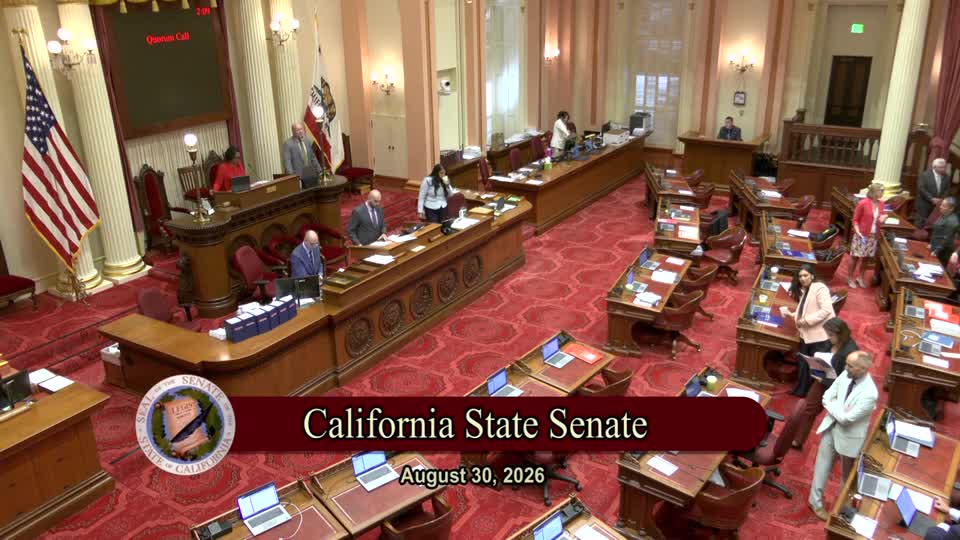 1MIN
Senate Floor
 7MIN
Assembly Floor
 4MIN
Assembly Standing Committee on Appropriations
 14MIN
Assembly Standing Committee on Utilities and Energy
 3MIN
Senate Floor
 15MIN
Senate Standing Committee on Energy, Utilities and Communications
Bill Author

Bill Co-Author(s):