SB 1364: Child custody.
- Session Year: 2025-2026
- House: Senate
- Latest Version Date: 2026-09-30
Current Status:
Passed
(2026-09-30: Chaptered by Secretary of State. Chapter 848, Statutes of 2026.)
Introduced
In Committee
Awaiting First Chamber Vote
Passed First Chamber
In Committee
Awaiting Second Chamber Vote
Passed Second Chamber
Enacted
Existing law governs the determination of child custody and visitation in contested proceedings and requires the court, for purposes of deciding custody, to determine the best interests of the child based on certain factors, including, among other things, the health, safety, and welfare of the child and a history of abuse by a parent or another person seeking custody against specified individuals, including the other parent. As a prerequisite to considering an allegation of abuse, existing law authorizes the court to consider written reports from specified entities, including law enforcement and child protective services. Existing law prohibits the court from considering a persons sex, gender identity, gender expression, or sexual orientation when determining the best interests of the child.
The bill would also require the court to consider abuse that resulted in the conception of the child when determining the best interests of the child.
Existing law prohibits a person from being granted physical or legal custody of, or visitation with, a child if the person has been convicted of rape and the child was conceived as a result of that violation.
This bill, instead, would prohibit a person from being granted custody of, or visitation with, a child if the person has been convicted of an act of sexual assault, as defined, and either the child was conceived as a result of the act or born within 300 days after the act, and the act was one that could result in the conception of a child. Upon a finding by the court, by clear and convincing evidence, that a party seeking custody of a child perpetrated an act of sexual assault that resulted in the conception of the child, as defined, the bill would create a rebuttable presumption that an award of sole or joint physical or legal custody of the child is detrimental to the best interests of the child, which may only be rebutted by clear and convincing evidence to the contrary.
Existing law, the Uniform Parentage Act, prescribes various circumstances under which an action may be brought for the purpose of determining the existence or nonexistence of a parent and child relationship and specifies when and by whom the action may be brought.
This bill would authorize an action to be brought to declare the nonexistence of the parent and child relationship at any time if the child was conceived as a result of a sexual assault and the father was convicted of that violation.
The Uniform Parentage Act defines the parent and child relationship as the legal relationship existing between a child and the childs parents, including determining who is a presumed parent. Under existing law, a person is presumed to be the natural parent of a child if they satisfy certain criteria, including, among other things, that the presumed parent and the childs natural mother are, or have been, married to each other and the child is born during the marriage or within 300 days after the marriage is terminated. Existing law creates exceptions to those presumptions, including if the child was conceived as a result of rape or unlawful intercourse, as specified.
This bill would instead make that presumption inapplicable if the father was convicted of, or is found by clear and convincing evidence to have committed, an act of sexual assault against the childs mother and either the child was conceived as a result of the act or born within 300 days after the act and the act was one that could result in the conception of a child, unless, after the date of the sexual assault, the childs natural mother and the father voluntarily share the rights and responsibilities of rearing the child.
Existing law permits a proceeding to be brought for the purpose of having a child under 18 years of age declared free from the custody and control of either or both parents if the childs parent or parents have been convicted of a felony of a nature that proves the unfitness of the parent or parents to have future custody and control of the child. Existing law authorizes the court to consider a parents criminal record prior to the felony conviction for these purposes. Existing law authorizes the mother of a child to bring a proceeding for these purposes against the father of the child if the child was conceived as a result of rape and the father was convicted of that violation. Existing law creates a conclusive presumption that the father is unfit to have custody or control of the child if the father is convicted of rape and the child was conceived as a result of that rape.
This bill would also authorize the mother of a child to bring a proceeding for these purposes against the father of the child if the child was conceived as a result of an act of sexual assault, as specified. The bill would create a conclusive presumption that the father of the child is unfit to have custody or control of the child if the father is found, by clear and convincing evidence, to have committed an act of sexual assault against the mother and either the child was conceived as a result of the act or born within 300 days after the act and the act was one that could result in the conception of a child, except as specified.
Existing law governs the determination of child custody and visitation in contested proceedings and requires the court, for purposes of deciding custody, to determine the best interests of the child based on certain factors, including, among other things, the health, safety, and welfare of the child and a history of abuse by a parent or another person seeking custody against specified individuals, including the other parent. As a prerequisite to considering an allegation of abuse, existing law authorizes the court to consider written reports from specified entities, including law enforcement and child protective services. Existing law prohibits the court from considering a persons sex, gender identity, gender expression, or sexual orientation when determining the best interests of the child.
The bill would also require the court to consider abuse that resulted in the conception of the child when determining the best interests of the child.
Existing law prohibits a person from being granted physical or legal custody of, or visitation with, a child if the person has been convicted of rape and the child was conceived as a result of that violation.
This bill, instead, would prohibit a person from being granted custody of, or visitation with, a child if the person has been convicted of an act of sexual assault, as defined, and either the child was conceived as a result of, of the act or born within 300 days after, that act against the mother. after the act, and the act was one that could result in the conception of a child. Upon a finding by the court, by clear and convincing evidence, that a party seeking custody of a child perpetrated an act of sexual assault that resulted in the conception of the child, as defined, the bill would create a rebuttable presumption that an award of sole or joint physical or legal custody of the child is detrimental to the best interests of the child, which may only be rebutted by clear and convincing evidence to the contrary.
Existing law, the Uniform Parentage Act, prescribes various circumstances under which an action may be brought for the purpose of determining the existence or nonexistence of a parent and child relationship and specifies when and by whom the action may be brought.
This bill would authorize an action to be brought to declare the nonexistence of the parent and child relationship to be brought at any time if the child was conceived as a result of a sexual assault and the father was convicted of that violation.
The Uniform Parentage Act defines the parent and child relationship as the legal relationship existing between a child and the childs parents, including determining who is a presumed parent. Under existing law, a person is presumed to be the natural parent of a child if they satisfy certain criteria, including, among other things, that the presumed parent and the childs natural mother are, or have been, married to each other and the child is born during the marriage or within 300 days after the marriage is terminated. Existing law specifies creates exceptions to those presumptions, including if the child was conceived as a result of rape or unlawful intercourse, as specified.
This bill would instead make that presumption inapplicable if the father was convicted of, or is found by clear and convincing evidence to have committed, a an act of sexual assault against the childs mother and either the child was conceived as a result of, of the act or born within 300 days after, the sexual assault after the act and the act was one that could result in the conception of a child, unless, after the date of the sexual assault, the childs natural mother and the father voluntarily share the rights and responsibilities of rearing the child.
Existing law permits a proceeding to be brought for the purpose of having a child under 18 years of age declared free from the custody and control of either or both parents if the childs parent or parents have been convicted of a felony of a nature that proves the unfitness of the parent or parents to have future custody and control of the child. Existing law authorizes the court to consider the a parents criminal record prior to the felony conviction for these purposes. Existing law authorizes the mother of a child to bring a proceeding for these purposes against the father of the child if the child was conceived as a result of rape and the father was convicted of that violation. Existing law creates a conclusive presumption that the father is unfit to have custody or control of the child if the father is convicted of rape and the child was conceived as a result of that rape.
This bill would instead also authorize the mother of a child to bring a proceeding for these purposes against the father of the child if the child was conceived as a result of an act of rape or sexual assault, as specified. The bill would create a conclusive presumption that the father of the child is unfit to have custody or control of the child if the father is convicted of rape. The bill would also create that presumption if the father is found, by clear and convincing evidence, to have committed an act of sexual assault, assault against the mother and either the child was conceived as a result of the act or born within 300 days after the act and the act was one that could result in the conception of a child, except as specified.
Existing law governs the determination of child custody and visitation in contested proceedings and requires the court, for purposes of deciding custody, to determine the best interests of the child based on certain factors, including, among other things, the health, safety, and welfare of the child and a history of abuse by a parent or another person seeking custody against specified individuals, including the other parent. As a prerequisite to considering an allegation of abuse, existing law authorizes the court to consider written reports from specified entities, including law enforcement and child protective services. Existing law prohibits the court from considering a persons sex, gender identity, gender expression, or sexual orientation when determining the best interests of the child.
The bill would also require the court to consider abuse that resulted in the conception of the child when determining the best interests of the child.
Existing law prohibits a person from being granted physical or legal custody of, or visitation with, a child if the person has been convicted of rape and the child was conceived as a result of that violation.
This bill, instead, would prohibit a person from being granted custody of, or visitation with, a child if the person has been convicted of an act of sexual assault, as defined, and the child was conceived as a result of, or born within 300 days after, that act against the mother. Upon a finding by the court, by clear and convincing evidence, that a party seeking custody of a child perpetrated an act of sexual assault that resulted in the conception of the child, the bill would create a rebuttable presumption that an award of sole or joint physical or legal custody of the child is detrimental to the best interests of the child, which may only be rebutted by clear and convincing evidence to the contrary.
Existing law, the Uniform Parentage Act, prescribes various circumstances under which an action may be brought for the purpose of determining the existence or nonexistence of a parent and child relationship and specifies when and by whom the action may be brought.
This bill would authorize an action to be brought to declare the nonexistence of the parent and child relationship to be brought at any time if the child was conceived as a result of a sexual assault and the father was convicted of that violation.
The Uniform Parentage Act defines the parent and child relationship as the legal relationship existing between a child and the childs parents, including determining who is a presumed parent. Under existing law, a person is presumed to be the natural parent of a child if they satisfy certain criteria, including, among other things, that the presumed parent and the childs natural mother are, or have been, married to each other and the child is born during the marriage or within 300 days after the marriage is terminated. Existing law specifies exceptions to those presumptions, including if the child was conceived as a result of rape or unlawful intercourse, as specified.
This bill would instead make that presumption inapplicable if the father was convicted of, or is found by clear and convincing evidence to have committed, a sexual assault against the childs mother and the child was conceived as a result of, or born within 300 days after, the sexual assault unless, after the date of the sexual assault, the childs natural mother and the father voluntarily share the rights and responsibilities of rearing the child.
Existing law permits a proceeding to be brought for the purpose of having a child under 18 years of age declared free from the custody and control of either or both parents if the childs parent or parents have been convicted of a felony of a nature that proves the unfitness of the parent or parents to have future custody and control of the child. Existing law authorizes the court to consider the parents criminal record prior to the felony conviction for these purposes. Existing law authorizes the mother of a child to bring a proceeding for these purposes against the father of the child if the child was conceived as a result of rape and the father was convicted of that violation.
This bill would instead authorize the mother of a child to bring a proceeding for these purposes against the father of the child if the child was conceived as a result of, or born within 300 days after, an act of sexual assault, or a violation of a similar statute in another jurisdiction where the act occurred, against the mother of the child and the father was convicted of, or is found by clear and convincing evidence to have committed, that act. of an act of rape or sexual assault, as specified. The bill would create a presumption that the father of the child is unfit to have custody or control of the child if the father is convicted of rape. The bill would also create that presumption if the father is found, by clear and convincing evidence, to have committed an act of sexual assault, except as specified.
Existing law governs the determination of child custody and visitation in contested proceedings and requires the court, for purposes of deciding custody, to determine the best interests of the child based on certain factors, including, among other things, the health, safety, and welfare of the child and a history of abuse by a parent or another person seeking custody against specified individuals, including the other parent. As a prerequisite to considering an allegation of abuse, existing law authorizes the court to consider written reports from specified entities, including law enforcement and child protective services. Existing law prohibits the court from considering a persons sex, gender identity, gender expression, or sexual orientation when determining the best interests of the child.
The bill would also require the court to consider abuse that resulted in the conception of the child when determining the best interests of the child.
Existing law governs the determination of child custody and visitation in contested proceedings. ExistingExisting law prohibits a person from being granted physical or legal custody of, or visitation with, a child if the person has been convicted of rape and the child was conceived as a result of that violation.
This bill, instead, would prohibit a person from being granted custody of, or visitation with, a child if there is clear and convincing evidence that the person engaged in a nonconsensual sexual conduct and the child was conceived as a result of that conduct. the person has been convicted of an act of sexual assault, as defined, and the child was conceived as a result of, or born within 300 days after, that act against the mother. Upon a finding by the court, by clear and convincing evidence, that a party seeking custody of a child perpetrated an act of sexual assault that resulted in the conception of the child, the bill would create a rebuttable presumption that an award of sole or joint physical or legal custody of the child is detrimental to the best interests of the child, which may only be rebutted by clear and convincing evidence to the contrary.
Existing law, the Uniform Parentage Act, prescribes various circumstances under which an action may be brought for the purpose of determining the existence or nonexistence of a parent and child relationship and specifies when and by whom the action may be brought.
This bill would authorize an action to be brought to declare the nonexistence of the parent and child relationship to be brought at any time if the child was conceived as a result of a sexual assault and the father was convicted of that violation.
The Uniform Parentage Act defines the parent and child relationship as the legal relationship existing between a child and the childs parents, including determining who is a presumed parent. Under existing law, a person is presumed to be the natural parent of a child if they satisfy certain criteria, including, among other things, that the presumed parent and the childs natural mother are, or have been, married to each other and the child is born during the marriage or within 300 days after the marriage is terminated. Existing law specifies exceptions to those presumptions, including if the child was conceived as a result of rape or unlawful intercourse, as specified.
This bill would instead make that presumption inapplicable if the father was convicted of, or is found by clear and convincing evidence to have committed, a sexual assault against the childs mother and the child was conceived as a result of, or born within 300 days after, the sexual assault unless, after the date of the sexual assault, the childs natural mother and the father voluntarily share the rights and responsibilities of rearing the child.
Existing law permits a proceeding to be brought for the purpose of having a child under 18 years of age declared free from the custody and control of either or both parents if the childs parent or parents have been convicted of a felony of a nature that proves the unfitness of the parent or parents to have future custody and control of the child. Existing law authorizes the court to consider the parents criminal record prior to the felony conviction for these purposes. Existing law authorizes the mother of a child to bring a proceeding for these purposes against the father of the child if the child was conceived as a result of rape and the father was convicted of that violation.
This bill would instead authorize the mother of a child to bring a proceeding for these purposes against the father of the child if the child was conceived as a result of, or born within 300 days after, an act of sexual assault, or a violation of a similar statute in another jurisdiction where the act occurred, against the mother of the child and the father was convicted of, or is found by clear and convincing evidence to have committed, that act.
Existing law governs the determination of child custody and visitation in contested proceedings. Existing law prohibits a person from being granted physical or legal custody of, or visitation with, a child if the person has been convicted of rape and the child was conceived as a result of that violation.
This bill, instead, would prohibit a person from being granted custody of, or visitation with, a child if there is clear and convincing evidence that the person engaged in a nonconsensual sexual conduct and the child was conceived as a result of that conduct.
(a)In making a determination of the best interests of the child in a proceeding described in Section 3021, the court shall, among any other factors it finds relevant and consistent with Section 3020, consider all of the following:
(1)The health, safety, and welfare of the child.
(2)(A)A history of abuse by one parent or another person seeking custody against any of the following:
(i)A child to whom the parent or person seeking custody is related by blood or affinity or with whom the parent or person seeking custody has had a caretaking relationship, no matter how temporary.
(ii)The other parent, including abuse that resulted in conception of the child.
(iii)A parent, current spouse, or cohabitant of the parent or person seeking custody, or a person with whom the parent or person seeking custody has a dating or engagement relationship.
(B)(i)As a prerequisite to considering an allegation of abuse, the court may require independent corroboration, including, but not limited to, written reports by law enforcement agencies, child protective services or other social welfare agencies, courts, medical facilities, or other public agencies or private nonprofit organizations providing services to victims of sexual assault or domestic violence.
(ii)As used in this paragraph, the following definitions shall apply:
(I)Abuse against a child means child abuse or neglect as defined in Section 11165.6 of the Penal Code.
(II)Abuse against any other person described in clause (ii) or (iii) of subparagraph (A) means abuse as defined in Section 6203.
(3)The nature and amount of contact with both parents, including as provided in Sections 3046 and 3100.
(4)(A)The habitual or continual illegal use of controlled substances, the habitual or continual abuse of alcohol, or the habitual or continual abuse of prescribed controlled substances by either parent. Before considering these allegations, the court may first require independent corroboration, including, but not limited to, written reports from law enforcement agencies, courts, probation departments, social welfare agencies, medical facilities, rehabilitation facilities, or other public agencies or nonprofit organizations providing drug and alcohol abuse services.
(B)As used in this paragraph, controlled substances has the same meaning as defined in the California Uniform Controlled Substances Act (Division 10 (commencing with Section 11000) of the Health and Safety Code).
(5)(A)If an allegation about a parent pursuant to paragraph (2) or (4) has been brought to the attention of the court in the current proceeding and the court makes an order for sole or joint custody or unsupervised visitation to that parent, the court shall state its reasons in writing or on the record that the order is in the best interests of the child and protects the safety of the parties and the child. In these circumstances, the court shall ensure that an order regarding custody or visitation is specific as to time, day, place, and manner of transfer of the child as set forth in subdivision (c) of Section 6323.
(B)This paragraph does not eliminate the requirement that the contents of the stipulation be in the best interests of the child and be specific as to time, day, place, and manner of transfer of the child if the parties stipulate in writing or on the record regarding custody or visitation.
(b)Notwithstanding subdivision (a), the court shall not consider the sex, gender identity, gender expression, or sexual orientation of a parent, legal guardian, or relative in determining the best interests of the child.
SEC. 2.Section 3030 of the Family Code is amended to read:3030.(a)(1)A person shall not be granted physical or legal custody of, or unsupervised visitation with, a child if the person is required to be registered as a sex offender under Section 290 of the Penal Code and the victim was a minor or if the person has been convicted under Section 273a, 273d, or 647.6 of the Penal Code unless the court finds that there is no significant risk to the child and states its reasons in writing or on the record. The child may not be placed in a home in which that person resides or be permitted to have unsupervised visitation with that person unless the court states the reasons for its findings in writing or on the record.
(2)A person shall not be granted physical or legal custody of, or unsupervised visitation with, a child if anyone residing in the persons household is required, as a result of a felony conviction in which the victim was a minor, to register as a sex offender under Section 290 of the Penal Code unless the court finds there is no significant risk to the child and states its reasons in writing or on the record. The child may not be placed in a home in which that person resides or be permitted to have unsupervised visitation with that person unless the court states the reasons for its findings in writing or on the record.
(3)The fact that a child is permitted unsupervised contact with a person who is required, as a result of a felony conviction in which the victim was a minor, to be registered as a sex offender under Section 290 of the Penal Code shall be prima facie evidence that the child is at significant risk. When making a determination regarding significant risk to the child, the prima facie evidence shall constitute a presumption affecting the burden of producing evidence. However, this presumption shall not apply if there are factors mitigating against its application, including whether the party seeking custody or visitation is also required, as the result of a felony conviction in which the victim was a minor, to register as a sex offender under Section 290 of the Penal Code.
(b)A person shall not be granted custody of, or visitation with, a child if the person has been convicted of sexual assault, as defined in Section 11165.1 of the Penal Code, or a similar statute in another jurisdiction where the act occurred, and either of the following are true:
(1)The child was conceived as a result of the act of sexual assault.
(2)The child was born within 300 days after the act of sexual assault, and the act was one that could result in the conception of a child.
(c)(1)A person shall not be granted custody of, or unsupervised visitation with, a child if the person has been convicted of murder in the first degree, as defined in Section 189 of the Penal Code, and the victim of the murder was the other parent of the child who is the subject of the order unless the court finds that there is no risk to the childs health, safety, and welfare and states the reasons for its finding in writing or on the record. In making its finding, the court may consider, among other things, the following:
(A)The wishes of the child, if the child is of sufficient age and capacity to reason so as to form an intelligent preference.
(B)Credible evidence that the convicted parent was a victim of abuse, as defined in Section 6203, committed by the deceased parent. That evidence may include, but is not limited to, written reports by law enforcement agencies, child protective services or other social welfare agencies, courts, medical facilities, or other public agencies or private nonprofit organizations providing services to victims of domestic abuse.
(C)Testimony of an expert witness, qualified under Section 1107 of the Evidence Code, that the convicted parent experiences intimate partner battering.
(2)Unless and until a custody or visitation order is issued pursuant to this subdivision, a person shall not permit or cause the child to visit or remain in the custody of the convicted parent without the consent of the childs custodian or legal guardian.
(d)The court may order child support that is to be paid by a person subject to subdivision (a), (b), or (c) to be paid through the local child support agency, as authorized by Section 4573 and Division 17 (commencing with Section 17000).
(e)The court shall not disclose, or cause to be disclosed, the custodial parents place of residence, place of employment, or the childs school unless the court finds that the disclosure would be in the best interests of the child.
SEC. 3.Section 3044.1 is added to the Family Code, to read:3044.1.(a)Upon a finding by the court, by clear and convincing evidence, that a party seeking custody of a child perpetrated an act of sexual assault that resulted in the conception of the child, there is a rebuttable presumption that an award of sole or joint physical or legal custody of a child to the person who perpetrated the sexual assault is detrimental to the best interests of the child pursuant to Sections 3011 and 3020. This presumption may only be rebutted by clear and convincing evidence that sole or joint physical or legal custody of the child is in the best interests of the child.
(b)For purposes of this section, an act of sexual assault results in conception if either of the following are true:
(1)The child was conceived as a result of the act of sexual assault.
(2)The child was born within 300 days after the act of sexual assault, and the act was one that could result in the conception of a child.
(c)As used in this section, sexual assault has the same meaning as defined in Section 11165.1 of the Penal Code or a similar statute in another jurisdiction where the action occurred.
SEC. 4.Section 7611.5 of the Family Code is amended to read:7611.5.(a)Notwithstanding Section 7611, a man shall not be presumed to be the natural father of a child if the father was convicted of, or is found, by clear and convincing evidence, to have committed, an act of sexual assault against the mother and either of the following are true:
(1)The child was conceived as a result of the act of sexual assault.
(2)The child was born within 300 days after the act of sexual assault, and the act was one that could result in the conception of a child.
(b)This section does not apply if, after the date of the sexual assault, the childs natural mother and the father voluntarily share the rights and responsibilities of rearing the child, including frequent and continuing contact with the child.
(c)As used in this section, sexual assault has the same meaning as defined in Section 11165.1 of the Penal Code or a similar statute in another jurisdiction where the act occurred.
SEC. 5.Section 7630 of the Family Code is amended to read:7630.(a)A child, the childs natural mother, a person presumed to be the childs parent under subdivision (a), (b), or (c) of Section 7611, a person seeking to be adjudicated as a parent or donor under Section 7613, an adoption agency to which the child has been relinquished, or a prospective adoptive parent of the child may bring an action as follows:
(1)At any time for the purpose of declaring the existence of the parent and child relationship presumed under subdivision (a), (b), or (c) of Section 7611 or established pursuant to Section 7613.
(2)For the purpose of declaring the nonexistence of the parent and child relationship presumed under subdivision (a), (b), or (c) of Section 7611 only if the action is brought within a reasonable time after obtaining knowledge of relevant facts. After the presumption has been rebutted, parentage of the child by another person may be determined in the same action if that person has been made a party.
(3)At any time for the purpose of declaring the nonexistence of the parent and child relationship of a donor under Section 7613.
(4)At any time for the purpose of declaring the nonexistence of the parent and child relationship under Section 7611.5.
(b)An interested party may bring an action at any time for the purpose of determining the existence or nonexistence of the parent and child relationship presumed under subdivision (d) or (e) of Section 7611.
(c)Except as to a case coming within Chapter 1 (commencing with Section 7540) of Part 2 or if paragraph (2) of subdivision (a) applies, an action to determine parentage may be brought by any of the following:
(1)The child or a personal representative of the child.
(2)The Department of Child Support Services.
(3)A presumed parent or the personal representative or parent of that presumed parent if that parent has died or is a minor.
(4)If the natural mother is the only presumed parent, or an action under Section 300 of the Welfare and Institutions Code or adoption is pending, a man alleged or claiming to be the father or the personal representative or a parent of the alleged father if the alleged father has died or is a minor.
(d)(1)If a proceeding has been filed under Chapter 2 (commencing with Section 7820) of Part 4, an action under subdivision (a) or (b) shall be consolidated with that proceeding. The parental rights of the presumed parent shall be determined as set forth in Chapter 2 (commencing with Section 7820) of Part 4.
(2)If a proceeding pursuant to Section 7662 has been filed under Chapter 5 (commencing with Section 7660), an action under subdivision (c) shall be consolidated with that proceeding. The parental rights of the alleged father shall be determined as provided in Section 7664.
(3)A consolidated action under paragraph (1) or (2) shall be heard in the court in which the proceeding under Section 7662 or Chapter 2 (commencing with Section 7820) of Part 4 is filed unless the court finds, by clear and convincing evidence, that transferring the action to the other court poses a substantial hardship to the petitioner. Mere inconvenience does not constitute a sufficient basis for a finding of substantial hardship. If the court determines there is a substantial hardship, the consolidated action shall be heard in the court in which the parentage action is filed.
(e)(1)If a prospective adoptive parent who has physical custody of the child, a licensed California adoption agency that has legal custody of the child or to which the mother proposes to relinquish the child for adoption, or a person whom the mother has designated as the prospective adoptive parent in a written statement executed before a hospital social worker, an adoption service provider, an adoption agency representative, or a notary public has not been joined as a party to an action to determine the existence of a parent and child relationship under subdivision (a), (b), or (c), or an action for custody by a person claiming to be a parent under this division, the court shall join the prospective adoptive parent or licensed California adoption agency as a party upon application or on its own motion without the necessity of a motion for joinder. A joined party is not required to pay a fee in connection with this action.
(2)If a person brings an action to determine parentage and custody of a child who the person has reason to believe is in the physical or legal custody of an adoption agency, or of one or more persons other than the childs parent who are prospective adoptive parents, the person shall serve the entire pleading on, and give notice of all proceedings to, the adoption agency or the prospective adoptive parents, or both.
(f)A party to an assisted reproduction agreement may bring an action at any time to establish a parent and child relationship consistent with the intent expressed in the assisted reproduction agreement.
(g)(1)In an action to determine the existence of the parent and child relationship brought pursuant to subdivision (b), if the childs other parent has died and there are no existing court orders or pending court actions involving custody or guardianship of the child, then the persons having physical custody of the child shall be served with notice of the proceeding at least 15 days before the hearing, either by mail or in a manner authorized by the court. If a person identified as having physical custody of the child cannot be located, the court shall prescribe the manner of giving notice.
(2)If known to the person bringing the parentage action, relatives within the second degree of the child shall be given notice of the proceeding at least 15 days before the hearing, either by mail or in a manner authorized by the court. If a person identified as a relative of the second degree of the child cannot be located, or the relatives whereabouts are unknown or cannot be ascertained, the court shall prescribe the manner of giving notice or shall dispense with giving notice to that person.
(3)Proof of notice pursuant to this subdivision shall be filed with the court before the proceeding to determine the existence of the parent and child relationship is heard.
SEC. 6.Section 7825 of the Family Code is amended to read:7825.(a)A proceeding under this part may be brought if both of the following requirements are satisfied:
(1)The child is one whose parent or parents are convicted of a felony.
(2)The facts of the crime of which the parent or parents were convicted are of such a nature so as to prove the unfitness of the parent or parents to have the future custody and control of the child. In making a determination pursuant to this section, the court may consider the parents criminal record prior to the felony conviction to the extent that the criminal record demonstrates a pattern of behavior substantially related to the welfare of the child or the parents ability to exercise custody and control regarding the child.
(b)The mother of a child may bring a proceeding under this part against the father of the child, as follows:
(1)(A)If the child was conceived as a result of an act in violation of Section 261 of the Penal Code, and the father was convicted of that violation.
(B)For purposes of this paragraph, there is a conclusive presumption that the father is unfit to have custody or control of the child.
(2)(A)If the father is found, by clear and convincing evidence, to have committed an act of sexual assault against the mother of the child and either of the following are true:
(i)The child was conceived as a result of the act of sexual assault.
(ii)The child was born within 300 days after the act of sexual assault, and the act was one that could result in the conception of a child.
(B)For purposes of this paragraph, there is a conclusive presumption that the father is unfit to have custody or control of the child unless, after the date of the sexual assault, the childs natural mother and father voluntarily share the rights and responsibilities of rearing the child, including frequent and continuing contact with the child.
(c)As used in this section, sexual assault has the same meaning as defined in Section 11165.1 of the Penal Code or a similar statute in another jurisdiction where the act occurred.
(a)In making a determination of the best interests of the child in a proceeding described in Section 3021, the court shall, among any other factors it finds relevant and consistent with Section 3020, consider all of the following:
(1)The health, safety, and welfare of the child.
(2)(A)A history of abuse by one parent or another person seeking custody against any of the following:
(i)A child to whom the parent or person seeking custody is related by blood or affinity or with whom the parent or person seeking custody has had a caretaking relationship, no matter how temporary.
(ii)The other parent, including abuse that resulted in conception of the child.
(iii)A parent, current spouse, or cohabitant, cohabitant of the parent or person seeking custody, or a person with whom the parent or person seeking custody has a dating or engagement relationship.
(B)(i)As a prerequisite to considering allegations an allegation of abuse, the court may require independent corroboration, including, but not limited to, written reports by law enforcement agencies, child protective services or other social welfare agencies, courts, medical facilities, or other public agencies or private nonprofit organizations providing services to victims of sexual assault or domestic violence.
(ii)As used in this paragraph, abuse the following definitions shall apply:
(I)Abuse against a child means child abuse or neglect as defined in Section 11165.6 of the Penal Code and abuse Code.
(II)Abuse against any other person person described in clause (ii) or (iii) of subparagraph (A) means abuse as defined in Section 6203.
(3)The nature and amount of contact with both parents, including as provided in Sections 3046 and 3100.
(4)(A)The habitual or continual illegal use of controlled substances, the habitual or continual abuse of alcohol, or the habitual or continual abuse of prescribed controlled substances by either parent. Before considering these allegations, the court may first require independent corroboration, including, but not limited to, written reports from law enforcement agencies, courts, probation departments, social welfare agencies, medical facilities, rehabilitation facilities, or other public agencies or nonprofit organizations providing drug and alcohol abuse services.
(B)As used in this paragraph, controlled substances has the same meaning as defined in the California Uniform Controlled Substances Act (Division 10 (commencing with Section 11000) of the Health and Safety Code).
(5)(A)If an allegation about a parent pursuant to paragraph (2) or (4) has been brought to the attention of the court in the current proceeding and the court makes an order for sole or joint custody or unsupervised visitation to that parent, the court shall state its reasons in writing or on the record that the order is in the best interest interests of the child and protects the safety of the parties and the child. In these circumstances, the court shall ensure that an order regarding custody or visitation is specific as to time, day, place, and manner of transfer of the child as set forth in subdivision (c) of Section 6323.
(B)This paragraph does not eliminate the requirement that the contents of the stipulation be in the best interest interests of the child and be specific as to time, day, place, and manner of transfer of the child if the parties do stipulate in writing or on the record regarding custody or visitation.
(b)Notwithstanding subdivision (a), the court shall not consider the sex, gender identity, gender expression, or sexual orientation of a parent, legal guardian, or relative in determining the best interests of the child.
SEC. 2.Section 3030 of the Family Code is amended to read:3030.(a)(1)A person shall not be granted physical or legal custody of, or unsupervised visitation with, a child if the person is required to be registered as a sex offender under Section 290 of the Penal Code where and the victim was a minor, minor or if the person has been convicted under Section 273a, 273d, or 647.6 of the Penal Code, Code unless the court finds that there is no significant risk to the child and states its reasons in writing or on the record. The child may not be placed in a home in which that person resides, nor resides or be permitted to have unsupervised visitation with that person, person unless the court states the reasons for its findings in writing or on the record.
(2)A person shall not be granted physical or legal custody of, or unsupervised visitation with, a child if anyone residing in the persons household is required, as a result of a felony conviction in which the victim was a minor, to register as a sex offender under Section 290 of the Penal Code, Code unless the court finds there is no significant risk to the child and states its reasons in writing or on the record. The child may not be placed in a home in which that person resides, nor resides or be permitted to have unsupervised visitation with that person, person unless the court states the reasons for its findings in writing or on the record.
(3)The fact that a child is permitted unsupervised contact with a person who is required, as a result of a felony conviction in which the victim was a minor, to be registered as a sex offender under Section 290 of the Penal Code, Code shall be prima facie evidence that the child is at significant risk. When making a determination regarding significant risk to the child, the prima facie evidence shall constitute a presumption affecting the burden of producing evidence. However, this presumption shall not apply if there are factors mitigating against its application, including whether the party seeking custody or visitation is also required, as the result of a felony conviction in which the victim was a minor, to register as a sex offender under Section 290 of the Penal Code.
(b)A person shall not be granted custody of, or visitation with, a child if the person has been convicted of sexual assault, as defined in Section 11165.1 of the Penal Code, or a similar statute in another jurisdiction where the act occurred, and the child was conceived as a result of, or born within 300 days after, that act against the victim. either of the following are true:
(1)The child was conceived as a result of the act of sexual assault.
(2)The child was born within 300 days after the act of sexual assault, and the act was one that could result in the conception of a child.
(c)(1)A person shall not be granted custody of, or unsupervised visitation with, a child if the person has been convicted of murder in the first degree, as defined in Section 189 of the Penal Code, and the victim of the murder was the other parent of the child who is the subject of the order, order unless the court finds that there is no risk to the childs health, safety, and welfare, welfare and states the reasons for its finding in writing or on the record. In making its finding, the court may consider, among other things, the following:
(A)The wishes of the child, if the child is of sufficient age and capacity to reason so as to form an intelligent preference.
(B)Credible evidence that the convicted parent was a victim of abuse, as defined in Section 6203, committed by the deceased parent. That evidence may include, but is not limited to, written reports by law enforcement agencies, child protective services or other social welfare agencies, courts, medical facilities, or other public agencies or private nonprofit organizations providing services to victims of domestic abuse.
(C)Testimony of an expert witness, qualified under Section 1107 of the Evidence Code, that the convicted parent experiences intimate partner battering.
(2)Unless and until a custody or visitation order is issued pursuant to this subdivision, a person shall not permit or cause the child to visit or remain in the custody of the convicted parent without the consent of the childs custodian or legal guardian.
(d)The court may order child support that is to be paid by a person subject to subdivision (a), (b), or (c) to be paid through the local child support agency, as authorized by Section 4573 and Division 17 (commencing with Section 17000).
(e)The court shall not disclose, or cause to be disclosed, the custodial parents place of residence, place of employment, or the childs school, school unless the court finds that the disclosure would be in the best interest interests of the child.
SEC. 3.Section 3044.1 is added to the Family Code, to read:3044.1.(a)Upon a finding by the court, by clear and convincing evidence, that a party seeking custody of a child perpetrated an act of sexual assault that resulted in the conception of the child, there is a rebuttable presumption that an award of sole or joint physical or legal custody of a child to the person who perpetrated the sexual assault is detrimental to the best interests of the child pursuant to Sections 3011 and 3020. This presumption may only be rebutted by clear and convincing evidence that sole or joint physical or legal custody of the child is in the best interests of the child.
(b)For purposes of this section, an act of sexual assault results in conception if the child was conceived as a result of, or born within 300 days after, an act against the other party, and the act was a sexual assault. either of the following are true:
(1)The child was conceived as a result of the act of sexual assault.
(2)The child was born within 300 days after the act of sexual assault, and the act was one that could result in the conception of a child.
(c)As used in this section, sexual assault has the same meaning as defined in Section 11165.1 of the Penal Code or a similar statute in another jurisdiction where the action occurred.
SEC. 4.Section 7611.5 of the Family Code is amended to read:7611.5.(a)Notwithstanding Section 7611, a man shall not be presumed to be the natural father of a child if the child was conceived as a result of, or born within 300 days after, an act of sexual assault, as defined in Section 11165.1 of the Penal Code or a violation of a similar statute in another jurisdiction where the act occurred, against the childs mother and the father was convicted of, or is found found, by clear and convincing evidence evidence, to have committed, that act. an act of sexual assault against the mother and either of the following are true:
(1)The child was conceived as a result of the act of sexual assault.
(2)The child was born within 300 days after the act of sexual assault, and the act was one that could result in the conception of a child.
(b)This section does not apply if, after the date of the sexual assault, the childs natural mother and the father voluntarily share the rights and responsibilities of rearing the child, including frequent and continuing contact with the child.
(c)As used in this section, sexual assault has the same meaning as defined in Section 11165.1 of the Penal Code or a similar statute in another jurisdiction where the act occurred.
SEC. 5.Section 7630 of the Family Code is amended to read:7630.(a)A child, the childs natural mother, a person presumed to be the childs parent under subdivision (a), (b), or (c) of Section 7611, a person seeking to be adjudicated as a parent or donor under Section 7613, an adoption agency to which the child has been relinquished, or a prospective adoptive parent of the child may bring an action as follows:
(1)At any time for the purpose of declaring the existence of the parent and child relationship presumed under subdivision (a), (b), or (c) of Section 7611 or established pursuant to Section 7613.
(2)For the purpose of declaring the nonexistence of the parent and child relationship presumed under subdivision (a), (b), or (c) of Section 7611 only if the action is brought within a reasonable time after obtaining knowledge of relevant facts. After the presumption has been rebutted, parentage of the child by another person may be determined in the same action if that person has been made a party.
(3)At any time for the purpose of declaring the nonexistence of the parent and child relationship of a donor under Section 7613.
(4)At any time for the purpose of declaring the nonexistence of the parent and child relationship under Section 7611.5.
(b)An interested party may bring an action at any time for the purpose of determining the existence or nonexistence of the parent and child relationship presumed under subdivision (d) or (e) of Section 7611.
(c)Except as to a case coming within Chapter 1 (commencing with Section 7540) of Part 2 or if paragraph (2) of subdivision (a) applies, an action to determine parentage may be brought by any of the following:
(1)The child or a personal representative of the child.
(2)The Department of Child Support Services.
(3)A presumed parent, parent or the personal representative or parent of that presumed parent, parent if that parent has died or is a minor.
(4)If the natural mother is the only presumed parent, or an action under Section 300 of the Welfare and Institutions Code or adoption is pending, a man alleged or claiming to be the father, father or the personal representative or a parent of the alleged father, father if the alleged father has died or is a minor.
(d)(1)If a proceeding has been filed under Chapter 2 (commencing with Section 7820) of Part 4, an action under subdivision (a) or (b) shall be consolidated with that proceeding. The parental rights of the presumed parent shall be determined as set forth in Chapter 2 (commencing with Section 7820) of Part 4.
(2)If a proceeding pursuant to Section 7662 has been filed under Chapter 5 (commencing with Section 7660), an action under subdivision (c) shall be consolidated with that proceeding. The parental rights of the alleged father shall be determined as provided in Section 7664.
(3)A consolidated action under paragraph (1) or (2) shall be heard in the court in which the proceeding under Section 7662 or Chapter 2 (commencing with Section 7820) of Part 4 is filed unless the court finds, by clear and convincing evidence, that transferring the action to the other court poses a substantial hardship to the petitioner. Mere inconvenience does not constitute a sufficient basis for a finding of substantial hardship. If the court determines there is a substantial hardship, the consolidated action shall be heard in the court in which the parentage action is filed.
(e)(1)If a prospective adoptive parent who has physical custody of the child, a licensed California adoption agency that has legal custody of the child or to which the mother proposes to relinquish the child for adoption, or a person whom the mother has designated as the prospective adoptive parent in a written statement executed before a hospital social worker, an adoption service provider, an adoption agency representative, or a notary public has not been joined as a party to an action to determine the existence of a parent and child relationship under subdivision (a), (b), or (c), or an action for custody by a person claiming to be a parent under this division, the court shall join the prospective adoptive parent or licensed California adoption agency as a party upon application or on its own motion without the necessity of a motion for joinder. A joined party is not required to pay a fee in connection with this action.
(2)If a person brings an action to determine parentage and custody of a child who the person has reason to believe is in the physical or legal custody of an adoption agency, or of one or more persons other than the childs parent who are prospective adoptive parents, the person shall serve the entire pleading on, and give notice of all proceedings to, the adoption agency or the prospective adoptive parents, or both.
(f)A party to an assisted reproduction agreement may bring an action at any time to establish a parent and child relationship consistent with the intent expressed in the assisted reproduction agreement.
(g)(1)In an action to determine the existence of the parent and child relationship brought pursuant to subdivision (b), if the childs other parent has died and there are no existing court orders or pending court actions involving custody or guardianship of the child, then the persons having physical custody of the child shall be served with notice of the proceeding at least 15 days before the hearing, either by mail or in a manner authorized by the court. If a person identified as having physical custody of the child cannot be located, the court shall prescribe the manner of giving notice.
(2)If known to the person bringing the parentage action, relatives within the second degree of the child shall be given notice of the proceeding at least 15 days before the hearing, either by mail or in a manner authorized by the court. If a person identified as a relative of the second degree of the child cannot be located, or the relatives whereabouts are unknown or cannot be ascertained, the court shall prescribe the manner of giving notice or shall dispense with giving notice to that person.
(3)Proof of notice pursuant to this subdivision shall be filed with the court before the proceeding to determine the existence of the parent and child relationship is heard.
SEC. 6.Section 7825 of the Family Code is amended to read:7825.(a)A proceeding under this part may be brought where if both of the following requirements are satisfied:
(1)The child is one whose parent or parents are convicted of a felony.
(2)The facts of the crime of which the parent or parents were convicted are of such a nature so as to prove the unfitness of the parent or parents to have the future custody and control of the child. In making a determination pursuant to this section, the court may consider the parents criminal record prior to the felony conviction to the extent that the criminal record demonstrates a pattern of behavior substantially related to the welfare of the child or the parents ability to exercise custody and control regarding the child.
(b)The mother of a child may bring a proceeding under this part against the father of the child, as follows:
(1)(A)If the child was conceived as a result of an act in violation of Section 261 of the Penal Code, and the father was convicted of that violation. For
(B)For purposes of this paragraph, there is a conclusive presumption that the father is unfit to have custody or control of the child.
(2)If the child was conceived as a result of an act of sexual assault, as defined in Section 11165.1 of the Penal Code, against the mother of the child and the father is found, by clear and convincing evidence, to have committed that act. For purposes of this paragraph, there is a conclusive presumption that the father is unfit to have custody or control of the child unless, after the date of the sexual assault, the childs mother and father voluntarily share the rights and responsibilities of rearing the child, including frequent and continuing contact with the child.(2)(A)If the father is found, by clear and convincing evidence, to have committed an act of sexual assault against the mother of the child and either of the following are true:
(i)The child was conceived as a result of the act of sexual assault.
(ii)The child was born within 300 days after the act of sexual assault, and the act was one that could result in the conception of a child.
(B)For purposes of this paragraph, there is a conclusive presumption that the father is unfit to have custody or control of the child unless, after the date of the sexual assault, the childs natural mother and father voluntarily share the rights and responsibilities of rearing the child, including frequent and continuing contact with the child.
(c)As used in this section, sexual assault has the same meaning as defined in Section 11165.1 of the Penal Code or a similar statute in another jurisdiction where the act occurred.
(a)In making a determination of the best interests of the child in a proceeding described in Section 3021, the court shall, among any other factors it finds relevant and consistent with Section 3020, consider all of the following:
(1)The health, safety, and welfare of the child.
(2)(A)A history of abuse by one parent or another person seeking custody against any of the following:
(i)A child to whom the parent or person seeking custody is related by blood or affinity or with whom the parent or person seeking custody has had a caretaking relationship, no matter how temporary.
(ii)The other parent, including abuse that resulted in conception of the child.
(iii)A parent, current spouse, or cohabitant, of the parent or person seeking custody, or a person with whom the parent or person seeking custody has a dating or engagement relationship.
(B)(i)As a prerequisite to considering allegations of abuse, the court may require independent corroboration, including, but not limited to, written reports by law enforcement agencies, child protective services or other social welfare agencies, courts, medical facilities, or other public agencies or private nonprofit organizations providing services to victims of sexual assault or domestic violence.
(ii)As used in this paragraph, abuse against a child means child abuse or neglect as defined in Section 11165.6 of the Penal Code and abuse against any other person described in clause (ii) or (iii) of subparagraph (A) means abuse as defined in Section 6203.
(3)The nature and amount of contact with both parents, including as provided in Sections 3046 and 3100.
(4)(A)The habitual or continual illegal use of controlled substances, the habitual or continual abuse of alcohol, or the habitual or continual abuse of prescribed controlled substances by either parent. Before considering these allegations, the court may first require independent corroboration, including, but not limited to, written reports from law enforcement agencies, courts, probation departments, social welfare agencies, medical facilities, rehabilitation facilities, or other public agencies or nonprofit organizations providing drug and alcohol abuse services.
(B)As used in this paragraph, controlled substances has the same meaning as defined in the California Uniform Controlled Substances Act (Division 10 (commencing with Section 11000) of the Health and Safety Code).
(5)(A)If an allegation about a parent pursuant to paragraph (2) or (4) has been brought to the attention of the court in the current proceeding and the court makes an order for sole or joint custody or unsupervised visitation to that parent, the court shall state its reasons in writing or on the record that the order is in the best interest of the child and protects the safety of the parties and the child. In these circumstances, the court shall ensure that an order regarding custody or visitation is specific as to time, day, place, and manner of transfer of the child as set forth in subdivision (c) of Section 6323.
(B)This paragraph does not eliminate the requirement that the contents of the stipulation be in the best interest of the child and be specific as to time, day, place, and manner of transfer of the child if the parties do stipulate in writing or on the record regarding custody or visitation.
(b)Notwithstanding subdivision (a), the court shall not consider the sex, gender identity, gender expression, or sexual orientation of a parent, legal guardian, or relative in determining the best interests of the child.
SEC. 2.Section 3030 of the Family Code is amended to read:3030.(a)(1)A person shall not be granted physical or legal custody of, or unsupervised visitation with, a child if the person is required to be registered as a sex offender under Section 290 of the Penal Code where the victim was a minor, or if the person has been convicted under Section 273a, 273d, or 647.6 of the Penal Code, unless the court finds that there is no significant risk to the child and states its reasons in writing or on the record. The child may not be placed in a home in which that person resides, nor be permitted to have unsupervised visitation with that person, unless the court states the reasons for its findings in writing or on the record.
(2)A person shall not be granted physical or legal custody of, or unsupervised visitation with, a child if anyone residing in the persons household is required, as a result of a felony conviction in which the victim was a minor, to register as a sex offender under Section 290 of the Penal Code, unless the court finds there is no significant risk to the child and states its reasons in writing or on the record. The child may not be placed in a home in which that person resides, nor be permitted to have unsupervised visitation with that person, unless the court states the reasons for its findings in writing or on the record.
(3)The fact that a child is permitted unsupervised contact with a person who is required, as a result of a felony conviction in which the victim was a minor, to be registered as a sex offender under Section 290 of the Penal Code, shall be prima facie evidence that the child is at significant risk. When making a determination regarding significant risk to the child, the prima facie evidence shall constitute a presumption affecting the burden of producing evidence. However, this presumption shall not apply if there are factors mitigating against its application, including whether the party seeking custody or visitation is also required, as the result of a felony conviction in which the victim was a minor, to register as a sex offender under Section 290 of the Penal Code.
(b)A person shall not be granted custody of, or visitation with, a child if the person has been convicted of sexual assault, as defined in Section 11165.1 of the Penal Code, or a similar statute in another jurisdiction where the act occurred, and the child was conceived as a result of, or born within 300 days after, that act against the victim.
(c)(1)A person shall not be granted custody of, or unsupervised visitation with, a child if the person has been convicted of murder in the first degree, as defined in Section 189 of the Penal Code, and the victim of the murder was the other parent of the child who is the subject of the order, unless the court finds that there is no risk to the childs health, safety, and welfare, and states the reasons for its finding in writing or on the record. In making its finding, the court may consider, among other things, the following:
(A)The wishes of the child, if the child is of sufficient age and capacity to reason so as to form an intelligent preference.
(B)Credible evidence that the convicted parent was a victim of abuse, as defined in Section 6203, committed by the deceased parent. That evidence may include, but is not limited to, written reports by law enforcement agencies, child protective services or other social welfare agencies, courts, medical facilities, or other public agencies or private nonprofit organizations providing services to victims of domestic abuse.
(C)Testimony of an expert witness, qualified under Section 1107 of the Evidence Code, that the convicted parent experiences intimate partner battering.
(2)Unless and until a custody or visitation order is issued pursuant to this subdivision, a person shall not permit or cause the child to visit or remain in the custody of the convicted parent without the consent of the childs custodian or legal guardian.
(d)The court may order child support that is to be paid by a person subject to subdivision (a), (b), or (c) to be paid through the local child support agency, as authorized by Section 4573 and Division 17 (commencing with Section 17000).
(e)The court shall not disclose, or cause to be disclosed, the custodial parents place of residence, place of employment, or the childs school, unless the court finds that the disclosure would be in the best interest of the child.
SEC. 3.Section 3044.1 is added to the Family Code, to read:3044.1.(a)Upon a finding by the court, by clear and convincing evidence, that a party seeking custody of a child perpetrated an act of sexual assault that resulted in the conception of the child, there is a rebuttable presumption that an award of sole or joint physical or legal custody of a child to the person who perpetrated the sexual assault is detrimental to the best interests of the child pursuant to Sections 3011 and 3020. This presumption may only be rebutted by clear and convincing evidence that sole or joint physical or legal custody of the child is in the best interests of the child.
(b)For purposes of this section, an act of sexual assault results in conception if the child was conceived as a result of, or born within 300 days after, an act against the other party, and the act was a sexual assault.
(c)As used in this section, sexual assault has the same meaning as defined in Section 11165.1 of the Penal Code or a similar statute in another jurisdiction where the action occurred.
SEC. 4.Section 7611.5 of the Family Code is amended to read:7611.5.(a)Notwithstanding Section 7611, a man shall not be presumed to be the natural father of a child if the child was conceived as a result of, or born within 300 days after, an act of sexual assault, as defined in Section 11165.1 of the Penal Code or a violation of a similar statute in another jurisdiction where the act occurred, against the childs mother and the father was convicted of, or is found by clear and convincing evidence to have committed, that act.
(b)This section does not apply if, after the date of the sexual assault, the childs natural mother and the father voluntarily share the rights and responsibilities of rearing the child, including frequent and continuing contact with the child.
SEC. 5.Section 7630 of the Family Code is amended to read:7630.(a)A child, the childs natural mother, a person presumed to be the childs parent under subdivision (a), (b), or (c) of Section 7611, a person seeking to be adjudicated as a parent or donor under Section 7613, an adoption agency to which the child has been relinquished, or a prospective adoptive parent of the child may bring an action as follows:
(1)At any time for the purpose of declaring the existence of the parent and child relationship presumed under subdivision (a), (b), or (c) of Section 7611 or established pursuant to Section 7613.
(2)For the purpose of declaring the nonexistence of the parent and child relationship presumed under subdivision (a), (b), or (c) of Section 7611 only if the action is brought within a reasonable time after obtaining knowledge of relevant facts. After the presumption has been rebutted, parentage of the child by another person may be determined in the same action if that person has been made a party.
(3)At any time for the purpose of declaring the nonexistence of the parent and child relationship of a donor under Section 7613.
(4)At any time for the purpose of declaring the nonexistence of the parent and child relationship under Section 7611.5.
(b)An interested party may bring an action at any time for the purpose of determining the existence or nonexistence of the parent and child relationship presumed under subdivision (d) or (e) of Section 7611.
(c)Except as to a case coming within Chapter 1 (commencing with Section 7540) of Part 2 or if paragraph (2) of subdivision (a) applies, an action to determine parentage may be brought by any of the following:
(1)The child or a personal representative of the child.
(2)The Department of Child Support Services.
(3)A presumed parent, or the personal representative or parent of that presumed parent, if that parent has died or is a minor.
(4)If the natural mother is the only presumed parent, or an action under Section 300 of the Welfare and Institutions Code or adoption is pending, a man alleged or claiming to be the father, or the personal representative or a parent of the alleged father, if the alleged father has died or is a minor.
(d)(1)If a proceeding has been filed under Chapter 2 (commencing with Section 7820) of Part 4, an action under subdivision (a) or (b) shall be consolidated with that proceeding. The parental rights of the presumed parent shall be determined as set forth in Chapter 2 (commencing with Section 7820) of Part 4.
(2)If a proceeding pursuant to Section 7662 has been filed under Chapter 5 (commencing with Section 7660), an action under subdivision (c) shall be consolidated with that proceeding. The parental rights of the alleged father shall be determined as provided in Section 7664.
(3)A consolidated action under paragraph (1) or (2) shall be heard in the court in which the proceeding under Section 7662 or Chapter 2 (commencing with Section 7820) of Part 4 is filed unless the court finds, by clear and convincing evidence, that transferring the action to the other court poses a substantial hardship to the petitioner. Mere inconvenience does not constitute a sufficient basis for a finding of substantial hardship. If the court determines there is a substantial hardship, the consolidated action shall be heard in the court in which the parentage action is filed.
(e)(1)If a prospective adoptive parent who has physical custody of the child, a licensed California adoption agency that has legal custody of the child or to which the mother proposes to relinquish the child for adoption, or a person whom the mother has designated as the prospective adoptive parent in a written statement executed before a hospital social worker, an adoption service provider, an adoption agency representative, or a notary public has not been joined as a party to an action to determine the existence of a parent and child relationship under subdivision (a), (b), or (c), or an action for custody by a person claiming to be a parent under this division, the court shall join the prospective adoptive parent or licensed California adoption agency as a party upon application or on its own motion without the necessity of a motion for joinder. A joined party is not required to pay a fee in connection with this action.
(2)If a person brings an action to determine parentage and custody of a child who the person has reason to believe is in the physical or legal custody of an adoption agency, or of one or more persons other than the childs parent who are prospective adoptive parents, the person shall serve the entire pleading on, and give notice of all proceedings to, the adoption agency or the prospective adoptive parents, or both.
(f)A party to an assisted reproduction agreement may bring an action at any time to establish a parent and child relationship consistent with the intent expressed in the assisted reproduction agreement.
(g)(1)In an action to determine the existence of the parent and child relationship brought pursuant to subdivision (b), if the childs other parent has died and there are no existing court orders or pending court actions involving custody or guardianship of the child, then the persons having physical custody of the child shall be served with notice of the proceeding at least 15 days before the hearing, either by mail or in a manner authorized by the court. If a person identified as having physical custody of the child cannot be located, the court shall prescribe the manner of giving notice.
(2)If known to the person bringing the parentage action, relatives within the second degree of the child shall be given notice of the proceeding at least 15 days before the hearing, either by mail or in a manner authorized by the court. If a person identified as a relative of the second degree of the child cannot be located, or the relatives whereabouts are unknown or cannot be ascertained, the court shall prescribe the manner of giving notice or shall dispense with giving notice to that person.
(3)Proof of notice pursuant to this subdivision shall be filed with the court before the proceeding to determine the existence of the parent and child relationship is heard.
SEC. 6.Section 7825 of the Family Code is amended to read:7825.(a)A proceeding under this part may be brought where both of the following requirements are satisfied:
(1)The child is one whose parent or parents are convicted of a felony.
(2)The facts of the crime of which the parent or parents were convicted are of such a nature so as to prove the unfitness of the parent or parents to have the future custody and control of the child. In making a determination pursuant to this section, the court may consider the parents criminal record prior to the felony conviction to the extent that the criminal record demonstrates a pattern of behavior substantially related to the welfare of the child or the parents ability to exercise custody and control regarding the child.
(b)(1)The mother of a child may bring a proceeding under this part against the father of the child, where the child was conceived as a result of, or born within 300 days after, an act of sexual assault, as defined in Section 11165.1 of the Penal Code or a violation of a similar statute in another jurisdiction where the act occurred, against the mother of the child and the father is found, by clear and convincing evidence, to have committed that act. as follows:
(1)If the child was conceived as a result of an act in violation of Section 261 of the Penal Code, and the father was convicted of that violation. For purposes of this paragraph, there is a conclusive presumption that the father is unfit to have custody or control of the child.
(2)For purposes of this subdivision, there is a conclusive presumption that the father is unfit to have custody or control of the child. If the child was conceived as a result of an act of sexual assault, as defined in Section 11165.1 of the Penal Code, against the mother of the child and the father is found, by clear and convincing evidence, to have committed that act. For purposes of this paragraph, there is a conclusive presumption that the father is unfit to have custody or control of the child unless, after the date of the sexual assault, the childs mother and father voluntarily share the rights and responsibilities of rearing the child, including frequent and continuing contact with the child.
(a)In making a determination of the best interests of the child in a proceeding described in Section 3021, the court shall, among any other factors it finds relevant and consistent with Section 3020, consider all of the following:
(1)The health, safety, and welfare of the child.
(2)(A)A history of abuse by one parent or any other another person seeking custody against any of the following:
(i)A child to whom the parent or person seeking custody is related by blood or affinity or with whom the parent or person seeking custody has had a caretaking relationship, no matter how temporary.
(ii)The other parent. parent, including abuse that resulted in conception of the child.
(iii)A parent, current spouse, or cohabitant, of the parent or person seeking custody, or a person with whom the parent or person seeking custody has a dating or engagement relationship.
(B)(i)As a prerequisite to considering allegations of abuse, the court may require independent corroboration, including, but not limited to, written reports by law enforcement agencies, child protective services or other social welfare agencies, courts, medical facilities, or other public agencies or private nonprofit organizations providing services to victims of sexual assault or domestic violence. As
(ii)As used in this paragraph, abuse against a child means child abuse and or neglect as defined in Section 11165.6 of the Penal Code and abuse against any other person described in clause (ii) or (iii) of subparagraph (A) means abuse as defined in Section 6203.
(3)The nature and amount of contact with both parents, including as provided in Sections 3046 and 3100.
(4)(A)The habitual or continual illegal use of controlled substances, the habitual or continual abuse of alcohol, or the habitual or continual abuse of prescribed controlled substances by either parent. Before considering these allegations, the court may first require independent corroboration, including, but not limited to, written reports from law enforcement agencies, courts, probation departments, social welfare agencies, medical facilities, rehabilitation facilities, or other public agencies or nonprofit organizations providing drug and alcohol abuse services. As
(B)As used in this paragraph, controlled substances has the same meaning as defined in the California Uniform Controlled Substances Act (Division 10 (commencing with Section 11000) of the Health and Safety Code).
(5)(A)When allegations If an allegation about a parent pursuant to paragraph (2) or (4) have has been brought to the attention of the court in the current proceeding, proceeding and the court makes an order for sole or joint custody or unsupervised visitation to that parent, the court shall state its reasons in writing or on the record that the order is in the best interest of the child and protects the safety of the parties and the child. In these circumstances, the court shall ensure that any an order regarding custody or visitation is specific as to time, day, place, and manner of transfer of the child as set forth in subdivision (c) of Section 6323.
(B)Nothing in this paragraph eliminates This paragraph does not eliminate the requirement that the contents of the stipulation be in the best interest of the child and be specific as to time, day, place, and manner of transfer of the child if the parties do stipulate in writing or on the record regarding custody or visitation.
(b)Notwithstanding subdivision (a), the court shall not consider the sex, gender identity, gender expression, or sexual orientation of a parent, legal guardian, or relative in determining the best interests of the child.
SECTION 1.SEC. 2.Section 3030 of the Family Code is amended to read:3030.(a)(1)A person shall not be granted physical or legal custody of, or unsupervised visitation with, a child if the person is required to be registered as a sex offender under Section 290 of the Penal Code where the victim was a minor, or if the person has been convicted under Section 273a, 273d, or 647.6 of the Penal Code, unless the court finds that there is no significant risk to the child and states its reasons in writing or on the record. The child may not be placed in a home in which that person resides, nor be permitted to have unsupervised visitation with that person, unless the court states the reasons for its findings in writing or on the record.
(2)A person shall not be granted physical or legal custody of, or unsupervised visitation with, a child if anyone residing in the persons household is required, as a result of a felony conviction in which the victim was a minor, to register as a sex offender under Section 290 of the Penal Code, unless the court finds there is no significant risk to the child and states its reasons in writing or on the record. The child may not be placed in a home in which that person resides, nor be permitted to have unsupervised visitation with that person, unless the court states the reasons for its findings in writing or on the record.
(3)The fact that a child is permitted unsupervised contact with a person who is required, as a result of a felony conviction in which the victim was a minor, to be registered as a sex offender under Section 290 of the Penal Code, shall be prima facie evidence that the child is at significant risk. When making a determination regarding significant risk to the child, the prima facie evidence shall constitute a presumption affecting the burden of producing evidence. However, this presumption shall not apply if there are factors mitigating against its application, including whether the party seeking custody or visitation is also required, as the result of a felony conviction in which the victim was a minor, to register as a sex offender under Section 290 of the Penal Code.
(b)A person shall not be granted custody of, or visitation with, a child if there is clear and convincing evidence that the person engaged in nonconsensual sexual conduct the person has been convicted of sexual assault, as defined in Section 11165.1 of the Penal Code, or a similar statute in another jurisdiction where the act occurred, and the child was conceived as a result of that conduct. of, or born within 300 days after, that act against the victim.
(c)(1)A person shall not be granted custody of, or unsupervised visitation with, a child if the person has been convicted of murder in the first degree, as defined in Section 189 of the Penal Code, and the victim of the murder was the other parent of the child who is the subject of the order, unless the court finds that there is no risk to the childs health, safety, and welfare, and states the reasons for its finding in writing or on the record. In making its finding, the court may consider, among other things, the following:
(A)The wishes of the child, if the child is of sufficient age and capacity to reason so as to form an intelligent preference.
(B)Credible evidence that the convicted parent was a victim of abuse, as defined in Section 6203, committed by the deceased parent. That evidence may include, but is not limited to, written reports by law enforcement agencies, child protective services or other social welfare agencies, courts, medical facilities, or other public agencies or private nonprofit organizations providing services to victims of domestic abuse.
(C)Testimony of an expert witness, qualified under Section 1107 of the Evidence Code, that the convicted parent experiences intimate partner battering.
(2)Unless and until a custody or visitation order is issued pursuant to this subdivision, a person shall not permit or cause the child to visit or remain in the custody of the convicted parent without the consent of the childs custodian or legal guardian.
(d)The court may order child support that is to be paid by a person subject to subdivision (a), (b), or (c) to be paid through the local child support agency, as authorized by Section 4573 of the Family Code and Division 17 (commencing with Section 17000) of this code. 17000).
(e)The court shall not disclose, or cause to be disclosed, the custodial parents place of residence, place of employment, or the childs school, unless the court finds that the disclosure would be in the best interest of the child.
SEC. 3.Section 3044.1 is added to the Family Code, to read:3044.1.(a)Upon a finding by the court, by clear and convincing evidence, that a party seeking custody of a child perpetrated an act of sexual assault that resulted in the conception of the child, there is a rebuttable presumption that an award of sole or joint physical or legal custody of a child to the person who perpetrated the sexual assault is detrimental to the best interests of the child pursuant to Sections 3011 and 3020. This presumption may only be rebutted by clear and convincing evidence that sole or joint physical or legal custody of the child is in the best interests of the child.
(b)For purposes of this section, an act of sexual assault results in conception if the child was conceived as a result of, or born within 300 days after, an act against the other party, and the act was a sexual assault.
(c)As used in this section, sexual assault has the same meaning as defined in Section 11165.1 of the Penal Code or a similar statute in another jurisdiction where the action occurred.
SEC. 4.Section 7611.5 of the Family Code is amended to read:7611.5.Where Section 7611 does not apply, (a)Notwithstanding Section 7611, a man shall not be presumed to be the natural father of a child if either of the following is true:
(a)The if the child was conceived as a result of an act in violation of Section 261 of the Penal Code and the father was convicted of that violation. of, or born within 300 days after, an act of sexual assault, as defined in Section 11165.1 of the Penal Code or a violation of a similar statute in another jurisdiction where the act occurred, against the childs mother and the father was convicted of, or is found by clear and convincing evidence to have committed, that act.
(b)The child was conceived as a result of an act in violation of Section 261.5 of the Penal Code, the father was convicted of that violation, and the mother was under the age of 15 years and the father was 21 years of age or older at the time of conception.(b)This section does not apply if, after the date of the sexual assault, the childs natural mother and the father voluntarily share the rights and responsibilities of rearing the child, including frequent and continuing contact with the child.
SEC. 5.Section 7630 of the Family Code is amended to read:7630.(a)A child, the childs natural mother, a person presumed to be the childs parent under subdivision (a), (b), or (c) of Section 7611, a person seeking to be adjudicated as a parent or donor under Section 7613, an adoption agency to whom which the child has been relinquished, or a prospective adoptive parent of the child may bring an action as follows:
(1)At any time for the purpose of declaring the existence of the parent and child relationship presumed under subdivision (a), (b), or (c) of Section 7611, 7611 or established pursuant to Section 7613.
(2)For the purpose of declaring the nonexistence of the parent and child relationship presumed under subdivision (a), (b), or (c) of Section 7611 only if the action is brought within a reasonable time after obtaining knowledge of relevant facts. After the presumption has been rebutted, parentage of the child by another person may be determined in the same action, action if that person has been made a party.
(3)At any time for the purpose of declaring the nonexistence of the parent and child relationship of a donor under Section 7613.
(4)At any time for the purpose of declaring the nonexistence of the parent and child relationship under Section 7611.5.
(b)Any An interested party may bring an action at any time for the purpose of determining the existence or nonexistence of the parent and child relationship presumed under subdivision (d) or (e) of Section 7611.
(c)Except as to cases a case coming within Chapter 1 (commencing with Section 7540) of Part 2 or when if paragraph (2) of subdivision (a) applies, an action to determine parentage may be brought by the child, a personal representative of the child, the Department of Child Support Services, a presumed parent or the personal representative or a parent of that presumed parent if that parent has died or is a minor, or, when the natural mother is the only presumed parent or an action under Section 300 of the Welfare and Institutions Code or adoption is pending, a man alleged or claiming to be the father or the personal representative or a parent of the alleged father if the alleged father has died or is a minor. any of the following:
(1)The child or a personal representative of the child.
(2)The Department of Child Support Services.
(3)A presumed parent, or the personal representative or parent of that presumed parent, if that parent has died or is a minor.
(4)If the natural mother is the only presumed parent, or an action under Section 300 of the Welfare and Institutions Code or adoption is pending, a man alleged or claiming to be the father, or the personal representative or a parent of the alleged father, if the alleged father has died or is a minor.
(d)(1)If a proceeding has been filed under Chapter 2 (commencing with Section 7820) of Part 4, an action under subdivision (a) or (b) shall be consolidated with that proceeding. The parental rights of the presumed parent shall be determined as set forth in Sections 7820 to 7829, inclusive. Chapter 2 (commencing with Section 7820) of Part 4.
(2)If a proceeding pursuant to Section 7662 has been filed under Chapter 5 (commencing with Section 7660), an action under subdivision (c) shall be consolidated with that proceeding. The parental rights of the alleged father shall be determined as set forth provided in Section 7664.
(3)The A consolidated action under paragraph (1) or (2) shall be heard in the court in which the proceeding under Section 7662 or Chapter 2 (commencing with Section 7820) of Part 4 is filed, filed unless the court finds, by clear and convincing evidence, that transferring the action to the other court poses a substantial hardship to the petitioner. Mere inconvenience does not constitute a sufficient basis for a finding of substantial hardship. If the court determines there is a substantial hardship, the consolidated action shall be heard in the court in which the parentage action is filed.
(e)(1)If a prospective adoptive parent who has physical custody of the child, a licensed California adoption agency that has legal custody of the child or to which the mother proposes to relinquish the child for adoption, or a person whom the mother has designated as the prospective adoptive parent in a written statement executed before a hospital social worker, an adoption service provider, an adoption agency representative, or a notary public, public has not been joined as a party to an action to determine the existence of a parent and child relationship under subdivision (a), (b), or (c), or an action for custody by a person claiming to be a parent under this division, the court shall join the prospective adoptive parent or licensed California adoption agency as a party upon application or on its own motion, motion without the necessity of a motion for joinder. A joined party shall not be is not required to pay a fee in connection with this action.
(2)If a person brings an action to determine parentage and custody of a child who the person has reason to believe is in the physical or legal custody of an adoption agency, or of one or more persons other than the childs parent who are prospective adoptive parents, the person shall serve the entire pleading on, and give notice of all proceedings to, the adoption agency or the prospective adoptive parents, or both.
(f)A party to an assisted reproduction agreement may bring an action at any time to establish a parent and child relationship consistent with the intent expressed in that the assisted reproduction agreement.
(g)(1)In an action to determine the existence of the parent and child relationship brought pursuant to subdivision (b), if the childs other parent has died and there are no existing court orders or pending court actions involving custody or guardianship of the child, then the persons having physical custody of the child shall be served with notice of the proceeding at least 15 days prior to before the hearing, either by mail or in a manner authorized by the court. If a person identified as having physical custody of the child cannot be located, the court shall prescribe the manner of giving notice.
(2)If known to the person bringing the parentage action, relatives within the second degree of the child shall be given notice of the proceeding at least 15 days prior to before the hearing, either by mail or in a manner authorized by the court. If a person identified as a relative of the second degree of the child cannot be located, or the relatives whereabouts are unknown or cannot be ascertained, the court shall prescribe the manner of giving notice, notice or shall dispense with giving notice to that person.
(3)Proof of notice pursuant to this subdivision shall be filed with the court before the proceeding to determine the existence of the parent and child relationship is heard.
SEC. 6.Section 7825 of the Family Code is amended to read:7825.(a)A proceeding under this part may be brought where both of the following requirements are satisfied:
(1)The child is one whose parent or parents are convicted of a felony.
(2)The facts of the crime of which the parent or parents were convicted are of such a nature so as to prove the unfitness of the parent or parents to have the future custody and control of the child. In making a determination pursuant to this section, the court may consider the parents criminal record prior to the felony conviction to the extent that the criminal record demonstrates a pattern of behavior substantially related to the welfare of the child or the parents ability to exercise custody and control regarding the child.
(b)(1)The mother of a child may bring a proceeding under this part against the father of the child, where the child was conceived as a result of an act in violation of Section 261 of the Penal Code, and where the father was convicted of that violation. For of, or born within 300 days after, an act of sexual assault, as defined in Section 11165.1 of the Penal Code or a violation of a similar statute in another jurisdiction where the act occurred, against the mother of the child and the father is found, by clear and convincing evidence, to have committed that act.
(2)For purposes of this subdivision, there is a conclusive presumption that the father is unfit to have custody or control of the child.
(a)(1)No A person shall not be granted physical or legal custody of, or unsupervised visitation with, a child if the person is required to be registered as a sex offender under Section 290 of the Penal Code where the victim was a minor, or if the person has been convicted under Section 273a, 273d, or 647.6 of the Penal Code, unless the court finds that there is no significant risk to the child and states its reasons in writing or on the record. The child may not be placed in a home in which that person resides, nor be permitted to have unsupervised visitation with that person, unless the court states the reasons for its findings in writing or on the record.
(2)No A person shall not be granted physical or legal custody of, or unsupervised visitation with, a child if anyone residing in the persons household is required, as a result of a felony conviction in which the victim was a minor, to register as a sex offender under Section 290 of the Penal Code, unless the court finds there is no significant risk to the child and states its reasons in writing or on the record. The child may not be placed in a home in which that person resides, nor be permitted to have unsupervised visitation with that person, unless the court states the reasons for its findings in writing or on the record.
(3)The fact that a child is permitted unsupervised contact with a person who is required, as a result of a felony conviction in which the victim was a minor, to be registered as a sex offender under Section 290 of the Penal Code, shall be prima facie evidence that the child is at significant risk. When making a determination regarding significant risk to the child, the prima facie evidence shall constitute a presumption affecting the burden of producing evidence. However, this presumption shall not apply if there are factors mitigating against its application, including whether the party seeking custody or visitation is also required, as the result of a felony conviction in which the victim was a minor, to register as a sex offender under Section 290 of the Penal Code.
(b)No A person shall not be granted custody of, or visitation with, a child if the person has been convicted under Section 261 of the Penal Code there is clear and convincing evidence that the person engaged in nonconsensual sexual conduct and the child was conceived as a result of that violation. conduct.
(c)No (1)A person shall not be granted custody of, or unsupervised visitation with, a child if the person has been convicted of murder in the first degree, as defined in Section 189 of the Penal Code, and the victim of the murder was the other parent of the child who is the subject of the order, unless the court finds that there is no risk to the childs health, safety, and welfare, and states the reasons for its finding in writing or on the record. In making its finding, the court may consider, among other things, the following:
(1)(A)The wishes of the child, if the child is of sufficient age and capacity to reason so as to form an intelligent preference.
(2)(B)Credible evidence that the convicted parent was a victim of abuse, as defined in Section 6203, committed by the deceased parent. That evidence may include, but is not limited to, written reports by law enforcement agencies, child protective services or other social welfare agencies, courts, medical facilities, or other public agencies or private nonprofit organizations providing services to victims of domestic abuse.
(3)(C)Testimony of an expert witness, qualified under Section 1107 of the Evidence Code, that the convicted parent experiences intimate partner battering.
Unless
(2)Unless and until a custody or visitation order is issued pursuant to this subdivision, no a person shall not permit or cause the child to visit or remain in the custody of the convicted parent without the consent of the childs custodian or legal guardian.
(d)The court may order child support that is to be paid by a person subject to subdivision (a), (b), or (c) to be paid through the local child support agency, as authorized by Section 4573 of the Family Code and Division 17 (commencing with Section 17000) of this code.
(e)The court shall not disclose, or cause to be disclosed, the custodial parents place of residence, place of employment, or the childs school, unless the court finds that the disclosure would be in the best interest of the child.
|
Date
|
Status
|
|---|---|
| Sep 30, 2026 | Chaptered by Secretary of State. Chapter 848, Statutes of 2026. |
| Sep 30, 2026 | Approved by the Governor. |
| Aug 28, 2026 | Enrolled and presented to the Governor at 4 p.m. |
| Aug 24, 2026 | Assembly amendments concurred in. (Ayes 40. Noes 0. Page 5692.) Ordered to engrossing and enrolling. |
| Aug 24, 2026 | Assembly amendments concurred in. (Ayes 40. Noes 0.) Ordered to engrossing and enrolling. |
| Aug 20, 2026 | In Senate. Concurrence in Assembly amendments pending. |
| Aug 20, 2026 | Read third time. Passed. (Ayes 78. Noes 0. Page 6297.) Ordered to the Senate. |
| Aug 20, 2026 | Read third time. Passed. Ordered to the Senate. |
| Jun 18, 2026 | Read second time. Ordered to third reading. |
| Jun 17, 2026 | Read second time and amended. Ordered to second reading. |
| Jun 16, 2026 | From committee: Do pass as amended. (Ayes 12. Noes 0.) (June 16). |
| May 26, 2026 | Referred to Com. on JUD. |
| May 19, 2026 | In Assembly. Read first time. Held at Desk. |
| May 18, 2026 | Read third time. Passed. (Ayes 38. Noes 0. Page 4307.) Ordered to the Assembly. |
| May 18, 2026 | Read third time. Passed. (Ayes 38. Noes 0.) Ordered to the Assembly. |
| Apr 30, 2026 | Read second time and amended. Ordered to third reading. |
| Apr 29, 2026 | From committee: Do pass as amended. (Ayes 13. Noes 0. Page 4085.) (April 28). |
| Apr 29, 2026 | From committee: Do pass as amended. (Ayes 13. Noes 0.) (April 28). |
| Apr 20, 2026 | From committee with author's amendments. Read second time and amended. Re-referred to Com. on JUD. |
| Apr 10, 2026 | Set for hearing April 28. |
| Mar 4, 2026 | Referred to Com. on JUD. |
| Feb 23, 2026 | Read first time. |
| Feb 23, 2026 | From printer. May be acted upon on or after March 23. |
| Feb 20, 2026 | Introduced. To Com. on RLS. for assignment. To print. |
|
Date
|
Description
|
Location
|
Votes
|
|
|---|---|---|---|---|
| Aug 24, 2026 | Unfinished Business SB1364 Menjivar et al. Concurrence | Senate Floor |
Passed |
|
| Aug 20, 2026 | SB 1364 Menjivar Senate Third Reading By Krell | Assembly Floor |
Passed |
|
| Jun 16, 2026 | Do pass as amended. | Assembly Standing Committee on Judiciary |
Passed |
|
| May 18, 2026 | Senate 3rd Reading SB1364 Menjivar | Senate Floor |
Passed |
|
| Apr 28, 2026 | Do pass as amended | Senate Standing Committee on Judiciary |
Passed |
This list shows positions taken on this bill by organizations on the date displayed, which is linked to the original source.
Positions by individuals are not included.
|
Organization
|
Position
|
Date
|
|---|---|---|
| California Women’s Law Center | ** Support | |
| RAINN | ** Support | |
| Rape, Abuse, and Incest National Network | ** Support | |
| Rape, Abuse, and Incest National Network (RAINN) | ** Support | |
| San Fernando Valley Alliance | ** Against |
SENATE RULES COMMITTEE Office of Senate Floor Analyses (916) 651-4171 | SB 1364 |
UNFINISHED BUSINESS
Bill No: SB 1364
Author: Menjivar (D), et al.
Amended: 6/17/26
Vote: 21
SENATE JUDICIARY COMMITTEE: 13-0, 4/28/26
AYES: Umberg, Niello, Allen, Alvarado-Gil, Ashby, Caballero, Durazo, Laird, Reyes, Stern, Wahab, Weber Pierson, Wiener
SENATE FLOOR: 38-0, 5/18/26
AYES: Allen, Alvarado-Gil, Archuleta, Arreguín, Ashby, Becker, Blakespear, Cabaldon, Caballero, Cervantes, Choi, Cortese, Dahle, Durazo, Gonzalez, Grayson, Grove, Hurtado, Jones, Laird, Limón, McGuire, McNerney, Menjivar, Ochoa Bogh, Pérez, Reyes, Richardson, Rubio, Seyarto, Smallwood-Cuevas, Stern, Strickland, Umberg, Valladares, Wahab, Weber Pierson, Wiener
NO VOTE RECORDED: Niello, Padilla
ASSEMBLY FLOOR: 78-0, 8/20/26 - See last page for vote
SUBJECT: Child custody
SOURCE: RAINN
DIGEST:
This bill modifies various laws establishing when a parent may be awarded custody of their child, when a parent-child relationship cannot be legally established, and when a parent is deemed unfit to parent their child, in circumstances where the person is shown, by clear and convincing evidence, to have committed an act of sexual assault that resulted in the child’s conception, as specified.
Assembly Amendments
clarify that, when a child was born within 300 days of a sexual assault, the act of sexual assault must be one that could result in the conception of a child; and make technical and conforming changes.
ANALYSIS:
Existing law:
- Requires a court, when determining the best interest of the child in a proceeding to determine child custody and visitation rights, to consider all of the following plus any other factors it finds relevant:
- The health, safety, and welfare of the child.
- A history of abuse by one parent or any other person seeking custody against a child to whom the parent is related or with whom the parent has a caretaking relationship, as specified; the other parent; a parent, current spouse, of the parent, or a person with whom the parent has a dating or engagement relationship.
- The nature and amount of contact with both parents.
- The habitual or continual illegal use of controlled substances and the habitual or continual abuse of alcohol or prescribed controlled substances, as specified. (Family (Fam.) Code, §§ 3011, 3021.)
- Establishes an order of preference for custody of a child, starting with jointly to both parents or to either parent; but clarifies that this order of preference does not establish a presumption in favor of joint custody, and that any award of custody must be in the best interest of the child and that the court and the family have the widest possible discretion to choose a parenting plan that is in the best interest of the child. (Fam. Code, § 3040.)
- Limits, notwithstanding 2), the court’s discretion to award custody or visitation under specified circumstances, including providing that when a person was convicted of rape and the child was conceived as a result of the rape, the court cannot award custody or visitation to that person. (Fam. Code, § 3030.)
- Establishes a rebuttable presumption that an award of sole or joint custody to a parent is not in the best interest of a child when the court finds that the parent perpetrated domestic violence within the previous five years against the other party seeking custody of the child, against the child’s siblings, or against another individual with whom the party had an intimate or caretaking relationship. (Fam. Code, § 3044(a).)
- Provides that the rebuttable presumption established in 4) can be overcome with a finding that giving sole or joint physical custody to the parent who committed domestic violence is in the best interest of the child. (Fam. Code, § 3044(b).)
- Establishes presumptions and procedures for the establishment of a legal parent-child relationship for a child born in this state. (Fam. Code, div. 12, pt. 3, §§ 7600 et seq.)
- Provides that a person is presumed to be the natural parent of a child if the person meets specified conditions, including that the person is a spouse of the other parent and they were cohabitating at the time of conception and birth, unless specified conditions are met. (Fam. Code, §§ 7540, 7541.)
- Provides that, when none of the conditions in 7) apply, a man shall not be presumed to be the natural father of a child if either of the following is true:
- The child was conceived as a result of an act of rape and the father was convicted of that violation.
- The child was conceived as a result of unlawful sexual intercourse with a person under the age of 18, the father was convicted of that violation, and the mother was under the age of 15 years and the father was 21 years of age or older at the time of conception. (Fam. Code, § 7611.5.)
- Provides that, except in specified circumstances, a presumption of parentage under 7) is a rebuttable presumption that may be rebutted by clear and convincing evidence. (Fam. Code, § 7612.)
- Permits the child, the child’s natural mother, and other specified persons to bring an action at any time for the purpose of declaring the existence of the parent and child relationship presumed under 7) or established following a birth through assisted reproduction. (Fam. Code, § 7630(a).)
- Establishes the procedures by which a minor child can be declared to be free from the custody and control of either or both parents. (Fam. Code, div. 12, pt. 4, §§ 7800 et seq.)
- Provides that a declaration under 11) terminates all parental rights and responsibilities with regard to the child. (Fam. Code, § 7803.)
- Provides that a finding in a proceeding under 11) must be supported by clear and convincing evidence, unless otherwise stated. (Fam. Code, § 7821.)
- Provides the circumstances under which a minor child can be declared free from the custody and control of a parent, including abandonment, neglect or cruel treatment, or the parent’s disability due to habitual substance use or a mental illness or developmental disability, as defined. (Fam. Code, §§ 7822-7827.)
- Provides that, in an action under 11) brought by the mother of the child against the father of the child, when the child was conceived as a result of an act of rape and the father was convicted of that violation; there is a conclusive presumption that the father is unfit to have custody or control of the child. (Fam. Code, § 7825.)
- Requires a court, in a proceeding under 11), to consider the wishes of the child, bearing in mind the age of the child, and to act in the best interest of the child. (Fam. Code, § 7890.)
This bill:
- Clarifies that a court, when determining the best interest of a child for purposes of making a custody order, should consider, as part of its consideration of a parent’s history of abuse by one parent of the other parent, abuse that resulted in the conception of the child.
- Modifies the provision prohibiting an award of custody for a person who was convicted of rape that resulted in the conception of the child, to provide that no award of custody or visitation shall be made when the person has been convicted of sexual assault, as defined, and either (1) the child was conceived as a result of the sexual assault, or (2) born within 300 days after the act of sexual assault, and the act was one that could result in the conception of the child.
- Provides that, upon a finding by a court, by clear and convincing evidence, that a party seeking custody of a child perpetrated an act of sexual assault that resulted in the conception of the child, there is a rebuttable presumption that an award of sole or joint physical or legal custody of a child to the person who perpetrated the sexual assault is detrimental to the best interest of the child.
- This presumption may be rebutted only by clear and convincing evidence that sole or legal custody of the child is in the best interests of the child.
- An act of sexual assault results in conception of the child if the child was conceived as a result of an act of sexual assault against the other party, or the child was born within 300 days after the act of sexual assault and the act was one that could result in the conception of a child.
- “Sexual assault” has the same meaning as defined in Penal Code section 11165.1 or a similar statute in another jurisdiction where the action occurred.
- Eliminates the provision permitting a person to be a presumed natural father of a child if the child was conceived as a result of an act of rape and the person was convicted of that violation, but the father was married to the mother at the time of the rape.
- Provides that a man shall not be presumed to be the natural father of a child if the child was conceived as a result an act of sexual assault, as defined, against the mother, or where the child was born within 300 days after the act of sexual assault and the act could have resulted in the conception of a child, and the father was convicted of, or is found by clear and convincing evidence to have committed, that act.
- Provides that 5) does not apply if, after the date of the sexual assault, the child’s natural mother and the father voluntarily share the rights and responsibilities of rearing that child, including frequent and continuing contact with the child.
- Permits a child, the child’s natural mother, a person presumed to be a natural father, a person seeking to be adjudicated as a parent or donor, an adoption agency, or a prospective adoptive parent to bring an action for a declaration of parentage at any time for the purpose of declaring the nonexistence of the parent and child relationship under 5).
- Provides that the mother of a child may bring a proceeding against the father of the child to have the child declared free from the father’s custody and control of the child, where the child was conceived as a result of an act of sexual assault, as defined, against the mother, or where the child was born within 300 days of an act of sexual assault against the mother and the act could have resulted in the conception of a child, and the father is found, by clear and convincing evidence, to have committed that act.
- Provides that there is a conclusive presumption that a father described in 8) is unfit to have custody or control of the child, unless, after the date of the sexual assault, the child’s natural mother and the father voluntarily share the rights and responsibilities of rearing that child, including frequent and continuing contact with the child.
- Makes nonsubstantive technical and conforming changes.
Comments
The right to parent one’s child is a liberty interest protected by the United States Constitution.[1] The right is not an unlimited one, however: parental rights may be terminated when the facts supporting termination are supported by clear and convincing evidence.[2]
California has a number of statutes governing custody disputes, the parent-child relationship, and the ability to terminate a parent-child relationship or free a child from the custody and control of a parent. Certain statutes prevent the establishment of a parent-child relationship, such as when, outside of a marital relationship, the person seeking parentage committed an act of rape that led to the child’s conception and was convicted of that crime.[3] For a person whose parentage is established, the “best interest of the child” standard generally governs the court’s award or denial of custody and care. There is a rebuttable presumption that, if one parent has committed specified acts of domestic violence, awarding joint or sole custody or visitation to that parent is not in the child’s best interest; additionally, in a proceeding to free a child from the custody and control of a parent, there is a conclusive presumption that such a person is unfit to parent the child.
This bill modifies various statutes relating to child custody and parentage to make it easier to prevent a person who committed an act of sexual assault that led to the conception of the child from having custodial or parental rights. With respect to custody proceedings, this bill prohibits an award of custody to a person who has been convicted of sexual assault that led to the child’s conception, or occurred within 300 days before the birth . This bill also modifies the presumptions relating to (1) the nonexistence of a parent-child relationship, and (2) parental fitness to parent a child. In both cases, this bill establishes a conclusive presumption against parentage or fitness when the child was conceived as the result of a sexual assault that is proved through clear and convincing evidence. These presumptions will not apply, however, if, after the sexual assault and the birth of the child, the parents voluntarily shared the rights and responsibilities of raising the child, including through frequent and continuing contact with the child. This bill also eliminates the existing possibility that a parent who was convicted of rape could establish parentage if they otherwise meet one of the statutory bases for presumption of parentage, e.g., where they were married to the mother at the time, in recognition of the fact that rape is rape, even when committed by a spouse.
FISCAL EFFECT: Appropriation: No Fiscal Com.: No Local: No
SUPPORT: (Verified 8/20/26)
RAINN (source)
California Women’s Law Center
16 individuals
OPPOSITION: (Verified 8/20/26)
San Fernando Valley Alliance
ARGUMENTS IN SUPPORT: According to RAINN:
The CDC reports that nearly three million women have experienced pregnancy as a result of rape. At least half of survivors who became pregnant as a result of rape reported that the rapist threatened to seek custody or other parental rights to harass or intimidate them, retaliate against them, or coerce them into not reporting the rape to law enforcement.
In California, survivors have a limited ability to protect themselves from being forced to co-parent with a rapist, since the current statute requires a conviction to disallow custody or visitation. For every 1,000 sexual assaults, 975 perpetrators walk away without a conviction, and fewer than one percent of rapes result in a conviction for rape since some defendants plead to lesser charges. Thus a rapist can retain the right to sue for child custody and rape survivors can be forced to co-parent with the person that committed the rape. This can put the survivor and child at risk for further harm.
By requiring a conviction, current California law requires a higher standard of proof to protect survivors than the legal standard used in everyday custody determinations, which is “clear and convincing evidence.” This legal standard should be used in these situations to ensure survivors have a true opportunity for justice. S.B. 1364 would bring California in line with at least half the states providing this protection for survivors, including Washington, Montana, Virginia, and Texas.
ARGUMENTS IN OPPOSITION: According to the San Fernando Valley Alliance: “We as adults must always do that what is hard so the children do not have to. In the face of this legislation, that what is hard, is honoring the natural rights of the child. It is every child’s natural right to live, to know who their natural mother and father is, and to also beloved, care for and by those parents.”
ASSEMBLY FLOOR: 78-0, 8/20/26
Ayes: Addis, Aguiar-Curry, Ahrens, Alanis, Alvarez, Arambula, Ávila Farías, Bains, Bauer-Kahan, Bennett, Berman, Boerner, Bonta, Bryan, Calderon, Caloza, Carrillo, Castillo, Connolly, Davies, DeMaio, Dixon, Elhawary, Ellis, Flora, Fong, Gabriel, Garcia, Gipson, Jeff Gonzalez, Mark González, Hadwick, Haney, Harabedian, Hart, Hoover, Irwin, Jackson, Johnson, Kalra, Krell, Lackey, Lee, Lowenthal, Macedo, McKinnor, Muratsuchi, Nguyen, Ortega, Pacheco, Papan, Patel, Patterson, Pellerin, Petrie-Norris, Quirk-Silva, Ramos, Ransom, Celeste Rodriguez, Michelle Rodriguez, Rogers, Blanca Rubio, Sanchez, Schiavo, Schultz, Sharp-Collins, Solache, Soria, Stefani, Ta, Tangipa, Valencia, Wallis, Ward, Wicks, Wilson, Zbur, Rivas.
No Vote Recorded: Chen.
Prepared by: Allison Whitt Meredith / JUD. / (916) 651-4113
8/20/26 13:34:16
**** END ****
SENATE THIRD READING
STR Bill Id:SB 1364
Author:(Menjivar)
As Amended Ver:June 17, 2026
Majority vote
SUMMARY
Expands existing limitations on when a parent may be awarded custody of their child, when a parent-child relationship can be established, and when a parent may be deemed unfit to parent their child, to incorporate circumstances when a parent has committed an act of sexual assault against the other parent that resulted in the child's conception but has not been convicted of the sexual assault.
Major Provisions
- Prohibits a person from being granted custody of, or visitation with, a child if the person has been convicted of sexual assault, as defined in Section 11165.1 of the Penal Code, or a similar statute in another jurisdiction where the act occurred, if either 1) the child was conceived as a result of the act of sexual assault, or 2) the child was born within 300 days after the act of sexual assault against the victim and the act was one that could result in the conception of a child.
- Establishes a rebuttable presumption, upon a finding by clear and convincing evidence that a party seeking custody of a child perpetrated an act of sexual assault that resulted in the conception of a child, that an award of sole or joint physical or legal custody of a child to the person who perpetrated the sexual assault is detrimental to the best interests of the child. The presumption can only be rebutted by clear and convincing evidence that sole or joint physical or legal custody of the child is in the best interest of the child.
- For purposes of this section, establishes that an act of sexual assault results in conception if either 1) the child was conceived as a result of the act of sexual assault or 2) the child was born within 300 days after the act of sexual assault, and the act was one that could result in the conception of a child.
- Prohibits a man from being presumed to be the natural father of a child if the father was convicted of, or is found by clear and convincing evidence to have committed, an act of sexual assault against the mother and either 1) the child was conceived as a result of the act of sexual assault or 2) the child was born within 300 days after the act of sexual assault and the act was one that could result in the conception of a child. Prohibits the application of this section if, after the date of the sexual assault, the child’s natural mother and the father voluntarily share the rights and responsibilities of rearing the child, including frequent and continuing contact with the child.
- Authorizes a child, the child's natural mother, a person presumed to be the child's parent under Family Code Section 7611, an adoption agency to which the child has been relinquished, or a prospective adoptive parent of the child may bring an action to declare the nonexistence of the parent and child relationship at any time.
- Authorizes the mother of a child to bring a proceeding against the child’s father to establish a child's freedom from parental custody and control if the father is found by clear and convincing evidence to have committed an act of sexual assault against the mother of the child and either 1) the child was conceived as a result of the act of sexual assault, or 2) the child was born within 300 days after the act of sexual assault and the act was one that could result in the conception of a child. Establishes that there is a conclusive presumption that the father is unfit to have custody or control of the child unless, after the date of the sexual assault, the child’s mother and father voluntarily share the rights and responsibilities of rearing the child, including frequent and continuing contact with the child.
- For purposes of this bill, defines "sexual assault" to have the same meaning as defined in Section 11165.1 of the Penal Code or a similar statute in another jurisdiction where the action occurred.
COMMENTS
Existing law provides a complex and nuanced series of rules and guidelines for courts to follow when issuing orders relating to custody, visitation, and parentage in family court proceedings. California policy, as reflected in various Family Code statutes, focuses on ensuring courts protect the child's best interest and directs courts to consider the health, safety, and general welfare of the child in issuing any such orders. While the general policy is to allow courts the greatest discretion possible in order to allow courts to make case-by-case determinations in highly fact-specific proceedings where each family comes with their own particular dynamics and needs, the Legislature has determined that in a few circumstances, courts should be limited in their ability to issue orders involving children. In particular, courts are restricted in issuing custody and visitation orders, and there are statutory presumptions against a finding of parentage in circumstances where a parent was convicted of rape and the rape resulted in the conception of the child. Existing law does not address, however, scenarios where one parent sexually assaulted the other but was never convicted and the assault resulted in the conception of a child. This bill attempts to address that gap and provide some safeguards for parents who are survivors of sexual assault to protect them from having to maintain lifelong contact with their abuser by extending existing limitations on a court's ability to issue custody or visitation orders; establishing parentage; and petitioning to free a child from the custody and control of that parent.
First, the bill specifies that courts should consider abuse that resulted in the conception of a child when making a determination that is in the child’s best interest. Second, the bill expands the existing prohibition in Family Code Section 3030 to prohibit a court from granting custody or visitation to a parent who was convicted of sexual assault, as defined in Penal Code Section 11165.1 or a similar statute in another jurisdiction where the act occurred and the child was conceived as a result of the act or the child was born within 300 days after, that act against the victim and the act was one that could result in conception of a child. The addition of the provision capturing children born within 300 days after an act of sexual assault acknowledges that in many relationships, one instance of consensual sex may occur around the same time as an instance of nonconsensual sex. In these cases, it is nearly impossible for a survivor to conclusively demonstrate that it was the nonconsensual act that resulted in the conception.
Third, the bill establishes a rebuttable presumption that an award of sole or joint physical or legal custody of a child is against the child's best interests if a court finds by clear and convincing evidence that the party seeking custody perpetrated an act of sexual assault that resulted in the conception of the child. The presumption is rebuttable only by clear and convincing evidence that granting custody is in the child's best interest. The bill establishes that for purposes of this rebuttable presumption, "an act of sexual assault results in conception if the child was conceived as a result of the act of sexual assault or was born within 300 days after the act and the act was one that could result in the conception of a child.
Next, the bill amends existing law relating to parentage to mirror the changes to the custody and visitation statutes. The bill expands the existing prohibition against a finding of parentage to prohibit a man from being presumed to be the natural father of the child if the child was either conceived as a result of an act of sexual assault, or born within 300 days after an act of sexual assault against the child’s mother and the act was one that could result in the conception of a child and either the father was convicted or is found by clear and convincing evidence to have committed the assault. The bill eliminates the existing possibility that a parent who was convicted of rape could establish parentage if they otherwise meet one of the statutory bases for presumption of parentage. This change is in keeping with recent policy trends to acknowledge rape even if it happens between spouses. Importantly, the proposed prohibition does not apply if, after the date of the sexual assault, the child’s natural mother and father voluntarily share the rights and responsibilities of rearing the child, including frequent and continuing contact with the child. Put more simply, if that parent has participated as a parent in the child's life, the prohibition would not apply. The bill also amends Family Code Section 7630 to allow a person to bring an action at any time to establish the nonexistence of a parent-child relationship in cases where the child was conceived by an act of sexual assault.
Finally, the bill authorizes a party to petition for a child to be ordered free from parental custody and control if the child was conceived as a result of an act of sexual assault against the mother or the child was born within 300 days after the act of sexual assault and the act was one that could result in the conception of a child and the father is found, by clear and convincing evidence, to have committed that act. The bill establishes a conclusive presumption that the father is unfit to have custody or control of the child. Mirroring the changes to the parentage statute, the presumption would not apply where the mother and father share in the act of raising the child.
According to the Author
No survivor should be forced to co-parent with the person who raped them. However, in California that can often be the case when a conviction of nonconsensual sexual conduct is required before a court can prohibit custody or visitation of the child who was conceived from that. Research shows that less than 2% of rapists are actually convicted, making it even more likely that a survivor will be forced to endure ongoing abuse and harassment while sharing custody. In the family courts, the burden of proof in custody and visitation decisions is "clear and convincing" proof, yet in California, survivors of sexual abuse, are held to a higher burden. It is time for California to catch up with the other states who put survivors first and require "clear and convincing" evidence of the nonconsensual sexual act to prohibit custody and visitation by the rapist.
Arguments in Support
This bill is sponsored by the Rape, Abuse, and Incest National Network (RAINN). It is additionally supported by the California Women's Law Center. In support of the bill, RAINN submits:
The CDC reports that nearly three million women have experienced pregnancy as a result of rape. At least half of survivors who became pregnant as a result of rape reported that the rapist threatened to seek custody or other parental rights to harass or intimidate them, retaliate against them, or coerce them into not reporting the rape to law enforcement.
In California, survivors have a limited ability to protect themselves from being forced to co-parent with a rapist, since the current statute requires a conviction to disallow custody or visitation. However, for every 1,000 sexual assaults, 975 perpetrators walk away without a conviction and fewer than one percent of rapes result in a conviction for rape since some defendants plead to lesser charges. Without a conviction, a rapist retains the right to sue for child custody and rape survivors are forced to interact for decades with the person that committed the rape. This not only prevents healing, but actively harms the survivor and their child.
By requiring a conviction, current California law uses a higher standard of proof to protect survivors than the legal standard used in everyday custody determinations, which is "clear and convincing evidence." This legal standard should be used in these situations to ensure survivors have a true opportunity for justice. S.B. 1364 would bring California in line with nearly half the states which already provide this protection for survivors, including Arizona, Texas, Virginia, and Washington.
Arguments in Opposition
This bill is opposed by SFV Alliance. They submit:
We as adults must always do that what is hard so the children do not have to. In the face of this legislation, that what is hard, is honoring the natural rights of the child. It is every child's natural right to live, to know who their natural mother and father is, and to also be loved, care for and by those parents.
This is not to deny or dismiss the crimes that have been committed on to the mother that this legislation hope to address. A crime that could be as heinous as forcible rape with or under the threat of violence to a what some would think as an unfortunate situation of a 14 year old female who's body told her what she was doing was consensual, natural and right but we know or have decided that she does not have the full mental facilities to make that decision for herself, while an older adult who could be as young as 19 should have had the maturity to know to either say NO or not carry on with her in that situation.
Even though we have concluded through our elected officials that the minor child does not have the mental capacity to decide to create that life but has the capacity to end a pregnancy at age 12 without her parents ever knowing.
As always, we are all over the map and inconsistent in California.
The question of why should that mother have to share the child she bared with the father that either; brutally, statutorily raped her or some other horrible form of a nonconsensual situation? Let us not think of the Parents in this situation, let us think of the child. The child is innocent of how he or she was created. They come out of the womb with no knowledge of how they were conceived. Vulnerable [sic] with the need of love and care from their parents.
We have for many years and decided by the courts through the 14th amendment that the best place for the child if possible is with their natural mother and father. We have worked to that goal for 175 years in California no matter how difficult it has been.
[…]
This legislation is a blanket removal of the father in the child's life because the father was convicted of non-consensual sex with the mother. While our mind goes to the worst case scenario possible, the worse case is not always the situation. The male spouse in a sexual relationship could have been told no, but wrongly did so anyways, resulting in pregnancy. It could have been a willing minor as I mentioned already, who was not mentally capable to make that decision. It could be coercion by the perpetrator, creating a feeling a guilt with the victim, a victim having to prove ones self, and other forms of emotional manipulation. The victim may have been inebriated. While these reasons are all wrong, it will be the child who will have to suffer with the consequences of not having a willing father in their life if this legislation is passed.
[…]
We do know the majority of this committee has demonstrated they believe in rehabilitation and redemption. This legislation will only allow this if the mother says so. California needs to do a better job of teaching the men of our society what nonconsensual sex is. To teach men to look for it, to make sure they are never participating in such a horrible act.
With abortion not only being an option in current day California, it is also celebrated by most of you and most voters saying that it is the mother's right to choose to end that life come before that child's right to live outside of the womb. I would think most of those who put that right of the “would be mother before the child” would already have chosen or encourage to end that child's life in the situation of non consensual conception.
[…]
SB 1364 works against the child's natural right to have his or her parents.
FISCAL COMMENTS
None.
VOTES
SENATE FLOOR: 38-0-2
YES: Allen, Alvarado-Gil, Archuleta, Arreguín, Ashby, Becker, Blakespear, Cabaldon, Caballero, Cervantes, Choi, Cortese, Dahle, Durazo, Gonzalez, Grayson, Grove, Hurtado, Jones, Laird, Limón, McGuire, McNerney, Menjivar, Ochoa Bogh, Pérez, Reyes, Richardson, Rubio, Seyarto, Smallwood-Cuevas, Stern, Strickland, Umberg, Valladares, Wahab, Weber Pierson, Wiener
ABS, ABST OR NV: Niello, Padilla
ASM JUDICIARY: 12-0-0
YES: Kalra, Macedo, Bauer-Kahan, Bryan, Connolly, Dixon, Harabedian, Pacheco, Papan, Sanchez, Stefani, Zbur
UPDATED
VERSION: June 17, 2026
CONSULTANT: Manuela Boucher / JUD. / (916) 319-2334 FN: 0003177
Date of Hearing: June 16, 2026
ASSEMBLY COMMITTEE ON JUDICIARY
Ash Kalra, Chair
SBPCA Bill Id:SB 1364
Author:(Menjivar) – As Amended Ver:April 30, 2026
As Proposed to be Amended
SENATE VOTE: 38-0
SUBJECT: CHILD CUSTODY
SYNOPSIS
Longstanding case law establishes the right of a parent to raise their children, and current law establishes a presumption of shared physical and legal custody in family law proceedings. However, both case law and statute acknowledge that not every circumstance will support such orders, and it is the overarching policy of the state to ensure that courts issue orders that are in the best interest of the child. While it is also the aim of the Legislature to ensure that courts retain as much discretion as possible to make such determinations for each family considering their individual circumstances, existing law restricts the ability of a biological parent who is convicted of rape that results in the conception of the child to obtain custody and visitation orders and establish parentage of that child. Existing law does not explicitly consider, however, that many acts of sexual assault that may result in the conception of a child will never lead to a conviction, leaving parents who are victims of rape to potentially co-parent with the person who assaulted them. This bill attempts to extend the protections in existing law to those parents by restricting courts’ ability to issue custody and visitation orders, limiting when a parent-child relationship may be established, and expanding when a proceeding to free a child from the custody and control of a parent may be brought to include circumstances where a parent committed an act of sexual assault against the other parent that resulted in the conception of the child, even if the perpetrator was never convicted. As currently in print, the bill potentially allows for an interpretation that would impose those same changes on a parent who commits an act of sexual assault that could not result in the conception of a child. As that is not the stated intent of the author or the sponsor, and as such the author has proposed amendments to clarify the bill to only capture acts of sexual assault considered under the new Penal Code cross-reference that could result in conception. These amendments are incorporated into the SUMMARY section and discussed in the COMMENTS section of this analysis.
This bill is sponsored by the Rape, Abuse, and Incest National Network (RAINN) and is additionally supported by the California Women’s Law Center. It is opposed by SFV Alliance who posit that the bill will violate a child’s right to have a relationship with their parents.
SUMMARY: Expands existing limitations on when a parent may be awarded custody of their child, when a parent-child relationship can be established, and when a parent may be deemed unfit to parent their child, to incorporate circumstances when a parent has committed an act of sexual assault against the other parent that resulted in the child’s conception but has not been convicted of the sexual assault. Specifically, this bill:
- Clarifies that a court making a determination of the best interests of the child in a custody and visitation proceeding must consider a history of abuse by the other parent, including abuse that resulted in conception of the child.
- Prohibits a person from being granted custody of, or visitation with, a child if the person has been convicted of sexual assault, as defined in Section 11165.1 of the Penal Code, or a similar statute in another jurisdiction where the act occurred, if either 1) the child was conceived as a result of the act of sexual assault, or 2) the child was born within 300 days after the act of sexual assault against the victim and the act was one that could result in the conception of a child.
- Establishes a rebuttable presumption, upon a finding by clear and convincing evidence that a party seeking custody of a child perpetrated an act of sexual assault that resulted in the conception of a child, that an award of sole or joint physical or legal custody of a child to the person who perpetrated the sexual assault is detrimental to the best interests of the child. The presumption can only be rebutted by clear and convincing evidence that sole or joint physical or legal custody of the child is in the best interest of the child.
- For purposes of this section, establishes that an act of sexual assault results in conception if either 1) the child was conceived as a result of the act of sexual assault or 2) the child was born within 300 days after the act of sexual assault, and the act was one that could result in the conception of a child.
- Prohibits a man from being presumed to be the natural father of a child if the father was convicted of, or is found by clear and convincing evidence to have committed, an act of sexual assault against the mother and either 1) the child was conceived as a result of the act of sexual assault or 2) the child was born within 300 days after the act of sexual assault and the act was one that could result in the conception of a child. Prohibits the application of this section if, after the date of the sexual assault, the child’s natural mother and the father voluntarily share the rights and responsibilities of rearing the child, including frequent and continuing contact with the child.
- Authorizes a child, the child’s natural mother, a person presumed to be the child’s parent under Section 7611, an adoption agency to which the child has been relinquished, or a prospective adoptive parent of the child may bring an action to declare the nonexistence of the parent and child relationship at any time.
- Authorizes the mother of a child to bring a proceeding against the child’s father to establish a child’s freedom from parental custody and control if the father is found by clear and convincing evidence to have committed an act of sexual assault against the mother of the child and either 1) the child was conceived as a result of the act of sexual assault, or 2) the child was born within 300 days after the act of sexual assault and the act was one that could result in the conception of a child. Establishes that there is a conclusive presumption that the father is unfit to have custody or control of the child unless, after the date of the sexual assault, the child’s mother and father voluntarily share the rights and responsibilities of rearing the child, including frequent and continuing contact with the child.
- For purposes of this bill, defines “sexual assault” to have the same meaning as defined in Section 11165.1 of the Penal Code or a similar statute in another jurisdiction where the action occurred.
EXISTING LAW:
- Requires the court to consider the following among any other factors it finds relevant when making a determination of the best interests of the child in a family court proceeding including a dissolution of marriage, proceeding to determine physical or legal custody or for visitation, or exclusive custody proceeding:
- The health, safety, and welfare of the child;
- A history of abuse by one parent, or any other person seeking custody, against the other parent. (Family Code Section 3011 (a).)
- Establishes the public policy of the state to ensure that the health, safety, and welfare of children is the court’s primary concern in determining the best interests of children when making any orders regarding the physical or legal custody or visitation of children. Further establishes that children have the right to be safe and free from abuse, and that the perpetration of child abuse or domestic violence in a household where a child resides is detrimental to the health, safety, and welfare of the child. (Family Code Section 3020 (a).)
- Establishes the public policy of the state to ensure that children have frequent and continuing contact with both parents after the parents have separated or dissolved their marriage, or ended their relationship, and to encourage parents to share the rights and responsibilities of child rearing in order to effect this policy, except when the contact would not be in the best interests of the child. (Family Code Section 3020 (b).)
- Prohibits a person from being granted custody of, or visitation with, a child if the person has been convicted under Section 261 of the Penal Code and the child was conceived as a result of that violation. (Family Code Section 3030 (b).)
- Authorizes a court to order child support to be paid by a person convicted of a violation of Penal Code Section 261 and therefore prohibited from receiving custody of or visitation with a child to be paid through the local child support agency (LCSA). (Family Code Section 3030 (d).)
- Establishes that a person is presumed to be the natural parent of a child if the person meets any of the following conditions:
- The child is the child of spouses who cohabitated at the time of conception and birth, subject to specified exceptions;
- The parent completes a voluntary declaration of parentage;
- The presumed parent and the child’s natural mother are, or have been, married to each other and the child is born during the marriage, or within 300 days after the marriage is terminated by death, annulment, declaration of invalidity, or divorce, or after a judgment of separation is entered by a court;
- Before the child’s birth, the presumed parent and child’s natural mother have attempted to marry each other by a marriage solemnized in apparent compliance with law, although the attempted marriage is or could be declared invalid, if specified circumstances are true;
- After the child’s birth, the presumed parent and the child’s natural mother have married, or attempted to marry, each other by a marriage solemnized in apparent compliance with law, although the attempted marriage is or could be declared invalid, and certain specified circumstances are true;
- The presumed parent receives the child into their home and openly holds out the child as their natural child. (Family Code Section 7611.)
- Prohibits a man from being presumed the natural father of the child, where 6) does not apply, if either of the following are true:
- The child was conceived as a result of an act in violation of Section 261 of the Penal Code and the father was convicted of that violation;
- The child was conceived as a result of an act in violation of Section 261.5 of the Penal Code, the father was convicted of that violation, and the mother was under 15 years and the father was 21 years of age or older at the time of the conception. (Family Code Section 7611.5.)
- Authorizes the mother of a child to bring a proceeding to terminate parental custody and control against the father of the child, where the child was conceived as a result of an act in violation of Section 261 of the Penal Code, and where the father was convicted of that violation. For purposes of such a petition, there is a conclusive presumption that the father is unfit to have custody or control of the child. (Family Code Section 7825 (b).)
- Defines “rape” as an act of sexual intercourse accomplished 1) if a person is at the time incapable of giving legal consent and that fact is known or reasonably should be known to the person committing the act, or 2) against a person’s will by various specified means. (Penal Code Section 261.)
- Defines “unlawful sexual intercourse” as an act of sexual intercourse accomplished with a person who is not the spouse of the perpetrator, if the person is a minor. (Penal Code Section 261.5.)
- Defines “sexual assault” as conduct in violation of one or more of the specified sections including provisions defining rape, statutory rape, rape in concert, incest, sodomy, oral copulation, lewd or lascivious acts upon a child, sexual penetration, and child molestation. (Penal Code Section 11165.1 (a).)
- Further specifies that conduct described as “sexual assault” includes, but is not limited to: penetration, however slight, of the vagina or anal opening of one person by the penis of another person, whether or not there is the emission of semen; sexual contact between the genitals or anal opening of one person and the mouth or tongue of another person; intrusion by one person into the genitals or anal opening of another person, including the use of an object for this purpose, except that, it does not include acts performed for a valid medical purpose; the intentional touching of the genitals or intimate parts, including specified areas of the body, or the clothing covering them, of a child, or of the perpetrator by a child, for purposes of sexual arousal or gratification, except as specified; the intentional masturbation of the perpetrator’s genitals in the presence of a child. (Penal Code Section 11165.1 (b).)
FISCAL EFFECT: As currently in print this bill is keyed non-fiscal.
COMMENTS: Existing law provides a complex and nuanced series of rules and guidelines for courts to follow when issuing orders relating to custody, visitation, and parentage in family court proceedings. California policy, as reflected in various Family Code statutes, focuses on ensuring courts protect the child’s best interest and directs courts to consider the health, safety, and general welfare of the child in issuing any such orders. While the general policy is to allow courts the greatest discretion possible in order to allow courts to make case-by-case determinations in highly fact-specific proceedings where each family comes with their own particular dynamics and needs, the Legislature has determined that in a few circumstances, courts should be limited in their ability to issue orders involving children. In particular, courts are restricted in issuing custody and visitation orders, and there are statutory presumptions against a finding of parentage in circumstances where a parent was convicted of rape and the rape resulted in the conception of the child. Existing law does not address, however, scenarios where one parent sexually assaulted the other but was never convicted and the assault resulted in the conception of a child. This bill attempts to address that gap and provide some safeguards for parents who are survivors of sexual assault to protect them from having to maintain lifelong contact with their abuser by extending existing limitations on a court’s ability to issue custody or visitation orders; establishing parentage; and petitioning to free a child from the custody and control of that parent.
According to the author:
No survivor should be forced to co-parent with the person who raped them. However, in California that can often be the case when a conviction of nonconsensual sexual conduct is required before a court can prohibit custody or visitation of the child who was conceived from that. Research shows that less than 2% of rapists are actually convicted, making it even more likely that a survivor will be forced to endure ongoing abuse and harassment while sharing custody. In the family courts, the burden of proof in custody and visitation decisions is “clear and convincing” proof, yet in California, survivors of sexual abuse, are held to a higher burden. It is time for California to catch up with the other states who put survivors first and require “clear and convincing” evidence of the nonconsensual sexual act to prohibit custody and visitation by the rapist.
The Constitutional right to parent your child and existing law. Longstanding Supreme Court jurisprudence establishes the constitutional right of a parent to make decisions on behalf of and generally parent their child. In a case striking down a Nebraska state law that prohibited teaching any language other than English to certain school children, the Supreme Court held that the Due Process clause of the Fourteenth Amendment to the United States Constitution “denotes not merely freedom from bodily restraint but also the right of the individual to contract, to engage in any of the common occupations of life, to acquire useful knowledge, to marry, establish a home and bring up children, to worship God according to the dictates of his own conscience, and generally to enjoy those privileges long recognized at common law as essential to the orderly pursuit of happiness by free men.” (Meyer v. Nebraska (1923) 262 U.S. 390, 399.)
That right is far from universal or unbounded, however. Instead, where a state seeks to limit or terminate parental rights, it must provide the parent with fundamentally fair procedures to satisfy the Constitution’s due process protections. For purposes of terminating parental rights, the Court has held that the facts underlying the termination must be established by clear and convincing evidence. (Santosky v. Kramer (1982) 455 U.S. 745.)
Existing California law tasks the courts with issuing orders that are in the best interest of the child, and requires courts to consider a variety of factors such as the health, safety, and welfare of the child, and whether there is a history of abuse by one parent or any other seeking custody. (Family Code Sections 3011, 3020.) Existing law also imposes a number of limits on courts issuing orders for custody and visitation of a child; establishing parentage of a child; and when a court can grant an order freeing a child from the custody and control of a parent. Each of these restrictions is tailored to balance the rights of the parent or parents to exert authority and control over their child against the best interest of the child. In the ideal circumstances, those interests are wholly aligned and courts can issue orders that appease all parties that maintain the health and safety of the child. In many cases, however, the interests diverge.
Custody and visitation. Family Code Section 3040 sets out the order of preference courts should follow when making custody and visitation orders and makes shared custody the default preference. Existing law also establishes presumptions against, and restrictions on, awarding custody in certain circumstances based on policy determinations that those circumstances are likely to be detrimental to a child. For example, a parent who must register as a sex offender pursuant to various provisions of the Penal Code may never receive physical or legal custody of, or unsupervised visitation with, a child unless the court finds there is no significant risk to the child. (Family Code 3030 (a).) Section 3044 also establishes a presumption against awarding custody or visitation to a parent where the other parent proves that they, the child, or another person were the victim of domestic violence at the hands of the parent seeking custody or visitation within the last five years. Additionally, and particularly relevant to this bill, a parent who has been convicted of rape under Penal Code Section 261 and the child was conceived as a result of that violation is prohibited from being granted custody of, or visitation with, the child. (Family Code Section 3030 (b).)
This bill modifies the statutes relating to custody and visitation in three ways. First, the bill amends Section 3011 to specify that courts should consider abuse that resulted in the conception of a child when making a determination that is in the child’s best interest.
Second, the bill expands the existing prohibition in Section 3030 against awarding custody and visitation to a parent who was convicted of rape to instead prohibit such a grant to a parent who was convicted of sexual assault, as defined in Penal Code Section 11165.1 or a similar statute in another jurisdiction where the act occurred and the child was conceived as a result of, or born within 300 days after, that act against the victim. The addition of the provision capturing children born within 300 days after an act of sexual assault acknowledges that in many relationships, one instance of consensual sex may occur around the same time as an instance of nonconsensual sex. In these cases, it is nearly impossible for a survivor to conclusively demonstrate that it was the nonconsensual act that resulted in the conception.
Penal Code Section 11165.1 is more expansive than Penal Code Section 261, which only defines “rape.” In addition to incorporating rape by cross-referencing Section 261, Section 11165.1 defines “sexual abuse” as “sexual assault or sexual exploitation” including a violation of one or more of several Penal Code sections defining acts such as rape, statutory rape, rape in concert, incest, sodomy, oral copulation, lewd and lascivious acts upon a child, sexual penetration, and child molestation. Replacing the cross-reference to Penal Code Section 261 with Section 11165.1 for purposes of Family Code Section 3030 allows the statute to potentially capture acts not contemplated by Penal Code Section 261. However, Penal Code Section 11165.1 also includes acts that could not, on their own, result in the conception of a child. As currently drafted, the bill could result in prohibiting courts from granting custody or visitation to a parent who was convicted of an act of sexual assault that could not result in conception.
While it is entirely possible that a court would find that it is not in the best interest of the child to grant custody or visitation to a biological parent who has sexually assaulted the other parent in any of the ways included in Penal Code Section 11165.1, to capture all such acts is broader than the author’s intent. Instead, this bill is intended to capture sexual assaults that resulted in the conception of a child. In order to clarify this intent, the author proposes the following amendments to Section 2 of the bill, amending Family Code Section 3030:
(b) A person shall not be granted custody of, or visitation with, a child if the person has been convicted of sexual assault, as defined in Section 11165.1 of the Penal Code, or a similar statute in another jurisdiction where the act occurred, and the child was conceived as a result of, or born within 300 days after, that act against the victim. either of the following are true:
(1) The child was conceived as a result of the act of sexual assault.
(2) The child was born within 300 days after the act of sexual assault, and the act was one that could result in the conception of a child.
The third change this bill makes to custody statutes is to provide some protections to parents who were assaulted and had a child as a result, but where that assault did not result in a conviction. The bill attempts to do so by establishing a rebuttable presumption that an award of sole or joint physical or legal custody of a child is against the child’s best interests if a court finds by clear and convincing evidence that the party seeking custody perpetrated an act of sexual assault that resulted in the conception of the child. The presumption is rebuttable only by clear and convincing evidence that granting custody is in the child’s best interest. While it may be challenging for a parent to satisfy the clear and convincing standard, even in those cases where such a showing is made, the parent seeking custody would still have the opportunity to demonstrate that granting them custody or visitation is in the child’s best interest.
The bill establishes that for purposes of this rebuttable presumption, “an act of sexual assault results in conception if the child was conceived as a result of, or born within 300 days after, an act against the other party, and the act was sexual assault,” and defines “sexual assault” as having the same meaning as Penal Code Section 11165.1 or a similar statute in another jurisdiction where the action occurred. Similar to the bill’s changes to Family Code Section 3030, discussed above, this language creates the potential for interpretation that a rebuttable presumption should be imposed if the parent seeking custody committed any act contemplated by Penal Code Section 11165.1. To align this section with the underlying intent of the bill, the author proposes the following amendment to Section 3 of the bill enacting Family Code Section 3044.1:
3044.1. (a) Upon a finding by the court, by clear and convincing evidence, that a party seeking custody of a child perpetrated an act of sexual assault that resulted in the conception of the child, there is a rebuttable presumption that an award of sole or joint physical or legal custody of a child to the person who perpetrated the sexual assault is detrimental to the best interests of the child pursuant to Sections 3011 and 3020. This presumption may only be rebutted by clear and convincing evidence that sole or joint physical or legal custody of the child is in the best interests of the child.
(b) For purposes of this section, an act of sexual assault results in conception if the child was conceived as a result of, or born within 300 days after, an act against the other party, and the act was a sexual assault. either of the following are true:
(1) The child was conceived as a result of the act of sexual assault.
(2) The child was born within 300 days after the act of sexual assault, and the act was one that could result in the conception of a child.
Establishing parentage. Current law establishes who can be considered a legal parent or is otherwise prohibited from being considered, a “presumed” parent. Family Code Section 7611 establishes that two married parents that lived together at the time of the conception and birth are, subject to some minimal exceptions, presumed to be the parents of the child. Section 7611 enumerates additional bases for presuming a child’s parentage, including when the presumed parent receives the child into their home and openly holds them out as their natural child. When parents are not married at the time the child is conceived and born and the parents do not meet any of the additional statutory bases for a presumption of parentage, Family Code Section 7611.5 prohibits a man from being presumed as the father of the child if he was convicted of rape and the child was conceived as a result of that act.
Family Code Section 7630 authorizes a natural mother (the person who gave birth to the child), the presumed parent, or the child to bring an action to establish parentage, the nonexistence of parentage, or finally to terminate a parent’s parental rights. In order to terminate parental rights, a court must find by clear and convincing evidence that the termination is in the best interest of the child. (In re Charlotte D. (2009) 45 Cal.4th 1140, 1147 – 1148.)
This bill amends Family Code Section 7611.5 to mirror the changes proposed to the custody and visitation statutes. The bill changes the cross-reference from Penal Code Section 261 to Section 11165.1. Second, the bill expands the existing prohibition against a finding of parentage to prohibit a man from being presumed to be the natural father of the child if the child was conceived as a result of, or born within 300 days after, an act of sexual assault against the child’s mother and either the father was convicted or is found by clear and convincing evidence to have committed the assault. The bill eliminates the existing possibility that a parent who was convicted of rape could establish parentage if they otherwise meet one of the statutory bases for presumption of parentage. This change is in keeping with recent policy trends to acknowledge rape even if it happens between spouses.
Importantly, the proposed prohibition does not apply if, after the date of the sexual assault, the child’s natural mother and father voluntarily share the rights and responsibilities of rearing the child, including frequent and continuing contact with the child. Put more simply, if that parent has participated as a parent in the child’s life, the prohibition would not apply.
As with the previous sections, this provision of the bill runs the risk of interpretation to apply to a more expansive set of circumstances than those contemplated by the underlying intent of the bill. The author is proposing the following amendments to clarify the amendments in Section 4 of the bill:
7611.5 (a) Notwithstanding Section 7611, a man shall not be presumed to be the natural father of a child if the child was conceived as a result of, or born within 300 days after, an act of sexual assault, as defined in Section 11165.1 of the Penal Code or a violation of a similar statute in another jurisdiction where the act occurred, against the child’s mother and the father was convicted of, or is found found, by clear and convincing evidence evidence, to have committed, that act. an act of sexual assault against the mother and either of the following are true:
(1) The child was conceived as a result of the act of sexual assault.
(2) The child was born within 300 days after the act of sexual assault, and the act was one that could result in the conception of a child.
[…]
(c) As used in this section, “sexual assault” has the same meaning as defined in Section 11165.1 of the Penal Code or a similar statute in another jurisdiction where the act occurred.
The bill also amends Family Code Section 7630 to allow a person to bring an action at any time to establish the nonexistence of a parent-child relationship in cases where the child was conceived by an act of sexual assault pursuant to Section 7611.5. Notably, because the prohibition in 7611.5 would not apply in cases where the parent who committed the act of sexual assault shared the rights and responsibilities of caring for the child, it does not raise the possibility that a court could order the nonexistence of a parent and child relationship where there is a standing relationship between the parent and the child. In these cases, the potential termination of the relationship would still be adjudicated under the “best interest of the child” standard.
Proceedings to free a child from parental custody and control. Family Code Sections 7800 et seq. lay out the procedure and standards by which one or both parents can be deemed unfit to parent a child, thereby freeing the child from the parent’s custody and control. It is important to note that these proceedings are distinct from dependency proceedings brought under the Welfare and Institutions Code which terminate parental rights through dependency court and makes a child a dependent of the court. Similar to dependency proceedings, however, a declaration of freedom from parental custody and control terminates all parental rights and responsibilities with regard to the child. (Family Code Section 7803.) Additionally, as with a proceeding to terminate parental rights in dependency court, a petition to free a child from parental custody and control can only be granted upon a showing of clear and convincing evidence that the parent is unfit and that granting the petition is in the best interest of the child. A determination that a parent is unfit rests on a number of factors, including whether the parent has failed or is likely to fail in the future to provide a home for the child; provide care and control for the child; and maintain an adequate parental relationship with the child. (In re Robert J. (1982) 129 Cal. App.3d 894, 900 – 901.) Mirroring Family Code Section 7611.5 prohibiting a presumption of parentage where the father was convicted of rape resulting in the conception of the child, Section 7825 (b) establishes a conclusive presumption that the father is unfit to have custody or control of the child if the father was convicted of rape under Penal Code Section 261 and the child was conceived as a result of that act.
This bill modifies Section 7825 to authorize a party to petition for a child to be ordered free from parental custody and control if the child was conceived as a result of an act of sexual assault against the mother and the father is found, by clear and convincing evidence, to have committed that act. The bill establishes a conclusive presumption that the father is unfit to have custody or control of the child. Mirroring the changes to the parentage statute, the presumption would not apply where the mother and father share in the act of raising the child.
To maintain consistency with the previously discussed amendments and clarify the bill in order to achieve its intent, the author proposes the following amendments:
SEC. 6. Section 7825 of the Family Code is amended to read:
[…]
(b) The mother of a child may bring a proceeding under this part against the father of the child, as follows:
(1) (A) If the child was conceived as a result of an act in violation of Section 261 of the Penal Code, and the father was convicted of that violation.
(B) For purposes of this paragraph, there is a conclusive presumption that the father is unfit to have custody or control of the child.
(2) If the child was conceived as a result of an act of sexual assault, as defined in Section 11165.1 of the Penal Code, against the mother of the child and the father is found, by clear and convincing evidence, to have committed that act. For purposes of this paragraph, there is a conclusive presumption that the father is unfit to have custody or control of the child unless, after the date of the sexual assault, the child’s mother and father voluntarily share the rights and responsibilities of rearing the child, including frequent and continuing contact with the child.
(2)(A) If the father is found, by clear and convincing evidence, to have committed an act of sexual assault against the mother of the child and either of the following are true:
(i) The child was conceived as a result of the act of sexual assault.
(ii) The child was born within 300 days after the act of sexual assault, and the act was one that could result in the conception of a child.
(B) For purposes of this paragraph, there is a conclusive presumption that the father is unfit to have custody or control of the child unless, after the date of the sexual assault, the child’s natural mother and father voluntarily share the rights and responsibilities of rearing the child, including frequent and continuing contact with the child.
(c) As used in this section, “sexual assault” has the same meaning as defined in Section 11165.1 of the Penal Code or a similar statute in another jurisdiction where the act occurred.
ARGUMENTS IN SUPPORT: This bill is sponsored by the Rape, Abuse, and Incest National Network (RAINN). It is additionally supported by the California Women’s Law Center. In support of the bill, RAINN submits:
The CDC reports that nearly three million women have experienced pregnancy as a result of rape. At least half of survivors who became pregnant as a result of rape reported that the rapist threatened to seek custody or other parental rights to harass or intimidate them, retaliate against them, or coerce them into not reporting the rape to law enforcement.
In California, survivors have a limited ability to protect themselves from being forced to co-parent with a rapist, since the current statute requires a conviction to disallow
custody or visitation. However, for every 1,000 sexual assaults, 975 perpetrators walk away without a conviction,2 and fewer than one percent of rapes result in a conviction for rape since some defendants plead to lesser charges.3 Without a conviction, a rapist retains the right to sue for child custody and rape survivors are forced to interact for decades with the person that committed the rape. This not only prevents healing, but actively harms the survivor and their child.
By requiring a conviction, current California law uses a higher standard of proof to protect survivors than the legal standard used in everyday custody determinations, which is “clear and convincing evidence.” This legal standard should be used in these situations to ensure survivors have a true opportunity for justice. S.B. 1364 would bring California in line with nearly half the states which already provide this protection for survivors, including Arizona, Texas, Virginia, and Washington.
ARGUMENTS IN OPPOSITION: This bill is opposed by SFV Alliance. They submit:
We as adults must always do that what is hard so the children do not have to. In the face of this legislation, that what is hard, is honoring the natural rights of the child. It is every child's natural right to live, to know who their natural mother and father is, and to also be loved, care for and by those parents.
This is not to deny or dismiss the crimes that have been committed on to the mother that this legislation hope to address. A crime that could be as heinous as forcible rape with or under the threat of violence to a what some would think as an unfortunate situation of a 14 year old female who's body told her what she was doing was consensual, natural and right but we know or have decided that she does not have the full mental facilities to make that decision for herself, while an older adult who could be as young as 19 should have had the maturity to know to either say NO or not carry on with her in that situation.
Even though we have concluded through our elected officials that the minor child does not have the mental capacity to decide to create that life but has the capacity to end a pregnancy at age 12 without her parents ever knowing.
As always, we are all over the map and inconsistent in California.
The question of why should that mother have to share the child she bared with the father that either; brutally ,statutorily raped her or some other horrible form of a nonconsensual situation? Let us not think of the Parents in this situation, let us think of the child. The child is innocent of how he or she was created. They come out of the womb with no knowledge of how they where conceived. Vsulnerable [sic] with the need of love and care from their parents.
We have for many years and decided by the courts through the 14th amendment that the best place for the child if possible is with their natural mother and father. We have worked to that goal for 175 years in California no matter how difficult it has been.
[…]
This legislation is a blanket removal of the father in the child's life because the father was convicted of non-consensual sex with the mother. While our mind goes to the worst case scenario possible, the worse case is not always the situation. The male spouse in a sexual relationship could have been told no, but wrongly did so anyways, resulting in pregnancy. It could have been a willing minor as I mentioned already, who was not mentally capable to make that decision. It could be coercion by the perpetrator, creating a feeling a guilt with the victim, a victim having to prove ones self, and other forms of emotional manipulation. The victim may have been inebriated. While these reasons are all wrong, it will be the child who will have to suffer with the consequences of not having a willing father in their life if this legislation is passed.
[…]
We do know the majority of this committee has demonstrated they believe in
rehabilitation and redemption. This legislation will only allow this if the mother says so. California needs to do a better job of teaching the men of our society what nonconsensual sex is. To teach men to look for it, to make sure they are never participating in such a horrible act.
With abortion not only being an option in current day California, it is also celebrated by most of you and most voters saying that it is the mother's right to choose to end that life come before that child's right to live outside of the womb. I would think most of those who put that right of the “would be mother before the child” would already have chosen or encourage to end that child's life in the situation of non consensual conception.
[…]
SB 1364 works against the child's natural right to have his or her parents.
REGISTERED SUPPORT / OPPOSITION:
Support
Rape, Abuse, & Incest National Network (sponsor)
California Women's Law Center
1 individual
Opposition
SFV Alliance
Analysis Prepared by: Manuela Boucher-de la Cadena / JUD. / (916) 319-2334
SENATE RULES COMMITTEE Office of Senate Floor Analyses (916) 651-4171 | SB 1364 |
THIRD READING
Bill No: SB 1364
Author: Menjivar (D)
Amended: 4/30/26
Vote: 21
SENATE JUDICIARY COMMITTEE: 13-0, 4/28/26
AYES: Umberg, Niello, Allen, Alvarado-Gil, Ashby, Caballero, Durazo, Laird, Reyes, Stern, Wahab, Weber Pierson, Wiener
SUBJECT: Child custody
SOURCE: RAINN
DIGEST:
This bill modifies various laws establishing when a parent may be awarded custody of their child, when a parent-child relationship cannot be legally established, and when a parent is deemed unfit to parent their child, in circumstances where the person is shown, by clear and convincing evidence, to have committed an act of sexual assault that resulted in the child’s conception.
ANALYSIS:
Existing law:
- Requires a court, when determining the best interest of the child in a proceeding to determine child custody and visitation rights, to consider all of the following plus any other factors it finds relevant:
- The health, safety, and welfare of the child.
- A history of abuse by one parent or any other person seeking custody against a child to whom the parent is related or with whom the parent has a caretaking relationship, as specified; the other parent; a parent, current spouse, of the parent, or a person with whom the parent has a dating or engagement relationship.
- The nature and amount of contact with both parents.
- The habitual or continual illegal use of controlled substances and the habitual or continual abuse of alcohol or prescribed controlled substances, as specified. (Family (Fam.) Code, §§ 3011, 3021.)
- Establishes an order of preference for custody of a child, starting with jointly to both parents or to either parent; but clarifies that this order of preference does not establish a presumption in favor of joint custody, and that any award of custody must be in the best interest of the child and that the court and the family have the widest possible discretion to choose a parenting plan that is in the best interest of the child. (Fam. Code, § 3040.)
- Limits, notwithstanding 2), the court’s discretion to award custody or visitation under specified circumstances, including providing that when a person was convicted of rape and the child was conceived as a result of the rape, the court cannot award custody or visitation to that person. (Fam. Code, § 3030.)
- Establishes a rebuttable presumption that an award of sole or joint custody to a parent is not in the best interest of a child when the court finds that the parent perpetrated domestic violence within the previous five years against the other party seeking custody of the child, against the child’s siblings, or against another individual with whom the party had an intimate or caretaking relationship. (Fam. Code, § 3044(a).)
- Provides that the rebuttable presumption established in 4) can be overcome with a finding that giving sole or joint physical custody to the parent who committed domestic violence is in the best interest of the child. (Fam. Code, § 3044(b).)
- Establishes presumptions and procedures for the establishment of a legal parent-child relationship for a child born in this state. (Fam. Code, div. 12, pt. 3, §§ 7600 et seq.)
- Provides that a person is presumed to be the natural parent of a child if the person meets specified conditions, including that the person is a spouse of the other parent and they were cohabitating at the time of conception and birth, unless specified conditions are met. (Fam. Code, §§ 7540, 7541.)
- Provides that, when none of the conditions in 7) apply, a man shall not be presumed to be the natural father of a child if either of the following is true:
- The child was conceived as a result of an act of rape and the father was convicted of that violation.
- The child was conceived as a result of unlawful sexual intercourse with a person under the age of 18, the father was convicted of that violation, and the mother was under the age of 15 years and the father was 21 years of age or older at the time of conception. (Fam. Code, § 7611.5.)
- Provides that, except in specified circumstances, a presumption of parentage under 7) is a rebuttable presumption that may be rebutted by clear and convincing evidence. (Fam. Code, § 7612.)
- Permits the child, the child’s natural mother, and other specified persons to bring an action at any time for the purpose of declaring the existence of the parent and child relationship presumed under 7) or established following a birth through assisted reproduction. (Fam. Code, § 7630(a).)
- Establishes the procedures by which a minor child can be declared to be free from the custody and control of either or both parents. (Fam. Code, div. 12, pt. 4, §§ 7800 et seq.)
- Provides that a declaration under 11) terminates all parental rights and responsibilities with regard to the child. (Fam. Code, § 7803.)
- Provides that a finding in a proceeding under 11) must be supported by clear and convincing evidence, unless otherwise stated. (Fam. Code, § 7821.)
- Provides the circumstances under which a minor child can be declared free from the custody and control of a parent, including abandonment, neglect or cruel treatment, or the parent’s disability due to habitual substance use or a mental illness or developmental disability, as defined. (Fam. Code, §§ 7822-7827.)
- Provides that, in an action under 11) brought by the mother of the child against the father of the child, when the child was conceived as a result of an act of rape and the father was convicted of that violation; there is a conclusive presumption that the father is unfit to have custody or control of the child. (Fam. Code, § 7825.)
- Requires a court, in a proceeding under 11), to consider the wishes of the child, bearing in mind the age of the child, and to act in the best interest of the child. (Fam. Code, § 7890.)
This bill:
- Clarifies that a court, when determining the best interest of a child for purposes of making a custody order, should consider, as part of its consideration of a parent’s history of abuse by one parent of the other parent, abuse that resulted in the conception of the child.
- Modifies the provision prohibiting an award of custody for a person who was convicted of rape that resulted in the conception of the child, to provide that no award of custody or visitation shall be made when the person has been convicted of sexual assault, as defined, and the child was conceived as a result of, or born within 300 days after, that act against the victim.
- Provides that, upon a finding by a court, by clear and convincing evidence, that a party seeking custody of a child perpetrated an act of sexual assault that resulted in the conception of the child, there is a rebuttable presumption that an award of sole or joint physical or legal custody of a child to the person who perpetrated the sexual assault is detrimental to the best interest of the child.
- This presumption may be rebutted only by clear and convincing evidence that sole or legal custody of the child is in the best interests of the child.
- Provides that an act of sexual assault results in conception of the child if the child was conceived as a result of, or born within 300 days after, an act of sexual assault against the other party.
- “Sexual assault” has the same meaning as defined in Penal Code section 11165.1 or a similar statute in another jurisdiction where the action occurred.
- Eliminates the provision permitting a person to be a presumed natural father of a child if the child was conceived as a result of an act of rape and the person was convicted of that violation.
- Provides that a man shall not be presumed to be the natural father of a child if the child was conceived as a result of, or born within 300 days after, an act of sexual assault, as defined, against the child’s mother and the father was convicted of, or is found by clear and convincing evidence to have committed, that act.
- Provides that 5) does not apply if, after the date of the sexual assault, the child’s natural mother and the father voluntarily share the rights and responsibilities of rearing that child, including frequent and continuing contact with the child.
- Permits a child, the child’s natural mother, a person presumed to be a natural father, a person seeking to be adjudicated as a parent or donor, an adoption agency, or a prospective adoptive parent to bring an action for a declaration of parentage at any time for the purpose of declaring the nonexistence of the parent and child relationship under 5).
- Provides that the mother of a child may bring a proceeding against the father of the child to have the child declared free from the father’s custody and control of the child, where the child was conceived as a result of, or born within 300 days after, an act of sexual assault, as defined, against the mother of the child and the father is found, by clear and convincing evidence, to have committed that act.
- Provides that there is a conclusive presumption that a father described in 8) is unfit to have custody or control of the child, unless, after the date of the sexual assault, the child’s natural mother and the father voluntarily share the rights and responsibilities of rearing that child, including frequent and continuing contact with the child.
- Makes nonsubstantive technical and conforming changes.
Comments
The right to parent one’s child is a liberty interest protected by the United States Constitution.[1] The right is not an unlimited one, however: parental rights may be terminated when the facts supporting termination are supported by clear and convincing evidence.[2]
California has a number of statutes governing custody disputes, the parent-child relationship, and the ability to terminate a parent-child relationship or free a child from the custody and control of a parent. Certain statutes prevent the establishment of a parent-child relationship, such as when, outside of a marital relationship, the person seeking parentage committed an act of rape that led to the child’s conception and was convicted of that crime.[3] For a person whose parentage is established, the “best interest of the child” standard generally governs the court’s award or denial of custody and care. There is a rebuttable presumption that, if one parent has committed specified acts of domestic violence, awarding joint or sole custody or visitation to that parent is not in the child’s best interest; additionally, in a proceeding to free a child from the custody and control of a parent, there is a conclusive presumption that such a person is unfit to parent the child.
This bill modifies various statutes relating to child custody and parentage to make it easier to prevent a person who committed an act of sexual assault that led to the conception of the child from having custodial or parental rights. With respect to custody proceedings, the bill prohibits an award of custody to a person who has been convicted of sexual assault that led to the child’s conception or occurred within 300 days before the birth. The bill also modifies the presumptions relating to (1) the nonexistence of a parent-child relationship, and (2) parental fitness to parent a child. In both cases, the bill establishes a conclusive presumption against parentage or fitness when the child was conceived as the result of a sexual assault that is proved through clear and convincing evidence. These presumptions will not apply, however, if, after the sexual assault and the birth of the child, the parents voluntarily shared the rights and responsibilities of raising the child, including through frequent and continuing contact with the child. The bill does not modify the existing absolute bar on parentage or custody when the putative parent or parent was convicted of the rape that led to the child’s conception.
FISCAL EFFECT: Appropriation: No Fiscal Com.: No Local: No
SUPPORT: (Verified 4/30/26)
RAINN (source)
16 individuals
OPPOSITION: (Verified 4/30/26)
San Fernando Valley Alliance
ARGUMENTS IN SUPPORT: According to RAINN:
The CDC reports that nearly three million women have experienced pregnancy as a result of rape. At least half of survivors who became pregnant as a result of rape reported that the rapist threatened to seek custody or other parental rights to harass or intimidate them, retaliate against them, or coerce them into not reporting the rape to law enforcement.
In California, survivors have a limited ability to protect themselves from being forced to co-parent with a rapist, since the current statute requires a conviction to disallow custody or visitation. For every 1,000 sexual assaults, 975 perpetrators walk away without a conviction, and fewer than one percent of rapes result in a conviction for rape since some defendants plead to lesser charges. Thus a rapist can retain the right to sue for child custody and rape survivors can be forced to co-parent with the person that committed the rape. This can put the survivor and child at risk for further harm.
By requiring a conviction, current California law requires a higher standard of proof to protect survivors than the legal standard used in everyday custody determinations, which is “clear and convincing evidence.” This legal standard should be used in these situations to ensure survivors have a true opportunity for justice. S.B. 1364 would bring California in line with at least half the states providing this protection for survivors, including Washington, Montana, Virginia, and Texas.
ARGUMENTS IN OPPOSITION: According to the San Fernando Valley Alliance:
We as adults must always do that what is hard so the children do not have to. In the face of this legislation, that what is hard, is honoring the natural rights of the child. It is every child’s natural right to live, to know who their natural mother and father is, and to also beloved, care for and by those parents.
Prepared by: Allison Whitt Meredith / JUD. / (916) 651-4113
5/1/26 13:13:08
**** END ****
Senator Thomas Umberg, Chair
2025-2026 Regular Session
Bill No: SB 1364 (Author:Menjivar)
Version: April 20, 2026
Hearing Date: April 28, 2026
Fiscal: No
Urgency: No
Consultant: AWM
SUBJECT
Child custody
DIGEST
This bill modifies various laws establishing when a parent may be awarded custody of their child, when a parent-child relationship cannot be legally established, and when a parent is deemed unfit to parent their child, on the basis that the person committed an act of sexual assault that resulted in the child’s conception.
EXECUTIVE SUMMARY
The right to parent one’s child is a liberty interest protected by the United States Constitution. The right is not an unlimited one, however. Current law requires a court in a custody dispute to order custody based on the best interest of the child, and includes a rebuttable presumption that, if one parent has committed specified acts of domestic violence, awarding joint or sole custody or visitation to that parent is not in the child’s best interest. Additionally, where a person is convicted of a rape that led to the conception of a child, the law limits that person’s rights to the child: the court cannot award sole or joint custody or visitation to that person; in a proceeding to free a child from the custody and control of a parent, there is a conclusive presumption that such a person is unfit to parent the child; and, in an action to determine the nonexistence of a parental agreement, the person can be deemed not legally the child’s parent if they were not married to the child’s other parent at the time.
This bill modifies various statutes relating to child custody and parentage to make it easier to prevent a person who committed an act of sexual assault that led to the conception of the child from having custodial or parental rights. With respect to custody proceedings, the bill expands the prohibition on awarding custody to a parent who has been convicted of rape that resulted in the child’s conception, to apply to any conviction for sexual assault that led to the child’s conception or occurred within 300 days before the birth. The bill also expands the conclusive presumptions relating to (1) the nonexistence of a parent-child relationship, and (2) parental fitness to parent a child. In both cases, the bill no longer requires a conviction for rape for the conclusive presumption to apply; instead the conclusive presumption will apply if the child was conceived as the result of a sexual assault that is proved through clear and convincing evidence. In the case of a parent-child relationship, the bill extends this conclusive presumption to all potential parents, whether or not they were married at the time; and specifies that this conclusive presumption does not apply if, after the sexual assault and the birth of the child, the parents voluntarily shared the rights and responsibilities of raising the child, including through frequent and continuing contact with the child. The author has agreed to amendments to the presumption of parental unfitness so that it aligns with the terms of a finding of a nonexistent parent-child relationship.
This bill is sponsored by the Rape, Abuse & Incest National Network (RAINN). The Committee has not received timely opposition to this bill.
PROPOSED CHANGES TO THE LAW
Existing law:
- States that it is the public policy of this state to ensure that:
- The health, safety, and welfare of children is the court’s primary concern in determining the best interests of children when making any orders regarding the physical or legal custody or visitation of children;
- Children have the right to be safe and free from abuse, because the perpetration of child abuse or domestic violence in a household where a child resides is detrimental to the health, safety, and welfare of the child; and
- Children have frequent and continuing contact with both parents after the parents have separated or dissolved their marriage, or ended their relationship, and parents are encouraged to share the rights and responsibilities of child-rearing in order to effect this policy, except when the contact would not be in the best interests of the child, as provided. (Fam. Code, § 3020(a), (b).).
- Provides that, when the policies in 1) are in conflict, a court’s order regarding custody or visitation shall be made in a manner that ensures the health, safety, and welfare of the child and the safety of all family members. (Fam. Code, § 3020(c).)
- Requires a court, when determining the best interest of the child in a proceeding to determine child custody and visitation rights, to consider all of the following plus any other factors it finds relevant:
- The health, safety, and welfare of the child.
- A history of abuse by one parent or any other person seeking custody against a child to whom the parent is related or with whom the parent has a caretaking relationship, as specified; the other parent; a parent, current spouse, of the parent, or a person with whom the parent has a dating or engagement relationship.
- The nature and amount of contact with both parents.
- The habitual or continual illegal use of controlled substances and the habitual or continual abuse of alcohol or prescribed controlled substances, as specified. (Fam. Code, §§ 3011, 3021.)
- Establishes an order of preference for custody of a child, starting with jointly to both parents or to either parent; but clarifies that this order of preference does not establish a presumption in favor of joint custody, and that any award of custody must be in the best interest of the child and that the court and the family have the widest possible discretion to choose a parenting plan that is in the best interest of the child. (Fam. Code, § 3040.)
- Limits, notwithstanding 4), the court’s discretion to award custody or visitation under specified circumstances, including the following:
- When a person is required to be registered as a sex offender and the victim was a minor, or the person was convicted of specified crimes involving violence against a minor, the court cannot award custody or unsupervised visitation to that person unless the court finds that there is no significant risk to the child and states its reasoning in writing or on the record.
- When a person resides in a household with a person who is required to register as a sex offender as the result of a felony conviction and the victim was a minor, the court cannot award custody or unsupervised visitation with the person unless the court finds that there is no significant risk to the child and states its reasoning in writing or on the record.
- When a person was convicted of rape and the child was conceived as a result of the rape, the court cannot award custody or visitation to that person.
- When a person was convicted of first-degree murder and the victim of the murder was the child’s other parent, the court cannot award custody or unsupervised visitation to that person unless the court finds that there is no risk to the child’s health, safety, and welfare, and states its reasoning in writing or on the record. (Fam. Code, § 3030(a)-(c).)
- Provides that, when a court declines an award of custody or visitation to a parent pursuant to 5), the court may order the parent to pay child support for the child through the local child support agency, as specified. (Fam. Code, § 3030(d).)
- Establishes a rebuttable presumption that an award of sole or joint custody to a parent is not in the best interest of a child when the court finds that the parent perpetrated domestic violence within the previous five years against the other party seeking custody of the child, against the child’s siblings, or against another individual with whom the party had an intimate or caretaking relationship. (Fam. Code, § 3044(a).)
- Provides that the rebuttable presumption established in 7) can be overcome with a finding that giving sole or joint physical custody to the parent who committed domestic violence is in the best interest of the child; the court should also consider the following factors:
- Whether the perpetrator successfully completed a treatment program for batterers or, where appropriate, drug or alcohol abuse counseling or a parenting class.
- Whether the perpetrator is on probation or parole, and has or has not complied with the terms and conditions of probation or parole.
- Whether the perpetrator is restrained by a protective order or a restraining order, and has or has not complied with the order’s terms and conditions, including restrictions on the possession of a firearm or ammunition. (Fam. Code, § 3044(b).)
- Establishes presumptions and procedures for the establishment of a legal parent-child relationship for a child born in this state. (Fam. Code, div. 12, pt. 3, §§ 7600 et seq.)
- Provides that a person is presumed to be the natural parent of a child if the person meets any of the following conditions:
- The person is a spouse of the other parent and they were cohabitating at the time of conception and birth, unless specified conditions are met. (Fam. Code, §§ 7540, 7541.)
- The person executes a voluntary declaration of parentage, when certain conditions are met. (Fam. Code, §§ 7570, 7573.)
- The presumed parents and the child’s natural mother[1] are, or have been, married to each other and the child is born during the marriage, or within 300 days after the marriage is terminated by death, declaration of invalidity, or divorce, or after a judgment of separation is entered by a court. (Fam. Code, § 7611(a).)
- Before the child’s birth, the presumed parent and the child’s natural mother have attempted to marry each other in apparent compliance with law, but the marriage was invalid, and the child was born during the attempted marriage or within 300 days of its termination. (Fam. Code, § 7611(b).)
- After the child’s birth, the presumed parent and the child’s natural mother have attempted to marry each other in apparent compliance with law, but the marriage was invalid, and either the presumed parent was named as the child’s parent on the birth certificate with their consent, or the presumed parent is obligated to support the child under a voluntary promise or court order. (Fam. Code, § 7611(c).)
- The presumed parent receives the child into their home and openly holds out the child as their natural child. (Fam. Code, § 7611(d).)
- The child is in utero after the death of the parent and the presumed parent has left specified instructions relating to the use of their genetic material used for the posthumous conception of a child. (Fam. Code, § 7611(e); Prob. Code, § 249.5.)
- Provides that, when none of the conditions in 10) apply, a man shall not be presumed to be the natural father of a child if either of the following is true:
- The child was conceived as a result of an act of rape and the father was convicted of that violation.
- The child was conceived as a result of unlawful sexual intercourse with a person under the age of 18, the father was convicted of that violation, and the mother was under the age of 15 years and the father was 21 years of age or older at the time of conception. (Fam. Code, § 7611.5.)
- Provides that, except in specified circumstances, a presumption of parentage under 10) is a rebuttable presumption that may be rebutted by clear and convincing evidence; if the case presents multiple presumptions which conflict with each other, the presumption that on the facts is founded on the weightier considerations of policy and logic controls, and the court may find that more than two persons with a claim to parentage are parents if it finds that recognizing only two parents would be detrimental to the child. (Fam. Code, § 7612.)
- Permits the child, the child’s natural mother, a person presumed to be the child’s parent under 11)(c)-(e), a person seeking to be adjudicated a parent or donor following a birth through assisted reproduction, an adoption agency to whom the child has been relinquished, or a prospective adoptive parent of the child to bring an action as follows:
- At any time for the purpose of declaring the existence of the parent and child relationship presumed under 11)(c)-(e) or established following a birth through assisted reproduction.
- For the purpose of declaring the nonexistence of the parent and child relationship presumed under 11)(c)-(e) only if the action is brought within a reasonable time after obtaining knowledge of the facts; after the presumption has been rebutted, parentage of the child by another person may be determined in the same action, if that person has been made a party.
- At any time for the purpose of declaring the nonexistence of the parent and child relationship of a donor. (Fam. Code, § 7630(a).)
- Permits any interested party to bring an action at any time for the purpose of determining the existence or nonexistence of the parent and child relationship presumed under 11)(f) and (g). (Fam. Code, § 7360(b).)
- Permits an action under 13) or 14) to be brought before the birth of the child, and enforcement of the order or judgment or order shall be stayed until the birth of the child. (Fam. Code, § 7633.)
- Establishes the procedures by which a minor child can be declared to be free from the custody and control of either or both parents. (Fam. Code, div. 12, pt. 4, §§ 7800 et seq.)
- Provides that a declaration under 16) terminates all parental rights and responsibilities with regard to the child. (Fam. Code, § 7803.)
- Provides that a finding in a proceeding under 16) must be supported by clear and convincing evidence, unless otherwise provided. (Fam. Code, § 7821.)
- Provides the circumstances under which a minor child can be declared free from the custody and control of a parent, including:
- A child who has been abandoned by their parent, as specified.
- A child who has been neglected or cruelly treated by their parent, as specified; a finding that a parent committed severe sexual abuse, as defined, against the child shall be prima facie evidence of neglect or cruel treatment.
- A child whose parent suffers a disability because of the habitual use of alcohol or controlled substances, as specified.
- A child whose parent has been convicted of a felony which is of such a nature as to prove the unfitness of the parent; the court may consider the parent’s prior criminal record to the extent it demonstrates a pattern of behavior related to the welfare of the child.
- In an action brought by the mother of the child against the father of the child, when the child was conceived as a result of an act of rape and the father was convicted of that violation; there is a conclusive presumption that the father is unfit to have custody or control of the child.
- A child whose parent is mentally ill or developmentally disabled, as defined, when specified medical evidence is presented relating to the parent’s inability to care and control the child adequately and the parent’s condition is unlikely to change in the near future. (Fam. Code, §§ 7822-7827.)
- Requires, in connection with a petition under 16), the court to order an investigation into the circumstances of the child and the allegations in the petition and to submit a report of the investigation, including recommendations, to the court. (Fam. Code, §§ 7850, 7851.)
- Requires a court, in a proceeding under 16), to consider the wishes of the child, bearing in mind the age of the child, and to act in the best interest of the child. (Fam. Code, § 7890.)
This bill:
- Clarifies that a court, when determining the best interest of a child for purposes of making a custody order, should consider, as part of its consideration of a parent’s history of abuse by one parent of the other parent, abuse that resulted in the conception of the child.
- Modifies the provision prohibiting an award of custody for a person who was convicted of rape that resulted in the conception of the child, to provide that no award of custody or visitation shall be made when the person has been convicted of sexual assault, as defined, and the child was conceived as a result of, or born within 300 days after, that act against the victim.
- Provides that, upon a finding by a court, by clear and convincing evidence, that a party seeking custody of a child perpetrated an act of sexual assault that resulted in the conception of the child, there is a rebuttable presumption that an award of sole or joint physical or legal custody of a child to the person who perpetrated the sexual assault is detrimental to the best interest of the child.
- This presumption may be rebutted only by clear and convincing evidence that sole or legal custody of the child is in the best interests of the child.
- Provides that an act of sexual assault results in conception of the child if the child was conceived as a result of, or born within 300 days after, an act of sexual assault against the other party.
- “Sexual assault” has the same meaning as defined in Penal Code section 11165.1 or a similar statute in another jurisdiction where the action occurred.
- Eliminates the provision permitting a person to be a presumed natural father of a child if the child was conceived as a result of an act of rape and the person was convicted of that violation.
- Provides that a man shall not be presumed to be the natural father of a child if the child was conceived as a result of, or born within 300 days after, an act of sexual assault, as defined, against the child’s mother and the father was convicted of, or is found by clear and convincing evidence to have committed, that act.
- Provides that 5) does not apply if, after the date of the sexual assault, the child’s natural mother and the father voluntarily share the rights and responsibilities of rearing that child, including frequent and continuing contact with the child.
- Permits a child, the child’s natural mother, a person presumed to be a natural father, a person seeking to be adjudicated as a parent or donor, an adoption agency, or a prospective adoptive parent to bring an action for a declaration of parentage at any time for the purpose of declaring the nonexistence of the parent and child relationship under 5).
- Provides that the mother of a child may bring a proceeding against the father of the child to have the child declared free from the father’s custody and control of the child, where the child was conceived as a result of, or born within 300 days after, an act of sexual assault, as defined, against the mother of the child and the father is found, by clear and convincing evidence, to have committed that act.
- Provides that there is a conclusive presumption that a father described in 8) is unfit to have custody or control of the child.
- Makes nonsubstantive technical and conforming changes.
COMMENTS
- Author’s comment
According to the author:
No survivor should be forced to co-parent with the person who raped them. However, in California that can often be the case when a conviction of nonconsensual sexual conduct is required before a court can prohibit custody or visitation of the child who was conceived from that. Research shows that less than 2% of rapists are actually convicted, making it even more likely that a survivor will be forced to deal with ongoing abuse, harassment while sharing custody. It is time for California to catch up with the majority of other states who put survivors first in lessening the burden of proof and just require “clear and convincing” evidence of the nonconsensual sexual act when prohibiting custody and visitation by the rapist.
2. The right to parent one’s child
Parents have a fundamental right to raise their children:
The [Supreme] Court has spoken of the “fundamental liberty interest of natural parents in the care, custody, and management of their child.” Indeed, the Court recognized that a parent’s desire for and right to the companionship, care custody, and management of [their] children is…far more precious than any property right.” Thus, the Court has held that when the government seeks to terminate parental rights, “it must provide the parents with fundamentally fair procedures.”[2]
One such procedural protection is that, in a proceeding to terminate parental rights, the facts supporting the termination must be established by “clear and convincing evidence,” which is a higher degree of proof than the “preponderance of the evidence” standard used in most civil cases but less exacting than “beyond a reasonable doubt.”[3]
3. Background on proceedings affecting custody, care, and parental rights
- Custody proceedings
“Under California’s statutory scheme governing child custody and visitation determinations, the overarching concern is the best interest of the child.”[4] That scheme “allows the court and the family the widest discretion to choose a parenting plan that is in the best interest of the child.”[5] When determining the best interest of a child, a court may consider any relevant factors, and must consider the following: the health, safety, and welfare of the child; any history of abuse or neglect by the party seeking custody; the nature and amount of contact with the parents; and substance abuse by a parent.[6] The analysis is always informed by the fact that the right to participate in the raising of one’s child is a protected constitutional right that cannot be cast aside without good cause.[7]
The state’s default preference is that parents share custody of their child.[8] This default preference is overridden, however, by the court’s determination that the child’s best interests would be served through an alternative arrangement.[9] The statutes also establish certain presumptions and restrictions based on policy determinations about the circumstances that are likely to be in the child’s best interest. For example, a court is prohibited from awarding custody or visitation to a parent who was convicted of raping the other parent, and that rape resulted in the child’s conception.[10] Additionally, when a parent proves that the other parent committed an act of domestic violence against them, the child, or other listed persons within the last five years, there is a presumption that an award of custody or visitation to the abusive parent is not in the child’s best interest; this presumption can be overcome by a preponderance of the evidence.[11]
- Proceedings to establish the existence or nonexistence of parentage or to terminate parental rights
Current law establishes who is considered a parent and who is considered, and who may not be considered, a “presumed” parent. For example, a child who is born to two married parents who cohabitated at the time of the conception are birth are presumed to be natural parents of the child.[12] For parents who are not married at the time of the conception and birth, a man shall not be considered the natural father of the child if the child was conceived as a result of rape and the man was convicted of that offense.[13] Any presumption established by the Family Code can be rebutted by clear and convincing evidence.[14]
A proceeding to establish parentage or the nonexistence of parentage, or to terminate the parental rights of a person determined to be a parent, may be brought by the child, the child’s natural mother (the person who gave birth to the child) or any presumed parent.[15] An action to determine the legal parentage of a presumed parent can be brought at any time.[16] There is no set timeframe in which a party has to bring an action to declare the nonexistence of a parent-child relationship; instead, the law requires that the action be brought “within a reasonable time after obtaining knowledge of relevant facts.”[17] To terminate the parental rights of a person who has been established as a legal parent, the court must find, by clear and convincing evidence, that the termination is in the best interest of the child.[18]
- Proceedings to permanently free a child from the custody and control of a parent
California has a proceeding through which a child can be freed from the custody and control of one or both parents on the basis that the parent is, for enumerated reasons, unfit to parent the child.[19] These proceedings are generally brought in connection with a proceeding wherein a person named the child’s guardian under the Probate Code wishes to adopt the child. These proceedings are distinct from termination proceedings under the Welfare and Institutions Code, which provide for the termination of parental rights through the juvenile court. As with the above proceeding to terminate parental rights, a petition to free a child from the custody and control of a parent can be granted only with a showing, by clear and convincing evidence, that the parent is unfit and that granting the petition is in the best interest of the child.[20]
Similar to the provision prohibiting the existence of a parent-child relationship when the person was convicted of rape that led to the conception of the child, current law provides a conclusive presumption that a parent is unfit to have custody or control of their child when the child was conceived as a result of rape and the parent was convicted of that rape.[21]
4. This bill modifies the presumptions and rights granted when one parent sexually assaulted the other parent
This bill is intended to add protections for a parent and child when the child was conceived through an act of sexual assault committed by the other parent. To that end, the bill makes a number of changes to California’s custody and parentage laws.
- Custody proceedings
This bill makes a number of changes to the statutes relating to an award of custody or visitation to a parent, as follows:
- In the statute listing the factors that a court should consider in determining the child’s best interest, the bill clarifies that the court should consider abuse that resulted in the conception of the child in its overall consideration of a parent’s history of abuse.
- The bill expands the prohibition on awarding custody or visitation to a parent who was convicted of a rape that resulted in the child’s conception, to apply to a parent who was convicted of a sexual assault that led to the child’s conception or when the child was born within 300 days after the sexual assault.
- The bill adds a rebuttable presumption against an award of sole or joint custody against a parent when the other parent establishes, by clear and convincing evidence, that the parent committed an act of sexual assault that resulted in the child’s conception or where the child was born within 300 days after the sexual assault. The rebuttable presumption can be rebutted with a showing of clear and convincing evidence that an award of custody is in the child’s best interest.
- Nonexistence of parent status in the case of sexual assault
This bill alters the provision providing that a person cannot be a presumed parent if the person was convicted of a rape resulting in the conception of the child, provided that the potential parents were not married at the time of the conception or did not fall into other categories establishing a presumption of parentage:
- The bill expands the category of crimes to which the prohibition applies, from rape to any sexual assault. “Sexual assault” is defined as any act listed within Penal Code section 11165.1 and includes a broader range of nonconsensual contact.
- The bill allows the presumption to apply, in addition to instances where there has been a vocation, where the sexual assault is proven by clear and convincing evidence.
- The bill applies this prohibition on parent status to all persons, regardless of whether the parents were married at the time or whether the parent would otherwise qualify for presumed parent status. This is generally consistent with California’s elimination of a separate category of sexual assault when committed by a spouse.[22]
- The bill provides that an act of sexual assault is deemed to have resulted in the conception of the child if the child is born within 300 days of the sexual assault.
The bill exempts, from the expanded prohibition on presumed parent status, circumstances where, after the date of the sexual assault, the perpetrator and victim voluntarily share the rights and responsibilities of raising the child. This exemption prevents an automatic preclusion of parental rights in cases where the person who was convicted of sexual assault but nevertheless established a parental relationship with their child. The bill also provides that a person may bring an action at any time to determine the nonexistence of a parent-child relationship in the case of a conception as the result of sexual assault; because the prohibition would not apply in circumstances where the perpetrator and victim lived together and shared in the parenting of the child, there is no concern that this will permit a court order declaring the nonexistence of a parent-child relationship in circumstances where the alleged perpetrator has an actual relationship with the child. In such cases, if a perpetrator of sexual assault was determined to be a child’s legal parent, the court would review an action to terminate their parentage under the “best interest of the child” standard.
- Freedom from parental custody and control
This bill changes the conclusive presumption that a parent is unfit to have custody of their child when convicted of a rape that led to the child’s conception, to instead establish a conclusive presumption that a parent is unfit when they are found, by clear and convincing evidence, to have committed an act of sexual assault that led to the conception of the child or the child was born within 300 days of the act. Unlike the bill’s changes to the parentage statutes, there is no exception for a circumstance in which the parent alleged to have committed the act has a relationship with their child. The author has agreed to amend this provision so that the conclusive presumption applies when the parents did not, following the sexual assault, voluntarily share in the rights and responsibilities of the child, thereby creating a parent-child relationship. In such cases, the parent seeking to free their child from the custody and control of a parent who committed a sexual assault still has the right to bring a petition, and the court will determine whether removing the child from the parent’s custody or control is in the child’s best interest. The amendments are set forth in Comment 5, below.
5. Amendments
As discussed above, the author has agreed to amend the provisions relating to the conclusive presumption in a proceeding to free a child from the custody and control of a parent. The amendments are set forth below, subject to any nonsubstantive changes the Office of Legislative Counsel may make.
Amendment
On page 11, delete lines 15-26 and insert:
(b) The mother of a child may bring a proceeding under this part against the father of the child, as follows:
(1) If the child was conceived as a result of an act in violation of Section 261 of the Penal Code, and the father was convicted of that violation. For purposes of this paragraph, there is a conclusive presumption that the father is unfit to have custody or control of the child.
(2) If the child was conceived as a result of an act of sexual assault, as defined in Section 11165.1 of the Penal Code, against the mother of the child and the father is found, by clear and convincing evidence, to have committed that act. For purposes of this paragraph, there is a conclusive presumption that the father is unfit to have custody or control of the child unless, after the date of the sexual assault, the child’s mother and the father voluntarily share the rights and responsibilities of rearing the child, including frequent and continuing contact with the child.
6. Arguments in support
According to RAINN:
The CDC reports that nearly three million women have experienced pregnancy as a result of rape. At least half of survivors who became pregnant as a result of rape reported that the rapist threatened to seek custody or other parental rights to harass or intimidate them, retaliate against them, or coerce them into not reporting the rape to law enforcement.
In California, survivors have a limited ability to protect themselves from being forced to co-parent with a rapist, since the current statute requires a conviction to disallow custody or visitation. For every 1,000 sexual assaults, 975 perpetrators walk away without a conviction, and fewer than one percent of rapes result in a conviction for rape since some defendants plead to lesser charges. Thus a rapist can retain the right to sue for child custody and rape survivors can be forced to co-parent with the person that committed the rape. This can put the survivor and child at risk for further harm.
By requiring a conviction, current California law requires a higher standard of proof to protect survivors than the legal standard used in everyday custody determinations, which is “clear and convincing evidence.” This legal standard should be used in these situations to ensure survivors have a true opportunity for justice. S.B. 1364 would bring California in line with at least half the states providing this protection for survivors, including Washington, Montana, Virginia, and Texas.
SUPPORT
RAINN (sponsor)
OPPOSITION
None received
RELATED LEGISLATION
Pending legislation: None known.
Prior legislation: SB 599 (Caballero, Ch. 493, Stats. 2023) required a court to consider additional factors when determining whether to award custody or visitation when one parent has committed or threatened domestic violence against the other parent.
**************
The Family Code inconsistently uses gendered and non-gendered language to refer to a child’s parents. “Natural mother” is not formally defined but, within this context, refers to the person who carried the child in utero (see Fam. Code, § 7650), while a “presumed father” and “presumed parent” generally refer to the non-birthing parent (see Fam. Code, § 7611.5). ↑
Chemerinksy, Constitutional Law (7th ed. 2023) p. 632 (internal citations omitted, ellipses in original). ↑
Santosky v. Kramer (1982) 455 U.S. 745. ↑
Montenegro v. Diaz (2001) 26 Cal.4th 249, 255; see §§ 3011, 3020, 3040 & 3041. ↑
Fam. Code, § 3040. ↑
Id., §§ 3011, 3020. ↑
E.g., Troxel v. Granville (2000) 530 U.S. 57, 65-66. ↑
Fam. Code, § 3040. ↑
Ibid. ↑
Id., § 3030(b). ↑
Id., § 3044. ↑
Id., §§ 7611, 7540. This presumption does not apply if the husband of the woman who gave birth was impotent or sterile at the time of conception and the child was not conceived through assisted reproduction. (Id., § 7540(b).) ↑
Id., § 7611.5. ↑
Id., § 7612. ↑
Id., § 7630. The law also provides for parentage actions in the case of persons born through assisted reproduction and when termination of parental rights is sought to facilitate an adoption; these situations are not relevant to this bill. (Ibid.) ↑
Id., § 7630(a)(1). ↑
Id., § 7630(a)(2). ↑
E.g., In re Charlotte D. (2009) 45 Cal.4th 1140, 1147-1148. ↑
Fam. Code, div. 12, pt. 4, §§ 7800 et seq. ↑
E.g., In re Robert J. (1982) 129 Cal.App.3d 894, 901. ↑
Fam. Code, § 7825. ↑
See AB 1171 (Christina Garcia, Ch. 626, Stats. 2021). ↑
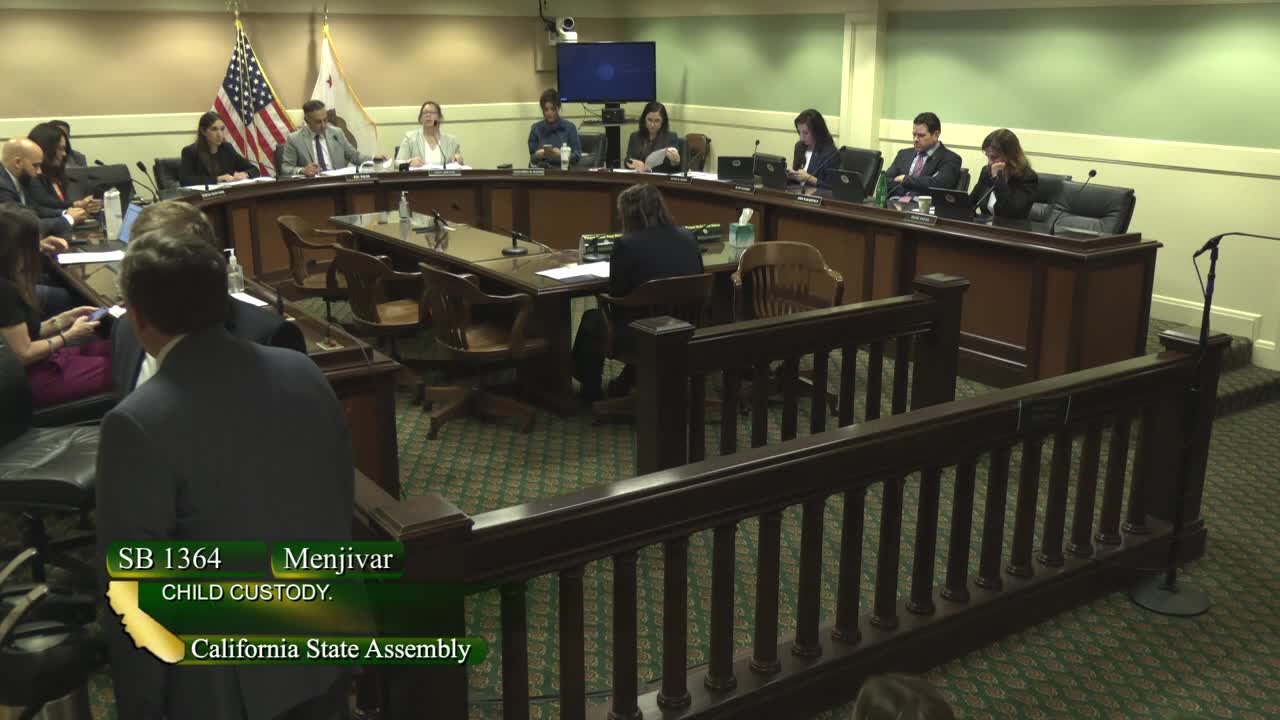
Bill Author