SB 1365: Price gouging.
- Session Year: 2025-2026
- House: Senate
- Latest Version Date: 2026-09-30
Current Status:
Passed
(2026-09-30: Chaptered by Secretary of State. Chapter 1028, Statutes of 2026.)
Introduced
In Committee
Awaiting First Chamber Vote
Passed First Chamber
In Committee
Awaiting Second Chamber Vote
Passed Second Chamber
Enacted
Under existing law, upon the proclamation of a state of emergency by the President of the United States or the Governor, or upon the declaration of a local emergency by the executive officer of any county, city, or city and county, and for 30 days following the proclamation or declaration of emergency, it is price gouging, a misdemeanor, for any person, business, or other entity, to increase the rental price advertised, offered, or charged for housing, to an existing or prospective tenant, by more than 10%. Existing law exempts an increase from these provisions if the person can prove that the increase is directly attributable to additional costs for repairs or additions beyond normal maintenance that were amortized over the rental term that caused the rent to be increased greater than 10%.
This bill would instead make it an affirmative defense to charge of price gouging pursuant to that provision if an increase was directly attributable to additional costs for repairs or additions beyond normal maintenance incurred within the year prior to the proclamation or declaration and either the housing was rented, advertised for rent, or offered for rent at the time the costs were incurred or the person can prove that within a year before the proclamation or declaration, the intent to offer the housing for rent within 6 months of the repair or addition already existed.
Existing law also makes the imposition of various other price increases upon the proclamation of a state of emergency by the President of the United States or the Governor, or upon the declaration of a local emergency by the executive officer of any county, city, or city and county, and for 30 days following the proclamation or declaration of emergency, price gouging. Existing law exempts certain price increases from these provisions.
This bill would instead frame those exemptions as affirmative defenses.
Existing law defines housing for these purposes as any rental housing with an initial lease term of no longer than one year.
This bill would expand the definition of housing to include any rental housing without regard to the length of the initial lease term.
Existing law defines the rental price of housing advertised, offered, or charged at a daily rate at the time of the proclamation or declaration of emergency that is advertised, offered, or charged on a periodic lease agreement after the declaration or proclamation of emergency as being 160% of the fair market rent established by the United States Department of Housing and Urban Development, which may be increased by 5% if the housing is offered for rent fully furnished.
This bill would define the rental price of housing advertised, offered, or charged at a daily rate following a declaration or proclamation of emergency, but that was not advertised, offered, or charged at a daily rate in the year prior to the declaration or proclamation of emergency as being 1/30 of the amount above.
This bill would incorporate additional changes to Section 396 of the Penal Code proposed by SB 493 to be operative only if this bill and SB 493 are enacted and this bill is enacted last.
By expanding the scope of a crime, the bill would impose a state-mandated local program.
The California Constitution requires the state to reimburse local agencies and school districts for certain costs mandated by the state. Statutory provisions establish procedures for making that reimbursement.
This bill would provide that no reimbursement is required by this act for a specified reason.
Under existing law, upon the proclamation of a state of emergency by the President of the United States or the Governor, or upon the declaration of a local emergency by the executive officer of any county, city, or city and county, and for 30 days following the proclamation or declaration of emergency, it is a misdemeanor price gouging, a misdemeanor, for any person, business, or other entity, to increase the rental price advertised, offered, or charged for housing, to an existing or prospective tenant, by more than 10%. Existing law exempts an increase from these provisions if the person can prove that the increase is directly attributable to additional costs for repairs or additions beyond normal maintenance that were amortized over the rental term that caused the rent to be increased greater than 10%.
This bill would instead exempt an increase if the make it an affirmative defense to charge of price gouging pursuant to that provision if an increase was directly attributable to additional costs for repairs or additions beyond normal maintenance incurred within the year prior to the proclamation or declaration and either the housing was rented, advertised for rent, or offered for rent at the time the costs were incurred or the person can prove that within a year before the proclamation or declaration, the intent to offer the housing for rent within 6 months of the repair or addition already existed.
Existing law also makes the imposition of various other price increases upon the proclamation of a state of emergency by the President of the United States or the Governor, or upon the declaration of a local emergency by the executive officer of any county, city, or city and county, and for 30 days following the proclamation or declaration of emergency, price gouging. Existing law exempts certain price increases from these provisions.
This bill would instead frame those exemptions as affirmative defenses.
Existing law defines housing for these purposes as any rental housing with an initial lease term of no longer than one year.
This bill would expand the definition of housing to include any rental housing without regard to the length of the initial lease term.
Existing law defines the rental price of housing advertised, offered, or charged at a daily rate at the time of the proclamation or declaration of emergency that is advertised, offered, or charged on a periodic lease agreement after the declaration or proclamation of emergency as being 160% of the fair market rent established by the United States Department of Housing and Urban Development, which may be increased by 5% if the housing is offered for rent fully furnished.
This bill would define the rental price of housing advertised, offered, or charged at a daily rate following a declaration or proclamation of emergency, but that was not advertised, offered, or charged at a daily rate in the year prior to the declaration or proclamation of emergency as being 1/30 of the amount above.
This bill would incorporate additional changes to Section 396 of the Penal Code proposed by SB 493 to be operative only if this bill and SB 493 are enacted and this bill is enacted last.
By expanding the scope of a crime, the bill would impose a state-mandated local program.
The California Constitution requires the state to reimburse local agencies and school districts for certain costs mandated by the state. Statutory provisions establish procedures for making that reimbursement.
This bill would provide that no reimbursement is required by this act for a specified reason.
Under existing law, upon the proclamation of a state of emergency by the President of the United States or the Governor, or upon the declaration of a local emergency by the executive officer of any county, city, or city and county, and for 30 days following the proclamation or declaration of emergency, it is a misdemeanor for any person, business, or other entity, to increase the rental price advertised, offered, or charged for housing, to an existing or prospective tenant, by more than 10%. Existing law exempts an increase from these provisions if the person can prove that the increase is directly attributable to additional costs for repairs or additions beyond normal maintenance that were amortized over the rental term that caused the rent to be increased greater than 10%.
This bill would instead exempt an increase if the increase was directly attributable to additional costs for repairs or additions beyond normal maintenance incurred within the year prior to the proclamation or declaration and either the housing was rented, advertised for rent, or offered for rent at the time the costs were incurred or the person can prove that within a year before the proclamation or declaration, the intent to offer the housing for rent within 6 months of the repair or addition already existed.
Existing law defines housing for these purposes as any rental housing with an initial lease term of no longer than one year.
This bill would expand the definition of housing to include any rental housing without regard to the length of the initial lease term.
Existing law defines the rental price of housing advertised, offered, or charged at a daily rate at the time of the proclamation or declaration of emergency that is advertised, offered, or charged on a periodic lease agreement after the declaration or proclamation of emergency as being 160% of the fair market rent established by the United States Department of Housing and Urban Development, which may be increased by 5% if the housing is offered for rent fully furnished.
This bill would define the rental price of housing advertised, offered, or charged at a daily rate following a declaration or proclamation of emergency, but that was not advertised, offered, or charged at a daily rate in the year prior to the declaration or proclamation of emergency as being 1/30 of the amount above.
By expanding the scope of a crime, the bill would impose a state-mandated local program.
(3)TheThe California Constitution requires the state to reimburse local agencies and school districts for certain costs mandated by the state. Statutory provisions establish procedures for making that reimbursement.
This bill would provide that no reimbursement is required by this act for a specified reason.
(4)Existing constitutional provisions require that a statute that limits the right of access to the meetings of public bodies or the writings of public officials and agencies be adopted with findings demonstrating the interest protected by the limitation and the need for protecting that interest.This bill would make legislative findings to that effect.(5)The California Constitution requires local agencies, for the purpose of ensuring public access to the meetings of public bodies and the writings of public officials and agencies, to comply with a statutory enactment that amends or enacts laws relating to public records or open meetings and contains findings demonstrating that the enactment furthers the constitutional requirements relating to this purpose.This bill would make legislative findings to that effect.(1)Existing law, commonly known as the Cartwright Act, generally regulates trusts, defined as a combination of capital, skill, or acts by 2 or more persons for certain purposes, including to create or carry out restrictions in trade or commerce. Existing law makes every trust unlawful, against public policy, and void, except as provided. Under existing law, a violation of these provisions is a conspiracy against trade and is punishable by fines or imprisonment, or both, as specified.
Existing law authorizes any person who is injured in their business or property by reason of any violation of these provisions to file a lawsuit, as provided, and to recover 3 times the damages sustained, plus interest and other relief, as specified. Existing law deems the state and any of its political subdivisions and public agencies as a person for purposes of these provisions.
Existing law authorizes the Attorney General, or the district attorney of any county, subject to specified notice requirements, to initiate civil actions or criminal proceedings for violation of these provisions, and authorizes the Attorney General or the district attorney to initiate an action against a corporation or association, including a foreign corporation or foreign association, for specified remedies.
This bill would similarly authorize the city attorney of any city with a population in excess of 750,000 900,000 to initiate and prosecute those actions on behalf of the city or any public agency or political subdivision located wholly within the city, or on behalf of natural persons residing in the city.
Under existing law, an Attorney General or district attorney who initiates an action is entitled to retain a specified amount from the proceeds, if any, for expenses for investigation and prosecution, and to retain a specified amount from the collection of a fine or civil penalty, as provided.
This bill would similarly entitle a city attorney of any city with a population in excess of 750,000 900,000 who initiates an action to retain similar amounts.
Existing law grants to a district attorney who reasonably believes that there may be a violation of these provisions all of those powers granted to the Attorney General as a head of a department for purposes of specified laws relating to investigation and prosecution, and subjects the district attorney to other specified laws relating to financial privacy.
This bill would similarly grant those powers to a city attorney who reasonably believes that there may be a violation, and would subject the city attorney to those specified laws relating to financial privacy.
The bill would make other related changes.
(2)Under existing law, upon the proclamation of a state of emergency by the President of the United States or the Governor, or upon the declaration of a local emergency by the executive officer of any county, city, or city and county, and for 30 days following the proclamation or declaration of emergency, it is a misdemeanor for any person, business, or other entity, to increase the rental price advertised, offered, or charged for housing, to an existing or prospective tenant, by more than 10%. Existing law exempts an increase from these provisions if the person can prove that the increase is directly attributable to additional costs for repairs or additions beyond normal maintenance that were amortized over the rental term that caused the rent to be increased greater than 10%.
This bill would instead exempt an increase if the increase was directly attributable to additional costs for repairs or additions beyond normal maintenance incurred within the year prior to the proclamation or declaration and either the housing was rented, advertised for rent, or offered for rent at the time the costs were incurred or the person can prove that within a year before the proclamation or declaration, the intent to offer the housing for rent within 6 months of the repair or addition already existed.
Existing law defines housing for these purposes as any rental housing with an initial lease term of no longer than one year.
This bill would expand the definition of housing to include any rental housing without regard to the length of the initial lease term.
Existing law defines the rental price of housing advertised, offered, or charged at a daily rate at the time of the proclamation or declaration of emergency that is advertised, offered, or charged on a periodic lease agreement after the declaration or proclamation of emergency as being 160% of the fair market rent established by the United States Department of Housing and Urban Development, which may be increased by 5% if the housing is offered for rent fully furnished.
This bill would define the rental price of housing advertised, offered, or charged at a daily rate following a declaration or proclamation of emergency, but that was not advertised, offered, or charged at a daily rate in the year prior to the declaration or proclamation of emergency as being 1/30 of the amount above.
By expanding the scope of a crime, the bill would impose a state-mandated local program.
(3)The California Constitution requires the state to reimburse local agencies and school districts for certain costs mandated by the state. Statutory provisions establish procedures for making that reimbursement.
This bill would provide that no reimbursement is required by this act for a specified reason.
(4)Existing constitutional provisions require that a statute that limits the right of access to the meetings of public bodies or the writings of public officials and agencies be adopted with findings demonstrating the interest protected by the limitation and the need for protecting that interest.
This bill would make legislative findings to that effect.
(5)The California Constitution requires local agencies, for the purpose of ensuring public access to the meetings of public bodies and the writings of public officials and agencies, to comply with a statutory enactment that amends or enacts laws relating to public records or open meetings and contains findings demonstrating that the enactment furthers the constitutional requirements relating to this purpose.
This bill would make legislative findings to that effect.
(1)Existing law, commonly known as the Cartwright Act, generally regulates trusts, defined as a combination of capital, skill, or acts by 2 or more persons for certain purposes, including to create or carry out restrictions in trade or commerce. Existing law makes every trust unlawful, against public policy, and void, except as provided. Under existing law, a violation of these provisions is a conspiracy against trade and is punishable by fines or imprisonment, or both, as specified.
Existing law authorizes any person who is injured in their business or property by reason of any violation of these provisions to file a lawsuit, as provided, and to recover 3 times the damages sustained, plus interest and other relief, as specified. Existing law deems the state and any of its political subdivisions and public agencies as a person for purposes of these provisions.
Existing law authorizes the Attorney General, or the district attorney of any county, subject to specified notice requirements, to initiate civil actions or criminal proceedings for violation of these provisions, and authorizes the Attorney General or the district attorney to initiate an action against a corporation or association, including a foreign corporation or foreign association, for specified remedies.
This bill would similarly authorize the city attorney of any city with a population in excess of 750,000 to initiate and prosecute those actions on behalf of the city or any public agency or political subdivision located wholly within the city, or on behalf of natural persons residing in the city.
Under existing law, an Attorney General or district attorney who initiates an action is entitled to retain a specified amount from the proceeds, if any, for expenses for investigation and prosecution, and to retain a specified amount from the collection of a fine or civil penalty, as provided.
This bill would similarly entitle a city attorney of any city with a population in excess of 750,000 who initiates an action to retain similar amounts.
Existing law grants to a district attorney who reasonably believes that there may be a violation of these provisions all of those powers granted to the Attorney General as a head of a department for purposes of specified laws relating to investigation and prosecution, and subjects the district attorney to other specified laws relating to financial privacy.
This bill would similarly grant those powers to a city attorney who reasonably believes that there may be a violation, and would subject the city attorney to those specified laws relating to financial privacy.
The bill would make other related changes.
(2)Under existing law, upon the proclamation of a state of emergency by the President of the United States or the Governor, or upon the declaration of a local emergency by the executive officer of any county, city, or city and county, and for 30 days following the proclamation or declaration of emergency, it is a misdemeanor for any person, business, or other entity, to increase the rental price advertised, offered, or charged for housing, to an existing or prospective tenant, by more than 10%. Existing law exempts an increase from these provisions if the person can prove that the increase is directly attributable to additional costs for repairs or additions beyond normal maintenance that were amortized over the rental term that caused the rent to be increased greater than 10%.
This bill would instead exempt an increase if the increase was directly attributable to additional costs for repairs or additions beyond normal maintenance and the costs were incurred as a result of the event that triggered the proclamation or declaration of emergency, or, if the increase was directly attributable to additional costs for repairs or additions beyond normal maintenance incurred within the year prior to the proclamation or declaration and either the housing was rented, advertised for rent, or offered for rent at the time the costs were incurred or the person can prove that within a year before the proclamation or declaration, the intent to offer the housing for rent within 6 months of the repair or addition already existed.
Existing law defines housing for these purposes as any rental housing with an initial lease term of no longer than one year.
This bill would expand the definition of housing to include any rental housing without regard to the length of the initial lease term.
Existing law defines the rental price of housing advertised, offered, or charged at a daily rate at the time of the proclamation or declaration of emergency that is advertised, offered, or charged on a periodic lease agreement after the declaration or proclamation of emergency as being 160% of the fair market rent established by the United States Department of Housing and Urban Development, which may be increased by 5% if the housing is offered for rent fully furnished.
This bill would define the rental price of housing advertised, offered, or charged at a daily rate following a declaration or proclamation of emergency, but that was not advertised, offered, or charged at a daily rate in the year prior to the declaration or proclamation of emergency as being 1/30 of the amount above.
By expanding the scope of a crime, the bill would impose a state-mandated local program.
The(3)The California Constitution requires the state to reimburse local agencies and school districts for certain costs mandated by the state. Statutory provisions establish procedures for making that reimbursement.
This bill would provide that no reimbursement is required by this act for a specified reason.
(4)Existing constitutional provisions require that a statute that limits the right of access to the meetings of public bodies or the writings of public officials and agencies be adopted with findings demonstrating the interest protected by the limitation and the need for protecting that interest.
This bill would make legislative findings to that effect.
(5)The California Constitution requires local agencies, for the purpose of ensuring public access to the meetings of public bodies and the writings of public officials and agencies, to comply with a statutory enactment that amends or enacts laws relating to public records or open meetings and contains findings demonstrating that the enactment furthers the constitutional requirements relating to this purpose.
This bill would make legislative findings to that effect.
(1)Existing law, commonly known as the Cartwright Act, generally regulates trusts, defined as a combination of capital, skill, or acts by 2 or more persons for certain purposes, including to create or carry out restrictions in trade or commerce. Existing law makes every trust unlawful, against public policy, and void, except as provided. Under existing law, a violation of these provisions is a conspiracy against trade and is punishable by fines or imprisonment, or both, as specified.
Existing law authorizes any person who is injured in their business or property by reason of any violation of these provisions to file a lawsuit, as provided, and to recover 3 times the damages sustained, plus interest and other relief, as specified. Existing law deems the state and any of its political subdivisions and public agencies as a person for purposes of these provisions.
Existing law authorizes the Attorney General, or the district attorney of any county, subject to specified notice requirements, to initiate civil actions or criminal proceedings for violation of these provisions, and authorizes the Attorney General or the district attorney to initiate an action against a corporation or association, including a foreign corporation or foreign association, for specified remedies.
This bill would similarly authorize the city attorney of any city with a population in excess of 750,000 to initiate and prosecute those actions on behalf of the city or any public agency or political subdivision located wholly within the city, or on behalf of natural persons residing in the city.
Under existing law, an Attorney General or district attorney who initiates an action is entitled to retain a specified amount from the proceeds, if any, for expenses for investigation and prosecution, and to retain a specified amount from the collection of a fine or civil penalty, as provided.
This bill would similarly entitle a city attorney of any city with a population in excess of 750,000 who initiates an action to retain similar amounts.
Existing law grants to a district attorney who reasonably believes that there may be a violation of these provisions all of those powers granted to the Attorney General as a head of a department for purposes of specified laws relating to investigation and prosecution, and subjects the district attorney to other specified laws relating to financial privacy.
This bill would similarly grant those powers to a city attorney who reasonably believes that there may be a violation, and would subject the city attorney to those specified laws relating to financial privacy.
The bill would make other related changes.
(2)Under existing law, upon the proclamation of a state of emergency by the President of the United States or the Governor, or upon the declaration of a local emergency by the executive officer of any county, city, or city and county, and for 30 days following the proclamation or declaration of emergency, it is a misdemeanor for any person, business, or other entity, to increase the rental price advertised, offered, or charged for housing, to an existing or prospective tenant, by more than 10%. Existing law exempts an increase from these provisions if the person can prove that the increase is directly attributable to additional costs for repairs or additions beyond normal maintenance that were amortized over the rental term that caused the rent to be increased greater than 10%.
This bill would instead exempt an increase if the increase was directly attributable to additional costs for repairs or additions beyond normal maintenance and the costs were incurred as a result of the event that triggered the proclamation or declaration of emergency, or, if the increase was directly attributable to additional costs for repairs or additions beyond normal maintenance incurred within the year prior to the proclamation or declaration and either the housing was rented, advertised for rent, or offered for rent at the time the costs were incurred or the person can prove that within a year before the proclamation or declaration, the intent to offer the housing for rent within 6 months of the repair or addition already existed.
Existing law defines housing for these purposes as any rental housing with an initial lease term of no longer than one year.
This bill would expand the definition of housing to include any rental housing without regard to the length of the initial lease term.
Existing law defines the rental price of housing advertised, offered, or charged at a daily rate at the time of the proclamation or declaration of emergency that is advertised, offered, or charged on a periodic lease agreement after the declaration or proclamation of emergency as being 160% of the fair market rent established by the United States Department of Housing and Urban Development, which may be increased by 5% if the housing is offered for rent fully furnished.
This bill would define the rental price of housing advertised, offered, or charged at a daily rate following a declaration or proclamation of emergency, but that was not advertised, offered, or charged at a daily rate in the year prior to the declaration or proclamation of emergency as being 1/30 of the amount above.
By expanding the scope of a crime, the bill would impose a state-mandated local program.
The California Constitution requires the state to reimburse local agencies and school districts for certain costs mandated by the state. Statutory provisions establish procedures for making that reimbursement.
This bill would provide that no reimbursement is required by this act for a specified reason.
(a)The Legislature hereby finds that during a state of emergency or local emergency, including, but not limited to, an earthquake, flood, fire, riot, storm, drought, plant or animal infestation or disease, pandemic or epidemic disease outbreak, or other natural or manmade disaster, some merchants have taken unfair advantage of consumers by greatly increasing prices for essential consumer goods and services. While the pricing of consumer goods and services is generally best left to the marketplace under ordinary conditions, when a declared state of emergency or local emergency results in abnormal disruptions of the market, the public interest requires that excessive and unjustified increases in the prices of essential consumer goods and services be prohibited. It is the intent of the Legislature in enacting this act to protect citizens from excessive and unjustified increases in the prices charged during or shortly after a declared state of emergency or local emergency for goods and services that are vital and necessary for the health, safety, and welfare of consumers, whether those goods and services are offered or sold in person, in stores, or online. Further, it is the intent of the Legislature that this section be liberally construed so that its beneficial purposes may be served.
(b)(1)Upon the proclamation of a state of emergency declared by the President of the United States or the Governor, or upon the declaration of a local emergency by an official, board, or other governing body vested with authority to make that declaration in any county, city, or city and county, and for a period of 30 days following that proclamation or declaration, it is unlawful for a person, contractor, business, or other entity to sell or offer to sell any consumer food items or goods, goods or services used for emergency cleanup, emergency supplies, medical supplies, home heating oil, building materials, housing, transportation, freight, and storage services, or gasoline or other motor fuels for a price of more than 10 percent greater than the price charged by that person for those goods or services immediately prior to the proclamation or declaration of emergency, or prior to a date set in the proclamation or declaration.
(2)(A)It is an affirmative defense to a charge of price gouging pursuant to this subdivision if that person can prove either of the following:
(i)That the increase in price was directly attributable to additional costs imposed on it by the supplier of the goods.
(ii)That the increase in price was directly attributable to additional costs for labor or materials used to provide the services, during the state of emergency or local emergency, and the price is no more than 10 percent greater than the total of the cost to the seller plus the markup customarily applied by that seller for that good or service in the usual course of business immediately prior to the onset of the state of emergency or local emergency.
(B)If the person, contractor, business, or other entity did not charge a price for the goods or services immediately prior to the proclamation or declaration of emergency, it may not charge a price that is more than 50 percent greater than the cost thereof to the vendor as cost is defined in Section 17026 of the Business and Professions Code.
(c)(1)Upon the proclamation of a state of emergency declared by the President of the United States or the Governor, or upon the declaration of a local emergency by an official, board, or other governing body vested with authority to make that declaration in any county, city, or city and county, and for a period of 180 days following that proclamation or declaration, it is unlawful for a contractor to sell or offer to sell any repair or reconstruction services or any services used in emergency cleanup for a price of more than 10 percent above the price charged by that person for those services immediately prior to the proclamation or declaration of emergency.
(2)It is an affirmative defense to a charge of price gouging pursuant to this subdivision if that person can prove either of the following:
(A)That the increase in price was directly attributable to additional costs imposed on it by the supplier of the goods.
(B)That the increase in price was directly attributable to additional costs for labor or materials used to provide the services, during the state of emergency or local emergency, and the price represents no more than 10 percent greater than the total of the cost to the contractor plus the markup customarily applied by the contractor for that good or service in the usual course of business immediately prior to the onset of the state of emergency or local emergency.
(d)(1)Upon the proclamation of a state of emergency declared by the President of the United States or the Governor, or upon the declaration of a local emergency by an official, board, or other governing body vested with authority to make that declaration in any county, city, or city and county, and for a period of 30 days following that proclamation or declaration, it is unlawful for an owner or operator of a hotel or motel to increase the hotels or motels regular rates, as advertised immediately prior to the proclamation or declaration of emergency, by more than 10 percent.
(2)It is an affirmative defense to a charge of price gouging pursuant to this subdivision if the owner or operator can prove that the increase in price is directly attributable to additional costs imposed on it for goods or labor used in its business, to seasonal adjustments in rates that are regularly scheduled, or to previously contracted rates.
(e)(1)Upon the proclamation of a state of emergency declared by the President of the United States or the Governor, or upon the declaration of a local emergency by an official, board, or other governing body vested with authority to make that declaration in any city, county, or city and county, and for a period of 30 days following that proclamation or declaration, or any period the proclamation or declaration is extended by the applicable authority, it is unlawful for any person, business, or other entity, to increase the rental price, as defined in paragraph (11) of subdivision (j), advertised, offered, or charged for housing, to an existing or prospective tenant, by more than 10 percent.
(2)It is an affirmative defense to a charge of price gouging pursuant to this subdivision if that person can prove either of the following:
(A)That an increase was contractually agreed to by the tenant prior to the proclamation or declaration.
(B)That the increase was directly attributable to additional costs for repairs or additions beyond normal maintenance incurred within the year prior to the proclamation or declaration and either of the following is true:
(i)The housing was rented, advertised for rent, or offered for rent at the time the costs were incurred.
(ii)That person can prove that within a year before the proclamation or declaration, the intent to offer the housing for rent within six months of the repair or addition already existed.
(3)It shall not be a defense to a prosecution under this subdivision that an increase in rental price was based on the length of the rental term, the inclusion of additional goods or services, except as provided in paragraph (11) of subdivision (j) with respect to furniture, or that the rent was offered by, or paid by, an insurance company, or other third party, on behalf of a tenant. This subdivision does not authorize a landlord to charge a price greater than the amount authorized by a local rent control ordinance.
(f)It is unlawful for a person, business, or other entity to evict any residential tenant of residential housing after the proclamation of a state of emergency declared by the President of the United States or the Governor, or upon the declaration of a local emergency by an official, board, or other governing body vested with authority to make that declaration in any city, county, or city and county, and for a period of 30 days following that proclamation or declaration, or any period that the proclamation or declaration is extended by the applicable authority and rent or offer to rent to another person at a rental price greater than the evicted tenant could be charged under this section. It shall not be a violation of this subdivision for a person, business, or other entity to continue an eviction process that was lawfully begun prior to the proclamation or declaration of emergency.
(g)The prohibitions of this section may be extended for additional periods, as needed, by a local legislative body, local official, the Governor, or the Legislature, if deemed necessary to protect the lives, property, or welfare of the citizens. Each extension by a local legislative body or local official shall not exceed 30 days. An extension may also authorize specified price increases that exceed the amount that would be permissible under this section during the initial 30 or 180 days after a proclamation or declaration of emergency.
(h)A violation of this section is a misdemeanor punishable by imprisonment in a county jail for a period not exceeding one year, by a fine of not more than ten thousand dollars ($10,000), or by both that fine and imprisonment.
(i)A violation of this section shall constitute an unlawful business practice and an act of unfair competition within the meaning of Section 17200 of the Business and Professions Code. The remedies and penalties provided by this section are cumulative to each other, the remedies under Section 17200 of the Business and Professions Code, and the remedies or penalties available under all other laws of this state.
(j)For the purposes of this section, the following terms have the following meanings:
(1)State of emergency means a natural or manmade emergency resulting from an earthquake, flood, fire, riot, storm, drought, plant or animal infestation or disease, pandemic or epidemic disease outbreak, or other natural or manmade disaster for which a state of emergency has been declared by the President of the United States or the Governor.
(2)Local emergency means a natural or manmade emergency resulting from an earthquake, flood, fire, riot, storm, drought, plant or animal infestation or disease, pandemic or epidemic disease outbreak, or other natural or manmade disaster for which a local emergency has been declared by an official, board, or other governing body vested with authority to make that declaration in any county, city, or city and county in California.
(3)Consumer food item means any article that is used or intended for use for food, drink, confection, or condiment by a person or animal.
(4)Repair or reconstruction services means services performed by any person who is required to be licensed under the Contractors State License Law (Chapter 9 (commencing with Section 7000) of Division 3 of the Business and Professions Code), for repairs to residential or commercial property of any type that is damaged as a result of a disaster.
(5)Emergency supplies includes, but is not limited to, water, flashlights, radios, batteries, candles, blankets, soaps, diapers, temporary shelters, tape, toiletries, plywood, nails, and hammers.
(6)Medical supplies includes, but is not limited to, prescription and nonprescription medications, bandages, gauze, isopropyl alcohol, and antibacterial products.
(7)Building materials means lumber, construction tools, windows, and anything else used in the building or rebuilding of property.
(8)Gasoline means any fuel used to power any motor vehicle or power tool.
(9)Transportation, freight, and storage services means any service that is performed by any company that contracts to move, store, or transport personal or business property or that rents equipment for those purposes, including towing services.
(10)Housing means any rental housing, including, but not limited to, a space rented in a mobilehome park or campground.
(11)Rental price for housing means any of the following:
(A)For housing rented within one year prior to the time of the proclamation or declaration of emergency, the actual rental price paid by the tenant. For housing not rented at the time of the declaration or proclamation, but rented, or offered for rent, within one year prior to the proclamation or declaration of emergency, the most recent rental price offered before the proclamation or declaration of emergency. For housing rented at the time of the proclamation or declaration of emergency but which becomes vacant while the proclamation or declaration of emergency remains in effect and which is subject to any ordinance, rule, regulation, or initiative measure adopted by any local governmental entity that establishes a maximum amount that a landlord may charge a tenant for rent, the actual rental price paid by the previous tenant or the amount specified in subparagraph (B), whichever is greater. This amount may be increased by 5 percent if the housing was previously rented or offered for rent unfurnished, and it is now being offered for rent fully furnished. This amount shall not be adjusted for any other good or service, including, but not limited to, gardening or utilities currently or formerly provided in connection with the lease.
(B)For housing not rented and not offered for rent within one year prior to the proclamation or declaration of emergency, 160 percent of the fair market rent established by the United States Department of Housing and Urban Development. This amount may be increased by 5 percent if the housing is offered for rent fully furnished. This amount shall not be adjusted for any other good or service, including, but not limited to, gardening or utilities currently or formerly provided in connection with the lease.
(C)Housing advertised, offered, or charged, at a daily rate at the time of the declaration or proclamation of emergency, shall be subject to the rental price described in subparagraph (A), if the housing continues to be advertised, offered, or charged, at a daily rate. Housing advertised, offered, or charged, on a daily basis at the time of the declaration or proclamation of emergency, shall be subject to the rental price in subparagraph (B), if the housing is advertised, offered, or charged, on a periodic lease agreement after the declaration or proclamation of emergency. Housing advertised, offered, or charged at a daily rate following a declaration or proclamation of emergency, but that was not advertised, offered, or charged at a daily rate in the year prior to the declaration or proclamation of emergency, shall be subject to a rental price that is one-thirtieth of the rental price described in subparagraph (B).
(D)For mobilehome spaces rented to existing tenants at the time of the proclamation or declaration of emergency and subject to a local rent control ordinance, the amount authorized under the local rent control ordinance. For new tenants who enter into a rental agreement for a mobilehome space that is subject to rent control but not rented at the time of the proclamation or declaration of emergency, the amount of rent last charged for a space in the same mobilehome park. For mobilehome spaces not subject to a local rent control ordinance and not rented at the time of the proclamation or declaration of emergency, the amount of rent last charged for the space.
(12)Goods has the same meaning as defined in subdivision (c) of Section 1689.5 of the Civil Code.
(k)This section does not preempt any local ordinance prohibiting the same or similar conduct or imposing a more severe penalty for the same conduct prohibited by this section.
(l)A business offering an item for sale, or a service, at a reduced price immediately prior to the proclamation or declaration of the emergency may use the price it normally charges for the item or service to calculate the price pursuant to subdivision (b) or (c).
(m)This section does not prohibit an owner from evicting a tenant for any lawful reason, including pursuant to Section 1161 of the Code of Civil Procedure.
SEC. 1.5.Section 396 of the Penal Code is amended to read:396.(a)The Legislature hereby finds that during a state of emergency or local emergency, including, but not limited to, an earthquake, flood, fire, riot, storm, drought, plant or animal infestation or disease, pandemic or epidemic disease outbreak, war, or other natural or manmade disaster, some merchants have taken unfair advantage of consumers by greatly increasing prices for essential consumer goods and services. While the pricing of consumer goods and services is generally best left to the marketplace under ordinary conditions, when a declared state of emergency or local emergency results in abnormal disruptions of the market, the public interest requires that excessive and unjustified increases in the prices of essential consumer goods and services be prohibited. It is the intent of the Legislature in enacting this act to protect citizens from excessive and unjustified increases in the prices charged during or shortly after a declared state of emergency or local emergency for goods and services that are vital and necessary for the health, safety, and welfare of consumers, whether those goods and services are offered or sold in person, in stores, or online. Further, it is the intent of the Legislature that this section be liberally construed so that its beneficial purposes may be served.
(b)(1)Upon the proclamation of a state of emergency declared by the President of the United States or the Governor, or upon the declaration of a local emergency by an official, board, or other governing body vested with authority to make that declaration in any county, city, or city and county, and for a period of 30 days following that proclamation or declaration, it is unlawful for a person, contractor, business, or other entity to sell or offer to sell any consumer food items or goods, goods or services used for emergency cleanup, emergency supplies, medical supplies, home heating oil, building materials, housing, transportation, freight, and storage services, or gasoline or other motor fuels for a price of more than 10 percent greater than the price charged by that person for those goods or services immediately prior to the proclamation or declaration of emergency, or prior to a date set in the proclamation or declaration.
(2)(A)It is an affirmative defense to a charge of price gouging pursuant to this subdivision if that person can prove either of the following:
(i)That the increase in price was directly attributable to additional costs imposed on it by the supplier of the goods.
(ii)That the increase in price was directly attributable to additional costs for labor or materials used to provide the services, during the state of emergency or local emergency, and the price is no more than 10 percent greater than the total of the cost to the seller plus the markup customarily applied by that seller for that good or service in the usual course of business immediately prior to the onset of the state of emergency or local emergency.
(B)If the person, contractor, business, or other entity did not charge a price for the goods or services immediately prior to the proclamation or declaration of emergency, it may not charge a price that is more than 50 percent greater than the cost thereof to the vendor as cost is defined in Section 17026 of the Business and Professions Code.
(c)(1)Upon the proclamation of a state of emergency declared by the President of the United States or the Governor, or upon the declaration of a local emergency by an official, board, or other governing body vested with authority to make that declaration in any county, city, or city and county, and for a period of 180 days following that proclamation or declaration, it is unlawful for a contractor to sell or offer to sell any repair or reconstruction services or any services used in emergency cleanup for a price of more than 10 percent above the price charged by that person for those services immediately prior to the proclamation or declaration of emergency.
(2)It is an affirmative defense to a charge of price gouging pursuant to this subdivision if that person can prove either of the following:
(A)That the increase in price was directly attributable to additional costs imposed on it by the supplier of the goods.
(B)That the increase in price was directly attributable to additional costs for labor or materials used to provide the services, during the state of emergency or local emergency, and the price represents no more than 10 percent greater than the total of the cost to the contractor plus the markup customarily applied by the contractor for that good or service in the usual course of business immediately prior to the onset of the state of emergency or local emergency.
(d)(1)Upon the proclamation of a state of emergency declared by the President of the United States or the Governor, or upon the declaration of a local emergency by an official, board, or other governing body vested with authority to make that declaration in any county, city, or city and county, and for a period of 30 days following that proclamation or declaration, it is unlawful for an owner or operator of a hotel or motel to increase the hotels or motels regular rates, as advertised immediately prior to the proclamation or declaration of emergency, by more than 10 percent.
(2)It is an affirmative defense to a charge of price gouging pursuant to this subdivision if the owner or operator can prove that the increase in price is directly attributable to additional costs imposed on it for goods or labor used in its business, to seasonal adjustments in rates that are regularly scheduled, or to previously contracted rates.
(e)(1)Upon the proclamation of a state of emergency declared by the President of the United States or the Governor, or upon the declaration of a local emergency by an official, board, or other governing body vested with authority to make that declaration in any city, county, or city and county, and for a period of 30 days following that proclamation or declaration, or any period the proclamation or declaration is extended by the applicable authority, it is unlawful for any person, business, or other entity, to increase the rental price, as defined in paragraph (11) of subdivision (j), advertised, offered, or charged for housing, to an existing or prospective tenant, by more than 10 percent.
(2)It is an affirmative defense to a charge of price gouging pursuant to this subdivision if that person can prove either of the following:
(A)That an increase was contractually agreed to by the tenant prior to the proclamation or declaration.
(B)That the increase was directly attributable to additional costs for repairs or additions beyond normal maintenance incurred within the year prior to the proclamation or declaration and either of the following is true:
(i)The housing was rented, advertised for rent, or offered for rent at the time the costs were incurred.
(ii)That person can prove that within a year before the proclamation or declaration, the intent to offer the housing for rent within six months of the repair or addition already existed.
(3)It shall not be a defense to a prosecution under this subdivision that an increase in rental price was based on the length of the rental term, the inclusion of additional goods or services, except as provided in paragraph (11) of subdivision (j) with respect to furniture, or that the rent was offered by, or paid by, an insurance company, or other third party, on behalf of a tenant. This subdivision does not authorize a landlord to charge a price greater than the amount authorized by a local rent control ordinance.
(f)It is unlawful for a person, business, or other entity to evict a residential tenant of residential housing after the proclamation of a state of emergency declared by the President of the United States or the Governor, or upon the declaration of a local emergency by an official, board, or other governing body vested with authority to make that declaration in any city, county, or city and county, and for a period of 30 days following that proclamation or declaration, or any period that the proclamation or declaration is extended by the applicable authority and rent or offer to rent to another person at a rental price greater than the evicted tenant could be charged under this section. It shall not be a violation of this subdivision for a person, business, or other entity to continue an eviction process that was lawfully begun prior to the proclamation or declaration of emergency.
(g)The prohibitions of this section may be extended for additional periods, as needed, by a local legislative body, local official, the Governor, or the Legislature, if deemed necessary to protect the lives, property, or welfare of the citizens. Each extension by a local legislative body or local official shall not exceed 30 days. An extension may also authorize specified price increases that exceed the amount that would be permissible under this section during the initial 30 or 180 days after a proclamation or declaration of emergency.
(h)A violation of this section is a misdemeanor punishable by imprisonment in a county jail for a period not exceeding one year, by a fine of not more than ten thousand dollars ($10,000), or by both that fine and imprisonment.
(i)A violation of this section shall constitute an unlawful business practice and an act of unfair competition within the meaning of Section 17200 of the Business and Professions Code. The remedies and penalties provided by this section are cumulative to each other, the remedies under Section 17200 of the Business and Professions Code, and the remedies or penalties available under all other laws of this state.
(j)For the purposes of this section, the following terms have the following meanings:
(1)State of emergency means a natural or manmade emergency resulting from an earthquake, flood, fire, riot, storm, drought, plant or animal infestation or disease, pandemic or epidemic disease outbreak, war, or other natural or manmade disaster for which a state of emergency has been declared by the President of the United States or the Governor.
(2)Local emergency means a natural or manmade emergency resulting from an earthquake, flood, fire, riot, storm, drought, plant or animal infestation or disease, pandemic or epidemic disease outbreak, or other natural or manmade disaster for which a local emergency has been declared by an official, board, or other governing body vested with authority to make that declaration in any county, city, or city and county in California.
(3)Consumer food item means any article that is used or intended for use for food, drink, confection, or condiment by a person or animal.
(4)Repair or reconstruction services means services performed by any person who is required to be licensed under the Contractors State License Law (Chapter 9 (commencing with Section 7000) of Division 3 of the Business and Professions Code), for repairs to residential or commercial property of any type that is damaged as a result of a disaster.
(5)Emergency supplies includes, but is not limited to, water, flashlights, radios, batteries, candles, blankets, soaps, diapers, temporary shelters, tape, toiletries, plywood, nails, and hammers.
(6)Medical supplies includes, but is not limited to, prescription and nonprescription medications, bandages, gauze, isopropyl alcohol, and antibacterial products.
(7)Building materials means lumber, construction tools, windows, and anything else used in the building or rebuilding of property.
(8)Gasoline means any fuel used to power any motor vehicle or power tool.
(9)Transportation, freight, and storage services means any service that is performed by any company that contracts to move, store, or transport personal or business property or that rents equipment for those purposes, including towing services.
(10)Housing means any rental housing, including, but not limited to, a space rented in a mobilehome park or campground.
(11)Rental price for housing means any of the following:
(A)For housing rented within one year prior to the time of the proclamation or declaration of emergency, the actual rental price paid by the tenant. For housing not rented at the time of the declaration or proclamation, but rented, or offered for rent, within one year prior to the proclamation or declaration of emergency, the most recent rental price offered before the proclamation or declaration of emergency. For housing rented at the time of the proclamation or declaration of emergency but which becomes vacant while the proclamation or declaration of emergency remains in effect and which is subject to any ordinance, rule, regulation, or initiative measure adopted by any local governmental entity that establishes a maximum amount that a landlord may charge a tenant for rent, the actual rental price paid by the previous tenant or the amount specified in subparagraph (B), whichever is greater. This amount may be increased by 5 percent if the housing was previously rented or offered for rent unfurnished, and it is now being offered for rent fully furnished. This amount shall not be adjusted for any other good or service, including, but not limited to, gardening or utilities currently or formerly provided in connection with the lease.
(B)For housing not rented and not offered for rent within one year prior to the proclamation or declaration of emergency, 160 percent of the fair market rent established by the United States Department of Housing and Urban Development. This amount may be increased by 5 percent if the housing is offered for rent fully furnished. This amount shall not be adjusted for any other good or service, including, but not limited to, gardening or utilities currently or formerly provided in connection with the lease.
(C)Housing advertised, offered, or charged, at a daily rate at the time of the declaration or proclamation of emergency, shall be subject to the rental price described in subparagraph (A), if the housing continues to be advertised, offered, or charged, at a daily rate. Housing advertised, offered, or charged, on a daily basis at the time of the declaration or proclamation of emergency, shall be subject to the rental price in subparagraph (B), if the housing is advertised, offered, or charged, on a periodic lease agreement after the declaration or proclamation of emergency. Housing advertised, offered, or charged at a daily rate following a declaration or proclamation of emergency, but that was not advertised, offered, or charged at a daily rate in the year prior to the declaration or proclamation of emergency, shall be subject to a rental price that is one-thirtieth of the rental price described in subparagraph (B).
(D)For mobilehome spaces rented to existing tenants at the time of the proclamation or declaration of emergency and subject to a local rent control ordinance, the amount authorized under the local rent control ordinance. For new tenants who enter into a rental agreement for a mobilehome space that is subject to rent control but not rented at the time of the proclamation or declaration of emergency, the amount of rent last charged for a space in the same mobilehome park. For mobilehome spaces not subject to a local rent control ordinance and not rented at the time of the proclamation or declaration of emergency, the amount of rent last charged for the space.
(12)Goods has the same meaning as defined in subdivision (c) of Section 1689.5 of the Civil Code.
(13)War means any of the following:
(A)A time during which Congress has declared war and peace has not been formally restored.
(B)A time during which the United States is engaged in active military operations against any foreign state, whether or not war has been formally declared.
(C)A time during which the United States is assisting the United Nations, in actions involving the use of armed force, to maintain or restore international peace and security.
(D)The prohibitions and associated penalties, pursuant to a proclamation or declaration of a state of emergency for war, shall apply only upon the proclamation or declaration by the President of the United States or the Governor and shall apply only for the essential consumer goods or services for which the Attorney General issues a written opinion, consistent with Section 12519 of the Government Code, finding a sufficient nexus between the war at issue and increases in the prices of those goods or services. The prohibitions and associated penalties shall apply only for a period of 30 days following the proclamation or declaration but may be extended for additional periods of 30 days, if deemed necessary. An extension also may authorize specified price increases that exceed the amount that would be permissible during the initial 30 days after a proclamation or declaration of a state of emergency for war.
(k)This section does not preempt any local ordinance prohibiting the same or similar conduct or imposing a more severe penalty for the same conduct prohibited by this section.
(l)A business offering an item for sale, or a service, at a reduced price immediately prior to the proclamation or declaration of the emergency may use the price it normally charges for the item or service to calculate the price pursuant to subdivision (b) or (c).
(m)This section does not prohibit an owner from evicting a tenant for any lawful reason, including pursuant to Section 1161 of the Code of Civil Procedure.
SEC. 2.Section 1.5 of this bill incorporates amendments to Section 396 of the Penal Code proposed by both this bill and Senate Bill 493. That section of this bill shall only become operative if (1) both bills are enacted and become effective on or before January 1, 2027, (2) each bill amends Section 396 of the Penal Code, and (3) this bill is enacted after Senate Bill 493, in which case Section 1 of this bill shall not become operative.
SEC. 3.No reimbursement is required by this act pursuant to Section 6 of Article XIIIB of the California Constitution because the only costs that may be incurred by a local agency or school district will be incurred because this act creates a new crime or infraction, eliminates a crime or infraction, or changes the penalty for a crime or infraction, within the meaning of Section 17556 of the Government Code, or changes the definition of a crime within the meaning of Section 6 of Article XIIIB of the California Constitution.
(a)The Legislature hereby finds that during a state of emergency or local emergency, including, but not limited to, an earthquake, flood, fire, riot, storm, drought, plant or animal infestation or disease, pandemic or epidemic disease outbreak, or other natural or manmade disaster, some merchants have taken unfair advantage of consumers by greatly increasing prices for essential consumer goods and services. While the pricing of consumer goods and services is generally best left to the marketplace under ordinary conditions, when a declared state of emergency or local emergency results in abnormal disruptions of the market, the public interest requires that excessive and unjustified increases in the prices of essential consumer goods and services be prohibited. It is the intent of the Legislature in enacting this act to protect citizens from excessive and unjustified increases in the prices charged during or shortly after a declared state of emergency or local emergency for goods and services that are vital and necessary for the health, safety, and welfare of consumers, whether those goods and services are offered or sold in person, in stores, or online. Further, it is the intent of the Legislature that this section be liberally construed so that its beneficial purposes may be served.
(b)(1)Upon the proclamation of a state of emergency declared by the President of the United States or the Governor, or upon the declaration of a local emergency by an official, board, or other governing body vested with authority to make that declaration in any county, city, or city and county, and for a period of 30 days following that proclamation or declaration, it is unlawful for a person, contractor, business, or other entity to sell or offer to sell any consumer food items or goods, goods or services used for emergency cleanup, emergency supplies, medical supplies, home heating oil, building materials, housing, transportation, freight, and storage services, or gasoline or other motor fuels for a price of more than 10 percent greater than the price charged by that person for those goods or services immediately prior to the proclamation or declaration of emergency, or prior to a date set in the proclamation or declaration. However, a greater price increase is not unlawful if
(2)(A)It is an affirmative defense to a charge of price gouging pursuant to this subdivision if that person can prove that either of the following:
(i)That the increase in price was directly attributable to additional costs imposed on it by the supplier of the goods, or goods.
(ii)That the increase in price was directly attributable to additional costs for labor or materials used to provide the services, during the state of emergency or local emergency, and the price is no more than 10 percent greater than the total of the cost to the seller plus the markup customarily applied by that seller for that good or service in the usual course of business immediately prior to the onset of the state of emergency or local emergency. If
(B)If the person, contractor, business, or other entity did not charge a price for the goods or services immediately prior to the proclamation or declaration of emergency, it may not charge a price that is more than 50 percent greater than the cost thereof to the vendor as cost is defined in Section 17026 of the Business and Professions Code.
(c)(1)Upon the proclamation of a state of emergency declared by the President of the United States or the Governor, or upon the declaration of a local emergency by an official, board, or other governing body vested with authority to make that declaration in any county, city, or city and county, and for a period of 180 days following that proclamation or declaration, it is unlawful for a contractor to sell or offer to sell any repair or reconstruction services or any services used in emergency cleanup for a price of more than 10 percent above the price charged by that person for those services immediately prior to the proclamation or declaration of emergency. However, a greater price increase is not unlawful
(2)It is an affirmative defense to a charge of price gouging pursuant to this subdivision if that person can prove that either of the following:
(A)That the increase in price was directly attributable to additional costs imposed on it by the supplier of the goods, or goods.
(B)That the increase in price was directly attributable to additional costs for labor or materials used to provide the services, during the state of emergency or local emergency, and the price represents no more than 10 percent greater than the total of the cost to the contractor plus the markup customarily applied by the contractor for that good or service in the usual course of business immediately prior to the onset of the state of emergency or local emergency.
(d)(1)Upon the proclamation of a state of emergency declared by the President of the United States or the Governor, or upon the declaration of a local emergency by an official, board, or other governing body vested with authority to make that declaration in any county, city, or city and county, and for a period of 30 days following that proclamation or declaration, it is unlawful for an owner or operator of a hotel or motel to increase the hotels or motels regular rates, as advertised immediately prior to the proclamation or declaration of emergency, by more than 10 percent. However, a greater price increase is not unlawful
(2)It is an affirmative defense to a charge of price gouging pursuant to this subdivision if the owner or operator can prove that the increase in price is directly attributable to additional costs imposed on it for goods or labor used in its business, to seasonal adjustments in rates that are regularly scheduled, or to previously contracted rates.
(e)(1)Upon the proclamation of a state of emergency declared by the President of the United States or the Governor, or upon the declaration of a local emergency by an official, board, or other governing body vested with authority to make that declaration in any city, county, or city and county, and for a period of 30 days following that proclamation or declaration, or any period the proclamation or declaration is extended by the applicable authority, it is unlawful for any person, business, or other entity, to increase the rental price, as defined in paragraph (11) of subdivision (j), advertised, offered, or charged for housing, to an existing or prospective tenant, by more than 10 percent.
(2)A rental price increase greater than the amount in paragraph (1) is not unlawful It is an affirmative defense to a charge of price gouging pursuant to this subdivision if that person can prove either of the following:
(A)That an increase was contractually agreed to by the tenant prior to the proclamation or declaration.
(B)That the increase was directly attributable to additional costs for repairs or additions beyond normal maintenance incurred within the year prior to the proclamation or declaration and either of the following is true:
(i)The housing was rented, advertised for rent, or offered for rent at the time the costs were incurred.
(ii)That person can prove that within a year before the proclamation or declaration, the intent to offer the housing for rent within six months of the repair or addition already existed.
(3)It shall not be a defense to a prosecution under this subdivision that an increase in rental price was based on the length of the rental term, the inclusion of additional goods or services, except as provided in paragraph (11) of subdivision (j) with respect to furniture, or that the rent was offered by, or paid by, an insurance company, or other third party, on behalf of a tenant. This subdivision does not authorize a landlord to charge a price greater than the amount authorized by a local rent control ordinance.
(f)It is unlawful for a person, business, or other entity to evict any residential tenant of residential housing after the proclamation of a state of emergency declared by the President of the United States or the Governor, or upon the declaration of a local emergency by an official, board, or other governing body vested with authority to make that declaration in any city, county, or city and county, and for a period of 30 days following that proclamation or declaration, or any period that the proclamation or declaration is extended by the applicable authority and rent or offer to rent to another person at a rental price greater than the evicted tenant could be charged under this section. It shall not be a violation of this subdivision for a person, business, or other entity to continue an eviction process that was lawfully begun prior to the proclamation or declaration of emergency.
(g)The prohibitions of this section may be extended for additional periods, as needed, by a local legislative body, local official, the Governor, or the Legislature, if deemed necessary to protect the lives, property, or welfare of the citizens. Each extension by a local legislative body or local official shall not exceed 30 days. An extension may also authorize specified price increases that exceed the amount that would be permissible under this section during the initial 30 or 180 days after a proclamation or declaration of emergency.
(h)A violation of this section is a misdemeanor punishable by imprisonment in a county jail for a period not exceeding one year, by a fine of not more than ten thousand dollars ($10,000), or by both that fine and imprisonment.
(i)A violation of this section shall constitute an unlawful business practice and an act of unfair competition within the meaning of Section 17200 of the Business and Professions Code. The remedies and penalties provided by this section are cumulative to each other, the remedies under Section 17200 of the Business and Professions Code, and the remedies or penalties available under all other laws of this state.
(j)For the purposes of this section, the following terms have the following meanings:
(1)State of emergency means a natural or manmade emergency resulting from an earthquake, flood, fire, riot, storm, drought, plant or animal infestation or disease, pandemic or epidemic disease outbreak, or other natural or manmade disaster for which a state of emergency has been declared by the President of the United States or the Governor.
(2)Local emergency means a natural or manmade emergency resulting from an earthquake, flood, fire, riot, storm, drought, plant or animal infestation or disease, pandemic or epidemic disease outbreak, or other natural or manmade disaster for which a local emergency has been declared by an official, board, or other governing body vested with authority to make that declaration in any county, city, or city and county in California.
(3)Consumer food item means any article that is used or intended for use for food, drink, confection, or condiment by a person or animal.
(4)Repair or reconstruction services means services performed by any person who is required to be licensed under the Contractors State License Law (Chapter 9 (commencing with Section 7000) of Division 3 of the Business and Professions Code), for repairs to residential or commercial property of any type that is damaged as a result of a disaster.
(5)Emergency supplies includes, but is not limited to, water, flashlights, radios, batteries, candles, blankets, soaps, diapers, temporary shelters, tape, toiletries, plywood, nails, and hammers.
(6)Medical supplies includes, but is not limited to, prescription and nonprescription medications, bandages, gauze, isopropyl alcohol, and antibacterial products.
(7)Building materials means lumber, construction tools, windows, and anything else used in the building or rebuilding of property.
(8)Gasoline means any fuel used to power any motor vehicle or power tool.
(9)Transportation, freight, and storage services means any service that is performed by any company that contracts to move, store, or transport personal or business property or that rents equipment for those purposes, including towing services.
(10)Housing means any rental housing, including, but not limited to, a space rented in a mobilehome park or campground.
(11)Rental price for housing means any of the following:
(A)For housing rented within one year prior to the time of the proclamation or declaration of emergency, the actual rental price paid by the tenant. For housing not rented at the time of the declaration or proclamation, but rented, or offered for rent, within one year prior to the proclamation or declaration of emergency, the most recent rental price offered before the proclamation or declaration of emergency. For housing rented at the time of the proclamation or declaration of emergency but which becomes vacant while the proclamation or declaration of emergency remains in effect and which is subject to any ordinance, rule, regulation, or initiative measure adopted by any local governmental entity that establishes a maximum amount that a landlord may charge a tenant for rent, the actual rental price paid by the previous tenant or the amount specified in subparagraph (B), whichever is greater. This amount may be increased by 5 percent if the housing was previously rented or offered for rent unfurnished, and it is now being offered for rent fully furnished. This amount shall not be adjusted for any other good or service, including, but not limited to, gardening or utilities currently or formerly provided in connection with the lease.
(B)For housing not rented and not offered for rent within one year prior to the proclamation or declaration of emergency, 160 percent of the fair market rent established by the United States Department of Housing and Urban Development. This amount may be increased by 5 percent if the housing is offered for rent fully furnished. This amount shall not be adjusted for any other good or service, including, but not limited to, gardening or utilities currently or formerly provided in connection with the lease.
(C)Housing advertised, offered, or charged, at a daily rate at the time of the declaration or proclamation of emergency, shall be subject to the rental price described in subparagraph (A), if the housing continues to be advertised, offered, or charged, at a daily rate. Housing advertised, offered, or charged, on a daily basis at the time of the declaration or proclamation of emergency, shall be subject to the rental price in subparagraph (B), if the housing is advertised, offered, or charged, on a periodic lease agreement after the declaration or proclamation of emergency. Housing advertised, offered, or charged at a daily rate following a declaration or proclamation of emergency, but that was not advertised, offered, or charged at a daily rate in the year prior to the declaration or proclamation of emergency, shall be subject to a rental price that is one-thirtieth of the rental price described in subparagraph (B).
(D)For mobilehome spaces rented to existing tenants at the time of the proclamation or declaration of emergency and subject to a local rent control ordinance, the amount authorized under the local rent control ordinance. For new tenants who enter into a rental agreement for a mobilehome space that is subject to rent control but not rented at the time of the proclamation or declaration of emergency, the amount of rent last charged for a space in the same mobilehome park. For mobilehome spaces not subject to a local rent control ordinance and not rented at the time of the proclamation or declaration of emergency, the amount of rent last charged for the space.
(12)Goods has the same meaning as defined in subdivision (c) of Section 1689.5 of the Civil Code.
(k)This section does not preempt any local ordinance prohibiting the same or similar conduct or imposing a more severe penalty for the same conduct prohibited by this section.
(l)A business offering an item for sale, or a service, at a reduced price immediately prior to the proclamation or declaration of the emergency may use the price it normally charges for the item or service to calculate the price pursuant to subdivision (b) or (c).
(m)This section does not prohibit an owner from evicting a tenant for any lawful reason, including pursuant to Section 1161 of the Code of Civil Procedure.
SEC. 1.5.Section 396 of the Penal Code is amended to read:396.(a)The Legislature hereby finds that during a state of emergency or local emergency, including, but not limited to, an earthquake, flood, fire, riot, storm, drought, plant or animal infestation or disease, pandemic or epidemic disease outbreak, war, or other natural or manmade disaster, some merchants have taken unfair advantage of consumers by greatly increasing prices for essential consumer goods and services. While the pricing of consumer goods and services is generally best left to the marketplace under ordinary conditions, when a declared state of emergency or local emergency results in abnormal disruptions of the market, the public interest requires that excessive and unjustified increases in the prices of essential consumer goods and services be prohibited. It is the intent of the Legislature in enacting this act to protect citizens from excessive and unjustified increases in the prices charged during or shortly after a declared state of emergency or local emergency for goods and services that are vital and necessary for the health, safety, and welfare of consumers, whether those goods and services are offered or sold in person, in stores, or online. Further, it is the intent of the Legislature that this section be liberally construed so that its beneficial purposes may be served.
(b)(1)Upon the proclamation of a state of emergency declared by the President of the United States or the Governor, or upon the declaration of a local emergency by an official, board, or other governing body vested with authority to make that declaration in any county, city, or city and county, and for a period of 30 days following that proclamation or declaration, it is unlawful for a person, contractor, business, or other entity to sell or offer to sell any consumer food items or goods, goods or services used for emergency cleanup, emergency supplies, medical supplies, home heating oil, building materials, housing, transportation, freight, and storage services, or gasoline or other motor fuels for a price of more than 10 percent greater than the price charged by that person for those goods or services immediately prior to the proclamation or declaration of emergency, or prior to a date set in the proclamation or declaration. However, a greater price increase is not unlawful
(2)(A)It is an affirmative defense to a charge of price gouging pursuant to this subdivision if that person can prove that either of the following:
(i)That the increase in price was directly attributable to additional costs imposed on it by the supplier of the goods, or goods.
(ii)That the increase in price was directly attributable to additional costs for labor or materials used to provide the services, during the state of emergency or local emergency, and the price is no more than 10 percent greater than the total of the cost to the seller plus the markup customarily applied by that seller for that good or service in the usual course of business immediately prior to the onset of the state of emergency or local emergency. If
(B)If the person, contractor, business, or other entity did not charge a price for the goods or services immediately prior to the proclamation or declaration of emergency, it may not charge a price that is more than 50 percent greater than the cost thereof to the vendor as cost is defined in Section 17026 of the Business and Professions Code.
(c)(1)Upon the proclamation of a state of emergency declared by the President of the United States or the Governor, or upon the declaration of a local emergency by an official, board, or other governing body vested with authority to make that declaration in any county, city, or city and county, and for a period of 180 days following that proclamation or declaration, it is unlawful for a contractor to sell or offer to sell any repair or reconstruction services or any services used in emergency cleanup for a price of more than 10 percent above the price charged by that person for those services immediately prior to the proclamation or declaration of emergency. However, a greater price increase is not unlawful
(2)It is an affirmative defense to a charge of price gouging pursuant to this subdivision if that person can prove that either of the following:
(A)That the increase in price was directly attributable to additional costs imposed on it by the supplier of the goods, or goods.
(B)That the increase in price was directly attributable to additional costs for labor or materials used to provide the services, during the state of emergency or local emergency, and the price represents no more than 10 percent greater than the total of the cost to the contractor plus the markup customarily applied by the contractor for that good or service in the usual course of business immediately prior to the onset of the state of emergency or local emergency.
(d)(1)Upon the proclamation of a state of emergency declared by the President of the United States or the Governor, or upon the declaration of a local emergency by an official, board, or other governing body vested with authority to make that declaration in any county, city, or city and county, and for a period of 30 days following that proclamation or declaration, it is unlawful for an owner or operator of a hotel or motel to increase the hotel hotels or motels regular rates, as advertised immediately prior to the proclamation or declaration of emergency, by more than 10 percent. However, a greater price increase is not unlawful
(2)It is an affirmative defense to a charge of price gouging pursuant to this subdivision if the owner or operator can prove that the increase in price is directly attributable to additional costs imposed on it for goods or labor used in its business, to seasonal adjustments in rates that are regularly scheduled, or to previously contracted rates.
(e)(1)Upon the proclamation of a state of emergency declared by the President of the United States or the Governor, or upon the declaration of a local emergency by an official, board, or other governing body vested with authority to make that declaration in any city, county, or city and county, and for a period of 30 days following that proclamation or declaration, or any period the proclamation or declaration is extended by the applicable authority, it is unlawful for any person, business, or other entity, to increase the rental price, as defined in paragraph (11) of subdivision (j), advertised, offered, or charged for housing, to an existing or prospective tenant, by more than 10 percent. However, a greater rental price increase is not unlawful if that person can prove that the increase is directly attributable to additional costs for repairs or additions beyond normal maintenance that were amortized over the rental term that caused the rent to be increased greater than 10 percent or that an increase was contractually agreed to by the tenant prior to the proclamation or declaration. It shall not be a defense to a prosecution under this subdivision that an increase in rental price was based on the length of the rental term, the inclusion of additional goods or services, except as provided in paragraph (11) of subdivision (j) with respect to furniture, or that the rent was offered by, or paid by, an insurance company, or other third party, on behalf of a tenant. This subdivision does not authorize a landlord to charge a price greater than the amount authorized by a local rent control ordinance.
(2)It is an affirmative defense to a charge of price gouging pursuant to this subdivision if that person can prove either of the following:
(A)That an increase was contractually agreed to by the tenant prior to the proclamation or declaration.
(B)That the increase was directly attributable to additional costs for repairs or additions beyond normal maintenance incurred within the year prior to the proclamation or declaration and either of the following is true:
(i)The housing was rented, advertised for rent, or offered for rent at the time the costs were incurred.
(ii)That person can prove that within a year before the proclamation or declaration, the intent to offer the housing for rent within six months of the repair or addition already existed.
(3)It shall not be a defense to a prosecution under this subdivision that an increase in rental price was based on the length of the rental term, the inclusion of additional goods or services, except as provided in paragraph (11) of subdivision (j) with respect to furniture, or that the rent was offered by, or paid by, an insurance company, or other third party, on behalf of a tenant. This subdivision does not authorize a landlord to charge a price greater than the amount authorized by a local rent control ordinance.
(f)It is unlawful for a person, business, or other entity to evict any a residential tenant of residential housing after the proclamation of a state of emergency declared by the President of the United States or the Governor, or upon the declaration of a local emergency by an official, board, or other governing body vested with authority to make that declaration in any city, county, or city and county, and for a period of 30 days following that proclamation or declaration, or any period that the proclamation or declaration is extended by the applicable authority and rent or offer to rent to another person at a rental price greater than the evicted tenant could be charged under this section. It shall not be a violation of this subdivision for a person, business, or other entity to continue an eviction process that was lawfully begun prior to the proclamation or declaration of emergency.
(g)The prohibitions of this section may be extended for additional periods, as needed, by a local legislative body, local official, the Governor, or the Legislature, if deemed necessary to protect the lives, property, or welfare of the citizens. Each extension by a local legislative body or local official shall not exceed 30 days. An extension may also authorize specified price increases that exceed the amount that would be permissible under this section during the initial 30 or 180 days after a proclamation or declaration of emergency.
(h)A violation of this section is a misdemeanor punishable by imprisonment in a county jail for a period not exceeding one year, by a fine of not more than ten thousand dollars ($10,000), or by both that fine and imprisonment.
(i)A violation of this section shall constitute an unlawful business practice and an act of unfair competition within the meaning of Section 17200 of the Business and Professions Code. The remedies and penalties provided by this section are cumulative to each other, the remedies under Section 17200 of the Business and Professions Code, and the remedies or penalties available under all other laws of this state.
(j)For the purposes of this section, the following terms have the following meanings:
(1)State of emergency means a natural or manmade emergency resulting from an earthquake, flood, fire, riot, storm, drought, plant or animal infestation or disease, pandemic or epidemic disease outbreak, war, or other natural or manmade disaster for which a state of emergency has been declared by the President of the United States or the Governor.
(2)Local emergency means a natural or manmade emergency resulting from an earthquake, flood, fire, riot, storm, drought, plant or animal infestation or disease, pandemic or epidemic disease outbreak, or other natural or manmade disaster for which a local emergency has been declared by an official, board, or other governing body vested with authority to make that declaration in any county, city, or city and county in California.
(3)Consumer food item means any article that is used or intended for use for food, drink, confection, or condiment by a person or animal.
(4)Repair or reconstruction services means services performed by any person who is required to be licensed under the Contractors Contractors State License Law (Chapter 9 (commencing with Section 7000) of Division 3 of the Business and Professions Code), for repairs to residential or commercial property of any type that is damaged as a result of a disaster.
(5)Emergency supplies includes, but is not limited to, water, flashlights, radios, batteries, candles, blankets, soaps, diapers, temporary shelters, tape, toiletries, plywood, nails, and hammers.
(6)Medical supplies includes, but is not limited to, prescription and nonprescription medications, bandages, gauze, isopropyl alcohol, and antibacterial products.
(7)Building materials means lumber, construction tools, windows, and anything else used in the building or rebuilding of property.
(8)Gasoline means any fuel used to power any motor vehicle or power tool.
(9)Transportation, freight, and storage services means any service that is performed by any company that contracts to move, store, or transport personal or business property or that rents equipment for those purposes, including towing services.
(10)Housing means any rental housing with an initial lease term of no longer than one year, housing, including, but not limited to, a space rented in a mobilehome park or campground.
(11)Rental price for housing means any of the following:
(A)For housing rented within one year prior to the time of the proclamation or declaration of emergency, the actual rental price paid by the tenant. For housing not rented at the time of the declaration or proclamation, but rented, or offered for rent, within one year prior to the proclamation or declaration of emergency, the most recent rental price offered before the proclamation or declaration of emergency. For housing rented at the time of the proclamation or declaration of emergency but which becomes vacant while the proclamation or declaration of emergency remains in effect and which is subject to any ordinance, rule, regulation, or initiative measure adopted by any local governmental entity that establishes a maximum amount that a landlord may charge a tenant for rent, the actual rental price paid by the previous tenant or the amount specified in subparagraph (B), whichever is greater. This amount may be increased by 5 percent if the housing was previously rented or offered for rent unfurnished, and it is now being offered for rent fully furnished. This amount shall not be adjusted for any other good or service, including, but not limited to, gardening or utilities currently or formerly provided in connection with the lease.
(B)For housing not rented and not offered for rent within one year prior to the proclamation or declaration of emergency, 160 percent of the fair market rent established by the United States Department of Housing and Urban Development. This amount may be increased by 5 percent if the housing is offered for rent fully furnished. This amount shall not be adjusted for any other good or service, including, but not limited to, gardening or utilities currently or formerly provided in connection with the lease.
(C)Housing advertised, offered, or charged, at a daily rate at the time of the declaration or proclamation of emergency, shall be subject to the rental price described in subparagraph (A), if the housing continues to be advertised, offered, or charged, at a daily rate. Housing advertised, offered, or charged, on a daily basis at the time of the declaration or proclamation of emergency, shall be subject to the rental price in subparagraph (B), if the housing is advertised, offered, or charged, on a periodic lease agreement after the declaration or proclamation of emergency. Housing advertised, offered, or charged at a daily rate following a declaration or proclamation of emergency, but that was not advertised, offered, or charged at a daily rate in the year prior to the declaration or proclamation of emergency, shall be subject to a rental price that is one-thirtieth of the rental price described in subparagraph (B).
(D)For mobilehome spaces rented to existing tenants at the time of the proclamation or declaration of emergency and subject to a local rent control ordinance, the amount authorized under the local rent control ordinance. For new tenants who enter into a rental agreement for a mobilehome space that is subject to rent control but not rented at the time of the proclamation or declaration of emergency, the amount of rent last charged for a space in the same mobilehome park. For mobilehome spaces not subject to a local rent control ordinance and not rented at the time of the proclamation or declaration of emergency, the amount of rent last charged for the space.
(12)Goods has the same meaning as defined in subdivision (c) of Section 1689.5 of the Civil Code.
(13)War means any of the following:
(A)A time during which Congress has declared war and peace has not been formally restored.
(B)A time during which the United States is engaged in active military operations against any foreign state, whether or not war has been formally declared.
(C)A time during which the United States is assisting the United Nations, in actions involving the use of armed force, to maintain or restore international peace and security.
(D)The prohibitions and associated penalties, pursuant to a proclamation or declaration of a state of emergency for war, shall apply only upon the proclamation or declaration by the President of the United States or the Governor and shall apply only for the essential consumer goods or services for which the Attorney General issues a written opinion, consistent with Section 12519 of the Government Code, finding a sufficient nexus between the war at issue and increases in the prices of those goods or services. The prohibitions and associated penalties shall apply only for a period of 30 days following the proclamation or declaration but may be extended for additional periods of 30 days, if deemed necessary. An extension also may authorize specified price increases that exceed the amount that would be permissible during the initial 30 days after a proclamation or declaration of a state of emergency for war.
(k)This section does not preempt any local ordinance prohibiting the same or similar conduct or imposing a more severe penalty for the same conduct prohibited by this section.
(l)A business offering an item for sale, or a service, at a reduced price immediately prior to the proclamation or declaration of the emergency may use the price it normally charges for the item or service to calculate the price pursuant to subdivision (b) or (c).
(m)This section does not prohibit an owner from evicting a tenant for any lawful reason, including pursuant to Section 1161 of the Code of Civil Procedure.
SEC. 2.Section 1.5 of this bill incorporates amendments to Section 396 of the Penal Code proposed by both this bill and Senate Bill 493. That section of this bill shall only become operative if (1) both bills are enacted and become effective on or before January 1, 2027, (2) each bill amends Section 396 of the Penal Code, and (3) this bill is enacted after Senate Bill 493, in which case Section 1 of this bill shall not become operative.
SEC. 2.SEC. 3.No reimbursement is required by this act pursuant to Section 6 of Article XIIIB of the California Constitution because the only costs that may be incurred by a local agency or school district will be incurred because this act creates a new crime or infraction, eliminates a crime or infraction, or changes the penalty for a crime or infraction, within the meaning of Section 17556 of the Government Code, or changes the definition of a crime within the meaning of Section 6 of Article XIIIB of the California Constitution.
(a)The Legislature hereby finds that during a state of emergency or local emergency, including, but not limited to, an earthquake, flood, fire, riot, storm, drought, plant or animal infestation or disease, pandemic or epidemic disease outbreak, or other natural or manmade disaster, some merchants have taken unfair advantage of consumers by greatly increasing prices for essential consumer goods and services. While the pricing of consumer goods and services is generally best left to the marketplace under ordinary conditions, when a declared state of emergency or local emergency results in abnormal disruptions of the market, the public interest requires that excessive and unjustified increases in the prices of essential consumer goods and services be prohibited. It is the intent of the Legislature in enacting this act to protect citizens from excessive and unjustified increases in the prices charged during or shortly after a declared state of emergency or local emergency for goods and services that are vital and necessary for the health, safety, and welfare of consumers, whether those goods and services are offered or sold in person, in stores, or online. Further, it is the intent of the Legislature that this section be liberally construed so that its beneficial purposes may be served.
(b)Upon the proclamation of a state of emergency declared by the President of the United States or the Governor, or upon the declaration of a local emergency by an official, board, or other governing body vested with authority to make that declaration in any county, city, or city and county, and for a period of 30 days following that proclamation or declaration, it is unlawful for a person, contractor, business, or other entity to sell or offer to sell any consumer food items or goods, goods or services used for emergency cleanup, emergency supplies, medical supplies, home heating oil, building materials, housing, transportation, freight, and storage services, or gasoline or other motor fuels for a price of more than 10 percent greater than the price charged by that person for those goods or services immediately prior to the proclamation or declaration of emergency, or prior to a date set in the proclamation or declaration. However, a greater price increase is not unlawful if that person can prove that the increase in price was directly attributable to additional costs imposed on it by the supplier of the goods, or directly attributable to additional costs for labor or materials used to provide the services, during the state of emergency or local emergency, and the price is no more than 10 percent greater than the total of the cost to the seller plus the markup customarily applied by that seller for that good or service in the usual course of business immediately prior to the onset of the state of emergency or local emergency. If the person, contractor, business, or other entity did not charge a price for the goods or services immediately prior to the proclamation or declaration of emergency, it may not charge a price that is more than 50 percent greater than the cost thereof to the vendor as cost is defined in Section 17026 of the Business and Professions Code.
(c)Upon the proclamation of a state of emergency declared by the President of the United States or the Governor, or upon the declaration of a local emergency by an official, board, or other governing body vested with authority to make that declaration in any county, city, or city and county, and for a period of 180 days following that proclamation or declaration, it is unlawful for a contractor to sell or offer to sell any repair or reconstruction services or any services used in emergency cleanup for a price of more than 10 percent above the price charged by that person for those services immediately prior to the proclamation or declaration of emergency. However, a greater price increase is not unlawful if that person can prove that the increase in price was directly attributable to additional costs imposed on it by the supplier of the goods, or directly attributable to additional costs for labor or materials used to provide the services, during the state of emergency or local emergency, and the price represents no more than 10 percent greater than the total of the cost to the contractor plus the markup customarily applied by the contractor for that good or service in the usual course of business immediately prior to the onset of the state of emergency or local emergency.
(d)Upon the proclamation of a state of emergency declared by the President of the United States or the Governor, or upon the declaration of a local emergency by an official, board, or other governing body vested with authority to make that declaration in any county, city, or city and county, and for a period of 30 days following that proclamation or declaration, it is unlawful for an owner or operator of a hotel or motel to increase the hotels or motels regular rates, as advertised immediately prior to the proclamation or declaration of emergency, by more than 10 percent. However, a greater price increase is not unlawful if the owner or operator can prove that the increase in price is directly attributable to additional costs imposed on it for goods or labor used in its business, to seasonal adjustments in rates that are regularly scheduled, or to previously contracted rates.
(e)(1)Upon the proclamation of a state of emergency declared by the President of the United States or the Governor, or upon the declaration of a local emergency by an official, board, or other governing body vested with authority to make that declaration in any city, county, or city and county, and for a period of 30 days following that proclamation or declaration, or any period the proclamation or declaration is extended by the applicable authority, it is unlawful for any person, business, or other entity, to increase the rental price, as defined in paragraph (11) of subdivision (j), advertised, offered, or charged for housing, to an existing or prospective tenant, by more than 10 percent.
(2)A rental price increase greater than the amount in paragraph (1) is not unlawful if that person can prove either of the following:
(A)That an increase was contractually agreed to by the tenant prior to the proclamation or declaration.
(B)That the increase was directly attributable to additional costs for repairs or additions beyond normal maintenance incurred within the year prior to the proclamation or declaration and either of the following is true:
(i)The housing was rented, advertised for rent, or offered for rent at the time the costs were incurred.
(ii)That person can prove that within a year before the proclamation or declaration, the intent to offer the housing for rent within six months of the repair or addition already existed.
(3)It shall not be a defense to a prosecution under this subdivision that an increase in rental price was based on the length of the rental term, the inclusion of additional goods or services, except as provided in paragraph (11) of subdivision (j) with respect to furniture, or that the rent was offered by, or paid by, an insurance company, or other third party, on behalf of a tenant. This subdivision does not authorize a landlord to charge a price greater than the amount authorized by a local rent control ordinance.
(f)It is unlawful for a person, business, or other entity to evict any residential tenant of residential housing after the proclamation of a state of emergency declared by the President of the United States or the Governor, or upon the declaration of a local emergency by an official, board, or other governing body vested with authority to make that declaration in any city, county, or city and county, and for a period of 30 days following that proclamation or declaration, or any period that the proclamation or declaration is extended by the applicable authority and rent or offer to rent to another person at a rental price greater than the evicted tenant could be charged under this section. It shall not be a violation of this subdivision for a person, business, or other entity to continue an eviction process that was lawfully begun prior to the proclamation or declaration of emergency.
(g)The prohibitions of this section may be extended for additional periods, as needed, by a local legislative body, local official, the Governor, or the Legislature, if deemed necessary to protect the lives, property, or welfare of the citizens. Each extension by a local legislative body or local official shall not exceed 30 days. An extension may also authorize specified price increases that exceed the amount that would be permissible under this section during the initial 30 or 180 days after a proclamation or declaration of emergency.
(h)A violation of this section is a misdemeanor punishable by imprisonment in a county jail for a period not exceeding one year, by a fine of not more than ten thousand dollars ($10,000), or by both that fine and imprisonment.
(i)A violation of this section shall constitute an unlawful business practice and an act of unfair competition within the meaning of Section 17200 of the Business and Professions Code. The remedies and penalties provided by this section are cumulative to each other, the remedies under Section 17200 of the Business and Professions Code, and the remedies or penalties available under all other laws of this state.
(j)For the purposes of this section, the following terms have the following meanings:
(1)State of emergency means a natural or manmade emergency resulting from an earthquake, flood, fire, riot, storm, drought, plant or animal infestation or disease, pandemic or epidemic disease outbreak, or other natural or manmade disaster for which a state of emergency has been declared by the President of the United States or the Governor.
(2)Local emergency means a natural or manmade emergency resulting from an earthquake, flood, fire, riot, storm, drought, plant or animal infestation or disease, pandemic or epidemic disease outbreak, or other natural or manmade disaster for which a local emergency has been declared by an official, board, or other governing body vested with authority to make that declaration in any county, city, or city and county in California.
(3)Consumer food item means any article that is used or intended for use for food, drink, confection, or condiment by a person or animal.
(4)Repair or reconstruction services means services performed by any person who is required to be licensed under the Contractors State License Law (Chapter 9 (commencing with Section 7000) of Division 3 of the Business and Professions Code), for repairs to residential or commercial property of any type that is damaged as a result of a disaster.
(5)Emergency supplies includes, but is not limited to, water, flashlights, radios, batteries, candles, blankets, soaps, diapers, temporary shelters, tape, toiletries, plywood, nails, and hammers.
(6)Medical supplies includes, but is not limited to, prescription and nonprescription medications, bandages, gauze, isopropyl alcohol, and antibacterial products.
(7)Building materials means lumber, construction tools, windows, and anything else used in the building or rebuilding of property.
(8)Gasoline means any fuel used to power any motor vehicle or power tool.
(9)Transportation, freight, and storage services means any service that is performed by any company that contracts to move, store, or transport personal or business property or that rents equipment for those purposes, including towing services.
(10)Housing means any rental housing, including, but not limited to, a space rented in a mobilehome park or campground.
(11)Rental price for housing means any of the following:
(A)For housing rented within one year prior to the time of the proclamation or declaration of emergency, the actual rental price paid by the tenant. For housing not rented at the time of the declaration or proclamation, but rented, or offered for rent, within one year prior to the proclamation or declaration of emergency, the most recent rental price offered before the proclamation or declaration of emergency. For housing rented at the time of the proclamation or declaration of emergency but which becomes vacant while the proclamation or declaration of emergency remains in effect and which is subject to any ordinance, rule, regulation, or initiative measure adopted by any local governmental entity that establishes a maximum amount that a landlord may charge a tenant for rent, the actual rental price paid by the previous tenant or the amount specified in subparagraph (B), whichever is greater. This amount may be increased by 5 percent if the housing was previously rented or offered for rent unfurnished, and it is now being offered for rent fully furnished. This amount shall not be adjusted for any other good or service, including, but not limited to, gardening or utilities currently or formerly provided in connection with the lease.
(B)For housing not rented and not offered for rent within one year prior to the proclamation or declaration of emergency, 160 percent of the fair market rent established by the United States Department of Housing and Urban Development. This amount may be increased by 5 percent if the housing is offered for rent fully furnished. This amount shall not be adjusted for any other good or service, including, but not limited to, gardening or utilities currently or formerly provided in connection with the lease.
(C)Housing advertised, offered, or charged, at a daily rate at the time of the declaration or proclamation of emergency, shall be subject to the rental price described in subparagraph (A), if the housing continues to be advertised, offered, or charged, at a daily rate. Housing advertised, offered, or charged, on a daily basis at the time of the declaration or proclamation of emergency, shall be subject to the rental price in subparagraph (B), if the housing is advertised, offered, or charged, on a periodic lease agreement after the declaration or proclamation of emergency. Housing advertised, offered, or charged at a daily rate following a declaration or proclamation of emergency, but that was not advertised, offered, or charged at a daily rate in the year prior to the declaration or proclamation of emergency, shall be subject to a rental price that is one-thirtieth of the rental price described in subparagraph (B).
(D)For mobilehome spaces rented to existing tenants at the time of the proclamation or declaration of emergency and subject to a local rent control ordinance, the amount authorized under the local rent control ordinance. For new tenants who enter into a rental agreement for a mobilehome space that is subject to rent control but not rented at the time of the proclamation or declaration of emergency, the amount of rent last charged for a space in the same mobilehome park. For mobilehome spaces not subject to a local rent control ordinance and not rented at the time of the proclamation or declaration of emergency, the amount of rent last charged for the space.
(12)Goods has the same meaning as defined in subdivision (c) of Section 1689.5 of the Civil Code.
(k)This section does not preempt any local ordinance prohibiting the same or similar conduct or imposing a more severe penalty for the same conduct prohibited by this section.
(l)A business offering an item for sale, or a service, at a reduced price immediately prior to the proclamation or declaration of the emergency may use the price it normally charges for the item or service to calculate the price pursuant to subdivision (b) or (c).
(m)This section does not prohibit an owner from evicting a tenant for any lawful reason, including pursuant to Section 1161 of the Code of Civil Procedure.
SEC. 13.SEC. 2.No reimbursement is required by this act pursuant to Section 6 of Article XIIIB of the California Constitution because the only costs that may be incurred by a local agency or school district will be incurred because this act creates a new crime or infraction, eliminates a crime or infraction, or changes the penalty for a crime or infraction, within the meaning of Section 17556 of the Government Code, or changes the definition of a crime within the meaning of Section 6 of Article XIIIB of the California Constitution.
SEC. 14.The Legislature finds and declares that Section 1 of this act, which amends Section 16750 of the Business and Professions Code, imposes a limitation on the publics right of access to the meetings of public bodies or the writings of public officials and agencies within the meaning of Section 3 of Article I of the California Constitution. Pursuant to that constitutional provision, the Legislature makes the following findings to demonstrate the interest protected by this limitation and the need for protecting that interest:To protect the integrity and confidentiality of the investigatory process, the limitations on the publics right of access imposed by Section 1 of this act are necessary.SEC. 15.The Legislature finds and declares that Section 1 of this act, which amends Section 16750 of the Business and Professions Code, furthers, within the meaning of paragraph (7) of subdivision (b) of Section 3 of Article I of the California Constitution, the purposes of that constitutional section as it relates to the right of public access to the meetings of local public bodies or the writings of local public officials and local agencies. Pursuant to paragraph (7) of subdivision (b) of Section 3 of Article I of the California Constitution, the Legislature makes the following findings:To protect the integrity and confidentiality of the investigatory process, the limitations on the publics right of access imposed by Section 1 of this act are necessary.(a)(1)Any person who is injured in their business or property by reason of anything forbidden or declared unlawful by this chapter, may sue therefor in any court having jurisdiction in the county where the defendant resides or is found, or any agent resides or is found, or where service may be obtained, without respect to the amount in controversy, and to recover three times the damages sustained by them, interest on their actual damages pursuant to Section 16761, and preliminary or permanent injunctive relief when and under the same conditions and principles as injunctive relief is granted by courts generally under the laws of this state and the rules governing these proceedings, and shall be awarded reasonable attorneys fees together with the costs of the suit.
(2)This action may be brought by any person who is injured in their business or property by reason of anything forbidden or declared unlawful by this chapter, regardless of whether the injured person dealt directly or indirectly with the defendant.
(3)The amendments to this section adopted at the 1959 Regular Session of the Legislature do not apply to any action commenced prior to September 18, 1959.
(b)The state and any of its political subdivisions and public agencies shall be deemed a person within the meaning of this section.
(c)(1)The Attorney General may bring an action on behalf of the state or of any of its political subdivisions or public agencies to recover the damages provided for by this section, or by any comparable provision of federal law, provided that the Attorney General shall notify in writing any political subdivision or public agency of their intention to bring the action on its behalf, and at any time within 30 days thereafter, the political subdivision or public agency may, by formal resolution of its governing body or as otherwise specifically provided by applicable law, withdraw the authority of the Attorney General to bring the intended action.
(2)In any action brought pursuant to this section on behalf of any political subdivision or public agency of the state, the state shall retain for deposit into the Attorney General antitrust account within the General Fund, out of the proceeds, if any, resulting from the action, an amount equal to the expense incurred by the Attorney General in the investigation and prosecution of the action or an amount equal to 10 percent of the total recovery obtained by the Attorney General, whichever is greater.
(d)In any antitrust action brought on behalf of the state in which the Attorney General is the class representative of political subdivisions, public agencies, or citizens of the state who have been affected by the matters set forth in the complaint, the state shall retain for deposit into the Attorney General antitrust account within the General Fund, the proceeds, if any, of any attorneys fees awarded by the court in which the case is located, to the Attorney General, resulting from the class representation.
(e)(1)In any action brought by the Attorney General pursuant to either state or federal antitrust laws for the recovery of damages by the state or any of its political subdivisions or public agencies, in addition to their other powers and authority, the Attorney General may enter into contracts relating to the investigation and the prosecution of the action with any other party plaintiff who has brought a similar action for the recovery of damages and with whom the Attorney General finds it advantageous to act jointly, or to share common expenses or to cooperate in any manner relative to the action.
(2)In any action pursuant to this section, notwithstanding the provisions of Section 12520 of the Government Code, the Attorney General may undertake, among other things, either to render legal services as special counsel to, or to obtain the legal services of special counsel from any department or agency of the United States, of this state or any other state or any department or agency thereof, any county, city, public corporation or public district of this state or of any other state, that has brought or intends to bring a similar action for the recovery of damages, or their duly authorized legal representatives in the action.
(3)The Attorney General may also enter into any agreement authorized by Chapter 5 (commencing with Section 6500) of Division 7 of Title 1 of the Government Code with any governmental entity enumerated in this subdivision, notwithstanding any provision to the contrary contained in Section 6500 of the Government Code. Every contract or agreement entered into pursuant to this subdivision (e) shall be approved by the Department of General Services.
(f)The amounts paid into the Attorney General antitrust account within the General Fund pursuant to subdivisions (c), (d) (d), and (e) arising from the same action or companion actions shall not cumulatively exceed the greater of 10 percent of the total recovery in all actions resulting from the Attorney Generals representation or an amount equal to the expenses incurred by the Attorney General in the investigation and prosecution of those actions. Any excess shall be paid into the General Fund.
(g)(1)The district attorney of any county may prosecute any action on behalf of the county or any city or public agency or political subdivision located wholly within the county which the Attorney General is authorized to bring pursuant to subdivision (c), whenever it appears that the activities giving rise to the prosecution or the effects of the activities occur primarily within the county.
(2)The district attorney shall file with the Attorney General at least 30 days prior to the filing of the action a copy of the proposed complaint together with a confidential memorandum and report explaining the facts giving rise to the proposed prosecution and supporting the filing of the new complaint.
(3)Prior to entering into any stipulated or consent judgment or other settlement of the action, the district attorney shall file with the Attorney General at least 30 days prior to the execution thereof a copy of the proposed settlement together with a memorandum of explanation of the settlement.
(4)The Attorney General may waive any time requirements provided in this subdivision.
(5)In any investigation or action undertaken or brought by a district attorney pursuant to this section, if the Attorney General deems it necessary and in the public interest, the Attorney General may take full charge of the investigation or prosecution, and the Attorney General shall have all the powers granted by Section 12550 of the Government Code.
(h)(1)The city attorney of any city with a population in excess of 750,000 900,000 may prosecute the action on behalf of the city or public agency or political subdivision located wholly within the city which the Attorney General is authorized to bring pursuant to subdivision (c), whenever it appears that the activities giving rise to prosecution or the effects of the activities occur primarily within the city.
(2)The city attorney shall file with the Attorney General and the district attorney of the county at least 30 days prior to the filing of the action a copy of the proposed complaint together with a confidential memorandum and report explaining the facts giving rise to the proposed prosecution and supporting the filing of the new complaint.
(3)Prior to entering into any stipulated or consent judgment or other settlement of the action, the city attorney shall file with the Attorney General at least 30 days prior to the execution thereof a copy of the proposed settlement together with a memorandum of explanation of the settlement.
(4)The Attorney General may waive any time requirements provided in this subdivision.
(5)In any investigation or action undertaken or brought by a city attorney pursuant to this section, if the Attorney General deems it necessary and in the public interest, the Attorney General may take full charge of the investigation or prosecution, and the Attorney General shall have all powers granted pursuant to Section 12550 of the Government Code.
(i)In any action prosecuted pursuant to the provisions of subdivision (g) (g), a district attorney may exercise all of the powers conferred on the Attorney General by subdivision (e) provided that every contract or agreement entered into pursuant to this subdivision by a district attorney shall first be approved by the governing authority of the agency in their county.
(j)In any action prosecuted pursuant to subdivision (h), a city attorney of any city with a population in excess of 750,000 900,000 may exercise all of the powers conferred on the Attorney General pursuant to subdivision (e) provided that every contract or agreement entered into pursuant to this subdivision by a city attorney shall first be approved by the governing authority of the agency in their city.
(k)(1)In any action brought pursuant to subdivision (g) (g), a district attorney may represent any political subdivision located within their county directly, in which case they shall notify in writing the political subdivision of their intention to bring the action on its behalf, and at any time within 30 days thereafter, that political subdivision may, by formal resolution of its governing body or as otherwise specifically provided by applicable law, withdraw the authority of the district attorney to bring the intended action.
(2)In any action in which a district attorney directly represents any political subdivision located within their county, the district attorney shall retain out of the proceeds, if any, resulting from the action, an amount equal to the expense incurred by the district attorney in the investigation and prosecution of the action or an amount equal to 10 percent of the total recovery obtained by the district attorney, whichever is greater.
(3)In any action brought pursuant to subdivision (g) in which the county, through the district attorney, is the class representative of political subdivisions located within the county, the district attorney shall retain the proceeds, if any, of any attorneys fees awarded by the court in which the action is pending to the district attorney, resulting from the class representation.
(4)All proceeds retained by a district attorney pursuant to this subdivision shall be deposited into the appropriate account as provided by law.
(l)(1)In any action brought pursuant to subdivision (h), a city attorney of a city with a population in excess of 750,000 900,000 may represent any political subdivision located within their city directly, in which case they shall notify in writing the political subdivision of their intention to bring any the action on its behalf, and at any time within 30 days thereafter, that political subdivision may, by formal resolution of its governing body or as otherwise specifically provided by applicable law, withdraw the authority of the city attorney to bring the intended action.
(2)In any action in which a city attorney of a city with a population in excess of 750,000 900,000 directly represents any political subdivision located within the city, the city attorney shall retain out of the proceeds, if any, resulting from the action, an amount equal to the expense incurred by the city attorney in the investigation and prosecution of the action or an amount equal to 10 percent of the total recovery obtained by the city attorney, whichever is greater.
(3)In any action brought pursuant to subdivision (h) in which the city with a population in excess of 750,000, 900,000, through the city attorney, is the class representative of political subdivisions located within the city, the city attorney shall retain the proceeds, if any, of any attorneys fees awarded by the court in which the action is pending to the city attorney, resulting from the class representation.
(4)All proceeds retained by a city attorney pursuant to this subdivision shall be deposited into the appropriate account as provided by law.
(m)This section shall not be construed to authorize any district attorney or city attorney of a city with a population in excess of 750,000 900,000 to exercise the powers conferred upon the Attorney General by an act of Congress of September 30, 1976, (P.L. 94-905; 90 Stat. 1983) also known as the Hart-Scott-Rodino Antitrust Improvements Act of 1976, except at the direction of the Attorney General.
SEC. 2.Section 16750.2 of the Business and Professions Code is amended to read:16750.2.(a)A person, other than the Attorney General, a district attorney, or the city attorney of a city with a population in excess of 750,000, 900,000, who commences, by writ or appeal, any proceeding in the Supreme Court of California or a state court of appeal in which a violation of this chapter is alleged or any application of this chapter is in issue shall serve notice thereof upon the Attorney General within three days after the commencement of the proceeding, provided that the time may be extended by the Chief Justice or presiding justice for good cause shown.
(b)Relief, temporary or permanent, shall not be granted until proof of service of this notice is filed with the court.
SEC. 3.Section 16752 of the Business and Professions Code is amended to read:16752.Upon a violation of this chapter by a corporation or association, the Attorney General, the district attorney of the proper county, or the city attorney of a city with a population in excess of 750,000 900,000 may institute proper proceedings in a court of competent jurisdiction for the forfeiture of charter rights, franchises, or privileges and powers exercised by the corporation or association, and for the dissolution of the corporation or association.
SEC. 4.Section 16753 of the Business and Professions Code is amended to read:16753.A foreign corporation or association, exercising any of the powers, franchises, or functions of a corporation in this state that violates this chapter, is subject to revocation of those powers, franchises, or functions and upon the revocation is prohibited from doing any business in this state. The Attorney General, a district attorney of a county where the offense or any part of the offense is committed, or the city attorney of a city with a population in excess of 750,000 900,000 in which the offense or any part of the offense is committed may enforce this provision by bringing proper proceedings by injunction or otherwise. Upon receipt of a certified copy of the judgment and decree of any court of competent jurisdiction finding any foreign corporation or association guilty of violating this chapter and ordering a revocation of its powers, franchises, or functions of a corporation in this state, the Secretary of State shall revoke the license of the corporation or association previously authorized to do business in this state.
SEC. 5.Section 16754 of the Business and Professions Code is amended to read:16754.The Attorney General, the district attorney of any county, subject to the notice requirements of subdivision (g) of Section 16750, or the city attorney of a city with a population in excess of 750,000, 900,000, subject to the notice requirements of subdivision (h) of Section 16750, shall initiate civil actions or criminal proceedings for violation of this chapter. Civil actions and criminal proceedings for violation of this chapter initiated by the Attorney General, district attorney, or city attorney may be brought in the superior court in and for any county where the offense or any part of the offense is committed or where any of the offenders reside or where any corporate defendant does business. In any civil action or criminal proceeding brought by a district attorney or city attorney pursuant to this section, the Attorney General shall have all of the powers set forth in Section 12550 of the Government Code.
SEC. 6.Section 16754.5 of the Business and Professions Code is amended to read:16754.5.In a civil action brought by the Attorney General, a district attorney, or the city attorney of a city with a population in excess of 750,000, 900,000, under this chapter, the court may, in addition to granting prohibitory injunctions and other restraints as it may deem expedient to deter the defendant from, and insure against the defendant, committing a future violation of this chapter, grant mandatory injunctions as may be reasonably necessary to restore and preserve fair competition in the trade or commerce affected by the violation.
SEC. 7.Section 16755 of the Business and Professions Code is amended to read:16755.(a)A violation of this chapter is a conspiracy against trade, and any person who engages in a conspiracy or takes part in a conspiracy, or aids or advises in its commission, or who as principal, manager, director, agent, servant or employee, or in any other capacity, knowingly carries out any of the stipulations, purposes, prices, or rates, or furnishes any information to assist in carrying out those purposes or orders, or acts in pursuance of the conspiracy, is punishable, as follows:
(1)If the violator is a corporation, by a fine of not more than six million dollars ($6,000,000) or the applicable amount under paragraph (3), whichever is greater.
(2)If the violator is an individual, by imprisonment pursuant to subdivision (h) of Section 1170 of the Penal Code for one, two, or three years, by imprisonment for not more than one year in a county jail, by a fine of not more than the greater of one million dollars ($1,000,000) and a fine of the applicable amount under paragraph (3), or by both a fine and imprisonment.
(3)If any person derives pecuniary gain from a violation of this chapter, or the violation results in pecuniary loss to a person other than the violator, the violator may be fined not more than an amount equal to the amount of the gross gain multiplied by two or an amount equal to the amount of the gross loss multiplied by two, whichever is applicable.
(b)An action pursuant to this section may be commenced at any time within four years after the commission of the last act comprising a part of any violation. A cause of action barred under existing law on the effective date of the amendment of this section at the 197778 Regular Session of the Legislature shall not be revived by that amendment.
(c)All moneys received by any court in payment of any fine or civil penalty imposed pursuant to this section shall, as soon as practicable after receipt of the fine or penalty, be deposited with the county treasurer of the county in which the court is situated. Amounts deposited shall be paid as soon as practicable as follows:
(1)If the moneys received resulted from an action initiated and prosecuted by the Attorney General, then on order of the Controller, 100 percent shall be paid to the Treasurer by warrant of the county auditor drawn upon the requisition of the clerk or judge of the court to be deposited into the Attorney General antitrust account within the General Fund of the State Treasury, as established under Section 12526 of the Government Code.
(2)If the action was initiated and prosecuted by a district attorney, then 100 percent shall be paid as soon as practicable to the treasurer of the county in which the prosecution is conducted.
(3)If the action was initiated and prosecuted by a city attorney of a city with a population in excess of 750,000, 900,000, then 100 percent shall be paid as soon as practicable to the treasurer of the city in which the prosecution is conducted.
(4)If the action was initiated and prosecuted jointly by the Attorney General and a district attorney or jointly by more than one district attorney, those amounts shall be paid to the Treasurer and to the treasurer or treasurers of the county or counties participating in the prosecution in a proportion agreed upon by the agencies jointly prosecuting the case and as approved by the court.
(5)If the action was initiated and prosecuted jointly by the Attorney General and a city attorney of a city with a population in excess of 750,000 900,000 or jointly by more than one city attorney of a city with a population in excess of 750,000, 900,000, those amounts shall be paid to the Treasurer and to the treasurer or treasurers of the city or cities participating in the prosecution in a proportion agreed upon by the agencies jointly prosecuting the case and as approved by the court.
SEC. 8.Section 16755.1 of the Business and Professions Code is amended to read:16755.1.(a)A civil penalty of not more than one million dollars ($1,000,000) shall be assessed and recovered in any civil action brought by the Attorney General, a district attorney, or a city attorney of a city with a population in excess of 750,000 900,000 against any person, corporation, or business entity for each violation of this chapter.
(b)In assessing the amount of a civil penalty pursuant to this section, a court or jury shall consider any relevant circumstances presented by any of the parties to the case, including, but not limited to, all of the following:
(1)The nature and seriousness of the misconduct.
(2)The number of violations committed by the defendant.
(3)The persistence of the defendants misconduct.
(4)The length of time over which the defendants misconduct occurred.
(5)The willfulness of the defendants misconduct.
(6)The defendants assets, liabilities, and net worth.
(7)The extent to which the defendant cooperated in the Attorney Generals or district attorneys investigation and litigation.
(c)The penalty described in this section shall be recovered only in a civil action brought by the Attorney General, a district attorney, or city attorney, or by any of that persons attorneys designated by it for that purpose, against any party that violates this chapter.
(d)A penalty collected pursuant to this section shall accrue only to the State of California, the county treasurer of the county in which the court is situated, or the treasurer of the city in which the prosecution is conducted, and all proceeds retained pursuant to this section shall be deposited pursuant to subdivision (c) of Section 16755.
SEC. 9.Section 16758 of the Business and Professions Code is amended to read:16758.(a)In an action or proceeding brought by the Attorney General, a district attorney, or a city attorney of a city with a population in excess of 750,000 900,000 for the violation of this chapter, a person shall not be excused from attending, testifying, or producing books, papers, or documents in obedience to subpoena or under order of court on the ground that the testimony or evidence required of the person may tend to incriminate the person or subject the person to any penalty.
(b)An individual shall not be prosecuted or subjected to a penalty for or on account of any transaction, matter, or thing concerning which the person may testify or produce evidence in any action or proceeding brought by the Attorney General, a district attorney, or a city attorney under this chapter.
SEC. 10.Section 16759 of the Business and Professions Code is amended to read:16759.(a)All those powers granted to the Attorney General as a head of a department under Article 2 (commencing with Section 11180) of Chapter 2 of Part 1 of Division 3 of Title 2 of the Government Code shall be granted to the district attorney of any county when that district attorney reasonably believes that there may have been a violation of Article 2 (commencing with Section 16720) or Article 3 (commencing with Section 16750), or a violation of Chapter 4 (commencing with Section 17000) or Chapter 5 (commencing with Section 17200), and shall be subject to the provisions of Chapter 20 (commencing with Section 7460) of Division 7 of Title 1 of the Government Code.
(b)All those powers granted to the Attorney General as a head of a department under Article 2 (commencing with Section 11180) of Chapter 2 of Part 1 of Division 3 of Title 2 of the Government Code shall be granted to the city attorney of any city having a population in excess of 750,000 900,000 when that city attorney reasonably believes that there may have been a violation of Article 2 (commencing with Section 16720) or Article 3 (commencing with Section 16750), and shall be subject to the provisions of Chapter 20 (commencing with Section 7460) of Division 7 of Title 1 of the Government Code.
(c)All those powers granted to the Attorney General as head of a department under Article 2 (commencing with Section 11180) of Chapter 2 of Part 1 of Division 3 of Title 2 of the Government Code shall be granted to the city attorney of any city having a population in excess of 750,000, 900,000, to the county counsel of any county within which a city has a population in excess of 750,000, 900,000, or to a city attorney of a city and county, when the city attorney or county counsel reasonably believes that there may have been a violation of Chapter 5 (commencing with Section 17200), and shall be subject to the provisions of Chapter 20 (commencing with Section 7460) of Division 7 of Title 1 of the Government Code.
(d)Any investigation pursuant to these powers shall be conducted in accordance with the procedures set forth in Article 2 (commencing with Section 11180) of Chapter 2 of Part 1 of Division 3 of Title 2 of the Government Code, including all applicable principles relating to immunity from self-incrimination. However, Section 16758 shall not be construed as providing automatic immunity with respect to the subject of a subpoena issued in connection with that investigation. Court orders sought pursuant to this section shall be sought in the superior court of the county in which the district attorney, authorized pursuant to subdivision (a), or the city attorney or county counsel, authorized pursuant to subdivision (b), seeking the order holds office.
(e)Should the recipient of a subpoena issued pursuant to the powers granted in subdivision (b) object to the request in whole or in part, the recipient shall serve objections and meet and confer with the issuer of the subpoena in an attempt to address those objections. If after meeting and conferring, the issuer and recipient cannot reach agreement, the recipient may petition the superior court for an order quashing or modifying the subpoena in whole or in part.
SEC. 11.Section 16760 of the Business and Professions Code is amended to read:16760.(a)(1)The Attorney General may bring a civil action in the name of the people of the State of California, as parens patriae on behalf of natural persons residing in the state, in the superior court of any county that has jurisdiction of a defendant, to secure monetary relief as provided in this section for injury sustained by those natural persons to their property by reason of any violation of this chapter. The court shall exclude from the amount of monetary relief awarded in the action any amount of monetary relief (A) that duplicates amounts that have been awarded for the same injury, or (B) that is properly allocable to (i) natural persons who have excluded their claims pursuant to paragraph (2) of subdivision (b), and (ii) any business entity.
(2)The court shall award the state as monetary relief three times the total damage sustained as described in paragraph (1), the interest on the total damages pursuant to Section 16761, and the costs of suit, including a reasonable attorneys fee.
(3)The court may, in its discretion, award a reasonable attorneys fee to a prevailing defendant upon a finding that the Attorney General or district attorney has acted in bad faith, vexatiously, wantonly, or for oppressive reasons.
(b)(1)In any action brought under this section, the Attorney General shall, at any time, in any manner, and with any content as the court may direct, cause notice of the action to be given by publication. If the court finds that notice given solely by publication would deny due process of law to any person or persons, the court may direct further notice to the person or persons according to the circumstances of the case.
(2)Any person on whose behalf an action is brought under paragraph (1) of subdivision (a) may elect to exclude from adjudication the portion of the claim for monetary relief attributable to them by filing notice of that election with the court within the time as specified in the notice given pursuant to paragraph (1).
(3)The final judgment in an action under paragraph (1) of subdivision (a) shall be res judicata as to any claim under this section by any person on behalf of whom the action was brought and who fails to give notice within the period specified in the notice given pursuant to paragraph (1).
(c)An action under paragraph (1) of subdivision (a) shall not be dismissed or compromised without the approval of the court, and notice of any proposed dismissal or compromise shall be given in any manner as the court directs.
(d)In any action under this chapter, where there has been a determination that a defendant agreed to fix prices, damages may be proved and assessed in the aggregate by statistical or sampling methods, by the pro rata allocation of illegal overcharges or of excess profits, or by any other reasonable system of estimating aggregate damages as the court in its discretion may permit without the necessity of separately proving the individual claim of, or amount of damage to, persons on whose behalf the suit was brought.
(e)Monetary relief recovered by the Attorney General under this section shall be distributed as follows:
(1)In any manner as the superior court having jurisdiction over the action in its discretion may authorize to insure, to the extent possible, that each person be afforded a reasonable opportunity to secure their appropriate portion of the monetary relief. In exercising its discretion, the court may employ cy pres or fluid recovery mechanisms as a way of providing value to persons injured as a result of a violation of this chapter.
(2)The Attorney General shall retain that portion of the monetary relief awarded by the court as costs of suit and attorneys fee for deposit into the Attorney General Antitrust Account within the General Fund.
(3)To the extent that the monetary relief awarded by the court is not exhausted by distribution under paragraphs (1) and (2), the remaining funds shall be treated under the provisions of Article 3 (commencing with Section 1530) and Article 4 (commencing with Section 1540) of Chapter 7 of Title 10 of Part 3 of the Code of Civil Procedure as if it were unclaimed property, as defined in Section 1300 of the Code of Civil Procedure.
(f)The powers granted in this section are in addition to and not in derogation of the powers granted to the Attorney General by common law in respect to bringing actions parens patriae.
(g)The district attorney of any county may prosecute an action on behalf of the natural persons residing in the county in which the Attorney General is authorized to bring an action pursuant to subdivision (a), whenever it appears that the activities giving rise to the prosecution or the effects of the activities occur primarily within that county. Prior to bringing the action, a district attorney shall comply with the notice requirements provided in subdivision (g) of Section 16750. In any action brought pursuant to this subdivision, the provisions of subdivisions (a) to (e), inclusive, shall be applicable, except that the portion of monetary relief awarded by the court as attorneys fee and costs shall be retained by the district attorney for deposit into the appropriate account as provided by law.
(h)The city attorney of a city with a population in excess of 750,000 900,000 may prosecute an action on behalf of the natural persons residing in the city in which the Attorney General is authorized to bring an action pursuant to subdivision (a), whenever it appears that the activities giving rise to the prosecution or the effects of the activities occur primarily within that city. Prior to bringing the action, a city attorney shall comply with the notice requirements provided in subdivision (h) of Section 16750. In any action brought pursuant to this subdivision, the provisions of subdivisions (a) to (e), inclusive, shall be applicable, except that the portion of monetary relief awarded by the court as attorneys fees and costs shall be retained by the city attorney for deposit into the appropriate account as provided by law.
SEC. 12.Section 396 of the Penal Code is amended to read:396.(a)The Legislature hereby finds that during a state of emergency or local emergency, including, but not limited to, an earthquake, flood, fire, riot, storm, drought, plant or animal infestation or disease, pandemic or epidemic disease outbreak, or other natural or manmade disaster, some merchants have taken unfair advantage of consumers by greatly increasing prices for essential consumer goods and services. While the pricing of consumer goods and services is generally best left to the marketplace under ordinary conditions, when a declared state of emergency or local emergency results in abnormal disruptions of the market, the public interest requires that excessive and unjustified increases in the prices of essential consumer goods and services be prohibited. It is the intent of the Legislature in enacting this act to protect citizens from excessive and unjustified increases in the prices charged during or shortly after a declared state of emergency or local emergency for goods and services that are vital and necessary for the health, safety, and welfare of consumers, whether those goods and services are offered or sold in person, in stores, or online. Further, it is the intent of the Legislature that this section be liberally construed so that its beneficial purposes may be served.
(b)Upon the proclamation of a state of emergency declared by the President of the United States or the Governor, or upon the declaration of a local emergency by an official, board, or other governing body vested with authority to make that declaration in any county, city, or city and county, and for a period of 30 days following that proclamation or declaration, it is unlawful for a person, contractor, business, or other entity to sell or offer to sell any consumer food items or goods, goods or services used for emergency cleanup, emergency supplies, medical supplies, home heating oil, building materials, housing, transportation, freight, and storage services, or gasoline or other motor fuels for a price of more than 10 percent greater than the price charged by that person for those goods or services immediately prior to the proclamation or declaration of emergency, or prior to a date set in the proclamation or declaration. However, a greater price increase is not unlawful if that person can prove that the increase in price was directly attributable to additional costs imposed on it by the supplier of the goods, or directly attributable to additional costs for labor or materials used to provide the services, during the state of emergency or local emergency, and the price is no more than 10 percent greater than the total of the cost to the seller plus the markup customarily applied by that seller for that good or service in the usual course of business immediately prior to the onset of the state of emergency or local emergency. If the person, contractor, business, or other entity did not charge a price for the goods or services immediately prior to the proclamation or declaration of emergency, it may not charge a price that is more than 50 percent greater than the cost thereof to the vendor as cost is defined in Section 17026 of the Business and Professions Code.
(c)Upon the proclamation of a state of emergency declared by the President of the United States or the Governor, or upon the declaration of a local emergency by an official, board, or other governing body vested with authority to make that declaration in any county, city, or city and county, and for a period of 180 days following that proclamation or declaration, it is unlawful for a contractor to sell or offer to sell any repair or reconstruction services or any services used in emergency cleanup for a price of more than 10 percent above the price charged by that person for those services immediately prior to the proclamation or declaration of emergency. However, a greater price increase is not unlawful if that person can prove that the increase in price was directly attributable to additional costs imposed on it by the supplier of the goods, or directly attributable to additional costs for labor or materials used to provide the services, during the state of emergency or local emergency, and the price represents no more than 10 percent greater than the total of the cost to the contractor plus the markup customarily applied by the contractor for that good or service in the usual course of business immediately prior to the onset of the state of emergency or local emergency.
(d)Upon the proclamation of a state of emergency declared by the President of the United States or the Governor, or upon the declaration of a local emergency by an official, board, or other governing body vested with authority to make that declaration in any county, city, or city and county, and for a period of 30 days following that proclamation or declaration, it is unlawful for an owner or operator of a hotel or motel to increase the hotel hotels or motels regular rates, as advertised immediately prior to the proclamation or declaration of emergency, by more than 10 percent. However, a greater price increase is not unlawful if the owner or operator can prove that the increase in price is directly attributable to additional costs imposed on it for goods or labor used in its business, to seasonal adjustments in rates that are regularly scheduled, or to previously contracted rates.
(e)(1)Upon the proclamation of a state of emergency declared by the President of the United States or the Governor, or upon the declaration of a local emergency by an official, board, or other governing body vested with authority to make that declaration in any city, county, or city and county, and for a period of 30 days following that proclamation or declaration, or any period the proclamation or declaration is extended by the applicable authority, it is unlawful for any person, business, or other entity, to increase the rental price, as defined in paragraph (11) of subdivision (j), advertised, offered, or charged for housing, to an existing or prospective tenant, by more than 10 percent.
(2)A rental price increase greater than the amount in paragraph (1) is not unlawful if that person can prove either of the following:
(A)That an increase was contractually agreed to by the tenant prior to the proclamation or declaration.
(B)That the increase was directly attributable to additional costs for repairs or additions beyond normal maintenance incurred within the year prior to the proclamation or declaration and either of the following is true:
(i)The housing was rented, advertised for rent, or offered for rent at the time the costs were incurred.
(ii)That person can prove that within a year before the proclamation or declaration, the intent to offer the housing for rent within six months of the repair or addition already existed.
(3)It shall not be a defense to a prosecution under this subdivision that an increase in rental price was based on the length of the rental term, the inclusion of additional goods or services, except as provided in paragraph (11) of subdivision (j) with respect to furniture, or that the rent was offered by, or paid by, an insurance company, or other third party, on behalf of a tenant. This subdivision does not authorize a landlord to charge a price greater than the amount authorized by a local rent control ordinance.
(f)It is unlawful for a person, business, or other entity to evict any residential tenant of residential housing after the proclamation of a state of emergency declared by the President of the United States or the Governor, or upon the declaration of a local emergency by an official, board, or other governing body vested with authority to make that declaration in any city, county, or city and county, and for a period of 30 days following that proclamation or declaration, or any period that the proclamation or declaration is extended by the applicable authority and rent or offer to rent to another person at a rental price greater than the evicted tenant could be charged under this section. It shall not be a violation of this subdivision for a person, business, or other entity to continue an eviction process that was lawfully begun prior to the proclamation or declaration of emergency.
(g)The prohibitions of this section may be extended for additional periods, as needed, by a local legislative body, local official, the Governor, or the Legislature, if deemed necessary to protect the lives, property, or welfare of the citizens. Each extension by a local legislative body or local official shall not exceed 30 days. An extension may also authorize specified price increases that exceed the amount that would be permissible under this section during the initial 30 or 180 days after a proclamation or declaration of emergency.
(h)A violation of this section is a misdemeanor punishable by imprisonment in a county jail for a period not exceeding one year, by a fine of not more than ten thousand dollars ($10,000), or by both that fine and imprisonment.
(i)A violation of this section shall constitute an unlawful business practice and an act of unfair competition within the meaning of Section 17200 of the Business and Professions Code. The remedies and penalties provided by this section are cumulative to each other, the remedies under Section 17200 of the Business and Professions Code, and the remedies or penalties available under all other laws of this state.
(j)For the purposes of this section, the following terms have the following meanings:
(1)State of emergency means a natural or manmade emergency resulting from an earthquake, flood, fire, riot, storm, drought, plant or animal infestation or disease, pandemic or epidemic disease outbreak, or other natural or manmade disaster for which a state of emergency has been declared by the President of the United States or the Governor.
(2)Local emergency means a natural or manmade emergency resulting from an earthquake, flood, fire, riot, storm, drought, plant or animal infestation or disease, pandemic or epidemic disease outbreak, or other natural or manmade disaster for which a local emergency has been declared by an official, board, or other governing body vested with authority to make that declaration in any county, city, or city and county in California.
(3)Consumer food item means any article that is used or intended for use for food, drink, confection, or condiment by a person or animal.
(4)Repair or reconstruction services means services performed by any person who is required to be licensed under the Contractors Contractors State License Law (Chapter 9 (commencing with Section 7000) of Division 3 of the Business and Professions Code), for repairs to residential or commercial property of any type that is damaged as a result of a disaster.
(5)Emergency supplies includes, but is not limited to, water, flashlights, radios, batteries, candles, blankets, soaps, diapers, temporary shelters, tape, toiletries, plywood, nails, and hammers.
(6)Medical supplies includes, but is not limited to, prescription and nonprescription medications, bandages, gauze, isopropyl alcohol, and antibacterial products.
(7)Building materials means lumber, construction tools, windows, and anything else used in the building or rebuilding of property.
(8)Gasoline means any fuel used to power any motor vehicle or power tool.
(9)Transportation, freight, and storage services means any service that is performed by any company that contracts to move, store, or transport personal or business property or that rents equipment for those purposes, including towing services.
(10)Housing means any rental housing, including, but not limited to, a space rented in a mobilehome park or campground.
(11)Rental price for housing means any of the following:
(A)For housing rented within one year prior to the time of the proclamation or declaration of emergency, the actual rental price paid by the tenant. For housing not rented at the time of the declaration or proclamation, but rented, or offered for rent, within one year prior to the proclamation or declaration of emergency, the most recent rental price offered before the proclamation or declaration of emergency. For housing rented at the time of the proclamation or declaration of emergency but which becomes vacant while the proclamation or declaration of emergency remains in effect and which is subject to any ordinance, rule, regulation, or initiative measure adopted by any local governmental entity that establishes a maximum amount that a landlord may charge a tenant for rent, the actual rental price paid by the previous tenant or the amount specified in subparagraph (B), whichever is greater. This amount may be increased by 5 percent if the housing was previously rented or offered for rent unfurnished, and it is now being offered for rent fully furnished. This amount shall not be adjusted for any other good or service, including, but not limited to, gardening or utilities currently or formerly provided in connection with the lease.
(B)For housing not rented and not offered for rent within one year prior to the proclamation or declaration of emergency, 160 percent of the fair market rent established by the United States Department of Housing and Urban Development. This amount may be increased by 5 percent if the housing is offered for rent fully furnished. This amount shall not be adjusted for any other good or service, including, but not limited to, gardening or utilities currently or formerly provided in connection with the lease.
(C)Housing advertised, offered, or charged, at a daily rate at the time of the declaration or proclamation of emergency, shall be subject to the rental price described in subparagraph (A), if the housing continues to be advertised, offered, or charged, at a daily rate. Housing advertised, offered, or charged, on a daily basis at the time of the declaration or proclamation of emergency, shall be subject to the rental price in subparagraph (B), if the housing is advertised, offered, or charged, on a periodic lease agreement after the declaration or proclamation of emergency. Housing advertised, offered, or charged at a daily rate following a declaration or proclamation of emergency, but that was not advertised, offered, or charged at a daily rate in the year prior to the declaration or proclamation of emergency, shall be subject to a rental price that is one-thirtieth of the rental price described in subparagraph (B).
(D)For mobilehome spaces rented to existing tenants at the time of the proclamation or declaration of emergency and subject to a local rent control ordinance, the amount authorized under the local rent control ordinance. For new tenants who enter into a rental agreement for a mobilehome space that is subject to rent control but not rented at the time of the proclamation or declaration of emergency, the amount of rent last charged for a space in the same mobilehome park. For mobilehome spaces not subject to a local rent control ordinance and not rented at the time of the proclamation or declaration of emergency, the amount of rent last charged for the space.
(12)Goods has the same meaning as defined in subdivision (c) of Section 1689.5 of the Civil Code.
(k)This section does not preempt any local ordinance prohibiting the same or similar conduct or imposing a more severe penalty for the same conduct prohibited by this section.
(l)A business offering an item for sale, or a service, at a reduced price immediately prior to the proclamation or declaration of the emergency may use the price it normally charges for the item or service to calculate the price pursuant to subdivision (b) or (c).
(m)This section does not prohibit an owner from evicting a tenant for any lawful reason, including pursuant to Section 1161 of the Code of Civil Procedure.
SEC. 13.No reimbursement is required by this act pursuant to Section 6 of Article XIIIB of the California Constitution because the only costs that may be incurred by a local agency or school district will be incurred because this act creates a new crime or infraction, eliminates a crime or infraction, or changes the penalty for a crime or infraction, within the meaning of Section 17556 of the Government Code, or changes the definition of a crime within the meaning of Section 6 of Article XIIIB of the California Constitution.
SEC. 14.The Legislature finds and declares that Section 1 of this act, which amends Section 16750 of the Business and Professions Code, imposes a limitation on the publics right of access to the meetings of public bodies or the writings of public officials and agencies within the meaning of Section 3 of Article I of the California Constitution. Pursuant to that constitutional provision, the Legislature makes the following findings to demonstrate the interest protected by this limitation and the need for protecting that interest:
To protect the integrity and confidentiality of the investigatory process, the limitations on the publics right of access imposed by Section 1 of this act are necessary.
SEC. 15.The Legislature finds and declares that Section 1 of this act, which amends Section 16750 of the Business and Professions Code, furthers, within the meaning of paragraph (7) of subdivision (b) of Section 3 of Article I of the California Constitution, the purposes of that constitutional section as it relates to the right of public access to the meetings of local public bodies or the writings of local public officials and local agencies. Pursuant to paragraph (7) of subdivision (b) of Section 3 of Article I of the California Constitution, the Legislature makes the following findings:
To protect the integrity and confidentiality of the investigatory process, the limitations on the publics right of access imposed by Section 1 of this act are necessary.
REVISIONS: HeadingLine 2.(a)(1)Any person who is injured in their business or property by reason of anything forbidden or declared unlawful by this chapter, may sue therefor in any court having jurisdiction in the county where the defendant resides or is found, or any agent resides or is found, or where service may be obtained, without respect to the amount in controversy, and to recover three times the damages sustained by them, interest on their actual damages pursuant to Section 16761, and preliminary or permanent injunctive relief when and under the same conditions and principles as injunctive relief is granted by courts generally under the laws of this state and the rules governing these proceedings, and shall be awarded reasonable attorneys fees together with the costs of the suit.
(2)This action may be brought by any person who is injured in their business or property by reason of anything forbidden or declared unlawful by this chapter, regardless of whether the injured person dealt directly or indirectly with the defendant.
(3)The amendments to this section adopted at the 1959 Regular Session of the Legislature do not apply to any action commenced prior to September 18, 1959.
(b)The state and any of its political subdivisions and public agencies shall be deemed a person within the meaning of this section.
(c)(1)The Attorney General may bring an action on behalf of the state or of any of its political subdivisions or public agencies to recover the damages provided for by this section, or by any comparable provision of federal law, provided that the Attorney General shall notify in writing any political subdivision or public agency of their intention to bring the action on its behalf, and at any time within 30 days thereafter, the political subdivision or public agency may, by formal resolution of its governing body or as otherwise specifically provided by applicable law, withdraw the authority of the Attorney General to bring the intended action.
(2)In any action brought pursuant to this section on behalf of any political subdivision or public agency of the state, the state shall retain for deposit into the Attorney General antitrust account within the General Fund, out of the proceeds, if any, resulting from the action, an amount equal to the expense incurred by the Attorney General in the investigation and prosecution of the action or an amount equal to 10 percent of the total recovery obtained by the Attorney General, whichever is greater.
(d)In any antitrust action brought on behalf of the state in which the Attorney General is the class representative of political subdivisions, public agencies, or citizens of the state who have been affected by the matters set forth in the complaint, the state shall retain for deposit into the Attorney General antitrust account within the General Fund, the proceeds, if any, of any attorneys fees awarded by the court in which the case is located, to the Attorney General, resulting from the class representation.
(e)(1)In any action brought by the Attorney General pursuant to either state or federal antitrust laws for the recovery of damages by the state or any of its political subdivisions or public agencies, in addition to their other powers and authority, the Attorney General may enter into contracts relating to the investigation and the prosecution of the action with any other party plaintiff who has brought a similar action for the recovery of damages and with whom the Attorney General finds it advantageous to act jointly, or to share common expenses or to cooperate in any manner relative to the action.
(2)In any action pursuant to this section, notwithstanding the provisions of Section 12520 of the Government Code, the Attorney General may undertake, among other things, either to render legal services as special counsel to, or to obtain the legal services of special counsel from any department or agency of the United States, of this state or any other state or any department or agency thereof, any county, city, public corporation or public district of this state or of any other state, that has brought or intends to bring a similar action for the recovery of damages, or their duly authorized legal representatives in the action.
(3)The Attorney General may also enter into any agreement authorized by Chapter 5 (commencing with Section 6500) of Division 7 of Title 1 of the Government Code with any governmental entity enumerated in this subdivision, notwithstanding any provision to the contrary contained in Section 6500 of the Government Code. Every contract or agreement entered into pursuant to this subdivision (e) shall be approved by the Department of General Services.
(f)The amounts paid into the Attorney General antitrust account within the General Fund pursuant to subdivisions (c), (d) and (e) arising from the same action or companion actions shall not cumulatively exceed the greater of 10 percent of the total recovery in all actions resulting from the Attorney Generals representation or an amount equal to the expenses incurred by the Attorney General in the investigation and prosecution of those actions. Any excess shall be paid into the General Fund.
(g)(1)The district attorney of any county may prosecute any action on behalf of the county or any city or public agency or political subdivision located wholly within the county which the Attorney General is authorized to bring pursuant to subdivision (c), whenever it appears that the activities giving rise to the prosecution or the effects of the activities occur primarily within the county.
(2)The district attorney shall file with the Attorney General at least 30 days prior to the filing of the action a copy of the proposed complaint together with a confidential memorandum and report explaining the facts giving rise to the proposed prosecution and supporting the filing of the new complaint.
(3)Prior to entering into any stipulated or consent judgment or other settlement of the action, the district attorney shall file with the Attorney General at least 30 days prior to the execution thereof a copy of the proposed settlement together with a memorandum of explanation of the settlement.
(4)The Attorney General may waive any time requirements provided in this subdivision.
(5)In any investigation or action undertaken or brought by a district attorney pursuant to this section, if the Attorney General deems it necessary and in the public interest, the Attorney General may take full charge of the investigation or prosecution, and the Attorney General shall have all the powers granted by Section 12550 of the Government Code.
(h)(1)The city attorney of any city with a population in excess of 750,000 may prosecute the action on behalf of the city or public agency or political subdivision located wholly within the city which the Attorney General is authorized to bring pursuant to subdivision (c), whenever it appears that the activities giving rise to prosecution or the effects of the activities occur primarily within the city.
(2)The city attorney shall file with the Attorney General and the district attorney of the county at least 30 days prior to the filing of the action a copy of the proposed complaint together with a confidential memorandum and report explaining the facts giving rise to the proposed prosecution and supporting the filing of the new complaint.
(3)Prior to entering into any stipulated or consent judgment or other settlement of the action, the city attorney shall file with the Attorney General at least 30 days prior to the execution thereof a copy of the proposed settlement together with a memorandum of explanation of the settlement.
(4)The Attorney General may waive any time requirements provided in this subdivision.
(5)In any investigation or action undertaken or brought by a city attorney pursuant to this section, if the Attorney General deems it necessary and in the public interest, the Attorney General may take full charge of the investigation or prosecution, and the Attorney General shall have all powers granted pursuant to Section 12550 of the Government Code.
(i)In any action prosecuted pursuant to the provisions of subdivision (g) a district attorney may exercise all of the powers conferred on the Attorney General by subdivision (e) provided that every contract or agreement entered into pursuant to this subdivision by a district attorney shall first be approved by the governing authority of the agency in their county.
(j)In any action prosecuted pursuant to subdivision (h), a city attorney of any city with a population in excess of 750,000 may exercise all of the powers conferred on the Attorney General pursuant to subdivision (e) provided that every contract or agreement entered into pursuant to this subdivision by a city attorney shall first be approved by the governing authority of the agency in their city.
(k)(1)In any action brought pursuant to subdivision (g) a district attorney may represent any political subdivision located within their county directly, in which case they shall notify in writing the political subdivision of their intention to bring the action on its behalf, and at any time within 30 days thereafter, that political subdivision may, by formal resolution of its governing body or as otherwise specifically provided by applicable law, withdraw the authority of the district attorney to bring the intended action.
(2)In any action in which a district attorney directly represents any political subdivision located within their county, the district attorney shall retain out of the proceeds, if any, resulting from the action, an amount equal to the expense incurred by the district attorney in the investigation and prosecution of the action or an amount equal to 10 percent of the total recovery obtained by the district attorney, whichever is greater.
(3)In any action brought pursuant to subdivision (g) in which the county, through the district attorney, is the class representative of political subdivisions located within the county, the district attorney shall retain the proceeds, if any, of any attorneys fees awarded by the court in which the action is pending to the district attorney, resulting from the class representation.
(4)All proceeds retained by a district attorney pursuant to this subdivision shall be deposited into the appropriate account as provided by law.
(l)(1)In any action brought pursuant to subdivision (h), a city attorney of a city with a population in excess of 750,000 may represent any political subdivision located within their city directly, in which case they shall notify in writing the political subdivision of their intention to bring any the action on its behalf, and at any time within 30 days thereafter, that political subdivision may, by formal resolution of its governing body or as otherwise specifically provided by applicable law, withdraw the authority of the city attorney to bring the intended action.
(2)In any action in which a city attorney of a city with a population in excess of 750,000 directly represents any political subdivision located within the city, the city attorney shall retain out of the proceeds, if any, resulting from the action, an amount equal to the expense incurred by the city attorney in the investigation and prosecution of the action or an amount equal to 10 percent of the total recovery obtained by the city attorney, whichever is greater.
(3)In any action brought pursuant to subdivision (h) in which the city with a population in excess of 750,000, through the city attorney, is the class representative of political subdivisions located within the city, the city attorney shall retain the proceeds, if any, of any attorneys fees awarded by the court in which the action is pending to the city attorney, resulting from the class representation.
(4)All proceeds retained by a city attorney pursuant to this subdivision shall be deposited into the appropriate account as provided by law.
(m)This section shall not be construed to authorize any district attorney or city attorney of a city with a population in excess of 750,000 to exercise the powers conferred upon the Attorney General by an act of Congress of September 30, 1976, (P.L. 94-905; 90 Stat. 1983) also known as the Hart-Scott-Rodino Antitrust Improvements Act of 1976, except at the direction of the Attorney General.
SEC. 2.Section 16750.2 of the Business and Professions Code is amended to read:16750.2.(a)A person, other than the Attorney General, a district attorney, or the city attorney of a city with a population in excess of 750,000, who commences, by writ or appeal, any proceeding in the Supreme Court of California or a state court of appeal in which a violation of this chapter is alleged or any application of this chapter is in issue shall serve notice thereof upon the Attorney General within three days after the commencement of the proceeding, provided that the time may be extended by the Chief Justice or presiding justice for good cause shown.
(b)Relief, temporary or permanent, shall not be granted until proof of service of this notice is filed with the court.
SEC. 3.Section 16752 of the Business and Professions Code is amended to read:16752.Upon a violation of this chapter by a corporation or association, the Attorney General, the district attorney of the proper county, or the city attorney of a city with a population in excess of 750,000 may institute proper proceedings in a court of competent jurisdiction for the forfeiture of charter rights, franchises, or privileges and powers exercised by the corporation or association, and for the dissolution of the corporation or association.
SEC. 4.Section 16753 of the Business and Professions Code is amended to read:16753.A foreign corporation or association, exercising any of the powers, franchises, or functions of a corporation in this state that violates this chapter, is subject to revocation of those powers, franchises, or functions and upon the revocation is prohibited from doing any business in this state. The Attorney General, a district attorney of a county where the offense or any part of the offense is committed, or the city attorney of a city with a population in excess of 750,000 in which the offense or any part of the offense is committed may enforce this provision by bringing proper proceedings by injunction or otherwise. Upon receipt of a certified copy of the judgment and decree of any court of competent jurisdiction finding any foreign corporation or association guilty of violating this chapter and ordering a revocation of its powers, franchises, or functions of a corporation in this state, the Secretary of State shall revoke the license of the corporation or association previously authorized to do business in this state.
SEC. 5.Section 16754 of the Business and Professions Code is amended to read:16754.The Attorney General, the district attorney of any county, subject to the notice requirements of subdivision (g) of Section 16750, or the city attorney of a city with a population in excess of 750,000, subject to the notice requirements of subdivision (h) of Section 16750, shall initiate civil actions or criminal proceedings for violation of this chapter. Civil actions and criminal proceedings for violation of this chapter initiated by the Attorney General, district attorney, or city attorney may be brought in the superior court in and for any county where the offense or any part of the offense is committed or where any of the offenders reside or where any corporate defendant does business. In any civil action or criminal proceeding brought by a district attorney or city attorney pursuant to this section, the Attorney General shall have all of the powers set forth in Section 12550 of the Government Code.
SEC. 6.Section 16754.5 of the Business and Professions Code is amended to read:16754.5.In a civil action brought by the Attorney General, a district attorney, or the city attorney of a city with a population in excess of 750,000, under this chapter, the court may, in addition to granting prohibitory injunctions and other restraints as it may deem expedient to deter the defendant from, and insure against the defendant, committing a future violation of this chapter, grant mandatory injunctions as may be reasonably necessary to restore and preserve fair competition in the trade or commerce affected by the violation.
SEC. 7.Section 16755 of the Business and Professions Code is amended to read:16755.(a)A violation of this chapter is a conspiracy against trade, and any person who engages in a conspiracy or takes part in a conspiracy, or aids or advises in its commission, or who as principal, manager, director, agent, servant or employee, or in any other capacity, knowingly carries out any of the stipulations, purposes, prices, or rates, or furnishes any information to assist in carrying out those purposes or orders, or acts in pursuance of the conspiracy, is punishable, as follows:
(1)If the violator is a corporation, by a fine of not more than six million dollars ($6,000,000) or the applicable amount under paragraph (3), whichever is greater.
(2)If the violator is an individual, by imprisonment pursuant to subdivision (h) of Section 1170 of the Penal Code for one, two, or three years, by imprisonment for not more than one year in a county jail, by a fine of not more than the greater of one million dollars ($1,000,000) and a fine of the applicable amount under paragraph (3), or by both a fine and imprisonment.
(3)If any person derives pecuniary gain from a violation of this chapter, or the violation results in pecuniary loss to a person other than the violator, the violator may be fined not more than an amount equal to the amount of the gross gain multiplied by two or an amount equal to the amount of the gross loss multiplied by two, whichever is applicable.
(b)An action pursuant to this section may be commenced at any time within four years after the commission of the last act comprising a part of any violation. A cause of action barred under existing law on the effective date of the amendment of this section at the 197778 Regular Session of the Legislature shall not be revived by that amendment.
(c)All moneys received by any court in payment of any fine or civil penalty imposed pursuant to this section shall, as soon as practicable after receipt of the fine or penalty, be deposited with the county treasurer of the county in which the court is situated. Amounts deposited shall be paid as soon as practicable as follows:
(1)If the moneys received resulted from an action initiated and prosecuted by the Attorney General, then on order of the Controller, 100 percent shall be paid to the Treasurer by warrant of the county auditor drawn upon the requisition of the clerk or judge of the court to be deposited into the Attorney General antitrust account within the General Fund of the State Treasury, as established under Section 12526 of the Government Code.
(2)If the action was initiated and prosecuted by a district attorney, then 100 percent shall be paid as soon as practicable to the treasurer of the county in which the prosecution is conducted.
(3)If the action was initiated and prosecuted by a city attorney of a city with a population in excess of 750,000, then 100 percent shall be paid as soon as practicable to the treasurer of the city in which the prosecution is conducted.
(4)If the action was initiated and prosecuted jointly by the Attorney General and a district attorney or jointly by more than one district attorney, those amounts shall be paid to the Treasurer and to the treasurer or treasurers of the county or counties participating in the prosecution in a proportion agreed upon by the agencies jointly prosecuting the case and as approved by the court.
(5)If the action was initiated and prosecuted jointly by the Attorney General and a city attorney of a city with a population in excess of 750,000 or jointly by more than one city attorney of a city with a population in excess of 750,000, those amounts shall be paid to the Treasurer and to the treasurer or treasurers of the city or cities participating in the prosecution in a proportion agreed upon by the agencies jointly prosecuting the case and as approved by the court.
SEC. 8.Section 16755.1 of the Business and Professions Code is amended to read:16755.1.(a)A civil penalty of not more than one million dollars ($1,000,000) shall be assessed and recovered in any civil action brought by the Attorney General, a district attorney, or a city attorney of a city with a population in excess of 750,000 against any person, corporation, or business entity for each violation of this chapter.
(b)In assessing the amount of a civil penalty pursuant to this section, a court or jury shall consider any relevant circumstances presented by any of the parties to the case, including, but not limited to, all of the following:
(1)The nature and seriousness of the misconduct.
(2)The number of violations committed by the defendant.
(3)The persistence of the defendants misconduct.
(4)The length of time over which the defendants misconduct occurred.
(5)The willfulness of the defendants misconduct.
(6)The defendants assets, liabilities, and net worth.
(7)The extent to which the defendant cooperated in the Attorney Generals or district attorneys investigation and litigation.
(c)The penalty described in this section shall be recovered only in a civil action brought by the Attorney General, a district attorney, or city attorney, or by any of that persons attorneys designated by it for that purpose, against any party that violates this chapter.
(d)A penalty collected pursuant to this section shall accrue only to the State of California, the county treasurer of the county in which the court is situated, or the treasurer of the city in which the prosecution is conducted, and all proceeds retained pursuant to this section shall be deposited pursuant to subdivision (c) of Section 16755.
SEC. 9.Section 16758 of the Business and Professions Code is amended to read:16758.(a)In an action or proceeding brought by the Attorney General, a district attorney, or a city attorney of a city with a population in excess of 750,000 for the violation of this chapter, a person shall not be excused from attending, testifying, or producing books, papers, or documents in obedience to subpoena or under order of court on the ground that the testimony or evidence required of the person may tend to incriminate the person or subject the person to any penalty.
(b)An individual shall not be prosecuted or subjected to a penalty for or on account of any transaction, matter, or thing concerning which the person may testify or produce evidence in any action or proceeding brought by the Attorney General, a district attorney, or a city attorney under this chapter.
SEC. 10.Section 16759 of the Business and Professions Code is amended to read:16759.(a)All those powers granted to the Attorney General as a head of a department under Article 2 (commencing with Section 11180) of Chapter 2 of Part 1 of Division 3 of Title 2 of the Government Code shall be granted to the district attorney of any county when that district attorney reasonably believes that there may have been a violation of Article 2 (commencing with Section 16720) or Article 3 (commencing with Section 16750), or a violation of Chapter 4 (commencing with Section 17000) or Chapter 5 (commencing with Section 17200), and shall be subject to the provisions of Chapter 20 (commencing with Section 7460) of Division 7 of Title 1 of the Government Code.
(b)All those powers granted to the Attorney General as a head of a department under Article 2 (commencing with Section 11180) of Chapter 2 of Part 1 of Division 3 of Title 2 of the Government Code shall be granted to the city attorney of any city having a population in excess of 750,000 when that city attorney reasonably believes that there may have been a violation of Article 2 (commencing with Section 16720) or Article 3 (commencing with Section 16750), and shall be subject to the provisions of Chapter 20 (commencing with Section 7460) of Division 7 of Title 1 of the Government Code.
(c)All those powers granted to the Attorney General as head of a department under Article 2 (commencing with Section 11180) of Chapter 2 of Part 1 of Division 3 of Title 2 of the Government Code shall be granted to the city attorney of any city having a population in excess of 750,000, to the county counsel of any county within which a city has a population in excess of 750,000, or to a city attorney of a city and county, when the city attorney or county counsel reasonably believes that there may have been a violation of Chapter 5 (commencing with Section 17200), and shall be subject to the provisions of Chapter 20 (commencing with Section 7460) of Division 7 of Title 1 of the Government Code.
(d)Any investigation pursuant to these powers shall be conducted in accordance with the procedures set forth in Article 2 (commencing with Section 11180) of Chapter 2 of Part 1 of Division 3 of Title 2 of the Government Code, including all applicable principles relating to immunity from self-incrimination. However, Section 16758 shall not be construed as providing automatic immunity with respect to the subject of a subpoena issued in connection with that investigation. Court orders sought pursuant to this section shall be sought in the superior court of the county in which the district attorney, authorized pursuant to subdivision (a), or the city attorney or county counsel, authorized pursuant to subdivision (b), seeking the order holds office.
(e)Should the recipient of a subpoena issued pursuant to the powers granted in subdivision (b) object to the request in whole or in part, the recipient shall serve objections and meet and confer with the issuer of the subpoena in an attempt to address those objections. If after meeting and conferring, the issuer and recipient cannot reach agreement, the recipient may petition the superior court for an order quashing or modifying the subpoena in whole or in part.
SEC. 11.Section 16760 of the Business and Professions Code is amended to read:16760.(a)(1)The Attorney General may bring a civil action in the name of the people of the State of California, as parens patriae on behalf of natural persons residing in the state, in the superior court of any county that has jurisdiction of a defendant, to secure monetary relief as provided in this section for injury sustained by those natural persons to their property by reason of any violation of this chapter. The court shall exclude from the amount of monetary relief awarded in the action any amount of monetary relief (A) that duplicates amounts that have been awarded for the same injury, or (B) that is properly allocable to (i) natural persons who have excluded their claims pursuant to paragraph (2) of subdivision (b), and (ii) any business entity.
(2)The court shall award the state as monetary relief three times the total damage sustained as described in paragraph (1), the interest on the total damages pursuant to Section 16761, and the costs of suit, including a reasonable attorneys fee.
(3)The court may, in its discretion, award a reasonable attorneys fee to a prevailing defendant upon a finding that the Attorney General or district attorney has acted in bad faith, vexatiously, wantonly, or for oppressive reasons.
(b)(1)In any action brought under this section, the Attorney General shall, at any time, in any manner, and with any content as the court may direct, cause notice of the action to be given by publication. If the court finds that notice given solely by publication would deny due process of law to any person or persons, the court may direct further notice to the person or persons according to the circumstances of the case.
(2)Any person on whose behalf an action is brought under paragraph (1) of subdivision (a) may elect to exclude from adjudication the portion of the claim for monetary relief attributable to them by filing notice of that election with the court within the time as specified in the notice given pursuant to paragraph (1).
(3)The final judgment in an action under paragraph (1) of subdivision (a) shall be res judicata as to any claim under this section by any person on behalf of whom the action was brought and who fails to give notice within the period specified in the notice given pursuant to paragraph (1).
(c)An action under paragraph (1) of subdivision (a) shall not be dismissed or compromised without the approval of the court, and notice of any proposed dismissal or compromise shall be given in any manner as the court directs.
(d)In any action under this chapter, where there has been a determination that a defendant agreed to fix prices, damages may be proved and assessed in the aggregate by statistical or sampling methods, by the pro rata allocation of illegal overcharges or of excess profits, or by any other reasonable system of estimating aggregate damages as the court in its discretion may permit without the necessity of separately proving the individual claim of, or amount of damage to, persons on whose behalf the suit was brought.
(e)Monetary relief recovered by the Attorney General under this section shall be distributed as follows:
(1)In any manner as the superior court having jurisdiction over the action in its discretion may authorize to insure, to the extent possible, that each person be afforded a reasonable opportunity to secure their appropriate portion of the monetary relief. In exercising its discretion, the court may employ cy pres or fluid recovery mechanisms as a way of providing value to persons injured as a result of a violation of this chapter.
(2)The Attorney General shall retain that portion of the monetary relief awarded by the court as costs of suit and attorneys fee for deposit into the Attorney General Antitrust Account within the General Fund.
(3)To the extent that the monetary relief awarded by the court is not exhausted by distribution under paragraphs (1) and (2), the remaining funds shall be treated under the provisions of Article 3 (commencing with Section 1530) and Article 4 (commencing with Section 1540) of Chapter 7 of Title 10 of Part 3 of the Code of Civil Procedure as if it were unclaimed property, as defined in Section 1300 of the Code of Civil Procedure.
(f)The powers granted in this section are in addition to and not in derogation of the powers granted to the Attorney General by common law in respect to bringing actions parens patriae.
(g)The district attorney of any county may prosecute an action on behalf of the natural persons residing in the county in which the Attorney General is authorized to bring an action pursuant to subdivision (a), whenever it appears that the activities giving rise to the prosecution or the effects of the activities occur primarily within that county. Prior to bringing the action, a district attorney shall comply with the notice requirements provided in subdivision (g) of Section 16750. In any action brought pursuant to this subdivision, the provisions of subdivisions (a) to (e), inclusive, shall be applicable, except that the portion of monetary relief awarded by the court as attorneys fee and costs shall be retained by the district attorney for deposit into the appropriate account as provided by law.
(h)The city attorney of a city with a population in excess of 750,000 may prosecute an action on behalf of the natural persons residing in the city in which the Attorney General is authorized to bring an action pursuant to subdivision (a), whenever it appears that the activities giving rise to the prosecution or the effects of the activities occur primarily within that city. Prior to bringing the action, a city attorney shall comply with the notice requirements provided in subdivision (h) of Section 16750. In any action brought pursuant to this subdivision, the provisions of subdivisions (a) to (e), inclusive, shall be applicable, except that the portion of monetary relief awarded by the court as attorneys fees and costs shall be retained by the city attorney for deposit into the appropriate account as provided by law.
SEC. 12.Section 396 of the Penal Code is amended to read:396.(a)The Legislature hereby finds that during a state of emergency or local emergency, including, but not limited to, an earthquake, flood, fire, riot, storm, drought, plant or animal infestation or disease, pandemic or epidemic disease outbreak, or other natural or manmade disaster, some merchants have taken unfair advantage of consumers by greatly increasing prices for essential consumer goods and services. While the pricing of consumer goods and services is generally best left to the marketplace under ordinary conditions, when a declared state of emergency or local emergency results in abnormal disruptions of the market, the public interest requires that excessive and unjustified increases in the prices of essential consumer goods and services be prohibited. It is the intent of the Legislature in enacting this act to protect citizens from excessive and unjustified increases in the prices charged during or shortly after a declared state of emergency or local emergency for goods and services that are vital and necessary for the health, safety, and welfare of consumers, whether those goods and services are offered or sold in person, in stores, or online. Further, it is the intent of the Legislature that this section be liberally construed so that its beneficial purposes may be served.
(b)Upon the proclamation of a state of emergency declared by the President of the United States or the Governor, or upon the declaration of a local emergency by an official, board, or other governing body vested with authority to make that declaration in any county, city, or city and county, and for a period of 30 days following that proclamation or declaration, it is unlawful for a person, contractor, business, or other entity to sell or offer to sell any consumer food items or goods, goods or services used for emergency cleanup, emergency supplies, medical supplies, home heating oil, building materials, housing, transportation, freight, and storage services, or gasoline or other motor fuels for a price of more than 10 percent greater than the price charged by that person for those goods or services immediately prior to the proclamation or declaration of emergency, or prior to a date set in the proclamation or declaration. However, a greater price increase is not unlawful if that person can prove that the increase in price was directly attributable to additional costs imposed on it by the supplier of the goods, or directly attributable to additional costs for labor or materials used to provide the services, during the state of emergency or local emergency, and the price is no more than 10 percent greater than the total of the cost to the seller plus the markup customarily applied by that seller for that good or service in the usual course of business immediately prior to the onset of the state of emergency or local emergency. If the person, contractor, business, or other entity did not charge a price for the goods or services immediately prior to the proclamation or declaration of emergency, it may not charge a price that is more than 50 percent greater than the cost thereof to the vendor as cost is defined in Section 17026 of the Business and Professions Code.
(c)Upon the proclamation of a state of emergency declared by the President of the United States or the Governor, or upon the declaration of a local emergency by an official, board, or other governing body vested with authority to make that declaration in any county, city, or city and county, and for a period of 180 days following that proclamation or declaration, it is unlawful for a contractor to sell or offer to sell any repair or reconstruction services or any services used in emergency cleanup for a price of more than 10 percent above the price charged by that person for those services immediately prior to the proclamation or declaration of emergency. However, a greater price increase is not unlawful if that person can prove that the increase in price was directly attributable to additional costs imposed on it by the supplier of the goods, or directly attributable to additional costs for labor or materials used to provide the services, during the state of emergency or local emergency, and the price represents no more than 10 percent greater than the total of the cost to the contractor plus the markup customarily applied by the contractor for that good or service in the usual course of business immediately prior to the onset of the state of emergency or local emergency.
(d)Upon the proclamation of a state of emergency declared by the President of the United States or the Governor, or upon the declaration of a local emergency by an official, board, or other governing body vested with authority to make that declaration in any county, city, or city and county, and for a period of 30 days following that proclamation or declaration, it is unlawful for an owner or operator of a hotel or motel to increase the hotel or motels regular rates, as advertised immediately prior to the proclamation or declaration of emergency, by more than 10 percent. However, a greater price increase is not unlawful if the owner or operator can prove that the increase in price is directly attributable to additional costs imposed on it for goods or labor used in its business, to seasonal adjustments in rates that are regularly scheduled, or to previously contracted rates.
(e)(1)Upon the proclamation of a state of emergency declared by the President of the United States or the Governor, or upon the declaration of a local emergency by an official, board, or other governing body vested with authority to make that declaration in any city, county, or city and county, and for a period of 30 days following that proclamation or declaration, or any period the proclamation or declaration is extended by the applicable authority, it is unlawful for any person, business, or other entity, to increase the rental price, as defined in paragraph (11) of subdivision (j), advertised, offered, or charged for housing, to an existing or prospective tenant, by more than 10 percent.
(2)A rental price increase greater than the amount in paragraph (1) is not unlawful if that person can prove any either of the following:
(A)That an increase was contractually agreed to by the tenant prior to the proclamation or declaration.
(B)That the increase was directly attributable to additional costs for repairs or additions beyond normal maintenance incurred within the year prior to the proclamation or declaration and either of the following is true:
(i)The housing was rented, advertised for rent, or offered for rent at the time the costs were incurred.
(ii)If that That person can prove that within a year before the proclamation or declaration, the intent to offer the housing for rent within six months of the repair or addition already existed.
(C)That the increase was directly attributable to additional costs for repairs or additions beyond normal maintenance and the costs were incurred as a result of the event that triggered the proclamation or declaration of emergency.(3)It shall not be a defense to a prosecution under this subdivision that an increase in rental price was based on the length of the rental term, the inclusion of additional goods or services, except as provided in paragraph (11) of subdivision (j) with respect to furniture, or that the rent was offered by, or paid by, an insurance company, or other third party, on behalf of a tenant. This subdivision does not authorize a landlord to charge a price greater than the amount authorized by a local rent control ordinance.
(f)It is unlawful for a person, business, or other entity to evict any residential tenant of residential housing after the proclamation of a state of emergency declared by the President of the United States or the Governor, or upon the declaration of a local emergency by an official, board, or other governing body vested with authority to make that declaration in any city, county, or city and county, and for a period of 30 days following that proclamation or declaration, or any period that the proclamation or declaration is extended by the applicable authority and rent or offer to rent to another person at a rental price greater than the evicted tenant could be charged under this section. It shall not be a violation of this subdivision for a person, business, or other entity to continue an eviction process that was lawfully begun prior to the proclamation or declaration of emergency.
(g)The prohibitions of this section may be extended for additional periods, as needed, by a local legislative body, local official, the Governor, or the Legislature, if deemed necessary to protect the lives, property, or welfare of the citizens. Each extension by a local legislative body or local official shall not exceed 30 days. An extension may also authorize specified price increases that exceed the amount that would be permissible under this section during the initial 30 or 180 days after a proclamation or declaration of emergency.
(h)A violation of this section is a misdemeanor punishable by imprisonment in a county jail for a period not exceeding one year, by a fine of not more than ten thousand dollars ($10,000), or by both that fine and imprisonment.
(i)A violation of this section shall constitute an unlawful business practice and an act of unfair competition within the meaning of Section 17200 of the Business and Professions Code. The remedies and penalties provided by this section are cumulative to each other, the remedies under Section 17200 of the Business and Professions Code, and the remedies or penalties available under all other laws of this state.
(j)For the purposes of this section, the following terms have the following meanings:
(1)State of emergency means a natural or manmade emergency resulting from an earthquake, flood, fire, riot, storm, drought, plant or animal infestation or disease, pandemic or epidemic disease outbreak, or other natural or manmade disaster for which a state of emergency has been declared by the President of the United States or the Governor.
(2)Local emergency means a natural or manmade emergency resulting from an earthquake, flood, fire, riot, storm, drought, plant or animal infestation or disease, pandemic or epidemic disease outbreak, or other natural or manmade disaster for which a local emergency has been declared by an official, board, or other governing body vested with authority to make that declaration in any county, city, or city and county in California.
(3)Consumer food item means any article that is used or intended for use for food, drink, confection, or condiment by a person or animal.
(4)Repair or reconstruction services means services performed by any person who is required to be licensed under the Contractors State License Law (Chapter 9 (commencing with Section 7000) of Division 3 of the Business and Professions Code), for repairs to residential or commercial property of any type that is damaged as a result of a disaster.
(5)Emergency supplies includes, but is not limited to, water, flashlights, radios, batteries, candles, blankets, soaps, diapers, temporary shelters, tape, toiletries, plywood, nails, and hammers.
(6)Medical supplies includes, but is not limited to, prescription and nonprescription medications, bandages, gauze, isopropyl alcohol, and antibacterial products.
(7)Building materials means lumber, construction tools, windows, and anything else used in the building or rebuilding of property.
(8)Gasoline means any fuel used to power any motor vehicle or power tool.
(9)Transportation, freight, and storage services means any service that is performed by any company that contracts to move, store, or transport personal or business property or that rents equipment for those purposes, including towing services.
(10)Housing means any rental housing, including, but not limited to, a space rented in a mobilehome park or campground.
(11)Rental price for housing means any of the following:
(A)For housing rented within one year prior to the time of the proclamation or declaration of emergency, the actual rental price paid by the tenant. For housing not rented at the time of the declaration or proclamation, but rented, or offered for rent, within one year prior to the proclamation or declaration of emergency, the most recent rental price offered before the proclamation or declaration of emergency. For housing rented at the time of the proclamation or declaration of emergency but which becomes vacant while the proclamation or declaration of emergency remains in effect and which is subject to any ordinance, rule, regulation, or initiative measure adopted by any local governmental entity that establishes a maximum amount that a landlord may charge a tenant for rent, the actual rental price paid by the previous tenant or the amount specified in subparagraph (B), whichever is greater. This amount may be increased by 5 percent if the housing was previously rented or offered for rent unfurnished, and it is now being offered for rent fully furnished. This amount shall not be adjusted for any other good or service, including, but not limited to, gardening or utilities currently or formerly provided in connection with the lease.
(B)For housing not rented and not offered for rent within one year prior to the proclamation or declaration of emergency, 160 percent of the fair market rent established by the United States Department of Housing and Urban Development. This amount may be increased by 5 percent if the housing is offered for rent fully furnished. This amount shall not be adjusted for any other good or service, including, but not limited to, gardening or utilities currently or formerly provided in connection with the lease.
(C)Housing advertised, offered, or charged, at a daily rate at the time of the declaration or proclamation of emergency, shall be subject to the rental price described in subparagraph (A), if the housing continues to be advertised, offered, or charged, at a daily rate. Housing advertised, offered, or charged, on a daily basis at the time of the declaration or proclamation of emergency, shall be subject to the rental price in subparagraph (B), if the housing is advertised, offered, or charged, on a periodic lease agreement after the declaration or proclamation of emergency. Housing advertised, offered, or charged at a daily rate following a declaration or proclamation of emergency, but that was not advertised, offered, or charged at a daily rate in the year prior to the declaration or proclamation of emergency, shall be subject to a rental price that is one-thirtieth of the rental price described in subparagraph (B).
(D)For mobilehome spaces rented to existing tenants at the time of the proclamation or declaration of emergency and subject to a local rent control ordinance, the amount authorized under the local rent control ordinance. For new tenants who enter into a rental agreement for a mobilehome space that is subject to rent control but not rented at the time of the proclamation or declaration of emergency, the amount of rent last charged for a space in the same mobilehome park. For mobilehome spaces not subject to a local rent control ordinance and not rented at the time of the proclamation or declaration of emergency, the amount of rent last charged for the space.
(12)Goods has the same meaning as defined in subdivision (c) of Section 1689.5 of the Civil Code.
(k)This section does not preempt any local ordinance prohibiting the same or similar conduct or imposing a more severe penalty for the same conduct prohibited by this section.
(l)A business offering an item for sale, or a service, at a reduced price immediately prior to the proclamation or declaration of the emergency may use the price it normally charges for the item or service to calculate the price pursuant to subdivision (b) or (c).
(m)This section does not prohibit an owner from evicting a tenant for any lawful reason, including pursuant to Section 1161 of the Code of Civil Procedure.
SEC. 13.No reimbursement is required by this act pursuant to Section 6 of Article XIIIB of the California Constitution because the only costs that may be incurred by a local agency or school district will be incurred because this act creates a new crime or infraction, eliminates a crime or infraction, or changes the penalty for a crime or infraction, within the meaning of Section 17556 of the Government Code, or changes the definition of a crime within the meaning of Section 6 of Article XIIIB of the California Constitution.
SEC. 14.The Legislature finds and declares that Section 1 of this act, which amends Section 16750 of the Business and Professions Code, imposes a limitation on the publics right of access to the meetings of public bodies or the writings of public officials and agencies within the meaning of Section 3 of Article I of the California Constitution. Pursuant to that constitutional provision, the Legislature makes the following findings to demonstrate the interest protected by this limitation and the need for protecting that interest:
To protect the integrity and confidentiality of the investigatory process, the limitations on the publics right of access imposed by Section 1 of this act are necessary.
SEC. 15.The Legislature finds and declares that Section 1 of this act, which amends Section 16750 of the Business and Professions Code, furthers, within the meaning of paragraph (7) of subdivision (b) of Section 3 of Article I of the California Constitution, the purposes of that constitutional section as it relates to the right of public access to the meetings of local public bodies or the writings of local public officials and local agencies. Pursuant to paragraph (7) of subdivision (b) of Section 3 of Article I of the California Constitution, the Legislature makes the following findings:
To protect the integrity and confidentiality of the investigatory process, the limitations on the publics right of access imposed by Section 1 of this act are necessary.
(a)(1)Any person who is injured in his or her their business or property by reason of anything forbidden or declared unlawful by this chapter, may sue therefor in any court having jurisdiction in the county where the defendant resides or is found, or any agent resides or is found, or where service may be obtained, without respect to the amount in controversy, and to recover three times the damages sustained by him or her, them, interest on his or her their actual damages pursuant to Section 16761, and preliminary or permanent injunctive relief when and under the same conditions and principles as injunctive relief is granted by courts generally under the laws of this state and the rules governing these proceedings, and shall be awarded a reasonable attorneys fee reasonable attorneys fees together with the costs of the suit.
This(2)This action may be brought by any person who is injured in his or her their business or property by reason of anything forbidden or declared unlawful by this chapter, regardless of whether such the injured person dealt directly or indirectly with the defendant.
The(3)The amendments to this section adopted at the 1959 Regular Session of the Legislature do not apply to any action commenced prior to September 18, 1959.
(b)The state and any of its political subdivisions and public agencies shall be deemed a person within the meaning of this section.
(c)(1)The Attorney General may bring an action on behalf of the state or of any of its political subdivisions or public agencies to recover the damages provided for by this section, or by any comparable provision of federal law, provided that the Attorney General shall notify in writing any political subdivision or public agency of his or her their intention to bring any such the action on its behalf, and at any time within 30 days thereafter, such the political subdivision or public agency may, by formal resolution of its governing body or as otherwise specifically provided by applicable law, withdraw the authority of the Attorney General to bring the intended action. In
(2)In any action brought pursuant to this section on behalf of any political subdivision or public agency of the state, the state shall retain for deposit in into the Attorney General antitrust account within the General Fund, out of the proceeds, if any, resulting from such the action, an amount equal to the expense incurred by the Attorney General in the investigation and prosecution of such the action or an amount equal to 10 percent of the total recovery obtained by the Attorney General, whichever is greater.
(d)In any antitrust action brought on behalf of the state in which the Attorney General is the class representative of political subdivisions, public agencies, or citizens of the state who have been affected by the matters set forth in the complaint, the state shall retain for deposit in into the Attorney General antitrust account within the General Fund, the proceeds, if any, of any attorneys attorneys fees awarded by the court in which such the case is located, to the Attorney General, resulting from such the class representation.
(e)(1)In any action brought by the Attorney General pursuant to either state or federal antitrust laws for the recovery of damages by the state or any of its political subdivisions or public agencies, in addition to his or her their other powers and authority, the Attorney General may enter into contracts relating to the investigation and the prosecution of such the action with any other party plaintiff who has brought a similar action for the recovery of damages and with whom the Attorney General finds it advantageous to act jointly, or to share common expenses or to cooperate in any manner relative to such the action. In
(2)In any such action, action pursuant to this section, notwithstanding the provisions of Section 12520 of the Government Code, the Attorney General may undertake, among other things, either to render legal services as special counsel to, or to obtain the legal services of special counsel from any department or agency of the United States, of this state or any other state or any department or agency thereof, any county, city, public corporation or public district of this state or of any other state, that has brought or intends to bring a similar action for the recovery of damages, or their duly authorized legal representatives in such the action. The
(3)The Attorney General may also enter into any agreement authorized by Chapter 5 (commencing with Section 6500) of Division 7 of Title 1 of the Government Code with any governmental entity enumerated in this subdivision, notwithstanding any provision to the contrary contained in Section 6500 of the Government Code. Every contract or agreement entered into pursuant to this subdivision (e) shall be approved by the Department of General Services.
(f)The amounts paid into the Attorney General antitrust account within the General Fund pursuant to subdivisions (c), (d) and (e) arising from the same action or companion actions shall not cumulatively exceed the greater of ten percent (10%) 10 percent of the total recovery in all actions resulting from the Attorney Generals representation or an amount equal to the expenses incurred by the Attorney General in the investigation and prosecution of such those actions. Any excess shall be paid into the General Fund.
(g)(1)The district attorney of any county may prosecute any action on behalf of such the county or any city or public agency or political subdivision located wholly within such the county which the Attorney General is authorized to bring pursuant to subdivision (c) of this section, (c), whenever it appears that the activities giving rise to such the prosecution or the effects of such the activities occur primarily within such the county. The
(2)The district attorney shall file with the Attorney General at least 30 days prior to the filing of any such the action a copy of the proposed complaint together with a confidential memorandum and report explaining the facts giving rise to the proposed prosecution and supporting the filing of the new complaint. Prior
(3)Prior to entering into any stipulated or consent judgment or other settlement of any such the action, the district attorney shall file with the Attorney General at least 30 days prior to the execution thereof a copy of the proposed settlement together with a memorandum of explanation of the settlement. The
(4)The Attorney General may waive any time requirements provided in this subdivision. In
(5)In any investigation or action undertaken or brought by a district attorney pursuant to this section, if the Attorney General deems it necessary and in the public interest, the Attorney General may take full charge of any such the investigation or prosecution, and the Attorney General shall have all the powers granted by Section 12550 of the Government Code in respect thereto. Code.
(h)(1)The city attorney of any city with a population in excess of 750,000 may prosecute the action on behalf of the city or public agency or political subdivision located wholly within the city which the Attorney General is authorized to bring pursuant to subdivision (c), whenever it appears that the activities giving rise to prosecution or the effects of the activities occur primarily within the city.
(2)The city attorney shall file with the Attorney General at least 30 days prior to the filing of the action a copy of the proposed complaint together with a confidential memorandum and report explaining the facts giving rise to the proposed prosecution and supporting the filing of the new complaint.
(3)Prior to entering into any stipulated or consent judgment or other settlement of the action, the city attorney shall file with the Attorney General at least 30 days prior to the execution thereof a copy of the proposed settlement together with a memorandum of explanation of the settlement.
(4)The Attorney General may waive any time requirements provided in this subdivision.
(5)In any investigation or action undertaken or brought by a city attorney pursuant to this section, if the Attorney General deems it necessary and in the public interest, the Attorney General may take full charge of the investigation or prosecution, and the Attorney General shall have all powers granted pursuant to Section 12550 of the Government Code.
(h)(i)In any action prosecuted pursuant to the provisions of subdivision (g) a district attorney may exercise all of the powers conferred on the Attorney General by subdivision (e) provided that every contract or agreement entered into pursuant to this subdivision by a district attorney shall first be approved by the governing authority of the agency in his or her their county.
(j)In any action prosecuted pursuant to subdivision (h), a city attorney of any city with a population in excess of 750,000 may exercise all of the powers conferred on the Attorney General pursuant to subdivision (e) provided that every contract or agreement entered into pursuant to this subdivision by a city attorney shall first be approved by the governing authority of the agency in their city.
(i)(k)(1)In any action brought pursuant to subdivision (g) a district attorney may represent any political subdivision located within his or her their county directly, in which case he or she they shall notify in writing such the political subdivision of his or her their intention to bring any such the action on its behalf, and at any time within 30 days thereafter, that political subdivision may, by formal resolution of its governing body or as otherwise specifically provided by applicable law, withdraw the authority of the district attorney to bring the intended action. In
(2)In any action in which a district attorney directly represents any political subdivision located within his their county, the district attorney shall retain out of the proceeds, if any, resulting from such the action, an amount equal to the expense incurred by the district attorney in the investigation and prosecution of such the action or an amount equal to 10 percent of the total recovery obtained by the district attorney, whichever is greater. In
(3)In any action brought pursuant to subdivision (g) in which the county, through the district attorney, is the class representative of political subdivisions located within such the county, the district attorney shall retain the proceeds, if any, of any attorneys attorneys fees awarded by the court in which such the action is pending to the district attorney, resulting from such the class representation. All
(4)All proceeds retained by a district attorney pursuant to this subdivision shall be deposited in into the appropriate account as provided by law.
(l)(1)In any action brought pursuant to subdivision (h), a city attorney of a city with a population in excess of 750,000 may represent any political subdivision located within their city directly, in which case they shall notify in writing the political subdivision of their intention to bring any the action on its behalf, and at any time within 30 days thereafter, that political subdivision may, by formal resolution of its governing body or as otherwise specifically provided by applicable law, withdraw the authority of the city attorney to bring the intended action.
(2)In any action in which a city attorney of a city with a population in excess of 750,000 directly represents any political subdivision located within the city, the city attorney shall retain out of the proceeds, if any, resulting from the action, an amount equal to the expense incurred by the city attorney in the investigation and prosecution of the action or an amount equal to 10 percent of the total recovery obtained by the city attorney, whichever is greater.
(3)In any action brought pursuant to subdivision (h) in which the city with a population in excess of 750,000, through the city attorney, is the class representative of political subdivisions located within the city, the city attorney shall retain the proceeds, if any, of any attorneys fees awarded by the court in which the action is pending to the city attorney, resulting from the class representation.
(4)All proceeds retained by a city attorney pursuant to this subdivision shall be deposited into the appropriate account as provided by law.
(j)Nothing in this section(m)This section shall not be construed to authorize any district attorney or city attorney of a city with a population in excess of 750,000 to exercise the powers conferred upon the Attorney General by an act of Congress of September 30, 1976, (P.L. 94-905; 90 Stat. 1983) also known as the Hart-Scott-Rodino Antitrust Improvements Act of 1976, except at the direction of the Attorney General.
SEC. 2.Section 16750.2 of the Business and Professions Code is amended to read:16750.2.Any(a)A person, other than the Attorney General or General, a district attorney, or the city attorney of a city with a population in excess of 750,000, who commences, by writ or appeal, any proceeding in the Supreme Court of California or a state court of appeal in which a violation of this chapter is alleged or any application of this chapter is in issue shall serve notice thereof upon the Attorney General within three days after the commencement of the proceeding, provided that such the time may be extended by the Chief Justice or presiding justice for good cause shown. No relief,
(b)Relief, temporary or permanent, shall not be granted until proof of service of this notice is filed with the court.
SEC. 3.Section 16752 of the Business and Professions Code is amended to read:16752.Upon a violation of this chapter by any a corporation or association association, the Attorney General or General, the district attorney of the proper county county, or the city attorney of a city with a population in excess of 750,000 may institute proper proceedings in a court of competent jurisdiction for the forfeiture of charter rights, franchises franchises, or privileges and powers exercised by such the corporation or association, and for the dissolution of the corporation or association.
SEC. 4.Section 16753 of the Business and Professions Code is amended to read:16753.Every A foreign corporation or association, exercising any of the powers, franchises franchises, or functions of a corporation in this state, which state that violates this chapter, is subject to revocation of those powers, franchises franchises, or functions and upon such the revocation is prohibited from doing any business in this state. The Attorney General, or General, a district attorney of a county where the offense or any part thereof of the offense is committed, or the city attorney of a city with a population in excess of 750,000 in which the offense or any part of the offense is committed may enforce this provision by bringing proper proceedings by injunction or otherwise. Upon receipt of a certified copy of the judgment and decree of any court of competent jurisdiction finding any foreign corporation or association guilty of violating this chapter and ordering a revocation of its powers, franchises franchises, or functions of a corporation in this state, the Secretary of State shall revoke the license of any such the corporation or association heretofore previously authorized to do business in this state.
SEC. 5.Section 16754 of the Business and Professions Code is amended to read:16754.The Attorney General, or the district attorney of any county, subject to the notice requirements of subdivision (g) of Section 16750, or the city attorney of a city with a population in excess of 750,000, subject to the notice requirements of subdivision (h) of Section 16750, shall initiate civil actions or criminal proceedings for violation of this chapter. Civil actions and criminal proceedings for violation of this chapter initiated by the Attorney General or General, district attorney attorney, or city attorney may be brought in the superior court in and for any county where the offense or any part thereof of the offense is committed or where any of the offenders reside or where any corporate defendant does business. In any civil action or criminal proceeding brought by a district attorney or city attorney pursuant to this section, the Attorney General shall have all of the powers set forth in Section 12550 of the Government Code.
SEC. 6.Section 16754.5 of the Business and Professions Code is amended to read:16754.5.In any a civil action brought by the Attorney General or General, a district attorney attorney, or the city attorney of a city with a population in excess of 750,000, under this chapter, the court may, in addition to granting such prohibitory injunctions and other restraints as it may deem expedient to deter the defendant from, and insure against, his against the defendant, committing a future violation of this chapter, grant such mandatory injunctions as may be reasonably necessary to restore and preserve fair competition in the trade or commerce affected by the violation.
SEC. 7.Section 16755 of the Business and Professions Code is amended to read:16755.(a)Any A violation of this chapter is a conspiracy against trade, and any person who engages in any such a conspiracy or takes part therein, in a conspiracy, or aids or advises in its commission, or who as principal, manager, director, agent, servant or employee, or in any other capacity, knowingly carries out any of the stipulations, purposes, prices, or rates, or furnishes any information to assist in carrying out those purposes, or orders thereunder or purposes or orders, or acts in pursuance thereof, of the conspiracy, is punishable, as follows:
(1)If the violator is a corporation, by a fine of not more than six million dollars ($6,000,000) or the applicable amount under paragraph (3), whichever is greater.
(2)If the violator is an individual, by imprisonment pursuant to subdivision (h) of Section 1170 of the Penal Code for one, two, or three years, by imprisonment for not more than one year in a county jail, by a fine of not more than the greater of one million dollars ($1,000,000) and a fine of the applicable amount under paragraph (3), or by both a fine and imprisonment.
(3)If any person derives pecuniary gain from a violation of this chapter, or the violation results in pecuniary loss to a person other than the violator, the violator may be fined not more than an amount equal to the amount of the gross gain multiplied by two or an amount equal to the amount of the gross loss multiplied by two, whichever is applicable.
(b)Any An action pursuant to this section may be commenced at any time within four years after the commission of the last act comprising a part of any violation. No A cause of action barred under existing law on the effective date of the amendment of this section at the 197778 Regular Session of the Legislature shall not be revived by that amendment.
(c)All moneys received by any court in payment of any fine or civil penalty imposed pursuant to this section shall, as soon as practicable after receipt thereof, of the fine or penalty, be deposited with the county treasurer of the county in which the court is situated. Amounts so deposited shall be paid as soon as practicable as follows: 100
(1)If the moneys received resulted from an action initiated and prosecuted by the Attorney General, then on order of the Controller, 100 percent shall be paid to the Treasurer by warrant of the county auditor drawn upon the requisition of the clerk or judge of said the court to be deposited in into the Attorney General antitrust account within the General Fund of the State Treasury, as established under Section 12526 of the Government Code, on order of the Controller if the moneys received resulted from an action initiated and prosecuted by the Attorney General. If Code.
(2)If the action was initiated and prosecuted by a district attorney, then 100 percent shall be paid as soon as practicable to the treasurer of the county in which the prosecution is conducted. If
(3)If the action was initiated and prosecuted by a city attorney of a city with a population in excess of 750,000, then 100 percent shall be paid as soon as practicable to the treasurer of the city in which the prosecution is conducted.
(4)If the action was initiated and prosecuted jointly by the Attorney General and a district attorney or jointly by more than one district attorney, those amounts shall be paid to the State Treasurer and to the treasurer or treasurers of the county or counties participating in the prosecution in a proportion agreed upon by the agencies jointly prosecuting the case and as approved by the court.
(5)If the action was initiated and prosecuted jointly by the Attorney General and a city attorney of a city with a population in excess of 750,000 or jointly by more than one city attorney of a city with a population in excess of 750,000, those amounts shall be paid to the Treasurer and to the treasurer or treasurers of the city or cities participating in the prosecution in a proportion agreed upon by the agencies jointly prosecuting the case and as approved by the court.
SEC. 8.Section 16755.1 of the Business and Professions Code is amended to read:16755.1.(a)A civil penalty of not more than one million dollars ($1,000,000) shall be assessed and recovered in any civil action brought by the Attorney General or district attorney General, a district attorney, or a city attorney of a city with a population in excess of 750,000 against any person, corporation, or business entity for each violation of this chapter.
(b)In assessing the amount of a civil penalty pursuant to this section, a court or jury shall consider any relevant circumstances presented by any of the parties to the case, including, but not limited to, all of the following:
(1)The nature and seriousness of the misconduct.
(2)The number of violations committed by the defendant.
(3)The persistence of the defendants misconduct.
(4)The length of time over which the defendants misconduct occurred.
(5)The willfulness of the defendants misconduct.
(6)The defendants assets, liabilities, and net worth.
(7)The extent to which the defendant cooperated in the Attorney Generals or district attorneys investigation and litigation.
(c)The penalty described in this section shall be recovered only in a civil action brought by the Attorney General or General, a district attorney, or city attorney, or by any of that persons attorneys designated by it for that purpose, against any party that violates this chapter.
(d)A penalty collected pursuant to this section shall accrue only to the State of California or California, the county treasurer of the county in which the court is situated, or the treasurer of the city in which the prosecution is conducted, and all proceeds retained pursuant to this section shall be deposited pursuant to subdivision (c) of Section 16755.
SEC. 9.Section 16758 of the Business and Professions Code is amended to read:16758.(a)In any an action or proceeding brought by the Attorney General or any district attorney General, a district attorney, or a city attorney of a city with a population in excess of 750,000 for the violation of this chapter no chapter, a person shall not be excused from attending, testifying testifying, or producing books, papers, or documents in obedience to subpena subpoena or under order of court on the ground that the testimony or evidence required of him the person may tend to incriminate him the person or subject him the person to any penalty.
No(b)An individual shall not be prosecuted or subjected to any a penalty for or on account of any transaction, matter matter, or thing concerning which he may so the person may testify or produce evidence in any action or proceeding brought by the Attorney General or General, a district attorney attorney, or a city attorney under this chapter.
SEC. 10.Section 16759 of the Business and Professions Code is amended to read:16759.(a)All those powers granted to the Attorney General as a head of a department under Article 2 (commencing with Section 11180) of Chapter 2 of Part 1 of Division 3 of Title 2 of the Government Code shall be granted to the district attorney of any county when that district attorney reasonably believes that there may have been a violation of Article 2 (commencing with Section 16720) or Article 3 (commencing with Section 16750) of this chapter, 16750), or a violation of Chapter 4 (commencing with Section 17000) of this part, or a violation of or Chapter 5 (commencing with Section 17200) of this part, 17200), and shall be subject to the provisions of Chapter 20 (commencing with Section 7460) of Division 7 of Title 1 of the Government Code.
(b)All those powers granted to the Attorney General as a head of a department under Article 2 (commencing with Section 11180) of Chapter 2 of Part 1 of Division 3 of Title 2 of the Government Code shall be granted to the city attorney of any city having a population in excess of 750,000 when that city attorney reasonably believes that there may have been a violation of Article 2 (commencing with Section 16720) or Article 3 (commencing with Section 16750), and shall be subject to the provisions of Chapter 20 (commencing with Section 7460) of Division 7 of Title 1 of the Government Code.
(b)(c)All those powers granted to the Attorney General as head of a department under Article 2 (commencing with Section 11180) of Chapter 2 of Part 1 of Division 3 of Title 2 of the Government Code shall be granted to the city attorney of any city having a population in excess of 750,000, to the county counsel of any county within which a city has a population in excess of 750,000, or to a city attorney of a city and county, when the city attorney or county counsel reasonably believes that there may have been a violation of Chapter 5 (commencing with Section 17200) of this part 17200), and shall be subject to the provisions of Chapter 20 (commencing with Section 7460) of Division 7 of Title 1 of the Government Code.
(c)(d)Any investigation pursuant to these powers shall be conducted in accordance with the procedures set forth in Article 2 (commencing with Section 11180) of Chapter 2 of Part 1 of Division 3 of Title 2 of the Government Code, including all applicable principles relating to immunity from self-incrimination. However, Section 16758 shall not be construed as providing automatic immunity with respect to the subject of a subpoena issued in connection with that investigation. Court orders sought pursuant to this section shall be sought in the superior court of the county in which the district attorney, authorized pursuant to subdivision (a), or the city attorney or county counsel, authorized pursuant to subdivision (b), seeking the order holds office.
(d)(e)Should the recipient of such a subpoena issued pursuant to the powers granted in subdivision (b) object to the request in whole or in part, the recipient must shall serve objections and meet and confer with the issuer of the subpoena in an attempt to address those objections. If after meeting and conferring, the issuer and recipient cannot reach agreement, the recipient may petition the superior court for an order quashing or modifying the subpoena in whole or in part.
SEC. 11.Section 16760 of the Business and Professions Code is amended to read:16760.(a)(1)The Attorney General may bring a civil action in the name of the people of the State of California, as parens patriae on behalf of natural persons residing in the state, in the superior court of any county which that has jurisdiction of a defendant, to secure monetary relief as provided in this section for injury sustained by those natural persons to their property by reason of any violation of this chapter. The court shall exclude from the amount of monetary relief awarded in the action any amount of monetary relief (A) which that duplicates amounts which that have been awarded for the same injury, or (B) which that is properly allocable to (i) natural persons who have excluded their claims pursuant to paragraph (2) of subdivision (b), and (ii) any business entity.
(2)The court shall award the state as monetary relief three times the total damage sustained as described in paragraph (1), the interest on the total damages pursuant to Section 16761, and the costs of suit, including a reasonable attorneys fee.
(3)The court may, in its discretion, award a reasonable attorneys fee to a prevailing defendant upon a finding that the Attorney General or district attorney has acted in bad faith, vexatiously, wantonly, or for oppressive reasons.
(b)(1)In any action brought under this section, the Attorney General shall, at any time, in any manner, and with any content as the court may direct, cause notice thereof of the action to be given by publication. If the court finds that notice given solely by publication would deny due process of law to any person or persons, the court may direct further notice to the person or persons according to the circumstances of the case.
(2)Any person on whose behalf an action is brought under paragraph (1) of subdivision (a) may elect to exclude from adjudication the portion of the claim for monetary relief attributable to him or her them by filing notice of that election with the court within the time as specified in the notice given pursuant to paragraph (1).
(3)The final judgment in an action under paragraph (1) of subdivision (a) shall be res judicata as to any claim under this section by any person on behalf of whom the action was brought and who fails to give notice within the period specified in the notice given pursuant to paragraph (1).
(c)An action under paragraph (1) of subdivision (a) shall not be dismissed or compromised without the approval of the court, and notice of any proposed dismissal or compromise shall be given in any manner as the court directs.
(d)In any action under this chapter, where there has been a determination that a defendant agreed to fix prices, damages may be proved and assessed in the aggregate by statistical or sampling methods, by the pro rata allocation of illegal overcharges or of excess profits, or by any other reasonable system of estimating aggregate damages as the court in its discretion may permit without the necessity of separately proving the individual claim of, or amount of damage to, persons on whose behalf the suit was brought.
(e)Monetary relief recovered by the Attorney General under this section shall be distributed as follows:
(1)In any manner as the superior court having jurisdiction over the action in its discretion may authorize to insure, to the extent possible, that each person be afforded a reasonable opportunity to secure his or her their appropriate portion of the monetary relief. In exercising its discretion, the court may employ cy pres or fluid recovery mechanisms as a way of providing value to persons injured as a result of a violation of this chapter.
(2)The Attorney General shall retain that portion of the monetary relief awarded by the court as costs of suit and attorneys fee for deposit in into the Attorney General Antitrust Account within the General Fund.
(3)To the extent that the monetary relief awarded by the court is not exhausted by distribution under paragraphs (1) and (2), the remaining funds shall be treated under the provisions of Article 3 (commencing with Section 1530) and Article 4 (commencing with Section 1540) of Chapter 7 of Title 10 of Part 3 of the Code of Civil Procedure as if it were unclaimed property, as defined in Section 1300 of the Code of Civil Procedure.
(f)The powers granted in this section are in addition to and not in derogation of the powers granted to the Attorney General by common law in respect to bringing actions parens patriae.
(g)The district attorney of any county may prosecute any an action on behalf of the natural persons residing in the county in which the Attorney General is authorized to bring an action pursuant to subdivision (a), whenever it appears that the activities giving rise to the prosecution or the effects of the activities occur primarily within that county. Prior to bringing the action, a district attorney shall comply with the notice requirements provided in subdivision (g) of Section 16750. In any action brought pursuant to this subdivision, the provisions of subdivisions (a) to (e), inclusive, shall be applicable, except that the portion of monetary relief awarded by the court as attorneys fee and costs shall be retained by the district attorney for deposit in into the appropriate account as provided by law.
(h)The city attorney of a city with a population in excess of 750,000 may prosecute an action on behalf of the natural persons residing in the city in which the Attorney General is authorized to bring an action pursuant to subdivision (a), whenever it appears that the activities giving rise to the prosecution or the effects of the activities occur primarily within that city. Prior to bringing the action, a city attorney shall comply with the notice requirements provided in subdivision (h) of Section 16750. In any action brought pursuant to this subdivision, the provisions of subdivisions (a) to (e), inclusive, shall be applicable, except that the portion of monetary relief awarded by the court as attorneys fees and costs shall be retained by the city attorney for deposit into the appropriate account as provided by law.
SEC. 12.Section 396 of the Penal Code is amended to read:396.(a)The Legislature hereby finds that during a state of emergency or local emergency, including, but not limited to, an earthquake, flood, fire, riot, storm, drought, plant or animal infestation or disease, pandemic or epidemic disease outbreak, or other natural or manmade disaster, some merchants have taken unfair advantage of consumers by greatly increasing prices for essential consumer goods and services. While the pricing of consumer goods and services is generally best left to the marketplace under ordinary conditions, when a declared state of emergency or local emergency results in abnormal disruptions of the market, the public interest requires that excessive and unjustified increases in the prices of essential consumer goods and services be prohibited. It is the intent of the Legislature in enacting this act to protect citizens from excessive and unjustified increases in the prices charged during or shortly after a declared state of emergency or local emergency for goods and services that are vital and necessary for the health, safety, and welfare of consumers, whether those goods and services are offered or sold in person, in stores, or online. Further, it is the intent of the Legislature that this section be liberally construed so that its beneficial purposes may be served.
(b)Upon the proclamation of a state of emergency declared by the President of the United States or the Governor, or upon the declaration of a local emergency by an official, board, or other governing body vested with authority to make that declaration in any county, city, or city and county, and for a period of 30 days following that proclamation or declaration, it is unlawful for a person, contractor, business, or other entity to sell or offer to sell any consumer food items or goods, goods or services used for emergency cleanup, emergency supplies, medical supplies, home heating oil, building materials, housing, transportation, freight, and storage services, or gasoline or other motor fuels for a price of more than 10 percent greater than the price charged by that person for those goods or services immediately prior to the proclamation or declaration of emergency, or prior to a date set in the proclamation or declaration. However, a greater price increase is not unlawful if that person can prove that the increase in price was directly attributable to additional costs imposed on it by the supplier of the goods, or directly attributable to additional costs for labor or materials used to provide the services, during the state of emergency or local emergency, and the price is no more than 10 percent greater than the total of the cost to the seller plus the markup customarily applied by that seller for that good or service in the usual course of business immediately prior to the onset of the state of emergency or local emergency. If the person, contractor, business, or other entity did not charge a price for the goods or services immediately prior to the proclamation or declaration of emergency, it may not charge a price that is more than 50 percent greater than the cost thereof to the vendor as cost is defined in Section 17026 of the Business and Professions Code.
(c)Upon the proclamation of a state of emergency declared by the President of the United States or the Governor, or upon the declaration of a local emergency by an official, board, or other governing body vested with authority to make that declaration in any county, city, or city and county, and for a period of 180 days following that proclamation or declaration, it is unlawful for a contractor to sell or offer to sell any repair or reconstruction services or any services used in emergency cleanup for a price of more than 10 percent above the price charged by that person for those services immediately prior to the proclamation or declaration of emergency. However, a greater price increase is not unlawful if that person can prove that the increase in price was directly attributable to additional costs imposed on it by the supplier of the goods, or directly attributable to additional costs for labor or materials used to provide the services, during the state of emergency or local emergency, and the price represents no more than 10 percent greater than the total of the cost to the contractor plus the markup customarily applied by the contractor for that good or service in the usual course of business immediately prior to the onset of the state of emergency or local emergency.
(d)Upon the proclamation of a state of emergency declared by the President of the United States or the Governor, or upon the declaration of a local emergency by an official, board, or other governing body vested with authority to make that declaration in any county, city, or city and county, and for a period of 30 days following that proclamation or declaration, it is unlawful for an owner or operator of a hotel or motel to increase the hotel or motels regular rates, as advertised immediately prior to the proclamation or declaration of emergency, by more than 10 percent. However, a greater price increase is not unlawful if the owner or operator can prove that the increase in price is directly attributable to additional costs imposed on it for goods or labor used in its business, to seasonal adjustments in rates that are regularly scheduled, or to previously contracted rates.
(e)(1)Upon the proclamation of a state of emergency declared by the President of the United States or the Governor, or upon the declaration of a local emergency by an official, board, or other governing body vested with authority to make that declaration in any city, county, or city and county, and for a period of 30 days following that proclamation or declaration, or any period the proclamation or declaration is extended by the applicable authority, it is unlawful for any person, business, or other entity, to increase the rental price, as defined in paragraph (11) of subdivision (j), advertised, offered, or charged for housing, to an existing or prospective tenant, by more than 10 percent. However, a greater rental price increase is not unlawful if that person can prove that the increase is directly attributable to additional costs for repairs or additions beyond normal maintenance that were amortized over the rental term that caused the rent to be increased greater than 10 percent or that an increase was contractually agreed to by the tenant prior to the proclamation or declaration. It
(2)A rental price increase greater than the amount in paragraph (1) is not unlawful if that person can prove any of the following:
(A)That an increase was contractually agreed to by the tenant prior to the proclamation or declaration.
(B)That the increase was directly attributable to additional costs for repairs or additions beyond normal maintenance incurred within the year prior to the proclamation or declaration and either of the following is true:
(i)The housing was rented, advertised for rent, or offered for rent at the time the costs were incurred.
(ii)If that person can prove that within a year before the proclamation or declaration, the intent to offer the housing for rent within six months of the repair or addition already existed.
(C)That the increase was directly attributable to additional costs for repairs or additions beyond normal maintenance and the costs were incurred as a result of the event that triggered the proclamation or declaration of emergency.
(3)It shall not be a defense to a prosecution under this subdivision that an increase in rental price was based on the length of the rental term, the inclusion of additional goods or services, except as provided in paragraph (11) of subdivision (j) with respect to furniture, or that the rent was offered by, or paid by, an insurance company, or other third party, on behalf of a tenant. This subdivision does not authorize a landlord to charge a price greater than the amount authorized by a local rent control ordinance.
(f)It is unlawful for a person, business, or other entity to evict any residential tenant of residential housing after the proclamation of a state of emergency declared by the President of the United States or the Governor, or upon the declaration of a local emergency by an official, board, or other governing body vested with authority to make that declaration in any city, county, or city and county, and for a period of 30 days following that proclamation or declaration, or any period that the proclamation or declaration is extended by the applicable authority and rent or offer to rent to another person at a rental price greater than the evicted tenant could be charged under this section. It shall not be a violation of this subdivision for a person, business, or other entity to continue an eviction process that was lawfully begun prior to the proclamation or declaration of emergency.
(g)The prohibitions of this section may be extended for additional periods, as needed, by a local legislative body, local official, the Governor, or the Legislature, if deemed necessary to protect the lives, property, or welfare of the citizens. Each extension by a local legislative body or local official shall not exceed 30 days. An extension may also authorize specified price increases that exceed the amount that would be permissible under this section during the initial 30 or 180 days after a proclamation or declaration of emergency.
(h)A violation of this section is a misdemeanor punishable by imprisonment in a county jail for a period not exceeding one year, by a fine of not more than ten thousand dollars ($10,000), or by both that fine and imprisonment.
(i)A violation of this section shall constitute an unlawful business practice and an act of unfair competition within the meaning of Section 17200 of the Business and Professions Code. The remedies and penalties provided by this section are cumulative to each other, the remedies under Section 17200 of the Business and Professions Code, and the remedies or penalties available under all other laws of this state.
(j)For the purposes of this section, the following terms have the following meanings:
(1)State of emergency means a natural or manmade emergency resulting from an earthquake, flood, fire, riot, storm, drought, plant or animal infestation or disease, pandemic or epidemic disease outbreak, or other natural or manmade disaster for which a state of emergency has been declared by the President of the United States or the Governor.
(2)Local emergency means a natural or manmade emergency resulting from an earthquake, flood, fire, riot, storm, drought, plant or animal infestation or disease, pandemic or epidemic disease outbreak, or other natural or manmade disaster for which a local emergency has been declared by an official, board, or other governing body vested with authority to make that declaration in any county, city, or city and county in California.
(3)Consumer food item means any article that is used or intended for use for food, drink, confection, or condiment by a person or animal.
(4)Repair or reconstruction services means services performed by any person who is required to be licensed under the Contractors State License Law (Chapter 9 (commencing with Section 7000) of Division 3 of the Business and Professions Code), for repairs to residential or commercial property of any type that is damaged as a result of a disaster.
(5)Emergency supplies includes, but is not limited to, water, flashlights, radios, batteries, candles, blankets, soaps, diapers, temporary shelters, tape, toiletries, plywood, nails, and hammers.
(6)Medical supplies includes, but is not limited to, prescription and nonprescription medications, bandages, gauze, isopropyl alcohol, and antibacterial products.
(7)Building materials means lumber, construction tools, windows, and anything else used in the building or rebuilding of property.
(8)Gasoline means any fuel used to power any motor vehicle or power tool.
(9)Transportation, freight, and storage services means any service that is performed by any company that contracts to move, store, or transport personal or business property or that rents equipment for those purposes, including towing services.
(10)Housing means any rental housing with an initial lease term of no longer than one year, housing, including, but not limited to, a space rented in a mobilehome park or campground.
(11)Rental price for housing means any of the following:
(A)For housing rented within one year prior to the time of the proclamation or declaration of emergency, the actual rental price paid by the tenant. For housing not rented at the time of the declaration or proclamation, but rented, or offered for rent, within one year prior to the proclamation or declaration of emergency, the most recent rental price offered before the proclamation or declaration of emergency. For housing rented at the time of the proclamation or declaration of emergency but which becomes vacant while the proclamation or declaration of emergency remains in effect and which is subject to any ordinance, rule, regulation, or initiative measure adopted by any local governmental entity that establishes a maximum amount that a landlord may charge a tenant for rent, the actual rental price paid by the previous tenant or the amount specified in subparagraph (B), whichever is greater. This amount may be increased by 5 percent if the housing was previously rented or offered for rent unfurnished, and it is now being offered for rent fully furnished. This amount shall not be adjusted for any other good or service, including, but not limited to, gardening or utilities currently or formerly provided in connection with the lease.
(B)For housing not rented and not offered for rent within one year prior to the proclamation or declaration of emergency, 160 percent of the fair market rent established by the United States Department of Housing and Urban Development. This amount may be increased by 5 percent if the housing is offered for rent fully furnished. This amount shall not be adjusted for any other good or service, including, but not limited to, gardening or utilities currently or formerly provided in connection with the lease.
(C)Housing advertised, offered, or charged, at a daily rate at the time of the declaration or proclamation of emergency, shall be subject to the rental price described in subparagraph (A), if the housing continues to be advertised, offered, or charged, at a daily rate. Housing advertised, offered, or charged, on a daily basis at the time of the declaration or proclamation of emergency, shall be subject to the rental price in subparagraph (B), if the housing is advertised, offered, or charged, on a periodic lease agreement after the declaration or proclamation of emergency. Housing advertised, offered, or charged at a daily rate following a declaration or proclamation of emergency, but that was not advertised, offered, or charged at a daily rate in the year prior to the declaration or proclamation of emergency, shall be subject to a rental price that is one-thirtieth of the rental price described in subparagraph (B).
(D)For mobilehome spaces rented to existing tenants at the time of the proclamation or declaration of emergency and subject to a local rent control ordinance, the amount authorized under the local rent control ordinance. For new tenants who enter into a rental agreement for a mobilehome space that is subject to rent control but not rented at the time of the proclamation or declaration of emergency, the amount of rent last charged for a space in the same mobilehome park. For mobilehome spaces not subject to a local rent control ordinance and not rented at the time of the proclamation or declaration of emergency, the amount of rent last charged for the space.
(12)Goods has the same meaning as defined in subdivision (c) of Section 1689.5 of the Civil Code.
(k)This section does not preempt any local ordinance prohibiting the same or similar conduct or imposing a more severe penalty for the same conduct prohibited by this section.
(l)A business offering an item for sale, or a service, at a reduced price immediately prior to the proclamation or declaration of the emergency may use the price it normally charges for the item or service to calculate the price pursuant to subdivision (b) or (c).
(m)This section does not prohibit an owner from evicting a tenant for any lawful reason, including pursuant to Section 1161 of the Code of Civil Procedure.
SEC. 13.No reimbursement is required by this act pursuant to Section 6 of Article XIIIB of the California Constitution because the only costs that may be incurred by a local agency or school district will be incurred because this act creates a new crime or infraction, eliminates a crime or infraction, or changes the penalty for a crime or infraction, within the meaning of Section 17556 of the Government Code, or changes the definition of a crime within the meaning of Section 6 of Article XIIIB of the California Constitution.
|
Date
|
Status
|
|---|---|
| Sep 30, 2026 | Chaptered by Secretary of State. Chapter 1028, Statutes of 2026. |
| Sep 30, 2026 | Approved by the Governor. |
| Sep 10, 2026 | Enrolled and presented to the Governor at 4 p.m. |
| Aug 31, 2026 | Assembly amendments concurred in. (Ayes 27. Noes 10.) Ordered to engrossing and enrolling. |
| Aug 31, 2026 | In Senate. Concurrence in Assembly amendments pending. |
| Aug 31, 2026 | Read third time. Passed. (Ayes 48. Noes 19. Page 7007.) Ordered to the Senate. |
| Aug 31, 2026 | Read third time. Passed. Ordered to the Senate. |
| Aug 20, 2026 | Ordered to third reading. |
| Aug 20, 2026 | Read third time and amended. |
| Aug 17, 2026 | Read second time. Ordered to third reading. |
| Aug 13, 2026 | Read second time and amended. Ordered to second reading. |
| Aug 13, 2026 | From committee: Do pass as amended. (Ayes 11. Noes 3.) (August 13). |
| Aug 13, 2026 | Assembly Rule 63 suspended. |
| Aug 5, 2026 | August 5 set for first hearing. Placed on suspense file. |
| Jul 1, 2026 | From committee: Do pass and re-refer to Com. on APPR. (Ayes 5. Noes 1.) (June 30). Re-referred to Com. on APPR. |
| Jun 16, 2026 | Coauthors revised. |
| Jun 16, 2026 | From committee: Do pass and re-refer to Com. on PUB. S. (Ayes 8. Noes 3.) (June 16). Re-referred to Com. on PUB. S. |
| Jun 4, 2026 | Referred to Coms. on JUD. and PUB. S. |
| May 27, 2026 | In Assembly. Read first time. Held at Desk. |
| May 27, 2026 | Read third time. Passed. (Ayes 29. Noes 9. Page 4502.) Ordered to the Assembly. |
| May 27, 2026 | Read third time. Passed. (Ayes 29. Noes 9.) Ordered to the Assembly. |
| May 19, 2026 | Read second time. Ordered to third reading. |
| May 18, 2026 | From committee: Do pass as amended. (Ayes 5. Noes 2. Page 4274.) (May 14). |
| May 18, 2026 | Read second time and amended. Ordered to second reading. |
| May 18, 2026 | From committee: Do pass as amended. (Ayes 5. Noes 2.) (May 14). |
| May 8, 2026 | Set for hearing May 14. |
| May 4, 2026 | May 4 hearing: Placed on APPR. suspense file. |
| Apr 24, 2026 | Set for hearing May 4. |
| Apr 22, 2026 | From committee: Do pass and re-refer to Com. on APPR. (Ayes 5. Noes 1. Page 3984.) (April 21). Re-referred to Com. on APPR. |
| Apr 22, 2026 | From committee: Do pass and re-refer to Com. on APPR. (Ayes 5. Noes 1.) (April 21). Re-referred to Com. on APPR. |
| Apr 10, 2026 | Set for hearing April 21. |
| Apr 8, 2026 | From committee: Do pass and re-refer to Com. on PUB. S. (Ayes 10. Noes 2. Page 3757.) (April 7). Re-referred to Com. on PUB. S. |
| Apr 8, 2026 | From committee: Do pass and re-refer to Com. on PUB. S. (Ayes 10. Noes 2.) (April 7). Re-referred to Com. on PUB. S. |
| Mar 26, 2026 | From committee with author's amendments. Read second time and amended. Re-referred to Com. on JUD. |
| Mar 19, 2026 | Set for hearing April 7. |
| Mar 4, 2026 | Referred to Coms. on JUD. and PUB. S. |
| Feb 23, 2026 | Read first time. |
| Feb 23, 2026 | From printer. May be acted upon on or after March 23. |
| Feb 20, 2026 | Introduced. To Com. on RLS. for assignment. To print. |
|
Date
|
Description
|
Location
|
Votes
|
|
|---|---|---|---|---|
| Aug 31, 2026 | Unfinished Business SB1365 Allen et al. Concurrence | Senate Floor |
Passed |
|
| Aug 31, 2026 | SB 1365 Allen Senate Third Reading By Kalra | Assembly Floor |
Passed |
|
| Aug 13, 2026 | Do pass as amended. | Assembly Standing Committee on Appropriations |
Passed |
|
| Jun 30, 2026 | Do pass and be re-referred to the Committee on [Appropriations] | Assembly Standing Committee on Public Safety |
Passed |
|
| Jun 16, 2026 | Do pass and be re-referred to the Committee on [Public Safety] | Assembly Standing Committee on Judiciary |
Passed |
|
| May 27, 2026 | Senate 3rd Reading SB1365 Allen | Senate Floor |
Passed |
|
| May 14, 2026 | Do pass as amended | Senate Standing Committee on Appropriations |
Passed |
|
| May 4, 2026 | Placed on suspense file | Senate Standing Committee on Appropriations |
Passed |
|
| Apr 21, 2026 | Do pass, but first be re-referred to the Committee on [Appropriations] | Senate Standing Committee on Public Safety |
Passed |
|
| Apr 7, 2026 | Do pass, but first be re-referred to the Committee on [Public Safety] | Senate Standing Committee on Judiciary |
Passed |
This list shows positions taken on this bill by organizations on the date displayed, which is linked to the original source.
Positions by individuals are not included.
|
Organization
|
Position
|
Date
|
|---|---|---|
| Apartment Association of Greater Los Angeles | ** Against | |
| Apartment Association Of Orange County | ** Against | |
| Berkeley Property Owner's Association | ** Against | |
| Building Owners and Managers Association of California | ** Against | |
| California Apartment Association | ** Against | |
| California Association Of Realtors | ** Against | |
| California Association of Relators | ** Against | |
| California Business Properties Association | ** Against | |
| California Chamber Of Commerce | ** Against | |
| California Federation of Labor Unions, Afl-cio | ** Support | |
| California Rental Housing Association | ** Against | |
| California Taxpayers Association | ** Against | |
| Commercial Real Estate Development Association California | ** Against | |
| Commercial Real Estate Development Association (CREDA) California | ** Against | |
| Consumer Watchdog | ** Support | |
| East Bay Rental Housing Association | ** Against | |
| Los Angeles City Attorney’s Office | ** Support | |
| Los Angeles City Attorney'S Office | ** Support | |
| Nor Cal Rental Property Association | ** Against | |
| North Valley Property Owners Association | ** Against | |
| North Valley Rental Property Association | ** Against | |
| Santa Barbara Rental Property Association | ** Against | |
| Small Property Owners of San Francisco Institute | ** Against | |
| Southern California Rental Housing Association | ** Against | |
| Western Manufactured Housing Communities Association | ** Against |
SENATE RULES COMMITTEE Office of Senate Floor Analyses (916) 651-4171 | SB 1365 |
UNFINISHED BUSINESS
Bill No: SB 1365
Author: Allen (D), et al.
Amended: 8/20/26
Vote: 21
SENATE JUDICIARY COMMITTEE: 10-2, 4/7/26
AYES: Umberg, Allen, Ashby, Caballero, Durazo, Reyes, Stern, Wahab, Weber Pierson, Wiener
NOES: Niello, Valladares
NO VOTE RECORDED: Laird
SENATE PUBLIC SAFETY COMMITTEE: 5-1, 4/21/26
AYES: Arreguín, Caballero, Cortese, Pérez, Wiener
NOES: Seyarto
SENATE APPROPRIATIONS COMMITTEE: 5-2, 5/14/26
AYES: Cervantes, Cabaldon, Grayson, Richardson, Wahab
NOES: Seyarto, Dahle
SENATE FLOOR: 29-9, 5/27/26
AYES: Allen, Archuleta, Arreguín, Ashby, Blakespear, Cabaldon, Caballero, Cervantes, Cortese, Durazo, Gonzalez, Grayson, Hurtado, Laird, Limón, McGuire, McNerney, Menjivar, Padilla, Pérez, Reyes, Richardson, Rubio, Smallwood-Cuevas, Stern, Umberg, Wahab, Weber Pierson, Wiener
NOES: Alvarado-Gil, Choi, Grove, Jones, Niello, Ochoa Bogh, Seyarto, Strickland, Valladares
NO VOTE RECORDED: Becker, Dahle
ASSEMBLY FLOOR: 48-19, 8/31/26 - See last page for vote
SUBJECT: Price gouging
SOURCE: Los Angeles City Attorneys Office
DIGEST:
This bill provides that it is an affirmative defense to the charge of price gouging if an increase in the rental price of a housing unit, as specified, was directly attributable to additional costs for repairs or additions beyond normal maintenance incurred within the year prior to an emergency declaration and either the housing was rented, advertised for rent, or offered for rent at the time the costs were incurred or the person can prove that within a year before the declaration the intent to offer the housing for rent within 6 months of the repair or addition already existed.
Assembly Amendments
strike provisions of this bill related to the Cartwright Act and reframes exemptions to the charge of price gouging as affirmative defenses.
ANALYSIS:
Existing law:
- Prohibits, for 30 days following a proclamation or declaration of emergency, the sale, or offer to sell, any consumer food items or goods, goods or services used for emergency cleanup, emergency supplies, medical supplies, home heating oil, building materials, housing, transportation, freight, and storage services, or gasoline or other motor fuels for a price of more than 10% greater than the price charged before the proclamation or declaration of emergency. (Penal [Pen.] Code, § 396, subd. (b).)
- Prohibits, for 180 days following a proclamation or declaration of emergency, a contractor from selling or offering to sell any repair or reconstruction services or any services used in emergency cleanup for a price of more than 10% greater than the price charged before the proclamation or declaration of emergency. (Pen. Code, § 396, subd. (c).
- Prohibits, for 30 days following a proclamation or declaration of emergency, an owner or operator of a hotel or motel from increasing the hotel or motel’s regular rates more than 10% than the price charged before the proclamation or declaration of emergency. (Pen. Code, § 396, subd. (d).)
- Specifies that a violation of the price gouging statute is a misdemeanor punishable by imprisonment in county jail for up to a year, by a fine of not more than $10,000, or both. (Pen. Code, § 396, subd. (h).)
- Provides that upon the proclamation of a state of emergency or local emergency, and for a period of 30 days following that proclamation, or any period the proclamation is extended, it is unlawful to increase the rental price advertised, offered or charged for housing, to an existing or prospective tenant, by more than 10 percent. (Pen. Code, § 396, subd. (e).)
- Specifies that a greater rental price is not lawful if the person or entity setting the price can prove that the increase is directly attributable to additional costs for repairs or additions beyond normal maintenance that were amortized over the rental term that caused the rent increase, or that an increase was contractually agreed upon prior to the proclamation of emergency. (Pen. Code, § 396, subd. (e).)
- Provides that it shall not be defense to prosecution that an increase in rental price was based on the length of the rental term, the inclusion of additional goods or services, except as specified with respect to furniture, or that the rent was offered by, or paid by, an insurance company, or other third party, on behalf of a tenant. (Pen. Code, § 396, subd. (e).)
- Specifies that, despite the proclamation of a state of emergency, a landlord may not charge a price greater than the amount authorized by a local rent control ordinance. (Pen. Code, § 396, subd. (e).)
- Defines “housing” as any rental housing with an initial lease term of no longer than one year, including, but not limited to, a space rented in a mobilehome park or campground. (Pen. Code, § 396, subd. (j)(10).)
- Defines “rental price” for housing as any of the following:
- For housing rented within one year prior to the time of the proclamation or declaration of emergency, the actual rental price paid by the tenant. For housing not rented at the time of the declaration or proclamation, but rented, or offered for rent, within one year prior to the proclamation or declaration of emergency, the most recent rental price offered before the proclamation or declaration of emergency. For housing rented at the time of the proclamation or declaration of emergency but which becomes vacant while the proclamation or declaration of emergency remains in effect and which is subject to any ordinance, rule, regulation, or initiative measure adopted by any local governmental entity that establishes a maximum amount that a landlord may charge a tenant for rent, the actual rental price paid by the previous tenant or an amount that equals 160% of the fair market rent, whichever is greater. This amount may be increased by 5% if the housing was previously rented or offered for rent unfurnished, and it is now being offered for rent fully furnished. This amount shall not be adjusted for any other good or service, including, but not limited to, gardening or utilities currently or formerly provided in connection with the lease.
- For housing not rented and not offered for rent within one year prior to the proclamation or declaration of emergency, 160% of the fair market rent established by the United States Department of Housing and Urban Development. This amount may be increased by 5% if the housing is offered for rent fully furnished. This amount shall not be adjusted for any other good or service, including, but not limited to, gardening or utilities currently or formerly provided in connection with the lease.
- Housing advertised, offered, or charged, at a daily rate at the time of the declaration or proclamation of emergency, shall be subject to the rental price applicable to housing rented within one year prior to the proclamation or declaration of emergency, if the housing continues to be advertised, offered, or charged, at a daily rate. Housing advertised, offered, or charged, on a daily basis at the time of the declaration or proclamation of emergency, shall be subject to the rental price specified for housing not rented and not offered for rent within one year prior to the proclamation or declaration of emergency, if the housing is advertised, offered, or charged, on a periodic lease agreement after the declaration or proclamation of emergency.
- For mobile home spaces rented to existing tenants at the time of the proclamation or declaration of emergency and subject to a local rent control ordinance, the amount authorized under the local rent control ordinance. For new tenants who enter into a rental agreement for a mobile home space that is subject to rent control but not rented at the time of the proclamation or declaration of emergency, the amount of rent last charged for a space in the same mobile home park. For mobile home spaces not subject to a local rent control ordinance and not rented at the time of the proclamation or declaration of emergency, the amount of rent last charged for the space. (Pen. Code, § 396, subd. (j)(11).)
This bill:
- Eliminates the provision of existing law providing that a rental price increase over 10% in the 30 days following an emergency declaration is not unlawful if that person can prove that the increase is directly attributable to additional costs for repairs or additions beyond normal maintenance that were amortized over the rental term that caused the rent to be increased greater than 10%.
- Specifies that it is an affirmative defense to a charge of rental price gouging in the 30 days following the proclamation or declaration of a state of emergency if a person can prove either of the following:
- That an increase was contractually agreed to by the tenant prior to the proclamation or declaration.
- That the increase was directly attributable to additional costs for repairs or additions beyond normal maintenance incurred within the year prior to the proclamation or declaration and either of the following is true:
- The housing was rented, advertised for rent, or offered for rent at the time the costs were incurred.
- That person can prove that within a year before the proclamation or declaration, the intent to offer the housing for rent within six months of the repair or addition already existed.
- Expands the definition of "housing" to include any rental housing regardless of the length of the initial lease term.
- Provides that the rental price of housing advertised, offered, or charged at a daily rate following a declaration or proclamation of emergency, but that was not advertised, offered, or charged at a daily rate in the year prior to the declaration or proclamation of emergency is capped at one-thirtieth of 160% of the fair market rent established by the United States Department of Housing and Urban Development.
- Reframes existing exemptions from the cap on price increases following the proclamation or declaration of a state of emergency as affirmative defenses.
- Incorporates chaptering amendments.
FISCAL EFFECT: Appropriation: No Fiscal Com.: Yes Local: Yes
According to the Assembly Appropriations Committee:
Potential court cost pressures of an unknown, but likely minor amount (Trial Court Trust Fund (TCTF), General Fund (GF)) to adjudicate additional misdemeanor prosecutions and civil enforcement actions resulting from the expanded definition of housing, the narrowed repairs-and-additions exemption, and the cap on daily-rate conversions. Actual costs will depend on the frequency and duration of future emergency declarations and on the number of actions local prosecutors elect to bring. Although courts are not funded on a workload basis, an increase in workload could create a need for increased funding for courts from the GF. The 2025-26 Budget Act included a total of $117.3 million GF to backfill the TCTF for reduced fine and fee revenue.
SUPPORT: (Verified 8/27/26)
Los Angeles City Attorney’s Office (source)
California Federation of Labor Unions, AFL-CIO
Consumer Watchdog
OPPOSITION: (Verified 8/27/26)
Apartment Association of Greater Los Angeles
Apartment Association of Orange County
Berkeley Property Owner's Association
Building Owners and Managers Association of California
California Apartment Association
California Association of Realtors
California Association of Relators
California Business Properties Association
California Chamber of Commerce
California Rental Housing Association
California Taxpayers Association
Commercial Real Estate Development Association California
East Bay Rental Housing Association
Nor Cal Rental Property Association
North Valley Property Owners Association
North Valley Rental Property Association
Santa Barbara Rental Property Association
Small Property Owners of San Francisco Institute
Southern California Rental Housing Association
Western Manufactured Housing Communities Association
ARGUMENTS IN SUPPORT: This bill’s sponsor, the Los Angeles City Attorney's Office, states the following in support:
Since the January 7, 2025 wildfires, the Public Rights Branch of the Los Angeles City Attorney's Office has done a substantial amount of work in the field of rental housing price gouging. Generally, the state's price gouging law, Penal Code Section 396, prohibits increasing rent by more than 10% above the amount charged shortly before a proclamation or declaration of emergency (subject to a few caveats and exceptions). Through our enforcement work, we encountered some loopholes in PC Section 396 that allowed property owners to increase rental prices far beyond the 10% cap. This bill closes those three commonly-encountered loopholes by: (1) revising the definition of "housing" to eliminate the lease-length loophole; (2) adding price protection for monthly rentals that are converted to daily rates; and (3) limiting the use of amortized additional costs for repairs beyond normal maintenance to increase rental rates.
ARGUMENTS IN OPPOSITION: According to the California Rental Housing Association:
SB 1365 is a fundamental departure from the original intent of Penal Code Section 396. Existing law appropriately targets sudden and opportunistic price increases following an emergency. This bill, however, expands those restrictions too broadly to apply across all rental housing, including long-term leases negotiated well in advance of any emergency. By doing so, the measure shifts from addressing misconduct to imposing sweeping constraints on lawful and preexisting mutual agreements and, accordingly, very likely represents a violation of the Contracts Clause under the U.S. Constitution (Article I, Section 10, Clause 1 prohibiting state governments from passing any law that "impairs the Obligation of Contracts.").
The bill modifies the repair and improvement exemption in ways that, while more specific in some respects, introduce new factual disputes concerning the timing and intent of pre-emergency capital expenditures. A property owner who made substantial improvements in the year before a fire and who is now offering that property for rent to displaced residents must satisfy a multi-part evidentiary standard or potentially face criminal prosecution. The practical question of whether qualifying intent already existed more than six months before a disaster is precisely the kind of subjective, fact-intensive inquiry that creates unpredictable legal exposure for responsible housing providers. Under these circumstances, housing providers will simply choose not to provide available housing to avoid the complex regulatory requirements imposed and legal risk associated with SB 1365.
SB 1365 adds unnecessary complexity to an already highly regulated housing environment. California along with local jurisdictions have imposed extensive tenant protection regimes, including statewide rent caps under AB 1482 and far lower local rent caps, extensive just cause tenant protection rules, and existing emergency anti-price gouging laws. Layering additional restrictions—particularly within a criminal statute—creates compliance challenges and increases the risk of inadvertent violations, and will likely lead to even harming responsible housing providers acting in good faith.
Assembly Floor 48 19 12 SB 1365 Allen Senate Third Reading By Kalra
Ayes: Addis, Aguiar-Curry, Ahrens, Alvarez, Arambula, Bains, Bauer-Kahan, Bennett, Berman, Boerner, Bonta, Bryan, Calderon, Caloza, Connolly, Elhawary, Fong, Garcia, Mark González, Haney, Harabedian, Hart, Irwin, Jackson, Kalra, Lee, Lowenthal, McKinnor, Muratsuchi, Ortega, Patel, Pellerin, Petrie-Norris, Quirk-Silva, Ransom, Celeste Rodriguez, Rogers, Schiavo, Schultz, Sharp-Collins, Solache, Soria, Stefani, Valencia, Ward, Wicks, Zbur, Rivas
Noes: Alanis, Ávila Farías, Castillo, Chen, Davies, DeMaio, Dixon, Ellis, Flora, Jeff Gonzalez, Hadwick, Hoover, Johnson, Lackey, Macedo, Patterson, Sanchez, Ta, Tangipa
No Vote Recorded: Carrillo, Gabriel, Gipson, Krell, Nguyen, Pacheco, Papan, Ramos, Michelle Rodriguez, Blanca Rubio, Wallis, Wilson
Prepared by: Alex Barnett / PUB S. / (916) 651-4113
11/12/26 12:30:12
**** END ****
SENATE RULES COMMITTEE Office of Senate Floor Analyses (916) 651-4171 | SB 1365 |
UNFINISHED BUSINESS
Bill No: SB 1365
Author: Allen (D), et al.
Amended: 8/20/26
Vote: 21
SENATE JUDICIARY COMMITTEE: 10-2, 4/7/26
AYES: Umberg, Allen, Ashby, Caballero, Durazo, Reyes, Stern, Wahab, Weber Pierson, Wiener
NOES: Niello, Valladares
NO VOTE RECORDED: Laird
SENATE PUBLIC SAFETY COMMITTEE: 5-1, 4/21/26
AYES: Arreguín, Caballero, Cortese, Pérez, Wiener
NOES: Seyarto
SENATE APPROPRIATIONS COMMITTEE: 5-2, 5/14/26
AYES: Cervantes, Cabaldon, Grayson, Richardson, Wahab
NOES: Seyarto, Dahle
SENATE FLOOR: 29-9, 5/27/26
AYES: Allen, Archuleta, Arreguín, Ashby, Blakespear, Cabaldon, Caballero, Cervantes, Cortese, Durazo, Gonzalez, Grayson, Hurtado, Laird, Limón, McGuire, McNerney, Menjivar, Padilla, Pérez, Reyes, Richardson, Rubio, Smallwood-Cuevas, Stern, Umberg, Wahab, Weber Pierson, Wiener
NOES: Alvarado-Gil, Choi, Grove, Jones, Niello, Ochoa Bogh, Seyarto, Strickland, Valladares
NO VOTE RECORDED: Becker, Dahle
ASSEMBLY FLOOR: Passed, 8/31/26
SUBJECT: Unlawful business practices: price gouging
SOURCE: Los Angeles City Attorneys Office
DIGEST:
This bill provides that it is an affirmative defense to the charge of price gouging if an increase in the rental price of a housing unit, as specified, was directly attributable to additional costs for repairs or additions beyond normal maintenance incurred within the year prior to an emergency declaration and either the housing was rented, advertised for rent, or offered for rent at the time the costs were incurred or the person can prove that within a year before the declaration the intent to offer the housing for rent within 6 months of the repair or addition already existed.
Assembly Amendments
strike provisions of this bill related to the Cartwright Act and reframes exemptions to the charge of price gouging as affirmative defenses.
ANALYSIS:
Existing law:
- Prohibits, for 30 days following a proclamation or declaration of emergency, the sale, or offer to sell, any consumer food items or goods, goods or services used for emergency cleanup, emergency supplies, medical supplies, home heating oil, building materials, housing, transportation, freight, and storage services, or gasoline or other motor fuels for a price of more than 10% greater than the price charged before the proclamation or declaration of emergency. (Penal [Pen.] Code, § 396, subd. (b).)
- Prohibits, for 180 days following a proclamation or declaration of emergency, a contractor from selling or offering to sell any repair or reconstruction services or any services used in emergency cleanup for a price of more than 10% greater than the price charged before the proclamation or declaration of emergency. (Pen. Code, § 396, subd. (c).
- Prohibits, for 30 days following a proclamation or declaration of emergency, an owner or operator of a hotel or motel from increasing the hotel or motel’s regular rates more than 10% than the price charged before the proclamation or declaration of emergency. (Pen. Code, § 396, subd. (d).)
- Specifies that a violation of the price gouging statute is a misdemeanor punishable by imprisonment in county jail for up to a year, by a fine of not more than $10,000, or both. (Pen. Code, § 396, subd. (h).)
- Provides that upon the proclamation of a state of emergency or local emergency, and for a period of 30 days following that proclamation, or any period the proclamation is extended, it is unlawful to increase the rental price advertised, offered or charged for housing, to an existing or prospective tenant, by more than 10 percent. (Pen. Code, § 396, subd. (e).)
- Specifies that a greater rental price is not lawful if the person or entity setting the price can prove that the increase is directly attributable to additional costs for repairs or additions beyond normal maintenance that were amortized over the rental term that caused the rent increase, or that an increase was contractually agreed upon prior to the proclamation of emergency. (Pen. Code, § 396, subd. (e).)
- Provides that it shall not be defense to prosecution that an increase in rental price was based on the length of the rental term, the inclusion of additional goods or services, except as specified with respect to furniture, or that the rent was offered by, or paid by, an insurance company, or other third party, on behalf of a tenant. (Pen. Code, § 396, subd. (e).)
- Specifies that, despite the proclamation of a state of emergency, a landlord may not charge a price greater than the amount authorized by a local rent control ordinance. (Pen. Code, § 396, subd. (e).)
- Defines “housing” as any rental housing with an initial lease term of no longer than one year, including, but not limited to, a space rented in a mobilehome park or campground. (Pen. Code, § 396, subd. (j)(10).)
- Defines “rental price” for housing as any of the following:
- For housing rented within one year prior to the time of the proclamation or declaration of emergency, the actual rental price paid by the tenant. For housing not rented at the time of the declaration or proclamation, but rented, or offered for rent, within one year prior to the proclamation or declaration of emergency, the most recent rental price offered before the proclamation or declaration of emergency. For housing rented at the time of the proclamation or declaration of emergency but which becomes vacant while the proclamation or declaration of emergency remains in effect and which is subject to any ordinance, rule, regulation, or initiative measure adopted by any local governmental entity that establishes a maximum amount that a landlord may charge a tenant for rent, the actual rental price paid by the previous tenant or an amount that equals 160% of the fair market rent, whichever is greater. This amount may be increased by 5% if the housing was previously rented or offered for rent unfurnished, and it is now being offered for rent fully furnished. This amount shall not be adjusted for any other good or service, including, but not limited to, gardening or utilities currently or formerly provided in connection with the lease.
- For housing not rented and not offered for rent within one year prior to the proclamation or declaration of emergency, 160% of the fair market rent established by the United States Department of Housing and Urban Development. This amount may be increased by 5% if the housing is offered for rent fully furnished. This amount shall not be adjusted for any other good or service, including, but not limited to, gardening or utilities currently or formerly provided in connection with the lease.
- Housing advertised, offered, or charged, at a daily rate at the time of the declaration or proclamation of emergency, shall be subject to the rental price applicable to housing rented within one year prior to the proclamation or declaration of emergency, if the housing continues to be advertised, offered, or charged, at a daily rate. Housing advertised, offered, or charged, on a daily basis at the time of the declaration or proclamation of emergency, shall be subject to the rental price specified for housing not rented and not offered for rent within one year prior to the proclamation or declaration of emergency, if the housing is advertised, offered, or charged, on a periodic lease agreement after the declaration or proclamation of emergency.
- For mobile home spaces rented to existing tenants at the time of the proclamation or declaration of emergency and subject to a local rent control ordinance, the amount authorized under the local rent control ordinance. For new tenants who enter into a rental agreement for a mobile home space that is subject to rent control but not rented at the time of the proclamation or declaration of emergency, the amount of rent last charged for a space in the same mobile home park. For mobile home spaces not subject to a local rent control ordinance and not rented at the time of the proclamation or declaration of emergency, the amount of rent last charged for the space. (Pen. Code, § 396, subd. (j)(11).)
This bill:
- Eliminates the provision of existing law providing that a rental price increase over 10% in the 30 days following an emergency declaration is not unlawful if that person can prove that the increase is directly attributable to additional costs for repairs or additions beyond normal maintenance that were amortized over the rental term that caused the rent to be increased greater than 10%.
- Specifies that it is an affirmative defense to a charge of rental price gouging in the 30 days following the proclamation or declaration of a state of emergency if a person can prove either of the following:
- That an increase was contractually agreed to by the tenant prior to the proclamation or declaration.
- That the increase was directly attributable to additional costs for repairs or additions beyond normal maintenance incurred within the year prior to the proclamation or declaration and either of the following is true:
- The housing was rented, advertised for rent, or offered for rent at the time the costs were incurred.
- That person can prove that within a year before the proclamation or declaration, the intent to offer the housing for rent within six months of the repair or addition already existed.
- Expands the definition of "housing" to include any rental housing regardless of the length of the initial lease term.
- Provides that the rental price of housing advertised, offered, or charged at a daily rate following a declaration or proclamation of emergency, but that was not advertised, offered, or charged at a daily rate in the year prior to the declaration or proclamation of emergency is capped at one-thirtieth of 160% of the fair market rent established by the United States Department of Housing and Urban Development.
- Reframes existing exemptions from the cap on price increases following the proclamation or declaration of a state of emergency as affirmative defenses.
- Incorporates chaptering amendments.
FISCAL EFFECT: Appropriation: No Fiscal Com.: Yes Local: Yes
According to the Assembly Appropriations Committee:
Potential court cost pressures of an unknown, but likely minor amount (Trial Court Trust Fund (TCTF), General Fund (GF)) to adjudicate additional misdemeanor prosecutions and civil enforcement actions resulting from the expanded definition of housing, the narrowed repairs-and-additions exemption, and the cap on daily-rate conversions. Actual costs will depend on the frequency and duration of future emergency declarations and on the number of actions local prosecutors elect to bring. Although courts are not funded on a workload basis, an increase in workload could create a need for increased funding for courts from the GF. The 2025-26 Budget Act included a total of $117.3 million GF to backfill the TCTF for reduced fine and fee revenue.
SUPPORT: (Verified 8/27/26)
Los Angeles City Attorney’s Office (source)
California Federation of Labor Unions, AFL-CIO
Consumer Watchdog
OPPOSITION: (Verified 8/27/26)
Apartment Association of Greater Los Angeles
Apartment Association of Orange County
Berkeley Property Owner's Association
Building Owners and Managers Association of California
California Apartment Association
California Association of Realtors
California Association of Relators
California Business Properties Association
California Chamber of Commerce
California Rental Housing Association
California Taxpayers Association (CALTAX)
Commercial Real Estate Development Association (CREDA) California
East Bay Rental Housing Association
Nor Cal Rental Property Association
North Valley Property Owners Association
North Valley Rental Property Association
Santa Barbara Rental Property Association
Small Property Owners of San Francisco Institute
Southern California Rental Housing Association
Western Manufactured Housing Communities Association
ARGUMENTS IN SUPPORT:
The bill’s sponsor, the Los Angeles City Attorney's Office, states the following in support of the bill:
Since the January 7, 2025 wildfires, the Public Rights Branch of the Los Angeles City Attorney's Office has done a substantial amount of work in the field of rental housing price gouging. Generally, the state's price gouging law, Penal Code Section 396, prohibits increasing rent by more than 10% above the amount charged shortly before a proclamation or declaration of emergency (subject to a few caveats and exceptions). Through our enforcement work, we encountered some loopholes in PC Section 396 that allowed property owners to increase rental prices far beyond the 10% cap. This bill closes those three commonly-encountered loopholes by: (1) revising the definition of "housing" to eliminate the lease-length loophole; (2) adding price protection for monthly rentals that are converted to daily rates; and (3) limiting the use of amortized additional costs for repairs beyond normal maintenance to increase rental rates.
ARGUMENTS IN OPPOSITION:
According to the California Rental Housing Association:
SB 1365 is a fundamental departure from the original intent of Penal Code Section 396. Existing law appropriately targets sudden and opportunistic price increases following an emergency. This bill, however, expands those restrictions too broadly to apply across all rental housing, including long-term leases negotiated well in advance of any emergency. By doing so, the measure shifts from addressing misconduct to imposing sweeping constraints on lawful and preexisting mutual agreements and, accordingly, very likely represents a violation of the Contracts Clause under the U.S. Constitution (Article I, Section 10, Clause 1 prohibiting state governments from passing any law that "impairs the Obligation of Contracts.").
The bill modifies the repair and improvement exemption in ways that, while more specific in some respects, introduce new factual disputes concerning the timing and intent of pre-emergency capital expenditures. A property owner who made substantial improvements in the year before a fire and who is now offering that property for rent to displaced residents must satisfy a multi-part evidentiary standard or potentially face criminal prosecution. The practical question of whether qualifying intent already existed more than six months before a disaster is precisely the kind of subjective, fact-intensive inquiry that creates unpredictable legal exposure for responsible housing providers. Under these circumstances, housing providers will simply choose not to provide available housing to avoid the complex regulatory requirements imposed and legal risk associated with SB 1365.
SB 1365 adds unnecessary complexity to an already highly regulated housing environment. California along with local jurisdictions have imposed extensive tenant protection regimes, including statewide rent caps under AB 1482 and far lower local rent caps, extensive just cause tenant protection rules, and existing emergency anti-price gouging laws. Layering additional restrictions—particularly within a criminal statute—creates compliance challenges and increases the risk of inadvertent violations, and will likely lead to even harming responsible housing providers acting in good faith.
Prepared by: Alex Barnett / PUB. S. /
8/31/26 15:23:48
**** END ****
SENATE THIRD READING
STR Bill Id:SB 1365
Author:(Allen)
As Amended Ver:August 20, 2026
Majority vote
SUMMARY
Revises existing exemptions to the prohibition against rental housing price gouging following a declared state of emergency by revising the definition of housing, narrowing scope of the repairs-and-improvements exemption in existing law, and capping the price of housing that is newly converted to a daily rate.
Major Provisions
- Eliminates the provision of existing law providing that a rental price increase over 10% in the 30 days following an emergency declaration is not unlawful if that person can prove that the increase is directly attributable to additional costs for repairs or additions beyond normal maintenance that were amortized over the rental term that caused the rent to be increased greater than 10%.
- Specifies that it is an affirmative defense to a charge of rental price gouging in the 30 days following the proclamation or declaration of a state of emergency if a person can prove either of the following:
- That an increase was contractually agreed to by the tenant prior to the proclamation or declaration.
- That the increase was directly attributable to additional costs for repairs or additions beyond normal maintenance incurred within the year prior to the proclamation or declaration and either of the following is true:
- The housing was rented, advertised for rent, or offered for rent at the time the costs were incurred.
- That person can prove that within a year before the proclamation or declaration, the intent to offer the housing for rent within six months of the repair or addition already existed.
- Expands the definition of "housing" to include any rental housing regardless of the length of the initial lease term.
- Provides that the rental price of housing advertised, offered, or charged at a daily rate following a declaration or proclamation of emergency, but that was not advertised, offered, or charged at a daily rate in the year prior to the declaration or proclamation of emergency is capped at one-thirtieth of 160% of the fair market rent established by the United States Department of Housing and Urban Development.
- Reframes existing exemptions from the cap on price increases following the proclamation or declaration of a state of emergency as affirmative defenses.
- Incorporates chaptering amendments.
COMMENTS
In the wake of the Palisades and Eaton fires, there have been numerous allegations of price gouging and other unfair business practices, that have caused further harm to those who have lost their homes and their community. (Jack Fleming, Rampant post-fire price gouging went unpunished, report alleges, LA Times (Feb. 11 2026), available at: https://www.latimes.com/california/story/2026-02-11/rampant-post-fire-price-gouging-went-unpunished-report-alleges.) To protect residents from further price gouging, the author brings this bill.
California price gouging statutes and the rental market. California's price gouging statute prohibits selling or offering to sell certain goods or services for a price more than 10 percent greater than the price charged immediately prior to a declared state of emergency. (Penal Code Section 396.) As it pertains to rental housing, the statute makes it unlawful for any person, business, or other entity to increase, among other things, the rental price advertised, offered or charged for housing to an existing or prospective tenant by more than 10 percent. (Id.) However, under existing law, a landlord can raise the rent by more than 10 percent if the increase was agreed upon by the landlord and tenant prior to the declaration of emergency or if they can prove that the increase is directly attributable to higher costs for significant repairs or improvements beyond routine maintenance that accrued over the rental term. (Id.)
According to the sponsor, the Los Angeles City Attorney, their office has encountered loopholes when attempting to enforce the price gouging statute that have allowed landlords to increase the price of rental housing beyond the 10 percent cap. First, because the law currently defines housing as “any rental housing with an initial lease term of no longer than one year,” some rentals are being listed for longer than 12 months to circumvent the cap on rental increases. To address this concern, the bill eliminates the one-year lease limitation, allowing all rentals regardless of lease term to be subject to the cap on rental price increases.
Second, as mentioned above, landlords can get around the 10 percent price cap if they can prove that the increase is directly attributable to higher costs for significant repairs or improvements beyond routine maintenance that accrued over the rental term. As a result, some landlords have begun construction and retrofitting projects to avoid the cap, and hike up the prices of the rental units far beyond the cap. To disincentivize perverse use of this exemption, this bill specifies that it is an affirmative defense to a charge of price gouging if that increase was directly attributable to additional costs for repairs or additions beyond normal maintenance incurred within the year before the declaration of the emergency and either of the following are true: 1) the housing was rented, advertised for rent, or offered for rent at the time the costs were incurred; or 2) that person can prove that within a year before the proclamation or declaration, the intent to offer the housing for rent within six months of the repair or addition already existed.
Finally, existing law provides price gouging protections for short term rentals leased at daily rates at the time of the disaster declaration. For daily rate housing that remains subject to a daily rate following the declaration of a disaster, the rules on rental pricing are the same rules as other units rented or offered for rent within one year prior to the emergency declaration. This typically means the rental price is the actual rental price paid by the tenant or the most recent rental price offered before the proclamation of the state of emergency, subject to some exceptions. However, for daily rate housing that is offered or charged pursuant to a periodic lease agreement after the emergency declaration is subject to the same rules as new rentals, which allows for rental prices at 160 percent of the fair market rent established by the U.S. Department of Housing and Urban Development. To discourage conversions to daily rates post-declaration to circumvent price caps on daily rate housing, the bill specifies that the rental price must be 1/30th of the rental price (i.e., 160 percent of the fair market rent established by HUD, which may be increased by 5 percent if the housing is fully furnished) if the daily rate was advertised, offered, or charged following a declaration, but was not advertised, offered, or charged at a daily rate in the year prior to the declaration or proclamation of emergency.
According to the Author
In January of 2025, Pacific Palisades and Altadena experienced fires that killed 31 people and destroyed thousands of homes. To this day, tens of thousands of displaced residents are still living in temporary housing as they navigate the re-build process.
Existing California law provides people who are affected by a state of emergency protections against price gouging. Rental housing prices are not permitted to increase more than 10% above the prices charged immediately prior to the emergency. However, some have attempted to circumvent these protections through longer lease lengths or with rents charged at daily rates.
Additionally, the fires have highlighted a lack of robust enforcement of existing protections against anti-competitive business practices under the Cartwright Act. There is already evidence of these practices impacting fire survivors in the Los Angeles region. Approximately 40% of fire impacted lots and about two out of every five lots that sell in the Pacific Palisades, Altadena, and Malibu areas have been purchased by real estate developers. Homeowners have reported that investors are making low-ball offers that some desperate fire victims feel forced to accept.
SB 1365 improves enforcement of anti-competitive business practice restrictions to protect vulnerable disaster victims. This bill enhances existing rent gouging protections by closing lease length and day rate loopholes and provides authority to City Attorneys of large cities to enforce the Cartwright Act to protect consumers and prohibit anti-competitive business practices.
Arguments in Support
Sponsor of the bill, the Los Angeles City Attorney's Office, states the following in support of the bill:
Since the January 7, 2025 wildfires, the Public Rights Branch of the Los Angeles City Attorney's Office has done a substantial amount of work in the field of rental housing price gouging. Generally, the state's price gouging law, Penal Code Section 396, prohibits increasing rent by more than 10% above the amount charged shortly before a proclamation or declaration of emergency (subject to a few caveats and exceptions). Through our enforcement work, we encountered some loopholes in PC Section 396 that allowed property owners to increase rental prices far beyond the 10% cap. This bill closes those three commonly-encountered loopholes by: (1) revising the definition of "housing" to eliminate the lease-length loophole; (2) adding price protection for monthly rentals that are converted to daily rates; and (3) limiting the use of amortized additional costs for repairs beyond normal maintenance to increase rental rates.
Arguments in Opposition
Groups representing realtors, and rental housing property owners have expressed opposition to the bill. For example, the California Rental Housing Association and several affiliated organizations write:
SB 1365 is a fundamental departure from the original intent of Penal Code Section 396. Existing law appropriately targets sudden and opportunistic price increases following an emergency. This bill, however, expands those restrictions too broadly to apply across all rental housing, including long-term leases negotiated well in advance of any emergency. By doing so, the measure shifts from addressing misconduct to imposing sweeping constraints on lawful and preexisting mutual agreements and, accordingly, very likely represents a violation of the Contracts Clause under the U.S. Constitution (Article I, Section 10, Clause 1 prohibiting state governments from passing any law that "impairs the Obligation of Contracts.").
The bill modifies the repair and improvement exemption in ways that, while more specific in some respects, introduce new factual disputes concerning the timing and intent of pre-emergency capital expenditures. A property owner who made substantial improvements in the year before a fire and who is now offering that property for rent to displaced residents must satisfy a multi-part evidentiary standard or potentially face criminal prosecution. The practical question of whether qualifying intent already existed more than six months before a disaster is precisely the kind of subjective, fact-intensive inquiry that creates unpredictable legal exposure for responsible housing providers. Under these circumstances, housing providers will simply choose not to provide available housing to avoid the complex regulatory requirements imposed and legal risk associated with SB 1365.
SB 1365 adds unnecessary complexity to an already highly regulated housing environment. California along with local jurisdictions have imposed extensive tenant protection regimes, including statewide rent caps under AB 1482 and far lower local rent caps, extensive just cause tenant protection rules, and existing emergency anti-price gouging laws. Layering additional restrictions—particularly within a criminal statute—creates compliance challenges and increases the risk of inadvertent violations, and will likely lead to even harming responsible housing providers acting in good faith.
FISCAL COMMENTS
According to the Assembly Appropriations Committee, potential court cost pressures of an unknown, but likely minor amount (Trial Court Trust Fund (TCTF), General Fund (GF)) to adjudicate additional misdemeanor prosecutions and civil enforcement actions resulting from the expanded definition of housing, the narrowed repairs-and-additions exemption, and the cap on daily-rate conversions. Actual costs will depend on the frequency and duration of future emergency declarations and on the number of actions local prosecutors elect to bring. Although courts are not funded on a workload basis, an increase in workload could create a need for increased funding for courts from the GF. The 2025-26 Budget Act included a total of $117.3 million GF to backfill the TCTF for reduced fine and fee revenue.
VOTES
SENATE FLOOR: 29-9-2
YES: Allen, Archuleta, Arreguín, Ashby, Blakespear, Cabaldon, Caballero, Cervantes, Cortese, Durazo, Gonzalez, Grayson, Hurtado, Laird, Limón, McGuire, McNerney, Menjivar, Padilla, Pérez, Reyes, Richardson, Rubio, Smallwood-Cuevas, Stern, Umberg, Wahab, Weber Pierson, Wiener
NO: Alvarado-Gil, Choi, Grove, Jones, Niello, Ochoa Bogh, Seyarto, Strickland, Valladares
ABS, ABST OR NV: Becker, Dahle
ASM JUDICIARY: 8-3-1
YES: Kalra, Bauer-Kahan, Bryan, Connolly, Harabedian, Papan, Stefani, Zbur
NO: Macedo, Dixon, Sanchez
ABS, ABST OR NV: Pacheco
ASM PUBLIC SAFETY: 5-1-3
YES: Schultz, Mark González, Haney, Harabedian, Sharp-Collins
NO: Lackey
ABS, ABST OR NV: Alanis, Nguyen, Ramos
ASM APPROPRIATIONS: 11-3-1
YES: Wicks, Arambula, Calderon, Caloza, Fong, Mark González, Krell, Pacheco, Pellerin, Sharp-Collins, Solache
NO: Hoover, Ta, Tangipa
ABS, ABST OR NV: Dixon
UPDATED
VERSION: August 20, 2026
CONSULTANT: Kristian Wright / JUD. / (916) 319-2334 FN: 0003954
SENATE THIRD READING
STR Bill Id:SB 1365
Author:(Allen)
As Amended Ver:August 13, 2026
Majority vote
SUMMARY
Revises existing exemptions to the prohibition against rental housing price gouging following a declared state of emergency by revising the definition of housing, narrowing scope of the repairs-and-improvements exemption in existing law, and capping the price of housing that is newly converted to a daily rate.
Major Provisions
- Eliminates the provision of existing law providing that a rental price increase over 10% in the 30 days following an emergency declaration is not unlawful if that person can prove that the increase is directly attributable to additional costs for repairs or additions beyond normal maintenance that were amortized over the rental term that caused the rent to be increased greater than 10%.
- Specifies that a rental price increase greater than 10% in the 30 days following the proclamation or declaration of a state of emergency is not unlawful if a person can prove either of the following:
- That an increase was contractually agreed to by the tenant prior to the proclamation or declaration.
- That the increase was directly attributable to additional costs for repairs or additions beyond normal maintenance incurred within the year prior to the proclamation or declaration and either of the following is true:
- The housing was rented, advertised for rent, or offered for rent at the time the costs were incurred.
- That person can prove that within a year before the proclamation or declaration, the intent to offer the housing for rent within six months of the repair or addition already existed.
- Expands the definition of "housing" to include any rental housing regardless of the length of the initial lease term.
- Provides that the rental price of housing advertised, offered, or charged at a daily rate following a declaration or proclamation of emergency, but that was not advertised, offered, or charged at a daily rate in the year prior to the declaration or proclamation of emergency is capped at one-thirtieth of 160% of the fair market rent established by the United States Department of Housing and Urban Development.
COMMENTS
In the wake of the Palisades and Eaton fires, there have been numerous allegations of price gouging and other unfair business practices, that have caused further harm to those who have lost their homes and their community. (Jack Fleming, Rampant post-fire price gouging went unpunished, report alleges, LA Times (Feb. 11 2026), available at: https://www.latimes.com/california/story/2026-02-11/rampant-post-fire-price-gouging-went-unpunished-report-alleges.) To protect residents from further price gouging, the author brings this bill.
California price gouging statutes and the rental market. California's price gouging statute prohibits selling or offering to sell certain goods or services for a price more than 10 percent greater than the price charged immediately prior to a declared state of emergency. (Penal Code Section 396.) As it pertains to rental housing, the statute makes it unlawful for any person, business, or other entity to increase, among other things, the rental price advertised, offered or charged for housing to an existing or prospective tenant by more than 10 percent. (Id.) However, under existing law, a landlord can raise the rent by more than 10 percent if the increase was agreed upon by the landlord and tenant prior to the declaration of emergency or if they can prove that the increase is directly attributable to higher costs for significant repairs or improvements beyond routine maintenance that accrued over the rental term. (Id.)
According to the sponsor, the Los Angeles City Attorney, their office has encountered loopholes when attempting to enforce the price gouging statute that have allowed landlords to increase the price of rental housing beyond the 10 percent cap. First, because the law currently defines housing as “any rental housing with an initial lease term of no longer than one year,” some rentals are being listed for longer than 12 months to circumvent the cap on rental increases. To address this concern, the bill eliminates the one-year lease limitation, allowing all rentals regardless of lease term to be subject to the cap on rental price increases.
Second, as mentioned above, landlords can get around the 10 percent price cap if they can prove that the increase is directly attributable to higher costs for significant repairs or improvements beyond routine maintenance that accrued over the rental term. As a result, some landlords have begun construction and retrofitting projects to avoid the cap, and hike up the prices of the rental units far beyond the cap. To disincentivize perverse use of this exemption, this bill specifies that a rental price increase greater than the 10 percent cap is lawful if that increase was directly attributable to additional costs for repairs or additions beyond normal maintenance incurred within the year before the declaration of the emergency and either of the following are true: 1) the housing was rented, advertised for rent, or offered for rent at the time the costs were incurred; or 2) that person can prove that within a year before the proclamation or declaration, the intent to offer the housing for rent within six months of the repair or addition already existed.
Finally, existing law provides price gouging protections for short term rentals leased at daily rates at the time of the disaster declaration. For daily rate housing that remains subject to a daily rate following the declaration of a disaster, the rules on rental pricing are the same rules as other units rented or offered for rent within one year prior to the emergency declaration. This typically means the rental price is the actual rental price paid by the tenant or the most recent rental price offered before the proclamation of the state of emergency, subject to some exceptions. However, for daily rate housing that is offered or charged pursuant to a periodic lease agreement after the emergency declaration is subject to the same rules as new rentals, which allows for rental prices at 160 percent of the fair market rent established by the U.S. Department of Housing and Urban Development. To discourage conversions to daily rates post-declaration to circumvent price caps on daily rate housing, the bill specifies that the rental price must be 1/30th of the rental price (i.e., 160 percent of the fair market rent established by HUD, which may be increased by 5 percent if the housing is fully furnished) if the daily rate was advertised, offered, or charged following a declaration, but was not advertised, offered, or charged at a daily rate in the year prior to the declaration or proclamation of emergency.
According to the Author
In January of 2025, Pacific Palisades and Altadena experienced fires that killed 31 people and destroyed thousands of homes. To this day, tens of thousands of displaced residents are still living in temporary housing as they navigate the re-build process.
Existing California law provides people who are affected by a state of emergency protections against price gouging. Rental housing prices are not permitted to increase more than 10% above the prices charged immediately prior to the emergency. However, some have attempted to circumvent these protections through longer lease lengths or with rents charged at daily rates.
Additionally, the fires have highlighted a lack of robust enforcement of existing protections against anti-competitive business practices under the Cartwright Act. There is already evidence of these practices impacting fire survivors in the Los Angeles region. Approximately 40% of fire impacted lots and about two out of every five lots that sell in the Pacific Palisades, Altadena, and Malibu areas have been purchased by real estate developers. Homeowners have reported that investors are making low-ball offers that some desperate fire victims feel forced to accept.
SB 1365 improves enforcement of anti-competitive business practice restrictions to protect vulnerable disaster victims. This bill enhances existing rent gouging protections by closing lease length and day rate loopholes and provides authority to City Attorneys of large cities to enforce the Cartwright Act to protect consumers and prohibit anti-competitive business practices."
Arguments in Support
Sponsor of the bill, the Los Angeles City Attorney's Office, states the following in support of the bill:
Since the January 7, 2025 wildfires, the Public Rights Branch of the Los Angeles City Attorney's Office has done a substantial amount of work in the field of rental housing price gouging. Generally, the state's price gouging law, Penal Code Section 396, prohibits increasing rent by more than 10% above the amount charged shortly before a proclamation or declaration of emergency (subject to a few caveats and exceptions). Through our enforcement work, we encountered some loopholes in PC Section 396 that allowed property owners to increase rental prices far beyond the 10% cap. This bill closes those three commonly-encountered loopholes by: (1) revising the definition of "housing" to eliminate the lease-length loophole; (2) adding price protection for monthly rentals that are converted to daily rates; and (3) limiting the use of amortized additional costs for repairs beyond normal maintenance to increase rental rates.
Arguments in Opposition
Groups representing realtors, and rental housing property owners have expressed opposition to the bill. For example, the California Rental Housing Association and several affiliated organizations write:
SB 1365 is a fundamental departure from the original intent of Penal Code Section 396. Existing law appropriately targets sudden and opportunistic price increases following an emergency. This bill, however, expands those restrictions too broadly to apply across all rental housing, including long-term leases negotiated well in advance of any emergency. By doing so, the measure shifts from addressing misconduct to imposing sweeping constraints on lawful and preexisting mutual agreements and, accordingly, very likely represents a violation of the Contracts Clause under the U.S. Constitution (Article I, Section 10, Clause 1 prohibiting state governments from passing any law that "impairs the Obligation of Contracts.").
The bill modifies the repair and improvement exemption in ways that, while more specific in some respects, introduce new factual disputes concerning the timing and intent of pre-emergency capital expenditures. A property owner who made substantial improvements in the year before a fire and who is now offering that property for rent to displaced residents must satisfy a multi-part evidentiary standard or potentially face criminal prosecution. The practical question of whether qualifying intent already existed more than six months before a disaster is precisely the kind of subjective, fact-intensive inquiry that creates unpredictable legal exposure for responsible housing providers. Under these circumstances, housing providers will simply choose not to provide available housing to avoid the complex regulatory requirements imposed and legal risk associated with SB 1365.
SB 1365 adds unnecessary complexity to an already highly regulated housing environment. California along with local jurisdictions have imposed extensive tenant protection regimes, including statewide rent caps under AB 1482 and far lower local rent caps, extensive just cause tenant protection rules, and existing emergency anti-price gouging laws. Layering additional restrictions—particularly within a criminal statute—creates compliance challenges and increases the risk of inadvertent violations, and will likely lead to even harming responsible housing providers acting in good faith.
FISCAL COMMENTS
According to the Assembly Appropriations Committee, potential court cost pressures of an unknown, but likely minor amount (Trial Court Trust Fund (TCTF), General Fund (GF)) to adjudicate additional misdemeanor prosecutions and civil enforcement actions resulting from the expanded definition of housing, the narrowed repairs-and-additions exemption, and the cap on daily-rate conversions. Actual costs will depend on the frequency and duration of future emergency declarations and on the number of actions local prosecutors elect to bring. Although courts are not funded on a workload basis, an increase in workload could create a need for increased funding for courts from the GF. The 2025-26 Budget Act included a total of $117.3 million GF to backfill the TCTF for reduced fine and fee revenue.
VOTES
SENATE FLOOR: 29-9-2
YES: Allen, Archuleta, Arreguín, Ashby, Blakespear, Cabaldon, Caballero, Cervantes, Cortese, Durazo, Gonzalez, Grayson, Hurtado, Laird, Limón, McGuire, McNerney, Menjivar, Padilla, Pérez, Reyes, Richardson, Rubio, Smallwood-Cuevas, Stern, Umberg, Wahab, Weber Pierson, Wiener
NO: Alvarado-Gil, Choi, Grove, Jones, Niello, Ochoa Bogh, Seyarto, Strickland, Valladares
ABS, ABST OR NV: Becker, Dahle
ASM JUDICIARY: 8-3-1
YES: Kalra, Bauer-Kahan, Bryan, Connolly, Harabedian, Papan, Stefani, Zbur
NO: Macedo, Dixon, Sanchez
ABS, ABST OR NV: Pacheco
ASM PUBLIC SAFETY: 5-1-3
YES: Schultz, Mark González, Haney, Harabedian, Sharp-Collins
NO: Lackey
ABS, ABST OR NV: Alanis, Nguyen, Ramos
ASM APPROPRIATIONS: 11-3-1
YES: Wicks, Arambula, Calderon, Caloza, Fong, Mark González, Krell, Pacheco, Pellerin, Sharp-Collins, Solache
NO: Hoover, Ta, Tangipa
ABS, ABST OR NV: Dixon
UPDATED
VERSION: August 13, 2026
CONSULTANT: Kristian Wright / JUD. / (916) 319-2334 FN: 0003557
Date of Hearing: August 5, 2026
ASSEMBLY COMMITTEE ON APPROPRIATIONS
Buffy Wicks, Chair
SBPCA Bill Id:SB 1365
Author:(Allen) – As Amended Ver:May 18, 2026
Policy Committee: | Judiciary | Vote: | 8 - 3 |
Public Safety | 5 - 1 | ||
|
|
Urgency: No State Mandated Local Program: Yes Reimbursable: No
SUMMARY:
This bill authorizes city attorneys of cities with populations over 900,000 to enforce the Cartwright Act, California’s principal antitrust statute, and amends exemptions to the prohibition on rental housing price gouging during a declared emergency.
More specifically, this bill:
- Authorizes the city attorney of any city with a population in excess of 900,000 (currently Los Angeles, San Diego, and San Jose) to prosecute civil and criminal actions under the Cartwright Act, subject to 30-day advance notice to the Attorney General (AG) and the county district attorney of proposed complaints and settlements, and subject to the AG’s authority to take full charge of any investigation or prosecution.
- Grants those city attorneys the AG’s investigative powers when the city attorney reasonably believes a Cartwright Act violation has occurred, and authorizes recovery of civil penalties of up to $1 million per violation, with proceeds directed to the city treasurer, as specified.
- Expands the definition of “housing” in the price gouging statute (Penal Code section 396) to cover rental housing regardless of initial lease term.
- Narrows the repairs-and-improvements exemption to the 10% rental price cap, requiring that qualifying costs were incurred within the year before the emergency declaration and that the housing was rented or offered for rent at that time, or that intent to offer the housing for rent within six months already existed.
- Caps the price of housing newly converted to a daily rate after an emergency declaration at one-thirtieth of the rental price applicable to new rentals (160% of HUD fair market rent).
FISCAL EFFECT:
- Costs of an unknown, but potentially significant amount (General Fund), to the Department of Justice (DOJ) to review proposed complaints and settlements submitted by city attorneys under the bill’s notice requirements, and to exercise the AG’s discretionary authority to take charge of a city attorney investigation or prosecution. DOJ reports the workload would fall on the Healthcare Rights Section and the Antitrust Section within the Public Rights Division, that these are matters the AG would not otherwise review, and that assuming responsibility for a Cartwright Act action initiated by a city could involve a significant expenditure of resources. The magnitude of these costs turns on two variables neither the bill nor the estimate resolves: how many Cartwright Act actions the three eligible city attorneys elect to bring, and how often the AG exercises takeover authority. The notice-review duty is mandatory and scales with filing volume; the takeover cost is discretionary and would be incurred only where the AG affirmatively determines assumption of a case is necessary and in the public interest.
- Potential court cost pressures of an unknown, but potentially significant amount (Trial Court Trust Fund (TCTF), General Fund). By adding a class of public enforcers for Cartwright Act civil and criminal actions and by narrowing exemptions to the rental price gouging misdemeanor, this bill could increase the number and complexity of proceedings in the trial courts. Antitrust actions in particular are resource-intensive. It generally costs approximately $1,000 to operate a courtroom for one hour. Although courts are not funded on the basis of workload, increased pressure on the Trial Court Trust Fund may create a demand for increased funding for courts from the General Fund. The state budget provides annual General Fund backfills to the Trial Court Trust Fund to offset revenue reductions, totaling approximately $117.3 million in 2025-26.
COMMENTS:
- Purpose. According to the author:
In January of 2025, Pacific Palisades and Altadena experienced fires that killed 31 people and destroyed thousands of homes. Existing California law provides people who are affected by a state of emergency protections against price gouging. However, some have attempted to circumvent these protections through longer lease lengths or with rents charged at daily rates. SB 1365 improves enforcement of anti-competitive business practice restrictions to protect vulnerable disaster victims.
- Background. Cartwright Act Enforcement. The Cartwright Act prohibits price fixing, bid rigging, and other anticompetitive conduct. It reaches combinations of two or more persons acting in concert; it does not reach unilateral conduct, as California has no state-law analogue to Section 2 of the federal Sherman Act. Existing law authorizes the AG and county district attorneys to enforce the act through civil and criminal actions, with civil penalties of up to $1 million per violation. This bill extends that authority to the city attorney of any city with a population over 900,000, subject to the same coordination requirements that apply to district attorneys: 30 days’ notice to the AG before filing and again before settlement, and AG authority to assume full control of any investigation or prosecution.
Price Gouging During Declared Emergencies. Existing law separately prohibits, during and for 30 days following a declared emergency, increasing the rental price of housing by more than 10%. A violation is a misdemeanor punishable by up to one year in county jail and a fine of up to $10,000, and also constitutes an unlawful business practice under the Unfair Competition Law. The sponsor, the Los Angeles City Attorney, reports that enforcement following the January 2025 fires encountered landlords evading the cap through three practices: offering leases longer than one year, which fall outside the current statutory definition of “housing”; converting monthly rentals to daily rates; and invoking the exemption for costs attributable to repairs. Executive Order N-17-25 temporarily suspended the lease-length limitation. This bill codifies that change and addresses the other two practices, capping the rate for housing newly offered at a daily rate at one-thirtieth of the applicable monthly rental price and narrowing the repairs exemption to costs incurred within the year before the emergency where the housing was on the rental market or intended for rent.
The two components of this bill operate independently. A violation of the price gouging statute is not a Cartwright Act predicate; it is enforceable under the Unfair Competition Law, a separate chapter of the Business and Professions Code. The Cartwright Act amendments would reach coordinated pricing conduct that the price gouging statute, which addresses unilateral pricing decisions, cannot.
- Related Legislation. AB 380 (Mark Gonzalez), of this legislative session, expands the definition of “housing” without regard to lease term and extended protections to commercial real property. AB 380 was held in the Senate Appropriations Committee.
AB 1776 (Aguiar-Curry), of this legislative session, expands the substantive scope of the Cartwright Act to prohibit single-firm monopolization and monopsonization and single-firm restraints of trade. AB 1776 is pending in Senate Appropriations.
SB 36 (Umberg), of this legislative session, would have required housing listing platforms to remove listings violating price gouging provisions upon law enforcement notice. SB 36 was vetoed by the Governor.
SB 493 (Becker), of this legislative session, adds “war,” as defined, to the disasters covered by the price gouging statute. SB 493 is pending in this committee.
SB 368 (Smallwood-Cuevas), of this legislative session, requires the DOJ and district attorney partnerships to enforce price gouging prohibitions. SB 368 was held in the Senate Appropriations Committee.
Analysis Prepared by: Shiran Zohar / APPR. / (916) 319-2081
Date of Hearing: June 30, 2026
Counsel: Dustin Weber
ASSEMBLY COMMITTEE ON PUBLIC SAFETY
Nick Schultz, Chair
SBPCA Bill Id:SB 1365
Author:(Allen) – As Amended Ver:May 18, 2026
SUMMARY: Authorizes the city attorney of any city with a population in excess of 900,000 people to initiate and prosecute actions violating California’s antitrust laws (i.e., Cartwright Act), as defined, on behalf of the city or any public agency or political subdivision, or on behalf of natural persons residing in the city. Specifically, this bill:
- Establishes that the city attorney of any city with a population in excess of 900,000 may prosecute the action whenever it appears that the activities giving rise to prosecution or the effects of the activities occur primarily within the city.
- Requires the city attorney to file with the Attorney General and the district attorney of the county at least 30 days prior to the filing of the action a copy of the proposed complaint together with a confidential memorandum and report explaining the facts giving rise to the proposed prosecution and supporting the filing of the new complaint.
- Provides that in any action prosecuted, a city attorney of any city with a population in excess of 900,000 may exercise all of the powers conferred on the Attorney General provided that every contract or agreement by a city attorney shall first be approved by the governing authority of the agency in their city.
- Provides that at any time within 30 days after being notified of a city attorney bringing an action, that political subdivision may, by formal resolution of its governing body or as otherwise specifically provided by applicable law, withdraw the authority of the city attorney to bring the action.
- Establishes that the city attorney shall retain out of the proceeds of, if any, resulting from the action, an amount equal to the expense incurred by the city attorney in the investigation and prosecution of the action or an amount equal to 10 percent of the total recovery obtained by the city attorney, whichever is greater. Where the city is the class representative, through the city attorney, of political subdivisions located within the city, the city attorney shall retain the proceeds, if any, of any attorney’s fees awarded by the court in which the action is pending to the city attorney, resulting from the class representation.
- Requires all proceeds retained by a city attorney to be deposited into the appropriate account as provided by law.
- Includes a city attorney of a city with a population in excess of 900,000 in the exception for the requirement that a person who commences, by writ or appeal, any proceeding in the Supreme Court of California or a state court of appeal in which a defined violation is alleged or any application is in issue shall serve notice thereof upon the Attorney General within three days after the commencement of the proceeding, provided that the time may be extended by the Chief Justice or presiding justice for good cause shown. Relief, temporary or permanent, shall not be granted until proof of service of this notice is filed with the court.
- Adds a city attorney of a city with a population in excess of 900,000 in the authorization to institute proper proceedings in a court of competent jurisdiction for the forfeiture of charter rights, franchises, or privileges and powers exercised by the corporation or association, and for the dissolution of the corporation or association, upon a defined violation of the law.
- Includes a city attorney of a city with a population in excess of 900,000 in the authorization to enforce revocation of a foreign corporation or association that violates specified provisions by bringing proper proceedings by injunction or otherwise.
- Adds a city attorney of a city with a population in excess of 900,000 in the authorization for the court in a civil action to grant mandatory injunctions as may be reasonably necessary to restore and preserve fair competition in the trade or commerce affected by a defined violation.
- Provides that, if the action was initiated and prosecuted by a city attorney of a city with a population in excess of 900,000, then 100 percent of the amounts deposited in with county treasurer of the county shall be paid as soon as practicable to the treasurer of the city in which the prosecution is conducted.
- States that if the action was initiated and prosecuted jointly by the Attorney General and a city attorney of a city with a population in excess of 900,000 or jointly by more than one city attorney of a city with a population in excess of 900,000, those amounts shall be paid to the Treasurer and to the treasurer or treasurers of the city or cities participating in the prosecution in a proportion agreed upon by the agencies jointly prosecuting the case and as approved by the court.
- Includes a district attorney or a city attorney of a city with a population in excess of 900,000 in the authorization to recover a civil penalty of not more than $1,000,000 that shall be assessed and recovered in any civil action against any person, corporation, or business entity for specified violations.
- Includes a district attorney and city attorney in the prohibition against prosecution or subjection to penalties on account of any transaction, matter, or thing concerning persons who may testify or produce evidence in the corresponding action or proceeding.
- Adds the treasurer of the city in which the prosecution is conducted in the authorization that specified penalties collected shall accrue to that agency and be deposited, as defined.
- States that powers granted to the Attorney General, as defined, shall be granted to the city attorney of any city having a population in excess of 900,000 when that city attorney reasonably believes that there may have been a specified violation. The city attorney is additionally subject to other provisions of the law.
- Provides that a rental price increase greater than the amount prohibited in the price gouging during states of emergency statute is not unlawful if that person can prove either of the following:
- That an increase was contractually agreed to by the tenant prior to the proclamation or declaration.
- That the increase was directly attributable to additional costs for repairs or additions beyond normal maintenance incurred within the year prior to the proclamation or declaration and either of the following is true:
- The housing was rented, advertised for rent, or offered for rent at the time the costs were incurred.
- That person can prove that within a year before the proclamation or declaration, the intent to offer the housing for rent within six months of the repair or addition already existed.
- States that housing advertised, offered, or charged at a daily rate following a declaration or proclamation of emergency, but that was not advertised, offered, or charged at a daily rate in the year prior to the declaration or proclamation of emergency, shall be subject to a rental price that is one-thirtieth of the rental price described.
- Makes legislative findings and declarations.
- Makes technical and conforming changes.
EXISTING FEDERAL LAW:
- Establishes the Sherman Antitrust Act of 1890 which prohibits every contract, combination in the form of trust or otherwise, or conspiracy, in restraint of trade or commerce among the states or with foreign nations, as well as the monopolization or attempt to monopolize any part of the trade or commerce among the several states, or with foreign nations, by a person or a combination or conspiracy of multiple persons. (15 U.S.C. §§ 1-2.)
EXISTING STATE LAW:
- Establishes the Cartwright Act as California’s antitrust law that prohibits anticompetitive activity. (Bus. & Prof. Code, § 16000 et. seq.)
- Provides that except as expressly provided, every trust is unlawful, against public policy, and void, and that any contract or agreement in violation of the Cartwright Act is absolutely void and not enforceable. (Pen. Code, §§ 16722, 16726.)
- Creates a private right of action for persons harmed by the unlawful conduct governed by the Cartwright Act, specifies damages that may be awarded thereto, and permits the Attorney General to bring an action on behalf of the state or any of its political subdivisions or agencies to recover these damages, as specified. (Bus. & Prof. Code, § 16750, subd. (a).)
- Permits the district attorney of any county to prosecute on behalf of the county or any city or public agency or political subdivision within the county to recover the damages referenced above when it appears that the activities giving rise to the prosecution or the effects of such activities occurred primarily in the county. (Bus. & Prof. Code, § 16750, subd. (a).)
- Permits the Attorney General or the district attorney, upon a violation of the Cartwright Act by a corporation or association, to institute court proceedings for the forfeiture of charter rights, franchises, or privileges and powers exercised by the corporation or association, and for the dissolution of the corporation or association, and sets forth similar provisions for the revocation of a foreign corporation or association’s powers, franchises, or functions for a violation of the Act. (Bus. & Prof. Code, §§ 16752-16753.)
- Provides that a violation of the Cartwright Act is a conspiracy against trade, and that knowingly engaging or participating in such a conspiracy is a crime, punishable as specified. (Bus. & Prof. Code, § 16755 subd. (a).)
- Provides a district attorney with all powers granted to the Attorney General to investigate or prosecute violations of law, as specified, when the district attorney reasonably believes that there may have been a violation of the Cartwright Act, Authorizes the Attorney General to file a civil action in the name of the people of the State of California, as parens patriae on behalf of natural persons residing in the state, for a violation of the Cartwright Act, as specified. (Bus. & Prof. Code, §§ 16759-16760.)
- Authorizes the Governor of California to declare a state of emergency under certain circumstances and establishes related duties and powers. (Gov. Code, § 8625 et. seq.)
- Authorizes the governing body of a city, a county, a city and county, or an official designated by that governing to declare a local emergency, and establishes related duties and powers. (Gov. Code, § 8630 et. seq.)
- Prohibits, for 30 days following a proclamation or declaration of emergency, the sale, or offer to sell, any consumer food items or goods, goods or services used for emergency cleanup, emergency supplies, medical supplies, home heating oil, building materials, housing, transportation, freight, and storage services, or gasoline or other motor fuels for a price of more than 10% greater than the price charged before the proclamation or declaration of emergency. (Pen. Code, § 396, subd. (b).)
- Prohibits, for 180 days following a proclamation or declaration of emergency, a contractor from selling or offering to sell any repair or reconstruction services or any services used in emergency cleanup for a price of more than 10% greater than the price charged before the proclamation or declaration of emergency. (Pen. Code, § 396, subd. (c).
- Prohibits, for 30 days following a proclamation or declaration of emergency, an owner or operator of a hotel or motel from increasing the hotel or motel’s regular rates more than 10% than the price charged before the proclamation or declaration of emergency. (Pen. Code, § 396, subd. (d).)
- Specifies that a violation of the price gouging statute is a misdemeanor punishable by imprisonment in county jail for up to a year, by a fine of not more than $10,000, or both. (Pen. Code, § 396, subd. (h).)
- Provides that upon the proclamation of a state of emergency or local emergency, and for a period of 30 days following that proclamation, or any period the proclamation is extended, it is unlawful to increase the rental price advertised, offered or charged for housing, to an existing or prospective tenant, by more than 10 percent. (Pen. Code, § 396, subd. (e).)
- Specifies that a greater rental price is not lawful if the person or entity setting the price can prove that the increase is directly attributable to additional costs for repairs or additions beyond normal maintenance that were amortized over the rental term that caused the rent increase, or that an increase was contractually agreed upon prior to the proclamation of emergency. (Pen. Code, § 396, subd. (e).)
- Provides that it shall not be defense to prosecution that an increase in rental price was based on the length of the rental term, the inclusion of additional goods or services, except as specified with respect to furniture, or that the rent was offered by, or paid by, an insurance company, or other third party, on behalf of a tenant. (Pen. Code, § 396, subd. (e).)
- Specifies that, despite the proclamation of a state of emergency, a landlord may not charge a price greater than the amount authorized by a local rent control ordinance. (Pen. Code, § 396, subd. (e).)
- Defines a “trust” under the Cartwright Act as “a combination of capital, skill, or acts by two or more persons for any of several specified purposes.” (Bus. & Prof. Code, § 16720.)
- Defines “housing” as any rental housing with an initial lease term of no longer than one year, including, but not limited to, a space rented in a mobilehome park or campground. (Pen. Code, § 396, subd. (j)(10).)
- Defines “rental price” for housing as any of the following:
- For housing rented within one year prior to the time of the proclamation or declaration of emergency, the actual rental price paid by the tenant. For housing not rented at the time of the declaration or proclamation, but rented, or offered for rent, within one year prior to the proclamation or declaration of emergency, the most recent rental price offered before the proclamation or declaration of emergency. For housing rented at the time of the proclamation or declaration of emergency but which becomes vacant while the proclamation or declaration of emergency remains in effect and which is subject to any ordinance, rule, regulation, or initiative measure adopted by any local governmental entity that establishes a maximum amount that a landlord may charge a tenant for rent, the actual rental price paid by the previous tenant or an amount that equals 160 percent of the fair market rent, whichever is greater. This amount may be increased by 5 percent if the housing was previously rented or offered for rent unfurnished, and it is now being offered for rent fully furnished. This amount shall not be adjusted for any other good or service, including, but not limited to, gardening or utilities currently or formerly provided in connection with the lease.
- For housing not rented and not offered for rent within one year prior to the proclamation or declaration of emergency, 160 percent of the fair market rent established by the United States Department of Housing and Urban Development. This amount may be increased by 5 percent if the housing is offered for rent fully furnished. This amount shall not be adjusted for any other good or service, including, but not limited to, gardening or utilities currently or formerly provided in connection with the lease.
- Housing advertised, offered, or charged, at a daily rate at the time of the declaration or proclamation of emergency, shall be subject to the rental price applicable to housing rented within one year prior to the proclamation or declaration of emergency, if the housing continues to be advertised, offered, or charged, at a daily rate. Housing advertised, offered, or charged, on a daily basis at the time of the declaration or proclamation of emergency, shall be subject to the rental price specified for housing not rented and not offered for rent within one year prior to the proclamation or declaration of emergency, if the housing is advertised, offered, or charged, on a periodic lease agreement after the declaration or proclamation of emergency.
- For mobile home spaces rented to existing tenants at the time of the proclamation or declaration of emergency and subject to a local rent control ordinance, the amount authorized under the local rent control ordinance. For new tenants who enter into a rental agreement for a mobile home space that is subject to rent control but not rented at the time of the proclamation or declaration of emergency, the amount of rent last charged for a space in the same mobile home park. For mobile home spaces not subject to a local rent control ordinance and not rented at the time of the proclamation or declaration of emergency, the amount of rent last charged for the space. (Pen. Code, § 396, subd. (j)(11).)
- Contains legislative findings that during a state of emergency or local emergency, including, resulting from natural or manmade disasters, some merchants have taken unfair advantage of consumers by greatly increasing prices for essential consumer goods and services. While the pricing of consumer goods and services is generally best left to the marketplace under ordinary conditions, when a declared state of emergency or local emergency results in abnormal disruptions of the market, the public interest requires that excessive and unjustified increases in the prices of essential consumer goods and services be prohibited. (Pen. Code, § 396, subd. (a).)
FISCAL EFFECT: Unknown
COMMENTS:
- Sponsor: Los Angeles City Attorney
- Author's Statement: According to the author, “In January of 2025, Pacific Palisades and Altadena experienced fires that killed 31 people and destroyed thousands of homes. To this day, tens of thousands of displaced residents are still living in temporary housing as they navigate the re-build process.
“Existing California law provides people who are affected by a state of emergency protections against price gouging. Rental housing prices are not permitted to increase more than 10 percent above the prices charged immediately prior to the emergency. However, some have attempted to circumvent these protections through longer lease lengths or with rents charged at daily rates.
“Additionally, the fires have highlighted a lack of robust enforcement of existing protections against anti-competitive business practices under the Cartwright Act. There is already evidence of these practices impacting fire survivors in the Los Angeles region. Approximately 40% of fire impacted lots and about two out of every five lots that sell in the Pacific Palisades, Altadena, and Malibu areas have been purchased by real estate developers. Homeowners have reported that investors are making low-ball offers that some desperate fire victims feel forced to accept.
“SB 1365 improves enforcement of anti-competitive business practice restrictions to protect vulnerable disaster victims. This bill enhances existing rent gouging protections by closing lease length and day rate loopholes and provides authority to City Attorneys of large cities to enforce the Cartwright Act to protect consumers and prohibit anti-competitive business practices.”
- Effect of the Bill: Price gouging generally refers to those selling retail goods or services significantly increasing prices after a natural disaster or other state of emergency. California’s price gouging statute prohibits selling or offering to sell certain goods or services for a price more than 10 percent greater than the price charged immediately prior to a declared state of emergency. (Pen. Code, § 396, subd. (b).) This prohibition applies when the President of the United States or the Governor proclaims a state of emergency, or when the executive officer of a county or city declares a local emergency. (Ibid.) Currently, price gouging is prohibited for 30 or 180 days after an emergency is declared, depending on the goods or services at issue, but an extension of the price gouging protections can be declared by executive order. (Pen. Code, § 396, subds. (b)-(e).) A violation of the prohibition is punishable as a misdemeanor by up to one year in county jail or a fine of $10,000, or by both. (Pen. Code, § 396, subd. (h).) Price gouging is also an unlawful business practice that can be civilly enforced by specified public prosecutors or through a private right of action. (Bus. & Prof. Code, § 16750 et seq.)
The price gouging protections also apply to rental housing, expressly prohibiting landlords from raising rent by more than 10 percent for both current tenants or new renters in the 30-day period after the emergency is declared, which may be extended by subsequent emergency orders. (Pen. Code, § 396, subd. (e).) Under SB 1365, however, a landlord may raise the rent by more than 10 percent if the increase was agreed upon by the landlord and tenant prior to the declaration of emergency, or if they can prove that the increase is directly attributable to higher costs for significant repairs or improvements beyond routine maintenance that accrued over the rental term.
According to the author, during recent attempts by the Los Angeles City Attorney to enforce price gouging protections in that city, landlords have allegedly used this latter exemption as a loophole by beginning a retrofit of a rental unit and hiking up rental prices beyond the 10 percent cap. Accordingly, this bill modifies the maintenance exemption, providing instead that a landlord may increase the rent when the increase is tied to higher costs for repairs or additions beyond routine maintenance incurred in the year prior to the emergency declaration, but only when one of the following conditions is met—either the housing was rented or offered for rent at the time the costs were incurred or the landlord can prove that within a year before the emergency declaration, the landlord intended to offer the housing for rent within six months of the repair or addition.
Existing law includes an extensive and fact-specific definition of “rental price” that applies the 10 percent cap differently depending on whether the unit had been rented within one year prior to the emergency declaration. (Pen. Code, § 396, subd. (g)(11).) For new rentals, “rental price” is defined as 160 percent of the fair market rent established by the U.S. Department of Housing and Urban Development (HUD), which may be augmented by five percent if the unit is offered fully furnished. (Ibid.) The “rental price” provision also specifies that units offered or charged at a daily rate are subject to the same rules as other units rented or offered for rent within one year prior to the emergency declaration if they continue to be offered at a daily rate post-declaration. (Ibid.) Daily rate housing that is offered or charged pursuant to a periodic lease agreement after the emergency declaration, however, is subject to the same rules as new rentals. (Ibid.) This bill specifies that housing that is offered or charged at a daily rate after the emergency declaration but was not offered or charged at such a rate prior to the emergency is subject to a rental price that is one-thirtieth of the price that could be charged or offered for a new rental, i.e., 1/30 of 160 percent of the fair market value determined by HUD.
The definition of “housing” for the purposes of section 396 includes “any rental housing with an initial lease term of no longer than one year, including, but not limited to, a space rented in a mobilehome park or a campground.” (Pen. Code, § 396, subd. (g)(10).) The clause limiting the definition to units with an initial lease term of no longer than one year, however, was suspended by the Governor’s Executive Order N-17-25 (EO N-17-25).[1]
- Governor’s EO N-17-25: After the January 2025 Palisades and Eaton fires in Los Angeles County, many homeowners had their properties significantly damaged or completely destroyed. Residents within the affected areas reported being solicited almost immediately after the fires to sell their properties, particularly in Altadena.[2] In addition to disaster vultures attempting to buy devalued properties, many landlords boosted rental prices in an effort to turn a profit on the destruction.[3] Indeed, a new report suggests that despite the activation of price gouging protections and threats by officials to crack down on bad actors, the vast majority of price gouging behavior went unpunished.[4]
Another housing challenge in the wake of the fires was the decision by many landlords to hold rental housing vacant instead of list it for rent in an attempt to avoid rental prices capped well below market value by California’s price gouging statute. According to one Los Angeles-based property management service owner, posting to his social media account, “LA-area leasing agents & property managers: The correct response, if an owner asks you to price a vacancy in a way that violates the anti-gouging law, is ‘no.’ You follow the law regarding pricing. And if that would mean taking a price that doesn’t make sense, you hold the unit vacant (which is, of course, also legal).”[5]
In response to this and other housing issues related to the Palisades and Eaton fires, Governor Newsom issued EO N-17-25 on February 4, 2025, which, among others, included the following finding:
Whereas protections against price gouging for rental housing safeguard against unjustified and opportunistic price surges in times of emergency, and for housing that has no pre-emergency baseline price because it was not recently rented California’s price gouging law caps rental prices based on federal estimates of “fair market rent,” but a careful balance is necessary to ensure these provisions accurately reflect the reasonable costs of housing in Los Angeles County and do not discourage available housing from coming on the market.[6]
Accordingly, EO N-17-25 suspended certain provisions of the price gouging law capping rental prices to the extent that they applied to single family homes of four bedrooms or more within certain zip codes. The EO also suspended a component of the price gouging law’s definition of “housing” that limited the application of the price gouging statute to rental housing “with an initial lease term of one year.” The EO suspended that limitation by applying the definition to any rental housing, regardless of the initial lease term. SB 1365, among other things, seeks to codify this latter definitional provision in the price gouging statute and address other potential loopholes revealed in the aftermath of the Palisades and Eaton fires. In 2026, fires have already started taking hold in some parts of Southern California.[7]
- Argument in Support: According to the California Federation of Labor Unions (AFL-CIO), “As highlighted by the devastating 2025 Los Angeles fires, existing price gouging protections have proven insufficient to prevent bad actors from taking advantage of vulnerable renters. Tens of thousands of displaced residents were forced into an already strained housing market, only to encounter exploitative rent increases.
“SB 1365 closes three critical loopholes that have weakened enforcement of existing price gouging laws by ensuring protections apply to all rental agreements regardless of length, adding daily rates to long-term rental price protections, and expanding enforcement authority under the Cartwright Act to city attorneys in large jurisdictions.
“These reforms are both practical and necessary. In times of crisis, displaced families should not be forced to compete in a predatory marketplace where legal protections are easily circumvented. Housing is a necessity for working families. SB 1365 will help restore fairness to the rental market, deter unlawful profiteering, and provide local officials with the tools needed to enforce the law effectively to ensure working families are able to maintain a roof over their heads at a fair price.”
- Argument in Opposition: According to the California Association of Realtors, “SB 1365 Unnecessary Expands California’s Antitrust law – It would significantly expand antitrust enforcement authority by allowing city attorneys in some cities to bring claims under California’s antitrust laws. While we support strong and effective enforcement of antitrust laws, this proposal creates substantial risks without demonstrating a clear need for change. It would fragment California’s antitrust enforcement framework, increase litigation risk, and undermine the consistent application of complex laws—without addressing a demonstrated need.
“SB 1365 undermines uniform statewide enforcement - Antitrust law is highly complex and requires consistent application across jurisdictions. Current law appropriately vests enforcement authority with the Attorney General and local district attorneys, ensuring a coordinated and uniform approach. Expanding authority to city attorneys risks creating a patchwork of enforcement standards, with differing interpretations and inconsistent outcomes across cities.
“SB 1365 creates duplicative and potentially conflicting litigation - Allowing multiple layers of government to bring antitrust claims over the same conduct invites overlapping lawsuits. A single issue could be pursued simultaneously by the Attorney General, a district attorney, and one or more city attorneys. This duplication increases costs, burdens the courts, and raises the potential for conflicting rulings or settlements.
“SB 1365 provides no demonstrated gap in current law - The bill does not identify a failure in existing enforcement by the Attorney General or district attorneys. Without evidence of any deficiency, expanding authority adds complexity without clear benefit.
“SB 1365 dilutes expertise in a highly specialized area of law - Antitrust enforcement requires significant legal and economic expertise. The Attorney General’s office is specifically equipped with the resources and experience necessary to handle these cases. Expanding authority to additional jurisdictions risks inconsistent application…
“SB 1365 expands beyond the intent of existing law - Penal Code Section 396 was designed to prevent sudden and opportunistic rent increases based on prices immediately following an emergency. SB 1365 instead applies these restrictions to all rental housing, including long-term leases that were negotiated well in advance of any emergency. This represents a fundamental shift from targeting bad actors to broadly regulating lawful pricing decisions.
“SB 1365 interferes with freely negotiated contracts - Longer-term leases often reflect carefully negotiated terms, including agreed-upon rent schedules and risk allocation over time. By applying emergency price caps without regard to lease duration, SB 1365 effectively rewrites these agreements after the fact. This undermines contractual certainty and raises serious concerns about fairness and predictability in California’s housing market.
“SB 1365 creates unnecessary overlap with existing laws - California already has extensive renter protections, including statewide rent caps under AB 1482, local rent control ordinances, and existing emergency price gouging restrictions. Expanding Penal Code Section 396 adds another layer of regulation without addressing a clearly defined gap, increasing compliance complexity and the risk of inadvertent violations under a criminal statute.”
- Related Legislation:
- SB 493 (Becker), would include “war,” as defined, to the covered disasters in the price gouging statute. SB 493 is schedule for hearing today in this committee.
- AB 1847 (Harabedian), would extend the period of mortgage forbearance to 36 months and extends the latest possible deadline for a borrower’s request for forbearance to January 7, 2029 for borrowers requesting forbearance on their residential mortgage loan for a period of 12 months if, among other things, the borrower affirms that they are experiencing financial hardship that prevents them from making timely payments on the loan due directly to the wildfire disaster described in the specified state of emergency. AB 1847 is pending hearing in the Senate Banking and Financial Institutions Committee.
- Prior Legislation:
- SB 610 (Perez), Chapter 547, Statutes of 2025, specified there is no requirement for landlords to rebuild a residential real property or any portion thereof that has sustained damage as a result of a disaster, and that, unless lawfully terminated by either party, the tenancy remains in effect and the tenant has the right to return to the rental unit, at the same rental rate in effect immediately prior to the disaster.
- SB 368 (Smallwood-Cuevas), of the 2025-26 Legislative Session, would have required the California Department of Justice and local district attorneys’ to establish partnerships to enforce price gouging prohibitions. SB 368 was held in suspense in the Senate Appropriations Committee.
- SB 36 (Umberg), of the 2025-26 Legislative Session, would have required a housing listing platform, during the period of 30 days following a proclamation of a state emergency or a declaration of a local emergency to, among other things, remove a listing when notified law enforcement that the price for a listing made available on the platform violates the price gouging provisions. SB 36 was vetoed by the Governor.
- AB 380 (Mark Gonzalez), of the 2025-26 Legislative Session, would have expanded the definition of “housing” to include any rental housing without regard to the length of the initial lease term and would have made the prohibitions on increasing the rental price by more than 10% and eviction generally applicable to commercial real property. AB 380 was held in suspense in the Senate Appropriations Committee.
- SB 1133 (Archuleta), of the 2021-22 Legislative Session, would have, among other things, excluded from those price gouging prohibitions newly constructed housing that was issued a certificate of occupancy for residential use within the 3 months preceding, or within the duration of, a proclamation of a state of emergency or declaration of local emergency. SB 1133 was held in suspense in the Assembly Appropriations Committee.
- SB 1196 (Umberg), Chapter 339, Statutes of 2020, made it a crime for a person, contractor, business, or other entity who did not charge a price for the goods or services immediately prior to the proclamation or declaration of emergency to charge a price that is more than 50% greater than the seller’s existing costs.
- AB 1919 (Wood), Chapter 631, Statutes of 2018, upon an emergency proclamation or declaration, made it a misdemeanor for a person, business, or other entity to increase the rental price advertised, offered, or charged for housing to an existing or prospective tenant by more than 10%.
REGISTERED SUPPORT / OPPOSITION:
Support
California Federation of Labor Unions, Afl-cio
Consumer Watchdog
Los Angeles City Attorney's Office
Opposition
Apartment Association of Greater Los Angeles
Apartment Association of Orange County
Berkeley Property Owner's Association
California Apartment Association
California Association of Realtors
California Association of Realtors
California Business Properties Association
California Chamber of Commerce
California Rental Housing Association
California Taxpayers Association (CALTAX)
East Bay Rental Housing Association
Nor Cal Rental Property Association
North Valley Property Owners Association
North Valley Rental Property Association
Santa Barbara Rental Property Association
Small Property Owners of San Francisco Institute
Southern California Rental Housing Association
Western Manufactured Housing Communities Association
Analysis Prepared by: Dustin Weber / PUB. S. / (916) 319-3744
Governor Gavin Newsom, Executive Order N-17-25. Issued 4 February 2025. <https://www.gov.ca.gov/wp-content/uploads/2025/02/EO-N-17-25.pdf> [as of June 16, 2026]. ↑
Fire Ravaged Altadena Attracting Real Estate Vultures Eyeing Deals (Jan. 15, 2025) O.C. Register <https://www.ocregister.com/2025/01/15/fire-ravaged-altadena-attracts-real-estate-vultures-eyeing-deals/> [as of June 16, 2026]. ↑
Briggs, et al. Rent Gouging After the LA Wildfires: How Landlord Crime Went Unpunished (Jan. 2026) The Rent Brigade <https://static1.squarespace.com/static/67931cff4d613f32d7b66deb/t/6976fdf8bdbdde08d2e4baaa/1769405944837/TRB-Year_in_Review_Report_012526-final.pdf> [as of June 16, 2026]. ↑
Ibid. ↑
Schrupp, Newsom’s office clarifies anti-price-gouging rules after AG’s divergent warning (Jan. 22, 2025) The Center Square <https://www.thecentersquare.com/california/article_644c993c-d909-11ef-a4c7-abcb5f669a26.html> [as of June 16, 2026]. ↑
Governor Gavin Newsom, Executive Order N-17-25. Issued 4 February 2025. <https://www.gov.ca.gov/wp-content/uploads/2025/02/EO-N-17-25.pdf> [as of June 16, 2026]. ↑
Lloyd, Map: Where wildfires are burning in Southern California (May 21, 2026) NBC News 4 Los Angeles <https://www.nbclosangeles.com/news/california-wildfires/map-california-fires-sandy-bain-verona-may-2026/3892712/> [as of June 22, 2026]. ↑
Date of Hearing: June 16, 2026
ASSEMBLY COMMITTEE ON JUDICIARY
Ash Kalra, Chair
SBPCA Bill Id:SB 1365
Author:(Allen) – As Amended Ver:May 18, 2026
SENATE VOTE: 29-9
SUBJECT: UNLAWFUL BUSINESS PRACTICES: PRICE GOUGING
SYNOPSIS
The Cartwright Act is California principal antitrust statute. It generally prohibits price fixing, bid rigging, and other anticompetitive conduct. The Cartwright Act provides for both criminal and civil enforcement, allowing both the Attorney General and county district attorneys to enforce the statute. Enforcement of the Cartwright Act assists consumers and businesses by protecting them from unfair competitive practices and preserving competition in the commercial marketplace. California law also protects its residents from price gouging during emergencies, prohibiting rental housing price increases of more than 10 percent of the previously charged or advertised price, among other things.
This bill makes several changes to California’s existing price gouging statute as it relates to rental housing, designed to remove and recast certain exemptions to the statute. Namely, the bill revises the definition of "housing" to eliminate the lease-length exemption; adds protections for monthly rentals that are converted to daily rates; and limits the use of additional costs for repairs beyond normal maintenance to increase rental rates. Additionally, the bill permits city attorneys in a city with a population over 900,000 to enforce the Cartwright Act, so long as certain notice requirements are met.
This bill is sponsored by the Los Angeles City Attorney. It also enjoys the support of the California Federation of Labor Unions, AFL-CIO and Consumer Watchdog. They argue that the bill will protect individuals from exploitative rental increases and anti-competitive practices. The bill is opposed by groups representing realtors, business interests, and rental housing property owners. These opponents argue that expanding enforcement authority to city attorneys could lead to inconsistent enforcement of the Cartwright Act and that the proposed changes to the California’s price gouging statute are too broad in scope. Should this bill be approved by this Committee, it will be referred to the Assembly Public Safety Committee.
SUMMARY: Authorizes city attorneys of cities with populations of more than 900,000 to bring actions for violations of the Cartwright Act, and amends existing exemptions to the prohibition against rental housing price gouging during a declared state of emergency. Specifically, this bill:
- Authorizes the city attorney of any city with a population in excess of 900,000 to prosecute an action for a violation of the Cartwright Act on behalf of the city or public agency or political subdivision located wholly within the city which the Attorney General is authorized to bring, whenever it appears that the activities giving rise to prosecution or the effects of the activities occur primarily within the city.
- Requires the city attorney to file with the Attorney General and the district attorney of the county at least 30 days prior to the filing of the action, a copy of the proposed complaint together with a confidential memorandum and report explaining the facts giving rise to the proposed prosecution and supporting the filing of the new complaint.
- Requires the city attorney, prior to entering into any stipulated or consent judgment or other settlement of the action, to file with the Attorney General at least 30 days prior to the execution thereof a copy of the proposed settlement together with a memorandum of explanation of the settlement.
- Allows the Attorney General to waive any time requirements described in 2) and 3).
- Specifies that, in any investigation or action undertaken or brought by a city attorney pursuant to this bill, if the Attorney General deems it necessary and in the public interest, the Attorney General may take full charge of the investigation or prosecution, and the Attorney General shall have all powers granted pursuant to existing law.
- States that in any action prosecuted pursuant to this bill by a city attorney of any city with a population in excess of 900,000, that city attorney may exercise all of the powers conferred on the Attorney General provided that every contract or agreement entered into by the city attorney is first approved by the governing authority of the agency in their city.
- Provides that, in any action in which a city attorney of a city with a population in excess of 900,000 directly represents any political subdivision located within the city, the city attorney will retain out of the proceeds, if any, resulting from the action, an amount equal to the expense incurred by the city attorney in the investigation and prosecution of the action or an amount equal to 10 percent of the total recovery obtained by the city attorney, whichever is greater.
- Provides that, in any action brought pursuant to this bill’s provision in which the city with a population in excess of 900,000, through the city attorney, is the class representative of political subdivisions located within the city, the city attorney will retain the proceeds, if any, of any attorney’s fees awarded by the court in which the action is pending to the city attorney, resulting from the class representation.
- Requires all moneys received by any court in payment of any fine or civil penalty imposed pursuant to the Cartwright Act to, as soon as practicable after receipt of the fine or penalty, be deposited with the county treasurer of the county in which the court is situated. Amounts deposited must be paid as soon as practicable as follows:
- If the action was initiated and prosecuted by a city attorney of a city with a population in excess of 900,000, then 100 percent will be paid as soon as practicable to the treasurer of the city in which the prosecution is conducted.
- If an action was initiated and prosecuted jointly by the Attorney General and a city attorney of a city with a population in excess of 900,000 or jointly by more than one city attorney of a city with a population in excess of 900,000, those amounts will be paid to the Treasurer and to the treasurer or treasurers of the city or cities participating in the prosecution in a proportion agreed upon by the agencies jointly prosecuting the case and as approved by the court.
- Specifies that a civil penalty of not more than one million dollars ($1,000,000) will be assessed and recovered in a civil action brought by a city attorney with a population in excess of 900,000.
- Specifies that all those powers granted to the Attorney General as a head of a department are granted to the city attorney of any city having a population in excess of 900,000 when that city reasonably believes that there may have been a violation of the Cartwright Act.
- Eliminates the provision of existing law providing that a rental price increase over 10 percent in the 30 days following an emergency declaration is not unlawful if that person can prove that the increase is directly attributable to additional costs for repairs or additions beyond normal maintenance that were amortized over the rental term that caused the rent to be increased greater than 10 percent.
- Specifies that a rental price increase greater than 10 percent in the 30 days following the proclamation or declaration of a state of emergency is not unlawful if a person can prove either of the following:
- That an increase was contractually agreed to by the tenant prior to the proclamation or declaration.
- That the increase was directly attributable to additional costs for repairs or additions beyond normal maintenance incurred within the year prior to the proclamation or declaration and either of the following is true:
- The housing was rented, advertised for rent, or offered for rent at the time the costs were incurred.
- That person can prove that within a year before the proclamation or declaration, the intent to offer the housing for rent within six months of the repair or addition already existed.
- Expands the definition of “housing” to include any rental housing regardless of the length of the initial lease term.
- Provides that the rental price of housing advertised, offered, or charged at a daily rate following a declaration or proclamation of emergency, but that was not advertised, offered, or charged at a daily rate in the year prior to the declaration or proclamation of emergency is capped at one-thirtieth of 160% of the fair market rent established by the United States Department of Housing and Urban Development.
- Makes several legislative findings and declarations.
EXISTING LAW:
- Establishes, in federal law, the Sherman Antitrust Act of 1890. (15 U.S.C. Sections 1-7.)
- Establishes the Cartwright Act. (Business and Professions Code Section 16700 et seq.)
- Defines a “trust” under the Cartwright Act as a combination of capital, skill, or acts by two or more persons for any of the following purposes:
- To create or carry out restrictions in trade or commerce.
- To limit or reduce the production, or increase the price of, merchandise or of any commodity.
- To prevent competition in manufacturing, making, transportation, sale, or purchase of merchandise, produce, or any commodity.
- To fix at any standard or figure, whereby its price to the public or consumer shall be in any manner controlled or established, any article or commodity of merchandise, produce, or commerce intended for sale, barter, use, or consumption in the state.
- To make or enter into or execute or carry out any contracts, obligations, or agreements of any kind or description, by which they do all or any combination of the following:
- Bind themselves not to sell, dispose of, or transport any article or any commodity or any article of trade, use, merchandise, commerce, or consumption below a common standard figure, or fixed value.
- Agree in any manner to keep the price of such article, commodity, or transportation at a fixed or graduated figure.
- Establish or settle the price of any article, commodity, or transportation between them or themselves and others, so as directly or indirectly to preclude a free and unrestricted competition among themselves, or any purchasers or consumers in the sale or transportation of any such article or commodity.
- Agree to pool, combine, or directly or indirectly unite any interests that they may have connected with the sale or transportation of any such article or commodity, that its price in any manner might be affected. (Business and Professions Code Section 16720.)
- Makes every trust unlawful, against public policy, and void, except as exempted under the Cartwright Act. (Business and Professions Code Section 16726.)
- Authorizes the Attorney General to bring an action on behalf of the state or any of its political subdivisions or public agencies to recover damages provided under the Cartwright Act, or by any comparable provision of federal law, provided that the Attorney notifies any political subdivision or public agency of his or her intention to bring any such actions on its behalf in writing. Specifies that at any time within 30 days thereafter, such political subdivision or public agency may, by formal resolution of its governing body or as otherwise specifically provided by applicable law, withdraw the authority of the Attorney General to bring the intended action. (Business and Professions Code Section 16750 (c).)
- Specifies that a civil penalty of not more than one million dollars ($1,000,000) can be assessed and recovered in any civil action brought by the Attorney General or district attorney against any person, corporation, or business entity for each violation of the Cartwright Act. (Business and Professions Code Section 16755.1.)
- Authorizes the Attorney General to file a civil action in the name of the people of the State of California, as parens patriae on behalf of natural persons residing in the state, for a violation of the Cartwright Act, to secure monetary relief in the form of treble damages sustained by those natural persons, interest, costs, and reasonable attorney fees. (Business and Professions Code Section 16760.)
- Authorizes any person who is injured in their business or property by reason of anything forbidden or declared unlawful by the Cartwright Act, to sue in any court having jurisdiction in the county where the defendant resides or is found, or any agent resides or is found, or where service may be obtained, without respect to the amount in controversy, and to recover three times the damages sustained by him or her, interest on his or her actual damages, as specified, and preliminary or permanent injunctive relief when and under the same conditions and principles as injunctive relief is granted by courts generally under the laws of this state and the rules governing these proceedings, and be awarded reasonable attorneys’ fee together with the costs of the suit. (Business and Professions Code Section 16750.)
- Establishes the Unfair Competition Law. (Business and Professions Code Section 17200 et seq.)
- Specifies that any person who engages, has engaged, or proposes to engage in unfair competition is liable for a civil penalty not to exceed two thousand five hundred dollars ($2,500) for each violation, which will be assessed and recovered in a civil action brought in the name of the people of the State of California by the Attorney General, by any district attorney, by any county counsel authorized by agreement with the district attorney in actions involving violation of a county ordinance, by any city attorney of a city having a population in excess of 750,000, or by a county counsel of any county within which a city has a population in excess of 750,000, by any city attorney of any city and county, or, with the consent of the district attorney, by a city prosecutor in any city having a full-time city prosecutor, in any court of competent jurisdiction. (Business and Professions Code Section 17206 (a).)
- Prohibits, for a period of 30 days upon the proclamation of a state of emergency by the President of the United States or the Governor or a declaration of a local emergency in any county, city, or county and city, the selling or offering to sell any consumer food items or goods, as specified, including housing, for a price of more than 10 percent greater than the price charged by the seller for those goods immediately prior to the declared emergency. Exempts specified rental price increases directly attributable to additional costs for repairs or additions, as specified, and defines housing for its purposes to be any rental housing with an initial lease term of no longer than one year. (Penal Code Section 396.)
FISCAL EFFECT: As currently in print this bill is keyed fiscal.
COMMENTS: In the wake of the Palisades and Eaton fires, there have been numerous allegations of price gouging and other unfair business practices, that have caused further harm to those who have lost their homes and their community. (Jack Fleming, Rampant post-ire price gouging went unpunished, report alleges, LA Times (Feb. 11 2026), available at: https://www.latimes.com/california/story/2026-02-11/rampant-post-fire-price-gouging-went-unpunished-report-alleges.) To protect residents from further price gouging and increase enforcement of statutes designed to penalize unfair business practices, the author brings this bill.
Accordingly, the author states:
In January of 2025, Pacific Palisades and Altadena experienced fires that killed 31 people and destroyed thousands of homes. To this day, tens of thousands of displaced residents are still living in temporary housing as they navigate the re-build process.
Existing California law provides people who are affected by a state of emergency protections against price gouging. Rental housing prices are not permitted to increase more than 10 percent above the prices charged immediately prior to the emergency. However, some have attempted to circumvent these protections through longer lease lengths or with rents charged at daily rates.
Additionally, the fires have highlighted a lack of robust enforcement of existing protections against anti-competitive business practices under the Cartwright Act. There is already evidence of these practices impacting fire survivors in the Los Angeles region. Approximately 40% of fire impacted lots and about two out of every five lots that sell in the Pacific Palisades, Altadena, and Malibu areas have been purchased by real estate developers. Homeowners have reported that investors are making low-ball offers that some desperate fire victims feel forced to accept.
SB 1365 improves enforcement of anti-competitive business practice restrictions to protect vulnerable disaster victims. This bill enhances existing rent gouging protections by closing lease length and day rate loopholes and provides authority to City Attorneys of large cities to enforce the Cartwright Act to protect consumers and prohibit anti-competitive business practices.”
History of the Cartwright Act & public and private enforcement. The Cartwright Act is California’s primary antitrust statute. The law was enacted in 1907 in response to concerns over the growing power of corporate trusts and monopolistic behavior in California’s contemporary industries. (Landry, J., et al., The Journal of the Antitrust and Unfair Competition Law Section of the State Bar of California, One Hundred Years in the Making: The Cartwright Act in Broad Outline, Vol. 17, No. 2, Fall 2008.) It broadly prohibits agreements that restrain trade or result in price fixing, bid rigging, output restrictions, or monopolistic behavior. A violation of the Cartwright Act is punishable by a fine of up to six million dollars against a corporation, and up to three years imprisonment or a fine of up to one million dollars for an individual. (Business and Professions Code Section 16755.)
The Cartwright Act allows for both public and private enforcement, and permits recovery of treble damages, injunctive relief, and attorney’s fees. Currently, state law authorizes the California Attorney General to initiate civil actions for violations of the Cartwright Act and to seek an injunction, money damages on behalf of the state and its agencies, or as parens patriae on behalf of residents to secure monetary relief. (Business and Professions Code Sections 16750(c), (g), 16754, 16754.5, 16760 16760.)
Existing law also permits county district attorneys to prosecute a violation of the Act on behalf of the county or any city or public agency within the county. (Business and Professions Code Section 16750 (g).) At least 30 days before filing such an action, a district attorney must provide the Attorney General with a copy of the proposed complaint and a confidential memorandum and report, explaining the facts. (Id.) Similarly, before entering into any stipulated or consent judgment or other settlement, a district attorney must provide the Attorney General with a copy of the proposed settlement together with a memorandum explaining the settlement at least 30 days before executing the settlement. (Id.) The Cartwright Act gives the Attorney General the authority to waive these requirements and take charge of district attorney’s investigation or prosecution should the Attorney General deem it necessary to do so, and in the public interest. (Id.)
This bill provides the same enforcement authority to city attorneys of large cities. Specifically, the bill permits city attorneys with populations of more than 900,000 to bring actions under the Cartwright Act. Currently, there are three California cities with populations over 900,000: Los Angeles, San Diego, and San Jose. Like district attorneys, these city attorneys would be required to provide a copy of the complaint and a memorandum to the Attorney General’s office, and before settling a copy of the settlement, as well as an explanation for the rationale behind the settlement agreement. Further, the Attorney General would have the authority to take over an investigation or prosecution of a case, if the office deems it necessary to do so, and in the public interest. These requirements, among others, allow for oversight by the Attorney General and are designed to ensure consistency of enforcement across the state.
Some opponents point to California’s Unfair Competition Law (UCL) as another means of meeting the goals of the bill. While opponents are correct that the large cities identified in this bill can bring causes of action under the UCL for violations of the Carwright Act, the UCL is not a one-to-one substitute for the Cartwright Act. (See Business and Professions Section 17204.) Under the UCL, the penalties that can be assessed are capped at $2,500 per violation. (Business and Professions Code Section 17206 (a).) By contrast, the Cartwright Act allows for civil penalties up to $1,000,000 per violation. (Business and Professions Code Section 16755.1.) In that respect, the Cartwright Act serves as a much stronger deterrent to persons and entities that seek to engage in anticompetitive practices.
California price gouging statutes and the rental market. California’s price gouging statute prohibits selling or offering to sell certain goods or services for a price more than 10 percent greater than the price charged immediately prior to a declared state of emergency. (Penal Code Section 396.) A violation of this prohibition on price gouging is punishable as a misdemeanor by up to one year in county jail or a fine of $10,000, or by both. (Id.) However, price gouging is also an unlawful business practice and an act of unfair competition that can be civilly enforced by specified public prosecutors or through a private right of action. (Id.)
As it pertains to rental housing, the statute makes it unlawful for any person, business, or other entity to increase, among other things, the rental price advertised, offered or charged for housing to an existing or prospective tenant by more than 10 percent. (Id.) However, under existing law, a landlord can raise the rent by more than 10 percent if the increase was agreed upon by the landlord and tenant prior to the declaration of emergency or if they can prove that the increase is directly attributable to higher costs for significant repairs or improvements beyond routine maintenance that accrued over the rental term. (Id.)
According to the sponsor, the Los Angeles City Attorney, their office has encountered loopholes when attempting to enforce the price gouging statute that have allowed landlords to increase the price of rental housing beyond the 10 percent cap. First, because the law currently defines housing as “any rental housing with an initial lease term of no longer than one year,” some rentals are being listed for longer than 12 months to circumvent the cap on rental increases. To address this concern, the bill eliminates the one-year lease limitation, allowing all rentals regardless of lease term to be subject to the cap on rental price increases.
Second, as mentioned above, landlords can get around the 10 percent price cap if they can prove that the increase is directly attributable to higher costs for significant repairs or improvements beyond routine maintenance that accrued over the rental term. As a result, some landlords have begun construction and retrofitting projects to avoid the cap, and hike up the prices of the rental units far beyond the cap. To disincentives perverse use of this exemption, this bill specifies that a rental price increase greater than the 10 percent cap is lawful if that increase was directly attributable to additional costs for repairs or additions beyond normal maintenance incurred within the year before the declaration of the emergency and either of the following are true: 1) the housing was rented, advertised for rent, or offered for rent at the time the costs were incurred; or 2) that person can prove that within a year before the proclamation or declaration, the intent to offer the housing for rent within six months of the repair or addition already existed.
Finally, existing law provides price gouging protections for short term rentals leased at daily rates at the time of the disaster declaration. For daily rate housing that remains subject to a daily rate following the declaration of a disaster, the rules on rental pricing are the same rules as other units rented or offered for rent within one year prior to the emergency declaration. This typically means the rental price is the actual rental price paid by the tenant or the most recent rental price offered before the proclamation of the state of emergency, subject to some exceptions. However, for daily rate housing that is offered or charged pursuant to a periodic lease agreement after the emergency declaration is subject to the same rules as new rentals, which allows for rental prices at 160 percent of the fair market rent established by the U.S. Department of Housing and Urban Development. To discourage conversions to daily rates post-declaration to circumvent price caps on daily rate housing, the bill specifies that the rental price must be 1/30th of the rental price (i.e., 160 percent of the fair market rent established by HUD, which may be increased by 5 percent if the housing is fully furnished) if the daily rate was advertised, offered, or charged following a declaration, but that was not advertised, offered, or charged at a daily rate in the year prior to the declaration or proclamation of emergency.
Should this bill pass out of this Committee, this bill will be referred to the Assembly Committee on Public Safety, which has jurisdiction over criminal penalties.
ARGUMENTS IN SUPPORT: Sponsor of the bill, the Los Angeles City Attorney’s Office, states that this bill aims “to strengthen enforcement against price gouging and antitrust violations, particularly during emergencies, while expanding the authority of city attorneys in large cities to prosecute such cases.” Additionally they submit:
Since the January 7, 2025 wildfires, the Public Rights Branch of the Los Angeles City Attorney's Office has done a substantial amount of work in the field of rental housing price gouging. Generally, the state's price gouging law, Penal Code Section 396, prohibits increasing rent by more than 10% above the amount charged shortly before a proclamation or declaration of emergency (subject to a few caveats and exceptions). Through our enforcement work, we encountered some loopholes in PC Section 396 that allowed property owners to increase rental prices far beyond the 10% cap. This bill closes those three commonly-encountered loopholes by: (1) revising the definition of "housing" to eliminate the lease-length loophole; (2) adding price protection for monthly rentals that are converted to daily rates; and (3) limiting the use of amortized additional costs for repairs beyond normal maintenance to increase rental rates.
The January wildfires have also resulted in real estate investors buying roughly 40% of the land selling in areas impacted by the January 2025 fire disaster. Therefore, this bill provides city attorneys of any city with a population in excess of [900,00] . . . with enforcement authority of the Cartwright Act mirroring the enforcement authority afforded district attorneys in the state as long as existing notification requirements to the Attorney General are met, and as long as parallel notification requirements are made by the city attorneys to their respective district attorneys. This limited expansion of enforcement authority of the Cartwright Act, without any change in scope to the Cartwright Act, enables these . . . city attorneys to protect Californians from anti-competitive business practices.
The California Federation of Labor Unions, AFL-CIO also writes the following in support of the bill:
As highlighted by the devastating 2025 Los Angeles fires, existing price gouging protections have proven insufficient to prevent bad actors from taking advantage of vulnerable renters. Tens of thousands of displaced residents were forced into an already strained housing market, only to encounter exploitative rent increases.
SB 1365 closes three critical loopholes that have weakened enforcement of existing price gouging laws by ensuring protections apply to all rental agreements regardless of length, adding daily rates to long-term rental price protections, and expanding enforcement authority under the Cartwright Act to city attorneys in large jurisdictions.
These reforms are both practical and necessary. In times of crisis, displaced families should not be forced to compete in a predatory marketplace where legal protections are easily circumvented. Housing is a necessity for working families. SB 1365 will help restore fairness to the rental market, deter unlawful profiteering, and provide local officials with the tools needed to enforce the law
ARGUMENTS IN OPPOSITION: The California Chamber of Commerce opposes the bill because it would permanently expand Cartwright Act enforcement authority to city attorneys. Specifically, they state:
First, we disagree that large cities should be given the ability to enforce under the Cartwright Act. Large cities can presently utilize the Unfair Competition Law to attack any conduct that is “unlawful” - which would appear to include the price gouging provisions of the penal code which SB 1365 would seek to enforce. Therefore, we do not see the necessity of including a permanent expansion of Cartwright Act enforcement authority to all large cities’ city attorneys in response to the specific and temporary concern over housing in the aftermath of the recent LA Fires. To the contrary – the Unfair Competition Law would already allow cities to seek injunctions halting such price gouging and provide restitution to those harmed. In short: we see no reason that SB 1365’s goal of addressing rental housing price gouging in a state of emergency requires changing the Cartwright Act.
Second, we are concerned that expanding Cartwright Act enforcement creates risks of inconsistent enforcement. Anti-trust enforcement is intended to address large-scale, economy-wide abuses such as price fixing. Such enforcement necessarily needs to be vested at a level of scale that matches the conduct being addressed, so that enforcement in one city does not differ from enforcement in another. Presently, the Cartwright Act properly addresses this by limiting enforcement to the Attorney General and District Attorneys.
Third, we are concerned that significantly changing enforcement of the Cartwright Act is particularly inappropriate this year, as the California Law Review Commission has recently been considering a considerable re-write (and broadening) of California’s anti-trust laws. We believe that with such significant potential changes to the Cartwright Act hanging in the wind, it is the wrong time to expand enforcement to the level of city attorneys.
Additionally, other groups representing realtors, and rental housing property owners, have also expressed opposition to the price-gouging provisions within the bill. For example, the California Rental Housing Association and several affiliated organizations write:
SB 1365 is a fundamental departure from the original intent of Penal Code Section 396. Existing law appropriately targets sudden and opportunistic price increases following an emergency. This bill, however, expands those restrictions too broadly to apply across all rental housing, including long-term leases negotiated well in advance of any emergency. By doing so, the measure shifts from addressing misconduct to imposing sweeping constraints on lawful and preexisting mutual agreements and, accordingly, very likely represents a violation of the Contracts Clause under the U.S. Constitution (Article I, Section 10, Clause 1 prohibiting state governments from passing any law that "impairs the Obligation of Contracts.").
The bill modifies the repair and improvement exemption in ways that, while more specific in some respects, introduce new factual disputes concerning the timing and intent of pre-emergency capital expenditures. A property owner who made substantial improvements in the year before a fire and who is now offering that property for rent to displaced residents must satisfy a multi-part evidentiary standard or potentially face criminal prosecution. The practical question of whether qualifying intent already existed more than six months before a disaster is precisely the kind of subjective, fact-intensive inquiry that creates unpredictable legal exposure for responsible housing providers. Under these circumstances, housing providers will simply choose not to provide available housing to avoid the complex regulatory requirements imposed and legal risk associated with SB 1365.
SB 1365 adds unnecessary complexity to an already highly regulated housing environment. California along with local jurisdictions have imposed extensive tenant protection regimes, including statewide rent caps under AB 1482 and far lower local rent caps, extensive just cause tenant protection rules, and existing emergency anti-price gouging laws. Layering additional restrictions—particularly within a criminal statute—creates compliance challenges and increases the risk of inadvertent violations, and will likely lead to even harming responsible housing providers acting in good faith.
REGISTERED SUPPORT / OPPOSITION:
Support
Los Angeles City Attorney's Office (sponsor)
California Federation of Labor Unions, AFL-CIO
Consumer Watchdog
Opposition
Apartment Association of Greater Los Angeles
Apartment Association of Orange County
Berkeley Property Owner's Association
California Apartment Association
California Association of Realtors
California Business Properties Association
California Chamber of Commerce
California Rental Housing Association
California Taxpayers Association (CALTAX)
East Bay Rental Housing Association
Nor Cal Rental Property Association
North Valley Property Owners Association
North Valley Rental Property Association
Santa Barbara Rental Property Association
Small Property Owners of San Francisco Institute
Southern California Rental Housing Association
Western Manufactured Housing Communities Association
Analysis Prepared by: Kristian Wright / JUD. / (916) 319-2334
SENATE RULES COMMITTEE Office of Senate Floor Analyses (916) 651-4171 | SB 1365 |
THIRD READING
Bill No: SB 1365
Author: Allen (D)
Amended: 5/14/26
Vote: 21
SENATE JUDICIARY COMMITTEE: 10-2, 4/7/26
AYES: Umberg, Allen, Ashby, Caballero, Durazo, Reyes, Stern, Wahab, Weber Pierson, Wiener
NOES: Niello, Valladares
NO VOTE RECORDED: Laird
SENATE PUBLIC SAFETY COMMITTEE: 5-1, 4/21/26
AYES: Arreguín, Caballero, Cortese, Pérez, Wiener
NOES: Seyarto
SENATE APPROPRIATIONS COMMITTEE: 5-2, 5/14/26
AYES: Cervantes, Cabaldon, Grayson, Richardson, Wahab
NOES: Seyarto, Dahle
SUBJECT: Unlawful business practices: price gouging
SOURCE: City Attorney of Los Angeles
DIGEST:
This bill permits city attorneys of cities with populations of more than 900,000 to bring actions for violations of the Cartwright Act, as specified, and amends the state’s price gouging laws related to rental housing.
ANALYSIS:
Existing federal law:
- Establishes the Sherman Antitrust Act of 1890 (Sherman Act) (Title 15 United States Code (U.S.C.) §§ 1-7) to make illegal every contract, combination in the form of trust or otherwise, or conspiracy, in restraint of trade or commerce among the states or with foreign nations. (15 U.S.C. § 1.)
- Makes illegal the monopolization or attempt to monopolize any part of the trade or commerce among the several states, or with foreign nations, by a person or a combination or conspiracy of multiple persons. (15 U.S.C. § 2.)
- Specifies that it is the duty of United States attorneys, under the direction of the United States Attorney General, to institute proceedings in equity to prevent and restrain violations of the Sherman Act. Authorizes a state attorney general to bring a civil action in the name of the state in any district court of the United States having jurisdiction over the defendant to secure monetary relief, as provided, for violations of the Sherman Act. (15 U.S.C. §§ 4, 15c.)
Existing state law:
- Establishes the Cartwright Act as California’s antitrust law that prohibits anticompetitive activity. (Bus. & Prof. Code §§ 16000 et. seq.) Provides that, except as expressly provided, every trust is unlawful, against public policy, and void. (Bus. & Prof. Code § 16726.) Provides that any contract or agreement in violation of the Cartwright Act is absolutely void and not enforceable. (Bus & Prof. Code § 16722.)
- Defines a “trust” under the Cartwright Act as a combination of capital, skill, or acts by two or more persons for any of the following purposes:
- To create or carry out restrictions in trade or commerce.
- To limit or reduce the production, or increase the price, of merchandise or of any commodity.
- To prevent competition in the manufacturing, making, transportation, sale, or purchase of merchandise, produce, or any commodity.
- To fix at any standard or figure, whereby its price to the public or consumer shall be in any manner controlled or established, any article or commodity of merchandise, produce, or commerce intended for sale, barter, use, or consumption in the state.
- To make or enter into or execute or carry out any contracts, obligations, or agreements of any kind or description, by which they do all or any combination of the following:
- Bind themselves not to sell, dispose of, or transport any article or any commodity or any article of trade, use, merchandise, commerce, or consumption below a common standard figure or fixed value.
- Agree in any manner to keep the price of such article, commodity, or transportation at a fixed or graduated figure.
- Establish or settle the price of any article, commodity, or transportation between them or themselves and others, so as to directly or indirectly preclude a free and unrestricted competition among themselves, or any purchasers or consumers in the sale or transportation of any such article or commodity.
- Agree to pool, combine, or directly or indirectly unite any interests that they may have connected with the sale or transportation of any such article or commodity, that its price in any manner might be affected. (Bus. & Prof. Code § 16720.)
- Specifies that it is not unlawful to enter into agreements or form associations or combinations, the purpose and effect of which is to promote, encourage or increase competition in any trade or industry, or which are in furtherance of trade. (Bus. & Prof. Code § 16725.)
- Permits any person who is injured in that person’s business or property by reason of anything forbidden or declared unlawful under the Cartwright Act, regardless of whether the injured person dealt directly or indirectly with the defendant, to sue, as specified. Permits a person who is injured in their business or property for prohibited conduct to recover three times the damages, interest on actual damages, and injunctive relief, as specified, as well as reasonable attorneys’ fees and costs. (Bus. & Prof. Code § 16750(a).)
- Permits the Attorney General to bring an action on behalf of the state or any of its political subdivisions or agencies to recover the damages described in (4) above, and requires the Attorney General to notify the political subdivision or agency of their intention to bring a suit on the subdivision or agency’s behalf, after which the subdivision or agency can withdraw the Attorney General’s authority to bring the action within 30 days. Requires in such an action that the state retain for deposit in the Attorney General antitrust account within the General Fund an amount out of the proceeds from the action, if any, equal to the expense incurred by the Attorney General in the investigation and prosecution of such action, or an amount equal to 10 percent of the total recovery, whichever is greater. (Bus. & Prof. Code § 16750(c).)
- Requires, for any action brought by the Attorney General, for which the Attorney General is the class representative, that the state retain for deposit in the Attorney General antitrust account within the General Fund the proceeds, if any, of any attorneys’ fees awarded to the Attorney General. (Bus. & Prof. Code § 16750(d).)
- Permits the district attorney of any county to prosecute on behalf of the county or any city or public agency or political subdivision within the county to recover the damages described in (4), above, when it appears that the activities giving rise to the prosecution or the effects of such activities occurred primarily in the county. Requires for such an action that the district attorney file a copy of the proposed complaint and related documents with the Attorney General at least 30 days before filing the action, and requires the district attorney to file a copy of a proposed settlement and a memorandum explaining the settlement with the Attorney General at least 30 days before entering into any settlement or stipulated or consent judgement. Permits the Attorney General, if they deem it necessary and in the public interest, to take full charge of an investigation or prosecution initiated by a district attorney. (Bus. & Prof. Code § 16750(g).
- Provides the Attorney General, in any action brought pursuant to either state or federal antitrust laws, with the authority to enter into contracts relating to the investigation and the prosecution of the action with any other party plaintiff who has brought a similar action, and permits the Attorney General to render legal services to, or to obtain legal services from, any local, state, or federal department or agency that brought or intends to bring a similar antitrust action, as long as the agreement is approved by the Department of General Services. Provides a district attorney bringing a prosecution pursuant to (7), above, all the aforementioned powers conferred on the Attorney General to enter into contracts relating to the investigation and prosecution of the action, provided that the contract or agreement is approved by the governing authority of the agency in their county. (Bus. & Prof. Code § 16750(e), (h).)
- Permits the district attorney to represent any political subdivision located within their county directly, if they notify the political subdivision of their intention to do so, and provides the political subdivision authority by formal resolution of its governing body to withdraw the authority of the district attorney to bring the intended action. (Bus. & Prof. Code § 16750(i).)
- Provides that the provisions regarding combinations in restraint of trade are cumulative of each other and of any other provision of law relating to the same subject. (Bus. & Prof. Code § 16700.)
- Provides that, with some exceptions, every contract by which anyone is restrained from engaging in a lawful profession, trade, or business of any kind is to that extent void. (Bus. & Prof. Code § 16600.)
- Permits the Attorney General or the district attorney, upon a violation of the Cartwright Act by a corporation or association, to institute court proceedings for the forfeiture of charter rights, franchises, or privileges and powers exercised by the corporation or association, and for the dissolution of the corporation or association. Provides similar provisions for the revocation of a foreign corporation or association’s powers, franchises, or functions for a violation of the Act. (Bus. & Prof. Code §§ 16752-16753.)
- Provides that a violation of the Cartwright Act is a conspiracy against trade, and that knowingly engaging or participating in such a conspiracy is a crime, punishable as follows:
- If the violator is a corporation, by a fine of not more than $1 million or the amount under (c), whichever is greater.
- If the violator is an individual, by imprisonment pursuant to Penal Code section 1170(h) for one, two, or three years; by imprisonment for up to one year in a county jail; by a fine of not more than $250,000 or the amount under (c), whichever is greater; or by both a fine and imprisonment.
- If any person derives pecuniary gain from a violation of the Cartwright Act, or the violation results in pecuniary loss to a person other than the violator, the violator may be fined not more than twice the amount of the gain or loss. (Bus. & Prof. Code § 16755(a).)
- Requires a civil penalty of no more than $1 million be assessed and recovered in any civil action brought by the Attorney General or a district attorney against any person, corporation, or business entity for each violation of the Cartwright Act, and specifies that, in assessing the amount of the civil penalty, a court or jury must consider any relevant circumstances, including specified circumstances. (Bus. & Prof. Code § 16755.1)
- Provides a district attorney all powers granted to the Attorney General to investigate or prosecute violations of law, as specified, when the district attorney reasonably believes that there may have been a violation of the Cartwright Act. (Bus. & Prof. Code § 16759.)
- Authorizes the Attorney General to file a civil action in the name of the people of the State of California, as parens patriae on behalf of natural persons residing in the state, for a violation of the Cartwright Act, to secure monetary relief in the form of treble damages sustained by those natural persons, interest, costs, and reasonable attorney fees. (Bus. & Prof. Code § 16760.)
- Provides, pursuant to the California Constitution, that the people have the right of access to information concerning the conduct of the people’s business, and, therefore, that the meetings of public bodies and the writings of public officials and agencies are required to be open to public scrutiny. (Cal. Const. art. I, § 3(b)(1).)
- Requires a statute to be broadly construed if it furthers the people’s right of access, and narrowly construed if it limits the right of access. (Cal. const. art. I, § 3(b)(1).)
- Requires a statute that limits the public’s right of access to be adopted with findings demonstrating the interest protected by the limitation and the need for protecting that interest. (Cal. const. art. I, § 3(b)(1).)
- Governs the disclosure of information collected and maintained by public agencies pursuant to the California Public Records Act (CPRA). (Gov. Code §§ 7920.000 et seq.)
- States that the Legislature, mindful of the individual right to privacy, finds and declares that access to information concerning the conduct of the people’s business is a fundamental and necessary right of every person in this state. (Gov. Code § 7921.000.)
- Defines “public records” as any writing containing information relating to the conduct of the public’s business that is prepared, owned, used, or retained by any state or local agency regardless of physical form or characteristics. (Gov. Code § 7920.530.)
- Provides that all public records are accessible to the public upon request, unless the record requested is exempt from public disclosure. (Gov. Code § 7922.530.)
- Specifies that records pertaining to pending litigation to which the public agency is a party, until the litigation has been finally adjudicated or settled, and records pertaining to a claim under the Government Claims Act, are not required to be disclosed under the CPRA. (Gov. Code § 7927.200.)
- Specifies that, except as provided, the CPRA does not require the disclosure of records, the disclosure of which is exempted or prohibited pursuant to federal or state law, including by provisions of the Evidence Code relating to privilege. (Gov. Code § 7927.705.)
- Prohibits, for a period of 30 days upon the proclamation of a state of emergency by the President of the United States or the Governor or a declaration of a local emergency in any county, city, or county and city, the selling or offering to sell any consumer food items or goods, as specified, including housing, for a price of more than 10 percent greater than the price charged by the seller for those goods immediately prior to the declared emergency. Exempts specified rental price increases directly attributable to additional costs for repairs or additions, as specified, and defines housing for its purposes to be any rental housing with an initial lease term of no longer than one year. (Pen. Code § 396.)
This bill:
- Authorizes a city attorney of any city with a population of more than 900,000 to prosecute an action for a violation of the Cartwright Act on behalf of the city or a public agency or political subdivision located wholly within the city, whenever it appears that the activities giving rise to the prosecution or the effects of the activities occur primarily within the city.
- Requires the city attorney in such an action to file with the Attorney General and the district attorney of the county a copy of the proposed complaint and a confidential memorandum and report explaining the facts giving rise to the proposed prosecution at least 30 days prior to filing the action. Requires the city attorney to also file with the Attorney General a copy of any proposed settlement with a memorandum of explanation of the settlement at least 30 days prior to entering into the settlement. The Attorney General may waive these time requirements, and also permits the Attorney General to take full charge of a city attorney’s investigation or prosecution if they deem it necessary and in the public interest.
- Specifies that, in any action prosecuted by a city attorney pursuant to 1), the city attorney may exercise the power conferred to the Attorney General to enter into contracts relating to the investigation or prosecution of the case, provided that every contract or agreement is first approved by the governing authority of the agency in their city.
- Permits a city attorney, in an action brought pursuant to (1), to represent any political subdivision located within their city directly, in which case the city attorney must notify the political subdivision of their intention to bring the action on the subdivision’s behalf, and gives the political subdivision the authority to withdraw the city attorney’s authority to bring the intended action at any time within 30 days after the city attorney’s notice by a formal resolution of its governing body or as specifically provided by applicable law.
- Specifies that, in any action brought by a city attorney pursuant to 1) in which the city attorney represents a political subdivision within the city, the city attorney must retain out of the proceeds from the action, if any, an amount equal to the expense incurred by the city attorney in the investigation and prosecution of the action, or an amount equal to 10 percent of the total recovery, whichever is greater.
- Specifies that if the city, through the city attorney in an action pursuant to 1), is the class representative of the political subdivisions located within the city, the city attorney must retain the proceeds, if any, of any attorney’s fees awarded by the court to the city attorney. Requires all proceeds retained by a city attorney pursuant to these provisions to be deposited in the appropriate account, as provided by law.
- Specifies that 100 percent of all moneys received by any court in payment of any fine or civil penalty imposed for a violation of the Cartwright Act must be deposited as soon as practicable after receipt by the treasurer of the city in which the prosecution was conducted, if the action was initiated and prosecuted by a city attorney of a city with a population of more than 900,000.
- Specifies that, if an action under the Cartwright Act was initiated and prosecuted jointly by the Attorney General and a city attorney of a city with a population of more than 900,000, or jointly by more than one city attorney, moneys received by the court in payment of any fine or civil penalty shall be paid to the State Treasurer and to the treasurer or treasurers of the city or cities participating in the prosecution in a proportion agreed upon by the agencies jointly prosecuting the case, and as approved by the court.
- Provides all those powers granted to the Attorney General regarding investigations and prosecutions of unlawful actions, as specified, to the city attorney of any city with a population of more than 900,000 when the city attorney reasonably believes that there may have been a violation of the Cartwright Act.
- Permits a city attorney of a city with a population of more than 900,000 to prosecute an action on behalf of the natural persons residing in the city in which the Attorney General is authorized to bring an action as parens patriae whenever it appears that the activities giving rise to the prosecution or the effects of the activities occur primarily within that city, and requires the city attorney, prior to bringing the action, to notify the Attorney General of the intended action, as provided.
- Rewrites provisions of the price gouging law permitting a rental price increase above 10 percent when the person can prove: that the increase was contractually agreed to by the tenant prior to the emergency proclamation or declaration, or that it was directly attributable to additional costs for repairs or additions beyond normal maintenance incurred within the year prior to the emergency, as specified.
- Amends the definition of “housing” for the purposes of the price gouging law to remove the requirement that the rental housing be an initial lease term of no longer than one year, and to include housing that was advertised, offered, or charged at a daily rate following an emergency that was not advertised, offered, or charged at a daily rate in the year prior to the emergency.
- States the following findings to demonstrate that its limitation on the public’s right of access to the meetings of public bodies or writings of public official is needed to protect the state’s interest:
- That it is necessary to limit the public’s right of access to protect the integrity and confidentiality of the investigatory process.
FISCAL EFFECT: Appropriation: No Fiscal Com.: Yes Local: Yes
Unknown, but potentially significant depending on the frequency of investigations by city attorneys in which the Attorney General would exercise discretion to take charge. While such a scenario is unlikely, if it happens, costs could be significant.
SUPPORT: (Verified 5/15/2026)
Los Angeles City Attorney's Office (source)
California Federation of Labor Unions, AFL-CIO
Consumer Watchdog
OPPOSITION: (Verified 5/15/2026)
California Apartment Association
California Association of Realtors
California Business Properties Association
California Chamber of Commerce
Western Manufactured Housing Communities Association
ARGUMENTS IN SUPPORT: According to the City Attorney of the City of Los Angeles, who is the sponsor of this bill:
Since the January 7, 2025 wildfires, the Public Rights Branch of the Los Angeles City Attorney's Office has done a substantial amount of work in the field of rental housing price gouging. Generally, the state's price gouging law, Penal Code Section 396, prohibits increasing rent by more than 10% above the amount charged shortly before a proclamation or declaration of emergency (subject to a few caveats and exceptions). Through our enforcement work, we encountered some loopholes in PC Section 396 that allowed property owners to increase rental prices far beyond the 10% cap. This bill closes those three commonly-encountered loopholes by: (1) revising the definition of "housing" to eliminate the lease-length loophole; (2) adding price protection for monthly rentals that are converted to daily rates; and (3) limiting the use of amortized additional costs for repairs beyond normal maintenance to increase rental rates.
The January wildfires have also resulted in real estate investors buying roughly 40% of the land selling in areas impacted by the January 2025 fire disaster. Therefore, this bill provides city attorneys of any city with a population in excess of 750,000 (Los Angeles, San Francisco, San Jose and San Diego) with enforcement authority of the Cartwright Act mirroring the enforcement authority afforded district attorneys in the state as long as existing notification requirements to the Attorney General are met, and as long as parallel notification requirements are made by the city attorneys to their respective district attorneys. This limited expansion of enforcement authority of the Cartwright Act, without any change in scope to the Cartwright Act, enables these four (4) city attorneys to protect Californians from anti-competitive business practices.
ARGUMENTS IN OPPOSITION: According to the California Apartment Association, California Business Properties Association, the California Association of Realtors, and the Western Manufactured Housing Communities Association, which are opposed to this bill:
[SB 1365] would significantly expand antitrust enforcement authority by allowing city attorneys to bring claims under California’s antitrust laws. While we support strong and effective enforcement of antitrust laws, this proposal creates substantial risks without demonstrating a clear need for change. It would fragment California’s antitrust enforcement framework, increase litigation risk, and undermine the consistent application of complex laws—without addressing a demonstrated need.
SB 1365 undermines uniform statewide enforcement[.] Antitrust law is highly complex and requires consistent application across jurisdictions. Current law appropriately vests enforcement authority with the Attorney General and local district attorneys, ensuring a coordinated and uniform approach. Expanding authority to city attorneys risks creating a patchwork of enforcement standards, with differing interpretations and inconsistent outcomes across cities.
SB 1365 creates duplicative and potentially conflicting litigation[.] Allowing multiple layers of government to bring antitrust claims over the same conduct invites overlapping lawsuits. A single issue could be pursued simultaneously by the Attorney General, a district attorney, and one or more city attorneys. This duplication increases costs, burdens the courts, and raises the potential for conflicting rulings or settlements.
SB 1365 provides no demonstrated gap in current law[.] The bill does not identify a failure in existing enforcement by the Attorney General or district attorneys. Without evidence of any deficiency, expanding authority adds complexity without clear benefit.
SB 1365 dilutes expertise in a highly specialized area of law[.] Antitrust enforcement requires significant legal and economic expertise. The Attorney General’s office is specifically equipped with the resources and experience necessary to handle these cases. Expanding authority to additional jurisdictions risks inconsistent application.
Prepared by: Ian Dougherty / JUD. / (916) 651-4113
5/18/26 15:28:53
**** END ****
SENATE COMMITTEE ON
Senator Sabrina Cervantes, Chair
2025 - 2026 Regular Session
SB 1365 (Allen) - Unlawful business practices: price gouging
Version: | Policy Vote: |
Urgency: | Mandate: |
Hearing Date: | Consultant: |
Bill Summary:
SB 1365 would authorize a city attorney of any city with a population more than 750,000 to exercise all of the powers conferred on the Attorney General. In any investigation brought by a city attorney, if the Attorney General deems it necessary and in the public interest, the Attorney General may take full charge of the investigation or prosecution. This bill applies existing rules to city attorneys that currently apply to district attorneys.
*********** ANALYSIS ADDENDUM – SUSPENSE FILE ***********
The following information is revised to reflect amendments
adopted by the committee on May 14, 2026
Fiscal Impact:
Unknown, but potentially significant depending on the frequency of investigations by city attorneys in which the Attorney General would exercise discretion to take charge. While such a scenario is unlikely, if it happens, costs could be significant.
Committee Amendments:
Amend to increase city population cap to 900,000 or more.
-- END --
SENATE COMMITTEE ON
Senator Sabrina Cervantes, Chair
2025 - 2026 Regular Session
SB 1365 (Allen) - Unlawful business practices: price gouging
Version: | Policy Vote: |
Urgency: | Mandate: |
Hearing Date: | Consultant: |
Bill Summary:
SB 1365 would authorize a city attorney of any city with a population more than 750,000 to exercise all of the powers conferred on the Attorney General. In any investigation brought by a city attorney, if the Attorney General deems it necessary and in the public interest, the Attorney General may take full charge of the investigation or prosecution. This bill applies existing rules to city attorneys that currently apply to district attorneys.
Fiscal Impact:
Unknown, but potentially significant depending on the frequency of investigations by city attorneys in which the Attorney General would exercise discretion to take charge. While such a scenario is unlikely, if it happens, costs could be significant.
Background:
The Cartwright Anti-Trust Act outlaws any “combination of capital, skill, or acts by two or more persons” for anti-competitive purposes like the restraint of trade or the fixing or controlling of prices. It also makes any contract or agreement made in violation of the Cartwright Act void and unenforceable. It is meant to benefit the consumer by maintaining competitive markets and preventing monopolies. Under the Cartwright Act, the Attorney General and a district attorney may prosecute violations of the Act. California’s price gouging law makes charging someone for a good, including housing, for more than 10 percent what the individual charged for the good prior to the declaration of an emergency, as specified, a crime for 30 days following the declaration of the emergency. According to the author, in the wake of the Palisades and Eaton fires in early 2025, lessors of properties in the areas of the fires exploited loopholes in the price gouging law to charge individuals beyond the 10 percent limit, and there has been a lack of enforcement of the Cartwright Act. SB 1365 would make various changes to the state’s price gouging law as it relates to rental housing and would permit a city attorney of a city with a population of more than 750,000 to bring actions for violations of the Cartwright Act, as specified.
The Cartwright Act permits county district attorneys to prosecute a violation of the act on behalf of the county or any city or public agency or political subdivision within the county when it appears that the activities giving rise to the prosecution or the effects of such activities occurred primarily in the county. (Bus. & Prof. Code § 16750(g).) However, to do so, the district attorney must provide the Attorney General with a copy of the proposed complaint and a specified memoranda at least 30 days before filing the action and must provide the Attorney General with any proposed settlement at least 30 days before entering into that settlement. While the district attorney is provided with all the powers of the Attorney General in such an action, including to enter into contracts with similar party plaintiffs, the Cartwright Act also provides the Attorney General with the power to take charge of any investigation or prosecution of a Cartwright Act violation started by a district attorney.
Cities with populations in excess of 750,000 include Los Angeles (3,857,263), San Diego (1,389,526), San Jose (990,138) and San Francisco (830,235). The next largest city is Fresno (545,970).
Proposed Law:
This bill also makes a number of changes to California’s price gouging law. Those changes mainly relate to price gouging in rental rates for housing.
Related Legislation:
SB 763 (Hurtado), Chapter 436/2025 increased the fine for violations of the Cartwright Act to $6,000,000 for corporate violators and $1,000,000 for individual violators and created an additional civil penalty in a civil action for a violation of the Cartwright Act of $1,000,000.
SB 36 (Umberg) 2025 proposed expanding the geographic location in which criminal prohibitions on price gouging after an emergency apply, expanded civil penalties for price gouging for specified displaced persons, and imposed requirements related to price gouging on online housing listing platforms. Governor Newsom vetoed SB 36 with the following message:
I am returning Senate Bill 36 without my signature.
This bill expands price gouging protections following a State of Emergency or Local Emergency declaration, establishes a housing listing program to report and remove listings that violate price gouging, and imposes criminal and civil penalties on violators. This bill would also allow the Legislature to terminate an extension of price gouging limitations via a concurrent resolution.
I appreciate the author's intent to strengthen and expand protections against price gouging for those displaced by a state or local emergency. Unfortunately, this bill includes a provision that would allow the Legislature to terminate extensions of emergency protections by concurrent resolution. This shift would weaken the Governor's authority under the Emergency Services Act and undermine the executive branch's flexibility to respond to rapidly evolving disasters. In times of emergency, Californians expect swift and decisive action to protect public safety, deliver resources, and maintain stability. Making the Governor's actions subject to termination by concurrent vote of the Legislature could delay critical measures and create uncertainty when Californians can least afford it.
For that reason, I am unable to sign this bill.
SENATE COMMITTEE ON PUBLIC SAFETY
Senator Jesse Arreguín, Chair
2025 - 2026 Regular
Bill No: SB 1365 Hearing Date: April 21, 2026
Author: | Allen | ||
Version: | March 26, 2026 | ||
Urgency: | No | Fiscal: | Yes |
Consultant: | AB | ||
Subject: Unlawful business practices: price gouging
HISTORY
Source: Los Angeles City Attorney Hydee Feldstein Soto
Prior Legislation: SB 610 (Perez), Ch. 547, Stats. of 2025
SB 36 (Umberg), vetoed, 2025
AB 380 (Mark Gonzalez), held in Senate Appropriations, 2025
SB 1133 (Archuleta), held in Assembly Appropriations, 2022
SB 1196 (Umberg), Ch. 339, Stats. of 2020
AB 1919 (Wood), Ch. 631, Stats. of 2018
Support: California Federation of Labor Unions, AFL-CIO; Consumer Watchdog
Opposition: California Apartment Association; California Association of Realtors; California Business Properties Association; California Chamber Commerce; Western Manufactured Housing Communities
PURPOSE
The purpose of this bill is to recast exemptions to the existing prohibition against rental housing price gouging to allow for price increases when specified conditions are met, to cap the rental price for housing offered following a declaration of emergency but not prior to the declaration, and to make various changes to California’s antitrust law, the Cartwright Act.
Existing federal law establishes the Sherman Antitrust Act of 1890 which prohibits every contract, combination in the form of trust or otherwise, or conspiracy, in restraint of trade or commerce among the states or with foreign nations, as well as the monopolization or attempt to monopolize any part of the trade or commerce among the several states, or with foreign nations, by a person or a combination or conspiracy of multiple persons. (15 U.S.C. §§ 1-2.)
Existing California law establishes the Cartwright Act as California’s antitrust law that prohibits anticompetitive activity. (Bus. & Prof. Code, §§ 16000 et. seq.)
Existing law provides that except as expressly provided, every trust is unlawful, against public policy, and void, and that any contract or agreement in violation of the Cartwright Act is absolutely void and not enforceable. (Pen. Code, §§ 16722, 16726.)
Existing law defines a trust under the Cartwright Act as a combination of capital, skill, or acts by two or more persons for any of several specified purposes. (Bus. & Prof. Code, § 16720.)
Existing law creates a private right of action for persons harmed by the unlawful conduct governed by the Cartwright Act, specifies damages that may be awarded thereto, and permits the Attorney General to bring an action on behalf of the state or any of its political subdivisions or agencies to recover these damages, as specified. (Bus. & Prof. Code, § 16750, subd. (a).)
Existing law permits the district attorney of any county to prosecute on behalf of the county or any city or public agency or political subdivision within the county to recover the damages referenced above when it appears that the activities giving rise to the prosecution or the effects of such activities occurred primarily in the county. (Ibid.)
Existing law permits the Attorney General or the district attorney, upon a violation of the Cartwright Act by a corporation or association, to institute court proceedings for the forfeiture of charter rights, franchises, or privileges and powers exercised by the corporation or association, and for the dissolution of the corporation or association, and sets forth similar provisions for the revocation of a foreign corporation or association’s powers, franchises, or functions for a violation of the Act. (Bus. & Prof. Code, §§ 16752-16753.)
Existing law provides that a violation of the Cartwright Act is a conspiracy against trade, and that knowingly engaging or participating in such a conspiracy is a crime, punishable as specified. (Bus. & Prof. Code, § 16755 subd. (a).)
Existing law provides a district attorney with all powers granted to the Attorney General to investigate or prosecute violations of law, as specified, when the district attorney reasonably believes that there may have been a violation of the Cartwright Act, Authorizes the Attorney General to file a civil action in the name of the people of the State of California, as parens patriae on behalf of natural persons residing in the state, for a violation of the Cartwright Act, as specified. (Bus. & Prof. Code, §§ 16759-16760.)
This bill authorizes a city attorney of any city with a population of more than 750,000 to prosecute an action for a violation of the Cartwright Act on behalf of the city or a public agency or political subdivision located wholly within the city, whenever it appears that the activities giving rise to the prosecution or the effects of the activities occur primarily within the city, and provides that, in any such action, the city attorney may exercise the power conferred to the Attorney General to enter into contracts relating to investigation or prosecution of the case, as provided.
This bill establishes various proceed retention requirements for city attorneys that prosecute Cartwright Act actions under the bill, and specifies that in any such action, 100 percent of all moneys received by any court in payment of any related fine or civil penalty must be deposited as soon as is practicable with the treasurer of the city in which the action was prosecuted.
This bill vests the powers granted to the Attorney General regarding investigations and prosecutions of unlawful actions, as specified, to the city attorney of any city with a population of more than 750,000 when the city attorney reasonably believes that there may have been a violation of the Cartwright Act, and permits a city attorney with a population of more than 750,000 to prosecute an action on behalf of the natural persons residing in the city in which the Attorney General is authorized to bring an action as parens patriae whenever it appears that the activities giving rise to the prosecution or the effects of the activities occur primarily within that city, as specified.
Existing law authorizes the Governor of California to declare a state of emergency under certain circumstances, and establishes related duties and powers. (Gov. Code, § 8625 et. seq.)
Existing law authorizes the governing body of a city, a county, a city and county, or an official designated by that governing to declare a local emergency, and establishes related duties and powers. (Gov. Code, §§ 8630 et. seq.)
Existing law contains legislative findings that during a state of emergency or local emergency, including, resulting from natural or manmade disasters, some merchants have taken unfair advantage of consumers by greatly increasing prices for essential consumer goods and services. While the pricing of consumer goods and services is generally best left to the marketplace under ordinary conditions, when a declared state of emergency or local emergency results in abnormal disruptions of the market, the public interest requires that excessive and unjustified increases in the prices of essential consumer goods and services be prohibited. (Pen. Code, § 396, subd. (a).)
Existing law prohibits, for 30 days following a proclamation or declaration of emergency, the sale, or offer to sell, any consumer food items or goods, goods or services used for emergency cleanup, emergency supplies, medical supplies, home heating oil, building materials, housing, transportation, freight, and storage services, or gasoline or other motor fuels for a price of more than 10% greater than the price charged before the proclamation or declaration of emergency. (Pen. Code, § 396, subd. (b).)
Existing law prohibits, for 180 days following a proclamation or declaration of emergency, a contractor from selling or offering to sell any repair or reconstruction services or any services used in emergency cleanup for a price of more than 10% greater than the price charged before the proclamation or declaration of emergency. (Pen. Code, § 396, subd. (c).)
Existing law prohibits, for 30 days following a proclamation or declaration of emergency, an owner or operator of a hotel or motel from increasing the hotel or motel’s regular rates more than 10% than the price charged before the proclamation or declaration of emergency. (Pen. Code, § 396, subd. (d).)
Existing law specifies that a violation of the price gouging statute is a misdemeanor punishable by imprisonment in county jail for up to a year, by a fine of not more than ten thousand dollars ($10,000), or both. (Pen. Code, § 396, subd. (h).)
Existing law provides that upon the proclamation of a state of emergency or local emergency, and for a period of 30 days following that proclamation, or any period the proclamation is extended, it is unlawful to increase the rental price advertised, offered or charged for housing, to an existing or prospective tenant, by more than 10 percent. (Pen. Code, §396, subd. (e).)
Existing law specifies that a greater rental price is not lawful if the person or entity setting the price can prove that the increase is directly attributable to additional costs for repairs or additions beyond normal maintenance that were amortized over the rental term that caused the rent increase, or that an increase was contractually agreed upon prior to the proclamation of emergency. (Ibid)
Existing law provides that it shall not be defense to prosecution that an increase in rental price was based on the length of the rental term, the inclusion of additional goods or services, except as specified with respect to furniture, or that the rent was offered by, or paid by, an insurance company, or other third party, on behalf of a tenant. (Ibid)
Existing law specifies that, despite the proclamation of a state of emergency, a landlord may not charge a price greater than the amount authorized by a local rent control ordinance. (Ibid)
Existing law, for the purposes of the price gouging statute, defines “housing” as any rental housing with an initial lease term of no longer than one year, including, but not limited to, a space rented in a mobilehome park or campground. (Pen. Code, § 396, subd. (j)(10).)
Existing law, for the purposes of the price gouging statute, defines “rental price” for housing as any of the following:
- For housing rented within one year prior to the time of the proclamation or declaration of emergency, the actual rental price paid by the tenant. For housing not rented at the time of the declaration or proclamation, but rented, or offered for rent, within one year prior to the proclamation or declaration of emergency, the most recent rental price offered before the proclamation or declaration of emergency. For housing rented at the time of the proclamation or declaration of emergency but which becomes vacant while the proclamation or declaration of emergency remains in effect and which is subject to any ordinance, rule, regulation, or initiative measure adopted by any local governmental entity that establishes a maximum amount that a landlord may charge a tenant for rent, the actual rental price paid by the previous tenant or an amount that equals 160 percent of the fair market rent, whichever is greater. This amount may be increased by 5 percent if the housing was previously rented or offered for rent unfurnished, and it is now being offered for rent fully furnished. This amount shall not be adjusted for any other good or service, including, but not limited to, gardening or utilities currently or formerly provided in connection with the lease.
- For housing not rented and not offered for rent within one year prior to the proclamation or declaration of emergency, 160 percent of the fair market rent established by the United States Department of Housing and Urban Development. This amount may be increased by 5 percent if the housing is offered for rent fully furnished. This amount shall not be adjusted for any other good or service, including, but not limited to, gardening or utilities currently or formerly provided in connection with the lease.
- Housing advertised, offered, or charged, at a daily rate at the time of the declaration or proclamation of emergency, shall be subject to the rental price applicable to housing rented within one year prior to the proclamation or declaration of emergency, if the housing continues to be advertised, offered, or charged, at a daily rate. Housing advertised, offered, or charged, on a daily basis at the time of the declaration or proclamation of emergency, shall be subject to the rental price specified for housing not rented and not offered for rent within one year prior to the proclamation or declaration of emergency, if the housing is advertised, offered, or charged, on a periodic lease agreement after the declaration or proclamation of emergency.
- For mobile home spaces rented to existing tenants at the time of the proclamation or declaration of emergency and subject to a local rent control ordinance, the amount authorized under the local rent control ordinance. For new tenants who enter into a rental agreement for a mobile home space that is subject to rent control but not rented at the time of the proclamation or declaration of emergency, the amount of rent last charged for a space in the same mobile home park. For mobile home spaces not subject to a local rent control ordinance and not rented at the time of the proclamation or declaration of emergency, the amount of rent last charged for the space. (Pen. Code, § 396, subd. (j)(11).)
This bill strikes the provision of existing law providing that a rental price increase over 10% in the 30 days following an emergency declaration is not unlawful if that person can prove that the increase is directly attributable to additional costs for repairs or additions beyond normal maintenance that were amortized over the rental term that caused the rent to be increased greater than 10 percent.
This bill instead exempts from the 10% cap on rental price increases for 30 days after a declared state of emergency a rental price increase greater than 10% if the person can prove that the increase was directly attributable to additional costs for repairs or additions beyond normal maintenance incurred within the year prior to the emergency declaration, and either of the following conditions is met:
- The housing was rented, advertised for rent, or offered for rent at the time the costs were incurred.
- That person can prove that within a year before the proclamation or declaration, the intent to offer the housing for rent within six months of the repair or addition already existed.
This bill expands the definition of “housing” to include any rental housing without regard to the length of the initial lease term.
This bill provides that the rental price of housing advertised, offered, or charged at a daily rate following a declaration or proclamation of emergency, but that was not advertised, offered, or charged at a daily rate in the year prior to the declaration or proclamation of emergency is capped at one-thirtieth of 160% of the fair market rent established by the United States Department of Housing and Urban Development, but may be increased by 5% if the housing is offered for rent fully furnished.
COMMENTS
- Need for This Bill
According to the author:
In January of 2025, Pacific Palisades and Altadena experienced fires that killed 31 people and destroyed thousands of homes. Tens of thousands of people became displaced and had to quickly locate temporary housing. To this day, many are still living in temporary housing as they navigate the re-build process. Existing California law provides people who are affected by a state of emergency protections against price gouging. Rental housing prices are not permitted to increase more than 10 percent above the prices charged immediately prior to the emergency. However, some have attempted to circumvent these protections through longer lease lengths, rents charged at daily rates, and starting major retrofits post disaster to hike rents.
Additionally, the fires have highlighted a lack of robust enforcement of existing protections against anti-competitive business practices under the Cartwright Act. There is already evidence of these practices impacting fire survivors in the Los Angeles region. Approximately 40% of fire impacted lots and about two out of every five lots that sell in the Pacific Palisades, Altadena, and Malibu areas have been purchased by real estate developers. Homeowners have reported that investors are making low-ball offers that some desperate victims feel forced to accept. SB 1365 improves enforcement of anti-competitive business practice restrictions to protect vulnerable disaster victims. This bill enhances existing rent gouging protections by closing lease length, day rate, and retrofitting loopholes and provides authority to City Attorneys of large cities to enforce the Cartwright Act to protect consumers and prohibit anti-competitive business practices.
- Governor’s Executive Order N-17-25
After the January 2025 Palisades and Eaton fires in Los Angeles County, many homeowners had their properties covered in toxic chemicals, significantly damaged, or completely destroyed. Residents within the affected areas reported being solicited almost immediately after the fires to sell their properties, particularly in Altadena.[1] In addition to vultures attempting to buy devalued properties, many landlords boosted rental prices in an effort to turn a profit on the destruction. Indeed, a new report suggests that despite the activation of price gouging protections and threats by officials to crack down on bad actors, the vast majority of price gouging behavior went unpunished.[2]
Another housing challenge in the wake of the fires was the decision by many landlords to hold rental housing vacant instead of list it for rent in an attempt to avoid rental prices capped well below market value by California’s price gouging statute (discussed further in comment 3). According to one Los Angeles-based property management service owner, posting to his social media account, “LA-area leasing agents & property managers: The correct response, if an owner asks you to price a vacancy in a way that violates the anti-gouging law, is ‘no.’ You follow the law regarding pricing. And if that would mean taking a price that doesn’t make sense, you hold the unit vacant (which is, of course, also legal).”[3]
In response to this and other housing issues related to the Palisades and Eaton fires, Governor Newsom issued Executive Order N-17-25 on February 4, 2025, which, among others, included the following finding:
Whereas protections against price gouging for rental housing safeguard against unjustified and opportunistic price surges in times of emergency, and for housing that has no pre-emergency baseline price because it was not recently rented California’s price gouging law caps rental prices based on federal estimates of “fair market rent,” but a careful balance is necessary to ensure these provisions accurately reflect the reasonable costs of housing in Los Angeles County and do not discourage available housing from coming on the market.[4]
Accordingly, EO N-17-25 suspended certain provisions of the price gouging law capping rental prices to the extent that they applied to single family homes of four bedrooms or more within certain zip codes. The EO also suspended a component of the price gouging law’s definition of “housing” that limited the application of the price gouging statute to rental housing “with an initial lease term of one year.” In particular, the EO suspended that limitation, applying the definition to any rental housing, regardless of the initial lease term. This bill seeks to codify this latter definitional provision in the price gouging statute and address other ostensible loopholes revealed in the aftermath of the Palisades and Eaton fires.
- Price Gouging Statute and Effect of This Bill
Price gouging occurs when person selling retail goods or services increases prices significantly after a natural disaster or other state of emergency. California’s price gouging statute, Penal Code section 396, prohibits a selling or offering to sell certain goods or services for a price more than 10% greater than the price charged immediately prior to a declared state of emergency. Specifically, this prohibition applies when the president of the United States or the governor proclaims a state of emergency or when the executive officer of a county or city declares a local emergency. Currently, price gouging is prohibited for 30 or 180 days after an emergency is declared, depending on the goods or services at issue, but an extension of the price gouging protections can be declared by executive order. A violation of the prohibition is punishable as a misdemeanor by up to one year in county jail or a fine of $10,000, or by both. Price gouging is also an unlawful business practice that can be civilly enforced by specified public prosecutors or through a private right of action.
The strictures of section 396 also apply to rental housing, expressly prohibiting landlords from raising rent by more than 10% for both current tenants or new renters in the 30-day period after the emergency is declared, which may be extended by subsequent emergency orders.
However, a landlord may raise the rent by more than 10% if the increase was agreed upon by the landlord and tenant prior to the declaration of emergency or if they can prove that the increase is directly attributable to higher costs for significant repairs or improvements beyond routine maintenance that accrued over the rental term. According to the author, during recent attempts by the Los Angeles City Attorney (the bill’s sponsor) to enforce price gouging protections in that city, landlords have allegedly used this latter exemption as a loophole by beginning a retrofit of a rental unit and hiking up rental prices beyond the 10% cap. Accordingly, this bill modifies the maintenance exemption, providing instead that a landlord may increase the rent when the increase is tied to higher costs for repairs or additions beyond routine maintenance incurred in the year prior to the emergency declaration, but only when one of the following conditions is met: either the housing was rented or advertised/offered for rent at the time the costs were incurred or the landlord can prove that within a year before the emergency declaration, the landlord intended to offer the housing for rent within 6 months of the repair or addition. However, it is unclear whether this 6-month period commences when the repair or addition project begins or is completed. Given that significant home construction projects often take weeks to months, the author and Committee may wish to clarify what specific event triggers this requirement.
Section 396 includes an extensive and fact-specific definition of “rental price” that applies the 10% cap differently depending on whether the unit had been rented within one year prior to the emergency declaration. For new rentals (units not rented or offered for rent within one year prior to the emergency declaration), “rental price” is defined as 160% of the fair market rent established by the U.S. Department of Housing and Urban Development (HUD), which may be augmented by 5% if the unit is offered fully furnished. The “rental price” provision also specifies that units offered or charged at a daily rate are subject to the same rules as other units rented or offered for rent within one year prior to the emergency declaration if they continue to be offered at a daily rate post-declaration.[5] However, daily rate housing that is offered or charged pursuant to a periodic lease agreement after the emergency declaration is subject to the same rules as new rentals. This bill specifies that housing that is offered or charged at a daily rate after the emergency declaration but was not offered or charged at such a rate prior to the emergency is subject to a rental price that is one-thirtieth of the price that could be charged or offered for a new rental (i.e. 1/30 of 160% of the fair market value determined by HUD).
Finally, the definition of “housing” for the purposes of section 396 includes “any rental housing with an initial lease term of no longer than one year, including, but not limited to, a space rented in a mobilehome park or a campground.” As mentioned above, the clause limiting the definition to units with an initial lease term of no longer than one year was suspended by EO-17-25, applying section 396’s protections to long-term leases likely in order to prevent landlords from extending the lease duration to skirt the statute. Indeed, the author confirms that “some rentals have been listed for longer than 12 months to circumvent post-disaster rental protections.” As such, this bill strikes the one-year lease limitation from the definition of “housing” in section 396.
- Double Referral
This bill was double referred to the Senate Judiciary Committee and this Committee, and passed out of the Senate Judiciary Committee on a vote of 10-2 on April 7. For a discussion of the bill’s Cartwright Act provisions, please see the analysis prepared by that committee.
- Argument in Support
According to the California Federation of Labor Unions:
As highlighted by the devastating 2025 Los Angeles fires, existing price gouging protections have proven insufficient to prevent bad actors from taking advantage of vulnerable renters. Tens of thousands of displaced residents were forced into an already strained housing market, only to encounter exploitative rent increases. SB 1365 closes three critical loopholes that have weakened enforcement of existing price gouging laws by ensuring protections apply to all rental agreements regardless of length, adding daily rates to long-term rental price protections, and expanding enforcement authority under the Cartwright Act to city attorneys in large jurisdictions.
These reforms are both practical and necessary. In times of crisis, displaced families should not be forced to compete in a predatory marketplace where legal protections are easily circumvented. Housing is a necessity for working families. SB 1365 will help restore fairness to the rental market, deter unlawful profiteering, and provide local officials with the tools needed to enforce the law effectively to ensure working families are able to maintain a roof over their heads at a fair price.
- Argument in Opposition
According to the California Apartment Association:
While we support strong enforcement against bad actors who engage in price gouging during declared emergencies, SB 1365 goes far beyond that purpose. The bill expands Penal Code Section 396 in a manner that creates significant legal uncertainty, undermines existing contractual agreements, and risks reducing the availability of housing when it is needed most.
SB 1365 expands beyond the intent of existing law - Penal Code Section 396 was designed to prevent sudden and opportunistic rent increases based on prices immediately following an emergency. SB 1365 instead applies these restrictions to all rental housing, including long-term leases that were negotiated well in advance of any emergency. This represents a fundamental shift from targeting bad actors to broadly regulating lawful pricing decisions.
SB 1365 interferes with freely negotiated contracts - Longer-term leases often reflect carefully negotiated terms, including agreed-upon rent schedules and risk allocation over time. By applying emergency price caps without regard to lease duration, SB 1365 effectively rewrites these agreements after the fact.
This undermines contractual certainty and raises serious concerns about fairness and predictability in California’s housing market.
SB 1365 creates unnecessary overlap with existing laws - California already has extensive renter protections, including statewide rent caps under AB 1482, local rent control ordinances, and existing emergency price gouging restrictions. Expanding Penal Code Section 396 adds another layer of regulation without addressing a clearly defined gap, increasing compliance complexity and the risk of inadvertent violations under a criminal statute.
-- END --
“Fire Ravaged Altadena Attracting Real Estate Vultures Eyeing Deals,” Orange County Register, Jan. 15, 2025, https://www.ocregister.com/2025/01/15/fire-ravaged-altadena-attracts-real-estate-vultures-eyeing-deals/ ↑
“Rent Gouging After the LA Wildfires: How Landlord Crime Went Unpunished.” The Rent Brigade. January 2026. https://static1.squarespace.com/static/67931cff4d613f32d7b66deb/t/6976fdf8bdbdde08d2e4baaa/1769405944837/TRB-Year_in_Review_Report_012526-final.pdf ↑
“Newsom’s office clarifies anti-price-gouging rules after AG’s divergent warning.” The Center Square. 22 January 2025. https://www.thecentersquare.com/california/article_644c993c-d909-11ef-a4c7-abcb5f669a26.html ↑
Governor Gavin Newsom, Executive Order N-17-25. Issued 4 February 2025. https://www.gov.ca.gov/wp-content/uploads/2025/02/EO-N-17-25.pdf ↑
See the first bullet of p.4 of the analysis for the specific rule regarding rental price of units rented within one year prior to the declaration of emergency. ↑
Senator Thomas Umberg, Chair
2025-2026 Regular Session
Bill No: SB 1365 (Author:Allen)
Version: February 20, 2026
Hearing Date: April 7, 2026
Fiscal: Yes
Urgency: No
Consultant: ID
SUBJECT
Unlawful business practices: price gouging
DIGEST
This bill permits city attorneys of cities with populations of more than 750,000 to bring actions for violations of the Cartwright Act, as specified, and amends the state’s price gouging laws related to rental housing.
EXECUTIVE SUMMARY
The Cartwright Anti-Trust Act outlaws any “combination of capital, skill, or acts by two or more persons” for anti-competitive purposes like the restraint of trade or the fixing or controlling of prices. It also makes any contract or agreement made in violation of the Cartwright Act void and unenforceable. It is meant to benefit the consumer by maintaining competitive markets and preventing monopolies. Under the Cartwright Act, the Attorney General and a district attorney may prosecute violations of the Act. California’s price gouging law makes charging someone for a good, including housing, for more than 10 percent what the individual charged for the good prior to the declaration of an emergency, as specified, a crime for 30 days following the declaration of the emergency. According to the author, in the wake of the Palisades and Eaton fires in early 2025, lessors of properties in the areas of the fires exploited loopholes in the price gouging law to charge individuals beyond the 10 percent limit, and there has been a lack of enforcement of the Cartwright Act. SB 1365 would make various changes to the state’s price gouging law as it relates to rental housing, and would permit a city attorney of a city with a population of more than 750,000 to bring actions for violations of the Cartwright Act, as specified. SB 1365 is sponsored by the City Attorney of Los Angeles, and is supported by Consumer Watchdog. It is opposed by the California Apartment Association, the California Association of Realtors, the California Business Properties Association, the California Chamber of Commerce, and the Western Manufactured Housing Communities Association. If SB 1365 passes out of this Committee, it will move to the Senate Public Safety Committee.
PROPOSED CHANGES TO THE LAW
Existing federal law:
- Establishes the Sherman Antitrust Act of 1890 (Sherman Act). (15 U.S.C. §§ 1-7.)
- Makes illegal, under the Sherman Act, every contract, combination in the form of trust or otherwise, or conspiracy, in restraint of trade or commerce among the states or with foreign nations. (15 U.S.C. § 1.)
- Makes illegal, under the Sherman Act, the monopolization or attempt to monopolize any part of the trade or commerce among the several states, or with foreign nations, by a person or a combination or conspiracy of multiple persons. (15 U.S.C. § 2.)
- Specifies that it is the duty of United States attorneys, under the direction of the United States Attorney General, to institute proceedings in equity to prevent and restrain violations of the Sherman Act. Authorizes a state attorney general to bring a civil action in the name of the state in any district court of the United States having jurisdiction over the defendant to secure monetary relief, as provided, for violations of the Sherman Act. (15 U.S.C. §§ 4, 15c.)
Existing state law:
- Establishes the Cartwright Act as California’s antitrust law that prohibits anticompetitive activity. (Bus. & Prof. Code §§ 16000 et. seq.) Provides that, except as expressly provided, every trust is unlawful, against public policy, and void. (Bus. & Prof. Code § 16726.) Provides that any contract or agreement in violation of the Cartwright Act is absolutely void and not enforceable. (Bus & Prof. Code § 16722.)
- Defines a “trust” under the Cartwright Act as a combination of capital, skill, or acts by two or more persons for any of the following purposes:
- To create or carry out restrictions in trade or commerce.
- To limit or reduce the production, or increase the price, of merchandise or of any commodity.
- To prevent competition in the manufacturing, making, transportation, sale, or purchase of merchandise, produce, or any commodity.
- To fix at any standard or figure, whereby its price to the public or consumer shall be in any manner controlled or established, any article or commodity of merchandise, produce, or commerce intended for sale, barter, use, or consumption in the state.
- To make or enter into or execute or carry out any contracts, obligations, or agreements of any kind or description, by which they do all or any combination of the following:
- Bind themselves not to sell, dispose of, or transport any article or any commodity or any article of trade, use, merchandise, commerce, or consumption below a common standard figure or fixed value.
- Agree in any manner to keep the price of such article, commodity, or transportation at a fixed or graduated figure.
- Establish or settle the price of any article, commodity, or transportation between them or themselves and others, so as to directly or indirectly preclude a free and unrestricted competition among themselves, or any purchasers or consumers in the sale or transportation of any such article or commodity.
- Agree to pool, combine, or directly or indirectly unite any interests that they may have connected with the sale or transportation of any such article or commodity, that its price in any manner might be affected. (Bus. & Prof. Code § 16720.)
- Specifies that it is not unlawful to enter into agreements or form associations or combinations, the purpose and effect of which is to promote, encourage or increase competition in any trade or industry, or which are in furtherance of trade. (Bus. & Prof. Code § 16725.)
- Permits any person who is injured in that person’s business or property by reason of anything forbidden or declared unlawful under the Cartwright Act, regardless of whether the injured person dealt directly or indirectly with the defendant, to sue, as specified. Permits a person who is injured in their business or property for prohibited conduct to recover three times the damages, interest on actual damages, and injunctive relief, as specified, as well as reasonable attorneys’ fees and costs. (Bus. & Prof. Code § 16750(a).)
- Permits the Attorney General to bring an action on behalf of the state or any of its political subdivisions or agencies to recover the damages described in (4) above, and requires the Attorney General to notify the political subdivision or agency of their intention to bring a suit on the subdivision or agency’s behalf, after which the subdivision or agency can withdraw the Attorney General’s authority to bring the action within 30 days. Requires in such an action that the state retain for deposit in the Attorney General antitrust account within the General Fund an amount out of the proceeds from the action, if any, equal to the expense incurred by the Attorney General in the investigation and prosecution of such action, or an amount equal to 10 percent of the total recovery, whichever is greater. (Bus. & Prof. Code § 16750(c).)
- Requires, for any action brought by the Attorney General, for which the Attorney General is the class representative, that the state retain for deposit in the Attorney General antitrust account within the General Fund the proceeds, if any, of any attorneys’ fees awarded to the Attorney General. (Bus. & Prof. Code § 16750(d).)
- Permits the district attorney of any county to prosecute on behalf of the county or any city or public agency or political subdivision within the county to recover the damages described in (4), above, when it appears that the activities giving rise to the prosecution or the effects of such activities occurred primarily in the county. Requires for such an action that the district attorney file a copy of the proposed complaint and related documents with the Attorney General at least 30 days before filing the action, and requires the district attorney to file a copy of a proposed settlement and a memorandum explaining the settlement with the Attorney General at least 30 days before entering into any settlement or stipulated or consent judgement. Permits the Attorney General, if they deem it necessary and in the public interest, to take full charge of an investigation or prosecution initiated by a district attorney. (Bus. & Prof. Code § 16750(g).
- Provides the Attorney General, in any action brought pursuant to either state or federal antitrust laws, with the authority to enter into contracts relating to the investigation and the prosecution of the action with any other party plaintiff who has brought a similar action, and permits the Attorney General to render legal services to, or to obtain legal services from, any local, state, or federal department or agency that brought or intends to bring a similar antitrust action, as long as the agreement is approved by the Department of General Services. Provides a district attorney bringing a prosecution pursuant to (7), above, all the aforementioned powers conferred on the Attorney General to enter into contracts relating to the investigation and prosecution of the action, provided that the contract or agreement is approved by the governing authority of the agency in their county. (Bus. & Prof. Code § 16750(e), (h).)
- Permits the district attorney to represent any political subdivision located within their county directly, if they notify the political subdivision of their intention to do so, and provides the political subdivision authority by formal resolution of its governing body to withdraw the authority of the district attorney to bring the intended action. (Bus. & Prof. Code § 16750(i).)
- Provides that the provisions regarding combinations in restraint of trade are cumulative of each other and of any other provision of law relating to the same subject. (Bus. & Prof. Code § 16700.)
- Provides that, with some exceptions, every contract by which anyone is restrained from engaging in a lawful profession, trade, or business of any kind is to that extent void. (Bus. & Prof. Code § 16600.)
- Permits the Attorney General or the district attorney, upon a violation of the Cartwright Act by a corporation or association, to institute court proceedings for the forfeiture of charter rights, franchises, or privileges and powers exercised by the corporation or association, and for the dissolution of the corporation or association. Provides similar provisions for the revocation of a foreign corporation or association’s powers, franchises, or functions for a violation of the Act. (Bus. & Prof. Code §§ 16752-16753.)
- Provides that a violation of the Cartwright Act is a conspiracy against trade, and that knowingly engaging or participating in such a conspiracy is a crime, punishable as follows:
- If the violator is a corporation, by a fine of not more than $1 million or the amount under (c), whichever is greater.
- If the violator is an individual, by imprisonment pursuant to Penal Code section 1170(h) for one, two, or three years; by imprisonment for up to one year in a county jail; by a fine of not more than $250,000 or the amount under (c), whichever is greater; or by both a fine and imprisonment.
- If any person derives pecuniary gain from a violation of the Cartwright Act, or the violation results in pecuniary loss to a person other than the violator, the violator may be fined not more than twice the amount of the gain or loss. (Bus. & Prof. Code § 16755(a).)
- Requires a civil penalty of no more than $1 million be assessed and recovered in any civil action brought by the Attorney General or a district attorney against any person, corporation, or business entity for each violation of the Cartwright Act, and specifies that, in assessing the amount of the civil penalty, a court or jury must consider any relevant circumstances, including specified circumstances. (Bus. & Prof. Code § 16755.1)
- Provides a district attorney all powers granted to the Attorney General to investigate or prosecute violations of law, as specified, when the district attorney reasonably believes that there may have been a violation of the Cartwright Act. (Bus. & Prof. Code § 16759.)
- Authorizes the Attorney General to file a civil action in the name of the people of the State of California, as parens patriae on behalf of natural persons residing in the state, for a violation of the Cartwright Act, to secure monetary relief in the form of treble damages sustained by those natural persons, interest, costs, and reasonable attorney fees. (Bus. & Prof. Code § 16760.)
- Provides, pursuant to the California Constitution, that the people have the right of access to information concerning the conduct of the people’s business, and, therefore, that the meetings of public bodies and the writings of public officials and agencies are required to be open to public scrutiny. (Cal. Const. art. I, § 3(b)(1).)
- Requires a statute to be broadly construed if it furthers the people’s right of access, and narrowly construed if it limits the right of access. (Cal. const. art. I, § 3(b)(1).)
- Requires a statute that limits the public’s right of access to be adopted with findings demonstrating the interest protected by the limitation and the need for protecting that interest. (Cal. const. art. I, § 3(b)(1).)
- Governs the disclosure of information collected and maintained by public agencies pursuant to the California Public Records Act (CPRA). (Gov. Code §§ 7920.000 et seq.)
- States that the Legislature, mindful of the individual right to privacy, finds and declares that access to information concerning the conduct of the people’s business is a fundamental and necessary right of every person in this state. (Gov. Code § 7921.000.)
- Defines “public records” as any writing containing information relating to the conduct of the public’s business that is prepared, owned, used, or retained by any state or local agency regardless of physical form or characteristics. (Gov. Code § 7920.530.)
- Provides that all public records are accessible to the public upon request, unless the record requested is exempt from public disclosure. (Gov. Code § 7922.530.)
- Specifies that records pertaining to pending litigation to which the public agency is a party, until the litigation has been finally adjudicated or settled, and records pertaining to a claim under the Government Claims Act, are not required to be disclosed under the CPRA. (Gov. Code § 7927.200.)
- Specifies that, except as provided, the CPRA does not require the disclosure of records, the disclosure of which is exempted or prohibited pursuant to federal or state law, including by provisions of the Evidence Code relating to privilege. (Gov. Code § 7927.705.)
- Prohibits, for a period of 30 days upon the proclamation of a state of emergency by the President of the United States or the Governor or a declaration of a local emergency in any county, city, or county and city, the selling or offering to sell any consumer food items or goods, as specified, including housing, for a price of more than 10 percent greater than the price charged by the seller for those goods immediately prior to the declared emergency. Exempts specified rental price increases directly attributable to additional costs for repairs or additions, as specified, and defines housing for its purposes to be any rental housing with an initial lease term of no longer than one year. (Pen. Code § 396.)
This bill:
- Authorizes a city attorney of any city with a population of more than 750,000 to prosecute an action for a violation of the Cartwright Act on behalf of the city or a public agency or political subdivision located wholly within the city, whenever it appears that the activities giving rise to the prosecution or the effects of the activities occur primarily within the city.
- Requires the city attorney in such an action to file with the Attorney General and the district attorney of the county a copy of the proposed complaint and a confidential memorandum and report explaining the facts giving rise to the proposed prosecution at least 30 days prior to filing the action. Requires the city attorney to also file with the Attorney General a copy of any proposed settlement with a memorandum of explanation of the settlement at least 30 days prior to entering into the settlement. The Attorney General may waive these time requirements, and also permits the Attorney General to take full charge of a city attorney’s investigation or prosecution if they deem it necessary and in the public interest.
- Specifies that, in any action prosecuted by a city attorney pursuant to 1), the city attorney may exercise the power conferred to the Attorney General to enter into contracts relating to the investigation or prosecution of the case, provided that every contract or agreement is first approved by the governing authority of the agency in their city.
- Permits a city attorney, in an action brought pursuant to (1), to represent any political subdivision located within their city directly, in which case the city attorney must notify the political subdivision of their intention to bring the action on the subdivision’s behalf, and gives the political subdivision the authority to withdraw the city attorney’s authority to bring the intended action at any time within 30 days after the city attorney’s notice by a formal resolution of its governing body or as specifically provided by applicable law.
- Specifies that, in any action brought by a city attorney pursuant to 1) in which the city attorney represents a political subdivision within the city, the city attorney must retain out of the proceeds from the action, if any, an amount equal to the expense incurred by the city attorney in the investigation and prosecution of the action, or an amount equal to 10 percent of the total recovery, whichever is greater.
- Specifies that if the city, through the city attorney in an action pursuant to 1), is the class representative of the political subdivisions located within the city, the city attorney must retain the proceeds, if any, of any attorney’s fees awarded by the court to the city attorney. Requires all proceeds retained by a city attorney pursuant to these provisions to be deposited in the appropriate account, as provided by law.
- Specifies that 100 percent of all moneys received by any court in payment of any fine or civil penalty imposed for a violation of the Cartwright Act must be deposited as soon as practicable after receipt by the treasurer of the city in which the prosecution was conducted, if the action was initiated and prosecuted by a city attorney of a city with a population of more than 750,000.
- Specifies that, if an action under the Cartwright Act was initiated and prosecuted jointly by the Attorney General and a city attorney of a city with a population of more than 750,000, or jointly by more than one city attorney, moneys received by the court in payment of any fine or civil penalty shall be paid to the State Treasurer and to the treasurer or treasurers of the city or cities participating in the prosecution in a proportion agreed upon by the agencies jointly prosecuting the case, and as approved by the court.
- Provides all those powers granted to the Attorney General regarding investigations and prosecutions of unlawful actions, as specified, to the city attorney of any city with a population of more than 750,000 when the city attorney reasonably believes that there may have been a violation of the Cartwright Act.
- Permits a city attorney of a city with a population of more than 750,000 to prosecute an action on behalf of the natural persons residing in the city in which the Attorney General is authorized to bring an action as parens patriae whenever it appears that the activities giving rise to the prosecution or the effects of the activities occur primarily within that city, and requires the city attorney, prior to bringing the action, to notify the Attorney General of the intended action, as provided.
- Rewrites provisions of the price gouging law permitting a rental price increase above 10 percent when the person can prove: that the increase was contractually agreed to by the tenant prior to the emergency proclamation or declaration, or that it was directly attributable to additional costs for repairs or additions beyond normal maintenance incurred within the year prior to the emergency, as specified.
- Amends the definition of “housing” for the purposes of the price gouging law to remove the requirement that the rental housing be an initial lease term of no longer than one year, and to include housing that was advertised, offered, or charged at a daily rate following an emergency that was not advertised, offered, or charged at a daily rate in the year prior to the emergency.
- States the following findings to demonstrate that its limitation on the public’s right of access to the meetings of public bodies or writings of public official is needed to protect the state’s interest:
- That it is necessary to limit the public’s right of access to protect the integrity and confidentiality of the investigatory process.
COMMENTS
- Author’s statement
According to the author:
In January of 2025, Pacific Palisades and Altadena experienced fires that killed 31 people and destroyed thousands of homes. Tens of thousands of people became displaced and had to quickly locate temporary housing. To this day, many are still living in temporary housing as they navigate the re-build process.
Existing California law provides people who are affected by a state of emergency protections against price gouging. Rental housing prices are not permitted to increase more than 10 percent above the prices charged immediately prior to the emergency. However, some have attempted to circumvent these protections through longer lease lengths and rents charged at daily rates.
Additionally, the fires have highlighted a lack of robust enforcement of existing protections against anti-competitive business practices under the Cartwright Act. There is already evidence of these practices impacting fire survivors in the Los Angeles region. Approximately 40% of fire impacted lots and about two out of every five lots that sell in the Pacific Palisades, Altadena, and Malibu areas have been purchased by real estate developers. Homeowners have reported that investors are making low-ball offers that some desperate victims feel forced to accept.
SB 1365 improves enforcement of anti-competitive business practice restrictions to protect vulnerable disaster victims. This bill enhances existing rent gouging protections by closing lease length and day rate loopholes and provides authority to City Attorneys of large cities to enforce the Cartwright Act to protect consumers and prohibit anti-competitive business practices.
- The Palisades and Eaton fires
In early January 2025, extremely dry conditions and high winds in Los Angeles resulted in two of the most destructive wildfires in state history. The Palisades fire, which started on January 7th, burned a total of 23,448 acres and damaged or destroyed almost 8,000 structures in the Pacific Palisades and Topanga State Park area of West Los Angeles.[1] That same day, another major fire also broke out in the greater Los Angeles area: the Eaton fire. The Eaton fire consumed 14,021 acres and damaged or destroyed more than 10,000 structures, including significant portions of the city of Altadena.[2] About half of all properties in the Pacific Palisades and Altadena were destroyed by the Palisades and Eaton fires, and both fires together tragically took the lives of 29 civilians and injured a dozen firefighters. Real estate losses have been estimated to be as high as $30 billion, and just under 13,000 households were displaced by the Palisades and Eaton fires.[3] An estimated 9,592 single family homes and condominiums, 678 apartment units, 2,210 duplex and bungalow courts, and 373 mobilehomes were either heavily damaged or destroyed.
Many homeowners’ properties were covered by hazardous debris and ash, significantly damaged, or completely destroyed by the blazes. The wildfires also interrupted numerous businesses and many people’s jobs. Homeowners whose homes were damaged or destroyed found themselves searching for temporary housing as they worked to rebuild or clean up their properties, all while still having mortgage payments due and possibly also experiencing interruptions in their employment or income. For homeowners who were uninsured or underinsured, the financial strain of the fires has been even more significant.
This has made affected property owners incredibly vulnerable to exploitative actions by others looking to capitalize on the tragedy. Residents within the affected areas of the fires – particularly in Altadena – have reported being solicited almost immediately after the fires to sell their properties.[4] Sometimes, these solicitors try to entice wildfire victims by offering cash for their property, warning that home values will only go down due to the fires or that they will be unable to obtain insurance, or by offering to buy the property in any condition. However, these offers are often far below the market value of the property, ultimately robbing owners of their accumulated equity in their homes and the fair market value of the property. In light of these concerns, the Department of Real Estate issued a consumer alert warning homeowners affected by the wildfires of the risks of predatory buyers, and Governor Newsom issued an Executive Order prohibiting unsolicited offers to buy the property of victims of the wildfires.[5] That prohibition has now been codified into state law. (See AB 851 (McKinnor) Ch. 535, Stats. 2025).
- The Sherman Antitrust Act and the Cartwright Antitrust Act
Both the state and the federal government have laws meant to prohibit and prosecute monopolies and anti-competitive activity. At the federal level, the Sherman Anti-trust Act of 1890 prohibits concerted action that restrains trade or commerce between the states or with foreign countries, and also prohibits unilateral acts to monopolize or attempt to monopolize any part of interstate trade or commerce. (15 U.S.C. §§ 1-2.) The Sherman Act makes a distinction between concerted activity and unilateral activity, and provides a higher bar for unilateral activity: it must threaten actual monopolization, not just restrain trade.[6] This distinction is important, as some actions of a unilateral actor simply arise out of its ability to compete in the marketplace but may restrain trade nonetheless. On the other hand, concerted activity between actors that restrains trade is treated more sternly, and many acts, like horizontal price fixing, are so inherently anticompetitive that they are considered illegal per se.[7] Unlawful horizontal price-fixing includes any “combination formed for the purpose and with the effect of raising, depressing, fixing, pegging, or stabilizing the price of a commodity.”[8]
The Sherman Act makes engaging in any act made illegal by the Sherman Act a felony, with severe penalties of up to one million dollars for a person or 100 million dollars for a corporation, or 10 years imprisonment. (15 U.S.C. §§ 1-2.) It requires United States attorneys to enforce the Sherman Act, and also permits any person injured by an illegal act under the Act to sue for treble damages and reasonable attorney’s fees and costs. (15 U.S.C. §§ 4, 15.) Additionally, state attorneys general are permitted to bring a civil action in the name of the state, as parens patriae, on behalf of persons residing in the state to secure monetary relief for violations of the Sherman Act. (15 U.S.C. § 15c.)
California’s anti-trust law, the Cartwright Anti-Trust Act (Bus. & Prof. Code §§ 16700 et seq.) was enacted in 1907 and substantially mirrors the Sherman Act. It is meant to benefit the consumer by maintaining competitive markets, on the premise that “unrestrained interaction of competitive forces will yield the best allocation of our economic resources, the lowest prices, the highest quality, and the greatest material progress.”[9] It makes any “combination of capital, skill, or acts by two or more persons” for anti-competitive purposes like the restraint of trade or the fixing or controlling of prices unlawful. (Bus. & Prof. Code §§ 16720, 16722.) It also makes any contract or agreement made in violation of the Cartwright Act void and unenforceable. (Bus & Prof. Code § 16722.) A violation of the Cartwright Act is punishable by a fine of up to six million dollars against a corporation, and up to three years imprisonment or a fine of up to one million dollars for an individual. (Bus. & Prof. Code § 16755.)
The Cartwright Act can be enforced in multiple ways. An individual harmed by the illegal actions may sue a violator for treble damages plus interest, injunctive relief, and their reasonable attorney’s fees and costs. (Bus. & Prof. Code § 16750.) In addition, the Attorney General may bring an action on behalf of the state or any of its political subdivisions or agencies to recover damages for a violation of the Cartwright Act. (Bus. & Prof. Code § 16750(c).) If the Attorney General brings an action on behalf of an agency or other political subdivision of the state, they must first notify the agency or subdivision of its intent to bring such an action on its behalf, and the agency or subdivision may withdraw the Attorney General’s authority to bring the suit within 30 days of that notice. (Id.) The Attorney General also may enter into any agreement relating to the investigation or prosecution of such a suit with a party what has brought a similar action. (Bus. & Prof. Code § 16750(e).)
In addition to those avenues for enforcement, the Cartwright Act also permits county district attorneys to prosecute a violation of the act on behalf of the county or any city or public agency or political subdivision within the county when it appears that the activities giving rise to the prosecution or the effects of such activities occurred primarily in the county. (Bus. & Prof. Code § 16750(g).) However, to do so, the district attorney must provide the Attorney General with a copy of the proposed complaint and a specified memoranda at least 30 days before filing the action, and must provide the Attorney General any proposed settlement at least 30 days before entering into that settlement. While the district attorney is provided all the powers of the Attorney General in such an action, including to enter into contracts with similar party plaintiffs, the Cartwright Act also provides the Attorney General the power to take charge of any investigation or prosecution of a Cartwright Act violation started by a district attorney. (Id.)
- SB 1365 would permit city attorneys of cities with populations of more than 750,000 to bring prosecutions under the Cartwright Act
According to the author, the Cartwright Act is not being adequately enforced. This is of particular concern since the Palisades and Eaton fires, as property owners of properties affected by the fires have been receiving low-ball offers for their properties from investors looking to take advantage of the situation. In response, SB 1365 would provide city attorneys of cities with populations greater than 750,000 with the authority similar to that of district attorneys to bring actions for damages under the Cartwright Act when the illegal activities or their effects occur primarily within the city. It would require the city attorney to notify the Attorney General and the district attorney if its county of its intended action, and the Attorney General of any proposed settlement, similar to the requirements that apply to district attorneys. It would entitle a city attorney in such an action to similar amounts of the proceeds to cover their costs as the Attorney General or a district attorney is entitled to receive, and it would grant the city attorney in such an action various powers provided to the Attorney General, as they are likewise provided to a district attorney. It also would permit the Attorney General to take charge of any investigation or prosecution initiated by a city attorney if they deem it necessary and in the public interest.
These provisions could no doubt help increase enforcement of the Cartwright Act, by permitting additional attorneys to bring and prosecute cases. However, it will not provide authority to bring Cartwright Act cases to every city attorney, given its limitation to cities with a population greater than 750,000. Currently, that only encompasses four cities: San Francisco, San Jose, San Diego, and Los Angeles. Nonetheless, those cities’ city attorney’s offices have many attorneys, who under SB 1365 may assist in the enforcement of the Cartwright Act. This change may increase the capacity for enforcement of the Cartwright Act, subject to the limitations and protections included in current law for oversight by the Attorney General and any represented agency or political subdivision on whose behalf the city attorney brings the suit.
- SB 1365 includes a limitation on public access to the documents
The California Constitution and laws generally recognize that public access to information regarding the conduct of the people’s business is a fundamental right. However, this right must be balanced against the right to privacy. Thus, the general right of access to public records may be limited where the Legislature finds a public policy justification necessitating limiting access.
SB 1365 specifies that a city attorney must provide a confidential memorandum to the Attorney General and to the district attorney with the copy of the proposed complaint that is filed at least 30 days before filing the action. By making this memorandum confidential, SB 1365 limits the public’s access to this public record. SB 1365 asserts that this is necessary to protect the integrity and confidentiality of the investigatory process. Given the sensitive nature of an investigation into a potential unlawful act and that such a memorandum would present the details of the investigation as well as the city attorney’s analysis of the case, this limitation seems reasonable. Additionally, the memorandum arguably already would qualify for an exemption to the California Public Records Act, as it would be related to pending litigation and be a work product of the city attorney otherwise protected by privilege. (See Gov. Code §§ 7927.200, 7927.705.)
- SB 1365 would amend California’s Price Gouging law
SB 1365 also makes a number of changes to California’s price gouging law. Those changes mainly relate to price gouging in rental rates for housing. These provisions of SB 1365 are primarily within the jurisdiction of the Senate Public Safety Committee, where this bill will go should it pass out of this Committee.
- Arguments in support
According to the City Attorney of the City of Los Angeles, who is the sponsor of SB 1365:
Since the January 7, 2025 wildfires, the Public Rights Branch of the Los Angeles City Attorney's Office has done a substantial amount of work in the field of rental housing price gouging. Generally, the state's price gouging law, Penal Code Section 396, prohibits increasing rent by more than 10% above the amount charged shortly before a proclamation or declaration of emergency (subject to a few caveats and exceptions). Through our enforcement work, we encountered some loopholes in PC Section 396 that allowed property owners to increase rental prices far beyond the 10% cap. This bill closes those three commonly-encountered loopholes by: (1) revising the definition of "housing" to eliminate the lease-length loophole; (2) adding price protection for monthly rentals that are converted to daily rates; and (3) limiting the use of amortized additional costs for repairs beyond normal maintenance to increase rental rates.
The January wildfires have also resulted in real estate investors buying roughly 40% of the land selling in areas impacted by the January 2025 fire disaster. Therefore, this bill provides city attorneys of any city with a population in excess of 750,000 (Los Angeles, San Francisco, San Jose and San Diego) with enforcement authority of the Cartwright Act mirroring the enforcement authority afforded district attorneys in the state as long as existing notification requirements to the Attorney General are met, and as long as parallel notification requirements are made by the city attorneys to their respective district attorneys. This limited expansion of enforcement authority of the Cartwright Act, without any change in scope to the Cartwright Act, enables these four (4) city attorneys to protect Californians from anti-competitive business practices.
- Arguments in opposition
According to the California Apartment Association, California Business Properties Association, the California Association of Realtors, and the Western Manufactured Housing Communities Association, which are opposed to SB 1365:
[SB 1365] would significantly expand antitrust enforcement authority by allowing city attorneys to bring claims under California’s antitrust laws. While we support strong and effective enforcement of antitrust laws, this proposal creates substantial risks without demonstrating a clear need for change. It would fragment California’s antitrust enforcement framework, increase litigation risk, and undermine the consistent application of complex laws—without addressing a demonstrated need.
SB 1365 undermines uniform statewide enforcement[.] Antitrust law is highly complex and requires consistent application across jurisdictions. Current law appropriately vests enforcement authority with the Attorney General and local district attorneys, ensuring a coordinated and uniform approach. Expanding authority to city attorneys risks creating a patchwork of enforcement standards, with differing interpretations and inconsistent outcomes across cities.
SB 1365 creates duplicative and potentially conflicting litigation[.] Allowing multiple layers of government to bring antitrust claims over the same conduct invites overlapping lawsuits. A single issue could be pursued simultaneously by the Attorney General, a district attorney, and one or more city attorneys. This duplication increases costs, burdens the courts, and raises the potential for conflicting rulings or settlements.
SB 1365 provides no demonstrated gap in current law[.] The bill does not identify a failure in existing enforcement by the Attorney General or district attorneys. Without evidence of any deficiency, expanding authority adds complexity without clear benefit.
SB 1365 dilutes expertise in a highly specialized area of law[.] Antitrust enforcement requires significant legal and economic expertise. The Attorney General’s office is specifically equipped with the resources and experience necessary to handle these cases. Expanding authority to additional jurisdictions risks inconsistent application.
SUPPORT
Los Angeles City Attorney’s Office (sponsor)
Consumer Watchdog
OPPOSITION
California Apartment Association
California Association of Realtors
California Business Properties Association
California Chamber of Commerce
Western Manufactured Housing Communities Association
RELATED LEGISLATION
Pending Legislation:
SB 384 (Wahab, 2025) creates the Preventing Algorithmic Price Fixing Act to prohibit a person from selling, licensing, providing, or using a price-setting algorithm with the intent or reasonable expectation that it be used by two or more competitors in the same market, if the person knows or should know that the algorithm processes nonpublic data, to set either a price or supply level or a rent or occupancy level of rental property. SB 384 is currently pending before the Assembly Appropriations Committee.
SB 295 (Hurtado, 2025) enacts the California Preventing Algorithmic Collusion Act of 2025 to prohibit a person from distributing or making recommendations based on the use of a pricing algorithm to two or more competitors under specified circumstances, if the person knows or should know that the pricing algorithm processes competitor data, as specified, and prohibits a person from using the recommendation of a pricing algorithm that processes competitor data, as specified. Authorizes the Attorney General, a district attorney, county counsel, or a city attorney to bring a civil action for a violation of these prohibitions, and permits them to seek a civil penalty of up to $25,000 per violation and other appropriate relief. SB 295 was granted reconsideration on the floor of the Assembly.
AB 1776 (Aguiar-Curry, 2026) makes it unlawful for one or more persons to act, cause, take, or direct measures, actions, or events that are a restraint of trade or that monopolize or monopsonize or attempt to do so. It also prohibits anticompetitive effects in one market from being offset by purported benefits in a different markets or harm to one person from being offset by benefits to another person, and authorizes a number of specified conditions to constitute evidence of liability under the Cartwright Act. AB 1776 is currently pending before the Assembly Judiciary Committee.
Prior Legislation:
SB 763 (Hurtado, Ch. 436, Stats. 2025) increased the fine for violations of the Cartwright Act to $6,000,000 for corporate violators and $1,000,000 for individual violators, and created an additional civil penalty in a civil action for a violation of the Cartwright Act of $1,000,000, as specified.
AB 1345 (Bauer-Kahan, 2025) would have provided that it is unlawful for one or more persons to act, cause, take, or direct a measure, action, or event that is either in restraint of trade or to monopolize or monopsonize, as specified. AB 1345 died in the Assembly Judiciary Committee.
AB 325 (Aguiar-Curry, Ch. 338, Stats. 2025) specified that, in a compliant for a violation of the Cartwright Act, it is sufficient to contain factual allegations demonstrating that the existence of a contract, combination in the form of a trust, or a conspiracy to restrain trade or commerce is plausible, and made it unlawful for a person to use or distribute a common pricing algorithm as part of a contract, combination in the form of a trust, or conspiracy, as specified.
AB 2230 (Bennett, 2024) would have established the Residential Housing Unfair Practices Act of 2023, which would have amended the Cartwright Act to expressly list certain practices relating to the provision of housing. AB 2230 died in the Assembly Judiciary Committee.
**************
CalFire, “Palisades Fire,” (3/27/2025) https://www.fire.ca.gov/incidents/2025/1/7/palisades-fire. ↑
CalFire, “Eaton Fire,” (3/04/2025) https://www.fire.ca.gov/incidents/2025/1/7/eaton-fire. ↑
Doug Smith and Sandhya Kambhampati, “Real Estate losses from fires may top $30 billion, from old mobile homes to $23-million mansions,” Los Angeles Times (Feb. 21, 2025) https://www.latimes.com/california/story/2025-02-21/real-estate-losses-from-palisades-and-eaton-fires-top-30-billion#:~:text=Los%20Angeles%20Housing%20Department%20records,the%20city's%20rent%20stabilization%20ordinance. ↑
Amanda Del Cid Lugo, “Altadena residents sift through calls to sell – but the soul is not for sale,” Los Angeles Public Press (Feb. 12, 2025), https://lapublicpress.org/2025/02/altadena-real-estate-not-for-sale-eaton-property/. ↑
Cal. Dept. of Real Estate, “Public Notice: Los Angeles property owners near wildfires urged to report unsolicited offers to buy their properties under fair market value,” (Jan. 17, 2025), https://www.dre.ca.gov/Consumers/PublicNotice_01172025_LA_Wildfires.html#:~:text=An%20unsolicited%20offer%20is%20an,%2C%20phone%20call%2C%20or%20mail; Governor Gavin Newsom, Executive Order N-7-25 (Jan. 14, 2025). ↑
Copperweld Corp. v. Independence Tupe Corp. (1984) 467 U.S. 752, 767. ↑
Id, 768. ↑
U.S. v. Socony-Vacuum Oil Co. (1940) 310 U.S. 150, 223. ↑
Marin County Bd. of Realtors, Inc. v. Palsson (1976) 16 Cal.3d 920, 935. ↑
Discussed in Hearing
 1MIN
Senate Floor
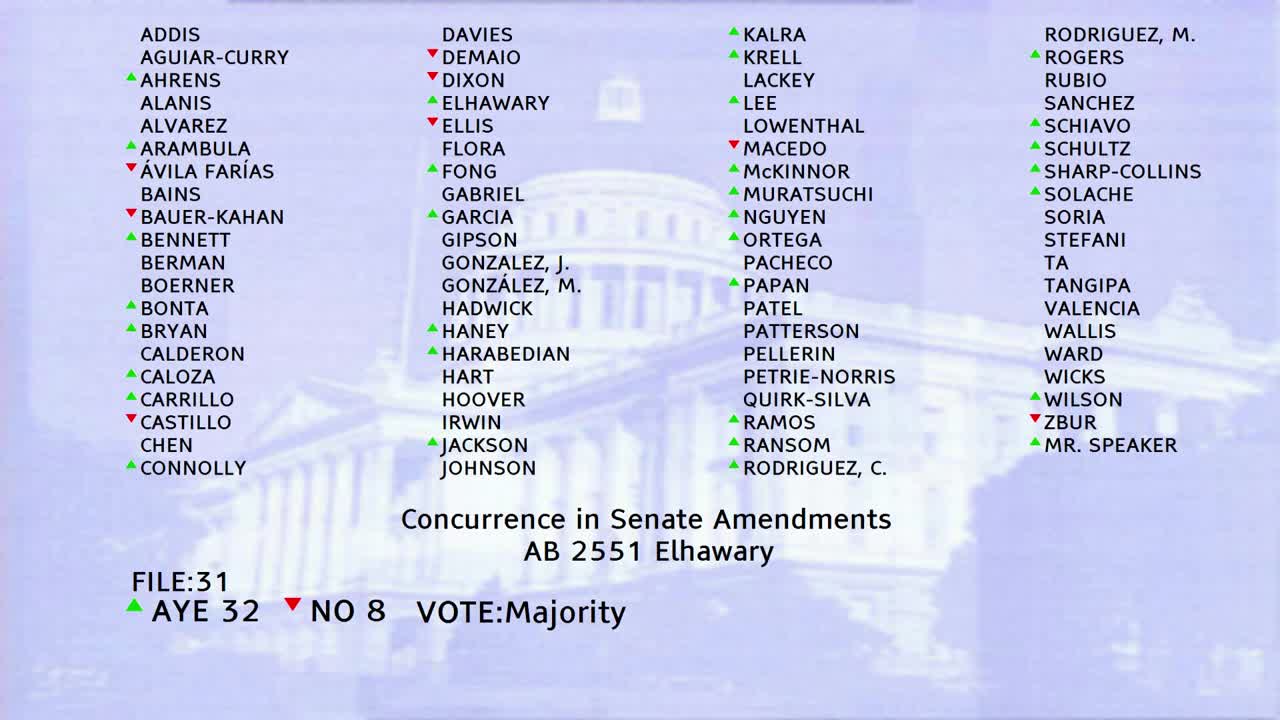 3MIN
Assembly Floor
 18MIN
Assembly Standing Committee on Public Safety
 19MIN
Assembly Standing Committee on Judiciary
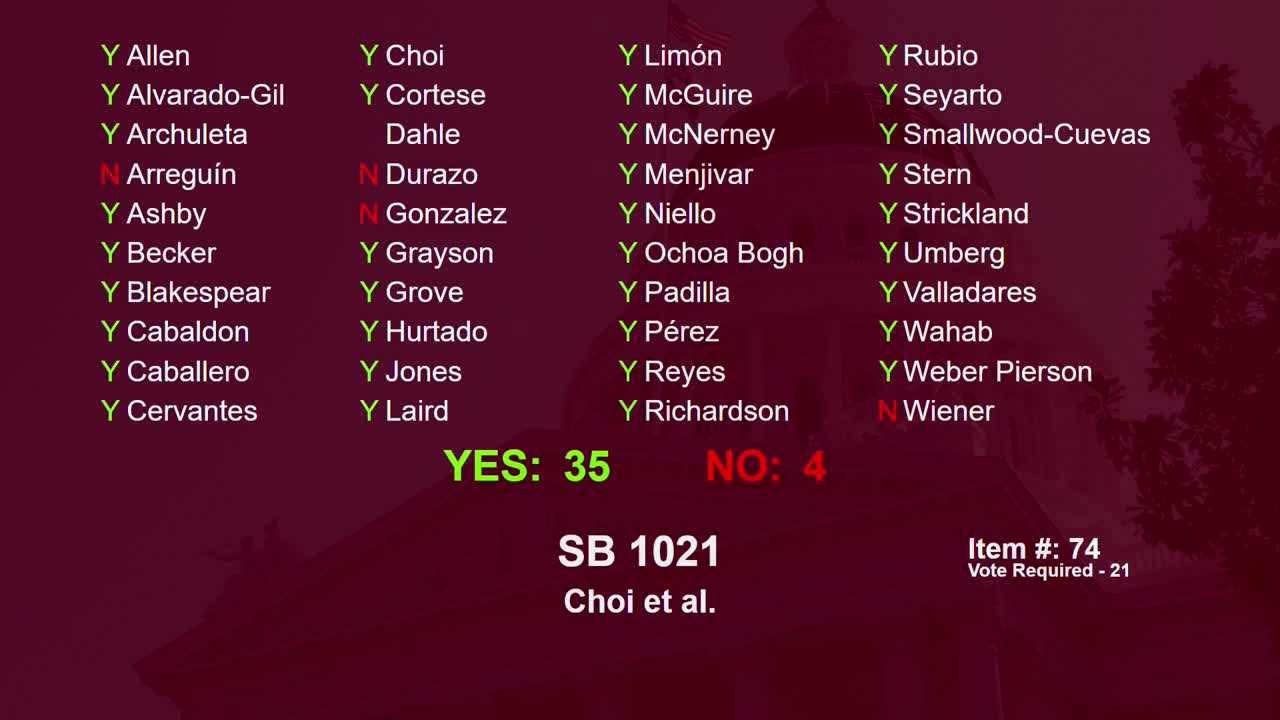 1MIN
Senate Floor
 12MIN
Senate Standing Committee on Public Safety
 11MIN
Senate Standing Committee on Judiciary
Bill Author

Bill Co-Author(s):
