SB 1370: Covered wildfire mitigation projects: consolidated and expedited review.
- Session Year: 2025-2026
- House: Senate
- Latest Version Date: 2026-09-29
Current Status:
Passed
(2026-09-29: Chaptered by Secretary of State. Chapter 777, Statutes of 2026.)
Introduced
In Committee
Awaiting First Chamber Vote
Passed First Chamber
In Committee
Awaiting Second Chamber Vote
Passed Second Chamber
Enacted
Existing law establishes in the Natural Resources Agency the Department of Forestry and Fire Protection, which is known as and may be referred to as CAL-FIRE. Existing law establishes in CAL-FIRE the Office of the State Fire Marshal and requires that office to establish the Community Wildfire Mitigation Assistance Program to coordinate regional and local efforts with state policies, strategies, and programs for community wildfire mitigation in order to improve wildfire preparedness and prevention, with an emphasis on the most vulnerable communities.
This bill would require that, notwithstanding any other law, any state-level environmental and resource permits, approvals, consultations, and reviews required for a covered wildfire mitigation project, as defined, be consolidated into a single coordinated review by a project review team, as defined, and administered jointly by the consolidated review agencies, defined as the Natural Resources Agency in coordination with the California Environmental Protection Agency. The bill would require an applicant seeking authorization to undertake a covered wildfire mitigation project to submit a single, consolidated application package to the consolidated review agencies. The bill would require a decision to be rendered by the consolidated review agencies within 60 calendar days of the consolidated review agencies deeming an application is complete, as provided, and would authorize the applicant and the consolidated review agencies to agree to extend the 60-day timeline if both parties agree to the extension. The bill would require the approvals to be in writing and to include specified information, including, among other things, a description of the project and a list of permits, agreements, consultations, or approvals waived by the review agencies authorization.
This bill would further provide for an expedited authorization, as defined, issued pursuant to these requirements, which would waive the requirement that the covered wildfire mitigation project comply with statutes, rules, regulations, and requirements, within the jurisdiction of boards, departments, commissions, offices, and agencies within the consolidated review agencies, except as provided. The expedited authorization would replace any other permit, agreement, or authorization required by state statutes, rules, regulations, and requirements that falls within the jurisdiction of boards, departments, commissions, offices, and agencies within the consolidated review agencies. The bill would require covered wildfire mitigation projects to be conducted in compliance with specified requirements and would impose a civil penalty not to exceed $10,000 for each intentional, knowing, or negligent violation, as provided. The bill would require covered wildfire mitigation projects to be limited in project size based on the type of project, as specified, and completed within 5 years, for prescribed fire projects, or 2 years, for all other projects, of approval by the consolidated review agencies. The bill would further require CAL-FIRE to provide a cost-benefit analysis to estimate a projects return on investment for risk reduction or an explanation of why an estimate could not be assigned for each department state-funded grant project. This bill would specify that the authority to issuance expedited authorizations becomes inoperative on January 1, 2029.
This bill would provide that the above-described provisions do not preclude compliance with applicable local and federal statutes, rules, and regulations.
This bill would also require, on or before July 1, 2028, the consolidated review agencies to report to the Legislature on, among other required things, the implementation of all wildfire mitigation projects that were permitted pursuant to the above-described provisions, as provided.
This bill would repeal the above provisions on January 1, 2034.
The California Environmental Quality Act (CEQA) requires a lead agency, as defined, to prepare, or cause to be prepared, and certify the completion of, an environmental impact report (EIR) on a project that it proposes to carry out or approve that may have a significant effect on the environment or to adopt a negative declaration if it finds that the project will not have that effect. CEQA also requires a lead agency to prepare a mitigated negative declaration for a project that may have a significant effect on the environment if revisions in the project would avoid or mitigate that effect and there is no substantial evidence that the project, as revised, would have a significant effect on the environment.
CEQA authorizes the Secretary of the Natural Resources Agency to certify a regulatory program that meets specified requirements as a certified regulatory program. For actions taken under a certified regulatory program, CEQA exempts those actions from certain of its provisions.
Existing law authorizes the Director of the Department of Forestry and Fire Protection to enter into an agreement for prescribed burning or other hazardous fuel reduction with any person to conduct prescribed burning operations and joint prescribed burning operations that serve the public interest and are beneficial to the state. Existing law requires, to the extent feasible, that the State Board of Forestry and Fire Protections Vegetation Treatment Program Programmatic Environmental Impact Report serve as the programmatic environmental document for prescribed fires initiated by a third party for a public purpose, as provided.
This bill would require the board to develop the Nontimber Vegetation Management Program for nontimber vegetation management activities that are not subject to specified forest practice rules for permitting of activities on local, nonfederal, private, and state-owned lands. The bill would authorize an eligible entity proposing to conduct those vegetation management activities to seek authorization under the program. The bill would require the board, on or before July 1, 2028, to adopt emergency regulations for the program, as provided, that qualifies for certification by the Secretary of the Natural Resources Agency as a certified regulatory program under CEQA and would require the board to submit those emergency regulations to the secretary for review and certification. The bill would require the board, in developing the emergency regulations to conduct no fewer than 3 public meetings to receive public comments with one of those meetings occurring in southern California. The bill would require the board, following the adoption of the emergency regulations to adopt permanent regulations in compliance with the Administrative Procedure Act before July 1, 2030. The bill would repeal these provisions on January 1, 2035.
Existing law establishes in the Natural Resources Agency the Department of Forestry and Fire Protection, which is known as and may be referred to as CAL-FIRE. Existing law establishes in CAL-FIRE the Office of the State Fire Marshal and requires that office to establish the Community Wildfire Mitigation Assistance Program to coordinate regional and local efforts with state policies, strategies, and programs for community wildfire mitigation in order to improve wildfire preparedness and prevention, with an emphasis on the most vulnerable communities.
This bill would require that, notwithstanding any other law, any state-level environmental and resource permits, approvals, consultations, and reviews required for a covered wildfire mitigation project, as defined, be consolidated into a single coordinated review by a project review team, as defined, and administered jointly by the consolidated review agencies, defined as the Natural Resources Agency in coordination with the California Environmental Protection Agency. The bill would require an applicant seeking authorization to undertake a covered wildfire mitigation project to submit a single, consolidated application package to the consolidated review agencies. The bill would require an authorization a decision to be rendered by the consolidated review agencies within 60 calendar days of receipt, the consolidated review agencies deeming an application is complete, as provided, and would authorize the applicant and the consolidated review agencies to agree to extend the 60-day timeline if both parties agree more information is required. to the extension. The bill would require the authorization approvals to be in writing and to include specified information, including, among other things, a description of the project and a list of permits, agreements, consultations, or authorizations approvals waived by the review agencies authorization.
TheThis bill would further provide for an expedited authorization, as defined, issued pursuant to these requirements, which would waive the requirement that the covered wildfire mitigation project comply with statutes, rules, regulations, and requirements, within the jurisdiction of boards, departments, commissions, offices, and agencies within the consolidated review agencies. agencies, except as provided. The expedited authorization would replace any other permit, agreement, or authorization required by state statutes, rules, regulations, and requirements that falls within the jurisdiction of boards, departments, and offices commissions, offices, and agencies within the consolidated review agencies. The bill would require covered wildfire mitigation projects to be conducted in compliance with specified requirements and would impose a civil penalty not to exceed $10,000 for each intentional, knowing, or negligent violation, as provided. The bill would require covered wildfire mitigation projects to be limited in project size based on the type of project, as specified, and completed within 2 years 5 years, for prescribed fire projects, or 2 years, for all other projects, of approval by the consolidated review agencies. The bill would further require CAL-FIRE to conduct a risk reduction cost per unit for all publicly funded projects. provide a cost-benefit analysis to estimate a projects return on investment for risk reduction or an explanation of why an estimate could not be assigned for each department state-funded grant project. This bill would specify that the authority to issuance expedited authorizations becomes inoperative on January 1, 2029.
TheThis bill would provide that the above-described provisions do not preclude compliance with applicable local and federal statutes, rules, and regulations.
TheThis bill would also require, on or before July 1, 2029, 2028, the consolidated review agencies to report to the Legislature on, among other required things, the implementation of all wildfire mitigation projects that were permitted pursuant to the above-described provisions, as provided.
This bill would make these provisions inoperative on December 31, 2030, and would repeal them as of January 1, 2031.This bill would repeal the above provisions on January 1, 2034.
The California Environmental Quality Act (CEQA) requires a lead agency, as defined, to prepare, or cause to be prepared, and certify the completion of, an environmental impact report (EIR) on a project that it proposes to carry out or approve that may have a significant effect on the environment or to adopt a negative declaration if it finds that the project will not have that effect. CEQA also requires a lead agency to prepare a mitigated negative declaration for a project that may have a significant effect on the environment if revisions in the project would avoid or mitigate that effect and there is no substantial evidence that the project, as revised, would have a significant effect on the environment.
CEQA authorizes the Secretary of the Natural Resources Agency to certify a regulatory program that meets specified requirements as a certified regulatory program. For actions taken under a certified regulatory program, CEQA exempts those actions from certain of its provisions.
Existing law authorizes the Director of the Department of Forestry and Fire Protection to enter into an agreement for prescribed burning or other hazardous fuel reduction with any person to conduct prescribed burning operations and joint prescribed burning operations that serve the public interest and are beneficial to the state. Existing law requires, to the extent feasible, that the State Board of Forestry and Fire Protections Vegetation Treatment Program Programmatic Environmental Impact Report serve as the programmatic environmental document for prescribed fires initiated by a third party for a public purpose, as provided.
This bill would require the board to develop the Nontimber Vegetation Management Program for nontimber vegetation management activities that are not subject to specified forest practice rules for permitting of activities on local, nonfederal, private, and state-owned lands. The bill would authorize an eligible entity proposing to conduct those vegetation management activities to seek authorization under the program. The bill would require the board, on or before July 1, 2028, to adopt emergency regulations for the program, as provided, that qualifies for certification by the Secretary of the Natural Resources Agency as a certified regulatory program under CEQA and would require the board to submit those emergency regulations to the secretary for review and certification. The bill would require the board, in developing the emergency regulations to conduct no fewer than 3 public meetings to receive public comments with one of those meetings occurring in southern California. The bill would require the board, following the adoption of the emergency regulations to adopt permanent regulations in compliance with the Administrative Procedure Act before July 1, 2030. The bill would repeal these provisions on January 1, 2035.
Existing law establishes in the Natural Resources Agency the Department of Forestry and Fire Protection, which is known as and may be referred to as CAL-FIRE. Existing law establishes in CAL-FIRE the Office of the State Fire Marshal and requires that office to establish the Community Wildfire Mitigation Assistance Program to coordinate regional and local efforts with state policies, strategies, and programs for community wildfire mitigation in order to improve wildfire preparedness and prevention, with an emphasis on the most vulnerable communities.
This bill would require that, notwithstanding any other law, any state-level environmental and resource permits, approvals, consultations, and reviews required for a covered wildfire mitigation project, as defined, be consolidated into a single coordinated review by a project review team, as defined, and administered jointly by the consolidated review agencies, defined as the Natural Resources Agency and in coordination with the California Environmental Protection Agency. The bill would require an applicant seeking authorization to undertake a covered wildfire mitigation project to submit a single, consolidated application package to the consolidated review agencies. The bill would require the consolidated review agencies to establish timelines to complete their review and issue a determination on a complete application. The bill would require the project to be approved an authorization to be rendered by the consolidated review agencies within 60 calendar days of receipt, as provided, and would authorize the applicant and the consolidated review agencies to agree to extend these timelines the 60-day timeline if both parties agree more information is required. The bill would require the determination authorization to be in writing and to include specified information, including, among other things, a description of the project and a list of permits, agreements, consultations, or authorizations covered by the waived by the review agencies authorization.
The bill would further provide for an expedited authorization, as defined, issued pursuant to these requirements, which would waive the requirement that the covered wildfire mitigation project comply with statutes, rules, regulations, and requirements, within the jurisdiction of boards, departments, commissions, and agencies within the consolidated review agencies. The expedited authorization would replace any other permit, agreement, or authorization required by state statutes, rules, regulations, and requirements that fall falls within the jurisdiction of boards, departments, and offices within the consolidated review agencies. The bill would require covered wildfire mitigation projects to be conducted in compliance with specified requirements and would impose a civil penalty not to exceed $10,000 for each intentional, knowing, or negligent violation, as provided. The bill would require covered wildfire mitigation projects to be less than 3,000 acres limited in project size based on the type of project, as specified, and completed within 2 years of approval by the consolidated review agencies. The bill would further require CAL-FIRE to conduct a risk reduction cost per unit for all publicly funded projects.
The bill would provide that the above-described provisions do not preclude compliance with applicable local and federal statutes, rules, and regulations.
The bill would also require, on or before July 1, 2029, the consolidated review agencies to review specified state requirements, as provided, review projects and conduct inspections and monitoring of a subset of projects to develop recommendations required pursuant to those state requirements, and post the review and recommendations on the internet websites of the consolidated review agencies. report to the Legislature on, among other required things, the implementation of all wildfire mitigation projects that were permitted pursuant to the above-described provisions, as provided.
The California Environmental Quality Act (CEQA) requires a lead agency, as defined, to prepare, or cause to be prepared, and certify the completion of an environmental impact report on a project that it proposes to carry out or approve that may have a significant effect on the environment or to adopt a negative declaration if it finds that the project will not have that effect. CEQA also requires a lead agency to prepare a mitigated negative declaration for a project that may have a significant effect on the environment if revisions in the project would avoid or mitigate that effect and there is no substantial evidence that the project, as revised, would have a significant effect on the environment.This bill would exempt a covered wildfire mitigation project authorized pursuant to these provisions from the requirements of CEQA.This bill would make these provisions inoperative on December 31, 2030, and would repeal them as of January 1, 2031.
Existing law establishes in the Natural Resources Agency the Department of Forestry and Fire Protection, which is known as and may be referred to as CAL-FIRE. Existing law establishes in CAL-FIRE the Office of the State Fire Marshal and requires that office to establish the Community Wildfire Mitigation Assistance Program to coordinate regional and local efforts with state policies, strategies, and programs for community wildfire mitigation in order to improve wildfire preparedness and prevention, with an emphasis on the most vulnerable communities.
This bill would require that, notwithstanding any other law, any state-level environmental and resource permits, approvals, consultations, and reviews required for a covered wildfire mitigation project, as defined, be consolidated into a single coordinated review administered jointly by the consolidated review agencies, defined as the Natural Resources Agency and the California Environmental Protection Agency. The bill would require an applicant seeking authorization to undertake a covered wildfire mitigation project to submit a single, consolidated application package to the consolidated review agencies. The bill would require the consolidated review agencies to establish timelines to complete their review and issue a determination on a complete application. The bill would require the project to be approved within 60 calendar days of receipt, as provided, and would authorize the applicant and the consolidated review agencies to agree to extend these timelines if both parties agree more information is required. The bill would require the determination to be in writing and to include specified information, including, among other things, a description of the project and a list of permits, agreements, or authorizations covered by the authorization.
The bill would further provide for an expedited authorization, as defined, issued pursuant to these requirements, which would waive the requirement that the covered wildfire mitigation project comply with statutes, rules, regulations, and requirements, within the jurisdiction of boards, departments, and agencies within the consolidated review agencies. The expedited authorization would replace any other permit, agreement, or authorization required by state statutes, rules, regulations, and requirements that fall within the jurisdiction of boards, departments, and offices within the consolidated review agencies. The bill would require projects to be less than 3,000 acres in project size and completed within 2 years of approval by the consolidated review agencies.
The bill would also require, on or before July 1, 2029, the consolidated review agencies to review specified state requirements, as provided, review projects and conduct inspections and monitoring of a subset of projects to develop recommendations required pursuant to those state requirements, and post the review and recommendations on the internet websites of the consolidated review agencies.
The California Environmental Quality Act (CEQA) requires a lead agency, as defined, to prepare, or cause to be prepared, and certify the completion of an environmental impact report on a project that it proposes to carry out or approve that may have a significant effect on the environment or to adopt a negative declaration if it finds that the project will not have that effect. CEQA also requires a lead agency to prepare a mitigated negative declaration for a project that may have a significant effect on the environment if revisions in the project would avoid or mitigate that effect and there is no substantial evidence that the project, as revised, would have a significant effect on the environment.
This bill would exempt a covered wildfire mitigation project authorized pursuant to these provisions from the requirements of CEQA.
Existing law establishes the Wildfire Fund, administered by the Wildfire Fund Administrator, and continuously appropriates moneys in the fund to pay eligible claims, as defined, against participating electrical corporations arising from wildfires ignited on or after July 12, 2019. Existing law requires the administrator, in consultation with the Public Utilities Commission, the Office of Energy Infrastructure Safety, the Department of Insurance, the Office of Emergency Services, and the Department of Forestry and Fire Protection, and with feedback solicited from stakeholders, to prepare and submit a report to the Legislature, on or before April 1, 2026, that evaluates and sets forth recommendations on new models or approaches that mitigate damage, accelerate recovery, and responsibly and equitably allocate the burdens from natural catastrophes across stakeholders to complement or replace the fund. Existing law requires that the report include specified recommendations including, recommendations on the accessibility and affordability of property insurance in California and an evaluation of alternative structures to socialize risk of damage from natural catastrophes, as provided.This bill would require the administrator to present those recommendations to specified Senate committees.Existing law establishes the Wildfire Fund, administered by the Wildfire Fund Administrator, and continuously appropriates moneys in the fund to pay eligible claims, as defined, against participating electrical corporations arising from wildfires ignited on or after July 12, 2019. Existing law requires the administrator, in consultation with the Public Utilities Commission, the Office of Energy Infrastructure Safety, the Department of Insurance, the Office of Emergency Services, and the Department of Forestry and Fire Protection, and with feedback solicited from stakeholders, to prepare and submit a report to the Legislature, on or before April 1, 2026, that evaluates and sets forth recommendations on new models or approaches that mitigate damage, accelerate recovery, and responsibly and equitably allocate the burdens from natural catastrophes across stakeholders to complement or replace the fund. Existing law requires that the report include specified recommendations including, recommendations on the accessibility and affordability of property insurance in California and an evaluation of alternative structures to socialize risk of damage from natural catastrophes, as provided.
This bill would require the administrator to present those recommendations to specified Senate committees.
The Legislature finds and declares all of the following:
(a)Accelerating critical wildfire prevention projects, while at the same time protecting public health and the environment, is critical for climate resiliency as well as maintaining utility operations.
(b)The California Earthquake Authoritys report, Enhancing Californias Resiliency to Natural Catastrophes, prepared pursuant to Chapter 119 of the Statutes of 2025 (Senate Bill 254), identifies the escalating risk and cost of catastrophic wildfires and calls for expanded community wildfire risk reduction, including streamlining environmental review and permitting for priority mitigation projects while maintaining appropriate environmental safeguards.
(c)Catastrophic wildfire risk and damages arise from interacting factors, including climate-driven extreme conditions, accumulated fuels, development in high-risk areas, and a range of ignition sources, and that reducing wildfire risk requires urgent, coordinated mitigation actions by communities, public agencies, tribes, resource conservation districts, nongovernmental organizations, fire safe councils, utilities, and professional land managers.
(d)To implement these risk-reduction priorities at the necessary pace and scale, it is necessary to enable the Secretaries of the Natural Resources Agency and for Environmental Protection to expedite eligible fuels reduction and ignition-risk reduction projects, conditioned on compliance with best management practices and measures in the Statewide Fuels Reduction Environmental Protection Plan to protect public health, water and air quality, cultural resources, and sensitive species and habitats.
(e)Accelerating wildfire risk reduction should incentivize vegetation management methods that effectively achieve wildfire risk reduction objectives while minimizing unnecessary impacts to water quality, soil health, ecosystem resilience, wildlife, public health, and community health.
SEC. 2.Chapter 1.8 (commencing with Section 4240) is added to Part 2 of Division 4 of the Public Resources Code, to read:1.8.Wildfire Mitigation Projects: Consolidated and Expedited Review4240.For purposes of this chapter, all of the following definitions apply:
(a)Consolidated review agencies means the Natural Resources Agency in coordination with the California Environmental Protection Agency to provide coordinated environmental and regulatory review of covered wildfire mitigation projects.
(b)(1)Covered wildfire mitigation project means any one of the following categories of activities undertaken for the purpose of reducing wildfire risk:
(A)Required by law.
(B)Identified in a utilitys wildfire mitigation plan or in a community wildfire preparedness plan or adopted by a local agency.
(C)In a plan proposed by the department.
(2)Activities that qualify as a covered wildfire mitigation project include any of the following:
(A)Removal of hazardous, dead, or dying trees.
(B)Removal of vegetation for the creation of strategic fuel breaks. A fuel break in chaparral, shrubland, grassland, and coastal sage scrub lands where less flammable or native vegetation is removed and replaced with ignition-prone or nonnative vegetation shall not be permissible pursuant to this chapter. Fuel break treatments shall not exceed 300 feet in width.
(C)Removal of vegetation for community defensible space of up to 200 feet from a structure.
(D)Removal of vegetation along roadways, highways, and freeways up to 100 feet, as measured from the center line of the roadway, for a public roadway identified as an egress and evacuation route for a community for the creation of safer ingress and egress routes for the public and first responders and to reduce roadside ignitions.
(E)Removal or modification of vegetation in forests that create more fire-resilient conditions.
(F)Removal of nonnative vegetation in chaparral, shrubland, grassland, and coastal sage scrub ecosystems.
(G)Maintenance of previously established fuel breaks.
(H)Removal of vegetation around electrical utility lines consistent with Section 4293, poles consistent with Section 4292, and rights-of-way consistent with General Order 95 or FAC-003-5 Transmission Vegetation Management of the North American Electric Reliability Corporation to reduce the risk of wildfire.
(I)Notwithstanding any plan inclusion, prescribed or cultural fire in ecosystems with a fire deficit, excluding coastal sage scrub and chaparral communities.
(c)A project that includes the use of a pesticide, as defined in Section 12753 of the Food and Agricultural Code, does not qualify as a covered wildfire mitigation project for the purposes of this chapter.
(d)Division 13 (commencing with Section 21000) does not apply to a covered wildfire mitigation project authorized pursuant to this chapter.
(e)Expedited authorization means a written decision by the Secretary for Environmental Protection or the Secretary of the Natural Resources Agency authorizing a covered wildfire mitigation project and requiring the covered wildfire mitigation project to comply with the State Environmental Protection Plan, the issuance of which waives the requirements that the covered wildfire mitigation project comply with state statutes, rules, regulations, and requirements within the jurisdiction of the boards, departments, commissions, offices, and agencies within the consolidated review agencies, to the extent necessary and for the purpose of expediting a covered wildfire mitigation project, and replaces any other permit, agreement, or authorization required or authorized by state statutes, rules, regulations, and requirements that fall within the jurisdiction of those boards, departments, commissions, offices, and agencies, including any permitting authority delegated to local governments by those entities, except as provided in paragraph (2) of subdivision (f) of Section 4241.
(f)Project review team means an interdisciplinary team led by the department, including, but not limited to, representatives from the appropriate regional water quality control board, the State Water Resources Control Board, the Department of Fish and Wildlife, the California Geological Survey, the California Coastal Commission, the Department of Conservation, and the Department of Parks and Recreation, as applicable. Further, project review team refers to a team that is tasked with evaluating proposed covered wildfire mitigation projects and assisting the consolidated review agencies in the determination of project conformance with the State Environmental Protection Plan.
(g)State Environmental Protection Plan means the Statewide Fuels Reduction Environmental Protection Plan (EPP), issued December 2025, and any subsequent updates.
4241.(a)Without limiting any other statutory exemption or categorical exemption, and notwithstanding any other law, and consistent with Executive Order No. N-38-25, any state-level environmental and resource permits, approvals, consultations, and reviews required for a covered wildfire mitigation project shall be consolidated into a single coordinated review by a project review team and administered jointly by the consolidated review agencies.
(b)(1)Timber operations, as defined in Section 4527, shall comply with the Zberg-Nejedly Forest Practice Act of 1973 (Chapter 8 (commencing with Section 4511)) and the Forest Practice Rules (Chapter 4 (commencing with Section 895) of Division 1.5 of Title 14 of the California Code of Regulations).
(2)This chapter does not affect any stipulated agreement issued by an administrative law judge for an electrical corporation or public utility regarding applicability of the Forest Practice Act Rules (Chapter 4 (commencing with Section 895) of Division 1.5 of Title 14 of the California Code of Regulations) to that utilitys operations.
(c)The consolidated review agencies shall do all of the following:
(1)Use the application process established under the State Environmental Protection Plan for entities that elect to submit a complete consolidated application package.
(2)(A)Post information about the proposed project on an internet website within five business days of the application being deemed complete.
(B)Information about the proposed project posted on an internet website shall include all state statutes, rules, regulations, and requirements proposed to be waived for the project pursuant to paragraph (2) of subdivision (d).
(C)The internet website shall include a function for the public to submit written comment on the proposed project for at least 20 days after the project is posted on the internet website.
(3)Consider all timely submitted public comments and whether any comments warrant modification of the project before approving the project.
(4)(A)Identify which proposed state statute, rule, regulation, and requirement proposed pursuant to paragraph (2) of subdivision (d) would be waived and use their sound discretion to ensure that the waiver is necessary and serves the purpose of expediting the proposed project activities while protecting public health and the environment.
(B)The consolidated review agencies shall not approve a project that requires an incidental take permit under the California Endangered Species Act (Chapter 1.5 (commencing with Section 2050) of Division 3 of the Fish and Game Code) or the Native Plant Protection Act (Chapter 10 (commencing with Section 1900) of Division 2 of the Fish and Game Code).
(d)(1)An entity seeking to complete a wildfire mitigation project requiring state authorization may apply for an expedited authorization pursuant to this chapter. An applicant seeking state authorization to undertake a covered wildfire mitigation project shall submit a single, consolidated application package to the consolidated review agencies. An applicant shall have a legal entitlement to enter the property on which the wildfire mitigation project is performed or consent of landowner of record of that property.
(2)The applicant shall propose the full list of state statutes, rules, regulations, and requirements within the jurisdiction of the boards, departments, commissions, offices, and agencies within the consolidated review agencies to be waived or suspended for the purpose of expediting a proposed covered wildfire mitigation project in the consolidated application package.
(3)A decision shall be rendered by the consolidated review agencies within 60 calendar days of the consolidated review agencies deeming an application is complete. The applicant and the consolidated review agencies may agree to extend the 60-day timeline if both parties agree to the extension.
(e)If the consolidated review agencies authorize a project under this section, the approvals shall be in writing and shall include all of the following:
(1)A description of the project.
(2)The basis for eligibility.
(3)A list of state statutes, rules, regulations, requirements, permits, agreements, consultations, or approvals waived by the review agencies authorization.
(4)The required environmental protection measures, including documentation that the covered wildfire mitigation project will comply with the State Environmental Protection Plan and project-specific best management practices.
(f)(1)Except as provided in paragraph (2), an expedited authorization issued pursuant to this chapter waives the requirement that the covered wildfire mitigation project comply with state statutes, rules, regulations, and requirements, within the jurisdiction of boards, departments, commissions, offices, and agencies within the consolidated review agencies, as determined by subparagraph (A) of paragraph (4) of subdivision (c), and replaces any other permit, agreement, or authorization required by state statutes, rules, regulations, and requirements that fall within the jurisdiction of boards, departments, and offices within the consolidated review agencies.
(2)This section does not apply to either of the following:
(A)A permit issued by a state agency pursuant to program authorization or primary enforcement responsibility under the federal Clean Water Act (33 U.S.C. Sec. 1251 et seq.) or other federal law.
(B)Any permit or other requirement of Division 2 (commencing with Section 1000) of the Water Code.
(g)(1)Any covered wildfire mitigation project shall be conducted in compliance with the State Environmental Protection Plan and the associated best management practices. Any person who intentionally, knowingly, or negligently violates any provision of the State Environmental Protection Plan is subject to a civil penalty imposed by a court in an amount not to exceed ten thousand dollars ($10,000) for each violation. For purposes of this section, natural resource damage that occurs over multiple days that results from a single action shall not be considered a continuing violation.
(2)For purposes of this section, each specific act that results in a violation of the State Environmental Protection Plan, including an act that is repeated on separate days, shall be considered a separate violation.
(3)The Attorney General or district attorney, upon request of the director or any agencies, board, commission, departments, and offices, within the consolidated review agencies with jurisdiction over these projects, shall petition the superior court to impose, assess, and recover a civil penalty pursuant to this subdivision.
(4)In determining the appropriate amount, the court shall consider all relevant circumstances, including, but not limited to, persistence, circumstances, extent and gravity of the violation, the length of the time over which the violation occurred, whether any substantial damage caused by the violation is susceptible to corrective action, whether the violation was willful or caused by negligence, and, with respect to the violator, the ability of the violator to pay any fines or penalties, the effect on the ability to continue in business, the corrective action, if any, taken by the violator, whether the violator has any prior history of violations, the degree of culpability, economic savings, if any, resulting from the violation, and other matters as justice may require.
(5)Any money recovered by the department pursuant to this section shall be deposited in the General Fund.
(6)For purposes of this subdivision, person includes a private individual, organization, partnership, corporation, limited liability company, city, county, district, or the state or any department or agency of a city, county, district, or the state.
(h)The consolidated review agencies may require additional environmental protection measures where the measures are reasonably necessary to protect the resources present in the project area or affected by the project, or mitigate the impact on those resources.
(i)(1)Covered wildfire mitigation projects shall be limited to the following sizes and completed within two years of approval by the consolidated review agencies. Prescribed fire projects shall have up to five years from approval by the consolidated review agencies to be completed.
(2)Projects that maintain right-of-way and maintain existing fuel breaks along utility infrastructure shall be less than 3,000 acres.
(3)Projects in forests to improve ecosystem health shall be less than 1,000 acres.
(4)Projects in chaparral, shrubland, grassland, and coastal sage scrub to remove flammable nonnative grasses and herbaceous plants shall be less than 50 acres.
(j)Except for defensible space, roadside, and fuel breaks, where conversion to bare ground or mowed vegetation is the desired project outcome, project activities in native chaparral and coastal sage scrub that could lead to type conversion shall be avoided.
(k)For each department statefunded grant project, the department shall provide a cost-benefit analysis to estimate the projects return on investment for risk reduction or an explanation of why an estimate could not be assigned to a particular project.
(l)(1)This chapter does not authorize a project that is inconsistent with any applicable local ordinance or regulation. Compliance with applicable local requirements shall be a condition of expedited authorization, and a project that is inconsistent with applicable local requirements shall not qualify for expedited authorization.
(2)This chapter does not affect the applicability of federal statutes, rules, and regulations.
4242.On or before July 1, 2028, the consolidated review agencies shall, in accordance with Section 9795 of the Government Code, report to the Legislature on the implementation of all wildfire mitigation projects that were permitted in compliance with the Statewide Environmental Protection Plan as authorized by this chapter. The reports shall contain all of the following information:
(a)Information about instances in which any project failed to comply with the Statewide Fuels Reduction Environmental Protection Plan.
(b)Information on violations of permit requirements and details of enforcement actions, including any challenges with exercise of state authority to protect resources.
(c)Information on adequacy of staff resources to implement the program, and the impact on other department and agency priorities by redirecting internal staff resources.
(d)The total number of expedited projects approved.
(e)The location and acreage of each approved project.
4243.(a)The authority for the issuance of an expedited authorization shall become inoperative on January 1, 2029.
(b)This chapter shall remain in effect only until January 1, 2034, and as of that date is repealed.
SEC. 3.Article 8.5 (commencing with Section 4745) is added to Chapter 10 of Part 2 of Division 4 of the Public Resources Code, to read:8.5.Nontimber Vegetation Management Program4745.The Legislature finds and declares all of the following:
(a)Accelerating community wildfire resilience is critical for the protection and enhancement of public health and the environment.
(b)Catastrophic wildfire adversely impacts the residents of the state, climate and air quality, fish and wildlife, biodiversity, public recreation opportunities, and Californias economy.
(c)The board and the department, in coordination with relevant state agencies and departments with overlapping jurisdiction, are the appropriate bodies to regulate the conduct of nontimber vegetation management activities on local, nonfederal, private, and state-owned lands.
(d)Protection of the environment is a principal purpose of the certified regulatory program defined pursuant to Section 4746. The program shall ensure that nontimber vegetation management activities are planned, designed, and conducted in a manner that protects environmental resources and ecological functions, including fish and wildlife, native vegetation, water quality, sensitive habitats and ecosystems, and cultural resources, and avoids or minimizes adverse environmental impacts consistent with the standards established pursuant to Section 4746.
(e)This article does not require or otherwise limit wildfire mitigation projects to be permitted through alternative pathways.
4746.For purposes of this article, both of the following definitions apply:
(a)Certified regulatory program means a program that is certified by the Secretary of the Natural Resources Agency pursuant to Section 21080.5.
(b)Program means the Nontimber Vegetation Management Program developed pursuant to Section 4747.
4747.(a)The board shall develop and implement the Nontimber Vegetation Management Program to provide an additional pathway for authorizing vegetation management activities that are not subject to the Forest Practice Rules (Chapter 4 (commencing with Section 895) of Division 1.5 of Title 14 of the California Code of Regulations) on local, nonfederal, private, and state-owned lands.
(b)An eligible entity seeking to conduct vegetation management activities that are not subject to the Forest Practices Rules (Chapter 4 (commencing with Section 895) of Division 1.5 of Title 14 of the California Code of Regulations) may seek authorization under the program.
4748.(a)(1)On or before July 1, 2028, the board shall adopt emergency regulations pursuant to Section 11346.1 of the Government Code for the program, excluding coastal sage scrub and chaparral communities, and submit those regulations to the Secretary of the Natural Resources Agency for review and certification of the program as a certified regulatory program. The board shall consult with departments, boards, and commissions in the development of the emergency regulations. The board is authorized to adopt permitting options for conducting operations under the program.
(2)The emergency regulations adopted pursuant to this section shall incorporate and fully satisfy all applicable requirements and criteria set forth in subdivision (d) of Section 21080.5.
(3)The board shall conduct no fewer than three public meetings to receive public comment on the development of the emergency regulations. One of those meetings shall occur in southern California.
(4)To inform the development of the emergency regulations for the program, the board shall rely upon relevant standards of the Forest Practice Rules (Chapter 4 (commencing with Section 895) of Division 1.5 of Title 14 of the California Code of Regulations), including, but not limited to, standards for the protection of watercourses and lakes, cultural and historical resources, fish and wildlife, and Coastal Commission Special Treatment Areas, and for hazard reduction, erosion control, construction and reconstruction of roads and watercourse crossings, and fire protection.
(5)(A)The emergency regulations shall establish which eligible entities may use the program for nontimber vegetation management on local, nonfederal, private, and state-owned lands. The board shall determine which types of wildfire resilience projects may be eligible under program.
(B)The board has the authority to adopt one or more new authorizations, licenses, permits, or certification types, as needed, for conduct of operations under the program.
(C)The board shall adopt civil penalties and enforcement provisions substantially similar to those in Article 8 (commencing with Section 4601) of Chapter 8 for violations of the program requirements.
(b)After the Secretary of the Natural Resources Agencys certification of the program as a certified regulatory program, permitting documents shall be developed by, and filed with, the department for the authorization of nontimber vegetation treatment activities.
(c)The department and board shall consult with departments, boards, and commissions responsible for state-owned lands, and shall work collaboratively with those departments, boards, and commissions to develop regulatory procedures including protective measures that address the underlying resource values for which these lands have been set aside, including maintaining existing protections for environmentally sensitive habitats and ecosystems.
(d)Notwithstanding subdivisions (e) and (h) of Section 11346.1 of the Government Code, emergency regulations adopted pursuant to this section shall remain in effect until the earlier of either of the following:
(1)The effective date of permanent regulations adopted pursuant to subdivision (e).
(2)July 1, 2030.
(e)Following the adoption of emergency regulations pursuant to this section, the board shall adopt permanent regulations in accordance with Chapter 3.5 (commencing with Section 11340) of Part 1 of Division 3 of Title 2 of the Government Code. The board shall complete the environmental review required by Division 13 (commencing with Section 21000) for the permanent regulations and shall adopt permanent regulations sufficiently in advance of July 1, 2030.
(f)The adoption or readoption of the emergency regulations described in this section shall not constitute a project for purposes of Division 13 (commencing with Section 21000). This subdivision does not apply to the adoption of permanent regulations pursuant to subdivision (e).
(g)An action or proceeding brought pursuant to Division 13 (commencing with Section 21000) challenging the adoption of, or certification, as a certified regulatory program, of the permanent regulations required by this section, including any appeal therefrom, shall be resolved, to the extent feasible, within 270 days after the filing of the certified record of proceedings with the court.
(h)(1)On or before June 30, 2027, the board, in cooperation with the department, the Department of Conservation, and the Wildfire and Forest Resilience Task Force, shall provide a report to the Secretary of the Natural Resources Agency and the Legislature describing how the proposed program would provide for a coherent and user-friendly permitting framework for vegetation management in conjunction with existing frameworks, such as the Vegetation Treatment Program, and other permitting mechanisms and exclusions. The report may identify opportunities for improvement in the permitting framework and integration with regional planning and prioritization efforts.
(2)The report required to be submitted to the Legislature pursuant to paragraph (1) shall be submitted in accordance with Section 9795 of the Government Code.
(i)On or before December 31, 2027, the board shall report to the Secretary of the Natural Resources Agency on the progress of emergency rulemaking pursuant to this section.
(j)On or before December 31, 2028, the board shall report to the Secretary of the Natural Resources Agency on the progress of permanent rulemaking pursuant to this section.
(k)On or before December 31, 2028, and annually thereafter, the department shall report to the board on the use of program, including the number of acres treated, compliance with the boards rules, and any recommendations to improve their use.
4749.This article shall remain in effect only until January 1, 2035, and as of that date is repealed.
The Legislature finds and declares all of the following:
(a)Accelerating critical wildfire prevention projects, while at the same time protecting public health and the environment, is critical for climate resiliency as well as maintaining utility operations.
(b)The California Earthquake Authoritys report, Enhancing Californias Resiliency to Natural Catastrophes, prepared pursuant to Chapter 119 of the Statutes of 2025 (Senate Bill 254), identifies the escalating risk and cost of catastrophic wildfires and calls for expanded community wildfire risk reduction, including streamlining environmental review and permitting for priority mitigation projects while maintaining appropriate environmental safeguards.
(c)Catastrophic wildfire risk and damages arise from interacting factors, including climate-driven extreme conditions, accumulated fuels, development in high-risk areas, and a range of ignition sources, and that reducing wildfire risk requires urgent, coordinated mitigation actions by communities, public agencies, tribes, resource conservation districts, nongovernmental organizations, fire safe councils, utilities, and professional land managers.
(d)To implement these risk-reduction priorities at the necessary pace and scale, it is necessary to enable the Secretaries of the Natural Resources Agency and for Environmental Protection to expedite eligible fuels reduction and ignition-risk reduction projects, conditioned on compliance with best management practices and measures in the Statewide Fuels Reduction Environmental Protection Plan to protect public health, water and air quality, cultural resources, and sensitive species and habitats.
(e)Accelerating wildfire risk reduction should incentivize vegetation management methods that effectively achieve wildfire risk reduction objectives while minimizing unnecessary impacts to water quality, soil health, ecosystem resilience, wildlife, public health, and community health.
SEC. 2.Chapter 1.8 (commencing with Section 4240) is added to Part 2 of Division 4 of the Public Resources Code, to read:1.8.Wildfire Mitigation Projects: Consolidated and Expedited Review4240.For purposes of this chapter, all of the following definitions apply:
(a)Consolidated review agencies means the Natural Resources Agency in coordination with the California Environmental Protection Agency to provide coordinated environmental and regulatory review of covered wildfire mitigation projects.
(b)(1)Covered wildfire mitigation project means any one of the following categories of activities undertaken for the purpose of reducing wildfire risk:
(A)Required by law.
(B)Identified in a utilitys wildfire mitigation plan or in a community wildfire preparedness plan or adopted by a local agency.
(C)In a plan proposed by the department.
(2)Activities that qualify as a covered wildfire mitigation project include any of the following:
(A)Removal of hazardous, dead, or dying trees.
(B)Removal of vegetation for the creation of strategic fuel breaks. A fuel break in chaparral, shrubland, grassland, and coastal sage scrub lands where less flammable or native vegetation is removed and replaced with ignition-prone or nonnative vegetation shall not be permissible pursuant to this chapter. Fuel break treatments shall not exceed 300 feet in width.
(C)Removal of vegetation for community defensible space of up to 200 feet from a structure.
(D)Removal of vegetation along roadways, highways, and freeways up to 100 feet, as measured from the center line of the roadway, for a public roadway identified as an egress and evacuation route for a community for the creation of safer ingress and egress routes for the public and first responders and to reduce roadside ignitions.
(E)Removal or modification of vegetation in forests that create more fire-resilient conditions.
(F)Removal of nonnative vegetation in chaparral, shrubland, grassland, and coastal sage scrub ecosystems.
(G)Maintenance of previously established fuel breaks.
(H)Removal of vegetation around electrical utility lines consistent with Section 4293, poles consistent with Section 4292, and rights-of-way consistent with General Order 95 or FAC-003-5 Transmission Vegetation Management of the North American Electric Reliability Corporation to reduce the risk of wildfire.
(I)Notwithstanding any plan inclusion, prescribed or cultural fire in ecosystems with a fire deficit, excluding coastal sage scrub and chaparral communities.
(c)A project that includes the use of a pesticide, as defined in Section 12753 of the Food and Agricultural Code, does not qualify as a covered wildfire mitigation project for the purposes of this chapter.
(d)Division 13 (commencing with Section 21000) does not apply to a covered wildfire mitigation project authorized pursuant to this chapter.
(e)Expedited authorization means a written decision by the Secretary for Environmental Protection or the Secretary of the Natural Resources Agency authorizing a covered wildfire mitigation project and requiring the covered wildfire mitigation project to comply with the State Environmental Protection Plan, the issuance of which waives the requirements that the covered wildfire mitigation project comply with state statutes, rules, regulations, and requirements within the jurisdiction of the boards, departments, commissions, offices, and agencies within the consolidated review agencies, to the extent necessary and for the purpose of expediting a covered wildfire mitigation project, and replaces any other permit, agreement, or authorization required or authorized by state statutes, rules, regulations, and requirements that fall within the jurisdiction of those boards, departments, commissions, offices, and agencies, including any permitting authority delegated to local governments by those entities, except as provided in paragraph (2) of subdivision (f) of Section 4241.
(f)Project review team means an interdisciplinary team led by the department, including, but not limited to, representatives from the appropriate regional water quality control board, the State Water Resources Control Board, the Department of Fish and Wildlife, the California Geological Survey, the California Coastal Commission, the Department of Conservation, and the Department of Parks and Recreation, as applicable. Further, project review team refers to a team that is tasked with evaluating proposed covered wildfire mitigation projects and assisting the consolidated review agencies in the determination of project conformance with the State Environmental Protection Plan.
(g)State Environmental Protection Plan means the Statewide Fuels Reduction Environmental Protection Plan (EPP), issued December 2025, and any subsequent updates.
4241.(a)Without limiting any other statutory exemption or categorical exemption, and notwithstanding any other law, and consistent with Executive Order No. N-38-25, any state-level environmental and resource permits, approvals, consultations, and reviews required for a covered wildfire mitigation project shall be consolidated into a single coordinated review by a project review team and administered jointly by the consolidated review agencies.
(b)(1)Timber operations, as defined in Section 4527, shall comply with the Zberg-Nejedly Forest Practice Act of 1973 (Chapter 8 (commencing with Section 4511)) and the Forest Practice Rules (Chapter 4 (commencing with Section 895) of Division 1.5 of Title 14 of the California Code of Regulations).
(2)This chapter does not affect any stipulated agreement issued by an administrative law judge for an electrical corporation or public utility regarding applicability of the Forest Practice Act Rules (Chapter 4 (commencing with Section 895) of Division 1.5 of Title 14 of the California Code of Regulations) to that utilitys operations.
(c)The consolidated review agencies shall do all of the following:
(1)Use the application process established under the State Environmental Protection Plan for entities that elect to submit a complete consolidated application package.
(2)(A)Post information about the proposed project on an internet website within five business days of the application being deemed complete.
(B)Information about the proposed project posted on an internet website shall include all state statutes, rules, regulations, and requirements proposed to be waived for the project pursuant to paragraph (2) of subdivision (d).
(C)The internet website shall include a function for the public to submit written comment on the proposed project for at least 20 days after the project is posted on the internet website.
(3)Consider all timely submitted public comments and whether any comments warrant modification of the project before approving the project.
(4)(A)Identify which proposed state statute, rule, regulation, and requirement proposed pursuant to paragraph (2) of subdivision (d) would be waived and use their sound discretion to ensure that the waiver is necessary and serves the purpose of expediting the proposed project activities while protecting public health and the environment.
(B)The consolidated review agencies shall not approve a project that requires an incidental take permit under the California Endangered Species Act (Chapter 1.5 (commencing with Section 2050) of Division 3 of the Fish and Game Code) or the Native Plant Protection Act (Chapter 10 (commencing with Section 1900) of Division 2 of the Fish and Game Code).
(d)(1)An entity seeking to complete a wildfire mitigation project requiring state authorization may apply for an expedited authorization pursuant to this chapter. An applicant seeking state authorization to undertake a covered wildfire mitigation project shall submit a single, consolidated application package to the consolidated review agencies. An applicant shall have a legal entitlement to enter the property on which the wildfire mitigation project is performed or consent of landowner of record of that property.
(2)The applicant shall propose the full list of state statutes, rules, regulations, and requirements within the jurisdiction of the boards, departments, commissions, offices, and agencies within the consolidated review agencies to be waived or suspended for the purpose of expediting a proposed covered wildfire mitigation project in the consolidated application package.
(3)A decision shall be rendered by the consolidated review agencies within 60 calendar days of the consolidated review agencies deeming an application is complete. The applicant and the consolidated review agencies may agree to extend the 60-day timeline if both parties agree to the extension.
(e)If the consolidated review agencies authorize a project under this section, the approvals shall be in writing and shall include all of the following:
(1)A description of the project.
(2)The basis for eligibility.
(3)A list of state statutes, rules, regulations, requirements, permits, agreements, consultations, or approvals waived by the review agencies authorization.
(4)The required environmental protection measures, including documentation that the covered wildfire mitigation project will comply with the State Environmental Protection Plan and project-specific best management practices.
(f)(1)Except as provided in paragraph (2), an expedited authorization issued pursuant to this chapter waives the requirement that the covered wildfire mitigation project comply with state statutes, rules, regulations, and requirements, within the jurisdiction of boards, departments, commissions, offices, and agencies within the consolidated review agencies, as determined by subparagraph (A) of paragraph (4) of subdivision (c), and replaces any other permit, agreement, or authorization required by state statutes, rules, regulations, and requirements that fall within the jurisdiction of boards, departments, and offices within the consolidated review agencies.
(2)This section does not apply to either of the following:
(A)A permit issued by a state agency pursuant to program authorization or primary enforcement responsibility under the federal Clean Water Act (33 U.S.C. Sec. 1251 et seq.) or other federal law.
(B)Any permit or other requirement of Division 2 (commencing with Section 1000) of the Water Code.
(g)(1)Any covered wildfire mitigation project shall be conducted in compliance with the State Environmental Protection Plan and the associated best management practices. Any person who intentionally, knowingly, or negligently violates any provision of the State Environmental Protection Plan is subject to a civil penalty imposed by a court in an amount not to exceed ten thousand dollars ($10,000) for each violation. For purposes of this section, natural resource damage that occurs over multiple days that results from a single action shall not be considered a continuing violation.
(2)For purposes of this section, each specific act that results in a violation of the State Environmental Protection Plan, including an act that is repeated on separate days, shall be considered a separate violation.
(3)The Attorney General or district attorney, upon request of the director or any agencies, board, commission, departments, and offices, within the consolidated review agencies with jurisdiction over these projects, shall petition the superior court to impose, assess, and recover a civil penalty pursuant to this subdivision.
(4)In determining the appropriate amount, the court shall consider all relevant circumstances, including, but not limited to, persistence, circumstances, extent and gravity of the violation, the length of the time over which the violation occurred, whether any substantial damage caused by the violation is susceptible to corrective action, whether the violation was willful or caused by negligence, and, with respect to the violator, the ability of the violator to pay any fines or penalties, the effect on the ability to continue in business, the corrective action, if any, taken by the violator, whether the violator has any prior history of violations, the degree of culpability, economic savings, if any, resulting from the violation, and other matters as justice may require.
(5)Any money recovered by the department pursuant to this section shall be deposited in the General Fund.
(6)For purposes of this subdivision, person includes a private individual, organization, partnership, corporation, limited liability company, city, county, district, or the state or any department or agency of a city, county, district, or the state.
(h)The consolidated review agencies may require additional environmental protection measures where the measures are reasonably necessary to protect the resources present in the project area or affected by the project, or mitigate the impact on those resources.
(i)(1)Covered wildfire mitigation projects shall be limited to the following sizes and completed within two years of approval by the consolidated review agencies. Prescribed fire projects shall have up to five years from approval by the consolidated review agencies to be completed.
(2)Projects that maintain right-of-way and maintain existing fuel breaks along utility infrastructure shall be less than 3,000 acres.
(3)Projects in forests to improve ecosystem health shall be less than 1,000 acres.
(4)Projects in chaparral, shrubland, grassland, and coastal sage scrub to remove flammable nonnative grasses and herbaceous plants shall be less than 50 acres.
(j)Except for defensible space, roadside, and fuel breaks, where conversion to bare ground or mowed vegetation is the desired project outcome, project activities in native chaparral and coastal sage scrub that could lead to type conversion shall be avoided.
(k)For each department statefunded grant project, the department shall provide a cost-benefit analysis to estimate the projects return on investment for risk reduction or an explanation of why an estimate could not be assigned to a particular project.
(l)(1)This chapter does not authorize a project that is inconsistent with any applicable local ordinance or regulation. Compliance with applicable local requirements shall be a condition of expedited authorization, and a project that is inconsistent with applicable local requirements shall not qualify for expedited authorization.
(2)This chapter does not affect the applicability of federal statutes, rules, and regulations.
4242.On or before July 1, 2028, the consolidated review agencies shall, in accordance with Section 9795 of the Government Code, report to the Legislature on the implementation of all wildfire mitigation projects that were permitted in compliance with the Statewide Environmental Protection Plan as authorized by this chapter. The reports shall contain all of the following information:
(a)Information about instances in which any project failed to comply with the Statewide Fuels Reduction Environmental Protection Plan.
(b)Information on violations of permit requirements and details of enforcement actions, including any challenges with exercise of state authority to protect resources.
(c)Information on adequacy of staff resources to implement the program, and the impact on other department and agency priorities by redirecting internal staff resources.
(d)The total number of expedited projects approved.
(e)The location and acreage of each approved project.
4243.(a)The authority for the issuance of an expedited authorization shall become inoperative on January 1, 2029.
(b)This chapter shall remain in effect only until January 1, 2034, and as of that date is repealed.
SEC. 3.Article 8.5 (commencing with Section 4745) is added to Chapter 10 of Part 2 of Division 4 of the Public Resources Code, to read:8.5.Nontimber Vegetation Management Program4745.The Legislature finds and declares all of the following:
(a)Accelerating community wildfire resilience is critical for the protection and enhancement of public health and the environment.
(b)Catastrophic wildfire adversely impacts the residents of the state, climate and air quality, fish and wildlife, biodiversity, public recreation opportunities, and Californias economy.
(c)The board and the department, in coordination with relevant state agencies and departments with overlapping jurisdiction, are the appropriate bodies to regulate the conduct of nontimber vegetation management activities on local, nonfederal, private, and state-owned lands.
(d)Protection of the environment is a principal purpose of the certified regulatory program defined pursuant to Section 4746. The program shall ensure that nontimber vegetation management activities are planned, designed, and conducted in a manner that protects environmental resources and ecological functions, including fish and wildlife, native vegetation, water quality, sensitive habitats and ecosystems, and cultural resources, and avoids or minimizes adverse environmental impacts consistent with the standards established pursuant to Section 4746.
(e)This article does not require or otherwise limit wildfire mitigation projects to be permitted through alternative pathways.
4746.For purposes of this article, both of the following definitions apply:
(a)Certified regulatory program means a program that is certified by the Secretary of the Natural Resources Agency pursuant to Section 21080.5.
(b)Program means the Nontimber Vegetation Management Program developed pursuant to Section 4747.
4747.(a)The board shall develop and implement the Nontimber Vegetation Management Program to provide an additional pathway for authorizing vegetation management activities that are not subject to the Forest Practice Rules (Chapter 4 (commencing with Section 895) of Division 1.5 of Title 14 of the California Code of Regulations) on local, nonfederal, private, and state-owned lands.
(b)An eligible entity seeking to conduct vegetation management activities that are not subject to the Forest Practices Rules (Chapter 4 (commencing with Section 895) of Division 1.5 of Title 14 of the California Code of Regulations) may seek authorization under the program.
4748.(a)(1)On or before July 1, 2028, the board shall adopt emergency regulations pursuant to Section 11346.1 of the Government Code for the program program, excluding coastal sage scrub and chaparral communities, and submit those regulations to the Secretary of the Natural Resources Agency for review and certification of the program as a certified regulatory program. The board shall consult with departments, boards, and commissions in the development of the emergency regulations. The board is authorized to adopt permitting options for conducting operations under the program.
(2)The emergency regulations adopted pursuant to this section shall incorporate and fully satisfy all applicable requirements and criteria set forth in subdivision (d) of Section 21080.5.
(3)The board shall conduct no fewer than three public meetings to receive public comment on the development of the emergency regulations. One of those meetings shall occur in southern California.
(4)To inform the development of the emergency regulations for the program, the board shall rely upon relevant standards of the Forest Practice Rules (Chapter 4 (commencing with Section 895) of Division 1.5 of Title 14 of the California Code of Regulations), including, but not limited to, standards for the protection of watercourses and lakes, cultural and historical resources, fish and wildlife, and Coastal Commission Special Treatment Areas, and for hazard reduction, erosion control, construction and reconstruction of roads and watercourse crossings, and fire protection.
(5)(A)The emergency regulations shall establish which eligible entities may use the program for nontimber vegetation management on local, nonfederal, private, and state-owned lands. The board shall determine which types of wildfire resilience projects may be eligible under program.
(B)The board has the authority to adopt one or more new authorizations, licenses, permits, or certification types, as needed, for conduct of operations under the program.
(C)The board shall adopt civil penalties and enforcement provisions substantially similar to those in Article 8 (commencing with Section 4601) of Chapter 8 for violations of the program requirements.
(b)After the Secretary of the Natural Resources Agencys certification of the program as a certified regulatory program, permitting documents shall be developed by, and filed with, the department for the authorization of nontimber vegetation treatment activities.
(c)The department and board shall consult with departments, boards, and commissions responsible for state-owned lands, and shall work collaboratively with those departments, boards, and commissions to develop regulatory procedures including protective measures that address the underlying resource values for which these lands have been set aside, including maintaining existing protections for environmentally sensitive habitats and ecosystems.
(d)Notwithstanding subdivisions (e) and (h) of Section 11346.1 of the Government Code, emergency regulations adopted pursuant to this section shall remain in effect until the earlier of either of the following:
(1)The effective date of permanent regulations adopted pursuant to subdivision (e).
(2)July 1, 2030.
(e)Following the adoption of emergency regulations pursuant to this section, the board shall adopt permanent regulations in accordance with Chapter 3.5 (commencing with Section 11340) of Part 1 of Division 3 of Title 2 of the Government Code. The board shall complete the environmental review required by Division 13 (commencing with Section 21000) for the permanent regulations and shall adopt permanent regulations sufficiently in advance of July 1, 2030.
(f)The adoption or readoption of the emergency regulations described in this section shall not constitute a project for purposes of Division 13 (commencing with Section 21000). This subdivision does not apply to the adoption of permanent regulations pursuant to subdivision (e).
(g)An action or proceeding brought pursuant to Division 13 (commencing with Section 21000) challenging the adoption of, or certification, as a certified regulatory program, of the permanent regulations required by this section, including any appeal therefrom, shall be resolved, to the extent feasible, within 270 days after the filing of the certified record of proceedings with the court.
(h)(1)On or before June 30, 2027, the board, in cooperation with the department, the Department of Conservation, and the Wildfire and Forest Resilience Task Force, shall provide a report to the Secretary of the Natural Resources Agency and the Legislature describing how the proposed program would provide for a coherent and user-friendly permitting framework for vegetation management in conjunction with existing frameworks, such as the Vegetation Treatment Program, and other permitting mechanisms and exclusions. The report may identify opportunities for improvement in the permitting framework and integration with regional planning and prioritization efforts.
(2)The report required to be submitted to the Legislature pursuant to paragraph (1) shall be submitted in accordance with Section 9795 of the Government Code.
(i)On or before December 31, 2027, the board shall report to the Secretary of the Natural Resources Agency on the progress of emergency rulemaking pursuant to this section.
(j)On or before December 31, 2028, the board shall report to the Secretary of the Natural Resources Agency on the progress of permanent rulemaking pursuant to this section.
(k)On or before December 31, 2028, and annually thereafter, the department shall report to the board on the use of program, including the number of acres treated, compliance with the boards rules, and any recommendations to improve their use.
4749.This article shall remain in effect only until January 1, 2035, and as of that date is repealed.
The Legislature finds and declares all of the following:
(a)Accelerating critical wildfire prevention projects, while at the same time protecting public health and the environment, is critical for climate resiliency as well as maintaining utility operations.
(b)The California Earthquake Authoritys report, Enhancing Californias Resiliency to Natural Catastrophes, prepared pursuant to Chapter 119 of the Statutes of 2025 (Senate Bill 254), identifies the escalating risk and cost of catastrophic wildfires and calls for expanded community wildfire risk reduction, including streamlining environmental review and permitting for priority mitigation projects while maintaining appropriate environmental safeguards.
(c)Catastrophic wildfire risk and damages arise from interacting factors, including climate-driven extreme conditions, accumulated fuels, development in high-risk areas, and a range of ignition sources, and that reducing wildfire risk requires urgent, coordinated mitigation actions by communities, public agencies, tribes, resource conservation districts, nongovernmental organizations, fire safe councils, utilities, and professional land managers.
(d)To implement these risk-reduction priorities at the necessary pace and scale, it is necessary to enable the Secretaries of the Natural Resources Agency and for Environmental Protection to expedite eligible fuels reduction and ignition-risk reduction projects, conditioned on compliance with best management practices and measures in the Statewide Fuels Reduction Environmental Protection Plan to protect public health, water and air quality, cultural resources, and sensitive species and habitats.
(e)Accelerating wildfire risk reduction should incentivize vegetation management methods that effectively achieve wildfire risk reduction objectives while minimizing unnecessary impacts to water quality, soil health, ecosystem resilience, wildlife, public health, and community health.
SEC. 2.Chapter 1.8 (commencing with Section 4240) is added to Part 2 of Division 4 of the Public Resources Code, to read:1.8.Wildfire Mitigation Projects: Consolidated and Expedited Review4240.For purposes of this chapter, all of the following definitions apply:
(a)Consolidated review agencies means the Natural Resources Agency in coordination with the California Environmental Protection Agency to provide coordinated environmental and regulatory review of covered wildfire mitigation projects.
(b)(1)Covered wildfire mitigation project means any one of the following categories of activities undertaken for the purpose of reducing wildfire risk:
(A)Required by law.
(B)Identified in a utilitys wildfire mitigation plan or in a community wildfire preparedness plan. plan or adopted by a local agency.
(C)In a plan proposed by the department.
(2)Activities that qualify as a covered wildfire mitigation project include any of the following:
(A)Removal of hazardous, dead, or dying trees.
(B)Removal of vegetation for the creation of strategic fuel breaks. A fuel break in chaparral, shrubland, grassland, and coastal sage scrub lands where less flammable or native vegetation is removed and replaced with ignition-prone or nonnative vegetation shall not be permissible pursuant to this chapter. Fuel break treatments shall not exceed 300 feet in width.
(C)Removal of vegetation for community defensible space of up to 300 200 feet from a structure.
(D)Removal of vegetation along roadways, highways, and freeways up to 100 feet, as measured from the center line of the roadway, for a public roadway identified as an egress and evacuation route for a community for the creation of safer ingress and egress routes for the public and first responders and to reduce roadside ignitions.
(E)Removal of vegetation in forests, or the removal of vegetation in chaparral, shrubland, grassland, and coastal sage scrub lands when the desired project outcome is the replacement or modification of ignition-prone or nonnative fuels with less flammable vegetation, using cultural or traditional ecological knowledge for cultural burning or prescribed fire treatments for fuels reduction.(E)Removal or modification of vegetation in forests that create more fire-resilient conditions.
(F)Removal of nonnative vegetation in chaparral, shrubland, grassland, and coastal sage scrub ecosystems.
(F)(G)Maintenance of previously established fuel breaks as part of fuel modification projects. breaks.
(G)(H)Removal of vegetation around electrical utility lines consistent with Section 4293, poles consistent with Section 4292, and rights-of-way consistent with General Order 95 or FAC-003-5 Transmission Vegetation Management of the North American Electric Reliability Corporation to reduce the risk of wildfire.
(H)(I)Notwithstanding any plan inclusion, prescribed or cultural fire in an ecosystem ecosystems with a fire deficit. deficit, excluding coastal sage scrub and chaparral communities.
(c)A project that includes the use of a pesticide, as defined in Section 12753 of the Food and Agricultural Code, does not qualify as a covered wildfire mitigation project for the purposes of this chapter.
(d)Division 13 (commencing with Section 21000) does not apply to a covered wildfire mitigation project authorized pursuant to this chapter.
(c)(e)Expedited authorization means a written decision by the Secretary for Environmental Protection or the Secretary of the Natural Resources Agency authorizing a covered wildfire mitigation project and requiring the covered wildfire mitigation project to comply with the State Environmental Protection Plan, the issuance of which waives the requirements that the covered wildfire mitigation project comply with state statutes, rules, regulations, and requirements within the jurisdiction of the boards, departments, commissions, offices, and agencies within the consolidated review agencies. agencies, to the extent necessary and for the purpose of expediting a covered wildfire mitigation project, and replaces any other permit, agreement, or authorization required or authorized by state statutes, rules, regulations, and requirements that fall within the jurisdiction of those boards, departments, commissions, offices, and agencies, including any permitting authority delegated to local governments by those entities, except as provided in paragraph (2) of subdivision (f) of Section 4241.
(d)(f)Project review team means an interdisciplinary team led by the department, including, but not limited to, representatives from the appropriate regional water quality control board, the State Water Resources Control Board, the Department of Fish and Wildlife, the California Geological Survey, and the California Coastal Commission. Commission, the Department of Conservation, and the Department of Parks and Recreation, as applicable. Further, project review team refers to a team that is tasked with evaluating proposed covered wildfire mitigation projects and assisting the consolidated review agencies in the determination of project conformance with the State Environmental Protection Plan.
(e)(g)State Environmental Protection Plan means the Statewide Fuels Reduction Environmental Protection Plan (EPP), issued May December 2025, and any subsequent updates.
4241.(a)Without limiting any other statutory exemption or categorical exemption, and notwithstanding any other law, and consistent with Executive Order No. N-38-25, any state-level environmental and resource permits, approvals, consultations, and reviews required for a covered wildfire mitigation project shall be consolidated into a single coordinated review by a project review team and administered jointly by the consolidated review agencies.
(b)(1)Timber operations, as defined in Section 4527, shall comply with the Zberg-Nejedly Forest Practice Act of 1973 (Chapter 8 (commencing with Section 4511)) and the Forest Practice Rules (Chapter 4 (commencing with Section 895) of Division 1.5 of Title 14 of the California Code of Regulations).
(2)This chapter does not affect any stipulated agreement issued by an administrative law judge for an electrical corporation or public utility regarding applicability of the Forest Practice Act Rules (Chapter 4 (commencing with Section 895) of Division 1.5 of Title 14 of the California Code of Regulations) to that utilitys operations.
(c)The consolidated review agencies shall use do all of the following:
(1)Use the application process established under the State Environmental Protection Plan for entities that elect to submit a complete consolidated application package.
(2)(A)Post information about the proposed project on an internet website within five business days of the application being deemed complete.
(B)Information about the proposed project posted on an internet website shall include all state statutes, rules, regulations, and requirements proposed to be waived for the project pursuant to paragraph (2) of subdivision (d).
(C)The internet website shall include a function for the public to submit written comment on the proposed project for at least 20 days after the project is posted on the internet website.
(3)Consider all timely submitted public comments and whether any comments warrant modification of the project before approving the project.
(4)(A)Identify which proposed state statute, rule, regulation, and requirement proposed pursuant to paragraph (2) of subdivision (d) would be waived and use their sound discretion to ensure that the waiver is necessary and serves the purpose of expediting the proposed project activities while protecting public health and the environment.
(B)The consolidated review agencies shall not approve a project that requires an incidental take permit under the California Endangered Species Act (Chapter 1.5 (commencing with Section 2050) of Division 3 of the Fish and Game Code) or the Native Plant Protection Act (Chapter 10 (commencing with Section 1900) of Division 2 of the Fish and Game Code).
(d)(1)An entity seeking to complete a wildfire mitigation project requiring state authorization may apply for an expedited authorization pursuant to this chapter. An applicant seeking state authorization to undertake a covered wildfire mitigation project shall submit a single, consolidated application package to the consolidated review agencies. An applicant shall have a legal entitlement to enter the property on which the wildfire mitigation project is performed or consent of landowner of record of that property.
(2)The applicant shall propose the full list of state statutes, rules, regulations, and requirements within the jurisdiction of the boards, departments, commissions, offices, and agencies within the consolidated review agencies to be waived or suspended for the purpose of expediting a proposed covered wildfire mitigation project in the consolidated application package.
(2)An authorization(3)A decision shall be rendered by the consolidated review agencies within 60 calendar days of receipt, provided the consolidated review agencies deeming an application is complete. The applicant and the consolidated review agencies may agree to extend the 60-day timeline if both parties agree more information is required. agree to the extension.
(e)If the consolidated review agencies authorize a project under this section, the authorization approvals shall be in writing and shall include all of the following:
(1)A description of the project.
(2)The basis for eligibility.
(3)A list of state statutes, rules, regulations, requirements, permits, agreements, consultations, or authorizations approvals waived by the review agencies authorization.
(4)The required environmental protection measures, including documentation of compliance that the covered wildfire mitigation project will comply with the State Environmental Protection Plan. Plan and project-specific best management practices.
(f)An (1)Except as provided in paragraph (2), an expedited authorization issued pursuant to this chapter waives the requirement that the covered wildfire mitigation project comply with state statutes, rules, regulations, and requirements, within the jurisdiction of boards, departments, commissions, offices, and agencies within the consolidated review agencies, as determined by subparagraph (A) of paragraph (4) of subdivision (c), and replaces any other permit, agreement, or authorization required by state statutes, rules, regulations, and requirements that fall within the jurisdiction of boards, departments, and offices within the consolidated review agencies. This section does not apply to any applicable pesticide requirement under Division 6 (commencing with Section 11401) or Division 7 (commencing with Section 12500) of the Food and Agricultural Code or the implementing regulations. Pesticide applications shall comply with all applicable pesticide use reporting requirements under Division 6 (commencing with Section 11401) and Division 7 (commencing with Section 12500) of the Food and Agricultural Code and Title 3 (commencing with Section 1) of the California Code of Regulations.
(2)This section does not apply to either of the following:
(A)A permit issued by a state agency pursuant to program authorization or primary enforcement responsibility under the federal Clean Water Act (33 U.S.C. Sec. 1251 et seq.) or other federal law.
(B)Any permit or other requirement of Division 2 (commencing with Section 1000) of the Water Code.
(g)(1)Any covered wildfire mitigation project shall be conducted in compliance with the State Environmental Protection Plan and the associated best management practices. Any person who intentionally, knowingly, or negligently violates any provision of the State Environmental Protection Plan is subject to a civil penalty imposed by a court in an amount not to exceed ten thousand dollars ($10,000) for each violation. For purposes of this section, natural resource damage that occurs over multiple days that results from a single action shall not be considered a continuing violation.
(2)For purposes of this section, each specific act that results in a violation of the State Environmental Protection Plan, including an act that is repeated on separate days, shall be considered a separate violation.
(3)The Attorney General or district attorney, upon request of the director or any agencies, board, commission, departments, and offices, within the consolidated review agencies with jurisdiction over these projects, shall petition the superior court to impose, assess, and recover a civil penalty pursuant to this subdivision.
(4)In determining the appropriate amount, the court shall consider all relevant circumstances, including, but not limited to, persistence, circumstances, extent and gravity of the violation, the length of the time over which the violation occurred, whether any substantial damage caused by the violation is susceptible to corrective action, whether the violation was willful or caused by negligence, and, with respect to the violator, the ability of the violator to pay any fines or penalties, the effect on the ability to continue in business, the corrective action, if any, taken by the violator, whether the violator has any prior history of violations, the degree of culpability, economic savings, if any, resulting from the violation, and other matters as justice may require.
(5)Any money recovered by the department pursuant to this section shall be deposited in the General Fund.
(6)For purposes of this subdivision, person includes a private individual, organization, partnership, corporation, limited liability company, city, county, district, or the state or any department or agency of a city, county, district, or the state.
(h)The consolidated review agencies may require additional environmental protection measures where the measures are reasonably necessary to protect the resources present in the project area or affected by the project, or mitigate the impact on those resources.
(i)(1)Covered wildfire mitigation projects shall be limited to the following sizes and completed within two years of approval by the consolidated review agencies. Prescribed fire projects shall have up to five years from approval by the consolidated review agencies to be completed.
(1)(2)Projects that maintain powerline right-of-way and maintain existing fuel breaks along utility infrastructure shall be less than 3,000 acres.
(2)(3)Projects in forests, and projects forests to improve ecosystem health on chaparral, shrubland, grassland, and coastal sage scrub lands, including, but not limited to, replacement of ignition-prone nonnative fuels or flashy fuels with less flammable vegetation,shall be less than 500 1,000 acres.
(3)(4)Projects in chaparral, shrubland, grassland, and coastal sage scrub lands other than those specified in paragraph (2) to remove flammable nonnative grasses and herbaceous plants shall be less than 50 acres.
(j)Except for defensible space, roadside, and fuel breaks, where conversion to bare ground or mowed vegetation is the desired project outcome, project activities in southern California native chaparral and coastal sage scrub that could lead to type conversion where native chaparral and coastal sage scrub are present shall be avoided.
(k)For all publicly funded projects, the department shall conduct a risk reduction cost per unit.(l)This section does not preclude compliance with applicable local and federal statutes, rules, and regulations.(k)For each department statefunded grant project, the department shall provide a cost-benefit analysis to estimate the projects return on investment for risk reduction or an explanation of why an estimate could not be assigned to a particular project.
(l)(1)This chapter does not authorize a project that is inconsistent with any applicable local ordinance or regulation. Compliance with applicable local requirements shall be a condition of expedited authorization, and a project that is inconsistent with applicable local requirements shall not qualify for expedited authorization.
(2)This chapter does not affect the applicability of federal statutes, rules, and regulations.
4242.On or before July 1, 2029, 2028, the consolidated review agencies shall, in accordance with Section 9795 of the Government Code, report to the Legislature on the implementation of all wildfire mitigation projects that were permitted in compliance with the Statewide Environmental Protection Plan as authorized by this chapter. The reports shall contain all of the following information:
(a)Information about instances in which any project failed to comply with the Statewide Fuels Reduction Environmental Protection Plan.
(b)Information on violations of permit requirements and details of enforcement actions, including any challenges with exercise of state authority to protect resources.
(c)Information on adequacy of staff resources to implement the program, and the impact on other department and agency priorities by redirecting internal staff resources.
(d)Information on all projects authorized to use herbicides, including location and herbicide type.(d)The total number of expedited projects approved.
(e)The location and acreage of each approved project.
4243.This chapter shall become inoperative on December 31, 2030, and, as of January 1, 2031, is repealed.4243.(a)The authority for the issuance of an expedited authorization shall become inoperative on January 1, 2029.
(b)This chapter shall remain in effect only until January 1, 2034, and as of that date is repealed.
SEC. 3.Article 8.5 (commencing with Section 4745) is added to Chapter 10 of Part 2 of Division 4 of the Public Resources Code, to read:8.5.Nontimber Vegetation Management Program4745.The Legislature finds and declares all of the following:
(a)Accelerating community wildfire resilience is critical for the protection and enhancement of public health and the environment.
(b)Catastrophic wildfire adversely impacts the residents of the state, climate and air quality, fish and wildlife, biodiversity, public recreation opportunities, and Californias economy.
(c)The board and the department, in coordination with relevant state agencies and departments with overlapping jurisdiction, are the appropriate bodies to regulate the conduct of nontimber vegetation management activities on local, nonfederal, private, and state-owned lands.
(d)Protection of the environment is a principal purpose of the certified regulatory program defined pursuant to Section 4746. The program shall ensure that nontimber vegetation management activities are planned, designed, and conducted in a manner that protects environmental resources and ecological functions, including fish and wildlife, native vegetation, water quality, sensitive habitats and ecosystems, and cultural resources, and avoids or minimizes adverse environmental impacts consistent with the standards established pursuant to Section 4746.
(e)This article does not require or otherwise limit wildfire mitigation projects to be permitted through alternative pathways.
4746.For purposes of this article, both of the following definitions apply:
(a)Certified regulatory program means a program that is certified by the Secretary of the Natural Resources Agency pursuant to Section 21080.5.
(b)Program means the Nontimber Vegetation Management Program developed pursuant to Section 4747.
4747.(a)The board shall develop and implement the Nontimber Vegetation Management Program to provide an additional pathway for authorizing vegetation management activities that are not subject to the Forest Practice Rules (Chapter 4 (commencing with Section 895) of Division 1.5 of Title 14 of the California Code of Regulations) on local, nonfederal, private, and state-owned lands.
(b)An eligible entity seeking to conduct vegetation management activities that are not subject to the Forest Practices Rules (Chapter 4 (commencing with Section 895) of Division 1.5 of Title 14 of the California Code of Regulations) may seek authorization under the program.
4748.(a)(1)On or before July 1, 2028, the board shall adopt emergency regulations pursuant to Section 11346.1 of the Government Code for the program and submit those regulations to the Secretary of the Natural Resources Agency for review and certification of the program as a certified regulatory program. The board shall consult with departments, boards, and commissions in the development of the emergency regulations. The board is authorized to adopt permitting options for conducting operations under the program.
(2)The emergency regulations adopted pursuant to this section shall incorporate and fully satisfy all applicable requirements and criteria set forth in subdivision (d) of Section 21080.5.
(3)The board shall conduct no fewer than three public meetings to receive public comment on the development of the emergency regulations. One of those meetings shall occur in southern California.
(4)To inform the development of the emergency regulations for the program, the board shall rely upon relevant standards of the Forest Practice Rules (Chapter 4 (commencing with Section 895) of Division 1.5 of Title 14 of the California Code of Regulations), including, but not limited to, standards for the protection of watercourses and lakes, cultural and historical resources, fish and wildlife, and Coastal Commission Special Treatment Areas, and for hazard reduction, erosion control, construction and reconstruction of roads and watercourse crossings, and fire protection.
(5)(A)The emergency regulations shall establish which eligible entities may use the program for nontimber vegetation management on local, nonfederal, private, and state-owned lands. The board shall determine which types of wildfire resilience projects may be eligible under program.
(B)The board has the authority to adopt one or more new authorizations, licenses, permits, or certification types, as needed, for conduct of operations under the program.
(C)The board shall adopt civil penalties and enforcement provisions substantially similar to those in Article 8 (commencing with Section 4601) of Chapter 8 for violations of the program requirements.
(b)After the Secretary of the Natural Resources Agencys certification of the program as a certified regulatory program, permitting documents shall be developed by, and filed with, the department for the authorization of nontimber vegetation treatment activities.
(c)The department and board shall consult with departments, boards, and commissions responsible for state-owned lands, and shall work collaboratively with those departments, boards, and commissions to develop regulatory procedures including protective measures that address the underlying resource values for which these lands have been set aside, including maintaining existing protections for environmentally sensitive habitats and ecosystems.
(d)Notwithstanding subdivisions (e) and (h) of Section 11346.1 of the Government Code, emergency regulations adopted pursuant to this section shall remain in effect until the earlier of either of the following:
(1)The effective date of permanent regulations adopted pursuant to subdivision (e).
(2)July 1, 2030.
(e)Following the adoption of emergency regulations pursuant to this section, the board shall adopt permanent regulations in accordance with Chapter 3.5 (commencing with Section 11340) of Part 1 of Division 3 of Title 2 of the Government Code. The board shall complete the environmental review required by Division 13 (commencing with Section 21000) for the permanent regulations and shall adopt permanent regulations sufficiently in advance of July 1, 2030.
(f)The adoption or readoption of the emergency regulations described in this section shall not constitute a project for purposes of Division 13 (commencing with Section 21000). This subdivision does not apply to the adoption of permanent regulations pursuant to subdivision (e).
(g)An action or proceeding brought pursuant to Division 13 (commencing with Section 21000) challenging the adoption of, or certification, as a certified regulatory program, of the permanent regulations required by this section, including any appeal therefrom, shall be resolved, to the extent feasible, within 270 days after the filing of the certified record of proceedings with the court.
(h)(1)On or before June 30, 2027, the board, in cooperation with the department, the Department of Conservation, and the Wildfire and Forest Resilience Task Force, shall provide a report to the Secretary of the Natural Resources Agency and the Legislature describing how the proposed program would provide for a coherent and user-friendly permitting framework for vegetation management in conjunction with existing frameworks, such as the Vegetation Treatment Program, and other permitting mechanisms and exclusions. The report may identify opportunities for improvement in the permitting framework and integration with regional planning and prioritization efforts.
(2)The report required to be submitted to the Legislature pursuant to paragraph (1) shall be submitted in accordance with Section 9795 of the Government Code.
(i)On or before December 31, 2027, the board shall report to the Secretary of the Natural Resources Agency on the progress of emergency rulemaking pursuant to this section.
(j)On or before December 31, 2028, the board shall report to the Secretary of the Natural Resources Agency on the progress of permanent rulemaking pursuant to this section.
(k)On or before December 31, 2028, and annually thereafter, the department shall report to the board on the use of program, including the number of acres treated, compliance with the boards rules, and any recommendations to improve their use.
4749.This article shall remain in effect only until January 1, 2035, and as of that date is repealed.
The Legislature finds and declares all of the following:
(a)Accelerating critical wildfire prevention projects, while at the same time protecting public health and the environment, is critical for climate resiliency as well as maintaining utility operations.
(b)The California Earthquake Authoritys report, Enhancing Californias Resiliency to Natural Catastrophes, prepared pursuant to Chapter 119 of the Statutes of 2025 (Senate Bill 254), identifies the escalating risk and cost of catastrophic wildfires and calls for expanded community wildfire risk reduction, including streamlining environmental review and permitting for priority mitigation projects while maintaining appropriate environmental safeguards.
(c)Catastrophic wildfire risk and damages arise from interacting factors, including climate-driven extreme conditions, accumulated fuels, development in high-risk areas, and a range of ignition sources, and that reducing wildfire risk requires urgent, coordinated mitigation actions by communities, public agencies, tribes, resource conservation districts, nongovernmental organizations, fire safe councils, utilities, and professional land managers.
(d)To implement these risk-reduction priorities at the necessary pace and scale, it is necessary to enable the Secretaries of the Natural Resources Agency and for Environmental Protection to expedite eligible fuels reduction and ignition-risk reduction projects, conditioned on compliance with best management practices and measures in the Statewide Fuels Reduction Environmental Protection Plan to protect public health, water and air quality, cultural resources, and sensitive species and habitats.
SEC. 2.Chapter 1.8 (commencing with Section 4240) is added to Part 2 of Division 4 of the Public Resources Code, to read:1.8.Wildfire Mitigation Projects: Consolidated and Expedited Review4240.For purposes of this chapter, all of the following definitions apply:
(a)Consolidated review agencies means the Natural Resources Agency and in coordination with the California Environmental Protection Agency, acting jointly Agency to provide coordinated environmental and regulatory review of covered wildfire mitigation projects.
(b)(1)Covered wildfire mitigation project means any one of the following categories of activities undertaken for the purpose of reducing wildfire risk and for which the wildfire risk reduction achieved by the activity, and its cost per unit of risk reduced, has been quantified either in risk:
(A)Required by law.
(B)Identified in a utilitys wildfire mitigation plan, plan or in a community wildfire preparedness plan, by the department, or by another government agency using tools approved for that quantification by the Office of the State Fire Marshall: plan.
(C)In a plan proposed by the department.
(2)Activities that qualify as a covered wildfire mitigation project include any of the following:
(1)(A)Removal of hazardous, dead, or dying trees or vegetation. trees.
(2)(B)Removal of vegetation for the creation of strategic fuel breaks as identified by approved fire prevention plans, including, but not limited to, department unit fire plans or community wildfire preparedness plans. breaks. A fuel break in chaparral, shrubland, grassland, and coastal sage scrub lands where less flammable or native vegetation is removed and replaced with ignition-prone or nonnative vegetation shall not be permissible pursuant to this chapter. Fuel break treatments shall not exceed 300 feet in width.
(3)(C)Removal of vegetation for community defensible space. space of up to 300 feet from a structure.
(4)(D)Removal of vegetation along roadways, highways, and freeways to create up to 100 feet, as measured from the center line of the roadway, for a public roadway identified as an egress and evacuation route for a community for the creation of safer ingress and egress routes for the public and first responders and to reduce roadside ignitions.
(5)(E)Removal of vegetation in forests, or the removal of vegetation in chaparral, shrubland, grassland, and coastal sage scrub lands when the desired project outcome is the replacement or modification of ignition-prone or nonnative fuels with less flammable vegetation, using cultural or traditional ecological knowledge for cultural burning or prescribed fire treatments for fuels reduction.
(6)(F)Maintenance of previously established fuel breaks as part of fuel modification projects.
(7)(G)Removal of vegetation around electrical utility lines, poles, lines consistent with Section 4293, poles consistent with Section 4292, and rights-of-way consistent with General Order 95 to reduce the risk of wildfire and fire-related service outages. wildfire.
(H)Notwithstanding any plan inclusion, prescribed or cultural fire in an ecosystem with a fire deficit.
(c)Expedited authorization means a written decision by the Secretary for Environmental Protection or the Secretary of the Natural Resources Agency authorizing a covered wildfire mitigation project and requiring the covered wildfire mitigation project to comply with the State Environmental Protection Plan, the issuance of which waives the requirements that the covered wildfire mitigation project comply with state statutes, rules, regulations, and requirements within the jurisdiction of the boards, departments, and agencies within the consolidated review agencies.
(d)Project review team means an interdisciplinary team led by the department, including, but not limited to, representatives from the appropriate regional water quality control board, the State Water Resources Control Board, the Department of Fish and Wildlife, the California Geological Survey, and the California Coastal Commission. Further, project review team refers to a team that is tasked with evaluating proposed covered wildfire mitigation projects and assisting the consolidated review agencies in the determination of project conformance with the State Environmental Protection Plan.
(d)(e)State Environmental Protection Plan means the Statewide Fuels Reduction Environmental Protection Plan (EPP), issued May 2025, as it may be updated periodically. and any subsequent updates.
4241.(a)Notwithstanding Without limiting any other statutory exemption or categorical exemption, and notwithstanding any other law, and consistent with Executive Order No. N-38-25, any state-level environmental and resource permits, approvals, consultations, and reviews required for a covered wildfire mitigation project shall be consolidated into a single coordinated review by a project review team and administered jointly by the consolidated review agencies.
(b)(1)Timber operations, as defined in Section 4527, shall comply with the Zberg-Nejedly Forest Practice Act of 1973 (Chapter 8 (commencing with Section 4511)) and the Forest Practice Rules (Chapter 4 (commencing with Section 895) of Division 1.5 of Title 14 of the California Code of Regulations).
(2)This chapter does not affect any stipulated agreement issued by an administrative law judge for an electrical corporation or public utility regarding applicability of the Forest Practice Act Rules (Chapter 4 (commencing with Section 895) of Division 1.5 of Title 14 of the California Code of Regulations) to that utilitys operations.
(c)The consolidated review agencies shall use the application process established under the State Environmental Protection Plan for entities to submit a complete consolidated application package.
(b)(d)(1)An applicant seeking authorization to undertake a covered wildfire mitigation project shall submit a single, consolidated application package to the consolidated review agencies.
(1)The consolidated review agencies shall establish expedited timelines to complete their review and issue a determination on a complete application.(2)The projects shall be approved An authorization shall be rendered by the consolidated review agencies within 60 calendar days of receipt, provided an application is complete within the timelines established by the consolidated review agencies pursuant to paragraph (1). complete. The applicant and the consolidated review agencies may agree to extend these timelines the 60-day timeline if both parties agree more information is required.
(c)The determination(e)If the consolidated review agencies authorize a project under this section, the authorization shall be in writing and shall include all of the following:
(1)A description of the project.
(2)The basis for eligibility.
(3)A list of permits, agreements, consultations, or authorizations covered waived by the review agencies authorization.
(4)The required environmental protection measures, including documentation of compliance with the State Environmental Protection Plan.
(d)The consolidated review agencies may consult with the agencies, boards, and offices that would have otherwise held authority over the covered wildfire mitigation project.(e)(f)An expedited authorization issued pursuant to this chapter waives the requirement that the covered wildfire mitigation project comply with state statutes, rules, regulations, and requirements, within the jurisdiction of boards, departments, commissions, and agencies within the consolidated review agencies, and replaces any other permit, agreement, or authorization required by state statutes, rules, regulations, and requirements that fall within the jurisdiction of boards, departments, and offices within the consolidated review agencies. This section does not apply to any applicable pesticide requirement under Division 6 (commencing with Section 11401) or Division 7 (commencing with Section 12500) of the Food and Agricultural Code or the implementing regulations. Pesticide applications shall comply with all applicable pesticide use reporting requirements under Division 6 (commencing with Section 11401) and Division 7 (commencing with Section 12500) of the Food and Agricultural Code and Title 3 (commencing with Section 1) of the California Code of Regulations.
(f)(g)Any covered wildfire mitigation project shall be conducted in accordance compliance with the State Environmental Protection Plan. Plan and the associated best management practices. Any person who intentionally, knowingly, or negligently violates any provision of the State Environmental Protection Plan is subject to a civil penalty imposed by a court in an amount not to exceed ten thousand dollars ($10,000) for each violation. For purposes of this section, natural resource damage that occurs over multiple days that results from a single action shall not be considered a continuing violation.
(h)The consolidated review agencies may require additional environmental protection measures where the measures are reasonably necessary to protect the resources present in the project area or mitigate the impact on those resources.
(g)Projects shall be less than 3,000 acres in project size(i)Covered wildfire mitigation projects shall be limited to the following sizes and completed within two years of approval by the consolidated review agencies.
(h)Division 13 (commencing with Section 21000) shall not apply to a covered wildfire mitigation project authorized pursuant to this chapter.(i)(1)On or before July 1, 2029, the consolidated review agencies shall review the requirements and implementation of the State Environmental Protection Plan and recommend improvements to more effectively protect human health and the environment.(2)The agencies shall review projects and conduct inspections and monitoring of a subset of projects to develop recommendations required pursuant to paragraph (1).(3)The review and recommendations shall be posted on the internet websites of the respective consolidated review agencies.(1)Projects that maintain powerline right-of-way and maintain existing fuel breaks along utility infrastructure shall be less than 3,000 acres.
(2)Projects in forests, and projects to improve ecosystem health on chaparral, shrubland, grassland, and coastal sage scrub lands, including, but not limited to, replacement of ignition-prone nonnative fuels or flashy fuels with less flammable vegetation, shall be less than 500 acres.
(3)Projects in chaparral, shrubland, grassland, and coastal sage scrub lands other than those specified in paragraph (2) shall be less than 50 acres.
(j)Except where conversion to bare ground or mowed vegetation is the desired project outcome, project activities in southern California that could lead to type conversion where native chaparral and coastal sage scrub are present shall be avoided.
(k)For all publicly funded projects, the department shall conduct a risk reduction cost per unit.
(l)This section does not preclude compliance with applicable local and federal statutes, rules, and regulations.
4242.On or before July 1, 2029, the consolidated review agencies shall, in accordance with Section 9795 of the Government Code, report to the Legislature on the implementation of all wildfire mitigation projects that were permitted in compliance with the Statewide Environmental Protection Plan as authorized by this chapter. The reports shall contain all of the following information:
(a)Information about instances in which any project failed to comply with the Statewide Fuels Reduction Environmental Protection Plan.
(b)Information on violations of permit requirements and details of enforcement actions, including any challenges with exercise of state authority to protect resources.
(c)Information on adequacy of staff resources to implement the program, and the impact on other department and agency priorities by redirecting internal staff resources.
(d)Information on all projects authorized to use herbicides, including location and herbicide type.
4243.This chapter shall become inoperative on December 31, 2030, and, as of January 1, 2031, is repealed.
The Legislature finds and declares all of the following:
(a)Accelerating critical wildfire prevention projects, while at the same time protecting public health and the environment, is critical for climate resiliency as well as maintaining utility operations.
(b)The California Earthquake Authoritys report, Enhancing Californias Resiliency to Natural Catastrophes, prepared pursuant to Chapter 119 of the Statutes of 2025 (Senate Bill 254), identifies the escalating risk and cost of catastrophic wildfires and calls for expanded community wildfire risk reduction, including streamlining environmental review and permitting for priority mitigation projects while maintaining appropriate environmental safeguards.
(c)Catastrophic wildfire risk and damages arise from interacting factors, including climate-driven extreme conditions, accumulated fuels, development in high-risk areas, and a range of ignition sources, and that reducing wildfire risk requires urgent, coordinated mitigation actions by communities, public agencies, tribes, resource conservation districts, nongovernmental organizations, fire safe councils, utilities, and professional land managers.
(d)To implement these risk-reduction priorities at the necessary pace and scale, it is necessary to enable the Secretaries of the Natural Resources Agency and for Environmental Protection to expedite eligible fuels reduction and ignition-risk reduction projects, conditioned on compliance with best management practices and measures in the Statewide Fuels Reduction Environmental Protection Plan to protect public health, water and air quality, cultural resources, and sensitive species and habitats.
SEC. 2.Chapter 1.8 (commencing with Section 4240) is added to Part 2 of Division 4 of the Public Resources Code, to read:1.8.Wildfire Mitigation Projects: Consolidated and Expedited Review4240.For purposes of this chapter, all of the following definitions apply:
(a)Consolidated review agencies means the Natural Resources Agency and the California Environmental Protection Agency, acting jointly to provide coordinated environmental and regulatory review of covered wildfire mitigation projects.
(b)Covered wildfire mitigation project means any of the following activities undertaken for the purpose of reducing wildfire risk and for which the wildfire risk reduction achieved by the activity, and its cost per unit of risk reduced, has been quantified either in a utilitys wildfire mitigation plan, in a community wildfire preparedness plan, by the department, or by another government agency using tools approved for that quantification by the Office of the State Fire Marshall:
(1)Removal of hazardous, dead, or dying trees or vegetation.
(2)Removal of vegetation for the creation of strategic fuel breaks as identified by approved fire prevention plans, including, but not limited to, department unit fire plans or community wildfire preparedness plans.
(3)Removal of vegetation for community defensible space.
(4)Removal of vegetation along roadways, highways, and freeways to create safer ingress and egress routes for the public and first responders and to reduce roadside ignitions.
(5)Removal of vegetation using cultural or traditional ecological knowledge for cultural burning or prescribed fire treatments for fuels reduction.
(6)Maintenance of previously established fuel breaks as part of fuel modification projects.
(7)Removal of vegetation around electrical utility lines, poles, and rights-of-way to reduce the risk of wildfire and fire-related service outages.
(c)Expedited authorization means a written decision by the Secretary for Environmental Protection or the Secretary of the Natural Resources Agency authorizing a covered wildfire mitigation project and requiring the covered wildfire mitigation project to comply with the State Environmental Protection Plan, the issuance of which waives the requirements that the covered wildfire mitigation project comply with state statutes, rules, regulations, and requirements within the jurisdiction of the boards, departments, and agencies within the consolidated review agencies.
(d)State Environmental Protection Plan means the Statewide Fuels Reduction Environmental Protection Plan (EPP), issued May 2025, as it may be updated periodically.
4241.(a)Notwithstanding any other law, and consistent with Executive Order No. N-38-25, any state-level environmental and resource permits, approvals, consultations, and reviews required for a covered wildfire mitigation project shall be consolidated into a single coordinated review administered jointly by the consolidated review agencies.
(b)An applicant seeking authorization to undertake a covered wildfire mitigation project shall submit a single, consolidated application package to the consolidated review agencies.
(1)The consolidated review agencies shall establish expedited timelines to complete their review and issue a determination on a complete application.
(2)The projects shall be approved within 60 calendar days of receipt, provided an application is complete within the timelines established by the consolidated review agencies pursuant to paragraph (1). The applicant and the consolidated review agencies may agree to extend these timelines if both parties agree more information is required.
(c)The determination shall be in writing and shall include all of the following:
(1)A description of the project.
(2)The basis for eligibility.
(3)A list of permits, agreements, or authorizations covered by the authorization.
(4)The required environmental protection measures, including documentation of compliance with the State Environmental Protection Plan.
(d)The consolidated review agencies may consult with the agencies, boards, and offices that would have otherwise held authority over the covered wildfire mitigation project.
(e)An expedited authorization issued pursuant to this chapter waives the requirement that the covered wildfire mitigation project comply with state statutes, rules, regulations, and requirements, within the jurisdiction of boards, departments, and agencies within the consolidated review agencies, and replaces any other permit, agreement, or authorization required by state statutes, rules, regulations, and requirements that fall within the jurisdiction of boards, departments, and offices within the consolidated review agencies.
(f)Any covered wildfire mitigation project shall be conducted in accordance with the State Environmental Protection Plan.
(g)Projects shall be less than 3,000 acres in project size and completed within two years of approval by the consolidated review agencies.
(h)Division 13 (commencing with Section 21000) shall not apply to a covered wildfire mitigation project authorized pursuant to this chapter.
(i)(1)On or before July 1, 2029, the consolidated review agencies shall review the requirements and implementation of the State Environmental Protection Plan and recommend improvements to more effectively protect human health and the environment.
(2)The agencies shall review projects and conduct inspections and monitoring of a subset of projects to develop recommendations required pursuant to paragraph (1).
(3)The review and recommendations shall be posted on the internet websites of the respective consolidated review agencies.
SECTION 1.Section 719 of the Public Utilities Code is amended to read:719.(a)For purposes of this section, terms used in this section shall have the same meanings as those terms are defined in Section 3280.(b)On or before April 1, 2026, the administrator, in consultation with the commission, the Office of Energy Infrastructure Safety, the Department of Insurance, the Office of Emergency Services, and the Department of Forestry and Fire Protection, and with feedback solicited from stakeholders, including, but not limited to, ratepayer advocates, insurance policyholder advocates, electrical corporations, insurance companies, and claimant attorneys, shall prepare and submit to the Legislature, and to the Governor, a report that evaluates and sets forth recommendations on new models or approaches that mitigate damage, accelerate recovery, and responsibly and equitably allocate the burdens from natural catastrophes, including catastrophic wildfires, earthquakes, and other natural disasters, across stakeholders, including insurers, communities, homeowners, landowners, governments, electrical corporations, and local publicly owned electric utilities, to complement or replace the fund.(c)The report shall include specific recommendations, including, but not limited to, on all of the following:(1)Accessibility and affordability of property insurance in California in light of the accelerating costs of climate change-induced and other natural catastrophes.(2)An evaluation of alternative structures to socialize risk of damage from natural catastrophes, including catastrophic wildfires, that most efficiently and expeditiously compensate those harmed while maintaining accessibility to property insurance and access to safe, affordable, and reliable energy for Californians.(3)Additional mitigation measures and technology solutions to reduce the risk of ignition of wildfires and limit the spread of and damage from wildfires.(4)Financing, insurance, and other mechanisms to expedite recovery for communities impacted by natural catastrophes, including wildfires, and to expedite compensation for property loss.(5)Additional measures to benefit ratepayers through reducing costs caused by fiscal uncertainty while holding electrical corporations accountable for improving safety and reducing the risk of catastrophic wildfires.(6)Options for enactment of a streamlined, low-cost mechanism to provide injured parties full compensation for damages resulting from wildfires.(7)An analysis of the potential benefits and potential negative impacts on homeowners related to reasonable limitations on changes to recoveries in wildfire litigation arising from ignitions caused by electrical or gas utility infrastructure, including, but not limited to, restrictions on the recovery of attorneys fees, limitations on economic and noneconomic damages, including claims by insurers, limitations on public entity claims, limitations on claims by those outside the fire perimeter, and aggregate limitations on liability per event.(8)Options for enactment of programs to reduce the risk of wildfires spreading and becoming high-severity catastrophes, including improved state and local catastrophic event response capability, home fire risk reduction standards, vegetation management practices, and communitywide wildfire hardening requirements.(9)Options for reducing the economic damage resulting from wildfires and potentially other catastrophic natural disasters, including minimum insurance requirements, mechanisms to ensure insurance rates appropriately account for home and community hardening measures taken, special assessments to support infrastructure investments and emergency response, and improved land use planning.(10)Options for new models to complement or replace the fund, such as state-supported property insurance, reinsurance, or both insurance and reinsurance, for wildfires and potential catastrophic natural disasters; a mutual wildfire insurance fund; a publicly supported financial safety net to enhance long-term resilience and utility and insurance rate affordability; and improvements to the fund to enhance its durability.(d)The administrator may retain consultants, academic experts, and other professionals as may be necessary for the efficient preparation of the report pursuant to this section and may compensate those retained consultants, academic experts, and other professionals using the fund assets or account assets.(e)The administrator shall present the reports recommendations, as described in paragraphs (1) to (10), inclusive, of subdivision (c), to all of the following:(1)The Senate Committee on Emergency Management.(2)The Senate Committee on Energy, Utilities and Communications.(3)The Senate Committee on Insurance.(4)The Senate Committee on Judiciary.(5)The Senate Committee on Natural Resources and Water.(f)(1)The report to be submitted pursuant to this section shall be submitted in compliance with Section 9795 of the Government Code.(2)Pursuant to Section 10231.5 of the Government Code, this section is repealed on January 1, 2030.(a)For purposes of this section, terms used in this section shall have the same meaning meanings as those terms are defined in Section 3280.
(b)On or before April 1, 2026, the administrator, in consultation with the commission, the Office of Energy Infrastructure Safety, the Department of Insurance, the Office of Emergency Services, and the Department of Forestry and Fire Protection, and with feedback solicited from stakeholders, including, but not limited to, ratepayer advocates, insurance policyholder advocates, electrical corporations, insurance companies, and claimant attorneys, shall prepare and submit to the Legislature, and to the Governor, a report that evaluates and sets forth recommendations on new models or approaches that mitigate damage, accelerate recovery, and responsibly and equitably allocate the burdens from natural catastrophes, including catastrophic wildfires, earthquakes, and other natural disasters, across stakeholders, including insurers, communities, homeowners, landowners, governments, electrical corporations, and local publicly owned electric utilities, to complement or replace the fund.
(c)The report shall include specific recommendations, including, but not limited to, on all of the following:
(1)Accessibility and affordability of property insurance in California in light of the accelerating costs of climate change-induced and other natural catastrophes.
(2)An evaluation of alternative structures to socialize risk of damage from natural catastrophes, including catastrophic wildfires, that most efficiently and expeditiously compensate those harmed while maintaining accessibility to property insurance and access to safe, affordable, and reliable energy for Californians.
(3)Additional mitigation measures and technology solutions to reduce the risk of ignition of wildfires and limit the spread of and damage from wildfires.
(4)Financing, insurance, and other mechanisms to expedite recovery for communities impacted by natural catastrophes, including wildfires, and to expedite compensation for property loss.
(5)Additional measures to benefit ratepayers through reducing costs caused by fiscal uncertainty while holding electrical corporations accountable for improving safety and reducing the risk of catastrophic wildfires.
(6)Options for enactment of a streamlined, low-cost mechanism to provide injured parties full compensation for damages resulting from wildfires.
(7)An analysis of the potential benefits and potential negative impacts on homeowners related to reasonable limitations on changes to recoveries in wildfire litigation arising from ignitions caused by electrical or gas utility infrastructure, including, but not limited to, restrictions on the recovery of attorneys fees, limitations on economic and noneconomic damages, including claims by insurers, limitations on public entity claims, limitations on claims by those outside the fire perimeter, and aggregate limitations on liability per event.
(8)Options for enactment of programs to reduce the risk of wildfires spreading and becoming high-severity catastrophes, including improved state and local catastrophic event response capability, home fire risk reduction standards, vegetation management practices, and communitywide wildfire hardening requirements.
(9)Options for reducing the economic damage resulting from wildfires and potentially other catastrophic natural disasters, including minimum insurance requirements, mechanisms to ensure insurance rates appropriately account for home and community hardening measures taken, special assessments to support infrastructure investments and emergency response, and improved land use planning.
(10)Options for new models to complement or replace the fund, such as state-supported property insurance, or reinsurance, or both insurance and reinsurance, for wildfires and potential catastrophic natural disasters; a mutual wildfire insurance fund; a publicly supported financial safety net to enhance long-term resilience and utility and insurance rate affordability; and improvements to the fund to enhance its durability.
(d)The administrator may retain consultants, academic experts, and other professionals as may be necessary for the efficient preparation of the report pursuant to this section and may compensate those retained consultants, academic experts, and other professionals using the Wildfire Fund fund assets or account assets.
(e)The administrator shall present the reports recommendations, as described in paragraphs (1) to (10), inclusive, of subdivision (c), to all of the following:
(1)The Senate Committee on Emergency Management.
(2)The Senate Committee on Energy, Utilities and Communications.
(3)The Senate Committee on Insurance.
(4)The Senate Committee on Judiciary.
(5)The Senate Committee on Natural Resources and Water.
(e)(f)(1)The report to be submitted pursuant to this section shall be submitted in compliance with Section 9795 of the Government Code.
(2)Pursuant to Section 10231.5 of the Government Code, this section is repealed on January 1, 2030.
|
Date
|
Status
|
|---|---|
| Sep 29, 2026 | Chaptered by Secretary of State. Chapter 777, Statutes of 2026. |
| Sep 29, 2026 | Approved by the Governor. |
| Sep 10, 2026 | Enrolled and presented to the Governor at 4 p.m. |
| Aug 31, 2026 | Assembly amendments concurred in. (Ayes 39. Noes 0.) Ordered to engrossing and enrolling. |
| Aug 31, 2026 | Unanimous consent granted to take up without reference to file. |
| Aug 31, 2026 | In Senate. Concurrence in Assembly amendments pending. |
| Aug 31, 2026 | Read third time. Passed. (Ayes 58. Noes 4. Page 7029.) Ordered to the Senate. |
| Aug 31, 2026 | Read third time. Passed. Ordered to the Senate. |
| Aug 28, 2026 | Ordered to third reading. |
| Aug 28, 2026 | Read third time and amended. |
| Aug 27, 2026 | Ordered to third reading. |
| Aug 27, 2026 | Read third time and amended. |
| Aug 24, 2026 | Joint Rule 61(b)(16) suspended. (Ayes 59. Noes 0. Page 6413.) |
| Aug 24, 2026 | Joint Rule 61(b)(16) suspended. |
| Aug 13, 2026 | Read second time. Ordered to third reading. |
| Aug 13, 2026 | From committee: Do pass. (Ayes 15. Noes 0.) (August 13). |
| Aug 13, 2026 | Assembly Rule 63 suspended. |
| Aug 5, 2026 | August 5 set for first hearing. Placed on suspense file. |
| Jul 2, 2026 | Read second time and amended. Re-referred to Com. on APPR. |
| Jul 1, 2026 | From committee: Do pass as amended and re-refer to Com. on APPR. (Ayes 11. Noes 0.) (June 29). |
| Jun 15, 2026 | Re-referred to Com. on NAT. RES. pursuant to Assembly Rule 96. |
| Jun 11, 2026 | From committee with author's amendments. Read second time and amended. Re-referred to Com. on U. & E. |
| Jun 1, 2026 | Referred to Coms. on U. & E. and E.M. |
| May 26, 2026 | In Assembly. Read first time. Held at Desk. |
| May 26, 2026 | Read third time. Passed. (Ayes 29. Noes 5. Page 4440.) Ordered to the Assembly. |
| May 26, 2026 | Read third time. Passed. (Ayes 29. Noes 5.) Ordered to the Assembly. |
| Apr 28, 2026 | Read second time. Ordered to third reading. |
| Apr 27, 2026 | From committee: Be ordered to second reading pursuant to Senate Rule 28.8. |
| Apr 17, 2026 | Set for hearing April 27. |
| Apr 14, 2026 | From committee: Do pass and re-refer to Com. on APPR. (Ayes 13. Noes 0. Page 3842.) (April 13). Re-referred to Com. on APPR. |
| Apr 14, 2026 | From committee: Do pass and re-refer to Com. on APPR. (Ayes 13. Noes 0.) (April 13). Re-referred to Com. on APPR. |
| Apr 9, 2026 | Set for hearing April 13. |
| Mar 4, 2026 | Referred to Com. on E., U & C. |
| Feb 23, 2026 | Read first time. |
| Feb 23, 2026 | From printer. May be acted upon on or after March 23. |
| Feb 20, 2026 | Introduced. To Com. on RLS. for assignment. To print. |
|
Date
|
Description
|
Location
|
Votes
|
|
|---|---|---|---|---|
| Aug 31, 2026 | W/O REF. TO FILE SB1370 Stern | Senate Floor |
Passed |
|
| Aug 31, 2026 | SB 1370 Stern Senate Third Reading By Petrie-Norris | Assembly Floor |
Passed |
|
| Aug 13, 2026 | Do pass. | Assembly Standing Committee on Appropriations |
Passed |
|
| Jun 29, 2026 | Do pass as amended and be re-referred to the Committee on [Appropriations] | Assembly Standing Committee on Natural Resources |
Passed |
|
| May 26, 2026 | Senate 3rd Reading SB1370 Stern et al. | Senate Floor |
Passed |
|
| Apr 13, 2026 | Do pass, but first be re-referred to the Committee on [Appropriations] | Senate Standing Committee on Energy, Utilities and Communications |
Passed |
This list shows positions taken on this bill by organizations on the date displayed, which is linked to the original source.
Positions by individuals are not included.
|
Organization
|
Position
|
Date
|
|---|---|---|
| 350 Bay Area Action | ** Against | |
| 350 Humboldt | ** Against | |
| 350 South Bay Los Angeles | ** Against | |
| 350 Southland Legislative Alliance | ** Against | |
| 7th Generation Advisors | ** Against | |
| Active San Gabriel Valley | ** Against | |
| American Property Casualty Insurance Association | ** Support | |
| Battle Creek Alliance & Defiance Canyon Raptor Rescue | ** Against | |
| Beachwood Canyon Neighborhood Association | ** Against | |
| Brentwood Alliance of Canyons & Hillsides | ** Against | |
| California Chamber Of Commerce | ** Support | |
| California Chaparral Institute | ** Against | |
| California Civil Defense Institute (unless amended) | ** Against | |
| California Council For Environmental & Economic Balance (Cceeb) | ** Support | |
| California Fire Safe Council | ** Support | |
| California Municipal Utilities Association | ** Support | |
| California Native Plant Society | ** Against | |
| Californians for Pesticide Reform | ** Against | |
| California State Association of Counties (CSAC) | ** Support | |
| Canyon Back Alliance | ** Against | |
| Center For Biological Diversity | ** Against | |
| Center For Environmental Health | ** Against | |
| Center on Race, Poverty & the Environment | ** Against | |
| Citizen for Los Angeles Wildlife | ** Against | |
| City of Thousand Oaks | ** Support | |
| cleanearth4kids.org | ** Against | |
| Edison International And Affiliates, Including Southern California Edison | ** Support | |
| Elevate California | ** Support | |
| Endangered Habitats League (unless amended) | ** Against | |
| Environmental Action Committee of West Marin | ** Against | |
| Environmental Defense Center | ** Against | |
| Environmental Information Protection Center | ** Against | |
| Environmental Protection Information Center | ** Against | |
| Environment California | ** Against | |
| Facts Families Advocating for Chemical and Toxics Safety | ** Against | |
| Families Advocating for Chemical and Toxics Safety | ** Against | |
| Feather River Action! | ** Against | |
| Federation of Hillside and Canyons Los Angeles | ** Against | |
| Friends Of Griffith Park | ** Against | |
| GMO Science | ** Against | |
| Green Foothills | ** Against | |
| Hollywoodland Homeowners Association | ** Against | |
| LAFAYETTE; CITY OF | ** Support | |
| Latino Outdoors | ** Against | |
| League Of California Cities | ** Support | |
| Los Feliz Improvement Association | ** Against | |
| Los Padres Forest Watch | ** Against | |
| Mayor Todd Gloria, City of San Diego | ** Support | |
| Megafire Action | ** Support | |
| National Association of Mutual Insurance Companies | ** Support | |
| Nature For All | ** Against | |
| Non-toxic Neighborhoods | ** Against | |
| Orange County Fire Authority | ** Support | |
| Pacific Association Of Domestic Insurance Companies | ** Support | |
| Pacific Forest Trust (unless amended) | ** Against | |
| Pacific Gas And Electric Company | ** Support | |
| Pacific Gas And Electric Company And Its Affiliated Entities | ** Support | |
| Personal Insurance Federation Of California | ** Support | |
| Pesticide Action & Agroecology Network | ** Against | |
| Physicians for Social Responsibility - San Francisco Bay | ** Against | |
| Poison Free Malibu | ** Against | |
| Resource Renewal Institute | ** Against | |
| Rural County Representatives of California (RCRC) | ** Support | |
| San Diego Gas and Electric Company | ** Support | |
| San Diego Gas & Electric | ** Support | |
| Santa Clara Valley Bird Alliance | ** Against | |
| Sierra Business Council | ** Support | |
| Sierra Club | ** Against | |
| Southern California Edison | ** Support | |
| Sunflower Alliance | ** Against | |
| Sunset Hills Hoa | ** Against | |
| The Nature Conservancy | ** Support |
SENATE RULES COMMITTEE Office of Senate Floor Analyses (916) 651-4171 | SB 1370 |
UNFINISHED BUSINESS
Bill No: SB 1370
Author: Stern (D) and Becker (D)
Amended: 8/28/26
Vote: 21
SENATE ENERGY, U. & C. COMMITTEE: 13-0, 4/13/26
AYES: Allen, Archuleta, Arreguín, Caballero, Dahle, Gonzalez, Grove, Hurtado, McNerney, Reyes, Richardson, Stern, Wahab
NO VOTE RECORDED: Ochoa Bogh, Becker, Rubio, Strickland
SENATE APPROPRIATIONS COMMITTEE: Senate Rule 28.8
SENATE FLOOR: 29-5, 5/26/26
AYES: Allen, Archuleta, Arreguín, Ashby, Becker, Blakespear, Cabaldon, Caballero, Cervantes, Cortese, Durazo, Grayson, Hurtado, Laird, Limón, McGuire, McNerney, Menjivar, Padilla, Pérez, Reyes, Richardson, Rubio, Smallwood-Cuevas, Stern, Umberg, Wahab, Weber Pierson, Wiener
NOES: Alvarado-Gil, Grove, Jones, Ochoa Bogh, Strickland
NO VOTE RECORDED: Choi, Dahle, Gonzalez, Niello, Seyarto, Valladares
ASSEMBLY FLOOR: 58-4, 8/31/26 - See last page for vote
SUBJECT: Covered wildfire mitigation projects: consolidated and expedited review
SOURCE: Author
DIGEST:
This bill 1) establishes a consolidated and expediated review process for certain covered wildfire mitigation projects requiring approval or permits from the Natural Resources Agency or Environmental Protection Agency; and 2) requires the Board of Forestry and Fire Protection to adopt regulations to develop a Certified Regulatory Program for nontimber vegetation management.
Assembly Amendments
create more specific project parameters and requirements for covered wildfire mitigation projects and add in the requirement for the Board of Forestry and Fire Protection to develop a nontimber vegetation management certified regulatory program.
ANALYSIS:
Existing law:
- Requires each electrical corporation to annually prepare and submit a wildfire mitigation plan (WMP) to the Wildfire Safety Division for review and approval. Defines 23 variables a WMP is required to contain, including a description of the preventive strategies and programs to be adopted by the electrical corporation to minimize the risk of its electrical lines and equipment causing catastrophic wildfires, including consideration of dynamic climate change risks. (Public Utilities Code (PUC) 8386)
- Requires any person that owns, controls, operates, or maintains any electrical transmission or distribution line upon any mountainous land, or in forest-covered land, brush-covered land, or grass-covered land shall, during such times and in such areas as are determined to be necessary by the director or the agency which has primary responsibility for the fire protection of such areas, maintain a specified clearance of distances in all directions between all vegetation and all conductors which are carrying specified electric current. (Public Resources Code (PRC) 4293)
- Requires, pursuant to the California Environmental Quality Act (CEQA), a lead agency to prepare and certify the completion of an environmental impact report on a project that it proposes to carry out or approve that may have a significant effect on the environment or to adopt a negative declaration if it finds that the project will not have that effect. Provides specified exemptions for wildfire risk reduction projects. (PRC 21080.49)
This bill:
- Defines a “covered wildfire mitigation project” and specifies the activities that qualify as such. Projects that include the use of a pesticide, as defined, do not qualify as a covered wildfire mitigation project.
- Establishes that Division 13 of the Public Resources Code does not apply to a covered wildfire mitigation project.
- Requires that any state-level environmental and resource permits, approvals, consultations, and reviews required for a covered wildfire mitigation project shall be consolidated into a single coordinated review.
- Establishes requirements for the consolidated review agencies in reviewing and making a decision regarding a submitted project.
- Establishes if the consolidated review agencies approve a covered wildfire mitigation project, the approval shall be in writing and shall include specified information about the project.
- Establishes penalties for violations of the EPP.
- Authorizes the consolidated review agencies to require additional environmental protections when necessary.
- Limits covered wildfire mitigation projects to certain maximum sizes and requires them to be completed within two years of approval by the consolidated review agencies. Prescribed fire projects shall have up to five years from approval by the consolidated review agencies to be completed.
- Requires the Department, for each Department-funded project, to provide a cost-benefit analysis to estimate the project’s return on investment for risk reduction or an explanation of why an estimate could not be assigned to a particular project.
- Requires the consolidated review agencies, on or before July 1, 2028, to send a report to the Legislature regarding the implementation of this program.
- Sunsets the authority to issue authorizations under this program on January 1, 2029, and sunsets this program entirely on January 1, 2034.
- Requires the Board of Forestry and Fire Protection (Board) to adopt regulations for a Nontimber Vegetation Management Program to provide an additional pathway for authorizing vegetation management activities that are not subject to the Forest Practice Rules on local, nonfederal, private, and state-owned lands.
- Requires the Board to submit those regulations to the Secretary of the Natural Resources Agency, requesting approval of those regulations as a certified regulatory program under the California Environmental Quality Act.
- Sunsets the statues relating to the Nontimber Vegetation Management Program on January 1, 2035.
FISCAL EFFECT: Appropriation: No Fiscal Com.: Yes Local: No
According the Assembly Appropriations Analysis on a previous version of this bill:
1) CNRA estimates annual General Fund costs of approximately $1.4 million until FY 2030-31, for about six limited-term staff and information technology storage and licensing. Tasks include administering a centralized intake and one-stop review process for CWMPs; ensuring conformity with EPP best management practices; providing written authorizations; and reporting on implementation, non-compliance, enforcement actions, staff adequacy, and herbicide use.
2) CalEPA estimates annual General Fund costs of $342,000 until FY 2030-31 to participate in project reviews and approvals and for interagency coordination.
3) The Department of Pesticide Regulation anticipates costs of an unknown amount, ranging from minor and absorbable to the low hundreds of thousands of dollars, depending on the extent to which the department is requested to participate in permitting processes for projects authorized to use herbicides.
4) CAL FIRE preliminarily estimates annual General Fund costs of approximately $6.5 million until FY 2030-31 for vehicles, software contracts, and 26 positions across various classifications to conduct technical forestry and environmental analyses to support the consolidated environmental review and authorization process, conduct enforcement, and create and use a methodology for the standardized quantification of risk-reduction benefit of all publicly funded projects.
5) The California Geological Survey (CGS) estimates costs of approximately $1.4 million in year one and $1.1 million in year two and until FY 2030-31 (TRFRF) for five positions, vehicles, and equipment (such as photogrammetric drones for inspections). CGS anticipates a senior engineering geologist will serve as the primary technical liaison with applicants and partner agencies, coordinate staff workloads, ensure consistency in technical reviews across regions, and oversee implementation of the review program; three engineering geologists located in the Santa Rosa, Redding, and Los Angeles CGS regional offices will conduct project reviews, site inspections, compliance and performance monitoring, technical analyses, and reporting; and one research data specialist will provide project geospatial tracking analysis, field data processing, and data management.
6) The State Water Board estimates annual costs of at least $6.8 million until FY 2030-31 for State Water Board and regional water board staff to participate in required expedited project review and interagency coordination for CWMPs within the 60-day timeline and to conduct audits and field inspections of projects to verify compliance with the EPP. In addition to staff costs, the State Water Board anticipates one-time contracting costs of $500,000 to develop adequate informational technology (IT) resources for project intake and review and $250,000 in annual licensing costs for software to support the IT resources (TRFRF, General Fund, Water Rights Fund).
7) The California Coastal Commission estimates costs of approximately $537,000 for two positions in FY 2027-28 (until, as discussed above, recently approved funding for four limited-term positions expires) followed by $1.5 million annually for six limited-term positions from FY 2028-29 through FY 2030-31 (General Fund, TRFRF) to collaborate with applicants and the other departments on the project review team and conduct expedited review of proposed wildfire resilience projects throughout the coastal zone to determine and document whether each project complies with the EPP and meets the other criteria in the bill. The commission further notes that under the EP, approximately one-third of the statewide projects were located in the coastal zone. The commission expects a similarly large number of projects to continue to be located on the coast under this bill.
8) The Department of Parks and Recreation (State Parks) estimates annual General Fund costs until FY 2030-31 of roughly $2.2 million for 12 positions to implement this bill. State Parks anticipates a significant increase in the number of fuel reduction projects in and adjacent to state parks, which would require significant engagement from department staff to review projects and avoid and minimize detrimental impacts to the state park system. State Parks further notes that under existing agreements with Pacific Gas and Electric, the department receives annual reimbursements of roughly $400,000 for reviewing utility line or pole maintenance projects within the state park system. If utilities are not required to consult with State Parks or obtain a right-of-entry permit from the department to conduct work, the department argues it would lose this revenue source.
9) CDFW estimates General Fund costs of approximately $2.2 million in FY 2027-28 and $1.9 million from FY 2028-29 through FY 2030-31 for eight positions and six vehicles to implement this bill. CDFW reports its staff spent roughly 694 hours per month on EP implementation from June 2025 through May 2026 and anticipates workload of a similar magnitude should this bill go into effect.
10) Cost pressures (Trial Court Trust Fund, General Fund) of an unknown amount to the courts to adjudicate additional filings resulting from this bill. Costs will depend on the number of cases filed and the amount of court time needed to resolve each case. It generally costs approximately $1,000 to operate a courtroom for one hour. Although courts are not funded based on workload, increased pressure on the Trial Court Trust Fund may create a demand for increased funding for courts from the General Fund. The state budget provides annual General Fund backfills to the Trial Court Trust Fund to offset revenue reductions, totaling approximately $117.3 million in FY 2025-26.
SUPPORT: (Verified 8/28/26)
American Property Casualty Insurance Association
California Chamber of Commerce
California Council for Environmental & Economic Balance (CCEEB)
California Fire Safe Council
California Municipal Utilities Association
California State Association of Counties (CSAC)
City of Thousand Oaks
Edison International and Affiliates, Including Southern California Edison
Elevate California
Lafayette; City of
League of California Cities
Mayor Todd Gloria, City of San Diego
Megafire Action
National Association of Mutual Insurance Companies
Orange County Fire Authority
Pacific Association of Domestic Insurance Companies
Pacific Gas and Electric Company
Pacific Gas and Electric Company and its Affiliated Entities
Personal Insurance Federation of California
Rural County Representatives of California (RCRC)
San Diego Gas & Electric
San Diego Gas and Electric Company
Sierra Business Council
Southern California Edison
The Nature Conservancy
OPPOSITION: (Verified 8/28/26)
350 Bay Area Action
350 Humboldt
350 South Bay Los Angeles
350 Southland Legislative Alliance
7th Generation Advisors
Active San Gabriel Valley
Battle Creek Alliance & Defiance Canyon Raptor Rescue
Beachwood Canyon Neighborhood Association
Brentwood Alliance of Canyons & Hillsides
California Chaparral Institute
California Native Plant Society
Californians for Pesticide Reform
Canyon Back Alliance
Center for Biological Diversity
Center for Environmental Health
Center on Race, Poverty & the Environment
Citizen for Los Angeles Wildlife
Cleanearth4kids.org
Environment California
Environmental Action Committee of West Marin
Environmental Information Protection Center
Environmental Protection Information Center
Facts Families Advocating for Chemical and Toxics Safety
Families Advocating for Chemical and Toxics Safety
Feather River Action!
Federation of Hillside and Canyons Los Angeles
Friends of Griffith Park
Gmo Science
Green Foothills
Hollywoodland Homeowners Association
Latino Outdoors
Los Feliz Improvement Association
Los Padres Forest Watch
Nature for All
Non-toxic Neighborhoods
Pesticide Action & Agroecology Network
Physicians for Social Responsibility - San Francisco Bay
Poison Free Malibu
Resource Renewal Institute
Santa Clara Valley Bird Alliance
Sierra Club
Sunflower Alliance
Sunset Hills Hoa
ARGUMENTS IN SUPPORT: According to the author, “California's wildfire crisis requires us to implement proven wildfire mitigation projects as quickly and effectively as possible. SB 1370 builds on the success of Governor Newsom's emergency wildfire streamlining efforts by creating a permanent framework for the expedited review of qualifying wildfire mitigation projects. The bill establishes a coordinated state review process, requires projects to demonstrate measurable wildfire risk reduction and cost-effectiveness, and provides greater certainty for critical activities such as vegetation management, fuel reduction, prescribed fire, and community protection projects. By reducing unnecessary permitting delays while maintaining environmental safeguards, SB 1370 will help California better protect communities, infrastructure, and natural resources from catastrophic wildfire.”
ARGUMENTS IN OPPOSITION: A coalition of environmental groups writes in opposition, “SB 1370 would waive almost every environmental law and regulation under CalEPA and CNRA for broadly defined wildfire mitigation projects. These projects can include thousands of acres of herbicide spraying, clearcutting, and native species and habitat removal[…] Examples of environmental laws that would be waived for these large clearance projects include: California Water Code permits and waste discharge requirements, the California Coastal Act and Coastal Commission’s administrative regulations, the California Endangered Species Act, the California Environmental Quality Act, Obstruction of Streams, Smoke Management Guidelines for Prescribed Burning, and state agency consultation requirements.”
Assembly Floor 58 4 17 SB 1370 Stern Senate Third Reading By Petrie-Norris
Ayes: Aguiar-Curry, Ahrens, Alanis, Arambula, Ávila Farías, Bains, Bauer-Kahan, Bennett, Berman, Bonta, Bryan, Calderon, Carrillo, Castillo, DeMaio, Dixon, Ellis, Gabriel, Gipson, Jeff Gonzalez, Mark González, Hadwick, Harabedian, Hoover, Irwin, Jackson, Johnson, Krell, Lackey, Lowenthal, Macedo, McKinnor, Muratsuchi, Nguyen, Pacheco, Papan, Patel, Patterson, Petrie-Norris, Quirk-Silva, Ramos, Ransom, Celeste Rodriguez, Michelle Rodriguez, Blanca Rubio, Sanchez, Schiavo, Sharp-Collins, Solache, Soria, Stefani, Ta, Tangipa, Valencia, Wallis, Wicks, Wilson, Rivas
Noes: Connolly, Kalra, Lee, Ward
No Vote Recorded: Addis, Alvarez, Boerner, Caloza, Chen, Davies, Elhawary, Flora, Fong, Garcia, Haney, Hart, Ortega, Pellerin, Rogers, Schultz, Zbur
Prepared by: Edith Hannigan / N. R. & W. / (916) 651-4116
11/12/26 13:30:55
**** END ****
SENATE THIRD READING
STR Bill Id:SB 1370
Author:(Stern and Becker)
As Amended Ver:August 28, 2026
Majority vote
SUMMARY
Codifies the Governor’s streamlined permitting at the Natural Resources Agency (NRA) and the California Environmental Protection Agency (CalEPA) for specified wildfire mitigation projects established under a 2025 executive emergency proclamation.
Major Provisions
- Defines “covered wildfire mitigation project” as an activity undertaken for the purpose of reducing wildfire risk required by law; identified in a utility’s wildfire mitigation plan or in a community wildfire preparedness plan or adopted by a local agency; or, in a plan proposed by CAL FIRE. Specifies the categories of activities under the definition of covered wildfire project with environmental or geographic limitations on each category.
- Precludes a project that includes the use of a pesticide, as defined, as qualifying as a covered wildfire mitigation project.
- Requires, without limiting any other statutory exemption or categorical exemption, any state-level environmental and resource permits, approvals, consultations, and reviews required for a covered wildfire mitigation project to be consolidated into a single coordinated review by a project review team and administered jointly by the consolidated review agencies, NRA in coordination with the CalEPA.
- Requires the consolidated review agencies to use the application process established under the State Environmental Protection Plan (EPP) pursuant to the governor’s March 1, 2025, emergency proclamation; specifies criteria for the applicant; and, requires a rendered decision on the proposed project within 60 days of receiving a determinedly complete application.
- Establishes transparency requirements and public participation opportunities during the project review period.
- Provides that an expedited authorization waives the requirement that the covered wildfire mitigation project comply with state statutes, rules, regulations, and requirements, within the jurisdiction of boards, departments, commissions, and agencies within the consolidated review agencies, and replaces any other permit, agreement, or authorization required by state statutes, rules, regulations, and requirements that fall within the jurisdiction of boards, departments, and offices within the consolidated review agencies. Provides that federal Clean Drinking Water Act permits are not waived.
- Expressly exempts covered wildfire mitigation projects from the California Environmental Quality Act.
- Prohibits consolidated review agencies from approving a project that requires an incidental take permit under the California Endangered Species Act.
- Establishes civil penalties for failure to comply with the EPP and the associated best management practices (BMPs).
- Establishes timeframes for project duration.
- Establishes acreage limits on covered wildfire mitigation projects based on topography.
- Requires, for all publicly funded projects, CAL FIRE to provide a cost-benefit analysis.
- Requires, on or before July 1, 2028, the consolidated review agencies to report to the Legislature on the implementation of all wildfire mitigation projects that were permitted in compliance with the Statewide EPP, among other specified reporting requirements.
- Sunsets the bill on December 31, 2029.
- Requires the Board of Forestry, by July 1, 2028, to develop and implement a Nontimber Vegetation Management Program to provide streamlined permitting for projects not covered under the Forest Practice Rules.
COMMENTS
In response to the January 2025 wildfires that burned multiple communities in Los Angeles, on March 1, Governor Newsom issued a sweeping emergency proclamation ordering a suspension of all laws, regulations, rules, and requirements that fall within the jurisdiction of boards, departments, and offices within CalEPA and NRA for expediting critical fuels reduction projects initiated in 2025. On December 31, 2025, Governor Newsom extended the emergency proclamation to March 1, 2026, and through this extension, project streamlining applications were accepted through May 1, 2026.
Critical fuels reduction projects included:
- Removal of hazardous, dead, and/or dying trees;
- Removal of vegetation for the creation of strategic fuel breaks as identified by approved fire prevention plans, including without limitation CAL FIRE Unit Fire Plans or Community Wildfire Preparedness Plans;
- Removal of vegetation for community defensible space;
- Removal of vegetation along roadways, highways, and freeways for the creation of safer ingress and egress routes for the public and responders and to reduce roadside ignitions;
- Removal of vegetation using cultural traditional ecological knowledge for cultural burning and/or prescribed fire treatments for fuels reduction; or,
- Maintenance of previously-established fuel breaks or fuels modification projects.
Under the proclamation’s exemptions, entities were required to ask NRA to make a determination that the activities are eligible under the proclamation, and any activity conducted under the temporary exemptions was required to comply with the EPP. The EPP provides BMPs and measures to protect air quality, water quality, tribal cultural resources, special-status species, their habitat, and other habitat resources.
This bill codifies the 2025 emergency proclamation with modifications to qualify which types of projects are eligible under the streamlined permitting; prohibit the use of any herbicide o pesticide treatment as eligible for the streamlined permitting; require compliance with the California Endangered Species Act; establish public participation opportunities during the project application process; and, create a new, temporary certified regulatory program for non-timber projects.
According to the Author
California's wildfire crisis requires us to implement proven wildfire mitigation projects as quickly and effectively as possible. SB 1370 builds on the success of Governor Newsom's emergency wildfire streamlining efforts by creating a permanent framework for the expedited review of qualifying wildfire mitigation projects. The bill establishes a coordinated state review process, requires projects to demonstrate measurable wildfire risk reduction and cost-effectiveness, and provides greater certainty for critical activities such as vegetation management, fuel reduction, prescribed fire, and community protection projects. By reducing unnecessary permitting delays while maintaining environmental safeguards, SB 1370 will help California better protect communities, infrastructure, and natural resources from catastrophic wildfire.
Arguments in Support
The League of Cities, California Association of Counties, and Rural Counties write, “Wildfire risk reduction is paramount for keeping communities safe in the wildland-urban interface. SB 1370 will reduce the risk of catastrophic wildfires, response costs, emissions, and smoke exposure. SB 1370 importantly expedites project delivery timelines and avoids litigation delays. Permit delays, including CEQA compliance, can have catastrophic consequences, as seen when the town of Berry Creek was destroyed by a wildfire while waiting for the state to complete CEQA review associated with an $836,000 fuel management project. With seasonal weather constraints, even a month’s delay in obtaining the requisite permits can delay a project deep into the following year.
Arguments in Opposition
Environmental Defense Center writes, “Exempting such activities from our state’s environmental laws is particularly concerning because SB 1370 does not require that the exempted activities be supported by scientific evidence as effectively curbing wildfire spread. It is therefore uncertain whether the exempted treatment activities would actually help protect our communities from wildfire impacts, but there is no question that destroying habitat harms wildlife.”
FISCAL COMMENTS
Unknown
VOTES
SENATE FLOOR: 29-5-6
YES: Allen, Archuleta, Arreguín, Ashby, Becker, Blakespear, Cabaldon, Caballero, Cervantes, Cortese, Durazo, Grayson, Hurtado, Laird, Limón, McGuire, McNerney, Menjivar, Padilla, Pérez, Reyes, Richardson, Rubio, Smallwood-Cuevas, Stern, Umberg, Wahab, Weber Pierson, Wiener
NO: Alvarado-Gil, Grove, Jones, Ochoa Bogh, Strickland
ABS, ABST OR NV: Choi, Dahle, Gonzalez, Niello, Seyarto, Valladares
ASM NATURAL RESOURCES: 10-0-4
YES: Bryan, Ellis, Alanis, Garcia, Haney, Hoover, Macedo, Pellerin, Wicks, Zbur
ABS, ABST OR NV: Connolly, Kalra, Muratsuchi, Schultz
ASM APPROPRIATIONS: 15-0-0
YES: Wicks, Hoover, Arambula, Calderon, Caloza, Dixon, Fong, Mark González, Krell, Pacheco, Pellerin, Sharp-Collins, Solache, Ta, Tangipa
UPDATED
VERSION: August 28, 2026
CONSULTANT: Paige Brokaw / NAT. RES. / (916) 319-2092 FN: 0004455
SENATE RULES COMMITTEE Office of Senate Floor Analyses (916) 651-4171 | SB 1370 |
UNFINISHED BUSINESS
Bill No: SB 1370
Author: Stern (D) and Becker (D)
Amended: 8/28/26
Vote: 21
SENATE ENERGY, U. & C. COMMITTEE: 13-0, 4/13/26
AYES: Allen, Archuleta, Arreguín, Caballero, Dahle, Gonzalez, Grove, Hurtado, McNerney, Reyes, Richardson, Stern, Wahab
NO VOTE RECORDED: Ochoa Bogh, Becker, Rubio, Strickland
SENATE APPROPRIATIONS COMMITTEE: Senate Rule 28.8
SENATE FLOOR: 29-5, 5/26/26
AYES: Allen, Archuleta, Arreguín, Ashby, Becker, Blakespear, Cabaldon, Caballero, Cervantes, Cortese, Durazo, Grayson, Hurtado, Laird, Limón, McGuire, McNerney, Menjivar, Padilla, Pérez, Reyes, Richardson, Rubio, Smallwood-Cuevas, Stern, Umberg, Wahab, Weber Pierson, Wiener
NOES: Alvarado-Gil, Grove, Jones, Ochoa Bogh, Strickland
NO VOTE RECORDED: Choi, Dahle, Gonzalez, Niello, Seyarto, Valladares
ASSEMBLY FLOOR: Passed, 8/31/26
SUBJECT: Covered wildfire mitigation projects: consolidated and expedited review
SOURCE: Author
DIGEST:
This bill 1) establishes a consolidated and expediated review process for certain covered wildfire mitigation projects requiring approval or permits from the Natural Resources Agency or Environmental Protection Agency; and 2) requires the Board of Forestry and Fire Protection to adopt regulations to develop a Certified Regulatory Program for nontimber vegetation management.
Assembly Amendments
create more specific project parameters and requirements for covered wildfire mitigation projects and add in the requirement for the Board of Forestry and Fire Protection to develop a nontimber vegetation management certified regulatory program.
ANALYSIS:
Existing law:
- Requires each electrical corporation to annually prepare and submit a wildfire mitigation plan (WMP) to the Wildfire Safety Division for review and approval. Defines 23 variables a WMP is required to contain, including a description of the preventive strategies and programs to be adopted by the electrical corporation to minimize the risk of its electrical lines and equipment causing catastrophic wildfires, including consideration of dynamic climate change risks. (Public Utilities Code (PUC) 8386)
- Requires any person that owns, controls, operates, or maintains any electrical transmission or distribution line upon any mountainous land, or in forest-covered land, brush-covered land, or grass-covered land shall, during such times and in such areas as are determined to be necessary by the director or the agency which has primary responsibility for the fire protection of such areas, maintain a specified clearance of distances in all directions between all vegetation and all conductors which are carrying specified electric current. (Public Resources Code (PRC) 4293)
- Requires, pursuant to the California Environmental Quality Act (CEQA), a lead agency to prepare and certify the completion of an environmental impact report on a project that it proposes to carry out or approve that may have a significant effect on the environment or to adopt a negative declaration if it finds that the project will not have that effect. Provides specified exemptions for wildfire risk reduction projects. (PRC 21080.49)
This bill:
- Defines a “covered wildfire mitigation project” and specifies the activities that qualify as such. Projects that include the use of a pesticide, as defined, do not qualify as a covered wildfire mitigation project.
- Establishes that Division 13 of the Public Resources Code does not apply to a covered wildfire mitigation project.
- Requires that any state-level environmental and resource permits, approvals, consultations, and reviews required for a covered wildfire mitigation project shall be consolidated into a single coordinated review.
- Establishes requirements for the consolidated review agencies in reviewing and making a decision regarding a submitted project.
- Establishes if the consolidated review agencies approve a covered wildfire mitigation project, the approval shall be in writing and shall include specified information about the project.
- Establishes penalties for violations of the EPP.
- Authorizes the consolidated review agencies to require additional environmental protections when necessary.
- Limits covered wildfire mitigation projects to certain maximum sizes and requires them to be completed within two years of approval by the consolidated review agencies. Prescribed fire projects shall have up to five years from approval by the consolidated review agencies to be completed.
- Requires the Department, for each Department-funded project, to provide a cost-benefit analysis to estimate the project’s return on investment for risk reduction or an explanation of why an estimate could not be assigned to a particular project.
- Requires the consolidated review agencies, on or before July 1, 2028, to send a report to the Legislature regarding the implementation of this program.
- Sunsets the authority to issue authorizations under this program on January 1, 2029, and sunsets this program entirely on January 1, 2034.
- Requires the Board of Forestry and Fire Protection (Board) to adopt regulations for a Nontimber Vegetation Management Program to provide an additional pathway for authorizing vegetation management activities that are not subject to the Forest Practice Rules on local, nonfederal, private, and state-owned lands.
- Requires the Board to submit those regulations to the Secretary of the Natural Resources Agency, requesting approval of those regulations as a certified regulatory program under the California Environmental Quality Act.
- Sunsets the statues relating to the Nontimber Vegetation Management Program on January 1, 2035.
FISCAL EFFECT: Appropriation: No Fiscal Com.: Yes Local: No
According the Assembly Appropriations Analysis on a previous version of this bill:
1) CNRA estimates annual General Fund costs of approximately $1.4 million until FY 2030-31, for about six limited-term staff and information technology storage and licensing. Tasks include administering a centralized intake and one-stop review process for CWMPs; ensuring conformity with EPP best management practices; providing written authorizations; and reporting on implementation, non-compliance, enforcement actions, staff adequacy, and herbicide use.
2) CalEPA estimates annual General Fund costs of $342,000 until FY 2030-31 to participate in project reviews and approvals and for interagency coordination.
3) The Department of Pesticide Regulation anticipates costs of an unknown amount, ranging from minor and absorbable to the low hundreds of thousands of dollars, depending on the extent to which the department is requested to participate in permitting processes for projects authorized to use herbicides.
4) CAL FIRE preliminarily estimates annual General Fund costs of approximately $6.5 million until FY 2030-31 for vehicles, software contracts, and 26 positions across various classifications to conduct technical forestry and environmental analyses to support the consolidated environmental review and authorization process, conduct enforcement, and create and use a methodology for the standardized quantification of risk-reduction benefit of all publicly funded projects.
5) The California Geological Survey (CGS) estimates costs of approximately $1.4 million in year one and $1.1 million in year two and until FY 2030-31 (TRFRF) for five positions, vehicles, and equipment (such as photogrammetric drones for inspections). CGS anticipates a senior engineering geologist will serve as the primary technical liaison with applicants and partner agencies, coordinate staff workloads, ensure consistency in technical reviews across regions, and oversee implementation of the review program; three engineering geologists located in the Santa Rosa, Redding, and Los Angeles CGS regional offices will conduct project reviews, site inspections, compliance and performance monitoring, technical analyses, and reporting; and one research data specialist will provide project geospatial tracking analysis, field data processing, and data management.
6) The State Water Board estimates annual costs of at least $6.8 million until FY 2030-31 for State Water Board and regional water board staff to participate in required expedited project review and interagency coordination for CWMPs within the 60-day timeline and to conduct audits and field inspections of projects to verify compliance with the EPP. In addition to staff costs, the State Water Board anticipates one-time contracting costs of $500,000 to develop adequate informational technology (IT) resources for project intake and review and $250,000 in annual licensing costs for software to support the IT resources (TRFRF, General Fund, Water Rights Fund).
7) The California Coastal Commission estimates costs of approximately $537,000 for two positions in FY 2027-28 (until, as discussed above, recently approved funding for four limited-term positions expires) followed by $1.5 million annually for six limited-term positions from FY 2028-29 through FY 2030-31 (General Fund, TRFRF) to collaborate with applicants and the other departments on the project review team and conduct expedited review of proposed wildfire resilience projects throughout the coastal zone to determine and document whether each project complies with the EPP and meets the other criteria in the bill. The commission further notes that under the EP, approximately one-third of the statewide projects were located in the coastal zone. The commission expects a similarly large number of projects to continue to be located on the coast under this bill.
8) The Department of Parks and Recreation (State Parks) estimates annual General Fund costs until FY 2030-31 of roughly $2.2 million for 12 positions to implement this bill. State Parks anticipates a significant increase in the number of fuel reduction projects in and adjacent to state parks, which would require significant engagement from department staff to review projects and avoid and minimize detrimental impacts to the state park system. State Parks further notes that under existing agreements with Pacific Gas and Electric, the department receives annual reimbursements of roughly $400,000 for reviewing utility line or pole maintenance projects within the state park system. If utilities are not required to consult with State Parks or obtain a right-of-entry permit from the department to conduct work, the department argues it would lose this revenue source.
9) CDFW estimates General Fund costs of approximately $2.2 million in FY 2027-28 and $1.9 million from FY 2028-29 through FY 2030-31 for eight positions and six vehicles to implement this bill. CDFW reports its staff spent roughly 694 hours per month on EP implementation from June 2025 through May 2026 and anticipates workload of a similar magnitude should this bill go into effect.
10) Cost pressures (Trial Court Trust Fund, General Fund) of an unknown amount to the courts to adjudicate additional filings resulting from this bill. Costs will depend on the number of cases filed and the amount of court time needed to resolve each case. It generally costs approximately $1,000 to operate a courtroom for one hour. Although courts are not funded based on workload, increased pressure on the Trial Court Trust Fund may create a demand for increased funding for courts from the General Fund. The state budget provides annual General Fund backfills to the Trial Court Trust Fund to offset revenue reductions, totaling approximately $117.3 million in FY 2025-26.
SUPPORT: (Verified 8/28/26)
American Property Casualty Insurance Association
California Chamber of Commerce
California Council for Environmental & Economic Balance (CCEEB)
California Fire Safe Council
California Municipal Utilities Association
California State Association of Counties (CSAC)
City of Thousand Oaks
Edison International and Affiliates, Including Southern California Edison
Elevate California
Lafayette; City of
League of California Cities
Mayor Todd Gloria, City of San Diego
Megafire Action
National Association of Mutual Insurance Companies
Orange County Fire Authority
Pacific Association of Domestic Insurance Companies
Pacific Gas and Electric Company
Pacific Gas and Electric Company and its Affiliated Entities
Personal Insurance Federation of California
Rural County Representatives of California (RCRC)
San Diego Gas & Electric
San Diego Gas and Electric Company
Sierra Business Council
Southern California Edison
The Nature Conservancy
OPPOSITION: (Verified 8/28/26)
350 Bay Area Action
350 Humboldt
350 South Bay Los Angeles
350 Southland Legislative Alliance
7th Generation Advisors
Active San Gabriel Valley
Battle Creek Alliance & Defiance Canyon Raptor Rescue
Beachwood Canyon Neighborhood Association
Brentwood Alliance of Canyons & Hillsides
California Chaparral Institute
California Native Plant Society
Californians for Pesticide Reform
Canyon Back Alliance
Center for Biological Diversity
Center for Environmental Health
Center on Race, Poverty & the Environment
Citizen for Los Angeles Wildlife
Cleanearth4kids.org
Environment California
Environmental Action Committee of West Marin
Environmental Information Protection Center
Environmental Protection Information Center
Facts Families Advocating for Chemical and Toxics Safety
Families Advocating for Chemical and Toxics Safety
Feather River Action!
Federation of Hillside and Canyons Los Angeles
Friends of Griffith Park
Gmo Science
Green Foothills
Hollywoodland Homeowners Association
Latino Outdoors
Los Feliz Improvement Association
Los Padres Forest Watch
Nature for All
Non-toxic Neighborhoods
Pesticide Action & Agroecology Network
Physicians for Social Responsibility - San Francisco Bay
Poison Free Malibu
Resource Renewal Institute
Santa Clara Valley Bird Alliance
Sierra Club
Sunflower Alliance
Sunset Hills Hoa
ARGUMENTS IN SUPPORT: According to the author, “California's wildfire crisis requires us to implement proven wildfire mitigation projects as quickly and effectively as possible. SB 1370 builds on the success of Governor Newsom's emergency wildfire streamlining efforts by creating a permanent framework for the expedited review of qualifying wildfire mitigation projects. The bill establishes a coordinated state review process, requires projects to demonstrate measurable wildfire risk reduction and cost-effectiveness, and provides greater certainty for critical activities such as vegetation management, fuel reduction, prescribed fire, and community protection projects. By reducing unnecessary permitting delays while maintaining environmental safeguards, SB 1370 will help California better protect communities, infrastructure, and natural resources from catastrophic wildfire.”
ARGUMENTS IN OPPOSITION: A coalition of environmental groups writes in opposition, “SB 1370 would waive almost every environmental law and regulation under CalEPA and CNRA for broadly defined wildfire mitigation projects. These projects can include thousands of acres of herbicide spraying, clearcutting, and native species and habitat removal[…] Examples of environmental laws that would be waived for these large clearance projects include: California Water Code permits and waste discharge requirements, the California Coastal Act and Coastal Commission’s administrative regulations, the California Endangered Species Act, the California Environmental Quality Act, Obstruction of Streams, Smoke Management Guidelines for Prescribed Burning, and state agency consultation requirements.”
Prepared by: Edith Hannigan / N.R. & W. / (916) 651-4116
8/31/26 20:03:42
**** END ****
SENATE THIRD READING
STR Bill Id:SB 1370
Author:(Stern and Becker)
As Amended Ver:August 27, 2026
Majority vote
SUMMARY
Codifies the Governor's streamlined permitting at the Natural Resources Agency (NRA) and the California Environmental Protection Agency (CalEPA) for specified wildfire mitigation projects established under a 2025 executive emergency proclamation.
Major Provisions
- Defines "covered wildfire mitigation project" as an activity undertaken for the purpose of reducing wildfire risk required by law; identified in a utility's wildfire mitigation plan or in a community wildfire preparedness plan or adopted by a local agency; or, in a plan proposed by CAL FIRE. Specifies the categories of activities under the definition of covered wildfire project with environmental or geographic limitations on each category.
- Precludes a project that includes the use of a pesticide, as defined, as qualifying as a covered wildfire mitigation project.
- Requires, without limiting any other statutory exemption or categorical exemption, any state-level environmental and resource permits, approvals, consultations, and reviews required for a covered wildfire mitigation project to be consolidated into a single coordinated review by a project review team and administered jointly by the consolidated review agencies, NRA in coordination with the CalEPA.
- Requires the consolidated review agencies to use the application process established under the State Environmental Protection Plan (EPP) pursuant to the governor's March 1, 2025, emergency proclamation; specifies criteria for the applicant; and, requires a rendered decision on the proposed project within 60 days of receiving a determinedly complete application.
- Establishes transparency requirements and public participation opportunities during the project review period.
- Provides that an expedited authorization waives the requirement that the covered wildfire mitigation project comply with state statutes, rules, regulations, and requirements, within the jurisdiction of boards, departments, commissions, and agencies within the consolidated review agencies, and replaces any other permit, agreement, or authorization required by state statutes, rules, regulations, and requirements that fall within the jurisdiction of boards, departments, and offices within the consolidated review agencies. Provides that federal Clean Drinking Water Act permits are not waived.
- Expressly exempts covered wildfire mitigation projects from the California Environmental Quality Act.
- Prohibits consolidated review agencies from approving a project that requires an incidental take permit under the California Endangered Species Act.
- Establishes civil penalties for failure to comply with the EPP and the associated best management practices (BMPs).
- Establishes timeframes for project duration.
- Establishes acreage limits on covered wildfire mitigation projects based on topography.
- Requires, for all publicly funded projects, CAL FIRE to provide a cost-benefit analysis.
- Requires, on or before July 1, 2028, the consolidated review agencies to report to the Legislature on the implementation of all wildfire mitigation projects that were permitted in compliance with the Statewide EPP, among other specified reporting requirements.
- Sunsets the bill on December 31, 2029.
- Requires the Board of Forestry, by July 1, 2028, to develop and implement a Nontimber Vegetation Management Program to provide streamlined permitting for projects not covered under the Forest Practice Rules.
COMMENTS
In response to the January 2025 wildfires that burned multiple communities in Los Angeles, on March 1, Governor Newsom issued a sweeping emergency proclamation ordering a suspension of all laws, regulations, rules, and requirements that fall within the jurisdiction of boards, departments, and offices within CalEPA and NRA for expediting critical fuels reduction projects initiated in 2025. On December 31, 2025, Governor Newsom extended the emergency proclamation to March 1, 2026, and through this extension, project streamlining applications were accepted through May 1, 2026.
Critical fuels reduction projects included:
- Removal of hazardous, dead, and/or dying trees;
- Removal of vegetation for the creation of strategic fuel breaks as identified by approved fire prevention plans, including without limitation CAL FIRE Unit Fire Plans or Community Wildfire Preparedness Plans;
- Removal of vegetation for community defensible space;
- Removal of vegetation along roadways, highways, and freeways for the creation of safer ingress and egress routes for the public and responders and to reduce roadside ignitions;
- Removal of vegetation using cultural traditional ecological knowledge for cultural burning and/or prescribed fire treatments for fuels reduction; or,
- Maintenance of previously-established fuel breaks or fuels modification projects.
Under the proclamation's exemptions, entities were required to ask NRA to make a determination that the activities are eligible under the proclamation, and any activity conducted under the temporary exemptions was required to comply with the EPP. The EPP provides BMPs and measures to protect air quality, water quality, tribal cultural resources, special-status species, their habitat, and other habitat resources.
According to the state's dashboard for tracking permits approved under the EPP, there have been 427 approved projects covering 101,324 acres and 231,033 treatment acres (more than one treatment type can be used on the same area.) There are an additional 153 project applications under review.
Last year, SB 254 (Becker), Chapter 119, Statutes of 2025, assigned the CEA the task of conducting a study and reporting on options to enhance natural catastrophe resiliency while meeting California's climate change and clean energy goals. The CEA's report, Enhancing California's Resiliency to Natural Catastrophes: Senate Bill 254 (2025) Study Report, released April 7, recommends establishing in statute the authority to facilitate ongoing fast-track environmental permitting for critical, short-term projects covered under the Governor's emergency proclamation.
This bill codifies the 2025 emergency proclamation with modifications to qualify which types of projects are eligible under the streamlined permitting; prohibit the use of any herbicide o pesticide treatment as eligible for the streamlined permitting; require compliance with the California Endangered Species Act; establish public participation opportunities during the project application process; and, create a new, temporary certified regulatory program for non-timber projects.
According to the Author
California's wildfire crisis requires us to implement proven wildfire mitigation projects as quickly and effectively as possible. SB 1370 builds on the success of Governor Newsom's emergency wildfire streamlining efforts by creating a permanent framework for the expedited review of qualifying wildfire mitigation projects. The bill establishes a coordinated state review process, requires projects to demonstrate measurable wildfire risk reduction and cost-effectiveness, and provides greater certainty for critical activities such as vegetation management, fuel reduction, prescribed fire, and community protection projects. By reducing unnecessary permitting delays while maintaining environmental safeguards, SB 1370 will help California better protect communities, infrastructure, and natural resources from catastrophic wildfire.
Arguments in Support
Unable to validate support relevant to the amended version of the bill.
Arguments in Opposition
FISCAL COMMENTS
Unknown
VOTES
SENATE FLOOR: 29-5-6
YES: Allen, Archuleta, Arreguín, Ashby, Becker, Blakespear, Cabaldon, Caballero, Cervantes, Cortese, Durazo, Grayson, Hurtado, Laird, Limón, McGuire, McNerney, Menjivar, Padilla, Pérez, Reyes, Richardson, Rubio, Smallwood-Cuevas, Stern, Umberg, Wahab, Weber Pierson, Wiener
NO: Alvarado-Gil, Grove, Jones, Ochoa Bogh, Strickland
ABS, ABST OR NV: Choi, Dahle, Gonzalez, Niello, Seyarto, Valladares
ASM NATURAL RESOURCES: 10-0-4
YES: Bryan, Ellis, Alanis, Garcia, Haney, Hoover, Macedo, Pellerin, Wicks, Zbur
ABS, ABST OR NV: Connolly, Kalra, Muratsuchi, Schultz
ASM APPROPRIATIONS: 15-0-0
YES: Wicks, Hoover, Arambula, Calderon, Caloza, Dixon, Fong, Mark González, Krell, Pacheco, Pellerin, Sharp-Collins, Solache, Ta, Tangipa
UPDATED
VERSION: August 27, 2026
CONSULTANT: Paige Brokaw / NAT. RES. / (916) 319-2092 FN: 0004397
SENATE THIRD READING
STR Bill Id:SB 1370
Author:(Stern and Becker)
As Amended Ver:August 28, 2026
Majority vote
SUMMARY
Codifies the Governor’s streamlined permitting at the Natural Resources Agency (NRA) and the California Environmental Protection Agency (CalEPA) for specified wildfire mitigation projects established under a 2025 executive emergency proclamation.
Major Provisions
- Defines “covered wildfire mitigation project” as an activity undertaken for the purpose of reducing wildfire risk required by law; identified in a utility’s wildfire mitigation plan or in a community wildfire preparedness plan or adopted by a local agency; or, in a plan proposed by CAL FIRE. Specifies the categories of activities under the definition of covered wildfire project with environmental or geographic limitations on each category.
- Precludes a project that includes the use of a pesticide, as defined, as qualifying as a covered wildfire mitigation project.
- Requires, without limiting any other statutory exemption or categorical exemption, any state-level environmental and resource permits, approvals, consultations, and reviews required for a covered wildfire mitigation project to be consolidated into a single coordinated review by a project review team and administered jointly by the consolidated review agencies, NRA in coordination with the CalEPA.
- Requires the consolidated review agencies to use the application process established under the State Environmental Protection Plan (EPP) pursuant to the governor’s March 1, 2025, emergency proclamation; specifies criteria for the applicant; and, requires a rendered decision on the proposed project within 60 days of receiving a determinedly complete application.
- Establishes transparency requirements and public participation opportunities during the project review period.
- Provides that an expedited authorization waives the requirement that the covered wildfire mitigation project comply with state statutes, rules, regulations, and requirements, within the jurisdiction of boards, departments, commissions, and agencies within the consolidated review agencies, and replaces any other permit, agreement, or authorization required by state statutes, rules, regulations, and requirements that fall within the jurisdiction of boards, departments, and offices within the consolidated review agencies. Provides that federal Clean Drinking Water Act permits are not waived.
- Expressly exempts covered wildfire mitigation projects from the California Environmental Quality Act.
- Prohibits consolidated review agencies from approving a project that requires an incidental take permit under the California Endangered Species Act.
- Establishes civil penalties for failure to comply with the EPP and the associated best management practices (BMPs).
- Establishes timeframes for project duration.
- Establishes acreage limits on covered wildfire mitigation projects based on topography.
- Requires, for all publicly funded projects, CAL FIRE to provide a cost-benefit analysis.
- Requires, on or before July 1, 2028, the consolidated review agencies to report to the Legislature on the implementation of all wildfire mitigation projects that were permitted in compliance with the Statewide EPP, among other specified reporting requirements.
- Sunsets the bill on December 31, 2029.
- Requires the Board of Forestry, by July 1, 2028, to develop and implement a Nontimber Vegetation Management Program to provide streamlined permitting for projects not covered under the Forest Practice Rules.
COMMENTS
In response to the January 2025 wildfires that burned multiple communities in Los Angeles, on March 1, Governor Newsom issued a sweeping emergency proclamation ordering a suspension of all laws, regulations, rules, and requirements that fall within the jurisdiction of boards, departments, and offices within CalEPA and NRA for expediting critical fuels reduction projects initiated in 2025. On December 31, 2025, Governor Newsom extended the emergency proclamation to March 1, 2026, and through this extension, project streamlining applications were accepted through May 1, 2026.
Critical fuels reduction projects included:
- Removal of hazardous, dead, and/or dying trees;
- Removal of vegetation for the creation of strategic fuel breaks as identified by approved fire prevention plans, including without limitation CAL FIRE Unit Fire Plans or Community Wildfire Preparedness Plans;
- Removal of vegetation for community defensible space;
- Removal of vegetation along roadways, highways, and freeways for the creation of safer ingress and egress routes for the public and responders and to reduce roadside ignitions;
- Removal of vegetation using cultural traditional ecological knowledge for cultural burning and/or prescribed fire treatments for fuels reduction; or,
- Maintenance of previously-established fuel breaks or fuels modification projects.
Under the proclamation’s exemptions, entities were required to ask NRA to make a determination that the activities are eligible under the proclamation, and any activity conducted under the temporary exemptions was required to comply with the EPP. The EPP provides BMPs and measures to protect air quality, water quality, tribal cultural resources, special-status species, their habitat, and other habitat resources.
This bill codifies the 2025 emergency proclamation with modifications to qualify which types of projects are eligible under the streamlined permitting; prohibit the use of any herbicide o pesticide treatment as eligible for the streamlined permitting; require compliance with the California Endangered Species Act; establish public participation opportunities during the project application process; and, create a new, temporary certified regulatory program for non-timber projects.
According to the Author
California's wildfire crisis requires us to implement proven wildfire mitigation projects as quickly and effectively as possible. SB 1370 builds on the success of Governor Newsom's emergency wildfire streamlining efforts by creating a permanent framework for the expedited review of qualifying wildfire mitigation projects. The bill establishes a coordinated state review process, requires projects to demonstrate measurable wildfire risk reduction and cost-effectiveness, and provides greater certainty for critical activities such as vegetation management, fuel reduction, prescribed fire, and community protection projects. By reducing unnecessary permitting delays while maintaining environmental safeguards, SB 1370 will help California better protect communities, infrastructure, and natural resources from catastrophic wildfire.
Arguments in Support
Unable to validate opposition relevant to the amended version of the bill.
Arguments in Opposition
FISCAL COMMENTS
Unknown
VOTES
SENATE FLOOR: 29-5-6
YES: Allen, Archuleta, Arreguín, Ashby, Becker, Blakespear, Cabaldon, Caballero, Cervantes, Cortese, Durazo, Grayson, Hurtado, Laird, Limón, McGuire, McNerney, Menjivar, Padilla, Pérez, Reyes, Richardson, Rubio, Smallwood-Cuevas, Stern, Umberg, Wahab, Weber Pierson, Wiener
NO: Alvarado-Gil, Grove, Jones, Ochoa Bogh, Strickland
ABS, ABST OR NV: Choi, Dahle, Gonzalez, Niello, Seyarto, Valladares
ASM NATURAL RESOURCES: 10-0-4
YES: Bryan, Ellis, Alanis, Garcia, Haney, Hoover, Macedo, Pellerin, Wicks, Zbur
ABS, ABST OR NV: Connolly, Kalra, Muratsuchi, Schultz
ASM APPROPRIATIONS: 15-0-0
YES: Wicks, Hoover, Arambula, Calderon, Caloza, Dixon, Fong, Mark González, Krell, Pacheco, Pellerin, Sharp-Collins, Solache, Ta, Tangipa
UPDATED
VERSION: August 28, 2026
CONSULTANT: Paige Brokaw / NAT. RES. / (916) 319-2092 FN: 0004455
SENATE THIRD READING
STR Bill Id:SB 1370
Author:(Stern and Becker)
As Amended Ver:July 2, 2026
Majority vote
SUMMARY
Codifies the Governor's streamlined permitting at the Natural Resources Agency (NRA) and the California Environmental Protection Agency (CalEPA) for specified wildfire mitigation projects established under a 2025 executive emergency proclamation.
Major Provisions
- Defines "covered wildfire mitigation project" as an activity undertaken for the purpose of reducing wildfire risk required by law; identified in a utility’s wildfire mitigation plan or in a community wildfire preparedness plan; or, in a plan proposed by CAL FIRE. Specifies the categories of activities under the definition of covered wildfire mitigation project.
- Requires, without limiting any other statutory exemption or categorical exemption, any state-level environmental and resource permits, approvals, consultations, and reviews required for a covered wildfire mitigation project to be consolidated into a single coordinated review by a project review team and administered jointly by the consolidated review agencies, NRA in coordination with the CalEPA.
- Requires the consolidated review agencies to use the application process established under the State Environmental Protection Plan (EPP) pursuant to the governor's March 1, 2025, emergency proclamation; specifies criteria for the applicant; and, requires a rendered authorization on the proposed project within 60 days of receiving a complete application.
- Provides that an expedited authorization waives the requirement that the covered wildfire mitigation project comply with state statutes, rules, regulations, and requirements, within the jurisdiction of boards, departments, commissions, and agencies within the consolidated review agencies, and replaces any other permit, agreement, or authorization required by state statutes, rules, regulations, and requirements that fall within the jurisdiction of boards, departments, and offices within the consolidated review agencies.
- Exempts from the bill any applicable pesticide requirement under specified sections of the Food and Agricultural Code or the associated implementing regulations and requires pesticide applications to comply with all applicable pesticide use reporting requirements.
- Establishes civil penalties for failure to comply with the State EPP and the associated best management practices (BMPs).
- Establishes acreage limits on covered wildfire mitigation projects based on topography.
- Requires, for all publicly funded projects, CAL FIRE to conduct a risk reduction cost per unit.
- Requires, on or before July 1, 2029, the consolidated review agencies to report to the Legislature on the implementation of all wildfire mitigation projects that were permitted in compliance with the Statewide EPP, among other specified reporting requirements.
- Sunsets the bill on December 31, 2030.
COMMENTS
In response to the January 2025 wildfires that burned multiple communities in Los Angeles, on March 1, Governor Newsom issued a sweeping emergency proclamation ordering a suspension of all laws, regulations, rules, and requirements that fall within the jurisdiction of boards, departments, and offices within CalEPA and NRA for expediting critical fuels reduction projects initiated in 2025. On December 31, 2025, Governor Newsom extended the emergency proclamation to March 1, 2026, and through this extension, project streamlining applications were accepted through May 1, 2026.
Critical fuels reduction projects included:
- Removal of hazardous, dead, and/or dying trees;
- Removal of vegetation for the creation of strategic fuel breaks as identified by approved fire prevention plans, including without limitation CAL FIRE Unit Fire Plans or Community Wildfire Preparedness Plans;
- Removal of vegetation for community defensible space;
- Removal of vegetation along roadways, highways, and freeways for the creation of safer ingress and egress routes for the public and responders and to reduce roadside ignitions;
- Removal of vegetation using cultural traditional ecological knowledge for cultural burning and/or prescribed fire treatments for fuels reduction; or,
- Maintenance of previously-established fuel breaks or fuels modification projects.
Under the proclamation's exemptions, entities were required to ask NRA to make a determination that the activities are eligible under the proclamation, and any activity conducted under the temporary exemptions was required to comply with the EPP. The EPP provides BMPs and measures to protect air quality, water quality, tribal cultural resources, special-status species, their habitat, and other habitat resources.
According to the state's dashboard for tracking permits approved under the EPP, there have been 427 approved projects covering 101,324 acres and 231,033 treatment acres (more than one treatment type can be used on the same area.) There are an additional 153 project applications under review.
Last year, SB 254 (Becker), Chapter 119, Statutes of 2025, assigned the CEA the task of conducting a study and reporting on options to enhance natural catastrophe resiliency while meeting California’s climate change and clean energy goals. The CEA’s report, Enhancing California’s Resiliency to Natural Catastrophes: Senate Bill 254 (2025) Study Report, released April 7, recommends establishing in statute the authority to facilitate ongoing fast-track environmental permitting for critical, short-term projects covered under the Governor’s emergency proclamation.
According to the Author
California's wildfire crisis requires us to implement proven wildfire mitigation projects as quickly and effectively as possible. SB 1370 builds on the success of Governor Newsom's emergency wildfire streamlining efforts by creating a permanent framework for the expedited review of qualifying wildfire mitigation projects. The bill establishes a coordinated state review process, requires projects to demonstrate measurable wildfire risk reduction and cost-effectiveness, and provides greater certainty for critical activities such as vegetation management, fuel reduction, prescribed fire, and community protection projects. By reducing unnecessary permitting delays while maintaining environmental safeguards, SB 1370 will help California better protect communities, infrastructure, and natural resources from catastrophic wildfire.
Arguments in Support
MegaFire Action writes that needed fuels reduction projects, vegetation treatments, fuel breaks, and defensible space work can require overlapping state permits, approvals, and environmental reviews from multiple agencies—a process that can take years and impose substantial costs, often dwarfing the complexity of the work itself. This bill dramatically reduces the time and transaction costs associated with getting mitigation work done. Critically, it does not eliminate environmental protection covered projects must comply with the EPP.
Arguments in Opposition
Sierra Club, along with a plethora of other environmental advocate groups, writes that this bill exempts broadly-defined wildfire mitigation projects from all statutes, rules, regulations and requirements of any agency within NRA or CalEPA. "This means projects are exempted from a stunning breadth of environmental laws, including pesticide regulations, hazardous substance laws, the California Environmental Quality Act, endangered species protections, stream protections, air quality regulations, water quality regulations, forestry regulations and countless others. Projects have no requirement to be cost-effective or effective in reducing wildfire severity or risk."
FISCAL COMMENTS
According to the Assembly Appropriations Committee:
- NRA estimates annual General Fund (GF) costs of approximately $1.4 million until fiscal year (FY) 2030-31, for about six limited-term staff and information technology storage and licensing.
- CalEPA estimates annual GF costs of $342,000 until FY 2030-31 to participate in project reviews and approvals and for interagency coordination.
- The Department of Pesticide Regulation anticipates costs of an unknown amount, ranging from minor and absorbable to the low hundreds of thousands of dollars, depending on the extent to which the department is requested to participate in permitting processes for projects authorized to use herbicides.
- CAL FIRE preliminarily estimates annual GF costs of approximately $6.5 million until FY 2030-31 for vehicles, software contracts, and 26 positions across various classifications.
- The California Geological Survey estimates costs of approximately $1.4 million in year one and $1.1 million in year two and until FY 2030-31 (Timber Regulation and Forest Restoration Fund (TRFRF)) for five positions, vehicles, and equipment.
- The State Water Resources Control Board estimates annual costs of at least $6.8 million until FY 2030-31 for State Water Board and regional water board staff to participate in required expedited project review and interagency coordination for covered wildfire mitigation projects within the 60-day timeline and to conduct audits and field inspections of projects to verify compliance with the EPP. In addition to staff costs, the State Water Board anticipates one-time contracting costs of $500,000 to develop adequate informational technology (IT) resources for project intake and review and $250,000 in annual licensing costs for software to support the IT resources (TRFRF, GF, Water Rights Fund).
- The California Coastal Commission estimates costs of approximately $537,000 for two positions in FY 2027-28 (until, as discussed above, recently approved funding for four limited-term positions expires) followed by $1.5 million annually for six limited-term positions from FY 2028-29 through FY 2030-31 (GF, TRFRF) to collaborate with applicants and the other departments on the project review team.
- The Department of Parks and Recreation estimates annual GF costs until FY 2030-31 of roughly $2.2 million for 12 positions to implement this bill.
- The California Department of Fish and Wildlife estimates GF costs of approximately $2.2 million in FY 2027-28 and $1.9 million from FY 2028-29 through FY 2030-31 for eight positions and six vehicles to implement this bill.
- Cost pressures (Trial Court Trust Fund, GF) of an unknown amount to the courts to adjudicate additional filings resulting from this bill.
- Finally, the bill will likely result in indeterminate but potentially significant workload or cost savings to affected agencies to the extent that expedited authorization reduces or eliminates the need for stand-alone agency permitting and review.
VOTES
SENATE FLOOR: 29-5-6
YES: Allen, Archuleta, Arreguín, Ashby, Becker, Blakespear, Cabaldon, Caballero, Cervantes, Cortese, Durazo, Grayson, Hurtado, Laird, Limón, McGuire, McNerney, Menjivar, Padilla, Pérez, Reyes, Richardson, Rubio, Smallwood-Cuevas, Stern, Umberg, Wahab, Weber Pierson, Wiener
NO: Alvarado-Gil, Grove, Jones, Ochoa Bogh, Strickland
ABS, ABST OR NV: Choi, Dahle, Gonzalez, Niello, Seyarto, Valladares
ASM NATURAL RESOURCES: 10-0-4
YES: Bryan, Ellis, Alanis, Garcia, Haney, Hoover, Macedo, Pellerin, Wicks, Zbur
ABS, ABST OR NV: Connolly, Kalra, Muratsuchi, Schultz
ASM APPROPRIATIONS: 15-0-0
YES: Wicks, Hoover, Arambula, Calderon, Caloza, Dixon, Fong, Mark González, Krell, Pacheco, Pellerin, Sharp-Collins, Solache, Ta, Tangipa
UPDATED
VERSION: July 2, 2026
CONSULTANT: Paige Brokaw / NAT. RES. / (916) 319-2092 FN: 0003482
Date of Hearing: August 5, 2026
ASSEMBLY COMMITTEE ON APPROPRIATIONS
Buffy Wicks, Chair
SBPCA Bill Id:SB 1370
Author:(Stern) – As Amended Ver:July 2, 2026
Policy Committee: | Natural Resources | Vote: | 10 - 0 |
|
| ||
|
|
Urgency: No State Mandated Local Program: No Reimbursable: No
SUMMARY:
This bill establishes a streamlined authorization process at the California Natural Resources Agency (CNRA), in coordination with the California Environmental Protection Agency (CalEPA), referred to as “consolidated review agencies,” for covered wildfire mitigation projects (CWMPs).
More specifically, this bill, among other things:
1) Defines a CWMP as any one of the following categories of activities undertaken for the purpose of reducing wildfire risk: (a) required by law, (b) identified in a utility’s wildfire mitigation plan or in a community wildfire preparedness plan, or (c) in a plan proposed by the Department of Forestry and Fire Protection (CAL FIRE), and lists the activities that qualify as a CWMP.
2) Defines “expedited authorization” as a written decision by the Secretary of CalEPA or the Secretary of CNRA authorizing a CWMP and requiring the CWMP to comply with the State Environmental Protection Plan (EPP), as defined, the issuance of which waives the requirements that the CWMP comply with state statutes, rules, regulations, and requirements within the jurisdiction of the boards, departments, and agencies within the consolidated review agencies.
3) Provides that without limiting any other statutory exemption or categorical exemption, notwithstanding any other law, and consistent with Executive Order No. N-38-25, any state-level environmental and resource permits, approvals, consultations, and reviews required for a CWMP shall be consolidated into a single coordinated review by a project review team, as defined, and administered jointly by the consolidated review agencies.
4) Requires specified timber operations to comply with the Z’berg-Nejedly Forest Practice Act of 1973 and the Forest Practice Rules and provides that this bill does not affect any stipulated agreement issued by an administrative law judge for an electrical corporation or public utility regarding applicability of the Forest Practice Act Rules to that utility’s operations.
5) Specifies requirements related to a single, consolidated application package and requires the consolidated review agencies to issue an authorization within 60 calendar days of application receipt, provided the application is complete, but authorizes the applicant and consolidated review agencies to extend the 60-day timeline if both parties agree more information is required.
6) Requires an authorization to include a description of the project; the basis for eligibility; a list of permits, agreements, consultations, or authorizations waived by the review agencies’ authorization; and the required environmental protection measures, including documentation of compliance with the EPP.
7) Provides that an expedited authorization issued pursuant to this bill waives the requirement that the CWMP comply with certain state statutes, rules, regulations, and requirements and replaces any other permit, agreement, or authorization required by state statutes, rules, regulations, and requirements, as specified.
8) Excludes from the expedited authorization any applicable pesticide requirement under certain sections of the Food and Agricultural Code or the implementing regulations, as specified.
9) Subjects any person who intentionally, knowingly, or negligently violates any provision of the EPP to a civil penalty imposed by a court in an amount not to exceed $10,000 for each violation, as specified.
10) Limits CWMPs to specified sizes and completed within two years of approval by the consolidated review agencies; restricts allowable project activities that may lead to “type conversion” in certain landscapes; and requires CAL FIRE to conduct a risk reduction per cost unit for all publicly funded projects.
11) Requires the consolidated review agencies, on or before July 1, 2029, to report to the Legislature on the implementation of all wildfire mitigation projects permitted in compliance with the EPP as authorized by this bill, as specified.
12) Sunsets on December 31, 2030.
FISCAL EFFECT:
As discussed in the background, this bill codifies (with some modifications) a 2025 emergency proclamation (EP) that suspends all statutes, regulations, rules, and requirements that fall under the jurisdiction of CalEPA and CNRA for critical fuels reduction projects. Several state agencies assert that while the streamlined permitting process under the EP has accelerated project approvals, it has not reduced existing workload. Instead, it has required coordinated review of hundreds of complex projects and diverted staff from core responsibilities such as timber harvest reviews, coastal development permits, and geological hazard assessments. Without added staff capacity, agencies face growing backlogs, reduced oversight, and increased risks to public safety and environmental compliance.
Relatedly, the 2026 Budget Act approved $719,000 and $1.8 million in reimbursement authority in fiscal year (FY) 2026-27 and $710,000 and $1.6 million in reimbursement authority in FY 2027-28 (Timber Regulation and Forest Restoration Fund (TRFRF)) spread across CNRA, the Department of Conservation (two positions), the California Department of Fish and Wildlife (CDFW) (three positions), the Coastal Commission (four positions), and the State Water Resources Control Board (State Water Board) for wildfire and vegetation management streamlining under the EP. In their request for these temporary resources, the administration noted that “future funding needs to support [state of emergency] streamlined permitting workload will be evaluated after this period.”
1) CNRA estimates annual General Fund costs of approximately $1.4 million until FY 2030-31, for about six limited-term staff and information technology storage and licensing. Tasks include administering a centralized intake and one-stop review process for CWMPs; ensuring conformity with EPP best management practices; providing written authorizations; and reporting on implementation, non-compliance, enforcement actions, staff adequacy, and herbicide use.
2) CalEPA estimates annual General Fund costs of $342,000 until FY 2030-31 to participate in project reviews and approvals and for interagency coordination.
3) The Department of Pesticide Regulation anticipates costs of an unknown amount, ranging from minor and absorbable to the low hundreds of thousands of dollars, depending on the extent to which the department is requested to participate in permitting processes for projects authorized to use herbicides.
4) CAL FIRE preliminarily estimates annual General Fund costs of approximately $6.5 million until FY 2030-31 for vehicles, software contracts, and 26 positions across various classifications to conduct technical forestry and environmental analyses to support the consolidated environmental review and authorization process, conduct enforcement, and create and use a methodology for the standardized quantification of risk-reduction benefit of all publicly funded projects.
5) The California Geological Survey (CGS) estimates costs of approximately $1.4 million in year one and $1.1 million in year two and until FY 2030-31 (TRFRF) for five positions, vehicles, and equipment (such as photogrammetric drones for inspections). CGS anticipates a senior engineering geologist will serve as the primary technical liaison with applicants and partner agencies, coordinate staff workloads, ensure consistency in technical reviews across regions, and oversee implementation of the review program; three engineering geologists located in the Santa Rosa, Redding, and Los Angeles CGS regional offices will conduct project reviews, site inspections, compliance and performance monitoring, technical analyses, and reporting; and one research data specialist will provide project geospatial tracking analysis, field data processing, and data management.
6) The State Water Board estimates annual costs of at least $6.8 million until FY 2030-31 for State Water Board and regional water board staff to participate in required expedited project review and interagency coordination for CWMPs within the 60-day timeline and to conduct audits and field inspections of projects to verify compliance with the EPP. In addition to staff costs, the State Water Board anticipates one-time contracting costs of $500,000 to develop adequate informational technology (IT) resources for project intake and review and $250,000 in annual licensing costs for software to support the IT resources (TRFRF, General Fund, Water Rights Fund).
7) The California Coastal Commission estimates costs of approximately $537,000 for two positions in FY 2027-28 (until, as discussed above, recently approved funding for four limited-term positions expires) followed by $1.5 million annually for six limited-term positions from FY 2028-29 through FY 2030-31 (General Fund, TRFRF) to collaborate with applicants and the other departments on the project review team and conduct expedited review of proposed wildfire resilience projects throughout the coastal zone to determine and document whether each project complies with the EPP and meets the other criteria in the bill. The commission further notes that under the EP, approximately one-third of the statewide projects were located in the coastal zone. The commission expects a similarly large number of projects to continue to be located on the coast under this bill.
8) The Department of Parks and Recreation (State Parks) estimates annual General Fund costs until FY 2030-31 of roughly $2.2 million for 12 positions to implement this bill. State Parks anticipates a significant increase in the number of fuel reduction projects in and adjacent to state parks, which would require significant engagement from department staff to review projects and avoid and minimize detrimental impacts to the state park system.
State Parks further notes that under existing agreements with Pacific Gas and Electric, the department receives annual reimbursements of roughly $400,000 for reviewing utility line or pole maintenance projects within the state park system. If utilities are not required to consult with State Parks or obtain a right-of-entry permit from the department to conduct work, the department argues it would lose this revenue source.
9) CDFW estimates General Fund costs of approximately $2.2 million in FY 2027-28 and $1.9 million from FY 2028-29 through FY 2030-31 for eight positions and six vehicles to implement this bill. CDFW reports its staff spent roughly 694 hours per month on EP implementation from June 2025 through May 2026 and anticipates workload of a similar magnitude should this bill go into effect.
10) Cost pressures (Trial Court Trust Fund, General Fund) of an unknown amount to the courts to adjudicate additional filings resulting from this bill. Costs will depend on the number of cases filed and the amount of court time needed to resolve each case. It generally costs approximately $1,000 to operate a courtroom for one hour. Although courts are not funded based on workload, increased pressure on the Trial Court Trust Fund may create a demand for increased funding for courts from the General Fund. The state budget provides annual General Fund backfills to the Trial Court Trust Fund to offset revenue reductions, totaling approximately $117.3 million in FY 2025-26.
Finally, by waiving a CWMP's obligation to comply with state statutes, rules, regulations, and requirements within the jurisdiction of the consolidated review agencies and replacing any other permit, agreement, or authorization required by those agencies, the bill will likely result in indeterminate but potentially significant workload or cost savings to affected agencies to the extent that expedited authorization reduces or eliminates the need for stand-alone agency permitting and review.
COMMENTS:
1) Purpose. In 2025, the Legislature required the California Earthquake Authority (CEA) to conduct a study and report on options to enhance natural catastrophe resiliency. In its report, released in April 2026, the CEA recommends establishing “in statute the authority to facilitate ongoing fast-track environmental permitting for critical, short-term projects” covered under the Governor’s EP. In response, this bill aims to streamline the review and approval process for certain wildfire mitigation projects. According to the author:
SB 1370 builds on the success of Governor Newsom's emergency wildfire streamlining efforts by creating a permanent framework for the expedited review of qualifying wildfire mitigation projects…By reducing unnecessary permitting delays while maintaining environmental safeguards, SB 1370 will help California better protect communities, infrastructure, and natural resources from catastrophic wildfire.
2) Background. In March 2025, following the devastating Los Angeles fires, the Governor issued an EP ordering a suspension of all statutes, regulations, rules, and requirements that fall within the jurisdiction of the boards, departments, and offices within CalEPA and CNRA to the extent necessary for expediting critical fuels reduction projects initiated in 2025. In December 2025, the Governor decreed that a project must be initiated by May 1, 2026, to be eligible for the streamlined process. The EP requires an individual or entity who wishes to conduct an activity under the suspension to first request that the appropriate agency secretary make a determination that the proposed activity is eligible for the suspension and requires the relevant secretary to use “sound direction” in applying this authority to ensure the suspension serves the purpose of accelerating critical fuels reduction projects, while at the same time protecting public health and the environment. The EP requires each agency to maintain on its website a list of all approved suspensions and any activity conducted under the suspension to comply with the EPP or a comparable plan, as specified. According to the state’s dashboard for tracking permits approved under the EP, 230 projects have been approved; 186 projects are underway, and 48 projects have been completed.
Analysis Prepared by: Nikita Koraddi / APPR. / (916) 319-2081
Date of Hearing: June 29, 2026
ASSEMBLY COMMITTEE ON NATURAL RESOURCES
Isaac G. Bryan, Chair
SBPCA Bill Id:SB 1370
Author:(Stern) – As Amended Ver:June 11, 2026
SENATE VOTE: not relevant
SUBJECT: Covered wildfire mitigation projects: consolidated and expedited review
SUMMARY: Codifies the Governor’s streamlined permitting at the Natural Resources Agency (NRA) and the California Environmental Protection Agency (CalEPA) for specified wildfire mitigation projects established under executive order.
EXISTING LAW:
- Requires each electrical corporation to annually prepare and submit a wildfire mitigation plan (WMP) to the Wildfire Safety Division for review and approval. Defines 23 variables a WMP is required to contain, including a description of the preventive strategies and programs to be adopted by the electrical corporation to minimize the risk of its electrical lines and equipment causing catastrophic wildfires, including consideration of dynamic climate change risks. (Public Utilities Code (PUC) 8386)
- Requires any person that owns, controls, operates, or maintains any electrical transmission or distribution line upon any mountainous land, or in forest-covered land, brush-covered land, or grass-covered land shall, during such times and in such areas as are determined to be necessary by the director or the agency which has primary responsibility for the fire protection of such areas, maintain a specified clearance of distances in all directions between all vegetation and all conductors which are carrying specified electric current. (Public Resources Code (PRC) 4293)
- Defines “community wildfire preparedness plan” as a plan for an at-risk community that (a) is developed within the context of the collaborative agreements and the guidance established by the Wildland Fire Leadership Council and agreed to by the applicable local government, local fire department, and state agency responsible for forest management, in consultation with interested parties and the federal land management agencies managing land in the vicinity of the at-risk community; (b) identifies and prioritizes areas for hazardous fuel reduction treatments and recommends the types and methods of treatment on federal and non-federal land that will protect one or more at-risk communities and essential infrastructure; and, (c) recommends measures to reduce structural ignitability throughout the at-risk community. (16 United States Code 6511(3))
- Requires, pursuant to the California Environmental Quality Act (CEQA), a lead agency to prepare and certify the completion of an environmental impact report on a project that it proposes to carry out or approve that may have a significant effect on the environment or to adopt a negative declaration if it finds that the project will not have that effect. Provides specified exemptions for wildfire risk reduction projects. (PRC 21080.49)
- Requires, by April 1, 2026, the California Earthquake Authority (CEA) in its role as California Wildfire Fund Administrator, in consultation with the Public Utilities Commidssion (PUC), the Office of Energy Infrastructure Safety, the Department of Insurance, the Office of Emergency Services, and the Department of Forestry and Fire Protection (CAL FIRE), to prepare and submit to the Legislature, and to the Governor, a report that evaluates and sets forth recommendations on new models or approaches that mitigate damage, accelerate recovery, and responsibly and equitably allocate the burdens from natural catastrophes, including catastrophic wildfires, earthquakes, and other natural disasters, including recommendations on options for enactment of programs to reduce the risk of wildfires spreading and becoming high-severity catastrophes, including improved state and local catastrophic event response capability, home fire risk reduction standards, vegetation management practices, and communitywide wildfire hardening requirements. (PUC 719)
THIS BILL:
- Defines the following terms:
- “Consolidated review agencies” as NRA and CalEPA acting jointly to provide coordinated environmental and regulatory review of covered wildfire mitigation projects.
- “Covered wildfire mitigation project” as any of the following activities undertaken for the purpose of reducing wildfire risk and for which the wildfire risk reduction achieved by the activity, and its cost per unit of risk reduced, has been quantified either in a utility’s WMP in a community wildfire preparedness plan, by the department, or by another government agency using tools approved for that quantification by the Office of the State Fire Marshall:
- Removal of hazardous, dead, or dying trees or vegetation;
- Removal of vegetation for the creation of strategic fuel breaks as identified by approved fire prevention plans, including, but not limited to, department unit fire plans or community wildfire preparedness plans;
- Removal of vegetation for community defensible space;
- Removal of vegetation along roadways, highways, and freeways to create safer ingress and egress routes for the public and first responders and to reduce roadside ignitions;
- Removal of vegetation using cultural or traditional ecological knowledge for cultural burning or prescribed fire treatments for fuels reduction;
- Maintenance of previously established fuel breaks as part of fuel modification projects; and,
- Removal of vegetation around electrical utility lines, poles, and rights-of-way to reduce the risk of wildfire and fire-related service outages.
- “Expedited authorization” as a written decision by the Secretary for CalEPA or the Secretary of NRA authorizing a covered wildfire mitigation project and requiring the covered wildfire mitigation project to comply with the State Environmental Protection Plan, the issuance of which waives the requirements that the covered wildfire mitigation project comply with state statutes, rules, regulations, and requirements within the jurisdiction of the boards, departments, and agencies within the consolidated review agencies.
- “State Environmental Protection Plan” as the Statewide Fuels Reduction Environmental Protection Plan (EPP), issued May 2025, as it may be updated periodically.
- Requires, any state-level environmental and resource permits, approvals, consultations, and reviews required for a covered wildfire mitigation project to be consolidated into a single coordinated review administered jointly by the consolidated review agencies.
- Requires an applicant seeking authorization to undertake a covered wildfire mitigation project to submit a single, consolidated application package to the consolidated review agencies.
- Requires the consolidated review agencies to establish expedited timelines to complete their review and issue a determination on a complete application.
- Rerquires the projects to be approved within 60 calendar days of receipt, provided an application is complete within the timelines established by the consolidated review agencies. Provides that the applicant and the consolidated review agencies may agree to extend these timelines if both parties agree more information is required.
- Requires the determination to be in writing and to include all of the following:
- A description of the project;
- The basis for eligibility;
- A list of permits, agreements, or authorizations covered by the authorization; and,
- The required environmental protection measures, including documentation of compliance with the EPP.
- Authorizes the consolidated review agencies to consult with the agencies, boards, and offices that would have otherwise held authority over the covered wildfire mitigation project.
- Provides that an expedited authorization issued waives the requirement that the covered wildfire mitigation project comply with state statutes, rules, regulations, and requirements, within the jurisdiction of boards, departments, and agencies within the consolidated review agencies, and replaces any other permit, agreement, or authorization required by state statutes, rules, regulations, and requirements that fall within the jurisdiction of boards, departments, and offices within the consolidated review agencies.
- Requires any covered wildfire mitigation project shall be conducted in accordance with the EPP.
- Requires projects to be less than 3,000 acres in project size and completed within two years of approval by the consolidated review agencies.
- Exempts a covered wildfire mitigation project authorized under this bill from CEQA.
- Requires, on or before July 1, 2029, the consolidated review agencies to review the requirements and implementation of the EPP and recommend improvements to more effectively protect human health and the environment.
- Requires the agencies to review projects and conduct inspections and monitoring of a subset of projects to develop recommendations.
- Requires the review and recommendations shall be posted on the internet websites of the respective consolidated review agencies.
FISCAL EFFECT: Unknown
COMMENTS:
- Governor’s emergency proclamation. In response to the January 2025 wildfires that burned multiple communities in Los Angeles, Governor Newsom issued Order (EO) N-4-25 on January 12, 2025, exempting reconstruction of properties substantially damaged or destroyed in the wildfires from CEQA and the Coastal Act to accelerate redevelopment. In February 2025, he issued EO N-20-25 to state all rebuilds of primary structures and facilities up to 110% of the existing footprint and accessory dwelling units are exempt from the Coastal Act entirely, and further redirected the Coastal Commission to stop issuing guidance or attempting to enforce permitting requirements that conflict with EO N-4-25 to streamline the building of accessory dwelling units to assist in creating more temporary housing. On March 1, the Governor issued a far more sweeping emergency proclamation ordering a suspension of all laws, regulations, rules, and requirements that fall within the jurisdiction of boards, departments, and offices within CalEPA and NRA for expediting critical fuels reduction projects initiated in 2025. On December 31, 2025, Governor Newsom extended the emergency proclamation to March 1, 2026, and through this extension, project streamlining applications were accepted through May 1, 2026.
Critical fuels reduction projects included:
- Removal of hazardous, dead, and/or dying trees;
- Removal of vegetation for the creation of strategic fuel breaks as identified by approved fire prevention plans, including without limitation CAL FIRE Unit Fire Plans or Community Wildfire Preparedness Plans;
- Removal of vegetation for community defensible space;
- Removal of vegetation along roadways, highways, and freeways for the creation of safer ingress and egress routes for the public and responders and to reduce roadside ignitions;
- Removal of vegetation using cultural traditional ecological knowledge for cultural burning and/or prescribed fire treatments for fuels reduction; or,
- Maintenance of previously-established fuel breaks or fuels modification projects.
Under the proclamation’s exemptions, entities were required to ask NRA to make a determination that the activities are eligible under the proclamation, and any activity conducted under the temporary exemptions was required to comply with the state EPP. The EPP provides Best Management Practices (BMPs) and measures to protect air quality, water quality, Tribal cultural resources, special-status species, their habitat, and other habitat resources.
According to the state’s dashboard for tracking permits approved under the EPP, 211 projects have been approved; 169 projects are underway; and, 47 projects have been completed, totaling 427 projects that have successfully been approved through the EPP.
Last year, SB 254 (Becker), Chapter 119, Statutes of 2025, assigned the CEA the task of conducting a study and reporting on options to enhance natural catastrophe resiliency while meeting California’s climate change and clean energy goals. The CEA’s report, Enhancing California’s Resiliency to Natural Catastrophes: Senate Bill 254 (2025) Study Report, released April 7, recommends establishing in statute the authority to facilitate ongoing fast-track environmental permitting for critical, short-term projects covered under the Governor’s emergency proclamation.
- This bill. SB 1370 seeks to permanently extend the streamlined permitting under the EPP for wildfire mitigation projects included in the Governor’s emergency proclamation and codify the process established by NRA and CalEPA to implement permitting under the EPP.
- Hitting the pause button. There is both merit in and consensus for extending this streamlined permitting. However, with a new gubernatorial administration coming into office in 2027, and new appointed secretaries of NRA and CalEPA to follow, the Legislature may wish to extend the EPP process with a sunset date. This allows critical projects to move forward while affording the Legislature time to review progress, compliance, and any gaps in needed oversight.
- Parameters on vegetation management. California covers more than a million acres of land and has very diverse topographies, ecosystems, and climates, and a diverse range of species and habitat needs across those different regions. Vegetation management under the auspices of wildfire reduction can include myriad different treatment types, including prescribed burning, pruning, removal, mechanical treatment, grazing, and application of herbicides. The Legislature has enacted rules for vegetation management, broadly speaking, to provide environmental protections and ensure the treatments are done appropriately. Exemptions, statutory and categorical, are provided under many of those laws in recognition of likely minimal environmental impact under the scope of the exemption.
Under the Forest Practice Act, the Board of Forestry is authorized to exempt the cutting or removal of trees for the purpose of reducing flammable materials and maintaining a fuel break for a distance of not more than 300 feet on each side from an approved and legally permitted habitable structure. (PRC 4584 (l)(1))
Under CEQA, exemptions are provided for defensible space of up to 100 feet, as measured from the center line of the roadway, for a public roadway identified as an egress and evacuation routes; defensible space within 200 feet of a legal structure located in a high or very high fire hazard severity zones; and, fuel breaks that extend up to 200 feet from structures. (PRC 21080.49)
Electrical corporations are required to maintain a firebreak which consists of at least 10 feet in each direction from the outer circumference of such pole or tower and specified clearances of vegetation and all conductors which are carrying electric current. (PRC 4292, 4293). Further, Public Utilities Commission General Order 95 stipulates rules for utility vegetation management around overhead electric and communication lines along their rights-of-way to maintain specified safety clearances and system reliability.
More broadly, as it relates to type conversion, current law states the intent of the Legislature that additional consideration be provided for chaparral and coastal sage scrub plant communities that are being increasingly threatened by fire frequency in excess of their natural fire return patterns. Current law provides that prescribed burning, mastication, herbicide application, mechanical thinning, or other vegetative treatments of chaparral or sage scrub can occur only if CAL FIRE finds that the activity will not cause “type conversion” away from the chaparral and coastal sage scrub currently on site. (PRC 4483)
The Legislature did not have an opportunity to opine on or propose revisions to the Governor’s Executive Orders. However, in extending the Governor’s streamlined permitting for such a broad swath of project categories, the bill could provide geographic parameters on the project types consistent with current law.
- Forest Practice Rules. The California Forest Practice Act was enacted in 1973 to ensure that timber harvesting and related activities are done in a manner that will preserve and protect fish, wildlife, forests, and streams. The State Board of Forestry enacts and enforces additional rules to protect these resources, known as the Forest Practice Rules (FPRs). The FPRs provide detailed instructions for woody material management, among many other things, for fuel treatment standards that specify wood material management, treatment, and removal within specified distances of various structures and roads.
Under the Governor’s emergency proclamation, projects with a commercial timber component were subject to the EPP and the FPRs, and this bill should expressly state the same.
- Author’s statement:
California's wildfire crisis requires us to implement proven wildfire mitigation projects as quickly and effectively as possible. SB 1370 builds on the success of Governor Newsom's emergency wildfire streamlining efforts by creating a permanent framework for the expedited review of qualifying wildfire mitigation projects. The bill establishes a coordinated state review process, requires projects to demonstrate measurable wildfire risk reduction and cost-effectiveness, and provides greater certainty for critical activities such as vegetation management, fuel reduction, prescribed fire, and community protection projects. By reducing unnecessary permitting delays while maintaining environmental safeguards, SB 1370 will help California better protect communities, infrastructure, and natural resources from catastrophic wildfire.
- Committee amendments. The Committee may wish to consider amending the bill to:
- Require NRA and CalEPA to consult with the boards, agencies, departments, and offices within each of their agencies through the projects review teams established under the EPP;
- Establish geographical limitations consistent with current law on the scope of the specified wildfire reduction projects;
- Clarify the rules applicable to herbicide application;
- Clarify FPR-regulated projects shall continue to comply with the FPRs;
- Clarify the process for submission and authorization of the consolidated permit package;
- Augment the reporting requirements with additional information to be provided; and,
- Sunset the bill on December 31, 2030.
- Related legislation. AB 2410 (Ellis) exempts from CEQA specified critical fuels reduction projects conducted in a community located in a high fire threat district as determined by the PUC or very high fire hazard severity zone as identified by the State Fire Marshal or as designated by a local government. This bill is in the Senate Natural Resources and Water Committee.
REGISTERED SUPPORT / OPPOSITION:
Support
American Property Casualty Insurance Association
California Chamber of Commerce
California State Association of Counties
Edison International and Affiliates, Including Southern California Edison
League of California Cities
Megafire Action
National Association of Mutual Insurance Companies
Pacific Association of Domestic Insurance Companies
Pacific Gas and Electric Company
Personal Insurance Federation of California
Rural County Representatives of California
San Diego Gas & Electric
The Nature Conservancy (if amended)
Opposition
350 Bay Area Action
350 Humboldt
7th Generation Advisors
California Chaparral Institute
California Civil Defense Institute (unless amended)
California Native Plant Society
Californians for Pesticide Reform
Center for Biological Diversity
Center for Environmental Health
Center on Race, Poverty & the Environment
Endangered Habitats League (unless amended)
Environment California
Environmental Action Committee of West Marin
Environmental Information Protection Center
Families Advocating for Chemical and Toxics Safety
Feather River Action!
GMO Science
Pacific Forest Trust (unless amended)
Pesticide Action & Agroecology Network
Physicians for Social Responsibility - San Francisco Bay
Resource Renewal Institute
Santa Clara Valley Bird Alliance
Sierra Club
Sunflower Alliance
Analysis Prepared by: Paige Brokaw / NAT. RES. /
SENATE RULES COMMITTEE Office of Senate Floor Analyses (916) 651-4171 | SB 1370 |
THIRD READING
Bill No: SB 1370
Author: Stern (D), et al.
Introduced: 2/20/26
Vote: 21
SENATE ENERGY, U. & C. COMMITTEE: 13-0, 4/13/26
AYES: Allen, Archuleta, Arreguín, Caballero, Dahle, Gonzalez, Grove, Hurtado, McNerney, Reyes, Richardson, Stern, Wahab
NO VOTE RECORDED: Ochoa Bogh, Becker, Rubio, Strickland
SENATE APPROPRIATIONS COMMITTEE: Senate Rule 28.8
SUBJECT: Wildfire Fund: report
SOURCE: Author
DIGEST:
This bill requires the Wildfire Fund Administrator to present a required report to specified Senate Committees.
ANALYSIS:
Existing law:
- Establishes and vests the California Public Utilities Commission (CPUC) with regulatory authority over public utilities, including electrical corporations. (Article 12 of the California Constitution)
- Establishes the Wildfire Fund, administered by the Wildfire Fund Administrator, and continuously appropriates moneys in the fund to pay eligible claims, as defined, against participating electrical corporations arising from wildfires ignited on or after July 12, 2019. (Public Utilities Code §§3289 and 3291)
- Requires the Wildfire Fund Administrator, in consultation with the CPUC, the Office of Energy Infrastructure Safety (OEIS), the Department of Insurance, the Office of Emergency Services (OES), and the Department of Forestry and Fire Protection, and with feedback solicited from stakeholders, to prepare and submit a report to the Legislature, on or before April 1, 2026, that evaluates and sets forth recommendations on new models or approaches that mitigate damage, accelerate recovery, and responsibly and equitably allocate the burdens from natural catastrophes across stakeholders to complement or replace the fund. Requires that the report include specified recommendations including, recommendations on the accessibility and affordability of property insurance in California and an evaluation of alternative structures to socialize risk of damage from natural catastrophes, as provided. (Public Utilities Code §719)
This bill requires the Wildfire Fund Administrator to present recommendations on new models to mitigate damage, accelerate recovery, and equitably allocate burdens from natural catastrophe to the following Senate Committees:
- The Senate Committee on Emergency Management.
- The Senate Committee on Energy, Utilities and Communications.
- The Senate Committee on Insurance.
- The Senate Committee on Judiciary.
- The Senate Committee on Natural Resources and Water.
Background
Inverse condemnation. The California Constitution provides the basis for recovery against government entities and public utilities via the theory of inverse condemnation. Section 19 of Article 1, requires that just compensation be paid when private property is taken for public use. This is commonly understood as eminent domain. In the case where a property is damaged by a public improvement project, the application is known as inverse condemnation. Unlike in cases of negligence, the responsible entity is held strictly liable where a public improvement causes property damage. The California Supreme Court and appellate courts have held that inverse condemnation is applicable to privately owned public utilities (Gay Law Students Association v. Pacific Telephone & Telegraph Co. (1979) 23 Cal.3d 458, 469), and (Barham v. Southern California Edison Company (1999) 74 Cal. App 4th 744).
Wildfire Fund established. After several catastrophic wildfires ignited or suspected to have been ignited by electric utility infrastructure, including the deadly 2018 Camp Fire, a CPUC decision to disallow costs requested by San Diego Gas & Electric (SDG&E) from fires in 2007, and Pacific Gas & Electric’s (PGE’s) 2019 decision to file for bankruptcy in part to address claims from several fires (and also affected by the criminal probation from the 2008 San Bruno gas pipeline explosion), the Legislature passed AB 1054 (Holden, Chapter 79, Statutes of 2019) which in addition to the numerous provisions related to addressing wildfires caused by electric utility infrastructure, also included the authorization for an electrical corporation and ratepayer jointly funded Wildfire Fund to address future damages from future fires caused by electric investor-owned utility (IOU) infrastructure and subject to inverse condemnation. AB 1054 established the formula for contributions for the fund, including half paid by shareholders and the other collected from ratepayers via a volumetric charge on their utility bills (roughly $0.005/kilowatt-hour) to capitalize up to $21 billion in claims paying capacity if the large electrical corporations elected to participate. The authorizing statute included a sunset date of 2035 on the Wildfire Fund, with the idea that the Fund would not be needed long-term, only as a limited-time additional insurance policy as electric IOUs reduced their wildfire risks by investing in and implementing wildfire mitigation measures. The Wildfire Fund is currently capitalized at just over $13.5 billion. The administrator, via the California Earthquake Authority, is currently tracking reported losses from three fires – the October 2019 Kinkade Fire, July 2021 Dixie Fire, and the September 2022 Mosquito Fire.
SB 254 (Becker, Chapter 119, Statutes of 2025) authorized the extension of the Wildfire Fund for another 10 years. With increasing speculation that the deadly January 2025 Eaton Fire in Southern California may have been ignited by Southern California Edison (SCE) transmission infrastructure, there have been growing concerns from utilities, their investors, insurance companies, wildfire victims and their attorneys, that the Wildfire Fund is likely to be depleted by the claims from just the one fire. Eaton Fire claims are estimated in the tens of billions of dollars due to the nearly 10,000 structures and other property damaged or destroyed in Altadena, Sierra Madre, and Pasadena, in addition to other losses. SB 254 authorized the Continuation Account of the Wildfire Fund for an additional 10 years (to 2045). If all three large electrical corporations elect to participate, the new account would be capitalized using the existing nonbypassable charge on ratepayers to issue additional recovery bonds, but extended through 2045 (up to an additional $9 billion), and another $9 billion from electric IOU shareholders (paid in different installments and allocations than the original fund, with the allocations adjusted to address risk and agreed to by the electric IOUs).
Comments
SB 254 calls for a study by the Wildfire Fund Administrator. Since its inception there have been questions about the durability of the Wildfire Fund, but as noted above, the theory was that the electric IOUs would have a 10 year limited-time insurance policy while they made the necessary investments to reduce the risk of their equipment igniting wildfires. However, the level of damage from the Eaton Fire, a conflagration in an urbanized and very populated area, has further raised concerns about the durability of the Fund as an adequate insurance mechanism. Even though SB 254 authorized an extension of the Fund, SB 254 also required a study by April 1, 2026 by the Wildfire Fund Administrator, in consultation with the CPUC, OEIS, OES, Department of Insurance, and Department of Forestry and Fire Protection, with feedback from stakeholders to recommend additional approaches to socializing the costs of these and related disasters. The study, Enhancing California’ Resiliency to Natural Consequences[1], was released on Tuesday, April 7th and includes a myriad of recommendations concerning community mitigation, changes to the property insurance markets, and changes to policies requiring electric utilities (and their customers) to absorb costs from catastrophic fires.
This bill proposes to require the report to be presented to multiple Senate Committees, including this one, along with Emergency Management, Insurance, Judiciary, and Natural Resources and Water. As this bill moves forward, the author may wish to consider including Assembly Committees.
Related/Prior Legislation
SB 254 (Becker, Chapter 119, Statutes of 2025) proposed various policies related to electrical corporations, including requiring a study by the Wildfire Fund Administrator and authorizing an extension of the Wildfire Fund.
AB 1054 (Holden, Chapter 79, Statutes of 2019) included numerous provisions related to addressing wildfires caused by electric utility infrastructure, including: bolstering safety oversight and processes, such as required updates to each electric corporation’s wildfire mitigation plan (WMP), recasting recovery of costs from damages to third-parties, including the authorization for an electrical corporation and ratepayer jointly funded Wildfire Fund to address future damages, and changes to provisions concerning the workforce of a change of ownership of a full or portion of an electrical or gas corporation.
SB 901 (Dodd, Chapter 626, Statutes of 2018) addressed numerous issues concerning wildfire prevention, response and recovery, including funding for mutual aid, fuel reduction and forestry policies, WMPs by electric utilities, and cost recovery by electric corporations of wildfire-related damages.
FISCAL EFFECT: Appropriation: No Fiscal Com.: Yes Local: No
SUPPORT: (Verified 4/27/26)
None received
OPPOSITION: (Verified 4/27/26)
None received
ARGUMENTS IN SUPPORT: According to the author:
As the wildfires in California have shown us, we can no longer afford a reactive approach to climate catastrophes, where we wait for destruction to occur before we scramble for solutions. Senate Bill 1370 is an important measure because it requires the Wildfire Fund Administrator to come before the Legislative Committees to provide its recommendations based on their comprehensive, evidence-based report to evaluate how we can better mitigate damage and accelerate recovery before the next disaster strikes. This legislation demands that we look at new models of wildfire risk management, ensuring we are not just fixing damage, but rethinking how we allocate the immense burdens of these catastrophes across stakeholders.
Prepared by: Nidia Bautista / E., U. & C. / (916) 651-4107
4/28/26 16:33:42
**** END ****
California Earthquake Authority: Administrator of the Wildfire Fund. SB 254 Study Report, Enhancing California's Resiliency to Natural Catastrophes Senate Bill 254 (2025) Study Report, April 7, 2026. ↑
SENATE COMMITTEE ON ENERGY, UTILITIES AND COMMUNICATIONS
Senator Benjamin Allen, Chair
2025 - 2026 Regular
Bill No: Hearing Date: 4/13/2026
Author: | |||
Version: | Introduced | ||
Urgency: | Fiscal: | ||
Consultant: | |||
SUBJECT:
DIGEST: This bill requires the Wildfire Fund Administrator to present a required report to specified Senate Committees.
ANALYSIS:
Existing law:
- Establishes and vests the California Public Utilities Commission (CPUC) with regulatory authority over public utilities, including electrical corporations. (Article 12 of the California Constitution)
- Establishes the Wildfire Fund, administered by the Wildfire Fund Administrator, and continuously appropriates moneys in the fund to pay eligible claims, as defined, against participating electrical corporations arising from wildfires ignited on or after July 12, 2019. (Public Utilities Code §§3289 and 3291)
- Requires the Wildfire Fund Administrator, in consultation with the CPUC, the Office of Energy Infrastructure Safety (OEIS), the Department of Insurance, the Office of Emergency Services (OES), and the Department of Forestry and Fire Protection, and with feedback solicited from stakeholders, to prepare and submit a report to the Legislature, on or before April 1, 2026, that evaluates and sets forth recommendations on new models or approaches that mitigate damage, accelerate recovery, and responsibly and equitably allocate the burdens from natural catastrophes across stakeholders to complement or replace the fund. Requires that the report include specified recommendations including, recommendations on the accessibility and affordability of property insurance in California and an evaluation of alternative structures to socialize risk of damage from natural catastrophes, as provided. (Public Utilities Code §719)
This bill requires the Wildfire Fund Administrator to present recommendations on new models to mitigate damage, accelerate recovery, and equitably allocate burdens from natural catastrophe to the following Senate Committees:
- The Senate Committee on Emergency Management.
- The Senate Committee on Energy, Utilities and Communications.
- The Senate Committee on Insurance.
- The Senate Committee on Judiciary.
- The Senate Committee on Natural Resources and Water.
Background
Inverse condemnation. The California Constitution provides the basis for recovery against government entities and public utilities via the theory of inverse condemnation. Section 19 of Article 1, requires that just compensation be paid when private property is taken for public use. This is commonly understood as eminent domain. In the case where a property is damaged by a public improvement project, the application is known as inverse condemnation, unlike in cases of negligence, the responsible entity is held strictly liable where a public improvement causes property damage. The California Supreme Court and appellate courts have held that inverse condemnation is applicable to privately owned public utilities (Gay Law Students Association v. Pacific Telephone & Telegraph Co. (1979) 23 Cal.3d 458, 469), and (Barham v. Southern California Edison Company (1999) 74 Cal. App 4th 744).
Wildfire Fund established. After several catastrophic wildfires ignited or suspected to have been ignited by electric utility infrastructure, including the deadly 2018 Camp Fire, a CPUC decision to disallow costs requested by San Diego Gas & Electric (SDG&E) from fires in 2007, and Pacific Gas & Electric’s (PGE’s) 2019 decision to file for bankruptcy in part to address claims from several fires (and also affected by the criminal probation from the 2008 San Bruno gas pipeline explosion), the Legislature passed AB 1054 (Holden, 2019) which in addition to the numerous provisions related to addressing wildfires caused by electric utility infrastructure, also included the authorization for an electrical corporation and ratepayer jointly funded Wildfire Fund to address future damages from future fires caused by electric utility infrastructure and subject to inverse condemnation. AB 1054 established the formula for contributions for the fund, including half paid by shareholders and the other collected from ratepayers via a volumetric charge on their utility bills (roughly $0.005/kilowatt-hour) to capitalize up to $21 billion in claims paying capacity if the large electrical corporations elected to participate. The authorizing statute included a sunset date of 2035 on the Wildfire Fund, with the idea that the Fund would not be needed long-term, only as a limited-time additional insurance policy as electrical corporations reduced their wildfire risks by investing and implementing in wildfire mitigation measures. The Wildfire Fund is currently capitalized at just over $13.5 billion. The administrator is currently tracking reported losses from three fires – the October 2019 Kinkade Fire, July 2021 Dixie Fire, and the September 2022 Mosquito Fire.
SB 254 authorizes the extension of the Wildfire Fund for another 10 years. With increasing speculation that the deadly January 2025 Eaton Fire in Southern California may have been ignited by Southern California Edison (SCE) transmission infrastructure, there have been growing concerns from utilities, their investors, insurance companies, wildfire victims and their attorneys, that the Wildfire Fund is likely to be depleted by the claims from just the one fire. Eaton Fire claims are estimated in the tens of billions of dollars due to the nearly 10,000 structures and other property damaged or destroyed in Altadena, Sierra Madre, and Pasadena, in addition to other losses. SB 254 (Becker, 2025) authorized the Continuation Account of the Wildfire Fund for an additional ten years (to 2045). If all three large electrical corporations elect to participate, the new account would be capitalized using the existing nonbypassable charge on ratepayers to issue additional recovery bonds, but extended through 2045 (up to an additional $9 billion), and another $9 billion from electrical corporation shareholders (paid in different installments and allocations then the original fund, with the allocations adjusted to address risk and agreed to by the electrical corporations).
Comments
SB 254 calls for a study by the Wildfire Fund Administrator. Since its inception there have been questions about the durability of the Wildfire Fund, but as noted above, the theory was that the utilities would have a 10 year limited time insurance policy while they made the necessary investments to reduce the risk of their equipment igniting wildfires. However, the level of damage from the Eaton Fire, a conflagration in an urbanized and very populated area, has further raised concerns about the durability of the fund as an adequate insurance mechanism. SB 254 requires a study by April 1, 2026 by the Wildfire Fund Administrator, in consultation with the CPUC, OEIS, OES, Department of Insurance, and Department of Forestry and Fire Protection, with feedback from stakeholders to recommend additional approaches to socializing the costs of these and related disasters. The study was released on Tuesday, April 7th and includes a myriad of recommendations concerning: community mitigation, changes to the property insurance markets, and changes to policies requiring electric utilities (and their customers) must absorb costs from catastrophic fires.
This bill proposes to require the report to be presented to multiple Senate Committees, including this one, along with Emergency Management, Insurance, Judiciary, and Natural Resources and Water. As this bill moves forward, the author may wish to consider including Assembly Committees.
Prior/Related Legislation
SB 254 (Becker, Chapter 119, Statutes of 2025) proposed various policies related to electrical corporations, including requiring a study by the Wildfire Fund Administrator and authorizing an extension of the Wildfire Fund.
AB 1054 (Holden, Chapter 79, Statutes of 2019) included numerous provisions related to addressing wildfires caused by electric utility infrastructure, including: bolstering safety oversight and processes, such as required updates to each electric corporation’s wildfire mitigation plan (WMP), recasting recovery of costs from damages to third-parties, including the authorization for an electrical corporation and ratepayer jointly funded Wildfire Fund to address future damages, and changes to provisions concerning the workforce of a change of ownership of a full or portion of an electrical or gas corporation.
SB 901 (Dodd, Chapter 626, Statutes of 2018) addressed numerous issues concerning wildfire prevention, response and recovery, including funding for mutual aid, fuel reduction and forestry policies, WMPs by electric utilities, and cost recovery by electric corporations of wildfire-related damages.
FISCAL EFFECT: Appropriation: Fiscal Com.: Local:
SUPPORT:
None received
OPPOSITION:
None received
ARGUMENTS IN SUPPORT: According to the author:
As the wildfires in California have shown us, we can no longer afford a reactive approach to climate catastrophes, where we wait for destruction to occur before we scramble for solutions. Senate Bill 1370 is an important measure because it requires the Wildfire Fund Administrator to come before the Legislative Committees to provide its recommendations based on their comprehensive, evidence-based report to evaluate how we can better mitigate damage and accelerate recovery before the next disaster strikes. This legislation demands that we look at new models of wildfire risk management, ensuring we are not just fixing damage, but rethinking how we allocate the immense burdens of these catastrophes across stakeholders.
-- END --
Discussed in Hearing
 5MIN
Senate Floor
 3MIN
Assembly Floor
 2MIN
Assembly Standing Committee on Appropriations
 31MIN
Assembly Standing Committee on Natural Resources
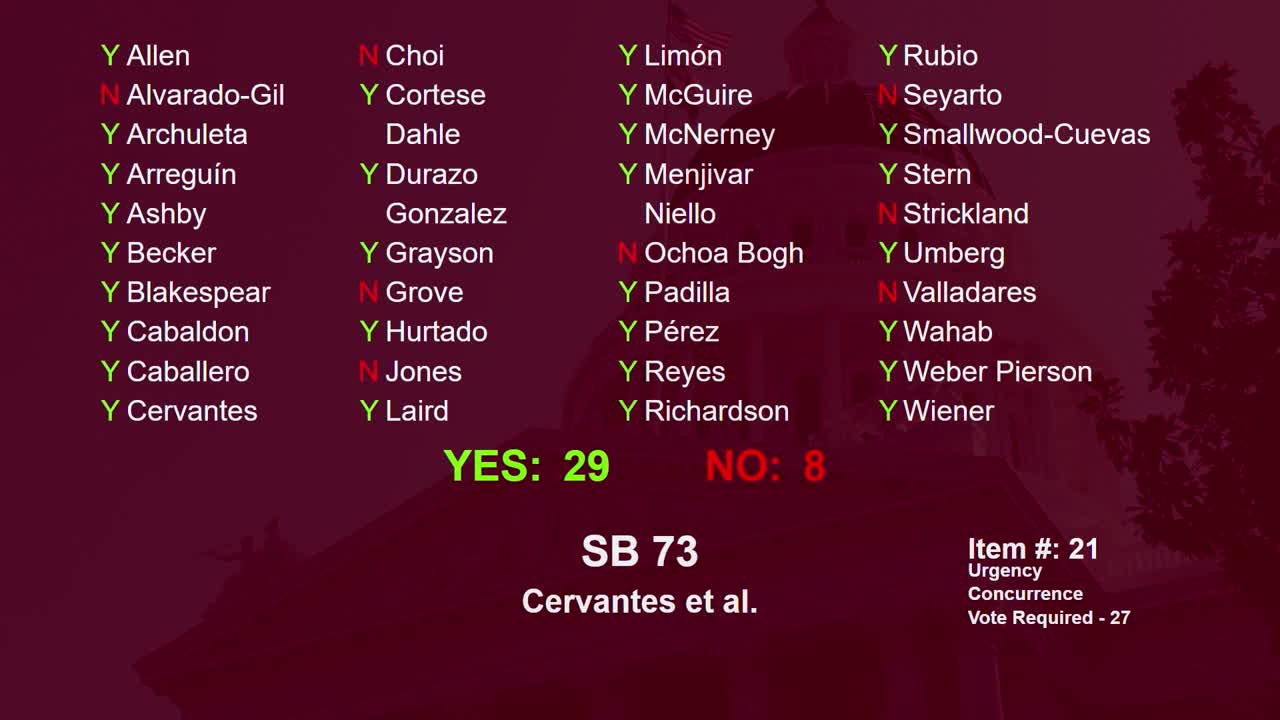 2MIN
Senate Floor
 6MIN



