SB 1377: Immunizations: medical exemptions.
- Session Year: 2025-2026
- House: Senate
- Latest Version Date: 2026-03-25
Current Status:
Failed
(2026-04-16: April 15 set for first hearing. Failed passage in committee. (Ayes 3. Noes 4. Page 3902.))
Introduced
In Committee
Awaiting First Chamber Vote
Passed First Chamber
In Committee
Awaiting Second Chamber Vote
Passed Second Chamber
Enacted
(1)Existing law prohibits the governing authority of a school or other institution from unconditionally admitting any person as a pupil unless, before the persons admission to that institution, the person has been fully immunized against various diseases, including any disease deemed appropriate by the State Department of Public Health. Existing law provides for medical exemptions from immunization requirements.
Existing law requires the department to develop and make available for use by licensed physicians and surgeons an electronic, standardized, statewide medical exemption certification form to be transmitted directly to the departments California Immunization Registry (CAIR) and submitted directly to the school or institution at which the child will attend, submitted directly to the governing authority of the school or institution, or submitted to that governing authority through the CAIR where applicable. Existing law requires the form to be the only documentation of a medical exemption that the governing authority may accept. Existing law requires the department to identify medical exemption forms that do not meet specified criteria for appropriate medical exemptions. Existing law requires inappropriate or otherwise invalid exemptions to be reviewed by the State Public Health Officer or a physician and surgeon, and authorizes the revocation of the medical exemption. Existing law requires the department to notify the Medical Board of California or the Osteopathic Medical Board of California, as appropriate, of any physician and surgeon who has 5 or more medical exemption forms in a calendar year that are revoked. Existing law authorizes the appeal of a revoked medical exemption by a parent or guardian, as specified.
This bill would repeal these provisions.
Existing law, prior to January 1, 2021, exempts a child from immunization requirements if the parent or guardian files with the governing authority a written statement by a licensed physician and surgeon to the effect that the physical condition of the child is such, or medical circumstances relating to the child are such, that immunization is not considered safe, indicating the specific nature and probable duration of the medical condition or circumstances for which the physician and surgeon does not recommend immunization.
This bill would exempt a child from immunization requirements if the parent or guardian files with the governing authority a written statement, as described above. The bill would prohibit the department, a local health department, or a third-party review panel from revoking, invalidating, or conditioning a medical exemption duly issued by a licensed physician and surgeon, except by final order of a court upon clear and convincing evidence of fraud. The bill would prohibit the department and local health departments from auditing, disciplining, or referring a physician and surgeon to the Medical Board of California or Osteopathic Medical Board of California based solely on the number of medical exemptions issued.
(2)Existing law establishes the Medical Board of California and the Osteopathic Medical Board of California for the licensure and regulation of physicians and surgeons and osteopathic physicians and surgeons. Existing law authorizes the boards to, among other things, investigate and discipline licensees for misconduct.
This bill would prohibit a physician and surgeon from being investigated, disciplined, or otherwise acted against by any state department or board based on their issuance of medical exemptions unless the medical exemption is found to be fraudulent or otherwise invalid. The bill would prohibit a medical exemption from being considered in any investigation or action against a physician and surgeon that is otherwise unrelated to medical exemptions.
(3)Existing law, the Knox-Keene Health Care Service Plan Act of 1975, provides for the licensure and regulation of health care service plans by the Department of Managed Health Care, and makes a willful violation of the act a crime. Existing law provides for the regulation of health insurers by the Department of Insurance.
This bill would prohibit a health care service plan or health insurer from denying coverage, imposing higher premiums, canceling a policy, or otherwise penalizing an enrollee or insured because a covered minor holds a medical exemption. Because a violation of this requirement by a health care service plan would be a crime, this bill would impose a state-mandated local program.
(4)Existing law provides for the licensure and regulation of health facilities, as defined, by the State Department of Public Health. Existing law makes a violation of those provisions a misdemeanor.
This bill would prohibit a health facility from denying medically necessary care on the basis of a medical exemption. Because a violation of this provision would be a crime, this bill would impose a state-mandated local program.
(5)The bill would require the State Department of Public Health to repeal or amend any regulation inconsistent with this bill on or before July 1, 2027.
(6)The California Constitution requires the state to reimburse local agencies and school districts for certain costs mandated by the state. Statutory provisions establish procedures for making that reimbursement.
This bill would provide that no reimbursement is required by this act for a specified reason.
Existing law requires a licensed general acute care hospital or acute psychiatric hospital to adopt policies and procedures regarding the responsibility for ensuring proper methods of repackaging and labeling of bulk cleaning agents, solvents, chemicals, and nondrug hazardous substances used throughout the hospital and does not require these health facilities to consult a pharmacist regarding the repackaging and labeling of these substances, except as specified.This bill would make technical, nonsubstantive changes to these provisions.Existing law requires a licensed general acute care hospital or acute psychiatric hospital to adopt policies and procedures regarding the responsibility for ensuring proper methods of repackaging and labeling of bulk cleaning agents, solvents, chemicals, and nondrug hazardous substances used throughout the hospital and does not require these health facilities to consult a pharmacist regarding the repackaging and labeling of these substances, except as specified.
This bill would make technical, nonsubstantive changes to these provisions.
For purposes of this article, medical exemption has the same meaning as described in Section 120370 of the Health and Safety Code.
2381.A physician and surgeon shall not be investigated, disciplined, or otherwise acted against by any state department or board based on their issuance of a medical exemption unless the medical exemption is found to be fraudulent or otherwise invalid.
2382.A medical exemption shall not be considered in any investigation or action against a physician and surgeon that is otherwise unrelated to medical exemptions.
2383.A medical exemption shall not be revoked or invalidated based on any investigation or action against a physician if that investigation does not relate to medical exemptions.
SEC. 2.Section 1272.5 is added to the Health and Safety Code, to read:1272.5.A health facility shall not deny medically necessary care on the basis of a medical exemption, as described in Section 120370.
SEC. 3.Section 1374.199 is added to the Health and Safety Code, to read:1374.199.A health care service plan shall not deny coverage, impose higher premiums, cancel a policy, or otherwise penalize an enrollee because a covered minor holds a medical exemption, as described in Section 120370.
SEC. 4.Section 120325 of the Health and Safety Code is amended to read:120325.In enacting this chapter, but excluding Section 120380, and in enacting Sections 120400, 120405, 120410, and 120415, it is the intent of the Legislature to provide:
(a)A means for the eventual achievement of total immunization of appropriate age groups against the following childhood diseases:(1)Diphtheria.(2)Hepatitis B.(3)Haemophilus influenzae type b.(4)Measles.(5)Mumps.(6)Pertussis (whooping cough).(7)Poliomyelitis.(8)Rubella.(9)Tetanus.(10)Varicella (chickenpox).(11)Any other disease deemed appropriate by the department, taking into consideration the recommendations of the Advisory Committee on Immunization Practices of the United States Department of Health and Human Services, the American Academy of Pediatrics, and the American Academy of Family Physicians.(a)For the prevention and control of communicable diseases.
(b)That the persons required to be immunized be allowed to obtain immunizations from whatever medical source they so desire, subject only to the condition that the immunization be performed in accordance with the regulations of the department and that a record of the immunization is made in accordance with the regulations.
(c)Exemptions from immunization for medical reasons.
(d)For the keeping of adequate records of immunization so that health departments, schools, and other institutions, parents or guardians, and the persons immunized will be able to ascertain that a child is fully or only partially immunized, and so that appropriate public agencies will be able to ascertain the immunization needs of groups of children in schools or other institutions.
(e)Incentives to public health authorities to design innovative and creative programs that will promote and achieve full and timely immunization of children.
SEC. 5.Section 120370 of the Health and Safety Code is repealed.120370.(a)(1)Prior to January 1, 2021, if the parent or guardian files with the governing authority a written statement by a licensed physician and surgeon to the effect that the physical condition of the child is such, or medical circumstances relating to the child are such, that immunization is not considered safe, indicating the specific nature and probable duration of the medical condition or circumstances, including, but not limited to, family medical history, for which the physician and surgeon does not recommend immunization, that child shall be exempt from the requirements of this chapter, except for Section 120380, and exempt from Sections 120400, 120405, 120410, and 120415 to the extent indicated by the physician and surgeons statement.(2)Commencing January 1, 2020, a child who has a medical exemption issued before January 1, 2020, shall be allowed continued enrollment to any public or private elementary or secondary school, child care center, day nursery, nursery school, family day care home, or developmental center within the state until the child enrolls in the next grade span.For purposes of this subdivision, grade span means each of the following:(A)Birth to preschool, inclusive.(B)Kindergarten and grades 1 to 6, inclusive, including transitional kindergarten.(C)Grades 7 to 12, inclusive.(3)Except as provided in this subdivision, on and after July 1, 2021, the governing authority shall not unconditionally admit or readmit to any of those institutions specified in this subdivision, or admit or advance any pupil to 7th grade level, unless the pupil has been immunized pursuant to Section 120335 or the parent or guardian files a medical exemption form that complies with Section 120372.(b)If there is good cause to believe that a child has been exposed to a disease listed in subdivision (b) of Section 120335 and the childs documentary proof of immunization status does not show proof of immunization against that disease, that child may be temporarily excluded from the school or institution until the local health officer is satisfied that the child is no longer at risk of developing or transmitting the disease.SEC. 6.Section 120370 is added to the Health and Safety Code, to read:120370.(a)If the parent or guardian files with the governing authority a written statement by a licensed physician and surgeon to the effect that the physical condition of the child is such, or medical circumstances relating to the child are such, that immunization is not considered safe, indicating the specific nature and probable duration of the medical condition or circumstances, including, but not limited to, family medical history, for which the physician and surgeon does not recommend immunization, that child shall be exempt from the requirements of this chapter, except for Section 120380, and exempt from Sections 120400, 120405, 120410, and 120415 to the extent indicated by the physician and surgeons statement.
(b)When determining whether a medical exemption is appropriate pursuant to subdivision (a), a physician and surgeon shall use accepted standards of care and shall not be required to use criteria established by the department.
(c)A medical exemption, as described in Section 120370, shall not be grounds for the denial of education or access to education or admission to any education or childcare facility nor for the participation in any school programs, extracurricular activities, scholarships, housing, or anything else related to schooling and education in the state at any level. A pupil with a medical exemption shall not be excluded, segregated, or otherwise treated differently from similarly situated pupils.
SEC. 7.Section 120372 of the Health and Safety Code is repealed.120372.(a)(1)By January 1, 2021, the department shall develop and make available for use by licensed physicians and surgeons an electronic, standardized, statewide medical exemption certification form that shall be transmitted directly to the departments California Immunization Registry (CAIR) established pursuant to Section 120440. Pursuant to Section 120375, the form shall be printed, signed, and submitted directly to the school or institution at which the child will attend, submitted directly to the governing authority of the school or institution, or submitted to that governing authority through the CAIR where applicable. Notwithstanding Section 120370, commencing January 1, 2021, the standardized form shall be the only documentation of a medical exemption that the governing authority may accept.(2)At a minimum, the form shall require all of the following information:(A)The name, California medical license number, business address, and telephone number of the physician and surgeon who issued the medical exemption, and of the primary care physician of the child, if different from the physician and surgeon who issued the medical exemption.(B)The name of the child for whom the exemption is sought, the name and address of the childs parent or guardian, and the name and address of the childs school or other institution.(C)A statement certifying that the physician and surgeon has conducted a physical examination and evaluation of the child consistent with the relevant standard of care and complied with all applicable requirements of this section.(D)Whether the physician and surgeon who issued the medical exemption is the childs primary care physician. If the issuing physician and surgeon is not the childs primary care physician, the issuing physician and surgeon shall also provide an explanation as to why the issuing physician and not the primary care physician is filling out the medical exemption form.(E)How long the physician and surgeon has been treating the child.(F)A description of the medical basis for which the exemption for each individual immunization is sought. Each specific immunization shall be listed separately and space on the form shall be provided to allow for the inclusion of descriptive information for each immunization for which the exemption is sought.(G)Whether the medical exemption is permanent or temporary, including the date upon which a temporary medical exemption will expire. A temporary exemption shall not exceed one year. All medical exemptions shall not extend beyond the grade span, as defined in Section 120370.(H)An authorization for the department to contact the issuing physician and surgeon for purposes of this section and for the release of records related to the medical exemption to the department, the Medical Board of California, and the Osteopathic Medical Board of California.(I)A certification by the issuing physician and surgeon that the statements and information contained in the form are true, accurate, and complete.(3)An issuing physician and surgeon shall not charge for either of the following:(A)Filling out a medical exemption form pursuant to this section.(B) A physical examination related to the renewal of a temporary medical exemption.(b)Commencing January 1, 2021, if a parent or guardian requests a licensed physician and surgeon to submit a medical exemption for the parents or guardians child, the physician and surgeon shall inform the parent or guardian of the requirements of this section. If the parent or guardian consents, the physician and surgeon shall examine the child and submit a completed medical exemption certification form to the department. A medical exemption certification form may be submitted to the department at any time.(c)By January 1, 2021, the department shall create a standardized system to monitor immunization levels in schools and institutions as specified in Sections 120375 and 120440, and to monitor patterns of unusually high exemption form submissions by a particular physician and surgeon.(d)(1)The department, at a minimum, shall annually review immunization reports from all schools and institutions in order to identify medical exemption forms submitted to the department and under this section that will be subject to paragraph (2).(2)A clinically trained immunization department staff member, who is either a physician and surgeon or a registered nurse, shall review all medical exemptions from any of the following:(A)Schools or institutions subject to Section 120375 with an overall immunization rate of less than 95 percent.(B)Physicians and surgeons who have submitted five or more medical exemptions in a calendar year beginning January 1, 2020.(C)Schools or institutions subject to Section 120375 that do not provide reports of vaccination rates to the department.(3)(A)The department shall identify those medical exemption forms that do not meet applicable AAP criteria for appropriate medical exemptions. The department may contact the primary care physician and surgeon or issuing physician and surgeon to request additional information to support the medical exemption.(B)Notwithstanding subparagraph (A), the department, based on the medical discretion of the clinically trained immunization staff member, may accept a medical exemption that is based on other contraindications or precautions, including consideration of family medical history, if the issuing physician and surgeon provides written documentation to support the medical exemption that is consistent with the relevant standard of care.(C)A medical exemption that the reviewing immunization department staff member determines to be inappropriate or otherwise invalid under subparagraphs (A) and (B) shall also be reviewed by the State Public Health Officer or a physician and surgeon from the departments immunization program designated by the State Public Health Officer. Pursuant to this review, the State Public Health Officer or physician and surgeon designee may revoke the medical exemption.(4)Medical exemptions issued prior to January 1, 2020, shall not be revoked unless the exemption was issued by a physician or surgeon that has been subject to disciplinary action by the Medical Board of California or the Osteopathic Medical Board of California.(5)The department shall notify the parent or guardian, issuing physician and surgeon, the school or institution, and the local public health officer with jurisdiction over the school or institution of a denial or revocation under this subdivision.(6)If a medical exemption is revoked pursuant to this subdivision, the child shall continue in attendance. However, within 30 calendar days of the revocation, the child shall commence the immunization schedule required for conditional admittance under Chapter 4 (commencing with Section 6000) of Division 1 of Title 17 of the California Code of Regulations in order to remain in attendance, unless an appeal is filed pursuant to Section 120372.05 within that 30-day time period, in which case the child shall continue in attendance and shall not be required to otherwise comply with immunization requirements unless and until the revocation is upheld on appeal.(7)(A)If the department determines that a physicians and surgeons practice is contributing to a public health risk in one or more communities, the department shall report the physician and surgeon to the Medical Board of California or the Osteopathic Medical Board of California, as appropriate. The department shall not accept a medical exemption form from the physician and surgeon until the physician and surgeon demonstrates to the department that the public health risk no longer exists, but in no event shall the physician and surgeon be barred from submitting these forms for less than two years.(B)If there is a pending accusation against a physician and surgeon with the Medical Board of California or the Osteopathic Medical Board of California relating to immunization standards of care, the department shall not accept a medical exemption form from the physician and surgeon unless and until the accusation is resolved in favor of the physician and surgeon.(C)If a physician and surgeon licensed with the Medical Board of California or the Osteopathic Medical Board of California is on probation for action relating to immunization standards of care, the department and governing authority shall not accept a medical exemption form from the physician and surgeon unless and until the probation has been terminated.(8)The department shall notify the Medical Board of California or the Osteopathic Medical Board of California, as appropriate, of any physician and surgeon who has five or more medical exemption forms in a calendar year that are revoked pursuant to this subdivision.(9)Notwithstanding any other provision of this section, a clinically trained immunization program staff member who is a physician and surgeon or a registered nurse may review any exemption in the CAIR or other state database as necessary to protect public health.(e)The department, the Medical Board of California, and the Osteopathic Medical Board of California shall enter into a memorandum of understanding or similar agreement to ensure compliance with the requirements of this section.(f)In administering this section, the department and the independent expert review panel created pursuant to Section 120372.05 shall comply with all applicable state and federal privacy and confidentiality laws. The department may disclose information submitted in the medical exemption form in accordance with Section 120440, and may disclose information submitted pursuant to this chapter to the independent expert review panel for the purpose of evaluating appeals.(g)The department shall establish the process and guidelines for review of medical exemptions pursuant to this section. The department shall communicate the process to providers and post this information on the departments website.(h)If the department or the California Health and Human Services Agency determines that contracts are required to implement or administer this section, the department may award these contracts on a single-source or sole-source basis. The contracts are not subject to Part 2 (commencing with Section 10100) of Division 2 of the Public Contract Code, Article 4 (commencing with Section 19130) of Chapter 5 of Part 2 of Division 5 of Title 2 of the Government Code, or Sections 4800 to 5180, inclusive, of the State Administrative Manual as they relate to approval of information technology projects or approval of increases in the duration or costs of information technology projects.(i)Notwithstanding the rulemaking provisions of the Administrative Procedure Act (Chapter 3.5 (commencing with Section 11340) of Part 1 of Division 3 of Title 2 of the Government Code), the department may implement and administer this section through provider bulletins, or similar instructions, without taking regulatory action.(j)For purposes of administering this section, the department and the California Health and Human Services Agency appeals process shall be exempt from the rulemaking and administrative adjudication provisions in the Administrative Procedure Act (Chapter 3.5 (commencing with Section 11340), Chapter 4 (commencing with Section 11370), Chapter 4.5 (commencing with 11400), and Chapter 5 (commencing with Section 11500) of Part 1 of Division 3 of Title 2 of the Government Code).SEC. 8.Section 120372 is added to the Health and Safety Code, to read:120372.(a)Notwithstanding any other law, the department, a local health department, or a third-party review panel shall not revoke, invalidate, or condition a medical exemption duly issued by a licensed physician and surgeon, except by final order of a court upon clear and convincing evidence of fraud.
(b)The State Department of Public Health and local health departments shall not audit, discipline, or refer a physician and surgeon to the Medical Board of California or Osteopathic Medical Board of California based solely on the number of medical exemptions issued.
SEC. 9.Section 120372.05 of the Health and Safety Code is repealed.120372.05.(a)A medical exemption revoked pursuant to Section 120372 may be appealed by a parent or guardian to the Secretary of California Health and Human Services. Parents, guardians, or the physician who issued the medical exemption may provide necessary information for purposes of the appeal.(b)The secretary shall establish an independent expert review panel, consisting of three licensed physicians and surgeons who have relevant knowledge, training, and experience relating to primary care or immunization to review appeals. The agency shall establish the process and guidelines for the appeals process pursuant to this section, including the process for the panel to contact the issuing physician and surgeon, parent, or guardian. The agency shall post this information on the agencys internet website. The agency shall also establish requirements, including conflict-of-interest standards, consistent with the purposes of this chapter, that a physician and surgeon shall meet in order to qualify to serve on the panel.(c)The independent expert review panel shall evaluate appeals consistent with the American Academy of Pediatrics guidelines or the relevant standard of care, as applicable.(d)The independent expert review panel shall submit its determination to the secretary. The secretary shall adopt the determination of the independent expert review panel and shall promptly issue a written decision to the childs parent or guardian. The decision shall not be subject to further administrative review.(e)A child whose medical exemption revocation pursuant to subdivision (d) of Section 120372 is appealed under this section shall continue in attendance and shall not be required to commence the immunization required for conditional admittance under Chapter 4 (commencing with Section 6000) of Division 1 of Title 17 of the California Code of Regulations, provided that the appeal is filed within 30 calendar days of revocation of the medical exemption.(f)For purposes for administering this section, the department and the California Health and Human Services Agency appeals process shall be exempt from the rulemaking and administrative adjudication provisions in the Administrative Procedure Act (Chapter 3.5 (commencing with Section 11340), Chapter 4 (commencing with Section 11370), Chapter 4.5 (commencing with 11400), and Chapter 5 (commencing with Section 11500) of Part 1 of Division 3 of Title 2 of the Government Code).SEC. 10.Section 120375 of the Health and Safety Code is amended to read:120375.(a)(1)The governing authority of each school or institution included in Section 120335 shall require documentary proof of each entrants immunization status. The governing authority shall record the immunizations of each new entrant in the entrants permanent enrollment and scholarship record on a form provided by the department. The immunization record of each new entrant admitted conditionally shall be reviewed periodically by the governing authority to ensure that within the time periods designated by regulation of the department the entrant has been fully immunized against all of the diseases listed in Section 120335, and immunizations received after entry shall be added to the pupils immunization record.
(2)(A)The governing authority of each school or institution included in Section 120335 shall not require disclosure of diagnosis or disability in support of a medical exemption issued pursuant to Section 120370. The governing authority shall accept any valid medical exemption provided in accordance with Section 120370.
(B)(i)Notwithstanding any other law, documentation for medical exemptions, as described in Section 120370, constitutes confidential medical information. Documentation for medical exemptions shall not be disclosed without written consent except to verify the existence of the exemption or pursuant to a court order.
(ii)Notwithstanding any other law, medical exemption status shall not be shared without written consent of the exempted person if that person is 18 years of age or older, or their legal guardian if the exempted person is under 18 years of age.
(b)The governing authority of each school or institution included in Section 120335 shall prohibit from further attendance any pupil admitted conditionally who failed to obtain the required immunizations within the time limits allowed in the regulations of the department until that pupil has been fully immunized against all of the diseases listed in Section 120335, unless the pupil is exempted under Section 120370 or 120372. 120370.
(c)The governing authority shall file a written report, on at least an annual basis, on the immunization status of new entrants to the school or institution under their jurisdiction with the department and the local health department on forms prescribed by the department. As provided in paragraph (4) of subdivision (a) of Section 49076 of the Education Code, the local health department shall have access to the complete health information as it relates to immunization of each student in the schools or other institutions listed in Section 120335 in order to determine immunization deficiencies.
(d)The governing authority shall cooperate with the county health officer in carrying out programs for the immunization of persons applying for admission to any school or institution under its jurisdiction. The governing board of any school district may use funds, property, and personnel of the district for that purpose. The governing authority of any school or other institution may permit any licensed physician or any qualified registered nurse to administer immunizing agents to any person seeking admission to any school or institution under its jurisdiction.
SEC. 11.Section 10127.22 is added to the Insurance Code, to read:10127.22.A health insurer shall not deny coverage, impose higher premiums, cancel a policy, or otherwise penalize an insured because a covered minor holds a medical exemption, as described in Section 120370 of the Health and Safety Code.
SEC. 12.The State Department of Public Health shall repeal or amend any regulation inconsistent with this act on or before July 1, 2027.
SEC. 13.No reimbursement is required by this act pursuant to Section 6 of Article XIIIB of the California Constitution because the only costs that may be incurred by a local agency or school district will be incurred because this act creates a new crime or infraction, eliminates a crime or infraction, or changes the penalty for a crime or infraction, within the meaning of Section 17556 of the Government Code, or changes the definition of a crime within the meaning of Section 6 of Article XIIIB of the California Constitution.
SECTION 1.Section 1250.06 of the Health and Safety Code is amended to read:1250.06.A licensed general acute care hospital, as defined in subdivision (a) of Section 1250, or an acute psychiatric hospital, as defined in subdivision (b) of Section 1250, shall adopt policies and procedures regarding the responsibility for ensuring the proper methods of repackaging and labeling bulk cleaning agents, solvents, chemicals, and nondrug hazardous substances used throughout the hospital. The hospital is not required to consult a pharmacist regarding repackaging and labeling these substances, except for areas where sterile compounding is performed.A licensed general acute care hospital, as defined pursuant to in subdivision (a) of Section 1250, or an acute psychiatric hospital, as defined pursuant to in subdivision (b) of Section 1250, shall adopt policies and procedures regarding the responsibility for ensuring the proper methods of repackaging and labeling of bulk cleaning agents, solvents, chemicals, and nondrug hazardous substances used throughout the hospital. The hospital is not required to consult a pharmacist regarding the repackaging and labeling of these substances, except for areas where sterile compounding is performed.
|
Date
|
Status
|
|---|---|
| Apr 16, 2026 | April 15 set for first hearing. Failed passage in committee. (Ayes 3. Noes 4. Page 3902.) |
| Apr 16, 2026 | April 15 set for first hearing. Failed passage in committee. (Ayes 3. Noes 4.) |
| Apr 9, 2026 | Set for hearing April 15. |
| Apr 8, 2026 | Re-referred to Coms. on HEALTH and B. P. & E.D. |
| Mar 25, 2026 | From committee with author's amendments. Read second time and amended. Re-referred to Com. on RLS. |
| Mar 4, 2026 | Referred to Com. on RLS. |
| Feb 23, 2026 | Read first time. |
| Feb 23, 2026 | From printer. May be acted upon on or after March 23. |
| Feb 20, 2026 | Introduced. To Com. on RLS. for assignment. To print. |
|
Date
|
Description
|
Location
|
Votes
|
|
|---|---|---|---|---|
| Apr 15, 2026 | Do pass, but first be re-referred to the Committee on [Business, Professions and Economic Development] | Senate Standing Committee on Health |
Failed |
This list shows positions taken on this bill by organizations on the date displayed, which is linked to the original source.
Positions by individuals are not included.
|
Organization
|
Position
|
Date
|
|---|---|---|
| American Academy Of Pediatrics, California | ** Against | |
| American College of Obstetricians and Gynecologists | ** Against | |
| America's Healthy Kids | ** Support | |
| Association of American Physicians and Surgeons | ** Support | |
| A Voice for Choice Advocacy | ** Support | |
| Bohnfire Consulting | ** Support | |
| California Academy Of Family Physicians | ** Against | |
| California Children’s Hospital Association | ** Against | |
| California Dental Association | ** Against | |
| California Health Coalition Advocacy | ** Support | |
| California Immunization Coalition | ** Against | |
| California Medical Association | ** Against | |
| California Pharmacist Association | ** Against | |
| California Podiatric Medical Association | ** Against | |
| California Radiology Society | ** Against | |
| California Society Of Pathologists | ** Against | |
| Children'S Specialty Care Coalition | ** Against | |
| County Health Executives Association Of California | ** Against | |
| Educate. Advocate. Evolve Yours | ** Support | |
| Firefighters4Freedom | ** Support | |
| Freedom Angels | ** Support | |
| Free now Foundation | ** Support | |
| Informed Policy Advocates | ** Support | |
| Moms Across America Movement | ** Support | |
| Moms for Liberty Placer County | ** Support | |
| Physicians and Patients Reclaiming Medicine | ** Support | |
| Physicians For Informed Consent | ** Support | |
| Planned Parenthood Affiliates Of California | ** Against | |
| Protection of the Educational Rights of Kids Advocacy | ** Support | |
| Public Health Institute | ** Against | |
| Real Impact. | ** Support | |
| Save Glendora Schools | ** Support | |
| SFV Alliance | ** Support | |
| Stand Up California | ** Support | |
| Studio 10-20 | ** Support | |
| The Intersection of Faith & Culture | ** Support | |
| Warriors in Need | ** Support |
SENATE COMMITTEE ON HEALTH
Senator Dr. Akilah Weber Pierson, Chair
BILL NO: SB 1377
AUTHOR: | Jones | ||
VERSION: | March 25, 2026 | ||
HEARING DATE: | April 15, 2026 | ||
CONSULTANT: | Melanie Moreno and Natalie Gehred | ||
SUBJECT: Immunizations: medical exemptions
SUMMARY:
- Repeals existing law which provides a process for medical exemptions (MEs) to the statewide immunization mandate for school children, including provisions requiring the California Department of Public Health (CDPH) to monitor immunization levels in schools. Instead, requires a physician to use accepted standards of care when determining whether a ME is appropriate, and prohibits physicians from being required to use criteria established by CDPH. Prohibits a ME from being grounds for the denial of education or access to education or admission to any education or childcare facility nor for the participation in anything related to schooling and education at any level. Prohibits a pupil with an ME from being excluded, segregated, or otherwise treated differently from similarly situated pupils. Requires CDPH to repeal or amend any regulation inconsistent with the provisions of this bill.
Existing law:
General duties and powers of CDPH and local health departments
- Requires CDPH to examine the causes of communicable disease in man and domestic animals occurring or likely to occur in this state. Gives the State Public Health Officer (PHO), as the director of CDPH, broad authority to detect, monitor, and prevent the spread of communicable disease in the state, including the ability to:
- Require reporting of communicable disease that CDPH identifies, on timelines and in a manner determined by CDPH;
- Adopt and enforce regulations requiring strict or modified isolation, or quarantine, for any of the contagious, infectious, or communicable diseases, if in the opinion of CDPH, the action is necessary for the protection of the public health;
- Take measures necessary to ascertain the nature of the disease and prevent its spread. Permits CDPH, to that end, to take possession or control of the body of any living person, or the corpse of any deceased person;
- Quarantine, isolate, inspect, and disinfect persons, animals, houses, rooms, other property, places, cities, or localities, whenever in its judgment the action is necessary to protect or preserve the public health; and,
- Destroy such objects as bedding, carpets, household goods, furnishings, materials, clothing, or animals, when ordinary means of disinfection are considered unsafe, and when the property is in its judgment, an imminent menace to the public health. [HSC §120125 and §120130, et seq.]
- Requires a local health officer (LHO) knowing or having reason to believe that any case of reportable diseases, or any other contagious, infectious or communicable disease exists, or has recently existed, within the territory under his or her jurisdiction, to take measures as may be necessary to prevent the spread of the disease or occurrence of additional cases. [HSC §120175]
Vaccine mandate for pupils
- Prohibits the governing authority of a school or other institution from unconditionally admitting any person as a pupil of any private or public elementary or secondary school, child care center, day nursery, nursery school, family day care home, or development center, unless, prior to his or her first admission to that institution, he or she has been fully immunized against diphtheria, haemophilus influenzae type b (Hib), measles, mumps, pertussis, poliomyelitis, rubella, tetanus, hepatitis b (except after 7th grade), and chickenpox. [HSC §120335]
- Permits CDPH to add to this list any other disease deemed appropriate, taking into consideration the recommendations of Advisory Committee on Immunization Practices (ACIP) and the American Academy of Pediatrics (AAP) Committee on Infectious Diseases. [HSC §120335]
Applying for MEs to the mandate
- Requires CDPH to develop and make available for use by physicians an electronic, standardized, statewide ME certification form for transmission directly to the California Immunization Registry (CAIR). Requires the form to be printed, signed, and submitted directly to the school or institution at which the child will attend, submitted directly to the governing authority of the school or institution, or submitted to that governing authority through CAIR where applicable. Requires the standardized form to be the only acceptable documentation of a ME. [HSC §120372(a)(1)]
- Requires the form, at a minimum, to include:
- The name, California medical license number, business address, and telephone number of the physician who issued the ME, and of the primary care physician of the child, if different from the physician who issued the exemption;
- The name of the child for whom the exemption is sought, the name and address of the child’s parent or guardian, and the name and address of the child’s school or other institution;
- A statement certifying that the physician has conducted a physical examination and evaluation of the child consistent with the relevant standard of care and complied with all applicable existing law;
- Whether the physician who issued the ME is the child’s primary care physician. Requires the issuing physician, if they are not the child’s primary care physician, to provide an explanation as to why the issuing physician and not the primary care physician is filling out the form;
- How long the physician has been treating the child;
- A description of the medical basis for which the exemption for each individual immunization is sought. Requires each immunization to be listed separately and requires space on the form to be provided to allow for the inclusion of descriptive information for each immunization for which the exemption is sought;
- Whether the ME is permanent or temporary, including the date upon which a temporary exemption will expire. Prohibits a temporary exemption from exceeding one year and not to extend beyond a specified grade span;
- An authorization for CDPH to contact the issuing physician for purposes of these provisions and for the release of records related to the ME to CDPH, the Medical Board of California (MBC), and the Osteopathic Medical Board of California (OMBC); and,
- A certification by the issuing physician that the statements and information contained in the form are true, accurate, and complete. [HSC §120372(a)(2)]
- Prohibits a physician from charging for filling out an ME form or for a physical examination related to the renewal of a temporary ME. [HSC §120372(a)(3)]
- Requires a physician, if a parent or guardian requests them to submit an ME for a child, to inform the parent or guardian of the requirements in existing law related to MEs. If the parent or guardian consents, the physician and surgeon shall examine the child and submit a completed ME certification form to CDPH. Permits ME certification forms to be submitted at any time. [HSC §120372(b)]
Monitoring immunization levels and reviewing MEs
- Requires CDPH to create a standardized system to monitor immunization levels in schools and institutions, and to monitor patterns of unusually high exemption form submissions by a particular physician. [HSC §120372(c)]
- Requires CDPH, at a minimum, to annually review immunization reports from all schools and institutions to identify submitted ME forms. Requires a clinically trained immunization CDPH staff member, who is either a physician or a registered nurse, to review all MEs from:
- Schools or institutions with an overall immunization rate of less than 95%;
- Physicians who have submitted five or more MEs in a calendar year; and,
- Schools or institutions that do not provide reports of vaccination rates to CDPH. [HSC §120372(d)(1)-(2)]
- Requires CDPH to establish the process and guidelines for review of MEs and to communicate the process to providers and post this information on its website. [HSC §120372(g)]
- Requires CDPH to identify those ME forms that do not meet applicable AAP criteria for appropriate MEs. Permits CDPH to contact the primary care or issuing physician to request additional information to support the ME. [HSC §120372(d)(3)(A)]
- Permits CDPH, based on the medical discretion of the clinically trained immunization staff member, to accept an ME that is based on other contraindications or precautions, including consideration of family medical history, if the issuing physician provides written documentation to support the ME that is consistent with the relevant standard of care. [HSC §120372(d)(3)(B)]
- Permits a clinically trained CDPH immunization program staff member who is a physician or an RN to review any exemption in the CAIR or other state database as necessary to protect public health. [HSC §120372(d)(9)]
Revocation of MEs
- Requires an ME that the reviewing immunization CDPH staff member determines to be inappropriate or otherwise invalid to also be reviewed by the State PHO or a designated physician from the CDPH’s immunization program. Permits the State PHO or the designated CDPH physician, pursuant to this review, to revoke the ME. Requires CDPH to notify the parent/guardian, issuing physician, school or institution, and the LHO with jurisdiction over the school/institution of a denial or revocation. [HSC §120372(d)(3)(C) and §120372(d)(5)]
- Prohibits MEs issued prior to January 1, 2020 from being revoked unless it was issued by a physician that has been subject to disciplinary action by the MBC or OMBC. [HSC §120372(d)(4)]
- Requires a child, if their ME is revoked, to continue in attendance at school. Requires the child, within 30 calendar days of the revocation, to commence the immunization schedule required for conditional admittance in order to remain in attendance, unless an appeal is filed within that 30-day time period, in which case the child can continue in attendance and not be required to otherwise comply with immunization requirements unless and until the revocation is upheld on appeal. [HSC §120372(d)(6)]
Appealing a revoked ME
- Permits a revoked ME to be appealed by a parent or guardian to the Secretary of California Health and Human Services (CHHS). Permits parents, guardians, or the physician who issued the ME to provide necessary information for purposes of the appeal. [HSC §120372.05(a)]
- Requires the CHHS Secretary to establish an independent expert review panel (IERP), consisting of three licensed physicians who have relevant knowledge, training, and experience relating to primary care or immunization, to review appeals. Requires CHHS to establish the process and guidelines for the appeals process, including the process for the panel to contact the issuing physician, parent, or guardian. Requires CHHS to post this information on its website. Requires CHHS to establish requirements, including conflict-of-interest standards, that a physician is required to meet to qualify to serve on the panel. [HSC §120372.05(b)]
- Requires the IERP to evaluate appeals consistent with the AAP guidelines or the relevant standard of care. Requires the IERP to submit its determination to the CHHS Secretary. Requires the Secretary to adopt the determination and promptly issue a written decision to the child’s parent or guardian. Prohibits the decision from being subject to further administrative review. [HSC §120372.05 (c)-(d)]
- Requires a child, whose ME revocation is appealed, to continue in attendance and not be required to commence the immunization required for conditional admittance, provided that the appeal is filed within 30 calendar days of revocation. [HSC §120372.05 (e)]
CDPH reporting to licensing boards
- Requires CDPH, if it determines that a physician’s practice is contributing to a public health risk in one or more communities, to report the physician MBC or OMBC, as appropriate. Prohibits CDPH from accepting an ME form from the physician until they demonstrate that the public health risk no longer exists, but prohibits the physician from being barred from submitting these forms for less than two years. Prohibits CDPH, if there is a pending accusation against a physician with the MBC or OMBC relating to immunization standards of care, from accepting an ME form from the physician unless and until the accusation is resolved in favor of the physician. Prohibits CDPH, if a licensed physician is on probation for action relating to immunization standards of care, from accepting an ME form from the physician unless and until the probation has been terminated. [HSC §120372(d)(7)]
- Requires CDPH to notify the MBC or OMBC, as appropriate, of any physician who has five or more ME forms in a calendar year that are revoked. [HSC §120372(d)(8)]
- Requires CDPH, MBC, and OMBC to enter into a memorandum of understanding or similar agreement to ensure compliance with the ME requirements. [HSC §120372(e)]
This bill:
Health and Safety Code provisions
- Repeals existing law related to MEs, including provisions requiring CDPH to monitor immunization levels in schools, as outlined in 5) through 24) of “Existing law” above. Instead, requires a physician to use accepted standards of care when determining whether an ME is appropriate, and prohibits a physician from being required to use criteria established by CDPH.
- Prohibits an ME from being grounds for the denial of education or access to education or admission to any education or childcare facility nor for the participation in any school programs, extracurricular activities, scholarships, housing, or anything else related to schooling and education in the state at any level. Prohibits a pupil with an ME from being excluded, segregated, or otherwise treated differently from similarly situated pupils.
- Prohibits CDPH, LHDs, or a third-party review panel from revoking, invalidating, or conditioning an ME duly issued by a physician, except by final order of a court upon clear and convincing evidence of fraud.
- Prohibits CDPH and LHDs auditing, disciplining, or referring a physician to the MBC or OMBC based solely on the number of MEs issued.
- Requires CDPH to repeal or amend any regulation inconsistent with the provisions of this bill by July 1, 2027.
- Prohibits a health facility from denying medically necessary care on the basis of an ME.
- Prohibits a health plan or health insurer from denying coverage, imposing higher premiums, canceling a policy, or otherwise penalizing an enrollee because a covered minor holds an ME for a mandated vaccine.
- Deletes existing law which prohibits the governing authority of a school or other institution from unconditionally admitting or readmitting, or admit or advance any pupil to 7th grade level, unless the pupil has been immunized against specified communicable diseases, or the parent or guardian files an ME form.
- Deletes existing law that permits a child, if there is good cause to believe that a child has been exposed to a specified communicable disease and the child’s documentary proof of immunization status does not show proof of immunization against that disease, to be temporarily excluded from the school or institution until the LHO is satisfied that the child is no longer at risk of developing or transmitting the disease.
- Deletes existing statute that states Legislative intent to provide a means for the eventual achievement of total immunization of appropriate age groups against the following childhood diseases: diphtheria; hepatitis B; Hib; measles; mumps; pertussis; poliomyelitis; rubella; tetanus; chickenpox; and, any other disease deemed appropriate by CDPH, taking into consideration the recommendations of the ACIP, AAP, and the American Academy of Family Physicians.
Business and Professions Code provisions
- Prohibits a physician from being investigated, disciplined, or otherwise acted against by any state department or board based on their issuance of an ME, unless it is found to be fraudulent or otherwise invalid. Prohibits an ME from being considered in any investigation or action against a physician that is otherwise unrelated to MEs. Prohibits an ME from being revoked or invalidated based on any investigation or action against a physician if that investigation does not relate to MEs.
FISCAL EFFECT:
This bill has not been analyzed by a fiscal committee.
COMMENTS:
- Author’s statement. According to the author, California’s current framework for vaccine medical exemptions has created confusion, delays, and inconsistency for patients, families, and providers. While intended to prevent abuse, the existing system has, in some cases, limited physicians’ ability to exercise independent medical judgment and has resulted in legitimate exemptions being delayed or denied. This bill restores appropriate deference to licensed physicians while maintaining reasonable guardrails to ensure accountability and prevent misuse. By clarifying the process and limiting unnecessary administrative barriers, this measure seeks to improve access to medically appropriate exemptions, provide certainty for families, and ensure that oversight remains targeted and proportional.
- Vaccines and immunization. According to the Centers for Disease Control and Prevention (CDC), immunization is the process of making a person immune or resistant to an infectious disease, typically by administering a vaccine. Vaccines work by introducing antigens—weakened or dead bacteria or viruses, their surface proteins, genetic material, or inactivated toxins—that stimulate an immune response without causing disease. The body’s immune cells respond to the antigen by producing antibodies, proteins that identify and neutralize the antigen. When the initial immune response resolves, some of these cells become long-lived memory cells that can more quickly produce the same antibodies upon future exposures, reducing the risk of severe illness or death. According to the World Health Organization (WHO), immunization is a proven tool for controlling and eliminating more than 30 life-threatening infectious diseases and is estimated to avert between 3.5 million and five million deaths each year. Immunization is one of the most cost-effective health investments, with proven strategies that make it accessible to even the most hard-to-reach and vulnerable populations. It has clearly defined target groups; it can be delivered effectively through outreach activities; and, it does not require any major lifestyle change.
- Vaccination contraindications and precautions. According to the CDC’s General Best Practice Guidelines for Immunization: Contraindications and Precautions, contraindications (conditions in a patient that increase the risk for a serious adverse reaction) and precautions to vaccination are conditions under which vaccines should not be administered or should be deferred. Persons who administer vaccines should screen patients for contraindications and precautions before each dose of vaccine is administered. Because the majority of contraindications and precautions are temporary, vaccinations often can be administered later when the condition leading to a contraindication or precaution no longer exists. Several examples of contraindications include that severely immunocompromised persons generally should not receive live vaccines, and pregnant women generally should not receive live, attenuated virus vaccines. A precaution is a condition in a recipient that might increase the risk of a serious adverse reaction, might cause diagnostic confusion, or might compromise the ability of the vaccine to produce immunity. In general, vaccinations should be deferred when a precaution is present, although a vaccination might still be indicated if the benefit of protection from the vaccine outweighs the risk of an adverse reaction. As an example, the presence of a moderate or severe acute illness is a precaution against the administration of all vaccines. The decision to administer or delay vaccination depends on the severity of symptoms and the cause of the condition. According to the Guidelines, screening for contraindications, persons with moderate or severe acute illness should be vaccinated as soon as the illness has improved.
- California’s vaccination rates. California requires students to provide proof of immunization to enroll in school or childcare, and requires schools and childcare facilities to report the immunization status of their enrollees. According to the CDC, state and local vaccination requirements for daycare and school entry are important tools for maintaining high vaccination coverage rates and, in turn, lower rates of vaccine-preventable diseases. According to CDPH’s 2024-2025 Kindergarten Summary Report, the proportion of students entering kindergarten in 2024-2025 (590,849) who had received all required vaccines was 93.7%, the same as the previous year. Statewide rates for specific immunizations are high: 95.1% for required doses of diphtheria, tetanus and pertussis (DTaP), 95.7% for varicella, 96.0% for polio, 96.1% for measles, mumps and rubella (MMR), and 97.2% for hepatitis B, although vaccination rates vary widely by county.
- Vaccination exemptions. According to a 2025 KFF report, all 50 states have laws requiring specified vaccines for students. Although exemptions vary from state to state, all school immunization laws grant exemptions to children for medical reasons. In addition, nearly all states—except California, Connecticut, Maine, and New York—permit exemptions for individuals who object to immunization on religious grounds. Only MEs are allowed in California since SB 277 (Pan and Allen, Chapter 35, Statutes of 2015) went into effect. The KFF report highlights the role of the COVID-19 pandemic in state vaccine legislation. As the pandemic progressed and vaccines became more politicized, legislative efforts shifted from establishing COVID-19 vaccine mandates to imposing limitations on these mandates. Many of these bills focused on vaccination exemptions; of the ten states that passed vaccine-related legislation in early 2025, nine made it easier for families to obtain exemptions for their children. Vaccination exemption rates in California changed with the elimination of the personal belief exemption in 2016 and the implementation of the California Immunization Registry Medical Exemption (CAIR-ME) system in 2021. According to CDPH data, in the early 2010s, personal belief exemptions among all incoming kindergarteners hovered between 2% and 3%. When personal belief exemptions were eliminated, CDPH observed a rise in permanent MEs, which doubled to 0.5% in 2016 and increased steadily to 1% in 2019-2020. With the implementation of CAIR-ME in 2021, the permanent ME rate reduced to 0.3%, and it has been steadily declining since. Only 0.1% of kindergarteners enrolling in 2024 had permanent MEs, similar to the 2023-2024 rate and the 2012 rate.
- CAIR-ME. Before 2021, obtaining an ME in California required a doctor’s note submitted to the school or childcare facility that described the medical circumstances that contraindicated the required immunizations, specified which vaccines were exempted, and indicated whether the exemption was permanent or temporary. SB 276 (Pan, Chapter 278, Statutes of 2019) standardized the process by requiring the only acceptable form of ME to be a statewide electronic certification form submitted via CAIR-ME. Any ME authorized before the adoption of the form was required to be submitted to a statewide database to remain valid, and would need to be renewed via CAIR-ME upon entry into the next grade span (existing law defines grade spans as birth to preschool, kindergarten through grade 6, and grades 7 to 12). Through CAIR-ME, a parent can request an ME, which would be completed by the child’s physician. If a school or child care facility’s immunization rate falls below 95%, a facility fails to provide reports of vaccination rates to CDPH, a doctor writes five or more MEs per year, or CDPH otherwise determines it there is a public health need, CDPH clinical staff with expertise in immunization reviews the ME to ensure that it is consistent with the standard of care and aligns with AAP guidelines. An ME can be revoked by the State PHO if it is determined that it is not consistent with standards of care or the guidelines. MEs can also be revoked in the instance that there is missing or erroneous information included in the request. In the case of a revocation, the parents and physician are notified, and the child must be vaccinated within 30 days or request an appeal. If the appeal is upheld, no further action is required. If denied, the child needs to be vaccinated. MEs expire at the end of a grade span, at the expiration date specified (if a temporary ME), or upon permanent revocation of the exemption.
Since the implementation of CAIR-ME, no physician has been reported to MBC or OMBC for contributing to a public health risk, according to CDPH. The number of physicians reported to MBC or OMBC for five or more revoked MEs is low, around 10 to 30 each year between 2021 and 2025 (less than 0.5% of all physicians issuing MEs). Of the physicians referred to the MBC or OMBC by CDPH, 26 have been disciplined by their licensing board, and three have accusations pending. Physicians who have accusations pending, are on probation relating to immunization standards of care, or who are revoked, surrendered, suspended, or are otherwise not permitted to practice, are locked out of the CAIR-ME platform and prevented them from issuing MEs. From January 1, 2021 to March 31, 2026, over 30,000 MEs have been issued. Nearly two-thirds of these MEs were reviewed by CDPH, 14.5% of which were revoked. This includes revocations due to both improper medical determinations and administrative errors (incomplete or erroneous ME requests are revoked without a process for correction). About 800 revoked exemptions have been appealed to CHHSA for separate review, about 100 of which were upheld in favor of the parent or guardian.
- Measles outbreaks. In 2014, Orange County was the site of the state’s largest measles outbreak in decades, with an exposure at Disneyland infecting over 130 Californians in an outbreak that spread to six other states, Canada, and Mexico, according to CDPH. That outbreak was cited as a reason for the introduction of SB 277 in 2015, which removed the personal belief exemption from vaccination requirements. In 2019, there were six outbreaks of measles cases in California. According to the CDC, from January 1 to April 19, 2019, 626 individual cases of measles were confirmed in 19 states, the second-greatest number of cases reported in the U.S. since measles was eliminated in 2000. Washington and New York particularly saw large outbreaks concentrated in unvaccinated populations. These outbreaks were cited as one of the reasons that SB 276 was necessary. According to CDPH, the U.S. is currently experiencing the highest numbers of measles cases, outbreaks, hospitalizations, and deaths in more than 30 years, driven by populations with low vaccination rates. A March 2026 CalMatters article reports that California is battling multiple measles outbreaks across the state. According to CDPH, 96% of the cases are in Shasta County among children who were either unvaccinated or did not know their vaccination status. According to the CDC, South Carolina, which is experiencing the largest outbreak of measles to date–997 cases as of April 7, according to the South Carolina Department of Public Health–is experiencing cases in areas where immunization rates are 89%, below the 95% immunization that the WHO reports is required for community immunity of measles. CDPH immunization data by school reveals that there are over 500 California kindergartens with measles vaccination rates below those required for community immunity for measles, and an additional 300 schools that haven't reported their measles vaccination rates.
- Double referral. This bill is double referred. Should it pass out of this committee, it will be referred to the Senate Committee on Business, Professions, and Economic Development.
- Related legislation. AB 2651 (Bonta) Requires CDPH to establish the immunization rate necessary to prevent the spread of specified communicable diseases and establish notification procedures to inform the governing authority of a school or institution when an immunization rate falls below the established rate necessary to prevent the spread of disease. AB 2651 requires the governing body authority to inform the parents or guardians of pupils if it is notified by CDPH that a relevant immunization rate has fallen below the established rate necessary to prevent the spread of communicable disease. AB 2651 is set for hearing on April 15, 2026 in the Assembly Education Committee.
- Prior legislation. SB 276 (Pan, Chapter 278, Statutes of 2019) requires CDPH to develop an electronic, statewide, standardized ME request form for immunization requirements. SB 276 requires CDPH to make the request form available for use by physicians and to be transmitted directly to a state database. SB 276 requires the request form to be the only ME documentation that a governing authority may accept. SB 276 requires CDPH to create a standardized system to monitor immunization levels in schools and institutions, and to monitor patterns of unusually high exemption form submissions by a particular physician.
SB 714 (Pan, Chapter 281, Statutes of 2019) allows a child who had a ME issued before January 1, 2020 to be allowed to continue enrollment until the next grade span, and prohibits, after July 1, 2021, a governing authority from unconditionally admitting or readmitting to these institutions, or admitting or advancing a pupil to 7th grade level, unless they have been immunized or has a ME. SB 714 removes the requirement that the statewide form be signed under penalty of perjury and modifies which physicians are eligible to issue a ME.
SB 277 (Pan and Allen, Chapter 35, Statutes of 2015) eliminated the personal belief exemption from the vaccine mandate.
AB 2109 (Pan, Chapter 821, Statutes of 2012) Requires a separate CDPH form to accompany a letter or affidavit to exempt a child from immunization requirements on the basis that immunization is contrary to beliefs of the child’s parent or guardian that attests that the responsible adult was provided with information regarding the benefits and risks of immunization and the communicable disease
- Support. Informed Policy Advocates states that information from CDPH indicates that 14% of ME requests are being denied or revoked. This is a concerning rate, given they are licensed medical doctors in good standing making the requests. Doctors should be able to treat their patients without unelected bureaucrats (who may not even be doctors) overriding their medical determinations. The bill continues to ensure the ability to file a complaint and prosecute any doctor who commits fraud. A Voice for Choice Advocacy contends that since the passage of SB 276 and SB 714 in 2019, many families have faced unnecessary hardship and loss of educational access due to the shift of medical decision making away from the trusted doctor patient relationship and into bureaucratic oversight. This bill takes an important step toward rebalancing that system by restoring physicians’ ability to make individualized medical determinations for their patients without undue state interference. This bill recognizes that healthcare decisions belong in the hands of trained medical professionals who understand their patients’ unique histories and needs, not in the hands of administrators or regulators distant from the exam room. By affirming the integrity of the doctor-patient relationship, this bill helps families across California access appropriate medical care and ensures that children with legitimate medical concerns are not excluded from school or public life. Protection of the Educational Rights of Kids Advocacy writes that medical judgment protects doctors from being investigated, disciplined, audited, or targeted simply for issuing medical exemptions, unless there is clear evidence of fraud or invalidity. This bill protects families from government overreach by preventing state and local health authorities from revoking, conditioning, or invalidating a medical exemption without a court order and clear evidence of fraud. This bill also protects privacy by prohibiting schools from demanding diagnosis or disability details in order to honor a valid exemption, while safeguarding the confidentiality of exemption records except in narrow legal circumstances. Families should not be subjected to invasive disclosure demands or arbitrary government interference when a valid medical exemption is in place. California Coalition Health Advocacy states that SB 276 and SB 714 gave the state the unprecedented power to override the professional judgement of physicians and surgeons. The law granted CDPH broad power to review and revoke a medical exemption for immunizations provided by a licensed physician and surgeon. The effect of SB 276 and SB 714 has been to limit a doctor’s ability to protect and properly diagnose patients who require medical exemptions, with the result that doctors no longer practice medicine in good conscience, nor provide necessary medical exemptions for at-risk patients, for fear of retribution by the state.
- Opposition. Opponents write that this bill would dismantle a carefully constructed ME system and return California to a time when there was little to no oversight of MEs, undermining years of progress and reopening the door to abuse. We have seen what happens when oversight is weak. The 2014–2015 Disneyland measles outbreak infected over 130 Californians and spread internationally, with most cases linked to unvaccinated individuals. That outbreak directly prompted legislative action to strengthen California’s immunization laws. SB 276 was the next necessary step to ensure those laws could not be circumvented through inappropriate medical exemptions. Vaccines remain one of the most rigorously studied and scientifically validated public health interventions in modern medicine. They are safe, effective, and essential to preventing the spread of highly contagious diseases like measles, which can cause severe complications including pneumonia, brain swelling, and death. Measles, once nearly eliminated in the U.S., is resurging nationwide due to declining vaccination rates. In 2025 alone, the U.S. experienced the largest measles outbreak in decades, driven overwhelmingly by unvaccinated populations. Recent data show that approximately 93% of measles cases nationally occurred among individuals who were unvaccinated or whose vaccination status was unknown. California has not been immune to this trend. The state has already reported increasing measles cases in recent years, including: four cases in 2023, 15 cases in 2024, 25 cases in 2025, and 29 cases reported as of March 2026. Despite this trend, California has thus far avoided the widespread outbreaks seen in other parts of the country because of our school vaccine requirements, including the process this bill is seeking to eliminate. At a time when vaccination rates are slipping nationwide and outbreaks are increasing, California should be strengthening — not weakening — its commitment to empirically safe vaccines and the immunization safeguards that protect our communities.
- Author amendments. The author requests the committee approve amendments to establish a limit of 50 medical exemptions per physician per year, calculated on a per-patient basis (i.e., each individual patient counts as one exemption regardless of the number of immunizations exempted); and, to authorize MBC to lower that limit only during a declared state of emergency involving an infectious disease for which a vaccine is available.
SUPPORT AND OPPOSITION:
Support: A Voice for Choice Advocacy
America's Healthy Kids
Association of American Physicians and Surgeons
Bohnfire Consulting
California Health Coalition Advocacy
Educate. Advocate.
Evolve Yours
Firefighters4Freedom
Free now Foundation
Freedom Angels
Informed Policy Advocates Network Legislate
Informed Policy Advocates
Moms Across America Movement
Moms for Liberty Placer County
Physicians for Informed Consent
Physicians and Patients Reclaiming Medicine
Protection of the Educational Rights of Kids Advocacy
Real Impact.
Save Glendora Schools
SFV Alliance
Stand Up California
Studio 10-20
The Intersection of Faith & Culture
Warriors in Need
65 individuals
Oppose: American Academy of Pediatrics, California
American College of Obstetricians and Gynecologists
California Academy of Family Physicians
California Children’s Hospital Association
California Dental Association
California Immunization Coalition
California Medical Association
California Pharmacist Association
California Podiatric Medical Association
California Radiology Society
California Society of Pathologists
Children's Specialty Care Coalition
County Health Executives Association of California
Planned Parenthood Affiliates of California
Public Health Institute
-- END --
Discussed in Hearing
 50MIN
Senate Standing Committee on Health
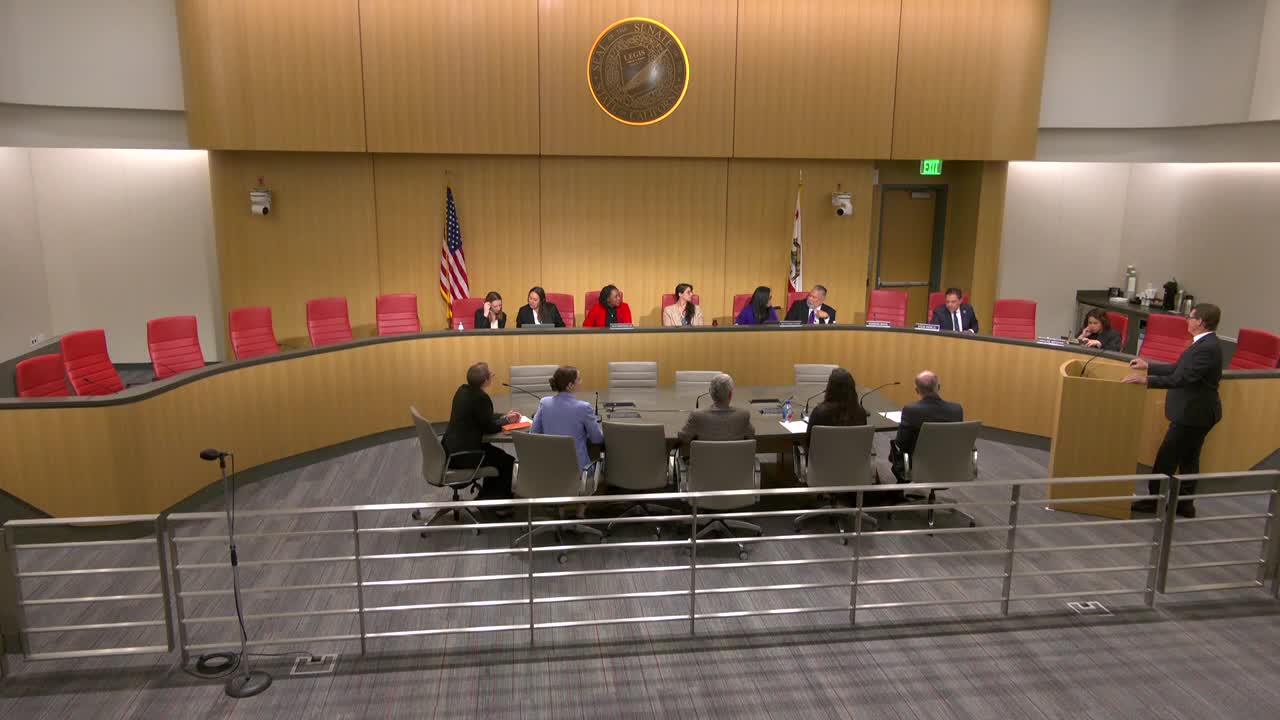 5MIN
Senate Standing Committee on Health
Bill Author

Bill Co-Author(s):