SB 1381: State special schools: information.
- Session Year: 2025-2026
- House: Senate
- Latest Version Date: 2026-09-27
Current Status:
Passed
(2026-09-27: Chaptered by Secretary of State. Chapter 706, Statutes of 2026.)
Introduced
In Committee
Awaiting First Chamber Vote
Passed First Chamber
In Committee
Awaiting Second Chamber Vote
Passed Second Chamber
Enacted
Existing law establishes the California School for the Deaf, Northern California, the California School for the Deaf, Southern California, known collectively as the California School for the Deaf, and the California School for the Blind as the state special schools, under the administration of the State Department of Education.
Existing law requires the governing board of a school district, at the beginning of the first semester or quarter of each school year, to notify parents or guardians of minor pupils of specified rights and responsibilities of the parent or guardian and of specified school district policies and procedures.
This bill would require the notification to a parent or guardian of a pupil who is deaf, hard of hearing, blind, visually impaired, or deaf-blind to additionally include information regarding the option for the pupil to attend a state special school, as provided. Commencing with the 202728 school year, if a local educational agency develops, reviews, or revises an individualized education program for a pupil who is deaf, hard of hearing, blind, visually impaired, or deaf-blind, the bill would require the individualized education program team of the local educational agency to provide the pupils parent, guardian, or educational rights holder with information about the state special schools and the option for the pupil to attend one of those schools, as specified. The bill would require the department, on or before July 1, 2027, to provide that information to local educational agencies. By imposing additional duties on local educational agencies or local officials, the bill would impose a state-mandated program.
The California Constitution requires the state to reimburse local agencies and school districts for certain costs mandated by the state. Statutory provisions establish procedures for making that reimbursement.
This bill would provide that, if the Commission on State Mandates determines that the bill contains costs mandated by the state, reimbursement for those costs shall be made pursuant to the statutory provisions noted above.
Existing law establishes the California School for the Deaf, Northern California, the California School for the Deaf, Southern California, known collectively as the California School for the Deaf, and the California School for the Blind as the state special schools, under the administration of the State Department of Education.
Existing law requires the governing board of a school district, at the beginning of the first semester or quarter of each school year, to notify parents or guardians of minor pupils of specified rights and responsibilities of the parent or guardian and of specified school district policies and procedures.
This bill would require the notification to a parent or guardian of a pupil who is deaf, hard of hearing, blind, visually impaired, or deaf-blind to additionally include information regarding the option for the pupil to attend a state special school, as provided. Commencing with the 202728 school year, if a local educational agency develops, reviews, or revises an individualized education program for a pupil who is deaf, hard of hearing, blind, visually impaired, or deaf-blind, the bill would require the individualized education program team of the local educational agency to provide the pupils parent, guardian, or educational rights holder with information about the state special schools, schools and the option for the pupil to attend one of those schools, as specified. The bill would require the department, on or before July 1, 2027, to provide that information to local educational agencies. By imposing additional duties on local educational agencies or local officials, the bill would impose a state-mandated program.
The California Constitution requires the state to reimburse local agencies and school districts for certain costs mandated by the state. Statutory provisions establish procedures for making that reimbursement.
This bill would provide that, if the Commission on State Mandates determines that the bill contains costs mandated by the state, reimbursement for those costs shall be made pursuant to the statutory provisions noted above.
Existing law establishes the California School for the Deaf, Northern California, the California School for the Deaf, Southern California, known collectively as the California School for the Deaf, and the California School for the Blind as the state special schools, under the administration of the State Department of Education.
Existing law requires the governing board of a school district, at the beginning of the first semester or quarter of each school year, to notify parents or guardians of minor pupils of specified rights and responsibilities of the parent or guardian and of specified school district policies and procedures.
This bill would require the notification to a parent or guardian of a pupil who is deaf, hard of hearing, blind, visually impaired, or deaf-blind to additionally include information regarding the option for the pupil to attend a state special school, as provided. Commencing with the 202728 school year, if a local educational agency develops, reviews, or revises an individualized education program for a pupil who is deaf, hard of hearing, blind, visually impaired, or deaf-blind, the bill would require the individualized education program team of the local educational agency to provide the pupils parent, guardian, or educational rights holder with information about the California School for the Deaf, state special schools, as specified. The bill would require the department, on or before July 1, 2027, to provide that information to local educational agencies. By imposing additional duties on local educational agencies or local officials, the bill would impose a state-mandated program.
The California Constitution requires the state to reimburse local agencies and school districts for certain costs mandated by the state. Statutory provisions establish procedures for making that reimbursement.
This bill would provide that, if the Commission on State Mandates determines that the bill contains costs mandated by the state, reimbursement for those costs shall be made pursuant to the statutory provisions noted above.
Existing law establishes the California School for the Deaf, Northern California, the California School for the Deaf, Southern California, known collectively as the California School for the Deaf, and the California School for the Blind as the state special schools, under the administration of the State Department of Education.
Existing law requires the governing board of a school district, at the beginning of the first semester or quarter of each school year, to notify parents or guardians of minor pupils of specified rights and responsibilities of the parent or guardian and of specified school district policies and procedures.
This bill would require the notification to a parent or guardian of a pupil who is deaf, hard of hearing, blind, visually impaired, or deaf-blind to additionally include information regarding the option for the pupil to attend a state special school, as provided. Commencing with the 202728 school year, if a local educational agency develops, reviews, or revises an individualized education program for a pupil who is deaf, hard of hearing, or deaf-blind, the bill would require the individualized education program team of the local educational agency to provide the pupils parent, guardian, or educational rights holder with information about the California School for the Deaf, as specified. The bill would require the department, on or before July 1, 2027, to provide that information to local educational agencies. By imposing additional duties on local educational agencies or local officials, the bill would impose a state-mandated program.
The California Constitution requires the state to reimburse local agencies and school districts for certain costs mandated by the state. Statutory provisions establish procedures for making that reimbursement.
This bill would provide that, if the Commission on State Mandates determines that the bill contains costs mandated by the state, reimbursement for those costs shall be made pursuant to the statutory provisions noted above.
The Donahoe Higher Education Act sets forth, among other things, the missions and functions of Californias public and independent segments of higher education, and their respective institutions of higher education, in the context of the goals of the Master Plan for Higher Education in California. Among other things, the act expresses legislative intent to outline in statute the broad policy and programmatic goals of the master plan. The act also includes legislative findings relating to the historical committees that reviewed the master plan, and expresses the legislative intent that the work completed by the master plan review committees be used to guide higher education policy.This bill would make nonsubstantive changes to certain of these legislative findings.The Donahoe Higher Education Act sets forth, among other things, the missions and functions of Californias public and independent segments of higher education, and their respective institutions of higher education, in the context of the goals of the Master Plan for Higher Education in California. Among other things, the act expresses legislative intent to outline in statute the broad policy and programmatic goals of the master plan. The act also includes legislative findings relating to the historical committees that reviewed the master plan, and expresses the legislative intent that the work completed by the master plan review committees be used to guide higher education policy.
This bill would make nonsubstantive changes to certain of these legislative findings.
The notification required pursuant to Section 48980 for the parent or guardian of a pupil who is deaf, hard of hearing, blind, visually impaired, or deaf-blind shall include information regarding the option for the pupil to attend the California School for the Deaf pursuant to Section 59020 or to attend the California School for the Blind pursuant to Section 59120, as applicable. The information provided shall also state that this option is one of the placements available to the pupil and that the parent or guardian may request more information about additional placement options available to the pupil pursuant to paragraph (2) of subdivision (b) of Section 56040.6.
SEC. 2.Section 56040.7 is added to the Education Code, to read:56040.7.(a)Commencing with the 202728 school year, if a local educational agency develops, reviews, or revises an individualized education program for a pupil who is deaf, hard of hearing, blind, visually impaired, or deaf-blind, the individualized education program team of the local educational agency shall provide the pupils parent, guardian, or educational rights holder with information about the California School for the Deaf or the California School for the Blind, as applicable, as provided by the department pursuant to subdivision (b) and the option for the pupil to attend one of those schools. The information provided shall also state that this option is one of the placements available to the pupil and that the parent or guardian may request more information about additional placement options available to the pupil pursuant to paragraph (2) of subdivision (b) of Section 56040.6.
(b)On or before July 1, 2027, the department shall provide local educational agencies with information about the California School for the Deaf and the California School for the Blind to be used pursuant to subdivision (a).
SEC. 3.If the Commission on State Mandates determines that this act contains costs mandated by the state, reimbursement to local agencies and school districts for those costs shall be made pursuant to Part 7 (commencing with Section 17500) of Division 4 of Title 2 of the Government Code.
The notification required pursuant to Section 48980 for the parent or guardian of a pupil who is deaf, hard of hearing, blind, visually impaired, or deaf-blind shall include information regarding the option for the pupil to attend the California School for the Deaf pursuant to Section 59020 or to attend the California School for the Blind pursuant to Section 59120, as applicable. The information provided shall also state that this option is one of the placements available to the pupil and that the parent or guardian may request more information about additional placement options available to the pupil pursuant to paragraph (2) of subdivision (b) of Section 56040.6.
SEC. 2.Section 56040.7 is added to the Education Code, to read:56040.7.(a)Commencing with the 202728 school year, if a local educational agency develops, reviews, or revises an individualized education program for a pupil who is deaf, hard of hearing, blind, visually impaired, or deaf-blind, the individualized education program team of the local educational agency shall provide the pupils parent, guardian, or educational rights holder with information about the California School for the Deaf or the California School for the Blind, as applicable, as provided by the department pursuant to subdivision (b). (b) and the option for the pupil to attend one of those schools. The information provided shall also state that this option is one of the placements available to the pupil and that the parent or guardian may request more information about additional placement options available to the pupil pursuant to paragraph (2) of subdivision (b) of Section 56040.6.
(b)On or before July 1, 2027, the department shall provide local educational agencies with information about the California School for the Deaf and the California School for the Blind to be used pursuant to subdivision (a).
SEC. 3.If the Commission on State Mandates determines that this act contains costs mandated by the state, reimbursement to local agencies and school districts for those costs shall be made pursuant to Part 7 (commencing with Section 17500) of Division 4 of Title 2 of the Government Code.
The notification required pursuant to Section 48980 for the parent or guardian of a pupil who is deaf, hard of hearing, blind, visually impaired, or deaf-blind shall include information regarding the option for the pupil to attend the California School for the Deaf pursuant to Section 59020 or to attend the California School for the Blind pursuant to Section 59120, as applicable.
SEC. 2.Section 56040.7 is added to the Education Code, to read:56040.7.(a)Commencing with the 202728 school year, if a local educational agency develops, reviews, or revises an individualized education program for a pupil who is deaf, hard of hearing, blind, visually impaired, or deaf-blind, the individualized education program team of the local educational agency shall provide the pupils parent, guardian, or educational rights holder with information about the California School for the Deaf or the California School for the Blind, as applicable, as provided by the department pursuant to subdivision (b).
(b)On or before July 1, 2027, the department shall provide local educational agencies with information about the California School for the Deaf and the California School for the Blind to be used pursuant to subdivision (a).
SEC. 3.If the Commission on State Mandates determines that this act contains costs mandated by the state, reimbursement to local agencies and school districts for those costs shall be made pursuant to Part 7 (commencing with Section 17500) of Division 4 of Title 2 of the Government Code.
The notification required pursuant to Section 48980 for the parent or guardian of a pupil who is deaf, hard of hearing, blind, visually impaired, or deaf-blind shall include information regarding the option for the pupil to attend the California School for the Deaf pursuant to Section 59020 or to attend the California School for the Blind pursuant to Section 59120, as applicable.
SEC. 2.Section 56040.7 is added to the Education Code, to read:56040.7.(a)Commencing with the 202728 school year, if a local educational agency develops, reviews, or revises an individualized education program for a pupil who is deaf, hard of hearing, or deaf-blind, the individualized education program team of the local educational agency shall provide the pupils parent, guardian, or educational rights holder with information about the California School for the Deaf as provided by the department pursuant to subdivision (b).
(b)On or before July 1, 2027, the department shall provide local educational agencies with information about the California School for the Deaf to be used pursuant to subdivision (a).
SEC. 3.If the Commission on State Mandates determines that this act contains costs mandated by the state, reimbursement to local agencies and school districts for those costs shall be made pursuant to Part 7 (commencing with Section 17500) of Division 4 of Title 2 of the Government Code.
SECTION 1.Section 66002 of the Education Code is amended to read:66002.The Legislature finds and declares all of the following:(a)The Master Plan for Higher Education in California, 196075, was originally prepared in 1959, and its recommendations were approved in principle by the affected governing boards of the higher education segments. Subsequently, legislation necessary to implement certain of the master plans provisions was enacted, including this part. A need to differentiate the functions of the segments of higher education and rapidly increasing enrollments were primary factors that motivated the creation of the master plan.(b)Pursuant to Resolution Chapter 285 of the Statutes of 1970, and Resolution Chapter 232 of the Statutes of 1971, a joint committee of the Legislature issued its report in 1973, entitled Report of the Joint Committee on the Master Plan for Higher Education, which reaffirmed the principles of the original master plan and emphasized a need for the segments of higher education to improve access and educational equity, coordination and planning, governance, and diversity within the entire system. As in the 1960s, legislation necessary to implement certain of the joint committees recommendations was enacted, largely through amendments to this part.(c)(1)Pursuant to Chapter 1507 of the Statutes of 1984, the Commission for the Review of the Master Plan for Higher Education conducted public hearings and deliberations. In 1987, it issued its report and recommendations, The Master Plan Renewed: Unity, Equity, Quality, and Efficiency in California Postsecondary Education.(2)Building on this report and two more years of public dialogue pursuant to Resolution Chapter 175 of the Statutes of 1984, the Joint Committee for the Review of the Master Plan for Higher Education adopted a comprehensive report in 1989, entitled California Faces. . .Californias Future: Education for Citizenship in a Multicultural Democracy, which affirms the achievements and the basic structure of the 1960 Master Plan for Higher Education and identifies new challenges for Californias institutions of higher education.(d)Pursuant to Resolution Chapter 106 of the Statutes of 2009 (ACR 65), the Committee for the Review of the Master Plan for Higher Education conducted a needs-based assessment comprising public hearings and deliberations to understand the needs of our state and our people and how our system of higher education can best meet those needs and issued a report titled, Appreciating Our Past, Ensuring Our Future: A Public Agenda for Public Higher Education in California, viewing the master plan as a living document, reaffirming the essential tenets of the master plan of universal access, affordability, and high quality, and identifying the need for an overarching policy framework of statewide public policy goals based upon the outcomes required, increased fiscal and programmatic accountability, and more effective coordination and articulation.(e)California in the 21st century continues experiencing a period of unprecedented population growth and extraordinary social and economic changes while the ability of our states public system of higher education to carry out the master plan is at risk.(f)In the spirit of the original master plan and the subsequent reviews, the Legislature finds and declares all of the following:(1)California has now passed the threshold of becoming a state with a new multicultural majority as the ethnic composition of the population is changing dramatically. Our states future economic, social, and cultural development depends upon ensuring that all its citizens have opportunities to develop themselves so that they can contribute their best to society.(2)Current estimates indicate that California will need to prepare more than one million additional graduates by the year 2025 in public higher education institutions to meet our workforce needs. California needs to prepare now for the projected enrollments in the 21st century. And, if the goals of the master plan and its subsequent updates are to be fully achieved, especially if groups that are historically and currently underrepresented increase their rates of participation in higher education, enrollments will most likely exceed even these projections.(3)California must support an educational system that prepares all Californians for responsible citizenship and meaningful careers in a multicultural society; this requires a commitment from all to make high-quality education available and affordable for every Californian.(4)To accomplish these goals, Californias system of higher education will need to expand.(5)It is the intent of the Legislature that the work completed by the master plan review committees be used to guide higher education policy.The Legislature finds and declares all of the following:
(a)The Master Plan for Higher Education in California, 196075, was originally prepared in 1959, and its recommendations were approved in principle by the affected governing boards of the higher education segments. Subsequently, legislation necessary to implement certain of the master plans provisions was enacted, including this part. A need to differentiate the functions of the segments of higher education and rapidly increasing enrollments were primary factors that motivated the creation of the master plan.
(b)Pursuant to Resolution Chapter 285 of the Statutes of 1970, and Resolution Chapter 232 of the Statutes of 1971, a joint committee of the Legislature issued its report in 1973, entitled Report of the Joint Committee on the Master Plan for Higher Education, which reaffirmed the principles of the original master plan and emphasized a need for the segments of higher education to improve access and educational equity, coordination and planning, governance, and diversity within the entire system. As in the 1960s, legislation necessary to implement certain of the joint committees recommendations was enacted, largely through amendments to this part.
(c)(1)Pursuant to Chapter 1507 of the Statutes of 1984, the Commission for the Review of the Master Plan for Higher Education conducted public hearings and deliberations; in deliberations. In 1987, it issued its report and recommendations, The Master Plan Renewed: Unity, Equity, Quality, and Efficiency in California Postsecondary Education.
(2)Building on this report and two more years of public dialogue pursuant to Resolution Chapter 175 of the Statutes of 1984, the Joint Committee for the Review of the Master Plan for Higher Education adopted a comprehensive report in 1989, entitled California Faces. . .Californias Future: Education for Citizenship in a Multicultural Democracy, that which affirms the achievements and the basic structure of the 1960 Master Plan for Higher Education and identifies new challenges for Californias institutions of higher education.
(d)Pursuant to Resolution Chapter 106 of the Statutes of 2009 (A.C.R. (ACR 65), the Committee for the Review of the Master Plan for Higher Education conducted a needs-based assessment comprising public hearings and deliberations to understand the needs of our state and our people and how our system of higher education can best meet those needs and issued a report titled, Appreciating Our Past, Ensuring Our Future: A Public Agenda for Public Higher Education in California, viewing the master plan as a living document, reaffirming the essential tenets of the master plan of universal access, affordability affordability, and high quality, and identifying the need for an overarching policy framework of statewide public policy goals based upon the outcomes required, increased accountability both fiscal and programmatic, fiscal and programmatic accountability, and more effective coordination and articulation.
(e)California in the 21st century continues experiencing a period of unprecedented population growth and extraordinary social and economic changes while the ability of our states public system of higher education to carry out the master plan is at risk.
(f)In the spirit of the original master plan and the subsequent reviews, the Legislature finds and declares all of the following:
(1)California has now passed the threshold of becoming a state with a new multicultural majority as the ethnic composition of the population is changing dramatically. Our states future economic, social, and cultural development depends upon ensuring that all its citizens have opportunities to develop themselves so that they can contribute their best to society.
(2)Current estimates indicate that California will need to prepare more than one million additional graduates by the year 2025 in public higher education institutions to meet our workforce needs. California needs to prepare now for the projected enrollments in the 21st century. And, if the goals of the master plan and its subsequent updates are to be fully achieved, especially if groups that are historically and currently underrepresented increase their rates of participation in higher education, enrollments will most likely exceed even these projections.
(3)California must support an educational system that prepares all Californians for responsible citizenship and meaningful careers in a multicultural society; this requires a commitment from all to make high-quality education available and affordable for every Californian.
(4)To accomplish these goals, Californias system of higher education will need to expand.
(5)It is the intent of the Legislature that the work completed by the master plan review committees be used to guide higher education policy.
|
Date
|
Status
|
|---|---|
| Sep 27, 2026 | Chaptered by Secretary of State. Chapter 706, Statutes of 2026. |
| Sep 27, 2026 | Approved by the Governor. |
| Aug 21, 2026 | Enrolled and presented to the Governor at 3 p.m. |
| Aug 18, 2026 | Assembly amendments concurred in. (Ayes 40. Noes 0. Page 5516.) Ordered to engrossing and enrolling. |
| Aug 18, 2026 | Assembly amendments concurred in. (Ayes 40. Noes 0.) Ordered to engrossing and enrolling. |
| Aug 18, 2026 | Assembly amendments concurred in. (Ayes 39. Noes 0.) Ordered to engrossing and enrolling. |
| Aug 13, 2026 | In Senate. Concurrence in Assembly amendments pending. |
| Aug 13, 2026 | Read third time. Passed. (Ayes 72. Noes 0. Page 6159.) Ordered to the Senate. |
| Aug 13, 2026 | Read third time. Passed. Ordered to the Senate. |
| Aug 6, 2026 | Read second time. Ordered to consent calendar. |
| Aug 5, 2026 | From committee: Do pass. Ordered to consent calendar. (Ayes 15. Noes 0.) (August 5). |
| Jun 22, 2026 | Read second time and amended. Re-referred to Com. on APPR. |
| Jun 18, 2026 | From committee: Do pass as amended and re-refer to Com. on APPR. with recommendation: To consent calendar. (Ayes 8. Noes 0.) (June 17). |
| May 26, 2026 | Referred to Com. on ED. |
| May 20, 2026 | In Assembly. Read first time. Held at Desk. |
| May 19, 2026 | Read third time. Passed. (Ayes 39. Noes 0. Page 4353.) Ordered to the Assembly. |
| May 19, 2026 | Read third time. Passed. (Ayes 39. Noes 0.) Ordered to the Assembly. |
| Apr 30, 2026 | Ordered to third reading. |
| Apr 30, 2026 | From consent calendar on motion of Senator Cervantes. |
| Apr 28, 2026 | Read second time. Ordered to consent calendar. |
| Apr 27, 2026 | From committee: Be ordered to second reading pursuant to Senate Rule 28.8 and ordered to consent calendar. |
| Apr 21, 2026 | Set for hearing April 27. |
| Apr 16, 2026 | Read second time and amended. Re-referred to Com. on APPR. |
| Apr 15, 2026 | From committee: Do pass as amended and re-refer to Com. on APPR. with recommendation: To consent calendar. (Ayes 7. Noes 0. Page 3899.) (April 15). |
| Apr 15, 2026 | From committee: Do pass as amended and re-refer to Com. on APPR. with recommendation: To consent calendar. (Ayes 7. Noes 0.) (April 15). |
| Apr 9, 2026 | Set for hearing April 15. |
| Apr 8, 2026 | Re-referred to Com. on ED. |
| Mar 25, 2026 | From committee with author's amendments. Read second time and amended. Re-referred to Com. on RLS. |
| Mar 4, 2026 | Referred to Com. on RLS. |
| Feb 23, 2026 | Read first time. |
| Feb 23, 2026 | From printer. May be acted upon on or after March 23. |
| Feb 20, 2026 | Introduced. To Com. on RLS. for assignment. To print. |
|
Date
|
Description
|
Location
|
Votes
|
|
|---|---|---|---|---|
| Aug 18, 2026 | Unfinished Business SB1381 Cervantes Concurrence | Senate Floor |
Passed |
|
| Aug 13, 2026 | SB 1381 Cervantes Consent Calendar Second Day Regular Session | Assembly Floor |
Passed |
|
| Aug 5, 2026 | Do pass. To Consent Calendar. | Assembly Standing Committee on Appropriations |
Passed |
|
| Jun 17, 2026 | Do pass as amended, and be re-referred to the Committee on [Appropriations] with recommendation: To Consent Calendar | Assembly Standing Committee on Education |
Passed |
|
| May 19, 2026 | Senate 3rd Reading SB1381 Cervantes | Senate Floor |
Passed |
|
| Apr 15, 2026 | Do pass as amended, but first amend, and re-refer to the Committee on [Appropriations] with the recommendation: To Consent Calendar | Senate Standing Committee on Education |
Passed |
This list shows positions taken on this bill by organizations on the date displayed, which is linked to the original source.
Positions by individuals are not included.
|
Organization
|
Position
|
Date
|
|---|---|---|
| State Superintendent of Public Instruction | ** Support | |
| Tony Thurmond | ** Support |
SENATE RULES COMMITTEE Office of Senate Floor Analyses (916) 651-4171 | SB 1381 |
UNFINISHED BUSINESS
Bill No: SB 1381
Author: Cervantes (D)
Amended: 6/22/26
Vote: 21
SENATE EDUCATION COMMITTEE: 7-0, 4/15/26
AYES: Pérez, Ochoa Bogh, Cabaldon, Choi, Cortese, Gonzalez, Reyes
SENATE APPROPRIATIONS COMMITTEE: Senate Rule 28.8
SENATE FLOOR: 39-0, 5/19/26
AYES: Allen, Alvarado-Gil, Archuleta, Arreguín, Ashby, Becker, Blakespear, Cabaldon, Caballero, Cervantes, Choi, Cortese, Dahle, Durazo, Gonzalez, Grayson, Grove, Hurtado, Jones, Laird, Limón, McGuire, McNerney, Menjivar, Ochoa Bogh, Padilla, Pérez, Reyes, Richardson, Rubio, Seyarto, Smallwood-Cuevas, Stern, Strickland, Umberg, Valladares, Wahab, Weber Pierson, Wiener
NO VOTE RECORDED: Niello
ASSEMBLY FLOOR: 72-0, 8/13/26 (Consent) - See last page for vote
SUBJECT: State special schools: information
SOURCE: State Superintendent of Public Instruction
DIGEST:
This bill requires local educational agencies (LEAs) to provide parents and guardians of specified students with disabilities with information about state special schools, including the California Schools for the Deaf and the California School for the Blind, through annual parent notifications and during the individualized education program (IEP) process.
Assembly Amendments
expand the IEP notification requirements to pupils who are blind or visually impaired and require specified notifications by clarifying that attendance at a state special school is one of multiple placement options available to a pupil.
ANALYSIS:
Existing law:
- Requires school districts, at the beginning of each school year, to notify parents or guardians of specified rights, responsibilities, and school policies, including attendance options, available programs, and other required disclosures.
- Requires the annual notification to include information on topics such as enrollment options, career technical education pathways, apprenticeship opportunities, dual enrollment, public health guidance, and student safety topics, with the California Department of Education (CDE) responsible for developing certain standardized components of the notice.
- Authorizes school districts to provide annual notifications by mail, electronically, or other written communication methods, requires acknowledgment of receipt, and mandates translation of notices when a threshold of non-English-speaking pupils is met.
- Requires that all individuals with exceptional needs receive special education instruction and related services at no cost, consistent with federal law.
- Requires that pupils with disabilities be educated with nondisabled peers to the maximum extent appropriate and that more restrictive placements occur only when necessary.
- Requires IEP teams, for pupils who are deaf, hard of hearing, deaf-blind, or visually impaired, to consider language and communication needs, access to peers and professionals, and appropriate instructional modalities, including braille where appropriate.
- Requires IEP teams, when determining placement and least restrictive environment for pupils who are deaf, hard of hearing, or deaf-blind, to consider a range of placement options, including those provided by school districts, county offices of education, nonpublic schools, and the California Schools for the Deaf.
- Requires IEPs to be developed within specified timelines, reviewed at least annually, and implemented promptly, with procedural safeguards ensuring parent participation in meetings and decision making.
This bill:
- Requires an LEA, as part of its existing annual parent notification, to provide parents or guardians of a pupil who is deaf, hard of hearing, blind, visually impaired, or deaf-blind with information regarding the option to attend a state special school, including the California Schools for the Deaf and the California School for the Blind.
- Commencing with the 2027-28 school year, requires an LEA, when developing, reviewing, or revising an IEP for a pupil who is deaf, hard of hearing, blind, visually impaired, or deaf-blind, to provide the pupil’s parent, guardian, or educational rights holder with information about the California Schools for the Deaf or the California School for the Blind.
- Requires the CDE, on or before July 1, 2027, to develop and provide standardized informational materials to LEAs for purposes of these notifications.
Comments
- Need for the bill. According to the author, “My district proudly hosts the California School for the Deaf in Riverside. In alignment with Senate Bill 1381, we are committed to ensuring that parents or guardians of students who are deaf, hard of hearing, blind, visually impaired, or deaf blind receive comprehensive notification regarding the option for their child to attend a state special school. While interdistrict transfers may sometimes be met with reservations, it is essential that we consider the individual needs of each child and prioritize their best interests.
“The California School for the Deaf Riverside (CSDR) provides specialized resources, tools, and expertise designed to support the unique needs of deaf students. We have seen firsthand how students in such dedicated environments can achieve not only academic success but also personal growth, with some even reaching remarkable milestones such as winning CIF championships. This is the motivation behind my introduction of this bill: to make sure families are informed about available opportunities and can access the most fitting educational environments for their children.
“By expanding access to these specialized schools, we are not diminishing the resources of local districts; rather, we are fostering a collaborative environment where all can thrive. This alignment allows districts to utilize their resources more effectively while placing students in settings that cater specifically to their needs. Ultimately, our shared goal is to do what is right for our students. We all understand that education is a critical pathway to social mobility, and it is our duty to advocate for equitable access for every child.”
- The role of state special schools within the special education system. State law establishes a continuum of special education placements, with the majority of pupils with disabilities served by their LEA and a smaller share served in more specialized settings, including nonpublic schools and state special schools. California operates three state special schools, including the California Schools for the Deaf (Northern and Southern California) and the California School for the Blind, which are intended to serve pupils whose needs cannot be met in traditional local settings.
Consistent with federal law, IEP teams are responsible for determining placement based on a pupil’s unique needs, with a strong preference for the least restrictive environment and meaningful parent participation in decision making. Existing law also requires IEP teams, in the case of pupils who are deaf, hard of hearing, or deaf-blind, to consider a range of placement options, including the California Schools for the Deaf.
- This bill adds a targeted information requirement within the IEP process. This bill builds on the existing IEP framework by requiring LEAs, beginning in the 2027-28 school year, to provide parents of pupils who are deaf, hard of hearing, blind, visually impaired, or deaf-blind with information about the California Schools for the Deaf or the California School for the Blind when an IEP is developed, reviewed, or revised. This requirement is distinct from existing law, which focuses on ensuring that IEP teams consider appropriate placement options, but does not explicitly require that parents be provided with standardized information about specific state-operated schools during the IEP process.
The bill also separately requires LEAs to include information about both the California Schools for the Deaf and the California School for the Blind in annual parent notifications, suggesting an intent to increase awareness of state special school options more broadly.
FISCAL EFFECT: Appropriation: No Fiscal Com.: Yes Local: Yes
SUPPORT: (Verified 8/13/26)
State Superintendent of Public Instruction (source)
OPPOSITION: (Verified 8/13/26)
ASSEMBLY FLOOR: 72-0, 8/13/26
AYES: Addis, Aguiar-Curry, Ahrens, Alanis, Arambula, Ávila Farías, Bains, Bauer-Kahan, Bennett, Boerner, Bryan, Calderon, Caloza, Carrillo, Castillo, Chen, Connolly, Davies, DeMaio, Dixon, Elhawary, Ellis, Fong, Gabriel, Garcia, Gipson, Jeff Gonzalez, Mark González, Hadwick, Haney, Harabedian, Hart, Hoover, Irwin, Jackson, Johnson, Kalra, Krell, Lackey, Lee, Lowenthal, Macedo, McKinnor, Muratsuchi, Nguyen, Ortega, Pacheco, Papan, Patel, Patterson, Pellerin, Quirk-Silva, Ramos, Ransom, Michelle Rodriguez, Rogers, Blanca Rubio, Sanchez, Schiavo, Sharp-Collins, Solache, Soria, Stefani, Ta, Tangipa, Valencia, Wallis, Ward, Wicks, Wilson, Zbur, Rivas
NO VOTE RECORDED: Alvarez, Berman, Bonta, Flora, Petrie-Norris, Celeste Rodriguez, Schultz
Prepared by: Ian Johnson / ED. / (916) 651-4105
8/14/26 17:04:28
**** END ****
Date of Hearing: August 5, 2026
ASSEMBLY COMMITTEE ON APPROPRIATIONS
Buffy Wicks, Chair
SBPCA Bill Id:SB 1381
Author:(Cervantes) – As Amended Ver:June 22, 2026
Policy Committee: | Education | Vote: | 8 - 0 |
|
| ||
|
|
Urgency: No State Mandated Local Program: Yes Reimbursable: Yes
SUMMARY:
This bill requires a local educational agency (LEA) to include within its annual notifications to parents and guardians information regarding the option for a pupil who is deaf, hard of hearing, blind, visually impaired, or deaf-blind to attend the California School for the Deaf or the California School for the Blind (State Special Schools).
The bill also requires, beginning with the 2027-28 school year, an LEA provide information regarding the State Special Schools when an LEA develops, reviews, or revises an individualized education program (IEP) for a pupil who is deaf, hard of hearing, blind, visually impaired, or deaf-blind. Lastly, the bill requires the California Department of Education (CDE) to provide LEAs with information about the State Special Schools for use during IEP development, reviews, and revisions.
FISCAL EFFECT:
- Potential one-time Proposition 98 General Fund costs, likely minor, for LEAs to add information regarding placement at the State Special Schools to their annual notifications to parents and guardians and for IEP teams, as applicable, to provide the required placement information.
- No costs to the CDE.
COMMENTS:
- Purpose. According to the author:
This is the motivation behind my introduction of this bill: to make sure families are informed about available opportunities and can access the most fitting educational environments for their children. By expanding access to these specialized schools, we are not diminishing the resources of local districts; rather, we are fostering a collaborative environment where all can thrive. This alignment allows districts to utilize their resources more effectively while placing students in settings that cater specifically to their needs. Ultimately, our shared goal is to do what is right for our students. We all understand that education is a critical pathway to social mobility, and it is our duty to advocate for equitable access for every child.
- Background. The State Special Schools refers to three distinct schools operated under the purview of CDE: the California School for the Deaf, Fremont, the California School for the Deaf, Riverside, and the California School for the Blind (also located in Fremont). CDE also operates three diagnostic centers located in Fremont, Fresno, and Los Angeles. The schools and diagnostic centers are funded separately from the Local Control Funding Formula via an annual Budget Act appropriation not directly tied to student enrollment or attendance. Cumulatively, the schools enroll approximately 900 students in a given year and students are enrolled in either a day school or a residential program, depending upon their individual needs and their residences.
According to the California Department of Education (CDE), in the 2023-24 school year, among students ages three to 21 who were enrolled in California schools, there were 2,548 students who were deaf, and 8,129 students who were hard-of-hearing. The total number of students with disabilities in that year was 836,846. Current law requires that the IEP team for any pupil who is deaf, hard of hearing, blind, visually impaired, or deaf-blind consider the full continuum of placements and services available with parents or guardians, including the State Special Schools. It is unclear to the committee how many LEAs and IEP teams are not adhering to this requirement currently.
Analysis Prepared by: Aaron Heredia / APPR. / (916) 319-2081
Date of Hearing: June 17, 2026
ASSEMBLY COMMITTEE ON EDUCATION
Darshana R. Patel, Chair
SBPCA Bill Id:SB 1381
Author:(Cervantes) – As Amended Ver:April 16, 2026
SENATE VOTE: 39-0
SUBJECT: State special schools: information
SUMMARY: Requires local educational agencies (LEAs) to provide parents and guardians of students who are deaf or hard of hearing (DHH), blind, visually impaired, or deaf-blind with information about state special schools (SSS), including the California Schools for the Deaf and the California School for the Blind, through annual parent notifications and during the individualized education program (IEP) process. Specifically, this bill:
- Requires that the annual parent notification, for the parent or guardian of a pupil who is deaf, hard of hearing, blind, visually impaired, or deaf-blind, include information regarding the option for the pupil to attend the California School for the Deaf or the California School for the Blind, as applicable.
- Requires that, commencing with the 2027–28 school year, if an LEA develops, reviews, or revises an IEP for a pupil who is DHH, blind, visually impaired, or deaf-blind, the IEP team provide the pupil’s parent, guardian, or educational rights holder with information about the California School for the Deaf or the California School for the Blind, as applicable, as provided by the California Department of Education (CDE).
- Requires that, on or before July 1, 2027, the CDE provide LEAs with information about the California School for the Deaf and the California School for the Blind to be used for the parent notification during the IEP process.
EXISTING LAW:
- In federal law, establishes the Individuals with Disabilities Education Act (IDEA), in order to ensure that all children with disabilities have a free appropriate public education (FAPE) that emphasizes special education and related services designed to meet their unique needs and prepare them for further education, employment, and independent living, among other purposes. (20 U.S.C. Section 1400)
- In federal law, requires each public agency to ensure that a continuum of alternative placements is available to meet the needs of children with disabilities for special education and related services, including:
- Instruction in regular classes;
- Special classes;
- Special schools;
- Home instruction: and
- Instruction in hospitals and institutions. (34 C.F.R. 300.115; 20 U.S.C. 1412)
- Requires an IEP team, when developing an IEP, to do the following:
- In the case of a student who is visually impaired, the need to provide for instruction in braille, and the use of braille, unless the IEP team determines, after an assessment of the student’s reading and writing skills, needs, and appropriate reading and writing media, including an assessment of the student’s future needs for instruction in braille or the use of braille, that instruction in braille or the use of braille is not appropriate for the student.
- Consider the communication needs of the student, and in the case of a student who is DHH, consider the student’s language and communication needs, opportunities for direct communications with peers and professional personnel in the student’s language and communication mode, academic level, and full range of needs, including opportunities for direct instruction in the student’s language and communication mode. (EC 56341.1)
- Requires an IEP or an Individualized Family Service Plan (IFSP) team, when determining the least restrictive environment (LRE) for a DHH or a deaf-blind student to:
- Consider the language needs of the student, including the student’s language and communication needs, opportunities for direct communications with peers and professional personnel in the pupil’s language and communication mode, academic level, and full range of needs, including opportunities for direct instruction in the student’s language and communication mode; and
- Consider reviewing placements and services available to the student, including those provided by a school district, a county office of education (COE), a regional program, a nonpublic, nonsectarian school or agency (NPS or NPA) certified by the state, and the California School for the Deaf. (EC 56000.5)
FISCAL EFFECT: According to the Senate Appropriations Committee, pursuant to Senate Rule 28.8, negligible state costs.
COMMENTS:
Need for the bill. The author states, “My district proudly hosts the California School for the Deaf in Riverside. In alignment with Senate Bill 1381, we are committed to ensuring that parents or guardians of students who are deaf, hard of hearing, blind, visually impaired, or deaf blind receive comprehensive notification regarding the option for their child to attend a state special school. While interdistrict transfers may sometimes be met with reservations, it is essential that we consider the individual needs of each child and prioritize their best interests.
The California School for the Deaf Riverside (CSDR) provides specialized resources, tools, and expertise designed to support the unique needs of deaf students. We have seen firsthand how students in such dedicated environments can achieve not only academic success but also personal growth, with some even reaching remarkable milestones such as winning CIF championships.
This is the motivation behind my introduction of this bill: to make sure families are informed about available opportunities and can access the most fitting educational environments for their children. By expanding access to these specialized schools, we are not diminishing the resources of local districts; rather, we are fostering a collaborative environment where all can thrive. This alignment allows districts to utilize their resources more effectively while placing students in settings that cater specifically to their needs. Ultimately, our shared goal is to do what is right for our students. We all understand that education is a critical pathway to social mobility, and it is our duty to advocate for equitable access for every child.”
Existing law requires IEP and IFSP teams to consider reviewing the full continuum of placements with parents, including the State Special Schools. Federal regulations, through the IDEA (34 C.F.R. 300.115), require each public agency to ensure that a continuum of alternative placements is available to meet the needs of children with disabilities for special education and related services, including:
- Instruction in regular classes;
- Special classes;
- Special schools;
- Home instruction: and
- Instruction in hospitals and institutions.
Existing state law, enacted through AB 1938 (Gallagher), Chapter 903, Statutes of 2024, requires IFSP and IEP teams to consider reviewing the full continuum of placements and services available to a DHH or deaf-blind student, as well as their language needs, when determining LRE for the student. This continuum includes placements at the SSS.
Existing law also requires IFSP and IEP teams to consider the pupil’s language and communication needs, opportunities for direct communication with peers and professional personnel in the pupil’s language and communication mode, academic level, and full range of needs when determining the appropriate educational placement for a student. Existing federal guidance, which states that the placement decision for a pupil who is DHH, or deaf-blind, must be made only after the pupil’s IFSP or IEP has been developed that addresses the full range of the pupil’s needs.
The Committee may wish to consider that the requirements of this bill to provide information about one placement option should be consistent with LEAs’ responsibilities to ensure that IEP teams consider the full continuum of placements available to a DHH student. Staff recommends that the bill be amended to require that the information state that this option is one of the placements available to the pupil and that the parent or guardian may request more information about placement options pursuant to paragraph (2) of subdivision (b) of section 56040.6.
The State Special Schools for the Deaf and the Blind. California operates three State Special Schools: the California School for the Deaf, Fremont, the California School for the Deaf, Riverside, and the California School for the Blind (also located in Fremont). The CDE also operates three Diagnostic Centers, located in Fremont, Fresno, and Los Angeles. The SSS and Diagnostic Centers are administered through the CDE and are funded by an appropriation in the annual Budget Act.
The School for the Deaf, Fremont, was established in San Francisco in 1860, and the School for the Deaf, Riverside, was founded by legislation in 1946 (opening in 1953). The California School for the Deaf, Fremont, moved to Berkeley in 1869 and to Fremont in 1980.
In 2022, these schools provided instructional programs to over 900 deaf students in California. In addition, both schools serve as resources to educational and community service agencies. Students are enrolled in either a day school or a residential program, depending upon their individual needs and their residences.
According to the Legislative Analyst’s Office (LAO), as of 2016 about 60% of students at the SSS live on campus throughout the week but return home during weekends and school holidays. The remaining 40% of students live nearby and return home after school each day. The schools use the state curriculum frameworks and adopted or standards-aligned instructional materials as the basis of instruction. Students are referred through their LEAs.
Beyond the academic and vocational/career education programs, both schools offer comprehensive support services and extracurricular activities. Outreach and technical assistance are provided to parents, LEAs, consumers, and the business and professional communities. The Schools for the Deaf operate a resource center that serves parents and community members who wish to learn more about deafness, infant/preschool programs, comprehensive school activities, and enrollment procedures.
The California School for the Blind was founded in San Francisco in 1860 and moved to Berkeley and then to its current location in Fremont. Originally part of the same institution as the School for the Deaf, it became a separate school through legislation in 1922.
The School for the Blind provides educational programs for approximately 100 blind, visually impaired, and deaf-blind students in both residential and day school programs. Students range from five through twenty-two years of age. Preparation for adult life in the home community is the long-term goal for each student. The School for the Blind also provides LEAs with a variety of staff development programs to assist with local efforts in the areas of assistive technology and instruction for blind students.
According to the CDE, the enrollment (resident and non-resident) of the three schools as of the 2022-23 school year has generally declined at each of the programs. Like LEAs, the SSS experienced enrollment declines during the school disruptions brought about by the COVID-19 pandemic.
In the 2022-23 school year, enrollment at the three SSS was as follows:
- School for the Deaf, Fremont: 391 students
- School for the Deaf, Riverside: 351 students
- School for the Blind: 64 students
The Deaf Children's Bill of Rights. This bill requires LEAs to provide parents and guardians of students who are DHH, blind, visually impaired, or deaf-blind with information about SSS through annual parent notifications and during the IEP process. Current law requires IFSP and IEP teams to review the full continuum of placements and services available to a DHH or deaf-blind student, as well as their language needs, when determining the LRE for the student. This continuum includes placements at the SSS.
AB 1836 (Eastin), Chapter 1126, Statutes of 1994, established the Deaf Children’s Bill of Rights. This measure codified a set of legislative findings and declarations regarding the education of deaf children, including the need for placement in settings that ensure access to communication.
With regard to the determination of the LRE for DHH children, the CDE states, “the Deaf Child’s Bill of Rights plays a key role when an IFSP or an IEP team convenes to consider the needs of Deaf and hard-of-hearing children. This bill stipulates that when the IFSP or IEP team is developing goals and objectives for a Deaf or hard of hearing child, it must consider several factors.” The CDE lists as examples of these factors:
- Does the student have a sufficient number of schoolmates who are similar in age, language, and learning ability?
- Are the teachers and other professionals who work with the child skilled in the child’s language and way of communicating?
- Are the critical elements of the educational program (i.e., academic instruction, school services, and extracurricular activities) available in the child’s language and way of communicating?
Language deprivation among DHH students in California. Historically, many DHH students have struggled academically because of their limited exposure to language early in life. This lack of access to language is sometimes called “language deprivation.”
The LAO notes that “young children develop important cognitive skills by listening and responding to the language that surrounds them every day. As DHH children cannot listen and respond to spoken language as early as their hearing peers, they often develop early language delays that hinder future academic progress. These delays tend to be more pronounced in DHH children born to hearing parents, as hearing parents tend to be less familiar with modes of communication that help DHH children develop in their early years. About 90% of DHH children are born to hearing parents.”
 However, research has demonstrated that children who are deaf are identified and enrolled in appropriate Early Start services by six months of age can develop language and cognitive skills commensurate with their non-deaf peers.
The largest data set representing the language development of DHH students on standardized tests comes from a longitudinal study using the Stanford Achievement Test. This research began in 1969 and ran for over thirty years. It measured normative performance of DHH students ages 8 to 18 years old on reading comprehension tests, and found that, between 1974 and 2003, median performance never exceeded the fourth-grade equivalent for any age cohort. It also noted persistent problems in designing a valid and reliable way to measure the academic performance of DHH students.
As shown in the table above, data obtained by the LAO through a request to the CDE indicate that, in the 2012-13 academic year:
- DHH students performed relatively poorly on statewide assessments, with fewer than 35% scoring at or above grade level on reading/writing and mathematics; and
- Among DHH students, deaf students performed worse than those who are hard of hearing, particularly on assessments of reading/writing; and DHH students also generally performed worse on statewide assessments than other groups of students, including students from low–income families, English learners, and other students with disabilities.
The Committee may wish to consider that outcome data disaggregated by disability is not published by the CDE, and that more recent data, which would reflect scores on the current summative assessments of ELA and mathematics and the accommodations those assessments offer, is not publicly available.
Data from the Desired Results Developmental Profile (DRDP), which assesses children ages 0-3 years old, was reported pursuant to SB 210 (Galgiani), Chapter 652, Statutes of 2015. These data show, for 2018:
- 74.7 % of children who are deaf were at age expectation compared to the sample of same-age children; and
- 92.1% of children who are hard of hearing were at age expectation compared to a sample of same-age children.
Arguments in support. State Superintendent of Public Instruction Tony Thurmond writes, “California's State Special Schools provide unique and highly specialized learning environments designed to meet the needs of students with sensory disabilities.
However, families and students are not always consistently informed about these schools as potential placement options during the Individualized Education Program (IEP) process. Ensuring that families receive clear and timely information about all appropriate educational options is essential to meaningful participation in special education decision-making.
SB 1381 addresses this need by requiring that, when developing or revising an IEP for a pupil who is deaf, hard of hearing, blind, visually impaired, or deaf-blind, the IEP team can provide the pupil's educational rights holder with information about the California School for the Deaf or the California School for the Blind. The bill also requires that parents and guardians receive notification that eligible pupils may attend the California School for the Deaf or the California School for the Blind. To support consistent implementation statewide, the bill directs the California Department of Education to provide informational materials to local educational agencies for distribution to families.”
Related legislation. AB 784 (Hoover), Chapter 44, Statutes of 2025, states that nothing in the existing definitions of special education and related services shall be construed to prohibit an IEP from including specialized DHH related services as the only service.
AB 1938 (Gallagher), Chapter 903, Statutes of 2024, requires LEAs, when implementing inclusion and universal design for learning (UDL) initiatives and when developing specified plans for students who are DHH or deaf-blind, to consider specified law and guidance related to these students, and requires the CDE to communicate this information to LEAs and other entities, as specified.
AB 1051 (Cervantes) of the 2023-24 Session would have required, commencing with the 2024-25 fiscal year, contingent on an appropriation, that the amount of funding apportioned to the State Special Schools for the Deaf and the Blind and the Diagnostic Centers be annually adjusted by a cost-of-living adjustment (COLA), and would have required the Superintendent of Public Instruction to calculate this COLA. This bill was held in the Assembly Appropriations Committee.
AB 2541 (Quirk Silva) of the 2021-22 Session would have added funding to the Special Education Early Intervention Preschool Grant for the purpose of school districts contracting with the State Special Schools for the Deaf and nonpublic schools or nonpublic agencies for specified early language intervention services for children who are DHH, ages 0-5. This bill was held in the Assembly Appropriations Committee.
SB 210 (Galgiani), Chapter 652, Statutes of 2015, requires the CDE to develop a parent resource and select existing educator tools for measuring the language and literacy development of DHH children age 0-5 years, and to report annually on the language and literacy outcomes of these children.
REGISTERED SUPPORT / OPPOSITION:
Support
State Superintendent of Public Instruction, Tony Thurmond
Opposition
None on file
Analysis Prepared by: Tanya Lieberman / ED. / (916) 319-2087
SENATE RULES COMMITTEE Office of Senate Floor Analyses (916) 651-4171 | SB 1381 |
THIRD READING
Bill No: SB 1381
Author: Cervantes (D)
Amended: 4/16/26
Vote: 21
SENATE EDUCATION COMMITTEE: 7-0, 4/15/26
AYES: Pérez, Ochoa Bogh, Cabaldon, Choi, Cortese, Gonzalez, Reyes
SENATE APPROPRIATIONS COMMITTEE: Senate Rule 28.8
SUBJECT: State special schools: information
SOURCE: State Superintendent of Public Instruction
DIGEST:
This bill requires local educational agencies (LEAs) to provide parents and guardians of specified students with disabilities with information about state special schools, including the California Schools for the Deaf and the California School for the Blind, through annual parent notifications and during the individualized education program (IEP) process.
ANALYSIS:
Existing law:
- Requires school districts, at the beginning of each school year, to notify parents or guardians of specified rights, responsibilities, and school policies, including attendance options, available programs, and other required disclosures.
- Requires the annual notification to include information on topics such as enrollment options, career technical education pathways, apprenticeship opportunities, dual enrollment, public health guidance, and student safety topics, with the California Department of Education (CDE) responsible for developing certain standardized components of the notice.
- Authorizes school districts to provide annual notifications by mail, electronically, or other written communication methods, requires acknowledgment of receipt, and mandates translation of notices when a threshold of non-English-speaking pupils is met.
- Requires that all individuals with exceptional needs receive special education instruction and related services at no cost, consistent with federal law.
- Requires that pupils with disabilities be educated with nondisabled peers to the maximum extent appropriate and that more restrictive placements occur only when necessary.
- Requires IEP teams, for pupils who are deaf, hard of hearing, deaf-blind, or visually impaired, to consider language and communication needs, access to peers and professionals, and appropriate instructional modalities, including braille where appropriate.
- Requires IEP teams, when determining placement and least restrictive environment for pupils who are deaf, hard of hearing, or deaf-blind, to consider a range of placement options, including those provided by school districts, county offices of education, nonpublic schools, and the California Schools for the Deaf.
- Requires IEPs to be developed within specified timelines, reviewed at least annually, and implemented promptly, with procedural safeguards ensuring parent participation in meetings and decision making.
This bill:
- Requires an LEA, as part of its existing annual parent notification, to provide parents or guardians of a pupil who is deaf, hard of hearing, blind, visually impaired, or deaf-blind with information regarding the option to attend a state special school, including the California Schools for the Deaf and the California School for the Blind.
- Commencing with the 2027-28 school year, requires an LEA, when developing, reviewing, or revising an IEP for a pupil who is deaf, hard of hearing, blind, visually impaired, or deaf-blind, to provide the pupil’s parent, guardian, or educational rights holder with information about the California Schools for the Deaf or the California School for the Blind.
- Requires the CDE, on or before July 1, 2027, to develop and provide standardized informational materials to LEAs for purposes of these notifications.
Comments
- Need for the bill. According to the author, “My district proudly hosts the California School for the Deaf in Riverside. In alignment with Senate Bill 1381, we are committed to ensuring that parents or guardians of students who are deaf, hard of hearing, blind, visually impaired, or deaf blind receive comprehensive notification regarding the option for their child to attend a state special school. While interdistrict transfers may sometimes be met with reservations, it is essential that we consider the individual needs of each child and prioritize their best interests.
“The California School for the Deaf Riverside (CSDR) provides specialized resources, tools, and expertise designed to support the unique needs of deaf students. We have seen firsthand how students in such dedicated environments can achieve not only academic success but also personal growth, with some even reaching remarkable milestones such as winning CIF championships. This is the motivation behind my introduction of this bill: to make sure families are informed about available opportunities and can access the most fitting educational environments for their children.
“By expanding access to these specialized schools, we are not diminishing the resources of local districts; rather, we are fostering a collaborative environment where all can thrive. This alignment allows districts to utilize their resources more effectively while placing students in settings that cater specifically to their needs. Ultimately, our shared goal is to do what is right for our students. We all understand that education is a critical pathway to social mobility, and it is our duty to advocate for equitable access for every child.”
- The role of state special schools within the special education system. State law establishes a continuum of special education placements, with the majority of pupils with disabilities served by their LEA and a smaller share served in more specialized settings, including nonpublic schools and state special schools. California operates three state special schools, including the California Schools for the Deaf (Northern and Southern California) and the California School for the Blind, which are intended to serve pupils whose needs cannot be met in traditional local settings.
Consistent with federal law, IEP teams are responsible for determining placement based on a pupil’s unique needs, with a strong preference for the least restrictive environment and meaningful parent participation in decision making. Existing law also requires IEP teams, in the case of pupils who are deaf, hard of hearing, or deaf-blind, to consider a range of placement options, including the California Schools for the Deaf.
- This bill adds a targeted information requirement within the IEP process. This bill builds on the existing IEP framework by requiring LEAs, beginning in the 2027-28 school year, to provide parents of pupils who are deaf, hard of hearing, blind, visually impaired, or deaf-blind with information about the California Schools for the Deaf or the California School for the Blind when an IEP is developed, reviewed, or revised. This requirement is distinct from existing law, which focuses on ensuring that IEP teams consider appropriate placement options, but does not explicitly require that parents be provided with standardized information about specific state-operated schools during the IEP process.
The bill also separately requires LEAs to include information about both the California Schools for the Deaf and the California School for the Blind in annual parent notifications, suggesting an intent to increase awareness of state special school options more broadly.
FISCAL EFFECT: Appropriation: No Fiscal Com.: Yes Local: Yes
SUPPORT: (Verified 4/27/26)
State Superintendent of Public Instruction (source)
OPPOSITION: (Verified 4/27/26)
None received
Prepared by: Ian Johnson / ED. / (916) 651-4105
5/1/26 10:11:29
**** END ****
SENATE RULES COMMITTEE Office of Senate Floor Analyses (916) 651-4171 | SB 1381 |
CONSENT
Bill No: SB 1381
Author: Cervantes (D)
Amended: 4/16/26
Vote: 21
SENATE EDUCATION COMMITTEE: 7-0, 4/15/26
AYES: Pérez, Ochoa Bogh, Cabaldon, Choi, Cortese, Gonzalez, Reyes
SENATE APPROPRIATIONS COMMITTEE: Senate Rule 28.8
SUBJECT: State special schools: information
SOURCE: State Superintendent of Public Instruction
DIGEST:
This bill requires local educational agencies (LEAs) to provide parents and guardians of specified students with disabilities with information about state special schools, including the California Schools for the Deaf and the California School for the Blind, through annual parent notifications and during the individualized education program (IEP) process.
ANALYSIS:
Existing law:
- Requires school districts, at the beginning of each school year, to notify parents or guardians of specified rights, responsibilities, and school policies, including attendance options, available programs, and other required disclosures.
- Requires the annual notification to include information on topics such as enrollment options, career technical education pathways, apprenticeship opportunities, dual enrollment, public health guidance, and student safety topics, with the California Department of Education (CDE) responsible for developing certain standardized components of the notice.
- Authorizes school districts to provide annual notifications by mail, electronically, or other written communication methods, requires acknowledgment of receipt, and mandates translation of notices when a threshold of non-English-speaking pupils is met.
- Requires that all individuals with exceptional needs receive special education instruction and related services at no cost, consistent with federal law.
- Requires that pupils with disabilities be educated with nondisabled peers to the maximum extent appropriate and that more restrictive placements occur only when necessary.
- Requires IEP teams, for pupils who are deaf, hard of hearing, deaf-blind, or visually impaired, to consider language and communication needs, access to peers and professionals, and appropriate instructional modalities, including braille where appropriate.
- Requires IEP teams, when determining placement and least restrictive environment for pupils who are deaf, hard of hearing, or deaf-blind, to consider a range of placement options, including those provided by school districts, county offices of education, nonpublic schools, and the California Schools for the Deaf.
- Requires IEPs to be developed within specified timelines, reviewed at least annually, and implemented promptly, with procedural safeguards ensuring parent participation in meetings and decision making.
This bill:
- Requires an LEA, as part of its existing annual parent notification, to provide parents or guardians of a pupil who is deaf, hard of hearing, blind, visually impaired, or deaf-blind with information regarding the option to attend a state special school, including the California Schools for the Deaf and the California School for the Blind.
- Commencing with the 2027-28 school year, requires an LEA, when developing, reviewing, or revising an IEP for a pupil who is deaf, hard of hearing, blind, visually impaired, or deaf-blind, to provide the pupil’s parent, guardian, or educational rights holder with information about the California Schools for the Deaf or the California School for the Blind.
- Requires the CDE, on or before July 1, 2027, to develop and provide standardized informational materials to LEAs for purposes of these notifications.
Comments
- Need for the bill. According to the author, “My district proudly hosts the California School for the Deaf in Riverside. In alignment with Senate Bill 1381, we are committed to ensuring that parents or guardians of students who are deaf, hard of hearing, blind, visually impaired, or deaf blind receive comprehensive notification regarding the option for their child to attend a state special school. While interdistrict transfers may sometimes be met with reservations, it is essential that we consider the individual needs of each child and prioritize their best interests.
“The California School for the Deaf Riverside (CSDR) provides specialized resources, tools, and expertise designed to support the unique needs of deaf students. We have seen firsthand how students in such dedicated environments can achieve not only academic success but also personal growth, with some even reaching remarkable milestones such as winning CIF championships. This is the motivation behind my introduction of this bill: to make sure families are informed about available opportunities and can access the most fitting educational environments for their children.
“By expanding access to these specialized schools, we are not diminishing the resources of local districts; rather, we are fostering a collaborative environment where all can thrive. This alignment allows districts to utilize their resources more effectively while placing students in settings that cater specifically to their needs. Ultimately, our shared goal is to do what is right for our students. We all understand that education is a critical pathway to social mobility, and it is our duty to advocate for equitable access for every child.”
- The role of state special schools within the special education system. State law establishes a continuum of special education placements, with the majority of pupils with disabilities served by their LEA and a smaller share served in more specialized settings, including nonpublic schools and state special schools. California operates three state special schools, including the California Schools for the Deaf (Northern and Southern California) and the California School for the Blind, which are intended to serve pupils whose needs cannot be met in traditional local settings.
Consistent with federal law, IEP teams are responsible for determining placement based on a pupil’s unique needs, with a strong preference for the least restrictive environment and meaningful parent participation in decision making. Existing law also requires IEP teams, in the case of pupils who are deaf, hard of hearing, or deaf-blind, to consider a range of placement options, including the California Schools for the Deaf.
- This bill adds a targeted information requirement within the IEP process. This bill builds on the existing IEP framework by requiring LEAs, beginning in the 2027-28 school year, to provide parents of pupils who are deaf, hard of hearing, blind, visually impaired, or deaf-blind with information about the California Schools for the Deaf or the California School for the Blind when an IEP is developed, reviewed, or revised. This requirement is distinct from existing law, which focuses on ensuring that IEP teams consider appropriate placement options, but does not explicitly require that parents be provided with standardized information about specific state-operated schools during the IEP process.
The bill also separately requires LEAs to include information about both the California Schools for the Deaf and the California School for the Blind in annual parent notifications, suggesting an intent to increase awareness of state special school options more broadly.
FISCAL EFFECT: Appropriation: No Fiscal Com.: Yes Local: Yes
SUPPORT: (Verified 4/27/26)
State Superintendent of Public Instruction (source)
OPPOSITION: (Verified 4/27/26)
None received
Prepared by: Ian Johnson / ED. / (916) 651-4105
4/28/26 16:33:43
**** END ****
SENATE COMMITTEE ON EDUCATION
Senator Sasha Renée Pérez, Chair
2025 - 2026 Regular
Bill No: Hearing Date: April 15, 2026
Author: | |||
Version: |
| ||
Urgency: | Fiscal: | ||
Consultant: | |||
Subject:
SUMMARY
This bill requires local educational agencies (LEAs) to provide parents and guardians of specified students with disabilities with information about state special schools, including the California Schools for the Deaf and the California School for the Blind, through annual parent notifications and during the individualized education program (IEP) process.
BACKGROUND
Existing law:
- Requires school districts, at the beginning of each school year, to notify parents or guardians of specified rights, responsibilities, and school policies, including attendance options, available programs, and other required disclosures.
- Requires the annual notification to include information on topics such as enrollment options, career technical education pathways, apprenticeship opportunities, dual enrollment, public health guidance, and student safety topics, with the California Department of Education (CDE) responsible for developing certain standardized components of the notice.
- Authorizes school districts to provide annual notifications by mail, electronically, or other written communication methods, requires acknowledgment of receipt, and mandates translation of notices when a threshold of non-English-speaking pupils is met.
- Requires that all individuals with exceptional needs receive special education instruction and related services at no cost, consistent with federal law.
- Requires that pupils with disabilities be educated with nondisabled peers to the maximum extent appropriate and that more restrictive placements occur only when necessary.
- Requires IEP teams, for pupils who are deaf, hard of hearing, deaf-blind, or visually impaired, to consider language and communication needs, access to peers and professionals, and appropriate instructional modalities, including braille where appropriate.
- Requires IEP teams, when determining placement and least restrictive environment for pupils who are deaf, hard of hearing, or deaf-blind, to consider a range of placement options, including those provided by school districts, county offices of education, nonpublic schools, and the California Schools for the Deaf.
- Requires IEPs to be developed within specified timelines, reviewed at least annually, and implemented promptly, with procedural safeguards ensuring parent participation in meetings and decision making.
ANALYSIS
This bill:
- Requires an LEA, as part of its existing annual parent notification, to provide parents or guardians of a pupil who is deaf, hard of hearing, blind, visually impaired, or deaf-blind with information regarding the option to attend a state special school, including the California Schools for the Deaf and the California School for the Blind.
- Commencing with the 2027-28 school year, requires an LEA, when developing, reviewing, or revising an IEP for a pupil who is deaf, hard of hearing, or deaf-blind, to provide the pupil’s parent, guardian, or educational rights holder with information about the California Schools for the Deaf.
- Requires the CDE, on or before July 1, 2027, to develop and provide standardized informational materials to LEAs for purposes of these notifications.
STAFF COMMENTS
- Need for the bill. According to the author, “My district proudly hosts the California School for the Deaf in Riverside. In alignment with Senate Bill 1381, we are committed to ensuring that parents or guardians of students who are deaf, hard of hearing, blind, visually impaired, or deaf blind receive comprehensive notification regarding the option for their child to attend a state special school. While interdistrict transfers may sometimes be met with reservations, it is essential that we consider the individual needs of each child and prioritize their best interests.
“The California School for the Deaf Riverside (CSDR) provides specialized resources, tools, and expertise designed to support the unique needs of deaf students. We have seen firsthand how students in such dedicated environments can achieve not only academic success but also personal growth, with some even reaching remarkable milestones such as winning CIF championships. This is the motivation behind my introduction of this bill: to make sure families are informed about available opportunities and can access the most fitting educational environments for their children.
“By expanding access to these specialized schools, we are not diminishing the resources of local districts; rather, we are fostering a collaborative environment where all can thrive. This alignment allows districts to utilize their resources more effectively while placing students in settings that cater specifically to their needs. Ultimately, our shared goal is to do what is right for our students. We all understand that education is a critical pathway to social mobility, and it is our duty to advocate for equitable access for every child.”
- The role of state special schools within the special education system. State law establishes a continuum of special education placements, with the majority of pupils with disabilities served by their LEA and a smaller share served in more specialized settings, including nonpublic schools and state special schools. California operates three state special schools, including the California Schools for the Deaf (Northern and Southern California) and the California School for the Blind, which are intended to serve pupils whose needs cannot be met in traditional local settings.
Consistent with federal law, IEP teams are responsible for determining placement based on a pupil’s unique needs, with a strong preference for the least restrictive environment and meaningful parent participation in decision making. Existing law also requires IEP teams, in the case of pupils who are deaf, hard of hearing, or deaf-blind, to consider a range of placement options, including the California Schools for the Deaf.
- This bill adds a targeted information requirement within the IEP process. This bill builds on the existing IEP framework by requiring LEAs, beginning in the 2027-28 school year, to provide parents of pupils who are deaf, hard of hearing, or deaf-blind with information about the California Schools for the Deaf when an IEP is developed, reviewed, or revised. This requirement is distinct from existing law, which focuses on ensuring that IEP teams consider appropriate placement options, but does not explicitly require that parents be provided with standardized information about specific state-operated schools during the IEP process.
The bill also separately requires LEAs to include information about both the California Schools for the Deaf and the California School for the Blind in annual parent notifications, suggesting an intent to increase awareness of state special school options more broadly.
- Committee amendments to ensure consistent treatment of state special schools. As currently drafted, this bill requires LEAs to provide parents of pupils who are deaf, hard of hearing, or deaf-blind with information about the California Schools for the Deaf during the IEP process, but does not include a parallel requirement for pupils who are blind or visually impaired to receive information about the California School for the Blind. This results in inconsistent treatment of the state’s special schools within the same IEP policy framework.
According to the author’s office, this difference was not intentional. To address this issue, staff recommends amendments to align the IEP-related notification requirements with the bill’s annual parent notification provisions by also requiring LEAs to provide information about the California School for the Blind, as appropriate.
These amendments will ensure that families of pupils with sensory disabilities are provided with consistent information about state special school options at key decision points, while maintaining the individualized nature of IEP team placement decisions.
SUPPORT
None received
OPPOSITION
None received
-- END --
Discussed in Hearing
View Older Hearings
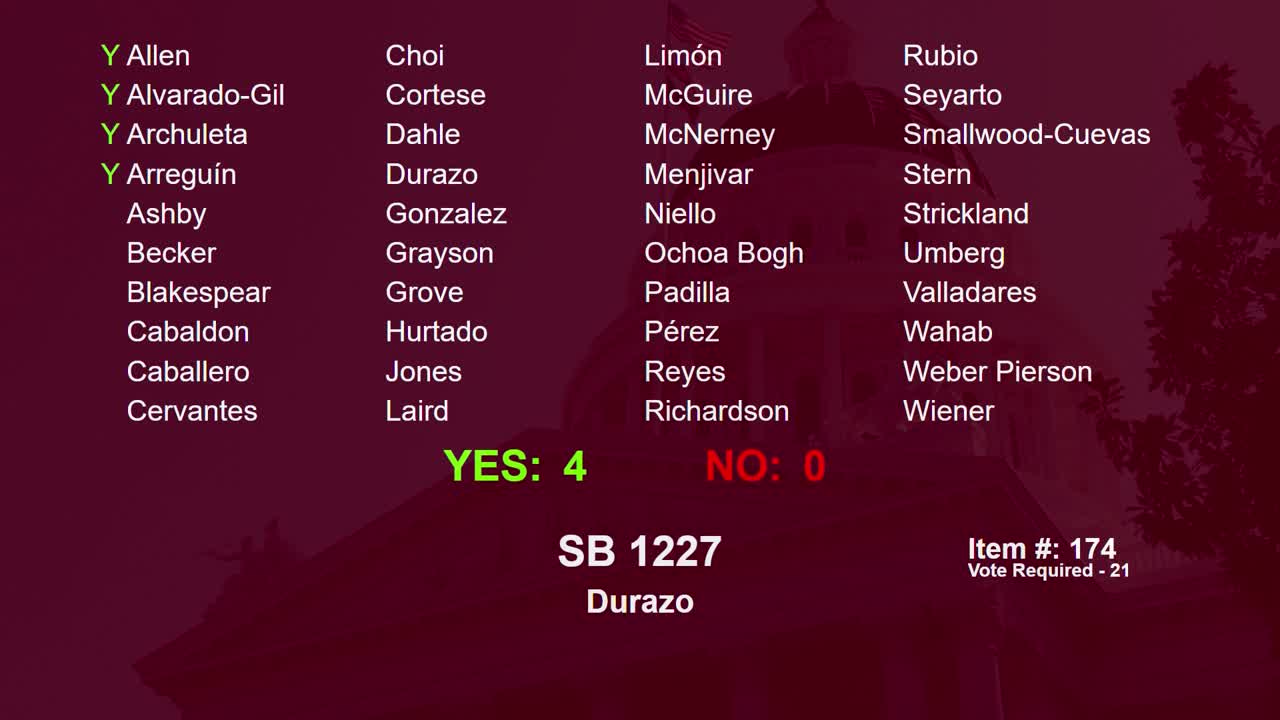
Bill Author

Bill Co-Author(s):